SOLUTIONS CENTER
BY NICK TUMILOWICZ, ITRON
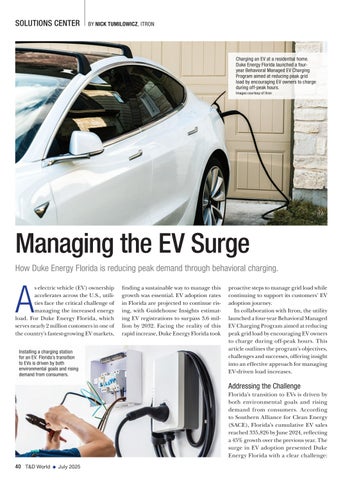
Charging an EV at a residential home. Duke Energy Florida launched a fouryear Behavioral Managed EV Charging Program aimed at reducing peak grid load by encouraging EV owners to charge during off-peak hours. Images courtesy of Itron
Managing the EV Surge How Duke Energy Florida is reducing peak demand through behavioral charging.
A
s electric vehicle (EV) ownership accelerates across the U.S., utilities face the critical challenge of managing the increased energy load. For Duke Energy Florida, which serves nearly 2 million customers in one of the country’s fastest-growing EV markets, Installing a charging station for an EV. Florida’s transition to EVs is driven by both environmental goals and rising demand from consumers.
finding a sustainable way to manage this growth was essential. EV adoption rates in Florida are projected to continue rising, with Guidehouse Insights estimating EV registrations to surpass 3.6 million by 2032. Facing the reality of this rapid increase, Duke Energy Florida took
proactive steps to manage grid load while continuing to support its customers’ EV adoption journey. In collaboration with Itron, the utility launched a four-year Behavioral Managed EV Charging Program aimed at reducing peak grid load by encouraging EV owners to charge during off-peak hours. This article outlines the program’s objectives, challenges and successes, offering insight into an effective approach for managing EV-driven load increases.
Addressing the Challenge Florida’s transition to EVs is driven by both environmental goals and rising demand from consumers. According to Southern Alliance for Clean Energy (SACE), Florida’s cumulative EV sales reached 335,826 by June 2024, reflecting a 45% growth over the previous year. The surge in EV adoption presented Duke Energy Florida with a clear challenge: 40 T&D World ● July 2025
2507TDW_040-43_Solutions Center.indd 40
6/23/25 11:52 AM
2507TD