quality control
NO ‘WINNER TAKE ALL’ SCENARIO Others caution that the market is likely to remain fragmented, with measurement and monitoring solutions needed for many different IP, cloud and baseband infrastructures. This fragmentation will also have an impact on AI use.
“Effective AI requires tremendous observations and historical knowledge in terms of big data sets.” MARK SIMPSON, TRIVENI DIGITAL
“There are big clients where the flexibility of IP is a godsend that really helps you speed up your setup,” Lynx Technik Chief Technical Officer Vincent Noyer said. “But in other cases, the gain is not so obvious. SDI is still easy to work with. I don’t see it as a winner-take-all scenario where everything is all-IP or all-cloud. We are still seeing strong demand for our products from clients who are focused on broadcast quality.” This fragmentation is important in applying AI to tackle measurement and monitoring problems, with deployments that work best in cloud environments that can handle the massive processing and power requirements of LLMs. “If you are in the cloud, you are not constrained by power and by computing resources; you can do many things,” Noyer added. “But in other environments you can be limited. If you can’t support a 500-watt GPU, then other approaches, simpler products and technologies, will work better.” Another major issue with LLMs and some of the newer AI approaches is the need for massive amounts of data for accurate results. “AI is going to matter, but you do also have to be careful,” said Triveni Digital President and CEO Mark Simpson, adding that his company has used what might be called AI for 20 years. “Effective AI requires tremendous observations and historical knowledge in terms of big data sets. The question is, do we have enough data yet in this industry? The underlying system really must provide very
detailed observations for the AI to use.” Another example of the market fragmentation and complexity that will affect how AI might be applied to test, measurement, QC, monitoring and compliance systems for broadcasters is the transition from ATSC 1.0 to 3.0 in the U.S. and other advanced broadcast standards internationally.
IP AND HYBRID COMPLEXITY ATSC 3.0 and similar standards are IPbased and can meld broadcast feeds with internet streams to provide interactivity, dynamic advertising and a host of other features. While this will let broadcasters better compete with digital media, it also creates additional complexities. To handle those, TV Globo in Brazil recently deployed solutions from Triveni designed to handle the unique features of that country’s new TV 3.0 standard. “This has made it much easier for them to detect problems,” and will help them take advantage of the new standard’s features, according to Simpson. All this fragmentation and complexity raises a longstanding issue—the need to simplify monitoring, measurement and QC processes. “A lot of operations, engineering and leaders come to us and say we need one, one piece of glass,” TAG’s Carlisle stressed. “They don’t want to go to four or five different products. I want a unified, simple platform.” In addition to simplifying the monitoring process, Carlisle and others believe AI can proactively analyze networks to solve issues
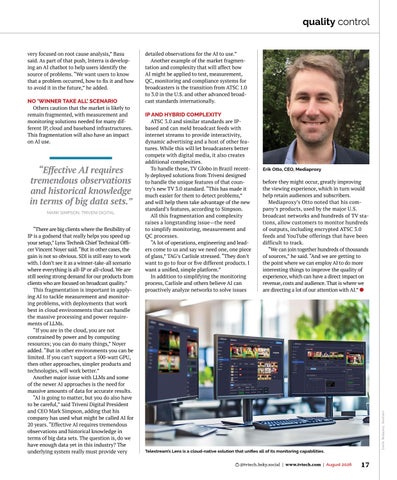
Erik Otto, CEO, Mediaproxy
before they might occur, greatly improving the viewing experience, which in turn would help retain audiences and subscribers. Mediaproxy’s Otto noted that his company’s products, used by the major U.S. broadcast networks and hundreds of TV stations, allow customers to monitor hundreds of outputs, including encrypted ATSC 3.0 feeds and YouTube offerings that have been difficult to track. “We can join together hundreds of thousands of sources,” he said. “And we are getting to the point where we can employ AI to do more interesting things to improve the quality of experience, which can have a direct impact on revenue, costs and audience. That is where we are directing a lot of our attention with AI.” ●
Credits: Mediaproxy; Telestream
very focused on root cause analysis,” Basu said. As part of that push, Interra is developing an AI chatbot to help users identify the source of problems. “We want users to know that a problem occurred, how to fix it and how to avoid it in the future,” he added.
Telestream’s Lens is a cloud-native solution that unifies all of its monitoring capabilities. @tvtech.bsky.social | www.tvtech.com | August 2026
17