VOLUME 27 NO. 10 | OCTOBER 2026
FEATURING • Would AI Recommend Your Firm? • Paying Attention to Power Outlets • Powering a Video Wall
LIGHTING THE WAY
Lightworks Saw the Convergence of Electrical, Lighting, and AV Into a Single Trade 25 Years Ago
Review:
NAD CI SA2-120 Streaming Amplifier
10.26 COLUMNS 10 Secrets of Success
Would AI Recommend Your Integration Firm? Your company needs to be understood, trusted, and recommendable by both people and the systems that help them decide who to call. By Katye McGregor Bennett, Founder & CEO, KMB Communications
12 VITAL Business Tips
A Business Worth Keeping Why you should build something you don’t want to retire from. By Matt Bernath
13 Behind the Business
Dealing With Growing Pains Growth creates complexity — don’t let complexity kill your growth.
By Haley Patterson, Certified EOS Implementer
14 Back to Business
What’s Holding You Back? Why pushing for change doesn’t work, and what you should do instead.
28 GEAR
FEATURES
28 Case Study
18 Lighting the Way
Power for the Picture Why power should be the first design decision on every video wall project. By Igor Kivritsky, President, Hi-Fi Centre, Vancouver, BC
30 Review
NAD CI SA2-120 Two-Zone BluOS Streaming Amplifier With the CI SA2-120, NAD has created a two-zone streamer with the custom installation channel firmly in mind, with performance and features that will tick nearly every box you can imagine. By John Sciacca
By Jason Griffing
16 Home Theater
A Fool With a Tool AI can amplify your skills — or expose your weaknesses.
By Ben Goff
34 Going Forward
Commercially Connected In Orange County’s wealthiest enclaves, the line between office and estate has all but disappeared, as have the AV systems that serve both. By Lindsey Corbin, Director of Marketing, Vanco
Lightworks has been showing the power a combined electrical, lighting, and integration company can provide for 25 years. By Anthony Savona
22 The Power Is in the Details
Rethinking the modern home, one outlet at a time. By Racheal Rich, Senior Product Manager, Legrand
24 The Integration Guide to Automation
The latest automation updates offer a win-win opportunity — they are easy for homeowners to use and easy for dealers to program.
By Karen Mitchell
DEPARTMENTS Editor’s Letter........................................................................................................................................................................................................................................................................ 4 Exit Interview: Kimberly Lancaster.......................................................................................................................................................................................................................... 6 Working With: Wrensilva............................................................................................................................................................................................................................................... 8
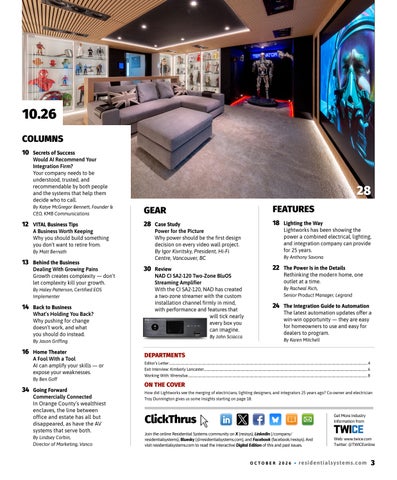
ON THE COVER How did Lightworks see the merging of electricians, lighting designers, and integrators 25 years ago? Co-owner and electrician Troy Dunnington gives us some insights starting on page 18.
ClickThrus
Get More Industry Information from
Join the online Residential Systems community on X (resisys), LinkedIn (/company/ residentialsystems), Bluesky (@residentialsystems.com), and Facebook (facebook/resisys). And visit residentialsystems.com to read the interactive Digital Edition of this and past issues.
OCTOBER 2026
Web: www.twice.com Twitter: @TWICEonline
r es i d entialsy stem s.com
3
EDITOR’S LETTER
Thoughts on CEDIA Expo
October 2026 Volume 27, Number 10
BY ANTHONY SAVONA
A
s of this writing, it has been one week since CEDIA Expo 2026 has ended. There have been many articles and posts recapping the show, and the majority that I’ve seen have had a common theme running through them: While not the most crowded show we’ve seen, the floor and most booths were busy the whole time, and there was a pervasive positive energy throughout. It was a vibe, as the kids say. That is also a good summation of my feelings about CEDIA Expo, but before we put it behind us and move on with the connections and promises made there, I wanted to drop a few brief observations so that I can clear out my head (and my notebook). Note: If you are planning on reading only one CEDIA Expo recap this year, it really should be John Sciacca’s, which you can find by flipping the page. Still here? Let’s go. 1. Origin Acoustic’s Mystery Product. If you wanted to go behind the curtain to see Origin Acoustic’s well-teased mystery product, you had to sign an NDA — and not just press! Integrators also had to sign before they could experience what I can’t talk about yet, but what I am really excited to tell you all about when I can. Also, their new Wedge outdoor speaker sounded killer. 2. Magnificent (and Expensive) Beasts. Video walls continue to get better and better, from Just Video Walls’ new Absolute Black to Quantum Media System’s stunning XDR5-8K. Seriously, if one of my local theaters invested in a XDR5-8K, it would make me rethink my devotion to Dolby Cinemas. Also, I have always been a fan of Sony’s Crystal LED, and the one at their booth was stellar! 3. Great Theater, Bad Movie, Second Thoughts? I went to Disclosure Day opening weekend because it had everything going for it from my perspective: Steven Spielberg, aliens, Emily Blunt…and I hated it. The L-Acoustics demo theater showed a clip from it, and I was completely drawn in. It even made me think I might have been too harsh on it, but I will only rewatch it if L-Acoustics invites me to a screening. 4. Crestron’s Long-ish Game. While not as secretive as Origin’s upcoming product, Crestron had a tease of its own going on. The focus of the booth was on the company’s new Configure Pro,
4
r e s id e ntial s y st e m s.com
CONTRIBUTORS KATYE MCGREGOR BENNETT
Katye McGregor Bennett is chief strategist and CEO of KMB Communications and an avid podcaster. Podcasts include Connecting Tech + Design and AV Trade Talk.
MATT BERNATH
but there were half a dozen or so other products that were not there to be announced, but would be available to dealers before the end of the year. Way to keep the relationship fresh! 5. Solutions Galore. There were many clever products on the floor designed to solve common, and uncommon, problems for integrators. Some examples: Stealth Acoustics’ folding TV, ported in-wall subs, and new amps; HK Lighting’s solar-powered Sentinel Series pathway lights; Somfy’s Top-Down, Bottom-Up shade; and Blustream’s VoIP devices. 6. Ketra’s Sub-par Lighting. Okay, that was written that way to get your attention, but Ketra is not only capable of creating natural light and vibrancy, it can also mimic poor lighting, which Lutron used to great effect in its single-room demo at the show. The compelling 10-minute sequence covered a lot of ground by showing brilliant lighting in action, which was so much better than just telling. 7. AI Evolves. Savant, Crestron, Stealth Acoustics, Josh.ai, D-Tools, and so many others showed real-world, in-use-now examples of how AI can enhance a CI business. In case you cannot tell, it was a good time. Keep watching these pages for all the developments that came out of the show.
Find me online... anthony.savona@futurenet.com residentialsystems.com twitter.com/resisys facebook/resisys company/residentialsystems
OCTOBER 2026
Matt Bernath is a CE veteran with more than two decades in retail, wholesale, CI, and business coaching. In 2021, Matt and a group of partners acquired VITAL, and Matt now serves as the company’s president/CEO.
BEN GOFF
Ben Goff is an award-winning, private cinema designer and technical director at Cinema Buro. A co-chair of CEDIA’s RP32 work effort and contributor to multiple industry standards, he specializes in RP22-aligned engineering.
JASON GRIFFING
Jason Griffing is a 20-year industry veteran and director of product at OneVision Resources, where he is responsible for setting and maintaining the strategic direction of the company’s award-winning service solutions for integrators.
RACHEAL RICH
Racheal Rich is a senior product manager with Legrand, leading the Residential Pass and Seymour product line from Charlotte, N.C. She has built expertise across product management, sales and marketing analytics.
JOHN SCIACCA
John Sciacca is a principal with Custom Theater and Audio, in Myrtle Beach, South Carolina. In his free time, he blogs prolifically about the CE industry. cineluxe.com
Residential Systems (ISSN 1528-7858) is published monthly by Future B2B. 130 W. 42nd St, 7th Floor, NY NY 10036. Periodicals postage paid at New York, NY and at additional mailing offices. POSTMASTER: Send address changes to Residential Systems P.O. Box 254 Lowell MA 01853.
PRINTED IN THE USA.
CEDIA EXPO 2026 HIGHLIGHTS
JOHN SCIACCA’S
CEDIA EXPO 2026
HIGHLIGHTS
Some of the notable stops on the show floor and demo rooms.
L-Acoustics demo room
BY JOHN SCIACCA
T
hese are the things that really stood out to me at this year’s show. No matter how hard I try to see everything, I know there are booths and products and people I missed, and if there’s something you think I should know about, please send me an email at jmdls@aol.com and let me know! [Ed note: This is a shortened version of this story; for the full version, visit residentialsystems.com.]
Lutron’s Ketra Experience Lutron brought a new booth to Denver this year, and along with that was a new Intelligent Lighting demo. This space was well-designed and thought out, and in the roughly 10-minute demo, you were taken through all the benefits of Lutron’s Ketra full-color tunable lighting coupled with automated shading.
New Projectors I expected to see some new projectors at Expo, but I was not expecting to be so impressed with the new X-Wall TITAN Noir Ultra projector by the new joint venture of AWALL and XGimi. The new TITAN Noir filled up a 170-inch, 0.8 gain screen with video quality that had me write “shockingly good!” in my notepad. With a 12,000:1 native contrast and 8000 ISO lumens, this RGB Triple Laser, Dolby Vision-capable projector selling for $6500 will be disruptive at the low end of our market and now includes lens memory with motorized zoom, focus, and lens shift. Impressive at the other end of the price range was the Sim 2 UltraNero 4S Duo, which included a double-stack of projectors to deliver both high brightness and high contrast.
Cinemotion Posters Sitting outside of SR7 were two LED panels in portrait mode showing cool, full-motion poster art of upcoming and now playing teasers from a company called Cinemotion Posters. While these were cool on their own, what was even cooler was that this company was founded by Troy Cuvelier, an integrator out of Michigan, who saw a need in our market and
6
r e s id e ntial s y st e m s.com
OCTOBER 2026
Lutron booth
who went out and developed a solution. He installed another product for a client, and when he kept getting calls about it not working, he decided to make something better. That’s the very essence of custom installation, and it’s awesome to see a product come from us, for us!
Kaleidescape Kaleidescape introduced its largest movie server ever, the Compact Terra Prime with 246 Terabytes of solid-state memory. This big boy can hold 4000 4K movies, and three of them will hold the entire Kaleidescape store! (Pricing is by request only, meaning, if you have to ask…) And with its new Strato K and 4K Cinematic format with full 4:4:4 chroma, Kaleidescape was literally everywhere at Expo, powering over 50 different demo systems. I give the Strato K “Product of the Show.”
Video Walls As expected, MicroLED video walls were prevalent at the show, and while they’re still nowhere near “inexpensive,” they are definitely getting less expensive. A great example is Just Video Walls, which had a pretty massive price drop just prior to Expo, with panels now starting at under $19,000 MSRP. It’s tough not to love this technology, as the walls have brightness that easily competes with ambient lighting, achieves true-black, has HDR for days, and can be configured into practically any size.
CEDIA EXPO 2026 HIGHLIGHTS
The two panels that most impressed me at the Expo were the Barco Residential Runar and the Quantum Media Systems its XDR5-8K, a 0.9mm pixel pitch, native 8K panel purpose-built for the luxury residential market. I feel like a broken record saying it, but the Quantum Media Systems continues to provide the best image quality at the show. Year-after-year it delivers the ultimate in picture quality, and this year’s 20-foot wide by 9-foot tall 8K display once again raised the bar of what reference-quality video can be, making you wonder how you can come up with the $350,000 needed to get it in your home.
booth, then you know… I watched the company’s Facebook video where Marc Fisher, president of sales, and Nick Berry, CEO, did a roughly 80-second video with the two of them teasing some groundbreaking new product to be revealed only at Expo. “This is the biggest thing we’ve ever done,” Fisher said. Let’s just say, I was not expecting the product they announced, and I can see it being a true gamechanger for the industry. Origin is planning to launch it to the public next year, so stay tuned!
Savant AI Touch
When I finished reviewing the Magnetar UDP-900mkII universal disc player back in May, I kind of felt like that was going to be the last word in high-end disc players. But Magnetar said, “Hold my beer…” and dropped the ULTIMA, which they are calling the “new reference in luxury universal media transport.” This $12,000 player is a transport only — no DAC on board! — that actually comes in two components weighing 70 pounds! This boss unit utilizes a revolutionary battery-assisted DC architecture with a dedicated BYD lithium-based power stage to isolate critical processing and signal pathways from “microscopic fluctuations, electrical contamination, and noise.” For the client with a large physical media library, the ULTIMA says I will settle for nothing less than the very best, ensuring every 0 and 1 is given the Black Card treatment. At least until the ULTIMA mkII drops…
It’s not often that I’m stunned at a press event, but that’s what happened at the Savant event, where I literally said, “Woof!” when founder Robert Madonna held up the company’s upcoming touchscreen, the Savant AI Touch, and announced the price. But, Woof! good, not bad! These fullcolor panels have a very cool look with a tactile knob at the bottom, will include voice control for the company’s “Hey, Savvy” AI voice agent, and will also be able to control a lighting load. The 6-inch portrait panel will retail for $500 and the 8-inch landscape version will sell for $600. Also cool from Savant is its Blueprint AI, which will greatly reduce the time required to create a proposal.
Foldable Walls While MIcroLED walls are cool all on their own, why not have one that can move and transform, going from ugly black surface to something elegant that disappears and benefits its visual environment when not in use? The two coolest examples of this were from C-SEED and Stealth Acoustics. The C-SEED Bugatti N1 “transforms from sculptural object to immersive cinema experience in just 45 seconds,” turning from elegant floor/base into 137-inch image before your eyes. Stealth’s Folding LED TV is a concept that I could see having realworld application. When closed, the unit will have a customizable outer finish hand-fabricated by Stealth, but then folds open to reveal a 105inch display. This is the perfect solution for TV-over-fireplace, where it could be an art element that enhances the room when off, but deliver a cinematic screen size for movie time.
Origin Acoustic’s Game Changer As a member of the press, I have been asked to not reveal too much about this product. But if you attended Expo and went through Origin’s
The show floor opens.
Magnetar ULTIMA
Demo Material Last Expo’s shining demo was definitely the opening of F1, which I think I saw a half-dozen times. This year, the demo material was far more varied — thank you, exhibitors — however, we did have a clear winner: Tron: Ares. Honestly, I think this was chosen partly because of Kaleidescape’s Strato K with full 4:4:4 chroma that had the vibrant reds from Ares really pop! Second most demo’d were the dance scene from Sinners, and “having a moment” from Project Hail Mary. A few of my favorite demos included the train scene from Disclosure Day used by L-Acoustics in its theater, which had incredibly tight and articulate bass, the Hunger Games: Sunrise on the Reaping and Avengers: Doomsday DCI-graded trailers used by Quantum Media that looked absolutely gorgeous, and the SR10 partner room that included the ASCENDO Panoramic Surface On-Wall height and surround speakers for an incredibly immersive and enveloping experience.
The Paul Hales Theory Audio Experience My demo lasted a full hour. And it was clear he was trimming near the end. But you don’t even care, because being in the room with Paul is getting to watch a master at work. The man works a room like Sinatra. I’ve seen Paul’s demos many times and consider them a must-see. In fact, it was the very last thing I did at Expo before getting in an Uber to the airport. However, this year it finally dawned on me what is truly different about Hales’ demos. With other companies, you sit there and see pretty pictures and nice sound, and then they thank you for coming, and you walk out and go to the next one. Paul is actively trying to sell you on his products; challenging you as to why you aren’t, and why you think the brands you’re selling are better. (He’ll also have you rethinking if using room correction is a good idea.) Theory offers 37 speakers that deliver a solution for everything from architectural, to outdoors, to theaters, to large venues. Come to the Hales demo and leave a better salesperson. And possibly a Theory dealer. OCTOBER 2026
r es i d en t i alsy stem s.com
7
WORKING WITH…
WORKING WITH WRENSILVA
The design-centric record console maker creates a new centerpiece for the listening room. BY ANTHONY SAVONA
W
rensilva recently introduced Studio, a new record console for design-minded music lovers that blends artful craftsmanship with rich, textured sound into a music centerpiece for any space. The company has also announced it is expanding its investment in the custom integration channel with a dedicated dealer program for integrators who work closely with builders, architects, and interior designers on high-end residential projects. We spoke with Greg Perlot, CEO, Wrensilva, about his products and how they fit into an integrator’s offerings. Can you give us some background on how Wrensilva has developed to where it is right now? GREG PERLOT: We are going to celebrate our 10th anniversary in early 2027. We're based out of San Diego, and the original idea was to bring that modern audio platform of streaming and the way we now listen to music forward into a centerpiece for the living room. The idea of the classic WiFi record console is very appealing to us, and it's become more appealing as the idea of tactile has become more in demand in our AI culture. The idea was: How do we match up modern audio technology with classic forms and classic ideas of vinyl and bring together something as a centerpiece of music in the home as things have gotten more multiroom and more mobile? That was the original concept. We started with a very close relationship with Sonos and a demanding ethic around craftsmanship and made in the U.S. It's not designed to go into a corner; it's designed to be the centerpiece of a room. Is that why you now decided to get into the custom integration market — because of the interest from interior designers? We started as a direct-to-consumer brand, which then extended to directto-designers and their clients. Now we're doing some pilots in the reseller community, both end-user facing and design-trade facing. It's a natural extension to be in service to the integrators, because those are the homes that these designers are working on and these clients are living in. Developing the CI program is our step into creating some structure around it, creating the appropriate support for it, and the right tools for it. We're learning how our idea fits into homes, because we're not the invisible part — we're the visible part and the music centerpiece. Who do you see as the ideal Wrensilva customer? We're a mashup of design inspiration and loving music. That's our audience. For furniture, it's a premium purchase with a price point of $10,000 to $18,000, but you're not going to be surprised to see a leather sectional at that price. For high-end audio, which we compare favorably to and benchmark ourselves against on the performance side, $10,000 to
8
r e s id e ntial s y st e m s.com
OCTOBER 2026
Wrensilva Studio
$20,000 is not very extreme. Our audience is what we call a design-inspired music lover. Being design-minded is a core part of it. Loving music is a core part of it. Obviously, wanting to play vinyl records should be a part of it, but not at the expense of streaming and other ways to experience music. We don't find that our audience is huge record collectors or classic audiophiles. We're a different kind of aesthetic. Is it an older crowd, or is it people who are young and like the format? It's probably much younger than you'd think. Obviously, the price point makes it so you're established and have the resources to do this, but vinyl as the heartbeat of music culture is being driven by a younger audience. The artists are younger, and vinyl is very personal to the artists. Is it able to connect to a whole-home network? Yes, we offer Sonos integration as an option in all our record consoles. That's the primary engine of our whole-home audio experience. If you play locally on Wrensilva, it's passive analog — a pure, old-fashioned vinyl experience. If you want to play digital streaming, you switch to that mode. You can stream Bluetooth at very high output quality. You can switch to Sonos mode, and you're going to have a Sonos-level Wi-Fi streaming experience, and you're going to be able to stream anything at that source to your other Sonos rooms. Whether it's vinyl or Spotify, whatever's got that Wrensilva association, you can stream to the other rooms. In your opinion, what is it that sets your products apart from those of your competitors? When you think about the idea of being a design-inspired music lover
WORKING WITH…
— not a classic audiophile, not a record collector — that's a different way of moving through the world. We want to be the thing that music artists want their art played on. That's not just audio specs; it's how they want to experience music on their own. That's why it's such a big deal to us to collaborate with the artists and the creators directly. What sets us apart is the way it looks, the way it sounds, and the way it's working from within the music community for music. Then it's a seamless integration to go from analog to digital, single source to multi. What kind of warranty do you offer? We have a one-year warranty on all parts, build, and craftsmanship. From there, we have an inclusive support approach to our customers. These are heirloom pieces in your home. Typically, any issues that come up tend to be minor things that we can just get on a FaceTime with you and deal with. If anything happens, we have a repair program. We diagnose it. Because we make them and support them from San Diego, we can get underneath whatever's going on with the team that's making the product. That's the same for dealers: If you're in our premium dealer program, we're going to work with you all the way into the factory level if you need it to figure things out. So, it's a one-year warranty for basically anything, with support after that. How long does it typically take to fulfill an order? It depends on seasonality, but typically four to eight weeks is the zone. Everything's handmade. We try to keep some stock of the more in-demand things, but what we've found, particularly on the trade and integrator project side, is having things in stock isn't really the thing — it's getting the right experience in that place at the right time. If we're shipping it, it's white glove. It comes, it's placed, and you get all the way to your first listen. If it's gone through a dealer, then we work with them on whatever that white glove experience is. Our whole thing is you don't have to set up a Wrensilva; you get it where you want it and get to that first listen very fast. What is it that you're looking for in a dealer partner? Who are your ideal custom integrators that you want to work with?
Wrensilva M1 turntable
Wrensilva The Standard
The whole point is that we want to have the easiest path for clients, designers, and homeowners, and that whole triangle of relationship with the integrator to get this music centerpiece experience into the home. We're a premium brand with a specific point of view about music, design, and the level of quality that it should be every step of the way. We're looking for partners who first see and respect that kind of brand, who are doing those kinds of projects at that elevated quality, and who are giving us visibility into those kinds of projects. Can you give a brief rundown of your dealer programs? It's a pretty simple structure. We have a Select program, which is a variation of our design trade program. There's beneficial pricing for that, access to support, and essentially being part of our conversation and marketing visibility. Then there's our Premier program, which is a proper reseller program that can fit any scale. That's going to be better pricing and margin, a more streamlined and better pricing approach to demo units, enhanced training, early looks on product, exclusive allocations on some products, and marketing support and tools like samples, exclusives, or marketing partnerships. Is there a cost of entry to get started with Wrensilva? There's going to be a demo unit, and you're going to have to participate in proper training. We've found that, for partners who don't have any skin in the game, it doesn't end up well. There needs to be some shared commitment about a Wrensilva experience. There's not a high cost of entry out of pocket by any means; it's more about sharing, building the market together, and building the next generation of integrator experience together. What's the best way for dealers who want to get involved with Wrensilva to reach out? We have a team that's dedicated globally to CI and resellers. They can reach out via email at resellers@wrensilva.com. We really want to support this market. It's a natural evolution for us because our projects are highend projects, and we're very close with the design community. This is a natural next step. OCTOBER 2026
r es i d en t i alsy stem s.com
9
SECRETS OF SUCCESS
Would AI Recommend Your Integration Firm? Your company needs to be understood, trusted, and recommendable by both people and the systems that help them decide who to call. B Y K AT Y E M C G R E G O R B E N N E T T, F O U N D E R & C E O , K M B C O M M U N I C A T I O N S
Back in July, I asked whether your company narrative is saying what you think it is. Now there is another question worth asking: Can AI figure out what you are saying at all? For years, integration firms have worried about Google rankings. Are we on page one? Are we showing up for “home automation near me”? Is our SEO working? Those questions still matter, but search behavior is changing rapidly. People are increasingly asking AI-powered tools complete questions instead of typing a few keywords into a search box. “Who is a great home technology integrator in Denver for a high-end new build?” is very different from “AV company Denver.” If ChatGPT, Google’s AI features, or another answer engine tries to understand your company, does the internet give it enough clear, credible, consistent information to confidently include your firm? Or does your digital footprint amount to “innovative solutions that elevate your lifestyle,” three project photos from 2021, and a LinkedIn page nobody has touched since somebody left the company? SEO. GEO. AEO. LLMO. At this rate, marketing is going to need its own decoder ring. Fortunately, the fundamentals are much less complicated. Even Google’s guidance on AI search essentially comes back to the same things we’ve been talking about for years: create useful, original content and make sure Google can find and understand it. OpenAI’s guidance isn't wildly different. If your site is public and accessible, its information has a better chance of being found and surfaced in ChatGPT search. There is no magical “AI button.” The job is much more basic: Make your company easier to understand. The first test is embarrassingly simple. Can the internet clearly identify who you are, where you work, what services you provide, the types of projects you handle, and the clients and partners you serve? If your homepage says you create “bespoke connected experiences,” but never plainly says you provide lighting control, motorized shading, networking, private cinema, power management, or whatever you actually do, you are making humans — and machines — work unnecessarily hard. Once you know the basics are clear, ask a harder question: Where’s the proof? Project stories. Case studies. Testimonials. Architect, interior designer, builder, and other trade partner quotes. Awards. Certifications. Manufacturer relationships. Earned media. Association profiles. Useful articles that demonstrate expertise. Your website can say you are wonderful all day long. Third-party corroboration helps establish that someone besides your marketing team agrees.
10
r e s id e ntial s y st e m s.com
OCTOBER 2026
And your own website isn't the only place that story is being told. Your website, Google Business Profile, LinkedIn presence, HTA or CEDIA profiles where applicable, manufacturer dealer listings, media coverage, and partner websites should reinforce the same company name, geography, expertise, people, and positioning. Consistency is not glamorous, but neither is discovering that an outdated directory still lists the office you moved out of four years ago. Content matters, too, but not simply because someone told you to publish another blog. Answer the questions prospective clients and design-build partners are actually asking: When should I involve a technology integrator? How much should I budget for technology? What is the difference between an electrician and an integrator? Why does a luxury home need a professionally designed network? What happens after installation? Useful answers establish expertise, support traditional search, give sales teams something valuable to share, and create clear information AI systems can potentially retrieve and cite. None of this matters much, of course, if the machines can’t actually get to it. Your website team should confirm that important pages are crawlable, technically sound, mobile-friendly, and not accidentally blocking search or AI discovery. Google explicitly identifies crawlability and sound technical structure as important to visibility in its generative AI search experiences, while OpenAI notes that sites blocking its search crawler may limit how their content can be discovered, surfaced, and cited in ChatGPT search. You do not need to become an expert in robots.txt over lunch. You do need someone who knows whether yours is doing something unfortunate. Here is the larger point: AI is not creating an entirely new marketing problem. It is exposing old ones faster. If your positioning is vague, your website is thin, your company information is inconsistent, and nobody credible online is talking about your work, your first problem is not GEO. It's your marketing. Your integration firm needs to give people — and the platforms helping them search — enough information and enough proof to put you on the shortlist. So, would AI recommend your integration firm? Better yet: Have you given it a good reason to? Need help making sure your firm is saying the right things, in the right places, so people — and the platforms helping them search — understand why you belong on the shortlist? Drop me a line at katye@kmbcomm.com and let’s chat.
Next Starts Here
CES® is more than an event. It’s the spark for what’s next. It’s where global brands, startups and technology leaders meet to launch the future. This is your chance to explore industry-shifting tech, build connections that move your business forward and turn four days in Las Vegas into years of opportunity.
Register now at CES.tech #CES2027 | JAN 6-9 | LAS VEGAS, NV
VITAL BUSINESS TIPS
A Business Worth Keeping
Why you should build something you don't want to retire from. B Y M AT T B E R N AT H
The work-life balance conversation is a lie. For most leaders I know, work and life merged into one thing a long time ago, and the real question is how you live well inside that reality. That idea wraps up this series of articles inspired by a conversation Brent Sonnek-Schmelz and I had on our podcast, The Flywheel Effect, when we sat down to talk about America turning 250 this year. The first article looked at how a longer time horizon changes what you fear and the decisions you make. The second looked at how it changes how fast you grow. This last one is about what all of it means and how it comes together. Benjamin Franklin was a printer who loved being a printer. John Adams was a lawyer who loved being a lawyer. Our founding fathers who built the document we're celebrating this year weren't working toward a retirement they could escape into. They were building something they could pour themselves into for the rest of their lives, and work was simply part of who they were — the same way it is for most of the custom integration owners I know. Retirement as most of us picture it — decades of leisure after 40 years of work — is a newer idea than people assume. When Social Security set the retirement age at 65 back in the 1930s, the average working man died at 63. The program was never built to fund decades of life after work because nobody expected there to be decades of life after work. We inherited a model of retirement built on math that hasn't applied to how long we actually live for some time now, and most of us have never stopped to ask whether it should still be the goal. I see the consequences of that inherited model play out constantly among the owners I work with. A lot of them are quietly building their business toward an exit they haven't really thought through: a sale or a retirement date where they finally get to stop. The business becomes something to survive instead of something built to last, and that mindset shows up in small decisions everywhere. They underinvest in the parts of the company that would make it genuinely enjoyable to run today. They avoid the leadership and systems work that would let them step back because building that requires believing the business is worth building well, and not just worth selling someday. Succession planning done well looks different once it stops being framed as an exit. The question shifts from, “How much could I sell this for and how fast?” to, “Who could run this as well as I do, and what would it take to get them there?” Some owners find that answer in a son or daughter who wants the business, not just the obligation of it. Others find it in a general manager they've spent years developing into a real partner. Either way, the businesses that hand off cleanly tend to be the ones the
12
r e s id e ntial s y st e m s.com
OCTOBER 2026
Succession planning done well looks different once it stops being framed as an exit. owner built because they loved running them, not the ones built purely to be sold. This connects directly to the foundation we talked about last month. A business built well enough that you're not chained to it every day is also a business that doesn't require you to escape it to feel free. Those are the same business, built the same way, for the same reason. The owner who builds a company they can step back from is also building a company they could keep running for another 25 years if they wanted to. The two goals point in the same direction. I think about my own daughter, who just finished her first year of college. She's studying marketing, but like a lot of her peers, she doesn't yet know what she wants to do once she graduates. I told her to figure out what she'd enjoy doing before worrying about what it pays, because she's going to be working for a very long time. That advice applies just as much to someone 20 years into owning a business as it does to a college student trying to figure out what comes after graduation. What are you building toward, and would you still want it if nobody made you keep it? Two hundred and fifty years ago, a small group of people built something they believed in enough to keep working on for the rest of their lives, through real fear and real uncertainty about whether any of it would last. They didn't inherit a long view. They built one, on purpose, because the alternative was building something they didn't believe in. That's the thread running through all three of these pieces. A longer view changes what you fear. It changes how fast you grow. And in the end, it changes what you're willing to spend the next 25 years building — something worth keeping, not just something worth escaping. We are fortunate in this industry to be working with incredible technology, doing things people dream of, and getting paid for it. That blessing turns into a curse when real work is involved in growing and running these businesses. It remains a blessing when you truly lean into what you love, hire what you don’t, and maintain the creative artistry you were born with. If any part of this series resonated, the full conversation that started it all is on The Flywheel Effect podcast, wherever you listen to your shows. Brent and I cover a lot more ground than fit on these pages, including plenty of history that has nothing to do with business and everything to do with why we both love this country.
BEHIND THE BUSINESS
Dealing With Growing Pains
Growth creates complexity — don’t let complexity kill your growth. Growth is exciting. More revenue, more customers, more projects — it’s what most businesses are working toward. But somewhere along the way, growth can start to feel a lot less exciting and a lot more complicated. The communication that used to happen naturally now requires meetings. The owner who once knew everything happening in the business can’t keep up with every project, customer, and employee. Things start falling through the cracks. Decisions take longer. People aren’t always sure who owns what. The business is bigger — but might not be as fun as it used to feel. The good news is the things that help simplify a growing business aren’t complicated. It's actually pretty simple, but simple doesn’t always mean easy. Sometimes the most basic disciplines are the hardest ones to put in place and stick with. Ready to simplify? Here are four places I’d start, and chances are you already know they matter. Sometimes, it just takes a step back to simplify and refocus.
Get Crystal Clear on Who Owns What When you have a small team, it’s normal for everyone to wear multiple hats. But as you grow, blurred lines become a problem. Who owns the customer experience? Who makes the final call on an operational issue? Who is accountable when a project isn’t profitable? In EOS, we use the Accountability Chart to create clarity around the right structure for the organization and the major responsibilities of each seat. This isn’t about creating more hierarchy. It’s about making it easier for everyone to know what they own — and where to go when something needs to be solved.
Create a Consistent Way of Doing Things When there are five people in the company, you can get away with having your processes live in someone’s head. At 15, 30, or 50 people, that gets a lot harder. As you grow, identify the handful of Core Processes that make your business run and document the most important steps. Sales, project management, installation, service, billing — whatever is essential to
The answer to complexity…is creating greater clarity around your people, your processes, your numbers, and your priorities.
GETTY IMAGES
B Y H A L E Y P AT T E R S O N , C E R T I F I E D E O S I M P L E M E N T E R
delivering a great experience consistently. The goal isn’t a 100-page manual that nobody reads. Keep it simple, make it usable, and get everyone following the same process.
Know What’s Working Before It Isn’t The bigger your company gets, the harder it becomes to manage by feel. You need visibility. A simple weekly Scorecard with 5–15 key numbers can give your team a pulse on the business. Instead of finding out at the end of the month that margins slipped, service calls piled up, or the sales pipeline dried out, you can see it coming and address it sooner.
Keep Your Team Focused As businesses grow, so does the list of things they want to accomplish. They want to launch the new service, fix the process, hire the person, implement the system, improve the customer experience — and they want to do it all now. But they can’t do everything at once. Decide on the few priorities that matter most for the next 90 days and stay focused on them. Companies running on EOS call these priorities “Rocks.” By narrowing your focus, getting those priorities done, and then choosing the next ones, you create meaningful progress quarter after quarter. That’s how you gain traction without trying to tackle everything at the same time. The answer to complexity isn’t adding more meetings, more systems, more layers, and more rules. It’s creating greater clarity around your people, your processes, your numbers, and your priorities. So, here’s my challenge to you: Take a step back and look at where your business has become more complicated than it needs to be. What can you clarify, simplify, or stop doing altogether? Sometimes the simplest changes are the ones that create the most traction. I help entrepreneurs get what they want from their business. If you want to learn more about EOS, I offer a 90-minute complimentary value-add session for leadership teams. Contact me at Haley.patterson@eosworldwide.com. OCTOBER 2026
r es i d en t i alsy stem s.com
13
BACK TO BUSINESS
What’s Holding You Back?
Why pushing for change doesn’t work, and what you should do instead. BY JASON GRIFFING
The short-term progress that driving forces create gives us the illusion of progress, but such change comes at the cost of organizational tension. This elementary physics challenge may seem silly, but it holds a useful business insight. It is based on the Force Field Analysis change model, which was established by psychologist Kurt Lewin in the 1940s. And its lessons can be incredibly helpful to any individual or organization going through times of change. Let’s go back to our imaginary system. This time, imagine it as a metaphor for your business. The ball represents your team; moving it to the right represents a change initiative you are implementing — a new process or software implementation, for example. You’ve tried to get the ball moving, but progress has stalled. Now what?
Driving Forces It’s likely that your first instinct is to apply more force. You reiterate your reasons for the change ad nauseam. You create incentive programs. You highlight all the great outcomes the change will enable. Perhaps you “crack the whip,” threatening punitive action if the behaviors don’t change. But none of it works. Despite all the demonstrable reasons change is needed, you’re stuck, frustrated, and perplexed. In the Force Field Analysis model, the above tactics are considered driving forces. Such tactics can produce results, at least in the short term. But leaning on driving forces to implement change is problematic. Going back to our plank and ball visual, driving forces are the equivalent of pushing down on the right side of the system; the ball may start rolling, but now the system is full of tension. The moment you stop applying pressure,
14
r e s id e ntial s y st e m s.com
OCTOBER 2026
the ball goes flying, and the whole system returns to its original state. Creating meaningful, lasting change requires a better approach.
Restraining Forces Any time we push for change, we’re going to encounter resistance. Lewin calls the collection of forces that push against our efforts “restraining forces.” Examples are everywhere, including fear, uncertainty, confusion, doubt, a lack of knowledge or training, and bandwidth constraints, just to name a few. Lewin argues that addressing these restraining forces is the most effective and efficient way to push your organizations forward. By attacking the restraining forces, you remove tension from the system, decreasing the overall amount of energy required to make a lasting change. The next time you find yourself struggling with a change in your organization, resist the urge to simply apply more pressure. Instead, stop and ask yourself, “What restraining forces are at play here? Have I done everything in my power to address them?” If you’re willing to dig deep enough, you’ll surely find restraining forces that need to be addressed. As leaders and managers pushing for change in our businesses, our natural instinct is to apply driving forces. We have a lot on our plates, and issuing directives is a lot simpler than doing the deep work required to truly understand what’s holding your team back. The short-term progress that driving forces create gives us the illusion of progress, but such change comes at the cost of organizational tension. Creating a sustainable and healthy relationship with organizational change demands that we focus on addressing restraining forces. This is not a trivial task. Rooting out and resolving these forces requires time and energy. But if you want to create a positive culture — one that doesn’t begrudge change but embraces it — then this is the only path forward. IMAGE CREATED WITH AI USING ADOBE FIREFLY.
Picture this: There’s a long plank balanced evenly atop a fulcrum. A coil spring is attached to the bottom of each end. Stretched to even tension, these springs hold the plank perfectly level. On the left-hand side of the plank sits a ball. Without touching the ball, your challenge is to move the ball from the left to the right side. What do you do? The obvious answer is to apply weight to the right side of the plank. The plank tilts. The ball rolls to the right. Mission accomplished. But there’s a second, less obvious way. Imagine if instead of applying force to the right side of the system, you released tension in the spring holding down the left side. The net result would be the same: the ball rolls right. In the former, you applied force; in the latter, you removed it.
HOME THEATER
A Fool With a Tool AI can amplify your skills — or expose your weaknesses. BY BEN GOFF
A fool with a tool…is still a fool. Any one of us could spot this on site in an instant; there is no question that power tools provide speed and efficiency, but they're not a replacement for skill or competence. I’m not so certain we’d all recognize it as quickly back at the office, where AI is the tool, and the results are showing up across our industry. Now let’s be clear from the outset: I use AI daily and advocate for its role in our businesses. I distinctly remember the day that Rich Green changed my mindset, from seeing AI as a toy to a tool. I’ve since used it to program lighting shaders that were deployed in client projects, to build custom Vectorworks plug-ins, and to draft MATLAB scripts that have opened the door to R&D projects. I'm here to argue that AI is like every tool that came before it: Whether it improves your work or exposes you as a fraud depends entirely on what you bring to the table without it.
Where AI Earns Its Keep The pattern I've settled on, after a couple of years of using these tools, is this: AI is at its best when I already know the right answer and just need to get there faster. When I write a Vectorworks plug-in, I know exactly what outcome I’m chasing and the parameters needed to drive it. It’s like an Excel Macro; I can, and have done, the same processes manually. I’ll get the exact same result, and I know how to verify it, but it’ll take more time. Asking Claude to write the required 300 lines of Python doesn’t diminish my skill, expertise, or knowledge as a cinema designer; it replaces my need to hire a junior coder for simple internal-use tools, which I’ve survived just fine without until now. Same story with a MATLAB digital analysis tool. The math is settled science, and I know the output I require and how it should look. AI helps me get from a concept to a working script without spending days writing code. This is especially true of the non-technical aspects of our work that keep the company moving. I frankly can’t imagine not having detailed meeting notes in the inbox of all relevant stakeholders minutes after every meeting. That’s not a task with an intellectual requirement beyond current LLM models; it’s mechanical time-saving, nothing more. In every one of these cases, there is a human quality control layer. We know what "right" looks like, so we can spot “wrong" immediately.
Where AI Makes You a Fool With a Tool The moment you ask AI to do the thinking, you place yourself on a path where the opportunity for silent failure becomes a future inevitability.
AI is at its best when I already know the right answer and just need to get there faster. 16
r e s id e ntial s y st e m s.com
OCTOBER 2026
When a competent professional designs a system, the process looks the same. Good design starts with detailed client discovery to understand client needs, then follows a repeatable process to deliver them. When we apply this to a private cinema or media room, the actual room layout starts with balancing the seating positions with screen size so that we create a viewing angle that the client finds both comfortable and immersive — a preference we uncovered during discovery. Every other design and specification decision is impacted by the screen size and seating positions; a decision here that doesn’t suit the client's needs will have a knock-on impact through the entire project. This is obvious to anybody who already understands the consequences. We know how to determine the client’s preference; how to achieve it or explain why it isn’t possible. What we don’t do is simply reach for antiquated commercial cinema guidelines and impose them on a client whose needs we haven’t stopped to understand. Can we expect the same from a design tool or an LLM? I think not, and the risk is multiplied when we lean on a tool for justification of a decision. Borrowing unearned expertise makes it easy to get a design proposal approved. A decision backed up with a reference goes unchallenged right up until the room is complete and the client is disappointed. Knowing when and why to ignore an SMPTE or THX standard is a skill ChatGPT hasn’t learned from Reddit. The test I apply before I trust any AI output in a professional context is pretty straightforward. Could I have produced this myself, given enough time? If yes, I’m happy to use the tool for operational efficiency. But if the answer is no, then I'm gambling. Whether that’s gambling with my reputation or my client's money, neither is acceptable in our business. That test isn't a rejection of AI. It's a filter for when to use it. Speeding up work you already know how to do is leverage. Outsourcing work you don't know how to do is exposure.
The Tool Is Neutral None of this is really about AI. The proverb has been true for every tool that came before. CAD didn't make bad designers into good ones, measurement software didn't turn guessers into acousticians, and spreadsheets didn't create competent estimators overnight. What good tools do is amplify whatever the operator brings with them. Skill gets amplified. So does ignorance. The best engineers in this trade will end up using AI as much as anybody else. They'll build their own custom tools they understand, automate the tedious parts of their work, and free up their time for the parts that require judgment. They'll get faster, sharper, and harder to compete with. Everyone else will produce more, faster, and worse. They’ll wonder why rooms don't sound right, why the clients don't come back, and why industry awards keep going to the same handful of names.
FEATURE
LIGHTING
THE WAY
Lightworks has been showing the power a combined electrical, lighting, and integration company can provide for 25 years. By Anthony Savona
I
n this industry, integration businesses make their mark by staying ahead of the curve. In the case of Lightworks, serving the San Diego area, it was less about being ahead and more like waiting 20-plus years for the curve to even show up. In 2001, Troy Dunnington, an electrician who owned a subcontracting company named Lightz On, and Todd Walling, a lighting designer, decided that there were too many trades involved in the residential jobs they worked on together. They decided to do something about it by creating Lightworks, which would handle electrical, lighting, and audio/video, eventually evolving into shades and now smart power. “From the moment we created Lightworks, we were an electrical contractor first, with lighting design, which was exciting because we were able to do CAD work and could put our work on plans and help our builders,” says Dunnington. “That was very unique back then. And we’ve been doing AV for 24 years and shades for 23 years. “I knew if we could roll it into one company, one point of contact, then we could be in charge of all the wiring in the house. Now, electrical is probably around 38% of the company, AV a third, and the rest is lighting design and shades.” Though this kind of thinking is commonplace now, it was not at the turn of the century.
18 r e s id e ntia l s y st e m s.co m
●
Todd Walling and Troy Dunnington during the early days of Lightworks.
However, it did not take long for the designbuild community around Lightworks to see the benefits of having an integration company on the team — especially one that also handles electrical work. “We don’t want to be a subcontractor to a contractor; we want to be a partner, and a partner walks beside the contractor, not behind them,” says Dunnington. “We are their voice. Contractors don’t need to think too hard about the technology space, and we make sure they don’t have to. We let them know what the best
OCTOBER 2026
A recent Lightworks project.
trends are and what’s going on. It’s been very helpful having design and CAD capabilities all these years because, as the evolution of AV has happened and with adding motorized shading and all types of lighting, we’re a necessary partner with the architect and designer.”
Choosing an Electrical Partner Dunnington had his electrical business for 10 years prior to starting Lightworks, which recently joined The Guild Integrators Alliance and is celebrating 25 years in 2026.
FEATURE
He has watched as the concept behind his unique shop became more common, both from integrators adding electricians and electricians adding integration. “A good company is going to realize where we are going in the next stage of integration, and the evolution is through electrical, and it’s going to go deep,” he says. “You have to partner with companies that have a solid foundation. If I was an AV contractor who was trying to add an electrician that is a one-guy company — that’s going to be a tough one because they’re
The Savant Power section in the Lightworks showroom.
OCTOBER 2026
●
r es i d en t i alsy stem s.com
19
LIGHTWORKS ELECTRICAL TECHNICIAN PATH
Apprent Advanc ic ed Petco Park
Qualified Jo u
lla tio n Manager
Level 2 Lea dT e
Mount Soledad Memorial Park
ch
Coronado Bridge
USS Midway
Ma nager
Safety
ip Leadersh
ey ma n Prep
Pro jec t
nt er me diate
ce an n i F
sta Level 4 In
Systems
e
an eym rn
Onboarding
Le
Balboa Park
er
Your Career Starts Here!
er
rogram l3P m ve
Field Manag
LIGHTING THE WAY
eI Apprentic
rn Jou
La Jolla Cove
Appre ntice Basics
Mission Beach
Le vel 1 Tech
Cabrillo National Monument
The journey of a Lightworks electrical apprentice.
not really a business. If I was looking for an electrical contractor, I would look at one that has been in business for a while. “What I see all the time now is the parents who own these electrical companies, their kids are coming in. If I was that AV guy, I would try to lock horns with that young vision, because then it’s not going to be so hard to break the mold of what was done before. “Of course, the choice also depends on where you are in the United States, because licensing is different everywhere. So, you have to make sure first and foremost that their current electrical license is in good standing and that they haven’t just gotten their license, because your AV company is putting all its faith in somebody that, to say it nicely, could burn down the house if they don’t know what they’re doing. “Are they people of integrity? Do you have a common vision with them? This could be an easy lift, or it could be an extremely hard lift depending on who is chosen.” Dunnington also has some advice for integrators who are looking to build deeper relationships with electricians: “I would try to break bread prior to them finding out that
20 r e s id e ntial s y st e m s.co m
●
you’re coming on to a project,” he offers. “Reach out and let them know that you want to work together as partners and make sure that no one’s feet get stepped on. Honesty and clarity are the biggest things. “I would also encourage dealers to offer a good percentage of the profit on, say, the lighting fixtures. The electricians were putting in 6-inch Halo cans for $20, and now you’re going to do DMF fixtures for $250. Give the electrician 10% of that $250 because that’s more than he’d make on a $20 can. I would make working with the integrator a very strong benefit for him.”
Training the Lightworks Way In addition to its early arrival on the design-build team, Lightworks is also known for the remarkable training program it has invested in. It involves an apprenticeship program not only for the prospective electricians, but also for the integrators. “We have a full system and training for onboarding for apprentices,” explains Dunnington. “Our electrical and AV technicians are put through a Western Electrical Contractors Association four-year apprenticeship program.
OCTOBER 2026
There are high- and low-voltage classes in that apprenticeship program, and as long as they get a B or higher, we pay for it. “Everybody who comes into Lightworks has to start in the warehouse and stay there for six months. In those six months, they’re going to learn our culture and get to see all the parts and pieces involved in AV and electrical. They make job-site deliveries, and, toward the end, we take them out on jobs. All our apprentices do both AV and electrical rough wiring for a house because we don’t have separate crews coming in. “In the three and a half years since we started this program, we have eight apprentices, and not one has left — they’re all here and moving forward in different areas. We have a map in the back of our storage room that shows the journey of where these apprentices are going. We put their pictures on there, and then they can pick their path. They can go into the AV Track or the Electrical Track. “We have a program called Lightworks University that offers more than 1000 courses that takes them through lighting training, lighting control training, leadership courses, and so much more because we want them to
LIGHTING THE WAY
be well-rounded and we want them to become leaders. We have to create young leaders who will grow within Lightworks. “We don’t start making money on these apprentices until six to nine months, but because they are going to school, they’re invested. I couldn’t tell you the last time I had a young person show up late. Three and a half years, and they are there — they are on time, they are engaged, and they are ready to go!”
Power Predictions As a firm with its origins in electrical subcontracting, Lightworks has been involved in the smart power movement for more than five years, going all in on the Savant Power system. “What excited me about Savant is that it is one platform, but it can also work by itself,” says Dunnington. “To me, it was the final stage of a completely connected home. We now own everything inside that house, and nothing gets in that we don’t take care of. Electricity was the final hurdle, and now it’s a big push for us. We have dedicated part of our showroom just to Savant Power and the Power Wall.” When pressed for advice to offer integrators who are considering adding power and electric to their services, Dunnington does not mince words: “I would say do it now,” he states. “If you don’t do it now, in my opinion, you’ll be out of business. In five, maybe 10 years, you tell me how many AV companies are going to be around if they don’t have electrical services inside their company, because the National Electric Code is going to be taking it over, and then the dealers are not going to have a choice. So, start now. Don’t wait a year or two — you’ll be way behind the curve.”
The kitchen area in the Lightworks showroom.
Lessons Learned Over 25 Years Ask Lightworks founders Troy Dunnington and Todd Walling for the single biggest lesson of the last 25 years, and they land in almost the same place from different directions. “The biggest lesson has been the importance of having the right people in the right positions,” says Dunnington. “People who believe in your vision and embrace your company culture.” Walling’s version is more blunt: “Don’t compromise on people, no matter how inconvenient.” The defining challenge looked different for each of them, though. For Dunnington, it was the shift from a small team to a real leadership structure and learning to hand off control he had held for years. “Learning to trust those individuals,” he says, “by giving up some of the control I had held for so long.” For Walling, the turning point traces to a specific offsite meeting with Lightworks’ business advisors, where the company put a formal growth and succession plan on paper for the first time. Asked what he’d tell himself in year one, Dunnington doesn’t hesitate: “Don’t be so afraid, and don’t be afraid to take chances. Growth often comes from stepping outside your comfort zone.”
OCTOBER 2026
●
r es i d en t ialsy stem s.com
21
FEATURE
The Power Is in the Details Rethinking the modern home, one outlet at a time. By Racheal Rich, Senior Product Manager, Legrand
E
very electrician, integrator, and builder has a version of the same story: the client who didn’t care about the panel schedule or the wire gauge, but who noticed, immediately, that the outlet on the kitchen island stuck up half an inch too far, or that the porch plug wasn’t rated for rain. Power is the most invisible system in a home until the moment it isn’t, and that moment is almost always about a small detail. That’s worth sitting with, because the industry spends a lot of energy talking about the bigticket wins. All of those matter. But margin and referrals are increasingly built on the parts of the job that are easy to overlook and expensive to get wrong.
Kitchen Islands Are a Code Problem Now The 2023 National Electrical Code update to Section 210.52(C)(3) changed the rules for where outlets can go on kitchen islands and peninsulas, effectively prohibiting the side-mounted receptacles that used to be the default. That single line item has reshaped how islands get wired in every jurisdiction
that has adopted the 2023 cycle, and adoption is uneven enough that pros working across multiple counties or states need to know which code year they’re building to before they ever pull a permit. The practical fallout is a wave of new surfacemounted and pop-up-style countertop devices designed to bring power up through the counter instead of out the side. The other reality on a lot of jobs is that the builder simply roughs in a provision for power and stops there, which satisfies the inspector but leaves the homeowner standing at a finished island with nothing to plug into. The good ones solve for more than compliance: a small footprint that doesn’t eat into usable counter space, a connection system that installs quickly without specialty tools, and a house that survives a spilled glass of wine without shorting out. For a trade that bills by the hour, an outlet that installs in half the time and doesn’t generate a callback is not a minor feature. It’s margin.
The Outlet Is Now a Charger Homeowners have quietly stopped asking for USB outlets as an upgrade and started expecting them as standard. The bigger
shift is what’s happening underneath that expectation: USB-C with Power Delivery has moved from phone-and-tablet speeds to laptop-charging speeds, with some inwall outlets now pushing 65 watts per port, enough to take a compatible laptop from a dead battery to roughly half charge in under an hour, straight from the wall. That matters for two reasons. First, it means the humble outlet is now a legitimate alternative to the tangle of bricks and cables piled on a home office desk, which is exactly the kind of detail that makes a client feel like their electrician thought ahead. It matters more now that most phones ship with a cable and no wall adapter at all, so the outlet itself has to be the charger. If a client can plug a cable straight into the wall in every room that needs it, nobody goes hunting for a brick they never got in the box. Second, it raises the bar on what “future-proof” means in a spec. An outlet chosen today should be able to keep pace with device charging standards for the next decade, not just the one in front of it. Pros who spec for where charging technology is headed, rather than where it’s been, save their clients an upgrade cycle.
Good kitchen island power solutions solve for more than compliance. They should also offer a small footprint that doesn’t eat into usable counter space, a connection system that installs quickly without specialty tools, and a house that survives a spilled glass of wine without shorting out.
22 r e s id e ntial s y st e m s.co m
●
OCTOBER 2026
FEATURE
Outdoor Power Deserves the Same Rigor as Indoor Outdoor receptacles get treated as an afterthought on a lot of jobs; a box checked near the end of a punch list. That’s a mistake, because outdoor circuits carry more risk and more code scrutiny than almost anything else on a residential project. GFCI protection and weather-resistant construction are required, and the in-use covers that keep a pluggedin cord protected from the elements are not optional in most jurisdictions anymore. Add in the rise of outdoor kitchens, string lighting, heated patios, and landscape features that all draw power, and what used to be a couple of afterthought outlets on the back of the house is now its own small subsystem that needs planning. The pros who get this right are thinking about placement the same way they think about interior rooms: Where will people actually gather, what will they plug in, and how many circuits does that really require? A porch outlet in the wrong spot is the kind of thing a homeowner notices every single day for years.
EV Charging Is a Panel Conversation EV adoption has made a Level 2 charging circuit close to a standard ask on new construction and a common retrofit request everywhere else. The mistake I see most often is treating it like any other 240-volt circuit, when it’s really a load management and future capacity conversation. A panel that has room for a 40- or 50-amp EV circuit today might not have room for a second one when the household adds a car, or when heat pumps and induction ranges start competing for the same amperage. This is where smart circuit breakers and loadshedding devices earn their keep, because they let a charger share capacity intelligently instead of forcing a full panel upgrade every time a home’s electrical demand grows. The 2026 National Electrical Code leans into that approach, giving listed EV load management systems a more formal role in how charging circuits get sized. Adoption will lag the publication date the way it always does, so the practical takeaway is the same as it is with the island rules: know which code year your jurisdiction is on before you design the circuit. Pros who walk a client through that conversation up front, rather than after a second EV shows up in the driveway, are the ones who get the callback for the next project.
Homeowners have quietly stopped asking for USB outlets as an upgrade and started expecting them as standard.
Sensors and Controls Are the Quiet Multiplier Occupancy and vacancy sensors, timers, and simple load-scheduling controls don’t get the attention that big automation platforms do, but they’re often the fastest way to make a home feel considered rather than just wired. A sensor in a laundry room or a closet is a small line item that a client will mention to their friends. It’s also, increasingly, part of energy code compliance in a growing number of jurisdictions, which means it’s moving from a nice-to-have to a requirement pros need to plan for regardless of whether the client asked. None of this is glamorous. Code sections,
outlet footprints, panel capacity, and sensor placement will never generate the same buzz as a full smart home automation rollout. But they are the details clients notice and remember; the ones that show up in walkthroughs, inspections, and word-ofmouth. Getting them right consistently is one of the most reliable ways left in this trade to protect margin and earn the next job. The industry’s biggest opportunities aren’t always the biggest features. Sometimes they’re the outlet nobody thought twice about, until it worked exactly the way it should. Racheal Rich is a senior product manager with Legrand, leading the Residential Pass & Seymour product line from Charlotte, North Carolina.
OCTOBER 2026
●
r es i d en t i alsy stem s.com
23
A SUPPLEMENT TO
MAGAZINE
THE INTEGRATION GUIDE TO
AUTOMATION
A home with a Nice automation system, along with Nice interior and exteror shades.
SPONSORED BY DRAPER AT HOME AND NICE
THE SMART HOME EVOLVES
The latest automation updates offer a win-win opportunity — they are easy for homeowners to use and easy for dealers to program. By Karen Mitchell
T
ime and technology march on, and automation has evolved to the point where it’s both easy to use and program. “Ultimately, the best technology should make both the homeowner and the integrator more effective,” says Jeff Shaw, chief product officer, Nice Group. “For the homeowner, that means a control experience that feels simple, personal, and predictable. For the integrator, it means tools that make systems easier to deploy, support, and evolve over time. “One of the most important directions we see is making home control easier, more personalized, and more context-aware while keeping the homeowner firmly in control,” he notes. “Rather than adding complexity, the goal is to make the interface feel more intuitive and relevant to the way people actually use their homes.” There is also an opportunity for interfaces themselves to become more personal over time. “Using technologies such as cameras on the device or Bluetooth Low Energy, an interface such as the Nice EL-ITP Intelligent Touch Panel could support more context-aware experiences, where the controls presented are better aligned with the person using the system and what they are trying to accomplish. The important point is that personalization should make control easier,” Shaw notes. Nice is already building toward a more context-aware experience with the ELAN OS, he adds. “Surveillance, for example, is integrated directly
24
into the control environment, and increasingly sophisticated classification can identify meaningful activity involving people, vehicles, animals, and other events. That type of contextual information can help make the overall control experience more useful and intuitive.” Shaw says AI can also create significant value on the dealer side. “One of the most practical opportunities is helping integrators find technical information and answers more quickly, assist with troubleshooting, and reduce the time it takes to diagnose and resolve system issues,” he explains. “Used this way, AI becomes a tool that supports the technician rather than replacing expertise, helping dealers work more efficiently, improve service, and ultimately deliver a better customer experience. “A consistent theme heard is that homeowners want technology to become easier and more personalized without taking control away from them. They want the benefits of automation without navigating complicated interfaces or wondering why their home did something they didn’t ask it to do. That feedback reinforces our focus on making the control experience more intuitive and automation routines more responsive. People and families aren’t static. Their schedules change, rooms get used differently, and their preferences evolve, so the system needs to be flexible enough to adapt easily as those needs change. “We hear the same need for simplicity from integrators,” Shaw says.
AUTOMATION
Draper At Home Follows the Sun “Our latest technology is heliotropic shading,” says Clint Childress, market director, residential solutions, Draper At Home. “Heliotropic means to follow the sun, and several plants in nature exhibit xxxX this behavior. With Draper At Home TourneSol technology, we can bring heliotropic shading to residential projections. You let the system know how far you want unshaded light penetration into a space, which protects furniture and flooring while maximizing natural light. As the sun moves over the residence, the shades will move in small silent increments, providing sun control as a background operation that’s not noticeable. However, when one hits the override, the shades will move at a normal speed to the desired location.” Some of Draper’s newer features grew from customer demand. “Draper has been a leader in sun tracking technology for decades,” says Childress. “The feedback we received was, ‘This is great, but how can we adapt it for the home? How can we make it more elegant and more of a background operation? Motors have a speed, and how can this change for sun tracking?’ We worked to bring this solution to the market through Draper At Home thanks to this feedback.” Comfort, control, and connection are the big asks from customers, according to Childress. “They want the shades to be where they need them to be, and when, delivering the comfort they want, the connection to light that they need, and the control they demand,” he says. “Our TourneSol delivers this in an elegant but understated fashion, so the customer never needs to think about movement and light control: It just happens. TourneSol’s technical features have been cultivated for the high-end client, but at a price point that can reach a broad audience. It’s smooth, easy, reliable operation meets the demands that we were given.” Jason Felix, president of Utah-based Performance Plus Marketing, a manufacturer rep firm, has worked with a lot of dealers. “While each has its own set of priorities, one general rule comes up again and again; simply give us a good product at a fair price,” he says. “That is something that has always been front and center of everything Draper does, and it has continued on with Draper At Home in the residential market.” Just as important, Felix adds, is to have a manufacturing partner that is stable, deals fairly, stands behind its product, and supports the dealer. “This also is something Draper has always been known for,” he says. “Our dealers know that if something does go wrong, Draper At Home will back them up and not leave them hanging on any issues.”
26
“They want tools that help them configure, service, and support systems more efficiently. One reason AI is particularly interesting for the channel is that it has the potential to help dealers locate answers quickly.”
Make It Personal “The latest from Control4 builds on the themes introduced with the Control4 X4 release, including easier navigation, a more intuitive user experience, a beautiful UI, and fewer actions needed through features like Home Screen,” says Eric Fritz, senior director of product management, ADI. “We’ve also added quick actions within camera views, expanded our widgets library, and made experiences like initiating streaming audio faster and easier for end users.” User personalization is another key focus. “A year ago, we introduced Routines, giving users the ability to create scheduled automations and events directly in the app,” says Fritz. “We’re continuing to expand our Routines library with popular experiences, including window shades. Expanded interoperability also remains a core focus of the Control4 platform. We’ve expanded our Apple integrations to include Apple Music, Siri, and AirPlay 2. This year, we’re showcasing new Zigbee 3.0 integrations with popular lock and shade brands that bring even more value to customers.” Ultimately, a lot of Crestron’s user interfaces come from the idea that the home should be easy for anyone to control, says Georgio Galaris, manager of residential marketing, Crestron. “That takes into account things like age ranges, ensuring comfort for grandparents to kids, and also tech savviness, being as accessible for guests as it is for everyday users. When someone sees our new 80 Series touchscreens, your whole home is at your fingertips, and it stays simple. Want to adjust the lights or play music in a room? The user interface is designed to be intuitive with easy cues and symbols that make the controls easy to perceive.” That same philosophy extends to Crestron’s keypad lineup. “Our buttons map clearly to parts of the home,” he adds. “For example, lights or shades have directional cues that make adjusting light temperature or shade height simple. The technology has to be dependable enough that pressing a button always does what is expected, whether that is our touchscreens, our keypads, or our remotes.”
Sticking to ‘Em What makes a customer or dealer want to stick to a manufacturer? It comes down to dependability and trust. “When you press a button, you want it to do what you expect, every single time,” Galaris says. “That consistency is what makes people comfortable living with technology day to day. This allows users to focus on what matters most with technology being something that enhances their experience without getting in the way. Whether that’s peaceful music playing to prep for a dinner party or dimming the lights to sing and cut a cake for a child’s birthday, these everyday experiences can be enhanced by a simple button press. Continued investment in improving the experience for both sides of the platform keeps customers and dealers with Control4, according to Fritz. “We’re constantly enhancing the customer experience while also investing in the tools and resources available to dealers,” he says. “With X4 and the associated dealer tools continuing to evolve over time, both users and dealers can expect ongoing improvements and added value from their Control4 system.”
CASE STUDY
Power for the Picture
Why power should be the first design decision on every video wall project.
W
By Igor Kivritsky, President, Hi-Fi Centre, Vancouver, BC
e had a client come to us in February 2026 on a referral. Their basement already had a home theater in it, a basic projector and ceiling speaker package with a picture that was only viewable with every light switched off, and they were ready for something built to a completely different standard. The room was also about to take on a second role. The homeowner has been collecting movie memorabilia since 2017, and the plan was to consolidate all of it — Star Wars, Batman, Marvel, DC, Rambo, and a life-sized Terminator T800 — into custom-lit cabinets on three walls of the theater. “We wanted to be able to watch a movie and see the figures at the same time,” the client told us. “That is what led us to the video wall, and we obviously needed a sound system that was comparable.” The brief was a huge, immersive image and immersive sound with the cabinet lighting left on. That pointed us away from front projection, which is at its best in a dark room, and rear projection needs throw depth that the basement could not give. A Micro LED video wall proved the right answer, so we specified a custom 136-inch Just Video Walls display, sized to the last inch the ceiling height would allow. The moment that decision was made, electrical requirements became just as critical to the project as the AV system itself. A video wall adds a big power draw — it is a wall of driver electronics with its own power supplies, sharing a rack and a signal chain with a surround processor, two amplifiers, a video processor, and a 24-port network switch.
28 r e s id e ntial s y st e m s.com
OCTOBER 2026
The load goes up, and so does the noise sitting on the circuit. We do not build a large system without a Torus Power unit in it. Part of the reason is upstream of the house, where the supply itself is getting less stable. Regional demand forecasts have electricity use growing roughly 20% by 2030 and 50% by 2050, with peak demand up 44 percent, on a grid whose backbone was built between the 1960s and the 1980s. Heat pumps, EV chargers, rooftop solar, and LED drivers all live on the customer side of the meter, and every one of them puts something back on the line. A grid running closer to its limits hands the house more severe peaks and dips, and that is what the Torus is there to absorb. It regulates what reaches the rack, so the electronics never see the swing. The rest of the argument has nothing to do with the grid. Most of the noise in a system this size is generated inside the system by every switching supply in the rack, from the streaming box to the network switch to the wall itself. Any of it can land on the circuit feeding your processors, and you will hear it and see it. So, on this build we designed the power distribution first and let the electronics follow. Five Balanced Circuits Off One Toroid We specified the largest rack-mounted unit Torus Power makes, the RM100BAL — a 240-volt balanced input, 120 volts out at up to 100 amps, and 12,000 VA through 24 medical-grade Hubbell outlets. One hundred amps is more current than a lot of houses are wired for. The balanced
CASE STUDY
Equipment List • • • • • • • • • • • •
Video Wall: Just Video Walls 136-inch Custom Video Wall [1] Video Processor: Lumagen Radiance [1] Surround Processor: Marantz AV30 [1] Power Amplifier: Naim CI-NAP108 [2] In-Wall/Ceiling Speaker: Focal 1000 IWLCR6 [7] In-Wall Subwoofer: Focal 1000 IWSUBUTOPIA [6] Power Isolation Unit: Torus Power RM100BAL [1] Control: RTI Remote + iPad App (iPort dock) Networking: 24-Port Network Switch Cabling: Transparent & AudioQuest Acoustic Treatment: Custom slat wall with integrated acoustic foam Calibration: Dirac Live Active Room Treatment
input does real work, with the two input phases 180 degrees out of phase so common-mode noise cancels ahead of a massive toroidal transformer that is already providing true isolation, narrow bandwidth filtering, and series-mode surge protection. The same toroid delivers instantaneous current on demand, which matters when six in-wall subwoofers ask for it at once. From that one chassis we ran five isolated, fully balanced 20-amp
circuits, assigned by function rather than by convenience. The video wall is on its own, the amplifiers are on their own, the processor and the source components share one, and the network equipment is on its own. The wall got its own circuit because it is the biggest load in the room and the largest single source of switching noise. Isolated, its noise never reaches the surround processor or the amplifier inputs, and it still draws whatever it wants. A large part of why the image looks the way it does is that the power behind it is clean. What Clean Power Bought Us The image out of this wall is exceptional, and the shot everybody comments on is streaming straight off Prime Video. A Lumagen Radiance sits ahead of the Just Video Walls processor. Put processing like that behind clean, isolated power and a streamed source holds up at 136 inches. Clean power also buys a calibration worth keeping. With all seven main channels in the ceiling, we did a full Dirac Live Active Room Treatment session. The before-and-after frequency response barely moved, because the room was already acoustically excellent. The value was in how ART handles delay and crossover behavior and in using the other speakers to actively cancel an anomaly in one of them rather than equalizing it away. It does not sound like 13 speakers each doing their own thing. It sounds like sitting inside a dome of sound. Everything Else Followed A video wall leaves nowhere behind the screen for speakers, and this one is tall enough that a center channel above or below it would have cost us image size, so all three front channels went into the ceiling with the surrounds. Seven identical Focal 1000 Series in-wall models cover left, center, right, sides, and rears. The mid-range and tweeter pod rotates in the housing, so every one is aimed at the listening position instead of firing straight down. When I proposed leaving the grilles off, the clients said to not cover those up. Six Focal 1000 in-wall subwoofers flank the screen with 6-inch drivers that hit far harder than they look. Three walls of lit glass cabinets were the acoustic problem. We worked with the cabinet maker to build cases stiff enough that nothing inside them moves or rattles at any volume, then handled reflections with custom acoustic slat wall, thick carpet, and custom fabric furniture, leaving the center of the ceiling untreated so it did not go dead. The screen wall itself was built by the homeowners’ contractor, Wildwood Projects of Chilliwack, BC, to Just Video Walls’ installation checklist. The JVW installer who flew in from Calgary called it the flattest, straightest wall prep he had ever seen, which on a screen this size is exactly what you are seeing when the panels line up perfectly. Wildwood also built in air intake slots below the wall so the panel electronics breathe into the plenum with no visible vent. The electronics on those five circuits followed the same logic. Processing is a Marantz AV30, amplification a pair of Naim CI-NAP108s, chosen because Focal and Naim are sister brands and these amplifiers were engineered to work with these architectural speakers. Control stayed simple: an RTI remote with a docked iPad, and our team helped program the builder’s scenes, including a movie preset that leaves a lightsaber glowing in the cabinets. They trusted us to design the whole thing and gave us the room to do it, and the reaction has made that worth it. “We absolutely love our new room,” the homeowner says. “It’s beyond our expectations.” For more information, visit hificentre.com and toruspower.com. OCTOBER 2026
r es i d en t i alsy stem s.com
29
PRODUCT REVIEW
NAD
CI SA2-120 Two-Zone BluOS Streaming Amplifier
I
ntroduced at CEDIA Expo in 2025, NAD’s new CI Modular Series includes three products: the CI PA4-60 4-channel x 60-watt amplifier, the CI S2 two-zone BluOS streamer, and the CI SA2-120 reviewed here, which combines two zones of streaming with 120 watts of power per zone. All three units are designed to deliver maximum performance in a minimalist footprint. The CI SA2-120 is packed with features, making it a compelling product that was designed specifically to make your installation faster, more efficient, and more successful. BluOS BluOS is the name of Lenbrook’s audio streaming platform, and the CI SA2-120 is a full part of this ecosystem, which now includes more than 80 products from NAD, Bluesound, PSB Speakers, Cyrus, Dali, Monitor Audio, and Roksan. Any BluOS device can be used with any other BluOS device in the same system, delivering consistent use and experience irrespective of the brand or product type, giving integrators the ability to tailor an audio system to a client’s needs on a zone-by-zone basis. BluOS was built from the ground up to handle high-resolution audio files, and the system supports playback of FLAC, WAV, ALAC, and other files up to 24/192, as well as handling MQA decoding. (The company also
30 r e s id e ntial s y st e m s.co m
uses MQA technology for upsampling lowresolution sources to ensure the best quality from any source.) A system can support up to 64 zones, wired or wireless, with stable and reliable synchronization across all playback. The system also has robust handling of local files stored on NAS drives, making it a great choice if your client has a large existing collection. If you’ve ever spent hours walking a job site commissioning a streaming system one zone at a time from another company, you’ll definitely be interested in the new BluOS Configuration Utility. This is a commissioning tool exclusively for integrators that is designed to streamline larger deployments. This utility includes a guided setup wizard that offers bulk device discovery and configuration, allowing for player editing, network setup via wired or Wi-Fi, firmware management, and replicating presets across multiple players. It also allows you to easily discover and identify devices, check and update firmware, issue player commands, test device grouping, and more. The utility lets installers create comprehensive system backups and restore configurations, and gives full visibility into all system operations and commands with device-specific logs to help in troubleshooting. First Impression Even though I previously saw the CI Series at CEDIA 2025, my first thought on opening
OCTOBER 2026
the SA2-120 was how small it was. At just 5.8 inches wide and 5.7 pounds, it’s dinky. But when you turn it around and check under the hood, it’s clear that NAD didn’t skimp on anything, utilizing every inch to maximize the available real estate. But when you learn about NAD’s ChassisLink design, this 1/3-typical-component-width form factor makes perfect sense. With this, any of NAD’s CI Modular Series components can snap together in any configuration, allowing you to have three components in a single 1U space. The components slide-and-lock together with an integrated system that doesn’t require any tools or special rack shelf. But what if you just have one or two units? No problem. The smartly designed system includes rack ears that allow you to mount one, two, or three units. The rack ears can also double for surface-mount use if you want to attach a component to the wall, say behind a TV. Another bit of thought on the NAD design is that the CI S2 streamer is only half the depth of the amplifier. This allows you to rack the twozone streamer directly on top of the PA4-60 amplifier or SA2-120 while still leaving ample ventilation space without any gaps in the rack. Smart! Using three SA2-120 units like I’m reviewing, would allow for six stereo zones at 60 watts per channel, or three stereo zones at 120 watts per channel in a 1U rack space. The SA2-120’s front panel is limited to just a
PRODUCT REVIEW
By John Sciacca 855-531-4666 NADELECTRONICS.COM
KUDOS
Two full streaming/amplified zones in a tiny package; BluOS performance; Dirac Live correction
CONCERNS None
PRODUCT SPECS Two-zone BluOS streamer with amplification Dynamic Power Management automatically optimizes power distribution from >200 W x 1 (4-ohm), 120 W x 2, 60 W x 4 Part of the BluOS ecosystem supporting up to 64 zones and 24/192 Dirac Live ready; Dirac license (full or limited) required Natively supports 25+ streaming services, including Spotify, Tidal, Amazon Music HD, SiriusXM, Qobuz, iHeartRadio, TuneIn, Deezer, and Pandora Bluetooth aptX HD two-way, AirPlay2, Spotify Connect, and Tidal Connect Third-party control drivers for Control4, Crestron, URC, RTI, NICE, Lutron, and KNX Inputs: HDMI eARC, Toslink optical, Analog audio mini-jack, 4-pin PHX connector (12volt trigger and IR); Outputs: RJ45 Gigabit Ethernet, USB (front), detachable antennas for Wi-Fi and Bluetooth, RCA subwoofer, two 4-pin PHX connector for speakers (up to 12AWG); detachable power cord Dimensions: 5.8 x 1.73 x 15.11 inches (WxHxD) Weight: 5.7 pounds
power button, four indicator LEDs, a centrally located fan vent, and a USB connection. The LEDs are multi-function, changing color to indicate different operating or fault modes, and they can be configured to be dimmed or defeated. The fan is variable speed and thermostatically controlled, and it comes on at low when the unit reaches 122 degrees Fahrenheit, kicking into medium at 140
degrees, and high speed at 158 degrees. In my living room rack, I don’t believe it ever came on, and certainly never called attention to itself. The rear panel is definitely where the action is, and you’ll find input connections for HDMI (eARC), Toslink optical, and a mini-jack analog audio. There are two detachable antennas, one for Wi-Fi and one for Bluetooth. There’s an RCA connection for a subwoofer, a connecting block for a 12-volt trigger input and IR input, an RJ45 for Gigabit Ethernet, and two hefty detachable speaker connecting blocks for zones 1 and 2 that accept up to 12-gauge wire, using snap-on PHX connectors for tool-free connection. As another example of “doing it right,” the speaker blocks are in the correct +/-/-/+ configuration to help avoid a possible short. The SA2-120’s amplifiers use NAD’s Dynamic Power Management, which automatically detects connections and configures power output to utilize every bit of juice. This means that you get 60 watts with four pairs of speakers connected, 120 watts x 2, and 200-watts-plus (into 4-ohm) with just a single connection. This doesn’t require any configuration of special wiring to enable or reduce the impedance of the load. The amplifiers are stable down to 2 ohms, so if you needed to run multiple pairs of 8-ohm speakers on a single amp channel in a large zone, you’ll be okay. Regarding power ratings, I feel NAD was a victim of its own honesty for years, electing to provide amplifier ratings based on the most severe conditions: all channels driven simultaneously at full bandwidth at rated distortion, at full, continuous power. Or what NAD refers to as “Full Disclosure Power,” which is a more real-world indicator of an amplifier’s actual power capabilities. But on the sales floor and in spec sheets, uninformed customers might dismiss the NAD because it “only” had 60 watts instead of another brand touting 120 watts or more. Now NAD gives you a much clearer picture of the unit’s capabilities, providing multiple separate power ratings, including RMS power ratings at 8 and 4 ohms for all channels and two channels driven (60 and 120 watts, respectively) as well as IHF dynamic ratings at 8 and 4 ohms for all channels and two channels (150 and 180/200 watts, respectively), giving you a better idea of the amplifier's true potential. Also, the SA2-120 features NAD’s Direct Digital Amplification platform. With this, signals are kept in digital PCM format all the way through the amplification process until they are finally
converted to analog at the output/speaker stage. For digital sources, there is digital-to-analog conversion required, and NAD keeps the signal path very short and clean, leading to a very low noise floor and THD. Another benefit is that the amplifiers are very efficient, cool, and compact, while retaining great fidelity. Something that might not jump out unless you read through NAD’s materials is that the SA2120 is Dirac Live Ready, allowing you to perform room correction to correct for frequency and timing issues. Utilizing this requires purchasing a license from Dirac, either Limited ($159), which only covers from 20–500 Hz, or Full ($249), which can correct the entire frequency range. Also worth noting is that only Zone 1 can be corrected, not Zone 2. (This is more a Dirac limitation than an NAD one, as Dirac doesn’t support multiple licenses on the same device.) Regardless, if using Dirac, connect speakers to Zone 1 where system performance is most important or where room acoustics are particularly challenging. NAD offers a BluOS Dirac calibration mic for sale on its website for a reasonable $49, or you could use another calibration microphone such as the popular mini DSP umik-1. Setup Installing the SA2-120 was a breeze. I just disconnected the speaker outputs for my master bed and bath from my Triad amplifier and connected them to the SA2-120, and then connected the Denon DP-500BT turntable I had on hand to the mini-jack analog input. Configuration can either be done in the BluOS app, via a Web utility, or using the BluOS Configuration Utility. Because I was just configuring the one unit, I went old-school through the BluOS app. Since I connected to my network via Ethernet, it immediately located the unit and walked me through the setup and configuration. Wi-Fi (2.4 and 5 GHz) connection is done by putting the player into hotspot mode (enabled on startup). Out of the box, the unit is configured as a fully independent two-zone streamer, which is probably the most likely use case. In this manner, two separate zones appear in the BluOS controller. However, if you have a larger zone you want to fill with more speakers, you can create a fixed group that has both zones appear as one with a single, unified volume control. Also, Zone 2 can be completely disabled, turning the unit into a single-zone player and routing all power to Zone 1 for 120 watts/channel. Outputs for each channel can also be configured as stereo, left,
OCTOBER 2026
r es i d en t i alsy stem s.com
31
PRODUCT REVIEW
October 2026
Vol. 27 No. 10
residentialsystems.com FOLLOW US twitter.com/resisys facebook/resisys CONTENT MD, Content, AV Anthony Savona anthony.savona@futurenet.com Contributors: Katye McGregor Bennett, Matt Bernath, Sam Cavitt, Henry Clifford, Dave Donald, Tim Fitzpatrick, Jason Griffing, Anthony Grimani, Karen Mitchell, Lisa Montgomery, Todd Anthony Puma, John Sciacca, Lisa Slayman, Gordon van Zuiden Production Manager Heather Tatrow Art Editors Matt Lochrie & Rosie Webber ADVERTISING SALES Managing Vice President of Sales, B2B Tech Adam Goldstein, adam.goldstein@futurenet.com, 212-378-0465 SUBSCRIBER CUSTOMER SERVICE To subscribe, change your address, or check on your current account status, go to residentialsystems.com and click on About Us, email futureplc@computerfulfillment.com, call 888-266-5828, or write Residential Systems, PO Box 254 Lowell MA 01853.. LICENSING/REPRINTS/PERMISSIONS Residential Systems is available for licensing. Contact the Licensing team to discuss partnership opportunities. Head of Print Licensing: Rachel Shaw, licensing@futurenet.com MANAGEMENT SVP, MD, B2B Amanda Darman-Allen VP, Market Lead Carmel King MD, Content, AV Anthony Savona VP, Global Head of Sales, B2B Dena Malouf Managing VP of Sales, B2B Tech Adam Goldstein VP, Global Head of Strategy & Ops, B2B Allison Markert VP, Product & Marketing, B2B Andrew Buchholz Head of Production US & UK Mark Constance Head of Design, B2B Nicole Cobban FUTURE US, INC. 130 West 42nd Street7th Floor New York, NY 10036
All contents ©2026 Future US, Inc. or published under licence. All rights reserved. No part of this magazine may be used, stored, transmitted or reproduced in any way without the prior written permission of the publisher. Future Publishing Limited (company number 2008885) is registered in England and Wales. Registered office: Quay House, The Ambury, Bath BA1 1UA. All information contained in this publication is for information only and is, as far as we are aware, correct at the time of going to press. Future cannot accept any responsibility for errors or inaccuracies in such information. You are advised to contact manufacturers and retailers directly with regard to the price of products/services referred to in this publication. Apps and websites mentioned in this publication are not under our control. We are not responsible for their contents or any other changes or updates to them. This magazine is fully independent and not affiliated in any way with the companies mentioned herein. If you submit material to us, you warrant that you own the material and/or have the necessary rights/permissions to supply the material and you automatically grant Future and its licensees a licence to publish your submission in whole or in part in any/all issues and/or editions of publications, in any format published worldwide and on associated websites, social media channels and associated products. Any material you submit is sent at your own risk and, although every care is taken, neither Future nor its employees, agents, subcontractors or licensees shall be liable for loss or damage. We assume all unsolicited material is for publication unless otherwise stated, and reserve the right to edit, amend, adapt all submissions. We are committed to only using magazine paper which is derived from responsibly managed, certified forestry and chlorine-free manufacture. The paper in this magazine was sourced and produced from sustainable managed forests, conforming to strict environmental and socioeconomic standards.
32 r e s id e ntial s y st e m s.com
OCTOBER 2026
right, or mono. While the SA2-120 is a fully functional twozone streamer, there are some limitations regarding its inputs (HDMI, Toslink, analog, Bluetooth) and RCA subwoofer output. These are all linked to Zone 1 only. You can listen to any of these inputs by grouping Zone 2 — or any other BluOS component — with Zone 1 while it is playing an input, but you couldn’t listen to one of these inputs with Zone 1 off or playing something different. Also, while you can add a subwoofer to Zone 2, it would need to be a BluOS network subwoofer. (Zone 1 supports a wired or wireless subwoofer.) For me, this was a total non-issue. Since Zone 2 was my bathroom, 100% of my listening was done via streaming, and the SA2-120 has fully independent control of streaming, including AirPlay2, Spotify, and Tidal Connect, as well as a full API command support. However, if you need to have a fully dedicated suite of inputs available to Zone 2, you could add the Bluesound Hub to the system, which provides five (HDMI eARC, coaxial digital, Toslink optical, RCA, and moving magnet Phono stage) selectable inputs available to any BluOS player in the system. You have a variety of ways of personalizing the system. Beyond just renaming the zones, you can also rename inputs, as well as choose from a list of icons, or hide them altogether if not in use. The inputs all have various settings that can be customized to simplify the user experience. For each source (HDMI, Toslink, analog) you can enable Auto Sense, which automatically switches to that source when a valid signal is detected. This was great for my Denon turntable, as once the record began playing, the music just started playing in the zone. This would be equally good for a TV audio via HDMI or a CD player. There is also an Auto Sense Ungroup setting that automatically removes the zone from a group when it detects a signal. An AV mode helps with real-time audio synching (such as with TV audio), and can be important when zones are grouped.
Disabling this prefers quality over speed, and is best for audio-only sources. If enabled, you get an adjustable lip-sync delay from 50–150 ms. You can also enable Compressed Grouped Audio, which uses high-quality, low-latency compression when forwarding audio from this source to another zone, said to reduce network load and increase reliability. Bluetooth offers Manual, Automatic, and Guest settings. Manual mode allows you to switch between sources in the navigation drawer, while Automatic mode switches to the Bluetooth sources whenever a connected device starts playing audio, then giving you the option for switching in the nav drawer. Guest mode switches to the Bluetooth source when a connected device starts playing, but if you switch to another input, Bluetooth will disconnect and will not appear in the nav drawer. You can also disable BT altogether. As mentioned, the SA2-120 features twoway Bluetooth, meaning it can pair with wireless headphones in Zone 1 for private listening. Imagine if you had an SA2-120 mounted behind a bedroom TV and were using the HDMI input to send audio to a pair of speakers in the bedroom, but in the evening, say someone wanted to watch and listen without disturbing their partner. Voila! Problem solved! It was also nice if I was moving around the house and listening, able to keep the same source playing as I moved about. The rear panel also has a configurable 12volt trigger and IR input. The trigger can activate API commands in BluOS such as play/pause, mute/unmute, start a preset, play announcements, etc. NAD calls this “low level automation without a control system” and allows for some doorbell or security integration. The IR input supports commands from a BluOS remote or can learn remote commands from third party such as transport commands, volume, input switching, and triggering 10 different presets. (Currently IR is only supported in Zone 1, but support for discreet IR to both zones via the same input will be added in an upcoming firmware update.)
PRODUCT REVIEW
Each zone also has independent audio adjustments for balance, bass, and treble (±6 dB), replay gain, and volume limits. If a Dirac Live calibration has been performed, you can select from up to five presets. If you like to wake or fall asleep to music, you can create alarms or schedules for music to come on and turn off. You can select the station or playlist, volume level (and whether or not it should fade up), and which days it should repeat on. The system even has a built-in fallback alarm that will still play even if your player loses network connection, which is very cool. The sleep timer is adjustable from 15 to 90 minutes. If you are performing a Dirac Live calibration, you can either connect the microphone directly to the front USB input on the SA2-120 or to a laptop. Since the SA2-120 will likely be in a location longer than a traditional microphone cable would reach, I went with the PC route. The Dirac Live app walks you through the calibration process, showing you where to take measurements and then creating a target curve, and ultimately loading that into one of five slots on the SA2-120. #ProTip: If you are using the NAD microphone, be sure to download and install the microphone calibration file before you run your entire first set of measurements. Performance For most people, the system performance is really going to be tied to how user-friendly and rich the app/control experience is, and I think BluOS really excels here. The mobile app (I exclusively used the iOS version) is divided into five sections: Home, Favorites, Music, Players, and Search, which are arrayed across the bottom of the screen. If anything is playing in the current zone, it is presented in a banner showing a small thumbnail, song, artist, and album, with a Play/ Pause button and volume indication/adjuster. The layout home screen layout is customizable and dynamic based on user behavior and each player’s activity, so content on the home page can be different depending on which player is being controlled. It displays notifications of tips or new features at the top, followed by a list of your most used stations or inputs, a list of up to 10 presets, a list of recently played stations, a list of recently played albums, and a list of your created playlists. This gives a super quick and easy access to jump back into anything you were listening to or to start your favorite station playing in a clean and uncluttered presentation. The Favorites tab is arranged by music service, again allowing you to customize the
layout. For example, when I select Tidal, I see all of the curated My Mix stations, a list of favorited songs, Playlists I’ve added, My Playlists I’ve created, Artists I’m following, and Albums I’ve favorited. Pandora shows me a list of all my stations, and iHeartRadio shows me artists I’m following and any favorited stations. The Music tab lets you add music services as well as jump into each service and get a richer control experience. For example, selecting Pandora, I can see my most recently played stations, see my entire collection of stations, or browse Pandora suggestions like genres, trending artists, decades, top artists, moods, and top stations. In Tidal, I am given options for browsing New, TIDAL Rising, Recommendations, Popular, Moods, Genres, My Music, and a list of albums I’ve recently favorited. Players shows all the available zones, in my case Bedroom (Zone 1) and Master Bath (Zone 2), and its current volume setting. Here you select which area to control, and tapping a player shows what is currently playing (or paused) in that area. Tabs at the bottom allow you to quickly group all players together to start playing the same content, or pause all of them. I really liked the little arrow icon in the zone you’re currently controlling, which instantly transfers whatever is currently playing in that zone to another while also turning off the zone you’re transferring from. For people who move about the house while listening, this is a great feature. Finally, there is Search, which is exactly what you’d expect. BluOS doesn’t search simultaneously across all/multiple music services, but has you select the service you want to search. So, if I want to see what is available from “Noah Kahan” on Tidal, (I’m kind of obsessed with “Stick Season (Forever)” right now), I would select Tidal, search “Noah,” select his name from the list of artists to then see his bio, top tracks, albums, EPs & Singles, and Similar Artists. This single service search didn’t bother me, but I concede how a global search feature could be handy, and NAD implied this was a feature “we don’t yet support,” so it may be coming. Clicking the banner of the currently playing
content brings up a full page of album art along with navigation buttons, as well as shuffle and repeat tables. I also really like that it displays the playback quality, from MP3, to CD, to HR (high resolution) along with the bit rate. I loved that BluOS had a Windows controller. When I’m working on my laptop, it’s kind of a hassle to grab my phone, open the app, then make a change. With the Windows app, I could have a full control experience with layout designed to take advantage of the larger screen size. Regardless of which BluOS app I was using, control was fast and responsive. I never had any issues where it couldn’t find or connect to the players or where music stopped playing. I have Monitor Audio Creator Series C3L speakers in my bedroom and C2M in my bathroom, and the SA2-120 amplifiers produced rich, deep bass and articulation and plenty of volume. The three-way C3L’s with Monitor’s IDC II tweeter are especially detailed, and I never felt like the SA2-120 was having any issues driving them and producing great sound. Without question, audio quality was improved by the Dirac calibration. Post-calibration at the “sweet spot” (sitting up in the center of my bed), audio was far more focused, with a much tighter and more articulate center image, really feeling like I had a solid phantom center over my head. Toggling it off, the soundstage became wider and sounded a bit fuzzy. Now, when I moved off the bed and walked around the room, the effects of the calibration were far less apparent. So, if you have a room where there is a consistent listening position, the Dirac Live license can be worthwhile, otherwise maybe not. With the CI SA2-120, NAD has created a twozone streamer with the custom installation channel firmly in mind, with performance and features that will tick nearly every box you can imagine. And with the unique ChassisLink design, you can gang an incredibly powerful system together in the smallest amount of rack real estate. I honestly can’t think of a reason why you wouldn’t consider this for projects of any size. Highly recommended.
OCTOBER 2026
r es i d en t i alsy stem s.com
33
GOING FORWARD
Commercially Connected In Orange County's wealthiest enclaves, the line between office and estate has all but disappeared, as have the AV systems that serve both. BY LINDSEY CORBIN, DIRECTOR OF MARKETING, VANCO
There’s a consistent aesthetic across the lobbies and living rooms of Orange County, California, elites: clean sightlines, warm lighting, custom millwork, and screens everywhere. Offices and estates both feature curated video environments: ribbons of displays running marketing content, video walls anchoring lobbies, and projections spilling across backyard water features after dark. In the OC, many high-net-worth clients consider their workspace an extension of their personal brand, and their home an extension of their workspace. Keith Margeson, owner of Advantage Security Plus, has made himself indispensable in these elite circles. I sat down with Keith recently to trace that journey from security integrator to trusted AV partner for a network of ultra-high-end clients who can't stop trying to one-up each other. LINDSEY CORBIN: Tell me about Advantage Security Plus. How did the business take its current shape? KEITH MARGESON: I came out from Buffalo in 2007 for a job opportunity, and then the 2008 recession happened and that opportunity imploded. At that point, starting a company was actually easier than shopping my resume around, so that’s exactly what I did. I focused on security and cameras because that creates automatic recurring monthly revenue; that's always been the spine of the business. But earlier in my career, I had learned every aspect of low-voltage integration, and that gave my new company an edge. When we go into a Domino's or a Burger King, we don't just do the security system. We hang the TVs, the menu boards, we handle the network, the rack, the credit card machines, access control — anything low-voltage. The “plus” in Advantage Security Plus was always meant to signal that. That capability made us the contractor's favorite call. It's not unusual on a commercial build to have seven different subcontractors managing different pieces of the low-voltage scope: somebody does AV, somebody does security, somebody does cameras, somebody hooks up the network. Contractors give us repeat business because with us, it’s one phone call. You first connected with Vanco to spec a commercial project for a financial advisory firm, Guardian. What was that client looking for? Guardian is a financial services firm offering life insurance tools and wealth management for high-net-worth clients. They were dropping $2.5 million on a full office remodel, with an AV budget around $225,000. Guardian was looking for total brand immersion: Everywhere you walk in that office, you're seeing their commercial, their culture, videos of their top producers at a resort in the Dominican Republic, fancy cars, the lifestyle they’re offering to build for their clients. This branded content runs constantly. They had a five-high vertical video wall in the front entrance, a seven-
34
r e s id e ntial s y st e m s.com
OCTOBER 2026
wide horizontal ribbon running across another wall, schedule boards, a welcome display in the manager's office, and then roughly 50 additional screens throughout the space. Most of the displays are 65-inch Samsung Pro models, with three 85-inch screens in key spots. It all runs on one system: Vanco’s EVO-IP. EVO-IP supported everything Guardian needed on a single platform: multiple video walls, schedule displays, and 50 distributed screens, all managed from a simple web interface. But what really sold me was the tech support conversation before I committed. I asked the rep directly: Will your team help me if I'm in the middle of an installation and I'm stuck? Will they get on the phone and walk me through programming? He told me they'd have someone standing by when I was ready to install. That was the sale, right there. I was moving forward with a product I'd never used on a project of that scale, because I knew I had that backstop. I understand that the Guardian project led directly to a residential project for the firm's principal. What was he looking for at home? The project owner wanted me to come do his own place, a $7.5 million estate. He wanted an intercom that rings 12 locations, including the pool house, and lets you buzz someone in at the front gate from anywhere on the property; displays along the hall that would play Guardian-branded content during parties; outdoor audio across a U-shaped patio with six pairs of speakers; projection above the pool to bring the Guardian content outside; plus three home theater rooms and a game room. Did your work for Guardian and its principal lead to other clients? It did, and the pipeline ran in both directions: residential and commercial. His clients are all high-net-worth individuals, and once they saw what I’d done for him, they started calling. One of the most active clients I have now from that circle is a dentist who had me do his home. Now, I'm finishing his fourth dental office build in the past two months. Same basic concept: He wants the offices to reflect the brand, Apex Dental. When you walk into one of his offices, there are TVs with branded content everywhere. The presentation, the clean installation, and the experience all have to exemplify the concept of “apex” — being the best. This whole circle takes the idea of personal branding extremely seriously. For more information, visit advantagesecurityplus.net.
9000