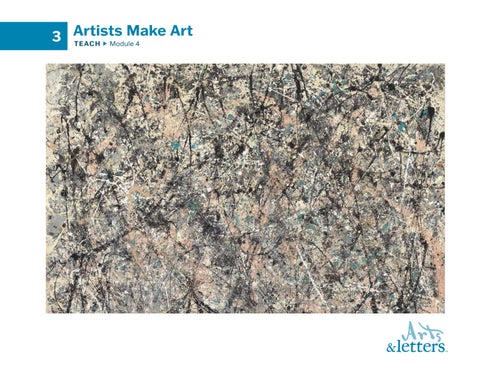
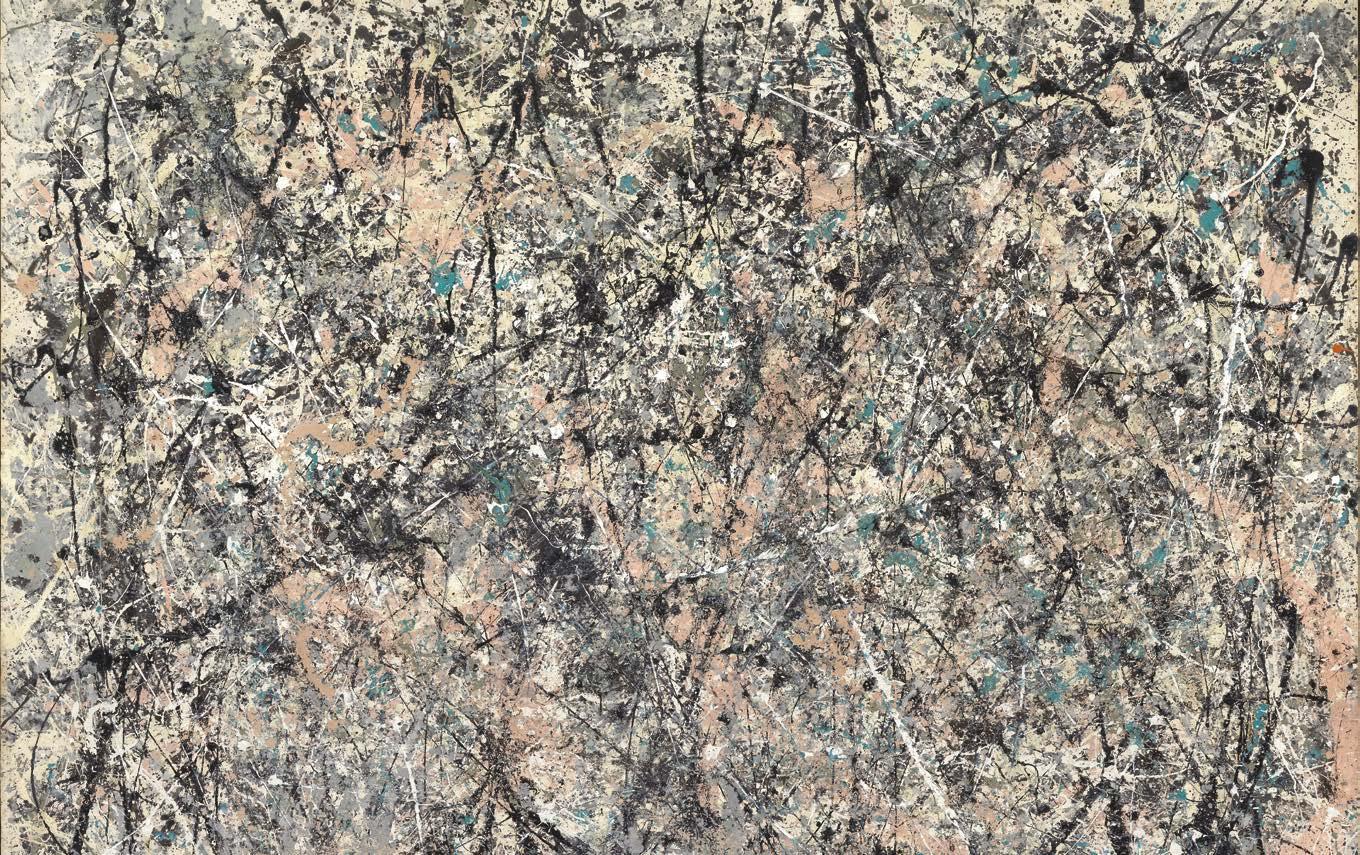
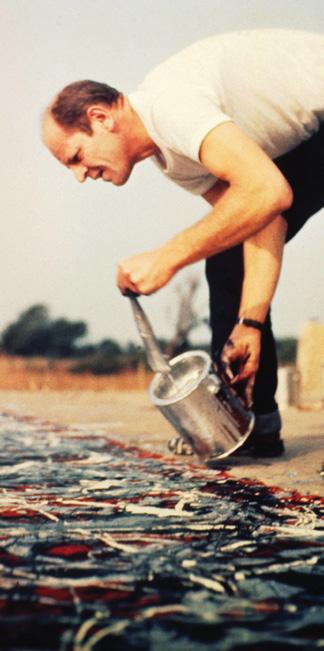
• Identify the steps in Pollock’s creative process that led to the creation of Lavender Mist.
• Examine lines, layers, and movement in Lavender Mist
L5 | Reveal and Distill
• Examine connections between sentences in Action Jackson.
• Analyze Lavender Mist to create a new title for the painting.
L6 | Reveal and Know
• Distinguish your point of view about Jackson Pollock from that of the authors of Action Jackson.
• Express knowledge about Lavender Mist and Blue Poles
22
34
� 44
56
68
L7 | Distill
• Determine a central idea in Action Jackson
• Explain the function of adverbs.
L8 | Know
• Express knowledge gained from Action Jackson
• Analyze a research paper.
Arc B | When Marian Sang
L9 | Wonder
• Notice and wonder about When Marian Sang.
• For Module Task 1, identify sources for research on Jackson Pollock’s art.
L10 | Organize
• Organize important events in Marian Anderson’s life and career.
• For Module Task 1, take notes for a research paper on artist Jackson Pollock.
L11 | Organize
• Identify and describe an important event in Marian Anderson’s life and career.
• For Module Task 1, take notes for a research paper on artist Jackson Pollock.
L12
| Reveal
• Apply a range of strategies to determine the meanings of new vocabulary terms in When Marian Sang
• For Module Task 1, synthesize knowledge of Jackson Pollock’s art from multiple sources.
L13 | Distill
• Determine a central idea in When Marian Sang
• For Module Task 1, elaborate on each piece of evidence.
80
L14 | Know
• Express knowledge gained from When Marian Sang
• For Module Task 1, write a research paper that responds to the prompt.
92
L15 | Reading Comprehension
Assessment 1
• Demonstrate knowledge of artists and their work and apply reading comprehension skills to a new text related to artists and art.
• For Module Task 1, conduct a self-review to identify an area for revision.
L16 | Responsive Teaching
106
116
132
144
160
172
186
192
• Analyze relevant questions on Reading Comprehension Assessment 1.
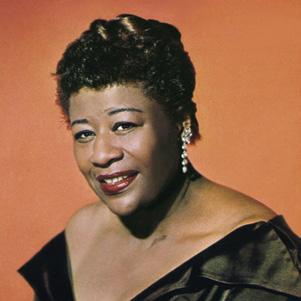
| Alvin Ailey, Ella Fitzgerald
L17 | Wonder
• Notice and wonder about Alvin Ailey.
• For Module Task 1, revise and edit a research paper, including choosing words and phrases for effect.
L18 | Organize
• Describe the relationship between Alvin Ailey’s early life experiences and his career.
• Share knowledge about Jackson Pollock’s art in a presentation on Blue Poles
L19 | Reveal
• Analyze how descriptions of Alvin Ailey’s movements convey meaning.
• For Module Task 2, analyze a digital source for evidence of what made Marian Anderson’s art unique.
200
L20 | Wonder
• Notice and wonder about Ella Fitzgerald
• For Module Task 2, analyze a print source for evidence of what made Marian Anderson’s art unique.
L21 | Organize
• Recount Ella Fitzgerald.
• For Module Task 2, analyze digital and print sources for evidence of what made Alvin Ailey’s art unique.
L22 | Reveal
• Analyze words to determine the characteristics of bebop and scat.
• For Module Task 2, analyze digital and print sources for evidence of what made Ella Fitzgerald’s art unique.
L23
| Reveal
• Compare settings, plots, and artist’s experiences in Alvin Ailey and Ella Fitzgerald to deepen understanding of artists.
• For Module Task 2, finalize research.
L24 | Distill
• Determine a shared central idea in Alvin Ailey and Ella Fitzgerald
• Examine and use pronoun-antecedent agreement and subject-verb agreement.
L25 | Know
• Express knowledge gained from Alvin Ailey and Ella Fitzgerald.
• Use comparative and superlative adverbs to compare musicians’ actions.
238
248
260
272
284
296
Arc D | I
Saw the Figure 5 in Gold,
“The Great
Figure”
L26
| Reveal
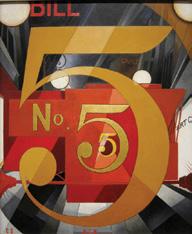
• Analyze emphasis and movement in I Saw the Figure 5 in Gold
• Use the prompt expectations and prior learning to inform a choice of artist for the End-of-Module Task.
L27 | Reveal
• Analyze the effects of imagery in “The Great Figure.”
• Analyze connections between elements of the painting I Saw the Figure 5 in Gold and the poem “The Great Figure.”
L28 | Distill
• Determine a central idea in Charles Demuth’s painting I Saw the Figure 5 in Gold.
• For the End-of-Module Task, analyze an article for evidence of what made your selected artist’s work unique.
L29 | Know
• Express knowledge gained from I Saw the Figure 5 in Gold, “The Great Figure,” and A River of Words
• For the End-of-Module Task, synthesize knowledge of an artist’s work from multiple sources.
Arc E | Emma’s Rug
L30 | Organize
• Identify key story elements in Emma’s Rug
• For step 1 of the End-of-Module Task, elaborate on each piece of evidence.
308
L31
| Reveal
• Analyze how illustrations contribute to an understanding of a character.
• For step 1 of the End-of-Module Task, write a research paper that responds to the prompt.
L32
| Distill
• Determine a central idea in Emma’s Rug
• For step 1 of the End-of-Module Task, conduct a self-review to identify an area for revision.
L33
| Know
• Express knowledge gained from Emma’s Rug
• For step 1 of the End-of-Module Task, revise and edit a research paper after self-review.
L34 | Reading Comprehension Assessment 2
• Demonstrate knowledge of artists and their work and apply reading comprehension skills to a new text related to artists and art.
L35 | Responsive Teaching
• Analyze relevant questions on Reading Comprehension Assessment 2.
Module Finale
L36 | Know
• Apply knowledge of what it means to be an artist.
• Compare written and spoken English.
L37 | Know
• Choose a work of art by your selected artist, or create a work of art inspired by that artist.
368
L38 | Know
• Plan a presentation for step 2 of the End-of-Module Task.
• Rehearse a presentation for step 2 of the End-of-Module Task.
L39 | Know
• For step 2 of the End-of-Module Task, share research findings.
378
L40 | Closing Bookend
• Share knowledge gained from the module about artists and their work.
• Reflect on the module topic.
388
Appendices
398
402
408
420
What is an artist?
SUMMARY
Artists Make Art draws students into a study of artists and their work across disciplines and media including painting, music, dance, and poetry. Throughout the module, students learn about artists and their creative processes, distinctive styles, and inspirations. The Essential Question—What is an artist?— challenges students to consider what being an artist means and what roles artists play in our lives, our communities, and the world.
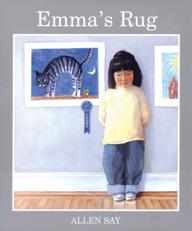
The module opens with Emma’s Rug by Allen Say, a story about a young artist who loses and regains her inspiration. This entry point into the world of artists and their work invites questioning about the nature of creativity and artistic inspiration. Students go on to explore the lives and work of several pioneering 20th-century American artists. In Jan Greenberg and Sandra Jordan’s Action Jackson, students meet abstract expressionist Jackson Pollock. This imaginative account of Pollock creating his iconic Lavender Mist captures the artist’s singular style and drip painting technique in descriptive prose and energetic illustrations. Students engage in a close study of Lavender Mist, observing what Pollock called “energy and motion made visible.”
In the second arc, students read When Marian Sang by Pam Muñoz Ryan and Brian Selznick, which chronicles the life and career of world-renowned contralto Marian Anderson. Students learn how Anderson’s exceptional vocal range, dedication, and support from family and community made her a worldwide sensation. Video and audio clips of Anderson singing at the Lincoln Memorial underscore why hers was called “the voice of a century.”
The next two texts by author-illustrator duo Andrea Davis Pinkney and Brian Pinkney showcase modern dancer and choreographer Alvin Ailey and jazz singer Ella Fitzgerald. In Alvin Ailey, students learn how Ailey’s heritage and early life experiences inspired his acclaimed choreography and modern dance company. Ella Fitzgerald recounts Fitzgerald’s extraordinary journey from talent contest winner in Harlem to music legend whose rich vocal innovations electrified audiences. Students watch videos of Fitzgerald singing scat and dancers from the Alvin Ailey American Dance Theater performing Ailey’s suite Revelations.
From there, students explore how artists and their work can inspire other artists. They examine Charles Demuth’s painting I Saw the Figure 5 in Gold and the poem and poet who inspired it—“The Great Figure” by William Carlos Williams. Students reflect on how Demuth’s painting evokes the firetruck in Williams’s poem and the poet himself in what Demuth called an abstract portrait of his longtime friend. The arc concludes with a reading of Jen Bryant and Melissa Sweet’s vibrant picture-book biography A River of Words, which builds students’ knowledge of Williams’s life and free-verse poetry. In the final arc, students return to Emma’s Rug and reflect on the source of Emma’s creativity and artistic inspiration.
During writing instruction, students hone their research skills for formal research projects about what makes different artists’ work unique. Students take notes from print and digital sources, sort evidence into categories, synthesize ideas, and use the Painted Essay® structure to produce research papers about artists. Students also create a presentation to share how a work of art, one created by their selected artist or one they create themselves, reflects something unique about the artist. Students continue to practice crafting complex, varied sentences to express their new knowledge, orally and in writing. They apply strategies learned throughout the year—using coordinating and subordinating conjunctions, adjectives, and adverbs—to connect and expand their ideas in more sophisticated ways.
By exploring the lives and work of groundbreaking artists, students gain insight into the creative ways artists share their imagination.
TEXTS
Books
Literary
• Emma’s Rug, Allen Say
Literary Nonfiction
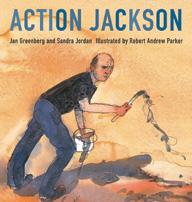
• Action Jackson, Jan Greenberg, Sandra Jordan, and Robert Andrew Parker
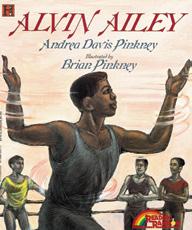
• Alvin Ailey, Andrea Davis Pinkney and Brian Pinkney
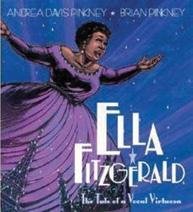
• Ella Fitzgerald: The Tale of a Vocal Virtuosa, Andrea Davis Pinkney and Brian Pinkney
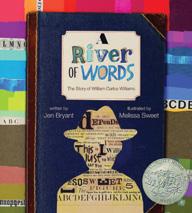
• A River of Words: The Story of William Carlos Williams, Jen Bryant and Melissa Sweet
• When Marian Sang: The True Recital of Marian Anderson, The Voice of a Century, Pam Muñoz Ryan and Brian Selznick
Art
• Blue Poles, 1952, Jackson Pollock
• I Saw the Figure 5 in Gold, Charles Demuth
• Number One, 1950 (Lavender Mist), Jackson Pollock
Poetry
• “The Great Figure,” William Carlos Williams
Videos
• “Dizzy Gillespie and the Band Performs at the Newport Jazz Festival 1960,” Pond5
• “Ella Fitzgerald with Musicians,” Getty Images
• “Jazz,” Great Minds®
• “Opera Singer Marian Anderson Sings ‘My Country ’Tis of Thee’ on the Steps of Lincoln Memorial in 1939,” Hearst Newsreel
• “Revelations from a Lifetime of Dance,” TED Talks
Audio
• “Marian Anderson Performs at the March on Washington,” Getty Images
Articles
• “Alvin Ailey,” Britannica Kids
• “Ella Fitzgerald,” Britannica Kids
• “Marian Anderson,” Britannica Kids
KNOWLEDGE THREADS
• Painting, music, dance, and poetry are all forms of art.
• Artists use creativity and imagination to express themselves and their ideas about the world.
• Artists make decisions about the styles, materials, and creative processes that best fit their art.
• Artists find inspiration in different things, including objects, heritage, traditions, nature, and the work of other artists.
• Artists inspire us to see the world in different ways.
MATERIALS AND PREPARATION
• Module 4 World Knowledge Chart
• Module 4 ELA Knowledge Chart
• Module 4 Word Analysis Chart (digital platform)
• Module 4 Speaking and Listening Goal Tracker (digital platform)
Determine how to display class versions of Learn book pages and lesson materials throughout the module. Use the slides available on the digital platform, or use another method of display, such as chart paper or a document camera. For a comprehensive list of all the materials used in the module, see the digital platform.
LEARNING GOALS
• Build understanding through literary and informational texts about how artists express ideas about the world.
• Determine the main ideas and key details of texts about artists.
• Apply a range of strategies to analyze word meanings.
• Distinguish one’s own point of view from that of a text’s author.
• Take notes on an artist for a research report and presentation and sort those notes into categories.
• Integrate information from sources into a research report about what makes a specific artist unique.
• Present a work of art and explain how it reflects something unique about an artist.
• Participate in class discussions about how art and artists inspire, using details and examples and expanding the discussion with new ideas.
ASSESSMENTS
In every Arts & Letters™ module, students complete three types of formal assessments: module tasks, Reading Comprehension Assessments, and an End-of-Module Task. For the module tasks in this module, students are supported to both research and write about artists and what makes each unique.
For additional information about assessments, including texts, rubrics, achievement descriptors, scoring guidance, and report analysis, see the Assessment Guide on the digital platform.
End-of-Module Task | Research Report and Presentation
For the End-of-Module Task, step 1, students write a research paper about an artist and what makes their art unique. Students apply knowledge of the research process and of informative essay structure to complete their report, including headings. Then in step 2, students share a work of art through a presentation and explain how the work of art reflects something unique about their selected artist. Students strengthen their writing and presentation by participating in a peer review exercise and revising their work using a checklist.
Summary of Assessments
Lessons 9–17 | Module Task 1
Students write a research paper about Jackson Pollock and what makes his art unique. Students are supported as they take and sort notes from print and digital resources into provided categories. Then, students synthesize their notes and draft a research paper. Students
learn to add words and phrases for effect and correctly capitalize titles. Finally, students strengthen their writing by revising using a checklist.
Lesson 15 | Reading Comprehension Assessment 1
Students complete a four-section Reading Comprehension
Assessment. The first section, Fluency, assesses rate, accuracy, phrasing, and expression. The second section, Show What You Know, assesses content knowledge and vocabulary built during the first half of the module. The third section, Grow What You Know, assesses comprehension of a new topically related text about an artist. The fourth section, Self-Reflection, gives students an opportunity to evaluate their own confidence about the assessment and identify challenges posed by the assessment text.
Lessons 19–23 | Module Task 2
Students demonstrate their understanding of the research process by developing detailed research notes. First, students research three artists for what makes their art unique. Students take notes from print and digital resources and sort those notes into three provided categories on an organizer. Then, students review the notes in each category for thoroughness in responding to the prompt. Finally, students check for accurate capitalization of titles and correct spelling.
Lesson 34 | Reading Comprehension Assessment 2
Students complete a four-section Reading Comprehension
Assessment. The first section, Fluency, assesses rate, accuracy, phrasing, and expression. The second section, Show What You Know, assesses content knowledge and vocabulary built during the second half of the module. The third section, Grow What You Know, assesses comprehension of a new topically related text about an artist.
The fourth section, Self-Reflection, gives students an opportunity to evaluate their own confidence about the assessment and identify challenges posed by the assessment text.
Lessons 29–39 | End-of-Module Task
Students write a research paper and create a presentation about what makes a particular artist’s art unique.
ACHIEVEMENT DESCRIPTORS OVERVIEW
Achievement Descriptors (ADs) are standards-aligned descriptions that detail what students should know and be able to do based on instruction. ADs are written by using portions of various standards to form a clear, concise description of the work covered in each module. Grade-level ADs may appear in multiple modules.
Arts & Letters alignment to state standards is available on the digital platform.
The ADs are organized into five strands.
Each strand is composed of grade-level parent ADs. Some parent ADs are further divided into child ADs, and some child ADs are further broken down into grandchild ADs.
Each AD has a unique code, which indicates the strand, the AD number, and the grade to represent the parent AD. If applicable, the code may also include a capital letter to indicate a child AD and a lowercase letter to indicate a grandchild AD.
The example shows the relationship of parent, child, and grandchild ADs.
The first number in the code is the AD number, which corresponds to the list of Achievement Descriptor Numbers by Strand. The second number in the code is the grade-level number.
For a list of this module’s Achievement Descriptors, see the appendix. Achievement Descriptor Strands
CP.4.3 Structure: Organize content with an effective structure appropriate to the task, purpose, and audience.
CP.4.3.A: Develop an introduction.
CP.4.3.A.a: Introduce a text or topic and an opinion.
ENGLISH LANGUAGE DEVELOPMENT STANDARDS
By engaging students in a variety of language- and text-based activities, module 4 lessons align with the following English Language Development (ELD) standards. Arts & Letters Prologue™ lessons provide additional language support to develop ELD standards. Educators should consult their state’s ELD standards and proficiency descriptors to identify the best ways to help multilingual learners reach the module’s learning goals. See the digital platform for a lesson-by-lesson breakdown of ELD standards.
WIDA Standards
ELD-SI.K-3.Narrate: Multilingual learners will
• Share ideas about one’s own and others’ lived experiences and previous learning
• Connect stories with images and representations to add meaning
• Recount and restate ideas
• Discuss how stories might end or next steps
ELD-SI.K-3.Inform: Multilingual learners will
• Define and classify objects or concepts
• Describe characteristics, patterns, or behavior
• Describe parts and wholes
• Sort, clarify, and summarize ideas
• Summarize information from interaction with others and from learning experiences
ELD-SI.K-3.Explain: Multilingual learners will
• Share initial thinking with others
• Follow and describe cycles in diagrams, steps in procedures, or causes and effects
• Compare and contrast objects or concepts
ELD-SI.K-3.Argue: Multilingual learners will
• Support own opinions with reasons
ELD-LA.2-3.Narrate.Interpretive: Multilingual learners will interpret language arts narratives by
• Identifying a central message from key details
• Identifying how character attributes and actions contribute to event sequences
• Determining the meaning of words and phrases as they are used in texts, distinguishing literal from nonliteral language
ELD-LA.2-3.Inform.Interpretive: Multilingual learners will interpret informational texts in language arts by
• Identifying the main idea and key details
• Referring explicitly to descriptions for themes and relationships among meanings
• Describing relationship between a series of events, ideas or concepts, or procedural steps
ELD-LA.2-3.Inform.Expressive: Multilingual learners will construct informational texts in language arts that
• Introduce and define topic and/or entity for audience
• Add details to define, describe, compare, and classify topic and/or entity
• Develop coherence and cohesion throughout text
ELP Standards
Standard 1: An ELL can construct meaning from oral presentations and literary and informational text through grade-appropriate listening, reading, and viewing.
Standard 2: An ELL can participate in grade-appropriate oral and written exchanges of information, ideas, and analyses, responding to peer, audience, or reader comments and questions.
Standard 3: An ELL can speak and write about grade-appropriate complex literary and informational texts and topics.
Standard 4: An ELL can construct grade-appropriate oral and written claims and support them with reasoning and evidence.
Standard 5: An ELL can conduct research and evaluate and communicate findings to answer questions or solve problems.
Standard 6: An ELL can analyze and critique the arguments of others orally and in writing.
Standard 7: An ELL can adapt language choices to purpose, task, and audience when speaking and writing.
Standard 8: An ELL can determine the meaning of words and phrases in oral presentations and literary and informational text.
Standard 9: An ELL can create clear and coherent grade-appropriate speech and text.
Standard 10: An ELL can make accurate use of standard English to communicate in grade-appropriate speech and writing.
MODULE PLAN
Essential Question | What is an artist?
Arc A | Emma’s Rug, Action Jackson
Lesson 1
= assessment = Prologue lesson
Lesson 8
Know Action Jackson
Lesson 7
Arc B | When Marian Sang
Lesson 9
Wonder When Marian Sang
Organize When Marian Sang
11
Organize When Marian Sang
12
When Marian Sang
13
When Marian Sang
14
Know When Marian Sang
Reading Comprehension Assessment 1
Lesson 16
Responsive Teaching
Arc C | Alvin Ailey, Ella Fitzgerald
Lesson 17
Wonder
Alvin Ailey
Module Task 1
completed
Lesson 18
Organize
Alvin Ailey
Lesson 24
Distill
Alvin Ailey
Ella Fitzgerald
Lesson 25
Know
Alvin Ailey
Ella Fitzgerald
Lesson 19
Reveal
Alvin Ailey
Lesson 20
Wonder
Ella Fitzgerald
Arc D | I Saw the Figure 5 in Gold, “The Great Figure”
Lesson 26
Reveal
I Saw the Figure 5 in Gold
Lesson 27
Reveal
“The Great Figure”
I Saw the Figure 5 in Gold
Lesson 28
Distill I Saw the Figure 5 in Gold
“The Great Figure”
Lesson 29
Know A River of Words
I Saw the Figure 5 in Gold
“The Great Figure”
Lesson 21
Organize Ella Fitzgerald
Lesson 22
Reveal
Ella Fitzgerald
Lesson 23
Reveal
Alvin Ailey
Ella Fitzgerald
Module Task 2 completed
Arc E | Emma’s Rug
Lesson 30
Organize Emma’s Rug Lesson 31
Reveal Emma’s Rug
Step 1 of the End-of-Module Task completed Lesson 34
Reading Comprehension Assessment 2 Lesson 35
Responsive Teaching
Module Finale
Step 2 of the End-of-Module Task completed
Refer to the digital platform for Year in Review, a lesson to reflect on all four module topics.
Lesson 1
OVERVIEW Preview
In this opening Bookend lesson, students explore the module topic and the Essential Question. Students share what they know about artists and art. They continue to engage with the module topic through an experience that the teacher chooses. Students may explore a public work of art, experience a live art demonstration, read a book about artists or art, or engage in a teacher-created experience.
Learning Goals
• Share experiences about artists and art.
• Explore the module topic.
Agenda LAUNCH
Read the Essential Question LEARN
• Share: Discuss Prior Knowledge
• Engage: Explore, Experience, or Read
Revisit the Essential Question
Vocabulary
art (n.)
Materials and Preparation
• Determine how to display the Essential Question. Students continue working with the Essential Question throughout the entire module.
• Determine how to display the questions for the Chalk Talk. See the Share section for details.
• Prepare materials for the selected activity in the Engage section.
• Depending on the option you choose, consider planning for more than the typical 60 minutes recommended for a lesson.
Follow-Up
• Students listen to, read, or explore a volume of reading text. They add to their reading log and respond to assigned volume of reading questions. See Implementation Resources for volume of reading guidance.
LAUNCH 2 minutes
Read the Essential Question
1. Tell students that today they are starting a new module about artists and art.
2. Display and Choral Read the Essential Question: What is an artist?
Teacher Note
Customize this lesson’s content to incorporate your school’s regional geography, the community’s resources, and the area’s history. Use the activities to activate and honor students’ funds of knowledge, including their home life, languages, and experiences.
LEARN 53 minutes
Share | Discuss Prior Knowledge | 13 minutes
1. Tell students that they will share what they know about the module topic. Instruct students to Think−Pair−Share to answer this question:
When I say the word art, what do you think of?
Language Support
To leverage students’ home languages as resources to support learning, encourage students who share the same home language to discuss questions like this together, especially in preparation for larger class discussions.
2. Introduce the vocabulary term art by displaying the term and definitions. Engage students in Vocabulary Exploration.
3. Display the following questions around the room, and instruct students to begin a Chalk Talk:
• What are some examples of art that we have studied this year?
• What are some other types or examples of art?
• What is your favorite type of art? Why?
Teacher Note
As students share, pay attention to what they already know about the topic. Note students’ prior knowledge to activate and incorporate in future discussions. Note misconceptions to clarify in future instruction.
4. Invite students to silently read the responses to each question. Then invite students to share interesting responses they read.
Engage
| Explore, Experience, or Read | 40 minutes
Choose an Explore, Experience, or Read activity to engage students with the module topic. Plan your own activity or choose an option below.
Option 1 | Explore a Public Work of Art
1. Take students to view a public work of art in the community (e.g., mural, sculpture, architecture), or facilitate a virtual visit.
2. Before the visit, explain what public art is, and set a purpose for the experience.
Definitions art (n.):
1. something that is created with imagination and skill and that is beautiful or that expresses important ideas or feelings
2. an activity that is done to create something beautiful or to express important ideas or feelings
3. During the visit, give students plenty of time to observe and interact with the work of art.
Teacher Note
To promote close observation, do not provide background information about the work of art and artist at this point.
4. After students observe, facilitate a discussion of the art by asking these questions:
What did you observe about this work of art?
What questions does this work of art spark?
5. Provide any relevant background information about the work of art and artist. Continue the discussion by asking this question:
What does this work of art add to the community?
Option 2 | Experience a Live Art Demonstration
1. Invite an artist from your school or local community (e.g., poet, storyteller, illustrator, dancer, potter, woodworker, visual artist, musician) to demonstrate their work, virtually or in person, and engage students in an activity related to the art form.
2. Before the demonstration and activity, invite the artist to introduce themself and their work, and set a purpose for the experience.
3. Following the demonstration and activity, facilitate a discussion about the artist’s work. Invite the artist to share more about their work and their artistic process. As needed, pose questions such as these:
• When and how did you first become interested in this type of art?
• Where do you get your ideas?
• What do you enjoy most about your work? Why?
4. Invite students to ask follow-up questions about the artist’s work and share what they learned from the demonstration and the activity.
Option 3 | Read a Book About Artists or Art
1. Host a classroom book talk to preview the volume of reading texts and build student interest in artists and art.
Teacher Note
Consider inviting a librarian from school or the community to facilitate the book talk and share other books about artists and art.
2. Following the book talk, invite students to share which books they are most interested in reading and why.
3. Read aloud one of the volume of reading texts about artists or art. After reading the text, facilitate a brief discussion about students’ experiences with the text.
LAND 5 minutes
Revisit the Essential Question
1. Facilitate a brief discussion to connect what students experienced in this lesson to the Essential Question. Consider using one of the following prompts or questions, based on each option from the Engage section, to initiate the discussion:
• Option 1—Describe the public work of art you observed. What makes it a work of art?
• Option 2—What questions do you have about artists or art?
• Option 3—What types of artists or art are you most interested in learning more about? Why?
2. Tell students that throughout the module they will continue to build knowledge about artists and art.
Teacher Note
Arts & Letters student and teacher materials feature borders, header images, and other carefully chosen visuals to align with each module’s knowledge. Consult About the Images, located in the appendices, to learn more about how these elements connect to the module’s knowledge. As students progress through the module, share related information about the images and encourage them to make connections to what they are learning.
ACHIEVEMENT DESCRIPTORS
Lesson 2
Essential Question | What is an artist?
Content Framing Question | Wonder: What do I notice and wonder about this text?
OVERVIEW
Preview
In this Wonder lesson, students read Emma’s Rug. Students share and write what they notice and wonder about the text. During visual art instruction, students explore Lavender Mist by Jackson Pollock. Students share and write what they notice and wonder about this work of art.
Learning Goals
Notice and wonder about Emma’s Rug.
LEARNING TASK: Write at least three things you notice about Emma’s Rug and at least three related questions.
Notice and wonder about Lavender Mist.
LEARNING TASK: Write at least three things you notice about this work of art and at least three related questions.
Vocabulary
artist (n.)
Agenda
LAUNCH
Read the Content Framing Question
LEARN
• Read: Read Emma’s Rug
• Respond: Notice and Wonder About the Text
• Observe: Notice and Wonder About Lavender Mist
LAND
Reflect on Learning
Materials
TEACHER
• Emma’s Rug
• Lavender Mist (digital platform)
• class Notice and Wonder Chart for Emma’s Rug (Learn book)
• Knowledge Card: artist
• class Notice and Wonder Chart for Work of Art 1 (Learn book)
• Module 4 World Knowledge Chart
• Module 4 ELA Knowledge Chart
STUDENTS
• Emma’s Rug
• Notice and Wonder Chart for Emma’s Rug (Learn book)
• Notice and Wonder Chart for Work of Art 1 (Learn book)
Preparation
• Determine how to display the knowledge charts. Students continue working with these charts throughout the entire module.
Follow-Up
• Students listen to, read, or explore a volume of reading text. They add to their reading log and respond to assigned volume of reading questions. See Implementation Resources for volume of reading guidance.
LAUNCH
2 minutes
Read the Content Framing Question
1. Display and Choral Read the Essential Question: What is an artist?
2. Display Emma’s Rug.
Teacher Note
Module 4 opens with Emma’s Rug to build students’ curiosity about artists and what inspires them. Students will return to this text in arc E.
3. Display and Choral Read the Content Framing Question: What do I notice and wonder about this text?
4. Explain that during a Wonder lesson the class begins to read the book for the first time to spark their curiosity. Students share what they notice and wonder about the book. Introduce Emma’s Rug by reading aloud the title and author. Explain that the author is also the illustrator for this book. Tell students that in this lesson they will read Emma’s Rug and share what they notice and wonder about it.
LEARN
53 minutes
Read | Read Emma’s Rug | 8 minutes
Teacher Note
Module 4 Wonder lessons provide the opportunity for students to grow in independence and apply all they have learned so far as they notice and wonder about new texts. Teachers can formatively assess students’ transfer of knowledge by looking for connections to previous texts and topics. Also, teachers can formatively assess students’ ELA knowledge by looking for application of literary and informational standards.
1. Display Emma’s Rug, and ask this question:
What do we do when we begin a new text?
Key Ideas
• notice and wonder about the covers
• notice and wonder about the text and illustrations
• annotate challenging words
2. Display the class Notice and Wonder Chart for Emma’s Rug. Remind students that they will use charts throughout the module to write things they notice in a text and what those things make them wonder.
3. Direct students to Emma’s Rug. Instruct them to read the text and annotate the challenging words with a partner.
Differentiation Support
Throughout this module, students read grade-level, complex text. Students may read independently or require more support. Identify the level of support each student needs to progress toward independence. Implement an appropriate approach, such as reading with a partner, Choral Reading, Echo Reading, providing an audio recording, or listening to the teacher read aloud. If students listen to someone else read, instruct them to follow along with the text.
Language Support
Based on your students’ needs, pause to define select words with a synonym (e.g., cooed, rustled, shriveled) before they read.
4. Invite a few students to each share a word they annotated. Explain how to decode a challenging word (e.g., pangolin), using guidance from your foundational skills program.
Respond | Notice and Wonder About the Text | 20 minutes
1. Instruct students to discuss these questions with a partner:
Which section of the text were you most curious about? What questions came to mind as you read that section?
Teacher Note
Incorporate strategic, flexible ways to form groups of students throughout the module. Bringing together students who have different levels of reading, writing, or English language proficiency can promote rich conversation and exchange of ideas. Also, grouping students with similar levels of reading, writing, or English language proficiency can help focus students on a specific task with teacher support. As applicable, complement any of these groups by pairing students who speak the same home language.
2. Introduce the learning task. Direct students to the Notice and Wonder Chart for Emma’s Rug, located in the Learn book. Instruct them to add at least three things they notice about the text and at least three related questions.
Analyze Student Progress
Monitor: Do students make coherent connections between what they notice and what they wonder about Emma’s Rug?
Offer Immediate Support: If students need additional support noticing things and asking related questions, encourage them to read a specific part of the text (e.g., pages 14–15) and ask these questions: What do you notice about the character and setting in these pages? What does this make you wonder?
Plan Future Practice: Students practice noticing and wondering about a text in lesson 3.
3. Invite a few students to share what they noticed and wondered about Emma’s Rug. Add a few responses to the class chart.
Teacher Note
As students share what they notice and wonder, use this as an opportunity to conduct an informal, formative assessment of the knowledge and skills students built during previous modules. For example, do students correctly identify story elements? Do their responses indicate attention to both the text and illustrations? Use the information you gather to prepare for subsequent lessons with this text.
4. Display the term artist. Direct attention to the suffix -ist. Read aloud the suffix, and then read aloud the entire word. Remind students that they learned about the meaning of this suffix when they examined the term scientist during module 1. Ask this question:
What does the suffix -ist mean?
Reinforce the correct response: a person who performs an action or specializes in a skill.
5. Ask these questions:
What is an artist?
How do you know?
Reinforce that an artist is a person who creates art, and we know this because the root is art and the suffix -ist makes it “a person who does art.”
6. Introduce the vocabulary term artist by displaying the Knowledge Card. Engage students in Vocabulary Exploration. Explain that a skilled artist is an expert in a specific type of art.
Definitions
artist (n.):
1. a person who creates art
2. a person who is skilled at drawing, painting, performing, etc.
7. Facilitate a brief discussion of the following questions:
Which artists have you learned about so far this year?
What types of art did they create?
Key Ideas
• artists: Katsushika Hokusai, Mary Cassatt, Helen Frankenthaler, Vija Celmins, Joseph Cornell, Julie Mehretu, Frédéric Auguste Bartholdi, Sara Teasdale, Jorge Argueta, Emma Lazarus, Cy Thao, Marie Tharp
8. Explain that students will return to Emma’s Rug at the end of the module, after they have learned more about artists who paint, sing, dance, and create poetry.
Observe | Notice and Wonder About Lavender Mist | 25 minutes
1. Display Lavender Mist without telling students the title of the painting or name of the artist. Instruct students to look closely at the work of art in silence. After at least one minute, direct attention to different parts of the work of art, including the top, bottom, middle, and corners.
Teacher Notes
American artist Jackson Pollock created the painting Number One, 1950 (Lavender Mist). He is best known for his “drip” or action-based technique. Inspired by Navajo sand painters, Pollock laid his canvas on the floor and circled it while dripping, flinging, or splashing thick house paint from a stick or a brush. Lavender Mist is an abstract painting that does not show any identifiable or realistic figures or objects. Like many abstract works, it expresses emotions through visual elements alone.
To promote looking closely at the work of art, do not provide background information about it at this point. Rather, encourage students to share and expand on what they initially notice and wonder. Students revisit this work of art during the next few lessons and learn more about its history.
2. Instruct students to discuss these questions with a partner:
What do you notice in this work of art?
What do you wonder?
Remind students to focus on what they see in the work of art, rather than what they think about it.
3. Give students another minute to view the work of art in silence. During this viewing, zoom in on one section. Instruct students to discuss these questions with a partner:
When we zoom in, what do you notice?
What do you wonder?
4. Display the class Notice and Wonder Chart for Work of Art 1, and direct students to the page in their Learn book. Instruct students to add to their charts what they notice and related questions about the work of art.
5. Introduce the learning task. Instruct students to write on their charts at least three things they notice about the work of art and at least three related questions.
Analyze Student Progress
Monitor: Do students write specific and varied details about the work of art and three related questions?
Offer Immediate Support: If students need additional support noticing things in the work of art, ask this question: What lines do you see?
Plan Future Practice: Students practice noticing things and asking questions about a work of art in lesson 6.
6. Instruct students to Think–Pair–Share to answer this question:
How does this work of art compare with other works of art you studied this year?
7. Display Lavender Mist and the front cover of Emma’s Rug side by side. Instruct students to silently observe Work of Art 1 and Emma’s art.
8. Instruct students to Think–Pair–Share to answer these questions:
When you observe these two images together, what do you notice that’s similar?
What do you notice that’s different?
Encourage students to include art terms that they discussed in previous modules (e.g., abstract, color, layer, line, portrait, shape, texture, two-dimensional).
9. Add a few responses to the appropriate class Notice and Wonder Chart. Encourage students to take time during this module to notice similarities and differences in art while reading volume of reading texts.
LAND 5 minutes
Reflect on Learning
1. Direct attention to both knowledge charts, and read aloud each chart title. Explain that knowledge of the world is knowledge students gain from texts in the module. Explain that knowledge of ELA is knowledge students gain as they learn reading, writing, and speaking skills. Writing statements about new learning helps people remember and track the knowledge they gain.
2. Facilitate a brief discussion of the following question to help students articulate the knowledge they built during the lesson:
What did you learn today?
Teacher Note
As needed, prompt students to reflect on what they learned by asking questions such as these:
• What did you learn from Emma’s Rug?
• What did you learn about artists?
• What did you learn about art?
3. Add a few student-generated knowledge statements to the charts. Place statements about key ideas from the lesson and information from the texts on the World Knowledge Chart, and place statements about language arts on the ELA Knowledge Chart.
Teacher Note
Adding all students’ knowledge statements to the charts is not necessary. Encourage all students to share their knowledge statements, then choose a few to add to the charts. Alternatively, summarize students’ comments into a few statements, then add the summarized statements to the charts. We do not include a prescribed list of student knowledge statements because the discussion should flow organically and the statements should represent the authentic learning of each class. As needed, ask follow-up questions to guide students toward key ideas from the lesson, world knowledge from the texts, or ELA knowledge related to the learning goals.
World Knowledge
ELA Knowledge
ACHIEVEMENT DESCRIPTORS
MM Make Meaning from Texts
MM.5.3 Vocabulary: MM.5.3.A, MM.5.3.A.d, MM.5.3.C
MM.12.3 Complexity, Diversity, and Genre: MM.12.3.A, MM.12.3.A.a, MM.12.3.C, MM.12.3.C.b
BU Build Understanding
BU.2.3 Discovery and Evidence: BU.2.3.A, BU.2.3.B
BU.3.3 Conversation and Collaboration: BU.3.3.B
BU.4.3 Expression
DF Develop Foundations
DF.3.3 Phonics and Spelling: DF.3.3.A, DF.3.3.A.b, DF.3.3.B, DF.3.3.B.a
DM Develop Metacognition
DM.1.3 Content Stages: DM.1.3.A
DM.3.3 Schema Building
Lesson 3
Essential Question | What is an artist?
Content Framing Question | Wonder: What do I notice and wonder about this text?
OVERVIEW
Preview
In this Wonder lesson, students read Action Jackson, sharing what they notice and wonder. They work to develop fluency by reading a passage from the text with accuracy. During visual art instruction, students consider art elements as they describe what is happening in Lavender Mist by Jackson Pollock.
Learning Goals
Notice and wonder about Action Jackson.
LEARNING TASK: Write at least three things you notice about Action Jackson and at least three related questions.
Describe Lavender Mist.
LEARNING TASK: Describe a section of the work of art.
Vocabulary
none
Agenda
LAUNCH
Read the Content Framing Question
LEARN
• Read: Read Action Jackson
• Respond: Notice and Wonder About Action Jackson
• Observe: Describe Lavender Mist
LAND
Reflect on Learning
Materials
TEACHER
• Action Jackson
• Emma’s Rug
• Lavender Mist (digital platform)
• class Notice and Wonder Chart for Action Jackson (Learn book)
• Notice and Wonder Chart for Action Jackson (Learn book)
• journal
• Fluency Practice for Action Jackson (Learn book, Fluency)
Preparation
• none Follow-Up
• Students listen to, read, or explore a volume of reading text. They add to their reading log and respond to assigned volume of reading questions. See Implementation Resources for volume of reading guidance.
• Students complete day 1 of Fluency Practice for Action Jackson (Learn book, Fluency) and focus on a fluency element or retelling.
LAUNCH
2 minutes
Read the Content Framing Question
1. Display Action Jackson.
2. Display and Choral Read the Content Framing Question: What do I notice and wonder about this text?
3. Direct students to Action Jackson and introduce the text by reading aloud the title, authors, and illustrator. Tell students that in this lesson they will read Action Jackson and share what they notice and wonder about it. Then they will work to develop fluency by practicing reading a passage from the story with accuracy.
LEARN
53 minutes
Read | Read Action Jackson | 11 minutes
1. Remind students that they are experts in noticing things in a new text and considering what those things make them wonder.
2. Instruct students to read Action Jackson and to annotate challenging words.
Language Support
Based on your students’ needs, define select words with a synonym (e.g., flinging, motion, tangled) before they read.
3. Invite a few students to share a word they annotated. Explain how to decode a word with irregular spelling (e.g., machinery), using guidance from your foundational skills program.
Respond | Notice and Wonder About Action Jackson | 20 minutes
1. Introduce the learning task. Direct students to the Notice and Wonder Chart for Action Jackson, located in the Learn book. Instruct them to add at least three things they notice about the text and at least three related questions.
Analyze Student Progress
Monitor: Do students make coherent connections between what they notice and what they wonder about Action Jackson?
Offer Immediate Support: If students need additional support noticing things and asking related questions, encourage them to read and examine one page (e.g., page 11) and ask these questions: What do you notice about this part of the book? What does this make you wonder?
Plan Future Practice: Students practice noticing and wondering about a text in lesson 9.
2. Display the class Notice and Wonder Chart for Action Jackson. Invite a few students to share what they noticed and wondered about Action Jackson. Add a few responses to the class chart.
3. Display side by side the illustration on pages 26–27 of Action Jackson and the illustration on page 7 of Emma’s Rug. Direct students to their journals. Instruct them to respond to this question:
What do you notice and wonder about these artists together?
Invite a few students to share their responses.
4. Tell students that now that they have read Action Jackson with curiosity and attention, they will work to gain fluency by reading aloud a passage from the text.
Teacher Note
In arc A, students solidify their understanding of the elements of fluency and have an opportunity to practice reading fluently.
5. Display the Fluency Reference Chart. Choral Read the definition of fluency. Direct attention to the Accuracy row, and remind students that reading with accuracy means correctly decoding the words in a text.
6. Display Fluency Practice for Action Jackson, and direct students to the page in their Learn book. Remind students that good readers pay close attention to what they read so that they can catch mistakes and self-correct them in the moment. Tell students to follow along as you read aloud the fluency passage. As you read, model making a mistake (e.g., pronouncing muscle with a /k/ sound) and quickly addressing it by rereading the word correctly.
7. Instruct students to reread the passage and annotate words they do not know. Invite a few students to share a word that they annotated. Explain how to decode a challenging word (e.g., pauses), using guidance from your foundational skills program.
8. Choral Read the fluency passage.
Fluency Reference Chart
fluency (n.): the ability to read with accuracy, phrasing, and expression at an appropriate rate
accuracy
phrasing
expression
rate correctly decode the words group words into phrases, and pause for punctuation use voice to show feeling read at an appropriate speed
9. Explain that throughout this arc of lessons, students will practice reading aloud this passage from Action Jackson on their own as follow-up work.
Observe | Describe Lavender Mist | 22 minutes
1. Display Lavender Mist. Instruct students to observe the work of art for at least 30 seconds. Instruct students to work with a partner to answer these questions:
What do you notice this time?
Where do you see it?
Teacher Note
Although students may have noticed this work of art in Action Jackson, do not reveal the title. It will be revealed at the end of this lesson.
2. Remind students that sometimes they recognize things from life in a work of art. Activate and assess prior knowledge by asking this question:
What is abstract art?
Reinforce the correct response: Abstract art is a type of art that does not show the world as it is. When we organize it, we describe its art elements instead of its story.
3. Remind students that in the previous lesson, they looked at the whole work of art and then zoomed in to one section. Instruct students to Think–Pair–Share to answer this question:
What do you see when you look at this work of art as a whole?
Key Ideas
• black lines that crisscross
• thinner lines that weave in and out of layers
• colors: pink, tan, black, gray, green
4. Model how to create a zoom frame with your hands and instruct students to do the same:
• Hold up a thumb and pointer finger with each hand.
• Make a rectangle by touching the tip of each thumb to the tip of the other hand’s pointer finger.
• Extend your arms, close one eye, and look through the frame to examine a section of the art.
5. Instruct students to Think–Pair–Share to answer this question:
What do you see in the smaller section?
Emphasize that looking at a smaller section can help a viewer see more details of the painting.
6. Think aloud to model how to describe a smaller section, and invite students to guess which area of the painting you are describing.
7. Introduce the learning task. Instruct students to take turns with a partner describing a section and guessing the location. Encourage students to describe the work of art by using details that are specific to the selected section.
Analyze Student Progress
Monitor: Do students provide descriptions based on details in the work of art?
Offer Immediate Support: If students need additional support describing their section, ask this question: What colors and lines do you see?
Plan Future Practice: Students practice describing a work of art in lesson 6.
Sample Think Aloud
In my section, I see a lot of small green splotches and one big pink curve. There’s also a long, slanted white line. Which area of the painting do you think I am describing?
8. Direct attention to Action Jackson. Instruct students to locate Work of Art 1. Choral Read the caption on page 23, starting with “Number One, 1950.” Ask this question:
What do you learn about this work of art from the caption?
Differentiation Support
To help students understand the information provided in the caption, ask these questions:
• What is the title of the work of art?
• What do you think the information in parentheses in the title might mean?
• In what year was the work of art created?
• Where is it on display?
Emphasize that most people refer to this work of art as Lavender Mist, which is part of its full title, Number One, 1950 (Lavender Mist). Tell students that this painting by Jackson Pollock is very large. It is over 7 feet high and almost 10 feet wide, which is taller than most adults and wider than a school bus. Reinforce that this painting is on display at the National Gallery of Art in Washington, DC.
Differentiation Challenge
To reinforce and extend ELA knowledge about commas, direct students to the commas in the caption, and instruct students to discuss these questions with a partner: What is the function of the comma in the address of the gallery? What is the function of the comma in the title of the work of art?
9. Tell students that in the next lesson they will learn more about Pollock and his art.
LAND 5 minutes
Reflect on Learning
1. Direct attention to both knowledge charts, and facilitate a brief discussion to help students articulate the knowledge they built during the lesson. Add a few student-generated knowledge statements to the charts.
Teacher Notes
As needed, prompt students to reflect on what they learned by asking questions such as these:
• What did you learn from Action Jackson?
• What did you learn from the art?
• What did you learn about artists?
Adding to knowledge charts is a concrete way for students to self-assess how their learning has progressed. Students reflect on their growing knowledge of the module topic and their own development as readers and writers. This reflection helps students identify what they may need to learn more about, including topic- and text-related knowledge and ELA knowledge related to the learning goals. ACHIEVEMENT
DESCRIPTORS
DF Develop Foundations
DF.3.3 Phonics and Spelling: DF.3.3.A, DF.3.3.A.b
DF.4.3 High-Frequency and Irregularly Spelled Words: DF.4.3.A
DF.5.3 Fluency: DF.5.3.A, DF.5.3.B, DF.5.3.C
DM Develop Metacognition
DM.1.3 Content Stages: DM.1.3.A
DM.3.3 Schema Building
Lesson 4
Essential Question | What is an artist?
Content Framing Question | Organize: What is happening in this text?
OVERVIEW
Preview
In this Organize lesson, students reread Action Jackson to identify key details in Jackson Pollock’s creative process. They determine the steps someone would take to paint like Pollock. Students strengthen their fluency by reading a passage from Action Jackson with appropriate phrasing. During visual art instruction, students examine lines, layers, and movement in Lavender Mist.
A Prologue to lesson 4 is available for students who need additional support.
Learning Goals
Identify the steps in Pollock’s creative process that led to the creation of Lavender Mist.
LEARNING TASK: Write a list of directions that shows what Pollock did as an artist.
Examine lines, layers, and movement in Lavender Mist.
LEARNING TASK: Explain how Pollock’s use of lines and layers creates a sense of movement in Lavender Mist.
Vocabulary
original (adj.)
Agenda
LAUNCH
Read the Content Framing Question
LEARN
• Read: Identify Key Details in Action Jackson
• Respond: Describe Jackson Pollock’s Creative Process
• Fluency Practice for Action Jackson (Learn book, Fluency)
• journal
Preparation
• none Follow-Up
• Students listen to, read, or explore a volume of reading text. They add to their reading log and respond to assigned volume of reading questions. See Implementation Resources for volume of reading guidance.
• Students complete day 2 of Fluency Practice for Action Jackson (Learn book, Fluency) and focus on a fluency element or retelling.
LAUNCH
2 minutes
Read the Content Framing Question
1. Display Action Jackson.
2. Display and Choral Read the Content Framing Question: What is happening in this text?
3. Explain that during an Organize lesson the class rereads sections of the book and identifies what is happening to gain a basic understanding of the text. Tell students that in this lesson they will continue developing fluency by reading with meaningful phrasing. Then they will reread the text to identify what Pollock does as an artist.
LEARN
53 minutes
Read | Identify Key Details in Action Jackson | 12 minutes
1. Display the Fluency Reference Chart. Choral Read the definition of fluency. Direct attention to the Phrasing row. Remind students that fluent readers read in meaningful phrases, or groups of words, and pause for punctuation.
2. Ask this question: How do commas help us practice our reading with appropriate phrasing?
Reinforce the correct responses: Commas signal times to pause, and they separate meaningful phrases and groups of words.
3. Display Fluency Practice for Action Jackson, and direct students to the page in their Learn book. Echo Read the passage using appropriate phrasing. Instruct students to practice reading aloud the passage using appropriate phrasing. Remind students that they will continue to practice reading aloud this passage from Action Jackson outside of class.
4. Tell students that they will reread the text to gain an understanding of Jackson Pollock’s artistic process. Explain that a process is a series of steps someone follows to do or create something.
5. Direct students to Action Jackson and read aloud pages 3–5, starting with “In the afternoon.” Facilitate a brief discussion of this question:
What does Jackson Pollock do as he heads to his studio?
Key Ideas
• puts on his paint-splattered boots
• notices things as he walks through his yard: smells, sunlight, insects
• spends a little time with his pets
6. Tell students that they will write a list of directions that someone can follow to paint like Jackson Pollock. Instruct students to work with a partner to answer these questions:
What should we tell a person to do first if they want to paint like Pollock?
What should the person do next?
Language Support
To support a sequence of ideas, display these sentence frames: First, you should . Then, you should
Invite a few students to share their responses.
Key Ideas
• First, you should put on your boots. Then, you should notice the insects on the ground.
• First, you should put on your boots. Then, you should play with a pet for a few minutes.
• First, you should put on your boots. Then, you should watch the sunlight in the trees.
Direct students to their journals, and instruct them to write their first two directions.
7. Instruct students to read pages 6–7, starting with “The gray weathered.” Instruct students to work with a partner to add more directions to their lists.
Language Support
To support a sequence of ideas, display these sentence frames: Next, you . Then, you .
Invite a few students to share their responses.
Key Ideas
• Next, put your canvas on the floor.
• Then, you stare at it silently.
Remind students that they can also combine ideas by using coordinating conjunctions (e.g., Next, you put your canvas on the floor and stare at it silently).
8. Tell students that they will continue to work with a partner as they develop directions for someone to follow so they can paint like Pollock.
Respond | Describe Jackson Pollock’s Creative Process | 25 minutes
1. Introduce the learning task. Instruct students to read pages 8–21, starting with “Some artists cover.” Tell students to pause at the end of each page spread to work with their partner to write clear and brief directions in their journals.
Analyze Student Progress
Monitor: Do students complete Pollock’s steps in a way that clearly describes his creative process?
Offer Immediate Support: If students need support choosing a key detail, ask this question: What is Pollock doing?
Plan Future Practice: Students practice identifying key details in When Marian Sang in lesson 10.
2. Look for students to address key ideas in their directions.
Key Ideas
• Next, get some ordinary house paint. (pages 8–9)
• Then, dip a stick in the paint and move around the canvas as you make long lines. (pages 10–11)
• When you get tired, take a break, but keep thinking about your painting. (pages 12–13)
• Then, study your work. Go outside and watch birds fly. (pages 14–15)
• Next, get down low and add some loops and curves. (pages 16–17)
• Then, listen to jazz and let it move your brush as you paint. (pages 18–19)
• Then, pour and fling some paint. When you’re done, climb up a ladder to look down at your painting. (pages 20–21)
Differentiation Challenge
To encourage students to creatively share their knowledge, invite them to design a print or digital poster that displays their directions in a creative way.
3. As students finish, invite them to read through their lists to make sure each direction is brief and clear. Encourage students to swap journals with a new partner to read directions that might be slightly different from their own.
4. Read aloud pages 23–27, starting with “Some people will.” Ask this question: What does Pollock do after he completes a painting?
Reinforce that he takes a break and starts again.
Observe | Examine Lavender Mist | 16 minutes
1. Direct attention to the summary on the back cover of Action Jackson. Tell students that a summary describes the contents of a book in just a few sentences. Read aloud the summary, starting with “Jackson Pollock, known.”
2. Direct attention to the term original. Ask these questions:
What part of this word did you learn about in the last module?
What did it mean?
Reinforce the correct responses:
• part—origin
• meaning—the point or place where something begins
3. Read aloud the last sentence of the publisher’s summary on the back cover of Action Jackson: “But everyone agreed he was a true original.” Instruct students to Think–Pair–Share to answer this question:
Based on what you know about the term origin and the explanation of Pollock’s style in this summary, what is a true original?
Reinforce the correct response: someone who did something first. Introduce the vocabulary term original by displaying the Knowledge Card. Engage students in Vocabulary Exploration. Tell students that they will examine the lines and layers in Lavender Mist to discover what made Pollock a true original.
Definitions original (adj.):
1. first or earliest
2. new or different
4. Ask these questions:
What is a line?
What is a layer?
Reinforce the correct responses:
• line—a mark on a surface that connects two points; can be different lengths or widths
• layer—a part or section of something that lies over or under another part
5. Display Lavender Mist. Instruct students to discuss these questions with a partner:
How would you describe the lines you see in Lavender Mist?
What layers do you see?
Teacher Note
During this viewing, consider zooming in on sections of the painting.
Listen for students to address key ideas in their responses.
Key Ideas
• lines: crossed like a web, go on and on, some straight and some curved, some wider than others, parts hidden by layers of paint
6. Instruct students to discuss this question with a partner:
Based on what you see and what you learned from Action Jackson, how did Pollock create these different lines and layers?
Differentiation Support
To support understanding of how Pollock created different lines and layers, direct students to Action Jackson and invite them to reread page 11, starting with “At last he.”
Listen for students to address key ideas in their responses.
Key Ideas
• The paint drips from the stick as he moves around the edges of the canvas.
• He pushes his arm away from his body over the canvas.
• He tries to make the lines longer and longer.
• The lines weave in and out of each layer.
7. Explain that Lavender Mist is an example of an action painting or drip painting, and this is how Jackson Pollock got the nickname “Action Jackson.”
8. Instruct students to silently move in the way Pollock would have moved to create the lines in Lavender Mist. Encourage students to use their fingers in the air to draw lines that show different kinds of movement: fast, slow, controlled, uncontrolled. As students move, read aloud page 20 from Action Jackson, starting with “His eyes move.” Emphasize pauses as you read the page fluently.
9. Instruct students to choose one line in Lavender Mist. Tell them to follow the line with their finger in the air as they trace it through the layers of the painting. Encourage students to consider how their arm is moving as they follow the line.
10. Instruct students to discuss these questions with a partner:
What was moving as the painting was created?
What is no longer moving but looks like it’s moving?
Key Ideas
• was moving: Pollock’s body; dripping paint
• looks like it’s moving: lines and layers
11. Introduce the learning task. Instruct students to write an informative paragraph in their journals to explain how Pollock’s use of lines and layers creates a sense of movement in Lavender Mist.
Analyze Student Progress
Monitor: Do students base their explanation on details in the work of art?
Offer Immediate Support: If students need additional support explaining how the lines create a sense of movement, ask these questions: Where did your eyes go as you traced the line with your finger? What else did you see as you traced the line? At the end of the line, where did your eyes want to go next?
Plan Future Practice: Students practice examining lines, layers, and movement in a work of art in lesson 6.
12. Invite a few students to share their responses.
Teacher Note
Consider collaborating with the art teacher to provide an opportunity for students to create an action painting during this module.
LAND 5 minutes
Reflect on Learning
1. Direct attention to both knowledge charts, and facilitate a brief discussion to help students articulate the knowledge they built during the lesson. Add a few student-generated knowledge statements to the charts.
Teacher Note
As needed, prompt students to reflect on what they learned by asking questions such as these:
• What did you learn from Action Jackson?
• What did you learn about Lavender Mist?
• What did you learn to do?
ACHIEVEMENT DESCRIPTORS
MM Make Meaning from Texts
MM.1.3 Comprehension and Evidence: MM.1.3.C, MM.1.3.D
MM.12.3 Complexity, Diversity, and Genre: MM.12.3.B, MM.12.3.B.a, MM.12.3.C, MM.12.3.C.b
CP Compose and Present Content
CP.1.3 Genre: CP.1.3.B
BU Build Understanding
BU.2.3 Discovery and Evidence: BU.2.3.C
BU.3.3 Conversation and Collaboration: BU.3.3.A, BU.3.3.B
BU.4.3 Expression
DF Develop Foundations
DF.3.3 Phonics and Spelling: DF.3.3.A, DF.3.3.A.b, DF.3.3.B, DF.3.3.B.a, DF.3.3.B.b
DF.4.3 High-Frequency and Irregularly Spelled Words: DF.4.3.A
DF.5.3 Fluency: DF.5.3.A, DF.5.3.B
DF.13.3 Sentence Construction: DF.13.3.C
DM Develop Metacognition
DM.1.3 Content Stages: DM.1.3.B
DM.2.3 Comprehension Monitoring
DM.3.3 Schema Building
Lesson 5
Essential Question | What is an artist?
Content Framing Question | Reveal: What does a deeper look at sentences reveal?
OVERVIEW
Preview
In this Reveal lesson, students examine sentences in Action Jackson. Then they explain how the sentences work together to compare Pollock to other artists. Students strengthen their fluency by reading a passage from Action Jackson with expression. During visual art instruction, students prepare for a discussion by examining Lavender Mist and creating a new title, supporting their ideas with visual evidence.
A Prologue to lesson 5 is available for students who need additional support.
Learning Goals
Examine connections between sentences in Action Jackson.
LEARNING TASK: Explain how sentences work together to show how Jackson Pollock is unique.
Analyze Lavender Mist to create a new title for the painting.
LEARNING TASK: Create a new title for Number One, 1950 (Lavender Mist) and explain the choice.
Vocabulary
unique (adj.)
Agenda
LAUNCH
Read the Content Framing Question
LEARN
• Read: Examine Sentences in Action Jackson
• Respond: Explain the Connections Between Sentences
• Fluency Practice for Action Jackson (Learn book, Fluency)
• journal
Preparation
• Rehearse reading Fluency Practice for Action Jackson with expression. See the Read section for details.
Follow-Up
• Students listen to, read, or explore a volume of reading text. They add to their reading log and respond to assigned volume of reading questions. See Implementation Resources for volume of reading guidance.
• Students complete day 3 of Fluency Practice for Action Jackson (Learn book, Fluency) and focus on a fluency element or retelling.
LAUNCH 2
minutes
Read the Content Framing Question
1. Display Action Jackson.
2. Display and Choral Read the Content Framing Question: What does a deeper look at sentences reveal?
3. Explain that during a Reveal lesson the class focuses on only a part of the text—a part that is particularly complex or important. The class closely rereads and discusses this part to gain a deeper understanding of it. Tell students that in this lesson they will continue developing fluency by reading a passage from Action Jackson with expression. Then they will look closely at how sentences work together to reveal information about Pollock.
LEARN 53 minutes
Read | Examine Sentences in Action Jackson | 18 minutes
1. Display the Fluency Reference Chart, and direct attention to the Expression row. Choral Read the row.
2. Display and direct students to Fluency Practice for Action Jackson, located in the Learn book. Instruct students to follow along and listen closely as you read aloud the passage with a focus on expression.
Teacher Note
Before reading Pollock’s quote, pause briefly and adjust voice to signal the shift from the narrator’s words to Pollock’s own words. Also, when reading how some people reacted to his painting, match voice to the emotions expressed in each sentence.
3. Ask this question:
How did I use my voice to show feelings?
Reinforce the correct response: voice reflected the feelings in the sentence—angry, confused, excited, filled with happiness.
4. Instruct students to take turns reading aloud the passage to a partner, with a focus on expression.
Language Support
To support multilingual learners with beginning and intermediate English proficiency, pair them with students who speak and read English fluently.
5. Tell students that they will reread the text to examine sentences that work together to share information about Pollock.
6. Direct students to Action Jackson. Direct attention to page 3 and instruct students to read the page, starting with “In the afternoon.” Ask this question:
When is Pollock putting on his paint-splattered boots?
Reinforce the correct response: in the afternoon.
7. Direct attention to page 14 and instruct students to read the first sentence on this page, starting with “The next afternoon.” Ask this question:
When does Pollock study his work?
Reinforce the correct response: the next afternoon.
8. Instruct students to Think–Pair–Share to answer this question:
What do you notice about these sentences?
Key Ideas
• Both sentences begin with a temporal phrase.
• They show what Pollock did in a particular order.
9. Direct attention to pages 24–25 and instruct students to read both pages, starting with “For the next.”
Instruct students to work with a partner to annotate the temporal phrases.
Look for students to determine the correct responses:
• “For the next few days”
• “It will take another week”
Ask this question:
Why do the authors use temporal phrases at the beginning of some sentences?
Reinforce the correct responses:
• to help us understand the sequence of events
• to help us understand the length of an event
• to help us understand how much time passed between events
10. Explain that in addition to sequencing events, a biography often tries to show how the person’s life was unique, or unlike anyone else’s. Introduce the vocabulary term unique by displaying the Knowledge Card. Engage students in Vocabulary Exploration.
Definitions
unique (adj.):
1. unlike anything or anyone else
2. very special or unusual
11. Engage students in Repeated Reading of the portion of page 7 from “Some artists put” to “his large hands.” Tell students to listen closely for what the authors tell us about Pollock. Instruct students to Think–Pair–Share to answer these questions:
What are the authors telling us about Pollock?
What makes you think that?
Differentiation Support
To help students understand the authors’ point about Pollock, ask these questions:
• What does Pollock do with his canvas?
• How does this make him different from other artists?
Reinforce the correct responses:
• Pollock does not put his canvas where some artists do; Pollock does things differently.
• Some artists put their canvas on an easel or a wall, but not Jackson. He spreads his canvas out on the floor.
12. Direct attention to page 8 and instruct students to read the portion of the page from “Some artists cover” to “stains of color.” Instruct students to Think–Pair–Share to answer these questions:
What are the authors telling us about Pollock?
What makes you think that?
Reinforce the correct responses:
• Pollock does not prepare his canvas the way some artists do; Pollock does things differently.
• Some artists cover their canvas with a base coat, but Jackson does not. He wants the paint to soak into the surface.
Emphasize that the authors wrote comparison sentences to clearly show how Pollock is different from other artists.
Respond | Explain the
Connections Between Sentences
| 15 minutes
1. Instruct students to read the portion of page 8 from “Some painters use” to “make this painting.”
2. Introduce the learning task. Direct students to their journals. Instruct students to write to explain how the sentences work together to show how Pollock is unique.
Analyze Student Progress
Monitor: Do students explain how sentences connect to show ways that Pollock is unique?
Offer Immediate Support: If students need additional support showing connections, ask these questions: What makes Pollock unique? How do you know this?
Plan Future Practice: Students practice examining connections in Alvin Ailey in lesson 18.
3. Invite a few students to share their written responses.
Key Ideas
• The sentences work together to compare what some painters use to what Pollock uses.
• The first sentence tells us what some painters use—oil paint or watercolor.
• The second sentence tells us that Pollock does not use those materials.
• The last sentence tells us what Pollock uses—ordinary house paint from the hardware store.
4. Direct attention to page 19 and instruct students to read the page, starting with “If a penny.” Ask this question:
What would some artists do if a bug fell onto their painting?
Instruct students to work with a partner to write sentences in their journals that compare Pollock to some artists.
Language Support
To support students as they write comparison sentences, provide these sentence frames: Some artists . Not Pollock. He .
5. Invite a few students to share their responses.
Key Ideas
• Some artists would get upset that a bug landed on their painting, and they would take it off. Not Pollock. He would let it stay there and probably would let a fallen penny stay there too.
• Some artists would get upset that a bug landed on their painting, but not Pollock. He would let it stay there.
Emphasize that Pollock was a unique artist who titled his art in unique ways.
Observe | Analyze Lavender Mist | 20 minutes
1. Direct students to the caption on page 23, starting with “Number One, 1950.” Instruct students to Think–Pair–Share to answer these questions:
Why do you think Pollock chose the first title, Number One, 1950?
What does this title make you think about?
Key Ideas
• why: maybe his first painting in 1950
• what: numbers, dates, the year 1950
2. Tell students that a writer friend of Pollock’s suggested the name Lavender Mist, which Pollock kept. Explain that lavender is a color that comes from bluish purple mixed with white. Display the Lavender image, located on the digital platform, and tell students that lavender is also the name of a plant that grows in bunches and has light bluish-purple flowers on long green stems. These flowers are fragrant, and they often grow together in large fields. Display the Mist image, located on the digital platform, and tell students that mist is tiny drops of water in the air.
3. Instruct students to Think–Pair–Share to answer these questions:
Why do you think Pollock’s friend might have suggested the second title, Lavender Mist?
What does this title make you think about?
4. Display and Choral Read today’s discussion question: What title would you give this work of art?
5. Direct attention to Lavender Mist, and tell students that they will look closely at the work of art to help them prepare to discuss this question. Instruct students to examine the work of art for at least one minute.
6. Introduce the learning task. Instruct students to create a new title for Number One, 1950 (Lavender Mist) and write in their journals to explain why they chose it. Display rules for capitalization, and instruct students to capitalize the title:
• Capitalize nouns, pronouns, verbs, adjectives, and adverbs.
• Do not capitalize coordinating conjunctions and articles, such as a, an, or the, unless they are the first word in the title.
Analyze Student Progress
Monitor: Do students provide an explanation for their new title that draws from details of the painting?
Offer Immediate Support: If students need additional support creating a title, ask this question: How could you use the colors and lines you noticed to create a title?
Plan Future Practice: Students practice examining a specific aspect of a work of art in lesson 6.
7. Explain that students will continue the discussion to share their titles and explanations. Direct attention to Lavender Mist, and ask this question: What title would you give this work of art? Remind students to explain why, and encourage students to provide evidence from the painting.
Differentiation Challenge
To extend student thinking, instruct students to write comparison sentences that explain how their title is different from Pollock’s title.
LAND 5 minutes
Reflect on Learning
1. Direct attention to both knowledge charts, and facilitate a brief discussion to help students articulate the knowledge they built during the lesson. Add a few student-generated knowledge statements to the charts.
Teacher Note
As needed, prompt students to reflect on what they learned by asking questions such as these:
• What did you learn from Action Jackson?
• What did you learn about Lavender Mist?
• What did you learn about titles?
ACHIEVEMENT DESCRIPTORS
MM Make Meaning from Texts
MM.1.3 Comprehension and Evidence: MM.1.3.C, MM.1.3.D
MM.10.3 Argument: MM.10.3.A MM.12.3 Complexity, Diversity, and Genre: MM.12.3.B, MM.12.3.B.a,
BU Build Understanding
BU.2.3 Discovery and Evidence: BU.2.3.A, BU.2.3.C
BU.3.3 Conversation and Collaboration: BU.3.3.A, BU.3.3.B BU.4.3 Expression
DF Develop Foundations
DF.3.3 Phonics and Spelling: DF.3.3.A, DF.3.3.A.b, DF.3.3.B
DF.4.3 High-Frequency and Irregularly Spelled Words: DF.4.3.A
DF.5.3 Fluency: DF.5.3.A, DF.5.3.B
DF.7.3 Capitalization: DF.7.3.A
DM Develop Metacognition
DM.1.3 Content Stages: DM.1.3.C
DM.3.3 Schema Building
Lesson 6
Essential Question | What is an artist?
Content Framing Question | Reveal: What does a deeper look at point of view reveal?
OVERVIEW Preview
In this Reveal lesson, students examine the authors’ point of view about Jackson Pollock in Action Jackson. Then they distinguish their own point of view from that of the authors. Students strengthen their fluency by reading a passage from Action Jackson at an appropriate rate. During visual art instruction, students are introduced to Blue Poles by Pollock, and they compare Blue Poles to Lavender Mist as they consider how both paintings build their knowledge about art and the artist’s ideas about art.
Learning Goals
Distinguish your point of view about Jackson Pollock from that of the authors of Action Jackson.
LEARNING TASK: Explain how and why your point of view about Jackson Pollock is similar to or different from the authors of Action Jackson.
Express knowledge about Lavender Mist and Blue Poles.
LEARNING TASK: Write at least two knowledge statements to express knowledge gained from Lavender Mist and Blue Poles.
Vocabulary
express (v.)
style (n.)
Agenda
LAUNCH
Read the Content Framing Question
LEARN
• Read: Examine Point of View in Action Jackson
• Respond: Distinguish Point of View
• Observe: Express Knowledge About Lavender Mist and Blue Poles
LAND
Reflect on Learning Materials
TEACHER
• Action Jackson
• Mountains and Sea (digital platform)
• Empirical Construction, Istanbul (digital platform)
• Fluency Practice for Action Jackson (Learn book, Fluency)
• journal
• World Knowledge Statements for Module 4 (Learn book)
Preparation
• none Follow-Up
• Students listen to, read, or explore a volume of reading text. They add to their reading log and respond to assigned volume of reading questions. See Implementation Resources for volume of reading guidance.
• Students complete day 4 of Fluency Practice for Action Jackson (Learn book, Fluency) and focus on a fluency element or retelling.
LAUNCH
2 minutes
Read the Content Framing Question
1. Display Action Jackson.
2. Display and Choral Read the Content Framing Question: What does a deeper look at point of view reveal?
3. Tell students that in this lesson they will continue developing fluency by reading a passage from Action Jackson at an appropriate rate. Then they will look closely at the authors’ point of view.
LEARN
53 minutes
Read | Examine Point of View in Action Jackson | 13 minutes
1. Display the Fluency Reference Chart. Instruct students to read the definition of fluency. Remind students that an appropriate rate is the speed at which others can understand—about the speed of normal conversation.
2. Explain that students may need to adjust their rate as they transition to Pollock’s own words within the text. Remind students to attend to punctuation, including quotation marks, as they practice reading the text. Display Fluency Practice for Action Jackson, and direct students to the page in their Learn book.
Echo Read the first five sentences of the fluency passage at an appropriate rate.
3. Instruct students to take turns reading aloud the fluency passage with a partner. Encourage students to focus on reading at an appropriate rate, with accuracy, phrasing, and expression.
Teacher Note
If you have access to digital recording tools, have students record and listen to themselves reading to hear and self-assess their oral fluency.
4. Tell students that they will continue to practice fluency with this passage as follow-up work, in preparation for a fluency performance.
5. Introduce the vocabulary term express by displaying the Knowledge Card. Engage students in Vocabulary Exploration. Explain that the authors of Action Jackson expressed their point of view about Pollock and his work throughout the text.
6. Direct students to Action Jackson and direct attention to page 2. Read aloud the introduction on page 2, starting with “Some of this,” and instruct students to listen for how the authors describe Pollock’s paintings. Ask this question:
What is the authors’ point of view about Pollock’s work?
Reinforce the correct response: They think that his paintings are great.
7. Direct attention to page 8, and instruct students to read the portion of the page from “Some artists cover” to “motion made visible.” Ask this question:
What do the comparison sentences tell you about the authors’ point of view of Pollock?
Reinforce the correct response: They think that Pollock is not like other artists.
8. Tell students that the authors’ point of view about Pollock and his work guided their word choice, and their point of view also guided how some sentences and paragraphs are structured.
Definition express (v.): to say, show, or write about opinions, feelings, or knowledge
Respond | Distinguish Point of View | 20 minutes
1. Direct attention to page 23, and instruct students to read the page, starting with “Some people will.” Instruct students to Think–Pair–Share to answer this question:
What is the authors’ point of view about Pollock and his work?
Reinforce the correct responses:
• People will feel differently about his art.
• He is doing something original.
• He is painting in a way that no one has ever seen before.
2. Display Mountains and Sea from module 1 and Empirical Construction, Istanbul from module 3, and briefly review how each artist created their painting.
3. Display Lavender Mist. Instruct students to look closely at the painting for at least one minute.
4. Direct students to their journals, and instruct them to jot a response to this question: What is your point of view about Pollock?
5. Instruct students to form groups of four. Tell students to share with their group their point of view and one piece of evidence from the text or works of art that supports their point of view.
6. Introduce the learning task. Instruct students to write in their journals to explain how and why their point of view about Pollock is similar to or different from the authors’ point of view. Remind students to provide evidence that supports their explanation.
Language Support
To help students express their point of view, provide these sentence frames:
• My point of view is the same as the authors’ point of view because .
• My point of view is different from the authors’ point of view because .
Analyze Student Progress
Monitor: Do students clearly explain their point of view about Jackson Pollock and how it is similar to or different from the authors’?
Offer Immediate Support: If students need additional support distinguishing their point of view from the authors’ point of view, ask this question: Do you share the same feelings about Pollock as the authors?
Plan Future Practice: Students consider the author’s point of view in When Marian Sang in lesson 12.
7. If time allows, invite two students to share opposing points of view. Tell students that a point of view is similar to an opinion. Explain that points of view and opinions grow stronger when they are supported by multiple sources of information.
Observe | Express Knowledge About Lavender Mist and Blue Poles | 20 minutes
1. Display Blue Poles without telling students the title of the painting or name of the artist. Instruct students to look closely at the work of art in silence. After at least one minute, direct attention to different parts of the work of art, including the top, bottom, middle, and corners.
Teacher Note
To promote looking closely at the work of art, do not provide background information about it at this point. Rather, encourage students to share and expand on what they initially notice and wonder.
2. Instruct students to discuss these questions with a partner:
What do you notice in this work of art?
What do you wonder?
Remind students to focus on what they see in the work of art, rather than what they think about it.
3. Instruct students to Think–Pair–Share to answer this question:
How would you describe this work of art to someone not in the room?
Key Ideas
• lines: The black lines are mostly vertical, but they lean to the right or left a little bit; some are on the top layer, and some are under other layers of paint.
• colors: The art has black, orange, yellow, tan, gray, blue, green; black pops out at you.
• shapes: Small ovals are on or near the black lines; thin lines make some irregular shapes.
4. Instruct students to create a zoom frame with their hands, and remind them to stretch their arms out to zoom in on a smaller section. Instruct students to discuss this question with a partner:
When you zoom in on a smaller section, what detail would you share with someone who is not in the room?
Key Ideas
• Some lines are on more than one layer.
• Some yellow lines are going up and down like the black lines.
• Orange lines go from left to right and up and down.
5. Instruct students to answer these questions with a partner:
Who do you think the artist is?
What makes you think that?
Reinforce the correct responses:
• who—Pollock
• what—The painting has long black lines, lighter curvy lines, and some lines on more than one layer, like Lavender Mist.
6. Introduce the vocabulary term style by displaying the Knowledge Card. Engage students in Vocabulary Exploration. Explain that Jackson Pollock had a particular way he painted and that he used similar elements across his paintings. Tell students that as viewers, they recognized his style across both works of art.
7. Tell students that the title of this painting is Number 11, 1952 or Blue Poles. Explain that the painting is very large—almost 7 feet high by 16 feet wide. Tell students that it is taller than an average adult and wider than a school bus.
8. Display Lavender Mist and Blue Poles side by side. Instruct students to Think–Pair–Share to answer these questions:
Does the movement in the paintings seem different or the same?
How did Pollock move to create movement in his paintings?
Differentiation Support
To help students compare movement in the paintings, ask these questions:
• How are the lines and layers in these paintings similar?
• How are they different?
• What kind of movement do the lines and layers in each painting suggest?
Key Ideas
• different: In Blue Poles, the movement seems to grow from bottom to top like plants, but the movement in Lavender Mist seems to zigzag and take crazy turns where the lines intersect.
• same: In Blue Poles and Lavender Mist, you can follow the curvier lines as they weave in and out of layers like reeds in a basket.
• how Pollock moved: He moved over and around the canvas, stretched his arm out as far as he could while the paint dripped on the canvas, and kept moving while he was painting.
Definitions style (n.):
1. a particular way in which something is done, created, or performed
2. the way in which elements are similar across works of art
9. Introduce the learning task. Direct students to World Knowledge Statements for Module 4, located in the Learn book. Instruct students to work with a partner to write at least two knowledge statements to express knowledge they gained from Lavender Mist and Blue Poles.
Analyze Student Progress
Monitor: Do students provide examples from the works of art to describe new learning about Lavender Mist, Blue Poles, or Pollock’s ideas about art?
Offer Immediate Support: If students need additional support expressing knowledge they gained about art, tell them to trace a line in Blue Poles and in Lavender Mist with a finger in the air, and ask them this question: What did you learn about Pollock’s use of lines in his art?
Plan Future Practice: Students practice expressing what they learned about a work of art in lesson 29.
10. Invite a few students to share their knowledge statements, and add the statements to the World Knowledge Chart.
LAND 5 minutes
Reflect on Learning
1. Direct attention to both knowledge charts, and facilitate a brief discussion to help students articulate the knowledge they built during the lesson. Add a few student-generated knowledge statements to the charts.
Teacher Note
As needed, prompt students to reflect on what they learned by asking questions such as these:
• What did you learn about Jackson Pollock?
• What did you learn about Blue Poles?
• What did you learn about point of view?
ACHIEVEMENT DESCRIPTORS
MM Make Meaning from Texts
MM.1.3 Comprehension and Evidence: MM.1.3.C, MM.1.3.D
MM.8.3 Point of View, Perspective, and Purpose: MM.8.3.B
MM.10.3 Argument: MM.10.3.A
MM.12.3 Complexity, Diversity, and Genre: MM.12.3.B, MM.12.3.B.a, MM.12.3.C, MM.12.3.C.b
CP Compose and Present Content
CP.5.3 Language: CP.5.3.B
BU Build Understanding
BU.2.3 Discovery and Evidence: BU.2.3.C
BU.3.3 Conversation and Collaboration: BU.3.3.A, BU.3.3.B
BU.4.3 Expression
DF Develop Foundations
DF.3.3 Phonics and Spelling: DF.3.3.A, DF.3.3.A.b, DF.3.3.B, DF.3.3.B.a
DF.5.3 Fluency: DF.5.3.A, DF.5.3.B
DF.13.3 Sentence Construction: DF.13.3.A
DM Develop Metacognition
DM.1.3 Content Stages: DM.1.3.C
DM.3.3 Schema Building
Lesson 7
Essential Question | What is an artist?
Content Framing Question | Distill: What is a central idea in this text?
OVERVIEW
Preview
In this Distill lesson, students revisit Action Jackson to examine Jackson Pollock’s own words. During a discussion, students exchange ideas about what they can learn from Pollock’s own words about his art. During writing instruction, students discuss the function of adverbs. They then articulate their understanding by identifying an example and explaining how it works in a sentence.
A Prologue to lesson 7 is available for students who need additional support.
Learning Goals
Determine a central idea in Action Jackson.
LEARNING TASK: During a class discussion, share and support ideas about artists and their creative processes by using evidence from the text.
Explain the function of adverbs.
LEARNING TASK: Write to explain how a particular adverb works in a provided sentence.
• Fluency Practice for Action Jackson (Learn book, Fluency)
Preparation
• none
Follow-Up
• Students listen to, read, or explore a volume of reading text. They add to their reading log and respond to assigned volume of reading questions. See Implementation Resources for volume of reading guidance.
LAUNCH
2 minutes
Read the Content Framing Question
1. Display Action Jackson.
2. Display and Choral Read the Content Framing Question: What is a central idea in this text?
3. Explain that during a Distill lesson the class puts together what they learned from different parts of the book. The class uses the evidence they gathered from the book to discuss a central idea. Tell students that in this lesson they will revisit Action Jackson to determine a central idea.
LEARN
53 minutes
Read | Prepare for a Discussion | 20 minutes
1. Direct students to Action Jackson. Direct attention to page 16, and read aloud the portion of page 16 from “On the floor” to “in the painting.” Ask these questions:
Who is speaking?
How do you know?
Reinforce the correct responses:
• who—Jackson Pollock; Action Jackson
• how you know—Pollock paints on a canvas on the floor, walks around the canvas, and works from all four sides.
Emphasize that we can infer from this information that Pollock is the speaker.
2. Ask this question:
What type of punctuation is used at the beginning and end of Pollock’s own words?
Reinforce the correct response: quotation marks. Explain that the authors share Pollock’s own words throughout Action Jackson, and since it is exactly what Pollock said, they use quotation marks at the beginning and end of his words. Tell students that the authors want readers to know that Pollock said these words.
3. Display and Choral Read today’s discussion question: What can we learn from Pollock about art and the artistic process? Tell students that they will revisit the text and look closely at Pollock’s own words to help them prepare to discuss this question and determine central ideas.
4. Instruct students to locate and read Pollock’s own words. Tell students that as they read they should think about how each quote helps them understand Pollock’s art and his artistic process.
Key Ideas
• page 8: “energy and motion made visible”
• page 11: “I want to make a longer and longer line. I want to keep it going.”
• page 12: “… things get in the way of the flow—like roots blocking a soil line.”
• page 16: “I don’t know where my pictures come from, they just come.”
• page 16: “On the floor I am much more at ease. I can walk round it, work from the four sides, … be in the painting.”
• page 20: “The painting has a life of its own. I try to let it come through.”
5. Direct students to their journals. Instruct them to write a response to this question: Which quote best helps you understand Pollock’s art or his artistic process, and why?
Respond | Discuss a Central Idea | 20 minutes
1. Display and introduce the speaking and listening goal for today’s discussion: Share about a topic or text in a detailed way. Explain that during a discussion a speaker should provide enough details to help their peers understand the topic being discussed. Instruct students to use a nonverbal signal (e.g., holding one finger up to their chest) when they need the speaker to provide more details.
Teacher Note
During the discussion, use the Module 4 Speaking and Listening Goal Tracker, located on the digital platform, to monitor student progress toward this goal. As students practice their speaking and listening skills throughout the module, continue to use the tracker to monitor students’ progress toward each goal.
2. Direct students to the Talking Tool, located in the Learn book. Remind students that they can practice sharing details about the topic or text by using these sentence frames:
• I think because .
• First, . Also, .
Language Support
Model how to use the sentence frames to share an idea about Pollock in a detailed way.
3. Introduce the learning task. If possible, arrange students in a circle. Facilitate a discussion of this question:
What can we learn from Pollock about art and the artistic process?
Remind students to use textual evidence to support their ideas in a detailed way.
Analyze Student Progress
Monitor: Do students share what they learned about art or the artistic process from Pollock by using evidence from Action Jackson?
Offer Immediate Support: If students need additional support providing more details, encourage them to share an illustration from the text that supports their idea.
Plan Future Practice: Students practice determining a central idea in When Marian Sang in lesson 13.
4. Listen for students to address key ideas in their discussions.
Key Ideas
• I think art wants to come through on its own, because Pollock said the painting has a life of its own and he just tries to let it come through.
• Artists can make energy and motion visible in art by creating long lines.
• Some artists let ideas come to them. I know this because Pollock said he didn’t know where his pictures came from, and sometimes he got blocked.
• Sometimes things get in the way of creating art, so artists might need to walk away for a while, just like Pollock did when he went outside.
• Artists might use materials differently than other artists, and that’s okay.
5. Continue the discussion by asking this question:
What’s a central idea in this text?
Listen for students to address key ideas in their discussions. Key Ideas
• You can use tools and materials in different ways to create something new.
• Music can influence artists.
• When you’re tired from working so hard, take a break.
• Artists return to their work to study it and to add to it sometimes.
• Artists look at their work from different perspectives.
• Art can show emotion, and it can cause emotion.
Differentiation Challenge
To encourage students to share knowledge creatively, instruct them to sketch a central idea. Form groups of four, and invite students to share their sketches and central ideas.
6. Display the Fluency Reference Chart, and remind students of all the work they have done in previous lessons with the different elements of fluency.
7. Display Fluency Practice for Action Jackson, and direct students to the page in their Learn book. Instruct students to perform a fluent reading of the passage for a partner.
Teacher Note
After this arc of explicit instruction on the elements of fluency (accuracy, phrasing, expression, and rate), students have numerous opportunities to practice fluent oral and silent reading during lessons. Encourage students to apply what they have learned about fluent reading when they read in class, and reinforce these skills with the fluency passages assigned for follow-up. See Implementation Resources for additional fluency resources and advice on identifying readers who need regular fluency support, setting goals, and tracking progress.
Write | Explain the Function of Adverbs | 13 minutes
1. Explain that students will use Action Jackson to explore the function of adverbs.
2. Read aloud the portion of page 11 from “At last he” to “straddling the corners.” Choral Read this phrase: “Slowly he circles the canvas.” Ask this question:
According to this phrase, how does Pollock circle the canvas?
Reinforce the correct response: slowly.
3. Direct attention to the adverb slowly. Explain that slowly is an adverb because it describes how Pollock circles the canvas. Tell students that the function of the adverb in this sentence is to give more details about the verb circles.
Language Support
To help students understand adverbs, invite students to circle their desks slowly or quickly.
4. Ask these questions:
What is the suffix in slowly?
What rule did the writer follow to spell the adverb slowly?
Reinforce the correct responses:
• -ly
• Since slow ends in a consonant, -ly is added to create the adverb; there are no letters to remove or change.
5. Read aloud page 25, starting with “It will take.” Display this sentence: Jackson patiently waits for the painting to dry. Ask this question:
What is the adverb in this sentence?
Reinforce the correct response: patiently.
6. Instruct students to Think–Pair–Share to answer this question:
What is the function of the adverb in this sentence?
Differentiation Support
To help students explain the function of the adverb, ask this question: What does the adverb patiently do in this sentence?
Key Ideas
• to describe how Jackson waits
• to give more details about the verb waits
7. Direct attention to the illustration on pages 26–27. Instruct students to look closely at the illustration.
8. Introduce the learning task. Display this sentence: Jackson stares silently at the blank canvas. Instruct students to write in their journals to explain the function of the adverb in the sentence.
Analyze Student Progress
Monitor: Do students identify silently as the adverb and accurately explain that the adverb describes how Jackson is staring at the blank canvas?
Offer Immediate Support: If students need additional support determining the function of an adverb, direct attention to the displayed sentence and ask this question: What does the adverb do in this sentence?
Plan Future Practice: Students practice using adverbs in sentences in lesson 8.
9. Invite a few students to share their responses, and reinforce the correct response: The adverb is silently and its function is to tell the reader that Jackson is not making noise while he looks at the canvas. Encourage students to notice how authors use adverbs effectively in their volume of reading texts.
LAND 5 minutes
Reflect on Learning
1. Direct attention to both knowledge charts, and facilitate a brief discussion to help students articulate the knowledge they built during the lesson. Add a few student-generated knowledge statements to the charts.
Teacher Note
As needed, prompt students to reflect on what they learned by asking questions such as these:
• What did you learn from Action Jackson?
• What did you learn about Jackson Pollock?
• What did you learn about adverbs?
ACHIEVEMENT DESCRIPTORS
MM Make Meaning from Texts
MM.1.3 Comprehension and Evidence: MM.1.3.C, MM.1.3.D
MM.2.3 Theme and Central Idea: MM.2.3.C
MM.12.3 Complexity, Diversity, and Genre: MM.12.3.B, MM.12.3.B.a
CP Compose and Present Content
CP.5.3 Language: CP.5.3.B
CP.8.3 Presentation: CP.8.3.A, CP.8.3.B
BU Build Understanding
BU.2.3 Discovery and Evidence: BU.2.3.C
BU.3.3 Conversation and Collaboration: BU.3.3.A, BU.3.3.B, BU.3.3.C, BU.3.3.D
BU.4.3 Expression
DF Develop Foundations
DF.3.3 Phonics and Spelling: DF.3.3.A, DF.3.3.A.c, DF.3.3.B, DF.3.3.B.a, DF.3.3.B.c
DF.5.3 Fluency: DF.5.3.A, DF.5.3.B
DF.11.3 Adjectives and Adverbs: DF.11.3.A
DM Develop Metacognition
DM.1.3 Content Stages: DM.1.3.D
DM.2.3 Comprehension Monitoring
DM.3.3 Schema Building
DM.4.3 Reflection and Evaluation
Lesson 8
Essential Question | What is an artist?
Content Framing Question | Know: How does this text build our knowledge?
OVERVIEW
Preview
In this Know lesson, students reflect on their learning from Action Jackson. They write statements that include adverbs to express their new knowledge. During writing instruction, students analyze a research paper. They explain the purpose of a research paper to prepare to write their own research paper in upcoming lessons.
A Prologue to lesson 8 is available for students who need additional support.
Learning Goals
Express knowledge gained from Action Jackson.
LEARNING TASK: Write at least three sentences using adverbs to express knowledge about Jackson Pollock or artists.
Analyze a research paper.
LEARNING TASK: Explain the purpose of a research paper.
• Sentence Strategies for Module 4 (Learn book, Writing)
• World Knowledge Statements for Module 4 (Learn book)
• Writing Model for Module 4 (Learn book, Writing)
• journal
• Checklist for the Writing Model for Module 4 (Learn book, Writing)
Preparation
• Determine how to display the Writing Model for Module 4 and the Research Process simultaneously. See the Write section for details.
Follow-Up
• Students listen to, read, or explore a volume of reading text. They add to their reading log and respond to assigned volume of reading questions. See Implementation Resources for volume of reading guidance.
LAUNCH
2 minutes
Read the Content Framing Question
1. Display Action Jackson.
2. Display and Choral Read the Content Framing Question: How does this text build our knowledge?
3. Explain that during a Know lesson the class reflects on the knowledge they built and makes connections among texts to share what they know now. Tell students that in this lesson they will think and write about what they learned about Jackson Pollock and his art.
LEARN
53 minutes
Read | Review Knowledge About Action Jackson | 10 minutes
1. Display the Knowledge Cards for artist and original, and direct attention to the images to spark students’ memory. Remind students that an artist is a person who creates art or is skilled at drawing, painting, performing, etc., and an original is the first or earliest of its kind or something new or different. Tell students that they are developing a deeper understanding of these words by using them during discussions and in their writing. Encourage students to include these words as they share their knowledge.
2. Direct attention to the World Knowledge Chart, and instruct students to silently read the knowledge statements related to Lavender Mist.
3. Direct students to Action Jackson, and ask this question:
What did you learn about Jackson Pollock and his art from this text?
Teacher Note
Students may also share knowledge by answering any of the questions in the Notice and Wonder Chart for Action Jackson, located in the Learn book (lesson 3).
Key Ideas
• Jackson Pollock was a painter who painted in a new and different way.
• He often sat and stared at the blank canvas.
• He used house paint and a stick to make drip paintings.
• He shared his thoughts, feelings, and energy on the canvas.
• He circled the canvas like a dancer and a sand painter.
• He liked animals and nature.
• He listened to jazz.
• His art is abstract and original.
4. Direct attention to page 28 of Action Jackson. Remind students that authors often provide more information about a book’s topic in the back matter.
5. Instruct students to follow along and annotate new information or details about Pollock and his art as you read aloud the portion of pages 28–29 from the heading “Jackson Pollock 1912–1956” to “called Abstract Expressionists.”
Language Support
Based on your students’ needs, pause to define select words with a synonym (e.g., myth, realist, veiling).
6. Instruct students to share with a partner at least one new thing they learned about Pollock. Invite a few students to share their responses, and add a few student-generated knowledge statements to the World Knowledge Chart.
Key Ideas
• When Pollock was in high school, he liked English and art.
• He took drawing and sculpture classes.
• He studied with Thomas Hart Benton, a painter who used rhythm and energy in his paintings.
• He painted pictures and murals on government buildings.
• He spent hours in museums.
• He watched the Navajo medicine men create sand paintings.
• He is called an Abstract Expressionist.
• Hans Namuth, who was also an artist, took photographs of Pollock and made a film about his process.
Differentiation Challenge
To encourage students to consider cause and effect, ask this question: How might Pollock’s art or process be different if he had not observed the Navajo medicine men?
Respond | Express Knowledge About the Text | 15 minutes
1. Remind students that they examined the function of an adverb using sentences from Action Jackson.
2. Display Sentence Strategies for Module 4, and direct students to the page in the Learn book. Choral Read Strategy 4 and the examples of adverbs.
3. Direct attention to the sample sentences. Instruct students to silently read the sample sentences and discuss with a partner how the adverbs in bold function within the sentences. Invite a few students to share their responses.
Key Ideas
• function: add details about the verbs, show more about the action, make the sentences more interesting
• Patiently describes how Jackson waits for the paint to dry.
• Silently describes how Jackson stares at the canvas.
4. Explain that students will practice using adverbs to create more descriptive, detailed sentences. Direct attention to the Your Turn section. Instruct students to work with a partner to identify the verb in each sentence and then rewrite the sentences, adding an adverb to describe each verb. Encourage students to orally rehearse their sentences before writing them and to refer to pages 10−11 of Action Jackson as needed to support their work. Look for students to correctly use adverbs.
5. Introduce the learning task. Direct students to World Knowledge Statements for Module 4, located in the Learn book. Instruct students to write at least three statements to express knowledge from Action Jackson by using adverbs to describe verbs. Encourage students to refer to the World Knowledge Chart and Sentence Strategies for Module 4 to help them craft their knowledge statements.
Analyze Student Progress
Monitor: Do students express knowledge learned from Action Jackson while using adverbs to describe verbs?
Offer Immediate Support: If students need additional support expressing knowledge they gained about Pollock, direct them to the paintings in the margin on page 28, and ask this question: What did Pollock learn by studying Benton’s painting?
Plan Future Practice: Students practice expressing knowledge using adverbs in lesson 14.
6. Invite a few students to share their knowledge statements. Add the statements to the World Knowledge Chart.
Write | Analyze a Research Paper | 28 minutes
1. Direct attention to the heading at the top of page 30 of Action Jackson, and Choral Read the heading. Ask this question:
According to this heading, what’s in this section of the text?
Reinforce the correct response: notes and sources. Read aloud the note “Page 3” and explain that the word MOMA means that the information in the note came from the source Jackson Pollock: Interviews, Articles, and Reviews, as listed in the key at the beginning of “Notes and Sources.” Explain that the authors of Action Jackson collected information from multiple sources, including books and articles, to gain knowledge about Pollock. Direct attention to the images on pages 30–31, and explain that the authors also used paintings and photographs as sources.
2. Display the term research. Activate prior knowledge by asking this question:
What do you already know about research?
Key Ideas
• Scientists do research to learn more about sea life and the ocean floor.
• Research means “to study something carefully for a long time.”
• People research when they gather information about a topic.
• Collecting and organizing evidence and synthesizing ideas in writing are all part of the research process.
3. Introduce the vocabulary term research by displaying the Knowledge Card. Engage students in Vocabulary Exploration. Explain that students will explore a research paper to learn more about the information that was collected about a specific subject.
4. Display the Knowledge Card for unique, and direct attention to the image to spark students’ memory. Remind students that unique means “special or unusual.”
5. Display the Writing Model for Module 4, and direct students to the page in the Learn book. Instruct students to read the research paper about Cy Thao. Remind students that they learned about the story painter in module 3.
Teacher Notes
Students use the writing model throughout the module. It shows them the structure they will be expected to follow in their writing. The on-target writing model is an example of an essay that fully meets the on-target criteria from the End-of-Module Task rubric. The advanced writing model is an example of an essay that exceeds some criteria for the End-of-Module Task. See the Assessment Guide for more information. Examples in lessons and key ideas align with the on-target writing model.
The Learn book includes a checklist for the writing model. This checklist can be used to clarify expectations for writing an informative essay.
Differentiation Challenge
Definitions
research (n.): careful study or activity to find and report new knowledge about a subject research (v.): to collect more information about a subject
Some students may be able to write advanced responses. For example, they may be able to provide multiple pieces of evidence and elaboration to support their points or demonstrate greater precision in their word choice. Use the advanced writing model to support instruction for these students.
6. Instruct students to Think–Pair–Share to answer this question:
What knowledge does the author share?
Differentiation Support
To help students understand the author’s points, read aloud the research paper, stopping to discuss key ideas after each paragraph.
Key Ideas
• Cy Thao’s art is unique, and his inspiration and style make him different from other artists.
• He paints stories from his life and history to tell the story of his people.
• He shares his memories of the crowded refugee camp.
• His style is influenced by the Hmong tradition of paj ntaub.
7. Ask these questions:
How did the author share this knowledge with others?
Why do you think the author used a Painted Essay®—Informative structure for the research paper?
Reinforce the correct responses:
• in an essay
• to organize and share information
8. Introduce the learning task. Direct students to their journals. Instruct them to write a response to this question: Why do researchers write research papers?
Analyze Student Progress
Monitor: Do students explain that a research paper helps a researcher organize what they have learned about a subject so that the researcher can clearly share their new knowledge with others?
Offer Immediate Support: If students need additional support explaining the purpose of a research paper, instruct them to read the thesis and ask this question: How did the research paper help you understand what made Cy Thao’s art unique?
Plan Future Practice: Students practice identifying sources for a research paper in lesson 9.
9. Direct attention to the writing model, and ask these questions:
What text feature did the writer add to their research paper?
Why might this text feature be helpful to their readers?
Reinforce the correct responses:
• headings
• groups information
10. Direct students to the Checklist for the Writing Model for Module 4, located in the Learn book. Choral Read the Knowledge rows, and reinforce that each heading in the research paper organizes information related to one aspect of Cy Thao’s work that makes it unique. Instruct students to read the rest of the checklist, and invite them to ask clarifying questions.
11. Display side by side the writing model and the Research Process. Choral Read the title of the chart, and remind students that a process is a series of steps that a person follows to do or create something. Echo Read the steps on the chart.
12. Instruct students to Think–Pair–Share to answer these questions:
Using the writing model, how do you know the researcher determined a focus?
How do you know the writer used more than one source?
Step 1: Determine the focus.
Step 2: Take notes from sources.
Step 3: Synthesize knowledge.
Step 4: Share findings.
How do you know the writer synthesized, or combined, pieces of knowledge to share their findings with others?
Key Ideas
• determined a focus: The thesis shares a focus—“Cy Thao’s paintings are unique. His inspiration and style set him apart from other artists.”
• used more than one source: The writer used the phrases “In the article” and “The painting shows.”
• synthesized pieces of knowledge: The writer used an essay to organize and share information. The writer used the Painted Essay®—Informative and headings.
13. Tell students that the writing model will be a helpful resource as they develop their own research papers during this module.
LAND 5 minutes
Synthesize Learning
1. Remind students of the Essential Question. Tell them that they will answer this question in different ways throughout the module. Ask the Essential Question: What is an artist?
2. Use responses to reinforce these Knowledge Threads:
• Artists use creativity and imagination to express themselves and their ideas about the world.
• Artists make decisions about the styles, materials, and creative processes that best fit their art.
• Artists inspire us to see the world in different ways.
Teacher Note
As needed, prompt students to reflect on what they learned by asking questions such as these:
• What did you learn about artists?
• What did you learn about art?
• What did you learn to do?
ACHIEVEMENT DESCRIPTORS
Make Meaning from Texts
BU Build Understanding
BU.1.3 Inquiry and Credibility: BU.1.3.A, BU.1.3.C
BU.2.3 Discovery and Evidence: BU.2.3.A
BU.3.3 Conversation and Collaboration: BU.3.3.B
BU.4.3 Expression
DF Develop Foundations
DF.3.3 Phonics and Spelling: DF.3.3.A, DF.3.3.A.b, DF.3.3.B, DF.3.3.B.a
DF.4.3 High-Frequency and Irregularly Spelled Words: DF.4.3.A
DF.11.3 Adjectives and Adverbs: DF.11.3.A
DF.13.3 Sentence Construction: DF.13.3.A
DM Develop Metacognition
DM.1.3 Content Stages: DM.1.3.E
DM.3.3 Schema Building
DM.4.3 Reflection and Evaluation
Lesson 9
Essential Question | What is an artist?
Content Framing Question | Wonder: What do I notice and wonder about this text?
OVERVIEW Preview
In this Wonder lesson, students listen closely to When Marian Sang to learn about the life and career of world-renowned contralto Marian Anderson. Students explore the text and illustrations, share what they notice and wonder, and use beginner’s dictionaries to determine the meaning of unknown words in the text. During writing instruction, students examine Module Task 1. Then they explore the sources they will use to research what makes Jackson Pollock’s art unique.
Learning Goals
Notice and wonder about When Marian Sang.
LEARNING TASK: Write at least three things you notice about When Marian Sang and three related questions.
For Module Task 1, identify sources for research on Jackson Pollock’s art.
LEARNING TASK: For Module Task 1, write to explain how two module texts support research on Jackson Pollock’s art.
Vocabulary inspiration (n.)
Agenda
LAUNCH
Read the Content Framing Question
LEARN
• Read: Listen Closely to When Marian Sang
• Respond: Notice and Wonder About the Text
• Write: Identify Sources
LAND
Reflect on Learning
Materials
TEACHER
• When Marian Sang
• Research Process (Reference Charts appendix)
• Knowledge Cards: style, inspiration
STUDENTS
• When Marian Sang
• Notice and Wonder Chart for When Marian Sang (Learn book)
• online beginner’s dictionary
• Module Task 1 (Learn book, Writing)
• Notes and Sources for Jackson Pollock (Learn book, Writing)
• journal
• Checklist for Module Task 1 (Learn book, Writing)
Preparation
• When Marian Sang is an unpaginated text. Number your text; begin with the title page as page 1. Pages on the left will be even, and pages on the right will be odd.
• Determine how students will access beginner’s dictionaries online. See the Respond section for details.
Follow-Up
• Students listen to, read, or explore a volume of reading text. They add to their reading log and respond to assigned volume of reading questions. See Implementation Resources for volume of reading guidance.
• Students complete day 1 of Fluency Practice for When Marian Sang (Learn book, Fluency) and focus on a fluency element or retelling.
LAUNCH
2 minutes
Read the Content Framing Question
1. Display When Marian Sang.
2. Display and Choral Read the Content Framing Question: What do I notice and wonder about this text?
3. Introduce When Marian Sang by reading aloud the title, author, and illustrator. Tell students that in this lesson they will listen closely to When Marian Sang, explore the text and illustrations, and share what they notice and wonder.
Teacher Note
The text uses the terms colored and Negro. As stated in When Marian Sang, “In order to address the era in which this story took place, the author has, with the greatest respect, stayed true to the references to African Americans as colored or Negro. Marian Anderson referred to herself and others of her race in this manner in the entirety of her autobiography” (Ryan 36). Reinforce that while these terms were used in the past, they are no longer acceptable. Arts & Letters materials use Black or African American to describe people of African or African American descent.
LEARN
53 minutes
Read | Listen Closely to When Marian Sang | 21 minutes
1. Display side by side the front and back covers of When Marian Sang. Instruct students to silently examine the book’s covers.
2. Ask this question: What do you notice and wonder about this book from its covers?
3. Direct students to When Marian Sang and direct attention to the illustrations on the first few pages of the book, before the title page. Instruct students to work with a partner to examine these illustrations and the title page and share what they notice and wonder.
4. Direct students to the Notice and Wonder Chart for When Marian Sang, located in the Learn book. Instruct students to add to their chart at least one thing they notice and a related question.
5. Direct attention to When Marian Sang. Read aloud page 2, starting with “No one was.” Tell students to follow along and annotate unknown words and places in the text that spark questions.
Language Support
Based on your students’ needs, pause to define select words with a synonym (e.g., dignity, passionate, worship). Use subsequent readings to reinforce synonyms for the words you selected.
Respond | Notice and Wonder About the Text | 16 minutes
1. Instruct students to work with a partner to review the text and discuss what they notice and wonder. Remind students to look closely at both the text and the illustrations.
2. Introduce the learning task. Direct attention to the Notice and Wonder Chart. Instruct students to write three things that they notice and three related questions.
Analyze Student Progress
Monitor: Do students write what they notice about When Marian Sang and related questions?
Offer Immediate Support: If students need additional support noticing something and asking a related question, direct them to a specific part of the text (e.g., the book’s front matter) and ask these questions: What do you notice on these pages? What does this make you wonder?
Plan Future Practice: Students practice noticing things and asking questions about Alvin Ailey in lesson 17.
3. Invite a few students to share something they noticed and a related question.
4. Remind students that when they read a text for the first time, they may encounter unknown words. Ask this question:
What strategies can we use to understand the meanings of unknown words in a text?
Reinforce correct responses:
• using context clues, or hints in the text around the word, to figure out the meaning
• relying on knowledge of word parts, such as base words, roots, prefixes, and suffixes, as clues to the meaning
• looking up the definition in a glossary or dictionary
5. Explain that students will practice using a dictionary to look up the meaning of an unknown word in the text. Think aloud to model how to identify a word in the text that is likely unknown to students. Then model how to use an online beginner’s dictionary for the term’s meaning.
Teacher Note
If there are multiple definitions of the word, think aloud to model how to use context from the text to determine the precise definition.
6. Instruct students to work with a partner to review the unknown words that they annotated and choose one to look up to better understand the text.
7. Direct students to an online beginner’s dictionary. Instruct them to work with their partner to look up the definition of their selected word. Remind students to use context in the text to help them choose the precise definition if there are multiple definitions.
Differentiation Support
To help students choose the precise definition of their chosen word, direct attention to the word in the text and have students identify the part of speech. Then ask these questions: Which definition best matches the meaning of this word as it is used in the text? What makes you think so?
Sample Think Aloud
On page 17, I wondered about the words audition and Giuseppe Boghetti. The text says that Anderson was granted an audition with Giuseppe Boghetti. This seems like an important event. The words Giuseppe Boghetti are capitalized, so I know they are proper nouns and must be someone’s name. I can learn more about this person by reading on. I can use a dictionary to look up the meaning of audition.
Teacher Note
Students may use print dictionaries instead of online dictionaries. As needed, remind students that print dictionaries are alphabetized and organized by guide words, and model how to look up a term by referring to the guide words.
8. If time allows, invite a few students to share a new word that they learned from When Marian Sang and its meaning.
Write | Identify Sources | 16 minutes
1. Assess and activate prior knowledge by asking this question: What does it mean to research a topic?
Teacher Note
Research skills, such as collecting and organizing textual evidence, drawing evidence from multiple texts, and synthesizing findings, are taught in all modules of all levels in Arts & Letters because students are always building knowledge from texts. In module 4, students integrate additional skills, such as determining a research focus and using key terms to narrow searches for relevant information, and apply them to a formal research project.
Use responses to emphasize that researching a topic involves careful study to find and report new knowledge. Remind students that they have done research throughout the year when they collected and organized evidence and synthesized, or combined, their ideas in their writing.
2. Direct attention to the Research Process. Remind students that researchers typically follow a process, or series of steps. Choral Read the steps of the research process.
3. Explain that students will engage in their own research and share their findings. Tell students that they will learn about their first research task. Display Module Task 1, and direct students to the page in their Learn book. Choral Read the prompt: Write a research paper to explain what makes Jackson Pollock’s art unique.
Differentiation Challenge
Some students will be able to write advanced responses to Module Task 1. For example, they may be able to provide multiple pieces of evidence and elaboration to support their points or demonstrate greater precision in their word choice. See the Assessment Guide for more information, including an example of an advanced response.
Instruct students to answer this question with a partner, using their own words:
What is this prompt telling you to do?
Language Support
Display the Knowledge Card for unique and direct attention to the image to spark students’ memory. Remind students of the term’s meaning.
Reinforce the correct responses:
• write a research paper
• explain what makes Pollock’s art unique
4. Ask this question:
What knowledge do you think you will need to write this research paper?
Use responses to emphasize that students must have knowledge about Pollock’s art and what makes his paintings unique or special.
5. Display Notes and Sources for Jackson Pollock, and direct students to the page in their Learn book. Explain that the Module Task 1 prompt provides a focus for students’ research—Pollock’s art and what makes it unique—so their next step is to take notes. Tell students that they will use this resource to help them take and organize notes about Pollock’s art.
6. Instruct students to discuss this question with a partner: What do you notice about how this resource is organized?
7. Invite a few students to share their responses. Use responses to emphasize that there are three columns, each with a different heading. Choral Read the column headings. Tell students that these categories will help them focus their research as they collect evidence on Pollock’s materials, style, and inspiration.
8. Display the Knowledge Card for style, and direct attention to the image to spark students’ memory. Remind students that one definition of style is “a particular way in which something is done, created, or performed.” Then introduce the vocabulary term inspiration by displaying the Knowledge Card. Engage students in Vocabulary Exploration.
Language Support
Annotate inspir and explain that the word inspiration is made up of the base word inspire, which students learned in module 1 during their study of the sea. Remind students that inspire means “to make a person want to do something” or “to give a person an idea about what to create.” Remind students that knowing the meaning of a base word can help them understand the meaning of a whole term. Ask this question: How does the word inspire relate to the meaning of inspiration?
9. Direct attention to the Source line above the chart. Remind students that researchers use multiple sources to deepen their understanding of their subject. Explain that for Module Task 1 students will collect information about Pollock’s art from two different sources.
Definition inspiration (n.): something that makes someone want to do something or that gives someone an idea about what to do or create
10. Introduce the learning task. Direct students to their journals. Instruct them to respond to this question: What module texts could you use as research sources for Module Task 1? Explain your choices.
Analyze Student Progress
Monitor: Do students identify the book Action Jackson and one of Pollock’s paintings, such as Lavender Mist, and provide a rationale for each choice?
Offer Immediate Support: If students need additional support identifying sources, direct attention to Lavender Mist and ask this question: What could you learn about Pollock’s unique materials, style, or inspiration from studying this painting?
Plan Future Practice: Students practice collecting and sorting notes from a source for Module Task 1 in lesson 10.
11. Direct students to the Checklist for Module Task 1, located in the Learn book, and instruct them to read the checklist with a partner. Encourage students to ask clarifying questions.
LAND
5 minutes
Reflect on Learning
1. Direct attention to both knowledge charts, and facilitate a brief discussion to help students articulate the knowledge they built during the lesson. Add a few student-generated knowledge statements to the charts.
Teacher Note
As needed, prompt students to reflect on what they learned by asking questions such as these:
• What new words did you learn from When Marian Sang?
• What else did you learn from When Marian Sang?
• What did you learn to do?
ACHIEVEMENT DESCRIPTORS
MM Make Meaning from Texts
MM.1.3 Comprehension and Evidence: MM.1.3.C, MM.1.3.D
MM.12.3 Complexity, Diversity, and Genre: MM.12.3.B, MM.12.3.B.a
CP Compose and Present Content
CP.2.3 Planning: CP.2.3.A
CP.5.3 Language: CP.5.3.B
BU Build Understanding
BU.1.3 Inquiry and Credibility: BU.1.3.A
BU.2.3 Discovery and Evidence: BU.2.3.A
BU.4.3 Expression
DF Develop Foundations
DF.3.3 Phonics and Spelling: DF.3.3.A, DF.3.3.A.b, DF.3.3.B, DF.3.3.B.a, DF.3.3.B.b
DF.4.3 High-Frequency and Irregularly Spelled Words: DF.4.3.A
DM Develop Metacognition
DM.1.3 Content Stages: DM.1.3.A
DM.3.3 Schema Building
Lesson 10
Essential Question | What is an artist?
Content Framing Question | Organize: What is happening in this text?
OVERVIEW
Preview
In this Organize lesson, students reread the first part of When Marian Sang and identify important events in Marian Anderson’s life and career. Students work together to create a class timeline. During writing instruction, students revisit Action Jackson as a source for their research on Jackson Pollock’s art. To prepare for Module Task 1, they take notes from the book on what was unique about Pollock’s materials, style, and inspiration.
A Prologue to lesson 10 is available for students who need additional support.
Learning Goals
Organize important events in Marian Anderson’s life and career.
LEARNING TASK: Add at least one important event to a timeline about Marian Anderson’s life and career. For Module Task 1, take notes for a research paper on artist Jackson Pollock.
LEARNING TASK: For Module Task 1, take notes from Action Jackson about Jackson Pollock’s materials, style, and inspiration.
Vocabulary
spiritual (n.)
Agenda
LAUNCH
Read the Content Framing Question
LEARN
• Read: Organize Events in When Marian Sang
• Respond: Create a Class Timeline
• Write: Take Notes on Jackson Pollock’s Art
LAND
Reflect on Learning
Materials
TEACHER
• When Marian Sang
• Action Jackson
• Syllable Types (Reference Charts appendix)
• class Timeline for When Marian Sang (Learn book)
• Module Task 1 (Learn book, Writing)
• class Notes and Sources for Jackson Pollock (Learn book, Writing)
STUDENTS
• When Marian Sang
• Action Jackson
• Timeline for When Marian Sang (Learn book)
• Notes and Sources for Jackson Pollock (Learn book, Writing)
• sticky notes
Preparation
• Determine how to display side by side Syllable Types and the term spiritual with its syllable division. See the Read section for details.
• Save the class timeline (made up of students’ Timeline for When Marian Sang pages) for use in lesson 11. See the Read and Respond sections for details.
Follow-Up
• Students listen to, read, or explore a volume of reading text. They add to their reading log and respond to assigned volume of reading questions. See Implementation Resources for volume of reading guidance.
• Students complete day 2 of Fluency Practice for When Marian Sang (Learn book, Fluency) and focus on a fluency element or retelling.
LAUNCH
2 minutes
Read the Content Framing Question
1. Display When Marian Sang.
2. Display and Choral Read the Content Framing Question: What is happening in this text?
3. Tell students that they will reread the first part of When Marian Sang to identify important events in Anderson’s life and career.
LEARN
53 minutes
Read | Organize Events in When Marian Sang | 11 minutes
1. Direct students to When Marian Sang. Instruct them to follow along as you read aloud page 2, starting with “No one was” and including the lyrics. Tell students to listen for information about Anderson’s life.
2. Ask this question: What do you learn about Anderson’s childhood?
Key Ideas
• She loved to sing.
• She sang at home with her family.
• Everyone wanted to hear her sing.
3. Direct attention to the italicized lyrics on page 2. Explain that the text includes words from some of the songs Anderson sang during her life and career. Display side by side Syllable Types and the term spiritual with its syllable division: spir-it-u-al. Instruct students to work with a partner to identify each syllable type, decode each syllable, and accurately blend the syllables to read the word.
Differentiation Support
If students produce an inaccurate vowel sound when blending syllables to read the term, ask this question: What other sound could this vowel or vowel team make?
Reinforce the correct response by saying the term. Instruct students to repeat the term and simultaneously clap once for each syllable. Display the term and definition. Invite a student to read aloud the definition. Tell students that many of the lyrics in When Marian Sang come from spirituals.
4. Instruct students to follow along as you continue reading aloud from page 4, starting with “Alexander Robinson, the” and ending on page 6 with “of South Philadelphia,” including the lyrics. Tell students to listen for important events in Anderson’s life.
Definition spiritual (n.): a religious song created and sung by enslaved Africans in the southern US, often expressing the struggles and hopes and faith of enslaved people
5. Display the class Timeline for When Marian Sang. Remind students that a timeline shows important events in the order in which they happened. Explain that students will work together to create a class timeline of important events in Anderson’s life and singing career. Instruct students to discuss this question with a partner:
What events from this part of the text would you include on a timeline of Anderson’s life and career?
Language Support
Explain that the words chorus and choir both mean “a group of people who sing together.” Direct attention to the illustration on pages 6−7 to help students understand what a chorus or choir is.
Invite a few students to share their responses.
Key Ideas
• event 1: invited to perform at church
• event 2: chosen for the People’s Chorus in Philadelphia
Add the following events to the boxes on the class timeline:
• event 1—As a young girl, Anderson is invited to perform at her church.
• event 2—Anderson is chosen for the People’s Chorus in Philadelphia.
6. Instruct students to work with a partner to review page 4 and the first two paragraphs on page 6 and annotate key details related to these events. Invite a few students to share the key details they annotated for each event. Add them to the class timeline.
Key Ideas
• details for event 1: People whisper and talk about her voice; other churches invite her to perform; she sings with great feeling.
• details for event 2: People’s Chorus is a famous all-Black church choir; she is one of the youngest members; she has to stand on a chair to be seen.
Respond | Create a Class Timeline | 18 minutes
1. Post the first two events of the class timeline on the left side of a blank wall. Tell students that they will focus on events from a specific section of the text and work together to add to this timeline of Anderson’s life and career.
2. Form small groups. Assign each group one of the following text sections:
• pages 6−8 from “Her father was”
• pages 9−11
• pages 12−13
• pages 14−15
• pages 16−17
• pages 18−22
Teacher Note
Depending on the number of students in your class, you may need to assign the same text section to multiple groups.
Differentiation Support
For students who need additional support reading and identifying events and key details, assign pages 6−8. Read aloud the assigned passage and pause to define select words and phrases with a synonym (e.g., protective, tragedy, tuition). Invite students to share what is happening in their own words.
3. Instruct students to work with their group to read their assigned text section and discuss what important event(s) they would add to the class timeline.
4. Introduce the learning task. Direct students to the Timeline for When Marian Sang, located in the Learn book. Instruct them to work with their group to add at least one important event from their section to their timeline page, along with related key details. Remind students to focus on the most important events. Tell them that they may not need to use both the Event box and the Details box on their timeline.
Analyze Student Progress
Monitor: Do students capture the most important events and related key details in their assigned text section?
Offer Immediate Support: If students need additional support identifying important events and key details in their assigned section, ask these questions: What is happening in this part of the text? What is something important that happens in Anderson’s life from this part of the text? What details relate to this event?
Plan Future Practice: Students practice identifying important events and key details in Alvin Ailey in lesson 18.
5. Look for students to address key ideas in their responses.
Key Ideas
Pages 6−8
• event: Anderson’s father dies after an injury at work.
• details: Her father had been loving and protective; she is very sad; sadness fills her songs.
• event: Anderson is serious about singing and works hard.
• details: Her mom encourages her; she wants to go to music school; her church promises to pay for school.
Pages 9−11
• event: Anderson is turned away from music school because of her skin color.
• details: She knows prejudice but still feels hurt; her mother encourages her to not give up; she continues lessons, sings in choirs, and performs.
Pages 12−13
• event: Anderson sees the opera Madame Butterfly at the Metropolitan Opera.
• details: It inspires her; she is determined to study music; opera feels like a dream she can never reach.
Pages 14−15
• event: Anderson travels all over the US to sing.
• details: She sings to segregated audiences; she sings with dignity; people listen in awe, and some cry.
Pages 16−17
• event: Anderson begins taking lessons with famous teacher Giuseppe Boghetti.
• details: At first, he says he has no room for her; he makes room after hearing her sing; her church raises money for her lessons.
Pages 18−22
• event: Anderson goes to Europe to study singing.
• details: She wants to learn new languages; she wants to travel and sing to mixed audiences; she is excited and nervous about going so far from home.
• event: Anderson performs all over Europe.
• details: Audiences clap and cheer for her; people have “Marian Fever”; a famous conductor praises her.
6. Invite each group to present their events and details and to add one of their timeline pages to the class timeline on the wall.
7. Tell students that they will reread the second part of When Marian Sang in the next lesson to learn more about Anderson’s life and career and to complete the timeline.
Write | Take Notes on Jackson Pollock’s Art | 24 minutes
1. Display Module Task 1, located in the Learn book, and invite a student to read aloud the prompt: Write a research paper to explain what makes Jackson Pollock’s art unique. Ask this question: What texts, including works of art, could you use as sources for your research?
Reinforce the correct responses:
• the book Action Jackson
• Pollock’s paintings Lavender Mist and Blue Poles
2. Display the first page of the class Notes and Sources for Jackson Pollock, and direct students to the page in their Learn book. Choral Read the directions. Explain that in this lesson students will focus on taking notes from the book Action Jackson. Add Action Jackson to the Source line on the class notes and sources organizer, and instruct students to add Action Jackson to their own page as well. Remind students that citing, or naming, a source when collecting evidence ensures that a source’s creators receive credit and readers can locate the source again.
3. Ask this question:
Why is Action Jackson a good source for your research?
Key Ideas
• It has lots of information about how Pollock painted, what he used, and where his ideas came from.
• It tells how Pollock created Lavender Mist.
• It tells how Pollock is different from other artists.
• The authors used lots of sources in their own research on Pollock.
• The authors based their story of Pollock on firsthand reports of the summer when he created Lavender Mist and other paintings.
4. Direct attention to these column headings on the notes and sources organizer: Materials, Style, Inspiration. Remind students that these categories will guide their research on Pollock and his art. They will take notes on
• what is unique about the materials that Pollock used to create his art;
• his style, or the particular way in which he painted;
• how his paintings look; and
• his inspiration, or what gave him ideas about his paintings.
5. Direct attention to pages 6−7 of Action Jackson. Read aloud the portion of pages 7−8 from “The gray weathered” to “motion made visible.” Instruct students to use a nonverbal signal (e.g., a thumbs-up) when they hear something unique about Pollock’s materials, style, or inspiration.
6. Facilitate a brief discussion of this question:
What was unique about Pollock’s materials, style, and inspiration?
Language Support
Display the Knowledge Cards for style and inspiration and direct attention to the images to spark students’ memory. Remind students of the terms’ meanings. Based on your students’ needs, provide a student-friendly definition of materials
Key Ideas
Materials
• floor of the barn (his art studio)
• large, flat canvas
• ordinary house paint from a hardware store
Style
• expresses thoughts and feelings directly on the canvas
• does not cover the canvas with white paint; wants the paint to soak in
Inspiration
• big skies out West where he grew up
• his own thoughts and feelings
7. Model how to add at least one piece of relevant evidence in each category on the class notes and sources organizer, and explain why you placed the evidence in a given category. Instruct students to add evidence in each category to their own notes and sources organizer.
8. Distribute sticky notes. Instruct students to work with a partner to review Action Jackson and use sticky notes to annotate evidence of Pollock’s materials, style, and inspiration.
Differentiation Support
To help students collect evidence, direct them to pages 6−11, 14−23, and 25.
Differentiation Challenge
To encourage students to gather evidence from complex informational text, instruct them to reread the authors’ note on pages 28−29 and add appropriate evidence to their notes and sources organizer.
9. Introduce the learning task. Instruct students to add appropriate evidence from Action Jackson to each of the following categories on Notes and Sources for Jackson Pollock: Materials, Style, and Inspiration.
Analyze Student Progress
Monitor: Do students add at least one piece of appropriate evidence to each column of their notes and sources organizer?
Offer Immediate Support: If students need additional support collecting relevant evidence, direct them to pages 10−11, and ask this question: What do you learn about Pollock’s materials and style from the text and illustration on these pages?
Plan Future Practice: Students practice collecting and sorting notes from a source for Module Task 1 in lesson 11.
10. Look for students to address key ideas in their responses.
Key Ideas
Materials
• brushes with dried paint
• knives, sticks, and spatulas
• different colors of paint
• objects that land on the canvas, like pennies, insects, nails, and tacks
• his hands Style
• circles the canvas, working from the edges toward the middle
• uses his whole body like an athlete to make the painting
• swoops and leaps like a dancer
• drips, pours, and flings paint onto the canvas
• makes long lines that loop, curve, and overlap
• leaves fallen objects in the painting
• uses his hands to smear the paint and make handprints
Inspiration
• how the paint flows; “I don’t know where my pictures come from, they just come.” (Greenberg and Jordan 16)
• Native American sand painters he saw out West as a boy
• jazz music he listened to while painting
• marshes around his house
• the life of the painting; “I try to let it come through.” (20)
11. Instruct students to share a strong piece of evidence about Pollock’s materials, style, or inspiration with a new partner.
LAND 5
minutes
Reflect on Learning
1. Direct attention to both knowledge charts, and facilitate a brief discussion to help students articulate the knowledge they built during the lesson. Add a few student-generated knowledge statements to the charts.
Teacher Note
As needed, prompt students to reflect on what they learned by asking questions such as these:
• What did you learn about Anderson’s life?
• What did you learn from When Marian Sang?
• What did you learn to do?
ACHIEVEMENT DESCRIPTORS
MM Make Meaning from Texts
MM.1.3 Comprehension and Evidence: MM.1.3.C, MM.1.3.D
MM.4.3 Individuals, Events, and Ideas: MM.4.3.C
MM.12.3 Complexity, Diversity, and Genre: MM.12.3.B, MM.12.3.B.a
BU.1.3 Inquiry and Credibility: BU.1.3.A, BU.1.3.C
BU.2.3 Discovery and Evidence: BU.2.3.A, BU.2.3.B
BU.4.3 Expression
DF Develop Foundations
DF.3.3 Phonics and Spelling: DF.3.3.A, DF.3.3.A.b, DF.3.3.B, DF.3.3.B.b
DF.4.3 High-Frequency and Irregularly Spelled Words: DF.4.3.A
DM Develop Metacognition
DM.1.3 Content Stages: DM.1.3.B
DM.2.3 Comprehension Monitoring
DM.3.3 Schema Building
Lesson 11
Essential Question | What is an artist?
Content Framing Question | Organize: What is happening in this text?
OVERVIEW
Preview
In this Organize lesson, students reread the second part of When Marian Sang to organize and understand Marian Anderson’s historic concert on the steps of the Lincoln Memorial in 1939. They view a video of Anderson’s performance and reflect on how it adds to their understanding of the event and its significance. During writing instruction, students revisit Lavender Mist as a source for their Module Task 1 research. They look closely at the painting and add to their notes what the painting shows about Jackson Pollock’s unique materials and painting style.
Learning Goals
Identify and describe an important event in Marian Anderson’s life and career.
LEARNING TASK: Identify and describe an important event, including three key details, from pages 26−29 of When Marian Sang.
For Module Task 1, take notes for a research paper on artist Jackson Pollock.
LEARNING TASK: For Module Task 1, study Lavender Mist and take notes about Jackson Pollock’s materials and style.
Vocabulary
protest (n.)
protest (v.)
Agenda
LAUNCH
Read the Content Framing Question
LEARN
• Read: Organize Events in When Marian Sang
• Respond: Describe an Important Event
• Write: Take Notes About Jackson Pollock’s Art
LAND
Reflect on Learning
Materials
TEACHER
• When Marian Sang
• “Marian Anderson Sings (1939)” (digital platform)
• Lavender Mist (digital platform)
• class Timeline for When Marian Sang (lesson 10)
• Research Process (Reference Charts appendix)
STUDENTS
• When Marian Sang
• journal
• Notes and Sources for Jackson Pollock (Learn book, Writing)
Preparation
• Create three additional Event and Details boxes, modeled after those on the Timeline for When Marian Sang from lesson 10, to add to the class timeline. See the Read and Respond sections for details.
Follow-Up
• Students listen to, read, or explore a volume of reading text. They add to their reading log and respond to assigned volume of reading questions. See Implementation Resources for volume of reading guidance.
• Students complete day 3 of Fluency Practice for When Marian Sang (Learn book, Fluency) and focus on a fluency element or retelling.
LAUNCH
2 minutes
Read the Content Framing Question
1. Display When Marian Sang.
2. Display and Choral Read the Content Framing Question: What is happening in this text?
3. Tell students that they will reread the rest of When Marian Sang to learn about important events later in Marian Anderson’s life and career.
LEARN
53 minutes
Read | Organize Events in When Marian Sang | 15 minutes
1. Direct attention to the last event on the class Timeline for When Marian Sang, and instruct students to discuss this question with a partner:
How did audiences in Europe respond to Anderson’s singing?
Encourage students to refer to the text and illustrations on pages 22−23 to help them respond. Invite a few students to share their responses.
Key Ideas
• loved her singing
• had “Marian Fever”
• clapped and cheered for her
2. Read aloud the portion of pages 23–24 from “Marian felt as” to “the United States.” Ask this question:
What do you learn about Anderson in this part of the text?
Reinforce the correct response: She felt successful and hopeful about her future until she came home to the US.
3. Direct attention to the portion of pages 23–24 from “She could go” to “the United States,” and ask these questions:
Based on this sentence, what do you think the next paragraph will be about?
What makes you think so?
Use responses to emphasize that the phrase “until she came home to the United States” tells us that things change for Anderson when she returns from Europe; thus, the next paragraph might tell about a problem she faces when she comes home.
4. Continue reading aloud the portion of page 24 from “In 1939, Howard” to “performers only policy.” Ask this question:
What problem does this paragraph introduce?
Reinforce the correct response: Constitution Hall will not let Anderson perform there because she is Black.
5. Explain that to understand what happened next, it is helpful to know the meaning of the term protest. Introduce the vocabulary term protest by displaying the term and definitions. Engage students in Vocabulary Exploration.
Teacher Note
Students learn the term protest in level 2 module 3, Civil Rights Advocates.
6. Instruct students to follow along as you continue reading aloud and to listen for what happened next. Continue reading aloud the portion of pages 24–25 from “Marian’s agent, Sol” to “could be heard?”
Definitions protest (n.):
1. words or actions that show disagreement with or disapproval of something
2. an organized action by a group of people to show strong disapproval of an idea and to cause change protest (v.):
1. to show or express strong disagreement with or disapproval of something
2. to show or express strong disapproval of something at a public event with other people
7. Direct attention to the next Event box on the class timeline, and instruct students to Think−Pair−Share to discuss this question:
What important event from pages 24−25 would you add to the timeline of Anderson’s life and career?
Reinforce the correct response: Constitution Hall refuses to let Anderson perform there. Add this event to the class timeline.
8. Instruct students to work with their partner to annotate at least two key details related to this event. Invite a few students to share related key details, and add the details to the class timeline.
Differentiation Support
To help students identify key details, ask these questions:
• Why does Constitution Hall refuse to let Anderson perform?
• How do different people respond?
Key Ideas
• Constitution Hall says that it allows only White performers.
• Anderson’s manager and angry fans write letters to protest.
• Eleanor Roosevelt leaves the group that sponsors Constitution Hall.
9. Instruct students to reread the last sentence on page 25, starting with “Wasn’t there someplace,” and to discuss this question with their partner:
Based on this sentence, what do you think the next paragraph will be about?
Use responses to emphasize that the last sentence on page 25 is a question that shares a problem Anderson faced: “Wasn’t there someplace in her own country’s capital where Marian Anderson’s voice could be heard?” Thus, the next paragraph might tell about a solution and what happens next.
Respond | Describe an Important Event | 18 minutes
1. Explain that students will continue reading to learn what happened next and whether Anderson would find a place to perform in Washington, DC. Instruct students to read pages 26–27 with a partner and look at the illustrations on pages 28−29.
2. Introduce the learning task. Direct students to their journals. Instruct them to Jot−Pair−Share in response to this prompt: What important event on pages 26−29 would you add to a timeline of Anderson’s life and career? Write one complete sentence to describe this event. List three key details that relate to this event.
Language Support
Allow students to sketch an image to represent the event and add labels to capture key details. Pair students who speak the same home language, and instruct them to share their sketches and orally describe the event, including key details.
Analyze Student Progress
Monitor: Do students accurately identify Anderson’s performance at the Lincoln Memorial, including three key details related to this event?
Offer Immediate Support: If students need additional support describing the event on pages 26−29, have them first look at the illustrations on these pages and describe what is happening.
Plan Future Practice: Students practice identifying important events and key details in Alvin Ailey in lesson 18.
3. Look for students to address key ideas in their responses.
Key Ideas Event
• The US government invites Anderson to perform on the steps of the Lincoln Memorial.
Details
• She is nervous but wants to make it easier for other Black singers.
• Over 75,000 people attend.
• The audience is diverse.
• She sings “My country ’tis of thee” and “nobody knows the trouble I see.”
• The audience cheers loudly after she sings; the audience is silent while she sings.
Add the event and a few key details to the next Event and Details boxes on the class timeline.
4. Facilitate a brief discussion of this question:
Why do you think Anderson’s performance at the Lincoln Memorial in 1939 was such an important and historic event?
Key Ideas
• It brought a large, diverse group of people together.
• It inspired other Black people to follow in her footsteps.
• It made people think about civil rights and freedom.
Differentiation Challenge
To extend student thinking, tell students to imagine that they are a member of the audience on pages 28–29. Ask these questions:
• How might you describe Anderson’s performance to someone who was not there?
• How did the performance affect you?
5. Explain that students will watch a video of Anderson’s famous Lincoln Memorial performance. Play “Marian Anderson Sings (1939).” Invite a few students to share their reactions to the video and how it added to their understanding of this event and its significance.
6. Direct students to page 30 of the book. Instruct them to read pages 30−32 with a partner and discuss this question:
What final event and key details from pages 30−32 would you add to a timeline of Anderson’s life and career?
7. Invite a few students to share their responses. Reinforce key ideas.
Key Ideas Event
• Anderson performs at the Metropolitan Opera.
Details
• She is the first Black singer to perform there.
• Her dream finally comes true.
Add the event and a few key details to the class timeline.
Write | Take Notes About Jackson Pollock’s Art | 20 minutes
1. Direct students to Notes and Sources for Jackson Pollock, located in the Learn book. Instruct students to review their notes from Action Jackson and share with a partner what they learned from the book about Pollock’s unique materials, style, and inspiration.
2. Direct attention to step 2 of the Research Process: Take notes from sources. Instruct students to Think−Pair−Share to discuss this question:
Why is it important for researchers to use multiple sources to learn about a topic?
Use responses to emphasize that researchers can deepen their learning about their topic by using multiple sources. Additionally, different sources provide different kinds of information. A new source can provide information not found in a previous source. It can also confirm information that researchers already learned.
3. Tell students that they will look again at Pollock’s painting Lavender Mist as a source for their research.
Ask this question:
Why might Lavender Mist be a useful source for your research?
Use responses to emphasize that in Lavender Mist we can see firsthand Pollock’s style of painting and the materials he used. Explain that students might also be able to see evidence of what inspired Pollock, based on what they learned from the book, but in this lesson, they will focus on his materials and style.
4. Display Lavender Mist. Remind students that this painting is large, at over 7 feet high and almost 10 feet wide—taller than an average adult and wider than a school bus. Instruct students to silently observe the painting for at least 30 seconds and consider where they see evidence of Pollock’s unique materials and style of painting.
5. Facilitate a brief discussion of this question:
What evidence of Pollock’s unique materials do you see in the painting?
Key Ideas
• very large canvas
• thick, syrupy paint
• paint in colors like lavender, blue, green, black, white, and gray
6. Instruct students to work with a partner or small group to discuss this question:
What evidence of Pollock’s unique style do you see in the painting?
Listen for students to address key ideas in their discussions.
Key Ideas
• lines of paint: straight and curvy, thin and thick, short and long
• lines that crisscross and overlap like tree branches, lace, or spiderwebs
• many layers of paint
• no recognizable figures or shapes
Differentiation Challenge
To extend student thinking, instruct students to review their notes from Action Jackson about what inspired Pollock. Then direct attention to the painting, and ask this question: Where do you see evidence of something that inspired Pollock’s art?
7. Display the third page of Notes and Sources for Jackson Pollock, and direct students to this page of their organizer. Instruct students to add Lavender Mist to the Source line.
8. Introduce the learning task. Instruct students to add appropriate evidence from the painting of Pollock’s unique materials or style. Remind students to add their evidence in the appropriate categories on their organizer.
Analyze Student Progress
Monitor: Do students add at least one piece of appropriate evidence from the painting to the Materials and Style columns on their notes and sources organizer?
Offer Immediate Support: If students need additional support collecting appropriate evidence, direct attention to a specific section of the painting, and ask these questions: How would you describe the lines in this part of the painting? What do the lines show about Pollock’s style?
Plan Future Practice: Students practice collecting and sorting notes from sources for Module Task 2 in lesson 20.
9. As time allows, lead students through Give One−Get One−Move On to share a strong piece of evidence from their notes.
LAND 5 minutes
Reflect on Learning
1. Direct attention to both knowledge charts, and facilitate a brief discussion to help students articulate the knowledge they built during the lesson. Add a few student-generated knowledge statements to the charts.
Teacher Note
As needed, prompt students to reflect on what they learned by asking questions such as these:
• What more did you learn about Anderson’s life and career?
• What did you learn from When Marian Sang?
• What did you learn to do?
ACHIEVEMENT DESCRIPTORS
MM Make Meaning from Texts
MM.1.3 Comprehension and Evidence: MM.1.3.C, MM.1.3.D
MM.2.3 Theme and Central Idea: MM.2.3.E
MM.4.3 Individuals, Events, and Ideas: MM.4.3.C
MM.9.3 Media: MM.9.3.B
MM.10.3 Argument: MM.10.3.A
MM.12.3 Complexity, Diversity, and Genre: MM.12.3.B, MM.12.3.B.a, MM.12.3.C, MM.12.3.C.b, MM.12.3.C.c
CP Compose and Present Content
CP.1.3 Genre: CP.1.3.B, CP.1.3.H
CP.2.3 Planning: CP.2.3.D
CP.3.3 Content: CP.3.3.A, CP.3.3.A.b, CP.3.3.B
CP.4.3 Structure
CP.5.3 Language: CP.5.3.B
BU Build Understanding
BU.1.3 Inquiry and Credibility: BU.1.3.A
BU.2.3 Discovery and Evidence: BU.2.3.A, BU.2.3.C
BU.3.3 Conversation and Collaboration: BU.3.3.A, BU.3.3.B
BU.4.3 Expression
DF Develop Foundations
DF.3.3 Phonics and Spelling: DF.3.3.A, DF.3.3.A.b
DF.13.3 Sentence Construction: DF.13.3.A
DM Develop Metacognition
DM.1.3 Content Stages: DM.1.3.B
DM.2.3 Comprehension Monitoring
DM.3.3 Schema Building
Lesson 12
Essential Question | What is an artist?
Content Framing Question | Reveal: What does a deeper look at vocabulary reveal?
OVERVIEW
Preview
In this Reveal lesson, students learn more about Marian Anderson’s extraordinary voice by analyzing key vocabulary, including musical terms and nonliteral language. Students employ a range of strategies, including noting context clues and using knowledge of word parts, to determine the meanings of new words, and they apply their learning to describe Anderson’s voice. During writing instruction, students revisit the writing model to review the purpose of a thesis and its relationship to the essay prompt. Students review their notes on Jackson Pollock’s unique materials, style, and inspiration and synthesize their learning by drafting a thesis for their Module Task 1 research paper.
A Prologue to lesson 12 is available for students who need additional support.
Learning Goals
Apply a range of strategies to determine the meanings of new vocabulary terms in When Marian Sang.
LEARNING TASK: Explain what made Marian Anderson’s voice so distinct from others’ voices, using at least one music-related vocabulary term.
For Module Task 1, synthesize knowledge of Jackson Pollock’s art from multiple sources.
LEARNING TASK: For Module Task 1, draft a thesis for a research paper on what makes Jackson Pollock’s art unique.
Vocabulary
contralto (n.)
distinct (adj.)
vocal range
Agenda
LAUNCH
Read the Content Framing Question
LEARN
• Read: Examine Key Vocabulary in the Text
• Respond: Describe Marian Anderson’s Voice
• Write: Draft a Thesis for a Research Paper
LAND
Reflect on Learning
Materials
TEACHER
• When Marian Sang
• “Marian Anderson Sings (1939)” (digital platform)
• “Marian Anderson Performs (1963)” (digital platform)
• Writing Model for Module 4 (Learn book, Writing)
• Notes and Sources for Jackson Pollock (Learn book, Writing)
• Evidence Organizer for Module Task 1 (Learn book, Writing)
Preparation
• Familiarize yourself with the full-color Painted Essay®, located in the Reference Charts appendix.
Follow-Up
• Students listen to, read, or explore a volume of reading text. They add to their reading log and respond to assigned volume of reading questions. See Implementation Resources for volume of reading guidance.
• Students complete day 4 of Fluency Practice for When Marian Sang (Learn book, Fluency) and focus on a fluency element or retelling.
LAUNCH
2 minutes
Read the Content Framing Question
1. Display When Marian Sang.
2. Display and Choral Read the Content Framing Question: What does a deeper look at vocabulary reveal?
3. Tell students that they will look closely at vocabulary in the text, including musical terms and nonliteral language, to learn more about Anderson’s voice as a child and later as an adult.
LEARN
53 minutes
Read | Examine Key Vocabulary in the Text | 23 minutes
1. Direct students to pages 2–3 of When Marian Sang, and instruct them to work with a partner to describe what is happening in the illustration. Invite a few students to share their responses, and reinforce the correct response: A young Anderson and her little sisters are singing in their home.
2. Engage students in Repeated Reading of page 2, starting with “No one was,” and not including the song lyrics. Instruct students to work with their partner to annotate what they learn on page 2 about Anderson’s voice. Invite a few students to share the details they annotated.
Key Ideas
• “her voice was distinct”
• “strong”
• “velvety”
• “able to climb more than twenty-four notes”
• “Everyone wanted to hear Marian sing.”
3. Direct attention to the term strong, and ask this question:
What other words could you use to describe a strong voice?
Language Support
Invite a few students to demonstrate an example and a nonexample of a strong voice.
Key Ideas
• powerful
• clear
• loud
• confident
4. Remind students that writers often use language in nonliteral ways, or in ways that are not ordinary or usual. Direct attention to the term velvety, and annotate the word velvet. Explain that velvet is a type of cloth that is very soft and used to be made from silk. Ask this question:
What might a velvety voice sound like?
Teacher Note
Provide a piece of velvet or velour (which resembles velvet) for students to see and feel.
Key Ideas
• soft
• smooth
• rich
• nice to listen to
5. Direct attention to the phrase “able to climb more than twenty-four notes.” Explain that the word note in this context refers to a musical sound. Instruct students to think about the meaning of the word climb and discuss this question with a partner:
What might it mean to say that someone’s voice can climb lots of notes?
Invite a few students to share their responses.
Key Ideas
• They can sing very high notes.
• They can sing both low and high notes.
• Their voice can go up and down.
6. Read aloud the second and third paragraphs on page 2, starting with “However, her voice.” Introduce the vocabulary term distinct by displaying the term, saying it, and simultaneously clapping once for each syllable. Instruct students to say the term and clap for each syllable.
7. Direct attention to the italicized word her and the description of Anderson’s voice on page 2. Instruct students to work with a partner to infer the meaning of distinct. Invite a few students to share their ideas. As students share, reinforce the correct definition.
8. Direct attention to pages 4−5, and instruct students to work with a partner to describe what is happening in the illustration. Invite a few students to share their responses, and reinforce the correct response: Anderson and her friend Viola Johnson are singing a duet, or a piece of music performed by two people.
Definition distinct (adj.): noticeably different
9. Instruct students to work with their partner to read page 4, starting from “Alexander Robinson, the,” not including the lyrics, and to annotate what else they learn on page 4 about Anderson’s voice. Look for students to annotate appropriate details.
Key Ideas
• “the choir director at Union Baptist Church in South Philadelphia, wanted to hear Marian sing even though she was not quite eight years old and sometimes sang too loud”
• “Marian sang the low [part]”
• “Church folks started whispering and followed with out-and-out talking about Marian’s remarkable gift”
• “Come and hear the Baby Contralto”
10. Direct attention to the phrase “Baby Contralto” in the third paragraph. Introduce the vocabulary term contralto by displaying the term, saying it, and simultaneously clapping once for each syllable. Instruct students to say the term and clap for each syllable. Explain that contralto is an Italian word made up of the word parts contra, meaning “against” or “opposite,” and alto, meaning “high.”
11. Instruct students to work with a partner to infer the term’s meaning from its word parts and the description of Anderson singing on page 4. Invite a few students to share their ideas. As students share, reinforce the correct definition.
12. Instruct students to Think−Pair−Share to discuss this question:
How did Anderson earn the nickname “Baby Contralto”?
Reinforce the correct response: She was very young and could sing in a very low voice. Emphasize that a contralto is a rare voice type—especially for someone as young as Anderson.
13. Tell students that they will look closely at another passage to learn more about Anderson’s voice as an adult. Direct attention to the passage to the left of the title page. Echo Read the first sentence, starting with “It was her.” Explain that the word commotion in this context means “excitement.”
Definition contralto (n.): the lowest female singing voice, or a female singer with such a voice
14. Instruct students to read the rest of the passage, starting with “With one breath,” and discuss these questions with a partner:
According to the author, how is Anderson’s voice like rain?
How is her voice like thunder?
Language Support
To help reinforce the author’s descriptions, invite students to hum in a way that sounds like rain and in a way that sounds like thunder.
Reinforce the correct responses:
• rain—She can sing in a high, light voice.
• thunder—She can sing in a low, deep voice.
15. Introduce the vocabulary term vocal range by displaying the term, saying it, and simultaneously clapping once for each syllable. Instruct students to say the term and clap for each syllable. Annotate the word vocal, and explain that vocal means “relating to or produced by the voice.”
16. Instruct students to discuss these questions with their partner:
What do you think vocal range means?
What details in the author’s description make you think so?
Invite a few students to share their responses. Reinforce the correct definition of vocal range and the context clues in the author’s description (e.g., “With one breath she sounded like rain. … And with the next she was thunder”).
Teacher Note
Demonstrate the concept of range by using a piano keyboard, electronic or digital, to play its lowest and highest notes. Invite students to test their own vocal range by softly humming their lowest and highest pitches. If possible, connect with your school’s music teacher to engage students in activities to help reinforce the concept of range in music.
Definition
vocal range: all of the notes that a particular person can sing
Respond | Describe Marian Anderson’s Voice | 10 minutes
1. Introduce the learning task. Direct students to their journals. Instruct them to write a response that explains what made Anderson’s voice so distinct from others’ voices. Tell students to use at least one new music-related vocabulary word (e.g., contralto, note, range) in their response.
Analyze Student Progress
Monitor: Do students’ responses demonstrate understanding of distinctive qualities of Anderson’s voice, including its strength, richness, and remarkable range?
Offer Immediate Support: If students need additional support explaining what made Anderson’s voice distinct from others’ voices, direct attention to the passage to the left of the title page, and ask these questions: What is special about Anderson’s vocal range? How do you know?
Plan Future Practice: Students practice determining the meaning of new words in lesson 17.
2. Explain that students will view a video of Anderson performing at the Lincoln Memorial in 1939; they will also listen to an audio recording of Anderson singing at the Lincoln Memorial in 1963, during the March on Washington for Jobs and Freedom. Tell students to listen for how these recordings show Anderson’s vocal range.
Teacher Note
The March on Washington for Jobs and Freedom took place during the height of the civil rights movement in the US. On August 28, 1963, over 250,000 people from all over the country gathered in the nation’s capital to demand racial and economic justice. The march was organized by civil rights leaders and featured prayers, song, and speeches, including Dr. Martin Luther King Jr.’s “I Have a Dream” speech. Consider providing students with a brief background on the march.
3. Play “Marian Anderson Sings (1939),” followed by “Marian Anderson Performs (1963).” Facilitate a brief discussion of this question:
How do these recordings show Anderson’s vocal range?
Reinforce the correct responses:
• In the video, she sings in a very high voice.
• In the audio recording, she sings in a very low, deep voice.
4. Remind students that the author of When Marian Sang described Marian’s voice as “velvety” and wrote that it sounded like rain and thunder. Instruct students to Think−Pair−Share to discuss these questions:
How is your point of view about Marian’s voice similar to or different from the author’s?
Do you think Marian’s voice sounds like velvet, rain, thunder, or something else?
Write | Draft a Thesis for a Research Paper | 20 minutes
1. Display Module Task 1, located in the Learn book. Instruct students to read the prompt. Ask this question:
What preparation and planning have you done for your research paper?
Use responses to emphasize that students have taken notes from multiple sources on Pollock’s art and his unique materials, style, and inspiration.
2. Display the Research Process. Direct attention to step 3, Synthesize knowledge, and explain that students are ready to synthesize, or put together, what they have learned about Pollock’s art to produce their own ideas. Tell students that in this lesson they will review their notes, decide which aspects of Pollock’s art they want to write about, and draft a thesis for their research paper using the Painted Essay®—Informative structure.
3. Direct students to the Writing Model for Module 4, located in the Learn book. Display the Painted Essay®—Informative, and remind students that the author of the research paper about Cy Thao used the Painted Essay®—Informative structure to share findings. Instruct students to work with a partner to read the writing model and annotate the components of the Painted Essay®—Informative.
Teacher Note
The Painted Essay® is a visual representation of the organization of an essay and its individual parts. Using an organizational structure such as this creates a shared language between students and the teacher; it also helps students organize their thinking and communicate clearly and effectively. Based on student needs, annotate the parts with patterns, labels, or variations of the standard colors. For additional support, use familiar analogies or a textured model to demonstrate the relationship between parts of the essay.
Differentiation Support
If students do not recall the Painted Essay® or are new to Arts & Letters, lead students in coloring a class copy of the Writing Model for Module 4.
4. Choral Read the thesis of the writing model. Ask this question:
What is the relationship between this thesis and the prompt?
Reinforce the correct response: The thesis explains what made Cy Thao’s art unique. Remind students that the first sentence of a thesis clearly states the essay’s focus, or main idea; the second sentence names two points that support the focus.
5. Instruct students to discuss these questions with a partner:
What is the focus, or main idea, of this essay?
What are the two points that support this main idea?
Invite a few students to share their responses.
Key Ideas
• focus: Cy Thao’s paintings are unique.
• point 1: His inspiration sets him apart from other artists.
• point 2: His style sets him apart from other artists.
6. Direct attention to the proof paragraphs and instruct students to discuss this question with their partner:
What do you notice about how the author has organized the ideas in each proof paragraph?
Invite a few students to share their responses. Direct attention to the headings and the corresponding points in the thesis and use responses to emphasize the following:
• The author uses headings to organize the proof paragraphs.
• The first proof paragraph, with the heading Inspiration, develops point 1 of the thesis, that Thao’s inspiration makes his art unique.
• The second proof paragraph, with the heading Style, develops point 2 of the thesis, that Thao’s style makes his art unique.
7. Direct students to Notes and Sources for Jackson Pollock, located in the Learn book. Instruct students to silently review their notes in each category from Action Jackson and Lavender Mist. Then instruct students to discuss these questions with a partner:
Which two aspects of Pollock’s art would you say are most unique?
What makes you think so?
8. Direct attention to the column headings on the notes and sources organizer. Instruct students to circle the two categories of Pollock’s art that they would like to write about for Module Task 1.
9. Direct students to the Evidence Organizer for Module Task 1, located in the Learn book. Explain that students will use this organizer to help them plan their research paper about what makes Pollock’s art unique. Instruct students to read the prompt and orally rehearse a thesis.
Teacher Note
Oral rehearsal helps developing writers process their ideas and try different ways of saying those ideas before writing them. Based on your students’ needs, have students rehearse with a partner or whisper to themselves.
10. Introduce the learning task. Direct students to the Thesis section of the organizer, and instruct them to draft a thesis for Module Task 1.
Analyze Student Progress
Monitor: Do students write a thesis with one sentence that states a clear focus and a second sentence that names two main points about what makes Pollock’s art unique?
Offer Immediate Support: If students need additional support crafting a thesis, direct attention to the introduction in the writing model, and ask this question: How could you craft a similar thesis with ideas about Pollock’s art?
Plan Future Practice: Students practice writing a thesis for the first part of the End-of-Module Task in lesson 29.
11. Instruct students to share with a partner their thesis as well as their ideas for proof paragraph headings.
Key Ideas
• Jackson Pollock’s paintings were unique.
• His style and materials were unlike any other artist’s.
Differentiation Challenge
Encourage students to write each heading as a descriptive phrase that captures the focus of each proof paragraph. Direct attention to the advanced writing model for examples.
12. Tell students that in the next lesson they will use the evidence organizer to plan their proof paragraphs.
LAND 5 minutes
Reflect on Learning
1. Direct attention to both knowledge charts, and facilitate a brief discussion to help students articulate the knowledge they built during the lesson. Add a few student-generated knowledge statements to the charts.
Teacher Note
As needed, prompt students to reflect on what they learned by asking questions such as these:
• What did you learn about Anderson’s voice?
• What did you learn from When Marian Sang?
• What did you learn to do?
ACHIEVEMENT DESCRIPTORS
MM Make Meaning from Texts
MM.1.3 Comprehension and Evidence: MM.1.3.C, MM.1.3.D
MM.12.3 Complexity, Diversity, and Genre: MM.12.3.B, MM.12.3.B.a, MM.12.3.C, MM.12.3.C.c
CP Compose and Present Content
CP.1.3 Genre: CP.1.3.B, CP.1.3.H
CP.2.3 Planning: CP.2.3.B, CP.2.3.D
CP.3.3 Content: CP.3.3.A, CP.3.3.A.e, CP.3.3.B
CP.4.3 Structure: CP.4.3.A, CP.4.3.A.b
CP.5.3 Language: CP.5.3.B
CP.8.3 Presentation: CP.8.3.A
BU Build Understanding
BU.1.3 Inquiry and Credibility: BU.1.3.A, BU.1.3.C
BU.2.3 Discovery and Evidence: BU.2.3.A, BU.2.3.C
BU.3.3 Conversation and Collaboration: BU.3.3.A, BU.3.3.B
BU.4.3 Expression
DF Develop Foundations
DF.3.3 Phonics and Spelling: DF.3.3.A, DF.3.3.A.b
DM Develop Metacognition
DM.1.3 Content Stages: DM.1.3.C
DM.3.3 Schema Building
Lesson 13
Essential Question | What is an artist?
Content Framing Question | Distill: What is a central idea in this text?
OVERVIEW
Preview
In this Distill lesson, students revisit the text to consider what feelings and ideas Marian Anderson expressed through her art and how her art affected audiences. During a discussion, students reflect on and share what they learn about artists and their work from Anderson’s story. During writing instruction, students plan the proof paragraphs for the Module Task 1 research paper. They review their notes on Jackson Pollock’s art, choose the strongest evidence to support their thesis, and write elaboration for each piece of evidence.
A Prologue to lesson 13 is available for students who need additional support.
Learning Goals
Determine a central idea in When Marian Sang.
LEARNING TASK: During a class discussion, share and support ideas about artists and their work by using evidence from the text.
For Module Task 1, elaborate on each piece of evidence.
LEARNING TASK: For Module Task 1, write elaboration to develop each piece of evidence and connect it to a corresponding point.
Vocabulary
none
Agenda
LAUNCH
Read the Content Framing Question
LEARN
• Read: Prepare for a Discussion
• Respond: Discuss a Central Idea
• Write: Plan Proof Paragraphs for a Research Paper
LAND
Reflect on Learning
Materials
TEACHER
• When Marian Sang
• “Marian Anderson Sings (1939)” (digital platform)
• Action Jackson
• Lavender Mist (digital platform)
• Knowledge Card: express
STUDENTS
• When Marian Sang
• journal
• beginner’s dictionaries
• Talking Tool (Learn book)
• Writing Model for Module 4 (Learn book, Writing)
• Evidence Organizer for Module Task 1 (Learn book, Writing)
• Notes and Sources for Jackson Pollock (Learn book, Writing)
Preparation
• Determine how students will access beginner’s dictionaries. See the Read section for details.
Follow-Up
• Students listen to, read, or explore a volume of reading text. They add to their reading log and respond to assigned volume of reading questions. See Implementation Resources for volume of reading guidance.
• In small groups, students rehearse and perform the passage on Fluency Practice for When Marian Sang (Learn book, Fluency).
LAUNCH
2 minutes
Read the Content Framing Question
1. Display When Marian Sang.
2. Display and Choral Read the Content Framing Question: What is a central idea in this text?
3. Tell students that they will revisit When Marian Sang in preparation for a discussion of the book’s central ideas.
LEARN
53 minutes
Read | Prepare for a Discussion | 15 minutes
1. Explain that students will view the video of Marian Anderson performing at the Lincoln Memorial in 1939. Tell them to think about what feelings they hear in Anderson’s voice and how her singing makes them feel. Play “Marian Anderson Sings (1939).”
2. Direct students to their journals. Instruct them to Jot−Pair−Share to answer these questions: What feelings do you hear in Anderson’s voice? How does her singing make you feel?
3. Display and Choral Read today’s discussion question: What can we learn about artists and their work from Marian Anderson’s story? Explain that this question will help frame students’ discussion of the text’s central ideas.
4. Display the Knowledge Card for express, and direct attention to the image to spark students’ memory. Remind students that express means “to say, show, or write about opinions, feelings, or knowledge.”
5. Explain that to prepare for the discussion, students will revisit When Marian Sang to collect evidence about what feelings Anderson expressed through her art and how her art affected audiences.
6. Direct students to When Marian Sang, and instruct them to look closely at the illustration on pages 6−7. Then tell them to follow along as you read aloud the first paragraph on page 6, starting with “When Marian sang.”
7. Instruct students to discuss these questions with a partner: What feelings did Anderson express through her singing?
How did her singing affect audiences?
Language Support
Provide student-friendly definitions for the terms worship and affection, or model how to clarify the meanings of these terms using a beginner’s dictionary. Explain that the phrase nothing short of is used to emphasize a description; nothing short of joy means “absolute or total joy.”
Key Ideas
• feelings: worship, or respect and love for God; affection, or love and caring; joy
• effect: Audiences heard her words as well as her feelings.
8. Instruct students to work with a partner to annotate the text for evidence of the feelings Anderson expressed through her singing and the effects her singing had on audiences. Encourage students to use beginner’s dictionaries to look up or clarify the meanings of key vocabulary (e.g., awe, dignity, encore).
Differentiation Support
To help students collect evidence, provide a list of these page numbers: 6, 15, 17, 22, 26−29.
Differentiation Challenge
To extend student thinking, instruct students to consider ideas or feelings expressed in the spirituals on pages 2, 4, 6, 15, 17, 20−21, and 27.
9. Look for students to address key ideas in their annotations.
Key Ideas
• page 6: heart and songs filled with tragedy after her father’s death
• page 15: sang from her heart with dignity, or self-respect; made audiences weep or cry; made audiences go silent with awe, or great wonder and respect; made audiences want to remember each note
• page 17: sang with great emotion; amazed Boghetti, who took her on as a student after hearing her sing
• page 22: excited and overwhelmed audiences and a famous conductor; made them applaud and cheer for more
• pages 26−29: had become a symbol to her people; made the audience at the Lincoln Memorial cheer for more; brought them to silence
Respond | Discuss a Central Idea | 16 minutes
1. Display the speaking and listening goal for today’s discussion: Share about a topic or text in a detailed way. Remind students of their previous practice with this goal in their class discussion about Pollock. Tell students that they will continue to practice this goal during today’s discussion.
2. Remind students that they can use sentence frames to help them share their ideas in a detailed way. Direct students to the Talking Tool, located in the Learn book. Direct attention to the Share What You Think section, and Choral Read these sentence frames:
• I think because .
• First, . Also, .
Language Support
Model how to use the sentence frames to share an idea about Anderson in a detailed way.
3. If possible, arrange students in a circle. Facilitate a brief discussion of these questions:
What feelings or ideas did Anderson express through her singing?
How did her singing affect audiences?
Encourage students to use a nonverbal signal (e.g., holding one finger to their chest) if they need the speaker to provide more details.
Teacher Note
During the discussion, use the Module 4 Speaking and Listening Goal Tracker, located on the digital platform, to monitor student progress toward this goal.
4. Introduce the learning task. Explain that students will continue the discussion to share important ideas they learn from Anderson’s story. Ask this question:
What can we learn about artists and their work from Marian Anderson’s story?
Encourage students to use the sentence frames on the Talking Tool to help them share their ideas in a detailed way.
Analyze Student Progress
Monitor: Do students discuss ideas that reflect understanding of the power that art has to stir feelings in audiences as well as in the creating artist?
Offer Immediate Support: If students need additional support articulating a central idea about artists or their art, direct them to page 15 of the text, and ask this question: What can we learn about artists and their work from this example?
Plan Future Practice: Students practice determining a central idea in Alvin Ailey and Ella Fitzgerald in lesson 24.
5. Reinforce key ideas.
Key Ideas
• Artists can express deep feelings through their work.
• Artists can express different feelings all at once through their work.
• Artists and their work can have powerful effects on their audiences.
• Artists and their work can stir people’s emotions.
• Artists and their work can inspire wonder and awe in people.
• Artists and their work can excite people as well as bring them to tears.
6. Direct students to their journals, and instruct them to write the most important idea they will take away from Marian Anderson’s story. As time allows, invite a few students to share their responses.
Write | Plan Proof Paragraphs for a Research Paper | 22 minutes
1. Remind students that in the previous lesson they drafted a thesis for their research paper about what makes Jackson Pollock’s art unique. Explain that in this lesson students will plan their proof paragraphs by selecting and elaborating on evidence from their research notes to support each point.
2. Tell students that they will first look at how the author of the writing model uses evidence and elaboration. Display the Writing Model for Module 4, and direct students to this page in the Learn book. Choral Read the thesis. Instruct students to read the first proof paragraph and annotate evidence the author uses to support point 1 that Thao’s paintings are unique because of his inspiration.
3. Ask these questions:
What sources did the author use as evidence of Thao’s inspiration? How do you know?
Key Ideas
• source 1: the article “Story Painter”
• evidence: The first proof paragraph says “In the article ‘Story Painter,’ Thao wants to tell the story of his people.”
• source 2: one of Thao’s paintings
• evidence: The first proof paragraph says “One of Thao’s paintings shows his memory of leaving the refugee camp in Thailand.”
4. Direct attention to the first proof paragraph in the writing model, and instruct students to discuss this question with a partner:
In this paragraph, how does the author elaborate on, or tell more about, each piece of evidence?
Listen for students to address key ideas in their discussions.
Key Ideas
• evidence from the article: The author explains how Thao paints stories from his life and history to tell the story of his people.
• evidence from the painting: The author describes in detail the painting that shows Thao’s memory of leaving the refugee camp.
5. Direct students to the Evidence Organizer for Module Task 1, located in the Learn book. Instruct students to read the prompt and the thesis they drafted in the previous lesson. Tell students to annotate point 1 and point 2 of their thesis.
Teacher Note
Students may use yellow and blue coloring utensils to annotate points 1 and 2 of their thesis.
6. Direct students to Notes and Sources for Jackson Pollock, located in the Learn book. Ask this question: Which sources did we use for our research on Pollock’s art?
Reinforce the correct responses: the book Action Jackson and Pollock’s painting Lavender Mist. Explain that just like the author of the writing model, students will need to include evidence from more than one source.
7. Direct students to the headings, and remind them that they sorted their research into categories. Instruct students to review their notes under the research category that aligns to point 1 of their thesis and select two pieces of evidence that best support point 1. Tell students to add point 1 and their evidence to their organizer. Then instruct students to review their notes under the category aligned to point 2 of their thesis and select two pieces of evidence that best support point 2. Tell students to add point 2 and their evidence to their organizer.
8. Direct attention to the Elaboration column of the organizer. Remind students that elaboration tells more about the evidence; it can give more facts and details about the evidence or explain why the evidence matters. Emphasize that writers can also bring in another piece of evidence as elaboration. Remind students that they can revisit Action Jackson, Lavender Mist, and their notes and sources organizer for additional facts, details, or evidence to support their elaboration.
9. Introduce the learning task. Instruct students to write elaboration for each piece of evidence on their evidence organizer.
Analyze Student Progress
Monitor: Do students write elaboration that tells more about each specific piece of evidence, either by giving more facts or details or explaining why the evidence matters?
Offer Immediate Support: If students need additional support elaborating on evidence, instruct them to identify a piece of evidence on their organizer and show you where in the book or work of art they found this evidence. Ask this question: What details in the text or painting tell more about this evidence?
Plan Future Practice: Students practice elaborating on evidence in lesson 30.
10. As time allows, instruct students to work with a partner to explain the connection between one of their points, a piece of evidence, and elaboration.
11. Emphasize that with strong evidence from multiple sources, along with elaboration, students will be well prepared to draft their research paper on Pollock’s art in the next lesson.
LAND 5 minutes
Reflect on Learning
1. Direct attention to both knowledge charts, and facilitate a brief discussion to help students articulate the knowledge they built during the lesson. Add a few student-generated knowledge statements to the charts.
Teacher Note
As needed, prompt students to reflect on what they learned by asking questions such as these:
• What did you learn about how art can affect audiences and artists alike?
• What did you learn from When Marian Sang?
• What did you learn to do?
ACHIEVEMENT DESCRIPTORS
MM Make Meaning from Texts
MM.1.3 Comprehension and Evidence: MM.1.3.C, MM.1.3.D
MM.2.3 Theme and Central Idea: MM.2.3.C, MM.2.3.D, MM.2.3.E
MM.5.3 Vocabulary: MM.5.3.A, MM.5.3.A.f, MM.5.3.C
MM.12.3 Complexity, Diversity, and Genre: MM.12.3.B, MM.12.3.B.a, MM.12.3.C, MM.12.3.C.b, MM.12.3.C.c
BU.1.3 Inquiry and Credibility: BU.1.3.A, BU.1.3.C
BU.2.3 Discovery and Evidence: BU.2.3.A, BU.2.3.C
BU.3.3 Conversation and Collaboration: BU.3.3.A, BU.3.3.B, BU.3.3.C, BU.3.3.D
BU.4.3 Expression
DM Develop Metacognition
DM.1.3 Content Stages: DM.1.3.D
DM.2.3 Comprehension Monitoring
DM.3.3 Schema Building
DM.4.3 Reflection and Evaluation
Lesson 14
Essential Question | What is an artist?
Content Framing Question | Know: How does this text build our knowledge?
OVERVIEW
Preview
In this Know lesson, students explore the operatic structure of When Marian Sang and share new and interesting information they learn from the book’s “Encore” section. They review strategies for combining, expanding, and developing ideas, and they practice crafting a variety of sentences to express knowledge gained from reading the book. During writing instruction, students draft a response to Module Task 1, a research paper about what makes Jackson Pollock’s art unique. Students use their evidence organizer to orally rehearse and draft their research paper.
A Prologue to lesson 14 is available for students who need additional support.
Learning Goals
Express knowledge gained from When Marian Sang.
LEARNING TASK: Write two sentences that express knowledge gained from When Marian Sang and include conjunctions, adjectives, or adverbs.
For Module Task 1, write a research paper that responds to the prompt.
LEARNING TASK: For Module Task 1, write a research paper about what makes Jackson Pollock’s art unique.
Vocabulary
opera (n.)
Agenda
LAUNCH
Read the Content Framing Question
LEARN
• Read: Listen Closely to the “Encore” Section
• Respond: Express Knowledge
• Write: Draft a Research Paper
LAND
Synthesize Learning
Materials
TEACHER
• When Marian Sang
• Syllable Types (Reference Charts appendix)
• Research Process (Reference Charts appendix)
STUDENTS
• When Marian Sang
• Sentence Strategies for Module 4 (Learn book, Writing)
• World Knowledge Statements for Module 4 (Learn book)
• Module Task 1 (Learn book, Writing)
• Checklist for Module Task 1 (Learn book, Writing)
• Evidence Organizer for Module Task 1 (Learn book, Writing)
Preparation
• Determine how to display side by side Syllable Types and the term opera with its syllable division. See the Read section for details.
• Determine how students will complete Module Task 1. Students continue to work on this task in lessons 15 and 17. See the Write section for details.
Follow-Up
• Students listen to, read, or explore a volume of reading text. They add to their reading log and respond to assigned volume of reading questions. See Implementation Resources for volume of reading guidance.
LAUNCH 2 minutes
Read the Content Framing Question
1. Display When Marian Sang.
2. Display and Choral Read the Content Framing Question: How does this text build our knowledge?
3. Tell students that they will revisit When Marian Sang and explore the book’s structure. They will spend time thinking and writing about the knowledge they built while reading the book.
LEARN
53 minutes
Read | Listen Closely to the “Encore” Section | 14 minutes
1. Direct attention to the World Knowledge Chart, and instruct students to silently read the knowledge statements. Ask this question:
What have we learned from When Marian Sang?
Teacher Note
Tell students that they can also share knowledge by answering any of the questions in their Notice and Wonder Chart for When Marian Sang, located in the Learn book (lesson 9).
Key Ideas
• As a young girl, Anderson sang with her parents and sisters and performed at her family’s church.
• Anderson was called the “Baby Contralto” for her strong voice and great range.
• Anderson was one of the youngest members of a famous all-Black choir in Philadelphia.
• A music school refused to let Anderson apply because she was Black.
• The famous teacher Giuseppe Boghetti took Anderson on as a student after hearing her sing.
• Anderson traveled to Europe to study, learn new languages, and perform for mixed audiences.
• Anderson performed all over Europe.
• Anderson was invited to sing at the Lincoln Memorial in Washington, DC, after Constitution Hall refused to let her perform there.
• Anderson became the first Black singer to perform at the Metropolitan Opera.
2. Direct students to When Marian Sang. Instruct them to look closely at the illustrations in the book’s front matter and on pages 32–33. Invite a few students to share what they notice.
Teacher Note
The illustrations in the front matter and on pages 32–33 depict the stage of the original Metropolitan Opera House in New York City.
3. Direct attention to the title page for When Marian Sang, and read aloud the text on this page. Invite a few students to share what makes this title page unique, or different from the title pages of other texts they have read. Use responses to emphasize that the title page resembles a cover of a program for a play or concert—in this case, an opera about Anderson’s life and career.
4. Display side by side Syllable Types and the term opera with its syllable division: op-er-a. Instruct students to work with a partner to identify each syllable type, decode each syllable, and accurately blend the syllables to read the word.
Differentiation Support
If students produce an inaccurate vowel sound when blending syllables to read the term, ask this question: What other sound could this vowel or vowel team make?
Reinforce the correct response by saying the term. Instruct students to repeat the term and simultaneously clap once for each syllable. Display the term and definition. Invite a student to read aloud the definition.
Direct attention to the terms libretto and staging on the title page of When Marian Sang and explain that libretto refers to the words of an opera, and staging refers to how a stage is prepared for a performance.
5. Direct attention to the “Encore” section on page 34. Remind students that a book’s back matter often includes notes from the author and illustrator that provide more information about the topic and book. Direct attention to the term encore. Explain that at the end of a show, such as an opera, an audience will sometimes call for an additional performance; this is called an encore.
6. Instruct students to discuss this question with a partner: Why do you think this section is called “Encore”?
Reinforce the correct response: Just like an encore in an opera or musical performance, the “Encore” section in When Marian Sang includes something additional—in this case, additional information about the topic and the book.
7. Instruct students to listen for new information or details about Anderson as you read aloud part of the author’s note in the “Encore” section. Read aloud paragraphs 8−10 on page 34, starting with “Marian Anderson sang.”
Language Support
Based on your students’ needs, pause to define select words (e.g., abundant, callous, soul) with a synonym or brief, student-friendly definition.
Definition
opera (n.): a play in which actors sing all or most of the words with music performed by an orchestra, or a group of musicians who play different instruments together
8. Invite a few students to share something new or interesting they learned about Anderson. Add a few student-generated knowledge statements to the World Knowledge Chart.
Key Ideas
• She sang in eight languages.
• She performed three times on the steps of the Lincoln Memorial.
• She won many awards.
• She was 57 years old when she performed at the Metropolitan Opera.
• Her family, her faith, and music were all very important to her.
• She sang from her soul.
• People heard her hopes and dreams when she sang.
Respond | Express Knowledge | 15 minutes
1. Display Sentence Strategies for Module 4, and direct students to the page in their Learn book. Direct attention to Strategy 4, and remind students of their work in this module using adverbs to describe verbs. Direct attention to the bold adverbs in the sample sentences, and ask this question: How can adverbs strengthen our writing?
Key Ideas
• by making it clearer and more interesting
• by adding detail and information
• by showing us more about the action, or how something happens
2. Direct attention to Strategies 1−4. Emphasize that all of the strategies students have learned this year—using coordinating and subordinating conjunctions, adjectives, and adverbs—have helped them express their knowledge in more interesting and varied ways. Tell students that in this module they will continue using these strategies to write a variety of different sentences to express their new knowledge.
3. Display and Choral Read these sentences:
• Pollock was a painter.
• Pollock was called “Action Jackson.”
• Pollock poured and dripped paint onto his canvas.
4. Ask this question:
How could you combine or expand some of the ideas in these sentences using conjunctions?
Instruct students to work with a partner to orally craft a sentence that uses a coordinating or subordinating conjunction to combine or expand one or more ideas about Pollock. Invite a few students to share their sentences.
Key Ideas
• Pollock was a painter, and he painted in a way no one had ever seen before.
• Pollock sat and stared at his canvas before he poured and dripped paint on it.
• Pollock was called “Action Jackson” because of how he poured and dripped paint onto his canvas.
5. Ask this question:
How could you develop one of these ideas using adjectives or adverbs?
Instruct students to work with their partner to orally craft a sentence that uses adjectives or adverbs to develop the ideas about Pollock. Invite a few students to share their sentences.
Language Support
To help students use adjectives and adverbs, direct attention to the third sentence about Pollock, and ask these questions:
• What adjectives could you use to describe Pollock’s canvas in this sentence?
• What adverbs could you use to describe how Pollock poured or dripped paint?
Key Ideas
• Pollock was a famous abstract painter.
• Pollock creatively poured and dripped paint onto his canvas.
• Pollock poured and dripped paint onto a huge canvas.
6. Direct attention to the World Knowledge Chart. Instruct students to work with a partner to practice orally crafting sentences to express knowledge gained from When Marian Sang. Tell students to practice using the different strategies they have learned to combine, expand, or develop ideas from the chart.
Differentiation Challenge
Encourage students to try using multiple sentence strategies to craft a knowledge statement. For example, challenge students to craft a compound or complex sentence that also includes an adjective or adverb.
7. Introduce the learning task. Direct students to World Knowledge Statements for Module 4, located in the Learn book. Instruct students to write at least two sentences to express knowledge gained from reading When Marian Sang. Tell students to use coordinating and subordinating conjunctions, adjectives, or adverbs to craft interesting and varied sentences. Encourage them to refer to the World Knowledge Chart and their sentence strategies page to help them craft their sentences.
Analyze Student Progress
Monitor: Do students express knowledge gained from When Marian Sang, employing at least two appropriate strategies to create interesting and varied sentences?
Offer Immediate Support: If students need additional support writing a more complex knowledge statement, display two ideas about Anderson and ask these questions: How could you combine these ideas into one sentence? What adjectives or adverbs could you use to add detail to one of these sentences?
Plan Future Practice: Students practice combining and expanding ideas to express knowledge in lesson 25.
8. Invite a few students to share their strongest or favorite knowledge statement. Add a few knowledge statements to the World Knowledge Chart.
Write | Draft a Research Paper | 24 minutes
1. Display the Research Process, and invite a few students to share which steps of the process they have completed for their research on Pollock for Module Task 1 and which step(s) they have yet to complete. Reinforce that students are ready to share their findings by writing a research paper.
2. Direct students to Module Task 1, located in the Learn book. Instruct students to read the prompt. Tell students that in this lesson they will draft their paper using a Painted Essay®— Informative structure.
Teacher Note
In this lesson, students begin Module Task 1. They may complete the assessment on paper or on the digital platform. Using the platform gives students experience engaging in the writing process digitally. Alternatively, to support peer review, students may draft using shared digital documents and then transfer their work to the digital platform before submitting their assignment.
3. Activate prior knowledge by inviting a few students to share the parts of a Painted Essay®. Reinforce the correct responses: introductory paragraph, proof paragraph 1, proof paragraph 2, concluding paragraph.
4. Display the Checklist for Module Task 1, and direct students to the page in their Learn book. Instruct students to review the checklist and discuss these questions with a partner:
What knowledge should you include in your research paper?
What should your introductory paragraph include?
What should each of your proof paragraphs include?
What should your concluding paragraph include?
Reinforce the correct responses:
• knowledge—two aspects of what makes Pollock’s work unique
• introductory paragraph—a hook to catch the reader’s attention; a thesis with two sentences, one that states a clear focus and one that names two main points
• proof paragraphs—a topic sentence that states a point, evidence from Action Jackson or Lavender Mist to support the point, and elaboration to develop each piece of evidence
• concluding paragraph—sentences that restate the thesis
5. Direct students to the Evidence Organizer for Module Task 1, located in the Learn book. Direct attention to the Thesis section. Remind students that oral rehearsal can help writers think through their ideas and try different ways of saying them before writing them down. Instruct students to orally rehearse in a whisper an introductory paragraph, including a hook and their thesis. Encourage students to try different hooks to catch the reader’s attention and make them interested in the topic.
Language Support
To leverage students’ home languages as resources to support learning, allow students to brainstorm and draft by using all their linguistic knowledge.
Differentiation Support
To activate students’ thinking about a hook, display the Writing Model for Module 4 and direct attention to the first sentence. Ask these questions:
• How does the writer “hook” their readers?
• Do you think this hook is effective? Why or why not?
6. Introduce the learning task. Direct students to Module Task 1, and instruct them to draft their research paper, including the introductory paragraph, two proof paragraphs, and a concluding paragraph. Tell students to use their evidence organizer to help them draft their paper. Remind students to include a heading for each proof paragraph. Encourage students to orally rehearse each proof paragraph, as well as their concluding paragraph, before they draft.
Analyze Student Progress
Monitor: Do students use their evidence organizer to draft each paragraph of their essay?
Offer Immediate Support: If students need additional support drafting their essay, direct them to their evidence organizer and the Writing section of the Checklist for Module Task 1, and instruct them to use these resources to help them draft each paragraph.
Plan Future Practice: Students practice writing a research paper for the End-of-Module Task in lesson 31.
7. Tell students that they will check, revise, and edit their research paper in lessons 15 and 17.
LAND 5 minutes
Synthesize Learning
1. Remind students of the Essential Question. Tell them that they will answer this question in different ways throughout the module. Ask the Essential Question: What is an artist?
2. Use responses to reinforce these Knowledge Threads:
• Painting, music, dance, and poetry are all forms of art.
• Artists make decisions about the styles, materials, and creative processes that best fit their art.
• Artists find inspiration in different things, including objects, heritage, traditions, nature, and the work of other artists.
• Artists inspire us to see the world in different ways.
Teacher Note
As needed, prompt students to reflect on what they learned by asking questions such as these:
• What did you learn about artists?
• What did you learn about Marian Anderson’s art?
ACHIEVEMENT
DESCRIPTORS
MM Make Meaning from Texts
MM.1.3 Comprehension and Evidence: MM.1.3.C, MM.1.3.D
MM.5.3 Vocabulary: MM.5.3.A, MM.5.3.A.b
MM.7.3 Structure: MM.7.3.D
MM.9.3 Media: MM.9.3.B
MM.12.3 Complexity, Diversity, and Genre: MM.12.3.B, MM.12.3.B.a
In this lesson, students complete Reading Comprehension Assessment 1. In the first section of the assessment, students demonstrate their fluency by reading aloud an excerpt from the assessment text. In the second section, students demonstrate their knowledge by answering questions about important words and concepts in the module. In the third section, students expand their knowledge by applying comprehension skills to the assessment text. In the fourth section, students evaluate their confidence about the assessment and identify challenges posed by the assessment text. After completing the assessment, students finish drafting their research paper for Module Task 1 and conduct a self-review of their writing to identify an area for revision.
Learning Goals
Demonstrate knowledge of artists and their work and apply reading comprehension skills to a new text related to artists and art.
LEARNING TASK: Complete Reading Comprehension Assessment 1. For Module Task 1, conduct a self-review to identify an area for revision.
LEARNING TASK: For Module Task 1, identify at least one area for revision by using the Checklist for Module Task 1.
Vocabulary
none
Agenda
LAUNCH
Read the Essential Question
LEARN
• Respond: Complete an Assessment
• Write: Identify an Area for Revision
LAND
Revisit the Essential Question
Materials
TEACHER
• text for Reading Comprehension Assessment 1 (Assessment Guide or digital platform)
• Assessment Guide (digital platform)
STUDENTS
• Reading Comprehension Assessment 1 (Assessment Guide or digital platform)
• Module Task 1 (Learn book, Writing)
• Checklist for Module Task 1 (Learn book, Writing)
Preparation
• Refer to the Assessment Guide for information on how to administer Reading Comprehension Assessment 1.
Follow-Up
• Students listen to, read, or explore a volume of reading text. They add to their reading log and respond to assigned volume of reading questions. See Implementation Resources for volume of reading guidance.
LAUNCH 2 minutes
Read the Essential Question
1. Display and Choral Read the Essential Question: What is an artist?
2. Tell students that in this lesson they will show and grow what they know about artists and their art by completing an assessment. Reinforce that the text students read during the assessment will add to their understanding of the Essential Question.
LEARN 55 minutes
Respond | Complete an Assessment | 40 minutes
1. Introduce the learning task. Tell students that they will complete an assessment. Explain that the assessment includes four sections. In the first section, students demonstrate fluency by reading aloud a new text related to artists and their art. In the second section, they answer questions related to important words and ideas in the module. In the third section, they closely reread the new text and answer questions about the text. In the fourth section, they evaluate their answers and identify challenges.
2. Administer the assessment according to the instructions in the Assessment Guide.
Teacher Notes
Students may complete Reading Comprehension Assessment 1 on paper or on the digital platform. Using the platform gives students experience with technology-enhanced assessments.
As needed, adjust instruction in the next section to allow students time to complete the assessment.
Analyze Student Progress
Refer to the Assessment Guide for next steps following Reading Comprehension Assessment 1. Use this information to plan responsive teaching for lesson 16.
Write | Identify an Area for Revision | 15 minutes
Teacher Note
At the start of this lesson, students may be at different phases in completing Module Task 1. Some students may require additional time to finish drafting their Module Task 1 research paper. Review your students’ progress toward completion, and adjust the timing of this lesson as needed.
1. Direct students who have completed Reading Comprehension Assessment 1 to Module Task 1 and the Checklist for Module Task 1, located in the Learn book. Tell students that they will finish drafting their research paper about Jackson Pollock. Then they will use the checklist to check their writing and identify areas for revision.
2. Introduce the learning task. Once students have a completed draft of their research paper, instruct them to read it in a whisper and add check marks where appropriate in the first Review column of the checklist. Tell students to put a star next to at least one area they plan to focus on as they revise and edit their research paper in an upcoming lesson.
Analyze Student Progress
Monitor: Do students identify at least one area for revision based on a specific checklist item identified in their self-review?
Offer Immediate Support: If students need additional support identifying an area for revision, instruct them to review the checklist for missing elements.
Plan Future Practice: Students practice using a checklist for self-review of Module Task 2 in lesson 23.
3. If students finish their self-review, instruct them to share their research paper with a partner. Tell students to take turns reading aloud their writing as their partner listens closely and adds check marks where appropriate in the second Review column of the checklist.
Teacher Note
Students may complete the Checklist for Module Task 1 on their Learn book page. Alternatively, they may use shared digital documents for peer review. Using technology gives students experience leveraging digital feedback tools.
LAND 3
minutes
Revisit the Essential Question
1. Instruct students to share with a partner one thing they learned about artists and their art from the text for Reading Comprehension Assessment 1.
2. Tell students that they will continue to build knowledge about artists and their art as they read additional module texts.
DF.3.3 Phonics and Spelling: DF.3.3.A, DF.3.3.A.c, DF.3.3.A.d, DF.3.3.B, DF.3.3.B.c, DF.3.3.C
DF.4.3 High-Frequency and Irregularly Spelled Words: DF.4.3.B
DF.6.3 Foundational Writing: DF.6.3.A
DF.7.3 Capitalization: DF.7.3.A
DM Develop Metacognition
DM.3.3 Schema Building
Lesson 16
OVERVIEW Preview
In this Responsive Teaching lesson, students follow along and listen closely to another reading of the text for Reading Comprehension Assessment 1. They discuss assessment questions they might have missed to explain how to identify the correct answers. The lesson concludes with an opportunity for students to engage in work with suffixes and module terms. Reviewing the assessment, suffixes, and module terms solidifies students’ understanding of artists and their work and prepares students to continue building their knowledge.
Learning Goal
Analyze relevant questions on Reading Comprehension Assessment 1.
LEARNING TASK: Explain how to identify correct answers for relevant questions on Reading Comprehension Assessment 1.
• Reading Comprehension Assessment 1 (Assessment Guide or digital platform)
• Word Parts Web for -sion, -tion (Learn book)
Preparation
• Use the student performance data from Reading Comprehension Assessment 1 to determine which questions to review in this lesson. Refer to the Assessment Guide for additional information.
• Use the student performance data from the second section of Reading Comprehension Assessment 1 to identify module terms to highlight for review. Then review the options in the Engage section. Depending on the option you choose, gather the necessary Knowledge Cards and materials.
Follow-Up
• Students listen to, read, or explore a volume of reading text. They add to their reading log and respond to assigned volume of reading questions. See Implementation Resources for volume of reading guidance.
LAUNCH
2 minutes
Read the Essential Question
1. Display and Choral Read the Essential Question: What is an artist?
2. Tell students that they will listen to and follow along with the text for Reading Comprehension Assessment 1 and discuss some of the questions. Emphasize that revisiting the text and assessment helps students deepen their knowledge, respond to the Essential Question, and strengthen their reading comprehension skills.
LEARN
55 minutes
Read | Listen Closely to the Assessment Text | 10 minutes
1. Read aloud the text for Reading Comprehension Assessment 1, modeling fluent reading.
Respond | Revisit the Assessment | 25 minutes
1. Introduce the learning task. Display selected questions from Reading Comprehension Assessment 1. Explain that the class will discuss these questions to understand how to identify the correct answers.
2. Refer to the Assessment Guide for information on responsive teaching for Reading Comprehension Assessment 1. Analyze Student Progress
Monitor: Do students explain how to identify the correct answers for items reviewed on Reading Comprehension Assessment 1?
Offer Immediate Support: If students need additional support explaining how they arrived at the correct answers, think aloud to model an explanation before having students practice in pairs.
Plan Future Practice: Students practice discussing responses to an assessment in lesson 35.
Engage | Build Vocabulary | 20 minutes
1. Remind students that knowing the definition of a word part can help readers understand the meanings of new words. Introduce the vocabulary term expression by displaying the term, saying it, and simultaneously clapping once for each syllable. Instruct students to say the term and clap for each syllable.
2. Display and read aloud these word parts and their definition:
• express (base word)—to say, show, or write about opinions, feelings, or knowledge
• -sion (suffix)—the act, process, or result of something
3. Instruct students to work with a partner to infer the meaning of expression. Invite a few students to share their ideas. As students share, reinforce the correct definition. Emphasize that painting, music, and dance are all forms of artistic expression.
Language Support
To leverage students’ home languages as resources to support learning, prompt students to make cross-linguistic connections between their home languages and English through cognates.
Definition expression (n.): the act of making your thoughts, feelings, or knowledge known by speech, writing, or some other method
4. Display the Word Parts Web for -sion, -tion, and direct students to the page in their Learn book. Explain that like -sion, the suffix -tion also means “the act, process, or result of something.” Tell students that when the suffix -sion or -tion is added to a verb, the word becomes a noun, as in express and expression.
5. Explain that students will practice creating nouns ending in -sion or -tion by following a few basic rules. Display and briefly explain the following spelling rules:
• When a base word ends in ss, we add -ion.
• When a base word ends in t, we add -ion.
• When a base word ends in ate, we drop the e and add -ion.
Teacher Note
This lesson introduces just a few basic spelling rules for creating words ending in -sion or -tion. There are many other spelling rules and exceptions for creating words with these suffixes.
6. Display these verbs: act, collect, create, discuss, impress, invent, protect. Instruct students to work with a partner to create nouns that contain the suffix -sion or -tion by following the spelling rules. Tell students to add the new words to their webs.
7. Invite a few students to share their responses, and reinforce these correct responses, correcting any misunderstandings or misapplied affixes: action, collection, creation, discussion, impression, invention, protection.
8. Choose a word that students shared, and ask this question: How does the suffix -sion or -tion relate to the meaning of the word?
Emphasize that nouns with the suffix -sion or -tion often have multiple meanings. Explain that, for example, the word invention can be an abstract noun that refers to the act or process of creating something new, as in the invention of the telescope. Invention can also be a concrete noun that refers to a useful new device itself, such as the telescope.
9. Instruct students to work with a partner to discuss how the suffix -sion or -tion relates to the meanings of other words on their webs. Invite a few students to share their ideas about the meaning of a word on their web as it relates to the suffix -sion or -tion.
10. Remind students that there are other ways to build their knowledge of vocabulary. Use Knowledge Cards to review terms and definitions introduced in previous lessons. Select terms for students to use in one of the following vocabulary activities.
• Share What You Know: Choose one Knowledge Card, and read aloud the term and definition. Direct students to World Knowledge Statements for Module 4, located in the Learn book. Instruct students to write a knowledge statement containing the term and then share it with a partner. Invite pairs to share with the class. Repeat the activity by choosing another card.
• Link-Up: Assign two Knowledge Cards to each student. Invite students to find a partner. Instruct pairs to create complete sentences using two of the assigned terms. Invite pairs to share their sentences with the class. Instruct students to find another partner and repeat the activity.
Teacher Note
Reviewing Knowledge Cards offers an opportunity to deepen the knowledge of the module. Consider which Knowledge Threads to elevate when selecting terms for the activity. Find the Knowledge Threads in the module overview.
LAND
3 minutes
Reflect on the Assessment
1. Instruct students to share with a partner one thing they learned as they worked through assessment questions with the class.
2. Tell students that they will continue to build their knowledge about artists and their art as they read more module texts.
ACHIEVEMENT DESCRIPTORS
MM Make Meaning from Texts
MM.1.3 Comprehension and Evidence: MM.1.3.C, MM.1.3.D
MM.5.3 Vocabulary: MM.5.3.A, MM.5.3.A.d
MM.12.3 Complexity, Diversity, and Genre: MM.12.3.B
BU Build Understanding
BU.2.3 Discovery and Evidence
DF Develop Foundations
DF.3.3 Phonics and Spelling: DF.3.3.A, DF.3.3.A.b, DF.3.3.A.d, DF.3.3.B, DF.3.3.B.a, DF.3.3.B.b
DF.4.3 High-Frequency and Irregularly Spelled Words: DF.4.3.A
DM Develop Metacognition
DM.4.3 Reflection and Evaluation
Lesson 17
Essential Question | What is an artist?
Content Framing Question | Wonder: What do I notice and wonder about this text?
OVERVIEW
Preview
In this Wonder lesson, students listen closely to Alvin Ailey, a collaboration by Andrea Davis Pinkney and Brian Pinkney about the renowned modern dancer and choreographer. Students explore the text and illustrations, share what they notice and wonder, and use beginner’s dictionaries to determine the meanings of new or unknown words in the text. During writing instruction, students examine the effects of word choice in a passage from When Marian Sang. They reflect on ways to strengthen their own word choices in their Module Task 1 research paper and then revise and edit their writing.
Learning Goals
Notice and wonder about Alvin Ailey.
LEARNING TASK: Write at least three things you notice about Alvin Ailey and three related questions.
For Module Task 1, revise and edit a research paper, including choosing words and phrases for effect.
LEARNING TASK: For Module Task 1, finalize a research paper, including revising one sentence using words or phrases for effect.
Vocabulary
none
Agenda
LAUNCH
Read the Content Framing Question
LEARN
• Read: Listen Closely to Alvin Ailey
• Respond: Notice and Wonder About the Text
• Write: Finalize a Research Paper
LAND
Reflect on Learning
Materials
TEACHER
• Alvin Ailey
• When Marian Sang
STUDENTS
• Alvin Ailey
• Notice and Wonder Chart for Alvin Ailey (Learn book)
• beginner’s dictionary
• Module Task 1 (Learn book, Writing)
• Checklist for Module Task 1 (Learn book, Writing)
Preparation
• Alvin Ailey is an unpaginated text. Number your text; begin with the title page as page 1. Pages on the left will be even, and pages on the right will be odd.
• Determine how students will access beginner’s dictionaries. See the Respond section for details.
Follow-Up
• Students listen to, read, or explore a volume of reading text. They add to their reading log and respond to assigned volume of reading questions. See Implementation Resources for volume of reading guidance.
• Students complete day 1 of Fluency Practice for Alvin Ailey (Learn book, Fluency) and focus on a fluency element or retelling.
LAUNCH 2 minutes
Read the Content Framing Question
1. Display Alvin Ailey.
2. Display and Choral Read the Content Framing Question: What do I notice and wonder about this text?
3. Introduce Alvin Ailey by reading aloud the title, author, and illustrator. Tell students that in this lesson they will listen closely to Alvin Ailey, explore the text and illustrations, and share what they notice and wonder.
LEARN 53 minutes
Read | Listen Closely to Alvin Ailey | 17 minutes
1. Instruct students to silently examine closely the cover of Alvin Ailey and the title page on page 1.
2. Direct students to the Notice and Wonder Chart for Alvin Ailey, located in the Learn book. Instruct them to write at least one thing they notice about the book and one related question.
3. Facilitate a brief discussion of what students notice and wonder about the book from its cover, title page, and table of contents. Display these sentence frames, and encourage students to build on others’ responses by using the frames:
• I also noticed . It makes me wonder .
• What you said also makes me wonder .
4. Instruct students to follow along as you read aloud Alvin Ailey. Tell them to annotate new or unknown words and places in the text that spark questions. Read aloud Alvin Ailey.
Language Support
Based on your students’ needs, pause to define select words with a synonym (e.g., congregation, number, splendor). Use subsequent readings to reinforce synonyms for the words you selected.
Respond | Notice and Wonder About the Text | 15 minutes
1. Introduce the learning task. Instruct students to review Alvin Ailey and write on their charts at least three things they notice and three related questions. Encourage them to revisit sections of the text that they are most curious about.
Analyze Student Progress
Monitor: Do students make coherent connections between what they notice and what they wonder about Alvin Ailey?
Offer Immediate Support: If students need additional support asking questions about what they notice, encourage them to focus on a specific part of the text (e.g., pages 12−15), and ask these questions: What do you notice about the text or illustrations on these pages? What questions do they raise for you?
Plan Future Practice: Students practice noticing and wondering about Ella Fitzgerald in lesson 20.
2. Facilitate a brief discussion of what students notice and wonder about the book. Remind them to use the displayed sentence frames to build on others’ responses.
3. Explain that students will practice using a dictionary to look up the meanings of key words they noticed and wondered about in the text. Instruct students to work with a partner to review the new and unknown words they annotated. Tell them to choose two words they are curious about, whose meanings will help them better understand the text.
Differentiation Support
Think aloud to model how to identify a challenging word (e.g., choreography), whose meaning will help students better understand the text. Model how to use an online beginner’s dictionary to determine the precise meaning of the word as it is used in the text.
4. Direct students to online beginner’s dictionaries. Instruct students to work with their partner to look up the definition of their selected words. For words with multiple definitions, remind students to use context, or refer back to what is happening in the text, to help them choose the precise definition.
Teacher Note
If students do not have access to online dictionaries, they may use print dictionaries. As needed, remind students that print dictionaries are alphabetized and organized by guide words, and model how to look up a term by referring to guide words.
5. As time allows, invite a few students to share a new word they learned from Alvin Ailey and its meaning.
Write | Finalize a Research Paper | 21 minutes
Teacher Note
At the start of this lesson, students may be at different phases in completing Module Task 1. Some students may require additional time to finish drafting or to conduct a self-review using the checklist. Review your students’ progress toward completion and adjust the timing of this lesson as needed.
1. Remind students that in previous lessons they drafted their research paper about Jackson Pollock for Module Task 1. Tell them that in this lesson they will revisit their writing to reflect on their word choices. Then they will revise and edit their research paper.
2. Explain that students will look at a few examples of word choices before they consider their own. Display and Choral Read these sentences: Marian Anderson’s voice caused a lot of commotion. She could sing very high notes and very low notes.
3. Next, display the passage to the left of the title page in When Marian Sang. Read aloud the passage, starting with “It was her.” Instruct students to Think−Pair−Share to discuss these questions:
Which passage helps you better understand what Anderson’s voice sounded like? Why?
4. Explain that different words can have different effects on readers. Remind students that when choosing words, writers think carefully about what ideas they want to express and what they want readers to feel and understand. Direct attention to the passage from When Marian Sang, and emphasize that author Pam Muñoz Ryan chose her words carefully to help readers understand the special sound of Anderson’s voice. Emphasize the author’s use of the following:
• topic-specific vocabulary (e.g., range of notes)
• descriptive and nonliteral language (e.g., “she sounded like rain, sprinkling high notes in the morning sun,” “she was thunder, resounding deep in a dark sky”)
Remind students that in modules 2 and 3 they practiced using both strategies to strengthen their writing.
5. Display the Checklist for Module Task 1, located in the Learn book, and Choral Read the first Language row: chooses words and phrases for effect. Tell students that as they revise their research paper, they will focus on choosing words and phrases for effect.
6. Direct students to Module Task 1, located in the Learn book. Instruct them to read their research paper and then discuss this question with a partner:
What do you want your readers to feel or understand about Pollock’s materials, style, or inspiration?
7. Instruct students to share ideas with their partner as they consider these questions:
What is one topic-specific vocabulary word you could add to express your ideas more clearly?
What is one descriptive adjective or adverb you could add to help your readers better understand Pollock’s materials, style, or inspiration?
What other words or phrases could you add or replace to create a stronger effect on your readers?
Differentiation Challenge
To encourage students to expand their writing, prompt them to think of how they could use nonliteral language to convey their ideas about Pollock’s art.
8. Introduce the learning task. Direct students to the Checklist for Module Task 1, located in the Learn book. Instruct them to revise and edit their research paper based on their self-review from lesson 15 and the checklist. Tell them to revise at least one sentence by choosing words or phrases for effect. Encourage students to consider revising to include descriptive language, such as adjectives or adverbs, or topic-specific vocabulary.
Language Support
If students need additional support revising for stronger effect, direct attention to a specific sentence in their writing that could benefit from stronger word choice. Prompt students to consider what words they could add or replace to create a stronger effect or convey their ideas more clearly.
Analyze Student Progress
Following completion of Module Task 1, refer to the Assessment Guide for next steps. Use the information in the guide to provide feedback to students and plan future writing instruction.
LAND 5 minutes
Reflect on Learning
1. Direct attention to both knowledge charts, and facilitate a brief discussion to help students articulate the knowledge they built during the lesson. Add a few student-generated knowledge statements to the charts.
Teacher Note
As needed, prompt students to reflect on what they learned by asking questions such as these:
• What new words did you learn from Alvin Ailey?
• What did you learn from Alvin Ailey?
• What did you learn to do?
ACHIEVEMENT DESCRIPTORS
MM Make Meaning from Texts
MM.1.3 Comprehension and Evidence: MM.1.3.C, MM.1.3.D
MM.5.3 Vocabulary: MM.5.3.A, MM.5.3.A.f
MM.12.3 Complexity, Diversity, and Genre: MM.12.3.B, MM.12.3.B.a
BU.2.3 Discovery and Evidence: BU.2.3.A, BU.2.3.B, BU.2.3.C
BU.3.3 Conversation and Collaboration: BU.3.3.A, BU.3.3.B
BU.4.3 Expression
DF Develop Foundations
DF.3.3 Phonics and Spelling: DF.3.3.A, DF.3.3.A.c, DF.3.3.A.d, DF.3.3.B, DF.3.3.B.c, DF.3.3.C
DF.4.3 High-Frequency and Irregularly Spelled Words: DF.4.3.B
DF.7.3 Capitalization: DF.7.3.A
DF.11.3 Adjectives and Adverbs: DF.11.3.A
DM Develop Metacognition
DM.1.3 Content Stages: DM.1.3.A
DM.3.3 Schema Building
Lesson 18
Essential Question | What is an artist?
Content Framing Question | Organize: What is happening in this text?
OVERVIEW
Preview
In this Organize lesson, students revisit Alvin Ailey to organize key events in Ailey’s life and career. They explore connections between Ailey’s early life, his heritage, and the dances he created. During writing instruction, students apply what they learned about Jackson Pollock’s art to plan and practice a brief presentation on Blue Poles. This work prepares students for the End-of-Module Task in which they will share their research findings on a chosen artist’s work.
A Prologue to lesson 18 is available for students who need additional support.
Learning Goals
Describe the relationship between Alvin Ailey’s early life experiences and his career.
LEARNING TASK: Describe at least one connection between Alvin Ailey’s early life experiences and his career as a dancer and choreographer by using a timeline.
Share knowledge about Jackson Pollock’s art in a presentation on Blue Poles.
LEARNING TASK: Rehearse a presentation that introduces and describes Blue Poles and explains how it shows something unique about Jackson Pollock’s art.
Vocabulary
choreographer (n.)
Agenda
LAUNCH
Read the Content Framing Question
LEARN
• Read: Organize Key Events in Alvin Ailey
• Respond: Describe Connections Between Events
• Write: Plan and Practice a Presentation
LAND
Reflect on Learning
Materials
TEACHER
• Alvin Ailey
• Blue Poles (digital library)
• Music Chart (Reference Charts appendix)
• Syllable Types (Reference Charts appendix)
• Research Process (Reference Charts appendix)
STUDENTS
• Alvin Ailey
• Timeline for Alvin Ailey (Learn book)
• journal
Preparation
• Determine how to display side by side Syllable Types and the term choreographer with its syllable division. See the Respond section for details.
Follow-Up
• Students listen to, read, or explore a volume of reading text. They add to their reading log and respond to assigned volume of reading questions. See Implementation Resources for volume of reading guidance.
• Students complete day 2 of Fluency Practice for Alvin Ailey (Learn book, Fluency) and focus on a fluency element or retelling.
LAUNCH
2 minutes
Read the Content Framing Question
1. Display Alvin Ailey.
2. Display and Choral Read the Content Framing Question: What is happening in this text?
3. Tell students that in this lesson they will revisit Alvin Ailey to organize key events in Ailey’s life and career.
LEARN
53 minutes
Read | Organize Key Events in Alvin Ailey | 20 minutes
1. Tell students that before they reread Alvin Ailey, they will learn about several types of music mentioned in the text. Display the Music Chart. Briefly introduce each type of music by directing attention to the term, Choral Reading it, and then reading aloud its description. Remind students that Marian Anderson grew up singing spirituals and often performed them as an adult. Remind students that Jackson Pollock often listened to jazz as he painted.
Teacher Note
As needed, briefly review what students learned about spirituals in arc B. Consider playing brief clips of blues, gospel, and jazz music for students.
2. Instruct students to work with a partner to read the headings on pages 5, 9, 17, and 23 and share what they notice about how the book is organized. Invite a few students to share their responses.
Key Ideas
• The book is organized into four sections or chapters.
• Each chapter title includes a year or years.
• Each chapter title names a place (e.g., church, city, school) or thing (e.g., Blues Suite Revelations).
3. Direct students to the Timeline for Alvin Ailey, located in the Learn book. Explain that students will engage in a Jigsaw to reread the text and create a timeline of important events in Ailey’s life and career.
4. Begin the Jigsaw by assigning each student to an expert group to reread and organize one of these chapters:
• 1942: True Vine Baptist Church (pages 5−7)
• 1945−1947: Los Angeles (pages 9−15)
• 1949−1953: Lester Horton’s Dance School (pages 17−21)
• 1958−1960: Blues Suite Revelations (pages 23−30)
Teacher Note
Depending on class size, multiple groups may be assigned to each text section.
5. Instruct students to write the date(s) and title of their assigned chapter at the top of their timeline page. Then instruct them to work with their expert group to read their assigned chapter and add at least two events to their timeline, along with key details related to each event. Look for students to identify important events and key details about each event.
Differentiation Support
Group students who need additional support reading and identifying key events and details into an expert group, and assign the first chapter, “1942: True Vine Baptist Church.” Read aloud the chapter, pausing at key points to have students share what is happening.
Key Ideas
1942: True Vine Baptist Church
• event: Ailey and his mom go to True Vine Baptist Church in Navasota, Texas; details: Ailey’s mom is in the choir; they sing joyful songs, stomp their feet, and clap.
• event: Ailey and his mom move to Los Angeles, California; details: They ride the train west; Ailey’s mom wants a better life and more opportunities.
1945−1947: Los Angeles
• event: Ailey explores Los Angeles while his mom works; details: He hears jazz music from nightclubs; he likes to go downtown where there are theaters.
• event: Ailey and his friend Ted watch Katherine Dunham’s dancers perform; details: Dunham’s group includes Black dancers; Dunham’s dancers perform dances from Africa, Haiti, and Latin America.
• event: Ailey tries to dance like Dunham’s dancers; details: Ailey dances with his own expression; it makes him happy.
1949−1953: Lester Horton’s Dance School
• event: Ailey joins Lester Horton’s Dance School; details: The school teaches modern dance; the school welcomes all students; the students work very hard.
• event: Ailey creates his own special moves; details: His moves include loops, spins, and flowing steps; he teaches other students his moves.
• event: Ailey joins Lester Horton’s dance company; details: He performs for audiences; his dances tell stories and express his feelings; Lester tells him to study and make his very own dances.
1958−1960: Blues Suite—Revelations
• event: Ailey starts his own dance theater in New York City; details: He chooses men and women who have the right kind of moves; he wants his company to dance to gospel and the blues.
• event: Ailey’s dance company performs Blues Suite; details: The women wear dresses and the men wear black hats; they dance to jazz and the blues; news spreads about Ailey’s dance company.
• event: Ailey’s dance company performs Revelations; details: The dancers clap to gospel music; the dances celebrate the traditions of True Vine Baptist Church; audiences love the joyful dances.
6. Form new groups that include at least one student from each expert group. Instruct students to take turns sharing the events and key details they identified with their expert groups.
Respond | Describe Connections Between Events | 9 minutes
1. Display side by side Syllable Types and the term choreographer with its syllable division, chor-e-og-raph-er. Instruct students to work with their group to identify each syllable type, decode each syllable, and accurately blend the syllables to read the word.
Differentiation Support
If students produce an inaccurate vowel sound when blending syllables to read the term, ask this question: What other sound could this vowel or vowel team make?
Reinforce the correct response by saying the term. Instruct students to repeat the term and simultaneously clap once for each syllable. Tell students that they will examine the roots and suffix in choreographer to determine the meaning of this word.
2. Display and read aloud these word parts and their definitions:
• choreo (root)—to dance or sing
• graph (root)—to write or draw
• -er (suffix)—a person who has a particular job or performs a specified action
3. Instruct students to work with their group to infer the meaning of choreographer. Invite a few students to share their ideas. As students share, reinforce the correct definition, and emphasize that Ailey was both a dancer and a choreographer.
4. Direct students to their pages of the Timeline for Alvin Ailey. Instruct students to work with their group to arrange their timeline pages in chronological order.
5. Introduce the learning task. Direct students to their journals, and instruct them to write a response to this question: What connections do you notice between Ailey’s early life experiences and his career as a dancer and choreographer? Tell students to write in complete sentences. Encourage students to refer to events and key details on their own timeline page and on their group members’ timeline pages to help them respond.
Language Support
Allow students to orally respond to the prompt rather than write a response.
Analyze Student Progress
Monitor: Do students demonstrate understanding of how Ailey’s early life experiences in Texas and Los Angeles influenced the dances he created?
Offer Immediate Support: If students need additional support describing connections between Ailey’s early experiences and his career, direct attention to pages 26−27 and ask this question: How does the dance Revelations connect to Ailey’s early life in Texas?
Plan Future Practice: Students practice organizing events and key details in Ella Fitzgerald in lesson 21.
Definition
choreographer (n.): a person who creates the movements made by dancers in a performance
6. Invite a few students to share connections they noticed.
Key Ideas
• At Lester Horton’s Dance School, Ailey created his own modern dance movements like Katherine Dunham’s dancers.
• In New York, Ailey created dances to jazz and the blues music he had heard in Los Angeles.
• In New York, Ailey created dances using gospel music and traditions from his church in Texas.
Write | Plan and Practice a Presentation | 24 minutes
1. Display the Research Process, and direct attention to step 4: Share findings. Ask this question:
How did you share your research findings about what made Pollock’s art unique?
Reinforce the correct response: by writing a research paper. Emphasize that researchers can share their findings in other ways too. Another way to share research findings is to give a presentation, or speak about their findings to an audience.
2. Instruct students to Think−Pair−Share to discuss this question:
How might sharing research findings in a presentation be different from sharing them in a written paper?
Use responses to emphasize that in English, writers and speakers follow different conventions, or rules. To communicate clearly, writers follow rules for capitalization, punctuation, spelling, and grammar. They also use a formal tone and language. Explain that speakers follow different conventions—for example, speaking at an appropriate rate and volume and with expression. They may use a more informal tone and language.
Language Support
To leverage students’ home languages as resources to support learning, invite students to share ways spoken and written language differ in their home language.
3. Display Blue Poles and remind students that they examined this painting alongside Lavender Mist in lesson 6. Invite a few students to share what they recall about the painting. Reinforce that the painting by Pollock is titled Blue Poles; it is 6 feet 11 inches by 15 feet 11 inches—taller than an average adult and wider than a school bus.
4. Tell students that in this lesson they will plan and practice a short presentation about Blue Poles to share what they have learned about Pollock’s art. Ask this question:
Why might it be helpful to share one of Pollock’s paintings in a presentation about what made his art unique?
Key Ideas
• so the audience can see unique aspects of his art
• to show an example of what his art was like
• to make the presentation more interesting and engaging
• to help the audience remember the information
5. Form groups of three or four. Tell students that they will work with their groups to plan a brief presentation on Blue Poles. Explain that students should follow three steps in their presentations:
• Step 1—Introduce the work of art to your audience.
• Step 2—Describe the work of art.
• Step 3—Explain how the work of art shows something unique about Pollock’s art.
6. Pose these questions, one set at a time, for students to discuss with their groups:
How could you introduce the painting? How might you “hook” your audience?
How would you describe this work of art to your audience? What information might you share about Blue Poles?
What would you share about how Blue Poles shows something unique about Pollock’s art?
7. Introduce the learning task. Instruct groups to orally rehearse a presentation about Blue Poles. Tell students to take turns introducing the work of art, describing it, and explaining how it shows something unique about Pollock’s art. Remind them to speak in complete sentences, at a rate that others can understand (i.e., not too fast and not too slow), and to choose words and phrases for effect.
Language Support
To help students share about Blue Poles, display Lavender Mist, model how you might introduce and describe this painting, and explain how it shows something unique about Pollock’s art.
Analyze Student Progress
Monitor: Do students share accurate knowledge of Blue Poles and explain how it reflects a unique aspect of Pollock’s art?
Offer Immediate Support: If students need additional support sharing how Blue Poles reflects a unique aspect of Pollock’s art, direct attention to a specific section of the painting and ask this question: What evidence of Pollock’s unique materials or style do you see in the painting?
Plan Future Practice: Students plan and rehearse a presentation for part 2 of the End-of-Module Task in lesson 38.
8. Tell students that the spoken English of presentations can be quite different from the written English of writing tasks. Instruct students to Think–Pair–Share to discuss these questions:
How was the language you used in your presentation different from the language you might have written in an essay about Blue Poles?
What do these differences help you understand about spoken and written English?
Key Ideas
• difference: Language in the presentation was less formal than it would have been in an essay.
• difference: A speaker can use their voice to emphasize certain words.
• understand: Spoken language is less formal than written language.
9. If time allows, invite a few groups to choose a member to present Blue Poles to the whole class. Tell students that they will plan and deliver a presentation to share their research findings for the End-of-Module Task.
LAND
5 minutes
Reflect on Learning
1. Direct attention to both knowledge charts, and facilitate a brief discussion to help students articulate the knowledge they built during the lesson. Add a few student-generated knowledge statements to the charts.
Teacher Note
As needed, prompt students to reflect on what they learned by asking questions such as these:
• What did you learn about Ailey’s life and career?
• What did you learn from Alvin Ailey?
• What did you learn to do?
ACHIEVEMENT DESCRIPTORS
MM Make Meaning from Texts
MM.1.3 Comprehension and Evidence: MM.1.3.C, MM.1.3.D
MM.12.3 Complexity, Diversity, and Genre: MM.12.3.B, MM.12.3.B.a, MM.12.3.C, MM.12.3.C.b
CP Compose and Present Content
CP.1.3 Genre: CP.1.3.E
CP.8.3 Presentation: CP.8.3.A, CP.8.3.B
BU Build Understanding
BU.1.3 Inquiry and Credibility: BU.1.3.C
BU.2.3 Discovery and Evidence: BU.2.3.B, BU.2.3.C
BU.3.3 Conversation and Collaboration: BU.3.3.A, BU.3.3.B
BU.4.3 Expression
DF Develop Foundations
DF.3.3 Phonics and Spelling: DF.3.3.A, DF.3.3.A.b, DF.3.3.B, DF.3.3.B.a, DF.3.3.B.b
DF.13.3 Sentence Construction: DF.13.3.A
DM Develop Metacognition
DM.1.3 Content Stages: DM.1.3.B
DM.2.3 Comprehension Monitoring
DM.3.3 Schema Building
Lesson 19
Essential Question | What is an artist?
Content Framing Question | Reveal: What does a deeper look at description reveal?
OVERVIEW
Preview
In this Reveal lesson, students analyze how the author uses descriptive language, including nonliteral language, to convey meaning and bring Alvin Ailey’s expressive style to life for readers. After learning more about Ailey’s dancing style, students view a performance of Revelations by dancers from the Alvin Ailey American Dance Theater. During writing instruction, students examine Module Task 2, which requires them to research three artists and take notes on what makes their art unique. In preparation for this task, students consider the value of videos as research sources and practice analyzing a video of Marian Anderson for evidence of her unique artistry.
A Prologue to lesson 19 is available for students who need additional support.
Learning Goals
Analyze how descriptions of Alvin Ailey’s movements convey meaning.
LEARNING TASK: Explain how words and phrases on pages 17−21 of Alvin Ailey convey Ailey’s dancing style.
For Module Task 2, analyze a digital source for evidence of what made Marian Anderson’s art unique.
LEARNING TASK: For Module Task 2, write at least one piece of evidence from the video that shows Marian Anderson’s unique materials or style.
Vocabulary
audio (adj.)
modern (adj.)
rhythm (n.)
visual (adj.)
Agenda
LAUNCH
Read the Content Framing Question
LEARN
• Read: Analyze a Description in Alvin Ailey
• Respond: Describe Ailey’s Dancing Style
• Write: Examine a Video Source for Research
LAND
Reflect on Learning
Materials
TEACHER
• Alvin Ailey
• Mercury in Motion video (digital platform)
• “Revelations from a Lifetime of Dance” (digital platform)
• “Marian Anderson Sings (1939)” (digital platform)
• Knowledge Card: rhythm
• Research Process (Reference Charts appendix)
• class Module Task 2 (Learn book, Writing)
STUDENTS
• Alvin Ailey
• journal
• Module Task 2 (Learn book, Writing)
Preparation
• none Follow-Up
• Students listen to, read, or explore a volume of reading text. They add to their reading log and respond to assigned volume of reading questions. See Implementation Resources for volume of reading guidance.
• Students complete day 3 of Fluency Practice for Alvin Ailey (Learn book, Fluency) and focus on a fluency element or retelling.
LAUNCH
2 minutes
Read the Content Framing Question
1. Display Alvin Ailey.
2. Display and Choral Read the Content Framing Question: What does a deeper look at description reveal?
3. Tell students that in this lesson they will look closely at how the author uses description, including nonliteral language, to help us understand Ailey’s unique dancing style.
LEARN
53 minutes
Read | Analyze a Description in Alvin Ailey | 15 minutes
1. Direct students to pages 12−13 and ask this question: What style of dancing are Katherine Dunham’s dancers performing on pages 12–13?
Reinforce the correct response: modern dancing.
2. Introduce the vocabulary term modern by displaying the term and definition. Engage students in Vocabulary Exploration.
3. Engage students in Repeated Reading of the portion of pages 12−15 from “Katherine Dunham and” to “warm inside him.” Instruct students to visualize, or picture in their mind, Ailey dancing as you read aloud. During students’ final reading, instruct them to annotate words and phrases that help them visualize Ailey’s movements on page 15.
Definition
modern (adj.): newer in style; different from the styles of the past
Key Ideas
• “curled his shoulders from back to front”
• “rippled his hands like an ocean wave”
• “rolled his hips in an easy, steady swivel”
• “dancing with an expression all his own”
• “moved like a cat, smooth like quicksilver”
4. Direct attention to the phrase “curled his shoulders from back to front.” Ask this question:
What might it look like to curl your shoulders?
Key Ideas
• to curve or round them
• to roll them as if in a circle
Invite students to move their shoulders like Ailey by curling them from back to front.
5. Direct attention to the phrase “rippled his hands like an ocean wave.” Explain that ripple means “to move in small waves.” Invite students to move their hands like Ailey by rippling them like an ocean wave.
6. Direct attention to this sentence: “He rolled his hips in an easy, steady swivel.” Explain that a swivel is a device that joins two parts so that one part can rotate while the other part does not move. Invite students to twist their hips like Ailey in an easy, steady swivel while not moving their feet.
Teacher Note
Bring in or show an image of an object with a swivel, such as a desk chair.
7. Direct attention to the first sentence in the third paragraph on page 15, starting with “Alvin moved like,” and ask this question:
What does the author compare Ailey to in this sentence?
Reinforce the correct responses:
• a cat
• quicksilver
8. Explain that quicksilver is another word for mercury, a silver metal that is liquid at room temperature. Play the Mercury in Motion video. Invite a few students to share their observations of how mercury moves in the video.
9. Instruct students to Think−Pair−Share to discuss this question:
What do you think it means to move “like a cat, smooth like quicksilver”?
Key Ideas
• to move fluidly and gracefully
• to move in a soft, creeping way
• to have smooth, flowing movements
10. Facilitate a brief discussion of these questions:
What do you learn about Ailey’s dancing style on page 15?
How do the author’s descriptions on page 15 help you understand Ailey’s style?
Differentiation Support
To help students analyze the author’s description, direct attention to a specific phrase (e.g., “moved like a cat, smooth like quicksilver”) and ask these questions:
• How do these words help you understand Ailey’s dancing style?
• What do you picture in your mind when you read these words?
Encourage students to share specific examples from page 15 in their responses.
Key Ideas
• The words “curled his shoulders,” “rippled his hands,” and “rolled his hips” show that Ailey used his whole body when he danced.
• The words “curled his shoulders from back to front,” “rippled his hands like an ocean wave,” and “rolled his hips in an easy, steady swivel” help us picture how Ailey moved different parts of his body.
• The words “moved like a cat, smooth like quicksilver” help us picture Ailey’s fluid, graceful movements.
• The words “moved like a cat, smooth like quicksilver” help us picture Ailey’s smooth, flowing movements.
Differentiation Challenge
To extend student thinking about how words and illustrations work together to create meaning, direct attention to the illustration on pages 14−15, and ask these questions: How would you describe the lines and colors in this illustration? How do the lines direct your eyes and create a sense of movement?
1. Tell students that they will examine another passage to learn more about Ailey’s dancing style. Introduce the vocabulary term rhythm by displaying the Knowledge Card. Engage students in Vocabulary Exploration.
2. Direct students to page 21. Remind them that as a teenager, Ailey began dancing at the Lester Horton Dance Theater School, a modern dance school in Los Angeles. Instruct students to read the portion of pages 17−21 from “After hours in” to “Alvin’s imagination whirl” and annotate words and phrases that help them visualize Ailey’s movements. Instruct students to share their annotations with a partner.
Language Support
Provide student-friendly definitions for jubilation, ooze, reel, and tempo
Key Ideas
Definition
rhythm (n.): a regular, repeated pattern of sounds or movements
• page 17: “Alvin’s own rhythm took over”; “he started creating his own steps”; “Alvin’s tempo worked from his belly to his elbows, then oozed through his thighs and feet.”
• page 18: “Alvin didn’t know which way his body would reel him next”; “Alvin’s steps flowed from one to another”; “His loops and spins just came to him, the way daydreams do.”
• page 21: “He flung his arms and shim-shammed his middle to express jubilation”; “His dips and slides could even show anger and pain.”
3. Introduce the learning task. Direct students to their journals. Instruct them to write a response to this prompt: What do you learn about Ailey’s dancing style on pages 17−21? Identify specific words or phrases from the author’s descriptions, and explain how they help you understand Ailey’s dancing style.
Language Support
To help students describe what they learned about Ailey’s dancing style, provide these sentence frames:
• I learned that .
• Ailey’s style is
• The words show or help me understand .
Analyze Student Progress
Monitor: Do students share words and phrases that describe Ailey’s movements and explain what those words show about Ailey’s dancing style?
Offer Immediate Support: If students need additional support analyzing descriptions, direct attention to a specific phrase (e.g., “loops and spins”) and ask these questions: How do these words help you understand Ailey’s dancing style? What do you picture in your mind when you read these words?
Plan Future Practice: Students practice analyzing words in lesson 22.
4. Invite a few students to share their responses.
Key Ideas
• The words “Alvin’s tempo worked from his belly to his elbows, then oozed through his thighs and feet” help us picture how movements flowed across Ailey’s body.
• The words “Alvin’s own rhythm took over” and “Alvin didn’t know which way his body would reel him next” show that Ailey let his body’s rhythm lead him.
• The words “loops and spins” help us picture Ailey whirling around and curving his body.
• The words “flung his arms and shim-shammed his middle to express jubilation” and “His dips and slides could even show anger and pain” show how Ailey’s dances could express his feelings.
5. Remind students that after dancing as part of Lester Horton’s dance company, Ailey started his own company in New York City, the Alvin Ailey American Dance Theater. Explain that students will watch a video of several dancers from the Alvin Ailey American Dance Theater performing Ailey’s famous Revelations, a suite of dances. Play “Revelations from a Lifetime of Dance” from 0:00 to 3:17. Tell students to look for movements that connect to the descriptions they read in the text.
6. Facilitate a brief discussion of the video by asking this question:
What connections did you notice between the dancers’ movements and the descriptions in the text?
Encourage students to describe the dancers’ movements by using some of the language they learned in the text.
Key Ideas
• They curl their shoulders and roll their hips.
• Their arms and hands ripple like waves.
• Their movements are smooth and graceful.
• Their movements flow from one to the next.
• They dance with lots of expression.
Write | Examine a Video Source for Research | 22 minutes
1. Ask this question:
What did you learn about the research process during Module Task 1?
Display the Research Process and use responses to briefly reinforce the steps of the research process. Emphasize that over the next several weeks, students will build their research skills as they study and learn about other artists.
2. Display the class Module Task 2, and direct students to the page in the Learn book. Choral Read the prompt: Research each artist on the list. On this notes and sources organizer, collect and sort evidence about what makes their art unique.
• Marian Anderson
• Alvin Ailey
• Ella Fitzgerald
Invite a few students to share what they notice and wonder about their next research task.
3. Reinforce that for Module Task 2 students will research three artists: Marian Anderson, Alvin Ailey, and an artist named Ella Fitzgerald, whom they will learn about in upcoming lessons. Direct attention to the column headings, and explain that students will collect evidence about what made each artist’s work unique and sort their evidence into three categories—materials, style, and inspiration—just as they did for Jackson Pollock.
Teacher Note
The digital assessment does not include the completion of the notes and sources organizer. All students should complete their research and note-taking in the Learn book. To learn more about digital administration of this assessment, including scoring and reporting, consult the Assessment Guide for Module Task 2.
4. Explain that students will use both print and digital sources for their Module Task 2 research. Assess and activate prior knowledge by asking this question:
What is the difference between print and digital sources?
Reinforce the correct responses:
• Print sources include information that you can physically touch on paper (e.g., books, newspapers, or magazines).
• Digital sources include information that you access electronically by using computer technology (e.g., websites, podcasts, e-books, online articles, and digital audio and video files).
5. Instruct students to Think−Pair−Share to discuss this question:
For research on artists such as singers, dancers, and choreographers, why might videos be valuable digital sources?
Key Ideas
• We can hear what a singer’s voice sounds like.
• We can hear musical instruments.
• We can observe what a singer does during a performance.
• We can observe style and movements in a dance.
• We can observe costumes and props involved in a dance.
Teacher Note
If time allows, explain why carefully selecting video sources is an important part of conducting research online. Tell students to use trusted sources, prioritize accuracy, and be cautious of sharing any personal data.
6. Direct attention to the Artist and Source lines on the first page of the notes and sources organizer. Explain that students will begin their research by viewing a video of Anderson’s 1939 Lincoln Memorial concert. Remind students that they viewed this video in lessons 11−12. Guide students to add the video title “Marian Anderson Sings (1939)” to the Source line, emphasizing correct capitalization.
7. Explain that when using a video as a research source, it is important to pay close attention to both audio and visual components. Introduce the vocabulary terms audio and visual by displaying the terms and definitions. Engage students in Vocabulary Exploration. Underline the roots aud and vis, and explain that aud means “to hear” and vis means “to see.”
8. Tell students that before they collect evidence from the video, they will practice paying close attention to the video’s visual and audio components. Explain that students will first view the video without sound to focus on visual components, or what they can see. Play “Marian Anderson Sings (1939)” without sound. Facilitate a brief discussion of what students observe from the video’s visual components.
Definitions
audio (adj.): relating to sound
visual (adj.): relating to seeing
Key Ideas
• The video is in black and white.
• The audience is diverse.
• A huge crowd is gathered at the Lincoln Memorial.
• A man behind Anderson plays the piano.
• Anderson sings into lots of microphones.
• Anderson closes her eyes while she sings.
• Anderson’s eyebrows move up and down as she sings.
9. Tell students that they will view the video again, this time with sound. Encourage them to focus on what they observe from the audio components, or what they can hear. Play the video. Facilitate a brief discussion of what students observe from the audio components.
Key Ideas
• A person plays the piano.
• Anderson sings “My Country ’Tis of Thee.”
• She sings in a high, sweet voice.
• She rolls the letter r on her tongue.
• She stretches out certain words, such as country, liberty, and freedom.
10. Direct attention to the column headings on the notes and sources organizer. Tell students that they will view the video again, this time focusing on what made Anderson’s singing so unique. Tell students that they will focus on Anderson’s materials and style, which they can directly observe. Play the video. Tell students to watch and listen for evidence of Anderson’s unique materials and style.
11. Think aloud to identify a piece of evidence from the video and explain how you categorize it. Add your sample evidence to the appropriate category on the displayed organizer, and instruct students to add it to their own organizer.
12. Introduce the learning task. Instruct students to work with a partner to identify at least one more piece of evidence from the video that shows Anderson’s unique materials or style. Tell students to add their evidence to the appropriate category on their notes and sources organizer.
Analyze Student Progress
Monitor: Do students write at least one piece of appropriate evidence from the video in the Materials or Style column on their notes and sources organizer?
Offer Immediate Support: If students need additional support analyzing the video for evidence, ask these questions: How would you describe Anderson’s voice as she sang in the video? What stood out to you about her voice?
Plan Future Practice: Students practice analyzing a video for evidence in lesson 21.
13. Invite a few students to share their evidence from the video and how they categorized it.
Key Ideas
• materials: high, sweet voice; the song “My Country ’Tis of Thee”
• style: sings in a high, sweet voice; moves up and down between higher and lower notes; stretches out the words country, liberty, and freedom; sings with lots of expression in her voice and on her face
14. Explain that students will continue their Module Task 2 research on Anderson in the next lesson.
Sample Think Aloud
I noticed in the video that Anderson sings with a lot of expression. She closes her eyes, and her eyebrows move up and down as she sings. Since this evidence is about how she sings, I will add it to the Style column.
LAND 5 minutes
Reflect on Learning
1. Direct attention to both knowledge charts, and facilitate a brief discussion to help students articulate the knowledge they built during the lesson. Add a few student-generated knowledge statements to the charts.
Teacher Note
As needed, prompt students to reflect on what they learned by asking questions such as these:
• What did you learn about Ailey’s dancing style?
• What did you learn from Alvin Ailey?
• What did you learn to do?
ACHIEVEMENT DESCRIPTORS
MM Make Meaning from Texts
MM.1.3 Comprehension and Evidence: MM.1.3.C, MM.1.3.D
MM.12.3 Complexity, Diversity, and Genre: MM.12.3.B, MM.12.3.B.a, MM.12.3.C, MM.12.3.C.c
CP Compose and Present Content
CP.2.3 Planning: CP.2.3.A, CP.2.3.D
CP.3.3 Content: CP.3.3.B
CP.5.3 Language: CP.5.3.B
BU Build Understanding
BU.1.3 Inquiry and Credibility: BU.1.3.A, BU.1.3.C
BU.2.3 Discovery and Evidence: BU.2.3.A, BU.2.3.C
BU.3.3 Conversation and Collaboration: BU.3.3.A, BU.3.3.B
BU.4.3 Expression
DF Develop Foundations
DF.3.3 Phonics and Spelling: DF.3.3.A, DF.3.3.A.b, DF.3.3.B, DF.3.3.B.b
DF.4.3 High-Frequency and Irregularly Spelled Words: DF.4.3.A
DM Develop Metacognition
DM.1.3 Content Stages: DM.1.3.C
DM.3.3 Schema Building
Lesson 20
Essential Question | What is an artist?
Content Framing Question | Wonder: What do I notice and wonder about this text?
OVERVIEW
Preview
In this Wonder lesson, students listen closely to Ella Fitzgerald: The Tale of a Vocal Virtuosa, another biography by author-illustrator team Andrea Davis Pinkney and Brian Pinkney. Students explore the text and illustrations and share what they notice and wonder about different aspects of the text. During writing instruction, students continue their Module Task 2 research, focusing on what made Marian Anderson’s art unique. They revisit the book When Marian Sang to collect and sort evidence of her unique materials, style, and inspiration.
Learning Goals
Notice and wonder about Ella Fitzgerald.
LEARNING TASK: Write at least three things you notice about Ella Fitzgerald and at least three related questions.
For Module Task 2, analyze a print source for evidence of what made Marian Anderson’s art unique.
LEARNING TASK: For Module Task 2, write appropriate evidence from When Marian Sang of Marian Anderson’s unique materials, style, and inspiration.
Vocabulary
none
Agenda
LAUNCH
Read the Content Framing Question
LEARN
• Read: Listen Closely to Ella Fitzgerald
• Respond: Notice and Wonder About the Text
• Write: Research Marian Anderson’s Art
LAND
Reflect on Learning
Materials
TEACHER
• Ella Fitzgerald: The Tale of a Vocal Virtuosa
• When Marian Sang
• “Marian Anderson Sings (1939)” (digital platform)
STUDENTS
• Ella Fitzgerald: The Tale of a Vocal Virtuosa
• When Marian Sang
• “Marian Anderson Sings (1939)” (digital platform)
• Notice and Wonder Chart for Ella Fitzgerald (Learn book)
• Module Task 2 (Learn book, Writing)
Preparation
• Ella Fitzgerald is an unpaginated text. Number your text; begin with the title page as page 1. Pages on the left will be even, and pages on the right will be odd.
• Determine how to display the questions for Question Corners. See the Respond section for details.
• Determine how students will access the video “Marian Anderson Sings (1939).” See the Write section for details.
Follow-Up
• Students listen to, read, or explore a volume of reading text. They add to their reading log and respond to assigned volume of reading questions. See Implementation Resources for volume of reading guidance.
• Students complete day 4 of Fluency Practice for Alvin Ailey (Learn book, Fluency) and focus on a fluency element or retelling.
LAUNCH
2 minutes
Read the Content Framing Question
1. Display Ella Fitzgerald.
2. Display and Choral Read the Content Framing Question: What do I notice and wonder about this text?
3. Introduce Ella Fitzgerald by reading aloud the title and subtitle, author, and illustrator. Tell students that in this lesson they will listen closely to Ella Fitzgerald, explore the text and illustrations, and share what they notice and wonder.
LEARN
53 minutes
Read | Listen Closely to Ella Fitzgerald | 16 minutes
1. Display the front cover of Ella Fitzgerald. Instruct students to silently examine the cover as well as the title page and the table of contents on pages 1 and 3.
Teacher Note
Students will share copies of Ella Fitzgerald in this module. Determine how to pair students and distribute the text.
2. Direct students to the Notice and Wonder Chart for Ella Fitzgerald, located in the Learn book. Instruct them to write at least two things they notice about the book from its cover and front matter and at least two related questions.
3. Facilitate a brief discussion of what students notice and wonder about the book from its cover, title page, and table of contents. Display these sentence frames, and encourage students to build on other students’ responses by using these frames:
• I also noticed . It makes me wonder .
• What you said also makes me wonder .
4. Read aloud Ella Fitzgerald. Tell students to follow along and annotate new or unknown words and places in the text that spark questions.
Language Support
Based on your students’ needs, pause to define select words and phrases with a synonym (e.g., bar none, divine, get-go). Use subsequent readings to reinforce synonyms for the words you selected.
Respond | Notice and Wonder About the Text | 15 minutes
1. Introduce the learning task. Instruct students to review Ella Fitzgerald and to write on their charts at least three things they notice and at least three related questions. Encourage them to revisit sections of the text that they are most curious about.
Analyze Student Progress
Monitor: Do students write specific and varied details about Ella Fitzgerald and three related questions?
Offer Immediate Support: If students need additional support asking questions about specific aspects of the text, direct them to a specific part of the text (e.g., pages 4−5 or pages 12−13) and ask these questions: What do you notice about the text or illustrations on these pages? What does this make you wonder?
Plan Future Practice: Students practice noticing things and asking questions about A River of Words in lesson 29.
2. Display these questions around the room:
• What did you notice and wonder about the text’s words and phrases?
• What did you notice and wonder about the text’s events?
• What did you notice and wonder about the text’s illustrations?
• What did you notice and wonder about the text’s structure, or how it is organized?
3. Tell students that they will follow the instructional routine Question Corners to share what they notice and wonder about different aspects of Ella Fitzgerald. Explain how this routine works. First, students decide which question they want to discuss. Next, they move to the area of the room labeled with that question. Finally, students share something they noticed and wondered about that aspect of the text. If time allows, students may move to a new question and repeat the routine.
4. Lead students through Question Corners to share what they notice and wonder about different aspects of Ella Fitzgerald
5. Encourage students to keep their questions in mind as they revisit Ella Fitzgerald over the next few lessons. Write | Research Marian Anderson’s Art | 22 minutes
1. Display Module Task 2, and direct students to the pages in their Learn book. Direct attention to the prompt and invite a few students to share, in their own words, what Module Task 2 requires.
2. Remind students that in the previous lesson they viewed the video of Marian Anderson’s 1939 Lincoln Memorial concert and took notes about what made her singing unique. Tell students that in this lesson they will take notes from a print source about what made Anderson’s singing unique.
3. Display When Marian Sang. Direct students to the second page of the notes and sources organizer for Module Task 2, and instruct students to add the book title to the Source line using correct capitalization.
4. Direct attention to the column headings, and remind students that they will collect evidence from the text of what was unique about Anderson’s materials, style, and inspiration.
Language Support
Display the Knowledge Cards for style and inspiration, and direct attention to the images to spark students’ memory. Remind students of the terms’ meanings. As needed, provide a student-friendly definition of materials
Differentiation Support
Display the passage to the left of the title page in When Marian Sang, and think aloud to identify evidence of something unique about Anderson’s singing (e.g., her wide vocal range) and how you might categorize it (e.g., materials or style). Add your example to the class notes and sources organizer.
5. Introduce the learning task. Instruct students to work with a partner to review When Marian Sang and add appropriate evidence for each category: materials, style, and inspiration.
Analyze Student Progress
Monitor: Do students write at least one piece of appropriate evidence in each column of their notes and sources organizer?
Offer Immediate Support: If students need additional support collecting appropriate evidence from When Marian Sang, direct them to pages 6−7 and ask these questions: What was unique about Anderson’s style, or the way she sang? What do you learn on these pages about what inspired her?
Plan Future Practice: Students practice collecting appropriate evidence from Alvin Ailey and a video in lesson 21.
6. Look for students to identify appropriate evidence from the text.
Key Ideas
• materials: strong, velvety voice; wide vocal range; spirituals; famous teacher Boghetti; songs in different languages, such as Italian and German
• style: sang in a strong, velvety voice; had a wide vocal range; voice could climb more than 24 notes; sang with lots of feeling, including worship, affection, joy, and sadness; sang opera in different languages
• inspiration: feelings within her; her parents’ love and encouragement; the spirit and beauty of music; the opera Madame Butterfly
7. As time allows, instruct students to rewatch the video “Marian Anderson Sings (1939)” with their partner and identify an additional piece of evidence of what made Anderson’s singing unique. Tell students to add the evidence in the appropriate table and column on the first page of their notes and sources organizer.
Teacher Note
If students do not have individual or shared devices to view the video, play the video for students, pausing or replaying it as needed to support evidence collection.
Differentiation Challenge
To extend student thinking, encourage students to recall what they learned from When Marian Sang about Anderson’s inspirations and consider where in the video they see or hear evidence of something that inspired her.
LAND 5 minutes
Reflect on Learning
1. Direct attention to both knowledge charts, and facilitate a brief discussion to help students articulate the knowledge they built during the lesson. Add a few student-generated knowledge statements to the charts.
Teacher Note
As needed, prompt students to reflect on what they learned by asking questions such as these:
• What did you learn from Ella Fitzgerald?
• What did you learn about Marian Anderson’s unique materials, style, and inspiration?
• What did you learn to do?
ACHIEVEMENT DESCRIPTORS
MM Make Meaning from Texts
MM.1.3 Comprehension and Evidence: MM.1.3.C, MM.1.3.D
MM.12.3 Complexity, Diversity, and Genre: MM.12.3.B,
CP Compose and Present Content
CP.2.3 Planning: CP.2.3.D
CP.3.3 Content: CP.3.3.B
CP.5.3 Language: CP.5.3.B
BU Build Understanding
BU.1.3 Inquiry and Credibility: BU.1.3.A
BU.2.3 Discovery and Evidence: BU.2.3.A, BU.2.3.B
BU.4.3 Expression
DF Develop Foundations
DF.7.3 Capitalization: DF.7.3.A
DM Develop Metacognition
DM.1.3 Content Stages: DM.1.3.A
DM.3.3 Schema Building
Lesson 21
Essential Question | What is an artist?
Content Framing Question | Organize: What is happening in this text?
OVERVIEW
Preview
In this Organize lesson, students reread Ella Fitzgerald: The Tale of a Vocal Virtuosa to identify key details in each event. They recount Ella Fitzgerald’s journey to Carnegie Hall. During writing instruction, students continue their Module Task 2 research, focusing on what made Alvin Ailey’s art unique. They view a video of his company performing and revisit the book Alvin Ailey to collect and sort evidence of his unique materials, style, and inspiration.
A Prologue to lesson 21 is available for students who need additional support.
Learning Goals
Recount Ella Fitzgerald.
LEARNING TASK: Using key details from Ella Fitzgerald, recount Ella Fitzgerald’s journey to Carnegie Hall.
For Module Task 2, analyze digital and print sources for evidence of what made Alvin Ailey’s art unique.
LEARNING TASK: For Module Task 2, write appropriate evidence from the video and the book of Alvin Ailey’s unique materials, style, and inspiration.
Vocabulary track (n.)
Agenda
LAUNCH
Read the Content Framing Question
LEARN
• Read: Identify Key Details in Ella Fitzgerald
• Respond: Recount Ella Fitzgerald
• Write: Take Notes on Alvin Ailey’s Art
LAND
Reflect on Learning
Materials
TEACHER
• Ella Fitzgerald: The Tale of a Vocal Virtuosa
• Alvin Ailey
• “Revelations from a Lifetime of Dance” (digital platform)
• Vinyl Record photograph (digital platform)
• chart paper
STUDENTS
• Ella Fitzgerald: The Tale of a Vocal Virtuosa
• Alvin Ailey
• “Revelations from a Lifetime of Dance” (digital platform)
• Module Task 2 (Learn book, Writing)
• journal
Preparation
• Determine placement of four pieces of chart paper. See the Read and Respond sections for details.
• Determine how students will access the video “Revelations from a Lifetime of Dance.” See the Write section for details.
Follow-Up
• Students listen to, read, or explore a volume of reading text. They add to their reading log and respond to assigned volume of reading questions. See Implementation Resources for volume of reading guidance.
• Students complete day 1 of Fluency Practice for Ella Fitzgerald (Learn book, Fluency) and focus on a fluency element or retelling.
LAUNCH
2 minutes
Read the Content Framing Question
1. Display Ella Fitzgerald.
2. Display and Choral Read the Content Framing Question: What is happening in this text?
3. Tell students that they will reread the text to recount Ella Fitzgerald’s journey to Carnegie Hall.
LEARN
53 minutes
Read | Identify Key Details in Ella Fitzgerald | 13 minutes
1. Display Ella Fitzgerald. Direct attention to the table of contents and ask this question:
Which word repeats in this table of contents?
Reinforce the correct response: track. Ask this question:
What do you already know about the word track?
Reinforce that the term track has many meanings (e.g., animal track, race track, track a package).
2. Display the Vinyl Record photograph, located on the digital platform. Direct attention to the vinyl album on the record player. Explain that an album is a collection of songs and each song has its own track. Direct attention to the tracks, and invite students to trace a track with their finger in the air. Introduce the vocabulary term track. Say the term aloud, and instruct students to repeat it. Define the term.
3. Direct attention to and Choral Read the table of contents. Ask these questions:
Why do you think the author organized the table of contents in tracks?
Why do you think there are four tracks in the table of contents?
Emphasize that the author and illustrator created a unique table of contents.
Definition
track (n.): a song on an album, a record, a CD, etc.
4. Instruct students to follow along as you read aloud page 5, starting with “You may think.” Instruct students to answer this question with a partner:
What will Scat Cat Monroe do in this text?
Reinforce the correct response: Scat Cat Monroe will narrate, or tell Fitzgerald’s story. Explain that scat is a type of jazz singing that uses sounds or nonsense words. Tell students that they will learn more about scat as they research Fitzgerald’s style as an artist.
5. Tell students that they will work with a small group to identify the key details in one track—or one section—of the text. Form four groups and distribute one piece of chart paper to each group. Instruct students in the first group to title their chart Track 1 and repeat for the remaining groups, Tracks 2–4.
6. Instruct students to work with their group to read their track and write the key details from their track on their piece of chart paper.
Language Support
Based on your students’ needs, ahead of or during reading, explain or clarify the meanings of select examples of nonliteral language.
Differentiation Support
To help groups determine key details, ask these questions:
• What is happening in this track?
• Where does Fitzgerald go?
• What does she do?
• Who does she meet?
Remind students to pause at the end of each page to discuss and write key details large enough for someone to read a few steps away from the chart. Encourage students to refer back to the text to check the spelling of unknown or challenging words.
Respond | Recount Ella Fitzgerald | 20 minutes
1. Instruct students to work with their group to annotate three to five details on their piece of chart paper that seem most relevant to Fitzgerald’s career.
Teacher Note
As groups finish, post the charts around the room so students will be able to sequentially move to each chart to read the key details from each track.
Look for students to address key details on the charts.
Key Ideas
Track 1
• Ella taught herself to tap-dance.
• She performed on street corners.
• She entered a talent contest in Harlem at the Apollo Theatre in 1934.
• Ella got nervous when it was time to dance, so she started to sing.
• She won the contest.
Track 2
• She continued to win talent showcases all over Harlem.
• She became the featured singer at the Harlem Opera House.
• Ella sang with Chick Webb’s orchestra at Yale University.
• Chick invited her to join his band.
Track 3
• Ella sang with Chick’s orchestra at the Savoy Ballroom.
• She learned as much as she could from Chick.
• Chick’s drum solos were slammin’ and Ella’s vocals were divine.
• Chick and Ella won the battle of the bands.
Track 4
• Ella became the star attraction for Chick Webb’s orchestra.
• She and Al Feldman, a member of the band, wrote and recorded “A-Tisket, A-Tasket,” and it was a hit.
• Dizzy Gillespie invited Ella to try bebop and join his band.
• She made bebop her own by improvising.
• She put scat on the map at Carnegie Hall.
2. Display the Vinyl Record photograph for the full class. Remind students that an album is a collection of tracks and the tracks are placed in order. Explain that students will visit each chart in order as they read the annotated details on each chart and work with a partner to recount Fitzgerald’s journey to Carnegie Hall. Invite students to use their imagination. Tell them to imagine that they are walking on a colossal album as they rotate around the room with their partner.
3. Introduce the learning task. Instruct students to work with a partner to orally recount Fitzgerald’s journey to Carnegie Hall.
Language Support
To support multilingual learners with beginning and intermediate English proficiency, pair them with students who fluently speak and read English.
Analyze Student Progress
Monitor: Do students’ recountings correctly order the events, including relevant details, leading to Fitzgerald’s Carnegie Hall performance?
Offer Immediate Support: If students need additional support organizing their recounting, direct them to Strategy 2 on the Sentence Strategies for Module 4, located in the Learn book.
Plan Future Practice: Students practice recounting Emma’s Rug in lesson 30.
Sample Recounting
When Ella was a child, she wanted to be a dancer, so she performed on street corners until her neighbors told her to go dance in Harlem. When she got too nervous to dance during a talent contest, she started to sing and she won. Ella continued to win talent shows, and she became the featured singer at the Harlem Opera House. Then she met Chick Webb and sang at Yale University with his orchestra. Ella went on to sing at the Savoy Ballroom with Chick’s orchestra. After five hours of playing instruments and singing, they won the battle of the bands at the Savoy. While she was the star attraction for Chick’s orchestra, Ella helped write and record “A-Tisket, A-Tasket.” Then Dizzy Gillespie invited her to join his band and try bebop. At a sold-out performance with Dizzy at Carnegie Hall, Ella improvised and put scat on the map.
4. Instruct students to Think–Pair–Share to answer this question:
How is a recounting of a text different from reading a long list of key details from a text?
Key Ideas
• Details are grouped by event in a recounting.
• Similar details are linked or combined in a recounting.
• Subordinating conjunctions provide a structure to a recounting.
• A recounting includes the most relevant details.
5. Tell students that they will continue to look closely at key details as they move like quicksilver into their research about artists and their art.
Write | Take Notes on Alvin Ailey’s Art | 20 minutes
1. Display and direct students to Module Task 2, located in the Learn book. Instruct students to read the prompt and directions. Tell students that they will continue their Module Task 2 research by focusing on what made Alvin Ailey’s art unique, using a video and a print source.
2. Direct attention to the third page. Display the video “Revelations from a Lifetime of Dance,” located on the digital platform, and direct attention to the title. Instruct students to add the video title to the Source line using correct capitalization.
3. Direct attention to the fourth page. Display the book Alvin Ailey, and instruct students to add the book title to the Source line using correct capitalization.
4. Direct attention to the column headings, and remind students that they will collect evidence of what was unique about Ailey’s materials, style, and inspiration.
Language Support
Display the Knowledge Cards for style and inspiration, and direct attention to the images to spark students’ memory. Remind students of the terms’ meanings. As needed, provide a student-friendly definition of materials
5. Direct attention to the third page. Tell students that they will watch a video of dancers. Emphasize the importance of watching a video several times and paying close attention to both the visual and audio components, or what can be seen and heard. Encourage students to play the video once without sound to focus on the video’s visual components, again with the sound on to focus on audio components, and again as needed to support evidence collection. Remind students, too, that they can pause the video at any point or scroll backward or forward in the video to rewatch a specific portion.
Differentiation Support
Display a list of steps to help guide students’ video viewing and analysis (e.g., first, view the video without sound and pay attention to visual components; next, view the video with sound and pay attention to the audio components; finally, view the video again to collect evidence of what made the artist’s work unique).
6. Introduce the learning task. Instruct students to work with a partner to view “Revelations from a Lifetime of Dance” from 0:00 to 3:17 and review Alvin Ailey to add appropriate evidence to each category: materials, style, and inspiration.
Teacher Note
If students do not have individual or shared devices to view the video, play the video several times for students and encourage them to pay attention to its visual and audio components before they collect evidence. Pause or replay the video as needed to support students’ evidence collection.
Analyze Student Progress
Monitor: Do students write at least one piece of appropriate evidence in each column?
Offer Immediate Support: If students need additional support collecting appropriate evidence from Alvin Ailey, direct them to page 15 and ask these questions: What was unique about Ailey’s style? Who inspired him to dance?
Plan Future Practice: Students practice collecting appropriate evidence from Ella Fitzgerald and a video in lesson 22.
7. Look for students to address key ideas in their responses.
Key Ideas
“Revelations from a Lifetime of Dance”
• materials: dresses with long skirts, blues and gospel music
• style: curling shoulders, rolling movements, arms moving like waves
Alvin Ailey
• materials: red hot dresses with matching shoes and stockings for women, black slouching hats for men, stage lights with moody shadows, blues and gospel music
• style: curled his shoulders from back to front, rippled his hands like an ocean wave, created his own steps with loops and spins, made rolling movements
• inspiration: his African American heritage, blues and gospel music, the traditions of True Vine Baptist Church in Texas, modern dancing
LAND 5 minutes
Reflect on Learning
1. Direct attention to both knowledge charts, and facilitate a brief discussion to help students articulate the knowledge they built during the lesson. Add a few student-generated knowledge statements to the charts.
Teacher Note
As needed, prompt students to reflect on what they learned by asking questions such as these:
• What did you learn about Fitzgerald’s journey to Carnegie Hall?
• What did you learn about music?
• What did you learn to do?
ACHIEVEMENT DESCRIPTORS
MM Make Meaning from Texts
MM.1.3 Comprehension and Evidence: MM.1.3.C, MM.1.3.D
MM.2.3 Theme and Central Idea: MM.2.3.E
MM.3.3 Summary: MM.3.3.B
MM.5.3 Vocabulary: MM.5.3.A, MM.5.3.A.b, MM.5.3.C
MM.12.3 Complexity, Diversity, and Genre: MM.12.3.B, MM.12.3.B.a, MM.12.3.C, MM.12.3.C.b, MM.12.3.C.c
CP Compose and Present Content
CP.2.3 Planning: CP.2.3.D
CP.3.3 Content: CP.3.3.B
BU Build Understanding
BU.1.3 Inquiry and Credibility: BU.1.3.A, BU.1.3.C
BU.2.3 Discovery and Evidence: BU.2.3.A, BU.2.3.B
BU.3.3 Conversation and Collaboration: BU.3.3.B
BU.4.3 Expression
DF Develop Foundations
DF.7.3 Capitalization: DF.7.3.A
DM Develop Metacognition
DM.1.3 Content Stages: DM.1.3.B
DM.2.3 Comprehension Monitoring
DM.3.3 Schema Building
Lesson 22
Essential Question | What is an artist?
Content Framing Question | Reveal: What does a deeper look at words reveal?
OVERVIEW
Preview
In this Reveal lesson, students examine words in Ella Fitzgerald: The Tale of a Vocal Virtuosa to understand the connection between bebop and Fitzgerald’s scat. They explain similarities between scat and bebop. During writing instruction, students continue their Module Task 2 research. They view a video of Fitzgerald performing and revisit the book Ella Fitzgerald to collect evidence of her unique materials, style, and inspiration.
A Prologue to lesson 22 is available for students who need additional support.
Learning Goals
Analyze words to determine the characteristics of bebop and scat.
LEARNING TASK: Explain how scat is similar to bebop.
For Module Task 2, analyze digital and print sources for evidence of what made Ella Fitzgerald’s art unique.
LEARNING TASK: For Module Task 2, write appropriate evidence from the video and the book of Ella Fitzgerald’s unique materials, style, and inspiration.
Vocabulary
improvise (v.)
Agenda
LAUNCH
Read the Content Framing Question
LEARN
• Read: Examine Words in the Text
• Respond: Compare Scat with Bebop
• Write: Take Notes on Ella Fitzgerald’s Art
LAND
View “Jazz”
Materials
TEACHER
• Ella Fitzgerald: The Tale of a Vocal Virtuosa
• “Dizzy Gillespie and the Band Performs” (digital platform)
• “Ella Fitzgerald with Musicians” (digital platform)
• “Jazz” (digital platform)
• Syllable Types (Reference Charts appendix)
• Knowledge Card: improvise
STUDENTS
• Ella Fitzgerald: The Tale of a Vocal Virtuosa
• Module Task 2 (Learn book, Writing)
• journal
Preparation
• Rehearse the read aloud excerpts with rhythm and emphasis. See the Read section for details.
• Determine how to display side by side Syllable Types and the term improvise with its syllable division. See the Read section for details.
• Determine how students will access the video “Ella Fitzgerald with Musicians.” See the Write section for details.
Follow-Up
• Students listen to, read, or explore a volume of reading text. They add to their reading log and respond to assigned volume of reading questions. See Implementation Resources for volume of reading guidance.
• Students complete day 2 of Fluency Practice for Ella Fitzgerald (Learn book, Fluency) and focus on a fluency element or retelling.
LAUNCH
2 minutes
Read the Content Framing Question
1. Display Ella Fitzgerald.
2. Display and Choral Read the Content Framing Question: What does a deeper look at words reveal?
3. Tell students that in this lesson they will examine words to learn more about Ella Fitzgerald’s style of singing.
LEARN
53 minutes
Read | Examine Words in the Text | 18 minutes
1. Display Ella Fitzgerald and instruct students to read the portion of page 29 from “Ella soon had” to “A Vocal Virtuosa.” Explain that virtuosa is an Italian word, and it means “a person who does something in a skillful way.”
2. Ask this question:
According to her many names, what did Fitzgerald do well?
Reinforce the correct responses: scat, sing songs, and use her voice.
3. Explain that the author and illustrator designed the text in a specific way to help readers better understand what makes scat and bebop unique.
4. Display side by side Syllable Types and the term improvise with its syllable division, im-pro-vise. Instruct students to work with a partner to identify each syllable type, decode each syllable, and accurately blend the syllables to read the word.
Differentiation Support
If students produce an inaccurate vowel sound when blending syllables to read the term, ask this question: What other sound could this vowel or vowel team make?
Reinforce the correct response by saying the term. Instruct students to repeat the term and simultaneously clap once for each syllable. Display the Knowledge Card and definitions. Invite a student to read aloud the definitions.
5. Direct attention to page 22, and read aloud the portion of page 22 from “Ella didn’t shy” to “the wild side.”
Language Support
Display the Music Chart, located in the Reference Charts appendix, and review the definition of jazz
6. Tell students that bebop musicians improvise as they play their instruments. Play “Dizzy Gillespie and the Band Performs,” located on the digital platform, and instruct students to listen closely to Gillespie’s wild trumpet playing. Ask this question:
What do you notice about bebop?
Reinforce that bebop is fast and lively.
7. Engage students in Repeated Reading of the portion of page 22 from “It was: SYN-CO-PATION” to “ham-hock-jabber. FEVER. Pitch,” and instruct them to listen and look for words that are wild and lively.
Teacher Note
When reading this page aloud, emphasize the syllabication and rhythm in “SYN-CO-PATION” and “LO-CO-MOTION,” and adjust rate and volume when reading “FEVER” and “Pitch.”
Definitions improvise (v.):
1. to make or create something by using whatever is available
2. to speak or perform without preparation
8. Instruct students to Think–Pair–Share to answer these questions:
• different from the other words; bold, big, stretched, broken into smaller parts
9. Direct attention to and Echo Read “SYN-CO-PATION. LO-CO-MOTION” while you clap out the rhythm in the words. Explain that locomotion is the act of moving, and syncopation interrupts the regular flow of rhythm—it adds variety to music.
10. Play “Dizzy Gillespie and the Band Performs” again, and instruct students to provide a nonverbal signal (e.g., a thumbs-up) when they hear the regular flow of the rhythm interrupted. Emphasize that bebop is full of movement and changes in rhythm.
11. Instruct students to read the portion of pages 22–24 from “Dizzy Gillespie was” to “on a breeze.” Play “Ella Fitzgerald with Musicians,” located on the digital platform, and instruct students to listen closely to how Fitzgerald made bebop her own. Ask this question:
How does Fitzgerald make bebop her own?
Reinforce that she makes up nonsense words and she sings her scat fast and lively.
12. Instruct students to read pages 26–27, starting with “On September 29.” Instruct students to Think–Pair–Share to answer these questions:
Which words look lively on page 26?
Which words look lively on page 27?
Why do you think the author included these words?
Key Ideas
• page 26: “chirped,” “sputtered,” “bounced his bebop”
• page 27: “invention,” “frolic,” “cooler than cool,” “skippity-hop-doo-dee-bop”
• to show the sounds of bebop and scat; to tell readers that bebop and scat are invented; to tell readers that bebop and scat are cooler than cool
Respond | Compare Scat with Bebop | 10 minutes
1. Introduce the learning task. Direct students to their journals. Instruct them to write a response to this question: How is Fitzgerald’s scat similar to bebop?
Analyze Student Progress
Monitor: Do students accurately describe the similarities between bebop and scat?
Offer Immediate Support: If students need additional support comparing bebop with scat, replay each video and ask these questions: What does Gillespie’s trumpet sound like? What does Fitzgerald’s scat sound like?
Plan Future Practice: Students practice examining words and phrases in “The Great Figure” in lesson 27.
2. Invite students to share their written responses.
Key Ideas
• Both are fast.
• Both are fun.
• Both are lively.
• Both are different from other types of music.
• Both are improvised.
• Both are invented.
Differentiation Challenge
To encourage students to creatively share their knowledge about scat, instruct them to write or sing an example of scat.
3. Direct attention back to Ella Fitzgerald. Instruct students to follow along as you read aloud the portion of page 29 from “Now I’m the” to “from the get-go.”
4. Instruct students to Think–Pair–Share to answer this question:
Why do you think the narrator is called Scat Cat Monroe?
Emphasize that Scat Cat’s narration has a rhythm and rhyme to it—just like Fitzgerald’s scat.
Write | Take Notes on
Ella Fitzgerald’s
Art | 25 minutes
1. Display and direct students to Module Task 2, located in the Learn book. Instruct students to read the prompt and directions. Tell students that they will continue their Module Task 2 research by focusing on what made Fitzgerald’s art unique, using a video and a print source.
2. Direct attention to the fifth page. Display the video “Ella Fitzgerald with Musicians,” located on the digital platform, and direct attention to the title. Instruct students to add the video title to the Source line using correct capitalization.
3. Direct attention to the sixth page. Display the book Ella Fitzgerald, and instruct students to add the book title to the Source line using correct capitalization.
4. Direct attention to the column headings, and remind students that they will collect evidence of what was unique about Fitzgerald’s materials, style, and inspiration.
Language Support
Display the Knowledge Cards for style and inspiration, and direct attention to the images to spark students’ memory. Remind students of the terms’ meanings. As needed, provide a student-friendly definition of materials
5. Introduce the learning task. Instruct students to work with a partner to review “Ella Fitzgerald with Musicians” and Ella Fitzgerald to add appropriate evidence to each category: materials, style, and inspiration.
Teacher Note
If students do not have individual or shared devices to view the video, play the video several times for students and encourage them to pay attention to its visual and audio components before they collect evidence. Pause or replay the video as needed to support students’ evidence collection.
Analyze Student Progress
Monitor: Do students write at least one piece of appropriate evidence in each column?
Offer Immediate Support: If students need additional support collecting relevant evidence from Ella Fitzgerald, direct them to pages 24–27 and ask these questions: What was unique about Fitzgerald’s style? Who inspired her to try scat?
Plan Future Practice: Students practice collecting textual evidence for the End-of-Module Task in lesson 28.
6. Look for students to address key ideas in their responses.
Key Ideas
“Ella Fitzgerald with Musicians”
• materials: small band, her voice
• style: sings made-up words, sings fast, sings regular words more slowly
Ella Fitzgerald
• materials: swing music, bebop, radio broadcasts, big bands
• style: scat, skippity-hop-doo-dee-bop, voice like another instrument
1. Tell students that they will view a video to learn more about jazz. Play “Jazz.”
Teacher Note
Subsequent lessons do not include instructions to play “Jazz.” As needed, play the video in subsequent lessons to help students make more connections between the world knowledge in the text and the video. For students whose home language is Spanish, arrange for them to view the Spanish version of the video.
2. Direct attention to both knowledge charts, and facilitate a brief discussion to help students articulate the knowledge they built during the lesson. Add a few student-generated knowledge statements to the charts.
Teacher Note
As needed, prompt students to reflect on what they learned by asking questions such as these:
• What did you learn from “Jazz”?
• What did you learn to do?
ACHIEVEMENT DESCRIPTORS
MM Make Meaning from Texts
MM.1.3 Comprehension and Evidence: MM.1.3.C, MM.1.3.D
MM.2.3 Theme and Central Idea: MM.2.3.E
MM.5.3 Vocabulary: MM.5.3.A, MM.5.3.A.b, MM.5.3.C
MM.7.3 Structure: MM.7.3.D
MM.12.3 Complexity, Diversity, and Genre: MM.12.3.B, MM.12.3.B.a, MM.12.3.C, MM.12.3.C.c
CP Compose and Present Content
CP.2.3 Planning: CP.2.3.D
CP.3.3 Content: CP.3.3.B
BU Build Understanding
BU.1.3 Inquiry and Credibility: BU.1.3.A
BU.2.3 Discovery and Evidence: BU.2.3.C
BU.3.3 Conversation and Collaboration: BU.3.3.A, BU.3.3.B
BU.4.3 Expression
DF Develop Foundations
DF.3.3 Phonics and Spelling: DF.3.3.A, DF.3.3.A.b, DF.3.3.B, DF.3.3.B.a, DF.3.3.B.b
DF.7.3 Capitalization: DF.7.3.A
DM Develop Metacognition
DM.1.3 Content Stages: DM.1.3.C
DM.3.3 Schema Building
Lesson 23
Essential Question | What is an artist?
Content Framing Question | Reveal: What does a deeper look at similarities and differences reveal?
OVERVIEW Preview
In this Reveal lesson, students examine the similarities and differences in Alvin Ailey and Ella Fitzgerald: The Tale of a Vocal Virtuosa. They compare settings, plots, and the artists’ experiences from both texts to deepen their understanding of artists. During writing instruction, students review and revise their research. This work prepares them to finalize their research for Module Task 2.
Learning Goals
Compare settings, plots, and artist’s experiences in Alvin Ailey and Ella Fitzgerald to deepen understanding of artists.
LEARNING TASK: Write to describe what similarities and differences in Alvin Ailey and Ella Fitzgerald reveal about the artists’ stories.
For Module Task 2, finalize research.
LEARNING TASK: For Module Task 2, finalize research by reviewing and revising research to ensure knowledge has been included from all sources.
Vocabulary
none
Agenda
LAUNCH
Read the Content Framing Question
LEARN
• Read: Compare Alvin Ailey and Ella Fitzgerald
• Respond: Compare the Artists’ Stories
• Write: Finalize Research
LAND
Reflect on Learning
Materials
TEACHER
• Alvin Ailey
• Ella Fitzgerald: The Tale of a Vocal Virtuosa
STUDENTS
• Alvin Ailey
• Ella Fitzgerald: The Tale of a Vocal Virtuosa
• Venn Diagram for Alvin Ailey and Ella Fitzgerald (Learn book)
• Checklist for Module Task 2 (Learn book, Writing)
• Module Task 2 (Learn book, Writing)
• journal
Preparation
• Students will share copies of Alvin Ailey and Ella Fitzgerald in this lesson. Determine how to pair students and distribute the texts.
Follow-Up
• Students listen to, read, or explore a volume of reading text. They add to their reading log and respond to assigned volume of reading questions. See Implementation Resources for volume of reading guidance.
• Students complete day 3 of Fluency Practice for Ella Fitzgerald (Learn book, Fluency) and focus on a fluency element or retelling.
LAUNCH
2 minutes
Read the Content Framing Question
1. Display Alvin Ailey and Ella Fitzgerald.
2. Display and Choral Read the Content Framing Question: What does a deeper look at similarities and differences reveal?
3. Tell students that they will explore similarities and differences in these texts to deepen their understanding of artists.
LEARN
53 minutes
Read | Compare Alvin Ailey and Ella Fitzgerald | 20 minutes
1. Ask this question:
Who is the author of both texts?
Reinforce the correct response: Andrea Davis Pinkney.
2. Explain that when readers explore two narrative nonfiction texts that were written by the same author, they consider how the texts are similar and different. Ask this question:
Why do readers do this?
3. Reinforce the correct responses: to learn more about a topic, an author’s style, or a central idea. Give each pair a copy of Alvin Ailey and a copy of Ella Fitzgerald.
4. Direct attention to Alvin Ailey. Engage students in Repeated Reading of the portion of page 7 from “The congregation made” to “Vine Baptist Church,” and instruct students to listen closely for something Ailey enjoyed doing. Tell students to discuss these questions with a partner:
Where is Ailey?
What did he enjoy doing when he was a child?
Key Ideas
• where: True Vine Baptist Church
• enjoy: stomping his feet, clapping his hands, singing in church
5. Direct attention to Ella Fitzgerald. Engage students in Repeated Reading of the portion of page 7 from “The child’s name” to “on street corners,” and instruct students to listen closely for something Fitzgerald dreamed of doing. Instruct students to discuss these questions with a partner:
Where is Fitzgerald?
What did she dream of doing when she was a child?
Key Ideas
• where: Yonkers, little city, sidewalk was her stage
• dream: wanted to be a dancer, taught herself to tap-dance, performed on the streets
6. Display these sentence frames: When Ailey was a child, he , whereas Fitzgerald . They both .
Instruct students to work with a partner to orally compare Ailey’s and Fitzgerald’s early years. Listen for students to address key ideas in their discussions.
Key Ideas
• When Ailey was a child, he enjoyed singing, whereas Fitzgerald dreamed of being a dancer. They both enjoyed rhythm.
• When Ailey was a child, he moved from Texas to Los Angeles, whereas Fitzgerald lived in Yonkers, New York. They both lived with their mothers.
7. Direct attention to Ella Fitzgerald. Instruct students to read the portion of page 9 from “On the night” to “being a singer.” Instruct students to discuss these questions with a partner:
What did Fitzgerald experience at the Apollo Theatre?
How did the setting affect her experience?
After this experience, what did she want to do?
Listen for students to determine the correct responses:
• Apollo Theatre—She got nervous when it was time to dance. She started to sing, and she won the contest.
• setting—Dancing in a theatre is different from dancing on a sidewalk, so this might have made her nervous.
• after—She wanted to be a singer.
8. Direct attention to Alvin Ailey. Instruct students to read the portion of pages 12–15 from “Alvin and Ted” to “would never forget.” Instruct students to discuss these questions with a partner:
What did Ailey experience at the Biltmore’s stage entrance?
How did the setting affect his experience?
After this experience, what did he want to do?
Listen for students to determine the correct responses:
• Biltmore—Ailey experienced Katherine Dunham’s style and dancers who swirled and lunged to rhythms of drums; his soul danced along with them, and happiness glowed inside him.
• setting—At the stage entrance, he was able to see dancing he had never seen before.
• after—He wanted to move like them; he wanted to never forget that he saw Black people performing their own special dances.
9. Instruct students to work with a partner to orally compare Fitzgerald’s and Ailey’s experiences.
Listen for students to address key ideas in their discussions.
Key Ideas
• Fitzgerald won the contest as a singer, whereas Ailey wanted to move like a dancer. They both had new dreams.
• They both started slowly, but they got stronger as they tried their new art.
Respond | Compare the Artists’ Stories | 18 minutes
1. Instruct students to read pages 27–30 in Alvin Ailey, starting with “On January 31,” and pages 26–29 in Ella Fitzgerald, starting with “On September 29.” Prompt students to work with a partner to identify the similarities and differences in these texts.
Differentiation Support
To help students identify similarities and differences, instruct them to annotate specific aspects of the artists’ performances (e.g., the art that they created, whom they performed with, the audience’s response to their art).
2. Direct students to the Venn Diagram for Alvin Ailey and Ella Fitzgerald, located in the Learn book. Tell students that they will use this graphic organizer to compare the artists’ performances. Instruct students to complete the Venn diagram.
Key Ideas
• similarities: performed for live audiences, had audiences that moved with the music, followed the rhythm of the music, performed on a concert stage, had audiences that loved their art
• differences: Alvin Ailey—gospel music, choreography, dance, performed with other dancers; Ella Fitzgerald—bebop music, singing, scat, performed with a band
3. Introduce the learning task. Direct students to their journals. Instruct them to write a paragraph that explains the similarities and differences in the artists’ stories. Remind students to include evidence that shows how each text describes the artists’ experience.
Language Support
To help students express similarities and differences in the artists’ stories, provide sentence frames such as these:
• Ailey and Fitzgerald are similar in that they both .
• Ailey and Fitzgerald are different in that . Ailey , while Fitzgerald .
Analyze Student Progress
Monitor: Do students clearly explain the similarities and differences between the artists’ stories?
Offer Immediate Support: If students need additional support comparing the artists’ stories, direct attention to page 30 in Alvin Ailey and page 29 in Ella Fitzgerald and ask this question: How did the audiences feel about each artist?
Plan Future Practice: Students analyze connections between elements of a painting and the poem
“The Great Figure” in lesson 27.
4. Invite a few students to share their written responses.
Key Ideas
• Fitzgerald’s audience danced in front of the stage while she sang scat. Ailey’s audience moved in their seats as his company danced on the stage. Both audiences loved the art that these artists created.
• Ailey’s dance company jumped to the rhythm of the music. When Fitzgerald sang with Dizzy Gillespie, he would bounce his bebop to her, and she would sing back her scat. Both artists created lively performances.
Differentiation Challenge
To encourage students to evaluate ideas in the text, ask these questions: Which artist’s story do you find most inspiring? Why?
Write | Finalize Research | 15 minutes
1. Display and direct students to the Checklist for Module Task 2, located in the Learn book. Instruct students to review the checklist and ask clarifying questions.
Teacher Notes
At the start of this lesson, students will be at different phases in completing Module Task 2. Some students may require additional time to complete the learning tasks from the previous lessons. Take into account your students’ progress toward completion, and adjust the timing of this lesson as needed.
Students may complete the Checklist for Module Task 2 on their Learn book page. Alternatively, they may complete the checklist on the digital platform. Using technology gives students experience leveraging digital feedback tools.
2. Remind students that they can use their research print sources to check the spelling of key terms. Instruct students to Think–Pair–Share to answer this question:
What words are most important to spell correctly when we collect research about artists and their art?
Key Ideas
• artist’s name
• titles of their art
• names of places where they created art or performed
3. Choral Read the Knowledge rows. Tell students that they will review their research notes to check that they showed knowledge of each artist and what makes each artist’s work unique.
4. Introduce the learning task. Direct students to Module Task 2, located in the Learn book. Instruct them to review and revise their notes to show knowledge in each category from all sources. Upon completion, instruct students to review their work with the Checklist for Module Task 2 and submit Module Task 2.
Analyze Student Progress
Following completion of Module Task 2, refer to the Assessment Guide for next steps. Use the information in the guide to provide feedback to students and plan future writing instruction.
LAND 5 minutes
Reflect on Learning
1. Direct attention to both knowledge charts, and facilitate a brief discussion to help students articulate the knowledge they built during the lesson. Add a few student-generated knowledge statements to the charts.
Teacher Note
As needed, prompt students to reflect on what they learned by asking questions such as these:
• What did you learn from Alvin Ailey?
• What did you learn from Ella Fitzgerald?
• What did you learn about performing artists?
ACHIEVEMENT DESCRIPTORS
MM Make Meaning from Texts
MM.1.3 Comprehension and Evidence: MM.1.3.A, MM.1.3.B
MM.4.3 Individuals, Events, and Ideas: MM.4.3.A
MM.11.3 Connections: MM.11.3.A
MM.12.3 Complexity, Diversity, and Genre: MM.12.3.B, MM.12.3.B.a
CP Compose and Present Content
CP.2.3 Planning: CP.2.3.D
CP.3.3 Content: CP.3.3.B
CP.5.3 Language: CP.5.3.B
CP.6.3 Revision
CP.7.3 Editing
BU Build Understanding
BU.1.3 Inquiry and Credibility: BU.1.3.A, BU.1.3.C
BU.2.3 Discovery and Evidence: BU.2.3.B
BU.3.3 Conversation and Collaboration: BU.3.3.B
BU.4.3 Expression
DF Develop Foundations
DF.3.3 Phonics and Spelling: DF.3.3.A, DF.3.3.A.c, DF.3.3.A.d, DF.3.3.B, DF.3.3.B.c, DF.3.3.C
DF.4.3 High-Frequency and Irregularly Spelled Words: DF.4.3.B
DF.7.3 Capitalization: DF.7.3.A
DM Develop Metacognition
DM.1.3 Content Stages: DM.1.3.C
DM.3.3 Schema Building
Lesson 24
Essential Question | What is an artist?
Content Framing Question | Distill: What is a central idea in these texts?
OVERVIEW
Preview
In this Distill lesson, students revisit Alvin Ailey and Ella Fitzgerald: The Tale of a Vocal Virtuosa to consider how experiencing art moves people. During a class discussion, students exchange ideas about how art moves performers and audiences. During writing instruction, students examine pronoun-antecedent agreement and subject-verb agreement in Ella Fitzgerald. They use pronoun-antecedent agreement and subject-verb agreement as they describe an event.
A Prologue to lesson 24 is available for students who need additional support.
Learning Goals
Determine a shared central idea in Alvin Ailey and Ella Fitzgerald.
LEARNING TASK: During a class discussion, share a central idea gained from reading Alvin Ailey and Ella Fitzgerald.
Examine and use pronoun-antecedent agreement and subject-verb agreement.
LEARNING TASK: Using pronoun-antecedent agreement and subject-verb agreement, write at least two sentences to describe an event.
Vocabulary
none
Agenda
LAUNCH
Read the Content Framing Question
LEARN
• Read: Prepare for a Discussion
• Respond: Discuss a Central Idea
• Write: Examine and Use Pronoun-Antecedent Agreement and Subject-Verb Agreement
LAND
Reflect on Learning
Materials
TEACHER
• Alvin Ailey
• Ella Fitzgerald: The Tale of a Vocal Virtuosa
STUDENTS
• Alvin Ailey
• Ella Fitzgerald: The Tale of a Vocal Virtuosa
• Talking Tool (Learn book)
• journal
Preparation
• none Follow-Up
• Students listen to, read, or explore a volume of reading text. They add to their reading log and respond to assigned volume of reading questions. See Implementation Resources for volume of reading guidance.
• Students complete day 4 of Fluency Practice for Ella Fitzgerald (Learn book, Fluency) and focus on a fluency element or retelling.
LAUNCH
2 minutes
Read the Content Framing Question
1. Display Alvin Ailey and Ella Fitzgerald.
2. Display and Choral Read the Content Framing Question: What is a central idea in these texts?
3. Tell students that they will revisit Alvin Ailey and Ella Fitzgerald to determine a central idea in both texts.
LEARN
53 minutes
Read | Prepare for a Discussion | 20 minutes
1. Display Ella Fitzgerald, and direct students to the illustration on pages 14–15. Instruct students to examine the illustration closely and Think–Pair–Share to answer these questions:
What emotions do you see in the illustration?
What elements in the illustration help you understand what the audience is feeling?
Key Ideas
• emotions: happiness, joy, excitement
• elements: dancing, lifting, smiles
2. Tell students that the term moved has multiple meanings. Explain that when art moves someone, they feel an emotion or do something.
3. Instruct students to read the portion of page 14 from “The Chick Webb” to “kept them there.” Instruct students to Think–Pair–Share to answer this question:
What moves the people to dance excitedly?
Key Ideas
• the orchestra’s sound
• Webb’s drumming
• Ella Fitzgerald’s singing
4. Display and Choral Read today’s discussion question: What does art move people to do in these two texts?
5. Display these page ranges for each text:
• Alvin Ailey pages 12–31, starting with “Ted knew all”
• Ella Fitzgerald pages 18–29, starting with “On May 11”
Instruct students to work with a partner to examine the words and illustrations in both texts. Instruct them to annotate evidence of what people are moved to do when they experience art.
Differentiation Support
To help students identify evidence, instruct them to consider how art moves the artists themselves as well as audiences and others who experience the art. Ask these questions:
• How does art make the artists feel?
• How does it make audiences feel?
• What do they do as a result?
6. Look for students to address key ideas in their annotations.
Key Ideas
Alvin Ailey
• pages 12–13: Ailey’s soul danced along.
• pages 14–15: He began to move; happiness glowed inside him.
• pages 20–21: He wanted to choreograph and perform his own dances.
• pages 24–25: Blues Suite stirred every soul in the room; newspapers hailed him.
• pages 30–31: The audience went wild with applause; Ailey raised his eyes toward heaven, satisfied and proud.
Ella Fitzgerald
• pages 18–19: Fitzgerald sang like tomorrow wasn’t ever gonna come; the audience knew she was boss.
• pages 20–21: She wrote and recorded a hit song.
• pages 22–23: She didn’t shy away from new kinds of music—bebop.
• pages 24–25: She played with her singing, let the lyrics go.
• pages 26–29: Fitzgerald and Gillespie made their shows fun; they made up music.
Respond | Discuss a Central Idea | 18 minutes
1. Display and introduce the speaking and listening goal for today’s discussion: Expand the discussion by including new ideas. Explain that students can practice this goal by using a sentence frame. Direct students to the Talking Tool, located in the Learn book. Direct attention to the section Share What You Think, and Echo Read this sentence frame: What you said makes me think .
Teacher Note
During the discussion, use the Module 4 Speaking and Listening Goal Tracker, located on the digital platform, to monitor student progress toward this goal.
2. Introduce the learning task. If possible, arrange students in a circle. Display and Choral Read the discussion question: What does art move people to do in these two texts? Remind students that they can expand on a speaker’s ideas by providing evidence from another source.
Language Support
To help students use content vocabulary during the discussion, display the Knowledge Cards for artist, express, improvise, inspiration, original, rhythm, style, and unique
Analyze Student Progress
Monitor: Do students share what people are moved to do by using evidence from Alvin Ailey and Ella Fitzgerald?
Offer Immediate Support: If students need additional support providing evidence that supports their ideas, ask this question: What makes you think that?
Plan Future Practice: Students practice determining a central idea in Emma’s Rug in lesson 30.
3. Remind students that a central idea is an important idea or lesson that a reader can learn from a text. Direct students to their journals, and instruct them to Jot−Pair−Share a central idea that is in both Alvin Ailey and Ella Fitzgerald.
Key Ideas
• When people experience art that moves them, they want to try it.
• When people experience art that moves them, they want to experience more from the artist.
• Performers want to share their love of art with others.
• Performers make an art form their own by developing their own style.
• Music brings people together.
• Improvisation makes music fun.
Write | Examine and Use Pronoun-Antecedent Agreement and Subject-Verb Agreement | 15 minutes
1. Display this sentence: Chick told Ella that if she could work that college crowd, she could join his band.
Ask these questions:
Which pronoun replaces Ella’s name later in the sentence?
Which pronoun replaces Chick’s name later in the sentence?
Language Support
To help multilingual learners hear proficient language models, form groups of students with a variety of English proficiency levels.
Reinforce the correct responses:
• she
• his
Explain that each pronoun matches the noun it replaces, and since the proper nouns in this sentence are singular, so are the pronouns.
2. Display this sentence: When Chick and Ella performed together, they were grits with gravy—they brought out the best in each other. Ask these questions:
Which nouns are grouped together at the beginning of the sentence?
Which plural pronoun is used to replace the grouped nouns?
Reinforce the correct responses:
• Chick and Ella
• they
Explain that since the proper nouns in this sentence are grouped together, the pronoun they is used because it refers to more than one person or thing.
3. Tell students that nouns, pronouns, and verbs also need to agree in number. Display and Choral Read this sentence: Ella sing into the microphone. Ask this question:
What’s wrong with this sentence?
Reinforce the correct response: sing doesn’t agree with Ella; sing should have an -s at the end.
4. Display and Choral Read this sentence: Ella sings into the microphone. Tell students that a singular verb usually has an -s at the end, and it can also use forms such as is, was, has, and does.
5. Display and Choral Read this sentence: The musicians play instruments. Ask this question:
What do you notice about the verb in this sentence?
Reinforce the correct responses: It does not end in -s; it agrees with the noun musicians.
Tell students that a plural verb does not have an -s added to it, and it can also use forms such as are, were, have, and do.
6. Display side by side the illustration on page 15 of Ella Fitzgerald, a list of pronouns (she, he, they, it, her, his), and the verbs is and are.
Teacher Note
Fold the book or cover page 14 before displaying the illustration.
7. Introduce the learning task. Direct students to their journals. Instruct students to write at least two sentences to describe what is happening in the illustration. Emphasize that the nouns, pronouns, and verbs need to agree in their description.
Analyze Student Progress
Monitor: Do students describe the illustration while correctly using pronoun-antecedent agreement and subject-verb agreement?
Offer Immediate Support: If students need additional support ensuring agreement, ask them to identify the noun in their sentence, and then direct them to the list of pronouns. Ask this question: Which pronoun can replace the noun later in the sentence?
Plan Future Practice: Students practice pronoun-antecedent agreement in lesson 29.
8. Invite a few students to share their written responses.
Key Ideas
• Ella is singing on the stage. She is singing scat with her band.
• People are dancing in front of the stage. They are lifting people in the air as they dance to Ella’s scat.
LAND
5 minutes
Reflect on Learning
1. Direct attention to both knowledge charts, and facilitate a brief discussion to help students articulate the knowledge they built during the lesson. Add a few student-generated knowledge statements to the charts.
Teacher Note
As needed, prompt students to reflect on what they learned by asking questions such as these:
• What did you learn from Ella Fitzgerald?
• What did you learn from Alvin Ailey?
• What did you learn about performing artists?
ACHIEVEMENT DESCRIPTORS
MM Make Meaning from Texts
MM.1.3 Comprehension and Evidence: MM.1.3.A, MM.1.3.B
MM.2.3 Theme and Central Idea: MM.2.3.A
MM.9.3 Media: MM.9.3.A
MM.11.3 Connections: MM.11.3.A
MM.12.3 Complexity, Diversity, and Genre: MM.12.3.B, MM.12.3.B.a
CP Compose and Present Content
CP.5.3 Language: CP.5.3.B
CP.8.3 Presentation: CP.8.3.A, CP.8.3.B
BU Build Understanding
BU.1.3 Inquiry and Credibility: BU.1.3.C
BU.2.3 Discovery and Evidence: BU.2.3.A, BU.2.3.C
BU.3.3 Conversation and Collaboration: BU.3.3.A, BU.3.3.B, BU.3.3.C, BU.3.3.D
BU.4.3 Expression
DF Develop Foundations
DF.9.3 Nouns and Pronouns: DF.9.3.A
DF.13.3 Sentence Construction: DF.13.3.B
DM Develop Metacognition
DM.1.3 Content Stages: DM.1.3.D
DM.2.3 Comprehension Monitoring
DM.3.3 Schema Building
DM.4.3 Reflection and Evaluation
Lesson 25
Essential Question | What is an artist?
Content Framing Question | Know: How do these texts build our knowledge?
OVERVIEW
Preview
In this Know lesson, students listen closely to the author’s notes in Alvin Ailey and Ella Fitzgerald: The Tale of a Vocal Virtuosa to share new and interesting information they learn. They combine and expand ideas to express knowledge gained from each text. During writing instruction, students explore comparative and superlative adverbs. They use comparative and superlative adverbs to compare musicians’ actions.
Learning Goals
Express knowledge gained from Alvin Ailey and Ella Fitzgerald.
LEARNING TASK: Write two sentences that combine or expand ideas to express knowledge gained from Alvin Ailey and Ella Fitzgerald.
Use comparative and superlative adverbs to compare musicians’ actions.
LEARNING TASK: Write two sentences that compare musicians’ actions by using comparative and superlative adverbs.
Vocabulary
none
Agenda
LAUNCH
Read the Content Framing Question
LEARN
• Read: Listen Closely to the Author’s Notes in Alvin Ailey and Ella Fitzgerald
• Respond: Express Knowledge About Ailey and Fitzgerald
• Write: Use Comparative and Superlative Adverbs to Describe Musicians’ Actions
LAND
Synthesize Learning
Materials
TEACHER
• Alvin Ailey
• Ella Fitzgerald: The Tale of a Vocal Virtuosa
• “Ella Fitzgerald with Musicians” (digital platform)
STUDENTS
• Alvin Ailey
• Ella Fitzgerald: The Tale of a Vocal Virtuosa
• Sentence Strategies for Module 4 (Learn book, Writing)
• World Knowledge Statements for Module 4 (Learn book)
• journal
Preparation
• none Follow-Up
• Students listen to, read, or explore a volume of reading text. They add to their reading log and respond to assigned volume of reading questions. See Implementation Resources for volume of reading guidance.
• In small groups, students rehearse and perform the passage on Fluency Practice for Alvin Ailey or Fluency Practice for Ella Fitzgerald (Learn book, Fluency).
LAUNCH
2 minutes
Read the Content Framing Question
1. Display Alvin Ailey and Ella Fitzgerald.
2. Display and Choral Read the Content Framing Question: How do these texts build our knowledge?
3. Tell students that they will revisit Alvin Ailey and Ella Fitzgerald and listen closely to the author’s note in each text. They will spend time thinking and writing about the knowledge they built while reading these books.
LEARN
53 minutes
Read | Listen Closely to the Author’s Notes in Alvin Ailey and Ella Fitzgerald | 20 minutes
1. Explain that the author and illustrator of both texts are a married couple. They have collaborated on at least 20 picture books. Display Alvin Ailey, and direct attention to the illustration on page 14. Tell students that the illustrator, Brian Pinkney, used a scratchboard technique to create his illustrations. Remind students that a scratchboard is a white board covered with black ink that an artist scratches away to show the white underneath. Pinkney added color to show the sweep and flow of movement.
Differentiation Challenge
To extend student thinking, invite students to compare Pinkney’s technique to Vija Celmins’s technique in Starfield from module 2.
2. Direct attention to the World Knowledge Chart, and instruct students to silently read the knowledge statements. Ask these questions:
What have we learned from Alvin Ailey?
What have we learned from Ella Fitzgerald?
Teacher Note
Tell students that they can also share knowledge by answering any of the questions in their Notice and Wonder Chart for Alvin Ailey or their Notice and Wonder Chart for Ella Fitzgerald, located in the Learn book (lessons 17 and 20).
3. Direct attention to Alvin Ailey, and instruct students to follow along as you read aloud page 32, starting with “By exploring the.” Tell students to annotate two new or interesting details about Ailey.
Language Support
Based on your students’ needs, pause to define select words with a synonym (e.g., integrated, mesmerizes, triumphs).
4. Invite a few students to share something new they learned from the author’s note. Add a few student-generated knowledge statements to the World Knowledge Chart.
Differentiation Support
To help students share new information about Ailey, ask these questions:
• What else did you learn about the Alvin Ailey American Dance Theater?
• How does Ailey’s dance tradition continue today?
Teacher Note
Write statements in simple sentences on the knowledge charts so students can use them to construct more sophisticated sentences.
Key Ideas
• Ailey’s company performed in 45 countries.
• Ailey received many honors.
• Today, many young dancers study at the Alvin Ailey American Dance Theater.
5. Direct attention to Ella Fitzgerald, and instruct students to follow along as you read aloud page 30, starting with the heading “A Note from the Author.” Tell students to annotate two new or interesting details about Fitzgerald.
Language Support
Based on your students’ needs, pause to define select words with a synonym (e.g., abandoning, conceived, phenomenon).
6. Invite a few students to share something new they learned from the author’s note. Add a few student-generated knowledge statements to the World Knowledge Chart.
Differentiation Support
To help students share new information about Fitzgerald, ask these questions:
• What was “Jazz at the Philharmonic”?
• Who was Norman Granz, and how did he support Fitzgerald’s career?
Key Ideas
• In 1948, Fitzgerald joined a group of traveling jazz musicians called “Jazz at the Philharmonic.”
• Fitzgerald and the other musicians made jazz popular all over the world.
• Fitzgerald recorded many songs by popular American composers.
• Fitzgerald’s manager Norman Granz helped her reach a wider audience.
• Fitzgerald received many awards and honors during her life.
Respond | Express Knowledge About Ailey and Fitzgerald | 15 minutes
1. Direct students to Sentence Strategies for Module 4, located in the Learn book. Instruct students to discuss these questions with a partner:
Which strategy do you feel most comfortable using to expand on or combine ideas?
Which strategy could you practice today to feel more comfortable using it as a writer?
Use responses to emphasize that, just as for a performing artist, practice builds confidence.
2. Direct students to the World Knowledge Chart. Instruct students to work with a partner to practice orally crafting sentences about Ailey and Fitzgerald that combine or expand on ideas from the chart.
3. Introduce the learning task. Direct students to World Knowledge Statements for Module 4, located in the Learn book. Instruct students to write at least two sentences to express knowledge from Alvin Ailey and Ella Fitzgerald. Encourage them to refer to the World Knowledge Chart for ideas and Sentence Strategies for Module 4 to help them craft interesting and varied sentences that combine or expand on ideas.
Analyze Student Progress
Monitor: Do students express knowledge from Alvin Ailey and Ella Fitzgerald, employing various strategies to create interesting and varied sentences?
Offer Immediate Support: If students need additional support writing a more complex knowledge statement, ask them to orally share two sentences about one artist or the other, and then guide them to use one of the sentence strategies to combine the sentences in writing.
Plan Future Practice: Students practice employing various sentence strategies to express knowledge in lesson 29.
4. Invite a few students to share their strongest or favorite knowledge statement. Add a few knowledge statements to the World Knowledge Chart.
Write | Use Comparative and Superlative Adverbs to Describe Musicians’ Actions | 18 minutes
1. Display these terms: tall, taller, tallest. Instruct students to answer this question with a partner: What do you know about these words?
Reinforce the correct responses:
• They are all adjectives.
• Taller compares the height of two nouns; the suffix is -er.
• Tallest compares the height of more than two nouns; the suffix is -est.
2. Display the term slowly. Instruct students to answer this question with a partner:
What do you know about this word?
Reinforce correct responses:
• It is an adverb.
• The suffix is -ly.
• It is used to describe an action (e.g., moving, walking, talking).
3. Explain that a comparative adverb is used to compare two actions. Tell students that the term more is placed in front of the adverb when comparing two actions (e.g., more slowly than).
4. Explain that Fitzgerald’s singing with musicians will help us explore comparative adverbs. Tell students that they will revisit the video “Ella Fitzgerald with Musicians,” located on the digital platform, to compare how Fitzgerald sings scat to how she sings words.
5. Play “Ella Fitzgerald with Musicians,” and instruct students to listen closely to Fitzgerald.
6. Display and Choral Read these adverbs: slowly, excitedly. Instruct pairs of students to use these adverbs to compare how Fitzgerald sings scat to how she sings words.
Language Support
Display these sentence frames:
• Ella sings words than she sings scat.
• Ella sings scat than she sings words.
Reinforce the correct responses:
• Ella sings words more slowly than she sings scat.
• Ella sings scat more excitedly than she sings words.
7. Direct attention to the musicians in “Ella Fitzgerald with Musicians,” and ask this question:
What instruments are the musicians playing?
Reinforce the correct response: drums, piano, double bass. Tell students that the double bass is the largest string instrument.
8. Explain that a superlative adverb is used to compare more than two actions. Tell students that the term most is placed in front of the adverb when comparing more than two actions. Display this sentence frame: plays most softly. Ask this question:
Which musician plays most softly?
Reinforce the correct response: The musician who plays the double bass plays most softly.
9. Display and Choral Read these adverbs: softly, loudly, cheerfully.
10. Introduce the learning task. Direct students to their journals. Instruct them to write a sentence that compares how two musicians are playing their instruments and to write another sentence that describes how one musician plays compared to all the other musicians.
Teacher Note
Consider having students work with a partner or small group to view the video. If students do not have individual or shared devices to view the video, play the video several times for students. Pause or replay the video as needed to support students’ comparisons.
Analyze Student Progress
Monitor: Do students use comparative and superlative adverbs correctly in their sentences?
Offer Immediate Support: If students need additional support comparing all the musicians’ actions, ask this question: Which musician is playing most cheerfully?
Plan Future Practice: Students practice writing varied sentences in lesson 33.
11. Invite a few students to share their sentences, and reinforce the correct responses:
• The drummer plays more loudly than the musician who plays the double bass.
• The piano player plays more loudly than the musician who plays the double bass.
• The piano player plays more cheerfully than the drummer.
• The piano player plays more cheerfully than the musician who plays the double bass.
• The piano player plays most cheerfully.
LAND 5 minutes
Synthesize Learning
1. Remind students of the Essential Question. Tell them that they will answer this question in different ways throughout the module. Ask the Essential Question: What is an artist?
2. Use responses to reinforce these Knowledge Threads:
• Painting, music, dance, and poetry are all forms of art.
• Artists use creativity and imagination to express themselves and their ideas about the world.
• Artists make decisions about the styles, materials, and creative processes that best fit their art.
• Artists find inspiration in different things, including objects, heritage, traditions, nature, and the work of other artists.
• Artists inspire us to see the world in different ways.
Teacher Note
As needed, prompt students to reflect on what they learned by asking questions such as these:
• What did you learn about artists?
• What did you learn about art?
• What did you learn to do?
ACHIEVEMENT DESCRIPTORS
MM Make Meaning from Texts
MM.1.3 Comprehension and Evidence: MM.1.3.A, MM.1.3.B, MM.1.3.C, MM.1.3.D
MM.11.3 Connections: MM.11.3.A
MM.12.3 Complexity, Diversity, and Genre: MM.12.3.B, MM.12.3.B.a, MM.12.3.B.b, MM.12.3.C, MM.12.3.C.c
CP Compose and Present Content
CP.5.3 Language: CP.5.3.B
BU Build Understanding
BU.1.3 Inquiry and Credibility: BU.1.3.C
BU.2.3 Discovery and Evidence: BU.2.3.A
BU.4.3 Expression
DF Develop Foundations
DF.11.3 Adjectives and Adverbs: DF.11.3.B
DF.13.3 Sentence Construction: DF.13.3.A
DM Develop Metacognition
DM.1.3 Content Stages: DM.1.3.E
DM.3.3 Schema Building
DM.4.3 Reflection and Evaluation
Lesson 26
Essential Question | What is an artist?
Content Framing Question | Reveal: What does a deeper look at emphasis and movement reveal?
OVERVIEW
Preview
In this Reveal lesson, students explore a new work of art, I Saw the Figure 5 in Gold by Charles Demuth. Students share what they notice and wonder, describe what is happening, and examine how the artist creates emphasis and movement using various elements of art. During writing instruction, students learn about the expectations for the End-of-Module Task, which includes a research paper and a presentation. To prepare for this task, students reflect on their learning about Marian Anderson, Alvin Ailey, and Ella Fitzgerald and choose one artist to focus on.
Learning Goals
Analyze emphasis and movement in I Saw the Figure 5 in Gold.
LEARNING TASK: Explain how the artist creates emphasis and movement in I Saw the Figure 5 in Gold by using details from the painting.
Use the prompt expectations and prior learning to inform a choice of artist for the End-of-Module Task.
LEARNING TASK: For the End-of-Module Task, write to identify and explain your choice of artist.
Vocabulary
emphasis (n.)
Agenda
LAUNCH
Read the Content Framing Question
LEARN
• Observe: Describe I Saw the Figure 5 in Gold
• Observe: Examine Emphasis and Movement in the Painting
• Write: Examine the End-of-Module Task
LAND
Reflect on Learning
Materials
TEACHER
• I Saw the Figure 5 in Gold (digital platform)
• When Marian Sang
• Alvin Ailey
• Ella Fitzgerald
• Syllable Types (Reference Charts appendix)
STUDENTS
• When Marian Sang
• Alvin Ailey
• Ella Fitzgerald
• Notice and Wonder Chart for Work of Art 2 (Learn book)
• journal
• End-of-Module Task (Learn book, Writing)
• Checklist for Step 1 of the End-of-Module Task (Learn book, Writing)
• Checklist for Step 2 of the End-of-Module Task (Learn book, Writing)
Preparation
• Determine how to display side by side Syllable Types and the term emphasis with its syllable division. Familiarize yourself with the term emphasis. See the second Observe section for details.
Follow-Up
• Students listen to, read, or explore a volume of reading text. They add to their reading log and respond to assigned volume of reading questions. See Implementation Resources for volume of reading guidance.
• Students complete day 1 of Fluency Practice for “The Great Figure” (Learn book, Fluency) and focus on a fluency element or retelling.
LAUNCH 2 minutes
Read the Content Framing Question
1. Display I Saw the Figure 5 in Gold.
2. Display and Choral Read the Content Framing Question: What does a deeper look at emphasis and movement reveal?
3. Tell students that they will share what they notice and wonder about a new work of art, describe what is happening in it, and then examine some of the artist’s choices.
LEARN
53 minutes
Observe | Describe I Saw the Figure 5 in Gold | 18 minutes
Teacher Note
Between 1924 and 1929, American artist Charles Demuth created a series of abstract portraits of modern American artists, writers, and performers. One of these paintings, I Saw the Figure 5 in Gold, pays homage to his friend, the poet William Carlos Williams. Demuth’s painting derives its inspiration and title from Williams’s poem “The Great Figure.” Both poem and painting evoke the sights and sounds of a fire engine racing along a city street at night. Students read “The Great Figure” in lesson 27.
1. Display I Saw the Figure 5 in Gold without telling students the title of the painting or name of the artist. Instruct students to look closely at the work of art in silence. After at least 90 seconds, direct attention to different parts of the work of art, including the top, bottom, middle, and corners.
2. Give students another minute to silently view the work of art. During this time, zoom in on different parts of the image.
3. Direct students to the Notice and Wonder Chart for Work of Art 2, located in the Learn book. Instruct students to add to their charts at least three things they notice and three related questions about the work of art. Remind students to focus on what they see rather than what they think about the work of art.
4. Facilitate a brief discussion of what students notice and wonder about the work of art.
5. Instruct students to again study the work of art in silence, this time to observe what is happening. After about a minute, remind students that sometimes we see in a work of art familiar objects that we recognize from real life and the world around us. Ask these questions:
What familiar objects do you see in this painting?
How would you describe them?
Key Ideas
• the number 5 in different sizes: small, medium, and large
• a few words, word parts, and abbreviations: Bill, Carlo, -art
• white circles; one hanging from a brown pole, looks like a lamp
• slanted gray shapes; some like buildings with dark windows
6. Reinforce that some shapes or parts of the work of art might remind students of objects from real life, while others look more abstract. Remind students that in previous lessons and modules, they looked at art that is abstract, or does not try to show what the world looks like or as it actually is. Ask this question:
What parts of this work of art look abstract?
Differentiation Support
To help students identify and describe abstract elements, direct attention to the red shapes in the middle of the painting, and ask this question: How would you describe these red shapes?
Key Ideas
• rectangular red boxes
• thin red bar with triangular shapes on the ends
• white circles
• slanted gray shapes
7. Ask these questions:
What are the largest objects in this painting?
What are the smallest objects?
Key Ideas
• largest: the large number 5 in gold, the rectangular red box
• smallest: the abbreviations C.D. and W.C.W., the words or word parts Carlo and -art Co, the small gold 5
8. Instruct students to discuss this prompt with a partner:
Imagine you are describing this work of art to someone who is not in the room. What three key details would you include in your description?
Invite a few students to share their key details.
9. Tell students that this work of art is a painting titled I Saw the Figure 5 in Gold, created by Demuth in 1928. Explain that the work of art is 35.5 inches by 30 inches—slightly bigger than a poster board. Demonstrate the approximate size by using your hands or displaying an object of similar size.
10. Display and Choral Read the painting’s title. Direct attention to the word figure, and remind students that in module 2 they learned that figure can refer to a number or calculation or to a person who is important in some way. Explain that figure can also refer to the shape or form of a body, usually human or other animal, represented in a work of art.
11. Ask this question:
How might the word figure relate to the painting?
Key Ideas
• It might refer to the number 5 in the painting.
• It might refer to the artist.
• It might refer to a person named Bill or Carlo.
Observe
| Examine Emphasis and Movement in the Painting | 19 minutes
1. Instruct students to Think−Pair−Share to discuss these questions:
What is the first thing you notice when you look at this painting?
What draws your attention there?
Key Ideas
• red shapes in the middle: The color red draws my attention.
• slanted gray shapes around the edges: The contrast between them draws my attention.
• large 5: Its size stands out in the foreground.
• medium 5: The light yellow color stands out against the red background.
• small 5: Several lines direct my eyes to the middle.
2. Display side by side Syllable Types and the term emphasis with its syllable division, em-pha-sis. Instruct students to work with a partner to identify each syllable type, decode each syllable, and accurately blend the syllables to read the word.
Differentiation Support
If students produce an inaccurate vowel sound when blending syllables to read the term, ask this question: What other sound could this vowel make?
Reinforce the correct response by saying the term. Instruct students to repeat the term and simultaneously clap once for each syllable. Display the term and definition. Invite a student to read aloud the definition.
3. Explain that just as writers make choices about the words they use, artists make choices about how to use elements like color, line, repetition, and scale to create emphasis, or draw our attention. Tell students that in some works of art the artist draws our attention to one key part of the work of art. Explain that in other works of art—like I Saw the Figure 5 in Gold—several things draw our attention.
Definition
emphasis (n.): a principle of design; the effect created when an artist arranges the elements of art to direct the viewers’ attention to a focal point in a work of art
4. Facilitate a brief discussion of what students notice about each of these elements:
• color
• line
• repetition
• scale
Language Supports
Help students create a word bank of adjectives to help them describe lines. They may include words such as curved, diagonal, horizontal, straight, thick, thin, vertical.
Remind students that repetition refers to repeated elements in the painting and scale refers to the sizes of different objects.
Key Ideas
• color: red shapes in the center; the number 5 in gold and yellow; black, white, and different shades of gray in the background
• line: lots of thin, straight lines around the edges; curved lines that form the white circles and the round parts of the number 5; diagonal lines that move from the outside toward the center
• repetition: the number 5 repeated three times
• scale: large 5, medium 5, small 5; the repeated number 5 appears bigger as it moves outward or smaller as it moves inward
5. Emphasize that artists can use these elements to draw our attention to something in a work of art and to create a sense of movement, or motion. Remind students that they learned about lines and movement in Jackson Pollock’s abstract painting Lavender Mist.
6. Ask this question:
How do the lines move your eyes through the painting?
Key Ideas
• The diagonal lines around the top and bottom edges of the painting take my eyes toward the center and then back out to the edges.
• My eyes follow the curved part of the largest 5 around to the middle 5 and then around the small 5.
• My eyes follow the curved part of the small 5 around to the middle 5 and then around the large 5.
Differentiation Challenge
To extend student thinking, instruct students to describe how Pollock’s use of lines and movement in Lavender Mist differs from Demuth’s use of lines and movement in I Saw the Figure 5 in Gold.
7. Explain that there are other ways that artists can create movement in a work of art. Direct attention to the painting, and instruct students to discuss this question with a partner:
How does Demuth make it look like the number 5 is moving?
Differentiation Support
To help students respond, encourage them to think about repetition and scale. Ask these questions:
• Which number 5 appears closest to us as viewers? Why?
• Which number 5 appears farthest away from us? Why?
Invite a few students to share their responses. Use responses to emphasize that the artist repeats the number 5 in different sizes: The number 5 gets smaller toward the center of the painting and bigger moving outward from the center, making it seem as if the number 5 is coming toward the viewer or moving away.
8. Introduce the learning task. Direct students to their journals. Instruct students to Jot−Pair−Share to explain how Demuth creates emphasis and movement in the painting. Tell students to use at least two of the following terms in their response: color, line, repetition, scale.
Analyze Student Progress
Monitor: Do students explain one way Demuth creates emphasis and one way he creates movement by using at least two elements (i.e., color, line, repetition, scale)?
Offer Immediate Support: If students need additional support analyzing emphasis or movement in the painting, prompt them to think about how the artist uses particular elements (e.g., color, line, repetition, scale).
Plan Future Practice: Students practice examining I Saw the Figure 5 in Gold for connections with a poem in lesson 27.
9. If time allows, invite a few students to share their responses.
Write | Examine the End-of-Module Task | 16 minutes
1. Display When Marian Sang, Alvin Ailey, and Ella Fitzgerald, and remind students of their research on these artists. Direct students to these texts, and instruct them to discuss this question in small groups:
What did you find interesting or inspiring about each artist and their work?
Invite a few students to share their responses.
2. Display the End-of-Module Task, and direct students to the pages in their Learn book. Introduce the task and explain that it has multiple steps. Invite a student to read aloud step 1 of the prompt and another student to read aloud step 2.
Step 1: Informative Essay—Choose one artist from the list. Write a research paper to explain what makes their art unique.
• Marian Anderson
• Alvin Ailey
• Ella Fitzgerald
Step 2: Presentation—Share a work of art. The artwork can be one that was created by your selected artist or one that you create using your selected artist as inspiration. Explain how the work of art reflects something unique about your selected artist.
Differentiation Challenge
Some students will be able to write or share advanced responses to the End-of-Module Task. For example, for step 1 they may be able to write a more nuanced thesis or elaborate on their evidence in more detail. See the Assessment Guide for more information, including examples of advanced responses for step 1 and step 2 of the End-of-Module Task.
3. Ask this question: How does the End-of-Module Task build on the research you did for Module Task 2?
Reinforce that students will select one of the artists whose work they researched for Module Task 2 and share their findings about what makes that artist’s work unique.
4. Direct students to the Checklist for Step 1 of the End-of-Module Task, located in the Learn book. Instruct students to read the prompt and share with a partner, in their own words, what step 1 tells them to do. Invite a few students to share their responses.
Reinforce that for step 1 students will choose Anderson, Ailey, or Fitzgerald and write a research paper about what makes that artist’s work unique.
5. Instruct students to read the checklist for step 1 with their partner. Encourage students to ask clarifying questions. Emphasize that the research paper requirements are the same as those for the research paper they wrote about Jackson Pollock for Module Task 1, but with a different artist as the focus.
6. Direct students to the Checklist for Step 2 of the End-of-Module Task, located in the Learn book. Instruct students to read the prompt and share with a partner, in their own words, what step 2 tells them to do.
7. Emphasize that for step 2, students will give a presentation. Ask this question:
Based on the prompt, what kind of work of art could you share in your presentation?
Reinforce that students could share a work of art created by their selected artist or a work of art that they create that is inspired by their selected artist.
8. Ask this question:
Based on the prompt, what should you talk about in your presentation?
Reinforce that students should talk about how the work of art reflects something unique about their selected artist.
9. Instruct students to read the checklist for step 2 with their partner. Encourage students to ask clarifying questions.
10. Introduce the learning task. Direct students to their journals. Instruct students to write a response to these questions: Which artist would you like to focus on for the End-of-Module Task—Anderson, Ailey, or Fitzgerald? Why? Share at least two reasons for your choice.
Analyze Student Progress
Monitor: Do students provide at least two logical reasons for their choice of artist?
Offer Immediate Support: If students need additional support identifying an artist or explaining their choice, ask these questions: Whose work did you find most interesting or inspiring to learn about— Anderson, Ailey, or Fitzgerald? Why? Allow students to respond orally instead of in writing.
Plan Future Practice: Students practice analyzing an article for evidence of what makes their selected artist’s work unique in lesson 28.
11. Instruct students to share their responses with a partner or small group.
LAND
5 minutes
Reflect on Learning
1. Direct attention to both knowledge charts, and facilitate a brief discussion to help students articulate the knowledge they built during the lesson. Add a few student-generated knowledge statements to the charts.
Teacher Note
As needed, prompt students to reflect on what they learned by asking questions such as these:
• What did you learn about emphasis and movement in I Saw the Figure 5 in Gold?
• What else did you learn from I Saw the Figure 5 in Gold?
• What did you learn to do?
ACHIEVEMENT DESCRIPTORS
MM Make Meaning from Texts
MM.12.3 Complexity, Diversity, and Genre: MM.12.3.C, MM.12.3.C.b
CP Compose and Present Content
CP.2.3 Planning: CP.2.3.A
CP.5.3 Language: CP.5.3.B
BU Build Understanding
BU.2.3 Discovery and Evidence: BU.2.3.B
BU.3.3 Conversation and Collaboration: BU.3.3.B
BU.4.3 Expression
DF Develop Foundations
DF.3.3 Phonics and Spelling: DF.3.3.A, DF.3.3.A.b, DF.3.3.B, DF.3.3.B.b
DM Develop Metacognition
DM.1.3 Content Stages: DM.1.3.C
DM.3.3 Schema Building
Lesson 27
Essential Question | What is an artist?
Content Framing Question | Reveal: What does a deeper look at imagery reveal?
OVERVIEW
Preview
In this Reveal lesson, students closely read and organize what is happening in William Carlos Williams’s poem “The Great Figure.” They analyze imagery, examining how the poet employs this device to emphasize the sight and sound of a firetruck racing down a dark city street. During visual art instruction, students examine the poem alongside Charles Demuth’s I Saw the Figure 5 in Gold to consider how Williams’s poem may have inspired elements of his friend’s painting.
A Prologue to lesson 27 is available for students who need additional support.
Learning Goals
Analyze the effects of imagery in “The Great Figure.”
LEARNING TASK: Explain what the imagery in “The Great Figure” shows about the firetruck.
Analyze connections between elements of the painting I Saw the Figure 5 in Gold and the poem “The Great Figure.”
LEARNING TASK: Explain how I Saw the Figure 5 in Gold shows the firetruck, or the idea of it, in “The Great Figure.”
Vocabulary
emphasize (v.)
imagery (n.) imagine (v.)
Agenda
LAUNCH
Read the Content Framing Question
LEARN
• Read: Read and Organize “The Great Figure”
• Respond: Examine Imagery and Emphasis in the Poem
• Observe: Explore Connections Between Texts
LAND
Reflect on Learning
Materials
TEACHER
• “The Great Figure” (digital platform)
• I Saw the Figure 5 in Gold (digital platform)
• Knowledge Card: imagine
• Fire Engine Siren with Bell audio clip (digital platform)
• class Imagery Chart for “The Great Figure” (Learn book)
STUDENTS
• “The Great Figure” (Learn book)
• Poem Organizer for “The Great Figure” (Learn book)
• Imagery Chart for “The Great Figure” (Learn book)
• journal
Preparation
• Determine how to display “The Great Figure” and I Saw the Figure 5 in Gold simultaneously. See the Observe section for details.
• Familiarize yourself with the term imagery. See the Respond section for details.
Follow-Up
• Students listen to, read, or explore a volume of reading text. They add to their reading log and respond to assigned volume of reading questions. See Implementation Resources for volume of reading guidance.
• Students complete day 2 of Fluency Practice for “The Great Figure” (Learn book, Fluency) and focus on a fluency element or retelling.
LAUNCH 2 minutes
Read the Content Framing Question
1. Display “The Great Figure.”
2. Display and Choral Read the Content Framing Question: What does a deeper look at imagery reveal?
3. Introduce the poem “The Great Figure” by reading aloud the title and author. Tell students that they will read the poem, organize what is happening, and then look closely at language the poet uses.
LEARN
53 minutes
Read | Read and Organize “The Great Figure” | 14 minutes
1. Direct students to “The Great Figure,” located in the Learn book. Instruct students to follow along as you read aloud the poem.
2. Instruct students to independently read the poem and annotate what they notice and wonder and unknown words.
3. Invite a few students to share what they annotated. Provide brief, student-friendly definitions for unknown words that students identify (e.g., clang, gong, tense, unheeded
4. Direct students to the Poem Organizer for “The Great Figure,” located in the Learn book. Remind students that this organizer can help them explore the poem’s structure and sound and what it is about. Instruct students to work with a partner or small group to complete the organizer.
Differentiation Support
Briefly review elements of poetry (e.g., speaker, line, stanza, repetition, and rhyme). To help students organize what is happening, direct attention to specific lines and ask these questions:
• In lines 1−6, what do you learn about the speaker?
• In lines 3−13, what does the speaker see?
• In line 13, what do you learn about the poem’s setting, or where and when the action takes place?
5. Facilitate a brief discussion by inviting students to share what is happening in the poem and what they noticed about the speaker, stanzas, rhyme, line length, repetition, and setting.
Key Ideas
• speaker: a person (“I”) who sees a firetruck
• stanzas: one
• rhyme: no
• line length: short
• repeated words or lines: none
• setting: a rainy night; a city street
• what is happening: A person is watching a firetruck speed down the street with its siren on.
Respond | Examine Imagery and Emphasis in the Poem | 21 minutes
1. Introduce the vocabulary term imagine by displaying the Knowledge Card. Engage students in Vocabulary Exploration.
2. Instruct students to close their eyes and try to imagine what is happening in the poem as you read it aloud again. Read aloud “The Great Figure.”
3. Ask this question:
What did you imagine as you listened to the poem?
Key Ideas
• rain falling
• city lights
• a firetruck speeding down the street
• darkness
Definition
imagine (v.): to think of something or create it in your mind
4. Remind students that—as they discovered in the painting I Saw the Figure 5 in Gold—artists use elements such as color, line, repetition, and scale to create emphasis, or draw viewers’ attention to one or more things in a work of art. Introduce the vocabulary term emphasize by displaying the term and definition. Explain that emphasize is the verb form of the noun emphasis. Engage students in Vocabulary Exploration.
5. Explain that writers also use different tools to emphasize things in their writing. Tell students that one of these tools is imagery. Introduce the vocabulary term imagery by displaying the term and definition. Engage students in Vocabulary Exploration.
Differentiation Challenge
To promote vocabulary exploration, direct attention to the root ima in imagery, and tell students that ima means “to copy.” Ask this question: How does the root relate to the meaning of imagery? Challenge students to name other words that contain the root ima
Definition
emphasize (v.): to give special attention to something
Definition
imagery (n.): language that appeals to the five senses and causes people to imagine pictures in their mind
6. Display the class Imagery Chart for “The Great Figure,” and direct students to the page in their Learn book. Choral Read the directions. Direct students to the Weather column, and ask this question:
What language, or words, in the poem helps you imagine the weather?
Reinforce the correct response: rain. Add rain to the Weather column, and instruct students to add it to their chart as well.
7. Direct attention to the City and Firetruck columns. Instruct students to work with a partner to identify words or phrases that help them imagine the city and the firetruck and add them to the appropriate columns on their chart.
8. Invite a few students to share their responses. As students share, add words and phrases to the class chart in the appropriate columns.
Language Support
To support students in categorizing terms from the poem, provide students with key words from the poem on index cards, each with a visual clue, and instruct students to sort them into the categories on the chart.
9. Instruct students to Think−Pair−Share to answer these questions:
What does the poet emphasize most: the weather, the city, or the firetruck?
What makes you think so?
Differentiation Support
Direct attention to the imagery chart, and ask these questions:
• Based on this chart, where does the poet focus our attention in the poem?
• How does he do that?
Direct attention to the words and phrases in the Firetruck column and reinforce the correct response: The poet uses lots of imagery to emphasize, or draw special attention to, the firetruck.
10. Introduce the learning task. Direct students to their journals, and instruct them to Jot−Pair−Share to answer this question: What does the imagery in the poem show us about the firetruck?
Analyze Student Progress
Monitor: Do students include in their responses specific details about how the firetruck looks, sounds, and moves?
Offer Immediate Support: If students need additional support, ask these questions: What does the firetruck look and sound like? How and where is it moving?
Plan Future Practice: There is no additional instruction on examining imagery and emphasis in poetry in this level.
11. Reinforce key ideas.
Key Ideas
• The imagery shows us what the firetruck looks and sounds like and how and where it is moving.
• how it looks: red, has a gold number five on it
• how it sounds: loud; can hear its gong clanging, or ringing, its siren howling, and its wheels rumbling
• how it moves: fast; speeds down a city street
Differentiation Challenge
To extend student thinking about movement and emphasis, ask these questions: What is unique about the poem’s structure? How does it, too, suggest movement? Encourage students to consider punctuation, line length, and the shape of the poem on the page.
12. Tell students that “The Great Figure” was published in 1921 and that Williams is said to have written this one-sentence poem while standing on a city street at night. Explain that students will listen to an audio recording of an old firetruck, similar to the one Williams may have seen and heard.
13. Play the Fire Engine Siren with Bell audio clip. Invite a few students to describe the sounds they heard. Use responses to emphasize the sounds of the firetruck’s siren and gong, or bell. The firetruck sounds like it is coming closer and then speeding away.
14. Display the poem, and direct attention to lines 10–12. Instruct students to work with a partner to discuss this question:
Based on the recording, what other words could you use to describe the firetruck’s sounds?
Teacher Note
As needed, replay the audio clip of the firetruck.
Invite a few students to share their responses.
Observe | Explore Connections Between Texts | 18 minutes
1. Display “The Great Figure” and I Saw the Figure 5 in Gold. Instruct students to Think−Pair−Share to discuss this question:
What do you notice and wonder about the poem and the painting together?
2. Remind students that many different things inspire artists—including other artists’ work. Activate prior knowledge by inviting a few students to share an example of an artist they have learned about being inspired by another artist or artists.
Key Ideas
• Navajo sand painters inspired painter Jackson Pollock.
• Opera singers in Madame Butterfly inspired singer Marian Anderson.
• Katherine Dunham’s modern dancers inspired dancer Alvin Ailey.
• Chick Webb’s drumming and Dizzy Gillespie’s horn inspired singer Ella Fitzgerald.
3. Tell students that artist Charles Demuth and poet William Carlos Williams were friends and that Williams’s poem “The Great Figure” inspired Demuth. Explain that students will now examine the poem and the painting again to look for connections between them.
4. Remind students of their work looking closely at the poem’s imagery, or the language that helps us imagine the city, the weather, and the firetruck. Choral Read the first two lines of the poem, and then ask these questions:
Where in the painting do you see city lights?
How does the artist show city lights?
Reinforce that the white circles represent city lights. Direct attention to the white circle attached to the post in the top left section of the painting, and emphasize its resemblance to a streetlamp.
5. Ask these questions:
Where in the painting do you see rain falling?
How does the artist show the idea of rain falling?
Use responses to emphasize that the diagonal lines that come down from the top of the painting represent rain in an abstract way.
6. Instruct students to reread the poem and try to imagine the firetruck.
7. Introduce the learning task. Direct students to their journals, and instruct them to write a response to these questions: Where in the painting do you see a firetruck? How does the artist show a firetruck or the idea of a firetruck?
Analyze Student Progress
Monitor: Do students explain how Demuth captures elements of or ideas about firetrucks?
Offer Immediate Support: If students need additional support explaining how Demuth represents the firetruck in the painting, direct attention to the red shapes in the middle of the painting, and ask this question: How is this part of the painting similar to a firetruck?
Plan Future Practice: Students continue examining connections between the poem and the painting in lesson 28.
8. Invite a few students to share their responses.
Key Ideas
• The red shapes in the middle are the same color as many firetrucks.
• The red shapes in the middle are rectangular like a firetruck.
• The red shapes have the number 5 on them, like the firetruck in the poem.
• The lines on the right side of the red shapes could be a ladder.
• The triangle shapes on the ends of the red bar could be wheels.
• The curved lines on the red triangles could represent the wheels moving.
9. Facilitate a brief discussion of these questions:
What other parts of Demuth’s painting may have been inspired by Williams’s poem? What makes you think so?
Key Ideas
• The gray and black shapes in the corners may be inspired by the dark city setting.
• evidence: The gray shapes toward the top could be buildings with dark windows; the gray shapes toward the bottom could be city sidewalks.
• The words Bill and Carlo and letters W.C.W. could represent the poet, William Carlos Williams.
• evidence: Carlo is part of his middle name, Carlos; W.C.W. are his initials.
LAND
5 minutes
Reflect on Learning
1. Direct attention to both knowledge charts, and facilitate a brief discussion to help students articulate the knowledge they built during the lesson. Add a few student-generated knowledge statements to the charts.
Teacher Note
As needed, prompt students to reflect on what they learned by asking questions such as these:
• What did you learn about imagery and emphasis in “The Great Figure”?
• What did you learn about the inspiration for Demuth’s I Saw the Figure 5 in Gold?
• What did you learn to do?
ACHIEVEMENT DESCRIPTORS
MM Make Meaning from Texts
MM.1.3 Comprehension and Evidence: MM.1.3.A, MM.1.3.B
MM.5.3 Vocabulary: MM.5.3.A, MM.5.3.A.a, MM.5.3.B
MM.7.3 Structure: MM.7.3.A
MM.12.3 Complexity, Diversity, and Genre: MM.12.3.A, MM.12.3.A.b, MM.12.3.C, MM.12.3.C.b
BU Build Understanding
BU.1.3 Inquiry and Credibility: BU.1.3.C
BU.2.3 Discovery and Evidence: BU.2.3.A, BU.2.3.B, BU.2.3.C
BU.3.3 Conversation and Collaboration: BU.3.3.A, BU.3.3.B
BU.4.3 Expression
DF Develop Foundations
DF.3.3 Phonics and Spelling: DF.3.3.A, DF.3.3.A.b, DF.3.3.B, DF.3.3.B.a
DF.4.3 High-Frequency and Irregularly Spelled Words: DF.4.3.A
DM Develop Metacognition
DM.1.3 Content Stages: DM.1.3.C
DM.3.3 Schema Building
Lesson 28
Essential Question | What is an artist?
Content Framing Question | Distill: What is a central idea in this work of art?
OVERVIEW Preview
In this Distill lesson, students reflect on what makes the painting I Saw the Figure 5 in Gold a portrait of the artist’s friend, poet William Carlos Williams. During a discussion, students exchange ideas about what Charles Demuth helps them see about Williams. During writing instruction, students read a short biographical article about the artist that they selected for the End-of-Module Task. Students then consider the new details and information they have learned about their artist and collect additional evidence of what makes that artist’s work unique.
A Prologue to lesson 28 is available for students who need additional support.
Learning Goals
Determine a central idea in Charles Demuth’s painting I Saw the Figure 5 in Gold.
LEARNING TASK: During a class discussion, share a central idea gained from studying I Saw the Figure 5 in Gold.
For the End-of-Module Task, analyze an article for evidence of what made your selected artist’s work unique.
LEARNING TASK: For the End-of-Module Task, write appropriate evidence from an article of your artist’s unique materials, style, or inspiration.
Vocabulary
portrait (n.)
Agenda
LAUNCH
Read the Content Framing Question
LEARN
• Observe: Prepare for a Discussion
• Observe: Discuss a Central Idea
• Write: Take Notes from a New Source
LAND
Reflect on Learning
Materials
TEACHER
• I Saw the Figure 5 in Gold (digital platform)
• “The Great Figure” (digital platform)
• End-of-Module Task (Learn book, Writing)
STUDENTS
• “The Great Figure” (Learn book, lesson 27)
• Talking Tool (Learn book)
• journal
• Module Task 2 (Learn book, Writing)
• “Marian Anderson” (Learn book, Research)
• “Alvin Ailey” (Learn book, Research)
• “Ella Fitzgerald” (Learn book, Research)
• Notes and Sources for Your Selected Artist (Learn book, Writing)
Preparation
• Determine how to display “The Great Figure” and I Saw the Figure 5 in Gold simultaneously. See the first Observe section for details.
Follow-Up
• Students listen to, read, or explore a volume of reading text. They add to their reading log and respond to assigned volume of reading questions. See Implementation Resources for volume of reading guidance.
• Students complete day 3 of Fluency Practice for “The Great Figure” (Learn book, Fluency) and focus on a fluency element or retelling.
LAUNCH
2 minutes
Read the Content Framing Question
1. Display I Saw the Figure 5 in Gold.
2. Display and Choral Read the Content Framing Question: What is a central idea in this work of art?
3. Tell students that they will revisit the painting, consider the choices that artist Charles Demuth made, and share thoughts about what a central idea of the painting might be.
LEARN
53 minutes
Observe | Prepare for a Discussion | 12 minutes
1. Introduce the vocabulary term portrait by displaying the term and definition. Engage students in Vocabulary Exploration.
2. Ask this question: Based on this definition, what might you expect to see in a portrait?
Use responses to emphasize that you might expect to see someone’s face or body in a portrait. Explain that good portraits show more than what someone looks like; they begin to tell a story about the subject, or the person in the portrait. Tell students that good portraits can reveal someone’s personality, interests, thoughts, and feelings as well as their relationship to the artist.
3. Direct attention to I Saw the Figure 5 in Gold. Tell students that Demuth called this painting an abstract portrait of his friend, the poet William Carlos Williams. Remind students that abstract art does not try to show the world as it actually is.
Definition portrait (n.): a work of art that shows a specific person, group of people, or nonhuman animal
4. Display and Choral Read this discussion question: What does the artist help us see about his friend William Carlos Williams? Explain that students will look closely again at I Saw the Figure 5 in Gold and Williams’s poem “The Great Figure” to help them prepare to discuss the question.
5. Display the painting and the poem. Direct students to “The Great Figure,” located in the Learn book. Instruct them to read the poem, look closely at the painting, and work with a partner or small group to discuss what makes the painting a portrait of Williams.
Differentiation Support
To support analysis of the painting as a portrait, ask this question: What details in the painting show Williams or something about him?
Teacher Note
Zoom in so that students can closely examine the work of art.
Key Ideas
• shows the firetruck with the figure 5 from his poem “The Great Figure”
• shows the dark night, the rain, and the city street in his poem “The Great Figure”
• shows Williams’s initials, W.C.W.
• shows a piece of Williams’s art, his poem “The Great Figure”
• shows something that Williams saw, thought about, and wrote about
The Great Figure
Observe | Discuss a Central Idea | 17 minutes
1. Display the speaking and listening goal for today’s discussion: Expand the discussion by including new ideas. Tell students that they will continue to practice this goal during today’s discussion.
2. Direct students to the Talking Tool, located in the Learn book. Direct attention to the Share What You Think section, and remind students that they can practice adding new ideas to the discussion by using this sentence frame: What you said makes me think . Tell students that they can also add new ideas by using these sentence frames:
• I agree and I will add that .
• I disagree because .
Teacher Note
During the discussion, use the Module 4 Speaking and Listening Goal Tracker, located on the digital platform, to monitor student progress toward this goal.
3. If possible, arrange students in a circle. Facilitate a brief discussion of this question:
What makes I Saw the Figure 5 in Gold a portrait of William Carlos Williams?
4. Introduce the learning task. Explain that students will continue the discussion to share what the artist helps them see about Williams. Ask this question:
What does the artist help us see about his friend William Carlos Williams?
Language Support
To help students use content vocabulary during the discussion, display or provide key terms for the discussion (e.g., express, imagery, inspiration, portrait, unique).
Encourage students to use the sentence frame on the Talking Tool to help them add new ideas to the discussion.
Analyze Student Progress
Monitor: Do students share a central idea gained from I Saw the Figure 5 in Gold?
Offer Immediate Support: If students need additional support expressing a central idea about Williams or his poetry, ask these questions: What does Demuth’s portrait show us about Williams that a portrait of his face or body could not? What does it tell us about Williams’s interests, work, or relationship with Demuth?
Plan Future Practice: Students practice determining a central idea in Emma’s Rug in lesson 32.
5. At the end of the discussion, reinforce key ideas.
Key Ideas
• Poetry was an important part of Williams’s life and who he was.
• Williams used poetry to express his ideas.
• Williams created art with his words.
• Williams was a good friend.
• Williams’s poetry inspired Demuth.
• Williams thought and wrote about a firetruck he saw.
• Williams’s art is more important than what he looks like.
6. Direct students to their journals, and instruct them to respond to this prompt: Imagine that you are going to create an abstract portrait of one of your friends. How might you capture or represent who your friend is?
Differentiation Challenge
To encourage creative expression, instruct students to sketch an abstract portrait of a friend that captures or represents who they are.
7. Invite a few students to share their responses.
Write | Take Notes from a New Source | 24 minutes
1. Display the End-of-Module Task, located in the Learn book, and invite a few students to share, in their own words, what the task requires.
2. Remind students that in a previous lesson they selected the artist they would like to focus on for the End-of-Module Task. Direct students to Module Task 2, located in the Learn book, and instruct them to locate the notes and sources organizer for their selected artist. Ask this question: What sources did you use for your artist research?
Key Ideas
• Marian Anderson: When Marian Sang (book), “Marian Anderson Sings (1939)” (video)
• Alvin Ailey: Alvin Ailey (book), “Revelations from a Lifetime of Dance” (video)
• Ella Fitzgerald: Ella Fitzgerald (book), “Ella Fitzgerald with Musicians” (video)
3. Activate and assess prior knowledge by asking this question: Why is it important to use multiple sources for our research?
Reinforce that different sources provide different kinds of information. Emphasize that multiple sources can provide new details or information; they can also confirm or repeat information we already learned, which is a sign that the information is accurate.
4. Direct students to the following articles, located in the Learn book:
• “Marian Anderson”
• “Alvin Ailey”
• “Ella Fitzgerald”
Instruct students to read the article for their selected artist and annotate new information or details they learn about the artist.
ANDERSON
ALVIN AILEY
5. Form small groups that include two or three students who have selected the same artist. Instruct students to discuss this question in their groups:
What new information or details did you learn about your artist?
Listen for students to share key ideas in their discussions.
Key Ideas
• Anderson: born in Philadelphia in 1897, remembered for breaking down barriers between Black and White Americans, wrote a book about her life, died in Oregon in 1993
• Ailey: born in Texas in 1931, became director of the Lester Horton Dance Theater in 1953, studied modern dance with Martha Graham, combined ballet and modern dance, died in New York City in 1989
• Fitzgerald: born in Virginia in 1917; grew up in New York; sold over a million copies of “A-Tisket, A-Tasket”; recorded more than 100 albums, including jazz music, show tunes, and pop songs; died in California in 1996
6. Explain that students will review the biographical article about their artist, this time to record additional evidence of what made their artist’s work unique. Direct students to Notes and Sources for Your Selected Artist, located in the Learn book. Explain that students will use this organizer to record evidence from the article about their artist’s unique materials, style, or inspiration. Emphasize that the evidence might be new, or it might be similar to evidence they have collected previously from another source; both are valuable.
7. Introduce the learning task. Instruct students to add their artist’s name and the source title on the appropriate lines at the top of their organizer. Then instruct students to review the article and add appropriate evidence of their artist’s unique materials, style, or inspiration to their organizer.
Analyze Student Progress
Monitor: Do students write at least two pieces of appropriate evidence to their notes and sources organizer?
Offer Immediate Support: If students need additional support collecting appropriate evidence from the article, direct them to a relevant section of the article and ask these questions: According to the article, what is something unique about your artist’s materials or how they sang or danced? What do you learn about what inspired them?
Plan Future Practice: Students practice collecting evidence for step 1 of the End-of-Module Task in lesson 30.
8. Look for students to add key evidence to their organizer.
Key Ideas
Anderson
• materials: rich, pure voice; great range of notes; famous singing teacher; the New York Philharmonic Orchestra and the Metropolitan Opera
• style: sang in a rich, pure voice; could sing a great range of notes
Ailey
• materials: African American spirituals; modern dancer Martha Graham and other teachers; his dance company, the Alvin Ailey American Dance Theater
• style: combined ballet and modern dance; brought African American culture to modern dance
• inspiration: African American culture
Fitzgerald
• materials: clear, sweet voice; Chick Webb’s band; a popular jazz group; music of Ira and George Gershwin, Cole Porter, Duke Ellington, Irving Berlin, and others; jazz greats Louis Armstrong and Dizzy Gillespie; singers Frank Sinatra and Bing Crosby
• style: could glide between low and high notes; used her voice like an instrument to sing scat; sang different kinds of music, including jazz, ballads, show tunes, and pop songs
• inspiration: love of music; music of Ira and George Gershwin, Cole Porter, Duke Ellington, Irving Berlin, and others
LAND 5 minutes
Reflect on Learning
1. Direct attention to both knowledge charts, and facilitate a brief discussion to help students articulate the knowledge they built during the lesson. Add a few student-generated knowledge statements to the charts.
Teacher Note
As needed, prompt students to reflect on what they learned by asking questions such as these:
• What did you learn about abstract art, representational art, or portraits?
• What did you learn from “The Great Figure” and I Saw the Figure 5 in Gold?
• What did you learn to do?
ACHIEVEMENT DESCRIPTORS
MM Make Meaning from Texts
MM.1.3 Comprehension and Evidence: MM.1.3.A, MM.1.3.B, MM.1.3.C, MM.1.3.D
BU.3.3 Conversation and Collaboration: BU.3.3.A, BU.3.3.B, BU.3.3.C, BU.3.3.D
BU.4.3 Expression
DF Develop Foundations
DF.3.3 Phonics and Spelling: DF.3.3.A, DF.3.3.A.b
DM Develop Metacognition
DM.1.3 Content Stages: DM.1.3.D
DM.2.3 Comprehension Monitoring
DM.3.3 Schema Building
DM.4.3 Reflection and Evaluation
Lesson 29
Essential Question | What is an artist?
Content Framing Question | Know: How do these texts build our knowledge?
OVERVIEW
Preview
In this Know lesson, students listen closely to A River of Words by Jen Bryant and Melissa Sweet to learn about the life and work of poet William Carlos Williams, who inspired Charles Demuth’s abstract portrait I Saw the Figure 5 in Gold. Students employ various sentence strategies to craft knowledge statements that express their new knowledge. During writing instruction, students review their notes on their selected artist’s unique materials, style, and inspiration. Students then draft a thesis for their End-of-Module Task research paper.
Learning Goals
Express knowledge gained from I Saw the Figure 5 in Gold, “The Great Figure,” and A River of Words.
LEARNING TASK: Write two sentences that express knowledge gained from I Saw the Figure 5 in Gold, “The Great Figure,” and A River of Words, and include conjunctions, adjectives, and adverbs.
For the End-of-Module Task, synthesize knowledge of an artist’s work from multiple sources.
LEARNING TASK: For the End-of-Module Task, draft a thesis for a research paper on what makes your selected artist’s work unique.
Vocabulary
none
Agenda
LAUNCH
Read the Content Framing Question
LEARN
• Read: Listen Closely to A River of Words
• Respond: Express Knowledge
• Write: Draft a Thesis for a Research Paper
LAND
Synthesize Learning
Materials
TEACHER
• A River of Words
• I Saw the Figure 5 in Gold (digital platform)
• “The Great Figure” (digital platform)
• End-of-Module Task (Learn book, Writing)
STUDENTS
• “The Great Figure” (Learn book, lesson 27)
• Sentence Strategies for Module 4 (Learn book, Writing)
• World Knowledge Statements for Module 4 (Learn book)
• Evidence Organizer for Step 1 of the End-of-Module Task (Learn book, Writing)
• Module Task 2 (Learn book, Writing)
• Notes and Sources for Your Selected Artist (Learn book, Writing)
Preparation
• none Follow-Up
• Students listen to, read, or explore a volume of reading text. They add to their reading log and respond to assigned volume of reading questions. See Implementation Resources for volume of reading guidance.
• Students complete day 4 of Fluency Practice for “The Great Figure” (Learn book, Fluency) and focus on a fluency element or retelling.
LAUNCH
2 minutes
Read the Content Framing Question
1. Display I Saw the Figure 5 in Gold, “The Great Figure,” and A River of Words.
2. Display and Choral Read the Content Framing Question: How do these texts build our knowledge?
3. Introduce the book A River of Words by reading aloud the title, author, and illustrator. Tell students that in this lesson they will listen closely to A River of Words and consider how it adds to their knowledge from the painting and the poem. Tell them that they will spend time thinking and writing about what they learned from all three texts.
LEARN
53 minutes
Read | Listen Closely to A River of Words | 20 minutes
1. Direct attention to the World Knowledge Chart, and instruct students to silently read the knowledge statements. Ask this question:
What have we learned from studying I Saw the Figure 5 in Gold and “The Great Figure”?
Key Ideas
• William Carlos Williams wrote “The Great Figure” while standing on a city street one night.
• “The Great Figure” describes a firetruck speeding down a street with its siren on.
• Writers and artists make choices that draw attention to certain parts of their work.
• Williams uses imagery to help readers picture the dark city street, the rain, and the speeding firetruck.
• Williams and artist Charles Demuth were friends.
• Demuth was inspired by Williams’s poem “The Great Figure.”
• I Saw the Figure 5 in Gold is an abstract portrait of Williams.
• I Saw the Figure 5 in Gold shows the firetruck from the poem in an abstract way.
2. Display the front and back covers of A River of Words. Choral Read the title and subtitle. Ask this question:
What do you notice and wonder about the book?
3. Read aloud A River of Words, including the author’s note.
Language Support
Based on your students’ needs, pause to define select words with a synonym (e.g., imitated, ordinary, provided).
4. Instruct students to Think−Pair−Share to answer this question:
What did you learn about William Carlos Williams and his poetry?
Differentiation Support
To help students identify unique aspects of Williams’s poetry, ask questions such as these:
• What made Williams’s poetry unique? How were Williams’s poems different from the poems he read in school?
• What inspired Williams? What kinds of things did he write about?
Add a few student-generated knowledge statements to the World Knowledge Chart.
Key Ideas
• Williams: loved to play baseball and spend time outside as a child; talked about books and art with Demuth and other friends; studied medicine and became a family doctor; helped people even when they couldn’t afford to pay; worked as a doctor during the day and wrote poetry at night
• his poetry: wrote about ordinary things such as firetrucks, birds, children, and plums; did not include unnecessary details; let his poems take their own shape on the page; didn’t worry about making his poems rhyme; used short lines and stanzas; used little or no punctuation
Differentiation Challenge
To extend student thinking, instruct students to reread “The Great Figure” and identify evidence of Williams’s subjects, style, and inspiration. Invite students to read other poems featured at the front and back of A River of Words (e.g., “The Red Wheelbarrow,” “This Is Just to Say,” “Metric Figure”).
5. Ask this question:
How does this book add to our knowledge about Williams and Demuth and their work?
Key Ideas
• tells how Williams and Demuth became friends
• helps us understand more about Williams, who inspired Demuth’s painting
• teaches us more about Williams as a person and a poet
• tells about Williams’s style and what inspired his poems
• helps us understand how Williams looked at the world, including objects like firetrucks
Respond | Express Knowledge | 15 minutes
1. Direct students to Sentence Strategies for Module 4, located in the Learn book. Remind students that throughout the year they have practiced different strategies to help them express their knowledge in more interesting and varied ways. Tell students that they will continue to practice these strategies to express what they learned from the painting, the poem, and the book.
2. Display and Choral Read these sentences:
• Williams observed the world around him.
• Williams wrote poems about ordinary things.
• “The Great Figure” is about a firetruck speeding down a street at night.
Instruct students to work with a partner to orally combine or expand these ideas about Williams by using a conjunction and an adjective or adverb. Remind students to make sure each pronoun agrees with its noun (e.g., pronoun him agrees with proper noun Williams).
Language Support
To help students focus on a specific strategy, instruct them to craft one sentence that uses a conjunction and one sentence that uses either an adjective or adverb. For additional support, provide a sample conjunction, adjective, or adverb.
3. Invite a few students to share their sentences.
Key Ideas
• When he was a child, Williams observed the fascinating world around him.
• Williams closely observed the world around him, and he wrote poems about ordinary things.
• Williams wrote “The Great Figure” after he saw a red firetruck speeding down the street one night.
As students share, reinforce correct pronoun-antecedent agreement.
4. Direct students to the World Knowledge Chart. Instruct students to work with a partner to practice orally crafting sentences that express what they learned from I Saw the Figure 5 in Gold, “The Great Figure,” and A River of Words. Remind them to practice using different sentence strategies.
5. Introduce the learning task. Direct students to World Knowledge Statements for Module 4, located in the Learn book. Instruct students to write at least two sentences to express knowledge gained from I Saw the Figure 5 in Gold, “The Great Figure,” and A River of Words. Tell students to use coordinating and subordinating conjunctions, adjectives, or adverbs to craft interesting and varied sentences. Encourage them to refer to the World Knowledge Chart and the Sentence Strategies page to help them craft their sentences. Remind students to make sure each pronoun agrees with its noun when referring to Williams, Demuth, or the artists together.
Analyze Student Progress
Monitor: Do students express knowledge from the painting, the poem, and the book by employing at least two appropriate strategies to create interesting and varied sentences?
Offer Immediate Support: If students need additional support writing a more complex knowledge statement, display two ideas about the painting, the poem, or the book, and ask these questions: How could you combine these ideas into one sentence? What adjectives or adverbs could you use to add details to one of these sentences?
Plan Future Practice: Students practice creating interesting and varied sentences to express knowledge in lesson 33.
6. As time allows, lead students through Give One–Get One–Move On to share their strongest or favorite knowledge statement.
Write | Draft a Thesis for a Research Paper | 18 minutes
1. Display the End-of-Module Task, located in the Learn book, and ask this question:
How have you prepared for the End-of-Module Task?
Reinforce that students have selected an artist to focus on, reviewed their notes about the artist from Module Task 2, and taken additional notes from an article about their artist.
2. Direct attention to step 1. Explain that students are ready to synthesize, or put together, what they have learned about their artist and begin work on their research paper. Tell students that they will review their notes, decide which aspects, or parts, of their artist’s work they want to write about, and draft a thesis for their research paper.
3. Direct students to the Evidence Organizer for Step 1 of the End-of-Module Task, located in the Learn book. Explain that students will use this organizer to help them plan their research paper, just as they did for Module Task 1.
4. Direct attention to the Thesis section. Assess and activate prior knowledge by asking these questions:
What is the purpose of the thesis in an informative essay?
What should it include?
Differentiation Support
Direct attention to the Writing Model for Module 4. Instruct students to read the introductory paragraph and identify the thesis. Then ask these questions:
• What is the main idea or focus of this essay?
• What two points support the focus?
Key Ideas
• purpose: answers the prompt; states the essay’s main idea, or focus
• includes: two sentences; first sentence states the focus; second sentence states two points that support the focus
5. Tell students that they will first review their notes about unique aspects of their artist’s work. Direct students to Module Task 2 and Notes and Sources for Your Selected Artist, both located in the Learn book. Instruct students to review their notes about their chosen artist from each resource.
6. Instruct students to Mix and Mingle to answer these questions:
Which two aspects of your artist’s work do you think are most unique?
What makes you think so?
Teacher Note
During the first round of Mix and Mingle, instruct students to work with a partner who selected the same artist. For the second round, instruct students to work with a partner who selected a different artist.
7. Instruct students to choose two categories of their artist’s work that they would like to write about for the End-of-Module Task and circle those categories on their notes and sources organizer.
8. Direct students to the Evidence Organizer for Step 1 of the End-of-Module Task. Instruct them to read the prompt and orally rehearse a thesis for their research paper.
9. Introduce the learning task. Instruct students to draft a thesis on the Evidence Organizer for Step 1 of the End-of-Module Task.
Analyze Student Progress
Monitor: Do students write a thesis with one sentence that states a clear focus and a second sentence that names two points about what makes their selected artist’s work unique?
Offer Immediate Support: If students need additional support crafting a thesis, direct attention to the first sentence of the thesis in the writing model, and ask this question: What does this sentence tell you? Direct attention to the second sentence, and ask this question: What does this sentence tell you? Encourage students to consider how they might craft a similar thesis with ideas about their artist’s work.
Plan Future Practice: Students practice choosing the strongest evidence to support their thesis in lesson 30.
10. Tell students that in the next lesson they will begin planning their proof paragraphs by selecting and elaborating on evidence from their research notes to support each point.
LAND 5 minutes
Synthesize Learning
1. Remind students of the Essential Question. Tell them that they will answer this question in different ways throughout the module. Ask the Essential Question: What is an artist?
2. Use responses to reinforce these Knowledge Threads:
• Artists use creativity and imagination to express themselves and their ideas about the world.
• Artists make decisions about the styles, materials, and creative processes that best fit their art.
• Artists find inspiration in different things, including objects, heritage, traditions, nature, and the work of other artists.
• Artists inspire us to see the world in different ways.
Teacher Note
As needed, prompt students to reflect on what they learned by asking questions such as these:
• What did you learn about what inspires different artists?
• What did you learn about the work of artists Charles Demuth and William Carlos Williams?
ACHIEVEMENT DESCRIPTORS
MM Make Meaning from Texts
MM.1.3 Comprehension and Evidence: MM.1.3.A, MM.1.3.B, MM.1.3.C, MM.1.3.D
MM.12.3 Complexity, Diversity, and Genre: MM.12.3.A, MM.12.3.A.b, MM.12.3.B, MM.12.3.B.a, MM.12.3.B.b
CP Compose and Present Content
CP.1.3 Genre: CP.1.3.B, CP.1.3.H
CP.2.3 Planning: CP.2.3.D
CP.3.3 Content: CP.3.3.A, CP.3.3.A.e
CP.4.3 Structure: CP.4.3.A, CP.4.3.A.b
CP.5.3 Language: CP.5.3.B
CP.8.3 Presentation: CP.8.3.A
BU Build Understanding
BU.1.3 Inquiry and Credibility: BU.1.3.A
BU.2.3 Discovery and Evidence: BU.2.3.C
BU.3.3 Conversation and Collaboration: BU.3.3.A, BU.3.3.B
Content Framing Question | Organize: What is happening in this text?
OVERVIEW
Preview
In this Organize lesson, students reread Emma’s Rug to identify the characters, setting, problem, and resolution. They describe how Emma feels after Mother washes her rug and consider how Mother’s actions affect Emma’s inspiration. During writing instruction, students plan the proof paragraphs for their End-of-Module Task research paper. They review their notes on their selected artist, choose the strongest evidence to support their thesis, and write elaboration for each piece of evidence.
A Prologue to lesson 30 is available for students who need additional support.
Learning Goals
Identify key story elements in Emma’s Rug.
LEARNING TASK: Add the characters, setting, problem, and resolution to the Story Map for Emma’s Rug.
For step 1 of the End-of-Module Task, elaborate on each piece of evidence.
LEARNING TASK: For step 1 of the End-of-Module Task, write elaboration to develop each piece of evidence and connect it to a corresponding point.
Vocabulary
none
Agenda
LAUNCH
Read the Content Framing Question
LEARN
• Read: Identify Key Story Elements in Emma’s Rug
• Respond: Complete a Story Map
• Write: Plan Proof Paragraphs for a Research Paper
LAND
Reflect on Learning
Materials
TEACHER
• Emma’s Rug
• Knowledge Card: inspiration
STUDENTS
• Emma’s Rug
• Notice and Wonder Chart for Emma’s Rug (Learn book, lesson 2)
• Story Map for Emma’s Rug (Learn book)
• Module Task 2 (Learn book, Writing)
• Evidence Organizer for Step 1 of the End-of-Module Task (Learn book, Writing)
Preparation
• none Follow-Up
• Students listen to, read, or explore a volume of reading text. They add to their reading log and respond to assigned volume of reading questions. See Implementation Resources for volume of reading guidance.
• Students complete day 1 of Fluency Practice for Emma’s Rug (Learn book, Fluency) and focus on a fluency element or retelling.
LAUNCH
2 minutes
Read the Content Framing Question
1. Display Emma’s Rug.
2. Display and Choral Read the Content Framing Question: What is happening in this text?
3. Remind students that they noticed and wondered about Emma’s Rug at the beginning of the module. Tell students that they will reread the story to identify the characters, setting, problem, and resolution.
LEARN
53 minutes
Read | Identify Key Story Elements in Emma’s Rug | 12 minutes
1. Direct students to their completed Notice and Wonder Chart for Emma’s Rug, located in the Learn book. Instruct students to discuss this question with a partner:
What did you notice and wonder about Emma’s Rug at the beginning of this module?
2. Remind students that they have learned a lot about artists during this module. Instruct students to listen closely as you read aloud Emma’s Rug. Tell them to notice and wonder about the artist in this story.
Read aloud Emma’s Rug. Then invite students to share what they notice and wonder about Emma.
3. Display the Story Map for Emma’s Rug, and direct students to the page in their Learn book. Activate prior knowledge by asking this question:
What is the purpose of a story map?
Reinforce the correct response: A story map helps readers organize a story’s important elements, including characters, setting, problem, and resolution.
4. Direct attention to the term resolution, and ask this question:
What is a resolution in a story?
Reinforce the correct response: the point in a story when the main problem is solved.
5. Instruct students to read Emma’s Rug and work with a partner to annotate the characters, setting, problem, and resolution.
Respond | Complete a Story Map | 15 minutes
1. Introduce the learning task. Instruct students to complete the Story Map for Emma’s Rug by adding the characters, setting, problem, and resolution.
Analyze Student Progress
Monitor: Do students accurately identify the characters, setting, problem, and resolution?
Offer Immediate Support: If students need additional support identifying the resolution, direct attention to pages 28–32 and ask this question: How is Emma’s problem solved?
Plan Future Practice: There is no additional instruction on story elements in this level. Consider using volume of reading texts to provide more practice.
2. Look for students to address key ideas in their responses.
Key Ideas
• characters: Emma, Mother, Father, Emma’s classmates and teachers, mayor, reporter, people at the reception
• setting: Emma’s house, Emma’s school, limousine, Museum of Art
• problem: Mother washes Emma’s rug; Emma doesn’t want to draw or paint anymore.
• resolution: Emma sees creatures all around her; Emma begins to draw again.
3. Ask these questions:
How does Emma feel after Mother washes her rug?
Why does she feel that way?
Key Ideas
• feelings: upset, sad, angry
• why: Her fluffy rug helped her think about her art; now her rug is shriveled and ragged, and the fluff is gone.
4. Display the Knowledge Card for inspiration, and direct attention to the image to spark students’ memory. Remind students that inspiration means “something that makes someone want to do something or that gives someone an idea about what to do or create.”
5. Instruct students to discuss this question with a partner:
Why does Emma stop creating art after Mother washes her rug?
Encourage students to use the word inspiration in their response.
Language Support
To help students respond, provide this sentence frame: After Mother washes the rug, Emma stops creating art because .
Key Ideas
• Her inspiration is gone.
• She has lost her inspiration.
• The rug was her inspiration, and the rug is not the same.
• The rug is where she got her ideas, and the rug has changed.
6. Instruct students to recount Emma’s Rug with a partner. Listen for students to include accurate, text-based responses in their recounting.
7. If time allows, invite a few students to share their recounting of Emma’s Rug. Tell students that during the next lesson they will continue to learn more about Emma as an artist.
Write | Plan Proof Paragraphs for a Research Paper | 26 minutes
1. Remind students that in the previous lesson they drafted a thesis for their research paper about what makes their chosen artist’s art unique. Explain that in this lesson students will plan their proof paragraphs by selecting and elaborating on evidence from their research notes to support each point.
2. Direct students to the Evidence Organizer for Step 1 of the End-of-Module Task, located in the Learn book. Instruct students to read the prompt and the thesis they drafted in the previous lesson. Tell students to annotate point 1 and point 2 of their thesis.
Differentiation Support
To help students transfer information from the thesis to each proof paragraph, instruct them to use yellow and blue coloring utensils to annotate points 1 and 2 of their thesis.
3. Direct students to Module Task 2, located in the Learn book. Ask this question:
What types of sources did you use to research your artist?
Reinforce the correct responses: a book, a video, and an article. Remind students that researchers use multiple sources so they can confirm information that they already learned and learn new information. Remind students that they will need to include evidence from more than one source.
4. Direct attention to the chart on the evidence organizer, and facilitate a brief discussion of this question:
How does this part of the evidence organizer help writers organize ideas before they write?
Reinforce the correct responses:
• It has a specific place for evidence and elaboration that best supports each point.
• Each row connects a point, evidence, and elaboration to help writers rehearse each proof paragraph.
5. Direct attention to the Point and Evidence columns. Instruct students to select and add evidence to support each point in their thesis.
6. Direct attention to the Elaboration column, and ask this question:
Why do writers include elaboration in research papers?
Key Ideas
• to tell more about the evidence
• to give more facts and details about the evidence
• to explain why the evidence matters
Remind students that they can revisit the book, video, and article for their artist, and they can review Module Task 2 for additional facts, details, or evidence to help them elaborate.
7. Introduce the learning task. Instruct students to write elaboration for each piece of evidence on their evidence organizer.
Analyze Student Progress
Monitor: Do students write elaboration that tells more about each specific piece of evidence, either by giving more facts or details or explaining why the evidence matters?
Offer Immediate Support: If students need additional support elaborating on evidence, instruct them to identify a piece of evidence on their organizer and show where they found this evidence. Ask this question: What details in the text or video tell more about this evidence?
Plan Future Practice: Students practice using elaboration for evidence when drafting step 1 of the End-of-Module Task in lesson 31.
8. Instruct students to work with a partner to explain the connection between one of their points, a piece of evidence, and elaboration.
Differentiation Challenge
To encourage students to evaluate sources, ask these questions:
• Which text provided you with the most information about your artist’s materials, style, or inspiration?
• Which provided you with the least information about your artist’s materials, style, or inspiration?
9. Emphasize that having strong evidence from multiple sources, along with elaboration, prepares students to draft their research paper on their artist in the next lesson.
LAND 5 minutes
Reflect on Learning
1. Direct attention to both knowledge charts, and facilitate a brief discussion to help students articulate the knowledge they built during the lesson. Add a few student-generated knowledge statements to the charts.
Teacher Note
As needed, prompt students to reflect on what they learned by asking questions such as these:
• What did you learn about artists?
• What did you learn from Emma’s Rug?
• What did you learn to do?
ACHIEVEMENT DESCRIPTORS
MM Make Meaning from Texts
MM.1.3 Comprehension and Evidence: MM.1.3.A, MM.1.3.B
MM.3.3 Summary: MM.3.3.A
MM.4.3 Individuals, Events, and Ideas: MM.4.3.A
MM.7.3 Structure: MM.7.3.B
MM.12.3 Complexity, Diversity, and Genre: MM.12.3.A, MM.12.3.A.a
CP Compose and Present Content
CP.1.3 Genre: CP.1.3.B, CP.1.3.H
CP.2.3 Planning: CP.2.3.D
CP.3.3 Content: CP.3.3.A, CP.3.3.A.b, CP.3.3.A.e
CP.5.3 Language: CP.5.3.B
BU Build Understanding
BU.1.3 Inquiry and Credibility: BU.1.3.A, BU.1.3.C
BU.2.3 Discovery and Evidence: BU.2.3.A, BU.2.3.B
BU.4.3 Expression
DM Develop Metacognition
DM.1.3 Content Stages: DM.1.3.B
DM.2.3 Comprehension Monitoring
DM.3.3 Schema Building
Lesson 31
Essential Question | What is an artist?
Content Framing Question | Reveal: What does a deeper look at a character’s thoughts, feelings, and actions reveal?
OVERVIEW Preview
In this Reveal lesson, students examine Emma’s actions, thoughts, and feelings alongside the story’s illustrations at key parts of the story. Through this analysis, students gain a deeper understanding of what motivates and inspires Emma as an artist and how that changes in the story. During writing instruction, students draft a response to step 1 of the End-of-Module Task, a research paper about what makes their selected artist’s art unique. Students use their evidence organizer to orally rehearse and draft their research paper.
A Prologue to lesson 31 is available for students who need additional support.
Learning Goals
Analyze how illustrations contribute to an understanding of a character.
LEARNING TASK: Explain how the illustration on page 32 supports understanding of how Emma changes.
For step 1 of the End-of-Module Task, write a research paper that responds to the prompt.
LEARNING TASK: For step 1 of the End-of-Module Task, write a research paper about what makes your artist’s work unique.
Vocabulary
none
Agenda
LAUNCH
Read the Content Framing Question
LEARN
• Read: Examine Emma’s Actions, Thoughts, and Feelings
• Respond: Explain How an Illustration Conveys Emma’s Changes
• Write: Draft a Research Paper
LAND
Reflect on Learning
Materials
TEACHER
• Emma’s Rug
• Knowledge Card: imagine
• Research Process (Reference Charts appendix)
STUDENTS
• Emma’s Rug
• Story Map for Emma’s Rug (Learn book, lesson 30)
• journal
• End-of-Module Task (Learn book, Writing)
• Checklist for Step 1 of the End-of-Module Task (Learn book, Writing)
• Evidence Organizer for Step 1 of the End-of-Module Task (Learn book, Writing)
Preparation
• none Follow-Up
• Students listen to, read, or explore a volume of reading text. They add to their reading log and respond to assigned volume of reading questions. See Implementation Resources for volume of reading guidance.
• Students complete day 2 of Fluency Practice for Emma’s Rug (Learn book, Fluency) and focus on a fluency element or retelling.
LAUNCH
2 minutes
Read the Content Framing Question
1. Display Emma’s Rug.
2. Display and Choral Read the Content Framing Question: What does a deeper look at a character’s thoughts, feelings, and actions reveal?
3. Tell students that they will look closely at Emma’s actions, thoughts, and feelings, as well as the story’s illustrations, to better understand Emma’s character.
1. Direct students to the Story Map for Emma’s Rug, located in the Learn book. Instruct students to discuss these questions with a partner:
What problem does Emma face in the story?
How is her problem resolved?
Invite a few students to share, and reinforce the correct responses:
• problem—Mother washes Emma’s rug; Emma doesn’t want to draw or paint anymore.
• resolution Emma sees creatures all around her; Emma begins to draw again.
2. Tell students that the word cry appears in Emma’s Rug multiple times. Explain that cry has multiple meanings. Display and Choral Read these definitions for cry:
• to make a loud sound to express pain or sadness
• to shout or say something loudly
3. Engage students in Repeated Reading of the portion of page 22 from “When Emma came” to “Emma cried out.” Tell students to consider the meanings of cry as they read and examine the illustration on page 23. Then instruct students to Think–Pair–Share to answer these questions:
Does Emma make a loud sound to express pain or sadness, or does she say something loudly?
How do you know?
Key Ideas
• Emma makes a loud sound to express pain and sadness.
• evidence: charges downstairs when she finds out that Mother washed her rug; looks really upset in the illustration (e.g., eyes are closed, mouth is open)
4. Instruct students to discuss this question with their partner:
What does Emma’s cry tell us about her?
Listen for key ideas.
Key Ideas
• She is very sad.
• She did not want her rug washed.
• She feels like she lost something that was important to her.
5. Instruct students to read the portion of pages 28–30 from “All afternoon Emma” to “cried with joy,” examine the illustrations on pages 29 and 31, and consider the meanings of cry. Then instruct students to Think–Pair–Share to answer these questions:
On these pages, does Emma make a loud sound to express pain or sadness, or does she say something loudly?
How do you know?
Key Ideas
• Emma says something loudly.
• evidence: quotation marks around her words; exclamation points at the end of the dialogue; the phrase she cried with joy; she looks surprised and happy in the illustrations, not sad
6. Instruct students to discuss this question with a partner:
What does Emma’s cry tell us about her?
Listen for students to address key ideas in their discussions.
Key Ideas
• She is surprised and excited to see the faces of creatures all around her.
• She is happy because she had thought she would never see the creatures again.
7. Display the Knowledge Card for imagine and direct attention to the image to spark students’ memory. Remind students that imagine means “to think of something or create it in your mind.” Direct attention to the illustration on page 31, and instruct students to discuss this question with a partner:
What kinds of creatures does Emma see or imagine?
Listen for students to name different creatures depicted on page 31 (e.g., bat, bear, bird, crab, fish, frog, lion, person).
Respond | Explain How an
Illustration
Conveys Emma’s Changes | 10 minutes
1. Instruct students to examine the illustration on page 32.
2. Introduce the learning task. Direct students to their journals. Instruct them to write a response to these questions: How does Emma change in the story? How does the illustration on page 32 help you understand how she changes? Tell students to support their response with details from the illustration. Remind students to check their verbs to make sure each agrees with its noun.
Language
Support
Allow students to discuss responses to the prompt rather than write a response.
Analyze Student Progress
Monitor: Do students provide textual evidence to explain why Emma begins to draw again?
Offer Immediate Support: If students need additional support providing evidence to support their response, encourage students to reread page 30 and look for connections between the illustrations on pages 31 and 32.
Plan Future Practice: Students practice supporting their responses with textual evidence in lesson 32.
3. Invite a few students to share their responses.
Key Ideas
• how Emma changes: She doesn’t need her rug to “see” the creatures; she begins to draw again; she finds new inspiration for her art outside in nature.
• evidence in the illustration: Emma is drawing some of the creatures she used to see in her rug and now sees outside.
4. Instruct students to Think–Pair–Share to answer this question: What do you imagine before you create something?
Write | Draft a Research Paper | 30 minutes
1. Display the Research Process, and invite a few students to share which steps of the process they have completed for their End-of-Module Task research. Emphasize that students are ready to share their findings by writing a research paper.
2. Direct students to the End-of-Module Task, located in the Learn book. Instruct students to read the prompt for step 1. Tell students that they will draft their research paper by using the Painted Essay®—Informative structure.
Teacher Note
In this lesson, students begin step 1 of the End-of-Module Task. They may complete this part of the assessment on paper or on the digital platform. Using the platform gives students experience engaging in the writing process digitally. Alternatively, to support peer review, students may draft using shared digital documents and then transfer their work to the digital platform before submitting their assignment.
3. Display the Checklist for Step 1 of the End-of-Module Task, and direct students to the page in their Learn book. Instruct students to read the checklist and ask any clarifying questions.
Direct attention to the Writing section and Choral Read the first row: uses headings to organize information. Remind students to include a heading for each proof paragraph, just as they did for their Module Task 1 research paper about Jackson Pollock.
Differentiation Support
Direct students to the Writing Model for Module 4, and guide students to identify how the model meets the checklist criteria.
4. Introduce the learning task. Direct students to the End-of-Module Task and the Evidence Organizer for Step 1 of the End-of-Module Task, located in the Learn book. Instruct them to draft their research paper, including an introductory paragraph, two proof paragraphs, and a concluding paragraph. Tell students to use their evidence organizer to help them draft their paper. Remind students to orally rehearse each paragraph before they draft.
Analyze Student Progress
Monitor: Do students use their evidence organizer to draft each paragraph of their essay?
Offer Immediate Support: If students need additional support drafting their essay, direct them to the evidence organizer and ask them to review a section on the organizer, write that paragraph, and then move to the next section to write the next paragraph.
Plan Future Practice: Students finish drafting their research paper for step 1 of the End-of-Module Task in lesson 32.
5. Tell students that they will check, revise, and edit their research paper in lessons 32 and 33.
LAND 5 minutes
Reflect on Learning
1. Direct attention to both knowledge charts, and facilitate a brief discussion to help students articulate the knowledge they built during the lesson. Add a few student-generated knowledge statements to the charts.
Teacher Note
As needed, prompt students to reflect on what they learned by asking questions such as these:
• What did you learn from Emma’s Rug?
• What did you learn about artists?
• What did you learn to do?
ACHIEVEMENT DESCRIPTORS
MM Make Meaning from Texts
MM.1.3 Comprehension and Evidence: MM.1.3.A, MM.1.3.B
MM.4.3 Individuals, Events, and Ideas: MM.4.3.A
MM.9.3 Media: MM.9.3.A
MM.12.3 Complexity, Diversity, and Genre: MM.12.3.A, MM.12.3.A.a
BU.3.3 Conversation and Collaboration: BU.3.3.A, BU.3.3.B
BU.4.3 Expression
DF Develop Foundations
DF.3.3 Phonics and Spelling: DF.3.3.A, DF.3.3.A.c, DF.3.3.A.d, DF.3.3.B, DF.3.3.B.c, DF.3.3.C
DF.4.3 High-Frequency and Irregularly Spelled Words: DF.4.3.B
DF.7.3 Capitalization: DF.7.3.A
DF.13.3 Sentence Construction: DF.13.3.B
DM Develop Metacognition
DM.1.3 Content Stages: DM.1.3.C
DM.3.3 Schema Building
Lesson 32
Essential Question | What is an artist?
Content Framing Question | Distill: What is a central idea in this text?
OVERVIEW Preview
In this Distill lesson, students revisit Emma’s Rug to examine Emma’s inspiration. During a discussion, students exchange ideas about what they learned about artists’ inspirations. During writing instruction, students finish drafting their research paper for step 1 of the End-of-Module Task. They conduct a self-review of their writing to identify an area for revision.
A Prologue to lesson 32 is available for students who need additional support.
Learning Goals
Determine a central idea in Emma’s Rug.
LEARNING TASK: During a class discussion, share a central idea gained from reading Emma’s Rug.
For step 1 of the End-of-Module Task, conduct a self-review to identify an area for revision.
LEARNING TASK: For step 1 of the End-of-Module Task, use a checklist to identify at least one area for revision.
Vocabulary
none
Agenda
LAUNCH
Read the Content Framing Question
LEARN
• Read: Prepare for a Discussion
• Respond: Discuss a Central Idea
• Write: Identify an Area for Revision
LAND
Reflect on Learning
Materials
TEACHER
• Emma’s Rug
• Knowledge Card: inspiration
STUDENTS
• Emma’s Rug
• Talking Tool (Learn book)
• Story Map for Emma’s Rug (Learn book, lesson 30)
• End-of-Module Task (Learn book, Writing)
• Checklist for Step 1 of the End-of-Module Task (Learn book, Writing)
Preparation
• Determine peer review assignments and how students will access their peer’s writing and checklist.
Follow-Up
• Students listen to, read, or explore a volume of reading text. They add to their reading log and respond to assigned volume of reading questions. See Implementation Resources for volume of reading guidance.
• Students complete day 3 of Fluency Practice for Emma’s Rug (Learn book, Fluency) and focus on a fluency element or retelling.
LAUNCH
2 minutes
Read the Content Framing Question
1. Display Emma’s Rug.
2. Display and Choral Read the Content Framing Question: What is a central idea in this text?
3. Tell students that they will revisit Emma’s Rug to determine a central idea in the text.
LEARN
53 minutes
Read | Prepare for a Discussion | 12 minutes
1. Display the Knowledge Card for inspiration, and direct attention to the image to spark students’ memory. Remind students that inspiration means “something that makes someone want to do something or that gives someone an idea about what to do or create.”
2. Display and Choral Read today’s discussion question: What can we learn about inspiration from Emma’s Rug? Tell students that they will revisit the text and look closely at the words and illustrations to help them prepare to discuss this question and determine central ideas.
3. Instruct students to work with a partner to reread Emma’s Rug and annotate evidence of what inspires Emma to draw and paint.
Differentiation Support
To help students understand what inspires Emma, ask these questions:
• At the beginning of the story, what does Emma do before she draws or paints?
• How does her inspiration change in the story?
4. Look for students to address key ideas in their annotations.
Key Ideas
• pages 6–9: Emma loves the rug and stares at it for long periods of time; then she begins to draw and paint.
• page 12: When people ask where she gets her ideas, Emma tells them that she copies.
• pages 14–15: Emma looks at her rug every day and asks it, “What should I draw next?”
• pages 22–23: Emma cries out after her mom washes her rug; the rug is shriveled, ragged, and clean.
• pages 24–27: Emma stops drawing and painting; she throws away her drawings, paintings, awards, art materials, and her rug.
• pages 28–32: Emma is surprised to see the creatures again; she laughs when she sees them; she starts drawing again.
Respond | Discuss a Central Idea | 17 minutes
1. Ask this question:
Which speaking and listening goals have we been practicing during our discussions?
Display and reinforce the module’s speaking and listening goals:
• Share about a topic or text in a detailed way.
• Expand the discussion by including new ideas.
Encourage students to continue practicing these goals during today’s discussion.
Teacher Note
During the discussion, use the Module 4 Speaking and Listening Goal Tracker, located on the digital platform, to monitor student progress toward these goals.
2. If possible, arrange students in a circle. Facilitate a brief discussion of these questions, encouraging students to support their responses with textual evidence: Where does Emma’s inspiration come from? Does her inspiration change? Why or why not?
Language Supports
Direct students to the Talking Tool, located in the Learn book. Direct attention to the Share What You Think section, and remind students that they can practice sharing in a detailed way and adding new ideas to the discussion by using these sentence frames:
• I think because .
• First, . Also,
• I agree and I will add that .
• I disagree because .
• What you said makes me think
To help students use content vocabulary in the discussion, display the Knowledge Cards for these terms: artist, express, imagine, inspiration, original, and unique.
3. Introduce the learning task. Display and Choral Read the discussion question: What can we learn about inspiration from Emma’s Rug? Instruct students to continue the discussion to share what they learned about Emma’s inspiration to create art.
Analyze Student Progress
Monitor: Do students share an example, supported by textual evidence, of what they learned about Emma’s inspiration?
Offer Immediate Support: If students need additional support explaining Emma’s inspiration, encourage them to revisit their annotations, and ask these questions: Where did Emma get her ideas? How do you know?
Plan Future Practice: There is no additional instruction on discussing a central idea in this level. Consider using volume of reading texts to provide more practice.
4. Reinforce key ideas.
Key Ideas
• Artists find inspiration in different places.
• Some artists look for inspiration in objects and the world around them.
• Some artists use their imaginations to inspire their art.
• Some artists may not know where their ideas come from.
• An artist’s inspiration can bring them joy.
• An artist’s inspiration can change.
5. Remind students that a central idea is an important idea or lesson that a reader can learn from a text. Direct students to the Story Map for Emma’s Rug, located in the Learn book. Direct attention to the heading Central Idea. Instruct students to add a central idea of Emma’s Rug to their story map. Then form small groups and invite students to share these central ideas.
Differentiation Challenge
To encourage extended reading on artistic inspiration, direct students to a volume of reading text for students to read and share with the class. Instruct students to compare Emma’s Rug with the volume of reading text to find similar and extended information on the topic.
Write | Identify an Area for Revision | 24 minutes
Teacher Note
At the start of this lesson, students may be at different phases in completing step 1 of the End-of-Module Task. Some students may require additional time to finish drafting their research paper. Review your students’ progress toward completion, and adjust the timing of this lesson as needed.
1. Direct students to the End-of-Module Task and the Checklist for Step 1 of the End-of-Module Task, both located in the Learn book. Tell students that they will finish drafting their research paper about their artist. Then they will use the checklist to check their writing and identify areas for revision.
2. Introduce the learning task. Once students have a completed draft of their research paper, instruct them to read it and add check marks where appropriate in the first Review column of the checklist. Tell students to put a star next to at least one area they plan to focus on as they revise and edit their research paper in an upcoming lesson.
Analyze Student Progress
Monitor: Do students identify at least one area for revision based on a specific checklist item identified in their self-review?
Offer Immediate Support: If students need additional support identifying an area for revision, guide them to look at one paragraph at a time and compare to the checklist.
Plan Future Practice: Students practice using a checklist to provide peer feedback for step 2 of the End-of-Module Task in lesson 38.
3. When students finish their self-review, instruct them to share their research paper with a partner. Tell students to take turns reading aloud their writing as their partner listens closely and adds check marks where appropriate in the second Review column of the checklist.
Teacher Note
Students may complete the Checklist for Step 1 of the End-of-Module Task on their Learn book page. Alternatively, they may use shared digital documents for peer review. Using technology gives students experience leveraging digital feedback tools.
LAND 5 minutes
Reflect on Learning
1. Direct attention to both knowledge charts, and facilitate a brief discussion to help students articulate the knowledge they built during the lesson. Add a few student-generated knowledge statements to the charts.
Teacher Note
As needed, prompt students to reflect on what they learned by asking questions such as these:
BU.1.3 Inquiry and Credibility: BU.1.3.A, BU.1.3.C
BU.2.3 Discovery and Evidence: BU.2.3.A, BU.2.3.C
BU.3.3 Conversation and Collaboration: BU.3.3.A, BU.3.3.B, BU.3.3.C, BU.3.3.D
BU.4.3 Expression
DF Develop Foundations
DF.3.3 Phonics and Spelling: DF.3.3.A, DF.3.3.A.c, DF.3.3.A.d, DF.3.3.B, DF.3.3.B.c, DF.3.3.C
DF.4.3 High-Frequency and Irregularly Spelled Words: DF.4.3.B
DF.6.3 Foundational Writing: DF.6.3.A
DF.7.3 Capitalization: DF.7.3.A
DM Develop Metacognition
DM.1.3 Content Stages: DM.1.3.D
DM.2.3 Comprehension Monitoring
DM.3.3 Schema Building
DM.4.3 Reflection and Evaluation
Lesson 33
Essential Question | What is an artist?
Content Framing Question | Know: How does this text build our knowledge?
OVERVIEW
Preview
In this Know lesson, students reflect on their learning from Emma’s Rug. Using various strategies for combining and expanding ideas, students craft sentences that express their new knowledge. During writing instruction, students practice using knowledge of word families to correctly spell words. They then revise and edit their End-of-Module Task research paper, including checking and correcting their spelling.
Learning Goals
Express knowledge gained from Emma’s Rug.
LEARNING TASK: Write two sentences that combine or expand ideas to express knowledge gained from Emma’s Rug.
For step 1 of the End-of-Module Task, revise and edit a research paper after self-review.
LEARNING TASK: For step 1 of the End-of-Module Task, finalize a research paper by addressing identified areas for revision and editing, including correcting spelling while using previously learned spelling strategies.
Vocabulary
Agenda
LAUNCH
Read the Content Framing Question
LEARN
• Read: Review Knowledge
• Respond: Express Knowledge
• Write: Finalize a Research Paper
LAND Synthesize Learning
Materials
TEACHER
• Emma’s Rug
• Knowledge Cards: inspiration, imagine
STUDENTS
• Emma’s Rug
• Sentence Strategies for Module 4 (Learn book, Writing)
• World Knowledge Statements for Module 4 (Learn book)
• journal
• End-of-Module Task (Learn book, Writing)
• Checklist for Step 1 of the End-of-Module Task (Learn book, Writing)
Preparation
• none Follow-Up
• Students listen to, read, or explore a volume of reading text. They add to their reading log and respond to assigned volume of reading questions. See Implementation Resources for volume of reading guidance.
• In small groups, students rehearse and perform the passage on Fluency Practice for Emma’s Rug (Learn book, Fluency).
LAUNCH
2 minutes
Read the Content Framing Question
1. Display Emma’s Rug.
2. Display and Choral Read the Content Framing Question: How does this text build our knowledge?
3. Tell students that they will spend time thinking and writing about the knowledge they built while reading Emma’s Rug.
LEARN
53 minutes
Read | Review Knowledge | 10 minutes
1. Display the Knowledge Cards for inspiration and imagine, and remind students of the definitions. Emphasize that students have developed a deeper understanding of these words by using them during discussions and in their writing. Encourage students to incorporate these words as they share their knowledge in this lesson.
2. Direct attention to the World Knowledge Chart, and instruct students to silently read the knowledge statements. Ask this question: What have we learned from Emma’s Rug?
Teacher Note
Tell students that they can also share knowledge by answering any of the questions in their Notice and Wonder Chart for Emma’s Rug, located in the Learn book (lesson 2).
Key Ideas
• Artists often have favorite places to create art.
• Artists can receive awards for their work, including ribbons, medals, and trophies.
• Art museums are places people go to view art.
• Some artists use pencils, crayons, and paints to create art.
• Artists find inspiration in many different things.
• We can learn about characters through a story’s illustrations.
• We can learn about characters through their thoughts, feelings, and actions.
Respond | Express Knowledge | 15 minutes
1. Direct students to Sentence Strategies for Module 4, located in the Learn book. Instruct students to discuss this question with a partner:
Which strategy could you practice with today to feel more comfortable using it as a writer?
2. Direct students to the World Knowledge Chart. Instruct students to work with a partner to practice orally crafting sentences that combine or expand on ideas from the chart by using different sentence strategies. Encourage students to include module terms such as inspiration and imagine in their sentences.
Differentiation Support
To encourage students to synthesize module knowledge, model how to combine ideas from the chart by using coordinating conjunctions.
3. Introduce the learning task. Direct students to World Knowledge Statements for Module 4, located in the Learn book. Instruct students to write at least two sentences to express knowledge from Emma’s Rug. Encourage them to refer to the World Knowledge Chart for ideas and their sentence strategies page to help them craft interesting and varied sentences that combine or expand on ideas. Remind students to make sure each pronoun agrees with its noun.
Analyze
Student Progress
Monitor: Do students express knowledge gained from Emma’s Rug, employing various strategies to create interesting and varied sentences?
Offer Immediate Support: If students need additional support writing a more complex knowledge statement, ask them to orally share two sentences about Emma’s artistic process, and then guide them to use one of the sentence strategies to combine the sentences in writing.
Plan Future Practice: Students practice expressing knowledge during the Socratic seminar in lesson 36.
4. Invite a few students to share one of their knowledge statements and the strategy that they used to create it. Add a few knowledge statements to the World Knowledge Chart. Tell students that they can also use these strategies in their writing.
Language Support
As students share their knowledge statements, reinforce correct pronoun-antecedent agreement.
Write | Finalize a Research Paper | 28 minutes
1. Remind students that in previous lessons they drafted their research paper for the End-of-Module Task and identified an area for revision. Tell them that in this lesson they will focus on revising and editing their research paper, including checking and correcting their spelling.
2. Ask this question: Why is correct spelling important?
Use responses to emphasize that correct spelling helps people read and understand writing.
3. Ask this question:
What are some strategies you can use to check and correct your spelling?
Use responses to emphasize key strategies (e.g., using a dictionary, using knowledge of word parts), including those from your foundational skills program.
4. Explain that understanding spelling patterns like word families can also help students check and correct their spelling. Display these word families:
• -all
• -ell
• -ill
Ask this question:
What do you already know about these word families?
Key Ideas
• They are closed syllables.
• The vowels are short.
• When the letter l is at the end of a one-syllable word, we double the l when spelling the word.
Explain that when an ending is added (e.g., -ed, -er, -est, -ing), the l is still doubled.
5. Explain that students will practice spelling a few words in these word families. Tell students to listen closely as you do the following:
• say a word that contains one of these word families
• say a sentence that contains the word
• say the word again
Tell students that they will then write the word using correct spelling.
6. Direct students to their journals. Say the word hall. Say this sentence: Marian Anderson sang at the Lincoln Memorial when she was not allowed to sing at Constitution Hall. Repeat the word hall. Instruct students to write hall in their journals.
7. Say the word skilled. Say this sentence: Alvin Ailey was a skilled dancer and choreographer. Repeat the word skilled. Instruct students to write skilled in their journals.
8. Say the word teller. Say this sentence: Scat Cat Monroe was the teller of Ella Fitzgerald’s tale. Repeat the word teller. Instruct students to write teller in their journals.
9. Invite a few students to share their spellings.
10. Introduce the learning task. Direct students to the End-of-Module Task and the Checklist for Step 1 of the End-of-Module Task, both located in the Learn book. Instruct them to revise and edit their research paper using their self-review from lesson 32 and the checklist. Tell students to check their spelling by using previously taught spelling strategies and to make corrections as needed.
Analyze Student Progress
Following completion of step 1 of the End-of-Module Task, refer to the Assessment Guide for next steps. Use the information in the guide to provide feedback to students and plan future writing instruction.
LAND
5 minutes
Synthesize Learning
1. Remind students of the Essential Question and that they have been answering this question in different ways throughout the module. Ask the Essential Question: What is an artist?
2. Use responses to reinforce these Knowledge Threads:
• Artists use creativity and imagination to express themselves and their ideas about the world.
• Artists find inspiration in different things, including objects, heritage, traditions, nature, and the work of other artists.
Teacher Note
As needed, prompt students to reflect on what they learned throughout the module by asking questions such as these:
• What did you learn about artists?
• What did you learn about art?
ACHIEVEMENT DESCRIPTORS
MM Make Meaning from Texts
MM.1.3 Comprehension and Evidence: MM.1.3.A, MM.1.3.B
MM.12.3 Complexity, Diversity, and Genre: MM.12.3.A, MM.12.3.A.a
In this lesson, students complete Reading Comprehension Assessment 2. In the first section of the assessment, students demonstrate their fluency by reading aloud an excerpt from the assessment text. In the second section, students demonstrate their knowledge by answering questions about important words and concepts in the module. In the third section, students expand their knowledge by applying comprehension skills to the assessment text. In the fourth section, students evaluate their confidence about the assessment and identify challenges posed by the assessment text. After completing the assessment, students read from a volume of reading text.
Learning Goal
Demonstrate knowledge of artists and their work and apply reading comprehension skills to a new text related to artists and art.
• text for Reading Comprehension Assessment 2 (Assessment Guide or digital platform)
• Assessment Guide (digital platform)
STUDENTS
• Reading Comprehension Assessment 2 (Assessment Guide or digital platform)
Preparation
• Refer to the Assessment Guide for information on how to administer Reading Comprehension Assessment 2.
• Select volume of reading books for the Read section.
Follow-Up
• Students listen to, read, or explore a volume of reading text. They add to their reading log and respond to assigned volume of reading questions. See Implementation Resources for volume of reading guidance.
• In small groups, students rehearse and perform their choice of passages: either Fluency Practice for “The Great Figure” or Fluency Practice for Emma’s Rug (Learn book, Fluency).
LAUNCH 2 minutes
Read the Essential Question
1. Display and Choral Read the Essential Question: What is an artist?
2. Tell students that in this lesson they will show and grow what they know about artists and their work by completing an assessment. Reinforce that the text students read during the assessment will add to their understanding of the Essential Question.
LEARN
55 minutes
Respond | Complete an Assessment | 40 minutes
1. Introduce the learning task. Tell students that they will complete an assessment. Explain that the assessment includes four sections. In the first section, students demonstrate fluency by reading aloud a new text related to artists and their work. In the second section, they answer questions related to important words and ideas in the module. In the third section, they closely reread the new text and answer questions about the text. In the fourth section, they evaluate their answers and identify challenges.
2. Administer the assessment according to the instructions in the Assessment Guide.
Teacher Notes
Students may complete Reading Comprehension Assessment 2 on paper or on the digital platform. Using the platform gives students experience with technology-enhanced assessments.
As needed, adjust instruction in the next section to allow students time to complete the assessment.
Analyze Student Progress
Refer to the Assessment Guide for next steps following Reading Comprehension Assessment 2. Use this information to plan responsive teaching for lesson 35.
Read | Read More About Artists and Art | 15 minutes
1. Instruct students who completed the assessment to read a volume of reading book. Those who are still working on the assessment can read a volume of reading book during the regularly scheduled volume of reading time.
LAND 3 minutes
Revisit the Essential Question
1. Instruct students to share with a partner one thing they learned about artists and their work from the text for Reading Comprehension Assessment 2.
2. Tell students that they will continue to discuss what they have learned about artists and their work during the module finale lessons.
ACHIEVEMENT DESCRIPTOR
DM Develop Metacognition
DM.3.3 Schema Building
Lesson 35
Essential Question | What is an artist?
OVERVIEW Preview
In this Responsive Teaching lesson, students follow along and listen closely to another reading of the text for Reading Comprehension Assessment 2. They discuss assessment questions that they might have missed to explain how to identify the correct answers. The lesson concludes with an opportunity for students to engage in work with roots and module terms. Reviewing the assessment, roots, and module terms solidifies students’ understanding of artists and their work and prepares them to continue building their knowledge.
Learning Goal
Analyze relevant questions on Reading Comprehension Assessment 2.
LEARNING TASK: Explain how to identify correct answers for relevant questions on Reading Comprehension Assessment 2.
Vocabulary
all module 4 terms
Agenda
LAUNCH
Read the Essential Question
LEARN
• Read: Listen Closely to the Assessment Text
• Respond: Revisit the Assessment
• Engage: Build Vocabulary
LAND
Reflect on the Assessment
Materials
TEACHER
• text for Reading Comprehension Assessment 2 (Assessment Guide or digital platform)
• Assessment Guide (digital platform)
• all module 4 Knowledge Cards
STUDENTS
• Reading Comprehension Assessment 2 (Assessment Guide or digital platform)
• Glossary for Module 4 (Learn book)
• Word Parts Web for aud (Learn book)
• Word Parts Web for vis (Learn book)
Preparation
• Use the student performance data from Reading Comprehension Assessment 2 to determine which questions to review in this lesson. Refer to the Assessment Guide for additional information.
• Use the student performance data from the second section of Reading Comprehension Assessment 2 to identify module terms to highlight for review. Then review the options in the Engage section. Depending on the option you choose, gather the necessary Knowledge Cards and materials.
Follow-Up
• Students listen to, read, or explore a volume of reading text. They add to their reading log and respond to assigned volume of reading questions. See Implementation Resources for volume of reading guidance.
LAUNCH
2 minutes
Read the Essential Question
1. Display and Choral Read the Essential Question: What is an artist?
2. Tell students that they will listen to and follow along with the text for Reading Comprehension Assessment 2 and discuss some of the questions. Emphasize that revisiting the text and assessment helps students deepen their knowledge, respond to the Essential Question, and strengthen their reading comprehension skills.
LEARN
55 minutes
Read | Listen Closely to the Assessment Text | 10 minutes
1. Read aloud the text for Reading Comprehension Assessment 2, modeling fluent reading.
Respond | Revisit the Assessment | 25 minutes
1. Introduce the learning task. Display selected questions from Reading Comprehension Assessment 2. Explain that the class will discuss these questions to understand how to identify the correct answers.
2. Refer to the Assessment Guide for information on responsive teaching for Reading Comprehension Assessment 2.
Analyze Student Progress
Monitor: Do students explain how to identify the correct answers for items reviewed on Reading Comprehension Assessment 2?
Offer Immediate Support: If students need additional support explaining how they arrived at the correct answers, think aloud to model an explanation before having students practice in pairs.
Plan Future Practice: There is no additional instruction on discussing responses to an assessment in this level.
Engage | Build Vocabulary | 20 minutes
1. Remind students that knowing the definition of a root can help readers understand the meanings of new words. Direct students to the terms audio and visual in the Glossary for Module 4, located in the Learn book. Invite a few students to identify the root of each word and share its spelling and definition. Reinforce the correct responses:
• aud means “to hear”
• vis means “to see”
2. Direct students to the Word Parts Web for aud and the Word Parts Web for vis, located in the Learn book. Instruct students to work independently or with a partner to brainstorm words that contain the roots aud and vis and then add the words to their webs. Tell students to use glossaries and dictionaries as needed.
Language Support
To leverage students’ home languages as resources to support learning, prompt students to make cross-linguistic connections between their home languages and English through cognates and morphology.
3. Invite a few students to share their words. Students may generate words such as these:
• vis invisible, television, visit, visual, visualize
Correct any misunderstandings or misapplied affixes.
4. Instruct students to choose one or two words from each web and quickly sketch an image to illustrate each word. Tell students to add their drawings underneath or next to the words they represent.
5. Invite a few students to share one of their drawings. Ask these questions:
What do you notice about the drawings?
How do they relate to the meaning of aud or vis?
6. Remind students that there are other ways to build their knowledge of vocabulary. Use Knowledge Cards to review terms and definitions introduced in previous lessons. Select terms for students to use in one of the following vocabulary activities.
• Share What You Know: Choose one Knowledge Card, and read aloud the term and definition. Direct students to World Knowledge Statements for Module 4, located in the Learn book. Instruct students to write a knowledge statement containing the term and then share it with a partner. Invite pairs to share with the class. Repeat the activity by choosing another card.
• Create a Web: Display a Knowledge Card, and instruct students to generate a web of words and phrases in their journal to express the knowledge they have gained about that term.
Teacher Note
Reviewing Knowledge Cards offers an opportunity to deepen the knowledge of the module. Consider which Knowledge Threads to elevate when selecting terms for the activity. Find the Knowledge Threads in the module overview.
LAND
3 minutes
Reflect on the Assessment
1. Instruct students to share with a partner one thing they learned as they worked through assessment questions with the class.
2. Tell students that they will continue to discuss what they have learned about artists and their work during the module finale lessons.
ACHIEVEMENT DESCRIPTORS
MM Make Meaning from Texts
MM.1.3 Comprehension and Evidence: MM.1.3.A, MM.1.3.B
MM.5.3 Vocabulary: MM.5.3.A, MM.5.3.A.e
MM.12.3 Complexity, Diversity, and Genre: MM.12.3.B, MM.12.3.B.a
BU Build Understanding
BU.2.3 Discovery and Evidence
DM Develop Metacognition
DM.4.3 Reflection and Evaluation
Lesson 36
Essential Question | What is an artist?
Content Framing Question | Know: How do these texts build our knowledge?
OVERVIEW
Preview
In this module finale lesson, students revisit the module texts and consider what they learn about being an artist. During a Socratic seminar, students use text-based evidence to discuss what it means to be an artist. During writing instruction, students review the expectations for step 2 of the End-of-Module Task. They view a sample presentation about Cy Thao’s story paintings and compare the presentation’s spoken language with the writing model’s written language as they prepare for their own presentation.
Learning Goals
Apply knowledge of what it means to be an artist.
LEARNING TASK: Following a Socratic seminar, revise your response based on the ideas other students shared during the discussion.
Compare written and spoken English.
LEARNING TASK: Explain key differences between the spoken language of a presentation and the written language of the writing model.
Vocabulary
none
Agenda
LAUNCH
Read the Essential Question
LEARN
• Read: Prepare for a Discussion
• Respond: Discuss Module Knowledge
• Write: Compare Spoken and Written English
LAND
Synthesize Learning
Materials
TEACHER
• all module texts
• “Story Painter” (digital platform)
STUDENTS
• all module texts
• sticky notes
• journal
• Talking Tool (Learn book)
• End-of-Module Task (Learn book, Writing)
• Writing Model for Module 4 (Learn book, Writing)
Preparation
• Determine how students will access I Saw the Figure 5 in Gold. See the Read section for details.
• Prepare to model a research presentation about what makes Cy Thao’s story paintings unique. See the Write section for details.
Follow-Up
• Students listen to, read, or explore a volume of reading text. They add to their reading log and respond to assigned volume of reading questions. See Implementation Resources for volume of reading guidance.
LAUNCH
2 minutes
Read the Essential Question
1. Display the module texts. Remind students that a finale is a big performance at the end of a concert or show, when the performers put all their talents together. In this set of finale lessons, students will put all their knowledge together to discuss and write about the Essential Question.
2. Display and Choral Read the Essential Question: What is an artist?
3. Reinforce that students thought deeply about the Essential Question as they read each module text. Explain that in this lesson students will discuss what they have learned about being an artist.
LEARN
53 minutes
Read | Prepare for a Discussion | 18 minutes
1. Explain that because students are preparing for a text-based discussion, they will have access to the module texts. Direct attention to each text, one at a time.
• Action Jackson
• When Marian Sang
• Alvin Ailey
• Ella Fitzgerald
• I Saw the Figure 5 in Gold paired with “The Great Figure”
• Emma’s Rug
Explain that to prepare for a discussion, students will work with a small group to share what they learn from each text about being an artist.
2. Form groups of six, and distribute a different text to each student in the group. Instruct students to review their assigned text and use sticky notes to annotate what they learn about being an artist. Look for students to address key ideas in their annotations.
Key Ideas
• Action Jackson: doing something original; experimenting with different materials; expressing thoughts and feelings through art; taking breaks to rest, think, and find inspiration; improvising and inventing new ways of doing art; letting art find a life of its own
• When Marian Sang: having a unique talent or skill; expressing deep feeling through art; practicing and working hard; taking art seriously; not giving up; learning new skills; performing for audiences
• Alvin Ailey: watching others perform their art; creating a new style; finding joy in art; expressing deep feelings through art; working hard; taking art seriously; letting one’s imagination whirl; learning from and teaching others; using memories, experiences, and heritage in one’s art; performing for audiences
• Ella Fitzgerald: having a unique talent or skill; using one’s imagination and creativity; working with other artists; experimenting with new ways of doing art; exciting and inspiring people; performing for audiences
• I Saw the Figure 5 in Gold and “The Great Figure”: finding inspiration in different things, including everyday objects and other artists
• Emma’s Rug: finding inspiration in different things, including objects and one’s own imagination; losing inspiration and finding new inspiration
3. Instruct students to share their annotations and discuss this question in their small group: What do we learn from the texts about being an artist?
4. Direct students to their journals. Instruct them to write a response to this question: What does it mean to be an artist? Tell students to support their response with two pieces of evidence from the module texts.
5. Instruct students to identify the evidence they would most like to share with their peers during the Socratic seminar. Tell them that they can also select an image from a module text that emphasizes or enhances facts and details in their evidence.
Respond | Discuss Module Knowledge | 18 minutes
1. Facilitate a brief discussion of this question:
What two speaking and listening goals have you been practicing during this module?
Reinforce the correct responses:
• Share about a topic or text in a detailed way.
• Expand the discussion by including new ideas.
2. Tell students that they will continue to practice these goals during the Socratic seminar. Display the Talking Tool, and direct students to the page in their Learn book. Briefly review the sentence frames with students. Tell them to use the sentence frames as needed during the discussion.
Teacher Note
During the discussion, use the Module 4 Speaking and Listening Goal Tracker, located on the digital platform, to monitor student progress toward these goals.
3. If possible, arrange students in a circle for the discussion, and tell them to bring their journals and module texts with them. Begin the discussion by asking this question: What does it mean to be an artist?
Remind students that this is a text-based discussion, and instruct them to share their idea and one supporting piece of evidence. Tell students that they can expand the discussion by including new ideas or evidence.
Key Ideas
• having a unique talent or skill
• finding joy in creating art
• using creativity and imagination to express feelings and ideas
• experimenting with different materials, techniques, and styles
• being dedicated and working hard at one’s art
• finding inspiration in different things, including objects, the work of other artists, and one’s own imagination
• making decisions about styles, materials, and creative processes
• working with other artists to learn new things or create new art
• performing for and inspiring others
Teacher Note
As needed, ask questions such as the following to further the discussion:
• What do the artists in the texts have in common? How are they different?
• Which text taught you the most about being an artist? Why?
4. Introduce the learning task. Instruct students to return to their written response in their journals. Tell them to Jot–Pair–Share to add to or revise their response based on the Socratic seminar discussion.
Analyze Student Progress
Monitor: Do students revise or add to their response by using specific details from the discussion?
Offer Immediate Support: If students need additional support revising their response, ask this question: What new or different ideas did you hear during the discussion?
Plan Future Practice: There is no additional instruction on contributing ideas to a Socratic seminar in this level.
5. Invite a few students to share how their ideas changed or became stronger by listening closely to their peers during the discussion.
Write | Compare Spoken and Written English | 17 minutes
1. Display the End-of-Module Task, located in the Learn book. Remind students that the End-of-Module Task requires them to share their research findings in different ways. For step 1, they selected an artist and wrote a research paper about what makes their artist’s work unique. Instruct students to read the prompt for step 2 and answer this question with a partner:
For step 2 of the End-of-Module Task, how will you share your research findings?
Reinforce the correct response: by giving a presentation. Emphasize that students will share a work of art, either one created by their selected artist or one they create themselves, using their selected artist as inspiration. They must explain how the artwork shows something unique about their artist.
2. Display the Writing Model for Module 4, and direct students to the page in their Learn book. Instruct students to read the research paper about Cy Thao and discuss this question with a partner: What work of art could the writer share for a presentation about Cy Thao?
Reinforce that the writer could share one of Thao’s story paintings or create a work of art, such as a story painting inspired by Thao’s work.
3. Remind students that in English, writers and speakers follow different conventions, or rules, to express their ideas. Explain that students will observe a presentation about Thao and consider how it differs from the research paper.
Language Support
To leverage students’ home languages as resources to support learning, prompt students to share how expectations for spoken and written language differ in their home language.
4. Display the painting captioned “In the schoolyard” in “Story Painter.” Model a brief presentation to share the painting and how it reflects unique aspects of Thao’s work. Tell students to listen closely and think about how the language differs from that used in the writing model.
Teacher Note
Use the Checklist for Step 2 of the End-of-Module Task to guide your presentation and ensure that it follows all the criteria.
5. Ask this question:
What did you notice about the language I used in my presentation and how I spoke?
Key Ideas
• You used informal language like I and kids.
• You asked us questions, which made it sound like a conversation.
• You used your voice to emphasize certain words.
• You used complete sentences.
• You used a variety of sentences.
• You spoke in a loud, clear voice.
• You spoke at a rate that was not too fast and not too slow.
6. Instruct students to reread the writing model and think about how the written language compares to the spoken language of the presentation. Tell students to annotate differences they notice.
Sample Presentation Script
What do you notice when you first look at this painting? Is it the bright colors? Does one of the kids catch your eye? This is a painting by Cy Thao. Cy’s paintings are unique because they tell stories about his people. This story painting shows what school was like for Cy when he first came to the US. Kids picked on him because he looked different and didn’t speak English. I think the kid lying on the ground might be Cy. What other stories do you think this painting tells about Cy and the Hmong people?
7. Introduce the learning task. Direct students to their journals, and instruct them to Jot–Pair–Share in response to this question: How was the spoken language of the presentation different from the written language of the writing model?
Analyze
Student Progress
Monitor: Do students accurately describe the differences between spoken and written English in the presentation and the model?
Offer Immediate Support: If students need additional support comparing spoken and written English, ask this question: What do speakers do differently than writers?
Plan Future Practice: Students practice applying conventions of spoken English as they rehearse their own presentation in lesson 38.
8. Reinforce key ideas.
Key Ideas
• The spoken language of the presentation was less formal. The speaker used words like I and kids.
• The speaker used their voice to emphasize certain words.
• The speaker asked the audience questions, which made it sound like a conversation with the audience.
• The language of the writing model is more formal. The writer refers to the artist by his last name and doesn’t include words like I
• The writing model includes bigger vocabulary words, such as inspiration.
• The writing model uses correct capitalization, punctuation, and spelling.
9. Tell students that during the next lesson they will begin preparing for their own End-of-Module Task presentation.
LAND 5 minutes
Synthesize Learning
1. Direct attention to both knowledge charts, and facilitate a brief discussion of the following questions to help students articulate the knowledge they built during the lesson:
What did you learn by discussing artists and their art?
What did you learn by observing a presentation?
Teacher Note
As needed, prompt students to reflect on what they learned by asking questions such as these:
• What did you learn from listening to your classmates’ ideas?
• How did the speaking and listening goals help you participate in the discussion?
• How does spoken English differ from written English?
2. Add a few student-generated knowledge statements to the charts.
ACHIEVEMENT DESCRIPTORS
MM Make Meaning from Texts
M.1.3 Comprehension and Evidence: MM.1.3.A, MM.1.3.B, MM.1.3.C, MM.1.3.D
MM.2.3 Theme and Central Idea: MM.2.3.A, MM.2.3.B, MM.2.3.C, MM.2.3.D
BU.3.3 Conversation and Collaboration: BU.3.3.A, BU.3.3.B, BU.3.3.C, BU.3.3.D
BU.4.3 Expression
DM Develop Metacognition
DM.1.3 Content Stages: DM.1.3.E
DM.3.3 Schema Building
DM.4.3 Reflection and Evaluation
Lesson 37
Essential Question | What is an artist?
Content Framing Question | Know: How do these texts build our knowledge?
OVERVIEW
Preview
In this module finale lesson, students begin working on the second step of the End-of-Module Task, a presentation about their selected artist. They choose a work of art by their artist to share, or they create their own work of art, using their artist as inspiration.
Learning Goal
Choose a work of art by your selected artist, or create a work of art inspired by that artist.
LEARNING TASK: Choose or create a work of art that shows what makes your selected artist unique.
Vocabulary
none
Agenda
LAUNCH
Read the Essential Question
LEARN
• Write: Choose or Create a Work of Art
LAND
Synthesize Learning
Materials
TEACHER
• When Marian Sang
• Alvin Ailey
• Ella Fitzgerald
• Writing Model for Module 4 (Learn book, Writing)
STUDENTS
• journal
• art materials
• curated print and digital sources for researching works of art by selected artists
• Checklist for Step 2 of the End-of-Module Task (Learn book, Writing)
• End-of-Module Task (Learn book, Writing)
Preparation
• Prepare art materials and curated print and digital sources that students can use to choose or create a work of art for their presentation. See the Write section for details.
• Determine how to arrange the materials and sources (e.g., at different stations around the room) for students to access and work. See the Write section for details.
Follow-Up
• Students listen to, read, or explore a volume of reading text. They add to their reading log and respond to assigned volume of reading questions. See Implementation Resources for volume of reading guidance.
LAUNCH
2 minutes
Read the Essential Question
1. Display When Marian Sang, Alvin Ailey, and Ella Fitzgerald.
2. Display and Choral Read the Essential Question: What is an artist?
3. Remind students that the End-of-Module Task has two steps and that they completed step 1, a research paper about Marian Anderson, Alvin Ailey, or Ella Fitzgerald. Tell students that today they will begin preparing for step 2 of the End-of-Module Task, a presentation about what makes their artist’s work unique.
Teacher Note
For step 2 of the End-of-Module Task, you may consider offering the option for students to present on Jackson Pollock instead of their selected artist. Students who choose Pollock should refer to their Module Task 1 research paper and related resources (e.g., notes and sources organizer, evidence organizer).
LEARN
53 minutes
Write | Choose or Create a Work of Art | 53 minutes
1. Display the Checklist for Step 2 of the End-of-Module Task, and direct students to the page in their Learn book. Instruct students to read the prompt for step 2 and discuss these questions with a partner:
What kind of art could you share for your presentation?
What should the work of art show?
Invite a few students to share their responses. Emphasize that students will share a work of art created by their artist or create a work of art using their artist as inspiration. Tell students that the art should show something unique about their artist’s work.
2. Instruct students to review the checklist criteria with a partner and ask any clarifying questions.
3. Display the Writing Model for Module 4. Remind students that in the previous lesson you modeled a presentation in which you shared one of Cy Thao’s story paintings. Explain that you also could have created your own work of art, using Thao as inspiration. Ask this question:
What kind of art could I create that is inspired by Thao?
Use responses to emphasize possible works of art inspired by Thao (e.g., a story cloth with images from your life or history, a story painting that depicts a memory and uses lots of bright colors).
4. Direct students to their journals and their End-of-Module Task research papers about their selected artist, located in the Learn book. Instruct students to discuss this question with a partner:
What kind of art could you create to show something unique about your artist?
Tell students to list at least three ideas in their journal.
5. Explain that you have selected and organized a variety of print and digital sources that students can use to find works of art by Marian Anderson, Alvin Ailey, and Ella Fitzgerald. Preview the curated print and digital sources that students can use to locate examples of the artists’ work.
6. Direct students to the art materials and the curated print and digital sources. Invite students to ask clarifying questions about the materials and sources as well as the process for creating or selecting a work of art.
7. Introduce the learning task. Instruct students to create or select a work of art for their End-of-Module Task presentation. For students who choose to create a work of art, encourage them to brainstorm, sketch, or briefly chat with a partner about their art before they begin creating it. For students selecting a work of art by their artist, tell them to jot the name of the source in their journal so they can give credit to the source during their presentation.
Analyze Student Progress
Monitor: Do students create or select a work of art that shows how their artist is unique?
Offer Immediate Support: If students need additional support selecting a work of art for their presentation, identify two possible works by their artist and ask these questions: Which of these works of art best shows what makes your artist unique? What makes you think so?
Plan Future Practice: There is no additional instruction on creating or selecting visual displays for a presentation in this level.
8. Tell students that they will plan and rehearse their presentation during the next lesson.
LAND
5 minutes
Synthesize Learning
1. Direct attention to both knowledge charts, and facilitate a brief discussion of the following question to help students articulate the knowledge they built during the lesson:
What did you learn by choosing or creating a work of art?
Teacher Note
As needed, prompt students to reflect on what they learned by asking questions such as these:
• What did you learn about your artist’s art?
• What did you learn about yourself as an artist?
2. Add a few student-generated knowledge statements to the charts.
ACHIEVEMENT DESCRIPTORS
CP Compose and Present Content
CP.1.3 Genre: CP.1.3.B
CP.2.3 Planning: CP.2.3.A, CP.2.3.D
CP.3.3 Content: CP.3.3.A, CP.3.3.A.f
BU Build Understanding
BU.2.3 Discovery and Evidence
BU.4.3 Expression
DM Develop Metacognition
DM.1.3 Content Stages: DM.1.3.E
DM.3.3 Schema Building
DM.4.3 Reflection and Evaluation
Lesson 38
Essential Question | What is an artist?
Content Framing Question | Know: How do these texts build our knowledge?
OVERVIEW
Preview
In this module finale lesson, students plan a presentation about their chosen or created work of art for the second step of the End-of-Module Task. They rehearse their presentation with a partner and provide peer feedback using a checklist.
Learning Goals
Plan a presentation for step 2 of the End-of-Module Task.
LEARNING TASK: Describe how your work of art shows something unique about your selected artist.
Rehearse a presentation for step 2 of the End-of-Module Task.
LEARNING TASK: Rehearse a presentation that introduces your work of art and describes how it shows something unique about a chosen artist.
Vocabulary
none
Agenda
LAUNCH
Read the Essential Question
LEARN
• Write: Plan a Presentation
• Write: Rehearse a Presentation
LAND Synthesize Learning Materials
TEACHER
• When Marian Sang
• Alvin Ailey
• Ella Fitzgerald
STUDENTS
• selected or student-created work of art (lesson 37)
• Checklist for Step 2 of the End-of-Module Task (Learn book, Writing)
• Presentation Organizer for Step 2 of the End-of-Module Task (Learn book, Writing)
Preparation
• none Follow-Up
• Students listen to, read, or explore a volume of reading text. They add to their reading log and respond to assigned volume of reading questions. See Implementation Resources for volume of reading guidance.
LAUNCH
2 minutes
Read the Essential Question
1. Display When Marian Sang, Alvin Ailey, and Ella Fitzgerald.
2. Display and Choral Read the Essential Question: What is an artist?
3. Remind students that they began preparing for their End-of-Module Task presentation by creating or selecting a work of art to share. Tell them that today they will plan and rehearse their presentation.
LEARN
53 minutes
Write | Plan a Presentation | 28 minutes
1. Instruct students to describe to a partner the work of art they created or selected for their End-of-Module Task presentation and why they created or selected what they did.
2. Display the Checklist for Step 2 of the End-of-Module Task, and direct students to the page in the Learn book. Instruct students to read the prompt for step 2 and discuss with a partner what to talk about in their presentation.
Invite a few students to share their responses. Reinforce that students should talk about how their work of art shows something unique about their artist.
3. Briefly review the criteria in the Knowledge section and the first two rows of the Speaking section of the checklist. Encourage students to ask clarifying questions about these requirements.
4. Display the Presentation Organizer for Step 2 of the End-ofModule Task, and direct students to the page in the Learn book. Explain that this organizer will help students plan their presentation.
Differentiation Support
To help students plan their presentation, consider modeling again the sample presentation about Cy Thao’s story painting in lesson 36. See the Write section of lesson 36 for a sample script. Encourage students to use the checklist to check for each of the criteria during the sample presentation. Facilitate a brief discussion about how you introduced the painting and described how it showed something unique about Thao’s art.
5. Choral Read the guiding question at the top of the left column: How could you introduce your work of art? Remind students that just like in an essay, a strong introduction includes a hook to grab the audience’s attention and introduces the topic.
6. Tell students that they will Mix and Mingle to share ideas for introducing their work of art. To prepare for the routine, instruct students to jot at least one idea for introducing their work of art in the left column of their presentation organizer.
Lead students through a Mix and Mingle. Following this activity, instruct students to add at least one more idea for an introduction in the left column of their presentation organizer. Responses will vary but may include ideas such as the following:
• ask the audience a question about the work of art or the selected artist
• share a quotation about the selected artist from a module text
• share how audiences have reacted to the artist’s work
7. Direct attention to the right column of the presentation organizer, and Choral Read the guiding question: How does your work of art show something unique about your artist?
8. Introduce the learning task. Instruct students to describe, in the right column of their organizer, how their work of art shows something unique about their artist. Encourage students to refer to their End-of-Module Task research paper to support their ideas.
Analyze Student Progress
Monitor: Do students clearly describe how their work of art relates to their artist?
Offer Immediate Support: If students need additional support describing how their work of art relates to their artist, ask these questions: Why did you choose or create the work of art you did? What does it show about your artist? Direct students to their End-of-Module Task research paper for review to help them respond.
Plan Future Practice: Students describe how their work of art relates to their artist in their presentation in lesson 39.
Write | Rehearse a Presentation | 25 minutes
1. Tell students that they will rehearse, or practice, their presentation by using their organizer. Explain that students will be able to use their organizer during their final presentation in lesson 39 as well.
2. Emphasize that as students rehearse, they should focus on their speaking and the language they use. Display the Checklist for Step 2 of the End-of-Module Task, and direct attention to the Speaking section. Ask this question:
How should you speak during your presentation?
Reinforce the correct responses:
• in complete sentences
• at a rate that others can understand
3. Direct attention to the Language section of the checklist. Activate prior knowledge by instructing students to discuss this question with a partner:
What does it mean to choose words and phrases for effect?
Invite a few students to share their responses. Use responses to emphasize that like writers, speakers choose certain words and phrases based on what ideas they want to express and what they want their audience to feel or understand.
4. Explain that students will take turns rehearsing their presentation with their partner. Following the rehearsal, partners will orally share one area of strength, or something their peer did well, and one piece of feedback to help them strengthen their presentation, using the checklist.
Teacher Note
Consider pairing students who selected different artists.
5. Direct students to their presentation organizer, and instruct them to review their ideas for introducing their work of art. Tell students to choose which idea to use and put a star next to it.
6. Introduce the learning task. Instruct students to take turns rehearsing their presentation with their partner, using their presentation organizer to help them introduce their work of art and describe how it shows something unique about their artist. Tell partners to listen for the checklist elements and provide feedback, including one area of strength and one area for improvement or growth.
Analyze Student Progress
Monitor: Do students use their organizer to help them rehearse their presentation?
Offer Immediate Support: If students need additional support describing how their work of art relates to their artist, ask these questions: Why did you create or choose this work of art? What does it show others about your artist and their unique work?
Plan Future Practice: Students practice incorporating checklist elements into their presentation for step 2 of the End-of-Module Task in lesson 39.
7. After each student rehearses and provides feedback, instruct students to revise their presentation organizer based on peer feedback. As time allows, instruct students to take turns rehearsing their presentations again with a partner.
LAND
5 minutes
Synthesize Learning
1. Direct attention to both knowledge charts, and facilitate a brief discussion of the following question to help students articulate the knowledge they built during the lesson:
What did you learn about presenting research findings?
Teacher Note
As needed, prompt students to reflect on what they learned by asking questions such as these:
• What did you learn about planning a presentation?
• What did you learn about yourself as a speaker?
2. Add a few student-generated knowledge statements to the charts.
ACHIEVEMENT DESCRIPTORS
CP Compose and Present Content
CP.1.3 Genre: CP.1.3.E
CP.2.3 Planning: CP.2.3.D
CP.3.3 Content: CP.3.3.A, CP.3.3.A.b
CP.5.3 Language: CP.5.3.C
CP.8.3 Presentation: CP.8.3.A, CP.8.3.B
BU Build Understanding
BU.2.3 Discovery and Evidence
BU.3.3 Conversation and Collaboration: BU.3.3.B, BU.3.3.E
BU.4.3 Expression
DM Develop Metacognition
DM.1.3 Content Stages: DM.1.3.E
DM.3.3 Schema Building
DM.4.3 Reflection and Evaluation
Lesson 39
Essential Question | What is an artist?
Content Framing Question | Know: How do these texts build our knowledge?
OVERVIEW
Preview
In this module finale lesson, students reflect on the module topic and their End-of-Module Task research findings. Students present about a work of art created or inspired by their selected artist and participate as active audience members.
Learning Goal
For step 2 of the End-of-Module Task, share research findings.
LEARNING TASK: Share research findings through verbal and visual presentation.
Vocabulary
none
Agenda
LAUNCH
Read the Research Question
LEARN
• Prepare: Discuss Presenter and Audience Expectations
• Present: Share Findings
LAND Synthesize Learning
Materials
TEACHER
• Research Process (Reference Charts appendix)
STUDENTS
• selected or student-created work of art (lesson 37)
• Checklist for Step 2 of the End-of-Module Task (Learn book, Writing)
• Presentation Organizer for Step 2 of the End-of-Module Task (Learn book, Writing)
Preparation
• Prepare materials for the selected options in the Prepare and Present sections.
• Depending on the options you choose, consider planning for more than the typical 60 minutes recommended for a lesson.
Follow-Up
• none
LAUNCH
2 minutes
Read the Research Question
1. Display and Choral Read the research question: What makes your artist unique?
2. Tell students that they will present their research findings.
3. Display the Research Process, and direct attention to the final step: Share findings. Facilitate a brief discussion about how students have prepared to share their research findings.
LEARN
53 minutes
Prepare | Discuss Presenter and Audience Expectations | 8 minutes
1. Facilitate a brief discussion of this question: What do effective speakers do during a presentation?
Key Ideas
• look at their audience
• speak loudly enough to be clearly heard by everyone in the room
• speak at a rate others can understand
• speak by using complete sentences
• share about their topic in an organized way
During the discussion, direct students to the criteria in the relevant Speaking rows of the Checklist for Step 2 of the End-of-Module Task, located in the Learn book.
2. Facilitate a brief discussion of this question: How could you show that you are being an active listener during a presentation?
Key Ideas
• turn your body toward the presenter
• listen closely to what the presenter is sharing
• think of questions about the presentation
3. Choose one of the following audience engagement activities, or plan your own:
• Before the presentations, students read the Speaking rows of the checklist. During the presentations, they choose two rows of the checklist to use to provide peer feedback. After each presentation, students share feedback.
• During the presentations, students jot down one new fact they learned, a question they have, or one thing they are interested in learning more about.
• After each presentation, students add new knowledge about the presenter’s topic to their World Knowledge Statements for Module 4, located in the Learn book.
4. Introduce the activity and explain the expectations.
Present | Share Findings | 45 minutes
1. Choose one of the following options for student presentations, or plan your own:
• individual—Each student presents their research to the whole class or to a larger audience (e.g., family, friends, another class).
• small groups—Form small groups. Each student presents their research to their group.
• recorded—Each student records their presentation in a digital format and uploads it to a shared space for others to view.
Teacher Note
Consider turning this experience into an in-person art exhibition, with students taking turns displaying and presenting their art to large or small audiences, or create a digital art exhibition with students’ recorded presentations.
2. Introduce the learning task. Direct students to their selected or created work of art and the Presentation Organizer for Step 2 of the End-of-Module Task, located in the Learn book. Instruct students to share about the work of art for step 2 of the End-ofModule Task. Instruct audience members to participate as active listeners during their classmates’ presentations.
Analyze Student Progress
Following completion of step 2 of the End-of-Module Task, refer to the Assessment Guide for next steps. Use the information in the guide to provide feedback to students.
LAND
5 minutes
Synthesize Learning
1. Direct attention to both knowledge charts, and facilitate a brief discussion of the following questions to help students articulate the knowledge they built during the lesson:
What did you learn from presenting or from listening to your classmates’ presentations?
What are you interested in learning more about?
Teacher Note
As needed, prompt students to reflect on what they learned by asking questions such as these:
• What did you learn about artists and art?
• What did you learn to do as a speaker or audience member?
2. Add a few student-generated knowledge statements to the charts.
ACHIEVEMENT DESCRIPTORS
CP Compose and Present Content
CP.1.3 Genre: CP.1.3.E
CP.3.3 Content: CP.3.3.A, CP.3.3.A.b
CP.5.3 Language: CP.5.3.C
CP.8.3 Presentation: CP.8.3.A, CP.8.3.B
BU Build Understanding
BU.2.3 Discovery and Evidence
BU.3.3 Conversation and Collaboration: BU.3.3.E
BU.4.3 Expression
DM Develop Metacognition
DM.1.3 Content Stages: DM.1.3.E
DM.3.3 Schema Building
DM.4.3 Reflection and Evaluation
Lesson 40
OVERVIEW
Preview
In this closing Bookend lesson, students reflect on the module topic and Essential Question. Students share what they learned about artists and art. They continue to engage with the module topic through an experience that the teacher chooses. Students may create an abstract self-portrait, experience action painting, explore a local art exhibit or performance, or engage in a teacher-created experience.
Learning Goals
• Share knowledge gained from the module about artists and their work.
• Reflect on the module topic.
Agenda LAUNCH
Read the Essential Question LEARN
• Share: Discuss New Knowledge
• Engage: Create, Experience, or Explore
LAND
Revisit the Essential Question
Vocabulary
none
Materials and Preparation
• Prepare materials for the selected activity in the Engage section.
• Depending on the option you choose, consider planning for more than the typical 60 minutes recommended for a lesson.
Follow-Up
• Students listen to, read, or explore a volume of reading text. They add to their reading log and respond to assigned volume of reading questions. See Implementation Resources for volume of reading guidance.
LAUNCH
2 minutes
Read the Essential Question
1. Tell students that today is the final day of the fourth module.
2. Display and Choral Read the Essential Question: What is an artist?
Teacher Note
Customize this lesson’s content to incorporate your school’s regional geography, the community’s resources, and the area’s history. Use the activities to activate and honor students’ funds of knowledge, including their home life, languages, and experiences.
LEARN
53 minutes
Share | Discuss New Knowledge | 8 minutes
1. Tell students that they will share what they have learned about the module topic. Instruct students to Think−Pair−Share to answer these questions:
What did you learn about artists or art that you did not know before?
Which text or artist in this module is most important to you? Why?
What kind of art are you most interested in creating, experiencing, or learning more about? Why?
Engage | Create, Experience, or Explore | 45 minutes
Choose a Create, Experience, or Explore activity to engage students with the module topic. Plan your own activity or choose an option below.
Option 1 | Create an Abstract Self-Portrait
1. Remind students that a portrait is a work of art that shows a specific person, group of people, or nonhuman animal. Remind them that a good portrait shows more than what someone looks like—it begins to tell a story about the subject, or person in the portrait. It can reveal the subject’s personality, interests, thoughts and feelings, relationship to the artist, and more.
2. Display I Saw the Figure 5 in Gold, and remind students that the artist, Charles Demuth, called the painting an abstract portrait of his friend, the poet William Carlos Williams. Facilitate a brief discussion of what makes the painting an abstract portrait.
3. Display the term self-portrait. Explain that a self-portrait is a portrait of yourself that is made by yourself. Tell students that they will create an abstract self-portrait, or a work of art that captures or reflects who they are but doesn’t try to show what they look like.
4. Provide art materials such as construction paper, collage materials, scissors, glue, colored pencils, crayons, markers, paint, and paintbrushes. Instruct students to create an abstract self-portrait. When they finish, instruct students to write an artist statement to describe what they made and explain some of their artistic choices.
Teacher Notes
Consider working with the school art teacher to facilitate this experience.
Based on time, available materials, and interest, students might also employ other art forms (e.g., sculpture, dance, music, poetry) to create a work of art that captures or reflects who they are.
Option 2 | Experience Action Painting
1. Activate prior knowledge of Jackson Pollock’s action, or drip, paintings. Invite students to share what they recall about the materials Pollock used, his artistic process, and his inspirations.
2. As a class, create an action painting, or have students create their own. Provide art materials such as paper or cloth, paint, paintbrushes, and sticks for students to complete this task.
Teacher Note
Consider working with the school art teacher or a local painter from the community to facilitate this experience.
3. Invite students to share their reflections on the process or finished product.
Option 3 | Explore a Local Art Exhibit or Performance
1. Take students to view a local art exhibit (e.g., at a museum or gallery) or performance, or facilitate a virtual visit or show.
2. Before the visit or performance, provide brief background on the exhibit or performance and set a purpose for the experience.
3. After the visit or performance, facilitate a discussion about the experience. Invite students to share what they noticed and wondered, connections they made between the art they viewed and works of art they learned about in the module, and any new knowledge they gained about artists and art.
LAND 5 minutes
Revisit the Essential Question
1. Facilitate a brief discussion to connect what students experienced in this lesson to the Essential Question. Consider using one of the following questions, based on each option from the Engage section, to initiate the discussion:
• Option 1—What did you learn about yourself as a person and as an artist?
• Option 2—How would you describe your experience of action painting?
• Option 3—How did the visit or performance spark your imagination or inspire you?
2. Reinforce that students have built a lot of knowledge about artists and their work. Encourage students to continue seeking knowledge about artists and their work.
ACHIEVEMENT DESCRIPTORS
BU Build Understanding
BU.1.3 Inquiry and Credibility: BU.1.3.B
BU.2.3 Discovery and Evidence
BU.4.3 Expression
DM Develop Metacognition
DM.3.3 Schema Building
DM.4.3 Reflection and Evaluation
Achievement Descriptors
Below is a list of the Achievement Descriptors by code and number. The following pages include a list of the specific grade-level Achievement Descriptors addressed in this module.
ACHIEVEMENT DESCRIPTOR NUMBERS BY STRAND
MM Make Meaning from Texts
MM.1 Comprehension and Evidence
MM.2 Theme and Central Idea
MM.3 Summary
MM.4 Individuals, Events, and Ideas
MM.5 Vocabulary
MM.6 Diction
MM.7 Structure
MM.8 Point of View, Perspective, and Purpose
MM.9 Media
MM.10 Argument
MM.11 Connections
MM.12 Complexity, Diversity, and Genre
CP Compose and Present Content
CP.1 Genre
CP.2 Planning
CP.3 Content
CP.4 Structure
CP.5 Language
CP.6 Revision
CP.7 Editing
CP.8 Presentation
BU Build Understanding
BU.1 Inquiry and Credibility
BU.2 Discovery and Evidence
BU.3 Conversation and Collaboration
BU.4 Expression
DF Develop Foundations
DF.1 Print Concepts
DF.2 Phonemic Awareness
DF.3 Phonics and Spelling
DF.4 High-Frequency and Irregularly Spelled Words
DF.5 Fluency
DF.6 Foundational Writing
DF.7 Capitalization
DF.8 Punctuation
DF.9 Nouns and Pronouns
DF.10 Verbs
DF.11 Adjectives and Adverbs
DF.12 Prepositions
DF.13 Sentence Construction
DM Develop Metacognition
DM.1 Content Stages
DM.2 Comprehension Monitoring
DM.3 Schema Building
DM.4 Reflection and Evaluation
ACHIEVEMENT DESCRIPTORS IN MODULE 4
MM Make Meaning from Texts
MM.1.3 Comprehension and Evidence: Read, listen, or observe closely to comprehend a grade-level text, determining what it says explicitly, making logical inferences, and supporting observations, questions, and conclusions with specific textual evidence.
MM.1.3.A: Ask and answer questions to demonstrate understanding of a literary text.
MM.1.3.B: Refer explicitly to a literary text to support observations, questions, and conclusions.
MM.1.3.C: Ask and answer questions to demonstrate understanding of an informational text.
MM.1.3.D: Refer explicitly to an informational text to support observations, questions, and conclusions.
MM.2.3 Theme and Central Idea: Identify the themes and central ideas of a text and explain their development.
MM.2.3.A: Determine the central message, lesson, or moral of a literary text, including fables, folktales, and myths from diverse cultures.
MM.2.3.B: Explain how key details in a literary text, including fables, folktales, and myths from diverse cultures, convey a central message, lesson, or moral.
MM.2.3.C: Determine the main idea of an informational text.
MM.2.3.D: Explain how key details in an informational text support the main idea.
MM.2.3.E: Determine the main idea and supporting details of a text read aloud or presented in diverse media and formats, including visually, quantitatively, and orally.
MM.3.3 Summary: Summarize a text, including its key ideas and details.
MM.3.3.A: Recount a literary text, including fables, folktales, and myths from diverse cultures.
MM.3.3.B: Recount the key details and explain how they support the main idea in an informational text.
MM.4.3 Individuals, Events, and Ideas: Explain how and why key individuals, events, and ideas of a text develop, relate, and interact.
MM.4.3.A: Describe characters in a literary text, including their traits, motivations, or feelings.
MM.4.3.C: Describe the relationships between a series of events, ideas, concepts, or steps in an informational text, using language that relates to time, sequence, or cause and effect.
MM.5.3 Vocabulary: Determine the literal, connotative, and figurative meanings of words and phrases.
MM.5.3.A: Determine the literal meaning of unknown words and phrases.
MM.5.3.A.a: Determine the literal meaning of unknown words and phrases as they are used in a literary text.
MM.5.3.A.b: Determine the literal meaning of unknown words and phrases as they are used in an informational text.
MM.5.3.A.c: Use sentence-level context as a clue to meaning.
MM.5.3.A.d: Determine the meaning of a new word formed by adding a known affix to a known word.
MM.5.3.A.e: Use a known root word as a clue to the meaning of an unknown word with the same root.
MM.5.3.A.f: Use glossaries and beginning dictionaries to determine or clarify precise meaning.
MM.5.3.B: Determine the connotative and figurative meanings of words and phrases.
MM.5.3.B.a: Distinguish between literal and nonliteral meanings in context.
MM.5.3.B.b: Identify real-life connections between words and their uses.
MM.5.3.C: Acquire grade-level conversational, academic, and domain-specific words and phrases, including those that signal spatial and temporal relationships.
MM.6.3 Diction: Analyze how word choice shapes meaning in a text.
MM.6.3.A: Recognize and observe differences between the conventions of spoken and written academic English.
MM.7.3 Structure: Explain a text’s structure, including how specific sentences, paragraphs, and larger portions of the text relate to each other and to the whole.
MM.7.3.A: Use terms (e.g., chapter, scene, stanza) to refer to structural elements of a literary text.
MM.7.3.B: Describe how parts of a literary text connect to each other or build successively.
MM.7.3.D: Use text features (e.g., key words, sidebars, hyperlinks) to locate information relevant to a topic or subject area efficiently in an informational text.
MM.8.3 Point of View, Perspective, and Purpose: Explain how the point of view, perspective, and purpose of a text shape its content and style.
MM.8.3.B: Distinguish one’s own point of view (perspective) from that of the author of an informational text.
MM.9.3 Media: Analyze and evaluate how diverse media develop meaning, present information, and represent content within a text or across texts.
MM.9.3.A: Explain how specific aspects of images or illustrations in a literary text develop understanding of what the words convey, including mood, character, and setting.
MM.9.3.B: Use information gained from images or illustrations and the words in an informational text to demonstrate understanding of the text.
MM.10.3 Argument: Determine the argument in a text.
MM.10.3.A: Describe the relationship (e.g., comparison; cause and effect; first, second, or third in a sequence) between particular sentences and paragraphs that support points in a text.
MM.11.3 Connections: Analyze multiple texts that address similar themes or topics to build knowledge or to compare the authors’ approaches.
MM.11.3.A: Compare the themes, settings, and plots of literary texts written by the same author about the same or similar characters.
MM.12.3 Complexity, Diversity, and Genre: Read and comprehend texts of appropriate grade-level complexity across diverse cultures and multiple genres.
MM.12.3.A: Literary
MM.12.3.A.a: Stories
MM.12.3.A.b: Poetry
MM.12.3.B: Informational
MM.12.3.B.a: Literary nonfiction
MM.12.3.B.b: Informational
MM.12.3.C: Non-print
MM.12.3.C.b: Visual art
MM.12.3.C.c: Digital or multimedia
CP Compose and Present Content
CP.1.3 Genre: Compose texts in a variety of genres over various timeframes.
CP.1.3.B: Informative or explanatory
CP.1.3.E: Speech or presentation
CP.1.3.H: Over a period of time
CP.2.3 Planning: With support, plan texts to respond to disciplinespecific tasks for a variety of audiences and purposes.
CP.2.3.A: With support, unpack the task demands, purpose, and audience.
CP.2.3.B: Analyze a model to identify traits of an effectively written response.
CP.2.3.D: With support, plan a response by gathering and organizing ideas, details, and information from texts or experience.
CP.3.3 Content: Develop ideas and describe experiences using details and evidence appropriate to the task, purpose, and audience.
CP.3.3.A: Develop the content of the text.
CP.3.3.A.b: Develop ideas using facts, definitions, and details.
CP.3.3.A.e: Incorporate evidence from informational texts to support opinions and ideas.
CP.3.3.A.f: Include illustrations, visual displays, or audio recordings when useful to clarify ideas or to highlight specific details or facts.
CP.3.3.B: Note sources.
CP.4.3 Structure: Organize content with an effective structure appropriate to the task, purpose, and audience.
CP.4.3.A: Develop an introduction.
CP.4.3.A.b: Introduce a topic.
CP.4.3.B: Organize the content and create cohesion.
CP.4.3.B.c: Group related information together.
CP.4.3.B.d: Use words and phrases to connect ideas within categories of information.
CP.4.3.C: Provide a conclusion.
CP.5.3 Language: Convey content with precise language appropriate to the task, purpose, and audience.
CP.5.3.B: Use with accuracy a variety of words and phrases, including academic and domain-specific words and words that signal spatial and temporal relationships.
CP.5.3.C: Choose words and phrases for effect.
CP.6.3 Revision: With support, strengthen texts by revising, rewriting, or trying a new approach.
CP.7.3 Editing: Edit texts for conventions of academic English as appropriate to the task, purpose, and audience. (Refer to Develop Foundations strand for grade-level language expectations.)
CP.8.3 Presentation: Present or perform effectively, adapting speech so that listeners can hear, understand, and appreciate what is being conveyed.
CP.8.3.A: Speak clearly at an understandable pace.
CP.8.3.B: Speak in complete sentences when appropriate to the task and situation and to provide requested detail or clarification.
BU Build Understanding
BU.1.3 Inquiry and Credibility: Conduct inquiry-based research and determine the relevance of sources.
BU.1.3.A: Conduct short research projects, synthesizing information to build knowledge about a topic.
BU.1.3.B: With support, engage in experiences and activities to build knowledge about a topic.
BU.1.3.C: Select information from print and digital sources or experience.
BU.2.3 Discovery and Evidence: Use core practices to process textual evidence and information to support analysis, reflection, and research.
BU.2.3.A: Annotate a text to build understanding.
BU.2.3.B: Take notes and sort information into provided categories.
BU.2.3.C: Prepare for discussions by reading and studying required texts.
BU.3.3 Conversation and Collaboration: Engage effectively in discussions and collaborations with diverse partners, expressing ideas clearly.
BU.3.3.A: Draw upon preparation during collaborative discussion to explore ideas.
BU.3.3.B: Follow established rules for discussions.
BU.3.3.C: Ask questions to clarify understanding of information presented, to focus on a topic, and to make connections between ideas being discussed.
BU.3.3.D: Explain one’s own ideas in the context of information and ideas presented in discussion.
BU.3.3.E: Engage in peer review.
BU.4.3 Expression: Write, draw, act out, or speak to respond, to build knowledge, and to demonstrate understanding of a concept, topic, task, or text.
DF Develop Foundations
DF.3.3 Phonics and Spelling: Know and apply grade-level phonics and word analysis skills to decode and encode words.
DF.3.3.A: Demonstrate knowledge of spelling patterns when decoding and encoding.
DF.3.3.A.b: Decode multisyllabic words.
DF.3.3.A.c: Write studied words using conventional spelling.
DF.3.3.A.d: Write words using spelling patterns and generalizations (e.g., word families, position-based spellings, syllable patterns, ending rules, meaningful word parts).
DF.3.3.B: Decode and encode unfamiliar words using morphology knowledge.
DF.3.3.B.a: Identify and know the meaning of the most common prefixes and derivational suffixes.
DF.3.3.B.b: Decode words with common Latin suffixes.
DF.3.3.B.c: Add suffixes to base words using conventional spelling.
DF.3.3.C: Check and correct spellings as needed by consulting reference materials, including beginning dictionaries.
DF.4.3 High-Frequency and Irregularly Spelled Words: Read and write grade-level-appropriate high-frequency and irregularly spelled words.
DF.4.3.B: Use conventional spelling for grade-level-appropriate irregularly spelled and high-frequency words.
DF.5.3 Fluency: Read grade-level texts with sufficient accuracy, phrasing, expression, and rate to support comprehension.
DF.5.3.A: Read with purpose and understanding.
DF.5.3.B: Read aloud with accuracy and appropriate phrasing, expression, and rate on successive readings.
DF.5.3.C: Confirm or self-correct word recognition and understanding using context and rereading as necessary.
DF.6.3 Foundational Writing: Demonstrate knowledge of print concepts in writing and use handwriting or keyboarding skills effectively to produce or publish writing.
DF.6.3.A: With support, write using technology and keyboarding skills.
DF.7.3 Capitalization: Use capitalization, following the conventions of academic English when writing.
DF.7.3.A: Capitalize appropriate words in titles.
DF.9.3 Nouns and Pronouns: Form and use nouns and pronouns, following the conventions of academic English when writing or speaking.
DF.9.3.A: Explain the general function of nouns and pronouns and their functions in particular sentences.
DF.11.3 Adjectives and Adverbs: Form and use adjectives and adverbs, following the conventions of academic English when writing or speaking.
DF.11.3.A: Explain the general function of adjectives and adverbs and their function in particular sentences.
DF.11.3.B: Correctly form and use comparative and superlative adjectives and adverbs depending on what is to be modified.
DF.13.3 Sentence Construction: Produce, expand, and rearrange complete sentences for meaning, interest, and style when writing or speaking.
DF.13.3.A: Produce simple, compound, and complex sentences.
DF.13.3.B: Ensure subject-verb agreement.
DF.13.3.C: Use coordinating conjunctions.
DM Develop Metacognition
DM.1.3 Content Stages: Engage in deep reading through a predictable, structured progression of questions via the five Content Stages.
DM.1.3.A: Wonder
DM.1.3.B: Organize
DM.1.3.C: Reveal
DM.1.3.D: Distill
DM.1.3.E: Know
DM.2.3 Comprehension Monitoring: Monitor understanding of a text during and after reading.
DM.3.3 Schema Building: Connect new and existing knowledge to expand and revise understanding of a topic.
DM.4.3 Reflection and Evaluation: Reflect on and assess cognitive processes and performance for engaging in a task or reaching criteria for success, including making a plan for improvement.
Vocabulary
art (n.)
1. something that is created with imagination and skill and that is beautiful or that expresses important ideas or feelings
2. an activity that is done to create something beautiful or to express important ideas or feelings
lesson 1
artist (n.)
1. a person who creates art
2. a person who is skilled at drawing, painting, performing, etc.
lesson 2
contralto (n.)
the lowest female singing voice, or a female singer with such a voice
lesson 12
distinct (adj.) noticeably different
lesson 12
emphasis (n.)
a principle of design; the effect created when an artist arranges the elements of art to direct the viewers’ attention to a focal point in a work of art
lesson 26
audio (adj.) relating to sound
lesson 19
choreographer (n.)
a person who creates the movements made by dancers in a performance
lesson 18
expression (n.)
the act of making your thoughts, feelings, or knowledge known by speech, writing, or some other method
lesson 16
imagery (n.)
language that appeals to the five senses and causes people to imagine pictures in their mind
lesson 27
imagine (v.) to think of something or create it in your mind
lesson 27
emphasize (v.) to give special attention to something
lesson 27
express (v.) to say, show, or write about opinions, feelings, or knowledge
lesson 6
improvise (v.)
1. to make or create something by using whatever is available
2. to speak or perform without preparation
lesson 22
inspiration (n.)
something that makes someone want to do something or that gives someone an idea about what to do or create
lesson 9
portrait (n.)
a work of art that shows a specific person, group of people, or nonhuman animal
lesson 28
modern (adj.)
newer in style; different from the styles of the past
lesson 19
opera (n.)
a play in which actors sing all or most of the words with music performed by an orchestra, or a group of musicians who play different instruments together
lesson 14
original (adj.)
1. first or earliest
2. new or different
lesson 4
protest
1. (n.) words or actions that show disagreement with or disapproval of something
2. (n.) an organized action by a group of people to show strong disapproval of an idea and to cause change
3. (v.) to show or express strong disagreement with or disapproval of something
4. (v.) to show or express strong disapproval of something at a public event with other people
lesson 11
research
1. (n.) careful study or activity to find and report new knowledge about a subject
2. (v.) to collect more information about a subject
lesson 8
rhythm (n.)
a regular, repeated pattern of sounds or movements
lesson 19
spiritual (n.)
a religious song created and sung by enslaved Africans in the southern US, often expressing the struggles and hopes and faith of enslaved people
lesson 10
style (n.)
1. a particular way in which something is done, created, or performed
2. the way in which elements are similar across works of art
lesson 6
track (n.)
a song on an album, a record, a CD, etc.
lesson 21
unique (adj.)
1. unlike anything or anyone else
2. very special or unusual
lesson 5
visual (adj.) relating to seeing
lesson 19
vocal range all of the notes that a particular person can sing
lesson 12
Fluency Reference Chart
fluency (n.): the ability to read with accuracy, phrasing, and expression at an appropriate rate accuracy phrasing expression rate correctly decode the words group words into phrases, and pause for punctuation use voice to show feeling read at an appropriate speed
Research Process
Step 1: Determine the focus.
Step 2: Take notes from sources.
Step 3: Synthesize knowledge.
Step 4: Share findings.
Syllable Types
Syllable Type
Examples
be-gin
fun-ny
bro-ken
Vowel-Consonant-e
Vowel Team
Vowel-r Controlled
car-go rep-tile mis-take
Consonant-le
Other: Stable Final
pea-nut
en-joy par-ty
fur-ther
lit-tle ta-ble fic-tion
Definition
a syllable that ends in one or more consonants and the vowel sound is usually short
a syllable that ends in a vowel and the vowel sound is usually long
a syllable that has a vowel followed by one consonant then an e; the e is silent and the vowel is long
a syllable with two vowels together that make one sound; that sound can be long, short, or sometimes a special sound
a syllable with ar, er, ir, or, or ur; the vowel sound often changes
an unstressed final syllable that contains a consonant before the letter l, followed by a silent e
a syllable at the end of a multisyllabic word that makes a stable sound (e.g., -tion, -sion, -cian, -ture, -cial, -cious, -tious)
Painted Essay®—Informative
Introduction
catches the reader’s attention, gives some background context
Thesis
Proof Paragraph # 1 (evidence)
Proof Paragraph # 2 (evidence)
Conclusion
What? (restate your thesis)
What? (reflect)
Music Chart
A
Description
a style of music that has roots in Black spirituals and was created by African American musicians in the southern United States to express a range of feelings, from sadness and heartbreak to hope and joy
a style of religious music that developed from Black spirituals in the southern United States, often sung with lots of energy and emotion as part of Christian church services
a style of music that was created by African American musicians in the southern United States and has rhythms that are often made up by musicians as they play
About the Images
Artists use creativity, imagination, and determination to express themselves and their ideas about the world. Artists use many different materials and outlets for their expressions. The module images of 19th- and 20th-century artists guide students to answer the Essential Question: What is an artist?
Artists inspire us to see the world in different ways. American painter Charles Demuth developed a new style of painting called Precisionism. Demuth used sharply defined and geometric forms to capture the industrialization and modernization of the late 19th century. In this module, students explore Demuth’s painting I Saw the Figure 5 in Gold.
American jazz singer Ella Fitzgerald’s clear tone and impeccable vocal range earned her the moniker “Queen of Jazz.” Throughout her 50-year career, Fitzgerald recorded more than 200 albums and 2,000 songs.
American painter Jackson Pollock was a central figure in the Abstract Expressionism movement of the 20th century. Pollock experimented with a technique called action painting, where he dripped and splashed paint onto a canvas. In this module, students study Pollock’s painting Lavender Mist and the text Action Jackson.
Audiences consider American dancer and civil rights activist Alvin Ailey one of modern dance’s most influential choreographers. In 1958, Ailey founded the Alvin Ailey American Dance Theater to preserve the culture of African American dance and create a diverse American modern dance company.
American opera singer Marian Anderson impressed audiences with her contralto voice—the rarest type of female voice. In 1939, President Franklin D. Roosevelt and First Lady Eleanor Roosevelt invited Anderson to sing at the White House. Students discover more about Anderson in the module text When Marian Sang.
Japanese American writer and illustrator Allen Say is celebrated for his Caldecott award–winning book, Grandfather’s Journey. Say often paints the images for his books before writing them, allowing the pictures to tell the story first. In this module, students explore how Say’s Emma’s Rug inspires them to be creative.
Charles Demuth, Self-Portrait, 1907, The Demuth Museum
Ella Fitzgerald
Jackson Pollock
Alvin Ailey
Marian Anderson Allen Say
Works Cited
“Alvin Ailey.” Britannica Kids, Encyclopaedia Britannica, 19 Oct. 2023, kids.britannica.com/kids/article/Ailey-Alvin/399330.
Bryant, Jen. A River of Words: The Story of William Carlos Williams. Illustrated by Melissa Sweet, Eerdmans Books for Young Readers, 2008.
“Ella Fitzgerald.” Britannica Kids, Encyclopaedia Britannica, 19 Oct. 2023, kids.britannica.com/kids/article/Ella-Fitzgerald/353131.
“Ella Fitzgerald singing with musicians.” Getty Images, 1949.
Government Footage. “Dizzy Gillespie and the Band Performs at Newport Jazz Festival—1960.” Pond5, www.pond5.com/stock-footage /item/116878520-dizzy-gillespie-and-band-performs-newport-jazz -festival-1960.
Greenberg, Jan, and Sandra Jordan. Action Jackson. 2002. Illustrated by Robert Andrew Parker, Square Fish, 2007.
Jamison, Judith. “Revelations from a Lifetime of Dance.” TED Talks, 10 Oct. 2019.
“Marian Anderson.” Britannica Kids, Encyclopaedia Britannica, 19 Oct. 2023, kids.britannica.com/kids/article/Anderson-Marian/352753.
“Marian Anderson Performs at the March on Washington.” Getty Images, 27 Aug. 1963, cricketmedia.widencollective.com/dam/assetdetails /asset:53fc0414-1702-4df5-b635-8e8bc2d87314/false?inav=false.
“Opera Singer Marian Anderson Sings ‘My Country ’Tis of Thee’ on the Steps of Lincoln Memorial in 1939.” Hearst Newsreel, 8 Apr. 1939.
Pinkney, Andrea Davis. Alvin Ailey. 1993. Illustrated by Brian Pinkney, Little, Brown Young Readers, 1995.
Pinkney, Andrea Davis. Ella Fitzgerald: The Tale of a Vocal Virtuosa. 2002. Illustrated by Brian Pinkney, Little, Brown Books for Young Readers, 2007.
Ryan, Pam Muñoz. When Marian Sang: The True Recital of Marian Anderson, The Voice of a Century. Illustrated by Brian Selznick, Scholastic Press, 2002.
“What Is the Painted Essay™?” Vermont Writing Collaborative, www.vermontwritingcollaborative.org/painted-essay/.
WIDA. WIDA English Language Development Standards Framework 2020 Edition: Kindergarten–grade 12. Board of Regents of the University of Wisconsin System, wida.wisc.edu/sites/default/files/resource/WIDA -ELD-Standards-Framework-2020.pdf.
Williams, William Carlos. “The Great Figure.” Sour Grapes. Kessinger Publishing, 2010.
Credits
Great Minds® has made every effort to obtain permission for the reprinting of all copyrighted material. If any owner of copyrighted material is not acknowledged herein, please contact Great Minds for proper acknowledgment in all future editions and reprints of this module.
Katie Valle, Tysha Vulcain-Murrell, Kara Waite, Katie Waters, Dr. Heather Waymouth, Sarah Webb, Erika Wentworth, Jonathan White, Ashley Williams, Margaret Wilson, Eleanor Wolf, Rachel Zindler
Ana Alvarez, Lynne Askin-Roush, Stephanie Bandrowsky, Mariel Bard, Rebecca Blaho, David Blair, Charles Blake, Carolyn Buck, Adam Cardais, Cindy Carlone, Dawn Cavalieri, Tatyana Chapin, Christina Cooper, Lisa Crowe, David Cummings, Tim Delaney, Erin DuRant, Bill Eis, Sandy Engelman, Tamara Estrada Del Campo, Soudea Forbes, Diana Ghazzawi, Laurie Gonsoulin, Kristen Hayes, Tim Heppner, Sary Hernandez, Abbi Hoerst, Sonia Khaleel, Lisa King, Sarah Kopec, Drew Krepp, Jennifer Loomis, Christina Martire, Siena Mazero, Alisha McCarthy, Thomas McNeely, Cindy Medici, Brian Methe, Sara Miller, Christine Myaskovsky, Mary-Lise Nazaire, Tamara Otto, Christine Palmtag, Katie Prince, Neha Priya, Jeff Robinson, Gilbert Rodriguez, Karen Rollhauser, Neela Roy, Gina Schenck, Aaron Shields, Madhu Singh, Leigh Sterten, Mary Sudul, Deanna Thomann, Tracy Vigliotti, Bruce Vogel, Charmaine Whitman, Glenda Wisenburn-Burke, Samantha Wofford, Howard Yaffe
MORE MEANINGFUL ENGLISH
Knowledge rich. Students build enduring knowledge about important topics in history, science, and more.
Great books. Students enjoy award-winning books by authors from around the world.
Artful. Examining fine art invites all students into the conversation.
Engaging. Unique inquiry routines draw every student into every text.
For everyone. Built-in supports help each student, including multilingual learners and those with dyslexia, meet their full potential.
GRADE 3 MODULES
Module 1 | The Sea
Module 2 | Outer Space
Module 3 | A New Home
Module 4 | Artists Make Art
ON THE COVER
Number 1, 1950 (Lavender Mist), 1960 Jackson Pollock (1912–1956)
Oil, enamel and aluminum on canvas, 221 × 299.7 cm