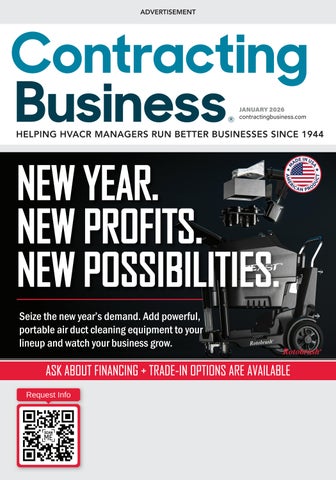
NEW YEAR. NEW PROFITS. NEW POSSIBILITIES. Seize the new year’s demand. Add powerful, portable air duct cleaning equipment to your lineup and watch your business grow.
ASK ABOUT FINANCING + TRADE-IN OPTIONS ARE AVAILABLE
2601CB_Rotobrush_CVRTip.indd 1
12/11/25 8:59 AM
NO MATTER HOW YOU CLEAN, START 2026 WITH THE INDUSTRY’S BEST
Whether you prefer the brush and vacuum cleaning method or negative air, Rotobrush has you covered.
BrushBeast DR Black Edition Brush & Vacuum Duct Cleaning Machine » The industry’s most powerful brush and vacuum machine » Features Patented Direct Drive + SmartStop Technology » Four brush rotation settings clean every duct- including flex » Industry exclusive removable pod + SpeedTray Carrier Portable BlowBeast II Negative Air Duct Cleaning Machine » Featuring exceptional airflow even with filtration » The only negative air machine with a removable pod » Serious torque for commercial or residential cleaning » Versatility to clean all types of air ducts- including flex
Call 1-800-535-3878
sales@rotobrush.com |www.rotobrush.com
2601CB_Rotobrush_CVRTip.indd 2
12/11/25 8:59 AM
Standing Out in a Changing HVAC Market, Page 30
January 2026 contractingbusiness.com
HELPING HVACR MANAGERS RUN BETTER BUSINESSES SINCE 1944
The Price is Out There
HVAC Contractors are breaking with tradition and putting prices online. Discover how transparency is reshaping customer trust, sales, and the future of the industry.
PAGE 12
ALSO IN THIS ISSUE:
16 AHR Expo 2026 Trends Report 22 Choosing the Right Heat Pump 27 The Vapor-Compression Refrigeration Cycle
2601CB_C1-4_Covers.indd 1
1/2/26 11:48 AM
HOT IDEAS, COOL SOLUTIONS
— VEGAS STYLE! CAESARS PALACE | LAS VEGAS, NV Where the HVACR industry goes to learn, connect, and grow.
YOU’LL WALK AWAY WITH
• Strategies to strengthen leadership and company culture • Financial insights that drive profitability • Operational tips that cut stress and boost performance • Inspiration from top contractors who’ve built lasting success
KEYNOTE SPEAKERS
Ryan Berman Speaker, Author, Entrepreneur
Keith Kong Mentalist
Register by December 22 to save $100 on listed prices! $645 $545
$745 $645
$845 $745
NONMEMBER
$995 $895
acca2026.com
2601CB_Air ConditioningContractorsofAmerica.indd 1 2601CB_C1-4_Covers.indd 2
12/12/25 9:25 AM AM 1/2/26 11:48
ProgrfifififivfifiCfifiufififiyfiInfiurfincfifiCofifi&fififfififififififififi
Small business owners’ to-do lists can add up. So see if you can save money on a commercial auto quote at ProgressiveCommercial.com.
Get a quote online in as little as 8 minutes
2601CB_ProgressiveCommercial.indd 1 2601CB_003-5_Contents.indd 3
12/11/25 9:22 AM AM 1/2/26 11:47
JANUARY 2026 | VOLUME 83, NUMBER 1
ON THE COVER: Posting prices online isn’t just bold—it’s becoming a competitive advantage for HVAC contractors. Images: 272539851 © Maksim Marchanka | Dreamstime.com and Contractor Commerce
12 COVER STORY
12 HVAC Pricing Goes Public: Transparency Becomes the New Competitive Edge
COLUMNISTS
8 First Word | Nicole Krawcke 26 Guest Editorial | David Katz 30 Guest Editorial | Kevin Ruppelt 34 The Rant | Matt Michel DEPARTMENTS
6 What’s New Online 10 From the Field 11 Manufacturer News 31 Products 32 Ad Index
As customers demand greater transparency, HVAC contractors are embracing online pricing to stay relevant, competitive, and trusted.
AHR EXPO
16 AHR Expo 2026 Trends Report Reveals What’s Shaping HVACR Next
Industry leaders discuss the shift toward next-gen refrigerants, electrification, IEQ, and the importance of skilled professionals to meet evolving market demands.
COMMERCIAL HVAC
19 How Four Star Mechanical Became a National
19
Leader in VRF and Mission-Critical Solutions
Four Star Mechanical proves how precision, partnerships, and people-first growth can redefine the modern mechanical contractor.
31
RESIDENTIAL HVAC
22 Choosing the Right Heat Pump: Climate, Comfort, and Cost Essentials for Contractors
Evaluating the comfort, climate, and budgetary concerns of heat pump selection.
CASE STUDY
24 High-Efficiency Hydronic Solution Transforms Historic Massachusetts Child Welfare Center
Plummer Youth Promise underwent a sustainability-driven renovation that pairs geothermal and high-efficiency HVAC.
REFRIGERATION SERVICE TODAY
27 Back to Basics: The Vapor-Compression Refrigeration Cycle
The core principles of refrigeration essential for HVACR pros to understand system operations and efficiencies.
Connect with us: contractingbusiness.com @contractingbiz https://www.facebook.com/CBMag https://bit.ly/CBonLinkedin
4 | CONTRACTING BUSINESS | January 2026
2601CB_003-5_Contents.indd 4
1/2/26 11:47 AM
2601CB
BOOST RECRUITMENT AND RETENTION WITH CARHARTT®
An Apparel+ workwear program gives your business an edge in attracting and keeping top talent with quality Carhartt® gear that makes your team feel valued. Plus world class service at a convenience you never knew existed.
Weekly laundry, repairs and delivery included
No upfront cost required
cintas.com/contractingbus
2601CB_CintasCorp.indd 1 2601CB_003-5_Contents.indd 5
12/11/25 3:05 AM PM 1/2/26 11:47
Online@contractingbusiness.com TOP STORIES ▶ Top 10 Most-Read HVAC Articles of 2025 The following list ranks the Top 10 mostread articles on Contracting Business in 2025, based on total pageviews from our audience, offering a clear snapshot of the issues that mattered most to contractors navigating a year of uncertainty, change, and adaptation. www.contractingbusiness.com/55338364
106053557 © Enterlinedesign | Dreamstime.com
VP/Market Leader—Buildings & Construction Group, Mike Hellmann Editor-In-Chief, Nicole Krawcke, nkrawcke@endeavorb2b.com Art Director, Julie Whitty Production Manager, Sam Schulenberg Audience Development Manager, James Marinaccio, jmarinaccio@endeavorb2b.com Ad Services Manager, Deanna O’Byrne
PODCASTS ▶ How AI is Transforming Commercial Refrigeration Trevor Matthews, founder of Refrigeration Mentor, discusses how technology is changing HVACR. www.contractingbusiness.com/55332896 © Endeavor Business Media
Capital Planning Tips for HVAC Contractors Amid Economic Shifts ITR Economics Chief Economist Brian Beaulieu discusses economic trends and business strategies for 2026, including rising material and labor costs, effective pricing strategies, and workforce retention. www.contractingbusiness.com/55337391
© Endeavor Business Media
ENEWSLETTER UPDATES ▶ One Combustion Safety Test to Avoid Many HVAC pros mistakenly believe zero CO readings in ducts confirm a safe furnace, but this can be misleading. It underscores the need for testing flue gases directly for accurate diagnoses. www.contractingbusiness.com/55335580 NCI
FEELING SOCIAL? Follow us on Twitter at @ContractingBiz, as well as our sister publications, @Contractormag, and @HPACEng. Retweet our up-to-date content, send comments, questions. Expand your world of engagement with us, at no extra charge! https://www.facebook.com/CBMag
https://bit.ly/CBonLinkedin
CEO, Chris Ferrell COO, Patrick Rains CRO, Paul Andrews CDO, Jacquie Niemiec CALO, Tracy Kane CMO, Amanda Landsaw EVP Building & Construction Group, Chris Perrino VP of Content Strategy— Buildings & Construction Group, Mike Eby
Contracting Business (USPS Permit 010-480, ISSN 0279-4071 print, ISSN 2771-652X online) is published monthly by Endeavor Business Media, LLC, 201 N. Main St., 5th Floor, Fort Atkinson, WI 53538. Periodicals postage paid at Fort Atkinson, WI, and additional mailing offices. POSTMASTER: Send address changes to Contracting Business, PO Box 3257, Northbrook, IL 60065-3257. SUBSCRIPTIONS: Publisher reserves the right to reject non-qualified subscriptions. Subscription prices: U.S. ($ 105.00); Canada/Mexico ($ 137.50); All other countries ($ 157.50). All subscriptions are payable in U.S. funds. Send subscription inquiries to Contracting Business, PO Box 3257, Northbrook, IL 60065-3257. Customer service can be reached tollfree at 877-382-9187 or at contractingbusiness@ omeda.com for magazine subscription assistance or questions. Printed in the USA. Copyright 2026 Endeavor Business Media, LLC. All rights reserved. No part of this publication may be reproduced or transmitted in any form or by any means, electronic or mechanical, including photocopies, recordings, or any information storage or retrieval system without permission from the publisher. Endeavor Business Media, LLC does not assume and hereby disclaims any liability to any person or company for any loss or damage caused by errors or omissions in the material herein, regardless of whether such errors result from negligence, accident, or any other cause whatsoever. The views and opinions in the articles herein are not to be taken as official expressions of the publishers, unless so stated. The publishers do not warrant either expressly or by implication, the factual accuracy of the articles herein, nor do they so warrant any views or opinions by the authors of said articles.
6 | CONTRACTING BUSINESS | January 2026
2601CB_006-7_Online.indd 6
1/2/26 11:47 AM
2601CB
Compact.
The Model 406 Drain Pump
. Small compact size . Fits in tight areas . Quiet performance . Upper and lower inlets . Attractive appliance-style design
800-543-2550 - LibertyPumps.com Copyright © Liberty Pumps, Inc. 2026 All rights reserved.
2601CB_LibertyPumps.indd 71 2601CB_006-7_Online.indd
Perfect for mounting in cabinets
12/15/25 9:56 AM AM 1/2/26 11:47
FIRST WORD BY NICOLE KRAWCKE, EDITOR-IN-CHIEF
AI Search Is Reshaping HVAC Buying
A Adopting AI—and adapting to it—today is like adopting field service and mobile dispatching over a decade ago.
I is quietly rewriting the rules of how homeowners find and hire HVAC contractors. Today’s consumers increasingly start their buying journeys by asking AI assistants for recommendations—and prices. Half of consumers polled in a McKinsey survey now intentionally seek out AI-powered search engines, with a majority of users saying it’s the top digital source they use to make buying decisions. Additionally, use of AI-powered search spans all ages, including a majority of older generations (for example, baby boomers) already adopting it.
185365812 © Nicoelnino | Dreamstime.com
EDITORIAL ADVISORY BOARD TOM CASEY
Climate Partners Griffin Service
MIKE CONLEY
Pioneer Heating & AC
DOMINICK GUARINO
National Comfort Institute
JESS JIMOH
Bonfe Plumbing, Heating, Cooling, Electrical & Sewer
COLLEEN KEYWORTH Online Access
EDWARD MCFARLANE Sila Services
MATT MICHEL Author
SCOTT SHARROCK
Jolly Plumbing, Heating & Air Conditioning
BRIAN STACK
Stack Heating & Cooling
“Zero-click searches, where users get the answer directly on the search results page, now account for nearly 80% of queries,” says EDEN Co-founder and CEO Ben Phillips says in his December column. “This means fewer people are clicking through to websites, preferring instead to view the search results page itself as a comprehensive information hub.” Phillips notes that Google has also begun rolling out features, like “Have AI check pricing,” which will automatically search local businesses about product availability and pricing. “In other words, your interaction with a potential customer may start with a bot, not a browser click. Industry analysts expect this trend to accelerate, with traditional search volumes projected to decline in the years to come.” Now, if your company is not displaying that pricing information on your website, you will be overlooked. There are other ramifications as well. During her breakout session at Service World Expo, Colleen Keyworth, vice president of sales and marketing at Online-Access, shared a screenshot of an AI-search she prompted, asking the average cost of a water heater in Port Huron, Michigan. The results came from Detroit, Grand Rapids, and even Canada. For those unfamiliar with Michigan geography, Detroit is 62 miles away from Port Huron, while Grand Rapids is 180 miles away. And Canada
is a different country altogether. These are three very different markets. “[The reason it displayed that information is] it didn’t have anything to go by,” Keyworth said. “So it found a company in Grand Rapids that had pricing information about water heaters and put it together. This is going to be the biggest game changer going forward. I was raised on the race to the bottom mentality, so I get it. But I do think it’s going to change whether we like it or not. Consumers want more information around the price. And I’d rather not have a one-truck Chuck educating them on pricing to be honest with you—somebody that doesn’t have overhead, somebody doesn’t have capacity, somebody that doesn’t have insurance or coverage or warranties. And then, we do a poor job our customer about what we actually do because we keep it so secret.” To adapt, HVAC contractors can start by making pricing and estimates easily accessible online, ensuring their websites are optimized for AI-powered search. Tools like interactive quote calculators, instant estimate forms, and service-package pricing tables not only meet consumer expectations but also feed the structured data AI systems rely on to surface relevant results. One recent study shows independent HVAC and plumbing contractors have implemented an “HVAC eCommerce” approach—displaying install prices and offering instant online quotes to combat private equity consolidation. The strategy reflects a growing movement toward radical transparency to strengthen customer trust. Flip to page 12 to learn more about the benefits of online estimates in this month’s cover story. Contractors should also consider integrating AI-driven chatbots or virtual assistants that can answer pricing questions, suggest service options, and schedule appointments in real time. Beyond technology, clear, consistent messaging across Google Business Profiles, social media, and review sites reinforces transparency, increasing the likelihood that AI tools recommend their services over competitors. By combining these digital practices with traditional customer service excellence, contractors can turn AI-driven search behavior into a reliable lead-generation channel. Adopting AI—and adapting to it—today is like adopting field service and mobile dispatching over a decade ago—the contractors who embraced it early became the most efficient, most profitable, and most competitive in their markets. The ones who waited were forced to catch up.
H
N N AH in
8 | CONTRACTING BUSINESS | January 2026
2601CB_008-9_FirstWord.indd 8
1/2/26 11:47 AM
2601CB
VISIT NAVIEN AT BOOTH #243
HVAC T H E
N E X T
W A V E
O F
C O M F O R T
NEW NAZ Air-to-air heat pump inverter-driven heating and cooling systems
NAS Series Air Handlers
NAZ Series Air-to-air Heat Pumps
NAM Series Cased Coils
NPF Series Hydro-furnaces
Navien introduces its full line of HVAC products, featuring new NAZ Heat Pumps, NAS Air Handlers, NAM Cased Coils, and other forced-air components. Deliver a whole-home AHRI matched Navien comfort system when pairing with the NPF Hydro-furnace, including a powerful dual-fuel system with gas-powered NPF and the NAZ Heat Pump. To learn more about Navien HVAC comfort, visit us at navieninc.com
2601CB_Navien.indd 1 2601CB_008-9_FirstWord.indd 9
12/19/25 4:46 AM PM 1/2/26 11:47
FROM THE FIELD COMPILED BY NICOLE KRAWCKE, EDITOR-IN-CHIEF
A2L HVAC Equipment Reaches 91% of Distributor Sales
ChatGPT
COLUMBUS, Ohio—HARDI reported that low-GWP A2L equipment accounted for 91% of distributor sales in September 2025, marking an almost complete transition in central ducted systems. According to HARDI’s Unitary Market Intelligence Report, the shift accelerated throughout the year after single-digit adoption at the end of 2024. HARDI CEO Talbot Gee said distributors and contractors have moved quickly to adopt the new refrigerants. He noted that the association is now focused on protecting distributors from installation-date deadlines included in the Environmental Protection Agency’s Technology Transition Rule. Although A2L equipment has become the dominant choice, many distributors still hold limited inventories of R-410A systems. Under current EPA rules, certain residential and light commercial equipment manufactured and purchased legally may not be installed after specific deadlines. HARDI says these provisions put compliant inventory at risk of financial loss and unnecessary waste. The association has expressed support for the EPA’s proposal to repeal the installation prohibition and allow distributors to sell through their remaining R-410A stock. HARDI also encouraged the EPA to review similar installation and sell-through provisions for other HVACR product categories to ensure consistent regulation across the industry. The organization said predictable and uniform rules would support distributors, contractors, and consumers during ongoing refrigerant policy changes.
HVAC Excellences Names Top 25 HVACR Educators & Trainers MOUNT PROSPECT, Illinois—HVAC Excellence and TruTech Tools asked the HVACR community to help spotlight the industry’s most impactful instructors. Thousands of nominations poured in, each one a testament to the incredible influence these educators have on students, apprentices, technicians, and the future of the industry’s workforce. Introducing the 2026 Top 25 Most Influential Instructors & Trainers:
• Wayne Blackwell, Pickens Technical Center; • Patrick Butler, Professor Butler (TikTok); • Leon Charnetski, CMHE, Northeast Wisconsin Technical College; • Brynn Cooksey, Sr.*, CEM, CMS, HVACU, LLC; • Nichole Curl, Chadwell University; • Patrick Finley, Commercial Kitchen Chronicles; • Jim Fultz*, Copeland/ White-Rodgers; • Aaron Gibson, Rheem Canada; • David Harrell, HTPG; • Ed Janowiak, ACCA; • Justin Kidwell, Daikin Comfort Technologies; • Rick Kincell, Coburns Supply; • Joseph Kloke, CMHE, Waubonsee Community College; • Matthew Lemaster, University of Arkansas – Pulaski Technical College; • Marc Lopez, Friedrich Corporation; • Jennifer Manzo, HVA-Chicks Coalition; • Crystal Naegle, UA Local 525; • Christopher Peterson, UA Local 44; • Scott Sharrett, Fieldpiece; • Ivan Smith, Intellitec College; • Aaron Tevebaugh, Johnstone Supply; • Kati Theurer, CSME, Jefferson College; • Brandon Thomas, UA Local 598; • Bobby Tyner, Central Carolina Technical College; and • Dave Whitten*, UA Local 26. (Note: * indicates previous honorees) These individuals represent the very best of HVACR instruction. Their contributions are shaping training labs, elevating standards, reducing skill gaps, and inspiring countless students to pursue meaningful, high-demand careers.
Foundral Debuts to Scale Union HVAC Contractors CHICAGO—Foundral officially launched as a new platform focused on acquiring commercial mechanical contracting companies across the Midwest. Backed by McNally Capital, the platform builds on the foundation of Smith & Oby and its subsidiary DSO, two long-established contractors serving Ohio and West Virginia. Foundral is designed to unite union-backed mechanical firms and support them with centralized operational resources. The initiative aims to strengthen regional capabilities while helping contractors modernize and scale. Foundral has appointed Jason Richards as executive chairman and CEO. Richards has more than 33 years of experience in infrastructure services and has led growth and operational improvements for multiple businesses. The company is positioning itself to help contractors meet the region’s growing need for mechanical, electrical and building systems expertise.
10 | CONTRACTING BUSINESS | January 2026
2601CB_010_FromField.indd 10
1/2/26 11:57 AM
MANUFACTURER NEWS COMPILED BY NICOLE KRAWCKE, EDITOR-IN-CHIEF
Daikin Applied Invests $163M in U.S. R&D Lab for HVAC Innovation
MINNEAPOLIS—Daikin Applied announced a $163 million investment to build a 71,000-square-foot research and development test lab at its Plymouth, Minnesota headquarters. The facility, set for full completion in 2027, will focus on developing nextgeneration HVAC technologies for hyperscale data centers, as well as commercial and industrial cooling systems. The lab features nine test cells, four of which are dedicated to next-generation airside technologies. Phased commissioning is already underway. The facility will enable engineers to replicate extreme operating conditions found in modern data centers, accelerating innovation in chillers, air handlers, heat pumps, and other high-performance HVAC equipment. The investment complements recent acquisitions, including DDC Solutions, Chilldyne, and Alliance Air, enhancing Daikin Applied’s portfolio of data center solutions. The Plymouth location was chosen for its access to a skilled workforce in the Minneapolis– St. Paul metro area, supporting ongoing training and development for engineers, technicians, and cross-functional teams. “Our commitment to HVAC innovation compels us to continually push the boundaries of what’s possible. This world-class test lab is a powerful testament to that vision,” said Yu Nishiwaki, COO at Daikin Applied Americas. The project also reinforces Daikin Applied’s broader U.S. manufacturing footprint, which includes 25 plants and more than 25,000 employees nationwide. The company has invested over $9 billion in U.S. operations since 2015.
NAVAC Boosts HVAC Workforce Training at SUNY Delhi with $21K Tool Donation LYNDHURST, New Jersey—NAVAC has donated more than $21,000 in professional-grade HVAC tools to the State University of New York at Delhi to support training for future technicians. According to the company, the contribution is part of a broader effort to expand workforce development and strengthen technical education programs. The donation includes hydraulic tube expanders, electric flaring tools, A2L-ready refrigerant recovery units, and both corded and cordless vacuum pumps. The equipment is intended to give students hands-on experience with the same tools used in the field.
NAVAC also provided on-site instruction. During a recent visit to the campus, national trainer Zane Stewart led demonstrations and workshops on safe and efficient tool operation. Students received guidance on current practices and emerging technologies that reflect today’s service conditions.
Carrier, WHVACR Award $55K in Scholarships to Women in the Trades ENGLEWOOD, Colorado—Women in HVACR teamed up with Carrier Global Corp. to award 11 scholarships to outstanding female students blazing paths in the skilled trades. The scholarships, presented during the 2025 Women in HVACR Conference in Las Vegas, celebrate the next generation of women advancing in an industry historically underrepresented by female professionals. Each recipient received $5,000 in recognition of her academic excellence, leadership potential and commitment to fostering diversity and innovation in the skilled trades. Six students received scholarships directly from Women in HVACR, while five additional scholarship awards were presented by Carrier in partnership with the nonprofit organization for a total of $55,000. “These scholarships represent more than financial assistance; they are an investment in the future of our industry,” said Women in HVACR President Kristin Gallup. The 11 recipients are: Kristine Berg; Hannah Dearman-So; Ashley Haynes; Sarah Kitchen; Beyonca Mack; Alerry McCarthy; Aya Morgan; Samantha Murphy; Mahek Parvez; Lila Tychsen; and Sophia Valenzuela. “By empowering women to lead and innovate within the HVACR industry, we strengthen its foundation and ensure it continues to evolve, adapt and thrive,” Gallup said. January 2026 | CONTRACTING BUSINESS | 11
2601CB_011_MfgNews.indd 11
1/2/26 11:58 AM
RESIDENTIAL HVAC | BY NICOLE KRAWCKE
HVAC Pricing H Goes Public: Transparency Becomes the New Competitive Edge
As customers demand faster answers and greater transparency, HVAC contractors are rethinking tradition and embracing online pricing to stay relevant, competitive, and trusted in a rapidly changing market.
istorically, HVAC contractors have been averse to sharing pricing information up front, relying instead on in-home visits to assess system needs before offering a quote. But shifting customer expectations—driven by digital-first research habits and a demand for greater price transparency—are changing that long-standing model. “A lot of the hesitation comes down to fear and habit,” notes Colleen Keyworth, vice president of sales and marketing at Online Access. “Contractors worry about being shopped, looking too expensive, or getting locked into a number when every home is different. The industry has relied on in-home quotes for decades, so posting pricing online feels risky or unfamiliar. Some also worry that showing their prices exposes their margins or invites comparison without context. For many, it is simply more comfortable to stick with the process they know.” However, while the HVAC industry has not changed much in this regard, the customer absolutely has, Keyworth adds. “Today, people expect to see prices for everything upfront because that is how they shop everywhere else in their lives. Younger homeowners in particular want quick, clear information without having to call for it. When contractors do not show pricing online, many consumers assume the company is outdated or hiding something. Transparency has become a basic trust factor.”
Both Acosta Heating, Cooling & Electrical and Tuck and Howell have experienced success adopting pricing transparency via Contractor Commerce’s eCommerce platform. Images courtesy of Contractor Commerce
12 | CONTRACTING BUSINESS | January 2026
2601CB_012-15_pricing.indd 12
1/2/26 11:47 AM
According to Lisa Forrest, senior account executive and partnership manager at Contractor Commerce, an e-commerce platform designed specifically for HVAC and plumbing contractors that enables them to sell products and services directly through their websites, says contractors fall into the habit of the way things have always been done. “They think showing pricing is going to take away the value of what their company brings, when, in fact, many of our customers and everyone here at Contractor Commerce know otherwise. We have the data and testimonials to prove that. A couple recent interviews with our contractors say they have a 70%—some even attest to 80% to 90%—close rate if they can book the appointment. One company, Summit Heating & Cooling in Kansas City, told us our platform brought in $495,000 in revenue to the business.” Forrest points to COVID transforming a lot of buying patterns for people that have stuck around to today, and urges contractors to keep an open mind. “I know people who haven’t stepped into a grocery store in five years—time is valuable, so people are choosing where they want to spend it,” she says. “They would rather get an online quote and book an appointment online without having to pick up the phone. Offering up-front pricing could bring in an entirely new pipeline of customers. This may not be for everyone, but again, we have this new age group that’s
been so conditioned with everything being available or searchable online. How are you meeting them? Our industry is changing rapidly, and you have to stay up to date with these market changes or else you’re going to be left behind.” Forrest notes that Contractor Commerce was founded by a third-generation contractor who believes that contractors should control the pricing conversation. “When you search online, ‘How much does an air conditioner cost,’ most of the results come from tech companies and retailers. Contractor Commerce wants to help contractors control the narrative.”
Adapting to a New Normal Contractors can entirely customize online quote estimates based on equipment sizing and material costs. They can even work with the Contractor Commerce team to update the pricing ranges as frequently as needed due to rising material costs. They can also include financing options and the option to book an appointment on the spot. “When a homeowner completes the online quote, our system immediately lets them know that someone will follow up to schedule a time to review their options,” Forrest says. “Many of our contractors take that follow-up email even further by adding genuine value—highlighting why a customer should choose their company, noting their decades of experience, turnkey solutions, and commitment to performing a thorough evaluation to ensure the right
system for the home. As a consumer, if I received a clear price along with that kind of thoughtful message, I’d feel confident that this company has its act together and is serious about earning my business. Compare that to calling a contractor only to hear, ‘We don’t give pricing over the phone’—an experience that frustrates today’s buyers. Homeowners can estimate their mortgage payments on Zillow, so they’re understandably asking: ‘Why shouldn’t they be able to get a price for an HVAC system just as easily?’” Charlotte, North Carolina-based Acosta Heating, Cooling & Electrical has been displaying pricing estimates online with Contractor Commerce since early 2024. President Lauren Acosta Huckleberry was introduced to the idea of giving more price transparency when her company partnered with Costco for several years. “In an environment like Costco, people are very accustomed to looking at an item and seeing the price,” she says. “It tended to work very well for us. Those leads that were set up there were pretty gosh-darn successful for us because people already knew what kind of numbers we were talking about.” Acosta Huckleberry already knew some of the people at Contractor Commerce, but she was hesitant. However, she heard a very compelling story at an industry trade show about how people have become accustomed to online shopping and searching for pricing.
January 2026 | CONTRACTING BUSINESS | 13
2601CB_012-15_pricing.indd 13
1/2/26 11:47 AM
RESIDENTIAL HVAC
Contractor Commerce had a slight mishap with its booth at ServiceTitan’s Pantheon event last year with too much white space. Lisa Forrest found some Sharpies and had current customers attending the event share hand-written success stories and testimonials.
“I started thinking about how I would buy things—I’m an elder millennial, and that’s how we do things,” she says. “I don’t remember who was first in our market to do it, but I know we were one of the first. And the bit that most motivated me to offer it was I wanted our website to be a relevant search result if you searched, ‘how much does X cost,’ right? Because I know that’s what people are searching, and I want to make sure that we show up as a resource.” Acosta Huckleberry notes that her biggest worry was showing an online estimate only to get to the customer’s home, and it end up costing more than the quoted price. “When we first started showing pricing on the site, we were showing the biggest, baddest number to assuage my own personal fear about it. It backfired in that we certainly scared some customers away— they didn’t want to consider us any further. We changed our strategy a bit, and now we show multiple different prices from
the least expensive to most affordable to the Mac Daddy system with all the bells and whistles—a good, better, best option. That has definitely helped us get our foot in the door.” Acosta Huckleberry says offering transparent pricing has brought in more quality leads. From January through November 2025, Acosta Heating, Cooling & Electrical received 211 leads and generated $225,000 in revenue. Offering pricing online is not all that different than when a tech goes into a customer’s home to diagnose a problem, Acosta Huckleberry points out. “When we go into a home, we’re never turning wrenches to fix the problem until we’ve told them how much it’s going to be. That’s just how we operate—we don’t fix it, then show them a bill afterward to surprise the heck out of them. It’s also helped our CSRs in being able to direct customers to that part of our website when they want a price over the phone.”
Jay Mahaffey, president of Tuck & Howell Plumbing, Heating & Air, in Duncan, South Carolina, has been using Contractor Commerce’s online quote platform for about a year. “The world has changed and so has the way we live in society,” he says. “We want convenience and we want it now. Contractor Commerce has done well for our industry because, you know, if you’re proud of your price, you put your money where your mouth is and show people up front. There’s nothing to hide. Our online estimates align with our pricing probably 95% of the time. We’re very busy, and so we don’t have time for 1-2-3 quotes sometimes, and being able to shop online has changed the game for that. I personally like it. I don’t think it’s a one-size-fits-all for everyone, but for what we’re doing, it’s served our company well.” Mahaffey has also received positive feedback from his team. “They like using the tool. And the reason is that the sticker shocks go away. If they’re having us in their home after they’ve already viewed the pricing, then obviously, it’s well worth going out there, right? At the end of the form, it says, ‘Would you like a comfort consultant in your home?’ If they click yes, it triggers an appointment. If we actually make it to their door, the chances of us closing that sale are very, very high. “The previous way of doing things is a way of thinking of the past,” Mahaffey adds. “The world is changing very fast, and contractors better get on board with what everyone is doing online, or they will be left behind.”
Value Over Price Keyworth notes that the key is shifting the focus from price to value. “Take the time to set your company up as the expert by educating them on what goes into your pricing,” she advises. “Contractors can explain what goes into the number, such as installation quality, warranties, equipment selection, technician training, customer service, and overall project support. Showing good, better, best options helps homeowners compare features, not just dollars. Reviews, photos, and real examples also make it easier for customers to understand why one contractor may cost more but deliver far more in return.”
14 | CONTRACTING BUSINESS | January 2026
2601CB_012-15_pricing.indd 14
1/2/26 11:47 AM
Forrest points to one customer, Derek Cormier, owner of Climate Experts in Melbourne, Florida, who actually embedded a video of himself at his desk addressing the most common question the company gets is how much a new system costs, then demoing the online quote tool. “He’s separating himself even from the other contractors using Contractor Commerce,” she says. “I encourage the people I talk to and move forward with us to start building value by talking about the why, the history, and the people. They can also separate themselves by talking about warranties, rebates, and financing. They can even include a link to get preapproved for financing. It’s putting it in the customer’s hands, which the customer loves control. The more information and control you give the homeowner, the more apt to do business with your company.”
from a proximity element to a pricing element where someone types in A/C repair or contractor near me, there’s also many searches for pricing. If you’re not answering those questions, whether it’s through a blog, through your website, or however else, you’re going to get left behind. And I think that’s one thing we preach day in and day out.”
By being up front with pricing, contractors are not only modernizing the buying experience but also building trust, reducing friction in the sales process, and standing out in a crowded, increasingly competitive market. “I don’t want to be left in the dust. I want to be evolving with what the market is doing,” says Acosta-Huckleberry.
60%
Faster Installation
Winning the Future Both Keyworth and Forrest suggest that if contractors don’t get on board with offering online pricing transparency, it could actually hurt their business. “Search engines, both traditional and AI, are increasingly rewarding transparency, and consumers gravitate toward companies that make information easy to find,” Keyworth notes. “As the market shifts, contractors who hide pricing may look old-school or out of touch. Younger buyers especially skip companies that do not answer their questions online. Over time, not showing pricing could make a contractor look less credible, less modern, and, ultimately, less competitive.” Keyworth adds that transparent pricing isn’t about giving away your margins. “It is about building trust before the first call and making your business easier to choose. Even simple price ranges or starting points can help homeowners feel more informed and confident. Contractors who embrace transparency now will be well-positioned as consumer expectations continue to evolve. The early adapters especially will see the most reward.” Forrest notes that the Contractor Commerce website even says, “We see a future where every contractor has an online store.” “You see how the world has shifted,” she says. “Online searches have shifted
Seismic
Now Available
VEGAS FEB 2-4 > 2026
Booth SU653
2601CB_Griplock.indd 1
2601CB_012-15_pricing.indd 15
805.566.0064
www.griplocksystems.com January 2026 | CONTRACTING BUSINESS | 15
12/12/25 9:20 AM
1/2/26 11:47 AM
AHR EXPO 2026 | COMPILED BY NICOLE KRAWCKE
AHR Expo 2026 Trends Report Reveals What’s Shaping HVACR Next
AHR Expo
Industry leaders discuss the shift toward next-generation refrigerants, electrification, indoor environmental quality, and the importance of skilled professionals to meet evolving market demands and regulatory standards.
A
s the HVACR community prepares to gather in Las Vegas for the 2026 AHR Expo, the latest AHR Expo Industry Trends Report offers a forward-looking snapshot of the technologies, market forces, and workforce shifts shaping the year ahead. Reflecting input from endorsing associations provide insights that set the stage for meaningful conversations at the show, helping contractors, engineers, manufacturers, and service leaders align on the challenges and opportunities driving the next era of HVACR.
Air Conditioning Heating & Refrigeration Institute (AHRI)
ensure progress toward their energy and environmental goals while ensuring continued consumer access to economical, efficient, reliable equipment.” On next-generation refrigerants, Yurek says: “Completing the global transition toward next-generation refrigerants remains high on our industry’s priority list.” Tax credits are also a trending topic for the industry: “As the tax credits and rebates for highly efficient equipment wind down in the United States as a result of the recent tax bill, as tariff activities increase, manufacturers will be seeking additional ways to continue to provide essential affordable, reliable, efficient products to their customers.”
Stephen Yurek, president & CEO
ASHRAE
“The HVACR and water heating industry has the solutions and experience to help countries and regions to achieve their sustainability goals. This year’s watchword is affordability, as policy makers around the world strive to
“The HVACR industry is experiencing a period of rapid transformation. The focus is no longer solely on efficiency or cost savings, it is equally about creating indoor spaces that actively support health, comfort, and productivity. The technologies and solutions driving our sector forward are reshaping expectations
Bill McQuade, 2025-2026 president
16 | CONTRACTING BUSINESS | January 2026
2601CB_016-18_AHR.indd 16
1/2/26 11:47 AM
for how buildings should perform for both people and the planet.” “In the short term, the HVACR industry is adapting to rising expectations for energy efficiency, carbon reduction, and improved resilience of building systems. This includes addressing refrigerant transitions, electrification, and smarter controls. In the long term, the industry is moving toward integrated building performance, where heating, cooling, water, and power systems work seamlessly together. This change requires collaboration across disciplines and reinforces the role of HVACR professionals as central to the future of building design and operation.” On efficiency, McQuade notes that, “Emerging discussions are centering on energy storage, building-to-grid integration, and hybrid systems that combine renewable energy with efficient mechanical solutions. Water efficiency and reuse in HVACR applications are also gaining traction, particularly in regions facing resource constraints. Professionals are also increasingly exploring circular economy approaches, from recycling refrigerants to designing equipment for easier maintenance and longer life cycles.” Another major shift to note is IEQ is gaining importance: “While energy performance has been a cornerstone of the industry for decades, the conversation now emphasizes the important role of indoor environments in health, productivity, and safety, as well as achieving community-scale decarbonization. This shift has reinforced the importance of updated standards, interdisciplinary collaboration, and continued education for professionals across the supply chain.
Association for Smarter Homes & Buildings (ASHB) Greg Walker, CEO
“The HVACR industry is at a pivotal point, caught between urgent climate commitments and a wave of technological innovation. From AI and automation to electrification and IAQ, the pressure is on to deliver smarter, cleaner, and more resilient systems.” According to Walker, “There’s been a noticeable acceleration in how the industry approaches digital transformation and decarbonization. More companies are moving beyond pilot projects and scaling smart building strategies across entire portfolios. AI integration has also matured, shifting from hype to practical applications like predictive maintenance, energy optimization, and system diagnostics. Additionally, customer demand for open, interoperable systems has grown significantly, putting pressure on vendors to prioritize flexibility and integration. “Opportunities lie in enabling smarter retrofits, particularly in existing commercial buildings. Leveraging cloud-based platforms, edge devices, and integrated analytics can help legacy systems catch up without a full rip-and-replace. Additionally, federal and
state-level incentive programs continue to fuel investment in energy efficiency and indoor air quality improvements.”
ESCO Group
Clifton Beck, manager of digital media “The HVACR industry is undergoing a dramatic transformation. Fueled by technological innovation, regulatory shifts, and surging demand for energy-efficient solutions, this evolution is pushing HVACR professionals to rethink their role in the marketplace or risk being left behind. One of the most striking indicators of this change is the shift in consumer preference from gas furnaces to heat pumps. According to AHRI, heat pump shipments have outpaced gas furnace shipments by 32%. That’s not a minor trend; it’s a clear market signal, making it no longer optional to understand heat pumps. It’s essential! The key element holding back its growth is the lack of qualified HVACR professionals who understand higherperformance heat pumps. Today’s heat pumps are complex and sophisticated. Incorrect installation and/or poor service lead to inefficiency, reduced lifespan, and disenfranchised consumers. That’s why training and certification are no longer optional; they’re mission-critical! “Gone are the days when heat pumps were seen as a novelty or a climate-limited option. Modern cold-climate models with inverter-driven compressors and vapor injection technology can operate effectively in minus zero temperatures without relying on inefficient backup resistance heat. The old myth that ‘heat pumps don’t work when it’s cold outside’ has been thoroughly debunked.” Beck notes that the refrigerant transition was a key discussion during the 2025 AHR Expo. “Today, the transition is underway, and professionals have concerns about the availability of products and refrigerants to fill their customers’ needs.”
Heating, Air-conditioning, Refrigeration Distributors International (HARDI) Talbot Gee, CEO
“2026 will test the industry’s ability to adapt as much as it will reward those who’ve learned from the past two years. The refrigerant shortages of 2025 exposed the cost of weak forecasting and breakdowns in communication across the supply chain, but they also sharpened the industry’s awareness of what coordinated planning requires. The way distributors manage pricing impacts from tariffs will reveal— and strengthen—their value as partners to their customers. It will also be essential that we continue to stay the course set by the AIM Act, even as uncertainty surrounding the Technology Transition Rule creates some unease.” January 2026 | CONTRACTING BUSINESS | 17
2601CB_016-18_AHR.indd 17
1/2/26 11:47 AM
AHR EXPO 2026
Gee notes that recent trends from HARDI’s Unitary Market Program indicate that the transition to A2L products is nearing completion. “As of July 2025, A2L refrigerants accounted for 86% of unitary sell-through volume, with R-410A representing just 14%. This marks a significant milestone for the industry, reflecting both the adaptability of distributors and manufacturers and the growing alignment with the goals of the AIM Act. “One of the most immediate challenges we’re watching is the sharp decline in air conditioning demand during the latter half of 2025. Weak sell-through has led to elevated inventory levels, putting added pressure on margins. As a result, maintaining profitability in the near term will depend heavily on disciplined cost management and careful inventory control. The coming year will test the industry’s ability to balance operational efficiency with readiness for eventual demand recovery.”
Plumbing-Heating-Cooling Contractors— National Association (PHCC) Cindy Sheridan, CEO
“Last year’s concerns for acceptance of new products brought forth by the refrigerant transition were proven to have been overstated. Prompt market acceptance of A2L products has created other supply side concerns for equipment and refrigerant availability, prompting more repair of existing systems than is typical for most contractors.”
2601CB_DiversitechCorp.indd 1
18 | CONTRACTING BUSINESS | January 2026
2601CB_016-18_AHR.indd 18
Sheridan notes that PHCC continues to support the AIM Act and believes EPA should ensure competent personnel are doing this work. “PHCC supports stronger enforcement of licensing and certification requirements to ensure safe and optimal performance of advanced heating and cooling systems. “As the industry continues to transition to the next generation of refrigerants, it is important to ensure technicians have the training and resources necessary for successful installation of new products, and for customers to understand how the transition impacts product availability and performance. Overall, PHCC cannot overstate how critical it is for the industry to stay the course as implementation of the AIM Act continues. We must understand that turning back or otherwise interfering with timelines will only add to economic burdens for both contractors and customers, while putting the U.S. at a global disadvantage in the HVAC market.” On major industry shifts, Sheridan says, “The acquisition and consolidation of plumbing and HVAC contracting businesses by private equity groups continues to be a notable trend.”
12/9/25 9:03 AM
1/2/26 11:48 AM
COMMERCIAL HVAC | BY DAN VASTYAN
How Four Star Mechanical
Became a National Leader in VRF and Mission-Critical HVAC Solutions Four Star Mechanical’s evolution from a small Ohio shop to a national leader in VRF innovation and mission-critical HVAC solutions shows how precision, partnerships, and people-focused growth can redefine what a modern mechanical contractor can achieve.
F
ounded in 1992 by Steve Martin in Hamilton, Ohio, Four Star Mechanical began with just four employees. Today, the company has grown into a leading commercial and industrial contractor serving clients throughout the country. While its roots are in Southwest Ohio, Four Star’s reach extends far beyond, driven by strong relationships and a reputation for high-performance solutions. Steve Martin, the president of the firm, and his son, Seth Martin, vice president of operations, continue to lead the company’s growth and expansion of its national presence.
Over the past 15 years, Four Star, which is now a Kelso Industries company, transitioned from a traditional mechanical firm into an early adopter and specialist in VRF technology. That shift sparked a focus on energy-efficient, design-forward solutions, positioning the company as a leader in design-build and design-assist projects. Four Star’s project portfolio includes health care facilities, banks, hospitality developments, and church networks, with major projects across Ohio, Kentucky, and Indiana. The company brings extensive experience working in complex environments, including SCIF rooms, data centers,
and mission-critical infrastructure. By maintaining close, long-term partnerships with high-priority clients, Four Star Mechanical continues to deliver tailored solutions for complex and large-scale commercial projects nationwide.
Mission Critical J ust minutes from Four Star Mechanical’s shop is a major facility operated by a global leader in aerospace maintenance, repair, and overhaul (MRO) services. The company specializes in engine and component repair, airframe services, avionics, and engineering support for both fixed-wing and
Steve Martin (second left) and Seth Martin (far right) with a team for Four Star employees at a volunteer community event. Images courtesy of Four Star Mechanical
January 2026 | CONTRACTING BUSINESS | 19
2601CB_019-21_FourStar.indd 19
1/2/26 11:48 AM
COMMERCIAL HVAC
In May 2024, Four Star technicians completed the project in under two weeks, installing four, one-to-one, eight-ton VRF systems with high-static air handlers and rooftop condensing units. This approach not only doubled the required cooling capacity but also ensured full system redundancy—an essential safeguard in the high-stakes aerospace environment, where downtime can severely impact operations. To further enhance reliability, the new systems were integrated with the facility’s Building Management System (BMS) for remote monitoring. Since the upgrade, the average temperature at the transformer inlet has dropped significantly, improving operational safety and reliability.
Positive Impact, Times Two For over 30 years, Four Star Mechanical has built its reputation on a solution-oriented approach that continues to drive steady growth. With expansion, however, comes the ongoing challenge of recruiting and retaining skilled technical talent. Steve Martin saw an opportunity to address this challenge while giving back to the communities Four Star serves. Steve Martin now serves as chairman of the board for Conquest Work Force, a nonprofit organization dedicated to help-
The main electrical room at the aerospace facility was overheating to the point of halting operation. Four Star designed and installed four Fujtisu AIRSTAGE 8-ton high-static air handlers to provide cooling in the electrical room. Right: Transformer inlet temperatures, pre- and post-installation.
rotary aircraft. Since opening in 2007, the site has experienced steady growth, including the addition of a 206,000-square-foot expansion to its original 236,000-squarefoot floor plan. In 2024, the facility’s leadership contacted Four Star with concerns about overheating in their main electrical room—a critical 2,500-square-foot space housing four transformers and extensive switchgear. Four Star’s team investigated the issue and discovered that rising cooling
loads, driven by increased production demands, had outpaced the room’s original cross-ventilation system. Over a multi-month data logging period, Steve Martin tracked internal temperatures consistently exceeding 100° F, with peaks as high as 116° F—far above the customer’s target. To address this, Four Star designed and installed a dedicated cooling system using Fujitsu AIRSTAGE V-series VRF equipment, providing 32 tons of cooling capacity.
ing individuals re-enter society following struggles with addiction or felony convictions. The program offers a structured path forward, providing life coaching, counseling, recovery support, education, and a second-chance step program. A key part of Conquest’s mission is job placement, connecting individuals with temporary roles that often evolve into long-term employment. Four Star Mechanical is one of several employers that partner with Conquest, and today,
20 | CONTRACTING BUSINESS | January 2026
2601CB_019-21_FourStar.indd 20
1/2/26 11:48 AM
of subcontractors and suppliers who share the company’s commitment to safety, quality, and high-performance execution. “Ultimately, our long-term goal is to become the market benchmark, recognized across the HVAC industry as the subcontractor that consistently delivers unparalleled quality, safety, and reliability,” said Seth Martin. “These objectives position
Four Star for both growth and industry leadership.” This commitment ensures that Four Star Mechanical will remain a trusted partner and industry leader well into the future. Dan Vastyan is public relations director for Common Ground, a Manheim, Pennsylvaniabased trade communications firm.
Graduates of the Conquest Work Force program make up about 10% of Four Star’s team.
graduates of the program make up 10% of Four Star’s workforce. “There are a lot of great people in bad circumstances,” said Steve Martin. “They need a real chance to rebuild confidence and support their families. Our company believes in this program and has witnessed firsthand the mutual benefit that programs like this can have for the business, community, and individuals needing a hand up.” By aligning workforce development with community impact, Four Star not only fills critical roles within the company but also helps create meaningful opportunities for people seeking a fresh start.
Ever Forward Looking forward, Steve and Seth Martin have outlined clear, ambitious goals to drive sustainable growth and set new industry standards at Four Star Mechanical. Over the next five years, the company plans to launch a comprehensive employee wellbeing program focused on physical safety, mental health, and financial resilience. Strategic growth remains a top priority, emphasizing organic expansion through client referrals, joint ventures, and strong partnerships with general contractors and facility managers. Four Star also aims to strengthen its position as a preferred installer and service expert for leading HVAC and VRF brands, actively contributing real-time feedback to their research and development efforts. Looking further ahead to the next decade, Four Star intends to build a network
The industry’s best just got better. Greenheck’s redesigned model DS overhead HVLS fans set the standard with unmatched airflow, energy efficiency, and reliability—all in a sleek, easy-to-install design.
Factory-assembled power pack enables fewer field-wiring and mechanical connections for faster installation
Seamlessly integrated variable frequency drive (VFD), with automated commissioning and diagnostic test modes, streamlines fan setup and operation
LEARN MORE
2601CB_Greenheck_Island.indd 1
2601CB_019-21_FourStar.indd 21
Field-adjustable extension tubes allow for fast and easy changes to the fan’s drop length
January 2026 | CONTRACTING BUSINESS | 21
12/4/25 2:58 PM
1/2/26 11:48 AM
RESIDENTIAL HVAC | BY JOSH SOUDERS
Choosing the Right Heat Pump: Climate, Comfort, and Cost Essentials for Contractors Evaluating the comfort, climate and budgetary considerations of heat pump selection.
T 250994662 © Nancy Pauwels | Dreamstime.com
he heat pump revolution is expanding in the U.S., as homeowners and their HVAC contractors move toward more efficient cooling and heating systems. Heat pump sales have outpaced gas furnaces since 2021, with airsource heat pumps projected to hold a 44.3% share of home heating by 2034. The trend reflects continuous advancements in heat pump system technologies, which have evolved to address a broader range of consumer demands for comfort, versatility, and affordability across multiple climate zones. Helping consumers select the right heat pump equipment comes down to comfort and affordability. But there are multiple variables in this equation: • Regional climate conditions (i.e., year-round ambient temperature and humidity;
• Cost of electricity and/or fossil fuels (i.e., natural gas, propane, and oil); and • First costs and total cost of ownership (TCO), including long-term energy savings and the availability of local incentives As manufacturers have considered these variables, heat pumps have proliferated into a wide variety of equipment and system types—from standard heat pumps and dual-fuel options to cold climate-capable heat pumps. Because they move heat rather than generate it, heat pumps are inherently more efficient than traditional heating systems. • Heat pumps are up to 3X more efficient than gas furnaces under optimal conditions; • Up to 50% more efficient than electric resistance heating; and • Geothermal systems reduce energy use by approximately 60%. The potential for energy savings throughout a heat pump’s lifecycle is a primary driver of adoption and must be factored into its TCO equation. If you’re a residential HVAC contractor, it’s critical to understand that there’s no one-size-fits-all heat pump solution. You’ll need to be prepared to help homeowners weigh all variables in their decision-making and advise on the best-fit heat pump option for their regional needs and personal preferences.
Decarbonization Goals Drive Heat Pump Adoption Climate-friendly states have been among the first to advocate for decarbonizing gas-fired furnaces and boilers with electric heat pumps. In 2024, members of the U.S. Climate Alliance pledged to make heat pumps the primary new equipment in residential heating, air conditioning, and water heating shipments—aiming for 65% penetration by 2030 and 90% by 2040. According to the U.S. Energy Information Administration (EIA), Alabama, North Carolina, and South Carolina have the highest penetration of heat pumps; more than 40% of homes in these three states have heat pumps. Adoption rates can be attributed to the relatively low cost of electricity compared to gas in these regions, as well as the fact that early heat pump technologies were well-suited for those moderate climates. 22 | CONTRACTING BUSINESS | January 2026
2601CB_022-23_HeatPumps.indd 22
1/2/26 11:48 AM
Recommended compression technologies for heat pump applications Regional climate zones
Heating capacity considerations
• Single-stage (i.e. fixed-speed) scroll • Two-stage scroll
Southern states (climate zones 1 to 3)
• Well-suited for mild/moderate climates. • Dual-fuel may still be used to maintain comfort • Where precise humidity control is needed, two-stage scroll and potentially variablespeed may also be applied.
• Single-stage scroll • Two-stage scroll • Variable-speed inverter-swing rotary • Variable-speed scroll
Middle states (climate zones 4 to 5)
• Generally suited for extending heat pump comfort into cooler climates. • Often used in dual-fuel systems for comfort support. • Variable-speed offers enhanced heating capacity.
• Variable-speed scroll • Variable-speed scroll + EVI
Northern states (climate zones 6 to 7)
• Ideal for cold-climate-capable heat pumps or premium-performance systems. • Variable-speed offers the ability to overspeed to boost cold-climate heating capacities. • EVI maximizes heating capacity, although it may not support a complete furnace replacement.
Decarbonization with heat pumps is achieved in combination with clean electricity grids, such as those powered by renewable energy sources, i.e., wind, solar, hydroelectric, and even nuclear. As of 2024, 43% of the U.S. energy supply came from clean and/ or renewable sources. Only six states then had a clean generation share of more than 70%: Vermont, Washington, South Dakota, New Hampshire, Idaho, and Illinois. Climate-friendly homeowners in those regions may be especially motivated to use heat pumps.
Balancing Climate, Comfort, and Cost Considerations Repair or replace? Deciding whether to repair or replace a homeowner’s HVAC system is the first step in any discussion about new equipment. In 2025, market volatility and a weak new housing market largely tilt the scales toward repair. A general rule of thumb is that short-term repairs make the most sense when the equipment is less than 10–12 years old and repair costs are 50% less than replacement costs. Climate, comfort, and cost Specifying a heat pump for homeowners generally requires evaluating the three Cs of equipment selection: climate, comfort, and cost. Climate dictates the type of heat pump typically needed to maintain year-round comfort. For example, in Southern regions where heat pump adoption is high, a standard heat pump may be sufficient to meet winter heating needs. However, a backup heating system may still be required to maintain comfort on the coldest days. As always, proper system sizing is essential for meeting comfort and/or capacity requirements. Managing summer humidity levels is also a consideration, which may require variable-capacity compression technology to provide more precise control (e.g., two-stage or variable-speed scroll compressors). However, as you move north into climate zones 4, 5, 6, and 7 and heating loads increase, heat pumps may benefit from a variable-capacity compression strategy to maintain comfort,
Images courtesy of Copeland
Compression technology recommendations
potentially with enhanced vapor injection (EVI) technology. The case for dual-fuel Heat pumps are priced in tiers to meet consumer comfort and affordability preferences (i.e., base, mid, and premium). But the costs of electricity and gas in a specific region must also be considered. For example, in colder regions with lower natural gas prices, a dual-fuel heat pump solution may be the most affordable solution. Dual-fuel configurations combine a heat pump with a gas-fired furnace or boiler (or electric resistance heating), providing homeowners with the year-round efficiency benefits of a heat pump while relying on a furnace during the coldest days. Dual-fuel strategies help to ensure comfort and keep first costs down while taking significant steps toward decarbonization. For eco-minded homeowners and those living in the coldest climates, a premium and/or cold climate-capable heat pump may be a preferred option. However, in some cold climate scenarios, a premium heat pump alone may not fully replace a gas furnace; dual-fuel configurations may still be recommended to maintain comfort. Whether your customers live in Southern or Northern states, are frugal or spend freely, or want to do their part to help the environment, there’s a heat pump to suit all homeowner preferences. As adoption continues to expand into colder regions, contractors need to be able to advise on solutions for all scenarios. It’s essential to remember that dual-fuel systems may be beneficial in maintaining comfort in many scenarios. Although there’s no one-size-fits-all formula for system specification, the following can serve as a general guideline. Josh Souders is a product manager at Copeland. In his role, Souders collaborates across Copeland’s commercial HVAC unitary product management group. With over 13 years in the industry, he most recently held the role of product manager of Copeland’s residential variable-speed platform group. In addition, he’s worked in program management and refrigeration engineering capacities. Souders earned a bachelor’s degree in mechanical engineering and an M.B.A. from Wright State University.
January 2026 | CONTRACTING BUSINESS | 23
2601CB_022-23_HeatPumps.indd 23
1/2/26 11:48 AM
CASE STUDY | BY DERRICK OBERDORF
High-Efficiency Hydronic Solution Transforms Historic Massachusetts Child Welfare Center Plummer Youth Promise, a historic child welfare organization in Salem, Massachusetts, has undertaken a comprehensive renovation focused on sustainability, including geothermal heating, energy-efficient HVAC systems, and community green initiatives, enhancing both environmental impact and youth services.
S
ituated on Winter Island, a 54-acre peninsula located northeast of Salem, Massachusetts, Plummer Youth Promise is a child welfare organization that serves young people in the foster care system. The original residential facility, built in 1867, has continuously housed young people for over 150 years and is a staple in this small, historic community.
The Challenge
Images courtesy of Xylem Bell & Gossett
Realizing the therapeutic value its waterfront setting offered the children they serve, Plummer Youth Promise leadership began focusing on property stewardship about 10 years ago. With a broader vision to create a greener, more restorative campus, the leadership team has embarked on several initiatives focused on sustainability and reducing environmental impact. As part of those efforts, the organization launched a two-year capital improvement effort in 2023 to create a new residential facility and restore the existing building. Despite careful upkeep, the historic structure was showing its age, presenting challenges such as a temperamental heating system, cramped double-occupancy bedrooms and outdated locker room-style bathrooms that offered little privacy for residents. Additionally, the HVAC system upgrade required navigating how to fit a large number of pumps into three relatively small mechanical spaces. “There wasn’t enough wall space in one mechanical room to accommodate a standard VFD with the 3-foot clearance required by the NEC, so we moved to the hydrovar X with smart motor to
Plummer Youth Promise teamed up with Bell & Gossett and FIA to develop an energy-efficient HVAC system for its new residential building.
The facility upgrades are expected to decrease longterm operating and maintenance costs by about $7 million compared to traditional building systems, allowing the school to put more resources into programs that directly benefit the youth it serves.
provide the customer with one solution for all three mechanical spaces,” said Chris James, an application engineer with manufacturing representative Fluid Industrial Associates (FIA).
The Solution When seeking project partners for the building renovations and property upgrades, Plummer Youth Promise quickly recognized that Xylem’s Bell & Gossett shared its commitment to advancing sustainability and reducing environmental impact. Ultimately, the organization teamed up with Bell & Gossett and FIA to develop an energy-efficient HVAC system for its new residential building—a partnership that is paying off for the campus in more ways than one. “Our collaboration with Xylem’s Bell & Gossett is helping create a healthier environment for everyone who uses our spaces,” said Jessica Norton, community partnerships manager, Plummer Youth Promise. In addition to transitioning to a high-efficiency heating and cooling system, Plummer Youth Promise chose a solar-powered geothermal system to heat and cool its facilities. Contractors drilled nearly 50 geothermal wells over 300 feet into the ground, capturing the earth’s constant temperature to efficiently exchange warm and cool air. “The geothermal system is a key component of Plummer’s sustainability effort. We’re harvesting heat from the ground, so the efficiency is 400 to 500%,” said Larry Lessard, director of Achieve Renewable Energy (ARE), which led the HVAC design and installation. “Xylem’s pump system is incredibly important because it would be a shame to have all that efficiency and then have it dragged down by inefficient pumps.”
24 | CONTRACTING BUSINESS | January 2026
2601CB_024-25_Xylem.indd 24
1/2/26 11:48 AM
Xylem’s Avensor smart monitoring platform and optimyze condition monitoring enable remote monitoring, predictive maintenance, and more efficient asset management.
Xylem Bell & Gossett’s hydrovar X-enabled solutions include IE5 efficiency motors, which offer 40% less energy losses compared to traditional induction motors.
The Results With its innovative, integrated design, hydrovar X smart pump products easily fit the reduced footprint inherent to modern-day mechanical rooms. By integrating the smart drive into a compact, accessible pump package that can be directly mounted on the pump motor, hydrovar X-enabled solutions help conserve premium floor and wall space. The hydrovar X design is equally embraced for its simplicity. “A lot of customers love the intelligence and capabilities that VFDs offer, but they tend to shy away due to their complexity,” said Derrick Oberdorf, America product manager, Xylem. To remedy this, Xylem designed its hydrovar X-enabled smart pump products with built-in application software that makes it easy to configure, commission, program and operate. Along with hydrovar X smart pumps, Bell & Gossett and FIA supplied a slate of energy-efficient hydronic equipment and digital solutions like Xylem’s Avensor smart monitoring platform and optimyze condition monitoring—which, when paired with pumps—enable remote monitoring, predictive maintenance, and more efficient asset management. In collaboration with ARE, the upgrades are improving comfort and performance across the campus. These enhancements directly support Plummer’s green infrastructure plan through improved air quality, energy efficiency and reduced environmental impact. Collectively, campus upgrades are expected to decrease longterm operating and maintenance costs by about $7 millioncompared to traditional building systems, allowing the school to put more resources into programs that directly benefit the youth it serves. Beyond infrastructure improvements, other campuswide green initiatives have been implemented, including native plant landscaping, permeable paving and stormwater best practices. Made possible by Watermark, Xylem’s corporate social responsibility program, volunteers from Xylem and FIA came together with youth at the Plummer campus to assist with those efforts. Volunteers helped clean up the beachfront and plant flowers to further enhance the natural beauty of the area and create a more welcoming, cared-for environment. “Our day-to-day work usually involves solving complex mechanical challenges, but volunteering here gives us a chance to make a different kind of impact,” said FIA President Andrew Pratt. “Being part of this project reminds us that what we build outside
of the mechanical room matters just as much as the selection of products inside the mechanical room.” In addition to on-site support, Xylem presented a $10,000 Watermark grant to Plummer Youth Promise to help stabilize the coastal bank and support ongoing shoreline restoration across the surrounding property. “At Xylem, we’re focused on helping communities thrive by investing in smarter infrastructure, healthier environments and stronger local economies,” said Susan O’Grady, senior director of marketing at Xylem Bell & Gossett. “This collaboration shows how innovative design and community impact can work hand in hand to support both people and the planet for years to come.” Derrick Oberdorf is the regional product manager, monitoring & controls for Xylem’s Americas
January 2026 | CONTRACTING BUSINESS | 25
2601CB_Shortridge_HydroData.indd 1
2601CB_024-25_Xylem.indd 25
12/18/25 3:02 PM
1/2/26 11:48 AM
GUEST EDITORIAL BY DAVID KATZ
How Service Line Expansion Can Maximize the Value of Your Home Services Business
Redwood Services
F Technicians who are cross-trained or familiar with other home systems can identify potential issues beyond their primary service call.
or many home service company owners, selling their business is one of the most important decisions of their careers. Whether you’ve built a plumbing or HVAC company from the ground up, finding the right buyer isn’t just about timing or profit; it’s about showing that your company is built for long-term success, and picking the right fit for your employees, customers, and existing culture. Expanding your service lines is one of the most effective ways to demonstrate that strength. Adding a complementary service line, such as plumbing to an HVAC business or electrical to a plumbing company, doesn’t just create an additional revenue stream. It builds resilience, creates cross-selling opportunities, improves customer retention, and ultimately makes your business more attractive to future buyers.
New Service Lines, New Revenue, and More The most immediate benefit of adding a new service line is increased revenue. But the real value comes from how that new service integrates into your existing operations. When a business adds an additional trade, it not only gains the income from that line but also opens up opportunities to market all services across both customer bases. For example, a company that adds electrical services to its HVAC offerings can now introduce those existing customers to new solutions they previously sourced elsewhere—and vice versa. That kind of cross-selling capability compounds over time, turning single-service customers into multi-service ones and increasing overall customer lifetime value.
The Retention Advantage David Katz is chief collaboration officer for Redwood Services. In this role, Katz is responsible for fostering and promoting collaboration with Redwood’s Partner companies and within the Partner Support Center. He also leads Redwood’s efforts in identifying and integrating tuck-in acquisitions on behalf of Redwood’s Partners.
Customer retention is one of the most critical metrics in any home services business, and it’s directly tied to the number of services offered. When customers trust a company for one service, they’re more likely to rely on that same company for others. Offering multiple trades under one trusted brand gives homeowners peace of mind and convenience. Instead of searching for a new contractor for every issue, they can call the same company for all their needs. This kind of reliability builds long-term loyalty and repeat business, a factor that significantly boosts valuation when it’s time to sell.
Standing Out in a Competitive Market In an increasingly crowded home services landscape, differentiation is key. Expanding service lines not only sets a company apart but also provides customers with a more holistic approach to home maintenance and care. Technicians who are cross-trained or familiar with other home systems can identify potential issues beyond their primary service call. For instance, an HVAC technician who understands plumbing basics can spot aging water heaters or identify water-related risks during a visit. These small insights create added value for the homeowner, positioning the company as a trusted, comprehensive advisor rather than just a service provider. Service line expansion also strengthens maintenance agreements. Instead of a simple biannual HVAC visit, a company can include a plumbing flush or electrical inspection, creating more touchpoints throughout the year. More visits mean more opportunities to provide value, deepen customer relationships, and identify future sales opportunities.
When Selling, Look for the Right Fit For owners preparing to sell, joining a larger company through a service line acquisition can be an excellent path forward, particularly for those who still enjoy their trade and want to stay involved. Many buyers look for sellers who can continue to lead, teach, and grow the division they helped build. It’s an opportunity to remain in the work you love without the burdens of managing payroll, scheduling, or operations. Of course, the partnership needs to be the right fit. Business owners should ensure that the acquiring company is reputable, customer-focused, and committed to maintaining the same level of care and service that built their reputation in the first place.
Built to Last and Built to Sell Expanding service lines is one of the most strategic moves an owner can make for long-term growth and for increasing a company’s value when it’s time to sell. Ultimately, service line expansion is about more than growth. It’s about building a business that stands out, endures seasonal and market shifts, and appeals to the right buyer when the time comes, ensuring the company’s and the owner’s legacy for years.
26 | CONTRACTING BUSINESS | January 2026
2601CB_026_ServiceExpansionKatz.indd 26
1/2/26 11:59 AM
PRODUCTS, TRENDS, AND SERVICE AND BUSINESS MANAGEMENT INFORMATION
Back to Basics:
The Vapor-Compression Refrigeration Cycle Explore the core principles of refrigeration, including heat transfer, thermodynamics, and the vapor-compression cycle, essential for HVACR professionals to understand system operations and efficiencies. By Bryan Orr
W
hile it’s pretty safe to say that most people will hear “refrigeration” and automatically think about keeping stuff cold, the word actually has a much different meaning to HVACR professionals. It’s not all about cold; refrigeration is the process of moving heat from one place to another. Most HVAC and refrigeration systems achieve this with the vapor-compression refrigeration cycle, which manipulates heat by taking advantage of natural thermodynamics.
Thermodynamics, Heat, and Temperature Thermodynamics is an expansive field of study, but it’s also just a fancy way to say “how heat moves and transforms.” Now, heat is not the same thing as temperature. Heat is the transfer of thermal energy between two things due to a temperature difference. We measure it in British thermal units (Btu), and it is released when stored energy (potential) becomes active (kinetic). When that happens, molecules have more energy and start moving faster. The molecules that vibrated slowly in a log at rest speed up rapidly when it burns. The average intensity of those molecules’ movement is the temperature, measured in degrees (usually in the Fahrenheit or Celsius scales).
Heat moves quite predictably in nature, from hot to cold until both objects are the same temperature. An example I like to use to illustrate the difference between heat and temperature is comparing an 80° F swimming pool to a 120° F cup of water. While the cup of water has a higher temperature, molecules are moving faster, on average, than in the swimming pool; many more molecules are moving around in the swimming pool. Therefore, the overall heat content of the swimming pool is greater in that more Btu would move if there was a temperature difference, but the cup of water has the more intense molecular motion. Figure 1: The 80° F swimming pool and 120° F H e at moves cup of water comparison helps illustrate the quite predictably difference between heat and temperature. in nature, from hot Images courtesy of Bryan Orr
to cold until both objects are the same temperature. The fastermoving molecules will move toward the slower-moving molecules until they’re both the same speed. If you brew a cup of hot coffee and leave it in a 75° F room for an hour or two, it’ll be lukewarm by the time you come back. That’s because heat leaves the coffee and goes to the air around it. The air immediately above the cup of coffee may be warmer as this heat transfer happens, but with time, the temperature will even out entirely. That’s the second law of thermodynamics at work. We want to get heat out of our homes, vehicles, and refrigerators, but those spaces are usually colder than their surroundings. We can’t exactly depend on the second law of thermodynamics to help us, since heat doesn’t naturally move from cold to hot… or can we?
Moving Heat With Something Other Than Air Moving the colder air in a home or refrigerated case to a warmer place is out of the question if we’re using that same air to transport that heat. But we could use another medium to transfer the heat and cool the air. Joh n G or r ie (1803–1855) tried it first. Gorrie was a doctor in Apalachicola and used ice to cool the rooms of his patients with malaria. At the time, the ice trade was in full swing, but he wondered if he could create ice on his own. He invented a machine Figure 2: A model of the Gorrie ice machine, that compressed which was the first mechanical refrigeration and expanded air or ice-making machine patented by the U.S. in a cycle. These Patent Office. changes in pressure (compression = higher, expansion = lower) enabled the transport of heat away from water, which made it freeze into bricks of ice. Unfortunately, Gorrie faced financial ruin, and he died without his machine ever becoming mainstream. January 2026 | CONTRACTING BUSINESS | 27
2601CB_027-29_RST.indd 27
1/2/26 11:48 AM
liquid states as they absorb heat from one place and reject it somewhere else.
Phase Changes
Figure 3.
Nowadays, we use different fluids to absorb the heat from buildings and refrigerated boxes and move it somewhere else.
These fluids, refrigerants, are compressed and expanded as in Gorrie’s invention, but they also switch between the vapor and
In school, you probably learned the three phases of matter: solid, liquid, and gas (we can also get fancy and say plasma, but that’s not relevant here). “Fluids” refer to liquids and gases. In the case of refrigerant, it switches between liquid and vapor (a type of gas). But why would this be advantageous over Gorrie’s design? It’s the same reason why boiling water at sea level doesn’t go above 212° F the entire time it’s boiling. All the heat that goes into the water while it’s boiling goes toward turning it into a vapor, not toward temperature increase. As said earlier, we measure heat in units called Btu; it only takes 1 Btu to raise the temperature of a pound of water by one degree, but it takes 970 Btu to boil that pound of water. We don’t see or feel any changes, but that heat still exists, which is why we call the heat that contributes to a phase change
Join Nexstar at AHR Expo 2026!
Strengthen your operations and leadership Meet Nexstar Coaches!
Shannon Rocha
Brittany Spencer
Customer Experience Coach
Senior Coaching Manager
“Survive & Thrive: Busy Season” Tuesday, Feb. 3, 2025 • 11:30AM – 12:30PM
“Risk-Ready: How Bold Moves Build Better Futures” Wednesday, Feb. 4, 2025 • 9AM – 10AM
Connect with Kara Schuster to learn how Nexstar can help your business grow! 2601CB_Nexstar.indd 1
28 | CONTRACTING BUSINESS | January 2026
2601CB_027-29_RST.indd 28
12/19/25 4:56 PM
1/2/26 11:48 AM
Saturation, Superheat, and Subcooling
The line where the water meets the air is the saturation point because liquid and vapor are in the same place. Above that line, you can have air (vapor), where superheroes can fly (superheat). Below that line, you have water (liquid), where submarines explore (subcooling).
When a fluid is boiling or condensing, we call that saturation. Substances are vapors when their temperatures are above saturation, and they’re liquids when below. When vapors have a higher temperature than their saturation point, the difference between their temperature and saturation is called superheat. Let’s say we have water vapor at 219° F. Considering that saturation is 212° F, we have 7° F of superheat. When liquid is below saturation, the difference between its temperature and saturation is called subcooling. If we have 190° F water, its subcooling is 22° F.
Eugene Silberstein, one of the co-authors of “Refrigeration and Air Conditioning Technology,” has a helpful way to think of superheat, subcooling, and saturation with an ocean horizon metaphor. The line where the water meets the air is the saturation point because liquid and vapor are in the same space. Above that line, you have air (vapor), where superheroes can fly (superheat). Below that line, you have water (liquid), where submarines explore (subcooling).
latent heat. On the other hand, the heat we can feel and that contributes to a temperature change is called sensible heat. If we apply that to refrigerant, that latent heat allows systems to absorb or reject a lot more heat during a phase change than if the system just absorbed sensible heat in the vapor or liquid form.
The vapor-compression refrigeration cycle, or the refrigerant circuit, has refrigerant in its saturated, superheated vapor, and subcooled liquid states. Again, in order to achieve this range of states, we have parts that are dedicated to absorbing and rejecting heat, as well as raising or dropping the pressure. Editor’s Note: Next month, Bryan Orr’s Back to Basics series will continue with the four elements of the vapor-compression refrigeration cycle. Bryan Orr is the president and co-founder of Kalos Services, a multi-trade contracting company in Central Florida. He started in the field and built Kalos from a two-person HVAC shop into a large HVAC, refrigeration, electrical, plumbing, and construction team. He also founded HVACRSchool.com, a training platform and podcast used by techs across the industry. Orr focuses on solid processes, real technical skill, and developing the next generation of tradespeople while keeping the straightforward, field-driven values he learned on service calls.
Easy Maintenance.
No Tools Required. The EC-1U-DV brings the performance of our EC-1-DV Series of mini-split condensate pump to a slim undermount unit that installs easily and neatly underneath equipment. Built for reliable and quiet operation, the automatic condensate removal system works continuously to remove water from any ductless mini-split air conditioner evaporative coil when gravity-feed drainage is not possible or practical. Scan to Learn More
littlegiant.com
2601CB_FranklinElectric.indd 1
2601CB_027-29_RST.indd 29
Visit us at AHR Vegas | Feb. 2-4, 2026 | Booth #4422
12/17/25 2:36 PM
January 2026 | CONTRACTING BUSINESS | 29
1/2/26 11:48 AM
How HVAC Contractors Can Stand Out in a Rapidly Evolving Industry
T
Rheem
he HVAC industry is evolving at a pace that demands agility, innovation, and a peoplefirst mindset. Contractors today face a growing need to differentiate themselves beyond tools and technical skill, and showcase their ability to lead customers, teams, and communities through change. The following are three key focus areas that can empower contractors to lead and thrive.
The multi-trade approach is gaining traction as homeowners and Embrace Technology and Educate Customers builders alike seek to HVAC systems are smarter and more efficient than streamline services ever before. From Wi-Fi-enabled thermostats that Champion Workforce Development and the Next let homeowners manage temperature settings from Generation and partnerships. anywhere in the world, to built-in Bluetooth connec- It’s no secret that the skilled trade industries have tivity for setup, service, and diagnostics, along with variable-speed compressors and integrated energy management platforms, homeowners now expect more. They want technology that heats and cools but also thinks, learns, and adapts. Contractors who understand these innovations and take the time to explain their value to homeowners build trust and authority. Beyond installing cutting-edge equipment, contractors must also translate features into everyday benefits such as improved comfort, lower utility bills, and sustainable living. By doing so, contractors can guide homeowners to the right solution, as many homeowners aren’t familiar with the complexities of their heating and cooling systems. Since HVAC systems are built to last for over a decade, most homeowners make this type of purchase only a handful of times in their lives. Additionally, when a homeowner better understands the value behind a system, they’re more confident in their decision and less likely to misuse the equipment, reducing the chance of a call back due to preventable issues.
As Senior Vice President and General Manager for U.S. Air at Rheem North America, Kevin Ruppelt drives the strategic direction and overall performance of the company’s HVACR business. In this role, Ruppelt leads a team that drives innovation, growth, and customer-focused solutions across the air division.
Serve a Diverse and Growing Market America’s population is increasingly diverse, and so are the homeowners seeking HVAC solutions. The Hispanic community represents a fast-growing segment of homeowners, property managers, and contractors. To stand out, contractors must communicate clearly and respectfully with multilingual audiences, ensuring every homeowner feels seen, heard, and understood. An example of how contractors can provide improved service to the Hispanic market is to leverage Spanish-language materials from manufacturers.
82384587 © Kittipong Jirasukhanont | Dreamstime.com
GUEST EDITORIAL BY KEVIN RUPPELT
been experiencing a technician shortage for quite some time, and HVAC is no exception. Every year, more technicians retire than enter the trade. While this may pose a challenge, it is also an opportunity to reimagine how to attract, train, and support the next generation of HVAC professionals. Additionally, a recent legislative update has positively impacted HVAC technician training, making trade careers more accessible and attractive. The use of 529 education savings can now be used for HVAC training. This major change is making skilled trades more available and elevating the profession while helping to redefine what it means to pursue a career in HVAC. Contractors who engage in workforce development, whether by mentoring or partnering with schools, can capture new talent and help mold the next generation of technicians. It’s also worth noting, the industry is seeing an uptick in contractors expanding their capabilities to become a one-stop shop and offering HVAC and plumbing services under one roof. The multi-trade approach is gaining traction as homeowners and builders alike seek to streamline their services and partnerships. This also presents new growth opportunities for contractors interested in investing in integrated solutions, which is something to consider when training new talent. As the HVAC landscape continues to evolve, contractors have a unique opportunity to stand out by embracing technology, connecting with diverse communities, and investing in the future workforce. Together, these efforts can foster longterm growth and establish HVAC contractors as the go-to sources within their community and as part of the industry as a whole.
30 | CONTRACTING BUSINESS | January 2026
2601CB_030_ContractorRheem.indd 30
1/2/26 11:59 AM
EDITOR’S NOTEBOOK: PRODUCTS
Copeland
The Copeland transcritical CO2 scroll compressor is the latest addition to a comprehensive CO2 compression portfolio, which includes transcritical and subcritical semi-hermetics, subcritical scrolls, advanced controls and monitoring, variable frequency drives, and system components to support a fully integrated CO2 booster system. The new compressors are available in fixed- and variable-speed configurations; all featuring DVI technology. The dynamic vapor injection process enhances system efficiency and performance, allowing for high-pressure vapor, such as refrigerant gas, to be digested through the compression cycle. The innovative DVI concept delivers efficient, reliable CO2 booster refrigeration in any climate, overcoming design challenges inherent in larger CO2 systems. Copeland.com; Booth #C3607
Daikin
The Daikin FIT AURORA inverter heat pump, engineered to provide high efficiency cooling and heating in a wide range of environments with low global warming potential refrigerant, The AURORA name represents our all-climate performance capabilities as the new Daikin FIT AURORA provides superior performance at high-ambient and cold-climate conditions two extremes of climate. This heat pump is an energy star cold climate heat pump certified system. daikincomfort.com; Booth #C5716
Danfoss
The DST G series of A2L refrigerant detection sensors feature a patented inverted design and are built with thermal conductivity technology, providing rapid and accurate leak detection at the maximum level of safety for use with A2L refrigerants. The unique inverted design protects the sensors in harsh environments, shielding them from dust, oil, and water spray, and during pressurized cleaning and maintenance in commercial refrigeration units. Exposed materials are also UV-protected, so coils can be cleaned with UV light without damaging the sensor. www.danfoss.com; Booth #C4907
Parker Hannifin
The Parker Valve Station (PVS) is a compact, multi‑function solution that streamlines industrial refrigeration control in one rugged assembly. Engineered for simplified installation and long service life, the PVS uses plated and stainless steel components to combat corrosion in harsh environments. Its weld‑in design minimizes potential connection leaks, while top‑mounted shut‑off and control valves enable fast, from-the-top service with standard tools. The PVS supports ammonia, CO2, and other common refrigerants, and its plated steel housing extends the product life cycle. Built on a flexible, multi‑module platform, the PVS is available in four‑ or five‑port housings with interchangeable modules, including: isolation valve, 100‑mesh strainer, solenoid, regulator, electronic valve (PEV), electronic expansion, hand expansion, and stop/check. Ideal applications include evaporator control groups (relief regulation, suction regulation, pumped liquid feed, hot gas defrost) and high‑pressure liquid solenoid service. www.sporlan.com; Booth #C2930
Maintenance Made Easy Greenheck’s redesigned direct drive CUE Upblast Exhaust Fans now include standard features that make installation and maintenance easier than ever.
• Toolless Entry • Removable Power Pack • Lower Hoodband Height
WATCH VIDEO
greenheck.com
©2026 Greenheck
January 2026 | CONTRACTING BUSINESS | 31
2601CB_Greenheck_MKPL.indd 1
2601CB_031-33_products.indd 31
12/4/25 2:59 PM
1/2/26 11:48 AM
EDITOR’S NOTEBOOK: PRODUCTS
Resideo
The Honeywell Home ElitePRO S1200 smart thermostat optimizes system performance, manages real-time IAQ, and integrates seamlessly into today’s connected homes. Its radar-based occupancy sensing, geofencing, and adaptive scheduling automatically adjust temperature settings for energy savings without sacrificing comfort. Advanced IAQ monitoring tracks volatile organic compounds (VOCs), humidity and estimated CO₂ levels, and, when paired with compatible whole-home IAQ solutions, can trigger connected humidifiers, dehumidifiers, ventilators or filtration systems to reduce airborne pollutants. Machine learning capabilities analyze HVAC runtime trends, environmental data and alert history to detect early signs of equipment issues, providing HVAC professionals with actionable insights via the Resideo Pro Portal, enabling remote diagnostics, setting adjustments and even firmware updates. www.resideo.com; Booth #C905
Bosch Home Comfort Group
YORK YH9 21 SEER heat pumps achieve excellent efficiency and precision comfort, performing reliably in colder climates with operation down to –10° F. A variable speed compressor maintains 100% capacity at 5° F and reduces energy consumption in all climates, for specific system matches and sizes. Available in 3- and 5-ton models, YH9 heat pumps are equipped with dual capacity allowing contractors to easily fine-tune equipment sizing to precisely match load requirements. For example, dual capacity allows contractors to set a 3-ton model to operate as a 2-ton unit through the settings. YH9 heat pumps are intentionally designed to streamline installation. Independent panels create quick access to power and control wiring, while diagonal base valves provide open access for low-loss fittings. Full corner access, removable fan guards, and screw-on pressure switches help to improve ease of maintenance. Paired with the YORK Hx4 thermostat, the combination creates a fully communicating system that provides remote diagnostics and enhanced comfort. www.bosch-homecomfort.com/us; Booth #C4007
AD INDEX
SA LE S CO NTAC T S SOUTH & WEST: SENIOR MANAGER, BUSINESS DEVELOPMENT Randy Jeter Office: 512-263-7280 Cell: 512-426-9145 Fax: 913-514-6628 rjeter@endeavorb2b.com EAST COAST: SENIOR MANAGER, BUSINESS DEVELOPMENT Brian Sack Cell: 732-629-1949 bsack@endeavorb2b.com
CLASSIFIEDS/INSIDE SALES: MEDIA ACCOUNT EXECUTIVE Steve Suarez Cell: 816-588-7372 Office: 941-259-0867 ssuarez@endeavorb2b.com DIRECTOR OF SALES, BUILDINGS & CONSTRUCTION GROUP Joe Agron 941-200-4778 jagron@endeavorb2b.com
AAON, Inc
IBC
www.aaon.com
Air Conditioning Contractors of America
IFC
acca2026.com
Cintas Corporation
5
cintas.com/contractingbus
Daikin Comfort Technologies North America Inc.
BC
daikincomfort.com
Diversitech Corp.
18
https://www.diversitech.com/
Greenheck
21, 31
greenheck.com
Griplock Systems, Llc
15
www.griplocksystems.com
Liberty Pumps
7
libertypumps.com
Little Giant
29
littlegiant.com
Navien
9
www.navieninc.com
Nexstar
28
https://www.nexstar.tv/
Progressive Insurance
3
progressivecommercial.com
Rotobrush Shortridge Instruments, Inc
Cover Tip 25
www.rotobrush.com https://www.shortridge.com/
ACCOUNT MANAGER MIDWEST Bill Boyadjis 973-829-0648 bboyadjis@endeavorb2b.com
32 | CONTRACTING BUSINESS | January 2026
2601CB_031-33_products.indd 32
1/2/26 11:48 AM
2601CB
WHERE FACILITY CHALLENGES FIND SOLUTIONS
CENTRAL VALLEY
March 18-19, 2026 Lodi, CA
SOUTHERN CALIFORNIA
April 8-9, 2026 Anaheim, CA
NORTHWEST
April 29-30, 2026 Portland, OR
facilitiesexpo.com OWNED & PRODUCED BY:
2601CB_FacilitiesExpo.indd 1 33 2601CB_031-33_products.indd
11/25/25 11:09AM AM 1/2/26 11:48
THE RANT BY MATT MICHEL
26 Resolutions for 2026
I
your company culture. They determine what behaviors are acceptable and unacceptable, and behaviors drive results. Should any values be added? Modified? How is the company adhering to them?
t’s a new year. What are you going to do to make your business better? Here are 26 resolutions for 2026. Pick one. Do it. Then pick another.
1. Reduce the time it takes to generate financial reports. The faster you can generate your financial reports, the faster you can act on the information they provide. As we become more computerized and automated, real-time reporting is possible. 2. Generate financial reports for the smallest business unit possible. Drive accountability down. Each department should have its own financial reports. Ideally, each service truck and installation crew should have financial reports so each person can see how he or she is impacting the company. 3. Optimize the supply chain. Think of your inventory as a big pile of cash that’s losing value every day. What can you do to reduce it? Work with your suppliers so they can provide vendor-managed inventory and consigned inventory.
14. Align your interview questions to your values. This through the behaviors aligned with each value. Create interview questions to uncover if job candidates’ past or hypothetical behavior is aligned with company values.
Contractor shops are filled with obsolete inventory. It holds no value and only clutters up the operation. Get rid of it.
4. Buy a small competitor. Private equity’s not interested in small contractor, yet many of them are looking for a way to exit or even relocate. Offer to buy them based on the value of their customer list. Make a down payment and pay the rest over time or as a percent of business generated from their customers. 5. Join another networking organization. Hopefully, you’re already in a networking organization. Add to it. Join a service club, leads club, a chamber of commerce, an alumni group, or a special interest group. 6. Use AI as a tool, not a Holy Grail. AI is a useful tool you can use to help write procedures, offer coaching, supervise training, and much more. However, it is not the Holy Grail for your company. People still need to supervise the AI. 7. Remove drama kings and queens. You know who they are. They suck more value out of the company than they add. Get rid of them. Even if they’re blood relatives, get rid of them. 8. Increase training. Whatever level of training you’re doing today, increase it. Training is not an expense, it’s an investment in your people, your company, your future. 9. Begin dynamic pricing. Prices are changing almost daily. Keep up. With software and tablets in the field, price dynamically. As soon as your costs change, change your prices. 10. Eliminate old inventory. Contractor shops are filled with obsolete inventory. It holds no value and only clutters up the operation. Get rid of it. It’s the same for that blower door no one’s used in 10 years, your old motorcycle, deer feeder, and anything else not directly necessary for daily operations. 11. Add more financing options. Look for one more way to finance equipment purchases. Talk with your local bankers and credit unions about home equity loans. 12. Add a low cost/high value benefit. As a rule, contractors have crappy benefits. Improve yours and find an unusual one that has high value and low cost, such as discounted vacation bundles you can use to sell equipment. Given one to each full-time employee who’s been with you more than a year. 13. Review company values. Your company values should rarely change, but should be reviewed annually. Collectively, the values are
15. Read a book every month. Read or listen to a business book each month (hint: start with Contractor Stories from Amazon). 16. Become more involved in your state or local trade association. Your state and local trade association will keep you up with the latest information affecting your business, provide an avenue for advocacy against ill-thought government action, and contribute to your training options. Get involved. 17. Set goals. Goal setting should probably be top of the list. Set goals for the year, quarter, month, and week. Break down the sub-goals that will help you hit the major goals.
18. Create a marketing calendar. Be intentional about marketing your company. Use a marketing calendar that includes marketing to get new customers, to keep existing customers, and to boost your average ticket. 19. Add to your sales portfolio. Expand your offering. Find a new accessory, product or service to add to your offering. It could be as significant as expanding into light commercial or as simple as adding UV lights if your don’t already sell them. 20. Create a formal recruiting program. Start a database of everyone who applies at your company and everyone who you meet at random and might be a future employee. Send them an email monthly with information about the industry and your company. Turn to this group first when you have a new opening. 21. Visit a leading contractor in another city every quarter. Contractors love to share with other contractors. Read Contracting Business to identify a leading contractor in another city. Reach out them and ask to visit their shop. 22. Start a cross-marketing program with another home services company. Find a home service business run by someone you respect and cross market to each other’s customer lists. 23. Focus on service. We are still in the midst of the shipment cliff, though it should end soon. In the meantime (and all of the time), build up your service agreement and service program. Change outs can be postponed. Service cannot. Make the company profitable on service alone. 24. Avoid the political rage merchants. It seems half the country hates the other half and the news media and politicians are especially adept at dividing us. Ignore it. Read the trade press and listen to industry podcasts insteads. 25. Spend intentional time with your spouse and children. Your business isn’t your purpose. It’s a tool for providing for your family. They need more than financial support. They also need you. 26. Personally attend one more conference or training seminar. If you aren’t growing personally, how can you expect your company to grow? Attend one additional industry show or conference. The former CEO of Service Roundtable, Matt Michel was inducted into the Contracting Business HVAC Hall of Fame in 2015. He is now an author.
34 | CONTRACTING BUSINESS | January 2026
2601CB_034_Rant.indd 34
1/2/26 12:00 PM
Engineered for serviceability.
Every AAON unit is designed for seamless service.
From full-length hinge doors for easy access to color-coded wiring diagrams that simplify troubleshooting, we make maintenance straightforward—so you can keep jobs on time and on budget.
Explore how AAON simplifies your service experience.
2501CB_AAON.indd 1 2601CB_C1-4_Covers.indd 3
12/17/24 2:01 AM PM 1/2/26 11:48
Light Commercial Packaged Rooftop Units Experience comfort and efficiency with Daikin's Light Commercial Packaged Rooftop Units, designed to meet the unique needs of building owners and tenants. Our 3- to 25-ton models, in 3 cabinet sizes, provide innovative HVAC technology and designs for low installation and operation costs with reliable performance, making them ideal for both new construction and retrofit projects.
FACTORY INSTALLED OPTIONS: » Hot Gas Reheat (Only available on Gas/Electric and AC models) » Electric Heat » Downflow Economizer » Stainless Steel HX (Gas/Electric Units) » Non-fused Disconnect Switch » Powered Convenience Outlet » Non-powered Convenience Outlet » Low-Ambient Kits » Phase Monitors » Smoke Detectors (Return, Supply or Both) » Daikin iLINQ DDC Controller
ADDITIONAL INFORMATION Before purchasing this appliance, read important information about its estimated annual energy consumption, yearly operating cost, or energy efficiency rating that is available from your retailer.
FOR MORE INFO VISIT DAIKINCOMFORT.COM
2601CB_DaikinComfortTech.indd 1 2601CB_C1-4_Covers.indd 4
12/15/25 11:57AM AM 1/2/26 11:48