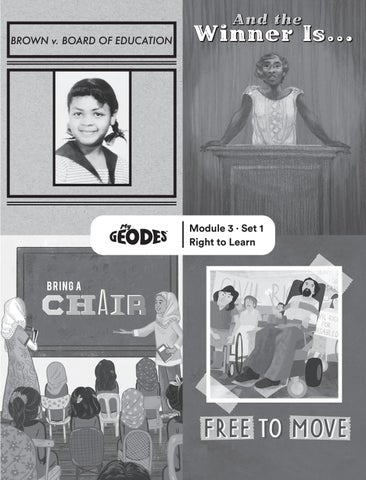
BROWN v. BOARD OF EDUCATION
Module 3 · Set 1 Right to Learn
Fundations® Focus Concept Double Vowel Syllable (ai, ay /a/; ee, ea, ey /e/)
Wit & Wisdom® Alignment Civil Rights Heroes (02.03) Great Minds ®
FREE TO MOVE
Fundations® Alignment • At least 80% decodable at Level 2, Unit 11
02.07.P1 Book 1 THT_CVR.indd 1
1/10/20 3:29 PM
Module 3 • Set 1 • Right to Learn CONTENTS Brown v. Board of Education .
1
And the Winner Is. . . . . . . .
11 1
Bring a Chair . . . . . . . . .1 Free to Move . . . . . . . . .
1
This book belongs to . . . . . . . . . . . . . . . . . . . . . . . . . .
02.07.P1 Book 1 THT_INT.indd 1
1/14/20 2:28 PM
Great Minds® is the creator of Eureka Math®, Wit & Wisdom®, Alexandria Plan™, and PhD Science™. Geodes® are published by Great Minds in association with Wilson Language Training, publisher of Fundations®. Credits
Brown v. Board of Education: Special thanks to Jeremy Stern for his guidance on this module of books; Front cover and p. 14, photographs by The Associated Press; front and back covers (paper texture), Pattern image/ Shutterstock.com; pp. 0, 3, 5, 7, 8, 11 (both), back cover, Carl Iwasaki/The LIFE Images Collection/Getty Images; pp. 1, 10, photastic/Shutterstock; pp. 2, 4, 6, sumire8/Shutterstock.com; pp. 3, 5, 7–9, 11–14 (photo frames), Ice_AisberG/Shutterstock.com; p. 9, Hank Walker/The LIFE Picture Collection/Getty Images; pp. 12–13, Richard Stacks/Baltimore Sun/TNS via Getty Images; More page, Library of Congress, Prints and Photographs Division And the Winner Is . . . : Special thanks to Carole Boston Weatherford for her guidance on books in this module; p. 13, Quote amended from Open Wide the Freedom Gates: A Memoir, 2005, by Dorothy Height; More page, Afro Newspaper/ Gado/Getty Images Bring a Chair: More page, UN Photo/Sahem Rababah Free to Move: More page, Keystone Press/Alamy Stock Photo
Copyright © 2020 Great Minds®: Brown v. Board of Education And the Winner Is . . . Bring a Chair Free to Move greatminds.org ISBN 978-1-64497-440-7 Printed in the USA 10 9 8 7 6 5 4 3 2 1
02.07.P1 Book 1 THT_INT.indd 2
1.2
1/14/20 2:28 PM
BROWN v. BOARD OF EDUCATION
by Chrystal D. Giles
02.07.P1 Book 1 THT_INT.indd 3
1/14/20 2:28 PM
02.07.P1 Book 1 THT_INT.indd 4
1/14/20 2:28 PM
The cold air stung Linda Brown’s skin. She walked many blocks, past the rail yard, by the big street. She dashed up the steps of the bus and rode two miles to school. Some days, it was so cold that she had to turn back and run home.
1
02.07.P1 Book 1 THT_INT.indd 1
1/14/20 2:28 PM
Her friends went to school just blocks from her home. Linda wished she could go there, too. But in 1950, she could not. Linda could play with her white friends on the block, but she could not go to school with them. Black children had to go to their own schools. “Separate but equal” was the law.
2
02.07.P1 Book 1 THT_INT.indd 2
1/14/20 2:28 PM
3
02.07.P1 Book 1 THT_INT.indd 3
1/14/20 2:28 PM
Linda’s dad, Oliver Brown, thought this law was unjust. He told her he would do something about it. He held her hand as they walked to the nearby school. He wanted her to go there with the white children. He gave them her name. Linda was turned away.
4
02.07.P1 Book 1 THT_INT.indd 4
1/14/20 2:28 PM
5
02.07.P1 Book 1 THT_INT.indd 5
1/14/20 2:28 PM
Other black children in the city wanted to attend the schools near their homes, too, like the white children. They were turned away.
6
02.07.P1 Book 1 THT_INT.indd 6
1/14/20 2:28 PM
7
02.07.P1 Book 1 THT_INT.indd 7
1/14/20 2:28 PM
Linda’s family and friends, and others in the city, took action. They all went to court to demand a change in the law.
8
02.07.P1 Book 1 THT_INT.indd 8
1/14/20 2:28 PM
Each person had a story of injustice to tell. Thurgood Marshall, a lawyer, helped people tell of these injustices in court. He said segregation, or keeping black and white children separate in schools, was unequal. 9
02.07.P1 Book 1 THT_INT.indd 9
1/14/20 2:28 PM
The family waited to see whether the law would change. In the meantime, Linda played with her friends, but still had to take the bus for miles. After three long years, the court order finally came.
10
02.07.P1 Book 1 THT_INT.indd 10
1/14/20 2:28 PM
11
02.07.P1 Book 1 THT_INT.indd 11
1/14/20 2:28 PM
The court said it was not fair to use skin color to separate school children. The new law said black and white children would go to school together.
12
02.07.P1 Book 1 THT_INT.indd 12
1/14/20 2:28 PM
Linda’s mom told her the good news. Her family and friends went to a rally in the city. It was a win for justice.
13
02.07.P1 Book 1 THT_INT.indd 13
1/14/20 2:28 PM
By then, the Brown family lived in a new home in a new city, but other children would not have to walk many blocks, past a rail yard, by a big street. They would go to school with all their friends.
14
02.07.P1 Book 1 THT_INT.indd 14
1/14/20 2:28 PM
More
Thurgood Marshall was the lawyer who argued Brown v. Board of Education. He knew that separate schools were rarely equal. As a boy in Baltimore, he was not allowed to attend schools with white children. His schools had good teachers, but they did not have the same resources. Later, he could not apply to certain colleges or law schools. They would not accept African Americans. Although Marshall faced challenges, he became one of the country’s most famous lawyers. In 1967, President Lyndon B. Johnson nominated Marshall to the Supreme Court. The Supreme Court is included in one of the three main branches of government in the United States. The judges on the Supreme Court decide whether laws support or go against the Constitution. A Supreme Court justice is appointed, or given the job, for life.
15
02.07.P1 Book 1 THT_INT.indd 15
1/14/20 2:28 PM
Más
Thurgood Marshall fue el abogado que argumentó la causa de Brown vs. La Junta de Educación. Él sabía que las escuelas separadas eran rara vez iguales. Cuando era niño, en Baltimore, no le permitieron asistir a las escuelas de niños blancos. Las escuelas a las que él iba tenían buenos maestros, pero no tenían los mismos recursos. Tiempo después, no pudo postularse a ciertas universidades o escuelas de derecho. No aceptaban a afroamericanos. Aunque Marshall enfrentó dificultades, se convirtió en unos de los abogados más famosos del país. En 1967, el presidente Lyndon B. Johnson nominó a Marshall para la Corte Suprema. La Corte Suprema es uno de los tres poderes principales del gobierno de Estados Unidos. Los jueces de la Corte Suprema deciden si las leyes avalan o contradicen la Constitución. El nombramiento —o cargo— de juez de la Corte Suprema es de por vida.
16
02.07.P1 Book 1 THT_INT.indd 16
1/14/20 2:28 PM
words by
illustrations by
02.07.P1 Book 1 THT_INT.indd 19
1/14/20 2:28 PM
02.07.P1 Book 1 THT_INT.indd 20
1/14/20 2:28 PM
“And the winner is . . .”
The people leaned in. Dorothy Height was standing next to 16 opponents. Everyone waited for the judges to name the winner. 1
02.07.P1 Book 1 THT_INT.indd 1
1/14/20 2:28 PM
Dorothy had worked hard to get to the finals of the speech contest. She was an outstanding student and made all A’s. She also sang with her school’s singing club. Performing helped Dorothy become confident in front of many people. 2
02.07.P1 Book 1 THT_INT.indd 2
1/14/20 2:28 PM
In time, Dorothy became an impressive public speaker, too. She entered her school’s Impromptu Speech Contest. In this contest, her speech was impromptu, or right on the spot. She could not prepare the words beforehand.
3
02.07.P1 Book 1 THT_INT.indd 3
1/14/20 2:28 PM
Dorothy won her school’s speech contest. Her prize was a trip to the state speech finals. A person of color had never won at state before.
4
02.07.P1 Book 1 THT_INT.indd 4
1/14/20 2:28 PM
The finals would be at the state capital, 200 miles from home. To make the moment special, Dorothy’s mom gave her a beautiful white dress. “Whatever happens, hold yourself together,” her mom said.
02.07.P1 Book 1 THT_INT.indd 5
5
1/14/20 2:28 PM
Dorothy’s teacher and principal came with her on the trip to the finals. They left early for the big event. After the long drive, Dorothy needed to get into her dress. They stopped at a hotel near the speech contest hall. Then, there was trouble.
6
02.07.P1 Book 1 THT_INT.indd 6
1/14/20 2:28 PM
7
02.07.P1 Book 1 THT_INT.indd 7
1/14/20 2:28 PM
The year was 1928. Many African Americans faced segregation. Some stores and restaurants would not serve them because of their skin color. African Americans were not always free to go where they wanted. Dorothy’s teacher came out of the hotel with tears in her eyes. “You can’t get dressed here,” she said. “Why not?” Dorothy asked. “They will not let you come in because of the color of your skin,” she said.
8
02.07.P1 Book 1 THT_INT.indd 8
1/14/20 2:28 PM
But nothing was going to stop Dorothy. Quickly, she came up with a plan. She would get dressed in the restroom at the speech contest hall.
9
02.07.P1 Book 1 THT_INT.indd 9
1/14/20 2:28 PM
Dorothy could have quit, but she remembered her mother’s words: “Hold yourself together.” 10
02.07.P1 Book 1 THT_INT.indd 10
1/14/20 2:28 PM
Dorothy waited for her turn. Once she was given her topic, she would have just ten minutes to think of what to say. 11
02.07.P1 Book 1 THT_INT.indd 11
1/14/20 2:28 PM
It was finally Dorothy’s turn to speak. She walked nervously to the podium. More than 2,000 faces looked back at her. Dorothy breathed deeply and let her words fill the hall. She spoke about respect and how all people are part of the same human family. She spoke about the injustice at the hotel. Her voice soared as she spoke of freedom and justice for all.
12
02.07.P1 Book 1 THT_INT.indd 12
1/14/20 2:29 PM
ch o t he r a s p
art
o
ill
d fin we
ot h
ee ac h
w
ace.” ing pe last
“Only when w e se
y
f th same hu e h t f es e w f i nd lamsa t oi l l w y rw l i t am a innfg ms p y l a f a n e mpea an er a i l ce m u .” h n he
“O
e e ea s e w
13
02.07.P1 Book 1 THT_INT.indd 13
1/14/20 2:29 PM
The people cheered wildly. The judges’ pick was clear: “And the winner is . . . Dorothy Height!”
14
02.07.P1 Book 1 THT_INT.indd 14
1/14/20 2:29 PM
More
Dorothy Height was born in 1912 and grew up in the small town of Rankin, Pennsylvania. Height’s talents earned respect from those around her. She used those talents to fight for justice all her life. In her last year of high school, Height won $1,000 in a speech contest. She used the money for college and became a social worker. She also joined the National Council of Negro Women (NCNW). This group worked to gain equal rights for African American women. For nearly 40 years, Height led the NCNW’s fight for justice. Over the years, Dorothy Height worked with others to plan marches, speeches, and protests. She became a major figure in the civil rights movement. Height was one of the organizers for the March on Washington in 1963. It was one of the largest marches for justice in American history.
15
02.07.P1 Book 1 THT_INT.indd 15
1/14/20 2:29 PM
Más
Dorothy Height nació en 1912 y creció en Rankin, un pequeño pueblo en Pennsylvania. Sus talentos hicieron que se ganara el respeto de todos los que la rodeaban. Usó esos talentos para luchar por la justicia toda su vida. En su último año de la escuela secundaria Height ganó $1,000 en un concurso de oratoria. Usó ese dinero para la universidad y se convirtió en trabajadora social. También se sumó al Consejo Nacional de Mujeres Negras (NCNW, por sus siglas en inglés). Este grupo trabajó para que las mujeres afroamericanas obtuvieran igualdad de derechos. Height lideró la lucha del NCNW por casi 40 años. A través de los años, Dorothy Height trabajó con otras personas para planear marchas, discursos y protestas. Se convirtió en una figura importante del movimiento por los derechos civiles. Height fue una de las organizadoras de la Marcha de Washington de 1963. Esta fue una de las marchas por la justicia más grandes de la historia estadounidense.
16
02.07.P1 Book 1 THT_INT.indd 16
1/14/20 2:29 PM
story by Michelle Palmieri • illustrated by Madelyn Goodnight
02.07.P1 Book 1 THT_INT.indd 19
1/14/20 2:29 PM
02.07.P1 Book 1 THT_INT.indd 20
1/14/20 2:29 PM
On hilly streets, modern shops stand next to stone buildings made long ago. Here, the old and the new sit side by side. This is Amman, Jordan.
1
02.07.P1 Book 1 THT_INT.indd 1
1/14/20 2:29 PM
Tucked between shops and buildings is Miss Maha’s school for girls. Miss Maha has been leading this school for years. At first, classes were filled with girls who came from homes nearby. But slowly, things started to change.
2
02.07.P1 Book 1 THT_INT.indd 2
1/14/20 2:29 PM
3
02.07.P1 Book 1 THT_INT.indd 3
1/14/20 2:29 PM
Not far from Jordan, in a country called Syria, a war had begun. The fighting disrupted everyday life. Streets were unsafe. Stores and schools shut down.
4
02.07.P1 Book 1 THT_INT.indd 4
1/14/20 2:29 PM
Many Syrians were afraid to stay in their homes, or even to remain in the country. They left their homeland, seeking a safe place. People fled to Jordan by the thousands.
5
02.07.P1 Book 1 THT_INT.indd 5
1/14/20 2:29 PM
The homes and streets near Miss Maha’s school became shelter for one Syrian family after another. Before long, Syrian mothers came to Miss Maha looking for help. If they were going to stay in Jordan, their children needed to go to school.
6
02.07.P1 Book 1 THT_INT.indd 6
1/14/20 2:29 PM
“Our girls need to learn how to read and write. Please, let them come to your school,” the women would ask.
Miss Maha wanted to help. But there were no open spots in her classes. Every chair was filled. She had to say no.
02.07.P1 Book 1 THT_INT.indd 7
7
1/14/20 2:29 PM
8
02.07.P1 Book 1 THT_INT.indd 8
1/14/20 2:29 PM
One day, another mother came to see Miss Maha. Her name was Lina, and she was trying to find a school for her daughter. Miss Maha told her, “I do not have any seats left.” But Lina would not give up. She had visited many schools, and they had all turned her away. She pleaded with Miss Maha. Miss Maha looked up at Lina and said, “OK. I will make room for your child. But we have no more chairs. My students cannot sit on the floor to complete their lessons. So have her bring her own chair.” 9
02.07.P1 Book 1 THT_INT.indd 9
1/14/20 2:29 PM
Gratefully, Lina returned with her daughter—and a small plastic chair.
10
02.07.P1 Book 1 THT_INT.indd 10
1/14/20 2:29 PM
11
02.07.P1 Book 1 THT_INT.indd 11
1/14/20 2:29 PM
After that, other Syrian women came to see Miss Maha. Each time, the offer was the same: She would teach any girl who came to class with her own chair.
12
02.07.P1 Book 1 THT_INT.indd 12
1/14/20 2:29 PM
13
02.07.P1 Book 1 THT_INT.indd 13
1/14/20 2:29 PM
Today, Miss Maha’s school is filled with all kinds of chairs. Girls from Jordan and Syria sit and learn, side by side. Like the modern shops and old stone buildings, they all belong here.
14
02.07.P1 Book 1 THT_INT.indd 14
1/14/20 2:29 PM
More
People who choose to leave their native countries and make their homes in a new country are called immigrants. Immigrants often move in search of a better way of life. They may hope to have more freedom, better schools, or new jobs. Refugees are people who feel they must leave their native countries because they are in danger. Some refugees are in danger because of their race, religion, or political views. Others are at risk because of wars in their home countries. Many refugees hope to return home when it is safe again. Some refugees, however, leave their home countries forever. Organizations around the world help support refugees. These groups may offer food, clothing, and shelter. One organization that provides aid is the United Nations (UN). In 2018, the UN reported that there were more than 25 million refugees in the world.
In 2017, about 80,000 Syrian refugees lived in this refugee camp in Jordan.
15
02.07.P1 Book 1 THT_INT.indd 15
1/14/20 2:29 PM
Más
Las personas que eligen irse de sus países de origen y formar sus hogares en un nuevo país se llaman inmigrantes. Los inmigrantes normalmente se trasladan en búsqueda de una vida mejor. Quizá esperan tener más libertad, mejores escuelas o nuevos trabajos. Los refugiados son personas que piensan que deben irse de sus países de origen porque corren peligro. Algunos refugiados corren peligro por su raza, religión o ideas políticas. Otros están en peligro debido a las guerras en sus países de origen. Muchos refugiados tienen la esperanza de regresar a su país cuando éste sea seguro. Sin embargo, algunos refugiados abandonan sus países para siempre. Hay organizaciones en todo el mundo que ayudan a los refugiados. Estos grupos pueden ofrecer alimentos, ropa y refugio. Una organización que proporciona asistencia es la Organización de las Naciones Unidas (ONU). En 2018, la ONU informó que había más de 25 millones de refugiados en el mundo.
16
02.07.P1 Book 1 THT_INT.indd 16
1/14/20 2:29 PM
FREE TO MOVE words by Sumin Lee illustrated by John Joven
02.07.P1 Book 1 THT_INT.indd 19
1/14/20 2:29 PM
02.07.P1 Book 1 THT_INT.indd 20
1/14/20 2:29 PM
Ed Roberts was born in California in 1939. He led an active life with his three brothers. He had fun playing baseball.
1
02.07.P1 Book 1 THT_INT.indd 1
1/14/20 2:29 PM
When he was 14, Ed became very sick with polio. He could not move most of his body. He had to use a big machine, called an iron lung, to breathe. He could not go to school. Ed stayed in the hospital until he was 16. Once he got home, he kept up with his classes by phone. He trained his body to gulp air into his lungs so he could sit up in a wheelchair.
2
02.07.P1 Book 1 THT_INT.indd 2
1/14/20 2:29 PM
bellows
access port
motor
3
02.07.P1 Book 1 THT_INT.indd 3
1/14/20 2:29 PM
Then, he went back to school. The kids would stare as he was lifted out of the car. They had not seen people with disabilities like his before. Their stares did not bother Ed.
4
02.07.P1 Book 1 THT_INT.indd 4
1/14/20 2:29 PM
Ed learned to fight for what he needed. There was a rule that said students had to complete gym classes and take a test to drive a car. Ed’s mom helped him work with the school, and Ed finally got his diploma.
5
02.07.P1 Book 1 THT_INT.indd 5
1/14/20 2:29 PM
Ed wanted to go to a university. But where would he live? He was the first person with this kind of disability on campus. The student rooms could not hold his big iron lung. The school said Ed had to live in the campus hospital, away from the other students.
6
02.07.P1 Book 1 THT_INT.indd 6
1/14/20 2:29 PM
7
02.07.P1 Book 1 THT_INT.indd 7
1/14/20 2:29 PM
Other students with disabilities like Ed’s started attending the university. The school said they had to move into the hospital, too. Ed and these students became friends.
8
02.07.P1 Book 1 THT_INT.indd 8
1/14/20 2:29 PM
The students wanted to be independent, but traveling all over the campus by wheelchair was difficult for them. They needed to be pushed down small hallways and bumped over curbs. Many buildings had stairs. Ed needed four people to pull his wheelchair up the steps. 9
02.07.P1 Book 1 THT_INT.indd 9
1/14/20 2:29 PM
Ed and these students formed a group called the Rolling Quads. They worked to help others understand the needs of people with disabilities. The Rolling Quads demanded ramps be added near stairs. They asked for cuts in the curb at crosswalks so they could move their own chairs.
10
02.07.P1 Book 1 THT_INT.indd 10
1/14/20 2:29 PM
Ed and others led protests and spoke up. Ed got a job helping the school design new buildings that people with disabilities could enter without help. The members took pride in what they were doing to make the campus and community better.
11
02.07.P1 Book 1 THT_INT.indd 11
1/14/20 2:29 PM
12
02.07.P1 Book 1 THT_INT.indd 12
1/14/20 2:29 PM
Ed went on to get two degrees. He became a teacher at the university. Ed spent his life working so that others with disabilities could live full, free lives.
02.07.P1 Book 1 THT_INT.indd 13
13
1/14/20 2:29 PM
After Ed died, the Ed Roberts Campus building opened in Berkeley, California, where he went to school. In memory of Ed, it is carefully designed so everyone can enter and find support. 14
02.07.P1 Book 1 THT_INT.indd 14
1/14/20 2:29 PM
More
In the early 1950s, polio was a major health problem. During that time, more than 15,000 new cases of polio were reported in the United States each year. Many people feared the disease. It spread easily and had no cure.
Jonas Salk
Polio is a virus, or a type of germ that can cause illness. Some people with the polio virus have no symptoms. Others have only headaches or fevers. Still others are paralyzed. Some people can move only parts of their bodies, while others cannot move at all. Polio patients with paralyzed chest muscles cannot breathe on their own. In the 1950s, these patients used a machine called an iron lung. This machine pushed air in and out of their lungs. Two researchers, Jonas Salk and Albert Sabin, worked to develop vaccines to help bring an end to polio in the United States. A vaccine is a medicine that protects the body from an illness. In 1955, the United States approved a vaccine to prevent polio. Today, doctors still suggest that all children get a vaccine against polio.
15
02.07.P1 Book 1 THT_INT.indd 15
1/14/20 2:29 PM
Más
A principios de la década de 1950, la poliomielitis era un problema de salud pública grave. Durante esa época, se reportaban más de 15000 nuevos casos de polio por año en Estados Unidos. Mucha gente le temía a la enfermedad. Se contagiaba fácilmente y no tenía cura. La polio es un virus —o un tipo de germen— que puede causar una enfermedad. Algunas personas que tienen el virus de la polio no tienen síntomas. Otras tienen solo dolores de cabeza o fiebre. Pero a otras hasta les da parálisis. Algunas personas pueden mover solo algunas partes del cuerpo, mientras que otras no pueden mover ninguna. Los pacientes con parálisis de los músculos del pecho causada por la polio no pueden respirar por sí mismos. En la década de 1950, estos pacientes usaban una máquina llamada pulmón de acero. La máquina empujaba el aire para que este entrara y saliera de sus pulmones. Dos investigadores, Jonas Salk y Albert Sabin, trabajaron en el desarrollo de vacunas para ayudar a ponerle fin a la poliomielitis en Estados Unidos. Una vacuna es un medicamento que protege al cuerpo de una enfermedad. En 1955, Estados Unidos aprobó una vacuna para prevenir la polio. Hoy en día, los médicos aún sugieren que todos los niños se vacunen contra la polio.
16
02.07.P1 Book 1 THT_INT.indd 16
1/14/20 2:29 PM
BROWN v. BOARD OF EDUCATION
Module 3 · Set 1 Right to Learn
Fundations® Focus Concept Double Vowel Syllable (ai, ay /a/; ee, ea, ey /e/)
Wit & Wisdom® Alignment Civil Rights Heroes (02.03) Great Minds ®
FREE TO MOVE
Fundations® Alignment • At least 80% decodable at Level 2, Unit 11
02.07.P1 Book 1 THT_CVR.indd 1
1/10/20 3:29 PM