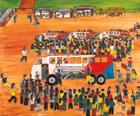
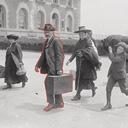
• Learning Goal | Organize key details in Islandborn.
• Language Progress | Answer questions to explain what you mean.
Prologue to L4
• Learning Goal | Use adjectives to describe the Monster and heroes in Islandborn
• Language Progress | Use adjectives to tell more about nouns.
Prologue to L6
• Learning Goal | Describe the memories the characters have of the Island.
• Language Progress | Use a subordinating conjunction to expand ideas.
14
20
26
Prologue to L7
• Learning Goal | Describe key events in “Cuando salimos de El Salvador/When We Left El Salvador.”
• Language Progress | Use a subordinating conjunction to combine ideas.
Prologue to L8
• Learning Goal | Organize key events in the Writing Model for Module 3.
• Language Progress | Use a subordinating conjunction to expand ideas.
Prologue to L9
• Learning Goal | Sequence events in Jorge Argueta’s poems.
• Language Progress | Use temporal words and phrases to sequence events.
Arc B | The Keeping Quilt, The Blessing Cup
Prologue to L12
• Learning Goal | Examine how family members use the quilt across generations in The Keeping Quilt
• Language Progress | Use a coordinating conjunction to combine ideas.
Prologue to L13
• Learning Goal | Compare weddings in The Keeping Quilt.
• Language Progress | Use a coordinating conjunction to combine ideas.
32
38
44
50
56
Prologue to L14
• Learning Goal | Describe how the family uses the quilt as a keepsake.
• Language Progress | Use a subordinating conjunction to expand ideas.
Arc C | Liberty Enlightening the World, “The New Colossus”
Prologue to L20
• Learning Goal | Use temporal words to sequence events in the Writing Model for Module 3.
• Language Progress | Use temporal words and phrases to sequence events.
Prologue to L21
• Learning Goal | Describe Liberty Enlightening the World.
• Language Progress | Use adjectives to tell more about nouns.
Prologue to L22
• Learning Goal | Compare responses to characters’ memories from different texts in the module.
• Language Progress | Add adjectives and adverbs to descriptive details in events.
62
Arc D | “Story Painter: Cy Thao and the Hmong Experience”
Prologue to L23
• Learning Goal | Examine dialogue in the Writing Model for Module 3.
• Language Progress | Use commas and quotation marks in dialogue.
Prologue to L24
• Learning Goal | Sequence key events in “Story Painter.”
86
92
68
74
80
• Language Progress | Use temporal words and phrases to sequence events.
Prologue to L26
• Learning Goal | Examine connections between the text and images in “Story Painter.”
• Language Progress | Ask questions to clarify what others mean.
98
Arc E | Watercress
Prologue to L29
• Learning Goal | Examine key events in Watercress
• Language Progress | Use temporal words and phrases.
Prologue to L30
• Learning Goal | Examine the characters’ opinions about gathering and eating free watercress.
• Language Progress | Use a coordinating conjunction to combine ideas.
Prologue to L32
• Learning Goal | Examine the girl’s feelings about watercress.
• Language Progress | Use adjectives to tell more about nouns.
106
112
118
Appendices
Prologue Vocabulary
Prologue
Prologue
Acknowledgments
How do stories help us understand immigrants’ experiences?
PROLOGUE MODULE FOCUS
In module 3, Arts & Letters Prologue™ lessons focus on helping students deepen their understanding of immigrants’ experiences through stories.
• Prologue lessons support reading development by providing opportunities for students to discuss key events and details from module texts. Students read Islandborn, a story about a girl who draws on the recollections of family and neighbors to help her remember what life was like in the Dominican Republic. They read Jorge Argueta’s poems about his experiences emigrating from El Salvador to the United States. Students learn about a Jewish Russian American family that passes down a keepsake and traditions in The Keeping Quilt. Finally, students read “Story Painter” and Watercress to learn about how immigrants honor and share painful memories with others.
• Prologue lessons support writing development by helping students use temporal words to sequence events. Students also practice writing dialogue using commas and quotation marks. This support prepares students to write narratives for the module tasks.
• Prologue lessons support speaking and listening development by providing more instruction and practice for the module’s speaking and listening goals: Answer questions to explain what you mean, and ask questions to clarify what others mean. Use the Module 3 Speaking and Listening Goal Tracker to track progress toward these goals.
• Prologue lessons support language development by providing opportunities for students to use coordinating and subordinating conjunctions to combine and expand ideas. Students also use adjectives to describe nouns and practice using consistent verb tenses.
PROLOGUE TEXTS
Books
Literary
• Islandborn, Junot Díaz and Leo Espinosa
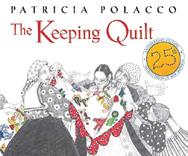
• The Keeping Quilt, Patricia Polacco
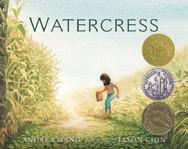
• Watercress, Andrea Wang and Jason Chin
Poetry
• “Nido familiar/Family Nest,” Jorge Argueta
• “Voz hogareña/Voice from Home,” Jorge Argueta
• “Cuando salimos de El Salvador/When We Left El Salvador,” Jorge Argueta
Article
• “Story Painter: Cy Thao and the Hmong Experience,” Missy McDonald
Art
• Liberty Enlightening the World, Frédéric Auguste Bartholdi
Video
• “Hmong Story Cloths,” Great Minds®
KNOWLEDGE THREADS
• Since the founding of the United States, immigrants and their experiences have been a part of our national identity.
• People immigrate to new countries for a variety of reasons, including the need for physical safety, economic opportunity, and political or religious freedom.
• People who flee great danger in their country of origin are sometimes called refugees.
• People preserve and share special objects to help future generations understand history or memories.
• Stories provide insight into an individual’s or group’s experiences.
PROLOGUE MATERIALS AND PREPARATION
Prepare the following materials for use throughout the module.
• Determine how to access the module texts.
• Determine how to display Prologue reference charts, Prologue student resources, and select Learn book pages. These are listed in the Materials section of each lesson.
• Print or copy student resources from the Prologue Student Resources appendix. These are listed in the Materials section of each lesson.
• Determine how to access the Module 3 Speaking and Listening Goal Tracker from the digital platform.
• Ensure access to the module 3 Knowledge Cards.
• Ensure students have paper for short responses. They can use their journals or other paper.
• For a comprehensive list of all materials used in the module, see the digital platform.
PROLOGUE ENGLISH LANGUAGE DEVELOPMENT STANDARDS
Arts & Letters Prologue lessons for module 3 provide additional language support to develop the following English Language Development (ELD) standards. Educators should consult their state’s ELD standards and proficiency descriptors to identify the best ways to help multilingual learners reach the module’s learning goals. See the digital platform for a lesson-by-lesson breakdown of ELD standards.
WIDA Standards
ELD-SI.K-3.Narrate: Multilingual learners will
• Share ideas about one’s own and others’ lived experiences and previous learning
• Connect stories with images and representations to add meaning
• Ask questions about what others have shared
• Recount and restate ideas
ELD-SI.K-3.Inform: Multilingual learners will
• Define and classify objects or concepts
• Describe characteristics, patterns, or behavior
ELD-SI.K-3.Explain: Multilingual learners will
• Share initial thinking with others
• Compare and contrast objects or concepts
ELD-SI.K-3.Argue: Multilingual learners will
• Support own opinions with reasons
ELD-LA.2-3.Narrate.Interpretive: Multilingual learners will interpret language arts narratives by
• Determining the meaning of words and phrases as they are used in texts, distinguishing literal from nonliteral language
ELD-LA.2-3.Narrate.Expressive: Multilingual learners will construct language arts narratives that
• Develop story with time and event sequences, complication, resolution, or ending
ELP Standards
Standard 1: An ELL can construct meaning from oral presentations and literary and informational text through grade-appropriate listening, reading, and viewing.
Standard 2: An ELL can participate in grade-appropriate oral and written exchanges of information, ideas, and analyses, responding to peer, audience, or reader comments and questions.
Standard 3: An ELL can speak and write about grade-appropriate complex literary and informational texts and topics.
Standard 4: An ELL can construct grade-appropriate oral and written claims and support them with reasoning and evidence.
Standard 7: An ELL can adapt language choices to purpose, task, and audience when speaking and writing.
Standard 8: An ELL can determine the meaning of words and phrases in oral presentations and literary and informational text.
Standard 9: An ELL can create clear and coherent grade-appropriate speech and text.
Standard 10: An ELL can make accurate use of standard English to communicate in grade-appropriate speech and writing.
PROLOGUE LANGUAGE CONNECTIONS
Students’ home languages and cultures are assets that everyone in the school setting should value and celebrate. Teachers can support the strategic use of home languages to facilitate activating background knowledge, acquiring ELA knowledge and world knowledge, and engaging with grade-level content. This can happen individually or in groups. Teachers should encourage students to draw explicit metalinguistic connections between English and their home language through cognates and morphological awareness.
Multilingual learners in the United States speak a variety of languages at home, but an increasing majority speak Spanish at home. In 2019, more than 75 percent of students who were identified as “English learners” spoke Spanish as a home language (National Center for Education Statistics). For this reason, we offer a number of supports for Spanish speakers.
Contrastive Analysis
This module focuses on helping students use coordinating and subordinating conjunctions to combine and expand ideas. Prologue lessons help students understand the use and placement of adjectives and the importance of using consistent verb tenses. For students who also speak other language(s), the grammatical rules of English may be confusing. Here are some grammatical differences for which students may need extra explanation and modeling of this structure. In addition to Spanish, we compare English to Arabic and Chinese, the second and third most common languages spoken among multilingual learners in the United States (National Center for Education Statistics).
Language Similarity
Spanish Coordinating and subordinating conjunctions are also used in Spanish, with similar meaning to English terms, to combine sentences.
Adjectives are also used in Spanish.
Difference
There is not a 1:1 correspondence between English and Spanish conjunctions. There may be confusion between since, so that, and because.
In Spanish, adjectives can come before or after nouns.
Language Similarity Difference
Arabic Both English and Arabic employ coordinating conjunctions to join words, phrases, or independent clauses of equal importance.
There are coordinating conjunctions in Arabic with similar meaning to those in English.
Both English and Arabic have comparative and superlative forms of adjectives to indicate degrees of comparison.
Both English and Arabic express the past, present, and future tenses.
Chinese There are direct similarities when using both coordinating and subordinating conjunctions within Chinese and English, particularly in informal speech. Informally, Chinese conjunctions work in a similar way to those found in English.
As in English, adjectives precede nouns.
Arabic has fewer coordinating conjunctions compared to English.
Arabic adjectives must agree with the noun they modify in gender, number, and case. Adjectives generally come after the noun they modify.
English has a wider range of tenses compared to Arabic (which has essentially three tenses: past, present, and future).
In some cases, Chinese conjunctions occur in sets rather than a single word.
Adjectives can act as stative verbs, and in certain cases, a character is used to denote that words are adjectives.
Chinese verbs are not conjugated. They are stand-alone words or phrases.
Auxiliary or modal verbs, phrases, or indicators of time determine tenses.
Spanish Cognates
Here are Spanish cognates for terms taught in module 3 Prologue lessons. Teacher notes in the lessons draw attention to Spanish cognates. Use an online Spanish dictionary for pronunciation guidance or to play a recording of the Spanish cognate for students.
Term Cognate
experience (n.)
generation (n.)
immigrant (n.)
immigrate (v.)
memory (n.)
narrative (n.)
sculpture (n.)
experiencia (s.)
generación (s.)
inmigrante (s.)
inmigrar (v.)
memoria (s.) (only if referring to the store of memories or the capacity to remember; otherwise, “a memory” is “un recuerdo,” which is not a cognate)
narrativa (s.)
escultura (s.)
MODULE PLAN KEY
Essential Question | How do stories help us understand immigrants’ experiences?
Arc A | Islandborn
Lesson 1
Opening Bookend
Lesson 2
Wonder Islandborn Empirical Construction, Istanbul
Lesson 3
Organize Islandborn Empirical Construction, Istanbul
Lesson 4
Reveal Islandborn Empirical Construction, Istanbul
Lesson 5
Reveal Islandborn
Distill Empirical Construction, Istanbul
Lesson 6
Distill Islandborn
Know Empirical Construction, Istanbul
= assessment = Prologue lesson
Lesson 7
Organize
“Cuando salimos de El Salvador/ When We Left El Salvador”
“Voz hogareña/ Voice from Home”
“Nido familiar/ Family Nest”
Lesson 8
Reveal
“Cuando salimos de El Salvador/ When We Left El Salvador”
“Voz hogareña/ Voice from Home”
“Nido familiar/ Family Nest”
Lesson 9
Distill
“Cuando salimos de El Salvador/ When We Left El Salvador”
“Voz hogareña/ Voice from Home”
“Nido familiar/ Family Nest”
Lesson 10
Know Islandborn
“Cuando salimos de El Salvador/ When We Left El Salvador”
“Voz hogareña/ Voice from Home”
“Nido familiar/ Family Nest”
“Hispaniola”
Arc B | The Keeping Quilt, The Blessing Cup
Lesson 11
Wonder The Keeping Quilt
Module Task 1 completed
Lesson 18
Responsive Teaching
Reading Comprehension Assessment 1
Arc C | Liberty Enlightening the World, “The New Colossus”
Lesson 19
Reveal
Liberty Enlightening the World
Lesson 20
Know “The New Colossus”
Lesson 21
Distill Liberty Enlightening the World
“The New Colossus”
Lesson 22
Know Liberty Enlightening the World Empirical Construction, Istanbul
Arc D | “Story Painter: Cy Thao and the Hmong Experience”
Lesson 23
Wonder “Story Painter”
Lesson 24
Organize “Story Painter”
Lesson 25
Reveal “Story Painter”
Lesson 26
Reveal “Story Painter”
Module Task 2 completed
Lesson 27
Know “Story Painter”
Arc E | Watercress
Module Finale
End-of-Module Task completed
Prologue to Lesson 3
Essential Question | How do stories help us understand immigrants’ experiences?
OVERVIEW
Preview
Students read an excerpt from Islandborn to explain what Lola plans to do to complete her drawing of her first country. As they discuss Lola’s plan, students practice answering questions to explain what they mean. This work prepares students to identify key story elements in Islandborn in lesson 3.
Learning Goal
Organize key details in Islandborn.
LEARNING TASK: Explain what Lola plans to do to complete her drawing.
Language Progress
In this lesson, students work on this module speaking and listening goal: Answer questions to explain what you mean.
To support students with beginning English proficiency, model how to share a memory and to explain why it is a special memory by using this sentence frame: I think this is a special memory because . To support students with intermediate English proficiency, encourage them to share a special memory and explain why it is a special memory by using this sentence frame: I think because .
Vocabulary
memory (n.)
Materials
TEACHER
• Islandborn
• Knowledge Card: memory
STUDENTS
• Islandborn
• Talking Tool (Learn book)
Preparation
• none
LAUNCH
5 minutes
Discuss Prior Knowledge
1. Model how to share a very early memory in your life. Instruct students to Think–Pair–Share the answer to this question:
What is one of the first things you remember in your life?
Language Support
If possible, pair students who speak the same home language, and instruct them to share one of the first things they remember in their life.
2. Emphasize that remembering the earliest times in our lives can be difficult.
3. Introduce the vocabulary term memory by displaying the Knowledge Card. Engage students in Vocabulary Exploration.
Language Supports
The term memory has a false Spanish cognate: memoria. Share this language connection with students whose home language is Spanish to help them differentiate the terms and avoid confusion.
For students with beginning English proficiency, show them an image of photographs to help them understand what memory means.
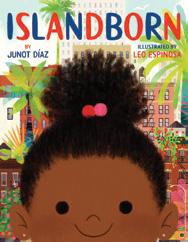
4. Display Islandborn. Echo Read the title. Ask these questions:
What words do you see in the title?
Who is the girl in the illustration?
5. Reinforce the correct responses:
• words—Island, born
• girl—Lola
Definition memory (n.): something that is remembered
6. Tell students that they will look at what Lola plans to do to learn about the Island she was born on but doesn’t remember.
LEARN 20 minutes
Key Details in Islandborn
1. Display the illustration on page 4 of Islandborn and direct students to their copies of the text. Explain that the children in the illustration are students who come from other places to live in a new country. Ask this question:
What are the students doing in the illustration?
Key Ideas
• Many students are smiling and talking to each other.
• A student is looking at another student’s notebook.
• A student is showing the teacher what they cut from their notebook.
2. Tell students to listen for why the students get excited. Direct students to page 4 and read aloud the portion of page 4 from “So when her” to “(Nelson always yelled).” Ask this question:
Why do you think the students are excited about the project?
Language Support
If possible, pair students who speak the same language, and ask them to share a memory of their first country.
Key Ideas
• They get to share a memory about a place that is special to them.
• They get to share what they love about their first country.
• They get to draw what they remember about their first country.
3. Direct students to the Talking Tool, located in the Learn book. Remind students that they can practice answering questions to explain what they mean by using this sentence frame: I think because .
4. Think aloud to model how to answer questions to explain what you mean. Emphasize how to use the sentence frame to explain why the students get excited.
5. Instruct students to use the sentence frame with a partner to share why they think the project excites students.
6. Invite a few students to share their responses.
Key Ideas
• I think the students are excited because they will share a memory about a place that is special to them.
• I think the students are excited because they will share what they love about their first country.
• I think the students are excited because they will draw a memory about their first country.
7. Invite students to act out the students getting excited about a project.
8. Direct attention to the illustration of Lola on page 4. Ask this question:
What do you notice about Lola in this picture?
Key Ideas
• Lola doesn’t look excited.
• Lola looks worried.
• Lola is not talking to the other children.
9. Tell students to follow along and listen for why Lola has a difficult time with the drawing.
Sample Think Aloud
The teacher, Ms. Obi, tells the students to draw a picture of their first country. I can use the sentence frame to help me explain why I think they get excited. I can say, “I think the students get excited because they get to share what they love about their first country.”
10. Direct students to pages 4–5 and read aloud from “Everyone was talking” to “could start remembering.” Remind students that they can practice answering questions to explain what they mean by using this sentence frame: I think because . Instruct students to Think–Pair–Share to answer this question:
Why is Lola not excited about the project?
Language Support
For students with beginning English proficiency, ask them when Lola left the Island to help them explain why she does not remember it.
Key Ideas
• I think Lola is not excited about the drawing because she left the Island when she was a baby.
• I think Lola is not excited about the drawing because she doesn’t remember where she is from.
• I think Lola is not excited about the drawing because she has no memories of the Island.
Language Expansion
For students with intermediate English proficiency, display the Knowledge Card for immigrate and read the definition. Encourage students to use the term in their response.
11. Read aloud the portion of page 5 from “‘No problema,’ Ms.” to “about the Island.” Ask this question: Who in Lola’s life has memories of the Island?
12. Reinforce the correct response: people in her neighborhood.
13. Tell students to listen for what Lola plans to do to learn about the Island. Read aloud the portion of page 5 from “‘Well, then,’ Ms.” to “with a smile.”
14. Instruct students to Think–Pair–Share to answer this question: What does Lola plan to do to learn about the Island?
Key Ideas
• talk to people in her neighborhood
• talk to people who do remember the Island
• ask people about their memories of the Island
LAND 5 minutes
Demonstrate Learning
1. Introduce the learning task. Instruct students to answer these questions with a partner:
What does Lola plan to do to complete her drawing? Why?
Analyze Student Progress
Monitor: Do students accurately explain that Lola plans to draw from her neighbors’ memories of the Island because she doesn’t remember that Island herself?
Offer Immediate Support: If students need additional support explaining what Lola does to complete her drawing, direct attention to page 5 of Islandborn and read from “Are there people” to “from their memories.” Then ask students who Lola says she should talk to and what she should do.
2. Invite a few students to share their responses.
Key Ideas
• I think she plans to talk to people in her neighborhood because they have memories of the Island.
• I think she plans to use the memories of others because it will help her get ideas for her drawing.
• I think she plans to draw what her neighbors remember about the Island because she doesn’t have her own memories.
3. Summarize that answering questions to explain key details can help readers understand what a character does in a story.
Prologue to Lesson 4
Essential Question | How do stories help us understand immigrants’ experiences?
OVERVIEW
Preview
Students describe the Monster and heroes in Islandborn. As they share their descriptions, students practice using adjectives to tell more about nouns. This work prepares students to examine the dialogue and illustrations in Islandborn to understand Mr. Mir’s thoughts, feelings, and actions in lesson 4.
Learning Goal
Use adjectives to describe the Monster and heroes in Islandborn.
LEARNING TASK: Write a sentence that describes the heroes who fought the Monster.
Language Progress
In this lesson, students work on this module language goal: Use adjectives to tell more about nouns.
To support students with beginning English proficiency, model how to describe a familiar animal by using adjectives from the word bank. To support students with intermediate English proficiency, direct attention to pages 28–29 and encourage partners to describe nouns on these pages (e.g., trees, waves) by using adjectives.
Vocabulary
none
Materials
TEACHER
• Islandborn
• Adjectives chart
STUDENTS
• Islandborn
Preparation
• Make a two-column Adjectives chart. Label the first column Monster, and the second column Hero. On the Monster side, include the following adjectives: Scary, Mean, Huge, Evil, Giant, Destructive, Dreadful, Strong, Powerful, Weak. On the Hero side, include the following adjectives: Scared, Terrified, Brave, Strong, Smart, Young, Bold, Fearful.
LAUNCH 5 minutes
Build Knowledge About Adjectives
1. Tell students to close their eyes and imagine what a monster looks like. Ask this question: How would you describe a monster?
Language Support
For students with beginning English proficiency, display an image of a monster.
Key Ideas • scary
mean • huge
2. Explain that the words they used to describe the monster are adjectives. Explain that an adjective describes a noun or a pronoun. Clarify that monster is the noun.
3. Display and Echo Read this sentence frame: I see a monster. Model how to use scary to describe the monster in the sentence frame.
4. Instruct students to work with a partner to use the adjectives mean and huge in the sentence frame to describe a monster. Demonstrate the adjectives’ meaning by using a gesture (e.g., furrowing your brows to indicate mean, raising both arms above your head to indicate huge).
5. Tell students that they will use adjectives to describe the Monster and heroes in Islandborn.
LEARN
20 minutes
Describe the Monster and Heroes
1. Display pages 26–27 in Islandborn, and direct attention to the illustrations. Read aloud the portion of page 27 from “Mr. Mir looked” to “a class assignment.” Ask these questions:
Who are the characters in this part of the story?
What is the man looking at?
2. Reinforce the correct responses:
• characters—Lola, Mr. Mir
• man looking at—a map of the Island
3. Read aloud the portion of page 27 from “Our Island has” to “our poor Island.” Ask this question:
How does Mr. Mir describe what happened on the Island?
4. Reinforce the correct response: He said the Island is a beautiful place, but it attracted a Monster. Explain that the author uses the word Monster in a nonliteral way, or in a way that is not ordinary or usual.
5. Display the Adjectives chart, and Echo Read the categories and adjectives. Tell students that they will use the adjectives to describe the Monster and heroes. Explain that a hero is a person who is respected for great or brave acts.
Language Support
For students with beginning English proficiency, use gestures, images, or similar words in the students’ home language to help them understand the list of adjectives.
Adjectives
6. Direct attention to pages 28–29 and explain that students will listen for how Mr. Mir describes the Monster. Instruct students to use a nonverbal signal (e.g., a thumbs-up) when they hear this description. Read aloud the portion of page 28 from “It was the” to “had ever seen.” Ask these questions:
How does Mr. Mir describe the Monster?
How do the people on the Island feel about the Monster?
Language Support
For students with beginning English proficiency, direct attention to the illustration and point to the Monster and the people running to help them understand the concept of the Monster and how the people on the Island reacted.
7. Reinforce the correct responses:
• Monster—dreadful
• people feel—terrified
8. Explain that dreadful means “very bad or unpleasant,” and terrified is another word for scared. Act out dreadful, and instruct students to act out terrified at the same time.
9. Display and Echo Read this sentence: The dreadful Monster terrified the people on the Island.
10. Think aloud to describe how the adjective is used to describe the Monster.
11. Read aloud the portion of page 28 from “It was just” to “all very scared.” Ask this question:
How does Mr. Mir describe the Monster?
12. Reinforce the correct response: too strong.
13. Ask this question:
How does the Monster show it is strong?
Sample Think Aloud
Mr. Mir describes the Monster as dreadful. Dreadful is the adjective because it describes the noun, Monster, and it comes before the noun. I can say, “The dreadful Monster terrified the people on the Island.”
14. Reinforce the correct response: destroys a town with a single word; makes a whole family disappear by looking at them.
15. Tell students to choose a word from the word bank that could describe the Monster. Instruct students to work with a partner, taking turns acting out the adjective they chose and guessing their partner’s.
16. To help students use adjectives to describe the Monster, provide this sentence frame: The Monster scared the people on the Island. Instruct students to work with a partner to choose an adjective and complete the sentence.
Language Expansion
For students with intermediate English proficiency, encourage them to discuss what other adjectives from the word bank could or could not be used to describe the Monster.
17. Invite a few students to share their sentences.
Key Ideas
• The strong Monster scared the people on the Island.
• The powerful Monster scared the people on the Island.
• The mean Monster scared the people on the Island.
18. Direct attention to pages 30–31. Explain that Mr. Mir begins to describe to Lola how the men and women, or heroes, responded to the Monster. Read aloud the portion of page 30 from “Heroes rose up” to “fought the Monster.” Instruct students to work with a partner to answer this question:
How do the heroes respond to the Monster?
19. Reinforce the correct response: They got tired of being afraid and fought the Monster.
20. Tell students to choose a word from the word bank that could describe the heroes. Instruct students to work with a partner. Explain that one student will act out the adjective to describe the heroes, and their partner will guess the adjective.
LAND 5 minutes
Demonstrate Learning
1. Introduce the learning task. Instruct students to choose the best adjective from the Adjectives chart and write a sentence that describes the heroes when they fought the Monster.
Analyze Student Progress
Monitor: Do students accurately use an adjective that comes before the noun in a sentence, demonstrating that they understand the adjective’s meaning?
Offer Immediate Support: If students need additional support using an adjective in a sentence, provide this sentence frame: The heroes .
2. Invite a few students to share their sentences.
Key Ideas
• The strong heroes fought the Monster.
• The smart heroes fought the Monster.
• The brave heroes fought the Monster.
3. Summarize that using adjectives to describe characters in a text can help readers understand characters and events.
Prologue to Lesson 6
Essential Question | How do stories help us understand immigrants’ experiences?
OVERVIEW Preview
Students describe characters’ memories in Islandborn. As they explain how the characters feel about their memories, students practice using subordinating conjunctions to expand ideas. This work prepares students to determine the central idea in Islandborn in lesson 6.
Learning Goal
Describe the memories the characters have of the Island.
LEARNING TASK: Explain a character’s feelings about their memories of the Island.
Language Progress
In this lesson, students work on this module language goal: Use a subordinating conjunction to expand ideas.
To support students with beginning English proficiency, model how to use a sentence with the conjunction when to talk about how you felt during a special memory. To support students with intermediate English proficiency, invite students to use the conjunction when to talk about a memory that is special to them.
Vocabulary
none
Materials
TEACHER
• Islandborn
• Feeling Words for Islandborn (Prologue Reference Charts appendix)
STUDENTS
• none
Preparation
• none
LAUNCH 5
minutes
Discuss Prior Knowledge
1. Model how to share a memory about a special place and a feeling associated with that memory.
Language Support
For students with beginning English proficiency, show them an image of photographs to help them understand what memory means.
2. Instruct students to Think–Pair–Share to answer these questions:
What is a memory that you have about a special place?
How do you feel when you think about this memory?
Language Support
If possible, pair students who speak the same home language, and instruct them to share a special memory.
3. Explain that memories of a special place can make you feel a certain way.
4. Tell students that they will discuss how the characters in Islandborn feel about their memories of the Island.
LEARN 20 minutes
Describe the Characters’ Feelings
About
Memories
1. Display Feeling Words for Islandborn. Explain that students will use the list to describe how the characters feel about their memories of the Island.
2. Display pages 10–11. Tell students to pay attention to words and illustrations to help them describe Mrs. Bernard’s memory of the Island. Read aloud the portion of page 11 from “Leticia stopped Mrs.” to “of a drum.” Then read aloud the fourth paragraph, starting with “On the Island.” Ask this question:
What does Mrs. Bernard remember about the Island?
3. Reinforce the correct response: the music on the Island.
4. Ask this question:
What does Mrs. Bernard remember about the music on the Island?
5. Reinforce the correct response: The whole country was like the inside of a güira, or drum; more music in the air; everyone was always dancing. Play a table like a drum and invite students to dance to show what the music was like on the Island.
6. Direct attention to Mrs. Bernard in the illustration. Instruct students to use the feeling words list to describe how Mrs. Bernard feels. Ask this question:
How do you think she feels when she remembers the music on the Island?
Key Ideas
proud
7. Display and Echo Read this sentence frame: I think feels when she remembers .
8. Think aloud to model how to use the sentence frame to describe Mrs. Bernard’s memory and how she feels. Emphasize how to use the word when to expand on Mrs. Bernard’s feelings when she shares her memory.
9. Instruct students to repeat this sentence: I think Mrs. Bernard feels proud when she remembers how everyone was always dancing on the Island.
10. Direct attention to pages 12–13. Tell students to pay attention to words and illustration that describe Jhonathan and Mr. Rodriguez’s memories of food from the Island. Explain that agua de coco means “coconut water” in Spanish. Read aloud page 12, starting with “Leticia led Lola.” Ask these questions:
What does Jhonathan remember about the Island?
What does Mr. Rodriguez remember about the Island?
11. Reinforce the correct responses:
• Jhonathan—the wonderful taste of agua de coco when he drank it from the coconut
• Mr. Rodriguez—the mangoes the size of your head; the sweet mangoes
Sample Think Aloud
A memory Mrs. Bernard has of the Island is that everyone was always dancing. In the illustration she looks like she feels proud when she thinks about the music on the Island. I can use when to tell more about how she feels the moment she remembers people dancing to the music. I can say, “I think Mrs. Bernard feels proud when she remembers how everyone was always dancing on the Island.”
12. Display and Echo Read this sentence frame: I think feels when he remembers . Remind students to use the sentence frame to say more about how Jhonathan and Mr. Rodriguez feel when they remember the food on the Island. Instruct students to work with a partner to answer these questions:
How do you think Jhonathan feels when he remembers agua de coco?
How do you think Mr. Rodriguez feels when he remembers the mangoes?
Language Support
For students with beginning English proficiency, direct attention to Jhonathan and Mr. Rodriguez in the illustration on page 13. Then ask them how the characters react to holding the coconut and mango.
Language Expansion
For students with intermediate English proficiency, invite students to use additional adjectives by adding to the feeling words list with the support of a thesaurus.
13. Invite a few students to share their responses.
Key Ideas
• I think Jhonathan feels excited when he remembers the wonderful taste of agua de coco.
• I think Mr. Rodriguez feels proud when he remembers mangoes the size of your head.
• I think Mr. Rodriguez feels sad when he remembers the sweet mangoes.
14. Direct attention to pages 22–23. Tell students to pay attention to the words and illustration that describe Lola’s mother’s memories of the hurricane that hit the Island. Read aloud the portion of page 22 from “We were hiding” to “brave little girl.” Ask this question:
What does Lola’s mother remember about the hurricane that hit the Island?
15. Reinforce the correct response: They were hiding under the bed; Lola was a brave little girl. Direct attention to the family under the bed in the illustration on page 23 to show what Lola’s mother remembers about the hurricane that hit the Island.
LAND 5 minutes
Demonstrate Learning
1. Introduce the learning task. Instruct students to work with a partner to share how Lola’s mother feels when she remembers the hurricane that hit the Island. Remind them to use the feeling words list to describe Lola’s mother’s feelings.
Analyze Student Progress
Monitor: Do students accurately describe how Lola’s mother feels and use when to tell more about how she feels the moment she remembers the hurricane?
Offer Immediate Support: If students need additional support describing how Lola’s mother feels, ask how Lola’s mother describes Lola’s reaction to the hurricane.
2. Invite a few students to share their responses.
Key Ideas
• I think Lola’s mother feels scared when she remembers the family hiding under the bed.
• I think Lola’s mother feels proud when she remembers Lola was a brave little girl.
3. Summarize that describing characters’ feelings helps readers understand characters and events in a text.
Prologue to Lesson 7
Essential Question | How do stories help us understand immigrants’ experiences?
OVERVIEW
Preview
Students describe key events in “Cuando salimos de El Salvador/When We Left El Salvador.” As they discuss what happens in the poem, students practice using a subordinating conjunction to combine ideas. This work prepares students to identify key elements in Jorge Argueta’s poems in lesson 7.
Learning Goal
Describe key events in “Cuando salimos de El Salvador/When We Left El Salvador.”
LEARNING TASK: Describe what happened when Jorge left El Salvador, using the conjunction when.
Language Progress
In this lesson, students work on this module language goal: Use a subordinating conjunction to combine ideas.
To support students with beginning English proficiency, model how to use when to expand ideas about immigration by using this sentence frame: When people leave their country, . To support students with intermediate English proficiency, encourage them to use when to describe a challenge that immigrants face when leaving their country.
Vocabulary
none
Materials
TEACHER
• “Cuando salimos de El Salvador/When We Left El Salvador” (digital platform)
• highlighters
STUDENTS
• “Cuando salimos de El Salvador/When We Left El Salvador” (Learn book)
Preparation
• none
LAUNCH 5 minutes
Build Knowledge About the Poem
1. Display “Cuando salimos de El Salvador/When We Left El Salvador.” Ask these questions:
What type of text is this? How do you know?
Key Ideas
• text type: poem
• short lines
• fewer words than a story
2. Explain that the author, Jorge Argueta, wrote this poem about his personal experience. Echo Read the title. Ask these questions:
Whom do you think the “we” is in the poem?
Where are they from?
3. Reinforce the correct responses:
• we—Jorge’s family
• from—El Salvador
4. Tell students that they will discuss Jorge’s experience when he left El Salvador.
LEARN
20 minutes
Describe Key Events
1. Distribute highlighters and direct students to “Cuando salimos de El Salvador/When We Left El Salvador,” located in the Learn book. Tell students to follow along and listen for what Jorge experienced when he left El Salvador with his family.
2. Read aloud the first stanza, starting with “When we left.” Ask these questions:
Who left El Salvador?
How did they leave El Salvador?
3. Reinforce the correct responses:
• who—Jorge and Papa
• how—in a hurry
4. Instruct students to annotate the words “in a hurry” in the poem. Demonstrate the meaning of in a hurry by using a gesture (e.g., moving your body quickly), and invite students to mimic the gesture.
5. To help students use a subordinating conjunction to expand ideas, display and Echo Read this sentence frame: When Jorge and Papa left El Salvador, . Tell students that they can use this sentence frame to describe what happened when Jorge and Papa left El Salvador.
6. Think aloud to model how to add a detail to the sentence frame.
7. Instruct students to repeat this sentence: When Jorge and Papa left El Salvador, they left in a hurry.
8. Direct attention to the second stanza. Tell students to listen for whom Jorge did not say goodbye to. Echo Read the second stanza, starting with “We left without.” Ask this question: Whom did Jorge not say goodbye to when he and Papa left El Salvador?
Sample Think Aloud
Jorge and Papa left in a hurry. This happened when they left El Salvador. I can say, “When Jorge and Papa left El Salvador, they left in a hurry.”
Language Support
For students with beginning English proficiency, tell them that they can better understand Jorge’s experience by imagining how they would feel if they had to leave their best friend.
9. Reinforce the correct response: Neto, his best friend. Instruct students to highlight “my best friend” in the poem.
10. Instruct students to partner read the third stanza, starting with “I didn’t say.” Then ask this question:
Whom else did Jorge not say goodbye to when he left El Salvador?
11. Reinforce the correct responses:
• Koki, his happy talking parakeet
• Miss Sha-Sha-She-Sha, his very dear doggie
Instruct students to highlight the responses in the poem.
Language Support
For students with beginning English proficiency, show a brief video of a talking parakeet.
12. Display and Echo Read this sentence frame: When Jorge left El Salvador, .
13. Instruct students to use the sentence frame to discuss with a partner whom Jorge did not say goodbye to when he left El Salvador.
14. Reinforce the correct responses:
• When Jorge left El Salvador, he did not say goodbye to Neto, his best friend.
• When Jorge left El Salvador, he did not say goodbye to Koki, his happy talking parakeet.
• When Jorge left El Salvador, he did not say goodbye to Miss Sha-Sha-She-Sha, his very dear doggie.
Language Expansion
For students with intermediate English proficiency, encourage them to use and or or to talk about whom Jorge did not say goodbye to.
15. Direct attention to the last stanza. Tell students to listen for how Jorge reacted when he and Papa left El Salvador. Choral Read the last stanza, starting with “When we left.”
16. Instruct students to Think–Pair–Share to discuss these questions with a partner:
How did Jorge react when he and Papa left El Salvador? Why?
17. Reinforce the correct responses: He couldn’t stop crying because he left his mama, little brothers, and grandma behind. Instruct students to highlight the response in the poem.
LAND 5 minutes
Demonstrate Learning
1. Introduce the learning task. Instruct students to use the word when to share with a partner what happened when Jorge left El Salvador.
Analyze Student Progress
Monitor: Do students use when to accurately describe what happened when Jorge left El Salvador?
Offer Immediate Support: If students need additional support describing what happened, direct attention to a stanza in the poem and ask this question: What happens in this stanza?
2. Invite a few students to share their sentence.
Key Ideas
• When Jorge left El Salvador, he and Papa had to leave in a hurry.
• When Jorge left El Salvador, he didn’t say goodbye to his best friend and pets.
• When Jorge left El Salvador, he cried because his siblings, mother, and grandmother stayed behind.
3. Summarize that using when helps students expand ideas when they describe key events in a poem.
Prologue to Lesson 8
Essential Question | How do stories help us understand immigrants’ experiences?
OVERVIEW
Preview
Students describe key events in the beginning, middle, and end of the Writing Model for Module 3. As they discuss the details in the narrative, students practice using a subordinating conjunction to expand ideas. This work prepares students to analyze the narrative structure of the Writing Model for Module 3 in lesson 8.
Learning Goal
Organize key events in the Writing Model for Module 3.
LEARNING TASK: Describe what Elena does after she plays on the court by herself.
Language Progress
In this lesson, students work on this module language goal: Use a subordinating conjunction to expand ideas.
To support students with beginning English proficiency, model how to use after to expand on trying to do something difficult by using this sentence frame: After I try to do something difficult, I . To support students with intermediate English proficiency, invite partners to use after to expand on trying to do something difficult by using this sentence frame: After I try to do something difficult, I .
Vocabulary
immigrate (v.)
narrative (n.)
Materials
TEACHER
• Knowledge Card: immigrate
STUDENTS
• Writing Model for Module 3 (Learn book, Writing)
Preparation
• none
LAUNCH 5 minutes
Build Knowledge About Narratives
1. Ask this question:
What types of texts have you read?
Language Support
For students with beginning English proficiency, display Islandborn and “Cuando salimos de El Salvador/ When We Left El Salvador.”
Key Ideas
• stories
• informational texts
• poems
2. Explain that narrative is another word for story. Invite a few students to share narratives they have read.
3. Introduce the vocabulary term narrative by displaying the term. Engage students in Vocabulary Exploration.
Language Support
The term narrative has a Spanish cognate: narrativa. Share this language connection with students whose home language is Spanish.
4. Display the Writing Model for Module 3. Explain that the writing model is an example of a narrative.
5. Tell students that they will discuss key events in the Writing Model for Module 3.
Definition
narrative (n.): a story that is real or imagined
LEARN 20 minutes
Describe Key Events in the Writing Model
1. Direct students to the Writing Model for Module 3, located in the Learn book. Explain that the narrative writing model is about a girl who immigrates to the United States with her family.
2. Review the vocabulary term immigrate by displaying the Knowledge Card. Engage students in Vocabulary Exploration.
Language Support
The term immigrate has a Spanish cognate: inmigrar. Share this language connection with students whose home language is Spanish.
3. Tell students to follow along and listen for what Elena experiences in the beginning, middle, and end of the narrative. Read aloud the first paragraph of the writing model, starting with “Elena’s family parked.” Ask these questions:
Who are the characters?
Where is the setting?
Where is Elena’s family from?
4. Reinforce the correct responses:
• characters—Elena, Dad
• setting—in front of a tall building in San Antonio
• family—Bolivia
Definition immigrate (v.): to move to a country to live there
5. Read aloud the second paragraph of the writing model, starting with “After they got.” Ask this question:
What does Elena do after the family unpacks the truck?
6. Reinforce the correct response: She carries a box upstairs and feels her basketball roll around in the box. Act out what Elena does, and invite students to mimic the gesture.
7. Ask these questions:
What does Elena think about after she carries the box upstairs?
How does this make her feel?
8. Reinforce the correct responses:
• think about—her friends she left behind in Bolivia
• feel—sad
Act out what Elena does and how she feels (e.g., thinking about a memory and showing a sad face), and invite students to mimic the gesture.
9. Display and Echo Read this sentence frame: After Elena carries the box upstairs, .
10. Think aloud to model how to use the sentence frame to explain what Elena thinks about and how she feels. Emphasize how to use after to expand on this idea.
11. Tell students that this happens in the beginning of the narrative. Instruct students to repeat this sentence: After Elena carries the box upstairs, she gets sad thinking about her friends in Bolivia.
12. Tell students to listen for key events in the middle of the narrative. Read aloud the third paragraph of the writing model, starting with “The next morning.” Invite a student to read Elena’s dialogue. Remind the student to use facial expressions and gestures to help them understand what Elena says.
13. Instruct students to discuss these questions with a partner:
When and where does this part of the narrative take place?
What does Elena worry about?
Sample Think Aloud Elena gets sad when she thinks about her friends she left behind in Bolivia. This happens after she carries the box upstairs. I can say, “After Elena carries the box upstairs, she gets sad thinking about her friends in Bolivia.”
14. Invite a few students to share their responses, and reinforce the correct responses:
• when and where—the next morning in Elena’s room
• worry—no one to play with
15. Instruct students to Think–Pair–Share to answer this question:
What do you think Elena’s mom means when she says, “Change is hard, but you can do this”?
Language Support
For students with beginning English proficiency, invite them to make a personal connection by sharing a time they had to do something difficult, or hard, in a new situation.
Key Ideas
• She believes Elena can do new and hard things.
• Moving is hard, but Elena can get through it.
• Doing new things is difficult, but Elena will be okay.
Language Expansion
For students with intermediate English proficiency, instruct them to use because to explain why change is hard.
16. Display and Echo Read this sentence frame: After Elena says she has no one to play with, . Instruct students to work with a partner to complete the sentence frame to describe what happens in the middle of the narrative. Invite a few students to share their responses.
Key Ideas
• After Elena says she has no one to play with, Elena’s mom tells her to make new friends.
• After Elena says she has no one to play with, Elena’s mom tells her that she knows Elena can do something difficult.
17. Tell students to listen carefully to what happens at the end of the narrative. Read aloud the last two paragraphs of the writing model, starting with “Elena dribbled her.” Act out how to dribble a basketball, and invite students to mimic the gesture. Ask this question:
What does Elena do after dribbling the ball across the street?
18. Reinforce the correct response: She plays by herself on an empty court.
LAND 5 minutes
Demonstrate Learning
1. Introduce the learning task. Instruct students to work with a partner to describe what happens at the end of the narrative after Elena plays by herself on the court, using the word after.
Analyze Student Progress
Monitor: Do students use after to accurately describe what happens after Elena plays on the court by herself?
Offer Immediate Support: If students need additional support describing what happens, join students in acting out the boy asking Elena to play and Elena deciding to play with the group of kids. Then ask students what Elena decides to do.
2. Invite a few students to share their responses.
Key Ideas
• After Elena plays on the court by herself, she runs over to play with a group of kids.
• After Elena plays on the court by herself, she makes new friends.
• After Elena plays on the court by herself, she is happy that she makes a change.
3. Summarize that describing events that happen at key points of a narrative can help readers understand a story.
Prologue to Lesson 9
Essential Question | How do stories help us understand immigrants’ experiences?
OVERVIEW
Preview
Students retell what happens in Jorge Argueta’s poems. As they discuss events, students practice using temporal words and phrases to sequence events. This work prepares students to determine a central idea in “Cuando salimos de El Salvador/When We Left El Salvador,” “Voz hogareña/Voice from Home,” and “Nido familiar/Family Nest” in lesson 9.
Learning Goal
Sequence events in Jorge Argueta’s poems.
LEARNING TASK: Retell what Jorge experiences in “Cuando salimos de El Salvador/When We Left El Salvador,” “Voz hogareña/Voice from Home,” and “Nido familiar/ Family Nest.”
Language Progress
In this lesson, students work on this module language goal: Use temporal words and phrases to sequence events.
To support students with beginning English proficiency, review the temporal word finally and the temporal phrase at last. Display this sentence: Finally, Jorge sees his family again. Then explain that finally and at last are synonyms. To support students with intermediate English proficiency, encourage partners to retell what happens on a typical day in their lives by using before, while, and at last.
Vocabulary
none
Materials
TEACHER
• “Cuando salimos de El Salvador/When We Left El Salvador” (digital platform)
• “Voz hogareña/Voice from Home” (digital platform)
• “Nido familiar/Family Nest” (digital platform)
STUDENTS
• “Cuando salimos de El Salvador/When We Left El Salvador” (Learn book)
1. Display and Echo Read these temporal phrases: in the morning, in the afternoon, in the evening. Tell students that these phrases help them understand when events happen and the order in which they occur.
2. Explain that students will sequence these events by using the temporal phrases. Display and Echo Read these events:
• I got ready for bed.
• I went to recess at school.
• I ate breakfast.
3. Ask these questions:
Which event happened in the morning?
Which event happened in the afternoon?
Which event happened in the evening?
4. Reinforce the correct responses:
• In the morning, I ate breakfast.
• In the afternoon, I went to recess at school.
• In the evening, I got ready for bed.
5. Display the temporal phrases with the corresponding events. Model how to retell the events by using in the morning, in the afternoon, and in the evening. Instruct students to work with a partner to retell the events by using the temporal phrases.
6. Tell students that they will retell events in Jorge Argueta’s poems by using temporal words and phrases.
LEARN
20 minutes
Retell Events
1. Display Sequencing Events, and distribute copies to students. Direct attention to and read aloud the sentence frames. Explain that students will draw what Jorge experiences in his poems. Tell students that they will use their drawings and temporal words and phrases to help them retell what happens to Jorge.
2. Display “Cuando salimos de El Salvador/When We Left El Salvador.” Tell students to follow along and listen for what happens before Jorge comes to the United States.
3. Instruct students to use a nonverbal signal (e.g., a thumbs-up) when they hear an example of whom Jorge does not say goodbye to. Read aloud the second and third stanzas. Ask this question: Whom does Jorge not say goodbye to before he comes to the United States?
4. Reinforce the correct responses: relatives, friends, or neighbors; Neto, his best friend; Koki, his talking parakeet; Miss Sha-ShaShe-Sha, his dog. Annotate the responses, and tell students to draw whom Jorge does not say goodbye to before he comes to the United States.
5. Echo Read the sentence frame in the first column of Sequencing Events. Think aloud to model how to complete the sentence frame. Emphasize how to use before to show what happens before Jorge comes to the United States.
6. Instruct students to repeat this sentence: Before Jorge comes to the United States, he does not say goodbye to those who are important in his life.
Sample Think Aloud
Jorge does not say goodbye to the people and pets in his life. They are important to him. This happens before he comes to the United States. I can say, “Before Jorge comes to the United States, he does not say goodbye to those who are important in his life.”
7. Direct attention to “Voz hogareña/Voice from Home,” located in the Learn book. Tell students to listen for what happens while Jorge is in the United States. Explain that while means “at the same time or during that time.”
8. Read aloud the first and second stanzas. Ask this question:
What does Jorge receive while he is in the United States?
Teacher Note
Nahuatl is an indigenous language related to the ancient language spoken by the Aztecs. This language is spoken in parts of Mexico and El Salvador.
Language Expansion
For students with intermediate English proficiency, read the third stanza. Invite them to use memory in a sentence to describe what Jorge’s grandma describes on the tape.
9. Reinforce the correct response: a package in the mail from El Salvador containing a tape with his grandma’s voice. Annotate the responses, and tell students to draw what Jorge receives while he is in the United States.
10. Echo Read the sentence frame in the second column of Sequencing Events. Instruct students to work with a partner to complete the sentence frame to retell what happens while Jorge is in the United States.
Key Ideas
• While Jorge is in the United States, he receives a tape with his grandma’s voice in Nahuatl and Spanish.
• While Jorge is in the United States, he receives a package from El Salvador.
• While Jorge is in the United States, he receives a message from his abuela.
11. Invite a few students to share their responses.
12. Echo Read the sentence frame in the third column of Sequencing Events. Explain that at last introduces something that happens after a long time. Then direct attention to “Nido familiar/Family Nest,” located in the Learn book. Tell students to listen for what Jorge experiences in this poem. Read aloud the poem. Ask these questions:
Who arrives from El Salvador?
What do they all do when they see each other?
13. Reinforce the correct responses:
• who—his mama and little brothers
• what—hug
14. Instruct students to Think–Pair–Share to answer this question:
What do you think it means when Jorge writes “we feel like a big nest with all the birds inside”?
Language Support
For students with beginning English proficiency, show them an image of a nest of birds to help them understand what Jorge means.
Language Expansion
For students with intermediate English proficiency, invite them to use because to expand on why Jorge’s family feels like a big nest with all the birds inside when they hug each other.
15. Reinforce the correct response: They feel like a family again, close together. Annotate the responses, and tell students to draw what Jorge experiences at last.
LAND 5 minutes
Demonstrate Learning
1. Introduce the learning task. Instruct students to take turns with a partner using their drawings and the temporal words and phrases to retell what happens in all three poems.
Analyze Student Progress
Monitor: Do students use before, while, and at last to retell what Jorge experiences in all three poems?
Offer Immediate Support: If students need additional support describing what Jorge experiences, direct attention to their drawings and instruct them to describe what happens by using the sentence frames with the temporal words and phrases.
2. Invite a few students to share their sentences.
Key Ideas
• Before Jorge comes to the United States, he does not say goodbye to those who are important in his life.
• While Jorge is in the United States, he receives a tape with his grandma’s voice in Nahuatl and Spanish.
• At last, Jorge and his family are together again.
3. Summarize that using temporal words and phrases can help readers retell important events in texts.
Prologue to Lesson 12
Essential Question | How do stories help us understand immigrants’ experiences?
OVERVIEW
Preview
Students describe different ways Patricia’s family uses the quilt in The Keeping Quilt. As they discuss how three generations use the quilt, students practice using a coordinating conjunction to combine ideas. This work prepares students to describe how characters in The Keeping Quilt use the quilt in lesson 12.
Learning Goal
Examine how family members use the quilt across generations in The Keeping Quilt.
LEARNING TASK: Use the conjunction and to describe two ways Patricia’s generation uses the quilt.
Language Progress
In this lesson, students work on this module language goal: Use a coordinating conjunction to combine ideas.
To support students with beginning English proficiency, model how to use the conjunction and to describe two ways to use a familiar object (e.g., ruler, string) by using this sentence frame: I use a to and . To support students with intermediate English proficiency, prompt partners to use the conjunction and to describe how Patricia uses the quilt toward the end of the text.
Vocabulary
generation (n.)
Materials
TEACHER
• The Keeping Quilt
• Four Generations of Women photograph (digital platform)
• Knowledge Card: generation
STUDENTS
• The Keeping Quilt
Preparation
• The Keeping Quilt is an unpaginated text. Number your text; begin with the title page as page 1. Pages on the left will be even, and pages on the right will be odd.
LAUNCH
5 minutes
Build Knowledge About Generations
1. Display the Four Generations of Women photograph. Tell students to silently observe each woman in the photograph. Instruct students to Think–Pair–Share to answer this question:
How do you think these women are connected?
2. Reinforce that the photograph shows women in the same family across several generations.
3. Introduce the vocabulary term generation by displaying the Knowledge Card. Engage students in Vocabulary Exploration.
Language Support
The term generation has a Spanish cognate: generación. Share this language connection with students whose home language is Spanish.
4. Display The Keeping Quilt. Echo Read the title and point to the quilt on the cover. Explain that a quilt is a warm blanket. Demonstrate the term’s meaning by using a gesture (e.g., pulling a blanket over your body). Invite students to mimic the gesture.
5. Tell students that they will discuss how different people in one family use the quilt across three generations.
LEARN 20 minutes
Describe How Characters Use the Quilt
1. Distribute the text to students. Echo Read the author’s name. Explain that Patricia is the narrator, the person who tells the story of how different people in her family use the quilt across three generations.
Definitions generation (n.):
1. the period of time between the births of parents and the births of their children
2. the people born during the same time period
2. Tell students that they will use the text and illustrations to learn how the first generation in Patricia’s family uses the quilt. Read aloud page 10, starting with “On Friday nights.” Demonstrate the meaning of tablecloth by using a gesture (e.g., spreading a cloth over the top of a table). Invite students to mimic the gesture. Ask this question:
How does this generation use the quilt?
3. Reinforce the correct response: as a tablecloth.
4. Direct attention to page 12 and read aloud the page, starting with “Under the wedding.” Explain that a huppa can be used to cover an area or people. Demonstrate the term’s meaning by using a gesture (e.g., holding both arms up covering your head). Invite students to mimic the gesture. Ask this question: How does this generation use the quilt?
5. Reinforce the correct response: as a huppa to cover Anna and Sasha at their wedding. Direct attention to the illustration to show how the huppa covers the bride and groom during the wedding ceremony.
6. Display this sentence frame: This generation uses the quilt and . Explain that students will use this sentence frame to describe how this generation uses the quilt.
7. Think aloud to model how to use the conjunction and to combine two ways the quilt is used in this generation.
8. Echo Read the sentence: This generation uses the quilt as a tablecloth and as a huppa at a wedding. Invite students to act out both ways this generation uses the quilt.
9. Tell students that they will determine how the next generation uses the quilt on pages 20–23. Read aloud page 21, starting with “When Great-Gramma Anna.” Then read aloud page 23, starting with “When she became.” Invite students to act out how the family members use the quilt on these pages (e.g., covering someone with a quilt and holding both arms up covering your head). Instruct students to work with a partner to discuss this question:
How does the next generation use the quilt?
Sample Think Aloud
This generation uses the quilt in different ways. I can use the conjunction and to describe at least two ways they use the quilt. I can say, “This generation uses the quilt as a tablecloth and as a huppa at a wedding.”
Language Expansion
For students with intermediate English proficiency, encourage partners to use the conjunction when to describe times that the next generation uses the quilt.
10. Invite a few students to share their responses, and reinforce the correct responses:
• pages 20–21 to cover Great-Gramma Anna when she dies
• pages 22–23—as a huppa at Mary Ellen’s wedding
11. Display this sentence frame: The next generation uses the quilt and . Instruct students to work with a partner to use the sentence frame to combine both ways the next generation uses the quilt.
12. Invite two students to share their response, and reinforce the correct response: The next generation uses the quilt to cover Great-Gramma Anna when she dies and as a huppa at Mary Ellen’s wedding.
13. Instruct students to work with a partner and describe different ways the family uses the quilt in Patricia’s generation on pages 24–25 and 28–31. Read aloud pages 24–25, starting with “The quilt welcomed.” Invite students to act out how the family members use the quilt on pages 24–25 (e.g., wrapping a baby in a quilt, spreading a tablecloth).
14. Read aloud pages 28–31, starting with “At my wedding.” Invite students to act out how the family members use the quilt on these pages (e.g., holding both arms up covering your head, wrapping a baby in a quilt twice).
15. Instruct students to use the sentence frame to answer this question:
How does the family use the quilt in Patricia’s generation?
Key Ideas
• to wrap Patricia as a baby
• as a tablecloth for Patricia’s first birthday
• as a huppa at Patricia’s wedding
• to wrap Patricia’s babies
LAND 5 minutes
Demonstrate Learning
1. Introduce the learning task. Instruct students to use the conjunction and to combine two ways Patricia’s generation uses the quilt.
Analyze Student Progress
Monitor: Do students use the conjunction and to describe two ways Patricia’s generation uses the quilt?
Offer Immediate Support: If students need additional support describing two uses for the quilt, direct attention to the illustrations on pages 24–25 and ask them how the family members use the quilt.
2. Invite a few students to share their responses.
Key Ideas
• Patricia’s generation uses the quilt as a blanket and a tablecloth.
• Patricia uses the quilt as a huppa at her wedding and to wrap her newborn babies.
3. Summarize that using the conjunction and can help readers combine ideas when describing key events in a text.
Prologue to Lesson 13
Essential Question | How do stories help us understand immigrants’ experiences?
OVERVIEW
Preview
Students compare weddings in The Keeping Quilt. As they analyze the similarities and differences, students practice using a coordinating conjunction to combine ideas. This work prepares students to analyze weddings across generations in The Keeping Quilt in lesson 13.
Learning Goal
Compare weddings in The Keeping Quilt.
LEARNING TASK: Use the conjunctions and and but to compare Carle’s and Patricia’s weddings.
Language Progress
In this lesson, students work on this module language goal: Use a coordinating conjunction to combine ideas.
To support students with beginning English proficiency, model how to use the conjunctions and and but to describe similarities and differences between dogs and cats. To support students with intermediate English proficiency, display one similarity and one difference between teachers and students or cats and dogs. Then prompt students to use the conjunction but or and to describe the comparison.
Vocabulary
none
Materials TEACHER
• The Keeping Quilt
• Compare Weddings in The Keeping Quilt (Prologue Reference Charts appendix)
STUDENTS
• The Keeping Quilt
Preparation
• The Keeping Quilt is an unpaginated text. Number your text; begin with the title page as page 1. Pages on the left will be even, and pages on the right will be odd.
• Determine how to display or make a class version of Compare Weddings in The Keeping Quilt to add to it throughout the lesson. See the Learn section for details and the Prologue Reference Charts appendix for a sample.
LAUNCH 5 minutes
Discuss Prior Knowledge
1. Ask this question:
What do you know about weddings?
Language Support
If possible, pair students who speak the same home language, and instruct them to share what they know about weddings.
2. Display pages 11–12 of The Keeping Quilt and explain that this illustration shows Anna’s wedding.
3. Ask this question:
What do you notice about the wedding in this illustration?
Key Ideas
• A couple stands together under the quilt.
• People hold the quilt above the couple getting married.
• Groups of people dance in a circle.
4. Tell students that they will learn more about the different weddings in The Keeping Quilt.
LEARN 20 minutes
Compare Traditions
1. Display Compare Weddings in The Keeping Quilt. Tell students that they will compare and contrast weddings in different generations.
Language Support
For students with beginning English proficiency, explain that compare and contrast means “to describe details that are the same and different.”
2. Direct attention to pages 12–13. Tell students that they will use the text and illustration to describe Anna’s wedding. Read aloud page 12, starting with “Under the wedding.” Ask these questions:
How do they use the quilt during Anna’s wedding?
How do they celebrate at Anna’s wedding?
3. Reinforce the correct responses:
• They use the quilt as a huppa.
• Men and women celebrate separately.
Add responses to the chart in the Anna’s Wedding column.
Compare Weddings in The Keeping Quilt
4. Direct attention to page 16. Tell students that they will now use the text and illustration to describe Carle’s wedding. Read aloud the portion of page 16 from “again the quilt” to “not dance together.” Ask these questions:
How do they use the quilt during Carle’s wedding?
How do they celebrate at Carle’s wedding?
5. Reinforce the correct responses:
• They use the quilt as a huppa.
• Men and women celebrate together; they do not dance together. Add responses to the chart in the Carle’s Wedding column.
6. Ask this question:
What similarities or differences did you notice between Anna’s and Carle’s wedding?
7. Reinforce the correct responses: They both use the quilt as a huppa. The men and women celebrate separately at Anna’s wedding; the men and women celebrate together at Carle’s wedding.
8. Display these sentence frames: At Anna’s and Carle’s weddings . At Anna’s wedding , but at Carle’s wedding .
9. Think aloud to model how to use the conjunctions and and but in the sentence frames to compare the weddings.
10. Echo Read these sentences: At Anna’s and Carle’s weddings the quilt is used as a huppa. At Anna’s wedding, the men and women celebrate separately, but at Carle’s wedding, they celebrate together.
11. Tell students that they will now compare Carle’s and Patricia’s weddings. Direct attention to Carle in the illustration on page 16. Explain that the flowers in her hands are called a bouquet. Read aloud the last sentence, starting with “In Carle’s wedding.” Ask this question:
What gifts does Carle receive at her wedding?
12. Reinforce the correct response: Carle receives a gold coin, bread, and salt in her bouquet. Add responses to the chart in the Carle’s Wedding column.
13. Distribute the text and three sticky notes to students. Instruct students to label the notes: quilt, celebration, gifts.
Sample Think Aloud
The quilt is used in the same way at both weddings. I can use the conjunction and to show the similarity. I can say, “At Anna’s and Carle’s weddings the quilt is used as a huppa.” The celebrations are different. I can use the conjunction but to show the difference. I can say, “At Anna’s wedding, the men and women celebrate separately, but at Carle’s wedding, they celebrate together.”
14. Direct attention to pages 28–29. Tell students that they will use the text and illustrations to describe Patricia’s wedding. Read aloud page 28, starting with “At my wedding.” Instruct students to work with a partner to record details about Patricia’s wedding on the corresponding sticky note.
Language Support
For students with beginning English proficiency, explain that sprinkle means “to put small drops of liquid on something.” Invite students to act out holding a bouquet and sprinkling wine on it.
15. Invite a few students to share the descriptions of Patricia’s wedding, and reinforce the correct responses: They use a quilt as a huppa; men and women dance together; Patricia receives gold, bread, and salt in her bouquet; Patricia receives a sprinkle of wine. Add responses to the chart in the Patricia’s Wedding column.
16. Instruct students to work with a partner. Tell them to take turns describing what is similar and different in Carle’s and Patricia’s weddings.
17. Reinforce the correct responses:
• Carle’s wedding—The quilt is used as a huppa; men and women dance separately; Carle only receives gold, bread, and salt.
• Patricia’s wedding—The quilt is used as a huppa; men and women dance together; Patricia receives a bouquet of gold, bread, and salt and a sprinkle of wine.
Language Expansion
For students with intermediate English proficiency, encourage them to use the conjunction but to describe the difference in what the women are wearing at Carle’s and Mary Ellen’s weddings.
LAND 5 minutes
Demonstrate Learning
1. Introduce the learning task. Instruct students to work with a new partner to use the conjunctions and and but to describe one similarity and one difference of Carle’s and Patricia’s weddings.
Analyze Student Progress
Monitor: Do students use the conjunction and to describe that the huppa and bouquet were the same and use but to describe the differences in the gifts and celebrations?
Offer Immediate Support: If students need additional support describing the differences at the weddings, provide these sentence frames: At Carle’s and Patricia’s weddings . At Carle’s wedding , but at Patricia’s wedding
2. Invite a few students to share their responses.
Key Ideas
• At Carle’s and Patricia’s weddings the quilt is used as a huppa.
• At Carle’s and Patricia’s weddings they each receive a bouquet.
• At Carle’s wedding she receives a bouquet, but at Patricia’s wedding she receives a bouquet and a sprinkle of wine.
• At Carle’s wedding men and women dance separately, but at Patricia’s wedding men and women dance together.
3. Summarize that using the conjunctions and or but can help readers describe the similarities or differences of events.
Prologue to Lesson 14
Essential Question | How do stories help us understand immigrants’ experiences?
OVERVIEW
Preview
Students describe how the family uses the quilt as a keepsake. As they discuss how the family uses the quilt to remember their home in Russia, students practice using a subordinating conjunction to expand ideas. This work prepares students to determine the central idea in The Keeping Quilt in lesson 14.
Learning Goal
Describe how the family uses the quilt as a keepsake.
LEARNING TASK: Use the conjunction when to describe how Patricia’s family uses the quilt to remember Russia.
Language Progress
In this lesson, students work on this module language goal: Use a subordinating conjunction to expand ideas.
To support students with beginning English proficiency, model how to use the conjunction when to describe how an object in the classroom helps you remember an event. To support students with intermediate English proficiency, instruct students to choose an object in the room that helps them remember an event. Then prompt students to use this sentence frame to describe what the object helps them remember: The helps me remember when .
Vocabulary keepsake (n.)
Materials TEACHER
• The Keeping Quilt
• Knowledge Card: keepsake STUDENTS
• The Keeping Quilt
Preparation
• The Keeping Quilt is an unpaginated text. Number your text; begin with the title page as page 1. Pages on the left will be even, and pages on the right will be odd.
LAUNCH 5 minutes
Build Knowledge About Keepsakes
1. Model how to describe an object that has special meaning. Instruct students to Think–Pair–Share to answer these questions:
What object do you have that helps you remember a special person, place, or event?
What does it help you remember?
Language Support
If possible, pair students who speak the same home language, and instruct them to share about an object or a memory that has special meaning.
Teacher Note
If possible, bring a personal keepsake or a photograph to show students. Invite students to ask questions about your keepsake.
2. Explain that the object that helps them remember something special is called a keepsake.
3. Review the vocabulary term keepsake by displaying the Knowledge Card. Engage students in Vocabulary Exploration.
4. Display The Keeping Quilt. Ask this question:
What is an example of a keepsake in The Keeping Quilt?
5. Reinforce the correct response: the quilt.
6. Tell students that they will examine how Patricia Polacco’s family uses the quilt as a keepsake.
Definition keepsake (n.): something that a person saves to help them remember a person, place, or event
LEARN 20 minutes
Discuss the Keepsake
1. Remind students that Patricia’s family members were immigrants who came to the United States from Russia. Display page 5 and read aloud from “The only thing.” Ask this question:
What does Anna bring from Russia when she comes to the United States?
2. Reinforce the correct response: her dress and her babushka. Clarify the meaning of babushka by pointing to it in the illustration.
3. Direct attention to the illustrations on pages 6 and 7. Read aloud page 6 from “We will make” to “us at night.” Ask these questions:
What do you notice about the material Anna’s mother uses to make the quilt?
Why does Anna’s mother make the quilt?
4. Reinforce the correct responses:
• material—The quilt is made from the cloth of the dress and babushka.
• why—to remember their home and family in Russia
Language Support
For students with beginning English proficiency, use sticky notes to add captions describing the events and items shown in the illustrations.
5. Echo Read the last sentence of page 6 from “It will be like” to “us at night.” Ask these questions:
What does “it” refer to?
What does Anna’s mother say the quilt will be like?
6. Reinforce the correct responses:
• refers to—the quilt
• be like—having the company of the family members who are back in Russia
Emphasize that her family is back in Russia and is not literally with her.
7. Instruct students to discuss this question with a partner:
What does it mean when Anna’s mother says the quilt will be like having their family in Russia “dance around us at night” on page 6?
Key Ideas
• They will remember their home in Russia when they use the quilt at night.
• They will feel connected to their family in Russia when they use the quilt.
• The quilt will make them feel as if their family were not far away in Russia.
8. Display and Echo Read this sentence frame: The quilt helps the family remember their home in Russia when . Think aloud to model how to complete the sentence frame by using when to describe how the quilt helps the family remember their home in Russia.
9. Display pages 12–13 and read aloud page 12, starting with “Under the wedding.” Clarify the meaning of huppa by pointing to the quilt that wedding guests hold over the couple. Ask this question:
Why does the family use the quilt for the huppa when Anna and Sasha get married?
Key Ideas
• because the quilt makes them feel connected to their home in Russia
• because the quilt makes them feel like their family back in Russia is present at their wedding
10. Display and Echo Read this sentence frame: The quilt helps the family remember their home in Russia when .
Sample Think Aloud They remember their family in Russia when they use the quilt at night. I can use the conjunction when to explain how the quilt helps the family remember their homeland and family in Russia. I can say, “The quilt helps the family remember their home in Russia when they use the quilt at night.”
11. Instruct students to work with a partner to complete the sentence frame to describe how the quilt helps the family remember Russia on page 12.
12. Reinforce the correct response: The quilt helps the family remember Russia when Anna and Sasha get married.
13. Display page 14 and read aloud the first sentence, starting with “When my Grandma.” Direct attention to the illustration of the baby wrapped in the quilt. Instruct students to Think–Pair–Share to answer this question:
Why does the family use the quilt to wrap Anna’s daughter when she is born?
Key Ideas
• to welcome the baby into the world
• because the quilt connects older family members to new family members
• because the quilt helps them remember where the baby’s family is from
Prompt students to complete the sentence frame to describe how the quilt helps the family remember their home and family in Russia on page 14.
14. Reinforce the correct response: The quilt helps the family remember Russia when Anna’s daughter is born.
Language Expansion
For students with intermediate English proficiency, encourage them to use the conjunction because to explain why the quilt is important to the family. Provide this sentence frame: The quilt is important to the family because .
LAND 5 minutes
Demonstrate Learning
1. Introduce the learning task. Instruct students to use the conjunction when to answer this question:
When does the quilt help Patricia’s family remember their home in Russia?
Analyze Student Progress
Monitor: Do students use the conjunction when to describe a time when the family uses the quilt to remember their home in Russia?
Offer Immediate Support: If students need additional support describing how the quilt helps the family remember Russia, direct attention to an illustration on pages 12–14 and ask this question: What is the family doing in this illustration? Then provide this sentence frame: The quilt helps the family remember their home in Russia when .
2. Invite a few students to share their responses.
Key Ideas
• The quilt helps the family remember their home in Russia when they use the quilt at night.
• The quilt helps the family remember their home in Russia when they use the quilt as a huppa at weddings.
• The quilt helps the family remember their home in Russia when they use the quilt to wrap babies.
3. Summarize that using the conjunction when can help readers describe how people use a keepsake to remember important places, people, and events from the past.
Prologue to Lesson 20
Essential Question | How do stories help us understand immigrants’ experiences?
OVERVIEW
Preview
Students examine events in the Writing Model for Module 3. As they discuss what happens, and in what order, students practice using temporal words and phrases to sequence events. This work prepares students to help plan the first event for Module Task 1 in lesson 20.
Learning Goal
Use temporal words to sequence events in the Writing Model for Module 3.
LEARNING TASK: Write a sentence that uses a temporal word or phrase to show what happens at the end of the writing model.
Language Progress
In this lesson, students work on this module language goal: Use temporal words and phrases to sequence events.
To support students with beginning English proficiency, color-code the beginning event words in green, the middle event words in yellow, and the ending event words in red. To support students with intermediate English proficiency, invite them to retell the story using different temporal words and phrases.
Vocabulary
none
Materials
TEACHER
• Moving to a New Home photographs (digital platform)
• Writing Model for Module 3 (Learn book, Writing)
• Temporal Words and Phrases (Prologue Student Resources appendix)
STUDENTS
• none
Preparation
• Cut out the temporal words and phrases. Create enough sets to distribute to pairs. See the Learn section for details.
LAUNCH 5 minutes
Discuss Prior Knowledge
1. Display Moving to a New Home photographs out of order. Explain that the photographs show a family moving to a new home. Ask this question:
What is the most likely sequence of events of what the family is doing?
2. Reinforce the correct response: The family packs boxes. The family loads the moving truck. The family moves into their new home.
3. Display and Echo Read these temporal words and phrases: in the morning, while, afterward, finally, suddenly.
Teacher Note
Based on your students’ needs, pause to define any temporal words or phrases.
4. Instruct students to work with a partner to choose three temporal words and phrases that could be used to put the events in order.
5. Invite three students to share their responses, and reinforce the correct responses: in the morning, afterward, finally.
6. Model using the temporal words to describe the events (e.g., In the morning, the family packs the boxes. Afterward, the family loads the moving truck. Finally, the family moves into their new home).
7. Display the Writing Model for Module 3. Tell students that they will use temporal words and phrases to sequence events in the Writing Model for Module 3.
LEARN 20 minutes
Sequence Events
1. Display Temporal Words and Phrases, and Echo Read the list of temporal words and phrases. Explain that students can use these words and phrases to show when events happen and the order in which they occur in the writing model.
Teacher Note
Based on your students’ needs, pause to define any temporal words or phrases.
2. Remind students that the writing model is a story about a girl who has moved to the United States from Bolivia. Explain that they can use temporal words and phrases when new characters and the setting are introduced at the beginning of a story. Direct attention to the first paragraph. Tell students to follow along as you read aloud the first paragraph, starting with “Elena’s family parked.” Ask these questions:
Who are the characters?
What is the setting?
3. Reinforce the correct responses:
• characters—Elena’s family, Elena, Dad
• setting—a river next to a tall building in San Antonio, Texas
4. Direct attention to the first paragraph and highlight or underline the first sentence, beginning with “Elena’s family parked.”Ask this question:
Where can you add a temporal word or phrase to this sentence to show that this is the first event in the story?
5. Reinforce the correct response: at the beginning of the sentence.
6. Distribute a set of temporal words and phrases to pairs. Tell students that they will show the phrase card to sequence events in the writing model.
7. Think aloud to model how to add a temporal word or phrase to show the beginning of a sequence of events.
8. Invite a student from each pair to hold up the phrase card one day. Say the phrase one day, and ask students to repeat it. Echo Read the sentence with the temporal phrase: One day, Elena’s family parked their truck in front of a tall apartment building in San Antonio, Texas.
9. Direct attention to the second paragraph. Remind students that they can also use temporal words or phrases to help the reader understand events that happen in the middle of the narrative.
10. Echo Read the portion of the second paragraph from “She could feel” to “made her sad.” Highlight or underline the third sentence of the writing model, beginning with “That’s where I’ll,” and the fifth sentence of the writing model, beginning with “After they got.” Ask this question:
How much time do you think passes between these two events?
11. Reinforce the correct response: very little—they happen at almost the same time.
12. Instruct students to work with a partner to answer this question:
Which temporal word or phrase can you use to show that these two events occur in a short period of time?
13. Tell pairs that there can be more than one answer. Invite a student from each pair to hold up the phrase card that shows that the two events occur in a short period of time. Affirm all correct responses.
Key Ideas
• at that moment
• suddenly
• shortly after that
Sample Think Aloud
The first event that happens is when Elena’s family arrives at their new apartment. I want to show that this is the first event in the narrative. One day is a phrase that I can use at the beginning of a story. I can say, “One day, Elena’s family parked their truck in front of a tall apartment building in San Antonio, Texas.”
14. Instruct students to work with a partner to choose a temporal word or phrase to indicate when Elena thought about the friends she left behind. Invite a few students to share their responses.
Language Support
For students with beginning English proficiency, provide this sentence frame: Elena could feel her basketball roll around in the box. , she became sad when she thought about her friends. Then, ask them if the second event happens at almost the same time or much later.
Key Ideas
• At that moment, she thought about the friends she left behind, and it made her sad.
• Suddenly, she thought about the friends she left behind, and it made her sad.
• Shortly after that, she thought about the friends she left behind, and it made her sad.
Language Expansion
For students with intermediate English proficiency, invite them to use the temporal word while or when to show that the two events occur at almost the same time.
15. Direct attention to the fourth paragraph, starting with “Elena dribbled her.” Remind students that they can use a temporal word or phrase to show how much time passes and the order of events leading up to the end of the narrative. Tell students to annotate a detail describing what happens at the end of the narrative. Read aloud the fourth paragraph. Ask this question:
What happens while Elena is on the basketball court?
16. Reinforce the correct response: A boy invites her to play, and then she joins them.
17. Instruct students to work with a new partner to choose a temporal word or phrase to express what happens at the end of the story. Then instruct partners to take turns using the word to share a sentence describing what happens when Elena is on the basketball court.
LAND 5 minutes
Demonstrate Learning
1. Introduce the learning task. Instruct students to write a sentence using a temporal word or phrase that shows what happens at the end of the writing model.
Analyze Student Progress
Monitor: Do students use a temporal word or phrase to accurately describe what happens on the basketball court at the end of the narrative?
Offer Immediate Support: If students need additional support using a temporal word or phrase, provide a narrow choice by selecting three or four temporal words or phrases that could be used to show a final event (e.g., eventually, after a while, finally).
2. Invite a few students to share their sentences.
Key Ideas
• Eventually, a boy invites Elena to play with them.
• After a while, Elena is invited to play with a group of kids at the basketball court.
• Finally, Elena plays with a group of kids at the basketball court.
3. Summarize that using temporal words and phrases at the beginning of a sentence can help sequence events.
Prologue to Lesson 21
Essential Question | How do stories help us understand immigrants’ experiences?
OVERVIEW
Preview
Students describe the sculpture Liberty Enlightening the World. As they share their descriptions, students practice using adjectives to tell more about nouns. This work prepares students to determine the central idea in Liberty Enlightening the World in lesson 21.
Learning Goal
Describe Liberty Enlightening the World.
LEARNING TASK: Use adjectives to describe the sculpture’s arm.
Language Progress
In this lesson, students work on this module language goal: Use adjectives to tell more about nouns.
To support students with beginning English proficiency, direct attention to familiar objects in the room, such as a pencil and a pair of scissors. Model how to describe these objects by using the adjectives in the word bank. To support students with intermediate English proficiency, tell one partner to choose an object in the classroom. Then tell the other partner to use an adjective in the word bank to describe the object.
Vocabulary
sculpture (n.)
Materials
TEACHER
• Liberty Enlightening the World image 1 (digital platform)
• Liberty Enlightening the World image 2 (digital platform)
STUDENTS
• Statue of Liberty Adjectives (Prologue Reference Charts appendix)
Preparation
• none
LAUNCH 5 minutes
Discuss Prior Knowledge
1. Display Liberty Enlightening the World image 1. Remind students that the image shows a sculpture known as the Statue of Liberty, but the title of the sculpture is Liberty Enlightening the World.
Language Support
For students with beginning English proficiency, pause to define liberty with a synonym (e.g., freedom, independence). Use subsequent readings to reinforce synonyms for the words you selected.
2. Review the vocabulary term sculpture by displaying the term and definition. Engage students in Vocabulary Exploration.
Language Support
The term sculpture has a Spanish cognate: escultura. Share this language connection with students whose home language is Spanish.
3. Direct attention to the image of the sculpture. Instruct students to Think–Pair–Share to answer these questions:
What does the sculpture make you think about?
How does it make you feel?
Language Support
If possible, pair students who speak the same home language, and instruct them to notice and wonder about the sculpture.
4. Explain that the artist, Frédéric Auguste Bartholdi, made specific choices about how he designed each part of the sculpture to represent ideas of liberty.
5. Tell students that they will use adjectives to describe the sculpture known as the Statue of Liberty.
Definition sculpture (n.): a three-dimensional work of art that can be made by carving or molding materials such as clay, stone, or metal
LEARN 20 minutes
Describe the Sculpture
1. Display Statue of Liberty Adjectives, and distribute copies to students. Echo Read the list of categories and adjectives. Tell students that they will use the adjectives to describe the Statue of Liberty.
Language Support
To help students understand the list of adjectives, use gestures, images, cognates, or words in the students’ home languages, if possible.
2. Direct attention to the people at the base of Liberty Enlightening the World image 1. Ask this question: How does the size of the people help you understand the size of the sculpture?
3. Reinforce the correct response: It shows how big the sculpture is.
4. Direct attention to the Size column. Explain that these words describe the size of the sculpture.
5. Display this sentence frame: The sculpture stands above the people. Think aloud to model how to describe the size of the sculpture.
6. Instruct students to annotate (e.g., circle, highlight) a different word from the Size column and then work with a partner to describe the size of the sculpture by using the new adjective.
7. Invite a few students to share their responses.
Key Ideas
• The enormous sculpture stands above the people.
• The huge sculpture stands above the people.
• The immense sculpture stands above the people.
Sample Think Aloud
The sculpture is big compared to the people on the ground. A word for something that is really big is gigantic. The adjective comes before the noun, sculpture. I can say, “The gigantic sculpture stands above the people.”
8. Invite a student to stand like the Statue of Liberty while the other students crouch down to show how big the sculpture is.
9. Display Liberty Enlightening the World image 2. Tell students to silently observe the lines that stick out from the crown. Facilitate a brief discussion of this question:
What do the pieces that stick out from the crown look like?
Language Support
For students with beginning English proficiency, show an image of rays of light to help them understand what they look like.
10. Use responses to emphasize that the lines in the crown stick out like rays of light. Demonstrate the meaning of the term ray by using a gesture (e.g., moving two fingers back and forth at different points on your head), and invite students to mimic the gesture.
11. Tell students to annotate (e.g., circle, highlight) a word from the word bank that describes the lines that stick out from the crown. Display and Echo Read this sentence frame: The lines of the crown stick out like rays of light. Instruct students to work with a partner to select an adjective to complete the sentence frame.
Language Support
For students with beginning English proficiency, direct attention to the crown in the image and ask questions such as these: Are the lines round? Are the lines pointy?
12. Invite a few students to share their responses.
Key Ideas
• The pointy lines of the crown stick out like rays of light.
• The sharp lines of the crown stick out like rays of light.
• The straight lines of the crown stick out like rays of light.
Language Expansion
For students with intermediate English proficiency, prompt them to use two adjectives to describe the lines that stick out from the crown by providing this sentence frame: The , lines in the crown stick out like rays of light.
13. Tell students to silently observe the right arm of the statue. Ask this question:
What is the sculpture’s right arm doing?
14. Reinforce the correct response: holding up a torch.
15. Instruct students to work with a partner to select adjectives that describe the arm that is holding up the torch. Remind students that they can use the words in the Size, Shape, or Condition column of the word bank.
LAND 5 minutes
Demonstrate Learning
1. Introduce the learning task. Instruct students to take turns describing the sculpture’s arm with a partner.
Analyze Student Progress
Monitor: Do students accurately use adjectives that describe the size, shape, or condition of the arm?
Offer Immediate Support: If students need additional support using an adjective, provide this sentence frame: The arm holds up the torch.
2. Invite a few students to share their responses.
Key Ideas
• The straight arm holds up the torch.
• The powerful arm holds up the torch.
• The immense arm holds up the torch.
3. Summarize that using adjectives can help students describe the size, shape, and condition of well-known sculptures.
Prologue to Lesson 22
Essential Question | How do stories help us understand immigrants’ experiences?
OVERVIEW
Preview
Students discuss how they felt when they read about characters’ memories in different module texts. As they compare their responses to happy memories, students practice using a comparative and superlative adjective. This work prepares students to use comparative and superlative adjectives to compare components of Liberty Enlightening the World in lesson 22.
Learning Goal
Compare responses to characters’ memories from different texts in the module.
LEARNING TASK: Use the superlative adjective happiest to describe which memory made you feel the happiest.
Language Progress
In this lesson, students work on this expectation for the End-of-Module Task: Add adjectives and adverbs to descriptive details in events.
To support students with beginning English proficiency, model how to use the words smaller and smallest to compare the size of the yellow book to the other book images in Compare Books. To support students with intermediate English proficiency, encourage partners to use the words smaller and smallest to compare the size of objects in the classroom (e.g., pencil, ruler, eraser).
Build Knowledge About Comparative and Superlative Adjectives
1. Display Compare Books. Explain that each book is a different size. Use gestures to emphasize the difference in sizes. Direct attention to the sentences on the chart, and Echo Read the sentences:
• The red book is bigger than the blue book.
• The red book is the biggest book.
2. Explain that the two sentences describe the size of the red book compared to the other two books. Ask this question: Which words in each sentence describe the size of the red book?
3. Reinforce the correct responses: bigger, biggest.
4. Explain that bigger is an example of a comparative adjective. Annotate -er in bigger. Explain that -er changes the meaning of big to mean “more big.” Underline red book and blue book to emphasize that the first sentence compares the two books.
5. Direct attention to the second sentence. Annotate -est in biggest. Explain that -est changes the meaning of big to mean “most big.” Explain that biggest is an example of a superlative adjective.
6. Tell students that they will use comparative and superlative adjectives to describe their own responses to characters’ happy memories.
The red book is bigger than the blue book. The red book is the biggest book.
LEARN
20 minutes
Use a Comparative and Superlative Adjective
1. Display Memories, and distribute copies to students. Explain that the sentences describe characters’ memories in texts students have read.
2. Explain that while authors describe how characters feel about events in a story, readers also have unique and personal emotions in response to those events.
Language Support
For students with beginning English proficiency, add a drawing or sketch next to each memory to help students understand the memories.
3. Read aloud the memories and then instruct students to partner read the memories. Tell students to think about which memory made them feel the most happy.
4. Instruct students to number the memories according to which memory made them feel most to least happy.
5. Direct attention to the comparative and superlative forms of happy: happier, happiest. Ask this question: What do you notice about the endings of these words?
6. Reinforce the correct response: The words end with -er and -est.
7. Tell students that they will use one of these words to compare their feelings about the characters’ memories. Remind students that they numbered the memories according to how happy the memories made them feel. Ask this question:
When you compare your feelings about two memories, which word will you use?
8. Reinforce the correct response: happier. Instruct students to repeat the term.
9. Explain that students will use a sentence frame to compare two happy memories. Display and Echo Read this sentence frame: ’s memory made me feel happier than ’s memory.
10. Think aloud to model how to compare reactions to two happy memories by using the comparative adjective happier.
11. Instruct students to choose two different memories to compare.
12. Instruct students to Mix and Mingle and to use the sentence frame to explain which of the two memories made them feel happier.
13. Invite a few students to share their responses.
Key Ideas
• Jorge’s memory made me feel happier than Patricia’s memory.
• Patricia’s memory made me feel happier than Jorge’s memory.
• Mrs. Bernard’s memory made me feel happier than Patricia’s memory.
• Patricia’s memory made me feel happier than Mrs. Bernard’s memory.
Language Expansion
For students with intermediate English proficiency, encourage them to expand on their answers by explaining why the memory made them feel happy.
14. Tell students that they will now compare their feelings about the memories from all three texts. Ask this question:
Which word will you use to describe the memory that made you feel most happy?
15. Reinforce the correct response: happiest.
16. Think aloud to model how to compare all three memories using the superlative adjective happiest.
Sample Think Aloud
I want to compare how I felt about Jorge’s and Mrs. Bernard’s happy memories. I can use the word happier to compare my feelings about the two memories. I can say, “Jorge’s memory made me feel happier than Mrs. Bernard’s memory.”
Sample Think Aloud
I want to compare how I felt about all three happy memories. I can use the word happiest to compare more than two reactions. I think Patricia’s memory of holding the baby in the quilt made me feel the most happy. I can say, “Patricia’s memory of holding the baby in the quilt made me feel the happiest.”
LAND 5 minutes
Demonstrate Learning
1. Introduce the learning task. Instruct students to work with a partner to answer this question: Which character’s memory made you feel the happiest?
Analyze Student Progress
Monitor: Do students use the superlative adjective happiest to explain which memory made them feel happiest?
Offer Immediate Support: If students need additional support comparing the memories, provide this sentence frame: ’s memory made me feel the
2. Invite a few students to share their responses.
Key Ideas
• Jorge’s memory of hugging his family made me feel the happiest.
• Mrs. Bernard’s memory of music on the Island made me feel the happiest.
• Patricia’s memory of holding the baby in the quilt made me feel the happiest.
3. Summarize that comparative and superlative adjectives help readers compare their reactions to events in a story.
Prologue to Lesson 23
Essential Question | How do stories help us understand immigrants’ experiences?
OVERVIEW Preview
Students examine the dialogue in the Writing Model for Module 3. As they discuss what the characters say and how they feel, students practice using commas and quotation marks in dialogue. This work prepares students to plan dialogue for a narrative in lesson 23.
Learning Goal
Examine dialogue in the Writing Model for Module 3.
LEARNING TASK: Write a sentence of dialogue that includes commas, quotation marks, and a dialogue tag.
Language Progress
In this lesson, students work on this expectation for the End-of-Module Task: Use commas and quotation marks in dialogue.
To support students with beginning English proficiency, provide a list of verbs that can be used for dialogue tags (e.g., exclaimed, said, yelled). Then read aloud one sentence (e.g., “I am hungry”) in a tone that matches the dialogue tag. Repeat the sentence by using the different dialogue tags and matching your tone to the verb (e.g., I exclaimed, “I am hungry!”; I said, “I am hungry.”; I yelled, “I am hungry!”). To support students with intermediate English proficiency, encourage partners to write a brief dialogue they recently had with someone. Remind them to use commas, quotation marks, and dialogue tags in the dialogue.
Vocabulary
none
Materials
TEACHER
• none
STUDENTS
• Examine and Write Dialogue (Prologue Student Resources appendix)
• highlighters
Preparation
• Determine how to display the sample dialogue. See the Launch section for details.
LAUNCH 5 minutes
Build Knowledge About Dialogue
1. Remind students that a dialogue is what characters say in a story, movie, or play. Say the term aloud, and instruct students to repeat it. Display and Echo Read this sample dialogue: “I am excited to see my family today,” said Jovanni. “I can’t wait to hug them.”
2. Ask these questions:
Who is speaking?
How do you know?
3. Reinforce the correct responses:
• Jovanni
• because I see the phrase said Jovanni
4. Annotate (e.g., highlight) the phrase said Jovanni. Explain that this phrase is called a dialogue tag. Say the term aloud, and instruct students to repeat it.
5. Annotate (e.g., with a different highlighter color) the quotation marks in the line of dialogue. Explain that quotation marks appear at the beginning and end of what the speaker is saying. Demonstrate quotation marks by using a gesture (e.g., using fingers to make air quotes).
6. Annotate the comma by using a different color. Explain that the comma appears right before the ending quotation mark and separates what is said from the dialogue tag.
7. Tell students that they will examine dialogue in the Writing Model for Module 3.
LEARN 20 minutes
Examine Dialogue
1. Display Examine and Write Dialogue, and distribute copies to students. Distribute two different-colored highlighters to students. Explain that these two paragraphs from the writing model do not include quotation marks or commas. Tell students that they will add these punctuation marks to show dialogue between Elena and the boy on the basketball court.
2. Direct attention to the fourth paragraph. Remind students that this part of the narrative describes how Elena meets a boy on the basketball court. Tell students to use a nonverbal signal (e.g., a thumbs-up) when they hear the first dialogue. Read aloud the fourth paragraph. Ask these questions:
Who is speaking?
What does he say?
3. Reinforce the correct responses:
• who—a boy
• what—Do you want to play with us?
4. Ask this question:
What phrase tells you who is speaking and how they are speaking?
5. Reinforce the correct response: A boy yelled over to Elena. Annotate the speaker’s words and the dialogue tag (e.g., with highlighters of two different colors). Instruct students to do the same. Explain that A boy yelled over to Elena is the dialogue tag.
6. Think aloud to model how to add quotation marks and a comma to form the boy’s dialogue with Elena.
7. Instruct students to add the quotation marks and comma to form the boy’s dialogue.
Sample Think Aloud
I want to add the correct punctuation to show when the boy is speaking aloud and how he is speaking. I can add quotation marks in front of the word Do to show that this is when he begins speaking and after the word us to show when he stops speaking. The comma goes after the word Elena to separate the beginning of the boy’s words from the dialogue tag.
8. Direct attention to the word yelled. Explain that the boy might yell because he is excited or wants Elena to hear him. Prompt students to think about why the boy yells. Then instruct them to read the corrected sentence to a partner in a way that best matches the dialogue tag.
9. Tell students that they will work with a partner to identify the line of dialogue and the dialogue tag when Elena responds to the boy. Choral Read the dialogue tag and line of dialogue: Elena exclaimed Sure. Instruct students to answer these questions with a partner:
What phrase tells you who is speaking and how they are speaking?
What does Elena say?
Language Support
For students with beginning English proficiency, explain that exclaimed means “to say something with a strong feeling, such as surprise, anger, or excitement.”
10. Invite a few students to share their responses, and reinforce the correct responses:
• phrase—Elena exclaimed
• say—Sure
11. Annotate the dialogue tag and line of dialogue with the same colors as the previous example. Instruct students to do the same.
12. Instruct students to add quotation marks and a comma to correct the sentence. Invite a student to explain how they corrected the sentence.
13. Display the corrected sentence: Elena exclaimed, “Sure!” Instruct students to Think–Pair–Share to answer this question:
How do you think Elena feels when the boy invites her to play?
Key Ideas
happy
excited
nervous
Language Expansion
For students with intermediate English proficiency, invite students to write an alternative dialogue tag by using a different verb (e.g., shouted, responded, shrieked).
14. Invite a few students to read the corrected sentence in a way that best matches how Elena might be feeling.
15. Direct attention to Examine and Write Dialogue, and read aloud paragraph five. Instruct students to work with a partner to annotate the line of dialogue and the dialogue tag with two different colors.
Language Support
For students with beginning English proficiency, ask these questions: What phrase tells you who is speaking and how? What does Elena say?
16. Instruct students to work with a partner to add quotation marks and a comma to correct the sentence. Display the corrected sentence: She said, “See you tomorrow!”
17. Instruct students to take turns reading the paragraph. Tell them to read the dialogue in a way that best matches how Elena is speaking. Invite a few students to share how they think Elena says her dialogue.
18. Tell students to work with a partner to share what the boy might say in response to Elena. Prompt them to think about how he would feel after Elena says, “See you tomorrow!”
LAND 5 minutes
Demonstrate Learning
1. Introduce the learning task. Instruct students to write a new sentence with dialogue that shows how the boy might respond to Elena. Remind students to use commas, quotation marks, and a dialogue tag.
Analyze Student Progress
Monitor: Do students use commas, quotation marks, and a dialogue tag to accurately show how the boy might respond to Elena?
Offer Immediate Support: If students need additional support writing the boy’s dialogue, ask them how they might feel meeting a new friend. Then ask them what they would say to Elena.
2. Invite a few students to share their dialogue.
Key Ideas
• The boy said, “Great! See you then.”
• The boy exclaimed, “Awesome! See you later.”
• The boy yelled to Elena, “I’m glad we have a new friend to play with!”
3. Summarize that writing dialogue correctly helps students show how characters feel and how they respond to events in a story.
Prologue to Lesson 24
Essential Question | How do stories help us understand immigrants’ experiences?
OVERVIEW
Preview
Students sequence key events in “Story Painter.” As they discuss how Cy Thao tells a story through his art, students practice using temporal words and phrases to sequence events. This work prepares students to organize important events in Thao’s life and immigration journey in lesson 24.
Learning Goal
Sequence key events in “Story Painter.”
LEARNING TASK: Use temporal words or phrases to sequence events that describe how Cy Thao tells the story of the Hmong people.
Language Progress
In this lesson, students work on this module language goal: Use temporal words and phrases to sequence events.
To support students with beginning English proficiency, instruct them to use green, yellow, and red markers to label the rows of temporal words and phrases in the Sequence Events for “Story Painter” handout (e.g., label the first row Beginning in green, the second and third rows Middle in yellow, and the fourth row End in red). To support students with intermediate English proficiency, encourage partners to use the temporal words and phrases to describe the sequence of steps in a daily routine.
Vocabulary
Hmong (n.)
Materials
TEACHER
• “Story Painter” (digital platform)
• “Hmong Story Cloths” (digital platform)
STUDENTS
• “Story Painter” (Learn book)
• Sequence Events for “Story Painter” (Prologue Student Resources appendix)
Preparation
• Determine how to cut out the events from Sequence Events for “Story Painter.” Create enough sets to distribute to pairs. See the Learn section for details.
LAUNCH 5 minutes
Build Knowledge About the Hmong People
1. Ask this question:
How do people tell stories?
Key Ideas
• write stories in books
• create art like paintings and sculptures
• share oral stories
• create movies and plays
2. Tell students that they will learn about a special way of telling stories.
3. Introduce the vocabulary term Hmong by displaying the term and definition. Engage students in Vocabulary Exploration.
4. Tell students that they will view a video to learn more about how the Hmong people tell stories about their lives. Explain that the video presents information about story cloths. Say the phrase story cloths aloud, and instruct students to repeat it.
5. Play “Hmong Story Cloths” from 2:18 to 2:33. Replay the same part of the video, and pause the video on the image of the story cloth. Instruct students to Think–Pair–Share to answer this question:
What do the story cloths tell you about the Hmong people?
Teacher Note
Replay the portion of the video as needed to ensure that students understand what the narrator explains about story cloths.
Language Support
For students whose home language is Spanish, play the Spanish version of the video.
Definition
Hmong (n.): a group of people from East and Southeast Asia
Key Ideas
• They use boats to travel.
• They catch fish from the river.
• They grow crops and plants.
6. Explain that the story cloths are a form of art used to tell a story. Tell students that they will learn about how Thao also uses art to share the story of the Hmong people.
LEARN 20 minutes
Describe Key Events
1. Display “Story Painter,” and direct students to the page in their Learn book. Tell students to follow along and listen for details describing why Thao decides to use art to tell the story of the Hmong people.
Teacher Note
This text provides a grade-level opportunity for students to build their knowledge about refugees’ experiences in the US. A refugee is a person who receives international protection because of war, violence, persecution, or other human rights violations in their country of origin. According to the United Nations Refugee Agency (UNHCR) and the 1951 Refugee Convention, people deemed refugees are entitled to certain rights under international law and cannot be deported or returned to life-threatening situations.
2. Direct attention to paragraph 8 and read aloud, starting with “Years later, as.” Ask these questions:
Why does Thao want to tell the story without words?
What gives him the idea to tell a story without words?
Story Painter: Cy Thao and the Hmong Experience
3. Reinforce the correct responses:
• story—The Hmong people do not have a written language.
• idea—Thao remembers his childhood drawings and friendships that he made without using words.
4. Choral Read the portion of paragraph 9 from “And so Cy” to “the Hmong people.” Explain that resembled means “to look or be like something else.” Ask this question:
What does Thao make to tell a story without words?
5. Reinforce the correct response: Thao makes paintings that resemble, or look like, quilt squares.
6. Read aloud the next sentence, starting with “Many of his.” Explain that reveal means “show.” Instruct students to Think–Pair–Share to answer this question:
Whose story is told in Thao’s paintings?
Key Ideas
• Thao’s
• Thao’s family’s
• the Hmong people’s
7. Display Sequence Events for “Story Painter,” and distribute copies to students. Read aloud the sentences. Tell students that the events are not in order.
Language Support
For students with beginning English proficiency, invite them to add a sketch or drawing next to each sentence to show what Thao does in each event.
8. Think aloud to model how to identify the first event describing how Thao tells the story of the Hmong people.
9. Instruct students to work with a partner to order the remaining events.
Sample Think Aloud
I know that the first thing Thao does is decide to tell the story of the Hmong people without using words because they do not use a written language. The first event is “Thao decides to tell the story of the Hmong without using words.”
10. Reinforce the correct response:
1. Thao decides to tell the story of the Hmong without using words.
2. Thao remembers how he made friends using his drawings.
3. Thao makes paintings that resemble quilt squares.
4. Thao uses his paintings to tell the story of the Hmong people.
11. Direct attention to the Temporal Words and Phrases section of the handout. Read aloud the words and phrases from left to right. Pause at the end of each row and invite students to repeat the words and phrases.
Teacher Note
Based on your students’ needs, pause to define any temporal words or phrases.
12. Direct attention to the first row and Echo Read the words and phrases: first, in the beginning, initially. Explain that students can use these words to sequence the first event.
13. Model how to use first to sequence the first event. Instruct students to choose first, in the beginning, or initially to sequence the first event. Invite a few students to read aloud the sentence by using the transition word or phrase.
Key Ideas
• First, Thao decides to tell the story of the Hmong without using words.
• In the beginning, Thao decides to tell the story of the Hmong without using words.
• Initially, Thao decides to tell the story of the Hmong without using words.
14. Instruct students to work with a partner to add temporal words or phrases to the remaining sentences to show the order of events.
Language Expansion
For students with intermediate English proficiency, invite them to discuss additional words or phrases that are not on the list that they could use to show the order of events.
LAND 5 minutes
Demonstrate Learning
1. Introduce the learning task. Instruct students to take turns with a new partner reading the sentences in the correct order, using temporal words and phrases to describe how Thao tells the story of the Hmong people.
Analyze Student Progress
Monitor: Do students accurately use a temporal word or phrase that corresponds with the order in which the key event in the passage occurs?
Offer Immediate Support: If students need additional support using a temporal word or phrase to sequence events, label the rows of words and phrases 1, 2, 3, and 4. Then ask students what Thao did first, next, eventually, and finally.
2. Invite a few students to share their responses.
Key Ideas
• First, Thao decides to tell the story of the Hmong without using words.
• Next, Thao remembers how he made friends using his drawings.
• Eventually, Thao makes paintings that resemble quilt squares.
• Finally, Thao uses his paintings to tell the story of the Hmong people.
3. Summarize that using temporal words and phrases helps to describe how artists tell stories through their art.
Prologue to Lesson 26
Essential Question | How do stories help us understand immigrants’ experiences?
OVERVIEW
Preview
Students examine connections between the text and images in “Story Painter.” As they make connections between the text and Cy Thao’s paintings, students practice asking questions to clarify what others mean. This work prepares students to analyze how text features help readers understand “Story Painter” in lesson 26.
Learning Goal
Examine connections between the text and images in “Story Painter.”
LEARNING TASK: Explain what the text and Thao’s painting help you understand about Thao’s experience as a Hmong immigrant at school.
Language Progress
In this lesson, students work on this module speaking and listening goal: Ask questions to clarify what others mean.
To support students with beginning English proficiency, annotate key terms in paragraph 1 of “Story Painter” (e.g., immigrants, suffering, hardship). Read aloud the paragraph, and invite students to clarify what the terms mean by using this sentence frame: What do you mean by ? To support students with intermediate English proficiency, encourage students to discuss with a partner which one of Thao’s paintings they like most and why. Prompt them to choose one of their partner’s points and to ask each other to explain what they mean by using this sentence frame: What do you mean by ?
Vocabulary experience (n.) immigrant (n.)
Materials
TEACHER
• “Story Painter” (digital platform)
• Knowledge Card: immigrant
STUDENTS
• “Story Painter” (Learn book)
Preparation
• none
LAUNCH 5 minutes
Discuss Prior Knowledge
1. Display “Story Painter,” and direct students to the page in their Learn book. Read aloud the title and subtitle, and then prompt students to look closely at the images in the article. Instruct students to Think–Pair–Share to answer this question: What images in the article connect to the title?
Language Support
If possible, pair students who speak the same home language, and instruct them to discuss the question.
Key Ideas
• the image of Cy Thao
• the images of his paintings
• the images of the paintings showing the Hmong people
2. Annotate (e.g., underline) the phrase “Hmong Experience” in the subtitle. Emphasize that the text and paintings tell the reader about the Hmong experience.
3. Introduce the vocabulary term experience by displaying the term and definition. Engage students in Vocabulary Exploration.
Language Support
The term experience has a Spanish cognate: experiencia. Share this language connection with students whose home language is Spanish.
4. Tell students that they will discuss how the text and paintings work together to help the reader understand Hmong experiences.
Definition experience (n.): the process of doing and seeing things and of having things happen to you
Story Painter: Cy Thao and the Hmong Experience by
LEARN 20 minutes
Examine Thao’s Paintings
1. Remind students that “Story Painter” uses words and images to tell about Cy Thao’s experience as a Hmong immigrant who left his home in Laos to come to the US.
2. Review the vocabulary term immigrant by displaying the Knowledge Card. Engage students in Vocabulary Exploration.
Language Support
The term immigrant has a Spanish cognate: inmigrante. Share this language connection with students whose home language is Spanish.
3. Direct attention to the painting with the caption “Leaving the camp.” Tell students that Thao’s family spent time in a refugee camp after fleeing Laos. Explain that a refugee camp is a place for people to live after being forced to leave their home because of war or other danger. Ask this question:
What do you notice about the people in the painting?
Key Ideas
• There are big groups of people.
• The people wave to passengers on a bus.
• The people have suitcases and bags.
4. Tell students to follow along to identify information that helps them understand something about the people in the painting. Read aloud the portion of paragraph 3 from “There they found” to “food was scarce.” Direct attention to the term scarce, and tell students that this means there was not enough for everyone.
Definition
immigrant (n.): a person who moves to a country to live there
5. Instruct students to annotate a detail in the text that helps them understand something about the painting. Then ask this question:
What information from the text helps you understand something about the people in Thao’s painting?
Key Ideas
• “they found shelter and food”
• “life was still hard”
• “living conditions were crowded”
• “food was scarce”
6. As students share, show the connections between the text and the painting by drawing arrows from the annotated details in the text to the painting. Then ask this question:
What do the text and painting help you understand about Thao’s experience as a Hmong immigrant in a refugee camp?
Key Ideas
• The camp has food and shelter.
• Life in the camp is hard.
• There is not enough food for all the people.
7. Tell students that they can use sentence frames to ask questions to clarify what others mean. Display and Echo Read these sentence frames:
• What do you mean by ?
• Can you tell me more about ?
8. Think aloud to model how to use the sentence frames to ask questions to clarify what others mean.
Sample Think Aloud
I want to know more about what you mean when you say, “Life is hard.” I can use the sentence frame to ask, “What do you mean by ‘Life is hard’?” I can also ask, “Can you tell me more about why life is hard in the refugee camp?”
9. Invite a few students to use the sentence frames to ask questions about their classmates’ responses. Reinforce that Thao and his family left Laos to escape the dangers in his home country, but life in the refugee camp was still hard.
10. Direct attention to the painting with the caption “In the schoolyard.” Explain that this painting shows Thao at school in America. Explain the meaning of schoolyard by directing attention to the open area outside of the school in the painting. Then tell students to look closely at the two students in front of the basketball court. Ask this question:
What do you notice about the two kids in the painting?
Key Ideas
• They are outside of a school.
• A child in dark clothes is falling on the ground.
• A child is standing above the one on the ground.
11. Tell students to follow along to identify information that helps them understand something about the children in the painting. Read aloud the portion of paragraph 6 from “Reflecting back, Cy” to “out at school.” Explain that the phrase broke out means “started suddenly.”
12. Instruct students to work with a partner to annotate details in the text that help them understand something about the children in the painting.
Key Ideas
• “We looked different.”
• “We were poor.”
• “We couldn’t speak English.”
• “Playground fights broke out at school.”
13. Form small groups. Instruct students to look again at the painting of the students in the schoolyard. Ask this question:
What do the text and the painting help you understand about Thao’s experience as a Hmong immigrant going to school?
Key Ideas
• Thao speaks a different language than the other students.
• Thao looks and feels different from the other students in the school.
• Sometimes fights break out between the immigrants and other students.
Language Expansion
For students with intermediate English proficiency, invite them to expand on their answers by explaining why they think the fights broke out.
14. Remind students to use the sentence frames to ask questions to clarify what others mean.
15. Read aloud the portion of paragraph 6 from “Cy and his” to “I’d fight back.” Clarify that in this context, take it means “accept it” or “not do anything back.”
Language Support
For students with beginning English proficiency, help them understand the meaning of teased and bullied by providing appropriate examples of each, and emphasize that bullying is repeated and meant to cause harm.
16. Instruct students to annotate details in the text that help them understand something about the children in the painting.
Key Ideas
• “Cy and his siblings were teased and bullied.”
• “‘You could take it or you could fight back.’”
• “‘I’d fight back.’”
LAND 5 minutes
Demonstrate Learning
1. Introduce the learning task. Instruct students to answer this question with a partner:
What do the text and the painting help you understand about Thao’s experience as a Hmong immigrant going to school?
Remind students to use the sentence frames to ask questions to clarify what others mean.
Analyze Student Progress
Monitor: Do students use information from the text and the painting to explain that Thao’s experience at school sometimes included conflict between the Hmong immigrants and other students?
Offer Immediate Support: If students need additional support explaining what the painting helps them understand about Thao’s experience, provide a bank of words to use in their response (e.g., bullied, fights, teased).
2. Invite a few students to share their responses.
Key Ideas
• Students teased Thao and his siblings for being different.
• Students bullied Thao and his siblings for being different.
• Sometimes Thao would get into fights.
3. Summarize that making connections between the text and images in the article can help the reader understand more about the experience of being a Hmong immigrant.
Prologue to Lesson 29
Essential Question | How do stories help us understand immigrants’ experiences?
OVERVIEW
Preview
Students describe key events in Watercress. As they discuss events in the beginning, middle, and end of the story, students practice using temporal words and phrases. This work prepares students to organize story elements in Watercress in lesson 29.
Learning Goal
Examine key events in Watercress.
LEARNING TASK: Recount the beginning, middle, and end events in Watercress by using transition words or phrases.
Language Progress
In this lesson, students work on this module language goal: Use temporal words and phrases.
To support students with beginning English proficiency, color-code the temporal words and phrases in the word bank with green, yellow, or red to show which words can be used to sequence events in the beginning, middle, and end of the story. To support students with intermediate English proficiency, encourage partners to take turns using the temporal words and phrases to tell a brief story about a time they changed their mind about something.
Vocabulary
none
Materials
TEACHER
• Watercress
• Watercress photograph (digital platform)
STUDENTS
• Watercress
• Temporal Words and Phrases for Watercress (Prologue Student Resources appendix)
Preparation
• Watercress is an unpaginated text. Number your text; begin with the second title page (where the author’s name appears) as page 1. Pages on the left will be even, and pages on the right will be odd.
LAUNCH 5 minutes
Build Knowledge About Watercress
1. Instruct students to Think–Pair–Share to answer this question:
What do you know about how plants grow?
2. Display the Watercress photograph and Watercress side by side.
3. Direct attention to the word part water. Explain that the image shows watercress, a small plant that grows in the water.
4. Direct attention to the girl and the setting on the front cover of the text. Ask this question:
What do you think the girl is looking for?
5. Reinforce the correct response: watercress. Explain that the girl and her family eat watercress for dinner in the story.
6. Tell students that they will discuss key events in Watercress.
LEARN 20 minutes
Examine Key Events
1. Display Temporal Words and Phrases for Watercress, and Echo Read the list. Explain that students can use these words and phrases to show when events happen and the order in which they occur in the beginning, middle, and end of the story.
Teacher Note
Based on your students’ needs, pause to define any temporal words or phrases.
2. Direct attention to pages 8–9. Instruct students to listen for what happens in the beginning of the story. Read aloud page 8, starting with “They haul us.” Explain that it in “We have to help them gather it” refers to the watercress, and them refers to the girl’s parents. Ask these questions:
Where are the girl and her brother?
What do the girl’s parents ask the girl and her brother to do?
Teacher Note
As part of their work organizing the text in this lesson, students explore the story that the narrator’s mom shares about her family’s experiences during China’s Great Famine, which occurred between 1959 and 1961. An estimated 30 million people died of starvation and malnutrition during this period, largely as a result of China’s failed Great Leap Forward campaign to mobilize industrial and agricultural production.
The narrator’s mom’s story may distress some students. Be aware that students may have connections to this part of the story that make discussion difficult for them.
Language Support
For students with beginning English proficiency, explain that a ditch is a long, narrow hole that is dug along a road or field and is used to hold or move water. Direct attention to the illustration on page 4 for a visual cue.
3. Reinforce the correct responses:
• where—at a ditch
• what—gather the watercress
4. Direct attention to page 12 and read aloud, starting with “My big brother.” Explain that thrusts means “to push something with force.” Demonstrate the term’s meaning by using a gesture (e.g., pushing your hand forward). Explain that squirm means “to move your body when you are uncomfortable.” Demonstrate the term’s meaning by using a gesture (e.g., wiggling your body). Ask this question:
Why do you think the girl squirms away from her brother?
Key Ideas
• She doesn’t like watercress.
• She thinks watercress is disgusting.
• She doesn’t want to touch the watercress.
5. Model how to draw the girl gathering watercress at the ditch and how to label the drawing with the number 1. Instruct students to do the same.
6. Explain that students can use temporal words and phrases to describe the beginning of the story or first key event of a story. Direct attention to the word first in the temporal words list. Write “first” under the drawing, and instruct students to do the same.
7. Think aloud to model how to use first to describe the first key event in the beginning of the story.
8. Tell students that they will describe the key event in the middle of the story. Direct attention to pages 16–17. Instruct students to look closely at the girl’s reaction at the dinner table. Read aloud page 16, starting with “On the dinner.” Ask this question:
How does the girl feel about eating watercress for dinner?
9. Reinforce the correct response: She does not want to eat it; she wants vegetables from the grocery store.
10. Instruct students to draw how the girl reacts to eating watercress at dinner and to label their drawing with the number 2.
11. Direct attention to Temporal Words and Phrases for Watercress. Explain that some temporal words and phrases describe the middle of the story. Ask this question:
What temporal word or phrase can we use to describe what happens in the middle of the story?
Sample Think Aloud I can use the temporal word first to describe the first key event in the beginning of the story. I know the girl gathers watercress from the ditch. She also thinks it is disgusting. I can say, “First, the girl thinks gathering watercress at the ditch is disgusting.”
12. Reinforce the correct responses: next, then, later that day. Instruct students to write their answer under their drawing.
Language Expansion
For students with intermediate English proficiency, prompt them to use different transition words or phrases for beginning, middle, and end to sequence their drawings of key events.
13. Tell students that they will describe the key event at the end of the story. Read aloud pages 26–27, starting with “I take a.” Then read aloud page 29, starting with “Together, we eat.” Instruct students to answer this question with a partner:
What does the girl do at the end of the story?
14. Invite a few students to share their responses, and reinforce the correct response: She decides to eat the watercress; she eats all the watercress with her family.
15. Instruct students to draw the girl eating the watercress with her family and to label their drawing with the number 3.
16. Tell students to Think–Pair–Share to describe their drawing of what happens at the end of the story, using a transition word or phrase from the chart. Instruct them to write their chosen word or phrase under their drawing.
LAND 5 minutes
Demonstrate Learning
1. Introduce the learning task. Instruct students to work with a partner to use temporal words or phrases as they recount what happens in the beginning, middle, and end of Watercress.
Analyze Student Progress
Monitor: Do students accurately use a temporal word or phrase to sequence the events in the beginning, middle, and end of the story?
Offer Immediate Support: If students need additional support retelling events, tell them to describe what is happening in their drawings.
2. Invite a few students to share their responses.
Key Ideas
• At first, the girl does not enjoy gathering watercress in the ditch.
• Later that day, the girl refuses to eat the watercress.
• Eventually, the girl makes new memories by eating watercress with her family.
3. Summarize that using temporal words and phrases helps writers sequence key events in a text.
Prologue to Lesson 30
Essential Question | How do stories help us understand immigrants’ experiences?
OVERVIEW
Preview
Students explain what the characters think about gathering and eating watercress from the ditch. As they discuss the characters’ different opinions, students practice using a coordinating conjunction to combine ideas. This work prepares students to analyze the characters’ points of view about watercress in lesson 30.
Learning Goal
Examine the characters’ opinions about gathering and eating free watercress.
LEARNING TASK: Use but to explain how the girl and her parents think differently about eating the free watercress.
Language Progress
In this lesson, students work on this module language goal: Use a coordinating conjunction to combine ideas.
To support students with beginning English proficiency, model how to share how your opinion differs from someone else’s opinion about a familiar topic (e.g., books) by using this sentence frame: I like , but . Then prompt students to show how their opinion differs from someone else’s using a topic of their choice. To support students with intermediate English proficiency, give them two separate opinion sentences about one familiar topic (e.g., favorite activity), and prompt them to use the conjunction but to combine the sentences.
Vocabulary
none
Materials
TEACHER
• Watercress
• Characters’ Opinions of Watercress
STUDENTS
• none
Preparation
• Watercress is an unpaginated text. Number your text; begin with the second title page (where the author’s name appears) as page 1. Pages on the left will be even, and pages on the right will be odd.
• Make a two-column chart with the title Characters’ Opinions of Watercress. Label the first column Mom and Dad, and label the second column The Girl. See the Learn section for details.
LAUNCH 5 minutes
Discuss Prior Knowledge
1. Instruct students to Think–Pair–Share to answer these questions:
Have you and someone else ever had different opinions about whether a food tasted good?
What was your opinion?
2. Explain that students can use the conjunction but to connect ideas or opinions that are different.
3. Display and Echo Read this sentence frame: I like to eat , but . Explain that students can use the sentence frame to describe different opinions about the food. Model how to use the sentence frame and invite students to use the frame.
4. Display Watercress. Ask this question:
What do Mom and Dad want the girl to eat during dinner?
5. Reinforce the correct response: watercress. Tell students that they will discuss how the girl and her parents have different opinions about finding and eating watercress.
LEARN 20 minutes
Discuss Opinions About Watercress
1. Display Characters’ Opinions of Watercress, and Echo Read the columns. Explain that students will use the chart to discuss the girl’s and her parents’ opinions about gathering watercress from a ditch. Display pages 10–11 and use the illustration to help students understand the meaning of ditch.
Characters’ Opinions of Watercress
Mom and Dad The Girl
2. Read aloud page 10, starting with “A car passes.” Demonstrate the meaning of duck my head by using a gesture (e.g., lowering your head quickly). Ask these questions:
Why does the girl duck her head when the car passes?
What does this tell you about her opinion of gathering watercress?
3. Reinforce the correct responses:
• why—so nobody she knows sees her
• opinion—She does not want to be seen gathering watercress.
Add these responses to the chart in the column labeled The Girl.
4. Direct attention to the parents in the illustration on page 11. Ask this question:
How is the parents’ body language different from the girl’s when the car passes?
5. Reinforce the correct response: The parents continue to stand up and collect watercress.
6. Read aloud the page, starting with “My parents cut.” Ask this question:
How do you think the parents feel about gathering watercress from the ditch?
7. Reinforce the correct response: The parents enjoy gathering watercress from the ditch. Add the response to the chart in the column labeled Mom and Dad.
8. Tell students that they can use the conjunction but to explain the different opinions about eating watercress within the girl’s the family. Display and Echo Read this sentence frame: Mom and Dad , but the girl .
9. Think aloud to model how to use the responses from the chart to complete the sentence frame.
Sample Think Aloud
Mom and Dad enjoy gathering the watercress from the ditch. The girl is embarrassed about gathering the watercress. I can use the conjunction but to explain that the characters think differently about gathering watercress. I can say, “Mom and Dad enjoy gathering watercress, but the girl is embarrassed to gather watercress from the ditch.”
10. Direct attention to the girl at the dinner table in the illustration on pages 16–17. Ask this question:
What do you notice about the girl’s expression and body language?
Key Ideas
• The girl is frowning.
• The girl is looking down.
• The girl is folding her arms.
11. Read aloud page 16, starting with “On the dinner.” Explain that glistening means “wet and shiny” and freckled means “sprinkled with small spots.” Ask this question:
What does the girl think about eating watercress?
Language Support
For students with beginning English proficiency, show images of sautéed watercress with sesame seeds for a visual cue.
12. Reinforce the correct responses: She does not want to eat it; she only wants vegetables bought at the grocery store. Add the responses to the chart in the column labeled The Girl.
13. Instruct students to work with a partner. Invite one student to act out serving the dish of watercress, and invite the other student to act out the girl’s response at the dinner table.
14. Echo Read page 18, starting with “Mom and Dad.” Explain that press means “to try to make someone do something.” Instruct students to answer these questions with a partner:
What do Mom and Dad try to make the girl do during dinner? Why?
15. Invite a few students to share their responses, and reinforce the correct responses: The parents try to get the girl to eat watercress because they think fresh and free food is a good thing. Add these responses to the chart. Invite students to act out Mom and Dad trying to get the girl to eat the watercress.
16. Read aloud page 19, starting with “Free is bad.” Explain that hand-me-down means “used objects, especially clothes, passed on to another person.” Instruct students to answer this question with a partner:
Why does the girl not want to eat something the family got for free?
Key Ideas
• She thinks free is bad.
• She is embarrassed about eating food from a ditch.
Language Expansion
For students with intermediate English proficiency, display the Knowledge Cards for these terms: hardship, memory. Encourage students to use one of these terms in their response.
17. In the column labeled The Girl, add the following response: She is embarrassed about eating free food. Invite students to act out feeling embarrassed while eating food at the dinner table.
18. Remind students that they can use the conjunction but to explain the different opinions about eating watercress. Display and Echo Read this sentence frame: Mom and Dad , but the girl .
19. Ask this question:
How do Mom and Dad think differently than the girl about eating the watercress they gathered from the ditch?
20. Instruct students to use the sentence frame to write a sentence using the conjunction but to explain the characters’ different opinions about eating watercress they find in the ditch.
LAND 5 minutes
Demonstrate Learning
1. Introduce the learning task. Instruct students to share their sentence using the conjunction but to explain how the girl and her parents think differently about eating the watercress.
Analyze Student Progress
Monitor: Do students use the conjunction but to explain that the parents and the girl think differently about eating watercress?
Offer Immediate Support: If students need additional support explaining the characters’ difference of opinions, direct attention to the chart. Prompt them to choose an opinion from each column.
2. Invite a few students to share their sentences.
Key Ideas
• Mom and Dad like eating free watercress, but the girl refuses to eat it.
• Mom and Dad like eating the free watercress from the ditch, but the girl wants vegetables from the store.
• Mom and Dad think eating free, fresh food is good, but the girl feels embarrassed about it.
3. Summarize that using the conjunction but helps readers explain how characters think differently about important ideas in a text.
Prologue to Lesson 32
Essential Question | How do stories help us understand immigrants’ experiences?
OVERVIEW
Preview
Students examine the girl’s feelings about watercress. As they describe how the girl feels about watercress in different parts of the story, students practice using adjectives to tell more about a noun. This work prepares students to determine the central idea in Watercress in lesson 32.
Learning Goal
Examine the girl’s feelings about watercress.
LEARNING TASK: Describe how the girl feels about eating watercress at the end of the story.
Language Progress
In this lesson, students work on this module language goal: Use adjectives to tell more about nouns.
To support students with beginning English proficiency, reduce the number of adjectives students use to describe the girl’s feelings by providing a choice of two or three adjectives in each part of the story. To support students with intermediate English proficiency, encourage them to use a thesaurus to find additional adjectives that describe feelings.
Vocabulary
none
Materials
TEACHER
• Watercress
• Feeling Words for Watercress (Prologue Reference Charts appendix)
STUDENTS
• Watercress
Preparation
• Watercress is an unpaginated text. Number your text; begin with the second title page (where the author’s name appears) as page 1. Pages on the left will be even, and pages on the right will be odd.
LAUNCH
5 minutes
Discuss Prior Knowledge
1. Display Feeling Words for Watercress, and distribute copies to students. Read aloud the words and demonstrate their meanings by using gestures and facial expressions. Invite students to repeat the words and mimic the gestures and facial expressions.
Teacher Note
Based on your students’ needs, pause to define words from the list with a synonym (e.g., unhappy, affectionate, joyful).
2. Prompt students to choose a word from the feeling words list that describes an emotion they have experienced. Instruct students to Think–Pair–Share to answer these questions:
Which word describes a feeling you have had?
What happened to make you feel this way?
Language Support
Invite multilingual learners to share feeling words in their home language(s). Then, if possible, pair students who speak the same home language, and instruct them to discuss these questions.
3. Explain that sometimes our feelings about things, people, or events change over time.
4. Tell students that they will explain how the girl feels about watercress during different times.
LEARN 20 minutes
Describe Feelings About Watercress
1. Direct attention to the feeling words list. Explain that students will use the list to describe how the girl feels about watercress.
2. Display pages 18–19. Remind students that the illustration on page 18 shows the family eating the watercress they collected from the ditch. Tell students to pay attention to the words and illustrations to help them describe how the girl feels about eating the watercress. Read aloud page 19, starting with “Free is bad.” Explain that the phrase hand-me-down clothes means “clothes passed down from one person to another,” and trash-heap furniture means “furniture that has been thrown away.” Ask this question:
What does the girl remember about getting free things?
3. Reinforce the correct response: She remembers being teased for wearing used clothes and for collecting furniture from a dumpster.
4. Instruct students to annotate a word on the list that best describes the girl’s memory about getting things for free. Ask this question:
How does the girl feel about getting things for free?
Key Ideas • embarrassed • ashamed • uncomfortable
5. Display and Echo Read this sentence frame: The girl feels .
6. Think aloud to model how to use the sentence frame by describing how the girl feels about eating watercress.
7. Instruct students to repeat this sentence: The girl feels embarrassed about eating the watercress.
8. Direct attention to the illustrations of the family on pages 22–23. Explain that these illustrations show Mom’s memory of her family’s life in China.
9. Tell students to pay attention to the words and illustration that describe what the girl learns about her mom’s memory of eating watercress in China. Read aloud pages 22–23, starting with “During the great.” Explain that a famine is a situation in which many people do not have enough to eat. Instruct students to answer these questions with a partner:
What does the girl learn about her family’s life in China?
How is watercress connected to the time when the family lived in China?
10. Reinforce the correct responses:
• family’s life—It was difficult to find food when they lived in China; the mom’s brother died because there was not enough food.
• how—It’s a common ingredient in Chinese food, widely available even in times when food is scarce.
11. Display pages 24–25. Tell students to listen for details to describe how the girl feels when learning about her mom’s memories of eating watercress. Read aloud page 25, starting with “I look from.” Annotate the phrase “ashamed of being ashamed.” Remind students to use the list to describe how the girl feels about watercress. Instruct students to answer these questions with a partner:
What does it mean when the girl says she is “ashamed of being ashamed of my family”?
Why does the girl feel this way?
Language Support
For students with beginning English proficiency, to help them understand how the girl feels, direct attention to her facial expression and body language in the illustration.
Sample Think Aloud
The girl is teased for wearing free clothes and collecting furniture from the trash. She feels embarrassed about getting free things. I can explain her feeling about eating the free watercress by saying, “The girl feels embarrassed about eating the watercress.”
12. Reinforce the correct responses:
• means—She feels bad about how she felt about her family.
• feel—She is ashamed that she refused to eat the watercress.
13. Tell students to annotate a word on the list that best describes how the girl feels about refusing to eat the watercress.
14. Display and Echo Read this sentence frame: The girl feels . Instruct students to use the sentence frame to answer this question with a partner:
How does the girl feel about refusing to eat the watercress?
Key Ideas
• The girl feels guilty about refusing to eat the watercress.
• The girl feels ashamed about refusing to eat the watercress.
• The girl feels embarrassed about refusing to eat the watercress.
Language Expansion
For students with intermediate English proficiency, invite them to expand on their answers by using because to explain why the girl feels ashamed.
15. Display pages 28–29. Read aloud page 29, starting with “Together, we eat.” Tell students to use the text and illustration to determine how the girl feels when she eats watercress with her family at the end of the story.
16. Instruct students to work with a partner to annotate a word on the list that best describes how the girl feels.
LAND 5 minutes
Demonstrate Learning
1. Introduce the learning task. Instruct students to work with a partner to describe how the girl feels about eating watercress at the end of the story. Remind them to use the list to describe the girl’s feelings.
Analyze Student Progress
Monitor: Do students accurately use an adjective to describe the girl’s positive feeling about eating watercress with her family?
Offer Immediate Support: If students need additional support describing how the girl feels, provide this sentence frame: The girl feels for eating watercress with her family.
2. Invite a few students to share their responses.
Key Ideas
• The girl feels grateful for making new memories of eating watercress with her family.
• The girl feels fortunate for eating watercress with her family.
• The girl feels thankful for eating watercress with her family.
3. Summarize that describing characters’ feelings helps readers understand characters and events in a text.
Prologue Vocabulary
experience (n.)
the process of doing and seeing things and of having things happen to you
to lesson 26
generation (n.)
1. the period of time between the births of parents and the births of their children
2. the people born during the same time period to lesson 12 | lesson 12
immigrate (v.) to move to a country to live there to lesson 8 | lesson 1
keepsake (n.)
something that a person saves to help them remember a person, place, or event to lesson 14 | lesson 13
memory (n.) something that is remembered to lesson 3 | lesson 4
Hmong (n.)
a group of people from East and Southeast Asia to lesson 24
immigrant (n.)
a person who moves to a country to live there
to lesson 26 | lesson 2
narrative (n.)
a story that is real or imagined to lesson 8
sculpture (n.)
a three-dimensional work of art that can be made by carving or molding materials such as clay, stone, or metal to lesson 21 | lesson 19
Prologue Reference Charts
Feeling Words for Islandborn
Compare Weddings in The Keeping Quilt
Anna’s Wedding Carle’s Wedding Patricia’s Wedding
Statue of Liberty Adjectives
Use the adjectives to describe the Statue of Liberty.
Compare Books
Red Book Blue Book Yellow Book
The
red book is bigger than the blue book.
The red book is the biggest book.
Feeling Words for Watercress
Prologue Student Resources
L9 | Sequencing Events
Draw what Jorge experiences in each poem. Use your drawings to complete the sentence frames.
“Cuando salimos de El Salvador/ When We Left El Salvador”
Before Jorge comes to the United States, he
“Voz hogareña/ Voice from Home”
While Jorge is in the United States, he
“Nido familiar/ Family Nest”
At last, Jorge
L20 | Temporal Words and Phrases
Use the temporal words and phrases to sequence events in the writing model.
Twelve different words and phrases in cut-out boxes for sequencing events.
L22 | Memories
Use the comparative adjectives and superlative adjectives for happy to compare memories. Happy happier, happiest.
Memories
“Nido familiar/Family Nest”: Jorge’s family felt like birds in a big nest when they hugged.
Islandborn: Mrs. Bernard tells Lola about the music on the Island.
The Keeping Quilt: Patricia remembers using the quilt when her children were born.
L23 | Examine and Write Dialogue
Add commas and quotation marks to the dialogue. Highlight the dialogue to show what the characters say. Highlight the dialogue tag to show who says the dialogue.
Paragraph Four
Elena dribbled her ball across the street. Since it was still early, the court was empty. She practiced layups and shots from the free-throw line. A group of kids started a game at the other end of the court. A boy yelled over to Elena Do you want to play with us? Elena exclaimed Sure! She ran over quickly.
Paragraph Five
When the game was over, Elena smiled. She said See you tomorrow! What do you think the boy would say to Elena at the end of the game? Write dialogue that includes quotation marks, commas, and a dialogue tag.
L24 | Sequence Events for “Story Painter”
Cut out the events and put them in order. Then choose temporal words to show the sequence of events in “Story Painter.”
Events
Thao makes paintings that resemble quilt squares.
Thao decides to tell the story of the Hmong without using words.
Thao uses his paintings to tell the story of the Hmong people.
Thao remembers how he made friends using his drawings.
L29 | Temporal Words and Phrases for Watercress
Twelve different words and phrases in cut-out boxes for sequencing events.
Use these words and phrases to sequence events in Watercress.
Works Cited
Argueta, Jorge. A Movie in My Pillow/Una película en mi almohada: Poems/Poemas. Illustrated by Elizabeth Gómez, Lee & Low, 2001.
Díaz, Junot. Islandborn. Illustrated by Leo Espinosa, Dial Books for Young Readers, 2018.
McDonald, Missy. “Story Painter: Cy Thao and the Hmong Experience.” AppleSeeds Magazine, vol. 8, no. 8, 2006, pp. 24–27, cricketmedia .widencollective.com/dam/assetdetails/asset:9015d87e-2a97-43b4 -acf3-1c5cb443d617/false?inav=false.
National Center for Education Statistics. “English Learners in Public Schools.” Condition of Education, US Department of Education, Institute of Education Sciences, 2022, nces.ed.gov/programs/coe /indicator/cgf.
Polacco, Patricia. The Keeping Quilt. 1988. Simon and Schuster, 2001.
Wang, Andrea. Watercress. Illustrated by Jason Chin, Neal Porter Books/ Holiday House, 2021.
WIDA. WIDA English Language Development Standards Framework 2020 Edition: Kindergarten–Grade 12. Board of Regents of the University of Wisconsin System, wida.wisc.edu/sites/default/files/resource /WIDA-ELD-Standards-Framework-2020.pdf.
Credits
Great Minds® has made every effort to obtain permission for the reprinting of all copyrighted material. If any owner of copyrighted material is not acknowledged herein, please contact Great Minds for proper acknowledgment in all future editions and reprints of this module.
Ana Alvarez, Lynne Askin-Roush, Stephanie Bandrowsky, Mariel Bard, Rebecca Blaho, David Blair, Charles Blake, Carolyn Buck, Adam Cardais, Cindy Carlone, Dawn Cavalieri, Tatyana Chapin, Christina Cooper, Lisa Crowe, David Cummings, Tim Delaney, Erin DuRant, Bill Eis, Sandy Engelman, Tamara Estrada Del Campo, Soudea Forbes, Diana Ghazzawi, Laurie Gonsoulin, Kristen Hayes, Tim Heppner, Sary Hernandez, Abbi Hoerst, Sonia Khaleel, Lisa King, Sarah Kopec, Drew Krepp, Jennifer Loomis, Christina Martire, Siena Mazero, Alisha McCarthy, Thomas McNeely, Cindy Medici, Brian Methe, Sara Miller, Christine Myaskovsky, Mary-Lise Nazaire, Tara O’Hare, Tamara Otto, Christine Palmtag, Katie Prince, Neha Priya, Jeff Robinson, Gilbert Rodriguez, Karen Rollhauser, Neela Roy, Gina Schenck, Aaron Shields, Madhu Singh, Leigh Sterten, Mary Sudul, Deanna Thomann, Tracy Vigliotti, Bruce Vogel, Charmaine Whitman, Glenda Wisenburn-Burke, Samantha Wofford, Howard Yaffe
MORE MEANINGFUL ENGLISH FOR ALL
Prologue lessons support students’ vocabulary acquisition, and oral language development. Through this research-based instructional approach, students—including multilingual learners and those with language-based disabilities—gain confidence and are better prepared to build enduring knowledge.
Prologue prepares every student to succeed.
ON THE COVER
Empirical Construction, Istanbul, 2003
Julie Mehretu
Ink and synthetic polymer paint on canvas, 304.8 × 457.2 cm