3 Outer Space
TEACH Module 2
3 | Module 2
TEACH Module 2
3 | Module 2
How do people learn about space?
Great Minds® is the creator of Eureka Math® , Eureka Math2® , Wit & Wisdom® , Arts & Letters™, and PhD Science®
Published by Great Minds PBC greatminds.org
© 2025 Great Minds PBC. All rights reserved. No part of this work may be reproduced or used in any form or by any means—graphic, electronic, or mechanical, including photocopying or information storage and retrieval systems—without written permission from the copyright holder. Where expressly indicated, teachers may copy pages solely for use by students in their classrooms.
Printed in the USA A-Print 1 2 3 4 5 6 7 8 9 10 XXX 27 26 25 24 23
ISBN 979-8-88811-205-2
L1 | Opening Bookend
• Share experiences about space.
• Explore the module topic. L2 | Wonder
• Notice and wonder about The Star People.
• Notice and wonder about Starfield and Space Object Box
L3 | Organize
• Identify key story elements in The Star People.
• Describe Space Object Box and Starfield.
L4 | Reveal
• Analyze how words and illustrations contribute to the mood in The Star People.
• Examine how Celmins uses value in Starfield
L5 | Distill
• Determine a central idea in The Star People.
• Examine how Cornell uses contrast in Space Object Box
L6 | Know
• Express knowledge gained from the D(L)akota Star Map and excerpts from D(L)akota Star Map Constellation Guidebook.
• Determine a central idea about space in a work of art.
22
34
• Express knowledge gained from The Star People, the D(L)akota Star Map, excerpts from D(L)akota Star Map Constellation Guidebook, and “Constellations.”
• Express knowledge gained from Starfield and Space Object Box.
• Notice and wonder about Starry Messenger.
• Examine an opinion essay.
• Organize important events in Galileo’s life.
• Analyze the connections between the Painted Essay®—Opinion and the writing model.
• Organize important events in Galileo’s life.
• Write sentences about Galileo that contain regular and irregular plural nouns.
• Analyze the main text, illustrations, and a quotation to demonstrate understanding of Starry Messenger
• Write sentences that contain regular and irregular verbs.
• Analyze the illustrations and quotations to demonstrate understanding of Starry Messenger
• For Module Task 1, describe the expectations of the writing prompt.
• Determine a central idea in Starry Messenger.
• For Module Task 1, collect and review evidence to form an opinion.
92
• Express knowledge gained from Starry Messenger and “Geocentric and Heliocentric Theories.”
• For Module Task 1, determine reasons that support an opinion.
| Reading Comprehension Assessment 1
• Demonstrate knowledge of space exploration and apply reading comprehension skills to a new text related to space exploration.
• Form and use possessive nouns.
104
• Analyze relevant questions on Reading Comprehension Assessment 1.
182
114
128
• Notice and wonder about Moonshot
• For Module Task 1, select evidence from Starry Messenger that supports a thesis.
140
• Organize the phases of the Apollo 11 mission in Moonshot
• For Module Task 1, select evidence from Starry Messenger that supports a thesis.
154
168
• Analyze how visual elements in Moonshot deepen understanding of the Apollo 11 mission.
• For Module Task 1, write elaboration about each piece of evidence.
• Determine a central idea in Moonshot.
• For Module Task 1, write an introductory paragraph.
196
• Notice and wonder about One Giant Leap
• For Module Task 1, write proof paragraphs 1 and 2.
• Organize the phases of the Apollo 11 mission from a historical account of the first Moon landing in One Giant Leap.
• For Module Task 1, revise an opinion essay in response to peer feedback.
• Analyze how literal and nonliteral language deepens understanding of the first Moon landing in One Giant Leap
• For Module Task 2, use the expectations of the prompt to identify examples from the text.
• Compare and contrast information in Moonshot and One Giant Leap to deepen understanding of the Apollo 11 mission.
• For Module Task 2, collect and review evidence to form an opinion.
• Determine a central idea in Moonshot and One Giant Leap.
• For Module Task 2, develop reasons to support an opinion.
• Express knowledge gained from Moonshot, One Giant Leap, or “Cristina Koch: Space Station Scientist.”
• For Module Task 2, write elaboration about each piece of evidence.
254
• Notice and wonder about Hidden Figures
264
276
290
302
312
• For Module Task 2, write an opinion essay that responds to the prompt.
| Organize
• Identify key details about Vaughan, Jackson, Johnson, and Darden and their work.
• For Module Task 2, revise an opinion essay in response to peer feedback.
• Examine relationships between key events in Hidden Figures
• Use the writing prompt to determine what kind of evidence to collect for the End-of-Module Task.
• Examine the meaning of trajectory in familiar contexts as well as in Glenn’s real-life mission in Hidden Figures.
• Collect evidence of how astronomers explore space.
• Determine a central idea in Hidden Figures
• Collect evidence of how astronauts explore space.
• Express knowledge gained from Hidden Figures
• Collect evidence of how mathematicians explore space.
• Analyze connections between the Mars rovers or space telescopes and previous space exploration technology.
• For the End-of-Module Task, form an initial, evidence-based opinion in response to the prompt.
L34 | Reading Comprehension Assessment 2
• Demonstrate knowledge of space exploration and apply reading comprehension skills to a new text related to space exploration.
L35 | Responsive Teaching
• Analyze relevant questions on Reading Comprehension Assessment 2.
L36 | Know
• Apply knowledge of how people learn about space.
• For the End-of-Module Task, elaborate on evidence that supports your opinion about how you would explore space.
L37 | Know
• For the End-of-Module Task, draft a response to the writing prompt.
L38 | Know
• For the End-of-Module Task, provide feedback to a peer before revision.
• For the End-of-Module Task, revise an opinion essay.
L39 | Know
• Develop a visual display to enhance an opinion essay.
L40 | Closing Bookend
• Share knowledge gained from the module about space exploration.
• Reflect on the module topic.
408
412
418
430
436
ESSENTIAL QUESTION
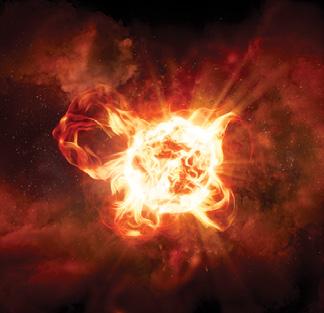
In Outer Space, students turn their gaze to the night sky, a landscape that has fascinated and guided life on Earth for millennia. Throughout the module, students learn how humans have developed collective understanding of space through observation, technology, storytelling, and art. The Essential Question— How do people learn about space?—guides students’ exploration of each module text.
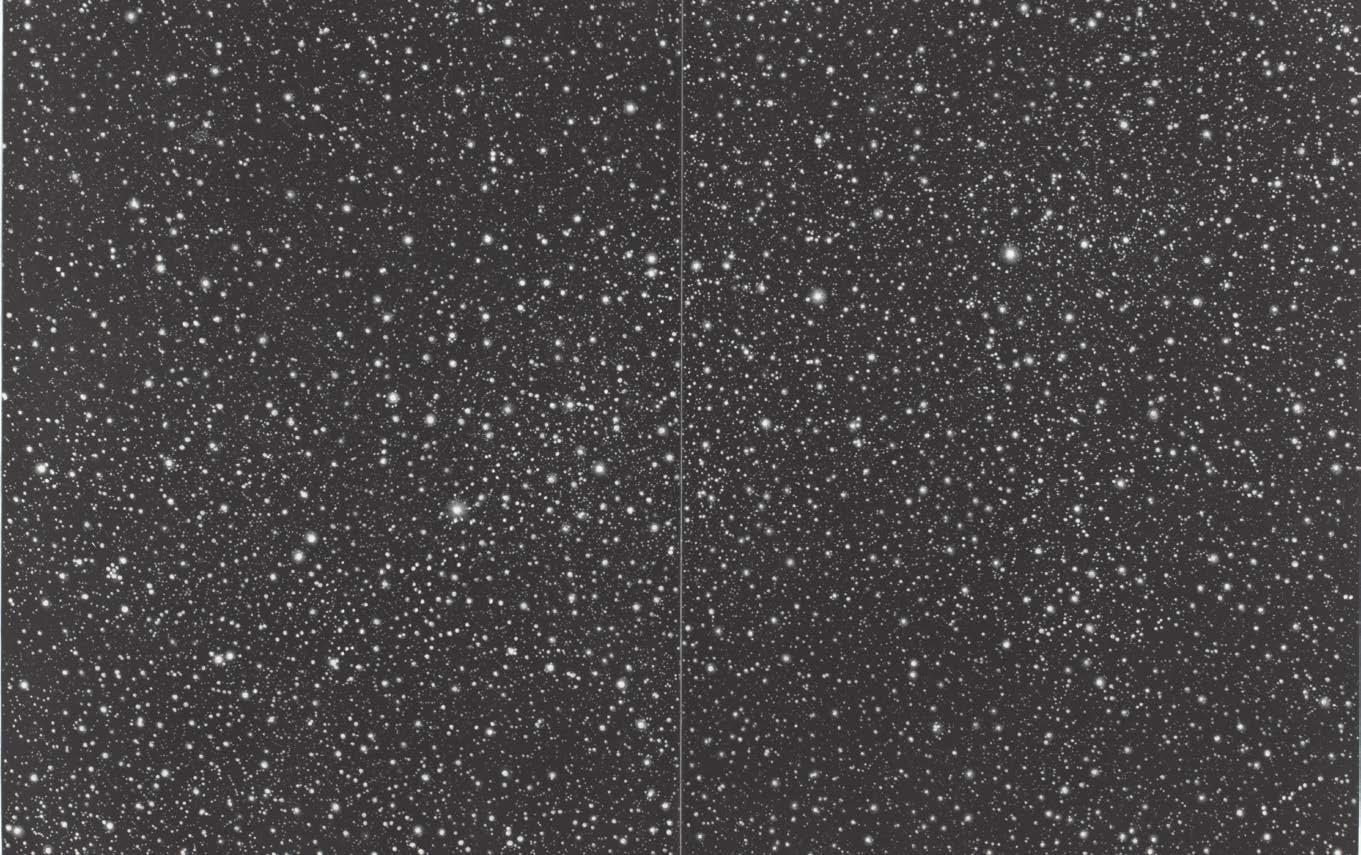
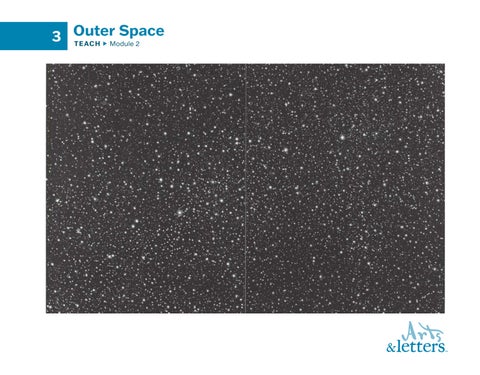
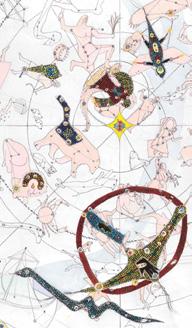
The module begins with The Star People by S. D. Nelson. In this Lakota star story, two lost children are guided home by the spirits of their ancestors, the Star People. With vibrant illustrations inspired by Plains Indian ledger art, Nelson’s retelling highlights the relationship between Native people, Earth, and the stars. Students build their understanding of Native star knowledge by exploring the D(L)akota Star Map, created by Native astronomers Annette S. Lee and Jim Rock. The map divides the night sky into seasonal quadrants to support understanding of circumpolar motion, overlaying Greek constellations with Dakota/Lakota ones, which are beautifully painted to resemble beadwork. Alongside these texts, students engage with two artistic interpretations of space. Vija Celmins’s intricate, photorealistic Starfield evokes the feeling of looking up at the night sky, while Joseph Cornell’s Space Object Box incorporates found objects to represent space in an abstract, three-dimensional collage. Both works invite students to consider how the mystery, wonder, and vastness of space spark human curiosity and imagination.
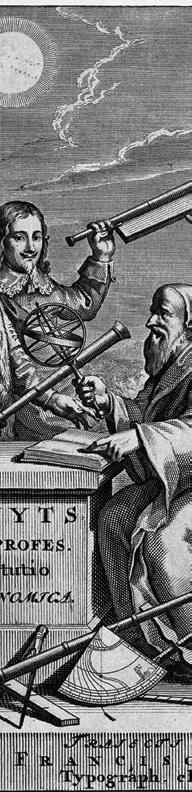
Students continue their exploration of space by reading about the extraordinary life and work of Galileo Galilei in Peter Sís’s Starry Messenger. By studying the text’s blend of narrative, illustrations, and quotations from Galileo’s own writing, students learn about Galileo’s discoveries and their impact on people’s understanding of Earth’s place in the universe.

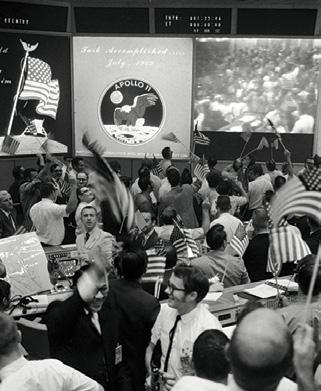

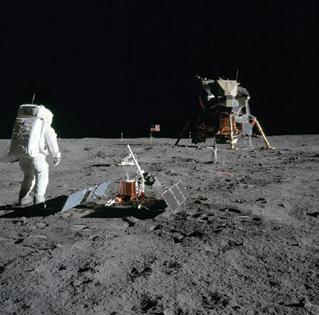
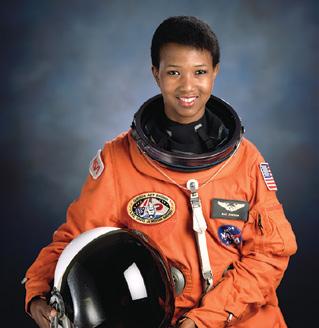
From there, students examine the evolving work of NASA during the latter half of the twentieth century and beyond. They consider the sweep and significance of the historic Apollo 11 mission through two accounts that capture the excitement and stark beauty of the first Moon landing. Brian Floca’s Moonshot details the mission from prelaunch preparation to final splashdown, while Robert Burleigh’s One Giant Leap focuses on the mission’s culminating moments: Eagle’s harrowing descent to the Moon, the astronauts’ moonwalk, and the rejoining of Eagle and Columbia in orbit. In Margot Lee Shetterly’s young readers’ edition of Hidden Figures, students meet trailblazing African American mathematicians Dorothy Vaughan, Mary Jackson, Katherine Johnson, and Christine Darden and learn how their work at the Langley laboratory transformed air travel and space exploration. Students also build knowledge around NASA’s contemporary work through videos about Christina Koch’s research on the International Space Station and the future of space exploration.
During writing instruction, students craft opinion pieces about topics related to space exploration. Students apply knowledge of the Painted Essay® to analyze key similarities and differences between informative and opinion essays. They collect evidence and develop reasons to inform their opinions, elaborate on evidence, and refine their ideas with topic-specific vocabulary. Students also practice crafting more varied sentences by using subordinating conjunctions to connect and expand on ideas orally and in writing. Students practice articulating their ideas through oral rehearsal, informal conversations, and formal discussions.
Over the course of the module, students learn how humans across time and place have developed knowledge and understanding of space. The module transforms students’ conception of the night sky and their relationship to it and serves as a launchpad for further studies of space.
Books
Literary
• The Star People: A Lakota Story, S. D. Nelson
Literary Nonfiction
• Moonshot: The Flight of Apollo 11, Brian Floca
• One Giant Leap: A Historical Account of the First Moon Landing, Robert Burleigh and Mike Wimmer
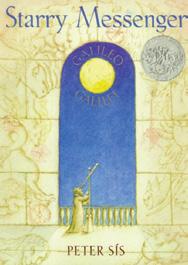
• Starry Messenger: A Book Depicting the Life of a Famous Scientist, Mathematician, Astronomer, Philosopher, Physicist, Galileo Galilei, Peter Sís
Informational
• excerpts from D(L)akota Star Map Constellation Guidebook: An Introduction to D(L)akota Star Knowledge, Annette S. Lee, Jim Rock, and Charlene O’Rourke
• Hidden Figures: The True Story of Four Black Women and the Space Race, Margot Lee Shetterly, Winifred Conkling, and Laura Freeman
Art
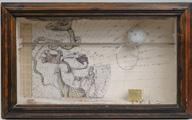
• Space Object Box: “Little Bear, etc.” Motif, Joseph Cornell
• Starfield, Vija Celmins
Videos
• “Christina Koch: Space Station Scientist,” NASA
• “Constellations,” Great Minds®
• “Geocentric and Heliocentric Theories,”
Great Minds
• “Gravity,” Great Minds
• “NASA 60th: What’s Out There?” NASA
• “President Kennedy—Man on the Moon Speech—Sound,” British Movietone
• “Time Lapse: Night Time Milky Way,” Getty Images
Map
• D(L)akota Star Map (Makoce Wicaŋḣpi Wowapi), Annette S. Lee and Jim Rock
Audio
• “The Eagle Has Landed,” NASA
• “One Small Step,” NASA
• “We Have a Liftoff,” NASA
• For thousands of years, humans have been using the stars and other celestial bodies for navigation and seasonal planning.
• Early astronomers established the foundation for contemporary understanding of space.
• People can document and share observations of scientific phenomena.
• Space exploration requires knowledge, collaboration, and courage.
• The vastness of space sparks human curiosity and imagination.
• Module 2 World Knowledge Chart
• Module 2 ELA Knowledge Chart
• Module 2 Word Analysis Chart (Great Minds® Digital Platform)
• Module 2 Speaking and Listening Goal Tracker (digital platform)
Determine how to display class versions of Learn book pages and lesson materials throughout the module. Use the slides available on the digital platform, or use another method of display, such as chart paper or a document camera. For a comprehensive list of all the materials used in the module, see the digital platform.
• Build knowledge about space exploration by reading literary and informational texts.
• Analyze how text features and illustrations contribute meaning to texts.
• Use timelines to organize and recount key events in a text and describe relationships between the events.
• Compare and contrast texts written by different authors about the Apollo 11 mission and the first Moon landing.
• Write essays to support opinions about space exploration.
• Strengthen writing by using subordinating conjunctions to connect and expand ideas and by using simple, compound, and complex sentences.
• Participate in class discussions about space exploration by taking turns with others when speaking, elaborating on evidence used, and building on others’ ideas.
In every Arts & Letters™ module, students complete three types of formal assessments: module tasks, Reading Comprehension Assessments, and an End-of-Module Task. For the module tasks in this module, students complete opinion essays by writing an introductory paragraph, proof paragraphs, and a concluding paragraph. Each module task prepares students for the End-of-Module Task. For additional information about assessments, including texts, rubrics, achievement descriptors, scoring guidance, and report analysis, see the Assessment Guide on the Great Minds® Digital Platform.
For the End-of-Module Task, students write an opinion essay about how they would choose to explore space, selecting from three options: astronomer, astronaut, or mathematician. Students gather evidence from each of the module texts. Then they use that evidence to develop an opinion and reasons. As they draft their End-of-Module Task, students write an introductory paragraph that includes a hook and a thesis, proof paragraphs, and a concluding paragraph. Students include topic sentences to begin proof paragraphs and transition words and phrases to link paragraphs. Students strengthen their writing by participating in a peer review exercise and revising their work according to a checklist. Students have the opportunity to share their writing, and an accompanying visual display, through a Gallery Walk.
Students write an opinion essay about which of Galileo’s contributions was the most important to astronomy, selecting from two options: his book The Starry Messenger or his telescope. Students collect evidence from Starry Messenger first, then develop an opinion and two reasons. Students develop a thesis with two supporting reasons and elaborate on each piece of evidence. Students strengthen their writing through oral rehearsal and use of a checklist.
Students complete a four-section Reading Comprehension Assessment. The first section, Fluency, assesses rate, accuracy, phrasing, and expression. The second section, Show What You Know, assesses content knowledge and vocabulary built during the first half of the module. The third section, Grow What You Know, assesses comprehension of a new topically related text about how people learn about space. The fourth section, Self-Reflection, gives students an opportunity to evaluate their own confidence about the assessment and identify challenges posed by the assessment text.
Students write an introductory paragraph, two proof paragraphs, and a concluding paragraph to complete an opinion essay about which phase of the Apollo 11 Moon landing was the most exciting. Students are provided with three options: Eagle’s descent, Armstrong and Aldrin’s exploration of the Moon, and Eagle’s ascent. Students collect evidence from One Giant Leap that leads them to develop an opinion and reasons. Students develop a thesis that includes their opinion and
two reasons. Students engage in peer review to revise and strengthen their essays.
Students complete a four-section Reading Comprehension Assessment. The first section, Fluency, assesses rate, accuracy, phrasing, and expression. The second section, Show What You Know, assesses content knowledge and vocabulary built during the second half of the module. The third section, Grow What You Know, assesses comprehension of a new topically related text about how people learn about space. The fourth section, Self-Reflection, gives students an opportunity to evaluate their own confidence about the assessment and identify challenges posed by the assessment text.
Lessons 29–38 | End-of-Module Task
Students write an opinion essay about how they would like to explore space.
Achievement Descriptors (ADs) are standards-aligned descriptions that detail what students should know and be able to do based on instruction. ADs are written by using portions of various standards to form a clear, concise description of the work covered in each module. Grade-level ADs may appear in multiple modules.
Arts & Letters alignment to state standards is available on the digital platform.
The ADs are organized into five strands.
Each strand is composed of grade-level parent ADs. Some parent ADs are further divided into child ADs, and some child ADs are further broken down into grandchild ADs.
Each AD has a unique code, which indicates the strand, the AD number, and the grade to represent the parent AD. If applicable, the code may also include a capital letter to indicate a child AD and a lowercase letter to indicate a grandchild AD.
The following examples show the relationship of parent, child, and grandchild ADs.
The first number in the code is the AD number, which corresponds to the list of Achievement Descriptor Numbers by Strand. The second number in the code is the grade-level number.
For a list of this module’s Achievement Descriptors, see the appendix.
Descriptor Strands
M Make Meaning from Texts
Compose and Present Content
Build Understanding
Develop Foundations
Develop Metacognition
Level 3 Achievement Descriptor
CP.4.3 Structure: Organize content with an e ective structure appropriate to the task, purpose, and audience.
CP.4.3.A: Develop an introduction.
CP.4.3.A.a: Introduce a text or topic and an opinion.
By engaging students in a variety of language- and text-based activities, module 2 lessons align with the following English Language Development (ELD) standards. Arts & Letters Prologue™ lessons provide additional language support to develop ELD standards. Educators should consult their state’s ELD standards and proficiency descriptors to identify the best ways to help multilingual learners reach the module’s learning goals. See the digital platform for a lesson-by-lesson breakdown of ELD standards.
ELD-SI.K-3.Narrate: Multilingual learners will
• Share ideas about one’s own and others’ lived experiences and previous learning
• Connect stories with images and representations to add meaning
• Recount and restate ideas
ELD-SI.K-3.Inform: Multilingual learners will
• Define and classify objects or concepts
• Describe characteristics, patterns, or behavior
• Describe parts and wholes
• Sort, clarify, and summarize ideas
• Summarize information from interaction with others and from learning experiences
ELD-SI.K-3.Explain: Multilingual learners will
• Share initial thinking with others
• Follow and describe cycles in diagrams, steps in procedures, or causes and effects
• Compare and contrast objects or concepts
• Offer ideas and suggestions
ELD-SI.K-3.Argue: Multilingual learners will
• Support own opinions with reasons
• Clarify and elaborate ideas based on feedback
• Revise one’s own opinions based on new information
ELD-LA.2-3.Narrate.Interpretive: Multilingual learners will interpret language arts narratives by
• Identifying a central message from key details
• Identifying how character attributes and actions contribute to event sequences
• Determining the meaning of words and phrases as they are used in texts, distinguishing literal from nonliteral language
ELD-LA.2-3. Inform.Interpretive: Multilingual learners will interpret informational texts in language arts by
• Identifying the main idea and key details
• Referring explicitly to descriptions for themes and relationships among meanings
• Describing relationship between a series of events, ideas or concepts, or procedural steps
Standard 1: An ELL can construct meaning from oral presentations and literary and informational text through grade-appropriate listening, reading, and viewing.
Standard 2: An ELL can participate in grade-appropriate oral and written exchanges of information, ideas, and analyses, responding to peer, audience, or reader comments and questions.
Standard 3: An ELL can speak and write about grade-appropriate complex literary and informational texts and topics
Standard 4: An ELL can construct grade-appropriate oral and written claims and support them with reasoning and evidence.
Standard 5: An ELL can conduct research and evaluate and communicate findings to answer questions or solve problems.
Standard 6: An ELL can analyze and critique the arguments of others orally and in writing.
Standard 7: An ELL can adapt language choices to purpose, task, and audience when speaking and writing.
Standard 8: An ELL can determine the meaning of words and phrases in oral presentations and literary and informational text.
Standard 9: An ELL can create clear and coherent grade-appropriate speech and text.
Standard 10: An ELL can make accurate use of standard English to communicate in grade-appropriate speech and writing.
= assessment = Prologue lesson
Know
D(L)akota Star Map
excerpts from D(L)akota Star Map Constellation Guidebook
Distill Starfield
Space Object Box
Lesson 7
Know The Star People
D(L)akota Star Map
excerpts from D(L)akota Star Map Constellation Guidebook
Starfield Space Object Box
Lesson 17
Wonder Moonshot
Lesson 24
Reveal Moonshot
One Giant Leap
Lesson 18
Organize Moonshot
Lesson 19
Reveal Moonshot Lesson 20 Distill Moonshot Lesson 21
Wonder One Giant Leap
Lesson 22
Organize One Giant Leap
Module Task 1 completed
Lesson 23
Reveal One Giant Leap
Lesson 25
Distill Moonshot
One Giant Leap
Lesson 26
Know Moonshot
One Giant Leap
Wonder Hidden Figures
Reading Comprehension Assessment 2
Responsive Teaching
End-of-Module Task completed

Essential Question | How do people learn about space?
In this opening Bookend lesson, students explore the module topic and the Essential Question. Students share what they know about space. They continue to engage with the module topic through an experience that the teacher chooses. Students may create a picture of the night sky, experience a presentation by a guest speaker, explore books about space, or engage in a teacher-created experience.
• Share experiences about space.
• Explore the module topic.
Read the Essential Question LEARN
• Share: Discuss Prior Knowledge
• Engage: Create, Experience, or Explore LAND
Revisit the Essential Question
Vocabulary space (n.)
• Knowledge Card: space
• Determine how to display the Essential Question. Students continue working with the Essential Question throughout the entire module.
• Determine how to display the questions for the Chalk Talk. See the Share section for details.
• Prepare materials for the selected activity in the Engage section.
• Depending on the option you choose, consider planning for more than the typical 60 minutes recommended for a lesson.
• Students listen to, read, or explore a volume of reading text. They add to their reading log and respond to assigned volume of reading questions. See Implementation Resources for volume of reading guidance.
1. Tell students that today they are starting a new module about space.
2. Display and Choral Read the Essential Question: How do people learn about space?
Teacher Note
Customize this lesson’s content to incorporate your school’s regional geography, the community’s resources, and the area’s history. Use the activities to activate and honor students’ funds of knowledge, including their home life, languages, and experiences.
Share | Discuss Prior Knowledge | 13 minutes
1. Tell students that they will share what they know about the module topic. Instruct students to Think–Pair–Share to answer this question:
When I say the word space, what do you think of?
Language Support
To leverage students’ home languages as resources to support learning, encourage students who share the same home language to discuss questions like this together, especially in preparation for larger class discussions.
2. Introduce the vocabulary term space by displaying the Knowledge Card. Engage students in Vocabulary Exploration. Tell students that in this module they will learn about outer space.
Teacher Note

The Word Analysis Chart, located on the digital platform, identifies relevant word-part information (i.e., prefixes, derivational suffixes, Latin suffixes, number of syllables, and challenging letter-sound correspondences) for each vocabulary term defined in the module. Use the chart to inform additional phonics and word analysis support for students.
3. Display these questions around the room:
• What do you know about space and what space is like?
• How is space different from Earth?
• What are some ways that people might explore and learn about space?
4. Tell students that they will follow the instructional routine Chalk Talk to engage in a silent, written discussion about space. Explain how this routine works. First, students choose a question and add an initial response. Then students have the freedom to move to the other questions, responding directly to the question or another student’s contribution. Tell students that as they respond, they may draw a line to connect their responses to another student’s. Throughout the routine, students address all questions.
5. Begin the Chalk Talk.
Teacher Note
As students respond to the Chalk Talk questions, look closely for what they already know about the topic. Note students’ prior knowledge to activate and incorporate into future discussions. Note misconceptions to clarify in future instruction.
6. Invite students to read the responses to each question and share interesting responses they read.
Definitions space (n.):
1. the distant region in which there are stars and planets, beyond the layer of air that surrounds Earth; outer space
2. an empty area between things
Choose a Create, Experience, or Explore activity to engage students with the module topic. Plan your own activity or choose an option below.
1. Provide art materials: black, white, and gray paper, and glue. Instruct students to use these materials— and only these materials—to create a picture of the night sky.
Teacher Note
Explain that students can tear the paper to create their picture; they may not use scissors or drawing utensils. Students can work independently, with a partner, or in small groups to complete this activity.
2. Invite students to share their pictures with the class and explain their artistic process and how they chose to represent the night sky.
Teacher Note
After students explore Starfield by Vija Celmins in arc A and learn about Celmins’s artistic process, invite them to revisit their pictures of the night sky, compare their process to Celmins’s, and reflect on other ways they could represent the night sky in a work of art.
1. Invite a guest speaker from the community or region who studies space or works in the space sector (e.g., student, amateur or professional astronomer, astronaut, engineer, or observatory or planetarium director) to speak to students, virtually or in person, about their work.
Teacher Note
Each of NASA’s field centers has a Speakers Bureau, a volunteer program that helps coordinate speaker requests. With at least six weeks of lead time, NASA’s Astronaut Appearance Office coordinates virtual astronaut appearances.
2. Facilitate the presentation by inviting the guest speaker to talk about their interest in space and how they explore space in their field. As needed, pose questions such as these:
• When and how did you first become interested in space?
• What interests or fascinates you most about space?
• How do you, and others in your field, explore space in your work?
3. Invite students to ask the guest speaker follow-up questions about their interest and work in space.
1. Host a classroom book talk to preview the volume of reading texts and build student interest in space and space exploration.
Teacher Note
Consider inviting the school librarian or a librarian from the community to facilitate the book talk and share other books about space.
2. Following the book talk, invite students to rank and share which book(s) they are most interested in reading. Collaboratively brainstorm a list of questions about space sparked by the book talk.
3. If time allows, read aloud one of the volume of reading texts about space. After reading the text, facilitate a brief discussion about students’ experiences with the text.
1. Facilitate a brief discussion to connect what students experienced in this lesson to the Essential Question. Consider using one of the following questions, based on each option from the Engage section, to initiate the discussion:
• Option 1—How did you show the night sky in your picture?
• Option 2—What questions do you have about space after listening to the guest speaker?
• Option 3—What are you most interested in learning about space?
2. Tell students that throughout the module they will continue to build knowledge about space and space exploration.
Teacher Note
Arts & Letters student and teacher materials feature borders, header images, and other carefully chosen visuals to align with each module’s knowledge. Consult About the Images, located in the appendices, to learn more about how these elements connect to the module’s knowledge. As students progress through the module, share related information about the images and encourage them to make connections to what they are learning.

Essential Question | How do people learn about space?
Content Framing Question | Wonder: What do I notice and wonder about this text?
In this Wonder lesson, students begin their exploration of space by reading the Lakota story The Star People and sharing what they notice and wonder. They work to develop fluency by reading a passage from the text with accuracy. During visual art instruction, students examine Starfield and Space Object Box to explore how artists represent ideas about space. Students share and write what they notice and wonder about these works of art.
Notice and wonder about The Star People.
LEARNING TASK: Write at least three things you notice about The Star People and three related questions.
Notice and wonder about Starfield and Space Object Box.
LEARNING TASK: Write at least three things you notice about both works of art and at least three related questions.
constellation (n.) observe (v.)
LAUNCH
Read the Content Framing Question
LEARN
• Read: Listen Closely to The Star People
• Respond: Notice and Wonder About The Star People
• Observe: Notice and Wonder About the Art
LAND
View “Constellations” Materials
TEACHER
• The Star People
• Starfield (digital platform)
• Space Object Box (digital platform)
• Knowledge Cards: space, observe, constellation
• “Time Lapse: Night Time Milky Way” (digital platform)
• class Notice and Wonder Chart for The Star People (Learn book)
• Fluency Reference Chart (Reference Charts appendix)
• class Notice and Wonder Chart for Works of Art 1 and 2 (Learn book)
• “Constellations” (digital platform)
• Module 2 World Knowledge Chart
• Module 2 ELA Knowledge Chart
• The Star People
• Notice and Wonder Chart for The Star People (Learn book)
• Fluency Practice for The Star People (Learn book, Fluency)
• Notice and Wonder Chart for Works of Art 1 and 2 (Learn book)
• Gallery for “Constellations” (Learn book)
• The Star People is an unpaginated text. Number your text; begin with the title page as page 1. Pages on the left will be even, and pages on the right will be odd.
• Determine how to display side by side Starfield and Space Object Box. See the Observe section for details.
• Determine how to display the knowledge charts. Students continue working with these charts throughout the entire module.
• Students listen to, read, or explore a volume of reading text. They add to their reading log and respond to assigned volume of reading questions. See Implementation Resources for volume of reading guidance.
• Students complete day 1 of Fluency Practice for The Star People (Learn book, Fluency) and focus on a fluency element or retelling.
3 minutes
Read the Content Framing Question
1. Display and Choral Read the Essential Question: How do people learn about space?
2. Display the Knowledge Card for space, and direct attention to the second image to spark students’ memory. Remind students that one meaning of space is outer space, or the distant region in which there are stars and planets, beyond the layer of air that surrounds Earth.
3. Display The Star People.
4. Display and Choral Read the Content Framing Question: What do I notice and wonder about this text?
5. Explain that during a Wonder lesson the class reads the book for the first time to spark their curiosity. Students share what they notice and wonder about the book. Introduce The Star People by reading aloud the title and author. Explain that the author is also the illustrator for this book. Tell students that in this lesson they will listen closely to The Star People and share what they notice and wonder about it. Then they will work to develop fluency by practicing reading a passage from the story with accuracy.
50 minutes
Read | Listen Closely to The Star People | 15 minutes
Teacher Notes
The text uses the term Indian in the author’s note. Arts & Letters materials use the terms Native American, Native peoples, and Native nations when a specific tribal nation name is unavailable. Arts & Letters materials use Native as an adjective to mean “of or relating to members of Native American, Alaska Native, and Native Hawaiian groups.”
The material in lessons 2−6 is deeply rooted in Dakota/Lakota culture. If possible, seek out Native elders, community members, or cultural teachers in your area to support understanding of Native star knowledge and cultural protocols.
1. Introduce the vocabulary term observe by displaying the Knowledge Card. Engage students in Vocabulary Exploration.
2. Tell students that they will now observe the night sky. Play the video “Time Lapse: Night Time Milky Way.” Ask these questions:
What do you see when you observe the night sky?
What do you think or wonder about when you observe the night sky?
3. Instruct students to examine the front and back covers of The Star People. Tell them to read the subtitle and look closely at the illustrations.
4. Display the class Notice and Wonder Chart for The Star People. Remind students that they will use Notice and Wonder Charts throughout the module to write down things they notice in a text and what those things make them wonder.
5. Facilitate a brief discussion of this question:
What do you notice and wonder about the front and back covers?
Differentiation Support
Direct attention to the front cover, and ask these questions: What shapes do you see? What do you wonder about them?
Add a few responses to the class chart.
6. Direct students to page 2, and instruct them to follow along as you read aloud The Star People.
Language Support
Based on your students’ needs, pause to define select words with a synonym (e.g., barren, chanting, village). Use subsequent readings to reinforce synonyms for the words you selected.
Definition
observe (v.): to watch someone or something carefully
1. Instruct students to work with a partner to review the text and discuss what they notice and wonder. Tell students to look closely at both the text and illustrations.
Teacher Note
Incorporate strategic, flexible ways to form groups of students throughout the module. Bringing together students who have different levels of reading, writing, or English language proficiency can promote rich conversation and exchange of ideas. Also, grouping students with similar levels of reading, writing, or English language proficiency can help focus students on a specific task with teacher support. As applicable, complement any of these groups by pairing students who speak the same home language.
2. Introduce the learning task. Direct students to the Notice and Wonder Chart for The Star People, located in the Learn book. Instruct students to add at least three things they notice about the text and three related questions.
Monitor: Do students make coherent connections between what they notice and what they wonder about The Star People?

Offer Immediate Support: If students need additional support noticing things and asking related questions, encourage them to focus on a specific part of the text (e.g., pages 16−17) and ask these questions: What do you notice about this illustration? What does this make you wonder?
Plan Future Practice: Students practice noticing and wondering about works of art in the Observe section of this lesson.
3. Invite a few students to share their responses. Add a few responses to the class chart.
Teacher Note
Invite students to share personal and/or cultural connections to The Star People or other Native star stories.
4. Tell students that now that they have read The Star People with curiosity and attention, they will work to gain fluency by reading aloud passages from the text.
Teacher Note
In arc A, students reinforce their understanding of the elements of fluency and have an opportunity to practice reading fluently.
5. Display the Fluency Reference Chart. Choral Read the definition of fluency. Direct attention to the Accuracy row, and remind students that reading with accuracy means correctly decoding the words in a text.
6. Ask this question: Why do we need to read with accuracy? Reinforce the correct response: Readers must be able to read words correctly to understand a text’s meaning.
7. Display Fluency Practice for The Star People, and direct students to the page in their Learn book. Tell students to follow along as you read aloud the fluency passage. Model making a mistake (e.g., pronouncing village with an /ā/ sound) and quickly addressing it by rereading the word correctly. Remind students that good readers pay close attention to what they read so that they can catch mistakes and self-correct them in the moment.
8. Instruct students to reread the passage and annotate words they do not know. Tell students to share the words they annotated with a partner.
(n.): the ability to read with accuracy, phrasing, and expression at an appropriate rate
correctly decode the words group words into phrases, and pause for punctuation use voice to show feeling read at an appropriate speed
9. Invite a few students to share a word that they annotated. Explain how to decode a challenging word (e.g., barren), using guidance from your foundational skills program.
10. Choral Read the fluency passage.
11. Explain that throughout this arc of lessons, students will practice reading aloud this passage from The Star People on their own as follow-up work.
1. Display Starfield without telling students the title or artist’s name. Instruct students to look closely at the work of art for at least 90 seconds, silently holding their observations and comments. Direct attention to different parts of the print, including the top and bottom, middle, and corners.
Teacher Notes
Latvian American artist Vija Celmins created the print Starfield in 2010. For this intricately detailed print, Celmins combined mezzotint and drypoint. Mezzotint is a tonal technique that produces soft gradations from deep black to stark white. The artist used drypoint to sharpen details. The print is composed from two equal-sized etching plates to make its construction evident. Celmins is known for depicting expansive areas of the natural environment with near photorealism, often working from photographs and satellite images. Her work invites viewers to consider the difference between a mechanically produced image and one that requires many months of careful handwork.
To promote looking closely at the work of art, do not provide background information about it at this point. Rather, encourage students to share and expand on what they initially notice and wonder. Students revisit this work of art during the next few lessons and learn more about its history.
If time allows, give students another minute to silently view the work of art. During this viewing, zoom in on different parts of the image.
2. Instruct students to discuss these questions with a partner:
What do you notice in this work of art?
What do you wonder?
Remind students to focus on what they see in the work of art, rather than what they think about it.
3. Display the class Notice and Wonder Chart for Works of Art 1 and 2, and direct students to the page in the Learn book. Instruct students to add to their charts what they notice and related questions about Work of Art 1.
Teacher Note
Because students engage with two works of art, an extended Notice and Wonder Chart has been provided.
4. Display Space Object Box without telling students the title or artist’s name. Instruct students to silently observe the work of art for at least 90 seconds.
Teacher Note
American artist Joseph Cornell created the sculpture Space Object Box: “Little Bear, etc.” Motif in the mid-1950s to early 1960s. In his abstract three-dimensional box structures, Cornell used an assemblage technique, incorporating printed images and found objects, such as fragments of star maps. The focus of the map fragment in Space Object Box is the constellation Ursa Minor, or “Little Bear,” but the “etc.” in the sculpture’s title is a nod to other constellations depicted. The blue cork ball and ring suggest the Moon and its orbit, while the toy block with a horse is most likely a reference to Pegasus, a square constellation.
To promote looking closely at the work of art, do not provide background information about it at this point. Rather, encourage students to share and expand on what they initially notice and wonder. Students revisit this work of art during the next few lessons and learn more about its history.
5. Instruct students to discuss these questions with a partner.
What do you notice in this work of art?
What do you wonder?
6. Direct attention to the Notice and Wonder Chart, and instruct students to add what they notice and related questions about Work of Art 2.
7. Display Starfield and Space Object Box side by side. Instruct students to silently observe the art for at least 90 seconds.
Teacher Note
If unable to display the works of art simultaneously, display one at a time.
8. Instruct students to discuss these questions with a partner:
When you observe both works of art together, what do you notice?
What do you wonder?
9. Introduce the learning task. Instruct students to write on their chart at least three things they notice about the works of art together and three related questions.
Monitor: Do students write specific and varied details about Starfield and Space Object Box and three related questions?
Offer Immediate Support: If students need additional support noticing things about both works of art, ask this question: What’s similar about these works of art?
Plan Future Practice: Students practice noticing and asking questions about a work of art in module 3.
10. Invite a few students to share what they notice and wonder. Add a few responses to the class Notice and Wonder Chart.
View “Constellations”
1. Tell students that they will view a video to learn more about stars. Introduce the vocabulary term constellation by displaying the Knowledge Card. Engage students in Vocabulary Exploration.
2. Play “Constellations.”
Teacher Note
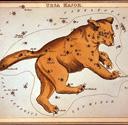
Subsequent lessons do not include instructions to play “Constellations.” As needed, play the video in subsequent lessons to help students make more connections between the world knowledge in the text and the video. For students whose home language is Spanish, arrange for them to view the Spanish version of the video.
3. Direct attention to both knowledge charts, and read aloud each chart title. Explain that knowledge of the world is knowledge students gain from texts in the module. Explain that knowledge of ELA is knowledge students gain as they learn reading, writing, and speaking skills. Writing statements about new learning helps people remember and track the knowledge they gain.
Definition constellation (n.): a group of stars that forms a particular shape in the sky
4. Facilitate a brief discussion of the following question to help students articulate the knowledge they built during the lesson:
What did you learn today?
Direct students to the Gallery for “Constellations,” located in the Learn book, and encourage them to make connections between the world knowledge in the text and the video.
Teacher Note
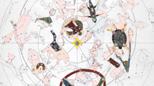



As needed, prompt students to reflect on what they learned by asking questions such as these:
• What did you learn from The Star People?
• What did you learn about constellations?
• What did you learn from the works of art?
• What did you learn to do?
5. Add a few student-generated knowledge statements to the charts. Place statements about key ideas from the lesson and information from the texts on the World Knowledge Chart, and place statements about language arts on the ELA Knowledge Chart.
Teacher Note
Adding all students’ knowledge statements to the charts is not necessary. Encourage all students to share their knowledge statements, and then choose a few to add to the charts. Alternatively, summarize students’ comments into a few statements, and then add the summarized statements to the charts. We do not include a prescribed list of student knowledge statements because the discussion should flow organically and the statements should represent the authentic learning of each class. As needed, ask follow-up questions to guide students toward key ideas from the lesson, world knowledge from the texts, or ELA knowledge related to the learning goals.
MM Make Meaning from Texts
MM.12.3 Complexity, Diversity, and Genre: MM.12.3.A, MM.12.3.A.a, MM.12.3.C, MM.12.3.C.b, MM.12.3.C.c
BU Build Understanding
BU.2.3 Discovery and Evidence: BU.2.3.A, BU.2.3.B
BU.4.3 Expression
DF Develop Foundations
DF.5.3 Fluency: DF.5.3.A, DF.5.3.B, DF.5.3.C
DM Develop Metacognition
DM.1.3 Content Stages: DM.1.3.A
DM.3.3 Schema Building
Essential Question | How do people learn about space?
Content Framing Question | Organize: What is happening in this text?
In this Organize lesson, students continue to develop fluency by reading and focusing on phrasing of a key passage from The Star People. They establish a strong literal understanding of the text as they reread the story, create a story map, and practice recounting. During visual art instruction, students organize and compare elements of Starfield and Space Object Box. They describe what is happening in a work of art, grounding their observations in visual evidence.
A Prologue to lesson 3 is available for students who need additional support.
Identify key story elements in The Star People.
LEARNING TASK: Add characters, settings, and key events to a story map.
Describe Space Object Box and Starfield.
LEARNING TASK: Write at least three sentences describing a work of art.
prairie (n.)
spirit (n.)
LAUNCH
Read the Content Framing Question
LEARN
• Read: Annotate Story Elements in The Star People
• Respond: Organize Story Elements
• Observe: Describe a Work of Art
LAND
Reflect on Learning
Materials
TEACHER
• The Star People
• Space Object Box (digital platform)
• Starfield (digital platform)
• Fluency Reference Chart (Reference Charts appendix)
• Map of the Great Plains (digital platform)
• class Story Map for The Star People (Learn book)
STUDENTS
• The Star People
• Fluency Practice for The Star People (Learn book, Fluency)
• Story Map for The Star People (Learn book)
• journal
• none Follow-Up
• Students listen to, read, or explore a volume of reading text. They add to their reading log and respond to assigned volume of reading questions. See Implementation Resources for volume of reading guidance.
• Students complete day 2 of Fluency Practice for The Star People (Learn book, Fluency) and focus on a fluency element or retelling.
2 minutes
Read the Content Framing Question
1. Display The Star People.
2. Display and Choral Read the Content Framing Question: What is happening in this text?
3. Explain that during an Organize lesson the class rereads sections of the book and identifies what is happening to gain a basic understanding of the text. Tell students that in this lesson they will continue developing fluency by reading and focusing on phrasing of a key passage from the text. Then they will reread the story to identify key story elements and practice recounting the story.
53 minutes
Read | Annotate Story Elements in The Star People | 16 minutes
1. Display the Fluency Reference Chart. Choral Read the definition of fluency. Direct attention to the Phrasing row. Remind students that fluent readers read in meaningful phrases, or groups of words, and pause for punctuation.
2. Ask this question: Why is it important to read with appropriate phrasing?
Key Ideas
• makes reading sound smoother and more natural
• helps readers understand the text
3. Display Fluency Practice for The Star People, and direct students to the page in the Learn book. Remind students that they can annotate pauses between meaningful phrases and after punctuation. Instruct students to use one slash mark (/) to indicate where they hear a short pause and two slash marks (//) to indicate where they hear a long pause. Read aloud the passage as students listen and annotate pauses.
Teacher Note
As needed, review annotation symbols from your foundational skills program to indicate “scooping” or “chunking” of phrases.
4. Echo Read the first paragraph of the passage using appropriate phrasing. Then instruct students to practice reading aloud the rest of the passage using appropriate phrasing. Remind students that they will continue to practice reading aloud this passage from The Star People outside of class.
5. Tell students that they will now reread the text to gain a basic understanding of what is happening. Direct attention to The Star People and the subtitle, A Lakota Story. Display the Map of the Great Plains, and explain that the Lakota are a group of Native American people of the northern Great Plains. The Lakota are one of three Native Nations—the Lakota, Dakota, and Nakota—that together make up the Seven Council Fires.
6. Direct attention to the map, and explain that today many Lakota, Dakota, and Nakota live in presentday North and South Dakota, Minnesota, Nebraska, Montana, and parts of Canada. The author and illustrator S. D. Nelson is a member of the Lakota Nation and the Standing Rock Sioux Tribe, whose reservation is situated in North and South Dakota.
The people of the Seven Council Fires are sometimes referred to as the Sioux Nation. The term Sioux is an exonym. While some tribal governments use the term Sioux, many consider it negative and prefer the names Lakota, Dakota, or Nakota, which mean “ally.” These terms also refer to the dialects spoken by members of the nation.
7. Explain that before rereading The Star People, students should know what a prairie is. Assess and activate prior knowledge by inviting students to share what they know about prairies. Introduce the vocabulary term prairie by displaying the word and definition. Engage students in Vocabulary Exploration.
8. Direct attention to the map, and explain that prairies are in the Great Plains, between the Rocky Mountains and the Mississippi River.
Students learn about prairies and the Great Plains in level 2 module 2, The American West
9. Instruct students to read The Star People with a partner and annotate the characters, settings, and key events.
Throughout this module, students read grade-level, complex texts. Students may read independently or require more support. Identify the level of support each student needs to progress toward independence. Implement an appropriate approach, such as reading with a partner, Choral Reading, Echo Reading, or listening to the teacher read aloud.
| Organize Story Elements | 17 minutes
1. Display the class Story Map for The Star People, and direct students to the page in the Learn book. Ask this question:
How can a story map help readers understand a text?
Reinforce the correct response: A story map helps readers organize important elements, such as characters, settings, and key events. Explain that readers can use different types of story maps. For example, in The Star People, students will identify characters and settings as they did for Amos and Boris. But instead of identifying a problem and solution, they will write down key events that happen at the beginning, middle, and end of the story.
prairie (n.): a large, mostly flat area of grassland in North America
2. Introduce the learning task. Instruct students to review their annotations and work with a partner to complete the Story Map for The Star People. Remind students that they should focus on the characters, settings, and key events at the beginning, middle, and end of the story.
Monitor: Do students demonstrate an understanding of the characters, settings, and key events from the beginning, middle, and end of The Star People?
Offer Immediate Support: If students need additional support adding characters, settings, and key events to the story map, direct attention to pages 8−11 and ask these questions: What happens at the beginning of the story? How could you describe this event in one or two sentences?
Plan Future Practice: Students practice identifying story elements in module 3.
3. Invite a few students to identify the characters, settings, and key events. Add the story elements to the class story map. Instruct students to add additional details about characters, settings, and events to their story maps as their classmates share.
Key Ideas
• characters: Sister Girl, Young Wolf, children’s mother and father, Father Sun, Mother Earth, Cloud People, Star People, Elk Tooth Woman, animals
• settings: on the prairie, in the night sky, in a village
• beginning: Sister Girl and Young Wolf are wandering on the prairie; a prairie fire starts and quickly spreads; the children and animals flee.
• middle: The children find safety in a stream but realize they are lost; the Star People appear in the night sky; Elk Tooth Woman comforts the children.
• end: The children fall asleep and dream; the children dance and give thanks with Elk Tooth Woman and the animals; Elk Tooth Woman guides the children home.
4. Ask this question:
How does the setting change in the story?
Encourage students to refer to the illustrations to help them respond.
Key Ideas
• The story begins on the prairie, away from the children’s village; the children return to their village at the end of the story.
• The children move across the prairie as they flee the fire.
• The setting moves between Earth and the sky.
• Part of the story takes place in the children’s dreams.
• The setting changes from daytime to nighttime and back to daytime.
5. Direct attention to pages 16−17. Instruct students to Think−Pair−Share to answer these questions:
Who are the Star People? How do you know?
Key Ideas
• Star People: These are spirits of people, animals, and ancestors or relatives who once lived on Earth.
• evidence: The stars take the shapes of animals and humans.
• evidence: Sister Girl tells Young Wolf that the Star People are the spirits of the Old Ones who once walked on Earth.
• evidence: The children’s grandmother, Elk Tooth Woman, is one of the Star People.
6. Explain that the word spirit has multiple meanings, but in this context, it refers to a life force. Introduce the vocabulary term spirit by displaying the term and definition. Engage students in Vocabulary Exploration. Reinforce that in the story the spirits comfort the children and safely guide them home.
Definition spirit (n.): the force within someone that is believed to give the body life, energy, and power
7. Remind students that recounting a story helps readers remember and better understand the text. Explain that in addition to story maps, readers can use illustrations to help them recount. Instruct students to reread the events on their story maps and then choose three illustrations from The Star People—one each from the beginning, middle, and end—that can help them recount the story.
8. Instruct students to work with a partner to practice recounting The Star People by using their story maps and chosen illustrations. Listen for students to include accurate, text-based responses in their recounting.
Language Support
Provide these sentence frames:
• In the beginning,
• In the middle, .
• At the end, .
Observe | Describe a Work of Art | 20 minutes
1. Tell students that they will look closely again at both works of art from the previous lesson to understand what is happening in them.
2. Remind students that they studied works of art this year that showed people and places (The Great Wave and The Boating Party) and a work of art that was abstract (Mountains and Sea).
3. Facilitate a brief discussion of this question:
What did you focus on to describe the abstract work of art?
Key Ideas
• colors
• shapes
• where things were in the work of art
4. Display Space Object Box. Keep the title of the work of art concealed.
Teacher Note
Students revisit this work of art during the next few lessons and learn more about its history. The title of the work of art will be revealed in lesson 5.
5. Emphasize that there is a lot happening in this abstract work of art. Ask this question:
What objects do you see, and where are they?
Language Support
When discussing works of art, try to use well-known art terms—such as line, color, and shape—and encourage students to use these terms too. Instead of pausing discussion to correct students’ usage, model how to speak by using appropriate art terms when you ask questions and reinforce responses.
Teacher Note
If time allows, give students another minute to silently view the work of art. During this viewing, zoom in on different parts of the image.
Key Ideas
• a map in the back with pictures of animals
• metal bars running across the box with a ring and ball on them
• a square block in the bottom right with a horse on the front of it
• lines going outward from the map
• a chart with numbers on the left
6. Display Starfield. Keep the title of the work of art concealed.
Teacher Note
Students revisit this work of art during the next few lessons and learn more about its history. The title of the work of art will be revealed in the next lesson.
7. Ask this question:
How would you describe this work of art?
Differentiation Support
To help students describe the work of art, ask these questions:
• What colors do you see, and where do you see them?
• What kinds of shapes do you see, and where do you see them?
• What kinds of lines do you see, and where do you see them?
Teacher Note
If time allows, give students another minute to silently view the work of art. During this viewing, zoom in on different parts of the image.
Key Ideas
• colors: shades of gray from very light to very dark
• shapes: lots of dots in various sizes, some with lighter edges or borders like halos
• lines: one line running down the middle, a white border, some dots lined up
8. Introduce the learning task. Direct students to their journals. Instruct students to choose either Space Object Box or Starfield and write at least three sentences describing what is happening in the work of art. Remind students to use art terms in their descriptions.
Analyze Student Progress
Monitor: Do students describe Space Object Box or Starfield by using art terms such as line, color, or shape?
Offer Immediate Support: If students need additional support describing what is happening in the work of art, ask these questions: What colors do you see, and where are they? What shapes do you see, and where are they?
Plan Future Practice: Students practice describing what is happening in a work of art in module 3.
9. Invite students to find a partner who described the other work of art. Instruct students to share their written descriptions with their partners.
10. Instruct students to discuss these questions with their partner:
What do the works of art have in common?
How are the works of art different?
11. Listen for students to address key ideas in their discussions.
Key Ideas
• same: Both have regular and irregular shapes.
• different: One work of art has more colors than the other work of art, such as tan, green, gold, and brown.
• different: One work of art looks flat, while the other work of art has three-dimensional objects, such as a ball and a box.
1. Direct attention to both knowledge charts, and facilitate a brief discussion to help students articulate the knowledge they built during the lesson. Add a few student-generated knowledge statements to the charts.
As needed, prompt students to reflect on what they learned by asking questions such as these:
• What did you learn about the Lakota?
• What did you learn from The Star People?
• What did you learn to do?
Adding to knowledge charts is a concrete way for students to self-assess how their learning has progressed. Students reflect on their growing knowledge of the module topic and their own development as readers and writers. This reflection helps students identify what they may need to learn more about, including topic- and text-related knowledge and ELA knowledge related to the learning goals.
MM Make Meaning from Texts
MM.1.3 Comprehension and Evidence: MM.1.3.A, MM.1.3.B
MM.3.3 Summary: MM.3.3.A
MM.9.3 Media: MM.9.3.A
Complexity, Diversity, and Genre:
CP Compose and Present Content
CP.5.3 Language: CP.5.3.B
BU Build Understanding
BU.1.3 Inquiry and Credibility: BU.1.3.C
BU.2.3 Discovery and Evidence: BU.2.3.A, BU.2.3.B
BU.3.3 Conversation and Collaboration: BU.3.3.A, BU.3.3.B
BU.4.3 Expression
DF Develop Foundations
DF.3.3 Phonics and Spelling: DF.3.3.A, DF.3.3.A.b
DF.4.3 High-Frequency and Irregularly Spelled Words: DF.4.3.A
DF.5.3 Fluency: DF.5.3.A, DF.5.3.B
DM Develop Metacognition
DM.1.3 Content Stages: DM.1.3.B
DM.2.3 Comprehension Monitoring
DM.3.3 Schema Building
Essential Question | How do people learn about space?
Content Framing Question | Reveal: What does a deeper look at words and illustrations reveal?
Preview
In this Reveal lesson, students focus on reading The Star People with expression to develop their fluency. They examine several scenes in the story to understand how S. D. Nelson creates mood by using word choice in the text and color in his illustrations. During visual art instruction, students examine value in Starfield. Students consider how the artist uses value to reveal the work of art’s deeper meaning.
Analyze how words and illustrations contribute to the mood in The Star People.
LEARNING TASK: Describe the mood on pages 18−19 of The Star People, identifying the words and colors that help convey it.
Examine how Celmins uses value in Starfield.
LEARNING TASK: Describe what the darkest, lightest, and middle value represent in Starfield.
despair (v.)
flee (v.)
value (n.)
LAUNCH
Read the Content Framing Question
LEARN
• Read: Analyze Words and Illustrations in The Star People
• Respond: Describe Mood
• Observe: Examine Value in Starfield
LAND
Reflect on Learning
Materials
TEACHER
• The Star People
• Starfield (digital platform)
• The Great Wave (digital platform)
• Fluency Reference Chart (Reference Charts appendix)
STUDENTS
• The Star People
• Fluency Practice for The Star People (Learn book, Fluency)
• journal
• none
Follow-Up
• Students listen to, read, or explore a volume of reading text. They add to their reading log and respond to assigned volume of reading questions. See Implementation Resources for volume of reading guidance.
• Students complete day 3 of Fluency Practice for The Star People (Learn book, Fluency) and focus on a fluency element or retelling.
2 minutes
Read the Content Framing Question
1. Display The Star People.
2. Display and Choral Read the Content Framing Question: What does a deeper look at words and illustrations reveal?
3. Explain that during a Reveal lesson the class focuses on only a part of the text—a part that is particularly complex or important. The class closely rereads and discusses this part to gain a deeper understanding of it. Tell students that in this lesson they will continue developing fluency by reading a passage from The Star People with expression. Then they will look closely at how the words and illustrations in the story work together to create meaning.
53 minutes
Read | Analyze Words and Illustrations in The Star People | 23 minutes
1. Display the Fluency Reference Chart, and direct attention to the Expression row. Remind students that in addition to reading with accuracy and phrasing, fluent readers also use their voice to show feeling. Ask this question:
Why does reading with expression matter?
Key Ideas
• helps readers better understand the text
• makes reading more interesting and enjoyable
2. Display Fluency Practice for The Star People, and direct students to the page in the Learn book. Instruct students to follow along as you read aloud the passage with a focus on expression.
3. Remind students that they can pay attention to characters’ words and actions to understand what they think and feel. Instruct students to work with a partner to reread the passage and annotate details that show how the characters feel. Tell students to pay particular attention to the characters’ actions and dialogue, or words said aloud, which appear inside quotation marks. Invite a few students to share their annotations.
Teacher Note
As students share, consider annotating a class Fluency Practice for The Star People to indicate the characters’ feelings.
Key Ideas
• excitement: The children are excited to reach their village with Elk Tooth Woman; Young Wolf says, “There’s our village!”; Sister Girl says, “Our mother and father will be so happy to see you again” (page 28).
• sadness: The children are sad when Elk Tooth Woman says she cannot stay; Young Wolf hugs Elk Tooth Woman and cries; Sister Girl pleads with her to stay.
• love: Elk Tooth Woman reminds the children that she will always be with them; Elk Tooth Woman smiles and says, “Don’t worry … you will see me among the stars” (page 28).
4. Instruct students to take turns reading aloud the passage to a partner, with a focus on expression.
Language Support
To support multilingual learners with beginning and intermediate English proficiency, pair them with students who speak and read English fluently.
Differentiation Support
To help students make connections between feelings and expression, prompt students to reflect on how they sound when they are excited or sad. Then guide students in reading aloud designated lines of dialogue (e.g., Young Wolf’s words on page 28: “There’s our village!”) to express a specific emotion.
5. Remind students that they will continue practicing fluency with this passage from The Star People as follow-up work. Tell students that they will now look closely at another scene from the text and think about choices that authors and illustrators make to convey feeling in a story.
6. Direct attention to pages 10−11 of The Star People. Ask this question: What do you notice about the colors in this illustration?
Language Support
To help students describe colors, display a color wheel and explain that warm colors include reds, oranges, and yellows, and cool colors include greens, blues, and purples.
Key Ideas
• lots of warm colors (e.g., reds, oranges, yellows) in the fire and the sky
• light and dark brown in the foreground, in the grass, on the deer, and on other animals
7. Explain that before rereading pages 10−11, students should know the definitions of flee and despair. Introduce the vocabulary terms flee and despair by displaying the terms and definitions. Engage students in Vocabulary Exploration.
8. Engage students in Repeated Reading of page 10, starting with “We joined the.” Remind students to practice reading with expression. Tell students to pay attention to how the scene makes them feel.
9. Instruct students to Think−Pair−Share to answer these questions: How does this scene make you feel as a reader?
Which words in the text help create that feeling?
Key Ideas
• feelings: fear and danger
• words: “fleeing creatures”; “ran for our lives”; “Mother! Father!”; “roaring fire”; “flames were catching up to us”; “smoke made it impossible to see”
• feeling: sadness
• words: “despaired”; “We would never see our home again, or our mother and father”
Definitions flee (v.): to run away from danger despair (v.): to lose hope or feel hopeless
10. Explain that authors choose their words carefully to help create a certain mood, or feeling, for readers. Similarly, illustrators make careful choices to help communicate mood.
11. Direct attention to the illustration on pages 10−11, and ask this question:
How do the colors on pages 10−11 help create the mood?
Key Ideas
• The reds, oranges, and yellows draw attention to the fire and fleeing creatures.
• The warm, bold colors add to the sense of danger and fear.
12. Direct attention to pages 16−17. Instruct students to read page 16 with a partner and describe the mood. Provide this sentence frame: This scene makes me feel .
13. Invite a few students to share their responses.
Key Ideas
• surprise
• amazement
• excitement
• wonder
• hope
14. Instruct students to discuss these questions with a partner:
Which words in the text help create the feeling(s) you described?
How do the colors in the illustration help create the mood?
15. Invite a few students to share their responses.
Key Ideas
• words: “‘the stars are dancing’”; “High above us, the stars were becoming shapes”; “Chanting, the Star People encircled us”
• colors: white lines and dots against the blue background make the stars stand out and look like they are sparkling; dark blue fading into light blue helps create a sense of wonder and hope
1. Instruct students to read pages 18−19 with a partner and discuss the mood, or feeling, using this sentence frame: This scene makes me feel .
2. Introduce the learning task. Direct students to their journals, and instruct them to respond to this prompt: Describe the mood, or feeling, on pages 18−19. Which words or phrases help create this mood? How do the colors in the illustration help create this mood?
Language Support
Provide these sentence frames:
• This scene makes me feel .
• The words that make me feel this way are .
• The colors I noticed are , and they help create the mood by
Monitor: Do students demonstrate an understanding of how Nelson creates feelings of warmth, safety, comfort, and happiness through his use of words and color?
Offer Immediate Support: If students need additional support describing the mood, ask these questions: How does this scene make you feel? Why?
Plan Future Practice: Students practice analyzing illustrations and text features in lesson 11.
3. Invite a few students to share their responses.
Key Ideas
• mood: warmth, safety, comfort, happiness
• words: “You are safe now, my little Young Wolf”; “I am here, my Sister Girl”; “I was delighted”; “Young Wolf was happy”; “Smiling, she drew us close to her”; “tenderly rocking back and forth”; “Beneath a heaven full of stars”
• colors: warm colors draw attention to the children wrapped in Grandmother’s arms; warm colors help show warmth, comfort, and safety
4. Facilitate a brief discussion of these questions:
Why do you think the author chose the colors he did on pages 18−19?
What other details in the illustrations add to the mood?
Key Ideas
• colors: The warm colors make the hug feel like the center of the page; the colors make a kind of rainbow, showing that the people and the stars are connected; the blues and purples show that it is still night.
• other details: Grandmother’s arms around the children in a circle or heart shape; characters’ closed eyes; characters’ heads resting on each other; stars inside the hug as well as outside of it
Teacher Note
Students may note the spiral shapes in the illustrations. The spiral, or whirlwind, embodies the idea of centering oneself or moving toward one’s center. It has great meaning to many Lakota people.
Observe | Examine Value in Starfield | 20 minutes
1. Display Starfield, and tell students that this work of art is a print. Ask this question:
What is another print you studied this year?
Reinforce the correct response: The Great Wave.
Teacher Note
In the Reveal stage of visual art study, students move beyond a literal understanding of the work of art. They consider the artist’s creative choices and how these choices affect the work as a whole.
2. Display The Great Wave. Instruct students to discuss this question with a partner:
What do you notice about the color blue in this print?
3. Listen for students to address key ideas in their discussions.
Key Ideas
• There’s a lot of blue in this work of art.
• There is dark blue.
• There is light blue.
• There is a middle blue.
4. Introduce the vocabulary term value by displaying the term and definition. Engage students in Vocabulary Exploration. Explain that when we examine value, we are looking at the lightness and darkness of colors.
Definition
value (n.): an element of art; how light or dark a color appears to a viewer, where white is the lightest value and black is the darkest
5. Facilitate a brief discussion of these questions:
Where do you see the lightest value of blue in The Great Wave?
Where do you see the darkest value of blue in The Great Wave?
Where do you see a middle value of blue in The Great Wave?
Key Ideas
• lightest: in the claws of the waves near the white foam; on the surface of the water; at the edges of the waves
• darkest: inside the wave; at the bottom of the mountain
• middle: inside the wave next to a dark value; on the surface next to a light value; on the people’s clothes
Explain that the lightest value of blue is so light that it is practically white, and the darkest value of blue is so dark that it is practically black. Tell students that there are many values between the lightest and darkest values.
6. Display Starfield, and reveal the title. Explain and demonstrate that Starfield is 23 inches from top to bottom and 33 inches from side to side, or almost 2 feet tall and 3 feet wide. Tell students that the artist, Vija Celmins, created this print in 2010.
7. Instruct students to examine the print closely as they discuss these questions with a partner:
Where do you see the lightest value in Starfield?
Where do you see the darkest value in Starfield?
Where do you see middle values in Starfield?
8. Invite a few students to share their responses.
Teacher Note
If time allows, give students another minute to silently view the work of art. During this viewing, zoom in on different parts of the image.
Key Ideas
• lightest: in the small white shapes, or stars, scattered all over the print
• darkest: in the background, wrapping around the lightest and middle values; extends to the edges of the print
• middle: in the smaller gray dots scattered all over the print; harder to see than the lightest and darkest values
Reinforce that this print, just like space, requires a viewer to look closely to see the different values: from light to dark and all the values in the middle. Tell students that the artist worked for a long time on this print to get each value right.
9. Introduce the learning task. Direct students to their journals. Instruct students to use complete sentences to write a response to this question: What parts of outer space do the lightest, darkest, and middle values in Starfield represent?
Monitor: Do students write complete sentences to describe what part of outer space each value represents?
Offer Immediate Support: If students need additional support understanding value, direct them to the print and ask these questions: Where is the lightest value in Starfield? What part of outer space does it make you think of?
Plan Future Practice: Students practice analyzing elements of art in module 3.
10. Invite a few students to share their responses.
Key Ideas
• The darkest values represent space, the night sky, or places without stars or planets.
• The lightest values represent stars or suns.
• The middle values represent something in space, but it’s harder to tell what it might be—maybe more stars, planets, moons, or suns.
• The middle values seem to represent objects that are fainter or farther away.
11. Explain that Celmins made this print by using printmaking techniques called mezzotint and drypoint. First, the artist cut into two metal plates with a sharp tool to create marks on the surface. Then, she added black ink to the plates, and the ink went into the markings. Next, she rubbed the plates with a cloth to remove extra ink from the smooth metal surfaces. Finally, she pressed the plates, side by side, onto paper. The rougher and deeper cuts that held the ink look darker on the print, and the smooth surfaces create lighter values.
12. Instruct students to look at Starfield for evidence that the artist used two plates to make this print. Reinforce that the seam running down the middle of the print shows the edge of a plate.
13. Explain that Celmins finds inspiration from photographs and satellite images. She wants viewers to consider the difference between an image created by a machine and an image created by human hands.
Differentiation Challenge
To encourage close examination of images of space, encourage students to compare Starfield to photographs of space they see in informational books during volume of reading.
1. Direct attention to both knowledge charts, and facilitate a brief discussion to help students articulate the knowledge they built during the lesson. Add a few student-generated knowledge statements to the charts.
Teacher Note
As needed, prompt students to reflect on what they learned by asking questions such as these:
• What did you learn about how authors and illustrators show mood, or feeling?
• What did you learn from The Star People?
• What did you learn about value in Starfield?
MM Make Meaning from Texts
MM.1.3 Comprehension and Evidence: MM.1.3.A, MM.1.3.B
MM.4.3 Individuals, Events, and Ideas: MM.4.3.A
MM.5.3 Vocabulary: MM.5.3.C
MM.9.3 Media: MM.9.3.A
MM.12.3 Complexity, Diversity, and Genre: MM.12.3.A,
CP Compose and Present Content
CP.5.3 Language: CP.5.3.B
BU Build Understanding
BU.1.3 Inquiry and Credibility: BU.1.3.C
BU.2.3 Discovery and Evidence: BU.2.3.A
BU.3.3 Conversation and Collaboration: BU.3.3.A, BU.3.3.B
BU.4.3 Expression
DF Develop Foundations
DF.3.3 Phonics and Spelling: DF.3.3.A, DF.3.3.A.b, DF.3.3.B, DF.3.3.B.a
DF.4.3 High-Frequency and Irregularly Spelled Words: DF.4.3.A
DF.5.3 Fluency: DF.5.3.A, DF.5.3.B
DF.13.3 Sentence Construction: DF.13.3.A
DM Develop Metacognition
DM.1.3 Content Stages: DM.1.3.C
DM.3.3 Schema Building
Essential Question | How do people learn about space?
Content Framing Question | Distill: What is a central idea in this text?
In this Distill lesson, students strengthen their fluency by reading a passage from The Star People at an appropriate rate. Students exchange ideas in discussion about what they can learn about the Lakota and their relationships to Earth, stars, and all living things. During visual art instruction, students examine Space Object Box to consider how the artist uses contrast to reveal the work of art’s deeper meaning.
A Prologue to lesson 5 is available for students who need additional support.
Determine a central idea in The Star People.
LEARNING TASK: During a class discussion, share an idea about what readers can learn about the Lakota from The Star People.
Examine how Cornell uses contrast in Space Object Box.
LEARNING TASK: Describe how Cornell uses contrast in Space Object Box.
Vocabulary contrast (n.)
LAUNCH
Read the Content Framing Question
LEARN
• Read: Prepare for a Discussion
• Respond: Discuss a Central Idea
• Observe: Examine Contrast
LAND
Reflect on Learning
Materials
TEACHER
• The Star People
• Space Object Box (digital platform)
• Fluency Reference Chart (Reference Charts appendix)
STUDENTS
• The Star People
• Fluency Practice for The Star People (Learn book, Fluency)
• journal
• none
Follow-Up
• Students listen to, read, or explore a volume of reading text. They add to their reading log and respond to assigned volume of reading questions. See Implementation Resources for volume of reading guidance.
• Students complete day 4 of Fluency Practice for The Star People (Learn book, Fluency) and focus on a fluency element or retelling.
2 minutes
Read the Content Framing Question
1. Display The Star People.
2. Display and Choral Read the Content Framing Question: What is a central idea in this text?
3. Explain that during a Distill lesson the class puts together what they learned from different parts of the book. The class uses the evidence they gathered from the book to discuss a central idea. Tell students that in this lesson they will work on improving their fluency by practicing reading The Star People at an appropriate rate. Then they will revisit The Star People and reflect on how it helps them understand the Lakota.
53 minutes
Read | Prepare for a Discussion | 17 minutes
1. Display the Fluency Reference Chart, and Choral Read the definition of fluency. Ask this question: What does it mean to read at an appropriate rate?
Reinforce the correct response: to read at a rate, or speed, at which others can understand, about the speed of normal conversation. Emphasize that the goal of fluency is not to read as fast as possible but as well as possible.
2. Explain that students can improve their reading rate by practicing reading a text with accuracy, phrasing, and expression. Display Fluency Practice for The Star People, and direct students to the page in the Learn book. Choral Read the fluency passage at an appropriate rate.
3. Instruct students to take turns reading aloud the fluency passage with a partner. Encourage students to focus on reading at an appropriate rate, with accuracy, phrasing, and expression.
Teacher Note
If you have access to digital recording tools, instruct students to record and listen to themselves reading to hear and self-assess their oral fluency.
4. Remind students that they will continue to practice fluency with this passage as follow-up work, in preparation for a fluency performance.
5. Display and Choral Read today’s discussion question: What does this story help me understand about the Lakota? Explain that this question will help frame students’ discussion of the story’s central idea. Remind students that a central idea is an important idea or a lesson that the reader can learn from a text.
6. Explain that to prepare for the discussion, students will revisit the text to collect evidence of who helps Sister Girl and Young Wolf in the story and how they do so.
7. Instruct students to look closely at the illustrations on pages 8−11. Read aloud pages 9−10, starting with “Overhead, birds cried.” Instruct students to discuss these questions with a partner and to annotate words and phrases in response:
Who helps the children on pages 8−11? How?
Invite a few students to share their responses.
Key Ideas
• helpers: animals
• how: Birds cry out, alerting the children of danger.
• how: Rabbits, deer, and other animals run away from the fire, showing the children which direction to go.
8. Read aloud pages 14−19, starting with “‘Look, Brother,’ I.” Instruct students to follow along and to annotate evidence of who helps the children and how they help. Look for students to address key ideas in their annotations.
Key Ideas
• pages 16−17: The Star People help the children by appearing in the night sky and surrounding them with light and comfort.
• pages 18−19: Grandmother Elk Tooth Woman helps by holding the children in her arms and rocking and comforting them.
9. Instruct students to work with a partner to reread pages 22−31 and to annotate evidence of who helps the children and how they help. Encourage students to consider evidence in both the text and the illustrations.
Differentiation Support
To help students understand the roles of various helpers on pages 24−25, ask questions such as these:
• How do the animals help the children?
• Who do the children and animals thank in their song, and why?
10. Look for students to address key ideas in their annotations.
Key Ideas
• pages 24−25: The animals help by dancing, singing, and giving thanks with the children.
• pages 24−25: The rain helps the children by putting out the fire.
• pages 24−25: Sister Moon and the Star People comfort and guide the children.
• pages 26−27: Grandmother Elk Tooth Woman leads the children to berry bushes.
• pages 26−29: Grandmother Elk Tooth Woman guides the children home and tells them that she will always be with them, in her home among the stars.
• pages 30−31: The Star People watch over their people.
Respond | Discuss a Central Idea | 16 minutes
1. Display and introduce the speaking and listening goal for today’s discussion: Take turns with others when speaking.
2. Ask this question: Why is it important to take turns speaking in a discussion?
Key Ideas
• shows respect for others
• gives everyone a chance to share ideas and hear others’ ideas
3. Facilitate a brief discussion of these questions, and encourage students to support their responses with evidence from the story:
Who helps Sister Girl and Young Wolf in the story? How do they help the children?
Language Support
Direct students to the Talking Tool, located in the Learn book. Remind students that they can practice supporting what they say with textual evidence by using these sentence frames:
• In the text, .
• For example, .
4. Introduce the learning task. Explain that students will continue the discussion to share what readers can learn from the story about the Lakota. Continue the discussion by asking this question:
What does this story help readers understand about the Lakota?
Teacher Note
During the discussion, use the Module 2 Speaking and Listening Goal Tracker, located on the digital platform, to monitor student progress toward these goals. As students practice their speaking and listening skills throughout the module, continue to use the tracker to monitor students’ progress toward each goal.
Analyze Student Progress
Monitor: Do students share text-based examples of Lakota beliefs and how these beliefs reflect their relationships to the stars, Earth, and all living things?
Offer Immediate Support: If students need additional support sharing text-based examples, direct attention to pages 16−19 and 24−25 and ask these questions: What can we learn from these pages about the relationships between the Lakota and the stars, Earth, and animal world?
Plan Future Practice: Students practice determining a central idea in Starry Messenger in lesson 13.
5. Instruct students to write in their journals the most important takeaway from the discussion. Invite a few students to share their responses.
Key Ideas
• Spirits of the Lakota’s relatives, human and animal, live on as constellations in the night sky.
• The Star People watch over and guide the Lakota on Earth.
• The Lakota are deeply connected and related to Earth, the stars, and all living things past and present.
• The Lakota rely on and learn from animals on Earth and in the stars.
1. Tell students that they will now study a work of art more closely. Display Space Object Box, and tell students that this work of art is three-dimensional, which means it is not flat or a picture of a box; it is a real box filled with objects and pictures. Explain and demonstrate that it is 11 inches tall, 17.5 inches wide, and 5.25 inches deep. The artist, Joseph Cornell, made this box in the mid-1950s to the early 1960s.
Teacher Note
In the Reveal stage of visual art study, students move beyond a literal understanding of the work of art. They consider the artist’s creative choices and how these choices affect the work as a whole.
2. Reveal the title, and instruct students to Think–Pair–Share to answer these questions:
Why do you think Cornell titled this work Space Object Box?
What objects remind you of space? How?
Key Ideas
• title: The objects look like star maps, planets, moons, and constellations; the space objects are in a frame that looks like a box.
• similarities to space: The paper map looks like the stars in the sky; the animal shapes on the map look like constellations; the ball looks like the Moon or a planet; the metal ring looks like a ring around a planet or an orbit; the gold horse looks like an animal in a constellation.
Teacher Note
Zoom in so students can examine the objects closely.
Differentiation Challenge
To extend student thinking, ask these questions: What would you title this work? Why?
3. Introduce the vocabulary term contrast by displaying the term and definition. Engage students in Vocabulary Exploration. Explain that sometimes artists use different lines, shapes, or colors to show contrast.
Definition contrast (n.): when an artist uses very different or opposite elements of art
4. Instruct students to Think–Pair–Share to answer this question:
What contrasting lines, shapes, or colors do you see in this work of art?
Differentiation Support
To help students understand contrast, ask these questions:
• How are the lines in the box different from one another?
• How are the shapes in the box different from one another?
• How are the colors in the box different from one another?
Key Ideas
• Some lines are curved, while others are straight.
• Many different shapes are in the box: circle, square, rectangle, irregular.
• Some objects are flat, while others are three-dimensional.
• Some of the colors on the objects are dark, like black and brown, while other colors are light, like white and tan.
5. Instruct students to Think–Pair–Share to answer this question:
What does the contrast in Space Object Box show us about space?
Key Ideas
• Objects in space have different shapes.
• Objects in space are different sizes.
• Objects in space have different colors, and some objects have more than one color.
6. Introduce the learning task. Direct students to their journals. Instruct them to write a response to this prompt: Describe how Cornell uses contrast in Space Object Box to show space.
Remind students to provide evidence from the work of art.
Analyze Student Progress
Monitor: Do students provide at least one specific example of Cornell’s use of contrast in Space Object Box?
Offer Immediate Support: If students need additional support describing Cornell’s use of contrast, direct them to Space Object Box and ask these questions: Which objects in the box are very different from one another? What do they show about space?
Plan Future Practice: Students practice analyzing elements of art in module 3.
7. Invite a few students to share their responses.
Key Ideas
• Cornell uses objects of different sizes, shapes, and colors, just like there are in space.
• Some objects (like the map) are flat, while others (like the ball) are three-dimensional; some objects in space look closer, while other objects look farther away.
• The straight rod and curved ring suggest that some objects follow a straight path through space, while other objects follow a curved path.
1. Direct attention to both knowledge charts, and facilitate a brief discussion to help students articulate the knowledge they built during the lesson. Add a few student-generated knowledge statements to the charts.
Teacher Note
As needed, prompt students to reflect on what they learned by asking questions such as these:
• What did you learn about the Lakota and their relationships with the stars, Earth, and all living things?
• What did you learn about contrast in Space Object Box?
MM Make Meaning from Texts
MM.1.3 Comprehension and Evidence: MM.1.3.A, MM.1.3.B
MM.2.3 Theme and Central Idea: MM.2.3.A
MM.4.3 Individuals, Events, and Ideas: MM.4.3.B
MM.12.3 Complexity, Diversity, and Genre: MM.12.3.A, MM.12.3.A.a,
CP Compose and Present Content
CP.5.3 Language: CP.5.3.B
CP.8.3 Presentation: CP.8.3.A, CP.8.3.B
BU Build Understanding
BU.1.3 Inquiry and Credibility: BU.1.3.C
BU.2.3 Discovery and Evidence: BU.2.3.A, BU.2.3.C
BU.3.3 Conversation and Collaboration: BU.3.3.A, BU.3.3.B, BU.3.3.C, BU.3.3.D
DF Develop Foundations
DF.3.3 Phonics and Spelling: DF.3.3.A, DF.3.3.A.b, DF.3.3.B, DF.3.3.B.a
DF.5.3 Fluency: DF.5.3.A, DF.5.3.B, DF.5.3.C
DM Develop Metacognition
DM.1.3 Content Stages: DM.1.3.D
DM.2.3 Comprehension Monitoring
DM.3.3 Schema Building
DM.4.3 Reflection and Evaluation
Essential Question | How do people learn about space?
Content Framing Question | Know: How does this text build our knowledge?
In this Know lesson, students build knowledge of Dakota/Lakota astronomy by exploring the D(L)akota Star Map, created by Annette S. Lee and Jim Rock. They read excerpts from the accompanying constellation guidebook and share what they learn from the star map, both in writing and in conversations with their peers. During visual art instruction, students prepare for a discussion by reflecting on the use of scale in Starfield and Space Object Box. During discussion, they describe what each artist helps them understand about space, supporting their ideas with visual evidence.
Express knowledge gained from the D(L)akota Star Map and excerpts from D(L)akota Star Map Constellation Guidebook.
LEARNING TASK: Write and revise a statement to express knowledge gained from the D(L)akota Star Map and excerpts from D(L)akota Star Map Constellation Guidebook.
Determine a central idea about space in a work of art.
LEARNING TASK: During a class discussion, share a central idea gained from studying Starfield or Space Object Box.
Vocabulary
astronomer (n.)
layer (n.)
LAUNCH
Read the Content Framing Question
LEARN
• Read: Explore the D(L)akota Star Map
• Respond: Express Knowledge About the Star Map
• Observe: Discuss Central Ideas in Starfield and Space Object Box
LAND
Reflect on Learning
Materials
TEACHER
• D(L)akota Star Map (digital platform)
• excerpts from D(L)akota Star Map Constellation Guidebook (digital platform)
• Starfield (digital platform)
• Space Object Box (digital platform)
• Knowledge Card: astronomer
STUDENTS
• D(L)akota Star Map (Learn book)
• excerpts from D(L)akota Star Map Constellation Guidebook (Learn book)
• index cards
• journal
• Determine how to display side by side Starfield and Space Object Box. See the Observe section for details.
• Students listen to, read, or explore a volume of reading text. They add to their reading log and respond to assigned volume of reading questions. See Implementation Resources for volume of reading guidance.
Read the Content Framing Question
1. Display the D(L)akota Star Map and excerpts from D(L)akota Star Map Constellation Guidebook
2. Display and Choral Read the Content Framing Question: How does this text build our knowledge?
3. Tell students that in this lesson they will explore a star map and learn more about Dakota/Lakota star knowledge.
53 minutes
Read | Explore the D(L)akota Star Map | 22 minutes
1. Assess and activate prior knowledge by asking this question: What have we learned about constellations?
Teacher Note As needed, replay the video “Constellations.”
Key Ideas
• Constellations are groups of stars that form particular shapes in the sky.
• All over the world, people see different shapes in the same stars.
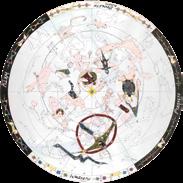
• The Lakota’s relatives, the Star People, live on as constellations in the night sky.
• The Star People watch over and guide the Lakota on Earth.
• People see different constellations during different seasons.
• People make star maps to show the locations of constellations in the sky.
• Constellations can help people find their way.
2. Introduce the D(L)akota Star Map by reading aloud its title in English. Tell students that the map includes the title in Dakota and Lakota as well: Makoce Wicaŋḣpi Wowapi. Explain that this star map was created by Dakota/Lakota astronomers Annette S. Lee and Jim Rock.
Teacher Notes
The D(L)akota Star Map and its accompanying constellation guidebook were created by Annette S. Lee, an astronomer, artist, and member of both the Ojibwe and Dakota/Lakota communities, and Jim Rock, an astronomer and member of the Dakota Nation. According to its creators, the map is primarily based on the chart found in Ronald Goodman’s book Lakota Star Knowledge and Goodman’s interviews with many Lakota elders.
For enhanced viewing of the map, display the D(L)akota Star Map image from the digital platform.
3. Introduce the vocabulary term astronomer by displaying the Knowledge Card, saying the term, and simultaneously clapping once for each syllable. Instruct students to say the term and clap for each syllable.
4. Display and read aloud these word parts and their definitions:
• astro (root)—star
• -er (suffix)—a person who has a specified job or skill
Teacher Note
Students will continue morphology work with the root astro on the Responsive Teaching Day, lesson 16.
5. Instruct students to work with a partner to infer the meaning of astronomer. Invite a few students to share their ideas. As students share, reinforce the correct definition.
6. Direct students to the D(L)akota Star Map, located in the Learn book. Remind students that a star map shows the locations of stars, constellations, planets, and other objects in the night sky. Instruct students to silently study the star map. Encourage students to look closely at different parts of the map.
Teacher Note
If time allows, explain that star maps typically use dots or star shapes to represent stars. The brighter the star, the larger the dot or star on the map. Star maps often use lines to connect stars and show constellations.
Definition
astronomer (n.): a scientist who studies stars, planets, and other objects found in space
7. Form small groups, and instruct students to discuss what they notice and wonder about the star map. Invite groups to share what they notice and wonder.
8. Direct attention to the labels on the outer border of the map and in the four corners outside the circle. Tell students that the labels, like the title, appear in English as well as Dakota and Lakota. Ask this question:
What do you notice about how this star map is organized?
Differentiation Support
To help students organize details, instruct them to count the number of sections on the map and read the section labels. Ask this question: How do the labels help you understand how the star map is organized?
Key Ideas
• The map is divided into four sections: spring, summer, fall, and winter.
• Each season or section of the map includes different stars, constellations, and other objects.
• The bottom of the map is labeled North.
9. Tell students that they will learn more about the star map by reading excerpts from its guidebook. Direct students to excerpts from D(L)akota Star Map Constellation Guidebook, located in the Learn book. Instruct students to follow along as you read aloud the first paragraph, starting with “The D(L)akota Star.”
Differentiation Support
To support understanding of circumpolar motion, invite students to stand, look up, and find a point directly above them. Tell them to spin slowly in a circle, keeping their eyes on the point above and observing how it appears still. Explain that the North Star is almost directly above the tip of Earth’s axis. As Earth rotates, or spins, the North Star appears still while other stars seem to rotate around it.
10. Direct attention to the star map, and ask this question:
How does the information in this passage help us understand what we see on the star map?
Key Ideas
• The North Star is in the middle of the star map.
• Different constellations are visible during different seasons as Earth circles the Sun.
• Each section of the map shows constellations that can be seen in that particular season.
11. Instruct students to Think−Pair−Share to answer this question:
Why would it be useful for the Dakota and Lakota to divide the star map into four seasons?
Key Ideas
• They could identify constellations during different times of the year.
• They could keep track of time passing based on the stars they could see.
• They could plan for different seasons, events, and activities.
Teacher Note
For the Dakota and Lakota, constellations in the sky mirror sacred sites on Earth. For thousands of years, Dakota/Lakota communities had stargazers whose job was to observe the stars and communicate to their people when it was time to visit sacred sites, based on when the Sun passed through certain constellations at sunrise. Stargazers kept this knowledge and passed it on to the next generation of stargazers.
12. Direct attention to the constellations on the star map. Introduce the vocabulary term layer by displaying the term and definition. Engage students in Vocabulary Exploration.
13. Instruct students to silently study the different layers of constellations. Tell them to work with a partner to describe the layers they see.
Definition
layer (n.): a part or section of something that lies over or under another part
14. Invite a few students to share their responses, and reinforce the correct responses:
• bottom layer—white and pink constellations in the shape of humans, animals, and objects
• top layer—constellations made of black, white, and colored dots in the shapes of animals and objects
15. Ask this question:
When you look at the different layers of constellations, where do your eyes go first?
Use responses to emphasize that our eyes are drawn to the black, white, and brightly colored dots that make up the constellations on the map’s top layer (e.g., hand, bear, hoop, snake, elk, turtle, salamander, bird, dipper with bowl and handle) and cause the constellations to stand out.
16. Remind students that throughout human history, people have observed the stars and identified constellations. Explain that the map’s creators included commonly known Greek constellations in white and pink. Overlaying these are Dakota/Lakota constellations made of brightly colored dots.
Differentiation Challenge
To extend student thinking, encourage students to consider why the map’s creators included both Greek and Dakota/Lakota constellations on the star map.
17. Direct attention to the constellation guidebook excerpts, and read aloud the second paragraph, starting with “The star map.”
Language Support
Based on your students’ needs, pause to define select words with a synonym (e.g., meticulous, reminiscent, signify).
18. Facilitate a brief discussion of these questions:
What do we learn about Dakota/Lakota beadwork in this passage?
How is beadwork connected to the stars?
Key Ideas
• Beads are important to the Dakota and Lakota.
• Each bead is a prayer.
• Beads are used to decorate clothes that are worn on special occasions.
• Working with beads requires stillness, just like the stillness of the night sky.
• Beads and stars both sparkle.
19. Tell students that they will now learn more about a specific constellation on the star map. Without revealing the names, direct attention to the Big Dipper, also known as Blue Woman or Birth Woman, to the left of the North Star. Invite a few students to share what they notice and wonder about this constellation. Explain that many people refer to this group of seven stars as the Big Dipper because it looks like a spoon with a long curved handle and deep bowl. It forms part of a Greek constellation known as Ursa Major, or the Great Bear. Tell students that the Dakota and Lakota call this group of seven stars “Blue Woman” or “Birth Woman.”
Teacher Note
If time allows, point out that Blue Woman/Birth Woman is near the North Star. Explain that, like the North Star, this constellation is visible all year long in the Northern Hemisphere.
20. Direct attention to the constellation guidebook excerpts, and read aloud from the heading “North Circumpolar Stars” to “carrying the deceased.” Help students identify the stretcher (the bowl of the Big Dipper) and the mourners (the three stars on the dipper’s handle).
21. Ask this question:
What does this passage help us understand about the Lakota and Dakota?
Key Ideas
• Blue Woman/Birth Woman helps Dakota/Lakota babies safely enter the world.
• When Dakota/Lakota people die, mourners carry their spirits back to the stars in the stretcher.
• The Dakota and Lakota come from the stars and return to the stars at the end of their lives.
• The night sky contains important knowledge and stories for the Dakota and Lakota.
1. Tell students that they will follow the instructional routine Give One−Get One−Move On to discuss what they learned from the D(L)akota Star Map and excerpts from D(L)akota Star Map Constellation Guidebook. Explain how this routine works. First, you ask a question and students jot responses on index cards. Next, students find a partner and discuss their responses. On your cue, students trade their cards with their partner and find a new partner. Then, in their new pairs, students discuss the responses they received from their previous partner. This process repeats until you end the routine. Tell students that for their first practice they will discuss responses with two partners.
2. Introduce the learning task. Ask this question, and then lead students through the routine:
What can we learn from the D(L)akota Star Map and excerpts from D(L)akota Star Map Constellation Guidebook?
After the routine, instruct students to retrieve their own index cards and reflect on what they learned from their discussions. Tell them to add to their original response to incorporate new ideas gained from their discussions.
Monitor: Do students demonstrate understanding of the star map’s organization, features, purpose, and/or significance for the Dakota and Lakota?
Offer Immediate Support: If students need additional support expressing knowledge about the D(L)akota Star Map and excerpts from D(L)akota Star Map Constellation Guidebook, ask these questions: What does the map teach us about Dakota/Lakota constellations? What do you learn about Blue Woman/Birth Woman?
Plan Future Practice: Students practice expressing knowledge by using coordinating conjunctions in lesson 7.
3. Invite a few students to share their responses.
Key Ideas
• organization and features: divided into seasons; shows Dakota/Lakota constellations visible each season (e.g., Snake, Salamander, Turtle); dots on Dakota/Lakota constellations resemble beads
• purpose and significance: helps the Dakota and Lakota identify constellations; contains Dakota/Lakota knowledge and stories (e.g., Blue Woman/Birth Woman); shows that Dakota/Lakota and Greek constellations share many of the same stars
Observe | Discuss Central Ideas in Starfield and Space Object Box | 20 minutes
1. Remind students that works of art don’t always have clear central ideas but that we can consider the artists’ choices and reach our own conclusions about what the central ideas might be.
2. Ask this question: How big is space?
Explain that both artists had to show something that is very big in a small piece of art. Remind students that in module 1 they explored scale in The Great Wave. Remind them that scale is how big or small something seems in comparison with what is around it.
3. Display and Choral Read today’s discussion question: How does each artist show the scale of space? Tell students that they will examine scale in both works of art to help them determine a central idea.
4. Display Starfield. Instruct students to Think–Pair–Share to answer this question:
How does Celmins show the scale of space?
Differentiation Support
To help students understand how the artist uses scale, ask these questions:
• What details in the print seem really big?
• What details in the print seem really small?
• How do these bigger and smaller details help you understand the size of space?
Teacher Note
Zoom in so students can examine the print closely.
Key Ideas
• bigger details: The black shapes surround the white and gray shapes. It looks like everything is in space.
• smaller details: The white shapes are smaller and look bright like stars. The gray shapes are even smaller; they look like stars that are far away because they are a little bit darker and harder to see.
• size of space: Space and stars go all the way to the edges of the print; it seems like they go on and on.
5. Display Space Object Box. Instruct students to Think–Pair–Share to answer this question:
How did Cornell show the scale of space?
Key Ideas
• bigger details: The ball looks like a moon or planet. The animals and people look like constellations. The lines on the paper go out from the circles and stop before the wooden frame. The circles get larger as they get closer to the frame. The box is holding the objects in one place.
• smaller details: The small black dots on the map look like stars. There are numbers and words on the map. There’s a smaller circle in the center of the map.
• size of space: Space seems to grow from the small circle in the center but stop before the frame. Space seems to move from the left to the right along the metal rod. Space feels small because of the frame.
6. Explain that neither Celmins nor Cornell explored space by going there. Celmins studied images of space made by machines, and she spent weeks working to create her own images of space by hand. Cornell dreamed about space. He represented it in his work by using a variety of objects he’d found that reminded him of space.
7. Introduce the learning task. Explain that students will continue the discussion to share what they can learn about space from the artists. Remind students to support what they say with evidence from the work of art. Invite students to use a nonverbal signal (e.g., a thumbs-up) when they hear evidence that supports an idea. Display Starfield and Space Object Box side by side, and ask this question:
What do the artists help me understand about space?
Teacher Note
During the discussion, use the Module 2 Speaking and Listening Goal Tracker, located on the digital platform, to monitor student progress toward these goals. As students practice their speaking and listening skills throughout the module, continue to use the tracker to monitor students’ progress toward each goal.
Analyze Student Progress
Monitor: Do students share an important idea about space from one or both works of art?
Offer Immediate Support: If students need additional support identifying an important idea, direct students back to each work of art and ask this question: What do these works of art tell you about space?
Plan Future Practice: Students practice analyzing elements of art in module 3.
8. At the end of the discussion, reinforce key ideas.
Key Ideas
• Some space objects are closer to us than others.
• The stars that are closer to us may look brighter than those that are farther away.
• Maps can have stars and constellations on them.
• Some space objects, such as planets and stars, can look small to us because they are so far away.
• Space objects, such as our Moon, move in space.
• People can explore space without going to space.
9. Emphasize that students can explore space in many ways, just like Celmins and Cornell explored space without actually visiting it.
1. Direct attention to both knowledge charts, and facilitate a brief discussion to help students articulate the knowledge they built during the lesson. Add a few student-generated knowledge statements to the charts.
Teacher Note
As needed, prompt students to reflect on what they learned by asking questions such as these:
• What did you learn from the D(L)akota Star Map?
• What did you learn about how artists explore space?
MM Make Meaning from Texts
MM.1.3 Comprehension and Evidence: MM.1.3.C, MM.1.3.D
MM.2.3 Theme and Central Idea: MM.2.3.E
MM.5.3 Vocabulary: MM.5.3.A, MM.5.3.A.d, MM.5.3.A.e, MM.5.3.C
MM.12.3 Complexity, Diversity, and Genre: MM.12.3.B, MM.12.3.B.b, MM.12.3.C, MM.12.3.C.b, MM.12.3.C.c
CP Compose and Present Content
CP.5.3 Language: CP.5.3.B
BU Build Understanding
BU.2.3 Discovery and Evidence
BU.3.3 Conversation and Collaboration: BU.3.3.A, BU.3.3.B, BU.3.3.D
BU.4.3 Expression
DF Develop Foundations
DF.3.3 Phonics and Spelling: DF.3.3.A, DF.3.3.A.b, DF.3.3.B, DF.3.3.B.a, DF.3.3.B.b
DF.4.3 High-Frequency and Irregularly Spelled Words: DF.4.3.A
DF.13.3 Sentence Construction: DF.13.3.A
DM Develop Metacognition
DM.1.3 Content Stages: DM.1.3.E
DM.3.3 Schema Building
DM.4.3 Reflection and Evaluation
Essential Question | How do people learn about space?
Content Framing Question | Know: How do these texts build our knowledge?
In this Know lesson, students read the author’s note and learn about ledger book art, the traditional Lakota art form that inspired S. D. Nelson’s illustrations in The Star People. They reflect on their learning from The Star People, the D(L)akota Star Map, excerpts from D(L)akota Star Map Constellation Guidebook, and “Constellations” and practice using different coordinating conjunctions to express their new knowledge. During visual art instruction, students synthesize their learning from Starfield and Space Object Box. Students draw on their knowledge of scale, contrast, value, and outer space to share what they know.
Express knowledge gained from The Star People, the D(L)akota Star Map, excerpts from D(L)akota Star Map Constellation Guidebook, and “Constellations.”
LEARNING TASK: Compose at least two sentences to express ideas gained from The Star People, the D(L)akota Star Map, excerpts from D(L)akota Star Map Constellation Guidebook, and “Constellations” by using different coordinating conjunctions.
Express knowledge gained from Starfield and Space Object Box.
LEARNING TASK: Write at least two knowledge statements to express ideas gained from Starfield and Space Object Box.
sacred (adj.)
LAUNCH
Read the Content Framing Question
LEARN
• Read: Listen Closely to the Author’s Note
• Respond: Express Knowledge About the Story, Star Map, and Video
• Observe: Express Knowledge About Starfield and Space Object Box
LAND
Synthesize Learning
Materials
TEACHER
• The Star People
• D(L)akota Star Map (digital platform)
• excerpts from D(L)akota Star Map Constellation Guidebook (digital platform)
• Starfield (digital platform)
• Space Object Box (digital platform)
• Map of the Great Plains (digital platform)
• Syllable Types (Reference Charts appendix)
• Fluency Reference Chart (Reference Charts appendix)
• “Time Lapse: Night Time Milky Way” (digital platform)
• The Star People
• D(L)akota Star Map (Learn book)
• excerpts from D(L)akota Star Map Constellation Guidebook (Learn book)
• Fluency Practice for The Star People (Learn book, Fluency)
• Sentence Strategies for Module 2 (Learn book, Writing)
• World Knowledge Statements for Module 2 (Learn book)
• Determine how to display side by side Syllable Types and the term sacred with its syllable division. See the Read section for details.
• Familiarize yourself with the concept of coordinating conjunctions. See the Respond section for details.
• Determine how to display side by side Starfield and Space Object Box. See the Observe section for details.
• Students listen to, read, or explore a volume of reading text. They add to their reading log and respond to assigned volume of reading questions. See Implementation Resources for volume of reading guidance.
2 minutes
Read the Content Framing Question
1. Display The Star People.
2. Display and Choral Read the Content Framing Question: How do these texts build our knowledge?
3. Explain that during a Know lesson the class reflects on the knowledge they built and makes connections among texts to share what they know now. Tell students that in this lesson they will revisit The Star People to read the author’s note and spend time thinking and writing about the knowledge they built from The Star People, the D(L)akota Star Map, excerpts from D(L)akota Star Map Constellation Guidebook, and “Constellations.”
53 minutes
Read | Listen Closely to the Author’s Note | 14 minutes
1. Direct attention to the World Knowledge Chart, and instruct students to silently read the knowledge statements. Ask these questions:
What have we learned from The Star People?
What have we learned from the D(L)akota Star Map and excerpts from D(L)akota Star Map
Constellation Guidebook?
What have we learned from “Constellations”?
Differentiation Support
To help students recall world knowledge from the video, direct them to the Gallery for “Constellations,” located in the Learn book.
• The Lakota’s relatives, both human and animal, live on as constellations in the night sky.
• The Star People watch over and guide the Lakota on Earth.
• The Lakota are deeply connected to Earth, stars, and all living things.
• The night sky contains important knowledge and stories for the Dakota and Lakota.
• The Dakota and Lakota come from the stars and return to the stars at the end of their lives.
• People all over the world see different shapes in the same stars.
• Different constellations appear in the sky during different seasons.
• People make star maps to show the locations of constellations during different seasons.
2. Direct attention to the author’s note on page 32. Remind students that an author’s note is a short piece of text, written by the author, usually found at the end of a book. In it, the author might share additional information about the topic, their inspiration and choices, or their process for creating the book.
3. Display the Map of the Great Plains, and remind students that S. D. Nelson, the author and illustrator of The Star People, is a member of the Lakota Nation and the Standing Rock Sioux Tribe, located in North and South Dakota.
4. Display side by side Syllable Types and the term sacred with its syllable division: sa-cred. Direct attention to the first syllable, and instruct students to name the syllable type. Reinforce the correct response: open.
5. Direct attention to the second syllable, and instruct students to name the syllable type.
Reinforce the correct response: closed.
6. Instruct students to decode this multisyllabic word with a partner. Explain that before reading the author’s note, students should know the definition of the term sacred. Display the term and definition. Invite a student to read aloud the definition.
Definition sacred (adj.): highly valued and important; deserving great respect
7. Direct attention to The Star People. Instruct students to follow along as you read aloud the author’s note and listen for interesting or surprising information they learn from S. D. Nelson. Read aloud the author’s note on pages 32−33, starting with “Growing up in” and including the caption.
Language Support
Based on your students’ needs, pause to define select words with a synonym (e.g., incarceration, personified, resisted).
Differentiation Support
To check students’ comprehension and support understanding of the author’s main ideas, pause at strategic points and ask questions such as these:
• What did you learn about the author’s childhood and family?
• What did you learn about ledger book art?
• What did you learn about the choices Nelson made as an author and illustrator?
8. Facilitate a brief discussion of the interesting or surprising information students learn from the author’s note. Add a few student-generated knowledge statements to the World Knowledge Chart.
Key Ideas
• Nelson grew up hearing stories from his mother, Elk Tooth Woman, about the Star People and about his great-great-grandfather Flying Cloud.
• Nelson’s mother taught him that Mother Earth and Father Sky are sacred.
• In the late 1800s, the US government forced many Native American tribes to move onto reservations and attend boarding schools.
• During this time, many Plains Indians created artwork using ledger books, pens, crayons, and colored pencils.
• The Star People takes place on the Great Plains during the late 1800s.
• Ledger book art inspired Nelson’s illustrations in The Star People.
• The Lakota believe that, like people, the stars and clouds have living energy.
• The character Sister Girl is based on Nelson’s favorite cousin.
To encourage extended reading about stars, highlight a volume of reading text. Tell students to make connections between The Star People, the D(L)akota Star Map, and the volume of reading text.
9. Display the Fluency Reference Chart, and remind students of all the work they have done in previous lessons with the different elements of fluency.
10. Display Fluency Practice for The Star People, and direct students to the page in their Learn book. Instruct students to perform a fluent reading of their passage for a partner.
After this arc of explicit instruction on the elements of fluency (accuracy, phrasing, expression, and rate), students have numerous opportunities to practice fluent oral and silent reading during lessons. Encourage students to apply what they have learned about fluent reading while they read in class, and reinforce these skills with the fluency passages assigned for follow-up. See Implementation Resources for additional fluency resources and advice on identifying readers who need regular fluency support, setting goals, and tracking progress.
Respond | Express Knowledge About the Story, Star Map, and Video | 24 minutes
1. Remind students that each time they reflect on their knowledge, they learn about and practice different ways to express it. Ask this question:
What are some ways we practiced expressing our knowledge in module 1?
Reinforce the correct responses: writing complete simple sentences and using conjunctions to combine ideas into compound sentences.
2. Display Sentence Strategies for Module 2, and direct students to the page in the Learn book. Choral Read Strategy 1 and the examples of coordinating conjunctions.
3. Remind students that they can use coordinating conjunctions to connect ideas in different ways. Instruct students to silently read the sample sentences under Strategy 1. Ask this question:
How do the conjunctions and, but, and so connect the ideas in these sentences?
Reinforce the correct responses:
• The word and joins similar ideas.
• The word but introduces a different idea.
• The word so introduces a result or effect.
4. Display and Choral Read this sentence: The Lakota refer to constellations as Star People.
5. Direct attention to the World Knowledge Chart. Instruct students to work with a partner to orally expand the sentence into a compound sentence by using a coordinating conjunction and information from the chart. Invite a few students to share their sentences.
Key Ideas
• The Lakota refer to constellations as Star People, and they refer to clouds as Cloud People.
• The Lakota refer to constellations as Star People, for they have a living energy.
• The Lakota refer to constellations as Star People, yet others see different shapes in the stars.
6. Explain that students will continue to practice using coordinating conjunctions to express what they learned from The Star People, the D(L)akota Star Map, excerpts from D(L)akota Star Map Constellation Guidebook, or “Constellations.” Instruct students to work with a partner to practice orally creating compound sentences, using coordinating conjunctions to combine or expand ideas from the knowledge chart. Challenge students to use a variety of coordinating conjunctions. Listen for students to correctly use the conjunctions to combine and expand their ideas.
Ask students to explain why they chose a particular coordinating conjunction to combine or expand their ideas. Where appropriate, highlight another conjunction and challenge students to use it to combine or expand their ideas in a different way.
7. Introduce the learning task. Direct students to World Knowledge Statements for Module 2, located in the Learn book. Instruct students to write at least two statements to express knowledge they gained from The Star People, the D(L)akota Star Map, excerpts from D(L)akota Star Map Constellation Guidebook, or “Constellations.” Tell students to use two different conjunctions to combine or expand their ideas into compound sentences.
Language Support

To help students express knowledge from the video, direct them to the Gallery for “Constellations,” located in the Learn book.
Monitor: Do students express knowledge gained from The Star People, the D(L)akota Star Map, excerpts from D(L)akota Star Map Constellation Guidebook, or “Constellations” while correctly using different coordinating conjunctions?
Offer Immediate Support: If students need additional support expressing knowledge, provide sentence frames with a coordinating conjunction (e.g., The North Star appears to stay still, but ; Star maps show the locations of stars in the night sky, so ), and instruct students to complete them.
Plan Future Practice: Students practice expressing knowledge using subordinating conjunctions in lesson 14.
8. Invite a few students to share their knowledge statements, and add them to the World Knowledge Chart. Tell students that in upcoming lessons they will learn about and practice using another type of conjunction to expand their ideas and express their knowledge.
9. Remind students of the texts they studied in this arc: The Star People, Starfield, Space Object Box, the D(L)akota Star Map, and excerpts from D(L)akota Star Map Constellation Guidebook. Play “Time Lapse: Night Time Milky Way.” Instruct students to reflect on their learning as they watch the video. Ask this question:
What do you think or wonder about now when you look at the night sky?
Observe | Express Knowledge About Starfield and Space Object Box |
15 minutes
1. Direct attention to both knowledge charts, and instruct students to silently read the knowledge statements.
2. Display Starfield and Space Object Box side by side.
Teacher Note
If unable to display simultaneously, show them one at a time.
3. Facilitate a brief discussion of these questions:
What did you learn about space?
What did you learn about art?
Key Ideas
• Space is far-reaching.
• Some stars are bright, while others are dim.
• Space is dark.
• Machines and humans can create accurate pictures of space.
• Some objects in space are closer to us than others.
• Stars can be connected on maps to create shapes or pictures of people and animals.
• Space can seem smaller than it actually is because we can’t see all of it with our eyes.
• Artists can help us learn new things about space through their art.
• Artists can use different materials to show objects in space.
• Artists can use real photographs of space for inspiration.
• Artists create contrast by using different lines, colors, shapes, and objects.
4. Instruct students to share with a partner at least two new things they learned about space or art.
5. Introduce the learning task. Direct students to World Knowledge Statements for Module 2. Instruct students to write at least two knowledge statements to express knowledge they gained from Starfield and Space Object Box. Encourage students to combine or expand ideas by using conjunctions, referring to Sentence Strategies for Module 2 as needed.
Monitor: Do students provide examples from each work of art to describe new learning about space or art?
Offer Immediate Support: If students need additional support expressing knowledge they gained about space, direct students to the star map in Space Object Box and ask this question: What did you learn about stars?
Plan Future Practice: Students practice expressing knowledge using subordinating conjunctions in lesson 14.
6. Invite a few students to share their knowledge statements. Add them to the World Knowledge Chart.
7. Instruct students to Think–Pair–Share to answer these questions:
If you could be a space explorer inside one of these works of art, which one would you choose? Why?
5 minutes
1. Remind students of the Essential Question. Tell them that they will answer this question in different ways throughout the module. Ask the Essential Question:
How do people learn about space?
2. Use responses to reinforce these Knowledge Threads:
• For thousands of years, humans have been using the stars and other celestial bodies for navigation and seasonal planning.
• Early astronomers established the foundation for contemporary understanding of space.
• People can document and share observations of scientific phenomena.
• The vastness of space sparks human curiosity and imagination.
Teacher Note
As needed, prompt students to reflect on what they learned by asking questions such as these:
• How do the Dakota and Lakota understand the stars and their relationship to them?
• How do artists explore space?
MM Make Meaning from Texts
MM.1.3 Comprehension and Evidence: MM.1.3.C, MM.1.3.D
MM.7.3 Structure: MM.7.3.C
MM.12.3 Complexity, Diversity, and Genre: MM.12.3.B, MM.12.3.B.b, MM.12.3.C, MM.12.3.C.b, MM.12.3.C.c
CP Compose and Present Content
CP.5.3 Language: CP.5.3.B
BU Build Understanding
BU.2.3 Discovery and Evidence
BU.3.3 Conversation and Collaboration: BU.3.3.A, BU.3.3.B
BU.4.3 Expression
DF Develop Foundations
DF.3.3 Phonics and Spelling: DF.3.3.A, DF.3.3.A.b, DF.3.3.B, DF.3.3.B.b
DF.4.3 High-Frequency and Irregularly Spelled Words: DF.4.3.A
DF.5.3 Fluency: DF.5.3.A, DF.5.3.B, DF.5.3.C
DF.13.3 Sentence Construction: DF.13.3.A, DF.13.3.D
DM Develop Metacognition
DM.1.3 Content Stages: DM.1.3.E
DM.3.3 Schema Building
DM.4.3 Reflection and Evaluation
Essential Question | How do people learn about space?
Content Framing Question | Wonder: What do I notice and wonder about this text?
In this Wonder lesson, students begin learning about famed astronomer Galileo Galilei in Peter Sís’s illustrated biography Starry Messenger. Students listen to the text with curiosity and attention, explore text features and illustrations, and share what they notice and wonder. During writing instruction, students examine the Writing Model for Module 2, an opinion essay. They consider a different opinion and write a reason that supports this opinion.
A Prologue to lesson 8 is available for students who need additional support.
Notice and wonder about Starry Messenger.
LEARNING TASK: Write at least three things you notice about Starry Messenger and three related questions.
Examine an opinion essay.
LEARNING TASK: Write a reason that supports an opinion.
none
LAUNCH
Read the Content Framing Question
LEARN
• Read: Listen Closely to Starry Messenger
• Respond: Notice and Wonder About the Text
• Write: Examine an Opinion Essay
LAND
Reflect on Learning
Materials
TEACHER
• Starry Messenger
• class Notice and Wonder Chart for Starry Messenger (Learn book)
• class color-coded Writing Model for Module 1 (Learn book, Writing)
STUDENTS
• Starry Messenger
• Notice and Wonder Chart for Starry Messenger (Learn book)
• Writing Model for Module 2 (Learn book, Writing)
• journal
• Starry Messenger is an unpaginated text. Number your text; begin with the title page as page 1. Pages on the left will be even, and pages on the right will be odd.
• Students listen to, read, or explore a volume of reading text. They add to their reading log and respond to assigned volume of reading questions. See Implementation Resources for volume of reading guidance.
• Students complete day 1 of Fluency Practice for Starry Messenger, passage 1 (Learn book, Fluency), and focus on a fluency element or retelling.
Read the Content Framing Question
1. Display Starry Messenger.
2. Display and Choral Read the Content Framing Question: What do I notice and wonder about this text?
3. Introduce Starry Messenger by reading aloud the title and author. Explain that the author is also the illustrator for this book. Tell students that in this lesson they will read Starry Messenger and notice and wonder about it.
1. Instruct students to examine the front and back covers of Starry Messenger. Encourage them to read the subtitle on the front cover and look closely at the illustrations. Instruct students to discuss with a partner what they notice and wonder about Starry Messenger from its covers.
2. Display the class Notice and Wonder Chart for Starry Messenger, and direct students to the page in the Learn book. Instruct students to write on their chart at least two things they notice about the covers and two related questions. Invite a few students to share their responses, and add them to the class chart.
3. Direct attention to page 1, and read aloud the title and expanded subtitle. Assess and activate prior knowledge by asking this question: What does an astronomer do?

Reinforce the correct response: studies stars, planets, and other objects found in space.
4. Instruct students to work with a partner to identify other familiar words in the subtitle and annotate unknown words.
5. Direct students to page 3, and tell them to follow along as you read aloud Starry Messenger (except the captions and script).
Language Support
Based on your students’ needs, pause to define select words with a synonym (e.g., extravaganzas, pardoned, patron). Use subsequent readings to reinforce the synonyms for the words you selected.
To support students using the advanced writing model, read aloud the portion of the script on page 12 from “Invented and perfected” to “first astronomical telescope.” If time allows, read aloud more script text, not including direct quotations.
Respond | Notice and Wonder About the Text | 14 minutes
1. Instruct students to work with a partner to review the text and discuss what they notice and wonder. Encourage students to look closely at the text, illustrations, and other text features.
2. Introduce the learning task. Instruct students to write on their Notice and Wonder Chart for Starry Messenger at least three things they notice about the text and three related questions.
Monitor: Do students make coherent connections between what they notice and what they wonder about in Starry Messenger?
Offer Immediate Support: If students need additional support asking questions about what they notice, encourage them to focus on a specific part of the text (e.g., pages 3–5) and ask these questions: What do you notice about these two illustrations? What questions do they raise for you?
Plan Future Practice: Students practice noticing and wondering about Moonshot in lesson 17.
3. Invite a few students to share their responses. Add a few responses to the class chart.
4. Instruct students to read their questions about the covers of Starry Messenger and put a check mark next to questions they can answer after reading the book. Invite a few students to share an example of an answer they found in the text.
5. Instruct students to put a star next to one or two questions on their chart that they are most interested in answering after reading Starry Messenger. Invite a few students to share their questions.
1. Display the class color-coded Writing Model for Module 1. Facilitate a brief discussion of this question:
How did this writing model help you practice writing informative essays?
Key Ideas
• It helped us see how many and what types of paragraphs to include in an essay.
• It helped us see the different kinds of sentences in a proof paragraph.
• The colors reminded us how the different parts of the essay are connected.
2. Tell students that they will now explore a piece of writing called an opinion essay. Direct students to the Writing Model for Module 2, located in the Learn book. Ask this question:
How many paragraphs do you see in this opinion essay?
Reinforce the correct response: four. Instruct students to draw a box around each paragraph in the opinion essay.
Students use the writing model throughout the module. It shows them the structure they will be expected to follow in their writing. The on-target writing model is an example of an essay that fully meets the on-target criteria from the End-of-Module Task rubric. The advanced writing model is an example of an essay that exceeds some criteria for the End-of-Module Task. See the Assessment Guide for more information. The Learn book includes two copies of each writing model. Students color-code one copy according to the Painted Essay® and annotate the other for specific essay components.
The Learn book also includes a checklist for the writing model. This checklist can be used to clarify expectations for writing an opinion essay.
Some students may be able to write advanced responses. For example, they may be able to provide additional evidence or include complex sentences. Use the Advanced Writing Model for Module 2 to support instruction for these students. Note that the correct responses indicated in steps below refer to the On-Target Writing Model, and adapt as needed for the Advanced Writing Model.
3. Read aloud the writing model, and ask this question:
Reinforce the correct response: how Galileo is like Jacques Cousteau.
4. Explain that the writer composed this essay to answer a prompt and to share the writer’s opinion. Direct attention to the writing prompt, and read aloud the first sentence.
5. Instruct students to listen as you read aloud the introductory paragraph and to give a nonverbal signal (e.g., a thumbs-up) if they hear an answer to the prompt. Ask this question:
Reinforce the correct response: “In my opinion, Galileo was most like Jacques Cousteau.”
6. Emphasize that the writer is sharing their personal choice, and another writer might choose a different ocean scientist.
7. Instruct students to discuss these questions with a partner:
Why did the writer choose Jacques Cousteau?
How do you know?
Differentiation Support
Direct students to the thesis in the introductory paragraph, and ask this question: Why does the writer think Galileo is like Jacques Cousteau?
Reinforce the correct response: Like Cousteau, Galileo was a curious child, and he also wrote a book to share his discoveries. Emphasize that the writer gives the reasons that support their choice in the introduction.
8. Instruct students to discuss this question with a partner:
What do you think the two proof paragraphs will be about?
Listen for students to determine the correct response(s):
• Proof paragraph 1 will be about Galileo as a curious child.
• Proof paragraph 2 will be about Galileo’s book.
9. Prompt students to notice the types of sentences in each paragraph as they listen to the essay. Read aloud the rest of the essay, and then explain that each proof paragraph contains a topic sentence with a reason, followed by evidence and elaboration. Ask this question:
Which phrases does the writer use to link the evidence to the reason in each proof paragraph?
Reinforce the correct responses: “In the text” and “The text says.”
10. Introduce the learning task. Display the prompt for the Writing Model for Module 2. Direct students to their journals. Instruct them to respond to these questions by using complete sentences or the sentence frame:
• Who is another ocean scientist the writer could choose?
• What is a reason they might choose this ocean scientist?
Language Support
Provide this sentence frame: The writer could choose because .
Monitor: Do students provide an ocean scientist from the list in the prompt, and do they provide a reason that supports their choice?
Offer Immediate Support: If students need additional support providing a reason, ask this question: How is Galileo like the ocean scientist?
Plan Future Practice: Students practice identifying writing structure in the Writing Model for Module 2 by using the Painted Essay®—Opinion in lesson 9.
11. Invite students to share their responses.
Key Ideas
• The writer could choose Roper because they were both curious children.
• The writer could choose Roper because they both observed a place that interested them.
• The writer could choose Tharp because they both drew things that had never been seen before.
• The writer could choose Tharp because they both discovered new things.
• The writer could choose Tharp because, at first, no one believed their theories.
12. Direct attention to the writing prompt. Facilitate a brief discussion of these questions:
Is there only one answer to this prompt?
How do we know?
Key Ideas
• There’s more than one answer because writers can have different opinions.
• There are many reasons Galileo was like each ocean scientist.
13. Tell students that during the next lesson they’ll explore how the Painted Essay® can be used to organize an opinion essay.
1. Direct attention to both knowledge charts, and facilitate a brief discussion to help students articulate the knowledge they built during the lesson. Add a few student-generated knowledge statements to the charts.
Teacher Note
As needed, prompt students to reflect on what they learned by asking questions such as these:
• What did you learn from Starry Messenger?
• What did you learn about opinions?
• What did you learn about reasons?
MM Make Meaning from Texts
MM.12.3 Complexity, Diversity, and Genre: MM.12.3.B, MM.12.3.B.a
CP Compose and Present Content
CP.2.3 Planning: CP.2.3.A, CP.2.3.B
BU Build Understanding
BU.2.3 Discovery and Evidence: BU.2.3.A, BU.2.3.B
BU.4.3 Expression
DM Develop Metacognition
DM.1.3 Content Stages: DM.1.3.A
DM.3.3 Schema Building
Essential Question | How do people learn about space?
Content Framing Question | Organize: What is happening in this text?
In this Organize lesson, students reread the first part of Starry Messenger to gain a basic understanding of the Ptolemaic and Copernican systems that Galileo would eventually disprove and uphold, respectively. They identify important events in Galileo’s life and create a timeline to organize these events. During writing instruction, students reexamine the Writing Model for Module 2 to learn how the Painted Essay® helps them organize ideas in an opinion essay. This work prepares students to write opinion essays throughout the year.
A Prologue to lesson 9 is available for students who need additional support.
Organize important events in Galileo’s life.
LEARNING TASK: Add two important events in Galileo’s life from pages 12−18 of Starry Messenger, including related details, to a timeline.
Analyze the connections between the Painted Essay®—Opinion and the writing model.
LEARNING TASK: Annotate the introductory paragraph in the writing model according to the Painted Essay®— Opinion.
revolve around universe (n.)
LAUNCH
Read the Content Framing Question
LEARN
• Read: Organize Events
• Respond: Add Events and Details to a Timeline
• Write: Analyze the Painted Essay®—Opinion
LAND
Reflect on Learning
Materials
TEACHER
• Starry Messenger
• Knowledge Card: universe
• class Timeline for Starry Messenger (Learn book)
• Painted Essay®—Informative (Learn book for module 1, Writing)
STUDENTS
• Starry Messenger
• Timeline for Starry Messenger (Learn book)
• coloring utensils: red, green, yellow, blue
• Painted Essay®—Opinion (Learn book, Writing)
• Writing Model for Module 2 (Learn book, Writing)
• Determine how to display side by side the Painted Essay®— Informative and the Painted Essay®—Opinion. See the Write section for details.
• Students listen to, read, or explore a volume of reading text. They add to their reading log and respond to assigned volume of reading questions. See Implementation Resources for volume of reading guidance.
• Students complete day 2 of Fluency Practice for Starry Messenger, passage 1 (Learn book, Fluency), and focus on a fluency element or retelling.
2 minutes
Read the Content Framing Question
1. Display Starry Messenger.
2. Display and Choral Read the Content Framing Question: What is happening in this text?
3. Tell students that they will reread the first part of Starry Messenger and organize key events in the text.
53 minutes
Read | Organize Events | 18 minutes
1. Assess and activate prior knowledge by asking these questions: What type of book is Starry Messenger? How do you know?
Reinforce the correct responses: a biography, or a piece of writing about a real person’s life; the subtitle says “a book depicting the life of … Galileo Galilei.”
2. Instruct students to study the illustrations on pages 3−5 and work with a partner to describe what is happening in each illustration. Invite a few students to share their responses.
Key Ideas
• page 3: shows a large Earth in the middle; shows small objects, including the Sun, moving around it; a label in the top right says “The Earth stands still.”
• pages 4−5: shows the Sun in the middle; shows Earth and other, smaller objects moving around the Sun; a label in the top right says “The Earth moves!”
3. Explain that before rereading pages 3−4, students should know the definitions of several key vocabulary terms. Introduce the vocabulary term universe by displaying the Knowledge Card. Engage students in Vocabulary Exploration.
4. Introduce the vocabulary term revolve around by displaying the term and definition. Engage students in Vocabulary Exploration. Demonstrate the meaning of the phrase by using gestures (e.g., making a circular motion around a stationary object).
5. Instruct students to follow along as you read aloud pages 3−4 (except the captions and script), starting with “For hundreds of,” and to consider what is happening in the text. After reading aloud, ask this question:
What is happening on pages 3−4?
Key Ideas
• For a long time, many people thought Earth was the center of the universe and the Sun and other planets moved around it.
• One man thought that Earth and other planets move around the Sun, but he couldn’t prove it.
6. Direct attention to the illustration and timeline on page 3. Explain that the illustration shows the ideas of an astronomer named Ptolemy, pictured at the end of the timeline. He believed that Earth stood still at the center of the universe and the Sun and other planets revolved, or moved in a circle, around it. This was called the Ptolemaic system. Explain that long before Galileo was born, most people in western Europe believed Ptolemy’s ideas and did not question them.
Differentiation Support
To support students’ understanding of the Ptolemaic system, assign students different roles (Earth, Sun, Moon, other planets) and invite them to stand or move according to Ptolemy’s ideas. Consider repeating this activity for the Copernican system in the next step to support understanding of how the two systems differ.
Definitions universe (n.): everywhere and everything on Earth, in the air, and in space, including all the stars and other planets revolve around: to move in a curved path around a center point
7. Direct attention to the illustration and timeline on pages 4−5. Tell students that the man the text refers to on page 4 is an astronomer named Copernicus, pictured at the bottom of the timeline. Explain that this illustration shows Copernicus’s ideas, known as the Copernican system. Instruct students to discuss this question with a partner:
How did Copernicus’s ideas differ from Ptolemy’s?
Invite a few students to share their responses, and reinforce the correct response: Copernicus believed that the Sun is at the center of the universe, and Earth, the Moon, and the other planets move around it.
8. Ask this question:
According to the text, why didn’t Copernicus talk about or publish his ideas?
Reinforce the correct response: He could not prove they were true.
9. Encourage students to keep Ptolemy’s and Copernicus’s ideas in mind as they continue reading Starry Messenger and learning about Galileo. Instruct students to reread pages 6−18 (except the captions and script), starting with “In those days,” and to annotate important events.
Respond | Add Events and Details to a Timeline | 15 minutes
1. Display the class Timeline for Starry Messenger, and direct students to the page in the Learn book. Tell students that they will use this timeline to organize important events in Galileo’s life, just as they did with Marie Tharp in Solving the Puzzle Under the Sea
2. Instruct students to discuss this question with a partner:
What is the first event you would include on a timeline of Galileo’s life?
Invite a few students to share their responses, and reinforce that Galileo’s birth is a logical first event. Add this event to the class timeline: Galileo was born.
3. Remind students that under each important event on the timeline, they should include key details related to that event. Instruct students to work with a partner to revisit pages 6−10, identify at least two key details related to Galileo’s birth and early life, and add them to their timeline.
Language Support
Direct attention to the phrase “stars in his eyes” on page 9, and explain that this phrase has a nonliteral meaning. Galileo was not born with actual stars in his eyes; this phrase is used to describe someone who is hopeful and excited about the future.
Differentiation Support
To help students focus on details related to Galileo’s early life, direct attention to pages 6−10 and ask questions such as these:
• Where was Galileo born?
• What was Galileo like as a young child?
Differentiation Challenge
Direct attention to sections of the script from pages 8 and 10. Instruct students to read the text, identify details that relate to Galileo’s birth and early life, and add appropriate details to their timeline.
4. Invite students to share key details. Add a few key details to the class timeline.
Key Ideas
• was born in Pisa, Italy
• was very curious
• was always thinking about the stars
5. Introduce the learning task. Direct attention to the next two event boxes on the timeline. Instruct students to work with a partner to review pages 12−18 of Starry Messenger and add two events from those pages to their timeline. Tell students to include at least two key details related to each event in the boxes underneath the events. Remind students to focus on the most important events from that part of the text.
Monitor: Do students correctly identify key events related to Galileo’s early life and work and support them with relevant details?
Offer Immediate Support: If students need additional support identifying key events and supporting them with relevant details, direct attention to page 12 and ask these questions: What important event from this page would you add to a timeline of Galileo’s life? What details relate to this event?
Plan Future Practice: Students continue to add important events in Galileo’s life and related details to the timeline in lesson 10.
6. Invite a few students to share their events and details. Use responses to add two events and related key details to the class timeline.
Key Ideas
• event: Galileo studied math and science.
• details: was very bright; entertained people with experiments; was admired by many
• event: Galileo made his own telescope.
• details: observed the sky; wrote down observations; published observations in a book
7. Tell students that in the next lesson they will reread the rest of Starry Messenger and complete the timeline of important events in Galileo’s life.
1. Remind students that in the previous lesson they examined an opinion essay about how Galileo is like the ocean scientist Jacques Cousteau. Display the Writing Model for Module 2, and facilitate a brief discussion of this question:
What did you learn about opinion essays?
Key Ideas
• An opinion essay has four paragraphs like an informative essay.
• In an opinion essay, the writer responds to a prompt in a personal way.
• Proof paragraphs tell why the writer has this opinion.
• The last paragraph repeats ideas from the introductory paragraph.
2. Explain that in this lesson students will revisit the Painted Essay ® to explore how writers can use it to organize and share opinions. Distribute red, green, yellow, and blue coloring utensils to each student.
Teacher Note
The Painted Essay ® is a structure for organizing writing. It provides a visual representation of the sequential organization of an essay and illustrates the individual parts. Using an organizational structure such as this creates a shared language between students and the teacher and helps students organize their thinking and communicate it clearly and effectively.
3. Display, side by side, the Painted Essay ®—Informative and the Painted Essay®—Opinion. Instruct students to discuss these questions with a partner:
How is the introductory paragraph in the Painted Essay ®—Opinion similar to the introductory paragraph in the Painted Essay ®—Informative? How is it different?
Language Support
To help students articulate similarities and differences, provide these sentence frames:
• Both introductory paragraphs .
• The introductory paragraph in the opinion essay .
• The introductory paragraph in the informative essay
Reinforce the correct response: Both have an introduction and thesis, but the thesis is different because the Painted Essay ®—Opinion has reasons instead of points.
4. Direct students to the Painted Essay®—Opinion, located in the Learn book. Direct attention to the introductory paragraph box, and explain that its function is to help a reader understand the writer’s opinion and why the writer thinks a certain way about a question or a topic. As in an informative essay, the writer first uses a hook to catch the reader’s attention. Ask this question:
What color will you use to color the introduction, or hook?
Reinforce the correct response: red. Instruct students to color the Introduction section of the Painted Essay® red.
Teacher Note
Encourage students to color lightly so they can easily read the headings in the Painted Essay®.
5. Instruct students to read the next bold heading: Thesis. Explain that the thesis in an opinion essay has two sentences, just as it does in an informative essay; however, the first sentence in the thesis of an opinion essay shares the writer’s opinion as the focus of the essay. If the writer is responding to a prompt, this is the place where they will answer the question in a personal way. Next, the writer adds a sentence with two reasons that explain why the writer thinks this way about the question. Instruct students to use green to color the box labeled Thesis, yellow to color the box labeled reason 1, and blue to color the box labeled reason 2.
6. Ask this question:
Why is reason 1 yellow and reason 2 blue?
Reinforce the correct responses: Point 1 in an informative essay is yellow, so reason 1 in an opinion essay is yellow. Point 2 in an informative essay is blue, so reason 2 in an opinion essay is blue.
7. Instruct students to work with a partner to color-code the rest of the Painted Essay®: proof paragraph 1, proof paragraph 2, and the concluding paragraph.
8. Introduce the learning task. Direct students to the Writing Model for Module 2, located in the Learn book. Instruct students to color-code the introductory paragraph in the writing model according to the Painted Essay®—Opinion.
Monitor: Do students color-code the hook red, the first sentence of the thesis green, the first reason yellow, and the second reason blue?
Offer Immediate Support: If students need additional support color-coding the introductory paragraph, direct them to the Painted Essay®—Opinion and ask these questions: In the introductory paragraph, what should be colored red? What should be colored green? What should be colored yellow? What should be colored blue?
Plan Future Practice: Students practice applying knowledge of the Painted Essay® structure in lesson 17.
9. Facilitate a brief discussion of this question:
How do the colors help you understand the thesis in this introductory paragraph?
Reinforce the correct response: The first sentence of the thesis is an opinion, and it is green. It is supported by a yellow reason and a blue reason in the second sentence of the thesis. Yellow and blue make green.
10. Instruct students to read proof paragraph 1. Ask this question:
What do you notice about proof paragraph 1?
Use responses to emphasize that proof paragraph 1 is all about reason 1. It has evidence and elaboration that support reason 1. It also has reason 1 as the topic sentence.
11. Ask this question:
Which color will you use to color this paragraph?
Reinforce the correct response: yellow. Instruct students to color proof paragraph 1 yellow.
12. Direct attention to proof paragraph 2. Instruct students to read the topic sentence in proof paragraph 2. Ask this question:
What transition does the writer use in the topic sentence to let the reader know that they are transitioning to the next reason?
Reinforce the correct response: “Another reason.” Instruct students to color the transition yellow.
13. Instruct students to read the rest of proof paragraph 2. Ask this question:
What else do you notice about proof paragraph 2?
Use responses to emphasize that proof paragraph 2 is all about reason 2. It has evidence and elaboration that support reason 2. It also has reason 2 as the topic sentence.
14. Ask this question:
Which color will you use to color the rest of this paragraph?
Reinforce the correct response: blue. Instruct students to color the rest of proof paragraph 2 blue.
15. Instruct students to read the concluding paragraph, and ask this question:
Where have you heard these ideas before?
Reinforce the correct response: in the thesis.
16. Ask this question:
Which color will you use to color this paragraph?
Reinforce the correct response: green. Instruct students to color the concluding paragraph green.
17. Tell students that they now have two color-coded resources that they can refer to as they develop their own opinion essays this year.
1. Direct attention to both knowledge charts, and facilitate a brief discussion to help students articulate the knowledge they built during the lesson. Add a few student-generated knowledge statements to the charts.
Teacher Note
As needed, prompt students to reflect on what they learned by asking questions such as these:
• What did you learn about the ideas of the early astronomers Ptolemy and Copernicus?
• What did you learn about Galileo?
• What did you learn about the introductory paragraph in an opinion essay?
MM Make Meaning from Texts
MM.1.3 Comprehension and Evidence: MM.1.3.C, MM.1.3.D
MM.3.3 Summary: MM.3.3.B
MM.4.3 Individuals, Events, and Ideas: MM.4.3.C
MM.9.3 Media: MM.9.3.B
MM.12.3 Complexity, Diversity, and Genre: MM.12.3.B, MM.12.3.B.a
CP Compose and Present Content
CP.2.3 Planning: CP.2.3.A, CP.2.3.B
BU Build Understanding
BU.1.3 Inquiry and Credibility: BU.1.3.C
BU.2.3 Discovery and Evidence: BU.2.3.A, BU.2.3.B
BU.4.3 Expression
DF Develop Foundations
DF.3.3 Phonics and Spelling: DF.3.3.A, DF.3.3.A.b, DF.3.3.B, DF.3.3.B.a
DF.4.3 High-Frequency and Irregularly Spelled Words: DF.4.3.A
DM Develop Metacognition
DM.1.3 Content Stages: DM.1.3.B
DM.2.3 Comprehension Monitoring
DM.3.3 Schema Building
Essential Question | How do people learn about space?
Content Framing Question | Organize: What is happening in this text?
In this Organize lesson, students reread the second part of Starry Messenger to organize and understand the events leading up to and following Galileo’s trial and punishment by the Catholic Church. Students complete a timeline of Galileo’s life and view a video to learn more about geocentric and heliocentric models of the universe. During writing instruction, students discuss the features of regular and irregular plural nouns. Students write sentences about Galileo that contain regular and irregular plural nouns.
A Prologue to lesson 10 is available for students who need additional support.
Organize important events in Galileo’s life.
LEARNING TASK: Add three important events in Galileo’s life from pages 20−33 of Starry Messenger, including related details, to a timeline.
Write sentences about Galileo that contain regular and irregular plural nouns.
LEARNING TASK: Write at least one sentence that includes a regular plural noun and at least one sentence that includes an irregular plural noun.
condemn (v.)
orbit (n.)
orbit (v.)
pardon (v.)
LAUNCH
Read the Content Framing Question
LEARN
• Read: Organize Events
• Respond: Add Events and Details to a Timeline
• Write: Form and Use Regular and Irregular Plural Nouns
LAND
Reflect on Learning
Materials
TEACHER
• Starry Messenger
• class Timeline for Starry Messenger (Learn book, lesson 9)
• Knowledge Card: orbit
• “Geocentric and Heliocentric Theories” (digital platform)
• fresh copy of class Writing Model for Module 2 (Learn book, Write)
STUDENTS
• Starry Messenger
• Timeline for Starry Messenger (Learn book, lesson 9)
• fresh copy of Writing Model for Module 2 (Learn book, Write)
• journal
• none Follow-Up
• Students listen to, read, or explore a volume of reading text. They add to their reading log and respond to assigned volume of reading questions. See Implementation Resources for volume of reading guidance.
• Students complete day 3 of Fluency Practice for Starry Messenger, passage 1 (Learn book, Fluency), and focus on a fluency element or retelling.
Read the Content Framing Question
1. Display Starry Messenger.
2. Display and Choral Read the Content Framing Question: What is happening in this text?
3. Tell students that they will reread the second part of Starry Messenger and organize key events.
53 minutes
Read | Organize Events | 18 minutes
1. Assess and activate prior knowledge by asking this question: What did we learn about Galileo in the first part of the book?
Direct students to the Timeline for Starry Messenger, located in the Learn book, and encourage them to use it to help them recall key events and details.
Key Ideas
• was born in Pisa, Italy
• was very curious
• studied math and science
• made his own telescope
• observed the sky
• published observations in a book
2. Read aloud pages 20−23, starting with “People read Galileo’s” and including the script text at the bottom of pages 21−22. Instruct students to follow along and listen for important events in Galileo’s life.
Language Support
Based on your students’ needs, pause to define select words with a synonym (e.g., dedicated, inspired, ruler).
3. Instruct students to discuss this question with a partner:
What is happening on pages 20−23?
4. Invite a few students to share their responses.
Key Ideas
• Lots of people read Galileo’s book.
• His book inspired people.
• He became famous.
• He made maps of the night sky and discovered “stars” of Jupiter.
• Kings and princes around Europe received telescopes and copies of Galileo’s book.
• His book was translated into many different languages.
• People celebrated him and his discoveries.
5. Explain that in the next part of the text “the Church” refers to the Catholic Church, which was the largest Christian church in Italy. At the time, most Italians belonged to the Catholic Church. Tell students that the pope was the head, or leader, of the Catholic Church. Explain that the Bible is a book of sacred writings used in the Christian religion and other religions. Instruct students to follow along as you read aloud pages 24−25 (except the captions and script), starting with “His fame grew.” Tell students to continue listening for important events in Galileo’s life.
Teacher Note
This explanation is intended to provide historical context for the conflict between Galileo and the powerful cultural and political institution of the Renaissance-era Catholic Church. It is not meant to express commentary on the contemporary Church or religious beliefs.
6. Instruct students to Think−Pair−Share to answer this question:
According to the text, how did Galileo go against the Church?
Language Support
Tell students that the term uphold means “to support, defend, or hold up.”
Reinforce the correct response: Galileo did not follow the teachings of the Church and the Bible. He believed that Earth was not the center of the universe.
7. Direct attention to the quotation inside the illustration on page 25. Explain that Galileo wrote these words to express his ideas about the Sun and Earth. Read aloud the quotation on page 25, and then paraphrase it for students.
8. Instruct students to review the illustrations on pages 3−5, and ask this question:
Which illustration shows Galileo’s beliefs?
Reinforce the correct response: the illustration on pages 4−5. Emphasize that Galileo supported Copernicus’s ideas that the Sun is at the center of the universe, and Earth, the Moon, and the other planets move around it. Explain that the Catholic Church agreed with Ptolemy’s ideas.
9. Explain that during Galileo’s time, it was considered a crime to challenge the teachings of the Catholic Church. This crime was called heresy. If someone was accused of heresy, they could be put on trial. A court, led by the Church, would decide whether they were guilty and punish them accordingly.
10. Explain that before reading pages 26−33, students should know the definitions of key vocabulary words. Introduce the vocabulary terms condemn and pardon by displaying the terms and definitions. Engage students in Vocabulary Exploration.
Sample Paraphrase
Galileo believed that the Sun stays still and Earth and the other planets revolve around it.
Definitions
condemn (v.): to give someone a severe punishment pardon (v.): to free someone from punishment for a crime; to forgive
11. Instruct students to read pages 26−33 (except the captions and script), starting with “Galileo was afraid,” and then discuss with a partner what is happening in the text. Listen for students to discuss key events and details.
• Galileo was put on trial and found guilty.
• He spent the rest of his life locked in his house.
• He continued to think and wonder about space.
• His ideas lived on after he died.
• The Church eventually pardoned him and admitted that he was right.
1. Direct students to the Timeline for Starry Messenger. Instruct students to work in small groups to discuss three additional events they would include on a timeline of Galileo’s life, based on pages 20−33 of the text. Encourage students to explain their choices.
2. Introduce the learning task. Instruct students to work in their small groups to complete the second page of the timeline by adding three important events (from pages 20–33) that occurred in Galileo’s life, along with at least two key details related to each event.
Monitor: Do students correctly identify key events leading up to and resulting from Galileo’s condemnation by the Catholic Church and support them with relevant details?
Offer Immediate Support: If students need additional support identifying key events and relevant details, direct attention to pages 20−23 and ask these questions: What important event from these pages would you add to a timeline of Galileo’s life? What details relate to this event? Repeat these questions for pages 24−28 and page 30.
Plan Future Practice: Students practice organizing key events and details in a text in lesson 18.
3. Display the class timeline. Invite a few students to share their events and details. Use responses to add three events and related key details to the class timeline.
Key Ideas
• event: Galileo became famous.
• details: inspired people with his book; discovered “stars” of Jupiter; was celebrated for his discoveries
• event: Galileo was tried in court and found guilty.
• details: became too popular; was accused of going against the Church; was ordered to stop believing his ideas
• event: Galileo was locked up until he died.
• details: spent the rest of his life in his house under guard; continued thinking about space; went blind but still passed his ideas on
4. Ask this question:
According to the text, why did the Church eventually pardon, or forgive, Galileo?
Reinforce the correct response: It admitted his ideas were right.
5. Tell students that they will view a video to learn more about differing beliefs about Earth and the Sun. Explain that before they view the video, students should know the meanings of the term orbit. Introduce the vocabulary term orbit by displaying the Knowledge Card. Engage students in Vocabulary Exploration. Tell students that the root orb in orbit means “circle.” Emphasize that orbit is another term for revolve around.
6. Play “Geocentric and Heliocentric Theories.” Invite a few students to share what they learned from the video.
Teacher Note
The heliocentric theory of the universe placed the Sun at the center of the solar system and at the center of the universe. Scientists now believe the universe has no fixed center.
7. Tell students that in the next lesson they will look more closely at some of the text features in Starry Messenger to deepen their understanding of Galileo’s discoveries.
Definitions
orbit (n.): the curved path of an object as it travels repeatedly around a star, planet, or moon orbit (v.): to travel repeatedly around a star, planet, or moon, in a curved path
Write | Form and Use Regular and Irregular Plural Nouns | 18 minutes
1. Display the fresh copy of the class Writing Model for Module 2, and direct students to the page in the Learn book. Explain that students will use the writing model to explore plural nouns.
Teacher Note
The key ideas and correct answers in this lesson refer to the On-Target Writing Model for Module 2. If using the Advanced Writing Model, adapt accordingly.
2. Facilitate a brief discussion of this question:
What is a plural noun?
Reinforce the correct response: A noun is a word that identifies a person, place, or thing, so a plural noun identifies more than one person, place, or thing.
3. Direct attention to proof paragraph 1 and proof paragraph 2. Instruct students to read both proof paragraphs. Tell students that these proof paragraphs contain regular plural nouns. Explain that a regular plural noun is a plural noun that follows a rule: It ends in -s, -es, or -ies. Instruct students to work with a partner to annotate the regular plural nouns in each proof paragraph.
Differentiation Support
Students may read independently or require more support. Identify the level of support each student needs to progress toward independence. Implement an appropriate approach, such as reading with a partner.
4. Invite a few students to share the regular plural nouns they annotated, and annotate them on the class writing model.
Key Ideas
stars
discoveries
5. Explain to students that some plural nouns do not end in -s, -es, or -ies. Tell students that these nouns are called irregular plural nouns.
6. Display the following pairs of singular nouns and irregular plural nouns:
• foot, feet
• person, people
7. Instruct students to discuss this question with a partner: What do you notice about these pairs of singular and plural nouns?
Explain that the noun feet is plural because it means “more than one foot,” but it is not a regular plural noun because it does not end in -s, -es, or -ies. The noun people is plural because it means “more than one person,” but it is not a regular plural noun because it does not end in -s, -es, or -ies.
8. Direct attention to the writing model, and instruct students to read the concluding paragraph. Tell students that this paragraph contains a regular plural noun and an irregular plural noun. Instruct students to work with a partner to annotate the regular and irregular plural nouns.
9. Invite a few students to share the regular plural nouns they annotated, and annotate them on the class writing model.
Key Ideas
• regular plural noun: books
• irregular plural noun: children
10. Display the following pairs of singular nouns and irregular plural nouns:
• fish, fish
• spacecraft, spacecraft
11. Instruct students to discuss this question with a partner:
What do you notice about these pairs of singular and plural nouns?
Explain that the nouns fish and spacecraft stay the same even when they are plural, and this makes these plural nouns irregular. Remind students that irregular plural nouns do not follow rules.
12. Introduce the learning task. Direct students to their journals. Instruct students to write at least one sentence about Galileo that includes a regular plural noun and at least one sentence about Galileo that includes an irregular plural noun. Remind students to use the annotated writing model and the displayed noun pairs as resources for regular and irregular plural nouns.
Differentiation Challenge
To encourage flexible use of plural nouns, invite students to write a sentence that contains both a regular plural noun and an irregular plural noun.
Analyze Student Progress
Monitor: Do students write sentences that contain regular and irregular plural nouns?
Offer Immediate Support: If students need additional support using regular and irregular plural nouns, give them a singular noun, such as star or child, and ask them to provide the plural.
Plan Future Practice: Students practice using regular and irregular verbs in lesson 11.
13. Invite a few students to share their sentences.
Key Ideas
• Galileo always had stars on his mind, so he made a telescope to observe them.
• Galileo sent his book to many people around the world.
• The Starry Messenger was full of Galileo’s discoveries about space.
• Galileo’s discoveries made people excited.
1. Direct attention to both knowledge charts, and facilitate a brief discussion to help students articulate the knowledge they built during the lesson. Add a few student-generated knowledge statements to the charts.
Language Support
Remind students to look at the Gallery for “Geocentric and Heliocentric Theories,” located in the Learn book.
Teacher Note
As needed, prompt students to reflect on what they learned by asking questions such as these:
• What did you learn about geocentric and heliocentric theories?
• What did you learn about Galileo?
• What did you learn about plural nouns?
ACHIEVEMENT DESCRIPTORS
MM Make Meaning from Texts
MM.1.3 Comprehension and Evidence: MM.1.3.C, MM.1.3.D
MM.3.3 Summary: MM.3.3.B
MM.4.3 Individuals, Events, and Ideas: MM.4.3.C
MM.9.3 Media: MM.9.3.B
MM.12.3 Complexity, Diversity, and Genre: MM.12.3.B, MM.12.3.B.a, MM.12.3.C, MM.12.3.C.c
CP Compose and Present Content
CP.2.3 Planning: CP.2.3.B
BU Build Understanding
BU.1.3 Inquiry and Credibility: BU.1.3.C
BU.2.3 Discovery and Evidence: BU.2.3.A, BU.2.3.B
BU.3.3 Conversation and Collaboration: BU.3.3.A, BU.3.3.B
BU.4.3 Expression
DF Develop Foundations
DF.3.3 Phonics and Spelling: DF.3.3.A, DF.3.3.A.b, DF.3.3.B, DF.3.3.B.a
DF.4.3 High-Frequency and Irregularly Spelled Words: DF.4.3.A
DF.9.3 Nouns and Pronouns: DF.9.3.A, DF.9.3.B
DM Develop Metacognition
DM.1.3 Content Stages: DM.1.3.B
DM.2.3 Comprehension Monitoring
DM.3.3 Schema Building
Essential Question | How do people learn about space?
Content Framing Question | Reveal: What does a deeper look at text features reveal?
Preview
In this Reveal lesson, students learn more about Galileo’s telescope and how he developed it by rereading an excerpt from Starry Messenger, looking closely at illustrations, and reading a quotation from Galileo’s own writings. They apply their learning to describe Galileo’s telescope to an imaginary audience of his contemporaries. During writing instruction, students discuss the features of regular and irregular verbs. Students write sentences that contain regular and irregular verbs.
A Prologue to lesson 11 is available for students who need additional support.
Analyze the main text, illustrations, and a quotation to demonstrate understanding of Starry Messenger.
LEARNING TASK: Describe Galileo’s telescope, using information from words and illustrations on pages 14−15.
Write sentences that contain regular and irregular verbs.
LEARNING TASK: Write at least one sentence using a regular verb and at least one sentence using an irregular verb.
Vocabulary telescope (n.)
LAUNCH
Read the Content Framing Question
LEARN
• Read: Examine Text Features
• Respond: Describe Galileo’s Telescope
• Write: Form and Use Regular and Irregular Verbs
LAND
Reflect on Learning
Materials
TEACHER
• Starry Messenger
• Syllable Types (Reference Charts appendix)
STUDENTS
• Starry Messenger
• Quotations from Galileo (Learn book)
• journal
• annotated Writing Model for Module 2 (Learn book, Writing)
• Determine how to display side by side Syllable Types and the term telescope with its syllable division. See the Read section for details.
• Students listen to, read, or explore a volume of reading text. They add to their reading log and respond to assigned volume of reading questions. See Implementation Resources for volume of reading guidance.
• Students complete day 4 of Fluency Practice for Starry Messenger, passage 1 (Learn book, Fluency), and focus on a fluency element or retelling.
2 minutes
Read the Content Framing Question
1. Display Starry Messenger.
2. Display and Choral Read the Content Framing Question: What does a deeper look at text features reveal?
3. Tell students that in this lesson they will examine some of the text features in Starry Messenger to learn more about Galileo’s work.
53 minutes
Read | Examine Text Features | 23 minutes
1. Direct attention to pages 14−15. Instruct students to read page 14 (except the script), starting with “Then one day,” and to share with a partner what they learn about Galileo and a new instrument, or tool.
2. Invite a few students to share their responses.
Key Ideas
• Galileo heard about a new instrument for seeing faraway objects.
• He figured out how the instrument worked and made his own.
• He used his instrument to look at the sky.
3. Tell students that this instrument was called a spyglass; later, it would be called a telescope. Display the term spyglass, and ask these questions:
What words do you recognize in the compound word spyglass?
How do these words help you understand how a spyglass was used?
Key Ideas
• words: spy and glass
• A spy is someone who secretly watches another person, often from far away, to gather information.
• Glass is a hard, transparent material; people wear glasses to see.
• People could look through a spyglass to see something far away.
4. Display side by side Syllable Types and the term telescope with its syllable division: tel-e-scope. Direct attention to the first syllable, and instruct students to name the syllable type.
Reinforce the correct response: closed.
5. Direct attention to the second syllable, and ask this question:
Since this syllable is in the middle of a multisyllabic word, what will you do to decode this word with your partner?
Reinforce the correct response: try a long vowel sound and a schwa vowel sound.
6. Direct attention to the third syllable and instruct students to name the syllable type.
Reinforce the correct response: vowel-consonant-e. Instruct students to decode this multisyllabic word with a partner. Say the term. Tell students that they will examine the prefix and suffix in telescope to determine the meaning of this word.
7. Display these word parts, and read aloud their definitions:
• tele- (prefix)—distant, far off
• -scope (suffix)—see, observe
8. Instruct students to work with a partner to infer the term’s meaning. Invite a few students to share their ideas. As students share, reinforce the correct definition.
Language Support
Provide this sentence frame: A telescope is a device or tool used to .
9. Direct attention to the illustration inside the large circle on pages 14−15. Instruct students to study the illustration and to discuss with a partner what they notice and wonder about it.
10. Choral Read the caption: “News of the telescope reaches Galileo.” Explain that the illustration inside the large circle shows a map of western Europe. Invite students to use their finger to trace the white path from top to bottom. Explain that the path starts in an area called Flanders, in the present-day country of Belgium, and ends in Padua, Italy (marked by a winged lion), where Galileo worked.
11. Direct attention to the four inset illustrations within the large circle. Instruct students to look carefully at the illustrations and to discuss these questions with a partner:
Which figure in the illustrations is Galileo? How do you know?
12. Invite a few students to share their responses.
Key Ideas
• Galileo: the man in the bottom two illustrations with the dark hair, mustache, and beard
• He is pictured near Italy, where he lived and worked.
• He is studying or drawing pictures of a telescope; from the main text and caption, we know he heard about the telescope and figured out how it worked.
13. Instruct students to discuss these questions with a partner:
According to the illustrations, where did the news of the telescope come from?
How did it reach Galileo?
What details in the illustrations support your thinking?
Definition
telescope (n.): a device or tool used to observe distant objects
• news of the telescope: The news came from Flanders; a man on horseback brought the news to Italy.
• illustration, top left: A man with a top hat is near the top of the path, near Flanders; windmills appear in the illustration and on the map; the man is holding a telescope, or a drawing of one.
• illustration, top right: The same man with the top hat rides a horse along a path; the path is white with dark marks, like the path on the map from Flanders to Italy; mountains appear in the illustration and on the map, near Italy.
• illustration, bottom left: The same man with the top hat delivers a package to Galileo.
14. Direct attention to the quotation on page 14 of the text. Explain that authors often use quotations, or other people’s exact words, to support their own writing. The author of Starry Messenger, Peter Sís, includes several quotations from Galileo in his book. Display Quotations from Galileo, and direct students to the page in the Learn book. Explain that some of Galileo’s words appear here in print so they are easier to read.
Teacher Note
In this arc, students read and analyze several of the quotations from Galileo in script text in Sís’s Starry Messenger. The Learn book includes a page reprinting these quotations in a clearer font to support readability and accessibility.
15. Tell students that they will read Galileo’s quotation from page 14 to learn more about his telescope. Engage students in Repeated Reading of the quotation from page 14, starting with “Upon hearing the.”
16. Instruct students to Think−Pair−Share to answer these questions:
According to Galileo, what was his telescope like? How did he make it?
Language Support
Tell students that the phrase “sparing neither labor nor expense” means that Galileo was willing to put in any amount of work or money needed to reach his goal.
Key Ideas
• Galileo’s telescope: It was “excellent”; it was powerful; it made distant objects appear 1,000 times larger and 30 times closer than when viewed with only the eyes.
• how he made it: Galileo heard about a telescope, started thinking about how to make one, worked hard, and spent as much money as necessary until he succeeded.
17. Direct attention to the inset in the top left corner of the illustration on pages 14–15, outside the large circle. Instruct students to discuss with a partner what is happening in the illustration and to answer these questions:
What part of the main text does this illustration represent?
What part of the quotation does it represent?
Differentiation Support
To help students make connections between the text and illustration, ask questions such as these:
• What is the man on the left doing?
• What did Galileo do after he heard about the telescope?
• What did Galileo mean when he said, “I set myself to thinking about the problem”?
Reinforce the correct responses: The illustration shows Galileo thinking about how the telescope worked and figuring out how he could make his own.
18. Direct attention to the insets in the top right and bottom right of the illustration on page 15, outside the large circle. Instruct students to Think−Pair−Share to discuss these questions:
How are these illustrations different?
How do these illustrations help us understand the new way Galileo used his telescope?
Teacher Note
As needed, remind students that in both illustrations, Galileo is the man with the dark hair, mustache, and beard.
Key Ideas
• illustration, top right: This illustration shows the telescope pointed straight ahead; Galileo is looking on.
• illustration, bottom right: This illustration shows Galileo pointing the telescope up at the sky.
• The illustrations show that Galileo used his telescope to study the sky.
1. Instruct students to share with a partner what they learned about Galileo’s telescope from the quotation from page 14 and the words and illustrations on pages 14−15.
2. Introduce the learning task. Direct attention to the inset in the bottom left corner of the illustration on pages 14–15, outside the large circle. Tell students that this illustration shows Galileo presenting his telescope to people in Venetia, or Venice, a city in Italy. Direct students to their journals, and instruct them to write a response to this prompt: Imagine you are in the crowd in Venice. You have just seen and heard about Galileo’s telescope. What would you tell others about it?
Tell students to refer to the quotation from page 14 on Quotations from Galileo as well as the text and illustrations on pages 14−15 to support their ideas.
Monitor: Do students include information from the text and illustrations to support their descriptions of Galileo’s telescope and how he used it?
Offer Immediate Support: If students need additional support describing Galileo’s telescope, direct attention to the quotation from page 14 and the inset illustration in the bottom right of page 15, and ask these questions: What made Galileo’s telescope special? How did he use it in a new way?
Plan Future Practice: Students practice analyzing text features in lesson 12.
3. Look for students to address key ideas in their responses.
Key Ideas
• Galileo’s telescope was very powerful.
• It made distant objects appear very large.
• It showed distant objects up close.
• He used it to look closely at distant objects in the sky.
Write | Form and Use Regular and Irregular Verbs | 20 minutes
1. Display these verbs:
• discover
• discovered
2. Instruct students to discuss these questions with a partner:
What do you notice about these verbs?
How does -ed change the tense or meaning of the word discover?
3. Invite a few students to share their responses.
Key Ideas
• Discovered is discover with -ed at the end.
• Discovered is the past tense of discover; it means “found in the past.”
4. Display these verbs:
• explore
• explored
5. Instruct students to discuss these questions with a partner:
What do you notice about these verbs?
Which verb is in the past tense?
6. Invite a few students to share their responses.
Key Ideas
• Explored is explore with -d at the end.
• Explored is the past tense of explore.
7. Tell students that writers add -d to the end of explore instead of -ed because explore already ends in -e. Explain that these verbs are called regular verbs because they follow the rule of adding -ed or -d to a verb to make it past tense.
8. Display the annotated Writing Model for Module 2, and direct students to the page in the Learn book. Explain that students will use the writing model to explore regular verbs.
9. Instruct students to read the writing model. Tell them to annotate the regular verbs in the writing model that follow the rule of adding -ed or -d to a verb.
10. Invite a few students to share their responses.
Key Ideas
• published
• contained
• shared
11. Display these verbs:
• write
• wrote
12. Instruct students to discuss this question with a partner:
What do you notice about these verbs?
13. Invite a few students to share their responses.
Key Ideas
• They don’t end in -ed or -d.
• A different part of the verb changed.
14. Tell students that verbs that do not follow the -ed/-d rule are called irregular verbs. Ask this question:
If the prefix ir- means “not,” what does irregular mean?
Reinforce the correct response: Irregular means “not regular.”
15. Display these regular and irregular verbs:
• shared
• gazed
• saw
• drew
• inspired
• thought
16. Ask this question:
Which verbs are irregular?
Reinforce the correct responses: saw, drew, and thought.
17. Introduce the learning task. Direct students to their journals. Instruct students to write a response to this question: What have you learned about Galileo so far?
Tell students to write at least one sentence that includes a regular verb and at least one sentence that includes an irregular verb.
Monitor: Do students write sentences that correctly conjugate regular and irregular verbs?
Offer Immediate Support: If students need additional support using an irregular verb accurately, ask these questions: What did Galileo see in the sky? Who did Galileo inspire?
Plan Future Practice: There is no additional instruction on the use of regular and irregular verbs in this level.
18. Invite a few students to share their responses.
Key Ideas
• Galileo shared his observations with others.
• Galileo gazed at the stars and the Moon.
• Galileo inspired people to look at the sky.
• Galileo thought about the stars all the time.
• Galileo drew pictures in his book.
• Galileo saw mountains and valleys on the Moon.
19. Encourage students to notice both regular and irregular verbs as they continue to read Starry Messenger.
1. Direct attention to both knowledge charts, and facilitate a brief discussion to help students articulate the knowledge they built during the lesson. Add a few student-generated knowledge statements to the charts.
Language Support
Remind students to look at the Gallery for “Geocentric and Heliocentric Theories,” located in the Learn book.
Teacher Note
As needed, prompt students to reflect on what they learned by asking questions such as these:
• What did you learn about Galileo’s telescope?
• What did you learn from Starry Messenger?
• What did you learn about regular verbs?
• What did you learn about irregular verbs?
MM Make Meaning from Texts
MM.1.3 Comprehension and Evidence: MM.1.3.C, MM.1.3.D
MM.4.3 Individuals, Events, and Ideas: MM.4.3.C
MM.5.3 Vocabulary: MM.5.3.A, MM.5.3.A.b, MM.5.3.A.d, MM.5.3.A.e, MM.5.3.C
MM.7.3 Structure: MM.7.3.D
MM.9.3 Media: MM.9.3.B
MM.12.3 Complexity, Diversity, and Genre: MM.12.3.B, MM.12.3.B.a
CP Compose and Present Content
CP.2.3 Planning: CP.2.3.A, CP.2.3.B
CP.5.3 Language: CP.5.3.B
BU Build Understanding
BU.2.3 Discovery and Evidence: BU.2.3.A
BU.3.3 Conversation and Collaboration: BU.3.3.A, BU.3.3.B
BU.4.3 Expression
DF Develop Foundations
DF.3.3 Phonics and Spelling: DF.3.3.A, DF.3.3.A.b, DF.3.3.B, DF.3.3.B.a, DF.3.3.B.b
DF.4.3 High-Frequency and Irregularly Spelled Words: DF.4.3.A
DF.10.3 Verbs: DF.10.3.B
DF.13.3 Sentence Construction: DF.13.3.A
DM Develop Metacognition
DM.1.3 Content Stages: DM.1.3.C
DM.3.3 Schema Building
Essential Question | How do people learn about space?
Content Framing Question | Reveal: What does a deeper look at text features reveal?
Preview
In this Reveal lesson, students learn more about discoveries Galileo made with his telescope by analyzing illustrations in Starry Messenger and quotations from his writing. They apply their learning to create and label a detailed diagram depicting these discoveries. During writing instruction, students examine Module Task 1 and the Checklist for Module Task 1. They read the writing prompt and checklist to determine what to include in an opinion essay.
Analyze the illustrations and quotations to demonstrate understanding of Starry Messenger.
LEARNING TASK: Create and label a close-up diagram of the Moon or the Sun to show Galileo’s discoveries, using information from illustrations and quotations on pages 16−19.
For Module Task 1, describe the expectations of the writing prompt.
LEARNING TASK: Explain how a person makes a contribution to a body of knowledge.
contribution (n.)
LAUNCH
Read the Content Framing Question
LEARN
• Read: Examine Text Features
• Respond: Draw and Label Galileo’s Observations
• Write: Examine Module Task 1 and the Checklist
LAND
Reflect on Learning
Materials
TEACHER
• Starry Messenger
• Knowledge Cards: observe, contribution
• Mountains and Valleys photograph (digital platform)
• Chasm photograph (digital platform)
STUDENTS
• Starry Messenger
• Quotations from Galileo (Learn book, lesson 11)
• journal
• Module Task 1 (Learn book, Writing)
• Checklist for Module Task 1 (Learn book, Writing)
• none Follow-Up
• Students listen to, read, or explore a volume of reading text. They add to their reading log and respond to assigned volume of reading questions. See Implementation Resources for volume of reading guidance.
• Students complete day 1 of Fluency Practice for Starry Messenger, passage 2 (Learn book, Fluency), and focus on a fluency element or retelling.
2 minutes
Read the Content Framing Question
1. Display Starry Messenger.
2. Display and Choral Read the Content Framing Question: What does a deeper look at text features reveal?
3. Tell students that they will examine more text features in Starry Messenger to learn more about what Galileo saw with his telescope.
53 minutes
Read | Examine Text Features | 23 minutes
1. Assess and activate prior knowledge by asking this question: What have we learned about Galileo’s telescope and how he used it?
Key Ideas
• He made it himself after figuring out how other telescopes worked.
• It was powerful.
• It made distant objects appear much larger and closer than when viewed with the eyes alone.
• He used it to look closely at the sky.
2. Display the Knowledge Card for observe, and direct attention to the image to spark students’ memory. Remind students that observe is a verb that means “to watch someone or something carefully.”
3. Display and read aloud the word observation. Underline the suffix -tion, and tell students that -tion means “the act of or result of something.” Instruct students to discuss this question with a partner:
What do you think observation means, based on its word parts?
Reinforce that observation is a noun that means “the act of watching carefully, or something you notice by watching.”
4. Direct attention to page 16. Instruct students to read pages 16−18 (except the script), starting with “Night after night,” and discuss with a partner what is happening in this part of the text. Invite a few students to share their responses.
Differentiation Support
To help students understand what is happening, ask these questions:
• What does the phrase “night after night” mean?
• What did Galileo do with his observations?
Key Ideas
• Galileo observed the sky every night with his telescope.
• He wrote down his observations and published them in a book.
• He was amazed by what he saw.
5. Instruct students to study the illustrations on pages 16−17. Ask this question:
According to the illustrations, what objects did Galileo observe with his telescope?
As students share, direct attention to specific images on pages 16−17 to reinforce key ideas.
Teacher Note
Tell students that Jupiter is the largest planet in our solar system and that Orion is a well-known constellation named after a hunter in Greek mythology.
Key Ideas
• the Moon
• planets (Jupiter)
• stars (the constellation Orion)
6. Tell students that they will read some of Galileo’s observations about the Moon from pages 16−17. Explain that students will encounter the following words in Galileo’s observations: prominence, valley, chasm. Display the Mountains and Valleys photograph. Explain that a prominence is a mountain or hill; a valley is an area of low land between mountains or hills. Direct attention to the photograph to show examples of prominences and valleys.
7. Display the Chasm photograph. Explain that a chasm is a deep crack in a planet’s or moon’s surface; other words for chasm are gorge and canyon. Direct attention to the photograph to show an example of a chasm.
8. Display Quotations from Galileo, and direct students to the page in their Learn book. Direct attention to the quotation from pages 16−17, and engage students in Repeated Reading of the quotation, starting with “It is a.”
Language Support
Instruct students to draw pictures of a prominence, a valley, and a chasm next to these words to help them remember their meanings.
9. Instruct students to Think−Pair−Share to answer these questions:
Before Galileo, what did people think the Moon was like?
What did Galileo discover about the Moon?
Key Ideas
• Before Galileo, people thought the Moon’s surface was smooth and polished.
• Galileo discovered that the Moon has a rough surface, similar to Earth’s, covered with mountains, valleys, and deep chasms.
10. Direct attention to the six illustrations of the Moon on pages 16−17. Instruct students to study the illustrations and discuss these questions with their partner:
How do these illustrations of the Moon differ?
How do they help us understand what Galileo discovered about the Moon?
11. Invite a few students to share their responses.
Key Ideas
• show different views of the Moon’s surface
• show that the surface is rough and uneven
• show different-size mountains, valleys, and chasms
12. Direct attention to pages 18−19. Explain that in addition to the Moon, planets, and stars, Galileo also observed the Sun and recorded his observations. Direct attention to Quotations from Galileo, and instruct students to read the quotations from page 18 with a partner.
Language Support
Tell students that an illusion is something that is not real but that seems to be real.
13. Ask this question:
What did Galileo discover about the Sun?
Reinforce the correct response: It has spots on it.
14. Instruct students to Think−Pair−Share to answer these questions: How did Galileo observe the sunspots? What did he conclude about them?
Key Ideas
• observation methods: looked at the Sun through his telescope; drew a picture of the Sun; marked the sunspots’ sizes, shapes, and locations
• conclusions: real objects; similar to clouds or smoke
15. Instruct students to study the illustration on pages 18−19 and discuss this question with their partner:
How does the illustration on pages 18−19 help us understand Galileo’s discoveries about the Sun?
Key Ideas
• shows dark spots, like clouds or smoke, on the Sun’s surface
• shows that the spots are different shapes and sizes
Teacher Note
If time allows, instruct students to explore Galileo’s observations about the Milky Way. Read aloud the first and last sentences of the quotation at the bottom of pages 16−17. Instruct students to discuss what Galileo discovered about the Milky Way, based on the quotation and adjacent illustration. Play the video “Time Lapse: Night Time Milky Way,” and direct attention to the band of light in the night sky. Reinforce that the Milky Way is a giant collection of gas, dust, the stars we can see with only our eyes, and all the objects that orbit each star. It includes Earth, the Sun, the Moon, and the other planets and moons in our solar system. Tell students that the Milky Way is one of billions of galaxies in the universe.
1. Introduce the learning task. Direct students to their journals, or provide blank paper. Instruct students to create a close-up diagram of either the Moon or the Sun that shows features that Galileo observed and to then label these features on their diagram. Tell them to use the illustrations on pages 16−19 and Galileo’s quotations from the Learn book to inform their diagram.
Monitor: Do students demonstrate understanding of either the Moon’s or the Sun’s features that Galileo observed and described?
Offer Immediate Support: If students need additional support understanding Galileo’s observations about the Moon or the Sun, guide students in annotating the quotations for what Galileo observed about the Moon or the Sun. Ask this question: How could you show these features on a diagram?
Plan Future Practice: Students practice analyzing text features in lesson 19.
2. Look for students to include and label key features on their diagrams.
Key Ideas
• Moon: rough and uneven surface; prominences, or mountains; valleys and chasms
• Sun: sunspots of different shapes and sizes that look like clouds or smoke
3. Instruct students to find a partner who created a diagram of a different object. Tell partners to explain how they used Galileo’s quotations and the illustrations in the book to inform their drawings. If time allows, instruct students to then find another partner who created a diagram of the same object they did and discuss what is similar and different about their diagrams.
1. Direct students to Module Task 1, located in the Learn book. Echo Read the writing prompt: In your opinion, what was Galileo’s most important contribution to astronomy? Choose one option from the list. Write an essay to support your opinion.
• telescope
• his book The Starry Messenger
2. Introduce the vocabulary term contribution by displaying the Knowledge Card. Engage students in Vocabulary Exploration. Explain that a body of knowledge is a large collection of information about a specific topic or idea.
3. Explain that Clyde Roper contributed to the body of knowledge about the sea by taking actions. For example, he conducted an autopsy to learn more about the giant squid. Roper also contributed ideas, such as the idea that a Critter Cam could be used to find the giant squid. Instruct students to answer these questions with a partner:
How did Jacques Cousteau contribute to the body of knowledge about the sea?
How did Galileo contribute to the body of knowledge about space?
Key Ideas
Definition contribution (n.): an action, invention, or idea a person adds to a mission or body of knowledge
• Cousteau: through his inventions—the Aqua-Lung breathing apparatus and the Sea Flea submersible
• Cousteau: in his books and films
• Galileo: by taking an action—used his telescope to observe the sky
• Galileo: in his book The Starry Messenger
Differentiation Challenge
To extend student thinking across modules and texts, ask these questions:
• How are Galileo’s contributions similar to Jacques Cousteau’s?
• How are they different?
4. Introduce the learning task. Direct students to their journals. Instruct them to write a response to this question: What does it mean to contribute to a body of knowledge?
Analyze Student Progress
Monitor: Do students explain that a person can take an action, create an invention, or share an idea to add new knowledge to a topic?
Offer Immediate Support: If students need additional support explaining what it means to contribute to a body of knowledge, ask these questions: How could an invention help others learn more about a topic? How could a new idea help others learn more about a topic?
Plan Future Practice: Students continue to plan their response to Module Task 1 in lesson 13.
5. Direct attention to the prompt in Module Task 1. Instruct students to reread the prompt. Instruct students to Think–Pair–Share to answer this question: What does this prompt tell you to do?
Reinforce the correct response: Choose one option from the list and write an essay to support your opinion about which of Galileo’s contributions to astronomy was most important. Explain that each student will make a personal choice when they select one contribution from the list.
6. Direct students to the Checklist for Module Task 1, located in the Learn book. Direct attention to the Knowledge heading, and Choral Read the Knowledge rows. Emphasize that students will include knowledge about either the telescope or Galileo’s book The Starry Messenger and why it was an important contribution to astronomy.
7. Instruct students to read the remainder of the checklist with a partner. Encourage students to ask clarifying questions.
8. Tell students that they will use this checklist to guide and check their work.
9. Tell students that in the next lesson they will review evidence from Starry Messenger to form an opinion to respond to the Module Task 1 prompt.
minutes
1. Direct attention to both knowledge charts, and facilitate a brief discussion to help students articulate the knowledge they built during the lesson. Add a few student-generated knowledge statements to the charts.
Teacher Note
As needed, prompt students to reflect on what they learned by asking questions such as these:
• What did you learn about the discoveries Galileo made with his telescope?
• What did you learn from Starry Messenger?
• What did you learn to do?
MM Make Meaning from Texts
MM.1.3 Comprehension and Evidence: MM.1.3.C, MM.1.3.D
MM.4.3 Individuals, Events, and Ideas: MM.4.3.C
MM.5.3 Vocabulary: MM.5.3.A, MM.5.3.A.d, MM.5.3.C
MM.9.3 Media: MM.9.3.B
MM.12.3 Complexity, Diversity, and Genre: MM.12.3.B, MM.12.3.B.a, MM.12.3.C, MM.12.3.C.c
CP Compose and Present Content
CP.1.3 Genre: CP.1.3.A, CP.1.3.H
CP.2.3 Planning: CP.2.3.A, CP.2.3.D
CP.5.3 Language: CP.5.3.B
BU Build Understanding
BU.1.3 Inquiry and Credibility: BU.1.3.C
BU.2.3 Discovery and Evidence: BU.2.3.B
BU.3.3 Conversation and Collaboration: BU.3.3.A, BU.3.3.B
BU.4.3 Expression
DF Develop Foundations
DF.3.3 Phonics and Spelling: DF.3.3.A, DF.3.3.A.b, DF.3.3.B, DF.3.3.B.a, DF.3.3.B.b
DF.4.3 High-Frequency and Irregularly Spelled Words: DF.4.3.A
DM Develop Metacognition
DM.1.3 Content Stages: DM.1.3.C
DM.3.3 Schema Building
Essential Question | How do people learn about space?
Content Framing Question | Distill: What is a central idea in this text?
In this Distill lesson, students revisit Starry Messenger to examine how Galileo approached his work as an astronomer. During discussion, students share, support, and elaborate on ideas about what they can learn from Galileo’s approach to his work, based on their learning from Starry Messenger and Galileo’s own words in the text. During writing instruction, students revisit Starry Messenger to collect evidence to form an opinion for Module Task 1. Students review evidence related to Galileo’s telescope and his book The Starry Messenger.
A Prologue to lesson 13 is available for students who need additional support.
Determine a central idea in Starry Messenger.
LEARNING TASK: During a class discussion, share and support ideas about what we can learn from Galileo’s approach to his work by using evidence from Starry Messenger.
For Module Task 1, collect and review evidence to form an opinion.
LEARNING TASK: Explain why it is important to collect and review evidence before forming an opinion about a question or topic.
none
LAUNCH
Read the Content Framing Question
LEARN
• Read: Prepare for a Discussion
• Respond: Discuss a Central Idea
• Write: Collect and Review Evidence to Form an Opinion
LAND
Reflect on Learning
Materials
TEACHER
• Starry Messenger
• Knowledge Cards: astronomer, contribution
• Module Task 1 (Learn book, Writing)
STUDENTS
• Starry Messenger
• Quotations from Galileo (Learn book, lesson 11)
• Talking Tool (Learn book)
• journal
• annotated Writing Model for Module 2 (Learn book, Writing)
• Evidence Organizer for Module Task 1 (Learn book, Writing)
• none Follow-Up
• Students listen to, read, or explore a volume of reading text. They add to their reading log and respond to assigned volume of reading questions. See Implementation Resources for volume of reading guidance.
• Students complete day 2 of Fluency Practice for Starry Messenger, passage 2 (Learn book, Fluency), and focus on a fluency element or retelling.
2 minutes
Read the Content Framing Question
1. Display Starry Messenger.
2. Display and Choral Read the Content Framing Question: What is a central idea in this text?
3. Tell students that they will revisit Starry Messenger in preparation for a discussion of the book’s central ideas.
53 minutes
Read | Prepare for a Discussion | 18 minutes
1. Assess and activate prior knowledge by asking this question: What does an astronomer do?
Display the Knowledge Card for astronomer and reinforce the correct response: studies stars, planets, and other objects found in space.
2. Display and Choral Read today’s discussion question: What lessons can we learn from Galileo’s approach to his work? Remind students that they discussed a similar question about Marie Tharp and how she approached her work as a scientist. Tell students that they will revisit Starry Messenger, including the illustrations and quotations from Galileo, to help them prepare to discuss this question.
3. Explain that to prepare for the discussion, students will collect evidence of how Galileo approached his work as an astronomer—what actions he took, as well as his thoughts and feelings about his work.
Display and read aloud page 14 (except the script), starting with “Then one day.” Instruct students to annotate Galileo’s actions, thoughts, and feelings.
4. Invite a few students to share their annotations.
Key Ideas
• studied the telescope and figured out how it worked
• made his own telescope
• used his telescope to study the night sky
5. Display Quotations from Galileo, and direct students to the page in the Learn book. Instruct students to read the quotation from page 14 and to annotate Galileo’s actions, thoughts, and feelings. Invite a few students to share their annotations.
Language Support
Remind students that the phrase “sparing neither labor nor expense” means that Galileo was willing to put in any amount of work or money needed to reach his goal.
Key Ideas
• made his own powerful telescope
• put much thought and hard work into making his telescope
• stayed focused on his goal
• achieved his goal
6. Instruct students to work in small groups to continue annotating evidence of how Galileo approached his work as they reread pages 16−33, starting with “Night after night,” and the quotations from Galileo on the Learn book page.
Differentiation Support
To help students understand how Galileo approached his work, direct attention to specific passages and ask questions such as these:
• page 16—What do we learn about Galileo’s work on page 16? What does the phrase “night after night” tell us about how he worked?
• page 18, quotation—How did Galileo learn about sunspots? What does his process tell you about him as an astronomer?
• page 30—How did Galileo continue his work while he was locked up? What do his actions show us about him?
7. Look for students to address key ideas in their annotations.
Key Ideas
• page 16: spent every night observing the sky; recorded everything he saw; wrote a book to share his observations with others
• page 18: was amazed by what he saw; followed a careful and detailed process for observing and drawing sunspots
• pages 24–25: challenged previous ideas about Earth’s position in the universe; based his ideas on observation and evidence
• page 30: continued thinking and wondering about space even while locked up; continued sharing his ideas with others
1. Display and remind students of the previous speaking and listening goal: Take turns with others when speaking.
2. Tell students that they will continue to practice taking turns with others when speaking during today’s discussion. They will also practice a new goal. Display and introduce the speaking and listening goal for today’s discussion: Elaborate on the evidence you use.
3. Remind students that when writing or when speaking during a discussion, they should provide evidence from the text to support their ideas. Ask this question:
What does it mean to elaborate?
Reinforce the correct response: to tell more about your evidence or ideas. Emphasize that speakers can elaborate, or tell more about, their ideas during a discussion just as writers can elaborate on their writing.
4. Direct students to the Talking Tool, located in the Learn book, and direct attention to the Support What You Say row. Echo Read this sentence frame: This evidence shows . Model how to use the sentence frame to elaborate on evidence while supporting an idea.
5. If possible, arrange students in a circle for the discussion. Facilitate a brief discussion of this question:
How did Galileo approach his work as an astronomer?
Remind students to support their ideas with evidence from the text and elaborate to tell more about their evidence. Encourage students to use the Talking Tool to help them do so.
6. Introduce the learning task. Explain that students will continue the discussion to share what they can learn from the way Galileo approached his work. Continue the discussion by asking this question:
What lessons can we learn from Galileo’s approach to his work?
Teacher Notes
To help focus the discussion, ask these questions:
• What lessons can we learn from Galileo about what it means to be a scientist?
• What lessons can we learn from Galileo about scientific discovery?
• What lessons can we learn from Galileo about beliefs people hold?
During the discussion, use the Module 2 Speaking and Listening Goal Tracker, located on the digital platform, to monitor student progress toward these goals.
Monitor: Do students’ ideas reflect understanding of Galileo’s traits, values, and habits in his work as an astronomer?
Offer Immediate Support: If students need additional support articulating a life lesson, direct them to one of their annotations and ask this question: What lesson can you learn from Galileo here?
Plan Future Practice: Students practice determining central ideas in Moonshot in lesson 20.
7. Listen for students to address key ideas in their discussion.
Key Ideas
• Curiosity can lead to new ideas and discoveries.
• Discovery begins with observing, asking questions, and seeking answers.
• Reaching your goals requires time, hard work, and dedication.
• Long-held beliefs can be hard to change.
• It takes courage to stand up for your beliefs.
• People have a right to think and express their beliefs.
To extend student thinking across modules and texts, instruct students to compare Galileo’s and Marie Tharp’s approach to work and methods of scientific inquiry and observation, and what lessons we can learn from them.
8. Remind students that a central idea is an important idea or lesson the reader can learn from a text. Direct students to their journals, and instruct them to Jot−Pair−Share a central idea in Starry Messenger.
1. Direct students to the annotated Writing Model for Module 2, located in the Learn book. Choral Read the prompt: Which scientist was Galileo most like? Choose one scientist from the list.
• Clyde Roper
• Marie Tharp
• Jacques Cousteau
2. Explain that before someone shares their opinion about a particular topic or question, they should collect and review evidence for all possible opinions. Reviewing evidence ensures that the opinion is informed, or based on knowledge.
3. Remind students that collecting evidence about a topic is also known as doing research. One important part of research is using multiple sources. Facilitate a brief discussion of these questions:
Which source do you think the writer used to collect evidence about Galileo?
What sources do you think the writer used to collect evidence about Tharp, Cousteau, and Roper?
Key Ideas
• Galileo: The Starry Messenger
• Tharp: Solving the Puzzle Under the Sea
• Cousteau: The Fantastic Undersea Life of Jacques Cousteau
• Roper: Giant Squid
Teacher Note
Research skills, such as collecting and organizing textual evidence, drawing evidence from multiple texts, and synthesizing findings, are taught in all modules of all levels in Arts & Letters because students are always building knowledge from texts. In module 4, students integrate additional skills, such as gathering information from print and digital sources and sorting evidence into provided categories, and apply them to a formal research project.
4. Direct attention to the introductory paragraph of the writing model, and instruct students to read it. Ask this question:
After gathering all the evidence, which ocean scientist did the writer choose?
Reinforce the correct response: Cousteau.
5. Tell students that they will collect and review evidence before they form an opinion in response to the prompt for Module Task 1.
6. Direct students to the Evidence Organizer for Module Task 1, located in the Learn book. Choral Read the directions and column headings.
7. Direct attention to the column on the left. Tell students that the organizer already includes evidence for the telescope. Instruct students to read the evidence for the telescope.
8. Display the Knowledge Card for contribution, and direct attention to the image to spark students’ memory. Remind students that a contribution is an action, an invention, or an idea that a person adds to a mission or a body of knowledge. Instruct students to discuss this question with a partner:
According to the evidence, how was the telescope a contribution to the body of knowledge about space?
9. Invite a few students to share their responses.
Key Ideas
• Galileo took actions with his telescope, like studying the Sun and Moon, that helped people understand space better.
• The telescope was an invention that could be used to study space.
• The telescope helped Galileo discover sunspots and the bumpy surface of the Moon, which were new observations about space.
10. Direct attention to the column on the right. Tell students that they will now collect evidence about Galileo’s book The Starry Messenger and how it was an important contribution to the body of knowledge about space.
11. Display Starry Messenger. Instruct students to read page 16 (except the script), starting with “Night after night.” Instruct students to add evidence to their organizer that tells how Galileo contributed to the body of knowledge about space with his book.
Key Ideas
• wrote down his observations of space
• published his observations in a book for people to read
12. Instruct students to read page 20 (except the captions and script), starting with “People read Galileo’s.” Tell students to add to their organizer evidence that tells how Galileo contributed to the body of knowledge with his book.
Key Ideas
• inspired people
• made maps of space
13. Display Module Task 1, located in the Learn book, and instruct students to read the prompt.
14. Instruct students to independently review the evidence for the telescope and The Starry Messenger to determine which one they think was Galileo’s most important contribution to astronomy. Tell students to circle the heading on the evidence organizer that they think is Galileo’s most important contribution.
15. Introduce the learning task. Direct students to their journals. Instruct them to write a response to this question: Why is it important to collect and review evidence before you form an opinion?
Analyze Student Progress
Monitor: Do students explain that a writer must look at all the evidence because it is important to understand the topic before forming an opinion about it?
Offer Immediate Support: If students need additional support explaining why it is important to review all the evidence, ask these questions: What might happen if a person only looked at one column of evidence? Why would their opinion not be informed?
Plan Future Practice: Students continue to plan their response to Module Task 1 in lesson 14.
16. Tell students that during the next lesson they will determine two reasons that best support their opinion in order to write a thesis for their opinion essay.
5 minutes
1. Direct attention to both knowledge charts, and facilitate a brief discussion to help students articulate the knowledge they built during the lesson. Add a few student-generated knowledge statements to the charts.
Teacher Note
As needed, prompt students to reflect on what they learned by asking questions such as these:
• What did you learn about how Galileo approached his work?
• What did you learn from Starry Messenger?
• What did you learn about forming opinions?
MM Make Meaning from Texts
MM.1.3 Comprehension and Evidence: MM.1.3.C, MM.1.3.D
MM.2.3 Theme and Central Idea: MM.2.3.C
MM.12.3 Complexity, Diversity, and Genre: MM.12.3.B, MM.12.3.B.a
CP Compose and Present Content
CP.1.3 Genre: CP.1.3.A, CP.1.3.H
CP.2.3 Planning: CP.2.3.A, CP.2.3.B, CP.2.3.D
CP.3.3 Content: CP.3.3.A, CP.3.3.A.e
CP.5.3 Language: CP.5.3.B
CP.8.3 Presentation: CP.8.3.A, CP.8.3.B
BU Build Understanding
BU.1.3 Inquiry and Credibility: BU.1.3.A, BU.1.3.C
BU.2.3 Discovery and Evidence: BU.2.3.A, BU.2.3.C
BU.3.3 Conversation and Collaboration: BU.3.3.A, BU.3.3.B, BU.3.3.C, BU.3.3.D
BU.4.3 Expression
DM Develop Metacognition
DM.1.3 Content Stages: DM.1.3.D
DM.2.3 Comprehension Monitoring
DM.3.3 Schema Building
DM.4.3 Reflection and Evaluation
Essential Question | How do people learn about space?
Content Framing Question | Know: How do these texts build our knowledge?
In this Know lesson, students reflect on their learning from Starry Messenger and “Geocentric and Heliocentric Theories.” They learn how they can express their knowledge using subordinating conjunctions to expand ideas into complex sentences. During writing instruction, students revisit Starry Messenger and the Evidence Organizer for Module Task 1 to determine reasons that support their opinion about which of Galileo’s contributions to astronomy was most important. Students Take a Stand to discuss reasons and then select two that best support their own opinion.
A Prologue to lesson 14 is available for students who need additional support.
Express knowledge gained from Starry Messenger and “Geocentric and Heliocentric Theories.”
LEARNING TASK: Write two sentences to express knowledge about Galileo or space using subordinating conjunctions.
For Module Task 1, determine reasons that support an opinion.
LEARNING TASK: For Module Task 1, write a thesis for an opinion essay.
Vocabulary
none
Agenda
LAUNCH
Read the Content Framing Question
LEARN
• Read: Review Knowledge
• Respond: Express Knowledge
• Write: Determine Reasons That Support an Opinion
LAND
Synthesize Learning
Materials
TEACHER
• Starry Messenger
• “Geocentric and Heliocentric Theories” (digital platform)
• Writing Model for Module 2 (Learn book, Writing)
STUDENTS
• Starry Messenger
• Notice and Wonder Chart for Starry Messenger (Learn book, lesson 8)
• Sentence Strategies for Module 2 (Learn book, Writing)
• World Knowledge Statements for Module 2 (Learn book)
• Evidence Organizer for Module Task 1 (Learn book, Writing)
• Opinion Essay Planner for Module Task 1 (Learn book, Writing)
• Familiarize yourself with the concept of subordinating conjunctions. See the Respond section for details.
• Determine how to display the opinions for Take a Stand, with space below each one to write reasons. See the Write section for details.
• Students listen to, read, or explore a volume of reading text. They add to their reading log and respond to assigned volume of reading questions. See Implementation Resources for volume of reading guidance.
• Students complete day 3 of Fluency Practice for Starry Messenger, passage 2 (Learn book, Fluency), and focus on a fluency element or retelling.
2 minutes
Read the Content Framing Question
1. Display Starry Messenger.
2. Display and Choral Read the Content Framing Question: How do these texts build our knowledge?
3. Tell students that they will spend time thinking and writing about what they learned from the book Starry Messenger. They will also have another opportunity to view the video “Geocentric and Heliocentric Theories” and reflect on their new knowledge.
53 minutes
Read | Review Knowledge | 12 minutes
1. Direct students to the Notice and Wonder Chart for Starry Messenger, located in the Learn book. Ask this question:
What question were you most interested in answering after reading Starry Messenger for the first time?
Instruct students to reread the question they marked with a star in the Wonder column and to reflect on whether they know the answer to the question now. Invite a few students to share their reflections.
2. Direct attention to the World Knowledge Chart, and instruct students to silently read the knowledge statements. Ask this question:
What have we learned from Starry Messenger?
Key Ideas
• Galileo made his own telescope to study the night sky.
• With his telescope, Galileo observed the Sun and the Moon up close.
• Galileo published his observations in a book called The Starry Messenger
• Galileo’s ideas spread, and he became famous.
• The Church punished Galileo for supporting the idea that the Sun, not Earth, is the center of the universe.
3. Remind students that in a previous lesson they viewed a video to learn more about how Galileo’s work helped change people’s understanding of Earth’s place in the universe. Tell students that they will view the video again. Encourage them to make new connections between the video and their learning from Starry Messenger. Play “Geocentric and Heliocentric Theories.”
4. Encourage students to think about what they learned about Galileo’s work from the book and the video. Instruct them to Think–Pair–Share to answer this question:
According to the book and the video, how did Galileo help people understand space?
Language Support
Remind students to look at the Gallery for “Geocentric and Heliocentric Theories,” located in the Learn book.
Key Ideas
• made his own telescope and used it to study objects in space
• published his observations about space in a book for others to read
• discovered that the Moon’s surface is rough, uneven, and covered with mountains and valleys
• discovered spots on the Sun’s surface
• discovered several moons orbiting Jupiter
• made charts to show the movements of Earth’s moon, Jupiter’s moons, and Venus
• showed that moons orbit planets and planets orbit the Sun
• helped people understand that Earth and other planets orbit the Sun
Differentiation Challenge
To extend student thinking, ask this question: If not for Galileo’s work, how might our understanding of space be different?
5. Add a few knowledge statements to the World Knowledge Chart.
1. Remind students of their work using coordinating conjunctions to express their knowledge. Activate and assess prior knowledge by asking this question:
Why do writers use conjunctions?
Key Ideas
• to connect ideas
• to create more interesting, varied sentences
• to make writing clearer
2. Display Sentence Strategies for Module 2, and direct students to the page in their Learn book. Direct attention to Strategy 2, and explain that another type of conjunction is called a subordinating conjunction. Choral Read the examples of subordinating conjunctions. Tell students that writers use subordinating conjunctions to connect ideas into a type of sentence called a complex sentence.
3. Choral Read the first sample sentence. Instruct students to underline the subordinating conjunction because. Ask this question:
How does the conjunction because connect the ideas in this sentence?
Reinforce the correct response: Because gives a reason. It indicates why people use the North Star to find their way: The North Star appears still.
Language Support
To support understanding of the word still, provide a synonym (e.g., not moving) or demonstrate its meaning in the sentence by using a nonverbal gesture (e.g., a raised fist frozen in the air).
Teacher Note
Remind students that in their writing they have been using the subordinating conjunction because to give reasons for their opinion.
4. Emphasize that we can use subordinating conjunctions in the middle or at the beginning of a sentence. Choral Read the second sample sentence. Instruct students to underline the subordinating conjunction as. Ask this question:
How does the conjunction as connect the ideas in this sentence?
Reinforce the correct response: As tells us that two things are happening at the same time. Different constellations appear in the sky when, or during the same time that, Earth orbits the Sun.
Teacher Note
Although the use of a comma in a complex sentence is not a level 3 expectation, consider pointing out this convention. Explain that when beginning a sentence with a subordinating conjunction, writers use a comma to separate the first part of the sentence from the second part, which can stand alone.
5. Explain that students will practice using subordinating conjunctions to expand ideas into complex sentences. Direct attention to the Your Turn section, and Choral Read the first sentence frame: As Galileo looked through his telescope, . Explain that more information is needed to form a complete thought or sentence. Instruct students to Think–Pair–Share to complete the frame. Encourage them to use ideas from the World Knowledge Chart. Add a strong, student-generated example to complete the first Your Turn frame.
Differentiation Support
To help students complete the sentence frame, ask questions such as these:
• What did Galileo see when he looked through his telescope?
• What did Galileo do while he was looking through his telescope?
Key Ideas
• As Galileo looked through his telescope, he observed spots on the Sun.
• As Galileo looked through his telescope, he saw things no one had seen before.
• As Galileo looked through his telescope, he wrote down what he saw.
6. Explain that other subordinating conjunctions, such as before and after, can help writers show time relationships. Direct attention to the second and third sentence frames, and Choral Read them.
7. Instruct students to work with a partner to practice completing the sentence frames, first orally and then on their Sentence Strategies page. Invite a few students to share their completed sentences.
Key Ideas
• After Galileo made his telescope, he turned it to the night sky.
• After Galileo made his telescope, he looked closely at the Moon and the Sun.
• Before Galileo used his telescope, people didn’t know the Moon’s surface was rough and uneven.
• Before Galileo used his telescope, most people thought Earth was the center of the universe.
8. Direct attention to the World Knowledge Chart. Explain that students will now have an opportunity to create their own complex sentences that express knowledge. Instruct students to work with a partner to orally create complex sentences, using subordinating conjunctions to expand ideas from the chart.
9. Introduce the learning task. Direct students to World Knowledge Statements for Module 2, located in the Learn book. Instruct them to write at least two sentences to express knowledge gained from Starry Messenger or “Geocentric and Heliocentric Theories.” Tell students to use subordinating conjunctions to expand ideas from the chart. Encourage them to refer to the class World Knowledge Chart and Sentence Strategies for Module 2 to help craft their statements.
Monitor: Do students express knowledge about Galileo or space while correctly using subordinating conjunctions to expand or refine their ideas?
Offer Immediate Support: If students need additional support expressing knowledge in complex sentences, provide one or more sentence frames with a time-specific subordinating conjunction such as these: As people read Galileo’s book, . After Galileo died,
Plan Future Practice: Students practice expressing knowledge using subordinating conjunctions in lesson 26.
10. Instruct students to share their knowledge statements with a partner. Invite a few students to share a strong statement they heard from a peer. Add a few knowledge statements to the World Knowledge Chart.
1. Display these opinions around the room, and Choral Read them:
• The telescope was Galileo’s most important contribution to astronomy.
• The Starry Messenger was Galileo’s most important contribution to astronomy.
2. Direct students to the Evidence Organizer for Module Task 1, located in the Learn book. Instruct them to review the heading they circled during the last lesson.
3. Tell students that they will follow the instructional routine Take a Stand to develop reasons that support each opinion. Explain how this routine works. First, you read aloud the displayed opinions. Next, students move to the area of the room labeled with the opinion they circled on their organizers and discuss with others who chose the same opinion why they chose it. Each group shares their reasoning with the rest of the class while you write reasons below each opinion. Finally, students can move to a different area of the room if they find that group’s reasoning more compelling than their original group’s ideas. If students have changed positions and if time allows, students may continue the discussion with their new group and share their reasoning with the class.
4. Lead students through Take a Stand. To help each group generate reasons, ask this question: Why was this contribution the most important?
• reasons for telescope: helped Galileo learn more about the Moon; helped him learn more about the stars; helped him learn more about the Sun
• reasons for The Starry Messenger: allowed Galileo to share his observations of space with others; made people excited about space; was sent to important people around the world
5. Explain that critical thinkers may change their opinion based on new information or a deeper understanding of the topic. Invite a few students who changed their opinion to share why they did so.
6. Display the Writing Model for Module 2. Direct attention to the introductory paragraph. Instruct students to discuss these questions with a partner:
When writing an opinion essay, what should you include in a thesis?
Why should you include those things?
7. Invite a few students to share their responses.
Key Ideas
• thesis should include: the opinion in the first sentence; two reasons in the second sentence
• purpose: to state an opinion and explain why you think this way about the topic
8. Direct attention to the two opinions displayed during Take a Stand, and Choral Read the opinion statements and the reasons for each opinion. Instruct students to select two reasons that best support their opinion and to orally rehearse a thesis using these sentence frames: In my opinion, . I think this because and .
Differentiation Support
Provide a yellow sticky note and a blue sticky note to each student, and instruct them to jot down reason 1 on the yellow note and reason 2 on the blue note.
9. Direct students to the Opinion Essay Planner for Module Task 1, located in the Learn book. Explain that the planner will help them organize ideas as they plan their opinion essay. Instruct students to read the prompt. Remind them that their thesis will answer the prompt’s question.
10. Introduce the learning task. Direct attention to the Thesis section on the planner. Instruct students to write their thesis on the planner.
Monitor: Do students write a thesis with one sentence that states their opinion and a second sentence that names two supporting reasons?
Offer Immediate Support: If students need additional support forming an opinion, provide this sentence frame: In my opinion, Galileo’s most important contribution was .
Plan Future Practice: Students practice writing a thesis in lesson 20.
11. Invite a few students to share their theses.
Key Ideas
• In my opinion, Galileo’s most important contribution was the telescope. I think this because the telescope helped Galileo discover new things about the Moon and the Sun.
• In my opinion, Galileo’s most important contribution was the telescope. I think this because the telescope helped Galileo learn more about the Moon and the stars.
• In my opinion, Galileo’s most important contribution was The Starry Messenger. I think this because he was able to share his observations of space with others, and his book made people excited about space.
• In my opinion, Galileo’s most important contribution was The Starry Messenger. I think this because he used it to share his discoveries, and he sent it to people all over the world.
12. Tell students that during the next lesson they will continue to plan their opinion essay.
1. Remind students of the Essential Question. Tell them that they will answer this question in different ways throughout the module. Ask the Essential Question: How do people learn about space?
2. Use responses to reinforce these Knowledge Threads:
• For thousands of years, humans have been using the stars and other celestial bodies for navigation and seasonal planning.
• Early astronomers established the foundation for contemporary understanding of space.
• People can document and share observations of scientific phenomena.
• The vastness of space sparks human curiosity and imagination.
Teacher Note
As needed, prompt students to reflect on what they learned by asking questions such as these:
• What did you learn about Galileo?
• What did you learn from Starry Messenger?
• What did you learn about reasons?
ACHIEVEMENT DESCRIPTORS
MM Make Meaning from Texts
CP.1.3 Genre: CP.1.3.A, CP.1.3.H
CP.2.3 Planning: CP.2.3.A, CP.2.3.B, CP.2.3.D
CP.3.3 Content: CP.3.3.A, CP.3.3.A.e
CP.4.3 Structure: CP.4.3.A, CP.4.3.A.a, CP.4.3.B, CP.4.3.B.a
CP.5.3 Language: CP.5.3.B
CP.8.3 Presentation: CP.8.3.A
BU Build Understanding
BU.1.3 Inquiry and Credibility: BU.1.3.A
BU.2.3 Discovery and Evidence
BU.3.3 Conversation and Collaboration: BU.3.3.A, BU.3.3.B
BU.4.3 Expression
DF Develop Foundations
DF.13.3 Sentence Construction: DF.13.3.A, DF.13.3.D
DM Develop Metacognition
DM.1.3 Content Stages: DM.1.3.E
DM.3.3 Schema Building
DM.4.3 Reflection and Evaluation
Essential Question | How do people learn about space?
In this lesson, students complete Reading Comprehension Assessment 1. In the first section of the assessment, students demonstrate their fluency by reading aloud an excerpt from the assessment text. In the second section, students demonstrate their knowledge by answering questions about important words and concepts in the module. In the third section, students expand their knowledge by applying comprehension skills to the assessment text. In the fourth section, students evaluate their confidence about the assessment and identify challenges posed by the assessment text. After completing the assessment, students learn how to form possessive nouns and practice using them to share what they learned about Galileo’s discoveries.
Demonstrate knowledge of space exploration and apply reading comprehension skills to a new text related to space exploration.
LEARNING TASK: Complete Reading Comprehension Assessment 1.
Form and use possessive nouns.
LEARNING TASK: Write a sentence regarding Galileo’s discoveries about the Moon or the Sun by using a possessive noun.
none
LAUNCH
Read the Essential Question
LEARN
• Respond: Complete an Assessment
• Write: Describe Galileo’s Discoveries by Using Possessive Nouns
LAND
Revisit the Essential Question
Materials
TEACHER
• Starry Messenger
• text for Reading Comprehension Assessment 1 (Assessment Guide or digital platform)
• Assessment Guide (digital platform)
STUDENTS
• Starry Messenger
• Reading Comprehension Assessment 1 (Assessment Guide or digital platform)
• journal
• Refer to the Assessment Guide for information on how to administer Reading Comprehension Assessment 1.
• Students listen to, read, or explore a volume of reading text. They add to their reading log and respond to assigned volume of reading questions. See Implementation Resources for volume of reading guidance.
• Students complete day 4 of Fluency Practice for Starry Messenger, passage 2 (Learn book, Fluency), and focus on a fluency element or retelling.
Read the Essential Question
1. Display and Choral Read the Essential Question: How do people learn about space?
2. Tell students that in this lesson they will show and grow what they know about space exploration by completing an assessment. Reinforce that the text students read during the assessment will add to their understanding of the Essential Question.
55 minutes
Respond | Complete an Assessment | 40 minutes
1. Introduce the learning task. Tell students that they will complete an assessment. Explain that the assessment includes four sections. In the first section, students demonstrate fluency by reading aloud a new text related to space exploration. In the second section, they answer questions related to important words and ideas in the module. In the third section, they closely reread the new text and answer questions about the text. In the fourth section, they evaluate their answers and identify challenges.
2. Administer the assessment according to the instructions in the Assessment Guide.
Teacher Notes
Students may complete Reading Comprehension Assessment 1 on paper or on the digital platform. Using the platform gives students experience with technology-enhanced assessments.
As needed, adjust instruction in the next section to allow students time to complete the assessment.
Analyze Student Progress
Refer to the Assessment Guide for next steps following Reading Comprehension Assessment 1. Use this information to plan responsive teaching for lesson 16.
Write | Describe Galileo’s Discoveries by Using Possessive Nouns |
15 minutes
1. Assess and activate prior knowledge by asking this question:
What was Galileo’s book The Starry Messenger about?
Reinforce the correct response: the observations he made about space by using his telescope.
2. Display Starry Messenger. Read aloud the first sentence on page 20: “People read Galileo’s book, and they became inspired.” Instruct students to work with a partner to identify the nouns in the sentence.
Language Support
Remind students that a noun is a person, place, or thing.
3. Invite a few students to share the nouns they identified. Reinforce the correct responses: people, Galileo’s, book. Direct attention to the noun Galileo’s, and ask this question:
What do you notice about this noun?
Explain that this is a special type of noun called a possessive noun. Tell students that the word possess means “to have or own.” Possessive nouns show belonging or ownership by using an apostrophe plus the letter s. Explain that in this sentence the writer uses the possessive noun Galileo’s to show that the book belongs to Galileo.
Teacher Note
Based on students’ knowledge of possessive nouns, introduce or review plural possessives.
4. Display and read aloud the next sentence on page 20, starting with “He made maps.” Remind students that Galileo observed the planet Jupiter with his telescope and discovered that it had four moons. Direct attention to the illustration inside the large circle on page 20, and read aloud the caption. Explain that Galileo called the moons of Jupiter “the Medicean Stars,” after Cosimo de’ Medici, a powerful ruler in Italy who supported Galileo’s work.
5. Instruct students to look at the illustration inside the large circle on page 21 and read the caption. Ask these questions:
According to the caption, what does the large yellow ball in the center of this illustration represent? What do the four smaller balls represent?
Use responses to emphasize that the large ball represents the planet Jupiter and the four smaller balls represent the moons of Jupiter, also called the Medicean Stars.
6. Display this phrase: the moons of Jupiter. Instruct students to Jot−Pair−Share to respond to this prompt: Rewrite the phrase using a possessive noun to show that the moons belong to Jupiter.
Reinforce and display the correct response: Jupiter’s moons. Reinforce that writers add an apostrophe plus the letter s to the word Jupiter to show that the moons belong to Jupiter.
7. Instruct students to discuss this question with a partner:
What observations about the Moon and the Sun did Galileo make and share in his book?
8. Encourage students to refer to pages 16−19 of Starry Messenger, as well as their journals, to help them recall Galileo’s observations about the Moon and the Sun. Listen for students to address key ideas in their discussions.
Key Ideas
• Moon: rough and uneven surface; covered with mountains, valleys, and chasms, or deep holes
• Sun: has sunspots of different shapes and sizes on its surface; sunspots look like clouds or smoke
9. Introduce the learning task. Direct students to their journals, and instruct them to write at least one sentence regarding what Galileo discovered about the Moon or the Sun with his telescope. Tell students to use a possessive noun in their sentence.
Monitor: Do students write a sentence that correctly uses a possessive noun?
Offer Immediate Support: Display this sentence: Galileo observed that the surface of the Moon is uneven. Instruct students to rewrite the underlined phrase by using a possessive noun. As needed, direct attention to the example “Galileo’s book” on page 20 of Starry Messenger and review how the possessive noun shows that the book belongs to Galileo.
Plan Future Practice: Students practice working with conventions of standard English in module 3.
10. Invite a few students to share their sentences and explain how they used a possessive noun. Correct any misunderstandings or incorrect usage. Reinforce the idea that singular possessive nouns are formed by adding an apostrophe plus the letter s to a noun to show belonging or ownership.
3 minutes
1. Instruct students to share with a partner one thing they learned about space exploration from the text for Reading Comprehension Assessment 1.
2. Tell students that they will continue to build knowledge about space exploration as they read additional module texts.
MM Make Meaning from Texts
MM.1.3 Comprehension and Evidence: MM.1.3.C, MM.1.3.D
MM.7.3 Structure: MM.7.3.D
MM.12.3 Complexity, Diversity, and Genre: MM.12.3.B, MM.12.3.B.a
BU Build Understanding
BU.4.3 Expression
DF Develop Foundations
DF.8.3 Punctuation: DF.8.3.C
DM Develop Metacognition
DM.3.3 Schema Building
Essential Question | How do people learn about space?
In this Responsive Teaching lesson, students follow along and listen closely to another reading of the text for Reading Comprehension Assessment 1. They discuss assessment questions they might have missed to explain how to identify the correct answers. The lesson concludes with an opportunity for students to engage in work with roots and module terms. Reviewing the assessment, roots, and module terms solidifies students’ understanding of space exploration and prepares them to continue building their knowledge.
Analyze relevant questions on Reading Comprehension Assessment 1.
LEARNING TASK: Explain how to identify correct answers for relevant questions on Reading Comprehension Assessment 1.
selected module 2 terms
LAUNCH
Read the Essential Question
LEARN
• Read: Listen Closely to the Assessment Text
• Respond: Revisit the Assessment
• Engage: Build Vocabulary
LAND
Reflect on the Assessment
Materials
TEACHER
• text for Reading Comprehension Assessment 1 (Assessment Guide or digital platform)
• Assessment Guide (digital platform)
• Knowledge Cards: astronomer, constellation, contribute, observe, orbit, space, universe
STUDENTS
• Reading Comprehension Assessment 1 (Assessment Guide or digital platform)
• Glossary for Module 2 (Learn book)
• Word Parts Web for ast, astro (Learn book)
• Use the student performance data from Reading Comprehension Assessment 1 to determine which questions to review in this lesson. Refer to the Assessment Guide for additional information.
• Use the student performance data from the second section of Reading Comprehension Assessment 1 to identify module terms to highlight for review. Then review the options in the Engage section. Depending on the option you choose, gather the necessary Knowledge Cards and materials.
• Students listen to, read, or explore a volume of reading text. They add to their reading log and respond to assigned volume of reading questions. See Implementation Resources for volume of reading guidance.
• In small groups, students rehearse and perform their choice of passages: either passage 1 or 2 of Fluency Practice for Starry Messenger (Learn book, Fluency).
2 minutes
Read the Essential Question
1. Display and Choral Read the Essential Question: How do people learn about space?
2. Tell students that they will listen and follow along with the text for Reading Comprehension Assessment 1 and discuss some of the questions. Emphasize that revisiting the text and assessment helps students deepen their knowledge, respond to the Essential Question, and strengthen their reading comprehension skills.
55 minutes
Read | Listen Closely to the Assessment Text | 10 minutes
1. Read aloud the text for Reading Comprehension Assessment 1, modeling fluent reading.
Respond | Revisit the Assessment | 25 minutes
1. Introduce the learning task. Display selected questions from Reading Comprehension Assessment 1. Explain that the class will discuss these questions to understand how to identify the correct answers.
2. Refer to the Assessment Guide for information on responsive teaching for Reading Comprehension Assessment 1.
Monitor: Do students explain how to identify the correct answers for items reviewed on Reading Comprehension Assessment 1?
Offer Immediate Support: If students need additional support explaining how they arrived at the correct answers, think aloud to model an explanation before having students practice in pairs.
Plan Future Practice: Students practice discussing responses to an assessment in lesson 35.
1. Remind students that knowing the definition of a root can help readers understand the meanings of new words. Direct students to the term astronomer in the Glossary for Module 2, located in the Learn book. Invite a few students to identify the root and share the root’s definition. Reinforce the correct response: ast and astro mean “star.”
2. Direct students to the Word Parts Web for ast, astro, located in the Learn book. Instruct students to work with a partner to brainstorm words that contain the roots ast and astro and then add those words to their webs. Tell students to use glossaries and dictionaries as needed.
Language Support
To leverage students’ home languages as resources to support learning, prompt students to make cross-linguistic connections between their home languages and English through cognates and morphology.


3. Invite a few students to share their words. Students may generate words such as these: astronomer
astronomy, astronomical, astronaut, asteroid, disaster, asterisk. Correct any misunderstandings or misapplied affixes.
4. Instruct students to choose two or three words on their web and quickly sketch an image to illustrate each word. Tell students to add their images underneath or next to the words they represent.
5. Invite a few students to share one of their images. Ask these questions:
What do you notice about the illustrations?
How do they relate to the meaning of ast and astro?
6. Remind students that there are other ways to build their knowledge of vocabulary. Use Knowledge Cards to review terms and definitions introduced in previous lessons. Select terms for students to use in one of the following vocabulary activities.
• Share What You Know: Choose one Knowledge Card, and read aloud the term and definition. Direct students to World Knowledge Statements for Module 2, located in the Learn book. Instruct students to write a knowledge statement containing the term and then share it with a partner. Invite pairs to share with the class. Repeat the activity by choosing another card.
• Link-Up: Assign two Knowledge Cards to each student. Invite students to find a partner. Instruct pairs to create complete sentences using two of the assigned terms. Invite pairs to share their sentences with the class. Instruct students to find another partner and repeat the activity.
Reviewing Knowledge Cards offers an opportunity to deepen the knowledge of the module. Consider which Knowledge Threads to elevate when selecting terms for the activity. Find the Knowledge Threads in the module overview.
1. Instruct students to share with a partner one thing they learned as they worked through assessment questions with the class.
2. Tell students that they will continue to build their knowledge about space exploration as they read more module texts.
MM Make Meaning from Texts
MM.1.3 Comprehension and Evidence: MM.1.3.C, MM.1.3.D
MM.5.3 Vocabulary: MM.5.3.A, MM.5.3.A.e, MM.5.3.C
MM.12.3 Complexity, Diversity, and Genre: MM.12.3.B, MM.12.3.B.a
BU Build Understanding
BU.2.3 Discovery and Evidence
DM Develop Metacognition
DM.4.3 Reflection and Evaluation
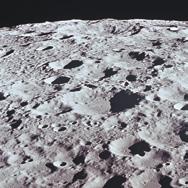
Essential Question | How do people learn about space?
Content Framing Question | Wonder: What do I notice and wonder about this text?
In this Wonder lesson, students begin their study of the Apollo 11 mission by reading Moonshot by Brian Floca and sharing what they notice and wonder. During writing instruction, students revisit the Evidence Organizer for Module Task 1 to select evidence that supports reason 1 on the Opinion Essay Planner. This work prepares students to write proof paragraph 1 of an opinion essay for Module Task 1.
Notice and wonder about Moonshot.
LEARNING TASK: Write at least three things you notice about Moonshot and at least three related questions.
For Module Task 1, select evidence from Starry Messenger that supports a thesis.
LEARNING TASK: For Module Task 1, explain how selected evidence supports reason 1 of the thesis.
none
LAUNCH
Read the Content Framing Question
LEARN
• Read: Listen Closely to Moonshot
• Respond: Notice and Wonder About the Text
• Write: Select Evidence for Proof Paragraph 1
LAND
Reflect on Learning
Materials
TEACHER
• Moonshot
• Starfield (digital platform)
• class Notice and Wonder Chart for Moonshot (Learn book)
• annotated Writing Model for Module 2 (Learn book, Writing)
STUDENTS
• Moonshot
• Notice and Wonder Chart for Moonshot (Learn book)
• Opinion Essay Planner for Module Task 1 (Learn book, Writing)
• Evidence Organizer for Module Task 1 (Learn book, Writing)
• journal
• Moonshot is an unpaginated text. Number your text; begin with the title page as page 1. Pages on the left will be even, and pages on the right will be odd.
• Students listen to, read, or explore a volume of reading text. They add to their reading log and respond to assigned volume of reading questions. See Implementation Resources for volume of reading guidance.
• Students complete day 1 of Fluency Practice for Moonshot (Learn book, Fluency) and focus on a fluency element or retelling.
Read the Content Framing Question
1. Display Moonshot.
2. Display and Choral Read the Content Framing Question: What do I notice and wonder about this text?
3. Introduce Moonshot by reading aloud the title and the author. Explain that the author is also the illustrator for this book. Tell students that in this lesson they will listen closely to Moonshot and share what they notice and wonder about it.
minutes
Read | Listen Closely to Moonshot | 13 minutes
1. Display, side by side, Starfield and Moonshot. Instruct students to silently observe the work of art and the front cover of Moonshot for at least 60 seconds.
Teacher Note
If unable to display simultaneously, show them one at a time.
2. Instruct students to Think–Pair–Share to discuss these questions: When you observe Starfield and the front cover of Moonshot together, what do you notice? What do you wonder?
3. Instruct students to examine the back cover of Moonshot. Encourage them to read the captions and look closely at the illustrations.
4. Display the class Notice and Wonder Chart for Moonshot.
5. Facilitate a brief discussion of this question:
What do you notice and wonder about Moonshot when you examine the front and back covers?
Add a few responses to the class chart.
6. Direct attention to page 2 of Moonshot. Instruct students to follow along as you read aloud pages 2–47, starting with “High above there.”
Based on your students’ needs, pause to define select words with a synonym (e.g., awkward, plotting, scatter). Use subsequent readings to reinforce the synonyms for the words you selected.
1. Instruct students to review the text and discuss what they notice and wonder with a partner. Encourage them to look closely at both the text and the illustrations.
2. Introduce the learning task. Direct students to the Notice and Wonder Chart for Moonshot, located in the Learn book. Instruct them to write at least three things they notice about the text and three related questions.
Monitor: Do students write specific and varied details about Moonshot and three related questions?

Offer Immediate Support: If students need additional support noticing things and asking related questions, direct attention to the illustrations on page 18 and ask these questions: What do you notice about the rocket? What question do you have?
Plan Future Practice: Students practice noticing and wondering about One Giant Leap in lesson 21.
3. Invite a few students to share their responses. Add responses to the class chart.
Teacher Note
Students will review the Notice and Wonder Chart for Moonshot during lesson 21.
4. Instruct students to reread the class chart and identify words related to space. Tell them to Think–Pair–Share to answer these questions:
How are some of these words connected to one another?
Which word would you like to know more about?
Listen for connections (e.g., darkness and glowing are connected because it is dark in space, but there are also glowing objects in space).
1. Direct students to the Opinion Essay Planner for Module Task 1, located in the Learn book. Remind students that they collected evidence from one source to form their opinions and reasons about Galileo’s most important contribution. Direct attention to the Source section of the opinion essay planner, and ask this question:
What is the source for your opinion essay?
Reinforce the correct response: Starry Messenger by Peter Sís. Remind students that citing, or naming, a source when collecting evidence ensures that a source’s creators receive credit and readers can locate the source of the information.
2. Ask this question:
What part of your opinion essay have you already planned?
Reinforce the correct response: the thesis.
3. Choral Read the directions on the planner. Tell students that today they will add evidence that supports reason 1.
4. Instruct students to read their thesis and annotate reason 1.
Differentiation Support
Instruct students to annotate reason 1 with yellow to support the connection to proof paragraph 1 in subsequent lessons.
5. Direct attention to the column titled Reason. Instruct students to write reason 1 in the first row.
6. Direct attention to the heading at the top of the next column: Evidence. Explain that before students select evidence for their own opinion essay planner, they will take a closer look at the evidence in the writing model.
7. Display the annotated Writing Model for Module 2, located in the Learn book. Instruct students to read proof paragraph 1. Ask this question:
What reason does the writer give in the topic sentence?
Reinforce the correct response: Galileo was a curious child.
8. Instruct students to Think–Pair–Share to answer this question:
How does the evidence in this paragraph support the reason that Galileo was a curious child?
Key Ideas
• The evidence is about Galileo as a child.
• The evidence gives us an example from the text of how he was curious.
• From the evidence, we learn that Galileo always had stars on his mind, which means he was always thinking about stars.
9. Emphasize that the writing model is a helpful resource students can access as they select their own evidence for Module Task 1.
10. Direct students to the Evidence Organizer for Module Task 1, located in the Learn book. Instruct students to review the evidence organizer and select a piece of evidence that best supports reason 1. Tell students to add the evidence next to reason 1 in the Evidence column of the opinion essay planner.
Differentiation Challenge
To encourage students to expand their body of evidence, direct them to Quotations from Galileo, located in the Learn book, and direct attention to page 22 of the script. Instruct students to read the quotations and the script and, if appropriate, add another piece of evidence that strongly supports their reason 1.
11. Introduce the learning task. Direct students to their journals. Instruct them to write a response to this question: How does your evidence support reason 1?
Analyze Student Progress
Monitor: Do students explain how their evidence supports reason 1?
Offer Immediate Support: If students need additional support explaining how the evidence supports the reason, ask these questions: What is your evidence about? How does it connect to the reason?
Plan Future Practice: Students use the opinion essay planner to select and add evidence for reason 2 in lesson 18.
12. Invite a few students to share their written responses.
13. Tell students that in the next lesson they will use the opinion essay planner to select and add evidence for reason 2.
1. Direct attention to both knowledge charts, and facilitate a brief discussion to help students articulate the knowledge they built during the lesson. Add a few student-generated knowledge statements to the charts.
Teacher Note
As needed, prompt students to reflect on what they learned by asking questions such as these:
• What did you learn from Moonshot?
• What did you learn about space?
• What did you learn about evidence in an opinion essay?
MM Make Meaning from Texts
MM.12.3 Complexity, Diversity, and Genre: MM.12.3.B, MM.12.3.B.a, MM.12.3.C, MM.12.3.C.b
CP Compose and Present Content
CP.1.3 Genre: CP.1.3.A, CP.1.3.H
CP.2.3 Planning: CP.2.3.A, CP.2.3.B, CP.2.3.D
CP.3.3 Content: CP.3.3.A, CP.3.3.A.e
CP.4.3 Structure: CP.4.3.B, CP.4.3.B.a
CP.5.3 Language: CP.5.3.B
BU Build Understanding
BU.1.3 Inquiry and Credibility: BU.1.3.A
BU.2.3 Discovery and Evidence: BU.2.3.A, BU.2.3.B
BU.3.3 Conversation and Collaboration: BU.3.3.B
BU.4.3 Expression
DM Develop Metacognition
DM.1.3 Content Stages: DM.1.3.A
DM.2.3 Comprehension Monitoring
DM.3.3 Schema Building
Essential Question | How do people learn about space?
Content Framing Question | Organize: What is happening in this text?
In this Organize lesson, students revisit Moonshot to identify key details related to each phase of the Apollo 11 mission. Students work together to create a class timeline that outlines the Apollo 11 mission. During writing instruction, students revisit the Evidence Organizer for Module Task 1 to select evidence that supports reason 2 on the opinion essay planner. This work prepares students to write proof paragraph 2 of an opinion essay for Module Task 1.
A Prologue to lesson 18 is available for students who need additional support.
Organize the phases of the Apollo 11 mission in Moonshot.
LEARNING TASK: Add a phase and at least two key details to the Phase Organizer for Moonshot.
For Module Task 1, select evidence from Starry Messenger that supports a thesis.
LEARNING TASK: For Module Task 1, explain how selected evidence supports reason 2 of the thesis.
astronaut (n.)
mission (n.)
LAUNCH
Read the Content Framing Question
LEARN
• Read: Organize Phases and Key Details
• Respond: Add a Phase and Key Details to a Timeline
• Write: Select Evidence for Proof Paragraph 2
LAND
Reflect on Learning
Materials
TEACHER
• Moonshot
• “We Have a Liftoff” (digital platform)
• Knowledge Cards: astronaut, mission
• class Phase Organizer for Moonshot (Learn book)
• annotated Writing Model for Module 2 (Learn book, Writing)
STUDENTS
• Moonshot
• Phase Organizer for Moonshot (Learn book)
• Opinion Essay Planner for Module Task 1 (Learn book, Writing)
• Evidence Organizer for Module Task 1 (Learn book, Writing)
• journal
• Save the class Apollo 11 mission timeline (made up of the students’ Phase Organizer for Moonshot pages) for use throughout the rest of the module. See the Respond section for details.
• Students listen to, read, or explore a volume of reading text. They add to their reading log and respond to assigned volume of reading questions. See Implementation Resources for volume of reading guidance.
• Students complete day 2 of Fluency Practice for Moonshot (Learn book, Fluency) and focus on a fluency element or retelling.
2 minutes
Read the Content Framing Question
1. Display Moonshot.
2. Display and Choral Read the Content Framing Question: What is happening in this text?
3. Tell students that they will organize key information in Moonshot to learn more about the Apollo 11 mission.
53 minutes
Read | Organize Phases and Key Details | 11 minutes
1. Direct students to the front cover of Moonshot. Choral Read the title and subtitle: Moonshot: The Flight of Apollo 11. Ask this question:
According to the title, what is this book about?
Reinforce the correct response: the flight of Apollo 11.
2. Introduce the vocabulary term astronaut by displaying the Knowledge Card. Engage students in Vocabulary Exploration. Direct attention to the back cover of Moonshot. Ask this question:
Who are the Apollo 11 astronauts?
Reinforce the correct response: Neil Armstrong, Michael Collins, and Buzz Aldrin.
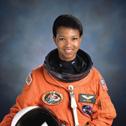
Definition
astronaut (n.): a person who travels in a spacecraft into outer space
3. Introduce the vocabulary term mission by displaying the Knowledge Card. Engage students in Vocabulary Exploration. Explain that students will collaborate, or work together, to learn more about the flight of Apollo 11 and the crew’s specific task.
4. Display the class Phase Organizer for Moonshot, located in the Learn book. Echo Read the directions on the organizer. Tell students that a phase is a part of a mission.
5. Direct attention to Moonshot, and read aloud pages 2–7, starting with “High above there.” Instruct students to Think–Pair–Share to answer this question:
What is happening during this phase of the mission?
Differentiation Support
Instruct students to listen and look for what people are doing. Pause while reading to provide time for students to examine the illustrations closely.
6. Write the details on the class organizer.
Key Ideas
• People plot paths, sew suits, and write codes for computers.
• Astronauts put on suits, heavy gloves, and round helmets.
• Astronauts say goodbye to family and friends.
7. Think aloud to model how to determine the phase of the mission. Add the phase Preparation for Liftoff to the class organizer.
8. Post the class organizer on the left side of a blank wall. Tell students that the first phase of the Apollo 11 mission is now on a class timeline, and they will work together to create the rest of the timeline.
Definitions mission (n.):
1. a person’s assigned task or a job they have to do
2. a flight by an aircraft or a spacecraft to perform a specific task
Sample Think Aloud
When I want to write something short, such as the name of a phase, I shrink down what is going on by using just a few words. In this phase of the mission, many people are working to get the astronauts ready for liftoff, and the astronauts are preparing for liftoff. I shrink the details down to Preparation for Liftoff.
1. Direct students to the Phase Organizer for Moonshot, located in the Learn book. Tell students that they will work with a small group to complete one organizer about one phase of the Apollo 11 mission.
At the end of this lesson, the groups will create a class timeline by placing the phase organizers in order on a wall in the classroom. Additional information will be added to the class timeline throughout the rest of the module.
2. Display a list of the following page ranges: 8–16, 17–18, 19–21, 22–27, 28–33, 34–39, 40–43, and 44–49.
Form eight small groups, and assign one set of page ranges to each group. Instruct students to work with their phase group to read their pages and look closely at the illustrations. Tell students that they will write the key details on their organizer. Then discuss what is happening during this phase of the mission to help students name the phase.
3. Introduce the learning task. Instruct students to add at least two key details and the phase name to their group’s Phase Organizer for Moonshot. Instruct students to use both regular plural nouns (e.g., astronauts, ships) and irregular plural nouns (e.g., people, men) in their notes.
Monitor: Do students use relevant key details to determine the phase name?
Offer Immediate Support: If students need additional support naming a phase, review the Sample Think Aloud in the Read section and prompt students to use just a few words to describe what is happening in the pages they read.
Plan Future Practice: Students practice organizing key details in One Giant Leap in lesson 22.
4. Look for students to address key ideas in their organizers.
Key Ideas
• pages 8–16: phase—Liftoff; key details—Saturn V rocket takes the astronauts into space; it weighs six million pounds; Mission Control checks all systems and counts down to liftoff; the rocket is released.
• pages 17–18: phase—Saturn V Leaves Earth; key details—Astronauts ride pressed in their seats and feeling heavy; parts of the rocket drop off, and it gets lighter and faster; the rocket orbits Earth.
• pages 19–21: phase—Columbia and Eagle Join; key details—Saturn V’s last stage lets Columbia out; Michael Collins, the pilot, locks Columbia onto Eagle; the ships fly through space; it is cold and quiet.
• pages 22–27: phase—Flight to the Moon; key details—Everything floats in space; the astronauts find it hard to eat, sleep, and use the toilet; they use a water gun to add water to food, and they sleep in bags.
• pages 28–33: phase—Eagle Lands; key details—Armstrong and Aldrin take Eagle to the Moon; they miss their landing site and find a new one; people on Earth listen to the mission and study maps and models; they hear Mission Control talk to the astronauts and Armstrong say, “The Eagle has landed.”
• pages 34–39: phase—Moonwalk; key details—The Moon’s surface is different from Earth’s; the astronauts feel light; the sky looks black; the sunlight is so bright that they can’t see stars; they see Earth.
• pages 40–43: phase—Return Flight; key details—Armstrong and Aldrin fly up from the Moon; Collins locks Columbia onto Eagle; they fly for two and a half days, carrying stones and pictures from the Moon.
• pages 44–49: phase—Splashdown; key details—Columbia falls back to Earth at 400 miles a minute; heat builds up; the ship’s shields protect the astronauts from heat; parachutes open to slow Columbia
5. Instruct students to review their key details and annotate examples of regular and irregular plural nouns.
6. Using a completed organizer from each group, instruct students to work together to create an Apollo 11 mission timeline on the wall.
7. Instruct students to listen closely to an audio clip from the National Aeronautics and Space Administration (NASA). Play “We Have a Liftoff” without revealing the title of the clip.
8. Facilitate a brief discussion of these questions:
What is happening in this audio clip?
Which phase of the mission would you add this audio clip to?
Language Support
To help students use content vocabulary during the discussion, display the Knowledge Cards for space, contribution, astronaut, and mission.
Key Ideas
• Astronauts report feeling good.
• The tower is cleared.
• Armstrong reports that they are on the proper heading.
• phase: Liftoff
9. Tell students that they will continue to add relevant information to the class timeline as they learn more about the Apollo 11 mission.
Write | Select Evidence for Proof Paragraph 2 | 15 minutes
1. Direct students to the Opinion Essay Planner for Module Task 1, located in the Learn book. Ask this question:
Which parts of your opinion essay have you already planned?
Reinforce the correct response: the thesis and the evidence for proof paragraph 1.
2. Instruct students to read the planner’s directions. Tell students that today they will add evidence that supports reason 2.
3. Instruct students to read their thesis and annotate reason 2.
Differentiation Support
Instruct students to annotate reason 2 with blue to support the connection to proof paragraph 2 in subsequent lessons.
4. Direct attention to the column titled Reason. Instruct students to write reason 2 in the second row.
5. Direct attention to the heading Evidence at the top of the next column. Explain that before students select evidence for their own planner, they will take a closer look at the evidence in the writing model.
6. Display the annotated Writing Model for Module 2, located in the Learn book. Instruct students to read proof paragraph 2. Tell students to Think–Pair–Share to answer this question:
In proof paragraph 2, how does the evidence support the reason?
Key Ideas
• The evidence is about Galileo’s book.
• The evidence gives us the name of his book.
• From the evidence, we learn that Galileo published his book, which means he shared it with others.
Remind students that the writing model is a helpful resource students can access as they select their own evidence for Module Task 1.
7. Direct students to the Evidence Organizer for Module Task 1, located in the Learn book. Instruct students to select the piece of evidence that best supports reason 2. Tell students to add the evidence to their planner next to reason 2 in the Evidence column.
Differentiation Challenge
To encourage students to expand their body of evidence, direct them to Quotations from Galileo, located in the Learn book, and direct attention to page 22 of the script. Instruct students to read the quotations and the script and, if appropriate, add another piece of evidence that strongly supports their reason 2.
8. Introduce the learning task. Direct students to their journals. Instruct them to write a response to this question: How does your evidence support reason 2?
Analyze Student Progress
Monitor: Do students explain how their evidence supports reason 2?
Offer Immediate Support: If students need additional support explaining how the evidence supports the reason, ask these questions: What is your evidence about? How does it connect to the reason?
Plan Future Practice: Students use an opinion essay planner to select and add evidence for reasons in lesson 26.
9. Invite a few students to share their written responses.
10. Tell students that they will use this planner in the next lesson to elaborate on their evidence.
1. Direct attention to both knowledge charts, and facilitate a brief discussion to help students articulate the knowledge they built during the lesson. Add a few student-generated knowledge statements to the charts.
Teacher Note
As needed, prompt students to reflect on what they learned by asking questions such as these:
• What did you learn about the Apollo 11 mission?
• What did you learn about space?
• What did you learn to do?
MM Make Meaning from Texts
MM.1.3 Comprehension and Evidence: MM.1.3.C, MM.1.3.D
MM.2.3 Theme and Central Idea: MM.2.3.E
MM.3.3 Summary: MM.3.3.B
MM.4.3 Individuals, Events, and Ideas: MM.4.3.C
MM.12.3 Complexity, Diversity, and Genre: MM.12.3.B, MM.12.3.B.a, MM.12.3.C, MM.12.3.C.b, MM.12.3.C.c
CP Compose and Present Content
CP.1.3 Genre: CP.1.3.A, CP.1.3.H
CP.2.3 Planning: CP.2.3.A, CP.2.3.B, CP.2.3.D
CP.3.3 Content: CP.3.3.A, CP.3.3.A.a, CP.3.3.A.e
CP.4.3 Structure: CP.4.3.B, CP.4.3.B.a
CP.5.3 Language: CP.5.3.B
BU Build Understanding
BU.1.3 Inquiry and Credibility: BU.1.3.A, BU.1.3.C
BU.2.3 Discovery and Evidence: BU.2.3.A, BU.2.3.B
BU.3.3 Conversation and Collaboration: BU.3.3.A, BU.3.3.B
BU.4.3 Expression
DF Develop Foundations
DF.3.3 Phonics and Spelling: DF.3.3.A, DF.3.3.A.b, DF.3.3.B, DF.3.3.B.a, DF.3.3.B.b
DF.4.3 High-Frequency and Irregularly Spelled Words: DF.4.3.A
DF.9.3 Nouns and Pronouns: DF.9.3.B
DM Develop Metacognition
DM.1.3 Content Stages: DM.1.3.B
DM.2.3 Comprehension Monitoring
DM.3.3 Schema Building
Essential Question | How do people learn about space?
Content Framing Question | Reveal: What does a deeper look at visual elements reveal?
In this Reveal lesson, students examine visual elements in Moonshot. Students integrate new information from the front endpaper into their previously gathered facts about the mission’s phases to deepen their understanding of the Apollo 11 mission. During writing instruction, students elaborate on the evidence they collected from Starry Messenger. This work prepares students to write the proof paragraphs of an opinion essay for Module Task 1.
Analyze how visual elements in Moonshot deepen understanding of the Apollo 11 mission.
LEARNING TASK: Add at least two key details to a class timeline of the Apollo 11 mission.
For Module Task 1, write elaboration about each piece of evidence.
LEARNING TASK: For Module Task 1, write elaboration to develop each piece of evidence and connect it to a corresponding reason.
Vocabulary
lunar (adj.)
LAUNCH
Read the Content Framing Question
LEARN
• Read: Analyze Visual Elements
• Respond: Integrate Information from Visual Elements
• Write: Elaborate on Evidence
LAND
Reflect on Learning Materials
TEACHER
• Moonshot
• Starry Messenger
• sticky notes
• Knowledge Card: lunar
STUDENTS
• Moonshot
• Starry Messenger
• sticky notes
• Opinion Essay Planner for Module Task 1 (Learn book, Writing)
• annotated Writing Model for Module 2 (Learn book, Writing)
• none Follow-Up
• Students listen to, read, or explore a volume of reading text. They add to their reading log and respond to assigned volume of reading questions. See Implementation Resources for volume of reading guidance.
• Students complete day 3 of Fluency Practice for Moonshot (Learn book, Fluency) and focus on a fluency element or retelling.
Read the Content Framing Question
1. Display Moonshot.
2. Display and Choral Read the Content Framing Question: What does a deeper look at visual elements reveal?
3. Tell students that they will explore the front endpaper in Moonshot to deepen their understanding of the Apollo 11 mission.
53 minutes
Read | Analyze Visual Elements | 15 minutes
1. Remind students that during the last lesson they worked together to build a timeline of the Apollo 11 mission according to the source Moonshot.
2. Tell students that they will now read the front endpaper in Moonshot to understand even more about the mission.
Teacher Note The front endpaper in Moonshot is a once-folded sheet of paper with one leaf pasted flat against the inside of the front cover of the book.
3. Direct students to the front endpaper in Moonshot. Instruct them to scan, or look over, the endpaper for at least 30 seconds. Facilitate a brief discussion of these questions:
Where do you think you will begin reading this endpaper?
Where will you go from there?
Reinforce the correct response: Readers will begin on the left side and then move from top to bottom and left to right. Tell students that the endpaper holds many visual details. Emphasize that readers will need to slow down to closely read the text for each illustration.
4. Direct attention to the large panel on the left. Choral Read the heading: Rollout. Think aloud to model how to access information in a visual element.
5. Engage students in Repeated Reading of the words in the panel, starting with “On May 20,” to understand what happened during the rollout. Think aloud to model how additional information deepens understanding and raises questions.
6. Direct attention to the large panel on the top. Ask these questions:
Where is the spacecraft?
Where is the launch vehicle?
Differentiation Support
To highlight the visual structure of the diagram, trace the brackets with your finger as you read the headings Apollo Spacecraft and Saturn V Launch Vehicle.
Reinforce the correct responses:
• spacecraft—The Apollo spacecraft is at the top of Apollo 11 on the right side of the diagram.
• launch vehicle—The Saturn V launch vehicle is the rest of Apollo 11.
7. Explain that when students have questions about what they are reading, they may need to look at a different section of the endpaper or a different illustration to learn more. Emphasize that the diagram of Apollo 11 helps readers understand that Apollo 11 is made up of more than one space vehicle.
After I read a heading in an illustration, I look at what’s going on in the illustration. The heading in this illustration says Rollout. I see a rocket getting rolled out. Next, I’ll read more, and I’ll also pause to look closely at the illustration to help me understand what happened during the rollout.
In the very first sentence, I learn that Apollo 11 moved to the launching pad. In the next sentence, I learn that the spacecraft and launch vehicle rode to the pad, but I only see one space vehicle. Is this a spacecraft, or is it a launch vehicle? I see the space vehicle at the top of the endpaper, so I will look at this diagram closely for more information.
8. Direct attention back to the Rollout panel. Instruct students to reread the panel. Ask this question:
What else did you learn about the rollout of Apollo 11?
9. As students share their responses, write two key ideas on sticky notes.
Key Ideas
• Apollo 11 rode on a mobile launch platform.
• The crawler-transporter carried the mobile launch platform and Apollo 11.
• It took six hours to move 3½ miles.
10. Ask these questions:
Where does this information belong on our timeline? Why?
Reinforce the correct responses:
• where—Preparation for Liftoff
• why—This phase happened before the launch of Apollo 11.
11. Add the two sticky notes to the class timeline. Explain that this new information deepens readers’ understanding of the mission.
Respond | Integrate Information from Visual Elements | 23 minutes
1. Introduce the vocabulary term lunar by displaying the Knowledge Card. Engage students in Vocabulary Exploration. Explain that students will continue to read the front endpaper with their phase group to learn more about the journey of Apollo 11.
2. Instruct students to return to their phase group. Direct attention to the class Apollo 11 mission timeline. Instruct students to discuss this question with their group:
What happened during your phase of the mission?
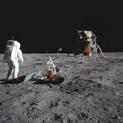
Definition
lunar (adj.): of or relating to the Moon
3. Introduce the learning task. Distribute two to four sticky notes to each phase group. Instruct each group to explore the front endpaper to learn more about their phase of the Apollo 11 mission. Tell students to collaborate with their group to add at least two key details to their phase organizer on the class timeline.
Display the following terms and definitions, and encourage students to access these definitions as they read the endpaper:
• stage (n.)—a section of a rocket that has its own fuel and engine
• jettison (v.)—to drop from an aircraft or spacecraft in flight
• spacecraft (n.)—a vehicle astronauts use to travel in outer space
Monitor: Do students work together to identify details in the words and illustrations about their phase of the Apollo 11 mission?
Offer Immediate Support: If students need additional support integrating words and visual elements, ask this question: What are you learning from this illustration? Then tell students to identify the words that connect to this illustration (e.g., in the picture, I see two spacecraft together, and then they are apart; in the text, I see the word separation; the spacecraft separated so that Eagle could land on the Moon).
Plan Future Practice: Students practice examining visual elements in lesson 33.
4. Look for students to address key ideas on the sticky notes they add to the phase organizers.
Key Ideas
• Liftoff: Apollo 11 had Lunar, Service, and Command Modules; liftoff was at 9:32 a.m. on July 16, 1969.
• Saturn V Leaves Earth: Saturn V pushed Apollo 11 into Earth’s orbit; the spacecraft orbited for almost 3 hours.
• Columbia and Eagle Join: Columbia was also called the CSM; Eagle was also called the LM
• Flight to the Moon: The astronauts traveled 238,000 miles to the Moon; they burned the engine twice to push Apollo 11 into a lunar orbit.
• Eagle Lands: Eagle undocked from Columbia; Eagle landed at the Sea of Tranquility.
• Moonwalk: Armstrong walked on the Moon alone for 20 minutes; Armstrong and Aldrin explored the surface of the Moon for 2½ hours.
• Return Flight: The astronauts left part of Eagle behind on the lunar surface; they released the rest of Eagle after docking at Columbia.
• Splashdown: The astronauts had to spend three weeks in quarantine to make sure they didn’t have Moon germs; the astronauts went to parades, to celebrations, and on a world tour.
5. Instruct groups to Think–Pair–Share to answer these questions: Which parts of the endpaper were most helpful to your group? How were they helpful?
| Elaborate on Evidence | 15 minutes
1. Direct students to the Opinion Essay Planner for Module Task 1, located in the Learn book. Ask this question:
Which parts of your opinion essay have you already planned?
Reinforce the correct response: the thesis, a reason and evidence for proof paragraph 1, and a reason and evidence for proof paragraph 2.
2. Instruct students to read the planner directions. Tell students that today they will add elaboration to say more about each piece of evidence.
3. Direct attention to the Elaboration heading. Explain that before students plan their own elaboration, they will take a closer look at elaboration in the writing model.
4. Direct students to the annotated Writing Model for Module 2, located in the Learn book. Instruct them to read proof paragraph 1 in the writing model and to identify the evidence and the elaboration. Instruct students to discuss this question with a partner:
How does the elaboration tell more about Galileo’s curiosity?
Invite a few students to share their responses, and reinforce the correct reponse: The elaboration tells more about the evidence because it tells something else that he was curious about, the sky. Explain that the elaboration also connects to the reason because it tells how Galileo is curious like Cousteau.
5. Direct attention to proof paragraph 2 in the writing model. Instruct students to Think–Pair–Share to answer these questions:
How does the elaboration tell more about Galileo’s book?
How does the elaboration tell more about his discoveries?
Reinforce the correct responses:
• book—The elaboration tells readers what was inside Galileo’s book: his observations of the night sky.
• discoveries—The elaboration implies that Galileo’s discoveries were about the night sky.
Remind students that elaboration can also be used to connect the evidence to a reason, and this piece of elaboration shows readers how Galileo shared his discoveries in his book: he wrote about his observations. Tell students that they can use the writing model as they plan their elaboration for Module Task 1.
6. Direct attention to the opinion essay planner. Instruct students to review their own evidence for reason 1 and reason 2.
7. Display Starry Messenger. Tell students that they will return to this source to plan their elaboration.
8. Introduce the learning task. Instruct students to write on their planner at least one piece of elaboration for each piece of evidence. Remind students that they should write the elaboration in the same row as their evidence. Instruct students to use an apostrophe plus the letter s when creating singular possessive nouns (e.g., Galileo’s, Moon’s).
Monitor: Do students write elaboration that tells more about the evidence from Starry Messenger?
Offer Immediate Support: If students need additional support elaborating on evidence, instruct them to identify a piece of evidence on their planner and show you where this information is located in the text. Ask these questions: Which details or illustrations tell more about this evidence? How does the evidence connect to the idea of Galileo’s most important contribution?
Plan Future Practice: Students elaborate on evidence in lesson 26.
9. If time allows, instruct students to explain the connections between each reason, piece of evidence, and elaboration to a partner.
• Read your reason out loud.
• Read your evidence out loud, and tell your partner how your evidence supports your reason.
• Read your elaboration out loud, and tell your partner how your elaboration tells more about your evidence.
10. Emphasize that with strong evidence and elaboration, students will be well prepared to begin to draft a response to Module Task 1 in the next lesson.
1. Direct attention to both knowledge charts, and facilitate a brief discussion to help students articulate the knowledge they built during the lesson. Add a few student-generated knowledge statements to the charts.
Teacher Note
As needed, prompt students to reflect on what they learned by asking questions such as these:
• What did you learn about Saturn V from the front endpaper?
• What did you learn about Eagle?
• What did you learn about Columbia?
• What did you learn about elaboration?
MM Make Meaning from Texts
MM.1.3 Comprehension and Evidence: MM.1.3.C, MM.1.3.D
MM.4.3 Individuals, Events, and Ideas: MM.4.3.C
MM.7.3 Structure: MM.7.3.D
MM.9.3 Media: MM.9.3.B
MM.12.3 Complexity, Diversity, and Genre: MM.12.3.B, MM.12.3.B.a
CP Compose and Present Content
CP.1.3 Genre: CP.1.3.A, CP.1.3.H
CP.2.3 Planning: CP.2.3.A, CP.2.3.B, CP.2.3.D
CP.3.3 Content: CP.3.3.A, CP.3.3.A.a, CP.3.3.A.e
CP.4.3 Structure
CP.5.3 Language: CP.5.3.B
BU Build Understanding
BU.1.3 Inquiry and Credibility: BU.1.3.A, BU.1.3.C
BU.2.3 Discovery and Evidence: BU.2.3.B
BU.3.3 Conversation and Collaboration: BU.3.3.B
BU.4.3 Expression
DF Develop Foundations
DF.3.3 Phonics and Spelling: DF.3.3.A, DF.3.3.A.b
DF.4.3 High-Frequency and Irregularly Spelled Words: DF.4.3.A
DF.8.3 Punctuation: DF.8.3.C
DM Develop Metacognition
DM.1.3 Content Stages: DM.1.3.C
DM.2.3 Comprehension Monitoring
DM.3.3 Schema Building
Essential Question | How do people learn about space?
Content Framing Question | Distill: What is a central idea in this text?
In this Distill lesson, students revisit Moonshot to examine how people contributed to the Apollo 11 mission. During a discussion, students exchange ideas about what they can learn from the success of the mission and reflect on the book’s central ideas. During writing instruction, students begin to draft a response to Module Task 1, an opinion essay about Galileo’s most important contribution. Students compose hooks to engage the reader and then draft the introductory paragraph for their essay.
A Prologue to lesson 20 is available for students who need additional support.
Determine a central idea in Moonshot.
LEARNING TASK: During a class discussion, share a central idea gained from reading Moonshot.
For Module Task 1, write an introductory paragraph.
LEARNING TASK: For Module Task 1, write an introductory paragraph that responds to the prompt.
none
LAUNCH
Read the Content Framing Question
LEARN
• Read: Prepare for a Discussion
• Respond: Discuss a Central Idea
• Write: Draft an Introductory Paragraph
LAND
Reflect on Learning
Materials
TEACHER
• Moonshot
• Starry Messenger
• Knowledge Card: contribution
STUDENTS
• Moonshot
• Starry Messenger
• Talking Tool (Learn book)
• sticky notes
• color-coded Writing Model for Module 2 (Learn book, Writing)
• Opinion Essay Planner for Module Task 1 (Learn book, Writing)
• Module Task 1 (Learn book, Writing)
• Checklist for Module Task 1 (Learn book, Writing)
• none Follow-Up
• Students listen to, read, or explore a volume of reading text. They add to their reading log and respond to assigned volume of reading questions. See Implementation Resources for volume of reading guidance.
• Students complete day 4 of Fluency Practice for Moonshot (Learn book, Fluency) and focus on a fluency element or retelling.
2 minutes
Read the Content Framing Question
1. Display Moonshot.
2. Display and Choral Read the Content Framing Question: What is a central idea in this text?
3. Tell students that they will revisit Moonshot to determine a central idea.
53 minutes
Read | Prepare for a Discussion | 20 minutes
1. Display and Choral Read today’s discussion question: What can we learn from the success of the Apollo 11 mission? Tell students that they will revisit the text to prepare to discuss this question and determine central ideas.
2. Display the Knowledge Card for contribution, and direct attention to the image to spark students’ memory. Remind students that a contribution is an action, invention, or idea that a person adds to a mission or body of knowledge.
Differentiation Challenge
To expand students’ vocabulary use, tell them to generate a list of synonyms for the term contribute Then instruct students to form sentences using the synonyms.
3. Explain that to prepare for the discussion, students will collect evidence of how people contributed to the Apollo 11 mission. Read aloud page 5, starting with “Here below there.”
4. Ask this question: Who contributed to the Apollo 11 mission?
Reinforce the correct responses: men, women, and thousands of people.
5. Instruct students to annotate how these people contributed to the mission. Look for students to determine the correct responses: plotted new paths, drew plans, wrote code for computers, sewed suits, and assembled ships.
6. Read aloud page 6, starting with “And now here.” Instruct students to look closely at the illustrations. Ask these questions:
Who is getting into the suits?
Who is helping them?
Reinforce the correct responses: The astronauts are getting into their suits; people are helping the astronauts get into their suits, gloves, and helmets. Emphasize that the words did not tell us that people helped the astronauts get ready, but we can see people helping in the illustrations.
7. Instruct students to work in small groups to reread pages 7–47, starting with “It is summer,” and annotate evidence of how people contributed to the Apollo 11 mission. Remind students to integrate words and illustrations to understand and annotate all contributions.
To help students understand how people contributed through actions, inventions, and ideas, ask these questions:
• What did people do to support the mission?
• What did people invent to support space exploration?
• What ideas did people contribute to the body of knowledge about space?
8. Look for students to address key ideas in their annotations.
Key Ideas
• page 7: Astronauts studied, practiced, and trained for the mission.
• pages 8–9: People built Saturn V, Columbia, and Eagle; the astronauts squeezed into Columbia
• pages 10–11: People watched and checked every system and part of Apollo 11.
• pages 12–17: People built the arms that hold the rocket in place; someone started the ignition sequence; someone counted down; someone released the rocket for liftoff.
• pages 18–19: The astronauts rode the rocket; people checked the astronauts’ course; Collins piloted Columbia
• pages 20–21: Collins locked Columbia and Eagle together; the astronauts flew to the Moon.
• pages 22–25: Someone packed food and clothes for the astronauts; someone put fasteners everywhere in the ship to keep things in place; someone invented a way to use a toilet in space.
• pages 28–29: Armstrong and Aldrin left Columbia and took Eagle down to the lunar surface.
• pages 30–31: Aldrin called out information, and Armstrong steered the ship; Mission Control watched Eagle’s numbers and codes.
• pages 32–33: Armstrong fired the rockets and landed Eagle on the Moon.
• pages 34–39: Armstrong and Aldrin explored the Moon; they observed that the Moon is cold and quiet, there is no air, the sky is black, and Earth is round.
• pages 40–41: Armstrong and Aldrin flew the top of Eagle off the Moon; someone had the idea to add a top to Eagle that could fly up to Columbia.
• pages 42–43: Collins docked and locked Columbia with Eagle to bring the astronauts back to Earth; the astronauts showed the stones they found on the Moon and their pictures of the Moon to the public.
• pages 44–45: Someone invented a heat shield that kept the astronauts safe.
• pages 46–47: Someone thought about using different kinds of parachutes to slow the ship down during splashdown; people in helicopters and ships picked the astronauts up.
1. Display the speaking and listening goal for today’s discussion: Elaborate on the evidence you use. Tell students that they will continue to practice elaborating on evidence during today’s discussion. Remind students that speakers can elaborate on their ideas during a discussion just as writers can elaborate on their writing.
2. Direct students to the Talking Tool, located in the Learn book, and direct attention to the Support What You Say row. Echo Read this sentence frame: This evidence shows . Model how to use the sentence frame to elaborate on evidence when supporting an idea.
3. Facilitate a discussion of this question:
How did people contribute to the Apollo 11 mission?
Language Support
To help students use content vocabulary during the discussion, display these Knowledge Cards: astronaut, contribution, mission, orbit, and space.
Differentiation Challenge
To encourage student thinking across texts, ask this question: How are the contributions to the Apollo 11 mission similar to or different from Galileo’s contributions?
Remind students to support their ideas with evidence from the text and elaborate to tell more about their evidence. Encourage students to use the Talking Tool to help them use evidence and elaboration.
4. Introduce the learning task. Explain that students will continue the discussion to share what they can learn from the success of this mission. Continue the discussion by asking this question:
What can we learn from the success of the Apollo 11 mission?
During the discussion, use the Module 2 Speaking and Listening Goal Tracker, located on the digital platform, to monitor student progress toward this goal.
Monitor: Do students share an example, supported by textual evidence, of a lesson they can learn from the success of the Apollo 11 mission?
Offer Immediate Support: If students need additional support elaborating on their ideas, direct them to their annotations and encourage them to reflect on how people acted to support the Apollo 11 mission.
Plan Future Practice: Students practice determining central ideas in Moonshot and One Giant Leap in lesson 25.
5. Remind students that a central idea is an important idea or a lesson the reader can learn from a text. Give each student a sticky note and instruct them to write a response to this question:
What is a central idea in this text?
Key Ideas
• A successful mission requires many contributions.
• Inventions and ideas support space exploration.
• Success is not easy.
• People can contribute different skills and knowledge to a mission.
• Space explorers are courageous.
1. Direct students to the color-coded Writing Model for Module 2, located in the Learn book. Facilitate a brief discussion to answer this question: What belongs in an introductory paragraph?
Reinforce the correct response: An introductory paragraph has an introduction, or hook, and a thesis that shares an opinion and two reasons.
2. Direct students to the Opinion Essay Planner for Module Task 1, located in the Learn book. Ask this question:
What have you already planned for the introductory paragraph in your opinion essay?
Reinforce the correct response: the thesis. Tell students that they will work together to brainstorm ideas for hooks that are questions like the one in the writing model.
3. Direct students to Module Task 1, located in the Learn book. Direct attention to the prompt. Tell students that this is one place where they can find a topic to include in their hook. Instruct students to discuss this question with a partner:
What topics in the prompt could you include in your hook?
4. Listen for students to address key ideas in their discussions.
Key Ideas
• Galileo
• contribution
• astronomy
• telescope
• The Starry Messenger
5. Display Starry Messenger. Tell students that this is another place where they can find information to include in their hook.
6. Remind students that an effective hook grabs a reader’s attention. Instruct students to practice different hooks with a partner. Listen for key ideas.
Key Ideas
• Did you know that Galileo made important contributions as an astronomer?
• Have you ever used a telescope?
• Do you like to read about astronomy?
7. Explain that students will use the knowledge they gained from Starry Messenger to begin drafting an opinion essay for Module Task 1.
8. Direct attention to the opinion essay planner. Instruct students to read the prompt and orally rehearse their introductory paragraph in a whisper.
Language Support
To leverage students’ home languages as resources to support learning, allow students to brainstorm and draft by using all their linguistic knowledge.
9. Introduce the learning task. Direct students to Module Task 1 and the Checklist for Module Task 1, located in the Learn book. Instruct students to draft their introductory paragraph. Tell them to use the checklist to guide their writing.
In this lesson, students begin Module Task 1. They may complete the assessment on paper or on the digital platform. Using the platform gives students experience engaging in the writing process digitally.
Alternatively, to support peer review, students may draft using shared digital documents and then transfer their work to the digital platform before submitting their assignment.
Monitor: Do students draft an introductory paragraph that includes an engaging hook and a thesis that expresses an opinion with supporting reasons?
Offer Immediate Support: If students need additional support constructing a hook, ask this question: What question can you ask that will get your readers excited to learn about Galileo’s contribution?
Plan Future Practice: Students continue to draft an opinion essay in lesson 21.
10. When students finish, instruct them to read their paragraph in a whisper and check their work by using the checklist.
11. Tell students that they will continue to draft their opinion essays during the next lesson.
1. Direct attention to both knowledge charts, and facilitate a brief discussion to help students articulate the knowledge they built during the lesson. Add a few student-generated knowledge statements to the charts.
Teacher Note
As needed, prompt students to reflect on what they learned by asking questions such as these:
• What did you learn about the astronauts’ return to Earth in Moonshot?
• What did you learn about hooks?
MM Make Meaning from Texts
MM.1.3 Comprehension and Evidence: MM.1.3.C, MM.1.3.D
MM.2.3 Theme and Central Idea: MM.2.3.C
MM.4.3 Individuals, Events, and Ideas: MM.4.3.C
MM.9.3 Media: MM.9.3.B
MM.12.3 Complexity, Diversity, and Genre: MM.12.3.B, MM.12.3.B.a
CP Compose and Present Content
CP.1.3 Genre: CP.1.3.A, CP.1.3.H
CP.2.3 Planning: CP.2.3.A, CP.2.3.B
CP.3.3 Content: CP.3.3.A, CP.3.3.A.e
CP.4.3 Structure: CP.4.3.A, CP.4.3.A.a, CP.4.3.B, CP.4.3.B.a
CP.5.3 Language: CP.5.3.B
CP.8.3 Presentation: CP.8.3.A, CP.8.3.B
BU Build Understanding
BU.1.3 Inquiry and Credibility: BU.1.3.A, BU.1.3.C
BU.2.3 Discovery and Evidence: BU.2.3.A, BU.2.3.B, BU.2.3.C
BU.3.3 Conversation and Collaboration: BU.3.3.A, BU.3.3.B, BU.3.3.C, BU.3.3.D
BU.4.3 Expression
DF Develop Foundations
DF.3.3 Phonics and Spelling: DF.3.3.A
DF.7.3 Capitalization
DF.8.3 Punctuation
DF.13.3 Sentence Construction: DF.13.3.A
DM Develop Metacognition
DM.1.3 Content Stages: DM.1.3.D
DM.2.3 Comprehension Monitoring
DM.3.3 Schema Building
DM.4.3 Reflection and Evaluation
Essential Question | How do people learn about space?
Content Framing Question | Wonder: What do I notice and wonder about this text?
In this Wonder lesson, students continue their study of the Apollo 11 mission by reading One Giant Leap and sharing what they notice and wonder. During writing instruction, students continue to draft a response to Module Task 1, an opinion essay about Galileo’s most important contribution. Students write proof paragraphs 1 and 2 for their essay.
Notice and wonder about One Giant Leap.
LEARNING TASK: Write at least three things you notice about One Giant Leap and at least three related questions.
For Module Task 1, write proof paragraphs 1 and 2.
LEARNING TASK: For Module Task 1, write two proof paragraphs that respond to the prompt.
none
LAUNCH
Read the Content Framing Question
LEARN
• Read: Listen Closely to One Giant Leap
• Respond: Notice and Wonder About the Text
• Write: Draft Proof Paragraphs
LAND
View “Gravity”
Materials
TEACHER
• One Giant Leap
• Moonshot
• class Notice and Wonder Chart for One Giant Leap (Learn book)
• class color-coded Writing Model for Module 2 (Learn book, Writing)
• “Gravity” (digital platform)
STUDENTS
• One Giant Leap
• Moonshot
• Notice and Wonder Chart for One Giant Leap (Learn book)
• Module Task 1 (Learn book, Writing)
• Opinion Essay Planner for Module Task 1 (Learn book, Writing)
• Checklist for Module Task 1 (Learn book, Writing)
• One Giant Leap is an unpaginated text. Number your text; begin with the title page as page 1. Pages on the left will be even, and pages on the right will be odd.
• Students listen to, read, or explore a volume of reading text. They add to their reading log and respond to assigned volume of reading questions. See Implementation Resources for volume of reading guidance.
• In small groups, students rehearse and perform the passage on Fluency Practice for Moonshot (Learn book, Fluency).
2 minutes
Read the Content Framing Question
1. Display One Giant Leap.
2. Display and Choral Read the Content Framing Question: What do I notice and wonder about this text?
3. Introduce One Giant Leap by reading aloud the title, author, and illustrator. Tell students that in this lesson they will listen closely to One Giant Leap and share what they notice and wonder about it.
53 minutes
Read | Listen Closely to One Giant Leap | 18 minutes
1. Direct attention to One Giant Leap. Instruct students to discuss this question with a partner: What do you notice and wonder about the front cover?
2. Tell students that they will have an opportunity to write down what they notice and wonder about the text later in the lesson.
3. Display, side by side, One Giant Leap and Moonshot. Instruct students to silently observe the front covers for at least 60 seconds.
Teacher Note
If unable to display both covers simultaneously, display them one at a time.
4. Instruct students to Think–Pair–Share to answer these questions:
When you observe the front covers together, what do you notice?
What do you wonder?
5. Direct attention to the illustration of the lunar surface on page 1 of One Giant Leap. Facilitate a brief discussion of this question:
What do you notice and wonder about this illustration?
6. Direct students to the Notice and Wonder Chart for One Giant Leap, located in the Learn book. Instruct students to write at least one thing they notice about the illustration and a related question.
7. Direct students to page 6, and instruct them to follow along as you read aloud pages 6–36, starting with “July 20, 1969.”
Language Support
Based on your students’ needs, pause to define select words with a synonym (e.g., crisp, gaze, rigid). Use subsequent reading to reinforce synonyms for the words you selected.
1. Instruct students to work with a partner to review the text and discuss what they notice and wonder. Encourage students to look closely at words and phrases that describe what the astronauts see, smell, and feel.
2. Introduce the learning task. Instruct students to write at least three things they notice about the text and three related questions on their Notice and Wonder Chart.
Analyze Student Progress
Monitor: Do students write specific and varied details they notice about One Giant Leap and three related questions?
Offer Immediate Support: If students need additional support noticing and asking related questions, encourage them to focus on a specific part of the text (e.g., pages 28−29) and ask these questions: What do you notice on these pages? What questions do these pages raise for you?
Plan Future Practice: Students practice noticing and wondering about Hidden Figures in lesson 27.
3. Display the class Notice and Wonder Chart for One Giant Leap. Invite a few students to share their responses. Add a few responses to the class chart.
Write | Draft Proof Paragraphs | 23 minutes
1. Direct students to Module Task 1, located in the Learn book. Instruct students to read the prompt and their introductory paragraph.
2. Explain that students will use the knowledge they gained from Starry Messenger to continue drafting an opinion essay for Module Task 1. Tell students that they will write proof paragraphs 1 and 2 of their essay.
3. Display the class color-coded Writing Model for Module 2, located in the Learn book. Direct attention to the thesis. Tell students to read the thesis and the topic sentence in proof paragraph 1. Instruct students to answer this question with a partner:
Which parts of the thesis do you see in this topic sentence?
Reinforce the correct response: The topic sentence includes the opinion from the thesis and reason 1.
4. Direct attention to the topic sentence in proof paragraph 2. Instruct students to Think–Pair–Share to answer this question:
What is the writer telling us in this topic sentence?
Key Ideas
• The writer has another reason.
• The writer thinks Galileo is like Cousteau.
• The writer tells us that Galileo, like Cousteau, wrote a book to share his discoveries.
Tell students that they will have an opportunity to orally practice their topic sentences.
5. Remind students that they have been using a planner to develop their opinion essays. Ask this question:
How can the planner help you draft proof paragraphs 1 and 2?
Key Ideas
• includes thesis
• sorts evidence to support each reason
• includes notes for elaborating on evidence
• can guide oral rehearsal before writing
6. Direct students to the Opinion Essay Planner for Module Task 1, located in the Learn book. Direct attention to students’ opinion and reason 1 in the Thesis section. Instruct students to orally practice a topic sentence for proof paragraph 1 with a partner.
Differentiation Support
To support the development of a focused topic sentence, remind students that their topic sentence must answer these questions: What is Galileo’s most important contribution? Why?
7. Tell students to use their planners as they develop each proof paragraph in their opinion essay. Remind them that they can orally rehearse and pause their rehearsal to write each sentence or paragraph.
8. Introduce the learning task. Direct attention to Module Task 1. Instruct students to draft proof paragraphs 1 and 2. Tell them to use the Checklist for Module Task 1, located in the Learn book, to guide their writing.
Analyze Student Progress
Monitor: Do students write proof paragraphs that include a topic sentence, evidence, and elaboration to support reason 1 and reason 2 of the thesis?
Offer Immediate Support: If students need additional support constructing proof paragraphs 1 and 2, refer them to the Writing section of the checklist for key components and to the writing model for examples.
Plan Future Practice: Students practice writing proof paragraphs for Module Task 2 in lesson 27.
9. Tell students that they will finish the draft of their opinion essay during the next lesson.
1. Tell students that they will view a video to learn more about gravity. Play “Gravity.”
Teacher Note
Subsequent lessons do not include instructions to play “Gravity.” As needed, play the video in subsequent lessons to help students make more connections between the world knowledge in the text and the video. For students whose home language is Spanish, arrange for them to view the Spanish version of the video.
2. Direct attention to both knowledge charts, and facilitate a brief discussion to help students articulate the knowledge they built during the lesson. Add a few student-generated knowledge statements to the charts.
Differentiation Support
To help students synthesize learning, direct them to the Gallery for “Gravity,” located in the Learn book.
Teacher Note
As needed, prompt students to reflect on what they learned by asking questions such as these:
• What did you learn from “Gravity”?
• What did you learn from One Giant Leap?
• What did you learn to do?
ACHIEVEMENT DESCRIPTORS
CP Compose and Present Content
CP.1.3 Genre: CP.1.3.A, CP.1.3.H
CP.2.3 Planning: CP.2.3.A, CP.2.3.B
CP.3.3 Content: CP.3.3.A, CP.3.3.A.a, CP.3.3.A.e
CP.4.3 Structure: CP.4.3.B, CP.4.3.B.a, CP.4.3.B.b
CP.5.3 Language: CP.5.3.B
CP.8.3 Presentation: CP.8.3.A
BU Build Understanding
BU.1.3 Inquiry and Credibility: BU.1.3.A
BU.2.3 Discovery and Evidence: BU.2.3.B
BU.3.3 Conversation and Collaboration: BU.3.3.B
BU.4.3 Expression
DF Develop Foundations
DF.3.3 Phonics and Spelling: DF.3.3.A
DF.7.3 Capitalization
DF.8.3 Punctuation
DF.13.3 Sentence Construction: DF.13.3.A
DM Develop Metacognition
DM.1.3 Content Stages: DM.1.3.A
DM.2.3 Comprehension Monitoring
DM.3.3 Schema Building
Essential Question | How do people learn about space?
Content Framing Question | Organize: What is happening in this text?
In this Organize lesson, students revisit One Giant Leap to identify key details related to phases of the Moon landing. Students then add those new details to the class timeline they created in lesson 18 that outlines the Apollo 11 mission. During writing instruction, students draft a concluding paragraph for Module Task 1, an opinion essay about Galileo’s most important contribution. They share their responses to Module Task 1 with their peers and provide feedback on a partner’s writing, and then they finalize their Module Task 1 responses.
A Prologue to lesson 22 is available for students who need additional support.
Organize the phases of the Apollo 11 mission from a historical account of the first Moon landing in One Giant Leap.
LEARNING TASK: Add a phase and at least two key details to the Phase Organizer for One Giant Leap.
For Module Task 1, revise an opinion essay in response to peer feedback.
LEARNING TASK: For Module Task 1, finalize an opinion essay by addressing a peer’s identified area for revision.
Vocabulary
none
LAUNCH
Read the Content Framing Question
LEARN
• Read: Organize Phases and Key Details
• Respond: Add a Phase and Key Details to a Timeline
• Write: Finalize an Opinion Essay
LAND
Reflect on Learning
Materials
TEACHER
• One Giant Leap
• class Apollo 11 mission timeline (lesson 18)
• “The Eagle Has Landed” (digital platform)
STUDENTS
• One Giant Leap
• Phase Organizer for One Giant Leap (Learn book)
• Module Task 1 (Learn book, Writing)
• Checklist for Module Task 1 (Learn book, Writing)
• Determine peer review assignments and how students will access their peer’s writing and checklist.
• Students listen to, read, or explore a volume of reading text. They add to their reading log and respond to assigned volume of reading questions. See Implementation Resources for volume of reading guidance.
• Students complete day 1 of Fluency Practice for One Giant Leap (Learn book, Fluency) and focus on a fluency element or retelling.
2 minutes
Read the Content Framing Question
1. Display One Giant Leap.
2. Display and Choral Read the Content Framing Question: What is happening in this text?
3. Tell students that they will organize key information in One Giant Leap to learn more about the Apollo 11 mission.
53 minutes
Read | Organize Phases and Key Details | 6 minutes
1. Direct attention to the front cover of One Giant Leap. Choral Read the title and subtitle. Ask this question:
According to the title and subtitle, what is this book about?
Reinforce the correct response: the first Moon landing. Explain that a historical account is a detailed description of an event from our past. Tell students that One Giant Leap describes the astronauts’ contributions to the Apollo 11 mission during the first Moon landing.
2. Direct attention to One Giant Leap. Read aloud the portion of page 6 from “July 20, 1969” to “To the moon.”
3. Direct attention to the class Apollo 11 mission timeline. Read aloud the name of each phase in chronological order. Instruct students to discuss these questions with a partner:
With which mission phase does One Giant Leap begin? How do we know?
4. Listen for students to address key ideas in their discussions.
Key Ideas
• phase: Eagle Lands; new phase could be Eagle’s Descent to the Moon
• how we know: The word descend helps us understand that Eagle is going down, and the text says, “To the moon.”
1. Direct students to the Phase Organizer for One Giant Leap, located in the Learn book. Tell them that they will work with a small group to complete one organizer about one phase of Apollo 11’s mission in One Giant Leap. Explain that these phases may be the same as the ones students identified in Moonshot, or they may be new phases that fit somewhere in between.
Teacher Note
At the end of this lesson, the groups will add these organizers to the class timeline of the Apollo 11 mission by creating an additional row corresponding to each related phase of the mission. Additional information will be added to the class timeline throughout the remainder of the module.
2. Display a list of the following page ranges: 6–9, 10–15, 16–19, 20–25, 26–27, 28–31, 32–33, and 34–37. Form eight groups, and assign one page range to each group. Instruct students to work with their phase group to read their pages and look closely at the illustrations. Tell students that they will write the key details on their organizers and then discuss what is happening during this phase and name it.
Language Support
To support multilingual learners with beginning and intermediate English proficiency, pair them with students who fluently speak and read English.
3. Introduce the learning task. Instruct students to add at least two key details and the phase name to their group’s Phase Organizer for One Giant Leap.
Student Progress
Monitor: Do students use relevant key details to determine the phase name?
Offer Immediate Support: If students need additional support naming a phase, pose this prompt: After reading your pages, use just a few words to tell what is happening.
Plan Future Practice: Students practice organizing key details in Hidden Figures in lesson 28.
4. Look for students to address key ideas in their organizers.
Key Ideas
• pages 6–9: phase—Eagle’s Descent to the Moon; key details—Armstrong and Aldrin are in Eagle; the Moon looks gray, brown, and blue-edged with many craters.
• pages 10–15: phase—Eagle Lands on the Moon; key details—Eagle is quickly running out of fuel; it dips, hovers, zigs, zags, and touches down on the Moon with a little bump.
• pages 16–19: phase—Armstrong Steps Off Eagle; key details—Millions of people back on Earth are watching; the surface is like fine dust; Armstrong’s boot leaves a footprint.
• pages 20–25: phase—Armstrong and Aldrin Explore the Moon; key details—They feel light as air since the Moon has less gravity; they collect rocks and fill two boxes to bring back to scientists on Earth.
• pages 26–27: phase—Armstrong and Aldrin Back in Eagle; key details—It’s very cold and cramped in Eagle; Armstrong thinks Earth looks like “a big, blue eyeball.”
• pages 28–31: phase—Eagle’s Ascent from the Moon; key details—If Eagle fails, the men will die; Eagle’s top half whooshes up like a fast-moving elevator; it moves a mile a second.
• pages 32–33: phase—Eagle and Columbia Dock; key details—Collins uses a sextant to find Eagle’s tiny light in the dark; Collins docks the two ships together as they move at 3,000 miles an hour.
• pages 34–37: phase—Final Orbit Around the Moon; key details—The astronauts take pictures of the Moon; Columbia accelerates around the Moon and is flung into empty space.
5. Direct attention to the class timeline of the Apollo 11 mission. Read aloud the name of each phase in chronological order, and instruct students to use a nonverbal signal (e.g., a thumbs-up) when they hear a phase similar to the one on their organizer.
6. Ask this question: What new or different phases did you learn about from reading One Giant Leap?
7. Listen for students to name new or more specific phases.
Key Ideas
• Eagle’s Descent to the Moon
• Armstrong Steps Off Eagle
• Armstrong and Aldrin Back in Eagle
• Eagle and Columbia Dock
• Final Orbit Around the Moon
8. Emphasize that on a mission timeline and in a historical account, it is important to keep the details that describe the same phase or event together. Think aloud to model how to add the information to the timeline.
9. Using one completed organizer from each group, instruct students to work together to add their group’s phase to the class Apollo 11 mission timeline. Remind students to listen to all ideas from their group as they collaborate to build the timeline.
Sample Think Aloud I notice that One Giant Leap has the phase “Armstrong Steps Off Eagle.” I see that the class timeline already has the phase “Moonwalk.” Since Armstrong stepped out of Eagle at the beginning of his moonwalk, I put the new phase below and just to the left of “Moonwalk” to show that the two phases happened together.
10. Facilitate a brief discussion of this question:
According to the historical account in One Giant Leap, what did the astronauts learn about the Moon?
Key Ideas
• It is 240,000 miles from Earth.
• Just above the surface, it looks gray, brown, and blue-edged.
• It has many craters and tall ridges.
• The surface is fine dust on top of a hard crust.
• It has less gravity than Earth does.
• It has sparkly, slippery rocks that look tan or purple.
• It has no wind, no water, no sound, and no life.
• It smells like ash from a fire.
11. Tell students that they will listen to an audio source of information from the National Aeronautics and Space Administration (NASA). Play “The Eagle Has Landed” without revealing the title of the clip. Facilitate a brief discussion of these questions:
What is happening in this audio clip?
Where would you place the key details from this clip on the timeline?
Language Support
To help students use content vocabulary during the discussion, display the Knowledge Cards for astronaut and mission.
Key Ideas
• key details: going down, 200 feet, 100 feet, 75 feet, 30 feet; drifting to the right; contact right; engine stopped; “Houston, Tranquility Base here”; “the Eagle has landed”; “we copy on the ground”
• timeline: Add the key details above or below Eagle’s descent and stretch them out on the timeline to include Eagle’s landing.
12. Tell students that they will continue to add relevant information to the class timeline as they learn more about the Apollo 11 mission.
Write | Finalize an Opinion Essay | 22 minutes
1. Direct students to Module Task 1, located in the Learn book. Remind them that they have drafted the introductory paragraph and proof paragraphs 1 and 2. Tell students that they will finish drafting their opinion essay.
2. Facilitate a brief discussion of this question:
What is the purpose of the concluding paragraph?
Key Ideas
• to restate the thesis
• to remind the reader what you think (opinion)
• to remind the reader why you think this way (reasons)
3. Instruct students to read their introductory paragraph and both proof paragraphs.
4. Instruct students to complete their opinion essay by writing a concluding paragraph.
Teacher Note
Students may finish drafting their opinion essay at different times. Encourage students who finish early to whisper-read their concluding paragraph to check their work.
5. Display the Module Task 1 prompt. Ask these questions:
According to this prompt, how many opinions could there be?
Why might someone have a different opinion than you?
Reinforce the correct responses:
• how many—two opinions
• why different opinions—because an opinion is a personal choice
6. Ask this question:
Why is it important to listen to or read other opinions?
Key Ideas
• to understand an opinion that might be different from yours
• to learn more about a topic through the writer’s evidence
7. Tell students that they will share their Module Task 1 response with a partner. Instruct students to take turns reading aloud their writing as their partner listens closely.
Teacher Note
If time allows, form groups of four for sharing essays so that students may hear several other opinions.
8. Direct students to the Checklist for Module Task 1, located in the Learn book. Instruct partners to review the checklist and identify an area that they want their partner to check.
Teacher Note
Students may complete the Checklist for Module Task 1 on their Learn book page. Alternatively, they may use shared digital documents for peer review. Using technology gives students experience leveraging digital feedback tools.
9. Display and Choral Read these sentence frames:
• One strength in your writing is .
• One area to work on is .
10. Instruct students to use the sentence frames to write about a strength and an area of revision in their partner’s writing. Remind students to refer to the checklist to choose a specific area for revision.
Differentiation Support
Model how to use the Checklist for Module Task 1 and the sentence frames to provide written feedback on students’ writing.
11. Introduce the learning task. Instruct students to revise their work based on their partners’ feedback and the checklist.
Following completion of Module Task 1, refer to the Assessment Guide for next steps. Use the information in the guide to provide feedback to students and plan future writing instruction.
12. Facilitate a brief discussion of this question:
How did sharing your work and listening to others’ work help you as a writer?
1. Direct attention to both knowledge charts, and facilitate a brief discussion to help students articulate the knowledge they built during the lesson. Add a few student-generated knowledge statements to the charts.
Teacher Note
As needed, prompt students to reflect on what they learned by asking questions such as these:
• What did you learn about the first Moon landing?
• What did you learn from One Giant Leap?
• What did you learn from other writers’ feedback?
MM Make Meaning from Texts
MM.1.3 Comprehension and Evidence: MM.1.3.C, MM.1.3.D
MM.2.3 Theme and Central Idea: MM.2.3.E
MM.3.3 Summary: MM.3.3.B
MM.4.3 Individuals, Events, and Ideas: MM.4.3.C
MM.9.3 Media: MM.9.3.B
MM.11.3 Connections: MM.11.3.B
MM.12.3 Complexity, Diversity, and Genre:
CP Compose and Present Content
CP.1.3 Genre: CP.1.3.A, CP.1.3.H
CP.3.3 Content: CP.3.3.A, CP.3.3.A.a, CP.3.3.A.e
CP.4.3 Structure: CP.4.3.A, CP.4.3.A.a, CP.4.3.B, CP.4.3.B.a, CP.4.3.B.b, CP.4.3.C
CP.5.3 Language: CP.5.3.B
CP.6.3 Revision
CP.7.3 Editing
CP.8.3 Presentation: CP.8.3.A
BU Build Understanding
BU.1.3 Inquiry and Credibility: BU.1.3.A, BU.1.3.C
BU.2.3 Discovery and Evidence: BU.2.3.B
BU.3.3 Conversation and Collaboration: BU.3.3.E
BU.4.3 Expression
DF Develop Foundations
DF.3.3 Phonics and Spelling: DF.3.3.A
DF.7.3 Capitalization
DF.8.3 Punctuation
DF.13.3 Sentence Construction: DF.13.3.A
DM Develop Metacognition
DM.1.3 Content Stages: DM.1.3.B
DM.2.3 Comprehension Monitoring
DM.3.3 Schema Building
DM.4.3 Reflection and Evaluation
Essential Question | How do people learn about space?
Content Framing Question | Reveal: What does a deeper look at literal and nonliteral language reveal?
In this Reveal lesson, students examine literal and nonliteral language in One Giant Leap. Students use their knowledge of literal and nonliteral language to express their understanding of what it was like to walk on the Moon. During writing instruction, students examine Module Task 2 and the Checklist for Module Task 2. They read the writing prompt and checklist to determine what to include in their opinion essay.
A Prologue to lesson 23 is available for students who need additional support.
Analyze how literal and nonliteral language deepens understanding of the first Moon landing in One Giant Leap.
LEARNING TASK: Describe how the words and phrases in One Giant Leap show how the astronauts move on the lunar surface.
For Module Task 2, use the expectations of the prompt to identify examples from the text.
LEARNING TASK: For Module Task 2, write three examples of exciting events in the text.
literal (adj.)
nonliteral (adj.)
LAUNCH
Read the Content Framing Question
LEARN
• Read: Examine Literal and Nonliteral Language
• Respond: Analyze Nonliteral Language
• Write: Examine Module Task 2 and the Checklist
LAND
Reflect on Learning
Materials
TEACHER
• One Giant Leap
• Moonshot
STUDENTS
• One Giant Leap
• Moonshot
• journal
• Module Task 2 (Learn book, Writing)
• Checklist for Module Task 2 (Learn book, Writing)
• none Follow-Up
• Students listen to, read, or explore a volume of reading text. They add to their reading log and respond to assigned volume of reading questions. See Implementation Resources for volume of reading guidance.
• Students complete day 2 of Fluency Practice for One Giant Leap (Learn book, Fluency) and focus on a fluency element or retelling.
2 minutes
Read the Content Framing Question
1. Display One Giant Leap.
2. Display and Choral Read the Content Framing Question: What does a deeper look at literal and nonliteral language reveal?
3. Tell students that they will explore nonliteral language and illustrations to deepen their understanding of the Apollo 11 mission.
53 minutes
Read | Examine Literal and Nonliteral Language | 21 minutes
1. Direct students to their journals. Instruct them to make a T-chart. Tell students that they will add headings to the T-chart later. Direct attention to the left column below the space for the heading and instruct students to make a sketch of a spider. Remind students that a sketch is a quick drawing.
2. Invite a few students to share their sketches. Instruct students to write the word spider under their sketch.
3. Invite students to close their eyes. Without displaying the text, read aloud this phrase from page 11 in One Giant Leap: “Spidery shadows creep in the rising sunlight.”
4. Ask these questions:
What do you picture in your mind?
Are the shadows actually spiders?
Key Ideas
• The shadows move as the Sun rises.
• The shadows might look like a spider, with a round part and many thin parts like a spider’s legs.
• They might look dark and creepy like a spider.
• A spidery shadow is not a real spider.
Emphasize that the author used the word spidery in a creative way to describe the shadow.
5. Direct attention to the right column in the T-chart below the space for the heading. Instruct students to sketch a spidery shadow.
6. Invite a few students to share their sketches. Instruct students to write the phrase spidery shadow under their sketch.
7. Facilitate a brief discussion of this question:
How are your two sketches different?
Use responses to emphasize that one is a sketch of a real spider, while the other is a sketch of a shadow that looks like a spider.
8. Tell students that authors use both literal and nonliteral language to tell stories and share information with others.
9. Introduce the vocabulary term literal by displaying the term and definition. Engage students in Vocabulary Exploration. Display the term nonliteral, and direct attention to the prefix non-. Explain that non- means “not,” and invite students to infer the definition of nonliteral. Reinforce the correct response by displaying and Choral Reading the definition.
10. Direct attention to the T-charts. Instruct students to answer these questions with a partner:
If you were to use these terms as headings in your T-chart, where would you write the term literal? Why?
Where would you write the term nonliteral? Why?
Reinforce the correct responses: Literal goes at the top of the left column because the sketch on the left is of a real spider. Nonliteral goes at the top of the right column because the sketch on the right is not one of a real spider. Instruct students to write the correct heading at the top of each column in their T-chart.
Differentiation Support
Before students match each term to a column, provide time for them to revisit their sketches to determine which sketch shows the usual meaning of the word.
11. Display One Giant Leap, and tell students that the author, Robert Burleigh, uses both literal and nonliteral language to share information about the first Moon landing.
12. Instruct students to listen closely as you read aloud. Instruct students to use a nonverbal signal (e.g., a thumbs-up) when they hear nonliteral language. Read aloud the portion of page 6 from “July 20, 1969” to “with many boxes.”
Reinforce the nonliteral language: “The Eagle is like a gold-speckled bug falling out of the sky.”
13. Instruct students to examine the illustration on page 7. While students examine the illustration, reread the portion of page 6 from “The Eagle is” to “with many boxes.” Provide a synonym for plastered (e.g., covered).
Definitions
literal (adj.): involving the ordinary or usual meaning of a word nonliteral (adj.): involving a meaning that is not ordinary or usual
14. Instruct students to discuss these questions with a partner:
How does Eagle look like a gold-speckled bug?
What other words does the author use to describe Eagle?
15. Listen for students to address key ideas in their discussions.
Key Ideas
• gold-speckled bug: Eagle looks like a bug’s body with many eyes; it has thin legs; the landing pads look like feet; parts of Eagle are gold-colored.
• other words: “odd-shaped,” “plastered with many boxes”
Emphasize that the author uses literal and nonliteral language to describe Eagle.
16. Invite students to close their eyes. Read aloud page 8, starting with “The astronauts look,” and instruct students to imagine what the Moon looked like from Eagle’s windows.
17. Instruct students to Think–Pair–Share to answer these questions:
What literal language does the author use to describe what the Moon looks like?
What nonliteral language does the author use?
Key Ideas
• literal: “gray,” “brown,” “blue-edged,” “old,” “cracked,” “scarred,” “gouged,” “cratered,” “pitted with holes”
• nonliteral: “Like a battlefield from some ancient war”
18. Instruct students to read page 20 with a partner, starting with “Now it is.” Invite students to act out with their partner how the astronauts moved about on the Moon’s surface. As students act out moonwalking, encourage them to revisit page 20 to ensure that they are demonstrating each part of the astronauts’ experience.
1. Introduce the learning task. Direct students to their journals. Instruct them to write a response to this question: How do the words in the text help show how the astronauts moved about on the Moon? Tell students to give specific examples from the text.
Analyze Student Progress
Monitor: Do students demonstrate understanding that the astronauts tried a variety of movements and found moonwalking fun and easy?
Offer Immediate Support: If students need additional support explaining how the words in the text express the astronauts’ movements, ask this question: Which words help you picture how the astronauts moved?
Plan Future Practice: Students practice examining literal and nonliteral language in module 3.
2. Invite a few students to share their responses.
3. If time allows, invite students to work with a partner to annotate additional examples of nonliteral language that helped them understand the astronauts’ experience. Encourage students to share their annotations with another pair of students.
Key Ideas
• page 12: “Clouds of moondust swirl like blackening fog.”
• page 17: “an oxygen-filled backpack thick as a sofa pillow”
• page 19: “moves awkwardly in his ‘moon cocoon’”
• page 27: “The earth stares down. ‘A big blue eyeball.’”
• page 30: “The Eagle’s top half rises like a fast-moving elevator.”
Teacher Note
As students discover examples of nonliteral language that deepen their understanding of the astronauts’ experience on the Moon, invite them to add these examples to the related phase on the class Apollo 11 mission timeline.
4. Explain that authors of historical accounts—like One Giant Leap—often use nonliteral language to help readers understand important events. Encourage students to notice the use of nonliteral language as they continue to read and view more module and volume of reading texts.
Differentiation Challenge
To encourage students to creatively apply new knowledge, instruct them to write a description of Eagle’s splashdown. Tell them to refer to the illustration on pages 36–37, and to use both literal and nonliteral language in their description.
1. Direct students to Module Task 2, located in the Learn book. Display and Echo Read the writing prompt: In your opinion, which phase of the Apollo 11 Moon landing was most exciting? Choose one option from the list. Write an essay to support your opinion.
• Eagle’s descent
• Armstrong’s and Aldrin’s exploration of the Moon
• Eagle’s ascent
2. Instruct students to discuss with a partner what descent and ascent mean. Reinforce that descent means “the process (or act) of going down,” and ascent means “the process (or act) of going up.”
Language Support
Demonstrate each term’s meaning by using gestures, or invite students to create and share gestures to demonstrate the terms’ meanings.
3. Facilitate a brief discussion to answer this question: What are some synonyms for the word exciting?
Key Ideas
• thrilling
• wild
• dangerous
• mind-blowing
4. Display Moonshot, and remind students that exciting things happened in the text.
5. Introduce the learning task. Direct students to their journals. Instruct them to revisit Moonshot with a partner and write three exciting things that happened in the text.
Monitor: Do students demonstrate understanding of what an exciting moment is by choosing some that were thrilling or dangerous?
Offer Immediate Support: If students need additional support describing a moment that was exciting, direct attention to page 18, starting with “Armstrong, Collins, Aldrin,” and ask this question: What made this part of the mission thrilling or dangerous?
Plan Future Practice: Students continue to plan their response to Module Task 2 in lesson 24.
6. Invite a few students to share their responses.
Key Ideas
• pages 12–13: countdown to liftoff
• pages 14–18: Apollo 11’s liftoff from Earth
• pages 22–25: astronauts floating in spaceships
• page 30: alarms lighting up and fuel running out in Eagle
• pages 32–33: Armstrong and Aldrin landing on the Moon
• pages 34–35: astronauts exploring the Moon
• pages 40–41: Eagle’s liftoff from the Moon
• page 42: Eagle and Columbia docking
• pages 44–45: Columbia falling back to Earth surrounded by flames
• pages 46–47: splashdown in the ocean
7. Direct attention to the prompt for Module Task 2, and instruct students to reread it. Tell them to Think–Pair–Share to answer this question: What does this prompt tell you to do?
Reinforce the correct response: Choose one option from the list and write an essay to support your opinion about the most exciting phase of the Apollo 11 Moon landing.
8. Direct students to the Checklist for Module Task 2, located in the Learn book. Direct attention to the Knowledge heading, and Choral Read the Knowledge rows. Emphasize that students will include knowledge about the Apollo 11 Moon landing and why the chosen phase was most exciting.
9. Instruct students to read the remainder of the checklist with a partner. Encourage students to ask clarifying questions.
10. Tell students that they will use this checklist to guide and check their work. Explain that they will also use this checklist to provide feedback to a peer.
11. Tell students that in the next lesson they will collect and review evidence from One Giant Leap to form an opinion to respond to the Module Task 2 prompt.
1. Direct attention to both knowledge charts, and facilitate a brief discussion to help students articulate the knowledge they built during the lesson. Add a few student-generated knowledge statements to the charts.
Teacher Note
As needed, prompt students to reflect on what they learned by asking questions such as these:
• What did you learn about literal and nonliteral language?
• What did you learn from One Giant Leap?
• What did you learn to do?
MM Make Meaning from Texts
MM.1.3 Comprehension and Evidence: MM.1.3.A, MM.1.3.B
MM.5.3 Vocabulary: MM.5.3.A, MM.5.3.A.a, MM.5.3.A.d, MM.5.3.A.e, MM.5.3.B, MM.5.3.B.a, MM.5.3.C
MM.9.3 Media: MM.9.3.A
MM.12.3 Complexity, Diversity, and Genre: MM.12.3.B, MM.12.3.B.a
CP Compose and Present Content
CP.1.3 Genre: CP.1.3.A, CP.1.3.H
CP.2.3 Planning: CP.2.3.A, CP.2.3.D
CP.5.3 Language: CP.5.3.B
BU Build Understanding
BU.1.3 Inquiry and Credibility: BU.1.3.C
BU.2.3 Discovery and Evidence: BU.2.3.A
BU.3.3 Conversation and Collaboration: BU.3.3.A, BU.3.3.B
BU.4.3 Expression
DF Develop Foundations
DF.3.3 Phonics and Spelling: DF.3.3.A, DF.3.3.A.b, DF.3.3.B, DF.3.3.B.a, DF.3.3.B.b
DF.4.3 High-Frequency and Irregularly Spelled Words: DF.4.3.A
DM Develop Metacognition
DM.1.3 Content Stages: DM.1.3.C
DM.3.3 Schema Building
Essential Question | How do people learn about space?
Content Framing Question | Reveal: What does a deeper look at similarities and differences reveal?
In this Reveal lesson, students examine the similarities and differences in Moonshot and One Giant Leap. Students compare and contrast information from both texts to deepen their understanding of the Apollo 11 mission. During writing instruction, students revisit One Giant Leap to collect and review evidence to form an opinion for Module Task 2. Students collect and review evidence related to Eagle’s descent, the astronauts’ exploration of the lunar surface, and Eagle’s ascent in One Giant Leap.
Compare and contrast information in Moonshot and One Giant Leap to deepen understanding of the Apollo 11 mission.
LEARNING TASK: Explain which text provides more facts and details about the astronauts’ return to Earth. For Module Task 2, collect and review evidence to form an opinion.
LEARNING TASK: For Module Task 2, collect evidence related to one part of the Moon landing in One Giant Leap.
none
LAUNCH
Read the Content Framing Question
LEARN
• Read: Compare and Contrast Moonshot and One Giant Leap
• Respond: Compare and Contrast Details on a Shared Topic
• Write: Collect and Review Evidence to Form an Opinion
LAND
Reflect on Learning
Materials
TEACHER
• Moonshot
• One Giant Leap
• class Apollo 11 mission timeline (lesson 18)
STUDENTS
• Moonshot
• One Giant Leap
• journal
• Module Task 2 (Learn book, Writing)
• Evidence Organizer for Module Task 2 (Learn book, Writing)
• As students enter the classroom, invite them to travel by the class Apollo 11 mission timeline and quietly recount the mission with a partner.
• Students listen to, read, or explore a volume of reading text. They add to their reading log and respond to assigned volume of reading questions. See Implementation Resources for volume of reading guidance.
• Students complete day 3 of Fluency Practice for One Giant Leap (Learn book, Fluency) and focus on a fluency element or retelling.
2 minutes
Read the Content Framing Question
1. Display Moonshot and One Giant Leap.
2. Display and Choral Read the Content Framing Question: What does a deeper look at similarities and differences reveal?
3. Tell students that they will explore similarities and differences in these texts to deepen their understanding of the Apollo 11 mission.
53 minutes
Read | Compare and Contrast Moonshot and One Giant Leap | 16 minutes
1. Explain that when readers explore similarities and differences in two texts, they also consider the information in the illustrations.
Teacher Note
Give each pair a copy of Moonshot and a copy of One Giant Leap.
2. Direct attention to Moonshot. Instruct students to examine the illustration on page 41 with a partner. Tell students to discuss this question with their partner: What is happening in this illustration?
3. Listen for students to address key ideas in their discussions.
Key Ideas
• The top half of Eagle has lifted off.
• It looks like small, gold pieces are falling off Eagle.
• The bottom half of Eagle is on the gray surface of the Moon.
4. Direct attention to One Giant Leap. Instruct students to examine the illustrations on pages 28 and 31 and discuss this question with a partner:
What new information are you learning from these illustrations?
5. Listen for students to address key ideas in their discussions.
Key Ideas
• Armstrong and Aldrin are inside Eagle; they look tired; their suits are bulky.
• Eagle has lots of switches and cords.
• The bottom half of Eagle is on the brownish surface of the Moon.
• The American flag is on the surface near the bottom half of Eagle.
6. Engage students in Repeated Reading of pages 29–30, starting with “July 21. Unease,” and instruct them to consider what they learn from the details in this text.
Differentiation Support
To support students as they consider information from both texts, create a T-chart to highlight differences between the texts as students share details from One Giant Leap and Moonshot.
7. Direct attention to the bottom of page 40 in Moonshot. Instruct students to read the last paragraph, starting with “Eagle’s landing stage.”
8. Instruct students to Think–Pair–Share to answer these questions:
Which text gives you more detailed information about this phase of the mission?
What kind of information does it give you?
Key Ideas
• One Giant Leap provides more detailed information about Eagle’s ascent from the Moon.
• It shows us what it looked like inside Eagle during the ascent.
• It tells us how the astronauts were feeling: worried, uneasy, uncertain.
• It mentions the sounds and the silence of flying away.
• The illustration has more details: the American flag, another banner, radiating lines on the ground that show how the blastoff moved rocks and dust.
• It describes what it felt like inside Eagle during liftoff: “like a fast-moving elevator.”
9. Display, side by side, the front covers of Moonshot and One Giant Leap. Remind students that they noticed and wondered about these covers in a previous lesson. Choral Read each title, including the subtitles. Facilitate a brief discussion of this question:
How can you tell by the front cover what each book will be about?
Key Ideas
• Moonshot is about the flight of Apollo 11; we can see Columbia taking Eagle to the Moon.
• One Giant Leap is a historical account of the first Moon landing; we can see two astronauts on the surface of the Moon in front of Eagle.
10. Direct attention to the class Apollo 11 mission timeline. Facilitate a brief discussion of this question:
How do Moonshot and One Giant Leap work together to tell the story of the Apollo 11 mission?
Key Ideas
• Moonshot provides details about the whole mission; the endpaper helps us understand each of the space vehicles used during the mission.
• One Giant Leap provides descriptive details about the first Moon landing; the text helps us understand what the astronauts experienced during this phase of the mission and what they learned about the Moon.
Differentiation Challenge
To encourage students to recognize the value of reading more than one source on a topic, ask these questions: If you could ask Robert Burleigh to write a new book about a different phase of the Apollo 11 mission, which phase would you like him to write about? Why?
1. Direct attention to the class timeline. Instruct students to Think–Pair–Share to answer these questions:
Which text would you give to someone if they wanted to learn more about how NASA prepared Apollo 11 for the launch from Earth? Why?
Key Ideas
• I would give them Moonshot because it shows the rollout of Apollo 11 in the endpaper, and the text on pages 8–11 describes how the workers at NASA prepared for launch.
• I would give them Moonshot because One Giant Leap does not provide details about preparing to launch.
2. Introduce the learning task. Direct students to their journals. Instruct them to write a response to these questions: Which text would you give someone if they wanted to learn more about the astronauts’ return to Earth? Why? Tell students to include evidence that shows how each text describes this part of the mission.
Analyze Student Progress
Monitor: Do students explain how Moonshot provides more facts and details about this phase of the Apollo 11 mission?
Offer Immediate Support: If students need additional support comparing the two texts, direct attention to pages 36–37 in One Giant Leap and pages 44–47 in Moonshot and ask this question: What do you learn about the astronauts’ experience as they entered Earth’s air from One Giant Leap and from Moonshot?
Plan Future Practice: Students practice comparing texts in module 3.
3. Invite a few students to share their responses.
Key Ideas
• Moonshot, because it provides more facts and details: Columbia falling fast, pushing on the air, building up pressure and heat; types of parachutes and how they worked to slow Columbia’s fall; shows Columbia “like a torch” in the sky and shows a splash in the sea where Columbia landed
• Moonshot, because One Giant Leap provides fewer facts and details: an illustration of Columbia with three open parachutes before it splashed down in the sea
4. Tell students that they will now look closely at the exciting parts of the Apollo 11 mission in One Giant Leap.
1. Direct students to Module Task 2, located in the Learn book. Instruct students to read the prompt.
2. Ask this question:
Before you form an opinion about the most exciting phase of the Moon landing, what should you collect and review?
Language Support
To ensure that students understand the meaning of exciting, provide examples of some events that are exciting and some that are not exciting.
Reinforce the correct response: evidence of what made each phase exciting (i.e., thrilling, dangerous, or mind-blowing).
3. Direct students to the Evidence Organizer for Module Task 2, located in the Learn book. Choral Read the directions and the headings. Remind students that an important part of doing research is organizing collected evidence. Ask this question:
How does this organizer help you organize your research?
Reinforce that the organizer provides separate spaces to write the evidence for each moment. Students can compare columns to decide which one contains the strongest evidence.
4. Form three groups. Display the following page ranges, and tell students that they will work with their group to collect evidence from One Giant Leap about one part of the Moon landing:
• pages 6–15—Eagle’s descent
• pages 16–25—Armstrong and Aldrin’s exploration of the Moon
• pages 29–33—Eagle’s ascent
5. Introduce the learning task. Instruct students to collect at least three pieces of evidence about something exciting that happened during their group’s part of the Moon landing in One Giant Leap. Tell them to write the evidence in the appropriate column on the evidence organizer.
Monitor: Do students choose facts or examples that show how the descent, Moon exploration, or ascent was exciting?
Offer Immediate Support: If students need additional support collecting evidence, instruct them to read one paragraph at a time, and then pause to ask this question: What is happening that is dangerous or thrilling?
Plan Future Practice: Students practice collecting evidence to form an opinion in lesson 30.
6. Instruct the three groups—descent, exploration, ascent—to rearrange into new groups of three students. Tell students that each new group should include one student from each of the previous three groups. Invite each student to share at least three pieces of strong evidence from their part of the Moon landing while the other two record the evidence in the corresponding column of their organizers.
7. Look for students to record key ideas in their organizers.
Key Ideas
• Eagle’s descent: No human had ever been there before; Aldrin and Armstrong saw the Moon up close for the very first time; the surface of the Moon looked like a battlefield; the fuel was sinking toward zero, and the fuel dial kept flashing.
• Armstrong and Aldrin’s exploration of the Moon: Armstrong was the first human to step onto the Moon; Armstrong’s footprint will last for millions of years; the astronauts got to go moonwalking; they felt like they were bouncing on a trampoline because the Moon has less gravity than Earth; they collected sparkly Moon rocks.
• Eagle’s ascent: Eagle needed to split into two parts; at first, nothing happened, but then there was lots of noise; they were flying almost a mile a second; Columbia and Eagle traveled at 3,000 miles per hour.
8. Instruct students to independently review their own evidence for each phase of the Apollo 11 Moon landing to determine which phase they think is the most exciting. Tell students to circle the heading on the evidence organizer that they think is the most exciting phase of the Moon landing.
9. Explain that during the next lesson students will determine two reasons that best support their opinion in order to write a thesis for their opinion essay.
1. Direct attention to both knowledge charts, and facilitate a brief discussion to help students articulate the knowledge they built during the lesson. Add a few student-generated knowledge statements to the charts.
Teacher Note
As needed, prompt students to reflect on what they learned by asking questions such as these:
• What did you learn about sources and timelines?
• What did you learn from One Giant Leap?
• What did you learn about forming opinions?
MM Make Meaning from Texts
MM.1.3 Comprehension and Evidence: MM.1.3.C, MM.1.3.D
MM.9.3 Media: MM.9.3.B
MM.11.3 Connections: MM.11.3.B
MM.12.3 Complexity, Diversity, and Genre: MM.12.3.B, MM.12.3.B.a
CP Compose and Present Content
CP.1.3 Genre: CP.1.3.A, CP.1.3.H
CP.2.3 Planning: CP.2.3.D
CP.3.3 Content: CP.3.3.A, CP.3.3.A.a, CP.3.3.A.e, CP.3.3.B
CP.4.3 Structure
CP.5.3 Language: CP.5.3.B
BU Build Understanding
BU.1.3 Inquiry and Credibility: BU.1.3.A
BU.2.3 Discovery and Evidence
BU.3.3 Conversation and Collaboration: BU.3.3.A, BU.3.3.B
BU.4.3 Expression
DM Develop Metacognition
DM.1.3 Content Stages: DM.1.3.C
DM.3.3 Schema Building
Essential Question | How do people learn about space?
Content Framing Question | Distill: What is a central idea in these texts?
In this Distill lesson, students revisit Moonshot and One Giant Leap to examine how the people of Apollo 11 overcame difficult and dangerous situations. During a discussion, students exchange ideas about what they can learn from the people who overcame challenges, and they reflect on the books’ central ideas. During writing instruction, students revisit One Giant Leap and the Evidence Organizer for Module Task 2 to develop reasons that support their opinion for Module Task 2. Students Take a Stand to discuss reasons for both possible opinions and then select the two that best support their own opinion.
A Prologue to lesson 25 is available for students who need additional support.
Determine a central idea in Moonshot and One Giant Leap.
LEARNING TASK: During a class discussion, share and support a central idea about the Apollo 11 mission by using evidence from Moonshot or One Giant Leap.
For Module Task 2, develop reasons to support an opinion.
LEARNING TASK: Connect an opinion and reasons to write a thesis for an opinion essay on the Opinion Essay Planner for Module Task 2.
Vocabulary
none
LAUNCH
Read the Content Framing Question
LEARN
• Read: Prepare for a Discussion
• Respond: Discuss a Central Idea
• Write: Develop Reasons in Support of an Opinion
LAND
Reflect on Learning
Materials
TEACHER
• Moonshot
• One Giant Leap
• “One Small Step” (digital platform)
• class Evidence Organizer for Module Task 2 (Learn book)
STUDENTS
• Moonshot
• One Giant Leap
• Talking Tool (Learn book)
• journal
• Evidence Organizer for Module Task 2 (Learn book, Writing)
• Opinion Essay Planner for Module Task 2 (Learn book, Writing)
• Determine how to display the opinions for Take a Stand. See the Write section for details.
• Students listen to, read, or explore a volume of reading text. They add to their reading log and respond to assigned volume of reading questions. See Implementation Resources for volume of reading guidance.
• Students complete day 4 of Fluency Practice for One Giant Leap (Learn book, Fluency) and focus on a fluency element or retelling.
2 minutes
Read the Content Framing Question
1. Display Moonshot and One Giant Leap.
2. Display and Choral Read the Content Framing Question: What is a central idea in these texts?
3. Tell students that they will revisit Moonshot and One Giant Leap to determine a central idea.
53 minutes
Read | Prepare for a Discussion | 20 minutes
1. Tell students that they will listen to an audio source of information from the National Aeronautics and Space Administration (NASA). Play “One Small Step” without revealing the title of the clip.
2. Ask this question:
What is happening in this audio clip?
Reinforce the correct response: Neil Armstrong is stepping onto the Moon.
3. Display Armstrong’s quotation: “one small step for man, one giant leap for mankind.” Explain that mankind means “all humans on Earth.” Ask this question:
Did all humans jump on the Moon’s surface?
Reinforce the correct response: no. Explain that although all humans were not literally on the surface of the Moon, mankind made progress by sending Apollo 11 to the Moon.
4. Display and Choral Read today’s discussion question: What can we learn from how the people of Apollo 11 overcame challenges? Tell students that they will revisit the texts and look closely at the words and illustrations to help them prepare to discuss this question and determine central ideas.
5. Explain that to prepare for the discussion, students will collect evidence about the things that were difficult or dangerous during the Apollo 11 mission.
6. Instruct students to work in small groups to reread Moonshot or One Giant Leap and to annotate evidence that shows which things about the mission were difficult or dangerous. Remind students to integrate words and illustrations to understand and annotate all examples.
Teacher Note
Instruct half the small groups to revisit Moonshot and the other half to revisit One Giant Leap.
7. Look for students to address key ideas in their annotations.
Key Ideas
Moonshot
• page 7: They’re going where no one has been before.
• pages 14–18: The astronauts are riding the fire and thunder; the rocket under them is shedding parts.
• page 30: They are miles away from where they need to land on the Moon; time and fuel are running out.
• page 40: To return to Earth, they need to do another liftoff in a much smaller ship.
• page 42: Eagle and Columbia need to dock and lock in space while they are spinning.
• page 44: They fall 400 miles a minute back to Earth, building up heat.
One Giant Leap
• page 11: Fuel is sinking to zero; there are dark ridges, spidery shadows, and boulders as big as cars.
• page 17: The Moon looks endless and mysterious; there is no life on the Moon.
• page 19: Armstrong is the first human to step on the Moon.
• page 29: Eagle needs to split into two parts, and the upper half needs to fly up; if it fails, the astronauts will die.
• page 32: Collins, in Columbia, needs to find the much smaller Eagle in the black of space.
• page 35: During the final orbit around the Moon, Columbia is flung into space.
1. Display the speaking and listening goal for today’s discussion: Build on others’ ideas. Tell students that just like they built on a phase in the class Apollo 11 mission timeline, they’ll build on others’ ideas by adding more information to someone else’s point during a discussion.
Teacher Note
During the discussion, use the Module 2 Speaking and Listening Goal Tracker, located on the digital platform, to monitor student progress toward these goals.
2. Explain that students can practice this goal by using a sentence frame. Direct them to the Talking Tool, located in the Learn book. Echo Read this sentence frame: I agree and I will add that . Model how to use the sentence frame to build on others’ ideas.
3. Facilitate a brief discussion of this question: What things about the mission were difficult or dangerous?
Language Support
To help students use content vocabulary during the discussion, display the Knowledge Cards for these terms: astronaut, lunar, mission, observe, orbit, space, and universe
Teacher Note
Since One Giant Leap provides descriptive details related to the first Moon landing, encourage students to build on others’ ideas about this phase of the mission.
Differentiation Challenge
To encourage student thinking across texts, ask these questions: Where else in this module have you seen people trying to deal with difficult or dangerous things? What did they do?
Prompt students to build on others’ ideas by elaborating on the evidence shared by the speaker. Encourage them to use the Talking Tool.
4. Introduce the learning task. Explain that students will continue the discussion to share what they can learn from the people of Apollo 11. Continue the discussion by asking this question:
What can we learn from how the people of Apollo 11 overcame challenges?
Analyze Student Progress
Monitor: Do students’ ideas reflect understanding of how the people of Apollo 11 overcame challenges?
Offer Immediate Support: If students need additional support elaborating on their ideas, direct them to their annotations and encourage them to reflect on how the people approached a difficult situation.
Plan Future Practice: Students practice determining central ideas in Hidden Figures in lesson 31.
5. Remind students that a central idea is an important idea or lesson that the reader can learn from a text. Direct students to their journals, and instruct them to Jot–Pair–Share about a central idea in One Giant Leap.
Key Ideas
• Training and lots of practice make difficult tasks easier to do.
• To collaborate well with others, it’s important to communicate and to be a good listener.
• When situations are dangerous, it is important to be prepared with good equipment and knowledge.
• Even when things are difficult, we need to keep going to accomplish a mission or goal.
• Space exploration is challenging and exciting.
1. Remind students that they collected and reviewed evidence to form an opinion about the most exciting phase of the Apollo 11 Moon landing.
2. Display these opinions around the room, and Choral Read them:
• In my opinion, the most exciting phase was Eagle’s descent to the Moon.
• In my opinion, the most exciting phase was Armstrong and Aldrin’s exploration of the Moon.
• In my opinion, the most exciting phase was Eagle’s ascent to Columbia.
3. Display the class Evidence Organizer for Module Task 2, and direct students to the page in the Learn book. Instruct them to review the heading they circled during the last lesson. Tell them that they will move around the room to discuss why they circled this heading. Remind them to use their evidence organizers to help them form reasons that support their opinions.
4. Lead students through Take a Stand to express reasons for their opinions. As students share, add their reasons to the class organizer under the appropriate opinion heading.
Differentiation Support
To help each group generate reasons, invite students to review their evidence organizers and ask them this question: What are the big ideas in your evidence?
Key Ideas
• Eagle’s Descent: Landing on the Moon was really hard; the Moon is a mysterious place; the astronauts were running out of fuel.
• Armstrong and Aldrin’s Exploration of the Moon: Armstrong was the first human to step onto the Moon; astronauts went moonwalking; they collected Moon samples.
• Eagle’s Ascent: The launch on the Moon was dangerous; they were flying very fast; Eagle needed to dock perfectly with Columbia to return to Earth.
5. Explain that critical thinkers may change their opinion based on new information or a deeper understanding of the topic. Encourage students to move to a different area of the room if they would like to change their opinion based on the reasons shared. Invite a few students to share why their opinion changed.
6. Direct attention to the three opinions displayed during Take a Stand. Choral Read the opinion statements and the reasons for each opinion. Instruct students to select two reasons that best support their opinion and to use these sentence frames to orally rehearse a thesis: In my opinion, . I think this because and .
Provide one yellow and one blue sticky note to each student, and allow them time to jot down one reason on the yellow note and a second reason on the blue note.
7. Direct students to the Opinion Essay Planner for Module Task 2, located in the Learn book. Explain that the planner will help students organize their ideas as they plan their opinion essay. Instruct them to read the prompt. Remind students that their thesis will answer this question.
8. Introduce the learning task. Direct attention to the Thesis section on the planner. Instruct students to write their thesis on the planner.
Monitor: Do students write a two-sentence thesis that includes one option from the prompt and two strong reasons?
Offer Immediate Support: If students need additional support forming an opinion, provide this sentence frame: In my opinion, the most exciting phase was
Plan Future Practice: Students practice writing a thesis in lesson 33.
9. Invite a few students to share their theses.
Key Ideas
• In my opinion, Eagle’s descent to the Moon was the most exciting phase. I think this because landing on the Moon was hard and the Moon is a mysterious place.
• In my opinion, the most exciting phase was when Armstrong and Aldrin explored the Moon. I think this because Armstrong was the first human to step onto the Moon and the astronauts got to go moonwalking.
• In my opinion, Eagle’s ascent to Columbia was the most exciting phase. I think this because the astronauts were flying very fast and they needed to dock with Columbia to return to Earth.
10. Tell students that during the next lesson they will continue to plan their opinion essay.
5 minutes
1. Direct attention to both knowledge charts, and facilitate a brief discussion to help students articulate the knowledge they built during the lesson. Add a few student-generated knowledge statements to the charts.
Teacher Note
As needed, prompt students to reflect on what they learned by asking questions such as these:
• What did you learn about overcoming challenges?
• What did you learn from One Giant Leap?
• What did you learn about reasons during Take a Stand?
MM Make Meaning from Texts
MM.1.3 Comprehension and Evidence: MM.1.3.C, MM.1.3.D, MM.1.3.E
MM.2.3 Theme and Central Idea: MM.2.3.C, MM.2.3.E
MM.5.3 Vocabulary: MM.5.3.B, MM.5.3.B.a
MM.12.3 Complexity, Diversity, and Genre: MM.12.3.B, MM.12.3.B.a, MM.12.3.C, MM.12.3.C.c
CP Compose and Present Content
CP.1.3 Genre: CP.1.3.A, CP.1.3.H
CP.2.3 Planning: CP.2.3.D
CP.3.3 Content: CP.3.3.A, CP.3.3.A.e
CP.4.3 Structure: CP.4.3.A, CP.4.3.A.a, CP.4.3.B, CP.4.3.B.a
CP.5.3 Language: CP.5.3.B
CP.8.3 Presentation: CP.8.3.A, CP.8.3.B
BU Build Understanding
BU.1.3 Inquiry and Credibility: BU.1.3.A, BU.1.3.C
BU.2.3 Discovery and Evidence: BU.2.3.A, BU.2.3.B, BU.2.3.C
BU.3.3 Conversation and Collaboration: BU.3.3.A, BU.3.3.B, BU.3.3.C, BU.3.3.D
BU.4.3 Expression
DM Develop Metacognition
DM.1.3 Content Stages: DM.1.3.D
DM.2.3 Comprehension Monitoring
DM.3.3 Schema Building
DM.4.3 Reflection and Evaluation
Essential Question | How do people learn about space?
Content Framing Question | Know: How do these texts build our knowledge?
In this Know lesson, students reflect on their learning from Moonshot, One Giant Leap, and “Christina Koch: Space Station Scientist.” They express their knowledge by using subordinating conjunctions to combine and expand sentences. During writing instruction, students elaborate on evidence they collected from One Giant Leap. This work prepares students to write the proof paragraphs of an opinion essay for Module Task 2.
A Prologue to lesson 26 is available for students who need additional support.
Express knowledge gained from Moonshot, One Giant Leap, or “Christina Koch: Space Station Scientist.”
LEARNING TASK: Write two sentences to express knowledge about the Apollo 11 mission or space exploration, using subordinating conjunctions.
For Module Task 2, write elaboration about each piece of evidence.
LEARNING TASK: For Module Task 2, write elaboration that develops and connects evidence to corresponding reasons.
none
Agenda
LAUNCH
Read the Content Framing Question
LEARN
• Read: Review Knowledge
• Respond: Express Knowledge
• Write: Elaborate on Evidence
LAND Synthesize Learning
Materials
TEACHER
• Moonshot
• One Giant Leap
• “Christina Koch: Space Station Scientist” (digital platform)
STUDENTS
• Moonshot
• One Giant Leap
• Sentence Strategies for Module 2 (Learn book, Writing)
• World Knowledge Statements for Module 2 (Learn book)
• Opinion Essay Planner for Module Task 2 (Learn book, Writing)
• Evidence Organizer for Module Task 2 (Learn book, Writing)
• none Follow-Up
• Students listen to, read, or explore a volume of reading text. They add to their reading log and respond to assigned volume of reading questions. See Implementation Resources for volume of reading guidance.
• In small groups, students rehearse and perform the passage on Fluency Practice for One Giant Leap (Learn book, Fluency).
2 minutes
Read the Content Framing Question
1. Display Moonshot and One Giant Leap.
2. Display and Choral Read the Content Framing Question: How do these texts build our knowledge?
3. Tell students that they will think and write about what they learned from Moonshot and One Giant Leap. They will also view “Christina Koch: Space Station Scientist” and reflect on their new knowledge.
53 minutes
Read | Review Knowledge | 13 minutes
1. Direct attention to both knowledge charts, and instruct students to silently read the knowledge statements.
2. Direct students to Moonshot, and ask these questions:
Where do you see examples of collaboration?
Where do you see examples of courage?
What kinds of knowledge do the people working on this mission have?
Key Ideas
• collaboration: Many people contributed to the mission by sewing suits, building space vehicles, determining paths using mathematics, tracking the spaceships, and flying to the Moon.
• courage: Astronauts were the first humans to walk on the Moon and ride in a spaceship lifted by rockets; the Moon was a mysterious place far from Earth.
• knowledge: People working on this mission know about science, mathematics, engineering, and technology.
3. Direct attention to One Giant Leap, and ask this question:
What knowledge did the astronauts need during these phases of the mission?
Key Ideas
• how to land and lift off in Eagle
• how to use equipment to explore the lunar surface
• how to dock the spaceships
• how to travel back to Earth
4. Explain that space exploration continues today. Tell students that they will watch a video to learn about how astronauts continue to contribute to the body of knowledge about space. Encourage students to make connections between the video and the texts. Play “Christina Koch: Space Station Scientist.”
Differentiation Support
To help students make connections across texts, invite them to think about these questions as they view the video:
• What observations does the astronaut make?
• Where do you see examples of collaboration?
• What knowledge do astronauts need on this mission?
5. Instruct students to work with a partner to share at least one thing they learned about the work happening aboard the space station. Invite a few students to share their responses, and add a few student-generated knowledge statements to the World Knowledge Chart.
Key Ideas
• The space station is an orbiting microgravity laboratory.
• Astronauts experiment in many areas: physical science, biology, and technology.
• Experiments in space benefit all of humanity.
• A microgravity environment can be a lot of fun, but it does change the human body.
• Each crew member contributes to the mission.
1. Remind students that one way they can express knowledge is to connect ideas into one complex sentence by using subordinating conjunctions. Display Sentence Strategies for Module 2, and direct students to the page in their Learn book. Direct attention to the subordinating conjunctions before and after.
2. Instruct students to discuss this question with a partner: How might we use the subordinating conjunctions before or after to connect two ideas in a sentence?
Reinforce the correct responses:
• before—to expand a sentence by telling what happened before an event
• after—to expand a sentence by telling what happened after an event
3. Display these sentence frames, and instruct students to practice completing them with a partner:
• After Armstrong and Aldrin landed on the Moon, .
• Before Collins docked Columbia with Eagle, .
Teacher Note
Although using a comma in a complex sentence is not a level 3 expectation, consider pointing out this convention. Explain that when beginning a sentence with a subordinating conjunction, writers use a comma to separate the first part of the sentence from the second part, which can stand alone. Echo Read a completed sentence frame, modeling how you pause briefly after the comma.
4. Invite a few students to share their expanded sentences.
Key Ideas
• After Armstrong and Aldrin landed on the Moon, they put on oxygen-filled backpacks and visored helmets to explore.
• After Armstrong and Aldrin landed on the Moon, they got a call from the president.
• Before Collins docked Columbia with Eagle, he used a sextant to find Eagle in the blackness.
• Before Collins docked Columbia with Eagle, he orbited the Moon.
5. Direct attention to Sentence Strategies for Module 2, and point out the subordinating conjunctions while and when. Tell students that these conjunctions connect events that are happening at the same time.
6. Display these sentences:
• Armstrong and Aldrin explored the Moon.
• Collins orbited the Moon in Columbia.
Tell students that since these events happened at the same time, we can connect these two ideas with while or when.
7. Display and Choral Read these sentences:
• While Armstrong and Aldrin explored the Moon, Collins orbited it in Columbia.
• Armstrong and Aldrin explored the Moon while Collins orbited it in Columbia.
Instruct students to locate the subordinating conjunction in each sentence. Reinforce that a subordinating conjunction can be used at the beginning or in the middle of a complex sentence.
8. Display these sentence frames:
• When NASA astronaut Koch is aboard the space station, .
• When Armstrong stepped onto the Moon, .
Instruct students to work with a partner to practice completing the sentence frames. Invite a few students to share their expanded sentences.
Key Ideas
• When NASA astronaut Koch is aboard the space station, she works on experiments that help humanity.
• When Armstrong stepped onto the Moon, he left a footprint that would last millions of years.
9. Direct attention to the World Knowledge Chart. Instruct students to work with a partner to practice orally creating complex sentences using subordinating conjunctions to combine or expand ideas that express what they learned from Moonshot, One Giant Leap, or “Christina Koch: Space Station Scientist.”
Language Support
Display Knowledge Cards to encourage students to use content vocabulary in their sentences: astronaut, contribution, lunar, mission, observe, orbit, and space.
Differentiation Challenge
To expand language use, prompt students to use a coordinating conjunction as well as a subordinating conjunction in one of their sentences.
10. Introduce the learning task. Direct students to World Knowledge Statements for Module 2, located in the Learn book. Instruct them to write at least two knowledge statements that express knowledge gained from Moonshot, One Giant Leap, or “Christina Koch: Space Station Scientist.” Tell students to use subordinating conjunctions to combine or expand their ideas. Encourage them to refer to the class World Knowledge Chart and Sentence Strategies for Module 2 to help craft their statements.
Monitor: Do students express knowledge about space or space exploration while correctly using subordinating conjunctions to combine and expand their ideas?
Offer Immediate Support: If students need additional support expressing their knowledge and using a subordinating conjunction, provide this sentence frame: While Armstrong and Aldrin explored the lunar surface, .
Plan Future Practice: Students practice expressing knowledge and using subordinating conjunctions in lesson 32.
11. Instruct students to share a knowledge statement with a partner. If time allows, invite a few students to share a statement they heard from a peer. Add a few knowledge statements to the World Knowledge Chart.
Key Ideas
• While Koch does experiments in space, she shares what she learns with people back on Earth.
• Before the astronauts landed on the Moon, they observed craters and dark ridges on the lunar surface.
• After the astronauts collected the rocks with tongs, they put the rocks in two boxes to bring back to the scientists on Earth.
1. Direct students to the Opinion Essay Planner for Module Task 2, located in the Learn book. Instruct students to read the directions on the planner. Explain that students will add evidence that supports reason 1 and reason 2 to their planner, and they will elaborate on each piece of evidence.
2. Instruct students to read their thesis and annotate reason 1 and reason 2.
Differentiation Support
Provide one yellow and one blue sticky note to each student. Instruct students to annotate reason 1 with a yellow sticky note and reason 2 with a blue sticky note to support the connection to proof paragraph 1 and proof paragraph 2 in subsequent lessons.
3. Direct attention to the chart headings on the planner. Ask these questions:
Where will you write reason 1?
Where will you write the evidence that supports reason 1?
Reinforce the correct responses:
• Reason 1 goes in the first column of the first row.
• Evidence that supports reason 1 goes in the middle column in the same row as reason 1.
Instruct students to write reason 1 in the first row of their planner.
4. Direct attention to the chart headings on the planner. Ask these questions:
Where will you write reason 2?
Where will you write the evidence that supports reason 2?
Reinforce that students should write reason 2 and its supporting evidence in the second row, and instruct them to do so.
5. Direct students to the Evidence Organizer for Module Task 2, located in the Learn book. Instruct students to select at least one piece of evidence from their organizer that best supports reason 1 and at least one piece of evidence that best supports reason 2 and to add the evidence to their opinion essay planner.
6. Direct attention to One Giant Leap. Tell students that they will return to this text to plan their elaboration.
7. Instruct students to answer this question with a partner:
What is the purpose of elaboration in an opinion essay?
8. Listen for students to discuss key ideas in their responses.
Key Ideas
• to tell more about the evidence
• to share more facts or details about the evidence
• to explain why the evidence matters
9. Tell students that they will practice elaboration with a partner. Display these steps:
• Share a piece of evidence from your planner with your partner.
• Tell your partner more about your piece of evidence.
Instruct students to work with their partner to orally practice elaborating on one piece of evidence. Encourage students to use One Giant Leap to gather more facts and details about their evidence.
10. Introduce the learning task. Direct attention to the Opinion Essay Planner for Module Task 2. Instruct students to write at least one piece of elaboration for each piece of evidence.
Monitor: Do students develop each piece of evidence by adding details or making clear connections to corresponding reasons?
Offer Immediate Support: If students need additional support elaborating on evidence, tell them to identify a piece of evidence on their planner and show you the page where this information is located in the text. Ask this question: Which details in the text or illustrations tell more about this evidence?
Plan Future Practice: Students practice elaborating on evidence in lesson 36.
11. Emphasize that with strong evidence and elaboration, students are well prepared to begin drafting a response to Module Task 2 in the next lesson.
1. Remind students of the Essential Question. Tell them that they will answer this question in different ways throughout the module. Ask the Essential Question: How do people learn about space?
2. Use responses to reinforce these Knowledge Threads:
• People can document and share observations of scientific phenomena.
• Space exploration requires knowledge, collaboration, and courage.
Teacher Note
As needed, prompt students to reflect on what they learned by asking questions such as these:
• What did you learn about the Apollo 11 mission?
• What did you learn about space exploration?
ACHIEVEMENT DESCRIPTORS
MM Make Meaning from Texts
MM.1.3 Comprehension and Evidence: MM.1.3.C, MM.1.3.D
MM.2.3 Theme and Central Idea: MM.2.3.E
MM.12.3 Complexity, Diversity, and Genre: MM.12.3.B, MM.12.3.B.a, MM.12.3.C, MM.12.3.C.c
CP Compose and Present Content
CP.1.3 Genre: CP.1.3.A, CP.1.3.H
CP.2.3 Planning: CP.2.3.D
CP.3.3 Content: CP.3.3.A, CP.3.3.A.a, CP.3.3.A.e
CP.4.3 Structure
CP.5.3 Language: CP.5.3.B
CP.8.3 Presentation: CP.8.3.A
BU Build Understanding
BU.1.3 Inquiry and Credibility: BU.1.3.A
BU.2.3 Discovery and Evidence: BU.2.3.A
BU.4.3 Expression
DF Develop Foundations
DF.13.3 Sentence Construction: DF.13.3.A, DF.13.3.D
DM Develop Metacognition
DM.1.3 Content Stages: DM.1.3.E
DM.3.3 Schema Building
DM.4.3 Reflection and Evaluation

Essential Question | How do people learn about space?
Content Framing Question | Wonder: What do I notice and wonder about this text?
In this Wonder lesson, students begin learning about four “hidden figures”—Dorothy Vaughan, Mary Jackson, Katherine Johnson, and Christine Darden—who made invaluable contributions to the US space program. Students listen closely to Hidden Figures by Margot Lee Shetterly and share what they notice and wonder. During writing instruction, students draft a response to Module Task 2 about the most exciting phase of the Apollo 11 Moon landing. Students write the introductory paragraph, proof paragraph 1, proof paragraph 2, and the concluding paragraph for an opinion essay.
Notice and wonder about Hidden Figures.
LEARNING TASK: Write at least three things you notice about Hidden Figures and three related questions. For Module Task 2, write an opinion essay that responds to the prompt.
LEARNING TASK: For Module Task 2, write an introductory paragraph, proof paragraph 1, proof paragraph 2, and concluding paragraph.
Vocabulary
none
LAUNCH
Read the Content Framing Question
LEARN
• Read: Listen Closely to Hidden Figures
• Respond: Notice and Wonder About the Text
• Write: Draft an Opinion Essay
LAND
Reflect on Learning
Materials
TEACHER
• Hidden Figures
STUDENTS
• Hidden Figures
• Notice and Wonder Chart for Hidden Figures (Learn book)
• Painted Essay®—Opinion (Learn book, Writing)
• Module Task 2 (Learn book, Writing)
• Opinion Essay Planner for Module Task 2 (Learn book, Writing)
• Checklist for Module Task 2 (Learn book, Writing)
• Hidden Figures is an unpaginated text. Number your text; begin with the title page as page 1. Pages on the left will be even, and pages on the right will be odd.
• Students listen to, read, or explore a volume of reading text. They add to their reading log and respond to assigned volume of reading questions. See Implementation Resources for volume of reading guidance.
• Students complete day 1 of Fluency Practice for Hidden Figures (Learn book, Fluency) and focus on a fluency element or retelling.
2 minutes
Read the Content Framing Question
1. Display Hidden Figures.
2. Display and Choral Read the Content Framing Question: What do I notice and wonder about this text?
3. Introduce Hidden Figures by reading aloud the title, author, coauthor, and illustrator. Tell students that in this lesson they will read Hidden Figures and share in small groups what they notice and wonder about it.
53 minutes
Read | Listen Closely to Hidden Figures | 14 minutes
1. Instruct students to silently examine the front and back covers of Hidden Figures. Tell them to read the subtitle and look closely at the illustrations. Instruct students to Think–Pair–Share to answer this question: What do you notice and wonder?
Invite a few students to share their responses. Pause after each student shares, and invite other students to ask additional questions about something the student noticed.
2. Instruct students to follow along as you read aloud Hidden Figures. Tell them to annotate unknown words and places in the text that spark questions. Read aloud pages 3–30, starting with “Dorothy Vaughan, Mary.”
3. Remind students that some informational texts have glossaries to provide the meanings of important words or concepts. Direct attention to the glossary on page 38.
4. Instruct students to explore the glossary, compare the words to their annotated unknown words, and read the definitions.
1. Introduce the learning task. Direct students to the Notice and Wonder Chart for Hidden Figures, located in the Learn book. Instruct students to review the text and their annotations and to write at least three things they notice and three related questions. Encourage students to revisit sections of the text that they are most curious about.
Monitor: Do students write specific and varied details about Hidden Figures and three related questions?

Offer Immediate Support: If students need additional support noticing things and asking related questions, encourage them to focus on a specific part of the text (e.g., pages 28−29) and ask these questions: What do you notice on these pages? What questions do you have?
Plan Future Practice: Students practice noticing and wondering about texts in module 3.
2. Explain that students will share what they notice and wonder in small groups. Instruct students to review their charts and choose the question they most want to answer. Tell students to annotate the page in the text that inspired their question.
3. Remind students of the speaking and listening goal they practiced in lesson 25: Build on others’ ideas. Explain that students can practice this goal by using sentence frames. Display and Echo Read these sentence frames:
• I also noticed . It makes me wonder .
• What you said also makes me wonder .
4. Direct attention to the front cover of Hidden Figures. Model how to use the sentence frames by building on something a student noticed and wondered about the cover.
5. Form small groups. Instruct students to share what they notice and wonder about Hidden Figures. Encourage students to use the sentence frames to build on their group members’ responses.
Language Support
To support multilingual learners with beginning and intermediate English proficiency, group them with students who fluently speak and read English.
Differentiation Challenge
To extend student thinking across texts, invite students to share connections they made between Hidden Figures and other module texts
6. Instruct groups to identify one question they are most interested in answering. Lead groups in a Whip Around to share the identified questions.
7. Tell students that they will revisit Hidden Figures over the next several lessons as they work to answer their questions and gain a deeper understanding of the text.
1. Direct students to the Painted Essay®—Opinion, located in the Learn book. Facilitate a brief discussion of these questions:
What is the purpose of each paragraph in an opinion essay?
How do the paragraphs connect to one another?
Key Ideas
• introductory paragraph: engages readers in the topic and shares the writer’s opinion and reasons
• proof paragraphs: develop each reason from the introductory paragraph—reason 1 in proof paragraph 1 and reason 2 in proof paragraph 2
• concluding paragraph: restates the thesis shared in the introductory paragraph
2. Direct students to Module Task 2, located in the Learn book. Instruct students to read the prompt.
3. Explain that students will use their knowledge from One Giant Leap to draft an opinion essay for Module Task 2. Tell students that they will write the introductory paragraph, proof paragraph 1, proof paragraph 2, and the concluding paragraph of their opinion essay.
4. Direct students to the Opinion Essay Planner for Module Task 2, located in the Learn book. Direct attention to the Thesis section. Instruct students to locate their opinion and reason 1. Tell students to work with a partner to orally practice a topic sentence for proof paragraph 1.
Differentiation Support
To support development of a focused topic sentence, remind students that their topic sentence should answer these questions: Which phase of the Apollo 11 Moon landing was most exciting? Why?
5. Instruct students to orally practice the remainder of their essay using the opinion essay planner. Encourage them to try different transitions at the beginning of proof paragraph 2 as they rehearse.
Language Support
To support oral rehearsal, provide a list of transitions:
• Another reason is that …
• In addition, …
• Additionally, …
6. Introduce the learning task. Direct attention to Module Task 2. Instruct students to draft the introductory paragraph, proof paragraph 1, proof paragraph 2, and the concluding paragraph.
In this lesson, students begin Module Task 2. They may complete the assessment on paper or on the digital platform. Using the platform gives students experience engaging in the writing process digitally. Alternatively, to support peer review, students may draft using shared digital documents and then transfer their work to the digital platform before submitting their assignment.
Monitor: Do students use their evidence organizer to write each proof paragraph and the concluding paragraph?
Offer Immediate Support: If students need additional support writing proof paragraphs 1 and 2 and the concluding paragraph, instruct them to reread the Writing section of the Checklist for Module Task 2, located in the Learn book, for key paragraph components.
Plan Future Practice: Students practice writing an opinion essay in lesson 37.
7. As students finish, instruct them to read their essays and check their work by using the Checklist for Module Task 2, located in the Learn book. Tell them to read in a whisper.
8. Invite students to share some of the topic-specific vocabulary they included in their opinion essays.
1. Direct attention to both knowledge charts, and facilitate a brief discussion to help students articulate the knowledge they built during the lesson. Add a few student-generated knowledge statements to the charts.
Teacher Note
As needed, prompt students to reflect on what they learned by asking questions such as these:
• What did you learn from Hidden Figures?
• What did you learn about using topic-specific vocabulary in your writing?
• What did you learn to do?
MM Make Meaning from Texts
MM.12.3 Complexity, Diversity, and Genre: MM.12.3.B, MM.12.3.B.a
CP Compose and Present Content
CP.1.3 Genre: CP.1.3.A, CP.1.3.H
CP.2.3 Planning: CP.2.3.B
CP.3.3 Content: CP.3.3.A, CP.3.3.A.a, CP.3.3.A.e
CP.4.3 Structure: CP.4.3.A, CP.4.3.A.a, CP.4.3.B, CP.4.3.B.a, CP.4.3.B.b, CP.4.3.C
CP.5.3 Language: CP.5.3.B
CP.6.3 Revision
CP.7.3 Editing
CP.8.3 Presentation: CP.8.3.A
BU Build Understanding
BU.1.3 Inquiry and Credibility: BU.1.3.A
BU.2.3 Discovery and Evidence: BU.2.3.A, BU.2.3.B
BU.3.3 Conversation and Collaboration: BU.3.3.D
BU.4.3 Expression
DF Develop Foundations
DF.3.3 Phonics and Spelling: DF.3.3.A
DF.7.3 Capitalization
DF.8.3 Punctuation
DF.13.3 Sentence Construction: DF.13.3.A
DM Develop Metacognition
DM.1.3 Content Stages: DM.1.3.A
DM.2.3 Comprehension Monitoring
DM.3.3 Schema Building

Essential Question | How do people learn about space?
Content Framing Question | Organize: What is happening in this text?
In this Organize lesson, students revisit Hidden Figures to identify key information about Dorothy Vaughan, Mary Jackson, Katherine Johnson, and Christine Darden and their work as computers at the Langley laboratory. Students participate in a Gallery Walk to share what they learn about the mathematicians and their work. During writing instruction, students share their work with others. They share their Module Task 2 responses with a small group of peers, provide feedback on each other’s writing, and finalize their own work.
A Prologue to lesson 28 is available for students who need additional support.
Identify key details about Vaughan, Jackson, Johnson, and Darden and their work.
LEARNING TASK: In small groups, write key details about Vaughan, Jackson, Johnson, or Darden and their work at the Langley laboratory.
For Module Task 2, revise an opinion essay in response to peer feedback.
LEARNING TASK: For Module Task 2, finalize an opinion essay by addressing a peer’s identified area for revision.
calculate (v.)
mathematician (n.)
Agenda
LAUNCH
Read the Content Framing Question
LEARN
• Read: Understand the Work of Computers
• Respond: Identify and Share Key Details
• Write: Finalize an Opinion Essay
LAND
Reflect on Learning
Materials
TEACHER
• Hidden Figures
• Syllable Types (Reference Charts appendix)
• Knowledge Cards: mathematician, calculate
STUDENTS
• Hidden Figures
• Module Task 2 (Learn book, Writing)
• Checklist for Module Task 2 (Learn book, Writing)
• Determine how to display side by side Syllable Types and the term calculate with its syllable division. See the Read section for details.
• Make four charts, one for each of the following headings: Dorothy Vaughan, Mary Jackson, Katherine Johnson, and Christine Darden. Determine how to display the charts at separate stations to allow small groups to add to them during the Gallery Walk. See the Respond section for details.
• Determine peer review assignments and how students will access their peer’s writing and checklist.
• Students listen to, read, or explore a volume of reading text. They add to their reading log and respond to assigned volume of reading questions. See Implementation Resources for volume of reading guidance.
• Students complete day 2 of Fluency Practice for Hidden Figures (Learn book, Fluency) and focus on a fluency element or retelling.
2 minutes
Read the Content Framing Question
1. Display Hidden Figures.
2. Display and Choral Read the Content Framing Question: What is happening in this text?
3. Tell students that they will revisit Hidden Figures to identify and organize key information about Dorothy Vaughan, Mary Jackson, Katherine Johnson, and Christine Darden.
53 minutes
Read | Understand the Work of Computers | 8 minutes
1. Read aloud pages 3–5, starting with “Dorothy Vaughan, Mary.” Ask this question: What did Vaughan, Jackson, Johnson, and Darden all have in common?
Reinforce the correct response: They were really good at math.
2. Display side by side Syllable Types and the term calculate with its syllable division: cal-cu-late. Direct attention to the first syllable, and instruct students to name the syllable type. Reinforce the correct response: closed.
3. Direct attention to the second syllable, and ask this question:
Since this syllable is in the middle of a multisyllabic word, what will you do to decode this word with your partner?
Reinforce the correct response: try a long vowel sound and a schwa vowel sound.
4. Direct attention to the third syllable, and instruct students to name the syllable type.
Reinforce the correct response: vowel-consonant-e. Instruct students to decode this multisyllabic word with a partner. Say the term.
5. Explain that Vaughan, Jackson, Johnson, and Darden were all mathematicians. Their job was to calculate, or solve math problems. Display the Knowledge Cards and definitions for mathematician and calculate. Invite a student to read aloud each definition.
6. Tell students that another word for calculate is compute. Direct attention to the term computers on page 5. Remind students that the suffix -er means “a person who performs an action.” Instruct students to discuss this question with a partner:
Why were mathematicians, including Vaughan, Jackson, Johnson, and Darden, called computers?
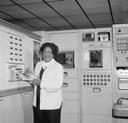

Reinforce the correct response: Their job involved solving math problems. Emphasize that today, computers are electronic machines; before machine computers were invented or widely used, computers were people who solved math problems by hand.
Language Support
Display images of a machine computer and a person to reinforce the different meanings of computer
Definitions
mathematician (n.): a person who is an expert in mathematics calculate (v.): to solve a mathematical problem
7. Direct attention to pages 4–5, and instruct students to Think–Pair–Share to answer this question:
Why did the US government need computers in the 1940s?
Differentiation Support
To help students identify reasons, ask these questions:
• Why did the United States focus on designing better airplanes?
• How would computers help the country do this?
Reinforce the correct responses:
• The agency that designed airplanes (NACA) was trying to make airplanes that could fly faster, higher, and safer to help the US win World War II.
• NACA needed people who were good at math to help run tests at its laboratory.
1. Direct attention to the charts for the Gallery Walk. Tell students that they will reread to understand more about Vaughan, Jackson, Johnson, and Darden and their work as mathematicians at the Langley laboratory. Explain that students will work in small groups to review the text and identify key details about the work of one of the mathematicians. Then they will participate in a Gallery Walk to share their findings and learn about the other mathematicians.
2. Direct attention to page 4, and ask this question:
What do we learn about Vaughan and her work on page 4?
Reinforce the correct response: She wanted to serve her country by working for NACA. Direct attention to the chart for Vaughan, and model how to add this key detail to the chart.
3. Form small groups. Assign each group a mathematician, and direct the groups to the corresponding charts.
Teacher Note
Depending on the number of students in your class, consider making multiple charts for each mathematician and assigning the same mathematician to multiple groups. Since there are fewer details about Darden’s work, consider assigning some groups both Darden and Jackson.
4. Instruct students to reread the following pages for their assigned mathematician. Tell groups to discuss what they learn from the text and illustrations about the mathematician and her work:
• Vaughan—pages 4–10, 18–19
• Jackson—pages 11–13
• Johnson—pages 14–17, 21–23
• Darden—pages 26–27
Teacher Note
Encourage students to refer to the glossary on page 38 for definitions of key vocabulary (e.g., engineer, turbulence, and wind tunnel).
5. Introduce the learning task. Instruct students to work with their group to add key details to their chart about their assigned mathematician and her work. Tell them to use both regular verbs (e.g., tested, worked) and irregular verbs (e.g., became, taught) in their notes.
Monitor: Do students identify key details related to Vaughan, Jackson, Johnson, or Darden and their work at the lab?
Offer Immediate Support: If students need additional support identifying key details about their mathematician, read aloud one or more of the assigned pages and ask these questions: What do we learn about this mathematician and her work? What did her job at the lab involve?
Plan Future Practice: Students practice identifying key details in module 3.
6. Look for students to include key ideas on their charts.
Key Ideas
• Dorothy Vaughan: got a job as a computer in 1943; had to work in a separate building from White computers; worked to make airplanes faster and safer; learned to program machine computers to do math problems correctly; taught other women to program computers
• Mary Jackson: got a job as a computer in 1951; tested model airplanes in wind tunnels to improve their designs; wanted to be an engineer; got permission to take high-level math classes at an all-White school; became the first African American female engineer at the lab
• Katherine Johnson: started working at the lab in 1953; worked on a team that tested planes while they were flying; researched how to prevent future plane crashes; analyzed dangerous gusts of air; became the first woman to sign her group’s research report; calculated rocket pathways through space; checked machine computer’s calculations for John Glenn’s space mission
• Christine Darden: loved electronic computers; started working at the lab in 1967; became an engineer for supersonic airplanes; helped with a Moon mission as her first job
7. Instruct students to review their key details and annotate examples of regular verbs and irregular verbs.
8. Tell students that they will review the key details about the other mathematicians by participating in a Gallery Walk. Lead students in a Gallery Walk to read the key details about each mathematician on the charts.
9. Close the Gallery Walk by facilitating a brief discussion of these questions: What similarities did you notice among the women and their work?
How did their work experiences differ?
Encourage students to refer to the Gallery Walk charts to help them identify similarities and differences.
• similarities: The women were good at math; they used math in their jobs; they worked hard; they overcame challenges; they refused to give up; they made important contributions to air and space travel.
• differences: The women had different jobs (i.e., Jackson and Darden were engineers, Vaughan programmed machine computers, and Johnson tested flying airplanes and calculated rocket paths for space missions); they worked at the lab during different times (i.e., Darden started in 1967, while the others started in the 1940s and 1950s); Vaughan, Jackson, and Johnson worked at the lab when it was segregated and women (especially Black women) had limited opportunities.
Differentiation Challenge
To encourage students to evaluate ideas in the text, ask this question: In your opinion, which mathematician had the most interesting or exciting job? Prompt students to support their ideas with reasons and evidence from the text.
1. Ask this question:
When someone is sharing their opinion about a historical event, why is it important to carefully listen to or read their evidence?
Use responses to emphasize that opinions about historical events need to be supported by facts or details about the event.
2. Direct students to Module Task 2, located in the Learn book. Tell students that they will share their Module Task 2 responses in small groups.
3. Form groups of four students. Instruct students to take turns reading aloud their writing as other group members listen closely. Invite one student to share an opinion from their group.
4. Ask these questions:
Did someone in your group share a different opinion? What was it?
Reinforce that there are three possible opinions for this task: The most exciting phase could be Eagle’s descent to the Moon, Armstrong and Aldrin’s exploration of the Moon, or Eagle’s ascent from the Moon.
5. Direct students to the Checklist for Module Task 2, located in the Learn book. Instruct students to review the checklist with a partner.
Teacher Note
Students may complete the Checklist for Module Task 2 on their Learn book page. Alternatively, they may use shared digital documents for peer review. Using technology gives students experience leveraging digital feedback tools.
6. Display and Choral Read these sentence frames:
• One strength in your writing is .
• One area to work on is .
7. Instruct students to use the sentence frames to write about a strength and an area of revision in their partner’s writing. Remind students to refer to the checklist to choose a specific area for revision.
Differentiation Support
Model how to use the Checklist for Module Task 2 and the sentence frames to provide written feedback on student writing.
8. Introduce the learning task. Instruct students to revise their work based on their partner’s feedback and the checklist.
Following completion of Module Task 2, refer to the Assessment Guide for next steps. Use the information in the guide to provide feedback to students and plan future writing instruction.
9. Facilitate a brief discussion of this question:
How did sharing your work and listening to others’ work help you as a writer?
1. Direct attention to both knowledge charts, and facilitate a brief discussion to help students articulate the knowledge they built during the lesson. Add a few student-generated knowledge statements to the charts.
As needed, prompt students to reflect on what they learned by asking questions such as these:
• What did you learn about Vaughan, Jackson, Johnson, and Darden?
• What did you learn about the work of mathematicians and computers at the Langley laboratory?
• What did you learn to do?
MM Make Meaning from Texts
MM.1.3 Comprehension and Evidence: MM.1.3.C, MM.1.3.D
MM.3.3 Summary: MM.3.3.B
MM.4.3 Individuals, Events, and Ideas: MM.4.3.C
MM.5.3 Vocabulary: MM.5.3.A, MM.5.3.A.b, MM.5.3.A.d, MM.5.3.A.e, MM.5.3.C
MM.9.3 Media: MM.9.3.B
MM.12.3 Complexity, Diversity, and Genre: MM.12.3.B, MM.12.3.B.a
CP Compose and Present Content
CP.1.3 Genre: CP.1.3.A,CP.1.3.H
CP.3.3 Content: CP.3.3.A, CP.3.3.A.a, CP.3.3.A.e
CP.4.3 Structure: CP.4.3.A, CP.4.3.A.a, CP.4.3.B, CP.4.3.B.a, CP.4.3.B.b, CP.4.3.C
CP.5.3 Language: CP.5.3.B
CP.6.3 Revision
CP.7.3 Editing
CP.8.3 Presentation: CP.8.3.A
BU Build Understanding
BU.1.3 Inquiry and Credibility: BU.1.3.C
BU.2.3 Discovery and Evidence: BU.2.3.B, BU.2.3.C
BU.3.3 Conversation and Collaboration: BU.3.3.A, BU.3.3.B, BU.3.3.C, BU.3.3.E
BU.4.3 Expression
DF Develop Foundations
DF.3.3 Phonics and Spelling: DF.3.3.A, DF.3.3.A.b, DF.3.3.B, DF.3.3.B.a, DF.3.3.B.b
DF.4.3 High-Frequency and Irregularly Spelled Words: DF.4.3.A
DF.10.3 Verbs: DF.10.3.B
DF.13.3 Sentence Construction: DF.13.3.A
DM Develop Metacognition
DM.1.3 Content Stages: DM.1.3.B
DM.2.3 Comprehension Monitoring
DM.3.3 Schema Building
DM.4.3 Reflection and Evaluation
Essential Question | How do people learn about space?
Content Framing Question | Reveal: What does a deeper look at relationships between events reveal?
In this Reveal lesson, students take a closer look at historical events in the backdrop of Hidden Figures, beginning with President Kennedy’s commitment to landing a man on the Moon. Students examine relationships between Kennedy’s goal and other events in the Space Race and the impact of these events on NASA. This work prepares students to understand Katherine Johnson’s work at NASA and the critical roles she and other computers and engineers played in the Space Race. During writing instruction, students examine the End-of-Module Task and explain what evidence they will collect to inform their opinions. This work helps students understand the task’s expectations and reflect on the process that will prepare them to write.
A Prologue to lesson 29 is available for students who need additional support.
Examine relationships between key events in Hidden Figures.
LEARNING TASK: Explain how President Kennedy’s goal to land a man on the Moon would affect work at NASA.
Use the writing prompt to determine what kind of evidence to collect for the End-of-Module Task.
LEARNING TASK: For the End-of-Module Task, write to explain what evidence you will collect to inform your opinion.
satellite (n.)
LAUNCH
Read the Content Framing Question
LEARN
• Read: Examine Relationships Between Events in Hidden Figures
• Respond: Explain Effects of the President’s Goal
• Write: Examine the End-of-Module Task
LAND
Reflect on Learning
Materials
TEACHER
• Hidden Figures
• “President Kennedy—Man on the Moon Speech” (digital platform)
• Syllable Types (Reference Charts appendix)
STUDENTS
• Hidden Figures
• sticky note
• journal
• End-of-Module Task (Learn book, Writing)
• Determine how to display side by side Syllable Types and the term satellite with its syllable division. See the Read section for details.
• Students listen to, read, or explore a volume of reading text. They add to their reading log and respond to assigned volume of reading questions. See Implementation Resources for volume of reading guidance.
• Students complete day 3 of Fluency Practice for Hidden Figures (Learn book, Fluency) and focus on a fluency element or retelling.
2 minutes
Read the Content Framing Question
1. Display Hidden Figures.
2. Display and Choral Read the Content Framing Question: What does a deeper look at relationships between events reveal?
3. Tell students that in this lesson they will look closely at some of the historical events in Hidden Figures to understand how they are related.
53 minutes
Read | Examine Relationships Between Events in Hidden Figures |
21 minutes
1. Display the illustration on page 21, and instruct students to share with a partner what they notice and wonder about it.
2. Explain that the illustration on page 21 shows President John F. Kennedy on a television screen. Tell students that Kennedy became president of the United States in 1961. That year, he gave a speech to Congress about space.
3. Tell students that they will view a clip from the president’s speech. Instruct them to listen for President Kennedy’s goal for the US in space. Play “President Kennedy—Man on the Moon Speech” from 2:11 to the end.
4. Tell students that they will now read key words from President Kennedy’s speech in the book to understand his goal for the US in space. Engage students in Repeated Reading of the first paragraph on page 21, from “In 1961, President” to “safely to Earth.”
5. Ask this question:
What goal does President Kennedy want the US to achieve, or accomplish, in space?
Reinforce the correct response: land a man on the Moon and return him safely to Earth.
6. Display the timeline on pages 32–33. Remind students that President Kennedy announced the goal of landing a man on the Moon in 1961. Instruct students to work with a partner to identify where this event belongs on the timeline. Distribute one sticky note to each student, and instruct them to write this event and add it to the timeline. Encourage students to sketch an image to represent the event.
Differentiation Support
Provide sticky notes with the year and event written on them (i.e., 1961: President Kennedy sets a goal for the US to land a man on the Moon). Instruct students to sketch an image to represent the event on the sticky note and add it to the timeline.
7. Explain that to understand why President Kennedy wanted the US to land a man on the Moon, students will learn about other important events happening around the same time. Direct attention to the year 1957 on the timeline, and Echo Read the event: Soviet Union launches the Sputnik satellite.
Teacher Note
Display a map of the former Soviet Union. Explain that in 1957, the Soviet Union was a large country made up of 15 republics, or states, including Russia. In 1991, many of these republics became independent, and the Soviet Union broke up into separate countries.
8. Display side by side Syllable Types and the term satellite with its syllable division: sat-el-lite. Direct attention to the first syllable, and instruct students to name the syllable type.
Reinforce the correct response: closed.
9. Direct attention to the second syllable and ask this question:
Since this syllable is in the middle of a multisyllabic word, what will you do to decode this word with your partner?
Reinforce the correct response: try a short vowel sound and a schwa vowel sound.
10. Direct attention to the third syllable, and instruct students to name the syllable type.
Reinforce the correct response: vowel-consonant-e. Instruct students to decode this multisyllabic word with a partner. Say the term aloud.
11. Direct students to the glossary on page 38. Remind students that a glossary is like a dictionary; it is an alphabetical list of important words in the text and their definitions.
12. Instruct students to locate the term satellite in the glossary, and read the definition. Ask this question:
How do you think Sputnik helped the Soviet Union?
Direct attention to the definition to reinforce that Sputnik helped the Soviet Union collect information from space.
13. Display the term Space Race, and explain that the launch of Sputnik marked the beginning of the Space Race, a race between the US and the Soviet Union to create better technology and send humans into space.
14. Direct attention to the timeline, and remind students that President Kennedy set the goal to land on the Moon in 1961. Ask this question:
What else happened in 1961?
Reinforce the correct response: Soviet cosmonaut Yuri Gagarin orbited Earth. Explain that astronauts in the Soviet space program were called cosmonauts. Tell students that Gagarin orbited Earth a few weeks before President Kennedy’s speech.
15. Instruct students to discuss these questions with a partner:
According to the timeline, which country was leading the Space Race in 1961? How do you know?
Invite a few students to share their ideas, and reinforce the correct responses: the Soviet Union; it had launched the Sputnik satellite in 1957, and Gagarin orbited Earth in 1961.
satellite (n.): a man-made object placed in orbit around Earth, another planet, or the Moon to collect information or help with communication
16. Tell students that they will revisit the text to learn more about early events in the Space Race. Direct attention to page 20 and the illustration of Sputnik. Read aloud page 20, starting with “In 1957, Russia.” Tell students to listen for how the launch of Sputnik affected the US.
Teacher Note
Tell students that the text uses the term Russia, but that in 1957 Russia was part of the Soviet Union.
17. Ask this question:
How did the launch of Sputnik affect the US?
Differentiation Support
To help students focus on Sputnik’s effects, ask this question: What did the US do after the Soviet Union launched Sputnik?
Key Ideas
• The US started building satellites to explore space.
• The US started creating spaceships in addition to airplanes.
• The US changed the name of NACA to NASA, the National Aeronautics and Space Administration.
18. Instruct students to reread the first paragraph on page 21, from “In 1961, President” to “safely to Earth,” and Think–Pair–Share to discuss these questions:
Why do you think President Kennedy set a goal for the US to land a man on the Moon?
How did this goal connect to the Space Race?
Key Ideas
• He wanted the US to become the first country to land a man on the Moon.
• He wanted the US to focus on a new goal in space exploration.
• He wanted the US to move ahead of the Soviet Union in the Space Race.
1. Introduce the learning task. Instruct students to read the rest of page 21, from “A man on” to “Really good.” Direct students to their journals, and instruct them to write a response to this question: According to the text, how would President Kennedy’s goal affect work at NASA? Tell students to write complete sentences and to use evidence from page 21 to support their response.
Monitor: Do students demonstrate understanding that as a result of the president’s goal to land a man on the Moon, NASA would need to work on sending an astronaut around Earth and to hire more space and math experts?
Offer Immediate Support: If students need additional support explaining how the president’s goal would affect work at NASA, direct them to page 21 and ask this question: What would NASA need to do to land a man on the Moon?
Plan Future Practice: Students examine relationships between events in module 3.
2. Direct students to the timeline on pages 32–33, and ask this question: What important events happened after President Kennedy announced his goal?
Key Ideas
• John Glenn orbited Earth in 1962.
• Christine Darden started working at NASA in 1967.
• Neil Armstrong and Edwin “Buzz” Aldrin became the first humans to land on the Moon in 1969.
3. Facilitate a brief discussion of this question:
How are these events connected to the Space Race and President Kennedy’s goal?
Key Ideas
• Glenn orbited Earth a year after Gagarin did.
• Darden and other mathematicians helped the US meet the goal of putting a man on the Moon.
• Armstrong and Aldrin fulfilled the president’s goal.
Differentiation Challenge
To extend students’ thinking about the relationships between events, ask this question: How might the Space Race have turned out differently if President Kennedy had not set this goal for the US?
4. Tell students that in the next lesson they will learn more about Katherine Johnson’s work and how she helped NASA achieve its goals in the Space Race.
Write | Examine the End-of-Module Task | 16 minutes
1. Direct attention to the ELA Knowledge Chart, and ask this question:
What have we learned about sharing an opinion in writing?
Language Support
If possible, pair students who speak the same home language, and instruct them to share what they have learned about opinion writing.
Key Ideas
• We can write essays with multiple paragraphs to share our opinions.
• We need to collect and review all evidence before forming an opinion about a question or topic.
• We need to support each of our reasons with evidence from at least one source.
• Elaboration tells more about the evidence, and it can connect back to the reason or opinion.
2. Explain that students will apply their ELA learning and their knowledge of the world to complete the End-of-Module Task. Display the End-of-Module Task, and direct students to the page in their Learn book. Choral Read the writing prompt: How would you choose to explore space? Choose one option from the list. Write an essay to support your opinion.
• astronomer
• astronaut
• mathematician
3. Ask this question:
What knowledge of the world do you need to complete this task?
Use responses to emphasize that students must have knowledge of how an astronomer, an astronaut, or a mathematician explores space.
4. Ask this question:
How is the End-of-Module Task similar to and different from Module Task 2?
Key Ideas
• Both require writing a complete opinion essay.
• Both are about space.
• Module Task 2 is about the first Moon landing, but the End-of-Module Task is about exploring space as an astronomer, an astronaut, or a mathematician.
5. Instruct students to discuss these questions with a partner:
According to the writing prompt, how many possible opinions could you write about? What are they?
6. Listen for students to address key ideas in their discussions.
Key Ideas
• There are three possible opinions.
• I would choose to explore space as an astronomer.
• I would choose to explore space as an astronaut.
• I would choose to explore space as a mathematician.
7. Introduce the learning task. Direct students to their journals. Instruct them to write a response to this question: Where will you find your evidence, and what kind of evidence will you collect before you form your opinion?
Monitor: Do students name relevant core texts and how each aligns to a prompt option?
Offer Immediate Support: If students need support matching a core text to one of the End-of-Module Task options, direct attention to one core text and ask this question: What kind of evidence could you collect from this text to help you complete the task?
Plan Future Practice: Students begin collecting evidence for the End-of-Module Task in lesson 30.
8. Invite a few students to share their written responses. Reinforce the key ideas.
Key Ideas
• sources: Starry Messenger, One Giant Leap, and Hidden Figures
• We will collect evidence about astronomers, astronauts, and mathematicians.
9. Tell students that in the next lesson they will revisit Starry Messenger to begin collecting evidence of how Galileo, an astronomer, explored space.
1. Direct attention to both knowledge charts, and facilitate a brief discussion to help students articulate the knowledge they built during the lesson. Add a few student-generated knowledge statements to the charts.
Teacher Note
As needed, prompt students to reflect on what they learned by asking questions such as these:
• What did you learn about the Space Race?
• What did you learn about President Kennedy’s goals for the US in space?
• What did you learn to do?
MM Make Meaning from Texts
MM.1.3 Comprehension and Evidence: MM.1.3.C, MM.1.3.D
MM.2.3 Theme and Central Idea: MM.2.3.E
MM.4.3 Individuals, Events, and Ideas: MM.4.3.C
MM.5.3 Vocabulary: MM.5.3.A, MM.5.3.A.f
MM.9.3 Media: MM.9.3.B
MM.12.3 Complexity, Diversity, and Genre: MM.12.3.B, MM.12.3.B.a,
CP Compose and Present Content
CP.1.3 Genre: CP.1.3.A, CP.1.3.H
CP.2.3 Planning: CP.2.3.A, CP.2.3.D
CP.5.3 Language: CP.5.3.B
BU Build Understanding
BU.1.3 Inquiry and Credibility: BU.1.3.D
BU.2.3 Discovery and Evidence
BU.3.3 Conversation and Collaboration: BU.3.3.A, BU.3.3.B
BU.4.3 Expression
DF Develop Foundations
DF.3.3 Phonics and Spelling: DF.3.3.A, DF.3.3.A.b
DF.4.3 High-Frequency and Irregularly Spelled Words: DF.4.3.A
DF.13.3 Sentence Construction: DF.13.3.A
DM Develop Metacognition
DM.1.3 Content Stages: DM.1.3.C
DM.3.3 Schema Building
Essential Question | How do people learn about space?
Content Framing Question | Reveal: What does a deeper look at words and their meanings reveal?
Preview
In this Reveal lesson, students study key vocabulary to learn more about Katherine Johnson’s computing work and her role in John Glenn’s mission to orbit Earth. They explore the concept of trajectory in familiar contexts and apply their understanding to explain why exact trajectory calculations were so critical for Glenn’s mission. During writing instruction, students begin collecting evidence to inform an opinion for the End-of-Module Task. They revisit Starry Messenger and collect evidence of how Galileo explored space as an astronomer.
Examine the meaning of trajectory in familiar contexts as well as in Glenn’s real-life mission in Hidden Figures.
LEARNING TASK: Explain why exact trajectory calculations were so important for Glenn’s mission to orbit Earth.
Collect evidence of how astronomers explore space.
LEARNING TASK: Write on the Evidence Organizer for the End-of-Module Task at least three pieces of evidence from Starry Messenger that demonstrate how Galileo explored space as an astronomer.
Vocabulary
exact (adj.)
trajectory (n.)
Agenda
LAUNCH
Read the Content Framing Question
LEARN
• Read: Examine the Meaning of Trajectory
• Respond: Apply Understanding of Trajectory
• Write: Collect Evidence for the End-of-Module Task
LAND
Reflect on Learning
Materials
TEACHER
• Hidden Figures
• Starry Messenger
• Gallery Walk chart(s) for Katherine Johnson (lesson 28)
• Knowledge Cards: calculate, trajectory, astronomer
• Syllable Types (Reference Charts appendix)
• globe
• End-of-Module Task (Learn book, Writing)
• Hidden Figures
• Starry Messenger
• lightweight balls and baskets, boxes, or buckets
• journal
• Evidence Organizer for the End-of-Module Task (Learn book, Writing)
• sticky notes
• Determine how to display side by side Syllable Types and the term trajectory with its syllable division. See the Read section for details.
• For the trajectory activities, ensure that you have small, lightweight balls (e.g., foam balls, table tennis balls, or wadded-up paper) and a small basket, box, or bucket for each pair of students. Familiarize yourself with the activities, and determine how and where students will engage in them. See the Read section for details.
• Students listen to, read, or explore a volume of reading text. They add to their reading log and respond to assigned volume of reading questions. See Implementation Resources for volume of reading guidance.
• Students complete day 4 of Fluency Practice for Hidden Figures (Learn book, Fluency) and focus on a fluency element or retelling.
Read the Content Framing Question
1. Display Hidden Figures.
2. Display and Choral Read the Content Framing Question: What does a deeper look at words and their meanings reveal?
3. Tell students that in this lesson they will learn more about Katherine Johnson’s work at NASA by exploring key vocabulary in the text.
53 minutes
Read | Examine the Meaning of Trajectory | 23 minutes
1. Display the Gallery Walk chart(s) for Katherine Johnson. Ask this question: What kind of work did Johnson do at the Langley laboratory?
Key Ideas
• worked on a team that tested planes while they were flying
• researched how to prevent future plane crashes
• analyzed dangerous gusts of air
• worked on research reports
• calculated rockets’ pathways through space
• checked machine computer’s calculations for John Glenn’s space mission
2. Remind students that in 1961 President Kennedy set a goal of landing an astronaut on the Moon. Tell students that to reach this goal, the US first needed to send an astronaut around Earth. Engage students in Repeated Reading of page 22, starting with “The people at.” Instruct students to listen for how Johnson helped with the mission to send astronaut John Glenn around Earth.
3. Instruct students to work with a partner to annotate details about Johnson’s work on the mission. Look for students to include key ideas in their annotations.
• knew how to use math to help
• told her boss she could figure out where to launch the spaceship from if she knew the intended landing spot
• helped calculate rocket trajectories through space
• had to plan Glenn’s exact route from takeoff to splashdown
4. Tell students that they will take a closer look at key vocabulary to better understand Johnson’s work on the mission to send Glenn around Earth. Direct attention to the last paragraph on page 22. Display the Knowledge Card for calculate, and direct attention to the image to spark students’ memory. Remind students that calculate means “to solve a mathematical problem.”
5. Display side by side Syllable Types and the term trajectory with its syllable division: tra-jec-tor-y. Direct attention to the first syllable, and tell students that this syllable type is a schwa.
6. Direct attention to the second syllable, and instruct students to name the syllable type.
Reinforce the correct response: closed.
7. Direct attention to the third syllable, and instruct students to name the syllable type.
Reinforce the correct response: r-controlled.
8. Direct attention to the fourth syllable, and instruct students to name the syllable type.
Reinforce the correct response: open. Instruct students to decode this multisyllabic word with a partner. Display the Knowledge Card for trajectory, and say the term. Tell students that they will use context to determine this word’s meaning.
9. Read aloud the last paragraph on page 22, starting with “Katherine helped calculate.” Direct attention to the synonyms for trajectories. Instruct students to work with a partner to infer the term’s meaning. Invite a few students to share their ideas. As students share, reinforce the correct definition.
Language Support
Tell students that route is another word for pathway.
10. Direct attention to the image for trajectory on the Knowledge Card. Ask this question: What other objects, besides rockets, follow a trajectory, or a curved path, through the air?
Use responses to emphasize that anything thrown or launched (e.g., footballs, soccer balls, basketballs, cannonballs, water from a hose) would follow a trajectory.
11. Instruct students to work with a partner to describe Johnson’s job in their own words, using what they learned about trajectory. Listen for students to accurately describe her job: She used math to figure out rockets’ pathways through space.
12. Explain that when someone tosses a ball, the force of the throw sends the ball up. Tell students that the ball’s path arcs back toward the ground as the energy from the throw runs out. Toss a ball in a forward direction, aiming for a basket several feet away. Instruct students to observe the ball’s trajectory, or path through the air.
trajectory (n.): the curved path along which an object moves through the air or through space
13. Invite a student to toss the ball back and forth with you. Demonstrate how to toss the ball with greater or lesser force and at varying angles. Instruct students to observe how the ball’s trajectory changes. Facilitate a brief discussion of these questions:
What happened to the ball when we tossed it with more or less force?
What happened to the ball when we tossed it from different angles?
Key Ideas
• more force: went faster; went further; didn’t arc much; bounced harder against the rim of the basket
• less force: went slower; stopped sooner; didn’t travel very far
• different angles: didn’t make it to the basket; overshot the basket
14. Explain that Johnson used math to figure out a rocket’s trajectory based on the angle at which the rocket was launched and how high and fast it could go.
15. Direct attention to the last paragraph on page 22. Introduce the vocabulary term exact by displaying the term, saying it, and simultaneously clapping once for each syllable. Instruct students to say the term and clap for each syllable.
16. Display and read aloud the last two sentences on page 22, starting with “She had to.” Ask this question:
What does the phrase “no room for error” mean?
Reinforce the correct response: There could be no errors, or mistakes; the calculations had to be correct.
17. Instruct students to work with a partner to infer the meaning of exact, based on the phrase “no room for error.” Invite a few students to share their ideas. As students share, reinforce the correct definition.
18. Pair students, and distribute a ball to each pair. Instruct students to take turns throwing the ball at a target several feet in front of them (e.g., a basket, box, or bucket). Encourage students to experiment with throwing the ball from closer up and farther away, as well as changing the force and angle of their throws, while aiming for the target.
Definition exact (adj.): completely correct or accurate
19. Facilitate a brief discussion of these questions:
What helps you get the ball closer to the target?
What makes it harder to hit the target?
Key Ideas
• easier: an exact, or precise, throw
• harder: greater distance from the target
20. Use a globe to point out Cape Canaveral, Florida, where Glenn’s spaceship took off, and the Atlantic Ocean near Turks and Caicos Islands, where Glenn splashed down. Tell students that Glenn orbited Earth three times before landing. Explain that Johnson calculated the spaceship’s exact trajectory around Earth, from its launch point in Florida to its landing point in the Atlantic Ocean.
Teacher Note
Remind students that Earth rotates on its axis. Explain that to calculate an exact trajectory, Johnson had to take into account Earth’s location at the time the spaceship launched and the speed of Earth’s rotation.
1. Instruct students to read page 23 and discuss with a partner what else they learn about Johnson’s work on Glenn’s mission to orbit Earth. Invite a few students to share their responses. Reinforce that a machine computer also calculated the trajectory for Glenn’s rocket and that Glenn asked Johnson to double-check the machine computer’s calculations to make sure there were no mistakes.
2. Ask this question:
Why did Glenn ask Johnson to check the machine computer’s calculations before his mission?
Key Ideas
• Johnson was really good at solving tricky math problems.
• Glenn wanted to make sure that the calculations were correct.
• Glenn trusted Johnson’s calculations.
3. Introduce the learning task. Remind students that they have been learning about the concept of trajectory in a real-world situation: launching a spaceship into space, with a human aboard! Direct students to their journals, and instruct them to write a response to this question: Why did the trajectory calculations for Glenn’s mission have to be exact? Tell students to include details from the text to support their answer.
Monitor: Do students demonstrate understanding that the mission’s success and Glenn’s safe return to Earth depended on the accuracy of the calculations?
Offer Immediate Support: If students need additional support explaining why exact trajectory calculations were important for Glenn’s mission, direct students to think about their classroom experiments and ask this question: What might have happened if the calculations for Glenn’s mission were not exact?
Plan Future Practice: Students practice making real-life connections between words and their use in module 3.
4. Invite a few students to share their responses.
Key Ideas
• so that Glenn would successfully orbit Earth and return home safely
• so that Glenn’s spaceship would land safely in the Atlantic Ocean
• so that NASA would know exactly where Glenn’s spaceship would go and where it would land
5. If time allows, facilitate a brief discussion of this prompt:
Think of another real-world object that follows a trajectory. Does the trajectory of this object need to be exact? Why or why not?
Write | Collect Evidence for the End-of-Module Task | 20 minutes
1. Display the End-of-Module Task, and read aloud the prompt: How would you choose to explore space? Choose one option from the list. Write an essay to support your opinion.
• astronomer
• astronaut
• mathematician
Invite a few students to share, in their own words, what the task requires.
2. Tell students that they will now begin collecting evidence to help them form an opinion about how they would choose to explore space. Display the Evidence Organizer for the End-of-Module Task, and direct students to the page in their Learn book. Choral Read the directions and the job title in each column.
3. Direct attention to the first column. Activate and assess prior knowledge by asking this question:
What does an astronomer do?
Display the Knowledge Card for astronomer, and reinforce the correct response: studies stars, planets, and other objects found in space.
4. Tell students that they will focus on collecting evidence of how an astronomer explores space. Ask this question:
Which text will you use as your source for how an astronomer explores space?
Reinforce the correct response: Starry Messenger. Explain that they will collect evidence of how Galileo explored space as an astronomer.
5. Distribute sticky notes. Instruct students to review Starry Messenger with a partner and use sticky notes to annotate evidence of how Galileo explored space as an astronomer.
Differentiation Support
To help students collect evidence, direct them to pages 16−20, 24, and 30−32.
6. Look for students to identify relevant evidence.
Key Ideas
• observed the night sky (Earth’s Moon, Sun, Jupiter’s moons, Milky Way) through a telescope
• wrote down his observations
• made discoveries about the Moon, Sun, and planets
• wrote a book to share his discoveries
• made maps of stars
• thought about the wonders and mysteries of the universe
• changed people’s understanding of the universe
7. Instruct students to share their evidence from Starry Messenger with a new partner.
8. Introduce the learning task. Instruct students to write on their organizer at least three pieces of evidence that demonstrate how Galileo explored space as an astronomer.
Analyze Student Progress
Monitor: Do students write at least three pieces of relevant evidence showing how Galileo explored space as an astronomer?
Offer Immediate Support: If students need additional support collecting relevant evidence, direct them to pages 16−17 and ask these questions: How did Galileo use his telescope? What did he discover?
Plan Future Practice: Students practice choosing evidence to support their opinion in lesson 36.
9. Tell students that they will use this evidence organizer in the next lesson to collect evidence of how astronauts explore space.
5 minutes
1. Direct attention to both knowledge charts, and facilitate a brief discussion to help students articulate the knowledge they built during the lesson. Add a few student-generated knowledge statements to the charts.
Teacher Note
As needed, prompt students to reflect on what they learned by asking questions such as these:
• What did you learn about trajectory?
• What did you learn about Johnson’s work on Glenn’s mission to orbit Earth?
• What did you learn to do?
MM Make Meaning from Texts
MM.1.3 Comprehension and Evidence: MM.1.3.C, MM.1.3.D
MM.4.3 Individuals, Events, and Ideas: MM.4.3.C
MM.5.3 Vocabulary: MM.5.3.A, MM.5.3.A.b, MM.5.3.A.c, MM.5.3.B, MM.5.3.B.b, MM.5.3.C
MM.12.3 Complexity, Diversity, and Genre: MM.12.3.B, MM.12.3.B.a
CP Compose and Present Content
CP.1.3 Genre: CP.1.3.A, CP.1.3.H
CP.2.3 Planning: CP.2.3.D
CP.3.3 Content: CP.3.3.A, CP.3.3.A.a, CP.3.3.A.e
CP.4.3 Structure
CP.5.3 Language: CP.5.3.B
BU Build Understanding
BU.1.3 Inquiry and Credibility: BU.1.3.A, BU.1.3.C
BU.2.3 Discovery and Evidence: BU.2.3.A, BU.2.3.B
BU.4.3 Expression
DF Develop Foundations
DF.3.3 Phonics and Spelling: DF.3.3.A, DF.3.3.A.b, DF.3.3.B, DF.3.3.B.a
DF.4.3 High-Frequency and Irregularly Spelled Words: DF.4.3.A
DM Develop Metacognition
DM.1.3 Content Stages: DM.1.3.C
DM.3.3 Schema Building
Essential Question | How do people learn about space?
Content Framing Question | Distill: What is a central idea in this text?
In this Distill lesson, students revisit Hidden Figures to discuss how Dorothy Vaughan, Mary Jackson, Katherine Johnson, and Christine Darden advanced opportunities for Black women mathematicians and contributed to NASA’s work in air and space travel. Following their discussion, students reflect on the significance of the book’s title and central ideas. During writing instruction, students continue collecting evidence to inform an opinion for the End-of-Module Task. They collect evidence from Moonshot of how astronauts explore space.
A Prologue to lesson 31 is available for students who need additional support.
Determine a central idea in Hidden Figures.
LEARNING TASK: During a class discussion, share and support ideas about how the women in Hidden Figures contributed to the success of NASA and of each other.
Collect evidence of how astronauts explore space.
LEARNING TASK: Write on the Evidence Organizer for the End-of-Module Task at least three pieces of evidence from Moonshot that demonstrate how the astronauts explored space.
figure (n.)
LAUNCH
Read the Content Framing Question
LEARN
• Read: Prepare for a Discussion
• Respond: Discuss a Central Idea
• Write: Collect Evidence for the End-of-Module Task
LAND
Reflect on Learning
Materials
TEACHER
• Hidden Figures
• Moonshot
• Knowledge Cards: contribution, astronaut
• Gallery Walk charts (lesson 28)
• End-of-Module Task (Learn book, Writing)
STUDENTS
• Hidden Figures
• Moonshot
• journal
• Evidence Organizer for the End-of-Module Task (Learn book, Writing)
• index cards
• none
• Students listen to, read, or explore a volume of reading text. They add to their reading log and respond to assigned volume of reading questions. See Implementation Resources for volume of reading guidance.
• In small groups, students rehearse and perform the passage on Fluency Practice for Hidden Figures (Learn book, Fluency).
2 minutes
Read the Content Framing Question
1. Display Hidden Figures.
2. Display and Choral Read the Content Framing Question: What is a central idea in this text?
3. Tell students that they will revisit Hidden Figures in preparation for a discussion of the book’s central ideas.
53 minutes
Read | Prepare for a Discussion | 17 minutes
1. Direct attention to the title on the book’s front cover. Introduce the vocabulary term figure by displaying the term and definitions. Engage students in Vocabulary Exploration.
2. Instruct students to Think–Pair–Share to answer this question: Who or what are the “hidden figures” in this book?
Key Ideas
• who: the Black women mathematicians who worked at the Langley laboratory
• who: Dorothy Vaughan, Mary Jackson, Katherine Johnson, and Christine Darden
• what: the calculations made by mathematicians at the Langley laboratory
Definitions figure (n.):
1. a number or calculation
2. a person who is important in some way
3. Tell students that they will reflect on the book’s title again later in the lesson. Read aloud page 26, starting with “Christine Darden was.” Display the Knowledge Card for contribution, and direct attention to the image to spark students’ memory. Remind students that a contribution is an action, invention, or idea a person adds to a mission or body of knowledge. Instruct students to annotate Darden’s contributions to NASA’s mission of improving air and space travel.
4. Invite a few students to share their annotations. Reinforce the correct responses: Darden became an engineer for supersonic airplanes and helped with NASA’s mission to the Moon.
5. Ask this question:
According to the text, who made it possible for Darden to become an engineer for supersonic airplanes?
Reinforce the correct response: Black women computers and engineers, including Vaughan, Jackson, and Johnson, who preceded Darden at NASA.
6. Tell students that in today’s discussion they will reflect on how Vaughan, Jackson, and Johnson helped make it possible for Darden to become an engineer for supersonic airplanes. Display and Choral Read today’s discussion questions:
• What did the women in Hidden Figures make possible for each other?
• What did they make possible for NASA?
7. Explain that to prepare for discussion, students will first collect evidence of what the other three mathematicians contributed to NASA’s work. Instruct students to work in small groups to annotate evidence of Vaughan’s, Jackson’s, and Johnson’s contributions. Display the Gallery Walk charts from lesson 28, and remind students that they can refer to the charts as well as the text to identify evidence.
8. Look for students to address key ideas in their annotations.
Key Ideas
Vaughan
• pages 6−7: became a computer in 1943 as a Black woman in segregated Virginia
• page 10: worked on experiments to make airplanes faster and safer
• page 18: learned to program machine computers; taught other women in her group how to program Jackson
• page 11: became a computer in 1951; tested model airplanes in wind tunnels to improve designs
• page 12: took high-level math classes at an all-White school to become the first African American female engineer at the Langley laboratory
Johnson
• page 14: became a computer in 1953; tested airplanes while they were flying to figure out how to prevent plane crashes
• pages 16−17: fought to become the first woman to sign her group’s research report
• pages 22–23: calculated rocket pathways through space; checked machine computer’s calculations for John Glenn’s mission to orbit Earth
9. Instruct students to work with their group to review their annotations (including those for Darden) and discuss these questions:
What connections do you notice among the mathematicians?
How did their work make a difference at NASA?
10. Direct students to their journals, and instruct them to jot down their ideas.
1. Ask this question:
What speaking and listening skills have we been practicing in our discussions?
Display and reinforce the module’s speaking and listening goals:
• Take turns with others when speaking.
• Elaborate on the evidence you use.
• Build on others’ ideas.
Teacher Note
During the discussion, use the Module 2 Speaking and Listening Goal Tracker, located on the digital platform, to monitor student progress toward these goals.
2. If possible, arrange students in a circle. Facilitate a brief discussion of this prompt: Describe the contributions of Vaughan, Jackson, Johnson, and Darden to the work at NASA.
3. Introduce the learning task. Explain that students will continue the discussion to share how these women influenced each other and the work at NASA. Ask these questions:
What did the women in Hidden Figures make possible for each other?
What did they make possible for NASA?
Language Support
Direct students to the Talking Tool, located in the Learn book. Remind them that they can practice supporting their ideas with evidence from the text, elaborating on their evidence, and building on others’ ideas by using the sentence frames.
Monitor: Do students share ideas that demonstrate understanding of how the mathematicians contributed to each other’s success and to the success of NASA’s research in air and space travel?
Offer Immediate Support: If students need additional support articulating how the mathematicians helped one another, ask these questions: What obstacles did Jackson face to become an engineer? Do you think Darden faced similar obstacles? Why or why not?
Plan Future Practice: Students practice sharing and supporting ideas in a Socratic seminar in lesson 36.
4. Listen for students to discuss key ideas.
Key Ideas
• each other: Vaughan showed other Black women that they could become computers at the Langley laboratory.
• each other: Vaughan taught other Black women how to program computers.
• each other: Jackson showed other Black women that they could take high-level math classes and become engineers.
• each other: Johnson showed other Black women that they could write research reports and work on space missions.
• NASA: Vaughan’s work on airplane designs led to faster, safer airplanes.
• NASA: Jackson’s testing on model airplanes helped improve designs for full-sized airplanes.
• NASA: Johnson’s analysis of turbulence helped prevent airplane crashes and save lives.
• NASA: Johnson’s trajectory calculations helped Glenn orbit Earth and return safely.
• NASA: Darden helped with the math behind the Apollo 11 Moon landing.
• NASA: Darden worked as an engineer to design and build supersonic airplanes for NASA.
5. Direct attention to the title on the book’s front cover. Ask this question:
Why do you think the author titled this book Hidden Figures?
Differentiation Support
To help students reflect on the title’s multiple meanings, ask these questions:
• In what ways were Black women mathematicians and their work at NASA hidden?
• Why do you think the author chose to write about these women?
Use responses to emphasize the critical, often unrecognized, work of NASA’s computers and engineers, especially the work of Black women—many of whom worked in segregated environments and faced discrimination.
6. Remind students that a central idea is an important idea that a reader can learn from a text. Direct students to their journals. Instruct them to Jot–Pair–Share a central idea of Hidden Figures.
Key Ideas
• NASA’s achievements wouldn’t be possible without the work of Black women mathematicians like Vaughan, Jackson, Johnson, and Darden.
• NASA’s Black women mathematicians made important contributions to its air and space programs.
• Vaughan, Jackson, Johnson, and Darden paved the way for mathematicians of all races and genders at NASA.
1. Display the End-of-Module Task, and read aloud the prompt. Remind students that for the End-of-Module Task they will write an essay to support their opinion about how they would choose to explore space—as an astronomer, an astronaut, or a mathematician. Ask this question:
What kind of evidence will help you form an opinion?
Reinforce the correct response: evidence of how astronomers, astronauts, and mathematicians explore space.
2. Display the Evidence Organizer for the End-of-Module Task, and direct students to the page in their Learn book. Remind them that in the previous lesson they revisited Starry Messenger to collect evidence of how Galileo explored space as an astronomer. Direct attention to the middle column. Explain that in this lesson students will use Moonshot as their source to collect evidence of how astronauts explore space.
3. Activate and assess prior knowledge by asking this question:
What is an astronaut?
Display the Knowledge Card for astronaut, and direct attention to the image to spark students’ memory. Remind students that an astronaut is a person who travels in a spacecraft into outer space.
4. Distribute index cards. Instruct students to review Moonshot with a partner and write on their index cards at least two pieces of evidence that show how astronauts Buzz Aldrin, Neil Armstrong, or Michael Collins explored space.
Differentiation Support
To help students collect evidence, direct them to pages 7, 18−19, 22−25, 28−35, and 40−47.
5. Look for students to address key ideas in their responses.
Key Ideas
• studied, practiced, and trained on Earth
• rode in a spaceship powered by a rocket
• floated inside a small spaceship for a week while flying toward the Moon
• landed Eagle on the Moon as time and fuel were running out (Aldrin, Armstrong)
• explored the Moon’s surface; bounced in low gravity; collected rocks (Aldrin, Armstrong)
• flew Eagle back to Columbia (Aldrin, Armstrong)
• waited alone in Columbia to reconnect with Eagle (Collins)
• sped back to Earth inside Columbia and landed in the ocean
6. Lead students through Give One–Get One–Move On to share a strong piece of evidence they identified.
7. Introduce the learning task. Instruct students to write on their organizer at least three pieces of evidence of how Aldrin, Armstrong, or Collins explored space as astronauts.
Monitor: Do students accurately describe what the Apollo 11 astronauts’ exploration of space entailed?
Offer Immediate Support: If students need additional support collecting evidence, direct them to pages 18−25 and prompt them to describe experiences of the Apollo 11 astronauts in space.
Plan Future Practice: Students practice choosing evidence to support their opinion in lesson 36.
8. Tell students that they will use this organizer in the next lesson to collect evidence of how mathematicians can explore space.
1. Direct attention to both knowledge charts, and facilitate a brief discussion to help students articulate the knowledge they built during the lesson. Add a few student-generated knowledge statements to the charts.
Teacher Note
As needed, prompt students to reflect on what they learned by asking questions such as these:
• What did you learn about the work and achievements of the mathematicians in Hidden Figures?
• What did you learn from Hidden Figures?
• What did you learn to do?
MM Make Meaning from Texts
MM.1.3 Comprehension and Evidence: MM.1.3.C, MM.1.3.D
MM.2.3 Theme and Central Idea: MM.2.3.C, MM.2.3.D
MM.4.3 Individuals, Events, and Ideas: MM.4.3.C
MM.12.3 Complexity, Diversity, and Genre: MM.12.3.B, MM.12.3.B.a
CP Compose and Present Content
CP.1.3 Genre: CP.1.3.A, CP.1.3.H
CP.2.3 Planning: CP.2.3.D
CP.3.3 Content: CP.3.3.A, CP.3.3.A.a, CP.3.3.A.e
CP.4.3 Structure
CP.5.3 Language: CP.5.3.B
CP.8.3 Presentation: CP.8.3.A, CP.8.3.B
BU Build Understanding
BU.1.3 Inquiry and Credibility: BU.1.3.A
BU.2.3 Discovery and Evidence: BU.2.3.A, BU.2.3.C
BU.3.3 Conversation and Collaboration: BU.3.3.A, BU.3.3.B, BU.3.3.C, BU.3.3.D
BU.4.3 Expression
DF Develop Foundations
DF.3.3 Phonics and Spelling: DF.3.3.A, DF.3.3.A.b
DM Develop Metacognition
DM.1.3 Content Stages: DM.1.3.D
DM.2.3 Comprehension Monitoring
DM.3.3 Schema Building
DM.4.3 Reflection and Evaluation
Essential Question | How do people learn about space?
Content Framing Question | Know: How does this text build our knowledge?
In this Know lesson, students learn more about the lives and work of Dorothy Vaughan, Mary Jackson, Katherine Johnson, and Christine Darden by reading the back matter of Hidden Figures. Students reflect on their learning and create knowledge statements by using subordinating conjunctions to combine and expand on their ideas. During writing instruction, students continue collecting evidence to inform an opinion for the End-of-Module Task. They revisit Hidden Figures to collect evidence of how Katherine Johnson explored space as a mathematician.
A Prologue to lesson 32 is available for students who need additional support.
Express knowledge gained from Hidden Figures.
LEARNING TASK: Write two sentences to express knowledge gained from Hidden Figures, using subordinate conjunctions.
Collect evidence of how mathematicians explore space.
LEARNING TASK: Write on the Evidence Organizer for the End-of-Module Task at least three pieces of evidence from Hidden Figures that demonstrate how Katherine Johnson explored space as a mathematician.
none
LAUNCH
Read the Content Framing Question
LEARN
• Read: Read Biographies of the Computers
• Respond: Express Knowledge
• Write: Collect Evidence for the End-of-Module Task
LAND
Reflect on Learning
Materials
TEACHER
• Hidden Figures
• Gallery Walk charts (lesson 28)
• Knowledge Card: mathematician
STUDENTS
• Hidden Figures
• Sentence Strategies for Module 2 (Learn book, Writing)
• World Knowledge Statements for Module 2 (Learn book)
• Evidence Organizer for the End-of-Module Task (Learn book, Writing)
• sticky notes
• Determine how to display the Gallery Walk charts from lesson 28 at separate stations to allow small groups to add to each chart. See the Read section for details.
• Students listen to, read, or explore a volume of reading text. They add to their reading log and respond to assigned volume of reading questions. See Implementation Resources for volume of reading guidance.
2 minutes
Read the Content Framing Question
1. Display Hidden Figures.
2. Display and Choral Read the Content Framing Question: How does this text build our knowledge?
3. Tell students that they will revisit Hidden Figures to learn more about Dorothy Vaughan, Mary Jackson, Katherine Johnson, and Christine Darden from the book’s back matter, and they will read the author’s note. Students will spend time thinking and writing about the knowledge they built while reading the book.
53 minutes
Read | Read Biographies of the Computers | 18 minutes
1. Direct attention to the World Knowledge Chart, and instruct students to silently read the knowledge statements. Ask this question:
What have we learned from Hidden Figures?
Key Ideas
• NASA’s Black women mathematicians made important contributions to its air and space programs.
• Vaughan, Jackson, Johnson, and Darden paved the way for mathematicians of all races and genders at NASA.
• Vaughan learned how to program computers and taught other women at the Langley laboratory to do so.
• Jackson became the first African American female engineer at the Langley laboratory.
• Johnson calculated rocket trajectories and checked the calculations for John Glenn’s mission to orbit Earth.
• Darden helped with the Apollo 11 mission and worked as an engineer for supersonic airplanes.
2. Direct students to Hidden Figures, and direct attention to the section “Meet the Computers” on page 34. Tell students that the author has included short biographies of Vaughan, Jackson, Johnson, and Darden with additional information about their lives and work.
3. Direct attention to the charts for the Gallery Walk from lesson 28. Tell students that they will work in small groups to read more about one of the computers and add new details to the charts.
4. Form small groups. Assign each group one of the computers, and direct attention to the corresponding chart. Instruct students to review the details on their chart with their group.
Group students who need additional support reading and identifying new information. Read aloud the “Meet the Computers” section for their assigned computer, pausing after each paragraph to clarify meanings of unknown words, and instruct students to share new details they learn.
5. Instruct students to work with their group to read the section of “Meet the Computers” for their assigned computer and add at least three interesting new details to their chart.
Teacher Note
Students can use markers or sticky notes to add new details to their charts. Provide different-colored markers from those used on the original charts to help distinguish between new and previous details.
6. Instruct groups to take turns sharing new details they learned about their assigned computer.
Key Ideas
• Vaughan: received a full scholarship for college; taught high school math; became NASA’s first African American supervisor; died in 2008 at age 98
• Jackson: worked as a high school math teacher and a bookkeeper; worked in NASA’s Equal Opportunity Office supporting women’s careers; volunteered as a Girl Scout leader; died in 2005 at age 83
• Johnson: attended high school far away from her home because her community did not have a high school for Black students; completed high school at age 14; taught high school math; contributed calculations for the Apollo 11 mission
• Darden: had an early interest in how things work; became an expert on sonic booms; designed a computer program for sonic booms; helped improve designs of supersonic aircraft
7. Direct attention to the author’s note on page 39. Remind students that authors often include a short piece of text that contains additional information at the end of their book. Read aloud the author’s note. Tell students to listen closely for Margot Lee Shetterly’s message, or what she wants to share with her readers.
Language Support
Tell students that the term imagination has multiple meanings. It can refer to the ability to think creatively or come up with new ideas; it can also refer to the ability to imagine something that does not exist. Explain that the phrase spark the imagination means “to inspire someone to think about new possibilities.”
8. Facilitate a brief discussion of this question: How do the mathematicians in Hidden Figures spark your imagination?
Differentiation Challenge
To encourage extended reading on space exploration, direct students to a volume of reading text for them to read and share with the class. Instruct students to compare Hidden Figures with the volume of reading text.
1. Remind students of their work using subordinating conjunctions to connect ideas into complex sentences. Display Sentence Strategies for Module 2, and direct students to the page in their Learn book. Direct attention to the examples of subordinating conjunctions, and ask this question:
Which conjunctions can help us show time relationships?
Reinforce correct responses: after, as, before, when, while.
2. Display and Choral Read this sentence: Dorothy Vaughan became a computer at the Langley laboratory in 1943 while the US was at war. Underline the conjunction while, and ask this question:
How does the conjunction while connect the ideas in this sentence?
Reinforce the correct response: While tells us that the events are happening at the same time. Vaughan became a computer during the same time that the US was at war.
3. Explain that the conjunction while can connect ideas in other ways too. Display and Choral Read this sentence: While some thought it would be impossible for Vaughan to become a computer, she knew she had the knowledge and skills for the job.
4. Explain that in this sentence while connects two ideas that contrast, or disagree with, each other. Tell students that the subordinating conjunctions although and even though work in similar ways. Think aloud to model how to orally revise the sentence, replacing while with although and even though.
5. Display these sentence frames:
• While Black and White computers at the Langley laboratory did the same type of work, .
• Although Katherine Johnson helped her team do research to prevent plane crashes, .
Although some thought it would be impossible for Vaughan to become a computer, she knew she had the knowledge and skills for the job.
6. Instruct students to work with a partner to practice orally completing the sentence frames. Encourage students to refer to pages 8−9 and 16−17 of Hidden Figures to help them complete the sentences. Invite a few students to share their expanded sentences.
Key Ideas
• While Black and White computers at the Langley laboratory did the same type of work, they were not treated equally.
• While Black and White computers at the Langley laboratory did the same type of work, they had to work in separate buildings.
• Although Katherine Johnson helped her team do research to prevent plane crashes, she was not allowed to help her team prepare reports.
• Although Katherine Johnson helped her team do research to prevent plane crashes, her boss would not let her attend team meetings.
7. Direct attention to the World Knowledge Chart. Instruct students to work with a partner to practice orally creating complex sentences to express what they learned from Hidden Figures. Tell students to use subordinating conjunctions to combine or expand ideas from the chart.
Teacher Note
As needed, remind students that they can begin a sentence with a subordinating conjunction or they can expand a sentence by using a subordinating conjunction in the middle to add more information and connect ideas.
8. Introduce the learning task. Direct students to World Knowledge Statements for Module 2, located in the Learn book. Instruct them to write at least two knowledge statements to express what they learned from Hidden Figures. Tell students to use subordinating conjunctions to combine or expand their ideas into complex sentences, and challenge them to begin at least one sentence with a subordinating conjunction.
Monitor: Do students express knowledge gained from Hidden Figures in their statements while correctly using subordinating conjunctions?
Offer Immediate Support: If students need additional support expressing knowledge, provide a sentence frame with a subordinating conjunction: While Black women mathematicians made important contributions to NASA, .
Plan Future Practice: Students practice expressing their knowledge in new ways in module 3.
9. Instruct students to share their strongest or favorite knowledge statement with a partner. If time allows, invite a few students to share a strong statement they heard from a peer. Add a few knowledge statements to the World Knowledge Chart.
1. Display the Evidence Organizer for the End-of-Module Task, and direct students to the page in their Learn book. Remind students that they used Starry Messenger and Moonshot as their sources when they collected evidence of how astronomers and astronauts explore space.
2. Direct attention to the last column, on the right. Tell students that in this lesson they will use Hidden Figures as their source to collect evidence of how mathematicians can explore space. Explain that they will focus on the work of mathematician Johnson.
3. Assess and activate prior knowledge by asking this question: What is a mathematician?
4. Display the Knowledge Card for mathematician, and direct attention to the image to spark students’ memory. Remind students that a mathematician is a person who is an expert in mathematics.
5. Distribute sticky notes. Instruct students to review Hidden Figures and use sticky notes to annotate evidence of how Johnson explored space as a mathematician.
Differentiation Support
To help students focus on Johnson’s work on space missions, direct them to pages 22−23 and 28−29 of Hidden Figures, as well as the short biography of Johnson on page 36.
6. Look for students to annotate relevant evidence.
Key Ideas
• calculated rocket trajectories through space
• planned Glenn’s exact route around Earth, from takeoff to splashdown
• solved tricky math problems
• checked the machine computer’s trajectory calculations before Glenn’s mission to circle Earth
• helped make sure Glenn made it home safely
• helped with calculations for the Apollo 11 Moon mission
7. Instruct students to share their evidence from Hidden Figures with a partner or small group.
8. Introduce the learning task. Instruct students to write on their organizer at least three pieces of evidence showing how Johnson explored space as a mathematician.
Monitor: Do students identify relevant evidence of how Johnson explored space as a mathematician?
Offer Immediate Support: If students need additional support collecting evidence, direct them to pages 22−23 and prompt them to describe what Johnson did in her role as computer for NASA’s space missions.
Plan Future Practice: Students practice choosing evidence to support their opinion in lesson 36.
9. Tell students that in the next lesson they will review evidence about all three careers, or jobs, and form an opinion about how they would choose to explore space.
1. Direct attention to both knowledge charts, and facilitate a brief discussion to help students articulate the knowledge they built during the lesson. Add a few student-generated knowledge statements to the charts.
Teacher Note
As needed, prompt students to reflect on what they learned by asking questions such as these:
• What did you learn about mathematicians?
• What did you learn from Hidden Figures?
• What did you learn to do?
MM Make Meaning from Texts
MM.1.3 Comprehension and Evidence: MM.1.3.C, MM.1.3.D
MM.12.3 Complexity, Diversity, and Genre: MM.12.3.B, MM.12.3.B.a, MM.12.3.B.b
CP Compose and Present Content
CP.1.3 Genre: CP.1.3.A, CP.1.3.H
CP.2.3 Planning: CP.2.3.D
CP.3.3 Content: CP.3.3.A, CP.3.3.A.a, CP.3.3.A.e
CP.4.3 Structure
CP.5.3 Language: CP.5.3.B
CP.8.3 Presentation: CP.8.3.A
BU Build Understanding
BU.1.3 Inquiry and Credibility: BU.1.3.A, BU.1.3.C
BU.2.3 Discovery and Evidence: BU.2.3.A, BU.2.3.B, BU.2.3.C
BU.3.3 Conversation and Collaboration: BU.3.3.A, BU.3.3.B, BU.3.3.C
BU.4.3 Expression
DF Develop Foundations
DF.13.3 Sentence Construction: DF.13.3.A, DF.13.3.D
DM Develop Metacognition
DM.1.3 Content Stages: DM.1.3.E
DM.3.3 Schema Building
DM.4.3 Reflection and Evaluation
Essential Question | How do people learn about space?
Content Framing Question | Know: How do these texts build our knowledge?
In this Know lesson, students watch the NASA video “What’s Out There?” to learn about the history of space exploration and how NASA continues to study space. Students view photographs of Mars rovers and space telescopes and learn how these modern spacecraft build on previous space technology they have learned about in the module. During writing instruction, students prepare for the End-of-Module Task by reviewing their evidence from Starry Messenger, Moonshot, and Hidden Figures and forming an initial opinion about how they would choose to explore space. Students start to plan their opinion essay by thinking about reasons that support their choices.
Analyze connections between the Mars rovers or space telescopes and previous space exploration technology.
LEARNING TASK: Describe connections between Mars rovers or space telescopes and previous space exploration technology by using evidence from “What’s Out There?” and at least one module text.
For the End-of-Module Task, form an initial, evidence-based opinion in response to the prompt.
LEARNING TASK: For the End-of-Module Task, draft a thesis that states an opinion in response to the prompt.
none
LAUNCH
Read the Content Framing Question
LEARN
• Read: View NASA Video “What’s Out There?”
• Respond: Connect the Video and Module Texts
• Write: Review Evidence to Form an Opinion
LAND Synthesize Learning
Materials
TEACHER
• “What’s Out There?” (digital platform)
• Hidden Figures
• Mars Perseverance Rover photograph (digital platform)
• Mars Spirit and Opportunity Rovers photograph (digital platform)
• Hubble Space Telescope photograph (digital platform)
• James Webb Space Telescope photograph (digital platform)
• End-of-Module Task (Learn book, Writing)
• journal
• Evidence Organizer for the End-of-Module Task (Learn book, Writing)
• coloring utensils: yellow and blue
• Preview the video “What’s Out There?” to familiarize yourself with the title cards, or on-screen text. During the lesson, students will view the video several times; the first time, they will view the video without sound. Be prepared to read the text aloud during this viewing. See the Read section for details.
• Students listen to, read, or explore a volume of reading text. They add to their reading log and respond to assigned volume of reading questions. See Implementation Resources for volume of reading guidance.
2 minutes
Read the Content Framing Question
1. Display the title frame of the NASA video “What’s Out There?”
2. Display and Choral Read the Content Framing Question: How do these texts build our knowledge?
3. Introduce the video “What’s Out There?” by reading aloud its title. Explain that the video was created by NASA, the National Aeronautics and Space Administration. Tell students that in this lesson they will watch the video and learn about how NASA has continued exploring and learning about space.
53 minutes
Read | View NASA Video “What’s Out There?” | 23 minutes
1. Display the timeline on pages 32−33 of Hidden Figures. Ask this question: What historic event happened in 1969?
Reinforce the correct response: the Apollo 11 Moon landing.
2. Explain that students will watch the NASA video “What’s Out There?” to learn more about how NASA has continued to explore and learn more about space since the Apollo 11 Moon landing. Tell students that they will watch the video several times. The first time, they will watch it without sound. Tell them to notice and wonder about the images they see. Play “What’s Out There?” without sound. Read aloud the title cards, or on-screen text, as students watch.
Language Support
Based on your students’ needs, pause to define select words with a synonym (e.g., astrophysicist, exoplanet, potential). Use subsequent viewings to reinforce synonyms for the words you selected.
3. Ask this question:
What did you notice and wonder about the images in the video?
4. Tell students that they will watch the video again, this time with sound. Encourage them to watch and listen for some of the ways that NASA has continued exploring and learning about space since 1969. Play “What’s Out There?” with sound.
5. Ask this question:
How has NASA continued to explore and learn about space?
Key Ideas
• by building spacecraft and sending them to space
• by taking pictures and sending them back to Earth
• by studying Mars
• by searching for new worlds, planets, and signs of life
• by using space telescopes
• by asking questions and working to answer them
6. Ask this question:
What kinds of spacecraft did you notice in the video?
Language Support
Explain that a spacecraft is a vehicle or device designed for travel or use in space. Remind students that the Apollo 11 spacecraft included the lunar module Eagle and the command module Columbia.
Tell students that they will learn more about some of the spacecraft that NASA has built to explore space, including robots and space telescopes.
7. Display the Mars rover photographs. Explain that humans have not been to the planet Mars. Unlike Earth’s atmosphere, or the gases surrounding it, Mars has very little oxygen, which humans need to breathe. However, NASA has built several robots—called rovers—to explore Mars’s surface. Instruct students to look closely at the photographs and discuss these questions with a partner:
What do you notice and wonder about the Mars rovers in the photographs?
How are they different from other space vehicles, such as Eagle and Columbia?
8. Use responses to emphasize that unlike Eagle and Columbia, the Mars rovers do not have humans in them. Explain that NASA scientists control the rovers from Earth, telling them where to go and what to do. The rovers have wheels so they can travel on Mars’s surface and cameras that allow scientists to capture images and see where to go. The rovers also have different instruments for examining and collecting rocks, soil, and dust.
9. Tell students that they will watch a clip from the video “What’s Out There?” to learn more about NASA’s missions to Mars with the rovers. Instruct students to listen for information about these missions. Play the portion of “What’s Out There?” from 1:19 to 2:07.
10. Ask this question:
What did you learn from the video about NASA’s missions to Mars?
Key Ideas
• The missions are helping scientists understand more about Mars so that humans can one day go there.
• The missions are helping scientists learn how to create oxygen.
• The missions are helping scientists learn about Mars’s wind and atmosphere.
11. Display the Hubble Space Telescope and James Webb Space Telescope photographs. Tell students that NASA, with the help of other space agencies, has also built several telescopes and sent them into space. Instruct students to look closely at the photographs and discuss these questions with a partner:
What do you notice about the telescopes from the photographs?
How are they different from Galileo’s telescope?
12. Use responses to emphasize that the telescopes are larger than Galileo’s, and they are in orbit rather than on Earth. Direct attention to the photograph of the Hubble Space Telescope. Explain that Hubble is a powerful telescope that orbits Earth. It gives scientists a better view of objects in space and has provided thousands of amazing photographs.
13. Direct attention to the photograph of the James Webb Space Telescope. Explain that James Webb is even larger and more powerful than Hubble, and it allows scientists to see objects in space more clearly than ever before.
14. Tell students that they will watch a video clip from “What’s Out There?” to learn more about NASA’s space telescopes. Instruct students to listen for information about the telescopes. Play the portion of “What’s Out There?” from 3:10 to 3:35.
15. Ask these questions:
What did you learn from the video about NASA’s space telescopes?
How is NASA using space telescopes to learn more about space?
Key Ideas
• NASA is looking for distant worlds, planets, and signs of life.
• The telescopes are helping scientists understand more about space, such as the age of the universe.
• The telescopes can look farther into space to help answer big questions, such as where we came from, how we got here, and whether we are alone.
Respond | Connect the Video and Module Texts | 10 minutes
1. Instruct students to discuss this question with a partner:
What connections did you make between the NASA video and module texts?
Teacher Note
Display the module texts to help spark connections: The Star People, the D(L)akota Star Map, excerpts from D(L)akota Star Map Constellation Guidebook, Starfield, Space Object Box, Starry Messenger, Moonshot, One Giant Leap, and Hidden Figures
Invite a few students to share their responses.
Key Ideas
• NASA is building telescopes just like Galileo did in Starry Messenger.
• NASA is building spacecraft just like the people of the Apollo 11 mission did.
• People at NASA are inspired to ask big questions about space, just like Galileo, and to solve problems like the mathematicians in Hidden Figures did.
• People are still working together on missions, just like in Moonshot, One Giant Leap, and Hidden Figures.
• The images of space in the video look a lot like Starfield.
2. Introduce the learning task. Direct students to their journals. Direct attention to the Mars Perseverance Rover, Mars Spirit and Opportunity Rovers, Hubble Space Telescope, and James Webb Space Telescope photographs. Instruct students to choose either Mars rovers or space telescopes and write to explain how they connect to or build on the work of previous space explorers they have learned about in the module. Tell students to support their ideas with evidence from the video and at least one module text.
Monitor: Do students make logical connections between the Mars rovers or the space telescopes and earlier spacecraft?
Offer Immediate Support: If students need additional support making connections, ask these questions: How are the Mars rovers similar to and different from Eagle and Columbia? How are the space telescopes similar to and different from Galileo’s telescope?
Plan Future Practice: Students practice making connections between texts in module 3.
3. Invite a few students to share their responses.
Key Ideas
• Mars rovers: connect to and build on NASA’s earlier missions, such as Apollo 11; go beyond the Moon to Mars; explore Mars to learn more about it and whether humans could go there
• space telescopes: connect to and build on Galileo’s work; more powerful than Galileo’s telescope; allow scientists to see objects in space more closely and clearly than ever and make discoveries about the universe
4. Display the following prompt, and instruct students to respond to it in their journals:
• What aspects of space or space exploration are you interested in learning more about? Where might you find information?
If time allows, instruct students to share their response with a partner.
1. Display the End-of-Module Task, and Choral Read the prompt. Invite a few students to share how they have prepared to respond to this prompt.
2. Display the Evidence Organizer for the End-of-Module Task, and direct students to the page in their Learn book. Reinforce that students have collected evidence from different module texts of how astronomers, astronauts, and mathematicians explore space. Ask this question:
Why did we collect evidence from a variety of sources before forming an opinion?
Use responses to emphasize that opinions should be informed, or based on evidence. To form an opinion about how they would choose to explore space, students needed evidence of how people in each role—astronomer, astronaut, and mathematician— explore space.
3. Instruct students to independently read the evidence in each column of their organizer.
4. Ask this question:
Based on your evidence, how would you choose to explore space: as an astronomer, an astronaut, or a mathematician?
Instruct students to circle the heading on their evidence organizer that corresponds to how they would choose to explore space.
Teacher Note
Emphasize that students’ opinions at this point may not represent their final opinion for the End-of-Module Task. Remind students that critical thinkers sometimes change their opinion based on new information, further reflection, or deeper understanding of the topic.
5. Remind students that for Module Tasks 1 and 2, they engaged in a Take a Stand activity with their classmates. Ask this question:
How did Take a Stand help you support your opinion?
Use responses to emphasize that during Take a Stand, students thought about why they chose their opinion and, together with classmates, came up with reasons for their opinion. Explain that practicing this process for Module Tasks 1 and 2 with their classmates has prepared students to independently generate reasons to support their opinion for the End-of-Module Task.
6. Display and read aloud this question:
Why would you choose to explore space as an astronomer, an astronaut, or a mathematician?
Direct students to their journals. Instruct students to review the evidence they collected under their chosen job and jot down at least three reasons for their choice.
Differentiation Support
To help students determine reasons for their choice, direct them to their evidence and ask this question: What would be exciting, interesting, or inspiring about exploring space as an astronomer, an astronaut, or a mathematician?
7. Distribute yellow and blue coloring utensils. Instruct students to review their reasons and choose their two strongest, or most important, reasons. Tell students to lightly color or underline one reason in yellow and the other reason in blue.
8. Introduce the learning task. Direct attention to the End-of-Module Task, and read aloud the prompt. Direct students to their journals. Instruct students to draft a thesis statement in response to the End-of-Module Task prompt.
Analyze Student Progress
Monitor: Do students write a thesis that states a clear opinion and two strong reasons?
Offer Immediate Support: If students need additional support drafting a thesis statement, provide these sentence frames: I would choose to explore space as a/an . I would choose to be a/an because and . Encourage students to practice orally rehearsing their thesis by using the sentence frames.
Plan Future Practice: Students revisit and write their thesis on the opinion essay planner in lesson 36.
9. If time allows, facilitate a brief discussion of this question: Why might someone choose to explore space as an astronomer, an astronaut, or a mathematician?
Key Ideas
• astronomer: observe objects in space up close, make discoveries about space
• astronaut: go to space in a rocket, experience low- or zero-gravity conditions, steer spacecraft in space, see Earth from space
• mathematician: solve math problems about space, calculate rocket trajectories, keep astronauts safe
10. Encourage students to keep thinking about their own choice for exploring space and their reasons for their choice. Emphasize that students may change their opinion ahead of planning and writing their End-of-Module Task.
1. Direct attention to both knowledge charts, and facilitate a brief discussion to help students articulate the knowledge they built during the lesson. Add a few student-generated knowledge statements to the charts.
Teacher Note
As needed, prompt students to reflect on what they learned by asking questions such as these:
• What did you learn about how NASA has continued to explore and learn about space?
• What did you learn about Mars rovers and space telescopes?
• What did you learn to do?
2. Remind students of the Essential Question and that they have been answering this question in different ways throughout the module. Ask the Essential Question:
How do people learn about space?
3. Use responses to emphasize these Knowledge Threads:
• People can document and share observations of scientific phenomena.
• Space exploration requires knowledge, collaboration, and courage.
• The vastness of space sparks human curiosity and imagination.
Teacher Note
As needed, prompt students to reflect on what they learned throughout the module by asking questions such as these:
• How does space continue to spark our curiosity and imagination?
• What kinds of questions is NASA currently trying to answer about space?
MM Make Meaning from Texts
MM.1.3 Comprehension and Evidence: MM.1.3.C, MM.1.3.D
MM.2.3 Theme and Central Idea: MM.2.3.E
MM.12.3 Complexity, Diversity, and Genre: MM.12.3.B, MM.12.3.B.a, MM.12.3.C, MM.12.3.C.c
CP Compose and Present Content
CP.1.3 Genre: CP.1.3.A, CP.1.3.H
CP.2.3 Planning: CP.2.3.D
CP.3.3 Content: CP.3.3.A, CP.3.3.A.e
CP.4.3 Structure: CP.4.3.A, CP.4.3.A.a, CP.4.3.B, CP.4.3.B.a
CP.5.3 Language: CP.5.3.B
BU Build Understanding
BU.1.3 Inquiry and Credibility: BU.1.3.A
BU.2.3 Discovery and Evidence
BU.4.3 Expression
DF Develop Foundations
DF.13.3 Sentence Construction: DF.13.3.A
DM Develop Metacognition
DM.1.3 Content Stages: DM.1.3.E
DM.3.3 Schema Building
DM.4.3 Reflection and Evaluation
Essential Question | How do people learn about space?
In this lesson, students complete Reading Comprehension Assessment 2. In the first section of the assessment, students demonstrate their fluency by reading aloud an excerpt from the assessment text. In the second section, students demonstrate their knowledge by answering questions about important words and concepts in the module. In the third section, students expand their knowledge by applying comprehension skills to the assessment text. In the fourth section, students evaluate their confidence about the assessment and identify challenges posed by the assessment text. After completing the assessment, students read from a volume of reading text.
Demonstrate knowledge of space exploration and apply reading comprehension skills to a new text related to space exploration.
LEARNING TASK: Complete Reading Comprehension Assessment 2.
Vocabulary
none
LAUNCH
Read the Essential Question
LEARN
• Respond: Complete an Assessment
• Read: Read More About Space
LAND
Revisit the Essential Question
Materials
TEACHER
• text for Reading Comprehension Assessment 2 (Assessment Guide or digital platform)
• Assessment Guide (digital platform)
STUDENTS
• Reading Comprehension Assessment 2 (Assessment Guide or digital platform)
• Refer to the Assessment Guide for information on how to administer Reading Comprehension Assessment 2.
• Select volume of reading books for the Read section.
• Students listen to, read, or explore a volume of reading text. They add to their reading log and respond to assigned volume of reading questions. See Implementation Resources for volume of reading guidance.
Read the Essential Question
1. Display and Choral Read the Essential Question: How do people learn about space?
2. Tell students that in this lesson they will show and grow what they know about space exploration by completing an assessment. Reinforce that the text students read during the assessment will add to their understanding of the Essential Question.
55 minutes
Respond | Complete an Assessment | 40 minutes
1. Introduce the learning task. Tell students that they will complete an assessment. Explain that the assessment includes four sections. In the first section, students demonstrate fluency by reading aloud a new text related to space exploration. In the second section, they answer questions related to important words and ideas in the module. In the third section, they closely reread the new text and answer questions about the text. In the fourth section, they evaluate their answers and identify challenges.
2. Administer the assessment according to the instructions in the Assessment Guide.
Teacher Notes
Students may complete Reading Comprehension Assessment 2 on paper or on the digital platform. Using the platform gives students experience with technology-enhanced assessments.
As needed, adjust instruction in the next section to allow students time to complete the assessment.
Analyze Student Progress
Refer to the Assessment Guide for next steps following Reading Comprehension Assessment 2. Use this information to plan responsive teaching for lesson 35.
Read | Read More About Space | 15 minutes
1. Instruct students who completed the assessment to read a volume of reading book. Those who are still working on the assessment can read a volume of reading book during the regularly scheduled volume of reading time.
LAND 3 minutes
Revisit the Essential Question
1. Instruct students to share with a partner one thing they learned about space exploration from the text for Reading Comprehension Assessment 2.
2. Tell students that they will continue to discuss what they have learned about space and space exploration during the module finale lessons.
DM Develop Metacognition
DM.3.3 Schema Building
Essential Question | How do people learn about space?
In this Responsive Teaching lesson, students follow along and listen closely to another reading of the text for Reading Comprehension Assessment 2. They discuss assessment questions they might have missed to explain how to identify the correct answers. The lesson concludes with an opportunity for students to engage in work with a prefix, a suffix, and module terms. Reviewing the assessment, prefix, suffix, and module terms solidifies students’ understanding of space exploration and prepares them to continue building their knowledge.
Analyze relevant questions on Reading Comprehension Assessment 2.
LEARNING TASK: Explain how to identify correct answers for relevant questions on Reading Comprehension Assessment 2.
all module 2 terms
LAUNCH
Read the Essential Question
LEARN
• Read: Listen Closely to the Assessment Text
• Respond: Revisit the Assessment
• Engage: Build Vocabulary
LAND
Reflect on the Assessment
Materials
TEACHER
• text for Reading Comprehension Assessment 2 (Assessment Guide or digital platform)
• Assessment Guide (digital platform)
• all module 2 Knowledge Cards
STUDENTS
• Reading Comprehension Assessment 2 (Assessment Guide or digital platform)
• Glossary for Module 2 (Learn book)
• Word Parts Web for tele- or -scope (Learn book)
• Use the student performance data from Reading Comprehension Assessment 2 to determine which questions to review in this lesson. Refer to the Assessment Guide for additional information.
• Use the student performance data from the second section of Reading Comprehension Assessment 2 to identify module terms to highlight for review. Then review the options in the Engage section. Depending on the option you choose, gather the necessary Knowledge Cards and materials.
• Students listen to, read, or explore a volume of reading text. They add to their reading log and respond to assigned volume of reading questions. See Implementation Resources for volume of reading guidance.
2 minutes
Read the Essential Question
1. Display and Choral Read the Essential Question: How do people learn about space?
2. Tell students that they will listen to and follow along with the text for Reading Comprehension Assessment 2 and discuss some of the questions. Emphasize that revisiting the text and assessment helps students deepen their knowledge, respond to the Essential Question, and strengthen their reading comprehension skills.
55 minutes
Read | Listen Closely to the Assessment Text | 10 minutes
1. Read aloud the text for Reading Comprehension Assessment 2, modeling fluent reading.
Respond | Revisit the Assessment | 25 minutes
1. Introduce the learning task. Display selected questions from Reading Comprehension Assessment 2. Explain that the class will discuss these questions to understand how to identify the correct answers.
2. Refer to the Assessment Guide for information on responsive teaching for Reading Comprehension Assessment 2.
Monitor: Do students explain how to identify the correct answers for items reviewed on Reading Comprehension Assessment 2?
Offer Immediate Support: If students need additional support explaining how they arrived at the correct answers, think aloud to model an explanation before having students practice in pairs.
Plan Future Practice: Students practice discussing responses to an assessment in module 3.
1. Remind students that knowing the definition of a word part can help readers understand the meanings of new words. Direct students to the term telescope in the Glossary for Module 2, located in the Learn book. Invite a few students to identify the word parts and share their definitions. Reinforce the correct responses: the prefix tele- means “distant or far off”; the suffix -scope means “see or observe.”
2. Direct students to the Word Parts Web for tele- or -scope, located in the Learn book. Instruct students to work with a partner to choose either tele- or -scope, brainstorm words that contain that word part, and then add those words to their webs. Tell students to use glossaries and dictionaries as needed.
3. Invite a few students to share their words. Students may generate words such as these:
• tele-: telegram, telegraph, telehealth, telephone, telescope, television
• -scope: horoscope, kaleidoscope, microscope, microscopic, stethoscope, telescope
Correct any misunderstandings or misapplied affixes.
4. Instruct students to choose two or three words on their web and quickly sketch an image to illustrate each word. Tell students to add their images underneath or next to the words they represent.
5. Invite a few students to share one of their images. Ask these questions:
What do you notice about the illustrations?
How do they relate to the meaning of tele- or -scope?
6. Remind students that there are other ways to build their knowledge of vocabulary. Use Knowledge Cards to review terms and definitions introduced in previous lessons. Select terms for students to use in one of the following vocabulary activities.
• Share What You Know: Choose one Knowledge Card, and read aloud the term and definition. Direct students to World Knowledge Statements for Module 2, located in the Learn book. Instruct students to write a knowledge statement containing the term and then share it with a partner. Invite pairs to share with the class. Repeat the activity by choosing another card.
• Compare and Contrast: Display a Venn diagram, and label the two circles with module terms such as space and universe or orbit and trajectory. Instruct students to recreate the Venn diagram in their journal and list the unique characteristics of each term in the individual circles and list commonalities in the intersecting areas of the circles. Repeat with additional module terms.
Teacher Note
Reviewing Knowledge Cards offers an opportunity to deepen the knowledge of the module. Consider which Knowledge Threads to elevate when selecting terms for the activity. Find the Knowledge Threads in the module overview.
3 minutes
Reflect on the Assessment
1. Instruct students to share with a partner one thing they learned as they worked through assessment questions with the class.
2. Tell students that they will continue to discuss what they have learned about space exploration during the module finale lessons.
MM Make Meaning from Texts
MM.1.3 Comprehension and Evidence: MM.1.3.C, MM.1.3.D
MM.5.3 Vocabulary: MM.5.3.A, MM.5.3.A.d, MM.5.3.C
MM.12.3 Complexity, Diversity, and Genre: MM.12.3.B, MM.12.3.B.a
BU Build Understanding
BU.2.3 Discovery and Evidence
DF Develop Foundations
DF.3.3 Phonics and Spelling: DF.3.3.B, DF.3.3.B.a
DM Develop Metacognition
DM.4.3 Reflection and Evaluation
Essential Question | How do people learn about space?
Content Framing Question | Know: How do these texts build our knowledge?
In this module finale lesson, students revisit the module texts to identify the kinds of contributions people have made to the body of knowledge about space. Students use text-based evidence to discuss in a Socratic seminar how actions, inventions, and ideas have contributed to our knowledge about space. During writing instruction, students elaborate on evidence for their opinion about space exploration. This prepares students to draft their responses for the End-of-Module Task.
Apply knowledge of how people learn about space.
LEARNING TASK: Following a Socratic seminar, revise your response based on the ideas other students shared during the discussion.
For the End-of-Module Task, elaborate on evidence that supports your opinion about how you would explore space.
LEARNING TASK: For the End-of-Module Task, write elaboration to develop each piece of evidence and connect it to a corresponding reason.
none
LAUNCH
Read the Essential Question
LEARN
• Read: Prepare for a Discussion
• Respond: Discuss Module Knowledge
• Write: Prepare for the End-of-Module Task
LAND
Synthesize Learning
Materials
TEACHER
• all module texts
• Knowledge Card: contribution
STUDENTS
• all module texts
• sticky notes
• journal
• Talking Tool (Learn book)
• End-of-Module Task (Learn book, Writing)
• Opinion Essay Planner for the End-of-Module Task (Learn book, Writing)
• coloring utensils: yellow and blue
• Evidence Organizer for the End-of-Module Task (Learn book, Writing)
• Determine how students will access the works of art from the digital platform.
• Students listen to, read, or explore a volume of reading text. They add to their reading log and respond to assigned volume of reading questions. See Implementation Resources for volume of reading guidance.
2 minutes
Read the Essential Question
1. Display the module texts, including works of art. Remind students that a finale is a big performance at the end of a concert or show when the performers put all their talents together. In this set of finale lessons, students will put all their knowledge together to discuss and write about the Essential Question.
2. Display and Choral Read the Essential Question: How do people learn about space?
3. Reinforce that students thought deeply about the Essential Question as they read each module text. Explain that in this lesson students will discuss in a Socratic seminar what they have learned about how people contributed to the body of knowledge about space.
53 minutes
Read | Prepare for a Discussion | 18 minutes
1. Explain that because students are preparing for a text-based discussion, they will have access to all the module texts, print and digital.
2. Direct attention to each module text, one at a time. Form eight groups, and distribute a different module text to each group.
3. Distribute sticky notes. Instruct students to work with their group to annotate how people learn about space. Tell students to consider these questions:
What are people in the text doing to learn about space?
What inventions help them learn about space?
What ideas do they share with each other about space?
Provide alternate questions to students in the two art groups, such as: What is the artist doing to learn more about space? What ideas about space does the artist share with the viewer?
• D(L)akota Star Map: organizing star placement by seasons; using star knowledge for seasonal planning; using the map as an invention to track the stars
• Hidden Figures: doing mathematical calculations to plan rocket trajectories; inventing ways to use machine computers for calculations; conducting missions to orbit Earth and visit the Moon; sharing the idea that people can orbit Earth and visit the Moon safely, sharing the idea that mathematical calculations for missions must be exact
• Moonshot: visiting the Moon, experiencing less gravity on the Moon; Saturn V lifting the astronauts beyond Earth’s air; Eagle taking the astronauts to the Moon’s surface
• One Giant Leap: gathering Moon rocks to bring back to scientists; oxygen-filled backpacks helping astronauts breathe; Eagle and Columbia exploring and orbiting the Moon
• Space Object Box: showing shapes of objects in space; sharing the idea that space objects move
• The Star People: observing stars and constellations; learning about space from elders
• Starfield: examining satellite images of space; sharing the idea that space goes on and on
• Starry Messenger: using a telescope to observe surfaces of the Sun and Moon; sharing that the heliocentric model is correct
4. Display the Knowledge Card for contribution, and direct attention to the image to spark students’ memory. Remind students that contribution means “an action, invention, or idea a person adds to a mission or body of knowledge.” Remind students that a body of knowledge is a large collection of information about a topic.
5. Begin three lists (e.g., on chart paper) with these titles, one for each type of contribution: Actions, Inventions, and Ideas. Instruct one group to share their annotations, and invite a few students from other groups to sort the information and then write the information on the selected charts. Repeat sharing and sorting of information for the remaining seven groups.
Key Ideas
• Actions: the Dakota/Lakota people used the stars for seasonal planning; astronauts explored the Moon’s surface; mathematicians did calculations for space missions
• Inventions: Dakota/Lakota star maps; the telescope; Apollo 11 spacecrafts and equipment
• Ideas: space goes on and on; mathematical calculations must be exact; people have been learning about space for a very long time
6. Direct students to their journals. Instruct them to write an answer to this question: In your opinion, where did the greatest contributions to the body of knowledge about space come from: actions, inventions, or ideas? Tell students to support their opinion with two pieces of evidence from the related chart.
Language Support
To help students write their opinions and evidence clearly, provide these sentence frames:
• I think people’s actions contributed the most to the body of knowledge about space. For example, . In addition,
• I think inventions contributed the most to the body of knowledge about space. For example, . In addition, .
• I think people’s ideas contributed the most to the body of knowledge about space. For example, . In addition, .
7. Instruct students to annotate the evidence they would most like to share with their peers during the Socratic seminar. Tell them that they can also select an image from a module text that emphasizes or enhances facts and details in their evidence.
1. Facilitate a brief discussion of this question:
What are the three speaking and listening goals you have been practicing during this module?
Reinforce the correct responses:
• Take turns with others when speaking.
• Elaborate on the evidence you use.
• Build on others’ ideas.
2. Tell students that they will continue to practice these goals during the Socratic seminar. Display the Talking Tool, and direct students to the page in their Learn book. Briefly review the sentence frames with students. Tell them to use the sentence frames as needed during the discussion.
Teacher Note
During the discussion, use the Module 2 Speaking and Listening Goal Tracker, located on the digital platform, to monitor student progress toward these goals.
3. If possible, arrange students in a circle for the discussion, and tell them to bring their journals and module texts with them. Begin the discussion by asking this question:
Where did the greatest contributions to the body of knowledge about space come from: actions, inventions, or ideas?
Remind students that this is a text-based discussion, and instruct them to share their opinion and one supporting piece of evidence. Tell students that they can also share an image that emphasizes or enhances facts and details in their evidence.
Teacher Note
Ask this question as needed to further the discussion: How did this action, invention, or idea help people learn about space?
4. Bring the Socratic seminar to a close, and remind students that they will engage in Socratic seminars again at the end of each module this year.
5. Introduce the learning task. Instruct students to return to their written response in their journal. Tell them to revise their response based on the ideas other students shared during the discussion.
Monitor: Do students revise their response by using specific details from the discussion?
Offer Immediate Support: If students need additional support revising their response, ask this question: What new or different idea about a kind of contribution did you hear during the discussion?
Plan Future Practice: Students practice participating in class discussions in module 3.
6. Invite a few students to share how their ideas changed or became stronger by listening closely to their peers during the discussion.
1. Direct students to the End-of-Module Task, located in the Learn book. Instruct students to read the prompt.
2. Direct students to their journals, and remind them that in a previous lesson they jotted their opinion and reasons in response to the End-of-Module Task.
3. Direct students to the Opinion Essay Planner for the End-ofModule Task, located in the Learn book. Instruct students to write their two-sentence thesis and annotate reasons 1 and 2 by using coloring utensils, yellow for reason 1 and blue for reason 2.
4. Instruct students to read the directions on the planner. Tell them that today they will add evidence to their planner that supports reasons 1 and 2 and then elaborate on each piece of evidence.
5. Direct students to the Evidence Organizer for the End-of-Module Task, located in the Learn book. Instruct them to select evidence that best supports reasons 1 and 2. Tell students to add evidence to their planners.
6. Instruct students to Think–Pair–Share to answer this question: What’s the purpose of elaboration in an opinion essay?
Key Ideas
• to tell more about the evidence
• to share more facts or details about the evidence
• to explain why the evidence matters
7. Direct attention to Starry Messenger, Moonshot, and Hidden Figures. Tell students that they will return to these texts as evidence sources to plan their elaboration. Remind students that One Giant Leap provides additional details about the astronauts’ experiences and observations. Explain that this text could also be used as a source for elaboration related to astronauts.
8. Direct attention to the opinion essay planner. Instruct students to write the name of their source for elaboration on their planner.
9. Introduce the learning task. Instruct students to write at least one piece of elaboration for each piece of evidence.
Analyze Student Progress
Monitor: Do students use the relevant source to tell more about each piece of evidence?
Offer Immediate Support: If students need additional support elaborating on evidence, instruct them to identify a piece of evidence on their planner and find a page where this information is located in the text. Ask this question: Which details in the text or illustrations tell more about this evidence?
Plan Future Practice: Students practice elaborating on evidence in module 3.
10. Tell students that they can use the rows on their planner to check their work. If time allows, instruct students to work with a partner to explain the connections between each reason, piece of evidence, and elaboration. Display these steps to support focused explanations:
• Read your reason out loud.
• Read your evidence out loud, and tell your partner how it supports your reason.
• Read your elaboration out loud, and ask your partner to describe something new they learned from it.
11. Emphasize that with strong evidence and elaboration, students will be well prepared to begin drafting a response to the End-of-Module Task in the next lesson.
1. Direct attention to both knowledge charts, and facilitate a brief discussion of the following question to help students articulate the knowledge they built during the lesson:
What did you learn by discussing contributions to the body of knowledge about space?
Teacher Note
As needed, prompt students to reflect on what they learned by asking questions such as these:
• What did you learn from listening to your classmates’ ideas?
• How did the speaking and listening goals help you participate in the discussion?
2. Add a few student-generated knowledge statements to the charts.
MM Make Meaning from Texts
MM.1.3 Comprehension and Evidence: MM.1.3.A, MM.1.3.B, MM.1.3.C, MM.1.3.D
MM.2.3 Theme and Central Idea: MM.2.3.A, MM.2.3.B, MM.2.3.C, MM.2.3.E
MM.12.3 Complexity, Diversity, and Genre: MM.12.3.A, MM.12.3.A.a, MM.12.3.B, MM.12.3.B.a, MM.12.3.C, MM.12.3.C.b
CP Compose and Present Content
CP.1.3 Genre: CP.1.3.A, CP.1.3.H
CP.2.3 Planning: CP.2.3.D
CP.3.3 Content: CP.3.3.A, CP.3.3.A.a, CP.3.3.A.e
CP.4.3 Structure
CP.5.3 Language: CP.5.3.B
CP.8.3 Presentation: CP.8.3.A, CP.8.3.B
BU Build Understanding
BU.1.3 Inquiry and Credibility: BU.1.3.A, BU.1.3.C
BU.2.3 Discovery and Evidence: BU.2.3.A, BU.2.3.B, BU.2.3.C
BU.3.3 Conversation and Collaboration: BU.3.3.A, BU.3.3.B, BU.3.3.C, BU.3.3.D
BU.4.3 Expression
DM Develop Metacognition
DM.1.3 Content Stages: DM.1.3.E
DM.3.3 Schema Building
DM.4.3 Reflection and Evaluation
Essential Question | How do people learn about space?
Content Framing Question | Know: How do these texts build our knowledge?
Preview
In this module finale lesson, students draft a response to the End-of-Module Task to share how they would choose to explore space. Students write the introductory paragraph, proof paragraph 1, proof paragraph 2, and concluding paragraph in the opinion essay.
For the End-of-Module Task, draft a response to the writing prompt.
LEARNING TASK: For the End-of-Module Task, write an introductory paragraph.
Vocabulary
none
LAUNCH
Read the Essential Question
LEARN
• Write: Draft the End-of-Module Task
LAND
Synthesize Learning
Materials
TEACHER
• specified texts
STUDENTS
• End-of-Module Task (Learn book, Writing)
• Opinion Essay Planner for the End-of-Module Task (Learn book, Writing)
• Checklist for the End-of-Module Task (Learn book, Writing)
• Determine how students will access the End-of-Module Task. Students continue to work with this task in subsequent lessons.
• Prepare to use the following texts: Hidden Figures, Moonshot, One Giant Leap, Starry Messenger.
• Students listen to, read, or explore a volume of reading text. They add to their reading log and respond to assigned volume of reading questions. See Implementation Resources for volume of reading guidance.
2 minutes
Read the Essential Question
1. Display Hidden Figures, Moonshot, One Giant Leap, and Starry Messenger.
2. Display and Choral Read the Essential Question: How do people learn about space?
3. Tell students that they will orally rehearse and draft a response to answer this question: How would you choose to explore space?
53 minutes
Write | Draft the End-of-Module Task | 53 minutes
1. Direct students to the End-of-Module Task, located in the Learn book. Instruct them to read the prompt.
Teacher Note
In this lesson, students begin the End-of-Module Task. They may complete the assessment on paper or on the digital platform. Using the platform gives students experience engaging in the writing process digitally. Alternatively, to support peer review, students may draft using shared digital documents and then transfer their work to the digital platform before submitting their assignment.
2. Remind students that throughout this module they have been doing research to inform their opinions. Tell students that they will engage in one more part of the research process: synthesizing, or combining, their ideas and evidence into a formal piece of writing. Direct students to the Writing section of the Learn book. Instruct them to answer this question with a partner:
What resources can you use as you orally rehearse and draft your opinion essay?
3. Listen for students to address key ideas in their discussions.
Key Ideas
• Opinion Essay Planner for the End-of-Module Task
• Checklist for the End-of-Module Task
• color-coded Painted Essay®—Opinion
• Writing Model for Module 2
• Sentence Strategies for Module 2
4. Direct students to the Opinion Essay Planner for the End-ofModule Task, located in the Learn book. Tell them to use their planner to help them orally rehearse their introductory paragraph for the End-of-Module Task. Students should rehearse in a whisper.
5. Introduce the learning task. Direct attention to the End-of-Module Task. Instruct students to write the introductory paragraph for their opinion essay.
Monitor: Do students draft an introductory paragraph by using their work from the Opinion Essay Planner for the End-of-Module Task?
Offer Immediate Support: If students need additional support drafting the introductory paragraph, direct them to their planner and instruct them to use complete sentences to write about what they planned in each section.
Plan Future Practice: Students practice writing by using the Painted Essay® structure in module 4.
6. Tell students that they will continue to develop their opinion essays. Instruct them to orally rehearse and draft proof paragraph 1, proof paragraph 2, and the concluding paragraph for their essay. Remind students to pause their oral rehearsal when needed to write sentences and paragraphs.
7. When students complete their draft, direct them to the Checklist for the End-of-Module Task, located in the Learn book. Instruct students to read their draft in a whisper as they check their work.
8. Tell students that they will receive peer feedback, which they will use to guide revisions of their opinion essays during the next lesson. Explain that they will also have an opportunity to create visual displays to enhance their presentations for a celebratory Gallery Walk.
5 minutes
1. Direct attention to both knowledge charts, and facilitate a brief discussion of the following questions to help students articulate the knowledge they built during the lesson: What important knowledge did you express in your writing?
What helped you communicate your ideas in writing?
Teacher Note
As needed, prompt students to reflect on what they learned by asking questions such as these:
• What did you learn to do as a reader?
• What did you learn to do as a writer?
• What did you learn from orally rehearsing before writing?
2. Add a few student-generated knowledge statements to the charts.
CP Compose and Present Content
CP.1.3 Genre: CP.1.3.A, CP.1.3.H
CP.3.3 Content: CP.3.3.A, CP.3.3.A.a, CP.3.3.A.e
CP.4.3 Structure: CP.4.3.A, CP.4.3.A.a, CP.4.3.B, CP.4.3.B.a, CP.4.3.B.b, CP.4.3.C
CP.5.3 Language: CP.5.3.B
CP.8.3 Presentation: CP.8.3.A
BU Build Understanding
BU.1.3 Inquiry and Credibility: BU.1.3.A
BU.2.3 Discovery and Evidence
BU.4.3 Expression
DF Develop Foundations
DF.3.3 Phonics and Spelling: DF.3.3.A
DF.7.3 Capitalization
DF.8.3 Punctuation
DF.13.3 Sentence Construction: DF.13.3.A
DM Develop Metacognition
DM.1.3 Content Stages: DM.1.3.E
DM.3.3 Schema Building
DM.4.3 Reflection and Evaluation
Essential Question | How do people learn about space?
Content Framing Question | Know: How do these texts build our knowledge?
In this module finale lesson, students finalize their responses to the End-of-Module Task. Students use the Checklist for the End-of-Module Task to provide peer feedback, and then they listen as their classmates read aloud to provide feedback on their essays’ strengths. To conclude the task, students use the peer feedback to guide revision of their own opinion essays.
For the End-of-Module Task, provide feedback to a peer before revision.
LEARNING TASK: Provide feedback to a peer by using the Checklist for the End-of-Module Task.
For the End-of-Module Task, revise an opinion essay.
LEARNING TASK: For the End-of-Module Task, use feedback from a peer to revise an opinion essay.
none
LAUNCH
Read the Essential Question
LEARN
• Write: Provide Feedback on the End-of-Module Task
• Write: Revise the End-of-Module Task
LAND
Synthesize Learning
Materials
TEACHER
• specified texts
• class Checklist for the End-of-Module Task (Learn book, Writing)
STUDENTS
• End-of-Module Task (Learn book, Writing)
• Checklist for the End-of-Module Task (Learn book, Writing)
• sticky note
• Prepare to use the following texts: Hidden Figures, Moonshot, One Giant Leap, Starry Messenger.
• Determine peer review assignments.
• Students listen to, read, or explore a volume of reading text. They add to their reading log and respond to assigned volume of reading questions. See Implementation Resources for volume of reading guidance.
2 minutes
Read the Essential Question
1. Display Starry Messenger, Moonshot, One Giant Leap, and Hidden Figures.
2. Display and Choral Read the Essential Question: How do people learn about space?
3. Tell students that they will work with a peer to review and then revise their opinion essay to answer this question: How would you choose to explore space?
53 minutes
Write | Provide Feedback on the End-of-Module Task | 23 minutes
1. Direct students to the End-of-Module Task, located in the Learn book. Provide additional time to complete the writing task from the previous lesson for students who require it.
Teacher Note
At the start of this lesson, students will be at different phases in completing the End-of-Module Task. Some students may require additional time to complete the learning task from the previous lesson. Take into account your students’ progress toward completion, and adjust the timing of this lesson as needed.
2. Tell students that they will now review a peer’s essay and provide feedback by using a checklist.
3. Display the class Checklist for the End-of-Module Task, located in the Learn book. Tell students that they will complete the checklist and write a specific comment that will guide their classmate’s revision of the opinion essay.
Teacher Note
Students may complete the Checklist for the End-of-Module Task on their Learn book page. Alternatively, they may use shared digital documents to perform their peer review. Using technology gives students experience leveraging digital feedback tools.
4. Tell students that they will review each checklist item and add a check mark in the Review column when the item is present in the opinion essay. Model how to check off an item.
5. Distribute one sticky note to each student. Tell students that they will write at least one comment to help their classmate understand where or how they can improve their writing. Think aloud to share an example of actionable feedback. Model how to write a comment on a sticky note. Explain that this comment helps the peer understand what element is missing and where it belongs in the essay.
Teacher Note
Leave your comment displayed as an exemplar while students generate feedback.
6. Facilitate a brief discussion of this question:
What other comments could you write?
Key Ideas
• I see one reason in your thesis. Please add a second reason so I can better understand why you have this opinion.
• You could add more details to your elaboration sentence by expanding it with a conjunction.
• I notice that you use a few important words from the text. Is there another word you could add to make your conclusion stronger?
Emphasize that specific comments can help writers improve their writing.
While reading this opinion essay, I notice that proof paragraph 1 has evidence and elaboration, but I do not see a topic sentence. I will write this comment on the sticky note: Please add a topic sentence to proof paragraph 1.
7. Introduce the learning task. Direct students to the Checklist for the End-of-Module Task, located in the Learn book. Instruct them to read their peer’s opinion essay and provide feedback by using the checklist and writing a comment.
Analyze Student Progress
Monitor: Do students focus their feedback on a specific checklist item?
Offer Immediate Support: If students need additional support providing feedback, instruct them to reread the essay and pause after each sentence to locate and review related items listed in the checklist.
Plan Future Practice: Students practice providing feedback in module 3.
8. Remind students that they can also provide positive feedback to their peers. Tell students that they will listen to classmates read aloud their essays and then provide oral feedback.
9. Form small groups. Instruct students to take turns reading aloud their opinion essays. Explain that following each presentation, the other group members will orally share one area of strength, or something their peer did well, and one thing they learned from each essay.
Language Support
To help students share oral feedback, provide these sentence frames:
• One strength of your work is .
• One thing I learned is .
1. Direct students to the checklist that was filled out by their peer. Instruct students to review the feedback they received.
2. Ask this question:
What do you plan to focus on as you revise your opinion essay?
Remind students that they can access the Writing section resources in the Learn book as they revise their opinion essay.
3. Introduce the learning task. Instruct students to revise their response to the End-of-Module Task.
After students complete the End-of-Module Task, refer to the Assessment Guide for next steps. Use the information in the guide to provide feedback to students and plan future writing instruction.
5 minutes
1. Direct attention to both knowledge charts, and facilitate a brief discussion of the following questions to help students articulate the knowledge they built during the lesson:
What important knowledge did you build about English language arts?
How did reviewing someone else’s writing help you grow as a writer?
Teacher Note
As needed, prompt students to reflect on what they learned by asking this question: How did your peer’s feedback help you revise your opinion essay?
2. Add a few student-generated knowledge statements to the charts.
CP Compose and Present Content
CP.1.3 Genre: CP.1.3.A, CP.1.3.H
CP.3.3 Content: CP.3.3.A, CP.3.3.A.e
CP.4.3 Structure
CP.5.3 Language: CP.5.3.B
CP.6.3 Revision
CP.7.3 Editing
BU Build Understanding
BU.2.3 Discovery and Evidence
BU.3.3 Conversation and Collaboration: BU.3.3.E
BU.4.3 Expression
DF Develop Foundations
DF.6.3 Foundational Writing: DF.6.3.A
DM Develop Metacognition
DM.1.3 Content Stages: DM.1.3.E
DM.3.3 Schema Building
DM.4.3 Reflection and Evaluation
Essential Question | How do people learn about space?
Content Framing Question | Know: How do these texts build our knowledge?
Preview
In this module finale lesson, students enhance their response to the End-of-Module Task by adding a visual display. Students participate in a Gallery Walk to read and view responses to the End-of-Module Task that explain how they would choose to explore space.
Develop a visual display to enhance an opinion essay.
LEARNING TASK: Add a visual display that emphasizes or enhances facts or details in the response to the End-of-Module Task.
Vocabulary
none
LAUNCH
Read the Essential Question
LEARN
• Write: Share Writing
LAND
Synthesize Learning
Materials
TEACHER
• specified texts
STUDENTS
• Moonshot
• End-of-Module Task (Learn book, Writing)
• art materials
• journal
• all module 2 Knowledge Cards
• sticky notes
• Prepare to use the following texts: Hidden Figures, Moonshot, One Giant Leap, Starry Messenger.
• Determine how to display students’ work for the Gallery Walk. See the Write section for details.
• Students listen to, read, or explore a volume of reading text. They add to their reading log and respond to assigned volume of reading questions. See Implementation Resources for volume of reading guidance.
2 minutes
Read the Essential Question
1. Display Starry Messenger, Moonshot, One Giant Leap, and Hidden Figures.
2. Display and Choral Read the Essential Question: How do people learn about space?
3. Tell students that they will enhance and share their responses to the End-of-Module Task.
53 minutes
Write | Share Writing | 53 minutes
1. Remind students that they finalized their opinion essays so that others can read and enjoy them. Today, they will enhance their essays by creating a visual display that emphasizes the details in one of the proof paragraphs. Tell students that they will also prepare and participate in a Gallery Walk that features their work.
Teacher Note
During this lesson, students may require additional time to complete their visual displays. Monitor your students’ progress toward completion, and if needed, facilitate the Gallery Walk the next day.
2. Direct attention to Moonshot. Instruct students to listen closely as you read aloud pages 19–20, starting with “And when the.”
3. Direct attention to the illustrations on pages 19–21. Explain that these visual displays enhance the text by providing additional details to show readers even more about Saturn V’s last stage. Instruct students to work with a partner to examine the illustrations and discuss this question:
What additional details do these visual displays provide?
4. Invite a few students to share their responses.
Key Ideas
• page 19: Eagle is inside Saturn V’s last stage.
• page 19: Eagle has a box with a circle at the top that seems to match a circle on the tip of Columbia
• page 19: Saturn V had big doors that opened so Columbia and Eagle could get out.
• page 20: Columbia and Eagle look like complicated ships.
• page 20: The pieces of Saturn V are falling or shooting away from Columbia and Eagle as they head toward the Moon.
• page 21: The Moon looks mysterious and lonely amid all the stars.
5. Direct students to their responses to the End-of-Module Task. Instruct students to read their opinion essay and select a proof paragraph to enhance with a visual display.
6. Introduce the learning task. Direct students to the art materials they will use to create their visual displays. Instruct students to create a visual display to enhance their opinion essay.
Monitor: Do students’ visual displays reflect or enhance their proof paragraph?
Offer Immediate Support: If students need additional support adding a visual display, prompt them to read aloud the proof paragraph they selected and pause at the end of each sentence. During each pause, ask these questions: What is this sentence about? What could you draw that would give your reader more details?
Plan Future Practice: Students create an illustration to enhance a narrative in module 3.
7. Direct students to their journals. Instruct them to write a response to this question: How does your visual display enhance your opinion essay?
8. Tell students that it is time to celebrate their learning as readers, writers, and artists. Instruct students to work together to post their writing and visual displays in preparation for the Gallery Walk. Remind students to include the sources to give credit to the authors. Challenge students to add Knowledge Cards to the gallery.
9. Remind students that a visual display should share more details related to a proof paragraph. Distribute a few sticky notes to each student. Instruct students to use a sticky note to share with a writer what they learned from the writer’s visual display. Tell students that if they see two sticky notes on a visual display, they should leave feedback on one that has fewer sticky notes. Provide this sentence frame: I learned .
10. Lead students in a Gallery Walk to read their opinion essays, view their visual displays, and provide feedback about what they learned.
Teacher Note
Depending on the needs of your class, you may allow students to move and respond at their own pace rather than cueing them.
11. Close the Gallery Walk by inviting a few students to share their observations and feedback.
1. Direct attention to both knowledge charts, and facilitate a brief discussion of this question:
Now that we’ve studied how people explore space, what are you interested in learning more about?
Teacher Note
As needed, prompt students to reflect on the questions in their Notice and Wonder Charts from the module, located in the Learn book.
MM Make Meaning from Texts
MM.1.3 Comprehension and Evidence: MM.1.3.C, MM.1.3.D
MM.9.3 Media: MM.9.3.B
MM.12.3 Complexity, Diversity, and Genre: MM.12.3.B, MM.12.3.B.a
BU Build Understanding
BU.2.3 Discovery and Evidence: BU.2.3.C
BU.3.3 Conversation and Collaboration: BU.3.3.A,
BU.4.3 Expression
DM Develop Metacognition
DM.1.3 Content Stages: DM.1.3.E
DM.3.3 Schema Building
DM.4.3 Reflection and Evaluation
Essential Question | How do people learn about space?
In this closing Bookend lesson, students reflect on the module topic and Essential Question. Students share what they learned about space exploration. They continue to engage with the module topic through an experience that the teacher chooses. Students may explore Native star knowledge, experience a planetarium, read a book about space, or engage in a teacher-created experience.
• Share knowledge gained from the module about space exploration.
• Reflect on the module topic. Agenda
Read the Essential Question
• Prepare materials for the selected activity in the Engage section.
• Share: Discuss New Knowledge
• Engage: Explore, Experience, or Read
Revisit the Essential Question
Vocabulary none
• Depending on the option you choose, consider planning for more than the typical 60 minutes recommended for a lesson.
• Students listen to, read, or explore a volume of reading text. They add to their reading log and respond to assigned volume of reading questions. See Implementation Resources for volume of reading guidance.
1. Tell students that today is the final day of the second module.
2. Display and Choral Read the Essential Question: How do people learn about space?
Teacher Note
Customize this lesson’s content to incorporate your school’s regional geography, the community’s resources, and the area’s history. Use the activities to activate and honor students’ funds of knowledge, including their home life, languages, and experiences.
minutes
Share | Discuss New Knowledge | 8 minutes
1. Tell students that they will share what they have learned about the module topic. Instruct students to Think–Pair–Share to answer these questions:
What did you learn about space or space exploration that you did not know before?
What text or work of art in this module is most important to you? Why?
What more do you want to learn about space?
Choose an Explore, Experience, or Read activity to engage students with the module topic. Plan your own activity or choose an option below.
1. Invite an elder, a cultural teacher, or a storyteller from a local Native community to share a star story or star knowledge.
To ensure an enriching experience that is respectful and sensitive to all participants, share with the guest speaker an overview of the module learning and the goals of the visit: to build knowledge and understanding of Native star knowledge. If a guest speaker is unable to visit in person, consider a virtual or prerecorded presentation.
Alternatively, select and share a star story from a Native community in your area. Consider reading aloud a book, playing an audiobook, or showing a video of an oral storyteller. The National Museum of the American Indian (NMAI) provides a rubric and other resources to support educators in selecting texts by and about Native peoples, as well as short animated star stories from diverse Native nations. The Native Skywatchers initiative, created by Annette S. Lee, offers a variety of virtual events, projects, and other resources designed to build community around and understanding of Native star knowledge.
2. Facilitate a discussion in which students share what they learned about the relationship between the speaker’s Native community and the stars. Encourage students to ask the guest speaker questions about the community’s history, culture, and traditions.
1. Take students to a local planetarium, or facilitate a virtual planetarium visit or show.
Teacher Note
If a planetarium visit is not feasible, invite a guest speaker who studies space or works in the space sector to speak to students, virtually or in person, about their interest in space and how they explore space in their field.
2. Before the visit or show, explain what a planetarium is and set a purpose for the visit.
3. After the visit or show, instruct students to write down what they observed and learned. Facilitate a discussion about what students observed, the connections they made to previous learning, the new knowledge they gained, and the questions the visit or show sparked.
1. Read aloud, or instruct students to read, a volume of reading text about space.
2. Facilitate a discussion of the knowledge students gained from the text and the connections they noticed between the text and other module texts.
Teacher Note
If time allows, provide opportunities for students to research space-related topics of interest to them, such as Mars rovers, Native star stories, or rocket technology.
1. Facilitate a brief discussion to connect what students experienced in this lesson to the Essential Question. Consider using one of the following questions, based on each option from the Engage section, to initiate the discussion:
• Option 1—What did you learn from the speaker or story about Native star knowledge?
• Option 2—How did the planetarium visit build or enrich your understanding of space?
• Option 3—What did you learn about space and space exploration from this text?
2. Reinforce that students have built a lot of knowledge about how people learn about space. Encourage students to continue seeking knowledge about space and space exploration.
BU Build Understanding
BU.1.3 Inquiry and Credibility: BU.1.3.B
BU.2.3 Discovery and Evidence
BU.4.3 Expression
DM Develop Metacognition
DM.3.3 Schema Building
DM.4.3 Reflection and Evaluation
Below is a list of the Achievement Descriptors by code and number. The following pages include a list of the specific grade-level Achievement Descriptors addressed in this module.
MM Make Meaning from Texts
MM.1 Comprehension and Evidence
MM.2 Theme and Central Idea
MM.3 Summary
MM.4 Individuals, Events, and Ideas
MM.5 Vocabulary
MM.6 Diction
MM.7 Structure
MM.8 Point of View, Perspective, and Purpose
MM.9 Media
MM.10 Argument
MM.11 Connections
MM.12 Complexity, Diversity, and Genre
CP.1 Genre
CP.2 Planning
CP.3 Content
CP.4 Structure
CP.5 Language
CP.6 Revision
CP.7 Editing
CP.8 Presentation
BU Build Understanding
BU.1 Inquiry and Credibility
BU.2 Discovery and Evidence
BU.3 Conversation and Collaboration
BU.4 Expression
DF Develop Foundations
DF.1 Print Concepts
DF.2 Phonemic Awareness
DF.3 Phonics and Spelling
DF.4 High-Frequency and Irregularly Spelled Words
DF.5 Fluency
DF.6 Foundational Writing
DF.7 Capitalization
DF.8 Punctuation
DF.9 Nouns and Pronouns
DF.10 Verbs
DF.11 Adjectives and Adverbs
DF.12 Prepositions
DF.13 Sentence Construction
DM Develop Metacognition
DM.1 Content Stages
DM.2 Comprehension Monitoring
DM.3 Schema Building
DM.4 Reflection and Evaluation
MM.1.3 Comprehension and Evidence: Read, listen, or observe closely to comprehend a grade-level text, determining what it says explicitly, making logical inferences, and supporting observations, questions, and conclusions with specific textual evidence.
MM.1.3.A: Ask and answer questions to demonstrate understanding of a literary text.
MM.1.3.B: Refer explicitly to a literary text to support observations, questions, and conclusions.
MM.1.3.C: Ask and answer questions to demonstrate understanding of an informational text.
MM.1.3.D: Refer explicitly to an informational text to support observations, questions, and conclusions.
MM.1.3.E: Ask and answer questions about information from a speaker, offering appropriate elaboration and detail.
MM.2.3 Theme and Central Idea: Identify the themes and central ideas of a text and explain their development.
MM.2.3.A: Determine the central message, lesson, or moral of a literary text, including fables, folktales, and myths from diverse cultures.
MM.2.3.B: Explain how key details in a literary text, including fables, folktales, and myths from diverse cultures, convey a central message, lesson, or moral.
MM.2.3.C: Determine the main idea of an informational text.
MM.2.3.D: Explain how key details in an informational text support the main idea.
MM.2.3.E: Determine the main idea and supporting details of a text read aloud or presented in diverse media and formats, including visually, quantitatively, and orally.
MM.3.3 Summary: Summarize a text, including its key ideas and details.
MM.3.3.A: Recount a literary text, including fables, folktales, and myths from diverse cultures.
MM.3.3.B: Recount the key details and explain how they support the main idea in an informational text.
MM.4.3 Individuals, Events, and Ideas: Explain how and why key individuals, events, and ideas of a text develop, relate, and interact.
MM.4.3.A: Describe characters in a literary text, including their traits, motivations, or feelings.
MM.4.3.B: Explain how characters’ actions contribute to the plot in a literary text.
MM.4.3.C: Describe the relationships between a series of events, ideas, concepts, or steps in an informational text, using language that relates to time, sequence, or cause and effect.
MM.5.3 Vocabulary: Determine the literal, connotative, and figurative meanings of words and phrases.
MM.5.3.A: Determine the literal meaning of unknown words and phrases.
MM.5.3.A.a: Determine the literal meaning of unknown words and phrases as they are used in a literary text.
MM.5.3.A.b: Determine the literal meaning of unknown words and phrases as they are used in an informational text.
MM.5.3.A.c: Use sentence-level context as a clue to meaning.
MM.5.3.A.d: Determine the meaning of a new word formed by adding a known affix to a known word.
MM.5.3.A.e: Use a known root word as a clue to the meaning of an unknown word with the same root.
MM.5.3.A.f: Use glossaries and beginning dictionaries to determine or clarify precise meaning.
MM.5.3.B: Determine the connotative and figurative meanings of words and phrases.
MM.5.3.B.a: Distinguish between literal and nonliteral meanings in context.
MM.5.3.B.b: Identify real-life connections between words and their uses.
MM.5.3.C: Acquire grade-level conversational, academic, and domain-specific words and phrases, including those that signal spatial and temporal relationships.
MM.7.3 Structure: Explain a text’s structure, including how specific sentences, paragraphs, and larger portions of the text relate to each other and to the whole.
MM.7.3.C: Identify and use text features (e.g., table of contents, chapter titles, author’s note, epilogue) to better understand a literary text.
MM.7.3.D: Use text features (e.g., key words, sidebars, hyperlinks) to locate information relevant to a topic or subject area efficiently in an informational text.
MM.9.3 Media: Analyze and evaluate how diverse media develop meaning, present information, and represent content within a text or across texts.
MM.9.3.A: Explain how specific aspects of images or illustrations in a literary text develop understanding of what the words convey, including mood, character, and setting.
MM.9.3.B: Use information gained from images or illustrations and the words in an informational text to demonstrate understanding of the text.
MM.11.3 Connections: Analyze multiple texts that address similar themes or topics to build knowledge or to compare the authors’ approaches.
MM.11.3.B: Compare the most important points and key details presented in two informational texts about the same topic.
MM.12.3 Complexity, Diversity, and Genre: Read and comprehend texts of appropriate grade-level complexity across diverse cultures and multiple genres.
MM.12.3.A: Literary
MM.12.3.A.a: Stories
MM.12.3.B: Informational
MM.12.3.B.a: Literary nonfiction
MM.12.3.B.b: Informational
MM.12.3.C: Non-print
MM.12.3.C.b: Visual art
MM.12.3.C.c: Digital or multimedia
CP.1.3 Genre: Compose texts in a variety of genres over various timeframes.
CP.1.3.A: Opinion
CP.1.3.H: Over a period of time
CP.2.3 Planning: With support, plan texts to respond to disciplinespecific tasks for a variety of audiences and purposes.
CP.2.3.A: With support, unpack the task demands, purpose, and audience.
CP.2.3.B: Analyze a model to identify traits of an effectively written response.
CP.2.3.D: With support, plan a response by gathering and organizing ideas, details, and information from texts or experience.
CP.3.3 Content: Develop ideas and describe experiences using details and evidence appropriate to the task, purpose, and audience.
CP.3.3.A: Develop the content of the text.
CP.3.3.A.a: Support an opinion with one or more reasons.
CP.3.3.A.e: Incorporate evidence from informational texts to support opinions and ideas.
CP.3.3.B: Note sources.
CP.4.3 Structure: Organize content with an effective structure appropriate to the task, purpose, and audience.
CP.4.3.A: Develop an introduction.
CP.4.3.A.a: Introduce a text or topic and an opinion.
CP.4.3.B: Organize the content and create cohesion.
CP.4.3.B.a: Create an organizational structure that lists reasons to support an opinion.
CP.4.3.B.b: Use words and phrases to connect opinion and reasons.
CP.4.3.C: Provide a conclusion.
CP.5.3 Language: Convey content with precise language appropriate to the task, purpose, and audience.
CP.5.3.B: Use with accuracy a variety of words and phrases, including academic and domain-specific words and words that signal spatial and temporal relationships.
CP.6.3 Revision: With support, strengthen texts by revising, rewriting, or trying a new approach.
CP.7.3 Editing: Edit texts for conventions of academic English as appropriate to the task, purpose, and audience. (Refer to Develop Foundations strand for grade-level language expectations.)
CP.8.3 Presentation: Present or perform effectively, adapting speech so that listeners can hear, understand, and appreciate what is being conveyed.
CP.8.3.A: Speak clearly at an understandable pace.
CP.8.3.B: Speak in complete sentences when appropriate to the task and situation and to provide requested detail or clarification.
BU.1.3 Inquiry and Credibility: Conduct inquiry-based research and determine the relevance of sources.
BU.1.3.A: Conduct short research projects, synthesizing information to build knowledge about a topic.
BU.1.3.B: With support, engage in experiences and activities to build knowledge about a topic.
BU.1.3.C: Select information from print and digital sources or experience.
BU.1.3.D: With support, determine information’s relevance to answer a question.
BU.2.3 Discovery and Evidence: Use core practices to process textual evidence and information to support analysis, reflection, and research.
BU.2.3.A: Annotate a text to build understanding.
BU.2.3.B: Take notes and sort information into provided categories.
BU.2.3.C: Prepare for discussions by reading and studying required texts.
BU.3.3 Conversation and Collaboration: Engage effectively in discussions and collaborations with diverse partners, expressing ideas clearly.
BU.3.3.A: Draw upon preparation during collaborative discussion to explore ideas.
BU.3.3.B: Follow established rules for discussions.
BU.3.3.C: Ask questions to clarify understanding of information presented, to focus on a topic, and to make connections between ideas being discussed.
BU.3.3.D: Explain one’s own ideas in the context of information and ideas presented in discussion.
BU.3.3.E: Engage in peer review.
BU.4.3 Expression: Write, draw, act out, or speak to respond, to build knowledge, and to demonstrate understanding of a concept, topic, task, or text.
DF.3.3 Phonics and Spelling: Know and apply grade-level phonics and word analysis skills to decode and encode words.
DF.3.3.A: Demonstrate knowledge of spelling patterns when decoding and encoding.
DF.3.3.A.b: Decode multisyllabic words.
DF.3.3.B: Decode and encode unfamiliar words using morphology knowledge.
DF.3.3.B.a: Identify and know the meaning of the most common prefixes and derivational suffixes.
DF.3.3.B.b: Decode words with common Latin suffixes.
DF.4.3 High-Frequency and Irregularly Spelled Words: Read and write grade-level-appropriate high-frequency and irregularly spelled words.
DF.4.3.A: Read grade-level-appropriate irregularly spelled words.
DF.5.3 Fluency: Read grade-level texts with sufficient accuracy, phrasing, expression, and rate to support comprehension.
DF.5.3.A: Read with purpose and understanding.
DF.5.3.B: Read aloud with accuracy and appropriate phrasing, expression, and rate on successive readings.
DF.5.3.C: Confirm or self-correct word recognition and understanding using context and rereading as necessary.
DF.6.3 Foundational Writing: Demonstrate knowledge of print concepts in writing and use handwriting or keyboarding skills effectively to produce or publish writing.
DF.6.3.A: With support, write using technology and keyboarding skills.
DF.7.3 Capitalization: Use capitalization, following the conventions of academic English when writing.
DF.8.3 Punctuation: Use punctuation, following the conventions of academic English when writing.
DF.8.3.C: Use apostrophes to form and use possessives.
DF.9.3 Nouns and Pronouns: Form and use nouns and pronouns, following the conventions of academic English when writing or speaking.
DF.9.3.A: Explain the general function of nouns and pronouns and their functions in particular sentences.
DF.9.3.B: Form and use regular and irregular plural nouns.
DF.10.3 Verbs: Form and use verbs, following the conventions of academic English when writing or speaking.
DF.10.3.B: Form and use regular and irregular verbs.
DF.13.3 Sentence Construction: Produce, expand, and rearrange complete sentences for meaning, interest, and style when writing or speaking.
DF.13.3.A: Produce simple, compound, and complex sentences.
DF.13.3.D: Use subordinating conjunctions.
DM.1.3 Content Stages: Engage in deep reading through a predictable, structured progression of questions via the five Content Stages.
DM.1.3.A: Wonder
DM.1.3.B: Organize
DM.1.3.C: Reveal
DM.1.3.D: Distill
DM.1.3.E: Know
DM.2.3 Comprehension Monitoring: Monitor understanding of a text during and after reading.
DM.3.3 Schema Building: Connect new and existing knowledge to expand and revise understanding of a topic.
DM.4.3 Reflection and Evaluation: Reflect on and assess cognitive processes and performance for engaging in a task or reaching criteria for success, including making a plan for improvement.
astronaut (n.)
a person who travels in a spacecraft into outer space
lesson 18

astronomer (n.)
a scientist who studies stars, planets, and other objects found in space
lesson 6

calculate (v.) to solve a mathematical problem
lesson 28

condemn (v.) to give someone a severe punishment
lesson 10
constellation (n.)
a group of stars that forms a particular shape in the sky
lesson 2

contrast (n.)
when an artist uses very different or opposite elements of art
lesson 5
contribution (n.)
an action, invention, or idea a person adds to a mission or body of knowledge
lesson 12

flee (v.) to run away from danger
lesson 4
layer (n.)
a part or section of something that lies over or under another part
lesson 6
despair (v.) to lose hope or feel hopeless
lesson 4
exact (adj.) completely correct or accurate
lesson 30
figure (n.)
1. a number or calculation
2. a person who is important in some way
lesson 31
literal (adj.) involving the ordinary or usual meaning of a word
lesson 23
lunar (adj.) of or relating to the Moon
lesson 19

mathematician (n.)
a person who is an expert in mathematics
lesson 28

mission (n.)
1. a person’s assigned task or a job they have to do
2. a flight by an aircraft or a spacecraft to perform a specific task
lesson 18

pardon (v.)
to free someone from punishment for a crime; to forgive
lesson 10
nonliteral (adj.)
involving a meaning that is not ordinary or usual
lesson 23
observe (v.)
to watch someone or something carefully
lesson 2

prairie (n.)
a large, mostly flat area of grassland in North America
lesson 3
revolve around to move in a curved path around a center point
lesson 9
orbit
1. (n.) the curved path of an object as it travels repeatedly around a star, planet, or moon

2. (v.) to travel repeatedly around a star, planet, or moon, in a curved path
lesson 10
space (n.)
1. the distant region in which there are stars and planets, beyond the layer of air that surrounds Earth; outer space
2. an empty area between things
lesson 1

sacred (adj.)
highly valued and important; deserving great respect
lesson 7
satellite (n.)
a man-made object placed in orbit around Earth, another planet, or the Moon to collect information or help with communication
lesson 29
spirit (n.)
the force within someone that is believed to give the body life, energy, and power
lesson 3
telescope (n.)
a device or tool used to observe distant objects
lesson 11
trajectory (n.)
the curved path along which an object moves through the air or through space
lesson 30

universe (n.) everywhere and everything on Earth, in the air, and in space, including all the stars and other planets
lesson 9

value (n.)
an element of art; how light or dark a color appears to a viewer, where white is the lightest value and black is the darkest
lesson 4
fluency (n.): the ability to read with accuracy, phrasing, and expression at an appropriate rate accuracy phrasing expression rate correctly decode the words group words into phrases, and pause for punctuation use voice to show feeling read at an appropriate speed
Syllable Type
Closed
Open
Vowel-Consonant-e
Vowel Team
Vowel-r Controlled
Consonant-le
Other: Stable Final
Examples be-gin fun-ny bro-ken car-go rep-tile mis-take pea-nut en-joy par-ty fur-ther lit-tle ta-ble fic-tion
Definition
a syllable that ends in one or more consonants and the vowel sound is usually short
a syllable that ends in a vowel and the vowel sound is usually long
a syllable that has a vowel followed by one consonant then an e; the e is silent and the vowel is long
a syllable with two vowels together that make one sound; that sound can be long, short, or sometimes a special sound
a syllable with ar, er, ir, or, or ur; the vowel sound often changes
an unstressed final syllable that contains a consonant before the letter l, followed by a silent e
a syllable at the end of a multisyllabic word that makes a stable sound (e.g., -tion, -sion, -cian, -ture, -cial, -cious, -tious)

catches the reader’s attention, gives some background context
Six boxes arranged vertically show the different parts of a Painted Essay. From the top, the first heading is labeled Introduction. It is colored red and has dots. The second heading is labeled Thesis. It is colored green and has squares. Under Thesis, point 1 is colored yellow and has horizontal lines. Under Thesis, point 2 is colored blue and has vertical lines. The third box is labeled Proof Paragraph 1 (evidence). It is colored yellow and has horizontal lines. It is colored yellow and has horizontal lines. The fifth box is labeled Proof Paragraph 2 (evidence). It is colored blue and has vertical lines. The sixth box is labeled Conclusion. It is colored green and has squares. The Conclusion box contains two questions: What? (restate your thesis) and So What? (reflect). The Key at the bottom of the page reads: red or dots, green or squares, yellow or horizontal lines, and blue or vertical lines.”
Proof Paragraph # 1 (evidence) transition
Proof Paragraph # 2 (evidence) Conclusion
What? (restate your thesis) So What? (reflect) Key: red, green, yellow, blue
NASA telescopes captured extraordinary snapshots of Earth’s solar system and faraway galaxies that inspired this module’s images. As students explore texts about the universe, these module images guide them in answering the Essential Question: How do people learn about space?
The Orion Nebula, an enormous cloud of gas and dust, appears in image 1. A nebula is a stellar nursery, a region of space where thousands of newborn stars form. As Earth’s closest star producer, the Orion Nebula sits 1,500 light-years away and contains more than 1,000 young stars. From Earth, we can see a cluster of four massive stars, which make up the brightest spot of the hunter’s sword in the constellation Orion.

Image 2 shows a globular cluster, a large grouping of stars bound together by gravity. The Hubble Space Telescope helps astronomers measure a globular clusters’ age and structure, providing insight into the Milky Way’s evolutionary history.
Image 3 depicts a photosphere, meaning “light sphere.” Astronomers use the term photosphere to refer to the Sun’s surface, which is 250 miles thick and reaches temperatures of 10,000 degrees Fahrenheit. On rare occasions, solar material can erupt from the Sun’s atmosphere and travel faster than 900 miles per second. A solar flare, the flash of light that accompanies this eruption, travels at light speed, reaching Earth’s orbit in just eight minutes.
Image 4, taken during the 1969 Apollo 11 mission, reveals details of the Moon’s craters. The mission achieved the first Moon landing, led by Commander Neil Armstrong, Command Module Pilot Michael Collins, and Lunar Module Pilot Edwin “Buzz” Aldrin. Collins took the image of the Moon’s far side, or the dark side of the Moon, identified by its rugged terrain and a large number of impact craters.
Image 5 is a composite created from satellite photographs of Earth’s surface and atmosphere. Earth’s atmosphere, measuring a mere 60 miles thick, appears as a thin, blue haze surrounding Earth.


Burleigh, Robert. One Giant Leap. 2009. Illustrated by Mike Wimmer, Puffin Books, 2014.
“Christina Koch: Space Station Scientist.” NASA Image and Video Library, 2 March 2022, images.nasa.gov/details-Christina_Koch_Science.
“The Eagle Has Landed.” 10 Aug. 2018. NASA. www.nasa.gov/audio-and -ringtones/.
Floca, Brian. Moonshot: The Flight of Apollo 11. 2009. Expanded ed., Atheneum Books for Young Readers, 2019.
Lee, Annette S., Jim Rock, and Charlene O’Rourke. D(L)akota Star Map Constellation Guidebook: An Introduction to D(L)akota Star Knowledge. Native Skywatchers, 2014.
“NASA 60th: What’s Out There?” 10 Aug. 2018. NASA. images.nasa.gov /details-NHQ_2018_0810_NASA%2060_What’s%20Out%20There
Nelson, S. D. The Star People: A Lakota Story. Abrams, 2003.
“Oceti Sakowin Nation.” Native Knowledge 360°. National Museum of the American Indian, americanindian.si.edu/nk360/plains-belonging -nation/oceti-sakowin. Accessed 5 Jan. 2023.
“Oceti Ŝakowiŋ: The Seven Council Fires.” Minnesota Historical Society, www.mnhs.org/sevencouncilfires. Accessed 5 Jan. 2023
“One Small Step.” 10 Aug. 2018. NASA. www.nasa.gov/audio-and -ringtones/.
“President Kennedy—Man on the Moon Speech.” British Movietone, 28 May 1968, app.boclips.com/videos/5c54a7d1d8eafeecae07bc2c
Shetterly, Margot Lee. Hidden Figures: The True Story of Four Black Women and the Space Race. HarperCollins Publishers, 2018.
Sís, Peter. Starry Messenger: A Book Depicting the Life of a Famous Scientist, Mathematician, Astronomer, Philosopher, Physicist, Galileo Galilei. Farrar Straus Giroux, 1996.
“Time Lapse: Night Time Milky Way.” Getty Images, 20 Mar. 2016, app. boclips.com/videos?q=%22Time+Lapse%3A+Night+Time+Milky +Way.%22+&page=1
“We Have a Liftoff.” 10 Aug. 2018. NASA. www.nasa.gov/audio-and -ringtones/.
“What Is the Painted Essay™?” Vermont Writing Collaborative, www.vermontwritingcollaborative.org/painted-essay/.
WIDA. WIDA English Language Development Standards Framework 2020
Edition: Kindergarten–Grade 12. Board of Regents of the University of Wisconsin System, wida.wisc.edu/sites/default/files/resource/WI DA-ELD-Standards-Framework-2020.pdf
Great Minds ® has made every effort to obtain permission for the reprinting of all copyrighted material. If any owner of copyrighted material is not acknowledged herein, please contact Great Minds for proper acknowledgement in all future editions and reprints of this module.
Cover, Starfield, 2010, Vija Celmins, Mezzotint and drypoint, 58.3 × 83.2 cm Courtesy of Vija Celmins and Matthew Marks Gallery; page 1; NASA/JPL-Caltech/ STScl (Pages 115, 416, 428, 434, 442, 448, 463 and 467), Wellcome Images/Science Source (page 77 and 461); page 2, Ground Picture/Shutterstock.com (pages 335 and 461), NASA/JSC Media Services Center, NASA (Page 16); page 3, Moonshot: The Flight of Apollo 11 book cover, Copyright © 2009 Brian Floca. Book design by Brian Floca and Michael McCarthey, published by Atheneum Books for Young Readers, One Giant Leap book cover, Text © 2009 Robert Burleigh. Illustrations © 2009 Mike Wimmer, Starry Messenger book cover, © 1996 Peter Sís, Space Object Box: “Little Bear, etc.”, © 2019 The Joseph and Robert Cornell Memorial Foundation/Licensed by VAGA at Artists Rights Society (ARS), NY, The Solomon R.
Karen Aleo, Trevor Barnes, Allie Beman, Madison Bonsignore, Kelsey Bordelon, Sarah Brenner, Beth Brown, Dan Brubaker, Catherine Cafferty, Melissa Chung, Ashley Cook, Julia Dantchev, Camille Daum, Laurie Delgatto-Whitten, Enaka Enyong, Kathleen Foley, Jen Forbus, Pamela Frasier, Nina Goffi, Mamie Goodson, Caroline Goyette, Lorraine Griffith, Shelley Hampe, Elizabeth Haydel, Robin Hegner, Sarah Henchey, Matthew Hoover, Patricia Huerster, Rachel Hylton, Holli Jessee, Stephanie Kane-Mainier, Meg Kinlaw, Lior Klirs, Liana Krissoff, Karen Latchana Kenney, Karen Leavitt, Farren Liben, Brittany Lowe, Whitney Lyle, Liz Manolis, Maya Marquez, Meredith McAndrew, Cathy McGath, Emily McKean, Maia Merin, Patricia Mickelberry, Julie Mickler, Andrea Minich, Lynne Munson, Katie Muson, National Indian Education Association, Gabrielle Nebeker, Amy Ng, Vivian Nourse, Carol Paiva, Catherine Paladino, Marya Parr, Trisha Paster, Katie Pierson, Eden Plantz, Pte Cante Win Poor Bear, Natalie Rebentisch, Rachel Rooney, Susan Sabella, Lori Sappington, Amy Schoon, Carolyn Scott, Susan Sheehan, Danae Smith, Rachel Stack, Susan Stark, Sarah Turnage-Deklewa, Kati Valle, Kara Waite, Sarah Webb, Erika Wentworth, Margaret Wilson, Eleanor Wolf, Rachel Zindler
Guggenheim Foundation/Art Resource, NY, NASA/Aubrey Gemignani, Chronicle/ Alamy Stock Photo; page 4, NASA/JSC Media Services Center, NASA (page 220 and 461), NASA, ESA, and R. Humphreys (University of Minnesota), and J. Olmsted (STScl); page 5, Brian Donovan/Alamy Stock Photo, Science Source (page 22), World History Archive/Alamy Stock Photo; page 14, 20, 32, 46, 60, 74, 90 and 467 – ESA/Hubble & NASA, R. Cohen; page 15 and 462, NASA; pages 29 and 461, Ursa Major, Sydney Hall, via Rawpixel; page 102, 112, 126, 138, 152, 166, 180, 194, 202 and 467 – NASA/Goddard; pages; pages 132 and 462, Rfassbind/Wikimedia; pages 161 and 461, NASA/Aubrey Gemignani; pages 208, 218, 228, 240, 252, 262, 274, 288, 300, 310 and 467, NASA; pages 221 and 462, NASA/JSC Media Services Center; pages 232 and 461, NASA/JSC Media Services Center; pages 322, 332, 344, 356, 368, 380, 392, 406, 410 and 467, NASA; pages 335, NASA; pages 360 and 461, NASA.
All other images are property of Great Minds.
Ana Alvarez, Lynne Askin-Roush, Stephanie Bandrowsky, Mariel Bard, Rebeca Barroso, Brianna Bemel, David Blair, Charles Blake, Lynn Brennan, Adam Cardais, Dawn Cavalieri, Tatyana Chapin, Christina Cooper, Gary Crespo, Lisa Crowe, David Cummings, Cherry dela Victoria, Sandy Engelman, Tamara Estrada Del Campo, Ubaldo Feliciano-Hernandez, Soudea Forbes, Diana Ghazzawi, Laurie Gonsoulin, Kristen Hayes, Marcela Hernandez, Sary Hernandez, Abbi Hoerst, Ashley Kelley, Lisa King, Sarah Kopec, Drew Krepp, Jennifer Loomis, Christina Martire, Siena Mazero, Alicia McCarthy, Thomas McNeely, Cindy Medici, Ivonne Mercado, Brian Methe, Sara Miller, Christine Myaskovsky, Mary-Lise Nazaire, Tara O’Hare, Tamara Otto, Christine Palmtag, Katie Prince, Jeff Robinson, Gilbert Rodriguez, Karen Rollhauser, Richesh Ruchir, Isabel Saraiva, Gina Schenck, Leigh Sterten, Mary Sudul, Deanna Thomann, Tracy Vigliotti, Bruce Vogel, Heather Waymouth, Dave White, Charmaine Whitman, Nicole Williams, Glenda Wisenburn-Burke, Samantha Wofford, Howard Yaffe
Knowledge rich. Students build enduring knowledge about important topics in history, science, and more.
Great books. Students enjoy award-winning books by authors from around the world.
Artful. Examining fine art invites all students into the conversation.
Engaging. Unique inquiry routines draw every student into every text.
For everyone. Built-in supports help each student, including multilingual learners and those with dyslexia, meet their full potential.
Module 1 | The Sea
Module 2 | Outer Space
Module 3 | A New Home
Module 4 | Artists Make Art
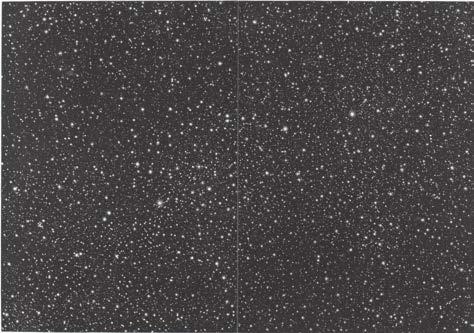
ON THE COVER
Starfield, 2010
Vija Celmins
Mezzotint and drypoint, 58.3 × 83.2 cm