JANUARY/FEBRUARY 2026
Inside:
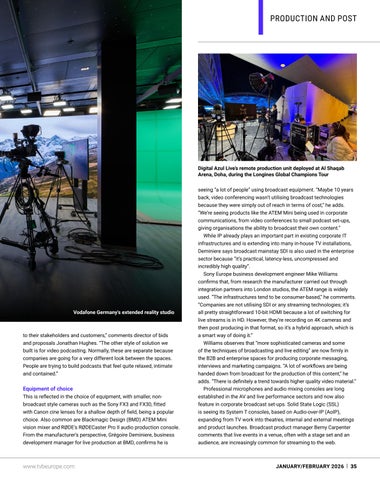
Broadcast technology in non-traditional workflows
The
RISE of
MICRODRAMAS
Image courtesy Boris Streubel/Bundesliga/Bundesliga Collection via Getty Images
W
Vertically challenged?
hen I first entered the media technology industry almost a decade ago, I heard a lot of talk about how it was facing disruption from the likes of Amazon and Netflix. Which was true, they were changing the way viewers watch TV. I think it’s fair to argue that Netflix et al are now part of the mainstream, and it’s the likes of TikTok and Instagram that are the new disruptors, changing both the way audiences watch content (often on their phones rather than a TV screen) and the aspect ratio. And that’s helping vertical video break through in 2026. It’s been around for a while. I remember writing about Germany’s Deutsche Football League streaming a match in 16:9 back in 2019. The proof of concept used five cameras that were turned on their sides to capture the action vertically, and the production employed a separate control room where the monitors were rotated by 90 degrees. Now that might not seem much of a change, but I suspect the production team would argue that it took a fair bit of brain power to change their usual way of working. Since then, there’s been the odd example of broadcasters testing vertical video, particularly for sports highlights. But, with the news that FIFA has agreed a deal with TikTok to live stream match segments from this summer’s World Cup, it feels like vertical video is gaining momentum. It’s not just sport where vertical video is gathering speed. At the start of the year, Disney revealed it intends to include vertical video on its streaming service, Disney+. Meanwhile, Amazon Fire users in the United States can trial watching Instagram Reels on their TV sets. Both of which could help push vertical even further into the mainstream. And then there are microdramas. Almost exclusively filmed in vertical format, they are soap operas told in short 60-90 second episodes that millions are watching on their phones. In her article exploring the rise of microdramas (which you’ll find inside this issue), Monica Heck reports that microdramas generated $11 billion in global revenue in 2025, nearly twice that of free ad-supported streaming television (FAST) channels. China accounts for 83 per cent of worldwide revenue, while the US leads international markets, followed by Japan, South Korea, the UK, and Thailand. Is this an untapped market for both broadcast and production companies as well as technology vendors? I believe so. As viewers continue to shift their focus from the living room to the smartphone screen, 2026 could be the year vertical video permanently changes how (and what) we watch.
www.tvbeurope.com FOLLOW US X.com: TVBEUROPE / Facebook: TVBEUROPE1 Bluesky: TVBEUROPE.COM
CONTENT Content Director: Jenny Priestley jenny.priestley@futurenet.com Senior Content Writer: Matthew Corrigan matthew.corrigan@futurenet.com Graphic Designers: Cliff Newman, Steve Mumby Production Manager: Nicole Schilling Contributors: David Davies, Larissa Görner-Meeus, Monica Heck, Kevin Hilton, Graham Lovelace Cover image: StoryTV
ADVERTISING SALES Publisher TVBEurope/TV Tech, B2B Tech: Joseph Palombo joseph.palombo@futurenet.com Account Director: Hayley Brailey-Woolfson hayley.braileywoolfson@futurenet.com
SUBSCRIBER CUSTOMER SERVICE To subscribe, change your address, or check on your current account status, go to www.tvbeurope.com/subscribe
ARCHIVES Digital editions of the magazine are available to view on ISSUU.com Recent back issues of the printed edition may be available please contact customerservice@futurenet.com for more information.
LICENSING/REPRINTS/PERMISSIONS TVBE is available for licensing. Contact the Licensing team to discuss partnership opportunities. Head of Print Licensing Rachel Shaw licensing@futurenet.com
MANAGEMENT SVP, MD, B2B Amanda Darman-Allen VP, Global Head of Content, B2B Carmel King MD, Content, Broadcast Tech Paul McLane Global Head of Sales, B2B Tom Sikes Managing VP of Sales, B2B Tech Adam Goldstein VP, Global Head of Strategy & Ops, B2B Allison Markert VP, Product & Marketing, B2B Andrew Buchholz Head of Production US & UK Mark Constance Head of Design, B2B Nicole Cobban
Future PLC is a member of the Periodical Publishers Association We are committed to only using magazine paper which is derived from responsibly managed, certified forestry and chlorine-free manufacture. The paper in this magazine was sourced and produced from sustainable managed forests, conforming to strict environmental and socioeconomic standards.
All contents © 2026 Future Publishing Limited or published under licence. All rights reserved. No part of this magazine may be used, stored, transmitted or reproduced in any way without the prior written permission of the publisher. Future Publishing Limited (company number 2008885) is registered in England and Wales. Registered office: Quay House, The Ambury, Bath BA1 1UA. All information contained in this publication is for information only and is, as far as we are aware, correct at the time of going to press. Future cannot accept any responsibility for errors or inaccuracies in such information. You are advised to contact manufacturers and retailers directly with regard to the price of products/ services referred to in this publication. Apps and websites mentioned in this publication are not under our control. We are not responsible for their contents or any other changes or updates to them. This magazine is fully independent and not affiliated in any way with the companies mentioned herein. If you submit material to us, you warrant that you own the material and/or have the necessary rights/permissions to supply the material and you automatically grant Future and its licensees a licence to publish your submission in whole or in part in any/all issues and/or editions of publications, in any format published worldwide and on associated websites, social media channels and associated products. Any material you submit is sent at your own risk and, although every care is taken, neither Future nor its employees, agents, subcontractors or licensees shall be liable for loss or damage. We assume all unsolicited material is for publication unless otherwise stated, and reserve the right to edit, amend, adapt all submissions.
JENNY PRIESTLEY, CONTENT DIRECTOR JENNY.PRIESTLEY@FUTURENET.COM
www.tvbeurope.com
JANUARY/FEBRUARY 2026 | 03
In this issue JANUARY/FEBRUARY 2026
12
20
09 The human layer in broadcast technology By David Walker, VP solutions engineering, EMEA, Appear
12 Ready for the next generation
The team behind a new state-of-the-art virtual production studio at Norwich University of the Arts talk to Jenny Priestley about the facility’s planning and development
18 Best in Market Awards 2025
TVBEurope’s winning entries from the annual Future Best in Market Awards showcase standout products and solutions in the broadcast space
28
20 The rise of microdramas
Vertical format microdramas are taking over mobile screens around the world. Monica Heck explores their progress in Europe and looks at the technology driving the phenomenon
24 Creator, streaming and experience
Ciaran Doran, chair of the Broadcast AV Summit at ISE 2026, explains how broadcast-grade technology is moving the conversation beyond convergence to focus on new economic models
28 ITN continues its IP transformation
David Davies learns about the ongoing work to convert ITN’s studios and galleries to IP-based workflows
34 TV or not TV
Kevin Hilton explores how broadcast equipment is helping corporations and financial institutions raise their communications game
04 | JANUARY/FEBRUARY 2026
34 www.tvbeurope.com
OPINION
Cultural literacy is key in pro AV By Larissa Görner-Meeus, managing director, LaraMedia
G
erman is my native language. Yet working across Austria, Switzerland and parts of Belgium quickly teaches you that speaking the same language is only part of effective communication. The same is now true for broadcast and pro AV. Yes, we share the same words and standards: cameras, switching, routing, Dante, IP, latency, redundancy. In technical drawings, the workflows look almost the same, but the culture to implement and run them is fundamentally different.
narratives that feel like cinema, not marketing. The creator community is building Grade-A studios in small spaces, but with serious ambition. Here, pro AV workflows begin demanding broadcast-grade discipline: better cameras, proper colour management, reliable switching, professional audio, synchronisation. The goal shifts from efficiency to high-quality emotional impact and brand identity at times with millions of viewers.
Culture, not technology, drives the shift Perfection vs pragmatism Traditional broadcast culture is deeply rooted in perfectionism: long RFPs, detailed project handbooks, and processes refined over decades of mission-critical operations: evening news, live sports finals, election nights, high-end drama. Everything must work flawlessly, every time. Failure is public and unforgiving. The response is rigorous engineering, redundancy, rehearsals, and extensive pre-planning. Pro AV, microdramas, and the creator community grew up differently. Here, delivery matters more than perfection. The mindset is pragmatic: it must work—and if something breaks, we fix it on the fly. Speed, adaptability, and momentum outweigh theoretical correctness. Neither is right or wrong, of course. They are optimised for different realities—and now they are converging.
Good enough is ok Broadcast is in the midst of a major shift. Linear is no longer the only destination, and content flows to digital platforms, FAST channels, social formats, and branded environments. Broadcasters focus on delivering faster, leaner, and cheaper content while fighting for the reach of younger audiences. Not every two- to four-camera production needs Tier-1 engineering and premium infrastructure, but fast delivery. Production quality is dependent on the viewer expectation, reaching from good enough to premium, depending on format, channel and speed. Teams get smaller, are more agile, more automated and a sense of “good enough” is becoming the new reality, matching the shrinking budgets in an ever-converging industry. We are seeing a move from chasing perfection to prioritising delivery and expected quality.
The other direction At the same time, brands and corporates are no longer satisfied with basic video. They want storytelling: mini-films, short series, cinematic
06 | JANUARY/FEBRUARY 2026
Broadcast vendors traditionally sell directly into engineering departments. Pro AV, by necessity, is channel-driven. The market is simply too big and fragmented to reach without integrators and partners. And the buyer is no longer just technical; it is marketing, events, education, retail; often the CMO, not the CIO. That distinction matters for broadcast vendors now exhibiting at InfoComm and ISE. Success depends less on direct relationships and more on partnerships, simple onboarding, clear value propositions, and services designed for rapid deployment in heterogeneous environments. The real question is whether broadcast vendors are culturally equipped for this shift, even if the vocabulary sounds familiar. Products must either live comfortably in mixed ecosystems, broadcast-grade yet pro AV-fast, or be separated into distinct businesses. Sales, professional services and support need to speak a new language and adapt culturally, transforming from direct to indirect while ensuring their partners and integrators carry all the knowledge and values to end customers. This is not just a go-to-market change. It is almost a cultural shift.
Converging cultures Just as speaking German does not mean you fully understand Austrian or Swiss culture, knowing broadcast technology does not mean you understand pro AV. The opportunity is to learn from neighbouring cultures without losing your own strengths. Broadcast excellence and pro AV pragmatism can be a wonderful match, strengthening both worlds. The future belongs to those who can move between cultures— knowing when perfection is essential and when good is enough; when engineering leads, and when speed of delivery is more pragmatic. Because in this converging world of broadcast and AV, the most important skill is no longer technical fluency. It is cultural literacy.
www.tvbeurope.com
OPINION
Monitoring the next step for esports TV By Erik Otto, chief executive, Mediaproxy
T
elevision broadcasting used to be a well-defined area, with its own dedicated technology and standards. Today, the definition of broadcast has broadened considerably to incorporate other video-based platforms, of which the streaming sector is the most prominent. The crossover has gone in the opposite direction with broadcasters launching their own streaming services for both live and video-on-demand (VoD) programmes. This sector is now well established but the convergence is expanding and esports is the next area building on the adoption of broadcasting techniques and technologies. Whilst esports may appear to be a somewhat tangential market to professional broadcast, the requirement to maintain a high standard for quality of experience is not only comparable to TV but increasingly a priority. Gamers are, of course, used to the highquality graphics and sound on their computers or game stations at home, but most, if not all, will also be watching films and high-end dramas, likely in 4K and HDR (high dynamic range) with Dolby Atmos immersive audio. They will expect the same technical levels for coverage of the big arena-based live esports tournaments that are becoming part of the mainstream sporting calendar. Competitions are now streamed live on various platforms, including YouTube and Twitch, by individual esports teams, clubs and governing bodies. All have navigated a steep learning curve. They are not broadcasters but have been thrown into the world of broadcasting, which has meant adopting the technologies and methodologies associated with professional TV production. Clicking a button on a browser to make a video available to everyone in the world was fine for multiple-player gaming on the internet when there was no responsibility to stay on air or provide a quality of service for which people were paying. That’s all changed now and the stakes are even higher, with advertisers and sponsors to satisfy as well as the viewing audience. There is also increasing pressure and competition from established broadcasters, including the BBC, Sky and ESPN, which are now covering the major esports events. In 2025 UK Forces broadcaster BFBS not only joined these ranks but also established its own tournament, the Pro League. Its output includes BFBS Esports live on the BFBS Sport channel and streamed coverage on YouTube and Twitch. The new dedicated esports channels have accumulated the
www.tvbeurope.com www.tvbeurope.com
necessary equipment to transmit and record all the action, including cameras, microphones, audio mixing consoles and vision mixers, plus routers, switchers and encoders to get everything on the right platform. After that, the priority should be to ensure the coverage stays on air and maintains an acceptable level of quality. In mainstream broadcasting, this is where monitoring comes in, although, at one time, it was something of an afterthought. But it has been refined over the years to be the crucial part of the distribution chain it undoubtedly is today. The need to monitor outgoing signals is equally important for esports channels, but at this stage of the sector’s development, it is almost certainly an afterthought, if considered at all. As more money funnels into esports, the issue of the quality of coverage and matching broadcast standards will come up. The fundamental problem is that specialised gaming outlets, and Twitch and YouTube, are websites. There is video capability within them, but it’s not a video source; it’s a website source. One of the more difficult aspects to solve efficiently is dealing with HTML-based content that is available on public platforms such as Twitch. Broadcasters have faced similar inherent problems in monitoring public consumer feeds from their own websites and third-party platforms like YouTube. Dedicated streaming services, including Netflix, have their own end-to-end distribution chains and know exactly who is hitting the server, what file is being played out, how many times a file has failed to play or if it has had to be buffered for VoD. But publishing to public sites means letting go of that control and monitoring certainty. As well as not being able to skim the feed to see what is going on, it is difficult to record the content. This is something Mediaproxy has been working on, enabling services going on to public internet video sites to record not only from a media stream but also from a web content stream. This means it is possible to record and monitor generic HTML content, which is the basis of the platforms being used for most esports channels. This offers a true end-to-end system that is comparable to what is used by both linear broadcasters and the major streaming platforms. And for esports channels it is potentially the missing piece of the puzzle that will ensure output quality and put them on the same level as their broadcast and streamer counterparts.
JANUARY 2026 2024 || 07 07 JANUARY/FEBRUARY
OPINION
Disney and AI: a fairytale ending? By Graham Lovelace, AI strategist, writer and keynote speaker
S
o, which iconic Disney character are you most looking forward to appearing alongside later this year? I can’t decide between Iron Man, Woody or Darth Vader. Thanks to a mega deal signed just before Christmas between Disney and OpenAI— posterchild of the generative revolution—I’ll be able to enjoy my 15 seconds of fame hanging out in the Marvel Cinematic Universe, the Toy Story residence, or a Star Wars galaxy “far, far away”. And so will you, using Sora, OpenAI’s TikTok-style app that lets users insert their ‘cameo’ likenesses into AI-generated videos and share them with friends. Mega deals are generally characterised by their monetary value. This one is worth $1 billion. That’s the amount of equity Disney is acquiring in OpenAI as part of a licensing partnership that gives Sora users access to over 200 animated, masked and creature characters that can form the basis of their AI-prompted fan videos. Now, $1 billion might sound to some like loose change in these days of AI hype-fuelled stratospheric valuations. Well, there are other hallmarks of a mega deal such as historic precedence and strategic importance, and this one has those in spades. Disney was the first major studio to licence its content to AI, and this was Disney’s first licensing deal to an AI developer. Disney is Sora’s first major content partner, a massive breakthrough for OpenAI, which had been courting Hollywood for over a year. This will also be the first licenced user-generated content AI video play. That’s a lot of firsts. The deal also delivers major strategic benefits to both players. Disney will increase its reach and gain access to OpenAI’s technology, giving fans new experiences both within the Sora app and a new product within its Disney+ streaming platform. OpenAI avoids a major copyright headache: Disney characters appeared within the Sora app soon after its launch last September. Now they appear under licence, so the risk of costly litigation has been removed. OpenAI gets the chance to make Sora ‘stickier’, increasing time spent with the app and potentially opening the opportunity for advertising revenues. Mega deals offer the potential for big rewards, but they also carry significant risks for both parties. There’s much that could go wrong with Disney’s tie-up with OpenAI. First, the risk that Sora-generated videos could harm Disney’s brand, placing characters in inappropriate settings and having them
08 | JANUARY/FEBRUARY 2026
do things that family-friendly Disney would never allow. Soon after Sora launched, deepfakes disrespecting civil rights campaigner Dr Martin Luther King Jr went viral on social media, prompting complaints from his estate. OpenAI strengthened guardrails within the video model, preventing users from generating new clips. OpenAI promised Disney it would take the same approach with its characters, but things could get tricky. A popular use of Sora had been to generate highly inappropriate trailers for Pixar-style movies. “This summer, Disney and Pixar present...” says the voiceover as the trailers descend into the darkest of dark humour promoting fake movies often featuring racist, sexist and homophobic themes. Definitely not Disney. How will OpenAI prevent those videos from being generated? Will it allow satire and parodies? If so, who decides what is and isn’t funny, and what doesn’t go too far? In short, how will OpenAI moderate Sora outputs...if it moderates them at all? Then there’s the technology itself, which as we all know, is prone to hallucinations and bias issues. How will OpenAI mitigate against them? And given Sora has been trained on just about everything available on the web, how will it prevent rival studio content from contaminating Disney outputs? Going into the deal Disney stressed it was taking a “thoughtful and responsible” approach to the collaboration. Which is what you’d expect, given its historic values. OpenAI, on the other hand, built its models on content it took from the web without asking. That cavalier approach, combined with an arrogant swagger redolent of the hi-techs, might clash with Disney when it comes to dealing with creators and performers, which the House of Mouse seeks to protect and respect. And speaking of intellectual property rights, who (if anyone) will own the copyright of Sora-generated videos featuring Disney characters? The ultimate question of course, is this: will audiences actually want it? Will they soon tire of the novelty, or regard it as more AI slop clogging up their feeds, and tune out? Disney and OpenAI will be hoping for the opposite, so that this particular fairytale can end with them living happily ever after.
Graham charts the global impacts of generative AI on human-made media at grahamlovelace.substack.com
www.tvbeurope.com
OPINION
The human layer in broadcast tech By David Walker, VP solutions engineering, EMEA, Appear
T
he broadcast and live production industry has never been short of innovation. But right now, the pace feels different. IP migration is maturing, cloud and hybrid models are becoming normal rather than experimental, and ‘software-defined’ has moved from brochure language to boardroom expectation. At the same time, AI is increasingly shaping the conversation, with real, rapidly emerging tools for monitoring, predictive maintenance, incident triage and workflow optimisation. But there’s a risk in how we talk about them. The success of modern live production doesn’t hinge on whether a system has AI features. It hinges on whether people can design, deploy, operate and evolve that system together—reliably, under pressure, and with a shared view of what ‘success’ actually means. In other words, the ‘human layer’ isn’t a soft add-on. It’s part of the architecture. Broadcast has shifted from rigid, fixed infrastructure to a model defined by flexibility—distributed workflows, remote teams, more sources and formats, and higher expectations for resilience. Although flexibility is empowering, it relocates complexity. Instead of being locked into hardware, complexity now shows up at integration points, in operational handoffs, observability, security policies, versioning, and in the human processes around it. This is where projects often stumble. Not because the components are weak, but because assumptions don’t match reality: •A system is technically capable but operationally fragile •A n integration passes in tests, then fails at scale •M onitoring exists, but nobody agrees what “normal” looks like • Teams buy flexibility, but aren’t set up to manage change AI can help with monitoring and pattern detection, but it doesn’t solve alignment, which remains the separation between systems that evolve cleanly and those that become brittle patchworks. In live production, that alignment can’t be treated as a one-time design exercise or a post-sale support function; it requires ongoing collaboration. As a result, support, solutions engineering and customer engagement are no longer afterthoughts but essential parts of systems that last, because the project doesn’t end at golive, it begins there. The strongest outcomes are when vendors and customers treat delivery as a partnership by engaging early to shape architecture and reduce risk, establishing a shared language across operations, engineering and procurement, feeding real-world pain back into
www.tvbeurope.com www.tvbeurope.com
product roadmaps, and maintaining continuity after deployment so workflows can evolve without disruption. One of the most effective ways to make collaboration real is structured forums where customers and vendors go beyond feature requests into what the industry needs next, why it matters, and what it will take to deliver it. When done well, customers bring the edge cases to these forums, vendors bring the roadmap, the tradeoffs and the constraints that don’t show up in requirements, and everyone leaves with clearer priorities and expectations. This matters because requirements aren’t stable. Broadcasters are constantly looking at new contribution models, tighter latency demands, evolving formats, and the pressure to do more with less power and space. Without a structured mechanism like Customer Councils, you tend to see one of two failures: a vendor tries to satisfy everyone and fragments the roadmap, or a vendor stays rigid and customers feel unheard, leading to bolt-ons, workarounds and dissatisfaction. Although AI can surface signals, people are still the ones who decide what those signals mean and what to do next. As production becomes more software-defined and modular, machine-readable descriptions of workflows, capabilities and interfaces become more important. The EBU’s Dynamic Media Facility (DMF) initiative is one example of the industry exploring reference architectures for modern, software-based production. Some vendors are already experimenting with DMF/MXL standards-based frameworks—where the Media eXchange Layer (MXL) acts as a common orchestration layer for routing, transforming, and dynamically instantiating media workflows. But the deciding factor isn’t whether you can tick a standards box. It’s whether customers, integrators and vendors can agree on how to implement interoperability without creating operational complexity that nobody owns. Don’t evaluate technology purely as a product. Evaluate it as a relationship. Ask: •H ow will this vendor translate workflow reality into a workable design? •H ow will they help evolve the system, not just maintain it? •W ill they reduce complexity, or simply supply components? The organisations that move fastest will be the ones that treat collaboration as a core capability. Because in live production, the future is built by software, standards and smart tools… and delivered by people who can work together.
JANUARY 2026 2024 || 09 09 JANUARY/FEBRUARY
Image courtesy of Surasak Suwanmake/Getty Images
TVBEurope’s newsletter is your free resource for exclusive news, features and information about our industry. Here are some featured articles from the last few weeks…
HOW THE WAR BETWEEN THE LAND AND THE SEA CREATED A NEW DEEP-SEA WORLD
THE YEAR AHEAD: LEADING INDUSTRY FIGURES ON AI AND ASSOCIATED TECHNOLOGIES IN 2026
Kevin Hilton talks to executive producer Joel Collins, VFX supervisor Sebastian Barker, sound designer Steve Browell and composer Lorne Balfe about how the show's look and sound were created.
With 2025 fading into memory, leading figures from across the media and entertainment world give TVBEurope their opinions on what 2026 might bring.
ES BROADCAST UK EVOLVES SI DIVISION INTO CONSULTANCYFIRST APPROACH TVBEurope speaks exclusively to group chief executive Edward Saunders about the company’s decision.
DO YOU SUBSCRIBE TO TVBEUROPE’S FREE NEWSLETTER?
SIGN UP VIA THIS QR CODE
BACK ON TRACK FOR CHRISTMAS Having produced a festive smash for Channel 4 in 2024, Salford’s King of Sunshine Productions set out to do it again with Nordic Train at Christmas. MD Sohail Shah tells TVBEurope how the festive special was produced.
10 | JANUARY/FEBRUARY 2026
www.tvbeurope.com
VIRTUAL PRODUCTION
The launch of a state-of-the-art virtual production studio in Norwich is being hailed as a major milestone for digital storytelling. Designed to train the next generation of industry creatives, the team at Norwich University of the Arts talk to Jenny Priestley about the studio’s planning and development
generation READY FOR NEXT THE
V
irtual production isn’t new. It’s been used in the film and TV industry since the late 2010s, employed on such diverse projects as The Mandalorian, Coronation Street and The Batman. But it’s still a new concept for many, both those already in the industry and students who have aspirations of working in film and TV. Over the last few years, universities have begun establishing their own virtual production studios to help give the next generation of creatives a head start in their understanding of the technology. Last autumn, a cutting-edge virtual production studio opened its doors in Norwich, England. The facility, the result of a collaboration between Norwich University of the Arts (NUA) and Sony, is being hailed as the first educational and commercial facility of its kind in the UK to feature not only Sony VERONA panels for its LED volume but also a Sony
12 | JANUARY/FEBRUARY 2026
VENICE camera for content capture. This allows both students and professional creatives to get to grips with an LED-based screen that provides highdefinition, digital sets which can instantly transport audiences to any location. The LED stage measures nine metres wide by four metres high, utilising 6.7 million pixels to deliver sharp, cinematic visuals that appear lifelike both to the naked eye and through the camera lens. The new virtual production studio is located alongside the University’s Immersive Visualisation and Simulation Lab (IVSL) and volumetric studio at NUA’s Havers Road building in Norwich. The facility serves a dual purpose, primarily as a learning centre for NUA’s students studying film, animation, games, and visual effects, and is also available for rent by directors and production companies working on their own projects, thus helping to foster a link between education and the professional world.
www.tvbeurope.com
VIRTUAL PRODUCTION
The decision to partner with Sony resulted from an extensive and deliberate selection process, according to Frances Wall, technical services manager for production at NUA. The relationship quickly evolved beyond a simple vendor-customer exchange. “We went to IBC the first time, where we met Sony, and instantly they said, ‘we want you to come and have a look at the VERONA panels that we're not showing anyone yet’,” she explains. This early involvement, including testing the panels at NUA’s Havers Road site, cemented a feeling of genuine collaboration between the university and the technology company. “Sony is a name that carries quite a lot of weight. Once you get to Open Days and you have parents of students walking around, they will understand Sony before they understand anything to do with virtual production.” Wall adds that the technology vendor was very happy for the NUA team to speak to other universities that have gone through the experience of building
www.tvbeurope.com
virtual production studios using Sony technology. “They had just done the setup at University of the Arts London, and we were able to have a very honest conversation with UAL about their experience.” Sony also facilitated visits to its virtual production stage at Pinewood Studios, as well as Brompton Technology’s offices in London, to help the NUA team compare the VERONA LEDs against competitors. “It definitely felt like they wanted to work with us past the point of sale, which was nice to hear,” states Wall. “They were interested in what students were going to do with it as well. They didn't just want to sell us LED panels.”
Lessons learned The journey to launching the new virtual production stage was a multi-year effort, which began with two years of preparatory work. The NUA team used knowledge gained from building the university’s 360-degree volumetric capture stage (the IVSL) twice
The stage uses Sony's VERONA LED panels coupled with the company's VENICE camera (below)
VIRTUAL PRODUCTION
The stage employs Disguise’s VX4+ media server, Unreal Engine, and Brompton processors to work alongside the LEDs and camera
before it arrived at the Havers Road facility. “The first time we built the 360 volume, it took us five weeks. The second time, it took us three weeks, and the final time two and a half, so we kind of nailed it,” Wall says. “The virtual production stage is a slightly different type of LED, but the fundamentals of the tech are the same; it's still just panels of LED that we're pumping a signal to. It was much less frightening than it could have been for sure.” The challenge, however, lay less in the hardware and more in the human element. “The biggest challenge was anticipating what the students would need from it,” she adds. “We spent a lot of time trying to translate what we're used to seeing students do in the studio we already had, and how that would translate into a virtual production studio and what they would need to learn around that.”
so that when they leave here, they're ready for what's happening then instead of now,” he explains. This meant it was important for the NUA team to select industry-leading, reliable technology, including Disguise’s VX4+ media server, Unreal Engine, and Brompton processors to work alongside the Sony LEDs and camera. “It's important to stress that the technology can do way more than what we're doing right now,” says Hills. “Having Disguise for the virtual production studio is great because it runs it like a dream, and it's so nice and easy to use. Once we get a bit more in-depth, we can show the students that the technology is capable of doing much more.” The facility is being used by a number of different disciplines offered by the university, with film students, for example, learning about 3D software and Unreal Engine, an area that previously had not been included in the syllabus. “The importance of the equipment is huge,” adds Hills. “It doesn't make sense for the students to use equipment that they wouldn't go out and use at any other studio, so we had to make sure that it was all industry standard.” All of these conversations helped Wall, Hills and the rest of the NUA team when it came to introducing students to the virtual production stage at the start of term in September. “A lot of people we spoke to said, don't start by trying to shoot loads of amazing-looking scenes,” explains Hills. “They encouraged us to get the students to put some colours on the screen, which goes from the Disguise platform, through a Brompton processor, onto the LED, and then shines on a human being. When they see that through the camera, it instantly connects everything.”
Readying the next generation Keeping the project on budget was also another issue faced by the NUA team. “I think the biggest challenge was almost in trying to justify and explain it to everyone we were meeting who works in virtual production,” says Toby Hills, senior technician for immersive and virtual production at NUA, “because you start having a conversation about a problem and someone will say, ‘oh, that's simple, you just do this’. But, that's not really how it works in a university.” For Hills, the facility’s core mission is to ensure students are ready for the professional world upon graduation. “The students are going to be here for three, maybe four years. We are trying to be four years ahead of whatever is going on in the industry,
14 | JANUARY/FEBRUARY 2026
www.tvbeurope.com
CASE STUDY
INSIDE THE TECHNOLOGY POWERING INTERACTIVE
gaming
PICTURED ABOVE: Malta's LiveG24 employs the nanoStream platform to deliver live casino games to different regions and continents
W
hen Brazil’s Vertical Loto launched its new live interactive gaming (iGaming) platform, it wanted more than another online lottery. It aimed to blend the immediacy of live television with the excitement of real-time play— allowing thousands of players across the country to join the action, engage interactively and watch results unfold instantly. That requirement exposed one clear truth: latency kills excitement. Delays of even a second can erode trust and engagement. Reliability and speed have
16 | JANUARY/FEBRUARY 2026
become essential for live streaming in iGaming and online betting.
The high stakes of live interactive gaming Vertical Loto faced major challenges with live streaming platforms such as YouTube. The high latency and significant connectivity variations across regions in Brazil compromised interactivity with the audience. Additionally, the company sought a whitelabel solution to integrate into its operations and use as its own streaming platform. Similar obstacles were also faced by LiveG24 in Malta. As a leading provider of live casino games
www.tvbeurope.com
CASE STUDY
and software solutions, the company specialises in delivering engaging live dealer games to different regions and continents. For many years, the company operated its streaming services in-house using Flash technology. However, as Flash was phased out and the industry’s demands evolved, LiveG24 recognised the necessity for a more advanced, reliable streaming solution to deliver a seamless global gaming experience. The solution for both companies was found in Berlin, Germany, as they turned to nanocosmos, a longtime innovator in real-time video and ultra-low latency with its nanoStream platform. “The platform has completely transformed how we approach live gaming,” says Júnior Moura, head of studios at Vertical Loto. “The ultra-low latency streaming allows us to create truly interactive experiences that were impossible with other platforms. This has been a key differentiator for us, especially in our lottery games, as we strive to make them more interactive and stand out from other products in the market.” LiveG24 also wanted to prioritise players’ quality of experience (QoE) by monitoring the backend and security of their streams, and to gain new insights for growth. “With nanoStream we are at sub-second. We stream from a studio in Europe to Brazil with a latency of around 0.8, which is quite good, considering that we are travelling all around the world with our video signal,” adds Angelo de Gobbi, COO at LiveG24. “The combination of various specific requirements deliver a unique solution. Adaptive bitrate streaming with adjustable transcoding profiles that rely on a strong CDN, easy access and compatibility with all devices, live control in Analytics to shield content from unauthorised access, as well as token-based streaming. In addition, the synchronised multi-camera view enabled by time stamps was an important factor,” says de Gobbi.
manage live video operations. Creating, maintaining and operating a streaming platform requires time and specialised knowledge. For that reason, complete end-to-end solutions and infrastructures for the video component make operators’ lives much easier, allowing them to focus on their core business: their games. Offering a solution that already includes CDN, Player and Analytics provides flexibility and trust, as long as everything works seamlessly.
Reliable real-time video as a business advantage
Live streaming beyond gaming
For business success in the iGaming industry, reliability matters. For operators in regulated markets, uptime consistency determines revenue and user trust. A momentary outage in a live draw or dealer session could trigger refund claims and regulatory reviews. The nanocosmos backbone mitigates that risk with end-toend reliability and predictive monitoring. iGaming is clearly a non-traditional live streaming use case, which means that operators often lack the in-house expertise and dedicated teams needed to
While Vertical Loto and LiveG24 exemplify success in gaming, the impact of live streaming with sub-second latency extends well beyond the casino floor. Realtime video has become a business-critical backbone across many sectors. It now extends into commerce, education, healthcare, public safety and more. What connects these ‘non-traditional’ sectors is the same underlying requirement: consistency under pressure and the pursuit of real-time video that simply works.
www.tvbeurope.com
Media over QUIC: redefining real-time streaming With growing market demand for real-time interactivity and engagement even when network conditions are poor, innovation is key to increase business revenue and live streaming quality and reliability. This applies not just to iGaming but also other use cases. The newest evolution in this journey is Media over QUIC (MoQ), which delivers ultra-low latency realtime streaming. MoQ is a next-generation protocol standardising how media data travels over the internet via the QUIC transport layer (the same foundation behind HTTP/3). This marks an important step forward in ensuring QoE for iGaming audiences, many of whom are located in remote regions with limited internet connectivity. For global providers such as LiveG24, where studios often operate from Malta while viewers connect from South America, MoQ plays a key role not only in reducing latency but also in keeping it consistently low, all without compromising video quality. “We’re pragmatic about technology choices. We have been providing ultra-low latency for over 10 years now, and adopting MoQ was a natural step. MoQ, by contrast to WebRTC, was designed for flexible, high-quality media distribution independent of codec and connection type. It’s how we deliver true real-time broadcasts worldwide,” explains Oliver Lietz, CEO of nanocosmos.
JANUARY/FEBRUARY 2026 | 17
BEST IN MARKET AWARDS
BEST IN MARKET AWARDS Future’s annual Best in Market Awards recognise standout products and solutions in the broadcast sector. These are TVBEurope’s 2025 winning entries
2025
HAIVISION Falkon X2 Judges’ comment: An impressive compact 5G bonded cellular transmitter delivering low-latency 4K HDR live video from remote locations. Features dual-modem 5G, SDI/ HDMI inputs, HEVC/H.264 encoding, builtin battery and touchscreen control, and supports mobile contribution alongside remote management, return video, intercom, recording, and file-forwarding workflows.
IMAGINE COMMUNICATIONS XVR playout engines Judges’ comment: XVR provides scalable, software-defined playout for on-prem, hybrid and cloud environments, supporting SDI, ST 2110, SRT and common file formats without transcoding. Orchestrated via Aviator for on-demand deployment, it offers consistent operation across platforms, COTS-based ST 2110 performance using Intel technologies, and flexible subscription pricing for efficient multi-channel expansion.
BLACKMAGIC DESIGN DaVinci Resolve 20 Judges’ comment: DaVinci Resolve 20 expands editing, audio and finishing workflows with extensive AI tools, including automated scripting, multi-cam switching, subtitle animation, dialogue matching, audio mixing and content cleanup. Cloud collaboration enhancements, vertical video UI options, advanced grading, compositing, VR support and expanded Fairlight features provide consistent capabilities across full post-production pipelines. Continues to lead the way as the accessible industry standard in post.
18 | JANUARY/FEBRUARY 2026
www.tvbeurope.com
BEST IN MARKET AWARDS
NETGEAR AV Engage Controller Judges’ comment: Promises impressive usability by abstracting complex AVover-IP networking into one-click, profilebased workflows verified across 500+ manufacturers. Its unified control of switches, routing, Wi-Fi and automated PTP configuration reduces deployment time, enabling performance accuracy while removing licensing barriers to professional network management.
TECHEX tx iptv Judges’ comment: tx iptv is a complete IPTV platform designed for media organisations to support all aspects of broadcast operations. It’s an interesting platform which uses multiple protocols, meaning it should deliver whatever the enduser needs. Great to see IPTV being used for good in the industry!
AJA VIDEO SYSTEMS UDC-4K Judges’ comment: A compact 12G-SDI/ HDMI 2.0 mini-converter offering scaling, frame sync, rate conversion and signal distribution across 4K and HD formats. Features 12-bit processing, onboard control display, HDR signaling management, EDID emulation and integrated audio handling, providing flexible signal management for broadcast and pro AV workflows.
TINKERLIST Cuez Judges’ comment: A valuable innovation for newsrooms, the Cuez Automator bridges legacy MOS-based NRCS workflows with modern API-driven production tools, enabling rundowns to trigger real-time automation without changing editorial processes. An integrated MOS plugin and workflow translation module unify systems, while new A2A/ MCP agent-based interoperability demonstrates flexible, low-integration communication between production platforms. A worthy winner.
LOOPER INSIGHTS Sports Visibility Tracker
ROSS VIDEO NRG Judges’ comment: This routing solution addresses the needs of broadcast, live production, streaming, and a swathe of pro AV applications, distilling complex routing technology into a reliable, cost-effective platform that helps users achieve more with less. Recently launched at IBC, NRG is a compact 12G-SDI routing platform available in 16x16 and 32x34 formats, delivering dense SD-to-UHD switching in 1RU or 2RU designs.
www.tvbeurope.com
Judges’ comment: This has just been launched and provides real-time measurement of live sports promotions across Connected TV platforms. It uses MPV framework to verify placement, exposure, and compliance across global markets, with screenshot validation, competitor benchmarking, alerts, and ROI analysis, giving broadcasters and streamers actionable insight to optimise merchandising while events are live. A valuable tool for broadcasters/ rights holders as they seek to diversify revenue streams.
JANUARY/FEBRUARY 2026 | 19
PRODUCTION AND POST
THE
rise OF microdramas 20 | JANUARY/FEBRUARY 2026
www.tvbeurope.com
PRODUCTION AND POST
Vertical format microdramas, with their scheming, scandal and addictive hooks, have become a worldwide sensation over the last five years, emerging from China to take over mobile phone screens across the world. Monica Heck explores how they are faring in Europe and the technology behind the phenomenon
I
ntrigue, time travel, forbidden romance and revenge in rapid-fire bite-sized portions: where Hollywood heavyweight-backed Quibi tried and failed during the pandemic despite funding and A-listers, the humble vertical format duanju, or microdrama, has generated billions worth of revenue in China over the last five years and is taking the world by storm. ReelShort’s The Double Life of My Billionaire Husband or DramaBox’s My Secret Agent Husband successfully compete with free content platforms like YouTube or TikTok thanks to a unique formula combining a freemium tease model with low-cost production, littleknown actors, high drama storylines and addictive cliffhangers that deliver regular dopamine hits, driving viewers to subscribe for more. According to Omdia, microdramas generated $11 billion in global revenue in 2025, nearly twice that of free
ad-supported streaming television (FAST) channels. Some 60 per cent of global microdrama revenue comes from subscription or transactional payments, often following a free introductory model, where the average revenue per user amounts to up to £60 per month. China still accounts for 83 per cent of worldwide revenue, says Omdia. The US leads international markets, followed by Japan, South Korea, the UK, and Thailand. Other regions might only account for 5 per cent of the current market share, but interest is growing rapidly. Out of France, Guillaume Sanjorge’s Les aventures avec ma voisine (Next Door Adventure) recently became the first original French production available on Asian vertical drama app Stardust TV, streaming in eight languages.
The French touch StoryTV, a French microdrama production company set up by Adrien Cottinaud and Alexandre Perrin, recently moved into the space with titles like Mon mariage avec un mâle alpha (My Wedding with an Alpha Male) and La belle et le SDF (Beauty and the Tramp) that are successful across the entire Francophone world, including Africa. “Our workflow allows us to produce quickly, with very controlled costs, to compete with existing Chinese or Ukrainian actors in this field,” says Perrin. “We have created over 50 series, drawing between 15 and 20 million monthly views on social media on a freemium subscription model. We produce content at a cost of under €2,000 a minute.” A 30-minute series involves 1.5 days of scriptwriting, two days of shooting and 2.5 days of post production. A typical shoot involves a Sony FX3, FX30 or FX6 camera with cinematic lens and a home-made tripod, a Steadicam stabiliser mount with a DJI Ronin for shooting stability, flexibility and fluidity, and Accsoon wireless video transmitters to bypass cabling. A timecode generator helps with syncing, while editing, colour grading and audio post production is done with DaVinci Resolve. “We don’t re-invent the wheel, we focus on the stories and on a European style,” adds Perrin. “We are ahead in the French market and want to keep this spot because being first is easy, remaining first is harder.” Indeed, Paris-headquartered Mediawan Kids & Family recently announced plans to target the vertical space this year.
British scenes On set with StoryTV
www.tvbeurope.com
London-based Sea Star Productions creates content for big microdrama platforms such as Reelshort,
JANUARY/FEBRUARY 2026 | 21
PRODUCTION AND POST
Sea Star Productions typically spends six days shooting around 15 pages a day
Sea Star Productions employs a number of different cameras Dramabox, Goodshort and Shorten. It branched out of existing outfit Sea Star Rental, and therefore has access to high-quality, industry-standard broadcast equipment. The vertical drama production company made 10 microdramas in the last nine months, including The Beauty and the Billionaire and Irresistible CEO’s Dark Desires. A typical project spans up to three weeks of pre-production, six days of shooting around 15 pages a day for a 55-60 episode series, followed by up to three weeks of post production and editing. “We don’t let the vertical format prevent us from including big stunts or shooting underwater. All our crew transfers their skills from feature films and highend television to the vertical format," says Bethany Thomson, creative lead at Sea Star Productions. “To resonate with a microdrama audience, you must include sound effects at big moments like slaps, pushing and pulling,” Sea Star Productions favours ARRI Alexa Mini
22 | JANUARY/FEBRUARY 2026
Black Forest Studios hosts one of Europe’s first microdrama production hubs LFs, Sony FX9 and FX6 cameras, with batteries and accessories. The sound setup is the same standard as for cinema and documentary work. Thomson explains that major networks like the BBC and ITV are actively exploring the format. “Understanding your audience is the most important thing. A lot of bigger networks don’t understand what part of their IP will work for microdrama: you cannot just crop existing, successful television content to 9:16. You need to pick a character from your IP who can live online and develop into something new.”
Black Forest tableaux Five years ago, Sebastian Weiland and his wife Nina Gwyn established Black Forest Studios in the heart of the eponymous German region, which hosts one of Europe’s first microdrama production hubs developing original series like Mountain Medical Klinik and Black Forest Royale. They bring with them decades of
www.tvbeurope.com
PRODUCTION AND POST
experience working in the faststudio spaces, a dedicated crew and paced commercial production AI-assisted workflows help with the world of Los Angeles, speed of delivering 40-80 episodes “We have built a dedicated per season.” workflow for high-quality, fastWeiland describes the DJI turnaround vertical series, from Ronin 4D camera as an amazing concept to production to post ‘run and gun’ one-man job tool for and our own streaming app,” says microdramas. Because mobile Weiland. “The goal isn’t ‘TV on a displays vary dramatically, grading phone’, it’s a format designed from happens in a colour-managed the ground up for mobile attention environment and is tested across and emotional immediacy, without multiple devices. To counter sacrificing cinematic values. the exaggerated harshness of We want to lift microdramas to phone audio, Weiland mixes with a higher quality level, story-wise controlled LUFS, soft EQ and and from a technical point of intimate dialogue treatment. view, combining it with European “A decade ago, it wouldn’t locations and style.” have been possible to make According to Black Forest Studios, the goal isn’t ‘TV on a phone’ Vertical content changes microdramas on that scale,” he adds. everything: framing, pacing, colour workflow, and overall “Now, we’re shooting city aerials with drones and production rhythm. “A 9:16 framing demands closeusing AI to create a helicopter crash scene over Rome. up-driven scenes and stacked blocking for character I wouldn’t say AI is ready for the big screen, but for positioning,” he adds. “Pre-built sets across seven microdrama it works.”
UHL-X40. The Best and smallest UHD Box Camera 2160P // BT2020 // HDR // low weight // 2-piece Design
ikegami.eu // Tel.: +49 2131 - 123 - 0 // E-Mail: info@ikegami.eu
www.tvbeurope.com
Ikegami Electronics (Europe) GmbH
JANUARY/FEBRUARY 2026 | 23
BUSINESS
&
Creator, streaming experience
Ciaran Doran, chair of the Broadcast AV Summit at ISE 2026, explains why conversation is moving beyond simple convergence between the two disciplines to focus on new economic models enabled by broadcast-grade technologies What can people attending the Broadcast AV Summit expect to learn? As curator and chair of the Broadcast AV Summit at ISE 2026, I have the privilege of shaping a programme that reflects a profound shift underway across media, technology and business. We are no longer simply talking about the convergence of broadcast and AV. That convergence has happened. What follows is the emergence of three powerful and fast-growing economies: Creator, Streaming and Experience, all enabled by technologies that were once the exclusive preserve of traditional television broadcasters. Early convergence focused on adapting broadcast
24 | JANUARY/FEBRUARY 2026
tools for non-broadcast use. Today, those same tools underpin entirely new economic models. The creator economy empowers individuals and organisations to produce and distribute content directly to their audiences, bypassing traditional gatekeepers. The streaming economy enables brands and corporates to own their distribution channels, control their narratives and build long-term audience relationships. Meanwhile, the experience economy elevates video and audio from a communication tool into a defining part of how people feel about a place, a brand or an idea, whether in museums, corporate spaces, live events or immersive installations.
www.tvbeurope.com
BUSINESS
These economies all rely on access to broadcastgrade production, distribution and workflow technologies. What was once complex, expensive and specialist is now accessible, scalable and increasingly cloud-based. The Summit exists to explain why this is happening, how it is being enabled, and what it means for organisations that want to engage audiences directly, at scale, and with impact.
from YouTube’s Callum Hewitt, fittingly representing what is arguably the world’s largest broadcaster today. Together, these sessions form a coherent narrative rather than a collection of standalone talks, and each is unmissable in its own right.
What do you think will be the biggest themes of the Summit in 2026?
Traditional broadcasters continue to set the benchmark for excellence in storytelling, technology and distribution, and the wider Broadcast AV market has much to learn from that legacy. Yet the exchange of ideas increasingly flows both ways. Broadcasters have long balanced the principles of informing, educating and entertaining. As funding models evolve and audience behaviours fragment, there is a renewed opportunity to revisit those principles using Broadcast AV technologies to deliver education and information in more engaging, immersive and accessible ways. With established audiences and trusted channels already in place, traditional broadcasters are uniquely positioned to apply Broadcast AV techniques used by corporates and brands to deepen engagement and extend their relevance.
Artificial intelligence is the most visible theme running through the 2026 programme, but importantly it has moved beyond hype. Over the past 12 months, AI has shifted from promise to practice. Vendors are now delivering tangible tools that save time, reduce cost and unlock new revenue opportunities across content creation, localisation, versioning, distribution and asset management. Alongside AI, content creation and distribution remain constant focal points. As the volume of video content explodes, competition for attention intensifies. For corporates and brands, authenticity and relevance matter—but speed is increasingly decisive. The ability to create content once, version it automatically for multiple markets and formats, and distribute it globally in a fraction of the time previously required is becoming a true competitive advantage. The Summit reflects this reality, focusing on technologies and workflows that dramatically accelerate production and delivery without compromising quality.
Is there a particular panel/keynote that attendees should absolutely not miss? The Broadcast AV Summit brings together voices from across the ecosystem, from established broadcast giants to platform leaders shaping the future of media. The day opens with a keynote from David Ross of Ross Video, a company synonymous with broadcast excellence and increasingly influential in the corporate and brand market. Adobe’s Samantha Bacon will explore how AI can be applied practically to creative workflows, while Heidi Shakespeare of Memnon will address the untapped commercial value hidden within existing content archives. AI’s structure and governance are tackled through a dedicated session on taxonomy with Maria Ingold, alongside strategic market insight from IABM’s Chris Evans. The Summit concludes with a closing keynote
What do you think traditional broadcasters can learn from other industries such as entertainment/education etc?
This year’s Broadcast AV Summit is being presented with IABM. Why was it important to bring them on board? Partnering with IABM for the Broadcast AV Summit was a natural decision. IABM brings global perspective, market intelligence and credibility across both broadcast and emerging media sectors. Their involvement ensures the Summit is grounded not just in technology, but in real commercial and strategic insight, helping attendees understand not only what is possible, but what is sustainable and scalable.
What else can you tell us about the event? Ultimately, the Broadcast AV Summit at ISE 2026 is about clarity in a rapidly evolving market. Attendees will leave with a deeper understanding of where video creation, streaming and experiences are heading, which technologies truly matter, and how organisations can position themselves to succeed as their own broadcasters in this new era of the Broadcast AV economy.
ISE Show takes place at Fira de Barcelona Gran Via from 3-6 February 2026.
JANUARY/FEBRUARY 2026 | 25
Real-time
collaboration Cloud-connected camera control platform Iris is aiming to drive the convergence of broadcast and pro AV software. Founder Noah Johnson tells Jenny Priestley how it increases flexibility
PICTURED ABOVE: The Iris platform can be accessed via a Chrome browser or native Mac/Windows application
26
F
or years, the broadcast industry and pro AV market have existed as two distinct worlds, separated by technology, budget, and culture. But that line is blurring, and a new generation of cloud-native platforms is driving convergence between the two. Aiming to lead this charge is Iris, a softwarefirst solution that wants to reposition the camera not as a standalone piece of hardware, but as a fully networked and remotely-controllable cloud device. At the heart of this disruption is Iris’s founder, Noah Johnson, who began with an idea to democratise video production, starting with a company called Live Control, Noah Johnson which focused on installing PTZ
JANUARY/FEBRUARY 2026
(pan-tilt-zoom) cameras in venues such as houses of worship and universities, then connecting them to a remote marketplace of videographers. This setup allowed a small team in one location to remotely control, switch, and distribute live events happening anywhere in the world. This led to the realisation that Live Control’s core functionality—a remote, cloud-based control system— could be spun out for the wider production world. That led to the launch of Iris, which says Johnson, is not a hardware company: “We do not manufacture cameras. We don’t have any hardware components. And I think that's what makes this really easy. We built Iris to be workflow agnostic. It should be a tool that
www.tvbeurope.com
PRODUCTION AND POST
can fit within varying workflows, you access it via a link in your browser." The Iris platform can be accessed via a Chrome browser or native Mac/Windows application. Crucially, it can also operate entirely over a local, private network, even a locked-down Dante or NDI network, says Johnson, meaning users can choose to keep video and control signals contained without ever routing through the public internet. “We talk a lot about the cloud because it's pretty central to what we do. But you can also turn off the cloud and it can work over a local network. And, if
to predict equipment failure or recommend video quality improvements. This vision resonated with Audinate, the company behind Dante, which acquired Iris in July. Johnson sees the acquisition as a perfect fit: “If you look at Dante today, they've basically become the definition of how audio works no matter what space you're in. It's reliable, it's trusted and they work with lots and lots of manufacturers to integrate their technology.” Iris extends that trustworthiness and integration to the video and control domain. “We help enable other types of hardware manufacturers, whether
you don't want any video or controls routing through the Iris cloud, you can lock it to a private network, and it all stays contained within that ecosystem. “If you look at a traditional camera controller today, they usually support one protocol, so the industry is largely fragmented. They all have different APIs, they all have different protocols. What makes Iris unique is that we build drivers that are specific to cameras. We'll actually work with the manufacturer to get feature or command parity. Whenever you add a camera, we support all the commands and functionality." This technical parity is then paired with a standardised user experience: “You could have five cameras, they could be five different brands, but as a user, you're looking at a single interface that actually adapts to whatever commands or functionality each camera supports.” The entire platform is built for real-time collaboration. Teams in different locations can access a single ‘studio’ where the interface is completely synchronised, allowing, for example, one operator to manage camera framing while another handles colour correction. Iris’s feature set is further augmented by a rapidly developing layer of artificial intelligence, currently focused on automating camera movement, no matter the hardware. “There's a core function that it supports primarily around auto tracking, auto framing, automation of the actual kind of movement of a camera that can be from anywhere." The user simply selects a subject and defines the desired shot (close-up or wide), and the camera automatically moves to frame them using custom-trained models. Johnson adds that he sees Iris’s use of AI evolving to include areas such as colour correction, as well as proactive monitoring
that's cameras, encoders or switchers, to actually join the Audinate Dante ecosystem and complete a fully networked, seamless, accessible audio and/or video landscape for professionals.” Going forward, Johnson wants Iris to become almost invisible, integrated into the firmware of the cameras it supports. “You don't need any setup. You just click it, link it with your Iris account, and then you can access it wherever you are, whenever you want,” he explains. This shift will mean "less friction, less hardware, less cost for a lot of production companies today." For the traditional broadcast industry, this convergence—coming from the pro AV space—is part of a larger, inevitable transformation. “Fundamentally, the broadcast market's getting more network connected,” he explains. “It needs to be more flexible and work within different workflows, and I think that's where we fit. We help enable more flexibility, help reduce cost for things that normally take a lot of hardware, equipment, travel and make that super seamless and easy.”
www.tvbeurope.com
PICTURED BELOW: The user selects a subject and defines the desired shot, and the camera automatically moves to frame them using custom-trained models
JANUARY/FEBRUARY 2026 | 27
IP MIGRATION
ITN CONTINUES ITS IP TRANSFORMATION In the latest phase of work to convert its studios and galleries to IP-based workflows, ITN has overhauled a control room used daily by Channel 4 News—with particularly impressive results for latency, writes David Davies
28
JANUARY/FEBRUARY 2026
www.tvbeurope.com
IP MIGRATION
L
ike many other broadcast organisations, ITN has been on a journey away from SDI-based workflows towards IP for some time now. In fact, many studios and PCRs (production control rooms) at its site on Grays Inn Road, London, have already been upgraded to meet the SMPTE ST 2110 standards. Now the upgrade initiative has reached PCR6, which is used on a daily basis by Channel 4 News. “It’s been a very busy three years, during which we’ve essentially re-architected ITN to move from an SDI network to ST 2110 and introduced a new control system,” says James Wickes, lead media engineer at ITN. “We’ve upgraded all of our galleries at this point, and there is just one studio left to do [in 2026].” Inevitably, the design of the revamped PCR6 reflects all of the expertise Wickes’ team has gained during the previous fit-outs. Physically based around a Calrec Audio desk, Sony video mixing and 4K display technology, and an EVS Cerebrum control system, the room achieves its seamless IP workflow via the combination of TAG’s Realtime Media Platform—which provides unified probing, monitoring and mosaic generation, with full ST 2110 and JPEG XS support—and Matrox ConvertIP ST 2110-HDMI decoders. Explaining the choice of IP enablers, Wickes says it’s “TAG for the monitor stack and Matrox to be able to convert the 2110 to HDMI to be received in the actual stack itself.” A hybrid SDI/IP solution, as currently favoured by some broadcasters, was never really on the cards here: “Hybrid does tend to result in trade-offs and the creation of bottlenecks. That’s not to say that there are no bottlenecks [with IP], but it’s all within the same domain and to fully realise its potential it feels much neater to rely on one technology.”
Optimising latency Working closely with IP and cloud specialist Techex, ITN was keen to achieve ultra-low latency across the display infrastructure, thereby restoring what Techex refers to as the “direction connection feel” for vision mixers. The result is 1-1.5 frame multiviewer latency across ten 4K displays, which represents a level of responsiveness not often seen in all-IP galleries. “Latency is key for the gallery, and one thing we had noticed with other 2110 multiviewers in general was that there tends to be a bit of a delay added to them,” says Wickes. “If you’re switching on the desk and it feels like it’s catching up, it’s quite jarring. By choosing TAG, we knew that because James Wickes it’s compute-based, it’s
www.tvbeurope.com
JANUARY/FEBRUARY 2026 | 29
IP MIGRATION
breaking away from the norm and is able to offer very direct cabling into the back of the monitors, resulting in very low latency. Once we were sure that the latency was going to be acceptable—and actually it’s been absolutely fantastic—then we were able to really utilise the other features that TAG offers, such as the telemetry side of things, the flexibility and ease of installation.” Techex engineering manager Daniel Phillips notes that PCR6 constitutes the latest in a long series of projects for ITN, which has included the extensive deployment of Techex solutions such as tx edge, which handles network and protocol translation of live video at scale, and tx play to facilitate high-quality viewing to Apple TV, Daniel Phillips Windows, Android, iOS, iPad OS and macOS. The latest collaboration was fully in line with Techex’s focus on replacing “traditional legacy infrastructure with something more flexible”. Phillips adds: “The great thing about using TAG as a monitoring tool is that it’s quite flexible for the compressed formats as well [as the uncompressed], and monitoring seamlessly between the two. So they chose a solution that is flexible in terms of them moving away from SDI, but also able to take advantage of monitoring things which are coming in in the compressed domain as well.” Further underlining the “future-ready design” of the new PCR6, Techex notes that the gallery’s layout and multiviewers can be adapted instantly via TAG’s Operator Console, yielding more flexibility for production teams.
Reflecting on the cohesiveness of ITN’s shift to IP, Wickes indicates that a very careful examination of how the organisation expected to benefit from new workflows has been integral to its achievement. “I think there have been some instances where people have gone to 2110 and subsequently wondered why they did it,” he continues. “That might be because from a user point of view they don’t immediately see the benefits, or there hasn’t been sufficient planning for how they’re going to use it or the greater flexibility it brings.” The ITN upgrades underline the benefits that can be accrued by thinking very carefully about how an organisation intends to work once it’s shifted from SDI to IP. “It’s been a learning experience—maybe an evolution as well,” continues Wickes. “It’s all very well having the technical skills to understand the underlying architecture of how this fits together, but until you [embark upon the design and planning of a project] I don’t think you appreciate some of the nuances. Then once you are working with IP, you can continue to improve your knowledge; there’s always room to learn more.”
Hello, GMB If the long-term programme of IP upgrades wasn’t enough to be going on with, Wickes’ team has also had to carry out a “major refresh” of Studio 1 to prepare for the arrival of ITV’s Good Morning Britain (GMB). Based at Television Centre for the past seven years, GMB went live in its new location on 5th January 2026. “There has been a lot of physical change in [Studio 1], much of which has focused on altering the direction of technology we’ve been using,” explains Wickes. “There had been quite a reliance on stable but ageing hardware, so there were lots of SDI routers around the place and a very old control system. So that has been completely gutted and moved into the 2110 domain.”
30
JANUARY/FEBRUARY 2026
The 'future-ready' PCR6 is used on a daily basis by Channel 4 News
www.tvbeurope.com
LIVE PRODUCTION
Matchday Productions' facility is based in a shopping mall in Copenhagen
not WHY REMOTE PRODUCTION IS
THE ONLY WAY FORWARD
By Rainer Kampe, CTO, Broadcast Solutions 32
JANUARY/FEBRUARY 2026
T
he hot topic of the moment in sports outside broadcasting is the trend towards remote production. Some would say this is inexorable progress. I would strongly disagree and say that remote production is a useful technique and very valuable in its place, but that the traditional outside broadcast—big mobile control room on site—still has a very important role to play. We at Broadcast Solutions are systems integrators. Our business is to use our knowledge and experience to find the best solutions for the technical, creative and commercial challenges of our customers, whatever the architecture. When the Danish Superligaen decided to bring production and distribution of all professional football in the country in-house, it created Matchday Production in a joint venture with DMC to cover more than 800 games a year. Working with Broadcast Solutions, DMC chose to build a single central hub for all remote production. It is actually a very public facility, based in a shopping mall in downtown Copenhagen. The facility includes four large-scale control rooms, plus five smaller galleries. These all tap into the same infrastructure, so any room can produce games from any stadium, using the EVS replay channels they need. With all audio and video signals coming into the hub, to be distributed to servers, production galleries and other users as
www.tvbeurope.com
LIVE PRODUCTION
required, some additional benefits are created. First, the new centre is now host to all VAR users. Video referees work in a known environment, and because they meet each other regularly, they build a much stronger community. The second benefit is that they can do shadow productions, for training purposes, in another live gallery simultaneously. This is an incredibly valuable training aid for vision mixers and directors, giving them real-life experience of cutting games.
The central hub includes four large-scale control rooms, plus five smaller galleries
Connectivity Denmark has an excellent broadband network, so there is sufficient bandwidth at each stadium and in the production hub. But that does not make the network planning simple. System architects have to work closely with connectivity providers to understand all the possible requirements, how redundancy and resilience can be built in, and how the network can be secured. Latency is an issue that is often raised, and the need to synchronise cameras and audio in production is widely discussed. What can be overlooked is the latency involved in return feeds and in control circuits from the hub to the stadium. The Matchday solution tackles this by putting some equipment at the venue. Camera CCUs are at the stadiums, but shading is done remotely at the hub. Audio is mixed partially on site, so commentators have a clear idea of what audiences are hearing, and can freely communicate with each other and with the studio, avoiding long latency delays. Even given excellent bandwidth availability, I would suggest that medium-sized production with some super slo-mo is optimal for remote production. More cameras could successfully be added, but the complexities grow as you are working in a dynamic environment with moving remote vehicles or fly packs, and unique IP addresses for each venue. For bigger events, and for the most prestigious of games, I would suggest a traditional outside broadcast truck is still the better solution. When the value of the project is too high to risk, it puts all the people together on site and reduces the reliance on network connectivity. It is much better to use IP agility and connectivity bandwidth to provide multiple redundant paths for multiple finished feeds. There are other reasons for hybrid and on-site facilities, too. For CAF (the Confédération Africaine de Football), we built a VAR hub at its headquarters in Cairo, which, as well as supporting games, acts as the federation’s training and certification facility. We also supplied flyaway kits with everything needed for VAR at the stadium and at pitch side, providing all the required functionality without the need for any remote connectivity. Rainer Kampe
www.tvbeurope.com
New expectations Returning to production, the pressures on those who create and deliver content are shifting dramatically. Television advertising income, even for premium sports, is challenging, and broadcasters and content services need to find new sources of revenue. Social media and dedicated fan groups are a likely source, but they depend upon a very fast turnaround of highlight clips and action stories. Dedicated journalists/editors need access to the content to create packages, format each for the various platforms, and get them online in minutes, maybe seconds. Changing the way the content is gathered and produced, and changing the way it is delivered, calls for completely fresh thinking from top to bottom. Often this is spurred by a change of rights holder looking for a new and distinctive approach. These changing workflows call for a completely new skillset. Far more than just understanding DNS settings, new technology capabilities can best be exploited by completely new ways of working. For many, the goal of these new approaches is to bring down the cost of production. When discussing how to implement new technologies, the production company and system integrators must be talking about how best to use human resources. Can numbers on site be reduced; can jobs be multi-tasked; which new roles need to be created; how to achieve maximum productivity; and what training and recruitment is needed to put the necessary skills in place? Developing a new operational model and managing the change around it, must be the central part of any plan. Armed with what you want to achieve, you can determine how best to use the technology, and decide if remote production is right for your output.
JANUARY/FEBRUARY 2026 | 33
PRODUCTION AND POST
TV OR NOTTV? Digital and IP technologies have not only revolutionised broadcast production but also its equivalent in the business world. Kevin Hilton explores how corporations and financial institutions are now using the same equipment as broadcasters for meetings, internal communications and generally selling themselves 34
JANUARY/FEBRUARY 2026
T
he term ‘broadcast quality’ has always set a high technical standard. Those working on non-broadcast productions aspired to use cameras, vision mixers and audio consoles meeting this standard, but usually did not have the budget. Today, modern digital and IP-based systems are far more affordable and used not only for broadcast or streaming productions but also for corporate product launches, presentations, meetings and podcasts. The demand from major corporations and financial institutions for broadcast-style facilities has increased significantly, with some systems integrators, such as CJP Broadcast, now concentrating on providing TV technologies to universities, colleges, banks and investment companies. “They’re putting in full broadcast studios… because they have a diverse range of media they need to get content on to, whether that’s internal messaging or presentations
www.tvbeurope.com
PRODUCTION AND POST
Digital Azul Live’s remote production unit deployed at Al Shaqab Arena, Doha, during the Longines Global Champions Tour
Vodafone Germany's extended reality studio
to their stakeholders and customers,” comments director of bids and proposals Jonathan Hughes. “The other style of solution we built is for video podcasting. Normally, these are separate because companies are going for a very different look between the spaces. People are trying to build podcasts that feel quite relaxed, intimate and contained.”
Equipment of choice This is reflected in the choice of equipment, with smaller, nonbroadcast style cameras such as the Sony FX3 and FX30, fitted with Canon cine lenses for a shallow depth of field, being a popular choice. Also common are Blackmagic Design (BMD) ATEM Mini vision mixer and RØDE’s RØDECaster Pro II audio production console. From the manufacturer’s perspective, Grégoire Deminiere, business development manager for live production at BMD, confirms he is
www.tvbeurope.com
seeing “a lot of people” using broadcast equipment. “Maybe 10 years back, video conferencing wasn’t utilising broadcast technologies because they were simply out of reach in terms of cost,” he adds. “We’re seeing products like the ATEM Mini being used in corporate communications, from video conferences to small podcast set-ups, giving organisations the ability to broadcast their own content.” While IP already plays an important part in existing corporate IT infrastructures and is extending into many in-house TV installations, Deminiere says broadcast mainstay SDI is also used in the enterprise sector because “it’s practical, latency-less, uncompressed and incredibly high quality”. Sony Europe business development engineer Mike Williams confirms that, from research the manufacturer carried out through integration partners into London studios, the ATEM range is widely used. “The infrastructures tend to be consumer-based,” he comments. “Companies are not utilising SDI or any streaming technologies; it’s all pretty straightforward 10-bit HDMI because a lot of switching for live streams is in HD. However, they’re recording on 4K cameras and then post producing in that format, so it’s a hybrid approach, which is a smart way of doing it.” Williams observes that “more sophisticated cameras and some of the techniques of broadcasting and live editing” are now firmly in the B2B and enterprise spaces for producing corporate messaging, interviews and marketing campaigns. “A lot of workflows are being handed down from broadcast for the production of this content,” he adds. “There is definitely a trend towards higher quality video material.” Professional microphones and audio mixing consoles are long established in the AV and live performance sectors and now also feature in corporate broadcast set-ups. Solid State Logic (SSL) is seeing its System T consoles, based on Audio-over-IP (AoIP), expanding from TV work into theatres, internal and external meetings and product launches. Broadcast product manager Berny Carpenter comments that live events in a venue, often with a stage set and an audience, are increasingly common for streaming to the web.
JANUARY/FEBRUARY 2026 | 35
PRODUCTION AND POST
“A lot of the output [produced by corporate institutions] will be consumed directly on the internet,” he says. “But the quality has to be the same as what people watch on linear TV. “There are always scales and budgets but many corporate clients want the same level of production. And you can see that in the equipment they are using, including audio consoles and cameras, and technologies such as Dante AoIP transport and SMPTE ST 2110 connectivity.”
up and coming. SMPTE ST 2110 is [also] available but that’s not for every budget.” CJP Broadcast’s Hughes agrees that SRT and RTMP (Real-Time Messaging Protocol) play a significant role for contribution and distribution links, while unified communications systems such as Microsoft Teams and Zoom can also
distribute live podcasts because they are already available within companies. “We are also partnered with QuickLink and often recommend its SSL System T networked digital console in the Burgtheater (Austrian National systems, which are used Theatre) in Vienna in broadcasting but also Bridging the tech divide for corporate and education,” Bailey explains. “It allows for proper Systems integrator Jigsaw24 Media is another targeting the two-way audio and can take a Zoom conversation and put it on a enterprise sector and has merged its broadcast and corporate professional platform.” activities, with current work including podcast studios, AV rooms QuickLink’s technologies include the StudioPro multicamera and multi-function spaces, as well as event venues for ‘town halls’ production package, which is aimed at town hall meetings, CEO and interviews. messages and employee training. Head of innovation Chris Bailey comments that these installations Live streaming for the corporate market now makes up a major are now benefitting from increased integration between different proportion of work for Lisbon-based hire and production company, devices to create a much wider platform. “BMD has done this by Digital Azul. “Big corporations with branches across several giving users an API,” he says. countries are using resilient, high-quality live streaming technologies “We’ve moved on from ‘proper’ broadcast with satellites to to push out their strategy,” says chief executive João Tocha. streaming over IP, using the SRT [Secure Reliable Transport] protocol, “This needs to be delivered perfectly and we are starting to see and also internal solutions like NDI [Network Device Interface] and more uses [of the technology]. Sometimes it’s just a way to replace now OMT [Open Media Transport], an open-source platform that is the physical meeting but other times it is to push news inside the corporation. Companies are hiring live production companies like us to obtain high-value, broadcast quality and reach an audience using the web and IP transmission," he adds. The corporate sector has always aimed to meet broadcast standards. These are much more achievable today, both economically and practically, through technologies that are not only more affordable but also offer more technical capability and flexibility. The irony is that the corporate sector and pro AV companies are no longer simply attempting to match the production values of television but also its main competitor YouTube, where many channels have access Virtual studio at Creative Digital Lab in Croydon to virtually the same equipment.
36
JANUARY/FEBRUARY 2026
www.tvbeurope.com
CASE STUDY
Drake’s Iceman films redefined what live streaming in music can be, transforming a performance into a cinematic event
STREAMING FREED
the video star 38 | JANUARY/FEBRUARY 2026
T
he 31st of December 2025 marked the end of a cultural phenomenon in the UK, when Paramount Global shut down five MTV channels: MTV Music, MTV 80s, MTV 90s, Club MTV and MTV Live. Launching in the US in 1981 with the Buggles’ Video Killed the Radio Star, what started as a small cable channel grew into one of the most influential pop music outlets for Gen X. Available in the UK via satellite, MTV Europe burst onto screens six years later, and in the summer of 1997 the dedicated MTV UK and Ireland channel launched with David Baddiel, Frank Skinner and the Lightning Seeds’ classic football anthem Three Lions. As streaming platforms started to proliferate, viewers shifted their consumption habits away from linear music channels, choosing to follow their favourite artists on social media and YouTube. Not only could they watch the latest videos, fans could view behind-the-scenes clips and get up-to-the-minute information about their idols. And, for the first time, artists could reach audiences directly and instantly, giving them greater personal control over their output. Music videos for major artists have always been big-budget, with concepts brought to life by talented creative directors, and production companies capturing and delivering the highest quality content to help catapult songs to the top of the charts. Building on this legacy, artists are now harnessing the evolution
www.tvbeurope.com
CASE STUDY
of streaming and IP broadcast technology to meet their creative ambitions. New partnerships are delivering opportunities for exciting collaborations that enable the production and live streams of cinematic music videos and films that not only represent the cultural shift of Gen Z for more authentic content, but also meet their growing viewing expectations across an expanding number of platforms.
“All camera feeds were transmitted wirelessly over 4G & 5G into our production hub in Old Street, London, where the director had full visibility and control,” explains Hanlon. “Using robust audio comms, the director could communicate with both camera crews and onscreen talent, providing him with remote creative oversight of the entire production.” Flexibility and scalability proved essential in a production environment of this size. Groovy Gecko switched between wireless and hardwired feeds depending on the site. In Milan, hardwired feeds were used at a couple of locations, but in Manchester, everything was run using the LiveU units. The stream had over one million live views and 1.2 million additional on-demand views over the following weekend. As the creative brief evolved from Episode 2 to Episode 3, LiveU’s infrastructure enabled Groovy Gecko to adapt instantly to location requirements. The mobility of the units delivered creative freedom to work anywhere, resulting in highly artistic, engaging and groundbreaking short films that push the boundaries of streaming live music content.
Paving the way Global rap superstar Drake is one of the first artists to truly embrace this new wave of highly creative live-streamed visuals and storytelling, delivered directly to audiences. In a recent interview with Complex he talked about his need for “a challenge”, adding, “what I hate is the redundancy of this formulaic approach that’s engrained in our brains from early label days. Single, video, single, video, album cover post, etc.” In late summer 2025, Drake and his production team turned to production company Canada Canada and Groovy Gecko to livestream his Iceman Episode 2 and Episode 3 films powered by LiveU technology. Groovy Gecko coordinated with YouTube and partnered with Canada Canada to create a unique hybrid of narrative, performance and live audience engagement. Episode 3, which livestreamed on 4th September, was set against a visually striking backdrop across 12 locations in Milan. Groovy Gecko employed a mix of 40 LiveU multi-cam LU800 (primary) and LiveU compact (backup) units. They also used five return servers, 19 cameras and live drone feeds. Underground clubs and challenging locations were boosted using Peplink and Starlink units for LiveU, ensuring zero dropouts. “We coordinated live shots of Drake driving and performing, integrating creative storytelling with music, maintaining a cinematic short film style,” explains Patrick Hanlon, online video solutions For Episode 3, Groovy Gecko used a mix of 40 LiveU Multicam and compact units specialist at Groovy Gecko. “The high quality feeds were shot with future use in mind, allowing parts of the live broadcast A new frontier to be repurposed for official music videos. Drake’s Iceman films have redefined what live streaming in music can “Our approach allowed Drake and the creative team to push the be, transforming a performance into a cinematic event unfolding in narrative boundaries of live performance while keeping fans engaged real-time, with multi-camera coverage, remote production control, and with an immersive, fully live experience. Zero dropouts across seamless global delivery. underground venues, moving vehicles, and a citywide live setup The collaboration between artist, streaming company and resulted in a remarkable technical achievement for a live broadcast broadcast technology provider brings a new style of live production of this scale.” that generates the same excitement felt by Gen X while watching The live stream saw 1.9 million views on Drake’s YouTube channel MTV’s music channels. A feeling that anything can happen, at any and over one million additional on-demand views within the first five moment, capturing what matters to this generation right now. In a hours of streaming. technical sense, the line between broadcast production and streaming For Iceman Episode 2, the LiveU units supported 12 cameras content is fading, writing a new melody in live content delivery. strategically positioned around the city of Manchester, plus two Drake’s Iceman project encapsulates this, demonstrating how Steadicams for dynamic tracking shots, and 28 LiveU units for primary livestreams can go beyond simple broadcasts to become large-scale and backup feeds. cultural moments.
www.tvbeurope.com
JANUARY/FEBRUARY 2026 | 39
THE FINAL WORD
Breaking boundaries: broadcast technology’s new home with AV Samantha Minish, VP of content delivery, AVIXA
B
roadcast technology is breaking out of the studio and reshaping AV environments worldwide. Innovations once reserved for broadcast studios, such as IP-based workflows, cloud production, PTZ cameras, real-time graphics, and advanced signal routing, are now being deployed in boardrooms, lecture theatres, event venues, and public spaces. Alongside these workflows, organisations are embracing broadcast-quality cameras and microphones, professional lighting systems, multi-camera switchers, and studio-grade audio consoles to achieve the same level of polish audiences expect from live television. This shift reflects a growing demand for high production values and immersive experiences, even in nontraditional environments. As someone who’s spent years at the intersection of content delivery and technology, I’ve seen firsthand how these trends are reshaping our industry.
Why broadcast tools are crossing over The desire for professional-level production and more immersive content is driving demand. Organisations across sectors are chasing higher standards for everything from internal town halls to global product launches. Enhanced tools and streamlined workflows have made it possible for smaller, more agile teams and businesses to deliver professional-grade content without the need for extensive onsite infrastructure. PTZ cameras and automation are enhancing flexibility, while AI-powered analytics and real-time transcription are streamlining workflows and personalising content delivery.
Investment fuels innovation Businesses, educational institutions, and event organisers are investing in technologies that enable richer storytelling and deeper audience engagement. AVIXA’s latest IOTA research highlights broadcast AV as one of the fastest-growing segments in the AV industry, with global revenues projected to reach $44.2 billion in 2025. This growth is being driven by sectors that recognise the value
40 | JANUARY/FEBRUARY 2026
of high-quality production, including corporate, education, live events, and more.
Real-world impact, from trade shows to lecture halls The practical impact of broadcast technology in AV is visible everywhere. These latest technologies can be used to deliver multilingual, high-quality content from non-traditional environments like trade show floors and hybrid events. Universities are building in-house studios for remote teaching, corporations are live-streaming town halls, and event venues are adopting broadcast-grade infrastructure to enhance attendee experiences. These examples show that the expectation for professional production values is becoming universal.
Navigating new challenges With opportunity comes complexity. The integration of broadcast and AV systems requires careful attention to interoperability, standards, and ongoing training. The hybrid nature of modern production environments demands new skill sets, blending AV, IT, and broadcast expertise. As workflows move to IP and cloud, cybersecurity and network reliability become critical concerns. AVIXA is committed to providing research, standards, and education to help organisations and professionals meet these challenges head-on.
Looking forward The future of broadcast AV convergence will continue to be changed by ever-advancing and increasingly affordable technologies. The interaction between broadcast and AV is contributing to growth in both fields, creating opportunities for integrators and solution providers. Remote production is set to become the norm, and the distinction between AV and broadcast roles will continue to fade. Further innovations in immersive media, multilingual broadcasting, and AI-driven content automation will further enhance organisations’ ability to connect with audiences in new and meaningful ways.
www.tvbeurope.com
9000