Beyond Signage


Editor SVC
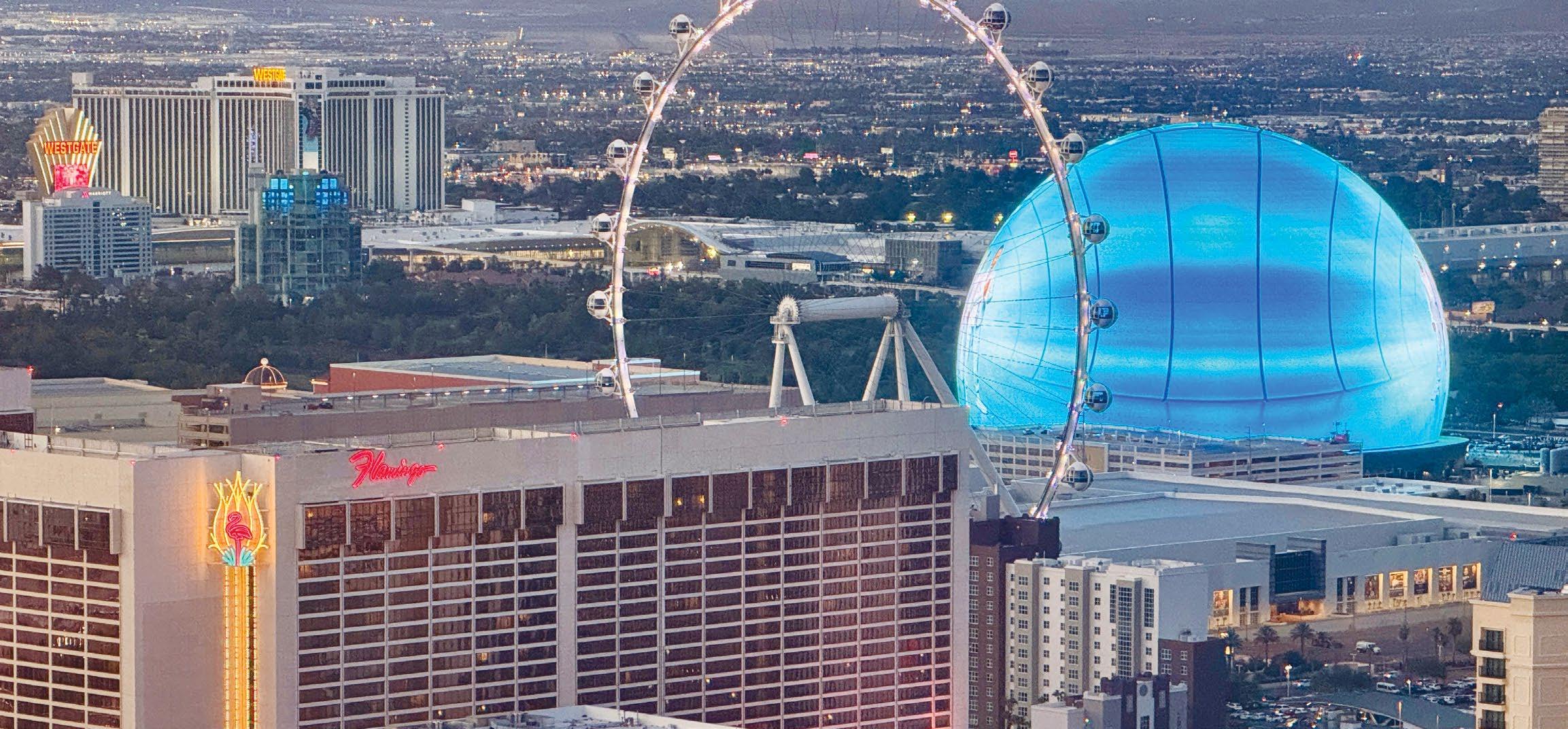
Three years ago this month, on July 4th, the 580,000 square feet of LED that is the Exosphere was turned on. On September 29th, the doors opened to the public, with U2’s Achtung Baby live residency.
The Sphere was two years late and over a billion dollars over its $2.3b budget. Construction had shut down for Covid, there were supply chain issues, and inevitable overruns for a groundbreaking technical venue.
By comparison, nearby Allegiant Stadium, opened in 2020 at a cost of $1.9b; SoFi Stadium reportedly cost $5.5-6b. While SoFi is far and away the most expensive venue on the planet so far, as a per-seat cost, Sphere is king at over $130,000 a seat.
By the time we were having tours during InfoComm 2024, it was the end of Sphere’s first full fiscal (they subsequently changed to a calendar fiscal). That first year saw over $500m in revenue. That translated to $28,000 per seat, and MSG posted an operating loss of $341.2 million.
I remember the conversations around that. There was precedent for how a stadium would amortize; there was precedent for a theme park attraction. But what was the precedent for Sphere? Would it be a novelty flash in the pan? Would people go once and never come back? Would people tire of the programming? And of course, how were they going to maintain nearly 170,000 speakers to preserve attendee experience? (And the rest). I wanted it to be the AV triumph of this generation. Surely the build had been one for the books and career-making for some people. But would it become a $2.3 b LED white elephant?
Three years on, if you look at SEC filings and financial reporting for fiscal 2025, MSG is obviously still depreciating that spectacular build cost. But Sphere’s venue and production studio/lab (Sphere Studio, Burbank) reported over $144m in adjusted profit on $781m in revenue, and what’s striking is that Sphere significantly outperformed MSG’s traditional assets on revenue. Sphere is now the dominant revenue engine, even while legacy assets remain more profitable, for now.
There’s further evidence that MSG is bullish on a Sphere future. As we go to press, Sphere Entertainment announced there would be two new Spheres by 2030. Sphere Abu Dhabi on Yas Island will mimic the Las Vegas Sphere, and a 6000-seat mini-Sphere is slated for National Harbor in Maryland. It’s interesting that they’re doing both replication and risking (in my opinion) a mini.
To my mind, the financial story of Sphere is still unfolding and has to be considered still uncertain on some level. It’s the most audacious out-of-home play I’ve seen since I helped Hello Kitty build an indoor theme park in Tokyo for $780m in late 1980s dollars. Sphere made it through the gauntlet to a bold and successful start, both financially and in terms of aesthetic production. We’ll see

WWW.SVCONLINE.COM

FOLLOW US @SVC_Online
https://www.facebook.com/svconline CONTENT
Content Director Cynthia Wisehart, cynthia.wisehart@futurenet.com
Associate Content Director Derek Wiley, derek.wiley@futurenet.com
Contributors Bennett Liles
Art Editor Rob Crossland, Sam Richwood Production Managers
Nicole Schilling, Heather Tatrow
ADVERTISING SALES
Managing VP of Sales, B2B Tech
Adam Goldstein, adam.goldstein@futurenet.com, 212-378-0465
Sales
John Casey, john.casey@futurenet.com, 845-678-3839
Janis Crowley, janis.crowley@futurenet.com, 845-414-6791
Debbie Rosenthal, debbie.rosenthal@futurenet.com, 212-378-0465
Zahra Majma, zahra.majma@futurenet.com, 845-678-3752
SUBSCRIBER CUSTOMER SERVICE
To subscribe, change your address, or check on your current account status, go to www. mysvcmag.com and click on About Us, email futureplc@computerfulfillment.com, call 888266-5828, or write P.O. Box 254, Lowell, MA 01853.
LICENSING/REPRINTS/PERMISSIONS
Sound & Video Contractor is available for licensing. Contact the Licensing team to discuss partnership opportunities. Head of Print Licensing Rachel Shaw, licensing@futurenet.com
MANAGEMENT
SVP, MD, B2B Amanda Darman-Allen VP, Market Lead Carmel King MD, Content, AV Anthony Savona VP, Global Head of Sales, B2B Dena Malouf
Managing VP of Sales, B2B Tech Adam Goldstein
VP, Global Head of Strategy & Ops, B2B Allison Markert, VP, Product & Marketing, B2B Andrew Buchholz
Email cynthia.wisehart@ futurenet.com
Website https://www.svconline. com/circuit
Instagram https://www.instagram. com/svconline/ X (formerly Twitter)
@SVC_Online
https://x.com/ SVC_Online
LinkedIn https://www.linkedin. com/groups/2757484/

Head of Production US & UK Mark Constance Head of Design, B2B Nicole Cobban FUTURE PLC 130 West 42nd St., 7th Floor, New York, NY 10036

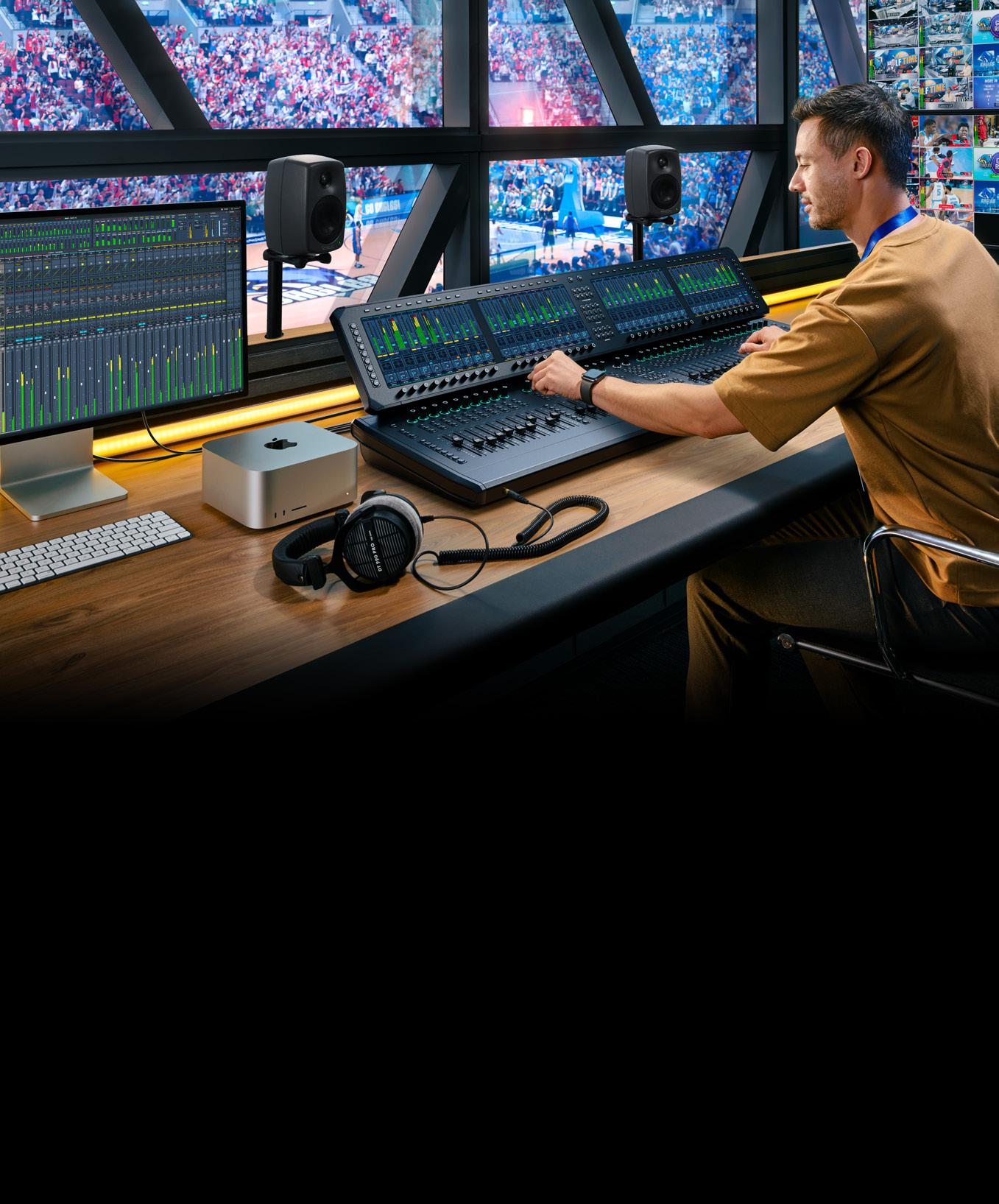
Fairlight Live is a software-based audio mixer which means it can support incredibly powerful features such as spatial audio mixing and SMPTE-2110 broadcast workflows. It’s a fully customizable live audio mixer with built-in effects and professional features such as a cue player, talkback busses, third-party plug-in support, snapshots and more. But the best feature is you can download it free!
Fairlight Live makes it easy to design your own audio mixer for any project from stereo to immersive formats. You can add, modify or move inputs and busses at any time. Simply click the channel number in the mixer to update inputs, or use the menu for bus management and I/O patching. Audio channels can be managed in the tracks index to show, hide or rearrange inputs and busses.
From mono and stereo to LCR, 5.1 and fully immersive ambisonics, Fairlight Live supports hundreds and even thousands of input channels. Each channel has built-in EQ, dynamics and panning options including 1D, 2D, 3D, and spherical panning for spatial audio. Each channel has four effects slots with ChainFX hosting six-plugins per slot for up to 24 plugins per channel.

Fairlight Live let’s you create a customized bussing structure that can be changed dynamically as your show evolves. Use the bus management menu to add main, sub, aux or mix-minus busses, and choose their format, name and color. Assign input-to-bus or bus-to-bus routing in the bus assign window or right in the mixer! Plus multiple mixer channels can be assigned simultaneously.
All of your productions are saved as a complete show including the mixer layout, routing, processing, cue player, snapshots and more! The file menu lets you quickly open existing shows or create a new one. Templates for common workflows are included plus there are layouts to match supported ATEM live production switchers. Unique productions can be custom built in the new show dialog.
L-Acoustics introduces the L1 and CS1
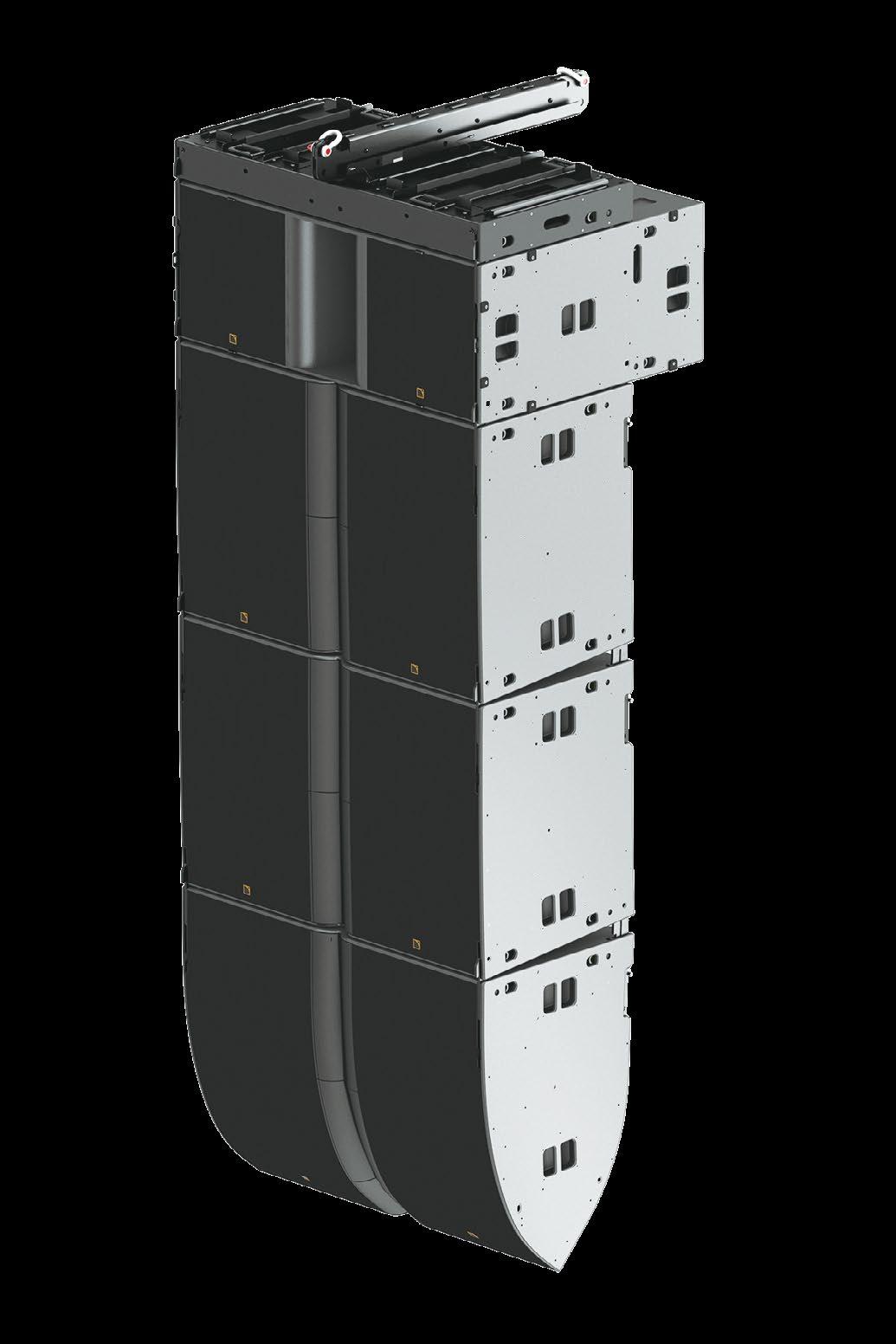
1L-Acoustics has unveiled the L1, the flagship of the L Series, and its companion cardioid subwoofer, CS1. Built on L-Acoustics patented Progressive Ultra-Dense Line Source (PULS) technology, L1 sets a new reference for stadium sound systems that has already been entrusted to the world’s biggest stages. L1 has been deployed on Bruno Mars’ The Romantic tour with Clair Global, for Harry Styles’ Together, Together tour with Solotech, and on Joker Xue’s world tour with MRT, as well as a debut at the Brit Awards in London with Britannia Row, a Clair Global company. CS1 delivered the low end on the main stages of Coachella Valley Music and Arts Festival with RAT Sound, and Ultra Music Festival with Unreal-Systems/AgorA. https://tinyurl.com/23txrsvj
Writer DEREK WILEY Associate Content Director
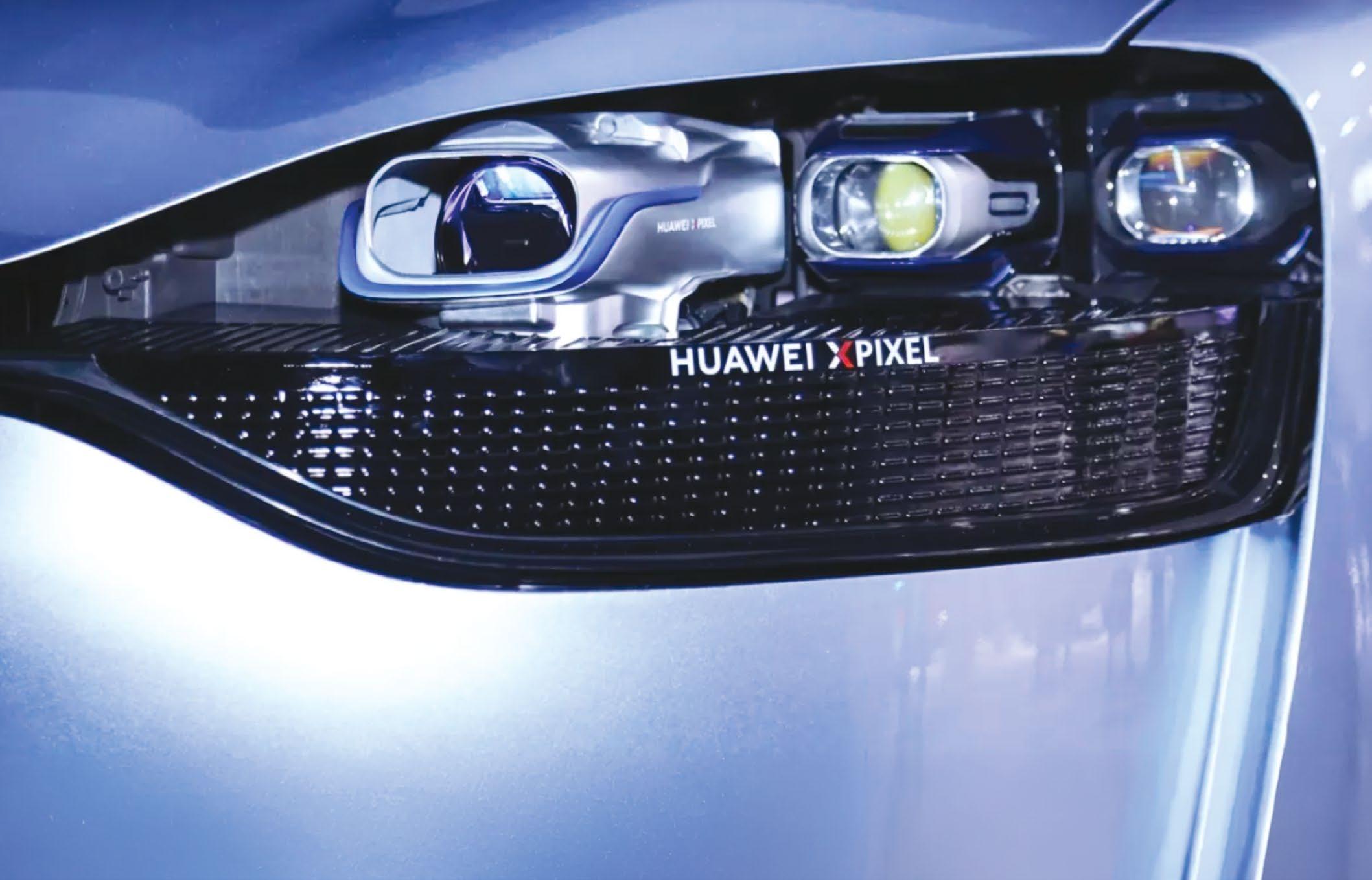
Huawei integrates a full-color projector into headlights
2
At this year’s Beijing Auto Show, part of Huawei’s Qiankun technology conference, the company debuted a new car headlight platform that integrates a full-color projection system for both safety features and recreational fun. The new XPixel platform has been upgraded from its previous iteration, which was only available in monochrome, to now feature full-color projection that can throw a 100-inch picture onto a wall or projection screen. According to Huawei, this is the first time full-color projection has been adapted into automotive headlights.
https://tinyurl.com/3z2m232h
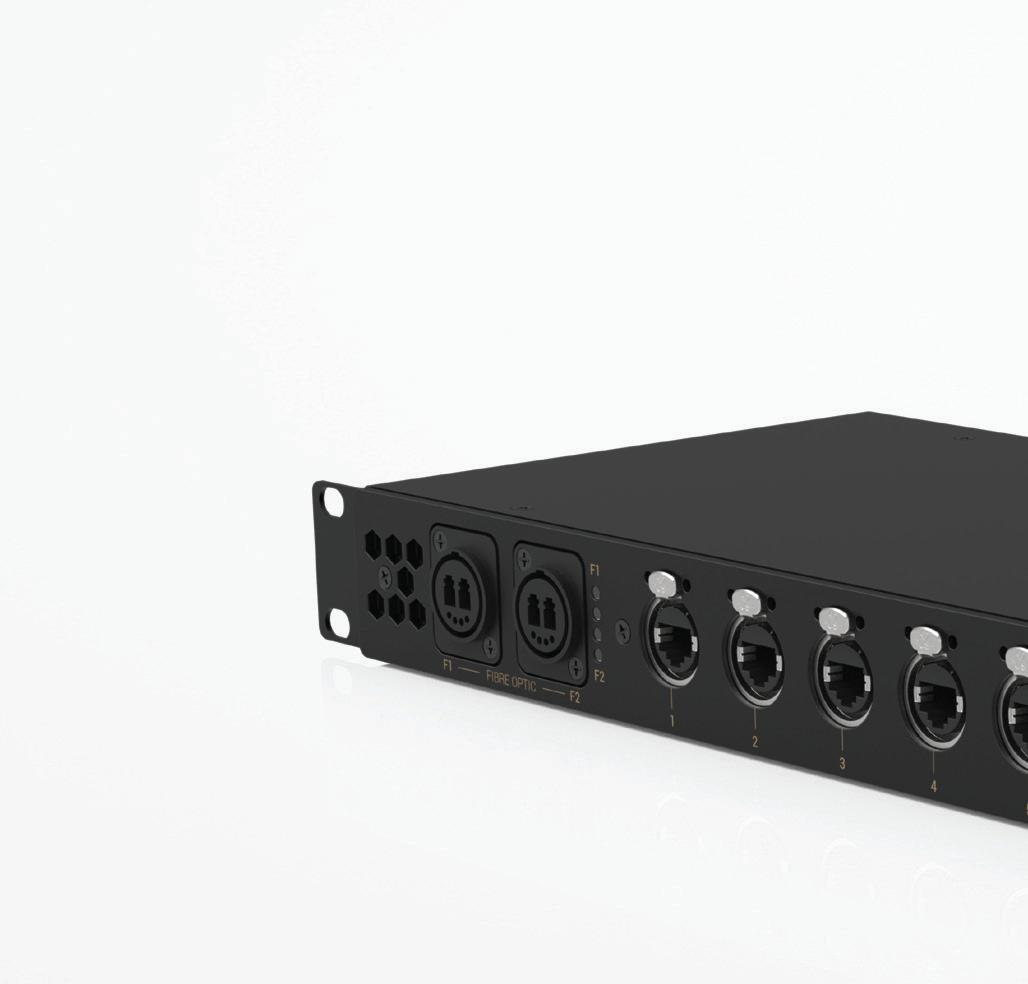
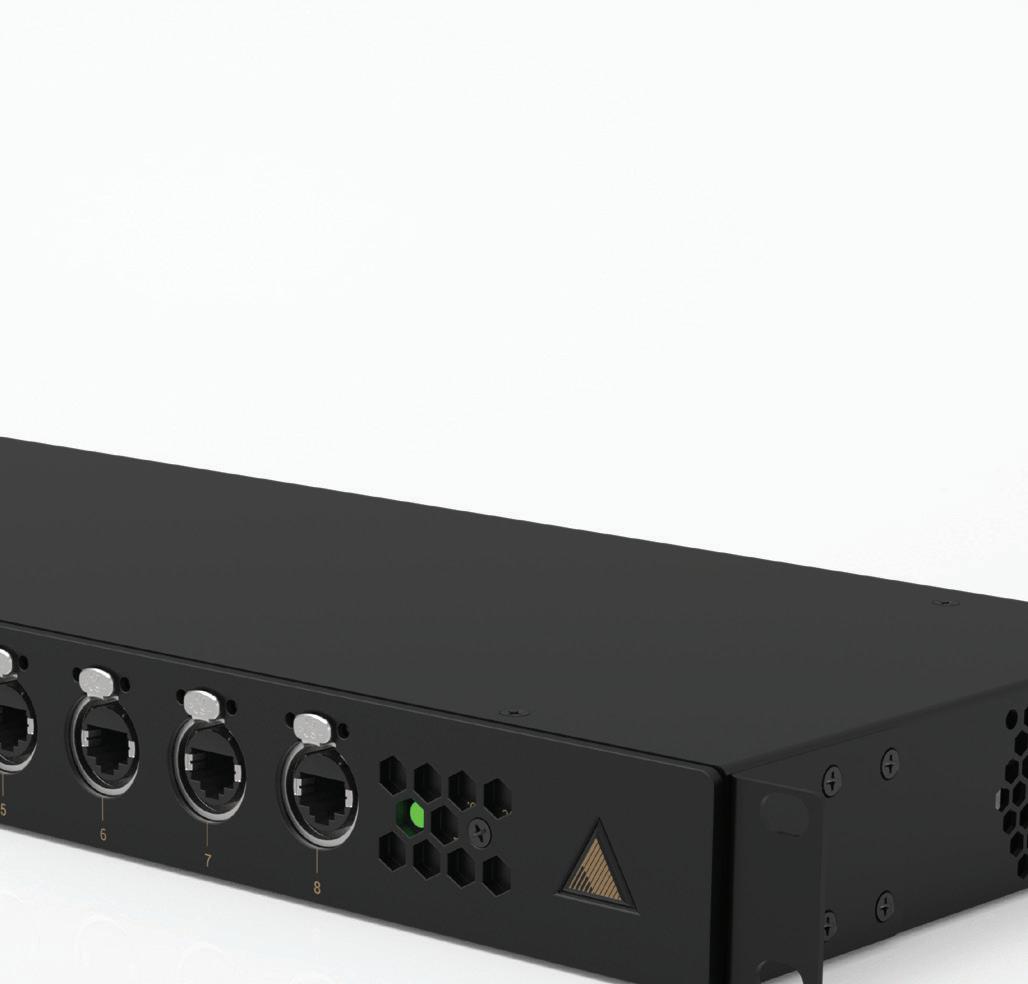



Whether deploying a redundant or primary-only network topology, the MS8.2 Milan network switch is perfectly suited to simplify mobile, installed systems and spatial audio applications.
3
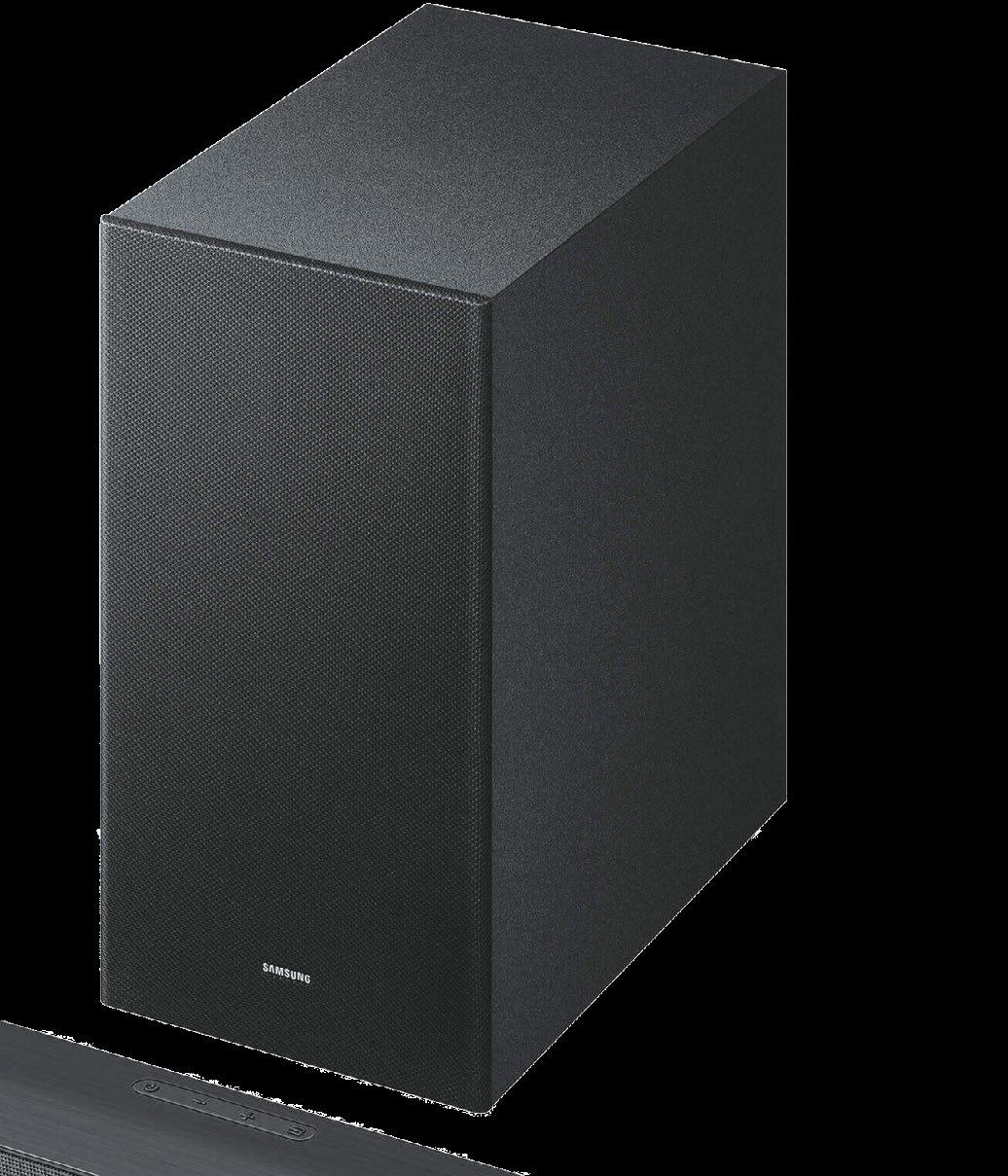
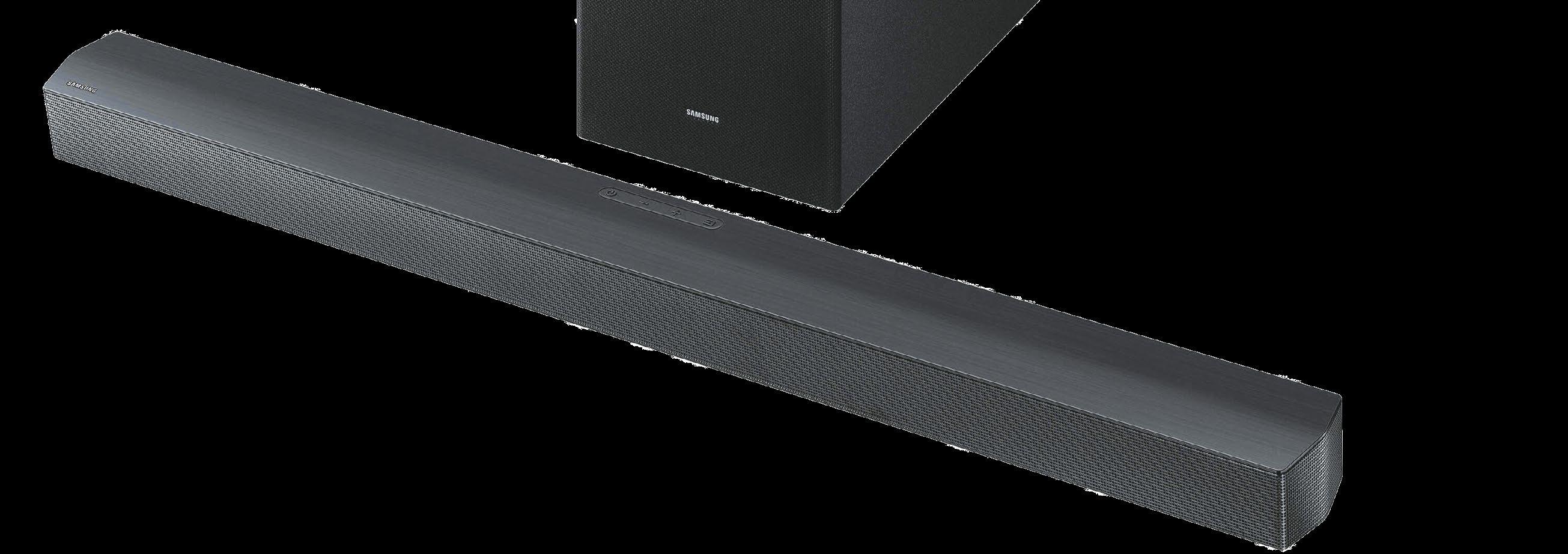
In a surprising move, Samsung has confirmed that it is withdrawing from the TV, monitor, projector, and audio product markets in China.
“In response to the rapidly changing market environment, after careful research, Samsung Electronics decided to stop selling all household appliances, including TVs and Subscribe to Pro AV Today: https://bit.ly/44ZEu4d
4
Las Vegas’ $2.3 billion Sphere venue has been a runaway success, and Sphere Entertainment is looking to capitalize by opening up two more venues by 2030. The company has announced that Yas Island has been selected as the location for Sphere Abu Dhabi, and will be investing $1.7 billion into the project’s construction phase. Like the Las Vegas Sphere, it will have a capacity of up to 20,000, depending on the configuration for a given event. Other similarities include a 16K x 16K LED screen inside, 167,000 speakers, and an exterior LED screen running 24/7. Additionally, a 6,000-seat “mini Sphere” is coming to National Harbor in Maryland with a target opening of 2030. https://tinyurl.com/mrys4j3c
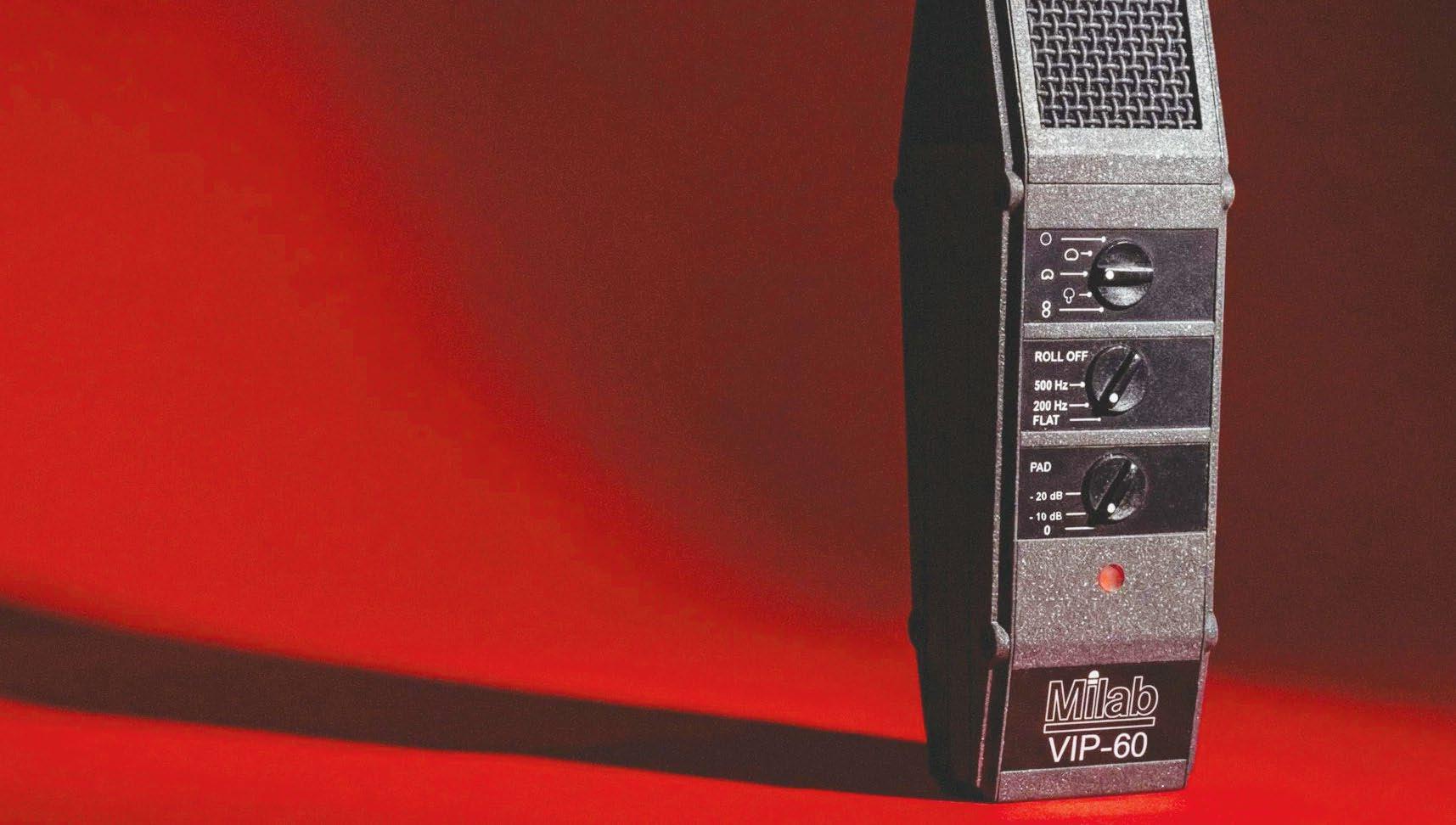
Swedish microphone manufacturer Milab, founded over 85 years ago, is officially back after filing for bankruptcy last August last year. The company has confirmed that production is back and full swing, and the first microphones have begun leaving the factory.
Production in Sweden is being led by Production Manager Hans Svensson, who has worked with building Milab microphones for the past 40 years.
The company’s flagship VIP-60 is the first model being manufactured since production has begun again. Milab has confirmed that it has begun development of new product lines that expand beyond its classic portfolio, and has revealed that upcoming releases will include both modern studio tools and new designs for studios and broadcast.
https://tinyurl.com/y522vcde
Platinum Tools launches Fiber Optic Launch Cables for OTDR testing
6
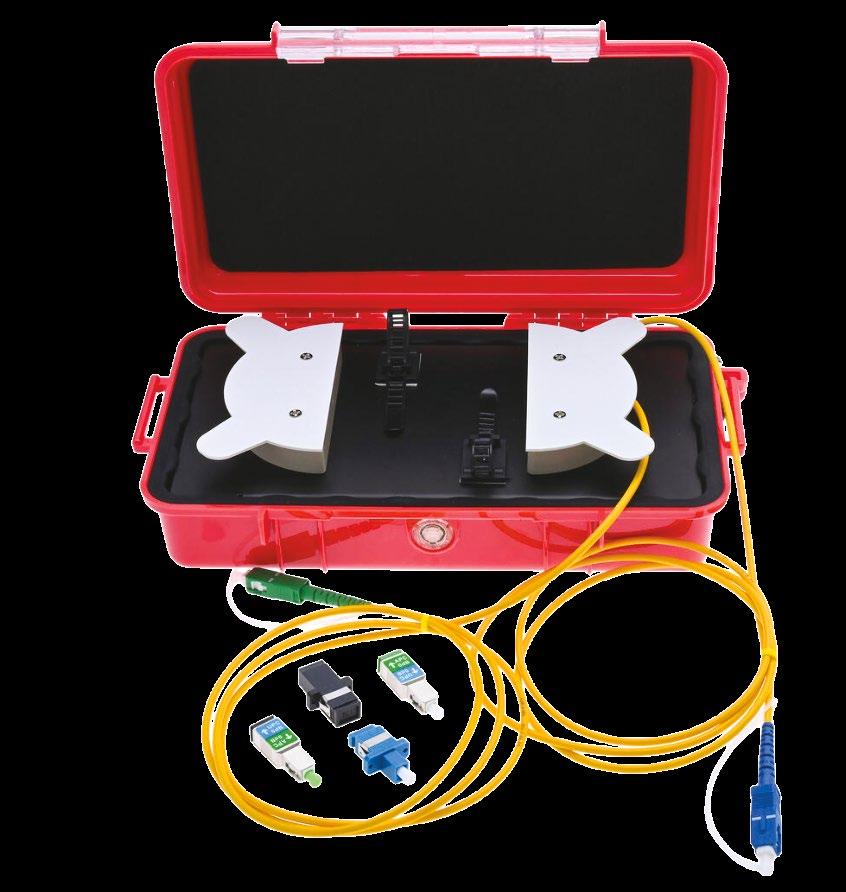
Compatible with Platinum Tools’ mini OTDR and Copper Tester, Platinum Tools’ fiber optic launch cables come in three different sizes (150m, 500m, 1km) and two different configurations to ensure technicians and installers are covered when testing fiber topic cable. Each launch cable comes with a variety of adapters (UPC, APC, SC and LC) to ensure they can run a test on nearly any single-mode fiber optic cable. Designed with micro armored fiber and rugged exterior cases, these launch cables are fit for any job site. MSRPs range from $266.67 – $650.00 based on length and configuration.
https://tinyurl.com/2mv3cd7r

The Cerritos Center for the Performing Arts (CCPA) is renowned for its unique ability to physically transform into multiple configurations. The team has completed installation of a d&b audiotechnik XSL-Series loudspeaker system, addressing critical challenges related to acoustic control and logistical flexibility, while making the venue more rider-friendly for numerous touring acts who choose the CCPA to reach Los Angeles and Orange County communities Jon Bullock, Theater Head Audio and Video Specialist for the CCPA, shares details of this dynamic installation.
The Cerritos Center for the Performing Arts is highly unique in its ability to reconfigure itself. Can you describe how the physical space changes?
John Bullock: The venue is an amazing place. When it opened in 1993, the CCPA was one of only two venues worldwide that could reconfigure to different stage setups. The sheer engineering required to transform the space is astonishing, and our theater can shift among six layouts. For example, we can transform from Lyric Configuration, which is a typical proscenium theater with rake seating and about 70 different line sets for theatrical productions, to our Arena Configuration, which features a bare floor where we build a stage using a steel deck. This allows us to truly offer the best experience to our patrons, one that’s optimized for the programming that’s being presented.
The process is an engineering feat, and the walls of the venue move to accommodate the different theater configurations. Heavy towers, weighing anywhere from 100,000 to 300,000 pounds, float on air casters, which are big air bladders pumped
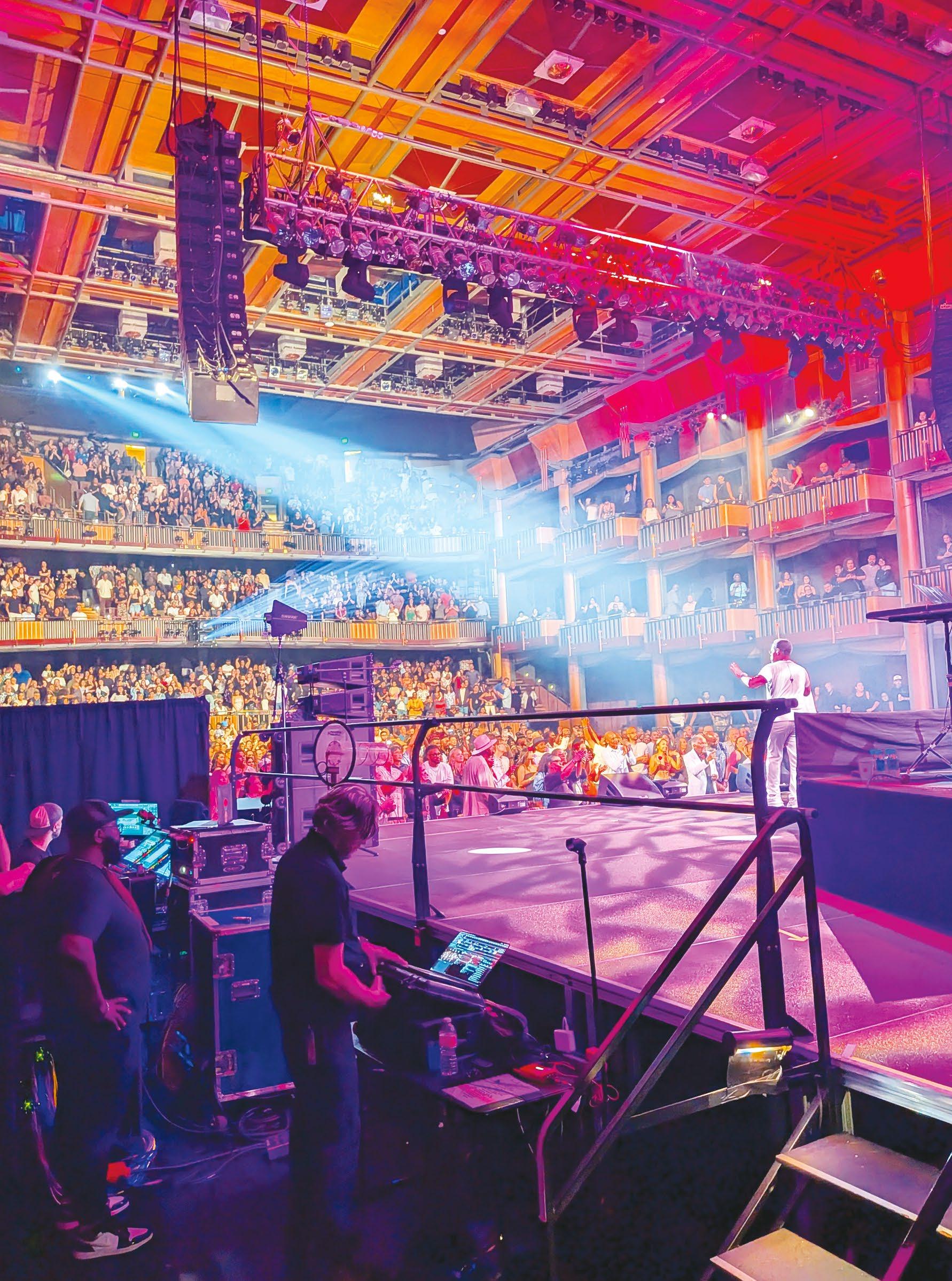
with compressed air. This allows them to be pushed into place manually or mechanically. The floor itself consists of lifts that drop 12 feet from the main floor level for storage of seating wagons or raise to create rake seating. Even the ceiling panels fly in and out. For the Arena Configuration, the panels fly out vertically, and for others, they lay horizontally to create a traditional ceiling. The configuration process generally takes a full day or two to change over the entire theater. The only parts that remain stationary are the rear balcony levels.
Given that the entire venue changes, what were your objectives when choosing and designing the new sound system?
JB: The main challenge was designing a system that could easily be dismantled and reassembled effectively in the different layouts. When we reconfigure the building, the PA, cables, and lighting come down completely, and most soft goods are removed.
The new audio system design had to
anticipate for multiple configurations months ahead, factoring in cable lengths, power consumption for amplifiers, and calculating every measurement. In one configuration, the stage may be wider or the seating distance different, and the distance from the downstage edge to the front of house position changes completely. For example, in the Lyric Configuration, the proscenium opening dramatically lowers the maximum trim height to only 26 feet, whereas in Arena Configuration, we can fly higher.
Other objectives for the theater’s audio system span coverage, voice intelligibility, and overall tonality. We needed a system that offered a far more superior audio experience for our patrons than our previous system provided. More importantly, we needed a system that could meet tour rider requirements, which our prior system was unable to do.
We ultimately chose the d&b XSL system, which met all our objectives, and we found to be the perfect size for the venue. The smaller enclosure size of the XSL also offers minimally intrusive sightlines compared to the prior system, giving lighting and set design crews greater flexibility during setup.
How does the d&b system specifically adapt between your primary Arena and the Lyric Configuration?
JB: In the Arena Configuration, we’re flying 14 boxes of XSL per side (6 x XSL8 over 8 x XSL12). We use delays — two V-Series V12 per side — to cover the last eight rows of the upper balcony because our 43-foot ceiling height doesn’t allow the main array to hit the very top balcony without causing sightline issues. We also use ground-stacked components: two XSL-SUB per side with a single XSL12 on top, and four SL-GSUB across the front.
When we change to the Lyric Configuration, the stage moves 20 to 25 feet closer to front of house. We utilize the same XSL flown boxes, but the angles and bumper points change dramatically. We remove the large ground stacks and rely solely on front fills. The lower proscenium height (26 feet) means our trim height drops dramatically.
I rely heavily on ArrayCalc to determine the tuning and coverage patterns for each configuration, which are then realized through ArrayProcessing. This makes the transitions so much easier. I am developing specific presets tailored to the various venue setups as they come up in our schedule, which we can then recall when we return to any given configuration.
Can you tell us about the other configurations?
JB: Recital Configuration is similar to Lyric Configuration and features 6 x XSL12 flown per side and 2 x V12 per side for upper balcony delays. We used this configuration for a recent string quartet performance.
Cabaret Configuration is a smaller, more intimate arrangement that uses 2 x XSL12 on top of 2 x XSL-SUB stacked per side, supported by 4 x E-Series E8 front fill speakers.
Lastly, our Concert Configuration setup includes 9 x A-Series AL90 in a 180-degree center cluster array, and 8 x E8 front fill speakers.
Does the XLS System make those Configuration changes easier?
JB: d&b’s rigging and portability have been a massive benefit for a venue that tears down and resets the PA frequently. The previous system was large and cumbersome, and the rigging was difficult to comprehend. With the new d&b system, our rigging is so easy. I have crew members, some of whom are very new, and they can quickly comprehend and master the process. For instance, changing the array angles while the system is hanging is simple enough for two people to do.
The ease of use, speed, and efficiency of this system also translate into cost savings, requiring less crew time and reduced power consumption. This eliminated the need for additional cables and amplifiers that were used in the prior system.
And how has the sonic performance been?
JB: The results have been overwhelmingly positive. The sound reproduction in the room is greatly improved, providing a far superior audio experience. Clarity is a constantly recurring theme. People notice the detail and tell me they can now hear everything. We ran a stress test, pushing it up to 108dB. People were amazed that it was loud yet did not “hurt” and still remained clear.
One of our biggest objectives was achieving low stage volume and minimizing low-frequency build-up. The low-frequency cardioid behavior in the XSL arrays was instrumental in solving this. The crew, including my monitor engineer, noticed a huge difference right off the bat. The monitor engineer specifically loves the improved gain before feedback.
The rear rejection behind the PA is mindblowing. When the system was first installed, crew members and front office people were listening
to it while I was pushing 98 to 100dB out front. They could walk directly behind the PA and have a normal conversation without shouting. Broadband directivity control is a huge benefit in front of the PA as well, because the movable ceiling panels above the audience create a 40-foot void and can cause weird reflections. By keeping the sound focused, we mitigate unwanted reflections. Front-of-house engineers all love the improved gain before feedback, and it makes their job a lot easier.
What performances have happened at the Cerritos Center since the d&b system was installed, and how have touring engineers reacted?
JB: We’ve hosted an eclectic mix of acts. Early shows in the Arena Configuration included Boyz II Men, Dionne Warwick, Buddy Guy, The Temptations, and The Four Tops. In the Lyric Configuration, we’ve hosted Grammy winner Kenny G, Jazz icon Chris Botti, and KC and the Sunshine Band. We also had non-musical acts, such as the MasterChef show, magician Lance Burton, and comedian Jay Leno.
I am not exaggerating when I say that touring engineers have been ecstatic when they arrive. They come in, expecting the prior system, and when they see the d&b rig, they’re immediately happy, and, of course, they usually comment on what a great-sounding rig it is after the show.
What are your overall impressions of d&b audiotechnik?
JB: I’m a huge fan of d&b. Our relationship with d&b, from the technical field team to senior management, has been fantastic. We’re a mediumsized venue, but they always treat me like a top-ofthe-line touring guy, and their support is unwavering.
The German technology and the attention to detail are incredible. The efficiency of the amplifiers, the processing integrated right into the amplifier, and the ease of ArrayCalc software make deployment and tuning so simple. My assistant, who has been here since the theater opened, was blown away by how easy it was to learn and comprehend the system. The system was so good that I was able to “throw it up and go” for the first couple of shows without detailed tuning—and it still sounded great.
Looking to the future, we are discussing a possible Soundscape installation in our multipurpose room. The relationships and the quality of their products are the biggest reasons the CCPA is happy to be a d&b audiotechnik house.
Power amplifiers have grown from simple signal boosters driving speakers to intelligent devices with DSP, speaker matrixes, networked infrastructure, and sophisticated self-diagnostics. Power levels and operational efficiency have increased dramatically along with critical reliability but even the most small and simple units of today are way ahead of previous devices in functionality for size. This survey illustrates how far the muscle end of the sound signal chain has evolved.

Contributing Editor
A new secret of success for the Ashly Audio MA500.4 is getting power and cooling air where it is most needed on a momentary basis. Features of the MA Series amps include intelligent power sharing with no external units needed to facilitate it. Configured with DIP switches, the system dynamically allocates power to where it is required by asymmetrical speaker loads. It also runs cooling air to the hottest areas in the amp using Ashly’s SailFlow technology. The MA500.4 puts 500W into each of its four channels.
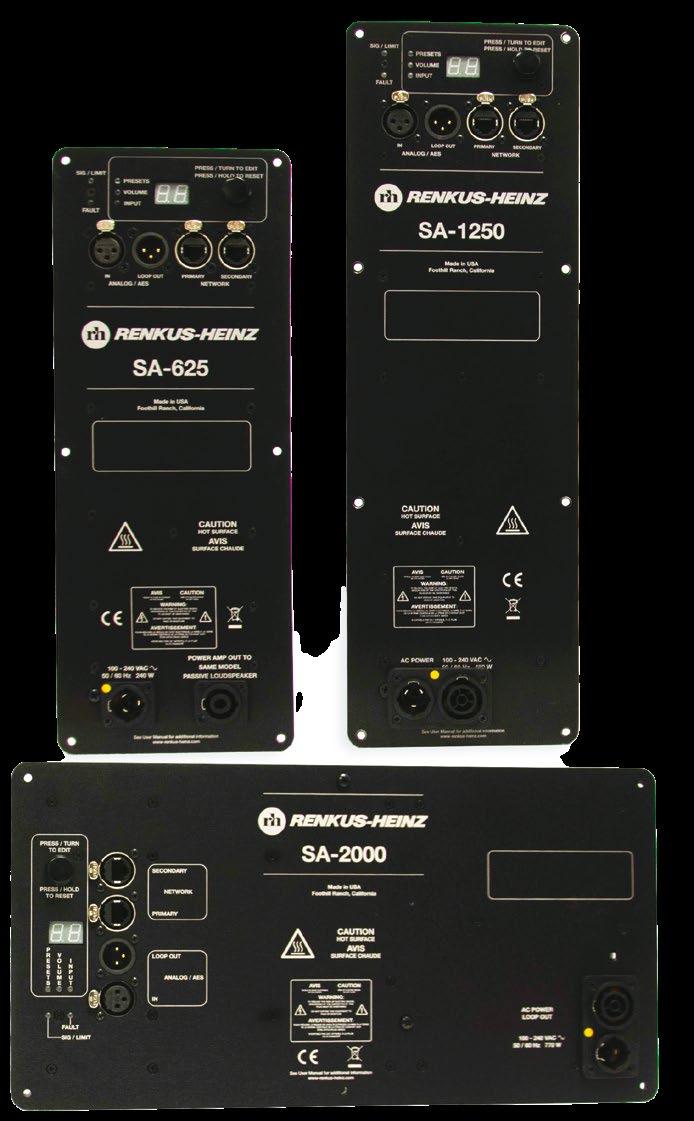
Special to the company’s sound gear and intended for maximum flexibility of their speaker systems, the Renkus-Heinz SA Series amplifiers have networking and RHAON II control and monitoring. Analog, AES/EBU, or Dante can be input connected.
Among the three models, the SA-625 outputs 500W + 125W, the SA-1250 provides 1000W + 250W in two-way configuration and 500W + 500W + 250W in three-way mode, and the SA-2000 can be set up for one 2kW channel into 4 ohms, 2 channels of 1000W each into 8 ohms, or
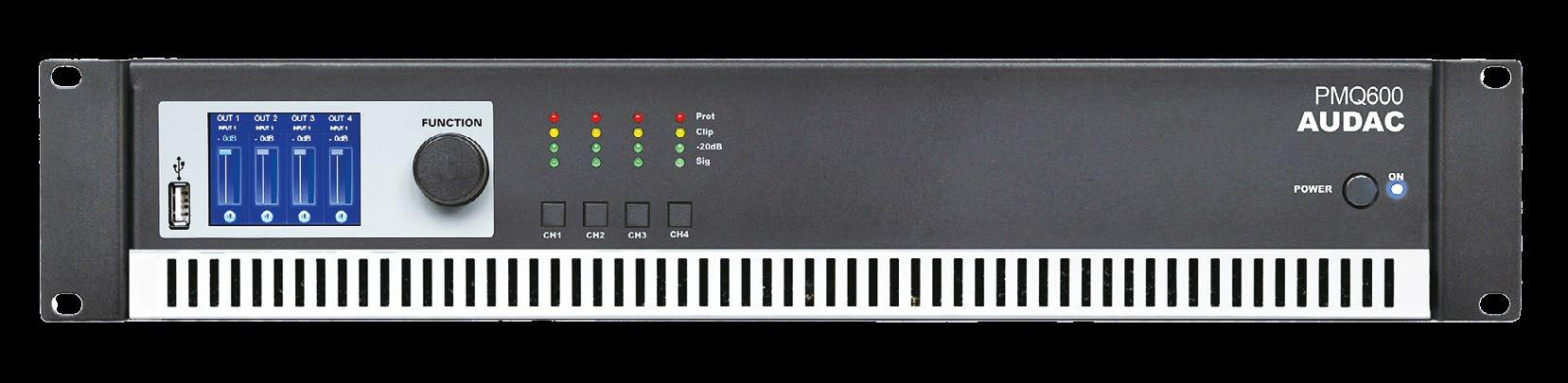
3 channels with 1000W, 500W and 250W into 8 ohms each. The Audac WaveDynamics PMQ600 sits at the top of the PMQ Series of 4-channel amplifiers. All of these class D amps have 70/100V output with protection, clip, -20dB level, and signal presence indicators on the front for each channel. Also featured are advanced DSP and loudspeaker management, RS232 control, a 2.5in. LCD display with function knob, and a Dante/AES67 expansion port along with XLR input and link-through connections. The PMQ600 puts 600W into each output channel.
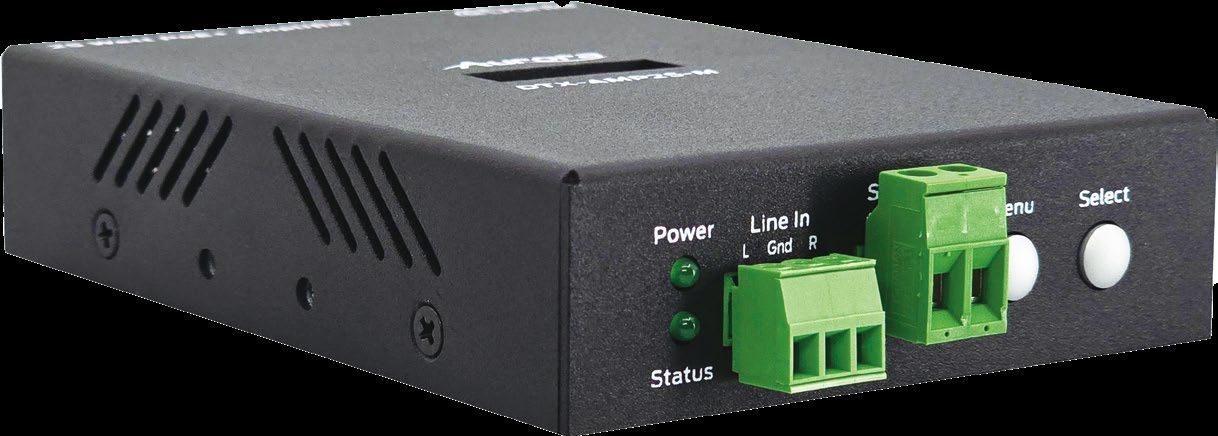
At the other end of the size range, there is the Aurora Multimedia DTX-AMP25-M high-efficiency 25W amplifier designed for Dante and AES67. Simple installation and the ability to be mounted in small areas are assured through its PoE+ powering capability. The integrated OLED display allows access to IP address and critical status readouts. There is also a USB port, an analog audio input, and RS-232 control. The unit’s internal web server provides remote diagnostics and settings control.
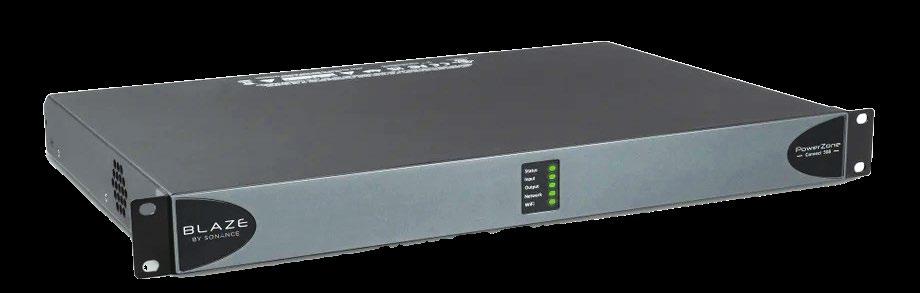
We step up to eight channels in a single rack space with the Blaze Audio PowerZone Connect 508 , a 500W DSP-equipped Pascal UMAC class-D amp. The PowerZone Control web app enables remote full-matrix DSP configuration and there is hybrid power distribution in both Lo-Z and Hi-Z loads. Other features include S/PDIF input/output, configurable GPIO, and a UREC universal power supply with PFC. Power output on each of eight 8-ohm loads is 60W and on four 70/100V channels the power level is 125W per channel.
InfoComm 2026 saw Bluesound Professional expand its amplifier portfolio with the Bluesound B240Q and B240M Network Streaming Multichannel Amplifiers. Featuring two BluOS
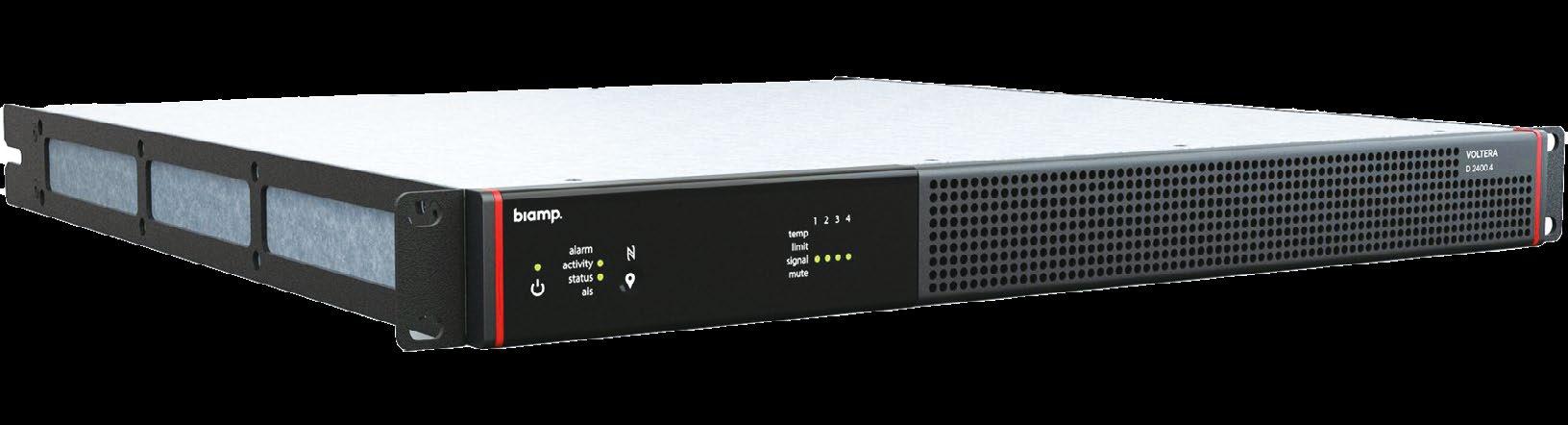
Big power in a single rack space unit is one of the goals of the modern power amp evolution and the Biamp Systems Voltera D2400.4 demonstrates how this is done. This class D unit delivers 2400W into four channels supporting a variety of low impedance loads in addition to 70/100V constant voltage speaker systems. Its capabilities include working with AVB, Dante, and AES67 networking and its ALAMOS preset library has over 700 loudspeaker profiles. Integrated precision DSP includes routing, EQ, filters, delay, and protection.
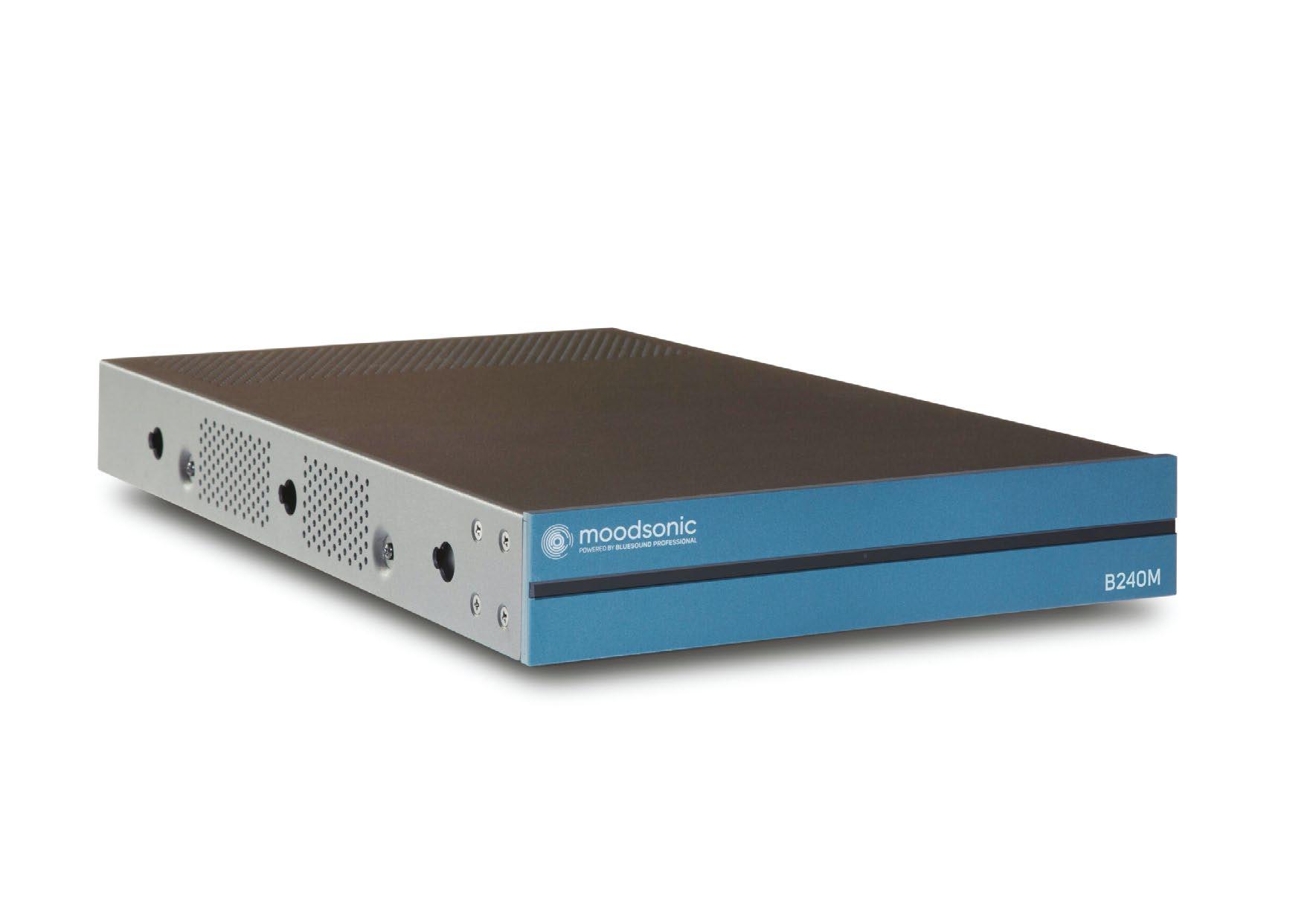
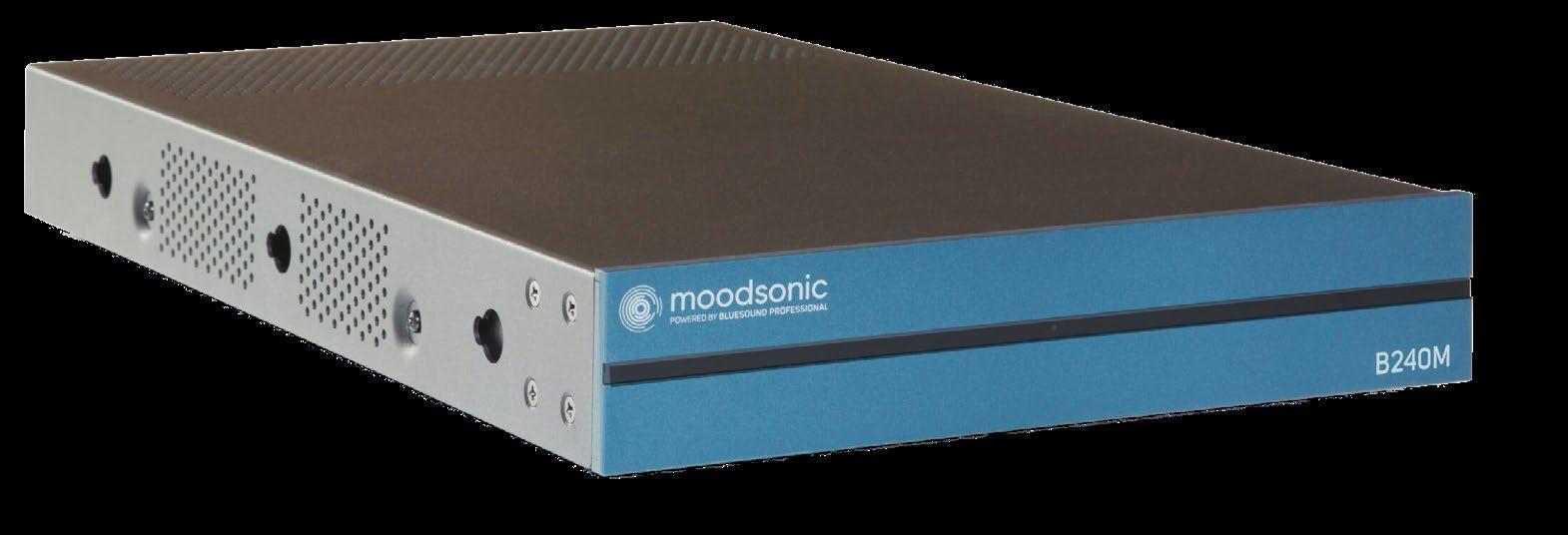
systems, the B240Q is suited to large, multi-zone deployments across retail, hospitality, and corporate environments. Its decentralized architecture allows the amplifier to be positioned closer to speakers, reducing cable runs while maintaining centralized control via BluOS. The B240M amplifier builds on the B240Q platform by adding Moodsonic generative biophilic soundscaping capabilities.
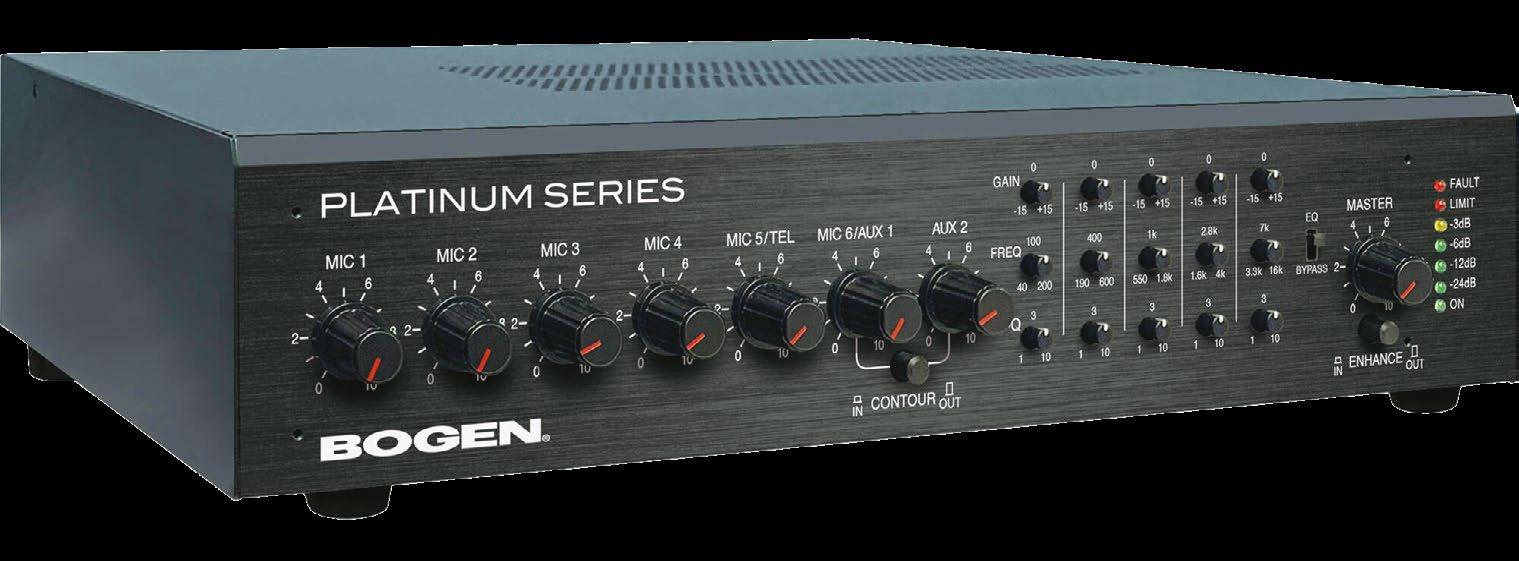
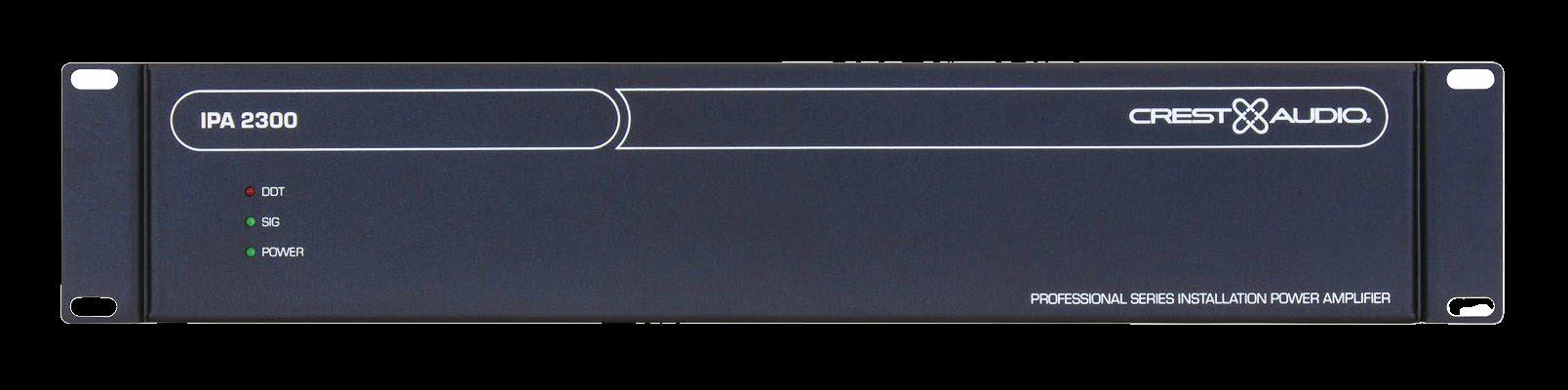
The Bogen PS600 Platinum Series mixer amplifier features four dedicated microphone inputs and low-Z/70V/100V outputs. Input channels include one selectable MIC 5/TEL input, one selectable MIC 6/AUX 1 input, and one dedicated AUX 2 input. The front panel presents a 5-band parametric equalizer with individual gain, frequency, and Q knobs. Next to this is an LED level meter with limit and fault indicators. The Platinum Series also has preamp OUT/power amp IN connections to serve as an insert for external audio processing. Exhibiting the modern versatility of constant voltage and low-Z outputs as well as mic level and line level input, the 300W Crest Audio IPA 2300 has SPS speaker
protection and a voltage selector switch for 120V or 240VAC power. The front panel of the 2RU rackmount amp includes power, signal, and SPS indication LEDs along with input level controls. Input 1 level sensing mutes input 2 with threshold/defeat control and there is a highpass filter to protect speaker transformers from low frequency overload.
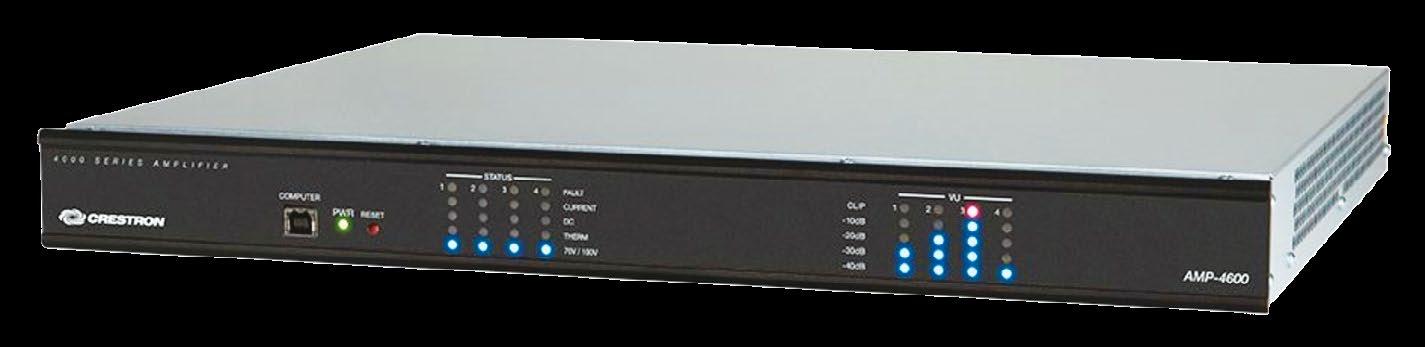
The company long known for its control systems has also produced the Crestron AMP4600 4-channel power amp with 600W per channel, designed to work with the Crestron Avia family of digital signal processors. The amp works in stereo or bridged mode and handles 70/100V and low-Z loads configurable separately on each channel. Networked connection allows the unit to be remotely controlled and configured with the Avia Audio Tool software and by using a touch screen control panel or mobile device.
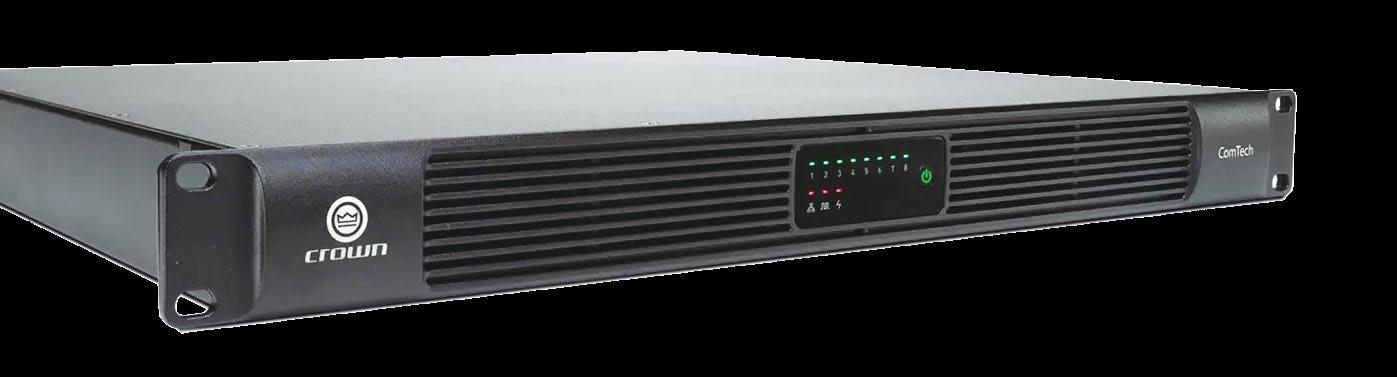
For small and medium sized environments with many sound zones, the Crown Audio CTD-8125 offers eight 125W channels with
power sharing among them, Lo-Z/Hi-Z switching, DSP, and Dante networking. Its entire 500W can be shared in any ratio and factory JBL speaker tunings are featured. The web interface enables remote configuration without installation of custom software and all of these features and functionality are designed into a single RU rack housing.
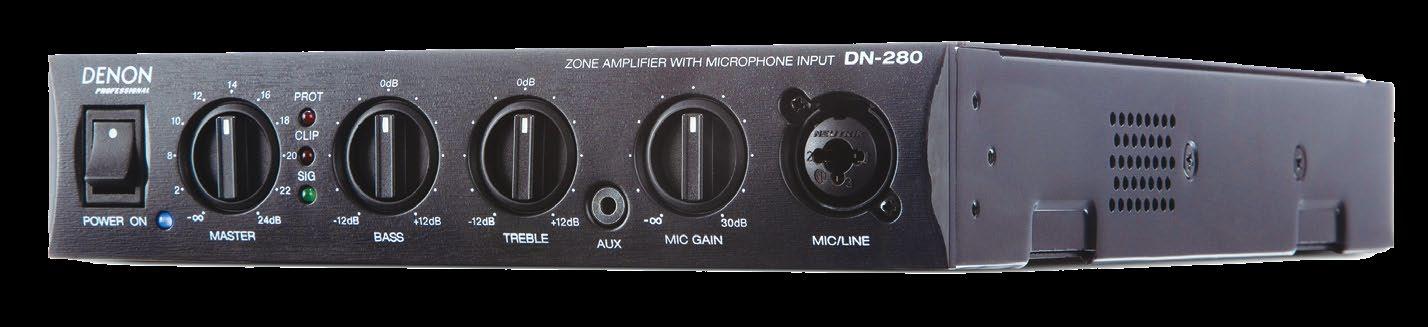
Made by an inMusic company, the Denon Professional DN-280 is designed for paging, P.A. announcements and background music in small spaces. This Class D 100W mixer amplifier can operate through 4-ohm or 70/100V speaker systems. The output is summed mono and the front panel includes a 3.5mm mini TRS aux input and an XLR mic input for announcements. The unit is short-circuit protected and front panel LED indicators show signal present, clipping status, and thermal interruption.
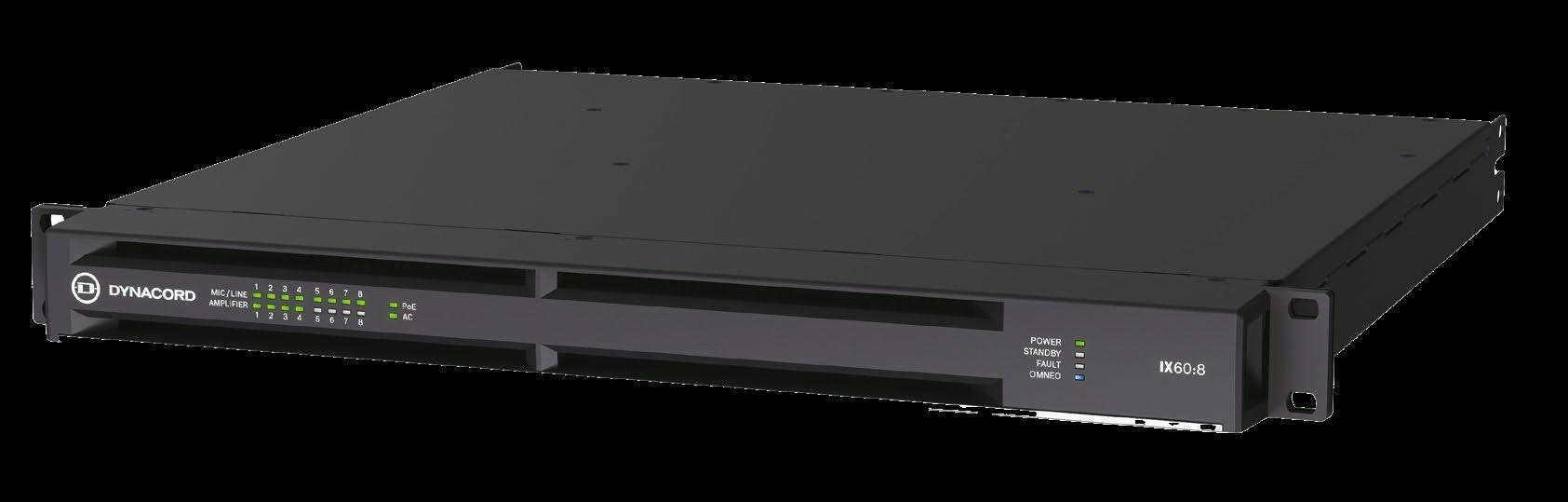
At top of the new IX Series, the Dynacord IX60:8 spreads 6kW power over eight channels as needed, using its powerTANK technology to dynamically allocate it. Speakers of different sizes can be fed with the right power level for each one. There are eight Dante inputs and
outputs in addition to a 16x16 matrix mixer, and eight mic/line inputs that can be used as Dante break-in points. Also featured are EQs, dynamics, Dynacord FX and FIR-Drive capability, and pilot tone detection. Working independently of mains power, ghostPOWER on PoE maintains the entire DSP, the Dante network and all active mic/line inputs. It is loaded with other innovative functions as well.
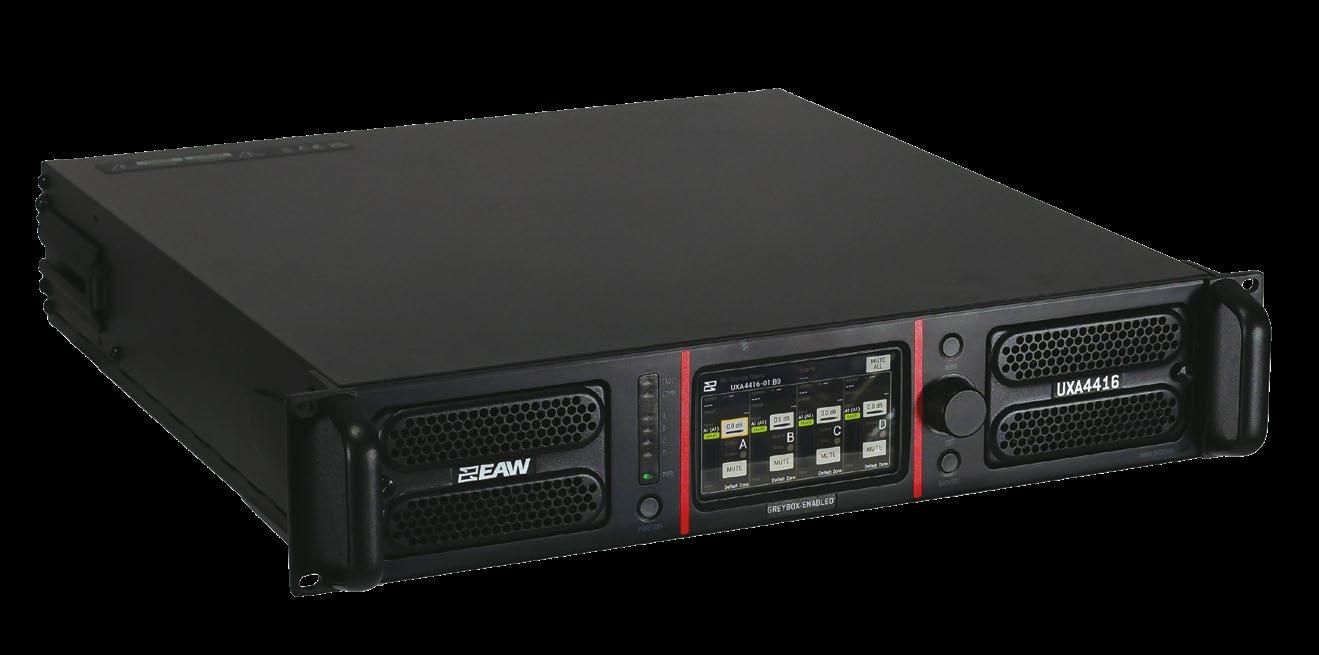
The four-channel 4x4000W class D EAW UXA4416 is made to support KF, SB, and MW series Professional Systems and it does so with 96kHz, 40-bit floating point DSP and EAW Greybox presets, a 4.3-inch touch screen display, primary and secondary Dante on two Gigabit Ethernet ports, and system-wide network control including configuration and monitoring using EAW Resolution 2 software. The amp can operate worldwide on its universal PFC power supply.
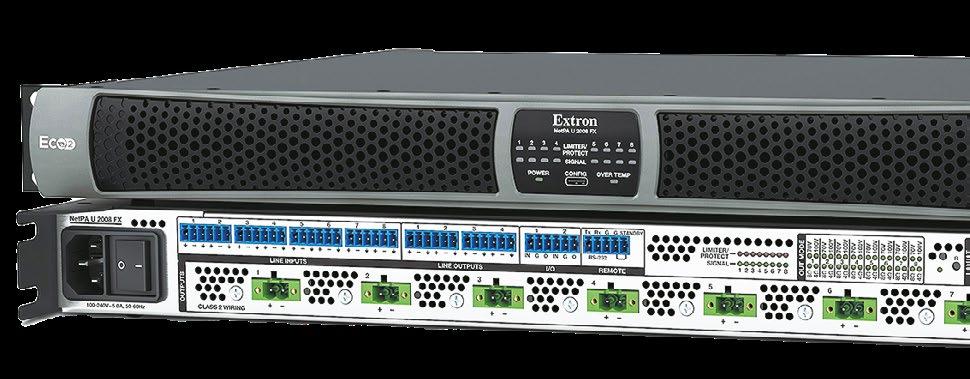
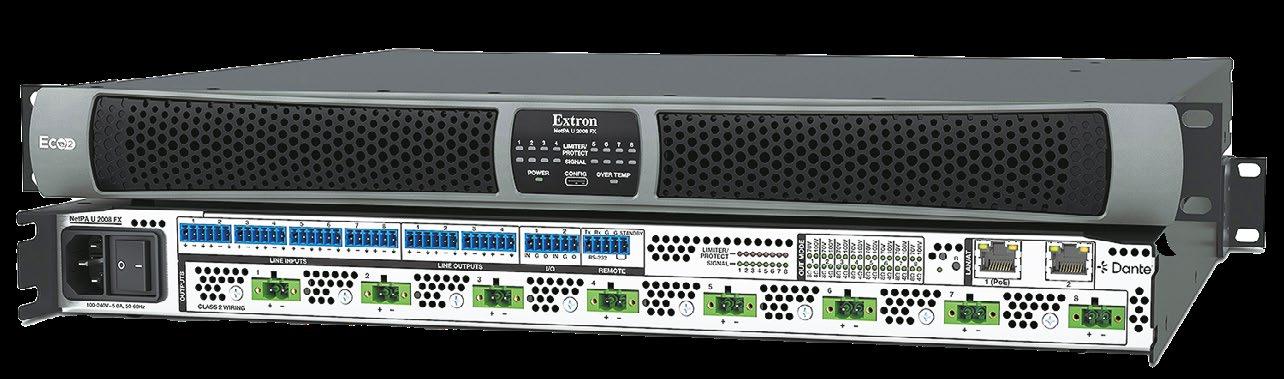
The versatility of all the new amp features and functionality can be seen in the Extron NetPA U 2008 FX eight 200W per channel configurable output amplifier with Dante and DSP.
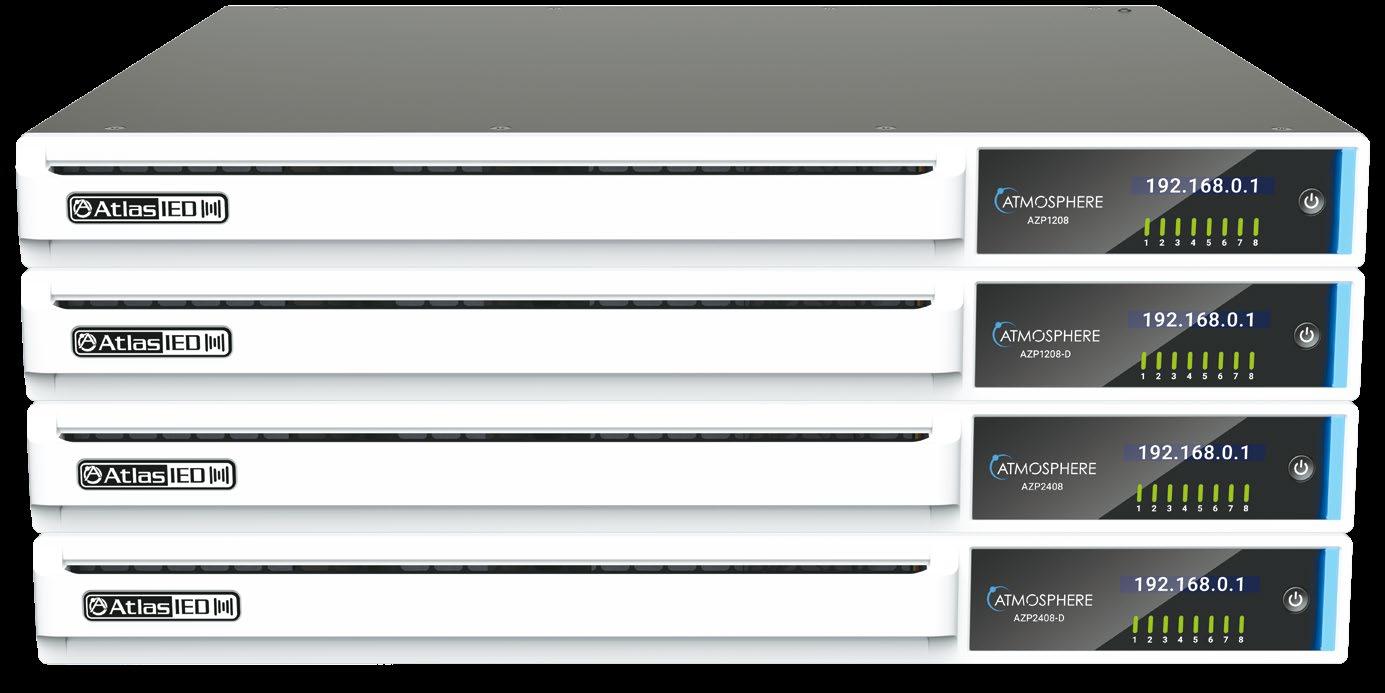
In May, AtlasIED announced the expansion of its Atmosphere digital audio platform with the introduction of the AtlasIED Atmosphere AZP Amplifier Series. AZP amplifiers feature onboard DSP with integrated speaker tunings, flexible matrix mixing, and loudspeaker management tools, including EQ, crossovers, and limiters. A built-in message player further enhances system functionality for paging and announcements. Power share technology allows total amplifier power to be allocated across channels in 5W increments, extending system design options. Dual network ports provide flexible deployment options for control, monitoring, and Dante audio, while streamlining system integration and configuration. The AZP series also includes full soundmasking capabilities, with onboard signal generation, scheduling, and commissioning tools, along with CAT-based speaker connectivity for simplified installation of AtlasIED sound-masking loudspeakers.
The single rack space unit can be software configurable to put its power into 8 ohms, 4 ohms, 70V, or 100V on each channel. The input signal can come in through analog line level inputs or from Dante channels. Onboard DSP provides a 16x20 mix matrix.
With 4800W in a single rack unit footprint, the Lab Gruppen IPX 4800 simplifies setup and configuration with 50 presets and it adds a fourchannel input mixer for multi-input mixing and switching. The backlit front panel touch screen allows operation with setup navigation buttons for Menu, Back, and Mute. Networked control is enhanced by auto-discovery and amplifier identification. DSP features 40 real-time multislope parametric EQs. There are both AES3 and analog inputs with redundant failover.
Eight channels with 160W each, a single rack space, selectable highZ (70-100V) or lowZ load matching on each channel, and versatile internet connectivity are strong points of the LEA Professional CS 168 power amp. On this model, network connectivity comes in three flavors with integrated Wi-Fi, venue Wi-Fi, and a direct rear panel Ethernet port. This allows configuration, control, fault monitoring, and alerts from remote points including phones, PCs, and other Cloud devices through an LEA Cloud account.
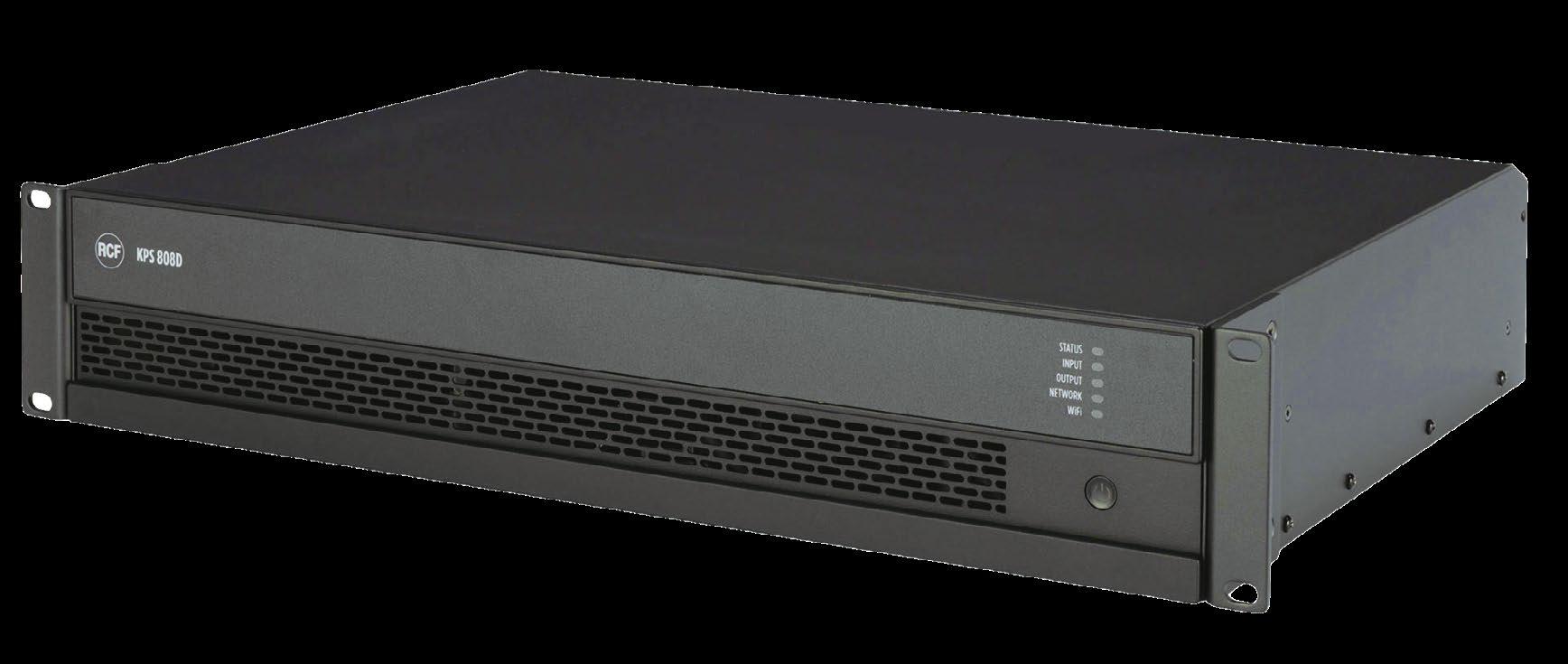
The Martin Audio iKON iK81 is designed for Martin Audio loudspeakers and it’s a dedicated controller amplifier for the WPM, O-Line, XE300, TORUS 8 and FlexPoint systems. This Class D amp handles large venues and acoustic spaces with 10kW spread across 8 channels at 1250W

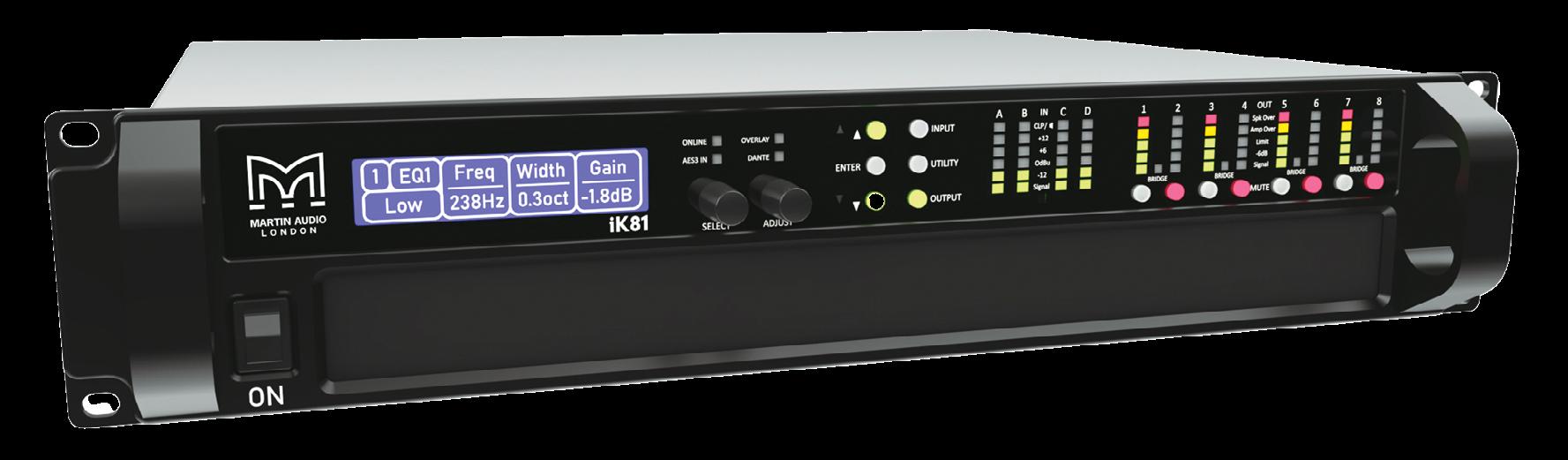

each. This 2RU unit can use power globally with 85V to 240V auto-sensing and it provides analog, AES3, and Dante (AES67 compatible) digital audio network inputs. Martin Audio VUNET software is used through an Ethernet port for system control and monitoring.
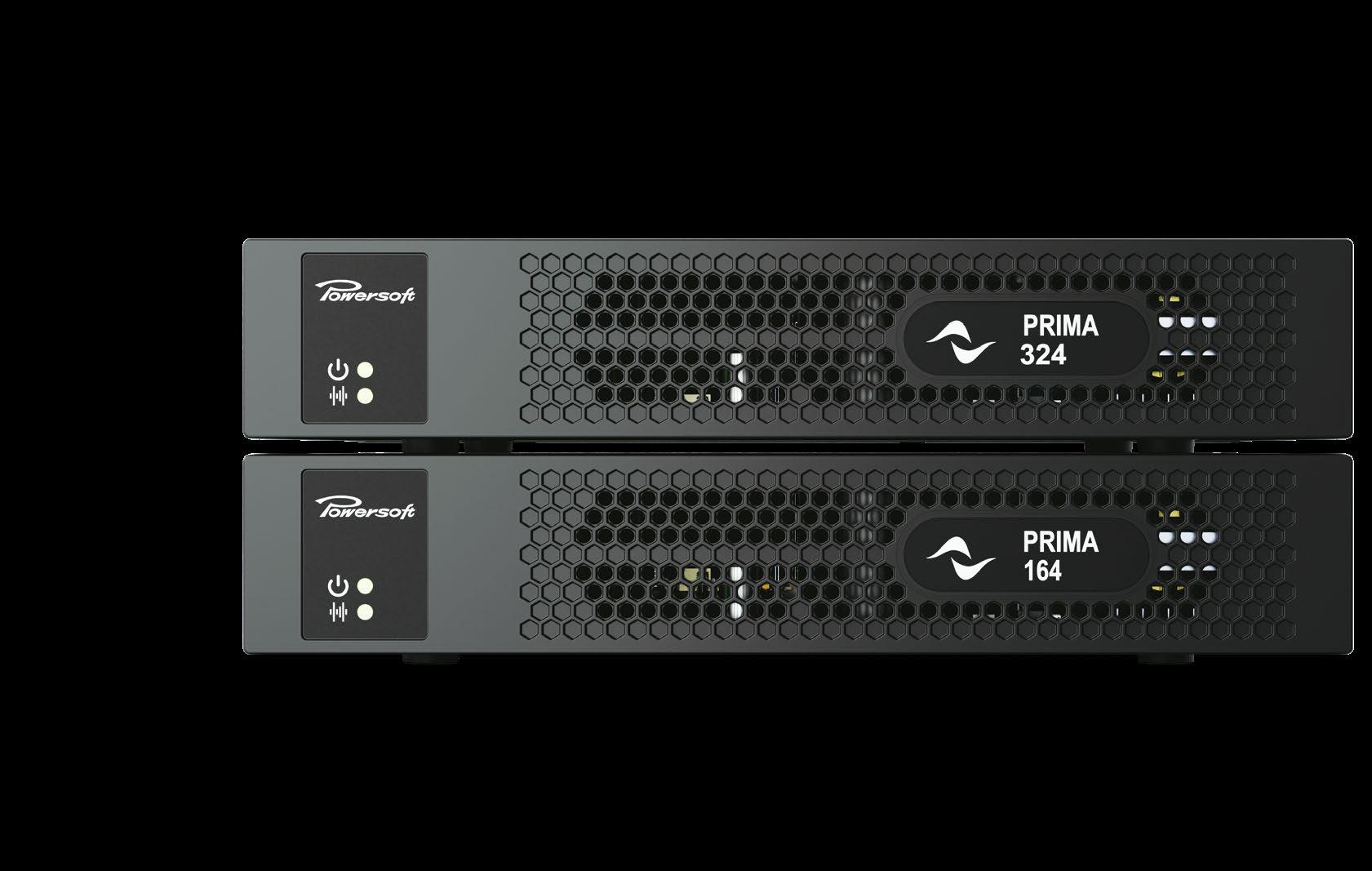
Debuting at InfoComm 2026 is the Powersoft PRIMA Series , a compact amplifier range designed for installed audio applications. The PRIMA Series provides low-to-midpower amplification for systems where DSP, routing, and control are already managed upstream. Available in two 4-channel models, including PRIMA 164 and PRIMA 324, the series is engineered for small-to-medium installed audio applications. It delivers up to 320 W of amplification in a compact half-rack form factor suited for space-constrained environments. The amplifiers support both Hi-Z and Lo-Z configurations with independently configurable output channels, allowing integrators to adapt the system to a wide range of loudspeaker layouts and commercial audio requirements. PRIMA also incorporates Powersoft’s power-sharing technology, enabling available power to be distributed efficiently across channels based on application needs.
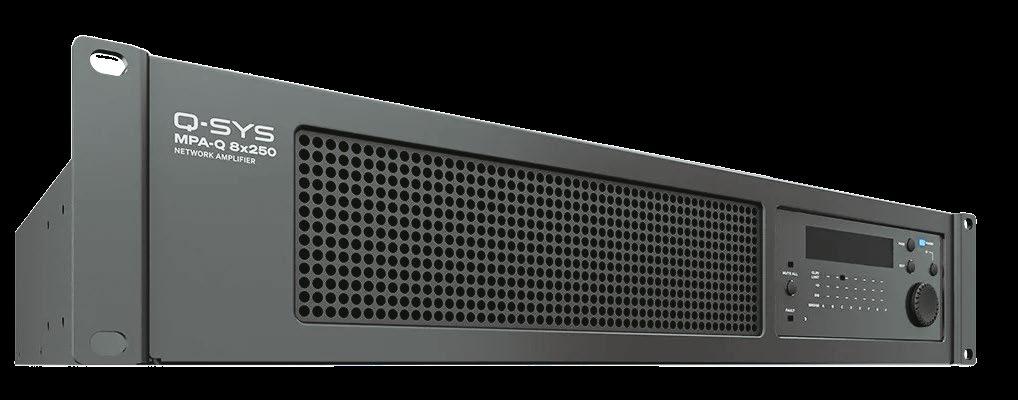
Another heavy duty 8-channel, two RU powerhouse is the QSC MPA-Q 8x250 and as the name implies, it can send 250W to each channel. Its eight line level audio inputs can be sent to direct outs or routed to Q-SYS while its two network ports allow redundant connectivity. If networked connections fail, the standalone mode switches to available analog inputs. PoE preserves settings on power loss and Low-Z/HighZ/70V/100V are available on all outputs. Interfacing includes Four GPI inputs and two NO/ NC output relays.
D 6400W power amp with integrated signal processing offers presets for quick setup and configuration. It also has an integrated a four-channel Audinate Dante AoIP network interface, wireless access point, wired Ethernet port, programmable output GPO, and constant voltage/LowZ system compatibility. DSP can be set up and configured through RCF’s RDSpace software. The Ethernet connection enables it to work in distributed systems with independent zone control.
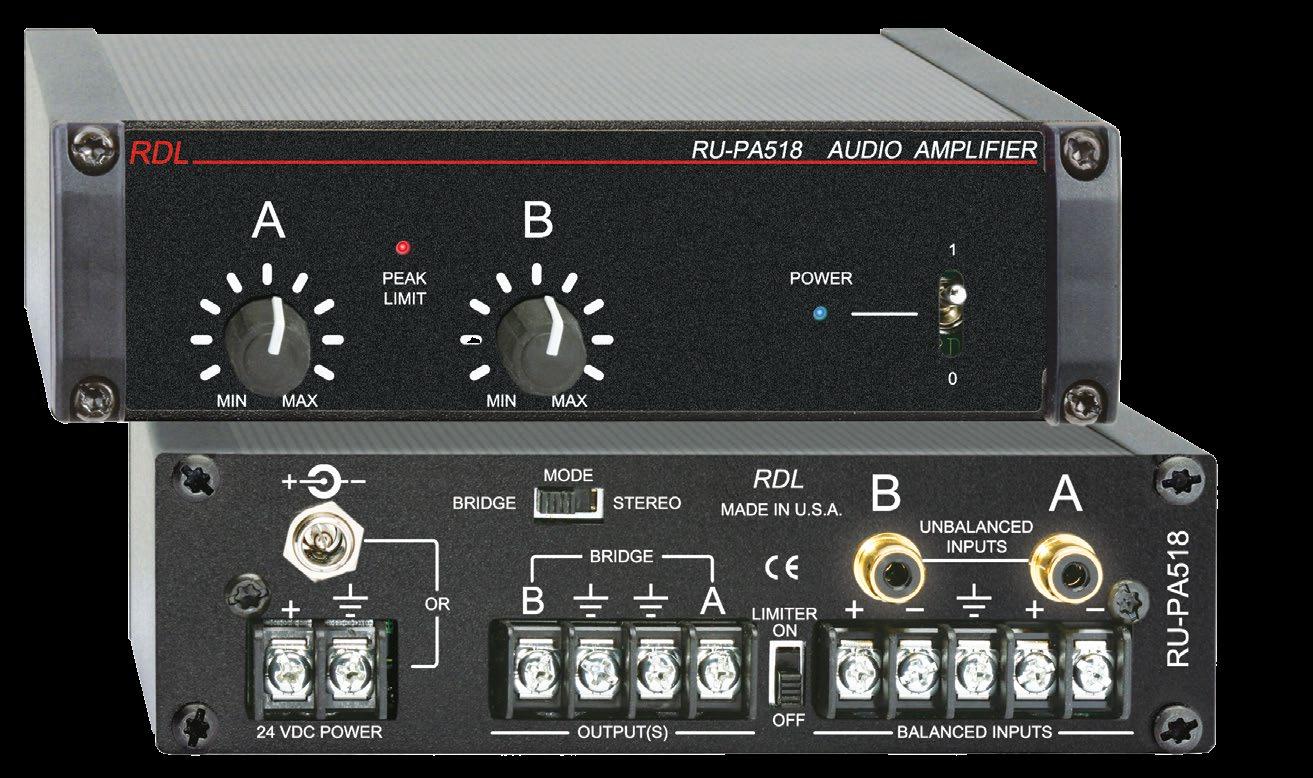
At the other end of the sound muscle spectrum is the RDL RU-PA518 mixer amp with A and B inputs sending 9W
stereo into 4 ohms or 18W mono into 8 ohms. It has RCA connections for unbalanced input connections and terminal strips for balanced hookup. The unit runs on a DC power adapter or on a 24VDC power terminal. The rear panel includes a stereo/bridge mode switch and a switchable limiter. The front has A/B input volume knobs along with an LED power indicator next to the power switch and a peak limit light.
A lot of extra wiring runs can be eliminated by mixer amps and the Speco Technologies PBM120A PA mixer amp adds IR remote control and an
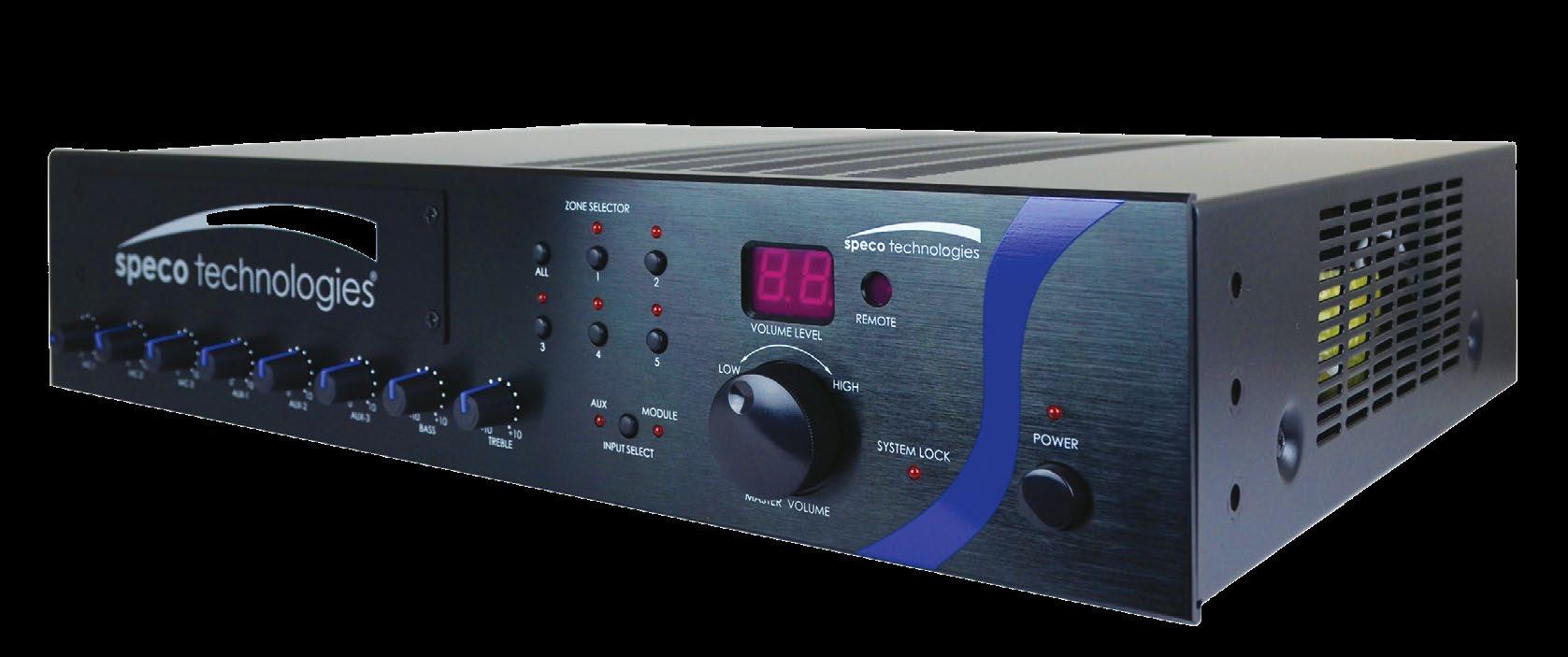
speakers or use its non-zoned 4/8/16 ohms output capability. There are individual channel input level controls, bass and treble knobs, and a master output gain control. A telephone paging input and music-on-hold output are also among this model’s features. Phantom power is available on all mic inputs.
High power stereo output into a 4-ohm load is the specialty of the Class D TOA Electronics DA-250D with 85% efficiency. The forced air cooling allows up to five units to be stacked with space between them and the design has an independent power supply for each channel. Selectable stereo or bridged operation can be used and there are removable dust filters along with comprehensive protection circuitry. The housing is black aluminum alumite.
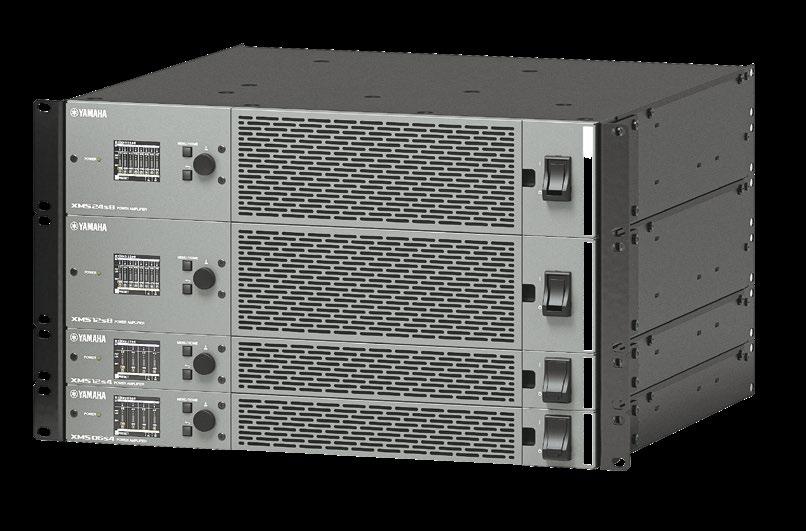
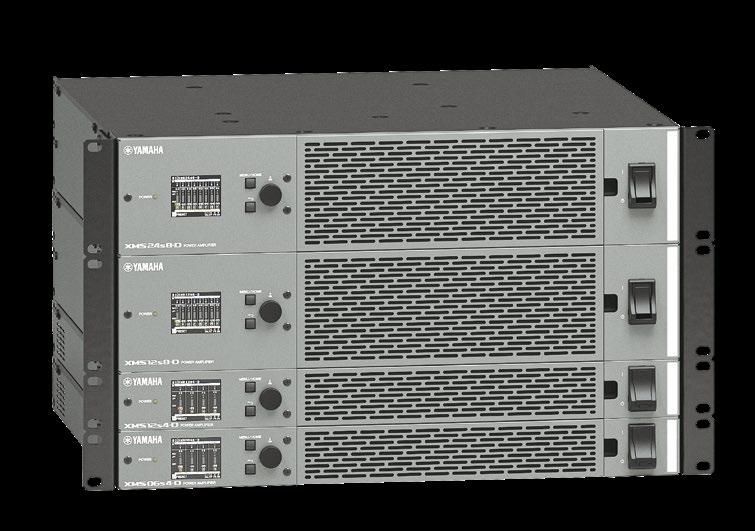
Making their debut at InfoComm 2026 is the Yamaha XMS Series of multi-channel amplifiers. Each unit allows power sharing across four channels in virtually any combination of output modes. The series features built-in DSP as well as matrix routing, making signal routing flexible. Eight model variations are available, including both analog and Dante options. Yamaha XMS amplifiers are available in both 4-channel and 8-channel configurations.


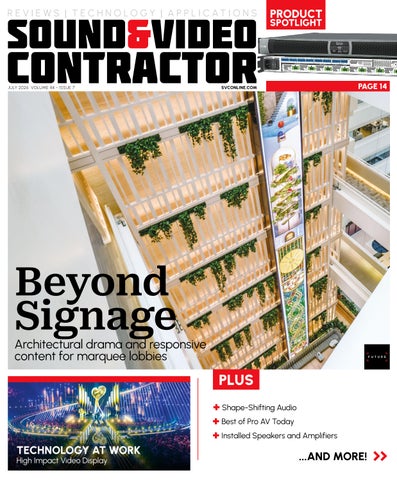
Architectural drama and responsive content for marquee lobbies
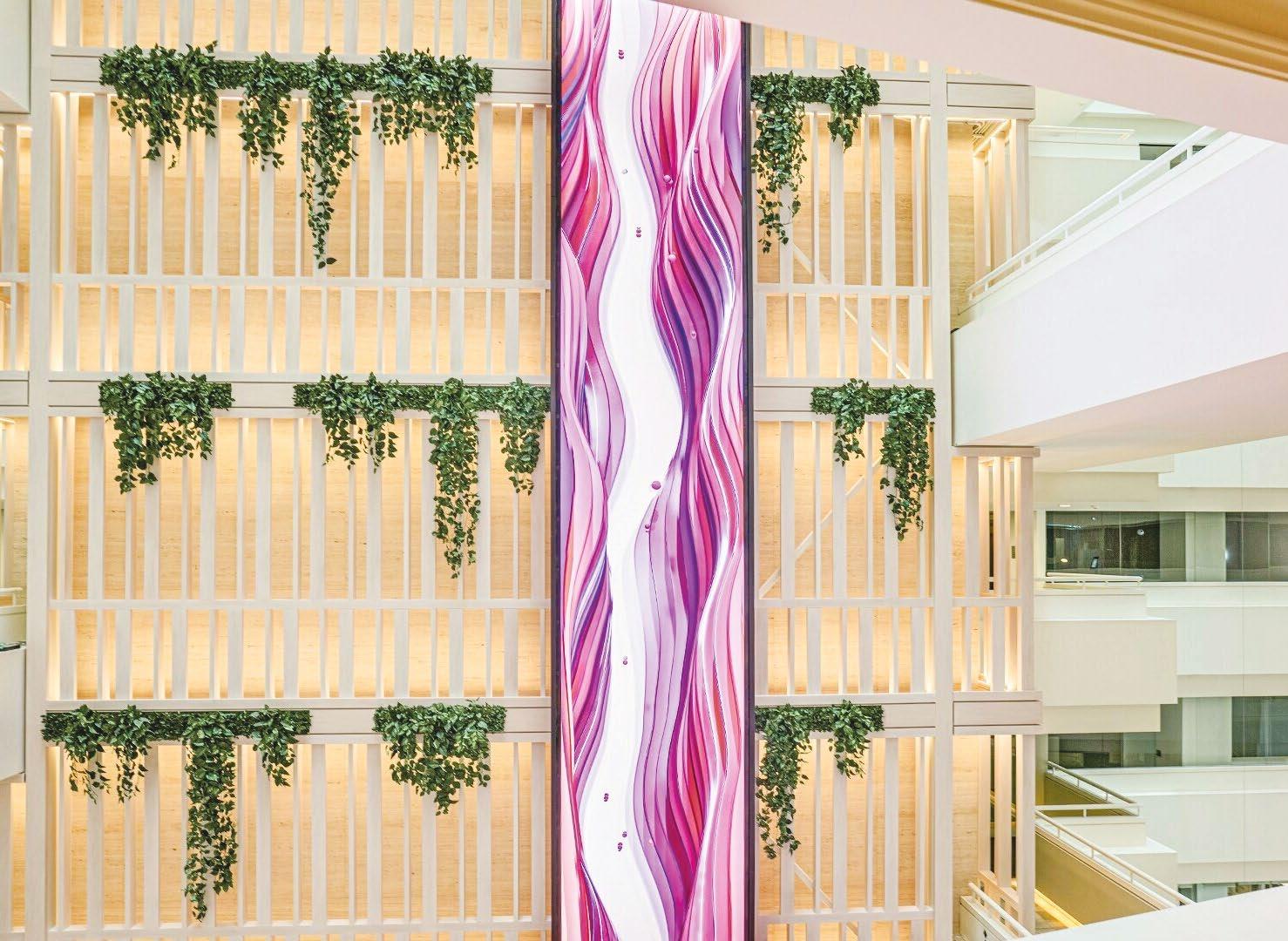
In the digital age, how should a public building announce itself? What should it contribute to the shared space? Besides architecture, practical infrastructure, comfort, and ease of use, do office buildings need to tell stories or embody atmosphere? Does office art need to move, both literally, and emotionally?
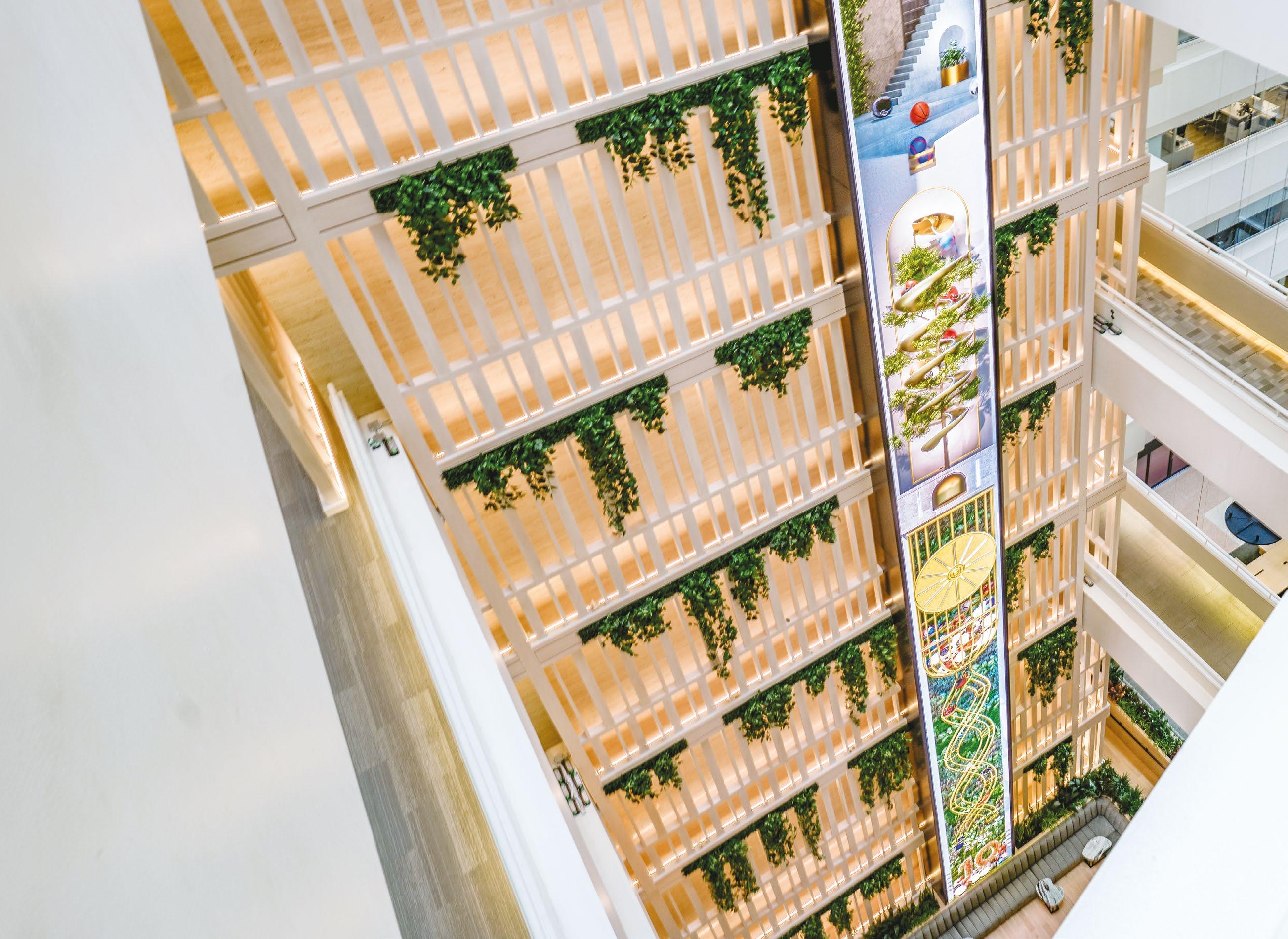
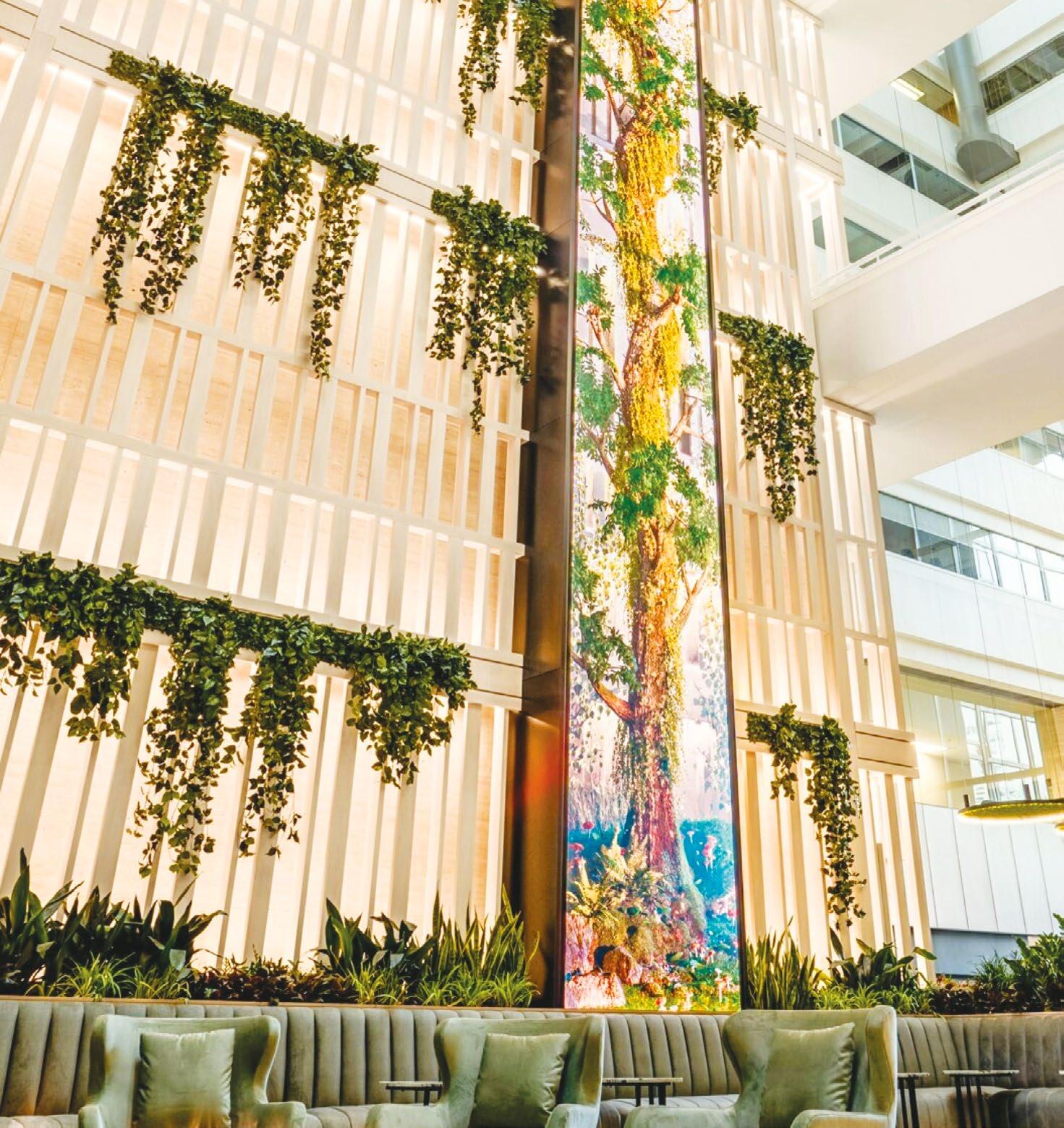
These questions were recently explored and expanded at scale in a remarkable digital signage installation in Toronto’s Berczy Square. The project not only tested the limits of physical scale, but scaled the concept of real-time responsive content, treating custom content, live data, and architecture as a single system, floor to ceiling.
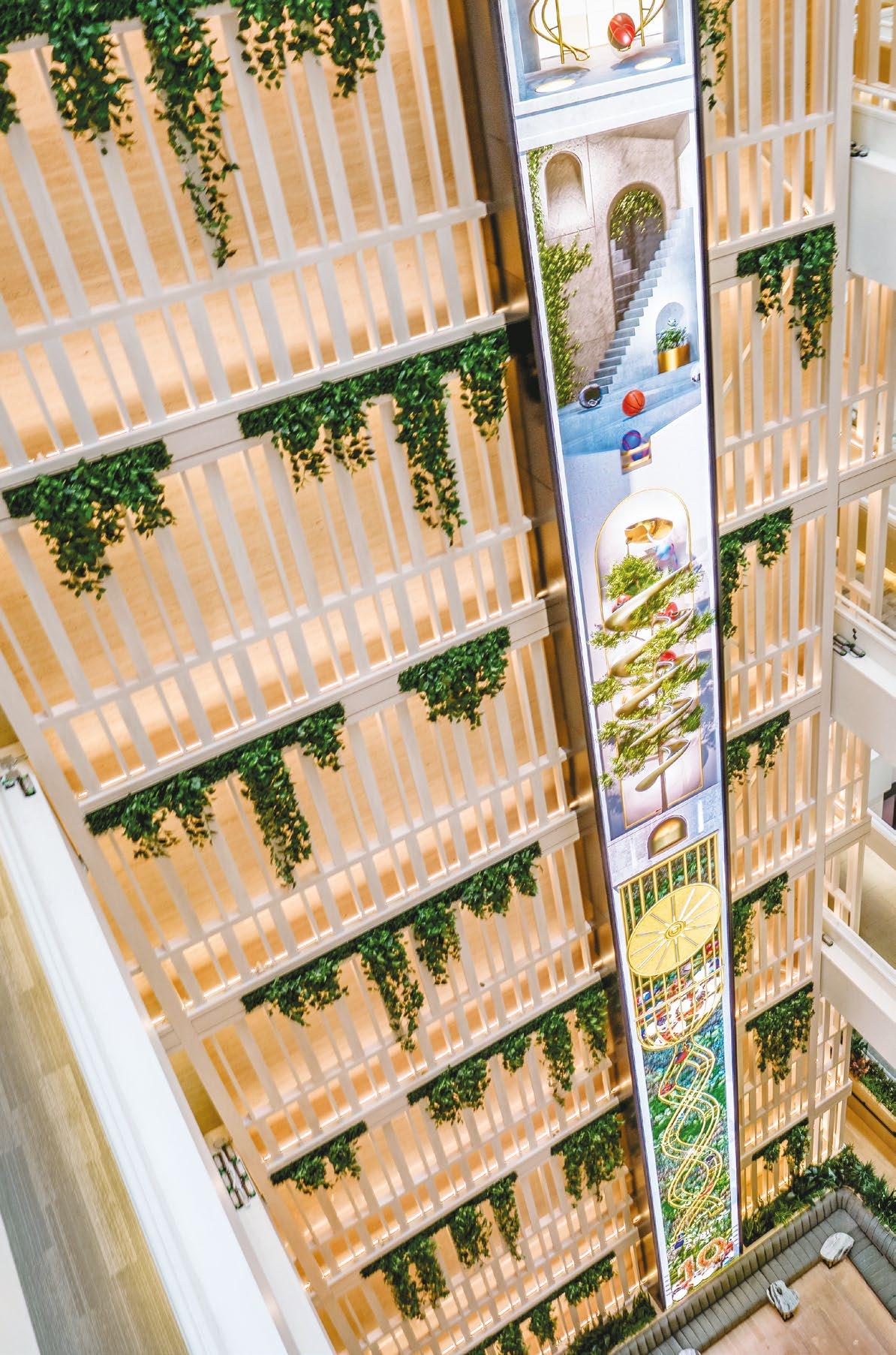
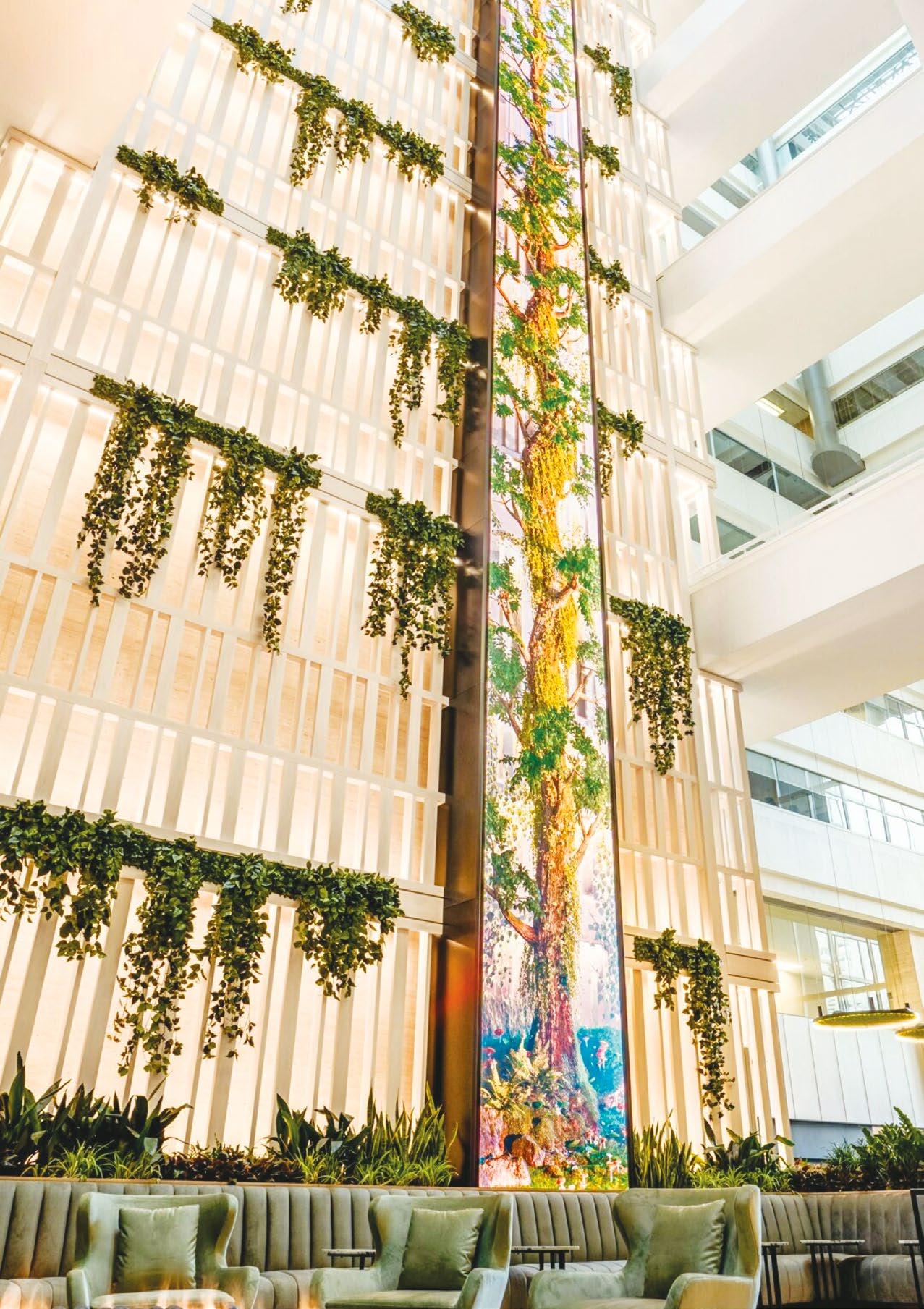
At Berczy Square (33 Yonge Street), GWL Realty Advisors has unveiled a reimagined lobby centered around a 90-foot vertical LED screen that runs nine stories of the 13-story building’s landmark atrium architecture. Six feet wide and fully integrated into
the space, the screen displays data-driven content that evolves continuously in response to real-time data, including time of day, weather, seasonal shifts, and local sports schedule. The result is a dynamic environment that never repeats but constantly adapts.
“Berczy Square has the only atrium-style lobby in Toronto’s Financial District that’s open to the public, and we knew we wanted to feature it in our renovations,” says Devan Sloan, VP Asset Management and Leasing at GWL Realty Advisors, the project’s developer. “The nine-story screen, paired with Gentilhomme’s stunning original artwork, encourages visitors to look up and admire this defining architectural feature. The artwork continuously evolves, responding to real-time elements like the weather.”
The content was conceived and produced by Montreal-based creative studio Gentilhomme,
known for large-scale immersive installations, including the Burj Khalifa, George Bush Intercontinental Airport, and Cirque du Soleil. The studio also worked with DTS Inc. and The Fury on the technical design of the installation.
Rather than relying on pre-rendered video or scheduled playlists, the installation operates as a living system. Its data-driven content is designed to evolve over time, designed to reward repeated exposure. The experience unfolds through four distinct capsules, each exploring time and transformation in its own way. Living Architecture grows a digital tree hour by hour across seasons; Surreal Hourglass tracks time through a cascading choreography of falling objects. Subtle shifts, unexpected moments and embedded “easter eggs” create a layered experience that becomes richer the more it is observed. The visuals are never fixed, continuously reshaped by incoming data.

Gentilhomme is an award-winning, Montreal-based multidisciplinary creative studio that specializes in immersive digital art, interactive environments, and live entertainment. Founded in 2013 by executive creative director Thibaut Duverneix, the studio blends artistic storytelling with advanced technology to transform public spaces and live events.
• Executive Creative Director: Thibaut Duverneix
• Executive Producer: Erich Fox
• Art Directors: Mathieu Léger, Katty Maurey
• Multimedia Director: Sebastien Joly
• Producer: Samuel Gauvreau Des Aulniers
What makes the project architecturally significant is how it is embedded into the building itself. Designed by Alison McNeil of DIALOG, the structure surrounding the installation was developed to anchor the screen within the atrium while preserving key elements of the original architecture, including its Travertine wall. The result is a vertical axis around which the space is organized, as embedded in the building. It influences circulation, attention and behavior, transforming the lobby from a place of transit into a place of presence.
For McNeil, this moment represents a broader transformation in the way people work–one rooted in designing meaningful destinations that give inhabitants a sense of purpose, culture, and adaptability.
“We approached the screen as an architectural element rather than a display surface,” says Thibaut Duverneix, Founder and Executive Creative Director of Gentilhomme. “The goal was to create something that lives with the building, a form of atmospheric content that reveals itself over time.
“Our goal was to design content that earns attention over time, not content that demands it. Subtle enough to live with the architecture, rich enough to keep revealing itself. A living system that integrates into the space and unfolds gradually, encouraging people to slow down, look up… and come back.”
• Technical Director: Abhinav Dabas
• Programmers & Real-Time
3D Artists: Étienne GaronVincent, François de l’Isle
• 3D Artists: Miriam Diana Pelletier, Maxime Roux, Sebastien Joly
• Partners: GWL Realty Advisors; DIALOG; DTS Inc.; The Fury
The installation raises a broader question at the intersection of architecture, real estate and digital media: when does digital signage stop being signage and start becoming architecture?
At Berczy Square, the screen content does not function as wayfinding or advertising. It shapes how the space is experienced, influencing how people move, where they pause, and what draws their attention upward.
Developed for a daily, recurring audience, the content is designed to avoid repetition and visual fatigue. Instead, it unfolds gradually, rewarding repeated exposure and integrating into the rhythms of everyday use.
The building is currently 96% leased, offering a tangible indication that this approach resonates beyond aesthetics, supporting broader strategies around workplace experience.
As office environments continue to evolve, Berczy Square positions digital media as a core spatial component, one that is both experiential and performative.
One of the early classics in lobby installations debuted in 2015.
The iconic 106-foot long, 12’7” tall digital “waterfall” video wall in the Salesforce West lobby in San Francisco transformed a previously stark lobby space into a visual experience, immersing visitors in nature. Now 11 years later, SNA Displays has refreshed their iconic installation. Accounting for elevator cutouts, the upgraded display system processes approximately 16.4 million pixels across 1,106 square feet of digital canvas. The upgraded video wall boasts a crystal-clear resolution of 1,530 x 12,960 pixels, with 2.6 times the pixel density of the original 4mm LED display.
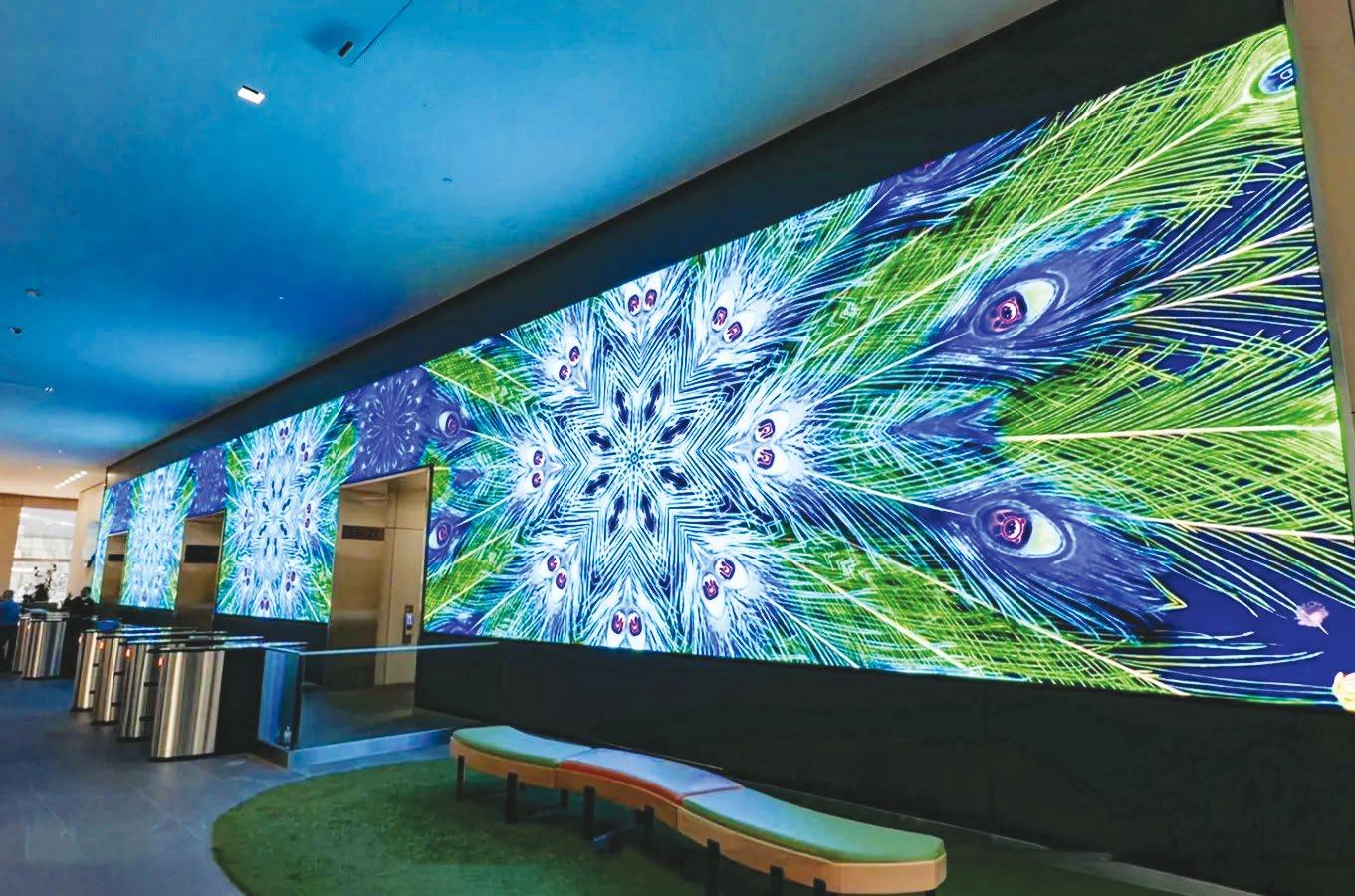
Rather than treating digital displays as signage, the cloud computing giant extends its brand beyond logos and messaging into immersive spatial storytelling for its offices throughout the world. The
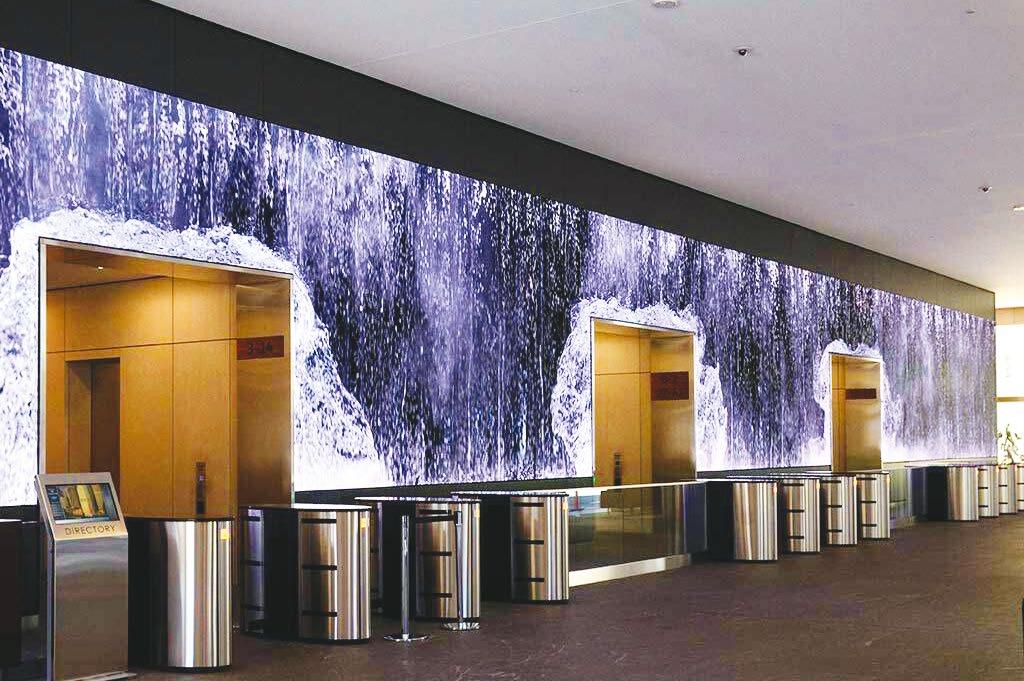
result is a cohesive, global brand experience that engages employees, partners, and visitors through dynamic LED video technology from the moment they enter the building.
The unified brand experience across Salesforce’s global office portfolio reflects the company’s innovative spirit and reinforces its Trailhead philosophy of growth, exploration, and continuous learning. By integrating curated art, architectural scale, and cutting-edge display technology, Salesforce has created a workplace that physically embodies its aspirations: bold, optimistic, and future-driven.
Designed by the architect firm Gensler, the digital centerpiece employs “video as architecture,” using light, motion, and environmental content to embody Salesforce’s forward-thinking ethos and its belief in the intersection of technology, creativity, and nature. One of the most critical elements of the retrofit was properly positioning the screen technology around the elevator entrances. This allows the digital wall to become an important part of the physical lobby architecture without being intrusive.













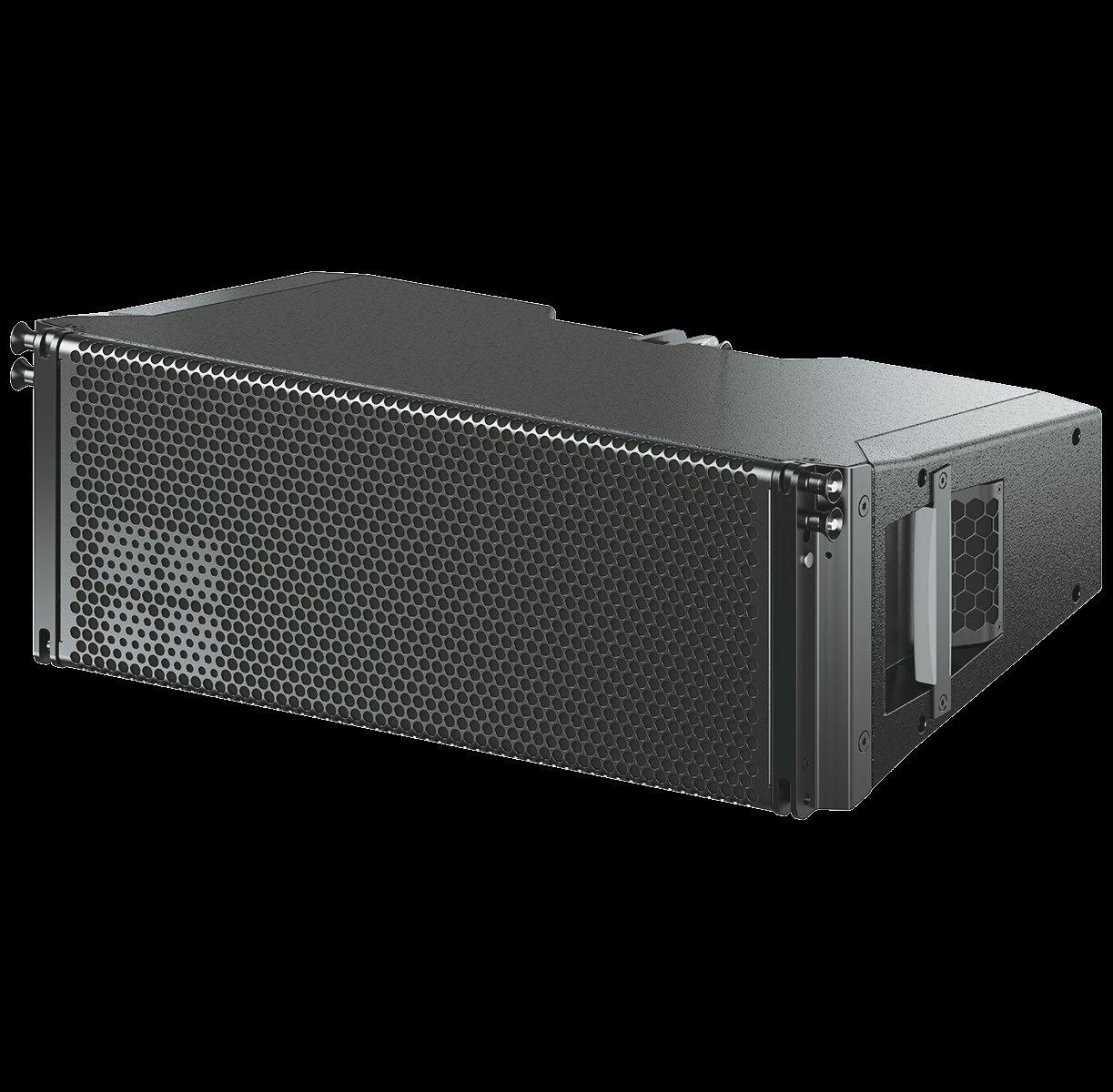
Last year saw the introduction of the d&b audiotechnik CL Series. This system combines the cardioid directivity technology of d&b’s SL Series with a compact, passive design, delivering broadband directivity control with low-frequency cardioid behavior via single-channel amplifier operation. It has a unique driver configuration: two 7” front-firing drivers, two 5” side/rear drivers, and two newly designed 1.75” high-frequency transducers. Together, they deliver headroom, low-frequency control, and acoustic clarity. The CL System provides versatility, with mobile and installation versions (CCL and CCLi), plus 80° and 120° dispersion models to suit various setups. It also pairs with the CCL-SUB, a flyable subwoofer that extends bandwidth and reduces port noise
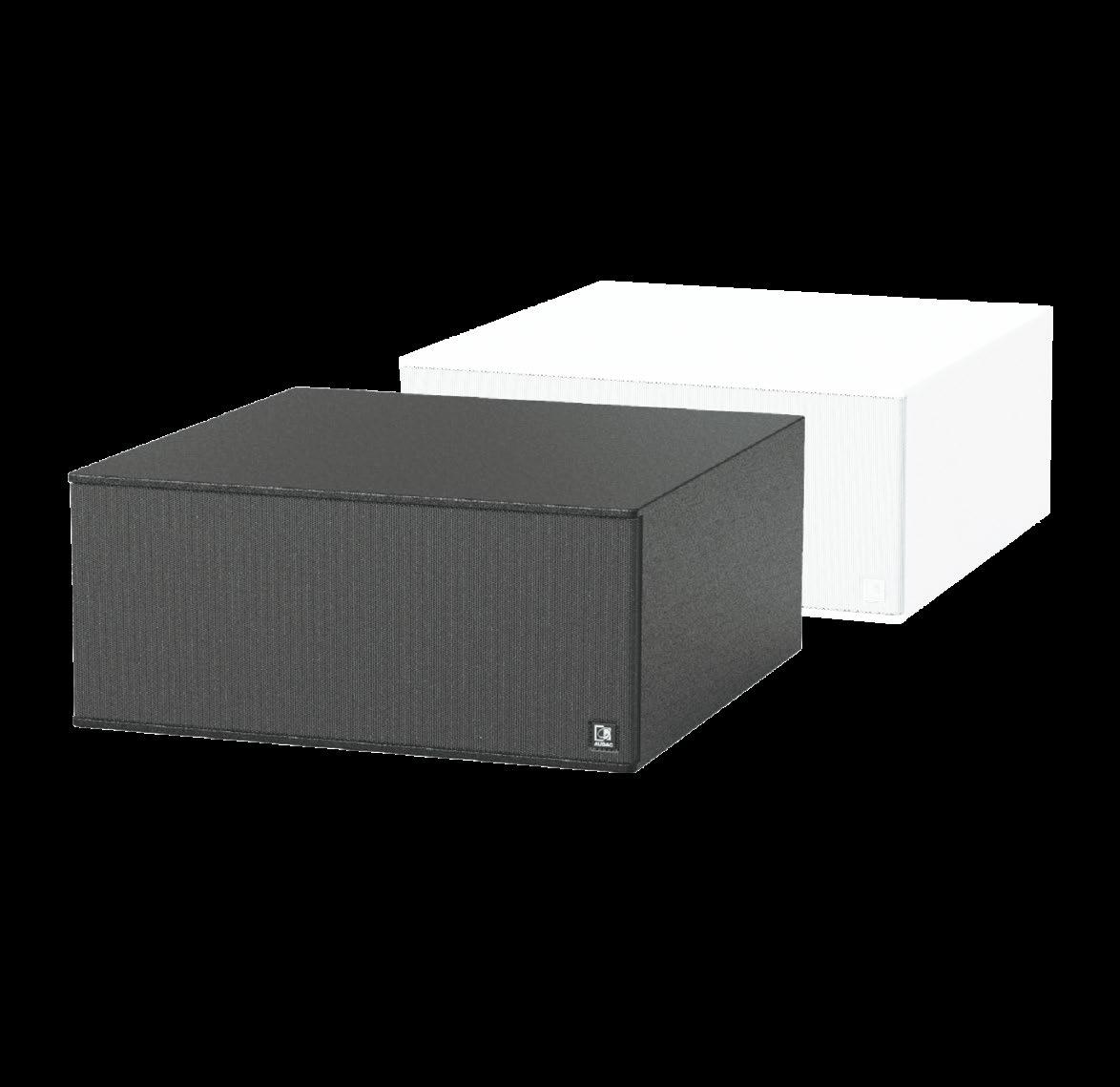
ARCHI210, and ARCHI10X models, the series combines custom-engineered high-excursion drivers for low-frequency performance with multiple rigging points for flexible ceiling and wall mounting options. The three models in the series run the gamut from 450 Watt up to 900 Watts of power. The ARCHI Series also marks the debut of AUDAC’s AcoustiMesh, the company’s acoustic-neutral 3D fabric AUDAC claims provides optimal sound transparency and durability.
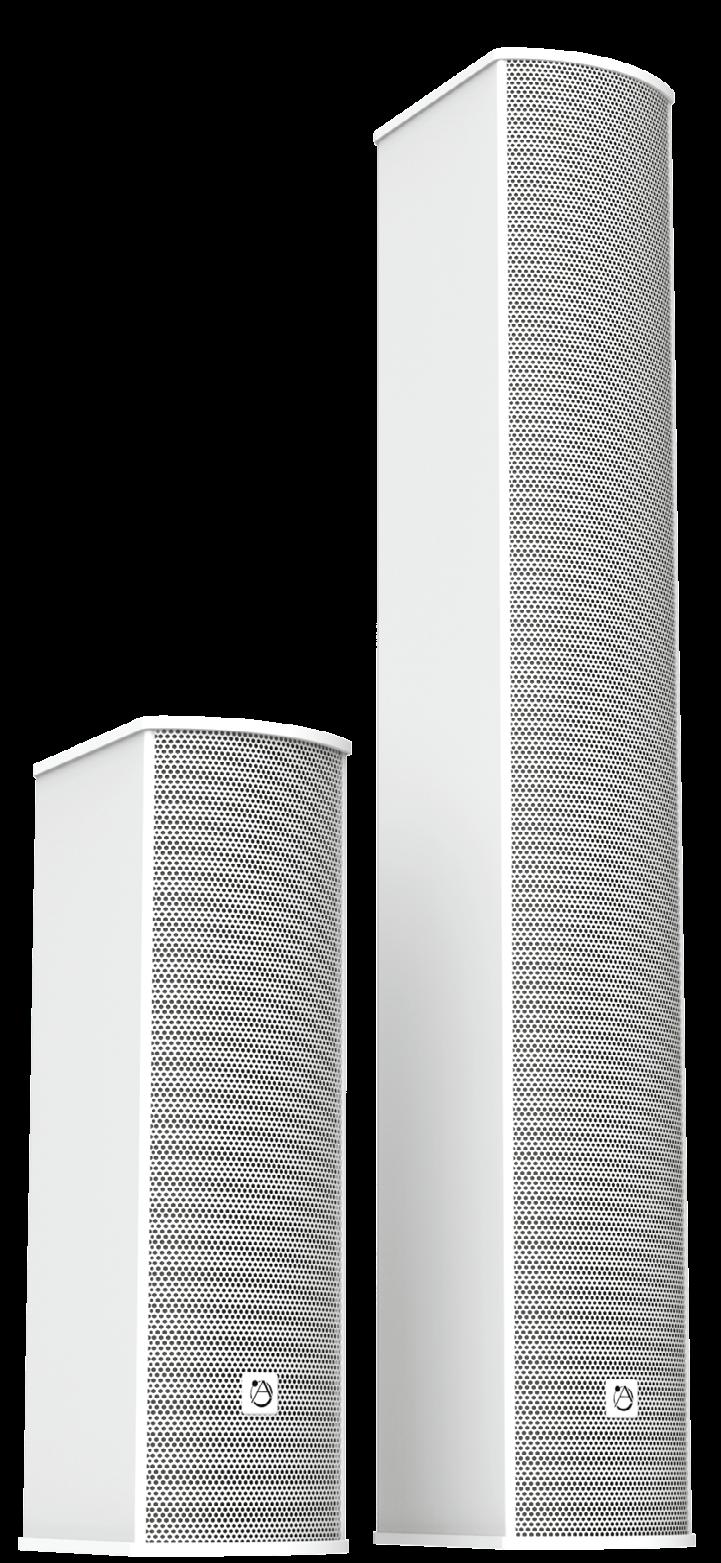
precise control over the directionality of sound is essential. The series is crafted to maintain performance and reliability for long hours of use in large, open venues with poor acoustics, including those with reflective surfaces such as glass, marble, and stone.
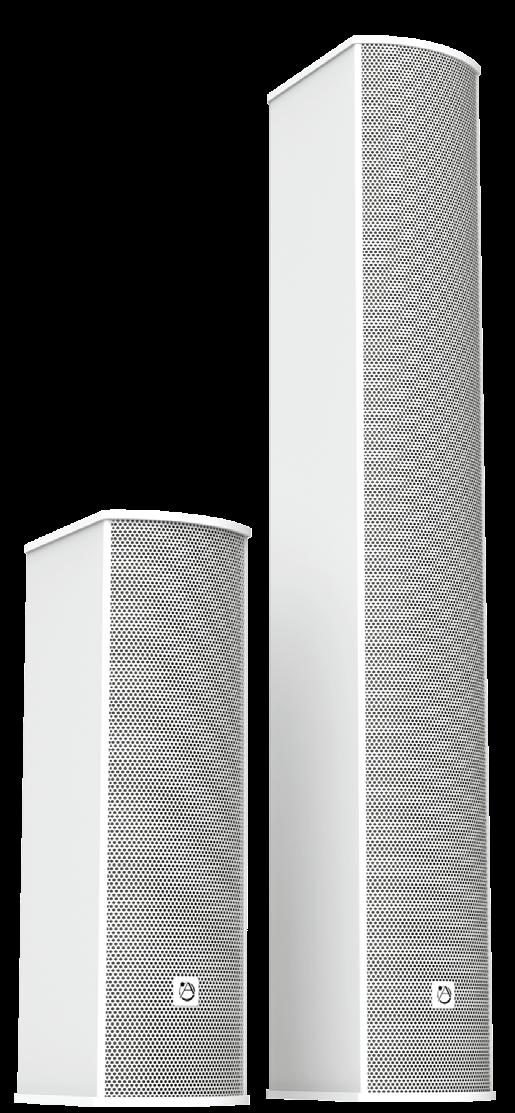
The first two Aimline speakers include the Aimline ALXD and ALXP, which include enhanced grille design and feature updated drivers. The digitally steerable ALXD column array loudspeaker with Dante includes built-in amplifiers and signal processing; the seven-model lineup is ideal for applications requiring precise control over sound direction. The ALXD comprises seven models and sizes, and each is named based on the number of transducers, including the ALXD 4, 8, 24, 32, 40, and 48 models. With Dante built-in, venues can manage the ALXDs and other Dante-
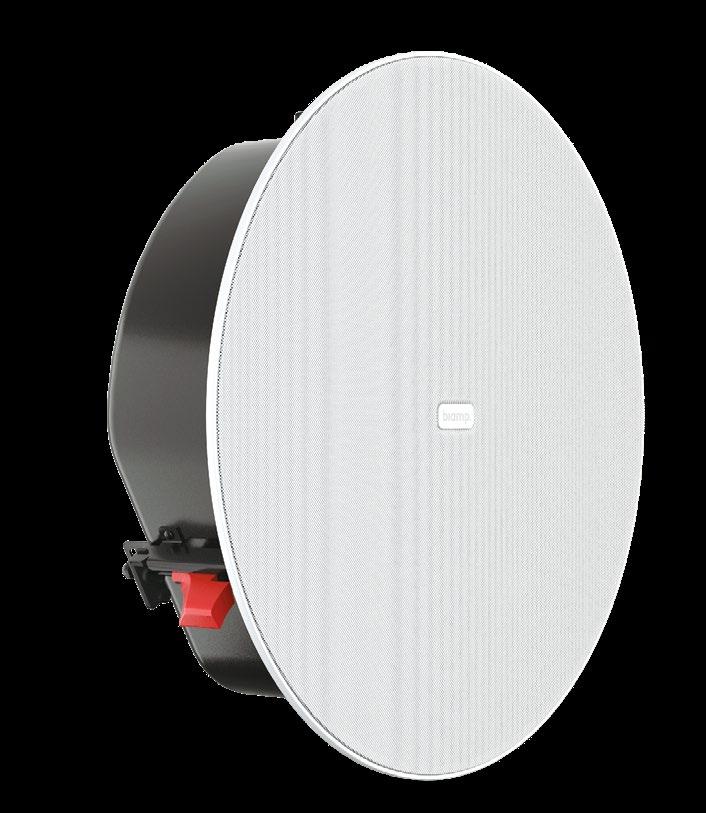
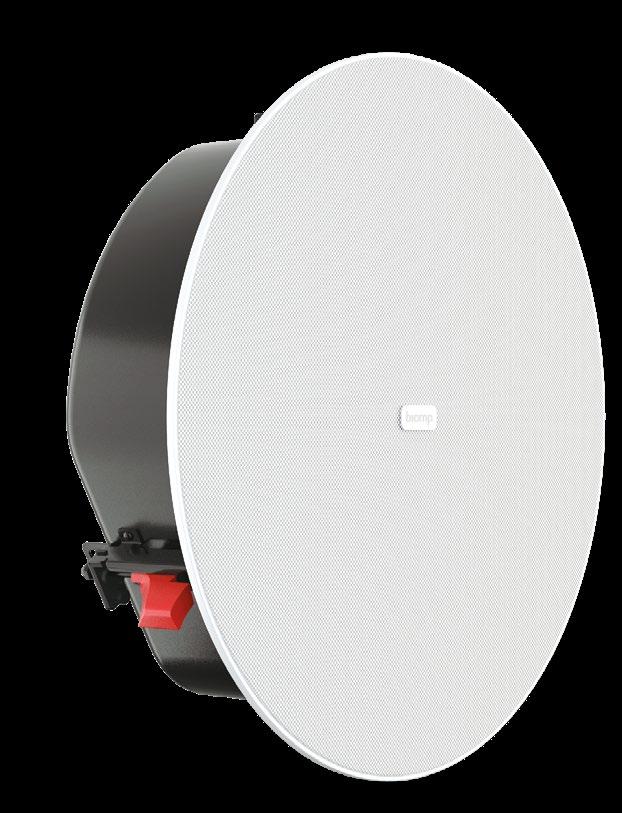
The Biamp Desono C-IC6LP and DX-IC6LP low profile, high-efficiency ceiling-mount loudspeakers debuted for conference rooms, and a range of affordable commercial loudspeakers compatible with the Vocia line of voice communication solutions, all of which are now available globally. The Desono C-IC6LP and DX-IC6LP offer the shallowest, low-profile ceiling loudspeaker form factors on the market with just a 4” (10 cm) mounting depth. Optimized for speech reproduction in conferencing environments, the C-IC6LP is a two-way 6.5” (16.5 cm) passive coaxial loudspeaker with either standard category cable or traditional speaker cable installation connection. The C-IC6 includes RJ45 jacks (for connection to the Biamp AMP-450BP) and is lowimpedance only (no transformer). The DXIC6LP includes a switchable 60W transformer and low-z tap and omits the RJ45 jacks. Biamp also introduced the Biamp DC220T, a 2’ x 2’ (61 cm x 61 cm) lay-in tile ceiling
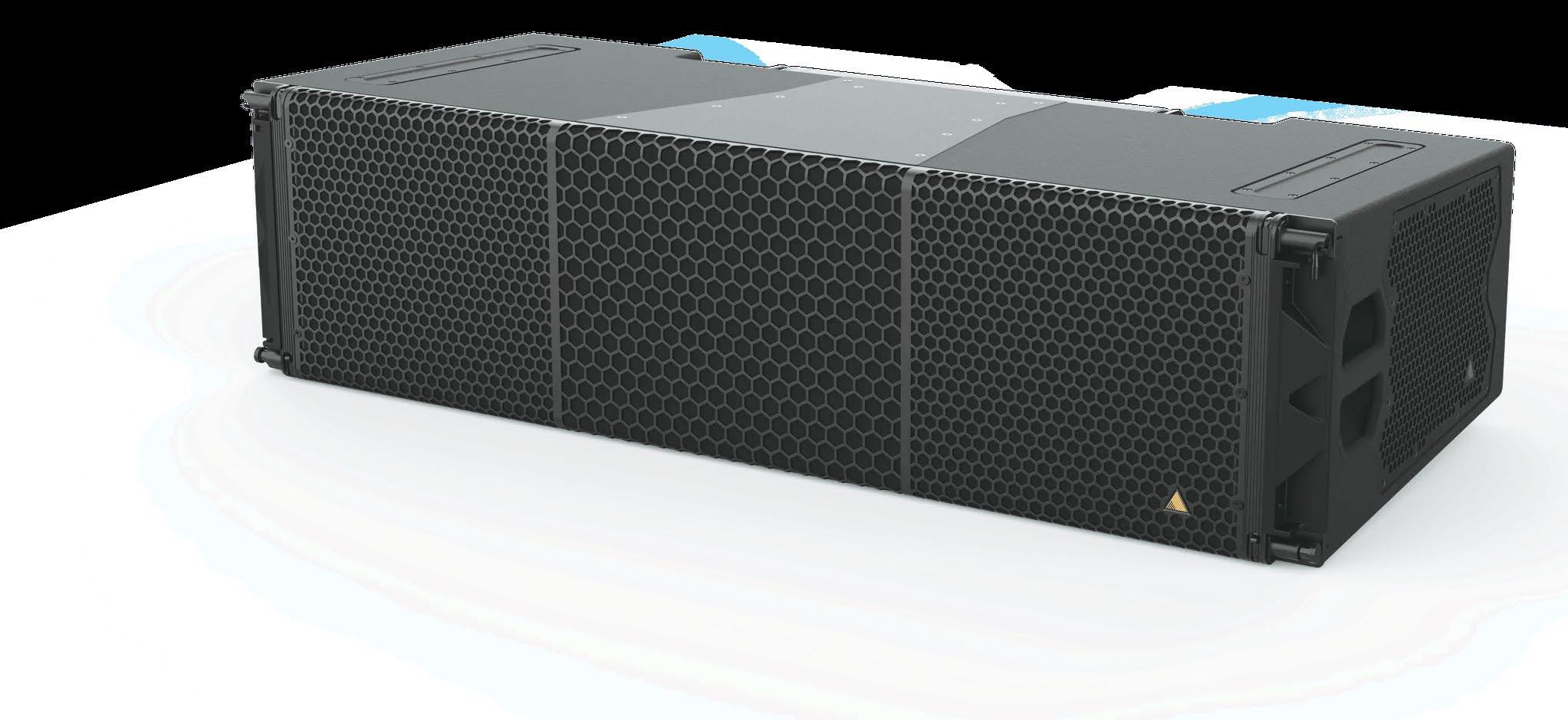
The Adamson VGt is a large-format line array loudspeaker and the first member in the company’s Vergence Group. The VGt features 8 transducers, amplification, and a networked DSP, as well as patent-pending M140 MF compression drivers for handling the mid-frequency range. The low-frequency section contains both direct and directional components to achieve a multi-mode low frequency dispersion pattern. VGt is designed to provide uniform 90 degree horizontal coverage across its entire frequency range, while outputting an SPL with ultra-low distortion. Autolock rigging allows the system to be safely flown by a single engineer. VGt is equipped with custom made onboard Class-D amplification, as well as an intelligent networked DSP endpoint. All necessary connections can be daisy chained, including power, analog audio, and redundant network containing Milan digital audio and AES70 control data.
loudspeaker that provides wide coverage and higher output, ideal for high ceiling applications. The new Biamp CM10TB is a one-way 5.5” (14 cm) in-ceiling backcan loudspeaker that delivers clear audio for speech reinforcement applications.
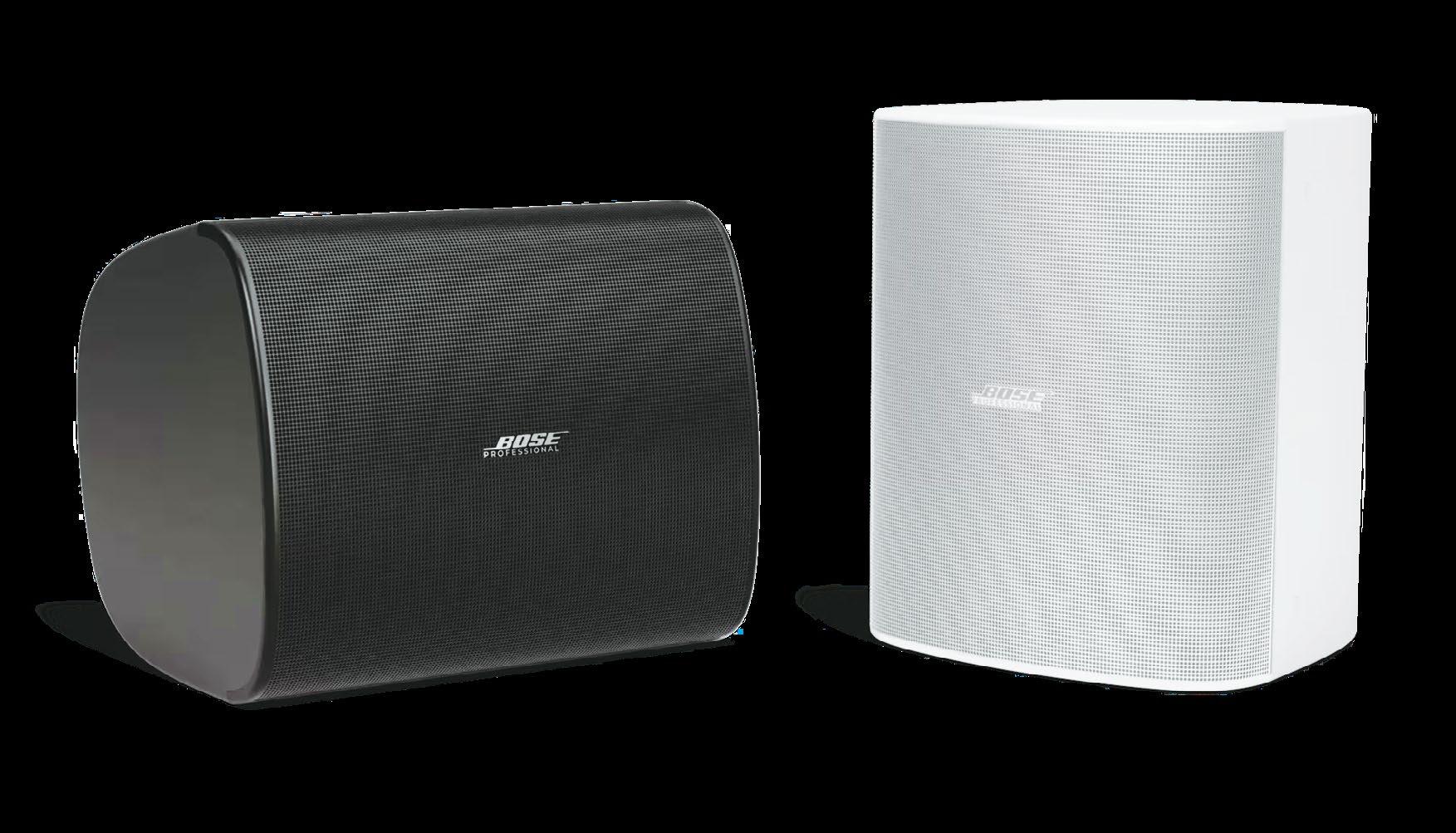
In March, the Bose Professional DesignMax DM12SE debuted. The largest member yet of the DesignMax family, the DM12SE is intended for use in performance spaces, retail stores, hospitality venues, and houses of worship. The DM12SE can be used indoors or outside as a high-output loudspeaker, and is designed to deliver room-filling bass and 102° conical coverage. The speaker centers around a weather-treated 12-inch coaxial transducer; the point-source design aligns the HF and LF drivers to provide phase alignment across the coverage area. Featuring an architectural design, the weatherized
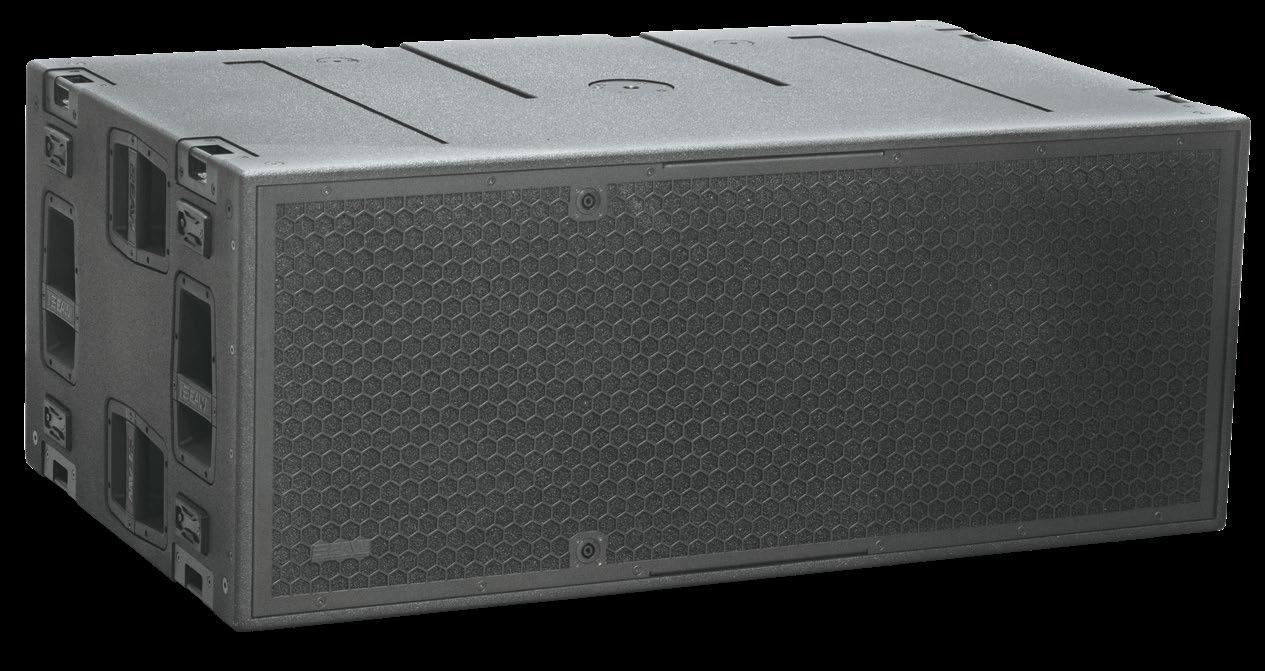
This 2×18” subwoofer is designed to support EAW’s KF Series systems and is engineered around a low turbulence port based on fluid dynamic research combined with a unique dual voice coil transducer design. It’s compact and designed for either horizontal or vertical installation. Sixteen M10 mounting points, weather protection, and color options allow for a myriad of permanent suspension options.
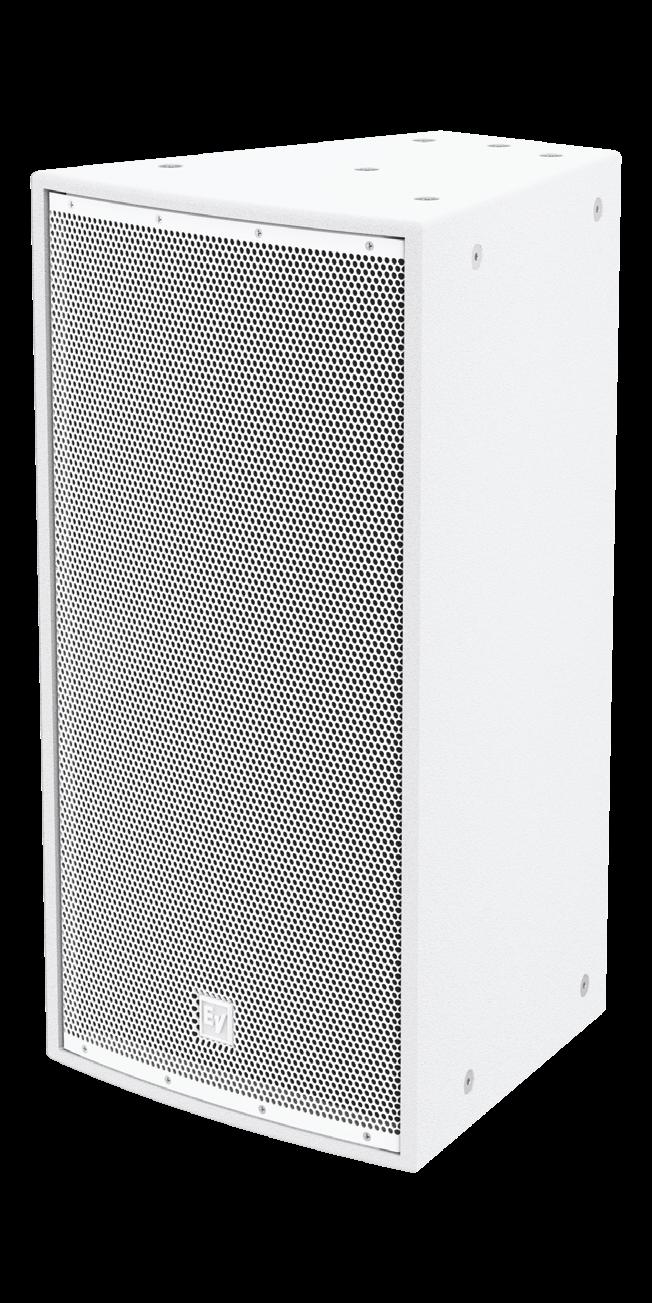
In February, the next generation of the Electro-Voice EVF and EVH point-source been redesigned from the ground up for installed sound applications. Each model features newly developed Electro-Voice transducers, including the next-generation ND2-EVO 2-inch compression driver, as well as model-specific DSCA low-frequency drivers. A new low-loss crossover forms the foundation for higher efficiency and more consistent performance across the entire frequency range. All models benefit from slightly lower tuning and increased woofer excursion capability, resulting in more usable full-range output and increased lowfrequency headroom. Both series are available in black or white, and are available in five coverage patterns. All models feature full-width internal metal bracing, and are fully front-serviceable for simplified maintenance.
January saw the debut of the Extron NF 4C LP the company’s first PoE speaker. This PoE-powered
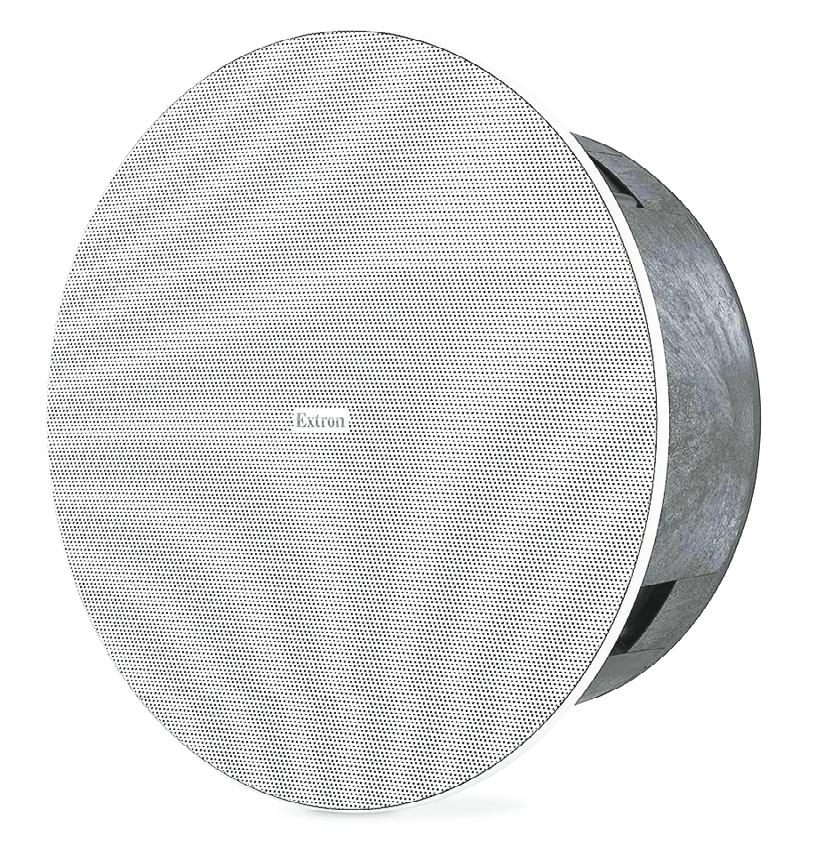
4” ceiling speaker system features scalable power, DSP, and Dante connectivity.
Powered via PoE and capable of driving up to three external passive speakers from its integrated four-channel amplifier, the NF 4C LP is a single cable solution for individual zones within larger distributed ceiling speaker systems. Using Extron’s DSP Configurator Pro software, the integrated DSP can be set up independently for each amplifier channel with essential processing per zone. Dante Domain Manager and AES67 support ensure wide compatibility with enterprise configurations and other network audio devices. Available in packages of two, three, or four speakers, the NF 4C LP meets the requirements of complex, decentralized systems with a self-contained PoE-powered speaker solution. The 4” (102 mm) full-range driver features a frequency range of 110 Hz to 20 kHz and is engineered with a practical 135° conical dispersion. In voice lift applications, the NF 4C LP provides excellent coverage and voice clarity.
The Holosonics Audio Spotlight AS24i offers the strongest output and deepest lowfrequency response of the company’s highly directional models. It is designed to compete with noisier environments or areas requiring more coverage, making it great for museums, trade shows, supermarkets, outdoor applications, and many retail environments. It easily replaces standard 2x2ft. ceiling tile with no additional hardware. It includes a built-in microSD player, and balanced and unbalanced audio inputs are standard. Bluetooth and motion sensor options are available, and it has a standard VESA100 mounting pattern

Active Digital Beam Shaping Column loudspeakers, now featuring Dante networked audio support. The 13 newly introduced arrays serve as the next-generation replacements for all previous models in the Intellivox DSX, DS, and HP-DS product families. At the heart of Intellivox is JBL’s Digital Directivity Synthesis (DDS) Beam Shaping technology for precise projection. Enclosures require no mechanical aiming, are available in custom colors, and can be recessed to blend into buildings. For integration flexibility, Intellivox supports Dante and analog audio inputs alongside IP control connectivity. Built-in redundancy and status monitoring ensure operation in mission-critical applications. The updated Intellivox loudspeakers provide intelligibility ideal for sound
houses of worship, parliaments, theatres, atriums, and museums.
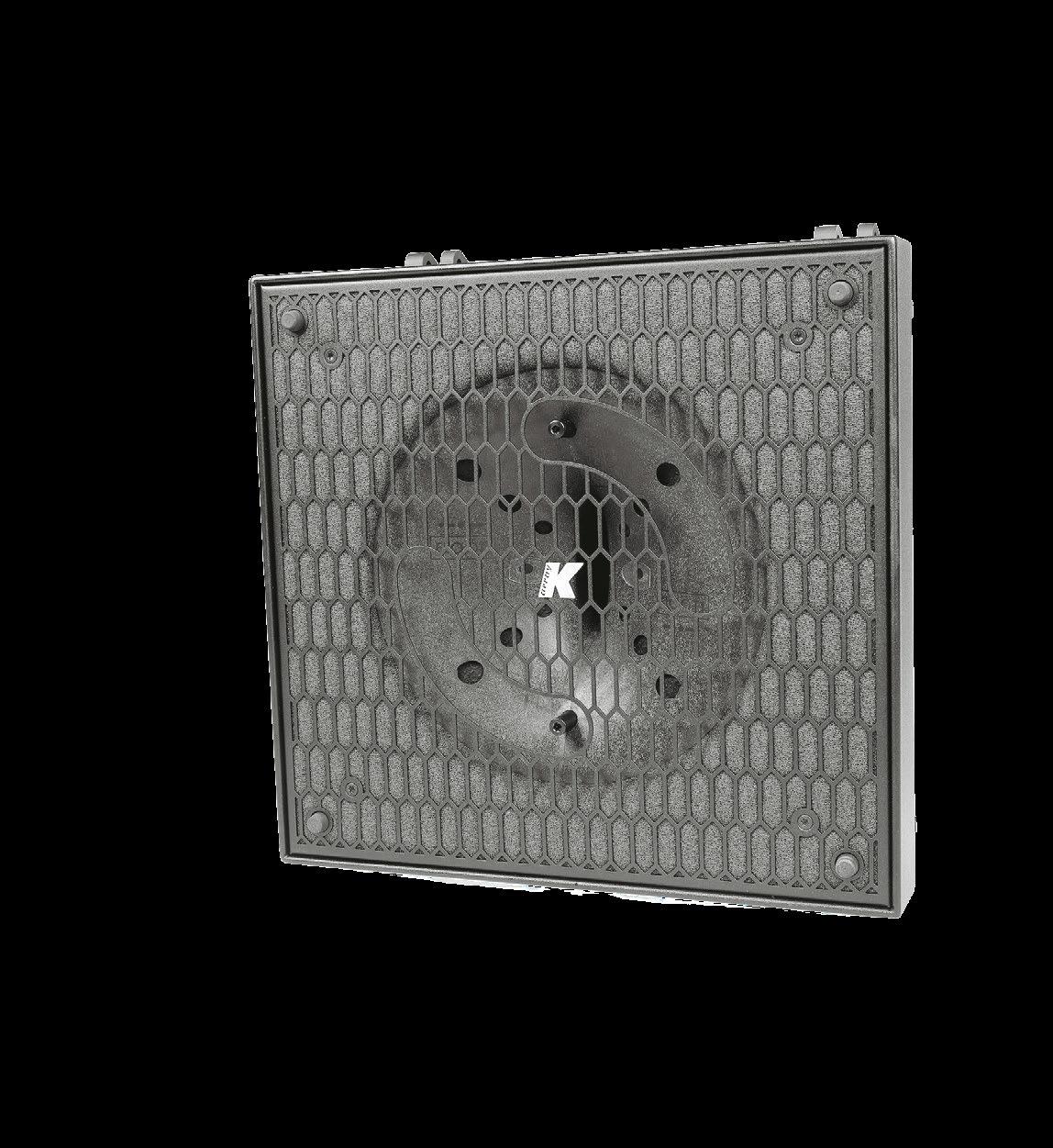
The K-array KX12 I and KXT18P loudspeakers, part of the company’s Dragon Series, debuted last year. The KX12 I and KXT18P loudspeakers add tri-axial technology and precision-engineered construction to the line, according to K-array. Designed to deliver high SPL levels, the Dragon Series is intended for nightclubs, sports venues and DJ monitoring setups. The speakers are available in 12” and 18” options, and feature passive radiators and a new metal construction.
The L-Acoustics Xi Series, an extension to the popular X Series of coaxial speakers featuring the X8i and X6i models is designed to meet the demands of every type of integration project that requires powerful sound in a discrete format that can blend into any room architecture. The Xi Series offers a range of installation-focused coaxial enclosures with distinct formats, bandwidth,
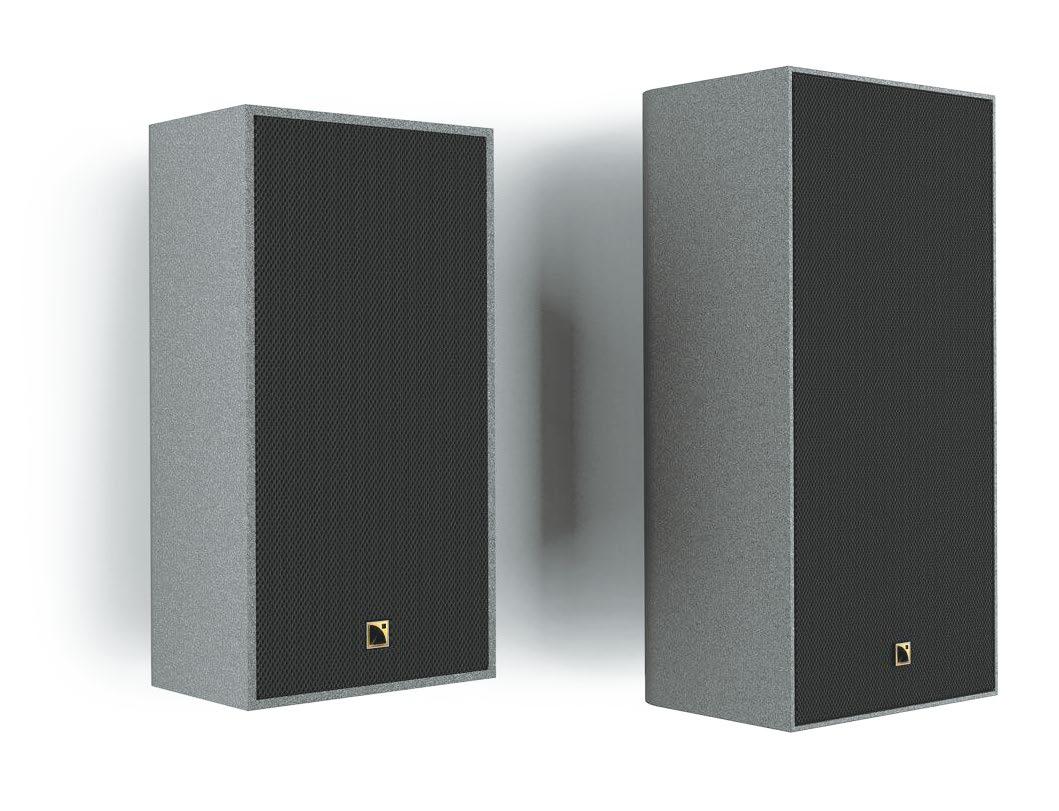
for short throw applications.
One of the key features of the Xi Series is its coaxial technology, which allows for a compact design and constant tonal balance over distance. This technology ensures smooth coverage for off-axis audiences, eliminates the need for a minimum listening distance, and provides high feedback rejection. With an exceptional bandwidth-to-size ratio, the Xi Series incorporates L-Vents to deliver clear low-frequency power and features a weather-
resistant IP55 rating, making it suitable for indoor
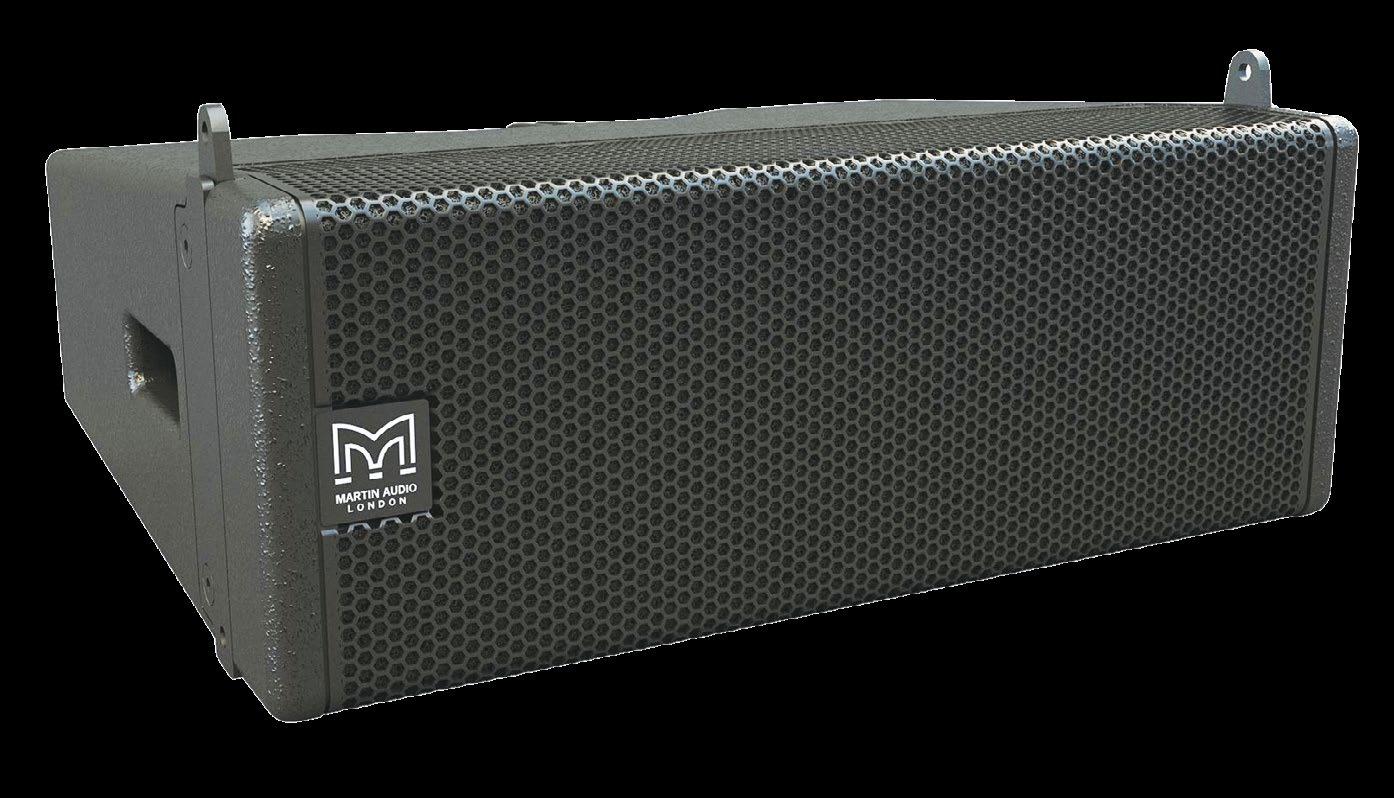
February saw a host of new upgrades come to the Martin Audio Wavefront Precision line array series. Each enclosure in the series now boasts an IP54 rating for protection against dust and splashes. Martin Audio says that new corrosionresistant coatings, enhanced resilience to high and low temperatures, improved humidity protection, and UV stability make the upgraded series tough enough for any extreme touring or installation environment. Furthermore, each enclosure on the circuit can now be easily identified through the new addition of an LED indicator within the grille that
can be illuminated via VU-NET control software. The Wavefront Precision series will also benefit from the Q2 launch of Martin Audio’s DISPLAY3 system design software, the engine of which is 27,000 times faster than its predecessor, the company claims.
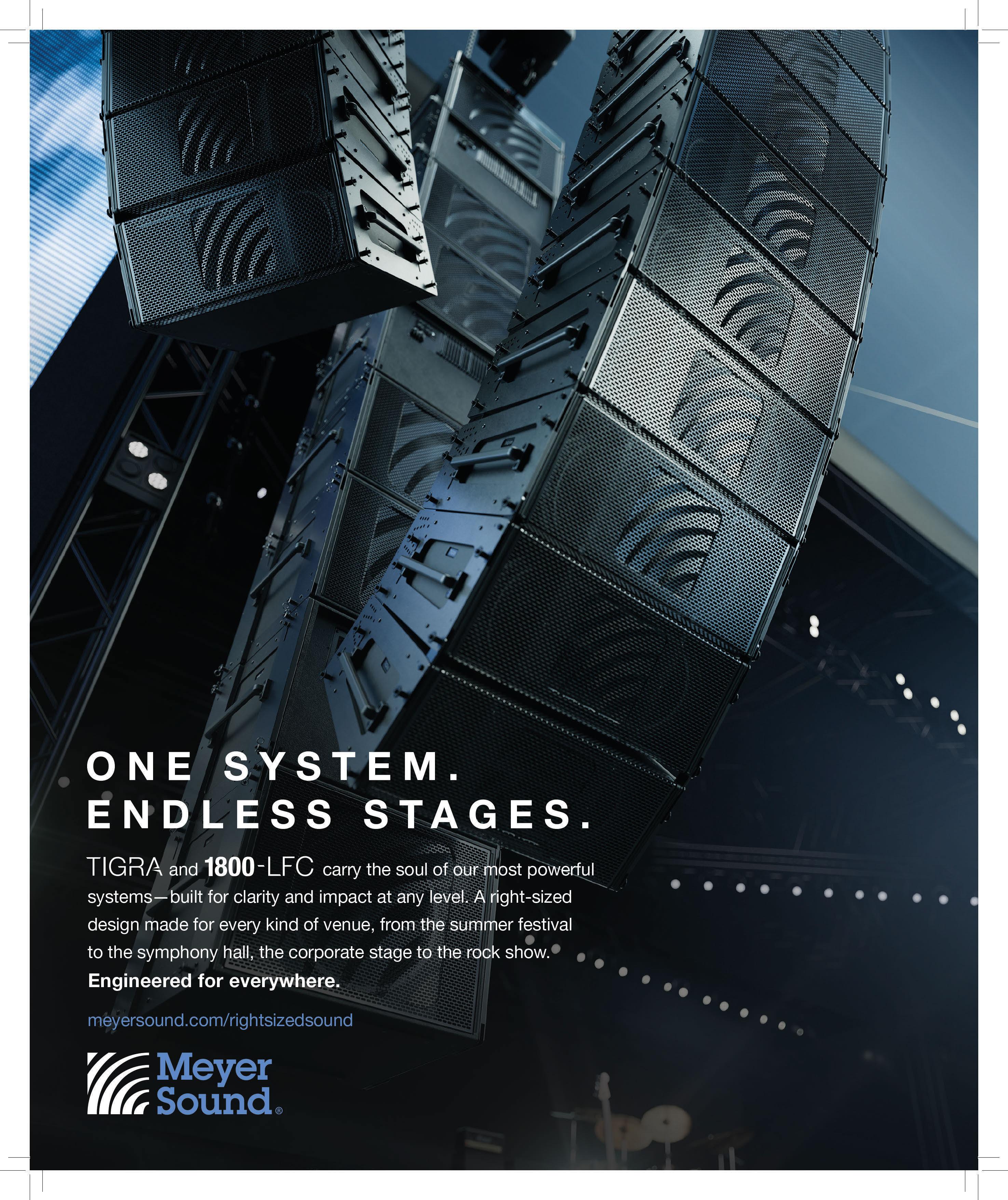
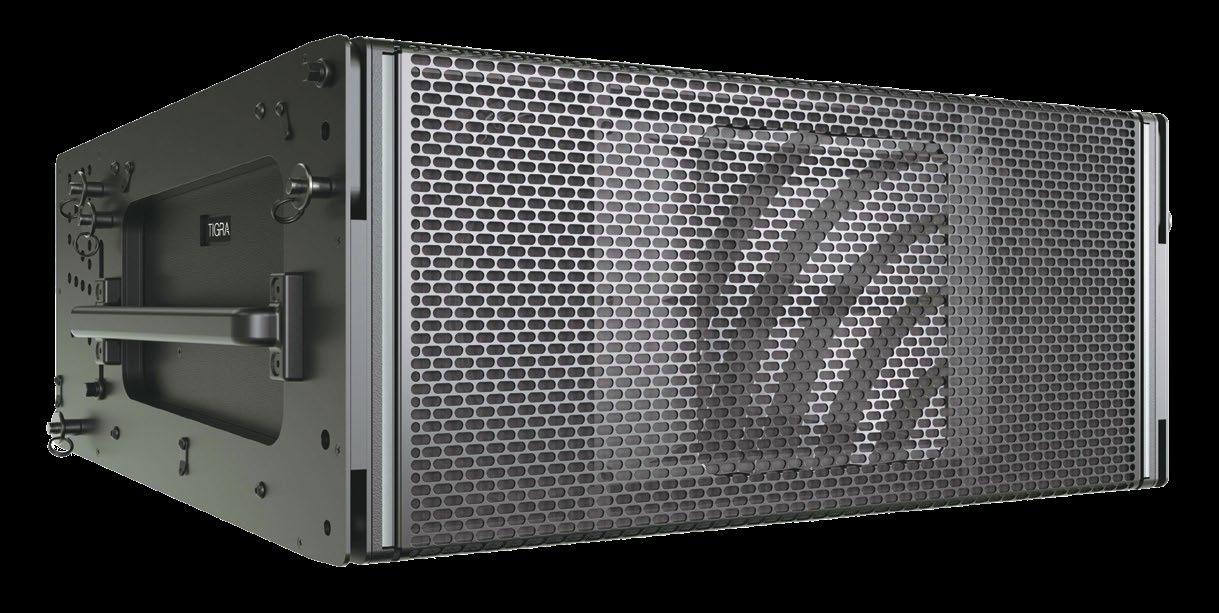
Also in March, the Meyer Sound TIGRA Line Array and 1800-LFC Subwoofer launched. The two offerings adapt certain elements of Meyer’s Panther touring technology, bringing them into a more compact form. Using smaller, lighter form factors designed for medium to large-scale system applications, the TIGRA Line Array and 1800-LFC Subwoofer are

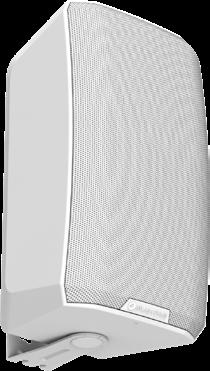
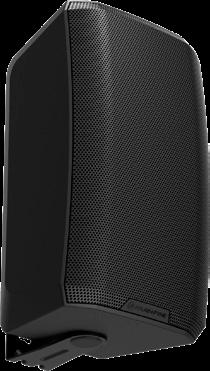
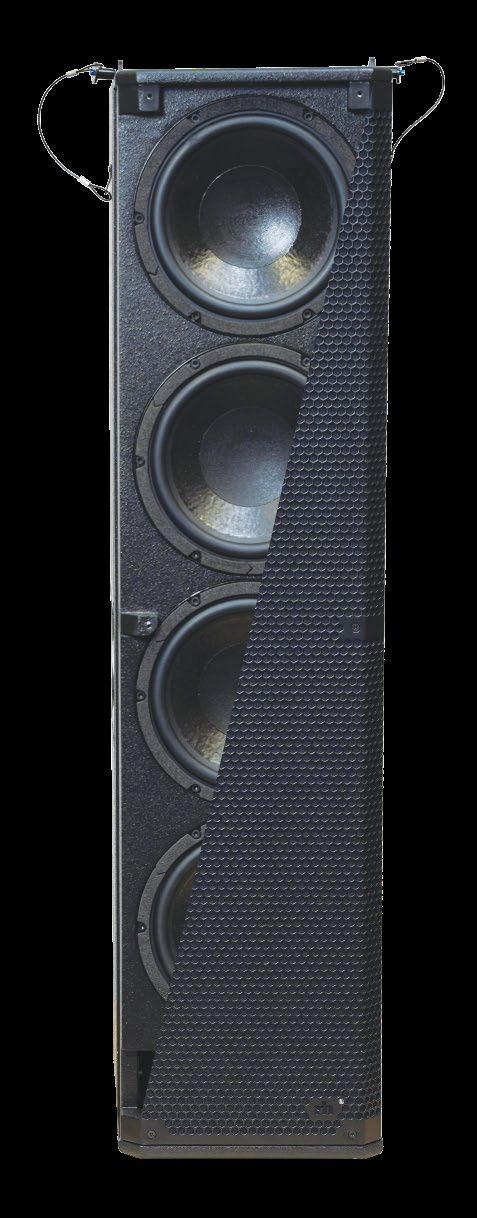
ISE 2026 marked the launch of the new Renkus-Heinz ICLX-48S column subwoofer. Expanding the flagship IC Live X Series, the ICLX-48S is designed to deliver a 123 dBZ maximum linear sound pressure level within an easilyhidden column form factor. The ICLX48S features a proprietary amplifier, 2000 watts of power, and sub-bass extension to 38 Hz. Intended to blend discreetly with the existing IC Live X array modules, the ICLX-48S can be flown or wall-mounted with ICLX arrays in a single, unified column.
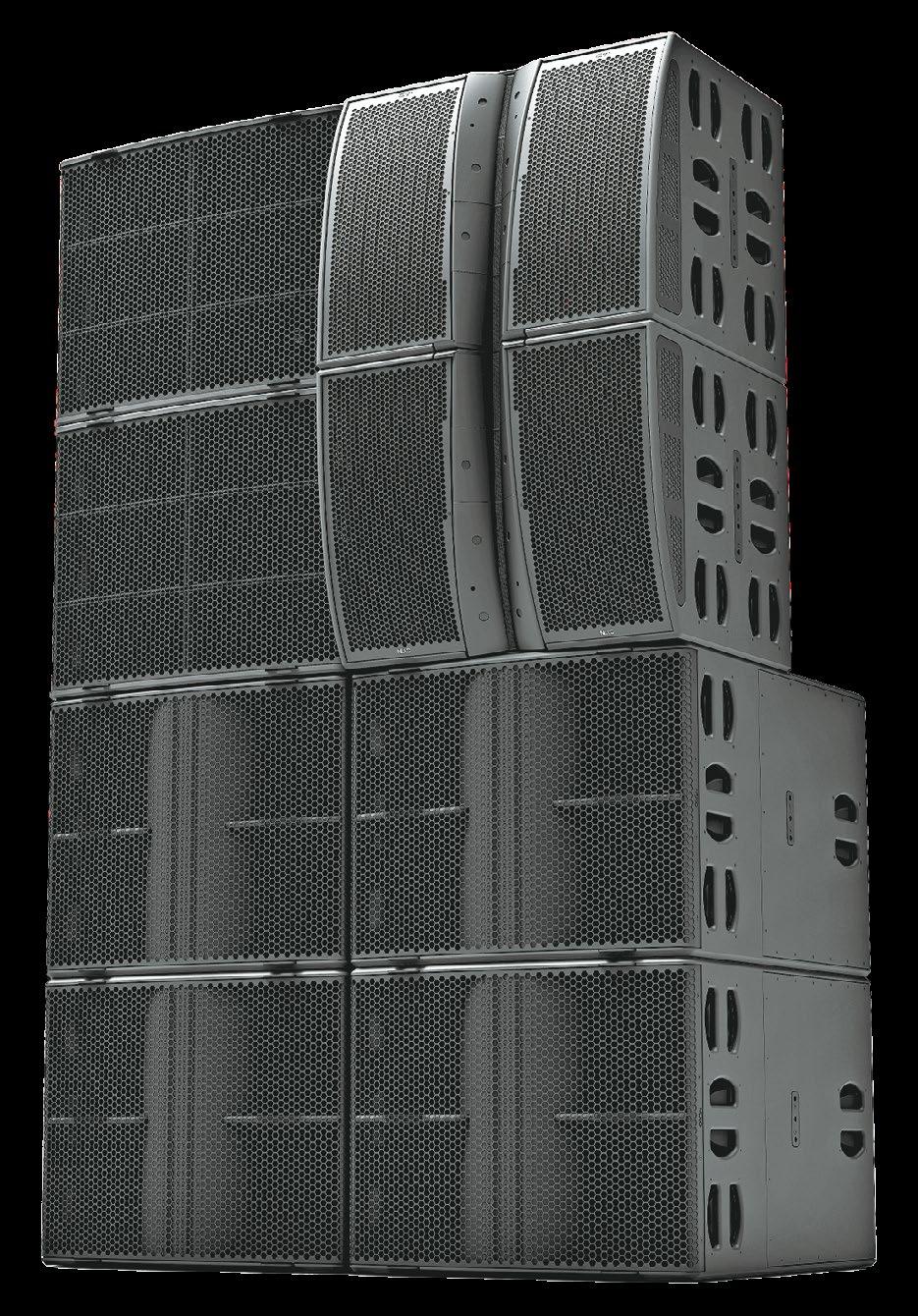
intended for use in performing arts centers, music venues, houses of worship and corporate environments. TIGRA-L produces 146 dB maximum SPL (140.5 dB AES75 maximum linear SPL) from a compact enclosure, achieving the same controlled cardioid low-frequency pattern found in the larger Panther line. Meanwhile, the 1800-LFC offers comparable response and dynamic range to the 2100-LFC but in a more compact footprint, with an operating range of 30 Hz to 125 Hz and a 134 dB AES75 maximum linear SPL. Both of the new offerings sport GEN-1 intelligent onboard signal processing and
NEXO Alpha +
The NEXO Alpha + is a hybrid source sound reinforcement system that draws on the spirit of its Alpha forerunner while applying new technologies for a range of settings from live music and clubs to theatres and other venues. Alpha + is a stackable three-box system comprising M210 Main, B218 Bass and L20 Sub-bass modules. The M210 is a horn-loaded 2 x 10” with 4 x 3” HF compression drivers, the B218 a hornloaded 2 x 18” and the L20 a band-pass 1 x 20” taken from the existing P+ Series range. With a comprehensive range of hardware available, stacked and installed systems of various sizes can be configured with Main and Bass modules typically used together in a ratio of 1:1. The continuously varying horizontal directivity from 60° at the top of the M210 Main Module to 120° at the bottom can be modified to 90°/120° or 60°/60° using flanges, and the waveguide block can be ‘unlocked’ and its articulation changed from Narrow vertical coverage (0°/20°) to Wide/ Standard (+20°/-20°). Such control over dispersion characteristics gifts Alpha + with many of the benefits of line array coupling in a configuration referred to by NEXO as Hybrid Source, along with the easy deployment typical of point source systems.
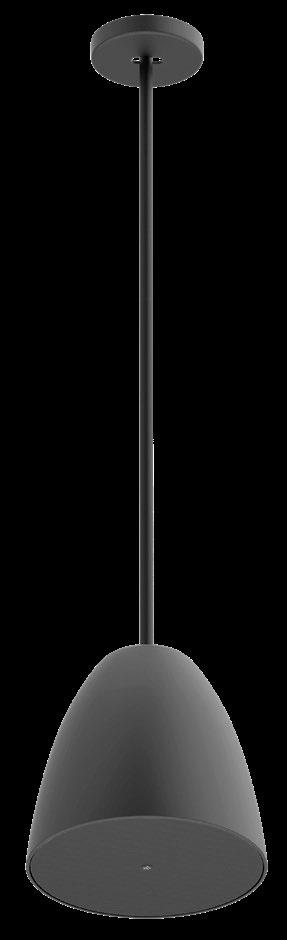
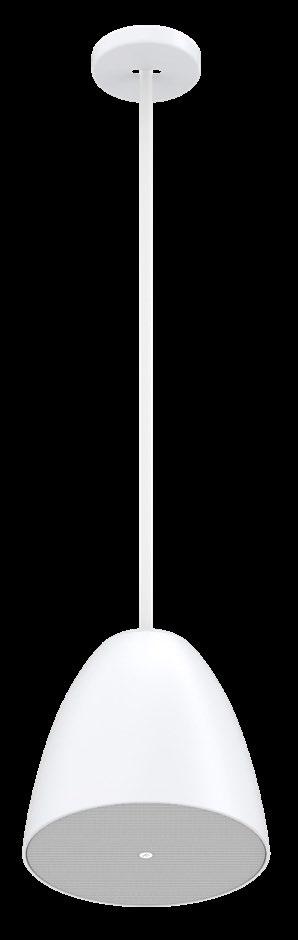
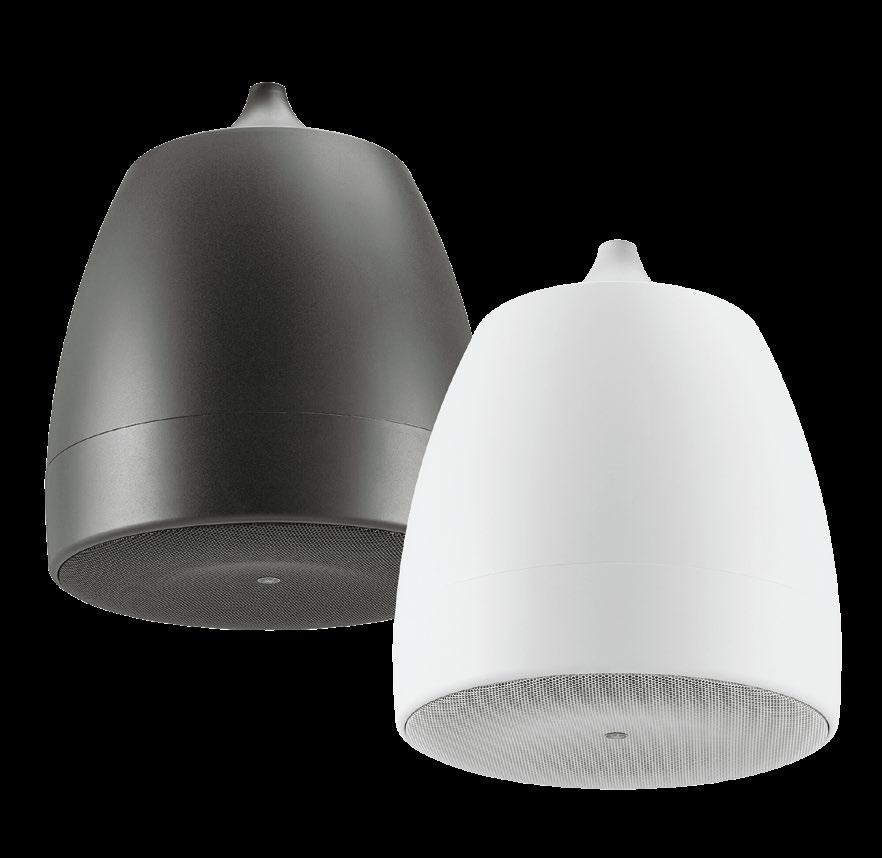
Engineered specifically for applications with high or open ceiling spaces, the Atlas+Fyne IsoFlare Pendant Loudspeakers are designed to deliver uniform point-source performance and consistent
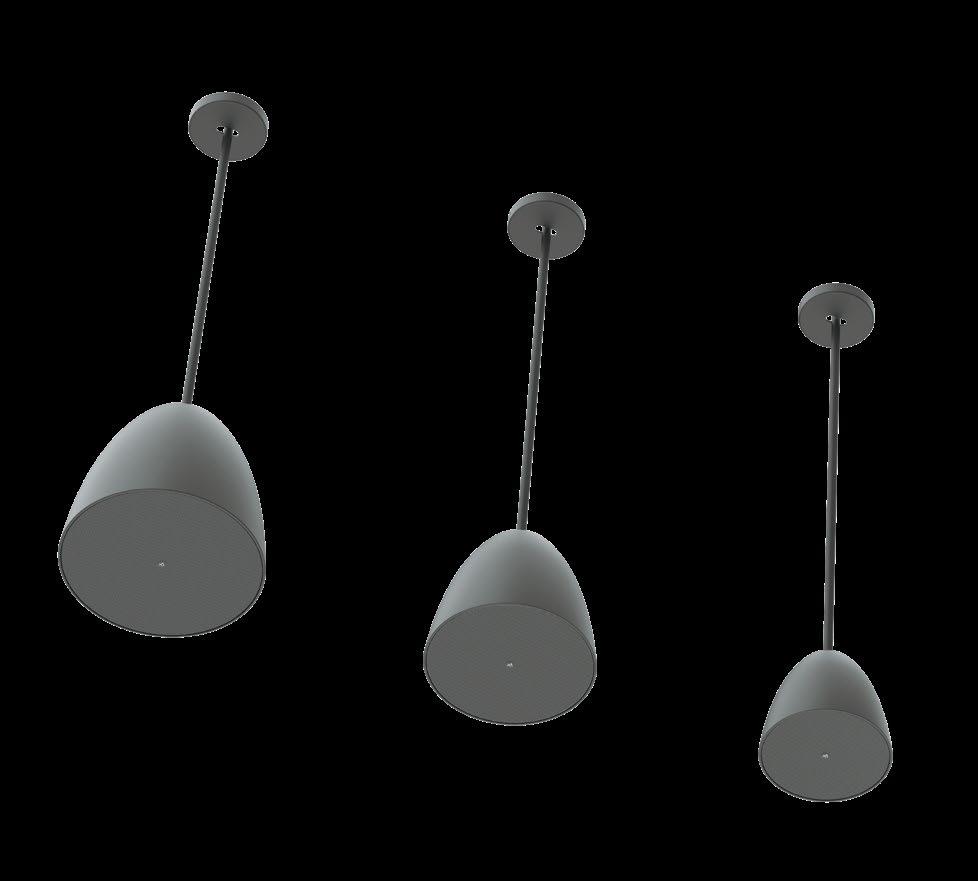
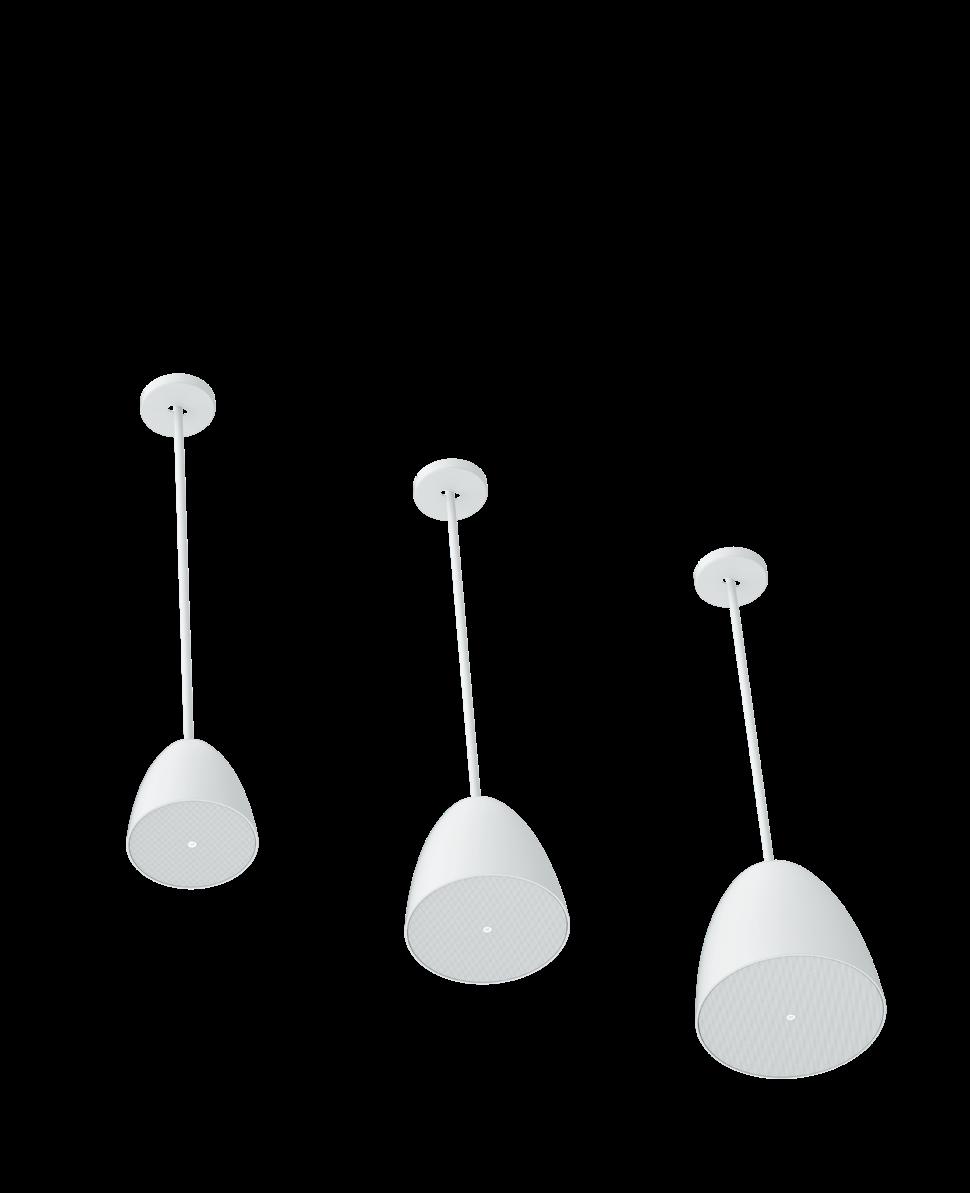
suitable for 70V or 100V applications, the pendants’ construction includes a weather-resistant, IP44rated enclosure. The FP range incorporates 4”, 6”, and 8” models, along with a separate 8” model with narrow dispersion, specifically for higher ceilings, and an 8” subwoofer model for extended bass performance.
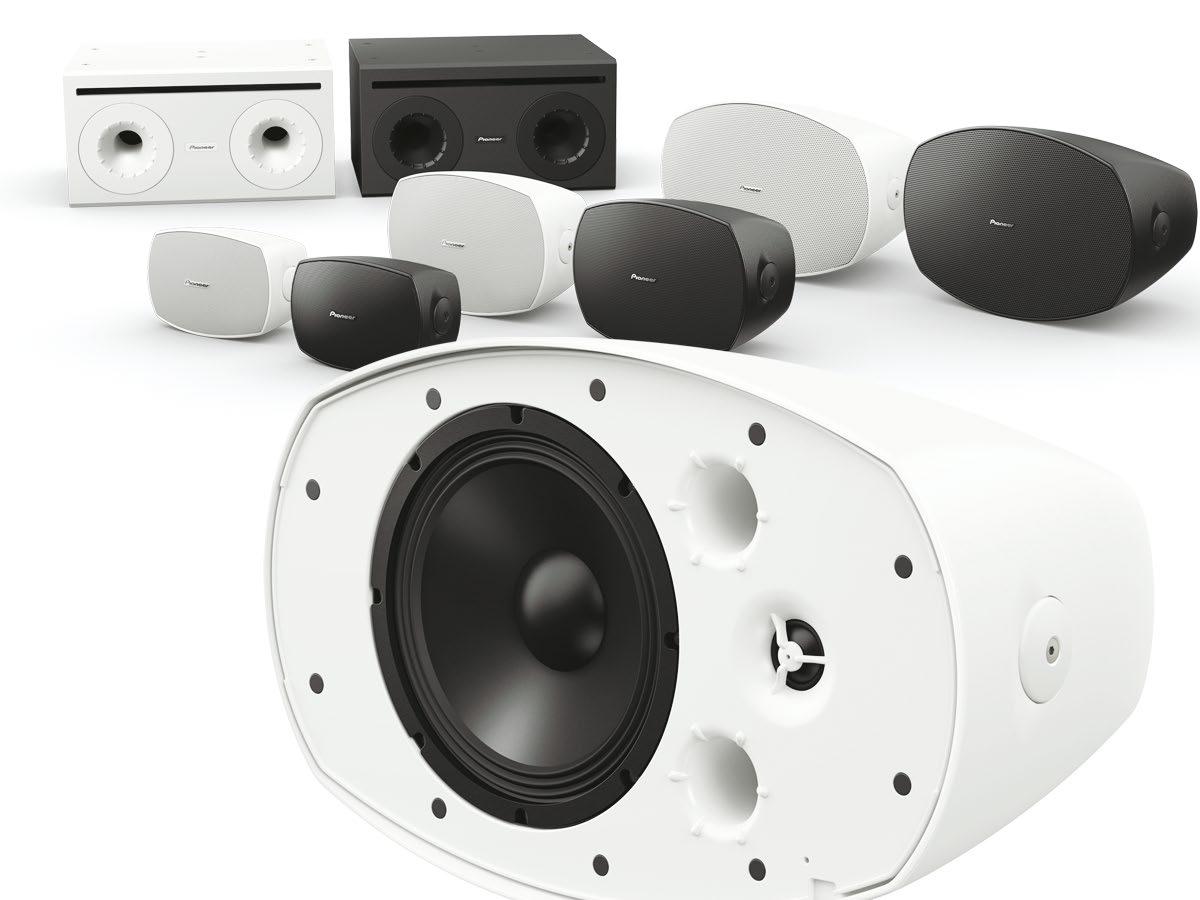
The Pioneer Pro Audio CM series offers a more discreetly sized range of options alongside the company’s flagship XY series, while also drawing on the company’s club-based heritage. These uniquely shaped speakers—neither square nor round—suit nightclubs, bars, shops, offices, hotels, and restaurants, and in tight areas such as corridors, bathrooms, and VIP zones. Newer additions to the range include the affordable two-way CMS54T, CM-S56T, and CM-S58T, and the Keltonconfigured CM-510ST sub, all with installationfriendly transformer taps.
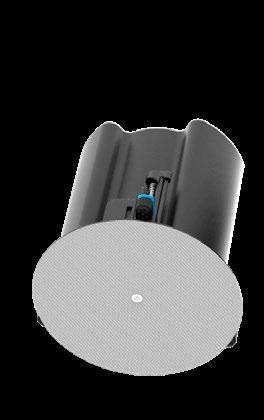
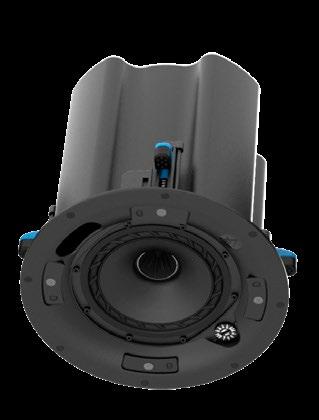
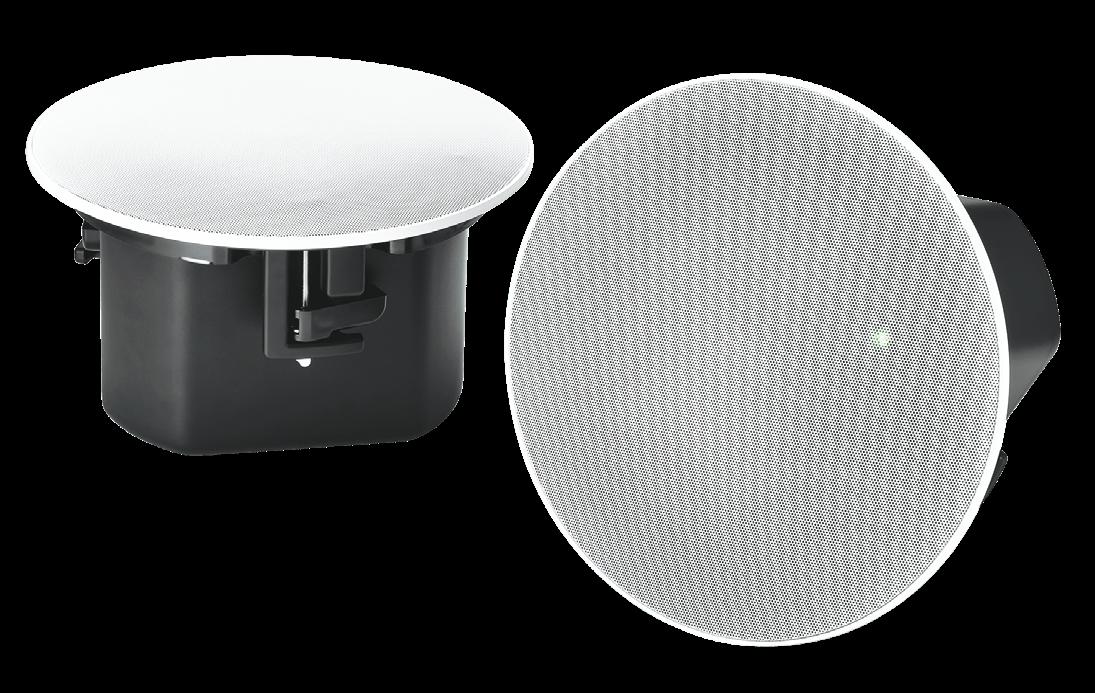
The “zerobezel” version of the 4-inch and 6-inch Q-SYS AcousticDesign (AD) Series ceiling loudspeakers includes the ADC4T-ZB, AD-C4TLPZB, AD-C6T-ZB, and ADC6T-LPZB. They feature



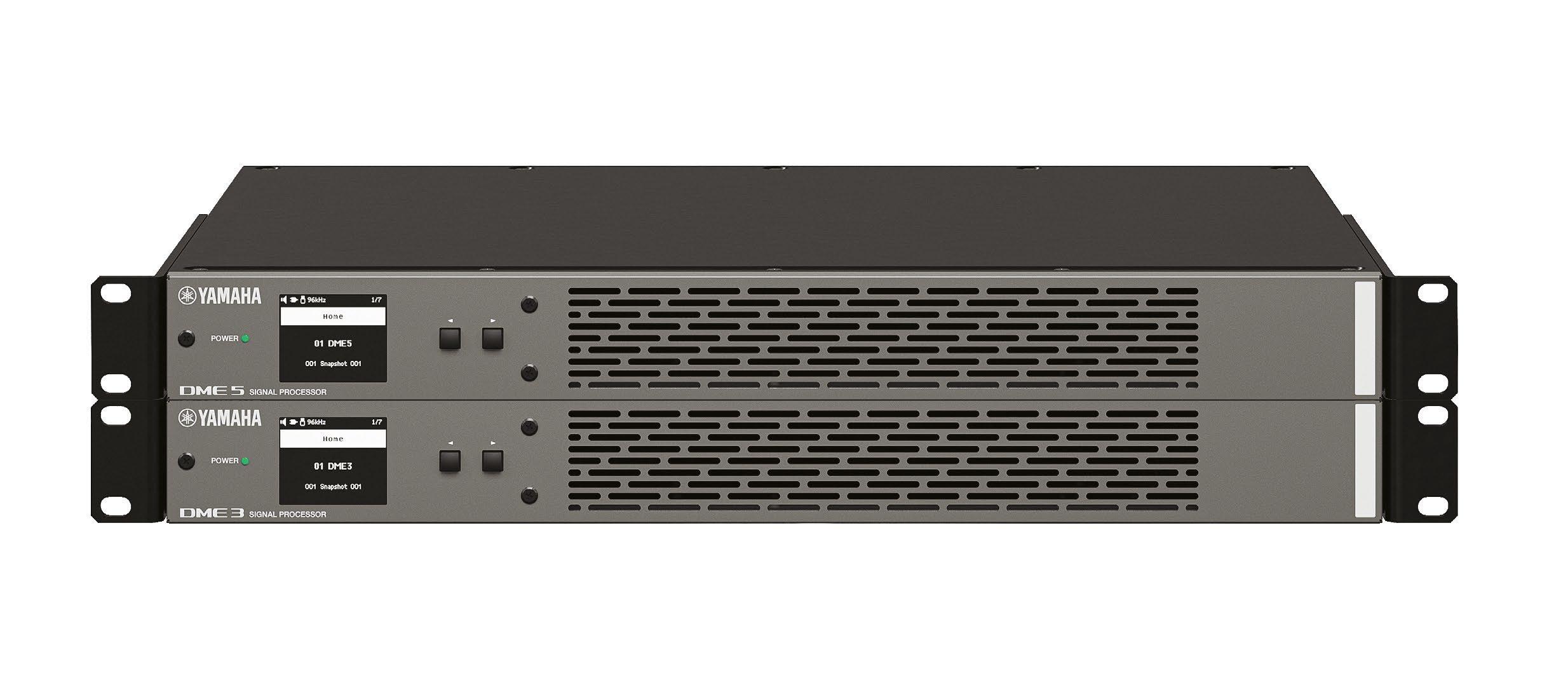
a white grille without a bezel, designed to meet the architectural needs of modern applications while preserving the premium acoustics that the AD Series is known for. Additionally, retrofit accessories are available to add the new grille to recent Q-SYS loudspeaker models (NL-C4, AD-C6T-HC, AD-C6THP), and black grilles are also available separately for all models.
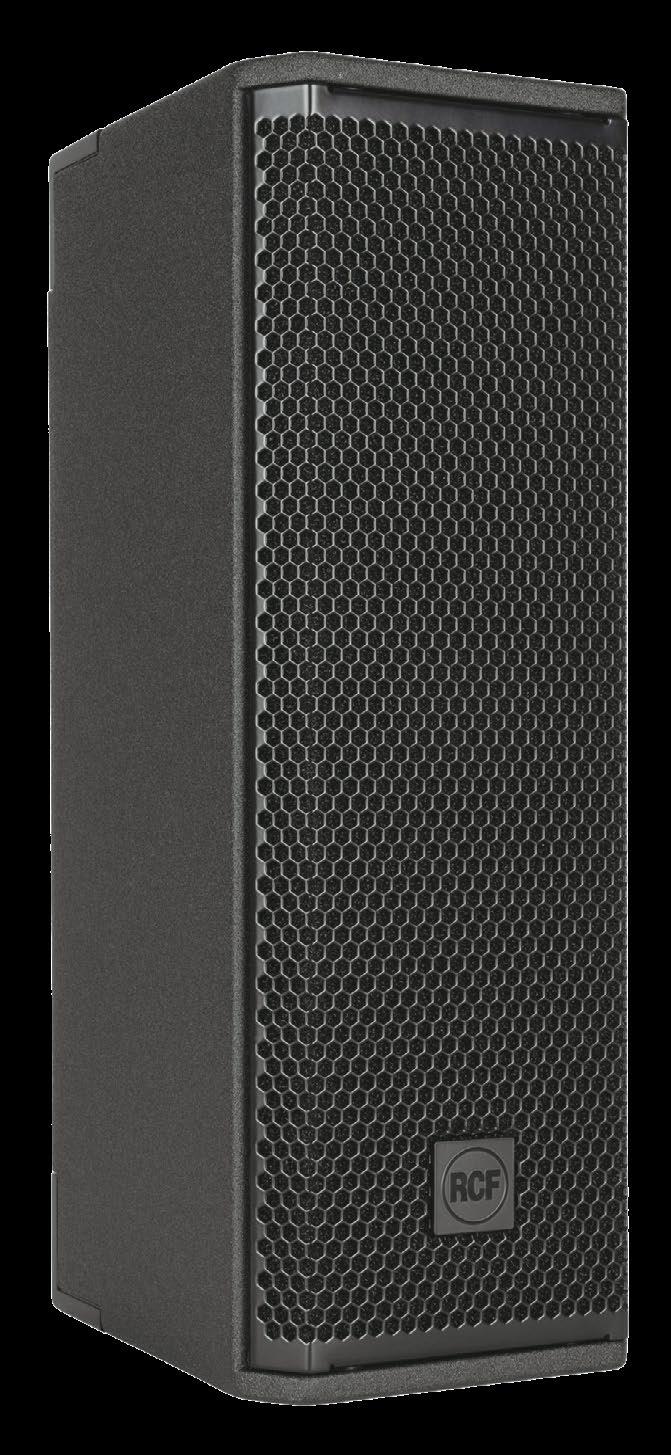
The RCF NXL 14-A Column Speaker, the most compact model in RCF’s NXL Active Column Speaker Series. It features a dual 6-inch woofer configuration and a 1.75-inch PKX driver on a rotatable TRW waveguide, powered by a 2100W amplifier, and is available in black or white. This speaker is ideal for both portable and fixed installations.
The Rockustics Cherry Bomb Galaxy (CBG5) from SoundTube was announced in March. An outdoor bollard speaker, the CBG5 is designed to deliver full-range audio to outdoor applications. Unlike hidden landscape audio speakers on the market, the CBG5 is designed to be seen with an architectural profile. Full-range audio is delivered via a patented three-way system architecture that integrates a 5.25-inch double-chamber bandpass subwoofer, 4.5-inch midrange driver, and 0.75-inch titanium dome tweeter into a single outdoor-bollard. The design supports 70.7V, 100V, or 8-ohm operation, allowing it to integrate easily into a wide range of commercial and residential distributed audio systems. The CBG5’s direct-burial bollard design minimizes excavation requirements, requiring only a small below-grade footprint to reduce installation time and labor.
Introduced last month were the Audio-Technica ATSP-30 series of network ceiling speakers. Available in two models – ATSP-30LP (AudioTechnica LINK) and ATSP-30DP (Dante) – the new speakers are designed to integrate easily into networked AV systems, and support efficient deployment across small- to medium-sized rooms. Sold in pairs (one active, one passive), the ATSP-30 speakers mount flush into drop or hard ceilings, offering a low-profile footprint while delivering 140° coverage and full-range sound. Designed for both speech reinforcement and multimedia playback, the system is positioned for conferencing, presentation, and background music applications. The ATSP-30 series integrates directly with AudioTechnica’s ATDM digital SmartMixer platform and compatible microphones, forming a complete, networked audio ecosystem over standard Cat5e or better cabling – reducing installation complexity
and cost compared to traditional analog systems. Multiple speaker pairs can be deployed with independent signal routing for zone-based audio control.
Suitable for high, open-structure and sloped ceilings, the Yamaha VXH series comprises two models, the VXH6 and VXH8, engineered for optimum background music and voice reproduction. Featuring a 120-degree dispersion pattern, the 6.5in VXH6 has a peak power handling of 300W and is designed for use where the speakers are to be suspended at a relatively low level. The 8in VXH8 has a narrower dispersion pattern of 75-degrees and a higher peak power output of 360W for higher suspended positions. Installers can mix and match both models, as well as with other speakers in the comprehensive Yamaha range. Weighing just 5.7kg and 7.2kg respectively, The VXH6 and VXH8 support high and low impedance connections, while the speaker wattage can be easily switched even after installation, thanks to the straightforward tap selector. VXH series speakers are IP45-rated and are supplied with a Gripple suspension hardware and wire kit for easy, safe height adjustment during installation.
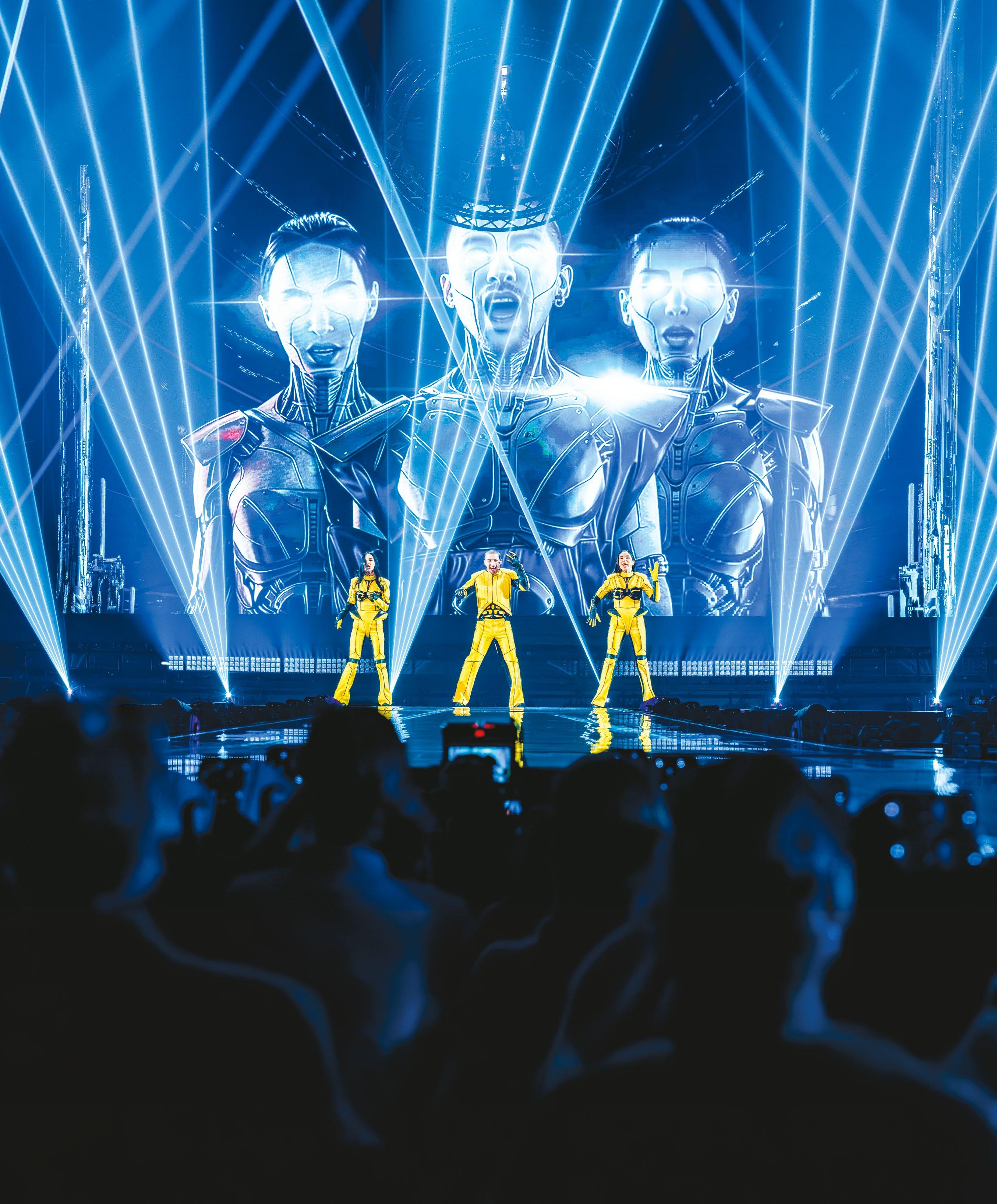
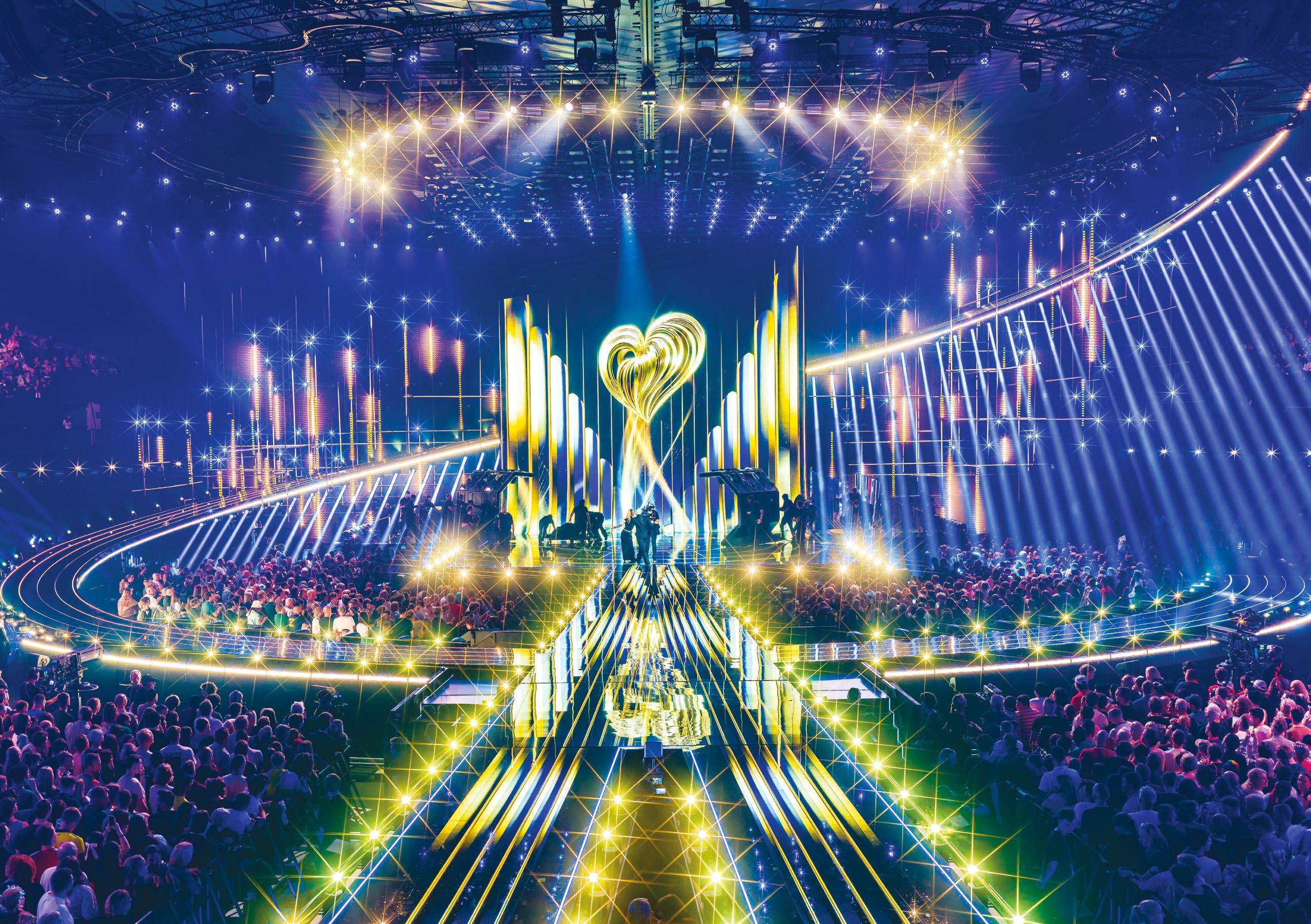
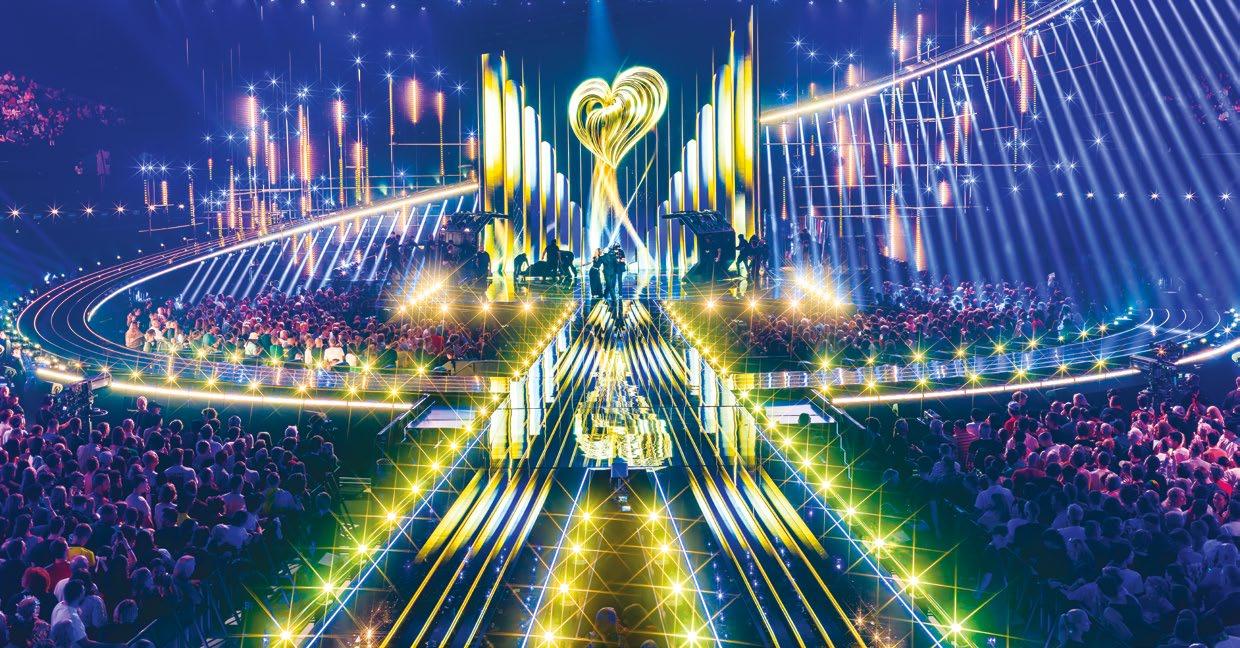
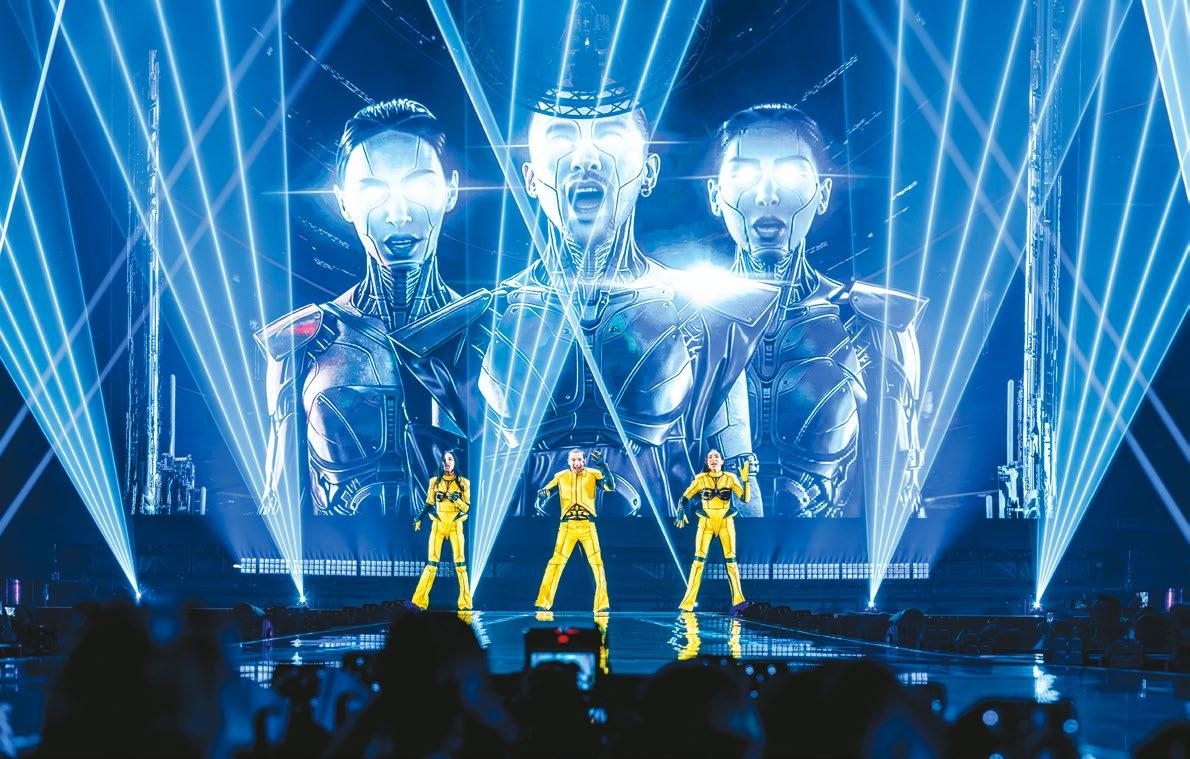
The Eurovision Song Contest is one of the world’s most complex and high-profile live broadcast productions. The 70th edition of the event took place in May in Vienna.
Returning for the eighth consecutive year, Disguise and Creative Technology continue their collaboration on this beloved event. Disguise’s GX 3 media servers deliver high-performance playback, supporting the production’s shift toward a more LED-driven stage design, while also optimizing workflows for IP-VFC. The setup has been carefully designed to support the scale and flexibility required for Eurovision’s dynamic staging and fast-paced broadcast environment.
In parallel with the hardware deployment, Disguise has worked closely with Creative Technology to refine the Disguise IP-VFC performance and workflows for large-scale broadcast environments. Eurovision 2026 was one of the first major live broadcast productions to deploy the latest IP-VFC firmware update, marking an important milestone for Disguise’s ST 2110 workflow technology. Built for the demands of complex live
productions, the new IP-VFC release delivers significant stability and performance enhancements for GX 3 servers, helping support resilient, low-latency video distribution across Eurovision’s expansive LED and broadcast infrastructure.
“Eurovision always succeeds in raising the bar creatively and technically,” comments Niklas Ljung, Group Technical Director at Creative Technology. “This year, the scale and flexibility of the LED environment is a key part of that ambition. Working with Disguise, we’ve been able to refine our workflows and build a system that supports both the creative vision and the reliability demands of a live broadcast of this magnitude.”
With more than 35 broadcasters covering the event and a global audience that regularly exceeds 160 million viewers, Eurovision remains as much a showcase for broadcast technology as it is a celebration of music. Partners, including Megapixel, providing video processing solutions, and ROE Visual, supplying the LED displays, play a key role in powering the technical infrastructure behind this year’s show.
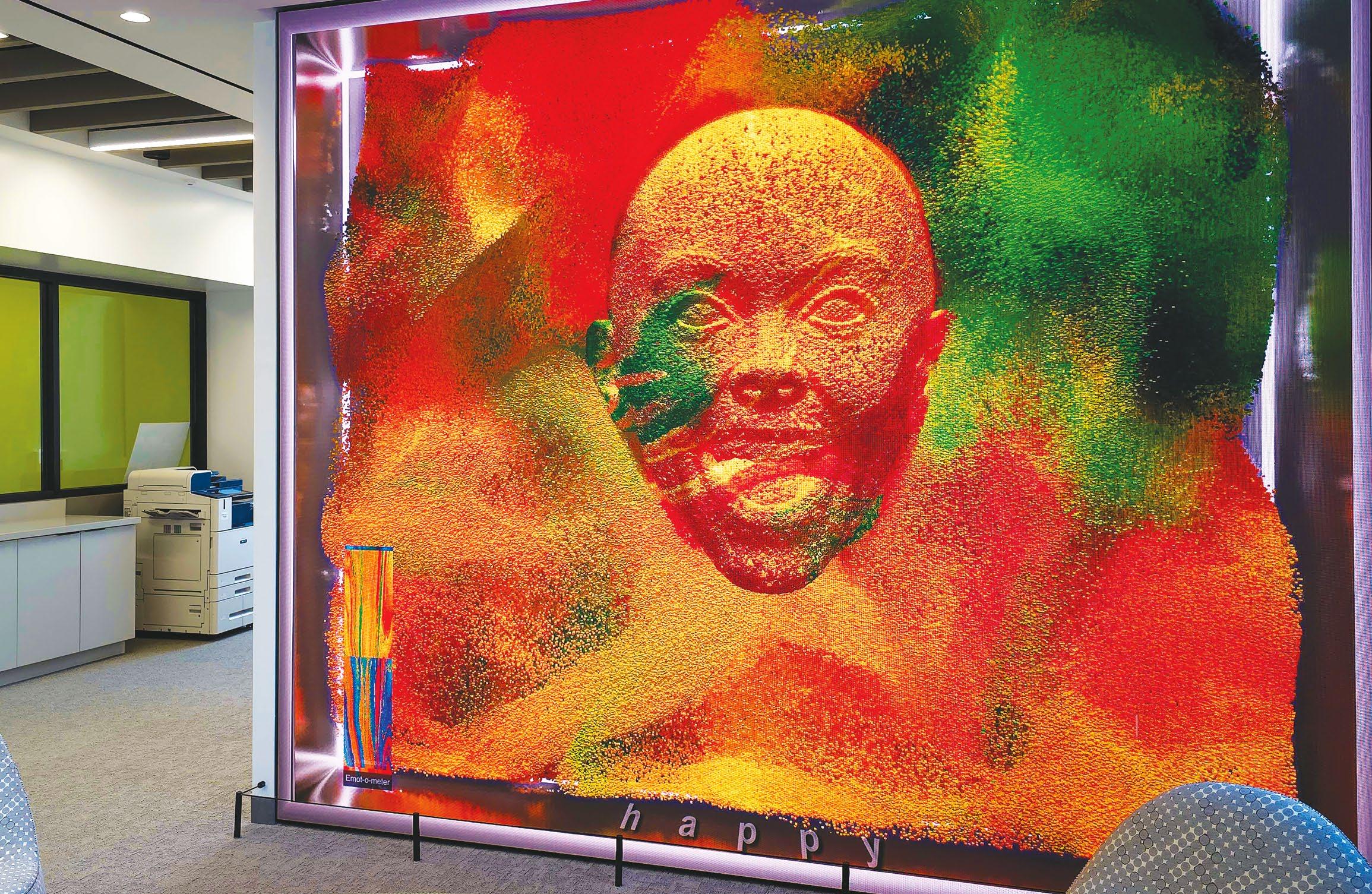
Westminster Schools, a private K-12 school in Atlanta, Georgia, introduced a new interactive LED video wall at its recently completed Blake Innovation Center, a multiyear campus development that supports programs in 3D animation, broadcast production, robotics, programming, and visual arts. The installation, titled Reflected Emotion, was conceived as a way to connect technical exploration with emotional awareness, encouraging users to express how they feel and see those inputs reflected visually.
Designed and developed by Fusion CI Studios and powered by dvLED technology from SNA Displays, the installation serves as a digital centerpiece within a high-traffic lounge near the center’s main entrance. The system combines real-time interactivity with generative visuals, allowing users to engage directly with the display and contribute to a shared experience.
“Our absolute favorite digital-art installations render imagery in real time, reacting to a user’s touch,” said Mark Stasiuk, Fusion’s executive technical director. “This installation with SNA Displays takes that concept further by allowing users to tell the display how they feel. It responds with breathtaking, color-coded imagery that reflects both personal and collective emotions in the space.”
The system integrates TouchDesigner, Unreal Engine, artificial intelligence,
and particle simulation to generate responsive content across the LED canvas. A nearby touchscreen kiosk allows users to select from a range of emotions— perplexed, frustrated, creative, curious, happy, and courageous—or capture a selfie from the kiosk’s camera to trigger personalized visual output.
In addition to individual interactions, the platform continuously aggregates user input to calculate and display a real-time representation of the collective emotional state throughout the building.
The LED video wall features a 1.8 mm pixel pitch from SNA Displays’ BRILLIANT Interior LED video technology. Measuring approximately 10’ high x 12’ wide (1,620 x 1,920 pixels) and totaling more than 3.1 million pixels, the display delivers high-resolution imagery suited for close-viewing environments.
“We’re delighted to work with Fusion again on another unique digital art installation,” said Richard Hill, SNA Displays’ director of sales for museums and art installations. “This display has driven a great deal of curiosity from students and staff, particularly the selfie feature, and will serve Westminster Schools as both an inspirational platform and learning tool for many years to come.”
The Blake Innovation Center will also house a new studio for Westminster’s student-run, award-winning WCAT broadcast team and a dedicated robotics workspace, further expanding opportunities for hands-on learning and collaboration.
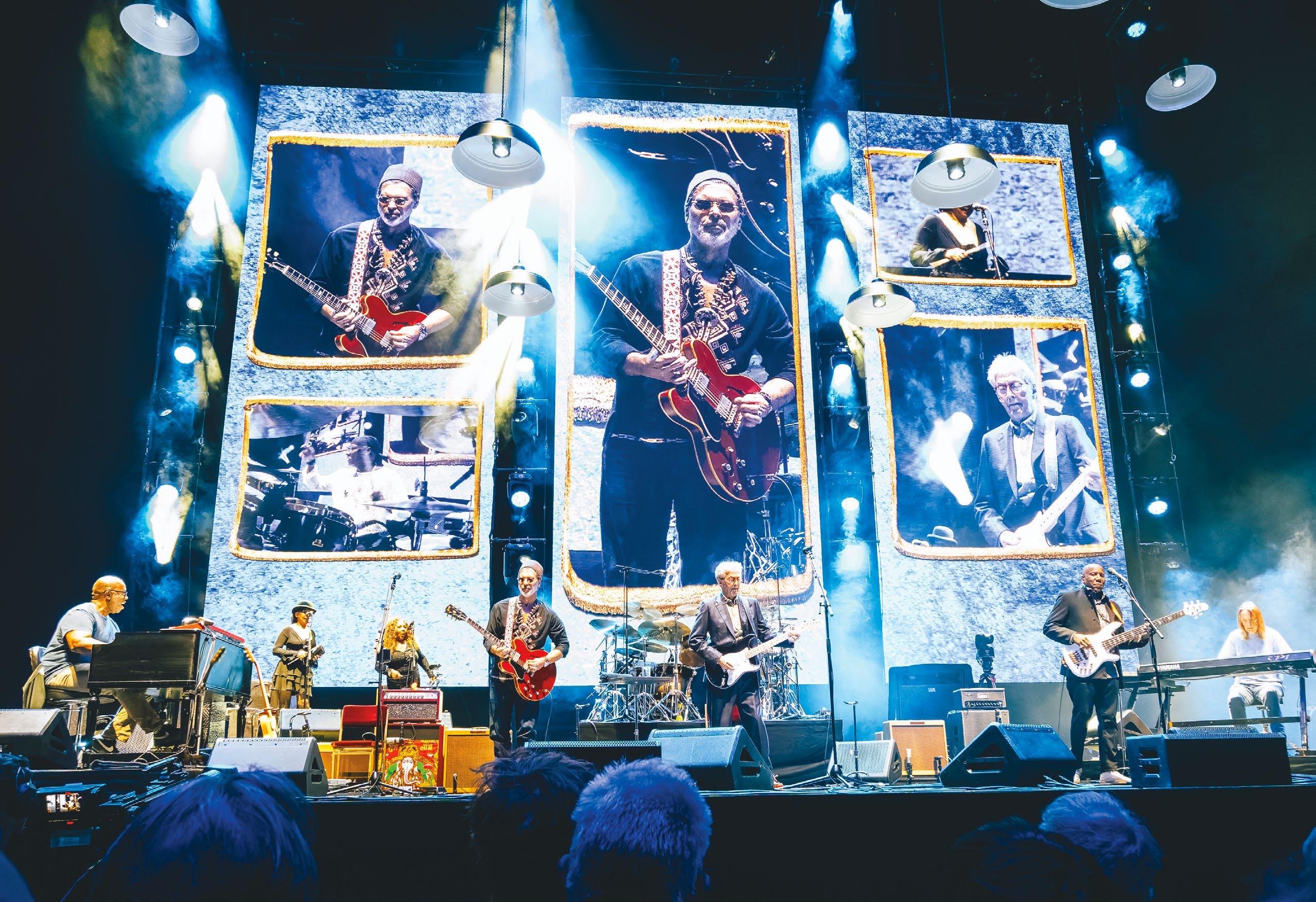
n array of professional AV technology – including Modulo Pi’s Modulo Kinetic Version 7 media server, Sony HDC4800, and Panasonic AW-UE150 cameras, a Grass Valley Korona V-Series video switcher, and ROE CB5 LED walls – is powering the visual production on Eric Clapton’s ongoing 2026 world tour, with Canadian company Monochrome Project designing and delivering the video scenography across a European leg that ran from April to May.
The three ROE CB5 LED walls – each measuring 4.2m wide by 10.2m high – are positioned upstage to create evolving visual environments combining backdrops with live camera feeds. Modulo Kinetic runs on a Kinetic Designer workstation connected to two redundant V-Node servers to drive the screens.
The production team worked with a preview version of Modulo Kinetic Version 7, making use of new features including displacement effects, comet trails, and old movie-style processing, with certain parameters controllable live. Custom effects were also developed in direct collaboration with Modulo Pi’s development team.
Mathieu Coutu, founder of Monochrome Project and video director for the
tour, said: “Eric Clapton’s initial intention, as a bluesman, was to be able to showcase all the musicians simultaneously. Modulo Kinetic is therefore used to open multiple boxes of varying sizes, displaying different camera angles on the LED screens.”
Louis Buxin, innovation director at Monochrome Project, added: “We chose Modulo Kinetic for its extremely low latency when processing live inputs.”
The media server displays camera feeds with a latency of under two frames and is also used to apply effects to live feeds without adding latency.
Modulo Kinetic additionally receives tally signals from the camera switcher, enabling automation through the media server’s task and compute graph features. The video director operated a custom graphical interface built within Modulo Kinetic, based on a 3D scene simulating the LED screens with camera views remapped in real time.
Following the European leg, the tour continues with a UK date at the Royal Sandringham Estate on August 23 before moving to the United States in September, opening in Detroit and closing in Kansas City on September 17.

“They wanted the coverage of all the events to turn around at the speed of social media but to have the look of high-end fashion advertisements.”
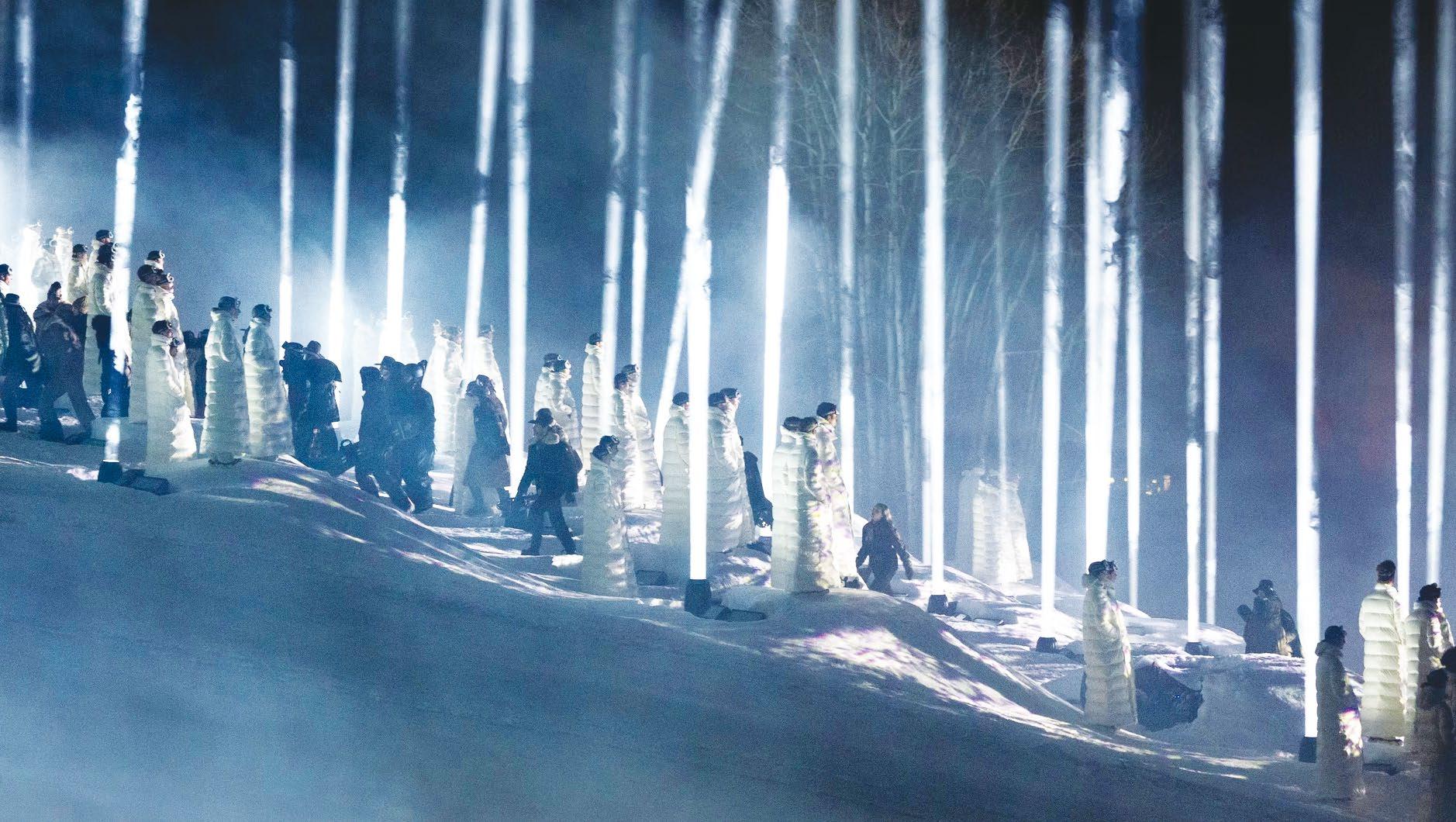
The crisp January cold of Aspen, CO, was the perfect setting for French luxury brand Moncler to stage its high-end Fall/ Winter runway show for its ski jacket label, Grenoble. From Friday, January 26, to the following Monday, the brand presented a grand fashion show on a snow-covered runway, featuring over 100 models. The whole area buzzed with excitement as fashionistas observed and mingled by the ski slopes. People who had to enjoy the splendor from afar were able to keep up with a steady stream of highlights almost immediately via polished professional videos posted to various social media platforms.
New York-based MATTE Projects, specialists in creative branding strategies for major events such as this one, oversaw the creation of all the clips and stills. Footage was shot by top-level pros and post-produced with the high-fashion feel viewers expect from a brand such as Moncler, extending the brand aesthetic to the typically more ad hoc platform of social media. To. that end, Michael Czeizinger, Sr. Director, Postproduction at Matte, brought New York-based Senior Colorist Tim Masick of Company 3, a multiple-award-winning artist for major fashion campaigns (including some for Moncler), to the event. Working on-site in a temporary grading bay, Masick brought the finishing touches to all the social media videos, ensuring they were all of a quality that reflected the glamour of the event.
“We wanted Tim’s eye and skill right there at the finishing stage for all the material,” says Czeizinger. “We could have uploaded material to him in New York, but time was so precious, and we wanted him working in close
proximity with creative directors, just as he would on a commercial. So, we set up everything Tim has in his New York color grading bay at the Aspen Meadows hotel right there where the action was happening.”
“They wanted the coverage of all the events to turn around at the speed of social media but to have the look of high-end fashion advertisements,” Masick explains, noting that the footage contained a lot of skiing and other activities under bright direct sunlight – which can also sometimes present tricky types of imagery for colorists to work with.
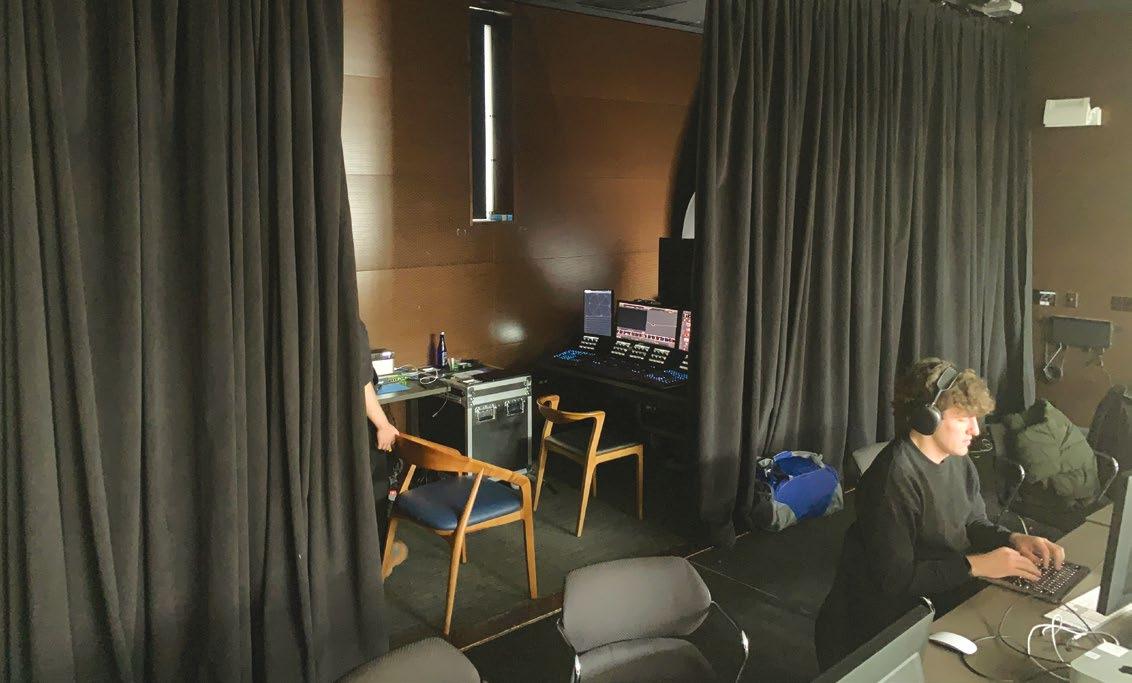
Melina Smith, Production Operations Manager of Short Form for Company 3, also based in New York, works frequently with Masick as a producer and assistant colorist. She oversaw the logistics of stocking the space at the curtained-off space within the Aspen Meadows hotel, or what she refers to as the “war room,” with two color grading control surfaces – a DaVinci Resolve Advanced Panel for Masick and a Mini Panel for herself – and the top-tier Sony X300 monitor used throughout Company 3 for Masick and a smaller Flanders monitor for herself. Rounding out the tools inside this space were hard drives, graphics cards, and CPU power to recreate every facet of working inside a dedicated color grading bay.
Throughout the four-day event, imagery was being continually shot on professional cameras (including ARRI 35 and Amira models, Sony FX 6, and a variety of drones). Drives came directly from the camera to the “war room” and were delivered to an editorial team that had been set
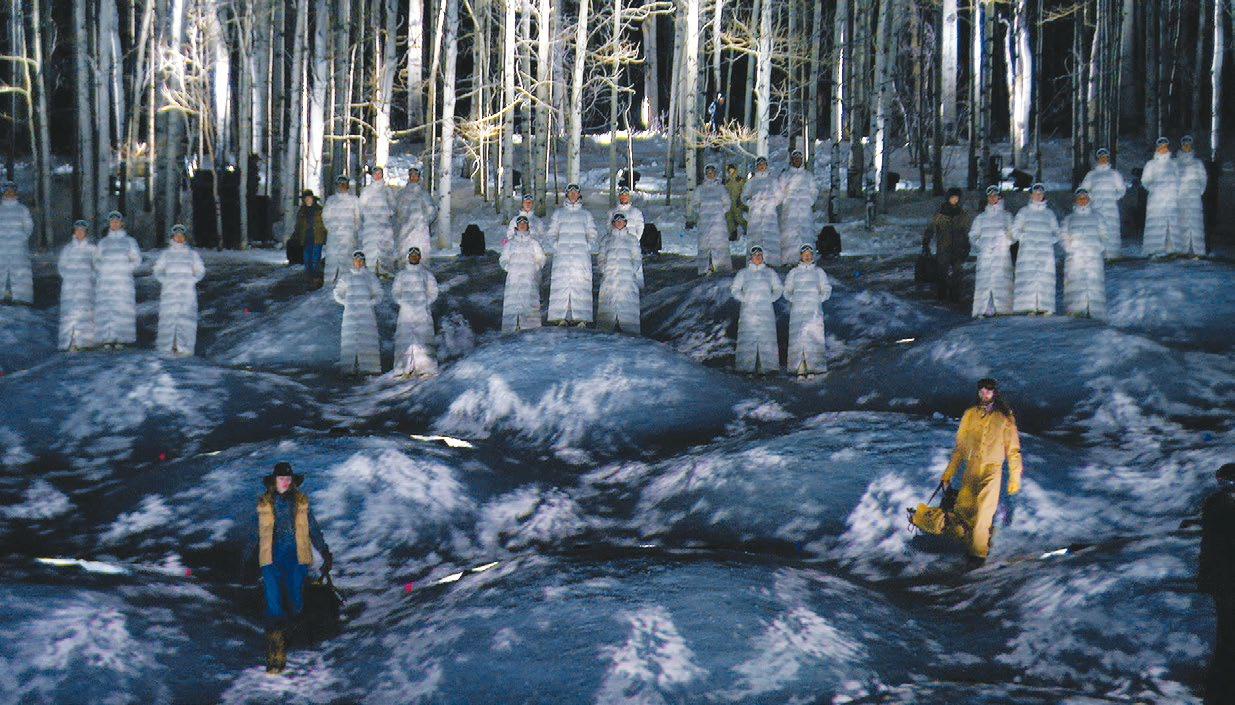
up with seven Adobe Premiere edit stations and quickly cut together. Then, cut scenes would be sent directly to the pop-up grading bay, where Masick handled the grading of color and still imagery in DaVinci Resolve under the CD’s supervision. Then, as soon as a clip was signed off on, it was uploaded to the various platforms, all within an incredibly truncated timeframe of often less than an hour from shoot to delivery.
“The response was wonderful,” says Czeizinger of the social media campaign. “Viewers could see video coverage of the event almost as it was happening, but the images didn’t look like what we expect for social media. They could have the refined look of a commercial for a highfashion brand.”


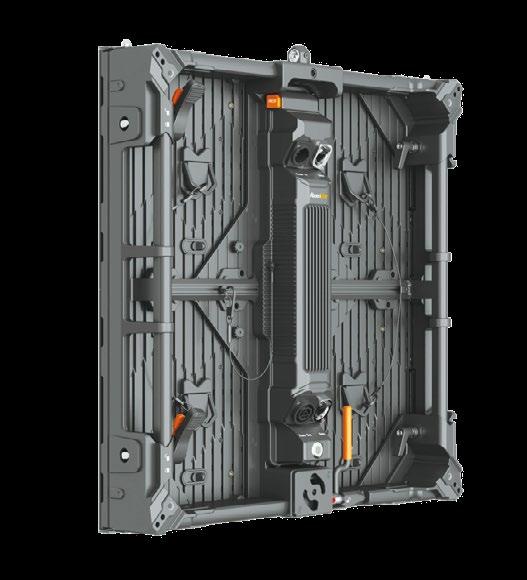
Absen has launched the SA1.5, the latest addition in its live event display platform, the Saturn Series. The SA1.5 features a pixel pitch of 1.56mm, a marked reduction from the standard 1.9mm and 2.6mm.
The SA1.5 features Absen’s full flip-chip COB (Chip on Board) technology. Unlike traditional designs, the SA1.5 features a monolithic panel structure that delivers superior and significantly enhanced stability. With 30% lower power consumption and 40% greater stability than conventional products, the SA1.5 offers enhanced performance and reduces operational cost. Additionally, the SA1.5 is fully backward compatible with the Saturn Series’ accessory ecosystem, transitioning to a finer pitch no longer requires a total overhaul of current inventory.
By utilizing a deep black coating and an Anti-Glare (AG) film, the SA1.5 achieves black uniformity and eliminates glare often found in broadcast environment. The SA1.5’s visual depth is protected by the company’s 6-Star Shield, a comprehensive protection suite that guards against moisture, dust, and physical damage.
This year, Draper, Inc. has expanded its Foundation Mount line with the introduction of the Draper Foundation ONE. An alternative to manufacturerspecific and other universal mounts, Foundation ONE’s modular design enables fast installation. A per-panel mounting approach allows installers to work upwards after setting the base row. Foundation ONE supports most LED cabinet sizes from 600mm to 610mm wide, with a broader range of panel sizes and formats planned for future release. Cam-style brackets for top-access Z-axis adjustments enable installers overcome uneven walls without shimming. An optional installation fixture is also available to ensure consistent vertical spacing.
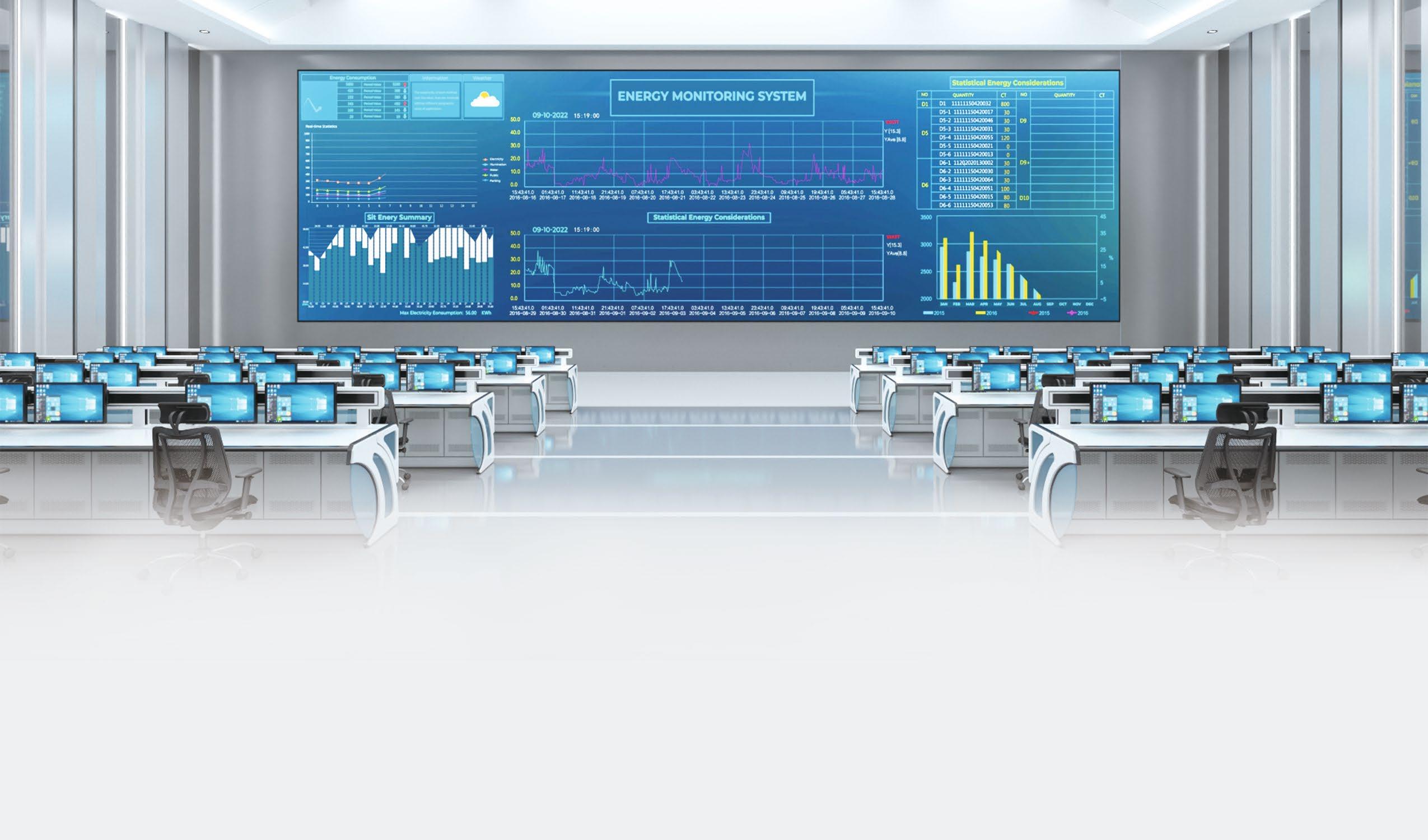
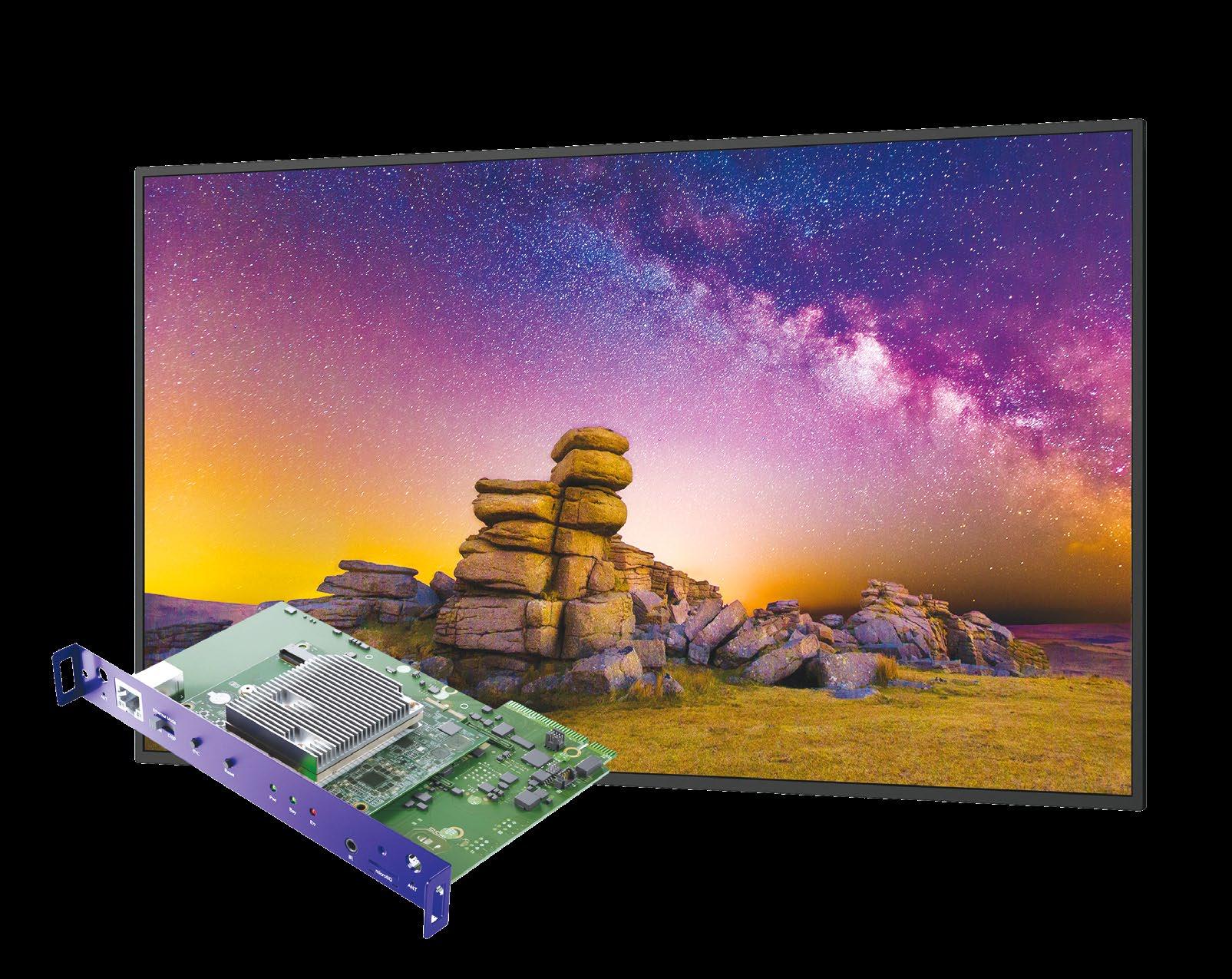
Sharp has announced that its PN-M Series large format displays are now compatible with the new SDM Player with BrightSign Built-In System-on-a-Chip (SoC) solution. This new offering in the Intel Smart Display Module (SDM) series delivers an all-in-one solution for digital signage applications. The new computing solution is designed to slide directly into the SDM slot of Sharp’s professional displays, eliminating the need for external cables, power bricks, or additional mounting hardware. This allows system integrators and endusers to easily install, service, or upgrade the computing power without having to replace the entire display investment. The Sharp PN-M series features a brightness of 550 cd/m2, ideal for high end digital signage applications in restaurants, command and control, retail, healthcare, and corporate environments.
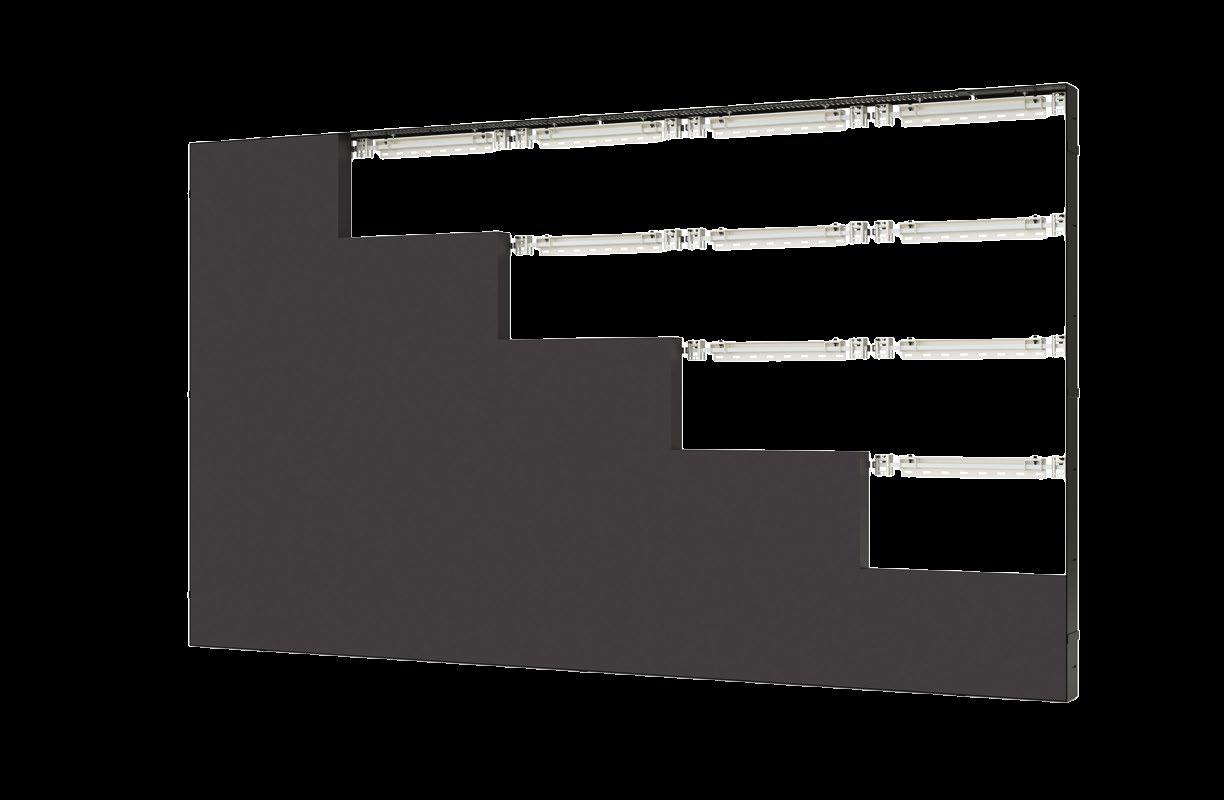
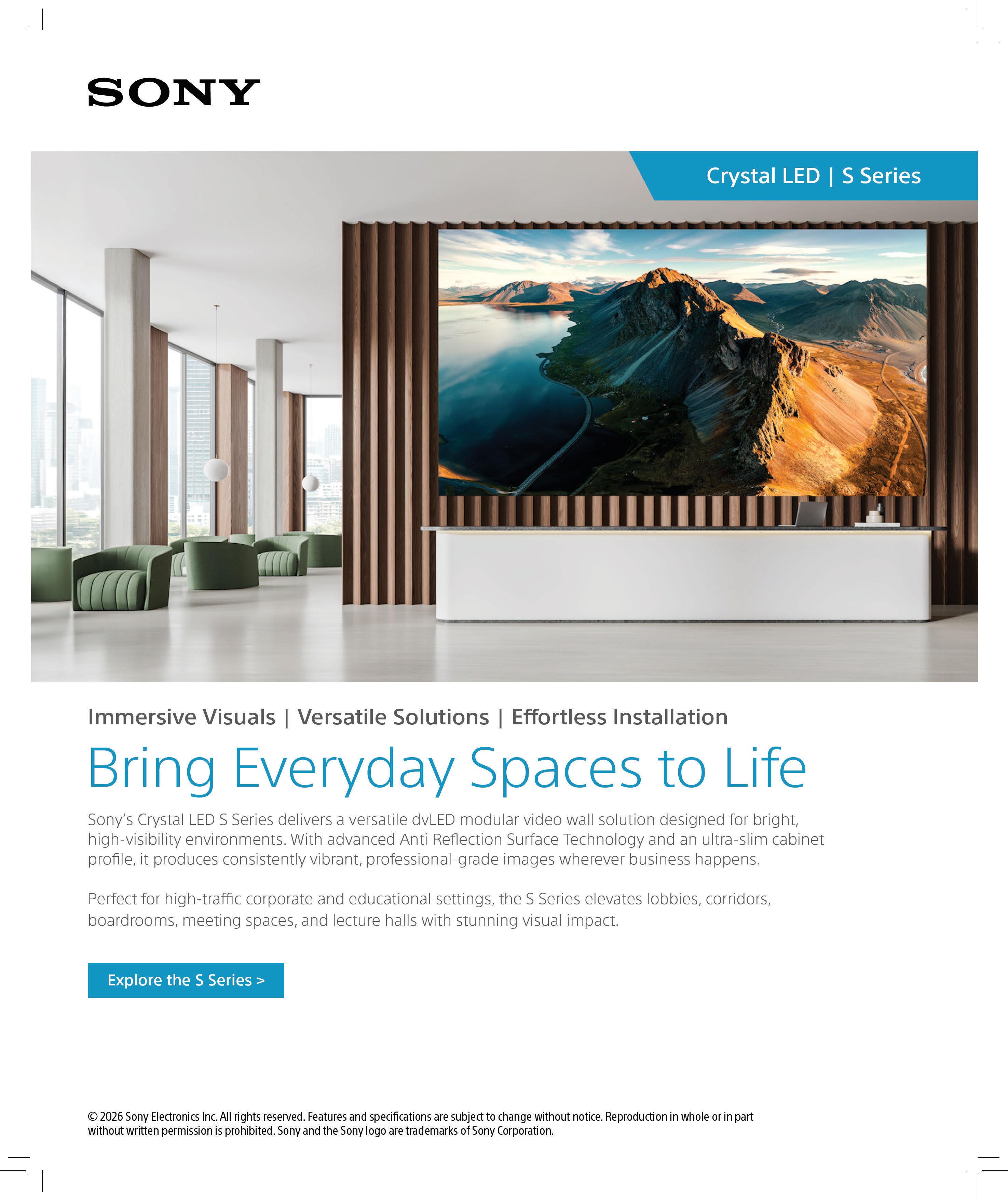
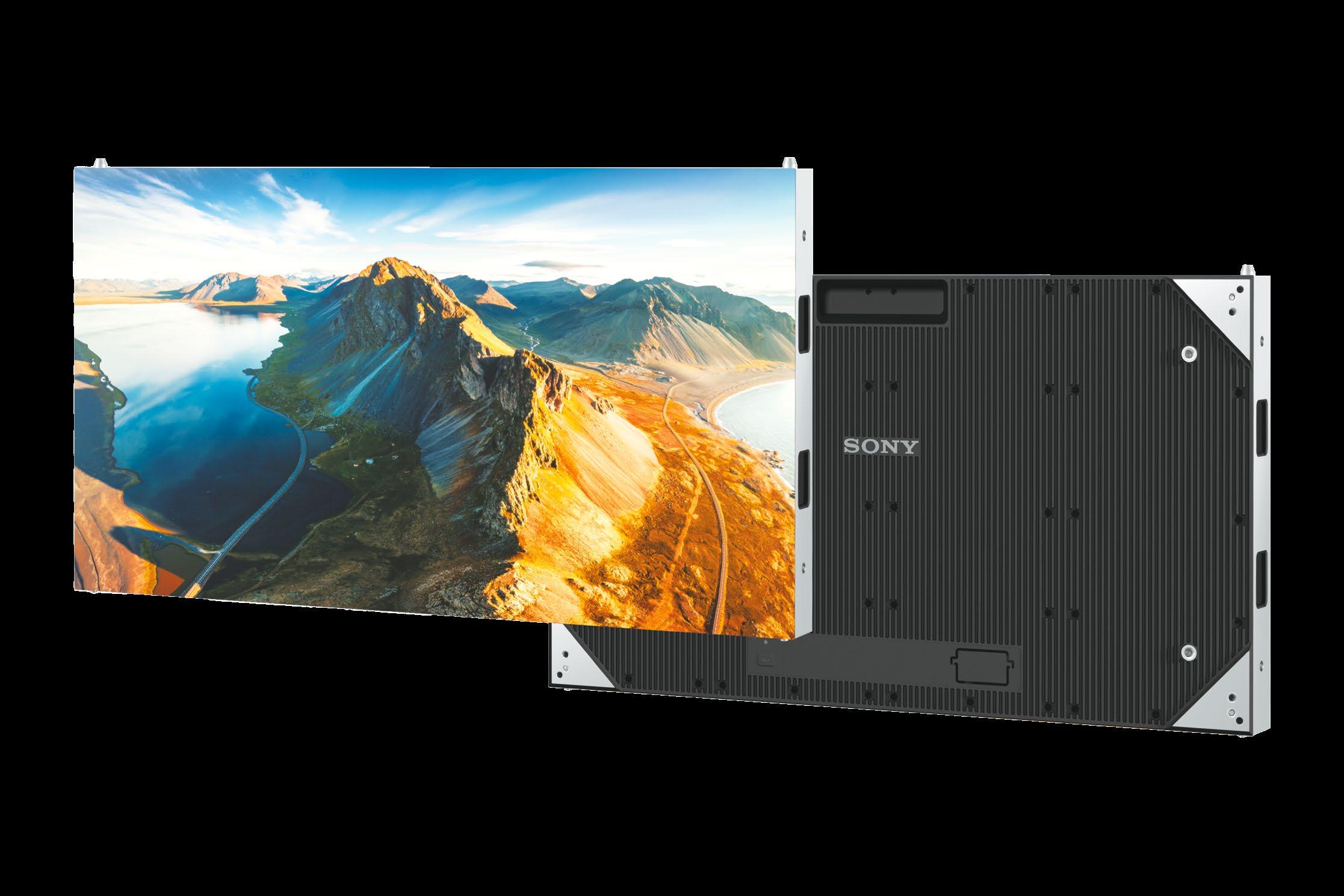
Sony Electronics Inc.’s latest dvLED displays, the Crystal LED S Series, are midmarket options providing high visibility even in bright environments, accurate natural color reproduction, and low reflection. Optimized for a diverse range of uses in corporate settings, educational institutions, and commercial facilities, the S Series is comprised of two models. Available in 1.25- and 1.55-mm pixel pitch options, both models feature 800 cd/ m2 of maximum brightness. Featuring a slim cabinet with a thickness of approximately 45mm/1.8 inches and a bezel-free design, the models streamline installations, and are able to meet ADA compliance when combined with appropriate wall mount frames.

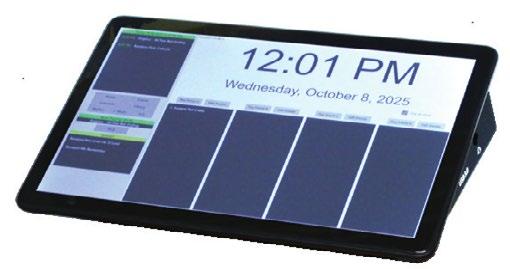




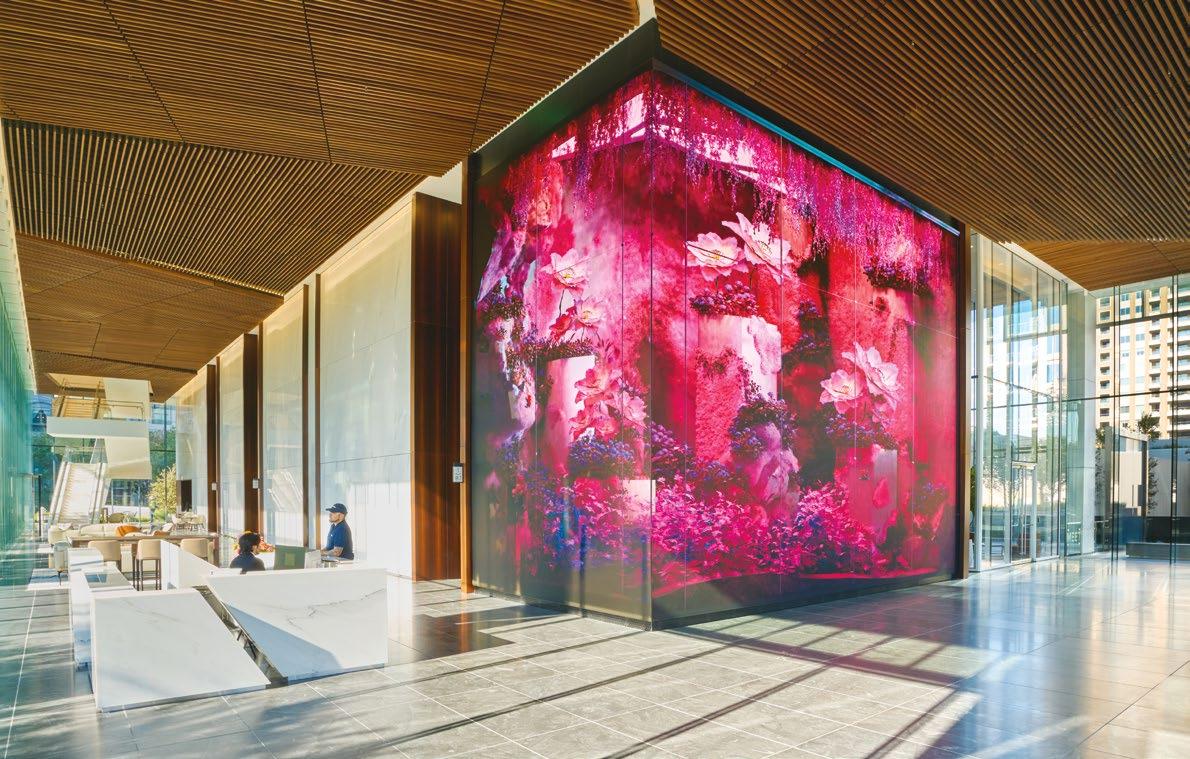
Located in Uptown Dallas, 23Springs is a 26-story Class AA office tower that combines 625,000 square feet of premium office space with hospitality-inspired amenities. In the two-story lobby, the focal point is a massive, 49x25.5-foot-high floorto-ceiling LED video wall with a 1.8mm pixel pitch that wraps around a corner. Installed by IES Communications, it serves as a digital canvas for dynamic, curated art.
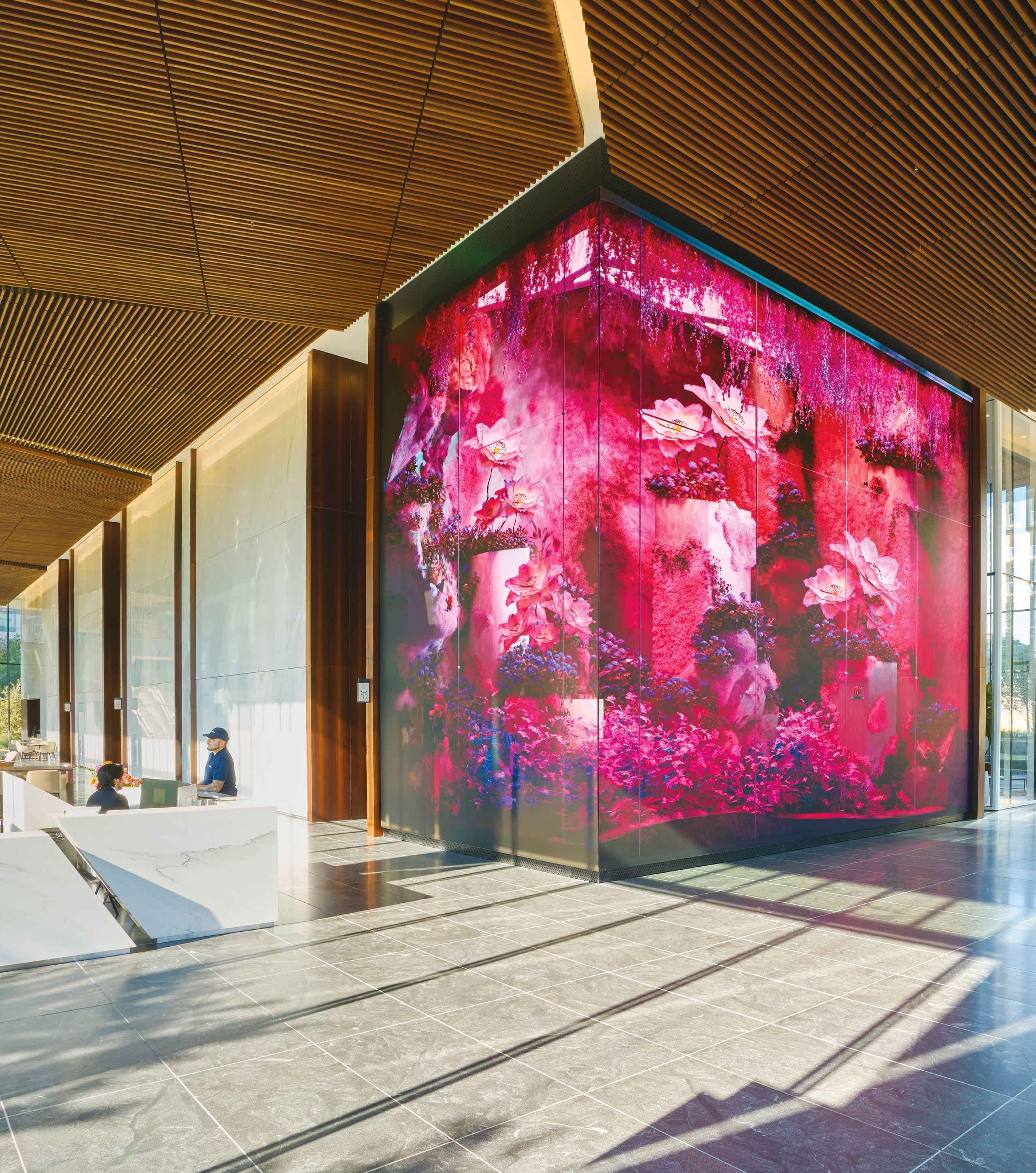
The final video wall design required custom mounting and the ability to wrap a corner. The project team also had to address infrastructure needs, including power, equipment placement, and the cabling path.
“Combining Planar LED display technology with two Extron Quantum Elite video wall processors demonstrates what can happen when all the right pieces come together,” said Aaron Wall, project manager with IES Communications