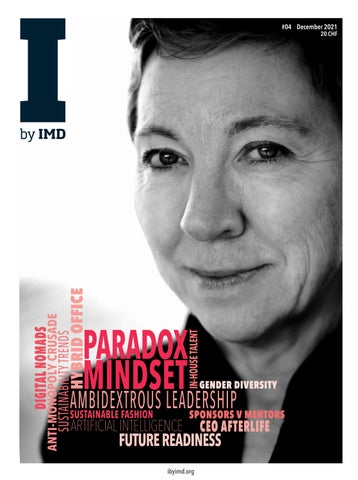
#04 December 2021
HYBRID OFFICE
IN-HOUSE TALENT
SUSTAINABLE FASHION
SPONSORS V MENTORS
PARADOX MINDSET AMBIDEXTROUS LEADERSHIP
SUSTAINABILITY TRENDS
DIGITAL NOMADS
ANTI-MONOPOLY CRUSADE
20 CHF
GENDER DIVERSITY
ARTIFICIAL INTELLIGENCE
CEO AFTERLIFE
FUTURE READINESS ibyimd.org
21052 Dubai
21323 Grand Piano
10280 Flower Bouquet
LESS ACTION. M O R E S AT I S FA C T I O N . A D U LT S W E L C O M E
Experience LEGO ® Sets for Adults – rewarding and creatively challenging sets to suit all interests. LEGO.com/Adults
LEGO and the LEGO logo are trademarks of the LEGO Group. ©2021 The LEGO Group.
[ Foreword ]
Let’s change for the better
A
Illustration: Jörn Kaspuhl
round the world, leaders are struggling with “The Great Resignation” – employees quitting in droves, often without a replacement job lined up. A recent McKinsey survey found that 40% of employees in Australia, Canada, Singapore, the UK, and the US say they are “at least somewhat likely to leave their current job in the next three to six months.” In a world in which talent is arguably the number one success driver, this is understandably unnerving executives. What should send tremors across C-suites, however, is not that employees are rethinking their priorities – after all, we observed something similar after 9/11 and know that life-altering experiences, such as a global pandemic, tend to have this effect. Rather, it is that employers’ assessment of the causes is way off. Employers point to transactional factors such as compensation, a “better job” elsewhere, and employees’ desire to work remotely, according to McKinsey. In contrast, employees say their decision to stay or go depends much more on the quality of relationships – how much they feel valued by the organization, how much their manager values them, and whether or not they have a sense of belonging and potential for advancement.
Dynamic labor markets are generally a good thing. Indeed, some organizations are deliberately seeking to turn the current upheaval into “The Great Attraction” as they lure talent with clear corporate purpose, values-based leadership, and stepped-up commitments to diversity, equity, and inclusion. But attracting top talent is only the first step, as this fourth issue of I by IMD demonstrates by spotlighting new research, fresh voices, and dispatches from the frontiers of leadership and talent development. In his contribution to this issue, Wharton professor and human resources expert Peter Capelli calls on leaders to return to in-house talent de-
velopment rather than de-facto outsourcing it by prioritizing talent attraction. My IMD colleagues Ric Roi and Misiek Piskorski offer an ambitious roadmap for organizations to develop their top talent into ambidextrous leaders who can optimize today’s business while creating tomorrow’s. The key, they argue based on extensive research, is to tightly integrate all aspects of talent assessment and development, and to deeply enmesh them with company strategy. Herminia Ibarra and Kathleen O’Connor reach a similar conclusion when it comes to gender equity – internal sponsorship programs for women work best when they focus in equal parts on talent development and on organizational change. Tomas Chamorro-Premuzic brings us full circle in his contribution – to “fix gender diversity programs,” he argues, organizations should “focus on talent rather than gender” – and Kate Waters turns this into a post-pandemic action agenda that de-genders “great” leadership. This fourth issue of I by IMD is full of novel and practical insights on how to ensure that today’s top hire does not become tomorrow’s high-profile departure. Capelli argues that employers cannot expect employee commitment unless they reciprocate. He’s right.
David Bach, Dean of Innovation at IMD December 2021 • I by IMD 1
[ CONTENTS ] 04 [ In good company ]
Shareholder capitalism and not corporate monopolies are the real problem, argues Jerry Davis.
08 [ Family business ]
Alvanon, a Hong Kong based company, is using digital technology to transform the world of fashion.
13 [ Leadership progression ]
Talent management programs need to be tightly coordinated if they are to succeed, write Ric Roi and Misiek Piskorski.
24 27 [ Leadership progression ]
Action is needed if we are to address the gap between the leaders we need and the leaders we actually get, argues Tomas Chamorro-Premuzic.
29 [ The human factor ]
Hybrid working has many advantages, but steps must be taken to ensure it offers equal opportunities for all.
32 [ In my view ] 18 [ Leadership progression ] Conflicting tensions in the workplace are inevitable, but ‘embracing the paradox’ might offer a solution, according to research.
22 [ Leadership progression ] A candidate for promotion may not tick the obvious leadership boxes, but Maikel Klomp is proof that this may not be a bad thing.
24 [ Leadership progression ]
08 2 I by IMD • December 2021
Mentoring programs all too often fail to propel women into senior roles, powerful sponsors with specialist training could be the answer.
The attributes that make a great leader should be de-gendered, argues Kate Waters.
34 [ Talent management ]
The traditional model of developing talent in-house has been largely supplanted by outsourcing. Peter Cappelli examines if it’s time to go back to the future.
37 [ In the mind’s eye ]
Today’s leaders need to train to become more open, flexible and agile, advises George Kohlrieser.
38 [ CEO dialogue ]
Alain Dehaze, CEO of the Adecco Group, and his young protégé Jordan Topoleski discuss the lessons
learned from each other.
42 [ C-suite dilemma ]
Research shows that CEOs start to decline, on average, after 14 years in the job, but some may be let go soon, writes Markus Schmid.
Cover: Zeta Cobb by David Howells / Illustration: Jörn Kaspuh / Photos: Alvanon, Cristian Tarzi via Unsplash
29
45 [ C-suite dilemma ]
Becoming a CEO is tough and represents the peak of a business career, but what to do next can be just as challenging. Read our expert advice on how to handle the transition.
48 [ The leading edge ]
To ensure success, newly appointed leaders must move quickly to get the right team around them, writes Michael Watkins.
51 [ World view ]
Digital ‘nomads’ are traveling the world in search of a new home. Arturo Bris gives a rundown of the countries that offer the warmest welcome.
57
42
54 [ Sustainable action ]
Illustration: Jörn Kaspuhl / Photo: Shutterstock, www.blueorigin.com, Fredi Lienhard, ZVG, Press Corner, google.com
IMD experts identify key trends that will drive sustainable business transformations in 2022.
34 61 56 [ Office life ]
Visit Alyson Meister at the Help Desk to find evidence-based solutions to your workplace problems.
57 [ Future directions ]
Technology giant Siemens is using artificial intelligence to drive brand awareness and customer engagement. Mark Seall, the company’s Head of Digital, explains how it’s done.
61 [ The forecaster ]
Howard Yu unveils The Future Readiness Indicator, a tool to help companies prepare and respond quickly to future challenges.
45
64 [ Managing change ]
Many experts insist recent supply chain disruptions are evidence that the system needs a complete overhaul, but the truth is more complex. More analysis and opinion in the March issue.
66 [ Counterpoint ]
Josef Joffe assesses the legacy of Angela Merkel and what to expect now from Europe’s biggest economy. December 2021 • I by IMD 3
[ In good company ]
Biden’s anti-monopoly crusade won’t fix our economic woes The tools that tamed corporate monopolies a century ago will not save us today and creating more competition will not help. The real problem remains shareholder capitalism, argues Jerry Davis
platforms creating a safe space for sedition. By some measures, Big Tech companies have acquired an unprecedented amount of economic clout: at the time of writing, the combined market caps of Alphabet, Amazon, Apple, Facebook and Microsoft make up one-third of the value of the S&P 500. But while it is true that a few corporations have become immensely powerful in recent years, we are not living through a re-play of the Gilded Age, and the tools that tamed corporate monopolies a century ago will not save us today. Big Tech is different in kind from Big Business and requires new tools to check its power.
The executive order’s buffet of initiatives follows on from a familiar diagnosis: economic and political power has become too concentrated in the hands of monopolists. The cure is straightforward: ensure more competition and we will see lower prices, higher wages, less inequality, and more opportunity.
The return of monopoly power?
It is certainly long past time to take on corporate power, but the problem is much deeper than monopoly. We are in the midst of a massive technology-driven re-organization of the economy that requires a comprehensive reassessment of the categories we use to understand the economy. The definitions of employee, firm, industry, income and nationality are all in flux. After the broad adoption of work-from-home edicts during the COVID-19 pandemic and the passage of California’s Proposition 22 (which granted app-based transport and delivery firms the right to classify their drivers as independent contractors, rather than employees) we are likely to see a further shift in labor markets away from employment and toward gig and contract work. This will make labor markets much more competitive, but it will not leave Americans better off.
The monopoly narrative goes like this: corporations grew large and concentrated at the turn of the 20th century through a combination of economies of scale, Wall Street dealmaking, and questionable business tactics. Congress sought to tame these new giants through progressive antitrust legislation that saw monopoly as a threat to liberty and democracy: the Sherman Act of 1890 and the Clayton Act of 1914. New Deal legislation further constrained the power of corporations and Wall Street and empowered organized labor as a counterforce.
There is no end to the catalog of business misbehavior in recent times, from Purdue Pharma fomenting the opioid epidemic to social media 4 I by IMD • December 2021
The three years since Tim Wu published his book, The Curse of Bigness, have seen dozens of other titles published on the resurgence of corporate monopoly power. Most adapt variations on Wu’s diagnosis, including the Biden Administration’s executive order.
The resulting post-war detente supported economic growth, opportunity, and mobility, with a corporate sector safely held in check by vigilant antitrust measures. But in 1978 Robert Bork published an infamous book, The Antitrust Paradox, which argued that the true goal of antitrust was to keep prices low for consumers, and that only those schooled
Illustration: Jörn Kaspuhl
T
he Biden White House is challenging corporate power more aggressively than any administration since the Progressive Era. Biden has appointed prominent anti-monopoly activists to crucial posts: Lina Khan to chair the Federal Trade Commission, Tim Wu to the National Economic Council, and Jonathan Kanter to direct the Department of Justice’s Antitrust Division. On 9 July the President signed an executive order that included 72 initiatives aimed at reining in corporate power across the board.
in the economic arts were qualified to judge corporate behavior. Reagan-appointed regulators and judges were mesmerized by Bork, and antitrust enforcement went dormant for 40 years. As a result, a centripetal force overtook nearly every industry, and through mergers and shady corporate behavior we found ourselves with monopolies everywhere (but especially in eyeglasses, airlines, and beer). This has raised prices, lowered wages, and undermined liberty. In the words of Barry Lynn, “Whatever you are angry about, somewhere in the chain of blame you will almost always find a monopolist.” Fortunately, if we just returned to Louis Brandeis’s vision of antitrust circa 1914, America would be redeemed through the magic of open and competitive markets. What the monopoly narrative gets wrong
At the center of the monopoly narrative is the claim that most industries and markets have become dangerously concentrated, largely due to the malign influence of Robert Bork. But how factual is the narrative of the anti-monopolists? Ronald Reagan’s DOJ did indeed relax its guidelines on horizontal mergers in 1982. But his biggest impact on corporate organization was to allow the largest wave of hostile takeovers in history. The industryspanning conglomerates that were built up in the 1960s and 1970s (thanks in large part to antitrust restrictions on horizontal and vertical mergers) were chronically undervalued by the stock market. The whole was worth less than the sum of the parts. With the availability of new forms of bridge financing such as junk bonds and a favorable regulatory climate, it became possible for raiders to buy bloated corporations from their shareholders, fire their managers, and sell off the parts for a quick profit. A lasting legacy of the takeover wave was the ascendance of shareholder primacy; the idea that corporations existed first and foremost to create shareholder value, and that any corporate deviation from this mission should be punished. The shift from traditional defined benefit pensions to 401(k) (defined contribution) plans, and the growing popularity of retail investment in mutual funds, meant that most American households were at least somewhat invested in the stock market by 2001, which further reinforced the idea that shareholder value was the North Star. Has industry been dominated by monopolists since 2000? The second paragraph of Biden’s executive order “fact sheet” opens, “For decades, corporate consolidation has been accelerating. In over 75% of US industries, a smaller number of large companies now control more of the business than they did 20 years ago.” Most of the anti-monopoly tracts cite this same figure, taken from a recent article in finance. But the study relies on global sales data for US-based corporations listed on American stock markets, with industry defined at the 3-digit NAICS level (I know, bear with me). Why is that a problem? First, corporations routinely operate in many different industries. In 1980 Westinghouse built nuclear plants, locomotive engines, wrist watches, high school curricula, financial services, and bottles of 7Up, among many others. Attributing all of a corporation’s revenues to just one industry gives a distorted picture of that industry’s concentration.
Second, American corporations have been global for generations, and are even more global now. Between 30% and 40% of the S&P 500’s revenues are from outside the US. Two-thirds of Netflix’s subscribers are outside North America; 67% of Apple’s revenues come from overseas; and 100% of Yum China Holdings’ sales of KFC and Pizza Hut are in China (but because Yum China is incorporated in Delaware and listed on the New York Stock Exchange, it is an “American” restaurant chain). Global sales are irrelevant for American market concentration. Likewise, some American giants have foreign parents, including Anheuser-Busch and Chrysler, which removes them from the data. And some evidently American corporations like Accenture and Medtronic are incorporated overseas for tax reasons. Third, since 2008 dozens of major corporations have left the stock market, either for a few years (GM, Dell, Hilton) or for longer (Albertsons-Safeway). Private equity has grown by several trillion dollars and owns many of the biggest firms in several industries; it is simply not possible to assess concentration using only listed companies. Lastly, 3-digit industries can be quite broad. Coach, Nike, and Skechers are all in the same NAICS industry, but are in no real sense competitors.
‘Is Zoom a giant corporation? Should we break it up? And how did a pipsqueak like Zoom out-compete monopolists like Google, Facebook and Microsoft, all of which have rival products?’
The evidence that industry has become dangerously concentrated in recent years is weak, unsystematic, and inconsistent, and doesn’t always tell us very much about the actual state of competition. An industrial organization economist would point out that national sales revenues are not very informative about rivalry on the ground. Olive Garden’s corporate revenues say nothing useful about the rivalry among Italian restaurants in my town. Indeed, retail and other services are among the industries that have seen the greatest consolidation at the national level, driven in part by new technology-enabled economies of scale, yet at the local level these industries have often become even more competitive, as national chains move in to contest local markets. Rivalry among car repair shops, funeral homes, therapists, and real estate agents are also mostly local. But there is a more fundamental difficulty in figuring out whether the “curse of bigness” has led to industry monopolization: the digital revolution has left basic categories such as size and industry hard to parse. Put plainly: if a monopoly is a giant corporation that dominates an industry, what happens if “industry” and “giant” and “dominance” no longer scan? » December 2021 • I by IMD 5
[ In good company ]
Industry
What industry is Coinbase in? It is a cryptocurrency exchange with broader ambitions, so...banking? Securities underwriting? Stock brokerage?
How do we define ’big‘? Measured by employment, these are America’s 10 biggest companies (along with annual compensation of its median employee):
According to its prospectus, it is in SIC code 7389 (“Business services, not elsewhere classified”), where it joins Doordash (food delivery) and Lyft (ride-hailing). Robinhood, on the other hand, is classified in SIC 7372 (prepackaged software), where it joined Airbnb (short-term home rentals), Coursera (online courses), Olo (restaurant logistics), Palantir (nefarious spying), C3.ai (AI for enterprise), and Snowflake (something about “data clouds”). All are recent IPOs. These corporations obviously do not compete with each other, but should they instead be classified with finance, hotels, education, and restaurants? Industry used to be straightforward. When the original trustbusters worried about monopoly, industries were defined by their products. But when the process involves writing code, classifying companies into an industry gets problematic. Most recent tech IPO companies evidently are in the “staring at a screen and typing on a keyboard” industry, but they can greatly change the forms of competition in industry, as Uber did for taxis and Airbnb did for hotels.
Asset size gives yet a different answer - AT&T is the largest non-financial corporation in assets, but #27 in employment and #28 in marketcap.
Measured by market capitalization, on the other hand, these are the 10 biggest:
The Congressional Subcommittee Report on competition in digital markets, which detailed the monopolistic behaviors of Google, Facebook, Amazon, and Apple in October 2020, came up with its own market definitions: web browsers, search, e-commerce, online mapping, advertising, voice assistant, and others. Each of the four companies turns out to be neo-conglomerates competing fiercely in several markets at once, while routinely inventing new ones. In addition, the source of revenues of the new monopolists is often separated from the overt “product”, particularly for advertising-funded business models such as search and social media. In other words, they were monopolists for products that they gave away for free. Size
Note that this was not true 40 years ago, when revenues, employment, assets, and market cap were very highly correlated. Does being big confer power on corporations? There is not much sign that big 6 I by IMD • December 2021
And for revenues, it is this set:
Infographics: Theresa Schwietzer
What is America’s biggest corporation? The answer depends on what you mean by “big.” It is clear that “size” does not have a single meaning, and there are many ways to be big. Observe some regularities. The biggest employers tend to be among the lowest-paying firms, although 40 years ago the opposite was true, as there was a “large firm wage premium.” The biggest market cap companies often pay very well, which suggests that monopolists might not be that stingy when it comes to compensation. For instance, at over $270,000 per year, Alphabet’s median employee brought home twice as much as the median worker at Goldman Sachs. (Tech firms also rigorously avoid hiring full-time employees if they can. Most of the people who work at Google do not work for Google; they are temps, vendors, and contractors, or TVCs.) And the biggest revenue companies are sometimes anonymous middlemen like AmerisourceBergen. It turns out that the “curse of bigness” is underspecified.
employers are politically powerful. Home Depot, Kroger, and Target do not have any obvious pull in DC, despite their massive bargain-priced labor forces. Some of the biggest revenue producers (AmerisourceBergen, McKesson, and Cardinal Health) are settling a lawsuit for their role in the opioid crisis: apparently massive revenues provide no shield from state attorneys-general. And while the monopoly narrative often proclaims that some corporations are too big to fail, it is notable just how many financial giants were in fact allowed to fail, or to be acquired under duress, during the financial crisis. Contrast these giants with Zoom, our inescapable companion during the pandemic. Zoom was downloaded a half-billion times in 2020, has 300 million daily users, and boasts a market capitalization of over $110 billion. Yet currently it has just 4,422 employees around the world and rents server space from Amazon and Oracle. Is Zoom a giant corporation? Should we break it up? And how did a pipsqueak like Zoom out-compete monopolists like Google, Facebook and Microsoft, all of which have rival products.
‘Facebook is noxious not because of a high market share among the elderly who still use its flagship product, but because its ad-based business model rewards the collection of horrifyingly intrusive data’
Digital companies are not like the rest
The digital revolution has been even more important than Bork’s writings for transforming the organization of industry. ICTs have greatly reduced the transaction costs of using markets for capital, labor, supplies, and distribution, and for managing the internal operations of a company. This is how Coinbase can have 50 million clients and over a billion dollars in revenues with just 1,249 employees and no physical headquarters. The stock market rewards corporations that promise the most future revenue growth with the least assets and employees. The logical endpoint of shareholder capitalism is corporations with no assets or people at all. Technology companies challenge the reach of traditional antitrust, much as the anti-monopolists might wish it otherwise. As Tom Wheeler, Phil Verveer, and Gene Kimmelman point out, “it’s not realistic to expect antitrust to have an important influence on privacy, data security, hate speech, imminent incitements to violence, malign foreign influence, or misinformation,” particularly if we need action soon. Facebook is noxious not because of a high market share among the elderly who still use its flagship product, but because its ad-based business model rewards the collection of horrifyingly intrusive data and the application of insights from behavioral research to adhere people to its platform. The Obama-appointed federal judge who threw out the FTC’s initial
antitrust case against Facebook in June 2021 put it plainly: “It is almost as if the agency expects the court to simply nod to the conventional wisdom that Facebook is a monopolist…Yet, whatever it may mean to the public, ‘monopoly power’ is a term of art under federal law with a precise economic meaning: the power to profitably raise prices or exclude competition in a properly defined market.” There are several ways to rein in the digital Goliaths that do not involve antitrust or precise measurement of market concentration. For example, a Pigovian tax on targeted ads, or even an outright ban, would limit the incentives for surveillance capitalism. A Digital Platform Agency analogous to the FCC would be more nimble than antitrust at limiting the misuse of corporate power and setting suitable ground rules for competition. More competition is not the answer to our problems
But what we face is a more fundamental shift in the organization of capitalism. Big Tech firms are more aptly thought of as gatekeepers than monopolists; by creating platforms to connect buyers and sellers, they have inserted themselves into markets that might have been infeasible before. This creates opportunities for the small businesses beloved by anti-monopolists, at least when they reside on Main Street. The Play store for Android has three million apps for sale, and Apple’s app store lists two million products. Amazon has nearly two million active sellers, of which 200,000 generate at least $100,000 in revenues annually. In American capitalism, cheap wins, competitive markets get us to the cheapest price, and ICTs enable markets for everything. We may not love the results. Think how your work life would change if every day you competed for a shift at your job in an online auction where the lowest bidder wins. Such a situation may not be far off, whether you are a teacher, a dishwasher, or an emergency room physician. Everyone will be a self-employed entrepreneur running their own small (tiny, micro) business, and our yeoman dishwasher will create an LLC to receive their wage, which will vary from day to day according to market conditions. That may be a less corporate, more market-friendly future, but it will not be a better one. Industry concentration and monopoly are a small problem. Shareholder capitalism is the big problem. Creating more competition is not the solution. ■ This article was adapted from Taming Corporate Power in the 21st Century (Cambridge University Press, 2022), part of the Cambridge Elements Series on Reinventing Capitalism (www.cambridge.org/ReinventingCapitalism).
Jerry Davis is the Gilbert and Ruth Whitaker Professor of Business Administration and Professor of Sociology at the University of Michigan’s Ross School of Business.
December 2021 • I by IMD 7
[ Family business ]
‘For decades, brands and manufacturers have been stuck in the old way of doing things: drawing pretty pictures of new clothes, producing samples, guessing what people might buy, getting those guesses wrong, and then having to discount mountains of unsold stock at the end of each season. That model must go.’ Janice Wang
8 I by IMD • December 2021
Everybody wins: why digital transformation and sustainable fashion are a perfect fit From its base in Hong Kong, Alvanon has come to dominate the world’s physical and digital mannequin industry. Its goal now, says CEO Janice Wang, is developing technologies that will make the clothing industry far more efficient
A
Photo: Alvanon
lvanon was founded in 2001 by my father, Dr Kenneth Wang. Although he had trained as a doctor, he had spent the previous quarter of a century running a children’s clothes manufacturer – one of the world’s biggest, supplying companies such as Walmart. Being a successful business person, however, was not his main interest. Rather, he was a visionary, always looking for better ways of doing things. In the 1990s, he built the world’s first body scanner, using cameras that went around the body on a track. When the Internet appeared, he instantly recognized its potential for selling clothes and transforming the fashion industry. After a quarter of a century working in the clothing business, he also knew that the industry badly needed to change. One issue that bugged him in particular was that designer partners in the United States were continually rejecting samples sent to them saying they didn’t fit. He figured out that the problem lay in the papier mâché used to make fit forms – the industry name for the mannequins used for sizing and designing clothes – and its tendency to shrink at a different rate depending on the humidity of the location where it was dried. What the industry needed, he realized, was to have consistent standard fit forms on which to design and develop garments, so he set up Alvanon to address this need, installing me as CEO and one of my brothers, Jason, as COO. Using his medical insight on human morphology, Alvanon began by making and selling robust fiberglass fit forms that matched the range of body sizes found around the world. With their set measurements for all body types, these fit forms became the industry standard. Our two main competitors – Wolf Form in the »
Alvanon: how it measures up Founded: 2001 Headquarters: New York Offices: Hong Kong, London, Shenzhen, Shanghai Manufacturing facilities: Dongguan, Guangdong province, China Staff: 110 in offices, 170 in manufacturing. LINES OF BUSINESS Technology: physical and digital fit forms, data gathering and analytics, 3D manufacturing.
Consulting: sizing and fit solutions; product development;
supply-chain optimization. Industry training: professional development; online courses.
Clients: adidas, Brooks Brothers, Calvin Klein, Gap, Hugo Boss, Lacoste, Levi Strauss, Marks and Spencer, New Balance, Nordstrom, Opera National de Paris, Patagonia, Polo Ralph Lauren, Puma, Reebok, Reitmanns, Target, The North Face, Tommy Hilfiger, Under Armour, Walmart. Website: www.alvanon.com
December 2021 • I by IMD 9
[ Family business ]
Alvanon has developed advanced technical sizing and fit tools to match different body shapes and forms around the world. The company offers a series of comprehensive workshops providing practical hands-on skills
US and the UK’s K&L – failed to react, and so every year for the first six years, our turnover grew by more than a third as we established relationships with almost all of the world’s leading clothing brands.
‘It was very tough when our father died … but as he had taught us, we had to be able to evolve and move on, drawing on the belief he instilled in us to accept change and see where it might lead’ Janice Wang
‘All we can do is evolve’
Alvanon grew rapidly in the next few years. Based in the US and Europe, I took charge of strategy, legal, finance and all external comms. Jason was the business’s tech visionary and operations person. And in 2005, another of our brothers, Jonathan, joined us. His first assignment was to fix our factory: as a toy designer, he understood injection molding and the various manufacturing processes we needed to have in place. Driven by curiosity, and always wanting to tinker and experiment, he became our head of R&D. Our father, meanwhile, continued as chairman. He was very much hands off when it came to operational matters, but hugely supportive with 10 I by IMD • December 2021
ideas. From the start, he instilled in us the importance of innovation. His tagline, which is still our mantra, was “All we can do is evolve”. And so, even though the dotcom bubble was bursting around us as we launched, we already knew that making all of our business as digital as possible had to be one of our goals. It wasn’t always easy to explain why this was so important to other businesses in the fashion industry. Our first fit forms were designed using Maya, the animation software used by Pixar to make its animated movies. At that time, it could take days to render a tee-shirt that could be physically made in 15 seconds. But we persisted, using body scanners to gather our own body data while also tapping into external sources, such as a mid-2000s US body sizing study conducted by North Carolina State University which we also participated in. As a result, we have generated the world’s largest database of nearly two million 3D body scans carried out in Asia, Europe, Africa and the Americas. Now, we apply this 3D body shape and size data with our family’s deep knowledge of the apparel industry to bring discipline, science and technology into what historically has been seen as a creative industry. Our approach supports creativity but also delivers end products in a digital and sustainable way. Today, we work with our clients to become much more time and cost efficient by digitalizing their product design and development processes across every critical element of their supply chain. We help them identify and define their sizing schemes so they can produce clothes for every size and shape of body among their target customers. To our body scan information, we add data drawn from health and demographic statistics. We merge this with information from a company’s own competitive analysis to help them figure out their inventory
Five steps to a perfect fit
1.
2.
3.
4.
5.
1. Model scan or customer profile 2. Adjust symmetry and balance 3. Adjust shape and meassurements 4. Present 3D virtual body 5. Create Reference and final AlvaForm
ratios – how many extra-smalls they should make, how many extra-large, and so on. We also help our clients determine what standards their suppliers should be following – something that’s becoming more and more important now most American and European brands have no direct involvement in manufacturing and so no knowledge of manufacturing processes and how they are evolving. Our platform also supports their designers by transforming sketches produced on a 3D software into fully digitized garments fitted on accurately sized and shaped virtual bodies. These virtual bodies, available on the Alvanon Body Platform, can be rendered with all the physical characteristics of people in their target demographic.
Photos: www.alvanon.com, Chris Lobina
As well as giving designers their very own muse in the virtual world, garments created this way can be used to generate patterns automatically. Any edits to the garments on the bodies automatically leads to change in the pattern. No physical samples are created until everyone in the creative and technical team is happy with the virtual representation. This can save weeks of development and sampling time, especially when dealing with offshore vendors. Covid catalyst
The fashion industry is still a conservative industry, wedded to doing things in the way they have been done for decades, so until recently take up of our digital products wasn’t as fast as we would have liked. This changed with the coronavirus pandemic, which has proved to be the catalyst our industry needed to speed up the digitalization process. When the pandemic first started, we got calls asking us to ship mannequins to
homes rather than offices. Yes, we said. But as we also now have a set of very strong standard digital operating protocols – something we had been building up in the two years before the pandemic – why don’t you start using them instead? And they did, leading to a hockey stick rise in revenues from the digital side of our business. Pre-pandemic we had been working with several forward-thinking companies, most of them in sportswear, in digital formats. Now we are helping nearly all the companies stuck in the old physical world of producing clothes transform themselves to digital ways of working – allowing us to move towards realizing our mission of providing our retail and brand clients with the ability to make clothes that fit every body. What helps here is that every person in our company is committed to continual learning and change. In this respect, the company we have remains very much an extension of my father’s thinking. We’ve continually evolved by making lots of experiments to try out new things, seeing how well they work, modifying them to make them better, and then making them part of our standard procedure. We value depth and substance, the willingness to learn, and a willingness to share learning with others. Alvanon is still a family company, run by my two brothers and myself. Our personalities are very different, but we work with and off each other really well, bringing different strengths to the table. It was very tough when our father died 10 years into the business. But as he had taught us, we had to be able to evolve and move on, drawing on the belief he instilled in us to accept change and see where it might lead. We’re also fortunate in where we are from – Hong Kong. We have had offices in » December 2021 • I by IMD 11
[ Family business ]
New York, San Francisco, London and Shanghai, each with a culture of its own. But we've always been able to build bridges between all of those places. That’s in part because we are committed to constant learning, hard work, substance over superficiality, using science as a guide to experiments – but also because being raised in the city before going to university in the US allowed us to see both East and West and how different cultures can mix to great effect. Also, for me, there’s no other place that's as dynamic, nor with more opportunities for what we do. Although almost all garment manufacturing has long since left the city, its rich textiles and apparel history has left it with multiple layers of product and sourcing experience and a lot of garment science know-how. Across the border in China, it has access to manufacturing facilities, its trade and logistics know-how is still world-leading – as is its port – and its economy remains free. Time for a new model
Hong Kong’s dynamism can also be used to drive change. In the past, fashion has been a greedy industry, preferring to make money than embrace change. For decades, brands and manufacturers have been stuck in the old way of doing things: drawing pretty pictures of new clothes, producing samples, guessing what people might buy, getting those guesses wrong, and then having to discount mountains of unsold stock
at the end of each season. That model must go. It’s become less and less profitable, and its way of operating is environmentally disastrous. To move the industry towards sustainability calls for abandoning our old ways of doing things and replacing all the efficient processes that digitalization can deliver. Alvanon can contribute to this in various ways, most of all by helping the industry streamline inventory. Our technologies are playing a crucial role in creating a world where every single body can have clothes that fit. We want people to be able to go online and buy something that they know will fit the way it should when it arrives at their door. And we want companies to be able to make just the garments that people need. Already, we have enough knowledge and insights to work with fashion companies as they navigate their way into the complex and often confusing digital arena. But to get to where we want to go calls for more than being successful as a business. It can’t only be about making more money. For the longest time, we've talked about companies principally existing to benefit their shareholders. That must change. Instead, we need to be holistic: running companies for their stakeholders, who as well as shareholders include the people who work for a company, the industry in which it finds itself and those who benefit from what it makes, its customers. For this we must create new business models that make sense for companies. There are always better ways of doing things. With the new technologies now becoming available to us, I would like to see an emboldened leadership that makes the garment industry better. We need to take the resources that we have and build on them. Don't be static but evolve in line with both market and social needs – creating value and continuing to grow, to learn and to think beyond profitability to doing things that are necessary, productive and useful.
The company uses body scan technology and medical data to produce the perfect fit
12 I by IMD • December 2021
Janice Wang is CEO of Alvanon and Chairwoman of the Board at MOTIF, the online professional development platform for the apparel industry. She is a Member of the Board of The Hong Kong Research Institute of Textiles and Apparel Limited, a Member of the Advisory Board for The Mills Fabrica, and Director of the Board, Hong Kong Chapter, for the International Women’s Forum. She received her BA in Economics and East Asian Studies from Barnard College, New York.
Photos: www.alvanon.com, picture on page 13: Shutterstock
If Alvanon can make a dent in the way things are done by making the fashion industry a little more efficient and sustainable as we move forward into the digital era, then we will be able to say we’ve created a successful business. ■
[ Leadership progression ]
Developing ambidextrous leaders: a solution to strategic talent deficit To be successful, all talent management activities need to flow directly from strategy and be tightly integrated with each other, argue Ric Roi and Misiek Piskorski
A tough nut to crack: talent management strategies require tight integration
A
sk any CEO, CHRO, or C-level leader about the most pressing problems they face, and you inevitably hear two things: talent and transformation. Inquire about talent and you will receive a long list of seemingly insurmountable and related problems: the best talent gets great outside offers and leaves, but the remaining talent bench ready to take over their jobs is never deep enough. So executives are promoted to senior positions, even though they do not have the requisite skills or leadership competencies, and companies then invest millions of dollars to develop their leaders in an attempt to close that competency gap, often with minimal results. It’s not a surprise that many top executives report that talent management is a tough nut to crack. To understand just how widespread this
problem is, we studied 15 large companies in different industries across the world. For each company, we created a composite measure of talent management success that combined the company's self-assessment, concrete measures of improvement in the competencies of its leaders (attributable to talent management activities), as well as our subjective assessment of the company’s talent management. We quickly discovered that most companies struggle with talent management. However, we also identified a handful of companies that have truly mastered it. As we looked at what unites these, we found that the key to their success lies in very tight integration of all talent management activities to company strategy and to each other. Even relatively minor failures to integrate any of the activities with others quickly undermine the entire talent manage-
ment endeavor, leading companies to struggle. At first sight, this may seem obvious. After all, how hard could it be to integrate development activities? In reality, talent management is difficult to manage successfully because it encompasses a diverse spectrum of activities: 1. Building the right executive performance models. 2. Developing the right assessments to capture behaviors in these models. 3. Using the results of the assessments to identify detailed development plans. 4. Executing these plans with excellence. However, as we describe below, there are systematic integrations required at each of the four following steps that will allow for better outcomes. » December 2021 • I by IMD 13
[ Leadership progression ]
I
n summary
1. Senior executives need a dual transformation strategy of optimizing the core of the business, while building new businesses.
2. To achieve this dual goal, leaders need to master ambidexterity in five dimensions: leading strategy, execution, stakeholders, people and self. 3. Changing roles within a company, particularly later in the career, will not improve ambidexterity, calling for external assignments and executive education. 1. Ambidextrous executive performance models
The first thing we noticed when we studied companies that have mastered talent management is how precise they are about the concept of transformation and the leadership behaviors associated with it. CEOs and other senior leaders of these companies routinely recognize that they are faced with two simultaneous transformations. They must fundamentally rethink and transform how the existing business operates in order to ensure sustained growth and profitability. At the same time, they need to transform the company strategy to grow new revenue sources from new products often with new business models. One group CEO, who leads a 100-year-old bank, put it this way: “At 9am, I am meeting with bank managers, talking about how to transform our small-medium business customers loan application process to make it more streamlined while reducing our risk for non-performing loans with these customers. At 10am, I am meeting with a digital platform partner to explore how to quickly establish a seamless mobile payments platform, to take advantage of the bank’s large customer base and to displace a competitor who is growing quickly in the mobile payments segment.”
MASTERING OPPOSING BEHAVIORS A senior leader’s activities include: leading business (strategy and execution, above), leading people (both teams and individuals, above) and leading themselves (not pictured). For each dimension, he or she must master two opposing behaviors – for strategy, for example, the leader must be both transformer and operator. To lead stakeholders, the leader must know when to use informal networks to move things forward, and how to use power arising from the formal structure and governance processes of the organization. We ask executives to rate themselves in the charts above. Most of the time, executives
Achieving these goals requires frequently opposing sets of leadership behaviors. Leaders need to be able to switch between improving business as usual, driving transformational change, and then turning it into business as usual. We call this ambidextrous leadership. For example, an ambidextrous Chief Marketing Officer can transform the existing business from mass-marketing to 1-to-1 marketing, and then develop procedures that ensure the new method of marketing is executed with excellence. Similarly, an ambidextrous Chief Strategy Officer who developed a new business line will not make it sustainable unless he also builds a solid organization around it.
least five different core skills: leading strategy, execution, stakeholders, people, and self. And then, on each skill, the models called on leaders to exhibit these radically different behaviors or, in other words, to be ambidextrous.
Such ambidextrous leaders who can both transform an existing business and build a new one from scratch are rare, with most executives being good at one or the other. And yet, they are central to achieving the strategic goals of their organizations. In fact, the companies that excelled at their talent development strategies recognized this explicitly and created executive performance models that required leaders to master both types of behaviors. As we examined these models in detail, we found that the most comprehensive ones emphasized at
While the details of each model vary, the composite best-in-class ambidextrous performance model usually entails the following behaviors. To be ambidextrous when it comes to strategy, leaders need to be both transformers creating new businesses, and operators who constantly adjust the strategy in response to short-term market changes. When leading execution, they need to be both experimenters, constantly looking for better ways to deliver value, while at the same time driving operational excellence and profitability using proven systems and pro-
14 I by IMD • December 2021
while, at the same, taking good care of mental, emotional, and physical wellbeing on a regular basis. 2. Assessing leaders
In our research, we found that in companies that have mastered talent management, there is a tight link between their executive performance model and their assessment strategy. All companies deployed a form of self-assessments, 360-degree assessments, or even expert assessments. But companies that are the most successful at talent management derived these assessments from carefully thought-through executive performance models; assessment must be based on expertise. In contrast, those that did not see solid results usually asked their executives to fill out personality assessments and deployed systems of measuring capabilities with no clear link to the strategy of the company, or they focused on business-as-usual capabilities only. When we have undertaken assessments focused on ambidexterity, we have discovered just how rare these leaders are. For example, in a sample of 450 senior executives from 10 companies, each in a different industry across the globe, we found that just 12% of them were ambidextrous across all five leadership skills. Roughly half of the leaders that we studied were ambidextrous on at least one skill, but for all other skills, leaders were either strong on the business-as-usual dimension, or the transformational dimension, but not both. All others had their work cut out to become ambidextrous on all five dimensions.
will score themselves highly on horizontal dimensions which represent business-as-usual behaviors. A smaller percentage will rate themselves in the top right corner, claiming that they possess both business-as-usual and transformational behaviors on any of the scales. And even a smaller percentage will do so on all five scales. How would you judge your own skills? Please use the boxes above to assess your own ambidexterity, then reflect on what it would take to make you more ambidextrous.
cesses. When leading stakeholders, it is necessary to know when to use informal power and networks to influence and move things forward, and at the same time know how to use power arising from the formal structure and governance processes of the organization. When leading people, the challenge is to flex between using a coaching and empowering style of management and to know when to apply more formal performance management processes to ensure team and individual contribution and performance. The final scale involves leading yourself. Since a successful corporate leadership career is more like a marathon than a sprint, a daily routine is needed to maintain energy, focus and stamina. It is therefore important that time is invested in clarifying personal values and vision as leaders to promote courage and resilience,
These kinds of assessments allow companies to run extensive analytics to understand the composition of their executive ranks to decide how best to develop them. For example, our analysis of the same sample of senior executives revealed that, on average, as executives gain another year of experience, their overall ambidexterity score increases (calculated as a product of ambidexterity scores on all five skills). This is not surprising in that every year gave executives new opportunities to hone different skills, thereby making them increasingly ambidextrous. This effect held only for executives who also changed companies during their career. In contrast, executives who remained in the same organization, additional years as executives actually made them less ambidextrous. This is likely because they were not challenged in their current company to develop new skills (or because non-ambidextrous leaders were unable to get new jobs). Changing jobs inside the same company also makes leaders more ambidextrous, according to our research, as it allows them exposure to new skills and challenges. This effect was largest for leaders who had just started their careers. Circulation of such leaders could increase their ambidexterity by as much as 50%. In contrast, those who have many years under their belt, and get circulated in the same company, only experience 1015% increase in their ambidexterity. This smaller increase can be attributed to limited learning opportunities by circulating in the same company. 3. Development plans
Our research further shows that the executive performance model, assessment strategy, and the way development plans are constructed » December 2021 • I by IMD 15
[ Leadership progression ]
Relationship between career length, number of companies and ambidexterity
Average ambidexterity score
If you move companies over the course of your career, your ambidexterity increases significantly.
Years since beginning of career
Companies 1
Companies 4
Companies 7
Relationship between career length, number of jobs in the same company and ambidexterity
Average ambidexterity score
Stay in the same company and over time your ambidexterity will decline. This can be counteracted somewhat by changing positions within the company, though the impact of this gradually reduces.
Years since beginning of career
16 I by IMD • December 2021
Jobs 1
Jobs 4
Jobs 7
are closely linked in companies with successful talent management models. Specifically, these companies explicitly expect their leaders to become ambidextrous on all five skills. Executives are measured across the five skills, and assessed where improvement and training are needed. A close collaboration between the head of talent and head of leadership development is used to assemble a set of activities that target the skills needed. These activities include development to improve ambidexterity on a particular skill, exposure in a controlled environment where the leader can see the skill applied in an ambidextrous fashion, and experience where the leader can practice the skill in a new business context. The mix between these activities needs to be carefully calibrated to a leader’s situation, and particularly to her years of experience. As we discussed in the previous section, leaders with significant experience will benefit more from exposure (e.g., being moved to a startup owned by the company in question) and education (e.g., executive training) than those with fewer years under their belt, who will benefit more from experience (e.g., being moved to a different function in the same company).
‘Ambidextrous leaders who can both transform an existing business and build a new one from scratch are rare ... with most executives being good at one or the other’ Much of what we discussed above is intuitive and commonsensical. And yet, in our research we found that only a very small number of companies tightly link prescribed actions to the results of the assessment, which in turn is based on a highly prescriptive performance model. Instead, most companies put their executives through general skill-building activities that may be unrelated to their precise needs; or they allow executives to pick their own development activities, which target skills unrelated to key performance variables, or skills where there are no gaps present. As we spoke with the heads of talent management and the heads of leadership development of the companies we studied, it became obvious that the primary reason for this disconnection lies in separation of the two functions. Even though the heads of these functions often report to the CHRO, they rarely share data, targets and budgets. This then leads to removing the tight connection between the performance model, the assessment, and the remedial actions, which in turn contributed to low ROI on talent management investments. 4. Execution
The final point of distinction between companies that have and haven’t mastered talent management lies in the execution of the development plans. The best companies we studied go to extreme lengths to ensure that all the activities prescribed in the development plan are actually executed. Some companies that failed to master their talent management strategy did not execute up to 75% of development tasks they asked their
executives to undertake. Fire-fighting, unexpected external environment changes or lack of oversight were the most frequent explanations for this poor state of affairs. The best companies not only executed on the development plans, but they did so with the utmost care. For example, talent and leadership development leaders in one company we studied contacted every coach and every executive education professor who would interact with their executives to discuss assessment results and competency gaps for each executive. After coaching or executive education took place, these leaders would contact the coaches and professors again to debrief how much the executives were able to advance towards closing their competency gaps. This perhaps somewhat extreme approach yielded excellent results in advancing leaders’ competency set. Finally, these best companies would then continue to assess their executives in question to monitor progress, and take remedial actions quickly if prescribed actions yielded no movement on skills of interest. In fact, every company we studied that mastered its talent management used such interim assessments to change providers or change the material they used for development purposes. As obvious as the last step is, we were surprised just how few companies monitored progress of their prescribed activities in real time and adjusted the prescriptions. Companies routinely invest millions of dollars in developing their talent pipeline. Most fail to see a significant return on their investment, but a small set do. Our research helped us uncover one key characteristic that differentiates the former from the latter, which is tight integration of all talent development activities. Although it is not hard to imagine how this integration can take place, and in many ways such integration is almost obvious, only very few companies engaged in it, leading to the observed outcome. We hope this insight will alert the talent and leadership development executives to just how important this integration is and get them to work together in service of growing and progressing the future leaders of their company. ■
Ric Roi is Affiliate Professor of Leadership & Organization with IMD. He is a senior business psychologist who has led advisory projects for clients in more than 30 countries. Misiek Piskorski is Professor of Digital Strategy, Analytics and Innovation at IMD, where he also serves as the Dean of IMD Southeast Asia and Oceania.
December 2021 • I by IMD 17
[ Leadership progression ]
TERRI KELLY
Needed to balance a small-scale entrepreneurial culture and an enterprise-wide strategy in a global marketplace
ZITA COBB
Her efforts to support local development in her remote island community required respecting ancient traditions while modernizing the economy
Embrace the paradox to become a better leader Conflicting tensions in the workplace are inevitable ... engaging with them can be challenging and scary but can also be incredibly energizing and motivating, according to the latest research By Wendy Smith, Marianne Lewis, Josh Keller and Ella Miron-Spektor
A
s our world becomes more complex, leaders continually struggle to find new way to address their toughest problems. But as we have found in our research, the problem is not the problem, the problem is how we think about the problem. Consider some of the challenges facing four of the leaders in our studies:
Terri Kelly felt ongoing tensions when she became CEO of W.L. Gore and Associates in 2005. Bill Gore founded the organization in 1958 with the goal of creating a technology-driven engineering firm that valued experimentation, innovation and independence. To do so, he built a culture based on “the power of small teams”. Employees were able to propose an idea, and then build a small team of around five people to help them
18 I by IMD • December 2021
implement it. Plant sizes were limited to 150 employees, while offices had no more than 200. This allowed everyone to know one another in the building and operate autonomously. This culture led to tremendous success, with a huge number of innovative products being developed and commercialized. By the time Kelly took over, Gore had around 35 offices internationally with more than 10,000 employees. But the small entrepreneurial culture that led to their successes challenged efforts to develop on a global scale and leverage resources and capabilities across the organization to build an enterprise-wide strategy in the global marketplace. Kelly felt the tug-of-war between small independent teams and the scale of the enterprise, entrepreneurial and operational effectiveness, centralization and decentralization.
KERRY ANN ROCKQUEMORE
Her venture depended upon balancing the methodical approach of the academic world with entrepreneurs who had an eye on the bottom line
Photos: David Howells, B.Meier, Theresa Knox
Zita Cobb launched the registered charity Shorefast to strengthen the economy of a dying community, but experienced skepticism and challenges. Cobb grew up on Fogo Island, situated far in the North Atlantic; a community built on strong community ties, a culture of hospitality and a reliance on cod. With the arrival of international factory fishing fleets, the inland cod stocks dried up. With their main resource depleted, residents started to leave. Cobb left with her family, moved to Ottawa to go to university, and eventually became the Chief Strategy Officer of the fiber optics company JDS Uniphase, making her the second highest paid female executive in North America. Yet Fogo Island beckoned. She moved back and launched Shorefast to help advance the local economy. But how could the charity help to modernize the island and make it possible for the community to thrive in the global economy? How could she help build an economy that advanced, rather than diminished, their society and culture? How could she support the community’s fiercely independent nature while also bringing in outside help? Kerry Ann Rockquemore knew that starting her entrepreneurial venture, the National Center for Development and Diversity (NCFDD), would be full of challenges. As an academic, Rockquemore had experienced how faculty mentoring was informal and scant and, as a result, often left behind underrepresented minorities. She launched NCFDD to provide faculty with online teaching tools and networks to enable more productivity and success. She hired academics and entrepreneurs to launch the venture, but found that their different approaches brought ongoing tensions to the surface. The academics tended to be more methodi-
DESA BURTON
Faced a dilemma over taking up a prestigious MIT scholarship or fulfilling the dream of her beloved late father cal and organized, seeking options that would effectively serve their mission, while the entrepreneurs worked on a tighter timeline, keeping a keen eye on the bottom line. The success of the venture depended on how Rockquemore steered them through the tensions between mission and markets, planning and emergence, a slow and a fast-pace. Desa Burton was the kind of child who mapped out her whole future, including working hard to win a scholarship to attend MIT early admission. But as she was about to accept the scholarship, her mother shared a story about her late father’s biggest regret: he had dreamed of going to the Naval Academy, but as a young Black man from Mississippi, no one senator would offer him a nomination for admission. He eventually became a Naval officer but died on active duty when his daughter was 13. Burton idolized her father. Should she try to do what he never had the chance to do and apply to the Naval Academy? It would put her in situations where she would be one of the only women, and almost certainly one of the only Black women. Or should she take up the MIT scholarship that she had worked so hard for? Both/And thinking – navigating paradoxes
The four leaders were presented with challenging dilemmas, experiencing the tug-of-war between competing demands. Yet lurking within these dilemmas are paradoxes – contradictory, yet interdependent elements that persist over time. Leaders often experience the pull between opposing sides and feel pressure to make a choice. Yet our research suggests that this kind of either/or thinking is limited at best and detrimental » December 2021 • I by IMD 19
[ Leadership progression ]
FOUR ZONES FOR ADDRESSING COMPETING DEMANDS High
RESOLVING ZONE
ENGAGING ZONE
AVOIDING ZONE
ANTICIPATING ZONE
EXPERIENCING TENSIONS
Low Either/Or
Our research found that people were more creative, successful and satisfied in their jobs when they both experienced tensions and adopted a paradox mindset. We find ourselves in different zones depending on how we experience tensions and the mindsets we adopt. The zone we are in can be changed with awareness and training, and by moving into a different environment. When people are in the ENGAGING ZONE engaging zone, they accept and feel comfortable with the paradoxes that lurk within dilemmas. They notice tensions yet realize these competing demands can never be completely resolved. Rather than avoiding tensions, they seek to engage them in a productive way. They often value the ways that opposing forces can be interdependent and reinforce one another. Being in this zone can be challenging, uncertain and scary, but also incredibly energizing and motivating. Our research shows that when people are in the engaging zone, they perform at their best, and are most innovative and satisfied with their work.
20 I by IMD • December 2021
PARADOX MINDSET Those in the resolving zone try to resolve the discomfort tensions elicit by making decisions between alternative options. They experience significant tensions but are mostly focused on weighing up the pros and cons of alternatives and making decisions about how to choose the right option in a specific situation. These solutions can often move an issue forward, but by being focused on choosing between alternatives, the decisions may limit more creative, generative and integrative approaches. Moreover, by choosing between the alternatives, key tensions and problems tend to resurface. Feeling pressure to make similar decisions in the future, they ultimately can end up stuck in a rut. Our research shows that when people are in the resolving zone, they are less innovative, and less satisfied with their work.
RESOLVING ZONE
Leaders in the anticipating zone engage a paradox mindset, yet experience fewer tensions to apply that mindset, either because they are in environments with limited tensions or because they are simply unaware of them.
ANTICIPATING ZONE
Both/And
However, conditions and awareness can change. The environment can undergo change. Greater time pressure, fewer resources and more diverse perspectives may lead to the experiencing of more tensions. In addition, some may uncover tensions that always existed. When tensions arise, these people are likely to reap the benefits of a paradox mindset. When people are in an avoiding zone, they experience limited tensions either because they are in a tension-free environment or because they are less aware of tensions. As soon as tensions arise, they seek to avoid the discomfort associated with them by making decisions between alternative options. Our research suggests that people that adopt a more either/or mindset will perform better in situations that involve a lower degree of tensions. However, if the environment changes and introduces more time pressure, fewer resources, more diverse perspectives, these people are likely to avoid tensions by choosing between alternatives instead of searching for integration, resulting in reduced performance, innovation and satisfaction.
AVOIDING ZONE
at worst. Either/or thinking can leads us into a rut as we choose one option and stick with it. Focus too much on operational excellence and we may fail to innovate until it’s too late. Over-emphasize the mission without enough attention to the bottom line and we may run out of the resources needed for success. Instead, we find that the most effective leaders draw on both/and thinking. They are both aware of tensions and adopt a paradox mindset to address these tensions. In our research, we find that both/ and thinking enables more creative, effective and sustainable solutions over time. The paradox mindset inventory
We created the Paradox Mindset Inventory to assess this increasingly vital capability. We validated the scale drawing on data from thousands of people from the US, England, China and Israel. Since this study was published in the Academy of Management Journal consultants, researchers and leaders demonstrated the scale’s value and effectiveness in various countries and settings. We found that leveraging both/and thinking involves both experiencing tensions and paradox mindsets: Experiencing tensions: People differ in the extent to which they experience tensions. That may be due to the extent to which there is tension in their environment. In our research, we find that people experience more tensions in settings that are defined by change – the faster the pace of change, the more we experience tensions between what is and what will be; plurality – the more voices and perspectives there are from different people and stakeholders, the more we experience tensions between varied goals, roles and values; and scarcity – the more people experience a lack of resources the more competition there will be over how the resources should be shared. In addition, we find that different people are more attuned to the tensions in their environment, while others may avoid or ignore tensions. The more you experience and engage with tension, the more adopting a paradox mindset will be beneficial for you. Paradox mindset: Some people respond to tensions by pulling apart the alternatives, identifying a list of pros and cons and seeking to make a decision between them. We describe this as a more dichotomous mindset. Once such either/or decisions are made, people often remain committed to their decision, even if the context changes. In contrast, others adopt a paradox mindset, seeking to appreciate both the contradictions and their interdependencies. These both/and thinkers are often willing to revisit their point of view with new information. People who adopt a paradox mindset tend to accept tensions as natural and persistent and learn to feel comfortable with the discomfort they elicit. Living in the engaging zone
The four leaders we introduced at the start of the article live and thrive in the engaging zone (see opposite page for details). They are deeply aware of tensions and appreciate the underlying paradoxes. They both embrace a paradox mindset and are in the right context to leverage that mindset. For Zita Cobb, advancing a global network of intensely local places depends on embracing diverse and varied perspectives. Doing so involves moving away from reductionist thinking to adopt holistic approaches. Art offers a way in, inviting new ways of seeing the world that engages paradoxes. To convey this idea, she often quotes the final stanza of New
Zealand poet Glenn Colquhoun’s poem: “The art of walking upright here/ is the art of using both feet/ One is for holding on/ One is for letting go.” Terri Kelly also frequently conveyed the idea of paradox to her organization. When they stressed concerns over feeling the need to be big and small, centralized and decentralized, she reminds her team that our lives require us to breathe in and breathe out. We can’t choose between them. In addition, these leaders exemplify both/and thinking in their approaches, seeking to engage opposing demands simultaneously. Kerry Ann Rockquemore trains her team to nurture productive conflicts, valuing and leveraging the diversity of their experiences. To do so, she created an educational technology platform that was both profitable and served underrepresented academics. Likewise, Desa Burton grappled with her career path – whether to follow her long held passions and attend MIT or fulfill her father’s unrequited dream of joining the Naval Academy. Her mother offered her sage advice: “Find your bliss”. With this higher goal in mind, she knew what she had to do. Despite shock from many of her advisors and teachers, she pivoted to the Naval Academy. Yet ultimately, her studies and leaders in the Navy would bring her back to the technologies she had planned to study at MIT. She went on to a successful career in the military, then as a lawyer working on practicing and teaching intellectual property law. She taught law before becoming the executive director of Zip Code Wilmington, the nonprofit organization teaching coding skills to enable people to increase their job prospects. She realized that the common thread for all her work was service and that she did not need to accept the path that people had set for her. Instead of finding a compromise position, take the opportunities and make them into something that works for you. ■ The Paradox Mindset Inventory is available for free at paradox.lerner.udel.edu.
Wendy Smith is the Emma Smith Morris Professor of Management at the Lerner School of Business and Economics at the University of Delaware. Her upcoming book Both/And Thinking: Embracing Creative Tensions to Solve Your Toughest Problems, will be published by Harvard Business School Press (August, 2022). Marianne Lewis is Dean and Professor of Management of the Lindner College of Business at the University of Cincinnati. Her upcoming book Both/And Thinking: Embracing Creative Tensions to Solve Your Toughest Problems, will be published by Harvard Business School Press (August, 2022). Josh Keller is Associate Professor of Management and Governance at the UNSW Business School at the University of New South Wales. As the leader of the world’s first transdisciplinary, integrated first year undergraduate business education, he is helping to foster paradox mindsets among business leaders of the future. Ella Miron-Spektor is Associate Professor of Organizational Behavior at INSEAD. Her pioneering work on paradox mindset and creativity inspires scholars, leaders, and entrepreneurs to cultivate “both/and” thinking when working in global settings and facing time and resource constraints.
December 2021 • I by IMD 21
[ Leadership progression ]
Stepping out of the shadows into the light: how to tap a silent pool of talent
Companies should take more risks when it comes to appointing leaders – then give their selected candidates the right support, writes Ric Roi
L
eaders don’t always look like leaders. Many people rise in companies on the basis of the abilities, skills and knowledge they show, being slotted into roles where they obviously can be successful, then being more than happy to contribute their bit. Their goal isn’t to run the company they are in, but to play a crucial role in running a core part of that company. Their success in such roles, however, can blind others to the potential some of them have to go further. That’s particularly true for those who prefer not to push themselves into the limelight. Yet to judge people on their track record alone, and not to examine their potential, can mean overlooking some hidden gems. The candidate
In his previous posts, he had repeatedly demonstrated an ability to master complex topics, foster the collaboration needed to get teams to work together and be entrepreneurial (among his successes was founding a €20 million a year business making and selling lighting for freezer display cabinets in just two years). He also knew that these attributes had given him a platform to go further. “I was a candidate because of my proven skills in understanding the business and the industry and also at defining winning strategies,” he says. But other factors were holding him back. Klomp willingly concedes that climbing the corporate ladder had never been an important personal goal. Yes, he had always been ambitious, but not in a way that marked him out as wanting to be a leader. “I was and I still am very ambitious,” he says. “But my ambition was to 22 I by IMD • December 2021
Photo: Alessandro Bianchi via Unsplash
Take, for example, Maikel Klomp. Three years ago, he made the switch from product manager to strategic executive at the head of a business unit. Born in the Netherlands in 1971, he graduated from Eindhoven University of Technology in 1997 with a degree in engineering, then immediately started working for Philips as a procurement manager. Over the next two decades, he excelled in a succession of challenging roles in the company’s lighting arm (known as Signify since 2016), first in Europe, then, from 2011 onwards, in Hong Kong. The biggest turning point in his career came in 2018, when he was appointed vice president of strategy and marketing for Signify’s LED business group. From then he moved on in quick succession, first to being vice president for its Americas consumer segment, then, in March this year, to head up WiZ Connected, its smart lighting business. Klomp has lived up to the company’s expectations, including playing a major role in making two significant acquisitions. Yet before he made the leap to being a strategy level executive three years ago, it hadn’t been an obvious progression. Klomp had many of the key attributes needed to head up a business unit: the strong structural thinking needed to be able to simultaneously compartmentalize things and see how they can work together; the creativity to come up with fresh ideas; and knowledge about the business ecosystem in which he would be working.
launch products and grow the business. It was the content that motivated me, not my own career ladder.” If he were to make that transition, three areas needed addressing:
1. Could he operate at a level where it was impossible to know every detail of what was happening beneath him? Could he let go of the drive that had led him to master all the ins and outs of a business which had served him so well earlier in his career? 2. Would he have the temperament to handle interactions with executives at the highest level of the company? His ability to manage downwards wasn’t in question – he had always handled his teams well – but could he handle the executives above him? 3. Was his personality suited to leadership? “Maikel has always been calm and soft-spoken. The question was whether he could build his authority so that people would see him as a leader,” says Rowena Lee, CEO of Signify’s Digital Products Division, and one of the leaders who had to decide his fate. Making things work
Klomp’s bosses decided the risk was worth taking, selecting him over external candidates with far greater strategy experience. But they also knew that there were issues that he needed to address, which they could address by giving him the right support. “We were very explicit when he went into this role that there were a couple of things with which he had to challenge himself,” says Lee. “But we also knew that you don't just dump a person into the river; that way they will never swim. You have the person try things out and we support them in that test.” Helping him add the strategic skills was straightforward. Signify’s “EDGE” portfolio of leadership development programs, is specifically designed to help executives enhance their knowledge in this area. He was also teamed up with the company’s central strategy team based in Eindhoven, giving him access to a rich pool of know-how and experience. The second aspect – helping him develop the skills needed to interact with top-level executives – was trickier. “Some of our leaders, when they spot a weakness, go on the attack. It’s not their intention to be brutal, but that experience can be very stressful,” says Lee. Coping with behavior involves questions of character and personality that are harder to address. Klomp’s response in such situations was to meticulously overprepare: to make himself ready to answer any question that might be asked of him. As Lee notes, this was an approach that worked. In meetings, she says, “sometimes he would be a bit defensive, and I can understand that. But he knew about it too. And then next time he would just prepare a bit more.” His learning, she says, was about himself: “Skills can be developed and behavior can be adapted. But personality you can't change. For me, it’s most important that you know this: learn skills, learn about behavior, but also learn to trust yourself.” Lessons for us all
Reflecting on his experience, Klomp has three suggestions for companies. “My advice would be for organizations to truly understand their people. Often their capabilities are not just what you see – they are
deeper than that.” That can especially be true for those who don’t like to draw attention to themselves – those who prefer to let their track record do the talking, he says. “Just because someone is introverted or doesn’t talk about things doesn’t mean they don't have an opinion [that is worth hearing] or cannot do other things.” Organizations should also experiment more, taking greater risks in assigning people to projects or jobs to discover whether or not they are equipped to do them. “If my boss hadn’t given me this opportunity to move into this new area, I would have never asked to take this role. I wasn’t the kind of person to ask for [such a switch] myself – that would have been too loud.”
‘My advice would be for organizations to truly understand their people. Often their capabilities are not just what you see – they are deeper than that’ Maikel Klomp
Finally, whether someone succeeds or not in a new role isn’t decided by that person and their capabilities alone – the environment counts, too. Companies need to think hard about how they can surround a newly promoted executive with support. “Organizations can think they’re taking a risk by putting people in jobs that that they don’t have a track record for,” he says. “You can always say, let's not do it – let's put somebody experienced there. But you can also say, ‘Hey, if we create environments where, in the end, the team can still be successful, even though the person in the job isn’t the most experienced, then we’ve got learning grounds for people to prove themselves. And when they prove themselves, they get the confidence to step up to the next level. It's that first step that makes a difference.” There is, of course a caveat: “If leaders dare to put people in positions where they’re not 100% sure [about how they will get on], then they should organize the environment around them. Then people can learn and not have to be afraid about failing,” says Klomp. And, of course, businesses should measure the risk and reward for their own bottom line after investing in promotions for unproven candidates. “If only 30% of such people make the jump, then it’s still worth doing,” says Klomp. “But if you design it the right way, I think many more will succeed.” In short: with the right support, more people should be more successful. And if it doesn’t work? Then that doesn’t matter – they can return to their former role, feeling that they have tried something new and not failed. “If you look through my career, it’s always been the first step that makes the difference. But you need to get a chance to do the first step.”■ Ric Roi is Affiliate Professor of Leadership & Organization with IMD. He is a senior business psychologist who has led advisory projects for clients in more than 30 countries.
December 2021 • I by IMD 23
[ Leadership progression ]
24 I by IMD • December 2021
Designing leadership programs for women that really work Powerful sponsors with specialist training and a deep commitment are needed to help propel women into senior roles, write Herminia Ibarra and Kathleen O’Connor
F
or decades, executives have come away from women-only leadership programs empowered to “lean in”, lead and negotiate. But despite the personal learning and heightened motivation that a top-notch leadership program can catalyze, actual results as measured by women’s advancement into senior ranks have been meagre. This is because most training programs are designed to produce self-development (or at worst, to “fix” the women so they can be more like the men) rather than to change the organizational network in which decisions that propel careers forward are made. Research shows that the reason too few women are reaching the top of their organizations is that not enough of them are getting access to the mission critical assignments and P&L roles that are stepping stones to senior roles. Often this is due to women not having powerful sponsors who advocate, demand and ensure that they get these critical assignments. If leadership programs are to help women advance, they must be designed in ways that improve the capacity of participants to identify and work with sponsors who understand that their role is to help them get access to mission critical assignments. What is sponsorship,
I
n summary
1. Most training programs for women are designed to produce self-development rather than changing the organizational network to help them win promotion.
Illustration: Jörn Kaspuhl
2. Women need to be given access to increasingly challenging and
mission critical opportunities while supported and encouraged by senior sponsors.
3. Many sponsors feel comfortable having strategic conversations and making network connections for their protégés, but are reluctant to provide high-visibility opportunities or advocacy.
why does it matter for women’s advancement, why has it proved so elusive, and how do we design developmental experiences that maximize career opportunities for women? The sponsorship effect
Getting assigned to the mission-critical jobs and assignments that lead to the top requires more than skills and drive. It requires a special kind of relationship, called sponsorship, in which mentors go beyond giving feedback and advice and use their influence with other senior executives to advocate for the mentees’ promotion and to ensure that they have exposure and visibility with other top decision makers. Sponsoring relationships are especially vital to women’s career advancement. They help mitigate the three primary barriers that they face in moving up: access to key roles, access to a network of senior gatekeepers, and biased perceptions about their potential. A McKinsey study found, for example, that it isn’t having more mentors that leads to women’s advancement; it’s having senior mentors who are in a position to provide sponsorship. Although both women and men viewed sponsorship by senior leaders as essential for success, women reported having fewer substantive interactions with senior leaders than did their male counterparts; a gap that widens as women and men advance. The women in the study were also less likely to say that a senior leader outside their direct management chain had helped them win a promotion or challenging new assignment. Many companies have halted or failed to introduce formal efforts to increase sponsorship for a simple reason: one cannot mandate that executives spend their personal capital advocating for people they don’t know well. Some executives protest that sponsorship has become a way of doing “targets in disguise”. As a result, sponsorship often ends up being implemented as old wine in new bottles. Over time, however, authentic sponsorship relationships can be cultivated in a process » December 2021 • I by IMD 25
Teach participants and their sponsors how to move up the sponsorship spectrum
with clear expectations and guidelines for both parties. When a women’s leadership program is designed explicitly to foster this relationship not only are its advancement goals more likely to be achieved but the company also gets the benefit of training for the designated sponsors.
In the classroom, women and their sponsors are taught to see sponsorship not as an all-or-nothing proposition but as a spectrum of helping behaviors; one that allows various levels of commitment as both parties get to know and trust each other. This more realistic approach, based on how real relationships develop, leads to better outcomes than having executives tick a box on a formal program without ever really becoming an advocate. This spectrum is used to teach women about what kinds of help they need to ask for and obtain in a series of “career crucial” conversations with their sponsors. Understanding the differences in kinds of help allows them to better strategize how to see and seize opportunities to nudge the relationship up the spectrum over time. In addition, the spectrum is used to teach sponsors about what roles they could and should be playing. They are guided to take stock of where they are on the sponsorship spectrum at the outset. Unless they know the woman well, they are likely to find themselves at one of the lower points on the spectrum. That is a fine place to begin, but it is not yet adding the value of fully fledged sponsorship. After identifying what they are prepared to give, and addressing any concerns and questions, they are urged to consider each time they meet the women they are sponsoring: what would it take for me to move up one notch on the spectrum?
Designing for sponsorship
Three actions are needed to support the development of strong relationships between participants in women’s leadership programs and senior executives:
Consider a spectrum of more private to more public career helping relationships
2. Teach both participants and sponsors what’s involved and how to
cultivate relationships that are more likely to blossom into true sponsorship over time.
▶ Private
design principle for the leadership program.
2.
3. Midway through the learning journey, check in with the women and their sponsors separately to discover what is working well and less well, so additional support can be offered to achieve their goals.
3.
Explicitly tie the leadership program to a sponsorship process
26 I by IMD • December 2021
4.
Public
▶
After letting participants know that they will have to designate a sponsor in order to be admitted to the women’s leadership program, the next step is to guide them to identify and enlist the right person. According to research, the biggest predictor of sponsoring actually leading to positive career outcomes is the power and position of the sponsor. Therefore, participants should strive to choose someone who is present when key staffing decisions are made and has relationships with other influential executives. Sponsors typically agree to support the participants for six months to a year, including a minimum of two career-focused conversations. They further agree to attend two virtual sessions with program faculty in which they learn what the role entails and how gender bias affects mentoring.
1.
5.
Classic Mentor: provides personal advice and support privately, with no more at stake than the time invested. Strategizer: shares insider knowledge about how to advance in the organization, outlining a strategy that will help fill in any developmental gaps that may be a barrier to advancement. Connector: makes introductions to influential people in their network and “talks up” the sponsored employee with peers. Opportunity giver: offers sponsored employee high-visibility projects or roles (for example, giving a key presentation or running an important meeting). Classic advocate: the sponsor advocates publicly for an individual, typically in a succession contest for a significant role, with his or her reputation at stake.
Illustration: Jörn Kaspuhl
1. Make designating and involving a sponsor an admission criterion and
[ Leadership progression ]
Get feedback on how it’s going and iterate
Finding ways to capture the experience and questions that arise for both sponsors and sponsored as they get to know each other is also vital. For example, as a part of an executive education program in which I (Herminia) provide training for both groups, it became clear that sponsors tended to get stuck in the middle range of the spectrum, comfortable having strategic conversations and making network connections for their protégés, but not with providing high-visibility opportunities or advocacy.
‘According to research, the biggest predictor of sponsoring actually leading to positive career outcomes is the power and position of the sponsor’
Four ways to fix gender diversity programs By Tomas Chamorro-Premuzic Diversity and inclusion (D&I) programs have been a booming field within organizational management for the past decade, particularly in gender-related initiatives, which are a big business priority across geographies. In general, these programs focus on increasing female representation in leadership roles are driven by:
1. External societal pressures, the fear of reputational damage or losing clients, for example.
2. Social fairness and justice, perhaps a genuine desire to increase equity and drive progress in society.
3. The so-called business case, the belief that having more balanced When asked what it would take for them to feel comfortable moving up a notch, several said they wanted to see participants express more confidence. This led to a rich discussion about whether confidence should be earned or given, and about how evaluators mistakenly used expressions of confidence as a proxy for competence, particularly when assessing women, a discussion that was built into the next iteration of the training. If the goal is to get more women into the senior ranks, it’s not enough to teach women to develop the “right” skills, competencies and mindsets – and then send them back to an organization that still puts up the same barriers to advancement. Career advancement does not unfold in a social vacuum; rather, it is a process of getting access to increasingly challenging and mission critical opportunities, while at the same time getting greater support, recognition and encouragement from key gatekeepers. If women are systematically less likely than men to receive these opportunities and support, no leadership training program can fill the gap. However, leadership education can be explicitly designed to increase the likelihood that what happens after the program will actually fulfill the promise made in sending them there in the first place. ■
Herminia Ibarra is the Charles Handy Professor of Organizational Behavior at London Business School. Prior to joining LBS, she served on the INSEAD and Harvard Business School faculties. She is the author of two best-selling books, Act Like a Leader, Think Like a Leader and Working Identity: Unconventional Strategies for Reinventing Your Career. Kathleen O’Connor is Clinical Professor of Organizational Behavior and Director of Executive Education at London Business School.
leadership teams, or more women in leadership roles, will boost organizational effectiveness metrics, or lead to an inherent return on investment.
These motives are not mutually exclusive and may co-exist, even though the public perception often assumes that focusing on one implies disregarding or neglecting the others. Failing to articulate the why of your gender-diversity program is obviously problematic, not least because if you don’t know where you are going, any road may take you there. But, regardless of the underlying motive for the gender-related D&I initiatives of organizations, there appear to be four recurrent errors that explain their general lack of success, and why, despite good intentions, there are very few salient examples of companies that have really driven systematic improvements in their efforts to not just balance the gender ratio in leadership – especially at the top – but also persuade others, both externally and internally, that these changes are meaningful and consequential. Here are four practical issues to address if more women are to be helped to reach the top, as well as reducing the persistent and uncomfortable gap between the leaders we need, and the leaders we actually get (which I have documented in my book, Why do so many incompetent men become leaders? And how to fix it).
1. Focus on talent rather than gender
Many organizations equate leadership potential with a handful of personality traits, such as overconfidence and narcissism which are more likely to cause harm than benefit. Evidence shows, however, that the most effective leaders possess empathy, integrity, self-control, emotional intelligence, self-awareness and humility. These qualities are on average more likely to be present in women. By reconsidering who and what personality traits make good leaders, we will promote into leadership roles many competent women – and »
December 2021 • I by IMD 27
[ Leadership progression ]
‘Only those who do not seek power should be qualified to hold it’ Plato
In contrast, focusing on gender tends to perpetuate the inaccurate stereotypes about women being less capable leaders than men, or the notion that affirmative action is necessary to help women become leaders. We need to challenge the myth of current leader selection as meritocratic, and understand that talent focused or merit-based leader selection is the best approach for helping more women into leadership roles. If we did this, we would not only end up with more women at the top, but also more women than men in leadership positions overall.
2. Debias your performance measures
Making leader selection more data-driven would be pointless unless objective and credible parameters are put in place to evaluate the performance of leaders. If not, even the best selection of leaders will be deemed flawed once talented candidates (male or female) are unfairly classified as poor performers once on the job. Flawed, nepotistic, and subjective evaluations of leaders corrupt any attempts to improve the quality of leaders, as well as representing a big unspoken hurdle for women. In any system or organization, so long as the ruling elite or dominant in-group get to decide whether a leader is doing a good job or not, there will be limited progress from deploying accurate selection tools, such as science-based assessments or analytics. The lesson for ethical and performance-oriented organizations is clear: shift from seeing leadership as a popularity contest, one based on managing up and fitting in with the ruling norms and status-quo, and examine the actual value that leaders add: how productive, engaged, demoralized, or alienated are their teams? What is the evidence that they are actually driving strategic KPIs? Are they adding or creating more value than they extract? All leader selection is fundamentally about predicting performance, but there’s no point in predicting sham measures of performance that capture the crooked or biased opinion of those in charge. 28 I by IMD • December 2021
3. Stop wasting money on unconscious training
It is unfortunate that organizations devote so much attention – and resources – to tackling implicit or unconscious biases, all under the assumption that making people aware of their gender biases will bring equity and fairness to our leadership selection. In fact, most biases are conscious rather than unconscious, and the focus of D&I interventions should be behaviors rather than thoughts or beliefs. All of us are biased, since our brains are prewired for making rapid classifications of the world, including our fellow humans. Unlearning social stereotypes is neither feasible nor effective, especially compared to modelling civility, holding people accountable for inappropriate behaviors, or harnessing a culture of respect and tolerance. Instead of pointing the finger at people for their alleged unconscious biases (which, incidentally, will never be suppressed through an online learning course of psychology 101 power point slides), incentivize them to behave in prosocial and civilized ways, which by default includes sanctioning or punishing discriminatory, sexist, and abusive acts.
4. Stop asking women to behave like (incompetent) men
Ever since Sheryl Sandberg popularized the idea that women’s underrepresentation in leadership roles is largely caused by their unwillingness to self-promote, show assertiveness, or “lean in”, gender-related D&I interventions have digressed to a misconception from the 1970s, namely that making women more confident, determined, or ambitious will fix the gender gap in leadership. In essence, suggestions like these are pointing the finger at women for not behaving like (incompetent) men. Clearly, the solution to a world led by overconfident fools is not to make the other half of the world overconfident, too. When we blame people for not applying for a job just because they don’t meet any of the required qualifications, or not speak up in meetings because they have nothing to say, or not focus more on their own brand, agenda, and narcissistic delusions of success, we perpetuate the flawed current system of picking leaders on their ego rather than talent, focusing on style rather than substance, and overlooking the people (both male and female) with the best qualities for leadership talent, while selecting those who shine because of their dark side. Instead of Sandberg’s “lean in” mantra, we should follow Plato’s advice: “Only those who do not seek power should be qualified to hold it”. Following these four recommendations will do more to close the gap between the leaders we need, and those we actually get, than any alternative popular measure or approach. Ultimately, progress will always depend more on those organizations who lead the way, precisely by making their leadership selection efforts more data-driven. Leadership is always a force for change, an argument with the past or with tradition. Nobody is really a leader to keep things as they are. This is the main call to action, the moral and business imperative, for those with true leadership talent – those responsible for creating a better world and future. ■ Tomas Chamorro-Premuzic is Professor of Business Psychology at Columbia University and at University College London. He is also Chief Innovation Officer at ManpowerGroup.
Photo: Wikipedia
men who don’t fit the stereotype – who have been overlooked in the past without the need for affirmative action. Since women are, on average, more likely to display most of the qualities that improve leadership talent (e.g., empathy, integrity, self-control, EQ, self-awareness, and humility), the best gender D&I intervention would be to focus on what constitutes talent rather than gender. By focusing on hiring leaders with empathy and integrity, rather than being fixated on quotas, we would not only ensure that more women get to the top, but also that the average quality of our leaders improves.
[ The human factor ]
Care is needed to ensure the hybrid office works for all
Photo: Cristian Tarzi via Unsplash
Working from home has many advantages, but organizations need to ensure it does not lead to inequality and exclusion, write Colleen Ammerman, Boris Groysberg and Manish Goel
V
ariants of COVID-19 have roiled the plans that many companies had put in place for a “great return” to the office, but workplaces are nevertheless emerging into a new phase. Employers are bringing some employees back to shared spaces and asking others to remain working remotely, either for the time being or permanently. The digital communication tools that became lifelines for business during the pandemic have now become fully embedded into how work gets done across a large swath of industries. Investments in technology infrastructure to support a hybrid approach to work, where at least some people work from home at least part of the time, have become key priorities. At the same, organizations are ever more aware (or at least should be) about the need to foster equity and inclusion, so that all employees can thrive and fully contribute in »
I
1. Employees who mainly worked from home are less than half as likely to be promoted as their office-based colleagues.
n summary
2. While remote-working women in junior roles saw their networks begin to erode, despite their activity levels increasing. 3. When diverse groups of employees collaborate on meaningful shared goals, connections deepen and people are able learn from one another’s perspectives.
December 2021 • I by IMD 29
[ The human factor ]
this new “normal”. Remote and hybrid work could, in theory, benefit all workers and even foster diversity. For instance, it has been reported in the Washington Post that working virtually provided many Black women a respite from microaggressions that occur in the physical office. Less time commuting frees up hours that can be spent on family responsibilities, enabling parents and other caregivers to more effectively manage their time. Leveraging virtual tools can ensure that employees with different physical abilities can contribute equally or remove barriers to speaking up in meetings. The list goes on, and multiple studies have demonstrated that remote work can lead to greater productivity, making it seem like a strategy that companies and workers alike should use to grow and develop. But will the potential benefits of the hybrid workplace be realized for all? Research has repeatedly found that offsite workers tend to pay a promotion penalty; one recent analysis of five years of data (www.ons.gov.uk/ employmentandlabourmarket) gathered through the UK’s Annual Population Survey found that workers who mainly worked from home were less than half as likely to be promoted as other employees. If employers fail to be thoughtful about how to implement and manage hybrid work, employees’ gains may become eclipsed by career costs. Women of color could find that while working virtually improves their day-to-day experience, their employer fails to make sure they still get equal access to stretch assignments and mentoring, leaving them stuck at lower levels. Women overall are more likely than men to opt for remote work — though it is more accurate to say they are often compelled to do so (www. americanprogress.org/issues/women) because of the disproportionate caregiving burden that they shoulder — and thus more likely to pay the promotion penalty. All the progress toward gender and racial equity that companies have made is in danger of receding into the distance if we don’t examine how hybrid is really working. Organizations don’t have to wait to find out how this new way of working could shape employee outcomes. Remote work was adopted on a massive scale in spring 2020, and the effects of those early pandemic days offer a glimpse into the risks of a future where remote work is fully integrated into our organizations. By seeing those risks clearly and taking steps to mitigate them, companies can craft a new normal that furthers rather than compromises their equity and inclusion goals. Take collaboration networks, a critical facet of work that has been deeply impacted by remote and hybrid models. Networks — the webs of connection that give us access to information and important resources — are a key determinant of an employee’s opportunity structure. How do our networks change as our relationships become less grounded in physical interaction? And do such changes matter for our careers? Data on changes in network structures from pandemic lockdown periods can help to answer this question, and the data we’ve studied suggest that the effects are not gender-equal. A comparison of aggregated digital communication signals across various multi-national organizations before and after the initial lockdown showed how changes in patterns of remote work affected workers’ collaboration networks across different groups and levels of organizational hierarchy. The patterns revealed that going virtual had spurred significant changes. Across the board, networks became more homogeneous by lev30 I by IMD • December 2021
7 ways to strike
Here is a checklist to dismantle the barriers to diversity embedded in management processes:
the right balance
1. Attraction: Homogeneous professional networks of current staff prevent qualified candidates from learning about open jobs. Language used to describe the job discourages some qualified applicants from applying. What to do: Proactively seek candidates outside your existing networks and identify new recruiting pools. Audit language in job postings to identity and remove terms that trigger gendered assumptions about roles and types of work. 2. Hiring: Conscious and unconscious biases in the hiring process lead to candidates being undervalued or overlooked. What to do: Educate evaluators about various kinds of bias. Diversify your interview panels. Use screening tools that anonymize resumes. Assess a slate of candidates against objective criteria. 3. Integration: New employees who don’t share key social identities (gender, race, nationality, etc.) with the current team end up on the outskirts and miss out on the benefits of relationships. What to do: Find ways for people to work together toward shared, important goals and collaborate across difference. Create team-building social opportunities that everyone can participate in on equal footing. 4. Development: Employees in the minority miss out on opportunities,
receive insufficient feedback, and lack mentors and sponsors. What to do: Audit how work assignments are made and stretch opportunities offered. Set expectations for managers and senior leaders to mentor and sponsor employees who are different from them and make sure succession planning prioritizes building a diverse leadership pipeline.
5. Performance assessment: Inconsistent standards are applied to performance, and employees in the minority are held to a higher bar for advancement. What to do: Develop objective, job-relevant, and measurable criteria for performance. Foster a culture where asking if bias is at play is encouraged and managers work together to overcome unconscious bias. 6. Promotion and compensation: Systems for setting salaries,
raises, and promotions are skewed by embedded bias that disadvantages employees in the minority. What to do: Track and analyze your data to identify gaps in pay and rate of advancement. Make the processes for negotiating salary and going up for promotion transparent to all employees.
7. Retention: Employees in the minority exit, diminishing the diversity of your workforce. What to do: Track and analyze data on attrition to identify
patterns. Make clear to all employees that their well-being and job satisfaction matter; this includes ensuring workers who use flexibility options such as parental leave are not stigmatized. Adapted from the book, Glass Half Broken: Shattering the Barriers That Still Hold Women Back at Work.
el, tenure and gender. Senior employees of both genders tended to experience strengthened networks, but junior women saw their networks begin to erode, despite their activity levels increasing. In some instances, remote work also allowed new mid-level female influencers to emerge, but on the whole working remotely seemed to simultaneously help men build bonds and to make it harder for all but the most senior women to do the same. Does this kind of gender divide ultimately matter? Could it be that men and women working remotely are gravitating toward colleagues who share their gender, but continuing to move smoothly along their career paths? Other data suggest not, and indicate that this kind of network homogeneity could inhibit women’s careers if it continues. In a study undertaken by an academic medical center (Maria V. Suurna and Andreas Leibbrandt, Underrepresented Women Leaders, doi.org/10.1002/ lary.296811), the internal networks of 345 surgical faculty members were analyzed over a three-month period. The dataset, which included over 1.6 million email interactions, revealed that both men and women tended to have more relationships with colleagues of the same gender, but the concentration was more pronounced among men, who also represented the largest share of senior faculty. Men had more relationships than women overall, and most of their relationships were with other men. The highest-ranking men (full professors) were the most likely to connect with more junior male than female colleagues. And while men represented 55% of the overall faculty, they made up 63% of “influencers” with high connectivity and clout. These patterns underscored a gender gap in career advancement, with women faculty’s progress lagging that of their male peers.
’If employers fail to be thoughtful about how to implement and manage hybrid work, employees’ gains may become eclipsed by career costs’ What can companies do to prevent these kinds of hidden inequities as they move toward a future where remote work is fully blended into how we do business? The solution isn’t to reject a hybrid approach, but it’s critical that companies bring the same deliberation and care to ensuring equitable hybrid work as they bring to designing an approach that maximizes productivity and efficiency. The ongoing reconfiguration of work offers an opportunity for organizations to step back and reflect on their systems and processes. In surveying executive women for our recent book, Glass Half Broken: Shattering the Barriers That Still Hold Women Back at Work, we found that the vast majority saw embedded gender bias as a continued barrier to women’s advancement across all aspects of people management, from hiring to compensation to promotion and retention. They told us that companies in their fields were not doing nearly enough to engage and retain women employees. Indeed, many recounted how they gradually became the only woman in the room as their female peers got stuck in middle management. Without attention, these patterns will persist and even worsen in the workplace of the future, but it is possible to leverage this moment of unprecedented transition to forge a different path. It starts with taking a clear-eyed look at both formal processes and
informal practices. The survey we conducted with executive women was carried out pre-pandemic, and revealed that core HR processes, such as interviewing, performance evaluation and promotion, were already skewed in ways that produced systematic disadvantages for people in the minority. In a world where these processes are being reshaped by digital tools, it’s more urgent than ever that companies understand how to mitigate and prevent these structural inequities. (This is why our book takes an action-oriented approach, linking the drivers of bias in seven key management processes with evidence-based measures to combat them.) At the same time, it’s never been more important for individual managers at all levels to practice inclusive leadership and ensure that the good intentions behind equitable policies and practices are carried out effectively. Network structures are a crucial intervention point for addressing both structural and cultural disparities, because differences in male and female networks can translate into differential access to opportunities. Research has demonstrated that when diverse groups of employees collaborate on meaningful shared goals, connections deepen and people are able to appreciate and learn from one another’s different perspectives. However, fostering inclusion through meaningful connections requires more than just a reliance on virtual or in-person social events. Social activities can encourage or spark bonds, but opportunities for substantive collaboration are key relationship building blocks. How managers treat employees also matters for people’s ability to build robust networks. Are only certain team members seen as “go-to” employees for important projects? Are the people receiving informal mentoring and advice those who look like their managers? These patterns send subtle (and not so subtle) messages about who is valued and worth knowing, which lead to some employees becoming isolated and others being seen as central to the most important work. There has never been a more important time to step back and examine what’s really happening as people move through your organization. According to recently-released research (wiw-report.s3.amazonaws.com), one in three women in America has considered stepping out of the workforce or ratcheting back their careers in the past year, as compared to one in four women in early 2020. Hybrid offices have the potential to steer us back toward work environments that are truly inclusive and enable everyone to thrive or, alternatively, to widen gaps that are rolling back progress. It’s up to us to choose which future we want to create. ■
Colleen Ammerman is Director of the Harvard Business School Gender Initiative and co-author of Glass Half-Broken: Shattering the Barriers That Still Hold Women Back at Work (Harvard Business Review Press 2021). Boris Groysberg is Richard P. Chapman Professor of Business Administration at Harvard Business School, faculty affiliate at the HBS Gender Initiative, and co-author of Glass Half-Broken: Shattering the Barriers That Still Hold Women Back at Work. Manish Goel is CEO and Co-founder at TrustSphere and an Advisory Board Member of SODI (Science of Diversity and Inclusion Initiative).
December 2021 • I by IMD 31
[ In my view ]
Women need a fair chance to lead post pandemic We need to de-gender the traits that define ‘great’ leadership, writes Kate Waters. Empathy, humility and vulnerability are among the qualities required now
A
s we head towards a new year, the working world feels like it’s cautiously emerging from more than 20 months of turmoil. But it’s definitely not a return to normal: the 2021 Edelman Trust barometer identifies “a failing trust ecosystem leaving the four institutions – business, government, NGOs and media – in an environment of information bankruptcy”. It makes for sobering reading. The pandemic has heightened the urgency of addressing problems across so many aspects of society: from healthcare to education, poverty to climate change, misinformation to discrimination and racism. The list goes on. Trust in business may be at its lowest in nearly a decade but, nonetheless, CEOs are expected to fill the gaps left by governments, taking the lead on tackling these issues and making themselves visibly accountable for doing so, not just to their employees and shareholders, but to the public too. All of which makes the job of any CEO today both more complex and more urgent.
ble of leading for change, we need to start by de-gendering the traits that define what “great” looks like. Currently our biases about leadership capability trump reality. The data tells us that women are rated more highly than men on the vast majority of key characteristics associated with good leadership, and yet they remain woefully underrepresented in those roles. As Tomas Chamorro-Premuzic so memorably notes in his Why we should be more sexist TEDx talk: “If we recruited leaders on the basis of those proven-effective qualities, analysis shows 70% of them would be women.” Despite the evidence that diverse, inclusive workforces and leadership teams win on every measure that matters, we know inequality and lack of proportionate representation are major issues across most industry sectors. Just one illustration of this being the fact that the gender pay gap has gone backwards in the UK this year. What’s more, these inequalities for women only get worse when viewed through the lens of two, critically important criteria:
These challenges aren’t likely to go away in the post pandemic world. If the Edelman study tells us anything, it’s that we need leaders who understand how to rebuild trust, rather than assuming it is naturally bestowed on those in authority and power. And I think that argues for a very different set of leadership attributes from those we have typically valued and rewarded. These comprise empathy, vulnerability, humility, integrity and collaboration (see box).
INTERSECTIONALITY: when we apply an intersectional lens of ethnicity and/or disability, for example, the issues become markedly starker.
Full disclosure, I write this as President of WACL (Women in Advertising and Communications Leadership), a UK-based non-profit with a mission to accelerate gender equality for the benefit of all. And yes, many of the female leaders I know display the traits I have outlined, but they are in no way exclusive to women. Just as leadership traits such as decisiveness, ambition, strategic focus and confidence have been more associated with men (even though many female leaders exemplify them), there is a danger that a call for more empathy, integrity, vulnerability and humility, could be oversimplified as a call for more “female” qualities. And there’s the rub: leadership remains a concept that is too often associated with characteristics that are inherently gendered. If we want to develop diverse leadership teams made up of the people most capa-
De-gendering and diversifying leadership is an essential step to level the playing field for all women and underrepresented groups.
32 I by IMD • December 2021
LEADERSHIP AT THE TOP: Ann Francke, a WACL member and CEO of the
Chartered Management Institute (CMI) describes the gender pay gap as a “glass pyramid”, with wider pay gaps for women the higher they reach inside an organization.
We are far from offering equal opportunities to progress to those who are able to enter the workforce, let alone those prevented from trying, either through lack of access, or a belief that there’s no place for people like them. Championing new leadership archetypes and dissociating them from gender can help us address this imbalance by stimulating different conversations, celebrating difference, challenging traditional mono-cultures and creating greater numbers of positive, inspiring role models for the diverse talent in our workforces whom we so need to attract and retain.
5
Empathy
We expect our leaders to demonstrate empathy with those whose lived experience may be different from their own. To acknowledge and address people’s concerns through their actions, not just their words. In the wake of the murder of Sarah Everard (a marketing executive killed by a serving police officer as she walked home from a night out in London), one of the simplest but most powerful actions from many leaders in our industry was to acknowledge the shock and fear of many women working in media and marketing who felt the loss of “one of our own”, by providing safe spaces for people to share and discuss. leadership attributes for a post-pandemic world
Vulnerability
The ability to inspire confidence will always be a key leadership attribute, but alongside this is a growing expectation to demonstrate greater vulnerability. To acknowledge, even apologize for not always getting it right. To share some degree of personal struggle or challenge. These tactics allow leaders to be more human and more approachable.
Humility
Kate Waters: 'The data tell us that women are rated more highly than men on the vast majority of key characteristics associated with good leadership’
If you do one thing now: take an equitable approach to progression
Positive change rarely happens by itself. If we want to create a new breed capable of leading for change, we must: 1. Develop progression plans for individuals that actively de-gender leadership archetypes and value the difference they bring. 2. Monitor and address the proportion of women and underrepresented groups we promote into leadership roles. 3. Tackle other barriers, for example by offering flexible working by design, not just by default. It’s tempting, when we are still in the teeth of the pandemic with the economic recovery still fragile, to cut back on access, mentoring and sponsorship programs. But we need them now more than ever. That’s why this year, WACL will be scaling up our talent mentoring and grant awards. Perhaps unsurprisingly, we’ll be looking not just for those traditional leadership qualities so esteemed in the past, but also for the newer ones that we know are the key to creating the fair, equitable and sustainable organizations the world needs now. ■
When writing the learning and development plan in a previous role some years ago, I asked the then CEO if he had any training needs or requirements. He laughed, saying he was long past the time when he needed to learn anything, which I found odd then, and would be unthinkable now. Many of our less experienced co-workers are nonetheless more expert at a specific task than those of us in leadership. Recognizing that we don’t know it all and therefore developing our learning muscle is a key attribute of next generation leadership.
Integrity
I hope all leaders intend to act with integrity, and perhaps the best have always done so. But in a world where there is so much mistrust of institutions, leadership that prizes honesty and integrity has never been more important. This is not just personal, it’s about corporate integrity too. If a company is bold enough to define a purpose and values to support it, failure to live up to them causes lasting damage to reputation.
Collaboration
So many problems we face today are too big for one company or team to solve. This requires finding common cause, harnessing collective effort and creative brain power. Fostering collaboration across these increasingly distributed networks of expertise, rather than imposing it through top-down hierarchies, is a key skill of tomorrow’s leaders.
Kate Waters is WACL President 2021/22, and Director of Client Planning & Strategy at ITV. WACL (Women in Advertising & Communications Leadership) is an organization of over 200 senior women in marketing, media, the creative industries and communications with a mission to accelerate gender equality for the benefit of all. https://wacl.info/
December 2021 • I by IMD 33
[ Talent management ]
The changing face of work: for several decades after the Second World War, the great corporations developed and promoted talent ‘in house’
Is it time to end outsourcing and develop talent in house? alent management, the task of identifying human capital needs and having some plan or strategy for meeting them, has been around for more than 60 years. But the tried and tested system is undergoing a rapid period change. This vital branch of HR includes workforce planning and hiring along with the subcategories of recruitment and selection, training and development, assessment, promotions and succession.
However, three developments are new to this generation:
1. The expansion of hiring experienced candidates in place of internal development and advancement. 2. The dismantling of much of the internal labor markets of large companies and corporations. 3. The use of non-employees in the workforce. 34 I by IMD • December 2021
Taking the first point, data from applicant tracking systems suggest that corporations and larger employers now fill two-thirds of vacancies from the external labor market, and they do so for all levels of jobs, right up to the C-suite. This contrasts to the period of the Great Corporations after the Second World War and through the 1980s, when it was common to fill vacancies at the entry-level and use promotions and transfer staff to all other open positions. Only about 10% or so of vacancies were filled from outside, typically focused on a small set of jobs. At the executive level, for example, our research has found that in the 10 largest corporations, the percentage of top executives who had never worked anywhere else in their career declined from 53% in 1980 to 30% in 2011. We also found that the average tenure among executives by the early 2000s was only about four years and that half of such executives
Photo: FPG via Getty Images
T
Employers have largely abandoned the traditional talent management planning model and moved towards talent acquisition. But they are not doing it with much care, argues Peter Cappelli
Office life in the 21st Century: Google’s Sydney HQ is a dramatic example of how times have changed, and the company is one of many to rely heavily on outsourced labor
were open to becoming a candidate for a job elsewhere. The second development, tightly related to the first, was to dismantle much of internal labor markets of those large companies. The first step in this process was the white-collar layoffs in the 1980s – the first ever for most companies. If one could simply hire from outside when there were vacancies, the need for workforce planning essentially disappeared and with that, the need for internal development disappeared as well. As long as companies were dropping large numbers of experienced and trained employees on the job market, filling jobs from outside was easy. A related practice was to outsource learning and development. Arguably the most noticeable change in this arena was the explosion of MBA programs. Large corporations before the 1980s had management development programs where new hires into the management ranks spent
Photo: Press Corner, google.com
I
n summary
1. The established talent management model has changed from in-house training and promotion to a system of outsourcing and external hiring.
2. The transformation has led to a dramatic rise in the number of MBA courses and outside recruitment agencies.
3. Rapidly developing nations, such as India, could return to the traditional model as it struggles to recruit a sufficient number of skilled workers.
months, sometimes years, in classroom training that taught many of the skills learned in MBA programs. When those development programs were cut, it created a need for an MBA degree. Hiring of MBAs exploded and with it, the expansion of MBA programs. Master's degrees in business in the US rose from 61,000 in 1982 to 192,000 in 2018. A more recent development is the use of non-employees in the workforce. While the “gig” economy, work associated with electronic platforms and other forms of contracting get most of the attention, the biggest source of non-employee labor is actually “leased” employees (workers from other organizations working on behalf of clients at their location). They constitute as much as 30% of the labor budget at US corporations. Outside the US, the use of non-employee labor is arguably greater. The most commonly tracked form of such labor is temporary help, where the average use across the 38 OECD (Organization for Economic Co-operation and Development) countries – 11.4% of all workers – is more than double the US rate. We see this most explicitly in the topic of succession, which was a ubiquitous feature in the earlier period. Few companies do succession planning, and those who do it at all typically only do so for the CEO role. More than half of such companies say that it would take at least six months to identify an internal successor to the CEO. This is not to say that many large organizations do not care about the internal development of talent, albeit typically limited to top management talent or internal development. Public sector employers in particular retain a powerful internal labor market. But the efforts that remain are scaled back considerably from the days when talent reviews were the single biggest item on CEO calendars. Memories are short, however. While some newer employers are introducing practices that seem » December 2021 • I by IMD 35
[ Talent management ]
novel to them, such as tuition reimbursement for front-line workers, virtually all of these – 360 feedback, talent reviews, assessment centers, and so forth – date from the Second World War. A new system?
Much of the change in talent management over the past 40 years has simply been tearing down parts of the old system. To the extent that things are new, it is about emphasis, especially recruiting outside talent, which is now a huge industry. The organization that now does the most hiring in the US, for example, is Talent Scout, a company of which few have heard. It hires 600,000 people every year as a recruitment process outsourcer on behalf of its clients. Efforts to think more creatively about the movement of employees across jobs internally via bidding and posting systems date in a significant way from the dot.com era, and they are just being taken seriously now. Why did this happen? One answer is that the stripping down of important elements of the old system of internal labor markets were part of the massive restructuring and downsizing wave of the early 1980s: if we are shedding talent, why spend all this money trying to develop new talent? Once those systems for developing talent were cut, the considerable fixed costs associated with starting them up again no doubt hampers the ability to move back in that direction.
'Employers expect employees to manifest commitment to the organization, but the organization effectively maintains a low commitment approach to them'
The other factor one hears continuously from the business community is the need for agility and flexibility. Business strategies based on developing a competency to exploit an opportunity over the long term appear to have given way to a strategy of exploration, moving quickly to new opportunities and then moving on from there to other opportunities. A generation ago, companies such as IBM argued that lifetime employment and extensive training made it easy to adjust, create new capabilities, and move to new opportunities. The flurry of interest in what became known as “functional flexibility” (cross training and teamwork, retraining, and so forth) to help organizations adjust quickly faded against the perceived advantages of “numerical flexibility” (layoffs and hiring and use of contractors). To what extent and in what contexts the latter is superior to the former is an open question. It is possible that sharp changes in direction and in competencies in business require changes in people. It is also possible that more modest changes in direction are easier to achieve internally where employees retain company knowledge, cultural values, and so forth. However, the perceived wisdom appears to be that it is far easier to achieve flexibility by changing the workforce; out with the old workers 36 I by IMD • December 2021
and in with new hires and new skills. This approach does cut current labor costs: laying off employees now when business is down saves money. Whether in the long term, the cost of rehiring or replacing workers when business picks up again offsets those savings is a question that financial accounting does not answer. This story is obviously less plausible outside common law countries where employers have far less ability to cut labor. Do these new practices that make use of the external labor market while retaining elements of the old model constitute a new system? There are adaptations that suggest a system-like nature to current practices. Among the most obvious is in compensation where practices have adapted to the extensive use of the outside labor market. Concerns about internal equity and the associated pay systems based on job evaluations, pay bands, and so forth, have largely given way to market-pricing of pay and individual negotiations. There is no doubt that, at least in large corporations, there are efforts to straddle the older internal labor market model and the open market model. Employers expect employees to manifest commitment to the organization, but the organization effectively maintains a low commitment approach to them (i.e., little job security and often limited opportunities for career advancement). A research question that is central to whether there is truly something like a new system is the effort to understand how careers advance when individuals have the ability both to move within their employer and to move across employers. The fundamental question is, where are current practices headed? The notion prevalent among the human resource practitioner community that the planning-based approaches from generations ago are still dominant is hard to sustain. Neither is the idea that we now have labor markets so open that they overwhelm the management practices of individual employers. We appear at present to be somewhat stuck in the middle. Individual employers and indeed average practices across countries are arrayed across the distribution between the two poles. What might move them in one direction or the other remains unclear. What we can say is that many of the older and larger companies in the US are hanging on to at least the internal development practices of the traditional model, at least for their managerial employees. The phrase “academy companies” was coined 20 years or so ago for organizations such as P&G, IBM, and J&J, because they were the last ones continuing down that path. Now even these companies make extensive use of outside hires as well as leased employees. Because it is so much more difficult to drop employees in European countries, it is also more difficult to go outside to hire. Therefore, larger corporations are likely to hang on to the traditional, internal model. The best bet for expansion of the traditional model is in countries such as India where the outside labor market does not yet provide enough talent. One consequence is that employers in those fast-growing economies are no longer looking to the US as the model for managing employees. ■
Peter Cappelli is George W. Taylor Professor of Management, Director of Wharton’s Center for Human Resources and Research Associate, NBER.
[ In the mind's eye ]
Go with the flow and focus on developing new talents
T
By George Kohlrieser
he ability to acquire new skills and knowledge is ever more important in the world of fast-changing technology and coronavirus turmoil. And while performance psychologists once deemed talent as innate, most now agree that it is fundamentally learnt. Over the four decades I have spent teaching executives, leadership has changed. The more command and control style of leadership, as exemplified by CEOs such as General Electric’s Jack Welch or Microsoft’s Steve Ballmer, is giving way to a more collaborative and empathetic approach, amplified by the impact of the pandemic and shift to remote working.
Illustration: Jörn Kaspuhl
Leadership is becoming more transformational (leading through influence, inspiration and teamwork) instead of transactional (focused on supervision, organization and performance). Leaders must build trust with all stakeholders including employees, suppliers and customers. Investors are pushing companies to become better corporate citizens as the pandemic shines a spotlight on societal ills like climate change, diversity, and a mental health crisis. In response, leadership is becoming more focused on emotions. Succeeding as an executive today requires evolving your own personal leadership style, and becoming “agile”: promoting and leading others through change. The trait theory of leadership suggests that certain personality characteristics (high IQ, extrovert) are innate, and make someone a good leader. However, more recent, research has found that leadership behavior can be developed – the person effect. There is, of course, a painful truth to acquiring a new skill. Malcolm Gladwell, in his 2008 bestseller Outliers, popularized the “10,000-hour rule of practice” based on research by Anders Ericsson. But simply doing something repeatedly does not guarantee skills development. Ericsson, an influential figure in performance psychology, called this “naïve practice”, which refers to the limits of continuous graft. Instead, people need to do “deliberate practice”, when you focus on acquiring the skill instead of just doing the legwork, to see improvement. Talent development also requires our full attention, which is a big problem in today’s “always on” culture. Executives need to practice “flow”, the state in which people are so involved in an activity that nothing else seems to matter. The concept was developed by the Hungarian-American psychologist Mihaly Csiksz-
entmihalyi, who noted that managers also need to help their workforce practice flow. The key to this is to banish what the organizational psychologist Adam Grant calls “languishing”, a sense of stagnation and emptiness that many people are struggling with given the emotional turmoil of the coronavirus pandemic. One antidote is purpose – something that many companies are trying to cultivate in their organization. Practice must be “purposeful”; it must have a specific goal, the learner should be pushed out of their comfort zone, and their progress should be monitored to ensure commitment. Some of the greatest CEOs have used coaches to receive feedback and inspiration. Feedback may be raw and painful, but it leads to continuous improvement over time. And with the nature of leadership itself shifting, in an era of fast and frequent change, feedback, along with purpose, flow and intent, will all be required for executives to keep pace. ■
Skills you need to be a good leader
Based on my research with more than 300 executives, here are the essential requirements for good leadership today:
1. Honesty: candor is the antidote to anxiety. 2. Consistency, emotional availability and reliability. 3. Emotional intelligence, empathy and compassion. 4. Managing hybrid teams, with some people working remotely and others in the office.
5. Knowing what we can control and what we cannot control. 6. Active listening and dialogue through inquiry rather than telling people what they should think and how they should feel.
7. Creating psychological safety to build trust. 8. Exploring and understanding the meaning and purpose of work and life. 9. Getting employees involved in organizational decisions whenever possible.
Dr George A. Kohlrieser is Distinguished Professor of Leadership and Organizational Behavior at IMD and Director of the High Performance Leadership Program.
December 2021 • I by IMD 37
[ CEO dialogue ]
Feeling on top of the world: Alain Dehaze and Jordan Topoleski
38 I by IMD • December 2021
Bridging the generation gap, and why you’re never too old to learn
A
Alain Dehaze, CEO of the Adecco Group, and his young disciple Jordan Topoleski explain to Jean-François Manzoni the vital importance of upskilling in the post-pandemic world s one of the largest providers of talent services on the planet, the Adecco Group has had front row seats to the unprecedented disruption inflicted by the COVID-19 pandemic on the global economy and the way organizations have shifted to survive.
From the sudden switch to remote working and the near collapse of supply chains to the recruitment needs of the recovery and the soul-searching of workers, CEO Alain Dehaze and his team have had to weather the storm, while also persevering with the necessary transformation of one of the incumbents of the talent industry.
Photo: Picture provided by the Adecco Group
For Dehaze, while COVID-19 itself posed some exacting questions, it is the resulting amplification of trends that were already writing the future, such as technological innovation, increased uncertainty, the destruction of traditional jobs and the skills crisis that pose the biggest challenges. “The big difference is the acceleration of megatrends that COVID-19 brought with it – probably about three to five years in one,” Dehaze told IMD President Jean-François Manzoni during a CEO Dialogue at IMD’s campus in Lausanne. The CEO and the President were joined by 22-yearold American Jordan Topoleski, the global winner of The Adecco Group’s annual CEO for One Month program, who offered insights on the next generation of leadership. “The challenge for companies and individuals, but also governments and countries, is to make sure that the destruction or displacement and creation of jobs is, at least, occurring at the same pace, so that you don’t have people left behind,” he said, noting that, while more than 80 million jobs would be displaced by technology by 2025, more than 90 million jobs would be created. This careful management of the transition requires all stakeholders, including government, business and individuals, to take responsibility. "The solution is tripartite,” he said. “Not only one stakeholder has to solve this. There are three key stakeholders: the individual, the business and the government. First, the individual, depending on where
you live, you have different perceptions about your accountability and responsibility, about your upskilling and reskilling.” “If you don’t do anything, after 10 years, you are obsolete on the skills side,” he said, citing research that estimates that 40% of the average worker’s workplace-relevant skill set becomes redundant every three years. “It’s very important that you take that into account and reskill yourself.”
‘You have to prove by your values and actions that you merit this job of CEO […] You need to lead, not by power or fear, but by inspiration, conviction, motivation and by engaging the people around you’ Alain Dehaze
Second, for companies to innovate and remain competitive, Dehaze said talent was crucial. In a global skills drought, that means looking within. “You must make sure you have talent, so you need to invest in your workforce,” he said. “You are in charge of the employability of your people. It’s important that you give them the opportunity to acquire skills that will be needed in the marketplace.” And third, governments must do more to invest in frameworks that create a “fluid marketplace”, for example by incentivizing lifelong training. “They are not doing enough,” he warned, pointing to European governments. “Individuals are not doing enough, business is not doing enough. The vast majority of companies don’t have a clear plan regarding the skills needed on a horizon of 24 to 36 months.” “The vast majority of governments have no real plan or framework in place to really mobilize business and individuals to upskill and reskill themselves in order to become more competitive,” he explained. Dehaze did however point to positive examples in France, such as the » December 2021 • I by IMD 39
[ CEO dialogue ]
creation of individual training accounts and a regulatory facility to amortize, or gradually write off, corporate investment in training. He also praised recent German efforts to support large-scale workforce transformations, for example, in shifting to more sustainable technologies in the nation’s critical automotive industry. “It is important, if we want countries to stay attractive for business, because business is movable and can go where the talent is,” he said. The great re-evaluation and the search for purpose
“We are seeing the world as a more globalized space and, with these changes from COVID-19 and remote work, we are seeing more opportunity. Where our parents and grandparents have seen their careers as linear, we are looking at a more diverse experience. How can we build the right portfolio of experience that makes sense for us?” As many companies have realized in recent years, the desire to feel connected to work in a personal way and to be part of a collective, meaningful experience is crucial for upcoming generations of talent. “Why are we doing the things that we are doing? What is the impact that we are having?” Topoleski asked. “The companies that are able to answer that question and make us feel our work is impactful and has a big purpose are likely to be the ones we are going to turn to.” This question of purpose is not just for the younger generations. While some have labeled the pandemic-inspired attrition in the labor market as the “great resignation”, Dehaze prefers to look at it as a “great re-evaluation”. This has no less significant repercussions for employers. “We see people re-evaluating the life they are driving and the purpose of their life,” he said, highlighting that half of the vacancies that The Adecco Group is working to fill for clients in the US have the option of remote work, up from a maximum of 10 percent before the pandemic. “Do I need to stay in a big city or can I move to a second or third tier city for a much better quality of life for my family at lower cost and work in a remote way?” he asked. “If my employer is not allowing that type of remote work, then I move from one employer to another […] They know if they want to be attractive, they need to give autonomy.” As The Adecco Group progresses with the challenge of reshaping as an incumbent to become an agile, one-stop partner for the lifelong talent journey, Dehaze believes success lies in using innovation to leverage the group’s existing expertise and networks, rather than reinventing the wheel. "We are, more and more, amplifying the work of our people through technology, 40 I by IMD • December 2021
In the IbyIMD interview, Dehaze said of Topoleski: ‘I am getting reverse mentoring from Jordan for one month’
ID
Alain Dehaze, CEO, the Adecco Group since 2015 • Earned a degree in commercial engineering from ICHEC Brussels Management School before taking positions at Henkel and ISS.
• Joined the workforce solutions sector in 2000, when he was appointed Managing Director of Creyf’s Interim in Belgium. His path took him to the CEO position at Solvus, COO of USG People – when the latter took over Solvus – and CEO of the Dutch staffing services company Humares between 2007 and 2009. • Dehaze joined the Adecco Group in 2009 as Member of the Executive Committee, responsible first for Northern Europe, then for the group’s largest market France before taking on the CEO position in September 2015. • Member of the International Labour Organization Global Commission on the Future of Work. Jordan Topoleski, Global CEO for One Month (2020), the Adecco Group • Pursuing a degree in Technology and Innovation at Harvard University, with research interests in financial services and developmental economics with additional papers in user experience design and global poverty alleviation. • Co-founder and COO, GameFi, the first mobile strategy game that helps users save money and make smarter financial decisions. • Developed integrated tech solutions for venture-backed startups as Managing Partner of Inverted Agency, 2018-2021.
Photo: IMD
Topoleski, a Harvard University student with experience in the US fintech start-up scene, was the global winner of the Adecco Group’s annual CEO for One Month program (he won in 2020, but COVID-19 restrictions meant he couldn’t take up the role until this year). Under the program, young professionals and students apply for the opportunity to shadow national leaders in the organization’s network, before vying for the oncein-a-lifetime chance to work alongside Dehaze for a month. Topoleski said the global battle for scarce talent had been further complicated by the changing expectations of, and demands upon, young people entering the marketplace. “You are looking at a generation that is entering the workforce in a very tumultuous and chaotic way,” he said. “We have been forced to deal with this uncertainty – the key word is adaptability. We are really looking for autonomy.”
through AI and leveraging data,” he said. “Some services are able to be automated. Some others are very complex. If you take temporary staffing, this is a very complex work to automate and even more to internationalize because every single country has its own labor regulations.” “We are convinced that, as a global leader and an incumbent in this field, we have a competitive advantage, especially with the data and knowledge of the domain and the customer network,” he said. Learning to lead, leading to learn
The CEO for One Month program, which attracts more than 200,000 applications each year, is not just about offering a select group of young leaders the chance to gain unique work experience and improve their employability. It not only provides the Group a different avenue to live its purpose – “to make the future work for everyone” – but also allows it to connect with hundreds of thousands of future employees, either for itself or its more than 100,000 clients, at a time when the labor market is becoming ever more fragmented and talent is harder to reach. For Dehaze, it also offers a window of diverse wisdom into the perspective of a different generation of talent. “I am getting reverse mentoring from Jordan for one month,” he said. “I am also asking each CEO for One Month to produce an ‘astonishment report’, so that I can learn with their eyes and ears how they have seen us and what we could improve.” For Topoleski, the experience has broadened his understanding of what it takes to be a leader of a large company.
‘Where our parents and grandparents have seen their careers as linear, we are looking at a more diverse experience. How can we build the right portfolio of experience that makes sense for us?’
connect and interact with those people.” One of the hallmarks of this approach is to make himself accessible to a wide range of people in the group, despite the challenges that it might pose in terms of time management, and to trust in the input of his leadership team and take a step back to gain perspective when the going gets tough. “This accessibility allows you to go faster and deeper into authentic things,” he explained. “You are not working on false information or assumptions. It also gives big opportunities to check assumptions very rapidly by being in contact with people in the field.” “When it is really hard, and I have had specific private and professional situations where it has been extremely hard, I benchmark the current situation with what I have had in the past,” he said. “Then I see that it’s not great, but it could be worse – then it gives me energy, especially also the team gives me energy.” Topoleski said the leaders of the future must adapt a more “emotionally deft” approach, which relies more on soft skills such as communication, to navigate the challenges of a highly dynamic and varied environment. “You have to be able to wear a lot of hats and to be aware of the audience,” he said. “It’s not a one-size-fits-all bucket – EQ is becoming the most important skill of the future. I’ve seen why that’s so important because every business is a people business.” The CEO for One Month winner was impressed by Dehaze’s commitment to his own learning journey. “You can never stop learning,” he said. “It was very interesting to see Alain, at a very different stage of his career than me, how important it is that the acceleration of learning continues to stay the same throughout your career.” ■
Jordan Topoleski
“I was coming off a role with a startup and looking for new opportunities,” he said. “I was really interested in seeing what the blueprint of operation was for a Fortune 500 company and how that was different to a startup and, second, how digital and innovation are run in such a large environment – how can you keep an entrepreneurial spirit in the company?” The importance of emotional intelligence
Forbes recently described Dehaze as an example of a different breed of CEO: less domineering and egotistical than the stereotypical business leader. For both the Belgian national and his CEO for One Month, this more emotionally intelligent approach is crucial in today’s world. “You have to prove by your values and actions that you merit this job of CEO […] You need to lead, not by power or fear, but by inspiration, conviction, motivation and by engaging the people around you,” Dehaze said. “You can’t inspire, motivate and engage people around you if you don’t
Scan the QR code to watch the full video interview or visit www.ibyimd,org
Jean-François Manzoni is the President of IMD, where he also serves as the Nestlé Professor. His research, teaching, and consulting activities are focused on leadership, the development of high-performance organizations and corporate governance.
December 2021 • I by IMD 41
[ C-suite dilemma ]
A man or woman for all seasons: do CEOs stay in the job too long? Research shows that the value that CEOs create for shareholders starts to decline after 14 years in the job, but letting them go early is not always the best decision, explains Markus Schmid
Can academic research inform this discussion and provide guidance on how to deal with CEO tenure and turnover issues? Looking at previous academic research on the topic, a mosaic of empirical evidence suggests that corporate outcomes – such as earnings management, firm-customer and firm-employee relationships, innovation, net investments, and profitability – vary over the CEO’s time in office. Yet this body of evidence does not provide a clear answer to a fundamental question: how does firm value vary over a CEO’s tenure? The relation between CEO tenure and firm value is hump-shaped
To inform the question of whether there exists an optimal CEO tenure, in our study we bridge this gap in the literature in two ways. First, by looking at firm value, a comprehensive and forward-looking measure that captures the realized and expected net benefits of CEOs’ actions to shareholders (see box for more details on the specific measure of company value). Second, we provide evidence on the determinants of the CEO tenure-firm value association. We base our empirical predictions on 42 I by IMD • December 2021
key assumptions and findings from the theoretical literature in management and economics. The most explicit theory of CEO tenure and firm performance is Donald Hambrick and Gregory Fukutomi’s descriptive model of a CEO’s “seasons”. In their seminal work, Hambrick and Fukutomi argue that CEOs will contribute to firm performance positively over time as they increase their task knowledge and become more capable of making value-enhancing decisions.
‘Ermotti’s final year [at UBS] ended up being the most successful in the bank’s recent history, raising the question of whether he was let go too early’
However, Hambrick and Fukutomi also argue that, the longer they stay in office, the more powerful CEOs become, ultimately making them less able to learn, and less engaged, leading to declining firm performance. Overall, they predict that the CEO tenure-firm value relationship is hump-shaped, with firm value first increasing and eventually declining in CEO tenure. Our study is the first to provide systematic evidence of a hump-shaped CEO tenure-firm value relation, consistent with the predictions of Hambrick and Fukutomi’s descriptive model of a CEO’s seasons. For the average S&P 1500 firm, we find that the relation between CEO tenure and firm value increases for more than the first decade of a CEO’s tenure and starts to decline after about 14 years. We use several empirical tests to confirm that the hump shape is statistically significant and that it best fits the data. One major issue in empirical corporate finance
Photo: Fredi Lienhard, ZVG
H
ow long should CEOs remain in office? And do some of them stay on for too long? This is an ongoing debate among academics and practitioners, often triggered by headlines about long-serving CEOs who perform badly and destroy company value. A recent example is Société Générale’s Frédéric Oudéa, who is currently the longest-serving CEO of a major European bank despite having overseen a 75% drop in the company’s share price during his 13-year reign, giving it the lowest price-to-book ratio of any European bank. Another example is Pierin Vincenz, CEO of Raiffeisen Schweiz for nearly 17 years. After successfully managing and growing the bank for many years, he became increasingly entrenched and self-serving, eventually resulting in criminal charges for disloyal management and corporate fraud. But kicking out a CEO too soon can also have its downsides. After nine years at the helm, UBS’s board of directors decided to replace Sergio Ermotti with Ralph Hammers, even though Ermotti’s final year in the role, 2020, ended up being the most successful in the bank’s recent history, raising the question of whether he was let go too early. Over on Wall Street, bosses appear to be digging in for the long-term. In September, Bank of America CEO Brian Moynihan signaled that he intends to stay in the role until the end of the decade, while the chief executives of JP Morgan Chase and Morgan Stanley have also indicated that they plan to spend lengthy periods at the top.
THE ARC OF SUCCESS Tobin Q measure 0.25
0.2 0.15
0.1 0.05
0
1
2
3
4
5
6
7
8
9
10
11
12
13
14
15
16
17
18
19
20
21
22
23
24
25
26
Years in the job
-0.05 -0.1
-0.15 Dynamic Industry
Non-Dynamic Industry
Low CEO Adaptability
High CEO Adaptability
High Labor Market Frictions
Low Labor Market Frictions
How we measured a company’s value The measure of firm value used in the study is an adjusted version of the so-called Tobin’s Q measure (named after its inventor, Nobel laureate James Tobin), which is defined as the ratio of the market value of a company to its replacement value, which is usually prox-
ied by the book value of a company’s assets. The so called Tobin Q measure used in the study was proposed in a study published by Ryan Peters and Lucian Taylor and incorporates intangible assets into the denominator by capitalizing R&D and a portion of SG&A
and governance research is “endogeneity” which hampers any causal interpretation of results. In our setting, endogeneity concerns primarily arise because CEOs and companies are not matched randomly, but for reasons mostly unobservable to researchers. Similarly, many reasons for contract termination are unknown. These unobservable, and thus omitted, variables may result in biased estimation results. To mitigate such endogeneity concerns, we examine the stock market reaction following the announcement of sudden, unexpected CEO deaths between 19502017. Since these CEO deaths are exogenous to firm and market conditions, they allow us to observe how the market assessed the anticipated value contribution of these CEOs at the time of their deaths. We found
expenses. The data sample used in the study comprises S&P 1500 firms between 1992 and 2017. The sample comprises approximately 25,000 firm-year observations, covering more than 2,000 individual firms and close to 5,000 CEOs.
that the market reacted more positively if the CEO had been in office for a longer period at the time of their death, independent of the CEO’s age and various observable CEO and firm characteristics. These results indicate that a CEO’s contribution to firm value declines in tenure and, at some point, even turns negative. Cross-sectional variation: industry dynamism
In the second part of the study, we build on extant theoretical and empirical work to derive and empirically test cross-sectional predictions concerning the association between CEO tenure and firm value. First, we would expect that companies operating in a more dynamic » December 2021 • I by IMD 43
[ C-suite dilemma ]
environment will need leaders with ever-changing skillsets, making it more likely that the CEO will no longer meet the job requirements over time. Our results support this hypothesis and show that firm value peaks earlier during a CEO’s tenure in dynamic environments, such as industries with a higher degree of globalization or higher R&D expenditures. In more stable environments, firm value either peaks later during a CEO’s tenure or is positively associated with CEO tenure. As shown in the graph, the CEO tenure-firm value relationship is hump-shaped and peaks at 11 years in a dynamic industry environment – well before the average firms’ tuning point of 14 years. In contrast, in a stable market environment, the relationship is positive with higher tenure generally being associated with higher firm values. Examples of highly dynamic industries for the most part of our sample period are Computer Programming, Data Processing, and other Computer Related Services (Standard Industrial Clarification code 737), Electronic Components and Accessories (SIC 367), and Drugs (SIC 283).
‘In many cases a longer tenure would be beneficial for company performance and increase shareholder value’
Cross-sectional variation: CEO adaptability
Second, we posit that some CEOs may be more capable and/or willing to improve their skillset and repertoire during their tenure, thereby delaying their performance peak. Specifically, we expect CEOs with general managerial skills to be more likely to have the breadth of experience that enables them to respond to shocks and continue to be a good match for their firm. Consistent with this prediction, our results show that firm value peaks earlier during a CEO’s tenure for leaders who are less adaptable to change, namely specialist CEOs with relatively low general managerial skills, relatively older CEOs, and those who were appointed internally, while it peaks later for generalist CEOs and increases over tenure if they are younger or were appointed from outside the firm. As the graph shows, the CEO tenure-firm value relationship is hump-shaped and peaks at 13 years for those with a low “General Ability Index”. This index accounts for the number of previous company positions held by a CEO throughout his or her career, the number of firms and industries they have worked in, and whether or not they have had previous experience as a CEO of another company or have worked for a multi-division conglomerate. This index is widely used in the academic research to measure CEOs’ general skills that are transferable across firms and industries. Looking at CEOs with a high “General Ability Index”, we indeed find that the tenure-value relationship peaks significantly later, at about 16 years. More generally, results obtained from statistical tests in our study suggest that firm value peaks at a CEO tenure that is about 25% to 30% later than that of less adaptable CEOs. 44 I by IMD • December 2021
Cross-sectional variation: labor market frictions
These two patterns raise the question of why boards would not just promptly replace CEOs when they have reached their peak? We predict that firms facing greater labor market frictions have a harder time attracting and retaining talented CEOs (who thus may negotiate more favorable terms that increase the cost of replacing them). Consistently, we find that firm value peaks earlier for CEOs of firms that are subject to greater labor market frictions, such as firms with more local peers that have a larger market capitalization or firms that experience a high number of IPOs within their industry. The graph illustrates this: firms subject to larger labor market frictions (as measured by the IPO activity within their sector) are associated with an earlier value-peak, at 12 years of CEO tenure. In contrast, the turning point at firms that are subject to little labor market frictions is at 21 years, well above the sample average. Examples of industries with large labor market frictions in our sample would be Computer Programming, Data Processing, and other Computer Related Services (SIC 737) or Commercial Banks (SIC 602) and examples of industries with low frictions are Motor Vehicles and Motor Vehicle Equipment (SIC 371) and Crude Petroleum and Natural Gas (SIC 131). Summary: no recommendation for CEO term limits
The evidence we provide in our study adds to the longstanding debate about CEO term limits. Our results suggest that periodic CEO turnover can be valuable for shareholders because even successful leaders, who were good initial matches for their firms, may be associated with declining firm value over the later course of their tenure. However, our findings do not support a fixed policy of CEO term limits or general voting recommendations against high-tenure CEOs by proxy advisors given that the tenure-firm value relation differs considerably across firms and CEOs. Furthermore, while we find an average turning point of approximately 14 years, it should be noted that in recent years the majority of CEOs leave or are let go before that “peak”. Hence, in many cases a longer tenure would be beneficial for company performance and increase shareholder value. Sergio Ermotti may be just one of many examples of a CEO who was replaced too early, with his most productive years yet to come. This article is adapted from a study which appeared in the November 2021 issue of The Accounting Review, and is joint work with Francois Brochet (Boston University), Peter Limbach (University of Bielefeld), and Meik Scholz-Daneshgari (Karlsruhe Institute of Technology). ■ The complete paper is available for download at www.meridian.allenpress.com/accounting-review.
Markus Schmid is Professor of Corporate Finance at the University of St. Gallen and Member of the Board of the Swiss Institute of Banking and Finance s/bf-HSG and of the School of Finance. His research focuses mainly on empirical corporate finance, corporate governance and household finance. Since 2012, he has been managing editor of the Financial Markets and Portfolio Management Journal.
[ C-suite dilemma ]
To the Moon and back, the afterlife of a CEO Landing the top job is hard, but coming back down to earth afterwards can be just as challenging, write Ben Bryant, Sally Bonneywell and Dena Michelli
Jeff Bezos is aiming to commercialize space flight with his startup Blue Origin. ‘I’ve never had more energy, and this isn’t about retiring,’ he told Amazon staff after stepping down as CEO
T Photo: www.blueorigin.com
he CEO role is usually the pinnacle of a career, the corporate equivalent of flying to the Moon or scaling Everest. But as any astronaut or mountaineer can attest, the descent is likely to be just as perilous as the ascent. It requires an adjustment in mindset and a laser-like focus on the risks and choices that lie ahead. It’s the same in the business world.
The COVID-19 pandemic has brought this dilemma into sharper focus. The outbreak has pushed thousands of people into early retirement and forced many to reassess their priorities in life. With the average age of people running S&P 500 companies getting older as boards prioritize stability over succession, many leaders may soon be thinking: what could and what should I be doing next? One obvious example is Jeff Bezos, who at 57 stepped down from the helm of Amazon earlier this year. He is keen on a second act and is turning his attention to projects such as tackling the climate crisis, his ownership of The Washington Post, and commercializing space flight with his startup Blue Origin. “I’ve never had more energy, and this isn’t about retiring,” he wrote in his letter to Amazon staff. “I’m super passionate about the impact I think these organizations
xxxxxxxxxxxxx xxxxxxx xxxxxxxxx
can have.” While there is an abundance of research that explains how people become CEOs of Fortune 500 firms, and how to stay in the role, there is limited information about what happens to CEOs once they step away from the top job, and what they do with the next stage of their lives. At best, the research suggests what they could “do”. But the question “what will you do when you step down?” is perhaps not as helpful as the question, how will you approach the choices that might present themselves? How should we explore these opportunities in an age »
I
n summary
1. Failure is inevitable, so don’t let this be a barrier to learning new skills and discovering hidden sides to your character.
2. Don’t become a prisoner of the past by continually trying to correct perceptions of your time as CEO. 3. Let go of pent-up anger and frustration, but do so in private, and learn how to avoid self-deception and denial.
December 2021 • I by IMD 45
[ C-suite dilemma ]
of prolonged pre-retirement, with many baby boomers now working well into their 70s and beyond? Based on our work with senior executives who have stepped down, we have found that there are three key choices that can help shape our thinking about the next stage, and the choices that we make. 1. Identity work: discovery versus displacement
The first step is to think about what you want to descend to. Most leaders will want to leverage their competencies to find stimulating activities. Most research and advice suggest that becoming a non-executive board member, for example, or coaching and mentoring the next generation would be a good fit. This is a good idea, as it makes the most of experiences and capabilities, and in so doing keeps the ego relatively intact. It accepts the decline or shift in responsibility gracefully. This path can be thought of as displacement – displacing a leader’s identity from one context to another – while hanging on to their competence, ego and identity. Others who have been well-remunerated may search for a social purpose and find roles in the not-for-profit sector. Some will speak out on heated social or political issues. Finding a satisfying second act should be thought of as a process of discovery. It means sitting with uncertainty until a door opens that you are curious to enter. It may lead to finding a role that you never expected to find. Kees van der Graaf, former president of Unilever’s frozen food and ice cream business stepped down from corporate life in 2005, and he spent the subsequent years experimenting and exploring different paths. He partnered with IMD professor Tom Malnight to interview 175 CEOs, and together they wrote the book, Ready? The 3Rs of Preparing your Organization for the Future, which explores what they discovered from other leaders. Van der Graaf also took on roles in sectors very different to his corporate experiences, which he later described as a "completely new world". Herb Riband stepped down from a 30-year executive career to pursue a fellowship at Stanford’s Distinguished Careers Institute. The move led to a new life and career focused on developing and implementing human-centric solutions to global health, healthcare delivery and healthy ageing. Finding the enthusiasm to discover something new after stepping down is challenging. Displacement is easier and can be very rewarding. But the never-ending search for career success and avoiding failure can become addictive. Failure is inevitable, so an unwillingness to discover new things might become a source of disappointment. The descent may lead to despair if you allow ego preservation to determine your future choices. 2. Going beyond the rear-view mirror: ‘sense making’ versus legacy making
It is natural for former CEOs to become captivated by a desire to manage their reputation after they have stepped away. Whether it’s to ensure their legacy is intact, give their version of events, or even avenge rivals, the major beneficiary of reputation management will be the feelings of self-worth and achievement of the CEO. There will always be many versions of a leader’s legacy. Trying to get the correct version out is not only futile, it keeps leaders trapped in the past. There will be a temptation to write memoirs to set the record straight, or contact journalists who can tell their side of the story. The temptation is often to share these 46 I by IMD • December 2021
Successful second acts Name: Julia Gillard Position: Prime Minister of Australia 2010 - 2013 Act II: Gillard retired from politics after she was defeated by Kevin Rudd in a leadership vote. She has since researched and co-authored a book, Women and Leadership: Real Lives, Real Lessons, which analyzes how gender can influence women’s access to positions of leadership. As the inaugural Chair of the Global Institute for Women’s Leadership, she now works towards addressing the under-representation of women in leadership. Her speech on misogyny to the Australian Parliament in 2012 was voted one of the most unforgettable moments in Australian TV history. Gillard is also the Chair of Wellcome, a global charitable foundation which supports science to solve urgent health challenges. Name: Tidjane Thiam Position: CEO of Credit Suisse 2015 – 2020 Act II: The Franco-Ivorian businessman quit Credit Suisse after a spying scandal dented the bank’s reputation and raised questions over its culture. In 2020 he was appointed Chair of the Audit Committee at global luxury group Kering. He has co-founded Freedom Acquisition 1 Corporation, a special purpose acquisition vehicle to invest in financial service businesses. Thiam remains a member of the Finance Commission at the International Olympic Committee and is also on the Global Board of Advisors at the Council on Foreign Relations. Name: John Browne (Lord Browne of Madingley) Position: CEO of BP 1995 - 2007 Act II: After stepping down from the British energy giant, Lord Browne joined Riverstone where he was co-head of the world’s largest renewable energy private equity fund until 2015. He then worked at Investment Management company L1 Energy and in July 2021 became Chairman at BeyondNetZero, which aims to invest in growth companies providing innovative solutions to climate change. He has also authored five books, including The Glass Closet: Why Coming Out Is Good Business, which examines the experience of gay people in the workplace, as part of his efforts to speak out against homophobia in the business world.
things publicly. Many former bosses write memoirs, give interviews to journalists, or become the subject of MBA case studies, especially if their departure from the top brass was acrimonious. While it is tempting to spend energy correcting the perception of the past, doing so also keeps us imprisoned by the past. “Sense making” is an iteration between the past and the present. It requires an awareness of how our history defines and constrains our identity, while continuing to pay attention to signals, thoughts and moments in the present context. The present and the past may not immediately reconcile or make sense, but this is an opportunity. Let’s take the case of a former senior executive of a family business (who interestingly, wishes to remain anonymous). She gave herself six months after her departure as the CEO of a mid-sized company, and then began to engage in exploration, trying many different avenues which touched on family foundation, philanthropy, reeducation, fashion, design, and photography. Some of these were things that she might have been interested in during her 20s, but she dropped them due to pressure to enter the family business. As she explored these different domains, she noticed how her need to feel competent kept coming back. . But she persisted, and as she did so, she started to be kinder to herself. “Can I only feel joy if I am brilliant at what I do?” As time went on, she developed a portfolio of activities, that had a common theme of education. “It was as if I relived my twenties – a chance to reshape my identity”. And as she become more comfortable with her “educational activist” identity, she gradually saw connections with her previous life as a CEO. Shifting identity is not easy. It is uncomfortable. If a leader has engaged in exploration, they will have opened doors that would not have been opened otherwise. “Sense making” is an integration of the door behind us and the door in front of us, between new and old. Ironically, it is the dissonance between the present and the past that brings insight and potential renewal. Simply telling a good story that creates a legacy might satisfy our self-esteem, but will have little impact on how we renew ourselves and move forward. Learning is difficult while in CEO roles, but once the descent begins, it’s an opportunity to lean in and look at all the things that were too hard to look at while you were CEO, including your sources of self-esteem and competence. Staying where you felt you have always belonged is the easier path.
ing). Letting go is about removing thoughts and feelings from internal chatter so that we can move on. Letting go can take two forms – either they compartmentalize and rise above the pain of our past experiences, or they move towards the experiences to explore in depth with the help of a therapist or experienced executive coach, in the hope of a cathartic release. The mere thought of catharsis after stepping down can be terrifying to CEOs because they are so used to holding everything in. Many CEOs will tend to say “I’m fine” because that’s what they have learnt to do in role. Yet we know from studies of grief that catharsis is a first step towards renewal and transformation. But the descent is steep, and requires leaning into some harsh truths as well a sophisticated understanding of role. Removing the armor of the CEO role will initially feel very exposing. Public catharsis will keep you stuck in role, while private catharsis can be the beginning of a new journey. The alternative to catharsis is compartmentalization. But there is a fine distinction between compartmentalizing and denial. The former can be a conscious coping strategy, while the latter is usually an unconscious defense mechanism, triggering self-deception. It’s another thing to believe them privately. Transitions are rarely fun. Getting distance, rediscovering nature, finding a higher purpose can help to put distance between the present and the past and allow CEOs to move on without the pain of catharsis. However, recognizing the tendency for denial and self-deception can also be the start of catharsis and the birthplace of change. In conclusion – separating role and person
Climbing down from the highest peaks is not so much about finding a new role or something new to do, but rather an exploratory journey of self-discovery, of understanding more about what we are letting go and what we are trying to hang on to and why. Young people often take a gap year between high school and university, or between university and work. This is identity work. CEOs and senior executives face a similar but unique challenge. Stepping down will involve letting go of experiences that have defined our identity to date — along with searching for a new identity, making “sense making” rather than legacy making, and letting go the anger and the joy, the successes and frustrations, the regrets and the pride. As Janus, the Roman God of doorways and transitions would say, every closed door can open a new one. ■
3. Letting Go: catharsis versus compartments
Photos: Wikipedia
A CEO role demands huge reserves of emotional containment and resilience. Most will have experienced a mix of vilification and idealization by the time they step away. People will have projected their own inadequacies onto such visible leaders, as well as imagined things about them that are exaggerated at best, or simply not true. Stories about CEOs are omnipresent, exaggerated and reconstructed as words are taken out of context. All this takes a huge emotional toll, and in spite of the vulnerability toolbox, most CEOs are selective in sharing their emotions publicly. Once they step away, leaders do need to let go of pent-up anger and frustration to move on successfully. Being in the limelight all the time takes an enormous emotional toll. But letting go is a private process. It is not about setting the public record straight (this would be legacy-mak-
Ben Bryant is a Professor of Leadership and Organization at IMD and the director of the IMD CEO Learning Center. He holds the Kristian Gerhard Jebsen Chair for Responsible Leadership. Sally Bonneywell is an award-winning executive coach with rich experience in industries including pharmaceuticals, professional services, the public sector and academic institutions at IMD and Said Business School. Dena Michelli is an executive coach and program director, with experience working at IMD, London Business School, and the Chartered Management Institute.
December 2021 • I by IMD 47
[ The leading edge ]
Inheriting and reshaping a team is like repairing a plane in mid-flight. Here's how to stay airborne Newly appointed CEOs and other senior leaders must move at speed and with focus to get the right people around them, failure to act will have serious consequences, warns Michael Watkins
In interviews focusing on their transition experience, senior executives told story after story about learning this lesson the hard way. Sometimes they delayed because they wanted to give people time to prove themselves. Sometimes the cause was hubris: the transitioning executives believed their leadership would transform lackluster players into high performers. Sometimes the politics of moving a powerful player out of the organization were fraught with difficulty and slowed the process down. Sometimes it was just a matter of competing priorities; there was so much going on during the transition that team restructuring was placed, to the executive's later regret, on the back-burner.
Regardless of the reason, the consequences of delay were damaging. The leaders put themselves in triple jeopardy by not moving quickly 48 I by IMD • December 2021
but thoughtfully to get the right team in place. First, they didn't have the people they needed to develop and realize their vision and strategy, so they and others on the team had to shoulder more of the load themselves. Second, they opened the door to divisive political maneuvering by under-performers trying to delay the inevitable or disappointed rivals still fighting the last war. Third, and more subtly, they raised questions about their ability to make hard calls, contributing to a loss of credibility. How should new CEOs and other leaders approach assessing and restructuring the team they inherit? By adhering to six imperatives:
1. Set a deadline for making team decisions. 2. Match your approach to the demands of the situation you are facing. 3. Establish clear assessment criteria for the team you inherited. 4. Be as efficient as possible in doing the assessment work. 5. Help those who can't reenlist exit gracefully. 6. Strike a balance between change and continuity as you reach conclusions about your restructuring plan.
Photo: Martin Adams via Unsplash
W
hat is the most common regret I hear from senior executives who have transitioned into new roles? Regardless of whether they were promoted internally or hired from the outside, the answer is the same: not moving quickly enough to get the right team in place.
Set a deadline for making decisions
The first imperative is to set a deadline for making all significant year-one team-related decisions. I advise the executives I work with to begin with a 90-day decision-making window and then adjust this up or down depending on the gravity of the situations they face. Note that this deadline is for making your team-related decisions, not for completing their implementation. Decision-making establishes the foundation for developing your “Team Evolution Plan”, which may take a year to implement fully. The timing for completing key team restructuring moves will depend on a host of factors, including the availability of suitable personnel and the logistics of negotiating exits. The key here is to move as quickly as you can once you have made up your mind while still balancing stability and change. Establishing a deadline means that you will not let any significant team decisions slip beyond this point. You may decide to move more quickly to deal with obvious problems or fill open roles on the team. Operating faster is fine if that is what it takes to move the business forward. The deadline is there to ensure that you will not fall into the trap of moving too slowly; it forces you to be systematic, efficient, and appropriately decisive in making all the key calls concerning your top team. Beyond the opportunity cost of not having the right people in place, delay typically makes it more difficult and costly to replace people. After all, when you first take the CEO role, the team is not yours; it's your predecessor's. If you wait too long before making changes, you will find you have "inherited" the team in a deeper sense. Match your team development strategy to the situation
Of course, the specific deadline you select (and more generally how you will approach leading your new business) will depend on the severity of the challenges you are facing. This brings us to the second imperative – match your team development strategy to the situation. The more severe the problems, the faster and deeper you have to make your changes. How should you think about this? Start with a clear view of the type of business situation you are entering. In “The First 90 Days”, I developed a framework called the STARS model for assessing the impact of different types of business situations on how executives entering new roles should manage their transitions. STARS stands for startup, turnaround, accelerated growth, realignment, and sustaining success. The fundamental idea is that leaders should approach their transition differently depending on the situation they are entering. In startups and turnarounds, the level of urgency for making team changes is typically higher, and the time frame for making key decisions is correspondingly shorter. In such situations, newly appointed leaders should strongly consider working with a 60day decision-making window. In realignments and sustaining success situations, the problems are less severe, and the capability of the inherited team is often greater. So a 90-day or perhaps even 120-day window should be employed. Establish your assessment criteria
Having set the decision deadline, the next imperative is to think hard about your criteria for evaluating your inherited team (see
box overleaf for the questions you should ask yourself). The issue of role complementarity often is missed, but it's a crucial dimension of assessment. The ultimate goal is to create a team of natural complements that collectively can drive the business to achieve great things. Some aspects of senior team complementarity are obvious – you need someone to head up marketing and someone strong in finance. But other dimensions are more subtle. Who will focus on rigorously evaluating, developing, and implementing the vision if you are the visionary? If you plan to be the good cop, who will be the disciplinarian? Who will mind the store if you intend to focus a lot of time externally dealing with key stakeholders? Be efficient in your assessment
Having established a time frame and having thought through evaluation criteria, the third imperative is to be as efficient as possible in assessing the team you inherited. If you are an insider, you may already have a lot of information about the team at your disposal. However, even (indeed especially) if you think you know people and their capabilities, it is worth doing a systematic and thorough assessment. If nothing else, it will help immunize you against potential criticism that you are "just settling scores" if you decide to let someone go. In assessing your team, there are obvious things that you will do, including:
1. Reviewing all the available data and focusing on key function-specific metrics to get a sense of overall performance, drilling down as necessary into the details. 2. Talking to the Board about their assessments of the capabilities of key people on the senior team and the match of their abilities to the demands of the situation. 3. Consulting with respected outsiders who are experts in key functions such as finance or marketing. 4. Making judicious use of consultants to do performance, strategy, industry, and benchmarking reviews and plumbing them for their insights about key people. Beyond this, however, there is no substitute for doing "up close and personal" assessments both in 1-to-1 and team settings. Helpful approaches include:
1. Developing a standard template of questions that you ask all team members about the business as a whole (in addition to functionspecific questions), perhaps patterned on a standard SWOT (strengths, weaknesses, opportunities, and threats) analysis. 2. Setting up structured business review meetings in which team members present to the team as a whole. 3. Putting a challenging business problem on the agenda and observing how the team deals with it. 4. Doing some "vertical slices" of information gathering by talking to the reports of your new reports and perhaps even delving deeper into the organization to explore capability and alignment. 5. Practicing the art of "two-level observation" in individual and » December 2021 • I by IMD 49
[ The leading edge ]
team meetings, which means looking not just at what is said but how it is said (is information volunteered or does it have to be extracted, is responsibility embraced, or are fingers subtly pointed elsewhere?) and how others react to what is said (do they engage or disengage, do they respond positively or roll their eyes?). Help rivals exit gracefully
One major challenge new CEOs face is dealing with people on their teams who were competing for the position and didn't get it. If they are highly-capable candidates, they will have a range of other opportunities. Some will leave immediately of their own accord or have been asked to leave as part of the process leading to your appointment. As a general rule, you should facilitate their departures for greener pastures as expeditiously as possible. At the most, if they have critical capabilities and you are confident that they won't be disruptive
How to pick an A-team: seven questions you must ask ● Are they outstanding representatives of their functions? Whether it is marketing or operations or finance or government relations, you need people who are accomplished and respected experts in their chosen disciplines. ● Do they have the right values? It matters little how able someone is if they can't be trusted to do what's right for the organization. ● Can they balance their functional orientation with what's good for the business as a whole? Your top team has to understand and support the overall strategy and vision and be willing to disappoint their people sometimes in the name of pursuing the greater good. ● Do they really want to be here? After all, capability matters little without passion for the business and drive to achieve excellence. ● Are they effective leaders? As you move to drive alignment and engagement down through the business, you need people who can communicate with and motivate their people to go the extra mile. ● Are they able to function as members of the team? It matters little how effective they are in their narrow functional roles if they leave a trail of dissension and dead bodies in their wake. ● What roles will they play? Given the work the team needs to undertake and the roles you prefer to play, who are your natural complements?
50 I by IMD • December 2021
influences, you may negotiate transitional arrangements. Many such temporary bargains are struck in the wake of CEO successions. There are, however, rare but notable cases where a disappointed competitor for the CEO role is a natural complement for the new CEO. It can be that the business is large, diverse, and successful enough to demand the attention of two highly capable people, and there must, of course, be enough maturity on the part of both people to make it work. The executive must be willing and able truly to "reenlist".
‘‘The more severe the problems, the faster and deeper you have to make your changes’ ’
Balance stability and change
Inheriting and reshaping a team is like repairing a plane in mid-flight. This means establishing priorities for making changes in your team to strike the right balance between short-run stability and long-run potential. It also means recognizing that making changes on your team can be time-consuming. The key is to focus first on making the highest priority personnel changes. Doing this well means distinguishing between critical and non-critical roles before assessing people. Those in critical roles will be assessed with greater urgency and to higher standards. Ensuring you have A-players in these roles is imperative. You may be able to work with B-players in less critical roles, anticipating making these less important changes later. It's up to you
Success in adopting these six imperatives is, of course, no guarantee that you will make the right choices in assessing and restructuring your team. But failing to adhere to any one of them – by letting the process go on for too long, by failing to establish the right criteria, or by not being sufficiently rigorous in making assessments – is a sure recipe for trouble. In the end, you are just one person. If you can't leverage yourself, your vision, and your energy effectively through the top team, you are on the way to derailment. ■
Michael Watkins is a Professor of Leadership and Organizational Change at IMD. He is the author of The First 90 Days, Master Your Next Move, Shaping the Game, and numerous other books and articles on successfully taking new roles. A recognized expert on leadership and transitions, he coaches C-level executives as they take charge, build their teams and transform their organizations.
[ World view ]
Is the world ready for invasion of the digital nomads? Both companies and countries need to adapt their policies to accommodate and attract this new breed of worker, argues Arturo Bris
A
new reality of technology-based jobs, autonomy and independence is upon us, giving rise to a new type of employee — the “digital nomad”— who is challenging the way we think about jobs and pay. Digital nomads — by definition, workers who relocate to another country because their job, being technology-mediated, allows them the flexibility to do so — are not a new tribe. In fact, they existed in their thousands before COVID-19. The difference to the post-pandemic dynamic is that now the decision to relocate is driven by the employee, not the employer. The pandemic period has also served as a reminder of the costs as well as benefits of remote work.
Illustration: Jörn Kaspuhl
Digital nomads are also not expats. Expats work for a multinational company, report (and get paid) by a subsidiary of the firm operating in the same country. The situation of a nomad is very different: they may work in one country, get paid by a firm in another, and possibly pay taxes in a third. Not so long ago, companies would open up shared-service centers in new countries in search of lower costs or better talent. Some functions were moved abroad to reduce costs, IT being the typical example. Today, the decision to move more often comes from the employee – causing companies to rethink offices and employment contracts. A September 2021 report by consulting firm MBO Partners finds that 15.5 million US workers currently describe themselves as digital nomads, a 42% increase from 2020 and 112% increase relative to the pre-pandemic years. Around 44% of these are Millennials, with Baby Boomers accounting for just 12%. The same report finds that 54% of digital nomads plan to continue their lifestyle for the next two to three years. A 2020 survey by HSBC reveals that 80% of them plan to stay in
their host country for the next year at least. Only 7% say they are planning to move elsewhere. Today’s increasing number of digital nomads is changing the social, business and economic landscape in several different ways. Changing expectations around what work provides
At the social level, the possibility of working abroad brings with it an ability to dodge the traditional office as the working space. A generation of young workers exists who, having graduated at the time of the pandemic, started their working life never having set foot in an office. It remains unclear whether, once sanitary restrictions subside, they will be willing to give up their autonomy and become confined to the office space. The advantages of being able to socialize at work (such as learning from peers, or the satisfaction that comes from belonging to a social group) are offset by those of working alone, possibly in another country. Earlier this year, The Economist reported on a study conducted by an Asian technology company during the pandemic. The company tracked employees’ use of applications and websites when working remotely, and found that the total hours worked were 30% higher than when employees were at the office. The increase in working hours did not translate into higher productivity though, as output per working hour fell by 20%. However, working longer but less efficiently still resulted in higher overall output. Digital nomads need more self-discipline but are less interested in traditional job incentives, raising new questions about the ways in which companies need to motivate employees. They are creating new habits and routines to put to bed yesterday’s rules, such as the “9-to-5” or that weekly meeting on a Tuesday afternoon. In the absence of face-to-face meetings, a new type of interaction exists whereby everybody is » December 2021 • I by IMD 51
[ World view ]
available at any time, but then nobody is available at the same time, given the different time zones. At IMD for instance, we teach the same session twice – once in the morning and again in the afternoon – since there is no single time when all our participants can be present. The social life of a digital nomad is different to that of the typical worker. Digital nomads dress down for work and dress up for dinner, as socializing happens outside of working hours. Companies such as WeWork are responding by facilitating interaction among employees of different companies; the fitness center has become the new meeting place. This phenomenon was already underway before the pandemic. It will become increasingly commonplace to find a graduate from a US university working in Madrid for a company based in Germany. And the impact of these workers on the countries where they live is not to be underestimated: they create a new source of globalization – a globalization of mindsets – by increasing the number of foreigners working in a particular city. Some cities will also need to adjust their services, not only in order to cater for workers who operate across odd time zones, but also to satisfy a more culturally diverse demand for entertainment and leisure. There will also be an impact on urban planning and home design: if the home is the new office, residential buildings will need to accommodate this, offering homes that serve social, family and professional needs. In the 2021 IMD Smart City Ranking, we asked citizens of 119 cities in the world whether, for instance, online services provided by their city made it easier to start a business, and whether finding housing was a problem. Unsurprisingly, the highest ranking cities were also those that provided the best services of this kind. As digital nomads grow in number, they
52 I by IMD • December 2021
will increase the percentage of value-adding jobs in their country of residence, typically enjoying higher salaries than local employees. This will only exacerbate income inequalities. And yet, by the same token, digital nomads consume; they invest in property and generate wealth in their host country. That must surely be a win-win situation. How to motivate the nomad
In our analysis of talent at the World Competitiveness Center, which culminates in our annual World Talent Ranking, we observe that top performers in terms of employee motivation are also among the top 10 most talent-competitive economies. This is not surprising. However, a consequence of the pandemic has been the so-called "great resignation", a phenomenon that, for example, has resulted in four million Americans quitting their jobs in July 2021 (according to the U.S. Bureau of Labor Statistics). Subsequently, one trend we have observed this year is that, despite the importance of motivation in managing talent, the world is, on average, falling down the ranks in this category. For example, while work motivation in South Africa had a score of 5.39 in 2020 (mostly using pre-pandemic data), it had fallen to 3.72 in 2021. This trend is not uniform, as we also find that the top 10 most talent-competitive countries have, on average, seen an increase in employee motivation. On the business front, companies need to adapt to these, and other, new ways of working. The last decade saw a change in employees’ motivation, from salary and promotion to self-satisfaction, motivation, flexibility and development in the job. These are benefits which were easier to provide in the office, so there is now an unanswered question regarding the extent
to which companies will be able to attract nomads eating off the same menu. If the marked trend becomes for employees to move abroad, key corporate functions will become redundant: janitors, security personnel, catering and restaurant staff among them. This will lead to productivity increases, but potentially to more unemployment, too, in companies and countries that are not able to adapt by providing new forms of work. Ultimately, companies will need to remove barriers so they can give certain employees carte blanche over which country they want to live in. It’s quite a radical change in scenario to pre-pandemic operations. The macroeconomic effects of the digital nomad
The competitiveness of companies and countries depends on where employees live. For companies, it’s a case of cost optimization. In the case of countries, talent attraction and retention can change drastically as employees’ whereabouts ebbs and flows. National regulation, then, needs to accommodate this.
‘Digital nomads dress down for work and dress up for dinner, as socializing happens outside of working hours...the fitness center has become the new meeting place’
Infographic: Theresa Schwietzer
Countries such as Switzerland do not have the legal tools to allow a temporary worker to stay once their contract has expired, depriving them of the chance to find a new job in the time frame needed. Singapore, on the other hand, has become a successful economy by making it easier for foreign workers to establish in the country, especially when compared to its neighbors. If countries want to remain competitive, they need to make it possible for local companies to recruit foreign talent — that is, talent living abroad, not necessarily talent of a different nationality. This requires very specific regulation, fiscal rules, and — in some countries — the complete removal of quotas for nationals. Cases in point are the “Emiratization” and “Saudization” initiatives of the governments of the United Arab Emirates and Saudi Arabia, which are aimed at using its citizens in a meaningful and effective way in the public and private sectors. On the other hand, countries will gain the upper hand if they are able to attract employees working for companies abroad, as they will reap the benefits of them paying taxes and supporting the economy. But this won’t happen unless governments can generate the necessary conditions for individuals to be attracted to the country in the first place. In the past two years, three countries have stood out with good policies of this sort. Portugal introduced fiscal advantages for Non-Habitual Residents (NHR), meaning they can avoid income taxes for 10 years The country even has a specialized website (digitalnomads.pt) to provide guidance about housing and formalities. Estonia has done something similar with workers in the IT sector. Earlier this year, Thailand announced a plan to attract one million digital nomads to the country.
The demise of the salary as the main way to lure talent
One of the most important determinants of the competitiveness of a country is the quality of its education system. However, when companies hire abroad, and when workers in a country work for a foreign company, the role of the national education system is undermined. Why would a government invest in education if the national talent pool leaves the country or domestic companies can recruit talent from anywhere? If fact, as digital nomads earn salaries determined by their company’s country of origin, factors beyond salaries will drive talent attraction and retention: quality of life, availability of housing, safety, weather, and opportunities for personal development and entertainment. The chart shows the ranking of talent attractiveness of 64 countries from the 2021 IMD World Talent Ranking. Our measure is a survey question asking executives in different countries whether “attracting and retaining talent” is a priority in companies. The top countries are Denmark, Luxembourg and Estonia. Croatia, the Slovak Republic and Poland rank at the bottom. For these less attractive countries, measures to attract digital nomads are of paramount importance. A new type of ‘residential’ status?
Digital nomads are not permanent residents. And they don’t aspire to become permanent residents. Countries need new legal figures to adapt to such a status. Current immigration laws foresee that the ultimate objective of an immigrant is to become a national of the host country. This is not true anymore and therefore citizenship rights must be granted much earlier in most countries, in order to integrate nomads quickly. Digital nomads are a reality. Are governments willing to favor the attractiveness of their countries by making special rules for this new type of worker? Not all societies will be willing to accept the social implications of such positive discrimination. It is also foreseeable that in a context in which digital nomads boost real-estate prices and increase income inequalities, there could be a backlash against them. ■
Arturo Bris is a Professor of Finance and is Director of the IMD World Competitiveness Center. His research and consulting focus on the international aspects of financial regulation, banking and financial services, national competitiveness, the future of jobs, and fintech.
December 2021 • I by IMD 53
[ Sustainable action ]
What’s new in ’22? 8 sustainability trends that will drive business transformation
Senior executives are facing a clarion call to scale sustainable business models amid unprecedented pandemic disruptions and a looming climate crisis. While global leaders at the COP26 United Nations Climate Change Conference made major commitments to cut methane emissions, end deforestation and shift away from coal, government declarations are insufficient for a sustainable future. Business transformation is needed to ensure global warming is limited to 1.5°C above pre-industrial levels and securing a just economic transition to a low-carbon economy, where we can live well within our planetary boundaries. Leading firms are revamping their supply chains, embracing new forms of financing, and reinventing products and services to ensure that they are future-ready and accountable for their Environmental, Social and Governance (ESG) performance. New government and banking regulations as well as investor scrutiny and supply chain transparency are accelerating this transition. IMD experts identified key trends that will drive further sustainable transformations in business strategies, corporate roles, operations, financing, stakeholder engagement and impact measurement in 2022 and beyond. Natalia Olynec
Natalia Olynec, Head of Sustainability
2. Activist investors drive change with proxy voting
Activist investors increasingly are using proxy votes to drive systems change and encourage companies to disclose and improve their commitments to people, profit and planet. In a milestone of what’s come to be called “stakeholder capitalism”, Nia rallied 94.3% of the proxy vote in April 2021 to force IBM to release data on the effectiveness of the company's diversity, equity and inclusion (DEI) programs. With 467 shareholder resolutions on ESG issues already proposed in 2021 in the US alone, shareholder activism is poised to grow next year and beyond. BlackRock, the world’s largest asset manager, agreed to give its investors the ability to vote on shareholder proposals, which by some estimates would transfer votes to investors representing as much as $1.5 trillion in indexed assets. Vanina Farber, Professor of Social Innovation and Entrepreneurship
54 I by IMD • December 2021
3. The growth of green bonds accelerates
Green Bonds will play an important role in 2022 and beyond. A new body of academic literature and banking practices give us two important insights: 1. The environmental performance of companies issuing green bonds is positive as their environmental rating increases by 7% and their carbon emission is reduced by 13tons for each $1m of assets; 2. Companies that issued both standard bonds and Green Bonds at the same time (the socalled Twin Bonds) found it easier to market (i.e., more demand) their Green Bonds rather than standard bonds (at the same yield). After COP26, companies will need to find financing instruments that back up their sustainable transition promises. Green Bonds seem to be an answer to their financing needs that is both environmentally and financially sound. Salvatore Cantale, Professor of Finance 4. Wealth transfers with purpose
We are in the middle of one of the greatest transfers of wealth in human history, with the next generation (largely Millennials and digital natives) taking over the reins and moving into powerful positions in business and politics. The new generation comes in with a fresh mindset, new ideas and they feel a great sense of responsibility to become agents of change. They are wired somewhat differently to their predecessors. It is not uncommon that they express a profound interest in matters of ESG, sustainability, philanthropy and impact investing. As innovators and entrepreneurs, they dare to take the necessary steps to deploy their own wealth for a greater purpose. They take a more entrepreneurial approach to doing good with a sustainable impact and “business case” long-term viability at the center. Peter Vogel, Professor of Family Business and Entrepreneurship, and Malgorzata Kurak, Postdoctoral Research Fellow at the Debiopharm Chair for Family Philanthropy
Photo: Owen Humphreys/POOL/AFP via Getty Images
1. Sustainability strategies transform C-suite roles
Corporate leaders are merging sustainability with strategy to gain competitive advantage, embedding sustainability into every aspect of a firm’s operations. This will lead to new business models where every function has a stake in social and environmental impact. C-Suite roles are setting the tone from the top. For example, at Schneider Electric the Chief Sustainability Officer is also the Chief Strategy Officer. At Lafarge-Holcim, the function of Chief Sustainability Officer is elevated to the Executive Committee, also holding the title of Chief Innovation Officer. The Chief Financial Officer reports on ESG and responds to investor pressures. The Chief Operating Officer reduces waste, builds a transparent supply chain and creates circular solutions. The Chief Marketing Officer addresses new types of customer preferences. The Chief Human Resources Officer ensures equity, diversity and inclusion and builds a strong pipeline of new ESG capabilities. This is the key step towards ensuring KPIs and incentives down the line are aligned with ESG ambitions.
Fashion sense: the designer Stella McCartney, pictured with the Prince of Wales in Glasgow during the COP26 summit last month, is leading the way in sustainable luxury brands
5. China cutting coal investments
When President Xi announced China is cutting its estimated $50 billion investments in overseas coal-fired power plants, the UN General Assembly – and the world – drew a breath. China has been making big strides domestically in the last years by reducing its reliance on fossil fuels to greener (and more secure) energy such as wind, solar and water-power. China has added five times more wind power capacity in 2020 than the US, making it the largest in the world. But at the same time, China had been financing overseas coal-fired power plants, making global observers skeptical of its intentions. This may have changed with China`s line in the sand on overseas coal production. Cautiously optimistic, the year 2022 will prove critical to understand if China becomes a global carbon game changer. Mark Greeven, Professor
of Innovation and Strategy
6. Digital technologies enable sustainable business
The importance of technology for driving sustainable business transformations is reflected in many recent industry shifts. Consider the the move from fossil fuels to renewables in the energy sector, or the on-going electrification of the transportation and mobility industry. We will witness an even stronger convergence of digital technologies and sustainability in 2022, giving rise to: ● New “everything-as-a-service” (XaaS) business models at the core of a more circular and regenerative economy. ● Novel smart city solutions for sustainable urbanization. ● Enhanced precision agriculture and nutrition alongside automated and improved land, water and pesticide use. ● New levels of transparency and traceability in the upstream supply chain. The role of digital technologies for supporting the transformation toward sustainability cannot be underestimated. By its very nature, digital technologies are highly suited for scaling processes – and, by implication, for achieving greater and faster sustainable impact. Julia Binder, Professor of Sustainable Innovation and Business Transformation
7. Human rights risks emerge from immature AI
Between 2016 and 2019, the EU experimented with iBorderCtrl, an automated border control system which uses machine learning for lie-detection, and facial recognition to measure the affective state of immigrants – to reveal their personality and emotions through their facial features. State-of-the-art scientific research does not support the notion that we can deduce emotions from facial expressions. Yet here we are, using such applications supported by government institutions, taking automated decisions that affect millions of lives. AI can truly change the world – but we have a responsibility to ensure that these systems are developed free of bias, truly measure what we want them to measure, and are not discriminating against certain groups for the sake of efficiency. Regulations pushing for explainable and transparent AI are a welcome trend for 2022. Proposed first by the EU, then followed by China, we will see more countries introducing oversight and responsibility expectations for AI use. We want AI to amplify humanity’s best, not automate its worst. Oyku Isik, Professor of Digital Strategy and Cybersecurity
8. Luxury brands become more circular
Although luxury brands thought they were doing their sustainability bit thanks to the high quality and high durability of their products, it has become obvious that this was insufficient. Following pioneers such as Stella McCartney, we have seen mainstream brands engaging in carbon efficiency transformations. But these initiatives will leave them short of the reinvention that consumers, policy makers and investors are expecting from them. Reinventing the very business model of luxury is more fundamental. And that means engaging more forcefully in the circular economy at every stage of the value chain. Luxury brands will jump on the circular economy bandwagon and develop emerging business models for a more purposeful luxury. In 2022, expect more changes and investments. Stephane JG Girod, Professor of Strategy
and Organizational Innovation
December 2021 • I by IMD 55
[ Office life ]
WHEN ‘NO’ SEEMS TO BE THE HARDEST WORD
How do I learn to say no when I have too much on my plate? Related, but on the other side: how do I accept the no? You’re not alone. People generally find it awkward to say no to requests (even to strangers, and even for unethical requests). We tend to worry about what saying no might imply about our competence, dedication, or helpfulness, or worry that we might disappoint someone or damage a relationship. Maybe being overstretched or the go-to person has become part of your identity and it’s starting to take a toll. To get better at saying no, it’s essential to first reframe this dilemma: in the age of growing burnout and declining mental health, saying no can be seen as an act of self-preservation – an important investment in the quality of work you do, your mental health, energy and longevity. It may help to create a set of general guidelines you can refer to when receiving a request. Ask yourself some questions, such as: 1. What type of requests and from whom can I categorize as “usually decline”, “maybe”, and “usually yes”?
Alyson Meister uses the latest technology and research to help solve your workplace dilemmas.
3. If I say yes, will I immediately regret it?
SHOULD I STAY OR SHOULD I GO?
Have a way to say no that you’re comfortable with. Develop a phrase that you can use such as, “While I’d love to help, I have to prioritize other tasks and I unfortunately cannot take this on”. Avoid giving too many excuses or being unclear in your answer, which might imply you’re willing to negotiate. Finally, let’s say you’re the manager getting the no. In this case, practice some empathy. Your employee may be struggling to keep up, to organize themselves, or to cope (particularly given so many of us are facing mental health concerns). With a curiosity, try to understand what competing priorities are consuming their time, and consider how you might alleviate some tasks or help them delegate or reprioritize. If this continues, perhaps you’re simply asking too much of one person. However, if you believe it’s not justified, you might mentor or coach the employee (or offer them a coach) to help them learn to better manage their time and priorities. ■
I applied for an internal position posted by my organization and I didn’t get it; I wasn’t even shortlisted – it went to another internal candidate. Should I quit? Hiring internal candidates within an organization can be an incredible way to access a talent pool of loyal individuals motivated to learn and grow. This also has inherent risk – a study of 9,300 internal rejections discovered that 14% of rejected candidates left the company (triple the normal turnover rate). Rejection hurts, and in this case, you can feel unseen and undervalued for all the time and hard work you’ve put in. Don’t make any decisions when you’re still experiencing the sting of rejection – there are usually many more internal candidates than positions. On the bright side, denied promotions can sometimes boost your resilience, triggering you to consider the path you’re on (and if its right for you), and to recalibrate and reenergize for the next potential role. I’d recommend having a meeting with your manager (and potential internal future managers), to brainstorm your development path and to understand what you can to do boost your chances. However, if over time you do feel your development is stunted and you’re pigeonholed in your role, eventually you may have to consider looking elsewhere (and maybe even return in a more senior role later – one of the best pools for hiring good employees can be former employees!). 56 I by IMD • December 2021
4. How do I prioritize this (for example by using the Eisenhower matrix) – and based on this, what do I have to give up, eliminate from my list, or reschedule?
Alyson Meister is a Professor of Leadership and Organizational Behavior at IMD. Specializing in the development of globally oriented, adaptive, and inclusive organizations, she has worked with thousands of executives, teams, and organizations from professional services to industrial goods and technology. Her research has been widely published in management journals, and in 2021, she was recognized as a Thinkers50 Radar thought leader. Follow her on Twitter: @alymeister
Illustration: Jörn Kaspuhl
The Help Desk
2. How much time and energy do I realistically have to entertain “more” (even if you feel compelled to)?
[ Future directions ]
How AI is shaping the future of marketing communications
I
Technology giant Siemens uses ‘natural language understanding’ to scour websites and social media posts for signals to predict emergent trends, and enhance brand value, writes Mark Seall
Photo: Shutterstock
magine that you need to publish a magazine for your stakeholders. In a world of information abundance, and with fierce competition for attention, the difference between a magazine that will be avidly read (and shared widely) and one that will be recycled comes down to creating content that will speak directly to the needs and motivations of the audience. It’s the same for other types of content. I have served as Head of Digital since 2016 at Siemens, Europe’s largest industrial manufacturing company, which focuses primarily on industry, energy, health and infrastructure. In the Siemens communication department, we traditionally solved this challenge with rigorous audience research, building a detailed understanding of the needs of customers and by poring over analytics of past performance to see how we can best meet these needs.
However, this is a time consuming process that is error prone and not scalable — detailed customer research for every magazine article would not be practical, for example. So, in 2018 we explored how artificial intelligence could help us solve such challenges, and we teamed up with Storyroom, a California-based AI startup, to develop a unique solution for communications and marketing optimization. As the world becomes more complex and change becomes more rapid, we need to evolve our content strategy to increase our relevance to the continuously changing needs of stakeholders. Siemens provides hardware and software for everything from building maintenance to production of a COVID-19 vaccine. With AI, we’re able to connect our messages directly to external customer conversations and pain points, for example last-mile transportation, blockchain energy trading, and zero-defect manufacturing. To pivot our messaging, we worked with Storyroom and used the startup’s unique datasets and AI to build a more fluid approach to defining positioning — the place our brand occupies in the minds of customers and how we distinguish our products and services from competitors to drive brand awareness and engagement. Our new approach allows us to do this exercise dynamically for every customer, product or problem space. For example, when launching a new product we can take the unique attributes, compare this against the market message of our competitors
and against the needs that customers are expressing, and determine where we could differentiate ourselves and create a content strategy. We first came across Storyroom a couple of years ago after becoming convinced of the potential for “natural language processing”, which involves teaching machines to understand the nuances of human language, to transform our content strategy. The startup also uses “natural language understanding”, which deploys syntactic and semantic analysis of text and speech to work out the meaning of a sentence. Storyroom has made leaps in the field. While computer vision and voice recognition have begun to approximate human capabilities in some use cases, human communication has been a much higher hurdle to climb. Although the complexity and ambiguity of language is to some extent a solvable problem, applying the outputs to real business situations creates another layer of complexity. Storyroom’s unique approach (see box) has enabled us to create a “conversational map” for any given topic, on which we can layer other data sets, such as social media engagement patterns, to produce unique insights, including emergent trends as they happen. We can answer the precise questions that marketers are asking every day. For example, what opportunities are available for brand differentiation and what conversations are most relevant to our offering? Using machine learning, we can create meaning and understand patterns in this unstructured data. This allows us to determine a number of unique insights, including where the important “white spaces” are — trending topics that our competitors are not adequately serving. It also uncovers where the conversation is saturated, and what the unique aspects are that we can bring to the discourse that will engage customers. The AI tells us how we can connect the issues that are important to people’s everyday lives (for example, the challenges of commuting) to the solutions that we can offer in a genuine and useful way, to help us craft compelling and relevant communication. And, we can even reverse-engineer competing communication strategies which further helps us » December 2021 • I by IMD 57
[ Future directions ]
HOW AI CAN GENERATE THE PERFECT HEADLINE
Using AI, we can explore where interest lies in this issue of I by IMD. First, we create the brand's ‘digital twin’ and apply it to create a topic strategy around ‘The Future of Work’. The algorithm uncovers the key themes relevant to readers and classifies them according to their utility and resonance with the audience. The AI finds ‘whitespaces’, or topics for which the audience has a high demand, and about which there is a low amount of content in the public domain. Users can select the themes and see AI-generated headlines that data indicates will have high engagement. For each headline, a brief can also be generated for the content creation team, including references, key questions to answer, tone, and style of writing.
58 I by IMD • December 2021
Storyroom and its search for a ‘digital twin’ Storyroom is a venture-backed AI startup based in California. The core of the technology is the ability to build a “digital twin” of a brand using AI. To do this, the platform ingests massive amounts of data from a multitude of media channels and uses “natural language understanding” to map the content both by and about the brand to different parts of the organization. The company, through data crawling and data partnerships, has access to unique data sets that are used to build a large-scale polymetric inference graph that discovers latent associations between conversations, topics, entities and organizations. Then, AI is used to construct a “digital twin” to consolidate the data around the brand and broader strategic trends. The information is used to forecast scenarios for content planning, even down to the specific messaging and AI-suggested headlines for individual content.
understand how to competitively position ourselves. This gives us the true “outside in” view of the world, free from internal bias. Market research has traditionally been a time-consuming task, which in the past would require several months to establish a new brand position, increasing the costs of data collection and processing. A manual process, it’s also prone to error and human bias. The research conclusions are based on assumptions, which may quickly become obsolete in fast-changing markets. AI has been a game-changer for us, as it streamlines research, making analysis faster and cheaper, cutting down project timelines from months to days. The ability to assess real-time data is transformative, in that it makes market research less backwards-looking and more of a predictive indicator. AI also unearths deeper insights, as it scours thousands of data points. And it presents the research in a structured format that is easily digestible, even to those without a data science background. This enables marketing leaders to make faster, more informed content decisions. For example, the coronavirus pandemic rapidly changed the online conversations that many of our customers were having about the needs of their businesses. Pre-existing assumptions were turned upside down and our communication needed to adapt to that. A good example is the term “workflow” which we saw rapidly replaced by the term “air flow” as COVID-19 safety concerns became a top priority. By applying AI, we could view how these discussions were evolving in real time, and respond with greater speed and agility to create targeted content that covers the precise talking points most relevant to our customers. The AI even supports the creation of content. This is known as “natural language generation”, the construction of text by a machine based on a data set. For example, the AI can write headlines for articles to ensure that they are pre-optimized for search engines, suggest reference material, and the best promotion channels for the content, based on the market signals. For us, this content has been highly effective at engaging customers. In a pilot, we used the AI to generate headlines for thought leadership pieces
about infrastructure technology. The headlines were six times more effective at driving engagement in terms of views, comments and conversions than headlines written by humans in our study. For example, one AI-generated headline — ‘Connected buildings are already here, but how can we all benefit?’ — was effective because it matched exactly to a common topic of conversation among our customers: what are the broader and marketable benefits of connected buildings (i.e., when disparate building systems are connected and controlled via a single operating system)? Despite our confidence in the process, we do often encounter reluctance. Understandably, people can be hesitant to let go of years of hard-won experience and place full confidence in a machine. Another way that we see this issue manifest is in the reluctance we sometimes see in attributing our insights to an AI. Colleagues are often wary, as they feel that the AI label could undermine confidence in the approach they are suggesting. We also made mistakes in this regard, by expecting that our approach would be accepted as a given. It’s been necessary for us to spend a great deal of time refining the way that results are presented and the context that we provide around our data to gain greater acceptance. For example, one key aspect in overcoming skepticism has been to put the technology into a more familiar context. So instead of presenting results in a spreadsheet or PowerPoint document, some of our AI-driven research is formatted in a way that more closely resembles a human analyst’s report. We’ve found that when people consume insights in familiar ways, they are more likely to embrace the outcomes, and in turn the technology behind them. And once we get that acceptance, we see how engaged people become with this new paradigm, particularly due to the elimination of repetitive processes and routine tasks, thereby augmenting and streamlining many human activities. AI is unlikely to unseat workers, but it will increasingly come into its own as a valuable tool for marketing and communications. Demand across Siemens for these insights has been high, with most of the major divisions leveraging the AI to improve marketing effectiveness and enlarge returns. While Siemens is pioneering this technique today, we believe it will become a cornerstone of marketing communications in the future. We are also seeing multiple possibilities for this technology in other functions. The ability to understand conversations at global scale, and the ability to link data sets together, has created interest among many of our colleagues in different departments. For example, how can we understand global sentiments and trends to optimize supply chains? What can advertising trends on recruiting platforms tell us about employee needs, or even competitor strategy? We are excited about the many possibilities that we see here. It’s little wonder that AI is being billed as one of the most significant technologies of our time. We are convinced of the huge change and benefits it will bring, and of the fact that businesses and employees alike will need to be ready for the journey ahead. ■ Mark Seall is Head of Digital Communications at Siemens, where he has pioneered a big data approach to communication using AI to develop a new level of understanding of their marketplaces. In his previous roles in startups and larger organizations, he has focused on the challenges and rewards of unlocking value from technology.
December 2021 • I by IMD 59
[ xxxxxxxx ]
Can biology reverse disease and slow climate change? Science is unlocking big ideas in tiny places, like genes that can help stop disease and crop DNA that helps farmers fight climate change. It’s the Bio Revolution, one of the megatrends we’re investing in to help treat chronic human conditions, like a warming planet. To us, there’s nothing more valuable.
Gain more insights that matter at
Bayer.com/megatrends 60 I by IMD • December 2021
[ The forecaster ]
Take a tip from Tesla and drive fast into the future COVID-19 is forcing corporations into radical transformation. The Future Readiness Indicator shows who is winning, and how to prepare and respond to tomorrow’s disruptions. Howard Yu has the details.
A
s the pandemic rolls on, it has been increasingly difficult to make predictions. Travel plans have been roiled because of rising infection rates. Critical inputs for manufacturing have been in short supply. It may seem like a fool’s errand to predict what’s going to happen across industries. But there are ways to prepare for the unexpected. Tomorrow’s winners will be the organizations that master new capabilities ahead of time and those best positioned to capitalize on new growth opportunities.
Illustration: Jörn Kaspuhl
At IMD’s Center For Future Readiness, we rank publicly listed companies based on their preparedness for what is to come. We do so by taking a set of rule-based, objective measurements to arrive at a composite score, which we then compare against the industry average. We call this the Future Readiness Indicator. The indicator offers a set of important lessons that executives can apply in their efforts to chart a course through increasingly choppy waters. Take the automotive sector as an example. Every auto executive knows cars are becoming supercomputers on wheels with infotainment, navigation and driver assistance systems. But the semiconductors that power these systems are now in short supply due to a greater demand for consumer electronics during lockdown. Automakers miscalculated demand, and there are problems in the supply chain, so carmakers are halting their production lines. But not all of them. Toyota stockpiled chips, so it avoided the worst of the disruption. It did this through a system called “Rescue” that stores supply chain information for around 6,800 parts. Toyota communicates with thousands of suppliers, so it can see where the shortages and challenges are, and stockpiles accordingly. This is how Toyota reclaimed the title of the world’s largest automaker from Volkswagen. But the real industry star is Tesla. What distinguishes this electric vehicle company
is that its cars receive over-the-air updates that add new features and functionality. With that, Tesla was able to source different chips with greater supply, and rewrite the software code. It then integrated the chips with its cars to maintain production. As rivals faced billions of dollars in lost earnings from the chip shortage, Tesla delivered a record 241,300 vehicles in the third quarter of 2020, with the company’s net profit soaring 389% from the previous year, topping $1.6 billion, its highest ever. “We were able to substitute alternative chips, and then write the firmware in a matter of weeks,” said Tesla founder and CEO Elon Musk. “It’s not just a matter of swapping out a chip; you also have to rewrite the software.” Tesla achieved such standout success not because it was able to forecast, but because it had invested in new capabilities in electronics and software. When the semiconductor crisis hit, Tesla’s readiness became a source of resilience that fueled future growth. Many executives are now being forced to consider radical changes to their operating and business models. The pandemic is speeding up seismic shifts that might have taken decades to play out but are now happening in a matter of months. Many companies are finding that consumer behavior has radically changed, with a move to digital platforms, or that their products and services have lost relevance. Consider finance. The digital future of banking is becoming increasingly clear, with the rise of electronic payments, use of automation and blockchain technology. To prepare for such a future, financial service companies must aggressively invest in technology and automation. But when companies do not have the capabilities, talent or technology they need, they must partner with a company that has these assets. This enables incumbents to scale innovations with speed, but it also requires executives to let go of controls and be curious enough to learn from competitors. In the financial industry, companies such as Mastercard and Visa top the » December 2021 • I by IMD 61
[ The forecaster ]
THE FUTURE READINESS INDICATOR FINANCE AND BANKING Company
Financial fundamentals
Rank
Final Score
Mastercard
1
100.0
79.7
Visa
2
84.3
79.1
Expectations of future growth
Business diversity/ productivity
Cash and debts
Employee diversity
Openness to new ideas
84.7
69.9
100.0
89.3
72.1
78.0
36.1
82.5
85.7
79.0
100.0
66.6
Early results of innovation
Ant Group
3
73.3
100.0
34.2
47.9
65.5
54.6
76.4
96.5
Square
4
65.8
77.9
100.0
65.4
43.9
14.6
49.3
85.5
Paypal
5
58.2
86.5
56.4
66.5
39.9
62.5
41.1
66.6
DBS Bank
6
47.0
67.4
53.0
65.8
34.0
48.9
27.7
18.6
Ping An Insurance (Group)
7
45.4
74.8
31.2
68.4
70.0
93.4
12.8
51.6
Zurich Insurance
8
40.9
21.9
63.9
100.0
17.7
13.4
46.2
65.2
Mercado Libre
9
32.8
89.5
97.5
1.0
19.2
1.0
5.7
100.0
Allianz
10
31.6
33.0
30.2
69.1
20.2
48.9
49.3
49.4
Credit Suisse
11
30.0
35.4
6.9
62.0
31.5
45.6
54.0
32.2
Bank of America
12
29.7
42.8
30.7
65.0
43.4
79.8
25.0
43.2
JP Morgan Chase & Company
13
28.6
57.0
48.5
56.8
46.8
100.0
36.8
23.4
Axa
14
21.7
21.9
15.4
70.6
3.5
27.0
55.2
61.7
UBS
15
19.8
57.6
12.9
73.9
10.9
38.5
39.9
1.0
Royal Bank of Scotland (RBS)
16
15.1
31.1
22.3
73.2
4.4
34.0
1.0
38.4
Citi Group
17
11.4
66.2
7.9
68.7
24.1
55.0
11.2
15.5
ING Groep
18
9.9
65.6
1.0
84.0
10.9
16.7
11.2
9.8
Capital One
19
9.5
6.5
10.9
33.0
58.6
11.3
23.8
52.0
American Express
20
7.2
1.0
18.3
64.6
19.7
24.1
21.4
34.9
Wells Fargo & Company
21
5.9
2.2
22.8
57.2
35.5
64.9
8.5
15.5
HSBC
22
3.7
23.1
9.4
54.6
40.9
63.3
8.5
7.6
American International Group
23
1.0
4.7
14.4
51.6
1.0
9.7
21.4
46.3
1
100.0
100.0
100.0
91.3
40.0
67.2
43.8
72.9
Lululemon Nike
2
93.4
75.4
50.1
91.5
100.0
31.9
91.2
65.5
Hermes
3
87.2
99.4
89.4
73.9
62.2
6.4
34.2
100.0
Burberry
4
62.7
42.4
27.2
66.9
35.0
100.0
25.3
99.4
Kering
5
62.1
69.2
58.0
38.7
43.9
92.6
52.7
27.3
LVMH
6
61.3
70.1
59.7
18.6
57.8
15.7
100.0
50.8
Adidas
7
59.8
30.5
57.1
91.0
48.5
49.4
58.5
29.6
Richemont
8
53.9
52.4
30.6
82.4
5.6
12.5
76.2
82.6
Under Armour
9
38.1
3.6
40.4
76.3
31.4
69.7
17.1
48.2
Next
10
31.9
18.3
30.6
83.7
30.2
49.7
20.3
27.9
VF
11
31.9
1.0
54.1
78.5
15.6
55.7
24.4
22.9
H&M
12
31.2
21.5
15.6
97.9
29.3
39.5
19.7
36.9
L brands
13
26.1
33.4
1.0
100.0
30.9
20.9
2.9
54.4
Fast Retailing
14
25.0
44.0
45.0
1.0
8.1
7.0
32.9
92.5
Inditex
15
17.6
23.9
38.0
39.3
30.4
9.6
7.3
53.2
Hanesbrand
16
1.0
18.9
29.5
75.4
1.0
1.0
1.0
1.0
Companies are ranked on their preparedness for the future and given a composite score: 100% = fully prepared, 0% = totally unprepared. 100%
62 I by IMD • December 2021
50%
0%
Infographics: Theresa Schwietzer
RETAIL
Future Readiness ranking. These players realized early that they couldn’t outrun fintech challengers. Tech giants are also creeping into their core market. So instead of fighting them, Mastercard and Visa joined forces with them, becoming “frenemies”. For example, they invested in easy-to-adopt application programming interfaces (APIs), software that allows applications to talk to each other. This allowed the payment companies to make their infrastructure compatible with Apple Pay and Google Wallet. The payment companies thus became irresistible to fintech upstarts such as Coinbase, a cryptocurrency exchange, which launched its cryptocurrency Visa debit card in the US. So while one day the plastic credit card may disappear, Mastercard and Visa will continue to move money around the world. This is the sort of business that’s future-proofed. An even bigger part of being future-ready is the ability to draw on different business disciplines and practices from other sectors to create new knowledge about how a product is made, or a service is delivered. Companies are demanding executives who possess the ability to build varied teams that rigorously challenge assumptions. A diversity of perspectives is proven to boost innovation — an attribute that will prove critical for companies to successfully rebuild when the COVID-19 crisis is finally over. But the most successful leaders broaden their horizon and move into any market in which they see opportunities for growth. They leap from their historic areas of expertise to new knowledge. Carmakers are moving away from their mechanical engineering heritage to increase their software capabilities as they phase out the internal combustion engine and build electric motors and electronics components. Leaping is a source of resilience.
‘Our research shows that the most future-ready companies align themselves with a single viewpoint about the future. This allows them to make a targeted allocation of resources and scale up projects early’ Companies change or they die. Witness how Big Oil is exploring a future beyond petroleum and doubling down on renewable energy as the sector comes under mounting pressure to respond more aggressively to climate change. But it takes much more than that to leap. Our research shows that the most future-ready companies align themselves with a single viewpoint about the future. This allows them to make a targeted allocation of resources and scale up projects early, instead of making a millimeter of progress in a million directions. Only then will they see a financial return from their investments in innovation. Consider the challenges faced by a consumer brand. Traditional know-how has been built around manufacturing a standard product at the lowest possible cost. Brands then seek to push products through retailers at great volume, while advertising at scale. What’s changed today is the importance of blending online and
offline activities. Today’s brands must create personalized offerings and foster a direct-to-consumer relationship. Of course, a sleek website and a clean mobile app are only the starting points. Behind the scenes, there are make-or-break technologies to master. Consumers may want to personalize their sneakers online and have them shipped in weeks. To make this happen, and to do it profitably at scale, Nike has digitalized its entire supply chain. It has automated all tracking and coordination with external partners. It also leverages advanced data analytics to gather insights around the clock, so it can make markdown and promotion decisions instantly and move inventory across a country when needed. Doing this helps locate and ship specific products to the individual stores that need them most. Lululemon is a prime example of a future-ready brand in sportswear. The company's digital channel is built upon innovation beyond apparel design. It holds patents in wellbeing metrics, a biometric sensor belt, and a three-dimensional texture for the surface of a yoga mat. Then there’s the acquisition of Mirror in 2020. Lululemon bought the startup that sells a $1,500 tech-enabled mirror with camera and speakers so people can tune in at home to live yoga and fitness classes. All the direct-to-consumer relationship helps the company to better discern consumer taste and detect new behaviors. Our research notices that the most-future ready companies adopt organizational structures that are flexible and straightforward, rather than rigid and complex, to boost agility. This requires complete transparency, so that everyone has access to the data they need, and employees can submit ideas and chose to implement them at work. We may not be able to see accurately what’s coming around the corner, but we can prepare for the unknown and strengthen resilience through adopting flexible structures, aligning teams, broadening horizons, challenging assumptions, and making frequent and targeted investments in technology, and being curious enough to learn from rivals. The annals of history are filled with examples of companies that failed to innovative. Often, they did not see the danger posed by upstart challengers, or were unwilling to accept that their supremacy was under threat. For many companies, this is the moment to leap. If there’s one positive to come out of the pandemic, it’s that the crisis has helped to cast aside institutional inertia. For additional interactive graphics and the ranking for technology companies, view the Future Readiness Indicator at imd.org/futurereadiness-indicator ■
Howard Yu is LEGO® Professor of Management and Innovation at IMD, where his research is focused on technological innovation, strategic transformation and change management. He is also Director of the Center for Future Readiness, which measures how prepared industries are for a reality of constant disruption. He is the author of the award-winning bestseller, LEAP: How to Thrive in a World Where Everything Can Be Copied.
December 2021 • I by IMD 63
[ Managing change ]
T
Missing links: what now for global supply chains?
he pandemic has turned global supply chains on their heads over the past two years, disrupting demand and shuttering factories. Incorrect forecasts of how the world would recover have made the situation worse, leading to shortages of key components. When goods once again started pouring out of factories, port and transport infrastructure failed. Container ships were unable to offload cargoes; a truck driver shortage led to containers piling up at distribution centers. Next could be a “demand” recession, as delayed goods arrive and businesses are forced to stockpile inventory.
Not broken, just hyper-efficient
By Ralf W. Seifert and Richard Markoff When supply chain issues first surfaced, the initial culprit was a lack of inventory. The argument was that for years supply chain managers had put too much emphasis on working capital, implementing just-in-time inventory management, and relentlessly pushing inventory
64 I by IMD • December 2021
A toy factory in China: children everywhere will be hoping Santa and his elves are not hit by supply chain problems
nature of production, storage, transport and delivery. Robots, 3D printing, autonomous trucks and delivery by drone will offer new choices on where to locate production. Governments are causing companies to rethink. The US’s CHIPS for America Act & FABS Act, and Japan’s $2.2 billion reshoring fund are aimed at luring strategic production back home. ESG regulations are forcing companies to pay more attention to the pollution footprint of their products. Carbon taxes and tariffs could change the calculations of where goods are made. Any conflict between China and Taiwan, or involving North Korea, would also have dramatic consequences. Moving supplier networks into China took three decades; could an exodus occur over a similar timeframe? ■
levels to absurdly low levels. And when hiccups in physical chains emerged, there wasn’t enough safety stock in the chain to absorb the bumps. This explanation never passed the smell test. Across all industries, inventory, when compared to demand, is significantly higher than it was 15 years ago. Exploding SKU (stock keeping unit) counts, increased promotions, the demand of e-commerce and shorter product lifecycles have all combined to drive up inventory levels. For upstream manufacturing, all it takes is one
component to be missing to stop production completely, and it wouldn’t be possible to have a safety stock on everything. The discourse then moved to supply chain infrastructure. Port capacities are not adequate, there aren’t enough containers and there is a shortage of truck drivers, causing bottlenecks in moving containers away from ports and on the roads. The supply chain troubles also shone a light on the need to upgrade infrastructure, especially in the US.
Photo: JCostfoto/Barcroft Media via Getty Images
Speculation is widespread that the result will be fundamental changes in the system, including reshoring the manufacture of strategic goods such as medical supplies and pharmaceuticals to America and Europe, and the replacement of “just-in-time" supply chains with ones with built-in redundancy. Two factors, however, point to supply chains maintaining their pre-pandemic form. First, as Ralf W. Seifert and Richard Markoff note, the problem is more one of increased demand (see box below). Second is the continuing supremacy of East Asia, especially China, as the world’s manufacturing center. China, Japan and South Korea account for nearly 40% of all manufacturing, and with the addition of Taiwan and Hong Kong, a quarter of merchandise exports. Parts of the technology supply chain may well leave China due to US sanctions and tariffs, but the nation’s broader attraction to foreign investment remains intact. Last year, while worldwide foreign direct investment collapsed by more than 40%, China’s rose by 6% to just under $150 billion. Much has been made of Vietnam’s rise as an alternative manufacturing and assembly location, but the scale of the shift has been modest. In many industries, digital technologies now make it possible to monitor all points along the supply chain, thus paving the way for artificial intelligence and machine learning technologies to further help prevent disruption. Automation is also changing the
Q&A: Living with change In conversation with Mark Slade, Managing Director of DHL Global Forwarding – Hong Kong and Macau What fundamental shifts in global supply chains have you seen as a result of the disruptions of the last two years?
The US-China trade war has led companies to move production to where it’s more advantageous from a tariff point of view. If you’re selling goods to the US, you’ve got a 20% tariff if they’re made in China, so many companies now use two manufacturing locations – China for goods to sell in China and the rest of the world, Vietnam or somewhere similar for goods sold to the US. COVID-19 similarly encouraged supplier base diversification, with more near-shoring and a greater regionalization of supply chains. Though moving from just-in-time supply chains to just-in-case ones may end up costing more, that’s necessary to build in the redundancy you need to avoid disruption. What about further out – in five years will things have changed a lot?
We’re expecting a big take-up of multi-modal logistics solutions using different combinations of air, truck, sea and rail shipments in Asia. Better infrastructure is the reason for this. For example, the road infrastructure between China and South-east Asia is far better than it was 10 years ago. The US-China trade war could also play a role in shaping trade patterns. China’s membership of RCEP (Regional Comprehensive Economic Partnership – a free-trade agreement between 15 Asia-Pacific nations established in 2020) will help it pivot further to Asia and develop the huge potential that exists in what is already the world’s biggest market.
businesses, helping us to identify and analyze potential supply chain problems and which we use to adjust transit and fulfillment times. And governments?
Regulation is definitely going to play a major role in the future shape of supply chains, especially when it comes to sustainability. Some companies are looking and saying, “OK, let’s see what other businesses are doing first”. But as we consider ourselves the market leader, we're investing €7 billion on ESG between now and 2030 through measures such as buying sustainable aviation fuels. We’ve also committed to buying a dozen electric planes. Their cargo and range are limited – ones that can carry the same payloads as kerosene-fueled aircraft are at least a decade away. But we’re putting our money on the line because we believe that investors will see this as a competitive advantage over time. What does your crystal ball tell you about the supply chains of the future?
A huge opportunity is Africa, and especially in half a dozen of its large economies – Nigeria, Ghana, Kenya, Ethiopia, Tanzania and South Africa. Historically, a key problem across the continent was poor infrastructure between countries. But there's increasingly better regional and sub-regional integration, and thanks to digital technologies some of those chronic infrastructure problems can be solved by just avoiding them altogether and going straight to mobile, digital and Internet systems. For me, Africa now is where China was 30 years ago in terms of the size of the opportunity for growth. ■
Photo: DHL America/Eviation
How is technology affecting things at DHL?
When the pandemic hit, we had already basically automated all of our documents, acceptance procedures, warehouse processes and so on. Now we also have a company called Everstream Analytics that uses big-data and AI techniques to analyze information about a company’s tier 2 and tier 3 suppliers, which are the ones responsible for the majority of supply chain disruptions. It makes scorecards for these
But a closer look reveals that the real story is one of demand for goods, which is higher than it has ever been, and which is exposing the supply chain as hyper-efficient. The pandemic has shifted some spending from services to products. Spending far more time at home, consumers have splurged on electronic goods and appliances, home renovation and furniture. On the B2B side, some companies have inflated their true demand out of fear of not having enough. Increased inflation has also increased
DHL has committed to buy a small fleet of eco-friendly electric planes
willingness to hold inventory, further increasing baseline demand. The result has been an unprecedented demand for physical goods accompanied by an imbalance of trade with Asia. So it’s not surprising that supply chains had their capacity overstretched, especially at the holidays. If that weren’t the case, it would mean that supply chains had excess capacity the rest of the year. That is a sign of supply chains being very efficient, not broken or fragile. What is happening now is as if every day were Christmas for supply chain. ■
Ralf W. Seifert is Professor of Operations Management at IMD. He directs IMD’s Digital Supply Chain Management program, which addresses both traditional supply chain strategy and implementation issues. Richard Markoff is a supply chain researcher, consultant, coach and lecturer. He worked for L’Oréal for 22 years, managing its supply chain operations in North America and France. He is also co-founder and Operating Partner of venture capital firm Innovobot.
December 2021 • I by IMD 65
[ Counterpoint ]
Auf Wiedersehen Angela, what will we do without you? Merkel made mistakes but she was a rock of stability in turbulent times, and the good news is that her legacy of German stolidity is likely to continue, writes Josef Joffe
Kohl’s achievement looms even larger when comparing his achievement with Bismarck’s. When Bismarck left the stage in 1890, the Wilhelmine Empire – too big for Europe, too small to dominate it – began to slither into the Great War by challenging Britain, France and Russia, uniting them against this fearsome upstart. So, Kohl did better than Bismarck. His Germany did not turn into the “Fourth Reich” as so many imagined 30 years ago. Instead, it was peace über alles, with Germany submerging itself in Europe and pulling the sting of its rising power. How does Merkel stack up after 16 years? She gets good grades for following in the footsteps of Kohl, her mentor. Though Europe’s number one economy, the Federal Republic has confounded the anxious. Great power has not bred ambition, but responsibility. Instead of polishing jackboots, the new Germans celebrate their “culture of reticence” in matters military. By 2013, an international poll by the BBC anointed Germany as the world’s “most positively viewed” nation. The international media celebrated Merkel as “queen” or "empress" of Europe. She kept a steady hand on the tiller, changing course by just a few degrees to the left or the right while reflexively plumbing the depths for perilous shallows. Domestically, she did not always do as well. Fu66 I by IMD • December 2021
ture historians might stick her with three miscalculations and one nasty blow against her own party, the Christian Democrats, which had dominated German politics for decades. Misstep one followed the nuclear disaster in Fukushima in 2011, caused not by a meltdown, but by the tsunami that killed 2,200 Japanese. Though radiation would claim only one life, Merkel panicked and ordered the successive closure of all German nuclear plants in favor of renewables. The price of the Energiewende thus far? Germany’s electricity rates are the highest in Europe, but it is still by far the largest CO2 emitter in Europe. Misstep two came in 2015, when Merkel opened her country to a million refugees and migrants from the Middle East. Here the price was the rise of the ultranationalist Alternative for Germany (AfD) – an unprecedented victory of the extreme Right. Misstep three involved the euro, when the Empress finally caved by withdrawing the knout of financial discipline, the first commandment of German monetary policy. On her watch, Euroland turned into a debt community that spared the wayward harsh internal reforms. So the Italians and Greeks now cheer their erstwhile arch-enemy Merkel. Worse, the European Central Bank kept interest rates near zero, allowing each and all to splurge. This is one, though not the only, cause of inflation unshackled. Finally, this cold-eyed power politician, also known as “Mutti” (Mom), decimated her own party by eliminating any possible successor, toppling or sidelining all candidates. No wonder that her rudderless Christian Democratic Union crashed in the September general elections. Once good for 50% of the vote, the party was reduced to just below 25%
Illustration: Jörn Kaspuhl
S
ince Otto von Bismarck, nobody has ruled Germany longer than Angela Merkel or Helmut Kohl. The prince is remembered as the first unifier of Germany, who pounded 25 states and statelets into the new Reich with “blood and iron” in 1871. Kohl entered history as the father of Unification 2.0 in 1990. Not a shot was fired.
in the September election. By November, opinion polls put the party at 21%, marking the further decline of the CDU. All told, future historians may not celebrate Mutti’s 16-year tenure.
‘Fear not. The three-party coalition cobbled together in the final days of November will not challenge the miraculous stability of postwar Germany’ What legacy will this leader leave? Fear not. The three-party coalition cobbled together in the final days of November will not challenge the miraculous stability of postwar Germany. Since the days of Adenauer, the country has become continuity incarnate. This is not the Germany we think we know when recalling its imperialist career in the 20th century. Responsible citizens of Europe the Kaiser and Der Fuhrer were not; they dreamed of subjugating it. Such types don’t live here anymore. To stay in harness, the motley coalition of Social Democrats, Greens and Free Democrats will have to practice compromise and thus gravitate toward the center. Otherwise, the threesome will fall apart. That’s the curse – or blessing – of multiparty government. No wild swings as in the American two-party system lurching from Obama to Trump and back to Biden. Continuity is a safe bet for Europe and Berlin’s allies in Washington and London. Germany ’22, thy name is “Lowest Common Denominator,” hence neither breakout nor foot-stomping. This LCD is not flimsy. All the coalition partners, whatever their hue, want to save the planet. The Greens and the Reds (the color of the Social Democrats) want to soak the rich a bit, but not too much.
A hard act to follow: Angela Merkel has cast a huge shadow over political life in Germany
it is becoming ever more menacing. Berlin’s language will sound a bit harsher, but Nord Stream 2, though halted by the regulators on formal grounds, will surely be completed to avoid billions in damage to the consortium. Defense spending will creep up, but Berlin will not bestride the world as a strategic player and so stumble into harm’s way. It will push the European project without sacrificing the core of German sovereignty. It will try to anchor post-Brexit Britain in Europe while safeguarding the fabled “Franco-German Couple”. Geography, to crib from Prof. Freud, is destiny, and history has taught the Germans that ambition breeds disaster. So, Europe may count its blessings. Safely embedded, Germany is not an adventurer, but an anchor. Stability-cum-continuity is the happy news in troubled times. ■
Photo: Beata Zawrze via Getty Images
The Free Democrats (Yellow) don’t want to raise taxes, but the new government knows the benefits of “Modern Monetary Policy” that stands for unlimited funds at close-to-zero interest rates. Why tax if you can borrow for free? So, there will be enough for the welfare state that has been on a roll since the crash of 2008. Foreign policy may be trickier. Merkel often went easy on Putin’s Russia, pushing for the completion of Nord Stream 2 pipeline. The Greens, once the party of pacifism, are harsher on the Kremlin, arguing against the gas duct and condemning Moscow and China on human rights. The “Reds” harbor a strong pro-Moscow faction, that refuses to spend more on defense and wants to pull the Luftwaffe out of NATO’s nuclear sharing arrangement. They will have to yield to the new chancellor Olaf Scholz, a centrist Social Democrat, who knows that NATO is the backbone of German security policy. So, zero in on the pillars of German diplomacy. The country in the middle naturally seeks good relations with each and all, and to balance commitments. Give unto America, but don’t take too much from Russia, though
Josef Joffe is a member of the Editorial Councils of Die Zeit and Handelsblatt, the author currently teaches political thought and international politics at the Johns Hopkins School of Advanced International Studies in Washington.
December 2021 • I by IMD 67
[ PREVIEW ]
Coming in March 2022
Trade secrets: the supply chain issue
Current supply chains issues – from clogged ports to widespread shortages – are due to a lack of anticipation of profound shifts in demand. But how can organizations optimize planning? Where will the future of supply lie and how can we incorporate ESG goals? When will the strains ease? The failure to anticipate them shows how demand planning is more than a supply chain process, it is a business planning process, one that is a fundamental strategic role in the enterprise. Industry insiders, researchers and leaders of some of the world’s most influential players in the chain focus our lens on the future of logistics. JOIN US ONLINE at IbyIMD.org for daily articles, videos, podcasts and learning exercises to help make you a better leader, including the CEO Dialogue series, the latest trends in optimizing your hybrid office life, and discussions of issues like, ‘Does my organization need a Chief Sustainability Officer?’
[ IMPRINT ] PUBLISHER
IMD Ch. de Bellerive 23, P.O. Box 915, CH-1001 Lausanne | Switzerland David Bach (Chair) IMD Professor of Strategy and Political Economy; Dean of Innovation and Programs Christine Batruch Senior Strategic Advisor, Lundin Energy; Board Member Josemaria Resources Inc Vincent Bieri Co-Founder Nexthink; Member of the Board of Advisors Trust Valley Jean-Philippe Bonardi Professor of Strategic Management and Dean at HEC Lausanne, University of Lausanne Stuart Crainer Thinkers50 Founder and author 68 I by IMD • December 2021
Michel Demaré Chairman of IMD; Supervisory Board Member at both Vodafone Group PLC and AstraZeneca PLC; Deputy Chairman of Louis Dreyfus Company Holdings B.V. Cynthia Hansen Head of Adecco Group Foundation and Social Innovation at the Adecco Group Josef Joffe Stanford Fellow and Co-Publisher of Die Zeit Ian Charles Stewart Executive in Residence, IMD; Main Board Director Trustee International Institute for Sustainable Development; Co-Founder of WiReD Magazine Su-Mei Thompson CEO at Media Trust
EDITORIAL
Delia Fischer Sally Peck Ken Toner ART DIRECTOR
Catharina De Gregorio PRINTING
IMD – Printshop
Send Letters to the Editor to: communications@imd.org
Photo: Karine Avetisyan via Unsplash
EDITORIAL ADVISORY BOARD
Live. Learn. Play. It’s go time. Time to get yourself out of bed and get going, because the day belongs to those who claim it. It’s go time. Time to live, love, learn, teach, work and play on SA’s Bozza Network. It’s go time. Time to rewrite your story, stake your claim, or start that start-up. Time to slay, make your moves, and add your own unique flavour to the world. It’s go time. The time for waiting is over. The time for going is here.
*Based on MyBroadband 2020
Build your smart roadmap for a sustainable business future
Sustainability is now a business imperative. But how do you effectively evolve from knowing to doing, empowering you to capitalize on new opportunities? The IMD programs in sustainability address this knowing-doing dilemma, providing you with the tools, frameworks and capabilities you need to develop your own roadmap for a sustainable business transformation. BLENDED
PROGRAM
Leading Sustainable Business Transformation
Apply now: info@imd.org +41 21 618 01 11
ONLINE
PROGRAM
Winning Sustainability Strategies
View program details www.imd.org/sustainability