A SUPPLEMENT TO
MAGAZINE
THE INTEGRATION GUIDE TO
AUTOMATION SPONSORED BY DRAPER AT HOME AND NICE
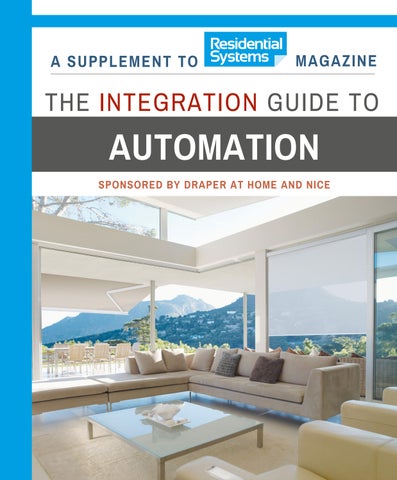
A home with a Nice automation system, along with Nice interior and exteror shades.
THE SMART HOME EVOLVES
The latest automation updates offer a win-win opportunity — they are easy for homeowners to use and easy for dealers to program. By Karen Mitchell
T
ime and technology march on, and automation has evolved to the point where it’s both easy to use and program. “Ultimately, the best technology should make both the homeowner and the integrator more effective,” says Jeff Shaw, chief product officer, Nice Group. “For the homeowner, that means a control experience that feels simple, personal, and predictable. For the integrator, it means tools that make systems easier to deploy, support, and evolve over time. “One of the most important directions we see is making home control easier, more personalized, and more context-aware while keeping the homeowner firmly in control,” he notes. “Rather than adding complexity, the goal is to make the interface feel more intuitive and relevant to the way people actually use their homes.” There is also an opportunity for interfaces themselves to become more personal over time. “Using technologies such as cameras on the device or Bluetooth Low Energy, an interface such as the Nice EL-ITP Intelligent Touch Panel could support more context-aware experiences, where the controls presented are better aligned with the person using the system and what they are trying to accomplish. The important point is that personalization should make control easier,” Shaw notes. Nice is already building toward a more context-aware experience with the ELAN OS, he adds. “Surveillance, for example, is integrated directly
2
into the control environment, and increasingly sophisticated classification can identify meaningful activity involving people, vehicles, animals, and other events. That type of contextual information can help make the overall control experience more useful and intuitive.” Shaw says AI can also create significant value on the dealer side. “One of the most practical opportunities is helping integrators find technical information and answers more quickly, assist with troubleshooting, and reduce the time it takes to diagnose and resolve system issues,” he explains. “Used this way, AI becomes a tool that supports the technician rather than replacing expertise, helping dealers work more efficiently, improve service, and ultimately deliver a better customer experience. “A consistent theme heard is that homeowners want technology to become easier and more personalized without taking control away from them. They want the benefits of automation without navigating complicated interfaces or wondering why their home did something they didn’t ask it to do. That feedback reinforces our focus on making the control experience more intuitive and automation routines more responsive. People and families aren’t static. Their schedules change, rooms get used differently, and their preferences evolve, so the system needs to be flexible enough to adapt easily as those needs change. “We hear the same need for simplicity from integrators,” Shaw says.
AUTOMATION
Draper At Home Follows the Sun “Our latest technology is heliotropic shading,” says Clint Childress, market director, residential solutions, Draper At Home. “Heliotropic means to follow the sun, and several plants in nature exhibit xxxX this behavior. With Draper At Home TourneSol technology, we can bring heliotropic shading to residential projections. You let the system know how far you want unshaded light penetration into a space, which protects furniture and flooring while maximizing natural light. As the sun moves over the residence, the shades will move in small silent increments, providing sun control as a background operation that’s not noticeable. However, when one hits the override, the shades will move at a normal speed to the desired location.” Some of Draper’s newer features grew from customer demand. “Draper has been a leader in sun tracking technology for decades,” says Childress. “The feedback we received was, ‘This is great, but how can we adapt it for the home? How can we make it more elegant and more of a background operation? Motors have a speed, and how can this change for sun tracking?’ We worked to bring this solution to the market through Draper At Home thanks to this feedback.” Comfort, control, and connection are the big asks from customers, according to Childress. “They want the shades to be where they need them to be, and when, delivering the comfort they want, the connection to light that they need, and the control they demand,” he says. “Our TourneSol delivers this in an elegant but understated fashion, so the customer never needs to think about movement and light control: It just happens. TourneSol’s technical features have been cultivated for the high-end client, but at a price point that can reach a broad audience. It’s smooth, easy, reliable operation meets the demands that we were given.” Jason Felix, president of Utah-based Performance Plus Marketing, a manufacturer rep firm, has worked with a lot of dealers. “While each has its own set of priorities, one general rule comes up again and again; simply give us a good product at a fair price,” he says. “That is something that has always been front and center of everything Draper does, and it has continued on with Draper At Home in the residential market.” Just as important, Felix adds, is to have a manufacturing partner that is stable, deals fairly, stands behind its product, and supports the dealer. “This also is something Draper has always been known for,” he says. “Our dealers know that if something does go wrong, Draper At Home will back them up and not leave them hanging on any issues.”
4
“They want tools that help them configure, service, and support systems more efficiently. One reason AI is particularly interesting for the channel is that it has the potential to help dealers locate answers quickly.”
Make It Personal “The latest from Control4 builds on the themes introduced with the Control4 X4 release, including easier navigation, a more intuitive user experience, a beautiful UI, and fewer actions needed through features like Home Screen,” says Eric Fritz, senior director of product management, ADI. “We’ve also added quick actions within camera views, expanded our widgets library, and made experiences like initiating streaming audio faster and easier for end users.” User personalization is another key focus. “A year ago, we introduced Routines, giving users the ability to create scheduled automations and events directly in the app,” says Fritz. “We’re continuing to expand our Routines library with popular experiences, including window shades. Expanded interoperability also remains a core focus of the Control4 platform. We’ve expanded our Apple integrations to include Apple Music, Siri, and AirPlay 2. This year, we’re showcasing new Zigbee 3.0 integrations with popular lock and shade brands that bring even more value to customers.” Ultimately, a lot of Crestron’s user interfaces come from the idea that the home should be easy for anyone to control, says Georgio Galaris, manager of residential marketing, Crestron. “That takes into account things like age ranges, ensuring comfort for grandparents to kids, and also tech savviness, being as accessible for guests as it is for everyday users. When someone sees our new 80 Series touchscreens, your whole home is at your fingertips, and it stays simple. Want to adjust the lights or play music in a room? The user interface is designed to be intuitive with easy cues and symbols that make the controls easy to perceive.” That same philosophy extends to Crestron’s keypad lineup. “Our buttons map clearly to parts of the home,” he adds. “For example, lights or shades have directional cues that make adjusting light temperature or shade height simple. The technology has to be dependable enough that pressing a button always does what is expected, whether that is our touchscreens, our keypads, or our remotes.”
Sticking to ‘Em What makes a customer or dealer want to stick to a manufacturer? It comes down to dependability and trust. “When you press a button, you want it to do what you expect, every single time,” Galaris says. “That consistency is what makes people comfortable living with technology day to day. This allows users to focus on what matters most with technology being something that enhances their experience without getting in the way. Whether that’s peaceful music playing to prep for a dinner party or dimming the lights to sing and cut a cake for a child’s birthday, these everyday experiences can be enhanced by a simple button press. Continued investment in improving the experience for both sides of the platform keeps customers and dealers with Control4, according to Fritz. “We’re constantly enhancing the customer experience while also investing in the tools and resources available to dealers,” he says. “With X4 and the associated dealer tools continuing to evolve over time, both users and dealers can expect ongoing improvements and added value from their Control4 system.”
AUTOMATION
SUNFLOWERS INSPIRE A NEW WAY TO CONTROL SHADES Draper At Home’s new TourneSol system gradually adjusts motorized window shades throughout the day. By Clint Childress, LEED AP, Market Director - Residential Solutions, Draper At Home
I
n our fast-paced world, maintaining a healthy lifestyle can be challenging. However, understanding the benefits of circadian rhythms, natural light, and window shades can significantly improve our well-being. The TourneSol system from Draper At Home is here to help.
The Importance of Circadian Rhythms Circadian rhythms are the natural, internal processes that regulate our sleep-wake cycle and repeat roughly every 24 hours. These rhythms are influenced by external cues like light and temperature. The suprachiasmatic nucleus (SCN) in the brain acts as the master clock, coordinating various bodily functions to align with the day-night cycle. A well-regulated circadian rhythm offers numerous benefits: • Improved Sleep Quality • Enhanced Cognitive Function • Better Mood and Mental Health • Optimized Metabolism
reducing the need for artificial heating and cooling. • Privacy: Window shades provide an added layer of privacy, allowing you to enjoy natural light without compromising your personal space. • Protection from UV Rays: Prolonged exposure to UV rays can damage furniture, flooring, and artwork. Window shades help block harmful UV rays, preserving the quality of your interiors. • Aesthetic Appeal: Modern window shades come in various styles and materials, allowing you to enhance the aesthetic appeal of your home while enjoying their functional benefits.
TourneSol Helps Integrate These Elements for Optimal Health, Comfort, and Protection
The Role of Window Shades
TourneSol is a heliotropic sun-tracking system by Draper At Home designed to follow the sun’s path, gradually adjusting your motorized window shades in unnoticeable increments to match the position of the sun throughout the day. TourneSol enhances comfort and well-being through a seamless blend of natural light control and silent, imperceptible operation. To maximize the benefits of circadian rhythms, natural light, and window shades, TourneSol is inspired by the way sunflowers follow the sun’s track throughout the day to help with the following: • Morning Light Exposure: Spend time outdoors or near a window in the morning to help regulate your circadian rhythm. • Use Window Shades Wisely: TourneSol adjusts your window shades throughout the day to control light levels, reduce glare, and maintain a comfortable indoor temperature. • Create a Sleep-Friendly Environment: Ensure your bedroom is dark at night by using blackout shades to promote better sleep.
Window shades are more than just decorative elements; they play a crucial role in managing natural light and maintaining a comfortable indoor environment: • Light Control: Window shades allow you to adjust the amount of natural light entering your home, creating a comfortable ambiance and reducing glare. • Energy Efficiency: By controlling the amount of sunlight that enters your home, window shades can help regulate indoor temperatures,
TourneSol not only maximizes comfort and wellness; it also helps protect your home and furnishings. TourneSol can set a direct light penetration depth to protect furniture, flooring, musical instruments, and artwork from exposure to harmful UV rays. Learn more about using the power of the sunflower to create a healthier, more balanced lifestyle and protect your interiors at https://www.draperathome. com/?S=sunflowers.
The Power of Natural Light Natural light plays a pivotal role in regulating our circadian rhythms. Exposure to natural light, especially in the morning, helps synchronize our internal clock with the external environment. Here are some key benefits of natural light: • Boosts Vitamin D Levels • Improves Mood and Reduces Stress • Enhances Productivity and Focus • Supports Healthy Sleep Patterns
6
AUTOMATION
THE NEXT ERA OF HOME CONTROL From Automation to adaptation — the next era of home control will be defined by how intelligently the home can respond to the people living in it. By Jeff Shaw, Chief Product Officer, Nice North America
F
or years, the promise of home control was relatively straightforward: Bring disparate technologies together and make them easier for homeowners to manage. Systems integrators connected lighting, climate, entertainment, security, shading, and other systems, programmed the appropriate scenes, and gave homeowners a simpler way to control their home environments. That model is changing. The next era of home control will be defined not simply by how many technologies we can integrate, but by how intelligently the home can respond to the people living in it. Advances in AI, processing power, data analysis, cybersecurity, and user interfaces are creating an opportunity to move from homes that are programmed to homes that can become increasingly personalized and inherently adaptive. For systems integrators, this evolution isn’t about technology replacing their expertise. It has the potential to make that expertise more valuable by providing better insight into how clients actually live with their systems, which in turn creates new and ongoing opportunities to optimize those experiences.
firmly in control of how and when their home systems operate. Consider a homeowner who starts each morning by turning on the kitchen cabinet lights and switching the TV to the morning news. Those repeated actions say something about how that person uses the home. As control systems become more context-aware, they can use information about routines, identity, and the environment to make frequently used functions easier to access and the overall experience feel more personal, without taking control away from the homeowner. We can already see the foundation for this kind of experience taking shape. Home control platforms such as the Nice ELAN OS bring multiple systems into a unified environment, creating opportunities for more context-aware, personalized control as technologies continue to evolve. That distinction is important. There is a fine line between technology that feels helpful and technology that feels intrusive. The goal isn’t a home that unexpectedly makes decisions for its occupants. It’s a home control experience that becomes more intuitive and relevant while keeping the homeowner in charge.
Bringing New Meaning to “Personal Space”
AI Should Give Integrators a Competitive Edge
Personalization is becoming an industry-wide priority for a simple reason: The role of the home itself has changed. Our homes have become places for work, wellness, entertainment, exercise, relaxation, and solitude. For many people, home is increasingly the getaway rather than simply the place they return to after one. As a result, homeowners expect their environments to reflect their individual preferences — even when those preferences change. The traditional control system accomplishes this through meticulous programming. An integrator learns how a client wants to live and creates scenes, schedules, and automations accordingly. But people aren’t static. Habits change. Families change. The way rooms are used changes. Historically, keeping a system aligned with those changes could require periodic tweaks to the programming. No big deal in most cases, but it’s still time, effort, and cost.
For integrators, one of AI’s most immediate opportunities may be less about the home-making decisions and more about helping dealers work faster and more effectively. The amount of technical information required to design, install, and support today’s connected systems continues to grow, making fast access to the right information increasingly valuable. AI can help dealers find answers more quickly, surface relevant product and technical information, and assist with troubleshooting when a system isn’t behaving as expected. Instead of spending valuable time searching through manuals, documentation, and multiple sources, an integrator could use AI to narrow the issue, identify likely causes, and get to the information needed to resolve it faster. Used this way, AI supports the dealer’s expertise rather than replacing it. This can translate into meaningful business benefits. Faster access to information can help technicians work more efficiently in the field, shorten troubleshooting time, and improve service responsiveness. It can also help newer technicians build confidence by making the collective knowledge behind increasingly complex systems easier to access. The result is a better experience for both the integrator and the homeowner.
AI and the Move Toward More Adaptive Home Control AI creates the potential for home control systems to become more adaptive over time. As processors become more capable and systems become better at securely gathering and interpreting data, control platforms can gain a deeper understanding of context, usage patterns, and individual needs. The opportunity is to use that intelligence to make interactions simpler and more personalized while ensuring the homeowner remains
8
Smarter Surveillance Leads to Smarter Automation Security and surveillance provide one of the clearest examples of where AI can create immediate value. The challenge with surveillance isn’t cap-
turing more video. We already have enormous amounts of it. The challenge is getting to the relevant information quickly. If a property has 16 cameras recording around the clock, nobody wants to scrub through hours of NVR footage looking for one event. Intelligent classification changes the experience. Instead of searching through everything, the user might ask to see instances involving people, vehicles, or animals and jump directly to relevant footage. They could drill down even deeper, asking to see footage only of a delivery driver, a specific make and model of automobile, or just deer in the garden. Our next-generation Nice N3 NVR and AI-enabled surveillance reflects that direction. Classification can help identify relevant activity and make notifications more useful rather than simply generating more alerts. But the bigger opportunity emerges when surveillance intelligence becomes part of the broader control environment. For example, at Nice, surveillance is integrated directly into the ELAN OS rather than requiring the homeowner to move into a separate application. As classification becomes increasingly sophisticated, able to recognize categories such as people, vehicles, animals, faces, and even sounds, those events can become inputs for the rest of the home. A recognized arrival could potentially open a gate, turn on appropriate lights, and start that person’s preferred music playlist. In this scenario the camera isn’t merely documenting what’s happening. It is helping the control system understand context and respond appropriately.
Interfaces That Recognize and Adapt to Each User Think about a smartphone. It is an intensely personal device, configured around one person. Yet many home control interfaces remain essentially identical regardless of who is standing in front of them. That doesn’t necessarily make sense.
Using technologies, such as cameras on the device or Bluetooth Low Energy, an interface like the Nice EL-ITP Intelligent Touch Panel can recognize or infer who is interacting with it and present the appropriate experience. An adult might see a complete home control menu, while a child could have access primarily to media and other approved functions. When that interaction ends, the panel can return to a general household screen.
“System Morphing” Offers Meaningful Benefits to Users and Integrators All of these advancements point toward what I think of as system morphing: technology that adapts how it looks and behaves based on context, identity, and patterns of use. We are moving from systems that simply execute commands to systems that can increasingly understand. From interfaces everyone has to adapt to, to interfaces that adapt to the individual. From surveillance that records everything, to intelligence that surfaces what matters. And from static control experiences to systems designed to become more useful and personalized as technology evolves. For integrators, this isn’t the end of customization. It’s the beginning of a much more powerful version of it. For more information about Nice home control and automation solutions, including the ELAN OS9 platform and EL-ITP Intelligent Touch Panels, as well as the company’s line of advanced surveillance cameras and NVRs, visit niceforyou.com. Jeff Shaw is the chief product officer for Nice North America, where he leads product management across the company’s Security, Access Control, Luxury Smart Home Solutions, and Automated Door & Gate Opener businesses. He is responsible for driving product strategy, innovation, and portfolio growth while delivering solutions that serve professional integrators and distribution partners throughout North America.
9
RSM322.Supplement.indd 9
07/10/2026 13:13:14