YOUR INSIDER BUSINESS RESOURCE FOR MORE THAN 30 YEARS
NAVIGATING THE SQUEEZE
Reduced RF Spectrum Resources Impact Pro AV Wireless Microphones AVNETWORK.COM
OCTOBER 2026
26 The Battery, Uninterrupted
Chris Bishop calculates how Li-ion changes your UPS math.
36 The Future Is Heard, Not Seen
Jens Pilz talks audio tech transforming corporate spaces.
42 Cameras On, People
26
36
42
Andie Mace says never showing your face sends the wrong signal.
9000
YOUR INSIDER BUSINESS RESOURCE FOR MORE THAN 30 YEARS
NAVIGATING THE SQUEEZE
Reduced RF Spectrum Resources Impact Pro AV Wireless Microphones AVNETWORK.COM
OCTOBER 2026
26 The Battery, Uninterrupted
Chris Bishop calculates how Li-ion changes your UPS math.
36 The Future Is Heard, Not Seen
Jens Pilz talks audio tech transforming corporate spaces.
42 Cameras On, People
26
36
42
Andie Mace says never showing your face sends the wrong signal.
CONTENTS
20
Navigating the Squeeze
Spectrum concerns continue to impact the state of wireless microphones in Pro AV. By James Careless
30
24
34
Business
The Integration Guide to NDI
24 Protecting the Voice
30 A Shared Language of Connectivity
Source separation is the next frontier in live and
Metadata is the quiet differentiator behind NDI’s next
installed audio.
chapter.
By Ryan John
By Roberto Musso
25 1 SOUND Helps Bring Experiential Exhibit to Life The Old South Meeting House never sounded so good.
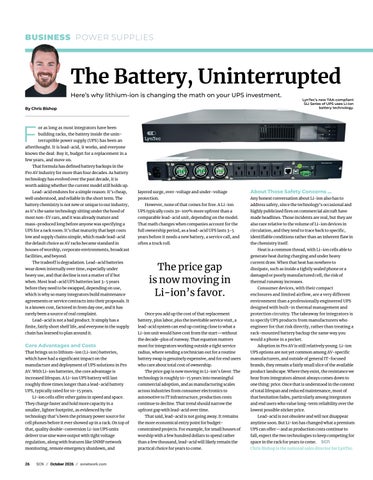
26 The Battery, Uninterrupted Here’s why lithium-ion is changing the math on your UPS investment. By Chris Bishop
28 Fiscal Fitness Can Be Fun The new MoMoney museum turns financial literacy into an experiential Pro AV playground. By James Careless
Technology 34 Predicting the Invisible Audio mapping software provides a design superpower for acoustic engineers. By James Careless
36 The Future Is Heard, Not Seen New audio technologies are transforming corporate spaces. By Jens Pilz
38 Uncomplicated Videoconferencing Jabra keeps it simple with the PanaCast U30 videobar, but there are advanced capabilities if you want them. By Mark J. Pescatore
39 Audio Clarity for Content Creators Shure’s new MV88-USBC is an ideal replacement for your phone’s built-in mic—and then some. By Mark J. Pescatore
Viewpoint 42 Cameras On, People In today’s work environment, never showing your face is sending the wrong signal. By Andie Mace
Departments 4 SYSTEMS CHECK 6 NEWS
16 NEWSMAKERS 40 PRODUCTS
Vol. 33 No. 10 October 2026 Systems Contractor News (ISSN 1078-4993) is published monthly by Future B2B. 130 W. 42nd St, 7th Floor, NY NY 10036. Periodicals postage paid at New York, NY and at additional mailing offices. POSTMASTER: Send address changes to PO Box 254 Lowell MA 01853. Subscribe online at www.MySCNews.com. Please allow 6-8 weeks for address changes to take effect. © Copyright 2026 by Future US, Inc. PRINTED IN U.S.A.
avnetwork.com // October 2026 // SCN
3
SYSTEMS CHECK avnetwork.com
MARK J. PESCATORE Content Director
mark.pescatore@futurenet.com
Failure Is Not an Option, Except When It Comes to Meeting Technology
T
he modern office is not the same as or equal to NASA Mission Control during the Apollo 13 mission in 1970. As much as we’d all like to think failure is not an option, the research says otherwise. And those failures come at a cost.
In late July, the Jabra Research Institute published “The Cost of Bad Meetings,”
which shared findings from a study of 2,671 knowledge workers from seven different FACEBOOK
facebook.com/ systemscontractor
countries. You can review the methodology to see how Jabra calculated the numbers, but the company estimated that bad meeting culture carries a price tag of more than $130 million per year for enterprise businesses. It’s not like those wasted dollars are monetized by tossing $20 in the company swear jar every time there’s a %$#@! meeting issue. No, these are hidden costs that you won’t
LINKEDIN linkedin.com/company/ systems-contractor-news
find on the books. They come from “wasted time, technology failures, and the downstream work that bad meetings generate.” Jabra calls this “meeting debt,” and the numbers aren’t good. Let’s check out some of the damning bullet points:
• Workers are averaging a full working day in meetings every week (only 7.7 hours
X x.com/scnmag
in the United States, a small win). The larger the company, the more time in
meetings. Workers consider almost 60% of time spent in meetings unnecessary.
• About 87% of workers dread meetings, and more than 90% of those workers
leave meetings without clear action items. And that lack of direction leads to— you guessed it—a follow-up meeting. Cue vicious cycle.
• Roughly half of remote workers feel excluded or talked over, with more women reporting worse experiences than men. Plus, remote workers who feel talked over are much more likely to dread meetings. Those are some pretty high corporate culture hurdles to clear. But technology isn’t without fault, either. Virtual collaboration may be the norm for today’s meetings, but respondents said three out of four meetings experience at least one tech failure. Hybrid meetings can be particularly problematic. “Meeting failure is not random,” Jabra declared. “It is patterned, predictable, and overwhelmingly concentrated in the same places, the same formats, and the same broken conditions, meeting after meeting, week after week.” Ouch, tell me how you really feel. What’s wrong? Mic problems are at the top of the list, no matter the size of the meeting room—and the larger the room, the more time is lost to tech failures. Jabra’s research concluded that 37% of meetings start late, and every meeting loses almost 11 minutes on average to technological failures. Video is abandoned in 30% of meetings, and 21% of meetings are moved during the actual meeting to another room. All those problems and the corresponding workarounds to get those meetings back on track are
OCTOBER 2026 VOL. 33 NO. 10 CONTENT
Content Director Mark J. Pescatore, Ph.D. mark.pescatore@futurenet.com Senior Content Manager Wayne Cavadi Contributors Chris Bishop, Erin Budnik, James Careless, Ryan John, Andie Mace, Roberto Musso, Jens Pilz Art Editors Rob Crossland, Sam Richwood Production Managers Nicole Schilling, Heather Tatrow A DV E R T I S I N G S A L E S
Managing Vice President of Sales, B2B Tech Adam Goldstein, adam.goldstein@futurenet.com, 212-378-0465 Sales John Casey, john.casey@futurenet.com, 845-678-3839 Janis Crowley, janis.crowley@futurenet.com, 845-414-6791 Debbie Rosenthal, debbie.rosenthal@futurenet.com, 212-378-0468 Zahra Majma, zahra.majma@futurenet.com, 845-678-3752 Andi Tureson, andi.tureson@futurenet.com, 646-544-0007 SUBSCRIBER CUSTOMER SERVICE
To subscribe, change your address, or check on your current account status, go to avnetwork.com and click on About Us, email futureplc@computerfulfillment. com, call 888-266-5828, or write P.O. Box 254, Lowell, MA 01853. LICENSING/REPRINTS/PERMISSIONS
SCN is available for licensing. Contact the Licensing team to discuss partnership opportunities. Head of Print Licensing Rachel Shaw licensing@futurenet.com M A N AG E M E N T
SVP, MD, B2B Amanda Dawrman-Allen VP, Global Head of Content, B2B Carmel King MD, Content, AV Anthony Savona VP, Global Head of Sales, Future B2B Dena Malouf Managing VP of Sales, B2B Tech Adam Goldstein VP, Global Head of Strategy & Ops, B2B Allison Markert VP, Product & Marketing, B2B Andrew Buchholz Head of Production US & UK Mark Constance Head of Design, B2B Nicole Cobban FUTURE US, INC.
130 West 42nd Street, 7th Floor New York, NY 10036
really only successful in creating more dread. Perhaps the most puzzling takeaway is that organizations just sort of accept it. The sky is blue, the trees are green, your meeting is going to start late, and there will be technical issues. Inefficiency is the norm, and because no one “owns” the conference room, the problems don’t seem to get fixed. Jabra calls it the “invisible broken room.” It’s a great term, though I wish it was a term that didn’t have to exist. AI isn’t leaving unscathed, either. The good news is that AI meeting tools had been tried by 75% of the respondents for tasks like post-meeting summaries, follow-up emails, live transcription, and auto action items. The bad news is that less than 33% use them regularly. What’s the disconnect? The top barrier is accuracy/trust (42%), with privacy/compliance not far behind (39%). Yes, companies of all sizes need to reevaluate meetings. What are they being used for? Could the meeting objectives be better met through an email, DM, or team chat? But correcting corporate communication patterns only takes you so far. When a meeting is necessary, we need to make sure the technology isn’t making the experience dreadful.
4
SCN // October 2026 // avnetwork.com
All contents ©2026 Future US, Inc. or published under licence. All rights reserved. No part of this magazine may be used, stored, transmitted or reproduced in any way without the prior written permission of the publisher. Future Publishing Limited (company number 2008885) is registered in England and Wales. Registered office: Quay House, The Ambury, Bath BA1 1UA. All information contained in this publication is for information only and is, as far as we are aware, correct at the time of going to press. Future cannot accept any responsibility for errors or inaccuracies in such information. You are advised to contact manufacturers and retailers directly with regard to the price of products/services referred to in this publication. Apps and websites mentioned in this publication are not under our control. We are not responsible for their contents or any other changes or updates to them. This magazine is fully independent and not affiliated in any way with the companies mentioned herein. If you submit material to us, you warrant that you own the material and/or have the necessary rights/ permissions to supply the material and you automatically grant Future and its licensees a licence to publish your submission in whole or in part in any/all issues and/or editions of publications, in any format published worldwide and on associated websites, social media channels and associated products. Any material you submit is sent at your own risk and, although every care is taken, neither Future nor its employees, agents, subcontractors or licensees shall be liable for loss or damage. We assume all unsolicited material is for publication unless otherwise stated, and reserve the right to edit, amend, adapt all submissions. Please Recycle. We are committed to only using magazine paper which is derived from responsibly managed, certified forestry and chlorine-free manufacture. The paper in this magazine was sourced and produced from sustainable managed forests, conforming to strict environmental and socioeconomic standards.
NEWS
Ben Sewell
LED Studio North America Rebrands as VOD Visual North America
I
n August, LED Studio North America rebranded to
seamless. The core North American team, ongoing
VOD Visual North America. Driven by accelerat-
projects, and established relationships remain
ing momentum across the continent, the tran-
unchanged, while outward-facing communications
sition formalized a deep operational partnership
and digital assets will gradually migrate to updated
with global LED display manufacturer VOD Visual to
branding, emails, and web channels.
significantly scale manufacturing, engineering, and localized support across the region. The expansion is anchored by 56,000 square feet
“We’re watching project scale and volume grow incredibly fast, and the reality is that design teams and integration partners just can’t afford to wait on
OWC Acquisition Expands Shared Storage Portfolio
of new infrastructure, featuring a primary operation
long-distance logistics or remote tech support,” said
facility and product showroom in Sacramento, CA, as
Ben Sewell, CEO of VOD Visual North America. “This
well as a dedicated secondary showroom in San
transition is all about closing that distance figuratively
Antonio, TX. The Sacramento hub will also house
and literally. By tightening our alignment with VOD
Last month, Other World Computing announced
advanced engineering resources and a dedicated
Visual and opening the new California facility and
the acquisition of OpenDrives, a company
domestic RMA repair and service center designed to
showrooms, we’re able to hand our partners next-
focused on software-defined video and rich
significantly reduce turnaround times and streamline
generation global products paired with the immediate,
media storage management solutions and data
post-sale support for North American clients.
local engineering depth they need to execute.”
services. OWC’s acquisition of LumaForge and
As VOD Visual North America, the company now
its Jellyfish product line in 2021 gave customers
operates as a true full-service LED solutions
a broader range of high-speed shared storage
provider—combining global manufacturing power
solutions purpose-built for professional video
with a deeply rooted, on-the-ground infrastructure to
workflows. The addition of OpenDrives’
serve as the region’s headquarters, sales arm, and
solutions expands OWC’s shared storage
integration partner. For existing customers and
portfolio reach into enterprise-scale data
integration partners, the transition will be entirely
management, hybrid cloud orchestration, and edge workflows.
D-Tools and Portal.io Merge
D
OpenDrives’ Atlas data storage and management platform has been used extensively by Hollywood studios, postproduction houses, and live broadcast networks
-Tools and Portal.io have merged, a move
Rather than force every customer into a single system,
since 2011. In April, the OpenDrives Edge hybrid
that unites two widely used software plat-
D-Tools and Portal.io will continue to support each
cloud-edge performance accelerator was
forms serving commercial, residential, and
platform while working with integrators to match the
announced, providing widely distributed teams
right software to their needs.
“local speed” data access without the high costs
security AV professionals. Together, the companies give integrators a portfolio of purpose-built products
G Paul Hess continues as CEO, while Kirk Chisholm,
and complexity involved with traditional hybrid
that scale with their business, from proposal through
founder and CEO of Portal.io, joins as chief product
cloud workflows. Plus, the Astraeus cloud-
enterprise deployment.
officer, with responsibility for product vision and
native data services platform, which was
For nearly three decades, D-Tools has been an
strategy across the portfolio. Josh Willits, Portal.io’s
released in beta mode for early adopters in late
anchor platform for the integration industry, building
COO, will serve as head of Portal.io, continuing to lead
2025, will have an updated release in 2027.
the breadth and scale integration businesses need to
the Portal business unit.
bring structure, accuracy, and control to their operations
“Putting our two teams together is a real chance to
“OWC has always been about removing the barriers between people and their creative
across sales, system design, engineering, project
shape where this industry goes and to build what dealers
work,” said Larry O’Connor, OWC’s founder and
management, and procurement. Portal.io has spent 15
have always wanted,” Chisholm said. “In a world of AI,
CEO. “Bringing OpenDrives into OWC allows us
years understanding how dealers sell and turning that
an integrator should be able to run their entire business
to take that mission further by connecting the
insight into an intuitive proposal and catalog experience.
on software that is powerful,
high-performance storage and workflow
The two companies have been partners for more
beautiful, and intuitive all at
solutions our customers rely on with powerful
than a decade, since Portal.io’s managed product
once. If you had to handpick
software-defined data management services,
catalog was first integrated into D-Tools SI. Bringing
two companies to deliver on
giving customers a more seamless way to
the organizations together reflects a recognition that
that, it would be D-Tools and
capture, create, collaborate, and access their
integrators are better served by one team investing in
Portal.io. That is the
content wherever their work takes them.”
the tools they depend on every day than by two teams
company I want to build, and it is
solving the same problems twice. The acquisition was
why I am excited to take on product
announced in August.
for the combined organization.”
For customers, there is no forced migration and no plans to end-of-life any product currently offered.
6
SCN // October 2026 // avnetwork.com
Kirk Chisholm
Connect
DO THE IMPOSSIBLE. Infinite Possibilities: now AI-Agent Ready
AI Technology Powering the Next Generation of AVoIP Distribution DisplayNet Signal Distribution has redefined the apex of AVoIP performance with a powerful AI-ready control interface that enables definition and deployment of complex AVoIP systems in minutes using natural-language instructions and with no prior knowledge of the underlying API. DisplayNet is the first AV-over-IP system to ship native Model Context Protocol (MCP) support, making it directly controllable by Claude, OpenAI Codex, Google Antigravity, or any MCPcompatible AI agent out of the box. The DN-300 Series, DisplayNet’s award-winning endpoints, deliver flawless 4K/60 (4:4:4) video distribution with limitless scalability, zero-frame latency and zero image artifacts. These features allow system designers to deploy highly versatile AV signal distribution systems with robust performance, scalability, versatility and reliability at a fraction of the cost of traditional AVoIP systems. Contact us today to see how DisplayNet can move your next AV system into the future.
ZERO COMPROMISE – INFINITE POSSIBILITIES
Powered by sales@dvigear.com (888) 463-9927 www.displaynet.com
WINNER © 2026 DVIGear, Inc.
NEWS
WAVIT Reinvents Mentorship with Wave of Influence Women in AV/IT (WAVIT) has unveiled its reimagined Wave of Influence Mentorship Program with a bold new vision for mentorship that empowers women across AV/IT to build meaningful connections and grow through every stage of their career. Unlike traditional mentorship programs that pair one mentor with one mentee for a predetermined period, the Wave of Influence embraces a fresh, member-driven approach. Participants have the freedom to connect with
FORTÉ Acquires Vega Global, Adds to International Footprint
multiple mentors, mentees, and peers based on
By Mark J. Pescatore
However, Stoebner expects it will likely take close to
different stages of professional development.
a year to change the name. During the transition, it
Recognizing this shift, WAVIT reimagined its
will be known as Vega Global, A FORTÉ Company.
mentorship program to create a more flexible,
Pro AV integrator that started in a small
Steven Medeiros, who currently leads Vega, will
personalized, and collaborative community
city in North Dakota back in 1974 has
remain with the company as CEO of FORTÉ Asia.
experience that better reflects today’s workforce.
A
their goals, interests, expertise, and career stage—creating flexible relationships that can last for a single conversation or continue for years. Careers are rarely linear, often requiring guidance from multiple perspectives throughout
expanded its global footprint in a big way.
Stoebner said FORTÉ specifically targeted Vega
FORTÉ, which recently announced plans to sepa-
because the company is “growing nicely in a market
who has all the answers. It’s about building a
rate from GPA at the end of the year, has acquired
that is growing nicely.” He said the APAC region will
community of people who encourage you,
Vega Global, a systems integrator with a significant
generate close to $200 million in Pro AV business this
challenge you, open doors, and help you discover
presence across the APAC region.
year, and Vega has been growing at a rate of 14% CAGR.
opportunities you may never have found on your
When it comes to multinational customers,
own,” said Brandy Alvarado-Miranda, founder of
Stoebner said the questions are less about the
WAVIT. “We understand that careers are built
FORTÉ acquired the international company in August through Chicago-based Baird Capital,
“Mentorship isn’t about finding one person
which acquired a majority stake in Vega
technology or even the price. Instead, it’s
through communities, not just connections. This
back in 2020. Terms of the acquisition
about coverage. “We’re working to
gives women the opportunity to build an entire
between the two private companies
build the answer for that type of
network of trusted advisors who can support them
were not disclosed. Jeff Stoebner,
customer, the global customer,”
through every stage of their professional journey.”
chairman and CEO of FORTÉ, told
he said.
The result of months of planning by WAVIT’s
SCN that while the company remains
While cloud-based solutions
committed to its local and regional
and AI are certainly impacting Pro
participants to build professional profiles
customers, this move “accelerates
AV deployments, Stoebner argued
highlighting their expertise, interests, and career
our ambition of being as close to our
most of the customer investment is
goals, as well as receive more meaningful mentor
still in hardware. “There’s a physical
and mentee recommendations, track mentorship
global customers as possible.” With the acquisition, FORTÉ now has team members in more than 20 countries and
Jeff Stoebner
offers AV solutions and managed services in
Outreach Committee, the new program enables
nature to what we do,” he explained.
goals and professional milestones, access
“There’s a lot of hardware … and that
mentorship best practices and educational
hardware requires technicians to integrate
resources, and develop multiple mentoring
more than 70 major markets. Based in Minneapolis,
and support. What’s been true for a long time is you
relationships that evolve throughout their careers.
FORTÉ is already established in Germany, Ireland,
have to have people, trucks, and tools as close to the
Mentors also remain fully in control of their
Mexico, Sweden, and the United Kingdom, in addition
customer as possible.”
to 42 office locations in the United States. Now, it adds
With the Vega acquisition, FORTÉ is building
participation, choosing their availability, session frequency, scheduling preferences, and level of
offices in Australia, Mainland China, Hong Kong,
a model where it can better manage the quality of
involvement, making it easier than ever for
India, Indonesia, Japan, Korea, Macau, Malaysia, New
its global delivery of services. Stoebner said the
experienced professionals to give back without
Zealand, the Philippines, Singapore, Taiwan,
company learned a lot from its partnership with GPA
feeling overwhelmed.
Thailand, United Arab Emirates, and Vietnam.
over the past six years—but now it’s focused on
Vega brings more than 750 employees to FORTÉ, growing the company’s workforce by roughly 50%. According to Stoebner, plans call for adding more
applying that knowledge and investing in its own infrastructure. “We want to enhance the customer experience
technicians to Vega operations in the near future.
end-to-end under the FORTÉ brand,” Stoebner
“I’m excited about growing a global brand,” he added.
added. “This acquisition is not the end of our
Eventually, Vega will adopt the FORTÉ brand.
8
SCN // October 2026 // avnetwork.com
journey, but it is another important milestone.”
NEWS The Lightning Society is using Sonos audio solutions in unique spaces across multiple floors.
Sonos Audio Sparks Connection at Lightning Society By Wayne Cavadi
problems, gets out of the way, and lets human experience take center stage.”
L
There were unique challenges inherent to the
Eight Era 100 Pro speakers make up a zoned system, distributed with PoE throughout the third floor, which features and reading room and a coffee bar. There is also a listening room that utilizes Era 300 speakers, in-ceiling speakers, subwoofers, and a Sonos Arc Ultra soundbar housed in a Leon Tonecase. The fourth floor is broken up into experience rooms, including a spatial audio listening room, conference room with ARC theater, audiophile
ocated in Soho’s cast-iron district, Lightning
project, one of which was the building itself. Being 100
listening space, and micro theater with a 100-inch
Society is a New York City-based community
years old meant architectural integrity was top of
screen and Sonos powering a massive width-matched
that, according to its website, is a “play-
mind. For OneButton, this challenge wasn’t too
soundbar. The top floor is an intimate members’
ground for the intellectually adventurous.” From live
different from other projects, as every building
space where Sonos Five wireless speakers are hidden
music to immersive events, the Society’s home on
presents its own challenges; this one happened to be
throughout the space at waist level, making music a
45 Howard Street is aimed at sparking connection,
dealing with century-old architecture.
character in the conversation between members.
curiosity, and wellness amongst its members. Audio
“[We] took advantage of the new Era 100 Pro PoE
Emmi said the scenic rooftop utilizes outdoor
plays a big role in bringing members together, and
solution to maintain signal integrity to every speaker
speakers mounted to a broad pergola, keeping
the new home of Lightning Society turned to Sonos
without having to resort to 70V transformers,” Emmi
members cozy by the fire pit and gardens.
to amplify that sound.
explained. “Further, this optimized wire pulls and
The project, which not only spans multiple floors
While there is still work to be completed in some
minimal power requirements, which is helpful given
of the more specialized spaces before Lightning
but a variety of spaces, commenced at the beginning of
we could only pull wire through specific channels
Society is fully open, all the user feedback has
the year with the ballroom; however, per Matt Emmi,
between historic pillars and beams.”
confirmed that Sonos and OneButton checked the
founder of OneButton, the technology design firm
According to Heckl, product selection was achieved
right boxes. “The early results have been
selected for the project, it is still a work in progress.
through a collaborative process that helped identify
overwhelmingly positive,” Heckl said. “The
“We are still finalizing the adaptive [circadian]
how the expansive venue would be used, as each space
Lightning Society is not yet in full-time regular use,
lighting scope, but the core audio scope is complete,”
accommodates a variety of uses within it. On top of that,
but the wide range of events that have taken place
he explained. “That said, there is now a desire for
the system would have operators with varying degrees
have gone extremely well.”
‘concert-quality’ sound, so we are looking at further
of audio expertise. With no complicated programming
incorporating subwoofers into the architecture. The
or end user training required, Sonos was an ideal
remainder of the floors, which are focused on
system choice.
members’ areas and activities, will come online over the next few months.” When it came to what audio solutions would be used,
Yet another challenge surrounding the architecture was that the hardware also had to fit each physical space. “In some cases, those decisions were driven by a
there was little question Sonos was the right fit. It was a
scarcity of electrical outlets, whereas in others,
shared vision that brought it all together. Per Emmi,
decisions were made to adhere to a strict aesthetic
Sonos was the only vendor that could elegantly provide
mandate,” Heckl said.
the breadth of experiences Lightning Society desired. “The Lightning Society, Sonos, and OneButton all
Per OneButton, the team took a residential approach with the Sonos Amp Multi—the new Sonos multi-
similarly consider people and connection first,”
channel amp—powering 16 invisible speakers in the
explained Luke Heckl, commercial sales manager,
second-floor ballroom. Amp Multi provides flexibility to
Americas at Sonos. “With that, there was an elevated
manage multiple speakers while simplifying the Sonos
focus on experience rather than purely focusing on the
audio ecosystem. The ballroom has already hosted a
technology or products, which we are all prone to do in
Sonos launch event, showcasing high-quality audio
this industry. At its core, the design always revolved
throughout the entire room while keeping the
around the user experience. Technology solves
loudspeakers hidden within the architecture.
10
SCN // October 2026 // avnetwork.com
The Lightning Society hosts a variety of events at its Lower Manhattan location.
NEWS
The recent 9/11 Memorial Museum AV upgrade included a complete end-to-end 4K production workflow.
9/11 Memorial Museum Turns to AVoIP for 25th Anniversary By Wayne Cavadi
original AV infrastructure was designed around traditional point-to-point architecture, using
Fernando Mora
When Mora and his team began to consider an
HDBaseT as the primary media transport technology.
upgrade to the core AV
ocated at the World Trade Center site in Lower
“When the museum was designed in the early 2010s,
infostructure in 2019, many of
Manhattan where the towers once stood, the
this was the correct approach at that time,” he told
the AVoIP standards were still similar to each other, so
National September 11 Memorial & Museum
SCN. “It continued to serve us well for many years.”
there was no need to quickly jump to an upgrade. The
(9/11 Memorial Museum) forms the centerpiece of the
The need to replace HDBaseT did not drive the
strategy, he explained, became deliberate, to “wait for
9/11 Memorial. As the 25th anniversary of the terror-
upgrade; rather, it was the realization that AVoIP
the technology and the market to mature, while
ist attacks neared, the museum underwent a massive
offered capabilities beyond basic video transport.
watching to see which platforms emerged as the
upgrade, primarily focused on strengthening the
“Ultimately, its distributed nature allowed us to build a
dominant players. HDBaseT was still performing very
backend infrastructure, improving system reliability,
master control room which became the orchestration
well for us, so the question became: What’s the rush?”
and creating a more stable technology platform.
layer for our entire venue,” he explained. “From this
Another factor that influenced the upgrade was
L
central location we can manage and monitor all
existing technology. The museum was already largely a
entrance pavilion and atrium providing the transition
The museum lies below the plaza, with the
aspects of our exhibitions systems, live production,
Crestron house, which, as Mora explained, made the
from the city to the historic site below. Above this area
digital signage, and UC meeting platforms utilizing live
evolution toward Crestron NVX a logical path. “All our
is the auditorium with nearby ramps leading visitors
CCTV cameras, custom Q-SYS dashboard UCIs, and
technicians are either programmers or DMC-E-NVX,”
down approximately 70 feet to the original foundation
Symphony monitoring software.”
he said. “It allowed us to move into AV over IP while
level of the World Trade Center complex. From there,
building upon technology, programming expertise, and
visitors enter exhibition galleries where the South and
support for this new infrastructure.”
North Towers once stood.
After the 20th anniversary, Mora and his team—
Within the South Tower footprint is the Memorial
lead technician and in-house programmer Kelman
Exhibition, a space dedicated to remembering the
Torres, technician Jermaine Morgan, and auditorium
nearly 3,000 people killed in the attacks of Sept. 11,
production technician Jose Rosa—embarked on the
2001, and Feb. 26, 1993. The North Tower footprint
five-year overhaul of the museum’s infrastructure, all
contains the Museum’s Historical Exhibition, which
while the museum remained open and operational.
presents the events of 9/11, organized into three
Wheels started rolling in 2023 with the modernization
primary sections that explore the chronological
of the museum’s DSP infrastructure.
timeline of the horrific events of the day, events
“We migrated from a CobraNet-based Layer 2
leading up to the attacks, and the heroic rescue and recovery efforts. According to Fernando Mora, VP of AV and multimedia for the 9/11 Memorial Museum, the
12
SCN // October 2026 // avnetwork.com
audio architecture to a Layer 3, IP-based Q-SYS Located below the plaza, the 9/11 Memorial Museum includes exhibits that explore the events of the day.
processing platform,” Mora explained. “During the planning and development phase, I decided to expand the scope of the project to include modernization of our
NEWS control system, incorporating Q-SYS Control as part of
expected,” Mora explained. “When the museum is
the overall deployment.”
closed, the opposite may be true. Many of our CPU-
The extensive upgrade also included a focus on AV
based exhibits are intentionally shut down overnight,
transport to AVoIP in the exhibition areas, auditorium,
so an effective monitoring platform needs to
digital signage, and four classrooms. For the
understand that an offline device at 2 a.m. may be
auditorium, Mora said they created a complete
perfectly normal, while that same condition at 10 a.m.
end-to-end 4K production workflow. They replaced
could require immediate attention.”
the existing Crestron DM system with an NVX AVoIP
As 2026 began, the upgrade engulfed the museum’s
infrastructure, and installed a Christie 4K laser
collaboration and education spaces. “We upgraded all
projector, Panasonic 4K production cameras, Vizrt
four classrooms to support Microsoft Teams Rooms
TriCaster TC2 Elite switcher with 4K monitoring, and
using the Q-SYS UC platform, while our six corporate
DiGiCo audio console. To support the new AVoIP
conference rooms were upgraded with Neat Bar Pro
environment, Mora’s team deployed a NETGEAR
systems,” Mora added. “Most recently, we began
M4300 switch and engaged NETGEAR Professional
replacing our legacy exhibit media players with Hive
Services to assist with its configuration.
Media’s Osmia 4K players, further modernizing the
According to Mora, AVI-SPL’s Symphony was selected for monitoring the museum’s infrastructure
The 9/11 Memorial Museum includes artifacts from the fallen buildings, including a segment of the radio and television antenna from the North Tower.
content delivery side of the infrastructure.” For the 25th anniversary, a new exhibit, In Their
What began in late 2023 has evolved into a roughly three-year, phased modernization of the museum’s AV
because the museum wanted to move beyond
Honor, will debut. While that has what Mora calls a
ecosystem. “Rather than approaching it as a single
traditional monitoring toward a platform that gives
modest AV footprint, a live national primetime broadcast
replacement project, we deliberately addressed the
meaningful, actionable information about the health
from Memorial Plaza featuring the Tribute in Light
infrastructure in layers—audio processing and control
of the museum’s AV systems and the context in which
installation will showcase how the new infrastructure
first, followed by AV over IP transport, collaboration
they are operating.
supports an event with a worldwide audience.
spaces, and finally media playback,” Mora concluded.
“For example, when the museum is open, every
“On a personal level, Tribute in Light has always been
“That approach allowed us to modernize a large,
projector should be powered on, every media server
my favorite part of the commemoration,” Mora said.
operational facility while continuing to support the
should be in its appropriate run state, and the systems
“Seeing those two beams rise above the New York City
museum’s daily visitor experience and programming
supporting our exhibitions should be operating as
skyline is an incredibly powerful way to close the day.”
throughout the transition.”
avnetwork.com // October 2026 // SCN
13
NEWS From left, Noah Meicler, Marc Bertrand, and Skyler Meek
Great Expectations: Consumer Demand Is Driving Light Commercial Trend for Integrators
commercial installation. What changes is how we engineer and configure the solution for each specific application,” he added. Meek agreed that MicroLED is a “really natural” crossover product. “Whether it’s a luxury residence, sports bar, boardroom, nightclub, or hospitality space, the fundamental ask is becoming very similar: Give me a massive, beautiful image without forcing the room to compromise around the display.” However, the challenge is expertise. “Products like MicroLED can cross markets very easily,” Meek said, “but designing, specifying, installing, and supporting
By Mark J. Pescatore
A
between markets. In fact, many of the company’s
them correctly still requires specialized knowledge. I
residential dealers are brought into commercial projects
think manufacturers who can remove that complexity
by their homeowner clients.
for the integrator are going to play a big role in
s residential integrators gathered at CEDIA
“The video wall market really developed first in the
Expo last month in Denver, manufacturers
commercial world, so residential is just now seeing the
demonstrated solutions to help them expand
boom,” Meek explained. “What’s interesting is that the
residential space with the performance requirements of
their potential business opportunities into light com-
requirements are starting to converge, too. Residential
the commercial space, Meicler doesn’t want customers
mercial work.
clients want the scale, brightness, reliability, and
to have to choose. “A display can deliver incredible
performance that historically drove commercial video
visual impact without overpowering the room,” he
significant overlap between the residential and
wall adoption—but they expect it to be packaged in a
noted. “That’s one of the biggest advantages of dvLED.
commercial AV markets. “Technologies once reserved
way that belongs in a luxury home. Meanwhile,
We can create seamless displays in a wide range of sizes,
for large commercial environments are increasingly
commercial clients are increasingly concerned with
resolutions, and configurations that integrate naturally
finding their way into luxury homes, while residential
aesthetics, design, and creating an experience rather
into the architecture, rather than forcing the space to
expectations for exceptional design, simplicity, and
than simply putting a big display on a wall.”
accommodate a traditional display.”
Noah Meicler, president of DreamWall, is seeing
ease of use are influencing commercial projects as well,” he explained.
As to what’s driving the product overlap, Meek looks
accelerating the crossover.” As far as balancing the aesthetic needs of the
“This is a no-brainer for us,” Bertrand said,
to customer expectations. “A homeowner who has an
“because balancing the aesthetic needs of resi with
incredible AV experience at home expects the
the performance requirements of commercial is
Audio Design and Pro Audio Technology, has observed a
technology in their office to work just as seamlessly. And
exactly how Theory was conceived. You won’t find
consistent element of light commercial work through
a client who sees an enormous dvLED display in a
two sets of products in our catalog; every Theory
residential channels for decades. Light commercial
hospitality or entertainment environment starts asking,
speaker is specifically designed to address the needs
trends tend to be project-based, Bertrand said, so the
‘Why can’t I have that at home?’” he argued. “At the
of both segments.”
product areas follow the projects.
same time, integrators are looking for new categories
Marc Bertrand, chief strategy officer for Theory
“The growth is mainly driven by client
Meek said certainty is more important than either
where they can bring meaningful value and protect their
aesthetics or performance requirements. “None of the
relationships, customer referrals, and trust,” Bertrand
margins. That creates a natural opportunity for
things on a spec sheet matter if the wrong product
added. “There are some integrators and dealers in the CI
residential integrators to follow their existing clients
shows up, the wall isn’t designed or installed correctly,
channel that are strategically building their commercial
into commercial projects and vice versa.”
or there isn’t a real plan for commissioning, service, and
departments, which then propels them into more
For DreamWall, Meicler said the crossover
long-term support,” he argued. “That’s especially true
between markets is a natural fit. “The same core
with MicroLED, because there are so many places where
MicroLED technology can serve a home theater,
a project can go sideways before the wall ever turns on.
residential market, but Skyler Meek, chief marketing
outdoor entertainment area, corporate boardroom,
“So, for us, whether it’s residential or commercial, the
officer, said video walls are showing the most overlap
hospitality environment, retail space, or large-scale
goal is to remove as much uncertainty as possible.”
commercial opportunities.” Just Video Walls is still focused heavily on the
14
SCN // October 2026 // avnetwork.com
NEWS
almost five points to 56.4, with only 9.5% of respondents saying hiring new employees is a top challenge. U.S. employers added 162,000 jobs, the strongest monthly gain since March and far above economist expectations, and the unemployment rate remained at 4.1%, indicating a relatively stable labor market. “Everyone is busy. Can’t hire quickly enough,”
August Shows Modest Pro AV Growth Amid Tariffs, Costs, and Uneven Demand By Erin Budnik
growth of the industry. Demand for experiential environments, live
T
shared an AV provider in North America. “The backlog is shrinking, but the pipeline is getting full.” The Pro AV Business Index report is derived from a monthly survey of the AVIXA Insights Community, a research community of industry members that tracks business trends in commercial AV. The report comprises two diffusion indexes: the AV Sales Index (AVI-S) and the AV Employment Index (AVI-E). In each case, an index above 50 indicates an increase in sales or employment activity. Visit www.avixa.org/AVindex to access the free
events, broadcast-related AV, and customer
monthly Pro-AV Business Index reports and learn
he AV Sales Index (AVI-S) for August
experience technology remained key growth areas.
more about the methodology. For more information
increased almost 3 points to 55.6. While still
Integrators continued to find opportunities where
about joining the AVIXA Insights Community, visit
showing expansion growth, the AVI-S is down
organizations are investing to improve employee
www.avixa.org/AVIP.
and customer experience.
Erin Budnik is the manager of market insight for
one point compared to a year ago. Rising costs, inflation, and the political situation continue to stunt the
The August AV Employment Index (AVI-E) rose
AVIXA.
PEOPLE NEWSMAKERS BOSE PROFESSIONAL
ALMO PRO AV expanded its
market technology strategy,
welcomed Dublin-based
leadership team with two internal
helping clients anticipate market
PEATS WHOLESALE, a
promotions and one executive
shifts, strengthen technical
consumer technology and
appointment. The leadership
capabilities, and navigate an
AV distribution company,
advancements include JANE
increasingly connected
TRAN, VP of growth marketing,
to its growing network of distributors. For the
technology landscape. Mello and
LIZ WHEELER, director of
Rob Mello
will be able to visit the Peats Wholesale
business development, and
three main priorities: delivering consistent quality at
Experience Centre and listen to the full lineup
JAMES SALTER, VP of vendor
a global scale, creating long-term client value, and
of Bose Professional solutions. Alongside its
marketing. Tran leads Almo Pro
driving intelligent service operations.
extensive product portfolio, Peats provides
AV’s marketing strategy to help
end-to-end technical expertise, including
attract new customers while
KMH INTEGRATION is expanding
system design, product training, and after-
strengthening existing
its ability to serve media,
relationships. Wheeler leads a
broadcast, and IT organizations
team of business development
by adding KEITH HANADEL, an
CODA AUDIO USA continues its rapid expansion
managers and helps shape the
accomplished architect with
in the U.S. professional audio market with the
strategic direction of the
decades of industry experience.
appointment of five new rep firms.
company’s business development
Keith Hanadel
MULTIPOINT INTEGRATED TECHNOLOGIES
organization. Salter brings more
architectural design and team leadership to KMH’s
than 20 years of experience in the
total project management platform reinforces the
Pro AV and technology industries
company’s position as a systems integrator with the
first time in Ireland, integrators and end users
sales support across multiple sectors.
Jane Tran
Liz Wheeler
represent CODA in Texas, Louisiana,
the new practice will focus on
The addition of in-house
Oklahoma, Delaware, Washington DC,
James Salter
Maryland, Western Pennsylvania, and Virginia
to lead the company’s vendor marketing group,
planning, technology, design, engineering, and
Beach, while FREQUENCY SALES will take care
working closely with manufacturer partners to
execution expertise needed to bring projects of any
of Illinois and Wisconsin. UC TECHNOLOGY
strengthen strategic relationships.
scope from “concept to completion.”
PARTNERS will take the reins in Connecticut, Rhode Island, Vermont, Maine,
ANALOG WAY has added ANDY
M&W PRO AUDIO has appointed
Massachusetts, New Hampshire, and Upstate
TOWERS as western regional
JAY SCHLABS as chief revenue
New York, with CALIBER SALES looking after
sales manager. Towers brings
officer. Schlabs brings more than
Florida. Completing the new lineup is
more than 15 years of business
two decades of leadership
BASSETT SALES CORPORATION, which will
development and global sales
experience in professional audio,
operate in Hawaii, Northern California, and
strategies experience to the
Northern Nevada.
Andy Towers
company, with vast experience in
global sales strategy, channel Jay Schlabs
development, and consumer
image processing and dvLED technology. Prior to
products as the company prepares for the launch of its
SFM was appointed the Canadian distributor
coming on board, he spent three years as sales-senior
first generation of products. Schlabs began his career in
for NEAT. The agreement enables SFM to bring
applications specialist at Christie Digital Systems.
professional audio as national sales manager at Mackie
Neat’s portfolio to market across Canada,
Earlier, Towers served in regional sales management
Designs. He later joined inMusic Brands as executive
providing resellers and system integrators
at Delta Electronics and Jupiter Systems, as well as an
director of sales. Most recently, Schlabs served as senior
with direct access to Neat’s video collaboration
account manager at AVDG.
director of e-commerce at PetSafe Brands.
solutions, which address the full spectrum of deployment environments—from personal
ATLASIED has appointed PIETER
NEAT has appointed SANDEEP
workspaces and intimate huddle rooms to
CLAES as director of sales-EMEA.
MEHRA as SVP and general
mid-size meeting rooms and large-scale
In this role, Claes assists with
manager of International. Mehra
conference facilities. SFM brings specialized
AtlasIED’s expansion in EMEA by
drives market expansion,
knowledge of the Canadian AV and UC
strengthening relationships with
commercial execution, and
landscape, an established national distribution
local customers, channel
strategic partner ecosystems
network, and long-standing relationships
Pieter Claes
across the AV and IT channel.
representatives across the region. He also collaborates
Africa, and the Asia-Pacific regions. A 20-year
with AtlasIED’s sales team, independent manufacturer
industry veteran across SaaS, video collaboration, and
representatives, and key channel partners to expand
enterprise technology, Mehra has scaled businesses
ADVANCED SYSTEMS GROUP
market opportunities and drive growth across
from early-stage startups to multi-billion-dollar
(ASG) appointed ERAN
strategically targeted verticals. Claes joins AtlasIED
global operations. He spent over a decade at Cisco in
BINYAMIN ZEITOUN as senior
with more than 15 years of experience in Pro AV sales
senior leadership roles spanning sales, engineering,
technical program manager after
and channel development.
and go-to-market.
partners, and sales
Sandeep Mehra
across Europe, the Middle East,
a 27-year career with Dalet Digital Media Systems. Zeitoun is
DIVERSIFIED appointed PETE
As John Rudolph prepares to step
tasked with leading a new ASG
EMMINGER as global CTO and
down after three decades of
business initiative focused on
ROB MELLO as VP-global
leadership at PCD, he named
enterprise media asset management and storage
managed services to lead the new
industry veteran HAL TRUAX as
systems, newsroom computer systems (NRCS), and
Global Managed Services
the company’s new president.
media infrastructure solutions for broadcasters and
Practice. Emminger is leading
Eran Binyamin Zeitoun
media organizations.
16
SCN // October 2026 // avnetwork.com
Pete Emminger
the company’s global go-to-
Founded in 1980 by Henry Hal Truax
Beaumont, Rudolph joined the
PEOPLE NEWSMAKERS
Flynn Kelly
company in 1999 and helped
WILL LUNDY has joined PLANAR
role, Peterson supports customers
transform PCD into a full-
as regional account manager for
across the region with workflow
service AV systems integrator.
Kentucky, Tennessee, Alabama,
consultation, presales guidance,
Now, Truax assumes the role
Mississippi, and Louisiana.
onboarding, and product
after joining PCD as VP in early
Based in Nashville, he is
development insights. Peterson
2025. With more than 30 years of
responsible for driving sales and supporting reseller partners and
brings more than 34 years of
Pro AV experience, Truax brings
Will Lundy
a unique combination of
customers throughout the region. Lundy has built a
with a career defined by deep technical expertise and a
technical expertise and
strong foundation in technical expertise, customer
strong commitment to customer success. He has
customer-first leadership. PCD
support, and sales through prior roles at Planar as an
worked closely with broadcasters, production teams,
also added a pair of industry
installation technician and sales development
and technology partners to design workflows and guide
professionals to its growing
representative.
complex projects.
Kane Peterson
broadcast industry experience,
team. FLYNN KELLY has joined PRO AUDIO TECHNOLOGY and
RIEDEL COMMUNICATIONS is
RICK SHAFFER joined as design sales consultant
THEORY AUDIO DESIGN have
strengthening its leadership and
serving the Greater Sacramento and Northern
appointed growth-oriented
global go-to-market structure
California region.
leader RAFAEL A. NEVARES as
for 2027. Effective Jan. 1, LUTZ
president. Bringing more than 35
RATHMANN will become CEO of
Rick Shaffer
as senior design engineer, while
PEERLESS-AV has announced
Rob McKenna
years of executive experience to the dual role, he is focused on
Riedel Communications,
the expansion of its CI, retail,
Rafael A. Nevares
and ecommerce team with the
spearheading the next chapter of growth for both
for the product division and
appointment of ROB MCKENNA
companies, focusing on market-driven brand
managed technology division.
as national account manager
strategies, cross-functional team alignment, and
Also, ANTHONY ZUYDERHOFF
McKenna brings 37 years of
customer-centric scaling. He has held high-level
will take on the role of chief
consumer electronics industry
executive and BoD positions for several prestigious
commercial officer, leading the
Lutz Rathmann
assuming overall responsibility
experience to the role, with an extensive track record
premium audio brands, including AudioQuest, Audio
of building high-value retail and custom business
Research Corporation, MartinLogan, and Gold Peak’s
Anthony Zuyderhoff
throughout the CI channel at known organizations.
Kinergetics Holdings (Celestion and KEF).
Eveleens, current CEO of the product division, will
In his new role, McKenna is responsible for
company’s newly unified global go-to-market organization. Jan
retire at the end of 2026 following a long and
managing and expanding key account relationships
QUICKLINK welcomed KANE PETERSON to its North
across custom integration, retail, and eCommerce
American team as presales, customer success, and
channels.
product development engineer. In this newly expanded
successful broadcast industry career. USSI GLOBAL promoted ABED ZEIN to VP of revenue operations. He leads initiatives focused on
Original Syndicate Expands Leadership and Specialist Team
enhancing billing accuracy, delivering exceptional customer experiences, improving Abed Zein
operational efficiency, and
ORIGINAL SYNDICATE (OGS) has strengthened its
live touring, XR Studios, and the launch of Sphere,
developing scalable processes that support growth
leadership and specialist capabilities with the
Hernandez oversees the production systems that
strategy. A member of the USSI Global team since
appointment of three new team members. Joining
support the successful delivery of OGS projects.
1995, Zein most recently served as senior director of
With more than a decade of broadcast
operations, digital signage solutions. Previously, he
the company are TYLER BAUM as business development manager, MICHAEL HERNANDEZ as
engineering experience supporting global sporting
has led major customer programs spanning satellite
head of production, and BRYAN “BEE”
events, major streaming platforms and
communications, digital signage deployments, and
WASHINGTON as technical operations center
international broadcasts, Washington plays a key
managed services.
operator. They join MONICA VANDEHEI, senior
role in monitoring, maintaining, and optimizing
technical producer, and CASSIDY PEARSALL,
technical systems for clients. Having managed
VIRTUAL TECHNOLOGIES GROUP
senior technical producer, as part of a broader
complex production environments across theater,
(VTG) has appointed KEVIN
expansion that reflects OGS’s continued
fashion, television, and feature film projects,
FARNHAM as CEO. Farnham
investment in technical expertise, production
Vandehei works closely with clients to align
oversees VTG’s strategic vision
excellence, and client support as the business
creative ambitions with practical technical
and works with the firm’s
enters its next phase of growth.
solutions from concept to implementation. And
executive team to lead its
with expertise across live events, virtual
Kevin Farnham
partnerships and helping organizations navigate
Baum is focusing on developing strategic
production, cinema technology and systems
Farnham has been a board member for VTG since 2024
long-term growth strategy.
increasingly complex communications technology
integration, Pearsall supports clients with
and has actively advised on key operational and value
projects, drawing on extensive experience across
workflow development, technical design, and
creation initiatives over the last two years. As CEO, he
LED volume environments, virtual production,
project delivery across a wide range of production
leverages his operational expertise to bring together
and business development. Having worked across
and education-focused environments.
the scale, breadth, and technical capabilities of VTG’s business offerings to reach prospective clients and help the firm achieve its next phase of growth.
18
SCN // October 2026 // avnetwork.com
BUSINESS WIRELESS MICROPHONES
Digital wireless mic platforms like the DPA N-Series support AES-256 encryption.
Navigating the Squeeze Spectrum concerns continue to impact the state of wireless microphones in Pro AV. By James Careless
N
More with Less
quality and agility of systems to cope with more
The most pressing trend affecting the state of
crowded RF environments is a frequent challenge that
wireless microphones today is the severe congestion
we must overcome.”
ot too long ago, Pro AV and broadcast equip-
within licensed frequency bands. The available real
ment occupied two separate worlds, defined
estate for wireless audio is disappearing, putting
spectrum has forced a shift from convenience to
by very different production goals and
immense pressure on systems integrators to deliver
intentional design. “Wireless systems can no longer be
reliable results.
deployed casually in professional environments; they
budgets. Today, those separate worlds are merging into one. This convergence is dramatically reshaping the
Jens Pilz, Sennheiser’s spectrum policy and
According to Donovan, this reduction in available
require planning, awareness, and a clear
standards manager, points to a frustrating disparity
understanding of RF tradeoffs,” he said. Donovan
expectations surrounding wireless microphone
between Pro AV and other technology sectors. “Other
noted the industry has been driven to greater adoption
deployments. Whether outfitting a corporate
wireless industries ask for new spectrum with each
of alternative frequency bands, recognizing there is no
boardroom, university lecture hall, or major league
generation of their technology,” he said. “The Pro AV
longer a single “best” solution.
sports stadium, end users now demand broadcast-tier
industry is forced to stick to the same spectrum
reliability from all of their wireless mics.
resources—or lose spectrum while other industries
Pushing Limits and Technological Shifts
Mark Donovan, director of commercial
gain it, like Digital Dividend 1 and 2 in Europe [when
Is there a hard limit to the number of wireless
applications at Audio-Technica U.S., noted that
broadcast TV moved from analog to digital, freeing up
microphones that can be operated in the same space?
wireless microphones have transitioned from being
spectrum] or 600 MHz in the U.S. [the same].”
No one knows for sure.
event-driven tools to becoming core infrastructure in
Consequently, as governments globally reallocate
“There’s no universal number,” admitted Ben
installed AV systems. “Corporate, education, and
valuable RF spectrum, often to support mobile data,
Escobedo, Shure’s account executive for professional
government environments now expect wireless audio
wireless microphone operators are being squeezed
audio. “The limit is determined by available spectrum,
to perform with the same consistency as networked
into smaller frequency bands. This reallocation makes
system efficiency, regulatory rules, and RF conditions
systems,” he said.
finding clear frequencies incredibly difficult, said René
in the specific location. Ten channels might be easy in
Moerch, group director of wireless for DPA
one room and impossible in another due to outside RF
audio via wireless is becoming exponentially more
Microphones and Wisycom. “The ability to find usable
interference.”
difficult. As the demand for wireless connectivity in
spectrum, what I often describe as ‘parking spots,’ is
Pro AV spaces skyrockets, the spectrum it uses is
becoming one of the most critical challenges in Pro AV
Pro AV operators is to employ a mix of prudent signal
becoming more crowded. Navigating this increasingly
today,” he explained.
coordination, system choices, and disciplined
Unfortunately, delivering pristine, uninterrupted
congested RF environment requires a deep
Integrators are facing the same spectrum squeeze.
Lacking access to such a number, the best choice for
deployments that don’t use more wireless microphones
understanding of new transmission technologies,
“We [have to] find more channels in less space, both
than necessary. “That’s why planning and testing
rigorous security protocols, spectrum policy, and
physically and in bandwidth loading,” said Jason
matter more than channel count on a spec sheet,”
strict deployment best practices.
Jacquemain, design engineer for American Sound’s
Escobedo told SCN. “Performing an RF site survey is
Venue and Entertainment Division. “Refining the
essential to ensuring one can deliver the channel count
20
SCN // October 2026 // avnetwork.com
BUSINESS WIRELESS MICROPHONES
Wisycom solutions are often used in digital hybrid platforms that prioritize RF robustness over encryption.
and performance that the user expects.” To maximize channel counts within these tight constraints, manufacturers are focusing heavily on RF efficiency and RF agility. RF efficiency refers to how many channels can be packed into a single channel (typically 6 MHz in the U.S.). RF agility refers to wideband tuning, which allows wireless systems to scan a massive range of frequencies to avoid interference and congested areas. Thanks to digital’s better spectral efficiency and advanced security features, the wireless microphone industry’s move from analog to digital has made room for more channels. Plus, manufacturers are introducing novel transmission standards to bypass UHF congestion entirely. For example, Sennheiser is championing both WMAS and DECT NR+. Short for wireless multichannel audio systems, WMAS is a wideband, bidirectional
wireless systems often provide AES-256 encryption to ensure secure transmission.” In this heightened security realm, users must
Assess your real needs first. “A great starting point is a quick reality check on true channel count needs,” Jacquemain advised. Check the spectrum. Never rely on guesswork when
approach that allows wireless microphones and in-ear
understand the distinction between fully digital
monitors (IEMs) to operate within the same section of
systems and digital hybrid systems. While fully digital
deploying wireless microphones. “Knowing what
RF spectrum. DECT NR+ uses the 1.9 GHz range—a
platforms support AES-256 encryption, digital hybrid
spectrum is available where you’re working is critical,
band largely exclusive to DECT technologies—to
platforms prioritize absolute RF robustness and
including avoiding DTV stations,” Escobedo said. Using
support bidirectional communication adapted for
long-range resilience over encryption.
software tools like Shure’s Wireless Workbench or
higher audio fidelity. Pilz views WMAS and DECT NR+ as being
As a result, “digital hybrid technology does not support encryption,” Moerch explained. “For that
built-in system scanners can help find the most useful frequencies. Place antennas properly. Maintaining strict
complementary to each other, rather than competitive
reason, Wisycom solutions are typically deployed in
technologies. “In the core Pro AV world, these are more
applications where RF performance and audio quality
line-of-sight between the transmitter and the receiver
like tools in a toolbox, and for the right application, you
are the top priorities, while environments requiring
antennas is crucial, because human bodies and structural
need to select the right tool,” he explained. “You
encrypted transmission, such as corporate or
obstacles absorb RF energy. “Proper antenna spacing is
shouldn’t buy a product based on technology—you
government use, are better suited to fully digital
also important for true diversity performance, which is
should buy the product based on your use case.”
systems with built-in encryption, like the DPA
typically around half a wavelength [approximately 20
N-Series.”
inches in UHF ranges],” Moerch added.
“Manufacturers are addressing RF complexity by both adding capability and reducing user burden,”
“Manufacturers are addressing RF complexity by
Be smart about transmission power. Higher
added Donovan. “On one hand, systems are becoming
both adding capability and reducing user burden,”
transmit power does not automatically equal better
more sophisticated, with improved tuning control and
Donovan observed. “On one hand, systems are
performance—it often just raises the noise floor. “In
coordination tools. On the other, they are becoming
becoming more sophisticated, with improved tuning
many cases we are finding it is preferred to use lower
more automated, with features that simplify setup and
control and coordination tools. On the other, they are
output power but have a more robust antenna receiving
ongoing operation.”
becoming more automated, with features that
system,” Escobedo said. “Keeping the output power low
simplify setup and ongoing operation.”
may allow one to multiplex [reuse] the same frequency
Securing the Signal
elsewhere in the deployment.”
Because Pro AV and broadcast applications are
Interference and Disruption
converging into unified, IP-centric environments, AV
Even the most advanced, heavily encrypted wireless
where microphone mobility is not necessary, it makes
systems now routinely reside on corporate IT
technology will fail if deployed without paying attention
sense to use wires rather than going wireless. “A mentor
networks. This shift has raised security demands for
to today’s congested RF spectrum. “It seems most
of mine often pointed out that setting up a wireless
wireless audio applications.
designers are having to truly relearn the best practices as
microphone involves deploying four cables: power, two
a result of said overcrowding, limits, and security
antenna cables, and an audio cable,” said Escobedo.
concerns,” said Jacquemain.
“Sometimes a simple XLR cable to a wired mic can
“Unencrypted wireless audio is no longer acceptable in many cases for both security and privacy reasons,” said Escobedo. “Whether it’s a major
To ensure consistent and reliable service, end users
financial institution hosting a town hall in NYC or a
and integrators need to adhere to strict deployment
pop star about to perform at a halftime show, digital
strategies.
Know when not to use wireless. In those situations
suffice for the intended application.” Despite all this, it’s still possible to use wireless microphones successfully through the use of planning, spectrum checking before going live, and leveraging innovative technologies like WMAS and DECT NR+. Just plugging in a wireless microphone system and hoping it works—especially if it’s part of a system that’s old and outdated—is a risky choice in today’s congested RF spectrum. Ultimately, as Donovan said, “The most reliable systems are those designed with realism in mind, anticipating challenges rather than reacting to
From left, Ben Escobedo, Jens Pilz, Mark Donovan, René Moerch, and Jason Jacquemain
22
SCN // October 2026 // avnetwork.com
failures.”
BUSINESS VOCAL ENHANCEMENT TECHNOLOGY
Protecting the Voice Source separation is the next frontier in live and installed audio. By Ryan John
T
Machine learning source separation identifies the voice within the signal and reduces the non-voice content while the voice is active.
clean up several open microphones at once. Four vocal mics in front of a live drum kit each carry some bleed, and collectively that bleed reshapes the mix.
he most important input in any room is usu-
Remove it from all four and the result is a markedly
ally the hardest one to protect. A pastor steps
cleaner mix with the tonal character of the voices
onto a platform while the band is still playing.
intact, but more importantly, notably higher
A presenter closes a session over a musical tag. A
intelligibility. That transparency precision and clarity
vocalist works the front of a stage, a few feet from a
is the property installers should test for first.
loudspeaker that is already running hot.
For show-critical and install work, the platform
In every one of those moments, the microphone is
question is as important as the audio. Source
doing exactly what we asked it to do, and exactly what
Intelligence runs as a licensed application on a
we wish it wouldn’t: Capture the person and
dedicated, closed audio processor rather than on a
everything around them. Stage bleed, PA spill, room
general purpose computer exposed to the internet,
reflections, crowd noise, the scrape of a headset
automatic updates, and software conflicts.
against a collar. The engineer needs more level. The
For an integrator that has to warranty uptime,
room says no.
that distinction is a practical maintenance and
For most of my career as a front-of-house
reliability decision. It also means the same processing
engineer, the answer to that problem was a collection
can be deployed across mono, stereo, distributed, or
of compromises. EQ notching to pull down the
immersive configurations. It’s not tied to any one
frequencies most likely to ring. Gating and expansion
room geometry.
to shut the microphone when no one was talking. Careful mic selection, disciplined stage volume, and a
What It Is Not
whole lot of fader-riding.
Latency is the other gating spec. Machine learning
Each of those tools works a little bit, and each of
inference has historically traded latency for quality,
them costs something, usually a piece of the voice you
which is acceptable in a studio and disqualifying on a
were trying to protect in the first place. Our
live stage, where the tolerance is measured in
technology, Source Intelligence, changes that, because we approached the problem differently.
the show evolves.
single-digit milliseconds before performers perceive
This is not the same thing as feedback
a disconnect. Total input-to-output latency for
suppression, and it is worth keeping the terms
Source Intelligence, including conversion and
straight for spec purposes. Feedback tools target the
processing, is under 8.5 ms. We treated that figure as
To understand why this is different, it helps to look at
ring. Source separation targets the entire field of
a fixed ceiling: Every improvement to the model had
how conventional noise control actually behaves. The
unwanted sound around the voice: bleed, spill,
to stay under it before we would ship it.
majority of voice noise reduction tools in live sound
ambience, handling noise, and reflections. The
Here is the honest part. We spent more than 18
are built around a threshold. When the signal sits
reduction in feedback risk is a consequence of a
months testing this in the field, including on major
above the threshold, it passes; when it falls below, it
cleaner source, not the mechanism itself.
touring productions for Harry Styles, Bruno Mars,
The Threshold Problem
is reduced. That logic works cleanly when the only thing in
What ‘Cleaner’ Buys an Integrator
The Weeknd, and Rosalía, before we called it a product. Even so, Source Intelligence works
front of the microphone is the speaker or singer. It
The number people latch onto with Source
alongside good system design, sound mic technique,
breaks down the moment the environment gets loud,
Intelligence is 40 dB … of non-voice content removed
appropriate stage volume, trained operators, and
because crowd wash or a drum kit next to a singer
from a speech or vocal microphone. I would gently
acoustic judgment, rather than standing in for any
crosses the same threshold the voice does. When the
steer integrators away from fixating on that figure,
of them.
voice is open, the noise rides through with it. An
because the ceiling is rarely the point.
engineer ends up chasing the threshold all night: one
In a real room, the win is often a handful of extra
It is not a rescue for a room that was never tuned. It is a new kind of margin in the moments where
setting for the quiet verse, another for the loud
decibels of gain before feedback on a spoken word
margin has always been hardest to find: when
chorus, another for the moment the room erupts.
channel—the difference between a presenter sitting
someone needs to be heard clearly while the room
comfortably in the system and an operator feeling
around them refuses to be quiet.
That is the limitation Source Intelligence is built to address. Rather than deciding whether to open or close a channel, machine learning source separation
like the mic is living on the edge.
For most events, the voice carries the message—
At North Point Community Church in Atlanta, the
the information, the emotion, sometimes the entire
identifies the voice within the signal and reduces
team described needing only a little more margin on
reason the room is full. Source separation, whatever
what is not voice—and it keeps reducing the non-
the speech bus, and finding that the extra dB or two
badge it wears, is finally giving us a way to protect
voice content while the voice is active. That is the
was exactly what closed the gap. Modest on paper,
that source without trading away the thing that
meaningful distinction. The drums next to the vocal
decisive in the room.
makes it worth protecting.
mic stay suppressed even as the singer is singing.
The second benefit matters more for installed
There is no threshold to set and nothing to chase as
systems than people expect: what happens when you
24
SCN // October 2026 // avnetwork.com
Ryan John is the director of product management for L-Acoustics.
IMMERSIVE AUDIO BUSINESS
1 SOUND Helps Bring Experiential Exhibit to Life
I
nside Boston’s historic Old South Meeting House, visitors can step directly into the debates, defiance, and upheaval that helped ignite the Ameri-
can Revolution through Ruckus!, an experiential exhibit from Revolutionary Spaces. Combining dynamic multichannel experiential sound, lighting, and projected animations throughout the historic space, the experience places visitors at the center of the story, surrounding them with the voices and actions of the people who helped shape a pivotal moment in American history. The exhibi-
tion opened on July 2 to coincide with the 250th year of U.S independence. With so many visual and storytelling elements working simultaneously, the audio system needed to provide clear, consistent coverage throughout the historic building without competing with the architecture. Electrosonic worked with 1 SOUND to develop a system that could deliver presence and intimacy throughout the audience seating while remaining visually discreet within the space. Working within a historic building presented unique considerations for loudspeaker placement and mounting. The system needed to provide wide coverage and sufficient throw while preserving the visual character of Old South Meeting House. Electrosonic utilized 1 SOUND Tower cardioid line array columns to address these requirements. The main system uses Tower LCC84 loudspeakers, with Tower LCC44 loudspeakers providing side fills. Flush-mounted Level L35 loudspeakers are deployed as surround fills throughout the room and toward the back, while C4 loudspeakers provide additional coverage for the balcony. Plus, SUB28 subwoofers are positioned at the front left and right of the space. “Solving sound for a space like ours—a space that needs to maintain its architectural and historical integrity, and that is not designed for modern sound— is a tall order,” said Matthew Wilding, senior director of interpretation and future projects, Revolutionary Spaces. “1 SOUND worked with us to craft a state-of-theart, multi-channel system that sounds absolutely incredible and is practically invisible. With our old system, there were parts of the building where you’d struggle to hear someone speaking clearly because of the reverberation. Now, every seat is a good seat, whether it’s for our new immersive show, a forum, a theater production, or a concert.”
avnetwork.com // October 2026 // SCN
RLMG
The Old South Meeting House installed a new sound system to support the new Ruckus! exhibition.
25
BUSINESS POWER SUPPLIES
The Battery, Uninterrupted Here’s why lithium-ion is changing the math on your UPS investment. By Chris Bishop
F
LynTec’s new TAA-compliant SLi Series of UPS uses Li-ion battery technology.
or as long as most integrators have been building racks, the battery inside the uninterruptible power supply (UPS) has been an
afterthought. It is lead-acid, it works, and everyone knows the deal: Buy it, budget for a replacement in a few years, and move on. That formula has defined battery backups in the Pro AV industry for more than four decades. As battery technology has evolved over the past decade, it is worth asking whether the current model still holds up. Lead-acid endures for a simple reason: It’s cheap, well understood, and reliable in the short term. The battery chemistry is not new or unique to our industry,
layered surge, over-voltage and under-voltage
About Those Safety Concerns …
protection.
Any honest conversation about Li-ion also has to
However, none of that comes for free. A Li-ion
address safety, since the technology’s occasional and
as it’s the same technology sitting under the hood of
UPS typically costs 30-100% more upfront than a
highly publicized fires on commercial aircraft have
most non-EV cars, and it was already mature and
comparable lead-acid unit, depending on the model.
made headlines. Those incidents are real, but they are
mass-produced long before anyone was specifying a
That math changes when companies account for the
also rare relative to the volume of Li-ion devices in
UPS for a rack room. It’s that maturity that kept costs
full ownership period, as a lead-acid UPS lasts 3-5
circulation, and they tend to trace back to specific,
low and supply chains simple, which made lead-acid
years before it needs a new battery, a service call, and
identifiable conditions rather than an inherent flaw in
the default choice as AV racks became standard in
often a truck roll.
the chemistry itself.
houses of worship, corporate environments, broadcast
Heat is a common thread, with Li-ion cells able to
facilities, and beyond. The tradeoff is degradation. Lead-acid batteries wear down internally over time, especially under heavy use, and that decline is not a matter of if but when. Most lead-acid UPS batteries last 3-5 years before they need to be swapped, depending on use, which is why so many integrators build maintenance agreements or service contracts into their proposals. It
generate heat during charging and under heavy
The price gap is now moving in Li-ion’s favor.
is a known cost, factored in from day one, and it has rarely been a source of real complaint.
current draw. When that heat has nowhere to dissipate, such as inside a tightly sealed phone or a damaged or poorly manufactured cell, the risk of thermal runaway increases. Consumer devices, with their compact enclosures and limited airflow, are a very different environment than a professionally engineered UPS designed with built-in thermal management and
Once you add up the cost of that replacement
protection circuitry. The takeaway for integrators is
Lead-acid is not a bad product. It simply has a
battery, plus labor, plus the inevitable service visit, a
to specify UPS products from manufacturers who
finite, fairly short shelf life, and everyone in the supply
lead-acid system can end up costing close to what a
engineer for that risk directly, rather than treating a
chain has learned to plan around it.
Li-ion unit would have cost from the start—without
rack-mounted battery backup the same way you
the decade-plus of runway. That equation matters
would a phone in a pocket.
Core Advantages and Costs
most for integrators working outside a tight service
Adoption in Pro AV is still relatively young. Li-ion
That brings us to lithium-ion (Li-ion) batteries,
radius, where sending a technician out for a routine
UPS options are not yet common among AV-specific
which have had a significant impact on the
battery swap is genuinely expensive, and for end users
manufacturers, and outside of general IT-focused
manufacture and deployment of UPS solutions in Pro
who care about total cost of ownership.
brands, they remain a fairly small slice of the available
AV. With Li-ion batteries, the core advantage is
The price gap is now moving in Li-ion’s favor. The
product landscape. Where they exist, the resistance we
increased lifespan. A Li-ion UPS battery will last
technology is roughly 10-15 years into meaningful
hear from integrators almost always comes down to
roughly three times longer than a lead-acid battery
commercial adoption, and as manufacturing scales
one thing: price. Once that is understood in the context
UPS, typically rated for 10-15 years.
across industries from consumer electronics to
of total lifespan and reduced maintenance, most of
automotive to IT infrastructure, production costs
that hesitation fades, particularly among integrators
They charge faster and hold more capacity in a
continue to decline. That trend should narrow the
and end users who value long-term reliability over the
smaller, lighter footprint, as evidenced by the
upfront gap with lead-acid over time.
lowest possible sticker price.
Li-ion cells offer other gains in speed and space.
technology that’s been the primary power source for
That said, lead-acid is not going away. It remains
Lead-acid is not obsolete and will not disappear
cell phones before it ever showed up in a rack. On top of
the more economical entry point for budget-
anytime soon. But Li-ion has changed what a premium
that, quality double-conversion Li-ion UPS units
constrained projects. For example, for small houses of
UPS can offer—and as production costs continue to
deliver true sine wave output with tight voltage
worship with a few hundred dollars to spend rather
fall, expect the two technologies to keep competing for
regulation, along with features like SNMP network
than a few thousand, lead-acid will likely remain the
space in the rack for years to come.
monitoring, remote emergency shutdown, and
practical choice for years to come.
Chris Bishop is the national sales director for LynTec.
26
SCN // October 2026 // avnetwork.com
BUSINESS MUSEUM AV
Pro AV technologies have helped the Museum of Money turn learning into an interactive gaming experience.
Fiscal Fitness Can Be Fun The new MoMoney museum turns financial literacy into an experiential Pro AV playground. By James Careless
T
he new Museum of Money’s goal is to make financial literacy fun. To this end, this Dallas-
learning objective—and then finding the clearest way
analog audio and soundscapes. BrightSign video
based museum, nicknamed “MoMoney,” is
to make that idea physical. “Instead of asking guests
players were widely deployed to manage and run
using AV to turn learning into an interactive gaming
to simply read about financial concepts, we wanted
content across MoMoney’s various displays. High-
experience for guests of all ages.
them to experience those concepts directly,” Eslinger
performance Origin PCs, equipped with high-end
told SCN. “The goal was to make financial literacy feel
NVIDIA RTX GPUs, were used to provide the local
less like a lesson and more like an adventure.”
processing power needed for complex 3D graphics and
Early on, MoMoney co-founders Houss El Marabti and Subhi Gharbieh recognized that helping guests build financial literacy required a spectacular,
Installing experiential AV in a downtown Dallas
on-site AI workflows.
nontraditional approach. This is why MoMoney uses
venue came with its share of unique hurdles.
large-scale interactive AV exhibits that use
According to Cindy Ospina, director of project
Take a Tour
storytelling to guide visitors along the entire
management, Electrosonic, space constraints were a
The true magic of MoMoney lies in its six distinct
evolutionary path of money—from physical minting
primary challenge during the integration phase. Her
interactive installations, each purposefully designed
to modern blockchain technology.
team had to fit highly complex, interactive exhibits
to teach an abstract financial lesson using a playable,
within the predefined physical limits of the building’s
highly visual environment.
Gamifying Financial Education To bring this unconventional vision to life, MoMoney
architecture, which was not exceptionally large. Additionally, because MoMoney is in a busy public
Market Shuffle: This exhibit drops visitors into a fictional town to teach the actual value of currency by
assembled a team of AV and design professionals. Lead
space, absolute reliability and ADA compliance were
forcing them to barter for goods. Designed to recreate
design firm Luci brought in Fivestone Studios to
paramount. This is why MoMoney was equipped with
the frustration and inefficiency of trading without
develop the digital interactive experiences. The team
AV hardware that could be powered on at 8 a.m. and run
money, the installation prompts guests to ask
worked alongside Ravenswood Studio, which built the
flawlessly without intervention until the end of the day.
themselves, “How many roller skates is a birthday cake
physical environments, and Electrosonic, which
“Our goal was to deliver a modern engaging visitor
worth? How do I get change for trading a tube television
served as the primary technology integrator.
experience... making sure that it would function reliably
for slap bracelets?”
“Working very closely with Luci’s project leads,
in a super high traffic environment,” said Ospina.
The exhibit features a 32-inch touchscreen paired
our team focused on making financial concepts feel
Another significant challenge was MoMoney’s
with a custom-printed physical overlay, giving guests
intuitive and fun,” said Traylor Woodall, Fivestone’s
diverse audience. The AV exhibits needed to cater to
the illusion of sitting at a three-dimensional desk filled
executive creative director. “We wanted visitors to feel
everyone from young children to sophisticated adults.
with phones, rolodexes, and notes. Behind the scenes,
the ideas, knowing that when people learn through
To achieve this, Electrosonic worked closely with
Fivestone built a branching trade logic system in Unity,
experiences, the lessons stay with them.”
Fivestone, Luci, and subject matter experts to ensure
using escalating music, audio cues, and difficulty
the AV technology balanced interactive fun with
modes to increase tension as guests wildly race against
genuine, accessible educational content for all ages.
a countdown clock.
Justin Eslinger, Fivestone’s director of creative technology and innovation, said the team designed each interactive AV exhibit by starting with a specific
Creating an AV environment where guests could
Hoard of Gold: This exhibit uses motion capture and
seamlessly explore and shape outcomes required a
projection mapping so that “guests can see themselves
large, cohesive technology stack. At the heart of their
swimming through a vault of treasure, turning wealth
digital experiences was the Unity real-time engine.
into a full-body spectacle,” Eslinger said. Technically
Choosing Unity allowed Fivestone to deliver rapid
speaking, this exhibit uses an Orbbec Femto Mega depth
iteration, cinematic-quality animation, and highly
sensor camera combined with NVIDIA Background
responsive interactions between the digital software
Removal and Microsoft’s Azure Kinect Body Tracking
and the physical hardware.
SDK, while Christie and Epson projectors map the
Electrosonic provided a robust custom solution for the museum’s AV infrastructure. For system-wide The Financial Tellers attraction delivers financial advice on various topics.
28
SCN // October 2026 // avnetwork.com
resulting interactive visual effects onto a large display. Financial Tellers: Reimagining the classic Zoltar
show control and audio processing, the integration
fortuneteller robotic machine, this exhibit delivers
team installed QSC hardware, including a remote-
financial advice using life-sized 60-inch Samsung 4K
controlled QSC core, Dante controllers, and a mix of
displays. Guests speak into a mounted microphone. A
QSC and Powersoft amplifiers to drive the museum’s
custom machine learning system identifies the topic
MUSEUM AV BUSINESS
and triggers one of more than 200 scripted responses. According to Eslinger, the design team had to combine
aesthetic,” Eslinger explained. Design Your Own Currency: In this exhibit, visitors
“natural voice input, machine learning topic detection,
can edit their own faces into custom currency. To do
AI-assisted animation, synchronized audio, and DMX
this, Eslinger said Fivestone and Electrosonic
lighting to make the interaction feel alive.”
combined “a touchscreen kiosk, live camera capture,
NYSE Photo Opportunity: This New York Stock
local AI portrait rendering, web application
Exchange installation distills the dizzying complexity
infrastructure, email delivery, and a Unity-driven
of the stock market into a simple choice between a bull
projection wall so guests can create, receive, and
and a bear. Guests trigger the experience by pressing a
celebrate their own custom bill.”
button to ring the iconic NYSE bell. “The exhibit uses a
The touchscreen kiosk interface is powered by
Christie and Epson projectors, along with body tracking and background removal technologies, let visitors see themselves in a vault of treasure.
large-format display, animated bull and bear
React and Electron, with Supabase securely managing
characters, and randomized outcomes to make market
guest sessions and Resend handling direct email
risk feel immediate and playful,” said Eslinger. The
delivery. A local AI rendering pipeline transforms the
resulting interaction is displayed on a massive 110-inch
guest’s portrait into a stylized engraving in a mere
significantly more time actively interacting with the
LG display featuring exaggerated, high-energy
three seconds, bypassing cloud latency. The
exhibits rather than just glancing at traditional
character animations inspired by 1980s anime.
completed designs are then displayed on a large
museum placards or printed graphics. Plus, the
projection wall using a Christie projector and Christie
varied exhibits are successfully engaging young
Twist mapping software.
children and adults with their intuitive, responsive,
Interest Invaders: This exhibit leans on 8-bit Atari 2600 graphics to teach the notoriously difficult concept of compound interest. Guests use oversized physical
and clever designs.
arcade controls and manually spin a large physical
Delivering the Payoff
wheel—seamlessly integrated using Phidgets USB hubs
The MoMoney museum proves that interactive AV
tracking cameras, projection mapping, immersive
and sensors—to make long-term investment choices.
technology can teach complex ideas in an effective
LED displays, custom physical overlays, and dynamic
“Interest Invaders turns compound interest into a retro
and entertaining manner. According to the museum’s
audio, the MoMoney AV system has made learning fun
arcade game, using oversized physical controls and a
co-founders, these innovative approaches are
and engaging. As Woodall said, this approach has
6-foot-wide Nanolumens LED display with a
already “paying off wonderfully.”
turned complexity into “something fluid, cohesive,
deliberately chunky pixel pitch to reinforce the 8-bit
Ospina added that visitors are spending
The bottom line: By seamlessly blending motion
and deeply engaging.”
avnetwork.com // October 2026 // SCN
29
THE INTEGRATION GUIDE TO
NDI
With NDI, the camera’s tracking data and more move as metadata over the same IP connection that's carrying video.
SPONSORED BY JB&A • MAGEWELL • SONY
A Shared Language of Connectivity Metadata is the quiet differentiator behind NDI’s next chapter. By Roberto Musso
different cables, protocols, and vendors, each
deploying PTP, a serious engineering lift for many
requiring its own integration work. NDI collapses
facilities. We’re now developing synchronization
that complexity into a single stream. A device
approaches that rely on metadata already present in
sk most people in the industry to describe
doesn’t need a separate tally system, control
the NDI stream, without changing NDI’s core
NDI and they’ll tell you it’s a way to move
network, and captioning path bolted onto the video.
architecture. Early testing shows this can deliver the
video over IP. That’s true, but it’s an
It just needs NDI because the metadata is already
sync accuracy multi-camera productions need, using
incomplete picture, and increasingly it’s the wrong
synchronized with the frame it describes.
infrastructure that’s already in place, the kind of
starting point for understanding where the stan-
It’s easy to stop the conversation at
thing that only happens when a technology is built
A
dard is headed.
interoperability, and it’s not wrong to start there.
around connectivity rather than format.
NDI was never designed to be just a format for
Shared metadata standards mean a camera from one
Consider a live multi-camera shoot with PTZ
encoding pixels. It was designed to be a connectivity
manufacturer can be tracked by a graphics system
cameras, a graphics system, and a lighting rig, all
technology, one where the video and audio are only
from another, and a switcher can display tally and
from different manufacturers. Without shared
part of what moves across the wire. The other part,
audio levels from sources it has never talked to
metadata, integrating that room means custom
the part that’s becoming more important every year,
before. That alone has real value.
drivers and a systems integrator stitching together
is metadata.
But interoperability is the floor, not the ceiling.
separate control networks. With NDI, the camera’s
The deeper reason metadata matters to NDI is that it
tracking data, lighting cues, and graphics system’s
problems in modern production—control,
turns every connection into a two-way relationship
requests all move as metadata over the same IP
synchronization, discovery at scale—aren’t solved by
instead of a one-way pipe.
connections already carrying video, shrinking that
That shift in emphasis isn’t cosmetic. The hardest
better compression or higher bit rates. They’re solved
Traditional SDI is unidirectional: Video goes from
integration work from custom engineering to
by giving devices a shared language to describe
source to destination, full stop. NDI’s bidirectional
themselves and talk to one another. Metadata is that
metadata exchange lets a receiver talk back to a
language, and it explains why NDI has spread so quickly
sender in real time, over the same connection,
Building the Standard Together
across broadcast, corporate AV, and live events.
without additional infrastructure. A production
This distinction, connectivity versus format, is one
switcher can request a specific frame rate, a graphics
worth sitting with, because it changes how you
engine can pull tracking data for pixel-accurate
should evaluate NDI in the first place. A format is
At its simplest, metadata is data about data. In an
registration, and a control room can send a command
something you encode into and decode out of. It has a
NDI stream, it’s the information traveling alongside
that changes a source’s behavior, all through
spec—and once your stream complies with that spec,
the video and audio, describing what that content is,
metadata already flowing on the connection.
the job is largely done. A connectivity technology is
Why Metadata Is a Differentiator
configuration.
This is also where NDI is solving problems that
judged differently, not just by what it carries, but by
mean a caption, tally light state, PTZ camera
used to require separate protocols. Precise multi-
what it enables between the devices on either end of
position, time code, lighting cue, or control
camera synchronization has traditionally meant
the connection.
where it came from, and what it can do. That might
command sent from a receiver back to a source. NDI carries all of this as structured XML, embedded directly in the same real-time connection as the video itself. That matters more than it might seem. In most legacy broadcast infrastructure, metadata and control data live on separate systems entirely,
30
SCN // October 2026 // avnetwork.com
The deeper reason metadata matters to NDI is that it turns every connection into a twoway relationship instead of a one-way pipe.
INTEGRATION GUIDE NDI NDI carries video and audio, but the real value is the live, bidirectional relationship it establishes between devices, cameras, switchers, graphics systems, lighting rigs, audio consoles, and cloud services that can discover each other, exchange capabilities, and control one another without custom integration for every pair of vendors. Metadata is the mechanism that makes that relationship possible. Take it out of the picture, and NDI collapses back into “just another way to move video,” which undersells what it actually does in a modern production environment. Because metadata is central to where NDI is going, we didn’t want its evolution to happen behind closed doors. That’s the thinking behind the Metadata Lab, an open initiative that lets any developer, brand, or individual in the NDI ecosystem submit a metadata proposal for review. Our technical team works directly with the submitter to test and refine it. Once it’s proven, it gets published as an official NDI metadata standard in our documentation.
NDI's real value is the live, bidirectional relationship it establishes between devices, cameras, switchers, and more.
This has already produced results. In collaboration with ecosystem partners, we’ve
audio gear, cameras, and control software. The
actually work together, and it’s the reason NDI
standardized new metadata elements covering
standard gets stronger because it’s shaped by the
functions less like a format sitting on a wire and
broadcast captioning and triggering, MIDI for audio
people using it, not just the people writing the spec.
more like a living connection between every device in
control, and DMX for lighting, alongside camera
The trajectory here is clear. As more devices need
a production.
tracking metadata already used by graphics vendors.
to talk to each other rather than simply push signal
For integrators and manufacturers evaluating
Each represents a workflow that previously required
downstream, metadata will carry more of the weight,
where to invest next, that distinction should inform
a separate, proprietary integration and now works
not less. Control, synchronization, automation, and
the roadmap. Building against NDI’s video transport
natively over NDI, because the metadata describing it
context are all metadata problems at their core, and
alone captures only part of the value. Building
has been standardized and published for the whole
they’re only going to become more central to how
against its metadata, engaging with the Metadata
ecosystem to build against.
live production, corporate AV, and broadcast
Lab, and designing for bidirectional exchange is
workflows operate.
where the real differentiation happens. The
Roadmap Moving Forward
That’s why when people ask what makes NDI
companies that treat metadata as core
That’s the model going forward. Instead of trying to
different, my answer increasingly starts with
infrastructure, not an afterthought, are the ones who
anticipate every use case a growing ecosystem might
metadata rather than compression or bandwidth.
will define what connected production looks like
need, the Metadata Lab lets the use cases come to us,
The video and audio get a workflow into the room.
over the next several years.
from the people actually building lighting systems,
The metadata is what lets everything in that room
Roberto Musso is the technical director for NDI.
At Issue
How can NDI improve Pro AV workflows in non-production applications?
Nick Ma CEO AND CTO, MAGEWELL NDI provides the benefits of easy scalability,
Roberto Musso
Ken Kobayashi
flexibility, and cost efficiency that integrators and
TECHNICAL DIRECTOR, NDI
BUSINESS MANAGER, REMOTE CAMERAS/
customers expect from AV over IP distribution
NDI transforms Pro AV workflows by making
EDGE AI/BEAMFORMING MIC,
technologies, and does it all with lower network
video, audio, metadata, and control available across
PROFESSIONAL DISPLAY SOLUTIONS,
configuration and infrastructure requirements
standard IP networks. In corporate, education,
SONY ELECTRONICS
than many alternatives. From a workflow
healthcare, government, and live event environments,
Sony is proud to offer NDI compatibility as a standard
perspective, multiple endpoints can access the
teams can connect rooms, displays, cameras, and
offering on all of our latest PTZ cameras—including the
same NDI streams simultaneously on the
collaboration platforms without dedicated point-to-
SRG-A40/A12 and BRC-AM7 models—to align with the
network, significantly simplifying AV distribution
point cabling. This enables flexible routing, centralized
needs of our integrators and end users, as well as offer
across multiple rooms or buildings compared to
management, remote operation, and faster room
them flexibility and a streamlined, one cable solution
point-to-point delivery. Importantly, the
reconfiguration while reducing infrastructure costs.
for deployment. Taking advantage of existing IP
ecosystem of NDI-enabled products spans
Because NDI works with a broad ecosystem of software
infrastructures and promoting ease of configuration
everything from videoconferencing to open
and devices, organizations can scale gradually and
with other NDI-based devices, it seamlessly enables
captioning (supporting customers’ accessibility
avoid vendor lock-in. The result is a more agile,
multi-camera switching and resource sharing that
initiatives) and includes robust solutions like our
interoperable, and future-ready AV environment that
enables operators to maximize resources and output
Pro Convert devices, which bridge NDI with
supports better experiences for audiences, operators,
engaging, professional content, and presentations
traditional AV signals and screens for seamless
and IT teams alike across every connected space.
with ease and minimal latency.
integration.
32
SCN // October 2026 // avnetwork.com
NDI INTEGRATION GUIDE
JB&A NDI Certified Products NDI is a connectivity technology for sharing high-quality, low-latency video, audio, metadata, and control across standard networks. Built for flexibility, it enables equipment like Bolin cameras, Vizrt TriCasters, and MMG Axis to discover and communicate seamlessly with displays, production systems, and software applications. From enterprise communications and education to
Magewell Pro Convert IP to AIO 4K
healthcare, worship, sports, and live events, NDI
Magewell’s new Pro Convert IP to AIO 4K decoder
helps organizations design scalable workflows,
Sony 4K PTZ Cameras
converts IP sources up to 4K at 60 fps for output
simplify integration, and make content available
Sony’s latest 4K PTZ cameras, including the SRG-
over HDMI and 12G-SDI to displays, projectors, and
wherever it is needed—without the complexity and
A40/A12 and BRC-AM7, incorporate powerful,
traditional AV equipment. In addition to NDI High
cost of traditional baseband systems or cabling.
AI-enabled automation supporting advanced
Bandwidth and NDI HX3, it flexibly decodes formats
camera tracking, framing, and focus, along with
and protocols including NDI HX3, SRT, RTMP, HLS,
smooth, quiet pan, tilt, and zoom movement with
RIST, Zixi, and more. Other key features include an
robust protocol support, including NDI, and
integrated four-input multiviewer, 10-bit HDR
impressive optical zoom capabilities for maximizing
support, and an enhanced web interface for
an operator’s efficiency. Recent enhancements
configuration and previews.
enable Ball Sports (Basketball) Mode, optical image stabilization, real-time overlay capabilities, and more powerful facial recognition for registered individuals.
avnetwork.com // October 2026 // SCN
33
TECHNOLOGY AUDIO MAPPING
The recently upgraded audio system at Cincinnati's Aronoff Center for the Arts was modeled using Meyer Sound's MAPP 3D audio prediction tool.
Predicting the Invisible Audio mapping software provides a design superpower for acoustic engineers. By James Careless
the sound waves they are trying to control.
F
than visual clues such as ripples on a T-shirt while
a comprehensive 3D acoustic simulation and
or decades, the practice of designing and
standing near a subwoofer,” noted Rudd Lance, d&b
mechanical analysis tool.
deploying professional sound systems was
audiotechnik’s advanced systems specialist for
By using audio mapping and predictive data,
largely an exercise in experience and some-
“Sound is subjective and mostly invisible other
a system is expected to perform before any equipment is deployed.” HARMAN produces JBL Venue Synthesis,
immersive systems, whose ArrayCalc software
integrators no longer have to ask clients to simply
times luck. It was common to hang the loudspeakers
handles precise SPL and localization mapping.
trust their expertise.
where you thought they would work best, then plug
“Without being able to predict what a system is going
“Decisions stop being about how many speakers
them in, and see how well the sound actually trav-
to do, the result would be days of putting loudspeakers
do we think we need and start being about what do we
eled. Since expectations have a way of not living up to
in place only to measure them and change the
need to achieve our design goals for this event,” John
reality, this approach resulted in a lot of extra work
deployment time and time again.”
said. “It also allows integrators and consultants to
for sound designers and installers alike. Today, thanks to audio mapping software, this
The fundamental beauty of audio mapping
defend their design to a client with data instead of
software is that it makes sound waves visible, at least
opinion, which changes the whole buying
grueling task is a thing of the past. Audio mapping
on a computer screen. Not only does this approach
conversation. Nobody wants to over-spec a system
software is a predictive 3D simulation tool that lets you
save time and frustration, but it also saves money
just to be safe, and nobody wants a callback because a
test out loudspeaker placements and performance
because deployments can be completed more quickly
section came in six dB hot or cold.”
without actually having to move them.
and effectively.
Being able to provide this form of visual proof to a
Instead, you position specific speakers in a virtual
“Rather than relying on assumptions or extensive
space and test their performance using the software’s
on-site adjustments, designers can model a venue in
traditional spec sheets. Andy Davies, Meyer Sound’s
mapping capabilities. The result: By the time it comes to
3D, place loudspeakers, evaluate coverage, and verify
senior director of product management—the team
physically install the speakers, the best locations and
mechanical configurations in a virtual environment,”
behind the MAPP 3D high-resolution audio prediction
performance targets have already been determined.
client is a significant improvement over using
said George Georgallis, product management for
tool—emphasized this point. “The data in MAPP 3D
That being said, these tools do not replace the
performance audio, HARMAN Professional Solutions.
provides far more information than any datasheet ever
seasoned acoustic engineer; rather, they give these
“This gives designers a detailed understanding of how
could,” he said, “providing a visual representation of
professionals a superpower—the ability to see the
the output of a loudspeaker, helping users understand
invisible behavior of a room.
which products are the right functional fit for any
“At its core, it’s predictive modeling for sound,” explained Ryan John, director of product
given application.”
management, software, for L-Acoustics, which offers
Virtual Limits
the Soundvision 3D simulation and sound system
Audio mapping software is not a magic wand, and it
design platform. “Instead of guessing how a room will
operates on a strict “garbage in, garbage out”
behave, or finding problems on load-in day,
principle. In plain language, a digital map cannot fix
Soundvision allows you to see hot spots, gaps, and
poor input data, nor can it entirely replace the critical
delay issues on screen and fix them before anyone
listening skills of an experienced engineer.
touches a cable.”
Trading Guesswork for Data
“A simulation is only as good as the accuracy of the model you build, and the assumptions in the room acoustics—reflections, absorption, HVAC
When a lighting engineer sets up lights, they can put
noise, and audience attenuation—are genuinely hard
them in place, turn them on, and see where the light
to capture with precision, especially in complex or
actually goes. But this isn’t true for sound engineers. They can put the speakers in place, but they can’t see
34
SCN // October 2026 // avnetwork.com
HARMAN’s JBL Venue Synthesis provides 3D acoustic simulation and mechanical analysis.
AUDIO MAPPING TECHNOLOGY
unusual architecture,” John cautioned. “I always tell
collaborative, interconnected, and increasingly
people to treat the map as your design foundation,
intelligent. The goal is to get architects, consultants,
not your final QC.”
and clients “into the same 3D data in real time, so
transformed how sound systems are conceived and
Also, no matter how good the audio mapping
decisions happen faster and with everyone aligned,”
delivered. In an industry where time is money and
software may be, the physical environment has the
said John. He added that machine learning will soon
precision is paramount, turning guesswork into a
last word in this discussion. “While the software
sharpen these tools by analyzing real-world
guaranteed result is the ultimate payoff.
measurement data over time. In the end, audio mapping has fundamentally
provides an excellent representation of direct sound, room acoustics and environmental conditions can still influence the final system performance,” Georgallis told SCN. “Ultimately, room acoustics and tuning the system on site remain essential parts of achieving the best possible performance.” One area where audio mapping software is an absolute must is immersive environments. Trying to execute these installations by ear alone is practically impossible. “Considering the cost of equipment and the amount of time required to complete a proper installation, I believe it is imperative that audio mapping be employed when designing any immersive audio space,” said Lance. Conversely, budget-sized installations in schools and municipal buildings also benefit significantly from audio mapping. Because these projects don’t have the funds to absorb costly errors, integrators have to get the design right the first time. “These projects may not always involve large-scale systems, but acoustic modeling can still help designers make better decisions, avoid unnecessary costs, and deliver a more consistent listening experience,” Georgallis added.
The Next Frontier Since the science of audio mapping is already well established, the future of this software is less about tweaking basic algorithms and more about improving workflow efficiency, supporting smart automation, and working in collaborative cloud environments. Additionally, software developers are focusing on making these tools more accessible to a wider range of stakeholders. Davies noted that Meyer Sound is launching APERTURE, an add-on visualization tool “aimed at giving system designers enhanced tools to share designs, enabling presentation options and graphic resources from a simple, online tool.” L-Acoustics has offered a similar capability for the past year through Soundvision Connect, a browserbased companion that lets architects, consultants, and clients step into the same 3D model and SPL data without opening the software themselves. Manufacturers are also using automation to strip away the most tedious, repetitive technical tasks. “As sound systems become more sophisticated, processes such as delay optimization for full-range systems and Electronic Design Synthesis [EDS] for large subwoofer arrays can become both time-consuming and technically challenging,” explained Georgallis. “By automating these calculations, Venue Synthesis allows engineers to spend less time on repetitive optimization tasks and more time evaluating and refining the overall system design.” Ultimately, the future of Pro AV design is
avnetwork.com // October 2026 // SCN
35
avnetwork.com // October 2026 // SCN
35
TECHNOLOGY CORPORATE AUDIO
The Future Is Heard, Not Seen New audio technologies are transforming corporate spaces. By Jens Pilz
speaking and creates a tight acoustic “beam” around them in real time. For the presenter on stage, this is liberating. They are granted the ability to pace, turn their head, gesture naturally, and interact with the audience exactly as they would in a small living room, unencumbered by gear. This fosters a far more authentic and engaging performance. But perhaps the most dramatic impact of contactless audio is felt in the audience. In a hybrid
Contactless Audio
town hall, remote participants often feel
The first major development reshaping our spaces is
disconnected because they can’t hear the in-room
the advent of “contactless audio.” The concept is
audience asking questions. With intelligent ceiling
f you have ever attended a corporate town hall or
exactly what it sounds like: capturing pristine,
arrays, when an audience member stands up to ask a
a large-scale hybrid meeting, you likely know the
broadcast-quality audio without requiring the user
question, a beam instantly locks onto them. The
familiar, awkward dance of the microphone. A
to interact with a physical
I
presenter fumbles to clip a lavalier onto their jacket,
audio is captured cleanly and
microphone at all.
or a handheld mic is clumsily tossed around the
Instead of relying on
audience for Q&A, accompanied by awful handling
goosenecks on podiums or
noise and feedback screeches. Let’s not forget the
clip-on transmitters, modern
dreaded phrase, “Is this on?”
corporate spaces are
For decades, professional audio has been defined by
integrating sophisticated
the physical tether between the speaker and the
microphone arrays directly
hardware. But working for an audio company and as an
into the architecture—
expert for wireless spectrum, I can tell you that we are
disguised in ceilings, mounted
in the midst of a profound paradigm shift. The future of
on walls, or hidden within
audio in hybrid meeting spaces, corporate auditoriums,
light fixtures. These aren’t
and boardrooms is becoming entirely invisible.
your standard microphones.
The days of the “AV guy” running down the aisle to fix a squawking microphone are ending.
We are seeing massive, parallel developments in
They house dozens of tiny
how we capture human voices and how we transport
audio capsules that rely on
that data through the airwaves and across networks.
advanced digital signal
The ultimate goal? To make the technology disappear
processing and beamforming technology.
entirely, leaving only natural, effortless communication.
automatically, eliminating the agonizing wait for a runner to bring them a handheld mic. It democratizes the conversation, making hybrid meetings feel truly equitable.
Wireless Spectrum Evolution While ceiling arrays handle the architecture, presenters who need absolute zero-latency, high-fidelity mobility still rely on wireless systems. Here, we run into a major challenge: The
airwaves are shrinking. Over the last decades, the UHF
Think of beamforming as an invisible, highly
radio frequencies we traditionally used for wireless
focused flashlight for sound. Rather than listening
microphones have been aggressively auctioned off to
to the whole room (which captures unwanted echo
telecom companies for cellular broadband. As a spectrum expert, I can assure you that
and HVAC noise), the
navigating this crowded airspace in a dense
microphone array actively
corporate environment is a monumental task. The
seeks out the person
solution isn’t just better antennas, It’s
WMAS systems like Spectera allow the use of more microphones using less RF spectrum—without dropouts or interference.
36
SCN // October 2026 // avnetwork.com
CORPORATE AUDIO TECHNOLOGY
fundamentally rewriting the standardized
The days of the “AV guy” running down the aisle
technology of wireless transport.
the friction from corporate communication. In the
to fix a squawking microphone are ending. We are
modern auditorium, the technology fades into the
entering an era of elegant, invisible technology.
background, allowing the message, and the people
Systems). This regulatory schema and technological
Through the marriage of contactless beamforming,
sharing it, to finally take center stage.
approach is an absolute game changer. Historically,
highly efficient wireless spectrum management, and
Jens Pilz is the spectrum and innovation manager
wireless microphones operated on narrowband
network-based audio transport, we are removing
for Sennheiser.
Enter WMAS (Wireless Multichannel Audio
transmission—one mic, one specific slice of spectrum. WMAS shifts this to a wideband approach, allowing users to multiplex dozens of audio channels onto a single, wider block of spectrum. It is incredibly spectrally efficient, meaning we can operate far more microphones in a much smaller sliver of the RF spectrum without interference or dropouts. Concurrently, we are seeing the rise of DECT NR+. Operating in the dedicated 1.9 GHz band, this standard is essentially a non-cellular 5G technology. It creates self-healing, mesh-like wireless networks with ultra-low latency and massive reliability. For professional audio, implementing DECT NR+ means devices can communicate flawlessly without stepping on the toes of the company’s Wi-Fi or cellular networks. Both technologies overcome the limitations of traditional narrowband solutions. In-band control enables remote device management and real-time monitoring—crucial features in corporate environments. These standardized wireless interfaces ensure next-generation audio is bulletproof, no matter how congested local airspaces become. Furthermore, expanding spectrum allocation for WMAS and DECT NR+ remains a vital, ongoing international discussion.
Network Convergence Once the audio is captured, it needs to go somewhere. This brings us to the crucial role of audio over IP (AoIP). Routing audio used to mean pulling miles of heavy analog copper cables. Today, audio simply rides on the company’s existing IT infrastructure via standard Ethernet cables using protocols like Dante, AES67, Ravenna, or ST 2110. Standardizing the interface for audio transport has seamlessly bridged the gap between AV and IT. Audio is now simply network data, easily routed from the town hall stage to overflow rooms, into the broadcast mixer, and out to a Zoom call with a click. Herein lies the beautiful paradox of the modern corporate audio landscape: an intense need for standardized underlying technology, driven by customer demand for completely customized solutions. Corporate clients want spaces that perfectly cater to their specific workflows, like an auditorium that transforms into an immersive training center at the push of a button. By relying on highly standardized, interoperable backbones—like AoIP protocols and regulated WMAS schemas—AV architects can mix and match sensors, processors, and speakers to build highly bespoke spaces.
avnetwork.com // October 2026 // SCN
37
avnetwork.com // October 2026 // SCN
37
TECHNOLOGY PRODUCT REVIEWS
Modes of Conversation With no network cable on hand, I created a QR shortcut for my network password on my phone, held it in front of the U30’s camera, and quickly got on the network and gained access to Jabra’s Web Console. From there, it was a matter of using Chrome on my iPhone to name the unit, update the password (yep, The Jabra PanaCast U30 includes an adjustable mounting bracket, but also works with an optional table stand (pictured) if your not ready to commit to drilling holes.
cybersecurity matters in my house, too), and, as is the norm in today’s tech world, update the firmware. I really appreciate the “onboarding wallpaper” included with the U30. That QR code trick wasn’t my idea—there were on-screen instructions explaining how to get my U30 connected to the network. Brilliant. Web Console provides more than firmware updates. From here, you can adjust various image characteristics and select between camera modes.
Uncomplicated Videoconferencing Jabra keeps it simple with the PanaCast U30 videobar, but there are advanced capabilities if you want them.
Besides Intelligent Zoom, there is Virtual Director, which dynamically follows the conversation and focuses on the speaker. Intelligent Zoom will follow the conversation, but the U30 is initially set to move (very) slowly. You have the option to reset the transition speed to immediate, which forgoes the on-screen camera move for a cut to the new angle. Certainly the slow mode is less jarring, but it takes way too long to follow a moving speaker or lock on to the new one. I’m not a fan of jump cuts, but I’ll take the immediate setting. I’d really like to see an upgrade that provides
By Mark J. Pescatore
I didn’t bother to do any setup the first time I
more zoom options.
used the U30. Taking Jabra at its word, I literally
If your meetings regularly include a couple of
plugged in the unit and connected a USB-C cable
Chatty Cathies or a fair amount of debate, you might
t’s clear the Jabra PanaCast U30 videobar wants
from my laptop to the videobar. And yes, it worked.
be better served with the simple, static Panoramic
to keep things simple for BYOD videoconferenc-
The U30 features a 4K camera, one speaker, and six
View mode. You can choose between a normal and
ing workflows. Designed for huddle rooms or
microphones, which are used to help the system’s
“max wide” view, but Jabra correctly warns you that
other small rooms, it wants you to plug in one cable
video-follow-audio camera modes (more on those
you will see serious fisheye distortion with the wider
and get your meeting started. Nice and clean—but it
later). Other meeting participants could see and hear
angle. If you want a more advanced visual, Dynamic
might not be as bare bones as you think.
me clearly, though I was told I sounded a bit hollow.
Composition boxes up to four speakers in separate
Of course, it’s Jabra, so I heard them just fine. The
tiles along with a wide view of the entire room. Just
I
The unit itself is well built and about as unobtrusive an addition to your huddle room as it
video call sounded clear and so did the music I played
can be. Just under 21 inches long, it’s among the
after the meeting. The U30 also offers noise
smallest videobars on the market, weighs a little over
suppression, and it works. I know this because
3 pounds, and includes an adjustable mounting
I banged my Yukon stainless steel tumbler
Generally speaking, I have a problem
bracket. Jabra was kind enough to include a sturdy
repeatedly on the table and the other call
with AI’s interpretation of headroom, as it
table stand (available as an accessory), so I didn’t
participants couldn’t hear it. No one
tends to provide way too much for my taste.
have to drill any holes to conduct my review, but
complained about the sound of me typing
The U30 can suffer from the same problem.
there’s a positioning guide included in the packing
notes throughout the meeting, either.
Another app, Jabra Direct (available only for
materials to simplify your install.
The U30’s camera was set to Intelligent
remember that you’ve got one camera doing the work of several, so keep your resolution expectations in check.
your computer), lets you customize your
All your connections are on the back, and there’s
Zoom right out of the box, so when it
even a cable compartment cover to keep your install
determined I was alone in the room,
tidy. The U30 also includes a small, black, removable
the system’s AI decided a
rubber lens cap that will likely get lost within the
medium shot of me was better
With most review products, I try
first week. An integrated privacy shutter would be a
than a wide shot of the room.
to make them work without
welcome upgrade.
Good call, but that meant I
reading the directions. If I
My desk is positioned less than 4 feet from my
had absolutely no
office wall, which means there are no distractions
control over the
behind me when I’m in video meetings or recording
camera. So, after
webinars. However, that’s not a great setup for
that first
reviewing a videobar, so I turned the spare room into
meeting, it was
a temporary huddle room. I placed my desk chair a
time for a proper
little less than 5 feet in front of the U30.
setup.
38
SCN // October 2026 // avnetwork.com
shot and save a couple of presets.
The Magic Cable
get frustrated, then it’s time to open the user
Small but mighty: The Jabra Panacast U30 packs a lot of features into a relatively compact videobar.
The MV88-USBC connects directly to your phone’s USB-C port.
manual. The funny thing with this review is that I could have saved myself some frustration by unboxing the cable that came with the unit. I used my own USB-C cable to connect the videobar to my laptop. And it worked … kind of. I had also connected the U30 to my large-screen display via HDMI, but I wasn’t getting a picture. Turns out I needed to connect my laptop to the U30 with a USB-C 3.2 Gen 1 cable, such as the one Jabra provided. Once I
Audio Clarity for Content Creators Shure’s new MV88-USBC is an ideal replacement for your phone’s built-in mic—and then some.
did that, everything was fine. Yes, that’s your reminder that all cables, even all USB-C cables, are not created equal. With the proper cable in place, I decided to give
By Mark J. Pescatore
the camera modes a real test. Unfortunately, I stumbled with a software conflict right out of the
other adjustments within these modes as well, such as gain (up to 36dB), auto level (I used that instead with no complaints), high pass filter, and more. If you find
speakers and Dynamic Composition was just a mess.
T
talent is not an option. For example, maybe you have
Audio On Location
Turns out I had Google Meet’s “framing” turned on,
to “walk and talk” with that busy executive, or per-
I had the opportunity to test the MV88 at InfoComm
so I was always in the center of the screen. Shut that
haps you happened upon a sidewalk performer and
2026. There were two “creator pods” outside the
off and it worked just fine.
want to capture some footage. Your only option is
Central Hall of the Las Vegas Convention Center, so I
to point your phone and shoot, but you’d rather not
claimed one for myself about 30 minutes before the
rely on your phone’s built-in mic.
show floor opened. It was a somewhat noisy area, as
gate. I started with Google Meet—the static panoramic view had no issues, but the Virtual Director could not differentiate between two
The U30 is in certification with Microsoft Teams, so I tried another meeting. Dynamic Composition framed both people in separate tiles, along with a
here are plenty of wired and wireless lava-
exactly what you like, you can save a preset or just lock
lier microphone options on the market, but
the settings.
sometimes properly micing your on-screen
Scenarios like these and plenty more create an
other people were already gathering for the show and
wide view of the huddle room. It’s really a nice effect.
extensive menu of use cases for Shure’s new MV88-
background music was playing. I stowed my glasses
It really comes down to this: The Jabra PanaCast
USBC stereo microphone, which is clearly targeting
(ring lights really don’t like the bespectacled
U30 is as simple or as advanced as you want it to
the content creator market. The compact mic is about
standing so close) and shot a short SCN promo, which
be—within reason, considering its significantly
1 inch long and attached to a hinge that allows 90
I later posted on LinkedIn.
lower price point ($755 on Jabra’s website and $899
degrees of movement. The hinge is connected to a
elsewhere) than other Jabra videobars. If it’s just
rectangle base with an integrated USB-C connector,
microphone. At close range, it did an acceptable job,
your huddle room, you can select an advanced
so it plugs directly into the port on the bottom of
though the background noise (particularly the music)
camera mode for a more dynamic presentation.
your phone. (The previous MV88+ model requires a
was much louder than I’d like. Once past that
If you have to share that huddle room among
cable.) A small green LED on the base serves as the
“control” version, I tried the MV88 in stereo (60
power indicator.
degrees) and cardioid. For me, the cardioid setting
several groups that may or may not be technologically inclined (or you’re trying to
First, I’m not here to knock the iPhone’s built-in
delivered the best results, delivering the most natural
standardize multiple huddle rooms), you might just
Moving and Shaking
want to stick with the panoramic view and avoid the
Once I connected the mic, I immediately started
noise. That said, the high end was noticeably crisp in
max wide setting, if possible. Either way, my advice
shaking the setup like a maraca. However, the USB-C
those close quarters.
would be to set it and forget it. Remember, the goal of
connector created a secure fit, so I have no reports of
the U30 is to make BYOD videoconferencing simple
flying microphones. The MV88 actually fit more
colleague held my phone while I walked about 12 feet
for small rooms and small groups. If that’s your goal
tightly on my Galaxy A14 phone than my iPhone.
away and started talking. The audio was clear, sure,
as well, the U30 is a solid videobar choice.
That said, there are no magnets or clips to keep the
but it sounded like I was about 12 feet away. However,
unit in place, so try not to treat your setup like a
at about 6 feet, the audio was significantly better. Did
percussion rattle.
it sound like I was wearing a lav? Of course not—let’s
Jabra's "onboarding wallpaper" is a big help with initial setup.
The MV88 includes a custom carry case that bears a striking resemblance to an oversized mesh windscreen. Speaking of windscreens, the MV88’s
sound for my voice while minimizing background
I did another test in a quiet upstairs hallway. A
not expect miracles from a 1-inch mic that’s priced at $159. The test that surprised me the most was the mono
windscreen is the size of a golf ball, but it protects the
bi-directional mode. A colleague and I had a
mic equally from all sides, which is important because
conversation about 4 feet away from each other, with
of the various pickup patterns it offers.
the mic between us. The pickup was great, even when
A stereo pickup allows you adjust the pattern in 15-degree increments from a tight, shotgun-esque 60
she moved around a bit. The MV88-USBC is not going to replace your
degrees to a wide open 135 degrees. The mono
wireless lavs or your handheld—and it’s not designed
cardioid, mono bidirectional, and raw mid-side
to. Instead, it’s going to be your go-to mic when your
settings don’t allow for pickup pattern adjustments,
phone’s built-in mic won’t cut it and when other
though there are plenty of other ways to make changes
mics aren’t convenient. It’s well built and compact
through Shure’s MOTIV Audio or MOTIV Video apps.
enough to take up permanent residence in your
For example, you can select processing modes for speech, singing, acoustic, band, and flat. There are
production bag, but it’s so versatile that you may have a hard time putting it away.
avnetwork.com // October 2026 // SCN
39
TECHNOLOGY NEW PRODUCTS
RGB Spectrum MediaWall X Unlike traditional video wall solutions that rely on centralized, monolithic hardware, RGB Spectrum’s new MediaWall X distributed video wall processor utilizes a distributed, serverless architecture with multiple I/O endpoints to form a synchronized system.
D-Tools Cloud Release #100
Nanonlumens NanoBanner
The result is a highly scalable platform that reduces
The milestone release of the company’s platform for
NanoBanner is a 72-inch diagonal portrait LED display
complexity while enabling expanded video wall
the technology integration industry delivers 66
engineered as a plug-and-play digital signage
capabilities as operational requirements evolve.
improvements (many from customer requests),
solution. It combines a familiar portrait form factor
MediaWall X combines video decoding, graphics
spanning payments, sales reporting, inventory, and
with integrated mobility, wireless content
processing, and networking in a system comprising
project drawings. For example, Accelerated ACH
management, and durable construction. NanoBanner
ultra-compact endpoints that can be installed near
Deposits is a new, next-day funding option in D-Tools
is a mobile LED display designed to deliver digital
video sources and displays, reducing rack space
Payments. Once enabled and a client’s ACH payment is
content to applications that have traditionally relied
requirements and simplifying system design. The
verified, funds arrive in one business day instead of
on static pull-up banners. Featuring a built-in rolling
system utilizes MediaWall X decoder/display devices
four. Release #100 also sharpens invoicing clarity:
base, NanoBanner plugs into a standard electrical
and Zio 5000 and 2100 Series signal source encoders,
Paid invoices now show clients their own payment-
outlet and supports content delivery through Wi-Fi,
plus third-party H.264 and H.265 video sources.
method details, and invoice summaries have been
LAN, and USB, allowing organizations to update
Designed for demanding visualization applications,
redesigned to clearly break out totals, payments, fees,
messaging without replacing printed materials. Up to
MediaWall X supports video walls with up to 64 4K60
refunds, and balance due. Hybrid Inventory gives
five displays can be positioned side by side to create a
displays, with video content distributed across display
integrators accurate tracking without overmanaging
seamless mobile LED canvas. Designed for public-
endpoints to create a seamless viewing experience.
low-value stock, letting them mix Units tracking
facing environments, NanoBanner features standard
(individual asset records) and Pools tracking (quantity
Glue-On-Board (GOB) protection to improve
only) at the individual product level. Plus, Hybrid
durability in high-traffic locations. Available in 1.5mm
Inventory builds on Inventory Asset Management
and 1.9mm, NanoBanner delivers up to 800 nits of
(IAM), the per-unit tracking solution D-Tools Cloud
brightness for clear visibility across a range of indoor
launched earlier this year.
lighting conditions.
MSolutions MS-RSE-G The MS-RSE-G provides AV professionals with an ultra-compact, versatile solution for managing IP and legacy serial devices across enterprise, education, and commercial AV environments. The device gives installers the freedom to place and conceal devices almost anywhere in a building to monitor and control RS-232-connected equipment, including extenders,
Visionary E5000
motorized shades, and other legacy systems. The device also acts as a bridge between IP and UART (RS-232),
The latest addition to the company’s 5 Series,
supporting secure data translation between IP and serial
Theory Professional PLC/DLC Series
Visionary’s E5000 is a compact, cost-effective
communication protocols. The MS-RSE-G connects to
With an entirely new series based on Powersoft’s
AV-over-IP encoder that’s purpose-built for projects
any IP network and provides continuous monitoring of
patented amplification and signal processing
that prioritize streamlined functionality and value.
connected devices through secure encrypted SSH over IP
technologies and a new addition to its DLC series,
Designed for AV-over-IP installations that require
connections. Its triple-interface support (RS-232,
Theory is providing five new loudspeaker controllers
essential encoding capabilities without the overhead
USB-A, and IP) offers exceptional versatility for mixed
for higher power and more complex installations. The
of advanced features, the E5000 features a simplified
AV environments spread across large buildings,
8-channel DLC-1500.8d delivers 6000W in a 2 RU
I/O configuration that includes a single HDMI input,
campuses, and enterprise facilities. A future hardware
chassis. The brand-new PLC series, comprised of two
one PoE Ethernet port, and RS-232 control. It is
revision will add PoE capability, allowing the unit to
8-channel and two 4-channel models (all 1 RU),
especially well-suited for education, corporate,
receive power directly from the network.
leverages Powersoft’s patented Class-D amplification
government, hospitality, digital signage and large
topologies, SmartRail energy-management power
venue deployments, where scalable AV distribution
supplies, Power Factor Correction, and advanced DSP
and audio interoperability are critical, but more
architecture to bring Theory’s premium sound into
advanced encoder I/O options are unnecessary. By
complex professional, large venue, live sound, and
delivering the core performance capabilities of
residential applications. Key features of Theory’s PLC
Visionary’s E5100 encoder, including native AES67
loudspeaker Controller platform include proprietary
audio support, the E5000 empowers integrators and
presets, native Dante and AES67 audio over IP
enterprise AV teams to deploy high-performance
networking, all-channel power sharing, three
video distribution across modern IP networks while
configurable 1 Gb network ports with one PoE, and
optimizing project budgets.
easy swap USB key amplifier restore.
40
SCN // October 2026 // avnetwork.com
NEW PRODUCTS TECHNOLOGY
Pliant Technologies CrewCom Flex
StarTech.com 4-Port Thunderbolt 5 Hub
DPA Microphones 6388 CORE+
CrewCom Flex is a frameless matrix intercom system
The new 4-Port Thunderbolt 5 Hub combines
The new 6388 CORE+ headset microphone is a high-
and a complete matrix IP-based intercom solution
Thunderbolt 5 performance with integrated multi-
performance, supercardioid headset designed for
that converges wired, wireless, and virtual voice
system collaboration capabilities that help reduce
demanding live environments. Among the key technical
communication on a standards-based AES67/ST 2110
desktop complexity and streamline workstation
advantages of the 6388 CORE+ is its physically
backbone—all without the limitations of traditional
deployments. The included Thunderbolt Share
asymmetrical design and the shifted acoustical axis of
matrix hardware frames. It seamlessly unites Pliant’s
software allows two PCs to share a keyboard, mouse,
the microphone capsule. Together with the tightly
CrewCom wireless intercom system with powerful
and display through a single Thunderbolt connection
controlled proximity effect, it’s significantly less
new wired panels, desktop panels, wired belt packs,
without requiring a dedicated KVM switch. Users can
sensitive to exact placement and ensures consistent,
and browser or app-based virtual intercom panels that
also transfer files directly between systems. The hub
high-quality sound, even if the headset is repositioned
can be deployed in cloud-native or local
delivers up to 80 Gbps of bi-directional throughput,
during a performance. The 6388 CORE+ offers
infrastructures. Designed for demanding productions
with bandwidth boosting up to 120 Gbps for display-
enhanced feedback rejection and eliminates the usual
and critical communication environments, CrewCom
intensive applications. Plus, it provides up to 140W
trade-offs between sound quality and isolation. It’s
Flex delivers a complete communications ecosystem
laptop charging and supports multiple 8K or 6K
ideal for environments needing clear voice isolation,
built for hybrid, remote, distributed, and highly
displays. Three downstream Thunderbolt 5 ports and a
including houses of worship, live performance,
scalable workflows. At the core of the CrewCom Flex
dedicated USB-A 10 Gbps port support high-speed
broadcast and sports, and corporate events. Unlike
platform is the new CrewCom Flex Main Panel
storage, multiple displays, and modern peripherals
traditional directional headset microphones, the 6388
(CKP-16) and Desktop Panel (CDP-16), designed to
through a single connection. Built for enterprise and
CORE+ features switchable boom placement (left or
combine the familiarity of traditional hardware with
professional installations, the rugged aluminum
right). Its IP58 certification offers resistance to dust
the flexibility and advantages of frameless distributed
chassis includes VESA mounting support and a K-slot
and humidity, while its modular connection options are
IP communications.
security lock.
compatible with major wireless systems.
COMPONENT PARTS
CONNECTORS & ADAPTORS
FIBER CABLES
FLYPACKS & ROAD CASES
MODULAR FLOOR BOXES & CUTOMIZED PANELS
To Advertise in the SCN CLASSIFIEDS, Contact Zahra Majma zahra.majma@futurenet.com
avnetwork.com // October 2026 // SCN
41
VIEWPOINT
Cameras On, People In today’s work environment, never showing your face is sending the wrong signal. By Andie Mace
B
to look around while someone is talking but still hear
After all, they’ve been in the same situation. We can’t
what they are saying. However, that doesn’t mean the
all be 100% present 100% of the time, especially in the
speaker doesn’t interpret that behavior as lack of
chronically online digital age.
efore I deliver this hot take, I need to state
interest or attention. Likewise, you may be truly
my qualifications. I grew up at the end of the
paying attention, but turning your camera off sends a
Chronically Camera-Off
millennial generation and the beginning of
different signal.
Here is the difference between what I just described
Gen Z. In other words, I’m a cusper. My childhood took place during the nascence of the
Here is my one big important caveat: I’m not
and someone who is chronically camera-off with no
making a case that you should always have your
explanation. What I just described provides clarity and
chronically online, social media age, though I spent a
camera on. I have joined plenty of meetings from the
a reason, and allows for the expectation that someone
good chunk of my formative years with a Razr flip
car or while I was on a walk. I’ve even turned my
might not be fully present but is doing their best.
phone. Accessing the internet cost my parents their life
camera off to eat lunch when my previous meetings
savings for half the time I was on their phone plan, and
went over time. Having the ability to join a meeting
like someone saying, “Hey, I’m waiting to get some
my only early computer access was the giant brick in
remotely and be audio only has truly made such a
important news via email, so I may be checking my
my parents closet that was shared by the whole family.
difference for work-life balance and flexibility.
phone a bit while we are talking.” That context makes
I got to experience a period of social norms that
But here’s the thing—in those situations, I provide
To bring this back to the face-to-face example: it’s
all the difference. Suddenly, it’s not that they don’t care
have existed for centuries (face-to-face interactions)
some level of context to the other people I am talking
about what you’re saying, they just have something else
as well as new social norms in the digital age. In other
to, and they understand that I’ll do my best to give
going on that’s taking up some of their headspace.
words, I’m not a boomer trying to lecture anybody on
them the attention I can. Ultimately, I have another
When you are chronically camera-off with no
how good the glory days were before technology
task that may cause some distraction. And that is OK.
explanation, it leaves your visual absence open to
existed. But as a 30-year-old, I think I’m qualified to argue that if you are never, ever turning your camera on in meetings, people might not be taking you seriously.
A Brick Wall Let’s explore this in terms we can all understand— because we do still have face-to-face interactions in our life to some degree. When you are talking to someone face-to-face, there are certain visual cues that you look for to interpret if they are really listening and how interested they are. If I was talking to someone and they started looking around or (even
interpretation. Do they care? Are they actually paying
You may be truly paying attention, but turning your camera off sends a different signal.
worse) looking at their phone, I would assume they
attention? Am I just talking to myself? Do this enough and our social human nature prompts people to start believing that maybe this is just a person who doesn’t really care about the work. It’s the bitter truth about us as social beings—we draw conclusions based on the signals around us, whether or not they are true. So, what should you take away from this? In my opinion, it is OK to turn your camera off sometimes and join a meeting with audio only. Give a little context as to why, if you can; if not, maybe just don’t make a habit of it.
probably aren’t really paying attention.
If you are someone who is chronically camera-
Personally, that’s not someone I
off, I’d challenge you to ask yourself why. I’ve heard
want to continue a conversation
some people say that it’s the
with—and probably not someone I
principle—I shouldn’t have to turn it
want to have future conversations
on if I don’t want to. I just don’t buy
with, either. It doesn’t feel great to feel like
that as a good reason. I don’t have to
you are talking to a brick wall. The reason we
be a kind person, but I choose to be because
talk to each other is to connect, get feedback, and relate
it allows me to form better connections with
to one another. I am not just talking to hear
people, which is literally in Maslow’s
myself speak (most of the time, anyway).
hierarchy of needs.
Having your camera off in a meeting is
Maybe you have a valid reason for your
the digital age equivalent to signaling to
health or personal situation, and I’m not
somebody that you aren’t really
trying to shame that. But if
paying attention. It’s a social
you have the luxury of doing so, turn that camera on in your
in, one foot out.” When your
next meeting and start building
camera is off during a meeting,
better connections with your
that tells me you are barely
clients and coworkers.
Now, maybe you are paying attention, but we’re talking social cues here. Some people are able
42
SCN // October 2026 // avnetwork.com
GETTY IMAG
paying attention.
ES
cue that says, “I’ve got one foot
Previously recognized as a member of SCN’s The Nine, Andie Mace is a senior product marketing manager for Vivint.
9000