ADVERTISEMENT
BRINGING THE TOOLS FOR MAXIMUM ROI
TURN FOR MORE INFO ON DELIVERY TIMING FROM OUR NEW MOROCCAN FACTORY >
2608MTD_Sentury_CVRTip.indd 1
7/27/26 8:28 AM
WHAT MOTIVATES YOUR EMPLOYEES? WHY MORE LT TIRE CHOICES MEAN MORE OPPORTUNITIES WHAT’S NEW IN INDUSTRIAL TIRES
HOW TO USE
ARTIFICIAL INTELLIGENCE
AT YOUR DEALERSHIP
August 2026 | Vol. 107, No. 8 | $13 | www.moderntiredealer.com
2608MTD_1_Cover.indd 1
8/3/26 11:21 AM
2608MTD_2-5_Contents.indd 2 2608MTD_TransamericaTire.indd 1
8/3/26 11:21 AM 7/22/26 9:28 AM
DEPARTMENTS 6
Editorial
8
moderntiredealer.com
A sign of things to come? Deere settlement puts Right to Repair back in spotlight
The Industry’s Leading Publication August 2026, Volume 107, Number 8
News and navigation tools for MTD’s website
10
Industry News
18
Numbers That Count
‘You have to shift gears’ More executives weigh in on tough market
Relevant statistics for an industry in constant motion
20
Your Marketplace
78
Business Insight
80
Mergers and Acquisitions
Raw material costs in flux Cost to build a tire expected to increase
What motivates your employees? Understanding external and internal drivers
Is there still room for the independent? Consolidation creates opportunities for tire dealers
64 Find out how the industrial tire segment is evolving. Photo: Titan International Inc.
81
Dealer Development
82
Human Capital
84
86
88
90
92
94 98
Where real improvement begins The transformative power of peer-to-peer groups
How to make ‘human capital’ more human Business is more than just numbers
22 How to use AI at your dealership Start small, track results and grow from there, say experts
Focus on Industry
Radar tackles all-terrain segment with Renegade A/T Company says new tire provides tier-one performance at tier-three pricing
28 The business of the best fit
Focus on Industry
60 What’s new in vehicle diagnostic equipment?
Tireco continues to grow Milestar brand Recent event showed performance capabilities of Milestar Patagonia line
Focus on Industry
How Continental became ‘100% Tires’ After two key divestments, tires are now Continental’s sole focus
Focus on Dealers
‘Lead by example’ Fountain Tire’s Brian Adcock believes in mentorship, service
More LT tire choices mean more opportunities to sell smarter
AI and new standards evolving diagnostic service
COMMERCIAL TIRE DEALER™
64 Industrial evolution
Trends shaping today’s industrial tire segment
70 What’s new in industrial tires Features, fi tments and performance benefi ts
Focus on Dealers
Black’s Tire sees early promise in AI tech training Pilot program tests if AI-supported training can build needed skills
72 Ag Tire Talk: Tires versus tracks An in-depth look at the advantages of each
TPMS TPMS Ford F-150 - 2024
On the cover: 199796269 | Dreamstime.com
Ad Index
Modern Tire Dealer is a proud member of:
w w w . M o d e r n T i r e D e a l e r. c o m
9:28 AM
FE AT UR ES
2608MTD_2-5_Contents.indd 3
3
8/3/26 11:21 AM
2608MTD_2-5_Contents.indd 4 2608MTD_ShandongLinglong.indd 1
8/3/26 11:21 AM
2608MTD_2-5_Contents.indd 5
8/3/26 11:21 AM 7/27/26 8:48 AM
Editorial
A sign of things to come? DEERE SETTLEMENT PUTS RIGHT TO REPAIR BACK IN SPOTLIGHT By
Mike Manges
A
recent settlement secured by the Federal Trade Commission (FTC) and the states of Illinois, Arizona, Michigan, Minnesota and Wisconsin with the world’s largest agricultural equipment supplier could be a sign of good things to come for our industry’s Right to Repair movement. I say “could” because it’s too early to tell. The settlement mentioned above requires Deere & Co. — you might know the company as John Deere — “to provide farmers and independent repair providers with the same equipment repair resources, including applicable software capabilities, that it currently provides to authorized Deere dealers” for the next 10 years, under the supervision of the commission and plaintiff states, according to a July 8 statement from the FTC. The FTC alleged that Deere “used unlawful practices to limit the ability of farmers and independent repair providers to perform repairs on Deere farm equipment. Deere makes the only software repair tools capable of performing all electronic repairs on Deere equipment. “Deere, however, had previously made such tools available only to its authorized dealers, forcing farmers to rely on authorized dealers for many necessary repairs. By withholding these repair capabilities, the complaint alleged Deere unlawfully acquired and maintained monopoly power in markets for repair services for Deere farm equipment. Deere’s practices led to service delays and higher costs for farmers, the complaint further alleged.” Deere will now be required to make available to farmers and independent repair providers, “on fair and reasonable terms, repair resources equivalent to those Deere now makes available to Deere dealers, including reading, clearing and resetting electronic fault codes; reprogramming of electronic components, including ‘pairing’ newly installed electronic parts with equipment; restarting a machine following an emissions-related shutdown, commonly referred to as a ‘limp mode;’ and viewing and searching technical manuals, troubleshooting solutions ... and other guidance and information useful for equipment diagnosis, maintenance, repair or upgrade.” In addition, Deere will be forced “to make available to farmers and independent repair providers any future repair resources that are similar or reasonably necessary for repairs, once Deere makes them available to over 50% of its authorized dealer network in the U.S.; instruct its authorized dealers to promote the availability of these repair resources and support their use and not to discriminate or retaliate against any farmers or independent repair providers who purchase or use such resources rather than dealer repair services; and provide notice to the public, to Deere’s farmer and independent repair provider customers and to its authorized dealers information about the stipulated 6
2608MTD_6-7_Editorial.indd 6
“The John Deere settlement demonstrates that practical solutions can be achieved while preserving safety, security and innovation,” say Tire Industry Association officials. Photo: 42893062 | Dreamstime.com
order and the availability of Deer’s repair resources.” As part of the settlement, Deere will be subject to “strict reporting and oversight requirements to ensure its compliance.” The order may even be extended beyond its original 10-year duration “if Deere violates its terms.” It goes without saying the settlement is a big win for independent farm equipment dealers and repair providers and a good deal for John Deere equipment owners who now have the ability to take their machines elsewhere for fixes and maintenance. But what does it potentially mean for Right to Repair in the tire and auto service industry? The Tire Industry Association (TIA) calls the Deere settlement “an encouraging development for the broader Right to Repair movement. It reinforces the growing recognition that equipment owners and the independent businesses that service them should have fair access to the tools, information and resources necessary to diagnose, maintain and repair modern equipment. “TIA has long supported a comprehensive approach to Right to Repair that includes both agricultural equipment and motor vehicles. In 2026, TIA introduced Right to Repair legislation in Maryland that would have provided independent repair facilities with access to the information needed to service both farm equipment and automobiles. Although that legislation did not advance this session, we are pleased to see meaningful progress being made for agricultural equipment owners. The John Deere settlement demonstrates that practical solutions can be achieved while preserving safety, security and innovation.” Those of us here at MTD agree. Let’s hope the FTC-Deere settlement opens the door to substantive Right to Repair progress that will benefit you, the independent tire dealer, and your customers. ■ If you have any questions or comments, please email me at mmanges@endeavorb2b.com.
MTD August 2026
8/3/26 11:21 AM
2608MT
RATINGS GIVEN ON A SCALE FROM 1-10 WITH 10 BEING MOST FAVORABLE.
The Radar RENEGADE A/T beat the Cooper Discoverer Stronghold AT in 5 OUT OF 6 categories when tested by a third party. Scan the QR code to see the full test results.
Performance claims based on independent testing conducted by a third-party testing laboratory, during Q1 2026. Tests performed on the Radar Renegade A/T and Cooper Discoverer Stronghold A/T, both in size LT265/70R17, under controlled conditions on a standardized test course. Highway Handling and Wet Handling ratings shown are subjective performance evaluations scored by trained professional test drivers. The Radar Renegade A/T outperformed the Cooper Discoverer Stronghold A/T in five of six categories evaluated. Complete results for all six test categories are available by scanning the QR code above. Actual on-road performance may vary depending on tire size, vehicle, load, inflation pressure, road conditions, weather, and driver behavior. Cooper and Discoverer Stronghold are trademarks of Cooper Tire & Rubber Company.
2608MTD_6-7_Editorial.indd 7 2608MTD_Omnisource.indd 1
8/3/26 11:21 AM 7/15/26 6:30 AM
ModernTireDealer.com DIGITAL RESOURCES FOR THE INDEPENDENT TIRE DEALER
Stay tuned to MTD’s podcast! The Modern Tire Dealer Show is available on Apple Podcasts, Spotify, iHeart Radio, Amazon Music, Audible and MTD’s website.
Sign up for Modern Tire Dealer’s eNewsletters to receive the latest tire news and our most popular articles. Go to www.moderntiredealer.com/subscribe.
Many independent tire dealers continue to struggle with retail consumer tire sellout — the topic of one of the most widely read MTD stories of the past 30 days. Photo: Martins Tire
A fluctuating market As market conditions continue to fluctuate, tire dealers remain both cautious and optimistic about retail tire pricing. Meanwhile, tiremakers continue to grow their product development for the U.S. market and industry leaders are voicing concerns over a rolling resistance mandate in California. These were among the most-read stories on www.moderntiredealer.com this past month. 1.
Retail tire pricing: What’s next
2. Barnwell showcases ‘soy tire’ in NYC 3. Giti Tire introduces Giti brand to U.S. market 4. Healy: Dealers still struggle with sellout 5. Les Schwab expands commercial tire presence 6. MTD Mid-Year Q&A: What’s next for the Dunlop and Falken brands? 7.
Tireco continues to grow Milestar brand
3515 Massillon Rd., Suite 200 Uniontown, OH 44685 www.moderntiredealer.com PUBLISHER Greg Smith gsmith@endeavorb2b.com (330) 598-0375 EDITORIAL Editor: Mike Manges (330) 598-0368, mmanges@endeavorb2b.com Managing Editor: Sara Welch swelch@endeavorb2b.com Associate Editor: Aden Graves agraves@endeavorb2b.com PRODUCTION Art Director: Erin Brown Production Manager: Karen Runion (330) 736-1291, krunion@endeavorb2b.com ACCOUNT EXECUTIVES Darrell Bruggink / dbruggink@endeavorb2b.com Marianne Dyal / mdyal@endeavorb2b.com Mattie Gorman-Greuel / mgorman@endeavorb2b.com Cortni Jones / cjones@endeavorb2b.com Diane Johnston / djohnston@endeavorb2b.com Sean Thornton / sthornton@endeavorb2b.com Kyle Shaw / kshaw@endeavorb2b.com Lisa Mend / lmend@endeavorb2b.com Chad Hjellming / chjellming@endeavorb2b.com MTD READER ADVISORY BOARD Rick Benton, Black’s Tire Service Inc. Jessica Palanjian Rankin, Grand Prix Performance John McCarthy Jr., McCarthy Tire Service Co. Inc. Jamie Ward, Tire Discounters Inc. CUSTOMER/SUBSCRIPTION SERVICE (877) 382-9187 moderntiredealer@omeda.com ENDEAVOR BUSINESS MEDIA, LLC CEO: Chris Ferrell COO: Patrick Rains CDO: Jacquie Niemiec CALO: Tracy Kane CMO: Amanda Landsaw EVP Transportation Group: Chris Messer VP of Content Strategy, Transportation Group: Josh Fisher VSRG Editorial Director: Chris Jones
8. Crystal Forth: Building a future in tire service 9. Editorial: Tiremakers, dealers oppose rolling resistance mandate 10. Michelin to close Tuscaloosa plant, consolidate BFGoodrich operations
DIGITAL EDITION Check out MTD’s digital edition at www.moderntiredealer. com/magazine
SOCIAL MEDIA Like us Facebook: facebook.com/ModernTireDealer Follow us X: x.com/MTDMagazine Catch the latest on: linkedin.com/company/ modern-tire-dealer
8
2608MTD_8-9_Online.indd 8
Modern Tire Dealer (USPS Permit 369170), (ISSN 0026-8496 print) is published monthly by Endeavor Business Media, LLC. 201 N Main St 5th Floor, Fort Atkinson, WI 53538. Periodicals postage paid at Fort Atkinson, WI, and additional mailing offices. POSTMASTER: Send address changes to Modern Tire Dealer, PO Box 3257, Northbrook, IL 60065-3257. SUBSCRIPTIONS: Publisher reserves the right to reject non-qualified subscriptions. Subscription prices: U.S. ($84 per year). All subscriptions are payable in U.S. funds. Send subscription inquiries to Modern Tire Dealer, PO Box 3257, Northbrook, IL 60065-3257. Customer service can be reached toll-free at 877-382-9187 or at moderntiredealer@omeda.com for magazine subscription assistance or questions. Printed in the USA. Copyright 2026 Endeavor Business Media, LLC. All rights reserved. No part of this publication may be reproduced or transmitted in any form or by any means, electronic or mechanical, including photocopies, recordings, or any information storage or retrieval system without permission from the publisher. Endeavor Business Media, LLC does not assume and hereby disclaims any liability to any person or company for any loss or damage caused by errors or omissions in the material herein, regardless of whether such errors result from negligence, accident, or any other cause whatsoever. The views and opinions in the articles herein are not to be taken as official expressions of the publishers, unless so stated. The publishers do not warrant either expressly or by implication, the factual accuracy of the articles herein, nor do they so warrant any views or opinions by the authors of said articles.
MTD August 2026
8/3/26 11:21 AM
2607MT
Eagle® F1 All Season
GO ALL SEASON. NO OFF-SEASON.
©2026 The Goodyear Tire & Rubber Company. All rights reserved.
2608MTD_8-9_Online.indd 9 2607MTD_GoodyearTire&RubberCo.indd 1
8/3/26 11:21 AM 6/18/26 3:01 PM
Industry News
‘You have to shift gears’ MORE EXECUTIVES WEIGH IN ON TOUGH MARKET
“Industry data shows TBR tire demand is lower versus 2025,” says Aaron Murphy, senior vice president, CMA/Double Coin. Photo: 9158323 | Dreamstime.com
A
s summer winds down, tire manufacturer executives weigh in on the state of consumer and commercial tire demand in this MTD exclusive. “When we entered this year, we felt like the PLT market would continue to have modest growth,” says Shawn Denlein, president of sales and marketing, Kumho Tire U.S.A. Inc. “But we did acknowledge that would depend on factors such as the rising cost of raw materials, inflation, supply chain and tariffs. We still see steady growth from our side. “As far as our dealer base goes, it really depends on their geographic location and how their business priorities are structured. They’re facing the same headwinds as we are from the market perspective. They see the (brand) flight-down, too. They’re going to have to make certain adjustments (about) how they move forward this year. “Purchasing a set of tires is not a budgeted expense by the consumer,” says Denlein. “Th is, in turn, affects our distributors’ ability to sell in.” “We’re going to be fighting in the marketplace just like every other tire manufacturer is fighting now ... because of the overall economic condition,” says Darren Thomas, president and CEO of Dunlop Tires North America. “We’re seeing challenges that rival the 2008 economic collapse environment. Combine that with lower demand and a real increase in raw material costs related to the Iran War situation and we 10
2608MTD_10-17_News.indd 10
have a migration toward continued lower prices. So this is going to be a battle for all manufacturers.” “We’re seeing a cautious consumer that continues to kind of trade down,” says Michael Mathis, president, Atturo Tire Corp. “I think you’re seeing tier-one and tier-two brands suffering and that volume is falling into tier-three, where we’re positioned.” Many PLT tire buyers are “trading down to a more affordable product,” he adds. Commenting on geopolitical dynamics, G.S. Sareen, president of Radar Tires, told MTD that “last year, it was all about tariffs. Th is year, it’s all about the (IranU.S.) war. As situations change, you have to shift gears and you have to build your own strategy. It’s not the big that eats the small. It’s the fast that devours the slow.” “The replacement passenger and light truck tire market has been softer than we would like and cost pressures on the industry and consumers are still present,” says Phang Wai Yeen, CEO of Giti Tire (USA) Ltd. On the commercial side, “demand for replacement tires in the agricultural and OTR sectors in the United States was slightly lower than we had expected” during the first half, says Arvind Poddar, chairman and managing director of BKT. “Uncertainty surrounding tariffs, pressure on operating costs and geopolitical tensions have led to more cautious purchasing decisions. In some parts of
the country, severe weather events also temporarily slowed down operations and demand. “The landscape remains mixed. However, in the agricultural sector, many operators are using existing tractors and machinery for longer periods, postponing the purchase of new equipment. This trend may support replacement demand, as keeping machinery in service requires greater attention to maintenance and tire replacement. “Despite a generally slow start to the year, market sentiment remains broadly positive, with distributors and dealers looking ahead to the second half of the year with confidence and most are expecting to close out 2026 with sales results exceeding the previous year.” “I think OTR is operating on different fundamentals” than the ag tire market, says Paul Reitz, president and CEO of Titan International Inc. “I think construction will stay in a pretty healthy place — maybe little ticks up or down here or there, but I think there’s a really good foundation for that to continue to be in a good position.” “Construction seems to be one of the bright spots” in the U.S. replacement tire market, says Aaron Murphy, senior vice president, CMA/Double Coin, He adds that “industry data shows TBR tire demand is lower versus 2025 in both the replacement and OE sectors.” — Mike Manges
N A
MTD August 2026
8/3/26 11:20 AM
2608MT
KEY TO KEY TO CALLBACKS SY. CHANGE IS EA T U O B A G IN TALK RTABLE IT’S UNCOMFO N E H W K R O W LKING DOING THE WHERE THE TA IS E ID TS R U O C IS HARD. UILDING AL WORK OF B TU C A E TH D N INS. STOPS A PERATION BEG O IP H S N IO P M A CHA
We have not enhanced, but mastered the concept of car repair. With monthly revenue figures over $1 million, our system guarantees exceptional customer service and unprecedented sales number.
- MIKE QUINN
HANDS ON TRAINING AT THE SHOP LEVEL AT A 600K+ MONTHLY GOODYEAR
NO STANDS. ALL COURT. LIMITED SEATS. Todd Westerlund, President www.AutoShopAnswers.com
702-325-9971 ToddWesterlund@AutoShopAnswers.com
2608MTD_10-17_News.indd 11 2608MTD_AutoShopAnswers.indd 1
Courtside: September 26 - 27, October 24 - 25 & November 21 - 22 Key to Key to Callbacks: September 26 - 27, October 24 - 25 & November 21 - 22
8/3/26 11:20 AM 7/8/26 10:36 AM
Industry News
Bites Nexen levels up program Nexen Tire America has enhanced its Next Level associate dealer program to help more dealers qualify sooner and earn rewards at lower purchase volumes. Enhancements are also designed to help Next Level members “access a clearer path to maximizing their annual payout,” according to Nexen officials.
Sun shines in Florida Sun Auto Tire & Service Inc. has opened a new store in Ocala, Fla., under its Tire Outlet retail banner. The location is Sun Auto Tire & Service’s 25th store in Florida. “The investment reflects the brand’s confidence in central Florida and commitment to supporting the region’s continued growth,” say Sun Auto Tire & Service officials.
GreatWater grows GreatWater has acquired Fozio’s Auto Service in Hudson, Ohio, and Twinsburg Auto Service Center, which is located in Twinsburg, Ohio. “Both shops will continue operating under their established names, with their teams remaining in place,” say GreatWater officials. GreatWater has more than 155 locations, according to the recently published 2026 MTD 100.
EAS Tire rebrands EAS Tire & Auto, one of Straightaway Tire & Auto’s retail store chains, has rebranded 20 outlets in Colorado. Based in Bloomfield, Mich., and owned by private equity firm O2 Investment Partners, Straightaway Tire & Auto has 100 locations.
Kumho helps vets Kumho Tire U.S.A. Inc. will provide tires to veterans in need through the recently launched Georgia Veterans Tire Assistance program. Kumho is supplying certificates redeemable for a full set of four replacement tires, representing 200 tires valued at more than $50,000.
12
2608MTD_10-17_News.indd 12
Big Brand to acquire Belle Tire
B
ig Brand Tire & Service has entered into a definitive agreement to acquire Belle Tire Distributors Inc., which has more than 180 stores. Founded in 1922 and based in Allen Park, Mich., Belle Tire has locations throughout Michigan, Ohio, Indiana Big Brand Tire & Service’s acquisition of and Illinois. Belle Tire Distributors Inc. is expected to The acquisition, which is expected to close during the third quarter. close during the third quarter of 2026, Photo: Belle Tire Distributors Inc. gives Big Brand Tire & Service more than 530 locations across the United States. Based in Moorpark, Calif., and owned by private equity firm Percheron Capital, Big Brand Tire & Service is the fifth largest tire dealership in the U.S. in terms of store count, according to the recently published 2026 MTD 100. Belle Tire is the 11th largest tire dealership in the U.S. The dealership’s “trusted brand, talented workforce and deep regional presence make Belle Tire an ideal addition to Big Brand’s growing national platform,” say Big Brand Tire & Service officials. “The acquisition of Belle Tire propels Big Brand past $1.5 billion in revenue. Together, the companies will build on a shared commitment to superior customer service and industry-leading employee satisfaction.” “Belle Tire has built an exceptional business centered on its people, its customers and the communities it serves,” says Joe Buscaglia, CEO of Big Brand Tire & Service. “We have tremendous respect for the Belle Tire team and the culture they have created over the past century.” “This is an extraordinary moment for Belle Tire and for everyone who has helped build this company into what it is today,” says Don Barnes III, president of Belle Tire. Big Brand Tire & Service wants to have 1,000 stores by the year 2030.
Mavis to acquire Pep Boys
M
avis Tire Express Services Corp., the largest tire dealership in the U.S., has entered into a definitive agreement to acquire Pep Boy - Manny, Moe & Jack from Icahn Enterprises. Pep Boys has nearly 800 locations throughout the U.S. and Mavis Tire Express Services Corp. is Puerto Rico. The acquisition, which is expected to acquiring Pep Boys - Manny, Moe & Jack. close in the coming months, will boost Photo: Mavis Tire Express Services Corp. Mavis’ total number of locations to more than 4,000 and is the next in a long line of major purchases made by the White Plains, N.Y.-based company, which is owned by BayPine LP, TSG Consumer Partners and Stephen and David Sorbaro. Last summer, Mavis acquired 1,200 Midas locations from TBC Corp. Three years ago, Mavis completed its acquisition of nearly 600 Tire Kingdom and National Tire & Battery stores from TBC. Icahn acquired Pep Boys in 2016. MTD August 2026
8/3/26 11:20 AM
2608MT
AGRIMAX PROHARVEST is the BKT solution for combines and harvesters. The tire features advanced VF technology and three steel belts, which along with a cut-and-tearresistant compound provide excellent strength. AGRIMAX PROHARVEST also features a reinforced bead structure and a robust polyester casing, synonymous with additional durability and stability. Moreover, for those looking for a tire that can deliver high load capacity, this is the right solution: thanks to the casing combined with CFO technology, AGRIMAX PROHARVEST can handle temporary overloads during operations. Both in the fields and on the road, AGRIMAX PROHARVEST can reach speeds of up to 40 mph, making transport operations easier and faster, thus improving overall productivity.
BKT USA Inc. 202 Montrose West Ave. Suite 240 Copley, Ohio 44321 Office: (+1) 330-836-1090 Discover the BKT Radial Range
2608MTD_10-17_News.indd 13 2608MTD_BKTTires.indd 1
8/3/26 11:20 AM 7/16/26 1:05 PM
Industry News
Bites Atturo joins Mecum Atturo Tire Corp. is now the exclusive tire brand of Mecum Auctions, which bills itself as the host of “the world’s largest collector car auction,” according to Atturo officials. Atturo will receive “branding and promotional integration across Mecum’s full 2026-27 calendar via the multi-year deal.”
TWG hires Kennelly The Wheel Group (TWG) has named Marty Kennelly vice president of distribution sales. Kennelly joins TWG’s executive team “as the company continues to expand its market footprint and deepen its dealer and partner relationships,” say TWG officials.
Today’s Class acquired Gear Group Holdings LLC has acquired automotive aftermarket training provider Today’s Class. Wayne Marshall, CEO of Gear Group Holdings, says the acquisition expands his company’s “reach and capabilities.”
Straightaway in Carolinas Straightaway Tire & Auto has entered the North and South Carolina markets via the recent purchase of The Shop@160, which is based in Fort Mill, S.C., part of the Charlotte, N.C., metro area.
Left Lane buys Tire World Left Lane Auto LLC acquired Tire World, a Kentucky-based tire dealership that was established in 1986. The deal includes two Tire World stores. Left Lane also has acquired Decatur Tires, which is based in Decatur, Texas. Left Lane Auto now has more than 90 locations nationwide.
CEAT names VP Jason Canning is the new vice president and head of international sales for CEAT’s OHT business and Camso Construction. In his new role, Canning will lead CEAT’s sales strategy.
14
2608MTD_10-17_News.indd 14
Tariffs on Chinese-made PLT tires to stay
T
he U.S. Department of Commerce and International Trade Commission have published a notice of continuation of anti-dumping duty orders for certain PLT tires made in China. The agencies have determined that revocation of anti-dumping duty and countervailing duty Tariffs will remain on PLT tires exported to the orders on “certain passenger and U.S. from China. light truck tires from the People’s Photo: 157245309 © Mr.siwabud Veerapaisarn | Dreamstime.com Republic of China would likely lead to the continuation or recurrence of dumping and countervailing subsidies and material injury to an industry in the U.S. “Tires covered by these orders may be tube-type, tubeless, radial or non-radial and they may be intended for sales to original equipment manufacturers or the replacement markets. All tires with a P or LT prefix and all tires with an LT suffix in their sidewall markings are covered by these orders, regardless of intended use. In addition, all tires that lack a P or LT prefix or suffix in their sidewall markings, as well as tires that include any other prefix or suffix in their sidewall marking, are included in the scope, regardless of their intended use, as long as the tire is of a size that is among the numerical size designations listing in the passenger car section or light truck section of the Tire & Rim Association (TRA) Yearbook, as updated annually.” Excluded tires include race car tires; new pneumatic tires “of a size that is not listed in the passenger car section or light truck section of the TRA Yearbook;” pneumatic tires that are not new, included retreaded and recycled tires; “tires designed and marked exclusively as temporary-use spare tires for passenger vehicles;” tires that have been designed and marketed exclusively for off-road use; and tires that are “designed and marketed exclusively for specialty tire (ST) use.” U.S. Customs and Border Protection will continue to collect countervailing and anti-dumping duty cash deposits at the rates in effect at the time of entry for all imports of subject merchandise.
Midas to modernize stores
M
idas is modernizing its retail presence with two new national store design concepts “that will reshape how customers experience the brand,” according to Midas officials. Midas has unveiled new store designs. The designs, which Midas officials call Photo: Midas International “contemporary industrial and “urban modern,” will roll out across more than 1,200 Midas locations in the U.S. and Canada and will apply to all new Midas store builds, as well as renovations. The unveiling represents “a significant milestone in the company’s five-year strategic growth plan launched in 2023” and was roleld out around the one-year anniversary of Midas’ acquisition by Mavis Tire Express Services Corp. MTD August 2026
8/3/26 11:21 AM
2608MT
2608MTD_10-17_News.indd 15 2608MTD_Gripmax.indd 1
8/3/26 11:21 AM 7/23/26 8:52 AM
Industry News
Bites Monro posts flat volume Monro Inc.’s comparable store sales declined 1.7% during the company’s fiscal first quarter, but Monro officials report that the chain’s tire unit volumes were flat during the period. Monro CEO and President Peter Fitzsimmons says this “is a direct result of our promotional effectiveness,’ plus other factors.
Toyo plant hits milestone Toyo Tire North America Manufacturing Inc. says its plant in White, Ga., has produced 100 million tires. The plant opened two decades ago. “Reaching 100 million tires is an extraordinary milestone,” says Patrick Lenz, Toyo Tire North America Manufacturing’s president and chief operating officer.
Huayi hires Matesic Huayi Tire Canada Inc., the distributor of Double Coin brand tires in Canada, has named Mike Matesic eastern Canada sales manager. He will be responsible for supporting the company’s customers.
TIA, TRIB lobby in D.C. The Tire Industry Association and the Tire Retread & Repair Information Bureau recently met with legislators on Capitol Hill to advocate for the Retreaded Tire Jobs, Supply Chain Security and Sustainability Act, bipartisan legislation that would expand the use of retreaded tires.
Lynch to lead Vogue sales Sailun Tire USA has named Jared Lynch vice president of sales for its Vogue Tyres business. Lynch most recently served as vice president of sales at Sailun.
Del-Nat’s Gardner dies Bob Gardner, former president of Del-Nat Tire Co., recently died at the age of 82. Gardner “was deeply respected by colleagues and friends alike,” according to his obituary.
16
2608MTD_10-17_News.indd 16
Les Schwab invests in commercial business
L
es Schwab Tire Centers Inc. is accelerating the Les Schwab Tire Centers Inc. Is developing a growth of its commercial “flagship” commercial/retail outlet at a former tire business with invest- Peterbilt location in Boise, Idaho. ments across Colorado, Ida- Photo: Les Schwab Tire Centers Inc. ho, California and Arizona. The investments “will increase capacity and strengthen service for commercial fleets throughout the western United States,” according to Les Schwab officials. In Colorado Springs, Colo., Les Schwab Tire Centers, which is headquartered in Bend, Ore., is opening a new commercial tire center under the CMC Tire banner. The dealership is developing “a flagship commercial and retail campus” at a former Peterbilt location in Boise, Idaho, that will combine a Les Schwab retail store with a CMC Tire commercial facility. And Les Schwab Tire Centers is “expanding the CMC Tire network into Arizona, building on the strong commercial platform established through the acquisition of Pete’s Road Service in southern California,” according to company officials. “Demand for our commercial business continues to grow and we’re investing to meet that demand,” says Tom Nolan, CEO of Les Schwab Tire Centers. Les Schwab Tire Centers, which is based in Bend, Ore., acquired CMC Tire in 2025 and added Pete’s Road Service to its network in 2025.
Barnwell takes ‘soy tire’ to NYC
B
arnwell House of Tires recently showcased several environmentally friendly Goodyear medium truck tires at an event hosted by the New York City Department of City- “We work really hard to keep fleets running wide Administrative Services optimally,” says Scott Weeden, vice president of sales, Barnwell House of Tires. (DCAS). P r o d u c t s d i s p l a y e d Photo: Barnwell House of Tires included a size 315/80R22.5 Goodyear Endurance WHA waste haul tire that features a soybean oil-based tread compound, says Scott Weeden, vice president of sales, Barnwell House of Tires, which is based in Central Islip, N.Y. “We have customers who are interested in utilizing products that are having a safe impact on the environment.” Barnwell House of Tires co-branded its booth with NAPA. “We do a lot of business with NAPA,” says Weeden. “Co-branding with them makes sense to all parties, as we all have the same goals: to protect the environment and reduce costs in fleets. “Tires are generally a top-three cost in fleets, so reducing that number has a huge impact on a fleet’s balance sheet. We work really hard to keep fleets running optimally in New York City.” MTD August 2026
8/3/26 11:21 AM
2604MT
2608MTD_10-17_News.indd 17 2604MTD_ZCRubber.indd 1
8/3/26 11:21 AM 3/11/26 9:23 AM
NumbersThatCount
Relevant statistics from an industry in constant motion
R
$10.7 BILLION
The value of the U.S. replacement light truck tire market in 2025. Source: MTD’s 2026 Facts Issue Photo: Nokian Tyres
52.4%
Percent of surveyed tire dealerships and auto repair shops that have invested in tools or equipment to service EVs and hybrids.
67%
Independent tire dealerships’ share of the U.S. replacement consumer tire retail market in 2025.
Source: IMR
Source: MTD’s 2026 Facts Issue
Photo: MTD
Photo: Tire Pros & Wheel Experts
3,350,457
67%
Source: U.S. Census Bureau: Economic Indicators Division USA Trade Online
Source: MTD’s 2026 Facts Issue
The number of light truck tire units imported into the U.S. during May. Photo: MTD
18
2608MTD_18-19_Numbers.indd 18
Percent of the retail consumer tire market controlled by independent tire dealers. Photo: MTD
COM
The ratio unif dist wea and
MTD August 2026
8/3/26 11:20 AM
2608MT
MANUFACTURED IN MOROCCO
RD-3AS
RACE-INSPIRED + EV COMPATIBLE ALL-SEASON
ALL
SEASON
*
LANDSAIL IS PART OF THE SENTURY TIRE FAMILY OF BRANDS
COMPUTER-OPTIMIZED PATTERN
The computer-optimized void ratio and contact patch with uniform footprint pressure distribution improve tread wear, ride comfort, handling, and fuel economy.
2608MTD_18-19_Numbers.indd 19 2608MTD_Sentury_Landsail.indd 1
NOISE-REDUCING TREAD DESIGN
Developed using computer simulation technology, this tire features an optimized pitch sequence and an off set block design to reduce road noise and give a comfortable ride.
LSQ TECHNOLOGY
Our proprietary rapid waterdiversion technology works in combination with the precise depth, width, and placement of circumferential tread grooves to inhibit water turbulence formation and improve drainage, protecting against hydroplaning.
M+S RATED
The M+S rating on the tire sidewall indicates engineering for better traction in mud and snow.
SCAN THE QRC ABOVE FOR RD-3 AS SIZE AVAILABILITY #Landsailtires Landsailtires.com Contact 866-621-4733 for warehouse & factory programs. *Based on load rating.
8/3/26 11:20 AM 7/27/26 8:43 AM
Yo u r M a r ket p l a ce
Raw material costs in flux COST TO BUILD A TIRE EXPECTED TO INCREASE By
John Healy
W
e recently checked in with our tire dealer contacts and their feedback suggest thatretail sellout trends have mproved from the lows experienced through much of 2025 and during the first half of 2026, although demand has remained softer than many had anticipated. April 2026 retail activity was down in the low single digits year-over-year, followed by some sequential improvement in May, though trends remained negative. June sellout saw a nice bounce back from April and May declines, indicating that conditions stabilized as the quarter ended. With the peak driving season and warmer weather now underway, many dealers believe consumers who have deferred tire purchases for an extended period should begin returning to the market. While retail replacement demand has yet to meet expectations, contacts noted that vehicle service activity has strengthened, reinforcing their view that deferred tire replacement demand should gradually materialize over the coming months Independent dealers highlighted average sellout increases of 0.6% in June 2026, which was marginally improved from the 0.7% decrease seen in May and the 1.1% decrease in April. In aggregate, we saw sell out activity that was down roughly 0.4% in the second quarter. Looking more closely at volume on a regional basis, the Southwest and
Midwest are the strongest regions right now, while the Northwest region saw the biggest declines, in the mid-single digits. Other regions saw flat or negative volume. Given ongoing cost inf lation and broader macroeconomic uncertainty, we continue to monitor several key indicators of automobile travel demand, which remains closely tied to tire usage and replacement activity. Though higher fuel prices could weigh on discretionary travel, the peak summer driving season remains an important catalyst for tire replacement demand and we believe consumers who have deferred replacing worn tires may still move forward with those purchases.
A RAW DEAL
In assessing raw material prices, our base “average cost to build” a tire index suggested inputs up were 23.8% for the month of April, up 24.8% for the month of May on a year-over-year basis and up 18.6% for the month of June. During the second quarter of 2026, the average cost to build a tire was up 22.4% over prior-year levels which compared to a 2.5% increase on average during the first three months of 2026. In analyzing specific input costs, natural rubber costs increased 26% on a yearover-year basis in June as supplies thinned. Oil prices have increased an average of 22% on a year-over-year basis, but fell 37.2% month-over-month in June, driven by geopolitical pressures in the Middle East
Snapshot of Dealer’s PLT Tire Volumes (Year-Over-Year Change) Apr-25
May-25
Jun-25
Apr-26
May-26
Jun-26
Average
Increase
20%
25%
44%
11%
43%
40%
39%
Flat
60%
19%
33%
56%
14%
30%
27%
Decline
20%
56%
23%
33%
43%
30%
34%
Total
100%
100%
100%
100%
100%
100%
100%
SOURCE: NORTHCOAST RESEARCH ESTIMATES
20
2608MTD_20-21_YourMarketplace.indd 20
impacting supply across industry. Data shows that synthetic rubber costs were down 18.7% year-over-year, carbon black prices were up 17.5% on a year-over-year basis and tire fabric/cord costs were up roughly 8% year-over-year. As it relates to the second quarter, average rubber costs were up roughly 31%, average carbon black prices were up 3.8% and average tire/cord costs were up 11%,. In holding current prices of raw materials constant, we estimate that the average cost to build a tire will increase 11.7% in the third quarter and will grow by 22.9% in the fourth quarter of 2026.
TIER PERFORMANCE
Looking to the best and worst performers in our survey from a mix point of view, independent dealers report that tier-three brands are the most in-demand at the retail level. This marks the sixth out of the last seven months where tier-three has been the most in-demand segment of the market. Historically, tier-two brands have been the most in-demand in our decade plus history of the monthly survey. Tiertwo brands came in for the second most sought after tier this month, while tierone remains the least sought after tier, mainly due to price. Consumers currently in the market appear increasingly focused on lessexpensive tires. Traditionally, there is a high level of volatility in our survey, but we have largely seen tier-three as a top performer in the current environment as of late. We expect tier-two to remain the top performer in the long term as consumers balance price and quality. ■ John Healy is a managing director and research analyst with Northcoast Research Holdings LLC, based in Cleveland, Ohio. Healy covers a variety of subsectors of the automotive industry. If you would like to participate in the monthly dealer discussions, contact him at john.healy@ northcoastresearch.com.
MTD August 2026
8/3/26 11:20 AM
2512MT
FOR EVERY CAR, IN EVERY LANGUAGE The TPMS universal sensor that can communicate with any vehicle. Hallo!
Ciao! ¡Hola!
Look for the green sensor!
TPMS made simple: 99.7% COVERAGE
COMPATIBILITY
Universal use: Our sens.it TS+ TPMS sensors speak the language of 99.7% of all vehicles.
with most commercially available diagnostic devices & standard valves.
OE QUALITY
DOMESTIC SERVICE
with full OEM functionality, high-quality lithium button cell & OEM valves based on German engineering.
Call our hotline for immediate answers to your questions! 855-573-6748
2608MTD_20-21_YourMarketplace.indd 21 2512MTD_Wegmann.indd 1
8/3/26 11:20 AM 11/14/25 8:07 AM
Artificial intelligence
How to use AI at your dealership By Aden Graves
I
n nearly every industry, advancements in artificial intelligence (AI) technology have created opportunities for workload balance, automation and experimentation — combined with an equal amount of confusion and caution. What opportunities exist for independent tire dealers to leverage AI to improve efficiencies and increase profitability? And where should they start? Joaquin Gonzalez, president of Tire Group International LLC, says AI can be “a valuable tool for improving customer service and operational efficiency. “AI can automate order confirmations, shipment updates and customer communications through email, text or phone while providing dealers with
22
2608MTD_22-27_AI.indd 22
real-time inventory availability and product recommendations. It also can help forecast demand, optimize inventory levels and identify purchasing trends to reduce stock shortages and excess inventory. “On the sales side, AI can assist inside sales teams by prioritizing customer opportunities, generating quotes and providing product recommendations based on a dealer’s buying history, allowing wholesalers to deliver faster service and build stronger customer relationships,” he says. While some people across a variety of industries fear that AI programs have the potential to take away jobs, that’s not the case in the world of tire distribution and retailing, according to Gonzalez.
“From speaking with a number of tire retailers, AI is not replacing people. It’s helping them become more efficient. Dealers are using AI to automate appointment scheduling, customer follow-ups, service reminders and routine phone and text communications, allowing their staff to focus on serving customers.” Point S USA, which has more than 400 locations within its network, is growing its Training Academy and Master Shop program to educate its members on the growing presence of AI in the industry and help them operate more effectively. Jack Baker, associate director of marketing at Point S USA, says many Point S dealers are leveraging AI through their existing vendor partnerships.
Image: 2187706237 | sankai, 1432582825 | Photology1971, 2180117145 | Jian Fan, Getty Images
START SMALL, TRACK RESULTS AND GROW FROM THERE, SAY EXPERTS
MTD August 2026
8/3/26 11:20 AM
2608MT
For example, he notes, operators and technicians can conduct an AI-powered inspection on vehicles with a phone or tablet that can measure the specifications of a tire, such as tread depth and sidewall information, in seconds. This could streamline the diagnostic process, Brooks explains. “For tire dealers, that means full confidence that every vehicle that enters the shop has its tires thoroughly checked and the condition digitally recorded. Ensuring that worn tires are identified correctly at the time of inspection converts directly into tire sales and related services like alignments. “For customers, it means they see a measurement from an inspection they can trust, not an opinion, which makes the tire replacement conversation easier and more honest.” Steve Womer, senior vice president of product and engineering at Interface Systems, says some tire dealers are using AI to validate service transactions and monitor service time and quality.
Simon Brooks, chief product officer Anyline, says AI has the ability to take on “fairly ordinary, repetitive work” and gives employees the ability to take on other tasks. Photo: Anyline
“Computer vision detects each vehicle and automatically correlates that to pointof-sale data,” says Womer, who adds that
Image: 2187706237 | sankai, 1432582825 | Photology1971, 2180117145 | Jian Fan, Getty Images
“We encourage our independent owners to use whatever tools work best for their shop and we supplement that with industry-specific resources and support so they can stay focused on running their business rather than evaluating soft ware. “AI is changing how tire shops show up online, from how search engines and AI chat tools surface dealer locations to how customers approach tire buying and appointment scheduling. Our members benefit from those shifts without needing to become technology or marketing experts themselves.” Simon Brooks, chief product officer at Anyline, says AI has the ability to take on “fairly ordinary, repetitive work” that may keep tire dealers from focusing on more important tasks, such as engaging with customers and completing technical services. Possibly the most useful way tire dealers and shop owners can take advantage of AI-powered equipment is by using digital tools that are trained to see, capture and measure objects directly in the service bay or workshop, says Brooks.
w w w . M o d e r n T i r e D e a l e r. c o m
2608MTD_22-27_AI.indd 23 2608MTD_Leverage.indd 1
23
8/3/26 11:20 AM 7/27/26 10:31 AM
Artificial intelligence “time stamps can be layered on to build datasets around wait time, service time, customer engagement and more.” Improving customer communication, overall operational efficiency and sales performance are all possible by strategically incorporating AI, according to James Channer, chief revenue officer at In Motion Brands. He says call automation platforms offer the ability to answer calls, qualify leads, schedule appointments and provide store information after business hours. AI agents can also handle routine inquiries, reduce inbound call volumes, automate dispatching, support call center operations and provide employees with instant information to help keep stores from feeling weighed down by administrative tasks. Channer says these tools can be especially valuable for commercial tire dealerships that provide emergency roadside service. “Fleet operators expect immediate responses when a vehicle is down because every hour a truck, van or service vehicle is off the road impacts productivity and revenue. Dealers are under constant pressure to respond quickly, dispatch service efficiently and keep customers informed. “AI-powered dispatch and communication tools have proven to be a practical solution by reducing response times, automating call handling and connecting fleet customers with the right person faster — whether during business hours or after hours.” Tire dealers also can use AI programs to help improve conversion rates, customer experience and profitability by transcribing and analyzing customer calls, identifying missed sales opportunities, evaluating service advisor performance and providing coaching insights based on actual customer interactions, says Channer. Allowing tire dealerships to remain competitive and available 24 hours a day, even when they aren’t physically open, is possible because of new AI technology, according to Jack Reynolds, product marketing manager at LeadVenture. By interacting with potential customers over the phone or through text messages, AI assistants can help diagnose basic customer needs and vehicle concerns, collect important information and book appointments before human staff members can take over. 24
2608MTD_22-27_AI.indd 24
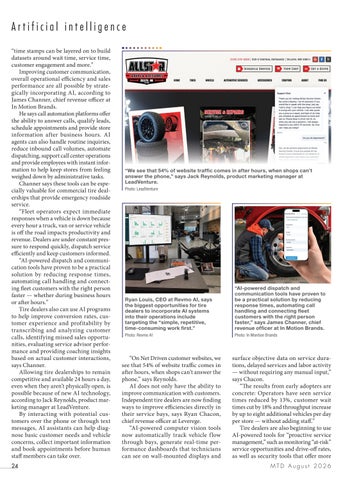
“We see that 54% of website traffic comes in after hours, when shops can’t answer the phone,” says Jack Reynolds, product marketing manager at LeadVenture. Photo: LeadVenture
Ryan Louis, CEO at Revmo AI, says the biggest opportunities for tire dealers to incorporate AI systems into their operations include targeting the “simple, repetitive, time-consuming work first.”
“AI-powered dispatch and communication tools have proven to be a practical solution by reducing response times, automating call handling and connecting fleet customers with the right person faster,” says James Channer, chief revenue officer at In Motion Brands.
Photo: Revmo AI
Photo: In Montion Brands
“On Net Driven customer websites, we see that 54% of website traffic comes in after hours, when shops can’t answer the phone,” says Reynolds. AI does not only have the ability to improve communication with customers. Independent tire dealers are now finding ways to improve efficiencies directly in their service bays, says Ryan Chacon, chief revenue officer at Leverege. “AI-powered computer vision tools now automatically track vehicle f low through bays, generate real-time performance dashboards that technicians can see on wall-mounted displays and
surface objective data on service durations, delayed services and labor activity — without requiring any manual input,” says Chacon. “The results from early adopters are concrete: Operators have seen service times reduced by 13%, customer wait times cut by 18% and throughput increase by up to eight additional vehicles per day per store — without adding staff.” Tire dealers are also beginning to use AI-powered tools for “proactive service management,” such as monitoring “at-risk” service opportunities and drive-off rates, as well as security tools that offer more MTD August 2026
8/3/26 11:20 AM
expansive coverage, according to Chacon. Ryan Louis, CEO at Revmo AI, says the biggest opportunities for tire dealers to incorporate AI systems into their operation include targeting “simple, repetitive, time-consuming work first,” like phone calls, some paperwork and customer follow-ups. “That is the lowest-hanging fruit,” he explains, adding that when a dealership’s employee can’t come to the phone, AI agents can gather customer information, take tire orders and even confirm tire fitments in the same call. AI software can also be used to write estimates, invoices and service records and can assist in stocking inventory and ordering products. “The common thread is that none of this is about replacing the people who make a tire shop work, says Louis. “It is about taking the repetitive load off them so they can spend time with customers and jobs that genuinely need” personal, human interaction. Investing in ways to simplify customer experiences and monitor daily shop operations can be key focus areas where AI can help, says Jonah Toch, senior project developer at Tire//SMART ERP, which is powered by JMK Computerized TDIS Inc. Toch says AI has a growing presence in dealer management software for functions like streamlining appointments, improving communication with customers, documenting orders and sales and keeping track of inventories. Though AI implementation at independent tire dealerships is still in its infancy, the most effective use cases are focused on after-hours lead capture, reducing administrative work and focusing on areas where shops are feeling overwhelmed, according to Carson Cornelius, general manager at Tireweb. “The success stories share a common pattern: focused applications — particularly customer communication — that deliver immediate, measurable impact without requiring major operational change. Customer expectations have shifted toward immediate response, and AI is how independent dealers are meeting that expectation without adding headcount.” Brad Kokesh, president and CEO at TraXtion, believes the use of AI should enhance customer relationships and simplify the search and buying process through streamlining inbound calls and
chats and refining tire identification and inspection methods. The rise of consumers shopping for tires on their mobile devices opens an opportunity for shops to take advantage of digital tools that allow them to scan tires for instant information on tire size, brand and more. This technology can also be used in the service bay to improve the consistency
25
w w w . M o d e r n T i r e D e a l e r. c o m 2608MTD_Hunter_RMEL.indd 1 2608MTD_22-27_AI.indd 25
of inspections and ensure accurate tread depth measurements, uneven wear checks and alignment indicators to boost customer confidence, says Kokesh. “Rather than replacing technician expertise, AI creates consistency while helping ensure opportunities aren’t missed. Tools like this will not sell the tires for the retailer but will uncover every opportunity that presents itself.”
7/27/26 1:55 PM 8/3/26 11:20 AM
Artificial intelligence OVERCOMING HESITATION
With numerous AI-powered programs and soft ware now in the market, it can become easy for independent tire dealers to be unsure of how to add AI technologies to their operations. Beginning with one high-value workflow that needs improvement and developing a plan to implement and measure results is a good start, says Anyline’s Brooks. “AI in the shop should feel like an assistant, not a replacement for expertise. The technician still makes the call. AI just makes sure the call is based on consistent, accurate data. Winning with AI is less about technical skill than approach. The dealers who get results treat it like any other shop tool.” Focusing on one or two targeted areas of business that need improvement can be the most helpful if a dealer is curious about exploring new technology, says Womer of Interface Systems. “Businesses are better served identifying a pain point or two meaningful enough to justify a solution — deploying AI in a focused effort, putting it to use and expanding from there. “Start with one application, measure the results and build from there,” says Channer of In Montion Brands. “Whether it’s an AI service advisor, dispatch automation, call analysis or a knowledge assistant that helps employees access information more quickly, the goal should always be the same: improve customer experience, increase productivity and create capacity for growth.” “The biggest barrier holding most shops back is that AI feels broad and overwhelming,” according to LeadVenture’s Reynolds. “Our advice is to think less about ‘How do I incorporate AI?’ and more about what problems need solving in your business.” Once tire dealers identify a specific area where their dealership may be struggling or underperforming, the next best course of action is to implement a solid plan for measuring AI’s effectiveness and openly communicate with staff, says Leverege’s Chacon. Louis of Revmo AI also believes that starting small, specific and choosing tools that work well with your current shop management system will keep you 26
2608MTD_22-27_AI.indd 26
“AI-powered computer vision tools now automatically track vehicle flow through bays,” says Ryan Chacon, chief revenue officer at Leverege. Photo: Leverege
AI can help simplify the customer experience and monitor daily shop operations, says Jonah Toch, senior project developer at Tire//SMART ERP, which is powered by JMK Computerized TDIS Inc. Photo: JMK Computerized TDIS Inc.
“Rather than replacing technician expertise, AI creates consistency while helping ensure opportunities aren’t missed,” says Brad Kokesh, president and CEO at TraXtion. Photo: TraXtion
in control of your operations when trying an AI platform for the first time. “You do not have to be technical and you do not have to go all-in,” he says. “Start with one painful, countable problem, prove it out and grow from there. The dealers who get the most out of this treat it like a dependable new team member, not a science project.” The trick is to always keep operational efficiency and management top of mind, says Toch of Tire//SMART ERP. “The secret to success is cementing customer relationships, providing employees with the right information tools to allow for the highest efficiency with (the) lowest frustration, realizing that improvements are possible and then taking action.” Pinpointing a solvable issue at your dealership and fi lling gaps where your employees are challenged will help dealers build an effective AI strategy, says Tireweb’s Cornelius.
“The dealers who get this right treat AI like any other hire: give it a clear job, check its work and expand its responsibilities once it proves itself. Start small, measure honestly and let the results — not hype — drive the next step.” AI can help dealerships amplify service, customer relationships and trust. “If AI helps a customer get a faster answer, schedule an appointment more easily, identify the right tire with a single photo or better understand why a repair is needed, it’s doing exactly what it should,” says Kokesh of TraXtion. “The future of independent tire retail won’t be defined by the shops with the most AI. It will be defined by the shops that use AI to make doing business simpler, faster and more transparent.” ■ MTD August 2026
8/11/26 12:44 PM
2608MT
THE VENETIAN EXPO & AAPEX FORUM | NOVEMBER 3-5, 2026 | LAS VEGAS, NV | AAPEXSHOW.COM
REAL PRODUCTS. REAL PEOPLE.
PRODUCTS. PEOPLE. RESULTS. At AAPEX, you won’t just hear what’s changing in the aftermarket, you’ll experience it firsthand. True innovation across 1,400+ product categories. Real-world training focused on the mechanics of the business and the service bay. Genuine connections with global suppliers, peers, and leaders steering the future. AAPEX is where the entire industry shows up — and where every driven professional stays ahead.
IT ALL HAPPENS HERE AT AAPEX. | AAPEXSHOW.COM
2608MTD_22-27_AI.indd 27 2608MTD_AAPEX.indd 1
8/3/26 11:20 AM 7/27/26 1:20 PM
Light truck tires
The business of the
best fit
MORE LT TIRE CHOICES MEAN MORE OPPORTUNITIES TO SELL SMARTER By Sara Welch
T
“Segmentation in the light truck market has changed dramatically. It wasn’t that long ago that only H/T, A/T and M/T segments existed, but the change in America from a car culture to a truck culture has had an enormous impact on what consumers want and need,” says Brandon Stotsenburg, vice president, American Kenda Rubber Industrial Co. Ltd. Photo: American Kenda Rubber Industrial Co. Ltd.
28
2608MTD_28-59_LT.indd 28
he light truck (LT) tire market is giving dealers more to sell — and more to explain. Not long ago, light truck tire selection largely revolved around three familiar categories: highway-terrain, all-terrain and mud-terrain. Today, those boundaries have expanded into a much broader spectrum of products designed around increasingly specific combinations of appearance, capability, comfort, durability and vehicle use. All-terrain (A/T) tires now range from mild, pavement-oriented designs to more aggressive off-road offerings. Rugged-terrain (R/T) and extreme-terrain (X/T) products occupy the growing space between A/T and mud-terrain (M/T) tires, giving consumers the aggressive look and added capability they want. At the same time, the light truck tire market is expanding beyond conventional pickup truck applications. Larger wheel diameters, higher load capacities, CUV and SUV fitments, commercial vans, lastmile delivery vehicles, electric trucks and growing demand for 3-Peak Mountain Snowflake (3PMS)-rated products are adding more sizes, specifications and performance considerations to the dealer’s product screen. MTD August 2026
8/3/26 11:20 AM
2607MT
70K-MILE TREADWEAR FOR H & V-RATED SIZES
65K-MILE
60K-MILE
55K-MILE
TREADWEAR
TREADWEAR
TREADWEAR
FOR METRIC AND LT SIZES
FOR METRIC AND LT SIZES
FOR W-RATED SIZES
ENCOUNTER AT2
ENCOUNTER HT2
HTR A/S P03
SUV/CUV/LT
SUV/CUV/LT
PASSENGER
INTRODUCING THE ENHANCED SUMITOMO WARRANTY
sumitomotires.com TBC Corporation: Exclusive distributor of Sumitomo Tires
2608MTD_28-59_LT.indd 29 2607MTD_TBCCorp_SumitomoTires.indd 1
8/3/26 11:20 AM 6/12/26 2:44 PM
Light truck tires Consumers, however, do not always enter the showroom thinking in terms of tire categories. They may want a tire that makes their truck look more capable, remains quiet during a daily commute, supports occasional towing, performs confidently in winter and lasts long enough to justify the purchase. In many cases, they are asking one tire to satisfy several competing priorities. For independent tire dealers, the market’s complexity becomes the dealer’s opportunity. Tire manufacturers say A/T remains the foundation of the LT category, while R/T demand continues to grow as drivers seek a more balanced combination of on-road refinement and off-road capability. Buyers also remain highly conscious of price, but that does not mean they are only interested in the least expensive option. They are weighing appearance, tread life, load capacity, ride quality, all-weather performance and long-term ownership value. As the LT tire market divides into more sub-categories, fitments and performance combinations, dealers can turn that complexity into margin by matching tires to how customers actually use their
“The light truck tire market is still the hottest spot in the industry,” says Michael Mathis, president, Atturo Tire Corp. Photo: Atturo Tire
vehicles. The dealers who ask the right questions, understand the trade-offs between products and explain why a particular tire fits can move the sale beyond size and price and position themselves as trusted application experts. A wide range of LT tire manufacturers and suppliers recently discussed LT tire trends and LT tire demand drivers with MTD. MTD: What trends are you seeing in the
light truck tire market in 2026 and what factors are driving demand?
BR ANDON STOTSENBURG , vice
“A/T remains the lion’s share of the category, but R/T is gaining attention because it gives many consumers the curb appeal they want without moving all the way into the M/T space,” says Joshua Benson, vice president, First Choice Sourcing Solutions. Photo: First Choice Sourcing Solutions
30
2608MTD_28-59_LT.indd 30
president, American Kenda Rubber Industrial Co. Ltd.: The continuing sub-segmentation of tires is unrelenting. Take the size 265/70R17, for example — first found on an F-150 in 1997. Right now, you can buy that size in a standard touring tire, grand touring, grand touring with 3PMS, CUV touring, CUV touring with 3PMS, highway-terrain with or without 3PMS, commercial highway-terrain, light all-terrain, on-road all-terrain with or without 3PMS, off-road A/T with or without 3PMS, commercial A/T, rugged-terrain with or without 3PMS, max-traction off-road (M/T), winter and stud-able winter designs. The delineation between tires with 3PMS and without is starting to matter less, but there is still a marked difference in perception and performance in many segments. 275/60R20 is a more recent size and is segmented much the same as 265/70R17. Nearly 20 segments exist for those popular sizes. Kenda has embraced 3PMS in many passenger and light truck segments and has embraced the proliferation of
segments that offer drivers a specific performance advantage. The popularity of CUVs has birthed more fitments with all-terrain designs. Many vehicle manufacturers are offering CUVs with off-road trim packages and OE all-terrain tires. However, many consumers were upgrading their vehicles for “soft-roading” long before the OE (providers) caught up. In response, some tire manufacturers have started to simply include CUV sizes in their current A/T offerings. Other manufacturers, like Kenda, have developed new A/Ts, so CUV owners have a performance option that matches their on/off-road lifestyle. The EV truck trend in the past couple of years has given rise to more 22-inch to 24-inch OE tire sizes. Both LT-metric and Euro-metric tires are represented on these trucks. While the overall registration numbers are not large yet, don’t be surprised when a truck rolls up needing 285/40R24, LT265/60R22 or LT275/50R24. MICHAEL MATHIS, president, Atturo
Tire Corp.: The light truck tire market is still the hottest spot in the industry. Several factors are helping to lead this segment to even higher levels. These factors are the rise of the CUV, expansion of size/pattern mix and the strengthening of core sizes. The CUV segment may not use true LT-rated tires in many cases, but it is a driving force in both OE replacement and aftermarket tire sales that touches on this segment. These are the most popular category of vehicles on the road today. Selling to CUV owners is similar to (selling to) a pickup driver in the variety of tread patterns MTD August 2026
8/3/26 11:20 AM
2608MT
BUILT WITHOUT LIMITS Groundbreaking technology engineered to perform everyday, everywhere, and for everyone.
2608MTD_28-59_LT.indd 31 2608MTD_Hankook_REV2.indd 1
8/3/26 11:20 AM 7/29/26 9:00 AM
Light truck tires expectations with premium products at the right price level is a critical goal. Providing the right capability is also important for ensuring the most suitable tire for the specific task, whether that task is as complex as maintaining 24/7 reliability for a service fleet or as simple as just driving into the office in your personal vehicle. RYAN PARSZIK, product planning
“If you compete solely on price, you risk being seen as a commodity,” says Andrew Pallotta, senior, product planning and development, consumer replacement product strategy, Bridgestone Americas Inc. Photo: Bridgestone Americas Inc.
they now have to choose from. Knowing the options for these vehicles, when and how to present them to (the) consumer is a critical profit opportunity for dealers. Having a variety of tread patterns to offer in 225/65R17, 235/60R18 and 245/50R20 is very important to serving this segment. Similar to a true LT tire, this means being able to offer a standard all-season touring replacement, a highway tread with 3PMS and deeper tread, all-terrain and even hybrid patterns. The expansion of sizes continues, but the cross-growth in the number of patterns each size may require is another trend of the market. Finally, the core of the LT market is centered around a handful of metric and floatation sizes. These continue to hold their position in popularity and even grow. The 33-inch and 35-inch floatation sizes across rim diameters in A/T, hybrid (R/T and X/T) and M/T patterns should be a regular part of every dealer’s product screen. This may not be a new trend, but it is a consistent one that cannot be ignored. ANDREW PALLOTTA, senior, product
planning and development, consumer replacement product strategy, Bridgestone Americas Inc.: Trends from 2025 remain influential in the 2026 light truck tire market — most notably, with demand driven by value. In the current economic climate, affordability continues to be a key factor and meeting the customer’s 32
2608MTD_28-59_LT.indd 32
manager, Dunlop Tires North America (DTNA): The market has been off to a slow start in 2026, but consumers are keeping their current vehicles longer and will still need to make a tire purchase. When consumers do replace their tires, more aggressive tires are the preferred choice, with the biggest growth coming from A/Tand R/T-type products. The A/T and R/T products have a mileage warranty and the mileage warranty keeps increasing, making the purchase an easier choice. JOSHUA BENSON, vice president, First
Choice Sourcing Solutions: The LT tire market is getting more complicated at the fitment level. Dealers are dealing with larger wheel packages, heavier pickups and SUVs, more OE-inspired plus sizing, more towing and payload sensitivity and customers who want a tire that looks more aggressive than how they actually drive. A/T remains the lion’s share of the category, but R/T is gaining attention because it gives many consumers the curb appeal they want without moving all the way into the M/T space. That is pushing demand toward products that can deliver the visual upgrade consumers want, while still managing the basics that matter after the sale: ride, noise, load capacity, wet traction, winter confidence and tread life. MINOO MEHTA, CEO, Foreign Tire
Sales: The light truck tire market continues to be one of the strongest segments of the replacement tire business in 2026. Consumer demand remains healthy, driven by the ongoing popularity of pickup trucks, SUVs and crossover vehicles, which continue to represent a significant share of new vehicle sales. Replacement demand is also steady as consumers are holding onto their vehicles longer and putting more miles on them. Industry forecasts project modest growth in both OE and replacement LT tire shipments this year. One of the biggest trends I am seeing is continued demand for all-terrain and
“Understanding the customer’s use case will help the dealers make the right sale and create a satisfied customer,” says David Poling, vice president, R&D and technical, Giti Tire (USA) Ltd. Photo: Giti Tire (USA) Ltd.
rugged-terrain tires. Many truck owners use their vehicles as daily drivers, but still want a more aggressive appearance and the flexibility for towing, outdoor recreation and light off-road use. This has made the R/T category one of the fastest-growing segments because it offers a balance. Another important factor influencing the market is supply chain diversification. Importers have shifted sourcing toward countries such as Vietnam, Thailand and Indonesia to reduce reliance on China and better manage tariffs. While this has improved product availability, tariff policies continue to influence pricing strategies and brand competitiveness. Dealers are paying closer attention to country of origin when selecting suppliers, making consistent inventory and stable pricing increasingly important. We’re also seeing customers place greater emphasis on value rather than simply choosing the lowest-priced tire. Fleet operators and retail consumers alike are looking for products that deliver longer tread life, improved fuel efficiency and dependable performance. Finally, technology continues to shape the LT market. Manufacturers are introducing tires designed for heavier electric pickups and SUVs, while also improving rolling resistance, durability and ride comfort across traditional LT applications. Although EV-specific LT tire demand is still developing, manufacturers are preparing their product lines for future growth. MTD August 2026
8/3/26 11:20 AM
2608MT
BE A FORCE OF NATURE
The GEOLANDAR A/T4® is built for outstanding durability, dependable all-season traction, and precise handling on pavement or off the grid. Give them the confidence to take on every road, every season, and every mile ahead. Your customers expect the best. Deliver it with Yokohama.
YokohamaTire.com © 2026 Yokohama Tire Corporation
2608MTD_28-59_LT.indd 33 2608MTD_YokohamaTire.indd 1
8/3/26 11:20 AM 7/13/26 9:26 AM
Light truck tires Overall, I expect the LT tire market to remain resilient throughout 2026. Dealers that maintain a broad product mix, reliable inventory and competitive pricing will be well-positioned to capitalize on continued demand from both work truck and lifestyle consumers. DAVID POLING, vice president, R&D
“Consumers are looking for tires that combine on-road comfort, off-road capability and long-lasting performance,” says David Wang, managing director, Gripmax Tires Inc. Photo: Gripmax Tires Inc.
“Today’s light truck tire customer expects expert guidance and dealers who take the time to understand the customer’s driving habits, towing requirements, work demands and performance expectations will make better recommendations,” says Robert Nasca, product and training manager, Hankook Tire America Corp. Photo: MTD
and technical, Giti Tire (USA) Ltd.: For 2026, the light truck U.S. tire market shows steady growth, with stronger long-term momentum compared to pre-pandemic levels. This growth is a mix of OE units and aftermarket replacement options, especially in the rugged-terrain and all-terrain categories that reflect similar market trends in vehicles sold. This trend continues as one of the most consistent performers for the tire market, fueled by lifestyle use that has persisted and continues to expand as vehicle production increases offerings for other-than-urban environments. We see this growing consumer preference for pickups, SUVs and light trucks for work, towing, recreation and overlanding activities. These vehicles are also now running up higher mileage counts through more varied conditions, accelerating tire wear and replacement cycles. Outside of these lifestyle LT tire choices, there is a growing demand for fleet applications. There is a shift toward more intentional, specialized inventory focused on efficiency and longevity. This requires a push in technology for longer-lasting compounds, more ecofriendly materials and safety. Much of this stems from the e-commerce expansion and delivery services, which favor durable LT tires optimized for frequent stops, varied loads and efficiency. JONATHAN THOMAS, senior director
“SUVs, pickups, CUVs and new OE fitments continue to drive demand, while larger wheel diameters and more specialized sizing requirements are adding complexity to product assortments,” says Shawn Denlein, president of sales and marketing, Kumho Tire U.S.A. Inc. Photo: Kumho Tire U.S.A. Inc.
34
2608MTD_28-59_LT.indd 34
of channel and customer development, Goodyear Tire & Rubber Co.: The North American light truck tire market has been a growth driver for the replacement industry, with sell-in volumes increasing about 2% since 2019 and nearly 5% from 2023 through 2025, outpacing the broader market. While 2026 is tracking more in line with the overall market slowdown experienced in the first half of the year, the segment remains supported by long-term vehicle and consumer trends. One of the fastest-growing areas is C-type tires, driven largely by continued
growth in last-mile delivery fleets and e-commerce activity. At the same time, all-terrain tires remain the largest and most popular light truck segment, benefiting from consumers’ desire for tires that balance everyday on-road performance with off-road capability. Demand also remains strong for highway-terrain and rugged-terrain products that address specific driving and styling preferences. Consumer preferences continue to shift toward higher-performance products. Demand for higher load-carrying capability has increased significantly, with Load Range F tires growing from less than 2% of the market in 2019 to nearly 6% in 2025. Speed ratings are also trending upward, with T-rated tires now representing more than 40% of the market as consumers increasingly seek products that deliver enhanced performance beyond original equipment specifications. Much of this shift is being driven by replacement tire buyers rather than OE fitments. Consumers are actively upgrading to tires with greater load capacity, higher speed ratings and broader performance capabilities than those that originally came on their vehicles. Underlying these trends is the continued growth of the pickup, SUV and commercial van vehicle parc. Over the past decade, these vehicle types have increased from roughly 20% to 30% of new light vehicle sales, reaching approximately 31% year-to-date in 2026. As more of these vehicles enter the market, they continue to expand demand opportunities across the light truck tire category.
E
DAVID WANG, managing director, Grip-
max Tires Inc.: The U.S. light truck tire market continues to grow steadily, with demand shifting toward higher-value, premium products. Key trends include strong growth in all-terrain and rugged-terrain tires, greater emphasis on aggressive styling and sidewall design and continued strength in the replacement market, supported by an aging vehicle fleet. Demand is being driven by the popularity of pickup trucks and SUVs, increased vehicle customization and aftermarket upgrades and growth in overlanding, camping, towing and outdoor lifestyles. Consumers are looking for tires that combine on-road comfort, off-road capability and long-lasting performance.
(55k
MTD August 2026
8/3/26 11:20 AM
2608MT
EXPERIENCE EVER EVERY RY ROAD
INTRODUCING ADVENTURO ATZ AND ADVENTURO RT
WHEREVER THE ROAD ENDS, YOUR ADVENTURE BEGINS. IDEWALL DE
SI
D
LS
UA
L SI
DEWALL DE
SI
GN
UA
GN
D
The Adventuro ATZ delivers confident traction on-road and off—rain, mud, dirt, or snow. The Adventuro RT pushes further, built for rugged terrain others won’t dare to take on. From weekday commutes to weekend adventures—drive without limits.
Test Drive
(55k for LT & Float Sizes)
3PMS
Handling
15 - 18 / 20, 22 Inch
Comfort
On / Off Road
(45k for LT & Float Sizes)
Road Hazard Warranty
Roadside Assistance
Handling
Comfort
On / Off Road
16 - 18 / 20, 22 Inch
WWW. GTRADIAL.COM 2608MTD_28-59_LT.indd 35 2608MTD_GitiTires.indd 1
8/3/26 11:20 AM 7/28/26 4:46 PM
Light truck tires
N
ROBERT NASCA, product and train-
ing manager, Hankook Tire America Corp.: The biggest trend we’re seeing in the light truck market is that consumers are becoming much more selective, carefully evaluating the trade-offs between performance, ride comfort, tread life, fuel efficiency and overall value before making a purchase. All-terrain and highway-terrain tires remain the foundation of the category. Still, demand continues to shift toward application-specific products that match how customers actually use their vehicles, whether it’s daily commuting, towing, jobsite use or outdoor recreation. Today’s buyers are looking for the right tire for their application, not simply the most aggressive tread pattern.
“With the evolution of entry-level and mid-tier tire quality, customer demand for these options is dominating the marketplace as consumers can now purchase highquality tires at a very affordable price point,” Pete Winters, national sales director, Nama Tires Inc. Photo: Nama Tires Inc.
SHAWN DENLEIN, president of sales
and marketing, Kumho Tire U.S.A. Inc.: The light truck tire segment is being shaped by an increasingly diverse vehicle mix. SUVs, pickups, CUVs and new OE fitments continue to drive demand, while larger wheel diameters and more specialized sizing requirements are adding complexity to product assortments. Demand is also being influenced by how consumers use their vehicles. Towing, hauling, outdoor recreation and offroad driving continue to support growth in premium and specialty light truck tires, extending demand beyond traditional highway-focused products. Electric trucks are adding another dimension to the market. These vehicles create new expectations around load capacity, tread wear, road noise and efficiency, leading to increased interest in tires that can support heavier vehicle weights without compromising range or ride comfort. Seasonality remains an important factor, as well. Depending on the region and time of year, consumers may shift toward more aggressive tread patterns, all-season options or tires designed to perform in wet, cold or mixed driving conditions. PATRICK HYLAND, senior director of
sales, Landscape Durable Tires: In 2026, Landscape Durable Tires observed a continued migration of demand from M/T to R/T designs as consumers are demanding an off-road tire with better on-road manners and performance. Even though most M/T tires today are designed with tread block pitch variation, which helps to reduce pattern noise, their greater void areas are 36
2608MTD_28-59_LT.indd 36
C
“Dealers should transition from being order takers to performance consultants. Instead of quoting the lowest price, focus on the total cost of ownership,” says Jason Lee, business development and regional sales manager, Linglong Tire Americas. Photo: Linglong Tire Americas
louder, in general, than R/T designs. Wear patterns are improved with the R/T as well, which usually has a lower void ratio, leading to longer wear. In the past, M/T tires exhibited more rapid wear, cupping or heel/toe wear and unacceptable levels of vibration and noise. While many of today’s M/T tires show improvement in these areas with better construction, more robust compounds and improved designs, there is still a migration towards the R/T tire. ADAM HOMAN, development engineer,
Linglong Tire Americas: In 2026, the U.S. light truck tire market is experiencing modest but steady growth, shaped by commercial demands and shifting consumer preferences. (Trends include) e-commerce and last-mile delivery
services. Delivery vans are subjected to severe urban driving conditions, which cause tires to wear out much faster than on personal vehicles. This demand is creating a robust market for durable, specialized tires. The addition of electric delivery vans is adding another layer of demand. These vehicles are heavier and have high torque, which can accelerate tire wear and require low rolling resistance to maximize range. The consumer side of the light truck tire market is being heavily influenced by economic pressures. Many buyers are shifting their preferences, moving away from premium (tier-one) and mid-tier (tier-two) brands towards less-expensive options that still provide performance. The emergence and rapid growth of R/T and X/T segments represent one of the most significant shifts in the U.S. light truck tire market. Industry data shows that R/T has already surpassed the traditional M/T segment in size. The main driver is consumer demand for a tire that combines key attributes without the compromises of traditional categories. R/T and X/T tires perfectly fill the gap between A/T and M/T tires. They offer the aggressive, off-road styling and off-road capabilities, but with on-road comfort, quieter ride and better handling, which answer consumer needs for both daily commuting and weekend adventures. PETE WINTERS, national sales direc-
tor, Nama Tires Inc.: The light truck tire market demand has seen significant growth over the past several years and all projections signify this will continue throughout 2026 and beyond. There are several factors driving this expansion, including the addition of new OEM products in both SUV and light truck models. MTD August 2026
8/3/26 11:20 AM
2608MT
NEW LOOK. SAME COMMITMENT. EXPECT MORE.
Engineered for dealer success, Fortune Tires delivers higher margins, reliable performance, low adjustment rates, and 400+ SKUs – all backed by competitive pricing and strong warranty coverage. Where performance meets personality, our bold new look reflects the momentum of a brand dedicated to helping dealers Expect More—from the products they sell to the partnership behind them.
Check out our full line of tires at SEMA, booth 41201.
Become a Dealer fortunetireusa.com
2608MTD_28-59_LT.indd 37 2608MTD_PrinxTire_Fortune.indd 1
8/3/26 11:20 AM 7/29/26 9:54 AM
Light truck tires Increased popularity in these models, the expansion of EV brands and larger diameter fitments have spearheaded growth in the light truck tire market. Dealers are now faced with proving the availability of a broadening market to meet individual customer needs. With the evolution of entry-level and mid-tier tire quality, customer demand for these options is dominating the marketplace as consumers can now purchase high-quality tires at a very affordable price point. JOHN HAGAN, executive vice president
of sales, Nexen Tire America: Light truck tire demand is still robust and the numbers back that up. Pickups, SUVs and CUVs continue to dominate new vehicle sales and as those vehicles age, they continue moving into the replacement market. That is one reason the LT tire category remains one of the steadier parts of the tire business. North America accounts for close to a third of global SUV and light truck tire demand and we do not see that share shrinking. We’re seeing strong interest in rugged-terrain tires because they offer a practical balance of everyday ride comfort and off-road capability. Towing, overlanding and recreational use have become lasting lifestyle trends, while commercial fleets and last-mile delivery vehicles are also creating demand for tires that can handle higher loads and frequent stop-and-go use. That’s why R/T tires are now the fastest-growing segment in the category. The product mix continues to move toward larger-diameter fitments and more premium, application-specific tires. Regional needs also matter. Snow Belt and mountain markets lean into all-weather or all-terrain performance, while Sun Belt and fleet-heavy regions prioritize tread life and load capacity. Dealers need to build their inventory around how vehicles are actually being used in their market rather than taking a one-size-fitsall approach. HANS DYHRMAN, director of market-
ing, Nokian Tyres: The light truck tire market continues to be one of the most dynamic segments in the industry and in 2026, we’re seeing consumers ask more of their tires than ever before. Today’s pickup trucks and SUVs often serve multiple purposes at once — from daily commuting, 38
2608MTD_28-59_LT.indd 38
“Today’s pickup trucks and SUVs often serve multiple purposes at once — from daily commuting, family transportation, towing and recreation to off-road adventures. This drives demand for products that can deliver capability without sacrificing comfort,” says Hans Dyhrman, director of marketing, Nokian Tyres. Photo: Nokian Tyres
“North America accounts for close to a third of global SUV and light truck tire demand and we do not see that share shrinking,” says John Hagan, executive vice president of sales, Nexen Tire America. Photo: Nexen Tire America
family transportation, towing and recreation to off-road adventures. This drives demand for products that can deliver capability without sacrificing comfort. Newer trucks can accommodate larger tire sizes with little or no additional modifications, making it easier for drivers to use larger wheel packages, lift kits and suspension modifications. As a result, consumers are moving beyond original equipment fitments and exploring a wider range of LT tire sizes and applications. Dealers are increasingly being asked to provide solutions that not only fit the vehicle, but also match the driver’s lifestyle and expectations.
At the same time, rising fuel and diesel prices continue to influence purchasing decisions. Whether consumers are driving a half-ton pickup as a daily commuter, towing equipment for work or taking their family on weekend trips, operating costs matter. That is creating increased interest in tires that balance toughness with fuel efficiency. We’re also seeing similar expectations from EV truck and SUV owners, who are particularly focused on maximizing driving range while maintaining durability and traction. Consumers don’t want to choose between efficiency and capability. They want both. We’re seeing strong interest MTD August 2026
8/3/26 11:20 AM
2601MT
S E LL SMART ERER. EARN MORE WITH TH UN D ERER. PARTNER UP ASSOCIATE DEALER PROGRAM
PAY STRUCTURE
Thunderer rewards you for doing what you already do best— moving product, building loyalty, and growing your business the smart way. Here’s how:
Per Dealer Single Location
Tier 1
Tier 2
Tier 3
Quarterly Unit Volume
40
100
200
Annual Unit Volume
160
400
800
Payout Per Unit
$1
$2
$3
• Earn performance-based incentives as your sales grow • Every Thunderer PLT tread counts toward your rewards • Unlock greater benefits as volume increases • Access sales tools and marketing support designed to move inventory • Backed by a brand that overdelivers and outperforms its competition PARTNER UP WITH THUNDERER AND START EARNING TODAY.
Visit AOTpartnerup.com for more information.
THE DRIVING FORCE
COMMUTER UTER & HIGHWAY | HIGH PERFORMANCE | ON-OFF ROAD TRACTION | OFF-ROAD TRACTION | CARGO VAN | SPECIALTY TRAILER Copyright 2026, American Omni Trading. All rights reserved.
2608MTD_28-59_LT.indd 39 2601MTD_AmericanOmni.indd 1
8/3/26 11:20 AM 12/30/25 3:03 PM
Light truck tires
“As commodity costs continue to rise, consumers are increasingly seeking value-oriented alternatives and lower upfront costs, leading to a migration into tier-four brands and trade brands,” says Tom Larson, vice president of flag brand management, TBC Corp. Photo: TBC Corp.
in LT products that provide reliable all-terrain capability while helping reduce rolling resistance, compared with more traditional aggressive off-road designs. Another trend is that consumers increasingly expect a premium driving experience, even from rugged-looking tires. The market has shifted from a simple choice between highway-terrain and all-terrain tires to a much broader spectrum. However, despite the aggressive styling and off-road capability, customers still want low road noise, predictable handling, long tread life and ride comfort. In many cases, they want a tire that looks ready for the trail, but spends most of its life on pavement. We’re also seeing growing demand for toughness and durability, particularly as truck owners venture farther off the beaten path. Finally, weather versatility continues to be a key purchase driver. Consumers increasingly want a tire that can handle rain, gravel, dirt, changing temperatures and even snow without requiring multiple sets of tires. That’s especially true in northern markets and regions with unpredictable weather patterns. We’re seeing that same expectation extend into the light truck segment, where more drivers are seeking year-round capability and products carrying the 3PMS designation. Overall, the LT tire market in 2026 is being shaped by consumers who refuse to compromise. They want the rugged appearance and traction of an off-road tire, the comfort and efficiency of a highway tire, the durability to handle tough conditions and the versatility to perform year-round. Manufacturers that can successfully combine those attributes are likely to be the ones that continue to win with both dealers and consumers. BRYCE JONES , head of product
“The one-size-fits-all philosophy is fading and there are so many more offerings today than there used to be, making it easier to personalize product suggestions,” says Nick Gutierrez, territory sales and marketing director, Sentury Tire USA. Photo: Sentury Tire USA
40
2608MTD_28-59_LT.indd 40
marketing and training, Pirelli North America Inc.: The light truck tire segment continues to be one of the strongest areas of growth in the replacement market. Consumer preferences have shifted toward vehicles that can serve multiple purposes, from daily commuting to weekend recreation, which has increased demand for tires that deliver year-round performance, long tread life, comfort and confident handling without sacrificing durability. We’re also seeing continued growth in CUVs, SUVs and light
trucks, along with larger wheel fitments and higher performance expectations from drivers. JERRY GRANITO, vice president of sales, Prinx Chengshan Tire North America (PCTNA): At Prinx Chengshan Tire North America, we’re seeing strong demand for light truck tires. The shift from M/T to R/T is accelerating as it has been for the past 10 years or so. As more customers realize that they spend most or all their time on paved roads, the need for mud tires is diminishing and they want something more well-behaved on the road. With H/T patterns, we are hearing from our customers that end users are looking for a true all-weather tire with a 3PMS rating. ROBERT MONTASSER, vice president
of North America, Radar Tires: Light truck demand is steady and still climbing. People are keeping their trucks and SUVs longer and putting real miles on them. Within that, two shifts stand out. First, all-terrain has become an everyday tire, not a niche for off-roaders. Truck and SUV owners want one tire that handles the job site, the highway and winter, which is why severe snow-rated all-terrains are growing so fast. Second, high-diameter and oversized fitments keep gaining. The other driver is value. Consumers are watching every dollar and they are moving toward brands that deliver premium performance without the premium price. NICK GUTIERREZ, territory sales and
marketing director, Sentury Tire USA: The high-performance all-terrain tire segment is leading the market, followed by X/Ts and R/Ts. Popular full-size truck tire sizes include 35 inches, 37 inches and 40 inches and popular mid-size truck tire sizes are 31 inches, 32 inches and 33 inches. We are also seeing that consumer-owned commercial trucks, cargo vans and delivery trucks are clocking more urban miles, meaning they will need to replace their tires more frequently than in previous years. This demand is also supported by the current trend of extended vehicle ownership. Consumers are holding on to their trucks longer, leading to more replacement tires. The truck tire market (also) has shifted toward more OE-size replacements, with less M/T demand. MTD August 2026
8/3/26 11:20 AM
2607MT
2608MTD_28-59_LT.indd 41 2607MTD_DunlopTires.indd 1
8/3/26 11:20 AM 6/17/26 6:38 AM
Light truck tires
T
TOM LARSON, vice president of flag
brand management, TBC Corp.: The light truck tire market remains soft in 2026, as tier-two brands face pressure from consumers prioritizing value. As commodity costs continue to rise, consumers are increasingly seeking value-oriented alternatives and lower upfront costs, leading to a migration into tier-four brands and trade brands. Market trends indicate that tier-four and trade brands are the only consistent areas with year-over-year growth in the past three months.
S
MARK LINDSEY, chief strategy officer,
Tire Group International LLC (TGI): The light truck tire segment continues to be one of the strongest-performing categories ... with 60% year-over-year growth through the first half of 2026. Demand is being driven by the sustained popularity of pickup trucks, SUVs and crossover vehicles, which remain the dominant vehicle choices for both personal and commercial use. Consumers are increasingly seeking tires that deliver a balance of durability, appearance and all-weather performance. This has led to continued growth in all-terrain, rugged-terrain and hybrid tire categories that provide off-road styling while maintaining on-road comfort and mileage. Many drivers are looking for versatile products that support both everyday commuting and recreational activities such as towing, camping and outdoor travel. Another notable trend is the continued shift toward larger wheel diameters and higher-value tire offerings. Vehicle owners are upgrading to premium fitments and expecting enhanced performance, tread life and ride quality. Dealers are also seeing increased demand for load-rated products designed to support heavier vehicles and towing applications. From a market perspective, value remains important, but consumers are becoming more educated about tire performance and long-term cost of ownership. As a result, brands that offer a strong combination of quality, warranty coverage and competitive pricing continue to gain traction. TODD BERGESON, deputy director of
light truck product planning and technical services, Toyo Tire U.S.A. Inc.: So far in 2026, the continued popularity 42
2608MTD_28-59_LT.indd 42
“We recommend treating light truck tires as application-driven, not just sizedriven, and leading with clear consumer education,” says Joe Davis, vice president, Transamerica Tire Co. Ltd. Photo: Transamerica Tire Co, Ltd.
“So far in 2026, the continued popularity of overlanding and outdoor recreation is driving the all-terrain segment to outpace other light-truck segments,” says Todd Bergeson, deputy director of light truck product planning and technical services, Toyo Tire U.S.A. Inc. Photo: Toyo Tire U.S.A. Inc.
MTD August 2026
8/3/26 11:20 AM
2608MT
THE HE ALL NEW
SCORPION™ CORPION AS 4
70K MILES
PIRELLI SCORPION™ AS 4 is the next‑generation all‑season touring tire for crossovers, sport utility vehicles, and pickup trucks, engineered to meet the everyday needs of today’s drivers.
2608MTD_28-59_LT.indd 43 2608MTD_Pirelli.indd 1
SCAN TO LEARN MORE
8/3/26 11:20 AM 7/24/26 3:07 PM
Light truck tires of overlanding and outdoor recreation is driving the all-terrain segment to outpace other light-truck segments. Complementing the all-terrain segment, the R/T segment continues to grow, as many consumers want to fi ne-tune their go-anywhere build. JOE DAVIS, vice president, Transamer-
ica Tire Co. Ltd.: We’re seeing strong growth in the all-terrain and rugged-terrain segments, driven by customers who want one tire that can handle commuting, towing and off-road use without sacrificing comfort or tread life. Demand is also being shaped by larger fitments, value-conscious buyers who still expect real performance and regional needs for allweather and severe snow-capable options. CHRIS TOLBERT, senior director of
sales, Trimax Tire: We have been seeing a shift from M/T to R/T and X/T. Consumers want the aggressive appearance and look, but with a lot less noise. With the economy in flux, with higher gas prices and inflation, we see continued price sensitivity. Plus, (we’re) also seeing sizes stabilize to 20 inches and 22 inches versus 24 inches and 26 inches. VAHE TCHAGHLASSIAN, vice president, Wholesale Tire Distributors (WTD): The light truck market continues to be one of the strongest and fastest-growing segments in the replacement tire industry. Today’s truck owners are looking for versatility. They want a tire that performs well during the daily commute, but is equally capable for weekend adventures, towing, overlanding or off-road use. That shift has driven tremendous growth in the rugged-terrain category, which bridges the gap between traditional all-terrain and mud-terrain tires by delivering aggressive styling and off-road capability without sacrificing everyday comfort and road manners. We’re also seeing consumers invest more in the overall appearance of their trucks. Tires have become a styling component just as much as a performance upgrade, with larger wheel fitments, lifted suspensions and aggressive tread patterns continuing to grow in popularity. KEVIN NGUYEN, manager of product
planning, Yokohama Tire Corp.: One trend in the tire market is all of the new 44
2608MTD_28-59_LT.indd 44
“To better catch these market opportunities, tire dealers should adjust their merchandising, inventory and customer education strategies,” says Jeffrey Zhang, general manager of international business, Zhongce Rubber Group Co., Ltd. Photo: Zhongce Rubber Group Co., Ltd.
light trucks and SUVs that are coming with trims that are heavily focused on that off-road lifestyle, whether that be by factory upgraded appearance, suspension or aggressive all-terrain tires. This trend helps drive the demand for all-terrain and rugged-terrain tires as these consumers are looking for a tire that can take them on a weekend adventure while also being their daily driver. Another trend is larger wheel diameters, such as 20 inches to 24 inches, becoming more popular in the off-road market. A lot of these new light trucks and SUVs are coming with larger wheel wells that allow the owners to upsize their tire options without the need to modify their factory wheels and suspension. JEFFREY ZHANG, general manager of
international business, Zhongce Rubber Group Co., Ltd. (ZC Rubber): In 2026, we continue to see strong growth in the U.S. light truck tire market. Th is is mainly driven by changes in the vehicle market, changing consumer needs and tire technology development. Light trucks, including pickup trucks and SUVs, are now very important in the U.S. vehicle market. Around 80% of new vehicles sold in the U.S. are light trucks and this is directly supporting demand for replacement tires. In the past 10 years, vehicle registrations have also moved
more toward trucks, while traditional passenger cars have decreased. From our view, there are three main application areas driving demand: commercial H/T tires, especially for urban logistics and last-mile delivery; A/T tires for family SUVs and pickup trucks and for consumers who need all-terrain performance; and R/T and M/T tires for offroad SUVs and pickup trucks, especially for modification enthusiasts and drivers who want stronger off-road performance. For product design, we see several clear trends. Tire sizes are becoming larger. The appearance, especially the shoulder design, is becoming more aggressive. More customers also pay attention to 3PMS certification because they want better performance in snow and winter road conditions.
E
O
MTD: What should tire dealers know about selling light truck tires more effectively right now? STOTSENBURG (American Kenda):
Segmentation in the light truck market has changed dramatically. It wasn’t that long ago that only H/T, A/T and M/T segments existed, but the change in America from a car culture to a truck culture has had an enormous impact on what consumers want and need. As always, the dealer needs to know if a vehicle is for commuting, showing off, work, play or a combination of multiple uses. A successful tire sale and a satisfied consumer start with qualifying questions. Determine how the truck is being used and where the truck is being used. Fortunately, truck owners often have very specific reasons why the truck they are driving was needed or chosen. They like to talk about their truck and how they use it. Take advantage of it. Have a “go-to” upsell tire for the most popular vehicle types and driving conditions, like a half-ton pickup that’s a daily driver but goes camping on weekends or a work truck that spends significant time on gravel or unpaved roads or a young guy who wants his truck to look tough or an off-road enthusiast who needs premium performance at a value price. It’s challenging to upsell in a questionable economy when the request is for the cheapest tire in stock. Taking the time to ask a few questions about their needs can pay dividends with happy customers who think you care and are interested MTD August 2026
8/3/26 11:20 AM
IN
U 5
INT
M
PAT
50K
2608MT
THE OFFICIAL TIRE OF ADVENTURE
ENGINEERED TO
OUTPERFORM 93% market coverage. Performance proven against premium brands in independent testing. Warranties that outlast them. Milestar checks every box. Get a $50 CONSUMER REBATE on a set of four new INTERCEPTOR AS810, WEATHERGUARD AS710, OR PATAGONIA A/T PRO tires from an authorized dealer between August, 1 2026 and September 30, 2026.
INTERCEPTOR AS810 ULTRA-HIGH PERFORMANCE A/S 50K MILE LIMITED WARRANTY
INTERCEPTOR RS-1 MAX ULTRA-HIGH PERFORMANCE
WEATHERGUARD AS710 ALL-SEASON PERFORMANCE 70/80K MILE LIMITED WARRANTY
WEATHERGUARD AW365 ALL-SEASON PERFORMANCE 70/80K LIMITED WARRANTY
WINTERGUARD STUDDABLE
PATAGONIA A/T PRO ALL-TERRAIN 55K LIMITED WARRANTY
MS932 SPORT
PERFORMANCE TOURING 50/60K LIMITED WARRANTY
PATAGONIA H/T
ALL-SEASON HIGHWAY 60K LIMITED WARRANTY
Product images shown are for illustrative purposes only.
PATAGONIA A/T R
ALL-TERRAIN 50K LIMITED WARRANTY
PATAGONIA X/T
RUGGED-TERRAIN 40K LIMITED WARRANTY
2608MTD_28-59_LT.indd 45 2608MTD_Tireco_Milestar_Outperform.indd 1
PATAGONIA M/T-02 MAXIMUM TRACTION
PATAGONIA M/T PRO COMPETITION OFF-ROAD
Technical features, tread pattern design, and tire construction subject to change without notice and can vary by size and application.
8/3/26 11:20 AM 7/29/26 10:14 AM
Light truck tires in offering a product that handles their needs. There are so many places to buy tires. Don’t let indifference send them to another store or online. MATHIS (Atturo): Dealers can capitalize
on the light truck segment by positioning themselves as experts in the category. Stock tires to match your local vehicle fleet and demand. Educate sales staff on how to sell light truck tires by matching the right tire to the vehicle and driver requirements. Know when and how to offer alternative tire types and sizes to the customer. Examine your product screen to be sure you have the right mix of tires in sizes, patterns and price points. Remember that today’s consumer may be looking for value, but that does not mean only a low price. The professional tire dealer will match the consumer’s needs, the vehicle and the right tire at the right price to win a sale and a satisfied customer. PALLOTTA (Bridgestone): If you compete
solely on price, you risk being seen as a commodity. Instead, we encourage dealers to educate customers on the long-term value of investing in premium tires. While they may cost more upfront, premium tires can deliver long-term savings through longer tread life, improved durability, fuel efficiency and other performance benefits compared to lower-cost fitments. Consumer data also shows that drivers are keeping their vehicles longer rather than buying new ones, making premium tires a smart investment. The key is to start by asking customers what they expect from their vehicle in the long run. That conversation helps dealers recommend the right tire for their needs, build trust and create better outcomes for everyone. PARSZIK (DTNA): One of the important
things for dealers to do is know what the consumer is looking for. Ask them how they are going to use their vehicle and let them know what tires will best fit their needs. The best tire will not be the same for every person based on their needs, so explaining the trade-offs is very important. Also knowing the tradeoff between an H/T, A/T, R/T and M/T is very important because look and off-road performance may be a factor. When you sell a tire and the customer is happy, they will have a positive experience and return to you for any other tire purchases in the future. 46
2608MTD_28-59_LT.indd 46
BENSON (First Choice): The best LT sale often comes down to catching the mismatch before it happens. A customer may be shopping by sidewall or tread design, but the dealer still has to protect the recommendation around load index, wheel package, vehicle weight, towing use, road noise tolerance and regional weather. Dealers who build the conversation around those details can move the customer out of a price-only comparison and into a better tire decision. MEHTA (Foreign Tire Sales): Today’s light truck tire customer is more informed and more demanding than ever before, so dealers need to focus on value instead of simply competing on price. First, inventory matters. Dealers who maintain a broad selection of popular LT sizes and tread patterns — especially all-terrain, rugged-terrain and highway-terrain — are in the best position to capture sales. Customers expect immediate availability and if a dealer doesn’t have the tire in stock, they’re likely to buy elsewhere. Second, understand your customer. Not every truck owner uses their vehicle the same way. Some prioritize towing and hauling and others use their truck for commuting, while many want an aggressive appearance with occasional off-road capability. Asking the right questions allows dealers to recommend the right tire instead of simply selling the cheapest option. Third, educate customers on the total value of the tire. A slightly higher-priced tire that delivers longer tread life, better wet traction, improved ride comfort and lower cost-per-mile often provides greater long-term value than a lower-priced alternative. Building customer confidence through education creates repeat business and referrals. Finally, supply chain stability has become just as important as price. With ongoing tariff changes and shifting sourcing strategies, dealers should partner with suppliers that offer consistent inventory, dependable delivery and stable pricing. Reliability has become a competitive advantage. In 2026, successful dealers won’t simply sell tires. They’ll provide solutions. Those who combine product knowledge, dependable inventory and strong customer service will continue to grow their light truck tire business, despite an increasingly competitive marketplace.
POLING (Giti): The main thing for dealers
is to understand the different performance requirements of their customers and to be willing and able to educate them on the performance envelope differences. The main market is essentially now a spectrum from H/T tires to R/T tires and many variations of A/T in between. Some customers will just want to get up and down the highway in complete comfort and quiet and never intend to go off-road. These are obviously your H/T fitments. At the other end of the spectrum are enthusiasts who want the most aggressive-looking tire that still has some on-road manners. That’s the R/T crowd. The tough ones lie in the middle around A/T tires, which come in many different forms, from mild to aggressive. Understanding the customer’s use case will help the dealers make the right sale and create a satisfied customer. THOMAS (Goodyear): Selling light truck
tires today is far more complex than it was a decade ago. With more tread patterns, performance categories, styling options, price points and fitments available, customers often need greater guidance to make the right choice. The most effective approach still starts with understanding how the customer uses their vehicle. Is mileage the priority? Wet or dry traction? Off-road durability, ride comfort, handling, appearance or a combination of these factors? Understanding those needs allows dealers to recommend the tire that delivers the best balance of performance for that specific customer. While price is always a consideration, focusing the conversation on the performance customers will experience over the life of the tire often creates greater value. Dealers who position themselves as trusted advisors — not just sellers — are more likely to build loyalty and earn repeat business. Online merchandising is also increasingly important. Clear product images, performance descriptions, ratings and comparison tools help customers understand long-term value before making a purchase decision. Highlighting how a tire is expected to perform in years two, three and four can be just as important as discussing the initial price. Finally, appearance continues to be a major driver in the light truck segment. Balancing styling preferences with performance requirements and budget considerations gives dealers the best MTD August 2026
8/3/26 11:20 AM
2608MT
A full roster of tires for regional, long haul, and mixed service needs.
For the haul of it.
7 year / 3 retread limited warranty
Practical performance for the long haul.™ Prinx Tires produces a broad range of highquality commercial tires—including steer, all-position, drive, and trailer models. All at a price point that leaves room for you to make your margin and your customer to meet their budget.
Scan here to become a Prinx Tires dealer. prinxtireusa.com
2608MTD_28-59_LT.indd 47 2608MTD_PrinxTire.indd 1
8/3/26 11:20 AM 7/29/26 10:07 AM
Light truck tires opportunity to sell the right tire for the customer. Ultimately, customers remember how their tires performed long after the purchase and helping them make the right choice is what creates lasting trust and future business. WANG (Gripmax): Sell the lifestyle, not
just the tire. Understand how customers use their trucks — for commuting, towing, overlanding or off-roading — and recommend the right solution. Guide customers to the right tire category. Explain the differences between H/T, A/T, R/T and M/T tires to help customers make confident decisions. Appearance sells. Aggressive tread patterns, bold sidewall designs and larger sizes are major buying factors for today’s truck owners. Focus on value over price. Emphasize durability, comfort, towing performance and all-terrain capability rather than competing on price alone. Build longterm relationships. Expert advice and great service create repeat customers and future upgrade opportunities. Dealers who educate customers, match tires to their lifestyle and deliver a premium buying experience will outperform those who simply compete on price. NASCA (Hankook): The biggest opportu-
nity for dealers is to move beyond selling tread patterns and start recommending solutions based on application. Today’s light truck tire customer expects expert guidance and dealers who take the time to understand the customer’s driving habits, towing requirements, work demands and performance expectations will make better recommendations. The conversation should begin with long-term value, not simply the lowest purchase price. When customers understand the relationship between purchase price, tread life, durability and overall cost-per-mile, they are more likely to choose the tire that truly fits their needs. DENLEIN (Kumho): The biggest oppor-
tunity for dealers is to sell by application, not just by size. Customers are often easier to convert when tire categories are clearly defined — whether through sidewall branding or the sales conversation — by distinguishing between highway, all-terrain, rugged off-road, mud-terrain, towing, commercial and EV-oriented options. Secondly, education is just as important as 48
2608MTD_28-59_LT.indd 48
inventory. Many shoppers need guidance on load ratings, sidewall strength, tread design, noise levels and the trade-offs between traction, durability, ride comfort and fuel efficiency. Understanding the differences between all-terrain and all-season tires, as well as severe snow-rated options where applicable, can also play an important role in selecting the right product. The best recommendation ultimately comes from understanding how the vehicle is actually used. A truck driven primarily for commuting, occasional towing and light off-road travel should be matched differently than a dedicated work truck, an EV pickup or a heavily modified off-road vehicle. Dealers can also improve sales by helping set clear expectations. When customers understand both the strengths and trade-offs of a tire, they are more likely to purchase with confidence and remain satisfied with their choice over the long term. JASON LEE, business development and
regional sales manager, Linglong Tire Americas: Shift to consultative value. Dealers should transition from being order takers to performance consultants. Instead of quoting the lowest price, focus on the total cost of ownership. By qualifying the customer’s specific needs — distinguishing between the heavy-duty demands of a job-site truck and the comfort requirements of an urban commuter — dealers can upsell high-performance, (as well as) durable options that offer better long-term value. Leverage tier-one quality at a value price. There’s a significant opportunity to position products that offer tier-one engineering standards at a more accessible price point. This allows shops to capture higher margins while offering customers a product that rivals premium legacy brands in critical areas like braking, longevity and off-road capabilities. Emphasize application versatility. The most effective way to sell today is by matching the tire category to the driver’s lifestyle. For the rugged user, focus on R/T tires that feature rigid blocks and chip-resistant compounds for maximum durability. For the daily driver who likes to spend time on off-road activities during weekends, focus on X/T tires that deliver the aggressive aesthetics owners desire, while also providing a quiet, comfortable daily highway ride.
Prioritize inspection and fitment expertise. With the prevalence of vehicle modifications, dealers have a unique opportunity to build trust through technical guidance. Proactive inspections and expert advice on how specific tires handle increased torque and vehicle weight establish the dealer as a trusted authority, reducing the risk of customer comebacks and building long-term loyalty. WINTERS (Nama): Dealers positioned
in the light truck market expansion will see greater success and better customer retention. Educating the sales staff with product knowledge and understanding of how their specific market is evolving will enable their business to thrive and gain market share. Stocking top-moving sizes is key and has its advantages over other options. You cannot have everything in stock, but having the correct sizes with high-value products readily available is paramount in the retail landscape. Merchandise and promote your business, so customers know you are the trusted “goto” retailer in their market. HAGAN (Nexen): The single biggest
opportunity I see for dealers right now is getting back to proper application, matching the tire to how the vehicle is actually used and away from leading every conversation with price. Price-first selling has done the consumer a disservice. Most customers shopping for LT tires aren’t tire experts and they don’t always know their load range, their vehicle’s gross vehicle weight or the difference between an all-terrain and a rugged-terrain tread. Customers need help understanding fitment differences and the most successful dealers are the ones who can educate them and fit the tire that best suits their needs. When the conversation starts and ends with budget, there is a greater chance the customer leaves with a tire that is under-specified for towing, too aggressive for daily highway driving or simply the wrong load range. That’s not a value sale. That’s a missed opportunity and it can become a safety or satisfaction issue down the road. The industry needs to get back to value-added selling. Tires are safety and performance products, not commodities that should be sold on price alone. Dealers who invest in product knowledge and lead with application-specific MTD August 2026
8/3/26 11:20 AM
2605MT
2608MTD_28-59_LT.indd 49 2605MTD_NittoTire.indd 1
8/3/26 11:20 AM 4/9/26 10:24 AM
F
AMERICAN ENGINEERED. AMERICAN MADE. INTRODUCING GITI TIRE . . . Built for the U.S. market from within. MANUFACTURED BY AMERICAN WORKERS. Our 1.7 million-square-foot Richburg, S.C. facility brings decades of global tire innovation to life on American soil. Built and operated with pride by American workers, it combines manufacturing, distribution, and R&D under one roof to deliver the tires that Americans need in the fastest and most reliable way.
G
L a
DESIGNED FOR U.S. ROADS, CONDITIONS, AND LIFESTYLES. Giti tires are engineered around what drivers value most: Safety, Comfort, and Long Life. Every product is developed and tested to ensure they perform the way Americans expect every day. PREMIUM PERFORMANCE AND CONFIDENCE FOR EVERY MILE. Built in America and engineered for everyday drivers, Giti tires combine advanced technology and meticulous standards into dependable performance. From quiet highway comfort to all-weather traction and off-road capability, our lineup is designed to keep you moving with confidence in every season and every journey.
D R I V E N BY E X P E R I E N C E . P O W E R E D BY I N N O VAT I O N .
A Global Powerhouse You Can Trust. Ranked among the top 10 most valuable tire brands in the world, Giti has a proven track record of premium performance and world-class distribution. 4 Global R&D Centers • 5 Manufacturing Plants • 130+ Countries • 70+ Years of Expertise
2608MTD_28-59_LT.indd 50 2607MTD_GitiTire_REV.indd 1
8/3/26 11:20 AM
O
E o
FOUR TIRES. ONE EASY DECISION.
.
n.
Mileage Warranty
Mileage Warranty
Rim Size: 17-20 in.
Rim Size: 17-20 in.
Wet Driving Safety
3PMS
S.
GRAND TOURING ALL-SEASON
G R A N D T O U R I N G A L L - W E AT H E R
y n
SEDANS, CUVs & SUVs
SEDANS, CUVs & SUVs
Luxury-level comfort, a quiet ride, and confident everyday performance.
Year-round performance for premium vehicles in wet, dry, and winter conditions with 3PMS capability.
D UA L S
D UA L S
I
D
D
EW
EW
A L L
A L L
LT
y
I
LT
Mileage Warranty
Mileage Warranty
Rim Size: 15-22 in.
Rim Size: 16-22 in.
3PMS
Off Road Traction
ON/OFF ROAD ALL TERRAIN
ON/OFF ROAD RUGGED TERRAIN
TRUCKS, CUVs & SUVs
LIGHT TRUCKS & SUVs
Experience off-road confidence and on-road comfort the way it was intended.
Off-road adventure and on-road necessity, built for traction and durability on rugged terrain.
GitiGUARDIAN Warranty Every tire is backed with the most robust warranty programs in the industry—designed to give drivers confidence mile after mile. 90 DAY TEST DRIVE
6 YEAR WARRANTY
MILEAGE WARRANTY
ROAD HAZARD WARRANTY
ROADSIDE ASSISTANCE
24/7 CONCIERGE
KEY FOB REPLACEMENT
TRIP INTERRUPTION
2608MTD_28-59_LT.indd 51
L E A R N M O R E AT
gititireusa.com
8/3/26 11:20 AM 6/23/26 10:38 AM
Light truck tires recommendations are the ones building repeat business and stronger long-term customer relationships. DYHRMAN (Nokian): The biggest oppor-
tunity for tire dealers today is to move beyond simply selling an LT tire and focus on helping consumers choose the right solution for how they actually use their vehicle. Many truck owners use their pickups as daily drivers, family vehicles, tow rigs and recreational vehicles all at the same time. Understanding those needs leads to better recommendations and stronger customer loyalty. Product knowledge is more important than ever. Today’s buyers want durability, off-road capability, ride comfort, fuel efficiency and year-round traction — often in the same tire. Dealers who can clearly explain the trade-offs and benefits between highway-terrain, all-terrain and rugged-terrain products are in the best position to earn customer trust. Dealers should also pay close attention to fitment trends and inventory. Larger wheel diameters, upsized tires and modified trucks continue to grow in popularity and customers often expect immediate availability. Having the right LT tire sizes in stock can be the difference between closing a sale and losing it. Ultimately, the most successful dealers are those who sell value rather than price. When customers understand how features like all-weather capability, fuel-efficient tread designs or 3PMS performance directly benefit them, the conversation shifts from cost to confidence. That’s where dealers can really differentiate themselves. JONES (Pirelli): For dealers, success
starts with understanding how customers actually use their vehicles. While many light trucks and SUVs have impressive off-road capabilities, the majority spend most of their time on paved roads. Matching customers with a tire that aligns with their driving habits, climate and performance expectations helps build trust and improves long-term satisfaction. Dealers should also pay close attention to the growing variety of OE fitments and replacement sizes, particularly as newer vehicles continue to adopt larger wheel diameters. Maintaining inventory that reflects these trends can help reduce missed sales opportunities and improve customer service. Equally important 52
2608MTD_28-59_LT.indd 52
“With the economy in flux, with higher gas prices and inflation, we see continued price sensitivity,” says Chris Tolbert, senior director of sales, Trimax Tire. Photo: Trimax Tire
is educating consumers on the value of premium tire technology. Features such as enhanced wet braking, all-season confidence, quieter ride quality, longer tread life and improved fuel efficiency resonate with today’s buyers when dealers clearly explain the benefits. GRANITO (PCTNA): Today’s consumers
are walking into tire shops more informed than ever and they’re asking a lot more questions. That creates a great opportunity for dealers, but it also means they have to stay on top of the latest products and technology. Tire technology continues to evolve, especially in the light truck segment, and things like load ranges and load indexes aren’t always as straightforward as they seem. It’s not just about replacing a 10-ply with another 10-ply. Understanding why one tire is the right choice over another makes a real difference. When a dealer can explain not just what they’re recommending, but why, they move beyond being someone who’s simply selling tires to a trusted advisor. That builds confidence with the customer, creates a better overall experience and is what keeps people coming back. MONTASSER (Radar): Start with how
the customer actually uses the vehicle. Most light truck owners spend the vast majority of their miles on pavement. They want the capability and the look, but they also want a quiet ride and confidence in all conditions, including wet weather and snow. Ask the right questions up front and you will sell the right tire and keep that customer. Second, stock all-terrain in depth. It is a volume category now and
that includes CUV and SUV fitments, not just LT sizes. Winter capability matters too. A 3PMS-rated all-terrain lets a dealer sell one tire for the whole year in most of the country. Third, protect your margin. A quality value brand with disciplined MAP pricing often earns a dealer more per unit than fighting over the same premium brands everyone carries. And lean on your suppliers. GUTIERREZ (Sentury): The one-size-
fits-all philosophy is fading and there are so many more offerings today than there used to be, making it easier to personalize product suggestions. Tire sales should focus on the total cost of ownership rather than just the purchase price, helping customers understand how tire selection affects long-term value, performance, safety and operating costs throughout the life of the tire and the vehicle. The sales process should educate customers on key differences between tire types, including the distinction between LT and P-metric tires, so they can make informed decisions based on their driving needs, load requirements and vehicle usage. To support this educational approach, all light truck tire variations should be prominently displayed at the front of the showroom, allowing customers to visually compare tread patterns, features and applications without requiring staff to retrieve tires from stock. This creates a stronger visual impact and enhances the buying experience. SARAH RITCHEY, senior manager of
product marketing, TBC Corp.: The allweather category continues to gain share at the expense of all-season tires. Demand typically peaks in the fall as consumers in northern markets prepare for winter conditions, making proactive inventory planning and targeted seasonal marketing critical for dealers. LINDSEY (TGI): Today’s light truck customer is more informed than ever and dealers who focus on understanding vehicle usage rather than simply selling on price are seeing the strongest results. Whether the customer uses their truck for work, towing, off-road recreation or daily commuting, matching the right tire to the application is critical to maximizing customer satisfaction and long-term loyalty. Dealers should also recognize
MTD August 2026
8/3/26 11:20 AM
2608MT
2608MTD_28-59_LT.indd 53 2608MTD_Maxxis.indd 1
8/3/26 11:20 AM 7/22/26 8:28 AM
Light truck tires that appearance plays a significant role in purchasing decisions. Many truck and SUV owners want aggressive styling and larger fitments, but they still expect a quiet ride, good tread life and all-weather performance. Another opportunity is educating customers on total value rather than upfront cost. Consumers increasingly understand the importance of mileage warranties, durability, ride comfort and fuel efficiency. Dealers who explain longterm ownership costs and product benefits are often more successful at trading customers up to better-performing tires. BERGESON (Toyo): Asking the right
YOU WORK HARD. Get What’s Yours! Start turning routine orders into real benefits – Fast, Free, and Easy.
questions and really getting a solid understanding of how the customer will use their vehicle is paramount to selling light truck tires more effectively. Once you’ve had the conversation and you have explained the trade-offs and advantages of each applicable light-truck tire category, you can properly set the expectations for the product you are recommending. The user experience and their trust in you will be better, too. DAVIS (Transamerica): We recommend
Join eXtra Rewards!
treating LT tires as application-driven,
not just size-driven, and leading with clear consumer education. Ask customers about their exact usage — whether they are towing, hauling, commuting or driving off-road — so you can recommend the right pattern and load range. Walk them through the real-world tradeoffs between highway comfort and offroad capability. Visually compare the tread pattern H/T against the higher void ratios of an R/T or M/T, making sure they understand how upgrading to a heavier load range and an aggressive tread block delivers the off-road durability they want, but impacts the noise and ride comfort they experience on the pavement. Finally, keep common LT sizes and tread options well-stocked to capture immediate business and protect the customer’s investment by scheduling service reminders for regular rotation, balancing and alignment. TOLBERT (Trimax): Dealers must
show they are in the light truck business from advertising, showroom point-ofpurchase (assets) and building signage. Sales employees should be educated and confident with tire and wheel packages, plus (have) an understanding of vehicle plus sizing. With consumers having
eXtra is a FREE, easy-to-use loyalty program for shop owners. Kind of like airline miles, but for the parts you’re already buying. You buy the parts, you earn rewards!
extra-awards.com
“Today’s truck owners are looking for versatility. They want a tire that performs well during the daily commute, but is equally capable for weekend adventures, towing, overlanding or off-road use,” says Vahe Tchaghlassian, vice president, Wholesale Tire Distributors. Photo: Wholesale Tire Distributors
54 2608MTD_TheAwardZone.indd 1 2608MTD_28-59_LT.indd 54
MTD August 2026 7/13/26 11:12 AM 8/3/26 11:20 AM
2607MT
DEMAND A BETTER TIRE We believe we offer, quite simply, a better tire, while providing you greater customer satisfaction and profit.
So what makes Vredestein better?
BETTER PERFORMANCE
RICH HERITAGE
Award-winning tires, as judged by independent testing groups.
Over a century of European innovation.
ELEVATED DESIGN
Consumer Reports' latest ratings recognize Vredestein among the top tire brands of 2026, reflecting our relentless pursuit of excellence.
Partner of Italdesign, founded by the legendary designer Giorgetto Giugiaro.
See what Consumer Reports has to say about Vredestein
www.vredestein.com
2608MTD_28-59_LT.indd 55 2607MTD_ApolloTyres.indd 1
Consumer Reports does not endorse products or services.
8/3/26 11:20 AM 6/17/26 9:53 AM
Light truck tires smartphones, they are better educated than ever before. We see new vehicle cost now over $50,000, plus higher financing costs. Consumers continue to keep vehicles longer and longer. This also creates an opportunity to get a new vehicle look for a lot less money — a budget and sales alternative. TCHAGHLASSIAN (WTD): The biggest
opportunity for dealers is shifting the conversation away from price alone and focusing on the customer’s lifestyle and intended use. Instead of simply asking what size tire a customer needs, dealers should ask questions such as, “Do you tow regularly? Is this (vehicle) your daily driver? Do you go off-road or overland on weekends? Are you looking for appearance, performance or both?” Matching the customer with the correct tire application builds confidence and creates long-term customer loyalty. Inventory strategy is equally important. The strongest demand continues to center around popular OE and plussize fitments for half-ton trucks, Jeeps,
562607MTD_TurboTires_LexaniTires.indd 1
2608MTD_28-59_LT.indd 56
“Dealers should focus on a few things to sell light truck tires more effectively: stocking fast-moving SKUs, merchandising for real-world use cases and educating customers on performance tradeoffs,” says Kevin Nguyen, manager of product planning, Yokohama Tire Corp. Photo: Yokohama Tire Corp.
M T D A u g6/15/26 u s t 22:07 0 PM 26
8/3/26 11:20 AM
2608MT
2608MTD_28-59_LT.indd 57 2608MTD_KYB.indd 1
8/3/26 11:20 AM 7/28/26 1:12 PM
Light truck tires Broncos, Tacomas, 4Runners and newer midsize pickups. Having a balanced inventory of highway-terrain, all-terrain and especially rugged-terrain products allows dealers to satisfy a much broader range of customers as demand continues shifting toward hybrid tire categories. Consumer education is another area where dealers can separate themselves. Many buyers don’t fully understand the differences between H/T, A/T, R/T and M/T tires. Taking a few extra minutes to explain the trade-offs in noise, tread life, off-road capability and ride comfort helps customers make informed decisions and often results in higher satisfaction after the sale. NGUYEN (Yokohama): Dealers should
focus on a few things to sell light truck tires more effectively: stocking fast-moving SKUs, merchandising for real-world use cases and educating customers on performance tradeoffs. The market is shifting toward application-specific fitments, faster fulfillment expectations and clearer value justification. It’s important that dealers
D E E P
C O N C A V E
understand their local region’s tire needs to tighten inventory around fast-moving SKUs, regional vehicle fitments and highvalue segments. Understanding the use cases — daily driver, off-road, towing or work truck — will help sell the correct product by application rather than just tire segment. ZHANG (ZC Rubber): To better catch
these market opportunities, tire dealers should adjust their merchandising, inventory and customer education strategies. First, dealers should prepare inventory around popular sizes. The light truck replacement market is quite concentrated, so it is important to keep enough stock of key sizes, such as LT275/70R18 and LT265/70R17. Many pickup truck owners prefer to replace tires with the same OE size, so having these main sizes available can help dealers sell more effectively. Second, dealers should display and introduce products by application, not only by size. Today, light truck tires are becoming more specialized. If dealers organize products by usage, such as daily
driving, work application, weekend offroad or more serious off-road driving, it will be easier for consumers to choose. Showing the difference between H/T, A/T, R/T and M/T tires can help customers find the right tire for their real driving needs. Third, dealers should recommend tires based on the customer’s actual use. Salespeople can ask some simple but important questions before making a recommendation, such as how the customer drives every day, whether they often tow or carry heavy loads and how often they drive off-road. Dealers also need to explain the performance differences between tire types. For example, M/T tires can provide very strong traction in mud and difficult offroad conditions, but for daily driving, A/T tires may give a better balance of road comfort, lower noise and longer tread life. Finally, warranty policy and performance certifications, such as 3PMS snow traction rating, should also be clearly introduced. These points can help build customer trust and also support the value of premium products. ■
S T Y L I N G
A V A I L A B L E N O W
6 LUG
8 LUG
GLOSS BLACK
AVAILABLE IN 20” | 22”
ORDER TODAY
US (866) 894-3351 CAN (877) 326-0933
582608MTD_TheWheelGroup.indd 1
2608MTD_28-59_LT.indd 58
LEARN MORE AT: MAYHEMWHEELS.COM
M T D A u g7/21/26 u s t 28:40 0 AM 26
8/3/26 11:20 AM
2608MT
by BendPak
APEX WHEEL SERVICE. BUILT SMART. PRICED RIGHT. ™
APEX by BendPak delivers dependable wheel service performance built for daily shop use, with tire changers that provide consistent clamping, smooth bead breaking, and controlled operation, paired with wheel balancers engineered for accurate, repeatable measurements and fast cycle times. Every APEX wheel service machine is designed for stability, precision, and durability, giving technicians reliable results vehicle after vehicle without unnecessary complexity or wasted features.
NEW
AT26A
TIRE CHANGER SKU 5140350
3,595*
$
AB24M
MANUAL WHEEL BALANCER SKU 5140353 $
1,250*
AT26
TIRE CHANGER SKU 5140351
3,195*
$
AB28
WHEEL BALANCER SKU 5140352
2,695*
$
Indoor Booth CHECK NOV. 3-6, 2026 US OUT! LAS VEGAS, NV
Wheel not included.
#36129
SHOP NOW
South Hall
BENDPAK.COM/APEX
1-800-253-2363
©2026 BendPak Inc. All rights reserved. *Price valid thru September 30, 2026. **Free shipping to direct shipping points within the 48 contiguous United States only.
2608MTD_28-59_LT.indd 59 2608MTD_BendPak_ApexWheel.indd 1
8/3/26 11:20 AM 7/28/26 9:27 AM
Auto Service
What’s new in vehicle diagnostic equipment? AI AND NEW STANDARDS EVOLVING DIAGNOSTIC SERVICE By
Carley Millhone
N
ew vehicle systems diagnostic equipment is evolving beyond single-purpose scan tools. Diagnostic hardware is becoming more intelligent and more complex with faster processors, AI tools and cloud-connected software updates. “The scan tools have been what they’ve been for quite some time, but the number of systems they’ve had to access has changed with the onslaught of ADAS and other systems on the car that require more modules,” says Denis White, TEXA EDU manager at TEXA USA. 60
2608MTD_60-63_AutoService.indd 60
With tire pressure monitoring systems (TPMS), advanced driver-assistance systems (ADAS) and electronic steering components, White adds that some diagnostic tools talk to more than 40 modules. “At THINKCAR, we see diagnostics moving from simple code reading to intelligent, guided and connected service,” says Star Liu, product manager, market research, THINKCAR Tech Co. “Shops now need equipment that can analyze possible root causes, understand affected systems, connect live data with repair information and provide actionable
“The scan tools have been what they’ve been for quite some time, but the number of systems they’ve had to access has changed with the onslaught of ADAS and other systems on the car that require more modules,” says Denis White, TEXA EDU manager at TEXA USA. Photo: TEXA USA
inspection and repair guidance.” Here’s what tire dealers need to know about how new diagnostic equipment technology is reshaping automotive service:
AI INTEGRATION
“AI is being integrated into a lot of diagnostic equipment, TPMS tools, inspection apps and cloud platforms to automate interpretation, detect anomalies earlier and reduce technician workload and human errors,” says Jason Hendrix, manager of training, TPMS, Autel North America. Integrating AI into diagnostic equipment isn’t simply adding a chatbot to a scan tool. AI is part of the entire diagnostic workflow. According to THINKCAR’s Liu, AI-enabled diagnostic systems can understand the technician’s intent, break a complex request into smaller tasks and help execute those tasks. “During the diagnostic process, AI can combine multiple sources of information, including fault codes, live data, vehicle logs, previous diagnostic records, repair information and known failure patterns,” MTD August 2026
8/3/26 11:20 AM
2608MT
2608MTD_60-63_AutoService.indd 61 2608MTD_Autel.indd 1
8/3/26 11:20 AM 7/27/26 8:55 AM
Auto Service says Liu. “This allows the system to help prioritize faults, analyze possible root causes, identify related systems and generate inspection steps, repair suggestions and diagnostic reports.” Voice, text, image and other multimodal interactions are also entering the diagnostic workflow. “Instead of manually moving through layers of menus, a technician may be able to tell the tool, ‘Scan this vehicle, analyze the faults and generate a report,’ and the system can help break that request into steps and execute the workflow,” notes Liu.
“AI is being integrated into a lot of diagnostic equipment, TPMS tools, inspection apps and cloud platforms to automate interpretation, detect anomalies earlier and reduce technician workload and human errors,” says Jason Hendrix, manager of training, TPMS, Autel North America. Photo: Autel North America
PREDICTIVE MAINTENANCE
AI is also moving diagnostics from a reactive model toward a more predictive model. Predictive maintenance essentially means AI can help analyze vehicle history, current operating conditions, mileage and component wear patterns to identify potential issues earlier. Liu notes that when a vehicle is approaching a maintenance interval — or showing signs of risk — the system can send alerts and support customer follow-up. “AI being integrated into diagnostics now allows vehicles to have less downtime and technicians can predict services before they become a problem,” adds Autel’s Hendrix. “This new technology will allow dealers/automotive shops to have a higher efficiency rate, better scheduled maintenance intervals, more revenue opportunities and better customer experience.”
REMOTE DIAGNOSTICS
Over-the-air (OTA) soft ware capability is also becoming a standard and is supporting remote diagnostics. “OTA integration is rapidly expanding across modern diagnostic tools,” says Autel’s Hendrix. “OTA is transforming diagnostics from hardware-bound devices into continuously updated, remotely capable platforms. This shift is changing how shops diagnose, repair and maintain vehicles by enabling real-time updates, remote troubleshooting and more efficient repairs.” “The broader impact is that diagnostics is becoming more connected, faster to update and less limited by the knowledge available inside one shop,” adds Tony Liu, team leader, remote diagnosis R&D, THINKCAR Tech Co. “For tire dealers and repair shops, OTA capability is becoming essential for keeping tools current as 62
2608MTD_60-63_AutoService.indd 62
J1979), the industry is shift ing to SAE J1979-2 (OBDonUDS) for 2027 models. For tire dealers, Liu says this means diagnostic tools will need to support new service structures, expanded data identifiers, larger diagnostic data capacity and updated communication methods. “The practical impact is that older scan tools designed mainly around classic OBD2 may still work on older vehicles, but shops should not assume they will fully support 2027 and later vehicles,” says THINKCAR’s Liu. “Tools will need the right communication hardware, SAE J1979-2 soft ware support, updated vehicle databases and continuous update capability.”
TRAINING TECHS
“We see diagnostics moving from simple code reading to intelligent, guided and connected service,” says Star Liu, product manager, market research, THINKCAR Tech Co. Photo: THINKCAR Tech Co.
vehicles, service procedures and software systems continue to change.”
INFLUENCE OF ADAS
Tire dealers must also understand how ADAS affects diagnostics and service as scan tools increasingly communicate with standard lane-departure and automatic-braking systems. “If you put four tires on a car and you align the car — where you have to reset the steering angle sensor, scan tool required — you have to calibrate forward-facing and some rear-facing items on some cars,” says TEXA’s White. “A wheel alignment may force you to align forward-facing cameras on a car or forward-facing radar. In the case of some of the Volkswagen/Audi cars, you have other things that you have to calibrate as well.” If those systems are not calibrated correctly, the vehicle may show warning messages. Even worse, safety functions like lane assistance or automatic emergency braking may not work properly.
OBDONUDS STANDARDS
After 30 years of the OBD2 standard (SAE
There is a fear (and reality) across industries that AI will replace human labor, but AI-integrated diagnostic tools still need techs. “I don’t see that technicians will be replaced with AI, but more of a technician accelerator,” adds Autel’s Hendrix. “Technicians will work with AI in the sense that AI will aid the technician in the diagnostic process. It is still the technician’s responsibility to put the data together and come up with the true repair. AI will provide the technician with an efficient repair process. AI will be able to retrieve diagrams, torque specs, locations, etc.” If new equipment is overwhelming your technicians, Liu recommends building training around shop workflows instead of a product demonstration. “A practical approach is to use a layered training system,” adds Liu. “Start with high-frequency tasks such as TPMS relearn, OBD full-system scans, vehicle health reports, battery checks and basic ADAS-related warnings. Then move technicians into more advanced functions such as EV system data, AI-assisted fault analysis and chassis or ADAS-related calibration support.” “Technicians don’t struggle because they’re incapable — they struggle because modern diagnostic platforms are fast-changing and unforgiving when data is misread,” says Hendrix. “The fastest way to eliminate fear is repetition without consequences.” Hendrix recommends letting techs practice with a vehicle to experience errors and resolve them. Creating a standardized diagnostic workflow can also help technicians understand expectations and build confidence. ■ MTD August 2026
8/3/26 11:20 AM
2606MT
all makes. all models.
live demo here:
MORE CHOICE. MORE CONTROL.
TEXA USA Inc. 292 FERNWOOD AVE EDISON, NJ 08837
2608MTD_60-63_AutoService.indd 63 2606MTD_Texa.indd 1
northamerica@texa.com
www.texausa.com
+1 855.200.8392
8/3/26 11:20 AM 5/19/26 9:08 AM
Commercial Tire Dealer®
Industrial evolution
C
TRENDS SHAPING TODAY’S INDUSTRIAL TIRE SEGMENT By
Mike Manges
F
actors impacting today’s replacement industrial tire market are as diverse as the number and variety of industrial tires that are currently available to tire dealers. Where to start? In this MTD exclusive, industrial tire manufacturers cut through the noise as they discuss important product, technology and market trends; what end users are looking for in both products and services; and how industrial tire dealers can further enhance the value they provide. “In the industrial sector, many operators are extending the service life of their existing equipment and postponing investments in new machinery,” says Jeff Smiley, head of wholesale distribution channels, BKT USA Inc. “This trend supports the replacement tire market, as keeping equipment in operation longer requires more frequent maintenance and tire replacement. “We are also seeing increasing demand driven by higher activity in ports and warehouses. The continued expansion of large distribution centers has led to greater forklift utilization, thus increasing the need for high-load-bearing industrial tires. “In addition, the ongoing shift toward electric forklifts has increased vehicle weight due to battery packs, driving stronger demand for solid tires that offer improved durability and longer service life,” says Smiley, who adds that radial tires “continue to gain traction thanks to their ability to improve operator comfort and ride quality while delivering strong performance.” Ryan Loethen, president, CEAT Specialty Tires, says one of the biggest trends in the U.S. industrial tire market is the increasing demand for “equipment-specific tires that can perform across a wide range of operating conditions. Contractors and
Also in CTD What’s new in industrial tires..........70 AG Tire Talk: Tires versus tracks.....72 64
2608MTD_64-69_CTD_IndustrialMarket.indd 64
“Many operators are extending the service life of their existing equipment and postponing investments in new machinery” says Jeff Smiley, head of wholesale distribution channels, BKT USA Inc. Photo: BKT USA Inc.
industrial operators want a tire designed for their machine, whether it’s a telehandler, backhoe or compact loader, but they also expect it to deliver dependable performance on concrete, gravel, dirt and mixed job sites. “At the same time, purchasing decisions are becoming more value-driven. Fleet managers, rental companies and contractors are placing greater emphasis on total cost of ownership rather than initial purchase price. They’re looking for tires that deliver longer service life, minimize downtime, improve machine stability and reduce the frequency of replacements. As a result, features such as radial construction, durable tread compounds and puncture resistance are becoming increasingly important differentiators.” “For tire dealers, these trends create an opportunity to move beyond selling on price alone. Customers are looking for guidance on selecting the right tire for their application and dealers who understand equipment requirements and operating
‘Advances in tire compounding and tread design are also addressing more specialized operating requirements.’ Cara Junkins, director, OTR and ag, CMA/Double Coin
conditions can position themselves as trusted advisors. Instead of asking, ‘What size tire do you need?’ the conversation should begin with questions like, ‘What machine are you running? What type of surface do you operate on? How many hours does it work each week?’ Those discussions lead to better tire recommendations and stronger customer relationships. “Ultimately, success in today’s industrial tire market is about helping customers lower their operating costs
DL RE
CL DR
MTD August 2026
8/3/26 11:20 AM
2608MT
REGIONAL + LONG HAUL + MIXED SERVICE
COMMERCIAL
DL-CSD-R01 REGIONAL
DL-OSD-R01 REGIONAL
CLOSED-SHOULDER OPEN-SHOULDER DRIVE DRIVE
DL-AP-R01 REGIONAL
ALL-POSITION
DL-TRL-R01 DL-OSD-C01 LONG HAUL MIXED SERVICE TRAILER
YOU ALWAYS GET MORE WITH DELINTE
5+1 CASING WARRANTY ON-DEMAND DEALER PORTAL DEDICATED SALES SUPPORT 2608MTD_64-69_CTD_IndustrialMarket.indd 2608MTD_Sentury_DelinteCommercial.indd 165
OPEN-SHOULDER DRIVE
DL-AP-C01 DL-APW-C01 MIXED SERVICE MIXED SERVICE ALL-POSITION
ALL-POSITION WIDE
CALL 866-621-4733 TODAY FOR FACTORY+ WAREHOUSE PROGRAMS OR SCAN QRC
8/3/26 7/27/26 11:20 8:35 AM AM
Commercial Tire Dealer® and maximize equipment uptime,” says Loethen. “Dealers who focus on application expertise, educate customers on the long-term value of premium tire technology and recommend solutions based on performance rather than purchase price will be well-positioned to grow their business as the industrial equipment market continues to evolve.” “The U.S. replacement forklift tire market is experiencing steady growth, driven by industrial automation, e-commerce expansion and the rising adoption of electric and automated forklifts,” says Cara Junkins, director, OTR and ag, CMA/Double Coin. “As facilities operate for longer hours, demand is increasing for tires that deliver greater longevity and consistent performance under these demanding conditions. “One trend tied to the growth of electric forklifts is the increasing preference for tires with lower rolling resistance, which can help extend battery life. Radial pneumatic tires generally offer lower rolling resistance and run cooler than bias pneumatic tires, contributing to a shift toward radial options in many operations that use pneumatic tires. “Advances in tire compounding and tread design are also addressing more specialized operating requirements. For example, non-marking tires are becoming more common in pharmaceutical and food processing environments, as well as in applications where floor cleanliness is a priority. At the same time, manufacturers are developing more sustainable tires using recycled and renewable materials to meet the needs of customers focused on reducing their carbon footprint.” “Another growing trend is the integration of smart tire technology. Smart tire sensors enable real-time monitoring, supporting more effective fleet management and helping operators implement preventive maintenance practices.” Troy Rudnick, president, Forklift Tire Co. Inc., says today’s industrial tire end user shops “by size and application and
‘With new equipment priced where it is, fleets are running their trucks longer.’ Troy Rudnick, president, Forklift Tire Co. Inc. 66
2608MTD_64-69_CTD_IndustrialMarket.indd 66
‘Tire requirements will change as operations are now running 24/7.’ Jack Fenner, marketing manager, Specialty Tires of America
expect straight answers on fitment and lead time before they buy. That buyer is reshaping demand. Electric lifts and clean-f loor operations keep pushing the market toward press-on solids and non-marking compounds, because a down truck or a marked-up floor costs far more than a tire ever will. “Tariffs and import delays have turned ‘Made in the U.S.A.’ from a feel-good sticker into a sourcing strategy. And with new equipment priced where it is, fleets are running their trucks longer. Every one of those hours rides on replacement tires. The dealer who gets that buyer the right tire the first time wins them for the life of the fleet.” A representative from Global Rubber Industries Pvt. Ltd. (GRI) says the U.S. replacement industrial tire market is currently experiencing several significant trends, including “ongoing uncertainty driven by raw material costs, freight rates, tariffs and rising agricultural input costs” that have resulted “in a flat-to-slightly declining market, creating increased price pressure as overall demand softens. With the market pie shrinking and inventory levels remaining high across local distributors, competition has intensified, placing greater emphasis on pricing and inventory management.” Michael Dembe, vice president, OEM sales, construction, OTR Engineered Solutions, says that “many of the forces shaping the industry are extensions of long-term trends rather than entirely new developments. From tariff uncertainty to changing fleet management strategies and evolving product preferences, manufacturers and dealers are adapting to a marketplace where service, uptime and operational efficiency have become more important than ever. “One of the biggest challenges facing the industry is navigating an increasingly complex U.S. tariff environment. Frequent changes to import tariffs have created uncertainty for manufacturers and importers, requiring companies to
continuously adjust sourcing strategies, inventory levels and pricing while maintaining reliable supply for customers. However, recent tariff relief on certain imported agricultural and industrial equipment … could create an influx of foreign-built equipment coming into the U.S., which should bolster future replacement demand. “At the customer level, fleet operators remain intensely focused on reducing operating costs and maximizing equipment uptime,” Dembe explains. “Tires represent one of the most expensive consumable categories for equipment fleets, making replacement strategies, preven-
W
‘Fleets can only hold off on new equipment purchases for so long.’ Michael Dembe, vice president, OEM sales, construction, OTR Engineered Solutions
tive maintenance and service support critical priorities. As fleets become more geographically dispersed, many operators are looking beyond local suppliers and instead are partnering with national account programs or large, multi-state commercial tire dealers that can provide consistent service across multiple locations and remote jobsites. “Despite softer original equipment demand, the replacement tire market continues to benefit from this aging equipment fleet. Though the OEM business remains down, we are seeing glimmers of hope for 2027. Fleets can only hold off on new equipment purchases for so long, given the paramount interest in maximized uptime and productivity.” “Trends in the industrial tire market, specifically forklift tires, are rapidly changing,” says Jack Fenner, marketing manager for Specialty Tires of America. “Tire requirements will change as operations are now running 24/7 in warehouses that are increasing in size. Tire durability will be a bigger factor, as well as the need for lower maintenance costs.” Fenner says owners of electric forklifts “will expect lower rolling resistance ... to improve battery life.” The industrial tire segment “is leaning to a cradle-to-grave way of thinking in
W
MTD August 2026
8/3/26 11:20 AM
2508MT
Westlake Premium Solid Tire Line
Premium 3-stage construction design One stop supply, from 8 inch to 35 inch, with more than 500 SKU The choices of more than 10 premium OEM brands Continue service more than 160 countries for 30 years plus
WESTLAKE SOLID TIRE FAMILY
8 inch to 35 inch
More than 500 SKU
● chan@zcrubberamerica.com ● ken@zcrubberamerica.com ZC Rubber America, Inc. 661 Brea Canyon Rd. Suite #7 Walnut, CA 91789 2608MTD_64-69_CTD_IndustrialMarket.indd 67 2508MTD_ZCRubber.indd 1
8/3/26 11:20 AM 7/31/25 8:33 AM
Commercial Tire Dealer® order to enhance the life and performance of forklift tires. Sensors play a huge part in maintaining the tire to achieve the maximum benefits the tire has to offer. Reduction of downtime is a big part of the benefit. “All in all, the industrial tire replacement business faces the same challenges associated with the life and performance of the tire and its overall maintenance,” adds Fenner. “It’s a profitable business for the dealer.” Joaquin Gonzalez, president of Tire Group International LLC, cites “the continued growth of warehousing, logistics and construction activity” as the main drivers of replacement industrial tire demand. “At the same time, fleet operators are placing a greater emphasis on uptime, productivity and total cost of ownership rather than simply purchasing the lowest-priced tire. “With advances in telematics and fleet management technology, end users have more visibility into equipment performance than ever before, allowing them to make more informed purchasing decisions. As a result, the market has seen a growing shift toward longer-lasting solid and press-on tires, particularly in forklift applications. “The industry is also being influenced by the increasing adoption of electric and automated equipment, which requires tire solutions that deliver greater consistency, durability and efficiency. Looking ahead, technology, sustainability initiatives and predictive maintenance capabilities will continue to play an increasingly important role in purchasing decisions, especially among larger fleet operators.” “The U.S. replacement industrial tire market is being shaped by increased use and heavier equipment utilization, warehouse automation and the continued growth of e-commerce, all of which are increasing demand for tires that deliver longer service life, greater uptime and a lower total cost of ownership,” says Travis Little, general manager, ag, construction, and industrial for Titan International Inc.’s Specialty Division. “We are seeing customers place greater emphasis on application-specific solutions, ranging from high-cycle indoor material handling to demanding outdoor environments. “Product development is increasingly focused on advanced tread compounds that reduce heat build-up and extended wear life, reinforced bead and sidewall designs that improve stability under 68
2608MTD_64-69_CTD_IndustrialMarket.indd 68
“We are seeing customers place greater emphasis on applicationspecific solutions,” says Travis Little, general manager, ag, construction, and industrial for Titan International Inc.’s Specialty Division. Photo: Titan International Inc.
‘Modern industrial machinery is becoming faster, heavier and more specialized.’ Shyam Gyanani, co-founder and director of Trident International Private Ltd.
load and solid tire constructions that maximize puncture resistance and durability. Features such as resilient center compounds, innovative rim-locking technologies, deep-groove tread patterns and non-marking options are increasingly important as fleets seek improved safety, productivity, operator comfort and lifecycle value from every tire investment.” Shyam Gyanani, co-founder and director of Trident International Private Ltd., says his company has identified a number of “primary macroeconomic and operational trends currently shaping the U.S. replacement industrial market,” including what he calls “geopolitical friction in West Asia” in the form of “ongoing conflict in the region (that is) projected to drive up industrial (tire) prices as current inventories are depleted and higher-cost, petroleum-based raw materials enter the supply chain. Furthermore, ocean freight and maritime shipping costs have escalated sharply over the last few months, intensifying these upward cost pressures.” He points to tariffs as another trend. “The implementation of restrictive U.S. import tariffs is driving up aftermarket costs and injecting widespread uncertainty into the sector. Because global dues have severely disrupted established
supply networks, domestic customers are increasingly forced to bear the financial burden passed down by suppliers. Companies are rapidly diversifying their supply chains, moving away from vulnerable ‘just-in-time’ inventory models toward a more resilient ‘just-in-case’ approach.” Meanwhile, he says, equipment demands continue to evolve. “Modern industrial machinery is becoming faster, heavier and more specialized, which has drastically raised initial asset acquisition costs. To justify these capital investments, fleet operators are placing immense pressure on maximizing daily productivity. The urgent need to eliminate costly vehicle downtime is accelerating the adoption of non-pneumatic tires … while drastically increasing buyer expectations for overall service life.” “The North American region is seeing a strong material handling tire market demand, driven by warehouse automation and a strong manufacturing base,” says VL Jojan, vice president, product management, Yokohama-ATG. “These trends are increasing the demand for tires for forklifts and port machinery. Another trend we are seeing is that in warehouses, recycling, scrap and port environments where downtime is costly, buyers are increasingly favoring solid resilient tires and press-on bands over conventional airfilled pneumatics to eliminate punctures. Total-cost-of-ownership analysis — rather than purchase price alone — is a primary driver of this substitution.” “We are seeing a growing shift in the market from standard flat-based, multipiece wheels to LOC-type wheels and tires,” says a representative from Yokohama TWS. “The tires themselves have an additional area of rubber that snaps into a groove within the wheel. This process eliminates the lock rings that usually accompany a standard wheel, as well as quickens the process of changing out the resilient tires. “We see a continued growth in warehousing and distribution center growth which increases the demand for industrial tires,” plus “a greater acceptance of new application-specific, problem-solving compounds.” “The only unchanging thing about business is that it is always changing,” says Ken Cooper, director, material handling division, U.S.A., ZC Rubber. ■ MTD August 2026
8/3/26 11:20 AM
2606MT
WILL YOU TAKE HOME E THE MR. TIRE/BIG 3 TIRE COMMERCIAL TIRE DEALER OF THE YEAR AWARD THIS YEAR? The Mr. Tire/Big 3 Tire Commercial Tire Dealer of the Year Award is designed to recognize the tire dealership that is quite simply “The Best” among independent commercial tire shops. K&M Tire has partnered again with Modern Tire Dealer to bring you the 9th annual Commercial Tire Dealer of the Year Award. The winner will be announced this January at the 2027 K&M Tire Dealer Conference.
Winner Receives: $2,000 in cash. $1,000 towards the charity of their choice. $1,000 towards a physical improvement project at their dealership. Trophy along with the distinction of being the Mr. Tire/Big 3 Commercial Tire Dealer of the Year. A feature story on the winning Commercial Dealer in a custom publication distributed at the K&M Tire Dealer Conference. Nominations* will open July 1st, 2026 and will be accepted through September 30th, 2026. Please register by visiting the online registration site www.mrtirebig3tirectd.com and nominate your dealership today! *This contest is for all eligible Mr. Tire and Big 3 Tire dealers only. Winner will be announced during the 2027 K&M Tire Dealer Conference!
2608MTD_64-69_CTD_IndustrialMarket.indd 69 2606MTD_K&MTire.indd 1
8/3/26 11:20 AM 5/19/26 2:42 PM
Industrial Tires
What’s new in industrial tires FEATURES, FITMENTS AND PERFORMANCE BENEFITS By
Mike Manges
I
ndustrial tire manufacturers continue to roll out new tires with the goal of providing dealers with products that can help drive down end users’ operating costs. Here’s a look at several new tires. BKT USA Inc.’s Maglift Plus “provides excellent productivity and performance, especially in intensive indoor and outdoor applications on smooth surfaces,” says Jeff Smiley, head of BKT’s wholesale distribution channel. “It features a full-depth tread design with lateral and circumferential grooves maintaining consistent steering control, as well as both lateral and forward traction in a variety of critical conditions.” The tire also features a cut- and chip-resistant compound and a reinforced structure, according to Smiley. CMA/Double Coin has rolled out two new tires for airport ground support applications. The REM-26 steer tire and the REM-4 drive tire “are engineered to deliver maximum endurance” in demanding environments, according to CMA/ Double Coin officials. Features of the REM-26 include an allsteel radial casing, deep-grooved ribs and “stone-rejecting structures and durable tread compounds,” as well as “reliable traction in all weather conditions.” The REM-4 shares many of the same features as the REM-26, in addition to “minimal tread void area” and “large, deep tread blocks with square shoulders,” say CMA/Double Coin representatives Forklift Tire Co. Inc. has expanded its American-made solid tire range to now include press-on cushion solids from size 8-1/2x4x4 through size 28x12x22 “in black Cool Runner and on most sizes, non-marking, plus resilient solids from 15x4-8 through 12.00x20, and inherently non-marking polyurethane press-ons for electric lifts and clean-floor operations,” say company officials. OTR Engineered Solutions has added size 31x10-20 (10-16.5) to its SolidBoss line-up, “providing customers with
70
2608MTD_70-71_CTD_IndustrialTires.indd 70
another flat-free solution engineered for demanding hard-surface applications,” according to OTR Engineered Solutions officials. “Unlike traditional pneumatic tires, the semi-pneumatic SolidBoss design eliminates flats while incorporating cushioning apertures that help absorb shock and deliver a smoother, more comfortable ride.” The Solidstar Skid Steer tire is a new addition to Tire Group International LLC’s (TGI) Astro brand and “combines the durability and puncture resistance of a solid tire with the flexibility and performance operators expect from a skid steer tire,” say TGI officials. “Featuring a demountable R4 design, all-natural rubber compounds and a wider square-profi le footprint, it delivers exceptional stability, cut resistance and durability in the most demanding applications.” Trident International Private Ltd.’s new Traxter Primo pneumatic-shaped solids are “made with high performance natural rubber-based compounds for demanding industrial environments,” according to Trident officials. Features include a “contemporary three-lug design with a continuous center lug that ensures a significantly smoother ride and reduces rolling resistance.” The Traxter Aerial from Trident is engineered for boom lift and other applications, featuring “a unique, non-directional R4 traction pattern paired with a robust, square-shoulder profi le,” “At ZC Rubber, we spent the last 12 months redesigning our press-on and resilient tires to better suit what the customer actually wants and in turn, what their end-users want in a solid tire,” says Ken Cooper, director, material handling, USA, ZC Rubber. “What we have produced is the completely redesigned West Lake PON01/02 and the RES05. These tires are completely full-sized, with very deep traction,” plus extremely low rolling resistance and long service life, he adds. ■
BKT USA Inc.’s Maglift Plus comes with a wide range of features. Photo: BKT USA Inc.
CMA has unveiled two new tires for airport ground support applications, the REM-26 steer tire and the REM-4 drive tire. Photo: CMA
Forklift Tire Co. Inc. has expanded its Americanmade solid tire range to include press-on cushion solids. Photo: Forklift Tire Co. Inc.
OTR Engineered Solutions has added a new size, 31x1020 (10-16.5), to its SolidBoss line-up. Photo: OTR Engineered Solutions
The Solidstar Skid Steer tire is the latest addition to Tire Group International LLC’s Astro line. Photo: Tire Group International LLC
The Traxter Primo from Trident International Private Ltd. is one of two new industrial tires that Trident has recently unveiled. Photo: Trident International Private Ltd.
New from ZC Rubber are the Westlake PON01/02 and the Westlake RES05. Photo: ZC Rubber Inc.
MTD August 2026
8/3/26 11:20 AM
2604MT
THE MR. TIRE AND BIG 3 TIRE PROGRAMS ARE DESIGNED TO HELP YOU STRENGTHEN YOUR INDEPENDENT TIRE DEALERSHIP WITH THE TOOLS NEEDED TO REACH YOUR MAXIMUM POTENTIAL WITHOUT SURRENDERING YOUR IDENTITY.
TOP BRANDS • MARKETING SUPPORT • WARRANTY PROGRAMS E-COMMERCE SOLUTIONS • SHOP MANAGEMENT SOFTWARE EXCLUSIVE TIRE PROGRAMS • EXCLUSIVE CREDIT CARD • PLUS MORE
CALL TODAY FOR MORE INFORMATION FOR MORE INFORMATION PLEASE CONTACT YOUR LOCAL K&M TIRE SALES REPRESENTATIVE OR CONTACT MR. TIRE/BIG 3 TIRE HEADQUARTERS AT 419-695-1061 EXT. 3014. * PROGRAM ONLY AVAILABLE IN GEOGRAPHIC REGIONS SERVICED BY K&M TIRE *
2608MTD_70-71_CTD_IndustrialTires.indd 71 2604MTD_K&MTire.indd 1
8/3/26 11:20 AM 3/11/26 1:34 PM
AG T ire Talk
Tires versus tracks AN IN-DEPTH LOOK AT THE ADVANTAGES OF EACH Modern Tire Dealer has partnered with AG Tire Talk to provide answers to insightful questions that farm tire dealers have about farm tire technology. This is the next installment in our ongoing series, which is designed to help farm tire dealers better connect with their customers. A trending question, followed by answers, will appear in our Commercial Tire Dealer section every other month. For complete answers, visit www.agtiretalk.com.
Photo: BKT USA Inc.
QUESTION: From a physics standpoint,
how do ag tires and tracks interact with the soil differently, why do tracks have a different optimum slip compared to tires and what specific applications does each lend itself to perform best on? ROBERT BENDER, product manager
and tech support, off-highway tires, Ascenso Tires North America: Tires and tracks have the same basic job: transferring power to the ground while carrying and distributing the weight of the machine. They just go about it differently. Those differences impact everything, from flotation and traction to ride quality, slip, fuel efficiency and roadability. Both systems have applications where they perform extremely well. 72
2608MTD_72-77_CTD_AGTireTalk.indd 72
Tires are essentially flexible air chambers. The air pressure inside the tire carries the load while the casing flexes to create the footprint. A properly inflated radial or very-high flexion (VF) tire creates a longer footprint that helps spread the load while improving power transfer to the ground. That footprint becomes the contact patch responsible for both traction and weight distribution. One of the biggest advantages tires have is flexibility. Tires absorb shocks better in the field and on the road, generally ride smoother and allow for higher transport speeds when inflation pressures are correct. The biggest challenge with tires is often the simplest thing to change: air pressure. Most farm tires are overinflated because pressures are rarely adjusted for
changing loads, speeds or applications. That’s where I’m hopeful central tire inflation system technology continues to help gain traction in agriculture. The flexibility of the casing and inflation pressure are two major components of the traction equation with tires. The third is lug penetration. Those three things together determine how efficiently the tire can pull through the soil. Tires rely on controlled slip to create traction, with an ideal operating range generally around 8% to 15% slip and roughly 11% being near ideal. As a tire moves through the field, it continuously creates a new footprint and new lug engagement with the soil. When one part of that system gets out of balance, efficiency drops quickly. An overinflated tire creates a smaller footprint. MTD August 2026
8/3/26 11:20 AM
ww
2608MT
THE WORLD LEADER IN
IF/VF TIRE COVERAGE BUILT FOR HARVEST AND WHOLE-FARM PERFORMANCE A
PT
LE
• Largest IF/VF lineup in the industry, y more than 200 skus supporting the Alliance Whole Farm Concept
FA
CE
WHY DEALERS LEAN ON ALLIANCE
ALLIANCE
WHO
As harvest approaches, combines, grain carts, transport equipment and tillage implements must carry heavy loads while protecting soil and standing up to crop residue. Alliance Agriflex+ steel-belted IF/VF tires deliver lowpressure performance, stable load carrying and stubble protection across demanding fall applications. And through the Alliance Whole Farm Concept, dealers can offer IF/VF solutions for virtually every machine that enters the field—through harvest, field preparation and every season of the farming cycle—backed by premium Alliance warranty coverage. Talk to your Alliance rep to learn more.
R M CON
• 10-year premium workmanship warranty with the most favorable proration structure available today • Low-pressure IF/VF performance engineered to help reduce soil compaction across the farm • All-steel Agriflex+ construction for casing stability and predictable load handling • Dealer-friendly fitments, including CFO and NRO options to simplify installs
S AT VISIT U RESS PROG FARM NE, IA IN BOO
H 1112 BOOT
Agriflex+ VF 389XT
Agriflex+ VF 372
Agriflex+ VF 377XT
www.yokohama-atg.com | 339-900-8080
2608MTD_72-77_CTD_AGTireTalk.indd 73 2608MTD_YokohamaOHT.indd 1
8/3/26 11:20 AM 7/29/26 1:20 PM
AG T ire Talk A smaller footprint reduces the number of lugs that are engaging the soil. Reduced lug engagement increases slip. Increased slip raises fuel consumption, reduces traction efficiency and increases the risk of both soil damage and tire damage. Tracks work differently. They rely on a large, consistent footprint to transfer power to the ground. With a track system, the footprint is always there. As the machine moves, the track rolls over itself like a conveyor belt while maintaining a large contact patch. Because of that large footprint, tracks typically operate at much lower slip percentages, ideally somewhere in the 2% to 5% range. The same thing applies with tracks. Once slip moves outside the ideal range, efficiency drops quickly. Excessive slip with tracks tends to smear or polish the soil surface rather than aggressively digging. That’s why a tracked machine can get stuck without necessarily digging a deep hole. One major advantage to tracks is that the lower slip percentages often correlate to improved traction in high-draft load, deep tillage or scraper applications. The trade-off is roadability and versatility. Track machines are generally rougher-riding, operate at slower transport speeds and tend to experience more heat-related wear issues during extended road travel. When it really comes down to it, both tires and tracks have their place. I’m honestly still a tire person. While I absolutely believe tracks serve a purpose and I’ve sold and installed plenty of them over the years, I still believe tire technology offers the most versatility across the industry as a whole. In soft soil conditions where flotation is critical or in heavy draft applications where maximum traction and shear force transfer matter most, tracks can absolutely shine. But agriculture covers a massive range of applications. From narrow row crop farming, where a 9.5-inch tire is needed to prevent crop damage, to loader work, transport applications and general farming, where road speed matters, tires still win in my book. Obviously, there is a lot more to it than simply saying one is better than the other. At the end of the day, it comes down to matching the machine setup to the application. There is a place for both tracked and tire machines and there probably always will be. Different tire 74
2608MTD_72-77_CTD_AGTireTalk.indd 74
‘At the end of the day, it comes down to matching the machine setup to the application.’ Robert Bender, product manager and tech support, off-highway tires, Ascenso Tires North America
technologies and different track systems all perform differently depending on the application. Understanding the operation, the conditions and the expectations are what ultimately lead to the best outcome for your customer. DAVE PAULK, manager, field technical
services, BKT USA Inc.: Contact pressure, footprint size, ground area and the degree of soil deformation are all results of the impact of tires or tracks on the soil and are strictly related to the specific design of products, but also are highly influenced by other factors, such as the load they carry and the conditions of ground contact. Tracks have a larger footprint area, spreading the load more evenly, which creates a smoother contact surface and reduces the soil disturbance. This specific feature allows for a better distribution of load and pressure on a wider footprint, being synonymous with reduced compaction. Also their improved flotation and reduced risk of slippage, ensuring better performance even in wet, muddy or clay soil conditions. Focusing on tires, inflation pressure plays an important role. Inflation can be adjusted and regulated to reduce ground-bearing pressure. In dry, sandy
‘Contact pressure, footprint size, ground area and the degree of soil deformation are all results of the impact of tires or tracks on the soil.’ Dave Paulk, manager, field technical services, BKT USA Inc.
and loamy soils, tires operating at lower air pressures have an increased footprint area on the ground. This translates to reduced compaction, crop preservation and improved soil productivity. Let’s look at slippage. A very low slip indicates that a tractor is underloaded and not operating at maximum tractive efficiency. If slip becomes excessive, tractive efficiency decreases, resulting in high soil compaction and disturbance. Tracks generally operate at lower slip rates than tires, often in the range of 2% to 5% under field conditions, because their large uniform contact area helps distribute weight more evenly and minimize slippage. They are especially effective in wet, soft soils, where improved flotation is important. Tracks also perform well in demanding, high-pulling tasks, such as tillage and planting. Soil compaction is primarily influenced by the machine’s total load. Tire systems can minimize compaction by adjusting air pressure to match the required load capacity, improving weight distribution and reducing ground pressure. Tracked tractors are generally heavier than their tire-equipped counterparts, resulting in higher loads. However, tracks maintain a consistent contact area with the ground. This fixed, extensive contact patch helps distribute the weight more evenly than tires. Most tire-equipped tractors are lighter and rely on air pressure to determine the ground-bearing pressure on the soil. When tire pressures are reduced below 20 psi, the load is spread over a larger footprint, helping minimize soil compaction. When comparing the percentage of soil compaction between tires and tracks, tires operated at moderate pressures — around 25 psi to 35 psi — can perform similarly to tracks. However, at higher pressures — 35 psi and above — tracks typically cause less soil compaction. TREVOR WILSON, marketing specialist,
Maxam Tire North America: Tracks and tires move across soil differently at a fundamental physics level and that difference determines which one belongs on your customers’ ag equipment. Understanding how each system generates traction, manages ground pressure and responds to slip gives you the information to make that decision based on your customer’s operation, rather than on assumption.
C
R
MTD August 2026
8/3/26 11:20 AM
2608MT
CONFIDENCE ALWAYS IN TOW WITH
RADIAL TRAIL HD ®
CONTACT TITAN SPECIALTY AND ORDER TODAY
800-827-1001 | CARLSTAR.COM ©Titan International, Inc. All Rights Reserved. 7/26
2608MTD_72-77_CTD_AGTireTalk.indd 75 2608MTD_Titan.indd 1
8/3/26 11:20 AM 7/16/26 7:13 AM
AG T ire Talk The honest answer for most farming operations is that neither tracks nor tires are uniquely superior. The right choice depends on soil type, seasonal moisture conditions, implement load requirements and the proportion of your work cycle that involves road travel. In consistently wet, heavy soils where high-horsepower drawbar work is the primary task, tracks deliver a real, physics-based advantage.
In mixed conditions with significant road travel and varying soil moisture, a properly specified VF radial tire running at optimized inflation pressure competes directly with tracks on soil protection and traction while cutting down on operating costs. A tire generates traction through a single, concentrated contact patch. The size of that patch is directly controlled
GROW YOUR BUSINESS WITH WOLD
Wold supplies rims and wheels for every ag application — from custom builds to OEM solutions. Partner with us as a dealer to expand your offering, attract new customers and earn more repeat business with rims and wheels built for the field.
Learn more about becoming a Wold dealer.
by inflation pressure, tire size and axle load. Lower inflation pressure increases sidewall deflection, which lengthens and widens the footprint. A larger footprint distributes the machine’s weight across more soil surface area, reducing ground pressure in pounds per square inch and improving flotation in soft conditions. Traction depends on the interaction between the tread lug and the soil. As torque is applied, the lug shears into the soil surface. The soil resists that shear force and the reaction pushes the machine forward. On firm ground, this system is highly efficient. On soft or wet ground, the soil shear strength is lower, meaning the lug breaks through the surface before the full reaction force is generated. The result is slip, which produces rutting, compaction below the disturbed layer and wasted fuel. A track distributes machine weight across a contact area determined by track width and the length of ground contact between the front idler and rear drive sprocket. This geometry produces a lower ground pressure than a tire of equivalent width on the same machine because the load is spread over a much longer surface. The traction mechanism for a track is different from a tire in one important way. Rather than relying on individual lug shear at a single contact patch, a track engages the soil across the entire length of its ground contact. The track links apply force progressively as the machine moves forward, distributing shear stress across a larger soil volume. This is why tracks maintain traction in conditions where a tire would spin out. The soil does not need to resist the full shear force at a single point. It only needs to resist a fraction of it at any given moment across the full track length. Weight is not distributed evenly across a track’s contact patch. The rollers and idler wheels concentrate load at specific intervals along the track, creating localized pressure points that exceed the average ground pressure figure. In very soft or saturated soil, those concentrated points still cause subsurface compaction. Tracks perform best in wet, soft or saturated field conditions, where soil shear strength is too low for a tire to maintain traction without excessive slip; primary tillage in heavy, wet soils, where drawbar pull requirements are high and ground conditions are marginal; operations
76 2608MTD_WoldRim&Wheel.indd 1 2608MTD_72-77_CTD_AGTireTalk.indd 76
MTD August 2026 7/22/26 1:12 PM 8/3/26 11:20 AM
where surface rutting is a significant concern and the field must remain passable throughout the season; and when used on high-horsepower row crop tractors pulling full implement loads in variable spring conditions, where soil moisture changes across the field. Tires perform best in firm-to-moderate field conditions, where soil shear strength is sufficient to support efficient traction within the tire’s contact patch; roading and transport between fields, where tracks are limited and incur significantly higher wear costs on hard surfaces; mixed operations that require both field work and road travel in the same day; and operations where operating cost is a primary constraint. Modern VF radial tires address the soft-ground limitation more effectively than any previous tire technology. By operating at inflation pressures below 15 psi while carrying full axle loads, VF tires create a contact patch that rivals what a track delivers in many field conditions. The tire’s sidewall does the work that air pressure previously handled and the result is a longer, flatter footprint with significantly lower ground pressure than a standard radial or bias ply tire at equivalent load.
force is remarkably high, like in scrapper applications; machine stability is critical to the operation; and harvesting cannot be delayed due to soil with excessive high moisture. In standard or mixed conditions, modern VF agricultural tires already deliver excellent performance and can adapt to different conditions. Plus, they are more versatile with
THE NO-SPLICE RETREAD By;
MADE RIGHT
YOKOHAMA TWS AG GROUP: There
has always been discussion about what system is better: tires or rubber tracks. Both systems have their advantages and are not exclusive one to the other. Equipment type and size; field usage; soil type and condition; and customer preference will play a role in what system works best. Agricultural rubber tracks are part of an engineered undercarriage system designed mostly for high-power, high-weight agricultural machines operating in demanding conditions, as it is a more expensive option. Rubber tracks have been developed to support high machine loads; offer the most consistent traction on uneven terrain; improve surface load distribution; maintain productivity in certain soil conditions; and deliver a smoother ride in very uneven soil conditions. Tracks and tires complement each other where operating margins become critical. When comparing the same equipment, buying and maintenance costs are higher for the rubber-track version as more components are involved. Rubber tracks perform best when soil bearing capacity is reduced; draft
FITS RIGHT LASTS LONGER To learn more about our O-tread line, please email Ron Elliott - Pre-Q® Galgo / National Sales Manager at relliott@pre-q.com
MANUFACTURING HIGH-QUALITY PRECURED TREADS AND RETREADING MATERIALS SINCE 1952 Pre-Q® Galgo Corporation 4329 Bronze Way Dallas, TX. 75237 Ph # 214.330.7300 - Fax # 214.331.2222 - E-mail: info@pre-q.com www.pre-q.com 77
w w w . M o d e r n T i r e D e a l e r. c o m 2410MTD_PreQGalgo.indd 1 2608MTD_72-77_CTD_AGTireTalk.indd 77
equipment that changes uses, like field operation and roading, where inflation pressure can be adjusted to provide the best performance. Tires also allow a larger range of adaptation, such as changing inflation pressure to adapt to changes in load. Equipment equipped with tires normally allows for higher speeds versus rubber track versions. Tires also can accommodate load bonuses. ■
9/20/24 8:08 AM 8/3/26 11:20 AM
Business Insight
What motivates your employees? UNDERSTANDING EXTERNAL AND INTERNAL DRIVERS By
Dennis McCarron
O
ne of the most controversial topics talked about in business is the idea that money is a motivator. By default, it is not. Motivation is an internal driver. It represents a complex system of values and priorities unique to each individual. External drivers are called incentives. This is most certainly not the same as motivation. External drivers have two major differences from internal ones. First, the reward is “on the outside.” It’s a thing like cash or prizes and is usually provided by someone else. Money is not a motivator. It is an incentive. This gives it a major boost over motivation because it has immediate impact. Do this thing, get this cash. Money or more generally, external incentives, generate immediate activity. But activity then typically dissipates drastically. The dopamine wears off. The shine goes dull, especially if the task is difficult or the results are inconsistent. Motivation is a long-haul carrier. It’s difficult to get started, but small wins and persistence pay off deep dividends. The second difference is that if an incentive is an external object, it is limited in availability. You can spiff $5 a tire and get an immediate boost to that specific tire sale. Over time, as mentioned, the shine wears off and sales dip back down, even if that $5 spiff is available. In order to refresh the incentive, can you spiff the tire $10 now? How about $15 in a month or so? The resource is limited.
‘Motivation is an internal driver. It is a complex system of values and priorities unique to each individual.’ Buying your employees lunch is another example of an incentive. Sure, pizza on Fridays hits the spot, but if it becomes every Friday, you get no pop in productivity. If it becomes an expected reward, you’re starting to tread into entitlement territory. Not only does the pizza not produce an increase in productivity, but when you take it away, employees will complain — loudly. The same issue exists for monetary rewards. The Christmas bonus is a prime example. Give out Christmas bonuses “just because” for a couple of years. The first year, almost everyone will be supergrateful and appreciative of your kindness. By the second year, there may be some grumbling that the bonus hasn’t increased. The third year, you decide the juice isn’t worth the squeeze and you will encounter a drop in performance — passive-aggressive retribution for not handing out what is now an entitlement. Use the two reward systems in conjunction and play off their strengths. Jump start an initiative with a limited-time incentive. 78
2608MTD_78-79_BusinessInsight.indd 78
No amount of money will cause someone to abandon their internal motivators. Photo: 2116072 © Ieva Zigg | Dreamstime.com
Then test receptivity. If the horse is dead out of the gate, you have a loser that no one is interested in. If it generates a boost, find the connection from incentive to long-term motivation. Maybe the added money feeds a safety net during a recession. Maybe the spectacle of giving out the reward makes that special extrovert on your team feel greatly appreciated. If your crew has been hard at it for several years breaking records and working long hours, maybe you can pay for a weekend off, babysitter included? Incentives work magic when done right — with short bursts, instant gratification and near-universal appeal. Money is just a symbol. For some, it represents status. For others, it’s the chance to buy something. That might be food for one family or a video game for a different employee. Incentives burn bright-hot, though. But they need a start time and an end time. Without both, incentives will always reduce productivity eventually and will cost you more money the next time you try to revive it. Motivation is a long game. It’s deeply personal to each individual. It’s a set of internal levers and switches and dials. You don’t control it and you never will. You’re not on the inside. Some employees are not articulate or self-reflective enough to even describe what their internal drivers are. They might tell you “money,” but it isn’t the money. It can’t be. It’s not even the thing money represents. It’s the act of it — the accomplishment. No amount of money will cause someone to abandon their internal motivators. The danger here is that if you dangle money as a tease to motivation and the task you assign is a conflict or is too difficult — or the reward doesn’t fully satisfy the long burn that motivation requires — the entire endeavor becomes a waste of resources and time, which you can’t get back. ■ Dennis McCarron is a partner at Cardinal Brokers Inc., one of the leading brokers in the tire and automotive industry (www.cardinalbrokers.com.) To contact McCarron, email him at dennis@cardinalbrokers.com.
MTD August 2026
8/3/26 11:20 AM
2608MT
KEEP MORE OF
EVERY SALE Reduce your credit card processing fees SWITCH NOW! get a FREE * TERMINAL Accept EMV/NFC (Apple Pay, etc.)
Smart Terminal
Online Payment Gateways Available
Next Day Funding
“We were losing thousands of dollars every year in hidden processing fees. The transition was seamless and we saw savings in the first month.”
Standard Terminal
PRICING PROGRAM 1
PRICING PROGRAM 2
Rates as Low as
Accept Credit Cards Without Paying Processing Fees*
0.05%
*
OR
Edge program only from North is a true dual pricing program combining Flat Rate Pricing with Cash Discount.
Wholesale Pricing
No setup fees
Payment Links available
Chip card & contactless payment acceptance (Apple Pay, etc.)
$295 towards any early termination fees**
Seamless integration with your current POS system** One-time & recurring invoices that you can upload in bulk**
COMPATIBLE with GAS CARDS
A secure online merchant portal
Wright Express Fleet Cards Voyager and More...
Access to multiple online payment gateways Free printer paper, & more*
SAVE MONEY using a Direct Processor!
Go North. Call Today nynorth.com ©2026 North is a registered DBA of NorthAB, LLC. All rights reserved. NorthAB, LLC is a registered ISO of BMO Harris Bank N.A., Chicago, IL, Citizens Bank N.A., Providence, RI, The Bancorp Bank, Philadelphia, PA, and FFB Bank, Fresno, CA. *Merchant Classification restrictions apply. Dual signage pricing required. Other fees may apply. Contact North for more details. **Some restrictions apply. Merchant agreement required. Hardware is free for use while processing and must be returned upon termination of merchant agreement. Other fees may apply. Contact 866.481.4604 for details.
2608MTD_78-79_BusinessInsight.indd 79 2608MTD_NorthAmericanBancard_REV.indd 1
8/3/26 11:20 AM 7/23/26 8:10 AM
Mergers & Acquisitions
Is there still room for the independent? CONSOLIDATION CREATES OPPORTUNITIES FOR TIRE DEALERS By
Cole Strandberg
I
f you’ve followed the tire industry over the past year or so, the headlines have been impossible to ignore. Mavis completed its acquisition of Midas and will soon acquire Pep Boys. Big Brand Tire & Service completed a $1.625 billion recapitalization and announced it will acquire Belle Tire Distributors. Behind the scenes, there are other significant platform investments and acquisitions taking shape. The landscape is evolving rapidly. At this point, consolidation isn’t the story anymore. It’s the backdrop. Which raises a question I hear from independent operators all the time: “Is there still room for the independent in today’s marketplace?” My answer is yes. But I also think it’s the wrong question. The better question is, “What kind of independent do you want to become?” Let’s start with what the industry’s largest consolidators have already accomplished. They didn’t reinvent the wheel — or the tire. But they have built great businesses, developed strong leadership teams, standardized operations, invested in systems and executed disciplined acquisition strategies. They proved that scale works, which was not always a given.
‘The future isn’t asking whether there’s still room for the independent. It’s asking what kind of independent you want to become.’ That’s important because for today’s independent operator, building a regional platform is no longer theoretical. We know banks understand the industry. We know private equity is interested. We know experienced operators can successfully grow through acquisition. Perhaps most importantly, we know capital is there. One of the biggest misconceptions I hear is that access to capital is the limiting factor. Increasingly, it isn’t. For operators with a compelling vision, a proven operating model, strong financial performance and a capable leadership team, there has never been more capital interested in tire dealerships. The hard part isn’t finding capital. The challenging part is building a business worthy of it. For some owners, that’s exactly the opportunity. Someone is going to build the next great regional tire platform. Someone will grow from five locations to 20, then from 20 to 50 and then from 50 to 100 and beyond. There’s no reason those businesses have already been identified. In fact, I suspect many of tomorrow’s consolidators are independent dealers today. 80
2608MTD_80_MergersAcquistions.indd 80
But that isn’t the only path. This brings us back to one of the oldest stories ever told: David versus Goliath. David didn’t defeat Goliath by becoming a bigger giant. He won because he understood his own strengths and refused to fight on Goliath’s terms. The same principle applies here. Not every independent tire dealership should aspire to become a consolidator. Some will create extraordinary businesses by remaining independent and becoming even more exceptional. They won’t outspend the largest operators. They probably won’t — and shouldn’t — outbuy them. What they can do, however, is move faster, build stronger cultures, create remarkable customer experiences, earn deeper trust within their communities and make decisions without layers of bureaucracy. Unlike operators in other industries, tire dealers generally compete on a more level playing field. That makes execution even more important. Leadership, customer experience, convenience, operational excellence and trust become a dealer’s competitive advantages. Those are also the characteristics that buyers value most. Whether your long-term goal is to build the next regional platform or eventually sell to one, the fundamentals are remarkably similar: great leadership, strong systems, clean financial reporting and a business that doesn’t depend on the owner to make every decision. Those qualities create enterprise value, regardless of which path you choose. That’s why I don’t believe the future is a story of Goliath defeating David. I think it’s a story of ambitious independents making a choice. Some will become tomorrow’s Goliaths, using acquisitions, disciplined execution and access to capital to build the next generation of regional platforms. Others will remain Davids, winning through agility, execution, culture and customer experience. Both are legitimate strategies and both can create tremendous value. The only strategy that feels increasingly difficult is remaining average. Consolidation isn’t happening to independent tire dealers. If anything, it’s creating more opportunity for them than ever before. We have proven playbooks. We have sophisticated buyers. We have unprecedented access to capital. Most importantly, we have examples of operators succeeding on both paths. The future isn’t asking whether there’s still room for the independent. It’s asking what kind of independent you want to become. ■ Cole Strandberg is a managing director and Co-Head of Automotive Services with NBB, specializing in mergers and acquisitions and capital raising for multi-location tire dealerships and automotive service businesses. Email him at cole@nationalbusinessbrokers.com.
MTD August 2026
8/3/26 11:20 AM
Dealer Development
Where real improvement begins THE TRANSFORMATIVE POWER OF PEER-TO-PEER GROUPS By
Randy O’Connor
F
or a lot of tire dealers, peer-to-peer groups are one of those things that sounds simple from the outside. But as we are often forced to realize, simple is not easy. A group of non-competing dealers gets together, compares numbers, talks about what’s working and what’s not and everyone goes home a little better-equipped. That’s the basic idea. But in practice, a good peer-to-peer group can become much more than a benchmarking exercise. For many dealers, it becomes a source of operating discipline. Not just ideas, but systems. Not just discussion, but structure. And that’s where it gets interesting. Many tire dealers who participate in peer-to-peer groups eventually find themselves bringing pieces of that format back into their own stores. They may adopt a version of a store audit they saw another dealer use. They may build a KPI dashboard based on the way their group reviews performance. They may even start running internal meetings with a similar agenda to the one used in the peer-to-peer group itself. At first, it may feel like borrowing. Over time, it becomes part of how the dealership operates. That’s a good thing. In fact, it may be one of the most valuable parts of the whole exercise. The best peer-to-peer groups do more than tell you whether your performance is up or down. They force better questions. Why are car counts declining? Why is payroll outpacing gross profit gains? Why does one store seem to get more despite the same market conditions than another? These are not always comfortable conversations. But they are useful ones. And when a dealer comes home from those meetings, the question becomes: What are we going to do differently? This is where the systems matter. Take store audits, for example. Most tire dealers know when something doesn’t look quite right in their store. The exterior of the store is not as sharp as it should be. Service processes are drifting. The showroom has started to feel tired. The problem is that “I think something is off” is not a management system. A simple, repeatable store audit can turn those impressions into action. It gives your team a way to inspect the things that matter, assign responsibility and follow up. It doesn’t need to be overly complicated. In fact, the more complicated it is, the less likely it is to be used. The point is consistency. The same is true with KPI dashboards. Most dealers are not short on data. If anything, they have more numbers than they know what to do with. The challenge is deciding which ones deserve attention, how often they should be reviewed and who is responsible when the numbers move in the wrong direction. There are numbers everywhere. The question is not whether the numbers exist. The question is whether the right people are looking at the right numbers at the right time and then doing something with them. That’s where a dashboard becomes more w w w . M o d e r n T i r e D e a l e r. c o m
2608MTD_81_DealerDevelopment.indd 81
than a report. It becomes part of the operating practice. That’s where good operators separate themselves. They do not wait until the end of the month to discover what went wrong. They build a rhythm around the numbers. They talk about them. They challenge them. They use them.
‘A good peer-to-peer group can become much more than a benchmarking exercise.’ Meetings are another area where the peer-to-peer group influence tends to show up. In a strong peer-to-peer group, there’s a meeting agenda. There are numbers. There are issues to solve. There are commitments made in front of peers. And there is follow-up. A meeting built around the same discipline can change the tone quickly. Start with the key numbers. Identify the major issues. Decide who owns what. Set deadlines. Follow up next time. That sounds basic, because it is. But again, basic and easy are not the same thing. The real question is whether your store has the discipline to keep doing it after the first burst of enthusiasm wears off. The value is not just in hearing what other dealers are doing. The value is in taking the useful parts, adapting them to your own business and making them stick. No tire dealership should try to become a copy of another dealership. Markets are different. Teams are different. Customers are different. But good operating habits tend to travel well. Clear numbers. Regular audits. Focused meetings. Accountability. Follow-up. Those things work just about anywhere. So is your store peer-to-peer group-ready? Not just ready to sit in the room and not just ready to compare financials, but ready to operate with the kind of structure that makes those comparisons useful. A peer-to-peer group can give you benchmarks, ideas and a little healthy pressure. It can show you where you are strong and where you are kidding yourself. But the meeting is only the starting point. The real work happens back at your dealership, when someone has to turn the conversation into a process, a checklist, a dashboard or a better meeting. That is when a peer-to-peer group stops being an event on the calendar and starts becoming part of the way your dealership is run. And for a lot of tire dealerships, that is where the real improvement begins. ■ Tire and auto industry veteran Randy O’Connor is the Owner/Principal of D2D Development Group (Dealer to Dealer Development Group.) He can be reached at randy@d2ddevelopmentgroup.com. For more information, please visit www.d2ddevelopmentgroup.com.
81
8/3/26 11:20 AM
Human Capital
How to make ‘human capital’ more human BUSINESS IS MORE THAN JUST NUMBERS By
Craig Van Batenburg
W
hen I sat down to draft this article, it was after a very busy week at our new EV repair shop, www.WorcesterEVS.com — or WEVS. The week was also five days straight of hybrid technician training at my other company, Automotive Career Development Center (ACDC). These two companies are in the same building, separated with two entrances and a dividing wall. Owning two businesses can be exhausting, even with a team of professionals and outside consultants. After a few years of writing about the effects of electric cars on your tire and repair shop, plus opening WEVS at the beginning of 2026, I believe my experience of creating my second repair shop will be valuable to you. In this monthly column, we will suggest what we think works and what does not in the operation of a tire and service center in 2026. From small to multi-location facilities, keep an open mind. These ideas are not just mine, but are also from shop owners I meet on a regular basis at ACDC.
‘People are not numbers and never were.’ We will also discuss the “dreams” we had before we became business owners. Even if you failed at your own shop and now manage someone else’s store, this new series of articles may be helpful. (My perspective is the long view. At 26 years old in 1977, I had $1,200, a toolbox, a VW bus, two motorcycles and a dream. I knew a dream without a plan is just a dream. It has been an amazing journey.) Your first dream? Paying the bills. If you are a start-up or remember when you were, this trip down memory lane may sound familiar. You may have heard this before: “If you offer great service but fail to make a profit, you will soon run out of money. If you offer poor service, you will soon run out of customers.” The trick is to do an excellent job and make a profit. Any successful automotive tire dealership knows how to do that, but it is not easy. Except the building you occupy — assuming you own it — nothing else goes up in value. The lifts, tire machines, alignment rack, etc. decline in value over time. There is, however, one more aspect of your store that becomes more valuable as time goes on. That would be the people who work there, including you. Training people is essential to the growth of any business. Training can be formal, like an employee getting a degree in business or automotive science and technology with some 82
2608MTD_82-83_HumanCapital.indd 82
financial help from your dealership. Many shops offer “on the job” training, with a senior tech mentoring a high school graduate. There are many ways to increase job proficiency if your employees are willing. Most employees from the service bay to the office want to know that a career path of advancement is possible and what is required to get there. This is something many franchises, for example, offer and small shops may not. If you research the words “human capital,” the name of my new column, it may seem cold and calculating, like we’re looking at things from a purely financial aspect. Here is some interesting information I found via Google that may help: • The talent gap. The retirement of older generations coupled with a lag in younger workers entering the tire and auto service trade has created a severe shortage. Local resources in my area, like MassHire Worcester Career Center, address workforce lifecycle shifts, but dealerships often struggle to retain expertise. • AI and diagnostics. Despite the rise of artificial intelligence, technicians are irreplaceable. Platforms like ACDC highlight the fact that hands-on diagnostics, physical repair and safety recalls require human intellect. • Retention economics. According to Netchex, shops are moving away from antiquated flat-rate pay models that penalize quality for speed. They now invest in competitive wages, upskilling and daily payout apps to improve technician retention. How much data do you use to make decisions? Has every part of your business been boiled down to a number? When you are ordering tires, numbers are king, right? What about the weather where you live? Has it changed over the decades? Do the numbers reflect that? I assume that your dealership wants to stay up to date with the latest equipment so that advanced driver assistance systems (ADAS) can be managed without sending that work out. There are other ways to oversee ADAS, such as having a mobile ADAS technician come to your store. But that is a short-term fix. If your staff learns how to take care of ADAS service in-house, they will become more valuable. Their self-worth is elevated and they can provide on-the-job training for the less-experienced members of your team. In these ways, human capital becomes more human, culture changes and the work environment relaxes into a sense of caring for each other. People are not numbers and never were. ■ Craig Van Batenburg is the CEO of Van Batenburg’s Garage Inc., dba Automotive Career Development Center (ACDC), which is based in Worcester, Mass. A 50-year automotive service industry veteran, Van Batenburg provides training for facilities that service — or want to service — electric and hybrid vehicles. For more information, see www.fixhybrid.com or email him at craig@fixhybrid.com.
MTD August 2026
8/3/26 11:20 AM
2608MT
2608MTD_82-83_HumanCapital.indd 83 2608MTD_MightyAutoParts.indd 1
8/3/26 11:20 AM 7/29/26 8:57 AM
Focus on Industry
Radar tackles all-terrain segment with Renegade A/T
Photo: MTD
A product and a program Radar’s tagline is “premium accessibility,” Rob Montasser, the company’s vice president, told attendees before the rideand-drive started. “In our ads, we say ‘Engineered for more. Priced for less.’ We’re benchmarking our products against tier-one and tier-two competitors. That’s the level of performance we want.” Radar is also benchmarking the customer support it provides “against tierone competitors,” he added. “We want to be able to provide tier-one support” when it comes to programs, sales reinforcement and warranties, but at “tier-three pricing.” Montasser pointed to the Radar RED (Radar Elite Dealer) associate dealer program as a pillar of support that the company is providing to dealers. The rapidly growing initiative has nearly 2,000 members. “Our Radar RED program (provides) support in the field.” Today, Radar has nine field salespeople “and by the end of the year, we’ll have 30. That’s the target. It’s their job to create sellout demand for our distributors. They’re in the field, signing up people for the program and teaching them about Radar.” Shifting to distribution, Montasser told attendees that Radar has doubled the capacity of its distribution center in Dallas, Texas. (The company has three distribution centers in the U.S.)
wear depth indicator that tire dealership salespeople “can demo in seconds,” plus a serrated, dual sidewall design with “lasertreated brand and product lettering on one side for a premium shelf presence” and an alternate design on the other side, say Radar officials. Many all-terrain tire buyers are interested in “cosmetics,” said Olli Seppala, Radar’s global head of research and development. Developing an all-terrain tire “is a long process and it’s one of the most difficult tires to develop because you have to take into account so many variables,” he added. Safety and performance are critical concerns, “but then you have to take into account aesthetics. It has to be appealing to customers.” When designing the Renegade A/T, Radar focused on creating a tread pattern that looked “rugged and aggressive. Then (the tire) is used off-road and it has to perform there, as well.”
‘A generational thing’ Radar President and CEO G.S. Sareen told attendees that the company, which sources products from 24 manufacturing sites around the world that together produce more than 10 million tires annually, wants “to build the Radar brand and we want to tell the dealer that you can pitch” Radar brand products, including the Renegade A/T, against any competitor “in terms of product quality. And the pricing is so you can have that delta, where you can make a lot more money than you’re making today. For me, this is a generational thing. We’re in no rush. It’s not that we design a tire, throw it out there and see what sticks. That’s not how we’ve done it. “The whole direction of the company is to build products that really perform and not just at the entry-level,” he said. “At the end of the day, it’s the retailer who will sell” the Renegade A/T and other Radar products. “This is a very long-term game.” ■
COMPANY SAYS NEW TIRE PROVIDES TIER-ONE PERFORMANCE AT TIER-THREE PRICING By
Mike Manges
R
adar Tires is targeting the all-terrain light truck tire segment with the new Renegade A/T, a product the company says provides tier-one performance at tier-three pricing. The firm recently launched the Renegade A/T in Portugal with a rideand-drive event for key distributors and dealers. The multi-day event saw Radar customers test the tire across a wide range of on- and off-road surfaces and through a variety of quickly changing weather conditions. Meeting Europe’s strict performance standards but engineered and manufactured specifically for North America, the Renegade A/T is currently available in a number of popular sizes for light truck and SUV applications and will come in nearly 90 sizes fitting wheels ranging from 15 inches to 24 inches in diameter by the end of 2026. The tire also comes with a 50,000-mile limited treadwear warranty, a road hazard warranty of two years or 4/32-inch wear, a 30-day satisfaction guarantee and “MAP (minimum advertised pricing) protection across the line,” according to Radar officials. Features include Radar’s Terrain King tread design, which boasts a rugged, aggressive tread pattern for optimal traction, dense siping and rigid tread blocks for a smooth, quiet ride on the highway and other performance benefits; Omnishield grooves that sport a serrated groove geometry for protection against stone drilling and stone ejectors to help minimize debris retention; and a tread compound “built for the most challenging conditions and a wide temperature range” and offering a high degree of chip and cut resistance and “traction in all conditions,” including wet surfaces. Other features include the “Circle of Tread Life,” a Radar-designed tread
84
2608MTD_84-85_Focus_Radar.indd 84
The new Renegade A/T is currently available in a number of popular sizes for light truck and SUV applications and will come in nearly 90 sizes fitting wheels ranging from 15 inches to 24 inches in diameter by the end of 2026.
F
S
B
W t f t
M M
B i f o
2
A
MTD August 2026
8/3/26 11:20 AM
2608MT
Find Parts & Tires In ONE Look-up. Supercharge Your Supply Chain With Nexpart Multi-Seller.
Build Estimates In Seconds. With Nexpart Multi-Seller you’re connected to real-time inventory and wholesale pricing from all of your parts suppliers. Find parts, tires, and more. Build detailed estimates fast!
More Products. More Places.
And More...
Backed by the most comprehensive catalog in the aftermarket. You’ll see more products, from more suppliers, giving you more control of your supply chain.
20
Million Parts
53K
Now Available!
50+ Tire Suppliers For FREE
Supplier Locations
Earn Points, Get You’ll earn points on every parts order Multi-Seller shops can redeem up to $500/year in rewards.*
Get Started
Scan the QR code for more information
Aftermarket | Tires | OE | Heavy Duty *Earn 1 point for every $1 spent on parts. Available to all US and Canadian Nexpart Multi-Seller users. Tire purchases not currently eligible for Rewards. Learn more and see the full terms and conditions at whisolutions.com/rewards
2608MTD_84-85_Focus_Radar.indd 85 2608MTD_WHISolutions.indd 1
8/3/26 11:20 AM 7/16/26 6:49 AM
Focus on Industry
Tireco continues to grow Milestar brand RECENT EVENT SHOWED PERFORMANCE CAPABILITIES OF MILESTAR PATAGONIA LINE By
Aden Graves
Tireco Inc. dealers and distributors took in the desert views of Moab, Utah, while climbing rocks and hills while riding on Milestar Patagonia off-road tires. Photo: MTD
T
ireco Inc. reinforced the growth of its Milestar brand and its presence in the U.S. off-road light truck tire segment through a recent rideand-drive experience in Moab, Utah. Throughout the course of a sunny day, dealers and distributors took on over 20 miles of steep sandstone rock formations and challenging trails on Jeeps equipped with Tireco’s latest Milestar Patagonia M/T-02, X/T and A/T Pro light truck tires. “When our dealers and distributors experience the traction, durability, sidewall strength, ride quality and control for themselves, they can speak to the product with more credibility,” said Mike Park, assistant director, market intelligence and pricing, Tireco. “That helps them better educate customers and recommend the right Patagonia tire for the right driver and application.”
BUILT TO PERFORM
Positioned for light trucks, SUVs, Jeeps and other off-road vehicles, the Patagonia 86
2608MTD_86-87_Focus_Milestar.indd 86
line first launched in the U.S. in 2016 with the Patagonia M/T and the line has continued to expand since then with products such as the Patagonia A/T R, Patagonia X/T, Patagonia M/T-02 and Patagonia A/T Pro, according to Park. According to Tireco officials, the Patagonia line has a national market opportunity with a “strong relevance in markets where off-road culture is well established,” such as in the southwest, the mountain states, the Pacific Northwest and parts of the southeast. The Patagonia line is central to Milestar’s off-road light truck tire portfolio. Each tire in the range is designed to meet special driving capabilities that cater to unique performance requirements. The M/T-02, the “most aggressive option” in the lineup, is “designed for maximum-terrain performance and customers who spend more time in mud, rocks, sand and technical off-road environments,” said Park. “It uses an aggressive high-void tread design, strong sidewall construction and
features intended to help with self-cleaning, traction and durability in harsh conditions.” A balance between a traditional mud-terrain and an all-terrain tire, the Patagonia X/T is for customers who desire a “rugged, aggressive tire with strong off-road capability,” yet better on-road performance than a typical M/T product. Designed for “all-terrain versatility with strong daily-driver appeal,” the Patagonia A/T Pro is positioned as a choice that blends “off-road capability, all-weather confidence and daily driving comfort,” according to Tireco officials.” While driving through the desert terrain and pushing the Patagonia tires to the limits through extreme rock crawling, many dealers and distributors said they were impressed with the products’ handling, grip and performance throughout the day’s event. Aaron Tibbetts, owner and operator of Certified Auto Repair in New York Mills, Minn., said the Patagonia A/T Pro is his dealership’s top-selling Milestar tire. “The A/T Pro has been a great player for us,” said Tibbetts. “In our market, the clients that have them value their traction and ride quality, which have been major selling points.” Terrance Jacob, sales representative for Delphos, Ohio-based wholesale distributor K&M Tire Inc., said he valued the opportunity to learn more about Milestar’s off-road line. “The technical capabilities (of the tires) were all present,” said Jacob. “I didn’t feel any slippage going over the steep rocks or climbing hills and the gripping and handling were very impressive.”
GROWING IN TIER-THREE
Chad Keller, key account manager for Tireco Inc., said that the Milestar brand is continuing to grow within the tier-three segment. “We live in the tier-three category. When you look at where that benefits us and where we have major successes, a standout is the Milestar brand.” Keller also noted that the company’s Milestar brand has a 93% original equipment market coverage. “We’re putting it all together for our dealers, distributors and customers in a nice bundle,” he said. “These tires offer premium performance with an exceptional value.” ■ MTD August 2026
8/3/26 11:20 AM
2608MT
Braking that’s beyond advanced. Upgrade stopping power with high-quality, O.E.-backed bproauto® brake components engineered for absolute control. With advanced materials and precision performance, every stop is smoother, surer, smarter. This is next-level braking.
bproautoparts.com
Six ways to search parts bproautoparts.com
©2026 Stellantis Auto SAS. All Rights Reserved. bproauto is a registered trademark of Stellantis Auto SAS.
2608MTD_86-87_Focus_Milestar.indd 87 2608MTD_Stellantis.indd 1
8/3/26 11:20 AM 7/13/26 8:33 AM
Focus on Industry
How Continental became ‘100% tires’ AFTER TWO KEY DIVESTMENTS, TIRES ARE NOW CONTINENTAL’S SOLE FOCUS By
Mike Manges
I
t took a few years to get there, but Continental AG is now a “tires-only” business. The process entailed the clearing of two major hurdles: the divestiture of Continental’s automotive business and the more recent spin-off of the company’s ContiTech division. In late-2024, Continental’s executive board approved a plan to sell the automotive business by the end of 2025, stating that the division would become a fully independent company. “We have set up our group sectors as strong, self-sufficient units with clear structures,” said then-Continental CEO Nikolai Setzer. “The group sectors are leading players in their product segments and markets. They have matured and are ready for greater independence. “We remain fully focused on spinning off Automotive and achieving greater independence for our profitable Tires and ContiTech group sectors. Central to this is the gradual transfer of parts of the group-level services and functions to the group sectors. “The goal is to create a lean, focused holding structure by the end of 2025. Corporate responsibility will increasingly lie where it delivers the greatest value - in the group sectors, close to markets and customers.” Setzer added that the “new structure will let us respond more flexibly to customer and market developments, enabling us to maximize our opportunities.” Continental’s tires unit had performed particularly well during the third quarter of 2024, posting $3.6 billion in sales. a 1.9% increase from the same period in 2023.
NEXT UP: CONTITECH
Continental then announced in April 2025 that it would seek a buyer for its 88
2608MTD_88-89_Focus_Continental.indd 88
Continental AG is now exclusively focused on tires. (Pictured, Continental Tire the Americas LLC’s North American headquarters in Fort Mill, S.C.) Photo: MTD
ContiTech business. The Hanover, Germany-based company “has already laid the groundwork for its realignment with the planned spin-off of its Automotive group sector and aims to position the three group sectors — Tires, ContiTech and Automotive — as strong, independent companies,” Continental officials noted at the time. “Today’s highly dynamic markets also call for focused, agile and decisive action,” Setzer said. “Now is therefore the right time to initiate the most far-reaching realignment in the company’s history. We are creating three strong, independent champions that will achieve their full growth and value creation potential as independent companies.” While Continental continued to look for buyers, its tires division continued to perform well and was the only business unit within Continental to report a sales increase during the first quarter of 2025, as both automotive and ContiTech experienced lagging numbers.
ENTER AUMOVIO
As Continental made plans to sell ContiTech, it moved forward with the spinoff of its automotive business and in April 2025, announced the formation of Aumovio, an independent global automotive technology company that would be headquartered in Frankfurt, Germany, and would serve as the landing spot for Continental’s automotive division. Two months later, Continental issued a statement saying that Aumovio “will strive for profitable growth and focus on technologies that create value,” revealing that the business would target long-term annual sales of more than $27 billion euros and adjusted EBIT of 6% to 8%, with a starting cash reserve of $1.7 billion and credit facility of nearly $3 billion. “To build this, the company will build on its global positioning in development and production (and) established customer relationships worldwide, as well as its clear focus on high-growth and value-accretive technologies for the software-defined vehicle and safe, exciting connected and autonomous mobility solutions.” In September 2025, Aumovio, which employs around 82,000 people worldwide, debuted on the Frankfurt Stock Exchange.
LONE STAR STEPS IN
Having supervised the successful detachment of Continental’s automotive business, Setzer stepped down from the top spot at the company after a five-year run. He was replaced by Christian Kolz, who became Continental AG’s CEO on Jan. 1, 2026. “This step comes as planned on the back of the significant progress made with Continental’s realignment and transformation into a pure-play tire company,” said Continental officials, who added that the firm’s conversion to a tires-only supplier was “well underway” and that the “structured sales process” of ContiTech would start in January. Seven months later, Continental announced the acquisition of ContiTech by Lone Star Funds, which it described as “a leading investment firm advising funds that invest globally in private equity and with a long track record in the industrials sector.” Lone Star Funds paid around $4.5 billion for ContiTech and will assume “all of ContiTech’s business operations worldwide,” according to Continental officials. MTD August 2026
8/3/26 11:20 AM
At the time of the sale, which was announced publicly in early-July, ContiTech employed around 22,000 people globally, including some at its North American office in Fairlawn, Ohio, a suburb of Akron.
ALL TIRES, ALL THE TIME
The sale of ContiTech was “the final step in Continental’s realignment,” making Continental “a pure-play tire manufacturer for the first time in its history,” according to company representatives. North America remains one of the company’s prime markets, with subsidiary Continental Tire the Americas LLC contining to make major investments in its operations. In a June 2026 www.moderntiredealer. com interview with MTD, Tansu Isik, CEO of Continental Tire the Americas, called North America “a key growth region” for the firm, where “we continue to invest not only in manufacturing but also supply chain capabilities.” Major areas of investment include company-owned distribution in the form
of a new warehouse that Continental will open in the Dallas, Texas, area later this year, and capital infusions at the company’s Mount Vernon, Ill., plant. “In addition, we are having a mixing expansion this year, which is a major investment, as well as a new warehouse facility in the Mount Vernon location,” Isik added. In terms of capacity, Mount Vernon is Continental’s biggest plant in the U.S., with the ability to produce 30,000 passenger tires, around 10,000 medium truck tires and 4,000 light truck tires daily, according to MTD’s 2026 Facts Issue. The firm’s passenger tire plant in Sumter, S.C., can build 12,500 units per day when running at full bore. Continental’s plant in Clinton, Miss., can produce around 2,800 medium truck tires each day. “We remain very committed to further investing in our Americas footprint. We will need to make sure we strengthen our technology, product portfolio and productivity, as well as our proximity to customers.” Isik also said that Continental Tire
the Americas will continue to strengthen “our premium position. We are expanding our product portfolio.” The company recently rolled out the Continental TerrainContact A/T2, a premium all-season, all-terrain tire designed for crossover, SUV and light truck drivers, and on the commercial truck tire side, unveiled what it calls Sensor Ready tires, “designed to make tire monitoring faster, simpler and more reliable for fleets of all sizes,” according to company officials. “We are investing in our brand,” Isik continued. “We are investing in innovation. We will continue to support our customers with reliable products and services and superior supply chain performance. Even in this low-growth, uncertain environment, we do see opportunities to outperform through our execution discipline, technology and most importantly, through our strong customer relationships.” Continental Tire the Americas’ GOLD dealer program is marking its 20th anniversary this year. ■
We Train Managers and Technicians In Hybrid and EV Sales + Service
www.FIXHYBRID.com TESLA TRAINING OFFICE: 508-826-4546 EMAIL: CRAIG@FIXHYBRID.COM HOURS: 9-5 EST MON - THURS TRAINING CENTER LOCATED IN WORCESTER, MASSACHUSETTS
ww w . M o d e r n T i r e D e a l e r. c o m 2401MTD_VanBatenburgsGarage.indd 1
2608MTD_88-89_Focus_Continental.indd 89
• HV Safety Certification
• EV Lift Safety Training
• 450 Page Technical
• Live Online Training
Book written in House
• Service Advisor Training • Hybrid EV Tools and Equipment
• Recorded Web Training
• Hands-On-Classes • Consulting 89
12/18/23 11:14 AM
8/3/26 11:20 AM
Focus on Dealers
‘Lead by example’ FOUNTAIN TIRE’S BRIAN ADCOCK BELIEVES IN MENTORSHIP, SERVICE By
Aden Graves
A tire industry veteran of more than 35 years, Brian Adock (center) has held ownership in six Fountain Tire locations via the company’s 50/50 partnership model. He now owns and runs a Fountain Tire store in Innisfail, Alberta. Photo: Fountain Tire
T
he key to building a successful tire dealership is by investing in both your business and your community, says Brian Adcock, owner of Fountain Tire Innisfail in Alberta, Canada. Adcock has been with Fountain Tire for more than 35 years and has held ownership at six Fountain Tire locations through the Edmonton, Alberta-based company’s 50/50 partnership model. “At every new location, I immediately establish a sense of friendship among the team, which customers feel the moment they enter the store,” says Adcock. “I also invest generously in the community that supports us. Here in Innisfail, that includes sports, rodeo, farming, auctions and local business associations.” Adcock received Fountain Tire’s highest honor, Most Valuable Player, this past March during the company’s 70th anniversary celebration. Fountain Tire has around 170 locations across Canada. During the event’s awards ceremony, the company recognized him for building “high-performing” teams, “exceeding financial targets” and creating a community atmosphere for customers. Adcock’s passion for the tire and automotive industry goes back to his interest 90
2608MTD_90-91_Focus_Fountain.indd 90
in muscle cars as a teenager, when he fixed up old cars with his friends. Eventually, he landed his first job as a technician in his hometown of Ponoka, Alberta, where he worked on tires, mufflers and radiators. In the 1980s, a friend began working at a Fountain Tire store in Calgary and recommended that Adcock join the team. After being hired, his job included repairing tires and operating the shop’s service truck. After gaining more experience, he became an assistant manager at the Fountain Tire store in Lacombe, Alberta. He says this allowed him to gain more office and customer service experience. From there, an opportunity came up to buy into his own store in Vermilion, Alberta, in 1993. He jumped at the chance to expand his leadership skills. As time passed, he had the opportunity to oversee different teams and help grow the operations of several Fountain Tire dealerships. Adcock became a partner at Fountain Tire locations in Victoria, Ponoka, Sylvan Lake and Red Deer, Alberta. Fountain Tire officials say the Innisfail store, which opened in 2025, has financially outperformed and earned two local Readers’ Choice awards from the community.
The 9,500 square-foot dealership, located along Alberta’s busiest highway, offers retail and commercial tire and automotive services, specialty tires and ag tire sales and services, says Adcock. When Adcock and his team took over the store, which had been owned by a competitor, they hired the existing store manager, which allowed them to quickly establish relationships with customers and the community. “All of this is backed by our customer-first approach to the work,” says Adcock. “We do everything we can to keep our customers happy, because that’s ultimately what keeps them coming back.” Adcock believes in giving employees the chance to grow their skills and move up from roles on the shop floor to more customer-facing roles and sales positions. “Mentorship has been a big element of my leadership approach,” says Adcock. “Fountain Tire has formal mentorship programs that help qualified candidates grow into store managers and store partners. “When I see an associate who has what it takes to lead, I try to give them every opportunity to get there.” Adcock says he’s also always made it his mission to support local businesses. Through sponsorships with the local ice hockey rink, at the local rodeo grounds and inside an auction house in Innisfail, investments are going back toward community facilities and programs. “My own business philosophy mirrors the Fountain Tire expression, ‘We’re on this road together.’ “When it comes to community, that means supporting the people and businesses that support us. “For our customers, it’s caring for their vehicles as if they’re our own. For associates, it’s about fostering collaboration instead of competition, encouraging a positive atmosphere and giving the team opportunities to succeed together.” As he continues growing his business while serving his community, Adcock says pushing ahead of industry challenges and treating everyone with dignity and kindness will remain his top priorities. “As a leader, I believe it’s my role to model this behavior and set the tone for the store every single day. That’s my advice to other dealers: set the tone and lead the team by example.” ■ MTD August 2026
8/3/26 11:20 AM
2607MT
CONSUMER PROMOTION
G E T A $ 1 1 0 R E B AT E *
. . .Y E S , R E A L LY.
Purchase a set of 4 qualifying Continental Tires between July 1, 2026 August 31, 2026 and get a $110 Continental Tire Prepaid Mastercard®* Qualifying Tires: 4X4 Contact 4X4 SportContact CrossContact ATR CrossContact LX
CrossContact LX20 CrossContact LX25 CrossContact LXSport CrossContact RX CrossContact UHP
PremiumContact 6 SecureContact AW TerrainContact A/T TerrainContact A/T2 TerrainContact H/T
Vanco Four Season VanContact A/S VanContact A/S Ultra VikingContact 7 VikingContact 8
Scan code for details.
Offer Valid: July 1 - August 31, 2026 Rebate form must be submitted online or by mail, postmarked by 9/30/26. *MAIL-IN REBATE WITH QUALIFYING CONTINENTAL TIRE PURCHASE OFFER: Valid only with qualified purchase made in the 50 United States, Washington, D.C., and Puerto Rico between 07/01/2026 and 08/31/2026 or while supplies last. Void where restricted or prohibited by law. No rain checks. Submission must include copy or original, dated, paid, itemized receipt and invoice for the purchase of four (4) new qualifying CONTINENTAL TIRES from a participating retail dealer and a completed rebate form. For online purchases, an original, dated, itemized proof of installation also must be submitted. Offer may not be combined with any other offer, discount, rebate, or promotion. Tires must be purchased in a single transaction. Rebate form must be postmarked or submitted online by 09/30/2026. Offer not valid on purchase by wholesalers, dealers, fleets, OEM customers, or other commercial entities or on returned merchandise. Requests from those with an invalid or undeliverable mailing address will be denied. Limit two (2) Continental Tire Prepaid Mastercard cards per person, household, email or address. The Prepaid Mastercard is given to you as a reward, refund, rebate and no money has been paid by you for the card. Card/Virtual card is issued by Pathward®, N.A., Member FDIC, pursuant to license by Mastercard International Incorporated. Mastercard and the circles design are registered trademarks of Mastercard International Incorporated. No cash access or recurring payments. Card can be used where Debit Mastercard is accepted. Virtual card can be used where Debit Mastercard is accepted online, for phone/mail orders or in stores that accept mobile wallet. Card/Virtual card valid for up to 6 months; unused funds will forfeit after the valid thru date. Terms and conditions apply. Not responsible for late, lost, stolen, misdirected, illegible, mutilated, or postage due to mail or inability to connect to the website. Any taxes, fees, or costs, including but not limited to installation, are sole responsibility of the recipient. Allow 8 to 12 weeks for fulfillment. Each time you use the card, the amount of the transaction will be deducted from the amount of your available balance. Card will be issued in the name on the rebate form only. Expiration date of card is on the front of card. Card is non-transferable. Visit WWW.CONTINENTALTIRE.COM and click on the Offers tab for rebate form and complete offer conditions and restrictions. WARNING: tampering with, altering, or falsifying purchase information constitutes fraud and could result in state and federal prosecution. Fraudulent submissions will not be honored. All decisions made by Continental Tire the Americas, LLC (CTA) or its authorized representatives regarding the validity of any submission are final and binding. CTA reserves the right to verify and review eligibility and reject any fraudulent, incomplete, or inaccurate submissions.
THE SMART CHOICE IN TIRES C O N T I N E N T A LT I R E . C O M / P R O M O T I O N
2608MTD_90-91_Focus_Fountain.indd 91 2607MTD_ContinentalTire.indd 1
8/3/26 11:20 AM 6/18/26 3:25 PM
Focus on Dealers
Black’s Tire sees early promise in AI tech training PILOT PROGRAM TESTS IF AI-SUPPORTED TRAINING CAN BUILD NEEDED SKILLS By
Sara Welch
B
lack’s Tire Service Inc.’s artificial intelligence (AI) technician training pilot program with NAPA Autotech XcceleratoR and Skillmaker.ai is still in its early stages, but Ryan Benton, the dealership’s vice president of retail operations, says the initiative already reflects where technician training and the broader tire and auto service business are headed. The Whiteville, N.C.-based company announced in May that it was participating in a pilot program using virtual reality headsets, AI-supported smart glasses and extended reality training tools to help accelerate automotive technician development. The program launched first at Black’s Tire’s Carolina Beach Road location in Wilmington, N.C., with the company’s Apex, N.C., store also participating. Through its relationship with NAPA, Black’s Tire became one of the first independent tire dealerships to test the training platform in a live dealership environment. Benton says Black’s Tire was interested in the pilot because the pace of technology in both vehicles and service operations is accelerating. “If we do not embrace the tools that are AI, then we will be left behind in this industry.” Black’s Tire began with an unboxing of the equipment on May 1 at its Wilmington location. Benton says the company’s plan was to stagger three technicians into the training sessions. So far, one BTS team member has been using the program, with a second expected to begin. The Apex location is also participating in the pilot. A case study of the beta test is expected to be presented at the SEMA Show in November. Benton says the hope is to complete the pilot by then. The locations selected for the pilot were chosen based on several factors, 92
2608MTD_92-93_Focus_Blacks.indd 92
Chay Childress, from Black’s Tire in Wilmington, N.C., gets a firsthand demo of the NAPA Autotech XcceleratoR and Skillmaker.ai training program earlier this year. Photo: Black’s Tire Service Inc.
including the willingness of employees to adopt new technologies. “We knew that if those team members are willing to use that technology and do it well, it was a no-brainer to introduce more to them.” The Skillmaker.ai/NAPA program includes both training and productivity tools. Benton says the VR headsets are the training devices. They place the learner inside the NAPA training center and show work being performed from a first-person point of view. The 25-day training program through the VR headset covers areas like shop safety, brake service, tire service, steering and suspension work and more.. Skillmaker has integrated Solera’s Identifix DirectHit XR product into the smart glasses. Once the system is active, a technician looking at a specific vehicle through the glasses’ camera can ask a natural-language question, such as, “What are the torque specs for these bolts?” or “What is the most likely fi x for this symptom?” and receive an Identifi x answer hands-free. Benton says the AI component is
intentionally controlled. The glasses connect to a phone or tablet, which connects to the cloud. In that cloud environment is a curated knowledge base containing NAPA-produced training assets from the last five years, including roughly 400 to 500 online courses, NAPA training videos and apprenticeship program content. “The information is in a fi xed database and AI only answers according to the information in the database,” he says. “It’s not a generative AI free-for-all.” The program has been described as having the potential to reduce training time from nine to 24 months to as little as 25 days. Benton says Black’s Tire is looking at that timeline through the lens of consistency and quality, rather than simply trying to increase production. He says measuring the pilot strictly through a traditional return-on-investment approach could miss the larger point. Black’s Tire is watching how useful the tools are for its employees, whether they improve confidence and morale and whether team members actually like and use the technology. Early feedback has been positive, he says. Both newer and more experienced technicians have shown interest, though for different reasons. General service technicians have been excited about the new way of learning through virtual reality, while mechanics have been more interested in the hands-free capabilities of the smart glasses. Benton says the technology is not intended to replace hands-on instruction. Instead, he sees it as a way to support hands-on learning by giving employees a more repeatable training environment. The XcceleratoR program, he explains, allows technicians to repeat training scenarios and sharpen skills learned through hands-on instruction. “The XcceleratoR program and traditional hands-on instruction, when done right, will be like peanut butter is to jelly,” says Benton. “You shouldn’t have one without the other.” Benton says there are still limitations to virtual, augmented and AI-supported training. Some real-world variables are difficult to fully replicate. For now, he says, the technology can sharpen skills, but it does not replace the full experience of working in a live service environment. “The early returns are showing value, but we want to be smart about how we use the technology.” ■ MTD August 2026
8/3/26 11:20 AM
2608MT
2608MTD_92-93_Focus_Blacks.indd 93 2608MTD_Tireco_Rebate.indd 1
8/3/26 11:20 AM 7/29/26 10:11 AM
TPMS
TPMS Ford F-150 2024 ■
OPERATION AND COMPONENT DESCRIPTION
The 2024 Ford F-150’s tire pressure monitoring system uses four sensors mounted to the valve stems. Each sensor wirelessly transmits tire pressure information to the radio transceiver module (RTM). The RTM sends the information to the body control module (BCM). The BCM controls the TPMS functions and compares the pressure reported by each sensor with the programmed pressure specified on the vehicle certification label. When actual tire pressure falls below the programmed limit, the BCM sends a low-pressure message through the vehicle’s communication network to the instrument panel cluster. The cluster then illuminates the TPMS warning indicator and displays a low tire pressure message in the message center. The BCM records the unique identifier and trained location of each sensor. On vehicles with different recommended front and rear tire pressures, the sensors must be retrained after a tire rotation. The BCM does not automatically recognize that the sensor identifiers have moved and will retain the previous location information. When training sensors, use the service procedure outlined in this article. The TPMS reset procedure provided in the owner’s literature does not program new sensors to the BCM.
TPMS SENSOR ACTIVATION
The sensors enter a sleep mode after the vehicle has been stationary for an extended period. If the BCM has been reset and the instrument panel cluster displays dashes for the tire pressures, drive the vehicle for at least two minutes at more than 20 mph or until the pressures appear. The sensors can also be activated with TPMS special service tool 204-D081A or an equivalent tool. Before beginning tool-assisted activation, position the vehicle about three feet away from other vehicles to minimize interference from nearby TPMS sensors. 1. Switch the ignition to ON. 2. Position the tool against the left-front tire sidewall at the valve stem. 3. Press the tool’s test button. The tool 94
2608MTD_94-97_TPMS.indd 94
1
9
10 5
7
2 8 3
6
4
The four valve-stem-mounted TPMS sensors transmit pressure data to the RTM. The information then moves through the BCM and gateway module to the instrument panel cluster and warning indicator. Credit: Ford Motor Company/Mitchell 1
TORQUE SPECIFICATIONS Component
Torque
Wheel nuts
150 lb.-ft.
(204 Nm)
TPMS sensor-tovalve stem screw
13 lb.-in.
(1.5 Nm)
should beep when the sensor responds. The beep confirms that the sensor responded to the tool, but it does not necessarily confirm that the vehicle’s receiver heard the transmission. 4. Repeat the procedure in the following order: Left front, right front, right rear and left rear. If the receiver does not recognize a sensor, move the vehicle enough to rotate the wheels at least one-quarter turn and try again. If the sensor still is not recognized, repeat the procedure with the vehicle’s doors open. If a sensor does not respond with the tool against the sidewall, place the tool antenna against the valve cap. Diagnose and replace the sensor as necessary if it does not respond after three attempts or the tool indicates a low battery.
TPMS PROGRAMMING
The TPMS can be placed in training mode with Ford diagnostic equipment or by
using the manual procedure. The horn will sound once and the TPMS indicator will flash when the vehicle successfully enters training mode. If equipped, the message center will display TRAIN LEFT FRONT TIRE.
Enter Training Mode with an IDS Scan Tool
1. Select Chassis. 2. Select TPMS. 3. Select Training Mode.
Enter Training Mode with an FDRS Scan Tool
1. Select Toolbox. 2. Select BCM. 3. Select BCM — TPMS Initialization.
Enter Training Mode without a Scan Tool
1. With the ignition off, press and release the brake pedal. 2. Using the start/stop switch, cycle the ignition from OFF to RUN three times, ending in RUN. 3. Press and release the brake pedal. 4. Switch the ignition off. 5. Cycle the ignition from OFF to RUN three more times, ending in RUN. The horn should sound once, the TPMS indicator should f lash and, if equipped, the message center should display TRAIN LEFT FRONT TIRE. MTD August 2026
8/3/26 11:20 AM
TPMS Sensor Training Procedure
The sensor may require as long as six seconds to activate. Keep the tool in position at the valve stem during this period. 1. Within two minutes after the horn sounds, place TPMS tool 204-D081A against the left-front tire sidewall at the valve stem. Press and release the test button. The horn will sound briefly when the BCM recognizes the sensor. 2. Within two minutes of the horn sounding, repeat the procedure at the right-front tire. 3. Continue with the right-rear tire. 4. Finish with the left-rear tire. After the last sensor has been trained, the message center will display TIRE TRAINING COMPLETE, if equipped. On a vehicle without a message center, switch the ignition off. The procedure was completed successfully if the horn does not sound. Two horn sounds indicate that training was unsuccessful and the procedure must be repeated. Use a scan tool to retrieve and document the updated sensor identifiers stored
in the BCM. If the sensors were trained following installation of a new BCM, clear applicable diagnostic trouble codes and perform the BCM on-demand self-test.
TIRE PRESSURE SENSOR REMOVAL AND INSTALLATION
The TPMS sensor’s battery may release hazardous chemicals if it is subjected to severe mechanical damage. If battery material contacts the skin or eyes, flush the affected area with water for at least 15 minutes and obtain medical attention. Follow the proper hazardous-material procedures when disposing of sensors. The TPMS sensor cannot be removed without disassembling the wheel and tire. Ford recommends using a center-clamp tire changer on trucks equipped with carbon-fiber or alloy wheels. Do not use a tabletop machine that grips the inside of the wheel and rides against the front wheel flange. Ford also specifies a wheel balancer that does not contact the wheel face. Use a digital tire pressure gauge whenever tire pressures are measured.
Disassembly
1. Remove the wheel and tire assembly from the vehicle. 2. Remove the valve core and completely deflate the tire. The valve stem is connected to the TPMS sensor. Do not pull the valve stem through the wheel while the sensor remains attached or sensor damage can occur. If a new sensor is being installed, remove and discard the valve stem-tosensor screw and sensor. 3. Separate the tire beads from the wheel, but do not allow the beads to move beyond the wheel’s mid-plane. When using a paddle-type bead separator, position the valve stem at either the 12 o’clock or 6 o’clock position and place the paddle at 3 o’clock. On a machine equipped with a roller-type separator, align the valve stem with the roller. 4. Mark the valve stem and wheel-weight
BARTEC TPMS is TOTAL TPMS! Our tools and sensors have the best vehicle coverage!
[855] 877-9732 www.bartecusa.com ww w . M o d e r n T i r e D e a l e r. c o m 2608MTD_Bartec.indd 1
2608MTD_94-97_TPMS.indd 95
95
7/20/26 1:07 PM
8/3/26 11:20 AM
TPMS positions on the tire. 5. Place the assembly on the tire changer with the valve stem at approximately 11:30 and the machine arm at 12 o’clock. Demount the outer bead. 6. Reset the assembly with the valve stem at 11:30 and the machine arm at 12 o’clock. Demount the inner bead. 7. Remove and discard the TPMS sensor-to-valve stem screw. Separate the sensor from the valve stem. 8. Using a valve stem remover and a wooden block to protect the wheel, remove and discard the valve stem. A new valve stem must be installed whenever a new tire or wheel is installed. When installing a new wheel, also install a new sensor screw. Reuse the original TPMS sensor when possible. Retraining is not required when the original sensor is reused, although the sensor should first be inspected for damage. 9. Attach the new valve stem to the TPMS sensor with a new screw. Tighten the screw to 1.5 Nm, or 13 lb.-in.
962608MTD_ASAAutomotive_REV.indd 1
2608MTD_94-97_TPMS.indd 96
The valve stem must be connected to the sensor before the two components are installed in the wheel as an assembly.
Assembly
Damage can occur if the sensor and tire are not installed in the proper positions. 1. Lubricate the valve stem with soapy water. Using a suitable installer and a wooden block, pull the valve stem and sensor assembly through the wheel. Pull the assembly in a direction parallel to the valve-stem hole. Pulling at an angle can damage the stem and sensor. 2. Lubricate the tire beads with a fast-drying, corrosion-inhibiting tire bead lubricant. Position the bottom bead on the wheel without mounting it. 3. Align the valve stem with the machine arm at the 6 o’clock position and mount the bottom bead. 4. Reposition the wheel so the valve stem remains aligned with the machine arm at 6 o’clock. Mount the top bead. 5. Inflate the tire to the pressure specified
on the vehicle certification label on the driver’s door or door pillar. If the beads do not seat at the specified pressure, relubricate the bead and beadseat area and use a remote valve and pressure gauge. Wear eye and ear protection and stand at least 12 feet away. The tire may initially be inflated to no more than 20 psi above the maximum pressure shown on its sidewall. If the beads still do not seat, deflate the tire, place the assembly in an OSHA-approved tire safety cage and inflate it to no more than 40 psi above the sidewall maximum. Do not exceed 40 psi above the tire’s maximum sidewall pressure. Replace the tire if the beads do not seat. 6. Install the wheel and tire assembly. ■ Information for this column comes from the tire pressure monitoring systems data in ProDemand, Mitchell 1’s auto repair information software for domestic and import vehicles. Headquartered in San Diego, Mitchell 1 has provided quality repair information solutions to the automotive industry since 1918. For more information, visit www.mitchell1.com.
M T D A u g7/24/26 u s t 23:03 0 PM 26
8/3/26 11:20 AM
2608MT
Two Machines. One Price. Limitless Performance. S
PEED
OEM Approved
R980DP
Swing Arm Tire Changer
LS45DS
Sonar 3D Laser-Spot™ Wheel Balancer
Max Performance
24 Month Warranty
13,595*
$
SKU #5140419
FREE SHIPPING**
Tire Shop Package
Includes: (1) LS45DS-220V Wheel Balancer (1) R980DP-220V Tire Changer (1) Tape Wheel Weights / Blk. & Slv.1400 pc. Wheel not included.
SHOP NOW
Indoor Booth CHECK NOV. 3-6, 2026 US OUT! LAS VEGAS, NV
#36129 South Hall
Revolutionize your tire and wheel service center with the ultimate pairing of precision and efficiency. Our combos redefine the standard, bringing you cutting-edge features without the hefty price tag. Elevate your services, amplify your efficiency, and see a direct impact on your profits. Don’t miss out on this opportunity to upgrade your work shop to the next level of performance. Connect with us at 1-800-253-2363 to speak with our experts or explore our combo offerings at www.bendpak.com. Discover the innovation, efficiency, and satisfaction that only Ranger can deliver – brought to you by BendPak.
www.bendpak.com/wheels-and-tires ©2026 BendPak Inc. Ranger Products is a registered trademark of BendPak. *Prices good through September 30, 2026. **Free shipping to direct shipping points within the 48 contiguous United States only.
2608MTD_94-97_TPMS.indd 97 2608MTD_BendPak_Ranger.indd 1
8/3/26 11:20 AM 7/28/26 9:29 AM
Ad Index When you contact one of our advertisers please be sure to mention you saw their ad in Modern Tire Dealer ADVERTISER
PAGE
WEBSITE
AAPEX
27
www.aapexshow.com
ACDC
89
www.fixhybrid.com
Alligator TPMS
21
www.alligator-tpms.com
American Omni Trading
39
www.aotpartnerup.com
APEX by BendPak
59
www.bendpak.com/apex
ASA Automotive Systems
96
www.asaauto.com/omni-dvi
Atlas Tires
4
www.atlas-tires.com
Autel
61
www.autel.com
Auto Shop Answers
11
www.autoshopanswers.com
Bartec TPMS
95
www.bartecusa.com
BKT USA Inc.
13
www.bkt-tires.com
bproauto
87
www.bproautoparts.com
Continental Tire
91
www.continentaltire.com/promotion
Delinte Tires
65
www.delintetires.com
Dunlop Tires
41
www.dunloptires.com
Fortune Tires
37
www.fortunetireusa.com
Giti Tire
50-51
www.gititireusa.com
Gripmax Tires
15
www.gripmax.com
GT Radial
35
www.gtradial-us.com
Hankook Tire
31
www.hankooktire.com
Hunter Engineering
25
www.hunter.com/maverick
K&M Tire
71
www.kmtire.com
Kenda Tires USA
IBC
www.kendatire.com
Kumho Tire
Outsert
www.kumhotire.com
KYB Americas
57
www.kyb.com
Landsail Tires
19
www.landsailtires.com
Leverege
23
www.leverege.com/pitcrew
Linglong Tire
5
www.linglongtire.com
Maxxis Tire
53
www.maxxis.com
Mayhem Wheels
58
www.mayhemwheels.com
Mighty Auto Parts
83
www.mightyautoparts.com/brightline
Milestar Tires
45, 93
www.milestarrebates.com
Mr. Tire/Big 3 Tire
69
www.mrtirebig3tirectd.com
Nitto Tire U.S.A. Inc.
49
www.nittotire.com
Nitto Tire U.S.A. Inc.
OBC
www.nittoenthusiastcircuit.com/apply
North American Bancard
79
www.nynorth.com
Pirelli Tire
43
www.us.pirelli.com
Pre-Q Galgo Corporation
77
www.pre-q.com
Prinx Tires
47
www.prinxtireusa.com
Radar Tires
7
www.radartires.com
Ranger by BendPak
97
www.bendpak.com/wheels-and-tires
Rolling Big Power Tire
56
www.rbptires.com
Sentury Tire USA
Cover Tip
www.senturytireusa.com
Sumitomo Tires
29
www.sumitomotire.com
TEXA USA
63
www.texausa.com
The Award Zone
54
www.extra-awards.com
The Goodyear Tire & Rubber Company
9
www.goodyear.com
Titan International
75
www.titan-intl.com/brands
Transamerica Tire Company Ltd.
IFC
www.predatortires.com
Vredestein tires
55
www.vredestein.com
WHI Solutions
85
www.nexpart.com
Wold Rim & Wheel
76
www.woldinc.com
Yokohama Off-Highway Tires America
73
www.yokohama-atg.com
Yokohama Tire
33
www.yokohamatire.com
ZC Rubber America Inc.
17
www.arisuntires.com
ZC Rubber America Inc.
67
www.zc-rubber.com
98
2608MTD_98-100_AdIndex.indd 98
MTD August 2026
8/11/26 12:48 PM
2606MT
CONFIDENCE WHEN IT counts. Wherever you drive, confidence matters. Kenda’s KLEVER tire range delivers dependabale handling on the road and relentless traction when the pavement ends. From grueling commutes and butt-puckering trails to high speed pro racing, KLEVER tires are engineered to deliver performance you can count on. Find the performance you need at kendatire.com
KLEVER A/T2
DRY/TRACTION PERFORMANCE
WET/TRACTION PERFORMANCE
OFF ROAD
2608MTD_98-100_AdIndex.indd 3 2606MTD_Kenda.indd 1
AWARD WINNING DESIGN
KLEVER R/T
KLEVER M/T2
PP OA V DE I UM E MN 2T
8/3/26 11:20 AM 5/21/26 9:20 AM
2608MTD_98-100_AdIndex.indd 4 2608MTD_NittoTire.indd 1
8/3/26 11:20 AM 7/27/26 10:08 AM
Rock. Road. Mud. Gravel. No matter the terrain, Kumho Tire’s Road Venture lineup has a light truck tire built for the road ahead.
Scan to discover more at Kumhotireusa.com
2608MTD_KumhoTire_Outsert.indd 1
7/21/26 8:49 AM
Any Terrain, Any Condition – We Got You. Our range of light truck tires are designed to meet your needs wherever life takes you. For commuting, off-roading or just sheer driving pleasure, let us help you find the right fit your vehicle.
| Mud Terrain
| Rugged Terrain
| All-Terrain
| Highway Terrain
Scan to discover more at Kumhotireusa.com
2608MTD_KumhoTire_Outsert.indd 2
7/21/26 8:49 AM
AUGUST 2026
ADAS Insider
The complete guide to ADAS in the aftermarket
ADAS_Template_Mechanical.indd 1
7/23/26 4:41 PM
INTRODUCTION
TABLE OF CONTENTS Introduction..........................................2
What Is ADAS and Why Your Shop Can't Ignore It Anymore Why ADAS calibration is necessary for most vehicles in operation, when it’s needed, and why you need to have a service strategy. BY ROB DEARMOND
Customer Education.........................4
Train Your Team to Sell ADAS Recalibration Educating your team on presenting ADAS calibration to customers in a way customers understand. BY KACEY FREDERICK
Liability & Documentation..............8
On ADAS Calibration: No Room for Chances Why key-to-key documentation is your best legal strategy when performing ADAS calibrations—and how to do it. BY PAUL HUGHES
Sidebar..................................................9 ADAS Documentation—Write it down, take pictures, share your work.
Training & Resources......................12
Where to Learn ADAS (And Where to Skip) From accredited programs to peer networks, here's how independent shops are keeping their technicians ahead of a technology that won't sit still. BY ROB DEARMOND
ROI & Business Planning...............14
Reframing ROI: Why ADAS Adoption Can't Wait A look at the cost of entry and the business case for bringing ADAS calibrations in-house. BY GRIFFIN MATIS Cover photo: Hispanolistic / E+ / Getty Images
2
/
What Is ADAS and Why Your Shop Can’t Ignore It Anymore
From calibration basics to liability risks, here’s what independent shops need to understand about the technology reshaping every repair bay BY ROB DEARMOND
Tom Palermo says there’s no getting around it. Advanced driver assistance systems, or ADAS, are here to stay, and the way things are moving, there’s more to come. “I don’t see how a shop can get away from doing some work in some way, shape, or form with ADAS,” says Palermo, one of the owners of Preferred Automotive Specialists in Philadelphia, Pennsylvania. “If they can do it now, they’re not going to be able to do it much longer because these cars, all these systems are all starting to work together. There’s just no way around it.” ADAS uses software, sensors, cameras, and radar to improve driver safety and reduce driver error.
Why Is ADAS on Nearly Every New Vehicle?
The primary reason ADAS has become a standard feature on new cars is safety, with Palermo saying it touches almost every aspect of a vehicle, including collision avoidance, lane detection, and blind spot detection “at a minimum.” He says ADAS started with things like backup sensors and rearview cameras but has evolved to include self-parking, collision avoidance, adaptive cruise, blind spot detection, and in some cases, semi-autonomous driving. “All of those items … they all just kind of blossomed as the technology and vehi-
cles really exploded over the last, I’d say probably 10 to 15 years, to the point now where just about every new car that’s purchased has some form of assisted driving capability,” Palermo says.
When Is ADAS Calibration Needed?
Palermo says any time things like alignments, suspension work, and windshield replacement are done, it changes the vehicle’s geometry, which requires ADAS calibration. “Even though you may not be modifying the parts, you’re changing them back to closer to what they were when they were new, so you have to calibrate that vehicle to those changes, and it could be minute, but it may not even be something perceptible to the average driver, whereas before, you changed something and maybe the car still feels the same when you drive it,” he says. “The difference is with this you have all these sensors on the car … and to those particular components, a few millimeters in the wrong direction can mean a lot when you’re driving down the road.” He says ADAS calibration may also be needed for repairs that don’t directly involve ADAS sensors, pointing to condenser work as an example. “If you move one of those ADAS parts to get to something and you put it back
ADAS Insider
ADAS_Template_Mechanical.indd 2
7/23/26 4:41 PM
ASphotowed / iStock / Getty Images Plus
on, you have to do a calibration,” Palermo says. “There is no option because you’ve disturbed it from where it was calibrated.”
Do I Need an ADAS Strategy?
Of those who responded to a recent EndeavorB2B’s ADAS Knowledge and Capabilities survey, 61% said their shops don’t have a systematic process to identify vehicles requiring ADAS calibration during intake and service planning, and 38% said their shops had a knowledge gap in understanding the liability and legal implications of ADAS. Twenty-five percent said they’re avoiding ADAS services because of liability concerns. Palermo says it’s essential for shops to have a strategy when it comes to working with ADAS systems. “There’s a liability to this, where if you’re going to be working with ADAS, you have to make sure that you know what you’re doing, and if you don’t have the equipment to calibrate it, you want to make sure you find somebody that does to do it,” Palermo says. “You don’t just want to send the car off into the wild without calibrating it. If you send that car out and something happens to it and you’re the last one who put your hands on it, there could be some liability there, obviously, so that’s critical from a business perspective.”
Are Shops Ready for ADAS? The ADAS Knowledge and Capabilities
August 2026
ADAS_Template_Mechanical.indd 3
Survey showed 39% of shops don’t offer ADAS-related services but are considering it, while 49% don’t have a business plan for ADAS service expansion. Palermo says shops that don’t offer ADAS need to find the right partners to handle the work. “There’s nothing wrong with subletting a calibration to somebody as long as they are qualified, certified, and they’re going to give you a good product for when you hand the keys back to your customer,” he says. Of those who responded to the survey, 47% said their shops had not pursued formal ADAS training, but Palermo says manufacturers of ADAS calibration equipment offer many training options for shops. There are other options for training as well, including ASE certification programs, online courses, and webinars. “It also kind of comes back to the shop has to make sure that their data is right and that they’re able to give the technicians the ability to access the information they need to do the calibrations,” he says. “That comes down to how the shop is run. Access to information is a huge part of what we do.” Only 7% of respondents strongly agreed that their shops have a clear strategy for educating customers on price increases involving ADAS calibration and related services, something Palermo says his shop wants to get ahead of. He says certifications, along with digital vehicle
inspections and pre- and post-scans, help build trust with customers. “Because of the nature of the cost associated with auto repair now and the additional necessity for calibrations at times, it kind of forces us into having that conversation because we have to justify, ‘Hey, we’re going to charge X number of dollars for a recalibration,’” Palermo says.
What’s Next?
Palermo says ADAS technology will continue to progress. “I think you’ll see it start to take more and more control of the driving experience, if you will, which some people might like, some people might not,” Palermo says. Palermo says he expects to see more autonomous driving capabilities in the future, noting he got a glimpse of Waymo’s self-driving technology in action during a recent trip to Atlanta. “It’s kind of weird when you pull up to a light, and you look next to you, and there’s nobody in the driver’s seat, and the thing takes off from the light,” he says. “I mean, listen, the technology’s there, and there were some struggles I’m sure in the beginning, but they seem to be perfecting it, and I think eventually, in the next, I don’t know, probably 10 years, you might be able to hit a button on your car and say, ‘Hey, you know what, I don’t feel like driving. You take care of it.’”
3
7/23/26 4:41 PM
CUSTOMER EDUCATION
Train Your Team to Sell ADAS Recalibration Educating your team on presenting ADAS calibration to customers in a way customers understand BY KACEY FREDERICK
Advanced driver assistance systems, or ADAS, are appearing on more new vehicles every year, making today’s cars more capable but also more complex to repair. The sensors and cameras involved with ADAS often mean more work, which can confuse customers who are already navigating a stressful repair. Ensuring those drivers get the ADAS recalibration they need can mean a balancing act between overwhelming them and not communicating at all. Tom Schearer, president of Schearer’s Sales & Service and coach at ShiftPoint Training Academy, is a 2024 Ratchet+Wrench All-Star Award winner with extensive experience navigating this exact issue. He helps break down the strategies used successfully across the myriad shops he’s worked with.
Helping the Customer Understand
ADAS and its functions are usually tied to important safety features, such as distance sensors, adaptive cruise control, and lane departure systems. Factory/ OE repair information often specifies the need for ADAS recalibration after certain repairs, and insurance companies can require it for a repair to be considered complete on jobs like windshield or bumper replacements. “If the insurance is requiring it, that’s telling us that this is valid, and this is real, and that we have a liability to make sure that we’re doing a repair right,” explains Schearer. “If we’re not doing a proper calibration, there’s a good chance that’s not going to function right—and we just can’t put our name on that.” While shops may understand the importance of ADAS, not every customer will, and some may even view it as
4
/
optional, or an upsell. With 58% of shops sharing that they are not currently educating customers on ADAS, it’s unsurprising that many drivers simply aren’t aware of how crucial it is to calibrate those systems. That knowledge gap can lead to objections over ADAS recalibration. But when you take the time to understand a customer’s concerns and discuss it with them, it’s often the most impactful method to make the sale on a recalibration job. “We absolutely get objections from our clients,” shares Schearer. “Most of it comes from not understanding. Typically, when we are able to go through and properly educate, they’re on the same page with us.” Shops should avoid overwhelming a customer with a barrage of information. That can make them feel more confused. Finding that balance between informing and overwhelming customers is crucial to keeping them on the same page. “Quite honestly, when we first got started, we just made it such a big deal, and it overwhelmed our clients,” says Schearer. “It was almost like we would just scare our customers.” So, how do you communicate the importance of ADAS calibration without inducing anxiety? Schearer and his team changed their strategy by minimizing the emphasis on ADAS. If a repair job requires any recalibration—such as a control arm replacement or an alignment that requires ADAS recalibration—the shop includes the necessary recalibration in the estimate and presents it to the customer alongside everything else, with a brief explanation. If a customer has questions about what it is or why it’s needed, that’s when you
can step back and have that discussion with them. “If the customer has questions, and they’re not understanding, then we kind of step back and go into more of an education mode,” tells Schearer. “We kind of stopped really focusing on so heavily on the education upfront, because we found it overwhelms them.” Additionally, there are subtle ways to help customers become aware of ADAS and what it does. Having literature in your shop, such as a brochure about ADAS, is a great way to give clients access to that information without dumping it on them.
Equipping Your Staff to Educate
Educating the customer can only be possible if your staff is equipped to do so—but just 27% of front-counter staff feel comfortable explaining ADAS. While those working the front counter aren’t expected to have the same skill set as a technician on the shop floor, they need to understand the fundamentals of ADAS and be able to discuss them with a customer. Training your staff can involve teaching them to look for indicators that ADAS is present on the dash, and covering the basics of adaptive cruise control, lane departure systems, and how distance sensors work. Schearer likes to keep it simple for general staff, avoiding things like model-specific differences and focusing on a baseline foundation for understanding ADAS. “It’s really tough to get into the specifics of ‘Honda does this, a Chevy does this, and Audi does that,’” says Schearer. “That’s not realistic to put on our support staff, but the basic operating knowledge is what we’re focused on.”
ADAS Insider
ADAS_Template_Mechanical.indd 4
7/23/26 4:41 PM
Tom Schearer of Schearer’s Sales and Service. RW Archives / Alan Sylvestre Photography
Schearer has a procedure for staff to identify vehicles that may need ADAS upon intake. They’re taught to look for things like sensors in the bumpers, cameras behind the rearview mirror, certain dash warning lights, and other visual identifiers of ADAS. Additionally, if a vehicle has adaptive cruise control, it’s usually a sign of features like lane departure, distance sensors, and advanced braking. Schearer also performs pre-scans at his shops, which identify ADAS components in vehicles before technicians begin working on them. “Every car that we work on gets a pre-scan done on it before we touch and work on the car. And within that prescan, we use a certain company and tool that alerts us whether there is an ADASrelated component or module in that car,
August 2026
ADAS_Template_Mechanical.indd 5
and that helps us to know better what that car is equipped with, and if we need to focus on any calibrations throughout the repairs we’re doing on that,” explains Schearer. Ultimately, ADAS recalibrations need to be part of your standard and accepted as an essential part of repairing the vehicle. Present it as such, and be a guide for the customer who wants to understand why it’s needed. There will always be the occasional client who decides not to pursue it, but most customers aren’t just looking for the cheapest job—they want someone they trust. “Most of the customers really do want to do the right thing. They want to know, they want to understand, so they need somebody to help guide them through the process, and to be an advocate for them,” says Schearer.
Every car that we work on gets a pre-scan done on it before we touch and work on the car.” —Tom Schearer, president of Schearer’s Sales & Service
5
7/23/26 4:41 PM
ADAS_Template_Mechanical.indd 6
7/23/26 4:41 PM
ADAS_Template_Mechanical.indd 7
7/23/26 4:41 PM
LIABILITY & DOCUMENTATION
On ADAS Calibration: No Room for Chances
Why key-to-key documentation is your best legal strategy when performing ADAS calibrations—and how to do it BY PAU L H U G H ES
On ADAS calibration, Paul Foster takes no chances. The COO of Dynamic Automotive, a multi-location family of shops in Maryland, aims for an orderly practice of OEM compliance and documentation in ADAS repair and calibration. It’s a system built on recorded work by trained techs, work that customers can see, and it prevents liability. Any other way threatens customer safety and the shop itself. “Not doing (calibrations) correctly is as bad as not doing them at all,” Foster says.
Liability: The Floor
First, the danger. You can be sued. That’s for starters. In Los Angeles, California, you can also face a Bureau of Automotive Repair complaint or repeat visits from a disgruntled customer. It’s the very real risk of liabilities, plural, for shops doing ADAS work. “The BAR has a $200 million budget,”
says William Ferreira, an automotive industry attorney in Los Angeles. “The regulations here are so numerous, there’s no way I could be perfect enough with every single car that comes in.” Liability always means money, he added, “and there doesn’t even have to be an accident.” Complaints can simply allege the shop put people at risk, or that someone couldn’t use the car to get to work. Ferreira says complaints can get “ridiculous,” asking shops whether they got on the floor with a laser level to check the angle— every time, and specifically for that client. Lawyers have also been known to assert the machine itself was faulty, whether through a failure to calibrate the calibrator or a failure to update systems and software. (See sidebar, “Calibration.”) He says a business insurance policy likely covers a “negligence” standard, but not “gross negligence”—and other parties, which could include your own insurance
company, will always allege the latter. “No policy covers that.” Insurers “have a duty to defend, and plaintiffs’ attorneys want insurance involved because that’s where the money is,” he says. “But insurers will say, ‘What you did was gross negligence, so we don’t cover it.’” ADAS riders are probably available, since most insurance agents will sell coverage for nearly anything. Ferreira recommends seeking one specifically written for this purpose. But shops may still see a denial of coverage, and it won’t necessarily be legally wrong. “With any new technology, the definition of negligence is not well established,” Ferreira says.
Documentation: Your Future
This applies even if you outsource the work. Especially if you do. Ferreira says ADAS calibration outsourcing is growing as mechanical shops remain reluctant to invest in the equipment and
ADAS Calibration: Do This First, and Second, and Third, and … William Ferreira, an automotive industry attorney in California, suggests mechanical shops call someone like him before, not just during, an ADAS-related dispute. Call it an ounce of prevention and preparation. “If all my clients had called me before they started,” with ADAS, he says, he’d have been able to prepare them for what could come as the work continued. “It’s called ‘issue spotting’ (and) it’s what attorneys do.”
BEFORE AND DURING CALIBRATION
Short of that call, consider his rough checklist for what to address before and during calibrations: lighting, adequate space, and a level floor; wheels aligned, ride height, tire pressure, and all fluids at specification; a full fuel tank, a clean windshield, nothing on the dashboard, and nothing hanging from the rearview mirror. Don’t place cargo, items, or extra passengers in the vehicle. Ensure current OEM information and up-to-date manufacturer policies and procedures from your shop system, scan providers, and ADAS software,
8
/
Ferreira says, and attend factory trainings. Get factory- or manufacturer-certified on ADAS wherever it’s offered. Use OEM screens or targets for cameras, radar, reflection, heating, and so on. Dynamic calibration generally requires good weather, clear road lane markings, a flat road with few curves and moderate traffic, road conditions allowing speeds between 30 and 65 miles per hour, and fixed objects, such as rails, poles, or trees, along the roadside for the calibration to work, along with a driver and an assistant to monitor the scanning tool. A vehicle camera even slightly off means it won’t see properly several hundred feet down the road. “It’s such a minimal amount; it doesn’t take much,” says Paul Foster, COO of Dynamic Auto in Maryland. He says shops should perform both static and dynamic calibration. “Manufacturers are moving toward that.”
THE LIABILITY CONVERSATION
Sean Preston, a Massachusetts automotive attorney who works with mechanical shops through
collision repair connections, wrote in an email to Vehicle Service Pros: “Every dollar of ADAS work represents the potential for unlimited liability.” “With ADAS, I need to know how they operate, who pays them, what type of equipment they use, what level of service they’re offering, whether there are any services they’d outsource, who does the work, and how the business entity is set up, collateralized, and insured.” Preston calls these “foundational questions” that lead to issues of payment, marketing, pricing model, and shop niche. There are “different levels of liability (and) different organizations could address this in different ways.” Elements to include in a customer contract are virtually limitless, aimed at avoidable eventualities, and can easily cover a dozen best practices, or more than 50 in all. He says that’s the substance of the attorney-operator conversation: what to ask, and what to answer. “A shop really needs to think about what kind of shop they are, what kind of quality they are going to do.”
ADAS Insider
ADAS_Template_Mechanical.indd 8
7/23/26 4:41 PM
training required to do the work themselves. That doesn’t necessarily make life easier. “Now you’re responsible for them,” he says. “The onus is on the shop to make sure they do it right.” Find a partner that indemnifies its work and follows OEM policy and procedures specific to makes, models, even trim packages. “OEM requirements are mandatory,” Ferreira says. OEM calibration and compliance, along with pre- and post-scans, are foundational tasks on every vehicle. And the software records its own version of the work, right? That’s just the start. Treat documentation like a fine ribeye: It’s hard to have too much. The equipment saves information heavy on results, such as whether the ADAS component passed. But back up that record with process documentation, too: notes, personal video, screenshots, and photos covering every calibration category, including setting up targets, disconnecting and reconnecting cameras and sensors, an overview of the workspace, and every measurement taken. Foster says Dynamic Auto treats this as standard practice. “We take shots of the vehicle in the bay, the dongle in the car hooked up, targets being set up, the calibration when it’s finished, screenshots, digital video inspections,” he says. “Everything all green and good,” despite it being technically redundant. Do this for anything connected to ADAS: alignment, suspension, battery disconnects, steering rack, struts, and any parts removed, replaced, or even jostled. Cameras and sensors are sensitive. A tech might assume that if something isn’t unplugged, it doesn’t need recalibration, but it does. (See sidebar, “ADAS Documentation.”) Keep the evidence “as long as I possibly could,” Ferreira says. In California, that’s three years; your state’s requirement may vary. Calibration happens in the present. Documentation protects your future.
Habit: Customer First
Full OEM documentation, widely shared and saved longer than your kids’ handmade cards, aims for the kind of quality that speaks for itself. But don’t forget the customer in the process. “We’re not getting enough education out there,” Vahid Salalati says. It starts with OEM information: the specs and service bulletins. “Dealers and manufacturers grow education.” Salalati, who with Larry Battison opened the first of 15 planned Bosch Auto Service
August 2026
ADAS_Template_Mechanical.indd 9
franchises in Oklahoma in June, believes customers have heard about ADAS education but haven’t received all that’s needed. “Everyone wants it, but they don’t want to pay for it,” Salalati told Vehicle Service Pros. “My guess (is) maybe 10% know their sensors need to be calibrated. You need to ask, you need to tell.” Dynamic’s Foster says customers visibly recoil when ADAS calibration doubles their costs, or more. When talking with customers, focus on safety and training. Present driver assistance systems as safety systems first, convenience or novelty second, while still sharing in the customer’s fascination with the technology and accommodating their learning curve. “On modern cars, you have to be a lifelong learner, or it’ll pass you by,” says Matt Shepanek, vice president of credential testing programs at the National Institute for Automotive Service Excellence. He was performing ADAS calibrations 25 years ago and never really stopped. Consider a technician like Victor Avila, an ASE World-Class Technician certified in 22 specialty areas. Get certified on ADAS. The organization offers two downloadable study guides on ADAS for vehicles overall and is developing a third for window replacement. I-CAR offers training as well, and MEMA and SEMA are active in ADAS-related work. The Insurance Institute for Highway Safety is involved too, since safety is what driver assistance systems are designed to do. Poorly trained users also create liability, Ferreira adds. ADAS calibration-equipment makers offer product training online and onsite. Integrating ADAS into routine maintenance also helps shops defend themselves in future disputes by showing a consistent record of doing the work correctly. Foster looks to all these resources, including factory training. “We want ASE certification, we want I-CAR.” Dynamic Auto techs trained for ADAS calibration “have demonstrated attention to detail and the capacity to learn.” Build trust, connections, and relationships with customers and your team. Cultivate a culture that prevents issues, guards against liability, and makes ADAS compliance and documentation part of who your shop is, not just what it does. It’s only going to get bigger. “ADAS was an investment in the future,” Salalati says of his and Battison’s Bosch plans. “It’s limited for our use now, but it’s going to grow.”
ADAS Documentation: Write It Down, Take Pictures, Share Your Work Automotive industry attorney William Ferreira has a simple philosophy: show your ADAS work so you don’t have to explain it later. You follow OEM requirements and save your work. You take your own videos, photos, screenshots, and the like. Now, here’s something you might miss: Keep PDFs of the actual requirements themselves. These are always changing, as software updates make clear. But if you complete a repair in August 2026 and what counts as compliance expands after that, you’ll want proof in 2029 that you did the work correctly for the standards in place on the day you did it.
DOCUMENT THE DETAILS
Ferreira points to photos of everything: ride height measurements, OEM wheels and tires aligned, even an empty car. Video of the work being done, shot from multiple angles. Paper printouts, backed up on servers and easily accessible. Every few months, document the work area: LED, shadow-free lighting with no natural light; white, light grey, or beige walls, clear of hot rod posters, calendars, or reflective plastic or glass; and confirmation that a software update has been completed. Check tools and equipment, too, and document this “macro” overview work alongside everything else. “Create a checklist, every so often fill it out, keep it on file. The checklist will grow (and) evolve over time,” he adds. Now the finer details: Document fuel level as “full” and air pressure per manufacturer recommendation, both standard requirements. Remove children’s car seats, boxes, racks, accessories, and other items from the vehicle. This can start to feel like an unrealistic level of demand, Ferreira says, but regular, written documentation can help a shop survive a review.
OEM PROCEDURES RUN THE SHOW
OEM procedures are the baseline, and shops need to be able to show they followed them. “They run the show,” Paul Foster, COO of Dynamic Auto in Maryland, says, adding that specs vary by vehicle, so documentation has to be keyed to each one individually. “Every manufacturer has their own nuance of how they want to do things.”
WHAT CUSTOMERS SHOULD RECEIVE
Customers get copies of everything, Ferreira says: the invoice, the OEM requirements, and the ADAS system results. They also sign an acknowledgment, with disclaimers, confirming that the work was done to OEM standards, that all targets were met, that anything done to the vehicle after the repair can affect performance, and that they’re welcome to bring the car back with any concerns. Together, this documentation shows that the vehicle has ADAS, that it was calibrated, that the customer is now responsible for it, and that the shop stands behind its work. “There is an endless way of ‘proving’ compliance,” Ferreira wrote in an email. “Much of the time my job is to anticipate litigation and be over-protective.”
9
7/23/26 4:41 PM
ADAS_Template_Mechanical.indd 10
7/23/26 4:41 PM
ADVERTORIAL | Hunter Engineering Company
SPACE, LIABILITY & LEARNING CURVE: THE THREE MYTHS HOLDING SHOPS BACK
A
uto repair shop owners on the fence about integrating ADAS into their shop’s workflow can often find themselves at the mercy of common misconceptions: that it takes too much space, that it exposes them to too much liability, and that the learning curve is too steep for their technicians. Ken Sumerlin, owner of Precision ADAS Services in Bend, Oregon, uses Hunter’s Ultimate ADAS ® system daily and wants to encourage shop owners that these myths are unfounded.
Space Requirements Aren’t What Shops Think
A common industry myth surrounds ADAS spacing requirements. Shop owners assume they need a dedicated 30’ by 50’ bay with a level floor, and adequate space cushioning all sides. While nice to have, it’s not required for most forward-facing calibrations; these only require clearance
in front of the vehicle, and roughly 95% of vehicles in operation need only about 10 feet. “We need the proper environment, but it’s nowhere near as daunting as most of us thought in the beginning,” Sumerlin said. In many cases, ADAS calibration work fits neatly inside an existing alignment bay, since forward-facing systems depend on depth, not width. “You need depth. You don’t necessarily need width,” he said. Width only matters for surround-view or blind-spot systems. Uneven floors aren’t a barrier either, since the Ultimate ADAS ® uses advanced gimbals to measure the floor plane and adjust automatically, “so we don’t have to have the perfection of a perfectly flat shop floor.”
and lawsuits. Hunter’s connected system, HunterNet ® 2, links a shop’s alignment equipment, scan tool, and Ultimate ADAS ® system to a central server, so records save automatically in the cloud. That matters most on procedures that don’t involve the scan tool at all, such as Toyota surround-view cameras, many park-assist systems, or Honda blind-spot checks. The Ultimate ADAS ® produces its own validation report any time it’s used for target placement, simplifying the job of the technician. Sumerlin also photographs the vehicle’s license plate at intake as an added safeguard for his shop. “I’d rather give the insurance (and) the customer more information, more documentation than less,” he said.
Liability Runs Both Ways
The Learning Curve Is Shorter Than It Looks
Airtight documentation during the ADAS calibration process is a shop’s best protection against customer accusations
The learning curve, meanwhile, is less of a curve and more a straight line on Ultimate ADAS ®. Guided, on-screen instructions won’t let the technician advance a job until the system verifies that you’ve completed the current step correctly. “The Ultimate ADAS ® takes care of all of that for you,” Sumerlin said. He was skeptical of ADAS himself when it first entered the industry. “I kind of wanted nothing to do with it. It was just something else that was disruptive to the repair field,” he said. Now calibration is his shop’s bread and butter. His advice for shop owners: get hands-on with the equipment before deciding, through free training or an in-person class. “It’s not as hard as it seems,” he said. Through Hunter University, the company’s learning management system, technicians and owners can access tutorials and get certified right through the system to become proficient in calibration and become the next to bust the common myths surrounding ADAS.
Photo courtesy of Hunter Engineering Company
August 2026
ADAS_Template_Mechanical.indd 11
11
7/23/26 4:41 PM
TRAINING & RESOURCES
Where to Learn ADAS (And Where to Skip): The Shop Owner’s Training Guide From accredited programs to peer networks, here’s how independent shops are keeping their technicians ahead of a technology that won’t sit still BY ROB DEARMOND
When it comes to ADAS training, Matt Shepanek and Andy Tirado agree that learning can never stop. “It’s kind of one of those things; it’s like if you step away from it for a little bit, it’s going to pass you by because it’s moving at such a rapid pace,” says Shepanek, who is vice president of credential testing programs at ASE and president of the ASE Training Managers Council. Tirado, a co-founder of the ADAS Network, says there’s no way to cover everything under the ADAS umbrella in a single training. “That’s the biggest challenge with ADAS training,” Tirado says. “There really is no way to cover it all. It has to be continuous.”
Where Can a Shop Get Training?
Tirado and Shepanek say there are several ways shop owners and technicians can get ADAS training. Tirado pointed to Keith Perkins from L1 Auto Training, the Autel Training Academy, Advanced Auto Parts through Carquest Technical Institute, Bosch, and Kaizen Glass Solutions as some options. Shepanek recommends checking out atmc.org, which features a list of accredited training providers, as well as the MEMA Tech Training Hub, but also says there’s no substitute for hands-on training. “We get that feedback all the time on our ATMC Training Benchmark survey,”
12
/
Shepanek says. “The techs love that there are more options to do training virtually and remotely, but what they come back and say (is) … we want more instructor-led training, because that’s where the techs really learn, and they want more time out in the shop.” Inevitably, something will pop up that wasn’t covered in training, with Shepanek saying environmental conditions and lighting can be things that are different back at the shop. In EndeavorB2B’s ADAS Knowledge and Capabilities Survey, 43% of respondents said real-world troubleshooting guidance when calibrations fail is something that would be most valuable to their shops. That’s where a resource like the ADAS Network comes in. Tirado says members can ask questions and get instant support through a forum, as well as a global search. “If you type up a brand, year, make, model, problem, it will automatically show you how many areas (are) in the site, if there’s a video, tech tips or there’s a forum solution, it will take you straight there, and instead of just getting the silver bullet at the very end, you see the full process, or you see what that person went through … what there problem was and what were the steps taken … to achieve the solution,” Tirado says. “We don’t consider ourselves training,” Tirado continues. “We consider ourselves continuous education.”
Shepanek also says when going through training, professional networking can be key, and he encourages those who take classes together to exchange contact information. “I always tell technicians to take advantage of that,” Shepanek says. “Every time you’re in a training class, get to know people, network, because you never know where that’s going to come in handy.”
How Important Is ADAS Training?
Shepanek and Tirado agree ADAS training is critical, particularly when it comes to looking out for the safety of drivers and their families. The survey showed 20% strongly agreed their technicians fully understand the importance of following manufacturer calibration processes exactly as specified, while 20% had no understanding of the liability implications of performing ADAS calibration and diagnostics. “If something’s not calibrated correctly, it puts the customers and the drivers of these vehicles in danger because they’re relying on these things as safety systems on the vehicle, so whenever it’s been in an accident or if you’re removing a bumper, you want make sure that you recalibrate it and put it all back to the way it was supposed to be,” Shepanek says. The survey showed 38% of respondents
ADAS Insider
ADAS_Template_Mechanical.indd 12
7/23/26 4:41 PM
Nikolay Tsuguliev / iStock / Getty Images
cited a gap in knowledge in understanding liability and legal implications with ADAS, while 61% have no systematic process in place to identify vehicles requiring ADAS calibration during intake and service planning. Tirado also says it’s important for shop owners to understand how ADAS impacts their businesses, noting processes, communication, and documentation are essential. “ADAS is very interconnected,” Tirado says. “It’s intrusive. There’s sensor integration throughout other modules. If you don’t do something right, you can get into trouble. We need a better understanding and concept of what’s all happening.” “Understanding what’s connected and how it all works is essential before you take the legally binding commitment with a vehicle, where it ends up costing the shop more money or can create a possible safety hazard on the road,” he continues. Another piece of the puzzle is consumer education when it comes to cost regarding ADAS services. The survey showed 46% of respondents are unclear on a pricing strategy for ADAS services, and only 7% strongly agreed their shop has a strategy for educating customers about price increases related to ADAS calibration on alignments and other routine maintenance. “The knowledge base really is one of the biggest needs when it comes
August 2026
ADAS_Template_Mechanical.indd 13
to the ADAS space,” Tirado says. “The other thing that I would say that’s much harder to accomplish, I think we need very strong consumer education to let the customers understand what ADAS is, how it works, why their alignment went from $70 to $400.”
Can Shops Skip ADAS Training?
With ADAS systems now prevalent on most vehicles, Shepanek and Tirado agree that skipping training isn’t really an option. Shepanek says ASE has an L4 test that covers calibrations and diagnosis for ADAS and is in the process of working on another ADAS test geared toward technicians who deal with a vehicle’s front glass and calibrations. “In order to be a technician in this industry, you need to be a lifelong learner,” Shepanek says. “You need to stay on top of this stuff because the cars are getting so complicated and they’re changing so rapidly. When I first came into the industry, you would get a new model out, and you knew that the electrical systems and the powertrains were going to be relatively stable for a 7-year period, 8-year period. That’s not the case anymore.” “The technology’s moving at such a rapid pace, if you’re not staying current on this stuff, it’s going to pass you by, and then you’re going to have to catch up,” Shepanek says.
The knowledge base really is one of the biggest needs when it comes to the ADAS space.” —Andy Tirado, co-founder of the ADAS Network
13
7/23/26 4:41 PM
ROI & BUSINESS PLANNING
Reframing ROI: Why ADAS Adoption Can’t Wait ADAS calibration is shifting from a nice-to-have to a make-or-break business decision BY G R I F F I N M AT I S
The era of “gravy money” from early ADAS adoption is closing. If you aren’t planning to bring calibrations in-house or formalize your sublet strategy right now, your shop may be running out of time. Between facility updates and equipment costs, auto repair shop owners report that ADAS presents a high barrier for entry, with 49% of owners surveyed for the ADAS Knowledge and Capabilities Survey saying that they have no plans for adding ADAS calibrations to their offerings. Sixty-one percent of owners cite equipment costs as an issue, and 73% say they’ll only add ADAS service if and when the volume justifies it. The issue is that viewing ADAS service solely as a numbers issue is a risk not only to the shop, but to every vehicle that comes through it. As the saying goes, the best time to plant a tree is a hundred years ago, but the second-best time to plant one is right now.
It Isn’t Optional
Keith Perkins, trainer and owner of L1 Automotive Training, says that far too many shop owners are viewing the subject of ADAS calibrations incorrectly. Expecting the equipment to pay off immediately, especially if you’re only just now investing, isn’t going to work out. “I think the part that gets missed every time is if a shop owner was to really stop and think, ‘Well, when does my business insurance pay for itself?’ That’s where ADAS gets looked at as an optional function. Unfortunately, if any shop is thinking that ADAS is something they don’t have to get into, they’re wrong,” Perkins says. “They will be liable at some point in time,
14
/
and most likely just go out of business for not properly repairing vehicles.” Sending a vehicle back on the road without proper calibrations is the same as sending it out with only a handful of lug nuts tightened. From radiator work to brake jobs to simple headlight changes, ADAS is affected by countless factors and components. It simply can’t be ignored. “ADAS isn’t just a thing; it’s the whole system of the vehicle,” Perkins says. “So, when does it pay for itself? The very first time that you use it, you’ve immediately removed the liability of not doing the job properly.”
Taking the First Steps
There are two approaches a shop owner can take to get started: buying piecemeal or buying an all-in-one system. The former requires researching your average vehicle mix and parts orders, which can be accomplished by partnering with your parts distributor or shop management software provider. “Get your mix of (most commonly worked on) vehicles and determine what kind of targets are required for those vehicles. Look up a service procedure; find a calibration for the replacement of a windshield. If you do a lot of windshields, you’ve got to look at cameras. “The other option is to jump in feet first and just buy an all-in-one system. Sometimes you can buy the manufacturer’s individual target for that brand of car way cheaper than you can buy a whole kit. If you determine there are only a couple of models you deal with, it might be way more cost-effective to buy the OEM tooling and target system, which is not always better quality than the aftermarket stuff.”
Dynamic calibrations, which are performed on the road and required for domestically manufactured vehicles, may already be within a shop’s grasp. “If they were to invest in some training and research, they’d find that they probably already have everything to do almost all the dynamics,” Perkins says. “Depending upon their mix of vehicles, they may need a substantially smaller investment—$10,000 or less—to add static targets to that based on what they are seeing.” Perkins points to tools like the TopDon ADAS Radar 3-in-1 Calibration Tools, which have a low price point and targets for most radars on the market, as straightforward options for owners. Static calibrations, which are performed in the shop while the vehicle is stopped and level, can seem expensive and unapproachable due to their facility requirements, but between dealerships, mobile shops, and other subletting options, the work simply can’t fall between the cracks. “At the end of the day for a shop owner, it’s all going to come down to money, when unfortunately that can’t be the case,” Perkins says. “They either need to determine, ‘My building is appropriate for calibrations and we’re going to do them in-house,’ or ‘My building is not appropriate and we are going to sublet every one of them because we know it has to be done properly.’”
The Clock Is Running Out Perkins urges owners to view ADAS equipment in the same way that they view R-1234yf machines: an expensive
ADAS Insider
ADAS_Template_Mechanical.indd 14
7/23/26 4:41 PM
Photo: RW Archives / Corey Miller Photography
initial investment that will quickly become a critical piece of equipment for nearly every single vehicle that comes through the shop. While it may be easy to neglect it at first and avoid the costs, it will soon become clear that turning away work is damaging the bottom line. ADAS calibrations are an even more serious issue. With A/C work, the customer knows immediately if the system is broken. With ADAS, miscalibration is an invisible danger. The car drives away with no warning lights, but a malfunctioning safety system. “In the beginning, when I jumped on board early and made tens of thousands of dollars of investment in it, it quickly paid off for me,” Perkins explains. “But now that people have dragged their feet, it’s dried up and become something where every small mobile company bought the equipment and made all the ‘gravy’ money off it. Now everyone’s fighting for scraps on that.” While the time for easy profit may have passed, shops need to seize the moment to secure future revenue, protect the shop from liability, and reduce the amount of money lost to subletting.
August 2026
ADAS_Template_Mechanical.indd 15
“They’ve put themselves in a position where they have to get it, but soon they’ll be mandated by law to buy the equipment, and there will already be everyone else who has their equipment paid off and has lowered their prices to be competitive because of insurance,” Perkins explains. Making matters worse is the fact that customers don’t always make their decisions based on what would be the safest or most appropriate option for their situation. The longer a shop delays modernization, the worse the competition is going to get. “The problem is we can’t change the public’s perception of our industry enough to get people to stop going to the shops that intentionally don’t care,” Perkins says. “So, the good shops will be fighting the guy down the road who says he’ll do the alignment for $79 and claims that ADAS stuff doesn’t need to be done. No matter how much information you give to the public, if the guy down the road says he can do it for less and says it’s just as good, they’ll trust that person over the person trying to charge them more. Until we turn that around for the public, it’ll be an uphill battle.”
ADAS isn’t just a thing; it’s the whole system of the vehicle.” —Keith Perkins, trainer and owner of L1 Automotive Training
15
7/23/26 4:41 PM
YOUR TOOLBOX JUST GOT AN UPGRADE. We’ve consolidated our individual channels into one authoritative platform — the Vehicle Service & Repair Video Network. Get reviews for the latest tools, master complex repairs, hear interviews from automotive experts and more — all on one channel.
SUBSCRIBE HERE
youtube.com/@VehicleServiceandRepair
VSP-7514_PrintAds_YT.indd 1 ADAS_Template_Mechanical.indd 16
12/12/25 9:28 AM 7/23/26 4:41 PM