2023
Women Worth Watching® in STEM INTERNATIONAL
AWARD
Company Name: Norton Rose Fulbright Industry: Law Company HQ Location: Houston and New York (U.S.); London (Global) Number of Employees: 7,215 (Global); 1,595 (U.S.)
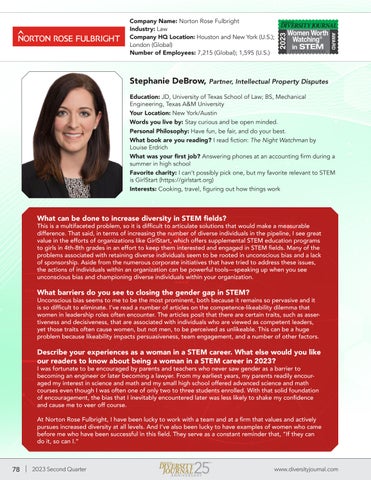
Stephanie DeBrow, Partner, Intellectual Property Disputes Education: JD, University of Texas School of Law; BS, Mechanical Engineering, Texas A&M University Your Location: New York/Austin Words you live by: Stay curious and be open minded. Personal Philosophy: Have fun, be fair, and do your best. What book are you reading? I read fiction: The Night Watchman by Louise Erdrich What was your first job? Answering phones at an accounting firm during a summer in high school Favorite charity: I can’t possibly pick one, but my favorite relevant to STEM is GirlStart (https://girlstart.org) Interests: Cooking, travel, figuring out how things work
What can be done to increase diversity in STEM fields?
This is a multifaceted problem, so it is difficult to articulate solutions that would make a measurable difference. That said, in terms of increasing the number of diverse individuals in the pipeline, I see great value in the efforts of organizations like GirlStart, which offers supplemental STEM education programs to girls in 4th-8th grades in an effort to keep them interested and engaged in STEM fields. Many of the problems associated with retaining diverse individuals seem to be rooted in unconscious bias and a lack of sponsorship. Aside from the numerous corporate initiatives that have tried to address these issues, the actions of individuals within an organization can be powerful tools—speaking up when you see unconscious bias and championing diverse individuals within your organization.
What barriers do you see to closing the gender gap in STEM?
Unconscious bias seems to me to be the most prominent, both because it remains so pervasive and it is so difficult to eliminate. I’ve read a number of articles on the competence-likeability dilemma that women in leadership roles often encounter. The articles posit that there are certain traits, such as assertiveness and decisiveness, that are associated with individuals who are viewed as competent leaders, yet those traits often cause women, but not men, to be perceived as unlikeable. This can be a huge problem because likeability impacts persuasiveness, team engagement, and a number of other factors.
Describe your experiences as a woman in a STEM career. What else would you like our readers to know about being a woman in a STEM career in 2023? I was fortunate to be encouraged by parents and teachers who never saw gender as a barrier to becoming an engineer or later becoming a lawyer. From my earliest years, my parents readily encouraged my interest in science and math and my small high school offered advanced science and math courses even though I was often one of only two to three students enrolled. With that solid foundation of encouragement, the bias that I inevitably encountered later was less likely to shake my confidence and cause me to veer off course.
At Norton Rose Fulbright, I have been lucky to work with a team and at a firm that values and actively pursues increased diversity at all levels. And I’ve also been lucky to have examples of women who came before me who have been successful in this field. They serve as a constant reminder that, “If they can do it, so can I.”
78
2023 Second Quarter
www.diversityjournal.com