INSIDE THIS ISSUE
By Rohini Anand,
Advisor, Rohini Anand LLC


 By Nicole James, Vice President of Product Management CX, Oracle




 By Drew Horansky, Senior Manager Corporate Communications, Eaton


 By Michael Stuber, DEI pioneer, author and consultant, The Global DEI Engineer
2023 First Quarter $14.95 2023 Women Worth Watching® in STEM and Asian Leadership Awards
ISSUE:
NEXT
can help companies survive, even thrive during an economic downturn
DEI
DEI pioneer, author,
Senior
Inclusion
Three Career-Building Tips for Young Women Oracle Software Exec Shares Helpful Hints for Women in Tech and Beyond.
and
Diversity, Equity and
At Eaton, ally advocacy circles help make allies and foster inclusion
‘Diversity of Opinion’ is a threat to Diversity, Equity and Inclusion – and what should be done about it
Why
2 023 A W ARD INTERNATIONAL
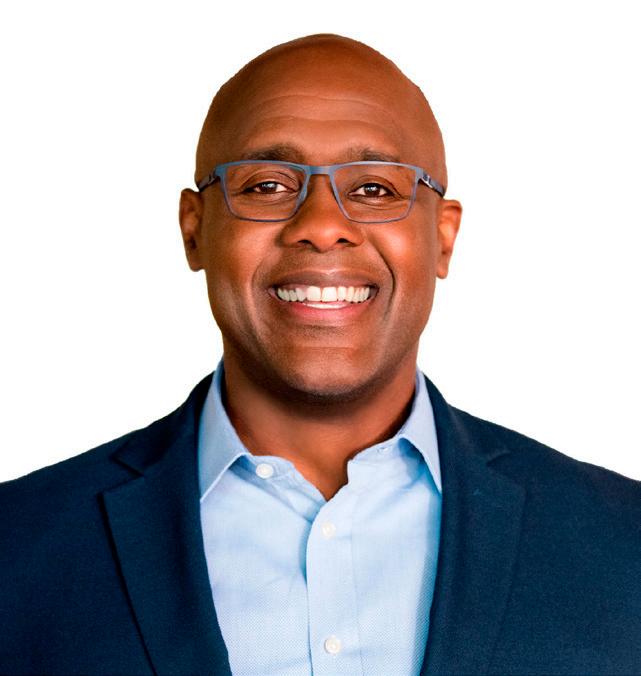
Congrats, Reggie Willis!
We’re proud of you for being recognized by the prestigious Diversity Journal as one of their Diversity Leaders for 2023.
Thank you for your passionate leadership and for enthusiastically driving change. You are building a future where diversity is valued and celebrated both within Ally and throughout our communities.
FOUNDER/CEO/PUBLISHER
James R. Rector

VICE PRESIDENT OF OPERATIONS
James Gorman
DESIGNER
Stephen A. Toth
EDITOR
Teresa Fausey
EXECUTIVE ASSISTANT
Elena Rector
WEBMASTER
David Toth
LETTERS TO THE EDITOR
Profiles in Diversity Journal

Gemini Towers #1 • 1991 Crocker Road, Suite 600 • Westlake, OH 44145
Tel: 440.892.0444 • Fax: 440.892.0737 profiles@diversityjournal.com
SUBSCRIPTIONS
Single issue $14.95
1 year subscription (4 issues) $45.00
2 year subscription (8 issues) $82.50
Canada, 1 year subscription $52.50
Canada, 2 year subscription $97.50
International, 1 year $99.95
International, 2 year $187.50

U.S. funds only. Subscriptions can be ordered at: www.diversityjournal.com or call customer service at 800.573.2867
Copyright © 2023 Rector Inc.
SUBMISSIONS
REPRINTS: profiles@diversityjournal.com
EDITORIAL: profiles@diversityjournal.com
PHOTOS & ARTWORK: stevetoth@diversityjournal.com
FOLLOW US AT: issuu.com/diversityjournal
Profiles in Diversity Journal® is a quarterly magazine dedicated to promoting and advancing diversity and inclusion in the corporate, government, nonprofit, higher education, and military sectors. For more than 25 years, we have helped to stimulate organizational change by showcasing the visionary leadership, innovative programs, and committed individuals that are making it happen.
The views expressed in this publication are those of the authors and may or may not represent the views of the publisher. Reproduction in whole or in part without written permission is prohibited.
Registered in U.S. Patent Office
Dear Readers,
Welcome to the first quarter issue of our 25th anniversary! We’re delighted to present 50 leader profiles in this exciting anniversary issue, the results of a wholesome collaboration with organizations focused on diversity, equity, inclusion and leadership. Congratulations to all Latino and Diversity Leader award winners recognized and profiled in this historic issue.
As we continue our journey profiling diverse leaders in the work world, I’m reminded of the 1965 song performed by Jackie DeShannon with lyrics by Burt Bacharach and Hal David called, “What the World Needs Now is Love.” What the world also needs now in equal measure are strong, committed, and responsible Leaders. And that is what this issue is all about, 50 leaders sharing themselves and their aspirations. Additionally, there are informative articles by Dr. Rohini Anand, Michael Stuber, Nicole James and Drew Horansky. Check out the Table of Contents for details.
Looking forward, the second quarter 2023 issue will feature Asian Leaders and Women Worth Watching in STEM award winners. Following in the 3rd quarter will be our 22nd annual Women Worth Watching® in Leadership award winners. Also included in this issue will be Indigenous Leaders and our new Veteran Leaders award profiles. Please stay tuned.
Lastly, I would like to give a special shout out to our PDJ production, marketing, operations and website teams responsible for creating and assembling all the profiles, articles and special features contained in this issue.
As always, more to come. If convenient, please drop me a note and share your thoughts. We would love to hear from you.
James R. Rector Founder & Publisher
Since 1999
All Things Diversity & Inclusion
PUBLISHER'S COLUMN 1 www.womenworthwatching.com 2023 First Quarter

01 | PUBLISHER ’ S COLUMN 10 | EDITOR ’ S IN MEMORIAM 11 | FACES OF LEADERSHIP 16 | DEI CAN HELP COMPANIES SURVIVE, EVEN THRIVE DURING AN ECONOMIC DOWNTURN 20 | THREE CAREER-BUILDING TIPS FOR YOUNG WOMEN Oracle Software Exec Shares Helpful Hints for Women in Tech and Beyond. 22 | 2023 DIVERSITY LEADERS AWARDS 34 | AT EATON, ALLY ADVOCACY CIRCLES HELP MAKE ALLIES AND FOSTER INCLUSION 36 | WHY ‘DIVERSITY OF OPINION’ IS A THREAT TO DIVERSITY, EQUITY AND INCLUSION –AND WHAT SHOULD BE DONE ABOUT IT 42 | 2023 LATINO LEADERSHIP AWARDS 84 | CORPORATE INDEX 11 INSIDE THIS ISSUE 2 2023 First Quarter www.diversityjournal.com
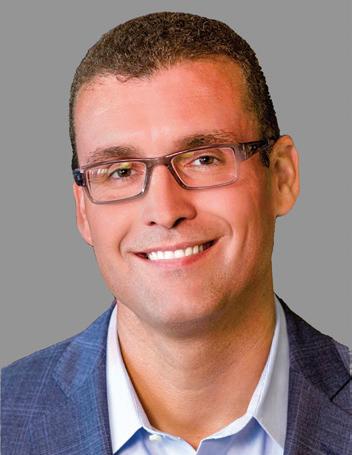
Congratulations Jason Soto A 2023 Profiles in Diversity Journal Latino Leadership Award recipient
websterbank.com
Credit Officer 2023 EHL Lockup Layout Options Webster Bank, N.A., Member FDIC. Equal Housing Lender Webster, Webster Bank, the Webster Bank logo, and the W symbol are trademarks of Webster Financial Corporation and registered Webster Bank, N.A., Member FDIC. Equal Housing Lender Webster, Webster Bank, the Webster Bank logo, and the W symbol are trademarks of Webster Financial Corporation and registered in the U.S. Patent and Trademark Office © 2023 Webster Financial Corporation. All Rights Reserved.
We applaud Jason for his leadership and mentorship within Webster as well as his is dedication to serving Webster clients.
Chief
DEI can help companies survive, even thrive during an economic downturn
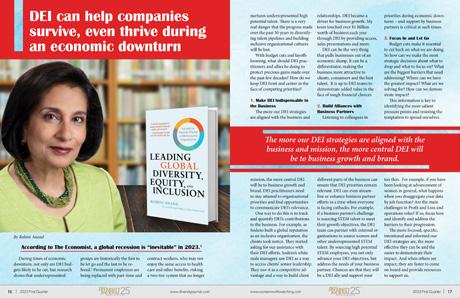
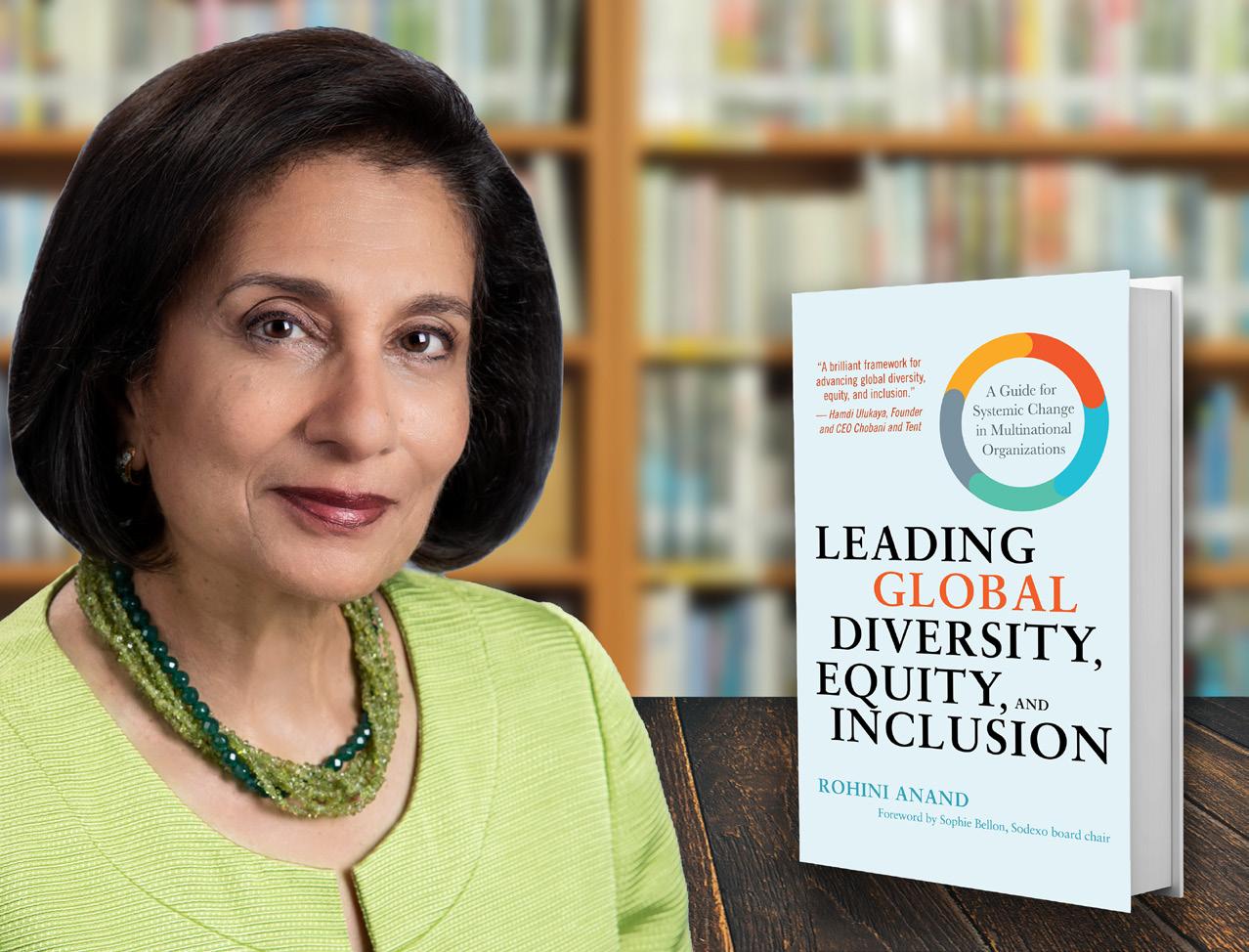
pioneer, author, and Senior Diversity, Equity and Inclusion Advisor, Rohini Anand LLC Recessions and other economic storms can lead to major cuts in a company's DEI budget, which can sometimes be the first to get cut when layoffs are necessary. But Rohini Anand, an early proponent of DEI and a former senior vice president at Sodexo, argues that diversity, equity and inclusion practices can fuel business growth even during hard times. Strong DEI companies should leverage it to engage with employees, build client relationships and even find new talent when economic times get hard.
By Rohini Anand, DEI
Congratulations Nora Guerra and Julissa Pinto De Gracia
2023 Latino Leadership Award Winners
The Profiles in Diversity Journal has honored Nora Guerra and Julissa Pinto De Gracia for educating the Latino community about finances and housing, mentoring others, and advancing diversity, equity, and inclusion at Freddie Mac.
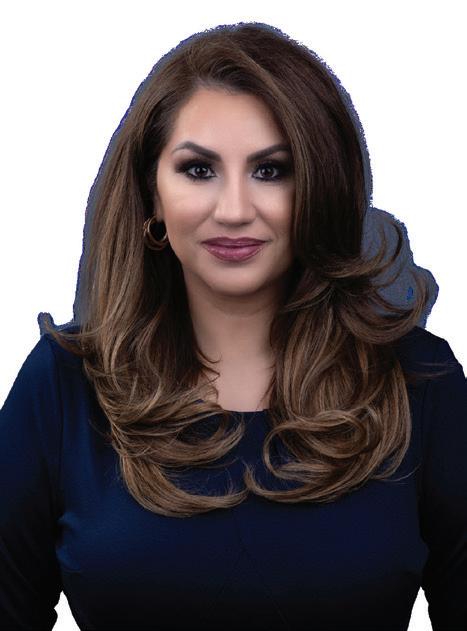
Freddie Mac’s inclusive culture empowers leaders like Nora and Julissa to go above and beyond to make home possible.
Join our team at freddiemac.com/careers
PAGE 20
Three Career-Building Tips for Young Women Oracle Software Exec Shares Helpful Hints for Women in Tech and Beyond.
 By Nicole James, Vice
President of Product Management CX, Oracle Corporate executive Nicole James has been there. She knows it's not easy to be the only (fill-in-the-blank) in the room, trying to learn the business. And she knows how to get ahead. She explains to young women how to rise to the top of their field by asking questions – even stupid ones – and being engaged. And she shows how she is trying to help the next generation of female leaders find their voice and their space in any room.
PAGE 16
4 2023 First Quarter www.diversityjournal.com
The singular power of diversity
Innovation in Diversity, Diversity Leader – Profiles in Diversity Journal, 2022

Mansfield Plus Certification U.S. and UK – Diversity Lab , 2022
Compass Award – Leadership Council on Legal Diversity, 2022


100 Best Companies, Best Companies for Multicultural Women, Best Companies for Dads, and Inclusion Index – Seramount, 2022
Best Places to Work for LGBTQ+ Equality – Human Rights Campaign, 2022 (for the tenth consecutive year)
Tipping the Scales Recognition – Diversity & Flexibility Alliance, 2022
Best Retention of Diverse Talent – Aspiring Solicitors, 2022
Dechert is a global law firm dedicated to seeking and amplifying diverse viewpoints and experiences to develop the highest caliber of talent, leadership and service for our clients. We’re proud of our recent achievements – and eager for the continuing growth and progress to come. dechert.com/diversity
D
Diversity, Equity and Inclusion
n n n n n n n

We thank all the honorees for their leadership in our communities. travelers.com/community The Travelers Indemnity Company and its property casualty affiliates. One Tower Square, Hartford, CT 06183 © 2023 The Travelers Indemnity Company. All rights reserved. Travelers and the Travelers Umbrella logo are registered trademarks of The Travelers Indemnity Company in the U.S. and other countries. M-18629 Rev. 3-23 Congratulations to Travelers’ own Rita Ortiz for being recognized as one of the 2023 Latino Leaders Worth Watching. PAGE 22 2023
PDJ presents its 15th annual Diversity Leader Awards, We celebrate the commitment and achievements of organizations, and their diversity leaders, who continue to put DEI front and center and find new ways to take DEI to the next level. 6 2023 First Quarter www.diversityjournal.com
Diversity Leader Awards
Nominations Extended to Friday, April 7
At Profiles in Diversity Journal ® , we truly appreciate all the support given to us over the years by many organizations and businesses, large and small. We’re reaching out and asking for your continued support for our work and recognition of your organization’s own outstanding leadership, creativity, and inclusive culture. Please take this opportunity to nominate candidates for our Asian Leadership and Women Worth Watching® in STEM Awards.
You Encourage Us. You Challenge Us. You Inspire Us.
Congratulations to our 2023 Latino Leadership Award honoree! Sonepar and our employee resource group Hispanos Unidos (HU) are proud of Gabino and all he has accomplished to prove that we are “Powered by Difference.” Gabino, your passion and advocacy for the Latino community has made a profound and lasting impact on our organization.

 Gabino Martinez Regional Operations Manager World Electric
2 023 A W ARD ASIAN INTERNATIONAL Nominate Today! 2 023 A W ARD Women Wor th Watching® in STEM INTERNATIONAL Nominate Today! 7 www.womenworthwatching.com 2023 First Quarter
At Eaton, ally advocacy circles help make allies and foster inclusion
 By Drew Horansky, Senior Manager Corporate Communications, Eaton
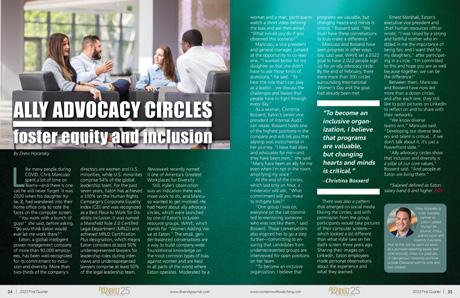
A girl asked her father, a vice president who worked for Eaton, if she and other girls could work at the company, which to her young eyes seemed to hire only men. Drew Horansky, who works with Eaton's global HR office, tells us how that girl's father and another Eaton vice president worked with WAVE, Women Adding Value to Eaton, to eliminate bias at the company. They are using videos and moderated conversations to try to change the face of the company – one discussion at a time.
PAGE 36
Why ‘Diversity of Opinion’ is a threat to Diversity, Equity and Inclusion – and what should be done about it
By Michael Stuber, DEI pioneer, author and consultant, The Global DEI Engineer
Michael Stuber, a long-time prolific writer on DEI issues, explains why an innocent sounding term such as diversity of opinion, can undermine DEI efforts at a company. Asking challenging questions about DEI is fine, he writes. Writing off DEI or espousing hateful rhetoric is not. However, in order to counter that idea, DEI advocates must make sure that they present analytical evidence about DEI's success and remain firm about the values of DEI.
LEADING WITH CHANGE
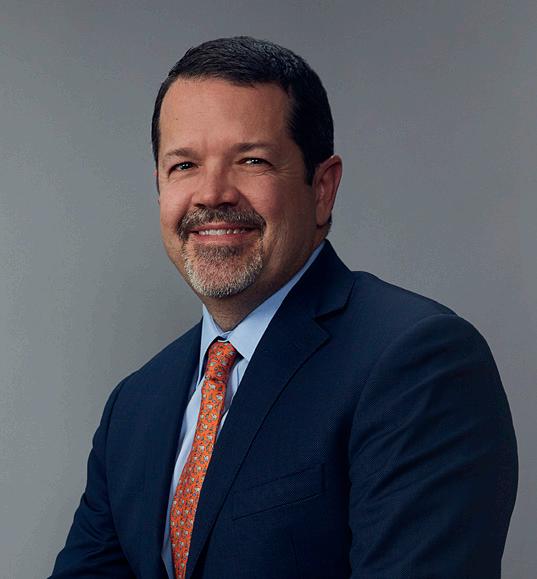
Davis Wright Tremaine congratulates our Partner Camilo Echavarria for being recognized as a Latino Leader Worth Watching by Diversity Journal.
As the Partner in Charge of several California offices, the Vice-Chair of the Executive Committee, and a member of the Diversity Executive Council, Camilo’s leadership has played an integral role in driving our firm’s vision for DEI.
DWT.COM PAGE 34
8 2023 First Quarter www.diversityjournal.com
PAGE 42
2023 Latino Leadership Awards
PDJ proudly presents its third annual Latino Leadership Award recipients. This year, the magazine honors 40 outstanding individuals, who have navigated two cultures to succeed in the workplace and in life.
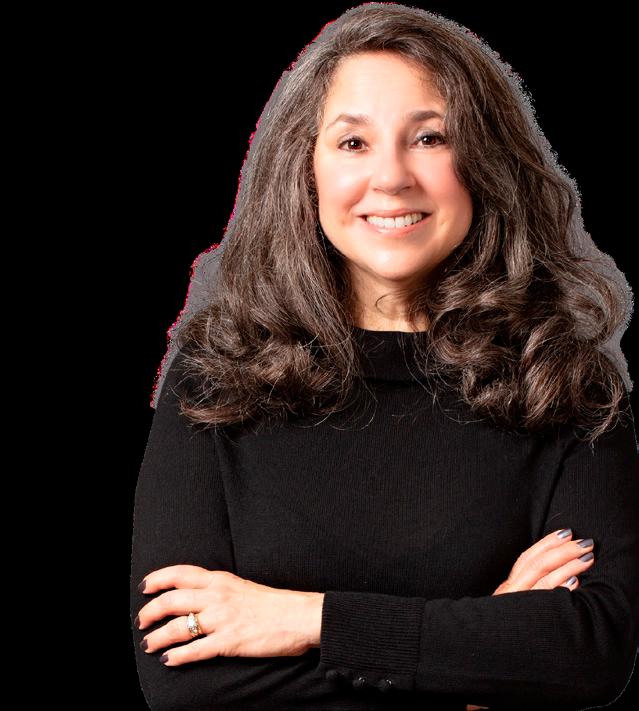
PROUD TO SUPPORT THE BRANDYWINE CONSERVANCY Congratulations
Annette Favorite
on being named as one of Profiles in Diversity Journal’s Latino Leadership Award Winners for 2023!
Thank you for supporting initiatives and programs that foster and build a more diverse work environment, allowing team members to truly bring their authentic selves to work every day.
9 www.womenworthwatching.com 2023 First Quarter
PAGE 84
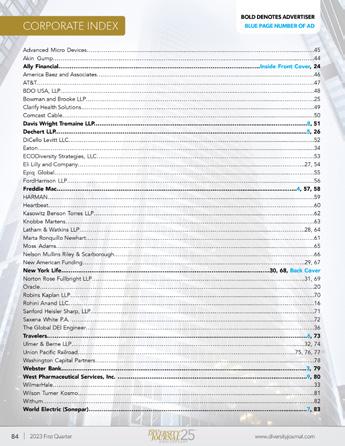
Coporate Index
Check out the list of organizations that appeared and/or advertised in this issue. Their contributions are invaluable.
In Memoriam
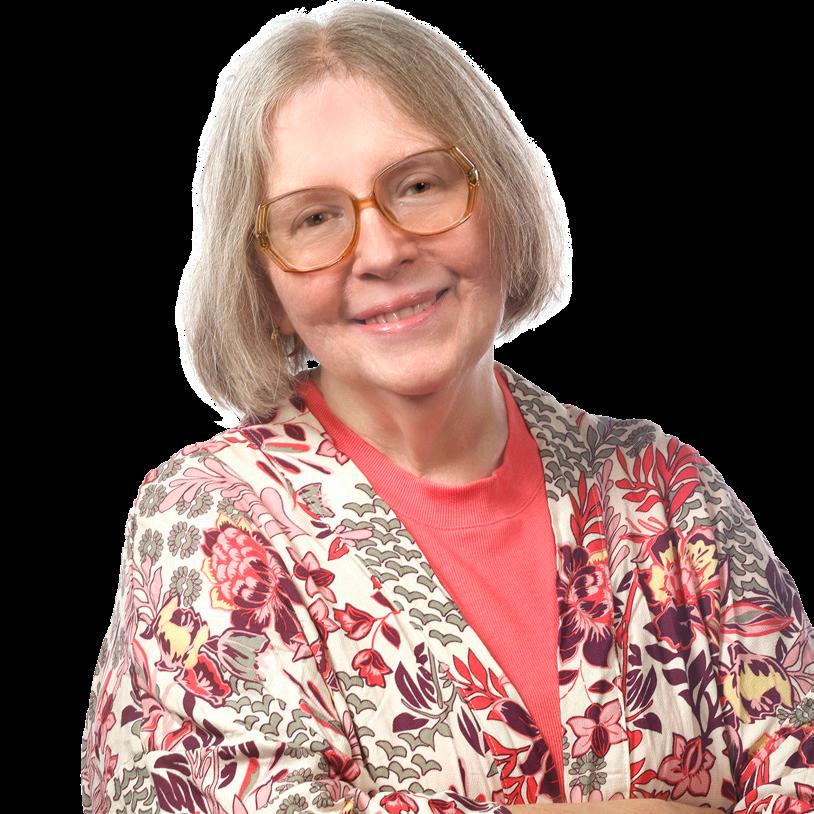
1952-2022
Teresa Fausey
“There are only two ways to live your life. One is as though nothing is a miracle. The other is as though everything is a miracle.”
–Albert Einstein
10 2023 First Quarter www.diversityjournal.com
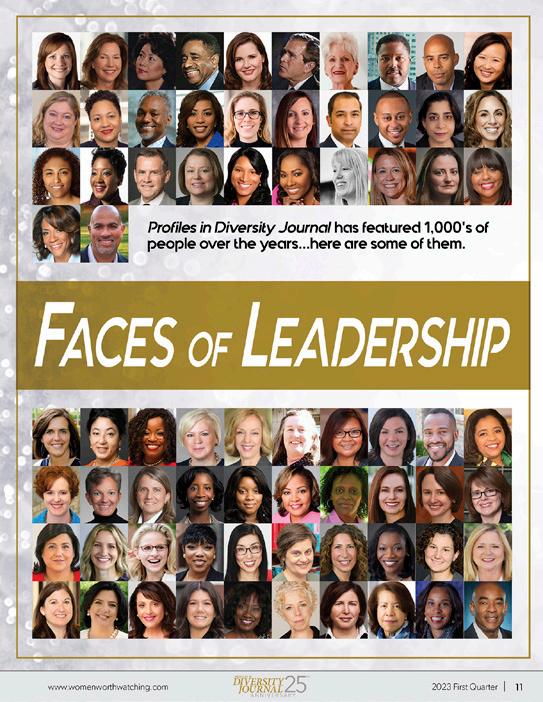
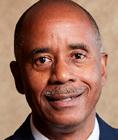
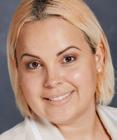
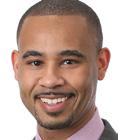
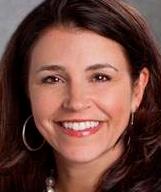
Profiles in Diversity Journal has featured 1,000's of people over the years...here are some of them.





































Faces oF Leadership






11 www.womenworthwatching.com 2023 First Quarter
Faces oF Leadership


















































12 2023 First Quarter www.diversityjournal.com
Faces oF Leadership



















































13 www.womenworthwatching.com 2023 First Quarter
Faces oF Leadership












































14 2023 First Quarter www.diversityjournal.com
Faces oF Leadership




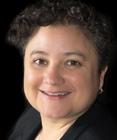
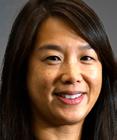

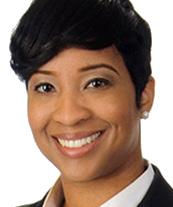

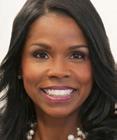












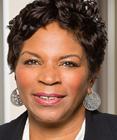

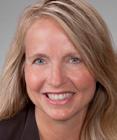

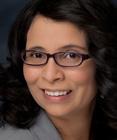




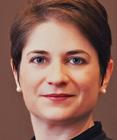














Profiles in Diversity Journal will be showcasing more people from our past and present in each magazine issue this year.





15 www.womenworthwatching.com 2023 First Quarter
DEI can help companies survive, even thrive during an economic downturn
 By Rohini Anand
According to The Economist, a global recession is “inevitable” in 2023.1
During times of economic downturn, not only are DEI budgets likely to be cut, but research shows that underrepresented
groups are historically the first to be let go and the last to be rehired.2 Permanent employees are being replaced with part-time and

contract workers, who may not enjoy the same access to health care and other benefits, risking a two-tier system that no longer

16 2023 First Quarter www.diversityjournal.com
nurtures underrepresented high potential talent. There is a very real danger that the progress made over the past 30 years in diversifying talent pipelines and building inclusive organizational cultures will be lost.
With budget cuts and layoffs looming, what should DEI practitioners and allies be doing to protect precious gains made over the past few decades? How do we keep DEI front and center in the face of competing priorities?
1. Make DEI Indispensable to the Business
The more our DEI strategies are aligned with the business and
relationships. DEI became a driver for business growth. My team touched over $1 Billion worth of business each year through DEI by providing access, sales presentations and more.
DEI can be the very thing that pulls businesses out of an economic slump. It can be a differentiator, making the business more attractive to clients, consumers and the best talent. It is up to DEI teams to demonstrate added value in the face of tough financial choices.
2. Build Alliances with Business Partners
Listening to colleagues in
priorities during economic downturns – and support by business partners is critical at such times.
3. Focus In and Let Go

Budget cuts make it essential to cut back on what we are doing. So how can we make the most strategic decisions about what to drop and what to focus on? What are the biggest barriers that need addressing? Where can we have the greatest impact? What are we solving for? How can we demonstrate impact?
This information is key to identifying the most salient pressure points and resisting the temptation to spread ourselves
mission, the more central DEI will be to business growth and brand. DEI practitioners need to stay attuned to organizational priorities and find opportunities to communicate DEI’s relevance.
One way to do this is to track and quantify DEI’s contributions to the business. For example, as Sodexo built a global reputation as an inclusive organization, the clients took notice. They started asking for our assistance with their DEI efforts. Sodexo’s white male managers saw DEI as a way to access clients’ senior leadership. They saw it as a competitive advantage and a way to build client
different parts of the business can ensure that DEI priorities remain relevant. DEI can even streamline or enhance business partner efforts in a time when everyone is facing cutbacks. For example, if a business partner’s challenge is sourcing STEM talent to meet their growth objectives, the DEI team can partner with external organizations to source women and other underrepresented STEM talent. By sourcing high potential STEM employees, you not only advance your DEI objectives, but address the needs of your business partner. Chances are that they will be a DEI ally and support your
too thin. For example, if you have been looking at advancement of women in general, what happens when you disaggregate your data by job function? Are the main challenges in Profit and Loss and operations roles? If so, focus here and identify and address the barriers to their progression.
The more focused, specific, intentional and informed our DEI strategies are, the more effective they can be and the easier to demonstrate their impact. And when others see impact, they are faster to come on board and provide resources to support us.
17 www.womenworthwatching.com 2023 First Quarter
The more our DEI strategies are aligned with the business and mission, the more central DEI will be to business growth and brand.
4. Embed DEI into Existing Processes and Initiatives
Rather than new initiatives, focus on where you can embed DEI into existing processes and leadership practices. For example, if a corporate responsibility initiative focuses on community health and wellbeing, add the DEI lens and start addressing healthcare disparities and building trust in communities of color to positively impact health outcomes. Internally, rather than create a separate inclusive leadership skills development initiative, partner to integrate inclusive leadership competencies into existing programs. Partnering in this way also strengthens DEI in the long run by mainstreaming a DEI mindset into systems and processes within the organization.
5. Leverage Employee Resource Groups
Employee Resource Groups (ERG) often operate in silos. With tightening budgets, this is an opportunity for ERGs to work intersectionally. In one organization, ERGs for military veterans and for people with disabilities co-hosted their annual event by bringing in a keynote veteran with a disability – they leveraged synergies, shared learnings and maximized resources. As we are all intersectional beings, finding opportunities for ERGs to collaborate meaningfully will go a long way to further embedding an inclusive culture.
ERGs are home to DEI champions – they are often the ones mainstreaming DEI efforts and embedding a DEI mindset into the DNA of organizations. Recognize
and celebrate their contributions to prevent burnout and encourage more people to engage and to sustain the momentum.
6. Apply a DEI lens to People Cuts
DEI and HR teams can play an invaluable role in ensuring that layoffs, short-term contracts and reduction of hours are not disproportionately impacting underrepresented talent. Tracking the data and encouraging decision-makers to continuously check their decisions is key to mitigating the adverse impact on equality.
7.
Nurture your Team
Lastly, budget cuts can mean a reduction in bonuses, incentives and too few staff to do the work. Ensure that your team continues to access learning opportunities and get them involved in projects that will stretch and grow them. Pay attention to their work life balance and calibrate their workload with realistic expectations. Ask them how they would like to be recognized and find ways to make that happen.
An economic downturn is stressful. It is a time of uncertainty and disruption. Competition among groups and
can fester. But it can also be an opportunity to strengthen our work, to trim away what is less effective, and to further embed DEI in the core mission, systems and processes of an organization for lasting change. PDJ
18 2023 First Quarter www.diversityjournal.com
resentments
As we are all intersectional beings, finding opportunities for ERGs to collaborate meaningfully will go a long way to further embedding an inclusive culture.
1 Zanny Minton Beddoes “Why a global recession is inevitable in 2023” –The Economist, Nov 18th 2022
2 David Rice “Workplace Fairness Trends to Watch in 2023” – DiversityInc Best Practices
Rohini Anand is a pioneer of DEI, an author, and Senior Diversity, Equity and Inclusion Advisor, Rohini Anand LLC. She also serves as a senior fellow for The Conference Board, a global non-profit think tank. She previously served as Senior Vice President of Corporate Responsibility and Global Chief Diversity officer for Sodexo.
19 www.womenworthwatching.com 2023 First Quarter WOMEN WORTH WATCHING ® in Leadership Awards 2 023 A W ARD Women Wor th Watching® in Leadership INTERNATIONAL SUBMISSION DEADLINE: June 1, 2023 Profiles in Diversity Journal invites you to participate in our 22nd annual Women Worth Watching® in Leadership Awards and recognize the dynamic women who are using their talents and influence to enhance your workplace and change our world. Nominate Today!
Three Career-Building Tips for Young Women
Oracle Software Exec Shares Helpful Hints for Women in Tech and Beyond.
By Nicole James, Vice President of Product Management CX, Oracle


First, let me introduce myself. I am a Jersey Girl, born and raised in the Garden State. Nonetheless, I built my career by going to where the work was. That willingness, plus a passion for math and computer science led me to Atlanta via Austin.
I thrived in tech, a field where women and minorities, like myself, were uncommon in part because I was always inquisitive and eager to pursue my interests wherever they led me.
As a child, I loved math. My mother—an educator—fostered that interest. In high school, that passion was furthered by Warren Jones, a high school computer science teacher. Jones had his class design video games. Once a game was finished, we often rattled off lists of features and functions we wished were included and Jones would challenge us to go back and incorporate them. To this day I say if it weren’t for Mr. Jones, I would not be here. He made that computer science course so much fun.
After graduating with a computer science degree from Rutgers University, I left the East Coast for a software development job with IBM in Texas. A decade after advancing through software development roles, I left the workforce to raise a family. But five years later, a former colleague encouraged me to take a position at General Electric. I was apprehensive – unsure whether my skills were still current and if I would be an “imposter.” But I took on the challenge, accepted the position – and haven’t looked back.
THREE WAYS TO BUILD A CAREER
As someone who wants to help young women succeed in tech—and beyond—I want to share three rules of thumb for those wanting to build their careers.
1.) Always seek to learn. Observe everything. Be curious. Earlier in my career I was a
20 2023 First Quarter www.diversityjournal.com
sponge. I wanted to know everything, how everything worked, how the whole business worked, not just my particular area. Part of that is watching and listening to people, especially those who are moving the needle. Take in the good traits from all the leaders you encounter and incorporate them into your own leadership style.
2.) Speak up. Ask questions. This is not easy, especially early in a career but it’s better to ask a “stupid” question than to pretend to know things you don’t. This is how you learn, and frankly, if you don’t know something it’s likely that other people don’t either. In addition, most people like to be asked. They like sharing knowledge. Asking questions builds social and workplace networks that are crucial to success.
3.) Take risks. It is important to go outside your comfort zone, especially early on when it is easier to do so. Right out of college, I moved halfway across the country for that IBM job. I didn’t know anyone in Texas. It was a different climate and a new job but I was able to enhance my career by being flexible. Later, I moved again when IBM wanted me to relocate to Atlanta. Young people with fewer ties should definitely take on travel or stretch assignments, when offered.
BUILDING ON SUCCESS
Having built my own career with help from others, I want to pay it forward. While I was lucky to have several key influencers in school or at work who helped me, one critical ingredient was lacking: I had zero black women role models in tech. In my 30 years, I’ve only had one woman manager and no black women managers. This is something that must change.
That lack of representation is obvious. It’s hard to see yourself in a role if you don’t see anyone that looks like you in that role. It is very important for young black women to realize they are not alone. There were many times when I felt I was the only one experiencing something, and that was (and is) never the case. One way to ease anxiety is to find people like you in a given group or situation.
Employee Resource Groups (ERGs) help fulfill that role. Oracle, for example, has the Alliance of Black Leadership for Excellence (ABLE) as well as
Oracle Women’s Leadership (OWL) as ready-made networks for people with common interests.
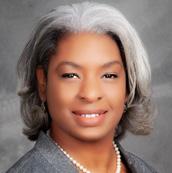

Both ABLE and OWL helped me acclimate to the new company and I was thrilled to meet many black women executives at the company, something I had never experienced before.
I was also happy when Oracle embraced my idea to start a new mentorship program for black women called G.E.M.S. (Greatness, Excellence, Maturity and Sincerity). Many young women feel they don’t have allies or visibility within their organizations and lack a path for advancement. That is something that can be fixed.
G.E.M.S. enrolled its first 60 applicants this year. It includes eight black women executives and four senior directors who have volunteered to take on five mentees each. The program encompasses North America in 2023 but since it received applications from as far away as Nigeria and India, we hope to expand globally next year.
The project is exhilarating. I’m so excited because I feel like we can at least touch 60 women and let them know their worth. We can show them that their presence is valuable, give them tools on how to network and show them how they can grow their influence going forward.
This year 60 young black women at Oracle. Next year? Who knows, but the upside is immense. PDJ
21 www.womenworthwatching.com 2023 First Quarter
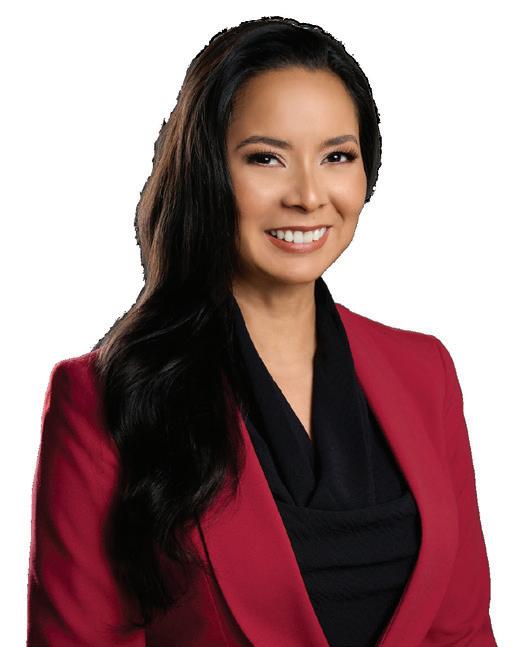
Nicole James is VP of CX Service Product Management at Oracle. She is an advocate for Oracle’s Alliance of Black Leadership for Excellence (ABLE) and Oracle Women’s Leadership (OWL).
“While I was lucky to have several key influencers in school or at work who helped me, one critical ingredient was lacking: I had zero black women role models in tech.”
The 15th Annual Diversity Leader Awards

PDJ Celebrates the Creativity and Commitment of this Year’s Diversity Leader Award Recipients
Every year, since PDJ began celebrating organizations and individual Diversity Leaders who are committed to taking diversity to the next level, we have been impressed and encouraged by their commitment, their intelligence, and their creativity.
The Diversity Leaders we recognize in the following pages are reaching out, locally and globally, to embrace an ever-expanding variety of employees, vendors, clients, and communities. Diversity, inclusion, and equity are central to everything they do. For many, who at one time or another have felt excluded or ignored because they belonged to a particular gender, or ethnic or cultural group, making diversity a reality is a personal imperative.
This year’s Award recipients are working to connect with a more diverse group of potential hires, reaching out to women- and minority-owned vendors, supporting their communities, and teaching company leaders and hiring managers to recognize and confront their own unconscious biases. Most important, they are cultivating workplaces that invite all employees to bring their authentic selves to work every day.
We invite you to get to know these extraordinary Diversity Leaders. You may discover ideas and strategies that you can use to help drive your own organization along the diversity highway. And we know you’ll be inspired by their insights, their enthusiasm, and their inspiring personal stories.
22 2023 First Quarter www.diversityjournal.com




23 www.womenworthwatching.com 2023 First Quarter
Ally Financial, Inc.
Headquarters: Detroit, Michigan
Industry: Financial Services

CEO: Jeffrey J. Brown
We’re rooted in our deep, deep beliefs of the importance of diversity, equity and inclusion and equality for all. Where I’ve been very vocal is on matters of systemic racism, social injustice and really ensuring that all of our teammates at Ally – all 11,000+, feel safe and feel empowered and feel okay to be their authentic selves….
– Jeffrey J. Brown, CEO
Ally Financial, a digital financial services company, which employs more than 11,000 people, lives and breathes diversity, equity and inclusion inside its offices and in the communities that it serves. Forty-two percent of the directors on the board are women or people of color and 53 percent of its executive staff.
It’s won numerous awards for its commitment to DEI. Here is a sample: 2022 Forbes “The Best Employers for Diversity”; 2022 Human Rights Campaign - Corporate Equality Index “Best Places to Work for LGBTQ+ Equality”; 2022 Fortune “Best Companies for Millennials”; 2022 Fortune “Best Workplaces for Financial Services and Insurance”; and 2022 People Magazine “Companies that Care.”
Ally is also known for its supplier diversity and has been recognized twice for its Supplier Diversity programming: 2022 TOP Corporations Award from the Greater Women’s Business Council; 2022 Excellence in Supplier Diversity by the Carolinas LGBT+ Chamber of Commerce.
Each year, Ally uses a survey by Glint, a company that focuses on engagement, to determine employee engagement levels. In 2022, Ally’s engagement rate was among the top 10 percent of its global benchmark and nine points higher than the financial services benchmark.
Reggie Willis, Executive Director and Chief Diversity Officer
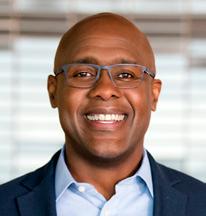
Credentials: M.B.A., Queens University; B.A., College of Holy Cross
DEI is a core value at Ally and the financial services company doesn’t hide its light. Leadership holds media interviews and meetings with other leaders within the industry and beyond to discuss opportunities to get more involved in community issues such as financial education, workforce development, equitable housing and access to technology.
The focus on DEI at this company is apparent in the numbers. The number of people of color was up 15 percent in 2022 and female representation at the executive level has remained steady because of higher retention and promotion rates. There has been more than a 50 percent growth in Employee Resource Groups (ERG), internal organizations for employees of different races, ethnicities and genders.
Everyone is encouraged to join or engage with Ally’s eight ERGs, which are conduits for action as well as listening – frequently, the ERGs host “Let’s Talk About It” sessions where employees can share their thoughts and reactions around relevant social justice, equity and inclusivity topics. The discussions are often difficult and raw, but critical in bringing the teams together and fostering a sense of belonging.
Because of difficult and uncertain economic conditions, 2023 will be the year of employee retention and being thoughtful about the approach the firm takes with existing teammates. Primarily, it will be focused on facilitating a ‘human’ approach to leadership and ensuring that the DEI team plays a big role in coaching and teaching managers.
That will also include improving mental health support and resiliency for all employees. Caring for managers and leaders allows them to continue to create an environment where their teammates feel a connection and sense of purpose.
24 2023 First Quarter www.diversityjournal.com
“ ”
Bowman and Brooke LLP

Headquarters: Minneapolis, MN
Industry: Law Firm
CEO: Paul Cereghini, Firm Chair
I will work to maintain our firm’s Core Value of being a diverse firm of partners and employees with a leadership role within the legal profession. I will work to ensure our firm continues to deliver the highest caliber of legal services by attorneys and staff who reflect the cultures, values and diversity of the clients and communities we serve. I will also use my voice as a leader in my firm and in the profession to advocate for DEI in the legal profession and in my community.
– Paul Cereghini, Firm Chair
This law firm of 396 employees doesn’t just check the diversity box. Diverse recruitment, mentoring, and mandatory DEI training have been core values for decades and it shows. Nearly half of its executive committee is made up of women, including a female vice chair.
Its hard work has been recognized by others. The firm has earned awards from The National Law Journal; NLJ 500 Women’s Scorecard, 2022, Top 20, 2018–2022 Law360; and it ranked #39 on the 2021 Glass Ceiling Report Top 40 Firm for Women Attorneys, firms with 101–250 attorneys.
The firm encourages employee engagement through mentoring, career involvement in leadership and public experiences in external associations. New attorneys are assigned a partner-level mentor who assists them in their professional development. Female attorney and attorneys of color can opt for additional support in an affinity group or with an affinity mentor. The mentor helps new lawyers by meeting with them regularly to discuss work, client feedback and growth opportunities within the firm.
Roshan Rajkumar, Managing Partner, Diversity and Inclusion Committee Chair
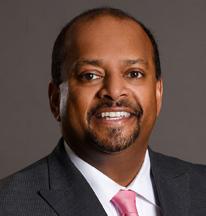
Credentials: University of Minnesota Law School, J.D.; Australian National University; M.A., Boston College, B.A.
This firm works hard to fight complacency in DEI work and sees both a lack of focus and complacency as dangerous threats to the progress of DEI. It refuses to rest. Currently, over 60 percent of its 2022 newly hired attorneys identify in at least one diverse category. Yet, it is still working hard to make sure that all lawyers and staff feel included. It keeps everyone on the same page by requiring lawyers and staff to participate in DEI training and providing opportunities to discuss race and gender.
Every attorney is held accountable through the firm’s Acts of Inclusion Checklist. The list is a smart, practical guide to help busy lawyers navigate DEI and stay on top of their goals.
The checklist requires the following: Each attorney must recognize and reject all forms of intolerance, addressing issues swiftly. They must also ask a new attorney about their career development plans and offer to help. Finally, the lead attorney should invite a diverse attorney and guest to a non-work-related event and introduce them to others. Attorneys are held accountable by formally reporting their efforts in their annual reviews.
The company also makes sure that the doors to the C-Suite are open to all lawyers. It does that through partnership planning, client succession planning and DEI evaluations for partners. The firm recognizes that their newly hired lawyers are the future. By becoming partners and being responsible for essential client relationships, women and minority attorneys will be in a position to pursue the highest-level positions in the firm as managing partners, executive managing partners and firm chair.
25 www.womenworthwatching.com 2023 First Quarter
“ ”
Dechert LLP

Headquarters: Philadelphia, New York
Industry: Law Firm
CEO: Henry N. Nassau
I will use my voice as a leader to advocate for diversity, equity and inclusion in the legal profession and my community. I will ensure that our firm community continues to foster a culture of inclusion where everyone’s voice is respected and valued. I will use my leadership position to build a more diverse and inclusive legal profession by improving the equity of processes such as recruitment, development, and advancement of diverse attorneys and women.
– Henry N. Nassau, CEO
This law firm believes that DEI is the responsibility of every one of its 2,000 lawyers and staff in 21 offices around the world. But five full-time professionals are particularly dedicated to the company’s strategic oversight and implementation of diversity and inclusion initiatives. They have many successes to report.
This year it was named among the top 10 law firms for quality of life by Vault, a leading guide for law students and associates. Dechert ranked 8th overall in the best law firms category.
Last year, the Chambers Associate Survey ranked the company as “elite” across all six categories citing it for having the most satisfied associates, top career development retention, great benefits and quality of life, as well as elite status in pro bono work and diversity. It was the only AMLaw100-listed firm to achieve this honor.
The DEI team gets help from its diversity liaison partners, which are selected to oversee the diversity and inclusion efforts of their respective practice groups and exchange valuable information and insights with the DEI team. They also monitor assignments for equitable distribution of opportunities and workflow and ensure that diverse individuals are being mentored and sponsored, advised on their development and promoted internally and externally to the firm and to clients.
Satra Sampson-Arokium, Chief Diversity, Equity and Inclusion Officer
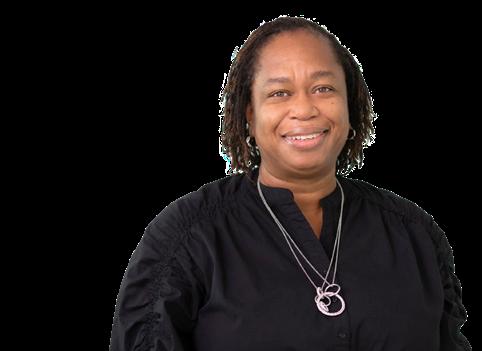
Credentials: Masters of Public Administration, Marist College; B.A., State University of New York at Albany
Philosophy: In the words of author and activist Maya Angelo, “People will forget what you said, people will forget what you did but people will never forget how you made them feel.” Take the time to listen and always treat people with dignity and respect.
The team had a number of accomplishments in 2022. Dechert’s Actionable Allyship and Inclusive Leadership training, which is open to all employees, educates Dechert’s staff on how to define and understand allyship, privilege and discrimination so that the firm can continue being an inclusive work environment. The firms has affinity groups that help foster numerous opportunities to members. Those groups provide mentorship and professional development opportunities to staff members. The company also holds an annual DEI week where colleagues are encouraged to celebrate and take pride in their identities.
Going forward, the retention of diverse associates is a high priority for the firm, particularly since demand for diverse legal talent still exceeds the supply. The DEI team will work with partners inside the firm to develop and enhance our firm’s mentoring program and it will hold intense, interactive sessions on inclusive leadership for all personnel. The firm will also host an in-person Diverse Lawyers’ Symposium that will bring together diverse associates for two days of programming, community building and networking. Throughout it all, the firm will track and analyze diversity data to ensure parity and to remedy any inequities.
26 2023 First Quarter www.diversityjournal.com
“ ”
Lilly Research Laboratories-Eli Lilly and Company
Headquarters: Indianapolis, IN
Industry: Pharmaceutical research and development, manufacturing and commercialization

CEO: Dave Ricks and Dan Skovronsky, executive vice president, Chief Scientific and Medical Officer and President of Lilly Research Laboratory
At Lilly, we believe in the power of diversity, equity and inclusion (DEI) to fulfill our purpose of creating medicines that make life better for people around the world. At our core, we believe that by leveraging the varied backgrounds of our more than 35,000 employees –and by driving actionable and measurable strategies to improve DEI, including diversity within our clinical trials – we can better deliver scientific breakthroughs.
– Dave Ricks, CEO
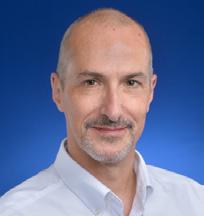
Eli Lilly is well known for its life-saving medications, but it should also be known for embedding DEI into the fabric of its vast company of more than 35,000 employees. Diversity Inc. ranked the company fifth among the top 50 companies for diversity in 2022. It was also eighth in diversity supply last year. In addition, the company has ranked among the top 10 for diversity since 2018, according to Diversity Inc.
Lilly’s successes in DEI keep expanding. Globally, about 48 percent of women are in management in 2021, up from 41 percent in 2017. Minority group members in management positions rose to 24 percent from 16 percent during that time period. Thirty-three percent of Lilly’s executive committee is made-up of women.
DEI is a priority business objective for Eli Lilly. More than 3,500 leaders and 13,000 employees have participated in mandatory training to gain greater awareness of how unconscious bias and micro-aggressions can sabotage team cohesiveness and employee engagement.
Outside of the company, Lilly is working to increase diversity in their clinical trials since it is well aware that there are not enough minorities in medical trials that lead to the approval of new medicines.
Credentials: Ph.D., The Rockefeller University
Philosophy: Believes in “the coalition of the willing” to get things done to make Lilly a better place.
Culture change is the key to making DEI the “new normal” for this company and that includes engaging the broader workforce beyond leadership. One of the company’s most difficult challenge is gender parity because of a tight talent pipeline and a historical imbalance.
It’s been steadily chipping away at the roadblocks. The company created the Talent Development Academy to advance hiring, developing and retaining highly capable and diverse early talents who are the future of Eli Lilly. Senior staff have been key to its creation because they develop and implement talent acquisition and development programs. Metrics on DEI are integrated into the leader dashboard.
The result is a reliable, highly diversified talent pipeline including hundreds of interns and over 100 full-time hires, which boasts a 60/40 split in favor of females and members of underrepresented members.
In 2023, the company wants to capitalize on its investments in recruiting and talent development to broaden its DEI impact. Key measures will reflect growth in the number of scientists from underrepresented backgrounds and the progression of those scientists into positions of leadership and influence. In order to sustain this “new normal,” the company will have to remain committed to DEI while also delivering business outcomes. The two are not mutually exclusive but creating a steady pace is required for success.
27 www.womenworthwatching.com 2023 First Quarter
William Heath, Group Vice PresidentMedicines Innovation Hub, Lilly Research Laboratories
“ ”
Latham & Watkins
Headquarters: Los Angeles, CA
Industry: Law Firm CEO:Richard Trobman
Stated simply, we view DEI as a business imperative. Latham & Watkins’ global platform uniquely positions our lawyers to advance DEI in service of the communities in which we work, our clients around the world, and within their personal careers. Through tailored training in leadership, self-advocacy, and business development, our global strategy to promote women has resulted in the long-term success of female lawyers and executives in all of our offices.
– Richard Trobman
Making diversity a habit is a distinguishing feature of the culture of this global law firm of nearly 7,000 lawyers and staff.
It has won awards testifying to those efforts including achieving a 100% score on the Human Rights Campaign Foundation’s 2022 Corporate Equality Index; Diversity Lab’s Mansfield Certification Plus and the 2022 Elite Law Firm for Diversity and Inclusion in the Chambers Associate Guide.
The firm has 12 professional staff who are fully dedicated to the firm’s DEI work and 3,700 affinity groups for its many racial, ethnic and other gender-based staff members. In addition, more than 3,400 individuals participated in pro bono work, much of which was focused on helping underrepresented communities around the world.
It does this work through the Diversity Leader Committee, which is made up of over 40 lawyers and professional staff, representing all of the regions of their practice. The DLC works with the Executive Committee and nearly every management committee and administrative department to weave DEI into the firm.
Kem Ihenacho, Partner and Chair of Leadership Committee
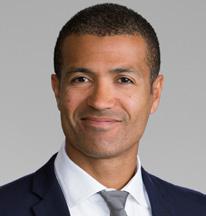
Credentials: LL.B, Cardiff Law School (Hons)

Philosophy: Belong as you are.
Latham & Watkins’ goal is to cultivate an environment in which all colleagues belong as they are. In 2022, the firm held a diversity speaker series with thought leaders and experts in DEI coupled with an allies initiative which helps equip all colleagues with concrete tools to serve as more effective allies for each other.
Recruitment, retention and promotion of top diverse talent has been crucial. Last year, the company had its most diverse summer associate classes — 56 percent female, 49 percent racial/ethnic minority, 12 percent LGBTQ+ and 41 percent first-generation professional. It also wants to build partnerships with high schools including internships and scholarships to help diversify and expand the talent pipeline.
In 2023, the company wants to keep building a culture of inclusion and belonging to make sure diversity is embedded from new hires to the most senior leadership. It also wants to better support various underrepresented lawyers and address unique DEI challenges in regions that are less progressive on DEI, including Continental Europe, Asia and the Middle East.
The greatest challenge is continuing to increase and sustain broad engagement among all of our colleagues around the world. In order to make true progress, we need all of our colleagues to keep inclusion top of mind every day and every time they are interacting with each other. While advancing DEI is absolutely a critical part of our culture and we are fortunate that our colleagues are very committed to this mission, the reality is that it can sometimes be challenging to always keep inclusion top of mind in the midst of busy work schedules. Our task therefore is to stay focused on concrete ways to show nearly 7,000 colleagues in 30 offices how they can incorporate inclusion into their daily habits.
28 2023 First Quarter www.diversityjournal.com
“ ”
New American Funding
Headquarters: Tustin, CA
Industry: Mortgage
CEO: Rick Arvielo
Diversity, equity, and inclusion are at the very core of New American Funding. The company was built by people from diverse backgrounds, designed to be inclusive to all, and structured so all are treated equally. The company considers itself to be a community, and viewpoints from employees of all backgrounds are welcomed.
– Rick Arvielo
New American Funding, the largest Latino-owned mortgage company in the nation, values diversity inside the company and out and it has won plenty of awards for it including 2022 Great Places to Work: Best Workplaces for Millennials; 2022 Great Places to Work: Best Workplaces for Women; 2022 Mortgage Bankers Association DEI Leadership Awards: Organizational Diversity, Equity, & Inclusion.

The entire company of 3,500 people is involved and focused on diversity, equity and inclusion and it starts at the top. New American Funding’s 360 initiative embodies the company’s commitment to nurturing trust, respect and dignity for everyone, all year long.
These policies have led to a truly diverse workforce. Approximately 55% of New American Funding’s employees are female and approximately 42% are minorities. Additionally, about 40% of the company’s employees are millennials and 21% are Hispanic. The company celebrates Diversity Month in April; Hispanic Heritage Month in October; Pride Month in June and it commemorates Juneteenth, the day that slavery ended in Texas.
The company’s recruiters work hard to find new employees who possess a sense of integrity and a strong work ethic, allowing New American to maintain its standard of excellence.
 Patty Arvielo, Co-Founder and CEO
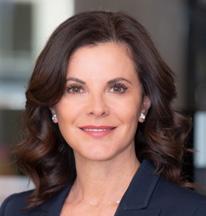
Helping diverse customers is key to New American Funding. It has long out-performed other large lenders when it comes to lending to minorities. This is a result of its Latino Focus program, aimed at new Hispanic homeowners, and the New American Dream initiative, designed for Black homeowners. The company believes in hiring “mirrors,” people who are familiar with cultural differences and equipped to help those in minority communities.
Years ago, the company realized that the Hispanic community faces language barriers and financial literacy challenges when it comes to buying a home. It hired mortgage professionals who are equipped to work with these borrowers and as a result, over a fifth of the company’s workforce is Hispanic.
Core elements of the program also include Spanish educational materials and Spanish language advertising.
And it wants to do far more. The company is committed to increasing homeownership in underserved markets. In 2017, New American Funding pledged to increase Hispanic homeownership with $25 billion committed to new mortgages for Hispanic borrowers by 2024. The company is also committed to lending $20 billion in new mortgages to Black borrowers over seven years.
Of course, the company faces strong economic headwinds in the mortgage industry. That’s on top of the same problem it has been trying to address since its founding 20 years ago: decades of racial and economic inequality that prevented minority communities from thriving. New American Funding has long sought to right these wrongs and has become an industry leader in lending to minorities. The company has no plans of slowing down or resting on its laurels. Instead, the company plans to increase its focus on lending to underserved communities and will continue to do so until all who deserve to buy a home are able to do so.
29 www.womenworthwatching.com 2023 First Quarter
“ ”
New York Life
Headquarters: New York, New York
Industry: Financial Services
President & CEO: Craig DeSanto
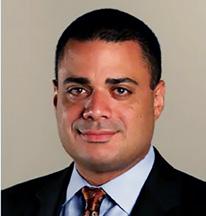
DEI is rooted in our culture, our mission, and our values. Our business is about providing financial security and building multigenerational wealth for individuals and families of all backgrounds. As we move forward, we are committed to driving change and progress with intention so that our DEI efforts continue to evolve and grow, firmly ingrained in how we run our business and serve our clients and communities.
– Craig DeSanto, President & CEO
DEI is so ingrained in this financial services company that it won the Forbes award for best employers for diversity and for best employers for women in 2022 along with a raft of other awards.
New York Life has also won awards in supplier diversity from various advocacy organizations, publications and media outlets for its commitment and efforts. Some of those awards include the WBEC METRO NY Corporate Opportunity Award – 2022 and 2021 (New York Life has won this award seven times in the last eight years) and the National Business Inclusion Consortium Best of the Best Corporations – 2022 and 2021. New York Life has made this list since its inception in 2017.
The company also issues an annual DEI report that provides the general public and employees with information about the impact of its DEI programs and services. It also partners with external DEI organizations and media outlets to expand awareness of New York Life’s work through articles, podcasts, panel discussions, and presentations.
Credentials: M.B.A.,
Philosophy: “Every individual matters. Every individual has a role to play. Every individual makes a difference.” — a quote from primatologist and ethnologist Jane Goodall.
This firm is always looking for opportunities to help diverse organizations. It was the first funding agreement-backed issuer to utilize a racially diverse bank, Loop Capital, as a full book runner, the primary underwriter, on a transaction. This helped broaden our investor base and further the mission and reputation of the bank. We continue to expand our work with diverse firms, including Academy Securities (veteran owned) and Seelaus (women owned).
It also participated in an Urban Development Advance Initiative with the Federal Home Loan Bank, which provides financing for economic development projects in lower-income, urban communities. Our Structured Settlements business joined the Disability Advisory Roundtable of the American Association of People with Disabilities as a co-founding member to further the conversation on disability rights and help influence positive outcomes. These efforts help to increase empathy, foster a team attitude and improve business decision-making and society.
Next year, New York Life wants to continue to support employees, agents, and the community through a comprehensive DEI program.
The program increases the number of offerings and the reach of the DEI Center for Awareness & Advocacy which helps employees thrive in their career, supports managers in developing diverse talent and connects employees across the company.
It will expand agents’ cultural competency through programs such as the Cultural Ambassadors, which provide DEI guidance to employees and support New York Life’s huge impact investing initiative. The company has committed $1 billion to support small business, affordable housing, and community development.
The challenges for 2023 include maintaining momentum in DEI while competing against other priorities. Yet the firm is committed to keeping DEI top of mind in all that it does.
30 2023 First Quarter www.diversityjournal.com
David Cruz, Senior Vice President
William Patterson University; B.S., Villanova University
“ ”
Norton Rose Fulbright

Headquarters: Houston; New York; London
Industry: Law Firm
CEO: Jeff Cody, Managing Partner
Norton Rose Fulbright is committed to a diverse and inclusive workplace that is free from discrimination and injustice of any kind. We will continue to develop and execute plans of action to enact meaningful change at the firm and inner communities. It is imperative that we recruit, retain and advance diverse lawyers and business services personnel.
– Jeff Cody, Managing Partner
Norton Rose Fulbright, a global law firm of almost 7,300 employees, integrates DEI in everything that it does through its DEI networks and councils focused on race/ethnicity, gender, sexual orientation and expression and veterans among others.
It was recently named one of the Top Workplaces by the employee engagement firm, Energage. This recognition is based on the responses of more than 1,000 of the firm’s U.S. personnel who participated in a third-party survey last spring.
The company has also been successful in increasing the representation of women on its management committee to 44 percent and 33 percent of the committee is racially and ethnically diverse.
The firm has had formal DEI efforts in place for decades and has continued to expand and refine them over the years. In 2020, the firm created the Racial Equity Council, focusing specifically on Black lawyers and business services personnel. It created a new Minority Equity Council, serving all of its racially and ethnically diverse personnel. In addition, the company has a Women in Norton Rose Fulbright network, the Pride Network for LGBTQ+ personnel and Veterans Affinity Network, in addition to several others.
Katherine Tapley, U.S. Chief of Diversity and Inclusion
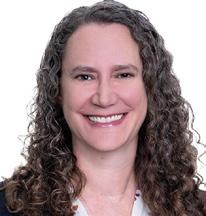
Credentials: J.D., St. Mary’s University School of Law; B.A., B.J., The University of Texas at Austin
Philosophy: While we are proud of the strides we have made toward greater gender and racial equity, we cannot rest idly on that progress. We must fortify the infrastructure we have developed, continuing to cultivate and foster programs that ensure a culture that is not just equal, but aggressively fair.
That progress included launching a pilot sponsorship program in 2021 that pairs each Black non-partner with an established partner along with a partner advocate. Designed to maximize the opportunities for Black non-partner lawyers to succeed, participants almost universally reported an enhanced sense of belonging and engagement. That level of success inspired the launch of two additional programs: the Leadership Development Program (LDP) and the Mid-Level Development Program (MDP).
The LDP, a one-year sponsorship program for minority and female leaders, aims to enhance firm succession planning activities and develop a strong pipeline of minority and female leaders as they look towards partnership. The MDP is a two-year sponsorship program that pairs racially/ethnically diverse associates with partners and advocates who will guide them through the program in preparation for their next career stage.
There is also a Pipeline Program that collaborates with multiple universities by providing resources for diverse students interested in law school, such as help with resume writing, interviewing and networking.
We also participate in a mentorship program that pairs attorneys with diverse students from the University of Texas School of Law throughout an entire school year. The programs include spending part of their summer at the firm. The efforts have been demonstrably successful. Our 2022 Summer Associate class included 46 women and 41 racially/ ethnically diverse students.
31 www.womenworthwatching.com 2023 First Quarter
“ ”
Ulmer & Berne
Headquarters: Cleveland, Ohio
Industry: Law Firm
CEO: Scott P. Kadish, Managing Partner
We believe our commitment to diversity, equity and inclusion enhances our ability to serve our clients and makes our firm a better place to work for our attorneys and staff. Our clients rely on us to find solutions to complex issues. Celebrating our differences and cultivating a diverse workforce leads to a diversity of approaches, ideas, opinions and thoughts.
– Scott P. Kadish, Managing Partner

To Ulmer & Berne, diversity and inclusion is a core value embedded in its culture. It has a plan to promote DEI at every level and it shows by the work it does inside of the firm, with clients and its external partners in the community.
The Plain Dealer gave Ulmer & Berne, a firm of 318 employees, one of its Top Workplaces in Northeast Ohio Award in 2021 and in 2022.
DEI is promoted at every level from employees to management. Four of the members of the management committee also sit on the DEI committee and the committee reports its progress to firm leaders. Employees are kept abreast through special announcements, programming events, its extensive diversity brochure and social media spotlights.
The firm insists on putting diversity into action. It has used a consultant to refine its strategic plan and help bolster the firm’s DEI efforts. It hosted an awardwinning, four-part webinar series called “Stop the Hate,” designed to examine the rise of hate and bigotry in society and find solutions. It’s held a firm-wide training with a diversity leader on unconscious bias and hosted a diversity champions panel discussion on DEI at the Columbus office.
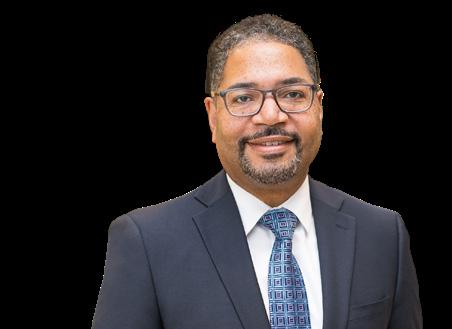
Credentials: J.D., Ohio Northern University Pettit College of Law; A.B., Miami University
Philosophy: We are better equipped to achieve our goals and conquer our challenges in society at large or within organizations when we harness the drive, creativity, and diversity of all who are able and willing to contribute to the common good.
Ulmer & Berne hosted a variety of internal and external educational program and events for clients and friends to promote and celebrate diversity including a webinar on understanding race and racism, a webinar on the state of LGBTQ equality in Ohio and a discussion on Roe v. Wade and on constitutional rights.
In addition, Ulmer & Berne sponsored and participated in a number of important external events including the 27th Annual Human Rights Council Greater Cleveland Dinner, the YWCA Greater Cincinnati Racial Justice Breakfast, and the Cleveland International Film Festival, where it sponsored a screening of “Refuge,” which documents the lives of a white supremacist and a Kurdish doctor as they intersect.
In honor of Veterans Day the firm prepared care packages and notes of encouragement for the 37th Infantry Brigade Combat Team, an Ohio-based Army unit that deployed to Iraq in November. It also added a number of diverse attorneys to Ulmer’s team and officially began the process to achieve the Mansfield Certification by the end of 2023.
In an effort to better capture our internal metrics, the firm updated HR forms to ask employees about their gender identities (including pronoun preferences), disabilities, veteran status, and other categories considered historically underrepresented populations. It is also dedicated to measuring DEI efforts, improving partner participation in DEI events and creating relationships with schools and recruiters to bolster diverse hiring.
32 2023 First Quarter www.diversityjournal.com
Alvin E. Mathews, Jr., Chief Diversity Officer
“ ”
WilmerHale
Headquarters: Washington, D.C. And Boston, MA
Industry: Law Firm
CEO: Robert Novick and Susan Murley, Co-Managing Partners
Diversity, equity and inclusion are guiding principles of WilmerHale and key drivers of the value the firm provides to our clients. The range of perspectives, backgrounds and talents of our lawyers helps us develop creative and effective solutions for our clients’ most complex and challenging legal issues.
 – Robert Novick and Susan Murley, Co-Managing Partners
That focus on diversity has put this law firm of nearly 2,000 attorneys and staff in the highest ranks of companies dedicated to DEI efforts.
Financial Times put WilmerHale on its 2022 “Innovations in Equity and Racial Justice” shortlist for the firm’s work in furthering racial equality.
Diversity & Flexibility Alliance has recognized WilmerHale as “Tipping the Scales” for having 50% or more women in its 2022 US-based new partner class and the company achieved Mansfield Certification Plus status in 2022, for the fifth consecutive year.
The Mansfield Certification seeks to ensure that 30 percent of candidates are women or attorneys of color for lateral hiring, promotions to equity partner, and firm leadership.
The company first received the designation in 2018 after successfully completing a one-year pilot program in which participating firms agreed to have their diversity efforts measured against ambitious goals for the percentages of women and attorneys of color in leadership and other important roles. Underscoring WilmerHale’s continued commitment to diversity and inclusion, the firm has achieved Mansfield Certification Plus status since its inception. Its participation in Mansfield 6.0 is currently underway.
Racial justice is also a part of this firm’s mission. The WilmerHale Racial Justice Reform Initiative (RJRI) was designed to ensure that the firm’s efforts and resources are deployed to have the most impact on racial justice reform throughout the country. Since its inception, WilmerHale’s lawyers have devoted more than 55,000 work hours to the initiative.
Monya M. Bunch, ESQ., Director of Diversity, Equity and Inclusion
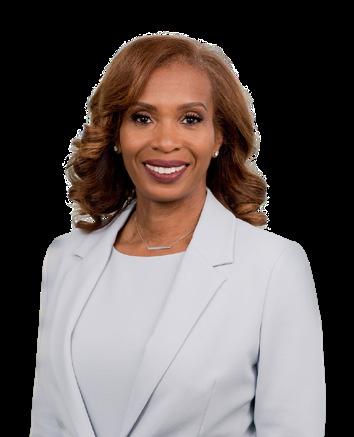
Credentials: J.D., Howard University School of Law; M.P.A., University of Hartford; B.S., Hampton University; Georgetown University, Executive Certificate (Strategic Diversity & Inclusion Management)
Philosophy: DEI are guiding principles of WilmerHale and key drivers of the value the firm provides to our clients. The range of perspectives, backgrounds, and talents of our lawyers helps us develop creative and effective solutions for our clients’ most complex and challenging legal issues.
WilmerHale is constantly trying to up its diversity game. In November, over 260 diverse lawyers gathered in Washington, DC to take part in WilmerHale’s second bi-annual Diversity Summit. The two-day event was an important opportunity for firm leaders and diverse attorneys to reflect and reunite around the ongoing mission to make diversity, equity and inclusion part of the essential fabric of the firm and participate in professional development programs.
And it is reconsidering how it should recruit new lawyers in 2023 and beyond. It wants to make sure that diversity isn’t an issue affecting some people, resulting in diverse attorneys taking on additional work and responsibilities. Instead, it wants to encourage allyship through trainings and programs. WilmerHale amended its Bonus Eligible Time policy to include up to 50 hours of firm time spent on activities related to DEI programming in recognition of the commitment from the attorneys, especially diverse attorneys, to spend time on recruiting/pipeline initiatives and on building a culture of inclusion within the firm.
33 www.womenworthwatching.com 2023 First Quarter
“ ”
ALLY ADVOCACY CIRCLES foster equity and inclusion
By Drew Horansky
Like many people during COVID, Chris Mancuso spent a lot of time on Teams—and there is one call he will never forget. It was 2020 when his daughter Kylie, 8, had wandered into their home office only to note the faces on the computer screen.
“You work with a bunch of guys!” she said, before asking, “Do you think Eaton would ever let me work there?”
Eaton, a global intelligent power management company of more than 90,000 employees, has been well-recognized for its commitment to inclusion and diversity. More than two-thirds of the company’s


directors are women and U.S. minorities, while U.S. minorities comprise 54% of the global leadership team. For the past seven years, Eaton has achieved a 100% on the Human Rights Campaign’s Corporate Equality Index (CEI) and was recognized as a Best Place to Work for Disability Inclusion. It was named a Mansfield Rule 2.0 Certified Legal Department (MRLD) and achieved MRLD Certification Plus designation, which means Eaton considers at least 50% underrepresented lawyers for leadership roles during interviews and underrepresented lawyers comprise at least 50% of the legal leadership team.
Newsweek recently named it one of America’s Greatest Workplaces for Diversity.
Still, Kylie’s observation was an indication there was more work to do, and Mancuso wanted to get involved. He had heard about ally advocacy circles, which were launched by one of Eaton’s inclusion resource groups, WAVE, which stands for “Women Adding Value at Eaton.” The small, gender-balanced conversations are a way to build company-wide foundational knowledge on the most common types of bias against women and are held in all parts of the world where Eaton operates. Moderated by a
34 2023 First Quarter www.diversityjournal.com
woman and a man, participants watch a short video defining the bias and are then asked, “What would you do if you observed this scenario?”
Mancuso, a vice president and general manager, jumped at the opportunity to co-lead one. “I wanted better for my daughter so that she didn’t have to ask those kinds of questions,” he said. “To hear the role that I can play as a leader…we discuss the challenges and biases that people have to fight through every day.”
As a woman, Christina Bosserd, Eaton’s senior vice president of Internal Audit, can relate. Bosserd holds one of the highest positions in the company and will tell you that allyship was instrumental in her journey. “I have had allies and advocates for me—and they have been men,” she said. “Many have been an ally for me even when I’m not in the room, amplifying my voice.”
At the end of the circles, which last only an hour, a moderator will ask, “What commitment will you make to mitigate bias?”
“One group I was on, everyone on the call committed to mentoring someone who was not like them,” said Bosserd. Those conversations also inspired her to go a step further—committing to ensuring that candidates from underrepresented groups are interviewed for open positions on her team.
“To become an inclusive organization, I believe that

programs are valuable, but changing hearts and minds is critical,” Bosserd said. “We must have these conversations to truly make a difference.”
Mancuso and Bosserd have seen progress in other ways too. Last year, WAVE set a 2022 goal to have 2,022 people sign up for an ally advocacy circle. By the end of February, there were more than 300 circles surrounding International Women’s Day and the goal had already been met.
Ernest Marshall, Eaton’s executive vice president and chief human resources officer wrote, “I was raised by a strong and faithful mother who instilled in me the importance of being fair, and I want that for my daughters,” after participating in a circle. “I’m committed to this and hope you are as well because together, we can be the difference!”
Between them, Mancuso and Bosserd have now led more than a dozen circles, and after each one, they still like to post pictures on LinkedIn to reflect on and to share with their networks.
“We know diverse teams win,” Mancuso said. “Developing our diverse leaders and talent is critical…if we don’t talk about it, it’s just a PowerPoint slide.”
“Ally advocacy circles show that inclusion and diversity is a pillar of our core values,” Bosserd said. “And people at Eaton are living them.”
*Salaried defined as Eaton salary band 6 and higher. PDJ
There was also a pattern that emerged on social media. During the circles, and with permission from the group, participants would take pictures of their computer screens— which looked a lot different than what Kylie saw on her dad’s screen three years ago. Sharing their images on LinkedIn, Eaton employees made personal observations about the experience and what they learned.
Drew Horansky is a key business partner to Eaton’s global Human Resources, Ethics, and Inclusion and Diversity functions.
Prior to this role he spent 22 years as a journalist reporting locally and internationally. Drew is a graduate of Georgetown University and lives outside Cleveland with his wife and two children.

35 www.womenworthwatching.com 2023 First Quarter
“To become an inclusive organization, I believe that programs are valuable, but changing hearts and minds is critical.”
–Christina Bosserd
Why ‘Diversity of Opinion’ is a threat to Diversity, Equity and Inclusion – and what should be done about it
By Michael Stuber
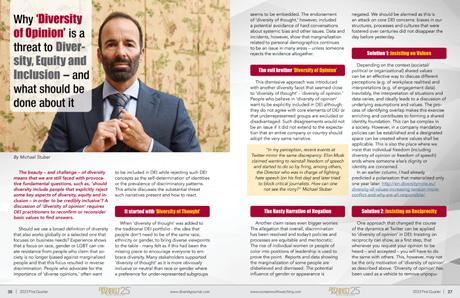
The beauty – and challenge – of diversity means that we are still faced with provocative fundamental questions, such as, ‘should diversity include people that explicitly reject some key aspects of diversity, equity and inclusion – in order to be credibly inclusive’? A discussion of ‘diversity of opinion’ requires DEI practitioners to reconfirm or reconsider basic values to find answers.
Should we use a broad definition of diversity that also works globally or a selected one that focuses on business needs? Experience shows that a focus on race, gender or LGBT can create resistance from people who claim that society is no longer biased against marginalized people and that this focus resulted in reverse discrimination. People who advocate for the importance of ‘diverse opinions,’ often want
to be included in DEI while rejecting such DEI concepts as the self-determination of identities or the prevalence of discriminatory patterns. This article discusses the substantial threat such narratives present and how to react.
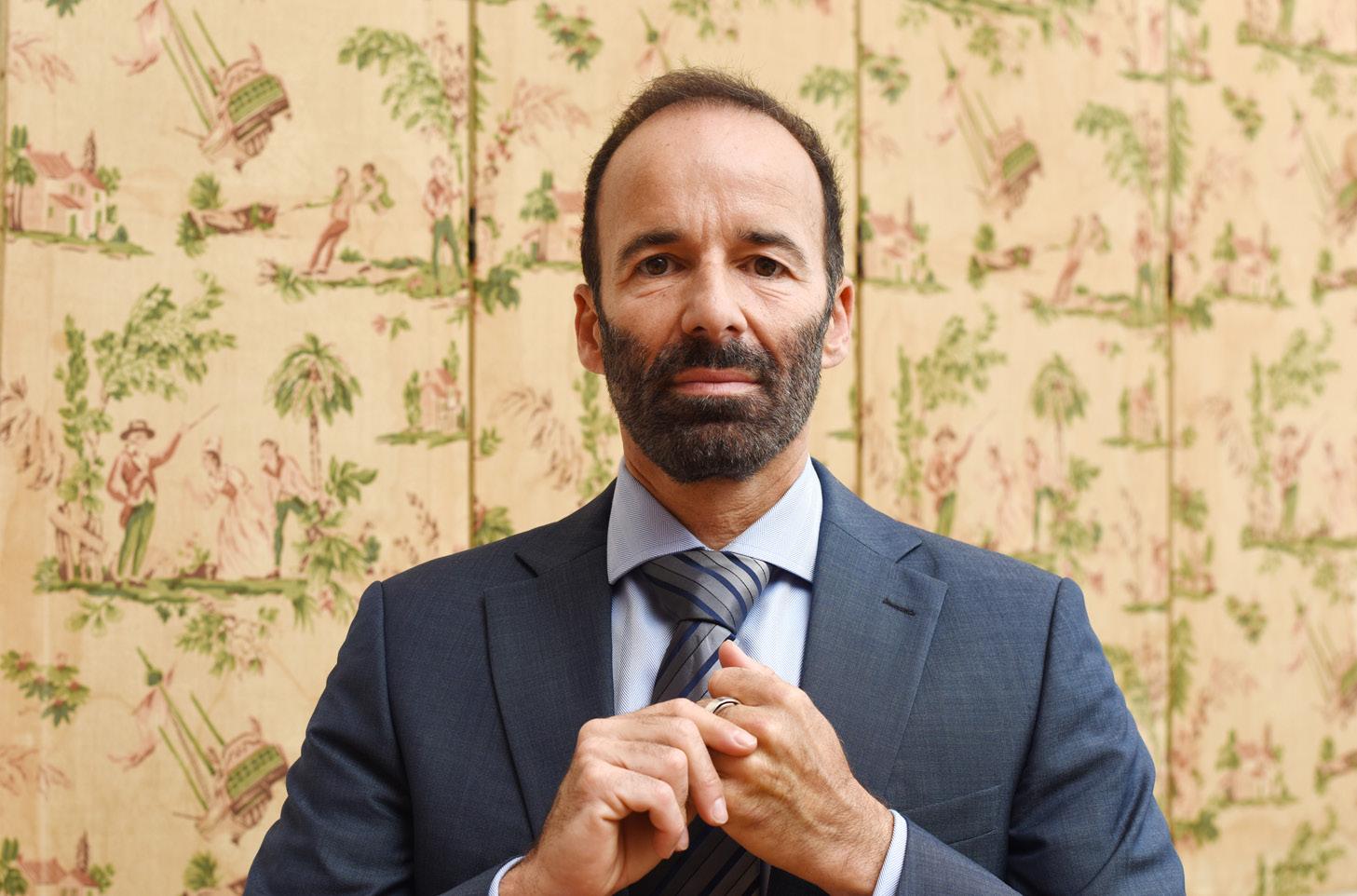

It started with ‘Diversity of Thought’
When ‘diversity of thought’ was added to the traditional DEI portfolio - the idea that people don’t need to be of the same race, ethnicity or gender, to bring diverse viewpoints to the table - many felt as if this had been the missing piece to encourage everyone to embrace diversity. Many stakeholders supported ‘diversity of thought’ as it is more obviously inclusive or neutral than race or gender where a preference for under-represented subgroups
36 2023 First Quarter www.diversityjournal.com
seems to be embedded. The endorsement of ‘diversity of thought,’ however, included a potential avoidance of hard conversations about systemic bias and other issues. Data and incidents, however, show that marginalization related to personal demographics continues to be an issue in many areas – unless someone rejects the evidence altogether.
The evil brother ‘Diversity of Opinion’
This dismissive approach was introduced with another diversity facet that seemed close to ‘diversity of thought’ - ‘diversity of opinion.’ People who believe in ‘diversity of opinion’ want to be explicitly included in DEI although they do not agree with core elements of DEI or that underrepresented groups are excluded or disadvantaged. Such disagreements would not be an issue if it did not extend to the expectation that an entire company or country should adopt the very same narrative.
“In my perception, recent events at Twitter mirror the same discrepancy: Elon Musk claimed wanting to reinstall freedom of speech and started to do so by firing, among others, the Director who was in charge of fighting hate speech (on his first day) and later tried to block critical journalists. How can one not see the irony?” Michael
Stuber
negated. We should be alarmed as this is an attack on core DEI concerns: biases in our structures, processes and cultures that were fostered over centuries did not disappear the day before yesterday.
Solution 1: Insisting on Values

Depending on the context (societal/ political or organizational) shared values can be an effective way to discuss different perceptions (e.g. of workplace realities) and interpretations (e.g. of engagement data). Inevitably, the interpretation of situations and data varies, and ideally leads to a discussion of underlying assumptions and values. The process of identifying overlap makes this exercise enriching and contributes to forming a shared identity foundation. This can be complex in a society. However, in a company mandatory policies can be established and a designated space can be created where values shall be applicable. This is also the place where we insist that individual freedom (including diversity of opinion or freedom of speech) ends where someone else’s dignity or identity are concerned.
In an earlier column, I had already predicted a polarization that materialized only one year later: http://en.diversitymine.eu/ diversity-of-values-increasing-tension-moreconflict-and-why-are-all-responsible/
The Nasty Narrative of Negation
Another claim raises even bigger worries: The allegation that overall, discrimination has been resolved and today’s policies and processes are equitable and meritocratic. The rise of individual women or people of color into positions of leadership is used to prove the point. Reports and data showing the marginalization of some people are disbelieved and dismissed. The potential influence of gender or appearance is
Solution 2: Insisting on Reciprocity
One approach that changed the course of the dynamics at Twitter can be applied to ‘diversity of opinion’ in DEI: Insisting on reciprocity can show, as a first step, that whenever you request your opinion to be heard – and accepted – you will have to do the same with others. This, however, may not be the only motivation of ‘diversity of opinion’ as described above. ‘Diversity of opinion’ has been used as a vehicle to remove unpopu-
37 www.womenworthwatching.com 2023 First Quarter
lar (or hated?) aspects from the DEI context, especially for people who do not want to be confronted with notions of colorism, sexism, ableism or same-sex attraction. Advocating against these topics are also at the core of most Nationalist movements.
The following statement made at the Cologne Pride Gala 2022 for me is to the point:
“None of us is entitled to a repressive ‘opinion’ over the self-determination of others. It is not for any of us to (…) decide for (others) how they should live. That is not freedom, that is hate. And hate is not an opinion!” Birgit Bungarten
She not only illustrates the red line of invading someone else’s space, she also refers to the value side of the issue mentioned before.
Why do we have a ‘diversity of opinion’ issue?
Solutions that involve everyone and aim at defining common ground should be supported as win-win – so, why do we still experience the destructive dynamics of ‘diversity of opinion’? In previous analyses, I showed that, over many years, DEI was implemented in a way that felt normative (‘language policing’) and prescriptive (dos and don’ts) to many people. Dominant/privileged groups did not feel included in the concept, the storyline or the initiatives. ‘Getting men on board with gender diversity’ or ‘letting white people be actively involved in racial equity’ was much proclaimed but didn’t always materialize.
Respective privileged groups have been more actively included as allies in some groups such as the LGBT community. Although these individuals may well have been in favor of DEI prior to the program launch, their engagement, nonetheless, increases credibility and outreach. However, one swallow does not make a summer, as it is said, and we do experience an overall polarizing dynamic in DEI.
This is why one key lesson from the very
difficult and threatening ‘diversity of opinion’ story must be that DEI should be more self-critical when it comes to proclaimed goals and make sure that they are effectively pursued with existing activities. We should use more analytical evidence to evaluate our messages and the impact of our activities.
For example, you can use my non-empirical yet valuable checklist on my DEI KnowledgeBlog http://en.diversitymine.eu to kick-start an assessment. There are also further readings on the topics raised in this paragraph.
Conclusion
‘Diversity of opinion’ is not an innocent addition to broaden the spectrum of DEI, just as ‘diversity of thought’ has never been the silver bullet to integrate personal demographics and business needs. In a complex and at the same time polarized world, DEI can only be successful if it is perceived and experienced to be both:

• inclusive of subordinate AND dominant groups and
• flagging and addressing personal and systemic biases, regardless of their root causes.
A strong foundation of shared values serves as the most robust base for a truly inclusive and equitable approach to DEI. These values must be vividly discussed by all and brought to life in a way that everyone experiences them positively, every day. PDJ
Michael Stuber is The Global DEI Engineer, an EMEA level pioneer of 25 years and a frequent contributor to PDJ. His work combines rigorous research and diagnostics, innovative activist-style thinking and contextualized change strategy design to create progress supported by all.
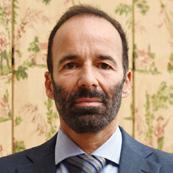
38 2023 First Quarter www.diversityjournal.com
39 www.womenworthwatching.com 2023 First Quarter Be
part of our upcoming Q2 issue! Our upcoming Q2 issue will be featuring our 5th annual Women Worth Watching in STEM award winners. We will also feature the 2023 Asian Leadership award winners. The issue will have articles written by executives from top corporations as well as articles from top influencers in the DEI field. You can participate in the upcoming issue by promoting your company or organization by writing an article or reserving advertising space. Please contact Jim Rector for details at profiles@diversityjournal.com or call 440-892-0444.
a
“Such exciting news!! I am honored and thankful!” – Michele Rudolph
“We are thrilled that Luis has been selected” – Sarah Adams
“I’m honored and humbled on having been selected to receive this award.”
– Cecile Gonzalez-Cerimele
“That’s wonderful news.” – Kerin Handal
2 023 AWARD INTERNATIONAL
“Amazing, so thrilled!” – Ana Capellan
“Thank you and Diversity Journal very much for the recognition. It truly is an honor to represent my community and to be recognized for my work and passion in housing.” – Nora Guerra
“Thank you so much – What an honor!” – Ana del Cerro-Fals
“We are delighted to hear Maria has been selected as a winner!” – Erica Loera
40 2023 First Quarter www.diversityjournal.com 2
023
“Thank you for reaching out and sharing the great news!” – Amy Flint
“I'm humbled by the honor and plan to continue to invest in those who follow me.” – Marta Newhart
“Really appreciate the recognition.” – Jose Barros
“It is a great honor for me to receive this award!” – Daniela Zarza
2 023 AWARD
“I am honored.” – Daniel Prati
“We’re honored to hear that Patty has been selected as a Latino Leadership Award Winner!” – Lauren Barnes
“Thank you again for this amazing recognition and award!” – Wes Lujan
“Thank you for the selection!” – Carl Garrison
41 www.womenworthwatching.com 2023 First Quarter 023
INTERNATIONAL
Third Annual
The 3rd Annual Latino Leadership Awards

PDJ Salutes our Third Class of Latino Leadership Award Winners

For 25 years Profiles in Diversity Journal has honored outstanding individuals who have blazed new trails, welcomed challenges, mentored others, advanced diversity and inclusion in the workplace and the community, and excelled in their chosen fields. Now, PDJ is honoring Latino Leaders with our third Latino Leadership Awards.
The 40 profiles that appear in this issue recognize and celebrate the hard work and impressive achievements of these Latino Leaders. Each award recipient has also provided us with the answers to some interesting questions and an essay that will give you, our readers, a chance to get to know these multitalented, multilingual, and trailblazing individuals a little better.
Welcome to PDJ’s third annual Latino Leadership Awards.
42 2023 First Quarter www.diversityjournal.com
INTERNATIONAL
2 023 A W ARD






















43 www.womenworthwatching.com 2023 First Quarter
Education (degrees & institutions):
J.D., Georgetown University; B.A. Georgetown University
Company Name:

Akin Gump Strauss Hauer & Feld
Industry: Law

Company CEO: Kim Koopersmith
Number of Employees: 1,800+
Your Location (if different from above): Geneva, Switzerland
Words you live by:
If you want to lift up yourself, lift up someone else – Booker T. Washington
Who is your personal hero?
The people of Ukraine
What book(s) are you reading?
Victory City by Salman Rushdie
What was your first job?
Intern at Colombia’s Trade Office in Washington, DC

Favorite charity: Swiss Solidarity
Interests/Hobbies: Motorcycle riding
Family: Gabrielle, my wife of 25 years, Adrian, 17 and Camille, 11
Alan Yanovich Partner, International Trade
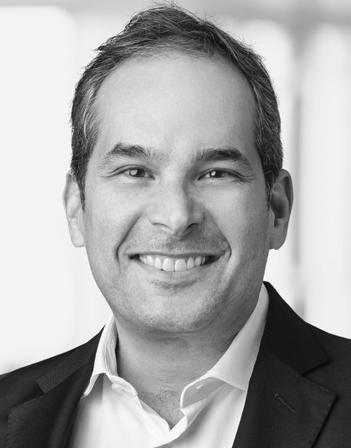
He Supports the Next Generation of Latino Business Leaders – Because They are Worth It
Supporting the next generation of Latino business leaders is not just a personal goal, but a priority—as it should be for all of us. To me, providing that support looks like regularly engaging with Latino students interested in international trade law, providing guidance and advice, and sharing my own struggles and experiences as a lawyer coming from Colombia. It’s vital that we help pave the way for the next generation by being as accessible and available as possible, so that newcomers can benefit from the lessons of those who have come up in this field before them.
But those conversations and interactions are by no means a one-way street—the enthusiasm and passion young people bring to our field is contagious, and there’s nothing more fulfilling than getting to watch as their careers take off. I remember fondly meeting a group of Colombian moot court participants who simply astonished the Geneva trade community during their competition.
Today, three work at the World Trade Organization (WTO) and one was Colombia’s Ambassador to the WTO. Watching those students blow us all away then, and seeing the successful attorneys they have become today, has been a wonderful and gratifying experience. I feel the same way when I see new Latino students join our firm’s summer program and come back as associates, and when I get to see them thrive as attorneys and active firm citizens. I am thankful that our firm has such a strong commitment to diversity. We continue to expand our efforts to provide diverse perspectives for our clients and vibrant career opportunities for our lawyers and professionals through various programs inside and outside the firm.
44 2023 First Quarter www.diversityjournal.com
2 023 A W ARD INTERNATIONAL
“
It’s vital that we help pave the way for the next generation by being as accessible and available as possible, so that newcomers can benefit from the lessons of those who have come up in this field before them. ”
Tony Fernandez-Stoll Sr. Director, AMD Latin America
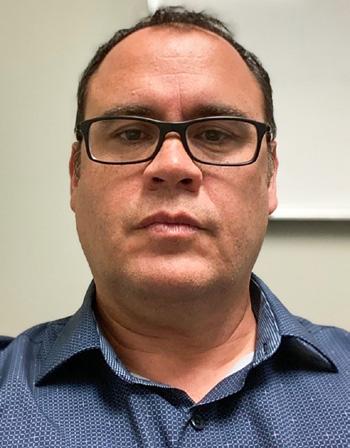
Traveling Taught Him to Reconnect, Reset and Reenergize
I think people would be very surprised that I have lived and traveled around the globe. On a business front, I have been fortunate to have had two expatriate assignments. I lived In Australia for two and a half years and I lived in Mexico for two years. I found both experiences very enriching. I was able to integrate into different cultures and experience a different way of life. I believe both experiences helped me grow as a person and made me more valuable to the company when I returned.
Education (degrees & institutions): M.B.A.,University of Toronto; B.A., Economics, University of Western Ontario
Company Name:
Advanced Micro Devices


Industry: Semiconductors
Company CEO: Lisa Su
Company Headquarters Location: Santa Clara, CA
Your Location (if different from above): Austin, TX
On a personal front, I have been fortunate to have visited many countries around the world and every continent. I am a big fan of learning about people through travel and having in the moment experiences. One of the most incredible experiences of my life was when I did a six week backpacking safari through the southern part of Africa. It was an amazing adventure to visit different countries and the incredible sights. There is something surreal and you are one with nature. I felt completely connected with nature and it was a life altering time. I went through a soul-searching few weeks and I came back completely refreshed and reenergized. It helped me reset and reenergized my career.
Words you live by:
“Do not go where the path may lead, go instead where there is no path and leave a trail.” – Emerson
Who is your personal hero? My father
What book(s) are you reading?
Open by Andre Agassi
What was your first job?
Baker’s apprentice
Favorite charity: Habitat for Humanity
Interests/Hobbies: Soccer and tennis
Family: Spouse, Heather, children: Ben, 18, Ava, 16 and Gus, 10
45 www.womenworthwatching.com 2023 First Quarter
2 023 A W ARD INTERNATIONAL
“
On a business front, I have been fortunate to have had two expatriate assignments. I lived In Australia for two and a half years and I lived in Mexico for two years. I found both experiences very enriching. ”
Education (degrees & institutions):
M.B.A, Texas A&M International University; B.A., Universidad Autonoma de Tamaulipas, Mexico
Company Name: America Baez

Industry: Talent Acquisition and DEI

Company CEO: America Baez
Company Headquarters Location: Chicago, Illinois
Number of Employees: N/A
Words you live by: If there is a will, there is a way.
Who is your personal hero? My parents
What book(s) are you reading?
Influence by Robert B. Cialdini and Nothing in the Way by Kidest Om
What was your first job?
Administrator at a construction company
Favorite charity: Red Cross
Interests/Hobbies: Reading, traveling, arts, spending time with friends, my Dad and my beloved nieces and nephews
America Baez
Talent Acquisition and DEI Leader
A Professional Organization Helps Fuel an Interest in Human Resources and DEI
After graduating with my M.B.A in Texas, I joined the Prospanica Chicago Chapter (formerly known as National Society of Hispanic M.B.A.s (NSHMBA) and I started attending their programs and events. This allowed me to meet other people within the Hispanic and Latino community with similar interests in business. Eventually, I was invited to join a Prospanica Chicago Chapter committee and I decided to accept since I strongly believed in the organization’s mission to foster graduate education and professional advancement for Hispanics and Latinos.
In this role, I organized many events including networking meetings and socials as well as professional development seminars for our members. Always thinking about community outreach, we partnered up with organizations such as the Association of Latino Professionals for America, the Hispanic Alliance for Career Enhancement among others to put together the events and amplify the impact. Eventually, I became the president of the Prospanica Chicago chapter and the board and I raised Prospanica’s profile nationwide.
It was through this work that someone suggested that I should go into the Human Resources (HR) field although project management was my field at the time. This was a defining moment because I realized that human resources and recruiting was my calling and it seamlessly encompassed what I was doing as an organization leader to the benefit of my community.
It has been a long journey from when I first started working in HR and Recruiting to now leading Talent Acquisition and Diversity, Equity & Inclusion programs for Fortune 100 companies. I had to learn to navigate corporate America and to deal with my own limiting beliefs to overcome challenging situations. I also had to be assertive and proactive in identifying what I needed to do to advance my career. This meant connecting with other folks in my field, seeking out mentors and coaches and pursuing professional and leadership opportunities inside and outside my workplace. This allowed me to develop skills and position myself for career advancement opportunities.
I continue to be as committed as ever to providing access and opportunities to underrepresented communities, especially the Hispanic and Latino community. Adelante!
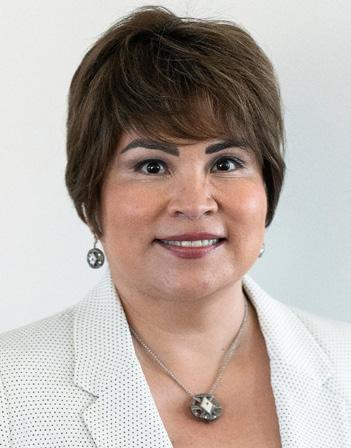
46 2023 First Quarter www.diversityjournal.com
2 023 A W ARD INTERNATIONAL
Michele Lee Rudolph Director of Solutions Architecture
Remember, Good Leaders are the key to Successful Teamwork
In recent years, leaders and experts across the globe have emphasized the power of diversity in the workforce. This includes traditional interpretations, but also the concept of diversity of experience and thought. There are numerous studies showcasing the success organizations have when a focus is developed around diversity – the numbers don’t lie! However, there is one element that is rarely talked about and critical for success… leadership.
I recently lost a significant portion of my team due to retirements and natural attrition. This team was steeped in institutional knowledge and unique skills acquired throughout their careers. We knew most new hires would not have all the skills needed for the job. However, we focused on finding a diverse group of individuals with varying levels of experience in specific areas. Additionally, we brought in employees varying in age, ethnicity, and geographic location.
Initially, this change re-energized the team. They brainstormed new projects and collaborated to elevate the customer experience. After a couple months, project progression was stalled because the team could not advance past ideation and reach consensus. This is where healthy conflict can be detrimental to a business if organizations do not have leaders who can navigate the team.
It takes a great investment from leaders to be actively involved in discussions and help facilitate the conversation. In an age where there is never enough time and we are all doing more with less, this can often be deprioritized and put on a backburner.
We spent a couple of hours setting a foundation for future collaboration. This was done by helping each person on the team understand the other person’s point of view. It was less about agreeing with them and more about respecting their diverse perspective. Throughout the conversation, we had each person emphasize their motivation or end goal with the project. This reminded the team that, though we have different points of view, we are all on the same team, want the same outcome, and have a common vision.
A year later, we saw innovation like never before. We were working more efficiently, and the team was more empowered than ever. They were able to consistently collaborate, pull the best ideas from each person, and execute without any leadership intervention. For those leaning into diversification, I ask do you have the right leaders in place to foster an environment for healthy conflict and set the foundation for forward progression?
Education (degrees & institutions): M.B.A., University of Florida, B.A., University of Georgia
Company Name: AT&T
Industry: Telecommunications

Company CEO: John Stankey
Company Headquarters Location: Dallas, TX
Number of Employees: 190,000+
Words you live by: “Success occurs when opportunity meets preparation” – Zig Ziglar
What book(s) are you reading?
Atomic Habits by James Clear and The Last Party by Clare Mackintosh
What was your first job?
Hostess at a local Italian Restaurant
Favorite charity: Carry the Load
Interests/Hobbies: Experiencing new cultures, completing my bucket list, bookstores, and University of Georgia
47 www.womenworthwatching.com 2023 First Quarter
2 023 A W ARD INTERNATIONAL
Education (degrees & institutions):
M.S., Taxation, University of Miami;
B.B.A., Accounting, University of Miami
Company Name: BDO USA,LLP

Industry: Accounting
Company CEO: Wayne Berson
Company Headquarters Location: Chicago, IL
Number of Employees: 11,000+
Your Location (if different from above): Miami, FL
Words you live by: “When we least expect it, life sets us a challenge to test our courage and willingness to change; at such a moment, there is no point in pretending that nothing has happened or in saying that we are not ready. The challenge will not wait. Life does not look back.”
 – Paulo Coelho
Who is your personal hero? My mom. She has been the best mom imaginable – always encouraging me to stay true to myself in every aspect of life, independent of social norms or expectations.
What book(s) are you reading?
The Universe Has Your Back: Transform Fear to Faith by Gabrielle Bernstein
What was your first job? I worked as a summer camp counselor at Belen Jesuit Preparatory School in Miami.
Favorite charity: St. Jude Children’s Hospital
Interests/Hobbies: I recently started private yoga classes twice a week. Yoga has taught me how to recenter, focus, gain clarity and live in the moment.
Family: I live alongside my two sons, Christopher (14) and Patrick (11), and three dogs: Luna, Harley and Bailey.
Ana del Cerro-Fals
Tax Office Co-Managing Partner
Using Empathy, Mentoring and Safe Spaces to Reach out to Employees
My upbringing as a first-generation American, whose parents emigrated from Cuba during the exile movement, created a strong foundation for the businesswoman I am today. I am grateful to come from a family that prioritized my education and instilled in me a strong work ethic at a young age.
My mother always wanted to be an accountant, but circumstances required her to choose motherhood over a career. This pushed me to become an accountant and fulfill her dream. Because of my mother’s experience, I recognize how fortunate I am to have a successful career and be able to care for my family.
I regularly mentor other professionals to help them find the same work-life fit I have achieved and demonstrate how to practice empathy to lift others up and support workplace inclusion. I use my challenges as motivators, and I strive every day to ensure those around me feel heard, included and understood. You never know what others are going through, but by embracing inclusion and acceptance, you can create a safe space for colleagues to be authentic, collaborative and expressive with their thoughts.
It is my firm belief that companies should be doing everything in their power to help employees feel valued for their background and experiences. To foster the next generation of Latino leaders, a business must be committed to hiring a diverse range of candidates and providing the appropriate resources to support their workforce. Leadership means bringing out the best in others – from technical acumen to previously unheard perspectives – to better serve teams, clients and projects.
In my role with BDO, I am proud to have the opportunity to help maintain a diverse and accepting workplace while providing skilled support for the firm’s national DEI initiatives. As an organization, BDO believes in cultivating an inclusive culture that encourages diverse voices and empowers all people. We recognize that each member of our team brings a distinctive skillset, perspective and strength to the table, and when they do, the entire firm benefits. BDO is continuously seeking feedback to enhance its workplace flexibility strategy while also evaluating the types of resources available to best support our people. Those resources include an employee assistance program, access to emotional support, mental fitness training, annual unconscious bias training, mentorship tools and more.
48 2023 First Quarter www.diversityjournal.com
2 023 A W ARD INTERNATIONAL
Betty Rodriguez Senior People Business Partner
My Goal: Design a Company Culture
As a first-generation Dominican American from Boston, MA, I watched my parents navigate a new country and its rules each time they started a job, moved to a different neighborhood, or guided my sisters and me through the public school system. My parents were fortunate to have a large extended network of family and friends that helped them learn the American structure, but there were times that they could not relate to me and my sisters’ experiences growing up in the United States. I saw how critical their village was and knew at a young age that, no matter what, I wanted to help people.
My vision for helping others became clearer as an undergraduate student. I enjoyed my coursework and practicum experience which was focused on organizational behavior and led to my first job in Human Resources (HR). During this period of exploration, my sister was beginning her career within a law firm while also starting her own family. She planned for a career in public office, but was quickly forced to adjust her goals due to an inflexible environment that would not support an adjusted schedule. I remember questioning why she could not be a parent and also have her dream career. Meanwhile, as I progressed through my senior year, I was learning the value that HR departments add to a company. I realized then that I could help organizations design a people strategy that prioritizes hiring diverse teams and establish a company culture that understands what individuals need to be successful both in and out of work, such as flexible schedules and generous parental leave.
As a People Leader, I am endlessly curious about the human experience within the workplace. I thrive in fast growth, tech-driven environments where the People function is evolving and maturing with the organization. My goal is for each employee to be their authentic self. To achieve this, we must create inclusive environments where people feel represented at various levels of the organization and are provided personal and professional development through resource groups. We need to design employee programs that are supportive of parents and caregivers. People teams across industries can drive the creation of a culture that raises awareness and uncovers implicit bias while appreciating differences. Whether I am coaching leaders, mentoring junior team members, or helping an employee navigate a complex life event, I am blessed to follow my dream of helping people, getting a chance to advocate for underrepresented communities, and creating space for young Latin American women, who see a little bit of themselves through my journey.
Education (degrees & institutions): M.B.A., Northeastern University; B.A., Human Development; Boston College
Company Name: Clarify Health Solutions

Industry: Software Development

Company CEO: Jean Drouin
Company Headquarters Location: San Francisco, CA
Number of Employees: 230
Your Location (if different from above): New York, NY
Words you live by: “People will forget what you said; people will forget what you did, but people will never forget how you made them feel.” – Maya Angelou
Who is your personal hero? My parents
What book(s) are you reading?
Caste by Isabel Wilkerson and Latinas
Rising up in HR by Priscilla Guasso
What was your first job? HR Assistant at Northeastern University
Favorite charity: The Talented and Gifted (TAG) Latino Program | Project ALERTA
Interests/Hobbies: Podcasting, reading, mentoring, traveling, and spending time with my family and friends
Family: Parents (Diomedes & Betina), two sisters (Cindy & Jessica), and one nephew (Christian Xander)
49 www.womenworthwatching.com 2023 First Quarter
2 023 A W ARD INTERNATIONAL
that Helps People Live Their Most Authentic Lives
Education: M.S., Operations Management, University of Arkansas,; M.B.A., Management, Holy Family University; B.S., Management Information Systems, La Salle University
Company Name: Comcast Cable

Industry: Telecommunications, Media and Technology

Company CEO: Brian L. Roberts (Chairman and CEO)
Company Headquarters Location: Philadelphia, PA
Number of Employees: 186,000 (December 2022)
Words you live by: “It ain’t about how hard you hit. It’s about how hard you can get hit and keep moving forward.”
– Rocky Balboa
Who is your personal hero(es)?
Parents (Carmen and Carlos)
What book(s) are you reading? My Pet Slime book series with my daughter
What was your first job?
Retail salesperson
Favorite charity: Photography Without Borders based in Philadelphia
Interests/Hobbies: Home improvements projects, binge-watching classic & trending TV/movies
Family: Gaby (wife), Aidan (son), Adriana (daughter)
Kerin Handal
Senior Director, Multicultural Content Partnerships
Pass the Baton
Familia and comunidad deserve credit for allowing me to grow beyond early, real-world challenges and to be in a position where I can now give back to others. I was born in Puerto Rico, and our family settled in a lower middle-class neighborhood in Philadelphia during the mid-1980s. My parents (Carmen and Carlos) were the guides who kept my brother (Javier) and me on the right path. They bestowed their values of courage, integrity, and gratitude on us.
Today, I am blessed to be the first in my family to have earned a college degree (plus two master’s degrees), have a kind and beautiful family of my own, and work for an organization that fosters a culture of inclusion and ensures all employees feel supported, embraced, and heard. Despite not having my parents to lean on for corporate career advice, I have been very fortunate to have had great leaders, mentors, and sponsors, throughout my career, who helped carry the baton for my parents. Without the generosity of these colleagues, the early part of my career would have been much harder to navigate. Now it’s my turn to pay it forward to the following generation of leaders.
There is a strong need for a diverse group of employees and leaders who can help understand and meet the needs of our customers and communities. At Comcast, we know that a diverse, equitable, and inclusive company is a more innovative and successful one. That’s why we embrace diversity of background, perspective, culture, and experience throughout every aspect of our business. We believe in fostering, both internally and externally, a better and more accepting world. This is apparent in the people we hire, the products we create, the stories we tell, and the organizations we support. While I am still learning and growing, I believe I can give back and help the next group of leaders by sharing my story and providing guidance and sponsorship.
While at Comcast, I’m proud to have helped develop leading content experiences for Hispanic and other multicultural audiences across the Xfinity entertainment platforms. This includes helping to grow the quantity and quality of diverse content choices and supporting the launch of and improvements to our award-winning bilingual voice remote. In addition, I have had the pleasure of working on company-sponsored community service projects, leading our Latino Employee Resource Group (ERG), mentoring students through the Big Brothers Big Sisters program, and, most recently, joining the board of Photography Without Borders, a Philadelphia-based nonprofit that empowers young students through photography.
I’m now preparing for when it is my turn to pass the baton to the group of leaders who are running the next leg of the race.
50 2023 First Quarter www.diversityjournal.com
2 023 A W ARD INTERNATIONAL
Thanks to my Familia, Great Leaders and Inspiring Mentors, Some Day I can
Camilo Echavarria Partner-In-Charge, Los Angeles Office
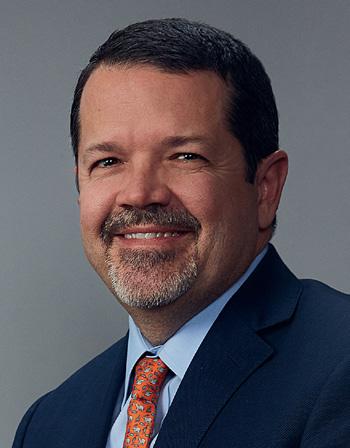
A Legal Career may Have Twists and Turns, but Stay the Course
When I speak with diverse attorneys early in their career about “success” – whatever that term actually means – I recognize that there is often a feeling of angst, worry, and not belonging. I explain how the road to success is not always a straight line and that we all experience many twists and turns along the way. The key is to be present and engaged in what you are doing professionally, and look for those opportunities when they arise. And, yes, sometimes you have to make lemonade out of lemons.

So, I started my career at a large law firm doing civil litigation. After five to six years of learning to be a lawyer (along with long hours), I took an opportunity to work at an entertainment company as litigation counsel. There, I specialized in entertainment and employment litigation – two areas of law that I knew nothing about when I started. Employment was particularly challenging because I found myself in a world of experts –practitioners who know the ins and outs of employment law. Instead of backing down, I leaned in and enjoyed learning these areas. But everything was not easy. Despite clear success in my cases, I found myself the target of implicit and explicit bias. Without others who looked like me to lean on, I made the decision to simply move on. That is when I moved back to a law firm, Davis Wright Tremaine (“DWT”). I started in the Media Group, but quickly moved over to Employment, which is now my specialty. While the outside world only sees me as a successful and leading Employment Lawyer, I make sure to tell associates my story and that the road to “success” was full of twists and turns.
Professional success also means giving back and providing opportunities. In my many leadership roles at DWT, I have been fortunate to be able to influence hiring and promotion. This has led to the Los Angeles office being the most diverse office at DWT, and a steady promotion of diverse attorneys to partnership. Over the last three years,, we have promoted four diverse attorneys in LA to partnership, two of them Latino. As more and more diverse attorneys succeed, I hope they do not feel alone and have people to turn to when things get difficult. I am hopeful that my small contribution eventually allows our diverse attorneys to stand on my shoulders and reach ever higher success.
Education (degrees & institutions): J.D., New York University School of Law; B.A., Government & Economics, Magna Cum Laude, Cornell University
Company Name: Davis Wright Tremaine, LLP
Industry: Legal Services
Company CEO: Scott MacCormack, Managing Partner
Company Headquarters Location: Seattle, WA
Number of Employees: 1,419
Your Location (if different from above): Los Angeles, CA
Words you live by: Work hard and help others along the way.
Who is your personal hero? My mother – she moved to the U.S. with two children after the death of my father.
What book(s) are you reading?
Babel by R. F. Kuang and Patron Saints of Nothing by Randy Ribay
What was your first job? Selling door-todoor newspaper subscriptions at age 10
Favorite charity: Friends of the Children –Los Angeles (known locally as Friends LA)
Interests/Hobbies: Hiking, painting and drawing
Family: Wife (Lori Echavarria) and two children (Silver - senior in high school) and (Sofia - sophomore at Cornell Engineering)
51 www.womenworthwatching.com 2023 First Quarter
2 023 A W ARD INTERNATIONAL
Education: Case Western Reserve University School of Law, J.D.; City College of the City University of New York, B.A., summa cum laude
Company Name: DiCello Levitt

Industry: Law
Company Headquarters Location: Chicago
Number of Employees: 85
Your Location (if different from above): Birmingham, AL
Words you live by: Everybody has a choice to make every day about who they want to be and how they want to be part of creating a better world.
Who is your personal hero? I have many, but Justice Thurgood Marshall is one of my greatest personal heroes. His commitment to justice, creativity in his civil rights cases, and dedication to excellence was and is at the root of so many rights that we take for granted every day.
What was your first job? I was a PSAT Tutor for the Stanley Kaplan program as a teenager.
Favorite charity: I am a former board member of STREAM Innovations—an exceptional non-profit in Birmingham. It is a nonprofit committed to helping Black and Brown, and economically disadvantaged students develop and more fully participate in Science, Technology, Reading, Engineering, Arts, and Mathematics (STREAM) disciplines.
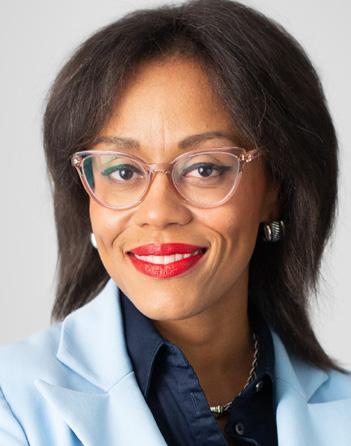
Interests/Hobbies: My favorite activity is spending time with my two daughters. I also practice yoga, run, and hike. I am a voracious reader, traveler, and a “foodie.” I enjoy cooking and entertaining and have fantasies of being a Michelin-starred chef.
Family: I have two daughters,14 and 8.I hail from a large immigrant family in U.S. We live all over the world, including several U.S. cities, Europe, Canada, and the Caribbean.
Diandra “Fu” Debrosse Zimmermann
Managing Partner, Birmingham and Co-Chair, Mass Torts - DiCello Levitt
It’s Amazing what you can Accomplish
The best advice I ever got was from my grandma, when she told me “You’re the answer.” When something went wrong or didn’t work out perhaps as we hoped, she taught us to place our focus inward. What did I control? What role did I play in creating the situation? What could I have done differently? That kind of accountability was so valuable to learn at a young age. It was a central part of our identity and our family dynamic. We took responsibility and we blamed ourselves first. It is amazing what you can accomplish when you take responsibility. Holding yourself to that standard allows you to focus on what you can do better in any situation. It reinforces a key truth – that you have an impact on things; that you should use all of the tools already given to you.
Along the same lines, I teach my kids and the young people and young lawyers who I mentor, the most important trait for success in my view, is, without a doubt, persistence. It was part of what my family taught me and it has been absolutely essential in my career. I looked different than most of my colleagues. I was different. Life is difficult in its own way for everybody. And that takes its toll emotionally. We all have disappointments and failures. And they teach us great lessons if we are willing to look at them and take responsibility for ourselves and change and work on what we can. After disappointing ourselves, or others, we have to pick up and start over. No excuses. No one hands you anything.
I had plenty of my own personal challenges. I didn’t necessarily feel welcome in any legal setting initially. But I really wanted to be a part of important cases and make a difference in the world. I had to persist as a young lawyer. I had to try new strategies and approaches to not just my work, but how I navigated the interpersonal challenges of my career. I kept working internally to develop who I wanted to be as a lawyer and made substantive efforts to find the right place to practice and to fight for people in the specific way I envisioned.
You start something and you finish it. As they say, you have to “leave it all on the field” to overcome both your internal doubts and external battles. I was raised to keep trying to find the answer. When I mentor, I am probably most concerned that the people with whom I am working and teaching understand the process to any pursuit. Sometimes understanding and thinking about the process is more important than developing the winning strategy.
52 2023 First Quarter www.diversityjournal.com
2 023 A W ARD INTERNATIONAL
when you take Responsibility
Noemi Lujan Perez President & CEO
Learning About the U.S. Civil Rights Movement Taught me To Fight for the Underrepresented
My mother was homeless when I was born. She was born into poverty and taken out of school in the second grade to help with farming duties, later immigrating to the U.S. where she served as a live-in maid until my birth in Los Angeles, CA. As a U.S.-born child, I was taught early on that it was my duty to become language proficient and advocate on behalf of my relatives, and the importance of learning how to straddle the intersections of my bi-nationalism, bilingualism, and indigenous and Basque roots.
Growing up in Southern California also taught me to appreciate nature, wildlife, and access to public lands.
As a child attending predominantly African-American schools, I had the privilege of learning in classrooms led by strong Black women teachers that instilled in us the significance of the civil rights movement and my inherited duty to vote and become civically involved. I learned about great civil rights leaders like A. Philip Randolph, Dr. Martin Luther King, Jr. and César E. Chávez in shaping labor and environmental law and policy.
While I was a student at the University of Southern California in 1993, César E. Chávez passed away and it stirred me into action. I joined a small group of Latino students who pushed the University to install a bronze bust of César E. Chávez and a mural to commemorate him, and to establish the school’s “American Studies” program. I was trained by then El Centro Chicano Director Dr. Abel Amaya to use the media as an advocacy tool to influence public opinion and policy makers.
Over the past 27 years, I have leveraged my policy, communications, and legal training to shape PR/marketing and political campaigns, and to shape policy on behalf of underrepresented communities. Most recently, I managed the Latino Heritage Site Fund for the National Park Foundation, and previously worked for the U.S. Fish and Wildlife Service. As CEO of ECODiversity, I use my expertise to raise awareness about DEI discrepancies in our public lands, and to prioritize Latino Heritage Sites through a bipartisan effort with the Congressional Hispanic Caucus and Conference. I also help corporate executives shape sustainability, social responsibility, and diversity initiatives.
As an executive, I’ve learned the importance of empathy, mentorship, and the “reach one, teach one” servant leadership philosophy. This includes helping to develop the next generation of leaders that will champion Latino heritage sites and preserve the stories of Latino leaders and historic accomplishments in the U.S. We must ensure that Latinos are a part of our public lands’ strategic DEI frameworks and in short- and long-term sustainability efforts. I am paying forth the values that were instilled in me as a child.
Education (degrees & institutions): M.L.S., USC Gould Law School; B.A., Political Science, University of Southern California
Company Name:
ECODiversity Strategies
Industry: Consulting, Public Affairs


Company CEO: Noemi Lujan Perez

Company Headquarters Location: Los Angeles, CA
Number of Employees: 3
Words you live by: Walk into that room like the ancestors sent you in there.
Who is your personal hero?
Cesar E. Chavez
What book(s) are you reading?
David and Goliath by Malcolm Gladwell
What was your first job?
Del Taco (as a cashier)
Favorite charity: United Farm Workers, Zeta Phi Beta
Interests/Hobbies:
Music, trail walking, nature photography
Family:
Mother Cristina, Goddaughter Sakae
53 www.womenworthwatching.com 2023 First Quarter
2 023 A W ARD INTERNATIONAL
Education (degrees & institutions):
B.A. Chemistry, Indiana University, Bloomington, Indiana
Company Name: Eli Lilly & Company

Industry: Pharmaceutical
Company CEO: David A. Ricks
Company Headquarters Location: Indianapolis, Indiana
Number of Employees: 35,000
Words you live by: Be strong enough to stand alone. Be yourself enough to stand apart. But be wise enough to stand together when the time comes.
Who is your personal hero? My parents are my personal heroes. They left everything behind in our home country of Puerto Rico to provide their children a brighter future and greater opportunities. They encountered numerous challenges and demonstrated significant courage, grit and resilience. They were committed to their faith, heritage and family and maintained a strong presence within the Indiana Latino community.
What book(s) are you reading? Solito by Javier Zamora and Quiet by Susan Cain
What was your first job? Telemarketing associate for Olan Mills Portrait Studio
Favorite charity: American Cancer Society
Interests/Hobbies:
Hiking, reading, interior design, volunteer work, watching sports
Family: My husband, Tim Cerimele, and my three children, Abigail, Alejandro and Annalise
Cecile González-Cerimele
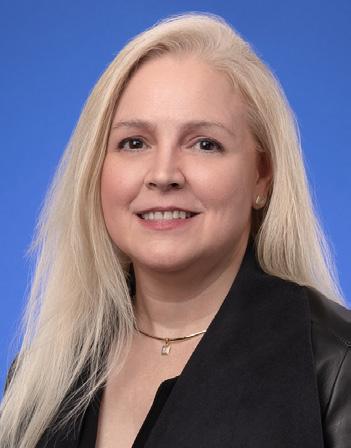
Sr. Director, Diversity & Inclusion in Clinical Trials
Don’t Ignore Quiet Leaders. They can

Deliver a Big Bang to a Company
The best advice I ever received was to be comfortable in my leadership style. Being a quiet leader can sometimes be misunderstood as a lack of interest, understanding or engagement; nothing could be farther from the truth. Quiet leadership can bring a unique set of skills and attributes which can lead to significant impact on the success of a team or organization.
Quiet leaders seek to understand most, if not all, perspectives to ensure everyone feels heard. While perhaps not the most vocal in meetings, quiet leaders can still be assertive, proactive and decisive when needed. Seen as more introspective and reflective, the quiet leader can develop insights and solutions that may not be immediately apparent to the team. By taking the time to listen to others, a quiet leader can gain a deeper understanding of the needs, concerns and perspectives of the team and identify and surface root causes of problems to best focus efforts on addressing them, thereby reducing time and optimizing results.
Servant leadership is also a critical and important skill of the quiet leader. As a servant leader, a quiet leader’s intent is to focus on the team’s accomplishments and recognize the contributions of others and celebrate their successes, rather than taking the spotlight. This allows one to let others be visible, be heard, own their work, and to be empowered. While not the ideal scenario for visibility within an organization, I strongly believe one of the key elements of quiet leadership is rising and lifting others. This trait is particularly effective in building trust and rapport within teams, as well as making team members feel valued and respected.
Quiet leaders are also often more empathetic and aware of the needs of the team. By being observant and taking the time to understand others’ perspectives, a quiet leader can provide support and guidance that is tailored to everyone’s unique needs. This can help team members feel more motivated, engaged and supported which can lead to better performance and outcomes.
By demonstrating the behaviors of active listening, servant leadership and empathy, quiet leaders can create a culture of excellence that inspires and motivates their teams.
54 2023 First Quarter www.diversityjournal.com
2 023 A W ARD INTERNATIONAL
Carlos E. Gonzalez Chief Information Officer
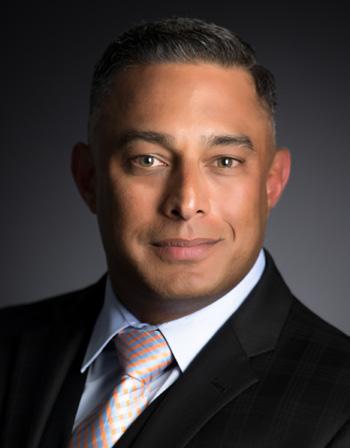
Lessons From my Amazing Mother Taught me How to Lead
My leadership journey started with the first challenge of my life, my father passing at a very young age. My parents had moved to the suburbs of New York City on Long Island, to raise their family in the best place they could manage for our future. My father’s passing changed the course of my life as my mother now had to keep their dream alive. I was lucky enough to have such a strong Latino woman as my first real example of a leader. It was not always easy to grow up in a single-parent household, with limited finances, and in a not-very diverse neighborhood. My mother never really believed in excuses and made sure I kept moving forward. My mother would often say to me, “Keep your eyes and ears open and mouth closed and maybe you will learn something.” She knew I needed to learn from everything else around me to help round out my education. I am not sure I ever mastered “keeping my mouth closed,” but through my career, I used that little bit of knowledge to learn to be a better leader. I have spent an enormous amount of time studying other leaders’ actions to help evolve my style. I do the same for the people that work for me, I believe studying people helps you understand them at a different level. It helps you to mentor them.
In my opinion, building teams is so critical to any individual success a leader can have. In order to do that, you need to help build up people. If you invest time in learning about a person, it helps you mentor them. In my experience in the technology industry, people often struggle with fitting into the business side of the job. The industry is still relatively new, even though it is such a huge part of the world we live in. It is also not a very historically diverse industry so helping people navigate that is very important to me. Teaching future leaders to understand the business better and understand how to navigate people is something I set as a priority. It is easy to put a very smart person in a leadership role and they will probably execute many of their assigned tasks, but being a leader is more involved than just doing tasks. Your job is to motivate, protect, prepare, and teach people.
I have been lucky enough to be part of some amazing teams, and to see so many people achieve great results in their careers, and to help grow the companies that hired me. All of this started with a tough challenge and lessons learned from my mother – an amazing leader.
Education (degrees & institutions): B.A., Business Administration, Capella University
Company Name: EPIQ

Industry: Legal Services

Company CEO: David Dobson
Company Headquarters Location: New York, NY
Number of Employees: 8,000
Words you live by: “Work like there is someone working 24 hours a day to take it all away from you” – Mark Cuban
Who is your personal hero? My mother
What was your first job?
Newspaper delivery person
Favorite charity: Wounded Warrior Project
Interests/Hobbies: Fitness
Family: Wife and three children
55 www.womenworthwatching.com 2023 First Quarter
2 023 A W ARD INTERNATIONAL
Education (degrees & institutions):
J.D., Stetson University College of Law;
B.A., Florida International University;
A.A., Valencia College
Company Name: FordHarrison LLP

Industry: Legal
Company CEO: Allen J. McKenna, Managing Partner
Company Headquarters Location: Atlanta, GA
Number of Employees: 275
Your Location (if different from above): Orlando, FL
Words you live by: Do what you love.
Who is your personal hero? My mother
What book(s) are you reading?
A Promised Land by Barack Obama
What was your first job? Handing out marketing flyers in the streets of NYC
Favorite charity:
Make-A-Wish Foundation
Interests/Hobbies: Basketball
Family: Wife and four children
Luis A. Santos
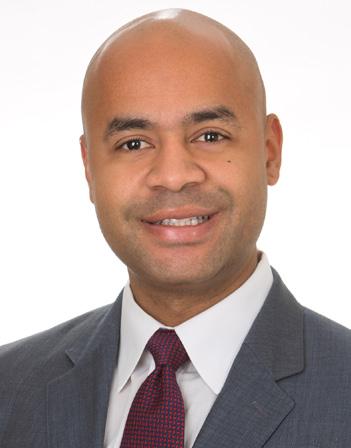
Deputy Diversity Equity & Inclusion Partner
Early Work Experience led to Love of HR Law, Diversity and Mentoring
My strong work ethic began as a child. As the son of an immigrant single mother, I began working at the young age of 12, handing out marketing fliers in the streets of New York City. During my early teenage years, I sold flowers on street corners and worked the cash register at a neighborhood grocery store. At age 16, I worked for a national fast food chain in Kissimmee, Florida, and was awarded best customer service employee in Central Florida. During my high school junior and senior years and while attending college—the first in my family to ever attend—I held a full-time job in the hospitality industry. I started as a front desk agent and three
years later held the position of front desk/assistant hotel manager, where I remained over the next several years. I was the youngest employee in the company’s history to hold that title. The management experience I gained gives me a personal understanding of the challenges managers face and the practical realities of legal compliance in the workplace. This experience fueled my passion to practice human resources law and be an advocate for diversity, equity, and inclusion. Helping companies with legal compliance and the development of DEI programs is my version of doing what you love—words I live by. In line with my passion for DEI, I am passionate about mentoring our future leaders. I dedicate a fair amount of time to participating in mentorship programs that are focused on the development of young talent. That is likely the most important thing I do and one that gives me great joy.
56 2023 First Quarter www.diversityjournal.com
2 023 A W ARD INTERNATIONAL
Helping companies with legal compliance and the development of DEI programs is my version of doing what you love—words I live by. ”
“
Julissa Pinto De Gracia Director of Program Management
for
the Enterprise Operations and Technology Division
Good Leaders Bring More Diversity into their Companies and Show Others the Way to Success
I was born and raised in Panama City, Panama — a country with lots of resources to offer to the world. As the fourth of five kids, I had to be creative to stand out and make my mark in the world. My entire family always supported me in my endeavors, and thanks to their support, I never shied away from exploring further and broader. I was encouraged to achieve anything I set my heart on, and always kept in mind that we must give back and help others along the way.
My background is in mechanical engineering. Early in my career, I faced many challenges as a young woman in technology, so I decided that earning an M.B.A. would help me bridge the gap between business and technology, creating more opportunities for myself and others. As I like to challenge myself, I pursued my M.B.A. at MIT. I arrived in Boston with broken English and clothes not well-suited for a northeastern winter. With the help and support of the community and mentors along the way, I achieved my goal of graduating, which set a new career path in motion for me.
Throughout my Freddie Mac career journey, I have been a pillar of our diversity, equity and inclusion efforts at the company. I’ve been privileged to work with committed mentors that have helped me overcome difficult situations, providing guidance and working with me to create action plans. I can now pay it forward by mentoring a new generation of employees including those from Latino and other diverse backgrounds.
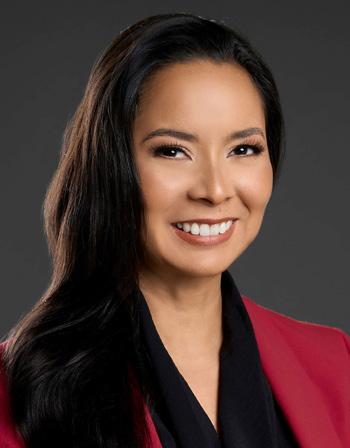
My efforts go far beyond my day job, as I’ve hosted and collaborated with multiple business resource groups to promote intersectionality companywide.
It is important to me to create enjoyable experiences that enhance people’s understanding of Hispanic culture, while supporting the next generation of Latino leaders. Today’s leaders can best support the next generation of Latino leaders by being intentional with our actions, leading by example, recruiting diverse talent, seeking participation from rising Latino leaders, as well as extending their network to those just starting their careers. We should all create a sense of community for those around us and always be a good mentor. And remember that when a door opens for you, bring another person through.
Education (degrees & institutions): M.A., Business Administration, MIT Sloan School of Management; B.S., Mechanical Engineering, Universidad Tecnologica de Panamá
Company Name: Freddie Mac

Industry: Financial Services
Company CEO: Michael DeVito
Company Headquarters Location: McLean, Virginia
Number of Employees: Approximately 7,000
Your Location (if different from above): Philadelphia, Pennsylvania
Words you live by: When a door opens for you, bring another person through.
Who is your personal hero? My parents are my heroes
What book(s) are you reading? My Broken Language by Quiara Alegría Hudes
What was your first job? Provided maintenance to an 18 megawatts diesel engine at the Panama Canal
Favorite charity: The HITEC Foundation
Interests/Hobbies: Historic home restoration and traveling
Family: I live in Philadelphia with my husband, daughter, son and two nieces.
57 www.womenworthwatching.com 2023 First Quarter
2 023 A W ARD INTERNATIONAL
Education (degrees & institutions):
B.A., Professional Studies, Leadership, Purdue University
Company Name: Freddie Mac
Industry: Financial Services

Company CEO: Michael DeVito
Company Headquarters Location: McLean, Virginia
Number of Employees: 7,200
Your Location (if different from above): Whittier, California
Words you live by: “Preservation of one’s own culture does not require contempt or disrespect for other cultures.” – Cesar Chavez
Who is your personal hero?
My grandmother, Maria Consuelo Griego Partida – in a time when women didn’t count, she was a woman of impact.
What book(s) are you reading?
Rain of Gold by Victor Villasenor and Where They Burn Books, They Also Burn
People by Marcos Antonio Hernandez
What was your first job?
Receptionist at sub-prime lender working a 50-line dialer
Favorite charity: Border Angels
Interests/Hobbies: I love golf! I belong to the Latina Women Golfers Association and have a great time golfing with my husband and friends.
Family: My husband BJ, daughter Mayaluna (20), and sons: Aaron (16) and Isaac (8 years old)
Nora Guerra Affordable Lending Manager
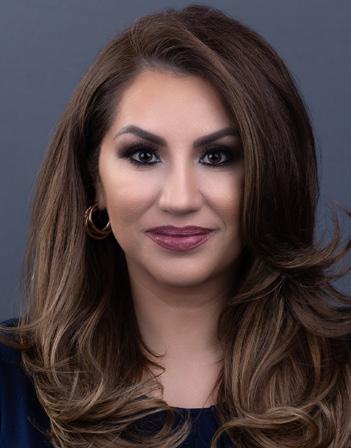
Equitable Homeownership for All Is My Mission
At the age of 15, my family was displaced from our home. That moment helped define my purpose and significantly impacted the rest of my life. As a result of my parents separating, our home was put in foreclosure. I negotiated the exit from our home because I was the only one who could speak English. I remember my mother passing the phone to me and asking me to talk with the bank employee on her behalf. I distinctly recall thinking, “When I grow up, I need to aid families like mine!”
I started my career in the housing and finance industry more than 24 years ago. As an advocate for minority lending, I have helped create and lead emerging markets programs early in my career. To round out my knowledge, I have met with policymakers, studied transaction structure, and come up with creative solutions to help create affordable housing in minority communities.
My Mexican heritage and Latinx American upbringing contributed immensely to making me who I am today. My mother would send me to Guadalajara every summer to spend time with my family to learn the language and culture.
As a proud immigrant, I am passionate about empowering minority first-time homebuyers through financial education to close the generational wealth gap. Today, as a national affordable lending manager at Freddie Mac, I educate industry stakeholders nationwide about Freddie Mac’s affordable products for first-time homebuyers and communities of color.
As a young woman finding my place in the business world, I had the opportunity to get a first-hand understanding of the challenges that women, and particularly women of color, encounter while building successful careers in male dominated industries. As a result, I’ve learned to be relentless in pursuing and achieving my goals.
Throughout my journey, I have never forgotten that 15-year-old girl. The experience challenged me but also helped me realize I can do anything if I apply myself. So, when I talk about my journey, I tell others to educate themselves about the business, be coachable and run with every new opportunity they receive.
58 2023 First Quarter www.diversityjournal.com
2 023 A W ARD INTERNATIONAL
Miguel Hernandez
Vice President & General Manager, Mexico, Central America, and Caribbean
Today, all businesses and companies have had to face challenges that no one could have ever foreseen before. The world has changed so fast over the last several decades, and it is continuously changing to the point that it has become almost impossible to use the past as the sole guide to prepare for and build the future, especially at a technology-focused company. In this context, the culture and the organizational climate play a key role in the success of a company, especially in preparing for the “unpredictable” events like those we’ve faced over the last three years. I believe that the leadership team in any organization is responsible for building and maintaining this culture and climate, and throughout my career, I have many times witnessed how the right or wrong leadership can seriously impact employees and ultimately, the business. Personally, I have been lucky enough to collaborate with people who understand how important is to create an environment of trust with both a purpose and a vision, while also making an effort to acknowledge and appreciate the talent and the people within that environment, regardless of their background or the industry or the region in the world in which the company operates.
Being Latino in the context of a global company does present me with challenges, yes, but it also gives me the unique opportunity to contribute and offer up my unique insights and knowledge, acquired throughout my career and my experiences growing up as a Latino. Over the course of my career and during my time at HARMAN, my different perspectives have driven my teams towards success that may not have been achieved without the contributions of various unique perspectives from diverse team members like myself. So, in a nutshell, it would massively benefit leaders of global companies to hire Latino talent and to encourage and uplift the Latino talent and leadership already within the organization, as their insights and experiences are key to a successful business with an enriched organizational culture that attracts and maintains valuable and eager talent.
Education (degrees & institutions): B.A., Industrial Engineering, focusing on Finance, Organizational Development & Total Quality, from Universidad Autónoma Metropolitana
Company Name: HARMAN
Industry: Automotive, Audio, Digital, Cloud, & IoT Technology
Company CEO: Michael Mauser

Company Headquarters Location: Stamford, CT
Number of Employees: 30,000+
Your Location (if different from above): Juarez, Mexico

Words you live by: Integrity, Gratitude & Appreciation, Family
Who is your personal hero? Both of my parents, but especially my mother
What book(s) are you reading?: I am re-reading The Three Box Solution by Vijay Govindarajan and just got a recommendation for Say Thank You For Everything, which is now on my list. Also, on a personal note, a friend just gave me The Prague Cemetery by Umberto Eco (one of my favorite authors), and I can’t wait to start it.
What was your first job? I was an intern at a bank and later, at a business consulting firm. My first “real” job was as a trainee in sales.
Favorite charity: From time to time, my family and I like to help NGOs dedicated to preserving natural resources and/or specifically helping animals in need. My family and I love animals and want to do more to help.
Interests/Hobbies: Most sports. My favorite sport is football, but I also love soccer and basketball. I’m also interested in music of all genres, especially rock and electronic music. Above all, I love spending time with my family, with my kids.
Family: Family plays the most important role for me. My family is my everyday motivation and inspiration.
59 www.womenworthwatching.com 2023 First Quarter
2 023 A W ARD INTERNATIONAL
Companies That Want To Be Successful in a Fast-Changing World, Need To Be Diverse To Get There
Education (degrees & institutions):
B.A., Marketing/Advertising, Baruch College, Zicklin School of Business
Company Name: Heartbeat

Industry: Healthcare Marketing
Company CEO: Nadine Leonard and James Talerico
Company Headquarters Location: New York, NY
Number of Employees: 302
Words you live by: Without a sense of urgency, desire loses its value

Who is your personal hero?
My father, Santos Capellan, for his relentless love for life
What book(s) are you reading?
The First 90 Days by Michael Watkins, The Light We Carry by Michelle Obama and Professional Troublemaker by Luvvie
Ajaji Jones
What was your first job?
Marketing receptionist at a fashion merchandising firm
Favorite charity: St. Jude and Jompeame, a crowd-funding site
Interests/Hobbies: Traveling, reading, weight lifting and mezcal tastings!
Family: My husband, Jairo Abreu (my anchor) and my two beautiful and fearless children, Javier and Valentina
Ana Capellan Executive VP of Productions and Operations
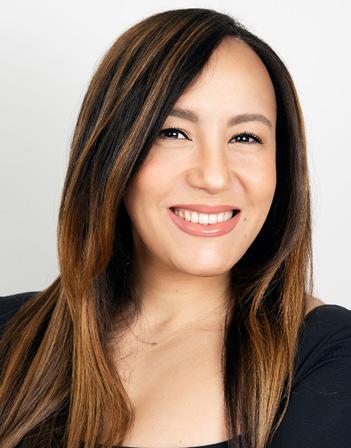
Building New Leaders Means Mentoring, Coaching and Connecting Younger Staff to Your Networks
Growing up, I saw local business owners who had big dreams but whose horizon of career aspirations was limited by the lack of representation. While there is a great deal I learned from their resilience and hustle, it did not provide me with a framework for succeeding as a leader in the corporate world. However, the universe led me to kind hearted leaders while working in corporate America who provided inspiration, tools, and a platform to set my own path.
In a world where we are constantly consumed with our day-to-day responsibilities and distracted with information overload, it can be difficult to activate the philanthropist inside of us, but as one of the very few Latina leaders in the organization I feel an obligation to spend my privilege and pay it forward. One of the most impactful actions that one can take is being intentional about creating the space to provide mentorship and coaching. Not only will you play a role in building up the next generation of leaders over time, but it can be incredibly fulfilling to have an impact in helping define vision and clarity with them. Allow them the opportunity to anchor deep learning by seeing you in action and by not shying away from giving them a window into your career journey in its totality, the successes, struggles and perceived failures. Leadership skills are malleable, and embracing mistakes and imperfections is a healthy way to foster creativity, trust, and a judgment free zone.
Another action you can take immediately is to be a connector. Utilize your influence and open the doors into your network to build a community and a trusted board of advisors for the next generation. Nobody can accomplish success alone, and from my experience, having a strong network and surrounding yourself with people who inspire you builds confidence, energy, and vision. A few ways to create these connections are informal meet and greet introductions, and providing stretch opportunities to be paired with leaders in the organization to help develop and further improve their skill sets, which will provide them with an arsenal of tools that will prove invaluable as they grow in their career.
60 2023 First Quarter www.diversityjournal.com
2 023 A W ARD INTERNATIONAL
Marta Ronquillo Newhart
 CCO & Brand Officer, Entrepreneur, Board Member
Storytelling has Been Key to Marta Ronquillo Newhart’s Success in Business
The one trait that Marta Ronquillo Newhart considers essential to her success is her passion for storytelling. Latinos are masterful storytellers. And she is a wizard at using it to turn corporate company strategy into business success. Marta has been able to captivate audiences and convey complex ideas through the art of storytelling.
“In challenge there is always possibility,” Marta believes. Over the course of a long career, her most significant challenge has been to continue finding success—and to build upon each new success so that she stays curious about what’s next. Her passion for storytelling has enabled her to create emotional connections with people from different backgrounds and cultures. This trait has been particularly valuable in her role as a chief communications and brand officer, where she has been responsible for influencing business outcomes for some of America’s most admired brands: Westinghouse, Johnson Controls, Boeing and Medtronic.
Education (degrees & institutions): M.B.A., Pepperdine University, Malibu; B.A., University of Washington, Seattle Industry: Energy
Words you live by: These quotes have provided inspiration and guidance for me: “Si se puede” – Cesar Chavez. This is our rallying cry for Latino empowerment and social justice.
“We have to keep making our voices heard and keep fighting for what we believe in.” – Dolores Huerta. This encourages me to take action and speak out against injustice.
Who is your personal hero?
Marta’s passion for storytelling has also been a source of inspiration for her teams. By sharing her personal experiences and weaving them into her work, Marta has been able to create a sense of purpose and meaning for her colleagues. This has helped to build a strong sense of camaraderie and foster a culture of collaboration within her teams.
Marta Ronquillo Newhart’s success as a chief communications and brand officer can be attributed to her passion for storytelling. This trait has enabled her to create emotional connections with people from different cultures, inspire her teams, and approach business challenges with a creative mindset. Marta’s story is a testament to the power of storytelling and its ability to drive success in both business and life.
My grandfather. He was orphaned as an adolescent and joined the Mexican Army. He came to America and started two successful businesses. That business mindset, and the ability to negotiate has served me throughout my career.
What book(s) are you reading?
Smart Brevity: The Power of Saying More with Less by Jim VanderHei, Mike Allen and Roy Schwartz
What was your first job?
Picking fruit and vegetables
Favorite charity: Special Olympics – I’m on the board. Giving voice to those who need it most.
Interests/Hobbies: Exercising, watching sports and hiking in the Rockies. This makes me sound athletic, but I’m just a good treadmiller.
Family: Husband, daughter, son and daughter-in-law
61 www.womenworthwatching.com 2023 First Quarter
2 023 A W ARD INTERNATIONAL
“
Latinos are masterful storytellers. And she is a wizard at using it to turn corporate company strategy into business success... ”
Education (degrees & institutions):
J.D., Cornell Law School, cum laude
Company Name:
Kasowitz Benson Torres LLP
Industry: Legal
Company CEO: Marc E. Kasowitz, managing partner
Company Headquarters Location: New York, NY
Number of Employees: 250
Words you live by: Act like you’ve been there before

Who is your personal hero?
Ruth Bader Ginsburg
What book(s) are you reading?
Black Cake by Charmaine Wilkerson and The Latecomer by Jean Hanff Korelitz
What was your first job?
Salesperson at a retail store
Favorite charity: The Trevor Project
Interests/Hobbies:
Reading historical fiction, travel
Family: Married with 3 children
Cindy Caranella Kelly Partner
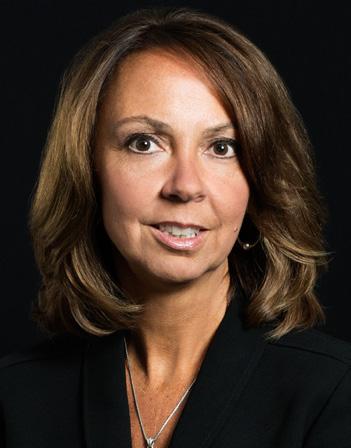
To Be Successful, Find a Mentor and Be a Mentor
As a Latina adopted at a young age into a boisterous Italian-American family, I did not have a strong sense of my identity during my adolescence. While I always knew that I was adopted and that my birth father was bor n in Cuba, I was often told by friends and acquaintances how fortunate I was that I could easily “pass” for Italian. To say that this left me confused and a bit unmoored is an understatement. As a first-generation college student, I also struggled with navigating the undergraduate and then law school process. Not only was the idea of law school a wild and seemingly unattainable dream, but I had never met anyone who practiced law. Needless to say, I arrived on the scene somewhat unprepared both in terms of expectations and in mentorship. While I attempted to live by the mantra “act like you’ve been there before” this was often easier said than done.
What I discovered after I joined Kasowitz Benson Torres, where I have spent the last 26 years, is that mentorship is invaluable to success, and comes in many forms. Most importantly, mentors are people who are vested in your success, not only as a lawyer but as an individual. Mentors take the time to teach, but also support and enable your individual path. As a working mother of three, who has also experienced and survived serious illness, I have a mountain of gratitude to my colleagues who have provided the support that has enabled me to thrive in the profession that I have come to truly love.
My advice to young lawyers is to find those people – whoever they are – who will have your back from both a professional and personal standpoint, because both are equally important to your success. Then, pay it forward and become a mentor to someone next to you. With this cycle, the potential success that can be achieved together is limitless.
62 2023 First Quarter www.diversityjournal.com
2 023 A W ARD INTERNATIONAL
“
...mentorship is invaluable to success, and comes in many forms. Most importantly, mentors are people who are vested in your success, not only as a lawyer but as an individual. ”
Maria Victoria Stout Partner, Intellectual Property Attorney
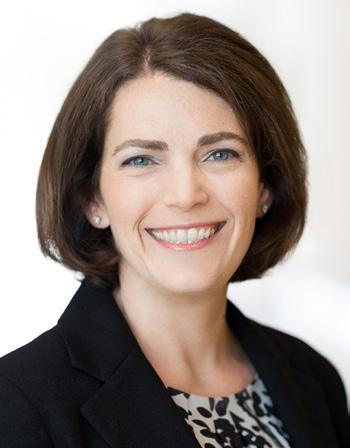
Building a Diverse Team Is Like Doing a Puzzle – Everyone Is Needed to Make it Work
As a Surface Warfare Officer serving in the U.S. Navy, I learned to approach team building like I would a jigsaw puzzle. My puzzle piece reflected my experiences and traits – what was on the face of my piece, as well as how I connected to other pieces around me. This meant recognizing the valuable perspectives and skills each individual “piece” brought to the puzzle that helped us accomplish our goal, regardless of their position or rank.
I realize now I was given diverse puzzle pieces with which to build teams. I created an environment where all of the pieces operated on a level playing field – like an assembled puzzle. I learned not to make assumptions about pieces that on their face did not seem like they fit into the puzzle. I taught others the value of being interconnected – the puzzle can flex and still stay together when the pieces fit precisely. I saw that when diverse pieces are missing from the puzzle, while you may be able to make out the larger picture, the puzzle will never be complete without those pieces. Similarly, when diverse pieces left the puzzle, they left a gap. The puzzle still functioned but it was incomplete, as pieces next to the gap weren’t connected as they were before.
Building diverse teams as an intellectual property attorney in private practice is ... harder. Women and attorneys of color face significant obstacles as they progress through “the ranks”— particularly in STEMintensive fields. Still, it’s imperative that I build diverse teams like I would a puzzle and apply the lessons I learned in the Navy. I strive to create a level playing field on my teams, which include not just attorneys, but also paralegals, administrative assistants, office managers, and clerks who all work towards our goal of providing exceptional client service. As I did in my prior career, I evaluate how each person’s experiences, perspectives, and traits can contribute to the puzzle and connect other pieces together. My experience has shown me that building diverse teams with strong connections will allow the team to persist together, no matter the obstacles in front of us, and teach junior attorneys how to assemble vibrant puzzles in their own practices.
Education (degrees & institutions): J.D., magna cum laude, University of San Diego School of Law; B.S., Ocean Engineering, United States Naval Academy
Company Name: Knobbe Martens
Industry:
Intellectual Property and Technology Law

Company CEO: Steve Nataupsky, Managing Partner
Company Headquarters Location: Irvine, CA
Number of Employees: 595
Your Location (if different from above): San Diego, CA
Words you live by? Treat others the way you wish to be treated.
Who is your personal hero?
My parents, who taught me to work hard, be humble, and lead by example.
What book(s) are you reading?
Alexander Hamilton by Ron Chernow
What was your first job? Midshipman, United States Naval Academy
Favorite charity: Flamboyan Arts Fund
Interests/Hobbies: Sailing, traveling, comida puertorriqueña
Family: My husband and our two beautiful daughters
63 www.womenworthwatching.com 2023 First Quarter
2 023 A W ARD INTERNATIONAL
Education (degrees & institutions): LL.M., Columbia Law School
Company Name: Lathan & Watkins
Industry: Legal
Company CEO: Richard M. Trobman

Number of Employees: 6,964
Your Location (if different from above): New York, NY
What book(s) are you reading?
La Hija Unica by Guadalupe Nettel
What was your first job?
My first real job (I was a camp counselor in my teens!) was at a law firm in Mexico dedicated to intellectual property
Interests/Hobbies: Road biking around new places! Latest trip was from Banff to Glacier Park
Family: My partner, Marlene, and my family in Mexico – all my pillars
Living in Two Worlds and Being the Best I Can Be in Both
Throughout my life, I have lived in two worlds. I was raised speaking both Spanish and English, and have been the lucky beneficiary of family, friends, colleagues, and mentors from both sides of the language and cultural divide. Living at that intersection enriched me early on, and later allowed me to develop and hone invaluable skills that I am fortunate to bring into my legal practice today.
I am a banking and finance lawyer, with a focus on Latin American markets. Advising clients on their most complex cross-border transactions, I’m able to leverage a keen understanding of all parties’ needs and objectives to provide sophisticated advice, drawn from a deep understanding of the underlying law, my clients’ goals, and a nuanced sense of various differences in each market.
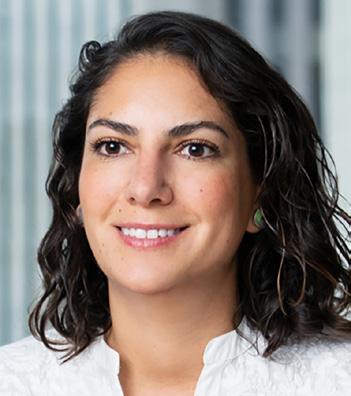
Some people assume that I’m involved in the Latin America practice because I’m a Latina – as though it was my only option. But that’s not so.
The way I see my practice is as a choice. I love that a significant portion of my practice has a Mexico, Colombia, Chile or Brazil nexus—not because I have been pigeonholed as a Latin American, but because I earned the ability to choose and build my practice by being a great lawyer first and then integrating the characteristics of a practice that would bring me the most satisfaction.
For me, that choice all went back to the idea of living at the intersection of two worlds. The two-world duality that so enriched my personal life also enriches my professional life. And in mentoring young lawyers, especially women and members of underrepresented groups, I always instill in my mentees that their intellect and skill as lawyers comes first and their practice choice—especially at a firm with a robust platform like Latham’s— naturally follows with hard work.
I feel lucky to practice at Latham & Watkins, a law firm that welcomes individuals to bring all parts of themselves to the workplace and integrate the pieces that make them unique into the firm’s fabric. I walk through the door every day comfortable with myself, a una chingona.
64 2023 First Quarter www.diversityjournal.com Marcela Ruenes
Counsel
2 023 A W ARD INTERNATIONAL
Pamela Esparza Senior Manager, Risk and Advisory Compliance
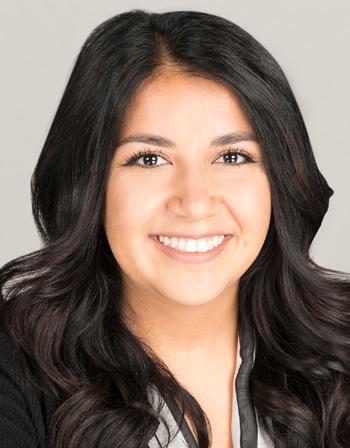
Helping the Next LatinX Generation To Be Confident in Being Themselves
I am a first-generation LGTBQ+ Latina. My identity is powerful, but every day I work to understand it. Although I am proud of who I am, I also deeply understand and empathize with the struggles that come with being a first-generation Latina. I understand the guilt that is ingrained in us from carrying the weight of our family’s sacrifices, but I also have a lot of pride and love in our traditions, language, and people.
I grew up in El Paso, TX being an only child to a single parent. We immigrated from Mexico when I was about four years old and lived a humble life with my mom and grandparents. My family worked hard to provide for me and always supported my education. The work ethic and values they instilled in me have allowed me to achieve more than they could hope for, but I still found myself struggling throughout college and my career to catch up to my peers. It became easier for me to assimilate than to work through the complexity of the “why” I was still struggling, despite having all the skills I needed to succeed. I didn’t have the time or privilege to try to understand until years later when I was in a safe place in my life where I could slow down and reflect.
I have dedicated the last couple of years to truly understanding myself, our culture’s history, and the struggles that our community shares. Through that time, I have realized that we are resilient and a lot of us share a similar origin story. I am more aware and empathetic that there will always be another family in the same situation as mine, and that has reignited a passion to help our future generations and raised an awareness that I can always do more to uplift our community and pass on my knowledge, connections, and resources. I am honored to be leading our LatinX Business Resource Group (BRG) at Moss Adams. In my role, I strive to create an environment where everyone feels empowered to take up space and be confident in their roots and in owning who they are, and I highly encourage my fellow Latino and Latina leaders to do the same, regardless of the industry or sector that we all work in. I am excited and proud of what our Moss Adams LatinX BRG leaders have and will continue to achieve, and I’m eagerly waiting to see how our future generations will benefit from the change that is happening today.
Education (degrees & institutions):
M.A., New Mexico State University; B.A., New Mexico State University
Company Name: Moss Adams, LLP
Industry: Accounting
Company CEO: Eric Miles
Company Headquarters Location: Seattle, Washington
Number of Employees: 3,000+
Your Location (if different from above): San Francisco, CA
Words you live by: “But where are our contributions? Where are they? Where are they listed, mentioned or honored? Can you imagine, can you imagine if they were put back into history? Written back into history textbooks? Can you imagine how America would see us? More importantly, can you imagine how we would see ourselves?” – John Leguizamo on Mexican-American contributions in U.S. history
Who is your personal hero? Mi Mama, mis abuelitos, y todos mis tios y tias. Thank you for everything.
What book(s) are you reading?
Anxious People by Fredrik Backman

What was your first job?
Crew member at McDonald’s
Favorite charity: Las Americas Immigrant Advocacy Center, a nonprofit in El Paso, TX that helps provide legal representation to immigrants and refugees.
Interests/Hobbies:
Reading, traveling, laughing with friends and family. If the sun is out, I enjoy swimming and playing tennis.
Family: My life partner and our cats
65 www.womenworthwatching.com 2023 First Quarter
2 023 A W ARD INTERNATIONAL
Education (degrees & institutions):
J.D., St. Thomas University School of Law; B.S., Florida State University
Company Name:
Nelson Mullins Riley & Scarborough, LLP

Industry: Law
Company CEO: Jim Lehman
Company Headquarters Location: Columbia, SC
Your Location (if different from above): Miami, FL
Words you live by: Life is 10% what you make it and 90% how you take it.
Who is your personal hero?
Ruth Bader Ginsburg
What book(s) are you reading?
The Light We Carry: Overcoming in Uncertain Times by Michelle Obama
What was your first job?
My first job was at 15 as a cashier at a local hardware store
Favorite charity: Doing pro bono work through Legal Services of Greater Miami and St. Jude Children’s Hospital
Interests/Hobbies: Traveling and spending time with my daughters
Family: My husband and my daughters (7 and 4 years old)
Melissa Gomberg Partner
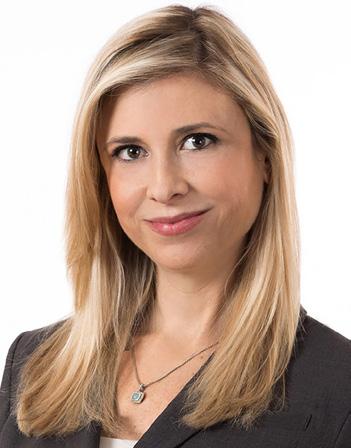
To Thine Own Self Be True, but Don’t Forget To Be Adaptable and Open Too

The best advice I ever received was given to me by a mentor my first year as an attorney and has helped shape the way I approach my work and my life. The advice was simple yet profound: “Always be yourself. Don’t ever try to be more or less than who you are.” My mentor went on to explain that the qualities and traits that my family and friends love and value in me, are the same qualities and traits that make me valuable as an attorney and advocate.
At first, I found it challenging to put this advice into practice. As a young attorney, I was eager to please and often found myself trying to conform to what I thought others expected of me. However, as I gained more experience, I realized that my mentor was right. When I allowed myself to be true to who I am, I found that I was more persuasive, more effective in my work, and more confident. This allowed me to gain the credibility and trust of my partners, colleagues, clients, judges, and opposing counsel. It also allowed me to develop genuine connections with people in my professional life, many of whom have become lifelong friends.
However, being true to oneself does not mean being rigid or inflexible. As an attorney, it is important to remain adaptable and open to new ideas and perspectives. To recognize that everyone has their strengths and weaknesses, and to seek out opportunities to learn from others.
I believe that being myself and having a clear sense of identity has been essential to my success, both in my personal and professional life. While it is important to stand firm in my convictions, it is equally important to continuously challenge my own assumptions and beliefs and always be receptive to feedback from others. By doing so, I will continue to grow and learn as an individual and as an attorney.
66 2023 First Quarter www.diversityjournal.com
2 023 A W ARD
INTERNATIONAL
“
While it is important to stand firm in my convictions, it is equally important to continuously challenge my own assumptions and beliefs and always be receptive to feedback from others. ”
Patty Arvielo Co-Founder & CEO
Mentoring Helps the Next Generation Grow and Thrive
The most important thing that people in leadership positions can do to help the next generation thrive is to invest in their success. But it’s about more than investing money. It’s also about investing your time to help them reach their potential.
Our time is one of our most precious resources and how you choose to use your time matters. As a leader, I think it’s critically important to invest your time in helping people.
That’s why I have long believed in the importance and power of mentorship. I’ve been fortunate in my career, and I’ve learned a lot of important lessons along the way, and I feel it is my responsibility to share those lessons with others.
That drove me to create the “Thrive and Lead” mentorship program several years ago. With this program, I mentor professionals from all walks of life to help them establish their career. Each quarter, I welcome dozens of people both from New American Funding and outside our company to sessions where I share my past experiences and lessons learned to help motivate them to find their own success.
I also encourage our team to take part in our “360 Mentorship Program,” a program designed to help team members develop by working closely with another seasoned professional at our company. Through this program, we match willing mentees with experienced senior mentors who help these younger individuals grow and thrive in their careers. Participation in this six-month program does not guarantee a promotion or progression in the mentee’s career but helps them develop the skills they need to pursue advanced career goals. Mentors include corporate leadership, senior vice presidents, vice presidents, regional managers, branch managers, trainers, and operations managers.
As a company, New American Funding also actively participates in other mentorship programs. “If You Want to Grow, We Want to Know” offers team members a chance to communicate directly with me and President Christy Bunce about their career goals and how they’d like to progress at the company.
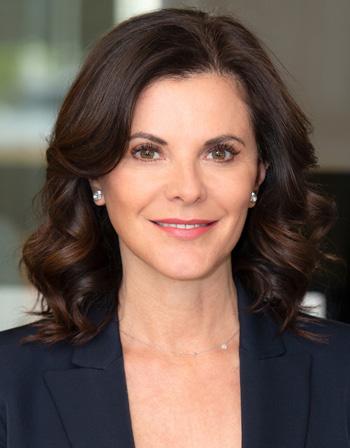
Each of these programs require and warrant an investment of time from all involved. And if you’re fortunate enough to be able to, I also think it’s important to invest in the future from a financial perspective.
Today’s leaders need to put their success to good use, especially when it comes to the future of the Hispanic community. For me, that manifested itself when I acquired a majority stake in #WeAllGrow Latina, a group that works to elevate Latinas’ voices and stories. I also invested in Encantos, an award-winning educational technology company that focuses on bilingual education.
These are just a few examples of how I help the next generation and I hope others follow a similar path.
Company Name: New American Funding

Industry: Mortgage & Financial Services
Company CEO: Rick Arvielo & Patty Arvielo
Company Headquarters Location: Tustin, California
Number of Employees: 3,448
Your Location (if different from above): Las Vegas, Nevada
Words you live by: It’s in adversity that we shall see the lessons.

Who is your personal hero? My husband, Rick.
What book(s) are you reading?
Lifespan: Why We Age—and Why We Don’t Have To by Dr. David A. Sinclair
What was your first job?
Working at the La Mirada Swap Meet in California selling wicker as a young girl.
Favorite charity: Big Brothers Big Sisters of America
Interests/Hobbies: I absolutely love to travel!
Family: My husband Rick, my parents, my three amazing children, son-in-law, a wonderful granddaughter – and one grandson on the way!
67 www.womenworthwatching.com 2023 First Quarter
2 023 A W ARD INTERNATIONAL
Education (degrees & institutions):
B.A., Finance & Business Studies, SUNY Buffalo State University
Company Name: New York Life

Industry: Financial Services

Company CEO: Craig DeSanto, President & CEO
Company Headquarters Location: New York, NY
Number of Employees: 11,700
Words you live by:
Be grateful for what you have, always plan something to look forward to, be optimistic & don’t take counsel of your fears or naysayers...you can do anything!
Who is your personal hero? My father. He taught me the value of hard work, education and that family always comes first.
What book(s) are you reading?
Vortex by Catherine Coulter and Dark Horse by Gregg Hurwitz
What was your first job?
As a teenager, I worked at a hospital as an office assistant during the summer.
Favorite charity: St. Jude Children’s Research Hospital, Crohn’s & Colitis Foundation
Interests/Hobbies: Traveling with my family, summer vacations in Cape May, reading, and watching big NY sports: Knicks, Giants and Yankees.
Family: My wife Melissa, daughter Jolissa, son Joshua and dog Rocky!
Jose N. Barros
Managing Director, New York Life Investments; COO U.S. Distribution
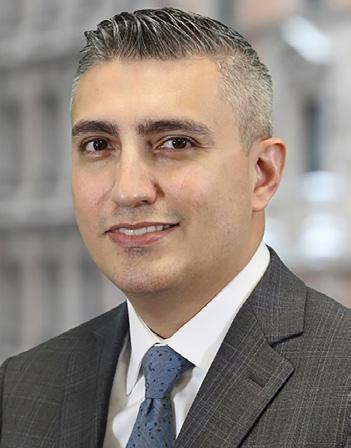
Building a Strong Business, a Good Life, Requires Positivity
“Perpetual optimism is a force multiplier.”
Growing up, my father instilled in me the value of hard work, education, discipline, gratefulness and, most importantly, the appreciation for family and our Hispanic culture. He also taught me the value of optimism, to see the positive in every situation regardless of the circumstances but to also be realistic and learn how to adapt to make your situation better.
By definition, optimism is a hopeful, positive outlook on the future, yourself, and the world around you. It is a key part of resilience, the inner strength that helps you get through tough times. It helps you see, feel, and think positively.
Throughout my career, being optimistic about my aspirational goals and recognizing the impact optimism has on how I lead teams and navigate through challenging times has been critical to my success. Maintaining a positive mindset allows me to have clarity in what I want for my future, to have vision and drive towards goals with motivation and consistency. It allows me to be flexible in my process, to recognize the realistic situations or, where I fall short, to not dwell on shortcomings, but instead accept them, learn from them, make the necessary changes to adapt and move on! With this mindset, I feel in control of my situation which allows me to challenge myself to set new goals. I believe this approach has helped me grow from being an individual contributor to a leader of a highly functional sales team at New York Life Investments.
Leading teams in the financial services industry has its challenges, some of which we simply have no control over due to market conditions or the constant change and evolution our business faces each year. Whether it was the Financial Crisis of 2008-09, the pandemic in 2020, or the many market dynamics in between, as a leader, you are looked upon by your team to assess the situation and make decisions without falling into a pessimistic mindset — to focus on creating clear solutions with positive outcomes in mind. In doing so, you’re building a culture that encourages a positive mindset, that’s adaptive and flexible, willing to learn a new style of thinking or new skill sets to gain a broader knowledge base. Not only did we get through market challenges and the pandemic, but we adapted and learned new ways of thinking to meet our clients’ ever-changing needs. Positive thinking has also helped me foster better relationships with my team, peers, and family where I recognize what I say and how I interact with people will determine how they feel. It is often said that it isn’t just what you say but how you make people feel that will determine your impact in their lives or careers.
I truly believe that our ability to incorporate positive thinking as parents, siblings, friends, or leaders is a key contributor to emotional well-being and improved relationships, providing the clarity to adjust and achieve goals. It is also the force multiplier that can help improve organizational outcomes.
68 2023 First Quarter www.diversityjournal.com
– Colin Powell
2 023 A W ARD INTERNATIONAL
Daniel Alejandro Prati Partner

The Importance of Mentorship to Support the Next Generation of Latino Business Leaders
Mentorship is a vital tool for personal and professional development. Only by having access to, and taking advantage of, quality mentors do we develop the confidence and self-esteem needed to become leaders within whatever organization we find ourselves in. That is what I have done and continue to do today.
As a first-generation immigrant from Argentina, I was in college before I met a lawyer. Yet, that first lawyer I met showed me the qualities of a successful lawyer, showed me what it takes to thrive in a law firm, and encouraged me to put in the effort to start a career in the law. Seventeen years after first stepping foot in a law school classroom, I have had several mentors support my development from law school student, to an associate at a law firm, to a partner at that law firm, and now as a leader within my firm. I would not be where I am without that constant support and mentorship from those around me.
Even though my personal development is far from over, I now find myself in the position where I can be a mentor to others and return some of the favors that others have done for me. For example, I am a co-chair of my firm’s Minority Equity Council, which works to create a sense of community within our minority attorneys and non-attorneys and fosters an environment of mentorship and sponsorship to help our minority attorneys get the support they want and need. I have been amazed at how eager mentors have been to offer that support. However, I have been even more amazed at the effort and enthusiasm I have seen from mentees who seek out and maximize the returns from the support they receive. They understand that that support is vital to their success.
I am where I am because others have stepped up to mentor me. The next generation of Latino leaders needs similar mentors and support, and I encourage anyone who finds themselves in a position to provide mentorship and support to others to make the time and put in the effort. Not only is it rewarding for the mentor, but it can shape and direct the mentee’s future and professional success.
Education (degrees & institutions): J.D., UC Berkeley School of Law; B.S., Electrical Engineering, Texas A&M University
Company Name: Norton Rose Fulbright US LLP
Industry: Legal
Company CEO: Jeff Cody
Company Headquarters Location: Houston, TX
Number of Employees: 1,500+
Words you live by: The Golden Rule – treat others as you would like to be treated.
Who is your personal hero? Abraham Lincoln

What book(s) are you reading? The Boys in the Boat by Daniel James Brown
What was your first job? Lifeguard
Favorite charity: Star of Hope – sohmission.org
Interests/Hobbies: Woodworking
Family: Wife Lisa and two sons, Noah and Henry
69 www.womenworthwatching.com 2023 First Quarter
2 023 A W ARD INTERNATIONAL
Company name: Robins Kaplan LLP
Industry: Law
Who is your personal hero? Our farm workers. Though invisible to most of us, they toil long hours under the sun in hopes of a better life for their families and they bring fruits and vegetables to our dinner tables. They are some of the most vulnerable and exploited members of our society. Yet they live with courage and faith and hope.
What book(s) are you reading? For Whom the Bell Tolls by Ernest Hemingway
What was your first job?
I joined the United States Navy when I was seventeen.
Favorite Charity: California Rural Legal Assistance, Inc.

Interests/hobbies: Coaching pony baseball, skydiving, the gym, and skiing. All things outdoors.
David Martinez
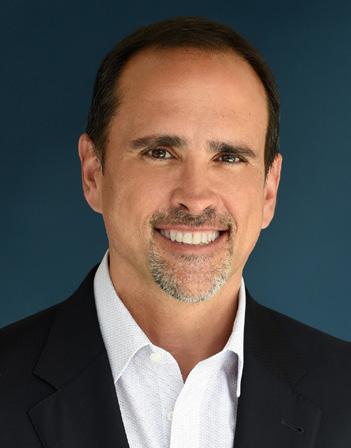
Built His Career on a Foundation of Hard Work and Service to Others
I believe deeply in the power of hard work and helping those that are less fortunate. My father was a Baptist minister before he retired. But he always had a second job to make ends meet. My mother balanced a fulltime job with raising four children. For my parents, being in the ministry was about helping people as much as religious dogma. I have early memories of my parents as church leaders ministering to the sick, the elderly, the homeless. They believed in and practiced volunteerism.
I’ve tried to emulate those qualities in my life. I recall experiencing impostor syndrome out of law school even though I graduated cum laude. But I figured out early on that I had the willpower to outwork anyone in the room. That was extraordinarily empowering, particularly in this profession. And it has served me splendidly throughout my career. I have my parents to thank for that.
My experience in the U.S. Navy has always been a good barometer as well. I joined the Navy out of high school and served a four-year enlistment. I was aboard aircraft carriers much of that time. Deployments were very difficult. We worked twelve-hour days with no weekends or holidays, sometimes for several months a time. I also saw a lot of abject poverty overseas. It gave me a deep appreciation for the opportunities we have in this country. And it really opened my eyes to inequality.
I’ve tried to even the playing field one pro bono client at a time over the last twenty-five years that I’ve been practicing law. I’m blessed to be part of a firm that provides world class client service but is also devoted to our communities. My partners are leaders in public interest organizations, and we are recognized year in and year out for our tremendous commitment to pro bono work. We encourage our lawyers to do good while doing well and we reward them for doing so. I’ve handled all types of pro bono matters, but as an immigrant, I’ve always had a keen interest in asylum cases and have represented families from all over the world in asylum proceedings. That work has been particularly gratifying.
I also serve my partners and the partnership as a whole as an elected member of the Firm’s Executive Board, where I have the ability to influence the future of the Firm. It is a hugely important undertaking and responsibility. My colleagues on the Board are fabulous leaders, and it is very much a marketplace of ideas where vigorous discussion on difficult issues is the norm, as it should be.
70 2023 First Quarter www.diversityjournal.com
Partner; elected member of the firm’s Executive Board; member of the firm’s Diversity Committee; Firm Pro Bono Chair, California offices
2 023 A W ARD INTERNATIONAL
Christine Dunn Partner and Co-Chair of Criminal/Sexual Violence Practice Group
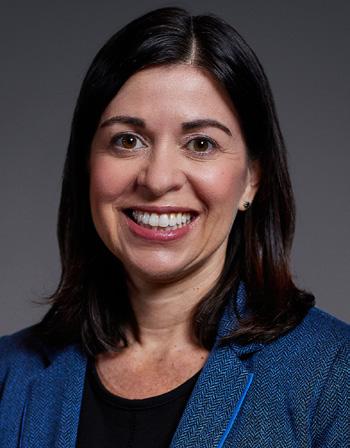
Perseverance Has Been Essential to My Success
I once had a friend tell me that I have a highly developed sense of “stick-to-it”-ness. I guess that comes as no surprise having grown up in a family where hard work and perseverance were revered traits. My mother was born and raised in Costa Rica and came to the United States at age 17 to attend school. Although she spoke no English when she arrived, within five years she graduated with honors from a highly respected American university. I’m sure there were moments when the road was hard but, nonetheless, she stuck with it. I inherited her stubborn refusal to quit, even when things seem difficult. I believe that my perseverance and refusal to give up on myself or my clients have been essential to my success as a lawyer.
In my personal career path, I have had to persevere to get to where I am. Thirteen years ago when my daughter was born, I left my current law firm for what was supposed to be a three-month maternity leave. Things didn’t go as planned and my leave stretched into nearly seven years as a stay-at-home mom. Before becoming a parent, I’d practiced law for over a decade – mostly as a civil rights prosecutor and then at my current plaintiff’s side civil rights law firm. But the more years that I was away from the law, the more daunting it seemed to return. There were moments where I questioned my ability to, once again, be a successful lawyer. Though giving up seemed like the easier path, I persevered and made my return to practicing law. I’m grateful that my law firm welcomed me back and gave me the flexibility I needed to succeed in my life as a working, single mom. In the years since, I have risen through the ranks at my firm and am now a partner and the co-chair of my firm’s Criminal/ Sexual Violence Practice Group.
My perseverance and refusal to give up have also made me a more effective advocate for my clients. I represent victims of crime, especially sexual assault, in civil suits – often against large institutions that allowed the victimization to occur. I have clients tell me all the time that, in being victimized, they feel like their power was taken away. To them, the idea of fighting a powerful institution seems impossible and overwhelming. The most important thing I can do for my clients is to promise that I will persevere and keep fighting for them, even in the face of challenges.
Education (degrees & institutions): J.D., University of Virginia School of Law; B.A., History, Yale University;
Company Name: Sanford Heisler Sharp, LLP

Industry: Law
Company CEO: David Sanford -Chairman
Company Headquarters Location: New York
Number of Employees: 95
Your Location (if different from above): Washington, DC
Words you live by: “My hope is to leave the world a little better for having been there.“ – Jim Henson

Who is your personal hero? My father
What book(s) are you reading?
The Winners by Fredrik Backman
What was your first job?
Retail Salesclerk
Favorite charity: Network for Victim Recovery of DC (NVRDC)
Interests/Hobbies: Yoga, Paddle Boarding, Hiking
71 www.womenworthwatching.com 2023 First Quarter
2 023 A W ARD INTERNATIONAL
Education (degrees & institutions): J.D., University of San Diego School of Law; M.B.A., University of San Diego School of Business; B.A., University of California at Berkeley
Company Name: Saxena White

Industry: Legal
Company Headquarters Location: Boca Raton, Florida
Number of Employees: 66
Words you live by: From day one, my family instilled in me two things: try my hardest in everything I do and be kind to others.
Who is your personal hero? My mother. She is amazing – she embodies resilience, and she instilled it in me. Due to the political violence in her native Nicaragua, she lost everything. Her father and husband (my grandfather and father) were murdered in the same year. She had a successful career as a high-ranking banking executive in Nicaragua, but then had to start anew. She didn’t skip a beat, started from the very bottom, learned the language immediately, and took a job as a bank teller. People ridiculed her accent. She endured, did everything she could to provide for me, and, later on, my sister. What book(s) are you reading? To Kill a Mockingbird by Harper Lee. I’m rereading that right now, because my daughter is reading it in her eighth-grade class, and the play is actually coming to South Florida, which we are going to see.
What was your first job? My first job was working retail at the shopping mall – a clothing boutique called Work World. Favorite charity: Save the Children. They respond quickly when there are major catastrophes and disasters, like the Turkey and Syria earthquake. I also give to UNICEF, Make-A-Wish, and St. Jude.
Interests/Hobbies: Playing basketball and exercising. I also enjoy creative writing. I still aspire to write a novel one day about my father’s life.
Family: I have a huge family, and we are always together as we enjoy large family gatherings.
Lester R. Hooker Director
Diversity is Increasingly Critical for Law Firms and Institutional Clients

It is important for today’s leaders to proactively create opportunities for diversity in their companies and increase representation of people from different backgrounds in their professions.
In my particular space – we represent public pension funds and other institutional investors in high-profile, investment-related litigation – there is not a lot of Hispanic representation at the highest levels. I remember attending a mediation with nearly 100 attorneys in a conference room, and out of all of those attorneys there were only a handful of women attorneys – and even fewer minorities. This reflected the upper echelon of litigators at some of the most prestigious law firms throughout the country.
Law firms and individual practitioners need to continue to prioritize reaching out to minority communities and expanding that representation.
I am extraordinarily proud to be part of a nationally certified minority and woman-owned firm. Our firm places an emphasis on diversity from the top-down – nearly half of our directors are women and minorities. We make sure that all of our young attorneys are mentored and afforded every opportunity to develop their legal skills and to grow within the firm. My firm’s culture helped create my career.
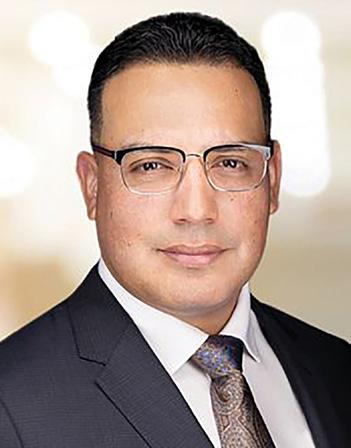
Our institutional clients are voicing their desire to see diverse litigation teams representing their interests, and judges presiding over our cases are noting that diversity is an increasingly important issue for them as well. For example, in a case in the Southern District of Ohio concerning the FirstEnergy bribery scandal, Chief Judge Algenon Marbley appointed my firm as co-lead counsel and specifically recognized not just our track record of success in this area, but also the fact that our firm is a nationally certified minority and woman-owned firm, which best reflected the diversity of FirstEnergy shareholders and is best suited to act on their behalf. In that case, we went on to recover $180 million for the company – the largest derivative recovery ever in the Sixth Circuit – along with helping the company adopt groundbreaking corporate governance reforms, including the removal of six long-term members of FirstEnergy’s board of directors.
Today’s leaders need to continue to persevere in prioritizing outreach and the creation of opportunities for future Latino business leaders. And to promote their own stories.
I look at my own personal history. I came here as a child with my mother from war-torn Nicaragua, and through the support of my family, perseverance, and the good luck to meet colleagues who prioritized diversity in building their law firm, I was able to flourish and succeed.
72 2023 First Quarter www.diversityjournal.com
2 023 A W ARD INTERNATIONAL
Rita Ortiz Senior Director, Community Relations at Travelers and Assistant Vice President, Travelers Foundation
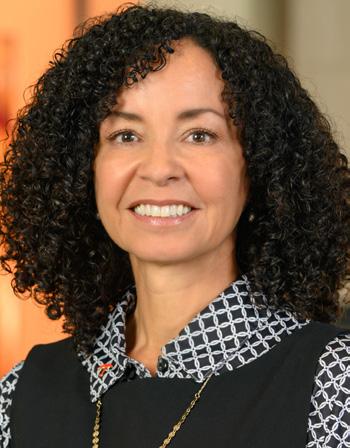
Travelers’ Employees Believe in Donating Time and Money to the Community
Today’s employees are purpose driven. They want to work for organizations with robust volunteer programs that provide opportunities for them to not only network with co-workers but also contribute in meaningful ways to their communities. And successful companies see the value in that, understanding that a business can’t thrive without strong, stable neighborhoods.
Travelers Companies, Inc. supports the communities where we live and work because they do so much to support us. We encourage our employees to donate both funds and time to organizations that are important to them, and we help them every step of the way through our comprehensive community involvement programs. In turn, employees come to work feeling energized and passionate about their jobs.
We’re fortunate to have a culture of giving at Travelers. Our 30,000 employees are heavily involved, volunteering thousands of hours annually – both virtually and in-person – to meaningful causes. During the height of the pandemic, our Community Relations team received numerous emails and calls from employees asking how they can continue to support their communities from the safety of their homes. So, we pivoted our in-person programs to support virtual volunteer activities, including hosting one-onone mentoring sessions, conducting financial literacy workshops, reading to younger students and writing letters of encouragement to our future leaders. And, not to our surprise, employees stepped up and supported more than 6,000 organizations in 2020 alone.
When we reintroduced in-person volunteer opportunities, we made both options permanent so employees would have an even greater ability to support nonprofits no matter where they are in the world. Whether they roll up their sleeves to build homes with Habitat for Humanity or help a student across the country with their math homework via Zoom, our employees are dedicated to making a real impact.
And the numbers are astounding – in 2022, my colleagues dedicated more than 70,000 hours and donated more than $3 million through fundraising and matching gifts to organizations across the United States. They are leading the way and helping to make our communities stronger now and for the next generation. It’s an effort I am so grateful to have been a part of for nearly 15 years, and I continue to be inspired every day.
Company Name: Travelers

Industry: Insurance and Financial Services
Company CEO: Alan D. Schnitzer
Company Headquarters Location: New York City, NY
Number of Employees: 30,000
Your Location (if different from above): Hartford, CT

Words you live by:
“Never doubt that a small group of thoughtful, committed citizens can change the world; indeed, it’s the only thing that ever has.” – Margaret Mead
What book(s) are you reading? Leaving Time by Jodi Picoult and The House on Mango Street by Sandra Cisneros
What was your first job? Cashier at a grocery store.
Favorite charity: Many!
Interests/Hobbies: I love being outdoors as well as playing board games.
Family: I am very close with my family, made up of my parents, sisters and even more siblings through my wonderful husband. I am most proud of my son, who is a brave entrepreneur!
73 www.womenworthwatching.com 2023 First Quarter
2 023 A W ARD INTERNATIONAL
Education (degrees & institutions):
J.D., Duke University School of Law; LL.M., Northwestern University School of Law; B.A., Kenyon College
Company Name: Ulmer & Berne LLP


Industry: Legal
Company CEO: Scott P. Kadish
Company Headquarters Location: Cleveland, OH
Number of Employees: 327
Your Location (if different from above): Columbus, OH
Words you live by: “Be who you are, and be that well.” – St. Francis De Sales
Who is your personal hero?
My mom, Sonia. She taught us to be true to who we are.
What book(s) are you reading?
Lady Justice by Dahlia Lithwick; The Men by Sandra Newman
What was your first job?
Cashier at McDonald’s
Favorite charity: Dress for Success
Interests/Hobbies:
Running, reading, cooking
Family: Husband: Matthew; four children: Gabriella, Annabelle, Molly, and Seamus
No More Hiding: Why I Decided To Be A Champion and a Mentor to Other Latina Lawyers
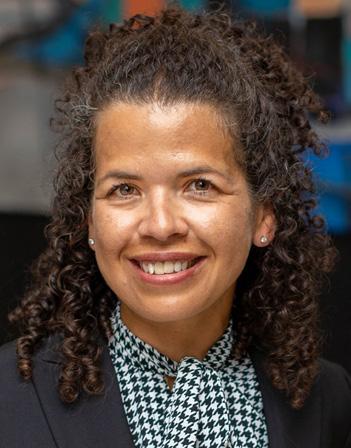
I have been guided by amazing mentors throughout my career: from a relentless client who took a chance on me as a young lawyer, sending me to work on cases large and small nationwide, to masterful lawyers who continue to educate me on the nuances of litigation. My mentors have undeniably succeeded in getting me to “fit in” the legal community, for which I will be forever indebted. Yet, despite this, I have always been missing something. I’ve lacked those mentors who look like me, who can tell me what it’s like to be one of the few Latinas in the legal industry who have made it to partner in a city like Columbus, Ohio, where a small number of Latina lawyers practice. I wanted someone to tell me I wasn’t alone. No one did.
Absent these mentors, the easier path was to blend in, rather than champion my own differences and stand out. Be a mentor? Seek out other Latina lawyers? Why? There weren’t any. I thought I was better off sticking my head in the sand to get ahead, in a field, in a city where I didn’t know anyone else who had succeeded as a Latina lawyer. Now, I know I was wrong.
As we look to cultivate the next generation of Latino leaders – the new, more improved version of us – we can’t just blend in. Our demographics are getting stronger, and more and more of us are migrating out to different geographic areas of the country – even Columbus, Ohio! As Latinos, we are our own biggest advocates. We are obligated to stand out, to show the next generation that we can do the job, so that they can see the job is being done, and aspire to do the job themselves. They need to see us. As I get older (and perhaps wiser) and become the mentor I so wanted, I know that mentoring isn’t always about holding someone’s hand and guiding them through the minutiae of whatever occupation we choose. Sometimes, it’s enough just to know that another Latina has paved the way before you. Sometimes, all you need to know is that you are not alone. And I am not anymore.
74 2023 First Quarter www.diversityjournal.com Shana Ortiz See Partner
2 023 A W ARD INTERNATIONAL
Carl Garrison AVP Transportation South
Working on the Railroad has Fueled a Challenging Career in Management
Growing up I was always curious about how things worked, how people interacted with one another, and what possibilities lay ahead outside my small Midwest town. That curiosity led me to work hard in school and pursue an engineering degree. I left home at eighteen and never turned back. I received a B.S. in mechanical engineering from the University of Illinois and thought that would lead to a career in the automotive or consumer products industries. That all changed when I ran into a recruiter from Union Pacific Railroad who suggested I consider the railroad industry. I knew nothing about railroads, but when I did my research I was immediately impressed by the company’s long history, its role in building and continuing to build America, and the breadth of the operation, covering twenty-three states.
I decided that the opportunity to move across the country and start a career in a completely new field was exciting and would push me outside my comfort zone. That was nearly seventeen years ago and the same curiosity that initially led me to dream big and move away from home has been essential to my success with Union Pacific. Early on, I realized it could be very challenging to be new to the industry and to manage employees with decades of railroad experience. Learning not only how the railroad operates but also what motivates people to do their best work has been very fulfilling. I have never stopped asking questions about how and why we do what we do, with my eyes always on improvement.
In the last seventeen years I have moved 11 times and with each new position I have been gifted the opportunity to work with a new team, with a new culture, and fresh ideas. This experience has proven the value of diversity in our business. Our employees power our competitive advantage and a key to my success has been to cultivate curiosity within our leadership teams to truly understand what will empower our employees to be their individual and collective best.
I am about halfway through my railroad career, and while I do not know exactly what the future holds for me, my company, and the railroad industry, I do know for certain that success will be driven by great teams and great leaders. I look forward to building on the relationships I have forged over the years and to meeting new people with exciting new ideas. I will be asking questions and learning along the way.
Education (degrees & institutions):
B.S., Mechanical Engineering, University of Illinois at Urbana-Champaign
Company Name: Union Pacific Railroad

Industry: Transportation
Company CEO: Lance Fritz
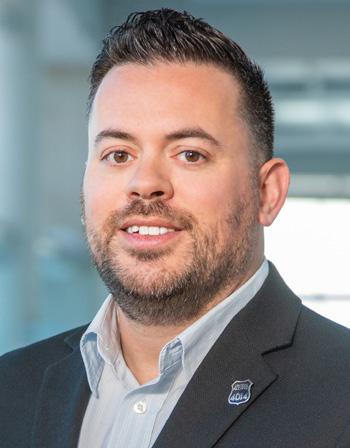
Company Headquarters Location: Omaha, NE
Number of Employees: 33,000+
Your Location (if different from above): Houston, TX
Who is your personal hero?
My Grandfather
What book(s) are you reading?
Blood Meridian by Cormac McCarthy; All Art is Propaganda by George Orwell
What was your first job?
After graduating from college, I started with Union Pacific and have been with the company ever since.
Favorite charity: Lifeway Church
Interests/Hobbies:
Photography, driving, guitar
Family: My wife’s name is Jenae and we have two boys, Stone and Grey.
75 www.womenworthwatching.com 2023 First Quarter
2 023 A W ARD INTERNATIONAL
Education (degrees & institutions):
M.P.A., University of Southern California; B.A., History, Chico State University
Company Name: Union Pacific Railroad
Industry: Transportation
Company CEO: Lance Fritz
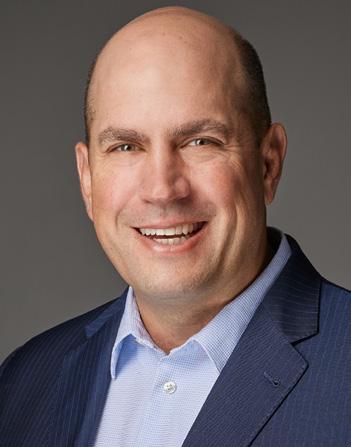
Company Headquarters Location: Omaha, NE
Number of Employees: 33,000+
Your Location (if different from above): Washington, D.C.
Words you live by: “Search for reasonableness and respect human dignity.”
– Chet Newland, USC Professor
Who is your personal hero?
My mom, Laura Lujan and grandmothers, Juanita Medina and Vivian Autry
What book(s) are you reading?
The Power of Discomfort by Vince Mini

What was your first job? Mowing lawns
Favorite charity: The Laura Lujan-Autry Scholarship Fund, Elk Grove Regional Scholarship Foundation
Interests/Hobbies: Spending time traveling with my family and chopping wood
Family: Wife of 19 years, son (12) and daughter (12), two cats, one dog, chickens and a tortoise
Wes Lujan Assistant Vice President, External Affairs
To Be Successful, You Have To Learn to Listen, and Find a Good Mentor
I am the proud product of a bi-cultural family. I stand on the shoulders of giants, women and men who immigrated to the United States of America looking for opportunity. I benefit from the sacrifices of my family across prior generations. I am fueled by the lessons I have learned from their hard work and powerful example.
I was raised in a family with diverse perspectives and my success leverages that perspective and teaches me to be open to all types of viewpoints and ideas across relationships. When I reflect on my career, I cannot overstate the value of being willing to be in every room and exhibiting a willingness to work with all types of people. The most effective way to achieve this is by learning how to be an active listener.
Listening and respecting diverse beliefs and opinions has helped me to succeed in a variety of professional roles across the country. I have worked in professional positions in Sacramento, Chicago, and Washington, D.C., and benefited from each. I have been enriched by living in urban and rural environments, working in boardrooms and local town halls, and learning from residential homes, state capitals and now the halls of Congress.
Seeking strong mentor relationships helped me achieve my goals by absorbing my mentors’ wisdom and growing my professional network from my mentors’ generous introductions. The old Chicago Aldermanic adage of “I don’t meet with nobody, nobody sent” is a principle to live by. Mentors guide and expose us to paths outside of our comfort zone. Learn from others’ successes, and you will get where you want to go more quickly.
Struggling with impulsive speaking has always been one of my greatest challenges professionally and personally. My recommendation before you speak in any setting is to ask yourself three questions:
1) Does it need to be said? 2) Does it need to be said by me?
3) Does it need to be said by me right now?
I am evidence that when you embrace the American Dream, it will embrace you back.
76 2023 First Quarter www.diversityjournal.com
2 023 A W ARD INTERNATIONAL
Daniela Zarza Director Mexico
A Mature Mexican Intermodal System Needs To Attract Young Diverse Talent
As I walk through the grocery store and identify products that have moved via intermodal from Mexico into the U.S., there is a special feeling knowing I’m part of the supply chain solution that moves a diverse set of goods in a fuel-efficient, cost-effective transportation mode.
I was attracted to the transportation industry since I was in college, and when I started my career 23 years ago, the Mexican intermodal industry was at an early development stage, with limited service options in a quest to participate in a mature U.S. domestic intermodal service, and mostly to penetrate the trucking market. Fast forward to today where there are multiple lanes, carriers, and services available, connecting Mexico, U.S. and Canada. It’s been a challenging and fulfilling journey to take part in the growth and evolution of the intermodal service between these three countries, and exciting to continue to be an advocate not only for the intermodal transportation, but also for the rail industry.
Since my first job, I’ve worked for international companies and have learned about cultural differences and the importance of embracing diversity. As a Latina, we’re known for our close relationships with our families, and I’ve been blessed to have my family’s unconditional support. They provided me with a bilingual education, and a boost of confidence, which has given me a competitive advantage in my career. I love what I do, and the best thing is that I get to do it in a company that acknowledges the value of doing business in Mexico, embraces diversity, recognizes our work and has invested in my development as a leader.
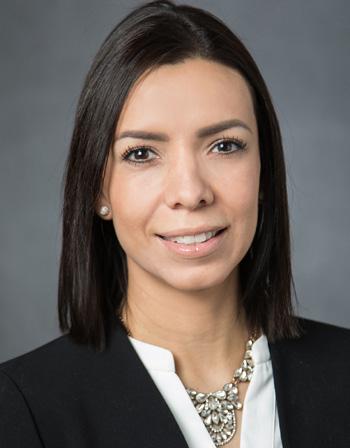
As globalization keeps creating new opportunities for businesses to expand internationally, it has also increased competition for jobs. While the Mexico intermodal market has come a long way, there’s still a lot of room for growth, and with it comes a dynamic load of work that requires a talented workforce to battle barriers. I feel a great responsibility to share my experience to develop and attract the leaders of tomorrow’s intermodal transportation industry, and I’m looking forward to embracing my role as a leader, and using it as a platform for advocacy and talent development.
Education (degrees & institutions): International Business, Universidad Intercontinental, Mexico City
Company Name: Union Pacific Railroad
Industry: Transportation
Company CEO: Lance Fritz
Company Headquarters Location: Omaha, NE
Number of Employees: 33,000+
Your Location (if different from above): Mexico City
Words you live by: Never ruin a good day by thinking about a bad yesterday

Who is your personal hero? My parents
What book(s) are you reading? The Architecture of Happiness by Alain de Botton
What was your first job? Commercial Assistant at a logistics company
Favorite charity: Fundacion Hogar Dulce Hogar
Interests/Hobbies: Traveling, photography, spending time with my family
Family: Mom, dad, aunt, sister, brother, four nieces, two nephews and two dogs
77 www.womenworthwatching.com 2023 First Quarter
2 023 A W ARD INTERNATIONAL
Education (degrees & institutions):
M.B.A., The University of North Carolina at Chapel Hill, Kenan-Flagler Business School; OPM, Harvard Business School, Executive Education Program; B.A. and M.P.H., Northeastern University
Company Name: Washington Capital Partners

Industry: Real Estate Financing
Company CEO: Daniel Huertas
Company Headquarters Location: McLean, VA
Number of Employees: 51
Words you live by: While I have gone through different words to live by at different times of my life, the consistent ones have been: Carpe Diem.
Who is your personal hero?
My grandfather
What book(s) are you reading?
Atomic Habits: An Easy and Proven Way to Build Good Habits & Break Bad Ones by James Clear
What was your first job?
I wrapped toys at a store during a busy Christmas season.
Favorite charity: The WCP Foundation
Interests/Hobbies: F1, yoga, and tennis
Family: Husband and two kids.
Giselle Bonzi President
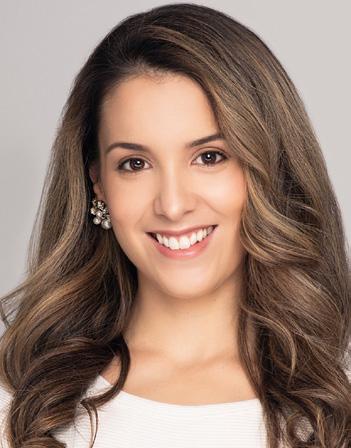
Others Remain Priorities
1. I strongly believe that mentorship is one of the best ways in which we can support the next generation of leaders. I wouldn’t be where I am today if it wasn’t for the mentorship I’ve had.
2. What ignites my professional passion is seeing how every real estate project we work on creates jobs, enables revival and redevelopment efforts, and increases our ability to give back through The WCP Foundation.
3. I take pride in my hard work, dedication, unwavering focus, intellectual curiosity, and drive to achieve professional success. I would not be where I am today without my supportive mentors.
4. Individuals and organizations have an opportunity to increase awareness and inclusivity in modern business practices; however, until unconscious bias is identified, it will be hard to affect change. Ensure that across-the-board policies, processes, procedures, and values do not allow for unconscious bias practices.
5. As an immigrant and coming from a close-knit and loving family, I had to learn to live away from them which now makes every reunion very intentional and especially meaningful to me.
6. Always trust your intuition.
7. I have always felt driven by the idea of achieving success, not because of superficial factors but because I see it as the culmination of a long intellectual journey and challenge that keeps me happy and alive. Whether it is business, a sport, or a hobby, what leads me to stay on a career or personal journey is the drive to see things getting done.
8. I predict there will be more emphasis on returning to the office again, but it won’t happen without a lot of opposition. While a lot of effort can be done to make things better virtually and make companies succeed at it from a productivity standpoint, I still don’t believe it can replace in-person interactions and the sense of culture and belonging it creates.
9. I believe businesses must be involved in community development as a core responsibility – not only financially but also ethically. Paying business taxes is not enough. As business leaders, it is our responsibility to leave our communities better than how we found them.
10. Kindness and compassion – I know these are two qualities, but they go hand in hand. For the longest time, I was told to remove those from business practices if I wanted to find success. However, I find that the essence of my success and legacy is rooted in these two.
11. While I am rational and analytical, I am also fascinated by all things esoteric.
12. I am a dreamer, and I hope there is more equality – namely, access to food, water, electricity, clothing, and shelter for everyone.

78 2023 First Quarter www.diversityjournal.com
2 023 A W ARD INTERNATIONAL
She is Driven, But Kindness, Compassion and Helping
Jason A. Soto Executive Vice President, Chief Credit Officer
To Achieve Your Vision, Take Time To Look at the Big Picture

In the end, I do not expect many people will remember my accomplishments, the titles I have held, or the presentations I have made. What I hope they will remember, however, is how I impacted them personally and professionally. The greatest compliment comes when someone tells me I have impacted their lives in a positive way, that I was understanding and supportive as they overcame personal challenges.
I have the example of my mother to guide me. She was just a teenager when she had my brother, but by the time I was nine, she had completed her GED, earned a bachelor’s degree and had been admitted to Harvard, where she earned a master’s and Ph.D. She provided the example, the motivation, and the perspective of what could be accomplished with hard work and dedication, regardless of where we started.
As my career developed, a senior executive at GE took an interest in me and mentored me. He often talked about what he called “the Great Pause,” taking a deliberate step back to patiently look at the bigger picture. I was intent on getting things done, as I had learned from my mother, which made that a hard lesson to learn. He really had to drill that into me over the years to get me to understand. Today, I teach that l as a critical skill when I mentor others. It has helped me be more strategic and forward thinking vs. reactionary.
I brought that lesson with me to Webster Bank, and as I connect with the people around me, I learn from them as I hope they learn from me. I try to give them flexibility to advance their career development and provide direct feedback when they need it. I remember how frustrated I felt sometimes by my mentor’s feedback because he was so direct, telling me things I did not want to hear. But it made me better. Even so, I tend to be a little less blunt.
I also rely on another mentor, Webster President and CEO John Ciulla, who once held the CCO post that I now hold. He has taught me how important it is to balance protecting Webster’s solid financial position with the needs of the customer. He’s also helped me be a better leader in times of turmoil, how to maintain a steady hand and guide my teams through authenticity and decisiveness.
One thing is clear, and that is the power of mentors, whether a boss, a peer, or a parent, and the impact they have had on my life, helping to shape the perspective and perseverance that my mother first taught me. I want to help others the same way others have helped me. I want to help them to see the big picture and motivate them toward making their vision a reality.
Education (degrees & institutions): B.A., Economics, Wesleyan University (Middletown, CT); Chartered Financial Analyst, CFA Institute
Company Name: Webster Bank
Industry: Banking
Company CEO: John Ciulla
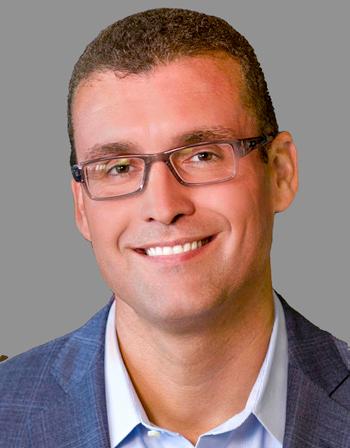
Company Headquarters Location: Stamford, CT
Number of Employees: 3,500+
Your Location (if different from above): Boston, MA
Words you live by: Family first, always; Treat others how you want to be treated; I work to live, I don’t live to work
Who is your personal hero? I have two. One is my mother who went on from a teenage pregnancy and failed marriage, to get her GED, her bachelor’s degree, and then her master’s degree and Ph.D. from Harvard University. The other is my mentor and good friend who is also originally from the Bronx and took me under his wing early in my career. He made me believe in my capabilities beyond what I would have thought was possible.
What book(s) are you reading?
Bodega Dreams by Ernesto Quinonez
What was your first job? I was a stock boy at a local grocery store. My first post-college job was with Prudential Insurance as part of a rotational development program.
Favorite charity: Families First – I am a board member for this organization. They do great work helping develop parenting skills in inner-city communities.
Interests/Hobbies: Die-hard Mets and Celtics fan. Exercise regularly, play squash and billiards. I love to ride motorcycles!
Family: Married 27 years to my highschool girlfriend. Three kids: 22, 19 and 15.
79 www.womenworthwatching.com 2023 First Quarter
2 023 A W ARD INTERNATIONAL
Education (degrees & institutions):
M.A., Human Resources, University of South Carolina; B.A., University of Georgia
Company Name:
West Pharmaceutical Services, Inc.
Industry: Manufacturing
Company CEO: Eric Green
Company Headquarters Location: Exton, PA
Number of Employees: 11,000
Words you live by: Don’t let perfection be the enemy of good
Who is your personal hero? My Mom. She taught me to never give up and how to love.
What book(s) are you reading? Team of Rivals: The Political Genius of Abraham Lincoln by Doris Kearns Goodwin
What was your first job?
Admin/receptionist for a photography shop while in high school
Favorite charity: Canine Partners for Life
Interests/hobbies: Gardening, reading and my dog, Chester
Family: Husband, Lee Favorite; daughter, Emily Favorite; son and daughter-in-law, Steven and Laura Favorite
Annette Favorite Chief Human Resources Officer
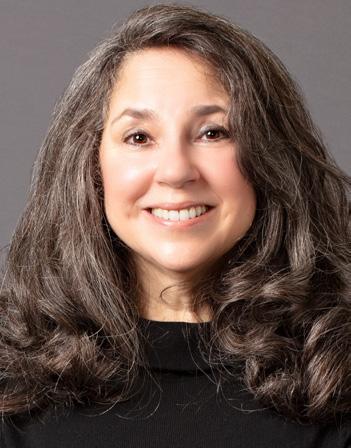
Instead of Blending In, Let’s Stand Out and Stand Up for Diversity

Growing up in August, Georgia in the 1960s, I was taught to blend in. Blend in was the mantra. As a result, I lost much of my culture. I was taught to only speak Spanish inside our home to avoid drawing attention that we were different. My father had no problem. He was light-skinned and spoke perfect English. When you met him, you never knew he was Puerto Rican. But my mother had a harder time blending in as she was olive-skinned with curly hair and a heavy Spanish accent, one that she never lost.
My first language was Spanish, but as I grew, I spoke more in English than in Spanish. In fact, my parents would speak to me in Spanish, and I would respond in English. I understood everything, but in speaking, my grammar was off and I would forget words. With time, I lost more and more and wish I had not.
Additionally, meals were a big part of my heritage growing up. My mom would serve my dad, then my brother, my sister, me and then herself.
As a child I longed for “American food” and now I miss the arroz con gandules, pernil or pasteles that my mother would make. I regret never learning how to make these delicious meals as there were no recipes. My mom just knew how to make them and I wish I had watched and lear ned from her. I fondly recall listening to the music and watching my parents dance the salsa and merengue.
Luckily for me, I did not lose everything that my culture brings. I learned the importance of family – the whole extended family – and how you take care of one another.
My hope for the world is that we stop trying to blend in. We can keep the beauty of our own culture that makes us unique and special. Being taught to blend in and lose parts of your/our culture is unfortunately too common for many people from marginalized ethnicities. It is important to celebrate and preserve our culture and heritage and pass it down to future generations.
Diversity is a strength, and it’s crucial to embrace and respect the differences and similarities among us. By valuing diversity, we can learn from each other and work together to create a more inclusive and equitable world. We know that diverse teams have better ideas, are more productive, know the global marketplace better and are able to drive innovation. It’s essential to recognize and challenge systemic inequalities and work towards creating a more just and fair society.
I believe that through acceptance and appreciation of our differences and similarities, we make this world a better place.
80 2023 First Quarter www.diversityjournal.com
2 023 A W ARD INTERNATIONAL
Elvira Cortez Senior associate
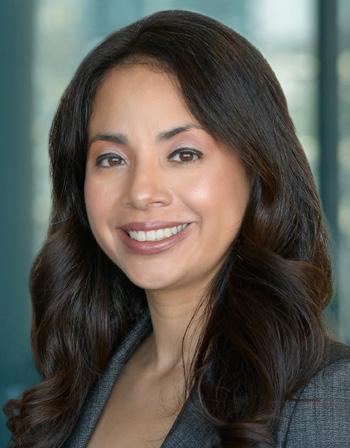
Building the Next Generation of Latino Leaders Requires Mentors, Advocates and Supporters
As I look back on the challenges I’ve overcome and the path I’ve traversed, I know my successes have not been achieved alone. There are many Latina and Latino professionals who worked just as hard and were not successful. I firmly believe my successes have hinged on the guidance of my mentors, the vocalizations of advocates and the camaraderie of supporters. All three have been integral, allowing me to have the insight, recognition, and solace to succeed in a demanding profession. The next generation of Latino business leaders also need these valuable resources to succeed.
Mentors serve as important counselors and are key in elevating rising professionals — not only by providing valuable advice on achieving professional growth and acquiring needed skills, but by also acting as role models for up and comers.
In their role, advocates shine a spotlight on the accomplishments of others. As a Latina, I grew up with the belief that all I had to do was work hard and others would simply take notice of my achievements. But I’ve since seen, many times, that the accomplishments of Latino professionals go unnoticed while the work of others are routinely praised. And so, I’ve come to learn the importance of having advocates in my corner to highlight our accomplishments.
While mentors and advocates play equally important roles, one should not overlook the value of peers who may serve to provide a safe space and valuable support during trying times. Since embarking on my career, I have developed my own network of colleagues who frequently get together to discuss important issues in our respective professions. I also have a group of longtime, and incredible, friends who continue to serve as an important source of support to overcome adversity and who also celebrate my accomplishments. These supporters can be anyone who is willing to listen and provide the needed support to pursue one’s goals.
As I imagine the faces of our future business leaders, I wonder about the Latinas and Latinos of the next generation. I wonder whether the apparent backsliding of support for diversity, equity and inclusion in the United States means the representation of Latino business leaders has reached its zenith. I’m hopeful it has not. However, on that note, I believe the roles of mentors, advocates and supporters will be even more essential for our young Latinas and Latinos.
So, I ask you, the reader, what will you do to help our future leaders? Will you serve as a mentor, a beacon of guidance and professional advice? Will you serve as an advocate, a vocal spotlight that highlights the talents of others ignored by unconscious bias? Will you be a confidant, a welcoming ear, like a warm cup of tea, who simply listens with compassion? If we all contribute, no matter how small, we can ensure that the next generation of Latino leaders have the support they need to succeed. In this way we can ensure that our future business leaders continue to be talented Latinas and Latinos who reflect the beautiful diversity of our communities.
Education (degrees & institutions): J.D., American University Washington College of Law; B.A., University of California, Los Angeles
Company Name: Wilson Turner Kosmo LLP


Industry: Legal
Company CEO: Carolina Bravo-Karimi
Company Headquarters Location: San Diego, CA
Number of Employees: 90+
Words you live by: “There is only one thing that makes a dream impossible to achieve: the fear of failure.”
– Paulo Coelho
Who is your personal hero?
My mother, Elvira Cortez
What book(s) are you reading?
Mexican Gothic by Silvia Moreno-Garcia
What was your first job? Working at the local flea market with my family.
Favorite charity: Save the Music Foundation and EveryoneOn
Interests/Hobbies: Traveling the world with my husband and children, cooking, and visiting national parks.
Family: Husband, Rafael, 6, and Sofia, 3
81 www.womenworthwatching.com 2023 First Quarter
2 023 A W ARD INTERNATIONAL
Education (degrees & institutions):
B.S., Business Administration, University of Central Florida
Company Name: Withum

Industry: Professional services
Company CEO: Patrick Walsh
Company Headquarters Location: Princeton, New Jersey
Number of Employees: 2,000
Your Location (if different from above): Orlando, FL
Words you live by:
“What did I learn today?”
Who is your personal hero? My parents
What book(s) are you reading?
Atomic Habits by James Clear
What was your first job?
Local gift shop worker
Favorite charity: NAMI, the National Alliance on Mental Illness
Interests/Hobbies: Martial arts
(Jiu Jistu, Muay Thai), photography, chess, traveling
Family: Father of 2 wonderful babies; Amelia, 8 and Luca, 2
Moises Gutierrez Audit supervisor
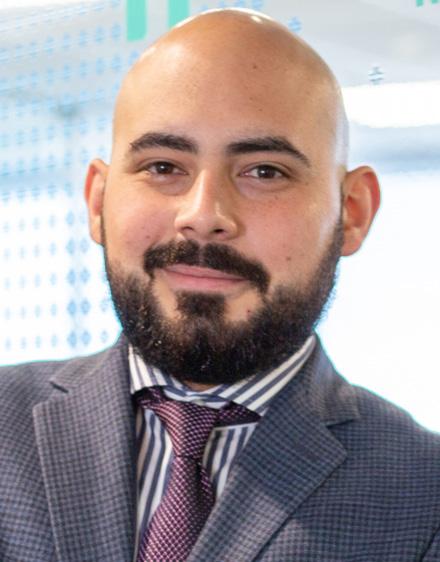
Feeling Like an Outsider Sometimes but Working Hard to Bring Everyone Inside
As a Hispanic male working in a predominantly white-collar industry, it’s easy to feel like an outsider at times. However, during a recent conversation with a Hispanic partner who paved his way in accounting during the 1970s, I was reminded of the importance of embracing and using our cultural differences to our advantage.

The partner shared stories of how he faced discrimination and prejudice in the workplace but refused to let it hinder his success. Instead, he created his own lane by working hard and showing that he was just as capable as anyone else in the field. He also made it a point to be a cultural ambassador within the firm, educating his colleagues on Hispanic culture and showing them the value that diversity brings to the table.
Hearing his story ignited my passion to continue being a cultural ambassador in my own way. As a Hispanic male, I realized that I have a unique perspective and experiences that can add value to any team. By embracing my heritage and sharing it with others, I can help to break down cultural barriers and promote inclusivity in the workplace.
This conversation reminded me that we all have the power to pave our own way and make a difference in our respective fields. By embracing our differences and using them to our advantage, we can achieve success and create a more accepting and diverse world.
82 2023 First Quarter www.diversityjournal.com
2 023 A W ARD INTERNATIONAL
“
By embracing our differences and using them to our advantage, we can achieve success and create a more accepting and diverse world. ”
Gabino Martinez Regional Operations Manager

Be a Winner but Also Strive To Help Others
I was born and raised in Puerto Rico and come from a large family of seven siblings. I remember at the age of 6, my elementary school hosted an annual fundraising event selling chocolate bars. Each kid was tasked with selling a box of 30 chocolate bars at a minimum, but if you sold more, you had a chance to win the grand prize: a Mickey Mouse calculator. My dad suggested I bring my box to his business and sell the chocolate bars outside on the sidewalk. I offered them to everyone that passed and sold out the first weekend! I was happy because I met the minimum requirement. My dad thought I should be more ambitious: “Great job, son, now go back to school and ask for another box of chocolate bars.” After I asked why, he told me because I could be the top salesman. So, I went back to school for another box, and then another, until I ended up selling six boxes, earning the grand prize. I didn’t know that experience would teach me life lessons. I learned how to overcome obstacles, exceed expectations, always strive for more and have a winner mentality.
The people I work with ignite my professional passion. It is great to work for an organization and leaders that really care and encourage you every day to reach your full potential. Today’s leaders can support the next generation of Latino business leaders by fostering a culture of inclusion and belonging. Establishing an employee resource group (ERG) is a great start. ERGs give the employees the opportunity to be heard and valued by their colleagues and leaders, provide professional development opportunities and relevant information like cultural awareness. It is important for leaders to identify the next generation of business leaders using succession planning, mentoring and leadership training.
I have worked hard to get to where I am today as a leader in my organization. Acting as a servant leader has been essential to my leadership success. I have a passion for elevating Hispanics and Latinos/Latinas in the workplace. I pay it forward by helping others grow through education, advice, and sharing my experiences. I also aim to make a difference outside of my workplace. I am currently helping four young Nicaraguans navigate through college, offering financial support and mentorship. My wife is from Nicaragua, and I felt a calling and desire to leave the world better than how I found it for the next generation of Hispanics.
Education (degrees & institutions): B.A., Management with minors in Economics and International Business, Purdue University
Company Name: World Electric
Industry: Distribution

Company CEO: Phillipe Delpech
Company Headquarters Location: Jacksonville, FL
Number of Employees: 430
Your Location (if different from above): Miami, Florida
Words you live by: “Querer es Poder.” “Where there’s a will, there’s a way.”
Who is your personal hero? My parents
What book(s) are you reading?
Extreme Ownership by Jocko Willink and Leif Babin
What was your first job? When I was 12, I was the janitor for my dad’s business earning $2/day
Favorite charity: Feeding America
Interests/Hobbies: Traveling and spending time with my family
Family: Wife and two sons
83 www.womenworthwatching.com 2023 First Quarter
2 023 A W ARD INTERNATIONAL

84 2023 First Quarter www.diversityjournal.com Advanced Micro Devices……………………...........................................................................………………….......……..45 Akin Gump……………………………………………………………………………….....….........................................……..44 Ally Financial………………………………………………………………………………………....…..Inside Front Cover, 24 America Baez and Associates…………………………………………………………………….....….............………………..46 AT&T……………………………………………………………………………….....……………………………………………..47 BDO USA, LLP……………………………………………………………………………….....……………………...........……..48 Bowman and Brooke LLP……………………………………………………………………….....…....................……………..25 Clarify Health Solutions………………………………………………………………………….....….......................…………..49 Comcast Cable…………………………………………………………………………………….....….....................................50 Davis Wright Tremaine LLP…………………………………………………………………………...........………………..8, 51 Dechert LLP……………………………………………..……………………………………………..................................5, 26 DiCello Levitt LLC………………………………………………………………………………….....…...............................…..52 Eaton…………………………………………………………………………………….....….....................................................34 ECODiversity Strategies, LLC…………………………………………………………………….....….............………………..53 Eli Lilly and Company………………………………………………………………….....…...................…………………..27, 54 Epiq Global………………………………………………………………………….....…........................................…………..55 FordHarrison LLP…………………………………………………………………………………….....…..................................56 Freddie Mac………………………………………………………………………………………...........................…..4, 57, 58 HARMAN………………………………………………………………………………….....…............................................…..59 Heartbeat………………………………………………………………………………….....………………………………....…..60 Kasowitz Benson Torres LLP…………………………………………………………….....…...............………………………..62 Knobbe Martens………………………………………………………………………………….....….................................…..63 Latham & Watkins LLP……………………………………………………………………….....…..................……………..28, 64 Marta Ronquillo Newhart………………………………………………………………….....…....................…………………..61 Moss Adams……………………………………………..……………………………………….....….......................................65 Nelson Mullins Riley & Scarborough……………………………………………………………….....…..……………………..66 New American Funding……………………………………………………………….....…................……………………..29, 67 New York Life…………………………………………………………………………………........………..30, 68, Back Cover Norton Rose Fullbright LLP……………………………………………………………….....…..........……………………..31, 69 Oracle……………………………………………………………………………….....….................................................……..20 Robins Kaplan LLP……………………………………………………………………….....…..............................……………..70 Rohini Anand LLC…………………………………………………………………….....…...............................………………..16 Sanford Heisler Sharp, LLP………………………………………………………………….....….................…………………..71 Saxena White P.A. …………………………………………………………………………….....….............................………..72 The Global DEI Engineer………………………………………………………………………….....…....................…………..36 Travelers………………………………………………………………………….......................................………………..6, 73 Ulmer & Berne LLP…………………………………………………………………………………….....….........................32, 74 Union Pacific Railroad……………………………………………………………………………….....….............……..75, 76, 77 Washington Capital Partners………………………………………………………………………………….....…..............…..78 Webster Bank………………………………………………………………………………..............................…………..3, 79 West Pharmaceutical Services, Inc. ………………………………………………………………………………………..9, 80 WilmerHale………………………………………………………………………………….....…........................................…..33 Wilson Turner Kosmo………………………………………………………………………….....….........................…………..81 Withum……………………………………………………………………………….....…..............................................……..82 World Electric (Sonepar)……………………………………………..……………………………………………..............7, 83 BOLD DENOTES ADVERTISER BLUE PAGE NUMBER OF AD
CORPORATE INDEX
Showcase your organizations leaders with our upcoming awards
At Profiles in Diversity Journal ®, we've decided to open nominations for all of our remaining awards for the year. Hopefully this additonal time will make it easier for you to go through the nomination process in your organization. We truly appreciate your continued support in our quest for creating truly diverse and inclusive workplaces throughout the U.S. and the rest of the world. Please take this opportunity to showcase deserving candidates, as well as your organization, with our awards below.
Download nomination forms today!
Magazine Issue - Q3 2023 2 023 A W ARD Women Wor th Watching® in Leadership INTERNATIONAL Nominate Today! Nominate Today! 2 023 A W ARD NATIVE AMERICAN INDIGENOUS LEADERSHIP Nominate Today! Magazine Issue - Q4 2023 2 023 A W ARD INTERNATIONAL Nominate Today! 2 023 A W ARD DIVERSE L AW YERS Making a Difference INTERNATIONAL Nominate Today! 2 023 A W ARD Innovations in Diversity INTERNATIONAL Nominate Today! Magazine Issue - Q2 2023 2 023 A W ARD ASIAN INTERNATIONAL Nominate Today! 2 023 A W ARD Women Wor th Watching® in STEM INTERNATIONAL Nominate Today!

Our diversity of experiences makes for the best, most innovative teams. New York Life is proud of our richly diverse culture built on a foundation of inclusion. To learn more about our commitment, visit: newyorklife.com/diversity © 2022 New York Life Insurance Company, 51 Madison Avenue, New York, NY New York Life is an Equal Opportunity Employer – M/F/Veteran/Disability/Sexual Orientation/Gender Identity TM
