Diplomat c
A Business, Diplomacy & Foreign Policy Publication
MAY – JUNE 2019 • $7.95
The Premier Ambassador Magazine
BUSINESS • POLITICS • TRAVEL • ENTERTAINMENT • CONGRESS • MILITARY & DEFENSE
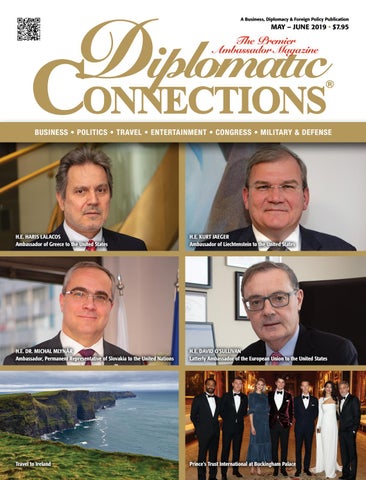
H.E. HARIS LALACOS Ambassador of Greece to the United States
H.E. KURT JAEGER Ambassador of Liechtenstein to the United States
H.E. DR. MICHAL MLYNÁR Ambassador, Permanent Representative of Slovakia to the United Nations
H.E. DAVID O'SULLIVAN Latterly Ambassador of the European Union to the United States
Travel to Ireland
Prince's Trust International at Buckingham Palace
A VEHICLE PERFECTLY SUITED TO YOU. Whether driving on official business or for pleasure, MINI gives you more. Like the MINI Countryman with it’s legendary go-cart performance, available ALL4 all-wheel drive, and comfortable seating for five plus generous cargo space. With over 10 million possible combinations, there’s a MINI model to match your distinct status and driving style. And with special diplomatic incentives, a MINI is even more attainable than ever. The MINI Diplomatic Sales Program is available to foreign diplomats stationed in the U.S., returning U.S. diplomats and staff, and qualified members of international organizations. For program details, please contact your local MINI Dealer.
THE MINI DIPLOMATIC SALES PROGRAM.
© 2019 MINI USA, a division of BMW of North America, LLC. The MINI name, model names and logo are registered trademarks.
Stay Exquisite Boasting flawless service and an impeccable location, The St. Regis Washington, D.C. has been the premier choice for royalty, heads of state, diplomats and discerning travelers for over 90 years. With refined accommodations, locally inspired dining including the hotel’s acclaimed Sunday Brunch and live Jazz Series, The St. Regis Washington, D.C. embodies timeless spirit in a modern locale.
Š2017 Marriott International, Inc. All Rights Reserved. Preferred Guest, SPG, St. Regis and their logos are the trademarks of Marriott International, Inc., or its affiliates.
The St. Regis Washington, D.C. 923 16th and K Streets, N.W., Washington, District of Columbia 20006 United States stregiswashingtondc.com
Stay exquisite at more than 60 St. Regis hotels and resorts worldwide. @stregishotels
THE QUINTESSENTIAL
New York Stay
The Benjamin Hotel, a New York City Landmark, exudes the ambiance of a Private Club. Originally designed as a residentially-styled, Neo-Romanesque building, The Benjamin was recently re-imagined by famed interior designer Lauren Rottet, and the guest rooms restyled in partnership with acclaimed Sleep Expert in Residence, Dr. Rebecca Robbins. Steps from the United Nations, we invite you to experience The Benjamin. Newsweek – “...making sure guests get a good night’s sleep.”
Sleep program by famed Dr. Rebecca Robbins • Tranquil Day Spa by Sanatio • The National Bar & Dining Rooms by Celebrity Chef Geoffrey Zakarian
125 E A S T 50 T H S T R E E T • N E W Y O R K , N Y 10022 • 866.222.2365 • W W W.T H E B E N J A M I N .C O M
CUSTOMIZE YOUR OWN FOUNDATION FROM 8000 SKIN TONES. BLENDED FOR YOU AT THE LANCÔME COUNTER.
Choose your color, coverage and hydration level.
Ampeer Residences offers fully furnished residences with flexible accommodation terms, from 30 days to 12 months. Perfectly situated in the heart of Historical Dupont Circle, you are steps away from the best that Washington has to offer. Beautifully appointed social spaces are available exclusively to our residents and their guests. Enjoy breakfast in our Social Kitchen and evening hors d’oeuvres in our Grand Ballroom with cocktails crafted by our inhouse Mixologist.
The InterContinental New York Barclay
Where 20th Century Luxury meets 21st Century Intelligence.
Settled in the heart of Manhattan’s most powerful and prestigious district, the newly renovated InterContinental New York Barclay combines sophistication, contemporary design, and long-standing history to create a distinctive modern escape in New York City.
Please visit intercontinentalnybarclay.com
Ana Nistor Director of Specialty Markets and Diplomatic Sales +1 917-940-0323 • ana.nistor@ihg.com Greg Murphy Assistant Director of Specialty Markets +1 917-254-2913 • greg.murphy@ihg.com
A HOME FOR EVERY STYLE
THE RESIDENCES AT EASTERN MARKET
LiveAtEasternMarket.com 888.844.2880 Capitol Hill
CATHEDRAL COMMONS
THE WOODLEY
CathedralCommons.com 888.716.2876 Cleveland Park/Cathedral Heights
TheWoodleyDC.com 888.694.4941 Woodley Park
Exquisite apartment residences throughout Washington, D.C. that will captivate and fulfill your every desire.
RESIDENCES ON THE AVENUE
ResidencesOnTheAvenue.com 888.606.0349 Foggy Bottom
Diplomatic
From the Publisher Dear International Reader:
Diplomatic Connections is a "feature article" magazine and this issue is packed with four ambassadors in some very engaging conversations! We begin with Greek Ambassador Lalacos giving insights on Greece's departure from financial crisis, including a discussion about the effectiveness of the bailout strategies used by the EU. Read about what he says the future may hold for Greece's overall stability as the country repays loans and faces tensions with Turkey over the Treaty of Lausanne. He also weighs in on the refugee situation in Greece and the country's tendency "to be the preferred gates of entrance for undocumented refugees.” Liechtenstein has an incredibly interesting history and our interview with Ambassador Jaeger takes you through the country’s journey, especially from the last three decades to modern days. He addresses both the benefits and the disadvantages of being a small nation. They are a member of the European Economic Area (EEA), but not the European Union. Although, when it comes to the single market, abiding by “all rules, regulations and legislation as they relate to products and services” of the EU is a must while not being a part of the political or trade unions. Plus, Jaeger speaks to topics related to the FinTech industry including blockchain technology. Slovakian Permanent Representative Mlynar explains about the significant role his country has played in the history of the UN including in present times. Prior to 1993 before the split of Czechoslovakia, they were one of the valued “founding members of the United Nations.” Furthermore, he states that they have well-established roots that date back as far as “the drafting of the United Nations Charter itself.” Peacekeeping operations are critical worldwide and Slovakia is one of the leading contributors from the EU states with missions in Cyprus, Africa, the Balkans, East Timor and Afghanistan, to name a few. Ambassador David O'Sullivan looks back on his four years in Washington and speaks with us about his greatest successes, and also regrets, as the Head of the EU Delegation. He discusses the ongoing tariff issues between the EU and the U.S. and how he has worked to resolve them during his time in D.C. Additionally, O’Sullivan takes time to emphasize the importance of communication and unity between all 28 European Union states that he represents, and mentions some of the negative effects that may take place if no Brexit settlement is reached. Travel to Ireland with Diplomatic Connections and discover all that the country has to offer. Traverse the majestic countryside via your imagination while reading about the renowned castles, cliffs and craic that bring joy to residents and tourists alike all year round. Go to page 70 to marvel in some of the fantastic adventures and beautiful scenery to be found in the Emerald Isle. Diplomatic Connections wishes to formally thank Sara Malloy, Director of Sales, and Jessica Dankos, Director of Event Planning, of the iconic and historical Mayflower hotel located in the heart of Washington, D.C., for co-hosting our semi-annual International Diplomat Appreciation Reception in February. Should you have a potential interest in holding your national day event or any delegation meetings at this distinguished and highly-acclaimed property that is a hallmark of our nation’s capital, feel at liberty to contact me directly and I will personally facilitate a proper introduction. TM
If you would like to have our travel journalist visit your country to have a tourism article featured in a future magazine, send an email to: DParker@DiplomaticConnections.com Our next Diplomatic Connections’ International Diplomat Appreciation Reception will be held at the InterContinental Times Square in New York on May 2nd. Looking forward to seeing you there! TM
Warmest regards, Dawn Parker - DParker@DiplomaticConnections.com Publisher D I P L O M AT I C C O N N E C T I O N S B U S I N E S S E D I T I O N | M AY - J U N E
2019
7
THE
SAVE DATE May 2, 2019 INTERCONTINENTAL TIMES SQUARE New York
DIPLOMATIC CONNECTIONS WEBSITE DESIGN & DEVELOPMENT IMS (Inquiry Management Systems) 304 Park Avenue South, 11th Floor New York, NY 10010 Marc Highbloom, Vice President marc@ims.ca Maria D’Urso, Project Manager Mariad@ims.ca
Washington, D.C.
CONTRIBUTING PHOTOGRAPHY Christophe Avril, Paula Morrison Monica and John Frim
2019
To contact an advertising executive
LOOK FOR OUR INTERNATIONAL DIPLOMAT APPRECIATION RECEPTION in your city.
TM
WWW.DIPLOMATICCONNECTIONS.COM
W W W. D I P L O M AT I C C O N N E C T I O N S . C O M
DIRECTOR OF BUSINESS DEVELOPMENT Evan Strianese
DIPLOMATIC CORRESPONDENTS and CONTRIBUTING WRITERS Roland Flamini, James Winship, PhD, Michael D. Mosettig and Monica Frim
October 24, 2019 CONRAD
8
ASSISTANT JUNIOR EDITOR Annabelle Spezia-Lindner
DESIGN & CREATIVE Larry Smith Design
Chicago
info@DiplomaticConnections.com
EDITOR-IN-CHIEF Dawn Parker
JUNIOR ACCOUNT EXECUTIVES Peter Han, Zhichao Lyu, Yan Tang
October 3, 2019 THE PENINSULA
If your embassy, mission or consulate would like to host our next venue for the Diplomatic Connections International Diplomat Appreciation ReceptionTM please email us at:
Diplomatic
CALL: 202.536.4810 EMAIL: info@diplomaticconnections.com To order photos from the events go to: www.diplomaticconnections.com Send any name or address changes in writing to: Diplomatic Connections 4410 Massachusetts Avenue / #200 Washington, DC 20016 Diplomatic Connections Business Edition is published bi-monthly. Diplomatic Connections does not endorse any of the goods or services offered herein this publication. Copyright 2019 by Diplomatic Connections All rights reserved. Cover photo credits: Ambassador of Greece to the United States, Haris Lalacos, Christophe Avril/Diplomatic Connections; Ambassador of Liechtenstein to the United States, Kurt Jaeger, Christophe Avril/Diplomatic Connections; Buckingham Palace, Amal and George Clooney, Chris JacksonWPA/Getty Images; Ambassador of Slovakia to the United Nations in New York, Dr. Michal Mlynar, Christophe Avril/Diplomatic Connections; Latterly Ambassador of the European Union to the United States, Christophe Avril/ Diplomatic Connections; Ireland, Dr. John Frim/Diplomatic Connections
A DIFFERENT WAY TO STAY At Kimpton, it’s personal. Your stay starts with the most genuine of smiles and ends with a promise to “see you next time.” Because to us, it’s all about making your experience memorable. Discover a different way to stay with our 12 uniquely styled boutique hotels in Washington, DC, Alexandria, VA, and Baltimore, MD. We’ll be waiting for you. Kimpton Mason & Rook Hotel Kimpton Hotel Monaco Washington D.C. Kimpton George Hotel Kimpton Hotel Palomar Washington D.C. Kimpton Carlyle Hotel Dupont Circle Kimpton Donovan Hotel Kimpton Glover Park Hotel Kimpton Hotel Madera Kimpton Rouge Hotel Kimpton Topaz Hotel Kimpton Hotel Monaco Baltimore Kimpton Lorien Hotel & Spa
1 (800) KIMPTON KimptonHotels.com/CapitalRegion
D I P L O M AT I C C O N N E C T I O N S B U S I N E S S E D I T I O N | M AY - J U N E
2019
9
Diplomatic
D I P L O M AT I C C O N N E C T I O N S BUSINESS EDITION
M AY – J U N E 2 0 1 9
H.E. HARIS LALACOS AMBASSADOR OF GREECE TO THE UNITED STATES
H.E. KURT JAEGER AMBASSADOR OF LIECHTENSTEIN TO THE UNITED STATES
H.E. DR. MICHAL MLYNÁR AMBASSADOR, PERMANENT REPRESENTATIVE OF SLOVAKIA TO THE UNITED NATIONS
H.E. DAVID O'SULLIVAN LATTERLY AMBASSADOR OF THE EUROPEAN UNION TO THE UNITED STATES
TRAVEL TO IRELAND
PRINCE'S TRUST INTERNATIONAL AT BUCKINGHAM PALACE
ACCESSORIES AND LUXURY ITEMS Furla . . . . . . . . . . . INSIDE BACK COVER APARTMENTS, CONDOMINIUMS and HOUSING AMPEER DUPONT CIRCLE Luxury Residences . . . . . . . . . . . . . . . 4 [The] Beekman Tower . . . . . . . . . . . . .48 Bozzuto – Cathedral Commons . . . . . . . . . 6 Bozzuto – Residences on The Avenue . . . . . . 6 Bozzuto – The Residences at Eastern Market . . 6 Bozzuto – The Woodley . . . . . . . . . . . . 6 AUTOMOTIVE - CARS and LIMOUSINE SERVICES Admiral Leasing . . . . . . . . . . . . . . . .22 BMW Corporate . . . . . . . . . . BACK COVER BMW of Rockville . . . . . . . . . . . . . . .94 MINI Corporate . . . . . INSIDE FRONT COVER COMMUNICATIONS/TECHNOLOGY E-TEL now Comstar Technologies . . . . . . .52 EDUCATION – INDEPENDENT SCHOOLS The Hun School of Princeton . . . . . . . . . .84 HEALTH & BEAUTY UNILEVER Suave Men . . . . . . . . . . . . .91 HOSPITALS & MEDICAL CARE Cleveland Clinic . . . . . . . . . . . . . 85 & 86 HOTELS, DINING and ACCOMMODATIONS aka . . . . . . . . . . . . . . . . . . . . . .37 The Concordia Hotel . . . . . . . . . . . 68 & 69 [The] Benjamin Hotel New York . . . . . . . . . 2 [The] Dupont Circle Hotel Doyle Collection, Washington, D.C. . . . . . . . . . . . . . . .11 EVEN Hotels . . . . . . . . . . . . . . . . . .90 [The] Fairfax at Embassy Row . . . . . . . . .23 Fairmont Washington, D.C. – Georgetown . . . 88 Hilton Washington, D.C. National Mall . . . . . . 9 InterContinental Cleveland Clinic . . . . . . . .86
TO CONTACT AN ADVERTISING EXECUTIVE
CALL: 202.536.4810 EMAIL: info@diplomaticconnections.com 10
W W W. D I P L O M AT I C C O N N E C T I O N S . C O M
InterContinental New York Barclay . . . . . . . 5 Kimpton Hotels & Restaurants . . . . . . . . . 9 [The] LINE DC . . . . . . . . . . . . . . . . .49 Lotte New York Palace . . . . . . . . . . . . .92 St. Regis Washington, D.C. . . . . . . . . . . . 1 The Mayflower Hotel . . . . . . . . . . 58 & 67 The Peninsula Chicago . . . . . . . . . 36 & 96 The Ritz-Carlton Pentagon City . . . . . . . . 95 LIMOUSINES Presidential Luxury Limousines . . . . . . . . 92
FEAT URED ARTIC L ES AMBASSADORS to the UNITED STATES in Washington, D.C. EUROPEAN UNION Latterly Ambassador David O’Sullivan . . . . . . . . . . . 50 GREECE Ambassador Haris Lalacos . . . . . 12 LIECHTENSTEIN Ambassador Kurt Jaeger . . . . . . 24 AMBASSADOR to the UNITED NATIONS in New York SLOVAKIA Ambassador Dr. Michal Mlynar
. . 38
DIPLOMATIC CONNECTIONS INTERNATIONAL DIPLOMAT APPRECIATION RECEPTION . . . 58 - 67 ROYALS in the news . . . . . . . . . . . . . 82 TRAVEL Ireland . . . . . . . . . . . . . . . 70
A glamorous setting for slow sips, light bites and warm conversation. W doyle.bar E hello@doyle.bar | T +1 202 448 4301 1500 New Hampshire Avenue, Washington, DC 20036
Once Called the Sick Man of Europe, An Interview with Greek Ambassador Haris Lalacos Roland Flamini
In August 2018, Greek Prime Minister Alexis Tsipras announced an 11 percent increase in the country’s minimum wage. This increase signaled the end of almost a decade of being on a financial life support based on draconian austerity conditions imposed by the lenders - mainly the euro zone and the International Monetary Fund. Greece was the hardest hit EU member by the sovereign debt crisis of 2008: the Greek economy was on the verge of collapse, causing lenders to step in with a total of $330 billion in three bailouts to keep the Mediterranean country afloat. In a recent interview with Diplomatic Connections, Greece’s Ambassador Haris Lalacos, said the EU’s strategy focused exclusively on austerity without growth and left a deep residual bitterness in Greece. “We needed the right mixture of both, and we got only one,” he said. Much of the bitterness was directed at Germany, the main lender, especially German Chancellor Angela Merkel and her determined insistence on an austerity strategy. But in January, when Merkel visited Athens for a kind of victory lap 12
W W W. D I P L O M AT I C C O N N E C T I O N S . C O M
at the success of the bailout, the Greeks gave her a warm welcome. By 2018, Greece was off the euro life support; its economy had returned to growth, and was on the upturn, in the short and medium term. To finance its debt, Athens was running a budget surplus, as its lenders require through 2060. Unemployment has fallen to 20 percent, but is still among the EU’s highest. The ambassador also discussed tensions between Greece and fellow NATO member Turkey, based in part on an almost 100-year old treaty, signed in Lausanne, Switzerland in 1923 to establish borders between the two countries and elsewhere in the Middle Eastern region following World War I. Turkish President Recep Tayyip Erdogan has called for a revision of the Treaty of Lausanne, but Ambassador Lalacos said Erdogan’s request was a non-starter.
H.E. HARIS LALACOS Ambassador of Greece to the United States
D I P L O M AT I C C O N N E C T I O N S B U S I N E S S E D I T I O N | M AY - J U N E
2019
13
Diplomatic Connections: Mr. Ambassador, you are no stranger to the United States. You graduated from Amherst, and then from the School of Advanced International Studies at Johns Hopkins University (SAIS). How did that come about?
Diplomatic Connections: How has working in Washington as a diplomat changed during that time? Or, to put it another way, what advice would you give to a newly arrived ambassador from another country if he or she asked you, “What’s it like?”
Ambassador Lalacos: In Greece, I went to a Greek-American school, Athens College, which actually helps interested students who want to further their education at colleges in the United States. I wanted to see if I could get a scholarship to study in the U.S. I was fascinated by the idea of moving across the Atlantic for college and seeing something that I hadn’t seen before. I managed to get a scholarship, and one that was very generous.
Ambassador Lalacos: I think what’s peculiar in Washington as a capital is the fact the foreign diplomats may find it confusing at first, but they will also see that they can open many doors. Not all doors open easily, but persistence offers access to those who continue to try. Overall, it’s a much more complicated capital than most of the other capitals where I have previously worked because you have many different centers of power and interest. Yet, it is possible, if you also have the right staff, to understand what’s happening and to educate all the relevant people of the greater government of the United States about your country and about common interests. That’s what we are trying to do, and I don’t think that this has changed very much since the last time I was here. The change that I see in Washington has to do more with the city itself, not the diplomatic life. Washington is becoming more of a diverse city.
Ambassador Lalacos: Straight to SAIS, where I followed a two-year program in international relations. The first year I chose to spend at the SAIS campus in Bologna, Italy, and the second year here in Washington. I graduated in 1983 with a major in Latin American studies. Ironically, in my more than 30 years in the foreign service of Greece, I have never served in a Latin American country, or at the Latin American directorate in the ministry of foreign affairs. Diplomatic Connections: Isn’t that typical in a bureaucracy? Ambassador Lalacos: It happens, but I’ve had many interesting assignments. Diplomatic Connections: Which has included a previous embassy posting in Washington? Ambassador Lalacos: Yes, I was political counsellor at the Embassy of Greece from 2000 to 2004. A statue featuring the ancient greek philosopher Socrates faces the headquarters of the Bank of Greece, in Athens. After years of tough austerity measures, Greece emerged on August 20, 2018 from its third and last bailout. The European Union, the European Central Bank and the International Monetary Fund loaned Greece a total of 289 billion euros ($330 billion) in three successive programs in 2010, 2012 and 2015.
14
W W W. D I P L O M AT I C C O N N E C T I O N S . C O M
Diplomatic Connections: How would you characterize the bilateral relationship with the United States? Ambassador Lalacos: The bilateral relationship is at the best possible point since after World War II. This became apparent with the first ever Strategic Dialogue between the two countries, conducted in Washington on December 13, 2018, at the level Secretary of State/Minister of Foreign Affairs. The U.S. fully appreciates the stabilization of initiatives by Greece in the Eastern Mediterranean and the Balkans, in particular our strong cooperation with key countries like Israel and Egypt, as well as the Prespa Agreement, which resolved a long-standing agreement with our neighbor, the Republic of North Macedonia. [Prespa ended a long dispute between Greece and its northern neighbor over calling itself Macedonia, in part because there’s already a Greek province called Macedonia, and also for historical reasons.] It was a tall order for us and for the United States to bring the relationship higher than where it was because the two countries have always been friends and allies. However, in the past decades, the relationship was enhanced, it became wider, deeper, more far reaching, and I think this had to do with the very positive role of the United States during the Greek debt crisis. The U.S. saw correctly,
Louisa Gouliamaki/AFP/Getty Images
Diplomatic Connections: And from Amherst, you went straight to SAIS.
Jim Watson/AFP/Getty Images
Greek Prime Minister Alexis Tsipras shakes hands with Christine Lagarde, Managing Director and Chairwoman of the International Monetary Fund, at the IMF headquarters in Washington, D.C.
D I P L O M AT I C C O N N E C T I O N S B U S I N E S S E D I T I O N | M AY - J U N E
2019
15
and appreciated fully the geostrategic value of a stable, democratic Greece, and it helped the Greek government during this difficult time to manage and keep the country afloat and, eventually, to get out of the recession, to get out of the programs for economic restructuring, and to be, for a second year in a row now, back to positive growth, declining unemployment and a brighter economic outlook. Diplomatic Connections: What is the bilateral trade situation? Ambassador Lalacos: Our trade with the United States is very small compared to what it should be – given the very strong ties that we have in so many other areas, like defense and homeland security cooperation, including culture and energy. What we are asking is to see more direct American investment in Greece, of which there is very little. Actually, Greek direct investment in the United States is almost three times as high as American investment in Greece, which really does not look right, and we believe that it’s not right. This is a very good time for American investors to consider doing business in Greece
because the investment climate has changed, legislation has improved vastly, and the privatizations are ongoing. Diplomatic Connections: Ten years after the 2008 meltdown, Greece is certainly no longer “the sick man of Europe.” So what is Greece now – the convalescing man of Europe or the fully recovered man of Europe? Ambassador Lalacos: I think there are two dimensions to my answer to your question. One is that even during the most difficult years of the debt crisis – Greece, the Greek democracy and Greek society, held together. The economic impact was such that it could crumble, not only the political system, or the economy, but also the social fabric, as it has done in other countries, in other societies. This did not happen in Greece. The political system and the people stayed together, and when the economic cycle turned upwards the country was ready again to follow this improvement. So, it’s still early, but the general outlook is positive, and optimism is up, not only among the population, but also among the international economic institutions which see Greece as a country
John Thys/AFP/Getty Images
(From L, 1st row) EU's High representative for foreign affairs and security policy Federica Mogherini, Germany's Chancellor Angela Merkel, Finland's Prime minister Juha Sipila, Lithuania's President Dalia Grybauskaite, France's President Emmanuel Macron, Norway's Prime Minister Erna Solberg, Prime Minister of the Principality of Liechtenstein Adrian Hasler, European Council President Donald Tusk, Prime Minister of Iceland Katrín Jakobsdottir, Romania's President Klaus Werner Iohannis, Cyprus' President Nicos Anastasiades, President of the European Commission Jean-Claude Juncker, Croatia's Prime Minister Andrej Plenkovic, (2nd row) Greece's Prime Minister Alexis Tsipras, Ireland's Prime Minister Leo Varadkar, Denmark's Prime Minister Lars Lokke Rasmussen, Poland's Prime Minister Mateusz Morawiecki, Hungary's Prime Minister Viktor Orban, Belgium's Prime Minister Charles Michel, Spain's Prime Minister Pedro Sanchez, Sweden's Prime Minister Stefan Lofven, Czech Republic's Prime Minister Andrej Babis, Slovenia's Prime Minister Marjan Sarec, Portugal's Prime Minister Antonio Costa, (3rd row) Austria's Chancellor Sebastian Kurz, Bulgaria's Prime Minister Boyko Borisov, Estonia's Prime Minister Juri Ratas, Malta's Prime Minister Joseph Muscat, Slovakia's Prime Minister Peter Pellegrini, Netherlands' Prime Minister Mark Rutte, Latvia's Prime Minister Krisjanis Karins and Italian Prime Minister Giuseppe Conte pose for a photo on March 22, 2019 in Brussels at the end of an EU summit focused on Brexit. European leaders and British Prime Minister May agreed to a short delay on Britain's divorce from the European Union in the hope of ensuring an orderly Brexit.
16
W W W. D I P L O M AT I C C O N N E C T I O N S . C O M
which is now improving again, and the big bet is for us to make sure that this economic recovery is sustainable. The short and medium term perspective, according to international institutions, is positive in this respect, and we have to make sure that it stays that way.
Socrates Baltagiannis/picture alliance via Getty Images
Diplomatic Connections: Greece’s current growth rate is about 3 percent. Ambassador Lalacos: The GDP is in the vicinity of about 2 percent, which may not look impressive, but for a European country, and a country coming out of a long recession, it’s definitely not negligible. Of course, we’d like to see a higher GDP growth, but the important thing is that whatever GDP growth we have, it’s based on improvement in competitiveness, and exports – economic activity. It’s not due to consumption financed by loans, which was very much the case before the crisis, and it’s precisely what led the Greek economy to a crisis. For a few years now, Greece has very considerable primary budget surpluses, which means that our country doesn’t need new loans to finance its deficits. We do not have deficits any more. Diplomatic Connections: And you don’t have to borrow? Ambassador Lalacos: We need loans to repay past loans, but this is something different. Now the house is in order financially speaking, and yes, there are arrears to be taken into consideration. We have the loans to repay on schedule… Diplomatic Connections: Which presumably will take time. Ambassador Lalacos: It will take time, but at least we have a solid economic basis, and there’s also a new mentality which is gaining ground among the sectors of the economy, and the population, for that matter. People now understand that investment, and foreign investment, will bring unemployment down. Unemployment is what makes an economic crisis real to the average citizen; people don’t rely on macro-economic indicators, but how they live in reality. Diplomatic Connections: Are the tough austerity programs that were imposed by the lenders still in place? Ambassador Lalacos: The austerity package, as it was agreed with the representatives of the creditors are no longer in place because the problem of economic recovery has been completed successfully by Greece. But we are very careful to see that the situation stays under control,
that we don’t make the same mistakes that led to the crisis before. Diplomatic Connections: Given the tensions during the crisis between Athens and Brussels, what is the public attitude towards the European Union now? For example, if an in-out referendum on EU membership were held in Greece tomorrow, what do you think would be the result? Ambassador Lalacos: It’s fair to say that the handling of the debt crisis by the European Union left some bitterness among the Greek population, and this had to do with the fact that their focus was exclusively on austerity, and not on growth. We needed the right mixture of both, and we only got one. However, and even during the most difficult period of the crisis we never had a tendency, a movement, or a majority in the polls of people saying, it’s better for Greece to leave the European Union. The Greek population is in favor of both the European Union and Greece’s membership in the Eurozone. Everybody understands that there are certain disadvantages in having a very strong currency like the euro as the national currency; on the other hand, everybody appreciates the security that the currency provides. So, Greece has always been a very strong supporter of the European Union, or closer integration by the European Union, and will continue to be so because we see that it’s also in our national interest. We’re a country which is at the extremity of Europe, very close to a turbulent area in the eastern Mediterranean, the Middle East, and North Africa. It’s very important to have all the assurance that we can, thus we value both our membership in the EU as well as our membership in NATO. Diplomatic Connections: What are the long-term lessons to be drawn from the way the financial meltdown was handled by the European Union?
D I P L O M AT I C C O N N E C T I O N S B U S I N E S S E D I T I O N | M AY - J U N E
2019
17
Ambassador Lalacos: The financial crisis in Greece confronted the EU group with a new problem -- a crisis in a country that does not have its own currency, but has a wider currency. When the recovery package was put in place by the EU and the IMF (International Monetary Fund) together there was no recourse to devaluation of the national currency, which is usually where all IMF recovery programs start. This led to an economic stagnation which had to be covered by higher taxes because we needed to raise revenue, and this again created a vicious circle which was never actually fully corrected. I think that what’s important for the European Union – to find ways in the future to address such issues with the correct mixture of fiscal austerity and economic growth. It’s not just because this is easier on a country or because it’s more popular with the people of a nation - that too, but it’s also because of the fact that otherwise you end up in a downward spiral precisely because you have to keep raising taxes, which works against any possibility for growth and recovery. Diplomatic Connections: What about the decision-making process? Ambassador Lalacos: The European Union has always worked on the basis of consensus; this is the only way it can work. And, although sometimes people think that the European Union is late in addressing new challenges and situations, you have to take into account that a consensus has to be built among 28 countries with different governments, priorities and economic levels. But this is necessary. What could be corrected perhaps is the rate at which it reaches consensus. If you change this underlying concept about the European Union, then I don’t think it would be tenable. Diplomatic Connections: How does Brexit impact Greece? Ambassador Lalacos: Financially, we will have to see. In our studies, from what we can tell right now, Greece is not going to be among the countries in the European continent that will be impacted most. However, we need to see what the final arrangements will be for different areas covered by the European Union, such as freedom of movement. Many Greeks live and work in the United Kingdom, and vice-versa, British citizens work or live out their pension years in Greece. So we’ll have to see how these people will be affected. My daughter works in Manchester, England, and she also would like to know what will happen to her. For Greece, Brexit was not a welcome development. Greece was in favor of every country of the EU remaining in the EU. 18
W W W. D I P L O M AT I C C O N N E C T I O N S . C O M
Turkish Foreign Minister Mevlut Cavusoglu (3rd L) and Minister of Foreign Affairs of Greece George Katrougalos (3rd R) attend an inter-delegations meeting in Antalya, Turkey on March 21, 2019.
In the case of the United Kingdom, because it’s one of the bigger countries in the European Union, we feel that it’s in the interests of the Union to have different voices, and to have checks and balances, which larger states can perhaps provide more than the smaller states. Although Greece and the United Kingdom do not agree on every issue inside the European Union, it will be a loss if the UK leaves the EU. Diplomatic Connections: You will admit, though, that the Brits have always been awkward partners in the European Union. President De Gaulle, in rejecting the British application for membership on two separate occasions in the late 1950s and mid-1960s, said they were not committed to the European idea. Ambassador Lalacos: Back then it was the European Union of six countries and they had many similarities between themselves. Now, the European Union comprises almost every country in the European continent. It’s a new equilibrium. Then, it was the European Economic Community, now it’s a union, and with the Lisbon Treaty especially, it’s a very advanced union. Greece is in favor of it, and we believe that it’s ultimately in the interest of the European Union to have countries which may be difficult at first. You have to have them inside the European Union and try to take their peculiar concerns into account, otherwise there will be a rift inside the European continent. What we need is what we are trying to achieve, a greater degree of uniformity and freedom. Diplomatic Connections: Last year, President Erdogan visited Greece, and it was the first visit by a Turkish head of state in more than 60 years. Erdogan promptly demanded a revision of the Treaty of Lausanne. What is the current state of the GreekTurkish relationship?
that we see – Turkey wants to revise existing treaties and the existing status quo, which were the product of a compromise. They’re not one hundred percent to the liking of Greece, but we fully respect the provisions of the treaties because that’s what we have agreed. Diplomatic Connections: Agreed in 1923.
Fatih Aktas/Anadolu Agency/Getty Images
Ambassador Lalacos: Yes, but this is still a valid international treaty, not just a bilateral treaty between Greece and Turkey. We’re not going to enter into any discussions about revising the Treaty of Lausanne. We’re willing to sit down and have an exhaustive dialogue in order to find ways to cooperate, overcome perhaps some misunderstandings, and make sure that both countries act according to international law. Otherwise, there’s no room for discussion. It’s a difficult task, but we are determined Ambassador Lalacos: The relationship between Greece and Turkey has been a very special one over the centuries. I have spent a total of seven years at the Greek Embassy in Ankara in two different postings, and what I see is that we have issues which still have to be resolved; nevertheless, progress has been made in some ways in our relationship, which is reflected in the frequency of high level meetings. Following the Erdogan meeting, we had a more recent visit of our Prime Minister Tsipras who met with President Erdogan. Follow-up meetings have already taken place; for instance, a meeting of the two defense ministers in Brussels was held a few days ago. We’re in a constant quest to defuse tensions and to seek ways of communication, and to establish a climate which will enable us in the future to sit down and see how we can resolve significant issues between our selves – that are still outstanding. We also need to see how the two countries can help the process for the re-unification of Cyprus. Diplomatic Connections: Isn’t that one of the issues? Ambassador Lalacos: Well, the Cyprus issue is not a bilateral issue between Greece and Turkey, it’s an international problem. Diplomatic Connections: So what issues are you referring to? Ambassador Lalacos: We need to find a solution to the issue of delineating the Continental Shelf in the Aegean Sea. This will enable the two countries to know exactly what our maritime zones are, and how we can take advantage of those zones, including drilling for oil and natural gas. But the more general question that we are facing is the Treaty of Lausanne. This is just one way
to continue to be engaged in a process of rapprochement with Turkey, of dialogue, and hopefully of overcoming the present situation which we find totally unacceptable. Diplomatic Connections: Meaning what, exactly? Ambassador Lalacos: On a daily basis we have violations by the Turkish air force of our national air space, our territorial waters, even overflights of Greek islands by Turkish fighter jets. These are acts we’re not leaving unanswered, but this takes a toll on our armed forces, on the expenses we have to incur, occasionally on human lives of pilots who are on a daily basis are on the alert to intercept these violations. Diplomatic Connections: Yet both countries – Greece and Turkey – are NATO members… Ambassador Lalacos: It is ironic that we face a constant provocation by a NATO ally, but it’s a reality and it must be dealt with. Diplomatic Connections: What is it that the Turks want changed in the Treaty of Lausanne? Ambassador Lalacos: Oh, there are many claims, some open, some covert, some related, some not directly related to the revision of the Treaty of Lausanne. The treaty does not only cover relations between Greece and Turkey. It covers relations between Turkey and all its neighbors, including the countries in the Middle East, so even the idea of beginning to revise the Treaty of Lausanne leads to incredible instability, especially on Turkey’s southern and eastern borders. Diplomatic Connections: The Arab Spring, and the Syrian conflict launched an enormous flood of refugees across the
D I P L O M AT I C C O N N E C T I O N S B U S I N E S S E D I T I O N | M AY - J U N E
2019
19
Kayhan Ozer/Anadolu Agency/Getty Images
President of Turkey, Recep Tayyip Erdogan (C-R) receives Prime Minister of Greece, Alexis Tsipras (C-L) within the 73rd Session of United Nations General Assembly (UNGA) in New York.
Mediterranean, and over a million displaced Syrians poured into Greece. What is the refugee situation now? Ambassador Lalacos: We still have refugees coming to Greece on a daily basis, and the numbers are significant, but not anywhere near the 1.2 million people who came from Turkey into Greece in less than 12 months in 2015, early 2016. It’s still a big issue, however, and we don’t know how it will evolve. Diplomatic Connections: It’s not a bilateral issue, is it? Ambassador Lalacos: It’s not a bilateral issue, it’s not even a regional issue. I think it’s a global issue. That’s why we’re trying to have more involvement of the world community, and certainly the EU in trying to address it. Greece is one of two European countries, the other being Italy, which seem to be the preferred gates of entrance for undocumented refugees. Diplomatic Connections: Well, and Malta. Ambassador Lalacos: And Malta, yes. This is, of course, because of our geography. It has to do with the fact that, especially in the case of those coming to our islands by small inflatable boats, under international and humanitarian law you cannot push them back. You have to actually rescue them and help them when they come to the islands. But then, how do you proceed from there? The EU now has an agreement with Turkey about refugees, 20
W W W. D I P L O M AT I C C O N N E C T I O N S . C O M
which is working, perhaps not perfectly, but well enough. Although, it’s not the solution to the problem, and it will not be an adequate arrangement in case the refugee flow goes up again. Diplomatic Connections: Mr. Ambassador, one last question regarding technology and diplomacy: do you tweet? Ambassador Lalacos: I had given this a great deal of thought before arriving here as ambassador to the U.S. – whether I should rely on the embassy twitter, Facebook and other social media accounts, or to create one of my own parallel to the embassy accounts, which some of my colleagues have done, and others have not. I discussed it with another of my European colleagues when I got here initially, and I reached the conclusion that it was best to have one message emanating from the embassy covering also my personal activities, but as well as the activities of others, not differentiating between my person as ambassador, my position, and the rest of the embassy. We are one organic unit, we work as a whole, everybody has his or her areas of responsibility and I think that it’s better that our message is one. Diplomatic Connections: But as technology continues to advance, is diplomacy a shrinking profession? Ambassador Lalacos: You don’t see it being a shrinking profession anywhere in the world, despite tele-
communications being where they are. Every nation sees that embassies, ambassadors, and other diplomats still have a function, and I don’t think that we have arrived at
We see that human contact is still very important, in some ways perhaps even to a greater extent than it was in the past. The more you work in Washington, the more you see how important it is to have personal connections to the key people who deal with your country in this capital; it’s something that cannot be done from a distance. And it cannot be done by people who are based in the headquarters – in my case Athens – who deal with the entire world. Here we deal with the United States only, and we see how human contact is significant, at the highest levels, at mid-levels and at the lower levels of diplomacy. The nature of our work is often transitioning because of changes in communications. The volume of our work goes up considerably, but I’m confident that we’re not close to the era where diplomats will be obsolete.
the point yet where one country can be represented in another country only by way of electronic communication.
Diplomatic Connections: Thank you, Ambassador Lalacos. This has been an interesting interview. ■
Eric Lalmand/AFP/Getty Images
Greek Prime Minister Alexis Tsipras is welcomed by NATO Secretary General Jens Stoltenberg as he arrives for the NATO (North Atlantic Treaty Organization) summit, at the NATO headquarters in Brussels.
D I P L O M AT I C C O N N E C T I O N S B U S I N E S S E D I T I O N | M AY - J U N E
2019
21
E M B A S S Y R O W, D. C .
Life Is No Longer One Dimensional You’re invited to visit our NEWLY renovated space
E M B A S S Y R O W, D. C .
· American small plates and cocktail-centric menu · Dinner served 5PM to 10PM. Bar open to Midnight. · Sign up at www.thesallydc.com
E M B A S S Y R O W, D. C .
· Grab & Go or Sit & Sip for breakfast, lunch, or lite fare and beverages in the evening · Breakfast and/or Swing’s coffee 6AM. Lunch at 11AM. Service until 10PM
· Relax by the fireplace and unwind, read a book, work on your computer, play a game
Join us where Classic Elegance Meets Modern 2100 Massachusetts Avenue, NW | Washington, D.C. 20008 (202) 293-2100 | www.fairfaxwashingtondc.com
A
Diversified Economy and No Public Debt
Liechtenstein's Ambassador to the United States Kurt Jaeger Michael Mosettig
Even tourists whose crowded schedules do not allow a trip to the tiny principality of Liechtenstein may be able to take in some of the splendors of the country on a visit to Vienna; the former imperial capital of Vienna is home to three Liechtenstein palaces. One, now often used for gala soirees and conferences has a front room large enough to house a huge carriage (photo page 30). For much of its centuries long history, the principality the size of Washington, D.C., has played a part, often buffeted, in European politics and conflicts. Its princes were diplomatic players in the 1800s, especially at the 1815 Congress of Vienna, but the next century was far more cruel to the small country. Though Liechtenstein has been neutral with no army since 1868, its historic and economic ties with the old Austrian empire led the World War I allies, Britain and France, to impose an economic embargo on the then largely agricultural nation. It is the only country in the world along with Uzbekistan to be landlocked by two nations (Austria and Switzerland). Its fate in the turbulent next decades was even more drastic. After Hitler’s Germany incorporated Austria in the 1938 Anschluss, the princely family made its headquarters in the capital Vaduz. On grounds that the family was German, the post-World War II governments of Czechoslovakia and Poland seized the vast Liechtenstein family estates and castles, and the princes were reduced to selling some of their massive art collection, including a Da Vinci now in Washington’s National Gallery of Art. The last thirty years have seen the country turn a corner, both as an industrial producer exporting to Germany and the United States and as a favorite place for the wealthy to park their money. But as Liechtenstein has joined more international organizations and treaties requiring financial transparency, it has transformed from what one analyst described as a “one-time tax haven” to a safe
24
W W W. D I P L O M AT I C C O N N E C T I O N S . C O M
H.E. KURT JAEGER Ambassador of Liechtenstein to the United States
D I P L O M AT I C C O N N E C T I O N S B U S I N E S S E D I T I O N | M AY - J U N E
2019
25
haven. The prosperous country, with one of Europe’s lowest unemployment rates, is home to 38,000 citizens and permanent residents and an equal number of daily commuters. In the past decades, Liechtenstein has slowly expanded its overseas diplomatic representation, including an embassy in Washington. Diplomatic Connections spoke with the country’s second ambassador to the United States, Kurt Jaeger. He is a former airline executive who has previously served as Ambassador to the European Union and Belgium. Diplomatic Connections: Your country can trace its roots back to the 1600s, if not further. Why is this 300th anniversary special and being celebrated? What is its significance? Ambassador Jaeger: Well, the country obtained its name from a family, the Princely Family of Liechtenstein, whose lineage dates back to the 1100s. In 1719, exactly 300 years ago, through a legal instrument, two regions purchased by the Princely Family were unified. When that happened the country officially got its name, Liechtenstein. To this day the borders remain the same. Geographically, Liechtenstein is the same size as the District of Columbia, some 62 square miles. Prior to that, in 1699 and 1712, two territories were bought by the Liechtenstein Princely Family. The unification of these two territories in 1719 was a very important act because not only did it mean a name change, it also
26
W W W. D I P L O M AT I C C O N N E C T I O N S . C O M
provided the Princely Family, and Liechtenstein, with a certain standing within the Holy Roman Empire at that time. The motivation for the acquisition of the original two territories had to do with the sovereign standing of the Princely Family within the empire, because both territories were so-called Immediate Imperial Dominions, only and directly subordinate to the Emperor himself, a status that had been conferred upon them in the Late Middle Ages. Once the two territories were purchased and united, the Princely Family of Liechtenstein had fulfilled certain requirements of territorial ownership to reach a certain rank within the empire, giving them elevated rights. One of these rights was a seat in the Imperial Diet, what today might look like a kind of senate – a powerful advisory board for the Emperor. The recommendations and wishes expressed by that body could not be disregarded by the Emperor. Therefore, with the acquisition of Liechtenstein, the Princely Family, which at the time was one of the richest families in the empire, gained access to that important political body. Diplomatic Connections: So that was 300 years ago or even earlier. How do you describe your country’s role and place in current day Europe? Ambassador Jaeger: Well, we have to live with the fact that we’re a small nation. It has its drawbacks, but I always emphasize whenever in the United States, talking to people who come from a large country, that there are
300 Anniversary
Princely Family D I P L O M AT I C C O N N E C T I O N S B U S I N E S S E D I T I O N | M AY - J U N E
2019
27
also many advantages. Now in Europe, we’re not the only small country, which helps us. Liechtenstein has somewhat of a hybrid position, considering that we’re not a member of the European Union, but we are a member of the European Economic Area (EEA). The EEA is an agreement that was concluded more than 25 years ago by EFTA, the European Free Trade Association, established in 1960, which was a competing international organization with the EU at that time. Back then, it wasn’t known which organization was going to become more prominent, but the EU grew faster and EFTA got somehow left behind, so to speak. Nevertheless, EFTA helped the EU to create a larger common European market and therefore a single market of the European Economic Area was established. Presently this single market consists of all members of the EU plus Iceland, Liechtenstein and Norway. As an EEA member, we’re not part of the political union or of the trade union of the EU, but when it comes to the single market, all rules, regulations and legislation, as they relate to products and services, are the same in the EEA agreement as they are in the EU. Though Switzerland is a member of EFTA along with Iceland, Liechtenstein and Norway, they decided in a
popular vote not to join the EEA. Thus, it’s only three out of the four EFTA states that joined ultimately. We have had a customs union with Switzerland since 1923, which gives Liechtenstein a unique relationship with its neighborhood in Europe. That implies that you in a way have two “masters” in economic terms. On the one hand, the customs union with Switzerland means that you must maintain certain regulations that are equivalent or identical to Swiss standards. And, on the other, there are a different set of rules for being a member of the EEA and accessing the EU’s single market. Therefore, Liechtenstein must apply what is called the principal of ‘dual market ability,’ something we had to invent to be able to join the EEA. Depending on where goods go, to the EU or Switzerland, a company has to comply with different standards. This is verified at the company level, not at the border. Liechtenstein is therefore kind of a bridge between non-EU European states and EU member states. We’re also part of Schengen and Dublin agreements, having joined them in 2011. The Schengen agreement allows for openborder access within the EU. The Dublin agreement is an EU-wide accord that governs asylum matters. Thereupon, overall Liechtenstein, a country of 38,000, has to abide by
Ludovic Marin/AFP/Getty Images
(L-R) Prime Minister of the Principality of Liechtenstein Adrian Hasler, European Council President Donald Tusk, Prime Minister of Iceland Katrín Jakobsdottir and Norway's Prime Minister Erna Solberg attend a press conference to mark the 25th anniversary of the European Economic Area (EEA) on March 22, 2019 in Brussels at the end of an EU summit focused on Brexit.
28
W W W. D I P L O M AT I C C O N N E C T I O N S . C O M
quite a few externally-determined rules and regulations and it’s important when you’re a small nation to be sort of a good pupil to demonstrate that you can live up to the expectations. The big deal for us with being in the EEA is that it’s imperative to be diligent in implementing EU legislation. Deadlines are given and must be complied with accordingly. Some states might drag their feet, because they can afford to, but when you’re small, it’s necessary to be a good example. Liechtenstein is actually very fast at implementing European legislation, sometimes we do so even ahead of the EU. That’s important for us because without that, it would be difficult to achieve full recognition as a sovereign state on par with other nations in Europe. Diplomatic Connections: You have been active in recent decades expanding your diplomatic presence? Ambassador Jaeger: At first, we were challenged more than 20-30 years ago when we joined multiple international organizations, and questions, of course, arose like: Are you actually big enough? Would membership be sustainable? Can a country like Liechtenstein really join the United Nations? Could it join the World Trade Organization? This was a challenge we sometimes faced after the Second World War, but the expansion of our international engagement really intensified towards the end of the 20th Century. In the beginning, many international organizations were not necessarily eager to have small states join them. Over time this became less of an issue. They realized that we can also be an asset for them. Demonstrating that you can live up to your obligations is critical, which is not always easy of course, but feasible. With Liechtenstein’s limits in terms of population, which also translates into a limited budget and limited capacity to stretch resources, such as maintaining a foreign policy, running statehood is an expensive thing to do and there are certain fixed costs for running a state that are similar for a small and large nation. However, the budget resources needed by a country with 100 million people are not proportionate to those of a country like Liechtenstein with its 38,000 people. Not all costs grow arithmetically with the size of country. That means our government has to be conscious of the costs, and maintain a very lean management. Our public administration is extremely lean. If you look at our foreign service, we’re talking about less than 30 people. But given these limitations I believe Liechtenstein has lived up quite well to its obligations as a member of the EEA, EFTA, the UN, the WTO and numerous other organizations.
We can’t be in every place at every time and address all issues at once, but we are very resourceful in putting in our full efforts in areas we deem important to address, such as human rights, self-determination, and the international rule of law, to name just a few. Diplomatic Connections: Of course, you’re just describing some developments in pretty recent European history. A major development, you might say, in relatively modern European history, was the end of the Cold War. Your country, as much as any, seems to have benefited from the end of the Cold War. Ambassador Jaeger: Well, I’m not so sure that the Cold War was an important turning point for Liechtenstein per se. The first World War certainly was a really big turning point in our history because of the collapse of the Austrian empire. From the late 1800s until the end of World War I, Liechtenstein had a customs union with Austria, a huge empire then, consisting of more than 50 million people. Later, in 1923, we formed a customs union with Switzerland, which is still in place today, and we continue to benefit from this relationship with our Swiss friends. In 1886, Liechtenstein abolished its army and ever since has been neutral. The post-WWII European and global environment definitely impacted Liechtenstein along with its European neighbors. During the Cold War, we benefitted certainly from the umbrella -- the safety, security umbrella -- which NATO and the allies provided in Europe. We would not have been able to defend ourselves in an attack from the Soviet Union in those days. Throughout the Cold War and to this day we actually have no defense agreements with our neighbors in the event of war. We therefore place a great deal of emphasis on the international rule of law and on maintaining very good relations with our neighbors in the region in order to maintain our sovereignty. When looking back at the collapse of the Soviet Union, it didn’t have that much of a bearing on us directly. Though it opened up a whole new opportunity for the European model of democracy and political economy to grow. In joining the EEA, this meant that we could have excellent trade relationships with new member states from Central Europe. However, the largest partners of Liechtenstein’s economy remain in Western Europe, such as Germany, Austria and Switzerland. The U.S. is our second largest bilateral trading partner after Germany. We have eight companies operating in the U.S., which employ a little over 4000 people; for a country of 38,000, I believe this is quite impressive.
D I P L O M AT I C C O N N E C T I O N S B U S I N E S S E D I T I O N | M AY - J U N E
2019
29
Ambassador Jaeger: Well, if you look to history, our first embassy, of course, was in Bern. At that time, Switzerland was our most important trading partner, so it made a lot of sense to have an embassy there, and still does of course. But then, if you look at the map of countries where we opened embassies thereafter, it was normally due to having joined international organizations and needing a physical presence and permanent representation in their locations; that’s part of your duties as a member. It’s the Council of Europe in Strasbourg, the WTO and EFTA in Geneva, the European Economic Area and the EU in Brussels, the United Nations in New York. In Vienna, we have not only a bilateral embassy but also a representation as a member of the OSCE and other UN organizations that are located there. The only country in Europe where we actually have an embassy without being a member of an international organization is Germany. We opened an embassy in Berlin for obvious reasons, because Germany has 80 million German-speaking people and is by far our biggest trading partner. And, in terms of reaching the entire world, from a media point of view, Germany is a very important place because - whatever happens in Liechtenstein, the country that will be among the first to report on it is going to be Germany due to our common language. Thus, you need to be able to reach out effectively to the media world, to the international community and continue to keep the public informed about the facts on your country. In this same vein, it also makes sense to have an embassy in Washington, D.C. - the United States is our second-largest trading partner. It’s a huge nation in every respect: politically and economically. Since opening our embassy in Washington in 2002, I’d say that the relationship has been substantially 30
W W W. D I P L O M AT I C C O N N E C T I O N S . C O M
strengthened and deepened, which would not have been possible without a diplomatic presence here. Over time we have developed many partnerships in various fields such as humanitarian cooperation, the fight against terrorist financing, money laundering and tax evasion. We are also working with the U.S. and international partners to develop public-private oversight mechanisms to fight and disable the financing of modern slavery and human trafficking. Bilaterally we are always looking for ways to increase commerce with the U.S. Our companies which operate throughout the United States are key contributors to the supply chain of goods and services here. Liechtenstein exports over half a billion dollars’ worth of goods to the U.S. and has foreign direct investment of nearly 850 million in this country. For a country of less than 40,000 we are quite proud of this. Diplomatic Connections: Would you like the United States to create an embassy in Vaduz? Ambassador Jaeger: We have a U.S. ambassador, Ed McMullen, who is accredited to Liechtenstein, but he is residing in Bern. That’s a tradition not only for the United States, that the ambassador accredited to Switzerland also serves as the ambassador to Liechtenstein. Ambassadors accredited to Liechtenstein don’t live there. All are either in Bern or even in Geneva and simultaneously serve Liechtenstein. Concerning proximity, Bern is only an hour and a half drive away from our capital; therefore, we understand that having a full-time ambassador residing in Liechtenstein would probably not be commensurate for a foreign country in terms of resources needed. Diplomatic Connections: Now, as you mentioned earlier, joining these different organizations, particularly European ones, has required adaptations and changes in various policies and you have almost a quarter of your economy devoted to finance and a lot of wealthy people live in your country. But some would refer to it as a safe haven, but no longer a tax haven. What does that
Mike Mosettig/Diplomatic Connections
Diplomatic Connections: But, it’s been in recent years that you have expanded diplomatic relations. You now have eight embassies. Why did you decide, for example, that you need diplomatic relations with the United States, which commenced in 2002?
mean and how does your government deal with the issues of tax avoidance and money laundering? Ambassador Jaeger: Well first I would like to mention that you are right that financial services sector makes a significant contribution to our economy, about a quarter of our economic output. However, the largest contributor to our economy is manufacturing at 43 percent. We produce a number of products that are major components in the European and global supply chain of goods in areas such as construction, automotive, dentistry, agriculture, audio-visual and coating. Our economy is therefore quite diversified. As for your reference to Liechtenstein as a “safe haven,” it’s not a term we use. I interpret it as providing a safe and stable environment for investments. In terms of safety, it is not necessarily the level of taxation that is the attraction for investment. In the long run, you are not going to fare very well with the reliance on favorable tax rates anyway, but when you look at investors or even companies who really want to do business in and with Liechtenstein, for them
what counts is the predictability, stability and legal certainty that we can offer. In addition, having the Swiss franc as our official currency is an important aspect for our financial sector given its stability. Furthermore, our unique position in Europe, having access to the EU’s single market as well as access to the Swiss market, is quite attractive for investors. Our economic stability and potential for growth is also recognized in our triple-A ranking by Standards and Poor. We have no public debt which makes us less vulnerable in economic crises. This allows us to afford competitive tax rates. And possessing a lean public administration means less bureaucracy and red tape. There is a great ease of doing business in Liechtenstein, which is very important. Diplomatic Connections: You are showing interest in new financial instruments, such as Bitcoin. Are there any worries about this? Ambassador Jaeger: As people read a lot about this blockchain technology and Bitcoin in particular, it seems to be making everyone a bit nervous. I can see why some
Peter Klaunzer/AFP/Getty Images
The heads of German speaking nations Switzerland, Luxembourg, Liechtenstein, Belgium, Austria and Germany: (Top L-R) German President Frank-Walter Steinmeier, King Philippe of Belgium, Luxembourg Grand Duke Henri, Swiss Federal President Alain Berset, Hereditary Prince Alois of Liechtenstein, Austrian President Alexander Van der Bellen, (Bottom L-R) German president's wife Elke Budenbender, Queen Mathilde of Belgium, Grand Duchess of Luxembourg Maria Teresa, Swiss president's wife Muriel Zeender Berset, Hereditary Princess Sophie of Liechtenstein and Austrian president's wife Doris Schmidauer pose for a picture during a meeting of the heads of six German speaking countries in Sils Maria, Switzerland.
D I P L O M AT I C C O N N E C T I O N S B U S I N E S S E D I T I O N | M AY - J U N E
2019
31
would feel uncertain. People don’t feel comfortable if they don’t understand something, and there are of course risks associated with this new area. Every financial center is confronted with movements and trends that bring new kinds of technology to the market. In 2018 Liechtenstein introduced legislation to regulate the whole area of blockchain technology, not only Bitcoin and other new Fintech financial instruments. Blockchain is not
only about Bitcoin. It can be applied across numerous platforms and business models, and our belief is that it is too dangerous not to regulate such a vast new area of human activity. As Liechtenstein aims to become an attractive market for blockchain it is quite aware of the potential for reputational damage associated with the use of these new technologies. And when you’re a small country, believe me, reputational damage can be quite
FinTech
Petras Malukas/AFP/Getty Images
Industry
32
W W W. D I P L O M AT I C C O N N E C T I O N S . C O M
Thomas Imo/Photothek via Getty Images
German Speaking Finance Ministers meeting in Hamburg, Germany: (L-R) Switzerland’s Ulrich Maurer, Liechtenstein’s Adrian Hasler, Luxembourg’s Pierre Gramenga, Germany’s Olaf Scholz, First Mayor of the Hanseatic City of Hamburg, Peter Tschentscher and Austrian Finance Minister Hartwig Loeger.
severe. If you’re a big nation and something happens somewhere, it’s maybe one or two weeks in the media and then it’s forgotten. This is not so when it happens in a small country. So, to be preemptive and precautionary, the idea is to create a legal framework to offset the risks associated with all forms of blockchain usages, to make sure that market participants all know the rules and know their customer and that there are proper protections in place for both the consumer and markets, incorporating oversight in areas such as preventing money laundering. Blockchain technology is, for us, not so much of importance in the financial sector, but rather in the technology area, for instance in the manufacturing industry. If you look at the possibilities for protecting intellectual property and patents, transferring sensitive information from one place to another - blockchain technology is a very efficient and safe means to do that, which is where we believe the future is going to be. Banking or financial transactions will of course always be a part of it as well and the financial sector is
already quite advanced in using that technology, but the real growth in the future, I believe, is going to be in other areas, such as supply chain management and production data collection. So, establishing a consolidated rulebook for blockchain is an area the government is actively pursuing. We want to be a secure place to invest and minimize uncertainty for investors in new business models as much as possible. Diplomatic Connections: You anticipated my next question. But the EU in general is in a rough patch and may get rougher. Even Germany is slowing down, who knows what’s going to happen in Italy, how does a country like yours, a government like yours, facing this economic scenario, react. What do they do? Ambassador Jaeger: There is not much we can do, honestly. People say, “You’re lucky you’re not in the Eurozone,” for example. Our response is always, “Well, we don’t take or derive any pleasure from that because the EU and the Eurozone are our biggest trading partners.” When the EU has a problem, believe me, it affects us. The best
D I P L O M AT I C C O N N E C T I O N S B U S I N E S S E D I T I O N | M AY - J U N E
2019
33
Aurelia Frick, Minister of Foreign Affairs, Education and Culture of Liechtenstein, speaks during an event entitled "Stepping up Action to End Forced Labour, Modern Slavery and Human Trafficking” at the United Nations.
illustration was, after the 2008 financial crisis, the Euro came under great pressure. The exchange rate with the Euro really dropped dramatically, but the Swiss Franc went the other way. It was a 25% increase of the value of the Franc within, I believe, 18 months or so, which is massive. Hence, when you have, say 99% of what you produce being exported, which is the case for Liechtenstein, that exchange rate is quite relevant. That comes to an increase in your costs of 25%, so how are you going to compete with such a penalty? In the end, the only way you can compensate for such an increase in your cost basis is that you make savings elsewhere; consequently, you have to become more efficient, productive. It was really quite dramatic for some companies, but they have overcome the problem. Our trade sank significantly in the aftermath of the financial crisis in Europe, but we’re back to basically where we were before, and continuing to grow, so we can’t complain. Diplomatic Connections: The other big political issue in Europe is immigration and probably surprising to a lot of people, you have a Muslim population that is now more than 5% and most of them weren’t born there. How is your country dealing with this whole question of integration? Ambassador Jaeger: I want to preface this question with “I’m not an expert on immigration.” We have a very large share of foreigners in our population, more than 53% and we also take on refugees within the European asylum system. There are a few things that I think have had a specific impact on the flow of immigrants to Liechtenstein. First, we’re a very rural place without any metropolitan 34
W W W. D I P L O M AT I C C O N N E C T I O N S . C O M
refugees generously, the influx of refugees has been relatively controlled. We are one of a few countries that allow refugees from day one to work. We have an unemployment rate of about 1.8%. Facilitating an early integration of refugees into the labor market has not been an issue for us. The last big rise in the Muslim population in Liechtenstein was primarily a consequence of the Balkan Wars. We took in quite a lot of refugees, and actually more than we are now receiving as a result of the civil war in Syria. However, we’re often asked, “Why didn’t you get these huge migratory movements that went through Austria and Hungary into Germany?” Some migrants just pass through, and try to reach other locations where they believe they have better prospects. It would also be quite difficult for us to absorb a great number of people with our small population and territory. Although, as a member of the Dublin Agreement in the EU, Liechtenstein does participate in the EU’s system of allocation and relocation of asylum seekers. We provide not only housing and food, and education for children but also job and language training. Diplomatic Connections: I was astonished looking over the history of your country. You've been a non military neutral nation that doesn’t get into wars, but you really suffered economically after the First War because you got labeled or sanctioned by the Western allies and things really got bad after the Second War in which you were not a participant. Looking at this history, you have a real stake in a peaceful Europe. Ambassador Jaeger: Oh yes, I mean everybody has a stake in a peaceful Europe. Who would benefit from a non-peaceful Europe? Liechtenstein after the First World War was probably one of the poorest countries in Europe. It was largely an agrarian society. The population after the
UN Photo/Laura Jarriel
infrastructure. Therefore, people know each other quite well; there’s little anonymity like in large cities. The industry in Liechtenstein is very high-tech, so you need rather high professional qualifications to get a job there. This has meant that we haven’t attracted certain migratory movements as others have. If you look at where many refugees have recently gone, it’s mostly to urban areas. Either because there are people of their own culture or nationality already living there and they want to join that community, or because in large cities it’s easier for them to get a job than somewhere in a rural place. Even though we are centrally located in Western Europe and accommodate
Second World War was about 10,000 people. There are four times more people today. You look at our income now, completely different. Liechtenstein’s industrialization began in the 19th century with a small textile industry. It was interesting because we were part of the Austrian empire’s market at the time and Swiss companies started building factories in our country because producing in Liechtenstein was a way for them to gain access to the huge consumer base in the Austrian empire. We now have companies coming to Liechtenstein because they want to access the EU market. The real industrialization in Liechtenstein happened after the Second World War. This was due to very specific actions taken by the government that induced that industrialization. Sophisticated corporate legislation was
which was key to our economic growth and innovation. In addition, we adopted a very strong vocational training system, apprenticeships, very similar to other Germanspeaking countries, which provided and continues to add a steady stream of skilled workers to our industries. Diplomatic Connections: Ambassador Kurt Jaeger, principality of Liechtenstein, on behalf of Diplomatic Connections, thank you very much for joining us. Ambassador Jaeger: Thank you so much. â–
introduced, for instance, much of which mimicked many of the efficient and low administrative burden regulations and practices established in Switzerland, making it very easy to invest and do business in Liechtenstein. A favorable corporate tax regime followed, and the strong Swiss Franc as legal tender helped build a strong financial sector. In addition, at the time Liechtenstein did not have any major institutions of higher learning of its own. So much of our population obtained degrees from universities in our neighboring countries. When they returned to Liechtenstein, they brought with them great qualifications,
UN Photo/Mark Garten
Christian Wenaweser, Permanent Representative of Liechtenstein to the United Nations and Catherine Marchi-Uhel, Head of the International, Impartial and Independent Mechanism (IIIM) for the Crimes Committed in Syria, brief journalists ahead of the first informal debate on the IIIM at the Headquarters of the United Nations in New York.
D I P L O M AT I C C O N N E C T I O N S B U S I N E S S E D I T I O N | M AY - J U N E
2019
35
PENINS U L A
MO M E N T S
Diplomatic Accommodations
Designed for long-stay comfort and value, AKA is the ideal choice for visiting dignitaries. AKA furnished apartments offer spacious accommodations with full kitchens, hotelstyle amenities and attentive yet unobtrusive service. new yorK city
united nations central square sutton place wall street 108 EAST SUPERIOR STREET, CHICAGO, IL 60611, USA TEL: +1 (312) 337 park 2888 times E-MAIL: PCH@PENINSULA.COM Ho n g Ko n g • S h a n g h a i • B e i j i n g • To k y o • Ne w Yo r k • C h i c a g o beverly • B e v e r l y Hi l l s • BwAshington a n g k o k • Ma n i l Dc a • F philADelphiA u t u r e O p e n i n g • Pa ris • peninsula.com hills lonDon
stAyAKA.coM 844. 338.9783
92
W W W. D I P L O M AT I C C O N N E C T I O N S . C O M
SLOVAKIA A Career Built on Transforming Experiences: Slovakia’s Permanent Representative to the United Nations Dr. Michal Mlynár
James A. Winship, Ph.D.
Diplomatic history is studied in terms of benchmark events ceasefires negotiated, peace treaties signed, alliances formed, policies adopted or trade agreements reached. Diplomatic practice can be studied in terms of formal, stylized communication designed to facilitate concord and to soften the sting of discord. Diplomatic protocol offers carefully structured conventions that recognize diplomatic position and rank and are designed both to facilitate interaction and avoid giving offense. It is rare, however, to be able to see into the transformational life events that have shaped the development of a skilled master diplomat. That is precisely the insight that Ambassador Dr. Michal Mlynár offers in our interview with him at the Permanent Mission of Slovakia to the United Nations in New York. Start with the fact that the country Ambassador Mlynár represents has itself undergone multiple transformations. Long a part of the Austro-Hungarian Empire, Czechoslovakia emerged as an independent nation-state in 1918 under the auspices of the treaties that ended World War I and broke up the empires of the defeated powers. The new state had a brief democratic existence during the interwar period before being occupied by Nazi Germany in 1938–1945. Liberated by the Red Army in 1945, Czechoslovakia lived under Soviet domination as part of the Warsaw Pact from 1948 until the collapse of the communist regime in 1989. There was a brief flirtation with a form of more open government during the Prague Spring in 1968, a movement that was crushed by a Soviet intervention but partly set the stage for Czechoslovakia’s Velvet Revolution that brought freedom and democracy in 1989 under the leadership of Vaclav Havel. By 1993, in what was termed the Velvet Divorce, the Czech and Slovak Republics separated, each to follow its own path. Ambassador Mlynár recalls that he was 19 when the Velvet Revolution started in 1989. In Slovakia, it emerged from within the Comenius University in Bratislava, where he was studying at the time. “It was fascinating,” he recalls, “to witness and be part of the people38
W W W. D I P L O M AT I C C O N N E C T I O N S . C O M
UN Photo/Evan Schneider
H.E. DR. MICHAL MLYNĂ R Ambassador, Permanent Representative of Slovakia to the United Nations D I P L O M AT I C C O N N E C T I O N S B U S I N E S S E D I T I O N | M AY - J U N E
2019
39
UN Photo/Evan Schneider
H.E. Dr. Michal Mlynar, Ambassador, Permanent Representative of Slovakia to the United Nations, presenting his credentials to António Guterres, Secretary-General of the United Nations.
driven changes that brought down the communist regime and reestablished democracy in Czechoslovakia.” His personal life was transformed by the political events that changed his country and shaped its future. He did not begin his professional life as a diplomat, however. That, too, was a series of transformations. “I graduated high school and began my university studies in the old communist-era days,” he notes. “At that time there were not many opportunities for young people to study diplomacy unless they wanted to study in Moscow. I did not find that idea too appealing, so I thought the closest alternative to diplomacy for me would be to study foreign languages. My first love was English, but back then, if you wanted to study a western language, you had to couple it with Russian or Slovak. Since I was fluent in Russian, I preferred that language.” Ambassador Mlynár holds a Master’s Degree and a Ph.D. in Applied Linguistics and Teaching Foreign Languages (English and Russian) from the Comenius University in Bratislava, Slovakia. He began his professional career as a 40
W W W. D I P L O M AT I C C O N N E C T I O N S . C O M
high school teacher (1993-2000), but then came another transformation. He was selected to participate in the Fulbright Visiting Scholar program to teach and study in the United States at the Los Angeles Harbor College in Wilmington, California and at the University of California Los Angeles (UCLA). “In the end,” he reminisces, “my plan worked out. Focusing on languages actually did become my pathway into foreign relations and diplomacy. That Fulbright year was transformational for me and had a profound influence in my decision to enter Slovakia’s Foreign Service.” Early in his foreign service career, Ambassador Mlynár served a series of posts in the Foreign Ministry in Bratislava including in the Diplomatic Protocol and United Nations departments. He also served twice as Chef de Cabinet for Slovak Foreign Ministers. From 2004-2009 he was posted to the United Nations in New York as Deputy Permanent Representative and Political Coordinator of Slovakia’s diplomatic team during his country’s two-year term on the Security Council (2006-2007). Following his service at the
UN Mission, yet another career transformation awaited. That is where our interview begins. Diplomatic Connections: Prior to being posted to New York as Slovakia’s Permanent Representative to the United Nations, you served as Ambassador in Nairobi, Kenya with accreditation to UNEP and UN- Habitat, headquartered in Kenya. Is that correct? Ambassador Mlynár: Yes. I was Permanent Representative to all the UN agencies based in Nairobi – UN-Habitat, the United Nations Environmental Program (UNEP), and the United Nations Office at Nairobi (UNON). In addition, many UN agencies have regional offices in Nairobi. Kenya was a very demanding and interesting posting for me, and it was also an incredibly rich learning experience. Diplomatic Connections: Your Nairobi experience highlights another aspect of diplomacy that often goes unnoticed from the outside. This is the reality that many ambassadors wear multiple hats. You were simultaneously Slovakia’s Ambassador to Kenya as well as 11 other countries in Africa. On top of that you also represented your country before all of the United Nations agencies and regional offices based in Kenya.
York. And for two years before returning to New York as Ambassador, I served as Director General for International Organizations, Development Cooperation and Humanitarian Aid at Slovakia’s Ministry of Foreign and European Affairs in Bratislava. That series of assignments provided an exceptional set of truly defining professional experiences. Diplomatic Connections: What is the importance of the United Nations to Slovakia and your country's diplomacy? This becomes quite pressing especially at a time where multilateral institutions of all kinds seem to be under severe attack by resurgent voices of nationalism around the globe. Ambassador Mlynár: The United Nations is key for us. Even though Slovakia was admitted as a new UN Member State after the split-up of Czechoslovakia in January 1993, we were not new to the UN because we proudly refer to our Secretary of State Mike Pompeo shakes hands with Slovakia’s Foreign Minister Miroslav Lajcak in front of the bust of Woodrow Wilson before a meeting on February 12, 2019 at the foreign ministry in Bratislava, Slovakia.
Ambassador Mlynár: It was a challenge. Covering 12 countries total plus the UN agencies is not an easy assignment.
Joe KlamarAFP/Getty Images
Diplomatic Connections: It sounds like an almost impossibly complex situation. Ambassador Mlynár: Sometimes it felt that way. But I should immediately add that this was a labor of love. In many of these countries there are serious challenges whether from the perspective of peace and security or from the perspective of socioeconomic development. In essence, my assignment thrust me into a regional, multiagency approach. More by coincidence than by design, my career had taken an almost ideal direction. Initially serving at the United Nations in New York, including working directly on the Security Council (2006-2007) before being posted to Kenya gave me a special perspective on Africa. And, once I was working in Africa, the reverse became true as well – Africa gave me fresh insights into the work at the UN headquarters in New
D I P L O M AT I C C O N N E C T I O N S B U S I N E S S E D I T I O N | M AY - J U N E
2019
41
Diplomatic Connections: United States Secretary of State Pompeo recently paid a visit to several of the Eastern and Central European nations, including Slovakia. Out of that visit appeared an intriguing photo of Secretary of State Pompeo and Slovakia’s Foreign Minister Lajcak standing next to a bust of U.S. President Woodrow Wilson. Could you explain the significance of that statue? It is surprising to see a bust of a U.S. president in the courtyard of the Slovak Foreign Ministry (photo on page 41).
Slovakia’s Foreign Minister and OSCE Chairperson-in-Office Miroslav Lajcak shakes hands with Russian Foreign Minister Sergey Lavrov at the end of a joint press conference following their meeting in Moscow on February 19, 2019.
former country, Czechoslovakia, as one of the founding members of the United Nations. We have deep roots here dating back to the drafting of the United Nations Charter itself. The UN is the place where we can engage directly on all critical global issues. Diplomatic Connections: What are Slovakia’s priority concerns at the United Nations? Ambassador Mlynár: Slovakia has priorities in all three pillars of the United Nations: peace and security, development and human rights. Over the 26 years of the Slovak Republic’s existence we have served in all the central UN organs. We were members of the Security Council in 2006-2007, and we are now serving as a member of the Human Rights Council for a second time. We have also served as a member of the Economic and Social Council (ECOSOC] and continue to be engaged across the spectrum of UN activities. Without doubt our number one priority is regional peace and stability in our Eastern and Southern European neighborhood. That is followed closely by our continuing support to reform and energize the core United Nations institutions themselves. Diplomatic Connections: How should the United Nations respond to the resurgent nationalism around the world that seems to call into question not only the goals but also the effectiveness of the United Nations efforts and programs? Ambassador Mlynár: Engaging in the multilateral context of global affairs has always been a defining principle of our foreign policy. That is even truer today when the idea of a rules-based international order is under attack from
42
W W W. D I P L O M AT I C C O N N E C T I O N S . C O M
Ambassador Mlynár: We are really very proud of that bust. It is a materialization of the importance that we attach to the role that former President Woodrow Wilson played in the emergence of Czechoslovakia after World War I. We owe our statehood largely to Wilson’s vision of a postwar peace in Europe as outlined in his “Fourteen Points” speech. The creation and the placement of that bust was actually a joint effort of a group of Slovakia’s ambassadors. It was paid for not from public funds but from our small private contributions. The bust is a strong symbol of the continuing friendship between Slovakia and the United States. Diplomatic Connections: What was the importance of Secretary Pompeo’s visit to Slovakia? Ambassador Mlynár: The last U.S. Secretary of State to come to Slovakia on a bilateral visit was Madeline Albright in 1999. Twenty years is too long between such visits when strategic cooperation between the United States and Slovakia is so critical for both our countries. We were delighted to welcome Secretary Pompeo as we celebrated the 100th anniversary of the creation of Czechoslovakia. This was a symbolic moment that reinforced not only the history of our country’s creation but also the continuing commitment of the United States to assuring stability, freedom and democracy in Central Europe. Diplomatic Connections: Given Slovakia’s history and its strategic location in the heart of Europe, peace and security issues have been major concerns for your country. Despite Slovakia’s immediate security concerns you have also played a significant role in UN peacekeeping operations. Where and how? Ambassador Mlynár: We are among the top contributors from the European Union states to UN peacekeeping operations, and we have been doing so for many years.
Yuri Kadobnov/AFP/Getty Images
multiple directions. Even as the fundamental values of the United Nations face severe criticism, we must recognize that the organization is only as good as the 193 Member States can collectively make it.
Our largest contingent is in Cyprus [UNFICYP] but we also have military observers in the Golan Heights [UNTSO]. Historically, we have provided troops to peacekeeping missions in Africa, in the Balkans and in Timor-Leste. Additionally, we have police personnel both in Cyprus and in Haiti. Our numbers are not large, but our commitment has been consistent. We have also provided troops to EU and NATO operations mainly in Afghanistan and the Balkans. Diplomatic Connections: Why does Slovakia believe it is important to participate in these peacekeeping operations? Ambassador Mlynár: There are multiple answers to that question. We see this as part of our global responsibility, as part of our contribution to making this planet a better and safer place. That’s the overarching purpose. There is also an element of collective security. We want the peacekeeping efforts to work and function more effectively because sometime in the future our own security may be at risk. In practical terms, this is an excellent way for our troops and police officers to be involved in widely varied theaters of operation. Our peacekeepers gain valuable training and experience that develops their skills and hones their readiness.
Diana Cernak/AFP/Getty Images
Diplomatic Connections: Slovakia also has quite a broad definition of its role in peacekeeping activities, does it not? Ambassador Mlynár: Quite true. Let me cite two examples. First, we have taken a leadership role in continuing the peacekeeping operations in Cyprus based on our nearly 30 years of engagement on that divided island. We believe strongly that when United Nations troops are deployed on the ground, those efforts must be coupled with political negotiations and development initiatives. Simply put, there is no development without peace. But, it is also true that there is no peace without development. Slovakia has been very active in hosting the so-called bicommunal talks
between Greek Cypriots and Turkish Cypriots as a facilitator and honest broker. Our mediation efforts are underpinned by providing our military troops. Such a comprehensive engagement demonstrates our strong commitment to peace and close partnership with Cyprus. Second, one of the greatest dangers peacekeeping operations face in post-conflict situations is relapsing into renewed conflict. When that happens, there is a risk that the conflict becomes more protracted and more deeply rooted. For more than 10 years now, Slovakia, together with South Africa, has co-chaired the Group of Friends of Security Sector Reform bringing Member States together to confront the challenges faced by UN peacekeeping and peacebuilding efforts. Recently we hosted a high-level event on gender parity in the security sector, which was jointly sponsored with the Group of Friends of Gender Parity, co-chaired by Ghana and Qatar. Diplomatic Connections: You have one of the deepest and most fascinating backgrounds in the behind-the-scenes work of the United Nations of any of the Permanent Representatives serving in New York. The world sees the work of the major United Nations organs on the surface, but the inner structures that do the heavy lifting of the United Nations are rarely visible. Could you tell us a bit more about those inner workings, particularly the role that the so-called “Groups of Friends” play? Ambassador Mlynár: The “Group of Friends” structure is a relatively new method of work at the United Nations. The Prime Minister of Slovakia Peter Pellegrini (R) and Vice-President of the European Commission Maros Sefcovic (L) attend the 'Friends of Cohesion' high level meeting 2018 at Bratislava castle, in Bratislava, Slovakia.
D I P L O M AT I C C O N N E C T I O N S B U S I N E S S E D I T I O N | M AY - J U N E
2019
43
first “group of friends” emerged in the early 2000s to deal with the conflict situation in Georgia, one of the former Soviet Republics. It was originated by a group of Security Council members who recognized that they needed a smaller more informal format in which they could meet with interested parties, whether they were Security Council members or not, to candidly discuss critical territorial and thematic issues. The goal was to simultaneously sharpen the discussion and at the same time lower the stakes of policy exploration. Freed of the constraints that the high visibility formal Security Council structures inevitably require, the hope was that more frank discussion could be held, more flexibility might be exhibited, and greater progress could be made. Diplomatic Connections: That “group of friends” mechanism has grown from those beginnings to become a substantial part of 44
W W W. D I P L O M AT I C C O N N E C T I O N S . C O M
Louai Beshara/AFP/Getty Images
A convoy of United Nations’ vehicles drive through damaged buildings in the Syrian town of Quneitra, in the Golan Heights on March 26, 2019.
UN process, has it not? Ambassador Mlynár: Yes, the “groups of friends” have proven to be a very useful, practical and efficient tool for bringing together groups of interested states around a specific issue or concern. These groups have become a means to galvanize interest and generate support among member states for specific issues. The groups, and there are many of them these days, become avenues for informal and candid conversations on difficult or sensitive questions before the formal UN bodies. And, they have been useful avenues for posing questions and seeking answers from the Secretary General and his staff. In terms of the Group of Friends of Security Sector Reform that Slovakia co-chairs with South Africa, we have always referred to the group as an “interface” between the United Nations system, its various components, and the Member States. The key purpose of these groups is to bridge the gaps that sometimes occur between what the UN is or is not doing with regard to a specific issue and how concerned states wish that issue to unfold.
Diplomatic Connections: These “groups of friends” are both voluntary and self-generating. Are they not? They are a real part of the workings of the UN but not part of its formal structures? Ambassador Mlynár: Exactly. Usually the “groups of friends” are set-up at the initiative of a small group of concerned states that act as facilitators and invite other Member States to join them in that conversation and preparatory work. In most cases membership in any of these “friends” groups reflects the Member State’s priorities and expression of interest. The groups have become an important additional tool for Member States engaging among themselves and, importantly, for holding the UN system accountable. Diplomatic Connections: Here is a question that has never before been posed in one of our interviews. The answer may be revealing to our readers. How large is your staff? You obviously have a remarkable range of issues to deal with when the scope of the UN’s working agenda is considered. Ambassador Mlynár: That’s a very relevant question. Slovakia’s mission is quite small. There is the Ambassador, the Deputy and six line diplomats covering the six main
UN Photo/Evan Schneider
January 30, 2019: The Security Council unanimously extends the mandate of the United Nations Peacekeeping Force in Cyprus (UNFICYP) until July 31, 2019.
D I P L O M AT I C C O N N E C T I O N S B U S I N E S S E D I T I O N | M AY - J U N E
2019
45
committees of the UN plus a small support staff. We are among the smaller to mid-size Mission teams here in New York. It is certainly a lean team but a very dedicated, very enthusiastic one comprised mostly of young people. I strongly believe that this is a lifetime opportunity for these young officers. Being posted to New York is a major impetus for their careers. Truthfully, the most rewarding part of the work is to be able to engage with diplomats from the other 192 countries and with UN staff across a wide range of issues. It is vital for us as members of the international community to learn what is of central importance to each of the Member States. Every country has its own set of unique concerns that must be given credence. Diplomatic Connections: Imagine that as you are very senior in your career, you have been placed in charge of the Foreign Service Training Institute for Slovakia. What lessons, based on your experience, would you want to be sure to communicate to fledgling aspiring diplomats? Ambassador Mlynรกr: That is an interesting question. It is particularly fascinating to me because, as a former educator, I always have students and training perspectives in mind.
First, I would emphasize to our young diplomats that they must never take anything for granted. They must never become complacent or simply follow the mainstream. I have seen repeatedly in my professional career that it actually pays off to look deeper, to read more, to consult more with colleagues and with peers. It is critical to have as wide a picture of any situation as possible, given time constraints, if a diplomat is to analyze
Vladimir Simicek/AFP/Getty Images
(Front row L-R) NATO Secretary General Jens Stoltenberg with the President of Romania, Klaus Iohannis; President of Slovakia, Andrej Kiska; President of Poland, Andrzej Duda; President of the Czech Republic, Milos Zeman; and (second row L-R) President of Estonia, Kersti Kaljulaid President of Hungary, Janos Ader; President of Lithuania, Dalia Grybauskaite; President of Latvia, Raimonds Vejonis; and President of Bulgaria, Rumen Radev pose for a group photo during a summit of eastern NATO countries in Kosice, Slovakia, February 28, 2019.
46
W W W. D I P L O M AT I C C O N N E C T I O N S . C O M
Eric Lalmand/AFP/Getty Images
properly and make informed decisions. In the world of diplomacy decisions are rarely black and white. Perhaps the world was once bipolar and for a brief time there was a temptation to see it as unipolar. But, there is no doubt that we are in the midst of a complex multipolar world that includes not only traditional nation-states but also an array of nonstate actors as well. Diplomatic Connections: What must the next generation of diplomats know to function in that rapidly changing international system?
Slovakia's President Andrej Kiska and NATO Secretary General Jens Stoltenberg at a meeting for the NATO (North Atlantic Treaty Organization) summit, at the NATO headquarters in Brussels.
Ambassador Mlynár: What that evolving international system looks like and how it will work remain open questions. Young diplomats need to be equipped with a wide range of knowledge and skills. My second imperative would be that there is no alternative to what might be called “footwork,” i.e. experiencing programs and people face-to-face on the ground where they live, work and turn policy directives into actions that have consequences. Sitting in your office and writing required reports doesn't take you too far. Young diplomats have to be out there in the meeting rooms and in the informal consultations engaging constantly with partners. That is the only way that things move forward and agreements are reached – by consensus or by compromise. In addition, meeting the people who are impacted in real terms by the actions of our negotiated agreements and various resolutions is what makes diplomacy concrete and all the preparatory work worthwhile. Diplomatic Connections: Is there a tendency for diplomacy to become self-absorbed, too immersed in process to understand the implications of the issues and actions being negotiated? Ambassador Mlynár: There are times when that may be true. Often foreign ministries underestimate the importance of hands-on experience. There is a tendency to think that
somehow things will happen automatically, as if words were actions on their own. To be sure, something will happen but events rarely unfold as anticipated. That realization leads directly to my third imperative. We need to learn from our mistakes. Diplomats must learn from the past because too often we fall into the trap of believing that what has happened in the past cannot happen again. I'm afraid that mistakes are sometimes repeated. Conflicts and other challenges do reoccur. History does not repeat itself, but similar situations arise and the shared problems of humanity do not disappear. Problems of the past reappear in new and often more dangerous forms. Whether it is armed violence or arms proliferation or the weaponization of technological advances, the dangers of conflict do not disappear. Where familiar threats to global health are managed, new dangers arise. Threats to human security repeatedly arise in new and unanticipated forms. We need to be mindful of that and learn from the past, but we dare not dwell in it. Preventive diplomacy and political solutions to crises are our new narratives. Not least because prevention is better (and cheaper) than “cure.” Diplomatic Connections: Thank you for that distillation of your experience. Thank you for the time you have spent with us today and for your insights. ■
D I P L O M AT I C C O N N E C T I O N S B U S I N E S S E D I T I O N | M AY - J U N E
2019
47
DIPLOMATIC AFFAIRS AT LINE DC DIPLOMATIC RATES THROUGH JUNE 30, 2019 WILL INCLUDE DAILY BREAKFAST FOR ONE COMPLIMENTARY UPGRADES FOR VIPs WELCOME AMENITIES THE LINE DC OFFERS 220 GUEST ROOM & SUITES WITH NATURAL LIGHT 3 RESTAURANTS, 2 BARS AND A COFFEE SHOP PRIVATE ENTRANCE FOR VIPs ABILITY TO SECURE ENTIRE GUEST FLOOR FOR DELEGATION VISITS MONUMENT MASTER SUITE IDEAL FOR HIGH-LEVEL VIPs
24-HOUR ROOM SERVICE 24-HOUR IN-HOUSE SECURITY
CAMERON NEZAM DIRECTOR OF DIPLOMATIC & BUSINESS TRAVEL CNEZAM@THELINEHOTEL.COM TEL: 202 790 6538 T H E L I N E H O T E L . C OM 1770 EUCLID STREET NW WASHINGTON DC 20009
Ambassador David O’Sullivan Looks Back on Four Lively American Years
Europe’s Man In Washington
A Conversation with Roland Flamini
Ambassadors, almost by definition, represent the interests of a specific sovereign state. But Ambassador David O’Sullivan represents 28 countries, or rather, the European Union in which they are all members. In February, shortly before leaving Washington, he sat down with Diplomatic Connections for a look back at his actionpacked four years as head of the EU Delegation in our nation’s capital. During his tenure, the Irish-born EU senior career diplomat successfully helped to lobby the U.S. Congress to ratify the landmark Iran nuclear deal in 2015 – but three years later failed to persuade the Trump administration not to withdraw from the agreement. O’Sullivan also coordinated the European Union ambassadors’ diplomatic pushback when the Trump administration slapped tariffs on European steel and aluminum. The EU promptly retaliated with what O’Sullivan called “rebalancing” tariffs on a number of U.S. exports to Europe, including whiskey, peanut butter, and motorcycles. As part of the diplomatic campaign, O’Sullivan organized a video in which all 28 European ambassadors, plus himself, argued in favor of free trade between the U.S. and the European Union. Announced U.S tariffs on European automobiles were put on hold pending further negotiations following a meeting between EU Commission President Jean-Claude Junker and President Trump. To counter the administration’s recent charges that Europe has long taken advantage of the U.S. in bilateral trade, Ambassador O’Sullivan argues that, while the U.S. has a deficit in bilateral trade in goods, the gap closes when bilateral trade in services and primary income (income from U.S. investments in Europe) are included. Ambassador O’Sullivan says his greatest disappointment was the failure of TTIP (Transatlantic Trade and Investment Partnership), the proposed massive U.S.-EU trade pact, which, after lengthy negotiations mostly while he was ambassador in Washington, has now been dropped. The ambassador, who had a key role in creating the EU’s External Action Service, or department of foreign affairs, said he would be “retiring after 40 years of European public service, and going back to Brussels, where I spent most of my professional life.” He is succeeded by Ambassador Stavros Lambrinidis, most recently the EU Special Representative for Human Rights, and earlier foreign minister of Greece. 50
W W W. D I P L O M AT I C C O N N E C T I O N S . C O M
H.E. DAVID O'SULLIVAN Latterly Ambassador of the European Union to the United States
D I P L O M AT I C C O N N E C T I O N S B U S I N E S S E D I T I O N | M AY - J U N E
2019
51
Diplomatic Connections: The head of the European delegation seems to have two jobs. One is representing the EU’s interests, but the other is organizing and coordinating the 28 EU ambassadors to deal with community issues. Is that correct?
Diplomatic Connections: In this context, you must be the only ambassador in Washington who has ever produced a video featuring 28 ambassadors, each one stressing the virtues of free trade.
Ambassador O’Sullivan: It’s one job really. I’m the European ambassador in Washington to the United States, so that means it’s my responsibility to represent the interests of the EU here and to report back to Brussels on developments in the United States which are of relevance to the European Union. An integral part of doing that is working with our member states. The difference between a unilateral ambassador and someone who represents the interests of 28 member states is making sure that my fellow ambassadors are fully briefed and informed about what we’re doing – that they understood what things were coming up in their context, and that we do this extensively right through the whole level of the embassies. I chair a monthly breakfast, then my deputy chairs the deputies once a week, and then various specific trade counsellors and financial counsellors meet very regularly with different degrees of intensity and function, depending on the nature of the issues.
Ambassador O’Sullivan: I think it is a first. We wanted to send a clear message about the importance of trade between the European Union and the United States for both countries, and the extent to which both sides benefit from the existing trade and investment relationship, and it is imperative to underline that this was not just the European Union ambassador saying this, but was, indeed, something felt by each of our member states. We did an op-ed which we all signed, and that was a somewhat traditional vehicle, but it was Kasper Zeuthen also, I think, the first or second time anywhere in the world that we had produced something signed by all 29 of us (ambassadors), and then Kasper (Zeuthen, EU senior press and media officer,
has joined Proudly serving the diplomatic community since 1988, Comstar delivers every solution that your business needs— from one provider you can trust.
Streamline your connectivity today. 52
W W W. D I P L O M AT I C C O N N E C T I O N S . C O M
Call us at 888.441.8444, or visit www.comstar-usa.com.
Washington, D.C.) had this idea of the video, which was a slightly more updated, social media friendly type gesture. Diplomatic Connections: Was it difficult to persuade all 28 ambassadors to take part in this? Ambassador O’Sullivan: Not difficult at all, I have to say. People immediately bought into the idea, and everyone was very supportive. We produced it in rapid time and the script was sent to each ambassador, everyone was asked to film themselves, they sent us the (individual) videos, and we put it together. Diplomatic Connections: What was the impact of the video? Ambassador O’Sullivan: I hope it sent a clear message, first of the unity of the 28 member states in support of free trade, and in opposing new tariffs and new restrictions. We tried to do that in as user friendly a way as possible to make sure that message gets out there. And I think it had an impact. Diplomatic Connections: Was the ongoing tariff issue the most important issue which you had to confront in your four years in Washington? Ambassador O’Sullivan: My focus is — the issues which are of direct responsibility to the European Union, so obviously trade is the foremost of that, but there are a wide range of other concerns. For example, climate change is an issue of the European Union, the digital agenda, dealing with when the European Court of Justice struck down the safe harbor arrangement for data transfer and we had to put in place a new arrangement, now called the privacy shield, the introduction of the General Data Protection Regulation (GDPR) which gave rise to some debate here. Certainly, a number of foreign policy issues, the Iran (nuclear) deal, the success of the deal and getting the administration to get that through. We did a lot of work with my British, French, and German colleagues up on the Hill. And then, when the (Trump) administration announced that they were thinking of leaving, we worked hard to try and avoid that, not successfully, I’m afraid. Also the issue of sanctions, which is a European Union competence, both with Iran, and with Russia. Diplomatic Connections: What’s the situation with the tariffs now? The U.S. steel and aluminum tariffs are in place, as are the EU retaliatory tariffs. Then there’s Section 232, the Commerce Department report on tariffs on foreign automobiles, which has been submitted to the president, who has 90 days to act on it. Yet the proposal to impose tariffs on foreign automobiles is opposed by the U.S. automobile industry.
Ambassador O’Sullivan: I think it’s significant enough to recall that this use of Section 232, which is the national security exception and is a legitimate exception under the WTO (World Trade Organization) rules, in our view, should be interpreted very narrowly and limited to situations of genuine threats of national security - terrorism, war or conflict of some kind. We don’t accept that it is valid to use it, either for the steel and aluminum tariffs or for the automobile tariffs. On the steel and aluminum the decision was taken, the EU put in place rebalancing tariffs, and we have taken the case to the WTO to challenge the use of this section. Then, the administration launched an investigation into whether this could be used for automobiles and auto parts, threatening to become a further conflict. President (Jean-Claude) Junker of the European Commission came here in July of last year, and had a very productive meeting with President Trump in the White House. We agreed to a standstill: the steel and aluminum tariffs would remain in place so we would discuss how they might be removed. We also agreed that while we were discussing the agenda there would be no further tariffs imposed by either side. That agenda covered four points: first, a possible free trade agreement focused on industrial products, secondly, military issues. For example, we’ve just taken action for the recognition of American conformity assessment bodies to certify products for the European market. Thirdly, the specific issue of the sale of liquid natural gas (LNG) and soya beans – soya bean sales to the European Union have increased massively, and we’ve just agreed that American soya beans can be certified for use in the European Union as biofuels, which they were not previously, and fourthly, an agenda of cooperation in WTO reform. They agreed that as long as conversation on those four pillars is ongoing, there will be no new tariffs introduced by either side. So that’s where we are: the working group created to take this discussion forward has met on several occasions, those talks are progressing satisfactorily, and in the spirit of the agreement, it is assumed there will be no new tariffs introduced by either side. Diplomatic Connections: During Junker’s visit -- was there any issue actually averted? Ambassador O’Sullivan: At that point, the issue was car tariffs because of the (Section 232) investigation that was ongoing. One of the results of that meeting was an understanding that no such new tariff would be introduced
D I P L O M AT I C C O N N E C T I O N S B U S I N E S S E D I T I O N | M AY - J U N E
2019
53
Olivier Matthys/AFP/Getty Images
Members of the European Council attend a meeting in Brussels during an EU summit focused on Brexit, March 22, 2019.
while we were continuing our negotiations. As far as we’re concerned, that situation still prevails. Diplomatic Connections: In your travels in the United States, did you get a sense that anyone in the American heartland has the faintest idea what the EU is all about? Ambassador O’Sullivan: I would not imply that the people in the American heartland are intimately familiar with the institutional intricacies of the European Union. I do find that many people say, it’s a great peace project – you’ve had the longest period of peace in Europe in several thousand years. I believe there is a recognition that the European Union and European integration have changed the nature of living on the continent, and depending on who you talk to, if they do business in Europe, they understand that you now have a single market of 500 million people, rather than having to try selling to 28 separate markets, and people are aware of the benefits of being able to travel around Europe much more freely than was the case before. 54
W W W. D I P L O M AT I C C O N N E C T I O N S . C O M
I don’t think people fully get the precise constitutional balance between the role of member states, the commission, and the (European) parliament, but I found a great deal of knowledge and understanding about the core principles of the European Union. Diplomatic Connections: Have you had any reaction from trade groups impacted by the retaliatory EU tariffs? Ambassador O’Sullivan: More in sorrow than in anger. I think they understand the origin of the problem was the steel and aluminum tariffs, and that it was inevitable in those circumstances that there would be some form of re-balancing so I don’t think anyone blames the European Union for that. It’s worth mentioning that in my conversations around the United States, I do not find a lot of support for that kind of trade conflict. Seventy percent of the foreign direct investment in the United States comes from the European Union; we are creating millions of jobs in this country through our investments. Even in the auto
industry, you find the largest BMW plant in the world is in South Carolina. So there’s a strong recognition of that investment, and 60 percent of the trade between the European Union and the United States is intra-company trade. Thus, it’s goods going backwards and forwards as part of a supply chain, adding value. Diplomatic Connections: Is that why the automobile industry in this country is worried? Ambassador O’Sullivan: Extremely worried. People ask me, would Europe be worried if there were going to be tariffs on autos and auto parts? The answer is, we would be, but frankly, the first people to worry should be the American people. This would have a very negative effect on the U.S. auto industry, and in particular the related industries, such as dealerships. I’ve seen estimates of possible job losses running into hundreds of thousands here in the United States as a result of these tariffs. There are concerns on our side, of course, because it would hit our exports; but to be direct, if I were an American, I would be worried about what this might do to my domestic economy. Diplomatic Connections: How does the new U.S. approach to tariffs fit into the overall bilateral trade picture? Ambassador O’Sullivan: The European Union is a fair trading bloc. We are one of the most open economies in the world. Our average tariffs are very similar to those of the United States. We are a major importer, and a major exporter, and if you take the main indices of balanced trade, which is trading goods, it is true that the United States has a deficit of $150 billion; in trading services the U.S. has a surplus of $50 billion. And then, if you look at primary income, which is the income earned by American companies invested in Europe, and income earned by European companies invested in the U.S., the U.S. has a surplus of $100 billion, and those three numbers add up to zero on both sides, which to me shows that this is actually a very fair and balanced relationship. Diplomatic Connections: Over the past four years, have you seen much change in the mood of the country, and in the outlook of Americans? Ambassador O’Sullivan: I often think Americans underestimate the extent to which Europe is now integrated: they still think of us as separate countries. Perhaps not everyone understands how integrated the European Union has become. How easy it is to move. There’s recognition of professions: For example, if you’re a doctor, you can practice anywhere. We’re probably
more advanced in this than they are in the United States. Equally, on the European side, we tend to underestimate the diversity of this country. We tend to think of America as homogenous, and it’s not. It’s always been an extremely diverse country, not just ethnically and culturally but in terms of outlook. California is very different from New York, Oregon is very different from Louisiana. These states have their own character and personality, and I think that’s still there, and inevitably, there are different tendencies in American society. There’s the more liberal as well as the more conservative, and you see this in the ebb and flow of American politics throughout the years. Different currents of political thought are everywhere in America, you find very isolationist thinking; while conversely, you’ll also find very outward-going and open to the world type of thinking. Diplomatic Connections: What would you say to an incoming foreign ambassador who asked you what it was like to operate in this capital? Ambassador O’Sullivan: I would say that it’s a huge honor to be an ambassador in Washington because there is a warm welcome for ambassadors in this city, in the administration, in the Congress: we are very well looked after by the State Department, including all the think tanks and the social events which are here – ambassadors do have privileged access so it’s a fantastic opportunity. Additionally, I would say that, while Washington is wonderful, it’s advisable to get out of Washington, and see as much as you can of the rest of the United States. When we arrived, my wife and I made a conscious decision that we would not take our holidays back in Europe, but we would vacation here. Therefore, we spent all of our summers traveling around this nation, and that’s apart from the official trips that I’ve done all through the year, because this is a wonderful country whose diversity is fascinating and certainly merits being explored. Diplomatic Connections: It’s said of diplomatic postings that the first year is about settling into a new capital, and the last year is preparing for the new assignment. With that in mind, is four years a good length for a foreign posting? Ambassador O’Sullivan: Every diplomatic service has a different practice. There are ambassadors who have been here for seven or eight years, and some who’ve been here even longer. That’s their national choice. Most of the European services do have a time-limited period. For the European External Action Service, it’s four years because we want to have a turnover of individuals and nationalities in
D I P L O M AT I C C O N N E C T I O N S B U S I N E S S E D I T I O N | M AY - J U N E
2019
55
this role. What is the best length of being an ambassador (in a capital)? If you’re the incumbent ambassador you will say ten years, but if you’re looking at it from the capital, I would say four years is a good, median time frame for an ambassador to be here - first year to settle in, two-anda-half years of peak performance, and then the last six months it’s known you’re leaving. When we were setting up the External Action Service how long the posting should be was one of the debates we had, and we settled on four years, which seemed to be the average in other countries. Diplomatic Connections: There is a great deal of speculation about what will happen in the United Kingdom if there is no Brexit settlement. But what about the EU? What happens in Brussels if there is no deal? Ambassador O’Sullivan: No deal is a bad outcome for all of us. A disorderly departure of the U.K. from the EU is going to be deeply disruptive on both sides. I would say much more so for the U.K. than for the rest, but it will also have negative consequences (in the EU). That’s why the European Union has been working very assiduously, that’s why we have made many concessions to British concerns in order to agree on the deal which was signed with (Prime Minister) Mrs. (Theresa) May at the end of November. We confidently expected – because the British government told us – that this was what they needed in order to have it approved. This has not worked, and there are considerable difficulties at Westminster. Diplomatic Connections: What does a disorderly disruption mean to the EU? Ambassador O’Sullivan: Hopefully we won’t get there, so it’s not a scenario that anyone is working toward. But it would mean a disruption of the frontier where there would have to be checks, long lines of lorries (trucks), air transport and planes being able to fly are issues of concern. Recognition of products – medical products – fresh food being transported will be given extra attention because you go into a kind of legal vacuum. At the present time, there is seamless movement of people, goods, services, and capital between the U.K. and the rest of Europe which is indispensable to the business cycle to supplying supermarket shelves and pharmacies; but from one day to the next, you go into a complete legal vacuum, and no legal framework exists for trade between us (outside the EU). People say you go to the WTO (World Trade Organization), but you can’t because the U.K. hasn’t got a WTO schedule (access to the WTO: the EU has one 56
W W W. D I P L O M AT I C C O N N E C T I O N S . C O M
schedule covering all its members); they have to create their own schedule. A huge amount of disruption and legal uncertainty would ensue, and it would have very serious ramifications for the U.K. It will also have unhelpful consequences for the rest of us, and that is why we’re doing everything we can to avoid that situation. Diplomatic Connections: What has been the overall impact of Brexit within the European Union? Ambassador O’Sullivan: The British situation has always been a little sui generis in Europe. If ever there was a country where the idea of leaving might gain traction it was probably the U.K. I don’t see a similar level of unhappiness with European Union membership in any other country, and paradoxically, these days support for the European Union in all our member states is running very high. Diplomatic Connections: But is that a paradox, or a result of the confusion of Brexit? Ambassador O’Sullivan: You can never tell how linked it is – the cause and effect of these things. But what I observed is that we had very strong levels of support for the European Union and European integration in all our member states. And interestingly, a number of the populist, disruptive parties across Europe are actually, discreetly dropping from their manifestos any reference to leaving the EU or leaving the euro, because I think they’ve understood that this is actually not a vote getter, but on the contrary, it might make them less credible to the voter. This doesn’t mean that everyone loves Brussels, or everyone is perfectly happy with the European Union, of course. I often say that Brussels is held with the same respect in the rest of Europe as Washington is in the rest of America. Everyone loves to blame the central government for everything that goes wrong. So there is criticism of Brussels, of the European Union, but I think at heart people do understand the enormous benefits which this has bought them. Diplomatic Connections: There have been quite a few senior Americans visiting Europe in the past few weeks, many of them in Eastern Europe, up to, and including Vice-President Pence, and Secretary of State Pompeo. Would this be an attempt to encourage division in the EU by influencing more combative member states with populist governments? Ambassador O’Sullivan: The nature of the EU is such that the Americans will always want to have good contacts with the European institutions in the EU, but also with individual countries. And that’s been the case for ever, and will
continue to be. The American friends, like other partners, are also quite good at making their case to individual countries about what the EU is doing, this is normal. It’s up to the Europeans to decide whether they want to be divided, or whether they want to maintain the united front. There’s nothing to stop one of our partners from wanting to make their positions known not only at the level of Brussels, but also at the level of member states, and then we take that into our council when we get together as EU, and we decide what is best for Europe. But it’s quite normal that we would include in that reflection of what is best for Europe some understanding of what our American friends and allies think.
conclusion. We ran out of time. If we had started a little earlier we might have gotten it done. I think it would have been a huge step forward, but that moment has passed. We will find other ways of taking forward the economic and trade relationship, but I will always nurture a small regret that it didn’t happen under my aegis. ■
Ambassador O'Sullivan, who in the interview said he was going to retire, has since been appointed Special Adviser to the President of the European Commission on EU-U.S. relations.
Diplomatic Connections: What is your greatest disappointment at not having succeeded in completing one specific project in your time here? Ambassador O’Sullivan: I will always regret that we never managed to bring the trade negotiations TTIP (Transatlantic Trade and Investment Partnership) to a successful
Emmanuel Dunand/AFP/Getty Images
European Council President Donald Tusk and European Commission President Jean-Claude Juncker speak together as they walk on their way to address a press conference at the end of an EU summit in Brussels on March 22, 2019. European leaders and British Prime Minister May agreed to a short delay on Britain's divorce from the European Union in the hope of ensuring an orderly Brexit.
D I P L O M AT I C C O N N E C T I O N S B U S I N E S S E D I T I O N | M AY - J U N E
2019
57
•
C O N C I N T E A CTIONS M O L P I D •
International Diplomat Appreciation Reception™ held at
The Mayflower Hotel A UT OG R A PH COLLE CTION Diplomatic Connections wishes to formally thank Sara Malloy, Director of Sales, and Jessica Dankos, Director of Event Planning, of the iconic and historical Mayflower hotel located in the heart of Washington, D.C., for co-hosting our semi-annual International Diplomat Appreciation Reception™ in February.
A distinguished and highly-acclaimed property that is a hallmark of our nation’s capital just steps from the White House.
58
W W W. D I P L O M AT I C C O N N E C T I O N S . C O M
D I P L O M AT I C C O N N E C T I O N S B U S I N E S S E D I T I O N | M AY - J U N E
2019
59
Mayflower Hotel Representatives (L-R) Front row: Kifle Gesu, Bellman; Winston Coker, LP Officer; Kathie Arana-Mejia, Catering Sales Assistant; Azi Miri, Concierge; Kevin Salmeron, Event Coordinator; Ron Kee, Director of Catering Sales Middle row: Stephanie Gibbs, Event Coordinator; Catherine Kakalec, Senior Catering Sales; Faith Snyder, Event Manager Top row: Kori Johnson, General Manager; Pam Jee, Director of Finance; Kai Day, Area Sales Specialist; Sara Malloy, Director of Hotel Sales; Gamal Adam, Bellman; Sarah Houk, Event Manager; Steve Smith, Director of Operations; Donna Quackenbush, Sales Administration Assistant
60
W W W. D I P L O M AT I C C O N N E C T I O N S . C O M
D I P L O M AT I C C O N N E C T I O N S B U S I N E S S E D I T I O N | M AY - J U N E
2019
61
62
W W W. D I P L O M AT I C C O N N E C T I O N S . C O M
Diplomatic
D I P L O M AT I C C O N N E C T I O N S B U S I N E S S E D I T I O N | M AY - J U N E
2019
63
64
W W W. D I P L O M AT I C C O N N E C T I O N S . C O M
D I P L O M AT I C C O N N E C T I O N S B U S I N E S S E D I T I O N | M AY - J U N E
2019
65
C O N C I N T E A C M TIONS O L P I • •D
International Diplomat Appreciation Reception™ at The Mayflower 66
W W W. D I P L O M AT I C C O N N E C T I O N S . C O M
Exactly Like Nothing Else A vibrant social hub in the nation’s capital since 1925, our historic hotel features updated premium rooms and suites filled with luxury amenities and impeccable service. Allow our comfortable accommodations and convenient location to set the stage for a remarkable Washington, D.C., experience. L E A R N M O R E B Y V I S I T I N G M A R R I O T T. C O M / W A S A K
T H E M AY F L O W E R H O T E L . C O M
T H E M AY F L O W E R D C Š2018 Marriott International, Inc. All Rights Reserved.
T H E M AY F L O W E R H O T E L D C
M
M M
M
M
Castles, Cliffs Monica Frim
Diplomatic Connections' travel and photography journalists Monica and John Frim visit Ireland off-season and discover a blustery beauty that’s hauntingly appealing even as winds blow and seas pummel the coastlands. There’s something magical about castles that stirs the imagination. Solid, stony and resplendent, they evoke bygone times of tradition and power. More than 30,000 castles dot the Irish countryside, although what really defines a castle is somewhat subject to interpretation. Stately homes and mansions, fortified tower houses, ring forts and even stony ecclesiastical structures have all been known to boast castle status. There’s a castle for every taste in Ireland -- from crumbling relics shrouded in mist to showcastles with Disney-esque turrets and crenellations. To actually stay in a real castle is the ultimate dream. There’s no doubt that the Emerald Isle shimmers best in summer, but in the winter, the castles hold a special appeal. The air outside may be nippy, but inside these old ziggurats of bygone power and heritage lies a 21st century warmth and luxury that’s as comforting to the modern traveler as triumph in battle must have been to the dynasts of the past. There is nothing more welcoming than the scent of a roaring fire in a romantic manor house after you’ve spent a long day trudging over cliffs 70
W W W. D I P L O M AT I C C O N N E C T I O N S . C O M
and Craic!
O’Brien’s Tower, the highest point of the cliffs, appears a mere speck with An Branán Mór Sea Stack below.
Cliffs of Moher
D I P L O M AT I C C O N N E C T I O N S B U S I N E S S E D I T I O N | M AY - J U N E
2019
71
Galway Cathedral
and bogs or touring the urban cathedrals, museums and galleries of Ireland’s great cities. The glow alone warms the soul as much as the body. To then drown yourself among goose down comforters and pillows in a king-sized canopy bed surrounded by a mix of antique furnishings and modern conveniences is one of the most authentic and comfortable ways to experience Ireland’s rich heritage and culture. Ireland is foremost a study in contrasts. If we stayed in the lap of luxury at night, we spent our days trudging like vagabonds over some of the wildest and most desolate areas of the island, where bogs and stone-walled fields gave way to striking ruins that poked like stony broomsticks into a brooding sky. It was as if we needed the weatherbeaten fortifications to remind us of Ireland’s turbulent roots and to balance the lavish lifestyle and rustic charm of the renovated grand buildings with Ireland’s somber historical reality.
72
W W W. D I P L O M AT I C C O N N E C T I O N S . C O M
We picked up our rental vehicle at Dublin Airport then drove straight into one of the least drivable cities in the country. Beset with jaywalkers, one-way streets, cul-desacs, inconspicuous signs and general congestion, we soon learned that Dublin can be an insurmountable challenge to explore by car but a delight on foot or by a narrated “hop-on, hop-off” bus. A city of paradox, Dublin is a mix of old and new, with medieval churches, modern sculptures, renovated Georgian buildings and irreverently nicknamed statues (such as the Tart with the Cart and the Floozie in the Jacuzzi) all standing in neighborly accord. Cobblestone side streets (the trendiest is Grafton Street) crammed with pubs, shops and cafes, might lead to leafy green squares with bird-flecked statuaries, or areas like the renowned Temple Bar district, overflowing with Guinness and malt. The Temple Bar district offers a somewhat tourist-turned “craic,” the Irish catch-all term for great fun, usually of the liquid kind, peppered with bouts of laughter, music, gossip and wit. The pastime is celebrated all over the island but the best spots are usually tucked away in bars outside the usual tourist haunts. Ask a local, “Where’s the craic?” and you just might find yourself in some
hideaway nirvana where “the craic is ninety”—the highest rating of Irish romp and happenstance. If your time in Dublin is limited, as ours was, a narrated open-top bus tour with stops at all the major attractions is your best bet for seeing the city on the fly. History buffs can ride or walk through thousands of years in a single day, stopping at historical buildings, many of which have been turned into first-rate museums, or ambling along the River Liffey with its quayside sculptures, iconic bridges and diverse architectural styles. The most difficult decision will be picking and choosing from dozens of attractions that are all worthy of further exploration. Among the mustsees are the National Museum, an impressive complex of archaeological, decorative and historical artifacts from prehistoric times through mid-twentieth century communities; and Dublin Castle, which metamorphosed from an early Viking fortress to headquarters of British rule in Ireland and then to an Irish government administrative
River Room Restaurant at the Glenlo Abbey Hotel Glenlo Abbey Chapel and Hotel, Galway
D I P L O M AT I C C O N N E C T I O N S B U S I N E S S E D I T I O N | M AY - J U N E
2019
73
center and venue for stately functions such as the inauguration of Irish Presidents. Ecclesiastical must-sees include St. Patrick’s and Christ Church Cathedrals, which house some eccentric curiosities. Among the medieval sarcophagi in the crypt of Christ Church Cathedral are a mummified cat and rat known locally as “Tom and Jerry,” and the embalmed heart of St. Laurence O’Toole, a 12th century archbishop. In St. Patrick’s Cathedral, aficionados of Gulliver’s Travels can admire mementos from the life of Jonathan Swift who was Dean of the Cathedral from 1713 to 1745. On display are two of his death masks and some of his early writings. Swift is buried in the cathedral and his self-composed Latin epitaph (along with a translation) is on the wall opposite his grave. Dublin is full of quirks and oddities, which makes it a
merchant families who dominated the area from the fourteenth to nineteenth centuries, Galway is now an artsy, Bohemian city that wears its past proudly. Like Dublin, it’s a walkable city with most historic attractions situated between the Spanish Arch at the mouth of the River Corrib and Galway Cathedral upstream at the Salmon Weir Bridge. Also like Dublin, it’s known for pubs, craic and whimsy. One of Galway’s most creative enterprises is a restaurant called Loam, which true to its name, pushes the boundary of farm-to-fork cuisine to palate-boggling sophistication. We shared clever combinations of locally sourced quail eggs, squid biscuits, duck hearts, venison, cod, scallops, mussels and fermented potatoes topped with various flavorings of cabbage powder, lovage, crispy kale, herbs, seeds, bottarga (red mullet roe), and, yes, mussel foam! If this sounds iffy
rewarding destination on its own as well as an inspiring bookend to further travels around the island. As the winter sun casts lambent beams along the River Liffey, mirroring the buildings crammed along Bachelors Walk and the quays, we bid goodbye to the city and, as it turned out, the sun. Soon the wintery day grew dim and soupy, and the landscape stretched long and empty with only an occasional white farmhouse breaking through the graygreen fields and hillocks. At the end of the road, Galway loomed through the mist like an Irish Brigadoon but with colorful vintage shops lining its quaintly cobbled streets. Known as the “City of Tribes” after the fourteen
in print, rest assured, every single item was delicious. Who would have guessed that foraged food bereft of spices and citrus fruits—since these are not products of Ireland—could pack such a flavorful punch! If anything could match this amazing culinary adventure it was our accommodation in the Glenlo Abbey Hotel, once the ancestral home of the Ffrenches, one of the founding fourteen tribes. It is not exactly a castle but a grand country house, stony and grey, with its own chapel and a unique dining facility in two original carriages of the Orient Express. We curled up with a book and a tea in front of one of the many logburning fireplaces that raged in every public room before burying ourselves under a
The colorful village of Roundstone in the Connemara region on the west coast of Ireland has been the inspiration for many artists and crafts people.
74
W W W. D I P L O M AT I C C O N N E C T I O N S . C O M
cloud of soft linens in a canopy bed surrounded by plush furnishings. We could have hibernated here forever, but the Burren to the south and Connemara to the north, a region known as the Irish-speaking Gaeltacht, beckoned. South of Galway, pretty thatched roof houses lined the streets of quaint villages that followed the curves of the Atlantic coastline to the iconic postcard attraction of the Cliffs of Moher. En route a sign that said “CAUTION DRIVE CAREFULLY, CASTLE AHEAD” alerted us to Dunguaire Castle. Perhaps the warning was simply a bit of Irish humor: standing conspicuously on a rocky outcrop along the roadside at Galway Bay, this 16th century tower house is not known for danger, but for its literary connections and fabulous feasts. Many more weather-beaten ruins dot the limestone
of the Twelve Bens and offers up a parade of quirky shops and restaurants. Its famous Sky Road is one of the most exhilarating drives in Ireland with stunning views over the Atlantic coast and countryside. Nearby, in an area known for folklore and colorful Irish legends, Kylemore Abbey appears like a fairytale castle set into a forested mountain overlooking a lake. Indeed, tales of a cannibalistic giant and a lake-dwelling white horse offer fantastical explanations for some of the natural phenomena that characterize the area. Kylemore Abbey started out as a luxurious love nest for Margaret and Mitchell Henry, two beloved nineteenth century country landlords during a time of famine, sickness and economic desperation. Their tragic love story gave way to other circumstances of misfortune but also to great spiritual and
landscape of the Burren and the marshy Gaeltacht. As we trudged atop the windblown cliffs and over bogs, or drove along narrow jagged roads sandwiched between gravitydefying stone fences, I could picture Yeats and Joyce and all the sad scribes of yore finding their muses in the empty bogs and thorny hillocks that stretched north of Galway. Rugged, beautifully bleak and given to fantastical feats by giants and anthropomorphic animals, the shimmering lakes and mist enshrouded mountains feed magic to poetic minds. Set among nature’s brutal components, pretty towns burst forth with color and whimsy. Clifden, the capital of Connemara, lies in the shadow of the majestic mountains
engineering achievements—all explained during tours of the castle and its glorious grounds of woodlands, walkways and a sixacre walled Victorian Garden. The estate has been in the hands of Benedictine nuns since the 1920s. North of the Abbey, Killary Harbour, Ireland’s only true fjord, cuts a dramatic swath between Counties Galway and Mayo. To the south are the Maumturk Mountains and Twelve Bens, and to the north, Mweelrea, the highest mountain in the province of Connaught (also spelled Connacht). We drove along the southern arm of the fjord in twilight, when the silhouettes of the mountains wove a ribbon of black between the glimmering sea and sky. It was a hauntingly beautiful setting, but dotted with reminders
D I P L O M AT I C C O N N E C T I O N S B U S I N E S S E D I T I O N | M AY - J U N E
2019
75
Knockranny House Hotel in Westport
a hauntingly beautiful setting, but dotted with reminders of Ireland’s dark history. Famine villages, abandoned during the Great Famine of 1845 to 1849, bared roofless grey ruins in testimony of the millions of people who left Ireland never to return. As a result, the villages remained uncolonized and the population of Ireland plunged to less than 5 million—nearly half of what it was before the Famine. In this stark and severe setting, Ireland’s lovely country homes and manors provide touches of sophistication and solace. Whether they’ve been renovated into museums or luxury hotels, their original ancestral wares and architectural flourishes echo the mindset of their owners. One of the most captivating chronicles of derringdo involves Grace O’Malley, also known as Gráinne or Granuaile—the “Pirate Queen” turned Irish folk hero, who ruled the southern Clew Bay area and led terrorizing raids against those who fished off the Mayo and Galway coasts. She had control of many castles in western Ireland, including her stronghold, O’Malley Castle, on Clare Island, but it’s her connection to Westport House, that’s been turned to Disney-esque advantage. On the grounds, the Pirate Adventure Park pays homage to the estate’s pirate heritage with the kinds of amusements and rides that thrill children and other lovers of theme parks. But it’s the house itself, built on the foundation of Grace O’Malley’s castle,
that truly evokes the history and character of its owners, who, until recently, were the descendants of the pirate queen herself. In a celebration of fine architecture and design, visitors can wander among original furnishings or visit the “dungeons,” the only remaining foundations of the original castle. A basement exhibition of Gráinne’s life and a bronze sculpture of her in the garden complete the tribute to one of Ireland’s most notorious characters. We could feel her folkloric presence all along the coastline, and in the nearby town of Murrisk, where piracy and penance make strange bedfellows. The distinctive cone of Croagh Patrick, Ireland’s holiest mountain (named for the country’s patron saint) looms continue to page 81
76
W W W. D I P L O M AT I C C O N N E C T I O N S . C O M
Grounds and historic Westport House Top: Dam on the Carrowbeg River Middle: Bronze statue of the Irish ‘pirate queen,’ Grace O’Malley Bottom: The old stone bridge and lake at Westport House
D I P L O M AT I C C O N N E C T I O N S B U S I N E S S E D I T I O N | M AY - J U N E
2019
77
[clockwise from top left] Kylemore Abbey in Connemara, County Galway Dunguaire Castle in Kinvara on Galway Bay Christchurch Cathedral in Dublin Carton House (rear view] Doonagore Castle in County Clare
78
W W W. D I P L O M AT I C C O N N E C T I O N S . C O M
D I P L O M AT I C C O N N E C T I O N S B U S I N E S S E D I T I O N | M AY - J U N E
2019
79
Sunset over Tulsk Cemetery in County Roscommon
The ruins of Murrisk Abbey and Cemetery in County Mayo
80
W W W. D I P L O M AT I C C O N N E C T I O N S . C O M
above the town and offers hikers and pilgrims amazing views over Clew Bay. Reputedly, 365 tiny islands, one for each day of the year, dot the bay but in reality, the number is 117. No matter the math, the area is pure magic. It’s been drawing pilgrims for more than 5,000 years—from Stone Age pagans to modern Christians—with its tetrad of history, archaeology, religion and art. Between the town and the bay, the National Famine Monument—a sculpture symbolic of a coffin ship with skeletons in the rigging— depicts the 19th century ships overcrowded with destitute emigrants fleeing the famine. Ten minutes away, the town of Westport is a breath of sophistication in a landscape historically marked by sadness and despair. Streets of pastel-painted store facades add color to its Georgian town center and lead to leafy promenades and low stone walls along the Carrowbeg River. As in Galway and Dublin, a maze of one-way streets and cul-de-sacs make for uneasy driving, but once you’ve wedged yourself into a parking spot, the town is easily walkable and pretty. Our base for exploring the town and countryside was Knockranny House, which overlooked the town, the mountain and the islands of Clew Bay. This family owned hotel and spa was a spectacular place to stay, not only for the scenery, but also the comfort. Our penthouse suite was loaded with antique furniture, plush couches and a
bathroom that could hold a small dance party. Pity we could stay for only one night before travelling on to our final destination—another sumptuous mansion — the Palladian Carton House on the outskirts of Dublin. As the ancestral seat of the Earls of Kildare and Dukes of Leinster, the Carton estate spans more than eight centuries of history, although Carton House itself was built in the 18th century. Since then, this magnificent antiquefilled historic manor has hosted a slew of celebrities and royal heads of state such as Queen Victoria, who slept in its “Chinese Boudoir,” and Princess Grace and Prince Rainier of Monaco. Marianne Faithful lived in the Shell Cottage on the premises for many years in the 1960s. In such illustrious company, your humble scribe, assigned to the sumptuously comfortable Winter Suite, felt almost fraudulently out of place. The fact that the room was known by its name, not its number, should give some indication of the caliber of the accommodations. Home again, I pour myself a tea and reminisce about castles, craic, and buffeting winds atop cliffs that drop like mercury on a cold day, and how each day ended with an unpretentious welcome in a grand mansion with a blazing fire in the salon. Off-season travel may be chilly but the memories are warm. ■
Diplomatic Connections gratefully acknowledges the assistance of
Tourism Ireland 345 Park Avenue New York, NY 10154 Tel: 212 418 0800
info.us@TourismIreland.com TourismIreland.com/Marketing/North-America/USA
D I P L O M AT I C C O N N E C T I O N S B U S I N E S S E D I T I O N | M AY - J U N E
2019
81
Royals in the ews N
Karwai Tang/WireImage
The Duke And Duchess Of Sussex Sign A Book Of Condolence At New Zealand House: Prince Harry and Meghan, the Duke and Duchess of Sussex, arrive at New Zealand House to sign the book of condolence after the recent terror attack which saw at least 50 people killed at a Mosque in Christchurch on March 19, 2019 in London, England.
82
W W W. D I P L O M AT I C C O N N E C T I O N S . C O M
Karwai Tang/WireImage
What’s in the box?
Prince Harry, Duke of Sussex, arrives to take part in a tree planting project in support of The Queen’s Commonwealth Canopy (QCC) initiative, together with the Woodland Trust at St. Vincent’s Catholic Primary School on March 20, 2019.
Chris Jackson-WPA Pool/Getty Images
Prince Harry and Meghan, Duke and Duchess of Sussex, pose with young people who demonstrated a Canadian spring tradition of making maple taffy (maple syrup cooled on snow to make sweets) during a Commonwealth Day Youth Event at Canada House on March 11, 2019 in London. The event showcased and celebrated the diverse community of young Canadians living in London and around the U.K.
Contents of the gift box the students gave to Prince Harry.
David Mirzoeff - WPA Pool/Getty Images
Princess Eugenie of York meets patient Maggie Hawkes, 12, during a visit to the Royal National Orthopaedic Hospital to open the new Stanmore Building.
THE HUN SCHOOL OF PRINCETON
is a joyful, engaged community of learners who want to experience something profound every day: that sweet spot between the challenging academics that stretch our minds and the personal endeavors that make our hearts soar. This is what we call
A BAL ANCED EQUATION
“a balanced equation”—a thoughtful way of teaching that brings out the best in our students and best prepares them for life.
The Hun School of Princeton is a Boarding School 50 miles from New York City. We are home to students from 18 states and 23 countries, serving grades 6 – 12 and postgraduates.
S C H E D U L E A N I N T E R V I E W T O D AY !
84
W W W. D I P L O M AT I C C O N N E C T I O N S . C O M
To learn more, visit hunschool.org or call (609) 921-7600
195 countries on earth. People from 161 have come to us for world class care. Same-day appointments available.
clevelandclinic.org /global
INTERCONTINENTAL CLEVELAND. WORLD-CLASS HOSPITALITY ON CLEVELAND CLINIC’S MAIN CAMPUS.
World-class hospitality meets world-class care. We are connected to Cleveland Clinic via skywalk and just minutes from museums, sports, shopping, theater, galleries and unique dining destinations. When you stay with us, you’ll experience exceptional accommodations and guest services that are unparalleled in the area. We welcome guests from across the country, and around the world, every day.
• 27 Spacious Suites • Multilingual Staff • Concierge Services • Club InterContinental® • 24 - Hour In-Room Dining • Award-Winning Table 45 Restaurant and Bar • Complimentary Fitness Center
Do you live an InterContinental life?
• Valet Parking
For more details, please call 855.765.8709 or visit hotelsclevelandclinic.com
oyals R David Mirzoeff - WPA Pool/Getty Images
The Duke of York Visits The Royal National Orthopaedic Hospital: (L-R) Prince Andrew, Duke of York; Princess Eugenie of York; Jack Brooksbank; and Dr. Saroj Patel meet a robot called Pepper, during a visit to the Royal National Orthopaedic Hospital to open the new Stanmore Building on March 21, 2019 in Stanmore, Greater London.
D I P L O M AT I C C O N N E C T I O N S B U S I N E S S E D I T I O N | M AY - J U N E
2019
87
5:17PM
The moment you found a venue that everyone could agree upon.
Host your next event at the Fairmont Washington, D.C, Georgetown, and be among the first to experience our magnificent transformation. All 413 of our spacious guest rooms and suites, including our Fairmont Gold guest rooms and lounge, have been completely redesigned. The Kennedy Ballroom provides a modern yet elegant option for banquet events of up to 250 guests. And our vibrant new lobby lounge and outdoor courtyard debut in January, offering the perfect venues for groups to unwind after a busy day. Ask about our Revitalize Meeting Package when you call +1 202 429 2400, visit fairmont.com/washington or contact washington@fairmont.com
88
W W W. D I P L O M AT I C C O N N E C T I O N S . C O M
Eamonn M. McCormack/Getty Images Arthur Edwards/AFP/Getty Images
The Duchess Of Cambridge visits The Scout's Early Years Pilot at Gilwell Park in Epping, England.
Catherine, Duchess of Cambridge, meets children while she visits the Henry Fawcett Children's Centre in London to learn more about the work being done by local organizations in Lambeth and to support young children and their families, March 12, 2019.
D I P L O M AT I C C O N N E C T I O N S B U S I N E S S E D I T I O N | M AY - J U N E
2019
89
Chris Jackson - WPA Pool/Getty Images
The Prince Of Wales Hosts Dinner To Celebrate 'The Prince's Trust' on March 12, 2019: Amal and George Clooney speak to Prince Charles as they attend a dinner to celebrate ‘The Prince's Trust’ at Buckingham Palace in London, England. The Prince of Wales, President, The Prince’s Trust Group hosted a dinner for donors, supporters and ambassadors of Prince’s Trust International.
Book your next stay with us for yourself or your group and keep your good thing going.
EVEN™ HOTELS MIDTOWN EAST
221 East 44th Street New York, New York 10017 P. 212.230.0002 www.evenhotels.com\midtowneastnyc
EVEN Hotels.com
90
W W W. D I P L O M AT I C C O N N E C T I O N S . C O M
GET EVERYTHING YOU NEED
FOR FRESH, HEALTHY HAIR
www.diplomaticlifestyles.com
A LEGACY OF L U X U RY O N M A D I S O N AV E N U E 455 MADISON AVE, NEW YORK, NY 10022 1.800.804.7035 WWW.LOTTENYPALACE.COM WITH INQUIRIES SNEZANA ZARIC D I R E C TO R O F D I P L O M AT I C S A L E S 1.917.202.7702 SZARIC@LOTTENYPALACE.COM
PRESIDENTIAL STYLE. DIPLOMATIC LUXURY. With a variety of late-model German and American sedans, SUVs, and Mercedes Sprinters, Presidential Luxury Limousine is available 24/7 to ensure on-time transportation, utmost privacy, and the level of service you expect. For additional information or a private consultation, call (646) 875-8618 or email sales@plimos.com.
www.presidentialluxurylimo.com
92
W W W. D I P L O M AT I C C O N N E C T I O N S . C O M
The Prince Of Wales hosts a dinner to celebrate 'The Prince's Trust' on March 12, 2019: (L-R) Actor and director Chiwetel Ejiofor, actor Luke Evans, actress Tamsin Egerton, actor Josh Hartnett, actor Benedict Cumberbatch, Amal and George Clooney attend a dinner to celebrate ‘The Prince's Trust’ at Buckingham Palace in London, England. The Prince of Wales, President, The Prince’s Trust Group hosted a dinner for donors, supporters and ambassadors of Prince’s Trust International.
Chris Jackson-WPA Pool/Getty Images
D I P L O M AT I C C O N N E C T I O N S B U S I N E S S E D I T I O N | M AY - J U N E
2019
93
WORLD RENOWNED. LOCAL FAVORITE.
At BMW of Rockville, we’re proud to serve the diplomatic community and love the fact we can offer you an international favorite like BMW. We also offer: • Special diplomatic pricing • Special lease and finance offers through BMW Financial Services • State Department registration (or State garaged) • Experienced personnel to guide and assist you through the entire process Contact Nicholas Popovici, BMW Diplomatic Specialist at 240-283-8833 or npopovici@bmwrockville.com
BMW OF ROCKVILLE 1300 Rockville Pike, Rockville, MD 20852 301-984-8989 bmwrockville.com
Priority 1 Service. Ownership Simplified.
No appointment needed. Just drive in.
125 complimentary BMW loaner cars.
✑✍❚❁❐❆✿❄❉■❇❂❁▼▲✿❁❂❃❄❅❆❇❈❉❊❋●❍■❏❐❑❒▲▼◆❖◗❘❙❚❀✑✒✓✔✕✖✗✘✙✐✍✝✻✽✼✛✌✎✏ ✡✢✣✤✥✦✧★✩✪✫✬✭✮✯✰✱✲✳✴✵✶✷✸✹✺❞✁✠✃✄☎✾✆☛✈✉✿☞❛❝❜✚✓✜✞✟■ marriot_light_abcdefghijklmnopqrstuvwxyz`1234567890-=[]\;’,./ ABCDEFGHIJKLMNOPQRSTUVWXYZ~!@#$%^&*()_+{}|:”<>? å∫ç∂´ƒ©˙ˆ∆˚¬µ˜øπœ®ß†¨√∑≈¥Ω`¡™£¢ §¶•ªº–≠“‘«…æ≤ ÷≠ÅıÇÎ´Ï˝ÓˆÔÒ˜Ø∏Œ‰Íˇ¨◊„˛Á¸`⁄‹›fifl‡°·‚—±”’»ÚƯ˘¿ Á¸`⁄‹›fifl‡°·‚—±”’»ÚƯ˘¿|áéíóúâêîôûàèìòùäëïöüÿãñõÁÉÍÓÚÀÈÌÒÙÄËÏÖÜŸÑÃÕÂÊÎÔÛ ”“’‘ '" €$€£¥₩฿руб ≠ marriot_light_italic_abcdefghijklmnopqrstuvwxyz`1234567890-=[]\;’,./ ABCDEFGHIJKLMNOPQRSTUVWXYZ~!@#$%^&*()_+{}|:”<>? å∫ç∂´ƒ©˙ˆ∆˚¬µ˜øπœ®ß†¨√∑≈¥Ω`¡™£¢ §¶•ªº–≠“‘«…æ≤ ÷≠ÅıÇÎ´Ï˝ÓˆÔÒ˜Ø∏Œ‰Íˇ¨◊„˛Á¸`⁄‹›fifl‡°·‚—±”’»ÚƯ˘¿ Á¸`⁄‹›fifl‡°·‚—±”’»ÚƯ˘¿|áéíóúâêîôûàèìòùäëïöüÿãñõÁÉÍÓÚÀÈÌÒÙÄËÏÖÜŸÑÃÕÂÊÎÔÛ ”“’‘ '" € $€£¥₩฿руб ≠ marriott_med_abcdefghijklmnopqrstuvwxyz`1234567890-=[]\;’,./ ABCDEFGHIJKLMNOPQRSTUVWXYZ~!@#$%^&*()_+{}|:”<>? å∫ç∂´ƒ©˙ˆ∆˚¬µ˜øπœ®ß†¨√∑≈¥Ω`¡™£¢ §¶•ªº–≠“‘«…æ≤ ÷≠ÅıÇÎ´Ï˝ÓˆÔÒ˜Ø∏Œ‰Íˇ¨◊„˛Á¸`⁄‹›fifl‡°·‚—±”’»ÚƯ˘¿ Á¸`⁄‹›fifl‡°·‚—±”’»ÚƯ˘¿|áéíóúâêîôûàèìòùäëïöüÿãñõÁÉÍÓÚÀÈÌÒÙÄËÏÖÜŸÑÃÕÂÊÎÔÛ ”“’‘ '" € $€£¥₩฿руб ≠ marriott_med_italic_abcdefghijklmnopqrstuvwxyz`1234567890-=[]\;’,./ ABCDEFGHIJKLMNOPQRSTUVWXYZ~!@#$%^&*()_+{}|:”<>? å∫ç∂´ƒ©˙ˆ∆˚¬µ˜øπœ®ß†¨√∑≈¥Ω`¡™£¢ §¶•ªº–≠“‘«…æ≤ ÷≠ÅıÇÎ´Ï˝ÓˆÔÒ˜Ø∏Œ‰Íˇ¨◊„˛Á¸`⁄‹›fifl‡°·‚—±”’»ÚƯ˘¿ Á¸`⁄‹›fifl‡°·‚—±”’»ÚƯ˘¿|áéíóúâêîôûàèìòùäëïöüÿãñõÁÉÍÓÚÀÈÌÒÙÄËÏÖÜŸÑÃÕÂÊÎÔÛ ”“’‘ '" € $€£¥₩฿руб ≠ marriott_bold_abcdefghijklmnopqrstuvwxyz`1234567890-=[]\;’,./ ABCDEFGHIJKLMNOPQRSTUVWXYZ~!@#$%^&*()_+{}|:”<>? åç´ƒ©˙ˆ˚¬µ˜øœ®ß†¨¥`¡™£¢§¶•ªº–“‘«…æ÷�ÅıÇÎ´Ï˝ÓˆÔÒ˜،‰Íˇ¨„˛Á¸`⁄‹›fifl‡°·‚—±”’»ÚƯ˘¿ Á¸`⁄‹›fifl‡°·‚—±”’»ÚƯ˘¿|áéíóúâêîôûàèìòùäëïöüÿãñõÁÉÍÓÚÀÈÌÒÙÄËÏÖÜŸÑÃÕÂÊÎÔÛ ”“’‘ '" €�$€£¥₩฿руб marriott_bold_italic_abcdefghijklmnopqrstuvwxyz`1234567890-=[]\;’,./ ABCDEFGHIJKLMNOPQRSTUVWXYZ~!@#$%^&*()_+{}|:”<>? åç´ƒ©˙ˆ˚¬µ˜øœ®ß†¨¥`¡™£¢§¶•ªº–“‘«…æ÷�ÅıÇÎ´Ï˝ÓˆÔÒ˜،‰Íˇ¨„˛Á¸`⁄‹›fifl‡°·‚—±”’»ÚƯ˘¿ Á¸`⁄‹›fifl‡°·‚—±”’»ÚƯ˘¿|áéíóúâêîôûàèìòùäëïöüÿãñõÁÉÍÓÚÀÈÌÒÙÄËÏÖÜŸÑÃÕÂÊÎÔÛ ”“’‘ '" €�$€£¥₩฿руб marriot_condensed_light_abcdefghijklmnopqrstuvwxyz`1234567890-=[]\;’,./ ABCDEFGHIJKLMNOPQRSTUVWXYZ~!@#$%^&*()_+{}|:”<>? å∫ç∂´ƒ©˙ˆ∆˚¬µ˜øπœ®ß†¨√∑≈¥Ω`¡™£¢ §¶•ªº–≠“‘«…æ≤ ÷≠ÅıÇÎ´Ï˝ÓˆÔÒ˜Ø∏Œ‰Íˇ¨◊„˛Á¸`⁄‹›fifl‡°·‚—±”’»ÚƯ˘¿ Á¸`⁄‹›fifl‡°·‚—±”’»ÚƯ˘¿|áéíóúâêîôûàèìòùäëïöüÿãñõÁÉÍÓÚÀÈÌÒÙÄËÏÖÜŸÑÃÕÂÊÎÔÛ ”“’‘ '" € $€£¥₩฿руб ≠ marriot_condensed_medium_abcdefghijklmnopqrstuvwxyz`1234567890-=[]\;’,./ ABCDEFGHIJKLMNOPQRSTUVWXYZ~!@#$%^&*()_+{}|:”<>? å∫ç∂´ƒ©˙ˆ∆˚¬µ˜øπœ®ß†¨√∑≈¥Ω`¡™£¢ §¶•ªº–≠“‘«…æ≤ ÷≠ÅıÇÎ´Ï˝ÓˆÔÒ˜Ø∏Œ‰Íˇ¨◊„˛Á¸`⁄‹›fifl‡°·‚—±”’»ÚƯ˘¿ Á¸`⁄‹›fifl‡°·‚—±”’»ÚƯ˘¿|áéíóúâêîôûàèìòùäëïöüÿãñõÁÉÍÓÚÀÈÌÒÙÄËÏÖÜŸÑÃÕÂÊÎÔÛ ”“’‘ '" € $€£¥₩฿руб marriot_condensed_bold_abcdefghijklmnopqrstuvwxyz`1234567890-=[]\;’,./ ABCDEFGHIJKLMNOPQRSTUVWXYZ~!@#$%^&*()_+{}|:”<>? å∫ç∂´ƒ©˙ˆ∆˚¬µ˜øπœ®ß†¨√∑≈¥Ω`¡™£¢ §¶•ªº–≠“‘«…æ≤ ÷≠ÅıÇÎ´Ï˝ÓˆÔÒ˜Ø∏Œ‰Íˇ¨◊„˛Á¸`⁄‹›fifl‡°·‚—±”’»ÚƯ˘¿ Á¸`⁄‹›fifl‡°·‚—±”’»ÚƯ˘¿|áéíóúâêîôûàèìòùäëïöüÿãñõÁÉÍÓÚÀÈÌÒÙÄËÏÖÜŸÑÃÕÂÊÎÔÛ ”“’‘ '" € $€£¥₩฿руб ≠ AbadiMTStd-Light_abcdefghijklmnopqrstuvwxyz`1234567890-= [] \;’,./≠ ABCDEFGHIJKLMNOPQRSTUVWXYZ~!@#$%^&*()_+{}|:”<>? å∫ç∂´ƒ©˙ˆ∆˚¬µ˜øπœ®ß†¨√∑≈¥�`¡™£¢ §¶•ªº–≠“‘«…æ≤ ÷≠ÅıÇÎ´Ï˝ÓˆÔÒ˜Ø∏Œ‰Íˇ¨◊„˛Á¸`⁄‹›fifl‡°·‚—±”’»ÚƯ˘¿ Á¸`⁄‹›fifl‡°·‚—±”’»ÚƯ˘¿|áéíóúâêîôûàèìòùäëïöüÿãñõÁÉÍÓÚÀÈÌÒÙÄËÏÖÜŸÑÃÕÂÊÎÔÛ ”“’‘ '" € $‚Ǩ¬£¬•‚Ç©‡∏ø—Ä—É–± AbadiMTStd-LightItalic_abcdefghijklmnopqrstuvwxyz`1234567890-= [] \;’,./≠ ABCDEFGHIJKLMNOPQRSTUVWXYZ~!@#$%^&*()_+{}|:”<>? å∫ç∂´ƒ©˙ˆ∆˚¬µ˜øπœ®ß†¨√∑≈¥�`¡™£¢ §¶•ªº–≠“‘«…æ≤ ÷≠ÅıÇÎ´Ï˝ÓˆÔÒ˜Ø∏Œ‰Íˇ¨◊„˛Á¸`⁄‹›fifl‡°·‚—±”’»ÚƯ˘¿ Á¸`⁄‹›fifl‡°·‚—±”’»ÚƯ˘¿|áéíóúâêîôûàèìòùäëïöüÿãñõÁÉÍÓÚÀÈÌÒÙÄËÏÖÜŸÑÃÕÂÊÎÔÛ ”“’‘ '" € $‚Ǩ¬£¬•‚Ç©‡∏ø—Ä—É–± AbadiMTStd_abcdefghijklmnopqrstuvwxyz`1234567890-= [] \;’,./≠ ABCDEFGHIJKLMNOPQRSTUVWXYZ~!@#$%^&*()_+{}|:”<>? å∫ç∂´ƒ©˙ˆ∆˚¬µ˜øπœ®ß†¨√∑≈¥Ω`¡™£¢ §¶•ªº–≠“‘«…æ≤ ÷≠ÅıÇÎ´Ï˝ÓˆÔÒ˜Ø∏Œ‰Íˇ¨◊„˛Á¸`⁄‹›fifl‡°·‚—±”’»ÚƯ˘¿ Á¸`⁄‹›fifl‡°·‚—±”’»ÚƯ˘¿|áéíóúâêîôûàèìòùäëïöüÿãñõÁÉÍÓÚÀÈÌÒÙÄËÏÖÜŸÑÃÕÂÊÎÔÛ ”“’‘ '" € $‚Ǩ¬£¬•‚Ç©‡∏ø—Ä—É–± AbadiMTStd-Italic_abcdefghijklmnopqrstuvwxyz`1234567890-= [] \;’,./≠ ABCDEFGHIJKLMNOPQRSTUVWXYZ~!@#$%^&*()_+{}|:”<>? å∫ç∂´ƒ©˙ˆ∆˚¬µ˜øπœ®ß†¨√∑≈¥Ω`¡™£¢ §¶•ªº–≠“‘«…æ≤ ÷≠ÅıÇÎ´Ï˝ÓˆÔÒ˜Ø∏Œ‰Íˇ¨◊„˛Á¸`⁄‹›fifl‡°·‚—±”’»ÚƯ˘¿ Á¸`⁄‹›fifl‡°·‚—±”’»ÚƯ˘¿|áéíóúâêîôûàèìòùäëïöüÿãñõÁÉÍÓÚÀÈÌÒÙÄËÏÖÜŸÑÃÕÂÊÎÔÛ ”“’‘ '" € $‚Ǩ¬£¬•‚Ç©‡∏ø—Ä—É–±
Let us serve you monumental views from the comfort of our Club Lounge. Let us provide a peaceful retreat alongside the power of the Pentagon. Let us connect you to 170 world-class stores that share your sense of style. Let us welcome you to our home with the language from yours.
Experience the iconic luxury and legendary service of The Ritz-Carlton, Pentagon City. To reserve your next group meeting or special event, contact our Diplomatic Specialist at 571-225-9018 or vising ritzcarlton.com/pentagoncity.
2019, The Ritz-Carlton HotelCompany, Company,LLC LLC © 2014, Ritz-Carlton Hotel
96
The Ultimate Driving Machine ®
THE STATE OF LUXURY.
BMW OFFICIAL EMBASSY SALES PROGRAM.
If you’re looking to represent your embassy in style, look no further than the Ultimate Driving Machine. Embassies located in the U.S. can benefit from special incentives through the BMW Official Embassy Sales Program when purchasing an embassy fleet or flag vehicle used for official business. Choose from a variety of stylish models like the new BMW X7, BMW X5, BMW 5 Series, and BMW 7 Series. For personal use, the BMW Diplomatic Sales Program is available to foreign diplomats stationed in the U.S. and returning American diplomats, as well as staff and qualified members of international organizations.
For program details, please contact your local BMW center.
©2019 BMW of North America, LLC. The BMW name, model names and logo are registered trademarks. All rights reserved.