Diplomat c
A Business, Diplomacy & Foreign Policy Publication
JANUARY – FEBRUARY 2019 • $7.95
The Premier Ambassador Magazine
BUSINESS • POLITICS • TRAVEL • ENTERTAINMENT • CONGRESS • MILITARY & DEFENSE
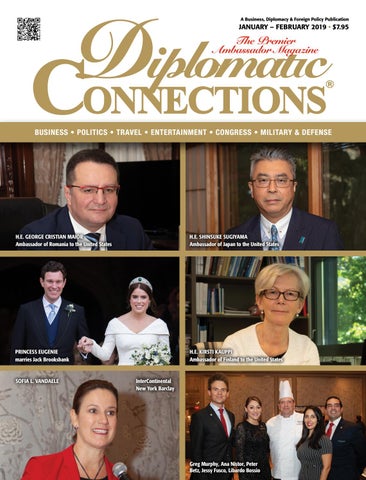
H.E. GEORGE CRISTIAN MAIOR Ambassador of Romania to the United States
H.E. SHINSUKE SUGIYAMA Ambassador of Japan to the United States
PRINCESS EUGENIE marries Jack Brooksbank
H.E. KIRSTI KAUPPI Ambassador of Finland to the United States
SOFIA L. VANDAELE
InterContinental New York Barclay
Greg Murphy, Ana Nistor, Peter Betz, Jessy Fusco, Libardo Bossio
The Ultimate Driving Machine ®
THE STATE OF LUXURY.
BMW OFFICIAL EMBASSY SALES PROGRAM.
If you’re looking to represent your embassy in style, look no further than the Ultimate Driving Machine. Embassies located in the U.S. can benefit from special incentives through the BMW Official Embassy Sales Program when purchasing an embassy fleet or flag vehicle used for official business. Choose from a variety of stylish models like the new BMW X5, BMW 7 Series, and BMW 5 Series. For personal use, the BMW Diplomatic Sales Program is available to foreign diplomats stationed in the U.S. and returning American diplomats, as well as staff and qualified members of international organizations.
For program details, please contact your local BMW center.
©2018 BMW of North America, LLC. The BMW name, model names and logo are registered trademarks. All rights reserved.
8:49PM At Faimont Copley Plaza, your service is personalized to the highest caliber whether you experience Fairmont Gold with a private lounge and complimentary food offerings or enjoy a signature suite overlooking Copley Square. Come write your own chapter in history at Fairmont Copley Plaza. To plan your Boston experience, visit fairmont.com/copley-plaza-boston or call 617 867 8562.
CUSTOMIZE YOUR OWN FOUNDATION FROM 8000 SKIN TONES. BLENDED FOR YOU AT THE LANCÔME COUNTER.
Choose your color, coverage and hydration level.
A
LYING T P O P
INDEPENDENT SCHOOLS The admission process for independent schools typically begins almost a year before the student wants to enroll. In the fall, families read school websites, visit school open houses, and narrow down a list of the schools to apply to. Most applications are due in the winter, but deadlines vary from school to school. Independent schools often require: • A completed application form, available from the school website or by calling the admission office; • The child’s most up-to-date academic transcript, with grades, from his or her current school; • Teacher recommendations; • Results of a standardized admissions test and/or a school-administered entrance exam; • A formal interview with the child. Depending on the child’s age, some schools may also ask for parent statements describing the child; student essays; and/ or student artwork, writing, or portfolios. Admission interviews with students and their families take place in the fall and winter. For very young children, schools often conduct group interviews or have the child visit a class to help gauge whether the school is the right fit for the student’s needs. The admission office is often the best source of information about various options for paying for an independent school education, including financial aid. Many schools ask families seeking financial aid to submit an aid application at the same time as the admission application. Each school works hard to assemble a student body that will benefit most from the type of education it offers. The admission office also looks for students whose strengths and personalities will complement those of other admitted students. Some schools weigh academic performance most heavily, but other schools look primarily at a student’s potential. Overall, each school aims to admit students who are the right “fit” for the school, just as parents are looking for schools that are the right fit for their children and families. Independent schools typically send notification about admissions decisions in the spring, but some schools offer rolling admissions (offers of admission are made until the class fills up). For a student who’s accepted into several schools, a new challenge emerges: how to choose which school to attend. Many schools allow admitted students to visit on a special day or provide some opportunity for students to visit the campus again. Sometimes, shadowing a current student can give the best sense of what it would be like to attend. For parents of prospective students, talking to current parents may help, too. Many schools provide contact information for parents who’ve agreed to speak about their experiences at the school. Reading the school’s newsletters and following it on social media can also provide a sense of the school’s offerings and culture.
© 2018, National Association of Independent Schools. Reprinted with permission. 4
W W W. D I P L O M AT I C C O N N E C T I O N S . C O M
An Education for an Inspired Life Asheville School prepares high school students for a lifetime of education. Motivated by a challenging academic experience, our students develop critical thinking skills, communicate effectively, and form strong study habits. Students learn life lessons in a nurturing, close-knit community of 295 students from 19 states and 16 countries. The majority of our recent graduates are attending colleges and universities Barron’s rates as “highly selective” and “most selective.” ashevilleschool.org For more than a century, Asheville School has fostered lives 828.254.6345 of leadership and service. We invite you to discover Asheville School and learn why our students have a competitive edge. Contact us today to schedule a visit, request an admission packet, attend an open house, or inquire about our merit scholarships. admission @ashevilleschool.org Named Most Beautiful Private High School in NC - Architectural Digest Rated #7 among the top 50 boarding schools in the U.S. by GreatSchools.org.
Medical Experts
Alan Cohen, M.D., and Shenandoah “Dody� Robinson, M.D., pediatric neurosurgeons
Pediatric Neurosurgery Johns Hopkins Pediatric Neurosurgery is one of the top multidisciplinary centers of its kind. It has an international reputation for offering children and adolescents their best chance at making a full recovery from a range of general and specialized neurosurgical injuries, diseases and malformations. Our Experts:
Alan Cohen, M.D., director of the Division of Pediatric Neurosurgery, treats all pediatric patients, with a special focus on brain tumors. He is a leader in developing minimally invasive techniques to enhance the safety and efficacy of selected pediatric neurosurgical procedures.
spasticity. Her research focuses on clarifying how early insults to the developing brain lead to deficits, such as cerebral palsy and epilepsy, and how to mitigate these deficits with neurorestorative agents.
To learn more or request an appointment: 1-855-88-HOPKINS (U.S. Toll-Free) +1-410-402-5041 (International) hopkinsmedicine.org hopkinsmedicine.org/international
Shenandoah "Dody" Robinson, M.D., is a nationally recognized expert in the treatment of epilepsy and
Special Advertising Section. For advertising opportunities, please contact 202.536.4810 extension 3 or Evan@diplomaticconnections.com
You don’t have to go far to begin your wellness journey
Johns Hopkins Medicine—with convenient locations in Maryland, the Washington, D.C., metro area and Florida—is ready to connect international patients and their families with our respected experts, cutting-edge research and innovative treatments at the most convenient location. We understand that medical issues can cause a great deal of stress and encourage you to take advantage of our complimentary medical concierge services so you can focus on your health. From your first inquiry, you’ll be paired with a medical concierge who will serve as your personal liaison to the experts at Johns Hopkins Medicine. Expert care, close to home. One less thing to worry about.
To learn more or schedule an appointment: 1-855-88-HOPKINS (U.S. Toll-Free) +1-410-402-5041 (International)
PROMISEofMEDICINE.ORG
INTERCONTINENTAL CLEVELAND. WORLD-CLASS HOSPITALITY ON CLEVELAND CLINIC’S MAIN CAMPUS.
World-class hospitality meets world-class care. We are connected to Cleveland Clinic via skywalk and just minutes from museums, sports, shopping, theater, galleries and unique dining destinations. When you stay with us, you’ll experience exceptional accommodations and guest services that are unparalleled in the area. We welcome guests from across the country, and around the world, every day.
• 27 Spacious Suites • Multilingual Staff • Concierge Services • Club InterContinental® • 24 - Hour In-Room Dining • Award-Winning Table 45 Restaurant and Bar • Complimentary Fitness Center
Do you live an InterContinental life?
• Valet Parking
For more details, please call 855.765.8709 or visit hotelsclevelandclinic.com 8
W W W. D I P L O M AT I C C O N N E C T I O N S . C O M
195 countries on earth. People from 161 have come to us for world class care. Same-day appointments available.
clevelandclinic.org /global
SAVE DATE THE
February 21, 2019 THE MAYFLOWER Washington, D.C.
WWW.DIPLOMATICCONNECTIONS.COM
W W W. D I P L O M AT I C C O N N E C T I O N S . C O M
BUSINESS DEVELOPMENT Evan Strianese, George Hoffman JUNIOR ACCOUNT EXECUTIVES Peter Han, Sophie Hu, Zhiwei Fan DESIGN & CREATIVE Larry Smith Design DIPLOMATIC CORRESPONDENTS and CONTRIBUTING WRITERS Roland Flamini, James Winship, PhD, Michael D. Mosettig and Monica Frim
CONTRIBUTING PHOTOGRAPHY Christophe Avril; Monica and John Frim; Paula Morrision
TM
10
DIRECTOR OF BUSINESS OPERATIONS Lauren Peace
IMS (Inquiry Management Systems) 304 Park Avenue South, 11th Floor New York, NY 10010 Marc Highbloom, Vice President marc@ims.ca Maria D’Urso, Project Manager Mariad@ims.ca
LOOK FOR OUR INTERNATIONAL DIPLOMAT APPRECIATION RECEPTION in your city.
info@DiplomaticConnections.com
EDITOR-IN-CHIEF Dawn Parker
DIPLOMATIC CONNECTIONS WEBSITE DESIGN & DEVELOPMENT
2019
If your embassy, mission or consulate would like to host our next venue for the Diplomatic Connections International Diplomat Appreciation ReceptionTM please email us at:
Diplomatic
To contact an advertising executive
CALL: 202.536.4810 EMAIL: info@diplomaticconnections.com To order photos from the events go to: www.diplomaticconnections.com Send any name or address changes in writing to: Diplomatic Connections 4410 Massachusetts Avenue / #200 Washington, DC 20016 Diplomatic Connections Business Edition is published bi-monthly. Diplomatic Connections does not endorse any of the goods or services offered herein this publication. Copyright 2018 by Diplomatic Connections All rights reserved. Cover photo credits: H.E. George Cristian Maior/Romania, Christophe Avril/ Diplomatic Connections; H.E. Shinsuke Sugiyama/Japan, Christophe Avril/ Diplomatic Connections; Princess Eugenie and Jack Brooksbank, Samir Hussein/WireImage; H.E. Kirsti Kauppi/Finland, Christophe Avril/Diplomatic Connections; Sofia Vandaele, Greg Murphy, Ana Nistor, Peter Betz, Jessy Fusco, Libardo Bossio, InterContinental New York Barclay, Christophe Avril/ Diplomatic Connections
Exactly Like Nothing Else A vibrant social hub in the nation’s capital since 1925, our historic hotel features updated premium rooms and suites filled with luxury amenities and impeccable service. Allow our comfortable accommodations and convenient location to set the stage for a remarkable Washington, D.C., experience. L E A R N M O R E B Y V I S I T I N G M A R R I O T T. C O M / W A S A K
T H E M AY F L O W E R H O T E L . C O M
T H E M AY F L O W E R D C Š2018 Marriott International, Inc. All Rights Reserved.
T H E M AY F L O W E R H O T E L D C
A HOME FOR EVERY STYLE
THE RESIDENCES AT EASTERN MARKET
LiveAtEasternMarket.com 888.844.2880 Capitol Hill
CATHEDRAL COMMONS
THE WOODLEY
CathedralCommons.com 888.716.2876 Cleveland Park/Cathedral Heights
TheWoodleyDC.com 888.694.4941 Woodley Park
Exquisite apartment residences throughout Washington, D.C. that will captivate and fulfill your every desire.
12
W W W. D I P L O M AT I C C O N N E C T I O N S . C O M
RESIDENCES ON THE AVENUE
ResidencesOnTheAvenue.com 888.606.0349 Foggy Bottom
Diplomatic From the Publisher In this issue, Ambassador Maior speaks about his mission in enhancing “the Romania – U.S. bilateral relationship in all fields – defense, security, political communication between our two governments, economics” and notes that “things are looking well.” He has an interesting background and it’s not his first time in the District as he was a student at George Washington University in the 1990s. Maior tells of how he “established a Human Rights directorate designed to adapt our system of diplomacy and our international standing after communism towards democracy.” Read this intriguing interview starting on page 16. So often people not in the diplomatic community believe that foreign ambassadors posted to our nation’s capital are limited to working almost exclusively in the Washington, D.C. vicinity. However, Ambassador Sugiyama explains that, of course, while his government wants him to be proactive about “Japan’s economic concerns, regional security needs and generally Japan’s stances on a wide range of issues,” he’s been “strongly advised to travel throughout the United States, to visit each state, to meet with governors and legislators, to experience American culture through sports, the arts, and reaching out to local populations.” Also read about Prime Minister Abe traveling to Beijing to meet with President Xi; remarkably, it was Japan’s first formal state visit to China in seven years. Finland remains a devout EU member and Ambassador Kauppi speaks at length about it in her interview. In geopolitical terms, they are in a strategic region based on that St. Petersburg is approximately 100 miles from the Finnish border. They are still not members of NATO; but military and political collaboration is solid and well established. Their proximity to Russia put them at the top of the list of locations for the Trump-Putin summit to have taken place. Kauppi was previously in Washington from 1997-2000 as the embassy’s political officer, so she has a great deal of familiarity with politically navigating this city. Prince Charles celebrated his 70th birthday and Queen Elizabeth II toasted him with some beautiful words of admiration. Princess Eugenie (Prince Andrew’s daughter) married Jack Brooksbank at St. George’s Chapel in October. An interesting piece of trivia, Brooksbank is the European director of Casamigos Teguila – the company founded by actor George Clooney. I’d like to extend a very sincere and most appreciative expression of gratitude to The Line Hotel in Washington, D.C. and The InterContinental New York Barclay in New York for hosting the Autumn, 2018 Diplomatic Connections’ International Diplomat Appreciation Reception in their respective cities. A very special thank you to Crawford Sherman and Cameron Nezam of The Line DC and Sofia Vandaele, Ana Nistor, Greg Murphy and Chef Peter Betz at The InterContinental New York Barclay in New York, New York. I am often asked what the protocol is to have an ambassador or consul general featured in an upcoming magazine or how does an interview get scheduled in a future publication? Just send me an email at: DParker@DiplomaticConnections.com and I will be delighted to consider your request! Warmest regards, Dawn Parker - DParker@DiplomaticConnections.com Publisher
D I P L O M AT I C C O N N E C T I O N S B U S I N E S S E D I T I O N | J A N U A R Y - F E B R U A R Y 2 0 1 9
13
Diplomatic
D I P L O M AT I C C O N N E C T I O N S BUSINESS EDITION
JANUARY – FEBRUARY 2019
H.E. GEORGE CRISTIAN MAIOR AMBASSADOR OF ROMANIA TO THE UNITED STATES
APARTMENTS, CONDOMINIUMS and HOUSING APARTMENTS AMPEER DUPONT CIRCLE Luxury Residences . . . . . . . . . . . . . . 95 The Beekman Tower . . . . . . . . . . . . . .94 Bozzuto – Cathedral Commons . . . . . . . . 12
H.E. SHINSUKE SUGIYAMA AMBASSADOR OF JAPAN TO THE UNITED STATES
Bozzuto – Residences on The Avenue . . . . . 12 Bozzuto – The Residences at Eastern Market . . 12
RESIDENTIAL LEASING & SALES BOZZUTO PROPERTIES . . . . . . . . . . . .12 THE BEEKMAN TOWER . . . . . . . . . . . . 94
BMW of Rockville . . . . . . . . . . . . . . .82 MINI Corporate . . . . . . INSIDE BACK COVER Volvo - Don Beyer Volvo . . . . . . . . . . . .91
The Hun School of Princeton . . . . . . . . . .77 Lawrence Woodmere Academy . . . . . . . . 76 St. Timothy’s School . . . . . . . . . . . . . .77 Weatherby-Pembridge School New York . . . .76 FURNITURE CORT . . . . . . . . . . . . . . . . . . . . 93 HEALTH & BEAUTY LANCOME . . . . . . . . . . . . . . . . . . . 3
InterContinental Cleveland Clinic . . . . . . . . 8 InterContinental New York Barclay . . . . . . .59 The Line Hotel Washington, D.C. . . . . . . . 37 The Mayflower Hotel . . . . . . . . . . . . . 11 [The] Peninsula Chicago . . . . . . . . . . . .96 LIMOUSINES Presidential Luxury Limosines . . . . . . . . .91 LUXURY ITEMS FURLA . . . . . . . . . . . . . . . . . . . . . 1
F EAT URED ARTI C L ES AMBASSADORS to the UNITED STATES in Washington, D.C. FINLAND Ambassador Kirsti Kauppi . . . . . . . . 60 JAPAN Ambassador Shinsuke Sugiyama . . . . 38 ROMANIA Ambassador George Cristian Maior . . . 16
TRESemme . . . . . . . . . . . . . . . . . .85
DIPLOMATIC CONNECTIONS’ RECEPTIONS The InterContinental New York Barclay . 52 The Line DC . . . . . . . . . . . . . . .30
HOSPITALS & MEDICAL CARE Cleveland Clinic . . . . . . . . . . . . . . . . 9
ROYALS Birthday and Royal Wedding . . . . . . . 74
JOHNS HOPKINS MEDICINE . . . . . . . . 6 & 7
TO CONTACT AN ADVERTISING EXECUTIVE
CALL: 202.536.4810 EMAIL: info@diplomaticconnections.com 14
Fairmont Copley Plaza – Boston . . . . . . . . 2
Hilton Washington, D.C. National Mall . . . . . 89
EDUCATION – INDEPENDENT SCHOOLS Asheville School . . . . . . . . . . . . . . . . 5
GREG MURPHY, ANA NISTOR, PETER BETZ, JESSY FUSCO, LIBARDO BOSSIO INTERCONTINENTAL NEW YORK BARCLAY
[The] Fairfax at Embassy Row . . . . . . . . .86
National Corporate Housing . . . . . . . . . .89
BMW Corporate . . . . . INSIDE FRONT COVER
SOFIA L. VANDAELE INTERCONTINENTAL NEW YORK BARCLAY
[THE] DUPONT CIRCLE Doyle Collection, Washington, D.C. . . . . . . . . . . . . . . .15
Fairmont Washington, D.C. – Georgetown . . . . BACK COVER
AUTOMOTIVE - CARS and LIMOUSINE SERVICES Admiral Leasing . . . . . . . . . . . . . . . .72 PRINCESS EUGENIE MARRIES JACK BROOKSBANK
The Concordia Hotel . . . . . . . . . . . 80 & 81
Bozzuto – The Woodley . . . . . . . . . . . .12
PROPERTY MANAGEMENT Metropolitan Pacific Properties . . . . . . . . .92 H.E. KIRSTI KAUPPI AMBASSADOR OF FINLAND TO THE UNITED STATES
HOTELS, DINING and ACCOMMODATIONS aka . . . . . . . . . . . . . . . . . . . . . .90
W W W. D I P L O M AT I C C O N N E C T I O N S . C O M
A glamorous club-like bar with a chic mid-century feel, steps from Embassy Row For inquiries, please contact Victoria Hellmann, Protocol Sales Manager E Victoria_Hellmann@doylecollection.com | T +1 202 797 0152 W doylecollection.com/dupontcircle /DupontCircleHotel @DupontCircHotel @DupontCircHotel
H.E. GEORGE CRISTIAN MAIOR Ambassador of Romania to the United States
16
W W W. D I P L O M AT I C C O N N E C T I O N S . C O M
A conversation with Romania’s Ambassador George Cristian Maior Roland Flamini
Ambassador George Cristian Maior of Romania has to be the only foreign chief of mission to publish a book in Washington about American spying – and to do so while actually serving in the nation’s capital. In his scholarly work, “America’s First Spy: The Tragic Heroism of Frank Wisner,” Maior delves deep into the emerging world of American intelligence in its formative years, and the index of names mentioned has the nostalgic ring of a Georgetown social gathering from the 1950s until relatively recently. Though trained as a diplomat, he was named director of the Romanian Intelligence Service in 2006, and held the post until January 2015. Later that year, in September 2015, he presented his credentials as Ambassador to President Obama. He has also had close connections with NATO, having negotiated Romania's
accession to this organization, as state secretary in the Romanian Defense Ministry. Romania, a difficult and independent-minded Soviet satellite under its despotic leader, Nicolae Ceausescu, made a long and bumpy transition to democracy. For example, it was not until 2007 that the former monarchy was finally admitted to membership of the European Union, in part because of endemic corruption in successive governments. The corruption problem persists, however, and in August 2018 led to protest demonstrations, the size of which had not been seen since the 1989 revolution that toppled the Ceausescu regime (and led to his execution). The economic crisis of 20082009 hit Romania very hard, and inequality and poverty remain among the highest in the EU; as a
D I P L O M AT I C C O N N E C T I O N S B U S I N E S S E D I T I O N | J A N U A R Y - F E B R U A R Y 2 0 1 9
17
Frederick Florin/AFP/Getty Images
Romania's President Klaus Iohannis stands as he arrives for a debate on the future of Europe at the European Parliament on October 23, 2018 in Strasbourg, eastern France.
result, Romanians have been among the largest groups seeking employment in western EU countries - more than 400,000 in the United Kingdom alone, the second largest number of EU immigrants in that country after the Poles. But, Ambassador Maior pointed out in his interview with Diplomatic Connections, the Romanian economy has gained, and continues to gain strength, which is expected to lure back many citizens to their homeland. Russia’s recent aggressiveness and so-called hybrid activity (cyber attacks, etc.) has triggered a defensive NATO posture on its eastern flank, anchored on Romania, as the largest country in this dangerous neighborhood. The NATO multi-national headquarters for Southeastern Europe is in Romania, and the country is host to a multi-national brigade. “Let’s not forget that Crimea is less than 150 miles from Romanian shores, from Constanta, where there is a U.S. military presence,” the ambassador pointed out. Diplomatic Connections: What is your assessment of the bilateral relationship with the United States? Ambassador Maior: The relationship is very, very strong. We’ve had many interactions with the previous administration, and now with this administration, and it remains a strong partnership. I feel that I’ve accomplished my mission here. Diplomatic Connections: Which was?
18
W W W. D I P L O M AT I C C O N N E C T I O N S . C O M
Ambassador Maior: Which was to enhance the bi-lateral relationship in all fields – defense, security, political communication between our two governments, economics -- and things are looking well. Diplomatic Connections: You have not served in this embassy previously, but you went to school here. Ambassador Maior: I went to GW back in the 1990s. It was a wonderful period in my life, quite stimulating from an intellectual point of view. Moreover, it proved to be helpful in my career because upon returning to the Ministry of Foreign Affairs, probably for the first time in the ministry’s history, I established a Human Rights directorate designed to adapt our system of diplomacy and our international standing after communism towards democracy, with an extraordinarily strong rule of law, including a moral dimension. Diplomatic Connections: You’ve also had other diplomatic posts. Ambassador Maior: Yes, I was charge d'affaires for four years in Ireland, which was my first experience abroad and remarkably interesting because Ireland was a very dynamic member of the European Union, with many similarities to Romania especially in its economic transition to Europe. It essentially facilitated in gaining a greater understanding with the complex process of EU integration.
Diplomatic Connections: On January 1, 2019, Romania will, for the first time, assume the presidency of the European Union council. We know the presidency means a lot of extra work in Bucharest and in Brussels, but what does it mean for the embassy here?
Diplomatic Connections: When is the Sibiu summit?
Ambassador Maior: Our position, which is a principled position inside the European Union, is to have a strong trans-Atlantic relationship. We feel that Europe needs America, and America needs Europe in economics, in security, and in politics. It’s important for the U.S. government to understand that our priority inside the European Union is to try to work in the context of that philosophy – a strong trans-Atlantic relationship. That’s why I plan to host a series of events presenting our priorities to the government, to the officials over here and to members of Congress. We really hope they will be successful, because it’s a difficult period for Europe – you have Brexit negotiations and the adoption of the European Union budget as well as the European elections. Romania will also host an important summit on the future of the European Union in Sibiu, a nice town in Transylvania.
Diplomatic Connections: The country that has the presidency usually focuses on a couple of initiatives that become the theme of its six-month term. Is this one of them?
Ambassador Maior: Next year, on May 9th. It should be a reflective summit, trying to contemplate the future of Europe, unfortunately, without the United Kingdom.
Ambassador Maior: Of course, inevitably, it’s one of them. There are others related to our region, the Western Balkans, for example: we feel that we need to accelerate negotiations (for enlargement) of certain countries with the European Union, for example, Serbia. But we should also support the European path of our Eastern neighbors: Ukraine, Moldova, Georgia. Diplomatic Connections: Turkey? Ambassador Maior: Also Turkey, yes. A strong ally of ours. That’s why it’s important for the U.S. to have good communication with us during the presidency, because the U.S. is very much interested in the stability of those countries, the evolution of those countries towards
Joe Klamar/AFP/Getty Images
EU SUMMIT - Participants pose for a photo during the EU Informal Summit of Heads of State or Government in Salzburg, Austria, on September 20, 2018. (1st row, L-R): Sweden's prime minister Stefan Lofven, Slovenia's prime minister Marjan Sarec, Germany’s chancellor Angela Merkel, Finland's prime minister Juha Sipila, Lithuania's president Dalia Grybauskaite, France's president Emmanuel Macron, Austria's chancellor Sebastian Kurz, European Council’s president Donald Tusk, Romania's president Klaus Iohannis, Cyprus' president Nicos Anastasiades, European Commission’s president Jean-Claude Juncker, Croatia's prime minister Andrej Plenkovic, Portugal's prime minister Antonio Costa, Czech Republic's prime minister Andrej Babis and European Councils secretary-general Jeppe Tranholm-Mikkelsen and (row behind, L-R): Bulgaria's prime minister Boyko Borisov, Estonia's prime minister Juri Ratas, Britain's prime minister Theresa May, Malta's prime minister Joseph Muscat, Slovakia's prime minister Peter Pellegrini, Netherlands' prime minister Mark Rutte, Luxembourg's prime minister Xavier Bettel, Latvia's prime minister Maris Kucinskis, Italian prime minister Giuseppe Conte, Greece's prime minister Alexis Tsipras, Ireland's prime minister Leo Varadkar, Denmark's prime minister Lars Lokke Rasmussen, Poland's prime minister Mateusz Morawiecki, Hungary's prime minister Viktor Orban, Belgium's prime minister Charles Michel and Spain's prime minister Pedro Sanchez.
D I P L O M AT I C C O N N E C T I O N S B U S I N E S S E D I T I O N | J A N U A R Y - F E B R U A R Y
2019
19
democratic reforms, better market economies, more security. Thus, a very complicated presidency, not to mention, challenging. Diplomatic Connections: And Romania will speak from experience in building up institutions because it has been through this in the transition phase from the communist regime – as a qualification, if you like, for joining the European Union. Ambassador Maior: Yes, and this is a substantial part of our foreign policy – to try to assist our neighboring countries, especially the Western Balkans together with our Eastern Neighborhood, in what is an intricate process requiring political will for structural reforms in addition to knowledge and expertise in adapting the economy and institutions. To this extent, it’s part of our, let’s say, mission. Our foreign policy attempts to speed up the processes of further integration of those countries for the benefit of the EU, providing a vantage point of security and stability in those areas. It’s considered problematic from many points of view; even so, I think it serves in the interests of the United States also. Diplomatic Connections: You do have some current differences with the European Union, one of which is the issue of corruption, including the dismissal of Romania’s anti-corruption prosecutor, Laura Kovesi. Has the government appointed a successor? Ambassador Maior: The most important aspect is the fact that the institutions are functioning well. I won’t mention other member states – but in comparison with other countries in the region, in recent years, Romania has done more than its share of combating corruption. High officials have been sentenced, the institutions are functioning and we are now in the process of naming anti-corruption officials – it’s a rigorous process that is ongoing. Diplomatic Connections: What do you think is the root cause of this corruption problem. Is it a legacy of the communist era? Ambassador Maior: It goes back to the communist period, and to the difficult economic and social situation during that time, and then an arduous transition. Just imagine the fact that Romania had probably the worst dictatorship in terms of political regime, but also in terms of economy inside the Soviet bloc. And when you transfer a very centralized economy from state to the private sector (as Romania has done) you inevitably have to deal with corruption. I don’t think that we were a singular case: other nations in the region underwent similar processes, more or less difficult. Nevertheless, we are on the right track. Just
20
W W W. D I P L O M AT I C C O N N E C T I O N S . C O M
look at the figures in our current economy, it’s one of the fastest growing in the region. Diplomatic Connections: Yes, before we speak further about that – in reference to Romania and the European Union: if a Brexit type referendum were to be held in Romania tomorrow, what do you think would be the result? Ambassador Maior: The reality is that we are one of the most pro-Europe countries inside the European Union. Consistently, 60-70 percent of the population supports Romania’s membership of the European Union. And that’s important as more integration is requested in a period when the European Union has to reflect on its future. We are strong European supporters, and equally, strong U.S. supporters. We are America’s strongest ally in terms of security, and in terms of politics. Diplomatic Connections: What does Brexit mean for Romania specifically, for example, given the fact that there are more than 400,000 Romanians actually living and working in Britain, many of whom are likely to have to pack their bags? Ambassador Maior: We hope not; we have had intensive discussions with the British government – in fact will have another one here soon – and this is an issue which needs an approach in the interest of both sides. These (Romanians) are hard-working people, well integrated in the U.K. We’re working hard to preserve the right of these people to continue to work inside the UK, but apart from both the social and economic aspects there are many other issues connected to Brexit. It will generate a strategic gap, because of Britain’s trans-Atlantic ties within the European Union, its historical knowledge of the eastern frontier of the European Union, especially Russia. So we have to find a way to compensate for that, and I’m glad that Romania has a similar standing inside the European Union in terms of its trans-Atlantic ties, in terms of its preoccupation about our eastern neighbor, its knowledge about – for example – what Russian influence means to the evolution of European society. It’s a unique experience for us, 30 years after the fall of communism to have this position in Europe, and we want to rise to the challenge – to be an honest broker with a voice of trans-Atlanticism, favoring more integration inside the European Union. Diplomatic Connections: Talk a little about Romania’s vision of the European Union going forward. For example, does Romania favor more centralization, or less, or is your position somewhere in the middle?
Ambassador Maior: We are very constructively somewhere in the middle. Nation states are the basis for such a union, but the need for cohesion, solidarity - in terms of economics, financing and security – is very important. Diplomatic Connections: The Romanian economy, after some years of poor performance, has recently been on a promising trend – 4.8 percent in 2016, and more than five percent in 2017, and yet one of Romania’s problems is a continued exodus of young people seeking employment in other European countries. What is it that prompts them to leave in spite of the fact that there is now employment at home? Ambassador Maior: We have the highest percentage of hi-tech engineering graduates in Europe per capita with some exceptionally creative people. However, to be honest, there are still disparities between the eastern part of the European Union – I’m not referring only to Romania - and the western part. Our hope is to accelerate the process of development in order to close this gap in economy and prosperity. This will likely be achieved in the medium term, and I’m sure that those people who find work abroad will
be tempted to return, because they really love their country and, of course, they can always express themselves in their own nation. For example, there are many Romanians in Silicon Valley, and they are constantly telling me that they really want to do something for Romania, and at a certain point return, bringing back their expertise and their knowledge. Diplomatic Connections: What are the key factors of Romania’s economy? Ambassador Maior: The growth, going back more than five years now, is based on manufacturing, export – tourism is also a factor, but mostly the productive areas, including energy, car manufacturing, which is very dynamic currently. Diplomatic Connections: When you say car manufacturing you mean the Romanian automobile, Dacia? Ambassador Maior: Yes, Dacia, which has been owned by Renault for some time and has new models; but also Ford has a plant in the south of Romania, one of the largest factories in the country, selling in Central and Eastern
Daniel Mihailescu/AFP/Getty Images
Jean-Claude Juncker (C), President of the European Commission, and representatives of the Three Seas Initiative take part in a TSI Summit, on September 18, 2018 at the Cotroceni Palace, the Romanian Presidency headquarters in Bucharest. The Three Seas Initiative, launched in 2015, is a forum of European Union countries in Central and Eastern Europe (Austria, Bulgaria, Croatia, Czech Republic, Estonia, Hungary, Latvia, Lithuania, Poland, Romania, Slovakia and Slovenia) aiming at boosting connectivity and facilitating real convergence among EU Member States.
D I P L O M AT I C C O N N E C T I O N S B U S I N E S S E D I T I O N | J A N U A R Y - F E B R U A R Y
2019
21
both on and offshore, and some American companies are operating over there. Hence, I believe this is an area that will develop in quantity and quality in the medium term. Diplomatic Connections: What is the state of the Romanian oil industry? Ambassador Maior: Oil is becoming again a solid industry in Romania. It needs technological investment, but I can say we are less dependent for energy on Russia than any other Eastern European country, and certainly in a good position inside the European Union, which is significant in terms of politics.
Ambassador Maior: There is a pipeline project called BRUA linking Central Europe, including Romania, Bulgaria, Hungary and Austria, with financing from the European Union. It has an economic impact, but also a strategic impact in terms of diversifying the supply routes, and pipelines, and transportation - again with a thought to the Russian (energy) monopoly, which creates problems not only in economic terms, but also in terms of political leverage.
Historical photo: Henry Ford gives then Prince Nicholas of Romania a tour of the automobile plant, Detroit, MIchigan, 1926.
Daniel Mihailescu/AFP/Getty Images
Diplomatic Connections: And what pipelines are now either in operation or planned?
A Ford B-Max vehicle is displayed in front of the Ford factory headquarters in Craiova city, 240km west from Bucharest.
Europe and reaching a production of more than 100,000 cars per year. So those dynamics are very good.
Ambassador Maior: It exceeded $3 billion in 2017 and is growing. American investments in Romania include energy. Right now Exxon is operating in the Black Sea region, where they discovered large quantities of gas 22
W W W. D I P L O M AT I C C O N N E C T I O N S . C O M
Underwood Archives/Getty Images
Diplomatic Connections: What is the size of bi-lateral trade with the United States?
Krisztian Bocsi/Bloomberg via Getty Images
Attendees look at SUVs on the Dacia SA exhibition stand during the Paris Motor Show on October 2, 2018. The auto industry -- a fraction of it at least -converged in France for the biennial Paris Motor Show, where executives showed off electric cars for the masses and robo-cars for the future.
Diplomatic Connections: There is presently at least one generation of Romanians, possibly two, for whom the communist regime, Nicolae Ceausescu, the Securitate (the notorious Romanian communist secret police), are issues for the history books. How do post-communist generations confront, or cope with the past? Ambassador Maior: That’s a very interesting question, and next year we will celebrate – and I insist on the term celebrate – thirty years since the fall of communism. I think Romania is the only country in Eastern Europe that has officially condemned communism in a parliamentary resolution, which was very difficult to achieve because mentalities die hard after almost half a century of communism. The new generation is more inclined towards the Western philosophy of life in its understanding of democracy and market economy. In a way this is a good thing, of course, but also remembering that difficult period of the 1970s and 1980s, we should reflect on our history, and the lessons to be learned from it. Diplomatic Connections: Is there a debate in Romania among historians and scholars about what happened and why, or is
it universally recognized as a period of great suffering and repression? Ambassador Maior: Well, that’s clear. Albeit, there are nuances, and the period still needs to be properly analyzed and discovered, and to take a closer look at the evolution of certain time frames inside the communist system. For example, the end of the 1960s was considered a better period in terms of the economy along with Romania’s standing internationally. Then the 1980s, there were many mistakes in our economic policy and our international standing, and in human rights. All those have to be debated, and it is always my hope that people will gain a fuller understanding of our past. Diplomatic Connections: The collapse of the regime in Romania was more violent than in other communist countries. Ceausescu was the only communist leader who did not die in his bed. Ambassador Maior: It was more violent because it was the most repressive towards the end, which generated that counter-reaction of the population. It was a difficult period; it is a vivid memory for me. I was a student then and it was
D I P L O M AT I C C O N N E C T I O N S B U S I N E S S E D I T I O N | J A N U A R Y - F E B R U A R Y 2 0 1 9
23
not easy to see even some of my colleagues dying, shot by the repressive forces in street demonstrations.
Diplomatic Connections: Are you referring to the U.S.-European Phased Adaptive Approach Missile Defense?
Diplomatic Connections: Is there any support for a restoration of the Romanian monarchy, forced out by the communists in 1947?
Ambassador Maior: That’s the protective system against ballistic missiles threats originating in the wider Middle East, including Iran, but also against other non-state actors that might develop that technology. So it’s a very important dimension attached to the security of the area.
Ambassador Maior: King Michael I [Michael von Hohenzollern-Siegmaringen died in Romania in 2017 at the age of 96] was regarded with great sympathy by the Romanian People. Hundreds of thousands of Romanians attended his funeral in a sign of love and respect for his tragic destiny and his role in Romanian history. However, several polls have shown there is no political sentiment regarding (the restoration of) the monarchy, and reinstating it as an institution is not a political option. The Royal Family has lived in Romania following special legislation in 1999, and their properties, which were confiscated by the communist regime, were returned. Diplomatic Connections: Going back to security, is Romania now the NATO headquarters for the south east? Ambassador Maior: Romania hosts a multi-national divisional headquarters for the south east, and as we are the largest country on the eastern flank, that brings a lot of responsibility. Let’s not forget that Crimea is less than 150 miles from Romanian shores, from Constanta, where there is a U.S. military presence. Romania allocated more than 2 percent of its GDP for defense before the big discussion in NATO about burden sharing because we feel the need to have a strong military and a strong deterrence, in light of current evolutions in Russia, for example. Diplomatic Connections: Is the multi-national brigade in place today? Ambassador Maior: The multi-national brigade is part of the NATO tailored forward presence and it will be operational in the coming year: several thousand troops with a multinational component. For example, Poland sent a company, other battalions are Romanian. Diplomatic Connections: But there’s also a U.S. Marine and Army presence, at Constanta. Ambassador Maior: At Constanta, but also in southern Romania as part of the common project, the missile defense system. This was initially a Romanian-U.S. project, now it’s integrated with NATO, and that is practically the first U.S. Navy base to be established overseas since the end of the Cold War.
Diplomatic Connections: So there’s sizable NATO presence in Romania. Ambassador Maior: Yes, with interceptors. Diplomatic Connections: Including an Alliance air force presence with planes occasionally having to scramble to intercept Russian planes which stray into Romanian air space. Ambassador Maior: It’s an intense activity; unfortunately, that happens in the Black Sea area. It’s not good for security, making Romania an essential and vital component in the equation of the transAtlantic relationship. Diplomatic Connections: How frequent are such incidents? Ambassador Maior: More frequent in the past few years, sadly. It’s not happening only in Romania, it’s also in the Balkans, and even Britain had some incidents. Diplomatic Connections: Where does the Romanian government stand on the apparent intention of the Trump administration to scrap the intermediate range treaty (INF) with Russia? Ambassador Maior: This is something that interests us a great deal. Russia has accused, wrongly, that Aegis Ashore violates the INF Treaty. But Aegis Ashore is not about intermediate range missiles, it is a defensive system, and it’s not oriented against Russia; they know this, of course. Russia, in our view, is not complying with the INF treaty, and new discussions on being in compliance with the INF continue through to page 28
24
W W W. D I P L O M AT I C C O N N E C T I O N S . C O M
Unique Automobile in Corunca, Romania
Robert Nemeti/Barcroft Cars/Barcroft Media via Getty Images
The car named ‘Julia’ has the axles and gear box from a 1983 Ford Taunus. It has a 110 horse power V6 engine with a cruising speed of 55 mph, this wooden car is a carpentry project with a difference. Created by Romanian Peter Szabo, the vehicle took more than 4,500 hours to build over a three year timespan and cost $20,000 in hard ash wood. Nicknamed ‘Julia,’ the vehicle combines the retro lines and old school growl of a classic automobile with modern innovations such as tablet-controlled headlights and music.
D I P L O M AT I C C O N N E C T I O N S B U S I N E S S E D I T I O N | J A N U A R Y - F E B R U A R Y 2 0 1 9
25
Arif Akdogan/Anadolu Agency/Getty Images
Turkish National Defense Minister Hulusi Akar (L) and then Romanian Defense Minister Mihai-Viorel Fifor (R) meet within the NATO Defense Ministers meeting in Brussels, Belgium on October 3, 2018.
26
W W W. D I P L O M AT I C C O N N E C T I O N S . C O M
Dursun Aydemir/Anadolu Agency/Getty Images
Romanian President Klaus Iohannis and NATO Secretary General Jens Stoltenberg attend the 2018 NATO Summit at NATO headquarters on July 11, 2018 in Brussels, Belgium.
Genya Savilov/AFP/Getty Images
Troops land from Mi-8 helicopter during an air force exercise on Starokostyantyniv military airbase on October 12, 2018. The large-scale air force exercises with the United States and other NATO countries 'Clear Sky 2018,' which were held in western Ukraine. Some 700 troops took part, half of them from NATO member countries including the United States, Britain, the Netherlands, Poland and Romania.
D I P L O M AT I C C O N N E C T I O N S B U S I N E S S E D I T I O N | J A N U A R Y - F E B R U A R Y
2019
27
Alex Nicodim/NurPhoto via Getty Images
King Michael I of Romania has been laid to rest at the Peles Castle in the Carpathian Mountains, near Sinaia, Romania (150 km from Bucharest).
treaty are a good idea. We need such a strategic treaty for stability.
Diplomatic Connections: How worried are ordinary Romanians about a Russian threat?
Diplomatic Connections: So really, the bottom line is that as concern for Russian activity grows, so does NATO’S response.
Ambassador Maior: We detected Russian activities a long time ago. I remember in my previous position discussing with my European counterparts the intensification of a (Russian) hybrid approach and Russian use of new technology, and cyber activity inside neighboring states, inside the European Union, to aggressively promote its interests. Although at the time, there was a certain skepticism. As Russian interference developed in the U.S. and in Europe, in elections, I think now it’s very well understood that we are in a constant state of counterinformation – I don’t like to use the term warfare – with Russia.
Ambassador Maior: Yes, absolutely, and that’s good. We are strong supporters of more U.S. involvement in NATO, in Central and Eastern Europe because the situation is more problematic here with regard to Russian activity. And not only military, but also hybrid and cyber activities. We need clear responses to this type of aggression. Diplomatic Connections: And are you getting clear responses? Is the message from Washington a clear reassuring message, or is it one that leaves you anxious because it’s open to interpretation? Ambassador Maior: I would say clear, and supported by facts. Diplomatic Connections: The rhetoric is one thing, but the strategy is another? Ambassador Maior: Sometimes, yes. 28
W W W. D I P L O M AT I C C O N N E C T I O N S . C O M
Diplomatic Connections: At the moment, another area of disagreement between Romania and Brussels is the recent ruling from the European Court of Human Rights that, following 9/11, Romania hosted a CIA prison where an al-Qaida terror suspect was tortured, and indeed Romania and Lithuania were fined by the court.
Ambassador Maior: We deny any charge of torture. That’s out of the question and there’s no proof in this respect. We had a parliamentary investigation related to those issues some years ago which didn’t find any evidence of this. Now we have a new investigation by the public prosecutor about this. One aspect here is our cooperation in anti-terrorism, and counter-terrorism, which is strong. Such allegations, which I vehemently deny, are another issue.
You clearly need to understand America’s position on certain issues, so that you can inform your government, and subsequently discuss it with them as well. So it’s fascinating. And most of all I very much like the American culture and society. Remembering my life as a student with fondness and now, as ambassador, continue to enjoy my life in the United States. ■
Diplomatic Connections: Is there any indication that ISIS foreign fighters include Romanians? Ambassador Maior: That’s not a concern for us. We are very efficient in having information on those issues, and we didn’t encounter such a situation. Diplomatic Connections: So finally, you’ve been here as a student, and now as an ambassador. How do you find working in the United States as an ambassador? Ambassador Maior: It’s the most demanding posting for a diplomat because of the involvement in all matters.
Daniel Mihailescu/AFP/Getty Images
A soldier puts a wooden cross next to the coffin of late King Michael I of Romania during the funeral ceremony at the former Royal Palace in Bucharest December 16, 2017. Thousands of Romanians paid last respects to their beloved former king Michael, who died at the age of 96. He was one of the last surviving World War II leaders and passed away in Switzerland following a battle with leukemia on December 5, 2017.
D I P L O M AT I C C O N N E C T I O N S B U S I N E S S E D I T I O N | J A N U A R Y - F E B R U A R Y
2019
29
THE D IP LO M ATIC CO N N EC TIO NS
International Diplomat Appreciation Reception held at The Line Hotel in Adams Morgan Washington, D.C.
30
W W W. D I P L O M AT I C C O N N E C T I O N S . C O M
D I P L O M AT I C C O N N E C T I O N S B U S I N E S S E D I T I O N | J A N U A R Y - F E B R U A R Y 2 0 1 9
31
32
W W W. D I P L O M AT I C C O N N E C T I O N S . C O M
D I P L O M AT I C C O N N E C T I O N S B U S I N E S S E D I T I O N | J A N U A R Y - F E B R U A R Y 2 0 1 9
33
34
W W W. D I P L O M AT I C C O N N E C T I O N S . C O M
D I P L O M AT I C C O N N E C T I O N S B U S I N E S S E D I T I O N | J A N U A R Y - F E B R U A R Y 2 0 1 9
35
Crawford Sherman MANAGING DIRECTOR OF THE LINE DC
Cameron Nezam (R) DIRECTOR OF DIPLOMATIC & BUSINESS TRAVEL, THE LINE DC and Gabriel Velazquez DIRECTOR OF FRONT OFFICE OPERATIONS THE LINE DC
Diplomatic Connections
wishes to formally thank The Line Hotel for hosting our Washington, D.C. International Diplomat Appreciation Reception in October.
36
W W W. D I P L O M AT I C C O N N E C T I O N S . C O M
DIPLOMATIC AFFAIRS AT LINE DC INTIMATE 220-ROOM SETTING WITH 19 SUITES ENTRANCE FOR VIPs PRIVATE ROOFTOP TERRACE FOR MEETINGS ABILITY TO SECURE ENTIRE GUEST FLOOR, IDEAL FOR DELEGATION VISITS MONUMENT MASTER SUITE IDEAL FOR SMALL RECEPTION WITH PANORAMIC VIEWS OF DC 24-HOUR ROOM DELIVERY 24-HOUR IN-HOUSE SECURITY DIPLOMATIC RATES INCLUDE DAILY BREAKFAST FOR ONE CAMERON NEZAM BUSINESS TRANSIENT & GROUP SALES MANAGER CNEZAM@THELINEHOTEL.COM
1770 EUCLID WA S H I N G TO N
STREET DC
NW 20009
THELINEHOTEL.COM/DC
D I P L O M AT I C C O N N E C T I O N S B U S I N E S S E D I T I O N | J A N U A R Y - F E B R U A R Y 2 0 1 9
37
JAPAN
AMBASSADOR SUGIYAMA MELDS JAPANESE TRADITION WITH BROAD DIPLOMATIC EXPERIENCE AND THE VISION TO DEAL WITH A RAPIDLY CHANGING WORLD James A. Winship, Ph.D. Japan’s Shinsuke Sugiyama presented his credentials as Ambassador to the United States to President Trump on March 28, 2018. This is not his first Washington assignment, however. Sugiyama was posted to the United States from 1989-1992 as First Secretary in the Economic Section of the Japanese Embassy. He and his wife Yoko return to Washington with fond memories of the city and with an appreciation of how much change has occurred in the last three intervening decades. As fate and diplomatic postings would have it, Ambassador and Mrs. Sugiyama arrived in Washington just two days before the opening of the Cherry Blossom Festival to find a whirlwind schedule of public engagements waiting for them. “My wife and I were taken aback to see how the cherry blossom festivities have grown into a truly American event that spans several weeks and brings in more than a million visitors. That is very different from when I was here as First Secretary at the embassy 30-years ago.” “That was a good beginning,” Ambassador Sugiyama notes. “My wife and I could not help but feel that, at a people-to-people level, relations between the United States and Japan are very good indeed.” Indeed, Sugiyama is as well prepared to be a cultural ambassador as a political voice for his country and a trade negotiator. He is equally conversant in the cultural traditions of Japan, the intricacies of strategic weapons and regional security, or the complexities of trade regulation. When asked about his route to a diplomatic career, Sugiyama explains that he has family roots in both the political world, where his grandfather 38
W W W. D I P L O M AT I C C O N N E C T I O N S . C O M
H.E. SHINSUKE SUGIYAMA Ambassador of Japan to the United States
D I P L O M AT I C C O N N E C T I O N S B U S I N E S S E D I T I O N | J A N U A R Y - F E B R U A R Y 2 0 1 9
39
served as a full-time elected member of the upper chamber of the Japanese Diet, the House of Councillors, and the academic world, where his father was a professor of international law at Hosei University in Tokyo. “I cannot recall the precise moment of seriously contemplating a diplomatic career, but it was an idea that began before I entered university. Diplomacy seemed a good blend of my family’s political heritage along with my father’s academic pursuits.” Ambassador Sugiyama has spent his entire professional career in the Foreign Ministry rising through the ranks from a junior officer to become Vice Minister of Foreign Affairs, the highest ranking career position in the Foreign Ministry. Educated at Waseda University in Japan, upon entering his country’s foreign service, Sugiyama was sent to Oxford University in the United Kingdom to receive what he smilingly calls a proper British education. There he received both a second BA Honors degree and a Master’s degree. After Oxford, his first diplomatic posting was at the
Japanese Embassy in Lagos, Nigeria. Ambassador Sugiyama notes that though a career bureaucrat is supposed to be politically neutral, serving as the top bureaucrat in the Foreign Ministry, the position has necessarily required him to have close contact with Japan’s political leadership. “Because of my role at the top of the career foreign service and my personal involvement with leading political figures, I have inevitably been a bridge between the political leadership of my country and the career diplomatic service.” He notes, for example, “I have known Prime Minister Shinzo Abe for many years. His father, Shintaro Abe, was Foreign Minister from 1982-1986 at a time when I was a junior legal advisor in the foreign ministry. At that time, the current Prime Minister served as his father’s private secretary.” When it comes to the current Foreign Minister, Taro Kono, Ambassador Sugiyama recalls, “his father was a famous statesman who not only served twice in as Foreign Minister but also served as Speaker of Japan’s House of
Jesco Denzel /Bundesregierung via Getty Images
Deliberation taking place on the sidelines of the official agenda on the second day of the G7 summit on June 9, 2018 in Charlevoix, Canada. (L-R) Director of the U.S. National Economic Council Larry Kudlow, Britain’s prime minister Theresa May, France’s president Emmanuel Macron, Germany’s Chancellor Angela Merkel, Japan’s deputy chief cabinet secretary Yasutoshi Nishimura, Japan’s prime minister Shinzo Abe, Japan’s senior deputy minister for foreign affairs Kazuyuki Yamazaki, U.S. national security adviser John Bolton and President Trump.
40
W W W. D I P L O M AT I C C O N N E C T I O N S . C O M
Andrew Harnik/ AFP/Getty Images
In Tokyo, Japan: U.S. Secretary of State Mike Pompeo is greeted by U.S. Embassy Deputy Chief of Mission Joseph Young; Japan Ministry of Foreign Affairs, director of North America Makoto Hayashi; and Japan’s Ambassador to the United States Shinsuke Sugiyama, as he arrives at the Haneda Airport on July 7, 2018. Pompeo insisted that two days of talks with his North Korean counterpart on dismantling Pyongyang's nuclear arsenal had been 'very productive.’
Representatives and as President of the Liberal Democratic Party. So, I know his father quite well.” Suffice it to say that in the course of his extraordinary diplomatic career, Ambassador Sugiyama has literally touched virtually every diplomatic and strategic issue of concern to his country. We are grateful that he granted Diplomatic Connections this unusual opportunity to speak with him at length. Diplomatic Connections: We are delighted to be with you, Ambassador Sugiyama, and honored to be interviewing you here at the residence in the traditional teahouse with its koi pond and colorful fall foliage to look upon. Ambassador Sugiyama: Thank you. Diplomatic Connections: You arrived in Washington not quite a year ago. Could you share with us the instructions you received from the Prime Minister and the Foreign Minister before taking up the Ambassador’s role? Ambassador Sugiyama: Specific instructions were given. First, the objective is to speak up and speak out about
Japan’s economic concerns, regional security needs and generally communicate Japan’s stances on a wide range of issues. Second, it was strongly advised to travel throughout the United States, to visit each state, to meet with governors and legislators, to experience American culture through sports, the arts, and reaching out to local populations -- not to confine myself just to the Washington, D.C. area. Furthermore, I was specifically encouraged to reach out to Japanese businesses with facilities in the United States and to American companies doing business in Japan. Trade between our two countries, in both directions, is an important matter for us. Diplomatic Connections: How do you balance those travel demands against the myriad functions of your job that require you to be present in Washington? Ambassador Sugiyama: It is not easy. My prime responsibility is keeping in touch with members of the current administration, key Congressional leaders and legislators who sit on committees crucial to the relationship between Japan and the United States. I must also be in
D I P L O M AT I C C O N N E C T I O N S B U S I N E S S E D I T I O N | J A N U A R Y - F E B R U A R Y 2 0 1 9
41
close contact with many Cabinet departments such as State, Treasury and Defense and the Office of the U.S. Trade Representative (USTR). Then, add to the mix the need for me to be constantly in contact with the electronic and print media based here in Washington. Diplomatic Connections: What are your goals for your time here as ambassador? This is a relationship that is very deep, going back to the Mutual Security Treaty (1951) first signed in the aftermath of World War II and in the early days of the Cold War. But it is also a relationship that is undergoing transformation, with all the uncertainty and discomfort that accompanies change.
Then Ambassador of the United States to Japan Caroline Kennedy and her son Jack Schlossberg (L) greet then Secretary of State John Kerry (R) upon his arrival at Iwakuni Marine Corps Air Station on April 10, 2016. Kerry visited Japan for a Group of Seven meeting in Hiroshima, marking the first-ever visit to the atomic-bombed city by a U.S. secretary of state. “Ambassador Kennedy was very helpful to me during her time in Tokyo,” Ambassador Sugiyama said with great respect recalling his time spent with JFK’s daughter.
directives that have been given to me by the Prime Minister and his cabinet into an effective program of two-way communication with our counterparts in the U.S. government and with people across the width and breadth of this country. To capsulize this, my goal as Ambassador is to sustain and, as
David Mareuil/AFP/Getty Images
Then Ambassador of the United States to Japan Caroline Kennedy shakes hands with then Japanese Foreign Minister Fumio Kishida during a signing ceremony for the Acquisition and Cross-Servicing Agreement (ACSA) between Japan and the U.S. in Tokyo on September 26, 2016. The agreement is a reciprocal provision of logistic support, supplies and services between the two country's militaries.
Jonathan Ernst/AFP/Getty Images
Ambassador Sugiyama: I try to do as instructed. Working with my staff we try to translate the
42
W W W. D I P L O M AT I C C O N N E C T I O N S . C O M
possible, to enhance the longstanding relationship between our two countries, even – perhaps especially – in the face of the great changes that are going on in our region and in our world.
Shizuo Kambayashi/AFP/Getty Images
Diplomatic Connections: Japanese Prime Minister Abe has worked quite hard to cultivate a personal relationship with President Trump. They have played golf together several times. They met in Washington last spring before the G-7 meeting in Canada. And, they met again in New York City at the opening of the United Nations General Assembly session last fall. How do you as ambassador see the importance of this kind of personal relationship, between heads of state, or heads of government? Ambassador Sugiyama: It is not unusual for my Prime Minister and your President to develop a personal relationship. To the contrary, it is to be expected between close partners. Diplomacy focuses on state to state, government to government relations. But it is vitally important to develop personal trust and
Behrouz Mehri/AFP/Getty Images
Japan's foreign minister Taro Kono (L), U.S. special representative for North Korea Stephen Biegun (R), and current U.S. ambassador to Japan William Hagerty (C) attend a meeting in Tokyo on September 14, 2018.
Ambassador William F. Hagerty IV is the current Ambassador of the United States to Japan. Here is a picture of his wife Chrissy and their children walking to attend an event where the ambassador gave a speech in Narita, east of Tokyo. “Ambassador Hagerty was exceptionally kind in assisting me as I prepared to assume my new position here in Washington,” stated Ambassador Sugiyama as he reflected on his recent arrival.
D I P L O M AT I C C O N N E C T I O N S B U S I N E S S E D I T I O N | J A N U A R Y - F E B R U A R Y
2019
43
Saul Loeb/AFP/Getty Images
President Trump takes the time to speak with Japan's Prime Minister Shinzo Abe on the sidelines of the G20 Leaders' Summit in Buenos Aires, November 30, 2018.
44
W W W. D I P L O M AT I C C O N N E C T I O N S . C O M
Mikhail Klimentyev/TASS via Getty Images
Japan's prime minister Shinzo Abe and his wife Akie, President Trump with his wife Melania, Argentina's president Mauricio Macri with his wife Juliana Awada, China's president Xi Jinping with his with wife Peng Liyuan, Germany's chancellor Angela Merkel, and Russia's president Vladimir Putin (L-R 1st row), India's prime minister Narendra Modi, Turkey's president Recep Tayyip Erdogan with his wife Emine, France's president Emmanuel Macron with his wife Brigitte, the Netherlands’ prime minister Mark Rutte of the Netherlands, Canada's prime minister Justin Trudeau with his wife Sophie Gregoire Trudeau, Britain's prime minister Theresa May, and Brazil's president Michel Temer (L-R 2nd row) pose for a group photo at a reception at the Colon Theatre.
friendship between leaders. My Prime Minster highly values his trusted friendship and close relations with his counterpart, Mr. President (Trump). Diplomatic Connections: What is the relationship between Prime Minister Abe and President Trump like? Ambassador Sugiyama: I, myself, have been very fortunate to be sitting in the room, when the two leaders have been meeting with each other. They had a tête-à-tête at Trump Tower and a more formal meeting later that included Secretary of State Pompeo, National Security Adviser John Bolton, and Presidential Special Assistant Jared Kushner among others. Prime Minister Abe, Deputy Prime Minister Aso, Foreign Minister Kono and others represented the Japanese government. We were permitted to listen to them talking to one another. I'm not entitled to disclose the content of those conversations, of course. However, at the level of personal relations, there appears to be a real friendship and a substantial degree of personal trust. Certainly, friendly personal relations above cannot solve everything, but trust is the basis for conducting free and frank discussions between the two leaders and their teams. Diplomatic Connections: It is striking that not only are you in your first year as Ambassador to the United States but there is also, because of the change in administrations, a new Ambassador of the United States to Japan. It is quite a change to go from having an Ambassador from a leading American political family, in the person of Caroline Kennedy to having Mr. Hagerty, who has a business background. In your experience, what is the difference between the two? Ambassador Sugiyama: Both have done excellent jobs representing the United States. Ambassador Kennedy was very helpful to me during her time in Tokyo. And, Ambassador Hagerty was exceptionally kind as I prepared to assume my new position here in Washington. Diplomatic Connections: It was especially interesting that during Ambassador Kennedy’s tenure new ground was broken in Japan-U.S. relations; and while there, Secretary of State Kerry visited Hiroshima and the memorials to the victims of the atomic bomb blast in August 1945. His visit was later followed by President Obama visiting the Hiroshima memorials. What was the importance of those visits? Ambassador Sugiyama: This has always been a difficult matter because the emotional aftermath of World War II is hard for both Japan and the United States to forget. The importance of these visits was the recognition that what happened in Hiroshima must never happen again. These
visits underscored the future of Japan-U.S. relations and the importance of preventing any future use of nuclear weapons as the world seeks to assure both regional and worldwide security. Although, given the history and domestic politics in both Japan and the United States, putting these visits together was not an easy task. It was a delicate but worthwhile effort in public diplomacy for our two countries. Diplomatic Connections: Could you explain a bit more about the interaction of domestic politics and foreign policy in both the United States and Japan? Ambassador Sugiyama: I have to be rather careful in speaking up for the symbolic importance of these visits to Hiroshima and the relationships between President Trump and Prime Minister Abe. Japan has no intention to intervene in the domestic politics of the United States. That's a basic principle of international law. Yet, there are important interactions between domestic politics and foreign policy. Prime Minster Abe has said very clearly that the Japan-U.S. alliance symbolizes the power of reconciliation. We have taken a very solid, very stable alliance and made it stronger. Diplomatic Connections: Trade relationships between Japan and the United States are strained at the moment. The United States withdrew from the TPP treaty, which had been a very active effort at expanding trade relationships. How would you characterize both the trade issues between the United States and Japan? Ambassador Sugiyama: In the course of my diplomatic career, I once was a trade officer. That was at a time of peak trade friction between the United States and Japan, a time when the United States saw Japan as a major competitor in the world economy. Economists were writing about Japan as the “number one” global economy and closely examining Japanese production methods. At the same time, Japan often felt that it was target number one in discussions of global markets and international trade. It was also, much like now, a time when the United States was deeply concerned about its trade deficits. Diplomatic Connections: Since the withdrawal of the United States from the Trans-Pacific Partnership draft agreement, Japan is moving ahead with a new regional trade agreement very much like TPP but minus the participation of the United States, is it not? Ambassador Sugiyama: That is true. We are moving ahead with what is being called the Comprehensive
D I P L O M AT I C C O N N E C T I O N S B U S I N E S S E D I T I O N | J A N U A R Y - F E B R U A R Y 2 0 1 9
45
and Progressive Agreement for Trans-Pacific Partnership (CPT or CPTPP). This agreement includes eleven Asia-Pacific economies and includes a substantial proportion of the language that was included in the original TPP. Japan believes that this free trade agreement will promote closer trade and investment linkages in the Asia-Pacific region and will set high standards for regional commerce. Let me emphasize that we are not excluding the United States from this agreement. For the moment, however, the United States has chosen not to participate in these regional negotiations. Instead, the U.S. seems to prefer to move toward bilateral trade agreements negotiated with individual countries. Japan is certainly open to that possibility as well. One agreement does not preclude the other.
In Beijing, China: Prime Minister of Japan Shinzo Abe speaks with President of China Xi Jinping during a meeting at the Diaoyutai State Guesthouse on October 26, 2018.
46
W W W. D I P L O M AT I C C O N N E C T I O N S . C O M
Nicolas Asfouri/Getty Images
Diplomatic Connections: How do you expect bilateral negotiations between Japan and
the United States to proceed? Ambassador Sugiyama: Bilateral trade negotiations between Japan and the United States are about to start in an effort to bridge the gap between Japan’s preference for a regional trade agreement and the preference for “fairer, more balanced trade” voiced by the United States. There are many specific trade issues that must be considered. These concerns include trade in automobiles and agricultural products. Ambassador Robert Lighthizer, United States Trade Representative, and Toshimitsu Motegi, Japan’s Minister in charge of Economic Revitalization, will head the negotiating teams. Diplomatic Connections: May we turn to what is obviously one of the most sensitive regional security questions for Japan? That is the issue of North Korea’s missile development and nuclear weapons programs, and the efforts to enter negotiations
D I P L O M AT I C C O N N E C T I O N S B U S I N E S S E D I T I O N | J A N U A R Y - F E B R U A R Y 2 0 1 9
47
between the United States and North Korea as well as between the two Koreas themselves. How would Japan wish to see those negotiations evolve, in terms of regional security and in terms of its relationship with both the United States and North Korea? Ambassador Sugiyama: Prime Minister Abe, his government and the Japanese people do deeply appreciate the courageous decision of President Trump to open negotiations with North Korea. To his credit, President Trump became the first U.S. President to meet with the North Korean dictator face-to-face. Japan was extremely frustrated by the North Korean missile tests that landed in the Sea of Japan or overflew Japanese territory to land in the Pacific. That is even truer of the series of nuclear tests that were conducted. Those weapons directly threaten Japan’s security. Thanks to President Trump’s efforts, these missile tests and nuclear detonations seem to have been halted, at least for the time being. We are also concerned, of course, that Japan’s specific interests, especially the question of Japanese abductees who have been forced to live in North Korea over decades should be resolved as part of this process. Diplomatic Connections: Has there been on-going consultation between Japan and the United States as the negotiations with North Korea proceed? Ambassador Sugiyama: To be sure, these negotiations will not be simple. Thanks to President Trump, the possibility of a new chapter in relations with North Korea has been
opened. Nevertheless, there are serious challenges ahead. Are they really ready to get rid of all types of weapons of mass destruction and all ranges of missiles? What does the term “denuclearization” really mean to each side? How would that concept be operationalized? We have repeatedly conveyed the importance of regional security issues and Japan’s specific concerns to multiple U.S. presidents and their secretaries of state. And, it is believed that those concerns are being heard. The United States negotiating team has assured us that these issues have been raised in their discussions with the North Korean representatives. Japan is encouraged by these new negotiations, yet we recognize that there is some work to be done in reaching solutions to these concerns. Diplomatic Connections: Prime Minister Abe recently made the first formal state visit to Beijing in seven years to see President Xi. How do you see the relationship between Japan and China which has for so long been shaped by the memories of the 20th century, World War II and the Cold War - changing in response to the reemergence of China as an economic and a military power? Do you see a new era of potential cooperation between Japan and China, especially at the economic level emerging? Ambassador Sugiyama: Indeed, the Prime Minister’s visit to China was very important as it brought an end to what had been seven years without an official visit though there had been continuing communications at the foreign ministry level. The meeting between Prime Minister Abe and President
Claudio Reyes/AFP/Getty Images
(L-R) Singapore's Minister for Trade and Industry Lim Hng Kiang, New Zealand's Minister for Trade and Export Growth David Parker, Malaysia's Minister for Trade and Industry Datuk J. Jayasiri, Canada's International Trade Minister Francois-Phillippe Champagne, Australia's Trade Minister Steven Ciobo, Chile's Foreign Minister Heraldo Munoz, Brunei's Acting Minister for Foreign Affairs Erywan Dato Pehin, Japan's Minister of Economic Revitalization Toshimitsu Motegi, Mexico's Secretary of Economy Ildefonso Guajardo Villarreal, Peru's Minister of Foreign Trade and Tourism Eduardo Ferreyros Kuppers and Vietnam's Industry and Trade Minister Tran Tuan Anh pose for an official picture after signing the rebranded 11-nation Pacific trade pact Comprehensive and Progressive Agreement for Trans-Pacific Partnership (CPTPP) in Santiago on March 8, 2018.
48
W W W. D I P L O M AT I C C O N N E C T I O N S . C O M
Kimimasa Mayama /Anadolu Agency/Getty Images
Xi seems to have produced good results. The two leaders share the sense that Sino-Japanese relations are moving into a new phase. Prime Minister Abe emphasized that we must see each other as cooperative partners, such that neither is afraid of the other. Central to that recognition is the goal of developing free and fair trade between Japan and China. The Prime Minister and President Xi also celebrated the 40th anniversary of the Treaty of Peace and Friendship Between Japan and China concluded in 1978. Certainly there are differences of opinion between Japan and China on issues such as those in the East China Sea and the South China Sea, as well as several trade related concerns. But, no one is trying to deny China’s emergence on the regional and the world stages. There is no effort to contain China. There is no intent to antagonize China. Geographically, Japan and China are very close neighbors, and we can hardly avoid each other. We are intertwined historically. Japan learned much from China over a thousand years. And, after the modernization of Japan in the middle of the 19th century, Japan exported many ideas of industrialization and government reform to China. The point is not simply that Japan needs China, but that we need China to be rule-based and engaged in the international community following the rules of international law. Diplomatic Connections: China is making enormous investments in what it has called the New Silk Road project, sometimes referred to as “One Belt, One Road” (OBOR), with the intent of building new infrastructure to connect East Asia with South Asia, Central Asia, Africa all the way to Western Europe and the European Union. It is a sweeping ambition. As I understand it Prime Minister Abe and President Xi had some important discussions around the idea of greater Japanese involvement and investment in these major infrastructure projects. Can you confirm those conversations? Ambassador Sugiyama: These topics were part of the conversation. We welcome China's engagement, and China's investment to construct infrastructure – railways, roads, ports, pipelines and utility grids – to enhance connectivity in East Asia, the ASEAN region, and across the broader Indo-Pacific region toward Europe. Japan does not oppose China’s efforts; quite the contrary, we welcome opportunities for cooperation as long as these
World Assembly for Women meeting in Tokyo, Japan Japanese Prime Minister Shinzo Abe welcomes Ivanka Trump to the World Assembly for Women (WAW!). Ivanka lauded the efforts of the Japanese government to increase female workforce participation during a speech giving international attention to Prime Minister Shinzo Abe's highly acclaimed 'Womenomics.’
projects proceed and are financed according to international standards and in transparent manner. Diplomatic Connections: You used a term that is relatively new in international diplomacy: the Indo-Pacific region. Could you just explain what that is? Ambassador Sugiyama: As we look at the infrastructure projects the Chinese are initiating, they are designed to enhance connectivity reaching out toward India and Sri Lanka and beyond to Africa and Central Europe. In some ways, this terminology is beginning to replace the previous Trans-Pacific regional terminology. To be sure, the Pacific Ocean continues to be vitally important, but this new Indo-Pacific terminology takes into account the importance
D I P L O M AT I C C O N N E C T I O N S B U S I N E S S E D I T I O N | J A N U A R Y - F E B R U A R Y 2 0 1 9
49
of the Indian Ocean as touching the shores of South Asia, Africa and even the Middle East. Diplomatic Connections: You have had a long career as a diplomat in Japan’s foreign ministry, working with the bureaucracy, working at the nexus between the political system in which you have deep family roots and the bureaucratic
system, the foreign ministry where you have invested your career. As you near the end of a career, imagine that you are in charge of training the new class of entering Japanese diplomats. What lessons would you want to share with them, from your experience? Ambassador Sugiyama: There are many things I would tell them, but one thing stands out above all others. They must learn to think for themselves -- to express those thoughts freely and, moreover, responsibly. By that I mean that diplomats must learn to think incisively and creatively, while simultaneously recognizing that in diplomacy they are required to follow the direction of our political masters if they wish to serve as representatives of Japan and our country’s foreign policy.
Kazuhiro Nogi/AFP/Getty Images
Admiral Philip S. Davidson, Commander of United States’ Indo-Pacific Command, shakes hands with Japan's Prime Minister Shinzo Abe at Abe's office in Tokyo on June 21, 2018.
50
W W W. D I P L O M AT I C C O N N E C T I O N S . C O M
Sean M. Castellano/U.S. Navy via Getty Images
They must learn the history and theory of international law, becoming acquainted with the classic theorists and the modern directions of thought. Listening is a prerequisite and imperative to the job. Taking in a variety of opinions will be required, some of which they may find suggestive, some of which they may disagree with substantially. In class, I am a teacher and you are the student. I share with you my thoughts, but you do not have to accept my ideas or those of classic or modern thinkers in diplomacy. You must always listen; by doing so, it is you who must evaluate, you who must weigh the options, you who must offer insight and advice, and eventually at some point in your career –- it is you who must decide. There will come a
time when final responsibility rests upon your shoulders. Diplomatic Connections: Ambassador Sugiyama, thank you very much for your insights and for sharing your experiences. Diplomatic Connections is enormously grateful to have had the opportunity to speak with you and to do so in this beautiful traditional space within your residence here in Washington, D.C.
The aircraft carrier USS Carl Vinson (CVN 70) leads the U.S. Navy guided-missile cruiser USS Lake Champlain (CG 57), right front, and the Arleigh Burke-class guided-missile destroyer USS Michael Murphy (DDG 112) during a transit of the Philippine Sea with the Japan Maritime Self-Defense Force (JMSDF) Atago-class guided-missile destroyer JS Ashigara (DDG 178), left front, and the JMSDF Murasame-class destroyer JS Samidare (DD 106). The U.S. Navy has patrolled the Indo-Pacific routinely for more than 70 years promoting regional peace and security.
D I P L O M AT I C C O N N E C T I O N S B U S I N E S S E D I T I O N | J A N U A R Y - F E B R U A R Y 2 0 1 9
51
BARCLAY Sofia L. Vandaele General Manager of the
InterContinental New York Barclay
DIP LO M AT I C CO N N EC TIO NS
International Diplomat Appreciation Reception held at The InterContinental New York Barclay New York
52
W W W. D I P L O M AT I C C O N N E C T I O N S . C O M
D I P L O M AT I C C O N N E C T I O N S B U S I N E S S E D I T I O N | J A N U A R Y - F E B R U A R Y 2 0 1 9
53
54
W W W. D I P L O M AT I C C O N N E C T I O N S . C O M
D I P L O M AT I C C O N N E C T I O N S B U S I N E S S E D I T I O N | J A N U A R Y - F E B R U A R Y 2 0 1 9
55
56
W W W. D I P L O M AT I C C O N N E C T I O N S . C O M
Diplomatic Connections
wishes to formally thank The InterContinental New York Barclay for hosting our New York International Diplomat Appreciation Reception in November.
(L-R) Greg Murphy, Assistant Director of Specialty Markets; Ana Nistor, Director of Specialty Markets and Diplomatic Sales; Peter Betz, Executive Chef; Jessy Fusco, Assistant Director of Food and Beverage; Libardo Bossi, Associate Director of Banquets InterContinental New York Barclay
58
W W W. D I P L O M AT I C C O N N E C T I O N S . C O M
The InterContinental New York Barclay
Where 20th Century Luxury meets 21st Century Intelligence.
Settled in the heart of Manhattan’s most powerful and prestigious district, the newly renovated InterContinental New York Barclay combines sophistication, contemporary design, and long-standing history to create a distinctive modern escape in New York City.
Please visit intercontinentalnybarclay.com
Ana Nistor Director of Specialty Markets and Diplomatic Sales +1 917-940-0323 • ana.nistor@ihg.com Greg Murphy Assistant Director of Specialty Markets +1 917-254-2913 • greg.murphy@ihg.com
D I P L O M AT I C C O N N E C T I O N S B U S I N E S S E D I T I O N | J A N U A R Y - F E B R U A R Y 2 0 1 8
59
Finland A SUCCESSFUL COUNTRY, AND PROUD OF IT
A conversation with Ambassador Kirsti Kauppi ROLAND FLAMINI
Judged from the outside, Finland enjoys an image of the world’s safest, best governed, and most stable country, and the Finns agree, according to Ambassador Kirsti Kauppi in a recent interview with Diplomatic Connections. Which is remarkable, considering that this Nordic state has an 833-mile border with Vladimir Putin’s Russia, and in its current predatory mood Moscow constantly browbeats its m uch smaller neighbor with cyber attacks and other electronic propaganda. St. Petersburg is a mere 100 miles from the Finnish border, with six million inhabitants – more than the whole of Finland’s total population. But the Finnish border is also where the European Union meets Russia, and Finland is a devout EU member. By contrast, the Finns have dithered for years over whether or not to also join NATO - with Russia’s possible reaction if they took that step as a prime factor in their decision, or so far, lack of it. So Helsinki settles for the next best thing, close military and political cooperation with the North Atlantic alliance, taking part in major exercises and coordinating its strategic plans and its weaponry. In the summer of 2018, because of Finland’s location and thin veneer of neutrality, Helsinki was chosen as the venue for the Trump-Putin summit Planning the summit in the middle of summer, when everyone had to be called back from their summer cottages, was “a logistical nightmare,” recalled Ambassador Kauppi.
60
W W W. D I P L O M AT I C C O N N E C T I O N S . C O M
H.E. KIRSTI KAUPPI Ambassador of Finland to the United States
D I P L O M AT I C C O N N E C T I O N S B U S I N E S S E D I T I O N | J A N U A R Y - F E B R U A R Y 2 0 1 9
61
Still, Finland bends over backwards to avoid too much friction with Russia, in the hope of better days, but has good relations with Washington, despite disagreement on Trump’s withdrawal from the Paris Climate Agreement, and Washington’s flirtation with trade war tactics. Bi-lateral trade is at an all time high at $7.42 billion (U.S. exports $1.5 billion), including Finland’s most famous cultural export – a regular supply of highly talented orchestral conductors from the famous Sibelius Academy. Ambassador Kauppi is a senior career diplomat on her second D.C. assignment. From 1997-2000 she served as the embassy’s political officer. Before coming to Washington as ambassador, she occupied the key post of political director at the ministry of foreign affairs in Helsinki. Diplomatic Connections: Ambassador Kauppi, before we all start packing our bags to move to Finland, please tell us how do the Finns feel about having this reputation for security, good governance, and stability? Ambassador Kauppi: It’s a successful nation and we are very proud of it, especially because of the background. Finland was not always an affluent country. A hundred years ago, we had just gained our independence and we had a civil war. So, where we are today is a big achievement.
Diplomatic Connections: But give me some examples what this means in real terms. For example, what is Finland’s crime rate? Ambassador Kauppi: It’s relatively low. There are some areas, which are of concern, maybe not so much crime, but some other security-related matters. The crime rate is not on the same level as in other Nordic countries. Diplomatic Connections: To pick another possible yardstick, when did Finland last have a political crisis? Ambassador Kauppi: It depends on how you define a political crisis, but we are a very stable country, our government is always a coalition government. We have something like ten parties in the parliament, so we always have to have a coalition, and that somehow tends to result in a certain stability. After the elections, there are negotiations - how do you form the government - and that government tends to last for the whole period (of the legislature), which in our case is four years. There are political crises in the smaller sense - different perceptions about key issues - and sometimes the government does have difficulty keeping the coalition intact. Diplomatic Connections: Staying on politics for a moment. In January, your president was elected for a second term… Ambassador Kauppi: Yes.
Emmanuel Dunand/AFP/Getty Images
Prime Minister of Finland, Juha Sipila, arrives for a special meeting of the European Council to endorse the draft Brexit withdrawal agreement and to approve its draft political declaration on future EU-UK relations on November 25, 2018 in Brussels. The European Union's top official urged British lawmakers to ratify the Brexit deal Prime Minister Theresa May has negotiated with European leaders.
62
W W W. D I P L O M AT I C C O N N E C T I O N S . C O M
Markku Ulander/AFP/Getty Images
European Council President Donald Tusk speaks at the European People's Party (EPP) congress in Helsinki, Finland on November 8, 2018. The EPP is the largest political family in the European Union (EU).
Diplomatic Connections: And the government coalition remained much as it had been before – including an extreme right party- The True Finns Party … Ambassador Kauppi: That party in the government is a populist party, but compared to other European right parties, it’s not really considered to be extreme right. But since you brought up the question of the president, our system is such that the president is elected through direct election, he has certain competencies in foreign and security policy especially, and he’s also the commander-inchief of the defense forces. Early next year there will be parliamentary elections, after which there are negotiations about how to form a government for a four-year term. Diplomatic Connections: And, as well, Finland has a cradle-tograve welfare system. Ambassador Kauppi: Welfare has a different notion here in the United States than in Finland. I would say that (what we are talking about) is a basic security for everybody, irrespective of one’s income. It’s important to understand that the social security network actually covers the whole population. It means that everybody has health insurance as well as access to free education, and that kind of basic security is provided for all to enjoy. Additionally, we have the system that helps you in a situation where you, for instance, don’t have a permanent income.
network in Finland from the prevailing program in Sweden, or your other neighbors? Ambassador Kauppi: All the Nordic countries have a similar overall approach, which means that the basic services like education, health care, should be either free or very affordable for the entire population. That’s the fundamental program, but then you have differences in implementation. Diplomatic Connections: Finland is a member of the European Union, but not a member of NATO, and there’s an ongoing national debate over whether or not Finland should join NATO, with views sometimes swinging in favor and sometimes against. At the moment, Finland is taking part in a major NATO exercise. So although not a member of the Atlantic Alliance, Finland cooperates with it closely. How closely? Ambassador Kauppi: Finland is one of the so-called Enhanced Opportunity Partners of NATO, which means that we have a very close partnership with the alliance. Five countries have this kind of partnership and it has been tailored respectively, according to the need of each nation, and of NATO. The partnership is extremely close and very pragmatic, and is aimed at ensuring that Finland’s defense forces are one hundred percent inter-operable with NATO forces. And that’s why we participate in a lot of joint exercises, but always as partners and at many different levels. The bottom line is that we are not members, and therefore not covered by the obligation of mutual support.
Diplomatic Connections: How different is the social security
D I P L O M AT I C C O N N E C T I O N S B U S I N E S S E D I T I O N | J A N U A R Y - F E B R U A R Y 2 0 1 9
63
Diplomatic Connections: No Article 5, and no 2 percent contribution -Ambassador Kauppi: No Article 5, nevertheless we have taken defense seriously throughout our history, so we have actually invested quite a lot in our national defense and will reach more than 2 percent in the next few years. In addition to a robust national defense, we have a network of partnerships with NATO, the U.S., with Sweden, with the other Nordic countries, and also we put an emphasis on the security and defense dimension of the European Union, not as a challenge to NATO but actually complementing it. Diplomatic Connections: Parenthetically, how do you think Brexit is going to impact the European Union’s security ambitions? Ambassador Kauppi: It’s a big loss because the UK is an important foreign policy power and it has an efficient and capable defense policy. We know the EU defense activities in concrete terms are about crisis management, and if the UK is not involved that will influence capability. But it is our hope that we can see a UK cooperate with the European Union because I think that, together the EU and the UK share many security interests and it makes sense to cooperate while continuing to be as close as possible. Diplomatic Connections: Do you think that Brexit has been, or is going to be the corrosive factor that some feared that it would be, or has it, in fact, been a cautionary tale to other member states? Ambassador Kauppi: The polls show that it’s the latter. Support for the European Union has gone up in all the member states, and the importance that the member states and their populations attach to a more efficient EU has actually grown. So we think Brexit is a most unfortunate thing, but it seems to have focused the minds of the population on the fact that irrespective of whether we dislike some aspects of the European Union, without it we would be weaker, and less secure. Diplomatic Connections: So if a referendum on the EU were held in your country tomorrow, what do you think would be the result? Ambassador Kauppi: I think it would be something like strong support, 60-70 percent. At the moment, there’s basically no serious movement to exit the European Union. There’s a lot of discussion about how could we make the EU more efficient, and less focused on less important things, and more on important things. And, of course, we also have some serious issues in the EU which result in a very 64
W W W. D I P L O M AT I C C O N N E C T I O N S . C O M
lively debate on how to make it better. Diplomatic Connections: Getting back to the NATO membership question, to what extent is the decision to not make a decision the result of Russia’s close presence, and the history that presence has with your country? Ambassador Kauppi: We have a long, long border with Russia and they are our neighbor; and obviously, Russia is a difficult neighbor in many respects, especially today. Ten years ago was a better period. So, Russia is always a part of the calculations as far as our policy is concerned, and also – I believe - as far as the considerations of the NATO countries are concerned. But it works two ways: Russia is for some people a reason for NATO membership, and for others to say, “Well, this is not a good time to consider joining NATO.” However, I would say the more fundamental reason for the fact that there’s no popular support for applying for membership to NATO is elsewhere. If you ask Finns, they aren’t so concerned about military security; we have a robust national defense, a web of partnerships and a consistent foreign policy. Although, Finland is not a neutral country. We don’t belong to a military alliance, yet we belong to a political alliance, and that is the European Union. Thus, there is a well-established feeling that we are part of the same security community as the other EU countries which are also NATO countries, most of them. Diplomatic Connections: Part of the security community, but without the comfort of the treaty commitment that NATO members enjoy; even though that historic assurance that the rest of the alliance will jump to your aid in case of an attack seems somehow less set in stone these days than it used to be. Ambassador Kauppi: First of all, there is a Finnish characteristic, which is again rooted in our history, namely that you are primarily responsible for your own security – that’s the obligation of any independent nation. You cannot delegate your security to anyone, so being outside of NATO, or within NATO, the practical consequences would be the same – you must have a robust defense force of your own which is interoperable with those of your partners. Secondly, in the European Union, although not a military alliance, there is a clause in the basic treaty which represents an obligation to come to the assistance of (a member state) if it is attacked. When that clause was negotiated, we took it very seriously – understanding that the EU doesn’t have the military muscle to do anything, but it’s a strong political commitment. And it’s exactly the same in NATO, the political commitment is the key. NATO has the military muscle and a different structure, but the
that we, of course, hope that Russia will develop into a more normal country, democratic, with good governance, and hopefully they will get there one day. I think Finland is a big attraction to ordinary, middle class Russian tourists. Diplomatic Connections: You say that Finns are not overly worried about what Putin might take it into his head to do, but you don’t have to be reminded of the history. The Treaty of Finland of 1948 guaranteed that Finland wouldn’t become a Soviet satellite like the Baltics and Eastern Europe, but Finland’s neutrality was very conditional and precarious, involving a continuous concern of what the Soviets might or might not want Finland to do. And that became known as Finlandization. Isn’t there at least a slight worry about a new Finlandization? Ambassador Kauppi: We are worried about some Russian activities. As far as political pressure that we were certainly under during the Cold War, our perception is that we are very strong as a society and the situation is different now. Remember why Finland ended up in the place we did after World War II. We had been on the “wrong side” in the war, and we were basically assigned to the sphere of influence of the Soviet Union, by the Allies. It was not our choice. But we were not occupied, our democratic system was successfully maintained. Making the best out of it has been our focus, and today we are a strong, confident society, which is, however reliant on a good, rules-based international system. Certainly, there is a dependence on institutions like the European Union, and even if we are not NATO members, we are contributing to the security of NATO. So, yes, to say that there is worry about many developments, including Russia, would be true, but we are also super pragmatists, and this is the situation, so we try to act in such a manner where the insecurity is diminished.
political commitment is absolutely necessary in both of these instances. Diplomatic Connections: How much traffic is there, people-topeople, between Finland and Russia? Ambassador Kauppi: Quite a lot. A lot of tourism – St. Petersburg, which is only 100 kilometers from the Finnish border, has the same population as the whole of Finland. There is a lot of inter-action, Russian tourists. The political and economic crisis resulting from the Russian aggression as far as the Crimea and Ukraine is concerned, and the economic crisis in Russia had resulted in a drop, but it’s picking up again. This kind of people-to-people contacts are important, and an investment in the future, in the sense
Diplomatic Connections: What about Russian pressure in other ways? Ambassador Kauppi: We are all continuously talking about the so-called hybrid threat – disinformation, cyber attacks, and that kind of thing, which are real and existing problems, and danger. A robust system to guard against them has been put into place by our nation and we also took the initiative to establish something called The European Center of Excellence against hybrid threats. That’s based in Helsinki, but there are several countries involved, including the U.S., and we are comparing notes, and exchanging best practices to improve our defenses against that kind of threat. The Helsinki center has the beauty of serving both EU and NATO countries, the two institutions cooperating together.
D I P L O M AT I C C O N N E C T I O N S B U S I N E S S E D I T I O N | J A N U A R Y - F E B R U A R Y 2 0 1 9
65
Heikki Saukkomaa/Lehtikuva/AFP/Getty Images
Finnish President Sauli Niinisto (R) shakes hands with EU Commission President Jean-Claude Juncker at the Finnish President's official residence Mantyniemi in Helsinki, Finland on November 8, 2018. - European leaders attended the European People's Party EPP congress in Helsinki.
Diplomatic Connections: What would be a nightmare scenario that would undermine this Finnish pragmatism that you mention? Ambassador Kauppi: There are several nightmare scenarios, and it’s good not to be too much fixated on one, because the scenarios that we think about come from the past, and that wouldn’t be innovative. The bottomline is that whatever threats there are, it all comes back to what is the shape of your own society, what is the level of resilience, and the level of trust in your own society, how they’re governed, that is the key, and we try to concentrate on that. The other aspect is the strength of the international institutions, and then other forms of international cooperation. So rather than dwell too much on the threat scenarios, what we are trying to identify is what are the important ingredients for any threat, and preventing those threats from taking place. Diplomatic Connections: For example? Ambassador Kauppi: The so-called migration crisis of 2015 and 2016 was a very specific and exceptional situation, but the people involved focused, much more than previously, on what do we have to do in order to prevent that kind of crisis happening again. I don’t think there’s any one single answer, quite a tool box of different activities would have to be put into place, and international cooperation would absolutely be required.
66
W W W. D I P L O M AT I C C O N N E C T I O N S . C O M
Diplomatic Connections: One important element is to make the countries of origin move livable for its citizens so that they don’t feel the need to leave. How big was the refugee problem in Finland? Ambassador Kauppi: In 2015, we got ten times the number of asylum applicants as we would normally get in a year. Usually there would be between 3,000 and 5,000 applications for asylum annually: In the last four months of 2015, we received 33,000. If you take that proportionally to the United States, it would calculate to be 1.6 million in four months. Most of them came through Sweden to Finland. Now we are back to, more or less, normal figures. There are a host of actions that the European Union has put in place and they have worked to some extent. But, of course, it’s not a guarantee as far as the future is concerned. Diplomatic Connections: Helsinki was recently the venue of the much-discussed Trump-Putin summit. Was Finland asked to host the summit, or did the Finnish government volunteer? Ambassador Kauppi: We are known to always be ready to offer our good services. A concrete request came from the two countries, and we were happy to say yes. I can tell you that it was not an easy thing to offer something like that. The summer season had already begun, and everybody was on vacation and out in their summer cottages. Diplomatic Connections: How much of the organization fell to the Finnish government, and how much was organized by the participating governments?
Ambassador Kauppi: All the substance of the meeting was handled by the two parties. The logistical nightmare was ours. Diplomatic Connections: What effect, if any, has holding the summit in Helsinki had on bi-lateral relations with the United States? Ambassador Kauppi: The parties appreciated the fact that somebody agreed to do it. As far as bi-lateral relations with the U.S. are concerned, they have been excellent for many, many years. And depending on the (U.S.) administration, we have areas of cooperation, and then, certainly, there are areas where we don’t see eye-to-eye. But the relationship as such is, I think, excellent.
Diplomatic Connections: Never mind the areas of cooperation, where do you not see eye-to-eye with this administration? Ambassador Kauppi: Well, at the moment, the biggest issue is trade policy. Finland is an open and advanced economy, very dependent on a level playing field, and the trade policy (of the administration) is of concern. It has not had a direct impact on our bi-lateral trading relationship, or, rather, not a considerable impact, but it has already had an impact on the international trading system, and that is our biggest headache. If the rules-based international trading system starts to unravel, we are in enormous trouble, and we think, so is everybody else. There are other concerns. One of the most important is climate policy. In Finland, if you ask a man or woman on the street, what are you most worried about in the world, everybody will put climate change in the top three. There’s a very high awareness of, and belief in, international cooperation. The fact that the United States decided to withdraw from the Paris (Climate) Agreement is, in our opinion most unfortunate, and we’re hoping – and trying to encourage – the U.S., and also some actors in the U.S. to stay involved continue through to page 73
Heikki Saukkomaa/Lehtikuva/AFP/Getty Images
United States Admiral James G. Foggo, Commander of the NATO Trident Juncture exercise, and Chief of Strategy of The Finnish Defense Forces, Kim Jaameri (L) attend a press conference at the Defense Command Finland in Helsinki on October 26, 2018.
D I P L O M AT I C C O N N E C T I O N S B U S I N E S S E D I T I O N | J A N U A R Y - F E B R U A R Y 2 0 1 9
67
Leon Neal/Getty Images
As
68
old
ier
t ak es p
art i
n FIW AF (fi
g ht i n g i
n woods and forests) drill practice durin
W W W. D I P L O M AT I C C O N N E C T I O N S . C O M
g pre-
ex
tegr e in ercis
atio
a n tr
in i
ng
.
Jonathan Nackstrand/AFP/Getty Images Mohssen Assanimoghaddam/picture alliance via Getty Images
French Tigre attack helicopter supports Dutch Landing Crafts as they carry Finnish Marines during a Joint demonstration as part of the NATO Trident Juncture 2018 exercise in Byneset near Trondheim, Norway on October 30, 2018. Trident Juncture 2018, is a NATO-led military exercise that was held in Norway from October 25 to November 7 of this year. Around 50,000 participants from NATO and partner countries, some 250 aircraft, 65 ships and up to 10,000 vehicles took part in this exercise. The main goal of Trident Juncture is to train the NATO Response Force and to test the alliance's defense capability.
Shipment of tanks for NATO large-scale exercise Infantry fighting vehicles of the German Armed Forces waiting to be transported by ship for major NATO maneuvers in Norway. More than 50,000 soldiers from the 29 Nato states, including Finland participated in the Trident Juncture exercise. It was considered the largest alliance exercise since the end of the Cold War. D I P L O M AT I C C O N N E C T I O N S B U S I N E S S E D I T I O N | J A N U A R Y - F E B R U A R Y 2 0 1 9
69
70
W W W. D I P L O M AT I C C O N N E C T I O N S . C O M
Dmitry Astakhov\TASS via Getty Images
Finland's prime minister Juha Sipila (3rd L), Russia's prime minister Dmitry Medvedev (3rd R) and Russia’s transport minister Yevgeny Dietrich (R) during a meeting at the reception house of the Finnish government in Helsinki.
D I P L O M AT I C C O N N E C T I O N S B U S I N E S S E D I T I O N | J A N U A R Y - F E B R U A R Y 2 0 1 9
71
72
W W W. D I P L O M AT I C C O N N E C T I O N S . C O M
and continue to pursue, if not implementation of the Paris Agreement, at least some area where there are positive consequences. Diplomatic Connections: How about areas of agreement? Ambassador Kauppi: One of the areas where we have been working well together with both the U.S. and with Russia is the Arctic Council. Finland took over the presidency last year, and the cooperation has been good – which is important because, obviously, the political situation vis-àvis Russia is not good. [The Arctic Council is formed by the eight Nordic countries, the United States and Canada]. Diplomatic Connections: What recent initiatives has the Arctic Council taken? Ambassador Kauppi: Search and rescue, prevention and handling of oil spills, scientific cooperation. The work of the Arctic Council is very much about building a common baseline of understanding, and opening of some critical areas where we need collaboration. One of the areas of concentration of the Finnish presidency has been meteorological cooperation. We have too little concrete
information about what is happening in the Arctic. Diplomatic Connections: This is your second posting in Washington: your first ended in 2000. What changes do you see in the city, both in terms of the quality of life, and as a working environment? Ambassador Kauppi: I loved Washington in those days and I love it today. It’s a wonderful combination of a small town and a very international city. The city has improved a lot, and there is more variety as far as culture, restaurants, but it has retained it’s very green character, and welcoming character – so, yes, changes, more people, but also it has remained the same. Diplomatic Connections: And in terms of working here? Ambassador Kauppi: Very similar (to before). This is one of the cities where you have great access to administration officials, Congress, civil society, think tanks, the best experts in almost any field that you can imagine, and the access is Obviously, the tension that has increased, to some extent. ■
Mikhail Svetlov/Getty Images
Finnish President Sauli Niinisto and Russian President Vladimir Putin during an International Arctic Forum in Arkhangelsk, Russia.
D I P L O M AT I C C O N N E C T I O N S B U S I N E S S E D I T I O N | J A N U A R Y - F E B R U A R Y 2 0 1 9
73
TH E ROYA LS
A
L ANDMARK BIRTHDAY ROYAL WEDDING and
HE T O AN
R
“It’s a privilege for any mother to be able to propose a toast to her son on his 70th birthday. It means you have lived long enough to see your son grow up.” So said Britain’s Queen Elizabeth II at a reception she hosted for Prince Charles, at Buckingham Palace. Born on November 14, 1948, Charles Philip Andrew George Windsor, heir to the British throne had reached what for most people is considered retirement age before starting the job assigned to him from birth. As the 92-year-old monarch had almost certainly intended, the party sent a message that his was the fate of all hereditary princes. Among the distinguished guests were a king who until recently shared Charles’ situation, and two European crown princes who still do. King Philippe of Belgium was 55 when he succeeded his father in 2013. Crown Prince Frederik, heir to the throne of Denmark, is 50, and Norway’s Crown Prince Haakon is 45. Other European royal houses have settled the problem of ushering in the new generation through abdication, most recently Belgium, and the Netherlands. But abdication is not the British way. So Prince Charles remains king-in-waiting, with a “royal traffic jam,” as it were, piling up behind him. His elder son Prince William, the next-in-line, is 36, and William’s son, Prince George, who is third in line. The good news for the Windsor dynasty is that the royal line is assured perhaps until the end of the 21st century. For Prince Charles, the historical parallel is with his great-great grandfather, Prince Albert of Saxe-CoburgGotha, Queen Victoria’s firstborn, who was 60 when he became king as Edward VII. He was once asked why he 74
W W W. D I P L O M AT I C C O N N E C T I O N S . C O M
didn’t find a job while he waited. His reply: “My job is to be king.” In reality, Prince Charles, the Prince of Wales, has found plenty to do. “I have seen Charles become a champion of conservation and the arts, a great charitable leader – a dedicated and respected heir to the throne to stand comparison with any in history,” was how the queen expressed it in her toast to her son. “He is now his own man, passionate and creative.” With an estimated personal worth of $400 million, his continue through to page 88
Chris Jackson / Clarence House via Getty Images
Royal family portrait on September 5, 2018 in London. HRH Prince Charles Prince of Wales poses for an official portrait to mark his 70th Birthday in the gardens of Clarence House, with Their Royal Highnesses: Camilla Duchess of Cornwall, Prince William Duke of Cambridge, Catherine Duchess of Cambridge, Prince George, Princess Charlotte, Prince Louis, Prince Harry Duke of Sussex and Meghan Duchess of Sussex.
D I P L O M AT I C C O N N E C T I O N S B U S I N E S S E D I T I O N | J A N U A R Y - F E B R U A R Y 2 0 1 9
75
At Wetherby-Pembridge School, we inspire the individual to reach personal confidence and success with integrity, kindness, respect and manners. Nursery 3 - Grade 8.
Respect, Resilience, Responsibility Tuesday 25th September, 9:00am - 10:30am
Join our Autumn Open Houses
Thursday 11th October, 5:30pm - 7:00pm
Please note that registration is requiredd
Tuesday 23rd October, 9:00am - 10:30am Saturday 27th October, 10:00am - 12:00pm
For more information: info@wetherbypembridge.org | 646-213-3400 | www.wetherbypembridge.org 7 East 96th Street, New York
䰀愀眀爀攀渀挀攀 圀漀漀搀洀攀爀攀 䄀挀愀搀攀洀礀 䈀漀愀猀琀椀渀最 愀 㘀㨀 匀琀甀搀攀渀琀㨀吀攀愀挀栀攀爀 爀愀琀椀漀 愀渀搀 愀 㜀ⴀ愀挀爀攀 挀愀洀瀀甀猀Ⰰ 䰀愀眀爀攀渀挀攀 圀漀漀搀洀攀爀攀 䄀挀愀搀攀洀礀 瀀爀漀瘀椀搀攀猀 愀 甀渀椀焀甀攀 攀砀瀀攀爀椀攀渀挀攀 昀漀爀 椀琀猀 猀琀甀搀攀渀琀猀⸀ 䘀爀漀洀 琀栀攀 最爀漀眀椀渀最 䜀氀漀戀愀氀 䔀搀甀挀愀琀椀漀渀 倀爀漀最爀愀洀 琀漀 漀甀爀 昀甀氀氀 匀吀䔀䄀䴀 挀甀爀爀椀挀甀氀甀洀Ⰰ 昀攀愀琀甀爀椀渀最 䴀椀搀搀氀攀 愀渀搀 唀瀀瀀攀爀 匀挀栀漀漀氀 䔀渀最椀渀攀攀爀椀渀最 愀渀搀 刀漀戀漀琀椀挀猀 瀀爀漀最爀愀洀猀 愀渀搀 愀 瘀椀戀爀愀渀琀 嘀椀猀甀愀氀 愀渀搀 倀攀爀昀漀爀洀椀渀最 䄀爀琀猀 瀀爀漀最爀愀洀Ⰰ 愀猀 眀攀氀氀 愀猀 匀攀爀瘀椀挀攀 䰀攀愀爀渀椀渀最 愀渀搀 䔀砀琀攀爀渀猀栀椀瀀 漀瀀瀀漀爀琀甀渀椀琀椀攀猀Ⰰ 䰀圀䄀 猀攀攀欀猀 琀漀 瀀爀漀瘀椀搀攀 猀琀甀搀攀渀琀猀 眀椀琀栀 渀漀琀 漀渀氀礀 挀氀愀猀猀爀漀漀洀 欀渀漀眀氀攀搀最攀Ⰰ 戀甀琀 椀渀猀椀最栀琀 椀渀琀漀 琀栀攀 漀瀀瀀漀爀琀甀渀椀琀椀攀猀 琀栀愀琀 愀眀愀椀琀 琀栀攀洀 愀渀搀 猀欀椀氀氀猀 琀栀愀琀 爀攀猀漀渀愀琀攀 漀渀 愀 最氀漀戀愀氀 猀挀愀氀攀⸀
76
W W W. D I P L O M AT I C C O N N E C T I O N S . C O M
䰀愀眀爀攀渀挀攀 圀漀漀搀洀攀爀攀 䄀挀愀搀攀洀礀 ㌀㌀㘀 圀漀漀搀洀攀爀攀 䈀漀甀氀攀瘀愀爀搀Ⰰ 圀漀漀搀洀攀爀攀Ⰰ 一夀 㔀㤀㠀 㔀㘀⸀㌀㜀㐀⸀㤀
眀眀眀⸀䰀愀眀爀攀渀挀攀圀漀漀搀洀攀爀攀⸀漀爀最
THE HUN SCHOOL OF PRINCETON
is a joyful, engaged community of learners who want to experience something profound every day: that sweet spot between the challenging academics that stretch our minds and the personal endeavors that make our hearts soar. This is what we call
A BAL ANCED EQUATION
“a balanced equation”—a thoughtful way of teaching that brings out the best in our students and best prepares them for life.
The Hun School of Princeton is a Boarding School 50 miles from New York City. We are home to students from 18 states and 23 countries, serving grades 6 – 12 and postgraduates.
S C H E D U L E A N I N T E R V I E W T O D AY !
To learn more, visit hunschool.org or call (609) 921-7600
Offering the Foreign and Public Service Scholarship For high school girls with demonstrated success both in and out of the classroom. St. Timothy’s School highly values the contributions of men and women who serve in the foreign, military, and civil service fields. As such, we offer the St. Timothy’s School Foreign and Public Service Scholarship each year to the daughter of a public servant. C O N TA C T U S T O L E A R N M O R E ! A D M I S @ S T T. O R G 4 1 0 · 4 8 6 ·74 0 1 S T T. O R G
D I P L O M AT I C C O N N E C T I O N S B U S I N E S S E D I T I O N | J A N U A R Y - F E B R U A R Y 2 0 1 9
77
Max Mumby/Getty Images
Princess Eugenie, accompanied by her father Prince Andrew, Duke of York, arrives at St. George's Chapel on October 12, 2018 in Windsor.
78
W W W. D I P L O M AT I C C O N N E C T I O N S . C O M
Jonathan Brady - WPA Pool/Getty Images
Princess Eugenie of York and Jack Brooksbank after exchanging vows at St. George's Chapel on October 12, 2018 in Windsor.
D I P L O M AT I C C O N N E C T I O N S B U S I N E S S E D I T I O N | J A N U A R Y - F E B R U A R Y 2 0 1 9
79
M
M M
M
M
WORLD RENOWNED. LOCAL FAVORITE.
At BMW of Rockville, we’re proud to serve the diplomatic community and love the fact we can offer you an international favorite like BMW. We also offer: • Special diplomatic pricing • Special lease and finance offers through BMW Financial Services • State Department registration (or State garaged) • Experienced personnel to guide and assist you through the entire process Contact Nicholas Popovici, BMW Diplomatic Specialist at 240-283-8833 or npopovici@bmwrockville.com
BMW OF ROCKVILLE 1300 Rockville Pike, Rockville, MD 20852 301-984-8989 bmwrockville.com 82
W W W. D I P L O M AT I C C O N N E C T I O N S . C O M
Priority 1 Service. Ownership Simplified.
No appointment needed. Just drive in.
125 complimentary BMW loaner cars.
Samir Hussein/WireImage
Princess Eugenie of York and Jack Brooksbank leave St. George's Chapel in Windsor Castle after the ceremony on October 12, 2018 in Windsor, England.
D I P L O M AT I C C O N N E C T I O N S B U S I N E S S E D I T I O N | J A N U A R Y - F E B R U A R Y 2 0 1 9
83
Matt Crossick - WPA Pool/Getty Images
The Scottish State Coach with Princess Eugenie and Jack Brooksbank leaves St. George's Chapel for a short Carriage Procession around Windsor on October 12, 2018.
W W W. D I P L O M AT I C C O N N E C T I O N S . C O M
84
2 1 0 0 m a S S a C h u S E T T S a V E N w,
fa I r fax wa S h I N g T o N D C . C o m
wa S h I N g T o N , D C 2 0 0 0 8
p +01 202 293 2100
D I S T I N C T I V E L Y
D . C .
A N I N T I M AT E E S C A P E
E X Q U I S I T E LY A P P O I N T E D
DISTINCTIVE DC DINING
Th e Fa i r f a x a t Em b a s s y Ro w i s
Guests enjoy beautiful views of
In a city with a sophisticated dining scene,
a c e l e b r a t i o n o f Wa s h i n g t o n a t i t s
t h e n e i g h b o r h o o d a n d Wa s h i n g t o n
Th e Fa i r f a x a t Em b a s s y Ro w i s a d i n i n g
most distinctive. A unique and
skyline from 259 classically
destination in its own right. Start the day with
cherished icon where heritage and
decorated guest rooms and suites,
the ultimate power breakfast in the storied
style blend to create an intimate,
many with views of fashionable
Capitol Room. Enjoy fire-side cocktails in the r e f i n e d w o o d - p a n e l l e d Fa i r f a x Gr i l l a n d Lo u n g e
residential experience as
E m b a s s y R o w. T h e h o t e l a l s o o f f e r s a
cultivated and comforting as its
well-equipped 24-hour fitness center
followed by a memorable dinner featuring
Dupont Circle neighborhood.
a n d b u s i n e s s c e n t e r.
locally sourced seasonal American cuisine.
D E S T I N a T I o N
f a I r f a x
Matt Crossick/AFP/Getty Images
The wedding cake created by baker Sophie Cabot, for Princess Eugenie of York and Jack Brooksbank, is pictured in St. George's Hall at Windsor Castle.
D I P L O M AT I C C O N N E C T I O N S B U S I N E S S E D I T I O N | J A N U A R Y - F E B R U A R Y 2 0 1 9
87
140,000-acre property, of agricultural land and real estate, the Duchy of Cornwall, is cultivated to strict conservationist standards. According to Duchy of Cornwall documents, in 2017, the prince received $28 million in income from the estate, much of which was funneled to his many charities, and those of his two sons and their respective spouses, Prince William and the Duchess of Cambridge, and Prince Harry and the Duchess of Sussex. In 1976, Prince Charles founded The Prince’s Trust, now one of the biggest and most successful charities in the United Kingdom. This charitable organization focuses on helping disadvantaged young people to make their way in the world. Queen Elizabeth’s warm birthday toast was seen as a signal that differences with his once distant mother were in the past. Time seems to have healed many wounds in the Windsor family. Royal watchers say age and his marriage to the Duchess of Cornwall have done him justice. The warm and relaxed official photograph to mark his 70th birthday, with his wife Camilla, Prince William and Kate, Prince Harry and Meghan, and his three Cambridge grandchildren grouped around a garden bench was clearly meant to portray him as a caring and involved father and grandfather. Six new stamps issued to commemorate the prince’s birthday reinforce the same narrative. While Queen Elizabeth has always meticulously distanced herself from party politics – at least in public – Charles’ sometimes outspoken pronouncements and his correspondence with government ministers have seemed to favor the Labor Party. But a new BBC documentary called “Prince, Son & Heir at 70,” suggests that, as monarch, he will maintain the right distance. “I do realize that it is a separate exercise being sovereign,” he said. “So, of course…you know I understand entirely how that should operate.” From all accounts, Charles can be a demanding boss. The flow of information on his 70th birthday revealed that the prince doesn’t have a mobile phone, and doesn’t use
88
W W W. D I P L O M AT I C C O N N E C T I O N S . C O M
a computer. A surprising fact until one realizes that he has enough royal staff for someone else to handle both. Returning to the queen’s party. Among the guests was Jack Brooksbank, European director of Casamigos Tequila the company founded by actor George Clooney. Brooksbank was no ordinary guest. He was making his first appearance as an official member of the extended Windsor family having in October 2018 married Charles’ niece, Princess Eugenie, elder daughter of Prince Andrew, Duke of York, and his divorced wife, Sarah, Duchess of York. The couple were married at St George’s Chapel, Windsor, after a seven-year courtship. As the second royal wedding this year at what is in fact the queen’s parish church, the ceremony had a strong sense of déjà vu. In some ways, Eugenie’s nuptuals were a re-play of the May wedding of Prince Harry and the American television actress Meghan Markle. For one thing, like Prince Harry, his cousin Eugenie was marrying what in British terms is described as a commoner – that is, neither a royal nor a member of the aristocracy. (But then, so had the bride’s father Prince Andrew, when he wed Sarah Ferguson in the same church in 1999.) For another, the ceremony followed the same formula as the Harry-Meghan wedding, including a (shorter) open-carriage drive, an honor guard of footguards lining the chapel stairs, celebrity guests – actually some of the same ones – and two receptions, an earlier one at Windsor Castle given by the queen, and a later, larger party at which Brooksbank’s tequila was served. Princess Eugenie wore a wedding gown by Londonbased designers Peter Pilotto and Christopher De Vos. The ivory dress was bare backed to expose the princess’s surgical scar from severe scoliosis as a child. “I think you can change the way beauty is, and you can show people your scars,” the princess said in a pre-wedding television interview. Parenthetically, the surgeon who operated on her was invited to the wedding. ■
D I P L O M AT I C C O N N E C T I O N S B U S I N E S S E D I T I O N | J A N U A R Y - F E B R U A R Y 2 0 1 9
89
Diplomatic Accommodations
Designed for long-stay comfort and value, AKA is the ideal choice for visiting dignitaries. AKA furnished apartments offer spacious accommodations with full kitchens, hotelstyle amenities and attentive yet unobtrusive service. new yorK city united nations central park times square sutton place wall street beverly hills wAshington Dc philADelphiA lonDon
stAyAKA.coM 844. 338.9783
9 2 W W W. D I P L O M AT I C C O N N E C T I O N S . C O M 9 0 W W W. D I P L O M AT I C C O N N E C T I O N S . C O M
VOLVO DIPLOMATIC SALES PROGRAM
2019 Model Year Now on sale CAR BUYING MADE FUN & SIMPLE
MULTIPLE SPECIFICATIONS • PERSONAL OR OFFICIAL USE • INCREDIBLE SAVINGS
FALLS CHURCH • DULLES • WINCHESTER
VOLVOFORDIPLOMATS.COM
QUESTIONS? CONTACT MATT FERRIS | 703-615-8954
PRESIDENTIAL STYLE. DIPLOMATIC LUXURY. With a variety of late-model German and American sedans, SUVs, and Mercedes Sprinters, Presidential Luxury Limousine is available 24/7 to ensure on-time transportation, utmost privacy, and the level of service you expect. For additional information or a private consultation, call (646) 875-8618 or email sales@plimos.com.
www.presidentialluxurylimo.com
D I P L O M AT I C C O N N E C T I O N S B U S I N E S S E D I T I O N | J A N U A R Y - F E B R U A R Y 2 0 1 9
91
PROUDLY SERVING THE DIPLOMATIC COMMUNITY
From New York to Washington, D.C., Metropolitan
PROPERTY MANAGEMENT ■ Protocol for Embassy and Government
Pacific Properties takes pride in our accomplishments
Institutions ■ Expenditure analysis to ensure reduced costs and
and services provided for the past 20 years. A partial
increase revenues ■ Procure experienced building staff and contractors
range of Metropolitan’s services to support the Diplomatic community are:
SECURITY ■ Analysis of space to assess safety ■ Recommendations for security cameras, identification and access control ■ Provision of security staff for consulate and specialty events
For more information, please visit our website WWW.METPACPROPERTIES.COM, call or email:
(212) 944-9100 info@metpacproperties.com
FEEL AT HOME IN AS LITTLE AS 48 HOURS
CORT brings comfort and quality to your new home without the cost (or hassle) that comes with purchasing. And, it is a sustainable way to furnish one room or your entire home — quickly. With CORT Furniture Rental, you get: n
A sustainable alternative to transporting containers from home
n
No upfront purchasing costs and zero maintenance, repair, storage or disposal costs
n
Flexible terms — as short as one month
n
Your choice of thousands of highquality furniture pieces delivered in a few days
n
Accessories for every room: kitchen, bed, bath, office, electronics and even outdoor living spaces
Browse hundreds of pieces in our online catalog at go.cort.com/embassy or visit a nearby location. © 2018 CORT. A Berkshire Hathaway Company.
Ampeer Residences offers fully furnished residences with flexible accommodation terms, from 30 days to 12 months. Perfectly situated in the heart of Historical Dupont Circle, you are steps away from the best that Washington has to offer. Beautifully appointed social spaces are available exclusively to our residents and their guests. Enjoy breakfast in our Social Kitchen and evening hors d’oeuvres in our Grand Ballroom with cocktails crafted by our inhouse Mixologist.
PENINS U L A
MO M E N T S
A VEHICLE PERFECTLY SUITED TO YOU. Whether you prefer the adventurous MINI Countryman Sports Activity Vehicle, iconic 2- or 4-door Hardtop, fun Convertible, or sophisticated Clubman, there’s a MINI that fits your distinct status and driving style. And with special diplomatic incentives, a MINI is even more attainable than ever. The MINI Diplomatic Sales Program is available to foreign diplomats stationed in the U.S., returning U.S. diplomats and staff, and qualified members of international organizations. For program details and to test drive the MINI that’s perfect for you, contact your local MINI Dealer.
THE MINI DIPLOMATIC SALES PROGRAM.
© 2018 MINI USA, a division of BMW of North America, LLC. The MINI name, model names and logo are registered trademarks.