Multistakeholder Diplomacy: Forms, Functions, and Frustrations
Brian Hocking
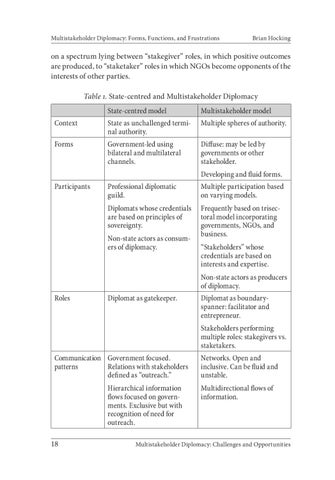
on a spectrum lying between “stakegiver” roles, in which positive outcomes are produced, to “staketaker” roles in which NGOs become opponents of the interests of other parties. Table 1. State-centred and Multistakeholder Diplomacy State-centred model
Multistakeholder model
Context
State as unchallenged terminal authority.
Multiple spheres of authority.
Forms
Government-led using bilateral and multilateral channels.
Diffuse: may be led by governments or other stakeholder. Developing and fluid forms.
Participants
Professional diplomatic guild.
Multiple participation based on varying models.
Diplomats whose credentials are based on principles of sovereignty.
Frequently based on trisectoral model incorporating governments, NGOs, and business.
Non-state actors as consumers of diplomacy.
“Stakeholders” whose credentials are based on interests and expertise. Non-state actors as producers of diplomacy.
Roles
Diplomat as gatekeeper.
Diplomat as boundaryspanner: facilitator and entrepreneur. Stakeholders performing multiple roles: stakegivers vs. staketakers.
Communication Government focused. patterns Relations with stakeholders defined as “outreach.” Hierarchical information flows focused on governments. Exclusive but with recognition of need for outreach. 18
Networks. Open and inclusive. Can be fluid and unstable. Multidirectional flows of information.
Multistakeholder Diplomacy: Challenges and Opportunities