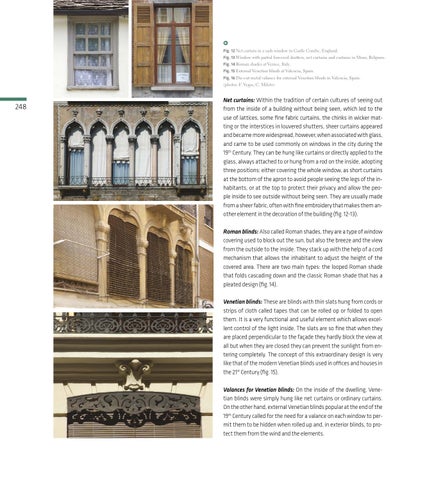
• Fig. 12 Net curtain in a sash window in Castle Combe, England. Fig. 13 Window with partial louvered shutters, net curtains and curtains in Mons, Belgium. Fig. 14 Roman shades at Venice, Italy. Fig. 15 External Venetian blinds at Valencia, Spain. Fig. 16 Die-cut metal valance for external Venetian blinds in Valencia, Spain. (photos: F. Vegas, C. Mileto)
248
Net curtains: Within the tradition of certain cultures of seeing out from the inside of a building without being seen, which led to the use of lattices, some fine fabric curtains, the chinks in wicker matting or the interstices in louvered shutters, sheer curtains appeared and became more widespread, however, when associated with glass, and came to be used commonly on windows in the city during the 19th Century. They can be hung like curtains or directly applied to the glass, always attached to or hung from a rod on the inside, adopting three positions: either covering the whole window, as short curtains at the bottom of the apron to avoid people seeing the legs of the inhabitants, or at the top to protect their privacy and allow the people inside to see outside without being seen. They are usually made from a sheer fabric, often with fine embroidery that makes them another element in the decoration of the building (fig. 12-13). Roman blinds: Also called Roman shades, they are a type of window covering used to block out the sun, but also the breeze and the view from the outside to the inside. They stack up with the help of a cord mechanism that allows the inhabitant to adjust the height of the covered area. There are two main types: the looped Roman shade that folds cascading down and the classic Roman shade that has a pleated design (fig. 14). Venetian blinds: These are blinds with thin slats hung from cords or strips of cloth called tapes that can be rolled op or folded to open them. It is a very functional and useful element which allows excellent control of the light inside. The slats are so fine that when they are placed perpendicular to the façade they hardly block the view at all but when they are closed they can prevent the sunlight from entering completely. The concept of this extraordinary design is very like that of the modern Venetian blinds used in offices and houses in the 21st Century (fig. 15). Valances for Venetian blinds: On the inside of the dwelling, Venetian blinds were simply hung like net curtains or ordinary curtains. On the other hand, external Venetian blinds popular at the end of the 19th Century called for the need for a valance on each window to permit them to be hidden when rolled up and, in exterior blinds, to protect them from the wind and the elements.