EwordsLEjohn may
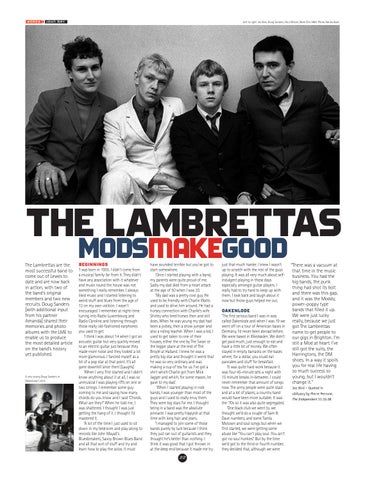
Left to right: Jez Bird, Doug Sanders, Paul Wincer, Mark Ellis.1980. Photo Adrian Boot.
THEModsmakegood LAMBRETTAS The Lambrettas are the most successful band to come out of Lewes to date and are now back in action, with two of the band’s original members and two new recruits. Doug Sanders [with additional input from his partner Amanda] shared their memories and photo albums with the LME to enable us to produce the most detailed article on the band’s history yet published.
A very young Doug Sanders in Oakenload t-shirt.
BEGINNINGS
‘I was born in 1955. I didn’t come from a musical family far from it. They didn’t have any association with it whatever and music round the house was not something I really remember. I always liked music and I started listening to weird stuff and blues from the age of 12 on my own volition. I wasn’t encouraged. I remember at night-time tuning into Radio Luxembourg and Radio Caroline and listening through those really old-fashioned earphones you used to get. ‘I think I was about 14 when I got an acoustic guitar but very quickly moved to an electric guitar just because they made more noise and they looked a lot more glamorous. I fancied myself as a bit of a pop star at that point. It’s all gone downhill since then! [Laughs] ‘When I very first started and I didn’t know anything about it at all, I was so unmusical I was playing riffs on one or two strings. I remember some guy coming to me and saying how many chords do you know and I said ‘Chords. What are they?’ When he told me, I was shattered. I thought I was just getting the hang of it. I thought I’d mastered it. ‘A lot of the time I just used to sit down in my bedroom and play along to records like John Mayall’s Bluesbreakers, Savoy Brown Blues Band and all that sort of stuff and try and learn how to play the solos. It must
have sounded terrible but you’ve got to start somewhere. ‘Once I started playing with a band, my parents were quite proud of me. Sadly my dad died from a heart attack at the age of 50 when I was 20. ‘My dad was a pretty cool guy. He used to be friendly with Charlie Watts and used to drive him around. He had a horsey connection with Charlie’s wife Shirley who bred horses then and still does. When he was young my dad had been a jockey, then a show jumper and also a riding teacher. When I was a kid, I used to get taken to one of their houses, either the one by The Swan or the bigger place at the end of The Broyle at Halland. I knew he was a pretty big star and thought it weird that he was so very ordinary and was making a cup of tea for us. I’ve got a shirt which Charlie got from Mick Jagger and which, for some reason, he gave to my dad.’ ‘When I started playing in rock bands, I was younger than most of the guys and I used to really envy them. They were big stars for me. I thought being in a band was the absolute pinnacle. I was pretty hippyish at that time with long hair and jeans. ‘I managed to join some of those bands purely by luck because I think they just ran out of guitarists and they thought he’s better than nothing. I think it was good that I got thrown in at the deep end because it made me try
22
just that much harder. I knew I wasn’t up to scratch with the rest of the guys playing. It was all very much about selfindulgent playing in those days especially amongst guitar players. I really had to try hard to keep up with them. I look back and laugh about it now but those guys helped me out.
OAKENLODE ‘The first serious band I was in was called Oakenlode and when I was 19 we went off on a tour of American bases in Germany. I’d never been abroad before. We were based in Wiesbaden. We didn’t get paid much, just enough to eat and have a little bit of money. We often stayed in empty barracks on the bases where, for a dollar, you could eat pancakes and stuff for breakfast. ‘It was quite hard work because it was four 45-minute sets a night with 15 minute breaks in-between. I could never remember that amount of songs now. The army people were quite staid and at a lot of places, a country band would have been more suitable. It was the ‘70s so it was also quite segregated. ‘One black club we went to, we thought we’d do a couple of Sam & Dave numbers, and some Tamla Motown and soul songs but when we first started, we were getting some abuse like “You can’t play soul. You ain’t got no soul honkies”. But by the time we’d got to the third or fourth number, they decided that, although we were
“There was a vacuum at that time in the music business. You had the big bands, the punk thing had shot its bolt and there was this gap, and it was the Moddy, power-poppy type bands that filled it up. We were just lucky really, because we just got The Lambrettas name to get people to our gigs in Brighton. I'm still a Mod at heart. I've still got the suits, the Harringtons, the DM shoes. In a way it spoils you for real life having so much success so young, but I wouldn't change it.” Jez Bird – Quoted in obituary by Pierre Perrone, The Independent 31.10.08