From Security Problem to
LANDSCAPE LIGHTING MASTERPIECE 1,300 Fixtures and the Art of Knowing What Not to Light By Randy Reid Photography Credit: Tim Ryan
The call began with a security problem. Someone had broken into a sprawling private residential property in Bexley, Ohio. Despite an extensive security camera system, the team had difficulty tracking the intruder once he disappeared into the darkness of the grounds. According to Chris Apfelstadt, Founder, Christopher A. Lighting Design, it took approximately ten minutes to locate him—an unacceptable amount of time in the security world. The owners began interviewing lighting designers with a practical goal: improve nighttime visibility across the six-acre estate. Chris saw a larger opportunity: “Yes, absolutely, we want to take care of the security,” he recalled. “But this is too beautiful. It deserves to be lit properly, so you can still appreciate the grounds, art, and landscape after dark.” That observation transformed the assignment. What followed was a two-phase project encompassing approximately 1,300 luminaires, extensive nighttime aiming and an extraordinary collection of gardens, architecture and art. It also became one of the most important projects of Chris's career to date.
A Property Made of Outdoor Rooms The estate had grown when the owners purchased the neighboring property and combined the two sites. Although the resulting property covers only six acres, it feels considerably larger because the landscape is divided into a series of gardens, pathways and intimate outdoor environments. Different areas of the property were designed to evoke distinct regions of the world, using carefully selected trees, shrubs and plantings to establish each garden's character. 66
designing lighting
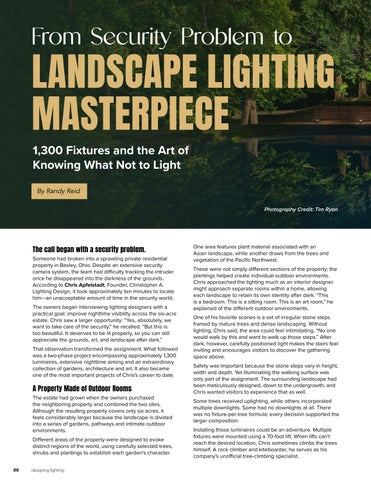
One area features plant material associated with an Asian landscape, while another draws from the trees and vegetation of the Pacific Northwest. These were not simply different sections of the property; the plantings helped create individual outdoor environments. Chris approached the lighting much as an interior designer might approach separate rooms within a home, allowing each landscape to retain its own identity after dark. “This is a bedroom. This is a sitting room. This is an art room,” he explained of the different outdoor environments. One of his favorite scenes is a set of irregular stone steps framed by mature trees and dense landscaping. Without lighting, Chris said, the area could feel intimidating. “No one would walk by this and want to walk up those steps.” After dark, however, carefully positioned light makes the stairs feel inviting and encourages visitors to discover the gathering space above. Safety was important because the stone steps vary in height, width and depth. Yet illuminating the walking surface was only part of the assignment. The surrounding landscape had been meticulously designed, down to the undergrowth, and Chris wanted visitors to experience that as well. Some trees received uplighting, while others incorporated multiple downlights. Some had no downlights at all. There was no fixture-per-tree formula; every decision supported the larger composition. Installing those luminaires could be an adventure. Multiple fixtures were mounted using a 70-foot lift. When lifts can’t reach the desired location, Chris sometimes climbs the trees himself. A rock climber and kiteboarder, he serves as his company's unofficial tree-climbing specialist.