designing lighting
HOW NUCKOLLS FUND TRANSFORMS LIGHTING EDUCATION WHERE THE JUNGLE MEETS THE LIGHT
VOLUME VI • ISSUE 7
A LANDSCAPE LIGHTING
Masterpiece
ROAD OF LIFE: HOW LIGHT HEALS A NATION'S WOUNDS LIGHT JUSTICE NOW AWARDS
August/September 2026 designing lighting
1
2
designing lighting
VOYA
F LO O D & AC C E N T L I G H T I N G
See landscapes in a better light VOYA brings QTL’s signature light quality outdoors. Custom-designed COB engines render landscapes at up to 95 CRI and R9 over 90, with warm dim and precise optical control. Because QTL engineers the light and the power as one system, your design intent holds from specification through the field.
QTL.lighting designing lighting
3
TODAY TO D AY IIN N L LIGHTING I G HT I N G STAY INFORMED. STAY AHEAD.
Today in Lightin g (TiL) is th e daily broa dcast of EdisonRepor t (ER) an d designin g lightin g (dl). Be in th e kn ow in 90 secon ds or less! Hosted by Ran dy Reid, TiL is presented in audio an d video formats weekdays at 8 AM Eastern. Available via Spotify or anywhere you listen to podcasts, the EdisonReport YouTube channel, or LinkedIn. 4
designing lighting
One Language of Light
Meet 20 Linear. At just 0.7" wide, it's our smallestprofile, largest-range family
Downlight
Wash
Graze
Perimeter
Direct/Indirect
Cove
of luminaires, fulfilling every interior application. This is 20 Linear!
BAA/BABA
tools for lighting
inter-lux.com/20l designing lighting
5
table of
CONTENTS
CONTRIBUTORS
10 Editorial Director’s Notepad 12
Who Controls the Light? By: Cristian Suvagau
AI, Connectivity,and the Battle for the Future of Lighting
16
Light + Health
Cristian Suvagau
Camden A. Burns
Lighting Uniformity and Perceptions of Indoor (and Outdoor) Locations By: John D. Bullough, Jennifer A. Brons and Camden A. Burns
The study examines how lighting uniformity affects perceptions of brightness and adequacy, particularly by changing the uniformity of illumination on office walls.
22 Road of Life: How Light Heals a Nation's Wounds By Randy Reid
Jennifer Brons
Award-winning memorial transforms a destroyed bridge in Ukraine into a symbol of resilience The Business of Lighting Design™
by Light 26 Training Lighting becomes an integral part of the training experience at an Evanston, Illinois, jiu-jitsu gym, where a color-changing ceiling acts as a giant visual timer, shifting from green to yellow to red during sparring rounds.
John D. Bullough
Heads to Austin for Enlighten Americas 2026 30 IALD The Enlighten Americas 2026 Conference heads to Austin, October 15–17, with a program exploring AI, sustainability, business strategy, human health and the evolving role of lighting designers. John Kirstein
33
Where the Jungle Meets the Light By Randy Reid
At Nekajui, a Ritz-Carlton Reserve in Costa Rica, GMLD created a lighting experience that disappears into the architecture while immersing guests in the warmth of the surrounding rainforest.
38
Just In
40
Light as Language:Illuminating a New Nashville Landmark
Shirley Coyle
Lighting designer and artist Chelsea Southard transformed Blessing Hancock’s monumental Nashville Fairgrounds sculpture into a nighttime landmark using individually addressable RGB nodes concealed within its stainless-steel structure. Stacie Dinwiddie
6
designing lighting
designing lighting
7
table of
CONTENTS WAC's Architectural Evolution 44 Inside WAC Lighting is making a deliberate move deeper into the
architectural specification market with WAC Architectural, backed by new products, leadership and a dedicated sales strategy.
Full Cutoff: Dean Skira and Taman Want to 48 Beyond Optimize Cities, Not Fixtures By Randy Reid
Dean Skira challenges the lighting industry to stop optimizing individual fixtures and start optimizing entire cities, using AI to develop lighting solutions based on the specific needs of each street.
a Grant Becomes a Legacy: How A Nuckolls Fund 56 When Award Is Transforming Lighting Education at USC By Randy Reid
A 2023 Nuckolls Fund grant helped USC launch an experimental exterior lighting course that has now become a permanent part of the university’s curriculum and helped pave the way for a new graduate Lighting Design Certificate.
58 What Makes a Lighting Rep Good? By John Kirstein
60 Light Justice Now Awards By Randy Reid
64 Residential 66 Landscape Lighting Masterpiece By Randy Reid
8
72
Winning specification in the hybrid workspace
74
Advertisers’ Index
76
Events
77
Award Competitions
78
People on the Move
80
Up Close with Addie Smith
ON THE COVER By Shirley Coyle, LC
designing lighting
Lighting design: Chris Apfelstadt Job Description: Private home in Ohio Photo Credit: Tim Ryan
Transform Architecture with Colored Gradients Inspired by the beauty of the northern lights, SAF Aurora creates striking colored gradients that bring architectural façades to life. Patent-pending dual-beam optics blend a near beam and a far beam to create rich colored gradients with remarkable depth and visual impact.
Find Your Aurora → aurora.hydrel.com
designing lighting
9
EDITORIAL DIRECTOR’S NOTEPAD I am writing this as I return from IES26, The Lighting Conference, which turned out to be one of the best IES conferences I have attended in years. At my age and stage in life, one of the main reasons I attend the conference is to visit dear friends and colleagues whom I have known for decades. For me, the IES conference has become something of a class reunion. At the same time, I am always thrilled to meet young people who are attending for the first time. Those two experiences—the longtime friendships and the new faces—remind me that our wonderful lighting community remains strong and well connected. And nowhere was that more evident than in the celebration of David DiLaura’s 80th birthday. David is one of the living legends of our industry. I am incapable of adequately describing the profound impact he has had on lighting and, especially, on the people who have chosen lighting as their life’s work. Immediately following IES26, friends of David gathered at the Koenig Alumni Center at CU Boulder to celebrate his 80th. The timing was perfect: the conference was just 30 miles away in Denver, making it possible for so many of David’s former students, friends and colleagues to attend. I have always known about the strong connection between lighting and CU Boulder, but I had no idea just how much talent came through David's classroom.
Editorial Director: Randy Reid
Publisher: Cliff Smith
Contributing Writers: Shirley Coyle
Lead Contributing Editor President, Cree Lighting Canada Principal, RELEVANT LIGHT Consulting Inc.
Vilma Barr Contributing Editor Staff Writers: Bridget Leary | Smita Shanbhag 10
designing lighting
During his remarks, David spoke about his experience at IES26, “I had the privilege of sitting with Naomi Miller at IES26, The Lighting Conference. We were speaking at the Emerging Professionals session at the conference. Now, I’d forgotten the pleasure of Naomi’s company, and that was reason enough to attend.”
something else about you that's your brain. Scars and wisdom, fear. Because you've taken risks, fail, and you have. You don't get where you are. Unless you really screw it up.”
He continued, “But to sit in front of those students again was a rebuke and a stumbling block to those who are pessimistic about the young. I was deeply impressed by the attention and the questions that they asked.”
Perhaps that was the perfect way to end a remarkable week.
That struck me. Here was an 80-year-old educator, surrounded by nearly 100 former students, talking enthusiastically about the next generation.
And finally, “Without the scars and wisdom and failure. I don't think it's possible to succeed.”
IES26 reminded me of the people who built this profession, the people who are leading it today and the young people who will inherit it tomorrow. And then, 30 miles away in Boulder, we had the privilege of seeing what one extraordinary teacher can accomplish over a lifetime. Happy 80th, David!
David also recognized four IES Medal recipients who were there that evening: Bob Davis, Ron Gibbons, Naomi Miller and Kevin Houser. But as he looked around the room, he made it clear that the evening wasn't really about him. He said, “The reason we are getting together. is because of you. Your accomplishments, your prizes, your projects, your successes, your influence. the companies you've created, the people you yourselves have mentored. and all the betterment that you're brought to the world.” Then came a very David DiLaura observation about what it actually takes to achieve those things, “There's
Photo Credit: Sam Koerbel
Published by EdisonReport
201 Summit View Drive, Suite 300, Brentwood, TN 30027 Phone: 615-932-1029 designinglighting.com designing lighting is focused on the Business of Lighting Design™ and provides business information to the lighting design community. In addition to the website, designing lighting publishes bi-monthly online magazines featuring original content, interviews within the community and highlights successful award winning lighting designs. While designing lighting is based in the U.S., it has contributors from Europe and is developing a global presence. ISSN: 3066-9111. Statements and opinions expressed in articles and editorials in dl are the expressions of contributors and do not necessarily represent the policies or opinions of the EdisonReport. Advertisements appearing in the publication are the sole responsibility of the advertiser. Reproduction of the material contained in this publication may only be made with the written permission of designing lighting global.
Conference: March 15, 2027 Exhibition: March 16 - 18, 2027 Las Vegas, NV
Lighting Is Only Part of the Picture. Today’s buildings are more connected and intelligent than ever. Explore architectural lighting alongside controls, automation, software, energy management, and intelligent building systems, all under one roof. Join us March 2027 to see how it all comes together.
CLICK HERE FOR MORE INFO
designing lighting
11
Who Controls the Light? AI, Connectivity, and the Battle for the Future of Lighting By Cristian Suvagau
Nearly 150 years ago, Edison’s filament lamp demonstrated the commercial viability of electrical lighting and helped launch an industry built on a simple value proposition: providing illumination safely, efficiently, and reliably. Manufacturers developed lamps and luminaires, control companies delivered control systems and building owners determined how their infrastructure would be operated. Today, a fundamentally different model is beginning to emerge. Lighting is no longer just a source of illumination, but a broader, connected platform where modern lighting systems can provide data (like occupancy sensing and energy monitoring), services (like asset management and positioning), analytics and communications. Across all industrial market sectors, lighting is evolving from a building service to a connected infrastructure and an interface for artificial intelligence. Furthermore, the emergence of visiblelight communication (i.e. LiFi) demonstrates that connected lighting networks can support sensing, communication, 12
designing lighting
positioning and analytics functions beyond providing illumination. Although this transformation may seem technological, its implications for the lighting industry are economic. At first glance, this evolution brings real benefits for the lighting industry. Large technology companies bring significant investment, innovation and user-friendly experiences, providing conveniences and functionality otherwise harder to achieve. Digital platforms (i.e. Amazon Alexa and Google Home) are increasingly positioning residential lighting as one component of a broader connected environment. Connectivity, interoperability, and user experience therefore become essential. Open standards such as Matter, developed through the Connectivity Standards Alliance (that represents over three hundred lighting and technology companies) are helping build consumer confidence when choosing products from different manufacturers.
For commercial and industrial buildings, lighting is increasingly becoming the backbone of modern facilities. We now observe lighting systems interacting with occupancy sensing, daylighting, HVAC, (cyber) security, energy management, demand response and building analytics. While open protocols like BACnet enable interoperability, dedicated lighting protocols and platforms like DALI and D4i provide deeper controls at luminaire and driver level. Interestingly, futureproofing is not about one platform replacing another, but rather them functioning in sync at their distinct levels under the coordination of a cloud-based or AI-driven platform. However, there is another side to the discussion. Modern lighting can integrate with security, building operations and comfort systems while generating valuable data streams. Cloud computing, IoT platforms and AI can convert data into actionable insights. This in turn generates added value by facilitating business decisions regarding energy management, safety, comfort, space allocation, positioning, productivity, maintenance, and operations. As these systems become more connected and data-driven, another question emerges: who owns the value they create? Consequently, as lighting becomes a source of data and intelligence, ownership becomes a strategic issue. Historically, ownership in lighting was straightforward: lighting products from manufacturers were purchased and controlled by building owners. In connected ecosystems, ownership extends beyond the physical infrastructure to include ownership of the data, the user experience and, ultimately, the customer relationship. Platform providers own the data, software, analytics, and customer interactions. Control over lighting functionality, compatibility, cybersecurity, long-term support and data access may gradually shift from consumers, building owners and the lighting industry toward platform providers whose primary business is not lighting. Far from being unique to lighting, there are examples of industries where value has shifted from physical products toward the digital platforms that connected them. While smartphone manufacturers provide the hardware, the long-term value is captured through operating systems, app stores, and cloud services. As lighting becomes a part of a broader digital ecosystem, the industry must ensure that connectivity creates value without surrendering ownership of the value it creates. This issue is not simply about whether open or proprietary protocols are used to control lights and other building systems. Modern lighting systems have four architectural layers, and the lighting industry is focused on the first two: field devices (luminaires, drivers, sensors) and controls network (DALI, BACnet, Zigbee). While open standards like Matter and BACnet may improve the connectivity and system functionalities by improving interoperability issues, the question of ownership remains unresolved. The last two layers are where the industry’s value is concentrated: the management platform (lighting controls software, BMS) and Data, AI and user experience. Even if devices communicate perfectly, ecosystem owners may still control the user interface, cloud platform, analytics, AI capabilities and recurring service revenues. The communication layer may be open, but the business ecosystem can remain partially closed. Artificial intelligence can help lighting systems evolve from simple rulebased controls to predictive and adaptive operation, creating significant economic value while enhancing the customer experience. However, if the AI layer remains closed, building systems may become strategically locked into a single vendor's ecosystem. Consequently, the question shifts from how lighting systems communicate to a more fundamental concern: who controls the light? designing lighting
13
The greater risk is not that Amazon, Google, Apple or other technology companies enter the lighting market. Increased competition can drive innovation and create value for customers. Rather, as value increasingly shifts from luminaires to data, software and digital services, lighting risks becoming a feature within someone else’s ecosystem rather than a standalone industry. In such a scenario, the lighting industry may continue to supply the hardware while gradually losing control of the customer relationship and a growing share of the value it creates. While the industry should continue to work toward open communication standards, interoperability alone does not resolve the ownership challenge. Open devices can still operate within closed platforms that control the data layer and the customer relationship. This outcome is concerning, but it is not inevitable. The lighting industry can maintain its leadership position by carefully navigating the digital transition. Success will depend not only on adopting connectivity, data analytics, and AI, but also on maintaining ownership of the services, expertise and the customer experience that create long-term value. AI as the next value layer. Artificial Intelligence is likely to become the next major layer of creating value by coordinating lighting with other building systems such as HVAC, security, energy storage to optimize building operations. As lighting becomes increasingly integrated into intelligent buildings, AI will transform lighting from a standalone system into a strategic component of a broader operational system. This may in turn depend on significantly increasing the adoption of networked lighting controls. Shifting from products to services. Connectivity is also creating a new lifecycle for lighting. In the past, lamp replacement was providing recurring revenue. Today,
14
designing lighting
software updates, analytics subscriptions, cybersecurity maintenance, sensor firmware upgrades, and AI-enabled services are generating recurring value streams. In many ways, connectivity is becoming the new relamping business model. The importance of open ecosystems. Several lighting companies have begun this transition, rejecting a destiny of becoming providers of commodity hardware. Acuity Brands has developed intelligent building ecosystems and Current has invested in the Daintree platform. Lutron continues to expand beyond traditional controls into integrated experiences, while Signify has expanded through its Interact platform and connected infrastructure initiatives. Protecting the customer relationship. The lighting industry’s greatest advantage remains its expertise. Technology companies undoubtedly understand cloud platforms, analytics, and AI, but they don’t possess deep knowledge of visual comfort, glare control, circadian lighting, adaptive roadway applications, industrial safety, human factors and lighting standards. These are not software problems but lighting problems. In other words, AI may become the intelligence layer of future lighting systems, but lighting expertise must remain the foundation upon which that intelligence is built. Ultimately, customers will trust solutions that deliver better lighting outcomes, not just more sophisticated technology. In conclusion, the future of lighting will not be determined by who controls the data or software. It will be defined by who best understands what light is intended to achieve for people, buildings, cities, and society. The companies that successfully combine lighting expertise with data, software and AI will be the ones that shape the future of lighting while capturing the value it creates.
Find the right solution for your next project Architectural lighting projects don’t come in standard sizes, so Pharos builds reliable lighting control systems for projects of every scale. With two product ranges designed for the control of dynamic DMX & DALI lighting, Pharos powers unforgettable lighting experiences across structures, landscapes and environments. Explore applications and real-world installations, discover seamless integration possibilities, and compare the Pharos product ranges to find the right solution for your next project. pharoscontrols.com/solutions
Golden Jubilee Bridges, UK
Pharos Designer
Pharos Express
Comprehensive, scalable, featurerich dynamic lighting control solutions for architainment, show control and themed environment lighting projects.
The easy to specify, easy to install, and cost-effective DMX and DALI control solution for architectural projects with decorative and dynamic lighting requirements.
Rockheim, Norway
Antwerp Central Station, Belgium Image: Benno Van den Bogaert
272 Gunnersbury Avenue London, W4 5QB United Kingdom
Scan to learn more
+44 (0)20 3696 4050
sales@pharoscontrols.com pharoscontrols.com @pharoscontrols
LIGHT AND HEALTH
Lighting Uniformity and Perceptions of Indoor (and Outdoor) Locations By JOHN D. BULLOUGH,1,2 JENNIFER A. BRONS1,2 AND CAMDEN A. BURNS2 Lighting has multiple objectives. Indoors, lighting should support visual performance, comfort, and circadian entrainment, while avoiding glare. Outdoors, lighting should allow us to detect hazards, recognize others, and feel safe, while minimizing light pollution and circadian disruption. Minimizing energy use through setting appropriate light levels, using controls, employing suitable spectral (color) properties, and optimizing the spatial distribution, is crucial everywhere. Lighting uniformity is one aspect of spatial distribution that can be overlooked both indoors and outdoors. Outdoors, increasing the horizontal illuminance uniformity (with a lower uniformity ratio) increases perceptions of scene brightness and feelings of personal security. Greater brightness perceptions indoors can be achieved by increasing vertical illuminances on walls, but the role of wall lighting uniformity is less clear. Because uniformity can affect perceptions both indoors and outdoors, specifiers can use uniformity to justify reducing light levels and power density, thereby minimizing energy use. In this article, we summarize a recent study exploring the role of wall lighting uniformity on perceived brightness and adequacy of lighting in an indoor office space.
Figure 1. Plan view (left) and scene view (right) of the mock-up office showing multiple lighting layers: (A) direct linear luminaires, (B) linear wall washers, (C) spotlights, (D) strip lights mounted on the upper surface of the air duct, (E) bare LED strips, and (F) desk lamp. 16
designing lighting
Indoor Wall Lighting Uniformity The study occurred in a windowless mock-up office (Figure 1). Layers of light included surface-mounted direct linear luminaires (A) overhead, linear wall washers (B) to the left of and in front of the work area, spotlights (C) to illuminate posters on the walls, strip lights (D) mounted above the heating duct in the space that illuminated the ceiling, and bare LED strips (“sparkle” elements, E) at the ends of the direct luminaires providing visible brightness in the scene without contributing to horizontal illuminance. Lastly, a desk lamp (F) contributed 150 lx to the observers’ workstation. Each layer of light was controlled independently to create illuminance conditions shown in Table 1. All luminaires could produce two correlated color temperatures (3000 K or 5000 K), except the table lamp (2700 K), and the LED strip “sparkle” elements could be energized or not. Each layer provided a low and a high light level. Finally, the wall lighting could produce two uniformity ratios (Figure 2): a lower/more uniform ratio (1.5:1) versus a higher/less uniform one (30:1).
Figure 2. Views of the low (left) and high (right) wall lighting uniformity ratios.
LIGHT AND HEALTH
Table 1. Variables Employed in the Study Variable
Low
High
Work plane illuminance (EH), mean
300 lx
500 lx
Ceiling illuminance, mean
350 lx @ EH=300 lx
2000 lx @ EH=300 lx
390 lx @ EH=500 lx
2450 lx @ EH=500 lx
140 lx @ EH=300 lx
400 lx @ EH=300 lx
190 lx @ EH=500 lx
740 lx @ EH=500 lx
1.5:1 (more uniform)
30:1 (less uniform)
Wall illuminance (EV), mean
Uniformity ratio (max:min) on wall
Observers (5 females and 11 males, aged 22 to 51 years) viewed combinations of these layered conditions in random order while seated at the workstation. After completing a brief series of typical office tasks, they declared their level of agreement ranging from total disagreement (-2) to total agreement (+2), with each of these statements: S1:
T he amount of illumination in this space is adequate.
S2:
he amount of illumination on the desktop is T adequate.
S3:
Overall, the space is bright.
S4:
The lighting in the space is glaring.
S5:
he lighting in this space is acceptable for T performing office work.
S6:
Overall, the space is visually comfortable.
We describe statistically significant effects (based on paired t-tests) below.
Results Horizontal Illuminance
As expected, the higher average horizontal illuminance (500 lx) resulted in greater perceived adequacy of the lighting overall (S1) and on the work plane (S2), greater brightness of the space (S3), and more acceptable lighting (S5) than the lower horizontal illuminance (300 lx).
Wall Illuminance
The higher average wall illuminance (400-740 lx) elicited greater perceived brightness of the space (S3) compared to the lower wall illuminance (140-190 lx).
Wall Illuminance Uniformity
The less uniform wall lighting (max:min = 30:1) reinforced a greater sense of adequacy of light overall (S1) and on the work plane (S2), a brighter overall space (S3), and was more acceptable (S5) than uniform wall lighting (max:min = 1.5:1). The results are displayed in Figure 2.
Ceiling Illuminance
Compared to the lower average ceiling illuminance, the higher ceiling illuminance increased the perception of adequate lighting both in the space (S1) and on the work plane (S2), as well as the overall perception of brightness (S3), the acceptability of the lighting (S5), and visual comfort (S6).
Spectral Characteristics
Participants felt the overall space was brighter (S3) under the 5000 K sources compared to the 3000 K sources.
Sparkle
When the “sparkle” element was present, the lighting appeared more glaring (S4) than when it was absent.
designing lighting
17
LIGHT AND HEALTH
Figure 2. Average agreement with S1, S2, S3, and S5 for different wall lighting uniformity. Error bars represent standard error of the mean.
Discussion
Acknowledgments
Our results indicate that less uniform wall lighting (with a larger max:min ratio) increased brightness perception and the perception of adequate lighting indoors. Increased brightness was also associated with greater horizontal illuminance, wall illuminance, ceiling illuminance, and higher CCT (greater “blue” spectral content).
This study was conducted at the Lighting Research Center with support from Efficiency Vermont, Energize Connecticut, National Grid, Natural Resources Canada, Northwest Energy Efficiency Alliance, and ComEd. Preparation of this article was supported by Light for Energy Partnership members BC Hydro, Eversource, Northwest Energy Efficiency Alliance and the Swedish Energy Agency. We gratefully acknowledge technical contributions from Jeremy Snyder, Martin Overington, and David Pedler.
Increasing horizontal illuminance and CCT will result in increased brightness perception both indoors and outdoors, holding other factors constant. Yet the uniformity of lighting seems to have contradictory effects, with more uniform outdoor lighting but less uniform wall lighting indoors (in the present study) contributing to increased brightness perception. Obviously, horizontal illuminance outdoors is different from vertical illuminance on an office wall. Outdoor settings may lack vertical surfaces from which light could reflect, so different geometries may explain the difference. Another difference between indoor and outdoor lighting is the overall light level. Outdoor illuminances rarely exceed 30 lx, while indoor illuminances frequently exceed 100 lx. Objects within darker regions of nonuniform outdoor lighting might be hard to see, but this would be unlikely for objects under nonuniform indoor wall lighting. Our findings suggest that layers of lighting both indoors and outdoors could be used to establish guidelines for maximizing perceptions of brightness and adequacy, perhaps by employing spotlights to illuminate artwork on walls or spectral tuning of the lighting layers. At the same time, we hope that such guidelines would help specifiers avoid problems such as wasted energy, glare, light pollution, or circadian disruption.
18
designing lighting
1 Light and Health Research Center, Icahn School of Medicine at Mount Sinai 2
Lighting Research Center, Rensselaer Polytechnic Institute
Trapeze 360 Flowing Ropes of Illumination • Flexible, sculptural form available in diffused or woven finishes • Modular design in 2.4" or 3" increments, up to 40 feet continuous • Best-in-Class TruColor™ RGBTW for rich, dynamic color rendering (97+ CRI) at 1500K – 6500K and .004 DUV on the Black Body Curve • Smart control ready via DMX and WiZ Pro • Low-profile hardware with hidden canopy and trimless mounting options • Accessories including concealed clips, standoffs, and canopies for creative installations FOR MORE INFORMATION, CONTACT YOUR LOCAL PUREEDGE LIGHTING REPRESENTATIVE designing lighting OR VISIT PUREEDGELIGHTING.COM
19
A First Look at the Hudson Series Five new luminaires, one simple idea. Light changes everything.
Irvington • Irvington Zoom • Beacon • Kingston • Kingston Zoom Preview the Hudson Series at ArchLIGHT Summit. Contact our sales team for details.
20
TSL I GH T. C O M
designing lighting
designing lighting
21
ROAD OF LIFE:
HOW LIGHT HEALS A NATION'S WOUNDS By Randy Reid
Award-winning memorial transforms a destroyed bridge in Ukraine into a symbol of resilience
Photo credit: Andrii Avdieienko.
Some lighting projects illuminate architecture. Others illuminate history. The Road of Life memorial in Irpin, Ukraine, does both. It preserves one of the darkest moments in modern European history while demonstrating how light can become a powerful language of remembrance and hope. Earlier this year, the memorial received the top honor at the Media Architecture Biennale 2025, one of the world's most respected competitions recognizing projects that merge architecture, technology, and media art. For Ukrainian lighting design firm Expolight, the award validates a project that was never about winning trophies. It was about ensuring that the memories of thousands of civilians would never fade. I recently spoke with Mykola Kabluka, founder of Expolight, about the project and the emotional journey behind its creation.
A Bridge That Became History When Russian forces invaded Ukraine in February 2022, 22
designing lighting
the Romanivskyi Bridge in Irpin became known around the world. After the bridge was destroyed, it became the only evacuation route for thousands of civilians fleeing the fighting. Families crossed beneath the shattered concrete structure on a temporary wooden walkway carrying whatever they could salvage from their homes. Many had only a single bag. Parents carried frightened children. Images from those desperate days became some of the defining photographs of the war. Mykola shared one story that still weighs heavily on him. A colleague escaped through the crossing carrying her six-year-old daughter. The child died during the evacuation because emergency medical care was unavailable. Her mother continued across the temporary passage carrying her daughter's body. "Even now," Mykola told me, "it's painful memories." Those memories became the foundation for Road of Life.
Preserving the Scar After a replacement bridge was built nearby, officials faced an important question: What should become of the destroyed bridge? Rather than removing it, they decided it should remain as a permanent memorial. Expolight proposed something remarkably simple yet emotionally powerful. Instead of hiding the damage, the designers emphasized it. Bright red lines of light stretch across the fractured sections of the bridge like surgical stitches closing an open wound. The illuminated connections symbolize healing without pretending the injury never occurred. "The concrete and metal were destroyed," Mykola explained. "But people's faith and dignity are stronger than material." The metaphor works on several levels. The bridge itself cannot be restored to its original form, but its broken pieces are visually reunited through light. Visitors are reminded that although physical structures can be destroyed, a nation's spirit is far more difficult to break.
Making Light Behave Like a Pulse Although many viewers assume the glowing red lines are lasers, they are actually created using Color Kinetics one-degree beam projectors from Signify. Each projector precisely illuminates specially prepared climbing ropes suspended across the damaged structure. Creating that effect proved far more difficult than simply shining light onto fabric. The Expolight team conducted numerous material tests before selecting industrial climbing rope. They then collaborated with a local chemical institute to develop a custom UV-cured coating that would reflect light efficiently while surviving years of outdoor exposure and constant vibration. The ropes themselves became part of the optical system. The RGBW lighting is programmed to shift subtly between deep red and warmer tones while gently pulsing like a heartbeat. The effect intentionally resembles fresh tissue healing after injury.
"It's like a fresh wound," Mykola said. "It slowly pulsates like the blood in our bodies." The surrounding memorial is intentionally restrained. Damaged concrete, twisted steel, and overturned vehicles are illuminated with carefully focused white light reminiscent of museum lighting. Visitors experience the destroyed bridge almost as an artifact preserved in time, while the glowing red stitches above create a visual network reconnecting what violence attempted to separate.
Designing Against the Clock Most memorial projects take years to complete. Road of Life took less than three months. Expolight received the commission only about ten weeks before the memorial was scheduled to open on Ukraine's Independence Day, 24 August 2024. That compressed schedule included concept development, engineering, fabrication, installation, programming, and commissioning. "Our team worked literally for weeks without breaks," Mykola recalled. "The last week was almost without sleep." Despite the aggressive timeline and significant budget constraints, the finished installation has become one of Ukraine's most recognized memorial lighting projects and has earned international acclaim.
designing lighting
23
Light as the Language of Memory During our conversation, Mykola said something that perfectly captures why this project resonates so deeply. "The project is designed to convey the experience of war in the language of light—as a way to talk about complex things that are difficult to express in words." That philosophy appears throughout Expolight's work. Readers of designing lighting may remember my earlier article about Cross of Heroes, another memorial by Expolight honoring Ukrainians who lost their lives defending their country. Like Road of Life, it demonstrates that architectural lighting can communicate emotion every bit as effectively as sculpture or music. Both projects use light not for spectacle, but for remembrance.
International Recognition The Media Architecture Biennale Award is presented every two years and recognizes projects that successfully integrate architecture, media, and public space. For Mykola, receiving the competition's highest honor represented something much larger than professional recognition. "Receiving an award of this level is a feeling of great inner pride and responsibility," he said.
The project has also earned honors from the LIT Lighting Design Awards, the IES Illumination Awards, and several other international competitions, reinforcing the idea that meaningful lighting design can transcend national boundaries.
A Journey Still to Come As our conversation came to a close, I told Mykola something I have been thinking about since first writing about Cross of Heroes. When the war finally ends, I plan to travel to Ukraine. I want to stand beneath the illuminated stitches of the Romanivskyi Bridge, visit Cross of Heroes, and experience both memorials the way they were intended—not through photographs or videos, but in person. The two sites are only about forty minutes apart by car. Seeing them together will provide an opportunity to understand how one design team has used light to tell two different chapters of the same national story. Lighting designers often speak about creating memorable experiences. Few projects demonstrate that mission more powerfully than these memorials. Road of Life reminds us that while concrete can be shattered and steel can be twisted, memory endures. Through carefully crafted light, one broken bridge now tells a story that the world should never forget.
For the story that we told to the world through light. For the people for whom it was created. And for the fact that light has become more than a tool—it has become the language of memory and life. 24
designing lighting
designing lighting
25
TRAINING BY LIGHT By Randy Reid
The clock is still there. Most athletes never look at it. Inside a jiu-jitsu gym in Evanston, Illinois, the ceiling tells them everything they need to know. Green means the round has just begun. Yellow signals that time is running short. Red means the end is near. Whether an athlete is standing, sparring, or pinned beneath an opponent in the middle of the room, the information is impossible to miss. The system doesn't rely on announcements, whistles, or wall-mounted timers. It relies on light. For Lindsay Johnson, Senior Designer at Cosine, that idea emerged naturally from a project that was already challenging traditional assumptions about fitness environments. "It accidentally became an accessibility feature," Lindsay explains. "If you're deaf, you don't need to rely on a beep. If you're in the middle of training and can't see the clock, you can still understand where you are in the workout." The solution feels obvious once you see it. Yet few fitness facilities have attempted anything similar.
26
designing lighting
A Passion Project Takes Shape The story begins with an entrepreneur who decided to follow a passion. After achieving financial success early in life, the private owner turned his attention toward Brazilian jiu-jitsu and set out to create a facility unlike the traditional martial arts studios scattered throughout suburban Chicago. The project landed on the desk of Cosine, a design-andprocurement firm known for helping clients navigate lighting decisions without the complexity of a traditional purchasing process. "We went through six or seven iterations," Lindsay recalls. "At first there were value-engineering exercises where the budget came down. Then the client realized lighting could become part of the brand and part of the experience." The shift changed everything. Instead of treating lighting as infrastructure, the team began treating it as identity. The result is a facility where nearly every lighting decision contributes to the experience of moving through the building. Photography Credit: Konrad Wazny
The Hallway Visitors first encounter that philosophy in a dramatic corridor connecting the facility's primary spaces. A long run of Coronet LED's Wave fixture stretches overhead, creating a graphic ribbon of light that immediately establishes the visual language of the project. Although the installation appears custom-made for the architecture, the design relies on standard fixture modules assembled into a continuous composition. The effect is deceptively simple. "It's really just the same fixture repeated," Lindsay says. "But because of the way it moves through the space, it feels completely custom."
clean illumination without drawing attention to the source, while DMF downlights provide functional lighting in the locker rooms. Together, the supporting fixtures allow the feature lighting to take center stage while ensuring the entire facility performs as well as it looks.
A Ceiling That Teaches The largest training room contains the project's most innovative lighting feature. At first glance, the ceiling appears to be a geometric composition of illuminated lines arranged into a rectilinear grid. White linear fixtures define the framework while RGBW elements form a series of X-shaped accents throughout the space.
Alongside the ceiling feature, concealed cove lighting washes the walls with a soft glow. The walls gradually angle inward while the ceiling lowers, creating a subtle feeling of compression before opening into the facility's largest training space.
The composition is visually striking. It’s true purpose, however, only becomes apparent during training.
The lighting reinforces the architectural sequence.
The lighting system offers another solution.
Visitors move from brightness into a darker, more focused environment before arriving at the gym's central room. The experience feels almost cinematic.
As a round begins, the illuminated X-elements glow green. As time passes, the color gradually transitions toward yellow and eventually red. Athletes can instantly understand where they are within the round without breaking concentration.
"We wanted that hallway to pull you through the building," Lindsay explains.
Brazilian jiu-jitsu classes often involve five-minute sparring rounds. Traditionally, participants rely on clocks, timers, whistles, or verbal cues to track progress.
The room itself becomes a giant timer.
The strategy succeeds because the lighting is doing more than illuminating surfaces. It is directing movement.
"It ended up acting as a clock," Lindsay says. "No matter where you are in the room, you can just look up and know how much time is left."
Designing Without a Ceiling
The concept emerged through collaboration between the design team and the client. Neither side began the project intending to create a color-coded timing system. The idea evolved as discussions progressed about how lighting might contribute directly to the training experience.
Fitness facilities often face a familiar challenge. Budgets are limited, yet large open spaces require extensive mechanical systems overhead. Traditional suspended ceilings can quickly consume available resources. This project embraced the opposite approach.
Sometimes the best design solutions emerge that way. Not from a brief. Not from a specification. But from curiosity.
Rather than concealing ductwork and infrastructure, the design team left the ceiling exposed. Linear pendants were suspended beneath the mechanical systems, creating a clean visual datum that organizes the space and draws attention away from the clutter above. The result feels intentional rather than unfinished. "I think it creates a much more intimate experience," Lindsay says. "You're not standing under bright industrial high bays. Everything feels more controlled and atmospheric." Dark finishes throughout the room contribute to that mood. The lighting remains focused where it needs to be while the ceiling recedes into the background. The approach is both economical and sophisticated. What could have been a compromise became one of the project's defining characteristics. Not every fixture in the project needed to make a statement. While Coronet LED's linear systems define the gym's visual identity, Lindsay supplemented them with products selected for performance and simplicity. QTL supplied the linear lighting behind the mirrors, delivering
designing lighting
27
More Than Color Color-changing lighting has become common in fitness environments. Too often, however, it functions as little more than decoration. The difference here is intent. The RGBW fixtures are not simply creating atmosphere. They are communicating information. The colors serve a purpose beyond aesthetics. That distinction transforms the experience. When the lighting changes, users respond. The system becomes part of the workout rather than a backdrop to it. Lindsay believes that relationship contributes to the facility's identity. "We realized the lighting could become a marketing tool and a way for people to remember the space," she says. Viewed from outside during a Chicago snowfall, the gym glows with saturated color against a backdrop of white snow. Inside, the illuminated ceiling reflects from the bright floor surface, creating unexpected layers of color throughout the room. The effect is immersive without feeling theatrical.
Simplicity Behind the Scenes
Light as Information
One of the more surprising aspects of the project is how straightforward much of the installation actually is.
What makes the Evanston project memorable is not the fixtures, the controls, or even the colorful photographs. It is the idea.
Rather than relying on extensive custom fabrication, the design team built many of the ceiling compositions using standard fixture lengths and modular components. This simplified coordination, reduced costs, and minimized installation complexity. "It's basically a puzzle," Lindsay says. "We used standard lengths and assembled them into a larger composition." The strategy reflects a broader design philosophy. Good lighting design does not always require custom products. Sometimes it requires using familiar products in unexpected ways. Throughout the facility, that principle appears repeatedly. Standard fixtures become architectural features. Linear luminaires become wayfinding tools. Color-changing elements become training aids.
For decades, lighting designers have used light to reveal architecture, create atmosphere, and influence emotion. This project demonstrates another possibility. Light can communicate. Light can guide behavior. Light can provide information at precisely the moment people need it. In Evanston, a group of athletes spends hours every week looking toward the ceiling for guidance. Not because the lighting is dramatic. Not because it is colorful. But because it helps them train. That may be the most interesting thing about the project. The lighting is no longer supporting the activity. The lighting has become part of it.
The technology itself is not revolutionary. The application is.
28
Location
Manufacturer
Fixture Type
Main Corridor
Coronet LED
Wave Linear Pendant
Main Corridor Cove
Coronet LED
PG2 Cove Luminaire
HIIT Training Room
Coronet LED
Suspended Linear Pendant System
Jiu-Jitsu Training Room
Coronet LED
Linear Pendant Grid
Jiu-Jitsu Training Room
Coronet LED
RGBW Linear Pendant (X-Pattern Elements)
Mirror Lighting
QTL
Linear LED
Locker Rooms
DMF Lighting
Architectural Downlights
designing lighting
designing lighting
29
IALD
Heads to
AUSTIN
for Enlighten AMERICAS 2026 The International Association of Lighting Designers (IALD) will bring its annual Enlighten Americas conference to Austin, Texas, October 15–17, 2026, combining forwardlooking education, business discussions and networking in one of the country's fastest-growing design cities. The conference will be held at the Hyatt Regency Austin, overlooking Lady Bird Lake and offering attendees easy access to the city's renowned music, culinary and cultural districts. From the nearby Congress Avenue Bridge bat colony to the vibrant nightlife along 6th Street and Rainey Street, Austin provides a fitting backdrop for lighting designers who appreciate the intersection of architecture, urban experience and light. Austin has long been recognized as the "Live Music Capital of the World," but it has also emerged as one of America's most dynamic design centers. A rapidly evolving skyline, celebrated architecture programs at the University of Texas, an expanding public art scene and a growing collection of thoughtfully illuminated public spaces make the city a natural host for the IALD's premier North American conference. The conference officially opens Thursday, October 15, with the Business Forum, one of Enlighten's signature sessions. Designed as an open discussion among firm owners and industry leaders, the forum encourages candid conversations about the business challenges and opportunities facing architectural lighting design practices today.
30
designing lighting
Thursday afternoon continues with the Lighting Industry Resource Council (LIRC) Member Meeting, bringing manufacturers, lighting designers and other industry professionals together for collaborative discussion before attendees gather for the Opening Reception, sponsored by Cooper Lighting Solutions. Friday's educational program reflects many of the issues currently shaping the profession. Sustainability takes center stage with Designing Lighting for a Net Zero Carbon Project: What Exactly Does it Mean and How to Do It, a session examining why lighting has often been overlooked in carbon accounting and how designers, manufacturers and owners can work together to establish meaningful environmental reporting standards. For those interested in the creative process, Painting Darkness explores whether traditional hand drawing still has a place in an increasingly digital profession. Rather than viewing drawings simply as presentation tools, the session examines how sketching can encourage exploration before computer renderings prematurely suggest that a design has already been resolved. Materiality also receives fresh attention in The Illuminated Surface: Rethinking Light as a Material Experience, challenging designers to think beyond luminaires and instead focus on how finishes, textures and materials actively shape the perception of light.
Business owners may find equal value in Why Grow? Rethinking Scale, Stability, and Impact in the AEC Industry, a strategic discussion about intentional growth and long-term planning for design firms. Artificial intelligence continues to move from curiosity to practical reality within the profession. Beyond the Buzz: Ethics of AI in Lighting Practice promises to move beyond demonstrations of AI software and instead examine the ethical questions surrounding authorship, professional responsibility and changing business models as AI becomes integrated into lighting design workflows. Saturday's program continues that balance between inspiration and practical application. One of the conference's most anticipated presentations, Celestial Park: When Light Becomes the Story, takes attendees behind the scenes of Universal Epic Universe's central land, where lighting itself became the primary storytelling medium. Without an existing intellectual property franchise guiding the guest experience, designers relied on light to create narrative, emotion and identity after sunset. AI returns to the program with AI-Driven Visual Thinking for Lighting Design, demonstrating how emerging image-generation tools can be adapted specifically for lighting concepts rather than simply creating architectural renderings. Another session likely to generate discussion is Light and Sound: Creative Allies or Enemies?, exploring the relationship between lighting and acoustics in shaping the perception of architectural space. Rather than treating the two disciplines independently, the presenters examine how they can reinforce—or undermine—one another.
Technical collaboration remains an important theme as well. From Design to Delivery: Partnering for Lighting Success addresses the growing complexity of lighting systems, digital addressing and controls coordination, asking an increasingly relevant question: who ultimately owns responsibility for making sophisticated lighting systems function as intended? Health and human experience round out the conference with two compelling presentations. Light is Biological: A Medical Scientist and Lighting Designer Reframe Lighting Practice examines decades of research into light's role in regulating human physiology, while More Than Meets the Eye: The Expanding Role of Lighting Designers explores emerging research into far-red and near-infrared light and its potential influence on health and wellbeing. Beyond the classroom, Enlighten Americas has long been valued for its networking opportunities. Meals, breaks and tabletop exhibits are intentionally designed to encourage conversations among independent designers, manufacturers, educators and students. With Austin's walkable entertainment districts, restaurants and live music venues only minutes from the Hyatt Regency, attendees will have ample opportunities to continue those conversations well into the evening. For lighting professionals seeking a blend of education, business insight and creative inspiration, IALD Enlighten Americas 2026 promises a program that looks beyond today's challenges while exploring where architectural lighting design is headed next. And with Austin providing the stage, attendees can expect a conference that is every bit as vibrant as its host city.
Allie Schieffelin, Diane Borys and Daniel Graser Attend Enlighten Americas in Tuscon in 2025 designing lighting
31
WHERE THE JUNGLE MEETS THE LIGHT At Nekajui, a Ritz-Carlton Reserve in Costa Rica, GMLD created a lighting experience that disappears into the architecture while immersing guests in the warmth of the surrounding rainforest.
By Randy Reid
When Granville McAnear, principal of Granville McAnear Lighting Design, begins talking about Nekajui, the Ritz-Carlton Reserve on Costa Rica's Peninsula Papagayo, it becomes obvious this is more than another luxury hospitality project. After six years of design, more than ten trips to Costa Rica, and an intensive commissioning process, the project became one of his favorites—not because of its scale, but because of the opportunity to create a lighting experience that feels almost invisible. Perched high above the Pacific Ocean, the resort unfolds across a dramatic jungle-covered hillside.
32
designing lighting
The development includes more than 200 guestrooms, luxury tent accommodations, private residences, restaurants, a spa, event spaces and countless pathways that weave through dense tropical vegetation. The challenge wasn't simply to illuminate the resort. It was to preserve the magic of the jungle after sunset. "We just wanted it to feel warm," Granville says. That deceptively simple goal became the guiding principle behind every lighting decision.
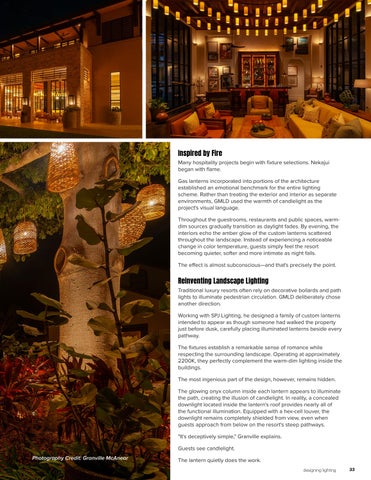
Inspired by Fire Many hospitality projects begin with fixture selections. Nekajui began with flame. Gas lanterns incorporated into portions of the architecture established an emotional benchmark for the entire lighting scheme. Rather than treating the exterior and interior as separate environments, GMLD used the warmth of candlelight as the project's visual language. Throughout the guestrooms, restaurants and public spaces, warmdim sources gradually transition as daylight fades. By evening, the interiors echo the amber glow of the custom lanterns scattered throughout the landscape. Instead of experiencing a noticeable change in color temperature, guests simply feel the resort becoming quieter, softer and more intimate as night falls. The effect is almost subconscious—and that's precisely the point.
Reinventing Landscape Lighting Traditional luxury resorts often rely on decorative bollards and path lights to illuminate pedestrian circulation. GMLD deliberately chose another direction. Working with SPJ Lighting, he designed a family of custom lanterns intended to appear as though someone had walked the property just before dusk, carefully placing illuminated lanterns beside every pathway. The fixtures establish a remarkable sense of romance while respecting the surrounding landscape. Operating at approximately 2200K, they perfectly complement the warm-dim lighting inside the buildings. The most ingenious part of the design, however, remains hidden. The glowing onyx column inside each lantern appears to illuminate the path, creating the illusion of candlelight. In reality, a concealed downlight located inside the lantern's roof provides nearly all of the functional illumination. Equipped with a hex-cell louver, the downlight remains completely shielded from view, even when guests approach from below on the resort's steep pathways. "It's deceptively simple," Granville explains. Guests see candlelight. Photography Credit: Granville McAnear
The lantern quietly does the work. designing lighting
33
Less Is More Perhaps the most striking aspect of the project is GMLD's restraint. Rather than filling ceilings with recessed downlights, they consistently looked for opportunities to illuminate architecture instead. One covered arcade illustrates the philosophy beautifully. There isn't a single recessed downlight in the woven cane ceiling. Instead, discreet fixtures mounted on columns, wall sconces and illuminated niches create comfortable circulation while preserving the architectural character overhead. "I hate using downlights when they aren't necessary," Granville says. It's an approach that appears repeatedly throughout the resort. Deeply regressed downlights with hexcell louvers are used only where required, virtually eliminating glare. Decorative fixtures, illuminated millwork and concealed linear lighting provide much of the ambient illumination instead. The architecture—not the fixtures—becomes the visual focus. Where recessed fixtures were necessary, GMLD selected deeply regressed downlights with hex-cell louvers to virtually eliminate glare. The public spaces utilize USAI and Specialty Lighting (Graffiti) luminaires, while many of the guestrooms employ Visual Comfort's Entra Series, allowing the architecture—not the light source—to remain the visual focus.
Lighting Luxury Tents Among Nekajui's most memorable accommodations are several luxury guest tents. While they may resemble safari tents from the outside, they are fully conditioned suites complete with private plunge pools. Lighting them required abandoning many conventional hospitality techniques. Without traditional ceilings, ambient illumination comes primarily from concealed uplighting hidden behind the headboard wall. Decorative pendants, bedside lamps and carefully integrated sconces provide layered illumination while maintaining the feeling of sleeping beneath canvas. The rooms are intentionally never overlit. Instead, the lighting reinforces the sensation of being suspended within the rainforest canopy. Decorative lighting played a critical role throughout Nekajui, making lamp selection just as important as fixture selection. GMLD specified Philips WarmGlow LED lamps from Signify wherever decorative fixtures were used, allowing the color temperature to shift naturally from approximately 2700K to a candle-like amber as the lights dimmed. Procuring enough of the specialty lamps proved challenging in Costa Rica, and during commissioning the team discovered that some fixtures had been fitted with standard LED lamps. Once the WarmGlow lamps were installed and compared side-by-side, however, the difference was unmistakable. "Most people don't really understand warm dim until they experience it," Granville says. "Then they immediately get it." The lamps became an essential ingredient in maintaining the resort's consistent visual language, allowing decorative fixtures, custom lanterns and architectural lighting to speak with the same warm, inviting voice.
34
designing lighting
The Importance of Hidden Details Many of the project's most successful moments come from details guests will never consciously notice. Linear lighting is concealed within narrow drywall coves using aluminum extrusions and diffusers that produce smooth, glare-free illumination. Millwork glows softly from concealed uplighting. Decorative screen walls become luminous architectural features. Even illuminated mirrors were modified so their color quality better matched the surrounding warm-dim lighting. Equally important was the control strategy.
Respecting the Night Sky Because the resort occupies the environmentally sensitive Peninsula Papagayo, strict dark-sky requirements significantly limited landscape uplighting. Rather than viewing those restrictions as obstacles, Granville embraced them. Architecture gently glows outward. Lanterns quietly define circulation. The surrounding jungle remains largely untouched, allowing darkness itself to become part of the guest experience. The result is refreshingly restrained. Instead of competing with nature, the lighting allows nature to remain the star.
The lighting design was originally conceived around a Lutron control system, allowing guests to choose intuitive lighting scenes. GMLD also designed long, gradual fade sequences that mirror the transition from daylight into evening for public areas. During construction, however, a different control platform was substituted. According to Granville, the replacement system lacked the programming flexibility needed to execute the extended fade times his design intended. The experience reinforced an important lesson for hospitality lighting designers: exceptional fixtures alone cannot deliver an exceptional lighting experience. Sophisticated controls are equally essential to bringing the design vision to life. designing lighting
35
Commissioning as Design Projects of this scale rarely achieve their full potential without significant time in the field. Over the course of six years, Granville and Angela Green (Studio Director) traveled to Costa Rica more than ten times. Final commissioning alone required three separate visits involving five members of his design team, each responsible for different portions of the resort. Granville was also quick to credit Angela, saying she handled much of the day-to-day work on the project. He noted that her contributions were instrumental to the final result and that she deserves significant recognition for the project's success. Could fewer people have completed the work? Probably. But Granville viewed the investment differently. "I'd like to take everybody to every project," he says. "It's a huge learning experience."
That philosophy is evident throughout Nekajui. Nothing feels accidental. Every scene, every concealed light source and every carefully controlled transition contributes to an experience that feels effortless—precisely because so much effort went into making it that way. In the end, perhaps the highest compliment came not from an awards jury or hotel executive, but from a landscape architect who recently visited the resort. Walking the property at night, the architect simply remarked that it felt comfortable. For Granville, that was exactly the objective. Guests may never notice the hidden downlights inside the lanterns, the carefully concealed linear lighting or the sophisticated layers of warm illumination. They simply experience a resort that feels perfectly at home in the Costa Rican jungle—a place where architecture, landscape and light quietly become one.
Fixture Schedule
36
PROJECT CREDITS
3" Recessed Beveled Square Warm-Dim LED Adjustable Downlight
Tech Lighting
3" Recessed Beveled Square Warm-Dim LED Wall Washer
Tech Lighting
3" Recessed Beveled Square Warm-Dim LED Fixed Downlight
Tech Lighting
3" Recessed Beveled Round Warm-Dim LED Adjustable Downlight
Tech Lighting
3" Recessed Beveled Round Warm-Dim LED Wall Washer
Tech Lighting
3" Recessed Beveled Round Warm-Dim LED Fixed Downlight
Tech Lighting
4" Recessed High-Output Warm-Dim LED Adjustable Downlight
Tech Lighting
4" Recessed Flangeless Warm-Dim LED Adjustable Downlight
Tech Lighting
4" Recessed Flanged Warm-Dim LED Adjustable Downlight
Tech Lighting
4" Recessed Warm-Dim LED Wall Washer
Tech Lighting
Recessed LED Step Light
ET Lighting
Recessed In-Ground MR16 Uplight
Kapego
Recessed In-Ground Linear Warm-Dim Grazer
Bold Lighting
Surface-Mounted Linear Warm-Dim Grazer
i2Systems
Recessed Linear Warm-Dim Uplight
Mingxue
Recessed Linear Warm-Dim Lighting System
Mingxue
Wet-Location Recessed Linear Warm-Dim Lighting System
Mingxue
2×4 Recessed LED Troffer
Ever Tie
Warm-Dim A19 Lamp in Architectural Niche
Philips Lighting
Linear Grazing
i2Systems
designing lighting
Project: Ritz-Carlton Reserve Location: Nekajui, Costa Rica Bold Lighting Design: GMLD Designers: Granville McAnear, Angela Green Architect: Gensler Costa Rica - Irene Rodriguez, Maria Laura Sequeria Interior Designer: BAMO Design Architect: 10SB Photography Credit: Granville McAnear
Where Innovation Illuminates Possibility.
Introducing Vode Studio Think of our products as your building blocks. Combine them, adapt them, rethink them. There’s no prescribed way to put the pieces together, that part is yours. Create something entirely new, or adapt one of our standard products to fit your project.
Your project. Your configuration. “Standard products can be configured in new ways, giving designers the flexibility to personalize their projects affordably.” AN N SCH I FFE RS | PRESI D E NT
The Process Share your Vision. Send us a sketch, a set of parameters, or a full concept.
We Review. Our dedicated team of engineers assess the feasibility, timeline, and budget.
We Build. The team partners with you to bring the concept to life.
vode. com/vode-studio
JUST IN ARIA X2™ Acclaim Lighting’s new Aria X2™ Wireless Control System delivers advanced wireless DMX control with multi-band technology, supporting both 2.4 GHz and Sub-GHz frequencies for reliable performance in complex environments. With up to 2,000 feet of range, support for DMX and 0–10V outputs, and compatibility with legacy Aria systems, Aria X2 provides a flexible, scalable solution for architectural and outdoor lighting applications.
TRACE PRO™ Tivoli Lighting’s new TRACE Pro™ is a compact 1×1 linear lighting platform designed for architectural, hospitality, entertainment, and outdoor applications. Offering static white, Dynamic White, RGBW, and pixel-controlled technologies in one versatile system, TRACE Pro delivers seamless lines of light, advanced control capabilities, and flexible horizontal or vertical mounting options for streamlined specification.
AMP® IQ™ SMART RGBCW LED SPOTLIGHT AMP Lighting’s new AMP iQ™ Smart RGBCW LED Spotlight is a Bluetooth® mesh-enabled landscape fixture offering customizable color, tunable white control from 2200K–4000K, and millions of color options through app-based control. Delivering over 1,000 lumens, 95 CRI, full-range dimming, and interchangeable optics, the durable cast brass spotlight provides flexible, highperformance illumination for residential and commercial outdoor applications.
38
designing lighting
ATOLL Expanding its Atoll family, Eureka introduces new square and rectangular luminaires with rounded corners, offering large-scale geometric designs from 44” x 44” to 120” x 120”. With pendant and surface-mount options, 14 finish choices, optional uplight distributions, and integrated acoustic panels made from 50% recycled polyethylene, Atoll combines visual impact, lighting performance, and sound management for modern architectural spaces.
MEC+20L Inter-lux’s new MEC+20L Hybrid Luminaire combines a trimless knife-edge cove with 20 Linear Direct technology to deliver both indirect uplight and precise direct illumination in a single streamlined system. Available in Static White, RGBW, and Warm Dim options, MEC+20L features custom lengths, field-replaceable LED boards, and diffuser choices for seamless architectural integration and flexible lighting design.
8″ TO 4″ RETROFIT CONVERSION KIT
TIDAL Lodes’ Tidal collection brings a fluid, wave-inspired silhouette to architectural spaces with its distinctive ring-shaped die-cast aluminum design. Available in ceiling-mounted and pendant configurations with four refined finishes, Tidal delivers simultaneous upward and downward illumination with dimmable control, creating a dynamic lighting experience for residential, hospitality, and commercial environments.
Transforming existing recessed housings into modern architectural downlights, the new 8″ to 4″ Retrofit Conversion Kit from DMF Lighting allows easy upgrades without disturbing finished ceilings or existing wiring. Designed for renovation projects, the kit supports DMF’s modular 4-inch platforms with below-ceiling serviceability, field-changeable optics, multiple lumen packages, and flexible trim options for high-performance residential and commercial applications.
SMALL IN ONE™ - MINI MULTIPLES AND THE LITTLETWOS® NXT MULTIPLES USAI Lighting introduced Small In One™ - Mini Multiples and the LittleTwos® NXT Multiples. Developed to streamline specification, the Multiples combine coordinated fixture layouts with precise aperture spacing. Available in single-, double-, triple-, and quad-configuration options, Multiples gives designers more ways to compose light within a space.
VARITUNE™ 2.7 LOW-PROFILE (LP)
HYBRID Reggiani introduces Hybrid, an architectural downlight system combining refined design, precision optics, and innovative LED technology. Featuring Reggiani’s ILM (Interchangeable LED Module), it delivers flexible, future-ready performance with exceptional visual comfort and efficiency. Available in multiple configurations and control options, Hybrid provides elegant, adaptable illumination for contemporary spaces.
Introducing VariTune™ 2.7 LP Tunable Tape Light, Alloy LED’s low-profile solution for precise white light control across a 2700K–6000K tuning range. Measuring just 0.31” wide and 0.1” high, the 95+ CRI tape light delivers smooth, hotspot-free illumination with flexible dimming and fieldcuttable design for coves, millwork, and other space-conscious architectural applications.
designing lighting
39
Light as Language: Illuminating a New Nashville Landmark By Randy Reid
Photography Credit: Blessing Hancock By day, Blessing Hancock's monumental sculpture at the Nashville Fairgrounds commands attention through its sweeping stainless-steel forms. The polished ribbons catch the changing Nashville sky, inviting visitors to walk around— and even through—the artwork. After sunset, however, the sculpture becomes something entirely different. Light begins to flow through its translucent surfaces, transforming solid steel into a luminous landmark that feels almost weightless. That nighttime transformation is the work of Chelsea Southard, a lighting designer and artist whose home base is now in Mexico. Although she lives hundreds of miles from Nashville, Chelsea spent significant time on site helping bring the sculpture to life after dark. Her role reached far beyond specifying luminaires. She became deeply involved in developing the lighting strategy, solving installation challenges, programming the animations, and commissioning the finished system. Chelsea's path into lighting is unlike that of many architectural lighting designers. While others enter the profession through architecture or engineering, Chelsea approaches projects first as an artist. Her own work combines sculpture, metal, glass, light, and even sound. She also collaborates with artists across North America, helping translate artistic visions into illuminated public installations. That background made her an ideal fit for a project where the lighting wasn't intended to highlight the sculpture—it was intended to become part of the sculpture itself. "I've done Blessing Hancock projects for many years," Chelsea said. "This is just the largest one that I did for her." Chelsea joined the project through Gizmo Art Production, the California fabrication company that built the sculpture. Having
40
designing lighting
collaborated with Gizmo on previous installations, she was asked to develop the lighting concept, create mockups, and work with the fabrication team on integrating the system into the sculpture's complex geometry.
Designing with Light Instead of Fixtures The most successful lighting projects often hide the technology. Visitors don't stand beneath the sculpture admiring luminaires or wondering how the system works. Instead, they simply experience a work of art that appears to glow from within. Achieving that illusion required Chelsea to think differently about lighting. Rather than specifying traditional fixtures, she selected Color Kinetics Flex Series RGB nodes. Each node is individually addressable, allowing thousands of tiny light sources to snake through the sculpture's intricate steel framework before disappearing behind frosted polycarbonate diffusers. During daylight, observant visitors may notice the nodes tucked behind the translucent panels. At night, however, the diffusers blend those individual points of light into smooth ribbons of color. The sculpture reads as one continuous luminous form rather than a collection of lighting components. "The diffuser... makes it so that all the panels look pretty uniform in color and light," Chelsea explained. That was always the objective. The lighting should never compete with the sculpture. It should simply make the sculpture come alive.
California Built It. Nashville Lit It. Although the sculpture itself was fabricated in California, the lighting story really began after it arrived in Tennessee. "The lighting wasn't installed until we were on site," Chelsea said. That surprised me. I had assumed the lighting would have been completed during fabrication before shipping. Instead, Chelsea and the installation team essentially built the lighting system inside the sculpture after it was erected at the Nashville Fairgrounds. That hands-on work required far more than directing installers from the sidelines. Chelsea climbed inside the sculpture, routing cables, positioning components, and solving problems as they arose. The installation demanded equal parts creativity and persistence. "We would just literally climb up the piece and run the cables," she recalled.
Confidence Beyond the Specification Chelsea's decision to specify Color Kinetics wasn't driven solely by optical performance. For a one-of-a-kind public artwork, manufacturer support can become just as important as the product itself. "They're very high quality," she said. "Their technical support and their product support are top of the line, in my opinion." She has worked with the company on multiple projects and values having direct access to engineers who understand custom installations. Firmware questions, replacement components, and technical guidance are all part of the relationship. "I feel very confident with their products," Chelsea said. "They're very straightforward... and they're always available when I need them." For an installation unlike any other, that confidence proved invaluable.
The team affectionately referred to the openings cut into the steel framework as "mouse holes." Those small passages became essential, allowing power and data cables to weave through the sculpture while remaining completely hidden from public view. Visitors never notice those details. Yet without them, the sculpture could never appear as effortless as it does.
Designing the Invisible One of the project's greatest challenges involved equipment the public will never see. The primary Color Kinetics Light System Manager is housed inside GEODIS Park, Nashville's 30,109-seat soccer stadium. From there, Ethernet communications feed approximately forty-two controllers concealed throughout the sculpture. Each controller required nearby power supplies, and every cable had to remain within the leader cable limitations established by Color Kinetics. Normally, projects of this scale include an electrical room or underground vault where controllers and power supplies can be organized. This sculpture offered no such luxury. "There wasn't... a big electrical box," Chelsea explained. "We had to actually store the controllers and power supplies within the sculpture itself." Finding space became an intricate three-dimensional puzzle. Every controller had to remain accessible. Every cable had to disappear. Every decision had to preserve the clean architectural expression envisioned by the artist. It's the kind of design work no visitor will ever notice—which means it was done well.
designing lighting
41
Programming Without the Cloud Most contemporary architectural lighting systems are programmed remotely. Designers log into cloud-connected controllers from virtually anywhere in the world, upload new lighting scenes, diagnose problems, and update firmware without ever returning to the project site. Chelsea expected this project would operate the same way. It didn't. The fairgrounds maintains strict cybersecurity policies and refused to connect the lighting controller to the internet. "I could do it directly from Mexico," Chelsea explained, "but the fairgrounds stadium doesn't allow for outside internet connection... They have a really strict security protocol." That meant every programming session required Chelsea to travel from Mexico to Nashville. Her laptop connected directly to the controller through Ethernet. Every adjustment happened in person. Ironically, what initially seemed like an inconvenience became one of the project's greatest strengths.
Programming as Collaboration Rather than exchanging emails or reviewing videos remotely, Chelsea and Blessing Hancock stood beneath the sculpture together after sunset. They watched the animations play across the stainless-steel ribbons in real time. Blessing might ask for a slower rainbow transition. A softer fade. A different color.
42
designing lighting
Chelsea would make the change immediately, upload the revised show, and moments later the sculpture responded. "She'd say, 'Can you make it fade faster?... Can you make the rainbow go a little slower?'" Chelsea recalled. "I'd make the changes right there... and upload the new show." The process felt less like programming software and more like two artists refining a sculpture until every detail felt right.
More Than a Lighting Designer Listening to Chelsea describe the project, it becomes clear how much the profession has evolved. Her responsibilities included concept development, product selection, constructability, cable routing, installation, commissioning, programming, and artistic collaboration. "My role wasn't just designing the lighting," she said. "It was making sure the design could actually be built." That single sentence may best describe today's most successful lighting designers. They don't simply create beautiful concepts. They stay with the project until those concepts become reality. Standing beneath the finished sculpture, it's impossible to separate the lighting from the artwork itself. During the day, visitors admire polished stainless steel reaching toward the sky. At night, the sculpture becomes something more emotional—a luminous gathering place that changes the character of the plaza and invites people to linger. The controllers disappear. The cables disappear. Even the light sources disappear. What remains is an experience. And perhaps that's the greatest compliment Chelsea could receive. When visitors leave talking about the sculpture instead of the lighting, the lighting designer has quietly accomplished exactly what she set out to do.
Coming in October
Museum Lighting Across the World, including behind the Scenes at the Louvre.
photo credit : Michael Fousert designing lighting
43
Inside WAC's
ARCHITECTURAL Evolution After four decades of steady growth, WAC Group is entering it’s most ambitious chapter yet—one built on precision optics, global thinking, and an unwavering belief that great lighting begins with people.
By Randy Reid WAC Lighting: Tony Wang and Becky Li
For much of its 40-year history, WAC Lighting has occupied a unique place in the lighting industry. The company built its reputation in residential lighting, earning the confidence of distributors, contractors, and designers through consistent product innovation and manufacturing excellence. Yet as the boundaries between residential, hospitality, multifamily, and commercial projects have continued to blur, WAC has quietly been preparing for its next chapter. Today, that chapter is unfolding through WAC Architectural, an initiative that reflects not simply a new brand or product line, but a broader evolution of the company itself. At the center of that transformation is Becky Li, whose own professional journey mirrors WAC's steady, deliberate growth. Over the past 31 years inside the organization, she has helped carry forward the culture established by the Wang family while guiding WAC into an increasingly sophisticated architectural marketplace. When asked why she has remained with one company for more than three decades,
44
designing lighting
Becky offered an answer that was both simple and revealing. "One day at a time. Always be moving forward," she said before reflecting on the people who shaped her career. "Tony and Tai have been such great mentors to me. When I graduated from college, I had a lot of opportunities, but their integrity was just overwhelming." That emphasis on integrity surfaced repeatedly throughout our conversation. Becky spoke warmly about the influence of Tony Wang, Tai Wang, Shelley Wald, and Dirk Wald—not simply as executives, but as mentors who built a culture where careers could flourish over decades. Her admiration for Dirk's remarkable memory, business instincts and deep understanding of product and sales was evident, while her respect for Shelley's leadership reflected the resilience, accountability, and collaborative environment that has become one of WAC's defining characteristics. Those relationships, she suggested, continue to influence the way decisions are made today.
One day at a time. Always be moving forward.
A Purposeful Move into Architectural Lighting Many lighting manufacturers explore the commercial specification market gradually, introducing a few products before deciding whether to expand further. WAC chose a different path. As more of the company's products appeared in multifamily developments and specification projects, leadership recognized that the architectural community already understood WAC's reputation for quality. What designers required, however, were products conceived specifically for architectural applications rather than adaptations of residential fixtures. Becky believes the difference between residential and architectural lighting is far greater than many manufacturers appreciate. "Architectural lighting requires exceptional optical performance," she explained. "Lighting designers want precision lighting. They want quality. They want engineering specifically designed for architectural applications." That realization ultimately led to the creation of WAC Architectural. Rather than expanding cautiously, the company committed itself to developing dedicated architectural optics, façade lighting solutions, and products engineered specifically for the specification market. It represents a strategic investment rather than a marketing exercise. As Becky explained, "If we're going to do well in that market, we had to go all in. You can't just dabble around the edges."
Alignment Before Growth One concept surfaced throughout our discussion more than any other: alignment. Becky rarely spoke about products independently. Instead,
she described how engineering, product development, executive leadership, sales management, specification representatives, and branding all had to evolve together before WAC could successfully enter the architectural marketplace. "When you think about going to market, it's really not one single thing," she explained. "It's the alignment of many different elements—leadership, product development, sales resources, engineering. Everything has to move together." That philosophy has guided nearly every major decision WAC has made over the past several years. The company strengthened its organization, expanded leadership in product development, recruited sales industry veterans Keith Eagle, Vice President of Business Development, and Ryan Radke, Executive Director of Business Development, and continued building a dedicated specification representative network distinct from its traditional residential sales channel. None of these initiatives were undertaken in isolation. Together, they reflect a deliberate, long-term strategy to position WAC Architectural as a trusted partner for the architectural and lighting design community. The same thinking also influenced WAC's significant investment in Light + Building in Frankfurt. Rather than viewing the exhibition as another trade show, WAC Group saw it as the appropriate stage to introduce WAC's architectural ambitions to the international design community. "People need to know that you're entering the commercial market in a serious way," Becky said. "Light + Building was the perfect opportunity to communicate that." Judging from the quality of conversations and the level of engagement throughout the exhibition, Becky believes the investment accomplished exactly what the company had hoped.
designing lighting
45
Looking Beyond the Fixture
A Global Outlook
Perhaps the most thoughtful portion of our conversation centered not on products, but on the purpose of lighting itself.
Although WAC remains deeply rooted in North America, Becky increasingly views architectural lighting through a global lens. Designers now routinely specify projects across continents, and manufacturers are expected to support them wherever those projects may be built.
For years, WAC has supported the Mount Sinai Light and Health Research Center, and Becky views that commitment as an investment in the future of the profession. Rather than focusing exclusively on lumen output, efficacy, or controls, she believes the lighting community must continue expanding its understanding of how light affects the people who occupy the spaces designers create. "It's no longer enough to ask, 'What technology can we build?'" Becky said. "We have to ask, 'How does that technology influence your lifestyle? How does it improve the way you live in your home? How does it make you feel?"' That perspective helps explain WAC's continued support of research exploring the relationship between lighting and human well-being. Becky sees those efforts not as abstract academic work, but as an important investment in helping designers and manufacturers better understand spectrum, color, ambiance, and the human experience. Supporting that research today reflects a belief that the industry's most important innovations may come not only from new technology, but from a deeper understanding of the people technology ultimately serves. She recalled a recent conversation with a designer who observed that clients often struggle to explain exactly what they want, yet immediately recognize what they do not want. Becky found that insight particularly meaningful because it reinforces a principle that extends well beyond residential lighting. Successful projects are ultimately judged by how people experience a space, not simply by technical specifications.
Technology continues to mature, but sometimes we've made things too complicated. I'd really like to see us simplify the user experience and bring that simplicity into the commercial market.
46
designing lighting
That reality has influenced WAC's approach to product development, including its interest in international standards such as DALI. While adoption remains stronger in Europe than in the United States, Becky believes supporting global standards is essential for serving an international design community whose work increasingly crosses geographic boundaries. Her comments reflected a broader observation about today's specification market. Success depends not only on producing exceptional luminaires but also on understanding how architects and lighting designers collaborate across cultures, regulatory environments, and project types. For WAC, thinking globally has become part of designing products locally.
Making Technology Easier Asked what excites her most about the future of commercial lighting, Becky offered a perspective that many lighting designers will likely appreciate. Rather than emphasizing increasingly complex systems, she believes the industry's next challenge is making sophisticated technology easier to use. "Technology continues to mature," she observed. "But sometimes we've made things too complicated. I'd really like to see us simplify the user experience and bring that simplicity into the commercial market." It is a deceptively simple statement, yet one that reflects WAC's broader philosophy. Innovation should expand possibilities for designers without creating unnecessary complexity for contractors, owners, or end users.
Preparing for the Long Term Like every global manufacturer, WAC continues navigating an unpredictable tariff environment. Becky described today's trade policies as "a roller coaster" and acknowledged that uncertainty has become one of the few constants facing manufacturers with international supply chains. Rather than reacting to each policy change, however, WAC has continued investing in long-term manufacturing capabilities. Its facilities in Thailand and China incorporate significant sustainability initiatives, including solar power generation and other environmental programs that Becky says were implemented because the company believes they represent the right long-term direction for manufacturing.
Interestingly, Becky noted that sustainability conversations remain considerably more prominent in Europe than in the United States. Even so, WAC continues making those investments because it believes responsible manufacturing and operational resilience ultimately strengthen the business regardless of regulatory requirements or market trends.
Remaining Independent As our conversation came to a close, I asked Becky whether WAC receives acquisition inquiries. She smiled before answering. "All the time." Would the company ever consider selling? Her response was immediate. "No. We still have so many things we want to accomplish. We're excited about the future of the WAC Group. Our vision is 'Technology Illuminated.' I'm very excited to see where this next chapter takes us." It was a fitting conclusion to a conversation centered on long-term thinking. After spending an hour with Becky Li, one leaves with the impression that WAC's transformation is not an attempt to reinvent the company. Instead, it is the continuation of a philosophy built over four decades—one grounded in engineering excellence, enduring relationships, thoughtful leadership, and a willingness to invest today in the opportunities of tomorrow. As WAC Architectural continues to grow, the company is not asking the architectural community to forget what WAC has been. It is inviting designers to discover what WAC is becoming.
Tony and Tai Wang of WAC Group
designing lighting
47
BEYOND FULL CUTOFF: Dean Skira and Taman Want to Optimize Cities, Not Fixtures. By Randy Reid For more than three decades, lighting designers have worked to reduce light pollution through better optics, improved shielding, and more efficient light sources. Those efforts have produced meaningful progress, yet the glow above many cities continues to grow. According to lighting designer Dean Skira, perhaps the industry has been asking the wrong question. Speaking during IALD Enlighten Europe in Paris, Dean challenged lighting designers to rethink the way street lighting is conceived. Rather than selecting fixtures first and adapting them to a project, he believes designers should begin by understanding the specific needs of each street and allow technology—including artificial intelligence—to determine the optimal lighting solution. His message was straightforward. We've been doing the same thing for decades, Why should we expect a different result? Dean Skira
48
designing lighting
A Personal Journey
Designing Within Impossible Constraints
Dean's interest in light pollution stretches back more than thirty years.
One of Dean's recent projects illustrates the challenge.
He recalls first learning about the issue in the early 1990s and wondering whether his profession might unintentionally contribute to environmental damage. At the time, relatively few designers were discussing sky glow or light trespass, but the subject stayed with him. Soon afterward, while designing a waterfront promenade in his hometown of Pula, Croatia, Dean specified full-cutoff optics for the project. He believes it was among the earliest installations of its kind in Europe. Even then, he understood that controlling light where it was needed—and preventing it from spilling elsewhere—would become increasingly important.
The Wrong Conversation Today's discussion around light pollution often focuses on architectural lighting. Historic buildings, monuments, and landmark structures frequently become the center of public debate because they are highly visible. Yet Dean argues those projects represent only a small fraction of a city's nighttime illumination. In Pula, roughly twenty significant historic structures share the urban landscape with approximately 220 kilometers of roads and nearly 8,000 streetlights. The comparison raises an obvious question. Which has the greater impact on sky glow? For Dean, the answer is clear. Street lighting—not architectural lighting—is where the greatest opportunity exists to reduce energy consumption and light pollution. Street lighting is easy to overlook because it is so familiar. Most people notice decorative lighting on a landmark building or the color-changing façade of a new development. Few pay much attention to the thousands of luminaires lining neighborhood streets and major highways. Yet street lighting is arguably the most important layer of outdoor lighting. It influences public safety, pedestrian comfort, traffic flow, energy consumption, maintenance budgets, wildlife, and the character of a city after dark. Unlike architectural lighting, which often serves a single destination, street lighting touches nearly every resident every day. That enormous scale is precisely why Dean believes the profession should devote more creative energy to improving it.
His firm was commissioned to redesign the lighting for Pula's remarkably preserved Roman Arena. The client wanted elegant white light for everyday viewing, dynamic RGB lighting for concerts and festivals, theatrical lighting for gladiator performances, and emergency lighting—all while preserving one of Croatia's most significant historic monuments. There was one additional restriction. Everything had to be accomplished using only six existing lighting poles. Nothing could touch the ancient stone. No new foundations could be added. No fixtures could be attached to the structure. Even more challenging, Croatian regulations prohibit architectural lighting from spilling into nearby residential windows. Traditional floodlighting simply would not work. Dean's solution relied on carefully engineered projection optics and custom gobos that precisely shaped the light. After extensive modeling and full-scale mockups, his team succeeded in illuminating the Arena while virtually eliminating unwanted light reaching surrounding buildings. For him, the project demonstrated that thoughtful lighting design can simultaneously satisfy preservation requirements, client expectations, and environmental responsibility.
Stop Optimizing Fixtures While the Arena project solved a difficult architectural problem, it also reinforced a much larger realization. The lighting industry, Dean believes, continues to optimize luminaires rather than optimize cities. The traditional workflow remains remarkably consistent. Designers select a fixture from a catalog, enter it into lighting calculation software, verify compliance with standards, and complete the design. The fixture drives the process. Dean proposes reversing that sequence entirely. Instead of beginning with a luminaire, designers should begin with a digital model of the street itself. Using AI-assisted optimization, software could evaluate roadway geometry, sidewalks, building setbacks, traffic patterns, pedestrian activity, and lighting standards before calculating the ideal photometric distribution. Only then would designers select—or manufacture—the luminaire best suited for that specific location. In Dean's view, every street deserves its own optimized lighting solution rather than sharing a limited number of standard distributions.
designing lighting
49
A Measurable Difference
Making Smart Cities Truly Smart
To test the concept, Dean's team modeled a simple neighborhood street.
Dean also believes the term smart lighting has become misleading.
Rather than choosing an existing luminaire first, they optimized the lighting requirements before selecting optics.
Today's systems often add sensors and communications while leaving the lighting strategy itself unchanged.
The result surprised even them.
A genuinely intelligent system, he argues, would recognize that cities behave differently throughout the day, throughout the year, and across different neighborhoods.
The optimized solution reduced energy consumption by nearly 46 percent while maintaining the required lighting performance. For Dean, that number represents far more than a successful experiment. If similar savings could be achieved across entire municipalities, the cumulative reduction in energy use— and corresponding reduction in light pollution—would be enormous.
A tourist district on a summer evening has very different lighting needs than the same location on a winter night. Lighting should respond accordingly. Adaptive systems that account for seasonal activity, pedestrian presence, and changing patterns of use could reduce both energy consumption and unnecessary nighttime illumination without compromising safety. Street lighting also presents a unique opportunity because municipalities are replacing thousands of fixtures at a time. Many cities have already converted from high-pressure sodium to LED, producing dramatic reductions in energy use. Dean believes the next transformation should not simply be another fixture replacement. Instead, it should involve rethinking how every roadway is illuminated based on its actual use. A residential street, a downtown entertainment district, a waterfront promenade, and an industrial corridor should not necessarily be illuminated using the same design assumptions. Advances in digital modeling, sensors, connected controls, and AI make it possible to tailor lighting strategies to each environment rather than relying on a limited number of standard photometric distributions.
50
designing lighting
Street Lighting as Civic Infrastructure
A Challenge for the Profession
Dean repeatedly returned to one central idea: street lighting is infrastructure.
Dean closed with a challenge directed squarely at lighting designers.
Like roads, bridges, water systems, and public transit, it quietly supports daily life. When designed well, it often goes unnoticed. When designed poorly, its shortcomings become immediately apparent.
For too long, he believes, the profession has largely ceded responsibility for street lighting to engineers, manufacturers, and municipal procurement processes.
He argued that cities should begin viewing street lighting not as a commodity purchased from a catalog but as an integrated public asset that deserves the same level of planning given to transportation, architecture, and urban design. That shift in thinking, he believes, is essential if cities hope to reduce light pollution while creating safer, more welcoming nighttime environments.
Yet street lighting represents one of the largest lighting infrastructures on Earth, accounting for hundreds of millions of luminaires and billions of dollars in annual investment. If lighting designers truly want to reduce light pollution, improve energy performance, and create better nighttime environments, Dean argues they must become more deeply involved in shaping how streets are illuminated. Street lighting has always been about more than meeting minimum illuminance levels. It shapes how people experience their neighborhoods after dark. It influences perceptions of safety, encourages evening activity, supports local businesses, and defines the visual identity of a city long after the sun has set. Dean believes the next generation of street lighting must balance all of those responsibilities while consuming less energy and sending less light into the night sky. His message was not simply about reducing light. It was about designing street lighting with greater intelligence, greater precision, and greater responsibility. Perhaps the future of street lighting is not brighter streets—or darker streets—but smarter ones.
designing lighting
51
Taman: Turning Philosophy into Practice Dean's vision is more than a theoretical exercise. It is already taking shape through Taman, an AI-driven software platform he has spent years developing. Unlike traditional lighting design software, which begins with selecting a luminaire from a manufacturer's catalog, Taman reverses the process. Designers first create a digital model of the site and define what needs to be illuminated. The software then applies the appropriate lighting standards, calculates the ideal photometric distribution for that specific environment, and only afterward searches for the luminaire— or combination of optics—that most closely matches the optimized solution. The goal is simple: design the lighting first, then choose the product. That approach allows every street to receive its own optimized lighting solution rather than forcing designers to work within a limited number of standard optical distributions. According to Dean, the result is lower energy consumption, less light trespass, reduced sky glow, and lighting that better reflects how people actually use a space. The name Taman is also fitting. In Croatian, the word can mean "just right" or "dark" depending on its pronunciation—a philosophy that mirrors Dean's belief that good street lighting is neither brighter nor darker than necessary. It is simply the right light in the right place. Earlier versions of the platform have demonstrated energy savings approaching 46% on a typical neighborhood street while maintaining required lighting performance. Although Taman is still evolving, it represents a fundamental shift in thinking. Rather than asking, "Which luminaire should I use?" Dean wants designers to begin by asking, "What does this street actually need?"
52
designing lighting
So compact, there’s no room for compromise.
actual size.
345° rotation and six hub options support flexible aiming and pattern creation
Aim + Arrange with intention
Mounting www.pinnacle-ltg.com
Suspended
Pendant Arm
Wall Arm
SEPTEMBER 15-16, 2026 DALLAS MARKET CENTER | DALLAS, TX
LIGHTING LIVES HERE.
Two days. Bold ideas. Brighter connections. Products, people and practical intelligence for the spaces you shape.
A PROGRAM BUILT FOR THE WAY LIGHTING IS DESIGNED NOW
HUMAN-CENTERED CITIES
HEALTH + WELLBEING
Humanizing the Night
Lighting to Support Human Health
Leni Schwendinger
Mariana Figueiro
AI + PRACTICE
ACCESSIBLE DESIGN
AI as a Lighting Designer's Assistant
Dynamic Lighting for Neurodivergent Access
Ardra Zinkon
John Delfino
COLOR + METRICS
THE FUTURE OF VALUE
A Phase-by-Phase Approach to TM-30
What Happens When the Race to the Bottom Is Over
Jason Livingston
Andrea Hartranft
PLUS
The Museum Multiverse / Recommended light levels / DALI Control the Night
CONNECT
WILD's Welcome Party / IALD's Second Annual Last Call Y'all
SEE WHAT'S NEXT IN LIGHT. Explore the program and register at
ARCHLIGHTSUMMIT.COM
54
designing lighting
EXHIBITS ARE FREE FOR QUALIFIED ATTENDEES* *Pre-show registration required. Education access separately ticketed.
1"
True 1
Small Aperture. Big Performance. Low Glare. Why choose between output and comfort? True 1 delivers over 800 lumens out of a True 1" aperture with a sophisticated optical design that minimizes glare better than any other 1-inch fixture. It’s the primary light source the industry has been waiting for.
dmflighting.com designing lighting
55
When a Grant Becomes a Legacy: How A Nuckolls Fund Award Is Transforming Lighting Education at USC By Randy Reid Dr. Bhavna Sharma and Lauren Dandridge announce the new Graduate Certificate in Lighting Design at the 2026 Lumen West Awards in Los Angeles.
Photography Credit: Allen Wise Some grants purchase equipment.
California lighting firms look first when hiring new designers.
Others fund research.
Rather than relying exclusively on graduates from programs across the country, she hopes Los Angeles firms will have access to talented lighting professionals educated locally and prepared for the unique challenges of the region.
The very best grants continue changing lives long after the money has been spent. That is exactly what happened at the University of Southern California School of Architecture. A 2023 grant from the Nuckolls Fund for Lighting Education launched an experimental exterior lighting course. Three years later, that pilot has become a permanent part of USC's curriculum. Even more impressively, it helped lay the foundation for a new graduate Lighting Design Certificate that will further expand lighting education on campus. For those of us who care deeply about lighting education, that is the kind of success story worth celebrating.
From Pilot Project to Permanent Course The original Nuckolls Fund grant provided the resources needed to launch an exterior lighting course that otherwise might never have existed. Funding supported four semesters of instruction and purchased professional light meters that allowed students to move beyond classroom discussions and evaluate lighting conditions in the field. Many educational grants conclude when the funding ends. This one did exactly the opposite. After four successful semesters, USC approved the course as a permanent elective with its own official course number beginning this fall. What started as a temporary pilot has become a lasting part of the university's curriculum. Leading the effort was Lauren Dandridge, Adjunct Associate Professor at the USC School of Architecture. Lauren credits Dr. Bhavna Sharma, Director of Building Science, with helping navigate the university's approval process and transforming the temporary class into a permanent offering.
Building More Than Lighting Designers Lauren's vision extends far beyond teaching a single class. She wants USC to become the place where Southern 56
designing lighting
"I want the local community here to have access to a wealth of really well-educated, incredibly trained, personable students who love lighting," Lauren said. "I think they should be able to do that in a city as big as Los Angeles." The class has already begun expanding the audience for lighting education. Originally intended for architecture students, the two-unit elective attracted students from real estate, art, landscape architecture, and social policy. By reducing the course load while maintaining meaningful content, Lauren created an opportunity for students from multiple disciplines to experience the impact of lighting design. That interdisciplinary participation may prove just as valuable as the curriculum itself. After all, tomorrow's developers, planners, artists, and policy makers also influence the quality of our built environment.
Learning Through a Real Community Rather than assigning a hypothetical design exercise, Lauren challenged students with a real project. Their final assignment focused on Leimert Park's Hub in Los Angeles. Students developed conceptual lighting plans for public spaces, surrounding streets, building façades, the Metro station, neighborhood murals, and nearby gathering areas. Before designing anything, they visited the site alongside planners from Council District 10, led by Hakeem ParkeDavis, representatives from the Bureau of Street Lighting, and local business owners. They returned after dark carrying professional light meters, documenting existing conditions through measurements, photography, observation, and sketching. The assignment required students to think beyond individual luminaires.
How should a neighborhood feel after dark? How can lighting improve safety while preserving community character? How should designers balance everyday use with special events that temporarily transform public spaces? Those are the questions today's lighting designers increasingly face.
Looking Beyond Illumination
The Next Chapter The success of the exterior lighting course has already produced another milestone. Beginning this fall, USC will launch a new 12-unit graduate Lighting Design Certificate. The program combines the university's permanent interior and exterior lighting courses with related electives from disciplines including theater, cinema, and engineering, along with a professional internship that connects students directly with industry practice.
Guest lecturers broadened the students' perspective even further.
It is exactly the kind of interdisciplinary program our profession has long encouraged.
John Martin of Lightswitch discussed immersive experiences and demonstrated how lighting creates emotional connections rather than simply illuminating spaces. Edward Bartholomew introduced the principles of Light Justice, encouraging students to examine how lighting intersects with social equity and public policy. Michael Rymer of DarkSky International challenged students to think about responsible nighttime lighting and the value of preserving darkness.
It also represents something even more important.
For Lauren, those conversations were essential. Students examined how underserved communities are often either overlit in the name of safety or underlit through years of neglect. Rather than accepting those conditions, they learned to ask better questions about how lighting can support communities while respecting their history, culture, and identity. Learning also extended beyond lectures. Students participated in nighttime light walks, used professional light meters throughout the semester, and attended outdoor demonstrations comparing wall washing, wall grazing, beam aiming, bollards, color-changing luminaires, and other lighting techniques. The hands-on experience helped transform abstract concepts into practical design knowledge. Technology also played a role. Students incorporated AIgenerated renderings into their final presentation decks, allowing them to communicate both the technical and experiential qualities of their proposals.
Without the original Nuckolls Fund grant, none of this would have happened.
A Lasting Return on Investment For decades, the Nuckolls Fund has quietly invested in lighting education across North America. Its grants support curriculum development, faculty initiatives, research, and student programs that might otherwise never exist. Occasionally, one of those investments grows into something much larger than originally envisioned. This is one of those moments. A pilot course became permanent. A graduate certificate followed. Future students will continue benefiting from both long after the original grant dollars have been spent. For an organization dedicated to advancing lighting education, that is about as meaningful a return on investment as anyone could hope for. Editor's Note: Randy Reid serves on the Board of Directors of the Nuckolls Fund for Lighting Education. This article is intended to highlight the educational impact of a completed grant and to recognize the work of the faculty, students, and industry partners who helped make this initiative successful. Graduating Senior Allie Vasquez presents her final , a lighting redesign pitch for Leimert Park, during USC School of Architecture XPO week in the Nuckolls Fund supported ARCH 587 class: Light the Night.
Presenting to the Real Decision Makers The semester concluded with presentations that looked remarkably similar to professional practice. Students presented their concepts to representatives from Council District 10, the Bureau of Street Lighting, Metro, local business owners, practicing lighting designers from Chromatic and Oculus Light Studio, and the Dean of USC's School of Architecture. They were not presenting hypothetical projects for a professor's grade. They were defending ideas before many of the people responsible for shaping the future of Los Angeles. That experience may prove every bit as valuable as the classroom instruction itself.
designing lighting
57
What Makes a Lighting Rep Good? By John Kirstein, B.Eng. Principal, Metrix Lighting & Controls
Project: East York Tennis Club – tennis lighting upgrade Client: East York Tennis Club Location: Toronto, ON
To most people outside our industry, lighting isn’t something they actively think about. Everyone knows they need light, but once fixtures are installed, they rarely give lighting a second thought.
The Complexity Behind the Scenes
In fact, that’s the ultimate goal: a great lighting system is one that works so seamlessly you never have to think about it.
On any commercial project, brilliant lighting designers conceptualize the visual experience, engineers rigorously detail the safety and performance, distributors manage complex supply logistics, and contractors physically bring it to life under brutal deadlines and site realities. Each plays a distinct, high-pressure role.
When you do notice lighting, it’s usually for negative reasons: •
quinting to read a drawing because the task lighting is S uneven
•
eeling uneasy walking through a poorly lit parking lot at F night
•
etting plunged into darkness because an occupancy G sensor timed out mid-task
•
umbling with a wall station in a boardroom before a highF stakes presentation
•
istracted by a rhythmic, flickering shadow across your D table at dinner
A bad lighting system constantly interrupts your day. A great lighting system is invisible – it sits quietly in the background, enabling human productivity and comfort. That is a goal every single participant of our industry agrees on. 58
designing lighting
Achieving simplicity on the front end requires immense coordinated labor on the back end.
To a building owner, navigating this interconnected web can be overwhelming. They buy major lighting systems once every ten or twenty years, relying entirely on their team of consultants and trades to execute flawlessly. Operating quietly behind the scenes sits the local lighting sales agency. Manufacturers rely on reps because local expertise and presence are required to support complex systems. Agency models vary widely in scale and capability, but what actually makes a rep good?
A Good Rep Removes Friction, Supporting the Construction Team In short, a rep’s job isn't just to sell fixtures – it’s to eliminate friction for every professional touching the project. A good agency acts as an operational partner behind the scenes: •
or Designers and Specifiers: The agent protects the F integrity of the design intent. That means offering deep technical transparency, fast photometric calculations, and accurate submittal packages that minimize design risk and survive value-engineering without compromising the design intent.
•
or Distributors: The agent ensures clean order entry, F proactive factory coordination, and zero surprises on pricing or logistics.
•
For Contractors: The agent protects man-hours on site. That means double-checking cross-brand component compatibility long before products arrive on-site, aligning controls commissioning with the construction schedule, and stepping up immediately when field issues happen.
•
or Manufacturers: The agent serves as an on-theF ground extension of the factory, dedicated to actively growing the manufacturer’s brand. That means putting the right products in front of the right decision-makers, securing specifications, relaying market feedback, and helping customers use their products correctly – consistently driving sales and expanding regional market share.
•
or Owners: The agent delivers an intuitive, reliable F system built to perform for the life of the application. That means ensuring complete cross-compatibility, straightforward controls, and long-term asset value – so owners and end-users can focus on running their business instead of troubleshooting their lights.
Flawless execution requires massive, ongoing operational investment behind the scenes – something high-performing lighting agencies refine every single day.
The Bottom Line for a Good Rep While lighting reps rarely interact directly with the end-user, we must always remember it is the end user whom the entire supply chain ultimately serves. If the agency does its job right, we make the design, procurement, and installation phases measurably easier for our industry partners. Ultimately, our job comes down to five operational commitments: •
ecommend the right product from the beginning, R capturing the true design intent
•
eliver all product data accurately and on time, leaving D zero guesswork
•
uote accurately, factoring in every technical and Q logistical nuance of the project
•
ridge factory-to-site communication, ensuring no detail B is lost in translation during procurement
•
rotect the contractor’s schedule, ensuring products P arrive on time and field issues are solved instantly so billable hours aren't lost
It’s just a few fundamental things – but when a good lighting rep executes on these commitments relentlessly, the entire construction process runs more smoothly, our industry partners win, and the building owner gets a space where the lighting simply works.
Project: Victoria Park – new baseball lighting system Location: North Dumfries, ON Electrical Consultant: BOLD Engineering Inc.
designing lighting
59
Light Justice NOW Awards Honor Nine Projects at IES26
By Randy Reid
Awards presented in Denver recognize lighting that brings safety, dignity and quality design to communities too often overlooked Good lighting should not depend on a ZIP code, a project's budget or the economic resources of the people who use a space. That principle was at the heart of the Light Justice NOW 2026 Awards, presented in August during IES26, The Lighting Conference in Denver. The awards were sponsored by QTL and recognized nine projects and initiatives that demonstrate how thoughtful lighting can improve the visual environment for historically under-resourced, underserved and vulnerable communities. The program, launched in 2025, is collaboratively administered by Light Justice and designing lighting (dl) magazine. Its premise is straightforward: everyone deserves good lighting—and beneficial darkness. The awards presentation was led by Neha Sivaprasad, lighting designer and associate director of Light Justice, and Randy Reid, owner and publisher of designing lighting.
While design creativity and technical quality are essential components of the judging process, Light Justice NOW goes further. Entrants are evaluated on stakeholder engagement, responsiveness to community needs and their ability to improve places that frequently receive far less design attention and investment than they deserve. That can mean a school, community center, public housing or an overlooked neighborhood. In many cases, designers are also working within significant financial, logistical or infrastructure constraints. This year's international jury included Dr. Robin Miller of Philadelphia; Glenn Shrum of Baltimore and New York City; Kevin Houser of Corvallis, Oregon; Elettra Bordonaro of London; and Linus Lopez of New Delhi. From the submissions, the judges selected six projects for Awards of Merit and three recipients for Awards of Excellence. The Merit winners exemplified Light Justice principles while effectively promoting investment in quality lighting. The Excellence recipients were selected for their comprehensive impact and exceptional achievement in advancing quality lighting for spaces and communities that are often overlooked or underfunded.
Awards of Merit The Foundry — Lam Partners Dan Weissman and Lam Partners were recognized with an Award of Merit for The Foundry. The project exemplifies one of the central ideas behind Light Justice NOW: quality lighting can contribute to much more than the appearance of a space. When design decisions respond to the people who actually use a facility, lighting becomes part of creating a welcoming, functional and dignified environment. The Foundry was one of six projects the judges determined successfully combined design quality with the broader principles of Light Justice. Photography Credit: Anton Grassl Image description: The building exterior features public spaces, highlighted by small, full-cutoff downlights on historic façade pilasters and low-brightness poles
60
designing lighting
DownCity Design Center — Sighte Studio Robyn Bohn of Sighte Studio was recognized for the DownCity Design Center. Community-oriented projects often present designers with challenges very different from those encountered on high-budget commercial or hospitality work. Resources must be used carefully, and design decisions need to support the mission of the organization as well as the people it serves.
Photo credit: Yolizbeth Lozano & Adrienne Gagnon
DownCity Design Center demonstrates how lighting design can contribute meaningfully to that mission while maintaining a high standard of visual quality.
Image description: Shown here during a robotics program, this shared studio is designed for far more than one class type. Daylight, views, and layered electric light support faces, screens, and group interaction, while perimeter windows provide visual relief and neighborhood connection.
Canopy of Lights — N Light Studio An Award of Merit was presented for Canopy of Lights, designed by Neha Doshi of N Light Studio. The project illustrates the potential of lighting to transform the experience of a shared environment without losing sight of the community around it. That combination—design creativity coupled with meaningful social impact—is precisely what the Light Justice NOW program was created to recognize. Photography: Sangram Shinde Image description: The lighting elements are elevated to deter vandalism, reducing physical access and ensuring long-term durability. The design offers a low-maintenance solution that fits under a modest public budget, proving that quality design is accessible to all.
HALO — Buro Happold Maya Hladišová and Buro Happold were recognized with an Award of Merit for HALO. Like many of this year's honorees, HALO demonstrates that socially responsible lighting does not require abandoning design ambition. Light Justice is not about accepting a lesser visual environment because a community has fewer resources. It argues for exactly the opposite: thoughtful design should be available to everyone. Image description: The garden was formerly under-utilized nearly 40 years ago and was considered a dangerous area. Garden members expressed the importance of reclaiming this as a community space in connection with the burial ground. Photography: Elyse Mertz
Los Círculos — Buro Happold Buro Happold earned a second Award of Merit for Los Círculos, another project associated with Maya Hladišová. The recognition of two Buro Happold projects underscores the range of ways in which Light Justice principles can be incorporated into professional practice. Stakeholder engagement and responsiveness do not have to be additions to the design process; they can become fundamental components of it. Image description: Soft, organic illumination counters the city’s harsh lighting, creating human-scaled spaces for gathering, interaction, and dance. Flexible 4000K LEDs energize these plazas as places of movement and connection. Photography: Cameron Baylock
designing lighting
61
Compton High School — DLR Group Kaylene Campbell and DLR Group were recognized with an Award of Merit for Compton High School. Schools are particularly important environments for Light Justice. Students spend an enormous portion of their lives in educational facilities, yet schools in underserved communities can face some of the greatest limitations on capital improvements. Investing in the quality of those environments sends an important message. Students deserve spaces designed with the same care, attention and expertise afforded to more highly funded facilities. Photography credit: Michael Robinson Image description: The diverse – and often specular - finish palette required creative, low-glare indirect lighting, with a comprehensive DMX system and code-required sensors enhancing flexibility and sustainability.
Awards of Excellence
Three entries rose to the top of the judging and received Light Justice NOW Awards of Excellence. These awards recognize comprehensive impact and exceptional achievement in advancing the principles of Light Justice.
Light Echo — Titia Ex Amsterdam-based artist Titia Ex received an Award of Excellence for Light Echo. The international recognition of Light Echo reflects the expanding reach of the Light Justice movement. Questions about who benefits from good lighting, who participates in the design process and how nighttime environments affect communities are not confined to any one city or country. They are increasingly part of a global discussion about the responsibilities of lighting designers and the impact of their work. Photography credit: Titia Ex Image description: Yellow leaves against blue sky
Opening the Edge — Dwaal Lighting Design Kate Sweater Hickcox of Dwaal Lighting Design was recognized with an Award of Excellence for Opening the Edge. The project's selection speaks directly to one of the goals of the awards: recognizing work that brings thoughtful lighting to places that might otherwise receive little design attention. Projects such as Opening the Edge also challenge the profession to reconsider what constitutes an important commission. A project's significance should not necessarily be measured by construction cost, square footage or prestige. Sometimes the greatest impact comes from improving an everyday place for the people who depend on it. Photography credit: Tameek Williams Image description: Despite opening in November 2025, the plaza is active at night. People pass through and gather after dark, demonstrating the impact of thoughtful lighting. Image credit available upon request.
62
designing lighting
Second Line in the Sky — Studio West The final Award of Excellence went to Second Line in the Sky, also known as the Bourbon Street Lighting initiative, from Jennie Cannon West, Jason Richards and Studio West. The project represents the type of community-focused thinking that Light Justice NOW seeks to elevate. Lighting in public spaces affects much more than visibility. It influences how people navigate streets, how safe and welcome they feel, how neighborhoods express their identity and how communities experience the nighttime environment. The judges recognized Second Line in the Sky for going beyond conventional project criteria and demonstrating the broader role lighting can play in public life. Photography credit: David NOLA Image description: Custom fiberglass lighting elements are designed for reuse and seasonal reinstallation, establishing a new community tradition. Here, illuminated musical instruments—evoking the city’s second line tradition—celebrate its spirit through seamlessly integrated, programmable lighting controls.
Beyond the Awards The Light Justice conversation continued at IES26 with the session “Light Justice in Practice,” which was designed to explore the challenges, successes and lessons associated with putting Light Justice principles into practice. That conversation may ultimately be as important as the awards themselves. The lighting profession routinely celebrates spectacular museums, corporate headquarters, luxury hotels, restaurants and high-end residences—and it should. These projects advance the art and science of lighting design. But there is another side of the profession that deserves equal attention. A child attending a public school deserves good lighting. A person walking through an underfunded neighborhood deserves to see clearly without being subjected to excessive glare. Residents of public housing deserve thoughtfully illuminated common spaces. Communities deserve nighttime environments that provide visibility where it is needed while preserving beneficial darkness where it is not.
Light Justice asks the lighting community to consider not only how well we light, but who gets the benefit of good lighting. The nine recipients of the 2026 Light Justice NOW Awards demonstrate that social responsibility and excellent design are not competing objectives. In many cases, the constraints faced by these projects demand greater creativity, deeper listening and more thoughtful use of every available resource. The Light Justice NOW program is grateful to QTL, which once again sponsored the awards, and to the Illuminating Engineering Society for its support of Light Justice and for providing a platform at IES26 to recognize this work. Most of all, congratulations to the designers, organizations and communities behind this year's nine honorees. Their work reminds us that lighting can do far more than illuminate architecture. Good lighting can provide safety, dignity and a sense of belonging—and those benefits should be available to everyone.
Light Justice NOW thanks QTL for their generous support as Presenting Sponsor. 6
Awards of MERIT
3
Awards of EXCELLENCE
designing lighting
63
QUALITY AT SPEED:
Preserving Design Excellence in an Accelerating Industry Stacie Dinwiddy,
CLD, IALD, LC, LEED BD+C Associate Director, HLB Lighting Design, New York
Lately, I've found myself wondering why so many design teams feel under pressure. It's easy to point to increasingly demanding schedules, compressed timelines, and growing project complexity. But I suspect the answer is more nuanced than that. Is the pressure coming from clients? From technology? From the pace of modern communication? From the expectations that society places on our profession? Perhaps it's all of the above. In previous articles, I’ve written about the influence of media on our perception of design and construction. Television programs often make projects appear to move from concept to completion in a matter of weeks, condensing months of planning, permitting, budgeting, coordination, and construction into a single episode. Social media can create a similar illusion. We are presented with beautiful, finished spaces and carefully curated project milestones, while the countless conversations, revisions, and decisions that shaped them remain largely unseen. I don't believe these influences are inherently negative. However, I do wonder if they have contributed to a broader perception that great design can happen faster than ever before. As lighting designers, we're experiencing the consequences of that expectation every day.
The Challenge Isn't Faster Production Technology has undeniably transformed our profession. We can communicate instantly, share information across continents, markup drawings in real time, and collaborate with project teams more efficiently than at any point in our careers. Production tools continue to evolve, helping us streamline documentation and coordination in ways that would have been unimaginable just a generation ago. Yet despite these advances, many projects still feel increasingly pressured. 64
designing lighting
That leaves me wondering if production is really the issue. Perhaps the better question is whether we've compressed the time required for the conversations, coordination, and decision-making that quality design depends upon. While drawings can be produced quickly, decisions cannot always be made quickly. And increasingly, I find that the greatest challenges on projects are not drafting challenges. They are coordination challenges.
Have We Replaced Conversation with Communication? Like many designers, I have embraced the benefits of virtual collaboration. The ability to gather project teams from different cities and countries within minutes has created tremendous opportunities. Travel is reduced. Access is increased. Information moves faster than ever before. Still, I sometimes wonder whether something has been lost in the process. I think back to project meetings where drawings covered conference room walls, details were sketched in real time, and entire teams remained together until decisions were made. Architects, Interior Designers, Engineers, Consultants, and Owners all participated in the same conversation, reacting to the same information simultaneously. Today's meetings often look very different. We communicate constantly, but I am not convinced that communication and understanding are always the same thing. While information can be distributed through a virtual meeting, consensus is often harder to achieve. As a result, discussions sometimes continue through follow-up calls, emails, markups, and revised drawings. Information moves forward quickly, yet decisions move forward more slowly. This creates an interesting paradox as we are communicating more than ever before, but I am not always sure we are resolving issues more efficiently.
The Hidden Cost of Meetings Another question I find myself asking is whether we spend enough time discussing how teams will work together before projects even begin. During contract negotiations and project onboarding, do we have meaningful conversations about meeting cadence, review schedules, decision-making responsibilities, and realistic expectations between deliverables? Every meeting carries a cost. Not simply in billable hours, but in interrupted production, reduced focus time, and delayed coordination. At the same time, meetings remain essential to project success when they result in decisions and clarity. The challenge is finding the balance. As lighting designers, we often occupy a unique position within the project team. We frequently find ourselves between the architectural and interior design teams on one side and the engineers, controls specialists, and integrators on the other. Everyone depends on information from everyone else to move forward. That coordination hierarchy hasn't changed. What seems to have changed is that more disciplines are now moving in parallel toward the same deadline. Everyone is racing forward simultaneously, and often, everyone is waiting on someone else's decision.
Production Alone Doesn't Create Progress One observation I've made repeatedly throughout my career is that projects don't advance because drawings are being produced. They advance because questions are being answered; decisions are being made; and team members are developing a shared understanding of the intended outcome. The most successful projects I've worked on have never been defined solely by the quality of the deliverables. They've been defined by the quality of the conversations that happened between those deliverables. When schedules tighten, coordination time is often one of the first things sacrificed. Ironically, it is also one of the areas most critical to preserving quality.
experience completed spaces firsthand, they gain a level of understanding that cannot be achieved solely through drawings and specifications. Lighting is no longer just dots and dashes between walls. Every symbol represents a product, a construction detail, a contractor's effort, a budget decision, and ultimately a human experience. The closer we are to these realities, the more thoughtful our design decisions become.
What Shouldn't Be Rushed After more than two decades in residential lighting design, I've become increasingly convinced that our greatest challenge isn't learning how to move faster - it's recognizing what shouldn't be rushed. Coordination. Conversation. Mentorship. Site experience. Quality review. These are often the first things sacrificed when schedules tighten, yet they are the very things that protect the quality of our work. As our industry continues to accelerate, I don't believe the solution is simply working longer hours or demanding more efficiency from already stretched teams. Instead, I think we need to be more deliberate about protecting the conditions that allow quality design to exist in the first place. Perhaps the goal isn't to slow down, but rather, ensure that speed doesn't come at the expense of understanding. I don't pretend to have all the answers. In fact, this article is really a collection of questions I've been asking myself lately, but if there is one conclusion I've arrived at, it is this: A perfect drawing tomorrow is better than a finished drawing today. Not because perfection is the goal, but because thoughtful, coordinated, and well-considered design remains the most efficient path to successful project outcomes. And that is something worth protecting.
Perhaps we've become too focused on measuring output and not focused enough on protecting the processes that make output successful.
Rethinking Quality Control When timelines become compressed, quality control becomes even more important. Most firms, including ours, have review processes in place, but I often find myself wondering where quality responsibility truly begins. Should quality be reserved for a senior review at the end of a project phase or should quality exist throughout every stage of production? The strongest teams I've worked with share responsibility for quality. Senior reviews remain essential, but they are most effective when they build upon a foundation of accountability that already exists throughout the project team. I also believe exposure plays an important role. Designers make better decisions when they understand how their work translates into the built environment. When team members visit project sites, participate in mockups, observe installations, attend aiming sessions, and
designing lighting
65
From Security Problem to
LANDSCAPE LIGHTING MASTERPIECE 1,300 Fixtures and the Art of Knowing What Not to Light By Randy Reid Photography Credit: Tim Ryan
The call began with a security problem. Someone had broken into a sprawling private residential property in Bexley, Ohio. Despite an extensive security camera system, the team had difficulty tracking the intruder once he disappeared into the darkness of the grounds. According to Chris Apfelstadt, Founder, Christopher A. Lighting Design, it took approximately ten minutes to locate him—an unacceptable amount of time in the security world. The owners began interviewing lighting designers with a practical goal: improve nighttime visibility across the six-acre estate. Chris saw a larger opportunity: “Yes, absolutely, we want to take care of the security,” he recalled. “But this is too beautiful. It deserves to be lit properly, so you can still appreciate the grounds, art, and landscape after dark.” That observation transformed the assignment. What followed was a two-phase project encompassing approximately 1,300 luminaires, extensive nighttime aiming and an extraordinary collection of gardens, architecture and art. It also became one of the most important projects of Chris's career to date.
A Property Made of Outdoor Rooms The estate had grown when the owners purchased the neighboring property and combined the two sites. Although the resulting property covers only six acres, it feels considerably larger because the landscape is divided into a series of gardens, pathways and intimate outdoor environments. Different areas of the property were designed to evoke distinct regions of the world, using carefully selected trees, shrubs and plantings to establish each garden's character. 66
designing lighting
One area features plant material associated with an Asian landscape, while another draws from the trees and vegetation of the Pacific Northwest. These were not simply different sections of the property; the plantings helped create individual outdoor environments. Chris approached the lighting much as an interior designer might approach separate rooms within a home, allowing each landscape to retain its own identity after dark. “This is a bedroom. This is a sitting room. This is an art room,” he explained of the different outdoor environments. One of his favorite scenes is a set of irregular stone steps framed by mature trees and dense landscaping. Without lighting, Chris said, the area could feel intimidating. “No one would walk by this and want to walk up those steps.” After dark, however, carefully positioned light makes the stairs feel inviting and encourages visitors to discover the gathering space above. Safety was important because the stone steps vary in height, width and depth. Yet illuminating the walking surface was only part of the assignment. The surrounding landscape had been meticulously designed, down to the undergrowth, and Chris wanted visitors to experience that as well. Some trees received uplighting, while others incorporated multiple downlights. Some had no downlights at all. There was no fixture-per-tree formula; every decision supported the larger composition. Installing those luminaires could be an adventure. Multiple fixtures were mounted using a 70-foot lift. When lifts can’t reach the desired location, Chris sometimes climbs the trees himself. A rock climber and kiteboarder, he serves as his company's unofficial tree-climbing specialist.
Starting With Light From Above “Downlighting is always our first [choice],” Chris explained. “If we can light it from above, we do.” His reasoning goes beyond fixture placement. Humans evolved primarily with illumination coming from above through the sun and moon, while fire was one of the few significant sources near the ground. Chris believes light from above often feels inherently natural and comfortable. It can also reduce glare. A pergola provided an ideal opportunity. The structure allowed luminaires to be mounted overhead, illuminating columns, flowers and nearby artwork without adding fixtures to the stone and concrete surfaces below. Elsewhere, however, downlighting had created a problem. At one of the home's primary entrances, a previous lighting installation placed fixtures in trees above the driveway. The resulting glare was distracting for people entering and leaving the residence. Chris's solution was unusual. His team installed Sterling Lighting SL33 Mini Downlights on approximately 18-inch risers hidden behind tree trunks. Rather than pointing downward from trees, the shielded fixtures shoot horizontally across the driveway, cross-lighting planting material and portions of the drive. Because the sources remain below normal sightlines, visitors experience the illuminated landscape rather than the luminaires themselves. “You get zero glare coming in or coming out of the property,” Chris said. “You just get to see the beauty of the trees and the house as you're welcomed into the estate.”
“To me, the ultimate opportunity for any artist is to have a blank canvas, unrestricted by time or budget. You don't have any limitations other than your ability.” 1,300 Fixtures, Mostly at 2700K Approximately 98 percent of the fixtures on the project are from Sterling Lighting, with 2700K used as the primary color temperature. Among the principal luminaires was the Sterling SL23 VLO, which allowed output to be adjusted during nighttime aiming sessions. Those sessions were critical. Fixture locations might be determined during design, but final decisions about intensity, beam spread and visual hierarchy were made after dark with the actual landscape in front of the team. The project was completed in two phases over two summers. Each phase required more than a month on site, plus significant evening hours for aiming and fine-tuning. Phase One became a proof of concept. Once the owners saw the front portion of the property illuminated, they gave Chris considerable freedom with the remainder. That freedom was unusual. Most lighting projects are constrained by budgets that force designers to decide what can and cannot be illuminated. Here, Chris had the opportunity to explore what was possible without cost becoming the overriding design consideration. “To me, the ultimate opportunity for any artist is to have a blank canvas, unrestricted by time or budget.,” he said. “You don't have any limitations other than your ability.” Interestingly, that freedom did not lead to indiscriminate illumination. It gave Chris greater freedom to use darkness. designing lighting
67
“Light Requires Distance” A decorative blue door set into a stone boundary wall creates one of the property's most charming scenes. The door does not lead anywhere; it exists as an architectural element. Nearby are suspended bench swings, sculptures and blue porcelain planters. Chris used Sterling SL04 fixtures to create an exceptionally soft wash across the stone. Placing the luminaires too close would have exaggerated the wall texture and produced heavy shadows, potentially making the space feel spooky. Instead, he remembered advice from mentor James Solecki: “Light requires distance.” Moving the fixtures farther from the wall allowed the illumination to blend before reaching the stone. Chris then reduced the output until the wall became a subtle backdrop for the blue door and planters. Another mentor, Eleftheria Deko, provided a lesson that became equally important to his work: “Light without shadows is like music without pauses.”
Light without shadows is like music without pauses. Making Art Come Alive The estate contained an extraordinary collection of outdoor art, giving Chris opportunities to treat individual sculptures almost like performers on a stage. One garden features a mother bear and two cubs moving through vegetation. Chris's team spent considerable time adjusting intensity, beam spread and direction so the bears' faces were visible without washing the entire sculpture in light. “If I wash that with light and we don't have shadows, then you lose all the texture,” he explained. “And the texture is what makes the sculpture feel alive.” Another sculpture near the pergola was crosslighted from two elevated positions. Behind it, Chris intentionally allowed the landscape to disappear into darkness. The sculpture, he explained, was the “celebrity” of that particular scene. Lighting everything behind it would compete for the viewer's attention. That philosophy runs throughout the project. The question was not simply, What can we illuminate? It was, Where should the eye go?
68
designing lighting
The analogy immediately resonated. Both of Chris's parents hold doctorates in music, and he grew up understanding the importance of rhythm, silence and variation. Lighting, he realized, works much the same way. Without darkness, texture and depth disappear.
Designing From the Client's Point of View Eleftheria also taught Chris the importance of understanding how people actually use a space before designing its lighting. That became especially important because Chris worked primarily through the property manager rather than directly with the homeowners. He needed to know where they spent time and which views mattered most. At one point, that meant entering the primary bedroom and looking through the window. The bedroom overlooks a valley-like portion of the property containing a service road. Although maintenance crews primarily use the road, the landscape surrounding it becomes a major nighttime view from inside the residence. Chris therefore designed the lighting for the person looking from the bedroom rather than the person traveling along the road. Nearby, a functioning stone bridge carries part of the driveway over the service road. Although less than 20 years old, it appears much older. Soft uplighting reveals the stonework and extends toward the ceiling of the tunnel beneath it, creating another striking nighttime composition.
We can do world-class lighting design in Ohio Learning From Nels Peterson For all the confidence evident in the finished project, Chris readily admits the assignment initially overwhelmed him. At that point in his career, he had never undertaken anything close to its scale. He turned to his first major lighting mentor, Nels Peterson, a longtime Sterling Lighting professional with more than three decades of landscape lighting experience. Nels came to Ohio and spent approximately two days and nights walking the property with Chris, discussing scenes, techniques and possibilities. Chris then spent another two to three weeks refining the first phase. Nels has since passed away, but Chris remains adamant that his mentor deserves credit whenever the project receives recognition. “I can't talk about this project without bringing him in as well,” he said. The project subsequently earned several awards from the Association of Outdoor Lighting Professionals, including Best in Show. Chris, now vice president of AOLP, is particularly proud that the recognition came for a project in the Midwest. “We can do world-class lighting design in Ohio,” he said. “You don't have to live next to the beach to deserve award winning lighting.”
designing lighting
69
Among the Masters of Landscape Lighting At the end of our interview, Chris asked one final question: “Have you seen the Masters of Landscape Lighting book?” Published in 2026, Masters of Landscape Lighting brings together the work of 55 landscape lighting designers from around the world and includes more than 1,000 photographs devoted to the discipline. Chris is among the designers featured in the book, which Janet Lennox Moyer—whose The Landscape Lighting Book has influenced generations of designers—helped launch. After our interview, Chris graciously sent me a copy of the book. Throughout our conversation, he spoke with understandable pride about the Bexley property, but his focus remained on the project itself—the design challenges, the process and the finished result. That understated approach says something about Chris. He lets the work speak for itself.
70
designing lighting
Landscape lighting is gradually moving beyond its perception as primarily an installation trade. At the highest levels, practitioners are increasingly working as designers and artists, applying principles of composition, hierarchy, contrast, glare control and human perception. This Bexley estate makes that argument convincingly. There are approximately 1,300 fixtures, but the fixture count is not what makes the project memorable. It is the darkness behind a sculpture, the shadow across a bear's face, the soft illumination of a stone wall and the view designed specifically for someone looking from a bedroom window. The project began because the owners needed to see more for security. Its success came from Chris understanding that the answer wasn't simply more light. It was knowing what to light, how to light it—and when to leave something beautifully dark.
C
26 SAL 0 2
D
RE
AN
NC
E
®
S T R EE T
AR
EA
LI G H T I N G CO
NF
E
STREET & AREA
LIGHTING CONFERENCE 2026 Sheraton Phoenix Downtown • November 8-11, 2026
Join us for IES Street & Area Lighting Conference (SALC) 2026, the premier event that brings together decision-makers and their supporting teams to explore the latest developments, research, and trends in the street and area lighting industry and learn about the implementation of new technologies and solutions that will enable safer, greener, and more resilient lighting systems, in Phoenix, AZ, November 8-11, 2026.
Register today at ies.org/salc
designing lighting
71
WINNING SPECIFICATIONS
in the Hybrid Workplace By Linda Farha,
Founder & President of Zenergy Communications
Since the pandemic, many architecture and lighting design firms have adopted hybrid work schedules. Designers are spending fewer days in the office, which means manufacturers and their representatives have fewer opportunities for the traditional lunch-and-learn, product presentation or casual office visit. For manufacturers, that shift requires a different approach. Winning specifications today is no longer just about having the best product or the best salesperson. It's about staying visible and valuable between those increasingly infrequent face-to-face interactions. Manufacturers that consistently educate, inform and engage designers through multiple channels are far more likely to remain top of mind when a project begins. Architects and lighting designers are exposed to an endless stream of product launches, technical data sheets and sales presentations. While product performance remains fundamental, it is rarely the only factor influencing a specification decision. Increasingly, architects select partners they know, trust and have confidence will support them throughout the design process. That kind of relationship develops through repeated exposure to valuable insights, educational content and meaningful conversations, often months or even years before a project reaches the bidding stage.
The Specification Process Begins Earlier Than Most Manufacturers Realize Many manufacturers concentrate their marketing efforts around new product launches, trade shows and project opportunities. These initiatives remain important, but they often occur after many key specification decisions have already begun. By the time a project reaches the bidding stage, architects and lighting designers have typically completed extensive 72
designing lighting
research, explored design options and identified manufacturers they trust. The reality is that specification isn't a single moment in the project timeline; it's the culmination of dozens of interactions that take place long before a product presentation. Those interactions can take many forms: an article in an industry publication, a CEU presentation at LEDucation, a LinkedIn post explaining an emerging lighting trend or consistent advertising in trade publications all contribute to familiarity over time. While a single touchpoint rarely secures a specification, repeated exposure builds recognition and credibility. If your first meaningful interaction with an architect occurs when you're presenting a product, you're likely arriving too late.
Specifiers Aren't Looking for More Products. They're Looking for Better Solutions Lighting designers don't begin a project by deciding which fixture they want to use. They begin by considering how to create comfortable environments, improve occupant wellbeing, meet sustainability targets, satisfy code requirements, stay within budget and deliver a compelling design vision. Manufacturers that understand this approach to specification position their products differently. Rather than leading with color temperature or technical features, they begin by discussing the challenge the project is trying to solve. They demonstrate how thoughtful lighting can improve wayfinding, visual comfort, energy performance or flexibility within a space. Technical specifications still matter, but they're presented in the context of addressing a real design need. This subtle shift in messaging transforms a product from a commodity into part of a broader design solution.
Education Builds Greater Influence Than Promotion Manufacturers that remain top of mind are often those who invest consistently in educating the design community rather than simply promoting their latest products: • Educational initiatives create value long before a purchasing decision is made. • CEUs help architects meet continuing education requirements while introducing them to new technologies and applications. • Technical resources simplify complex decisions. • Case studies demonstrate how products performed in real-world environments. • Project lessons learned provide practical insights that designers can apply to future work. Even traditional marketing activities can support specification when approached strategically. Advertising in trade publications surrounding major industry events, for example, isn't simply about generating immediate leads. It reinforces brand visibility, keeps manufacturers present during key moments of industry engagement and reminds architects and designers that the company remains an active contributor to the profession. The common thread is that each interaction offers something useful before asking for anything in return.
Thought Leadership Creates Long-Term Visibility Specification marketing requires a sustained presence within the industry. Manufacturers that consistently contribute articles, present at conferences such as IES or IALD, publish research, comment on emerging trends and encourage technical experts to share knowledge on social media platforms become recognized as industry leaders rather than product vendors. This visibility matters because lighting designers don't always remember every product they encounter but they do remember the organizations that consistently helped them better understand a challenge or introduced them to a new way of thinking. Thought leadership also extends the conversation beyond product announcements. It demonstrates that a manufacturer understands broader issues shaping the built environment and is invested in advancing the profession as a whole. Marketing and Sales Should Support the Same Journey One of the biggest barriers to successful specification marketing is treating marketing and business development as separate functions. Marketing creates familiarity, communicates expertise and builds confidence over time. Sales strengthens those relationships through meaningful conversations and projectspecific support. When both teams work toward the same long-term objective—earning trust before a project begins—they
reinforce one another at every stage of the specification journey. The strongest manufacturers recognize that every article, CEU, advertisement, social media post, technical resource and client meeting contributes to the same relationship. Rather than operating independently, marketing and sales become part of a continuous experience that supports decision-makers from inspiration through specification.
Building Trust Before the Specification Technical performance will always remain essential in lighting design, but products alone rarely create lasting preference. Manufacturers that consistently educate, share expertise and help solve real design challenges are far more likely to be remembered when specification decisions are made. In an increasingly competitive market, becoming a trusted resource is one of the most effective ways to earn a place in the next project.
Linda Farha is Founder and President of Zenergy Communications and a communications and marketing executive with more than 30 years of experience helping Canadian organizations build brands, drive media visibility, and support business growth. Zenergy’s A&D Link is a strategic marketing communications engagement platform designed to connect product innovation with real-world specification and adoption. designing lighting
73
designing lighting salutes and thanks its advertisers for their support. We applaud the achievements of lighting practitioners and recognize the importance of their work in architecture and design.
PAGE 02
PAGE 07
74
PAGE 03
PAGE 09
PAGE 05
PAGE 11
PAGE 15
PAGE 19
PAGE 20
PAGE 20
PAGE 21
PAGE 25
PAGE 29
PAGE 37
PAGE 53
PAGE 55
PAGE 71
PAGE 75
PAGE 81
designing lighting
EXPLORE
n ig es D & g in ht ig L in en om W A COMMUNITY FOR ALL We are a community of women and allies in the architectural lighting industry, using the power of collected experience and action to drive change. Come be a part of our community!
A d v o cacy
L e ad er sh i p N et wo r ki n g
U O Y AREILD?us W in jo
What’s App Community
C omm u nit y
womeninlightinganddesign.org designing lighting
75
EVENTS
76
15-16 SEP 2026
27-29 SEP 2026
2 OCT - 1 NOV 2026
DALLAS
TUCSON, ARIZONA
ALINGSÅS
8 OCT 2026
15-17 OCT 2026
8-9 NOV 2026
LONDON
AUSTIN
NEW YORK CITY
18-19 NOV 2026
6-8 DEC 2026
12-14 JAN 2027
TORONTO
LAS VEGAS, NEVADA
DUBAI
15-18 MAR 2027
13-15 APR 2027
12-18 JUNE 2027
LAS VEGAS
NEW YORK CITY
ORLANDO
designing lighting
*dl is a proud media sponsor and participant of these events.
LIT Lighting Design Awards 2026
iF Design Award 2027
REGULAR SUBMITTAL DATE
REGULAR REGISTRATION DATE
FINAL SUBMITTAL DATE
FINAL REGISTRATION DATE
ANNOUNCEMENT DATE
AWARDS PRESENTATION
Beacon Awards 2026
Ray of Light Awards 2027
FINAL SUBMITTAL DATE
FINAL SUBMITTAL DATE
31 August 2026
18 October 2026 November 2026
16 September 2026
18 September 2026 4 November 2026 26 April 2027
21 November 2026
AWARDS PRESENTATION
NOMINEES ANNOUNCED
L A M P 2026 International Lighting Design Competition
IALD International Lighting Design Awards 2027
REGULAR SUBMITTAL DATE
EARLY SUBMITTAL DATE
1 October 2026
30 August 2026
PEOPLE'S CHOICE VOTING OPENS
STANDARD SUBMITTAL DATE
5 November 2026
20 September 2026
WINNERS ANNOUNCED
FINAL SUBMITTAL DATE
14 October 2026
10 December 2026
28 February 2027
10 October 2026
AWARDS PRESENTATION
17 March 2027 Light + Intelligent Building North America
designing lighting
77
PEOPLE AVAILABLE LIGHT
Alex Fabozzi promoted to Managing Associate Principal at Raleigh Studio
HLB LIGHTING DESIGN
Michael Lindsey promoted to the role of principal.
LIGHTEMOTION
Duygu Engin-Mol started a new position as Lighting Designer 78
designing lighting
ON
LUMA LIGHTING DESIGN
Michal LaRue promoted to the role of Associate
MAZZETTI
Batuhan Tumba started a new position as Senior Lighting Designer
Steph Powell promoted to Associate Principal, Director of Lighting Technologies
LUMEN ARCHITECTURE
Nehar Agnihotri started a new position as Lighting Designer
Lauren Schwade promoted to Associate Principal, Director of Healthcare Lighting
THE
NV5 TECHNOLOGY & ACOUSTICS
VENTRESCA LIGHTING DESIGNERS
Linda Latrobe started a new position as Senior Lighting Designer
Helena Wassitsch started a new position as Lighting Designer
THE HIDI GROUP
WECOLLABIFY
Valeria Yaya started a new position as Lighting Designer
Diana Andrea Niño Bogoya started a new position as Lighting Designer/Architecture Professional Level II
THE METROPOLITAN MUSEUM OF ART
Jourdan Ferguson promoted to Senior Lighting Designer
MOVE designing lighting
79
UPCLOSE WITH Addie Smith By Shirley Coyle, LC
Addie Smith’s path into lighting design is a story of curiosity, courage, and community. Raised in small-town Indiana, as a kid Addie was constantly rearranging furniture - “I love spaces, color, texture, and light.”
approach. She believes the lighting community is too small to afford internal division and envisions a future where distinct organizations retain their identities but “circle up” to work more cohesively.
A turning point came when Addie discovered that interior design was something you could study and build a career around. That led her to Savannah College of Art and Design (SCAD): “I fell in love – it’s such a good school.” Addie had just one formal lighting class, and an internship in the lighting design studio at HGA Architects & Engineers in Minnesota, but a mentor, Margo Jones (Professor at SCAD) helped connect her with Fisher Marantz Stone (FMS) in New York City.
Beyond the professional community, Addie is passionately engaged with a larger challenge: public awareness of lighting. ”The public doesn’t truly understand what good lighting is or what a lighting designer contributes. To help change that, she has become involved with the national CBS TV series “America ByDESIGN". Initially connected through architecture and design organizations like AIA, the show now has a connection with the Illuminating Engineering Society (IES) thanks in part to Addie’s efforts.
Joining FMS, one of the world’s most respected lighting firms straight out of school, was “like graduate school.” The learning curve was steep, but formative: FMS set a high bar for design rigor, collaboration, and technical excellence. That experience anchored her identity: “I still think of myself as a New York lighting designer” - giving Addie a professional foundation that continues to inform her work today. Feeling the need to be closer to family, Addie moved to Chicago to join Schuler Shook, guided by respected lighting designer Jim Baney. Another former FMS colleague later opened a door to a lighting design firm in Colorado, where Addie joined Bouyea & Associates, led by Barbara Bouyea. Addie credits Barbara as a pivotal influence: “that’s when I really honed my craft of lighting design – she’s a genius.” Not every transition was smooth. A subsequent move to AE Design in Colorado represented a “bit of a sigh of relief” downshifting slightly, enjoying newly married life. That stability proved short-lived when both the job and the marriage ended: “everything blew up.” Taking that moment as an opportunity, Addie started her own lighting design business, Studio Adelia. Almost nine years in, the result has been “wildly successful.” Addie attributes that success to the high-level training she received at leading firms, and the network she has deliberately nurtured over years. For Addie, relationships are the core strategy. She believes every person you meet can open unanticipated doors, and she leads with presence, care, and connection, whether with clients, collaborators, or peers. That philosophy is reflected in the communities she has helped build. Addie is deeply involved in Women in Lighting Design (WILD)— including serving as a past Colorado president—and has co-created some informal peer groups. One holds an annual retreat that functions as a refuge and sounding board. Another, co-founded with Kelly Roberts, brings together a small group of women-owned lighting design firms at a similar stage of practice. Addie’s commitment to collaboration extends to the broader lighting ecosystem. Along with several other women lighting designers, she co-authored an article in LD+A (Aug 2025), advocating for stronger cooperation among industry organizations rather than the typical fragmented, siloed 80
designing lighting
As a host on the program, Addie is working to bring lighting design to the forefront—aiming for episodes that explicitly highlight the role and value of lighting designers. Simply having “Lighting Designer” attached to her name on national television helps establish the profession in the public imagination. Addie views this work as mission-driven, investing her own time without immediate financial return because it aligns so strongly with her values and long-term hopes for the industry. Addie’s life is in another joyful transition as well: she is eloping in Ireland this September, a celebration that reflects her love of adventure and her willingness to chart her own path, personally and professionally. From small-town beginnings to New York’s global stage, from major firms to successful entrepreneurship, from local meetups to national television, Addie’s story is one of intentional connection. She designs with rigor and continually invests in communities—proving that in lighting, as in life and dance, the most powerful work happens when people move together.
MOON
SHELFIE
Stral Lighting
MOK
Stral Lighting
Francesconi Lighting
Street LYSS
Luce & Light
NEVA PRO
OLIVER
Luce & Light
Luce & Light
COLORADO
Facade
Luce & Light
BENTH
Stral
Landscape
®
Contact Designplan Lighting, Inc for more information DO RE MI
Luce & Light
79 Trenton Avenue • Frenchtown, NJ 08825 ph. 908-996-7710 • f. 908-996-7042 www.designplan.com
PIVOT B
Luce & Light
designing lighting
81
EdisonReport.tv serves as a hub for all digital content in the lighting industry. A premier source for critical information surrounding lighting, EdisonReport.tv is dedicated to delivering industry news by way of video and serving its audience by spotlighting product launches and up-to-date educational videos, as well as information about upcoming webinars.
Inter-Lux I Behind the Scenes
LEDVANCE I Performance Class Linear Slot Architectural ELD Fixture
,
Introducing DALI & the DALI Alliance
Current I Dual-Lite LSN
,
Cooper Lighting Solutions | Who We Are
Landscape Forms Discusses Solar Innovation | designing lighting (dl)
,
82
designing lighting