

designing lighting


Eclipse - Curate light as precisely as you wish


Set the focus - with freely adjustable light dstribution
Infuse colors with life- with infinitely variable light color
Control your light via smartphone- with additional hardware
Interchangeable control modules including Casambi and Zigbee


Specifying “Casambi Ready” devices guarantees out-ofthe-box compatibility
Casambi ecosystem contains sensors that detect presence, motion, daylight, etc.
Contains a wide selection of wireless switches
Core of an entire ecosystem of products all 100% compatible
Light is the fourth dimension of architecture.


Custom Lighting at Crystal Bridges
Working together with the design team, this multi-functional lighting element was designed to suspend from the domed skylight frame and provide general and accent illumination.
n A custom thirty-foot diameter chandelier was designed to accentuate the glassdomed lobby with white and RGB light, as well as bring general and accent illumination into the space.
n This chandelier features thirty-six adjustable and lockable museum-spec spotlights with integrated drivers evenly pitched between the two rings.


ProTools Linear
ProTools Linear is a tool for designers to use when they don’t want the brightest object in the space to be the lighting.
n Removes the lens from the ceiling plane
n High-performance, extremely lowbrightness
n Light exactly where it is meant to be, without becoming the brightest object
n Complete range of mounting options
n Downlight, wall wash, and wall graze optics to satisfy all applications up to 40’ ceiling height
n Matching 2.4” aperture across all models


By James R, Benya, PE, FIES, FIALD
By Mariana G. Figueiro, PhD and Allison Thayer, MS
A
By Randy Reid with Parker Allen
By Randy Reid with Brian Hullfish
By Randy Reid
Randy Reid
By Olivia R. Kuzio, MS and Susan P. Farnand, PhD
By Craig DiLouie, LC, CLCP
An



David Warfel
Allison Thayer
Olivia Kuzio
Stefanie Schwalb
Emelita Pupo
Scott Zimmerman
Girardin Jean-Louis, PhD
Mariana Figuiero
Susan Farnand
Shirley Coyle
Parker Allen Jim Benya
Craig Dilouie
Brian Hullfish

Stop Losing Control
With Amerlux’s open-protocol Bluetooth drivers, your vision and control specifications are never hindered.
Always cost-effective, it’s the simplest to set up and use. Just connect the power, open the app and every fixture is found and then programmed. Control your lighting and any other Bluetooth-enabled device within the space, all on one app with Amerlux Bluetooth drivers.
Maintain the integrity of your project.
Visit Bestlight.amerlux.com/bluetooth


By Stef Schwalb
By Randy Reid
An
By Brian Hullfish
Transforming
What
By Billy Hodges
What
Poor


What happens when two industry innovators join forces? We’re ready to show you. GE Current, a Daintree company, and Hubbell Lighting have come together to form Current — your single source for reliable advanced lighting and intelligent controls. As Current, we’ll deliver the solutions you need and the value you seek — with greater e ciency and unrivaled customer service. Now that’s a powerful combination.
Do the different circadian-effective lighting methodologies keep you awake at night, too?
Editorial Director: Randy Reid

Publisher: Cliff Smith
There are three methodologies for circadian-effective lighting and each calculate the results differently. They are:
1. UL DG 24480 which employs Circadian Stimulus (CS)
Director of Audience Development: Angie Hullfish
2. WELL employs Equivalent Melanopic Lux (EML)
3. CIE employs Melanopic Equivalent Daylighting Illuminance
Contributing Writers:
James Benya PE, FIES, FIALD Benya's Art & Science Contributor Principal at Design Services, Inc. and The Benya Burnett Consultancy
Shirley Coyle Up Close Contributor Principal at RELEVANT LIGHT Consulting Inc.
Craig Dilouie
Get Control Distributor Principal at ZING Communications
Stefanie Schwalb
Hospitality Lighting Contributor Interim Managing Editor at Boston Magazine
David Warfel
Residential Lighting Contributor Founding Designer Light Can Help You
Staff Writers:
Parker Allen
Katie Smith
Jacob Wright
Published by EdisonReport 1726C General George Patton Dr. Brentwood, TN 37027
Phone: 615-371-0961 designinglighting.com
designing lighting is focused on the Business of Lighting Design™ and provides business information to the lighting design community. In addition to the website, designing lighting publishes bi-monthly online magazines featuring original content, interviews within the community and highlights successful award winning lighting designs. While designing lighting is based in the U.S., it has contributors from Europe and is developing a global presence. (ISSN 2693-9223)
Statements and opinions expressed in articles and editorials in dl are the expressions of contributors and do not necessarily represent the policies or opinions of the EdisonReport. Advertisements appearing in the publication are the sole responsibility of the advertiser.
The way I see it, the CS is from Mt. Sinai’s Light & Health Research Center. EML was the first method proposed by Well and mEDI is one that Europe likes and will likely be embraced by the IES because it is already embraced by the CIE.
UL seems to be a neutral player as its new robot seen at LightFair and Light + Building recognizes all three.
In December, we will take a deep dive into each methodology and showcase the features and benefits as well as the pros and cons. We will discuss where each one is being used and which ones have been tested in the field. We'll go behind the scenes and look at the politics as well as any conflicts of interests from key players.
I need your help. In writing the article it is important to understand your perspective and we have designed a quick 6-section survey to gauge your understanding and knowledge.
Take the Survey here:
And look for our article in the December issue of designing lighting (dl).


BPM

LED IMAGE PROJECTOR 120/277V
12” Length, 19 watts, 15,000+ CBCP Beam Angles From 20º to 60º
3 Plane Shutters
Glass or Metal “E” Size Gobo
The BPM Series is a petite, architecturally designed LED image projector. At 12” in length, the BPM is a high performance instrument with 15,000+ CBCP at 19 watts. To learn more about the long list of professional grade features of the BPM Series, please visit our website.
Lighting Services Inc The premier specialty lighting manufacturer

Control Devices vs Control Systems
JAMES R. BENYA, PE, FIES, FIALD By
What started as a dream in the 1970s – a computermanaged, building-wide lighting control system – has become a commodity of sorts. About a quarter of the product introduction and promotion emails I get daily are for some lighting control system, the majority using wireless networking methods of one technology or another. There are systems oriented towards office buildings, street lighting, high-end residences, smart homes, restaurants, hotels, retail, industrial buildings, and schools. Some are specialize for indoor lighting, others for outdoor lighting, and a few for lighting everywhere. One thing they all have in common – they are chosen to meet the control requirements in our energy codes, to meet the control requirements in voluntary standards like LEED or WELL, and/or to meet the control requirements of the building developer or a utility rebate program.
With all of the choices in the marketplace, how does a designer choose? After all, every basic LED lighting driver needs only two standard control inputs - switched incoming power of any normal voltage (120 to 277 volts in USA, 120 to 347 volts in Canada) and dimming with 0-10 volts (not including low voltage drivers used in PoE and some other systems). This leaves only one other standard method – switched phase-cut dimming – as being another significantly different type because of residential lighting and lighting retrofits into older dimming systems. This the first major consideration – what types of lighting loads are you using?
This alone is not as easy as it seems. For instance, there are both solid state drivers and transformer drivers for certain LED systems, like linear lighting. LED drivers for tape light, for example, might be transformer drivers for which phasecut dimmers may be best. But solid-state drivers are most common for LED technology in general. It is best to get the recommended dimming information from the luminaire or system manufacturer. You may end up using some of each.
Next, are you using lighting control devices or systems? A device is assumed to be unitary, like a wall switch or dimmer. A system assumes the use separated devices, like a low voltage or digital control device or station, and a driver that responds to specific commands from the device. A system might be one or more control stations controlling many lighting devices having different responses to the commands from the stations. In systems, you will likely have a mixture of driver types, especially in residential and hospitality projects.
Third, primarily when using systems, you need to contemplate the complex of sensors and switches that will create inputs. Some functions, like dimming one channel up and one down, will be set according to a solar time (“astronomic”) schedule. Others might ensure that the lights will only operate with people present (“occupancy”), according to the settings of a manual control station, or a certain ambient light setting, or a combination of the three.


Finally, you will want to set the program that will include input triggers and control outputs like time or motion, scenes, scene rate of change, and settings at high and low for the scenes. This is the fun part, where you foresee the space relative to time, occupancy, or a photocell. If you don’t have a photocell, don’t worry. An astronomic time clock, which includes the solar time at the site according to date, latitude and longitude will take care of the outside world.
Now the most difficult part: how many and what control stations and sensors? For me, this is the most challenging. Do I give the client a lot of control, or do I maintain control based on inputs that I understand? A lesson hard learned among lighting designers is that clients may not agree with you. They may not want strict lighting controls or what they consider to be harsh transitions. Minimized will probably be best.
I think there are 4 major types of lighting designers:
1. They design high-end residential projects (quality, not total cost) and tend to prefer a specific brand or approach that favors personal choice.
2. They design corporate and business projects and
tend to focus on energy conservation, daylighting integration and other considerations that favor the LEED and/or WELL points.
3. They design high-end retail projects where the shopping experience is tantamount and energy efficiency is secondary.
4. They design premium and high-end hospitality projects where the quality of the visual scene is primary, and users should not be able to screw it up.
Some of us wear several or all 4 hats, like me. From my experience, depending on the project, the best solution is to remain open to all players, and to narrow down your choice as the project progresses. In high-end residential projects, for example, I often find myself using a scenebased system in the common and “front of house” spaces and reverting to unitary dimmers and motion-controlled lighting in others. Very few residential clients don’t care about cost, and even fewer like overly designed lighting controls that deny them control over what happens. Hospitality projects should allow flexibility in function areas but still be easy to use. In my opinion, the hardest thing for a lighting designer to do is to simplify and dial back their expectations. We are all guilty of overdesigning
The Dimensions® D4206 Lighting Controller from Leviton. | Photo credit: Leviton
at first, because each of us in our own living room will spend an entire evening changing settings to perfect the ambience in real time.
Today, there is pressure to add two more types of lighting controls designers: those who design street lighting, and those who design industrial lighting. With the advent of wireless mesh networks, there is a lot of pressure to replace ordinary controls with dimmable systems for energy savings, motion controls and more sophisticated systemwide capabilities. On the surface, these systems are interesting to communities, but they are big investments.
Regardless of the application, above all, I heartily recommend working closely with the lighting sales agency that represents products you would like to use. Most agencies have a lighting controls specialist, an expert who is experienced in the product(s) they represent, and there are even some agents in major markets that specialize in controls. They have learned from prior projects what works and what doesn’t, what is not liked or does not work well, and what the customer usually prefers. Their ability to work with the factory to make it work right is one of the most important things that they do. That, and when the system is turned on, the best agencies have specialists that provide system start up, programming and tune up, services that are necessary and to-die-for important for complex and demanding projects. Another service that they perform is teaching the electrical contractor how to install and program the system. There is nothing quite like having the local expert for demanding projects and clients, especially when they want service immediately. ■

The Importance of Standards and Your Specifications
My design of a major university project employed a digitally networked lighting control system operating, among other loads, dimmable LED downlight and wallwash luminaires. Even though I specified a particular lighting control system and specific LED drivers, the owner (against my advice) accepted a “value engineering” proposal and directed me to write revised specifications to accommodate a different control system using 0–10-volt control and 0–10-volt drivers chosen by the luminaire manufacturers. I protested, but the owner’s project manager found the savings, over a quarter of a million dollars, too appealing to pass up. I wrote the revised specification section with, among other things, new language requiring the contractor to ensure the compatibility of the drivers and the system by testing.
A year later, an irate owner called me to inform me that the drivers were not working properly and created an unsafe electrical condition that was giving the electricians shocks at 277 volts. My research quickly determined that the drivers were not consistent with the approved shop drawings and were never tested for safety or performance with the lighting control system. I identified incompatible power supplies for the control system and for the drivers, causing dangerous voltages on the neutral conductor. Despite the fury of the owner over the cost to replace the drivers in all 450 of the luminaires (mostly in drywall ceilings), my well-written specification kept me out of the legal morass as all the other parties had to sort out the $500,000 tab.
The Life Cycle of Controls
A client called recently regarding a 2007-era modest-sized office project. It was a pushing-the-state-of-the-art facility with zero-net energy capabilities. I specified a network lighting control based on its performance capabilities and its ability to be reconfigured should the office be rearranged. I programmed the system and left it working very well, helping the project achieve net-zero in its first year.
Rearrangement time finally arrived in 2013, and I received a call. Their facilities manager wanted to know whether I had the Palm PDA with software so that they could re-configure it. As luck would have it, I never did use that Palm since the project was originally commissioned, and I sent it to them with a dead battery. I also called the manufacturer’s agent. I have made it a point to make the manufacturer’s agent a part of every design and the commissioning of the project, at least a little bit, and I expect them to keep a copy of the latest programming of the system. Between us, we were able to re-program the system as promised, and the agent then connected the system to the Internet in an acceptably secure manner so that future reprogramming could occur in a more normal way.
Buildings last decades, and owners expect the systems we specify to last, too, and to be serviceable throughout their life. I think it’s wise to consider whether the controls company being considered will be around to service and support their products in ten years or more. The lighting industry should follow the model of WiFi, with sufficient standards and backward compatibility, so that, even if a particular controls company fails, their products are sufficiently standardized that repairs and replacements can be obtained in the future.
Photo Credit: AdobeStock - nastenka_peka


ADAPT LINEAR
.845 lumens per foot / up to 92 CRI
.S mooth 0-100% dimming
.5 colors and 9 beam angles

.Assembled to spec in Los Angeles, CA for fast delivery (AMS - Acclaim Modular Systems)
.Straight or curved applications
.Conect up to 100 linear feet on a single feed
.Go from 5W to 10W output with the flick of a switch ( Acclaim’s PowerSwitch™ Technology)
.Standard in white, black or gray + custom color finishes
.Available in 1 ft. and 4 ft. sections


Lighting for Improving Sleep in Myeloma Transplant Patients

MARIANA G. FIGUEIRO, PHD By Professor and Director, Light and Health Research Center
ALLISON THAYER, MS Associate Researcher II, Light and Health Research Center
Photo Credit: AdobeStock - Robert Kneschke
Our previous column discussed the value of administering circadian-effective light to maintain synchrony of circadian rhythms in multiple myeloma patients who are undergoing transplant in the hospital. To briefly recap, patients with multiple myeloma—a cancer that forms in plasma cells and accumulates in bone marrow, crowding out healthy blood cells that fight infection—spend 2–3 weeks in hospital rooms while undergoing autologous stem cell transplantation to combat the disease. The healthcare environment’s typically low daytime light levels and frequent exposures to light at night can lead to circadian system disruption, disturbing patients’ circadian melatonin rhythm and sleep cycle, thereby compromising their prognosis, recovery, and perhaps even their survival.
We described the results of a study1 showing that a robust, appropriately timed pattern of light and dark in hospital rooms can promote patients’ circadian entrainment and improve their sleep. This column drills down on how healthcare lighting designers, architects, and facilities managers might go about implementing their own lighting strategies for improving patient outcomes.
Implementation Tips
Whether their hospital stay is two days or two months, room lighting can positively influence patients’ physiological and psychological recovery by improving their sleep during hospitalization. Patient diagnosis, treatment, and comfort require lighting that provides good visibility (following ANSI/ IES RP-29-20 guidelines2), low discomfort glare (annoyance or pain induced by overly bright sources), and low disability glare (reduction in visibility caused by intense light sources in the field of view). Reflecting a growing concern about low daytime light levels and exposures to light at night typical of healthcare environments, it has become apparent that lighting for patient rooms should also be designed to promote temporal alignment of the circadian system by
providing high levels of circadian stimulus (CS)3-5 through the day and low levels of CS in the evening. Research has demonstrated that circadian-effective lighting regimes can increase sleep time, improve sleep quality, and relieve depressive symptoms in various populations.6-10
At a minimum, lighting systems should deliver bright daytime light and dim evening light, ideally (but not necessarily) mimicking the solar cycle’s daily pattern of light and dark. Underwriters Laboratories (UL) Design Guideline (DG) 2448011 recommends a six-step process for designing, specifying, and implementing circadian-effective lighting systems to promote circadian alignment and better health (Table 1).
Step 1
Establish a circadian-effective lighting design criterion (e.g., CS = 0.30)
Step 2 Select a luminaire type (e.g., direct/indirect)
Step 3 Select a light source (e.g., 3000 K LED)
Step 4
Step 5
Step 6
Perform photometrically realistic software (e.g., AGi32) calculations for the building space
Calculate CS from the vertical illuminance at the eye (EV) and the light source’s spectral power distribution (SPD)
Determine whether the lighting system meets the circadian-effective lighting design criterion; repeat steps 2 – 6 if necessary
Room lighting can positively influence patients’ physiological and psychological recovery by improving their sleep during hospitalization.
Table 1. The Underwriters Laboratories DG 24480 six-step process for designing, specifying, and implementing circadian-effective lighting systems.
DESIGN CONSIDERATIONS
Patient Position: A primary consideration is to determine which portions of a space are frequented by patients and caregivers, how they use that space, and when they are there. Because hospital beds can be angled to positions ranging from fully upright (patients viewing the walls and windows) to fully reclined (patients viewing the ceiling), room lighting should accommodate both patient orientations without causing glare when viewed directly. To ensure that appropriate CS exposures are being delivered to the patients, vertical illuminance (EV) levels should be measured at the eyes in at least two orientations (Figure 1).

Luminaire Selection: The intensity distribution, whether from single or multiple luminaires, will influence how much of the light reaches the patients’ eyes (for circadian stimulation) and the workplane (for caregiver examinations and treatment). Choose luminaires that provide the best horizontal illuminance (EH) to vertical illuminance (EV) ratio. Jarboe et al. 12 compared the efficacy of different distribution types (direct–indirect, direct, and indirect) by consulting various manufacturers' IES photometric data files, ultimately determining that a direct–indirect optic provides the best ratio of EV at the
eye to EH on the workplane. Direct–indirect luminaires are generally superior, but keep in mind that differences can occur even within this type. Note, however, that these relationships will change depending on the design criteria and the space being illuminated. Surfaces should be painted a light color to allow for the light to bounce off surfaces and provide diffuse illumination in the space.
Glare caused by electric lighting, daylight, reflective surfaces, and direct views of light sources can be avoided by selecting the appropriate luminaires and
The timing and duration of patients’ light exposures plays an important role in their circadian system’s responses.
Figure 1. Light measurements at patients’ eyes in hospital rooms should be taken at a minimum of two orientations (450 and horizontal) to accommodate the tilt of patient beds.
making interior design changes within the space. Indirect luminaires can be used to avoid glare while still meeting visual and circadian system needs, but they may require more energy to accomplish those goals. In addition, glare can be reduced or eliminated by reducing the direct view of the source, selecting nonreflective finishes for surfaces, altering window locations if possible, and/or using window blinds in settings where direct sunlight (as distinct from daylight) can enter the space and cause discomfort.
Photometric Calculation and Modeling: Building upon the fundamentals of occupant and lighting system characteristics, the design can be extended to include information about the room using commercially available lighting design software and either the manufacturer’s published photometric data files (IES, or *.ies) or one’s own user-collected data. This step is invaluable, as it permits simulations of luminaire performance, CS delivery, lighting power density (LPD), and energy usage.
Once you have decided on what type of luminaires you will be using, contact the manufacturer to request the lamp’s spectral power distribution (SPD), which represents the radiant power emitted by any light source as a function of wavelength. You will need the SPD to calculate CS. Higher short-wavelength content generally delivers greater CS values for the same amount of
photopic vertical illuminance at the eye (EV). But, when it comes to white light sources, the impact of SPD on the delivered CS is low compared to other factors such as EV levels and the luminaire’s intensity distribution. For example, we found that an SPD emitting greater short-wavelength light (CCT of 6000 K) was needed to reach a target CS of 0.3 when the photopic horizontal illuminance (EH) level was set at 300 lx. When the EH level was set at 400 lx, on the other hand, an SPD emitting less short wavelength (CCT of 4500 K) light was needed to reach the same CS.
Temporal Characteristics: As with the lighting system’s configuration and output, the timing and duration of patients’ light exposures plays an important role in their circadian system’s responses. The lighting pattern recommended by the LHRC for patients throughout the day begins with a CS of 0.3 in the morning (7–10 AM) for at least 3 hours, transitions down to a CS of 0.2 for the late morning through mid-afternoon (11 AM to 4 PM), and once again transitions down to a CS of 0.1 for the late afternoon and evening until bedtime (5–10 PM). After bedtime, room lighting should be turned off, and nightlights should be used to permit safe navigation. This schedule can be accomplished using lighting designs employing either static- or tunable-CCT systems.

Figure 2. Simulations of hospital room delivering a high CS of 0.3 in the morning (7–10 AM, left), a medium CS of 0.2 in the late morning through afternoon (11 AM to 4 PM, middle), and a low CS of 0.1 in the late afternoon through evening (5–10 PM, right). Transitions in CS levels are achieved in one hour (lower row of clocks). The lighting is turned off after bedtime. Deviations from this proposed schedule can be made to accommodate the user, as long as the general principle remains — promote the regular use of bright days and dark nights.
TAKEAWAY
Above all, it is important to avoid viewing the design process as a hard-and-fast series of steps that inevitably lead to the desired outcome. Successful designs instead grow from a dynamic interchange between architects, lighting designers, and manufacturers, all of whom fit together as important pieces of a puzzle that might require multiple attempts to achieve an optimal CS performance solution. While we are still learning about the benefits of lighting design for the circadian system, research from our lab and others clearly demonstrates health benefits of creating a robust light–dark pattern to stimulate the circadian system, promote daytime alertness, and avoid disturbances from exposures to the wrong kinds of light at the wrong times of day or night.

References
1. Valdimarsdottir HB, Figueiro MG, Holden W, Lutgendorf S, Wu LM, Ancoli‐Israel S, et al. Programmed environmental illumination during autologous stem cell transplantation hospitalization for the treatment of multiple myeloma reduces severity of depression: A preliminary randomized controlled trial. Cancer Medicine. 2018; 7: 4345-4353.
2. Illuminating Engineering Society. Lighting for Hospital and Healthcare Facilities. ANSI/IES RP-29-20. New York: Illuminating Engineering Society, 2020.
3. Rea MS, Figueiro MG, Bullough JD, Bierman A. A model of phototransduction by the human circadian system. Brain Research Reviews. 2005; 50: 213-228.
4. Rea MS, Nagare R, Figueiro MG. Modeling circadian phototransduction: Retinal neurophysiology and neuroanatomy. Frontiers in Neuroscience. 2021; 14: 1467.
5. Rea MS, Nagare R, Figueiro MG. Modeling circadian phototransduction: Quantitative predictions of psychophysical data. Frontiers in Neuroscience. 2021; 15: 44.
6. Figueiro MG, Hunter CM, Higgins PA, Hornick TR, Jones GE, Plitnick B, et al. Tailored lighting intervention for persons with dementia and caregivers living at home. Sleep Health. 2015; 1: 322-330.
7. Figueiro MG, Plitnick B, Roohan C, Sahin L, Kalsher M, Rea MS. Effects of a tailored lighting intervention on sleep quality, rest–activity, mood, and behavior in older adults with Alzheimer’s disease and related dementias: A randomized clinical trial. Journal of Clinical Sleep Medicine. 2019; 15: 1757-1767.
8. Figueiro MG, Kalsher M, Steverson BC, Heerwagen J, Kampschroer K, Rea MS. Circadian-effective light and its impact on alertness in office workers. Lighting Research & Technology. 2019; 51: 171-183.
9. Figueiro MG, Sahin L, Kalsher M, Plitnick B, Rea MS. Long-term, all-day exposure to circadian-effective light improves sleep, mood, and behavior in persons with dementia. Journal of Alzheimer's Disease Reports. 2020; 4: 297-312.
10. Figueiro M, Kales H. Lighting and Alzheimer’s disease and related dementias: Spotlight on sleep and depression. Lighting Research & Technology. 2021; 53: 405-422.
11. Underwriters Laboratories. Design Guideline for Promoting Circadian Entrainment with Light for Day-Active People, Design Guideline 24480, Edition 1. Report # DG 24480. Northbrook, IL: Underwriters Laboratories, 2019.
12. Jarboe C, Snyder J, Figueiro MG. The effectiveness of light-emitting diode lighting for providing circadian stimulus in office spaces while minimizing energy use. Lighting Research & Technology. 2019; 52: 167-188.
Photo Credit: AdobeStock - BillionPhotos.com

STUDIO
S Submit your project. Its free. And easy!
TRUCURVE By PureEdge Lighting
Illuminate Your Space in Any Shape, Any Color
Let the drywall be your canvas and enjoy total design freedom with TruCurve: our curved recessed lighting system. Our patent pending TruCurve bends left to right allowing for curved, organic shapes to be designed on any flat ceiling or wall plane and recesses into 5/8” drywall with no joist modification required. TruCurve is featured in our PureSmart RGBTW(TW 2000K-6500K) lighting collection giving designers over 16+ million colors to choose from. PureSmart lighting offers easy to use, intuitive controls with use of the WiZ PRO software suite including the WiZ Pro setup app, the WiZ Pro dashboard, and WiZ app giving designers access to a full palette of color tuning options.


Shown : TRUCURVE, TRUCIRQUE & TRULINE
By
IF YOU WANT GO TOGETHER TO GO FAR,
"It became clear to me that there was enough to do on my own, that I didn’t have to do everything on my own.”
Shoshanna Segal
RANDY REID WITH PARKER ALLEN
When we think of a typical career arc, we have a certain picture in mind. Following graduation, you join a firm and gradually work your way up. Finally, you reach upper management. Maybe, after having firmly established your career, you experience the freedom that comes with setting off on your own venture. The grass isn’t always greener on the other side, however.
Shoshanna Segal recently made the rare jump out of private practice and back into working within a lighting design firm. Shoshanna has had a long career in the lighting industry, beginning in the 90s with Domingo Gonzalez Associates. She then worked as a rep at two different firms – an experience that she cites as crucial to her development. She followed that up with stints at Zumtobel, Kugler Tillotson, HLW, SBLD Studio, and HLB Lighting Design before setting off on her own and starting Luminous Flux.
This past August, Shoshanna left her solo venture and joined the team at Hartranft Lighting Design, a decision she made so that she could spend more time devoted to design. “Being a solo practitioner requires a particular level of split consciousness,” she explained. It requires having multiple pots on the stove at once, and when the business pot starts boiling, you have to drop the design project you are working on and attend to those administrative issues instead. She quipped, “I am so much happier filling out a timesheet than creating invoices.”
As a designer, she is used to running multiple projects at the same time. Things get complicated when the managerial tasks of a business owner are added on top of those projects. This mayhem can be energizing for a while, but eventually it becomes exhausting. Her time was consumed by things that have nothing to do with lighting design but everything to do with running a business. She felt she was sacrificing the attention to detail that good lighting design requires.
In a recent conversation with a collaborator, she found herself deep in the weeds, discussing the difference between a wall washer and an adjustable accent, when it struck her – this is the type of thing that is difficult to do when you are on your own.
“Some people do this very well,” she reflected, “but I found that I was losing a certain amount of fluency in dealing with the fine details of lighting design.”
The genesis of her decision began during the pandemic. Her life was significantly impacted by COVID. “After dealing with those personal changes,” she explained, “it became clear to me that there was enough to do on my own, that I didn’t have to do everything on my own.” And so, she began the process of finding a firm where she could focus fully on designing projects and leave the business up to the people who do it best.
Shoshanna had conversations with multiple firms, and in the end, she decided on Hartranft Lighting Design. HLD was the perfect fit, thanks in large part to the impeccable leadership of Andrea Hartranft. The company was founded in 2013 and has grown quickly, now consisting of a team of thirteen spread across the country.


Shoshanna shared an anecdote that encapsulates Andrea’s open-minded leadership and flexibility. When she joined the firm in August, she still had projects with Luminous Flux that she was working on finishing. She shared these details with Andrea, who simply allowed her to finish her work without asking for a percentage of the remaining fees. Andrea wasn’t worried about the small details and instead gave her the freedom she needed to complete those jobs. Shoshanna noted, “Andrea doesn’t need to make room in her brain for minutiae that don’t relate to good projects getting done.” Given her desire to focus more on designing, it’s easy to see why HLD was such a good fit.
Another aspect of the company that has proven incredibly valuable is the relationships with other designers in the firm and the connections they have. She now has access to a wider list of reps and line cards. “I can call people all over the U.S., because our projects are spread around the country, and our people are, too,” she explained. Not all reps are created equal, and now, with access to so many, she can work with those that support her the most.
The connections of her colleagues are valuable, but
so is their experience. In working with her fellow designers at HLD, she has the chance to indirectly learn from Candy Kling and other highly-respected designers with whom she never had the opportunity to work.
The access to the knowledge and experience of her colleagues, and, by extension, their mentors, is priceless, as is the opportunity to mentor up-andcoming designers. “It’s hard to mentor people if you don’t have juniors around you,” she remarked. Freelancers are great for the role they serve, but the relationship of a junior designer to a senior is essential to the continuing the practice of lighting design.
In our previous issue, we discussed the merger of Randy Burkett Lighting Design and Envision Lighting Design. Both Randy Burkett and Lisa Reed expressed their desire to spend less time consumed by administrative work. Randy said, “The time I do have left in lighting, I want to spend designing.” It is clear from this interview with Shoshanna that she felt the same way, and the lighting design community will be better served when she is doing what she does best – designing projects. ■


At less than half the size of our standard fixture offerings and profiles as small as a pencil, our award-winning ultra-slim series has a solution for any application. Profiles allow for up/down, side-to-side, helical, and omnidirectional bends. Suitable for interiors and exteriors, available for Static White, RGB, Warm Dim and Tunable White applications.
Bandito, the Lighting of

THE NATIONAL MUSEUM

RANDY REID WITH BRIAN HULLFISH By
All Photographs by Steven Rosen

November 11th, 2022, rapidly approaches, marking the 104th anniversary of the end of what conflict? Hint: it began with mounted cavalrymen and ended with tank brigades. Another hint? This war signaled a worldwide shift toward industrialism, mass production, and an onrush of new technology. You likely already guessed it. November 11th? Armistice Day. The end of World War One and its cataclysmic hostilities.
That very first Armistice Day also represented a new beginning for many of WWI’s survivors: the attempt by those who lived through it to begin to comprehend, adjust to, and possibly exploit the altered landscape created by these new technologies.
As the Air and Space Museum's website articulates, “Heavy artillery, machine guns, tanks, motorized transport vehicles, high explosives, chemical weapons, airplanes, field radios and telephones, aerial reconnaissance cameras, and rapidly advancing medical technology and science were just a few of the areas that [WWI] reshaped.”
Point being, we humans often have to juggle massive technological shifts while in the midst of gargantuan projects, doing our best to recognize when our old tools have become obsolete and learning to be flexible and adjust, sensing when to leap, when to learn to use new tools and new applications once the tipping point has been reached.
It’s the old cliché of “building the airplane as it's taxiing down the runway.” Only, sometimes it’s more like, "Converting an airplane from aviation kerosine to electric while taxiing down the runway."
Let’s to go back to one of those very first tank brigades, led by a 30-something lieutenant colonel in the United States Army who had first seen combat during the Pancho Villa Expedition of 1916, the U.S. Army’s first mechanized engagement. Among this lieutenant colonel’s litany of nicknames was “Bandito”.
Bandito immediately sensed the potential flexibility, speed, and strength of this new technology. He was what you call ‘an early adopter,’ and he would spend much of his time between the world wars enhancing the U.S. Army’s capacity for this new type of armored warfare. Bandito’s exploits were only beginning. World War II would make his name legendary.
But before we continue with Bandito’s story, let's shine the spotlight on the National Museum of the United States Army, which opened its doors on the base of Fort Belvoir in Virginia on Armistice Day—November 11, 2020.
Soon after officially opening in 2020, the museum was closed temporarily due to the pandemic. The Army decided to reopen on June 14, 2021, the Army’s 246th birthday.
But, let me back up yet again. Because it is important to note that way back in 2008, the opening of the Army Museum had been projected to be sometime around 2013, about five years from beginning to end.
And what seismic tech-shift was playing out in the lighting industry in the years between 2008, when work on the museum’s shell began, and 2013, its initially projected completion?
In 2008, when Available Light created their initial lighting design

plan, they operated under the assumption of an opening five years in the future. This was roughly the same amount of time it had taken their team to complete the lighting design job at the National Museum of the Marine Corps, which was approximately the same size.
A large project means more stakeholders, whose competing sensibilities will have to play out as part of the process. Said another way, a lot of different people have a lot of different ideas. And, those differences are not always addressed by the final proposal. At any point in the process, issues can crop up which the various shareholders must ultimately sort out.
Such was the case a number of times with this important museum. Like the Democratic process itself, progress can at times seem glacial, as competing interests do what they must to resolve their differences. Compromise. Give and take. Hard-won ground, foot by foot.
Case in point was the Bradley tank, one of the many macro-scale pieces the lighting team had been asked to illuminate. It had originally been conceived and designed to be on a platform in the museum at a 60-degree angle. An interesting perspective for a museum visitor, perhaps, but according to Lead Designer Derek Barnwell, Principal at Available Light, “Some stakeholders got involved and noted, ‘When would that ever happen? When would you ever see a Bradley at a 60-65 degree angle? Yeah, probably not.' So…“
“There were some elements of real Army-life continuity that needed to be addressed by these groups of stakeholders. We rolled with the changes, all the while keeping our eye on the end goal/opening date,” said Barnwell.
But, as the work on the museum proceeded, the churn and clamor of a revolution became impossible to ignore.
That question about the seismic tech-shift playing out in the lighting industry between 2008 and 2013? LEDs, of course.
And as with the advent of any new technology, LED technology brought along its own rewards, demands, and consequences. Some early adopters, who spent big too early, got burned.
Barnwell explained, “We took a cautious approach toward working with LED on a macro-scale project. We started to look down the road, though, and realized that even though we didn’t know exactly when the museum was going to open, the lighting industry was undergoing a transformation. Lighting manufacturers were starting

to phase out legacy lighting sources, like metal halide and compact fluorescent.”
“Pretty soon you’re going to reach an inflection point where the lighting we’ve specified isn’t going to be supported. It may be obsolete by that time.”
It sounds a bit stressful, delivering the cold, hard truth to, and bargaining with, The United States Army. And, while armed only with some rapidly outdated lighting equipment. But, Available Light knew it was time to confront the realities of this rapidly changing playing field and lay its cards on the proverbial table.
“So,” said Derek Barnwell, “We suggested to our client that, roughly a year and a half out from opening, our instinct is that we should reevaluate and re-specify the lighting hardware we originally deployed. Essentially, we should replace every legacy light source fixture with a comparable LED equivalent. And, by the way, we have no idea how much that’s going to cost.”
What was the Army’s response to that? These people whose livelihoods, as well as their lives, rely on rolling with the steady churn of new technological realities?
“Yes, that’s probably a good idea. You should do that,” Barnwell paraphrased of the Army’s response.
It’s the old double-edged sword: one tech blade cuts forward, solving problems, while the other tech blade cuts backward, creating new ones.
Barnwell continued, “In 2017, we engaged in a process of looking at every fixture on the job and re-evaluating it, asking ourselves, 'What fits the bill with new technology for this fixture type?’ We did a wholesale re-specification of the entire project. And, we had to quantify that and come up with how much that was going to cost. This was a tricky assignment.”
Available Light President and Creative Director, Steven Rosen, explained, "The budget that we were carrying for the legacy lighting system—with ceramic metal halide (CMH) as our workhorse light source—was about $900,000.”
Coming up with a revised LED conversion budget was not easy. The team had multiple layers of light to consider, including an overhead layer of lighting, custom-curved track lighting formed to parallel

sweeping curvilinear exhibit panels, many elements of display case and integral lighting built into a lighting exhibit design element, etc.
"So, after a deep dive into the art, science, and cost of LED conversion, we came up with a budget number approaching $1.9 million," said Rosen, “To justify the added cost, we developed a detailed cost-benefit analysis looking forward five plus years beyond opening, to help the Army understand how much LED technology would save in operational costs (including significantly reduced power consumption, decreased maintenance, diminished air conditioning loads, etc.). Taking all of these factors into account, the real added cost to the Army was about $100,000 for the LED technology exchange.”
In 2017 and 2018, the project at the Army Museum moved into full-blown fabrication mode and installation of the exhibits and the lighting into the building. Included on the project are 650 ETC brand framing projectors, hundreds of LSI track fixtures, and many other assorted lighting ammunition products.
Available Light did what great generals do. They began with an informed and clearly-reasoned plan, and then improvised as the landscape shifted around them.
Barnwell pointed out, “What’s important to know is the shell of the gallery, the building we were given, had a 30-odd foot ceiling. That meant, when we got done loading it up with MEP equipment and all the accoutrements that make up a functioning building for human beings to occupy, our datum line for lighting was going to be about 27 feet.”
He elaborated, “That’s not a bunch of track fixtures. That’s highpowered theatrical framing projectors. Our original pass at that utilized ceramic metal halide framing projectors because we couldn’t use an incandescent source. That would've been highly impractical having to change them every 2,000 hours. CMH was the initial choice going back to 2008.”
As technology progressed, the switch to LEDs became more feasible. Manufacturers engineered a way to get a significant lumen-package LED engine into a theatrical framing projector, allowing a throw distance of 30 feet to light macro-scale artifacts such as airplanes and tanks, along with associated graphics and scenic decor.
And like the Army itself, the Available Light team had to be versatile. They also needed weapons to throw beams of light at shorter distances with more conventional track heads, at oblique angles, at… you name it.
In February of 2020, the Available Light team went on-site, and the scale of the project became clear in a way that it often isn’t on-paper. “The scale of it was breath-taking,” said Barnwell. “Usually, we walk into a space and it feels smaller than we imagined. In this case it felt bigger much bigger and it gave us pause. We wondered if we did the right thing with this LED conversion. There’s a lot of air in this place!” Looking back on the job, Barnwell reflected, “We did four great days on site. Most of the work was done 27 feet off the ground. Logistically, that’s always a challenge. You focus a light, carefully move a big one-person lift to a new position, focus another light, and so on. It is slow, painstaking work. And there’s a lot of priceless army hardware hanging up there between the base of the lift and the focus person up in the air. But, it went well, and we busted out two
very large galleries in those four days.”
The team was scheduled to return for a second focus trip the next month, but plans can sometimes unexpectedly change.
What could possibly have come along in March of 2020 to disrupt not only their plans, but the plans of the entire world? I think we all know the answer.
The team finally returned to finish up the job months later. “Our final departure from the site was rather anti-climactic,” said Rosen. “Because virtually everything in the exhibit needs to be complete and installed, we need to do our work in the final days before opening. Normally, the big press opening is on the heels of the final lighting focus/programming visit. But opening day was yet to be set.”
At long last, the museum opened on November 11, 2020.
And what about the controls? An intricate project like this demands precise lighting control.
“Because there is dynamic lighting in every space, we decided to distribute our lighting control with networked CueServers by Interactive Technologies in each gallery,” said Rosen.
“In the World War One gallery, we had a highly theatrical mediaimmersion experience with cast human-scale figures immersed in a scenic environment. Lighting and lighting effects were synchronized to a giant semi-circular projection screen expressing the historical story of a battlefield moment. This area, in particular, required a great deal of granular control. The CueServers served us well in every gallery.”
Speaking of the World War One immersion experience, let’s return to Bandito where we left him: spending the years between the world wars pondering the significance and strategic value of the tank. Do you want another hint to solve his identity? Another of his nicknames was “Old Blood and Guts.” He also happened to be a renowned Olympic athlete.
Now you’ve got it. The man who rolled with it, literally, helping lead the Allies to victory in the invasion of Sicily. An instrumental force in liberating Germany and the world from the Nazis. The United States Army’s own prodigious and prodigal son: General George Smith Patton, Jr.
You can find him in Virginia. At Fort Belvoir. In the National Museum of the United States Army, deftly illuminated by the good people at Available Light.
To those who roll with it and improvise as the ground shifts beneath them, we'll keep a light burning for you.
Salute! ■

ALL HANDS on Deck
Sailing into the future with wireless lighting.
Imagine you are tasked with creating an interactive experience to showcase the history of sailing and educate those who don’t know a thing about it. What are you focused on? The story telling? Sure. The ambiance and flow? No brainer. What about the lighting?
Heather Ruhsam, executive director of The Sailing Museum, was tasked with just that and jumped on board to bring the Museum to fruition. With extensive knowledge of the sailing world, she knew the lighting would bring all the exhibits to life. Heather explained, “With all of the different exhibits, and how dense our museum plan was, the lighting was going to be really important to how we displayed everything.”
With such a compelling story, the Museum embarked on an expedition to educate and demystify the general population about the history and heart of sailing. David Elwell, chairman of The Sailing Museum building committee and two-time competitor in the prestigious America’s Cup, looked to the sailing community to find building industry experts he could pull into the project. He tapped John Tremaine, founder of Q-Tran and participant in two America’s Cup campaigns, for help with lighting, and Jerry Kirby, 6-time America’s Cup participant, to be the general contractor on the project. The result was a remarkable group of sailors for whom the museum became a passion project.
The Museum was meticulous about selecting the right partners to renovate and build out the old Armory Building in Newport, Rhode Island, where it is located. As a historical site, they needed industry experts on all fronts to ensure the integrity of the building was

RANDY REID By

kept intact. Built in the late 1800s for the local militia, it was previously used as the press headquarters for the America’s Cup. Later, it served as an antique market before being purchased to house the museum.

The rich history of the building adds to the charm and experience, but presents a challenge when modernizing in a minimally invasive way. Kirby Perkins Construction, which specializes in historic renovations, was selected to ensure that the building’s integrity was respected. Next up was finding the right partner for exhibit design. Healy Kohler, an industry leader in museum design at RLMG (Richard Lewis Media Group), was tasked with creating an engaging interactive experience, along with Hadley Exhibits for exhibit fabrication and installation. The final, and perhaps most important, partnership was locating an industry leader to deliver avant-garde luminaires for such a unique installation. Q-Tran, a leading lighting manufacturer/innovator, was chosen for this crucial job.
After touring the armory, the design team immediately recognized the opportunity to create a stunning story, although they quickly understood the challenges that came with executing that vision.
John Tremaine of Q-Tran realized that conventional track lighting could not be considered because the 30-foot ceilings and the 16-foot spans required a custom design. They needed to layer the design to ensure there was enough lighting for events as well as a secondary level to light the exhibits. Tremaine considered customizing their VERS Linear LED with asymmetric lens for the up-lighting, provided they could be mounted to the beautiful black ceiling trusses. However, due to the historical nature of the armory, they did not want to alter the trusses. Furthermore, a new slate roof had been recently installed, adding stress to the steel trusses, and welding or drilling would have weakened them. As a solution, Q-Tran created a U-track with four independent
low-voltage circuits that clamped onto the trusses, eliminating any need to drill or weld. As an added benefit, if the museum later changes the configuration of the room, they can easily loosen the bolts and reposition the U-tracks as needed.
Because of the length of the 16-foot spans, Q-Tran realized there would be a small deflection, or sag, when mounted. John Tremaine knew that carbon fiber solved a lot of problems in the sailing world, so Q-Tran designed a custom pultruded carbon fiber structural beam that would fit inside the U-track and mitigate any sag. This allowed the 16’ U-tracks to be supported at each end, with no intermediate cable support.
They then had to grapple with up-lighting the ceiling to capture the beauty of the architecture while simultaneously illuminating sailboats hung from the ceiling and the exhibits at ground level. Hunter Tremaine, Q-Tran’s project manager for the museum, explained, “We used 2700K throughout the building for accent lighting, but we intentionally used 3000K for the indirect lights because they were illuminating a warmer wood surface. Due to the wood’s tone, if we would have used 2700K for indirect, the reflective light would have come back at around 2400K, making the indirect look too warm. The final result was a very nice blend.” Hunter pointed out that they conducted a few prototypes to prove the concept. He was very complimentary regarding Abernathy Lighting Design, especially with their work aiming and focusing each luminaire.
Additionally, Q-Tran designed, engineered and manufactured a new point source luminaire called LUCY (officially launching in 2023). It is one-third smaller than competitive point source products yet packs the same lumen output. This 12-watt luminaire uses the Cree 3535 chip and has a variety of optics: 10, 20, 30, 40, 50, and 60-degree beam spreads. This range allowed Abernathy to select tight beam angles, from 10-30 degrees, for
floor displays, and wider 40-60 degree beams for illuminating hanging boats and sails throughout the space.
As the design was taking place, Kohler asked for the ability to individually control every light within the museum. This is where Casambi added their expertise. Casambi is known for their customizable low-energy wireless Bluetooth network, with easy to use, minimally invasive technology and the ability to individually control every light. Q-Tran had to redesign the drivers to incorporate the Casambi technology; weight was not an issue, as the Casambi radio is minimally invasive and small enough to be embedded into every driver. After redesign, the drivers had to be tested and UL listed. Casambi joined Abernathy Lighting Design on set for the commissioning. They created easy to manage pre-set scenes, as the Museum is staffed only by a small team that handles all daily operations. The lighting needed to be quick and easy to manage, and Casambi offered the ability to change the hierarchy of the lighting “on the fly,” without needing professional programmers. Heather explained, “I think one of the benefits of Casambi’s app is that it allows different scenes. Some of them are scheduled, so if we have an event coming up, it is as simple as just using the “event” button.
But if it’s just a regular business day, the app is set to transition from daylight hours to nighttime to a cleaning schedule. All of those are timed so that nobody has to do anything. It just happens.”
This collaboration of sailing and lighting pioneers created a space that is captivating, transporting the visitors through time. The lighting creates intimate moments, as was experienced by the family of Bus Mosbacher, two-time America’s Cup winning skipper and David Elwell’s crewmate on the historic 1967 Intrepid win. Heather described a moment when the display honoring Mosbacher was unveiled to his kin. Having never seen all of his artifacts together and displayed so beautifully, the family was brought to tears.
In the end, the Museum had over 500 customizable light sources throughout the exhibit which were artfully commissioned thanks to Abernathy, Casambi, and Q-Tran. The Museum staff can manage color/dimming functionality throughout the different zones and customize schedules for day-to-day operations, events and holidays – all in the touch of a button.
It took all hands on deck to make this museum sail. ■
FIXTURE SCHEDULE
Pendant cable mounted linear direct / indirect fixture (‘boom’ - Type C1) with integral side and bottom tracks for adjustable ‘LUCY’ (Type N1/N2) accent lighting. Indirect linear: 5.0w/ft. Direct linear: 3.0w/ft.
Wall mounted 10 foot linear direct / indirect fixture (Type L1) 3000K CCT (Selux Lighting).
Truss (clamp) mounted linear fixture (Type U1) spanning up to 16 feet with integral side and bottom tracks for adjustable ‘LUCY’ accent lighting.
Linear indirect lighting (Type V1/V2 – vers-05) installed in Type U1 truss mounted fixture. 3000K. Uniform illumination of main hall wood ceiling.
Qom universal power supply 24VDC output with four (4) 96W drivers in enclosure. Pre-wired for ‘plug and play’ connections to Type U1 fixture.
Track mounted adjustable accent fixture with field-changeable optics. 2700K CCT. Used on Type U1 truss mount, ceiling mount flat track (Type T1/T2) and in display cases.
Static white, static color (blue) and RGBW linear LED in lensed extrusions – used throughout museum in features and displays.
Decorative pendant mounted fixture with diffuse and direct/indirect lighting distribution.
Surface ceiling mounted 17" diameter fixture
Decorative wall mounted fixture with cast guard and clear glass globe
Recessed ceiling downlight fixture with 4 inch aperture


Light and Power www.q-tran.com
Controls casambi.com
Lighting Design ald.lighting/home
Ruhsam & David Elwell nshof.org/about/people/
Healy, Exhibit Designers www.healykohler.com Ted Johnson, Exhibit Fabricator hadleyexhibits.com Jerry Kirby, GC www.kirbyperkins.com


Academy Museum of Motion Pictures © Joshua White
National United States Army Museum ©2020 Duncan R. Millar
LIGHTING CARTIER AND ISLAMIC ART: IN SEARCH OF MODERNITY “THE ART OF ILLUMINATING”
RANDY REID By
The lighting of museums and exhibitions places the highest demands on designers and their lighting tools. This challenge was brilliantly met by lighting designer Amanda Arikol of Tillotson Design Associates, in collaboration with exhibition designer Elizabeth Diller of Diller Scofico + Renfroe, who created an “Immersive Gem World” for a state-of-the-art Cartier exhibition in Dallas.
I was able to visit this exhibit when I was in Dallas attending the ArchLIGHT Summit last month, and both the exhibit and the lighting were stunning.
The Dallas Museum of Art (DMA) was the sole North American venue for Cartier and Islamic Art: In Search of Modernity, a thought-provoking exhibition that seeks to investigate the influence of Islamic arts and architecture on European and American design and to understand the process through which Islamic art, in particular, inspired a new style of jewelry suited to the modern movement. The exhibit traces inspirations from Islamic art and design, including from Louis Cartier’s exquisite collection of Persian and Indian art, on the creations of the Maison Cartier from the early 20th century to present day.
Co-organized by the Dallas Museum of Art and the Museé des Arts Décoratifs, Paris, in partnership with the Maison Cartier, Cartier and Islamic Art presents over 400 objects from major international collections, including the Department of Islamic Arts at the Louvre Museum and the Keir Collection of Islamic Art on loan to the Dallas Museum of Art.
In the case of the Keir Collection, Cartier imported new materials to introduce into its work, including carved emeralds and other multicolored engraved gemstones from India, Iran, Bahrain and other Arab lands. The exhibition was an exercise in creating contrast, with a combination of existing halogen and new LED fixtures working in unison to strike a delicate balance between the monolithic volumes of the architecture and the delicate textures and colors of the Cartier pieces, many of which required adherence to stringent light level requirements. This gave significant complexity to the lighting design. By museum standards, jewelry is relatively small, and the focus of the beam is crucial.
This challenge created the perfect application for the ERCO Eclipse Series, the “Samurai “of lighting tools. With thousands of possibilities, the Eclipse Series uses an interchangeable dark light lens that creates a magical impression. Color temperatures for each piece were curated while giving careful consideration to minimizing spill light to maintain the illusion that all were lit with the same source. This allowed the curators to ensure each artifact was lit properly without receiving too much light. This helped create the intention stated by Sarah
Schleuning, DMA Senior Curator of Decorative Art and Design, who said, “The goal was always about the object and getting people to look closer. What they (designers) added was always in service to the narrative.”
The most engaging parts of the exhibition were the floor-toceiling LED screens, which created a contemporary display that offers viewers a close-up look and analysis of the objects while the archive pieces remain safely under glass. Dr. Agustín Arteaga, the DMA’s Eugene McDermott Director, noted during the panel, “These digital displays are meant to serve as a reference to bring you back to the physical object with a greater understanding.”
DS+R produced original animations that analyze and illustrate the unique construction and traces of Islamic origins. This innovative scenography creates a fully immersive experience, but it created a challenge when it came to adapting the lighting technology and controls.
Casambi-enabled Eclipse fixtures provided a solution for the DMX integration needs. The wireless technology saved time and cost, and also allowed the commissioning team on site to determine which fixtures would be DMX-controlled.
The Casambi application is an intuitive user interface, allowing anyone – regardless of technical proficiency – to quickly program the devices. For this exhibition, the commission team renamed luminaires by each artifact’s number and paired everything with the DMX interfaces.
The team was able to create groups and zones by simply stacking icons into folders, just like apps on a phone home screen. Next, they set up a schedule, using a synchronized timeclock for a set-it and forget-it level of control. When the programming was complete, the luminaires synchronized the control data. They maintain operation through a mesh typology that removes any single point of failure from the system. Multiple levels of security ensure that access is limited and protected.
When added together, this high-tech presentation combines the curation of art, jewelry, design, and lighting into a truly awe-inspiring exhibition.
“What we really wanted to focus on is how across time, media, and geography, artists are inspired to create new ideas,” says Schleuning. “They’re always in pursuit of the most modern ideas, and that’s personified by Cartier in the show. What you see are articulations, kaleidoscopes for creativity...and we shift that idea throughout the installation. I hope what people walk away with is this incredible idea of what it means to be inspired.” ■


of the
True Color Museum Imaging Using Dual Illumination



Spectral imaging has long been recognized to outperform conventional


Many such materials are color inconstant, meaning that, when the lighting changes, their appearance changes, sometimes dramatically. This happens because seeing color and capturing color are not identical processes. Keeping everything else exactly the same, if you substitute your eyes for a conventional color camera, the picture you take will not exactly replicate what you see –your eyes and conventional cameras are not equivalent sensors. There are standard methods of transforming RGB camera signals to trichromatic human color perception, called profiling. Creating an objective camera profile is essentially the process of determining a mathematical map between these two sensors that transforms camera capture to match human vision as closely as possible, but problems remain in ‘as closely as possible’. When working to create a master file, from which digital and print reproductions can be tuned for specific viewing and illuminating conditions, ‘as closely as possible’ may not be good enough. Spectral imaging, in comparison, involves sampling the color spectrum more finely than conventional color capture.5-6 However, the cost and complexity of the


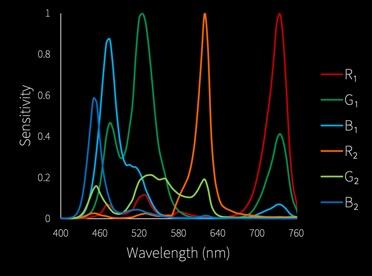


Figure 1. Top: diagram illustrating the process of capturing a pair of RGB images under two different illumination conditions that are then combined to create a six-channel spectral image stack. Bottom: example six-channel sensitivity of an RGB camera + LED-based dual illumination spectral imaging system.
Lighting Specification Process


equipment and workflows for carrying out this kind of imaging have precluded its widespread adoption by heritage imaging professionals for routine imaging and digitization projects.
Past efforts to address these limitations have made progress toward both image capture and processing strategies that simplify the implementation of spectral imaging for cultural heritage applications.7-9


Rochester Institute of Technology; Rochester, NY/US

The research described here was motivated by a desire to build upon this foundation and further lower the perceived barriers-to-entry around spectral imaging. Specifically, this was realized through the development of a user-friendly software application for processing spectral image sets captured using an RGB camera + dual-illumination strategy that is practical for implementation within a studio photography environment.9-11
Dual illumination
What do we mean by ‘dual illumination’? The software application that has been developed, called Beyond RGB12, takes as input two RGB images captured under two different lighting conditions. By changing the lighting conditions, we effectively change the way the camera ‘sees’ the object, and because of this, the red, green, and blue channels of each RGB image end up containing slightly different information. Combining them together results in a stack of six unique channels (Figure 1, top). This ‘dual-RGB’ spectral imaging technique, which uses optimized LED illumination allows us to efficiently use familiar cameras as spectral imagers (Figure 1, bottom).
Beyond RGB
Spectral capture strategies that utilize professionallevel consumer cameras typically found in cultural heritage imaging studios have been developed and refined over the past two decades.4,13-15 At RIT, software tools have also been developed alongside these workflows for processing and viewing the
resulting spectral image sets.16-18 While these software tools are adaptable and effective within the research settings in which they were developed, more robust and intuitive processing solutions may encourage experimentation with and eventually more routine use of spectral imaging and archiving by a wider group of practitioners. Recognizing this, a team of RIT software engineering students was recruited to create a software application that would facilitate processing of spectral image master files captured using the dual-illumination spectral capture technique.11
Beyond RGB was designed with user experience in mind, combining technical utility with a graphical user interface that is simple and intuitive. Using pairs of RGB images captured under the dual illumination conditions as the inputs, it performs colorimetric and spectral calibrations, and outputs a color calibrated RGB image, a spectral reflectance calibration that enables interactive material reflectance estimation, and supplementary data files that document the details and accuracy of both calibrations. An sRGB preview of the final color calibrated image that can be zoomed to show pixellevel detail can be viewed through the application’s Image Viewer functionality (Figure 2). Additionally, the built-in Spectral Picker allows the user to select regions of interest from which to display and export estimated reflectance spectra.
While the main focus of the application is encouraging the capture of spectral master files and enabling the calibration and export of the color managed RGB image, the ability to perform spectral estimation may be of more interest in future versions of the software that expand upon the more familiar applications of spectral imaging, like pigment identification and mapping.
Preliminary Results
Beyond RGB was tested with images from a variety of cameras and targets representative of those used in photography studio settings. Typical colorimetric and spectral calibrations based on these images resulted in less than about 2 ∆E00 and 3 ∆E00 mean color difference and less than about 10% and 20% maximum spectral reflectance difference for calibration targets and verification targets, respectively. These results are
Figure 2. The Image Viewer window showing a zoomed-in region of the test image and the estimated reflectance spectrum from a selected region of interest, patch F1 of the Next Generation Target.

of course highly equipment- and setup-dependent; details of the typical kit and setup used to capture images for testing can be found in.10
With the initial version of BeyondRGB in hand, we recruited a class of museum studies students to test the software on a variety of computers, including their personal laptops, to get a feel for the ease of distributing, setting up, and running for novice users. Additionally, we traveled to work with several cooperating institutions who generously offered to host us to demonstrate and utilize the software using a portable spectral imaging, education, and training kit (Figure 3).
Conclusions and Future Work
Beyond RGB is a spectral image processing software that has been developed to promote capturing and archiving spectral master images in photography studio settings. Release v1.0.0 is a living, updatable,


open-source project, and is freely available for download from the project’s public GitHub repository. It is a fully functional build, but it is the first public release of the software, and it should be noted that the timeline for foundational build did not allow for rigorous user testing. Currently, a new team of RIT senior software engineers is diving into the process of developing and implementing improvements and feature additions in Beyond RGB v2.0. This list already includes several features that will improve


Figure 3. Demonstrating the dual-illumination capture setup and Beyond RGB while imaging a photograph from the George Eastman Museum collection.
References
1. Saunders, D.; Cupitt, J. Image Processing at the National Gallery: The VASARI Project. Natl. Gall. Tech. Bull. 1993, 14, 72–85.
2. Martinez, K.; Cupitt, J.; Saunders, D.R. High-Resolution Colorimetric Imaging of Paintings. In Proceedings of the Cameras, Scanners, and Image Acquisition Systems; May 20 1993; Vol. 1901, pp. 25–36.
3. Ribés, A.; Brettel, H.; Schmitt, F.; Liang, H.; Cupitt, J.; Saunders, D. Color and Multispectral Imaging with the CRISATEL Multispectral System. In Proceedings of the PICS’03 The Digital Photography Conference; 2003; pp. 215–219.
4. Berns, R.S.; Taplin, L.A.; Nezamabadi, M.; Mohammadi, M.; Zhao, Y. Spectral Imaging Using a Commercial ColourFilter Array Digital Camera. In Proceedings of the The 14th Triennial ICOM-CC Meeting; 2005; pp. 743–750.
5. Staniforth, S. Retouching and Colour Matching: The Restorer and Metamerism. Stud. Conserv. 1985, 30, 101–111.
6. Berns, R.S. Color-Accurate Image Archives Using Spectral Imaging. In Scientific Examination of Art: Modern Techniques in Conservation and Analysis; Washington, DC, 2005; pp. 105–119.
7. Kuzio, O.R.; Berns, R.S. Color and Material Appearance Imaging and Archiving Using a Sony Alpha A7R III Camera; Rochester Institute of Technology, 2018;
8. Kuzio, O.; Farnand, S. Color Accuracy-Guided Data Reduction for Practical LED-Based Multispectral Imaging. In Proceedings of the Archiving 2021 Final Program and Proceedings; 2021; pp. 65–70.
9. Kuzio, O.; Farnand, S. LED-Based versus Filter-Based Multispectral Imaging Methods for Museum Studio Photography. In Proceedings of the Proceedings of the International Colour Association Conference 2021; 2021; pp. 639–644.
10. Kuzio, O.; Farnand, S. Comparing Practical Spectral Imaging Methods for Cultural Heritage Studio Photography. J. Comput. Cult. Herit. 2022, in press.
11. Kuzio, O.R.; Farnand, S.P. Beyond RGB: A Spectral Image Processing Software Application for Cultural Heritage Studio Photography. In Proceedings of the Archiving 2022 Final Program and Proceedings; 2022; pp. 95–100.
12. Dalesio, P.; Hammerstone, A.; Knox, T.; O’Neil, J.; Ponzetti, J. Beyond RGB, 2022, https://github.com/tjdcs /Imaging-Art-beyond-RGB.
13. Shrestha, R.; Hardeberg, J.H. Multispectral Imaging Using LED Illumination and an RGB Camera. In Proceedings of the 21st Color and Imaging Conference Final Program and Proceedings; 2013; pp. 8–13.
14. Berns, R.S. Theory and Practice of Dual-RGB Imaging; Rochester Institute of Technology, 2016;
15. Berns, R.S. Digital Color Reconstructions of Cultural Heritage Using Color-Managed Imaging and Small-Aperture Spectrophotometry. Color Res. Appl. 2019, 44, 531–546.
16. Cupitt, J.; Martinez, K. VIPS: An Image Processing System for Large Images. In Proceedings of the Proceedings of SPIE 2663, Very High Resolution and Quality Imaging; 1996; pp. 19–28.
17. Berns, R.S.; Chen, T. Update:* Practical Total Appearance Imaging of Paintings. In Proceedings of the IS&T Archiving Conference Proceedings; 2012; pp. 162–167.
18. Studio for Scientific Imaging and Archiving of Cultural Heritage: Software Available online: https://www.rit.edu/ science/studio-scientific-imaging-and-archiving-cultural-heritage#software (accessed on 17 March 2022).
Author Biographies
Olivia Kuzio is a PhD candidate in the Program of Color Science at Rochester Institute of Technology, where she conducts research in the Studio for Scientific Imaging and Archiving of Cultural Heritage. During her graduate studies, she has completed conservation science internships at the Smithsonian Museum Conservation Institute and the Getty Conservation Institute. She holds BS and MS degrees in chemistry from Pennsylvania State University and the Rochester Institute of Technology, respectively.
Susan Farnand is an Assistant Professor at Rochester Institute of Technology. Her main research areas center around human color vision and perception and include visual attention, color imaging, image quality metrics, 3D printing, and archiving. Prior to joining RIT in 2006, Dr. Farnand was a senior research scientist at Eastman Kodak Co. working primarily on projects in perceptual image quality measurement and modeling. She holds a BS in engineering from Cornell University, and an MS in imaging science and PhD in color science from RIT. Dr. Farnand is IS&T President.

The Ultimate Compliment
We believe that great design should stand the test of time, be sustainably crafted, and be proudly North American made.
Torres : A graceful, minimalist design and advanced performance
Designed by Rodrigo Torres
landscapeforms.com

This summer’s blockbuster exhibition ‘Cartier and Islamic Art: In Search of Modernity’ at the Dallas Museum of Art was a fast-paced example of the role of light in an exhibition design. With more than 400 objects, including loans from major international collections, including the Louvre Museum and Keri Collection of Islamic Art, precision control of light - both beam and intensity - was needed.
ERCO’s new Eclipse fixture family was deployed with Casambi bluetooth low energy controls by the team at Tillotson Design Associates to help illuminate breathtaking jewels and precious works on paper that influenced Louis Cartier and the designers of the great French jewelry Maison.
Below are excerpts from an interview with Head Designer Amanda Arikol of Tillotson Design Associates. From her words, we are able to form an appreciation into the visual concept and sophistication of the installation. Emphasis is ERCO’s.
ERCO: What were some of the unique challenges in lighting this Cartier exhibit compared to other exhibitions?
Amanda: The accelerated timeline of the project resulted in an added level of required flexibility during focusing, as fixtures needed to be purchased
before the design was finalized. Our challenge was balancing the required flexibility with budget expectations, and ensuring the final specification allowed for quick focusing during the truncated installation timeline.
ERCO: How did ERCO’s track and Eclipse family become the preferred product for this application?
Amanda: The readily-available fixture and track stock was an important driving factor for our decision, as well as the flexibility of using various accessories during focusing. The capability to change the control protocol of individual fixtures with the simplicity of an accessory change was key in allowing us to properly focus the final installation.
ERCO: Was preservation of the works a factor in your decision to use ERCO?
Amanda: Yes, we diligently tested each fixture’s dimming capabilities and light quality before specifying, to ensure the color consistency and dimming all met our needs for the design.
ERCO: In regards to the lighting concept, what was the inspiration that drove key design elements on this project?
Amanda: As visitors proceed through the exhibition, key artifacts are momentarily highlighted within the

space as large-scale images of the pieces are projected on the end walls showcase their intricate details. In addition to the coordinated choreography of the lighting with the projector timing, the additive light on the artifacts had to be carefully programmed to adhere to the strict light level requirements of each piece.
ERCO: Can you share more about your decision to use Casambi in this project?
Amanda: Casambi enabled Eclipse fixtures provided us a uniquely flexible solution for our DMXintegration needs, as we were able to utilize wireless technology to not only save time and cost, but also decide on site which fixtures would be DMX-controlled. Additionally, the ease of programming the DMX once the fixtures were in place was crucial during the timesensitive focusing process.
Being able to adjust to field conditions, changes in architecture or exhibition layout, or interface with multiple systems without complex rewiring or changing luminaires is what separates ERCO’s casambi enabled luminaires. This potential for flexibility is further enhanced in our 48V Eclipse and Parscan NEW products where the control module can be changed in field. This allows for sustainably

executed upgrades or system expansion without the cost.
While the Cartier exhibit utilized a DMX interface where it was necessary to connect with nonCasambi devices, this can be accomplished in a variety of manners. Interface devices can support communication through 0-10V, DMX, and DALI protocols, with Casambi serving as primary or secondary control. These devices can support individual, groups/zones, and scene level programming expanding on what is possible with your control systems.

When on-site punchlist, aiming, and commissioning hours are tight, the Casambi application provides an intuitive user-interface, allowing anyone to quickly program the devices. At the Dallas Museum of Art, this work was the responsibility of their AV team with initial start-up supported by ERCO; however, by the time ERCO staff got on-site, the museums team had already re-named luminaires by each artifacts number and paired everything with the DMX interfaces.
Today’s mobile devices are incredible tools for controlling lighting. The Casambi application is made both for the consumer market as well as the professional market.
The user interface is made in a way that anyone – regardless of technical proficiency- can use the system. But despite the numerous obvious advantages, smart devices are only one part of the solution. To be able to serve all different controlling requirements Casambi offers a big variety of control possibilities. Through the use of gesture-control, the app
provides a range of luminaire level controls: tap a fixture icon or ‘folder’ of fixtures to turn on/off, swipe side-to-side to adjust brightness, swipe up and down for color temperature on tunable fixtures, or hold down to change colors on a RGBW luminaire.
Creating groups/zones is as simple as stacking icons into folders, just like apps on your phones home screen. Setting up a schedule, using a synchronized timeclock amongst luminaires, allows for a set-it and forget-it level of control. Adding switches or external triggers such as sensors can all be done through an ecosystem of external devices.
The unique gallery feature (shown above) lets users control luminaires after uploading drawings of a space or taking photos of artwork/a space and then mark the position of luminaires to provide a spatial reference while controlling them in the image itself. Once programming is complete the luminaires synchronize the control data and maintain operation

through a mesh typology that removes any single point of failure from the system. Multiple levels of security ensure that access is limited and protected.
Todays projects move at a speed and building complexity that require lighting tools that can be flexible in accounting for changes without sacrifincg design. The Dallas Museum of Art’s Cartier exhbition is a prime example of how utilizing the latest in lighting technology can be a value add for a project.

Light is the fourth dimension of architecture.

US Capitol building at sunset, Washington DC, USA.
PHOTO CREDIT: Adobe stock - lucky-photo

Commercial Buildings Deduction Expands
By
CLCP
The Inflation Reduction Act of 2022 expands the Commercial Buildings Tax Deduction (CBTD, Section 179D of the tax code), allowing more projects to qualify for the energy efficiency incentive while increasing its potential value. This follows the CBTD finally being made permanent by the Consolidated Appropriations Act of 2021.
Created by the Energy Policy Act of 2005 and supported by industry groups such as NEMA and BOMA, the CBTD offers a financial incentive for building owners to invest in energy-efficient interior lighting, HVAC/hot water systems, and building envelope in commercial buildings.
The incentive takes the form of an accelerated tax deduction; instead of taking the deduction over a period of years as required by tax law, the entire amount can be taken in a single year, subject to a cap. This is expressed as a dollar amount per square foot earned by achieving satisfactory energy reductions compared to a reference building.
The CBTD has had a rocky history of expiring and then receiving temporary (and typically retroactive) reinstatement. A 2015 tax bill updated the reference building as being one that complied with the 2001 version of the ANSI/ASHARE/IES energy standard to the 2007 version, making qualifying for the incentive more difficult to achieve. The Consolidated Appropriations Act finally made the CBTD permanent and built in an inflation adjustment for the incentive, but it updated the benchmark again to the latest version of 90.1 as affirmed by the Secretary of the Treasury, which, as of August 2022, reportedly had not yet happened.
In August 2022, President Biden signed the Inflation Reduction Act into law. This law includes amendments to 179D that expand the CBTD’s availability, reduce the required energy savings target, increase the size of the incentive, and make the incentive repeatable instead of a one-off.
The partial deduction, however, was eliminated, and, unfortunately, the Interim Lighting Rule, which had offered a simpler path for lighting retrofits that didn’t require building modeling, was also struck. On the plus side, however, a new retrofit path to the CBTD looks promising.
New CBTD
The new Section 179D amends the U.S. tax code to include the below provisions:
What projects qualify: Simply, these are commercial buildings in which “energy-efficient commercial building property” is installed. This in turn is defined as normally depreciable equipment that is:
◆ installed as part of interior lighting, HVAC/hot water systems, or the building envelope;
◆ within the scope of the 90.1 energy standard (new construction and renovation);
◆ located in the United States; and
◆ expected to reduce total annual energy and power costs for interior lighting/HVAC/hot water systems by 25% or more compared to a reference building.
The Inflation Reduction Act instructed the Secretary of the Treasury to produce regulations
CRAIG DILOUIE, LC,
detailing methods for calculating and verifying energy and power consumption, based on the California Nonresidential Alternative Calculation Method Approval Manual
In the case of any (previously only public) tax-exempt entities, the law instructs the Secretary to produce regulations allowing the designer of the property to claim the CBTD in lieu of the owner.
The reference building: The reference building is one that satisfies the minimum requirements of the 90.1 standard. Which version of 90.1?
The most recent of:
◆ the version affirmed by the Department of Energy (and subsequently affirmed by the Secretary of the Treasury) at least four years prior to the property being placed in service; or
◆ the 2007 version of 90.1, which would apply if Treasury has not yet affirmed a version.
The incentive: The CBTD is calculated based on an Applicable Dollar Value (ADV).
The ADV is $0.50 per square foot for the building for achieving a 25% savings compared to the reference building, increasing $0.02/sq.ft. for every 1% of energy reduction beyond the 25% base up to a $1.00/sq.ft. maximum.
If the prevailing wage and apprenticeship requirements are met, the ADV is higher: $2.50 per square foot for achieving a 25% savings compared to the reference building, increasing $0.10/sq.ft. for every 1% of energy reduction beyond the 25% base up to a $5.00/sq.ft. maximum.
Previously, the CBTD could only be claimed once. The Inflation Reduction Act enables it to be claimed every three years for a commercial building and every four years for a building owned by a tax-exempt entity, as long as they fulfill the requirements stipulated in 179D.
Certification: The law requires the Secretary of the Treasury to detail how to certify projects for the CBTD, including specifying qualified software for modeling and qualified individuals who will determine compliance. Each certification must include an explanation to the owner of energy-efficient building features and projected annual energy costs.
Alternative deduction for retrofit projects: Retrofits can qualify by demonstrating a 25% decrease in energy use intensity (measured in BTU) compared to the pre-retrofit building.
A qualified retrofit plan is required, and the building must have been placed in service at least five years before producing this plan. The deduction must be taken in the year of final qualifying certification.
The role of lighting
With the elimination of the Interim Lighting Rule, lighting’s
participation in the CBTD has become more complex, subject to a holistic approach requiring software-based building energy modeling.
Regardless of the type of project, designers must be wary, as with any energy efficiency incentive or goal, to ensure the lighting performs its primary role of fostering a comfortable and productive visual environment. In short, energy savings should be evaluated carefully against the interests of good design and the needs of building occupants. The good news about lighting controls is that options providing the most detailed and robust energy savings should not compromise lighting quality if properly designed and managed.
New construction and renovations: As “part of interior lighting” systems, energy-efficient lighting is, of course, suitable for project inclusion as well as are lighting controls, wherever such equipment would be depreciable for tax purposes. Both are “part” of the interior lighting and contribute to building energy savings, which is 179D’s legislative goal.
Compared to the 2007 version of 90.1, today’s LED lighting and advanced lighting controls, coupled with good design, can deliver significant energy savings. For the 2016 and later versions of 90.1, substantial energy savings become increasingly more difficult, particularly with the 2019 version, which features maximum interior lighting power densities based almost entirely on LED lighting.
As a broad range of lighting control strategies are mandatory in these later versions of 90.1, designers can consider networked lighting controls to implement more advanced strategies such as institutional task tuning, reducing control zoning largely to the luminaire level, and highly detailed and robust sequences of operations.
Retrofits: For retrofits, it’s a whole different ballgame, as the reference building is the existing building and not 90.1, thereby making the 25% savings target potentially easier to achieve.
In this case, LED lighting and advanced controls can deliver strong energy savings, though lighting often will need to play a part in a holistic building upgrade, as the 25% target applies to the building.
The substantial size of plug loads in today’s commercial buildings provides an additional source of energy savings derived from lighting control systems able to control plug loads based on occupancy, schedule, or signal from another building system.
The new CBTD
Overall, the new incarnation of the Commercial Buildings Tax Deduction offers a strong incentive to stretch energy efficiency in new buildings and modernize existing buildings. In new buildings, it incentivizes more detailed design and the most advanced control options. In existing buildings, it incentivizes a wide range of lighting and advanced control options that, when coupled with available utility rebates, can substantially reduce initial cost, which remains the largest inhibitor to investment in reducing operating costs via energy efficiency. ■

New 48V Low Voltage Magnetic Track System


JUST IN...
New architectural lighting products available for specification


FacetCore
MetroSpec Technology® announces its new FacetCore™️ geometry set for architectural LED light fixtures requiring uniform lighting. With FacetCore, fuller light fills can be achieved while providing even greater uniformity. Geometries optimized for 90 degrees to 360 degree projection are realized using 1, 2, 3, or 4 sided wrapable facets. FacetCore geometries radically simplify various fixture types, eliminating mechanical parts and electrical wires and interconnect. They are a powerful solution –supporting lengths up to 16 feet without the need of a splice, utilizing available space minimally with ease.

ACE Configurator
American Lighting introduced ACE, a tape light configurator that streamlines the process for creating Trulux Series tape light Bills of Material. A first-of-its-kind tool developed for lighting professionals of all experience levels, ACE is a simple step-by-step guide to walk users through a tape light project. By following the steps, ACE users are able to complete a list of materials necessary for


Ampere Pendant and Wall Light
The Ampere Collection are a series of newly imagined lights that cast a scattering of halo-like rings through layers of delicate mouth-blown recycled glass. These two siblings pay a visual tribute to the history of power generation and are a translation of industrial design made decorative. Hung alone or in family groupings, the lights are suited to both the contemporary or period home in an investment that will span the years.

iX Series
DMF Launches Small-Aperture 2-Inch iX Series Lighting Fixtures. The small, 2-inch aperture fixtures are designed to elevate the entire home with modern, quiet ceilings and award-winning design. As part of its longstanding commitment to the channel, the DMF Small Aperture lights allow CI channel integrators to go smaller without compromises in performance, installation, and serviceability.


SilentAire
ETi Solid State Lighting Inc. introduces a new line of LED light fixtures proven to kill bacteria and viruses, including SARS-Cov-2, the virus that causes COVID-19. The SilentAire Plasma Disinfection Lighting product line is an innovative breakthrough in safe air disinfection technology. The SilentAire product line-up includes LED flush mounts, downlights, flat panels, and more suitable for virtually any indoor application, including offices, schools, healthcare and senior living, residential, industrial and commercial channels.



Tempest and Tidal Luminaires
Modern Forms Luminaires introduces a variety of biophilic shapes and human-centric designs. The fluidity of the luminaire styles, the mixture of cracked glass, wood and metals and the ability to customize a design are all part of what makes the extreme contours of Tempest and the unique twist of Tidal so special, to name a few. All LED luminaires are designed to seize upon the most cutting-edge technology and design trends to illuminate and refresh your home, workplace, hotel or restaurant for years.

Habitat

Inter-lux announced the addition of Habitat, an exciting new range of outdoor luminaires created by IP44.DE and indoor luminaires designed and built by Stilnovo. Designed to meet an increasing demand for unique and affordable home and hospitality lighting, most pieces were designed in the 50’s, 60’s and 70’s, lending authenticity to these retro-looking luminaires. This versatile range will enhance both personal and professional habitats.


EclMini
PROLIGHTS released the EclMini spotlight, a range of ultra-compact, low-profile LED fixtures for galleries, retail and hospitality.
There are two main versions of this fixture: the EclMini DAT, which has an integrated driver with DMX/RDM, DALI Type 6 and local knob dimming, and the EclMini CC, which connects to an external constant current PSU and driver.
Both versions have a high-efficiency 18W white, high CRI LED source, available in 2,700K, 3,000K, 4,000K or 5,600K. There's a wide range of optics for the EclMini fixtures, including 19°, 26°, 36°, 50° profile, or zoomable 15°-30° or 25°-50° wash optics.


Acoustic Stratta
LightArt has added to their acoustic linear fixture portfolio with updated construction and capabilities. After months of research and development, Acoustic Stratta now offers a premium aluminum structure and sound absorption up to 11 sabins, making it up to two times more absorbent than previous iterations.
Acoustic Stratta’s narrow aperture and slim profile is made possible by high-efficiency LED lights. Plus, with uplight, downlight, and unlit capabilities, Acoustic Stratta can create different moods to subtly enhance a designer's vision.
SUNNY
SIDE UP
By

Nicknamed “America’s Finest City”, San Diego is known for its amazing weather, beaches, local attractions and, of course, its enticing dining scene. At Callie, located downtown on Island Avenue and designed by architect Mark Bausback of Baus Arch, the cuisine from chef/ owner Travis Swikard is Mediterranean-inspired, and the restaurant’s contemporary interiors are radiant, warm, sophisticated, and delectably in sync with the overall vibe. A large part of this is due to lighting, so we caught up with Becky Becheanu, Lighting Designer for Los Angeles–based, award-winning Studio UNLTD, for insights on the project and what it entailed, starting with how the general design aesthetic—plus Callie’s location—influenced the team’s choices, from the eclectic bar lounge to the space’s overall “Golden Hour” ambiance.
“Focusing on the major design feature of the space (the wave of the bar ceiling), the lighting design for Callie

sought to seamlessly integrate with the architecture—to highlight the golden yellow of the ceiling and emphasize its arched form with soft but dramatic uplighting,” explains Becheanu. “We created a wave of warm light that starts at the back bar, washing up from the bar shelves, uplighting the liquor display, cascading up onto the ceiling, and peeking out with a discreet line of light that emerges at the top of the wave where it meets the horizontal plane above. The warmth of the ceiling is echoed in the amber Marset ‘Dipping Lights’ mounted at the bar top, providing an intimate dining experience for those at the bar. Under-bar lighting that brings out the texture of the corten steel bar face is mirrored at the expo
STEF SCHWALB
In the dining area, meandering seating has a relaxed, coastal feel, replete with plant life, marine blue chairs and rust colored booths
All Photographs by Lucianna McIntosh

At Callie in San Diego, Studio UNLTD Designed
Lighting to Pair Seamlessly with the Restaurant’s
SoCal Design Scheme
A blend of denim-blue decorative tiles adorn the columns in the dining room

kitchen, where a soft glow uplights the corten hood cladding.” And with Callie’s robust wine program, Becheanu adds, the wine room served as a second important feature in the restaurant. Clad in glass with dramatic accent lighting, the displayed wine becomes a beacon of light within the dining space.
Speaking of dramatic lighting, the choices of fixtures played a large part in the design approach, and while they weren’t custom pieces, they are from renowned lighting designers and helped define the environment. “While we didn’t create any custom light fixtures for this particular project, we always seek to source unique pieces that work well with the overall design aesthetic and bolster a dialogue with the architecture and finishes of the space,” notes Becheanu. “For instance, Lozi’s ‘Sunset Lamp’ provided the perfect setting-sun effect, suspended at the end of the bar wave. Made from a translucent wood veneer that plays off of the arched glu-lam beams of the ceiling, it echoes the warm glow of the uplit wave and bar-top lamps below. The wood bead chandeliers by Regina Andrew, coupled with the eclectic plush furniture, inlaid carpet, and artwork like ‘The Dude,’ help foster a relaxed, SoCal coastal vibe in the lounge area of the bar. Kjartan Oskarsson Studio’s ‘Halo Lamp’ brings the sunset from the bar into the PDR.”
As with this project (and many others), the team at Studio UNLTD always takes the role of lighting as a critical part of the process within its design approach. “Our goal in every project is to make every lighting choice feel intentional and integral to the overall design of the space. Interior design and lighting design walk handin-hand—it’s a constant conversation between the two, where they each inform and push the other,” says Becheanu. “Lighting helps tell the design story and is a critical tool for emphasizing and highlighting the unique details and design decisions we make. Lighting helps set the entire mood for a restaurant; it can make or break the dining experience. Used for both creating an ambiance and putting focus on the food itself, lighting is a key element in our design approach.”
Creating layers of light—a mix of general, accent, and decorative lighting—adds a richness of depth and dimension to the team’s designs, notes Becheanu, and in selecting particular light fixtures

"Lighting inspiration can come from a multitude of sources, often unexpected and organic in nature. "
Becky Becheanu
Hanging above the kitchen’s pass counter, the exhaust hood is clad in a v-shape of corten steel

(whether decorative or architectural), they look for products that not only fit aesthetically with a project but also offer the performance and quality needed for creating the most amazing dining experience possible. “An otherwise great meal can so easily be hampered by a flickering light or bad glare from an unshielded fixture,” she adds.
With such a distinct focus on creativity in their projects, we had to wonder what Becheanu and Studio UNLTD look to for inspiration, and if there are any current trends they are seeing right now that are impacting their work. “Lighting inspiration can come from a multitude of sources, often unexpected and organic in nature. It can be as simple as noticing the way daylight from a window is reflecting off a surface and projecting a pattern of light across the wall. It can manifest while walking a nearby trail and remarking the way the trees filter light and create a dappled effect along the ground. Even the changing hue of daylight throughout the day has informed the overall lighting design of one of our projects,” says Becheanu.
“We also turn to artists—both past and present—for inspiration. While they represent a relatively small subset of the art world, light artists have the particularly unique gift of challenging the limits of lighting technology,” she added. They both question and redefine the team’s relationship to light (personally, culturally, psychologically), and sometimes they need to step away from the limits of building and energy codes to explore a more unhindered conversation with light. “More and more, we see a move towards the disappearance of the light fixture in a space. Because of the overwhelming prevalence and advances in LED technology, fixtures are getting smaller and smaller and becoming more discreet, hidden elements in design,” Becheanu concludes. “We’re also seeing greater client demand for changeability and flexibility over time—whether it be in tunable white and color-changing fixtures or easily reconfigurable products like magnetic-based tracks, there’s definitely been a push for increased dynamic capabilities in our work.” ■

View of bar from entry
OPTIMUM LUCENDI

RANDY REID By
Photo Credit: Tanveer Badal
The new lighting design was part of the "Conservation and Reconstruction of the Roman Theatre" project.


The Roman Theatre is one of the largest and most significant ancient monuments in the city of Pula, Croatia. Built in the first century, the theatre is located in the city centre, on the eastern slope of the Castrum Hill. Lighting designer Dean Skira told me of his work on the historical landmark when I visited him in August of 2021, but I was unable to visit the site as it was closed for renovations.
Only the stage foundations and a part of the semi-circular viewing area remain preserved. It is also one of the largest and most significant ancient monuments to have been reconstructed.
When it was originally built, visitors entered the theatre through the Porta Gemina, which is one of 10 double-arched city gates of Pula standing at the north side of the capitol. At the time of construction, the theatre had 4000-5000 seats, large enough to house the city's entire population. Interestingly, the construction is characteristic of Greek, and not Roman, theatres.
Today, the theatre has a capacity of 1,500 seats, and there are a total of six entrances and exits. The project's total value is approximately 3.2 million

dollars, funded with EU funds and investors’ participation, along with a contribution from a local tourist board.
The new lighting design was part of the "Conservation and Reconstruction of the Roman Theatre" project, which partially restored the tribune of the former theatre and preserved the stage and part of the semi-circular auditorium to protect and revitalize an exceptional location of cultural heritage. The theatre now has a dual purpose: an archaeological site and a stage for cultural events.
The Skira team was joined on the project by a group of conservators, archaeologists, art historians, architects, and electrical engineers. Instead of a facsimile conservation approach where identical materials are used, the design approach was to use different, more resistant materials compared to the original version.
The lighting design solution aimed to be adaptable and sustainable according to the site's future use.
The geometry of the new tribune follows the height, width and all dimensions of the former ancient theater, but now the tribunes are made of steel, and the central part is built with white concrete. The white concrete was not cast on the original rock. A geotextile was placed in between so that there is no contact between the materials.
For the sake of acoustics, all connections on the metal construction are made with
Investor: Archaeological Museum of Istria
Architect: Emil Jurcan, Studio Emil Jurcan
Lighting: Dean Skira with Goran Herak and Tomislav Godena, Skira Architectural Lighting
Contractor: Ing-grad
Location: Pula, Croatia
Year of Realization: 2022
Photographer: Jana Jocif
Videographer: Jana Jocif, Ana Strojan
welds in order to avoid screws or any element that could create vibrations at specific frequencies.
iGuzzini is the dominant luminaire company on this project. The La Venaria luminaire is used throughout for soft general lighting. La Venaria provides no photobiological hazard, as the luminaire is in the “Exempt Group,” free of any risk linked to infrared, blue light and UV radiation.
Palco Surface spotlights and framers from iGuzzini were used to deliver professional direction in the area of archeological remains visible from the seating area. The miniature low voltage heads feature a remote driver and are designed to deliver aesthetically pleasing, precise beam distribution with a miniaturized optical technology. The Optibeam technology delivers professional grade distributions to the ancient brick wall that is congruent with the seating. Skira chose the Palco spotlights for

their precise beam definition and effective cut off, reducing glare.
iGuzzini’s iPro Mini, with its 2-inch aperture, was used to the light the main steps of the seating area. Because of its size, the iPro mini was easily hidden.
Skira specified 3000K in the seating area and 4000K around the bricks and stone. RBG was also used on the ancient bricks in an effort to adjust the mood to coincide with the performance.
The lighting design was developed to preserve the remains as much as possible and provide different visual circumstances, both for safety reasons and for creating a performance atmosphere. The control system enabled a user-friendly, intuitive, and efficient lighting control with several programmed scenes, including the everyday

scenery that reveals the walls' entrance and exit of the visitors, lighting scenes during the event, and a subtle lighting effect during nighttime, in addition to the regular general illumination of the venue.
Skira explained that the project design work began in 2013, and the design improved as technology developed. The major goal of the lighting design was conservation of the venue while also adapting it for contemporary use. The investors had further requests, including ease of use for the illumination, safety for the visitors, and reliability in operation.
All the electrical components of the control system and the drivers were mounted remotely in an electrical cabinet. Cables were integrated into the metal construction and partly in the rows.
Special brackets were designed and custom-made for reflectors. But, the original remains are untouched.
The renovated Roman Theatre is integrated with the adapted and extended building of the Archaeological Museum of Istria, incorporating a unique multimedia screen with 330 square meters in full HD resolution.
The control system is integrated via I/O modules and implemented to include other systems (stage lighting, projection, etc.) when necessary.
One of Croatia's most important heritage projects is now illuminated with the newest technologies and ready to accommodate a plethora of cultural events.
The official opening is planned for the spring of 2023.
View the video here: https://youtu.be/jUqLT8BVe5c

PLEASE REDESIGN THE DOWNLIGHT
By
DAVID K. WARFEL

Photography by Matt Chashore. A designed kitchen with light right where it's needed most – and minimal glare or discomfort – requires an entirely different approach to lighting.
Residential lighting is ripe for change, but only collaboration will yield the best results.
One of our team members has been hunting for a house to buy for the last few months and visited a model home by one of the largest builders in the United States. The builder’s website touts their passion for innovation and commitment to leadingedge design. Yet their ceilings are dotted with glareinducing disc lights that deliver lumens like a cheap yard sprinkler: indiscriminately and with little regard for people passing through. They build thousands of these homes every year, and they are not alone.
It would be easy to condemn this builder for their ignorance, their greed, and their lack of concern for what happens after sunset in their homes. But that would require overlooking our own role in shaping the lighting industry. We – the designers, manufacturers, sellers, and more – are responsible for the horrible lighting in those homes. We can do better.
Residential lighting today seems stuck in a Betamax reality, and that is not a good thing for homeowners. We live in an era of constant innovation – arguably a good thing – that leaves homeowners in a state of constant confusion. We live in an era of rapid product improvement – also arguably a positive – that results in residential lighting in an era of rapid obsoletion. We can do better, but it may require checking our commercial lighting expertise at the front door of our homes. If you are anything like me, you already do this subconsciously.
THE RESIDENTIAL CODE SWITCH
At work, I try to encourage creativity, emphasize originality, push towards the technological frontier, and seek constant innovation. I join our team in learning about new products every week. I attend trade shows and tour factories to stay on top of what is coming next.
I undergo a confusing transformation on my way home. Suddenly, I forget my day job; I just want to stop by the local hardware or big box store, pop in, and walk out a few minutes later with a reasonably priced, reliable, and well-functioning replacement for whatever light has recently stopped working.
In other words, at work I want to specify a cutting-edge lighting system. On my way home, I just want to buy a light bulb. My daily code switch points out the stark difference between commercial and residential lighting.
Commercial lighting – at least how I practice it –

depends on several key factors for success. First, our clients have to be willing to spend real money on lighting. For reasons that are not always clear to me, corporate willingness to spend on lighting seems greater than individual residential willingness. Perhaps this dichotomy results from the difference between spending “the company’s money” versus writing a check that draws on our own personal account. We are generally a little more careful in the latter situation, which means our approach to residential lighting must be more frugal.
Secondly, commercial lighting can rest on the fact that businesses change rapidly. Any lighting system I specify today may be capable of lasting twenty or forty years, but the space it occupies may change ownership or function in just five to ten years, providing another opportunity to upgrade the lighting. There is an upside to this – any mistakes I make are relatively short-lived – but also a downside. LEDs, many of which could last twenty years or more, wind up in a landfill when the store or office changes hands.
The modern home is no stranger to remodel and renovation, or to changing hands. We move from house to house far more rapidly than ever before as
Photograph by Brady King. A modern million dollar show home entry lit with disc lights puts light in all the wrong places.

we change jobs, grow families, switch neighborhoods, and relocate. Yet, there may be a difference between residential change and commercial change. When a house changes hands, it rarely will see a change in its lighting. At home we expect lighting to last for fifty years, far longer than it might in a commercial setting. There is lighting in my current house that was installed before the previous owner, and locations have mostly stayed the same for a century. Unfortunately, this continuity and reliability is threatened by our current market approach.
A BETAMAX REALITY?
I can almost see the Sony executives cringe when their defunct Betamax video tapes are rolled out yet again as an analogy for outdated, legacy technologies. Many of you may have to google Betamax just to find out why these arguably higher-quality video tapes were swept under the rug of history by the humble VHS tape. Fill in your own more timely analogy, but this is simply a story of proprietary technology versus a more easily accessible standard.
In residential lighting, every onboard LED recessed light is another Betamax tape, something manufactured and provided by a single company. Every 6” recessed can from the 1980s is a VHS tape, widely available and easy to replace or repair.
Yesterday was easy. Every fixture took a bulb (yes, I know I mean lamp, but, in residential lighting, we call them what our clients call them – bulbs), and every bulb could be sourced from multiple manufacturers. If I bought an MR16 downlight from one company, I could buy a bulb from another. If the maker of my light fixture went out of business, it was not a big problem. If a bulb manufacturer went out of business, it was not
a big problem. Our solutions were endlessly upgradeable and maintainable. When I started my lighting career a couple of decades ago, I installed a few MR16 fixtures on my parents’ porch. They still work today, and I can still find replacement parts today.
Yet if I choose to specify a cutting-edge LED recessed downlight for my parents’ porch today, there is a high likelihood that I will not be able to get a replacement module for that fixture in twenty or thirty years when it fails. I convinced myself this was an acceptable reality because, in twenty years, there would be something so much better that I would happily rip out the fixture and put in something new. I am no longer convinced that this is the only way.
TIME FOR CHANGE
This article is the second in a series that I am writing with a singular goal of inspiring change. You can see why I think change is needed. Homeowners are forced to buy proprietary technology that will be outdated tomorrow and potentially irreplaceable at the end of its usable life. This is, quite simply, wasteful – and will add considerable waste to our landfills in the very near future.
But are we really ready for change in residential lighting? There has been change already – most homes are built with the cleverly named “canless recessed lights” that are really just compact, surface-mounted glare bombs that work well in closets and garages but are found in kitchens and bedrooms and too many other locations. This is not change for the better, though it may reduce the overall power consumption of a home, as it leaves our homes less comfortable and our bodies more disrupted.
Here is a radical thought that only occurred to me as I prepared to write this article: the LED industry may be ready to graduate from college and start a career. In LED’s infancy and primary school years, rapid innovation and improvement resulted in constantly changing products. First, we specified CRI 80+ fixtures in homes. Then we hit 85. Then we moved to CRI 90. Now, we’re pushing 95+ CRI and moving into TM-30 readings.
When LEDs were in high school and college, generations of fixtures were measured in months instead of years or decades. Drivers steadily improved, and dimming dropped from ten percent to five and then to one
Photography by Brady King. A modern kitchen with indiscriminate general lighting that hurts our eyes and leaves counters dim.
percent or less. New optics captured light from COB sources, replacing the corn-cob approach and delivering better light. Efficiency improved, and improved, and improved again.
If we had established a “standard LED” ten years ago, we would regret it now. But today, we are in an entirely different situation. Perhaps today we could –as an industry – create a standard LED for residential construction.
Imagine this: we could join together and declare that every LED sold in residential lighting must be capable of 95 CRI, 3000°K light, and 1% dimming, or some other set of metrics that we collectively determine. Your light source could do more than the standard – it might also dim-towarm, for example – but it would by design be capable of looking good in a room with fixtures from another manufacturer. That simply is not the case right now.
What if we could do more than ensure compatible CCT? Is our industry mature enough to create a standard LED module size and base? Could we replace the Edison base with a new one with a clever name like the LEDison base? Could we imagine a future where I could buy a fixture from Brand X and a module from Brand Y and know they would work together?
ENORMOUS POTENTIAL
We have the capability to transform residential lighting so that we can pick up a replacement on the way home from work, avoid horrible lighting, and reduce waste in our landfills. We have the opportunity to transform residential lighting into something that benefits consumers instead of just minimizing construction costs.
In our homes – yours, mine, and those of our customers –there is a wide gulf of missed opportunity between glareinducing lighting layouts and cost-prohibitive luxury lighting. There is a missing middle that leaves most of us with a four-cans-and-a-fan approach to lighting at best – and just the ceiling fan light kit at worst. In the August issue of DL, I called this third way “lighting hope.”
I want to encourage you to consider this new frontier and your role (as I consider my own) in perpetuating the gulf, even as you most likely sail its waters. I want to invite you to reconsider your business practices, design strategies, and technology decisions with one goal in mind: making the world a better place.
In the case of designing a better downlight for residential lighting, the only way to make this dream a reality is to work together. ■

COMING IN DECEMBER
Façade Lighting
CURE FOR INSOMNIA.
THE (Maybe AmberSemi)
HULLFISH By
BRIAN
A lighting manufacturer in the North can’t sleep: GFCI is an issue.
Meanwhile, a manufacturer in the South is staring at the ceiling: circuit breakers are an issue.
Another in the East is also up and pacing at 4am: the lights themselves are an issue.
The one in the West throws back the covers, too rattled to sleep: it’s the dimmers. The dimmers!
Ah…heavy is the head that wears the crown.
What each seeks, and what eludes each, tantalizingly just out of reach, are solutions. Sweet, elegant solutions. If only some technologist could offer up a tidy resolution to all their problems.
Sometimes solutions can be unlovely, yet quick and practical: the garbage bag rain jacket, for example, or the bumper repaired with Alabama chrome, aka duct tape.
Yet, other times - on rare occasion - solutions come along which seemingly solve multiple issues in a single stroke, enabling increased functionality, say, while increasing performance.
Case in point: the dimmers!
“Dimmers can be a little bit pricey relative to the quality. Manufacturers come up with a variety of SKUs due to different chemistry of different light bulbs. That’s a problem,” says Thar Casey, Founder, President and CEO of AmberSemi, in a recent interview.
Just what kind of company is AmberSemi? Are they in lighting? Switching? Where do they fit in the mix?
“We are a fabless semiconductor company with breakthroughs in digital power-control in solid-state architecture ,” Casey points out. “We can digitally control and manipulate power in so many different ways. We built prototypes to show what our breakthroughs enable in electrical products and demonstrated them to some of the giants out there. And we showed them how we can be smaller than their current old-tech based technology, in their current products, and deliver more than ten times the features with no increase in size of their current product form factors.
All the more impressive, considering that the company has around 20 employees and has been funded so far largely from family offices and VIPs to the tune of approximately $20M.

And, the company is now raising a major round of financingseries C round - from strategics and partners/customers.
“We figured, ‘Why not come up with a dimmer engine in a silicon chip, in this case, that can handle all of the variety of different chemistries. And can be small enough to fit inside a small conventional single gangbox without worrying about space regardless of whether you’re in Chicago, San Francisco, New York City or even Paris. These are old cities with small gang boxes for light switches and outlets.”
And yet, even Chicago’s notoriously small plenum seemed roomy enough once AmberSemi dispatched the standard, bulky, palm-sized power-supplies - AC to DC convertersreducing them to the size of a thumbnail. Using off-the-shelf components, this power-system extracts DC directly from AC main, replacing the transformer with silicon. Silicon chip-based power solutions for power delivery, switching, surge protection and power sensing will be integrated on a board for dimmers.
Casey went on to describe what could be accomplished with that freed-up space. “You can add intelligence. You can add wireless. Glass-breakage sensors. Motion-sensors. Carbonmonoxide/dioxide sensors. Even sensors inside of walls for if there’s a water leakage or pest issues. Alongside the light switch and the dimmer, [we have included as many as] 15 functions in there. Fifteen functions!”
When you hear the words ‘silicon’ or ‘siliconization,’ what comes to mind? For many, these words should be accompanied by the sound of a cash register opening, right? Silicon is costly to develop. Notoriously so. And worse yet, it’s risky. How does AmberSemi navigate that risk?
“Typically, there are two schools of thought in Silicon Valley
Thar Casey holding an AC Direct DC Enabler chip
on how to get to silicon,” said Casey. “You model it. You do everything in a model and then you take it to silicon and you come up with the first version, and then you may end up going through two to three different revs until you finalize it and come up with what the product will be.”
“Our methodology? We build it in a discreet solid-state board first, and then we test it, validate it and optimize it. Then we will go out and do the silicon. We eliminate the siliconization risk dramatically by going through discreet first and validating it.”
AmberSemi’s disruptive approach to technology, and its results, become its own best marketing. First, let’s take a look at (another!) California mandate: circuit breakers need to have arc-fault sensing built-in.
“The problem? A lot of people are not installing them,” says Casey. “They go out and find an old one. Why? Because the new breakers keep tripping, falsely.”
And why do they trip?
Casey explains, “The consumer turns on a microwave, a vacuum cleaner, or some other electrical product that pulls electricity (the electrical sine wave). Now, as the product comes on, it impacts the sine wave, and the new (still dumb) breakers, still based on old technology, see this impact to the sine wave and say, ‘Whoa, wait a minute! That’s an arc!’”
“Well, from the time this sine wave event occurs, and the breaker’s decision to trip is made, to when it actually trips is about four electrical cycles. In our case, when we see that event in the sine wave, we can trip 3,000 times faster. And, because we are so fast, we can wait and see. If there’s no repetition of the event in the sine wave, we recognize that it is not actually a dangerous arc event, and there is no need to trip. This is an algorithm (programmable artificial intelligence). Or, if we see the ark repeating itself at any time during those four
sine wave cycles…boom, we’ll trip instantly. Our technologies sample the sine wave 60 times a millisecond, giving a real-time and continuous awareness of the normal – and abnormal –state of the electricity at all times.”
In a sense, then, AmberSemi’s technology is an intelligence that sits between the grid and the load. What advantages does that vantage point have?
According to Thar Casey, “You are now sensing, managing and controlling what’s coming in from the grid - and what should not to go into the load. It seems simple, but our technologies in silicon chip architecture remove major barriers – design limiters – for electrical engineers and product designers, opening up possibilities for a dramatic expansion of features, and therefore value, in electrical products.”
“I’m a technologist who comes from a mindset of solving problems,” says Casey. “A lot of companies come up with a ‘Me, too’ – they add a bell or a whistle to something that already exists and call it a breakthrough. A breakthrough is when you solve real problems. A breakthrough is when you can have a circuit-breaker that can be programmed. It can have a small footprint. It can be solid-state. It creates no ark.”
Let’s go back to those sleepless lighting manufacturers, still pacing their shadowy, moonlit home-offices.
As if on cue, each drifts over toward the window and, pulling a curtain aside, gazes up at an amber moon. Somehow while going back to bed, they all feel a sense that everything will be alright in the morning: the GFCI, the circuit breakers, the lights themselves. And the dimmers. Even the dimmers. Especially the dimmers.
And as their heads hit their pillows…it’s fade to black.
Or possibly Amber… ■

SELLING DARK SKIES FROM THE TRENCHES
How do we affect change from an inside sales desk?

When Randy Reid asked me if I’d like to contribute an article, I’ll admit, I was excited. We’ve been working hard at AAILA (the American Association for Independent Lighting Agents) to raise awareness for our organization, our members, and our three pillars of service: education, networking, and advocacy. Our association fills a unique role serving lighting manufacturers and their independent lighting agents in the USA and Canada. In the 10 months since we created AAILA, we’ve grown our membership to more than 75 firms. We’ve made lots of EDUCATIONAL content. We’ve hosted and sponsored some fantastic NETWORKING events, and we’ve done a good amount of thinking on the different ways that we can be ADVOCATES for both good lighting and good business with our member firms and their sales teams.
One lighting challenge facing our industry right now is the harm caused by overlighting and the underappreciated value of darkness. In many places, through overlighting, inappropriate color, and poorly directed lighting, we’ve lost connection to the night sky, done grave harm to flora and fauna, and negatively affected our health. Many individuals and industry organizations acknowledge this challenge – and do a great job of educating and advocating for a solution (i.e., the IES and IDA with their joint effort on the consensus driven Five Principles for Responsible Outdoor Lighting).
The good news is that this massive pollution problem
humans have created in the lighting industry is completely reversible – even while meeting our needs and desires for pleasant and safe outdoor environments. What may not be reversible is the damage we are doing (and have already done) to the species most affected by the current state of lighting in our built environment at night.
So, why, as the co-founder of an organization for and about the lighting SALES community, do I write today? Because dark skies and darkness restoration are not just talking points of industry leaders. People on the staffs of our member firms care about what we are doing to the planet - and in our world, lighting is a big deal. So, how can we as individual salespeople, in firms that are part of a massive supply chain, make a difference? That’s the question. How can Matt (sitting at his inside sales desk and caring about safely restoring darkness so that he and his young kid can enjoy fireflies and the night sky) make a change? How can Matt change the tide of more light, placed indiscriminately? Is it hopeless? Does he have any authority to help make a change?
Matt wants to act, so he asked me (as his boss) what he can do to educate and influence our customers without discouraging sales. After all, he’s charged with our company’s mission to DELIVER LIGHT SIMPLYTM, right? So, helping Matt to begin answering that question is one of my projects for this week while I’m here at the IES SALC (Street & Area Lighting Conference) in Dallas, TX. Yesterday, I
BILLY HODGES By Co-Founder AAILA, Founder Digital Filaments
TRENCHES

asked this question to a high-level IDA (International Dark Skies) member, and their first response was “don’t sell it to them” (spoken like someone who doesn’t derive their income from selling lights to customers). We discussed it further, and the member came to see the ‘customer is always right’ dilemma.
So, what can Matt do when he gets a request for an order of high-lumen, cool CCT, light-burping “security lights”?
◆ Matt knows that these lights are much more likely to contribute to our already lightpolluted environment.
◆ He also knows that bright, indiscriminate lighting on the outside of buildings rarely improves visibility and often creates disability glare.
◆ He doesn’t know the project intimately, and his customer, the distributor, may not know either.
◆ But, he does know that he can’t see the stars from his house in suburban Philadelphia.
◆ He knows that dead birds litter the sidewalk outside the brand-new car dealership in Philadelphia.
◆ He knows about the Five Principles for Responsible Outdoor Lighting
◆ And, he knows that this fixture he’s been asked to quote is probably not compliant.
If we have a client that cares, this is a genuine opportunity to educate and (hopefully) affect change. Matt can quote the requested fixture AND offer an alternative fixture with appropriate shielding, warmer color temperature, an internal lighting control, and, if there’s more information available about the project, maybe do a quick calculation to see if a fixture with fewer initial lumens might be appropriate. However, this is much more work than grabbing a link to the requested fixture cutsheet and sending a price quote for the cool-colored, unshielded, glare-making lightburper. It means slowing down and maybe being less “productive” – meaning fewer quotes and maybe fewer orders. And…that’s not good for Matt’s individual KPIs. Moreover, if Matt’s client gets annoyed that we’re slowing down to offer an alternative that might cost a few extra dollars, we might not hear from them again.
So here we are, the dark sky aware salespeople, hoping to affect change. What can we do? And what should we do? And, as his boss, how can I help Matt to be a successful salesperson AND help him to change the world - for the better? ■
Photo Credit: AdobeStock - reme80
The Effect of Dysregulated Light on People with Dark Pigment Skin
By Emelita Pupo, University of Miami; Dr. Girardin Jean-Louis, Professor of Psychiatry and Neurology, University of Miami; Scott Zimmerman, CEO, Silas Inc.
Dysregulated Light (DL) – lighting conditions that result in the impairment of the normal regulatory metabolic, physiological, or psychological processes in the body.
The forced displacement of large numbers of Blacks from lower latitudes to higher latitudes exposed generations of Black/ African Americans to significantly lower levels of sunlight compared to their ancestorial origins. The residual impact of redlining practices has also led to most Blacks living and working in neighborhoods with less green spaces, higher temperatures, and over-lighting at night, compared to white neighborhoods. Blacks are less likely to get sunlight during the day and are more likely to be exposed to artificial light at night (light pollution) as shown in Figure 1.
Within this DL environment, African Americans have been more likely to suffer from cardiometabolic, autoimmune, and psychological ailments than other population groups. More recently, urbanization of sub-Saharan Africa has resulted in hypertension prevalence increasing from one of the lowest in the world to the highest in just a few decades. Despite these warning signs, developed countries are mandating the largest reduction in solar exposure in human history, eliminating the ultraviolet (UV) and near infrared (NIR) portions of sunlight from our homes, offices, and schools, where we now spend 93% of our time.
Too Little Sunlight Is Worse Than Too Much

reactive oxygen species (ROS) balance maintained in all lifeforms (plants and animals) as described by Mittler2.
As stated in Mittler, “Metabolism requires therefore an optimum range of ROS levels that enable the plant to achieve its maximal growth and developmental potential.”
DL negatively impacts our health by disrupting the
It appears that, in our attempt to save energy, we have created artificial environments that are cytostatic by eliminating UV and NIR from our homes. In nature we are never exposed to UV or visible light without an excess of NIR to induce increased blood flow and oxygenation. Vitamin D deficiency from lack of UVB exposure is already a problem within the Black community.
Figure 1: Distribution of log-transformed light (lux) comparing Blacks (closed circles) and Whites (open triangles) in Brooklyn, NY. Time series data were folded at 24 hrs, and 30-min averages were computed.1
Quantifying the Impact of DL Using ROS
Using the methodology in Zimmerman and Reiter3, it is possible to estimate and compare the ROS levels generated in the body from a wide range of sources (sunlight, atmospheric ROS, exercise, etc.). Figure 3 illustrates how the fairer skin type II (blue dashed line) is adapted to lower ROS, while the darker skin type VI (blue solid line) is adapted for higher ROS. Low ROS lifestyles (gray area, minimal sunlight/ exercise) have been shown to increase our risk of myopia, obesity, dementia, rickets, sleep disruption, infectious diseases, infertility, anxiety, and a host of autoimmune diseases. Assuming an eight-hour exposure and typical amounts of exposed skin, ROS levels generated in the body can be estimated for beach, shade, indoors (1950s), indoor (LED), and moonlight.4

3: Optically, Black individuals require up to six times higher levels of solar exposure to generate the equivalent ROS level compared to white individuals.
cellular processes as shown in Figure 4.
Zastrow’s Free Radical Thresholds (FRTV) associated with Vitamin D production and formation of lipid oxidative species (LOS) are shown for reference. Exercise increases ROS density transiently based on duration and intensity.
Each part of the solar spectrum interacts with different
Given even this partial list, it is reasonable to argue that the body assumes and depends on being exposed to sunlight (280nm to over 3000nm). LED lighting/displays (400nm to 650nm) and UV/NIR blocking windows have become a primary source of DL in modern spaces.

2: Maintaining ROS within a range provides cells with supportive functions including protection against pathogens. The optimum basal level for a given cellular process changes with age, gender, ethnicity, activity level, and health. Chronic exposure to too little ROS or too much ROS causes cellular processes to decline.
Figure
Figure

Cognitive Learning (opportunity to maximize everybody’s potential)
Multiple studies show enhanced cognitive learning in children outdoors in sunlight versus indoors. Other studies show the benefit of green spaces and forests on anxiety and mood. Optically, it has been shown that the NIR portion of sunlight is guided deep into the cerebral cortex and that virtually all cells in a young child “see” at least a portion of the solar spectrum. From an optical/ redox biology perspective, eliminating NIR from our classrooms may be disproportionately harmful to young Black children.
Expansion of green spaces in urban spaces, replacement of UV/NIR blocking windows, school schedule, reduced exposure to visible-only LED light sources, and increased outdoor activity all need to be considered. Just a one hour walk in nature (90% NIR) has been shown to lower hypertension, improve blood sugars, elevate mood, and reduce anxiety.
Light Pollution
Despite DOE intentions, LEDs have led to excessive use of artificial lighting at night, especially in Black neighborhoods. Nadybal explains that these disparities in increased ambient light exposure are likely due to racial/ethnic differences rather than geographical differences.5 In general, Blacks have lived for decades trying to sleep and work in DL environments that have exposed them to high levels of light pollution at night and insufficient light levels by day with associated negative consequences. Understanding the impact longterm nocturnal light exposure has had on Black communities may lead to reduced diabetes, hypertension, stroke, and obesity.6
Conclusion
Dysregulated Light (DL) has been shown to be a factor in a wide range of diseases ranging from myopia to hypertension to dementia. Chronic DL has both physiological and psychological effects experienced for generations within the Black community. Our failure to quantify the impact of DL and assign value to sunlight and darkness has resulted in modern living conditions that are cytostatic for everyone. ROS density models appear to provide a useful metric to compare various DL conditions across ethnic groups and sources. Ironically, the remedies to DL could reduce global energy consumption by providing fewer higher quality lights only where and when they are needed and tailored to the specific health requirements of the individual.
Editor’s Note: In the article, the author uses the term Black/African American and later uses the term Black. Many studies should refer to Black, but not African American, because such studies often include Blacks who were not necessarily born in America.
Figure 4: UV, Visible, NIR and IR solar spectrums and just a few of their physiological and psychological effects.

Figure 5: NIR uniquely penetrates deep into the fissures of the brain and stimulates the anterior side of the pituitary gland. Between 600nm and 2000nm, the body collects and localizes solar energy throughout the human body, especially in a child’s brain. Sunlight and deep red/NIR testosterone studies indicate that NIR upregulates of a wide range of hormones.
Works Cited
1. Jean-Louis,G. Kripke,D.F., Elliott,J.A., Zizi,F., Wolintz,A.H., and Lazzaro,D.R. Daily illumination exposure and melatonin: influence of ophthalmic dysfunction and sleep duration. J. Circadian. Rhythms. 2005. Dec. 1;3:13. 2005, 3: 13.
2. Mittler R, (2017) ROS are Good. Trends Plant Sci 22(10):11-19. doi: 10.1016/j.tplants.2016.08.002
3. Zimmerman SM, Reiter RJ (2019) Melatonin and the optics of the human body. Melatonin Res 2: 138-160. doi. org/10.32794/mr11250016.
4. Zimmerman, S. and Reiter, R.J. 2022. Transient responses of melatonin to stress. Melatonin Research. 5, 3 (Sep. 2022), 295-303. doi.org/10.32794/mr112500133.
5. Nadybal, S. M., Collins, T. W., & Grineski, S. E. (2020). Light pollution inequities in the continental United States: A distributive environmental justice analysis. Environmental research, 189, 109959. https://doi.org/10.1016/j. envres.2020.109959
6. Office of Minority Health. Heart Disease and African Americans - The Office of Minority Health. (n.d.). Retrieved August 1, 2022, from https://minorityhealth.hhs.gov/omh/browse.aspx?lvl=4&lvlid=19
Back from the Abyss—IALD Scores at Enlighten Americas
RANDY REID By


"This feels like the most back-to-normal event that I have attended since Covid."
Personally, I have been worried about the well-being of IALD since the pandemic zapped their largest source of revenue— LightFair. While IES had strong reserves that have seen them through, IALD was in a more precarious position. Both organizations have had to make tough but necessary financial decisions.
Monica Luz Lobo, IALD president, discussed financial planning that began in 2020. They went from 20+ staff in a nice office in downtown Chicago to a staff of 6—all working remote. But, finally, in-person events are returning, and IALD can count the recent Enlighten Americas conference as a major success. Guests were treated to an awe-inspiring keynote address by award-winning sculptor Janet Echelman, as well as the induction of two lauded professionals into the IALD College of Fellows: Steve Brown, FIALD, FIES, CLD of Australia, and Ulrike Brandi, FIALD, CLD of Germany.
What made the conference meaningful? There was open discussion about challenging issues facing lighting designers. Conferences are often designed with feel-good subjects, and extra effort is made to avoid controversial topics. Not at this
Carla R. Bukalski , Current
conference. They were embraced and openly discussed.
Business of Light
Business of Light (BOL) has replaced the Business Owner’s Forum. David Ghatan (CM Kling & Associates) explained that Business of Light offered education and workshops, reinforcing and improving the industry, and not competing against the IALD but rather complementing it. BOL was launched to honor Barbara Horton and Stephen Lees, who built a legacy as lighting design leaders and who developed a culture of business practices to mentor HLB’s next generation. Steven Rosen (Available Light, Inc.) discussed its goals:
◆ Educate, Support, Mentor
◆ Empower
◆ Grow and Lead
◆ Elevate
◆ Provide a Global Vision
Several of the Business of Light Board of Directors
Standing ovation during Janet Echelman’s keynote presentation
Chip Israel (Lighting Design Alliance) presented the topic of diversification, discussing the importance of finding and retaining younger, more diverse professionals. BOL can teach the business of light and the importance of mentoring, citing Leslie Wheel and Howard Brandston as role models.
Carrie Hawley (HLB Lighting Design) explained her mentoring by Barbara Horton and Stephen Lees. Carrie spoke of an upcoming webinar featuring Ian Motely of Blue Turtle Consulting. Register at businessoflight.org
Jennifer Armstrong, founder and coach at Bright Chirp, collaborated with BOL on this forum. Her session was entitled, “Leaders as Coaches—The Art and Science of Coaching Successful Teams.” There was an additional fee for this event, which was sold out with a waiting list. I counted 46 participants.
Jennifer commented on the difference between coaching and mentoring, and her first point, that “coaching, typically, is not about you,” resonated well with the audience. She defined coaching, contrasting it with mentoring, and provided numerous coaching techniques. There were breakout sessions afterwards, and the audience was wellengaged.
LIRC
Formed in 1996, the Lighting Industry Resource Council (LIRC) provides a framework within IALD for enhanced communication between professional lighting designers and manufacturers.
Lisa Reed (Reed Burkett Lighting Design) opened her discussion, asking the audience if they knew they had a DEIR advocacy group. She called on the big companies who have great DEIR programs to share best practices with smaller lighting designers. She was joined by Archit Jain (Oculus Light Studio). Lisa encouraged, “Be the person who breaks the cycle.” Her vision statement: “Lighting professionals collectively thrive when they are valued for their authentic selves. Together, the IALD and LIRC inclusively welcome designers and manufacturers who are passionate about quality lighting. We strive to spark that passion in others through advocacy and outreach.”
Dan Darby took the stage to speak about LightFair. He boldly stated, “We are on the verge of producing the best LightFair the industry has seen.” He talked about inclusivity, emphasizing that everyone has a voice at LightFair. He discussed opportunities for more education and networking. On-floor activities planned for 2023 include:
◆ IALD Designery—the stage and networking area, formerly “The Designery.” It houses IALD’s booth/ networking/education opportunities.
◆ IALD Immersive Lighting Installations—20 x 20 booths, open to manufacturers to display products in an experiential setting with a design competition judged by IALD. Details regarding submission requirements to be released early November.
◆ IES Live—will replace LightFair Live, which is an opportunity for partner associates and will host on-floor educational content and networking events curated by IES.
◆ The Collective—a dedicated area for LIRC and IES Sustaining members
◆ 10 x 10 and 10 x 20 options
◆ Booth packages - $5200 for 100 sq. ft.
◆ The Collective will be 3X the size of the 2021 Collective and is adjacent to the Design Pavilion.
Dan reminded the audience that IES and IALD are co-owners and benefit financially from the show and that IALD members and IES members will not have a registration fee. Following his talk, the group broke up into sections and gave strong advice to Dan and his team.
Luxury Residential Lighting Design Forum
Thomas Paterson (Lux Populi) was the moderator, and Anne Kustner (AKLD) and Sean O’Connor (Sean O’ Connor Lighting) were panelists for the Luxury Residential Lighting Forum. On 6 SEP, we posted a controversial article by Thomas Paterson on designinglighting.com. Thomas called out Lutron and its business practices in the residential market. He questioned why Lutron only made their EcoSystem drivers available to one lighting manufacturer. That one manufacturer is Ketra—owned by Lutron. Crestron, Legrand, Lutron, and Savant were invited to the Forum.
While Lutron was called to account for their business practices, the door was opened for Lutron and its competitors to pitch their case for how they meet the needs of the community. This writer believes that the purpose of the meeting was to have Lutron publicly explain their business practices; having three other competitors on stage made the goal less obvious. Having all four manufacturers proved a great decision. The playing field was leveled for each of the companies to pitch on merit. It was a controversial yet informative discussion.
On the last day of the conference, there was discussion around requiring CEUs for future IALD membership. That discussion was not well received by the audience.
This was a successful conference, with about 425 attendees by my count, and no one was unhappy. IALD Enlighten Americas returns November 2023 in Banff, Alberta, Canada. Early information regarding speaking opportunities, sponsorship, volunteering, and general attendance will be released soon on the IALD website as well as designinglighting.com ■

IALD CEO Christopher Knowlton with President Monica Luz Lobo
An Inside Look at How IES and IALD Will Manage Education at LightFair
RANDY REID AND KATIE SMITH By
Whether you’ve been in the lighting industry for a week or for decades, you know that LightFair is the largest tradeshow of the year. Held annually, LightFair provides the opportunity for lighting professionals to come together for a week of education and networking. Next year’s show will take place in late May in New York City. Now that tradeshows are mostly free of the restrictions imposed by the pandemic, the expectations for LightFair 2023 are sky-high.
An important part of meeting those lofty expectations will be a newly implemented educational program, now under the guidance of IES and IALD. IMC (the show manager) and their predecessor, AMC, have historically managed the educational content of the show, but that will change in 2023.
Brienne Musselman, IES Director of Education and Standards, shared with me her inside take on the new educational program at LightFair. Her background and experience in lighting perfectly positions her to understand what the industry really needs when it comes to education. Before joining IES in 2019, she worked for nine years as a lighting designer. She served as president of the Detroit IES section (2013-15) and Chair of IES Annual Conference Committee in Orlando and Portland (2016-17). She is an Honorary Affiliate of AIA and was named one of Lighting Magazine’s International 40 under 40 in 2017.
She explained that the education programs fall into one of five tracks – Science, Business, Art, Process, and Technology. The tracks shouldn’t be viewed as distinct silos, however, but rather as opportunities to explore convergence. Art and Technology may have an overlap, as will Process and Business. One session might be on how to write an abstract, while another might present best practices for constructing contract language and legal documents. The tracks will offer something valuable for everyone, be they sellers, designers, ESCOs, distributors, facility managers, or end users.
Brienne explained, “We have looked for ways to reignite educational interest in LightFair.” By introducing practical topics such as business skills, public speaking, visual storytelling, visualizing data, and understanding and utilizing contract language, LightFair 2023 will help prepare the next generation to submit to speak at future shows.
From a DEIR perspective, it is smart to prepare the next generation to speak publicly. This is especially important for emerging professionals.
Brienne feels that we’re heading into a new era of what we consider generalists and experts. She explained, “The term ‘lighting expert’ is tricky now because there are so many niche areas where someone could have expertise. Being a generalist expert may not be possible anymore. This is why we are trying to help with overall business skills, which are applicable to everyone.” The inclusive new idea here is, “If
you are interested in lighting, you belong at LightFair.”
LightFair Live has been rebranded as IES Live and will consist of live sessions on the show floor. Don’t let the name fool you, though; IES Live is “live” on the show floor but will not be offered in a hybrid model or broadcast online anywhere. This experience is for attendees only. She elaborated on the new initiative, explaining, “With IES Live, you might not get a CEU credit, but you could benefit from quick-takeaway learning (sometimes called microlearning), like knowledge about one of the new 13 standards published in the past year.”
The LightFair Designery has been reimagined as the IALD Designery, and IALD will manage this portion of the show floor.
Brienne reminded me of two major benefits that set LightFair apart. The sheer scale of the show sets it apart from smaller tabletop shows, allowing the displays to be more immersive and context-specific. And, because of the timeframe, LightFair allows for more interaction. Education will occur in the classroom, at IES Live, at the IALD Designery and in the individual booths. She emphasized, “This helps us evolve from death by PowerPoint.”
Brienne is in constant contact with IES and IALD stakeholders, and she discussed the new leadership in both organizations. IES Executive Director Colleen Harper is relatively new with IES, as is IALD CEO Christopher Knowlton. She explained, “Because we have new leadership, no one is territorial. We care a lot about institutional knowledge, but Colleen and Christopher are able to look at things objectively and collaboratively to benefit our respective members. Together, they offer a fresh outlook on the show.”
Brienne shares this information alongside the idea that journey maps and curated experiences will empower attendees to find LightFair 2023 to be the most immersive and educational show yet. Because of the broad scope and nearly endless opportunities of the lighting industry, these tracks and journey maps will allow individuals to make LightFair as effective and educational as possible.
LightFair will hire a Conference Operations Manager, which allows Brienne to focus on curating educational plans, rather than spending time on the day-to-day operations of planning. She is now able to understand and balance what IES and IALD need for their members and non-members to know and learn, and how the education at LightFair can foster those learning experiences.
With her lighting design background, Brienne is capable of bringing her industry and institutional knowledge into the field and, together with other people’s input, create a better experience for attendees. LightFair is a place for a cohesive educational experience with more effectiveness than anywhere else, so let’s hope that the 2023 LightFair proves itself the go-to place for inclusive, relevant education. ■
Connected By Light
LightFair celebrates the multidisciplinary interrelationships that impact lighting. If you're interested in lighting, you belong at LightFair.

LIGHTING AWARDS COMPETITION
The IALD International Lighting Design Awards
FINAL SUBMITTAL DATE
ANNOUNCEMENT DATE EST June 2023

™ FINAL SUBMITTAL DATE 4 April 2023
ANNOUNCEMENT DATE 25 May 2023
IES Illumination Awards
FINAL SUBMITTAL DATE
EST mid-February 2023
ANNOUNCEMENT DATE EST June 2023
Women in Lighting Awards
FINAL SUBMITTAL DATE TBA
ANNOUNCEMENT DATE EST June 2023
FINAL SUBMITTAL DATE
ANNOUNCEMENT DATE EST June 2023
FINAL SUBMITTAL DATE 28 November 2023
ANNOUNCEMENT DATE 19 January 2023
Design Awards
FINAL SUBMITTAL DATE 22 October 2022
ANNOUNCEMENT DATE EST June 2023
Design Award 2023
FINAL SUBMITTAL DATE 10 November 2023
ANNOUNCEMENT DATE April 2023


PEOPLE ON THE MOVE

Hartranft Lighting Design
Shoshanna Segal Joins Hartranft Lighting Design

AE Design


Dark Light Design
Jenny Rider has joined Dark Light Design as Lighting Designer in the St. Louis office.


As AE Design continues to strengthen and grow its team, the integrated lighting, technology, and electrical solutions firm has promoted three team members on its design and engineering teams to project manager roles. Mio Stanley and Brian Johnson have been promoted from senior project designer to project manager, and former senior project engineer, Zach Clawson, has also accepted his new role as project manager.

HLB Lighting Design
Join us in celebrating the promotions of 18 HLB teammates! We are excited to have the opportunity to fuel growth from within through these individuals who have displayed a dedication to innovation, mentorship, and a passion for our business and lighting design.
GUY SMITH AIA,
LC

Guy Smith has been promoted to Associate Principal at HLB Lighting Design and is taking on a shareholder role at the firm. In his new position, Guy will continue to serve as a leader of HLB’s

PEOPLE ON THE MOVE
PEOPLE ON THE MOVE
FAITH BAUM IALD, MIES, LEED AP
Faith Baum, Principal at HLB Lighting Design, announced her retirement after a career that spans over 35 years. Faith started her career at The Mintz Lighting Group before starting her own firm, Illumination Arts, with Ken Douglas, Senior Principal at HLB. In 2018, Illumination Arts joined HLB. Faith will continue to work


salutes and thanks its advertisers for their support. We applaud the achievements of lighting practitioners and recognize the importance of their work in architecture and design.
salutes and thanks its advertisers for their support. We applaud the achievements of lighting practitioners and recognize the importance of their work in architecture design.


UP CLOSE with ROBERT
By
SHIRLEY COYLE
“Lighting is awesome…we influence and improve people’s lives when it’s done correctly...like good architecture, lighting is so important!”
As a teenaged rock fan, Robert White loved the light shows that were such a key part of the Detroit concerts he got to see, especially the band Yes, whose light shows were legendary. In high school, Robert made paintings of the bands, featuring the lighting effects that he recognized as being so important, but he had no idea there was such a thing as the lighting design profession.
While attending Detroit’s Center for Creative Studies for fine arts, Robert learned about the lighting design business from an inspiring lighting instructor, Renée Green, who was then working as a lighting designer. With a Bachelor of Fine Arts in hand, Robert moved from college into the lighting design world, joining Illuminating Concepts.
For most of the next decade, Robert learned the ropes of designing lighting for retail clients. He recalls a meeting with Kmart, excitedly bringing them newer concepts for parking lot lighting, citing the changing approaches of then up-andcoming Target. However, the client was resistant to change, not wanting to evolve, a lesson that he hasn’t forgotten. He stills sees the importance of continuing evolution in the profession and the practice. By the time he finished with Illuminating Concepts, their practice had evolved into exciting work with Nike and Warner Brothers, designing flagship stores in New York City and abroad, in London.
In 2005, Robert combined forces with the renowned lighting designer Stefan Graf at Illuminart. In 2016, Illuminart became the lighting design division within Peter Basso Associates, a large, established engineering firm. While still very involved in design, the majority of Robert’s time is invested in mentoring and developing others – both within his firm and in the wider lighting community through the IES. He reflects on being much more “me” focused in his early career, but he has since found great satisfaction in mentorship and development.
One of Robert’s big concerns for the lighting community is what he refers to as “the Amazon effect.” That is, with so many lighting products available online, at competitive prices, some clients who are not educated in lighting may not see the value of bringing a lighting designer in on the project and instead think, “I’ll just do this myself.” Robert reflects that it’s a reminder that all of us, even well-established lighting design firms, always need to be thinking about educating clients and others in the design community (especially those who are new) on the importance of lighting and professional lighting design in realizing their projects’ full potential.
When asked what advice he would offer to new people coming into the lighting community, Robert stressed the importance of reaching out to be a part of the larger community, since the principals within one’s own firm are typically very busy. He suggests talking with peers, which can help form ideas and develop the questions you don’t yet know to ask. Also, continue to pursue education and be open to design: “Lighting is magical - it can be a magical. It's this great combination – hardcore science is in lighting, but it also has an artistic aspect.” The final important piece of advice he offers is to have respect for the various people that contribute to the lighting design universe – the reps, the manufacturers. “Everyone is trying to do their best, with minor exceptions. Understanding that we are all people, we need to have a human, rather than a hierarchical, approach.”
A lifelong lover of music, Robert is a drummer, as well as playing bass and acoustic guitar. The most fun thing he loves to do? He regularly jams with a couple of other musicians who are architects in Detroit – totally improvisational.
Wrapping up the conversation, Robert exclaimed, “Lighting is awesome…we influence and improve people’s lives when it’s done correctly...like good architecture, lighting is so important!”


THE MOSAIC SERIES
The Mosaic Series features high CRI output with tunable white from 1800K to 8000K with a CRI of 90+ across the entire color temperature range. Rich blues, ambers, reds, violets, and greens can be added in gradients, or they can completely saturate the field being lit. Paired with the ControlTrack System, the Mosaic Series give you the flexibility of a versatile lighting system in a neat, architectural package. Contact us to learn more.
THE RECESSED MOSAIC THE MOSAIC FLOOD LUMINAIRE THE MOSAIC PROFILE PROJECTOR

EdisonReport.tv serves as a hub for all digital content in the lighting industry. A premier source for critical information surrounding lighting, EdisonReport.tv is dedicated to delivering industry news by way of video and serving its audience by spotlighting product launches and up-to-date educational videos, as well as information about upcoming webinars.
Amerlux Be Seen in the Best Light


Michael Giardina from Acclaim Lighting at Light + Building 2022
Mitch Johnson from Inter-lux at Light + Building 2022
Matteo Menghini from ERCO at Light + Building 2022
Szymon Slupik from Silvair at Light+ Building 2022
Jack Neill from Pharos Architectural Controls at Light + Building 2022