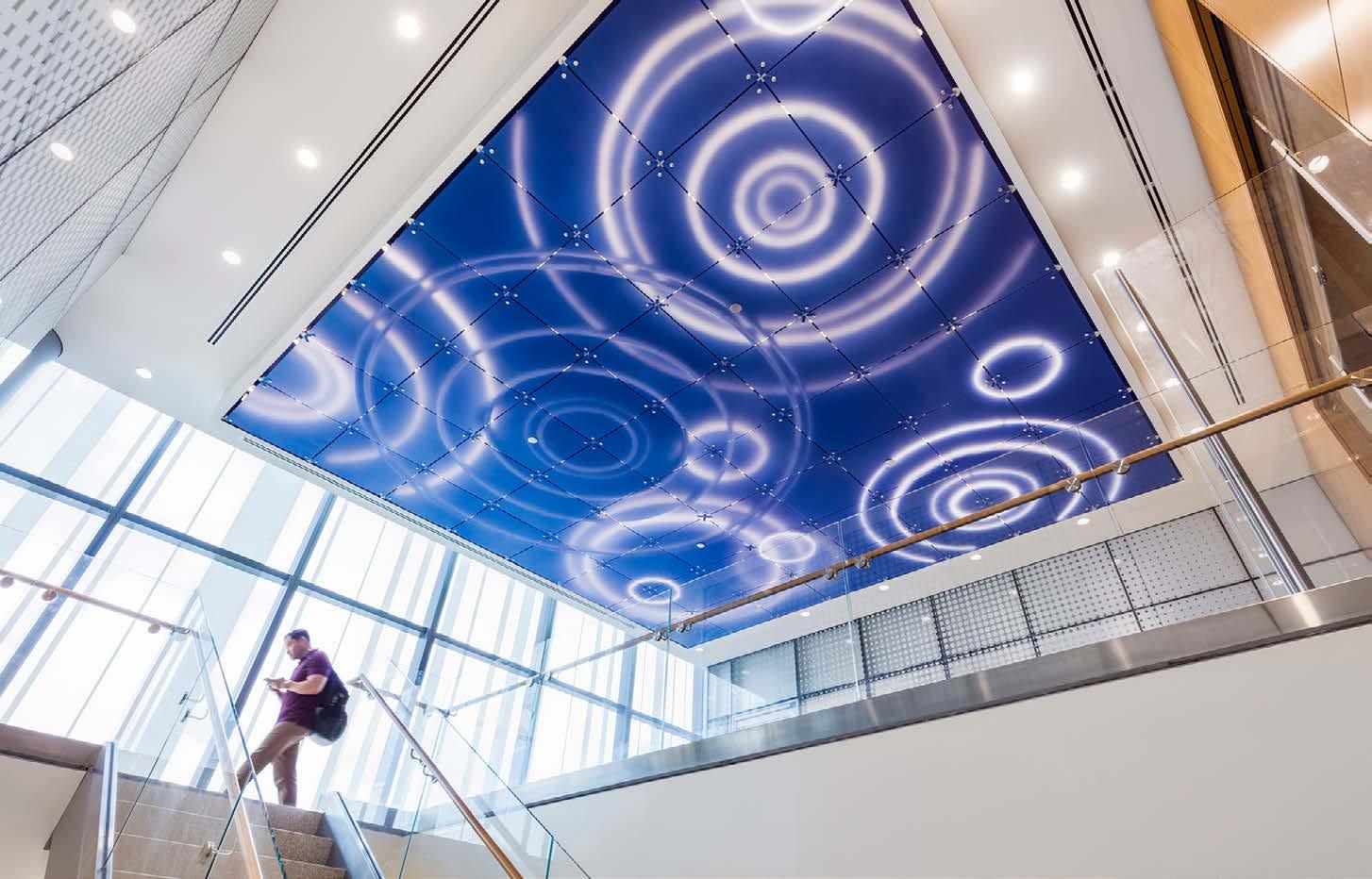
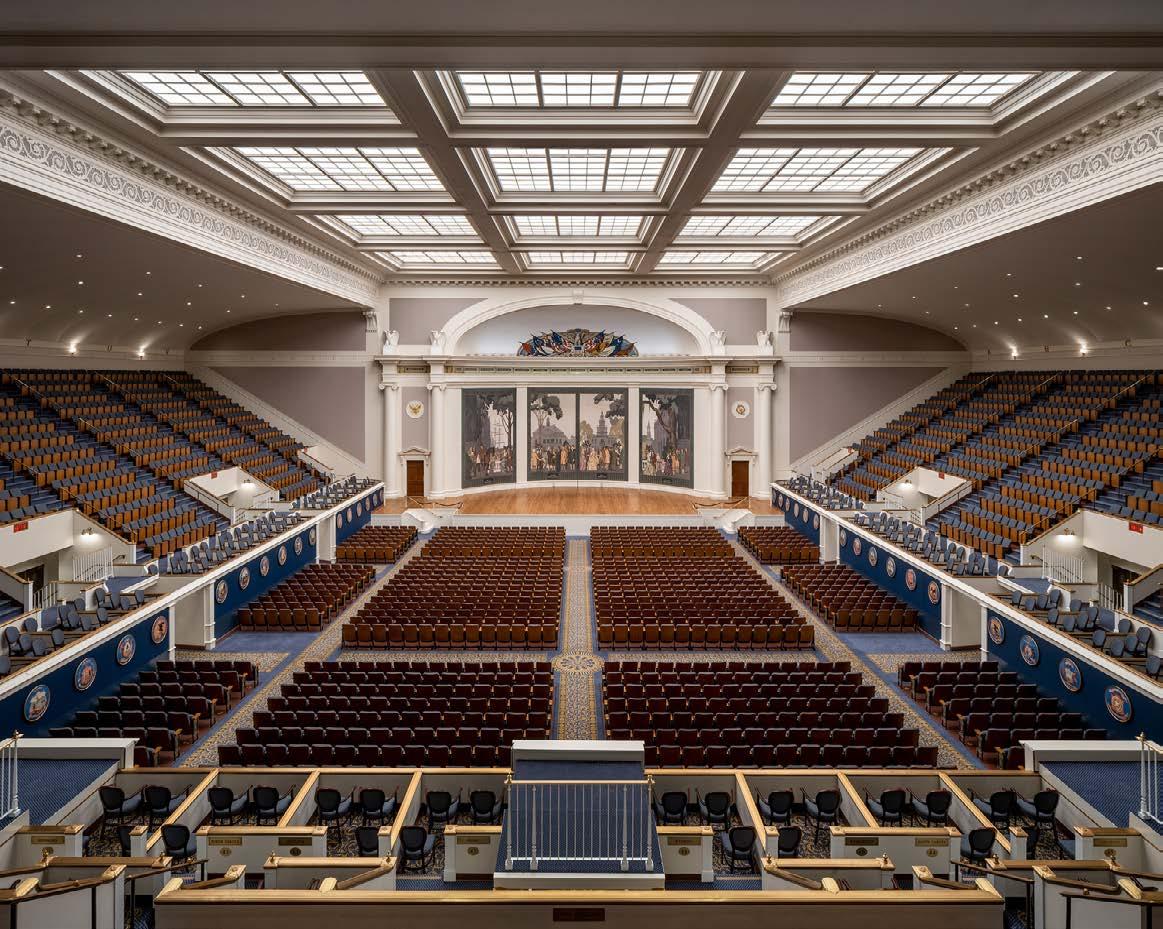
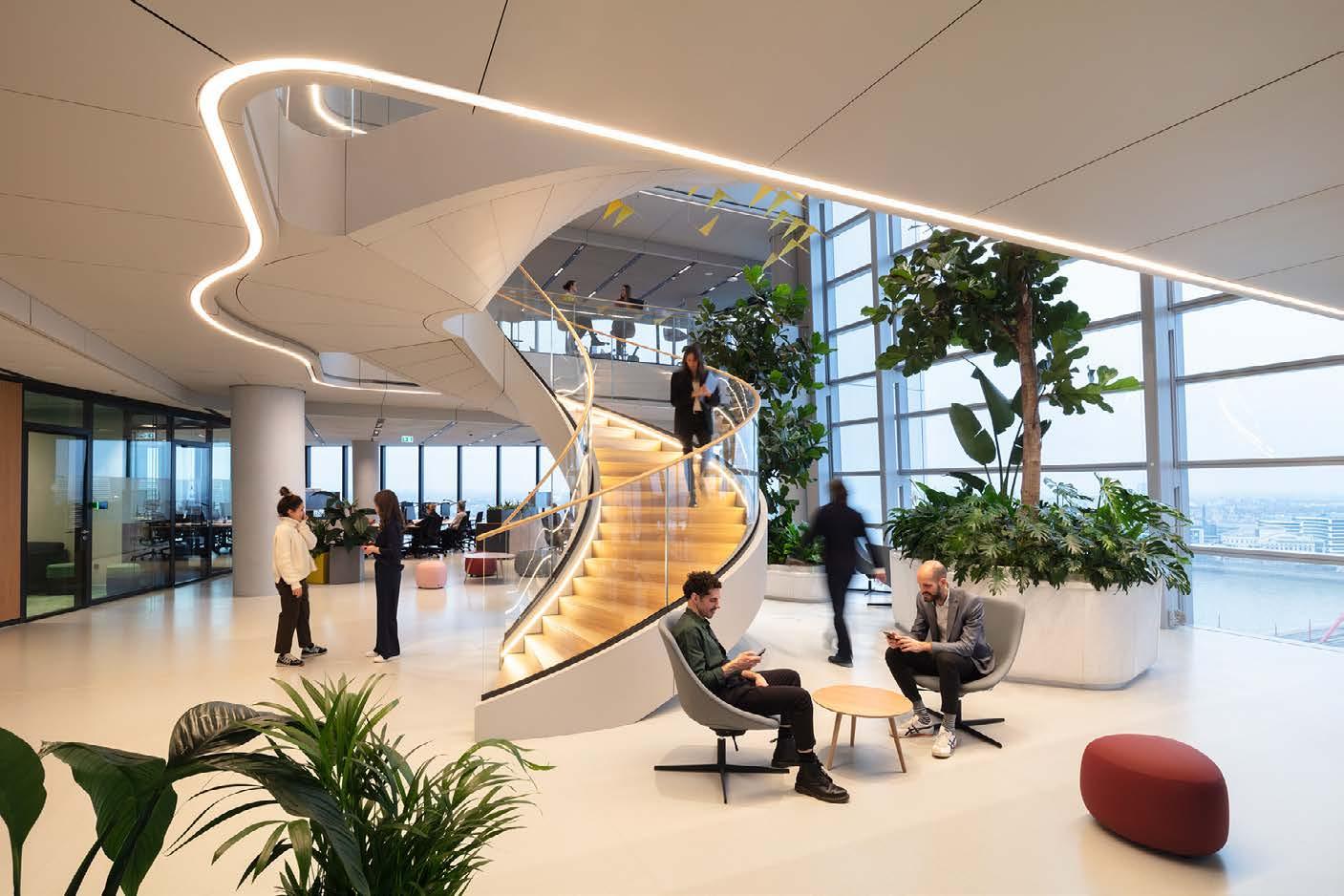
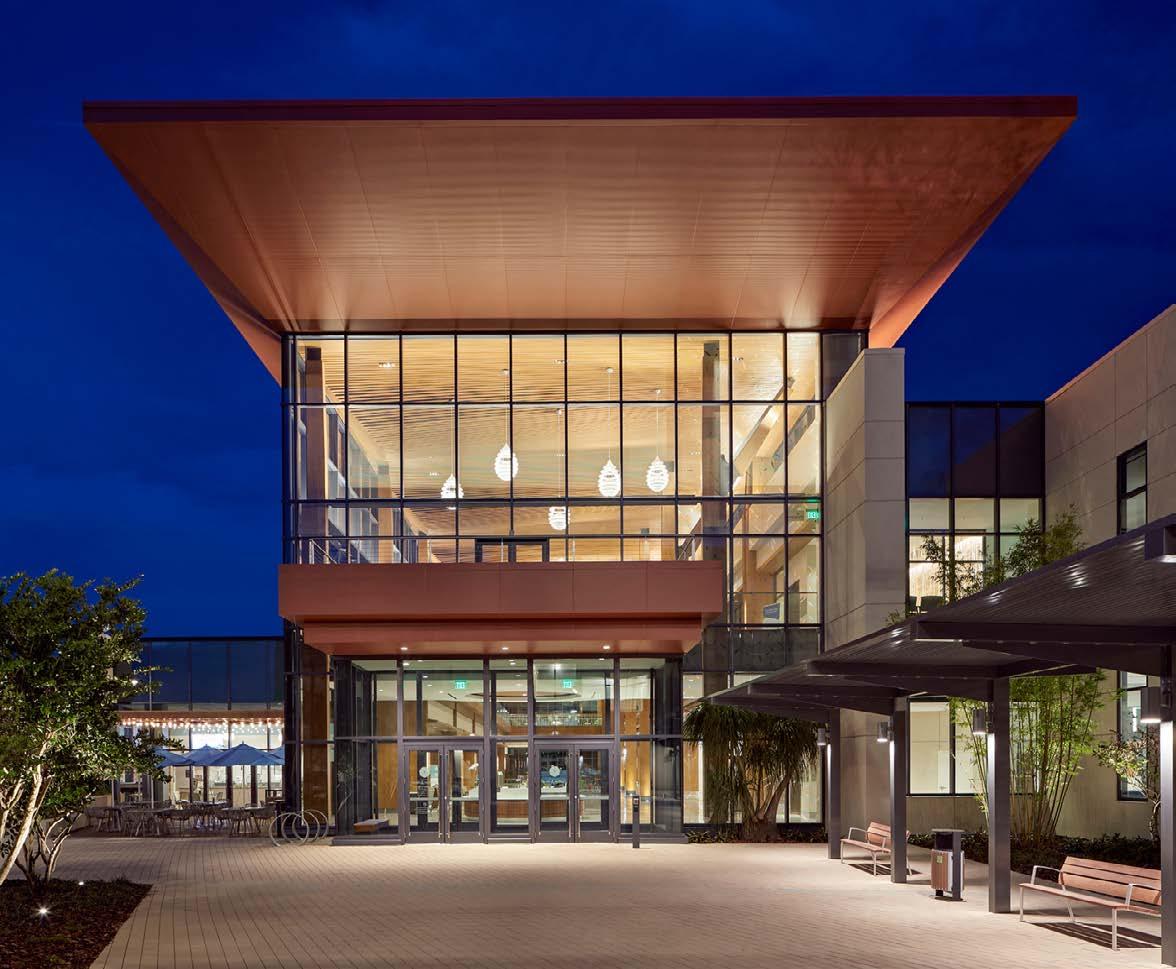
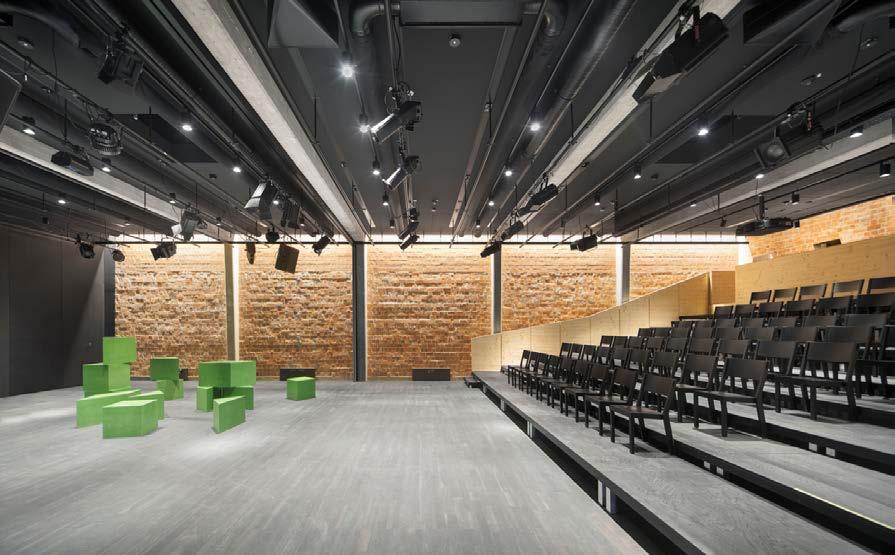
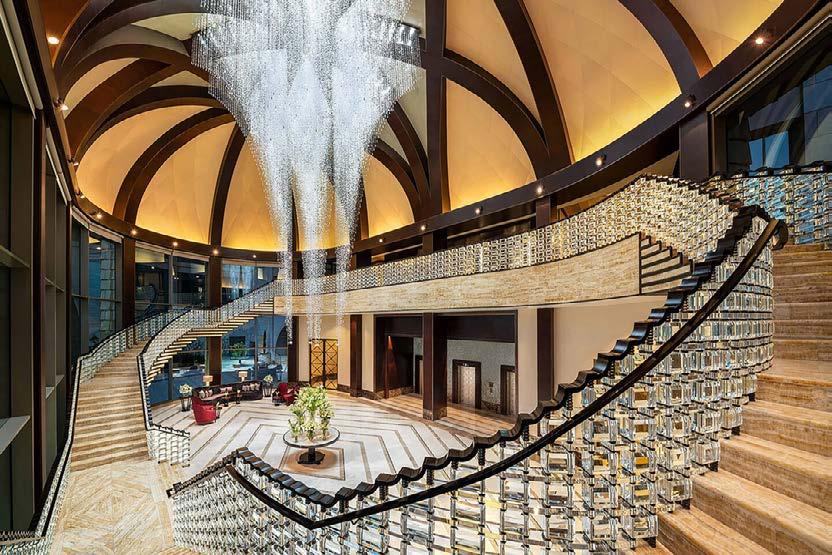
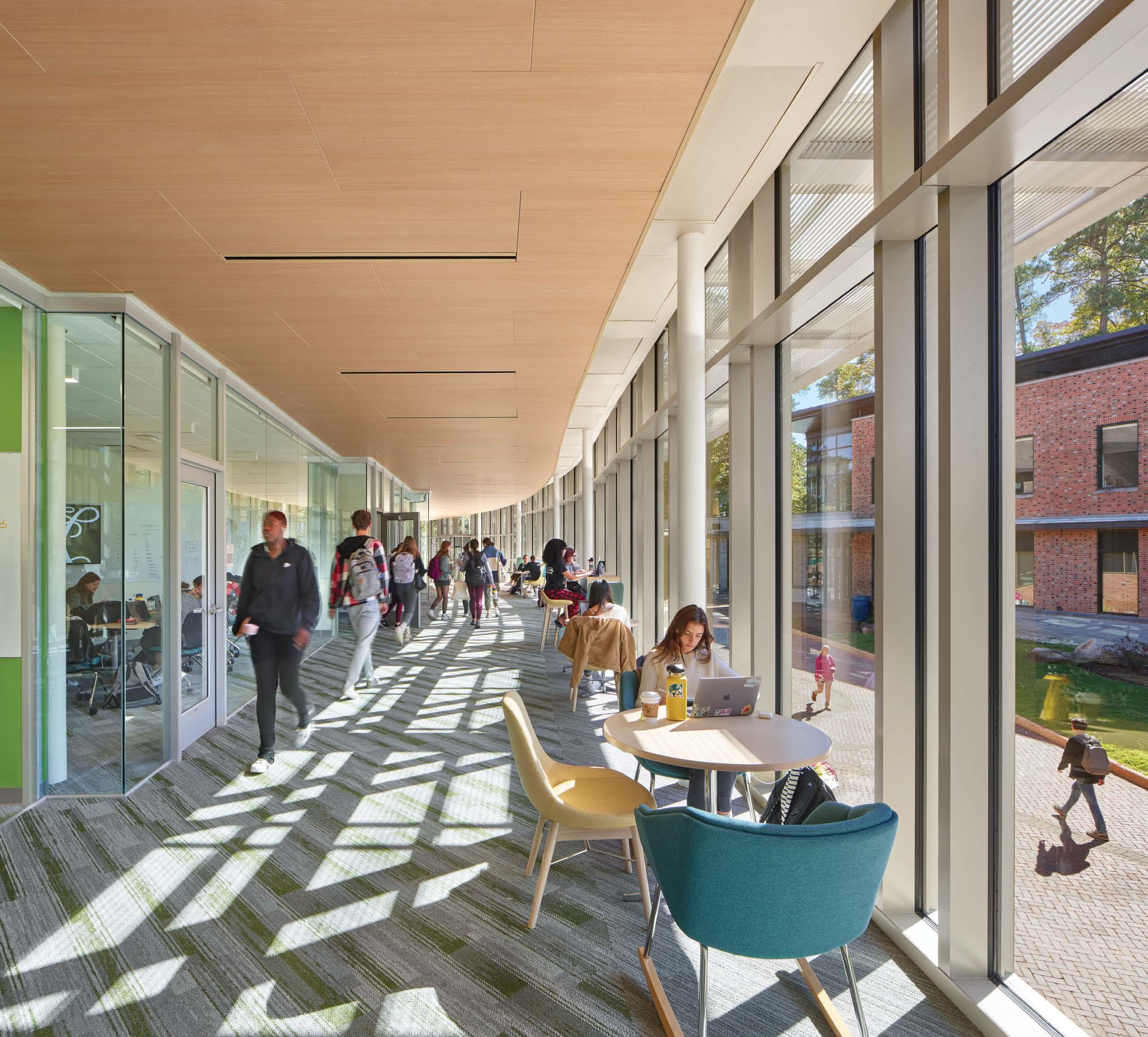
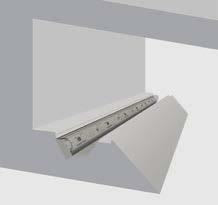
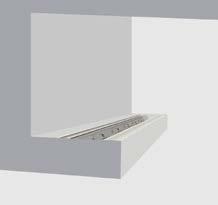
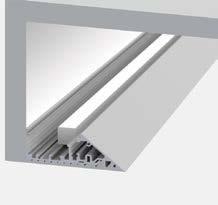
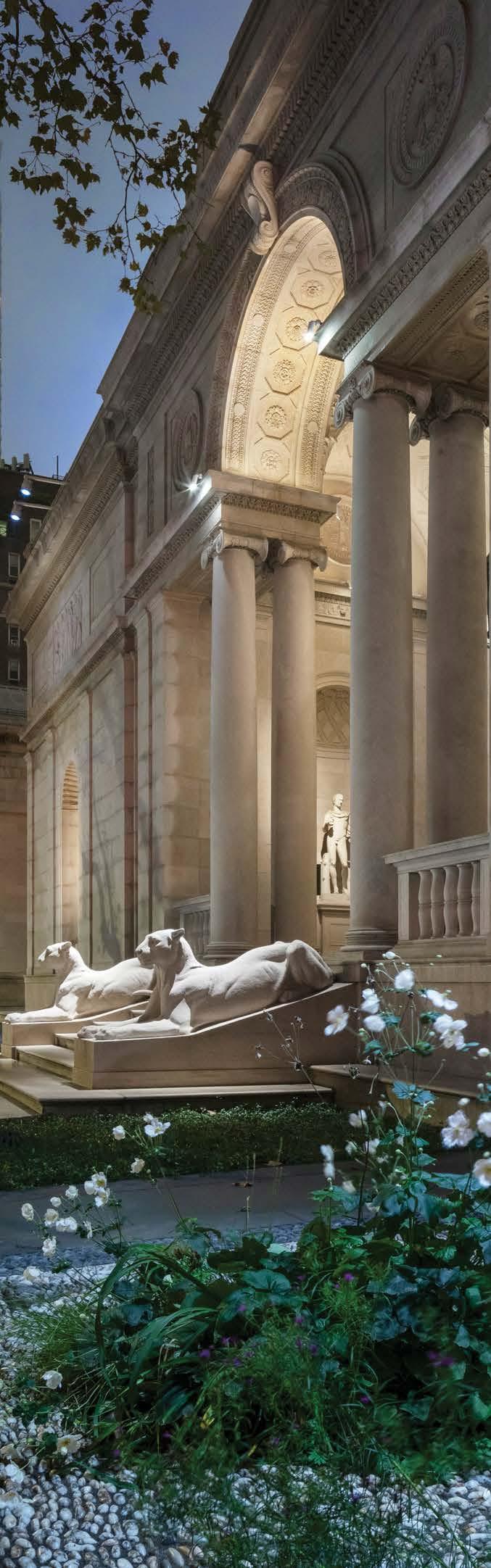
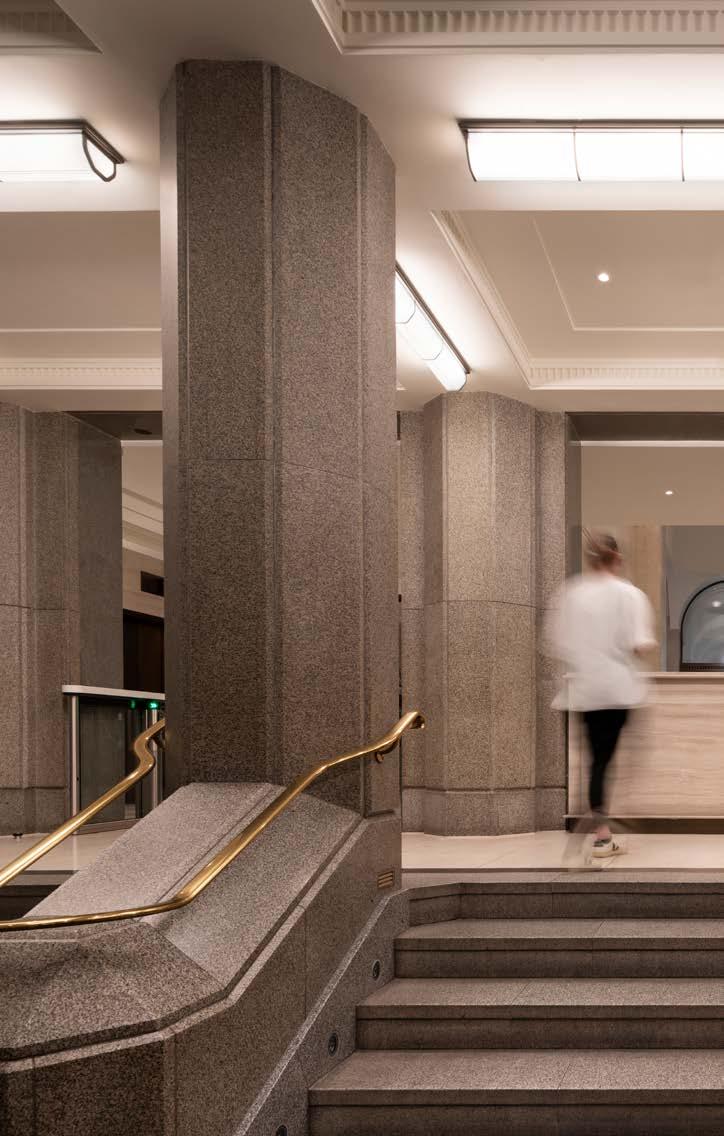
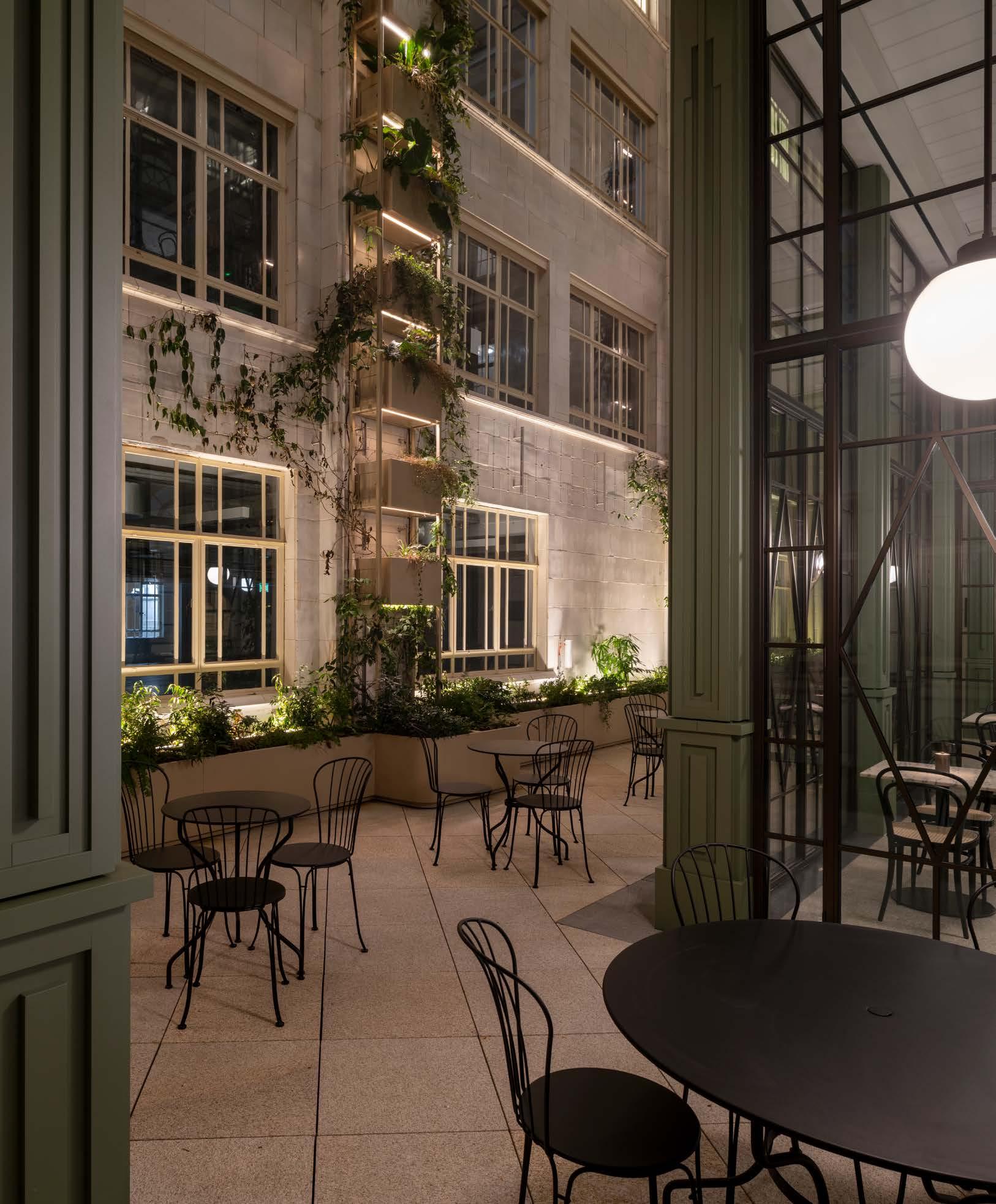
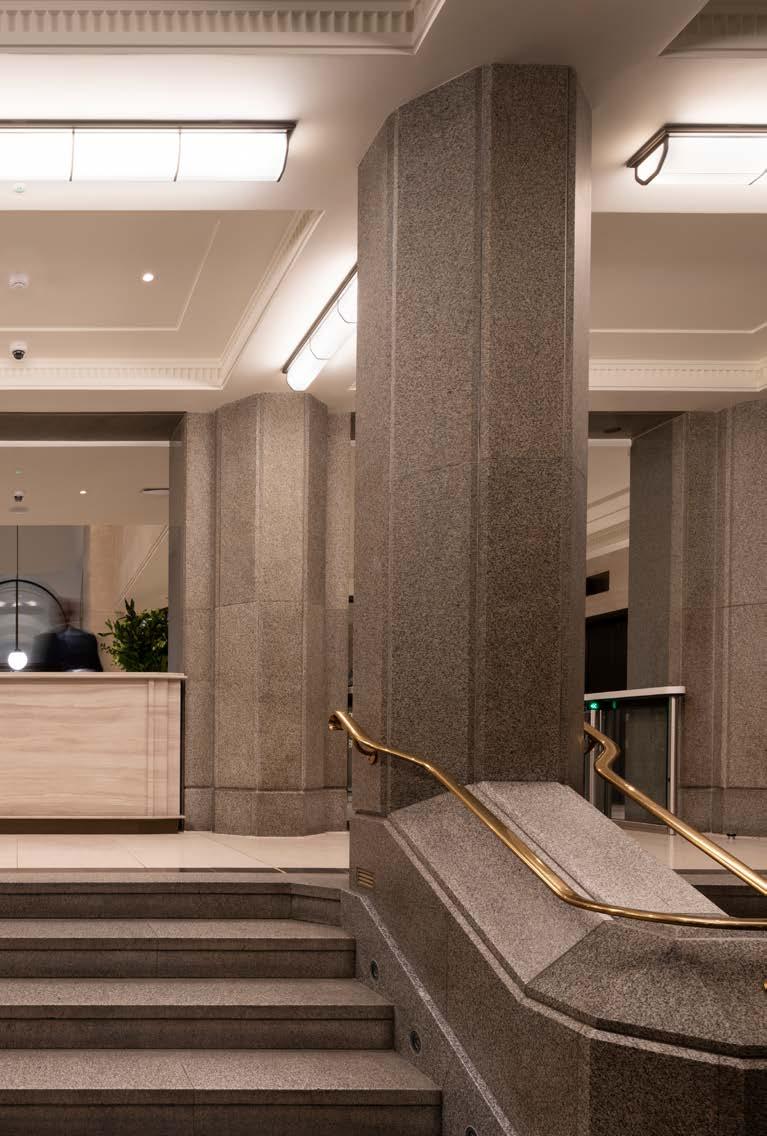
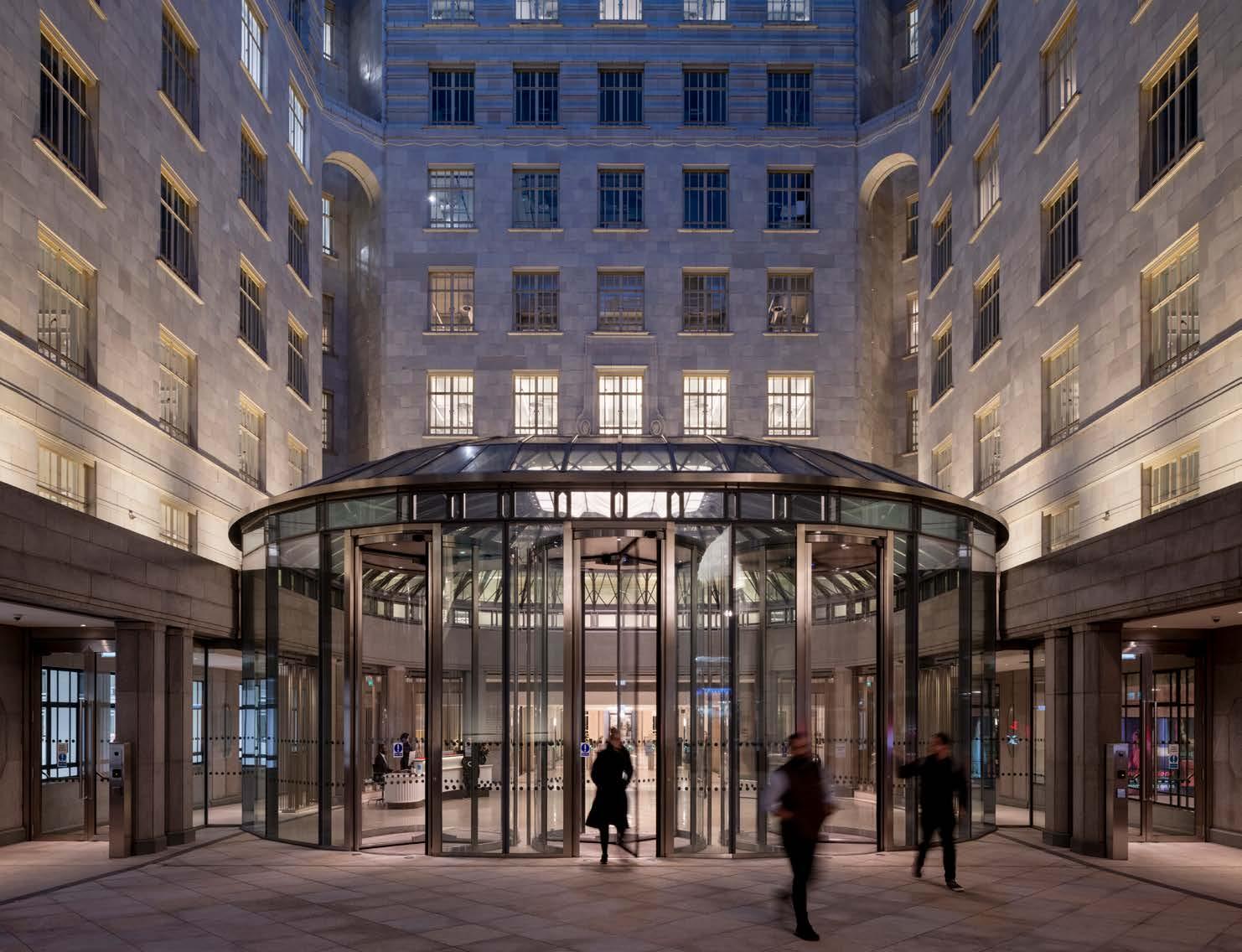
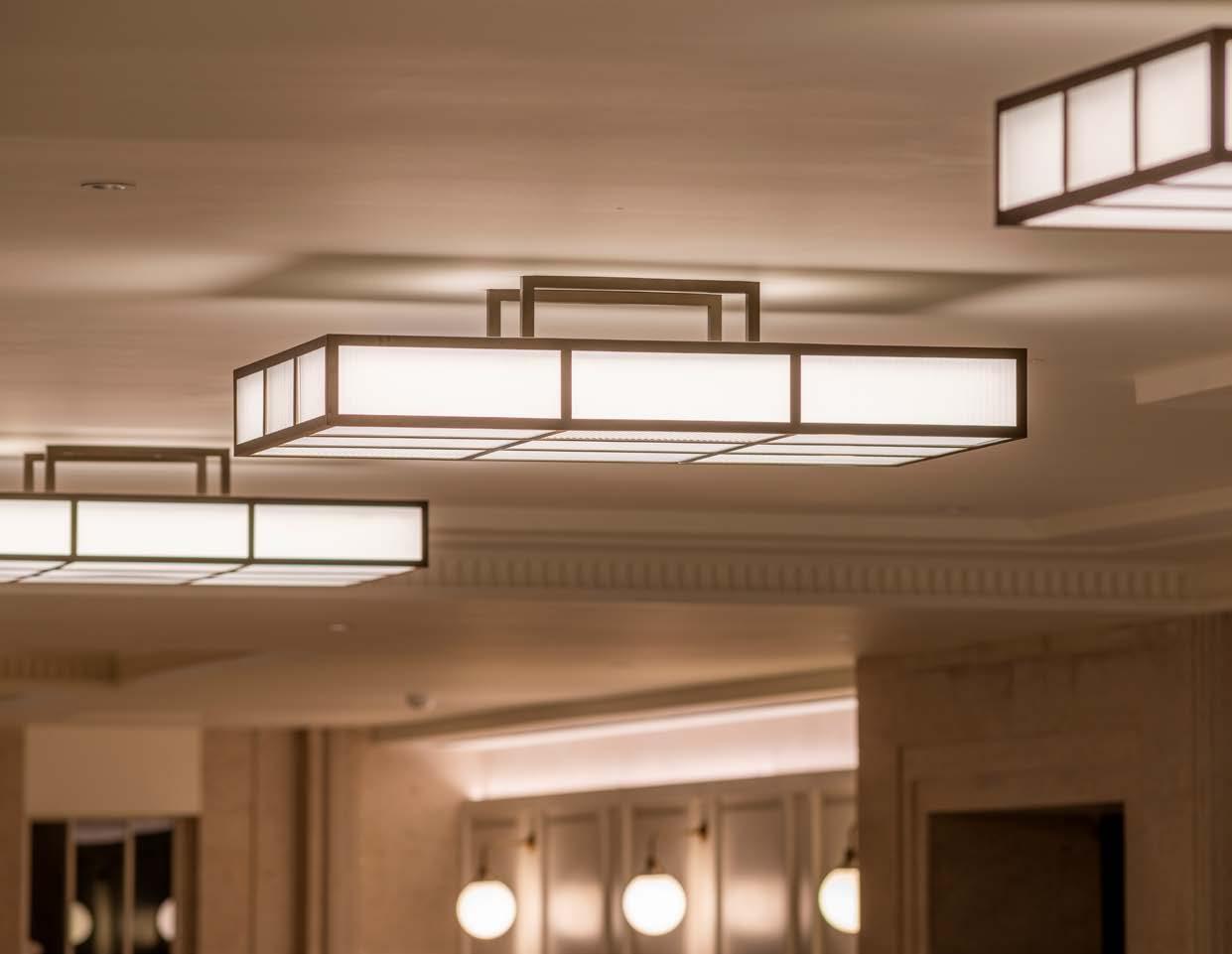
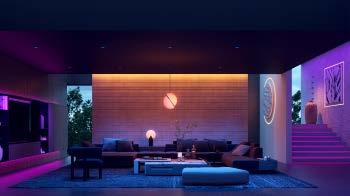
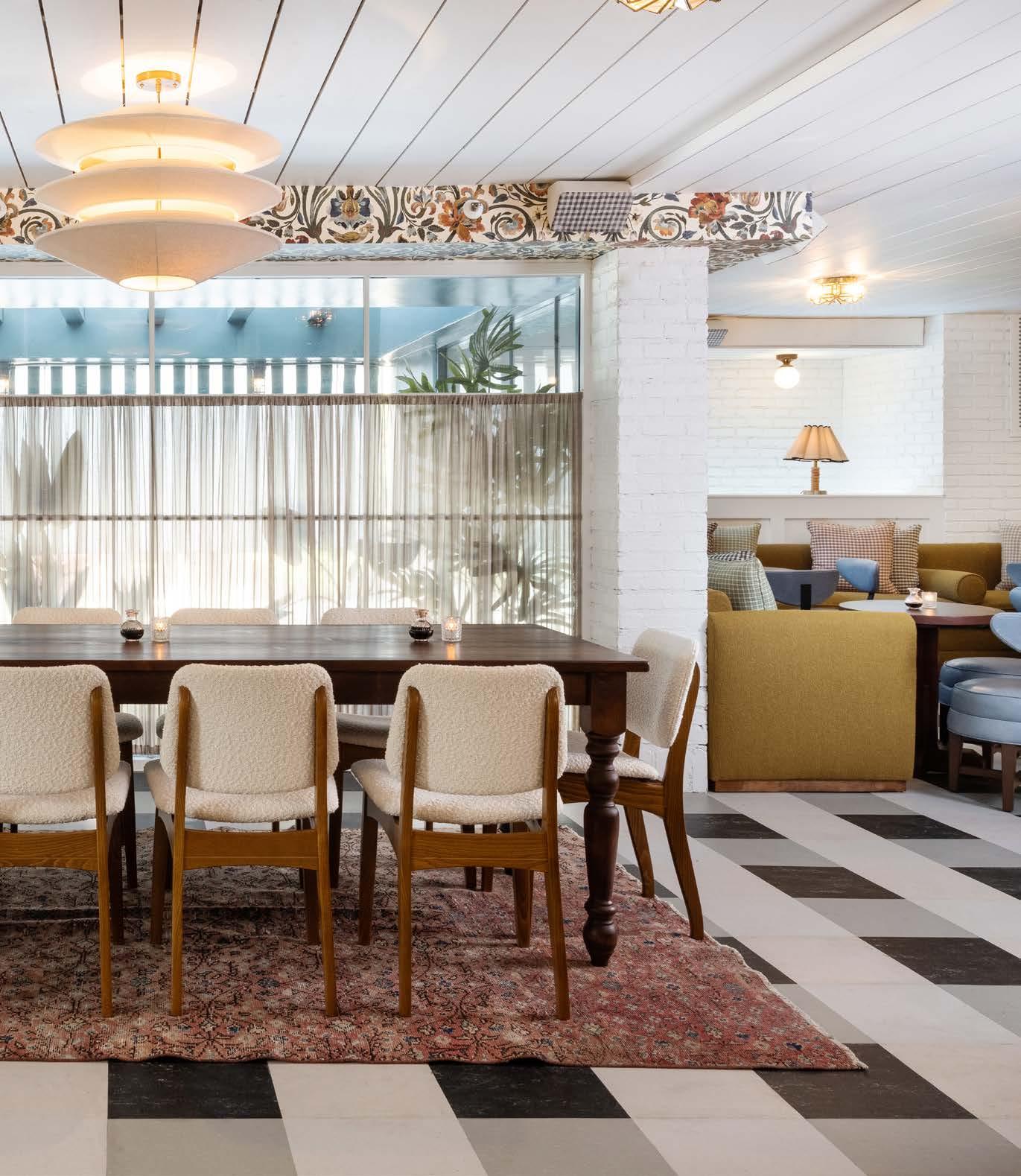
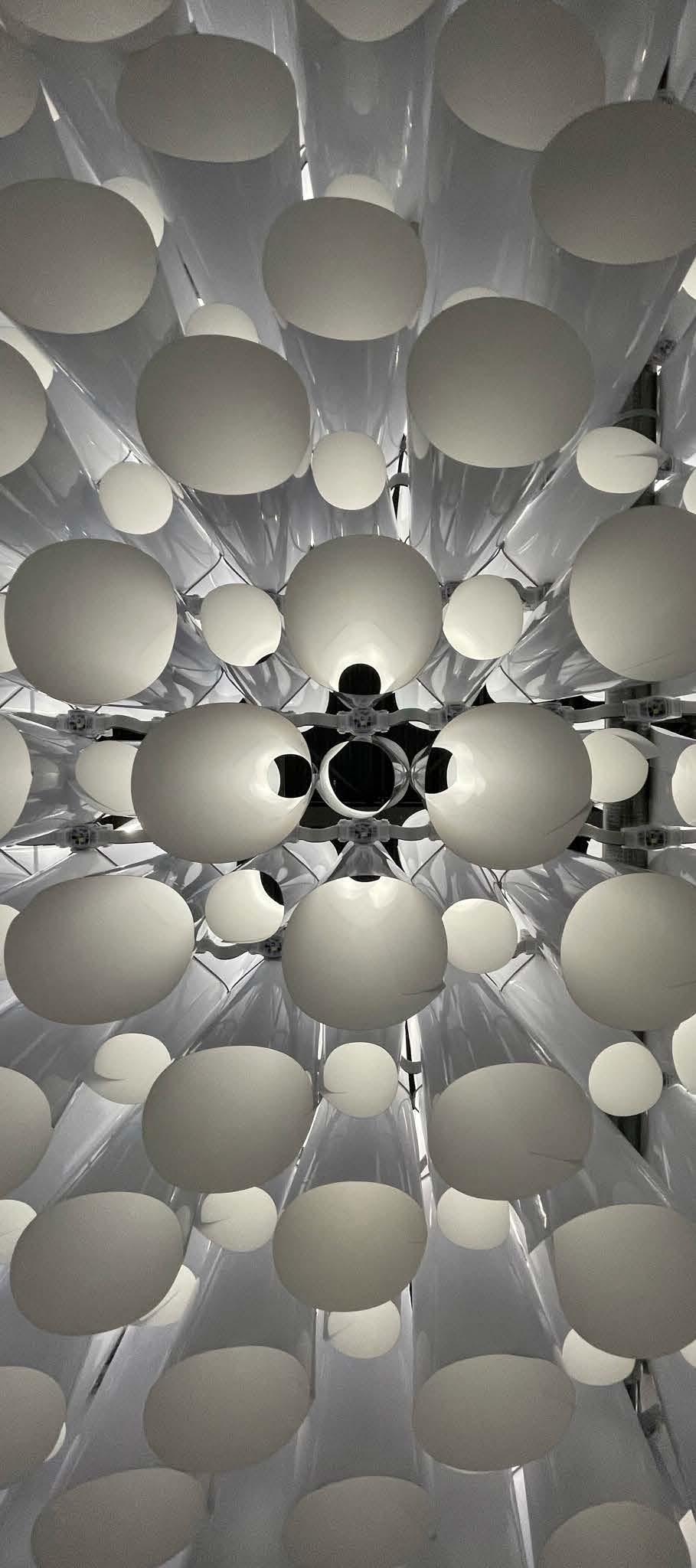
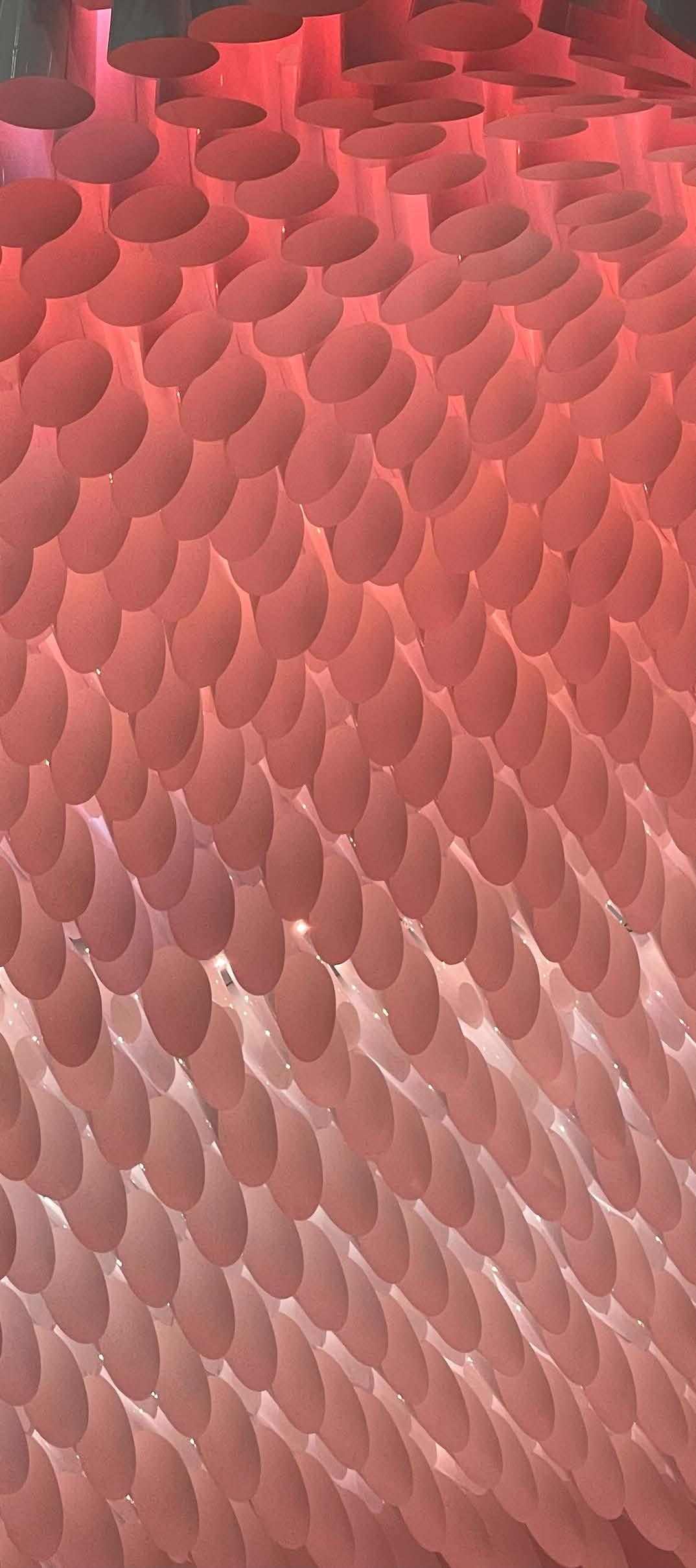
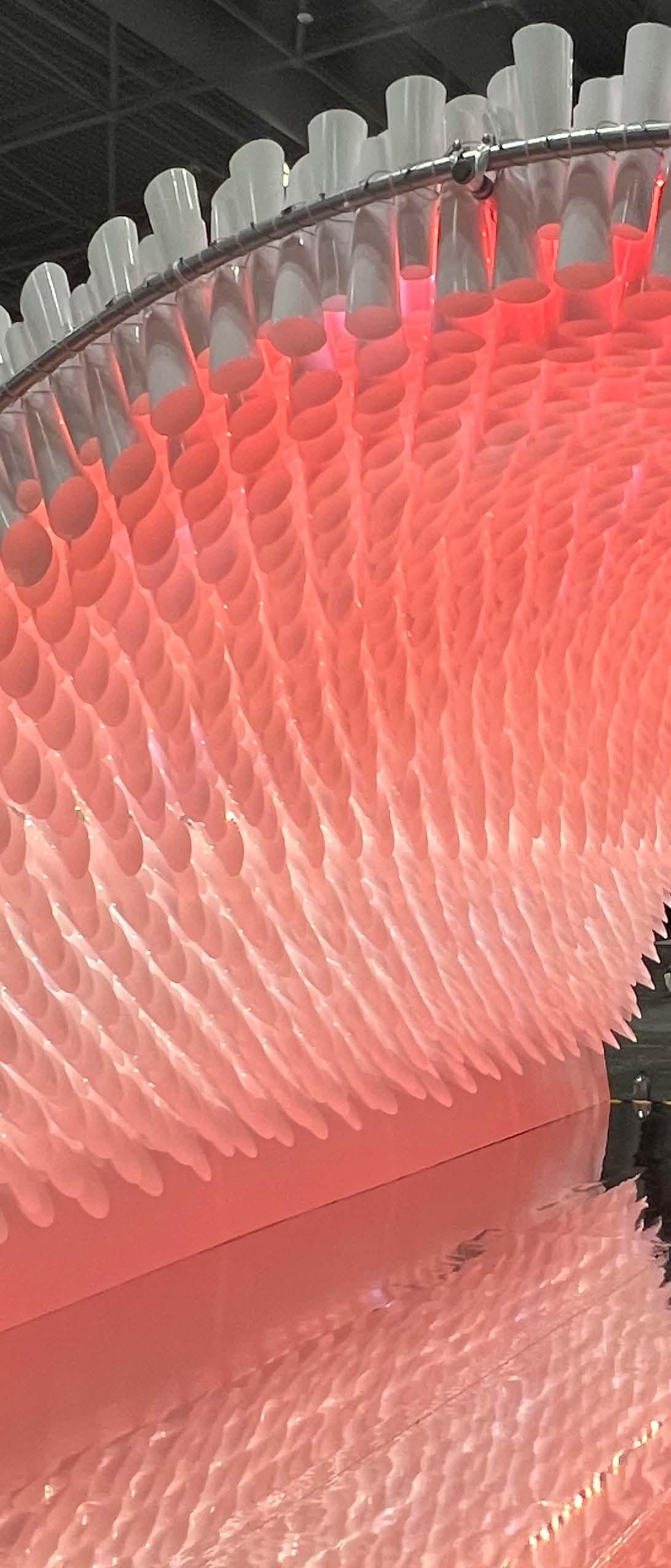
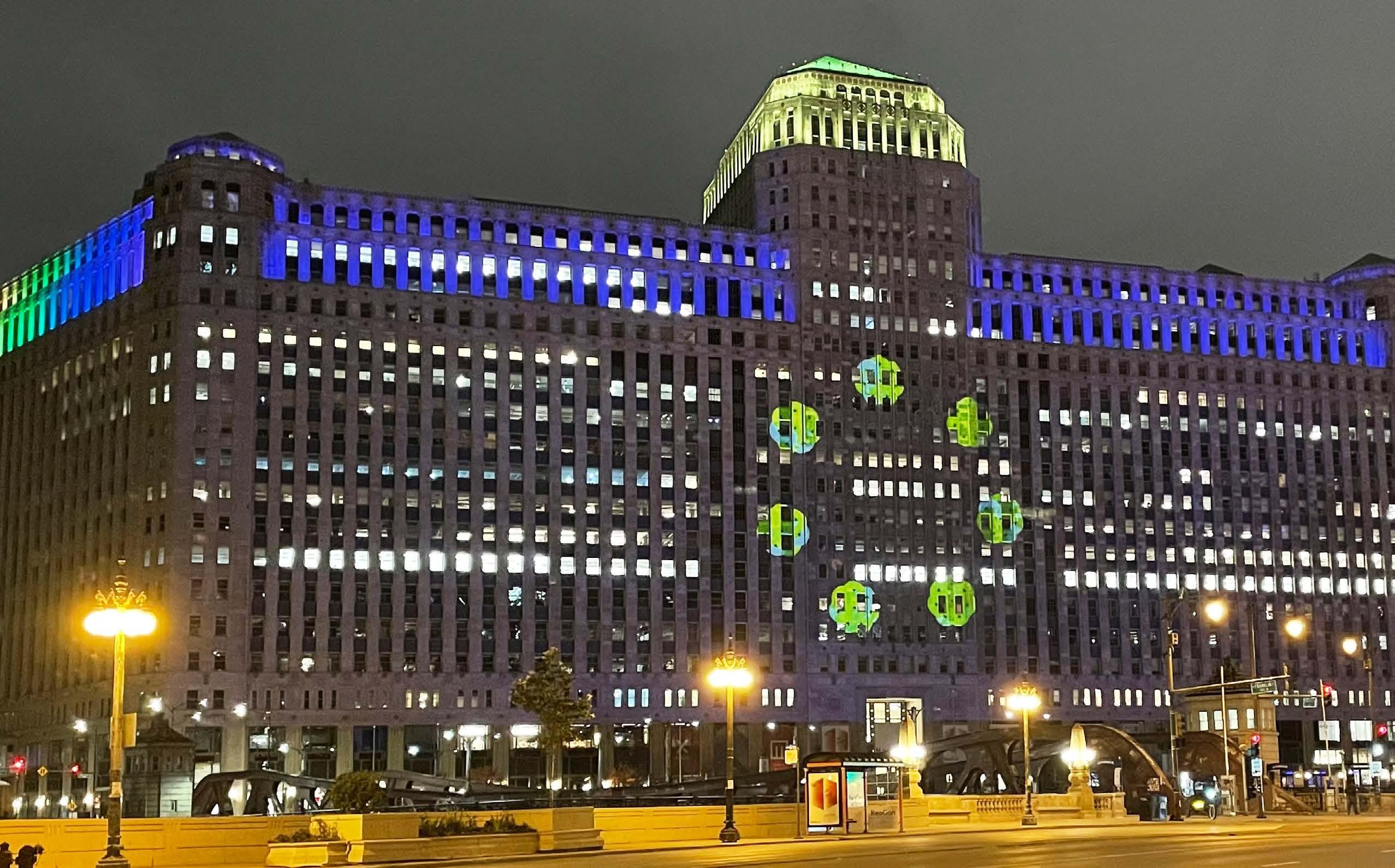
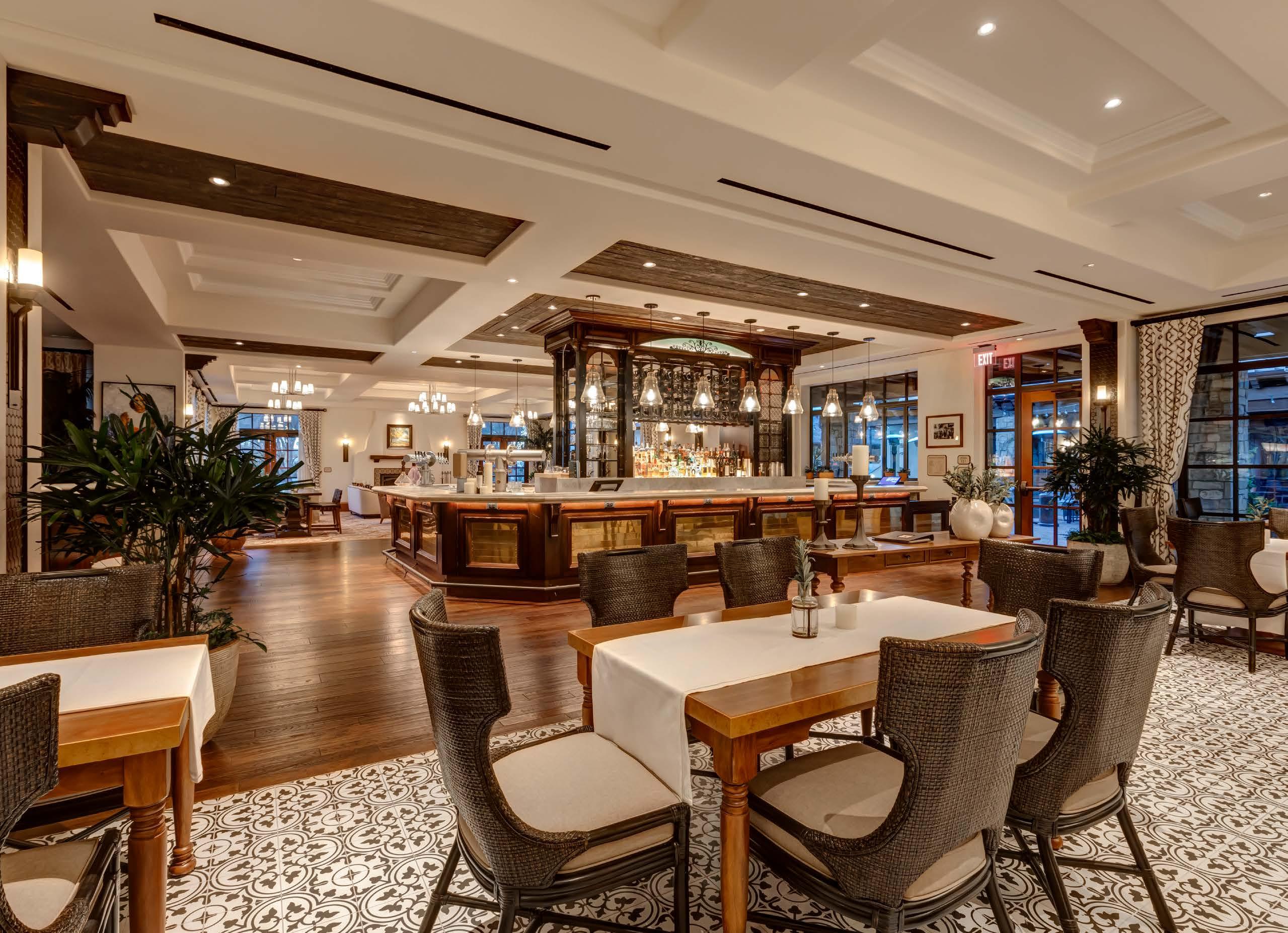
The Dairy at Central Park Cline Bettridge Bernstein Lighting Design
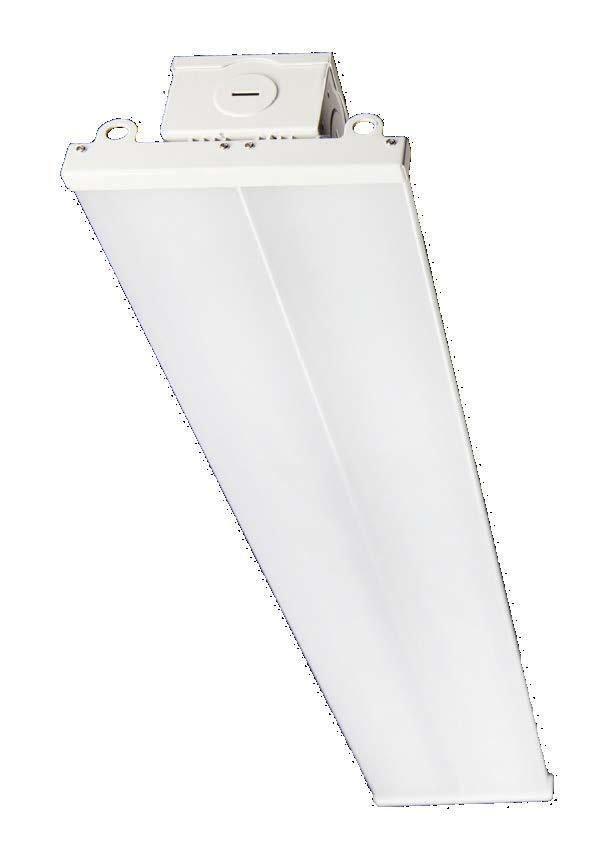
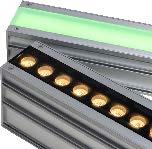
n Improved fixture efficiency with deliveredlumen efficacies as high as 150 LPW
n Lower-power options providing energyconsumption levels as low as 1.5 W/ft
n Standard 0-10V programmable dimming drivers with flicker-free dimming to 0.1%
n Available in static white or tunable white
n Delivered output levels can be tuned at the factory or in the field
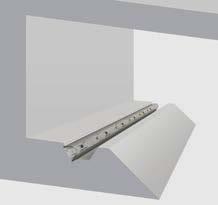
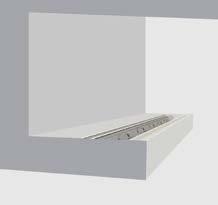
Coves Perimeter
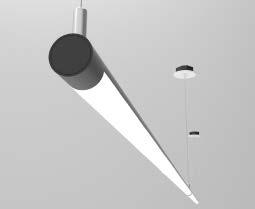
Edgeless Cove
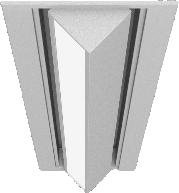
Mini Box Cove Box Cove
Linear Mini Edgeless
Mini Edgeless Cove Box Cove 2
James R. Benya,
By Randy Reid
David Warfel
Stefanie Schwalb
Mike Hamilton
Shirley Coyle, LC
James Benya, PE, FIES, FIALD
Vilma Barr
Parker Allen
Allison Thayer, MS
Craig DiLouie, LC, CLCP
Tiny wonder
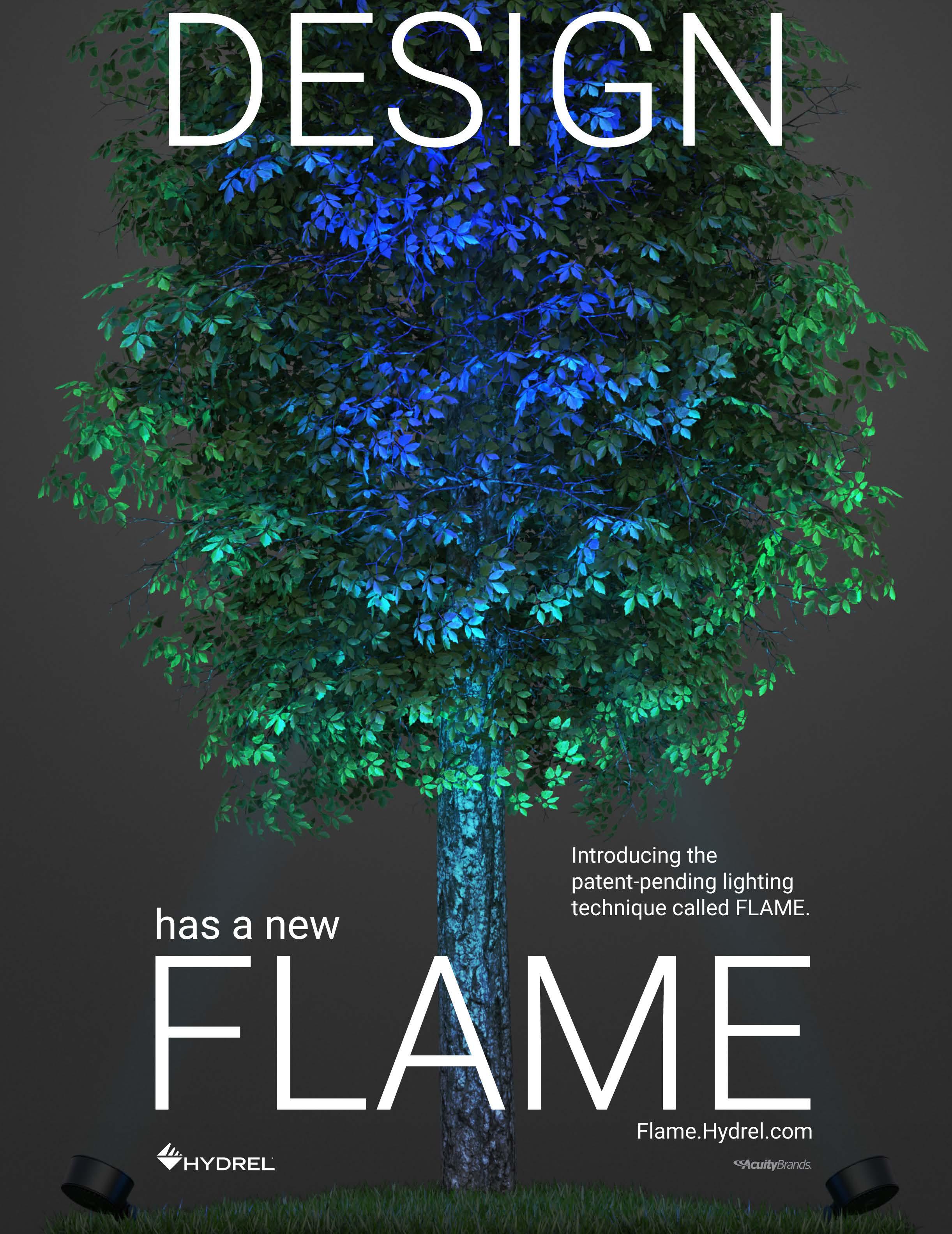
See your creativity take flight.
Bring architectural beauty into the light.
Soar soon into the miniature magnificence of FINCH.
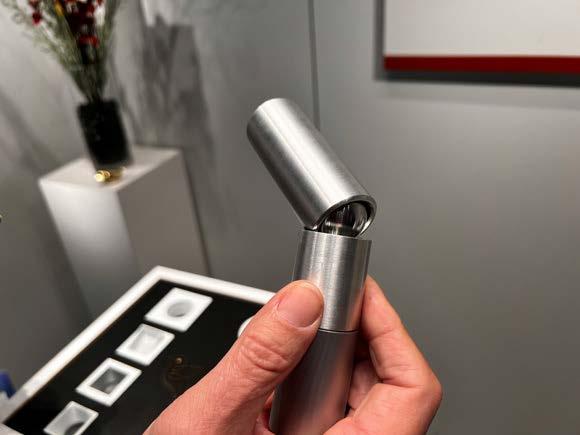
An engineering marvel, this 1.25” family is a rare find, emitting up to 1500 lumens of soft, glare-free light from a solitary beam that leaves rivals in the shadows.
FINCH offers assorted sizes, drivers and customization options to inject vitality into aesthetic visions. Dual-tone bevel finishes. Patent-pending 50-degree aiming angles. Toolless light engine replacement. And subtle sophistication.
Whether mounted on ceilings, along walls or across the ground, FINCH seamlessly blends into its interior and exterior surroundings, ensuring your timeless design remains forever at the forefront.
Take beauty by the wings. Fly with Finch. Contact your sales rep at amerlux.com/contact-sales.
Cylinders available in July, downlights in September.
Patent pending aiming angle 50°
By Craig DiLouie, LC, CLCP
By David Warfel
ON THE COVER Trinity Church
Photo Credit: Christopher Payne/ Esto, Colin Winterbottom
Photo Credit: Brett Beyer, Elizabeth Felicella
Courtesy of The Morgan Library & Museums®
SHUFFLE
Editorial Director: Randy Reid
Publisher: Cliff Smith
Director of Audience Development: Angie Hullfish
Contributing Writers:
James Benya PE, FIES, FIALD Benya's Art & Science Contributor Principal at Design Services, Inc. and The Benya Burnett Consultancy
Nurturing the Bond: The Indispensable Relationship between Lighting Designers and Reps.
Shirley Coyle Up Close Contributor Principal at RELEVANT LIGHT Consulting Inc.
Craig Dilouie Get Control Contributor Principal at ZING Communications
Stefanie Schwalb Hospitality Lighting Contributor Interim Managing Editor at Boston Magazine
David Warfel
Residential Lighting Contributor Founding Designer Light Can Help You
Staff Writers:
Parker Allen Katie Smith
Published by EdisonReport 1726C General George Patton Dr. Brentwood, TN 37027
Phone: 615-371-0961 designinglighting.com
designing lighting is focused on the Business of Lighting Design™ and provides business information to the lighting design community. In addition to the website, designing lighting publishes bi-monthly online magazines featuring original content, interviews within the community and highlights successful award winning lighting designs. While designing lighting is based in the U.S., it has contributors from Europe and is developing a global presence.
(ISSN 2693-9223)
Statements and opinions expressed in articles and editorials in dl are the expressions of contributors and do not necessarily represent the policies or opinions of the EdisonReport. Advertisements appearing in the publication are the sole responsibility of the advertiser.
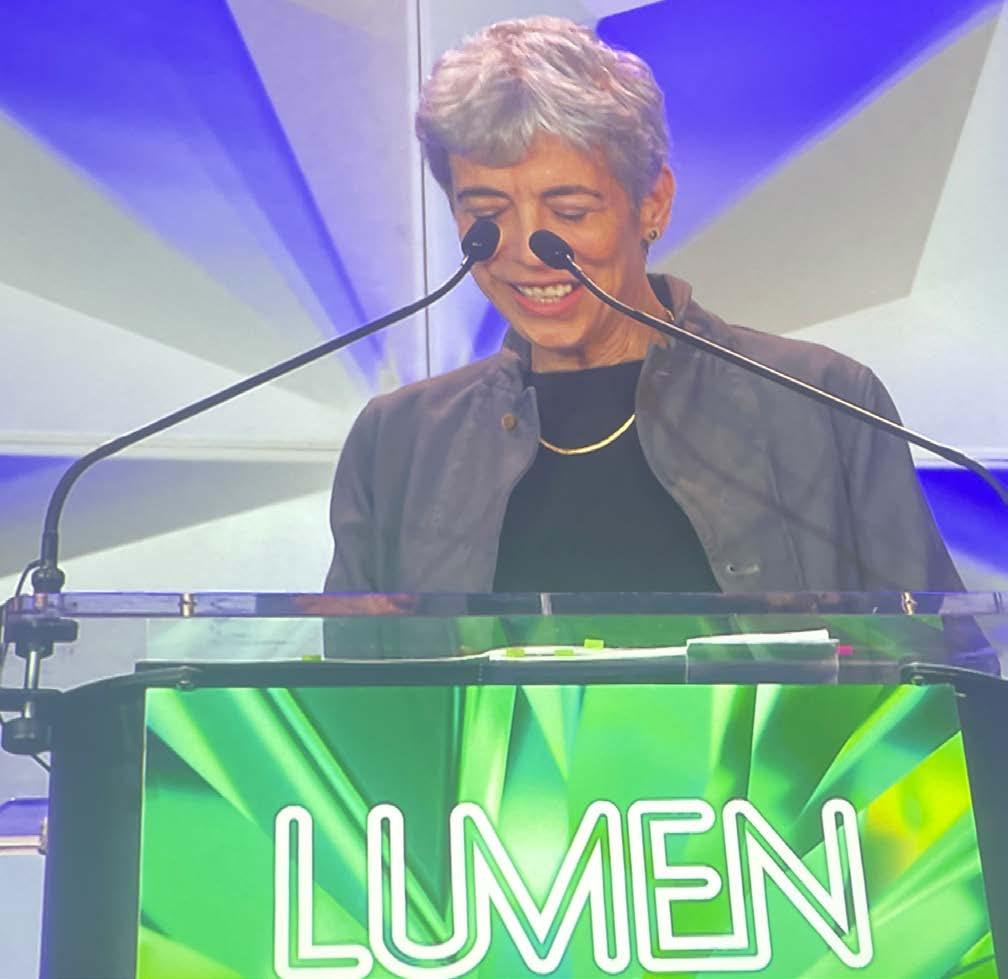
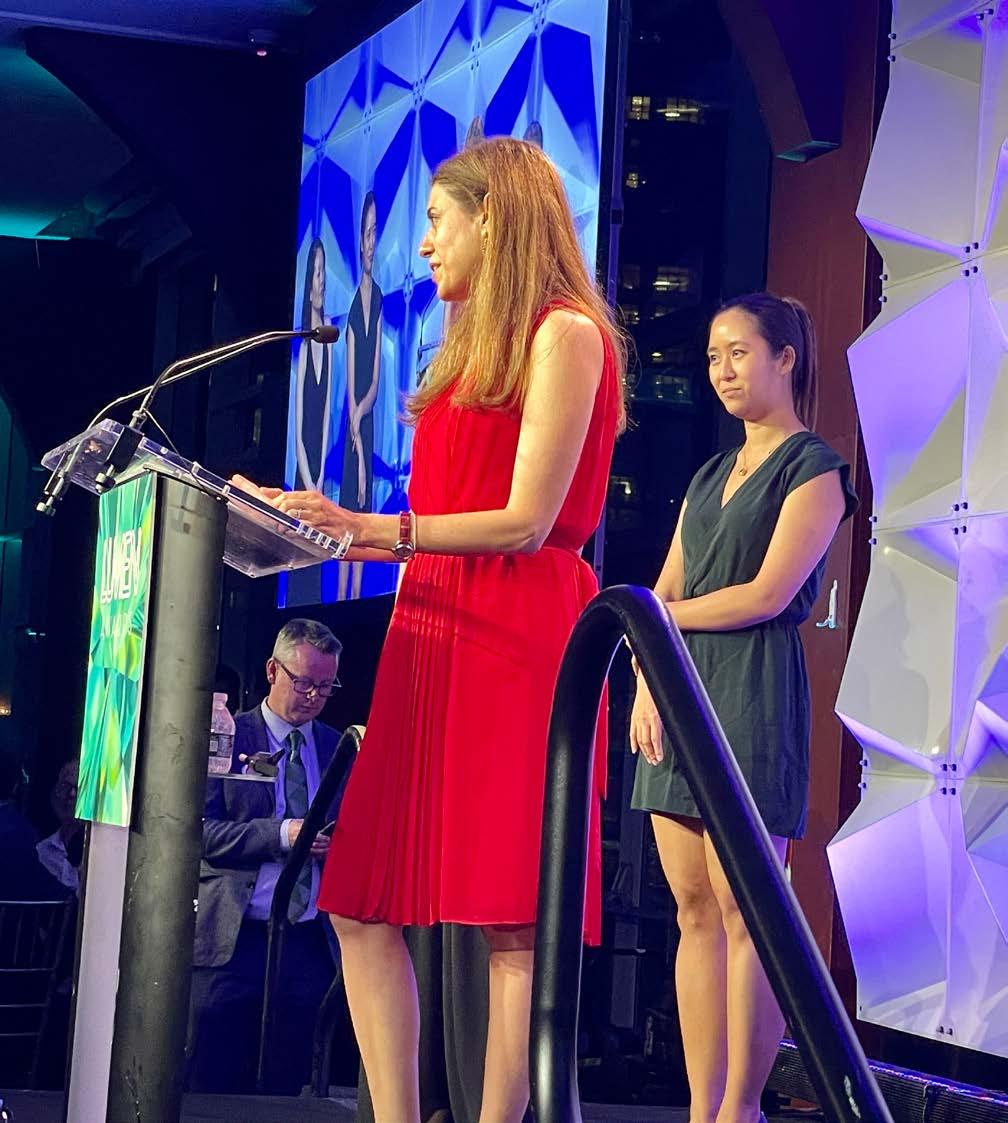
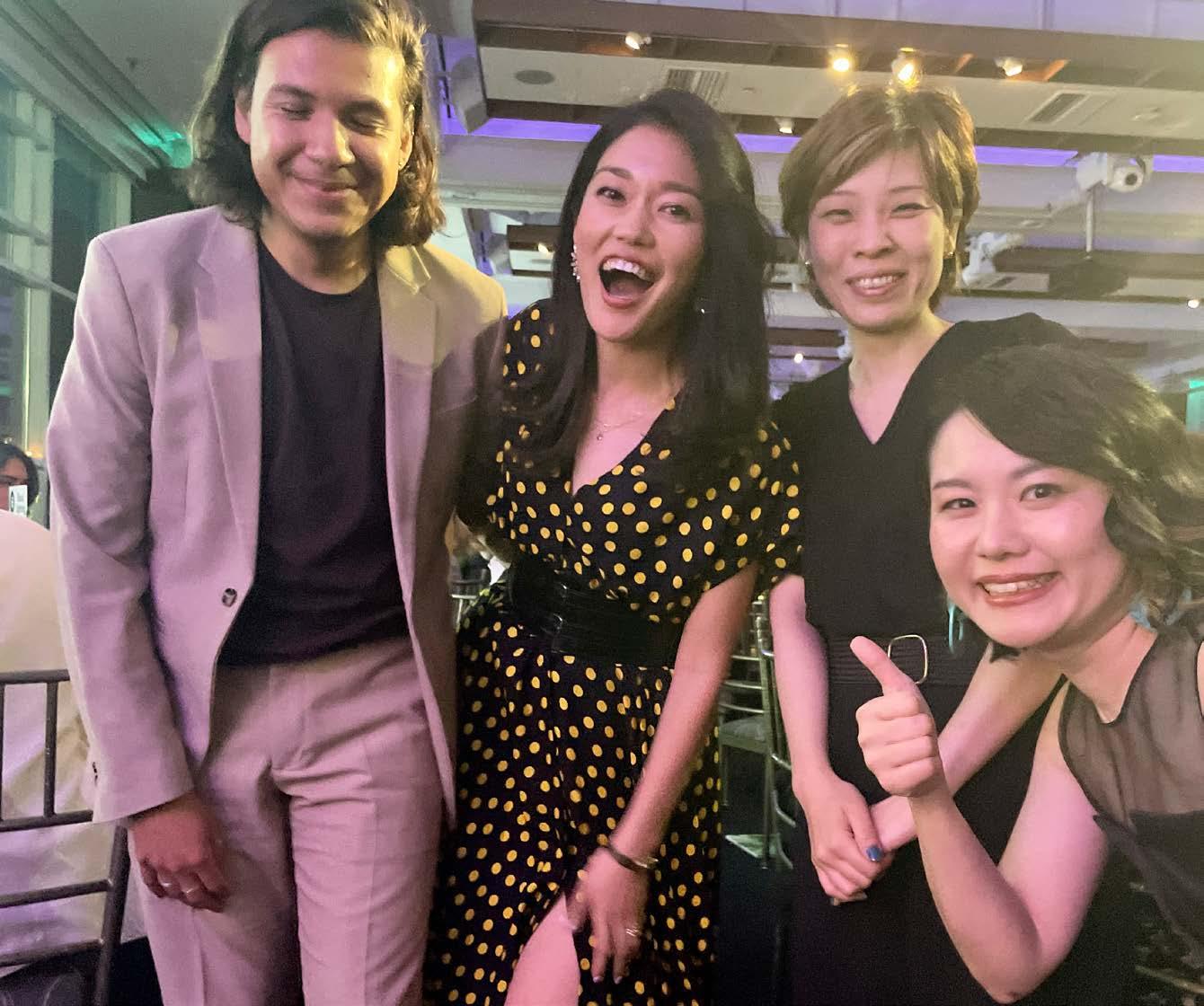
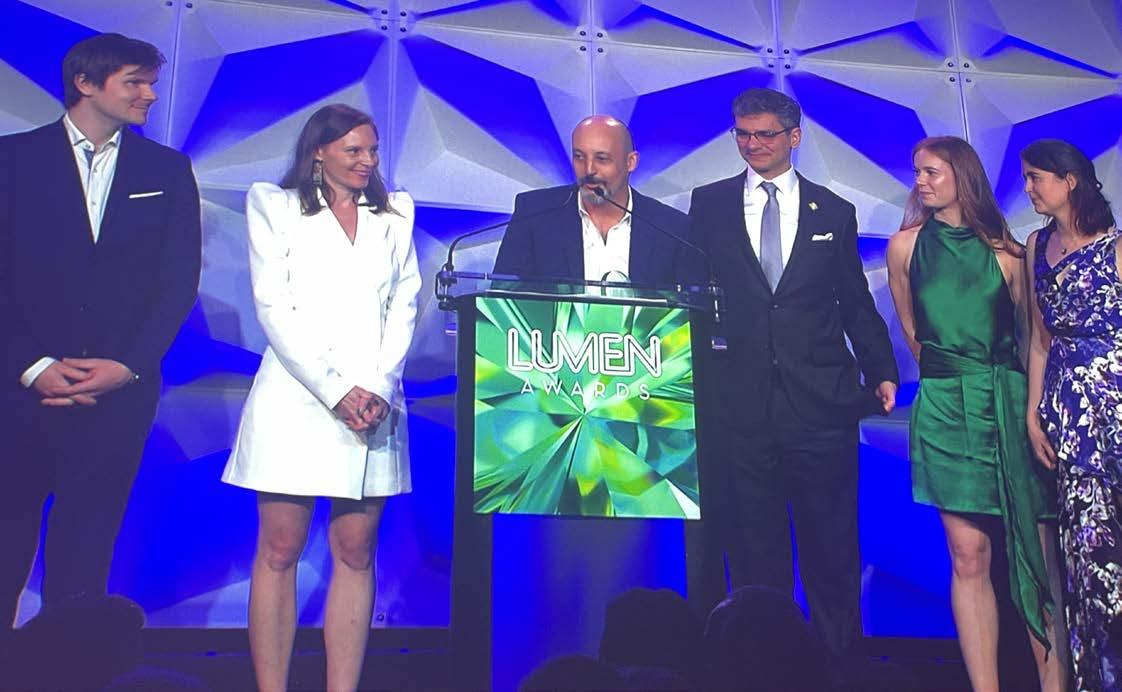
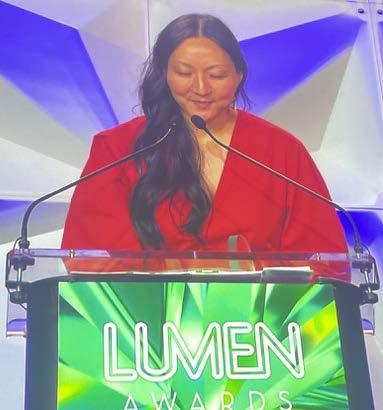
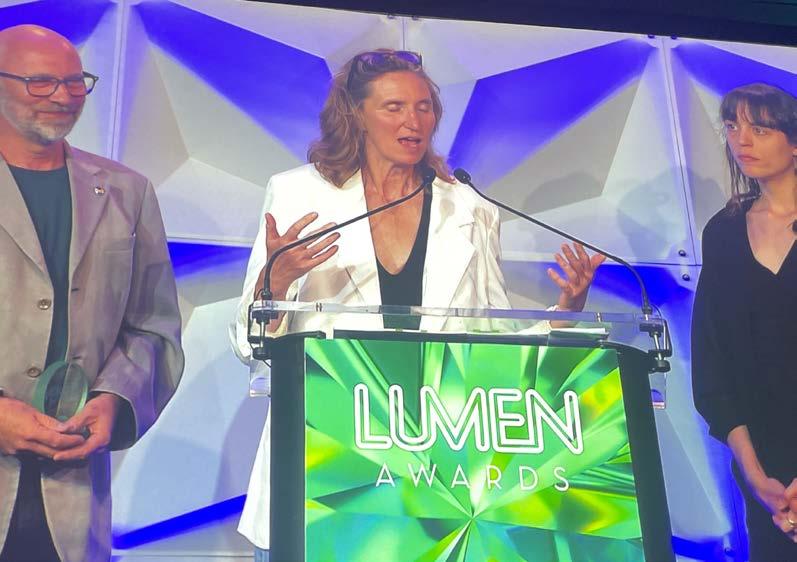
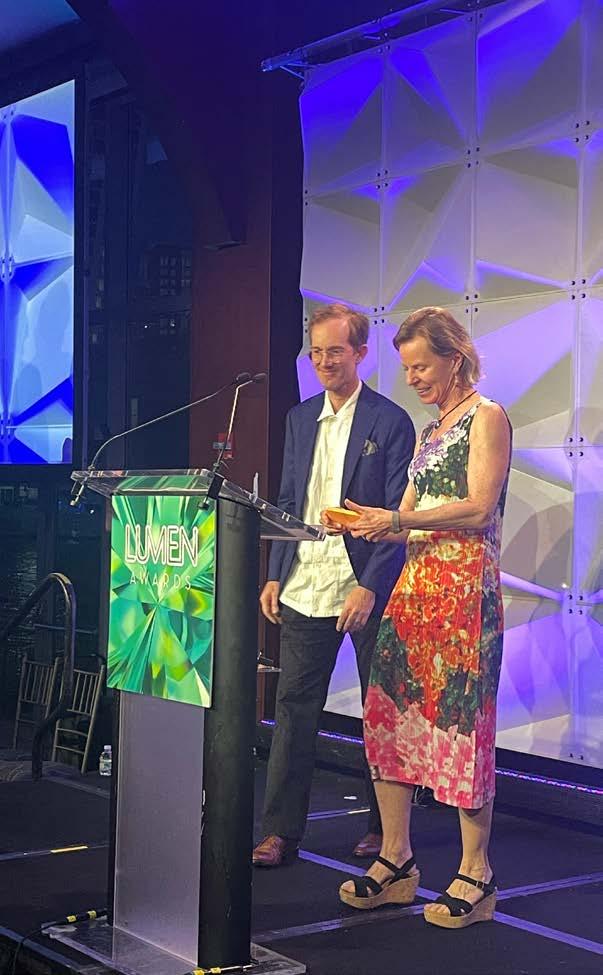
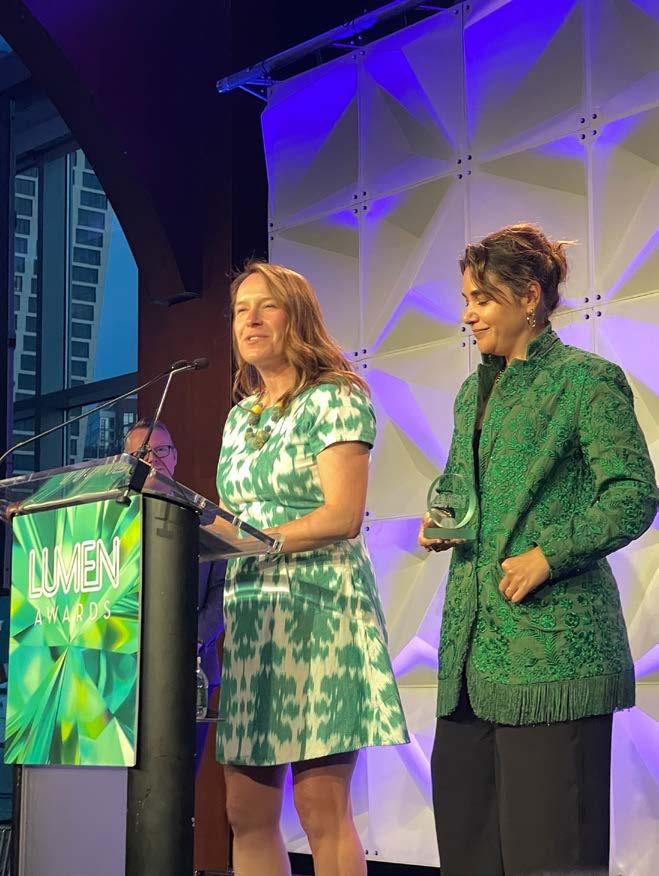
The 2023 IESNYC Lumen Awards Gala, lighting's most anticipated annual celebration, brought together 900+ colleagues and friends in a vibrant atmosphere complete with an open bar and infectious festivity.
However, capturing the attention of the spirited crowd always proves to be a challenge. IESNYC President Megan Carroll took the stage, armed with a whistle and a powerful tribute to luminaries Howard Brandston, John Rindell Apmann, and Michael Manicone With a combination of whistle blows, dimming lights, and a poignant slide, Carroll captured the attention and respect of attendees.
Throughout the evening, short videos featuring Asher Schoenberg and Nathaniel Bliss cleverly reminded the audience to maintain decorum. Even James O'Blaney made a surprise cameo as a janitor in one of the videos, playfully urging people to quiet down.
Lumen Award co-chairs, Adrienne Shulman and Clara Powell, along with project narrators Colin Conroy and Christine Hope, skillfully orchestrated the program, utilizing well-timed pauses to create moments of hushed anticipation. The gala exuded a contagious energy and seamlessly flowed from one segment to another.
The lively buzz of the crowd is not a problem. It is a result. It is testament to the resounding 55-year success of the Lumen competition. It's a joyous reunion where people relish the company of old friends and colleagues – and new relationships.
The Lumen Gala is one of two industry energetic gatherings, the other being LEDucation. Both events consistently sell out, often leaving hopeful attendees on waiting lists. While numerous factors contribute to their prominence, a common thread is the indispensable and interconnected relationship between lighting representatives and designers.
At LEDucation, mindful of the designers' time, agents often escort specific designers to relevant booths, showcasing products tailored to their interests. Meanwhile, at the Lumen Gala, representatives often sponsor tables for various designers, tirelessly working behind the scenes throughout the year to ensure the success of both events. Many Lumen awardees express their gratitude to reps in their acceptance speeches, acknowledging their support.
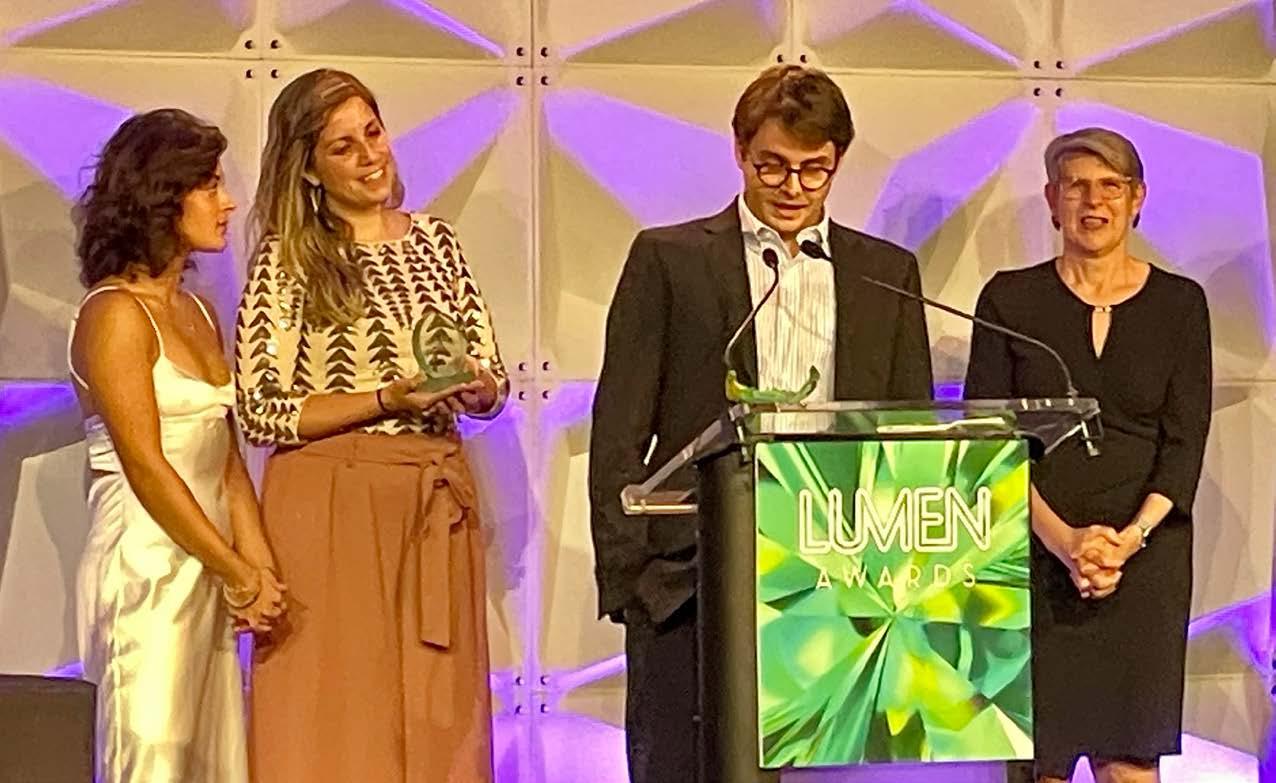
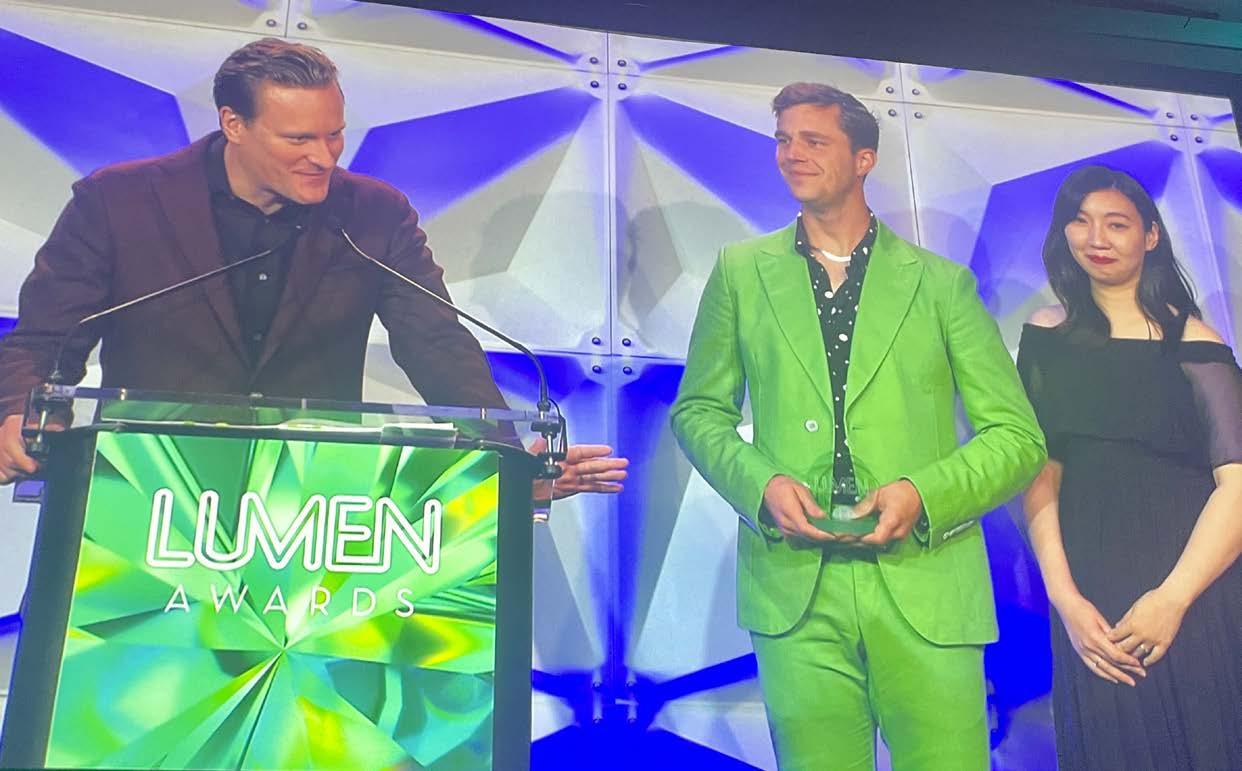
The significance of the rep-designer relationship was unequivocally underscored by a bold statement made by Bold LLC during their acceptance of the Citation for an Immersive Environment for Journey to the Edge/Peak which may have surprised some in the audience with its candor, powerfully proclaimed the importance of this special partnership between reps and designers.
These collaborations play a crucial role in driving our industry forward, fostering innovation and progress. The IESNYC Lumen Gala serves as a testament to the remarkable energy and unity within the lighting community, contributing to its ongoing growth and success.
Integrating Control Simplicity
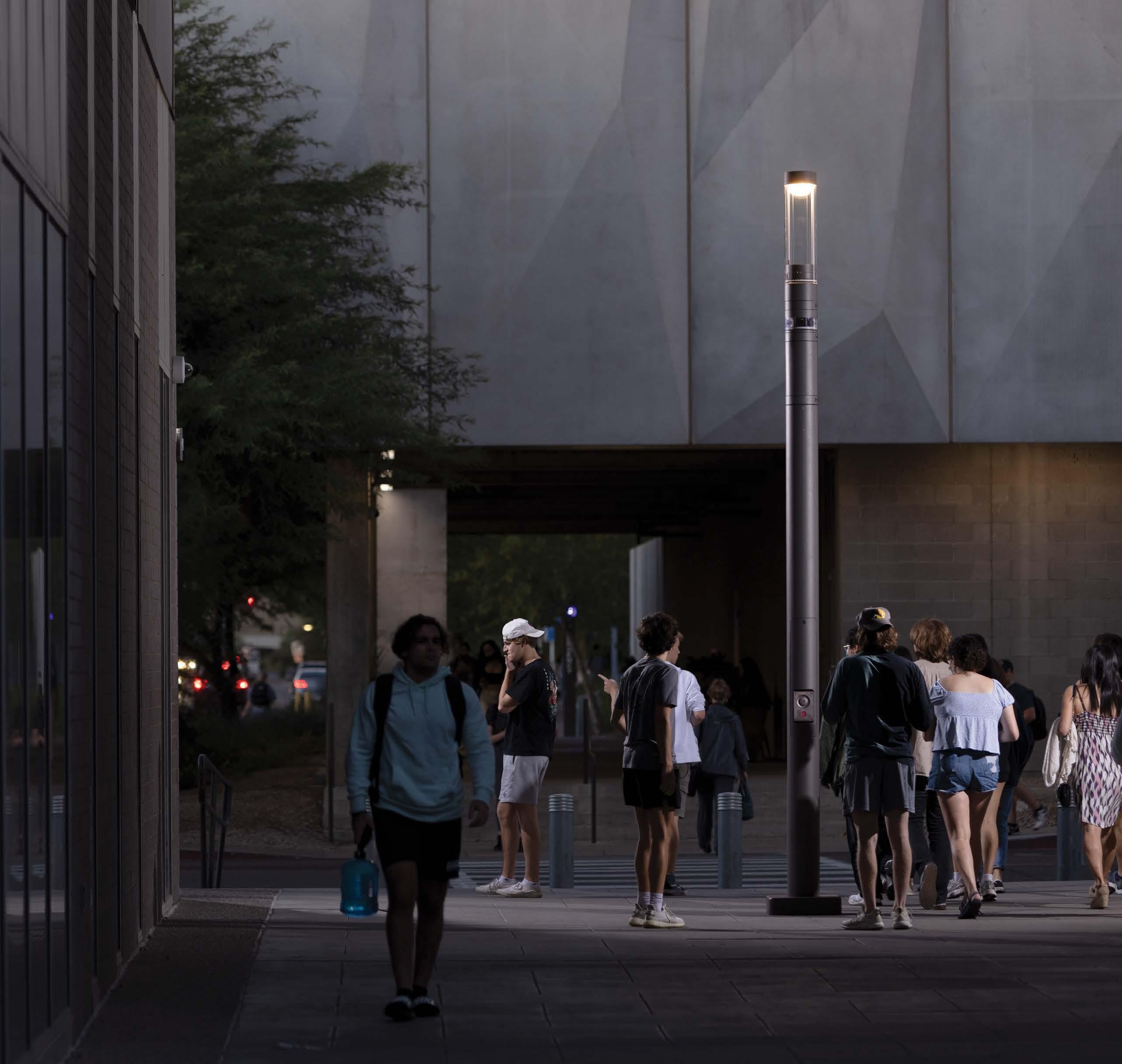
INLine Linear is a luminous track section available in 2 or 4 ft lengths, for seamless integration with any LSI CONTROLTrack or POWERTrack run, providing diffuse, wide angle light distribution.
Patented 20 Amp Power or Data Pass Thru 2 FT or 4 FT Lengths
0-10V, DMX or ELV
Dimming Protocols
Up to 1700 Lumens/FT 90 CRI with 110° Beam
Lighting Services Inc The premier specialty lighting manufacturer
BY LIGHTING LAYERS
By
“As in architecture and interior design, the extent to which aesthetics in lighting matters varies from project to project. There is hardly any aesthetic concern, for example, in designing lighting for an ordinary office using inexpensive lay-in troffers. However, the type and location of every luminaire in a cathedral is critical in the appearance of the space itself, not just the lighting. Even though many real-world projects require simple (and often economical) lighting designs, it is still beneficial to tackle each with a common approach that permits an appropriate result.”
I wrote this with co-author Mark Karlen for the first edition of Lighting Design Basics.1 The book was written as a classroom text mostly because, at the time, Mark was a professor in the interior design program at Moore College of Art and Design in Philadelphia. Our intent was to share a design approach that could help students and entry level architects, interior designers, electrical engineers, contractors and lighting designers to understand how to approach the problem better and allow them to achieve good results, even on everyday projects. The driving reason for the approach is to ensure, in the end, that the space will be well composed to reach both its functional and aesthetic intents.
The core philosophy is to differentiate between layers of lighting and techniques of lighting. A layer identifies a general use for light in a space, and includes the ambient layer, the task layer, the focal layer, and the decorative layer. Each layer plays a specific role in the visual composition of the space. In simple terms, while one layer may serve to light the common uses of a space, other layers may be needed to make the space more appealing, interesting, or functional. Once layers are identified and the overall concept reconciled, then for each layer a technique can be chosen. Dimmable lighting controls are used to balance the relationship among layers.
• The ambient layer choice establishes the character and atmosphere of an interior space. The amount of ambient light is important; if significantly lower than the task light, the space will have greater luminance contrasts and appear more dramatic, whereas if similar to the task light levels, the room will be brighter, cheerier and perhaps, more relaxing. The technique could be direct lighting, indirect
lighting, or a combination of both. I prefer indirect lighting for work environments and direct lighting for more finished spaces like private offices, living and entertainment venues. Ambient lighting might include indirect lighting such as wallwashing, scalloping or grazing. Direct lighting is often as simple as downlighting, being careful to avoid scallops and glare. Direct/indirect lighting has served me well as a go-to solution in many instances as a “best of both worlds” for moderate cost projects.
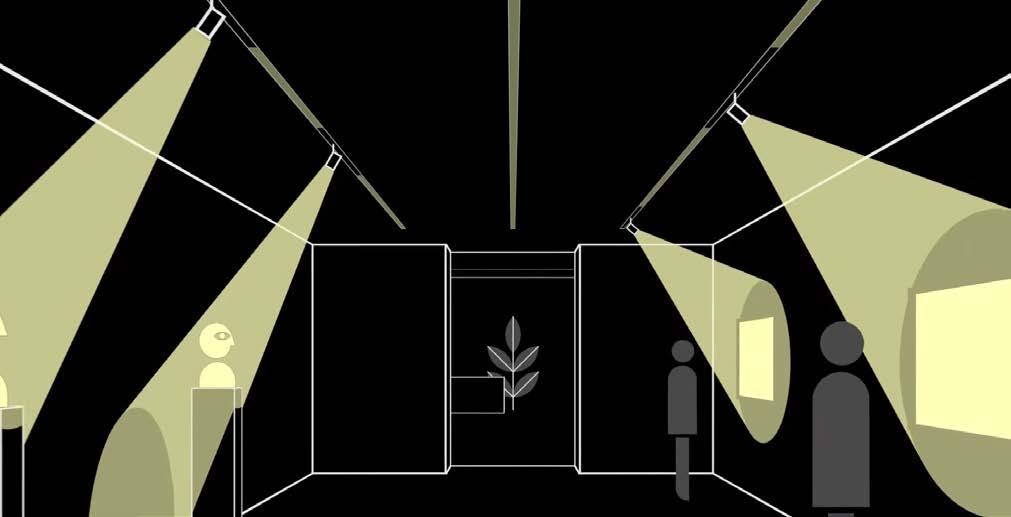
• The task layer is usually the brightest and produces the light that enables the space to be used for its intended purpose. The luminance ratio of task to ambient determines the general ambience of the space. In extreme conditions like retail stores and museums, very high luminance ratios are often used to raise the drama and importance of the displays, and task lighting employs monopoints and track. In everyday conditions, the luminance may be less pronounced, but still noticeably brighter than the ambient lighting. The technique in offices and workspaces is often a linear light source, such as undercabinet lighting, or portable task lights. Track lighting and other adjustable methods are, for obvious reasons, used in stores and museums.
JAMES R. BENYA, PE, FIES, FIALD
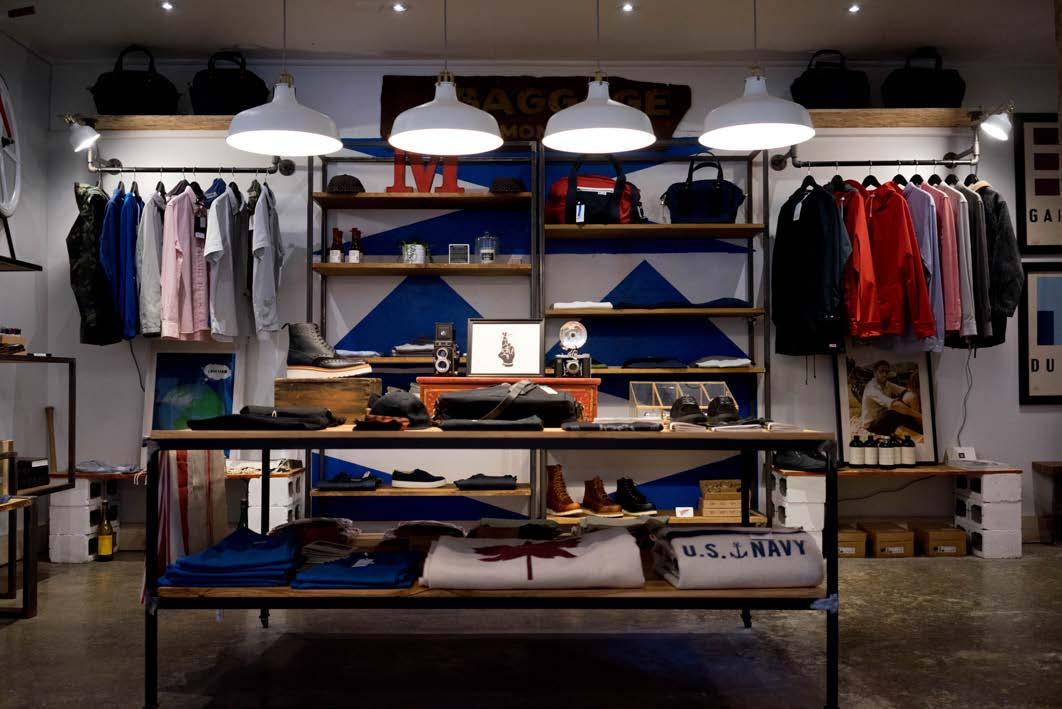
A high luminance ratio is used to highlight the display.
Photo credit: Clark Street Mercantile
• The focal layer is like the task layer, but especially significant in that it uses brightness, spectrum, direction and shadow to make a specific visual emphasis, such as on a sculpture, painting or exceptional architectural feature. Adjustable lighting, such as recessed multiples or track lighting, are generally used. However, in certain project types, a sculptural chandelier or lamp might become a focal element.
• The decorative layer introduces lighting as ornament, such as pendant lights, portable lamps or sconces. In certain project types, there is a theme carried out by the decorative layer that is an important part of the interior architecture or interior design.
The first two editions of the book were before LEDs became practical. I have recently served as a judge in several lighting design awards programs, and in reviewing the entries, I asked myself what differences LEDs make in this theory of design. Certainly, there must be something LEDs accomplish that was not practical or even possible with older sources. I concluded that linear lighting effects, exposed lighting effects and outlining, which were generally either imperfect, expensive, and/or unmaintainable with legacy lighting, stood out as a family of techniques that were indeed new.
In his book Perception and Lighting as Formgivers for Architecture2, the late William M.C. Lam3, one of the most prominent early architectural lighting designers, provides basic
"As in architecture and interior design, the extent to which aesthetics in lighting matters varies from project to project. There is hardly any aesthetic concern, for example, in designing lighting for an ordinary office using inexpensive lay-in troffers."
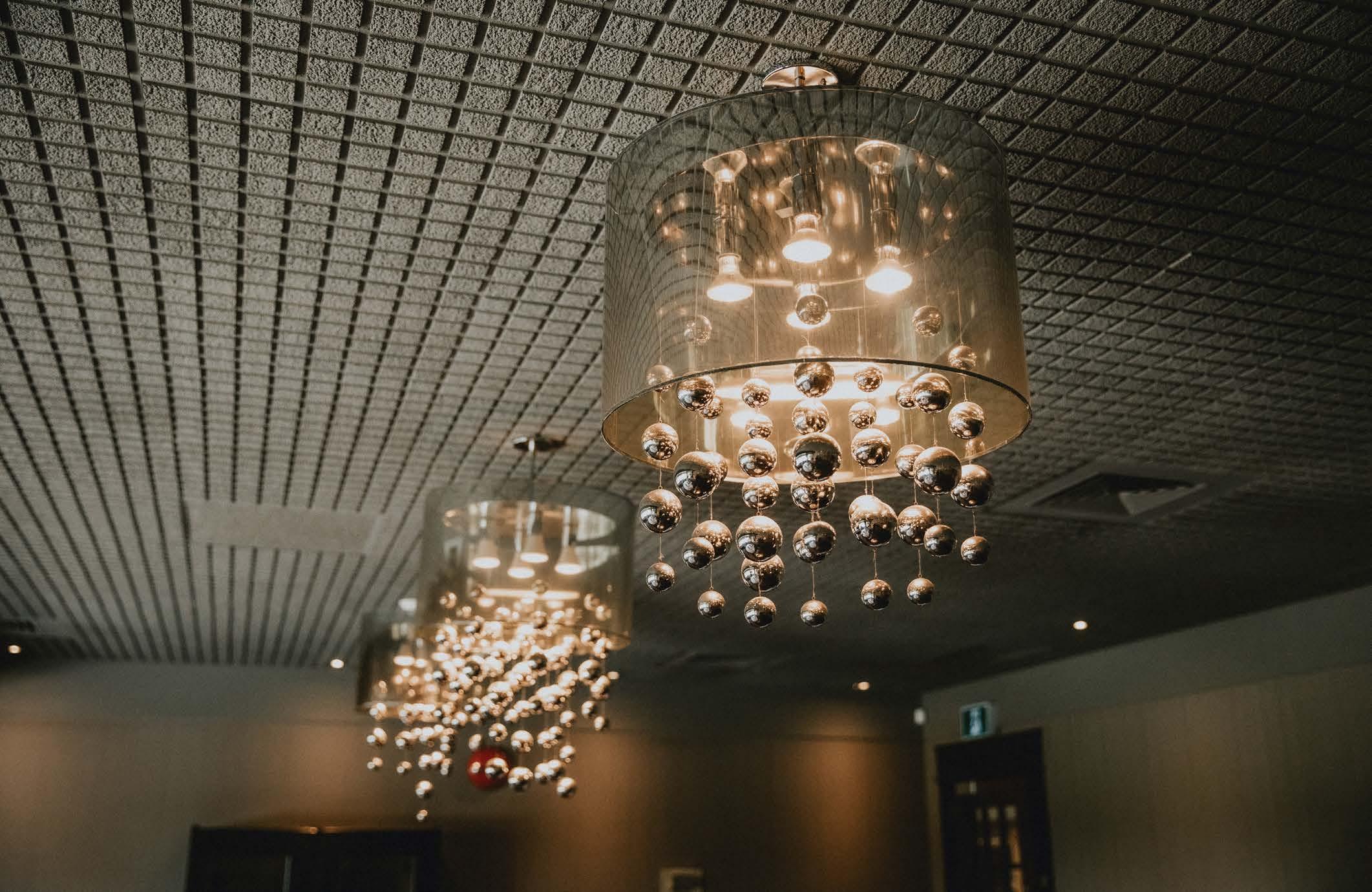
A decorative chandelier serves as the lighting focal point.
Photo credit: Victor Huynh
theoretical information on environmental objectives and the process of visual perception and human needs as they relate to lighting design. Bill passed away in 2012 before LED lighting could fully take over. Now that it has, in his remembrance I would like to add another layer to my system: the formgiver layer. The techniques involve all manner of shape and form accentuation, both exposed and in coves or niches.
Next, I reflected on daylighting designs that I had created on several projects. In at least four cases in recent years, I was able to work with architects to create significantly daylit buildings – buildings in which electric lights were generally not needed most of the time, especially schools. Daylight design requires the lighting designer to become involved in the early stages of the project, as the key to success is a combination of solar orientation, building shape and massing, floor plan, fenestration, ceiling design, energy management, interior surface finishes and glare control. Daylighting is not only key to energy efficiency, but also prominent in occupant well-being and an important asset in both the LEED and WELL programs. I probably should have discussed daylighting more in the book, but I guess I needed to learn a lot more and enjoy some measurable success before promoting the daylighting layer
Finally, I considered the dimension of time. When the first edition was published, the science behind human circadian lighting considerations was just being discovered. Now, almost two decades later, with the encouragement of programs like WELL and the many other special considerations for light and living beings, the integration of lighting effects, intensities and spectrum are now part of the professional practice of lighting design. Not only does this affect choices of daylighting, luminaires and all other aspects of the light sources, it also affects their controls and makes lighting controls far more
important than switching and dimming. I’d like to call this new layer the controls layer as it may not always be tuned to a circadian purpose, but even its everyday capabilities need to be a fundamental part of the design solution.
I believe that the layer system serves at least three important purposes. To the student, it provides a foundation to understand lighting standards, methods and techniques and how to apply them. To the new professional, it is derived from a normal intuitive approach to lighting and serves as a reminder of the alternatives without unnecessarily prejudicing choices. And to the experienced professional, it serves as a reminder of the alternative approaches to a problem, perhaps even as a nudge to make sure every practical alternative has been considered.
In memory and gratitude to my Lighting Design Basics co-author, Mark Karlen (1930-2022). ■
Mark \Karlen
1 Mark Karlen and James Benya, Lighting Design Basics, Wiley 2004. A free download is available from https://epdf.pub/lighting-design-basics.html . Chapters 8 and 9 are the basis of this article. Christina Spangler joined as co-author for a second edition in 2012 and a third edition in 2017 and under her leadership the layer pedagogy was moved to Chapter 2.
2 McGraw-Hill, 1977
3 https://wmclam.com/ (1924-2012) A pioneer and intellectual powerhouse, Bill often walked the line among modernist architect, lighting product manufacturer and lighting designer. His lighting design legacy continues with the firm Lam Partners with offices in Cambridge, Pittsburgh and Washington, D.C.
PhD, Architect, Professor, Author
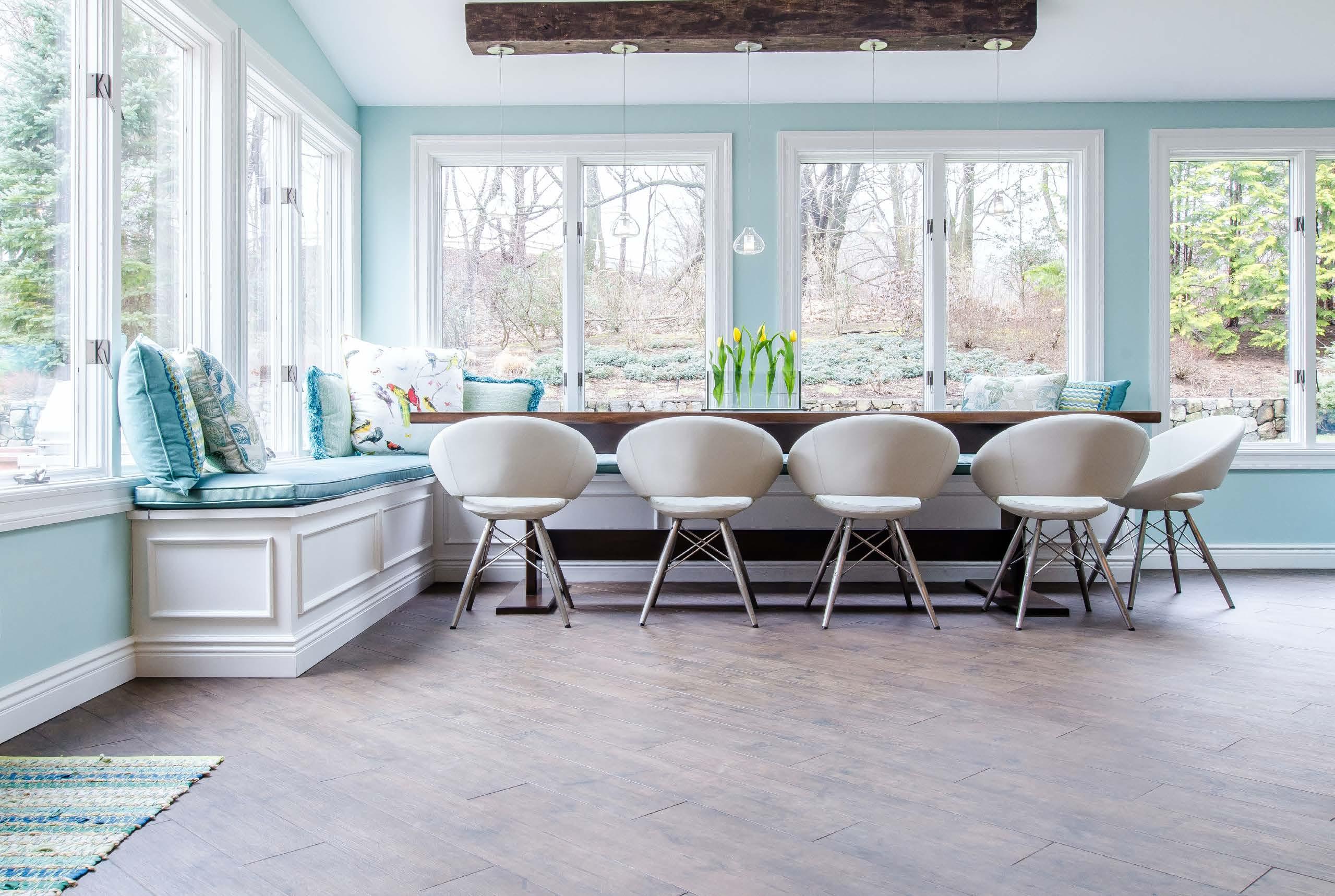
Daylight is becoming a popular source of light, given an increased focus on energy efficiency and occupant well-being.
Photo credit: Chastity Cortijo
BREAKING BOUNDARIES AND BENDING THE RULES
360º OF ILLUMINATED CREATIVE FREEDOM
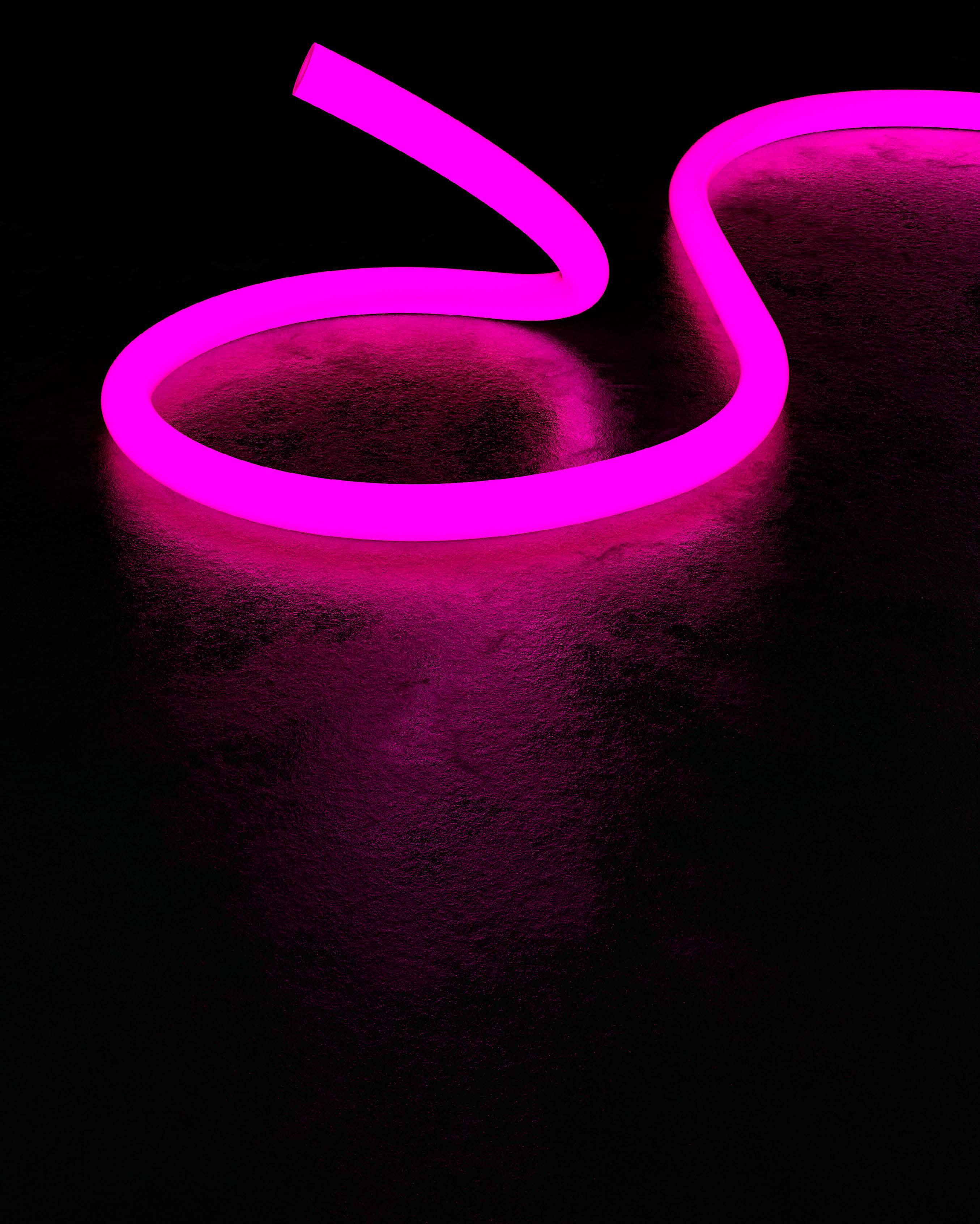
There’s something captivating about bright, colorful neon displays. And there’s no other neon luminaire that compares to the Prizm NeoFlux 360 RGBW. 360 degrees of color-changing, fully customizable, universal bend orientation neon illumination. The NeoFlux 360 RGBW is customizable in every way, including length. Bend it into millions of shapes and designs, or straighten it out for a rigid bar look. Either way, the NeoFlux 360 RGBW is guaranteed to bring those classic neon vibes in all new ways.
AVAILABLE IN RGBW, SINGLE COLOR, OR STATIC WHITE CUSTOMIZABLE LENGTHS
OUTDOOR RATED
CEILING, PENDANT, OR SURFACE MOUNTING OPTIONS
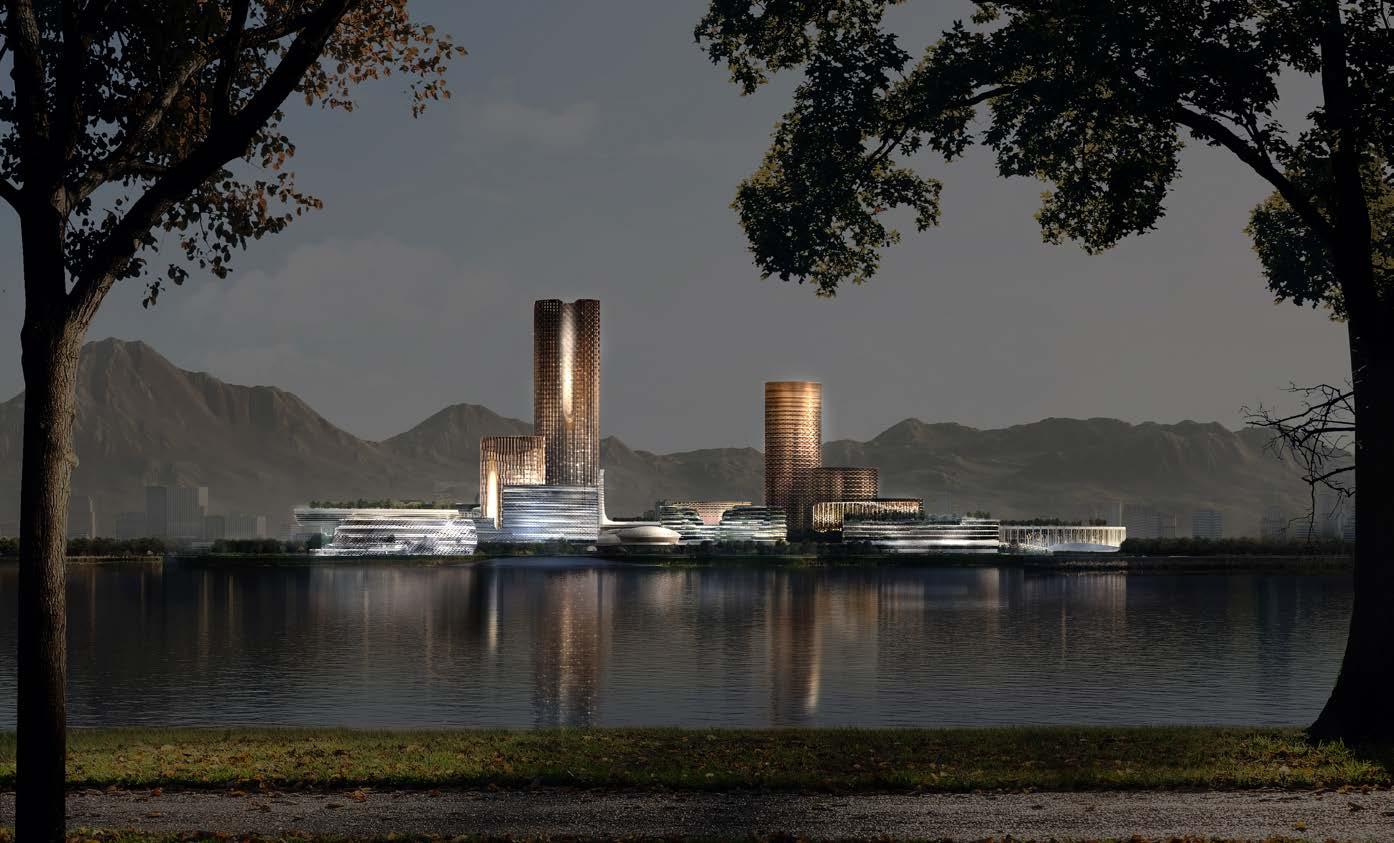
Unicorn Island, with its remarkable design and multifaceted nature, captivates all who encounter it. Describing its brilliance in a single article would fall short of doing justice to this exceptional structure. Thus, we embark on a three-part series that delves into the intricacies of Unicorn Island's lighting design, exploring its various facets and celebrating its ingenuity. This first article focuses on the exterior.
UNICORN ISLAND: VISIONARY DESIGN ILLUMINATING A
RANDY REID By
Rendering of Unicorn Island. Renderings by OVI/ZHA
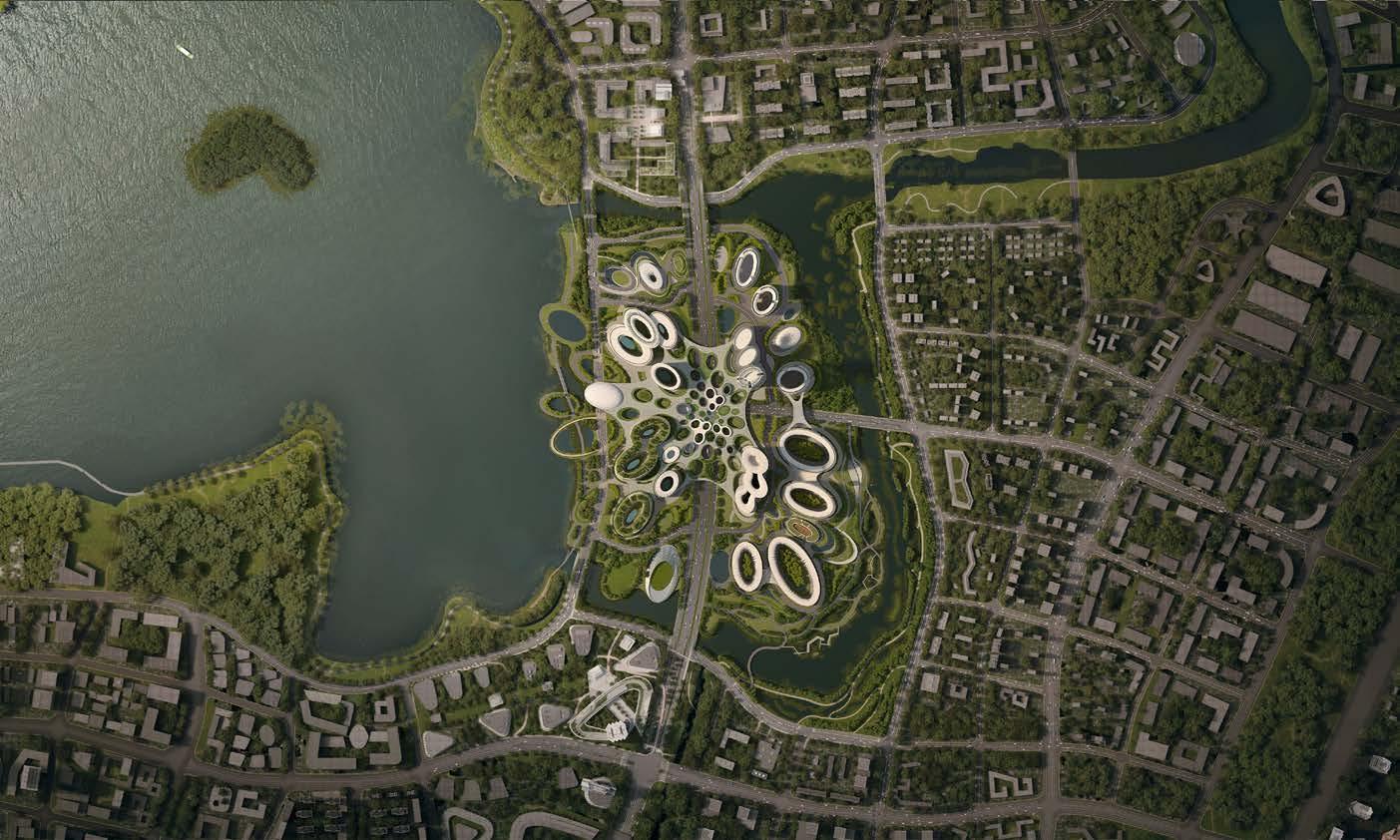
Nestled within the Tianfu New Area in Chengdu, China, this man-made island emerges as a remarkable development, encapsulating the vibrant essence of the cultural hub. Spanning approximately 670,000 square meters in site area and boasting a gross floor area exceeding 910,000 square meters, this ambitious project consists of more than 20 diverse buildings. Unicorn Island covers an area roughly one-fifth the size of Central Park, spanning across ten street blocks and three avenues. The tallest building on the island reaches a height of 250 meters. From office spaces to residential towers, hotels, and mixed-use commercial retail, Unicorn Island offers a multifaceted experience. Yet, what truly sets this development apart is the harmonious integration of public grounds and green landscapes that interconnect the buildings, fostering a sense of unity and natural serenity.
Unicorn Island derives its name from the concept of "unicorns," fast-growing billion-dollar companies. This association reflects the ambition to establish the Silicon Valley of China, attracting and nurturing billion-dollar companies, aligning with forwardthinking ideals. The island is also known as Garden City, emphasizing the seamless integration of nature into the lifestyle and design.
In 2020, Zaha Hadid Architects (ZHA) chose Office for Visual Interaction (OVI) to conduct all lighting design on the island. Through discussions with OVI founders Jean Sundin and Enrique Peiniger, as well as designers Wendy Jiang and Theressa Asis, we gained insights into the project.
Jean explained, “We could see right away it was a huge opportunity. Normally, as lighting designers, we often design one building or a campus. To design an entire island of buildings, that's such a different and exciting visual task for us.” Wendy elaborated, describing how it encompasses various aspects, including biophilic elements to enhance human well-being and foster a deeper connection with nature. Due to the project’s size and complexity, there were many facets to handling the logistics in response to its fast-paced nature, addressing international considerations and more.
Enrique highlighted the core concept of Unicorn Island as a self-contained garden city where residents can easily access the shopping, living, and working spaces of the island. The design approach aims to minimize the need for transportation on the island, aligning with the principles of a garden city. The term "garden city" signifies a harmonious integration of nature and urban living.
The commitment to incorporating green spaces and nature is inherent in the concept of the island. Unicorn Island aims to foster a human-centric environment where nature and urban elements coexist seamlessly, prioritizing the well-being of residents. The lighting design plays a pivotal role in achieving this, reflecting nature in the facades and their interaction with daylight.
The lighting schemes accommodate various activities and building sizes, ensuring a responsive and adaptable environment. By blending innovation with a deep connection to nature and prioritizing community formation, Unicorn Island offers a visionary and inspiring environment for residents and businesses alike.
Enrique explained the team’s design philosophy, “We look at one element close up, but we also think about the same element in a different scale. With a name like Garden City, we have to
combine the daylighting as part of the natural evolution of the design. It cannot be an afterthought.”
The island is divided into distinct areas: north, south, and west, each designated for residential, hotel, and commercial spaces. Theressa described how these areas possess different energies, with the urban core being lively, the waterfront offering a unique ambiance, and the other sides of the island providing opportunities for nature-related activities. The residential neighborhoods lean towards a more passive and tranquil atmosphere, featuring softer walking paths, while the commercial areas are vibrant and energetic. The lighting design also considered the need to create a calm environment in quiet areas and a dynamic atmosphere in active spaces.
Sketches helped capture the essence of each building.
of OVI.
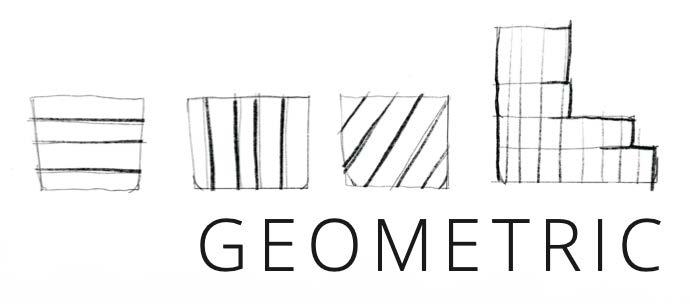
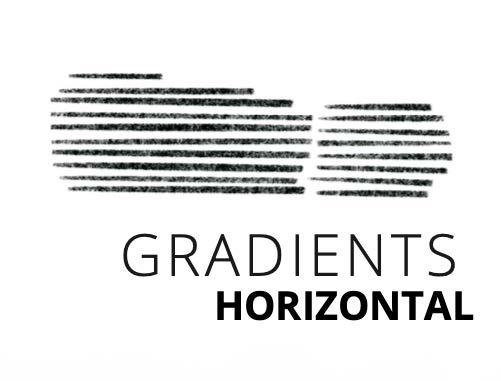
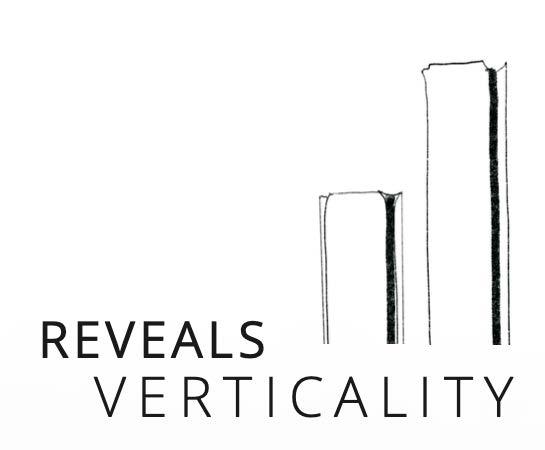
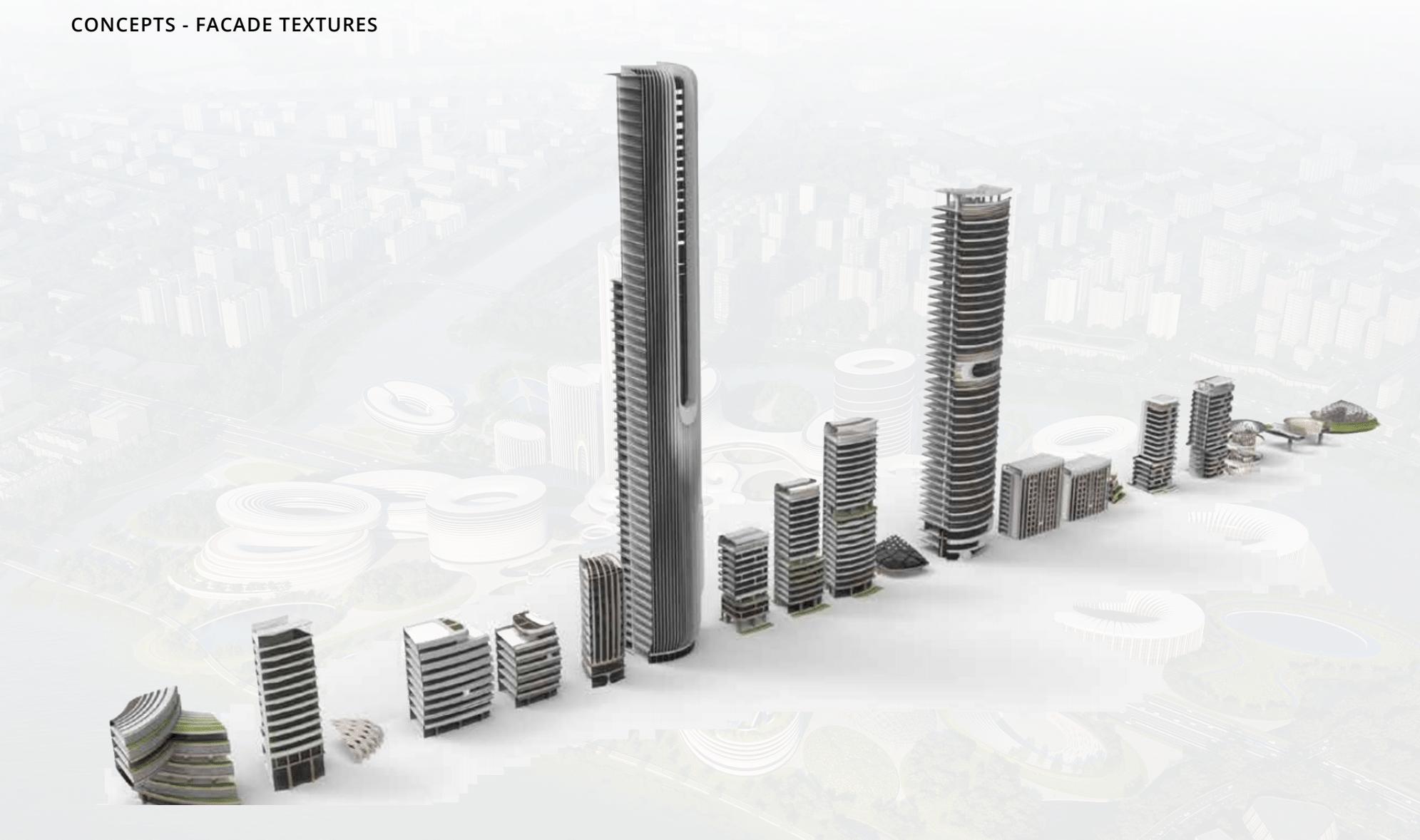
The design process involved creating sketches to understand the shape and form of the buildings, effectively illuminating them. These sketches identified the unique identity of each building and the overall composition of the plazas. The goal was to capture the essence of each building, whether linear, shingled, textured, or pixelated.
Additionally, the lighting design takes into account the everchanging nature of the city, considering different activities and events occurring at different times. Jean said, “We always think about the longevity of a project and how it will age over time. With Unicorn, we thought about how this city will be used 10 years from now. We tell a story now, but what would be the story in 10 years? We have to anticipate this, in a meaningful way so it remains relevant.”
Courtesy
The lighting designers collaborated closely with the architects to determine the appropriate facade materials to complement the design. The extensive facade canvas allowed for experimentation and exploration of a wide range of lighting possibilities. Jean stated, "We consider how light interacts with these textures, whether it creates linear patterns, grid-like structures, lantern effects, pixelation, or delicate arches. Each building has its own unique identity, serving as an anchor for the neighborhoods.”
Wendy continued by describing that the design allows the use of cool color temperatures for light-colored palettes or stainless steel, and warmer color temperatures or amber qualities for lantern honeycomb textures.
The design incorporates different color hues in the foreground, middle ground, and background, with variations of blue, green, and red tones. Each neighborhood within the project has its own designated color temperature range, such as the residential neighborhood, which operates in a range of 1800K to 3000K. Meanwhile, the commercial areas have a broader range of 3800K to 6000K.
Enrique said, “There is a lot of lighting in China, and they love lighting – so we could not use a soft delicate hand in our design. We had to amplify, but with a tasteful color range. I think we came up with a lighting logic which is culturally in tune.”
This organized approach allows for a cohesive and intentional color palette, eliminating random combinations. The diverse lighting fixtures on the project are carefully selected to ensure the desired color temperatures are achieved within each designated area, providing a harmonious and visually appealing experience.
Enrique used an analogy to describe the color temperature range, “Think about giving someone a truck with 15 gears backwards and five gears forward. At some point, they will use the wrong gear at the wrong time. So we had to build in a certain smartness to the design, to ensure the user doesn’t use the wrong
gear.” Jean added, “We try not to give the whole pallet of tools as it's just too hard to handle; it's too many gears for most clients to maneuver. It should be user-friendly and easy to use.”
The lighting design also considered the central plaza, which acts as a gravitational force, attracting the surrounding buildings. To enhance this effect, a deliberate variation in lighting was implemented. The facades facing the central plaza received a brighter illumination, reflecting their proximity and the vibrant activity in that area. Farther away from the center, the light gradually softens, creating a nuanced play of light and shadow. This intentional lighting strategy added depth and dimension to the facades, avoiding a flat and uniform appearance. Tunable white lighting was employed in the residential neighborhoods, creating a warm and inviting atmosphere.
Unicorn Island boasts expansive skylight openings that serve as key design elements, allowing natural light to penetrate the lower levels of the structure. Initially, they were mere apertures, but in the SD phase, OVI convinced ZHA to enhance their functionality by adding dimension. Meticulously designed, these openings feature aperture reflectors known as "baskets" that act as light collectors and redirectors, shaping and guiding the trajectory of light throughout the space.
These reflectors not only facilitate the entry of light but also create visually captivating moments, adding depth and dimension to the structure. By carefully diffusing and spreading the daylight, they achieved an even illumination and a gentle transition from light to shadow, avoiding stark contrasts that could cause discomfort. Adhering to industry standards, the team ensured that the lighting levels and contrast ratios met IES recommended practices. As individuals move through the space, whether driving or walking, they are treated to a dynamic interplay between light and shadow, framed by the strategic placement of the aperture openings.
One significant challenge faced by the team revolved around the administrative aspect of the project. Meeting deadlines and delivering on time required timely approvals and feedback from
The 20 buildings on Unicorn Island were examined both individually and collectivley to create a dynamic yet cohesive design. Renderings by OVI/ZHA
clients, which is not unusual. However, the international aspect of things added an additional layer of complexity.
Jean highlighted the importance of striking a balance between the speed of work and the necessary approvals to prevent any delays in the overall process. Coordinating with clients and ensuring smooth communication channels proved crucial in overcoming this challenge. Municipalities and city organizations add an additional layer of complexity, requiring synchronization to establish a well-structured cityscape. Individual plot owners and developers further diversify the landscape, necessitating careful coordination of design strategies and project requirements.
Theressa emphasized the importance of visualizing the spaces holistically and analyzing how each building and courtyard interacted with one another. By examining multiple viewpoints and utilizing 3D renderings, the team aimed to create a harmonious blend that maintained consistency while allowing for unique characteristics in different areas.
OVI identified two key challenges. First, they emphasized the need to constantly zoom out and evaluate the big picture to ensure a cohesive design language. This involved understanding how different parts of the project communicated
with one another and contributed to the overall aesthetic. Secondly, Wendy discussed the coordination aspect, as the project was divided into different neighborhoods, each with its own local team. Ensuring effective communication and conveying the design logic to all teams played a vital role in guaranteeing a seamless execution during the construction phase.
The team described the collaborative process with the architect, emphasizing the back-and-forth exchange of ideas, often referred to as "ping pong." They discussed different finishes and explored opportunities to create harmonious interactions between light and space throughout the day. They considered the qualities of the space, including the morning, afternoon, evening, and the transitions between seasons and events. This iterative dialogue allowed them to refine and align the look, mood, and ambiance of the environment, ensuring that people have a meaningful and dynamic experience in the space.
In the discussion about the business aspects of the lighting project, the team delved deeper into the traditional stages, including SD (schematic design), DD (design development), and CD (construction documents). Each stage had incremental milestones, typically at 20%, 40%, 60%, 80%, and 100% completion, which served as checkpoints for deliverables, approvals and payments. With numerous stakeholders, milestones, and logistical considerations, the project required a unified vision and a deep understanding of the complexities involved. Enrique stated, “You must have a certain backbone in your office to manage these kinds of projects financially, logistically and emotionally.”
Unicorn Island stands as a testament to the meticulous and collaborative effort put forth by the OVI design team. From the holistic approach to the phased implementation and careful coordination, every aspect was carefully considered. By prioritizing human-centric design, community formation, and the seamless blending of light and space, Unicorn Island emerges as a visionary masterpiece that sets a new standard for urban development.
Look for our next article on Unicorn Island which will focus on facade lighting.
As of this writing, iGuzzini luminaires are the main fixtures specified. The next article will have the complete list. ■
Rendering of Unicorn island illuminated at night. Renderings by OVI/ZHA
Rendering of Unicorn Island from above. Renderings by OVI/ZHA
TABLE TALK: Deliver Circadian-Effective Light CREATIVE SOLUTION TO
By
Why Should I Brighten My Day?
Bright light during the day and dim to dark light at night is essential for human health. The pattern of light and dark received at the eyes tunes our circadian system so we sleep better at night, feel refreshed and revitalized in the morning, and are better able to ward off physical and mental health problems like metabolic disease, cardiovascular disease, cancer, and depression. But, people living in nursing homes, who are often at elevated risk for experiencing these health problems, typically spend their days in constantly dim lighting conditions that can confound the benefits accorded by a healthy circadian system. Building on the Light and Health Research Center (LHRC) at Mount Sinai's general premise that an abundance of circadian-effective light in architectural spaces promotes good health, well-being and nighttime sleep (see the April/May issue of designing lighting), this article specifically focuses on an innovative application for bringing bright daytime light and better sleep to a senior living community.
Complexity of Application
Implementing a successful bright light design is no simple matter, mainly because delivering sufficient light from overhead luminaires to occupants' eyes for stimulating the circadian system can be challenging, costly, and energyinefficient. In settings populated by older adults, delivering adequate light can be even more challenging, as pathologies of the aging eye (e.g., lens thickening, age-related macular degeneration, cataracts, etc.) can block the transmission of light to the part of the eye that receives light signals (i.e. the retina), and reduce stimulus to the circadian system’s clock in the brain. For this population, light levels sufficient for circadian system stimulation can exceed 500 lx at the eye, which is much higher than the light levels typically found in senior care facilities or in individuals’ homes (e.g. <50 lx from a floor lamp providing ambient illumination).
One solution proposed in a 2016 study1 by researchers now at the LHRC was a light table to deliver bright light to residents in a senior home community. In a follow-up to that study, LHRC researchers partnered with members of the Abe’s Garden Memory Care facility in Nashville, Tennessee, to upgrade the lighting in a resident dining area. With overhead lighting renovations being off the table, another solution was needed to fulfill the design requirements for this permanent installation. Since light tables are not commercially available products, the team had to get creative.
“Abe’s Garden aims to be a model facility to showcase circadianeffective design solutions for older adult community living.”
ALLISON THAYER, MS
Light and Health Research Center at Mount Sinai
Squaretable Discussion
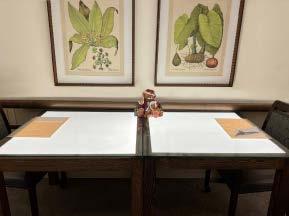
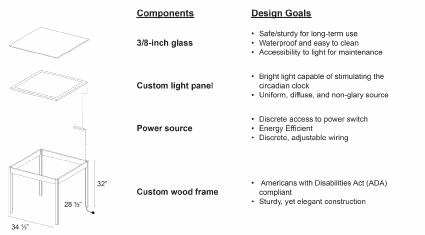
The team partnered with furniture designer Dean Babin to custom build light tables for the upgrade. After many iterations and testing, we arrived at a simple solution that checked the boxes for all the design requirements.
The light table houses a 36” x 36” custom-sized, 4-edge-lit LED panel with a 3700 K source providing ~3735 lumens at 40 watts. Design features such as variable correlated color temperature, color tuning, dimming capabilities, and a programmable on/off switch were deemed needless expenses and unnecessary for achieving the project's goals.
The amount of light that reaches the eye depends on multiple factors, such as a person’s proximity to the table and whether their gaze is directed forward or down at the table. At a height of 13” above the table, we measured 550 lx for a forward gaze straight across and above the table, and upwards of 1000 lux at the eye for a gaze directed at the center of the table. Testing a worse case of partial coverage of the table with four opaque dinner plates, the brightness levels for both gazes reduced by about 50%. We therefore recommended keeping any items on the tables to a minimum to decrease light loss from obstructions. With the amount of time spent at the tables and anticipating individuals would be looking down at their food or activity most of the time, we predicted that the light tables would provide enough light to stimulate the circadian clock and meet the UL 24480 design guidelines.2
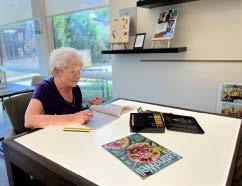
A prototype was sent to Abe’s Garden to assess its acceptability before the rest of the light tables were manufactured. Feedback from staff and residents mentioned that the tables were comfortable to use, whether seated in a typical chair or wheelchair, and were not too bright or glary. Overall, the table was well received.
Breakdown of the light table’s components and how they fit the design goals.
The Reality
Implementing designs into real-world applications is more complex than can appear on the surface, and the team ran into some snafus along the way. The electrical cords powering the table could create a trip hazard, for example, especially if the table were placed in the center of the room. One solution would be to position tables on the room’s perimeter. Alternatively, a battery tucked into the frame could be used for power, but that would add to the facility’s maintenance load and necessitate swapping out multiple batteries. Energizing the light tables for only a few hours in the morning would make the batteries last longer. Lastly, if the budget permits, the best solution may be to install floor receptacles at the light table locations.
Trying it Out
To determine the light tables’ long-term impact on the residents, the team conducted a 3-month lighting intervention with the light tables being energized from 6:00 a.m. – 6:00 p.m. This schedule would ensure that residents could receive the intervention at breakfast (as early as 7:00 AM), lunch (12:00 PM), dinner (5:00 PM), as well as other occasional gatherings/ activities.
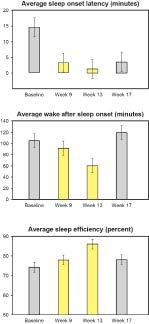
Following a week-long baseline assessment (W1), the participating residents were periodically exposed to the light table on a voluntary basis between the hours of 6:00 a.m. and 6:00 p.m., seven days per week, over the course of 3 months (months 1–3). Actigraphy data (keyed “Ag” in the diagram) were collected from participants at baseline (W1, keyed “B”) and over the course of 3 subsequent assessment weeks (W9, W13, and W17). Data were collected during the final assessment week (W17), 3-4 weeks after the light table intervention had ceased.
Actigraphy results for selected sleep measures. Average sleep onset latency (top) shows that participants took about 13 minutes less time to fall asleep after 3 months of the lighting intervention, compared to baseline. The average wake after sleep onset (middle) reduced to 60 minutes, compared to 105 minutes during baseline. Additionally, sleep efficiency (bottom) increased as the intervention went on. For all results, at Week 17 after the washout period with no lights, values began to go back towards what was seen during the baseline assessment.
The team looked at the 3-month lighting intervention’s impact on sleep compared to a baseline period for 13 residents. They were asked to wear an actigraph (i.e., activity monitor) on their nondominant wrist to collect data on their rest–activity rhythms. The actigraph data for the five participants who completed the study showed trends in the right direction: they fell asleep faster, woke up less frequently in the night, and had better sleep efficiency (i.e., percentage of time spent asleep while in bed). These very preliminary data are consistent with our research1, 3-5 and what others6-8 have found, but additional data should be collected to confirm these results, as the current results are not statistically significant.
Take a Seat
Consistent with the other studies cited, it takes time for daily light/dark patterns to take effect on sleep. To be successful, continuous exposure to bright light during the day requires regularity; therefore, a permanent installation is necessary to make light a part of a daily routine. A light table is a great alternative to overhead lighting for providing circadian-effective light during the day. Installing light tables doesn’t require modifications to pre-existing electrical systems, and the movable tables provide flexibility in meeting the needs of various daily activities across multiple spaces. Unlike overhead lighting, which cannot always guarantee specified light levels at the eye depending on occupant positions, light tables can better ensure exposure to desired bright light in specific places at set times. These light tables are not only useful in senior homes, but an iteration could be explored to implement for adolescents in school experiencing morning tiredness from having delayed circadian rhythms (i.e., desire to go to bed later and get up later), or even office workers who need an extra boost of light in a windowless office. Let’s start thinking about innovative ways to introduce more light into people's lives!
Acknowledgements
The author would like to acknowledge Mariana Figueiro, David Pedler, Barbara Plitnick, Martin Overington, and Charlie Jarboe of the Light and Health Research Center for their technical and editorial support. The author would also like to thank Chris Coelho, Misty Hogan, and Lacola Parker of Abe’s Garden for their support on site, along with Dean Babin (deanbabin.com) for collaboration of the design and curating the light tables. This study was funded by Care Foundation of America. ■
1 Figueiro M, Plitnick B, Rea M. Research Note: A self-luminous light table for persons with Alzheimer’s disease. Lighting Research and Technology. 2016; 48: 253-259.
2 Underwriters Laboratories. Design Guideline for Promoting Circadian Entrainment with Light for Day-Active People, Design Guideline 24480, Edition 1. DG 24480. Northbrook, IL: Underwriters Laboratories, 2019.
3 Figueiro MG, Sahin L, Kalsher M, Plitnick B, Rea MS. Long-term, all-day exposure to circadian-effective light improves sleep, mood, and behavior in persons with dementia. Journal of Alzheimer's Disease Reports. 2020; 4: 297-312.
4 Figueiro MG, Plitnick B, Roohan C, Sahin L, Kalsher M, Rea MS. Effects of a tailored lighting intervention on sleep quality, rest–activity, mood, and behavior in older adults with Alzheimer’s disease and related dementias: A randomized clinical trial. Journal of Clinical Sleep Medicine. 2019; 15: 1757-1767.
5 Figueiro MG. Light, sleep and circadian rhythms in older adults with Alzheimer's disease and related dementias. Neurodegenerative Disease Management. 2017; 7: 119-145.
6 Shochat T, Martin J, Marler M, Ancoli-Israel S. Illumination levels in nursing home patients: Effects on sleep and activity rhythms. Journal of Sleep Research. 2000; 9: 373-379.
7 Shishegar N, Boubekri M, Stine-Morrow EAL, Rogers WA. Tuning environmental lighting improves objective and subjective sleep quality in older adults. Building and Environment. 2021; 204: 108096.
8 Sloane PD, Williams CS, Mitchell CM, Preisser JS, Wood W, Barrick AL, et al. Highintensity environmental light in dementia: Effect on sleep and activity. Journal of the American Geriatrics Society. 2007; 55: 1524-1533.
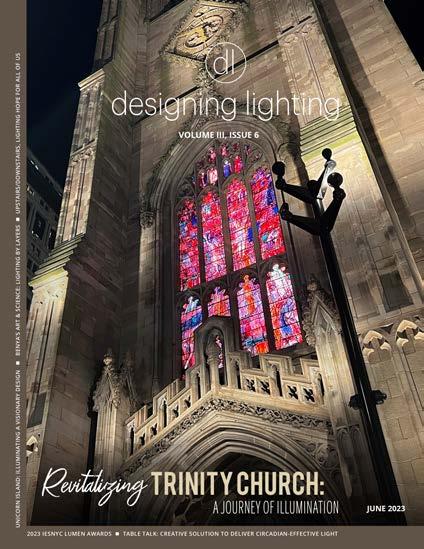
REVITALIZING TRINITY CHURCH: A JOURNEY OF ILLUMINATION
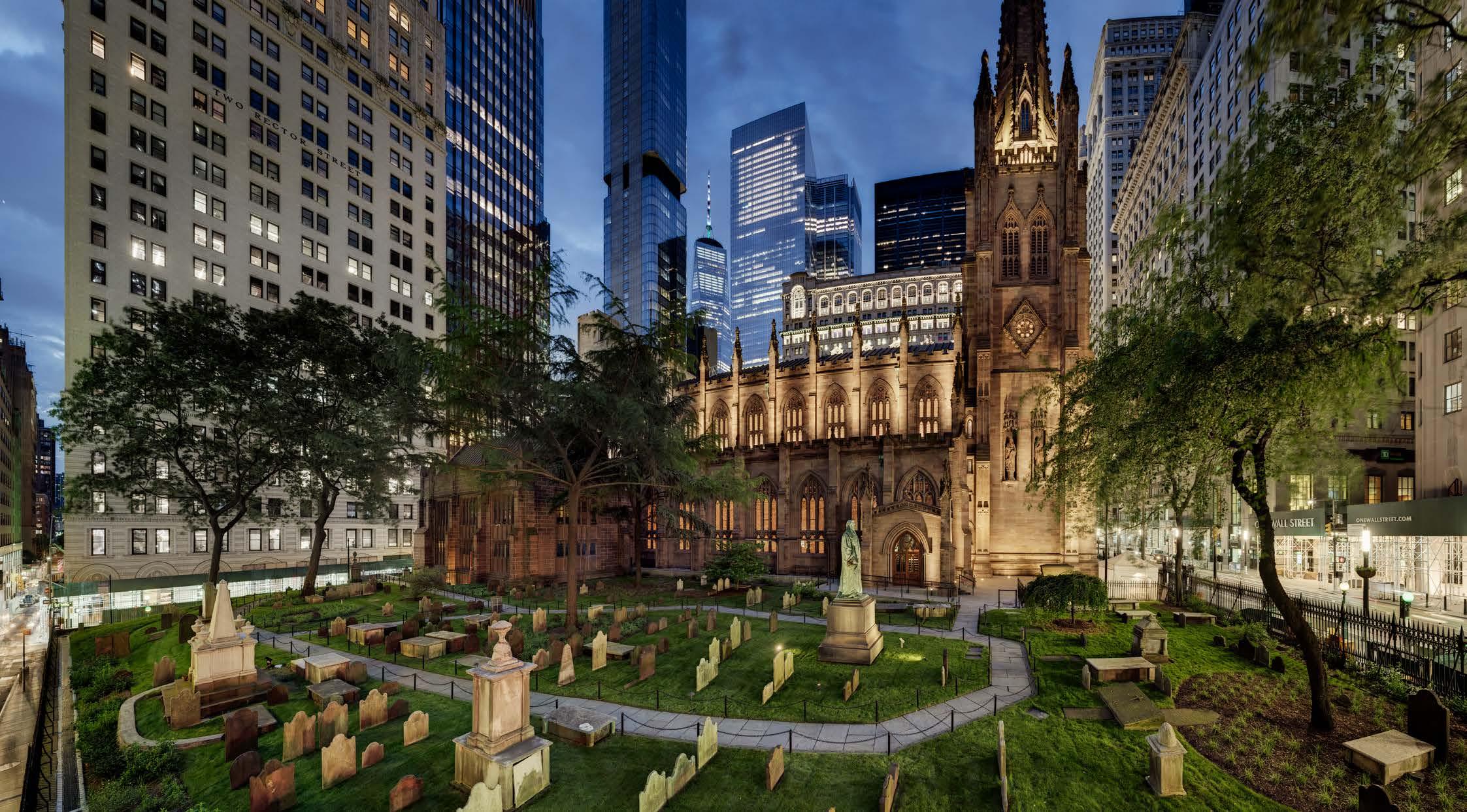
In the heart of the Wall Street neighborhood stands Trinity Church, a historic landmark steeped in rich heritage. Melanie Freundlich of Melanie Freundlich Lighting Design led the charge in transforming this iconic place of worship. She was assisted by Senior Designer, Michael Peace. I met Melanie at Trinity when I was in town for the IESNYC Lumen Awards. This job won the Award of Merit.
My conversation with Melanie unveiled the captivating story behind the church's revitalization, highlighting the challenges faced, successful solutions, and innovative lighting techniques employed throughout the project.
Ten years ago, MBB Architects, a long-standing client, approached Melanie with a proposal to renovate and rejuvenate Trinity Church. The first master plan was shelved, but a new one was developed when church leadership changed, and it received widespread approval, setting the project in motion.
Melanie described the previous lighting design for the church's nave, which consisted of Source Four fixtures strategically positioned within the vaulted ceiling. These fixtures, aimed through large apertures created huge glare and many dark spots. Recognizing the need for a complete reimagining of the entire church lighting, Melanie embarked on a journey to develop a transformative design.
She shared her initial concept, envisioning use of discrete modern pendants to illuminate the nave. However, considering the church's traditional values, this proposal didn't align with the client's vision. She crafted a second plan.
PENDANTS
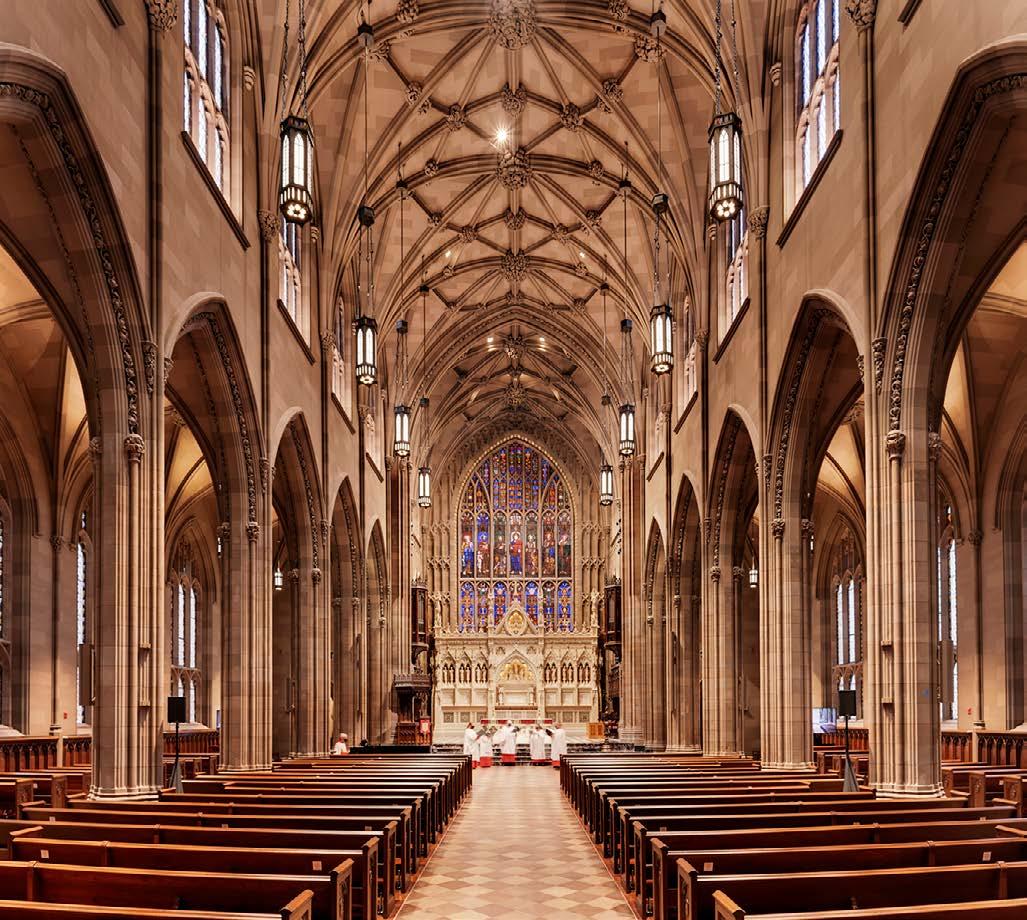
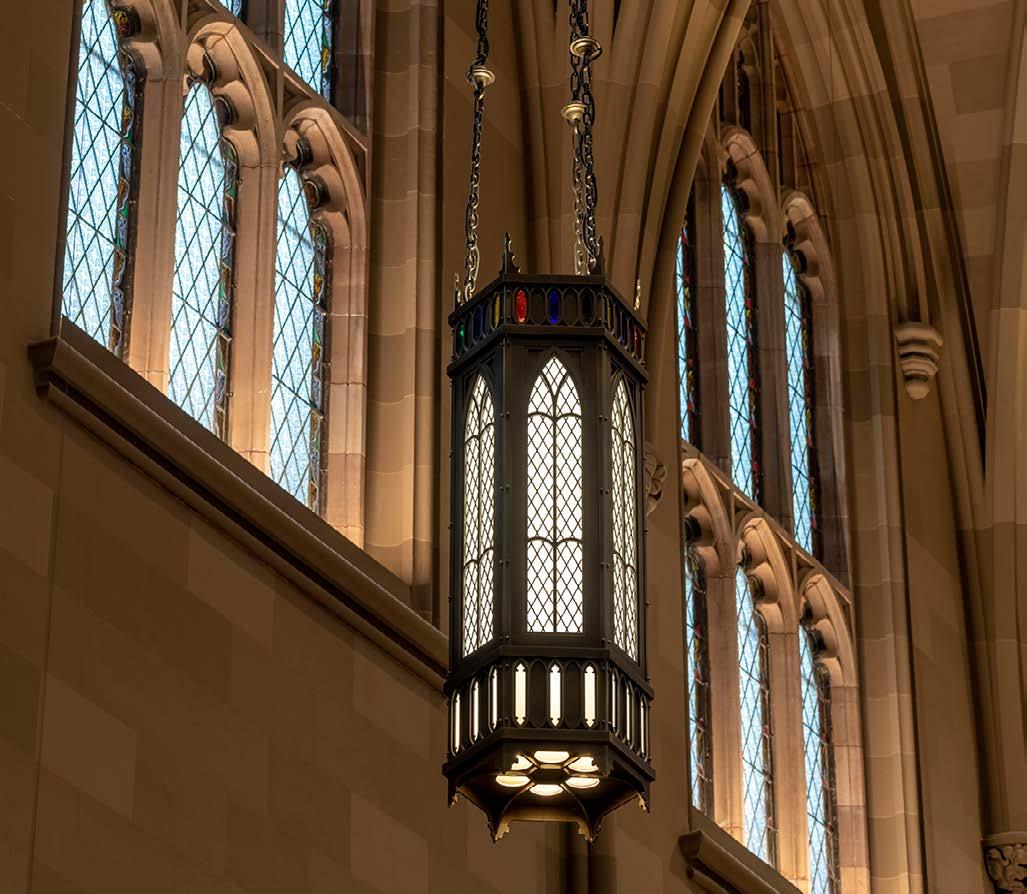
Melanie collaborated with Rambusch Lighting to custom design a pendant lighting solution that addressed multiple needs. Taking inspiration from the windows in the nave, the shape and housing of the pendants mirrored the gothic elements found throughout the church ensuring harmony with the historic architectural elements.
While the pendants maintained a traditional gothic appearance from the outside, their design concealed a multitude of modern capabilities. Beyond their radiant glow, these fixtures harnessed the power of strong uplighting to accentuate the grandeur of the church's majestic ceilings. Simultaneously, they provided gentle downlighting to illuminate the pews, ensuring a comfortable ambiance. The visually striking lantern design added an extra layer of aesthetic allure, elevating the overall visual appeal of the space. Melanie explained that each pendant has four or five channels allowing separate controls of each lighting application.
The pendants are suspended from electric winches, allowing them to be easily raised and lowered as needed. This flexibility allows for adjustments in height for special events as well as ease of maintenance.
To ensure the design met the church's vision, multiple iterations were created using cardboard mock-ups. These mock-ups were hung on pulleys in the nave, enabling the vestry and clergy to evaluate the design and provide valuable feedback. It was crucial to strike a balance between creating a visually stunning fixture without
RANDY REID By
Photo credit: Christopher Payne/Esto, Colin Winterbottom
interfering with views of the church and liturgical elements.
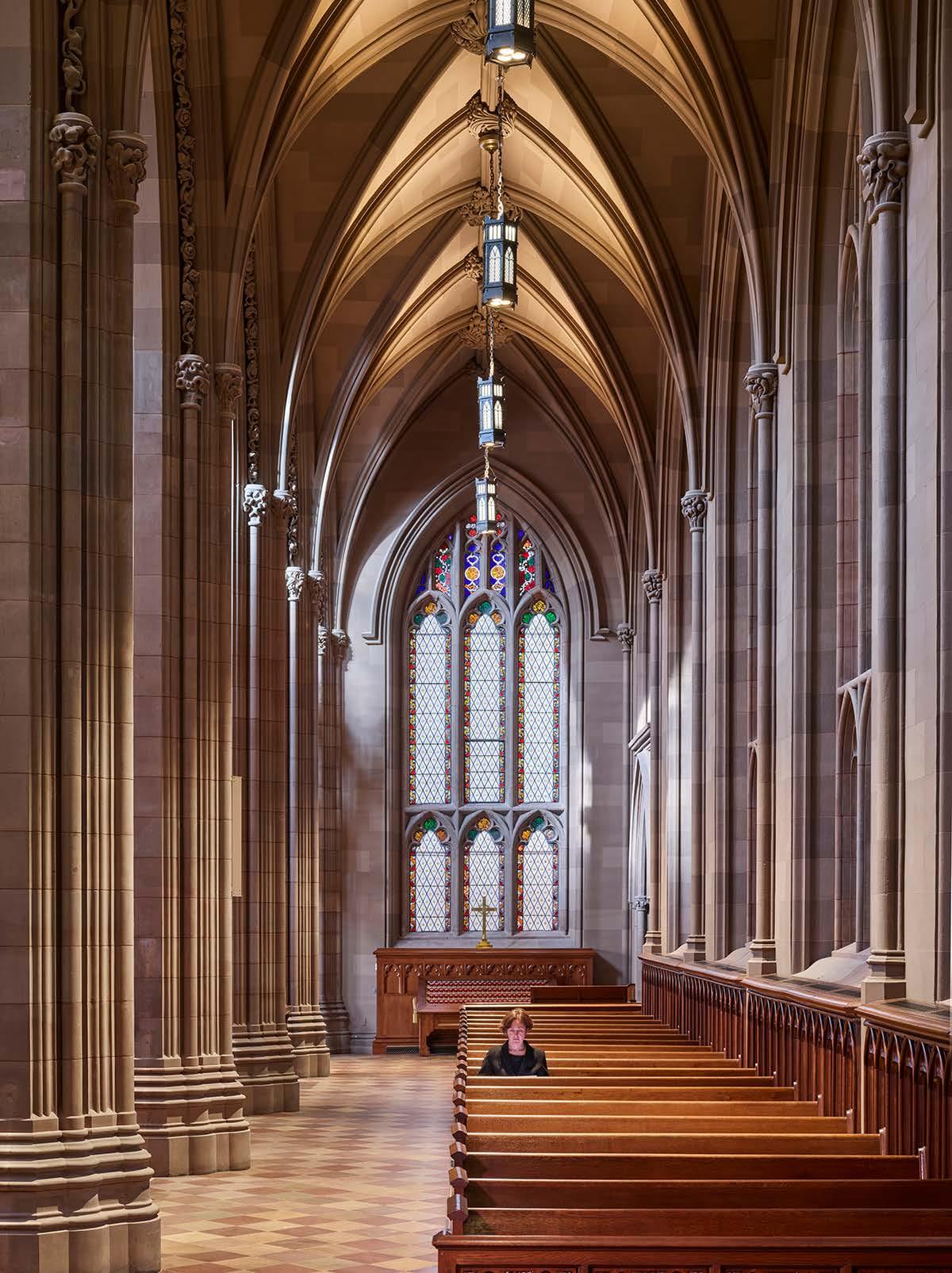
The main pendant design in the nave served as the foundation for smaller lanterns installed in the side aisles. Prior to the restoration, neither the nave nor the side aisle had any pendant lighting. By incorporating lighting in these areas, the ambiance was enriched, allowing for reading and a sense of inclusion within the overall church environment, without the harsh glare from the previous Source Four luminaires.
While the main focus was on the pendants and lanterns, recessed LED downlights were strategically placed in the ceiling to highlight specific architectural features such as the organ pipes. Care was taken to minimize the use of downlights, allowing the attention to remain on the captivating ceiling and encouraging worshippers to look upward. Adjustable recessed LED downlights were provided by Rambusch to illuminate the chancel, the center professional aisle, and other architectural details in the space. These fixtures, meticulously integrated into the overall design, provided precise lighting to enhance the visual impact of key areas within the church.
The collaboration between Melanie, the architects, and Rambusch resulted in fixtures that not only met the lighting requirements of Trinity Church but also paid homage to its historic grandeur. The fixtures, designed by MFLD, brought to life through Rambusch's shop drawings, blended tradition and modernity seamlessly.
Throughout the project, Melanie worked closely with Don Guyton of APF (Auerbach Pollock Friedlander) Theater Consultants on various aspects including broadcast lighting and a new control system. The project team seamlessly provided extensive rewiring and the integration of ETC zero to 10-volt architectural lighting controls.
Don Guyton, a consultant specializing in broadcast lighting, played a vital role in addressing the church's needs for broadcasting services to a wide virtual audience. He introduced theatrical LED and quartz fixtures into a slot in the ceiling, specifically for broadcast purposes. Additionally, Don spearheaded the replacement of the control system. Working closely with the broadcast staff, the new ETC control system was designed to meet both the unique broadcast and architectural requirements of the church, which vary, thus the need to separately control the uplight and downlights in the pendants.
The remarkable transformation of the church's lighting system significantly impacted its overall ambiance and functionality. The meticulously designed pendants, housing the necessary drivers and controls, brought a new level of luminosity to the nave. The restoration project extended beyond the lighting, encompassing architectural updates and rejuvenation of the entire interior, including ancillary rooms, wings, and the sacristy.
There were other important fixtures and manufacturers involved in the lighting redesign One notable fixture was the curved LED linear fixture used to light up the golden statuary in the niches behind the altar. The fixtures are mounted in the perimeter of the coves and illuminate the gilt-covered back wall. The uplighting behind the reredos, the ornamental screen or backdrop behind the altar, was lit with Boca Lighting.
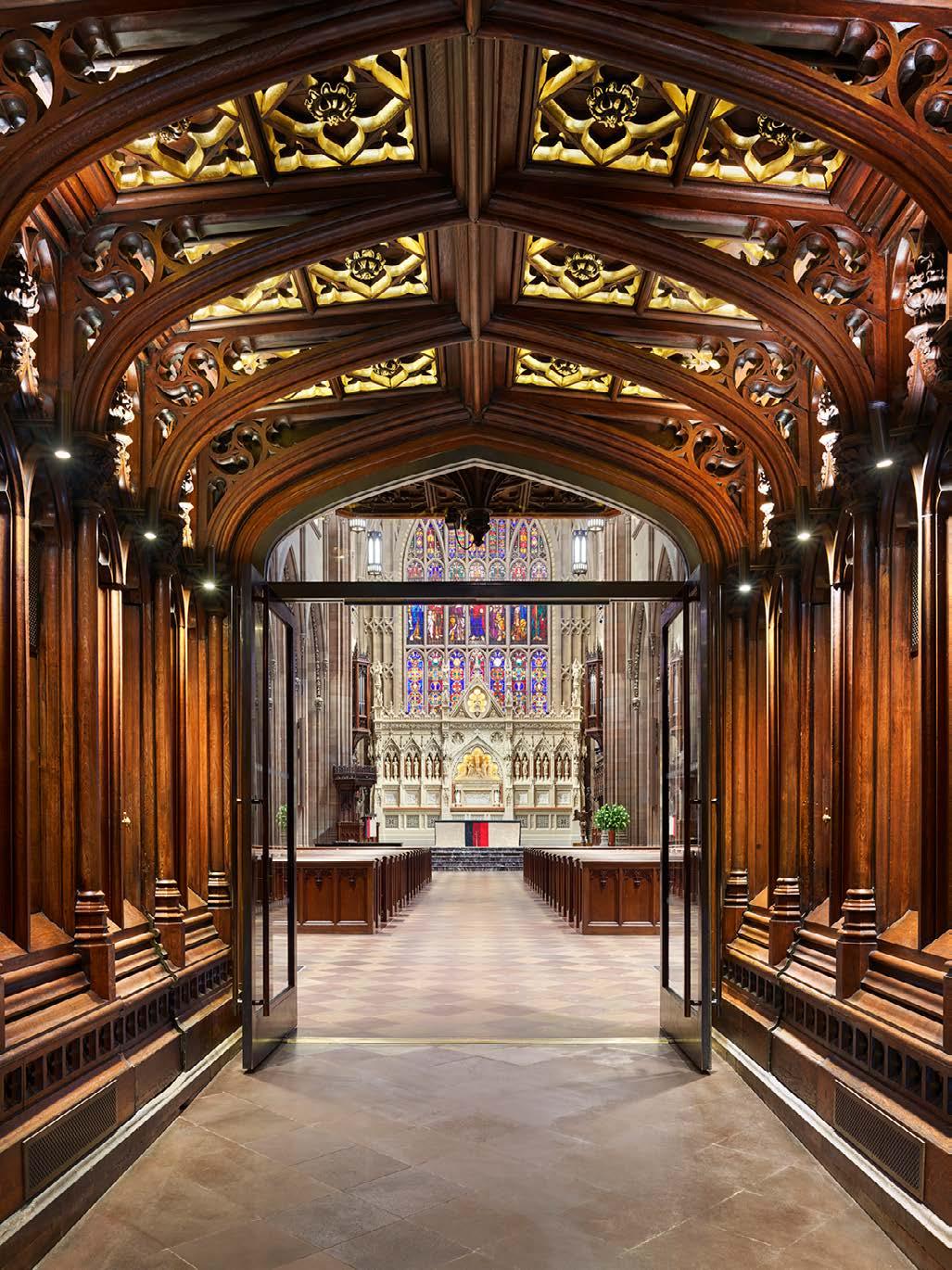
In the vestibule, specifically the middle vestibule known as the narthex, BK Lighting's fixtures were used. These cylinder fixtures had both uplight and downlight capabilities and were chosen to blend seamlessly into the space. Similarly, underneath the choir loft, the same cylinder fixtures were used to model the original restored carved wood.
Lighting Services Inc spotlights were employed to light
monuments or other memorial elements along the nave walls. These spotlights functioned like track heads and were mounted on plates integrated into the ceiling. In addition, higher wattage LSI provided general illumination in the Chapel of the Saints.
Throughout the nave, all of the direct lighting that illuminates the congregation is 2700K, everything else is 3000K. Most functions that the church hosts are during the day and during the mock up process, 3000K looked the best.
The meticulous restoration work conducted in the church encompassed not only the lighting but also the overall building fabric. Years were spent repairing the stone, marble, and plaster elements. All the stained-glass windows were taken out and either restored or replaced, ensuring they were faithful to the original design.
THE STAINED-GLASS WINDOW
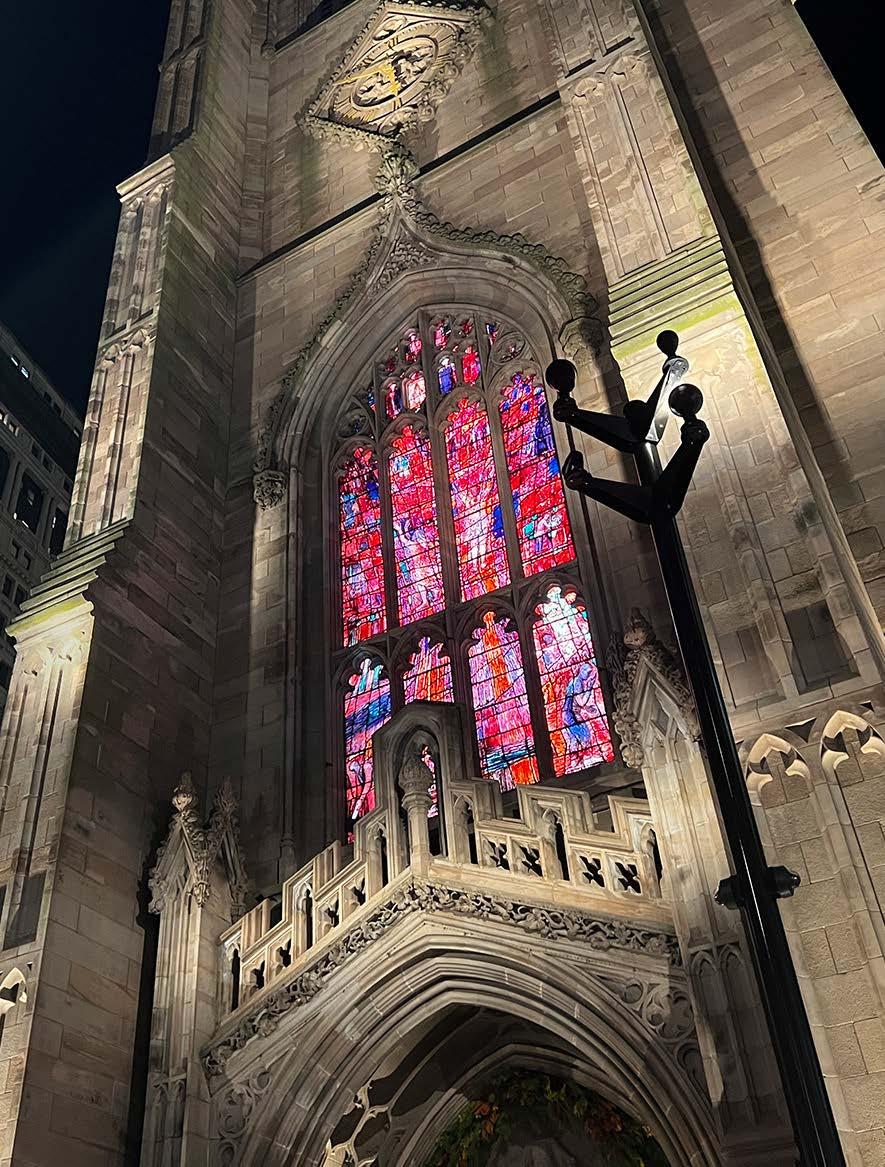
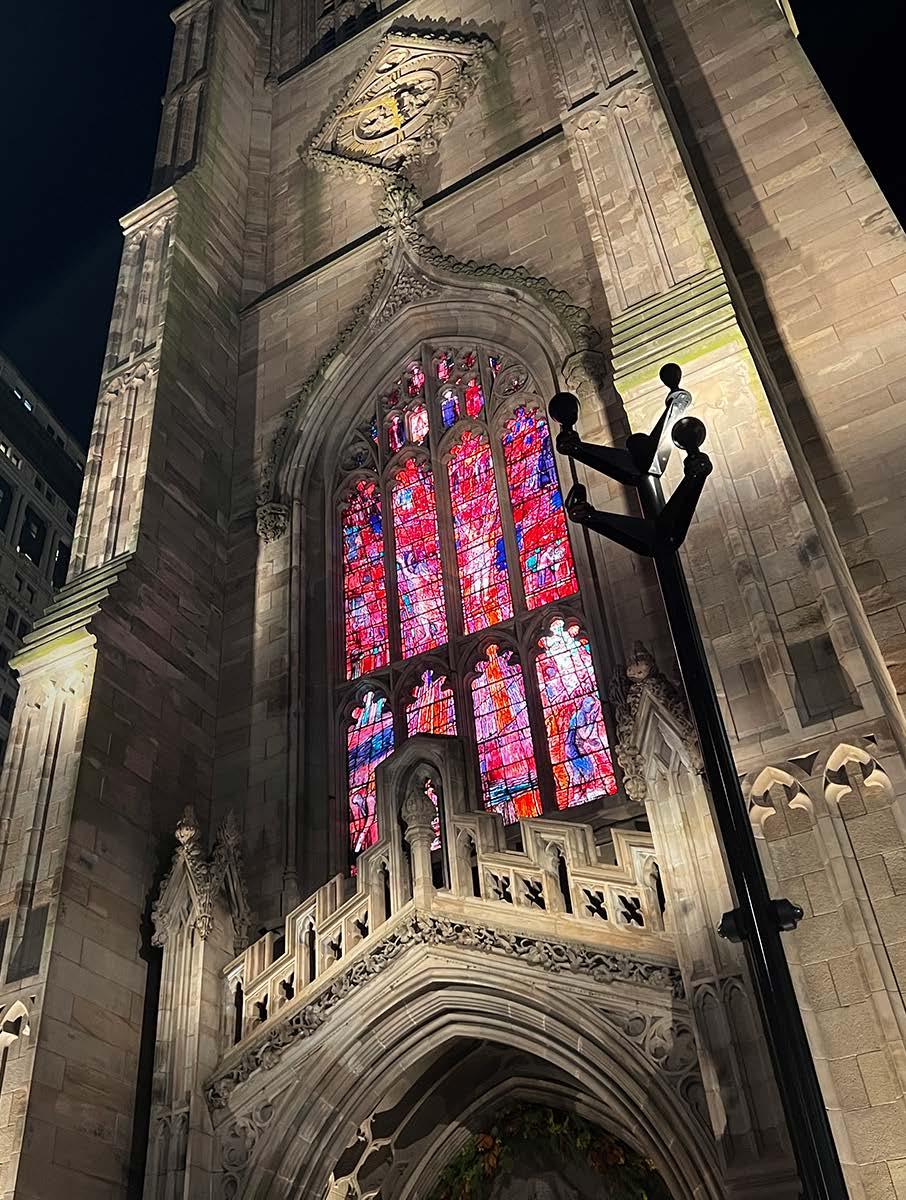
Melanie was confronted with a peculiar challenge – a new stained-glass window at the church's entry that was replacing a simple 1920’s window which could be viewed from the nave. Trinity Church sought the expertise of renowned English artist Tom Denny to create a new window of extraordinary proportions – 30 feet tall by 20 feet wide, adorned with delicate tracery. As the restoration unfolded, the church's interior underwent significant transformations, including the installation of three new organs and the creation of a back wall that obscured the stained-glass window from view within the church. Overcoming the obstacle of the concealed stained-glass window, Melanie proposed a groundbreaking solution – a colossal light box measuring 30 feet tall by 20 feet wide. Working closely with
Tom Denny, intricate mockups were created to determine the most effective approach utilizing RGBW addressable panels provided by Nanometer, Inc.
To ensure the stained-glass window emanated a mesmerizing glow, Melanie and her team embarked on an extensive search for high-output light boxes. The selection process aimed to find fixtures capable of showcasing the stained glass' intricate details while harmonizing with the overall ambiance of the church. The final design involved a vertical grid of light boxes mounted two feet behind the stained-glass panels. Each light box, powered by Nanometer's proprietary control system, boasted 32 channels of control, offering a dynamic range of colors and intensities. The culmination of their efforts resulted in a remarkable collaboration between artistic vision and technical prowess.
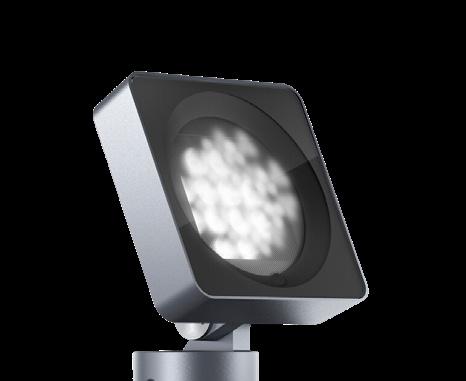
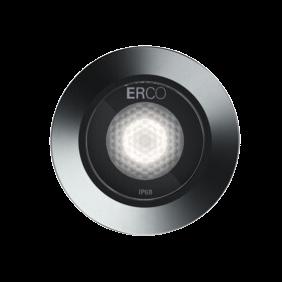
To achieve a cohesive lighting experience throughout the church, ERCO floodlights were strategically placed, casting a consistent color palette across the sandstone surfaces of the exterior of the church. These floodlights, mounted to 25-foot poles, gracefully accentuated the church's architectural elements, including a majestic clock and vertical features. Additionally, ERCO recessed burial lights discreetly installed on the bluestone terrace, further enhancing the lower elevations of the building.
SACRED SPACE
Melanie Freundlich's extraordinary career as a lighting designer has taken her on a unique path through a wide range of houses of worship. Melanie has found herself designing lighting solutions for many churches, synagogues, and other sacred places, a venture that has both surprised and inspired her.
Her early professional years were marked by her tenure at Fisher Marantz Stone, where she honed her skills and nurtured her passion for architectural lighting design. It was during this time that she began exploring the intricacies of illuminating sacred spaces, laying the foundation for her future ventures into the realm of churches.
A notable milestone in Melanie's journey was her involvement in the restoration of the historic Fordham Chapel, an undertaking that predates her work at Trinity Church. Melanie embraced the opportunity to design lanterns for a place of Christian worship, approaching the project with sensitivity and respect for the chapel's rich heritage. The success of this early endeavor paved the way for her continued forays into the realm of houses of worship.
Trinity Church, the crown jewel of Melanie's portfolio, stands as a testament to her ability to bridge traditions and create aweinspiring lighting designs for both historic and modern places of worship. The project, which spanned numerous years, allowed Melanie to fully immerse herself in the challenges and triumphs of illuminating such a historic and sacred space.
Melanie sees her experience with this range of religious buildings as a testament to the universality of lighting design. She believes that light has the power to transcend religious boundaries, creating a sense of reverence and spirituality that resonates with people of all faiths. Her upbringing instilled in her a deep appreciation for the power of light to inspire and uplift, regardless of religious affiliation.
As our conversation drew to a close, Melanie reflected on the rewarding nature of the project. The restored Trinity Church now stands as a testament to the power of collaboration, thoughtful design, and a shared commitment to transforming sacred spaces into awe-inspiring environments. The design offers an unwavering dedication to preserving history while embracing innovation shines through in her meticulous attention to detail.
In her acceptance speech, Melanie stated, “It shows that a small firm can do a very big project.”
Yes it does! ■
FIXTURE SCHEDULE
Rambusch Lighting
Lighting Services, Inc.
Boca Lighting and Controls
Nanometer
ETC Controls
ERCO
BK Lighting (with Nichia)
Crenshaw Lighting
LED Linear
TRUCIRQUE By PureEdge Lighting
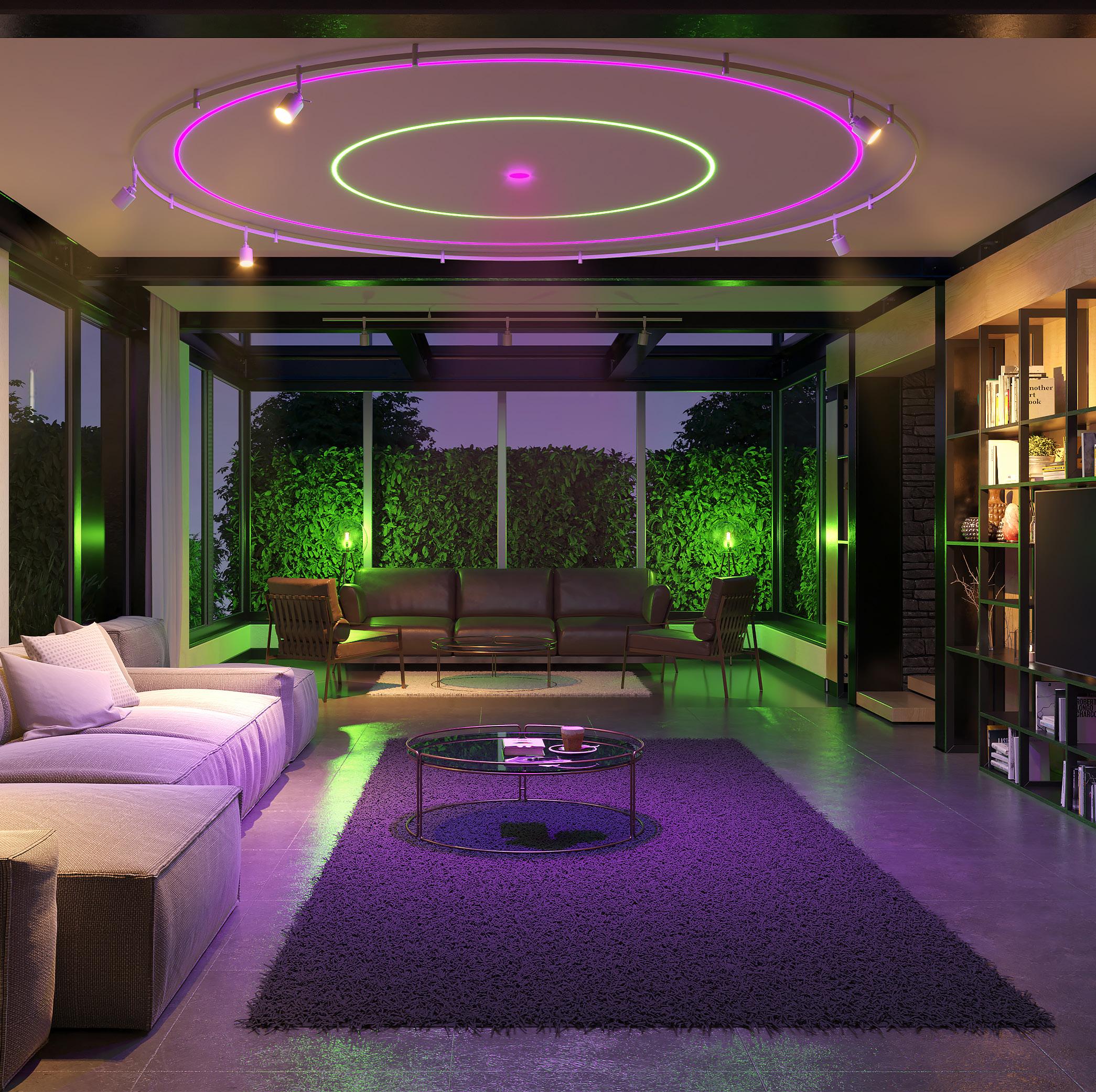
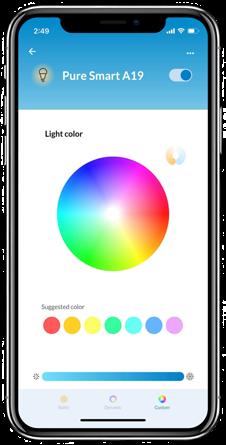
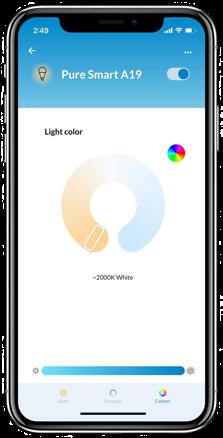
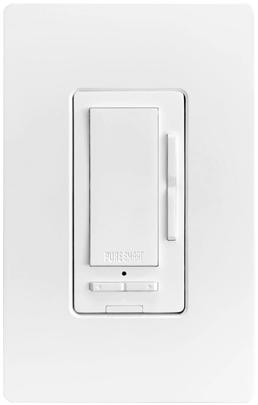
TruCirque is a flawlessly illuminated circle with no visible pixelation and recesses into 5/8” drywall with no joist modification required. Influenced by simplicity and elegance, our patentpending TruCirque is factory-made to your specifications with radius options from 2ft – 18ft and provides smooth, glare-free illumination. TruCirque is featured in our Pure SmartTM TruColorTM RGBTW (TW 1500K-6500K) lighting collection giving designers over 16+ million colors and 85,000 white tones to choose from. Pure SmartTM lighting offers easy-to-use, intuitive controls with the use of the WiZ Pro software suite including the WiZ Pro setup app, the WiZ Pro dashboard, and WiZ app giving designers access to a full palette of color tuning options. Design a truly unique and stunning environment with TruCirque.
“The job was in a very densely occupied residential neighborhood. People could lean out on their balconies when we were focusing and say ‘Hey make sure that light doesn’t come into my tv room.’”
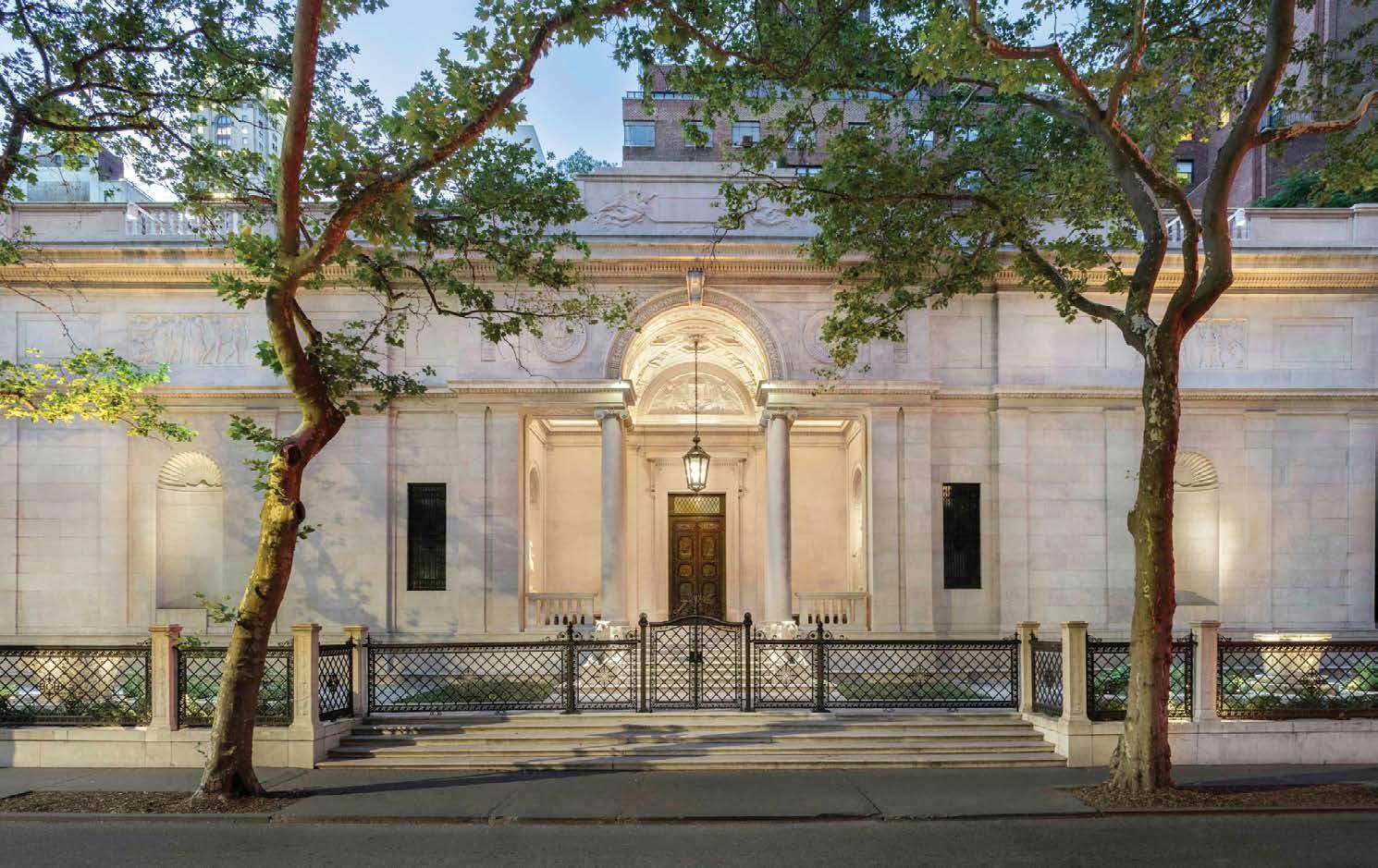
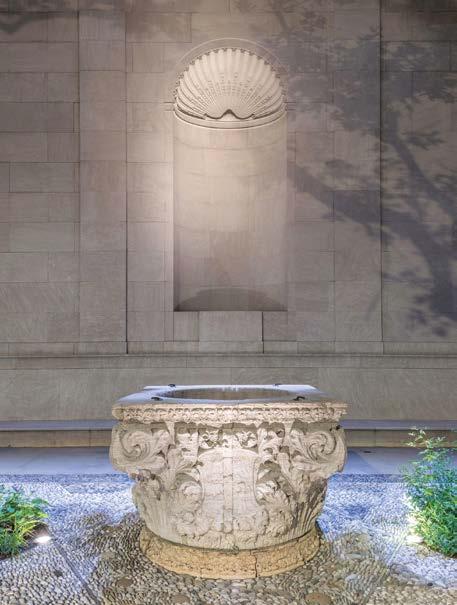
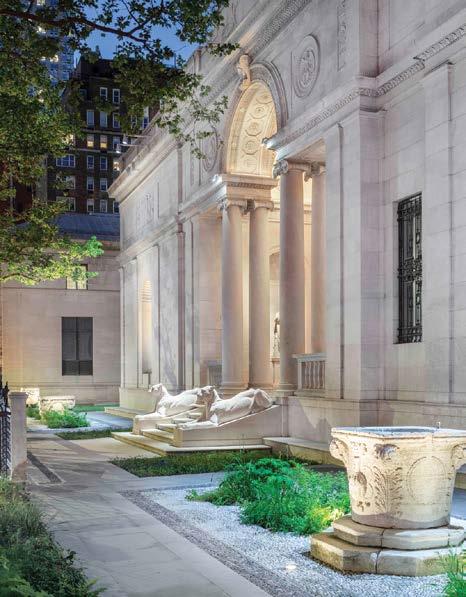
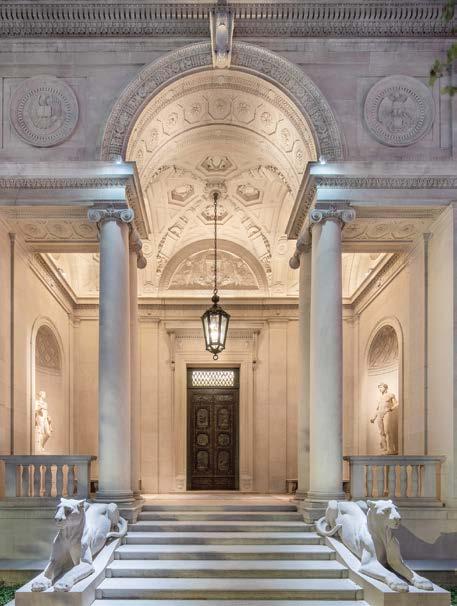
New exterior lighting is a key feature of the restoration of J.P. Morgan's library, the historic heart of the Morgan Library & Museum in Midtown Manhattan. The lighting design creates a visual oasis on the teeming street. Inspired by the Greco-Roman notion of “drawing down the moon,” the design weds the magic of "moonlight" with the warm glow of "incandescence."
Moonlight is provided by blue gel and 4000K fixtures cantilevered through the parapet’s balusters. The loggia is lit in 2700K, and features of the new garden are highlighted in 3000K. The Renaissance-inspired garden design includes various bluetoned pavers and pebbled mosaics at the ground plane, and the moonlight effect accentuates these. The design also brings some of the Morgan's antiquities to light for the first time. Key features are highlighted to dramatize their sculptural character, and the interplay of color temperatures creates a visual dialogue.
The Morgan Library, designed by Charles Follen McKim and completed 1906, is one of the finest examples of Neoclassical architecture in the US. Landscape designer Todd LongstaffeGowan and Linnaea Tillett Lighting Design Associates have opened the library’s grounds for nighttime enjoyment, for the first time in the institution’s history.
EXCELLENCE Award of
“Regarding awards, I tell our people, ‘do a good job and you’ll get another one.’”
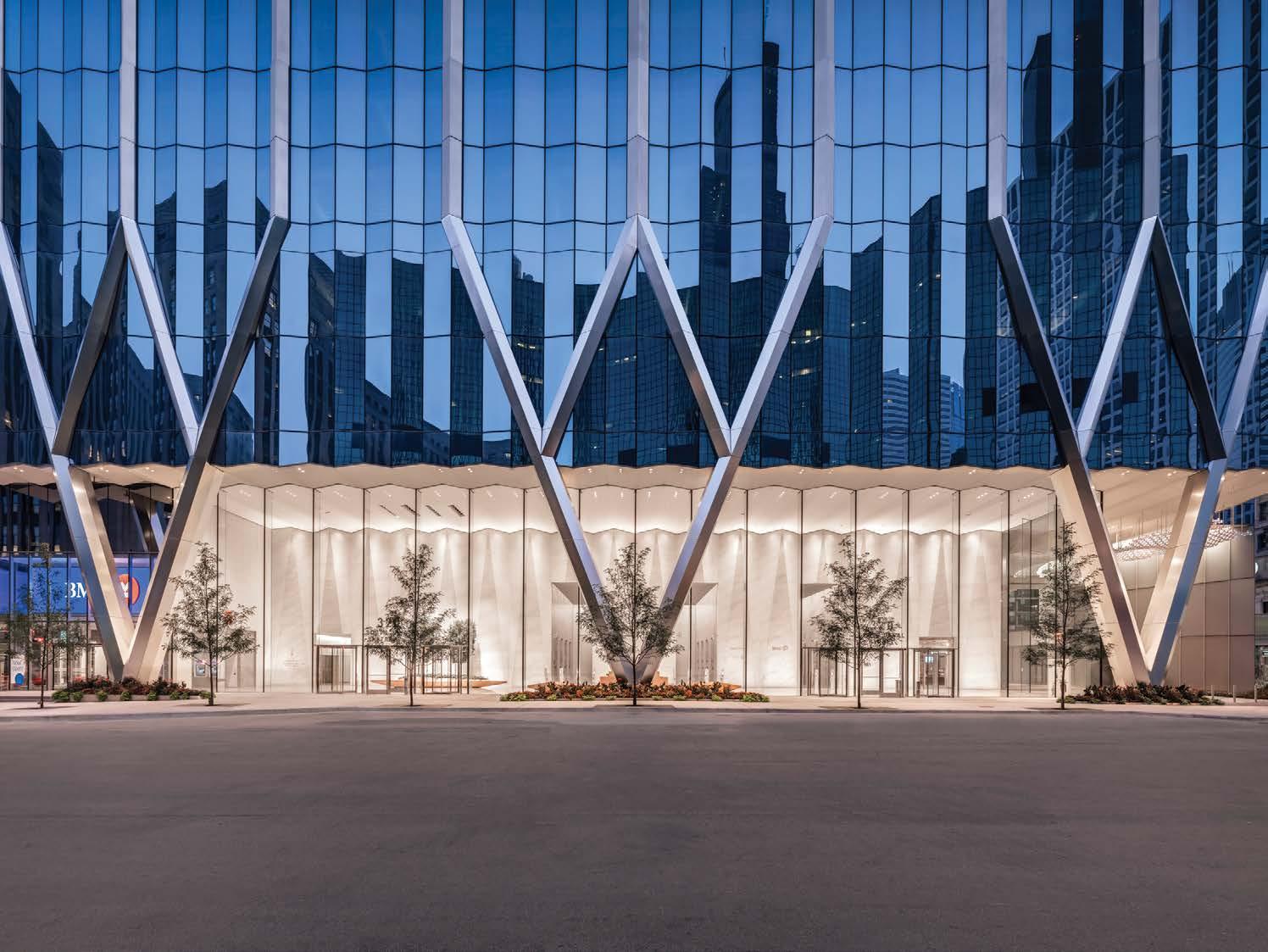
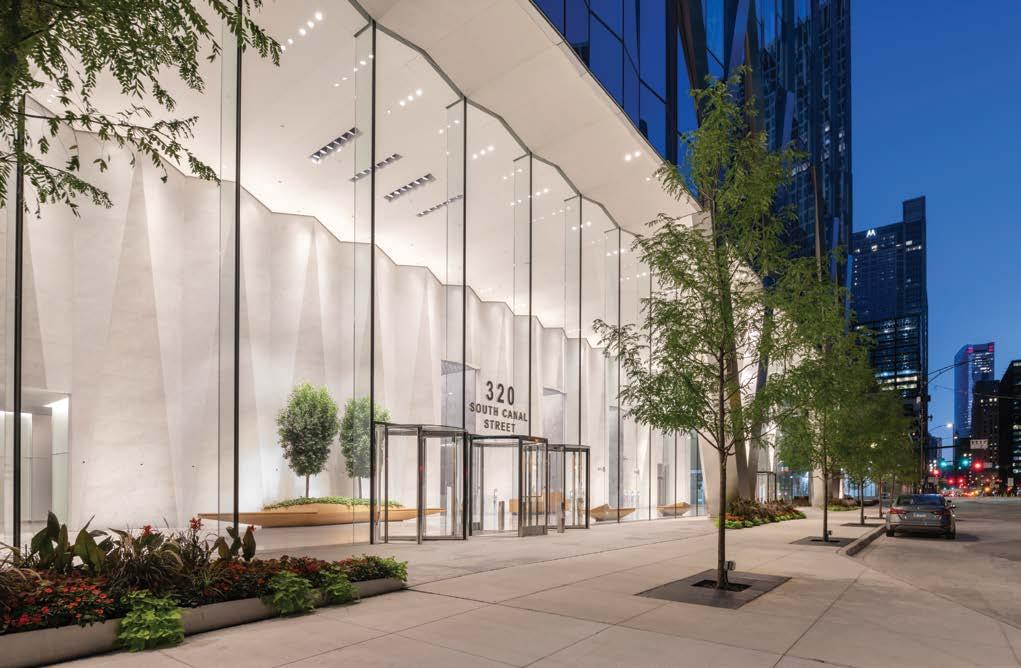
Located directly south of the 1925 Union Station building, 320 South Canal is a new, 50-story landmark office tower that provides a striking addition to the Chicago cityscape, with over 1.5 million sqft of space.
Lighting at the lobby serves to emphasize the space’s unique architectural details, such as its featured faceted walls and ceilings. Clusters of three LED downlights integrate into the faceted ceiling, with sources at each bay illuminating the segmented core wall and glass wall wrapper. The fixtures were pre-aimed during manufacturing to ensure a clean look and minimize aiming time. To balance daylight, One Lux Studio
320
South Canal Chicago, IL
ONE LUX STUDIO
Stephen Margulies, Yasamin Shahamiri, Taki Taniguchi, and SoHyung Bahng
ARCHITECTS
Goettsch Partners
OWNER
Riverside Investment & Development
PHOTOGRAPHY
Nick Ulivieri
sourced tunable LEDs and advocated for a zero-reflection glass façade, allowing unobstructed views for passersby.
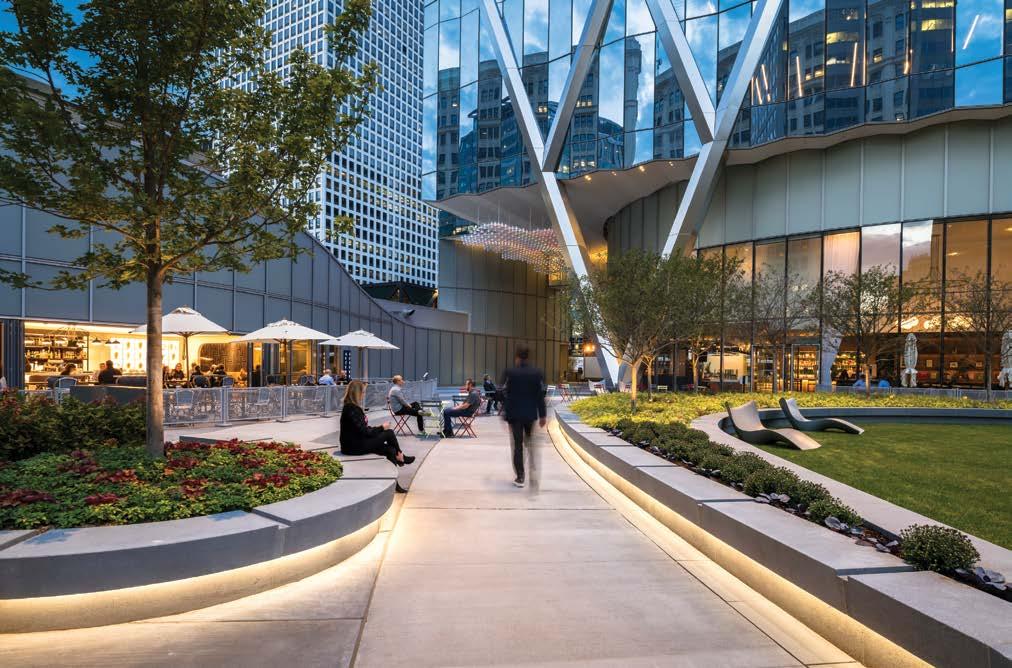
Outside, the tower's 1.5 acre greenspace – the largest privately owned park in the city – is open until midnight. The space is organized around a large, oval lawn and curved path, beautifully illuminated using linear lighting integrated beneath bench seating and bullets uplighting trees. Narrow-beam spotlights, concealed 300 ft up the building’s façade, aim down at the park, lending a moonlighting effect. Other architectural elements, like faceted columns at the façade, are illuminated to create a beautiful backdrop to the park.
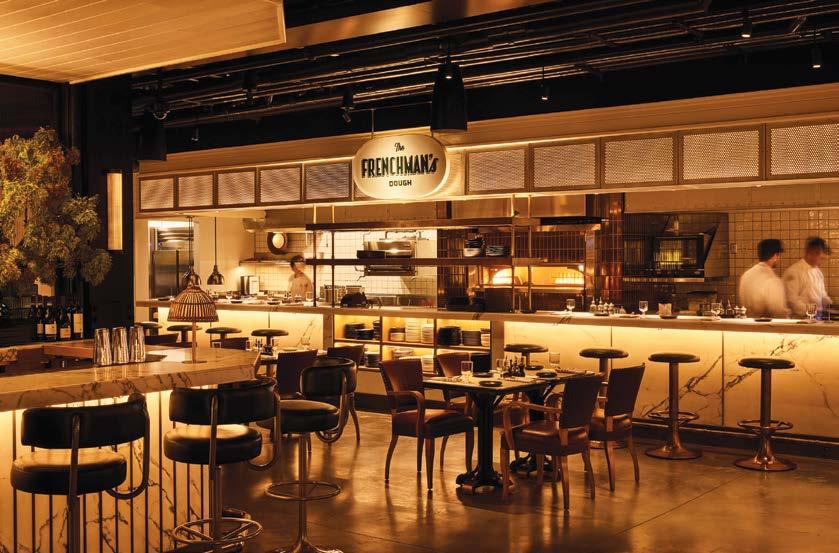
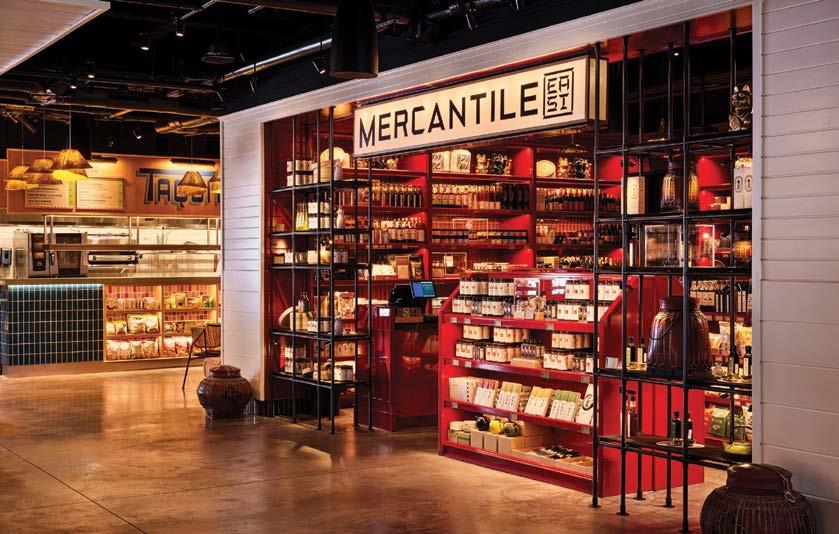
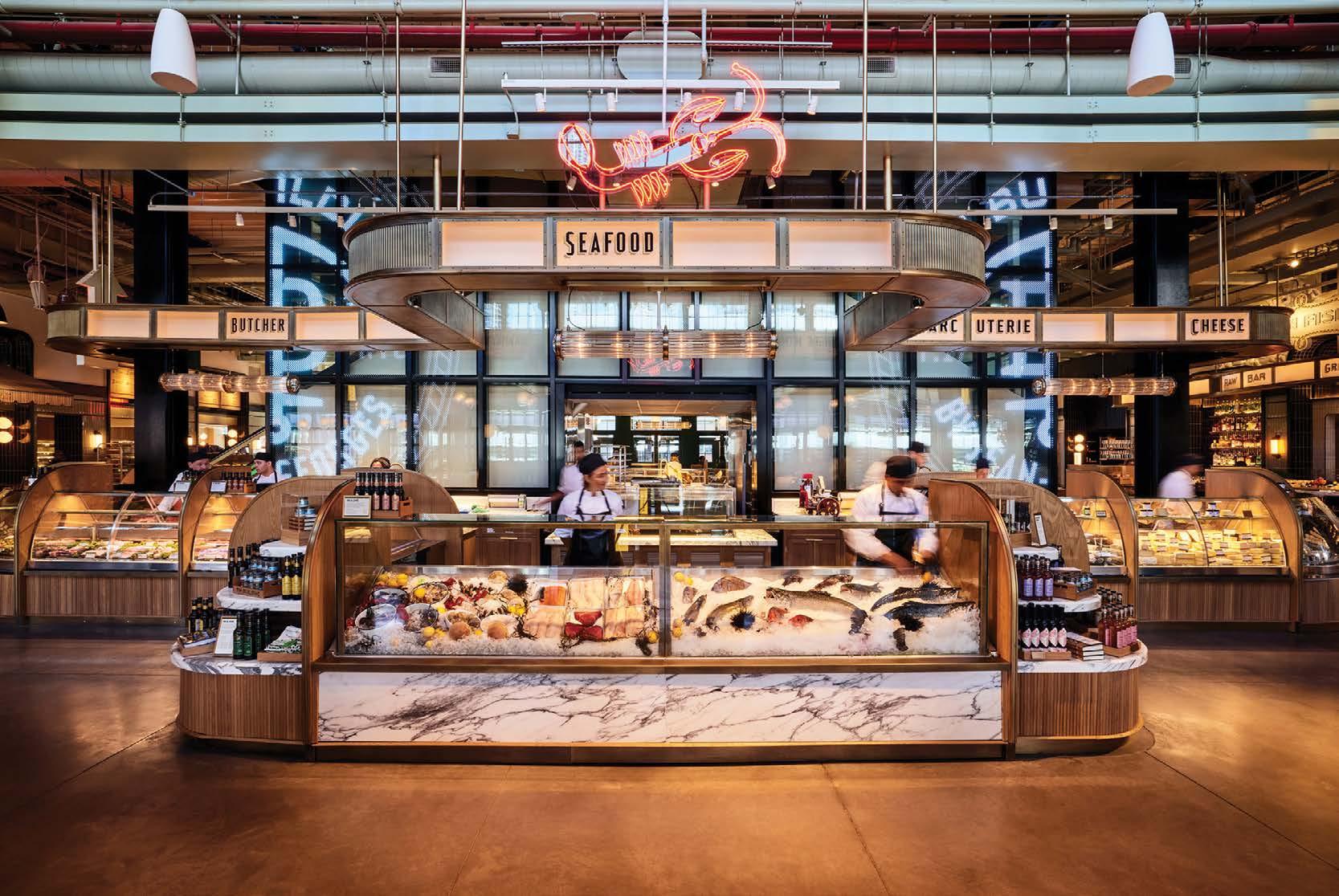
In an exciting collaboration with interior designer Roman and Williams and restaurateur Jean-Georges Vongerichten, L’Observatoire Interrnational lighted the entire 64,000 sqft of the historic Tin Building, the original home of the Fulton Fish Market. The 1907 building was disassembled and replicated at Manhattan’s South Street Seaport, creating a bustling destination. A leitmotif of historically flavored luminaires connects us to the past. And the numerous markets, bars, and restaurants contain individualized articulations of a unified lighting design vocabulary.
The core of the first-floor market is activated by integrated lighting in the millwork and tunable-white backlighting of art glass panels. Pockets of design create selfcontained experiences, and custom luminaires help define the unique destinations. Highly customized “invader” luminaires might feel familiar but use divergent expressions.
In the upstairs market, linear lighting in every product shelf is supported by tracklighting and accented by custom decorative fixtures. The high-end Asian restaurant greets visitors with distinctive, red-tiled shelving exaggerated by red striplighting at the back and then white frontlight on products.
Day and night, this waterfront landmark pulses with new life. The lighting ensures that shoppers and diners engage with the venue’s overall identity, easily navigate the enormous floorplan, and delight in unique, multisensory dining experiences.
Tin Building by Jean-Georges New
York, NY
L'OBSERVATOIRE INTERNATIONAL
Hervé Descottes, Carlos Garcia, and Esteban Varas
“We have worked with this team for a long time, and they are like family. The relationship is based on trust and respect.”
ARCHITECTS
Roman and Williams
Cass Calder Smith
OWNER
The Howard Hughes Corporation
CLIENT
Jean-Georges Management LLC
MEP ENGINEER
WSP
PHOTOGRAPHY
Nicole Franzen
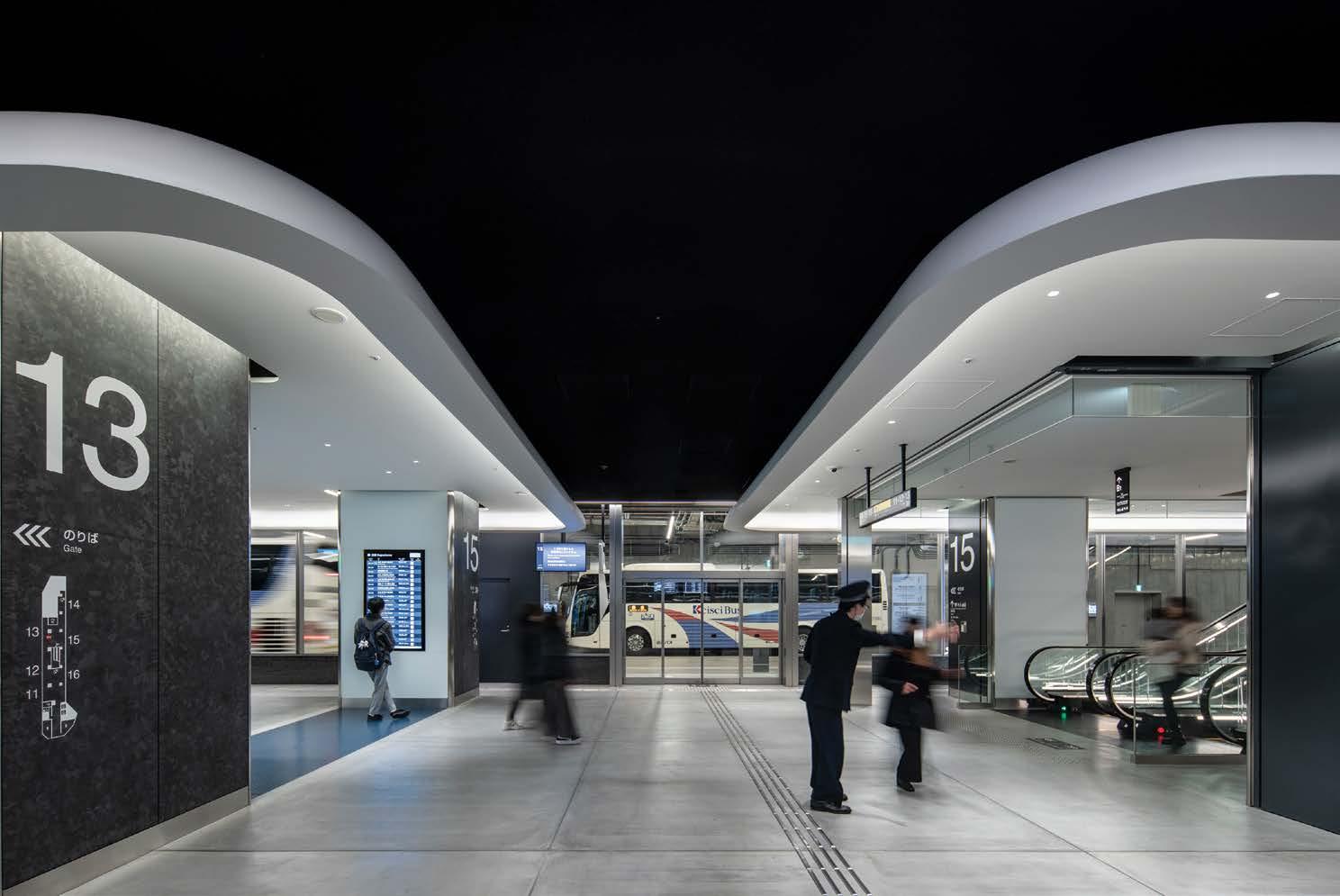
Bus Terminal Tokyo Yaesu, the largest bus terminal in Japan, has opened in front of Tokyo Station. The overall goal was to elevate terminal spaces in Japan, as most are purely utilitarian in design and lacking in spatial awareness. This careful collaboration between architecture and lighting says, We can do better.
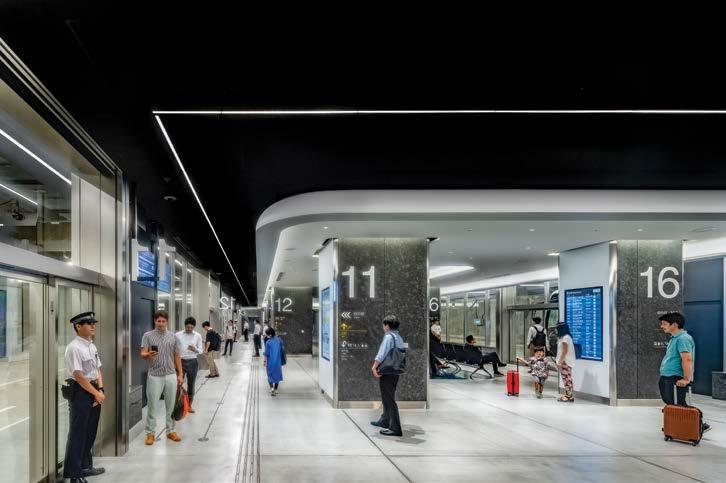
The spatial form of the bus terminal is a one-room space where movement and stillness coexist. Vertical planes of illumination enhance the perception of brightness and welcome in this underground space. Wayfinding is clear and pleasant while preserving visual interest and a sense of exploration. A line of white light on the dark ceiling creates the “racetrack” that pulls you along the route while attenuating the space –a moment of speed.
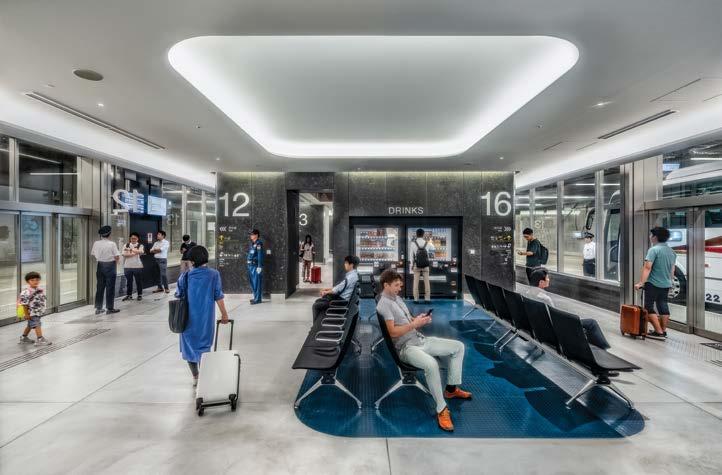
Curved extrusions of white coves create “Floating Clouds on a Dark Sky”: a threshold moment. A lounge area features cove lighting and downlighting to define a moment of repose. Fast and slow coexist while being distinct spaces.
The spatial design goal provides a visual guide for each activity and cues visitors as they transition through the terminal. The juxtaposing volumes of speed and stillness carved through light create a comfortable environment for lingering and waiting.
Award of
MERIT
Bus Terminal Tokyo Yaesu
Tokyo, Japan
LOOP LIGHTING
Ryoko Nakamura, Ruben Gonzalez, and Kaori Hiroki
NIHON SEKKEI
Yoshiko Nakayama
“Thanks to the IES. The project started when the pandemic started, and it took almost 3 years. The lighting is so integral to the story.”
CREATIVE DESIGN DIRECTOR
NIHON SEKKEI, INC.
Yoshiko Nakayama
ARCHITECTS
NIHON SEKKEI, INC.
TAKENAKA CORPORATION
OWNER
Urban Renaissance Agency
BUS TERMINAL OPERATOR
Keio Dentetsu Bus Co., Ltd.
PHOTOGRAPHY
ToLoLo studio
MERIT Award of
Chasing Rabbits
Vail, CO
FOCUS LIGHTING
Valentina Doro, Juan Pablo Lira, Erin Ryan, Zoe Neijna, Kenny Schutz, and David Bull
“Protect the lighting design and do not mess with the details.”
ARCHITECTS
Davis Partnership
Rockwell Group
OWNER
Solaris Group
PHOTOGRAPHY
Juan Pablo Lira
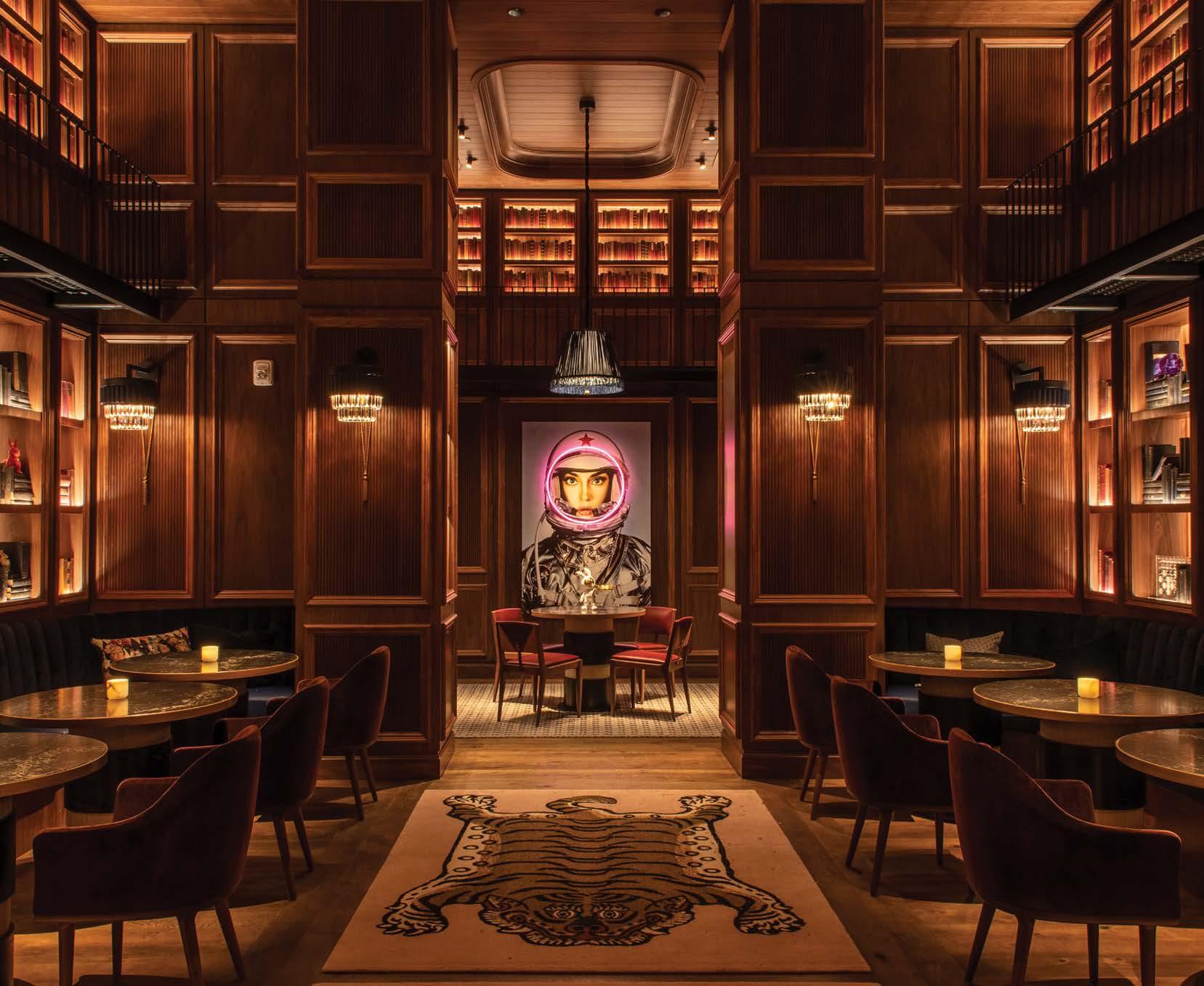
Immersed in a 10,000 sqft clubhouse, guests travel on a fantastic journey, “chasing rabbits” from room to room. The lighting design celebrates playfulness and relaxed sophistication.
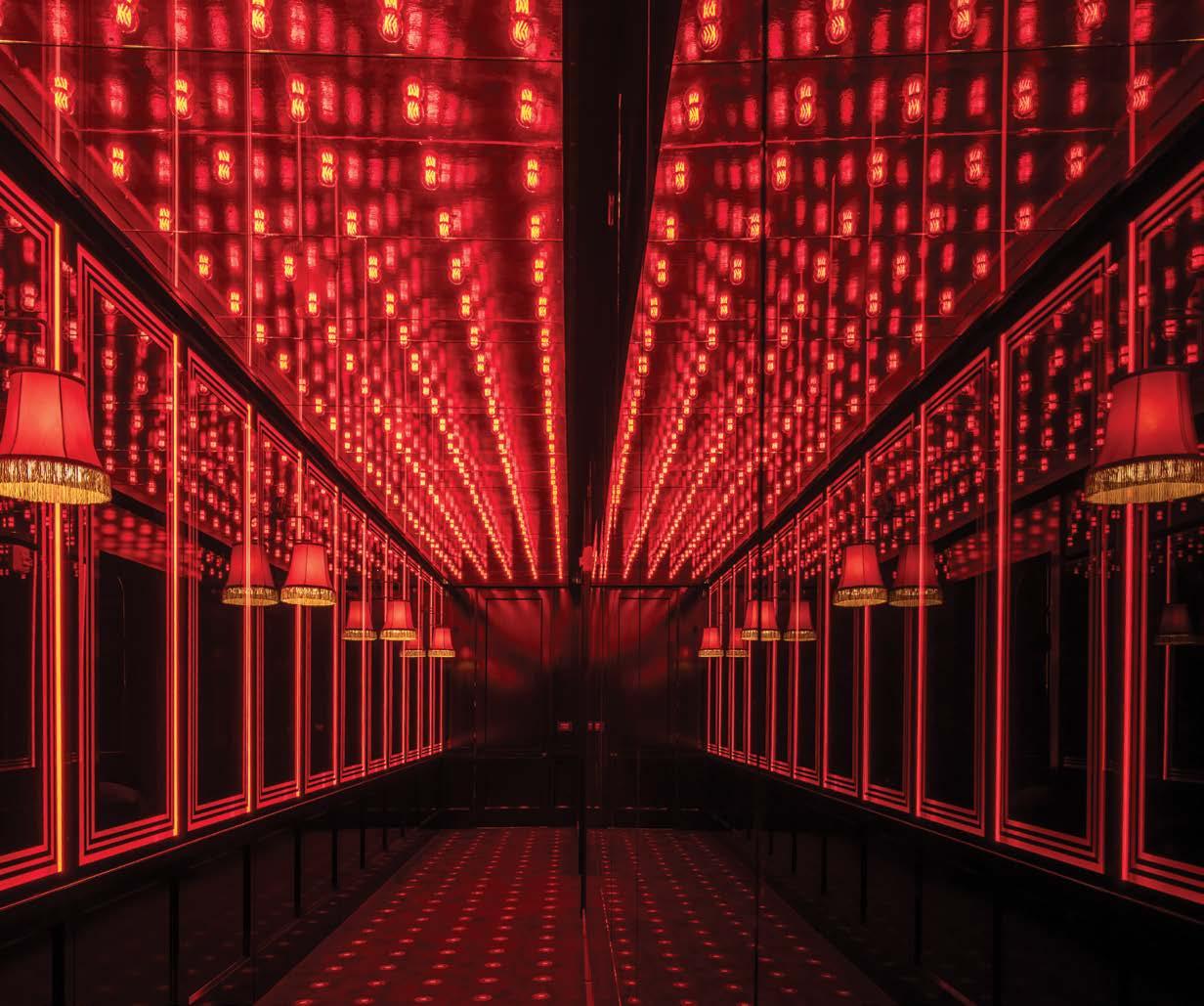
At the entry, Edison bulbs suspended above a raspberry, transmissive ceiling dazzle, while backlit etched mirror panels add to the balanced infinity effect. In another corridor, etched graphics within reflective panels are backlit with cool LED panels. The colorful sculpture at the end is modeled by both track accents and discreet uplights.
In contrast, interior spaces are bathed in multilayered warm lighting. In the restaurant, light grazes up and down along the perimeter, creating a soft glow behind the dark framing treatment. Custom snoots ensure dramatic, super-tight accents on the tables. In the library, each shelf has a linear frontlight and a softer glow behind, so the entire room exudes inviting warmth. Decorative fixtures reinforce the human scale, while the neon art piece sizzles. The speakeasy feels mysterious with delicate layers of lighting bringing beautiful patterns and finishes to life.
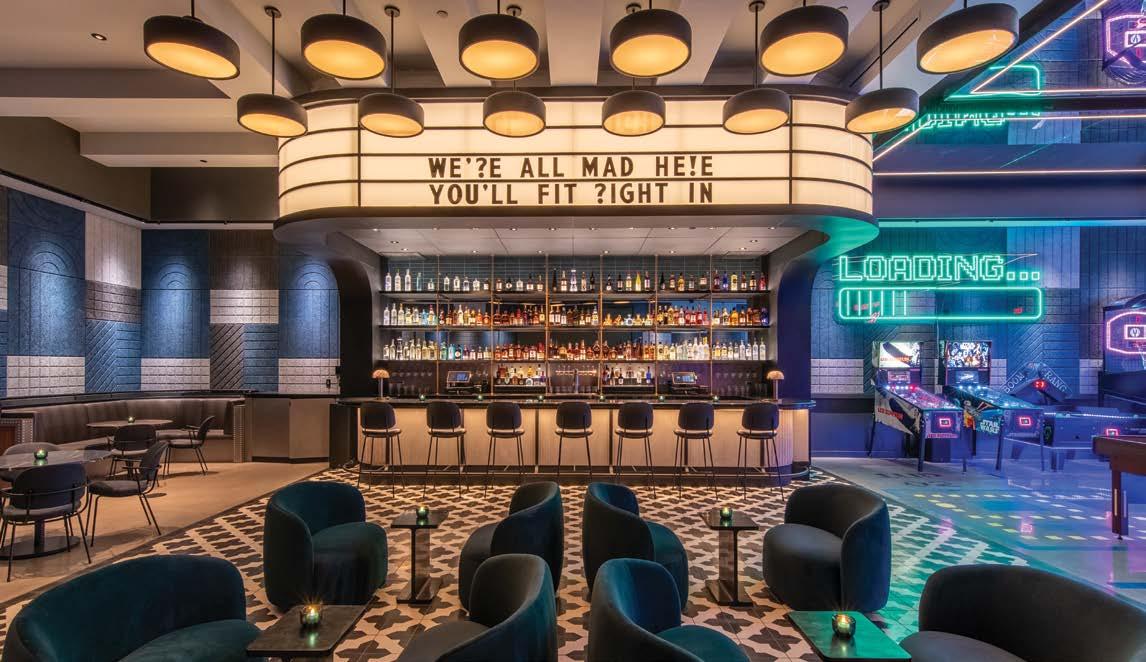
In the arcade, the cinema-inspired bar is backlit, while gaming areas create excitement. This juxtaposition of classic and eccentric encapsulates the concept of this project: a refined lighting design injected with surprising, entertaining moments.
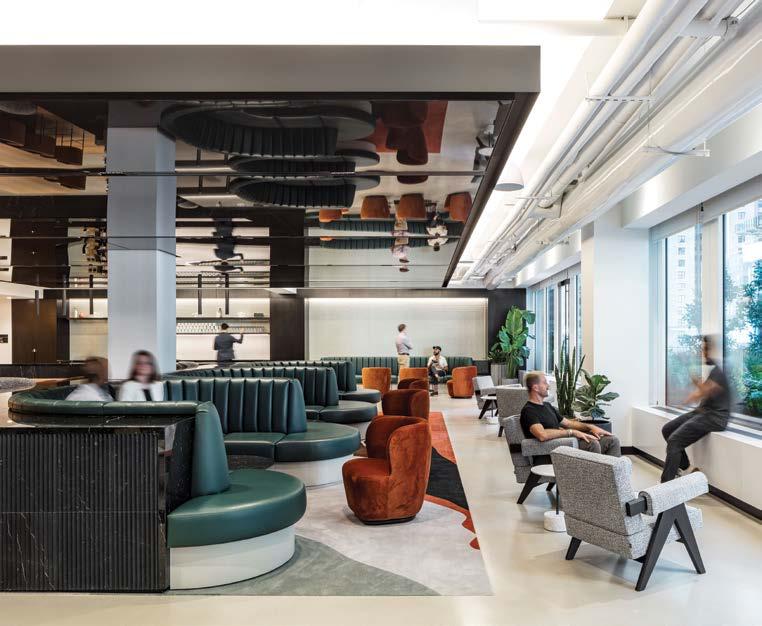
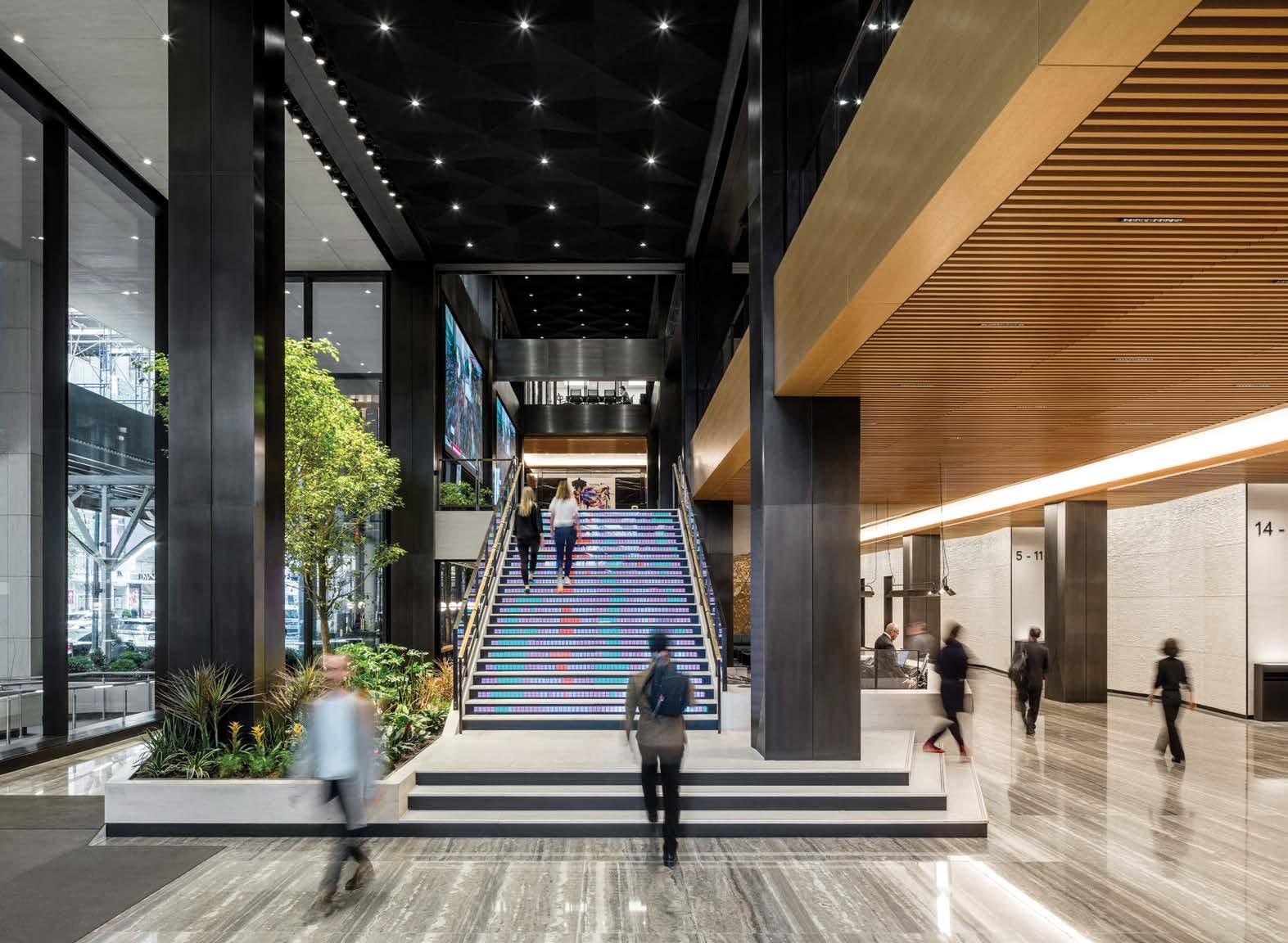
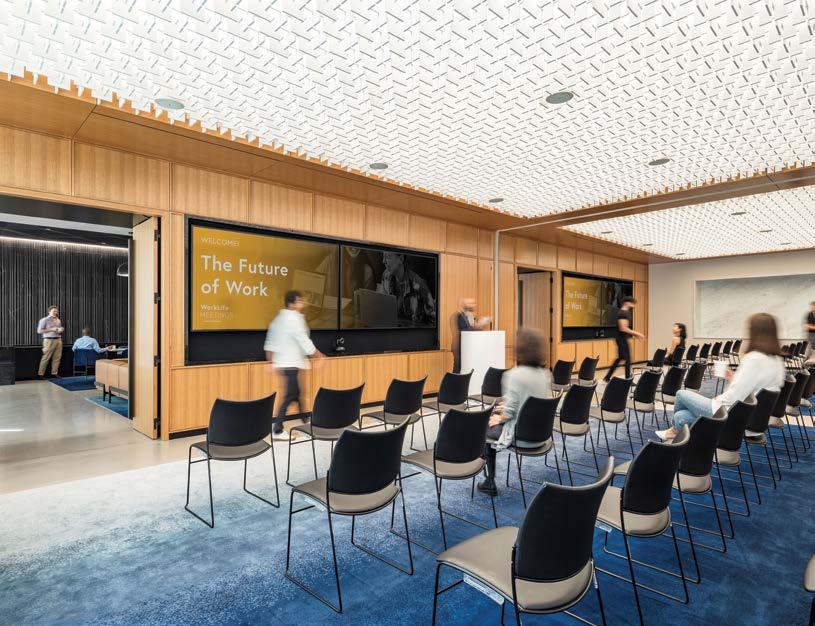
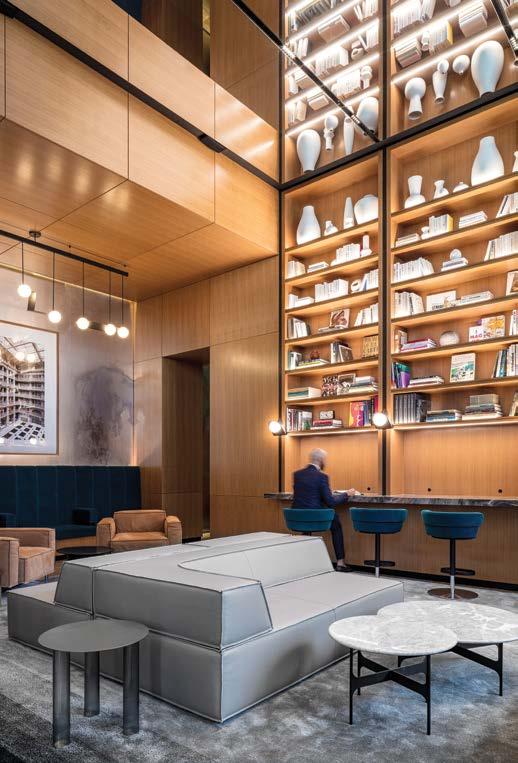
Located above bustling Penn Station within the revitalized Penn District, this 150,000 sqft building amenity hub gives us a glimpse into the future of workplace design. The three-floor project creates an ecosystem of spaces for work, wellness, and socialization. Lighting serves the programmatic and design needs of each space, emphasizing rich textures and their transitions.
The dramatic, double-height lobby pairs concealed linear wall-grazers on textured, hewn stone walls with soft ambient coves and discreet recessed downlighting onto the highly reflective floor. Interactive digital-screen risers invite visitors to climb the grand stair, which contrasts large video screens against the dark finish palette.
At the conference center, a large, luminous ceiling of LED panels above stretched fabric and acoustic baffles produces a glowing effect that is both diffuse and textured. Dramatic contrasts center the experience center. Tightly focused track lighting accents the cityscape model, while toe-kick lighting defines seating.
In several spaces, mirrored ceilings and wall panels play with angles or sparkle with reflections from warm decorative fixtures and artwork. The bar features a strong, linear chandelier suspended below an uplit gold ceiling.
The fitness center’s staircase features shimmering art walls. Quiet, multicell downlights tucked between panels avoid unwanted reflections.
MERIT
Award of PENN 1
New York, NY
LIGHTING WORKSHOP
Doug Russell, Megan Casey, and Kim Dai
“Thank you to the architect, Architect + Information (AI) and thank you all and have a wonderful evening.”
ARCHITECT
Architecture + Information (A+I)
OWNER
Vornado Realty Trust
PHOTOGRAPHY
Magda Biernat
MERIT Award of
POST Houston
Houston, TX
DOT DASH
Christopher Cheap, Marcelline Lacombe, Chen Chen, Marta Casarin, and Isabel Sanchez Sevillano
“Thank you to our clients who saw an opportunity in this project…to transform this whole building into something amazing. We had an amazing crew of consultants who supported us through a very tough time.”
ARCHITECTS
OMA
Jason Long, Salome Nikuradze OWNER
LOVETT COMMERCIAL
Kirby Liu, Director
Brandon Roberts, Construction Manager SKYLAWN DESIGNER
Hoerr Schaudt
PHOTOGRAPHY
Marco Cappelletti
Steve Hyde
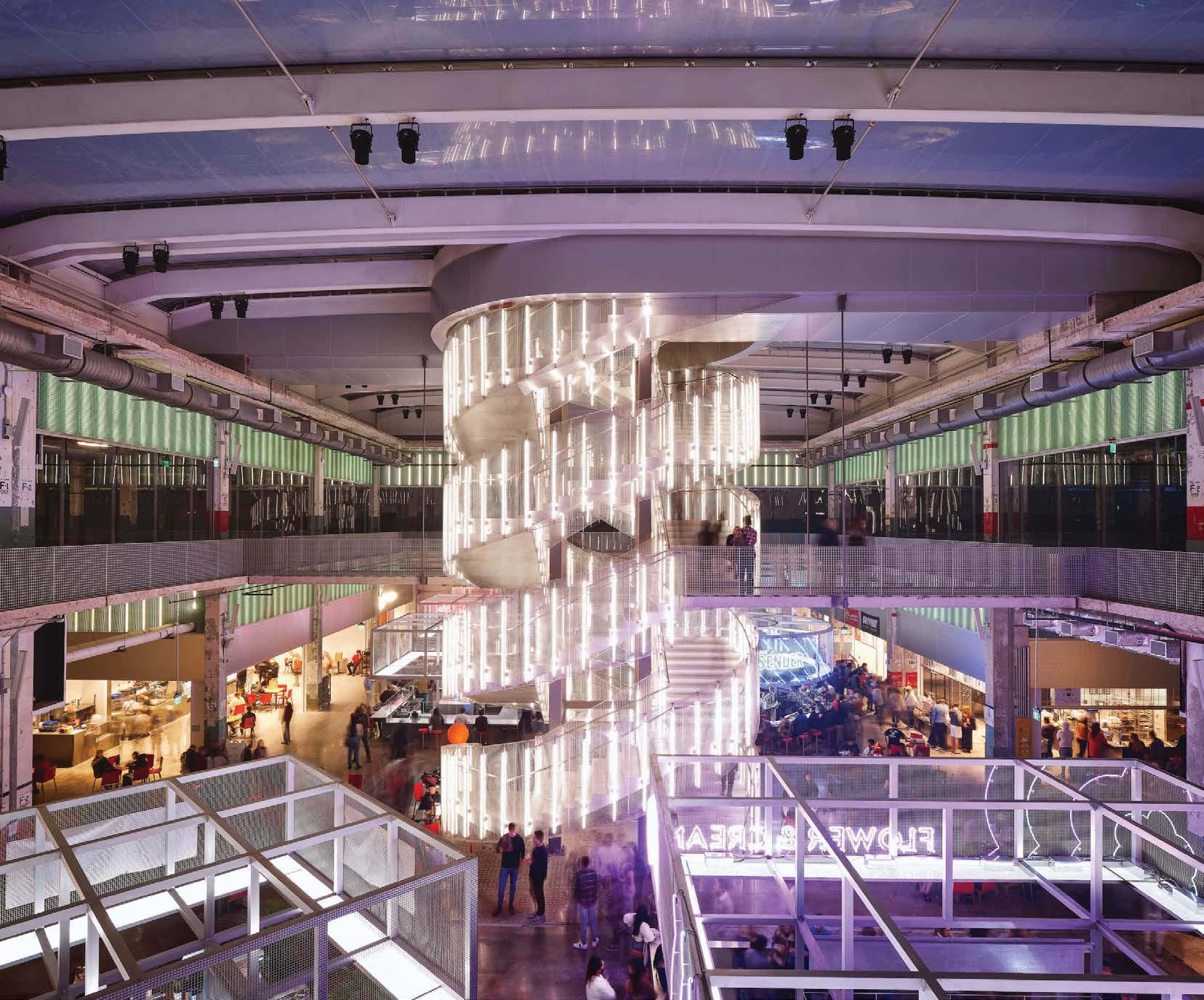
POST Houston is an adaptive reuse of a long-abandoned Postal Service headquarters into a dynamic, mixed-use complex. The lighting design is integrated within the architectural interventions and intentionally independent from the original building.
Atriums were created within the cavernous space, each featuring a unique, monumental staircase with integral lighting components. A double-helix stair is the sculptural focal point of the “O” Atrium, with lighting incorporated into the mesh guardrail. Market Hall canopies delineate each kiosk and provide soft, intimate light for diners.
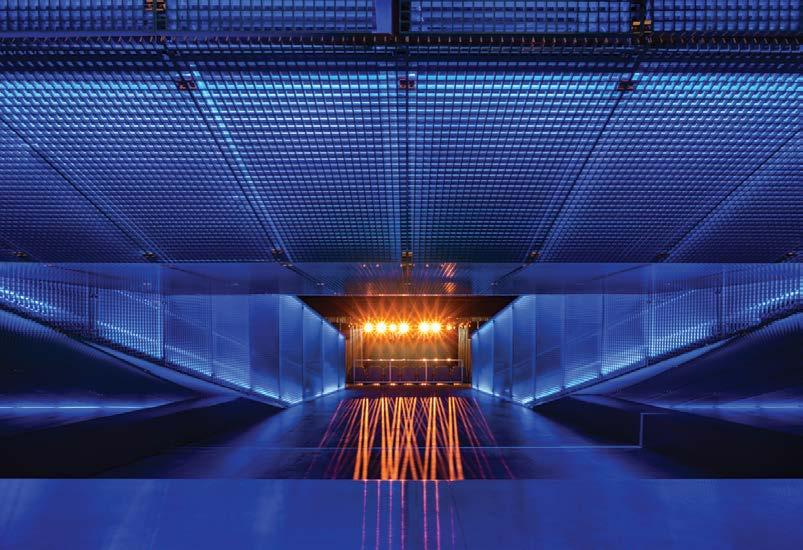
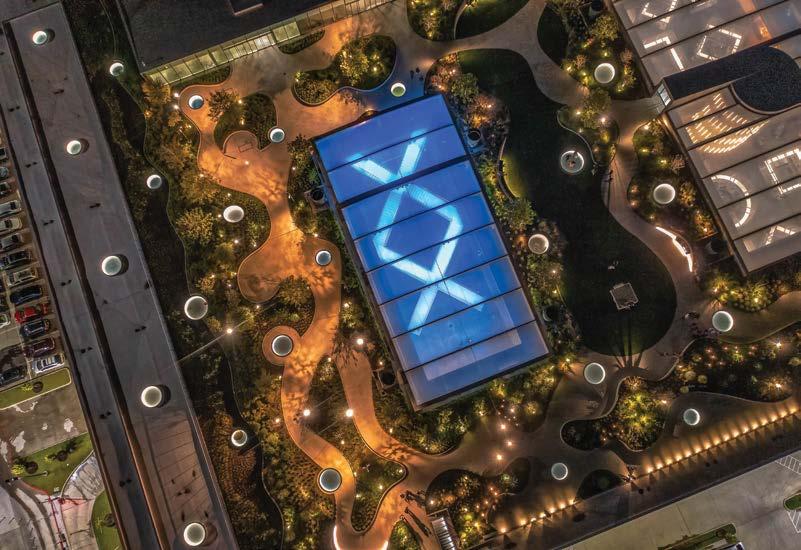
The “X” stair can transform into a stage using DMX-controlled theatrical framing projectors mounted to roof beams. At the Live Nation venue’s Lobby Bar, the lighting design is inspired by concert blinder lights. To create dramatic portals to accessory spaces, lighting glows within a translucent polycarbonate wall. At the stair, striplighting reveals the movement of guests. Once inside, dimmable blue grazers between open-cell guardrails highlight the balcony geometry.
Accessed by these monumental stairs, a 5 acre rooftop park includes distinctive landscape and lighting environments, punctuated by the soft glow of ring lights within the 40 walkable skylights. Overall, the lighting design preserves the existing building while celebrating new additions, creating a hub for culture, dining, work, art, and recreation.
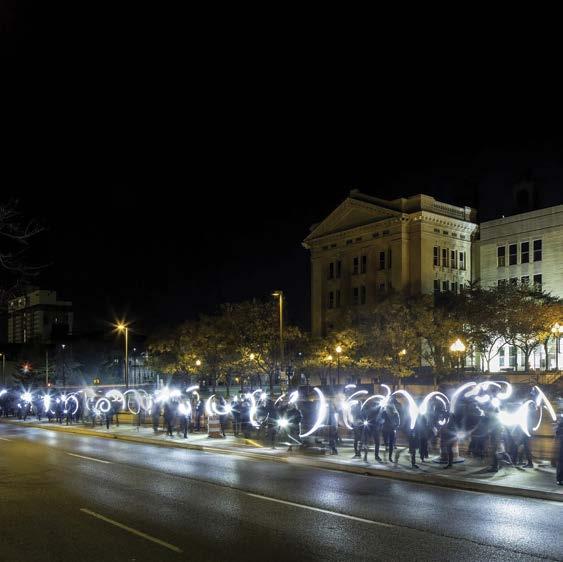
CITATION for Community Lighting Initiative
Signal Station North Baltimore, MD
FLUX STUDIO LTD
Glenn Shrum, Laura Dillon, and Paloma Sherman
“One goal was to support the community. The other goal was to support this community. And everything is open source, so please visit our website.”
ARCHITECTS
PI.KL Studio, Kuo-Pao Lian , Brian Baksa
OWNER
Station North Community
PROJECT MANAGER AND COMMUNITY
ENGAGEMENT PARTNER
Neighborhood Design Center
GRAPHIC DESIGNER AND ARTIST
Public Mechanics
SPONSORS
National Endowment for the Arts Central Baltimore Partnership
PHOTOGRAPHY
Karl Connolly, Flux Studio, Neighborhood Design Center, Public Mechanics, PI.KL Architects
CITATION for an Immersive Environment
The Journey to Edge/Peak New York, NY
BOLD LLC
Gary Wong, Mai Shimizu, Brian Orter, Alyssa Ayow, Bradley Clements, and Charlie Dumais
“Always be kind to your rep and when we f#ck it up, they always have our backs.”
To address current and historical inequities in urban lighting, we need to move beyond layouts and fixture selections toward more holistic and dynamic solutions. This public space lighting initiative questions those typical lighting design processes and outcomes, exploring how the lighting in an urban district could better support its residents.
The interdisciplinary team organized multiple social events and informationgathering sessions to improve our understanding of what the community valued in urban lighting. Informed by research, Flux Studio assembled resources, including a Lighting Plan that analyzed existing conditions, focusing on the pedestrian experience. The plan also outlined an open framework with a range of lighting interventions. This gave the community agency to identify solutions that maintain cohesion across the district.
A Lighting Guidebook provided accessible educational material with basic technical knowledge about light. And the Community Lighting Guide contained infographics on how to report outages and navigate the bureaucracy that governs the city’s lighting infrastructure.
This open-source information is intended to empower members of the Station North community to advocate for their interests on lighting-related issues from a more informed perspective. These resources can also assist those who understand what good lighting can offer, in efforts to share that understanding and power.
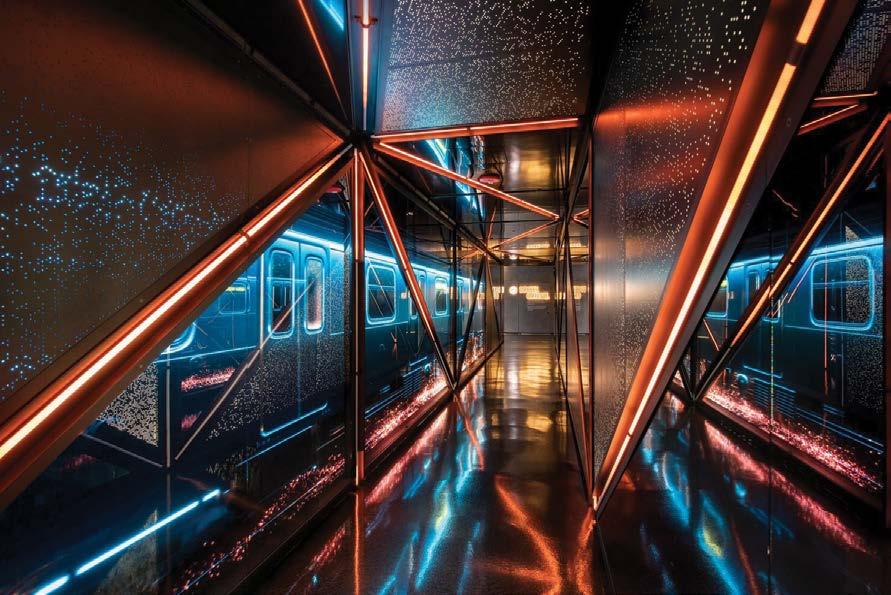
Located at 30 Hudson Yards, this 101-floor journey to The Edge features everything from a brass-trimmed, 45-seat bar area to an innovative, sustainability-focused exhibit.
The multi-sensory experience begins on floors 4 and 5, where visitors enter a hallway of water-filled caissons designed to mirror the building’s foundation and unique engineering approach. Next, a floor-to-ceiling digital representation of the Hudson Rail Yard engulfs the hallway as visitors continue towards the elevators. The historical display is exhibited with an avant-garde glimmer, which illuminates through speck-like openings in the bronze scaffolding. Color-changing strips balance the cooling light-blue outlines of digital subway cars.
In the elevator-queue area, a blue perimeter cove blends seamlessly with the overhead displays and side panels, accentuating the warm hues to create the perfect observation environment.
At the close of the exhibition, the design transitions from the captivating displays to a high-end lounge and dining experience. A balance of warm lighting, natural oak-wrapped ceilings, and champagne metal polishes produces a soulfully robust tone, which enables a fluid transition to the 96-floor journey to unparalleled city views and dining.
At the pinnacle, a harmonious balance of natural and electric lighting heightens the ambiance surrounding one of New York’s most breathtaking experiences.
ARCHITECT
Rockwell Group
OWNER
The Related Companies, L.P.
PHOTOGRAPHY
Rockwell Group, Peak NYC
CITATION
for Artifact Illumination
The Silver Vault Gallery, Wadsworth Atheneum Museum of Art Hartford, CT
ANITA JORGENSEN LIGHTING DESIGN
Anita Jorgensen, Joe Ballweg, and Katherine Lindsay
“How does one light highly reflective silver? Softly, softly, softly and invisibly, invisibly, invisibly.”
ARCHITECT
Steven W. Spandle Architect LLC
Steven W. Spandle
OWNER
Wadsworth Atheneum Museum of Art
Matthew Hargraves, Museum Director
CURATORS
Wadsworth Atheneum Museum of Art
Linda Roth and Brandy Culp
CASE DESIGNER
Stephen Saitas Designs
Stephen Saitas
PHOTOGRAPHY
Pieter Estersohn / Art Department
CITATION for Environmental Awareness Through Light
The Last Ocean Brooklyn, NY
JEN LEWIN STUDIO
Jen Lewin and Mikael Flores-Amper
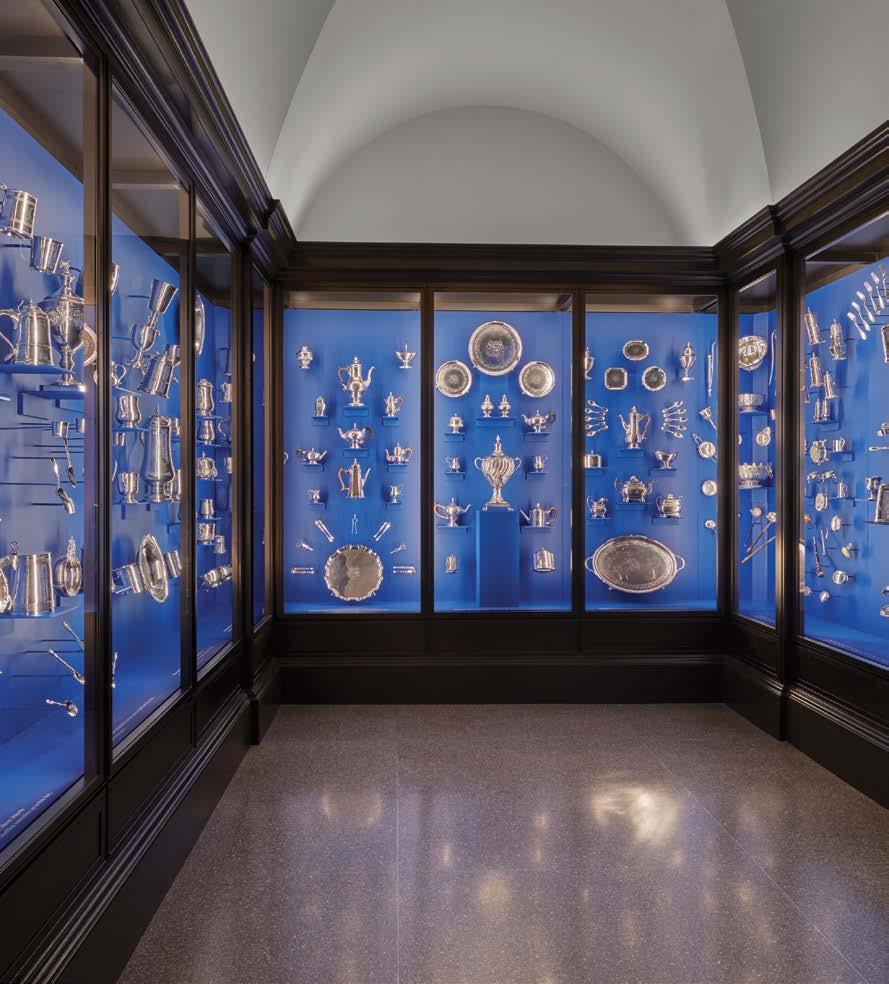
The hands-on design process for this sparkling gallery began with an initial testing and mockup phase. Starting above the display cases, concealed linear LED luminaires brush softly across the vaulted ceiling. The carefully balanced, reflected light provides gentle ambient illumination for visitors.
Continuous linear luminaires concealed within the display cases highlight the silver objects with velvety lines of light at 3000K and 97+ CRI. Special optical lenses produce gentle ribbons of light along the contours of the silver objects. Shadows in the hollow forms fill with cool light reflected off the royal blue interior finish of the casework. This subtle shift from clean, neutral white highlights to cool fill light enhances the perception of form for each unique object.
Just a touch of light brings the silver objects to life, while also providing sufficient horizontal illumination for the interactive, pull-out drawer displays. Each case module, as well as each indirect ceiling component, is individually controlled. This allows for subtle fine-tuning of the lighting levels to create a stunning, yet comfortable, unified whole.
The success of this seemingly effortless installation is largely due to the collaborative nature of the project’s design process: from concept to mock-up to final balancing.
“…created out of reclaimed ocean plastic and we’ve taken this work all over the world. Thank you.”
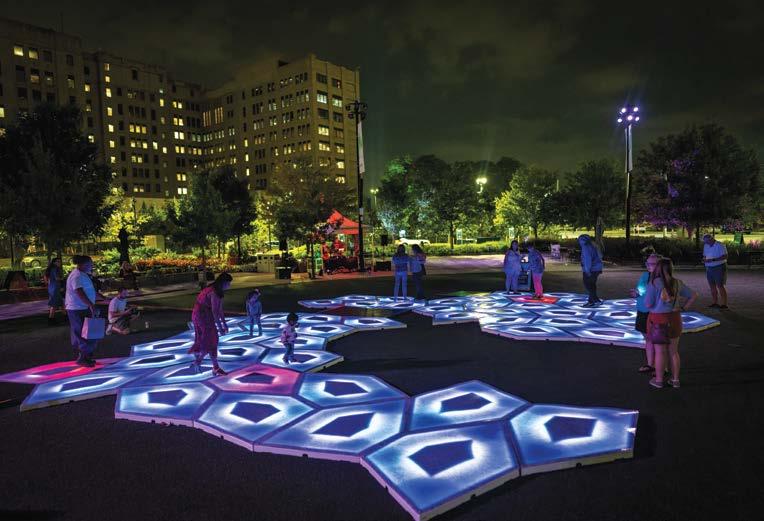
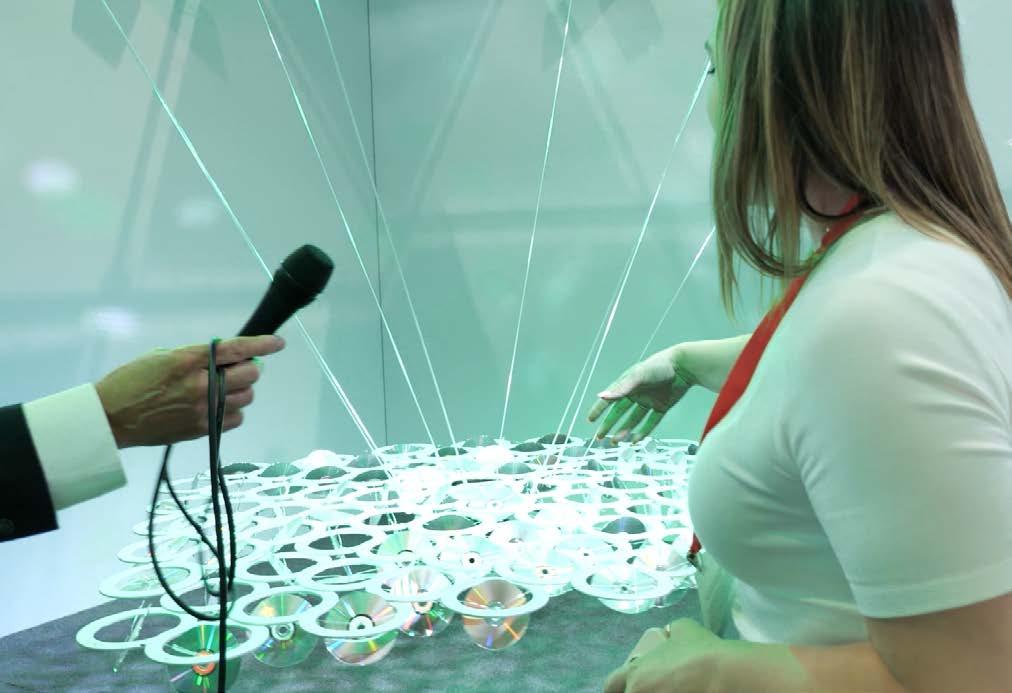
Jen Lewin's interactive art installation, The Last Ocean, sheds light on the crisis of plastic pollution in our oceans, the warming planet, dwindling natural resources, and the need for systemic change.
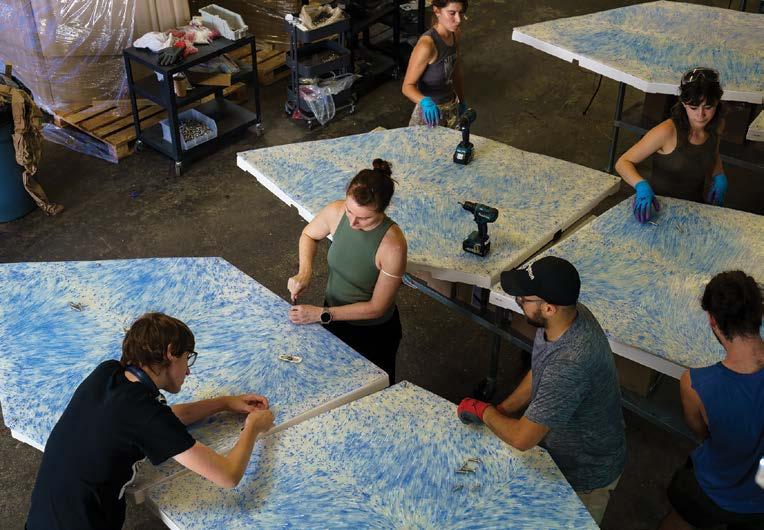
Built by hand in the artist’s Brooklyn studio, the installation features expansive interactive platforms illuminated by community engagement and made from reclaimed ocean plastic. The geometric tessellations form the glacial body of Antarctica, creating a luminescent ice field full of wonder and awe.
Iterations of The Last Ocean installation have transformed public spaces from Sydney to Detroit. Three hundred interactive platforms, at 8000 sqft, comprise hundreds of thousands of LEDs controlled by the artist’s proprietary mesh network technology. As the installation takes shape, it offers a dynamic and evolving experience for those who engage with it.
During the day, the platforms display the transformation of the reclaimed ocean plastic with swirls of blue and white particulates. At night, the installation comes alive with vibrant oscillations that react to the movement of the participants as they splash and dance in the waves of light. The Last Ocean offers a powerful display of the beauty and magnificence of our oceans and reminds us of the need to actively protect them.
Originally an oceanfront residence completed a century ago, this West Coast museum sits atop a steep bluff overlooking the ocean. To find inspiration, the design team looked no farther than the breathtaking views and abundant sunshine.
The project scope added 46,000 sqft of new gallery and event spaces and renovated 28,000 sqft of existing galleries. Unifying old and new, the design team created a cohesive lit environment that harmoniously blends controlled natural daylight with state-of-the-art electric light for a holistic, energy-efficient art lighting solution.
A new glass entrance and playful bookstore welcome visitors. Inside the soaring gallery spaces, daylight apertures were expertly sculpted to harness sunlight in a controlled manner respectful of the art and curatorial requirements. Baffles diffuse direct sunlight for a full-spectrum light source that changes subtly without distracting hot spots.
At the central gallery, translucent ceiling panels backlit by color-tunable sources help balance the room, while the integrated track system highlights artwork. As the building opens at the back, shaded windows frame phenomenal ocean views towards the northwest.
Simulations for various sky conditions informed both the daylighting design and supplemental electric lighting; producing a serene museum environment that retains a physical sense of surrounding sea and sky.
CITATION for
Integration of Daylight and Electric Light
Museum of Contemporary Art San Diego
La Jolla, CA
RENFRO DESIGN GROUP
Richard Renfro, Sarah Randall, Silvia Mazzarri, and Fabio Tuchiya
“Recent advancement in LEDs make them a sustainable tool, there is another source, that has been there all along—the sun!”
ARCHITECTS
Selldorf Architects
Annabelle Selldorf, Sara Lopergolo
Ryoji Karube, Wanda Willmore
LPA Design Studios
Peter Damore, Juliet Crowder
OWNER
Museum of Contemporary Art San Diego
PHOTOGRAPHY
studio MAHA
Steve Aldana
RIYO studios for MCASD
OWNER
Jen Lewin Studio
Jen Lewin
RECYCLED PLASTICS SUPPLIER AND CONSULTANT
Ocean Plastic Technologies
Oliver Nudds
PHOTOGRAPHY
Matt Emmi, Nadir Ali
Charles Aydlett, Tad Philipp
CITATION for Entry and Lobby Lighting
Willis Tower Repositioning
Chicago, IL
KUGLER NING LIGHTING
Ashley Moench, Burr Rutledge, Jerry Kugler, Meryl Sell, Eric Benne, and Jackson Ning II
“We asked the Chatbot for help in accepting an architectural lighting award. It came back with ‘Together let us unite to illuminate the world with the power of light.’”
ARCHITECT
Gensler
OWNER
Blackstone/ EQ Office
SCULPTOR
Jacob Hashimoto
PHOTOGRAPHY
Garrett Rowland, Tom Harris
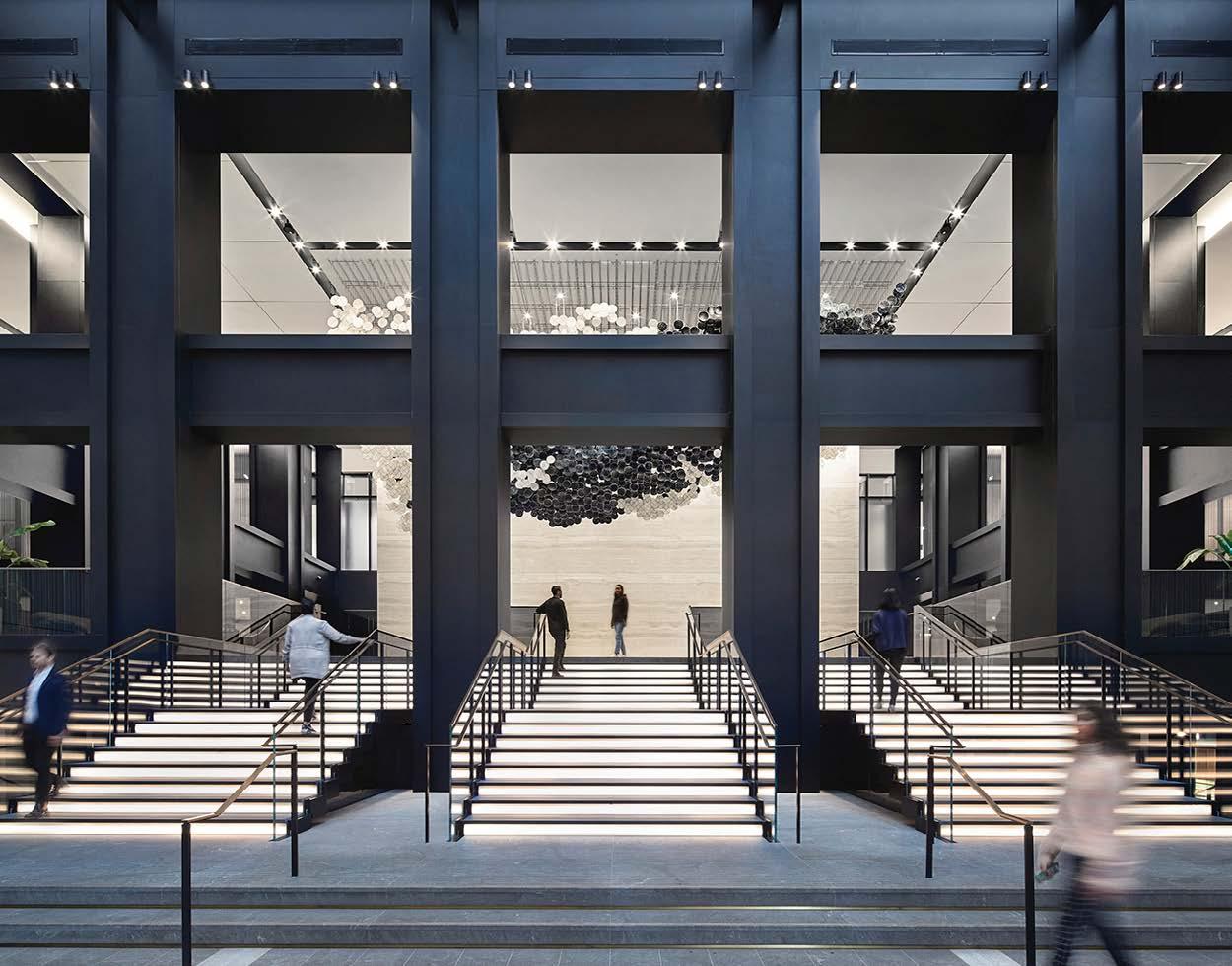
Designed in the 1970s and once world-famous as the Sears Tower, the Willis Tower entrances were imposing and unwelcoming for today’s active urban streetscapes. The entire base of the skyscraper was reimagined to emphasize visibility, transparency, and comfort.
Uplighting a 75 ft–wide terracotta portal frames the new “jewel-box” entrance at Wacker Avenue. In-grade uplighting of the striated terra cotta walls extends into the skylit lobby. Uplighting the white ceiling of the crossing bridge helps ease contrast with the bright outdoor views, and brightens the space on cloudy and rainy days.
Dramatically backlit stair risers ascend through the tower’s exposed structure. Mirror-like reflections from the glass guardrails magnify the visual impact.
The tower’s columns and beams are silhouetted by grazing the original lobby’s travertine core wall, which also creates a dramatic backdrop for a new hanging sculpture. Working closely with local artist Jacob Hashimoto, spotlights are aimed to enhance the depth and texture of thousands of paper-and-resin discs.
The layered lighting design improves visual connections from the streetscape and welcomes tenants and visitors to gather and socialize. All while celebrating the tower’s original glass and metal aesthetic, an iconic feature of Chicago’s industrial heritage.
DMF Lighting’s DRD + M Series features new housings that install more easily and precisely, including flawless wood applications, and new trim colors in Bronze, Warm Diffuse and Clear Diffuse. DMF offers award-winning downlighting systems and superior aesthetics for new construction, remodel, or retrofit projects.
LIGHTING AN Art Deco Icon
Custom lighting pieces were created for 80 Strand’s entry and garden.
VILMA BARR By
Photos by James Newton
Courtesy of Speirs Major Light Architecture
80 Strand is a landmark Art Deco building occupying a prominent position in London on the River Thames between the Strand and Embankment. Built in 1930-1931, the building is located within the Savoy Conservation Area and next to Covent Garden. The objective of the current upgrade was to change the interior from a traditional style of office into a modern, flexible space to suit the building's office tenants and relight its distinctive public spaces.
Speirs Major was invited to redesign the lighting for linked communal spaces that cut through the Grade II listed building. This designation is assigned by the city to “important buildings of more than special interest.” Keith Bradshaw, CEO of Speirs Major, led the firm’s design team. “We drew inspiration from lighting designs from the period and then streamlined and contemporized those ideas, carefully considering how the details would integrate and respond to the unique features of each space,” Bradshaw indicates.
A series of custom statement lighting pieces was created for the interior entry spaces and the garden. “We identified key Art Deco characteristics such as geometric shapes, frames, and grids, and worked with a balance of translucent and solid materials,” says Bradshaw. “The new luminaires reflect the building's heritage and contribute to an elegant and contemporary working environment,” he says.
ENTRY AREAS
Having passed through a colonnade from the Strand into an internal courtyard, workers and visitors enter the building through a dramatic new glass entrance pavilion. Because this entry is surrounded on three sides by the building, minimal quantities of natural light can penetrate this area, and artificial lighting is crucial for a great first impression.
The new, fully glazed entrance pavilion is comprised of angled panels, with a single bespoke overhead illuminated fixture. It leads to the existing double height reception space.
An arrangement of detailed fluted glass and bronze wall lights is followed by a series of suspended grid-patterned light boxes leading to the elevator lobbies. “They are positioned to reinforce the rhythm and geometry of the architecture, to create a welcoming atmosphere and help visually define the different functional spaces, aiding in wayfinding,” Bradshaw describes.
From the lower corridor of the Glasshouse Garden, a colonnade leads out towards the Embankment entrance reception area. Original pendants, refurbished and upgraded, cast light onto the vaulted ceiling to keep this transition area feeling bright and spacious. The entrance area on this side of the building was previously lit with an assortment of downlights and uplights that gave it a harsh yet flat appearance. Now, a handsome light-box ceiling detail delivers a soft and welcoming quality of light.
HIDDEN GARDEN
In the center of the building, in a former light well, the newly added Glasshouse Garden is a flexible breakout space. Landscaping and seating for tenants and the public creates a community hub. Illumination highlights to the planting and uplighting to the facades and green walls create a soft surrounding glow. A hospitable outdoor atmosphere is available for meeting, networking, and socializing.
A LUXURY IMAGE
While the majority of the lighting appears to be delivered by the statement Art Deco luminaires, Speirs Major also added subtle additional lighting to balance the composition and boost the light levels without detracting from the visual impact.
The design team and the building’s owner have expressed pleasure with the way the light looks within the Art Deco heritage of the building while providing a sharper, luxury feel for its new image. “The approach feels naturally harmonious with the heritage architecture and delivers a vibrancy to the environment,” Bradshaw affirmed. ■
New architectural lighting products available for specification
Pure Smart TruColor RGBTW WiZ
PureEdge introduces Pure Smart™ with TruColor™️ RGBTW technology, connected by WiZ Pro. It provides a versatile and customizable lighting solution for residential and commercial spaces. With easy setup and no hub required, you can create unique ambiance using the WiZ Pro Software Suite and Pure Smart™️ Wi-Fi Wall Controls. The lighting system features TruColor™️ RGBTW, offering over 16 million colors and 85,000 tunable white tones (1500K-6500K) with a CRI above 94.
Rollor
Scout Lighting introduces the first tubular style fixture with bi-directional light output, power-over-aircraft suspension and an 8' span between couplers. This is all accomplished with an overall housing diameter just larger than that of a quarter. Continuous runs, patterns, and sconce variants are available. Made in America.
FABRILum Bullnose
Introducing the FABRILum Bullnose luminaires from COOLEDGE™: unique architectural form with straight sides and full radius ends, exceptional acoustic performance, and immersive illumination. High-quality woven polyester fabric diffusers provide high efficacy and value. Available in BNM and BNL sizes with color temperatures of 3000K, 3500K, 4000K and CRI > 92. Designed to enhance the aesthetics and acoustics of various spaces, including lobbies, atriums, indoor plazas, retail areas, and open plan offices.
LeeSti Angle
The LeeSti Angle from archlit is an aluminum extrusion lighting system with proprietary LED boards and a diffuser film. It features programmable drivers for customized outputs and comes in Trim and Trimless versions. The system offers fixed angles (15, 30, and 45 degrees), transparent diffusers for uplight versions, and supports various lumen outputs and loads. The aiming angle can be specified and adjusted on-site, and the system is offered in different nominal run lengths.
LUX Cob Series
Luminus has launched the LUX COB series, featuring COB modules with 90 and 95 CRI minimum for diverse applications. These COBs are available in various sizes, flux densities, and CCTs. The 90 CRI version offers high-quality light with the efficiency of an 80 CRI source, while the 95 CRI version utilizes narrow-band red phosphor technology for outstanding performance. The COBs are expected to assist customers in qualifying for energy efficiency rebates and can be obtained through authorized distributors.
Mag System
The Mag System by Mandalaki is a magnetic battery-powered lighting solution designed for modern, dynamic spaces. It is part of the Halo Edition collection, offering a cable-free and flexible installation. With its anodized aluminum light source and LED technology, the Mag System combines style, quality, and functionality. It adapts to various indoor and outdoor spatial requirements through its magnetic system and intelligent accessories. Available in three versions (Mag, Mag Table, and Mag Floor), it provides maximum versatility. The warm light emitted is dimmable in 4 intensity levels and ensures glarefree comfort. The battery life ranges from 8 to 100 hours, depending on the chosen intensity, ensuring uninterrupted lighting.
FieldSET Field-Programmable LED Drivers
Intoducing the FieldSET Field-Programmable LED Drivers from eldoLED. The FieldSET LED Drivers are versatile replacement drivers that can be easily programmed in the field to replace end-of-life components in various fixture types. With a handheld programming tool, electricians can adjust current levels, dimming settings, and match the performance of the original driver. The FieldSET suite consists of nine driver options, providing an easy stocking solution for distributors, and compatibility with existing OPTOTRONIC drivers simplifies the replacement process.
Acclaim Lighting introduces Terra Linear, a durable walk and driveover-rated lighting fixture for architectural applications. It comes in eight color options and has a driveover rating of 6,000 lbs (2,721 kg) with anti-slip coating and anti-theft security screws. Terra Linear offers various color temperatures, delivers up to 1400 lumens, and provides different beam angles. Powered by Acclaim Lighting's XTR Driver, it supports runs up to 700 feet long and offers dimming options.
Libera, the lighting system launched by iGuzzini at Milan Design Week, offers adaptability to any space without installation constraints. The system's joint allows for a 360° rotation in three planes, enabling customization to various contexts. A single driver can power a 15-meter Libera configuration. Additionally, an opal diffuser optic is available, providing functional lighting when on and an aesthetic appeal when off.
Terra Linear
Libera
There’s
No Business Like Show Business
PALIHOUSE WEST HOLLYWOOD
Heads Back Into the Spotlight
STEFANIE SCHWALB By
Pool lounge.
Photo Credit: Caylon Hackwith
Everyone loves a comeback story, especially in Tinseltown. And when it comes to tales about style and substance, the all-new Palihouse West Hollywood is one worth sharing. Located in the center of Los Angeles along famed West 3rd Street, this 95-room flagship hotel offers boutique luxury hospitality through the eclectic design lens of parent company, Avi Brosh’s Palisociety. The fully integrated hospitality company boasts a portfolio of numerous distinct hotel and residences, including Palihouse, Palihotel, ARRIVE by Palisociety, and several independently branded properties located all across the United States.
And while distinctly Californian, Palihouse West Hollywood also features a hint of Old World, European flair showcased via a range of customized fabrics, patterns, textures, and details found throughout numerous areas. Visitors will enjoy the spacious, pied-à-terre-inspired accommodations decorated with antique pieces, an array of artwork, and custom light fixtures; its two signature dining destinations, the Lobby Lounge Café & Bar designed with eye-catching custom tiles, greenery, and oversized pendant lighting, and Mezzanine Sushi, a lavish Japanese sake bar inspired by Golden Age Tokyo’s hidden eateries; the heated guest-only swimming pool and
"The existing structure consists of two interlocking geometric blocks, and we wanted to take the opportunity to add visual interest to the façade through lighting"
— Cynthia Lee and Oscar Trujillo
indoor/outdoor adjacent lounge; the fitness room; and special event, meeting, and private dining spaces.
The hotel, which originally opened 15 years prior on Holloway Drive as the brand’s first signature property, was shuttered during the pandemic. Now, Palihouse West Hollywood marks its return with a reinvention, reimagination, and relocation, and we connected with Palisociety’s in-house design team—Cynthia Lee and Oscar Trujillo—for some project insights, starting with how the general aesthetic, architecture, and location informed their design and lighting choices. “The existing structure consists of two interlocking geometric blocks, and we wanted to take the opportunity to add visual interest to the façade through lighting,” explained Lee and Trujillo. “Being that the hotel is on the corner of a very transited street, it was important to use lighting as a way to add to the design hierarchy and
aesthetics of the building.” Among those added elements are the branded neon sign signaling the sushi pick-up window, the marquee lights in the porte-cochère creating personable scale, and the frosted globes on the restaurant facade to create a playful beacon, they added. “These lighting elements were curated to enhance the existing building architecture. This same concept extends into the interiors with intentionally selected lighting to create scale and ambiance and attract the eye to each space.”
The scale and ambiance that Lee and Trujillo refer to for the lighting is apparent throughout the property, from the guestrooms to the pool and bar areas as well as Mezzanine Sushi. It’s based on ensuring that the Palisociety’s signature vibe was showcased and consistent in all areas. “Palisociety’s goal is to create a bespoke experience for the guests. In doing so, we source from a small manufacturer out of the United Kingdom that produces oneof-a-kind, handmade fixtures that have a great timeless quality to them,” said Lee and Trujillo. “We also customize certain globe lights by working with a local artist that hand paints the Palisociety ‘P’ on select fixtures.” One of those fixtures appears prominently as part of the welcoming environment visitors encounter when they enter and head towards the front desk.
The pair noted that lighting and choice of fixtures plays a significant part in their design approach. “Lighting is critical to our design and sets the ambiance. It enhances the design
Front desk, with a hand-painted fixture featuring the Palisociety “P.”
Photo Credit: Jakob Layman
Lobby Lounge Café and Bar
Photo Credit: Caylon Hackwith
Mezzanine Sushi overlooking the Lobby Lounge. Photo Credit: Caylon Hackwith
of the space and brings to life finishes and materials,” revealed Lee and Trujillo. “We strive to strike a balance between ensuring the spaces are properly lit and ensuring the output has a warm, soft glow. This is especially important in the evening when people are relaxing and enjoying a meal or hanging out with friends over drinks.”
As for what they look to for inspiration in design and lighting, it’s all about making an impact that can stand the test of time. “Palisociety’s inspiration comes from the desire to create timeless design, and rather than being inspired by current trends, we look for quality craftmanship and products that have a unique design aesthetic,” they noted. “We look to source light fixtures that are appropriate to each space, design, and the brand. We also strive to use a variety of light fixtures too, so that guests get a different experience wherever they look.”
Speaking of seeing that variety, guest experiences at Palisociety properties will continue to expand during 2023 with new hotels and residence openings being added to the company’s roster. The portfolio currently includes properties in California, North Carolina, Oregon, Texas, Tennessee, and Washington, with some additional locales slated to open soon in Florida, New Mexico, and Louisiana—among other destinations. ■
Human-centric lighting is key to healthy workspaces
The connection between human health and effective lighting is strong. Learn how you can differentiate your lighting products.
UL Solutions has developed field measurement and performance services for the consistent testing and reporting of measurable data. See how we can help set your products up for success in the marketplace.
Learn more at UL.com/circadian
LIGHTING CONTROLS:Electrification Offset?
CRAIG DILOUIE, LC, CLCP By
Growing demand for plug-in electric vehicles (EVs) is likely to coincide with the significant adoption of EV charging stations in commercial buildings. If true, the economics of lighting upgrades may change, putting all energy efficiency options on the table, including those previously limited by payback thresholds.
Carbon reduction is a national priority. The Biden Administration has made carbon reduction a national priority as a means to mitigate global climate change. In 2021, it set a goal to cut carbon emissions (from 2005) levels by at least onehalf by 2030. This is reflected in the Inflation Reduction Act of 2022, arguably the largest climate legislation in history.
Policies of interest include a transition to clean energy, replacing fossil fuels with electricity in the building and transportation sectors (commonly called “electrification”), and ensuring sufficient EV charging infrastructure, all of it requiring a massive balancing act.
EVs sales are projected to surge in a relatively short time span. A significant contributor to national carbon reduction will be the electrification of transportation. That is, displacing fossil fuel-powered vehicles with electricpowered vehicles that produce zero tailpipe emissions.
Global consumer demand for EVs increased from 0.2% in 2011 to 4.6% of new vehicle sales in 2021, according to the International Energy Agency. Research firm Fortune Business Insights forecasted the U.S. EV market to grow from about $28 billion in 2021 to $137 billion in 2028. S&P Global Mobility projects U.S. EV sales may reach 40% of total new passenger car sales by 2030. Significant federal and state tax credits are available to defray the initial cost of EVs and hybrids, and a number of states are implementing zeroemission standards. As the world’s third-largest producer of EVs, U.S. EV manufacturers stand to benefit from this transition.
EVs need infrastructure to keep them powered. EVs are powered by batteries that energize one or more electric motors. In most cases, they can be charged anywhere
electricity is available (depending on charging level and voltage) via a charging station, and they can be charged anytime, usually at a lower cost than gasoline.
The tradeoff is charging time. Whereas a fossil fuel vehicle might take 5-10 minutes to tank up, an EV can take 15 minutes to 24 hours to charge. The resulting lower utilization rate of electric fueling stations will likely lead to fuel being delivered using a distributed model, in contrast to today’s more centralized gasoline fueling stations. To facilitate this transition, the Department of Transportation approved plans from the states (plus Washington, D.C., and Puerto Rico) to build a national EV charging network.
Providing this infrastructure is considered critical to EV adoption. While charging at home is common in the U.S., availability of workplace and public chargers is also highly important for accelerating EV adoption, according to the International Council on Clean Transportation.
Commercial buildings may incorporate EV charging infrastructure. Electrification is expected to impact the building sector, such as replacing residential heating systems with electric or hybrid units. A significant impact, however, will be commercial buildings that add EV charging on their properties. A commercial building may do this due to government mandate (as in the case of public buildings), as a potential source of revenue, or as an amenity. Various incentives are available such as government and utility rebates.
The cost of adding EV charging stations to a commercial building may be significant, however. Besides taking advantage of incentives, building owners have further incentive to minimize the amount of new infrastructure required.
Reducing energy consumption may be cheaper than adding electrical infrastructure. Finally, we get to the crux of the argument – the growing adoption of EVs may lead to greater demand for energy efficiency by altering the underlying economics. In short, optimizing energy efficiency can mitigate a portion of demand for new electrical infrastructure. In fact, the cost benefits may make options like networked lighting controls far more economically attractive both in new or existing construction projects. Though the energy savings for advanced lighting controls are often variable, they can be calculated or measured to establish a typical load profile. Additionally, electrification will place significant strain on the existing power grid, which may increase rates, result in new generating capacity among renewables, and stimulate utilities to commit to incentivizing efficiency more deeply.
To vet this hypothesis, Peter Brown, LC of Lighting Transitions; Gary Meshberg, LC, CLCP of Legrand; and C. Webster Marsh of Penumbra Controls and Boston Illumination Group presented a seminar on the topic at LightFair 2023.
Marsh pointed out that the additional power infrastructure can pose a major investment. “Not all charging stations are created equal,” he said. “Some require very little power but take a long time to charge an EV. Others may require immense amounts of power but will charge much faster. This would not only increase the electrical demand of the property but also require additional power infrastructure to support it.” Infrastructure that can impose a significant cost.
A mitigating factor, Marsh pointed out, is what he, Brown, and Meshberg call electrification offset, or reducing electrical demand to compensate at least in part for the new demand of electrification. If an energy efficiency measure reduces both the cost of adding infrastructure and generates ongoing energy savings, it becomes more viable for investment by potentially offering a greater return.
“By adding an NLC that can help compensate for the increased demand for new EV charging stations, you’ve saved the time and money that would otherwise be required to add more infrastructure to the property,” Marsh said.
This by no means suggests that lighting is a panacea, providing a perfect offset. Rather, the point is the value of lighting efficiency is likely to increase as a mitigating factor as every energy efficiency measure—from advanced lighting controls to HVAC and building envelope improvements along with data and programmability—becomes worthwhile to consider.
Lighting has long been a keystone for improving commercial building energy efficiency. Naturally, this includes traditionally low-hanging fruit such as replacing legacy lighting with LED systems. Incorporating the cost savings of electrification offset, however, potentially puts more aggressive energy-saving options on the table such as space-individualized lighting design, networked lighting controls, and plug load control. These are options that may have been eliminated in some retrofits due to insufficient ROI but now may become major contenders as the value of the energy savings increases due to the value of the electrification offset.
NLC and plug load energy savings may be significant. According to the Department of Energy, lighting’s share of an average commercial building’s electrical energy consumption was 12% in 2018. Plug loads, meanwhile, are estimated at 16+% and are projected to increase to 21% by 2050.
According to a 2017 DesignLights Consortium study of more than 100 buildings, networked lighting controls can deliver an average of 47% lighting energy savings, equating to roughly 6% of average buildingwide electrical energy savings barring the existence of any other lighting controls. Meanwhile, automatic receptacle control can reduce plug and process loads by 20-50%; assuming 30%, this translates to 5% average buildingwide energy savings.
Adding the two, we get 11% electrical energy savings, mitigated by existing adoption of lighting controls in the installed base for a rough net estimate of 8-9%.
Obviously, this is all back-of-the-envelope analysis, and as the concept is in an early vetting phase, that’s okay at the moment. The goal is to generate dialogue.
Though early days, the lighting industry can take steps to prepare for possible realization of this trend. Lighting professionals can benefit by considering electrification a potential business opportunity.
Learn more and share with clients. Stay on top of EV adoption, adoption of charging stations in your area, and the
Automatic Receptacle Controls: What they are and why they should be commonplace in building energy codes.
most energy-efficient lighting options such as networked controls. Keep abreast of rebates for EV charging stations and energy-efficient lighting and controls, particularly the new generation of rebates promoting adoption of networked controls. Be prepared to engage customers about their options for an integrated approach to minimize costs. Even if they have already adopted some energy efficiency measures, it may be lucrative to upgrade the lighting system with comprehensive state-of-the-art design, lighting, and controls.
Stay informed about mandates and penalties. Some municipalities like New York are starting to implement carbon reporting requirements and penalties, adding another factor to ROI. Be aware of any such changes in your area and advise customers about them and their options ahead of time. Understand the potential role that data generation can play in helping buildings minimize emissions.
If networked controls are already installed, help the client use them. Networked lighting controls offer the potential
for global programming, complex sequences of operation, integration with other building systems, and detailed data about energy consumption. Clients would benefit from tuning the system to optimize energy savings, using measures ranging from space-individualized institutional task tuning to shortening occupancy sensor timeout settings.
Look at other opportunities. Installing EV charging in a parking garage may offer opportunities to evaluate garage lighting and optimize it for visual comfort and energy efficiency.
The future is electric. Electrification in response to policies and trends promoting decarbonization will likely have an impact on demand for electric power at commercial buildings. As utilities and building owners evaluate the costs of building new capacity, the value of reducing demand through energy efficiency is likely to increase, potentially increasing the value of the most energyefficient options such as networked and other advanced lighting control solutions. ■
The brand-new Mosaic Bell combines tunable white, color mixing, and high CRI in one sleek package. Suitable for museums, retail, theaters, and theme parks, it features tunable white from 16508000K at 90+ CRI plus rich blues, ambers, reds, violets, and greens. Interchangeable reflectors allow beam angles between 10° and 60°. Accepts multiple accessories.
UPSTAIRS DOWNSTAIRS
DAVID K. WARFEL By
Final installment in David Warfel’s Lighting Hope at Home series.
Of all the moments of discovery, connection, and understanding provided at LightFair this year, none stirred my emotions or challenged my thinking as deeply as the fifty minutes allotted to the Light + Justice conference session. Led by Edward Bartholomew, Mark Loeffler, and Lya S. Osborn, the stunning power of the presentation still has me reeling. Their session landed with perfect timing as I prepared to write this, my sixth and final article in my Lighting Hope at Home series.
I intended to write about lighting hope for all of us, a call to arms to democratize good lighting especially in our homes. Edward, Mark, and Lya shook up my thinking and clarified my focus. We do not need to change the way we light at home because it would be better. We need to change what we are doing because we need to provide light justly.
UPSTAIRS/DOWNSTAIRS
A few years ago my wife and I streamed our way through the entire Downton Abbey series, finally taking in what millions had already enjoyed. The series focuses on wealthy English nobility in the early twentieth century and the many servants that make their sizeable estate function. It falls into the category sometimes described as upstairs/downstairs stories, a dual focus on the wealthy living upstairs and the working-class toiling in the basement. The Light + Justice session caused me to see that I, as a lighting designer, support a modern version of the upstairs/downstairs duality cleverly disguised as “frontof-house/back-of-house.”
Simply put, upstairs or front-of-house lighting is designed to exceed code and provide something more, something beautiful, a best-possible experience for the occupant. Downstairs or back-of-house lighting is laid out to minimize
energy usage and installation costs, thereby enabling economies of scale that minimize investment and maximize financial returns. This certainly occurs today in the homes of the ultra-wealthy, but that is not the only place it exists.
Inside the walls of the production-built home, you will find very little architectural lighting. What is included is likely to be disk lights and a few trendy (but often poorly functional) decorative pendants. Thousands and thousands (millions, really) are built every year in this style. The entire house is “downstairs.”
Outside, neighborhoods for the advantaged are more likely to have strict lighting ordinances that protect beneficial darkness, minimizing light pollution and trespass. The results can include better sleep, better health, and more natural beauty. Across town, the disadvantaged live surrounded by higher levels of light pollution that threaten sleep and all but obliterate the stars. We know now how important darkness is, but only a select few can enjoy it.
This series is about residential lighting, but I have also designed numerous commercial, institutional, and hospitality projects that embody the same unjust treatment. I have designed restaurants where the people who spend the most money and the least amount of time have the best lighting, while those that may work a ten-hour shift lack any natural light and work beneath the cheapest possible artificial light. I have done schools where the entry hall, commons area, and maker spaces have great lighting, yet the classrooms barely get by. I have walked through many hospital lobbies beneath $15,000 pendants and walls of glass and watched as the nursing staff works underneath $50 fixtures without a window in sight.
We are doing harm, and it is time to stop.
WHY SHOULD WE CARE?
This morning as I sat talking to my partner over coffee, I shared a bit of what I was hoping to say in these pages. She helpfully pointed out that not everyone wants to help the poor, and that should be okay. I agree. This is not really about helping the poor; it is about helping everyone, rich or poor, by opening our mysterious profession and making good lighting more accessible for all.
Why should we care about light and justice at all? If we collectively support the scientific discovery of the last few decades, then we believe that too much light at night and too little light in the daytime causes harm, even shortening lives. Many of us believe that human productivity and well-being can be negatively affected by the wrong light. Many of us believe that too much light is contributing to planetary degradation. Many of us believe that light can help us heal faster, or score higher on tests, or reduce the symptoms of aging. If these are true, then they are true for everyone on the planet. That is reason enough for us all to care about helping others with
light. But, we may need to take a hard look at ourselves and our industry and join a dialogue for meaningful change.
CONFLICT OF INTEREST: OF WHOSE INTEREST?
When I entered the lighting design profession several decades ago, I absorbed what seems to be a central tenet of our industry: lighting designers should profit only on their expertise and time, never on product. As I understand it, prohibiting ourselves from selling fixtures avoids the potential of mistrust with the public. I was – and still am – proud to tell my clients that they can trust me because it makes no financial difference to me if I specify one ten-dollar fixture or one hundred hundred-dollar fixtures. On the surface, this is a solid requirement to protect the value of our profession and the integrity of its members.
Yet, this belief may also strengthen the divide between upstairs and downstairs, between the advantaged and the disadvantaged. A designer abiding by this rule can only really help those with the means to pay a consultant, and that dramatically restricts the designer’s client list. Of course, a designer could choose to donate their services in a pro bono fashion, but this relegates the receiver to the charity column. Justice, at least as I understand it, is not about charity. It is about equity.
If a designer decides to profit from the sale of the fixtures, which is likely the only revenue stream available in lighting for lower-cost projects, they may be shunned by the profession. This model is still relevant and viable – indeed, it is how our company survives – but it may be time to look for a third way between elite work and charity.
THE SOLUTION: THE END OF OUR PROFESSION?
Lately, I have been toying with an unusual ten-year professional goal: obsolescence. We often hear clients say, “We love the new lighting in our home,” but, in this case, I also want to hear, “And we did not pay you a dime for it.” As I mulled the Light + Justice tenets in the weeks after LightFair, it occurred to me that true equity in light could only be achieved when the disadvantaged have access to great lighting. In our current economic structure, this can only happen when it is free or extremely low cost.
Our company’s studios will design lighting for several hundred homes this year, nearly all of which will be for clients with significant means. Some of our projects will be enormous, some will be small, some will be average, but all will be high-dollar projects compared to the vast majority of homes built or remodeled this year. As a team, we spend time puzzling over the
disconnect between our desire to help others and the financial realities of lighting design practice. We blog about plug-in solutions, brainstorm solutions for production builders, and help out with lower cost services. While two hundred homes is a large number of projects for a residential lighting design team, it is insignificant compared to the million homes that will be built in the United States this year, the five million homes that will change hands, or the two hundred million homes currently occupied. Multiply that by all the countries in the world, and our efforts are completely inconsequential.
If we want to help millions, lighting designers have to get out of the way. To get out of the way, we have to engage the public, simplify the process and product, and build a new revenue model.
ENGAGE THE PUBLIC
A recent candidate for an open lighting designer position with our company said, “I realized that to be in lighting meant to be in education.” She knew from experience that lighting is not a known entity in the world, that she would have to inform and educate her clients so they would make better decisions about light in their projects. Many of us find this to be true – our presentations include justifications for our work like photometrics, educational slides discussing color temperature, and examples of glare or poor uniformity ratios. We are, essentially, educating the eight billion people on the planet one client at a time.
If we are to provide better lighting for all homes, we need to be where the average consumer learns. We need to be on their screens. Our industry is measured in tens of billions of dollars every year; a ten-episode season of a lighting television show would cost around four million dollars to produce and air. This is less than a hundredth of a percent of our annual revenue. We have the means to engage and excite the public. Do we have the collective willpower to change the conversation one million clients at a time?
SIMPLIFY THE PROCESS & PRODUCT
It will not be enough to simply show the world that better light is possible at home. We also have to make it easy to plan, purchase and install. That means the profession of lighting design needs consumer-facing alternatives that are simple enough to enact without us. That means that products have to be available that are affordable, easy to install, and function better than the commodity products we currently sell. That means good lighting has to be achievable on a small budget and tight timeline. That means that good lighting must be possible without hiring an electrical contractor to redo hundreds of millions of existing homes.
Perhaps we could create a guide to lighting a new home that any homeowner, builder, or electrician can use to upgrade light.
Perhaps we could bring out a system of wide-range tunable white products that come with preset scenes that work together out of the box, with wireless scene buttons, that do not require a smart phone to operate.
BUILD A NEW PROFESSIONAL MODEL
The solutions proposed by Bartholomew, Loeffler, and Osborn include providing daylight and views to those who live and work in lower-cost housing, investing in electric light equally throughout projects, seeking low-bid public projects for our practices, recognizing and celebrating projects that fight injustice in addition to the showstopping big-budget projects, and investing in local organizations and our neighbors. I think we could also reinvent the entire revenue model.
Perhaps we need a package that costs $200, illuminates an entire room, comes with step-by-step design instructions, and pays a designer $10. Multiply it by a million homes and we have a good business. Multiply it by a hundred million homes and we can employ an entire industry.
LIGHTING HOPE AT HOME
Over the past twenty years, our industry has witnessed a technological revolution and unprecedented scientific discovery. We have the tools and knowledge to deliver better light than at any other point in human history. Yet lighting at home, despite getting brighter and more efficient, is not getting better. It is arguably getting worse. We can work together, not towards a brighter future, but towards a better future, for all of us. But, we need to point our industry in a new direction to get there.
Is there hope for lighting at home? Only you can answer. ■
Bartholomew, Loeffler, and Osborn call for 1) prioritizing daylight and views, 2) investing in electric light equally, upstairs and down, 3) seeking low-bid public projects to support, 4) recognizing and celebrating light justice projects, and 5) working locally to deliver hope at home.
BRINGING CONCEPTS TO LIGHT
How Helping Lighting Specifiers Has Changed
The inherent foundation of the lighting agency is to bring to the specification community both the experience of light and the strengths of the lighting manufacturers represented.
MIKE HAMILTON By Visionz Inc.
Sleek linear lighting by Mojo Illumination achieves the designer's concept to suggest the rungs of a ladder for this main atrium of the City of Brampton's Fire Headquarters. Photo Credit: Mike Hamilton
The ever-changing atmosphere around us has dramatically affected how we lighting agents go about supporting the lighting specification community in ‘bringing concepts to light.’ The inherent foundation of the lighting agency is to bring to the specification community both the experience of light and the strengths of the lighting manufacturers represented. There are many factors that impact the changes in this process. Nonetheless, agencies and manufacturers continue to adapt and find new ways to assist lighting specifiers.
Gone are the days of large catalogues being printed and distributed on a regular basis. Many would say that the reduction in printed catalogs is a great step toward a greener future. However, it has taken a toll on the ability of manufacturers and agents to deliver information to the specification community.
Many have embraced the reliance on manufacturer websites to provide the latest, most accurate product features and specifications. This works well for the seasoned lighting professional, but what about the next generation? Those specifiers who have not had the hands-on time to build their knowledge and experience with products are forced to either stick to the tried-and-true specifications of the past, based on historical training they have gotten, or to take risks trying new methods to locate quality products.
Gone are the days of key lighting agencies and manufacturers occupying large sections of shelf space in a specifier’s office library. That form of marketing and promotion has taken a large step back. Dominance was once felt when one was offered more space or access to leave samples behind. We have transitioned to spaces with less room to store the outdated materials of past. Modern digital libraries are everchanging and difficult to manage. Many lighting specifiers have struggled greatly with the task of organization and access to digital lighting resources.
Gone are the days of emailing spreadsheets that were created to help teams communicate lighting and product schedules.
These functions have been digitized, primarily with software companies such as Sourcery. Providing centralized and streamlined access to digital catalogues, curated product collections, and advanced project collaboration tools makes the new age of digital specification and learning possible. There are several software manufacturers who have taken steps to create platforms worthy of attention and support. As these evolve, they may become the most effective way for the lighting specifier to access product specifications and project collaboration tools.
‘Bringing concepts to light’ in the modern day does have some similarities to past ways. Projects such as ‘Williams Parkway Fire’ came together with the trust of the architectural team at Salter Pilon Architecture Inc. A mixture of digital marketing from manufacturers and agents, coupled with the lighting agency team at Visionz Architectural Products, aided the Salter team in ‘bringing concepts to light’ for the feature lighting in this space.
The need to educate our younger specifiers is becoming increasingly important. As less time is spent in school on elements of lighting and product specification, this digital world tends to cloud the factors behind good lighting and how to properly specify fixtures. The developed relationship with the lighting agency community and lighting specifiers has always helped specifiers learn more. We need to continue finding ways to engage and support these important relationships with our younger specifiers.
Embracing digital marketing, website data, and the creativity of the agency teams is key to the creation and specification of standard and custom lighting products that ‘bring concepts to light.’ With the changes in how new information is delivered, the lighting agent is an important source of support for the specification community. There will be adoption of digital technology and the development of industry-leading software systems. As the learning environment continues to evolve, it is our responsibility to ensure that future lighting specifiers have what they need. ■
Acoustic triangles work within the "rungs" of linear lighting to provide sound attenuation and present an artful feature for the busy new Williams Parkway Fire Campus. Photo Credit: Mike Hamilton
Sh w Stars of the The
PARKER ALLEN By
LightFair 2023 is in the books, and one of the highlights of the show was a brand new experience, the Immersive Lighting Installations. The IALD curated seven light art installations that focused on the circular economy. These installations were exhibited around the show floor and aimed to “provide attendees with an unforgettable, experiential journey of discovery.” Each exhibit was the product of a collaboration between a manufacturer and a lighting design firm.
The process began in November 2022, when interested architectural and commercial manufacturers submitted a vision statement for their installation to “tell a story of partnership, collaboration and possibilities around the theme of Circular Economy.”i LightFair and IALD selected manufacturers from the field of applicants and paired them with a lighting design firm. The rules were fairly simple – installations were confined to a maximum 15’ x 15’ x 10’ cube of space, utilizing only 1500W and one 6-outlet power strip. The teams were given a budget of $2,000, not including the cost of the lighting equipment. Though not specified, each team designed and constructed their installation using as many reusable and recyclable materials as possible, staying true to the theme.
In the afternoon of the first day, participating teams gathered and presented their installations. After the presentations, a panel consisting of Monica Luz Lobo, Ron Kurtz, and Paula Ziegenbein evaluated the exhibits for “conceptual clarity, collaborative presentation and thematic execution.” The winning team received a trophy, show recognition, and a free booth (manufacturer) or diamond passes (lighting designer) to the next LightFair.
Let’s take a brief tour of the installations and a special look at the winner.
ACTIVATE THE CIRCULAR ECONOMY
The Activate the Circular Economy installation was likely the most fun to construct, given the approximately 2,320 wine stoppers needed for the cork shades. Manufacturer Lamp and design firm One Lux Studio LLC tested their creativity to create the nature-inspired circular installation composed of 55 cork shades, each fitted with a custom light composed of reused materials. Plants from the One Lux Studio office accent the installation, connecting attendees with nature. “The only single-use item in our installation,” the team explained, “is the light bulb. Something we should all be thinking about…”
Activate the Circular Economy by One Lux Studio LLC and Lamp.
Photo Credit: Parker Allen
Wes Lane, Director of Product Management at Experience Brands USA, speaks with Randy Reid about the Activate the Circular Economy installation.
LESS, PLEASE
Lights from ERCO, positioned behind a podium containing e-waste, illuminate blue skies on the umbrellas. Attendees were provided with a wireless switch from Casambi that allowed them to turn off the lights by pressing the "Less" button, actively reducing light pollution. With the installation, the team issued a challenge to the industry, “We call on our fellow designers and manufacturers to strive for less, please.”
OUT OF THE (LIGHT) BOX
“Immersive” was the key word here, as attendees could step away from show floor chaos and into the serenity of the installation. In an effort to create a “harmonious blend of traditional and modern elements,” bamboo and hemp, combined with exposed copper circuitry, created the frame of the installation. Shining through shoji paper, LEDs provided a soothing, uniform light that surrounds the spectator. The team added reflective surfaces in the interior to “prompt viewers to reflect on their own relationship with sustainability.”
Less, Please by Arup, ERCO, and Casambi.
Photo Credit: Parker Allen
Out of the (Light) Box by The Lighting Practice and Cooledge Lighting.
Photo Credit: Parker Allen
Clara Powell, Regional Sales Manager at Cooledge Lighting Inc., gives Randy a tour of Out of the (Light) Box.
Peter Augusta, Casambi’s VP of Sales in North America, discusses Less, Please with Randy.
THE IMAGE LEFT, BEHIND
Like the previous display, The Image Left, Behind invited spectators to step away from the show floor and into a perception-altering space. Colored mirrors played on the visual and spacial perception, creating a sense of infinitude. The exhibit was not just immersive, it was interactive. The “flower petals” were made of 100% recyclable PET, and the installation evolved over the course of the three days as attendees added petals to the growing chains. Several attendees were even spotted wearing the petals on their LightFair lanyards. Every component was repurposed or recycled after the show. “In the end,” the team explained, “only the image is left behind.”
NET TRANSFORMATION
One of two installations to take this semicircular arch form, the message of this exhibit is in its title – transformation. Repurposed materials that would otherwise have been destined for the landfill are used to make the frame, which is illuminated by color-changing LED strips from Boca Lighting. The team left spectators with an inspiring message –“Everything can be transformed into something more.”
The Image Left, Behind by Fisher Marantz Stone and Focal Point.
Photo Credit: Parker Allen
Net Transformation by CM Kling + Associates and Boca Lighting and Controls.
Photo Credit: Parker Allen
Lighting designer Zachary Pearson of Fisher Marantz Stone explains The Image Left, Behind.
Randy visits Net Transformation.
RENEWAL
This was the third exhibit to create a space almost completely secluded from the surrounding show floor. Renewal took a unique approach, focusing on connecting with human nature. The CDs in the levitating disk evoked feelings of nostalgia while providing the perfect material to reflect the light from above. Color shifts and background music further stimulated one’s senses. The team invited the user to “renew and reinvigorate their human spirit as a counter-balance to the discord and overstimulation of today’s world.”
And the winner is…
SEEDS OF LIGHT
The idea came to Cy Eaton, a member of the manufacturing team from Traxon e:cue, while he was riding the train. He worked quickly to submit an application, and, in January, Traxon was paired with Tillotson Design Associates. “We were familiar with Traxon but hadn’t worked extensively with them,” explained Erin Dreyfous, who led the team from Tillotson.
Renewal by HLB and Lumenpulse.
Photo credit: Parker Allen
Marie-Pier Jodoin, Communications and Events Manager at Lumenpulse takes Randy inside Renewal.
Members of the Seeds of Light design team pose with the trophy after winning the inaugural competition.
Photo Credit: Tillotson Design Associates
David Brooks, head of Traxon e:cue North America, speaks with Randy about Seeds of Light. The installation would be named the winner later that afternoon.
The familiarity quickly blossomed into a creative partnership. They had to work quickly – Traxon manufactures its products in Hong Kong, and the team only had 4 months to develop the installation. This ruled out any customization or modification of the products. The Tillotson team familiarized themselves with Traxon’s range of products and settled on their dot system with mesh mounting for the installation.
The installation was a true collaboration. Dreyfous pitched the idea of creating a tunnel with reflective flooring. To create the tunnel, Eaton had the idea to repurpose the skeleton of a greenhouse, upon which the mesh and dot system were mounted. The final touches were the extruded petals – 4,000 of them in 40 different patterns, hand cut by the Tillotson team using plotting paper from their office.
Traxon worked diligently over the course of two days, starting the Friday before the show, to set up the structure and lights. On Sunday night, the team from Tillotson began the laborious process of installing the petals. The designing lighting (dl) booth was fortunate to be positioned right across the aisle, and I watched in awe as the exhibit came to life, petal by petal.
Time-lapse video of the creation of Seeds of Light Courtesy of Tillotson Design Associates
ambitious and stunning final result captivated spectators. Show attendees flocked to the Seeds of Light over the course of the three days. Dreyfous noted that they have been contacted about exhibiting at other shows this year, including IALD’s upcoming Enlighten Europe in Berlin. The team made certain that “all components are easily collapsed, packaged, and shipped for future destinations,” ensuring that Seeds of Light will live on.
A round of applause for all participants for creating a truly special experience. Congratulations to Traxon e:cue and Tillotson Design Associates for their award-winning installation, and a special thank you to Erin Dreyfous for speaking with me about their project.
Seeds of Light by Tillotson Design Associates and Traxon e:cue. Photo Credits: Tillotson Design Associates
Seeds of Light by Tillotson Design Associates and Traxon e:cue.
Photo Credits: Tillotson Design Associates
Seeds of Light by Tillotson Design Associates and Traxon e:cue.
Photo Credits: Tillotson Design Associates
NEOCON IS BACK AT THEMART
Koncept’s Yurei Light and BuzziPebl Light Pick Up Top Honors
By
STEFANIE SCHWALB
Art on THE MART
Photo Credit: Stefanie Schwalb
Since 1969, NeoCon has been a leading platform and essential event for the commercial interiors industry. Held over three days annually at THE MART (formerly The Merchandise Mart) in Chicago, attendees—which include architects, dealers, designers, end-users, design organizations, manufacturers, and media—get a frontrow seat to the latest and most innovative products and services from approximately 500 emerging and leading companies in the space. Educational sessions, workshops, tours, experiences and activations, awards programs, influential speakers, plus a host of engaging events take place over the course of NeoCon.
One of the experiences and activations this year is a specially commissioned digital installation for Art on THE MART, the largest permanent digital art projection in the world, which projects contemporary artwork on the south façade of THE MART. For NeoCon 2023, the abstract video piece—Building Light—was created by Gensler’s Chicago brand studio led by Anna Nelson and Franklin Guttman. It delves into themes of change, discovery, and urbanism via four abstracted and timelapsed vignettes and focuses on optimism and wonder. Building Light addresses what design can achieve for communities and its ability to identify creative solutions for society’s largest challenges. In addition, an original soundscape—which accompanies the installation—was composed by Andy Chugg and Nick Dooley of Gilded Audio. Projecting nightly from 9-9:30, Building Light runs from June 8 until September 13.
recognizes exceptional new products from exhibitors in a variety of verticals. For 2023, BuzziPebl Light—inspired by the smooth shape of a pebble—won the Silver Award for decorative lighting. Featuring an LED light strip on the back, this acoustic lighting solution provides accent lighting to any desired space (bar, office, lounge, reception, or restaurant) while simultaneously producing luminous surroundings. Whether ceiling-mounted, ceiling-suspended, or wall-mounted, BuzziPebl comes in two shapes and three sizes. Its acoustic element is designed with BuzziSpace’s signature high-performance foam, which is upcycled into new raw materials and used for a range of purposes. It can also be upholstered in several high-quality fabrics.
Another highlight of the event was the Best of NeoCon. Since 1990, this official awards program
For task lighting, Koncept Inc.—which celebrated a new, first-time showroom at NeoCon—took home the Gold Award for its innovative and versatile Yurei Co-Working Light. Ideally suited for shared spaces (co-working spaces, libraries), this adaptable lighting solution includes the ability to share lights and USB-C power for device charging, which promotes efficiency, productivity, and a sense of community for users. Yurei Light comes in matte black, matte white, and silver finishes. Its minimalist design blends seamlessly into any interior and comes with an optional light shade available in seven different finishes. Meanwhile, the light’s dimmer and heightadjustable features offer exact control of light intensity for optimal working conditions, and it’s available in several mounting choices including desk clamp, free-standing spaces, or table-mount. When utilized with an acoustic panel, Yurei Light can assist in diminishing unwanted noise, and with more than 95% recyclable materials, the sustainable design is perfect for any organization seeking to minimize its environmental impact. ■
Koncept’s showroom at NeoCon Coutesy: NeoCon
BANFF, CANADA | 2 - 4 NOVEMBER 2023
BANFF, CANADA | 2 - 4 NOVEMBER 2023
BANFF, CANADA | 2 - 4 NOVEMBER 2023
O u r m i s s i o n i s t o p r o v i d e t h e l i g h t i n g
c o m m u n i t y a n i n c l u s i v e a n d o p e n e n v i r o n m e n t
f o r p r o f e s s i o n a l a n d p e r s o n a l g r o w t h b y
o f f e r i n g n e t w o r k i n g , m e n t o r s h i p , a n d
k n o w l e d g e s h a r i n g W o m e n i n L i g h t i n g +
D e s i g n i s o p e n t o a l l w o m e n a n d t h e i r a l l i e s ,
c r e a t i n g a s u p p o r t i v e a n d s a f e n e t w o r k f o r a l l ABOUT WILD
D I V E R S I T Y E Q U I T Y
I N C L U S I O N + R E S P E C T
c e l e b r a t i n g t h e d i v e r s e
i n d i v i d u a l s w h o c o n t r i b u t e t o
t h e l i g h t i n g c o m m u n i t y t h r o u g h
W I L D ’ s p r o g r a m m i n g a n d
c o m m u n i c a t i o n s , t o b r i n g s e l f
a w a r e n e s s a n d e n h a n c e
c o m m u n i t y a w a r e n e s s t h r o u g h
e d u c a t i o n , a n d t o f o s t e r a s e n s e
o f b e l o n g i n g
L A M P L I G H T E R C O A L I T I O N
NATIONAL AND LOCAL PRESENCE OUR CHAPTERS
a t l a n t a - a u s t i n - c h i c a g o - d a l l a s f t . w o r t h -
d c , m d , n v a - d e n v e r - d e s m o i n e s - d é t r o i t -
h o u s t o n - l o s a n g e l e s - n e w j e r s e y - n e w y o r k
c i t y - p h i l a d e l p h i a - p o r t l a n d - s a n d i e g o - s a n
f r a n c i s c o - s e a t t l e - s t l o u i s - t o r o n t o
p r o f e s s i o n a l e n v i r o n m e n t s .
M E N T O R S H I P
c r e a t i n g c o n n e c t i o n s t o s h a r e
r e s o u r c e s a n d l e a r n i n g t o h e l p
o u r m e m b e r s e x c e l
P A R E N T R E S O U R C E G R O U P +
LIGHTING AWARDS COMPETITION
IES Illumination Awards
FINAL SUBMITTAL DATE
AWARD RECIPIENT NOTIFICATION 2 June 2023
AWARD PRESENTATION
18 August 2023, IES Annual Conference 2023
IESNYC Lumen Awards
FINAL SUBMITTAL DATE
AWARD PRESENTATION 15 June 2023
Design Awards
FINAL SUBMITTAL DATE 22 October 2023
ANNOUNCEMENT DATE EST November 2023
Light Middle East Awards
FINAL SUBMITTAL DATE Est November 2023
ANNOUNCEMENT DATE Est January 2024
Awards
FINAL SUBMITTAL DATE
ANNOUNCEMENT DATE 23 May 2023
NLB Transformation Awards
FINAL SUBMITTAL DATE 21 August 2023
ANNOUNCEMENT DATE Est October 2023
The IALD International Lighting Design Awards
FINAL SUBMITTAL DATE
ANNOUNCEMENT DATE September 2023
Women in Lighting Leadership Award
FINAL SUBMITTAL DATE
ANNOUNCEMENT DATE 28 April 2023
AWARD PRESENTATION Lightovation, 21 June 2023
*dl is a proud sponsor and participant of these events.
PEOPLE ON THE MOVE
HLB Lighting Design
Brandon Thrasher and Robyn were recently promoted to Senior Principals and Abigail was recently promoted to Associate Director of Marketing and Business Development at HLB Lighting Design.
Linnaea Tillett Lighting Design Associates
Kwan Samranvedhyar was recently promoted to Senior Design Associate.
Dark Light Design
Ben Salzman joined as Project Manager.
WILD Connecticut
WILD announced its new chapter in Connecticut. Congratulations to the CT leadership team: Co-Leaders Carla Snowdon and Jamie Rose Devengerr; Co-Liaisons Caroline Harrison and Mel Saenz; Deb Altieri, Finance; and Kate Sterling, Marketing.
salutes and thanks its advertisers for their support. We applaud the achievements of lighting practitioners and recognize the importance of their work in architecture and design.
salutes and thanks its advertisers for their support. We applaud the achievements of lighting practitioners and recognize the importance of their work in architecture design.
LC
COYLE,
UP CLOSE WITH
ARAM EBBEN
By
It was the stage that captured the heart and mind of Aram Ebben while still in high school – designing the sets, the scenery, the costumes. A formative summer in the magical setting of Santa Fe – working on the scenic crew for Puccini’s La Bohème, listening to world-class opera singers every night from the wings as Aram awaited the next set change – helped cement the dream of being an opera designer. After completing a BA in Theatrical Design in California, Aram went off to a graduate program in London. Following his return home to LA from the UK, Aram was working as a freelancer and was doing work in a little theatre in Hollywood with the phenomenal designer Anne Militello. Anne mentioned she knew a lighting designer looking for someone to demo some theatre gear for an architect and made the introduction.
“As life goes, you get opportunities” says Aram, “where you thought you were going to go right, but instead you get directions to go left.” This opportunity to demo was with lighting designer Patrick Gallegos. Aram’s demo was well received, and in 1996 he became employee number three at Gallegos Lighting Design. “Pat gave me a shot – he was the sort of designer who, if you showed aptitude, he would let you run with it.” Learning architectural lighting design on the job, Aram was open to the opportunity, listening and learning as much as possible.
Part way into Aram’s first year at Gallegos Lighting Design, Pat shared the good news that they had just landed a really big job in Florida – Toon Lagoon in Universal’s new theme park, Islands of Adventure. He then broke the bad news – they (a Mac office) would have to design and deliver the job in AutoCAD. Aram (Mac guy) dove in, having to research and buy a PC, crash learn AutoCAD and design/draw the entire job in AutoCAD – with the big AutoCAD bible at his side. Gallegos Lighting Design was doing a lot of theme park work, and Aram ended up opening an office for Gallegos Lighting Design in Orlando. It was sold eventually to a small engineering company and is now part of EXP – a large multidisciplinary firm providing engineering architecture, design and consulting services, where Aram leads a wonderful lighting design team spread over four cities and four time zones. Aram remarks
that EXP has incredible people, saying, “As much as we like to give engineers grief, they are some of the most amazing human beings – they think differently. I learn from them all because that’s really invaluable – to put yourself in the position of constantly being challenged, constantly learning. They let us be designers, let us be emotion-based artists.”
One of the key lessons learned early in his career that Aram tells his young designers, and the student he teaches (in a Masters course at UCF on Themed Experience Design), is that “design is not precious. As artists, we give birth to these designs, putting a lot of heart and soul into what we are creating. But, in architecture, it’s not nearly as safe as theater! It’s a hard lesson to learn as a young designer – what they draw is not necessarily what gets built. A lot of things change over the year or more between design and construction, and for theme parks, it may be three to five years between design and construction!” He gives the example of landscape lighting, explaining, “We’re in after the trees go in, and yet they have to put in conduit and pull all the wire for the landscape lighting before the trees go in. You need to learn to adapt, think on your feet, be willing to compromise – because as lighting designers, we are one of the last ones in. It’s an active process with the constant conflict of how you can still make your design work.”
Reflecting on issues facing the lighting community, Aram cites the ongoing lack of transparency in the path to market on pricing – mostly in the U.S. market. “More and more of our owners are frustrated they cannot predict lighting fixture costs – they say, ‘I know how much every other piece on this project will cost, except the lighting!’” He sees more owners looking to go owner-supplied, especially in tertiary markets like Orlando. With an owner’s rep process, there are no surprises – at the design stage all the fixture costs and counts are plugged into Revit; the design can be managed to the budget, keeping the owner looped-in.
Asked to reflect on his success, Aram offers, “I don’t measure my success on my achievements – I really measure my success on the achievements of those I’m able to help, mentor along the way. That’s my own personal mantra.” He adds, “Design is so much better as a collaborative process – so I listen to people, guide, help them achieve their goals.” Aram is effusive about colleagues he has long worked with – Michael for 17 years, who came with Aram from Gallegos, and Kate for 15 years. “I owe so much of my success to the people I get to work with...” He shares a favorite Steve Jobs quote: "You don’t hire smart people and then tell them what to do…you hire smart people and you have them tell you what to do!" Aram ruefully notes that he doesn’t get to do as much design now, “but I can still provide guidance, opportunities, let the team know why it’s important, why they should care and be passionate. I’m lucky to have them – they are all amazing folks.”
As for advice to new people coming into the lighting community, Aram says, “Keep an open mind, be authentic. Don’t be afraid to make a mistake - and make sure that you share that knowledge and experience with those coming up, telling them don’t do what I did – you make your own mistakes, just don’t make that one!” Aram feels concern over today’s Instagram/influencer culture, especially for the age 13-30 cohort, with so many getting caught up in their view of themselves through the phone: “My wife has a sayingComparison is the thief of joy – people need to put the phone down and give themselves permission to live their authentic life.”
And does Aram still love lighting design after 28 years in the business? He reflects that design was actually his third-ranked career choice. His first choice? Airforce pilot (at 6-foot, 6-inches Aram is the shortest male of all of his cousins, and is still way too tall to fly jets). Second choice? A chef (the chef he worked for during high school convinced him to instead keep cooking as a beloved hobby and save himself from spinal problems. Aram still loves to cook and does the cooking at home for his wife and two teenaged daughters). “Yes, I still love lighting – I love everything about it. You don’t get to be passionate about something until you hone your skills, work and work at it until you realize there’s nothing else you can do – and you bleed light.” ■
SHIRLEY
The Perfect Downlight for Any Space
MX Downlight, Adjustable, Wall Wash & Pinhole
MX luminaires create a warm and inviting space using soft, uniform lighting in this contemporary mission-style hospitality application. A dynamic solution for consistent lighting and limitless design possibilities.
Trimmed, Trimless, and Wood Ceiling
Half inch and 2 inch Regressed Non-Conductive and Flat Mount
Color options in White, Black, Satin Nickel, Antique Bronze, and Wheat
EdisonReport.tv serves as a hub for all digital content in the lighting industry. A premier source for critical information surrounding lighting, EdisonReport.tv is dedicated to delivering industry news by way of video and serving its audience by spotlighting product launches and up-to-date educational videos, as well as information about upcoming webinars.
NLB 4th Annual Tesla Award Special Citations
NLB 4th Annual Tesla Award Award of Merit
NLB 4th Annual Tesla Award Winners
QUOVA by Q-Tran | New Family of Knife Edge Products