


The Celeste Recessed is a high-output luminaire designed for ultimate performance. Building on the innovation of our Celeste LED House Light , it features deep dimming, multiple beam angles, and seamless flicker-free control, making it perfect for professional lighting applications.
Over thirty years ago, Q-Tran was born with a vision: to manufacture superior power solutions. As we grew, we expanded our offering to include the highest quality LEDs and fixtures, positioning us as a leader in architectural lighting. Now it’s time that our brand reflects the dynamic, innovative company we’ve become.

Autodesk | Boston, MA
Lighting Designer: Lam Partners
Architect: Utile
Photographer: Chuck Choi


Sponsored by

Calling all lighting specifiers – designers, architects, and illuminating engineers – for an unforgettable evening of exploration and education. Dive into the world of sustainable luminaires and discover the tools you need to embark on your journey to cutting-edge design. Don't miss out on this opportunity!


From lighting Secretariat, to facades, columns, landscapes, and pathways, Orma is a range of recessed outdoor spotlights. And with a height of less than 3", it’s one of the most compact fixtures on the market.

This is Orma!
Orma o ers multiple beam spreads, color temperatures, constant current or constant voltage, and housings for either concrete or tile applications.


A DYNAMIC, INTERACTIVE, INCLUSIVE AND COLLABORATIVE EXPERIENCE FOR THE BEST IN THE LIGHTING INDUSTRY.
Learn about: NEW PRODUCTS from leading commercial brands and LIGHTING TRENDS AND TECHNOLOGIES
Network across various DESIGN AND BUILD DISCIPLINES
Learn from accredited educational and HANDS-ON EXPERIENTIAL SESSIONS


100+ Leading Architectural | Commercial Lighting Exhibiting Manufacturers
Two floors of permanent lighting showrooms participating in special Showroom Spectacular on Wed. 20 + Continuing Education Sessions lead by thought industry leaders on cutting-edge topics –geared towards the built environment

A SPECIAL THANK YOU TO OUR SPONSORS.

Introducing Wedge™, Vode’s new family of lighting solutions that empower architects and designers with creative freedom through new forms and optics. The Wedge family, made up of Peak and Slope, offers endless possibilities for enhancing any space.
Whether you want these versatile luminaires to stand out as focal points or seamlessly integrate into your architecture, Wedge elevates your design.

Slope | 707 Frosted Lens Diffuse

Peak | 707
Frosted Lens Diffuse Slope | 707 Clear Lens Asymmetric

Wedge boasts a range of key features that make it an exceptional lighting choice. Enjoy flexible and easy to install mounting options with clips and magnets.
Experience enhanced visual comfort with indirect lighting, and appreciate the unique shape that adds a touch of design interest to any space.
Visit vode.com/wedge and discover the transformative power of Wedge for your next project.
By James R. Benya, PE, FIES, FIALD
By John D. Bullough, PhD,
David Pedler
Randy Reid
Randy Reid


Exceptional output, flexibility and a broad range of configurations, the FINCH 1” collection delivers soft, high-quality illumination inside, outside and all around.
Round or square fixed downlight, adjustable, wall wash and surface cylinders, wall mount and stake mount for interior and exterior applications.
ILLUMINATE YOUR INTERIOR AND EXTERIOR WITH FINCH


By Andrew Parker, P.Eng., LC
Kelly Roberts
By Randy Red
Randy Reid


Editorial Director: Randy Reid
Publisher: Cliff Smith
Director of Audience Development: Angie Hullfish
Contributing Writers:
James Benya PE, FIES, FIALD Benya's Art & Science Contributor Principal at Design Services, Inc. and The Benya Burnett Consultancy
Shirley Coyle Up Close Contributor President, Cree Lighting Canada Principal, RELEVANT LIGHT Consulting Inc.
Craig Dilouie Get Control Contributor Principal at ZING Communications
Kelly Roberts Are you WILD? Contributor Principal, Primary Arc Design Past-President, WILD
Sara Schonour
Circular Lighting Contributor
Owner/Creative Catalyst, Luxsi
Staff Writer: Parker Allen
Published by EdisonReport 1726C General George Patton Dr. Brentwood, TN 37027
Phone: 615-371-0961 designinglighting.com

There’s something new at designing lighting (dl), though you might not notice it immediately.
designing lighting is focused on the Business of Lighting Design™ and provides business information to the lighting design community. In addition to the website, designing lighting publishes bi-monthly online magazines featuring original content, interviews within the community and highlights successful award winning lighting designs. While designing lighting is based in the U.S., it has contributors from Europe and is developing a global presence. (ISSN 2693-9223)
Statements and opinions expressed in articles and editorials in dl are the expressions of contributors and do not necessarily represent the policies or opinions of the EdisonReport. Advertisements appearing in the publication are the sole responsibility of the advertiser.
We recognize that our growth over the past four years means that our procedures must evolve with this expansion. To ensure that dl continues delivering content that meets the highest standards, we’re excited to announce several key policies.
Since launching in August 2020, we have published content written by some of the leading lighting experts across the globe. While they are at the top of their field, some have more writing experience than others.
That’s why we are now offering a comprehensive training program for all contributors. This is designed to sharpen writing skills as they continue sharing valuable insight.
Additionally, we’re introducing advanced software solutions to verify that all content is entirely original.
We are also proud to welcome former LD+A editor and publisher, Paul Tarricone, as editorial ombudsman. Paul will review each issue before publication, adding an additional layer of editorial oversight and ensuring that every article aligns with our standards.
And, we have also established a direct line for our readers. If you ever have concerns or suggestions, you can reach out to our publisher directly at content@edisonreport.com. Your feedback is invaluable as we evolve.
These new measures represent our ongoing commitment to unique, quality content.
We will continue pursuing best-in-class standards – delivering superior content about lighting project design, cutting-edge technology, new products, and insightful commentary from industry leaders.
And most of all, we look forward to having you along for the ride. ■

CATIRPEL is a flexible modular outdoor system designed for landscape and architectural applications that require great installation flexibility and accurate light control.
Infinite configurations, infinite possibilities.
The ONE you've been waiting for!
VADER is an All-In-One modular floodlight projector that offers the extreme flexibility in optic, color temperature, and mounting configurations for all environments.
One product, one code


By
It was the middle of August 2011, a great time for a vacation. My work took me to Wisconsin, and after my work and meetings, I secretly arranged for a cottage on Sister Bay in Door County. It was a surprise for Deborah because she did not know where I was taking her.
The drive was 200 miles north from the Milwaukee airport, but once through the town of Green Bay, the scenery became sublime. I had one special thing I wanted her to see.
After dinner on a clear night, I suggested we lay on the lawn and watch the stars. I knew what I was doing. As she looked skyward, she said, “Look, see the smoke in sky!” I paused before telling her, “That’s not smoke. That’s the Milky Way. Because we are so far from population centers, we can see it.”
There were two reasons I joined the Board of Directors of the International Dark Sky Association in 2000. One of them is because I believed, and still do, that preserving the night sky is about more than just a pretty sight. It’s about preserving the environment for all of the creatures living on the planet, something that had been with me since a teenager camping in the woods of Northern Michigan.
The other reason is that I got “Daved”.


One of the nation’s most important observatories is the Kitt Peak National Observatory (KPNO). Located 56 miles from Tucson at an altitude of 7,000 feet, KPNO has more than twenty optical telescopes and two radio telescopes, making it one of the world’s premier observatories. And there are other observatories in Arizona, including the Fred Lawrence Whipple Observatory (operated by the Smithsonian) near Tucson and the US Naval Observatory in Flagstaff.
Since the late 1950s, preserving the night sky has become a passion in Arizona, especially in Tucson and Flagstaff. This coincides with the increasing outdoor use of high-intensity discharge light sources that, compared to their incandescent predecessors, increased the amount of light per watt and the amount of short wavelength light emitted into the atmosphere, both making ground-based astronomy far more difficult due to atmospheric scattering and air pollution. Not to mention the widespread promotion of outdoor lighting and streetlighting for its safety and security benefits. Streetlighting departments, gas stations, and shopping centers leaped at the opportunity to install more lumens for the same amount of electricity and enjoy longer lamp life, too. That’s when the alarm bells first went off – the light pollution was impacting astronomical work.
Flagstaff is the world's first “Dark Sky City,” having passed its lighting ordinance in 1958. Unknown to many residents, the Naval Observatory in Flagstaff is a “mission critical” observatory for our armed services, and protecting the resource demanded proactive management of the environment. Because the Naval Observatory is within the Flagstaff city limits, protecting dark skies was an immediate municipal priority.
In southern Arizona, however, Kitt Peak and other observatories are well outside of Tucson. Kitt Peak leadership took up the challenge, but they knew that they had to address the whole county. The first generation of the Pima County outdoor lighting code was developed in 1975, and it was driven by Dr. David Crawford, then the director of the KPNO.
A decade later, after his retirement from Kitt Peak, Dave realized that the movement to control light pollution had not gained much ground. Dave and Dr. Tim Hunter, a radiologist and avid astronomer, decided to follow the path of evolving environmental groups and, in 1986, created the International Dark-Sky Association (IDA), now known as DarkSky International.

I believed, and still do, that preserving the night sky is about more than just a pretty sight. It’s about preserving the environment for all of the creatures living on the planet.

Dave had three outstanding skills that made him good at snaring supporters – he was dedicated, articulate, and most of all, compelling. And doggone smart. And kind.
With very little funding, he became the president of IDA and began the decades-long job of building the organization and changing the world’s thinking about anthropogenic light at night (ALAN). Tim’s remembrances of Dave and IDA history can be found on DarkSky’s website
It took Dave 10 years before he finally got to me. Two others good friends and IES members (now Fellows) had already been snared, Nancy Clanton and Chris Monrad In 2000 I became a volunteer member of the IDA Board and Chairman of the Model Lighting Ordinance committee. Dave’s leadership skills and compelling personality made it impossible to say no. I had been “Daved”.
Working for and with Dave was generally wonderful. He was a very smart and interesting person, a visionary, a “do-er”, and he seemed to know no boundaries. He could always make time for you. Best of all, strong and compelling as he could be, he was always kind, respectful and appreciated the contributions of me and many others. There was a certain warmth in his interactions that enabled and encouraged the IDA to aspire to be much more than its modest foundation and funding warranted. That part most “Daved” me.
Ten years later, when the time came, it was hard for me and other Board members to ask Dave to retire. Dave had devoted his senior years to inventing, creating, building, and growing IDA, but he needed our help – and he needed someone to relieve him from trying to act half his age.
The current generation of IDA leadership carries on the tradition with a younger staff led by Ruskin Hartley, Executive Director. As Ruskin writes, “He was not only fun to be around but also extremely well-educated and a captivating speaker with a powerful ability to inspire others.”
The highest individual recognition in the field of lighting is the IES Medal. The Society notes, “The IES Medal shall be awarded for the purpose of giving recognition to meritorious technical achievement that has conspicuously furthered the profession, art, or knowledge of illuminating engineering. Accomplishments shall be in the field of engineering, design, applied illumination, optics, ophthalmology, lighting, research or education.”1
David Crawford was awarded the IES Medal in 2021. Of the 69 IES Medal winners to date, he is the only one who could be called an astronomer and an environmentalist. David passed onto his next set of challenges on 22 July 2024 at the age of 93. I hope we name a galaxy after him. ■
Pharos Architectural Controls - celebrating its 20th anniversary year in 2024 - is an award-winning and independently owned British manufacturer of dynamic lighting control solutions for architecture, themed entertainment, and other specialist industries. Pharos hardware and software solutions are designed and built in-house, backed by a 5-year warranty, and supported by an experienced technical team.


RANDY REID By
Dr. David Crawford, co-founder of the International DarkSky Association (IDA), passed away recently, leaving behind an enduring legacy. He transformed the global understanding of light pollution. Interviews and conversations with some of his closest collaborators and industry peers make it clear that Crawford’s work was both visionary and profoundly impactful.
Dr. Tim Hunter, who co-founded the IDA with Crawford, emphasized the deep-rooted partnership they built over decades. Hunter recalled, “Dave was fascinated by electric lights, especially the physics behind high-energy bulbs like HPS and LPS. He wanted to learn about lighting because if he was going to advocate for changes, he needed to know about it from the experts who actually installed it.” This curiosity and commitment to collaboration were central to Crawford’s approach and helped bridge the gap between the dark sky movement and the lighting industry.
Crawford’s philosophy of making friends rather than adversaries played a key role in bringing together the Illuminating Engineering Society (IES) and the dark sky community. Cheryl English, former VP of Public Policy at Acuity Brands, worked with Crawford during the development of the IES/IDA Model Lighting Ordinance. Reflecting on those collaborations, English said, “David always broke through the heated debates on this topic, reminding everyone, ‘We all want good outdoor lighting… it’s our common goal.’” Crawford’s ability to find common ground in the face of tension exemplified his leadership.
Pete Strasser, former Executive Director of the IDA, highlighted how Crawford’s foundational principles continue to resonate today. “First, it can be argued that he and Dr. Hunter’s founding of IDA brought the concept of light pollution to global realization, and to this day, it is a fundamental environmental

concern,” Strasser noted. He also pointed out Crawford’s enduring guidelines for lighting: “Where you need it, when you need it, in the amount necessary for the task, and no more. All else is waste.” These simple yet powerful rules remain at the heart of responsible lighting design.
Crawford’s influence extended far beyond the IDA’s founding years. Paul Tarricone, retired editor of LD+A magazine, noted how Crawford’s presence was consistently valued at IES events. “Early in my tenure at IES, I noticed that our Executive Director Bill Hanley always gave David a seat at the table and a platform to speak at our events. At first glance, it may have seemed the two organizations were at cross purposes, but the leadership of both men resulted in a non-adversarial relationship. As a result, both associations benefited.”
Yet, despite the progress made, challenges persist. Strasser observed that many lighting regulations are not enforced, undermining the efforts of advocates like Crawford. “Laws on the books exist that, in many cases, took heroic action on the part of concerned citizens, only to have the work become meaningless without enforcement,” Strasser lamented. This lack of enforcement remains a significant impediment to reducing light pollution.
Crawford’s work laid the foundation for a global movement that continues to push for better lighting practices. His passion for both astronomy and quality lighting allowed him to bridge divides and create lasting change. As English put it, “Astronomy is a science of extending boundaries and learning new things, and David exemplified that with his commitment to the IES and quality outdoor lighting.”
For his extensive efforts and valued leadership, Crawford was awarded the industry’s highest honor, the IES Medal, in 2021. ■
Dr. David Crawford’s legacy is one of collaboration, perseverance, and a relentless commitment to preserving the night sky. His work with the IDA and his partnerships across industries have had a profound impact, ensuring that his vision for a world with less light pollution continues to inspire generations.


By
The chastening reality underlying Americans' passion for the open road is that our vehicles spend 95 percent of their useful life parked at home or in one of the country's estimated 2 billion parking spaces.1 Most of us drive to workplaces that invariably adjoin parking lots, and many of our choices about where we go outside working hours are based on whether parking is conveniently accessible.2, 3 But while the availability of convenient parking lots may draw us to our destinations, considerations of safety and security are major factors in deciding whether we end up parking there.4
Aside from our feelings about a given parking lot, there are overriding objective considerations that go into how its lighting should be designed and specified. Does the lighting enable drivers to see each other and pedestrians at night? Can drivers and pedestrians readily identify parking lot surface irregularities and obstructions that might hinder movement through the space?
Multiple research studies have confirmed that the Illuminating Engineering Society's recommended minimum average horizontal illuminance of 2 lux5 is sufficient for the visual performance of drivers and pedestrians.6-8 But subjective considerations based on our perceptions also play a role, and
there are strong indications that lighting considered technically sufficient for visual performance does not necessarily create the perception that a parking lot is actually safe.9
For example, can drivers and pedestrians — but especially vulnerable populations like elders and the physically disabled — feel confident about who or what else might be present in the space at night? Can the entirety of the space be confidently viewed as free from risks that might be concealed by shadows and other dark areas? This is where lighting design can play a key role.
Previous research has confirmed the conventional wisdom that a "brightly" or “well-lit” parking lot can be judged a safe and secure parking lot (Figure 1),9, 10 but more recent laboratory and field studies by LHRC researchers11, 12 and others have since demonstrated that illuminance is only one piece of the puzzle.
In 2020, LHRC researchers (formerly with the Lighting Research Center at Rensselaer Polytechnic Institute) performed laboratory and field studies examining illuminance levels, spectral distribution, and illuminance uniformity, which are factors that frequently have been investigated individually but rarely together. Starting in the laboratory, the researchers built

Figure 1. Higher average illuminance levels correlate with greater feelings of safety and security regardless of setting, whether in a large versus a small city (A) or in urban versus suburban (B) locations. The data from the two cities show stronger agreement that the lighting feels safe for average illuminance values >30 lx (A). Data from previous studies by Boyce et al.9 and Leslie.10
a scaled physical model of a parking lot (Figure 2) to present combinations of four average illuminances ranging from 2.5 lx to 20 lx, three correlated color temperatures (CCTs) ranging from 2850 K to 5800 K, and three illuminance uniformity ratios ranging from 2:1 to 15:1 (maximum-to-minimum). For each of the conditions, participants whose views were positioned at a consistent height and distance from the scene were asked to rate perceived safety on a scale from -2 (very unsafe) to +2 (very safe).
The laboratory experiment showed that greater illuminance uniformity promoted greater perceptions of safety across all tested average illuminance levels (Figure 3A), and that only more modest gains in perceived safety could be realized by increasing the lighting's spectral distribution from 2850 K to 5800 K (Figure 3B). While the upward slope of the curves in both graphs in Figure 3 confirms that safety perception
improves with higher average illuminance levels, the left panel (A) also shows there may be a limit to safety perceptions of low-uniformity lighting designs, even at relatively high (~20 lx) average illuminance levels.
Safety perception can also be promoted with greater efficiency by choosing lighting designs with greater uniformity, as shown in Figure 3A. Namely, in our laboratory experiment, the model parking lot receiving an average illuminance of 5 lx from a system with an illuminance uniformity of 2:1 received a similar safety rating to the one receiving 300% greater average illuminance (i.e., 20 lx) from a system with a lower uniformity of 15:1.
Building upon the results of the laboratory study, our research team next used these data to create a mathematical model for predicting perceptions of safety at the lighting design stage.


(The resulting parking lot lighting safety tool, a downloadable Microsoft Excel workbook, is available here .) The model was then tested in five physical parking lots with broadly varying lighting characteristics in the New York Capital Region to gauge predictions of perceived safety against actual feedback from study participants who visited the parking lots in random order at night (Figure 4). The statistical analysis revealed nearly perfect correlations between the model predictions and participants' responses to the statement: "If I were alone at night, I would feel safe in this parking lot” (r 2=0.982).
In answer to the question posed in the title of this article, brighter can be better but not in the way we might expect. Indeed, a parking lot with an average illuminance of 5 lx
can appear safer to pedestrians than one with an average illuminance of 20 lx, especially if the lighting is more uniform.
Designers should be mindful of the broader factors that inform users' perceptions of parking lot safety at night. Our research shows that taking a more comprehensive approach to parking lot lighting design can create opportunities for substantial reductions in energy use (and light pollution) through the careful selection of luminaires, spectral distributions, and pole layouts that provide illuminance distributions that feel safe and secure. Less can be more!
This research was sponsored by the LHRC's Lighting Energy Partners (Northwest Energy Efficiency Alliance, BC Hydro, and Eversource). ■

Figure 4. Lighting characteristics for the five sites in the New York Capital Region that were used to test the validity of the mathematical models described here. Perceived safety values indicated three lots felt "somewhat safe" (+1.0 to +1.9), one felt "neither safe nor unsafe" (0 to +0.9), and one felt "somewhat unsafe" (-1.0 to -1.9).
1. Harrison D. America Has Too Much Parking. Really. Wall Street Journal. 2023.Available from: https://www.wsj.com/articles/parking-problem-toomuch-cities-e94dcecf
2. Inci E. A review of the economics of parking. Economics of Transportation. 2015;4(1):50-63. doi: 10.1016/j.ecotra.2014.11.001
3. Franco S. Parking Prices and Availability, Mode Choice and Urban Form. International Transport Forum Discussion Papers [Internet]. 2020. Available from: https://www.itf-oecd.org/sites/default/files/docs/parking-mode-choice-urban-form.pdf.
4. Ben Hassine S, Mraihi R, Lachiheb A, Kooli E. Modelling parking type choice behavior. International Journal of Transportation Science and Technology. 2022;11(3):653-64. doi: 10.1016/j.ijtst.2021.09.002
5. Illuminating Engineering Society. RP-20-14. Lighting for Parking Facilities. New York: Illuminating Engineering Society; 2016.
6. Fotios S, Cheal C. Obstacle detection: A pilot study investigating the effects of lamp type, illuminance and age. Lighting Research and Technology 2009;41(4):321-42. doi: 10.1177/1477153509102343
7. Bullough JD. Lighting Answers: Dynamic Outdoor Lighting Troy, NY: Lighting Research Center, Rennselaer Polyyechnic Institute; 2010. Available from: https://www.lrc.rpi.edu/programs/NLPIP/lightingAnswers/pdf/print/LADynamicOutdoor.pdf. Accessed 24 July 2024
8. Bhagavathula R, Gibbons RB. Light levels for parking facilities based on empirical evaluation of visual performance and user perceptions. LEUKOS 2020;16(2):115-36. doi: 10.1080/15502724.2018.1551724
9. Boyce PR, Eklund NH, Hamilton BJ, Bruno LD. Perceptions of safety at night in different lighting conditions. Lighting Research and Technology 2000;32(2):79-91. doi: 10.1177/096032710003200205
10. Leslie RP. A simple cost estimation technique for improving the appearance and security of outdoor lighting installations. Building and Environment 1998;33(2-3):79-95. doi: 10.1016/S0360-1323(97)00051-6
11. Rea MS, Radetsky LC, Bullough JD. Toward a model of outdoor lighting scene brightness. Lighting Research and Technology. 2011;43(1):7-30. doi: 10.1177/1477153510370
12. Rea MS, Bullough JD, Brons JA. Parking lot lighting based upon predictions of scene brightness and personal safety. Lighting Research and Technology. 2017;49(3):293-304. doi: 10.1177/1477153515603758





Located in Chicago’s iconic One Prudential Plaza, the Optiver interior fit-out project illustrates how thoughtful lighting design can transform a corporate space. This project, executed by Schuler Shook in collaboration with Gary Lee Partners, sought to reimagine the office environment for Optiver, a highspeed trading firm. Their goal was to create a functional and inviting space conducive to getting people back to the office and attracting top talent. The design features a 3000 K color temperature throughout with 2700K decorative accents.
Optiver, known for its rapid-speed trading and innovative software, needed an office that reflected its cutting-edge ethos. They decided to relocate to the eighth and ninth floors, with a new lease that allowed them to reconfigure the space entirely. The interior designer, Gary Lee Partners, and the lighting designer, Schuler Shook, worked closely to bring this vision to life.
Upon entering the elevator lobbies of both floors, visitors are greeted with a stunning visual effect created by luminous ceilings from Cooledge Lighting. “We wanted to create a space that felt modern and seamless, almost as if the ceiling wasn’t there at all,” said Travis Shupe of Schuler Shook. The Cooledge system employs 12x12 LED matrix panels mounted above the ceiling fabric to create an even backlight. The airtight design ensures no dust or insects can enter, maintaining a pristine look.
The Dado LiftLine was employed for the elevator entrance, where the elevators are flanked by six-inch aperture vertical strips that emit a soft, glowing light.
The connecting staircase and atrium between the eighth and ninth floors serve as a communal space for Optiver’s employees. The eighth floor houses amenities such as the cafe, coffee bar, and other facilities, while many traders and offices are on the ninth floor.
Cooledge ceilings have been installed above in the atrium space, similar to those in the elevator lobbies. These fixtures are fully suspended and self-contained, unlike the elevator lobby installations where the LED boards are mounted to a substrate. “These panels were designed to create an open, welcoming space for gatherings and town hall meetings,” noted Shupe.
Additional lighting layers include Lucifer downlights for task lighting and Elation theatrical spotlights for presentations, ensuring the space can adapt to various functions. Targetti luminaires are used as accent lighting for the stadium stairs in the atrium.
The reception area is another highlight, featuring a glossy white faceted wall illuminated by indirect LED strips placed in each setback, creating a soft, ambient glow. “We wanted to ensure the lighting was not just functional but also enhanced the architectural elements,” Shupe explained. This careful integration of lighting with architecture
underscores the meticulous attention to detail in the project.
The café on the eighth floor features custom lighting fixtures by Cerno, highlighting Gary Lee Partners' emphasis on hospitality. The design incorporated multiple layers of both functional and decorative lighting alongside abundant foliage to create an inviting atmosphere for employees.
The interior designers and the Schuler Shook team worked meticulously to select decorative fixtures that would contribute to a warm and welcoming environment. The café is divided into bays between the building’s columns, with each bay featuring unique lighting and sometimes a distinct ceiling approach, enhancing the overall aesthetic and functional diversity of the space.
The floating ceiling in the café, features a mirror on its underside. This design element creates a ceiling cloud that defines the space within the cafe, mimicking the floor's shape below. This unique detail forms distinct seating areas within the cafe. iGuzzini laser blade downlights are recessed into the mirrored ceiling to provide general illumination. These fixtures blend seamlessly into the mirrored surface, offering a visually quiet lighting solution that enhances the overall aesthetic.


Given Optiver’s 24/7 operational nature, it was essential to provide employees with a space where they could relax and recharge. “The goal was to make the space warm and inviting, a place where employees would want to spend time,” said Shupe. The café offers free meals and beverages, with different lighting approaches in each section to create distinct yet cohesive areas.
One of the significant challenges in the trading floor area was the limited ceiling height. Gary Lee Partners wanted to integrate floating ceiling clouds to address acoustic properties and visually break up the space. These trading floors are extensive, with hundreds of desks in rows, so creating a more segmented feel was crucial.
Given the space’s restrictions, a very low-profile fixture was necessary. The design team wanted uplighting to lift and brighten the space with ambient illumination rather than just directional light. They selected a low-profile fixture from Lumium, which features an indirect, widespread optic to illuminate the ceiling clouds and a diffuse downlight to provide task lighting on work surfaces.
Axis Lighting
Cerno
Chauvet
Cooledge Lighting
Dado Lighting
Ecosense
Gotham Lighting
iGuzzini
Lucifer Lighting
LumenWerx
Luminii
Targetti
Vode Lighting LLC
Private office linears
Custom fixtures in café
The design phase for the Optiver building took approximately 6 months to complete. “We did the punch list and the commissioning, ensuring all fixtures were properly integrated and details were meticulously addressed,” he explained. The team worked closely with contractors to guarantee that everything met their high standards and delivered a quality product to the client.
In addition to fixture integration, Schuler Shook also handled the lighting control, using technology from Lutron. The team collaborated with a Lutron technician to program light levels for various scenes. Given that the space operates 24/7, having distinct daytime and nighttime lighting scenes was crucial.
Shupe confirmed that the design was circadian-friendly, explaining, “Employee health and well-being were considerations throughout the design.” Although the client did not seek specific certifications like WELL or LEED, the focus was on human-centric lighting. The project didn't include color tuning, but the lighting levels do reduce at night to create a more comfortable environment. The aim was to balance the ambient light with the natural daylight coming in through the extensive exterior glazing.
The project was completed in September 2023 after 18 months of meticulous design and planning. It has already received a special citation from the NLB Tesla Awards and an Award of Merit at the IES annual conference.
“This was an exciting project for us,” said Shupe. “We’re thrilled with how it turned out, and it’s rewarding to see the positive impact it has on the people who use the space daily.” The careful consideration of both aesthetic and functional elements has resulted in an office that is not just a workplace but a vibrant, engaging environment.■
Theatrical lighting for atrium presentation space
Illuminated ceilings in elevator lobbies and atrium
Vertical lighting at elevator jams
Open office linears
Round downlights, wallwashers and cylinders
Reception desk planter lighting
Downlight cylinders in atrium
Multi-purpose room perimeter lighting
Accent lighting at reception walls (the vertical glowing elements in the faceted walls)
Accent lighting at stadium stairs in atrium
Multi-purpose room linears, suspended linears in café at wood plank ceilings

Product: Flexile LG System
Location: Bar Chelou / Pasadena CA
Tivoli provides solutions for your projects, from customized vision to large-scope designs that produce the right amount of light where needed. Tivoli has maintained a customer-first approach, with quality products and uncompromising service year after year. Follow Us! www.tivolilighting.com


Nestled at the crossroads where Phoenix, Scottsdale, and Paradise Valley meet, The Global Ambassador is a luxurious 141-room establishment that captures the essence of refined design. Born from the vision of renowned restaurateur Sam Fox, the project was brought to fruition by development group Common Bond. With its iconic white brick façade accented by wrought iron, the hotel’s architecture sets the stage for an upscale experience.
The meticulous lighting design by Francis Krahe & Associates truly brings the space to life after dusk. The lighting strategy
not only enhances the architectural details but transforms the building into a glowing icon within the desert surroundings.
Francis Krahe reflected, “The interesting thing about this hotel is that it’s in an area of Phoenix that’s being rediscovered. We wanted to be sensitive to the natural setting and the restrictions on lighting up the night sky, ensuring that while we illuminated the building’s key features, we also preserved the view of the stars.”
The hotel’s facade, designed by Nelsen Partners Architects, exudes both classical elegance and modern sophistication.

The lighting plays a vital role in drawing out the nuanced beauty of the design, showcasing the hotel’s grandeur while maintaining a balance between illumination and subtlety.
The standard rooms at The Global Ambassador feature Juliet balconies, while the suites boast fully furnished outdoor spaces.
Krahe elaborated, “There is a layer of wall sconces and pendants on the prominent terraces and at the base of the building. These thematic elements evoke a French influence, providing a gentle glow while enhancing the detailing and overall ambiance.”
Each balcony is meticulously lit to create a warm and inviting atmosphere. Targetti JUPITER MINI small-diameter recessed uplights are discreetly positioned within the balcony floors, shielded by the overhanging balconies and awnings. At just two inches in diameter, these fixtures offer precise beam control while maintaining an unobtrusive profile. The beveled stainlesssteel trim ensures seamless integration with the balcony floors, with no visible screws interrupting the refined aesthetic. Each JUPITER MINI fixture is fitted with a spot optic for focused illumination.
The lighting design is precisely calibrated to target specific areas without any upward spillover that could obscure the night sky. The controlled façade lighting directs illumination around the balconies, accentuating architectural details while maintaining a balanced visual appearance. In line with Phoenix’s and Scottsdale’s strict ordinances to preserve the night sky, the lighting is strategically aimed and shielded to minimize light pollution while still drawing attention to the building’s key elements.
The hotel’s spa and wellness center, a 10-room sanctuary featuring expansive outdoor terraces, is designed for relaxation. Lighting is crucial in creating a serene and tranquil environment that feels both intimate and luxurious. The terraces are softly illuminated, allowing guests to unwind while taking in panoramic views of Camelback Mountain. Inter-lux’s Vertical Cove luminaires gently highlight the space, ensuring a peaceful atmosphere harmonizing with the surrounding desert landscape. Warm color temperatures, maintained at 2700K or lower, align with the spa’s design intent, fostering a calming experience for guests.
Inside the hotel, the interior lighting continues the theme of
refined luxury. The lobby and restaurant areas draw inspiration from Parisian design, featuring a variety of custom fixtures that blend decorative and functional lighting. The lighting strategy for the interiors is centered around creating a warm, welcoming atmosphere while preserving the thematic quality that defines each space.
In the lobby and lobby bar, custom wall sconces and pendants from Circa provide a soft, inviting glow that complements the natural daylight entering the space. The fixtures are set at a standard 2700K but include dim-to-warm technology, allowing them to shift down to 2400K in the evenings for a more intimate ambiance. Public spaces are managed by the Lutron Athena system, which offers precise lighting adjustments throughout the day to maintain the desired atmosphere.
The private club and dining areas feature a layered lighting approach, where ambient lighting, accent lights, and decorative fixtures work together to create a luxurious yet comfortable environment. Custom thematic fixtures, including bespoke chandeliers and pendants, were developed in collaboration with the interior designers to ensure alignment with the overall aesthetic while maintaining compatibility with the lighting controls. Guest rooms and corridors underwent extensive mockups to balance direct and indirect illumination, ensuring a comfortable environment that adapts to guests’ needs throughout their stay.
At The Global Ambassador, lighting is more than just a functional necessity—it is a narrative element that guides guests from one space to another. The lighting evolves seamlessly throughout the day, transitioning from natural daylight to a carefully layered artificial lighting setup that keeps each space visually engaging at all hours. The strategic use of dynamic lighting ensures that every space is bathed in the appropriate illumination level, from the subtle balcony glows to the dramatic lighting at the porte-cochère.
Krahe noted, “We worked closely with the interior designers to ensure that every fixture aligned with the aesthetic vision and met the technical requirements like color temperature and dimming compatibility. The final result is a seamless integration of form and function, delivering both beauty and performance.”
He also highlighted the important contributions of his team. Nilgoon Fatehi, Senior Designer, played a pivotal role in managing the lighting design details and successfully integrating their vision with the interior designers. Jason Grandpre, Senior Construction Manager, worked on-site with the contractors to ensure the design became a reality.
The Global Ambassador stands as a testament to the harmonious blend of architecture, design, and lighting. The lighting strategy by Francis Krahe & Associates not only highlights the hotel’s stunning features but also elevates the guest experience, creating a luxurious and comfortable atmosphere. From the precisely illuminated balconies to the inviting spa terraces, every lighting detail contributes to the overall ambiance that makes The Global Ambassador a true destination in the heart of Arizona.■
PERIGOLD • Outdoor Decorative Pendant • 6th Floor Outdoor Bar
RESTORATION HARDWARE • Decorative Wall Sconce • Entry Façade GFRC Columns/ Signage Walls/Level 6 Terrace
RESTORATION HARDWARE • Decorative Wall Sconce • Guestroom Balconies/L2 Fitness Columns
RESTORATION HARDWARE • Decorative Wall Sconce • Courtyard Stucco Columns
RESTORATION HARDWARE • Decorative Wall Sconce • Banquet Exterior Columns
RESTORATION HARDWARE • Decorative Wall Sconce • Ground Floor Restaurant Columns
ALLIED MAKER • Decorative Sconce • Corridors
ALLIED MAKER • Decorative Flush Mount • Men’s Locker Room
MANUFACTURER
ROYAL BOTANIA • Outdoor Decorative Floor Lamp • 1st Floor Restaurant/Lobby Bar Patio
TARGETTI • In-grade Uplight • Façade Columns/Balconies
TIVOLI • String Light • Art Turf Trellis
URBAN ELECTRIC • Decorative Wall Sconce • 6th Floor Exterior Columns
URBAN ELECTRIC • Outdoor Decorative Table Lamp • Member’s Club Patio Lounge
URBAN ELECTRIC • Outdoor Decorative Table Lamp • Lobby Bar Patio
URBAN ELECTRIC • Outdoor Lantern Decorative Pendant • Courtyard Outdoor Dining
URBAN ELECTRIC • Outdoor Decorative Pendant • Ground Level Secret Garden Gate
ALUZ • Wet Rated Cove-Dim to Warm • Men’s & Women’s Wet Area Wood Veneer Wall
APPARATUS • Decorative Sconce • Presidential Suite Bar
BB for RESCHIO • Decorative Table Lamp • 1st Floor Restaurant
BURKE DÉCOR • Decorative Table Lamp • Presidential Suite Living Room
BURKE DÉCOR • Decorative Table Lamp • Level 6 Host Stand
CIRCA LIGHTING • Picture Light 24” • Guest Rooms & Suites
CIRCA LIGHTING • Decorative Sconce • Suites Vanity
CIRCA LIGHTING • Picture Light 24” • Member’s Club/Market/Lobby Restrooms/ 6th Floor Roof Restaurant
CIRCA LIGHTING • Decorative Sconce • Women’s Locker Room Vanity
CIRCA LIGHTING • Decorative Sconce • Spa Entry
CIRCA LIGHTING • Decorative Sconce • Spa Treatment Rooms
CIRCA LIGHTING • Decorative Table Lamp • 6th Floor Roof Inside Bar
CIRCA LIGHTING • Decorative Table Lamp • Member’s Club Reception
CIRCA LIGHTING
• Decorative Table Lamp • Member’s Club Bar/ Concierge
CIRCA LIGHTING • Decorative Table Lamp • Presidential Suite Bar
CIRCA LIGHTING • Decorative Floor Lamp • IV Room
CIRCA LIGHTING • Decorative Table Lamp • Level 6 Pavilion Bar
CIRCA LIGHTING • Decorative Table Lamp • Member’s Club Dining
CIRCA LIGHTING • Decorative Table Lamp • Member’s Club Bar
CIRCA LIGHTING
• Decorative Table Lamp • Member’s Club Private Dining Room
CIRCA LIGHTING
• Decorative Floor Lamp • Lobby Bar Lounge
CIRCA LIGHTING • Decorative Table Lamp • Level 6 Private Offices
CIRCA LIGHTING • Decorative Floor Lamp • Presidential Suite Bedroom
CIRCA LIGHTING • Decorative Pendant Custom 42” Dia. • Level 1 Restaurant Booths
CORBETT LIGHTING • Decorative Sconce • Presidential Suite Bathroom
CORE • Down Light Flexible Tape Sauna Rated • Sauna
CREATIVEMARY
• Decorative Sconce • 1st Floor Restaurant
CSL • Down Light 2” Dia. • Typ. Corridors - Typ. Elevator Lobbies
CSL • Down Light Adjustable 3” Dia. Trimless, Dims to Warm • Banquet
CSL • Down Light Adjustable 2” Dia. • Guest Rooms & Suites, Elevator Lobby Accent Wall, L6 Office
CSL • Down Light Wet Rated 3” Dia. • Guest Rooms & Suites Bathroom
CSL • Down Light Adjustable 3” Dia. , Dims to Warm • 1st Floor-2nd Floor-6th Floor Common Areas
CSL • Down Light Wet Rated 3” Dia. ,Dims to Warm • Main Expo Kitchen/Lobby & Café Bars/Wet Areas/Sauna, 6th floor Expo Kitchen
CSL • Down Light Adjustable 3” Dia. - Dims to Warm • 6th Floor Wood Ceiling
CSL • Down Light Adjustable 3” Dia. • L1 Locker Rooms, Men’s & Women’s Lounge, Reception, L6 Office
CSL • Down Light Adjustable 3” Dia. • Fitness, L2 Spa
CSL • Down Light Wet Rated 3” Dia. Adjustable, Dims to Warm • 6th Floor Wood Ceiling
CSL • Down Light Adjustable 3” Dia. • Retail
CSL • Down Light Wet Rated 3” Dia. • Spa Showers, L2 Spa Currey & Company • Decorative Sconce • Guest Rooms Vanity
CURREY & COMPANY • Decorative Table Lamp • Lobby Entry Lounge/ 1st Floor Restaurant
CURREY & COMPANY • Decorative Table Lamp • Member’s Club Reception
CURREY & COMPANY • Decorative Table Lamp • Lobby Bar
CYAN DESIGN • Decorative Table Lamp • Suites TV Stand
DESTINATION LIGHTING • Decorative Sconce - Custom 4” Depth • Elevator Lobbies
DESTINATION LIGHTING • Decorative Sconce • Member’s Club Restroom
DIODE LED • Down Light Linear Tape in Channel • Wine Room
FLEXA LIGHTING • Adjustable Accent Uplight, Dims to Warm • Spa Planter
FLOS • Decorative Pendant • Level 6 Open Office
FLOS • Decorative Pendant • Level 6 Office Reception
FRANCE & SON • Decorative Flush Mount • 6th Floor Elevator Lobby
GOTHAM LIGHTING • Down Light 6” Lensed Food Service • Expo Kitchens/ Member’s Kitchen
HI-LITE • 10” Dia. Food Warmer Pendant • Expo Kitchens/ Member’s Kitchen
HILLARD • Decorative Pendant • 6th Floor Dining
HUDSON VALLEY (MITZI) • Decorative Chandelier • Locker Room Entry
IGUZZINI • 10 Cell Linear Recessed Downlight • Fitness
INTERLUX • Verical Cove • Pilates & Spin Room
JAMB • Decorative Sconce • Member’s Club
JAMB • Decorative Table Lamp • Café
JAMB • Decorative Pendant • Banquet
JAMB • Decorative Pendant • Level 1 Restaurant Lounge/PDR
JAMB • Decorative Pendant • Member’s Club Bar
JUNO • Track • Retail
JUNO • Track Mounted Accent Light • Retail
KATHY KUO HOME • Decorative Sconce • Men’s Locker Room Vanity
KELVIX • Down Light Linear Tape • Corridors Base
KELVIX • Down Light Linear Tape • Guest Room & Suites Millwork
KELVIX • Up Light Linear Tape 45 Degree Channel, Dims to Warm • Banquet Ceiling Soffit
KELVIX • Down Light Linear Tape, Dims to Warm • Bar Shelves/Under Cabinet/Shelves Throughout
KELVIX • Flexible Linear Tape Accent Light • Below Bar Countertop-Reception Desk
KELVIX • Up Light Indirect in Channel, Dims to Warm • Lobby Columns Brass Detail
KELVIX • Wet Rated Up Light Linear Tape 45 Degree Channel, Dims to Warm • Men’s & Women’s Wet Area Ceiling Soffit
KELVIX • Up Light Linear Tape 45 Degree Channel • Fitness Ceiling Soffit
KELVIX • Up Light Linear Tape 45 Degree Channel • Corridor Ceiling Soffit
KELVIX • Down Light Linear Tape, Dims to Warm • Retail Shelves
KELVIX • Down Light Linear Tape, Dims to Warm • Spa Stair
KELVIX • Down Light Linear Tape, Dims to Warm • Below Bars Bartender Side
LIGHTOLOGY • Decorative Table Lamp • Spa Reception (1st & 2nd Floor)/ Fitness Reception
LINDSEY ADELMAN • Decorative Chandelier • Women’s Vanity Area
LULU & GEORGIA • Decorative Table Lamp • Women’s Lounge /Spa Relaxation Area
MITCHELL GOLD + BOB WILLIAMS • Decorative Table Lamp • Restroom Entries Banquet
MITCHELL GOLD + BOB WILLIAMS • Decorative Table Lamp • Men’s Entry Lounge
MITCHELL GOLD + BOB WILLIAMS • Decorative Table Lamp • Men’s Lounge
MP LIGHTING • In-grade Uplight, Dims to Warm • Spa Corridor
NOIR • Decorative Table Lamp • Presidential Suite Bedroom
PORTA ROMANA • Decorative Sconce • 6th Floor Dining Columns
PORTA ROMANA • Decorative Sconce • Banquet Restrooms
PORTA ROMANA • Decorative Sconce • Public Restrooms, Roof
PORTA ROMANA • Decorative Sconce • 6th Floor PDRs
PORTA ROMANA • Decorative Table Lamp • Level 6 Sam’s Office
PURE EDGE LIGHTING • Adjustable Monopoint, Dims to Warm • Member’s Club Book Case
Q-TRAN • Up Light Linear Grazing 3 ft. • Housekeeping Room Window Wall
REJUVENATION • Decorative Sconce • Spa & Fitness Restrooms
REJUVENATION • Decorative Table Lamp • Guest Rooms & Suites Desk Wall
RESTORATION HARDWARE • Picture Light 24” • Locker Rooms/ Spa
RESTORATION HARDWARE • Decorative Sconce • Banquet
RESTORATION HARDWARE • Decorative Sconce • PDR
RESTORATION HARDWARE • Decorative Table Lamp • Member’s Club Reception/ Presidential Suite TV Wall
RESTORATION HARDWARE • Decorative Pendant • Member’s Club Kitchen
RESTORATION HARDWARE • Decorative Pendant • Level 1 Expo Kitchen
RESTORATION HARDWARE • Decorative Pendant • Presidential Suite Dining Room
RESTORATION HARDWARE • Decorative Pendant • Presidential Suite Living Room
RESTORATION HARDWARE • Decorative Pendant • Presidential Suite Powder Room
RESTORATION HARDWARE • Decorative Pendant • Presidential Suite Tub
RESTORATION HARDWARE • Decorative Flush Mount • Guest Rooms & Suites
ROBERT ABBEY • Decorative Table Lamp • 6th Floor Roof Inside Bar
ROLL & HILL • Decorative Linear Pendant • Fitness
ROLL & HILL • Decorative Sconce • Fitness/Yoga/Pilates
SCHOOLHOUSE • Decorative Table Lamp • Presidential Suite Living Room
SERENA & LILY • Decorative Pendant • Pool Bar Area Dining
SOHO HOME • Decorative Table Lamp • Men’s & Women’s Locker Entry
SONNEMAN • Decorative Floor Lamp • Presidential Suite Bedroom
TBD • Custom Decorative Sconce • 1st Floor Café Banquets
TBD • Custom Decorative Table Lamp • 1st Floor Restaurant
TBD • Custom Decorative Pendant • Level 6 Private Dining Room
TUDO & CO • Decorative Sconce • Guest Rooms & Suites Bed Board
UFO • Down Light Fiber Optic Flexible Tape • Steam Room
UFO • Down Light Fiber Optic 2” Adjustable • Steam Room
URBAN ELECTRIC • Decorative Sconce • Spa Relaxation Area
URBAN ELECTRIC • Decorative Surface Mount • Member’s Club Reception/ Dining
URBAN ELECTRIC • Decorative Pendant • Member’s Club Private Dining Room/ Lockers
URBAN ELECTRIC • Decorative Pendant • Member’s Club Private Dining Room
URBAN ELECTRIC • Decorative Pendant Lensed • Level 6 Service Bar
URBAN ELECTRIC • Custom Decorative Pendant • Level 6 Pavilion
URBAN ELECTRIC • Decorative Pendant • Level 1 Café
URBAN
79 1/4” Decorative Pendant Uplight • Yoga
VISUAL COMFORT • Decorative Floor Lamp • Suites Lounge
WATERWORKS • Decorative Sconce • L6 Pavilion Lounge, Restrooms
WILDWOOD • Decorative Table Lamp • Lobby Reception
LED light within Shelve System (by others) • L6 Pavilion Bar Shelves
Illuminate your outdoor spaces with Pure Smart™ TruColor™ RGBTW technology, now available in the only outdoor track lighting system on the market. Versatile and adaptable to any environment.


Pure Smart™ TruColor™ RGBTW offers over 16 million color options and 85,000 tunable white tones to choose from 1500K-6500K, delivering superior color rendering and accuracy. Our proprietary 5-channel color mixing closely follows the black body curve with a DUV of .0037, a CRI above 94, and an R9 above 90, and seamlessly integrates with home automation systems. Patent Pending.
Featured in a vast array of form factors, including indoor and wet-rated outdoor systems, Pure Smart™ by PureEdge Lighting elevates your architectural lighting with unmatched precision and innovation.


Editor’s note: This article would normally be our “The Business of Lighting Design” column, but for this article we have renamed the column “The Businesses—and Friendship—of Lighting Design.” You will see why at the end of the article.
Thirty miles north of San Diego lies Fox Point Farms. It is more than just an agricultural community—it is a beacon of sustainable design, community spirit, and remarkable lighting solutions. The project’s success lies in the seamless integration of interior and exterior lighting, crafted by two talented lighting designers who brought their unique skills to the farm table.
Diane Borys, Founding Principal of Noctiluca Lighting Design and Consulting, led the interior lighting efforts, while Kenny Perez Jr., Senior Project Manager and COO of Visual Concepts Lighting (VCL), was responsible for the exterior lighting. Both faced significant challenges during the project, but the result is a stunning example of how collaborative lighting design can elevate a project.
The project was initiated by Brian Grover of Nolen Communities, who envisioned Fox Point Farms as a sustainable, agri-centered community that harmonized modern amenities with its natural landscape. Initially, a distributor’s inhouse design team provided the interior lighting design, but the projected costs exceeded $2 million. Recognizing the need for expert guidance, Grover sought help from Visual Concepts Lighting, who then recommended Noctiluca for the interior lighting work.
Noctiluca joined the project during the construction document (CD) phase. Despite the late entry, Diane and her team’s impact was immediate and transformative. By meticulously re-evaluating the lighting plan, Noctiluca reduced the estimated lighting material costs by over $500K. Diane stated, "By carefully re-aligning the lighting plan, we were able to reduce the projected lighting costs significantly.”
VCL’s cohesive exterior lighting design balances dynamism with a welcoming atmosphere. Perez’s vision was to transform the outdoor space into something visually compelling and engaging. A standout feature is the series of arched wooden tunnels leading visitors from the parking lot to the restaurant. He viewed these structures not just as walkways but as sculptural forms deserving of thoughtful illumination. "These tunnels, arbors, and archways almost appeared like sculptures to me—forms that needed to be highlighted in a way that was unique and engaging for visitors," he shared.
To achieve this effect, he selected Inter-lux ORMA Blade fixtures, known for their precise two-degree beam and 180-degree dispersion. These fixtures create a striking "tunnel of light" that maintains a sharp, controlled glow while protecting the night sky and effortlessly guiding guests into the space.
Additionally, recessed step lights from Performance in Lighting were seamlessly integrated into the wooden beams using custom back boxes designed by Perez’s team.
Integrating lighting technology into the architectural elements posed significant challenges, particularly when installing the step lights. To address this, the VCL team collaborated closely with Performance in Lighting to develop a tailored back box that securely housed the fixtures while adhering to all code requirements. The result is a clean and elegant installation with no visible wiring, preserving the space’s aesthetic integrity and delivering a seamless lighting solution.
The interior lighting design presented its own set of challenges. Borys’s goal was to create a warm and inviting atmosphere that captured the farm’s rustic charm while addressing the varied functions of the space and the significant amount of glass surfaces.

The upstairs area is home to a farm-to-table restaurant, while the downstairs features a harvest market and cafe. In the brewery, where an all-glass façade introduced unique obstacles, Borys skillfully integrated lighting that balanced day-time functionality with night-time visual appeal.
“In the brewery, I selected WAC Monopoints to create a sparkling effect that plays beautifully off the brewing tanks, making the tanks a focal point. It was essential to balance functionality with visual interest,” she explained. The monopoints were meticulously aimed to produce shimmering reflections, enhancing the depth and character of the tanks without washing them out.
Borys emphasized, "Throughout the interiors, we focused on selecting fixtures that offered both flexibility and precision." She chose WAC Lighting Paloma track lights for their compact size, versatility, and cost-effectiveness. These fixtures subtly accentuated architectural elements while blending seamlessly into the plethora of glass mullions. Additionally, Cooper Lighting Solutions wall mount uplights were strategically placed to indirectly wash the ceilings with light, highlighting the wood’s texture and enhancing the overall warm ambiance of the space.
At the intricate back-bar area, where wooden shelves and displays with a mirrored backing dominate, Noctiluca concealed LED tape lights into the shelving. This subtle but effective lighting accentuates the natural wood texture while ensuring the products are well-lit, creating a visually appealing and functional backdrop to the space.
Noctiluca’s contribution extended to the exterior canopies, where they coordinated with VCL to use the same lamps across the entire project, selecting Targetti Stargazer bulbs operating at 2200K. These bulbs emit a warm, cozy glow that adds a magical quality to the outdoor space. The choice aligned with the project’s philosophy of creating welcoming environments that connect with the natural surroundings.
Beyond the tunnels, the heart of Fox Point Farms features a festive outdoor market area where families gather to enjoy food, drinks, and a communal atmosphere. To maintain a cozy vibe in this area, Perez selected 2700K strand lights.

These lights are far from ordinary. Perez explained, "We wanted something cleaner and more refined for the market area. The custom brass 'hats' over the string lights not only prevent light pollution but add a character that’s missing from more generic options." These fixtures also used Stargazer bulbs, equipped with LEDs that mimic the twinkling effect of fireflies, further enhancing the welcoming atmosphere.
Both Borys and Perez were meticulous in their fixture selections. For the outdoor lighting, Perez chose National Lighting Solutions' Sea Side Bollards, with their 90-degree cutoff grill that eliminates upward light spill while ensuring safety. For the building exteriors, he specified Barn Light Electric’s Original Outdoor Wooden Swing Lights with crook arms, which blend traditional aesthetics with modern technology. These fixtures, along with Farm Field flood lights from NLS, contribute to the farmhouse theme while providing functional lighting.
VCL has built its reputation on creating exterior environments that evoke strong emotional responses. By focusing on outdoor spaces—a niche often overlooked—Perez and his team have refined their approach to make these areas more than just functional. For instance, Ralph Suspension pendant lights from ZANEEN EXTERIOR are hung from tree branches throughout the site, adding a whimsical element that encourages visitors to explore and linger.
Another example of thoughtful integration is the strategic use of type 3 light distribution. Perez’s design was somewhat unconventional as he called for the fixtures to be installed backward. This rotation allowed the fixtures to focus light primarily on pathways while preventing light from spilling into residential areas.
The lighting at Fox Point Farms strikes a perfect balance between rustic charm and sophisticated technology. From customized strand lights to strategically placed bollards and pendant lights, every element contributes to a cohesive and inviting atmosphere. Visitors feel welcomed and engaged as the

lighting draws them in and enhances their experience at every turn.
The lighting design journey at Fox Point Farms was not without its trials. Earlier this year, Borys was suddenly hospitalized with a severe spinal bone infection that left her septic and temporarily unable to walk. During her three weeks in the hospital and subsequent rehabilitation, she was unable to oversee the finishing touches of the interior lighting. In a remarkable show of camaraderie within the
lighting community, a friend, Tyler Ezell, from Syska Hennessy Group, stepped in to handle the final aiming of the lighting, ensuring Borys’s vision was fully realized despite her being in the hospital. This act of support highlights the close-knit nature of San Diego’s lighting industry.
Sustainability was a core consideration throughout the lighting design. Borys and Perez ensured that all specified fixtures were the latest technology to maximize the energy efficiency and longevity of the project. The design also minimized unnecessary lighting to reduce energy consumption and light pollution, aligning with the farm’s sustainable vision.
The project’s success has not gone unnoticed. Fox Point Farms is a contender for the prestigious ORIT Awards, the SDAF Orchid awards, and has been featured in several high-profile tours organized by AIA, SDAF, and Women in Green. The project is also under consideration for international awards like the LIT Awards, which honor outstanding lighting designs worldwide.
Fox Point Farms is a shining example of how thoughtful, well-executed lighting design can transform a space. Through a combination of expertise, resilience, and collaboration, Diane Borys and Kenny Perez Jr. have created a lighting scheme that feels both timeless and modern—a place where design meets purpose in the most illuminating way possible.
As both designers continue to push the boundaries of what lighting can achieve, Fox Point Farms stands as a testament to the power of collaboration and the impact of well-crafted design. With its blend of interior warmth and exterior allure, the project is not just a farm—it’s an experience. ■


Retail organizations for decades have promoted dining destinations in their stores to build store traffic and contribute to the bottom line. In the U. S., from casual tea rooms in Lord & Taylor and its branches to the classic grandeur of the Walnut Room in Chicago’s Marshall Field, these dining facilities built customer loyalty and corporate image.
While most domestic department and specialty store dining destinations today do not have the upscale aura of their past status, in Europe, particularly London and Paris, they enjoy high volume from residents and tourists alike. At the top of the list with the most number of dining options is Harrods flagship in London’s Knightsbridge. Here, a total of 15 different themed restaurants and bars are located in the 1.1-million-square-foot landmark on Brompton Road. The latest to open on the fifth and sixth levels is Studio Frantzén, a creation of award-winning Swedish chef Björn Frantzén, specialist in Asianinfluenced Nordic cuisine.
Stockholm-based designers Joyn Studio were appointed to transport guests from Harrods’ retail floors to fine dining gastronomy at Studio Frantzén, completed in November 2022. Indoor dining accounts for 4,200 square feet, with an additional 2,000 square feet for the terrace. Contemporary Scandinavian design integrates materials, wall coverings, furnishings, and lighting within the restaurant’s five areas which can seat up to 112 guests. From the double-height atrium to the roof terrace overlooking London’s skyline, everything from the luminaires and custom tableware to a hand-painted mural combines for a harmonious style.
Walls are glass, and the ceiling is copper. The expansive dining room features light warm wood and a specially designed dome with Nordic motifs. Helena Eliason, a cofounder, interior architect, and a creative director at Joyn Studio, coordinated the works produced by Swedish designers and artists, lighting fixture producers Front Design, Stockholm, and Northern Lights, and lighting design consultants, Lighting Design International’s (LDI) London office. Joyn has worked with Frantzén venues since 2012. Architects Woods Hardwick has served Harrods for 30 years.

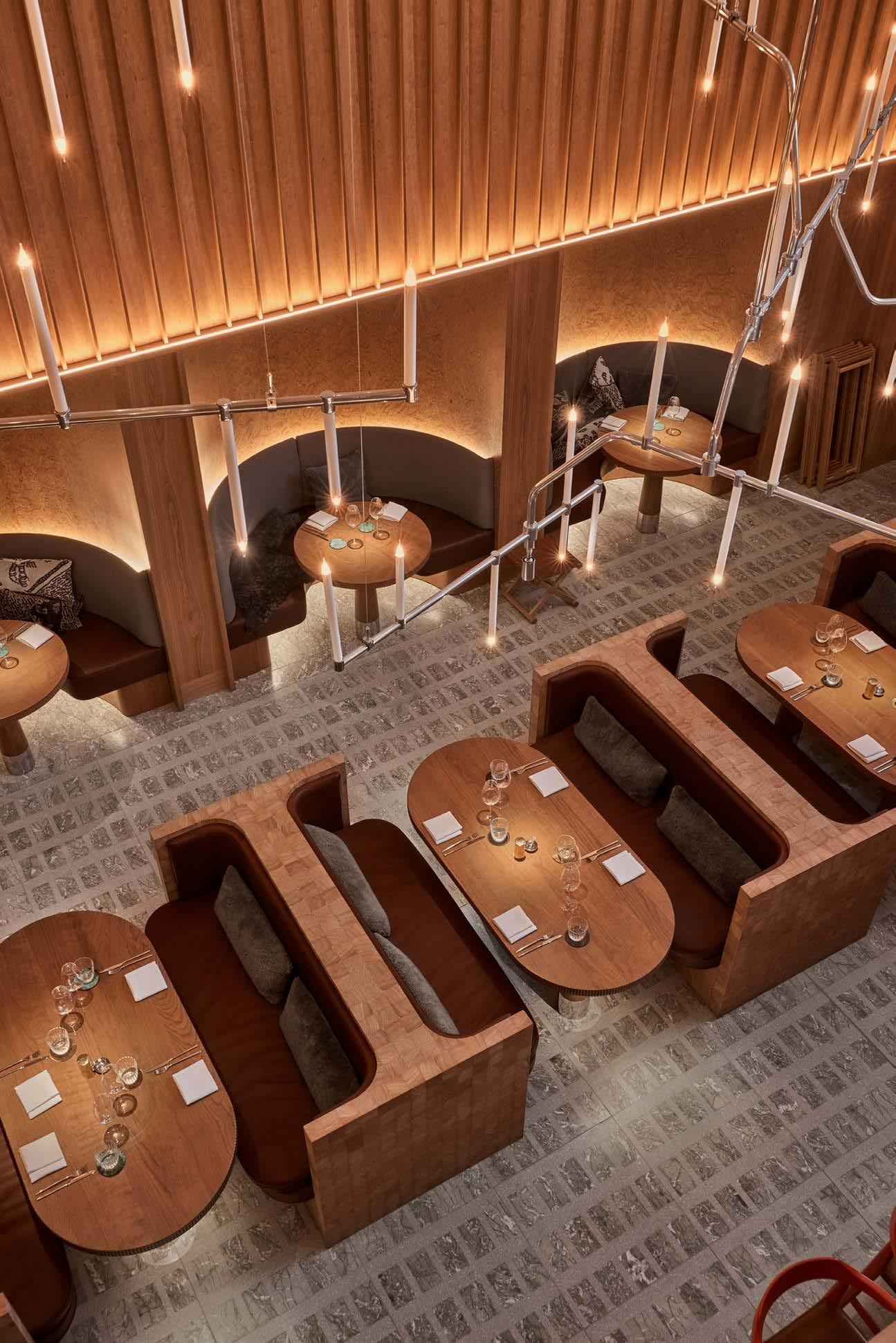
Lighting emphasizes the sheer grandeur of the atrium space with a 2W French tip candle chandelier, created from a collaboration between designers, consultants, and suppliers. Artisan fabricators at Northern Lights worked closely with concept creators Front Studio, Joyn interior designers, LDI, and Harrods’ project management team to realize the ambitious piece in less than eight weeks.
Inspired by the beauty of traditional Swedish Christmas lights, the statement chandelier suspended below the wavy white ceiling was engineered by Northern Lights to give the impression of real candles floating in mid-air. “Mild steel was used for the construction of the 14 arms to maintain structural strength, keeping each arm ‘floating in space’, and finished in a custom powder coat chrome finish to subtly reflect the light,” explained Ives Bryan, design engineer at Northern Lights. “Each candle section houses individual mini connectors inside to minimize visual impact and facilitate ease of maintenance. One of the slimmest lamp holders available was used inside the vertical tubes to keep the candles as thin and as delicate as possible, capturing the essence of twinkling floating lights to the double height space.”
To complement this statement piece, the mezzanine ceiling houses 50 hammered flush mount chrome pendants, originally designed by Alvar Aalto. Diners on this level have their own source of illumination that provides both functional and decorative lighting.
“One of the key challenges was to balance the lighting throughout the space. Dramatic focus creates the correct ambience day and night across the restaurant, despite varying effects of daylight, use of spaces, and the architecture,” said Eliason. Warm linear LED is used throughout, and color-tuneable LED harmonizes with the changing daylight. Using high-color rendering LED, precise optics, glare control, and dimming of the lighting brings the Nordic

interior design visually alive, Eliason pointed out.
Graham Rollins, creative director for Lighting Design International, said, “Lighting is such an important creator of ambiance in a space like this. The fusion of sumptuous dark cherry woods in the atrium and the warm color temperatures of the dimmable LED fixtures make for a luxurious and intimate feel, reflecting the flavors on the menu, and the style of the venue.”
All other linear fixtures are high-color rendering 2300K, detailed to conceal the light sources from view. Feature and table lighting were selected for precise optics, glare control, and dimming, providing further comfort while subtly highlighting the curated art, interiors, and food. Ceiling-hung pendants with colorful flared pleated fabric shades can be positioned so that the wider end is either up or down by adjusting the attached strings. The customized design was by Svenskt Tenn
Overhead on the terrace roof is a suspended catenary lighting system featuring polished acrylic globes with a central frosted core. Downlights are beamed on the walkway. All fittings are fed on a suspension-by-suspension basis by a single power cable, allowing two control channels per wire for dimming globes separate to downlights. Light sources are calibrated to 2400K.
“Lighting control allowed us to dramatically lower lighting levels through the day from an appropriately balanced day scene to a low and dramatic ambience in the evening, ensuring features are never overlit, and energy is minimized through considerate control,” Eliason said. The chandelier, mezzanine sconces, and the terrace festoon system were all designed as part of the sustainability emphasis; all parts are replaceable onsite and manufactured in the UK. British manufacture sources provide a localized supply chain and a reduced logistical carbon footprint. ■
Studio Frantzén Harrods, London
Architect: Woods Harwick
Interior Design: Joyn Studio
Lighting Design Consultants: Lighting Design International
Custom Lighting Fixture Suppliers: Front Design; Northern Lights
• Atelier Areti
• Artek
• DGA Lighting
• FolkForm
• Gloster
• John Cullen Lighting
• KKDC – Stoane Lighting
• Light Graphix
• Marset
• Michael Anastassiades
• Northern Lights
• Precision 11 Lighting
• Santa & Cole
• Svenskt Tenn
• Zivo

17 - 19 OCTOBER · SAN DIEGO, CA, USA
The apex of architectural lighting design’s leading conference series, EA24 is a comprehensive and enriching experience for hundreds of industry professionals from around the world.
This is the season’s best opportunity for you and your colleagues to:
• Gain insight into emerging trends, technologies, and practices.
• Enhance skills and spark creativity with 30+ seminars.
• Collaborate and connect with peers through networking and roundtable sessions.
• Celebrate excellence at the 41st Annual IALD International Lighting Design Awards.
Come and shine with the lighting design community’s brightest. Let IALD Enlighten Americas 2024 #SparkInspiration within you. Register today at iald.org/ea24


LightArt’s new Acoustic Collection Wood Textures feature four horizontal grain patterns capturing the natural elegance of wood. The new printing process is Greenguard Gold certified. Composed of 50% post-consumer recycled content, the Sola Felt material used across the Acoustic Collection is a Declare Label Red List Free product.


The SurfaFlex 1 from Alloy LED is a flexible, lowprofile, surface-mount aluminum channel providing uniform illumination when paired with the company’s compatible tape lights. With a minimum bend radius of 5.5 inches, the channel is ideal for curved surfaces and commercial and residential spaces where the smallest footprint is needed.


PROLIGHTS has launched of the EclDisplay CRMX series, available in Full Color, Variable White, and Fixed White versions, featuring integrated wired and wireless CRMX control, allowing lighting integrators to program and control the projectors both wirelessly and via cable through RDM. The entire series is compatible with the full range of optics and accessories from the EclDisplay series.
Advance introduces the new Xitanium 320W SimpleSet LED driver, featuring double the power in half the size! Engineered to pack more power and higher efficiency in a compact design, this driver allows you to customize your lighting experience with flexibility and versatility for unparalleled control and convenience.


Sistemalux has introduced the Pivot family of spotlights, featuring unparalleled flexibility and innovative design. Pivot allows users to effortlessly change optical filters and customize the beam to suit different requirements. It boasts rotational motion around three axes, allowing for infinite trajectories and an extremely adaptable approach to lighting.


Entice is a new indoor pendant from Modern Forms, with cylinders of natural Spanish Alabaster and gleaming metallic collars ornamenting a silica strand. The pendant features adjustable color temperature and a CRI of 90. Remote or surface-mounted driver options are available.

DRY is a new family of luminaires from LED Luks with an eye-catching effect. The variety in shape and the combination of an illuminated rod with a decorative panel make DRY a stylish and functional luminaire. Its versatility allows you to use the same product family throughout your interior.





Vode Lighting’s new Wedge family, featuring the Peak and Slope products, introduces a distinctive triangular form factor with user-friendly installation and adaptable mounting options. The versatile family of luminaires can blend into the environment as a faux cove, integrate into corners, or stand out as striking statement luminaires.
The Light Shadow Pro from Flos exploits the benefits of an innovative silicone lens that allows absolute beam control with extreme efficiency, heat resistance and maximum quality light distribution. The unique patented optical solution controls extreme cut-off angles without altering the high efficiency and incredible versatility of the product.

Casambi’s new Salvador Series 1000 takes lighting control to the next level by enabling seamless integration of DALI, EnOcean, and Casambi Bluetooth Low Energy-based devices. The Salvador Series provides data-driven insights by extracting and analyzing D4i data from DALI networks.
ConTech Lighting, a Leviton company, announces its new SpecFlex Architectural Strip Lighting Family, which includes seven indoor (IP20) and seven outdoor (IP67) options with an efficacy of 130 lumens/watt, 95+ CRI, and two-step binning. The entire SpecFlex system is CSA listed to UL and CSA standards and is also Declare listed for material transparency.


The newest addition to iGuzzini’s Laser family is the Laser 96. Available in both Comfort and Super Comfort versions, the 4-inch downlight features Opti Beam optics with fixed, adjustable, and wall washer options. It’s a masterpiece of lighting microsurgery, designed to enhance unique experiences.



By
In September 2023, the Bluetooth Special Interest Group (SIG) released Bluetooth® NLC, a series of specifications that define roles and responsibilities for common lighting control devices. Bluetooth NLC builds on wireless standards Bluetooth Low Energy (LE) and Bluetooth Mesh to provide full-stack standardization.
By ensuring true multivendor interoperability across the control system, the Bluetooth SIG believes this will enable mass adoption of wireless networked lighting controls in commercial buildings, including small and medium-sized as well as large buildings.

Networked lighting controls have been demonstrated to generate nearly 50% lighting energy savings while enabling value-added services such as optimized space utilization, indoor wayfinding, and asset tracking.
Outside of new construction, however, adoption has been hampered in part by a lack of standardization
and interoperability, according to the DesignLights Consortium. As a result, its extraordinary potential to save energy in existing buildings remains largely untapped.
As the U.S. enters a post-traditional lighting era in which electrification and decarbonization will increase demand for energy efficiency as a “first fuel” for meeting growing energy needs, the value of energy savings with lighting controls will only increase in importance.
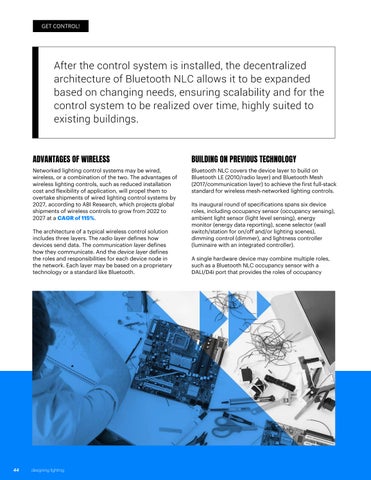
After the control system is installed, the decentralized architecture of Bluetooth NLC allows it to be expanded based on changing needs, ensuring scalability and for the control system to be realized over time, highly suited to existing buildings.
Networked lighting control systems may be wired, wireless, or a combination of the two. The advantages of wireless lighting controls, such as reduced installation cost and flexibility of application, will propel them to overtake shipments of wired lighting control systems by 2027, according to ABI Research, which projects global shipments of wireless controls to grow from 2022 to 2027 at a CAGR of 115%.
The architecture of a typical wireless control solution includes three layers. The radio layer defines how devices send data. The communication layer defines how they communicate. And the device layer defines the roles and responsibilities for each device node in the network. Each layer may be based on a proprietary technology or a standard like Bluetooth.
Bluetooth NLC covers the device layer to build on Bluetooth LE (2010/radio layer) and Bluetooth Mesh (2017/communication layer) to achieve the first full-stack standard for wireless mesh-networked lighting controls.
Its inaugural round of specifications spans six device roles, including occupancy sensor (occupancy sensing), ambient light sensor (light level sensing), energy monitor (energy data reporting), scene selector (wall switch/station for on/off and/or lighting scenes), dimming control (dimmer), and lightness controller (luminaire with an integrated controller).
A single hardware device may combine multiple roles, such as a Bluetooth NLC occupancy sensor with a DALI/D4i port that provides the roles of occupancy


sensor, ambient light sensor, lightness controller, and energy monitoring. In this case, the energy monitoring role aggregates energy data produced by the D4i LED driver(s) and passes it on over the mesh network.
With device roles being standardized, manufacturers can focus on value-added features, combining roles in the same hardware, applications for data, and offering the best system interface. The large number of manufacturers working with Bluetooth suggests Bluetooth NLC-qualified product development will be rapid.
Once familiar with Bluetooth, lighting specifiers can specify it based on its functionalities and the space requirements. Subsequently, products from one or more manufacturers can be selected for the most optimal combination of cost, features, system interface, and technical support.
Regardless of what products are incorporated into the system, Bluetooth NLC offers confidence all devices on the network will be interoperable and then operate in a certain way. It’s not a team; it’s a playing field.
Also facilitating ease of deployment is Bluetooth NLC-
qualified devices are fully discoverable using any device with a Bluetooth connection. Therefore, a phone app could directly interrogate devices on the network to learn what they are and other characteristics, regardless of who manufactured them. Once discovered, the devices can be assigned to sequences of operation that best match the space needs and later reconfigured. A remote provisioning feature enables this to occur without being onsite.
After the control system is installed, the decentralized architecture of Bluetooth NLC allows it to be expanded based on changing needs, ensuring scalability and for the control system to be realized over time, highly suited to existing buildings. Security features cover the product lifecycle, from manufacturing to disposal.
Standardization has played a major role in mass adoption of new technologies in many industries. It will be interesting to see what impact Bluetooth NLC has on adoption of networked lighting control systems. As products are developed, lighting practitioners may benefit by familiarizing themselves with the standard and checking out new products as they roll out.
Learn more about Bluetooth NLC here. P

ElectroglaZ Display Table Demo
Source: Zytronic Displays Ltd YouTube channel
Zytronic's roots trace back to the 1940s when the company manufactured glass gas mask lenses and composite glass products. Over the decades, Zytronic evolved into producing ballistic glass for armored vehicles and eventually entered the touchscreen market in the late 1990s. The company was a pioneer in projected capacitive touch sensing, a technology now ubiquitous in devices like the Apple iPhone.
Dr. Andrew Morrison, Chief Technology Officer at Zytronic, highlighted the company’s significant contributions to the touchscreen industry’s evolution. "We pioneered our own technology path and coined the phrase projected capacitive touch sensing," he noted. This innovation paved the way for robust touch sensing applications in ATMs, ticketing, vending, gaming, and more, particularly in 24/7 outdoor and vandal-proof environments.
Zytronic's latest innovation, ElectroglaZTM, combines their historical in-house expertise in glass processing and laminating with modern technology. ElectroglaZTM allows for the integration and powering of low-voltage devices such as lights, motors, induction chargers, audio speakers, and LCDs within laminated glass structures without visible power cables.
One of the most promising applications of ElectroglaZTM is in museum lighting. Morrison explained, "We've been trying to drive it into the museum market, which is a small but highly interconnected industry." The technology enables lighting designers to create elegant, cable-free displays. With no cables, the luminaires appear to be floating within the glass structure.
Recognizing the importance of strategic partnerships, Zytronic collaborates with companies like Luxam and Precision Lighting to leverage their established market presence. "We quickly realized we have to partner up with branded names who already

Zytronic ElectroglaZ Hi Fi
Source: Zytronic Displays Ltd YouTube channel
have an established presence in that market," Morrison said. These partnerships facilitate the introduction of ElectroglaZTM into various sectors, including museums, retail, and hospitality.
While museums are a primary focus, the potential of ElectroglaZTM extends to commercial and hospitality settings. Morrison envisioned applications such as glass tables with integrated phone chargers and lighting in high-end hotels and restaurants. "The technology creates a slick, aesthetically pleasing solution of a transparent surface that you can put your phone on and it magically charges, but you can also power the light through it as well," he explained.
ElectroglaZTM operates at up to 50 volts and 4 to 6 amps, making it suitable for a range of low-power applications. Morrison emphasized the scalability of the technology, suggesting potential future developments like curved or shaped glass structures with integrated devices.
Zytronic's go-to-market strategy involves providing complete solutions rather than just components. Morrison recounted how initial customer feedback led them to offer integrated products rather than just the glass structures. This approach addresses the demand for turnkey solutions in the lighting and display markets.
As Zytronic continues to explore the capabilities of ElectroglaZTM, the company remains committed to innovation and collaboration. Morrison concluded with a vision of expanding into new markets and applications, driven by the unique possibilities offered by their advanced glass technology.
To learn more, visit Zytronic’s website P
“We were intrigued by Zytronic's technology, and how it could provide more options for our clients. Objects on glass shelves are always difficult to light in cases. It was exciting to showcase a demo of Luxam spotlights integrated and powered within Zytronic ElectroglaZTM at Museums + Heritage Show in London."
— Daphnée Hocquard, General Manager USA, LUXAM


By
Surprisingly, it is not by knowing the part numbers of all the widgets…
Lighting control system design begins with understanding the owner and the end-user. What does the owner want the lighting controls to do, and what requirements and limitations exist regulating their implementation in the design?
For the end-user, lighting controls should be unobtrusive – think smooth dimming over abrupt switching – and they should be able to be overridden when necessary with conveniently located and intuitive interfaces. All controls should be maintainable by the facility staff, who should be trained on the equipment.
At the outset, owner requirements should be defined by creating a design document called the Owner’s Project Requirements (OPR). The OPR will include the purpose of each facility and/or space, their operating schedules, applicable project codes and standards, integration needs, project goals (such as energy efficiency targets), and any preferred vendors. The OPR will often evolve throughout a project and become more detailed. At times, the OPR may not even exist, so the designer will be
responsible for identifying the owner’s requirements through their knowledge of the project intent.
In a guest post for the Lighting Controls Association,1 C. Webster Marsh offered the following list of questions to aid in developing the OPR:
• What is the vision for the project? What does the owner need and want for the project?
• Who are the users of each space, and how will they use these spaces?
• How will the spaces be lighted, including daylighting?
• What are the opportunities, requirements, and expectations for lighting control on the project, including integration with other building systems?
• What external requirements such as codes, standards, and regulations must be followed? Will there be elevated goals, such as LEED or WELL?
• What limitations impose boundaries for the controls design, such as budget?
Best practice encourages the designer to interview people who will ultimately use the lighting – the end-users. End-user acceptance is critical for the ongoing viability of a lighting control system, particularly if it includes automated controls. Lighting controls that fail to satisfy user expectations may be regarded as intrusive or frustrating, leading occupants to possibly override the controls and negate the intent of the design. Unfortunately, as with the OPR, if contact with endusers is not possible, it will be up to the designer to assume the role on their behalf.
Principles to follow include:
• The lighting control system should make sense to the users.
• Lighting should be zoned in a way that is easily understood by the users.
• Lighting controls that turn off the lighting should be easy to override, typically via manual controls near the entrances.
• Automatic control effects should be slow, recognizable, and non-intrusive.
• Lighting with specific intent should be easy to adjust.
The following is an example of feeback from an end-user: “The cleaning staff changes from week to week and has trouble operating the lighting. They complain that they sometimes work in the dark because they can’t find the light switch. Other times, we find the lights have been left on all night. Can you make this simpler for the cleaners so they can get their job done and save energy? They say their work takes about an hour and a half.”
The feeback from the end-user gets translated into a narrative: When cleaning staff are in the space after business hours, a master override button at the entrance will be provided that is clearly marked “Cleaning”. This button will turn on the lights to 80% of normal brightness. Occupancy sensors or timer will ensure the lighting is turned off after cleaning is completed. Set timeout to at least 2 hours or to the maximum allowed by energy code.
Now that we have our direction from the owner and the end-users, it is time to put together a comprehensive written
description, summarizing this information. This document is called the Control Intent Narrative (CIN) and should focus on the interaction of the end-users and the desired outcomes, rather than a list of components or part numbers. Writing in non-technical language allows the owner to easily understand, approve, and visualize the operation and maintenance requirements of the lighting control system.
The CIN should describe the functionality of the lighting system for each different area, specifying how the lighting responds to user interaction (e.g. button presses or “overrides”), occupancy, time of day, and natural light levels. As a timesaving measure, designers may develop boilerplate CINs for various space types which can then be customized for future projects.
By clearly communicating the design intent, the control intent narrative serves as a blueprint for architects, engineers, installers and facility managers, ensuring that the control system is specified, sourced, installed and performs as intended to meet the desired goals. The control intent narrative informs all other documentation, going beyond what drawings can communicate, and provides a common guide and reference for the project. As a living document, the narrative may also be revised and improved during the project.
The Illuminating Engineering Society outlines four major elements of a CIN in ANSI/IES LP-16-22, Lighting Practice: Documenting Control Intent Narratives and Sequences of Operations:2
• General description of the project goals
• Control strategies to satisfy these goals
• Description of the control system
• A basic sequence of operation for each typical space type

After the control intent narrative is completed, the next step involves translating the general description into actionable steps that guide the specification, procurement, installation and commissioning of the lighting control system. This document is called the Sequence of Operation (SOO) and is typically undertaken by the engineer.
The process begins by breaking down the narrative into distinct control strategies for each unique area, detailing how and when each control action should occur. The descriptive language of the CIN is converted into specific set points, clear parameters and contractually enforceable language that are in alignment with the local building or energy codes. They include actionable steps that give definition to the specification of lighting control system and how each component should be programmed to function as intended in the project’s real-world scenarios.
Once the physical installation is complete, the system undergoes programming and commissioning, where each device is configured and tested. The CIN and SOO are critical documents at this stage to ensure the intent is met with the necessary settings.
Finally, training is provided to facility managers and end-users to ensure they understand what the system was designed
to do and how to effectively operate and maintain it. This comprehensive approach ensures that the lighting system performs as intended and can be adjusted as needed for optimal performance and energy efficiency.
The lighting controls sales representative can play a vital role in ensuring that the control intent narrative is accurately followed throughout the project lifecycle. The rep’s experience with user feedback in multiple scenarios, and expertise in relating the desired functionality to adequate solutions, can guide the specification from the beginning of the CIN process. The rep can serve in the translation to the more technical language of the SOO, ensuring that the scope is complete and accurate.
The next obvious step is for the rep to recommend products or systems to serve as the basis of design to align with the project’s documented goals. The rep may also recommend additional technical services to support a successful implementation, such as installer or end-user training, remote support and post-occupancy service.
By bridging lines of communication and providing ongoing support, the lighting controls sales rep ensures that the narrative's specifications are met, leading to a successful and efficient lighting system. Exactly what you wanted. ■
1 March, C. Webster. “C. Webster Marsh Talks Owner Project Requirements” (25 January 2023). Lighting Controls Association. https://lightingcontrolsassociation. org/2023/01/25/c-webster-marsh-talks-owner-project-requirements/
2 Illuminating Engineering Society. ANSI/IES LP-16-22, Lighting Practice: Documenting Control Intent Narratives and Sequences of Operations. New York: IES; 2022.


KELLY ROBERTS By


Neri, originalmente formada como arquitecta en México, inició su camino hacia la iluminación cuando su interés por los viajes internacionales la llevó a mudarse a Italia. Continuó trabajando como arquitecta durante tres años, pero su interés por la iluminación se despertó cuando escuchó sobre la apertura de un nuevo showroom de iluminación en la ciudad, el primero de su tipo allí. El puesto ofrecía una experiencia amplia en iluminación, desde el diseño y las ventas hasta los cálculos técnicos y las especificaciones, pasando por la instalación y la puesta en marcha. Esta experiencia encendió su pasión por el campo, llevándola a adquirir un extenso conocimiento y habilidades en luminarias decorativas y arquitectónicas.
Crear un sentido de comunidad, especialmente en entornos profesionales, puede ser desafiante pero profundamente gratificante. Para Neri Diaz y Giselle Mercado, su viaje a los Estados Unidos y al diseño de iluminación arquitectónica las llevó a formar una comunidad única y vibrante llamada Lightinas Esta comunidad no solo celebra sus raíces culturales, sino que también fomenta el apoyo profesional y las conexiones personales entre mujeres latinas en la industria de la iluminación arquitectónica.
Creating a sense of community, especially in professional environments, can be challenging but profoundly rewarding. For Neri Diaz and Giselle Mercado, their journey to the United States and into architectural lighting design led to the formation of a unique and vibrant community called Lightinas. This community not only celebrates their cultural roots but also fosters professional support and personal connections among Latina women in the architectural lighting industry.
Originally trained as an architect in Mexico, Neri unknowingly started on her path to lighting when her interest in international travel prompted a move to Italy. She continued work as an architect for 3 years, but her interest in lighting was sparked when she heard of a new lighting showroom opening in town – the first of its kind there. The position offered extensive experience in lighting, from design and sales, to technical calculations and specifications, through installation and commissioning. This experience ignited her passion for the field, leading her to gain extensive knowledge and skills in both decorative and architectural lighting equipment.
Después de 10 años en Italia, Neri se mudó a Nueva York con su esposo, buscando expandir su experiencia internacional. Lo que originalmente iba a ser un año sabático se ha convertido en once años en los EE.UU., ya que rápidamente encontró un hogar en la comunidad local de profesionales en iluminación. Con su experiencia, se trasladó fácilmente a roles en ventas con reconocidos fabricantes de iluminación como Fabbian y XAL Actualmente, está con Lindsley Lighting, donde continúa aplicando su experiencia e ideas desde perspectivas mexicanas, europeas y estadounidenses.
After 10 years in Italy, Neri moved to New York with her husband, seeking to expand her international experience. What was originally intended as a yearlong sabbatical has turned into 11 years in the U.S., as she quickly found a home with the local lighting community. With her experience, she transitioned easily to sales roles with renowned lighting manufacturers such as Fabbian and XAL. Currently, she is with Lindsley Lighting where she continues to apply her expertise and insights from both Mexican, European, and American perspectives.
El viaje de Giselle a los Estados Unidos comenzó cuando se mudó de Colombia para cursar una maestría en diseño de iluminación en la Parsons School of Design. Con una formación en diseño industrial, Giselle se sintió atraída por la iluminación a través de su trabajo con piezas arquitectónicas experimentales y el deseo de incorporar luz como un material . Sin embargo, la transición a la iluminación arquitectónica en los EE.UU. presentó su propio conjunto de desafíos, incluyendo el cambio de escala de trabajo, la navegación de medidas métricas a imperiales y la comprensión de nueva terminología técnica (especialmente, dada la propensión de los angloparlantes a usar siglas).
Giselle's journey to the United States began when she moved from Colombia to pursue a master's degree in lighting design at Parsons School of Design. With a background in industrial design, Giselle was drawn to lighting through her work with experimental architectural pieces with the intent to add light as another material. However, the transition to architectural lighting in the U.S. presented its own set of challenges, including the sudden change of working scale, navigating from metric to imperial measurements and understanding new technical terminology (especially given English speakers’ propensity for acronyms).
Después de graduarse de Parsons, Giselle trabajó con Cooley Monato Studio durante 14 años, donde tuvo la oportunidad de poner en práctica lo aprendido y de desarrollar sus habilidades en el diseño de iluminación. Sin embargo, las exigencias de equilibrar el trabajo y la vida familiar la llevaron a cambiar de rol dentro de la industria, comenzando con LED Linear como representante de ventas. Recientemente, se unió a Coronet LED, donde continúa explorando diferentes aspectos relacionados con el mercado de la iluminación. A lo largo de su carrera, Giselle se ha dedicado a fomentar relaciones a largo plazo en cada posición que ha ocupado.
After graduating from Parsons, Giselle worked with Cooley Monato Studio for 14 years, where she honed her skills in lighting design. However, the demands of balancing work and family life led her to switch sides within the industry, moving into sales with LED Linear Recently, she joined Coronet LED, where she continues to explore different aspects of the lighting market. Throughout her career, Giselle has been dedicated to fostering long-term relationships in each position she has held.
La idea de Lightinas surgió del deseo de conectarse con otras latinas en la industria de la iluminación y celebrar el patrimonio cultural compartido. Una vez que Neri se estableció en Nueva York, comenzó a notar la presencia de otras mujeres latinas en varios eventos y lugares de trabajo de iluminación. Para ella, siempre había un momento afín: un pequeño "hola" en español o "¿de dónde eres?". Valorando esa calidez y conexión humana, Neri empezó a organizar reuniones sociales para crear el espacio para “chismosear” y compartir experiencias, las cuales rápidamente crecieron cuando Giselle unió fuerzas con Neri para este objetivo común de socializar.
The idea for Lightinas emerged from a desire to connect with other Latina women in the lighting industry and celebrate their shared cultural heritage. Once Neri settled into New York, she began noticing other Latina women at various lighting events and workplaces. For her, there was always a kindred moment – a little “hi” in Spanish, or “Where are you from?”. Valuing that warmth and human connection, Neri initiated small gatherings for these women to laugh and share their experiences, which quickly grew as Giselle and other women joined in.
La conexión latina para todas es muy natural e informal. Muchas de las chicas son originarias de otros países o son inmigrantes de segunda generación, y esta comunidad unida ofrece un sentido de pertenencia y apoyo mutuo. Una de las condiciones y a su vez el beneficio más significativo para quienes se unen es hablar en español.
La mayoría del grupo habla español con fluidez, y otras lo utilizan como una oportunidad para aprender y formar una conexión más fuerte con su herencia personal.
The Latin connection for everyone invited is very natural and informal. Many women are originally from other countries or are second-generation immigrants, and this close-knit community offers a sense of belonging and mutual support. One of the most significant benefits for those that join is that the group only speaks in Spanish. Most of the group speak Spanish fluently, and others use it as an opportunity to learn and form a stronger connection with their personal heritage.

Personalmente, me gusta, lo necesito. Es divertido reír y hablar de cosas personales en español. Hablar en tu propio idioma es parte de tu profundo ser, de tu identidad, y tratar de tener esa misma conversación en inglés tiene un sabor diferente.”
Personally, I like it – I need it. It's fun to laugh and talk about personal stuff in Spanish. Speaking in your own language, it’s part of your core – your identity – and trying to have that same conversation in English just has a different flavor.”
Neri Diaz
Lightinas se formó oficialmente cuando Patricia Vallejo sugirió el nombre vibrante y adecuado. El grupo, que ahora comprende de 30 a 40 mujeres, es más que una red profesional; es una comunidad donde mujeres latinas pueden compartir sus vidas personales sin la presión de las obligaciones comerciales y laborales. El grupo organiza reuniones informales, como mañanas de café, encuentros en restaurantes y eventos temáticos como intercambios de regalos en el Día de San Valentín y noches de Bingo mexicano. Durante la pandemia, mantuvieron sus conexiones a través de eventos virtuales, lo que permitió que miembros de diferentes ubicaciones participaran.
Lightinas es como construir más una gran familia de primas, en lugar de una red profesional.”
Lightinas is like building more of a big family of cousins, rather than a professional network.”
Giselle Mercardo

Lightinas was officially formed when Patricia Vallejo suggested the vibrant and fitting name. The group, which now comprises 30 to 40 women, is more than just a professional network; it is a community where Latina women can share about their personal lives without the pressure of business obligations. The group hosts informal gatherings, such as coffee mornings, restaurant meetups, and themed events like Valentine's Day gift exchanges and Mexican Bingo nights. During the pandemic, they maintained their connections through virtual events, which allowed members from different locations to participate.
La esencia de Lightinas radica en su enfoque en las relaciones humanas más que en las transacciones o discusiones comerciales y laborales. Las chicas se apoyan mutuamente en varios aspectos de la vida, desde navegar por las complejidades de vivir en un país extranjero hasta compartir cosas simples, como el mejor lugar para hacerse las uñas! . Neri, quien ha sido miembro activo del comité del capítulo de WILD NYC durante muchos años, valora las conversaciones no estructuradas de Lightinas tanto como en ocasiones, los difíciles temas profesionales en los que se enfoca WILD.
The essence of Lightinas lies in its focus on human relationships rather than business transactions or discussions. Members support each other in various aspects of life, from navigating the complexities of living in a foreign country to sharing the simple things, like the best place to get a manicure. Neri, who has been an active committee member of the WILD NYC Chapter for many years, values the unstructured conversations that Lightinas has just as much as the sometimes difficult professional topics that WILD focuses on.
A medida que Lightinas continúa creciendo, Neri y Giselle están considerando formas de estructurar aún más el grupo sin perder su toque informal y personal. No están interesadas en encontrar patrocinadores ni en agregar complejidad al grupo, y quieren mantener el enfoque en las conexiones culturales y lingüísticas. Actualmente, el grupo solo existe en la ciudad de Nueva York, pero están abiertas a la posibilidad de en un futuro expandirse a otras regiones de los Estados Unidos.
As Lightinas continues to grow, Neri and Giselle are considering ways to further structure the group
without losing its informal and personal touch. They are not interested in finding sponsors or adding to the complexity of the group, and want to maintain the focus on cultural and linguistic connections. Currently the group only exists in New York City, but they are open to the possibility of expanding to other regions of the United States in the future.
Los viajes de Neri Diaz y Giselle Mercado a los Estados Unidos y al campo de la iluminación arquitectónica reflejan su resistencia, adaptabilidad y dedicación. Ambas han encontrado un hogar en la ciudad de Nueva York, apreciando su diversidad y aceptación. A través de Lightinas, han creado una comunidad vibrante que celebra su herencia latina y proporciona un espacio seguro para interacciones significativas. Lightinas es un
testimonio del poder de la comunidad en el fomento del crecimiento personal y profesional, y ofrece una visión de cómo se puede celebrar y expandir la diversidad dentro de la industria de la iluminación.
Neri Diaz and Giselle Mercardo’s journeys to the United States and into the field of architectural lighting reflect their resilience, adaptability, and dedication. They have both found a home in New York City, appreciating its diversity and acceptance. Through Lightinas, they have created a vibrant community that celebrates their Latina heritage and provides a safe space for meaningful interaction. Lightinas stands as a testament to the power of community in fostering personal and professional growth, and offers a view of how diversity within the lighting industry can be celebrated and expanded. P
Reach out to Neri and Giselle directly to learn more about joining Lightnas!
Neri Diaz on LinkedIn | Giselle Mercardo on LinkedIn info@womeninlightinganddesign.org | @womeninlightinganddesign | womeninlightinganddesign.org


RANDY REID By
In her keynote presentation, entitled “Calm Technology,” at IES24: The Lighting Conference, Amber Case captivated the audience with a deep exploration of how technology should seamlessly integrate into our lives.
As a cyborg anthropologist (and I am still not sure what that means), Amber focuses on how human-centered design can transform our interaction with technology, ensuring that it works with us rather than against us. In a world increasingly dominated by digital distractions, Amber’s call for “calm technology” is not just relevant – it’s essential.
Case began her talk with an example that resonated with many – the challenge of trying to sleep in a hotel room with the distracting glow of appliance lights. “I am really, really excited to know that your industry exists because I'm annoyed by a lot of different lights in my life,” she quipped. This resonated with me, as the previous night I discovered the Marriot Marquis closet light was on either a timer or motion detector, and it took me a few very frustrating minutes to figure that out.
From this relatable moment, she transitioned into her central thesis: when poorly designed, technology becomes a source of frustration rather than a helpful tool.
Drawing on Freud’s warning in Civilization and Its Discontents about the dangers of being overwhelmed by our tools, Amber argued that we’ve reached a point where many of our technological advancements are more of a hindrance than a help. “What matters is not the technology itself,” she explained, “but its relationship to us. Does it intrude on our time, or is it a good roommate?”
Amber explored the idea that technology should be designed to fit human needs at a fundamental level. She illustrated this with historical examples, such as Persian HVAC systems that combined aesthetics and functionality, naturally diffusing light and heat without complex machinery.
In contrast, she noted how many modern systems require constant attention, diverting us from meaningful human experiences. “When these systems are designed well, you
“Machines shouldn’t be acting like humans. Humans shouldn’t be acting like machines. Every time that happens, we lose a bit of our Kairos time. We lose a bit of our human.”
dissolve into them. They become invisible when you’re using them,” she said. I do not recall her talking about lighting controls, but this would have been an excellent segue.
Her exploration of “calm technology” hinges on the idea that innovations are not beneficial if they disrupt human interaction and our ability to focus. She offered examples from everyday life, such as induction stoves with flat touch panels that make it difficult to know if a button was pressed, thereby interrupting conversations and interactions. The cumulative effect of such interruptions, she argued, is a gradual erosion of our quality of life. “The scarcest resource will be our attention, and how technology works with or against our attention will make or break that experience,” she warned.

She examined how various cultures have approached technology throughout history, offering valuable insights for future designs. Amber referenced Japanese tea ceremonies and the concept of “Oma Tenchi,” where the host anticipates a guest’s needs subtly and elegantly. In contrast, she critiqued Western attempts to automate and predict behavior using AI, often leading to systems that “at best scare the heck out of the user and work poorly.”
The notion of being a “cyborg” was another key theme of Amber’s presentation. Far from the science fiction depiction of robots and implants, she offered a simpler definition – anyone who relies on external tools to enhance their capabilities. “Anytime you use a computer as an extension of your mental self, you can be experiencing a cyborg situation,” she said. This broad definition emphasizes that the integration of technology into our lives is already a reality, making it even more critical to ensure that these tools are designed with care and empathy.
Amber’s background as a cyborg anthropologist gives her a unique perspective on how humans interact with technology. She argued that traditional anthropology’s focus on studying distant cultures should be turned inward, examining our own relationship with technology. “We’re the weirdos. What are we doing here? Why is it normal for us to hoard pictures of cats and news articles when, in reality, if you hoarded real cats and real newspapers, you would be considered not doing so well?” she mused.
In discussing how poorly designed technology can interrupt meaningful moments, Case introduced the concepts of
“Kronos” and “Kairos” time—terms borrowed from Greek philosophy. Kronos represents structured, clock-driven time, while Kairos is the time of special moments, like watching a sunset or a child’s first steps. According to Case, poorly integrated technology forces us into Kronos time, disrupting our ability to experience the deeper, more fulfilling Kairos moments.
One of the most innovative ideas Amber presented was the potential of designing technology that leverages peripheral attention. By using low-resolution indicators like ambient lighting, technology can convey information without demanding full focus. Amber shared an example from her own work—a system that changes the color of ambient light (Philips Hue) based on the weather forecast. “You can feel the future,” she explained, describing how the system allowed her to sense whether it would be sunny or rainy without needing to actively check a screen. This approach aligns perfectly with her vision of calm technology, where tools integrate into our lives in a supportive, non-intrusive manner.
Amber Case’s keynote was a thoughtful and engaging exploration of how we can design technology to positively impact our lives. Her insights challenge us to rethink lighting, especially controls, and consider whether our tools truly serve us.
As she concluded, “Machines shouldn’t be acting like humans. Humans shouldn’t be acting like machines. Every time that happens, we lose a bit of our Kairos time. We lose a bit of our human.” ■







FINAL SUBMITTAL DATE
4 September 2024
ANNOUNCEMENT DATE
9 October 2024
The

SUBMITTAL DATE 20 August 2024
SHORTLIST ANNOUNCEMENT DATE
7 October 2024
The awards ceremony will be held on 16 January 2025 at the Dubai World Trade Centre.
On 16 August, the 51st Annual Illumination Awards ceremony celebrated ten exceptional projects. See the winners here
The Lumen Gala was held Thursday, June 20, 2024. See the winners here
SUBMITTAL DATE
31 August 2024
ANNOUNCEMENT DATE
November 2024
FINAL SUBMITTAL DATE Mid-January 2025
ANNOUNCEMENT DATE 18 March 2025
Winners will be announced at LEDucation 2025.
SUBMITTAL DATE
CLOSED ANNOUNCEMENT DATE 19 October 2024
Live at 2024 IALD Enlighten Americas in San Diego, CA

A recent graduate of the University of Colorado, Boulder, Talissa Brownell joined AKLD as Lighting Specialist.

Lighting Designer.
Stacy Schwartz started a new position as Manager of Lighting Design.
KGM ARCHITECTURAL LIGHTING

Paul Daniel started a new position as Lighting Design Section Manager. HDR

Kristen Kordecki Miller has been accepted as Professional Member of the IALD.

Dorothy Underwood was promoted to Associate Principal.


Chelsea Kreielsheimer was promoted to Associate.


A recent graduate of the University of Colorado, Boulder, Lakin Fain joined SmithGroup as Lighting Designer.

Xiaoxiao Cui started a new position as Lighting Designer.


Jack Koch was promoted to Lighting Designer.

Shanna Snow started a position as Associate and will head up HLD’s new Nashville office.

Quincy Drane, a recent graduate of Parsons School of Design with both a Master of Architecture and a Master of Fine Arts, joins HLD as Designer.

The upcoming ArchLIGHT Summit in Dallas, TX, on September 17 and 18 promises to be an extraordinary event, showcasing significant advancements and drawing notable figures in the lighting industry. This year, the summit has achieved remarkable milestones, including nearly sold-out floor space and participation from the three largest lighting companies.
One of the most significant highlights of this year’s summit is the impressive increase in exhibitors. Lea Tranakos, Senior Director, Audience Development and Tradeshow Sales, mentioned, “We have 104 exhibitors on the show floor, a substantial increase from the 78 exhibitors last year.” Adding two stages to the show floor for panel sessions and interactive experiences has maximized the available space, pushing associations like the American Lighting Association (ALA) to set up by the koi pond.
Cindy Foster-Warthen, Event Strategist, explained the implications of this expansion: “We have moved all sessions to the show floor based on feedback from last year. This change will create more energy and facilitate better interactions among attendees and exhibitors.”
In previous ArchLIGHT events, attendees were split between the show floor and classrooms on the third floor. The new format will consolidate all content on the show floor, enhancing the energy and engagement of the event. I first saw this practiced at Lux Live in London in 2014, and it worked quite well.
The participation of major companies such as Signify, Cooper Lighting Solutions, and Acuity Brands underscores the event’s prestige. Cindy Foster-Warthen emphasized, “Having the three major lighting companies denotes the importance and growth of the ArchLIGHT Summit.”
In addition to industry giants, this year’s summit will feature innovative and immersive experiences. Cindy elaborated, “We have several immersive experiences, including a behavioral healthcare vignette sponsored by Visa Lighting and a UGR (Unified Glare Rating) vignette sponsored by Zumtobel.”
Cindy discussed a very exciting third interactive experience: "It’s a demonstration on AI and architectural visualization. This panel includes experts like Jonathan Ayala from The Lighting Exchange and representatives from Gotham and Oculus.” These setups allow attendees to experience the practical implications of different lighting designs and regulations.
Another key session, "Concept to Construction," is an extension of a popular discussion from the IALD Enlighten Conference held in Banff last year. This session will bring together a diverse panel, including reps, architects, interior designers, and lighting designers, to discuss collaboration and the pitfalls of value engineering.
Networking remains a core focus of the ArchLIGHT Summit. Lea stated, “The buzz is incredible this year. We have curated the floor to ensure quality products and valuable networking opportunities.” The event will feature a range of hospitality activities, including a happy hour sponsored by Casambi Technologies and a breakfast sponsored by the American Association of Independent Lighting Agents (AAiLA)
The summit will also introduce the “Showroom Spectacular,” driving attendees to explore the 15 participating showrooms on the third and fourth floors. Cindy explained, “This event is like a mini Lightovation, offering bars, lunch, and tours led by IALD members. It provides a chance to see showrooms that attendees might not otherwise visit.”


ArchLIGHT Summit is not just about products and networking; it also emphasizes education. The second day of the summit, designated as Student Day, will host over 200 students from various locations. IALD members will lead tours and sessions, giving students an insider view of the lighting industry.
Additionally, the summit will co-locate with Dallas Design Week, further integrating interior designers and architects into the event. Sessions will address the needs of these professionals, providing a holistic view of design and lighting.
ArchLIGHT Summit 2024 is poised to be a turning point for the event, offering unprecedented opportunities for networking, education, and experiencing the latest innovations in lighting. It’s come a long way since the first show in 2020 during COVID, when people were not allowed to travel.
As Cindy aptly put it, “This is the year that the show turns the corner.” With nearly sold-out exhibitor space, participation from industry giants, and a revamped program, the summit is set to illuminate the future of the lighting industry.
For more information, visit ArchLIGHT Summit P

salutes and thanks its advertisers for their support. We applaud the achievements of lighting practitioners and recognize the importance of their work in architecture and design.





In a powerful fusion of art, technology, and symbolism, the Cross of Heroes sculpture in Ukraine stands as a beacon of hope and resilience amidst the ongoing turmoil brought on by the war. The project transcends traditional memorials, using light to convey resistance and unity during dark times.
For designer Mykola Kabluka of Expolight, this project is personal. "This work is extremely important for me and my team because of the cruel war that’s ongoing. Every family
has someone who has died, been injured, or lost their home," he shared. The memorial was conceived to represent how light can stand strong against overwhelming darkness, a metaphor for Ukraine’s fight for independence and survival.
Mykola emphasized that while darkness seems overpowering, light, even when it appears fragile, has the potential to win. This philosophy is what drove the design, with the idea that every small light represents an individual’s belief and strength, inspiring others to continue the fight.

The Cross of Heroes is not just a visual landmark; it’s an interactive experience. Visitors who step inside the cross are enveloped in a ‘cloud of light’ created by strategically placed mirrors that multiply the illumination around them. "I organized the mirrors in such a way that they multiply the lights, surrounding visitors in this cloud. This design represents the collective strength needed to win in this unequal war," Mykola explained.
Externally, the cross serves dual purposes—it is both a Christian symbol and the emblem of the Ukrainian Army, rooted in ancient Ukrainian tradition. What makes the piece unique is its integration with natural light. The mirrored prisms are angled to capture sunlight throughout the day, from dawn until dusk, reflecting it onto the concrete square beneath.
"The sunlight symbolizes that those who have fallen are still with us, and their spirit continues to shine," said Mykola. As sunlight reflects across the square, it reinforces the presence of these heroes.


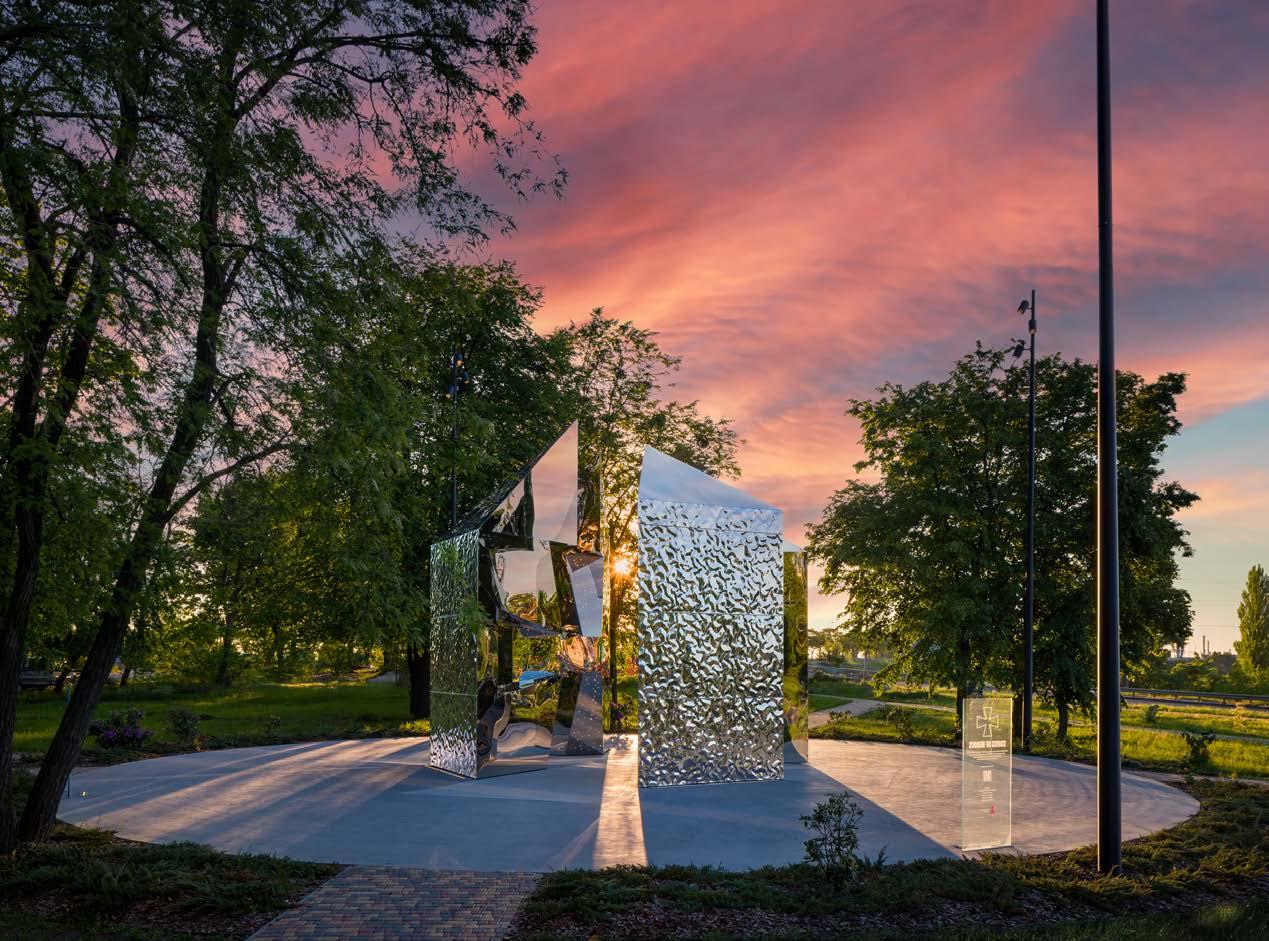
The lighting system inside the cross is a non-adjustable setup, utilizing 4000K to create a contrast that feels neither too warm nor too cold. "The 4000K light offers a more contrastive feeling. It’s noticeable even during daylight because of its concentration," said Mykola.
The project faced technical challenges, especially in achieving the pristine appearance of the mirrored prisms without visible joints or hatches. The solution involved hiding the necessary infrastructure underground, allowing the prisms to appear as pure structures of light without visible interruptions.
Beyond the visual experience, the Cross of Heroes includes an auditory dimension. The design team composed a soundscape featuring natural sounds from various regions of Ukraine, including the whispers of Carpathian winds, river flows from the central regions, and the echoes of forests from the north. Combined with the striking visual elements, these sounds immerse visitors in deep contemplation as they connect with the memorial.
The entire project was completed in just five months, with one month dedicated to concept design, another month for technical planning, and three months for construction and installation. The Cross of Heroes was unveiled on the war’s second anniversary, February 24, 2024, marking a solemn yet hopeful reminder of Ukraine’s enduring spirit.
The Cross of Heroes stands as a remarkable tribute, not just to those who have lost their lives but also as a symbol of ongoing resistance. Mykola’s innovative use of artificial and natural light demonstrates how technology and art can intertwine to deliver powerful messages of hope, courage, and remembrance.
As the war continues, this memorial will serve as a beacon, reminding everyone that even in the darkest of times, light— however small—can guide the way forward. P


The Cross of Heroes stands as a remarkable tribute, not just to those who have lost their lives but also as a symbol of ongoing resistance.
Oct/Nov is published in digital and hard copy print format and delivers bonus distribution at:
• IALD 2024 Enlighten Americas Conference (October 17-19, San Diego)
• NYControlled 2024 trade show (October 29, NYC)
• DALI 2024 Summit (October 30, NYC)
Get ready for dl’s annual focus on lighting the latest, greatest museums!
Lighting for museums has always presented special challenges. Join us as we look at lighting specifiers and their projects meeting that challenge.
Lighting 101: The Controls Narrative
ADVERTISING CONTACT
Cliff Smith at csmith@designinglighting.com
EDITORIAL CONTACT
Randy Reid at editor@designinglighting.com

SHIRLEY COYLE, LC By


EdisonReport.tv serves as a hub for all digital content in the lighting industry. A premier source for critical information surrounding lighting, EdisonReport.tv is dedicated to delivering industry news by way of video and serving its audience by spotlighting product launches and up-to-date educational videos, as well as information about upcoming webinars.
ERCO Lighting Inc.
Beamer Outdoor Projectors and Framer


