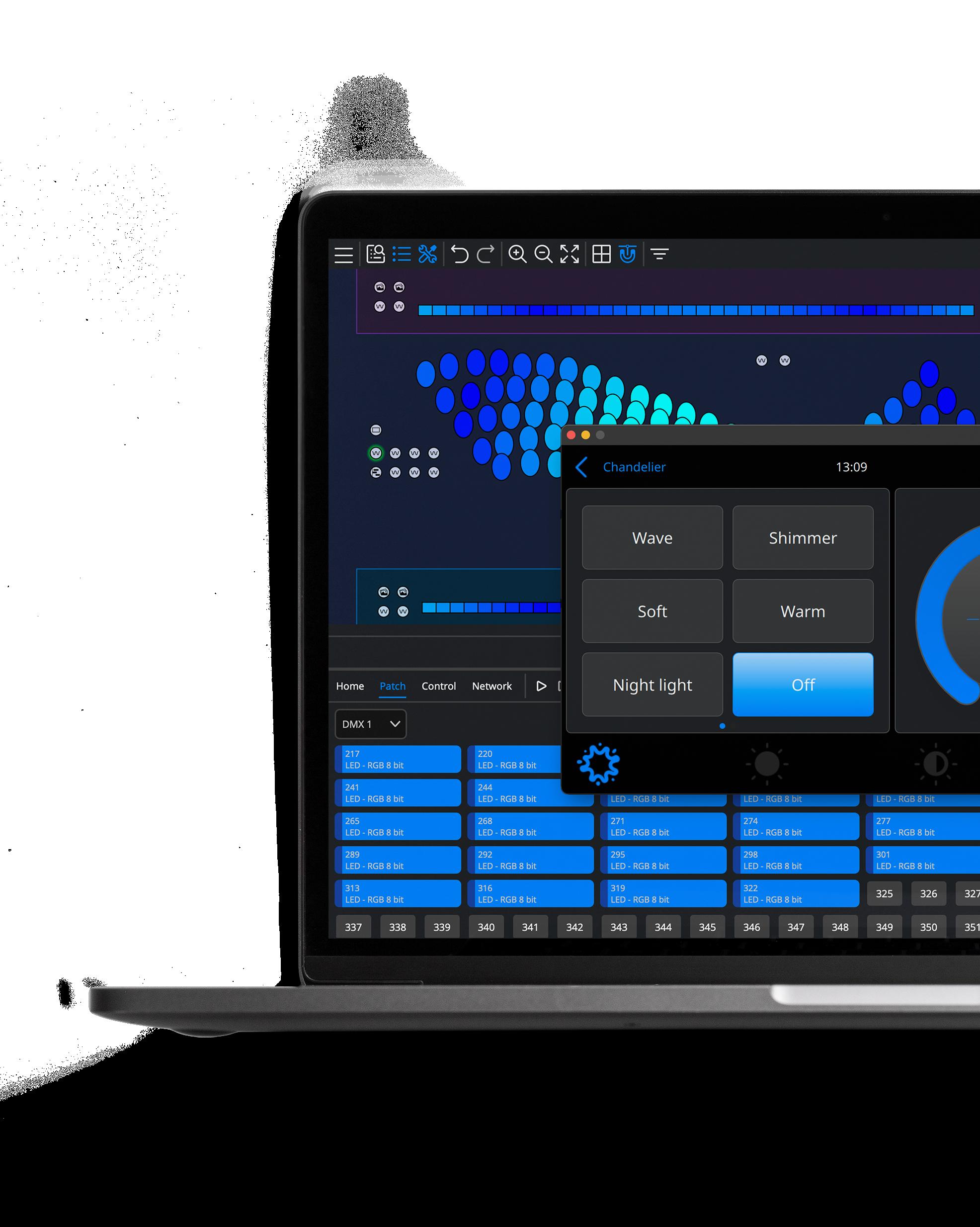
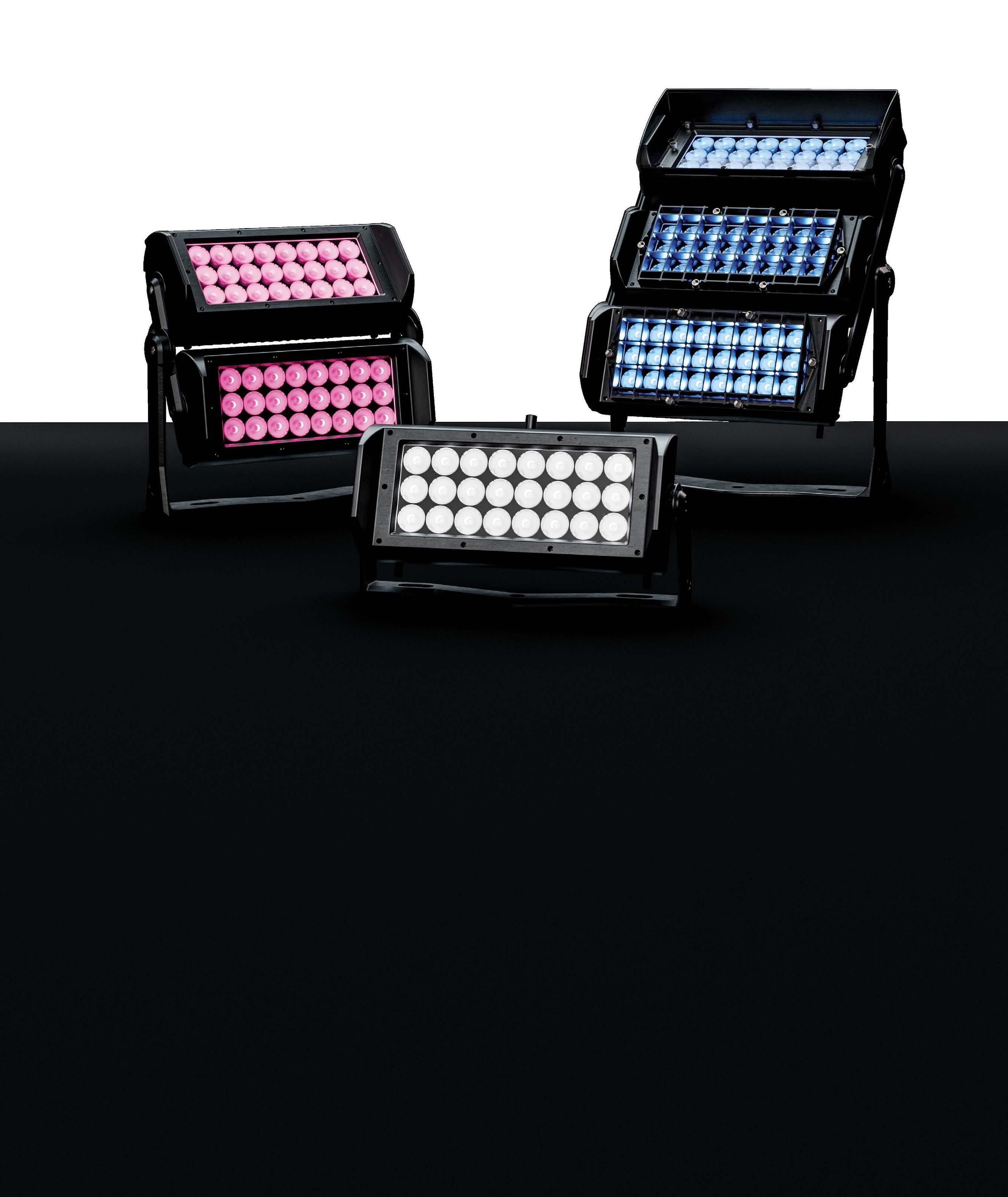
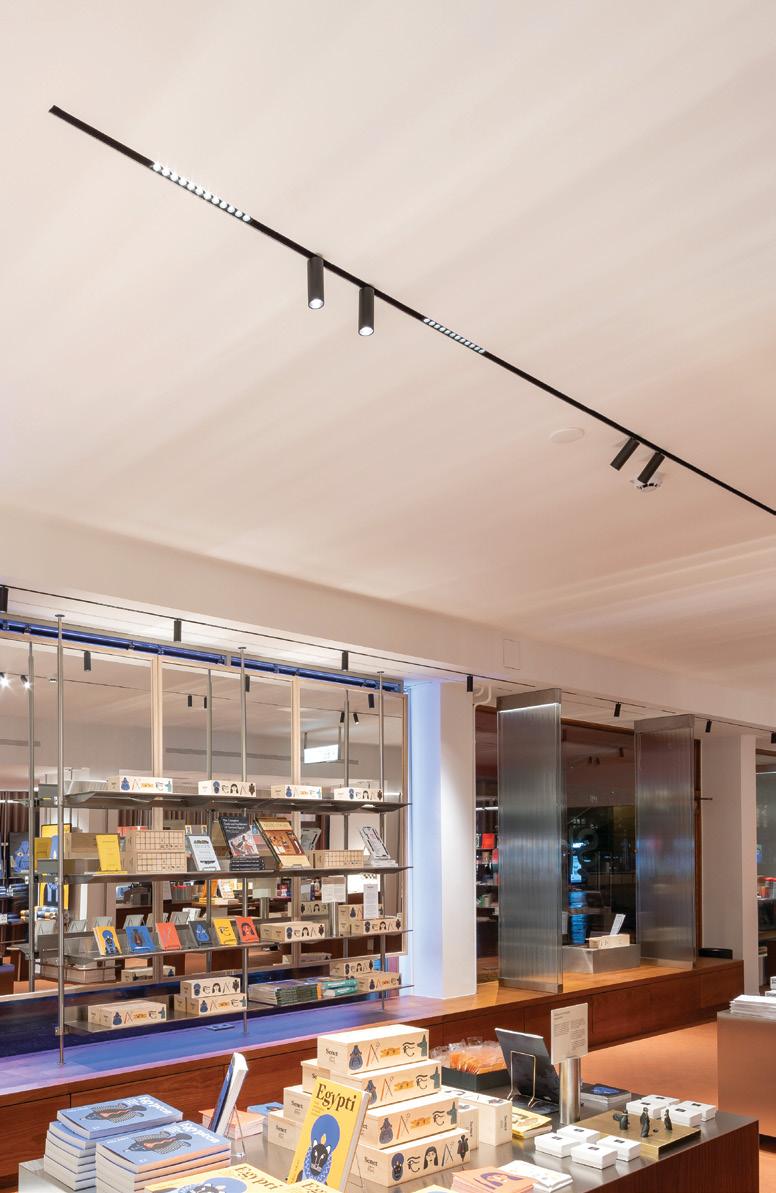
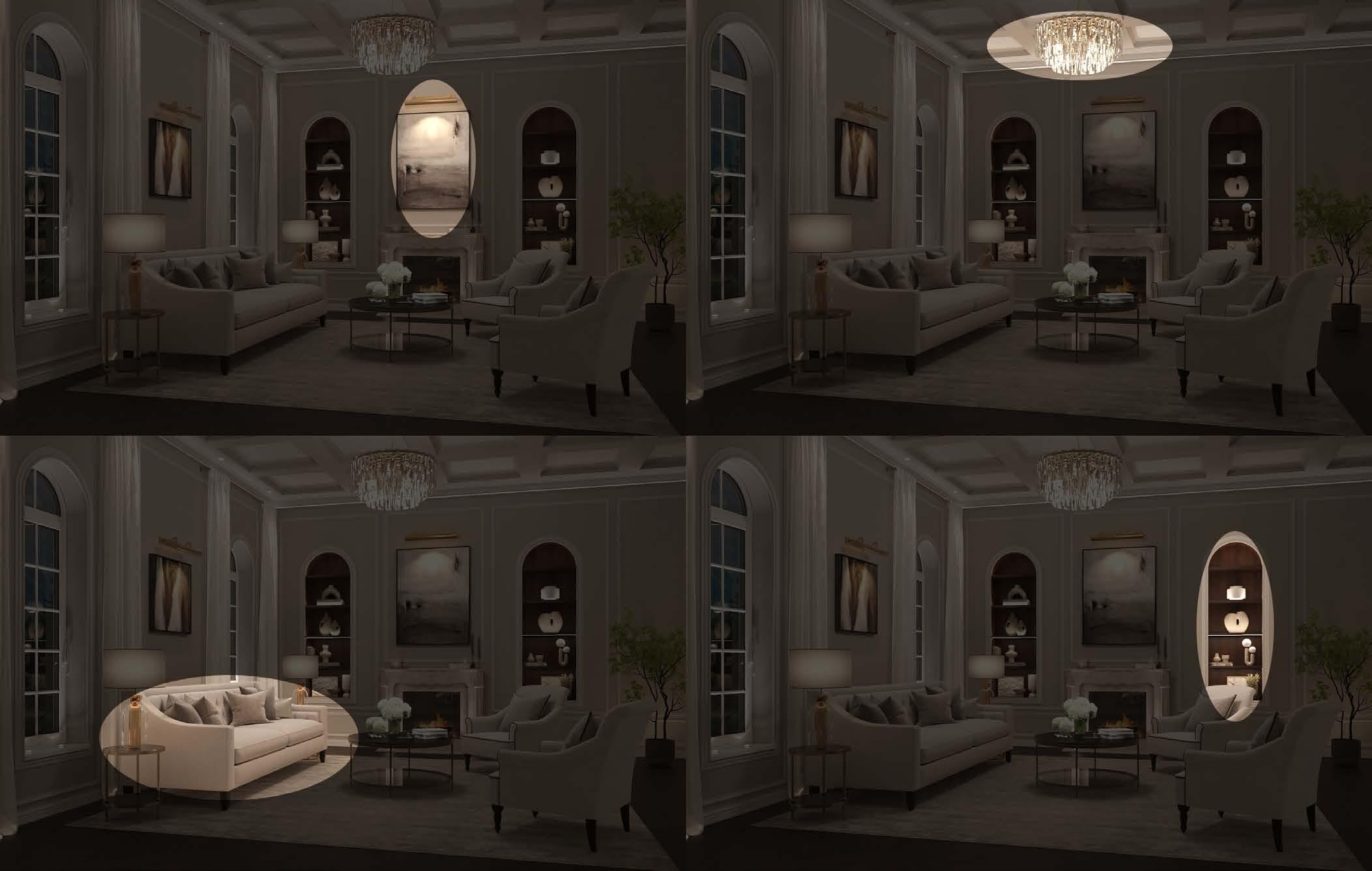
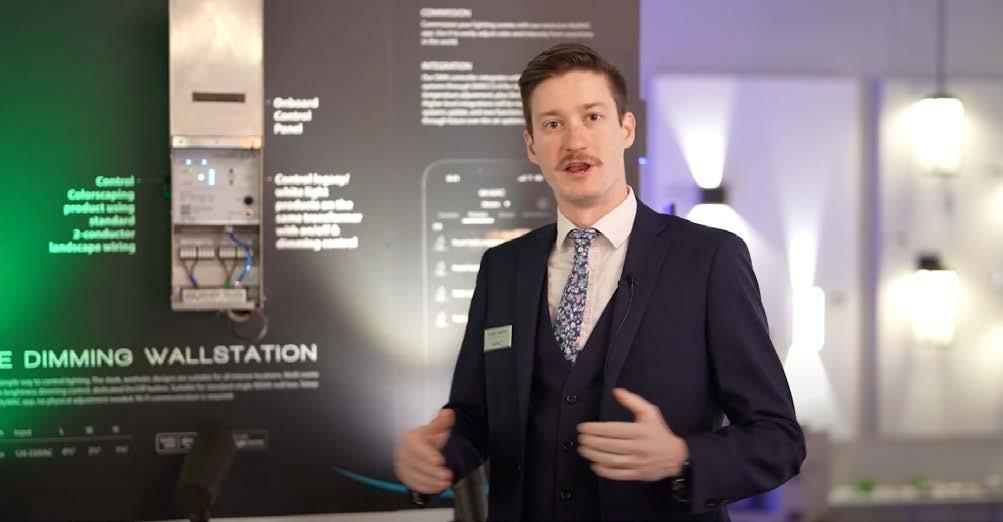
Expert is a brand-new, free-to-download programming platform that allows you to create fabulous lighting for Expert Control, with the least experience required. The Expert commissioning software has been designed with a new approach to programming that is exceptionally user-friendly:
• All tools are presented cleanly in one easy-to-navigate view
• Walkthroughs and helpers assist you in setting up your system
Expert is a brand-new, free-to-download programming platform that allows you to create fabulous lighting for Expert Control, with the least experience required. The Expert commissioning software has been designed with a new approach to programming that is exceptionally user-friendly:
• All tools are presented cleanly in one easy-to-navigate view
• Walkthroughs and helpers assist you in setting up your system
• Suggestions help you on your journey through key areas of programming
• Suggestions help you on your journey through key areas of programming
Expert software is free to download. pharoscontrols.com/expert
Expert software is free to download. pharoscontrols.com/expert
Q-Tran is now QTL
Over thirty years ago, Q-Tran was born with a vision: to manufacture superior power solutions. As we grew, we expanded our offering to include the highest quality LEDs and fixtures, positioning us as a leader in architectural lighting. Now it’s time that our brand reflects the dynamic, innovative company we’ve become.
We are QTL
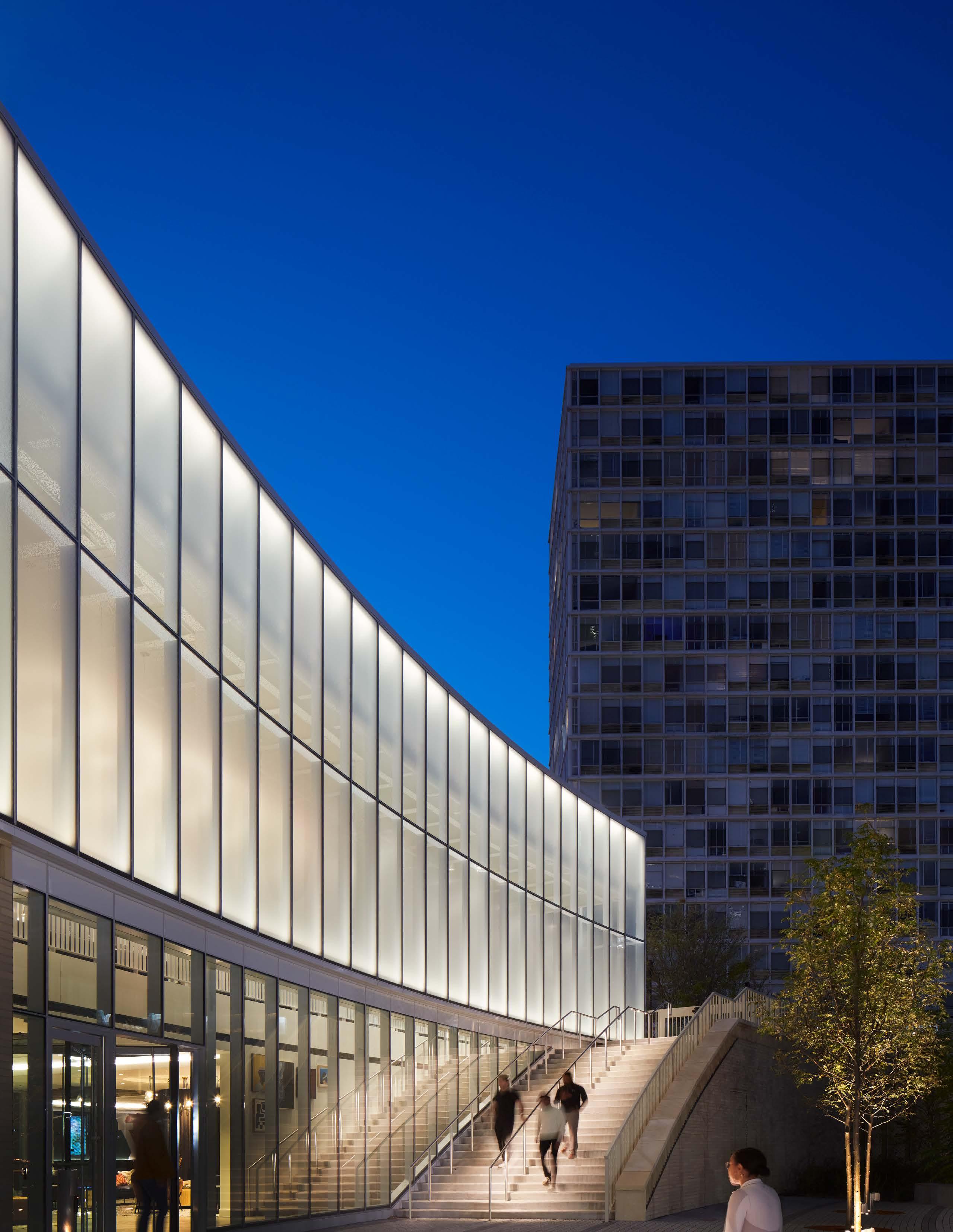
Prairie Shores | Chicago, IL
Lighting Designer: Zutalé Design
Architect: Gensler
Photographer: Kendall McCaugherty
tools for lighting
TRADE SHOW AND CONFERENCE
Soft Corner Coves
Benya’s
By James R. Benya, PE, FIES, FIALD
Advocating for
By Mariana G. Figuiero, PhD, David Pedler, BA and Daniel Frering
The
By Randy Reid
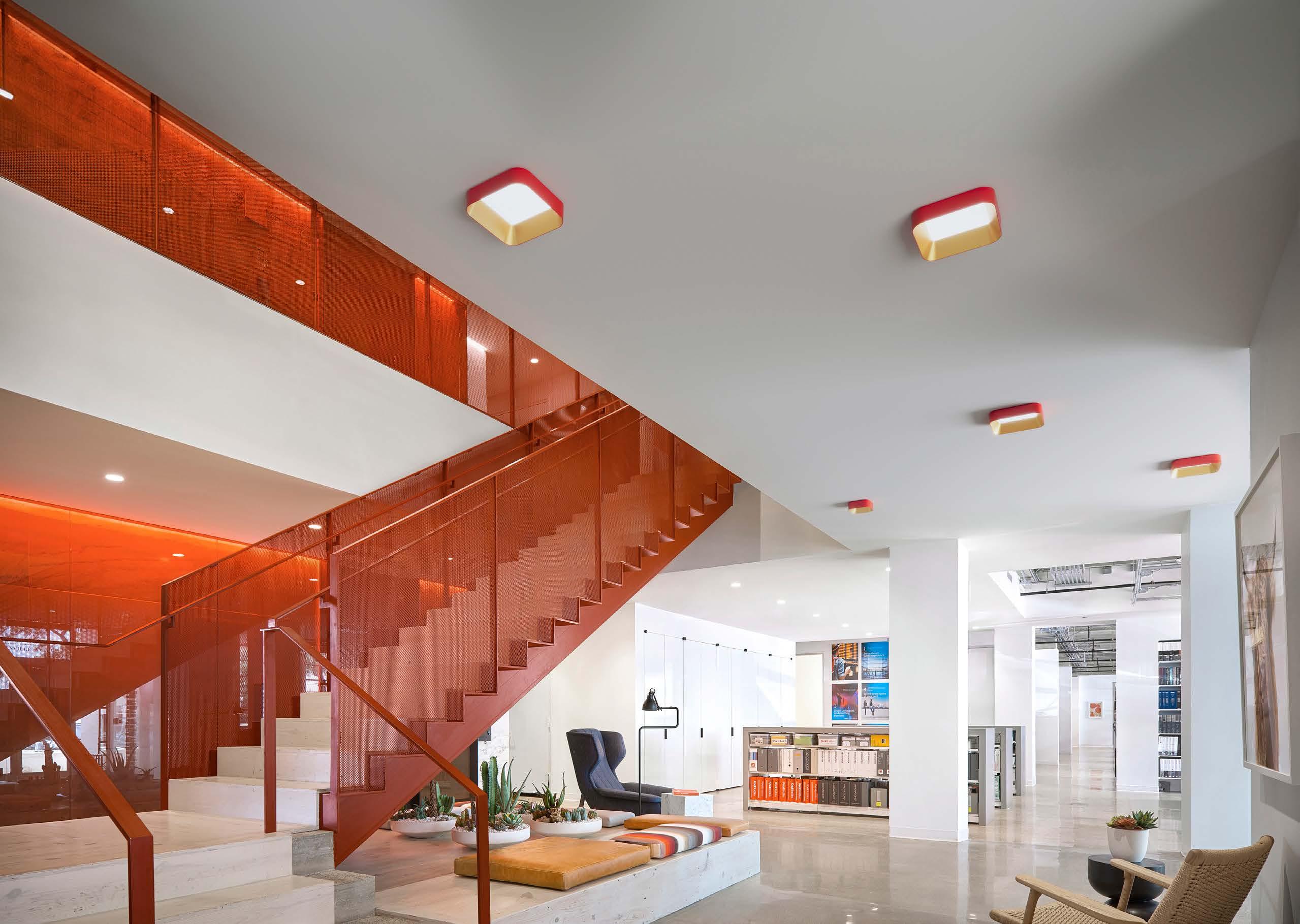
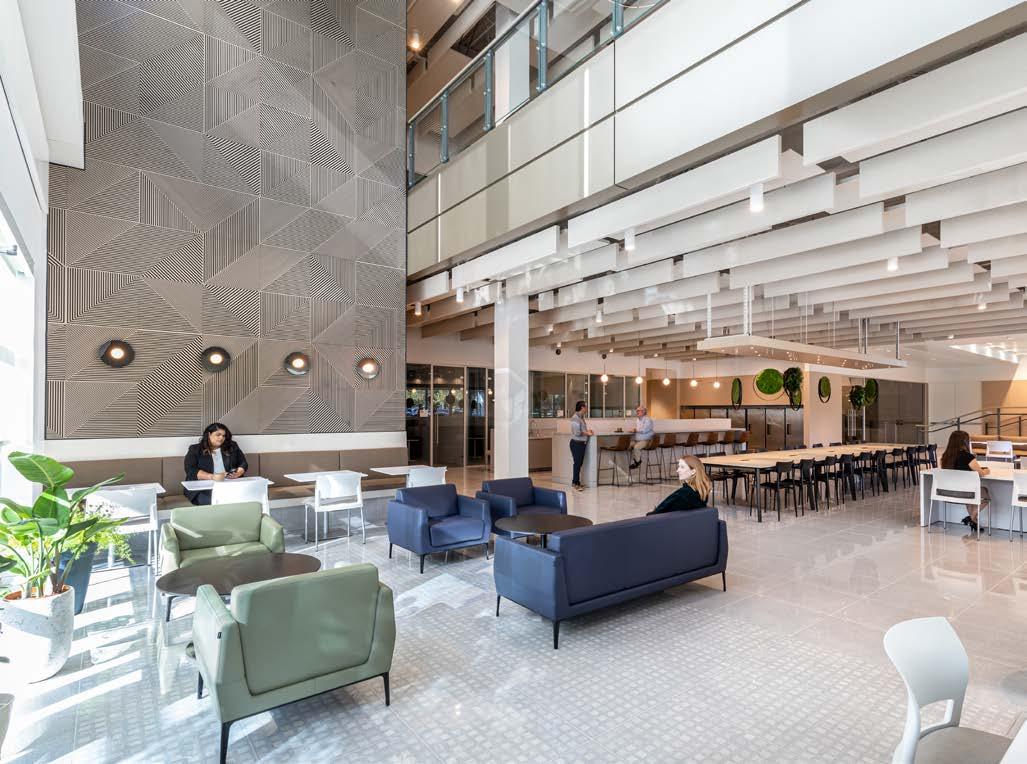
This team effort among lighting designer, architect and interior designer transformed a two-story 194,000 sf 1990’s tilt-up into a dynami c light-filled administrative workplace.
By Vilma Barr
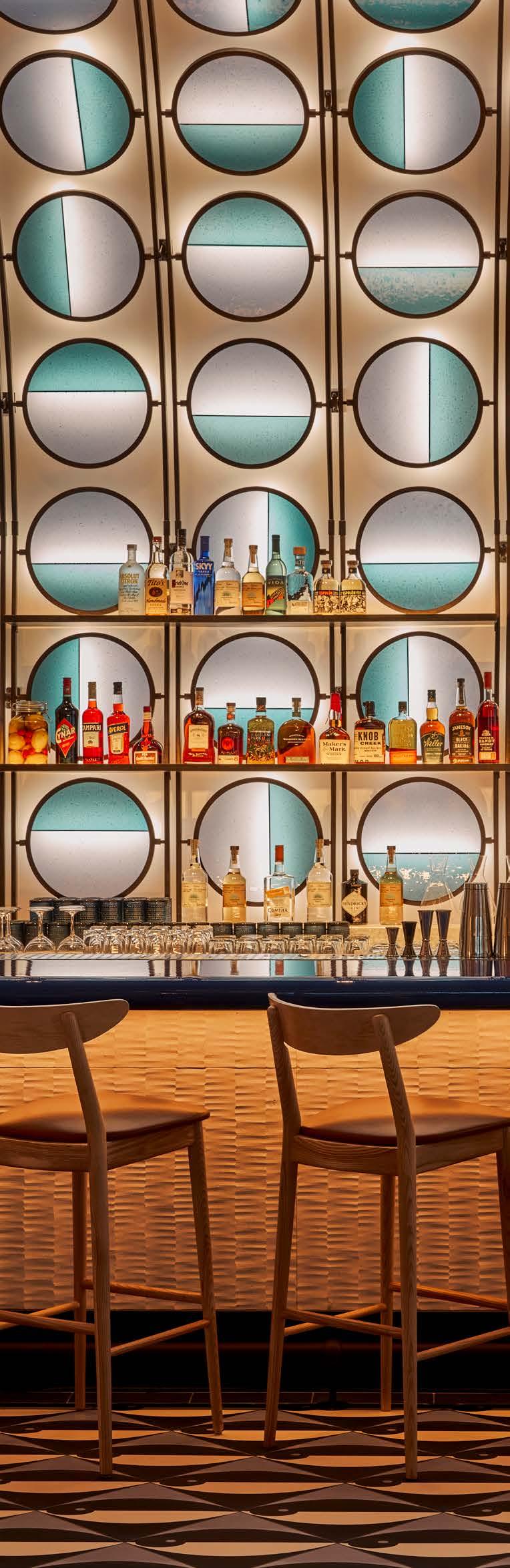
Zaytinya in the New York's Ritz-Carlton Hotel, with lighting design by Isometrix Lighting & Design and an architectural concept by Rockwell Group, features elements evocative of the Eastern Mediterranean coast.
By Randy Reid
By Randy Reid
AutoStore
CONTRIBUTORS
David Warfel
Shirley Coyle, LC James Benya, PE, FIES, FIALD
Vilma Barr
Craig DiLouie, LC, CLCP
Sara Schonour, LC, MIES, IALD
Daniel Frering
Carlos AlonsoNiemeyer
Mariana G. Figueiro, PhD
Reiko Kagawa, LC, LEED-AP, WELLAP, WELL Faculty
Kelly Roberts
David Pedler, BA
Largest 1” Family of Cylinders & Downlights on the Market
Industry-Leading Output
Interior & Exterior
Scan the code or visit bestlight.amerlux.com/finch to learn more.
Distinctive Rounded-Edge Design
Tranquil Floating Effect
Brand-Customizable
Scan the code to chat with us and learn more.
A Dance of Light and Shadow at the Ritz-Carlton Mexico City
By Randy Reid
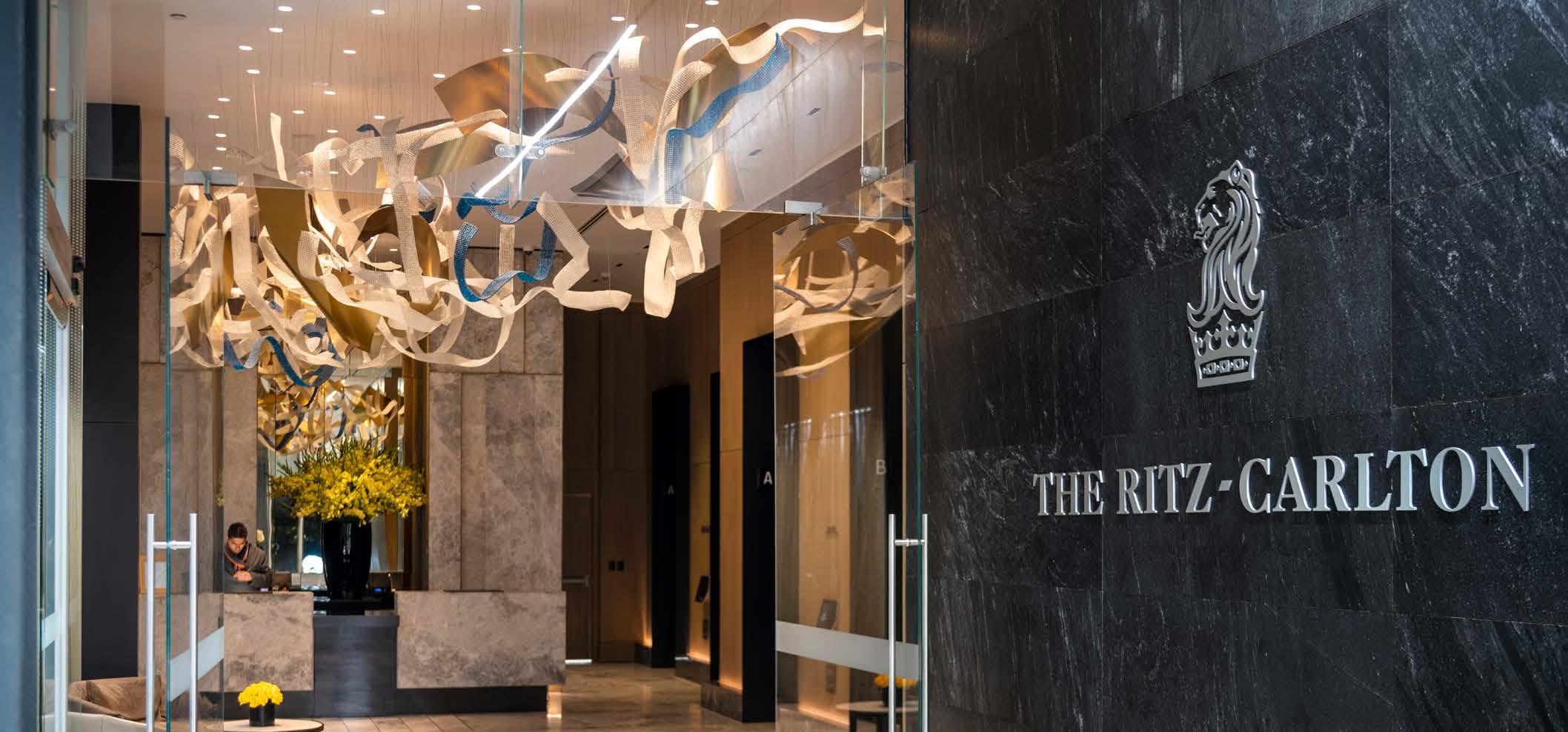
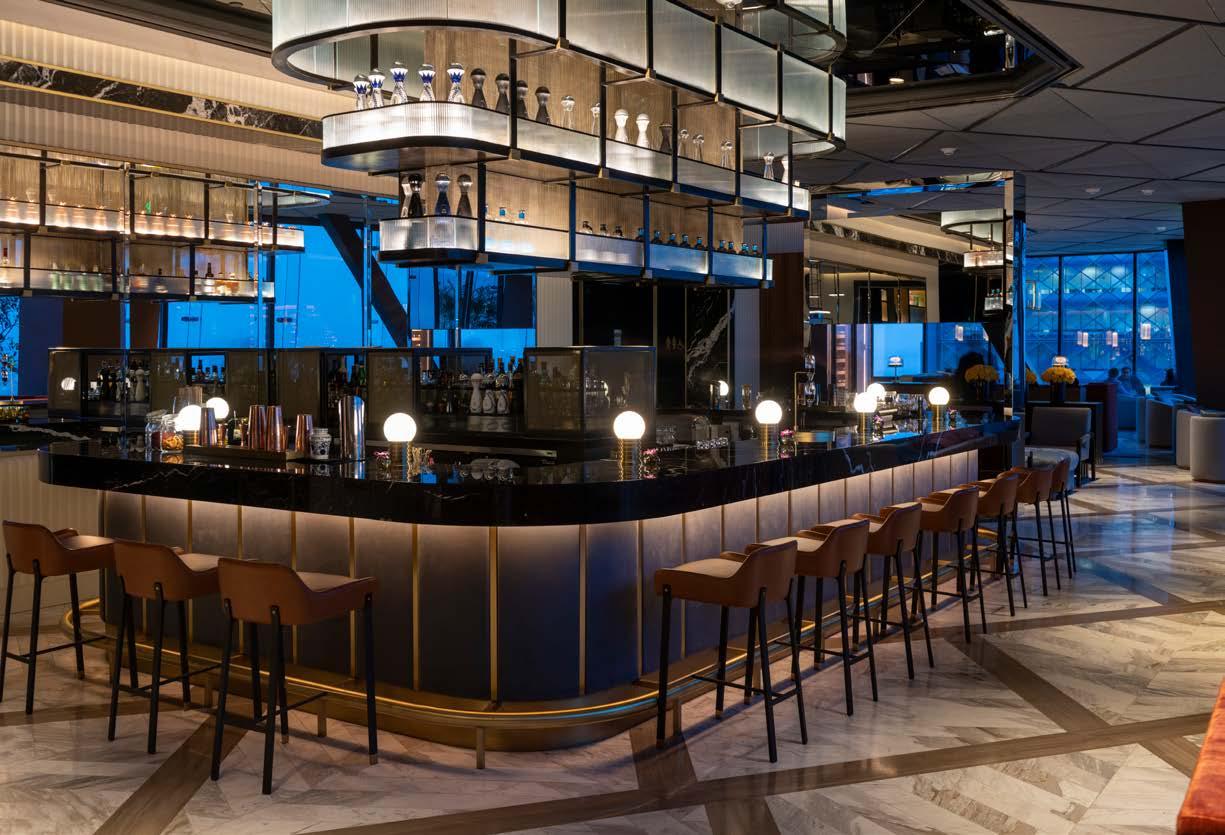
Artec Studio, led by principal Jose Cardona, brilliantly illuminates the Ritz-Carlton Mexico City with a bespoke lighting design that harmonizes with the hotel's opulent ambiance.
By Sara Schonour, LC, MIES, IALD and Reiko Kagawa, LC, LEED AP BD+C, WELL AP, WELL Faculty
The
and
By David Warfel
When we help clients understand the benefits of light, we can transform the design process and deliver better results.
By Craig DiLouie, LC, CLCP
What
By Carlos Alonso-Niemeyer
Evolving
By Kelly Roberts
We
By Shirley Coyle,
Zaytinya Bar at
The Ritz-Carlton New York
Jason Varney
Modern Craft Informed by Tradition
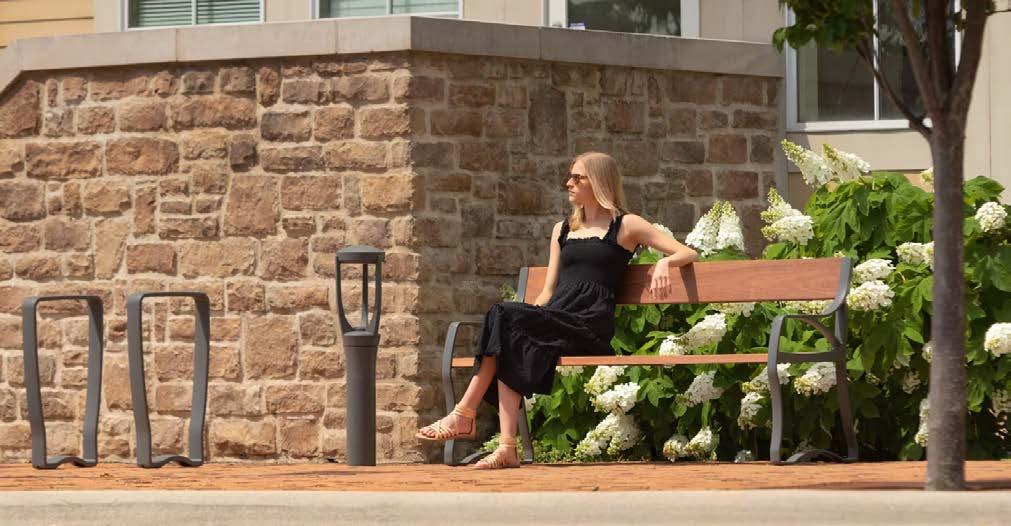
Northport Collection: Contemporary lighting and site furnishings informed by American design tradition.
Designed by Robert A.M. Stern Architects
Landscape Forms | A Modern Craft Manufacturer
Editorial Director: Randy Reid
Publisher: Cliff Smith
Director of Audience Development: Angie Hullfish
Contributing Writers:
James Benya PE, FIES, FIALD
Benya's Art & Science Contributor Principal at Design Services, Inc. and The Benya Burnett Consultancy
Shirley Coyle Up Close Contributor President, Cree Lighting Canada Principal, RELEVANT LIGHT Consulting Inc.
Craig Dilouie Get Control Contributor Principal at ZING Communications
Kelly Roberts Are you WILD? Contributor Principal, Primary Arc Design Past-President, WILD
Stefanie Schwalb
Hospitality Lighting Contributor Interim Managing Editor at Boston Magazine
Sara Schonour Circular Lighting Contributor Owner/Creative Catalyst, Luxsi
David Warfel
Residential Lighting Contributor Founding Designer Light Can Help You
Staff Writer
Parker Allen
Published by EdisonReport 1726C General George Patton Dr. Brentwood, TN 37027
Phone: 615-371-0961 designinglighting.com
March Madness
mad·ness
/ˈmadnəs/
a state of frenzied or chaotic activity. "from about midnight to three in the morning it's absolute madness in here."
Prepare to dive headfirst into a whirlwind of brilliance this March, as the lighting industry gears up for an extravaganza unlike any other! The term 'madness' might conjure images of basketball courts, its roots twist back to the 1800s, entwined with the expression 'mad as a March hare.’ In my world, however, 'madness' translates to 'wildly fun'—and that's exactly the electrifying atmosphere we're channeling for our industry this March.
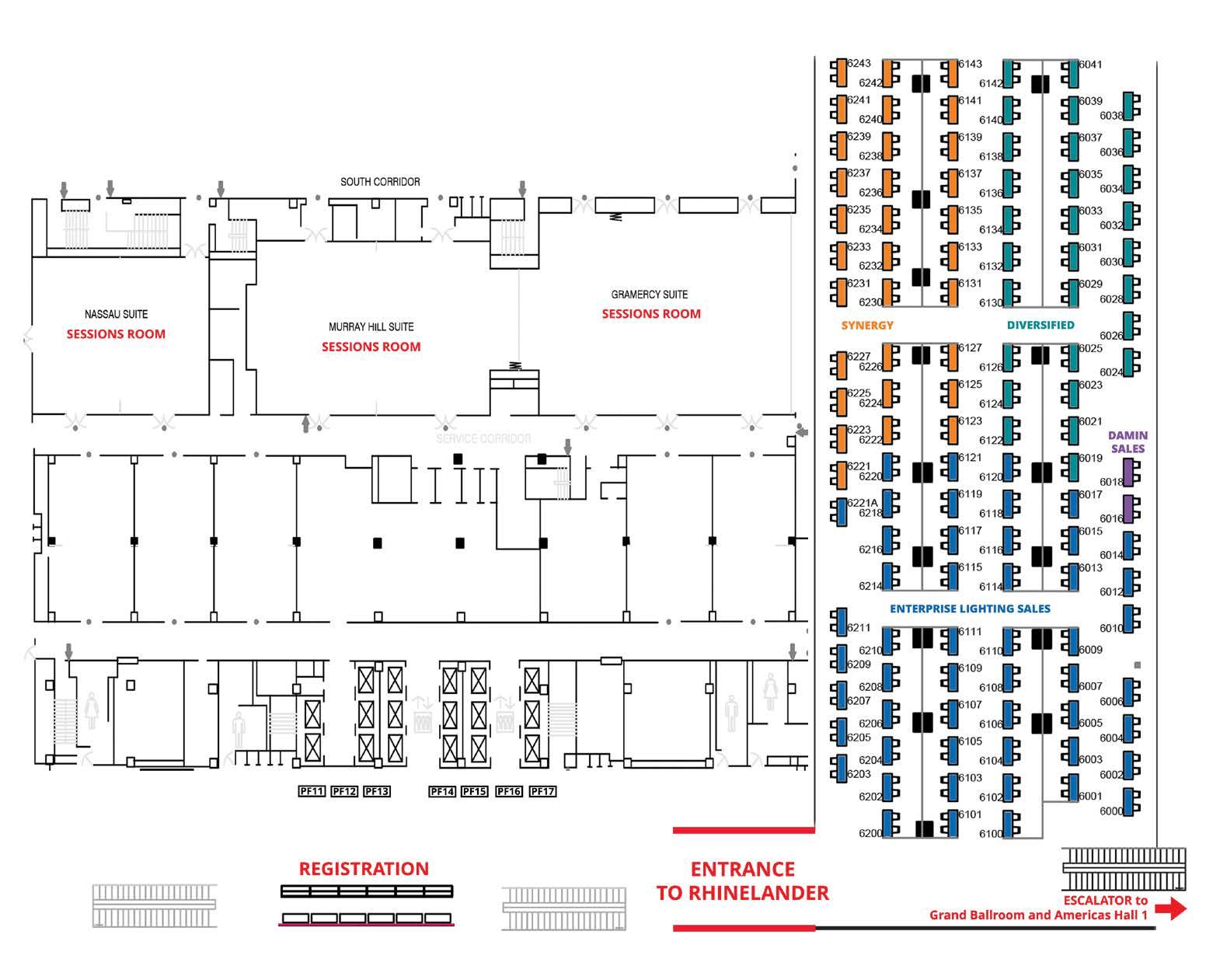
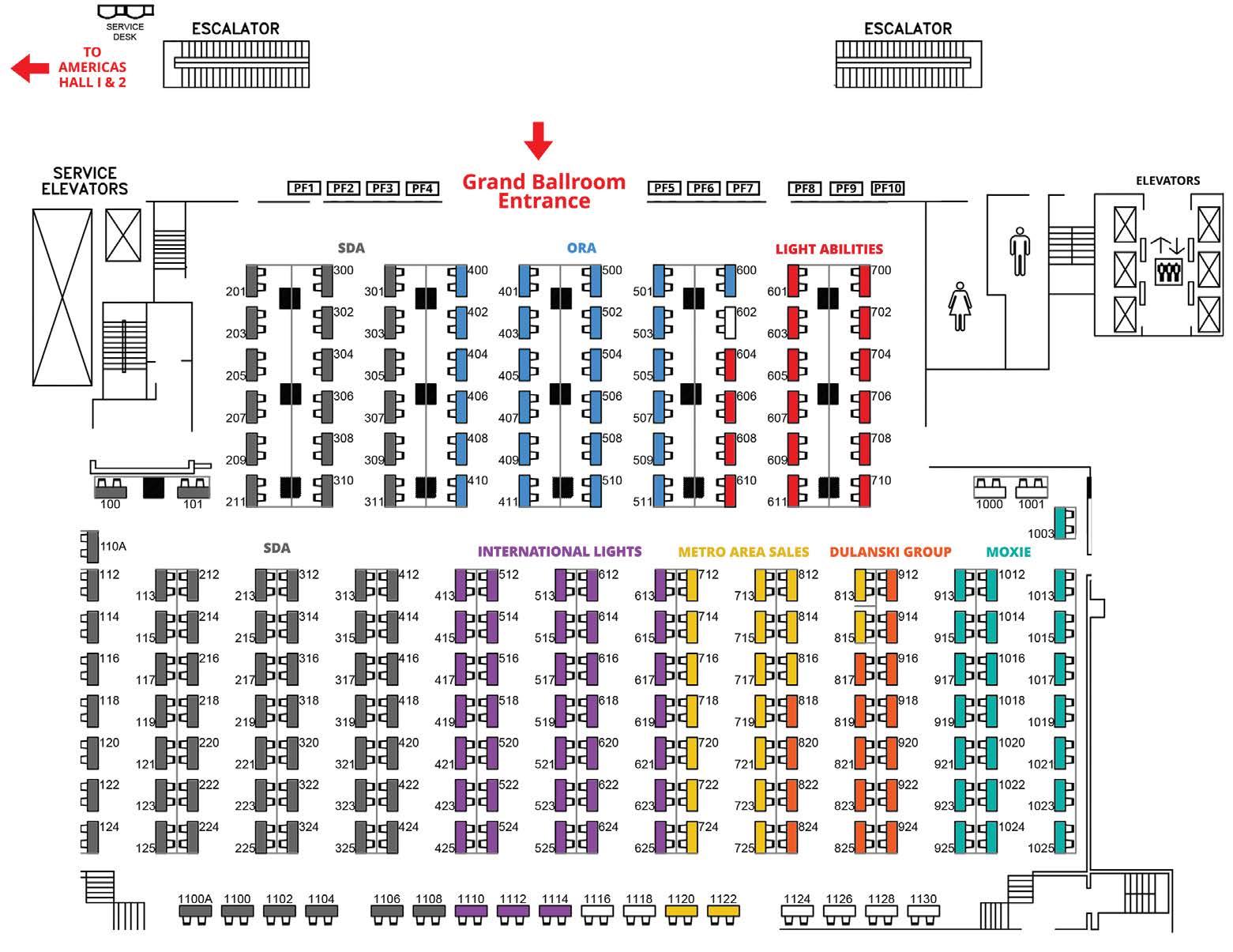
The buzz is palpable as professionals sharpen their focus on the year's most important events: Light + Building in Frankfurt from 3-8 March, and LEDucation in New York on 19 & 20 March.
As we ink this digital and print edition, the preparations for Light + Building are in full swing. Our studio will be set up in the foyer of Hall 4.1, ready to host a series of open, on-camera conversations with the luminaries of the lighting world. These C-Suite Series interviews are scheduled for the mornings, leaving afternoons free for me to visit the exhibit halls. And what's a celebration without a milestone? EdisonReport, our sister company, is hitting the dazzling 25-year mark, and we will be celebrating in Frankfurt!
With LightFair on a hiatus this year, EdisonReport broke the story that Messe Frankfurt purchased a 33.3% stake in LightFair late last month. This is huge news and will definitely bring fresh energy to LightFair. Both IALD and IES will maintain their combined 66.6% of the show.
We have been hunting for groundbreaking products to feature in our Top 10 MUST SEE list at LEDucation. Our panel of distinguished judges— Shanna Snow of Shanna Snow Design, Tanner Chee of Arup, and Katie Czub of FMS—have handpicked the best of the best, and they will be announced in our Show Daily
At the show, our camera crew will be front and center, capturing innovative products with LightPitch™ across various booths on Tuesday and continuing the C-Suite dialogues on Wednesday.
But before the exhibition floor buzzes to life, we'll shine a spotlight on the stars of lighting at our 9th Annual Lifetime Achievement Awards, graciously sponsored by Q-Tran. This year, we're rolling out the red carpet for:
1. Jimalee Beno
2. Dan Blitzer
3. Faith Baum
4. Craig Bernecker
5. Frank Conti
6. Donald Dunn (posthumous)
7. Paul Gregory
designing lighting is focused on the Business of Lighting Design™ and provides business information to the lighting design community. In addition to the website, designing lighting publishes bi-monthly online magazines featuring original content, interviews within the community and highlights successful award winning lighting designs. While designing lighting is based in the U.S., it has contributors from Europe and is developing a global presence. (ISSN 2693-9223)
Statements and opinions expressed in articles and editorials in dl are the expressions of contributors and do not necessarily represent the policies or opinions of the EdisonReport. Advertisements appearing in the publication are the sole responsibility of the advertiser.
8. Janet Lennox Moyer
9. Kim Mercier
10. Caroline Rinker (posthumous)
11. Robert Shook
12. Gary Steffy
And for a twist of prestige, the ceremony will be hosted at The New School at Parsons School of Design. If you haven't snagged your tickets yet, hustle over to EdisonReport's Event Page—they're going fast!
So, mark your calendars and pack your bags for a March filled with dynamic showcases and insightful exchanges. Whether we cross paths in Frankfurt or the Big Apple, here's to a journey that's safe, exhilarating, and illuminating! See you there!
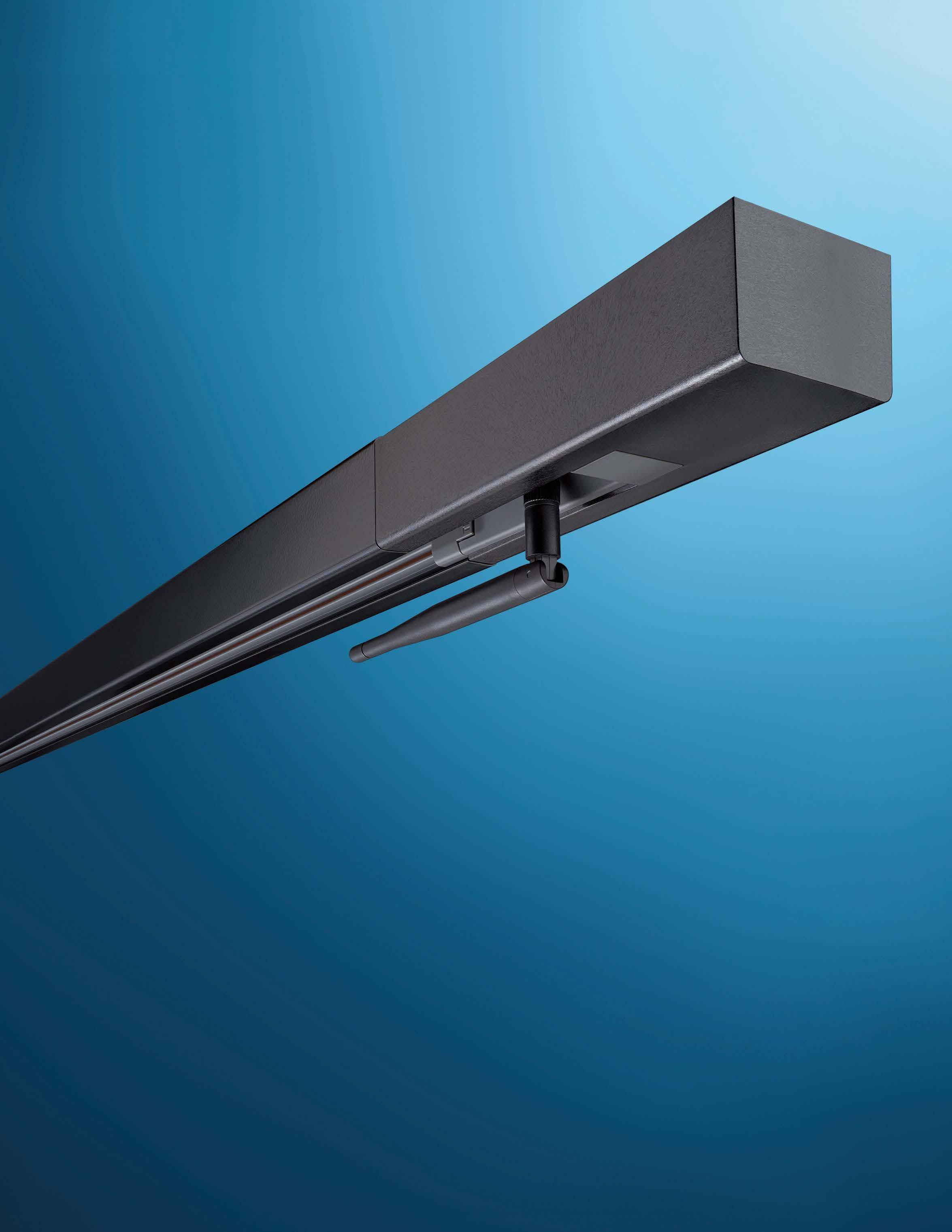
Integrating Control Simplicity Wireless DMX
Wireless DMX Track Feeds are used to add Wireless DMX control into any CONTROLTrack installation. Our patented Wireless DMX Track Feed receives data wirelessly from a Multiverse® Transmitter or Node and outputs a DMX signal to the CONTROLTrack and DMX fixtures. Each Wireless DMX Feed can control up to 32 fixtures and can transmit DMX across 300’ of track.
Wireless Wonder.
pro·gres·sion: (n.) the process of developing or moving towards a higher, better, or more advanced state.
THE POWER OF LIGHT
THE POWER OF LIGHT
Always at the forefront of promoting excellence in the field of lighting design, the IALD is making significant strides for members and the broader lighting design industry.
Always at the forefront of promoting excellence in the field of lighting design, the IALD is making significant strides for members and the broader lighting design industry.
Comprised of and working for professionals worldwide, all effort focuses on advancing lighting design through leadership and advocacy.
Comprised of and working for professionals worldwide, all effort focuses on advancing lighting design through leadership and advocacy.
The IALD has made remarkable progress in recent months, advancing the interests of its members and the lighting design industry overall. Through its programs, events, platforms, and partnerships, the association continues to shape the future of lighting design, ensuring its members are wellequipped to thrive in an ever-evolving profession.
The IALD has made remarkable progress in recent months, advancing the interests of its members and the lighting design industry overall. Through its programs, events, platforms, and partnerships, the association continues to shape the future of lighting design, ensuring its members are wellequipped to thrive in an ever-evolving profession.
JOIN THE IALD
JOIN THE IALD
Learn about the benefits of IALD membership and how being a part of this global community works for you throughout your career.
Learn about the benefits of IALD membership and how being a part of this global community works for you throughout your career.
FOR EDUCATION
FOR EDUCATION
The IALD delivers continuous learning opportunities, workshops, and seminars to keep its members informed of industry trends and emerging best practices. The forthcoming Lighting Education Resource Network (LERN) online platform will provide global access to those opportunities as part of membership.
The IALD delivers continuous learning opportunities, workshops, and seminars to keep its members informed of industry trends and emerging best practices. The forthcoming Lighting Education Resource Network (LERN) online platform will provide global access to those opportunities as part of membership.
FOR CONNECTION
FOR CONNECTION
The IALD digital platform facilitates a robust global network of lighting design industry professionals, where all can collaborate, share insights, and follow developments. Enlighten conferences and other events let members engage with thought leaders and experts, fostering a vibrant, diverse community.
The IALD digital platform facilitates a robust global network of lighting design industry professionals, where all can collaborate, share insights, and follow developments. Enlighten conferences and other events let members engage with thought leaders and experts, fostering a vibrant, diverse community.
FOR RECOGNITION
FOR RECOGNITION
The IALD advocates globally for the importance of quality lighting design in enhancing the built environment. Our chapters collaborate with architects, planners, and policymakers to integrate lighting design considerations into projects and initiatives. The annual IALD Awards honor lighting design excellence and inspire the industry.
The IALD advocates globally for the importance of quality lighting design in enhancing the built environment. Our chapters collaborate with architects, planners, and policymakers to integrate lighting design considerations into projects and initiatives. The annual IALD Awards honor lighting design excellence and inspire the industry.
FOR INNOVATION
FOR INNOVATION
Supporting initiatives that explore new technologies, sustainable practices, and human-centric design creates a culture of mindful innovation. Members are empowered to develop lighting solutions that meet aesthetic and functional requirements while demonstrating energy efficiency and environmental sustainability.
Supporting initiatives that explore new technologies, sustainable practices, and human-centric design creates a culture of mindful innovation. Members are empowered to develop lighting solutions that meet aesthetic and functional requirements while demonstrating energy efficiency and environmental sustainability.
“We really wanted our lighting design efforts for North Star to make sure people felt welcomed and energized when entering into the school and various spaces.”
– Scott Mason, Hallberg Engineering
NORTH STAR ELEMENTARY SCHOOL USES LIGHTING TO BLEND NATURAL ELEMENTS WITH URBAN LOCATION
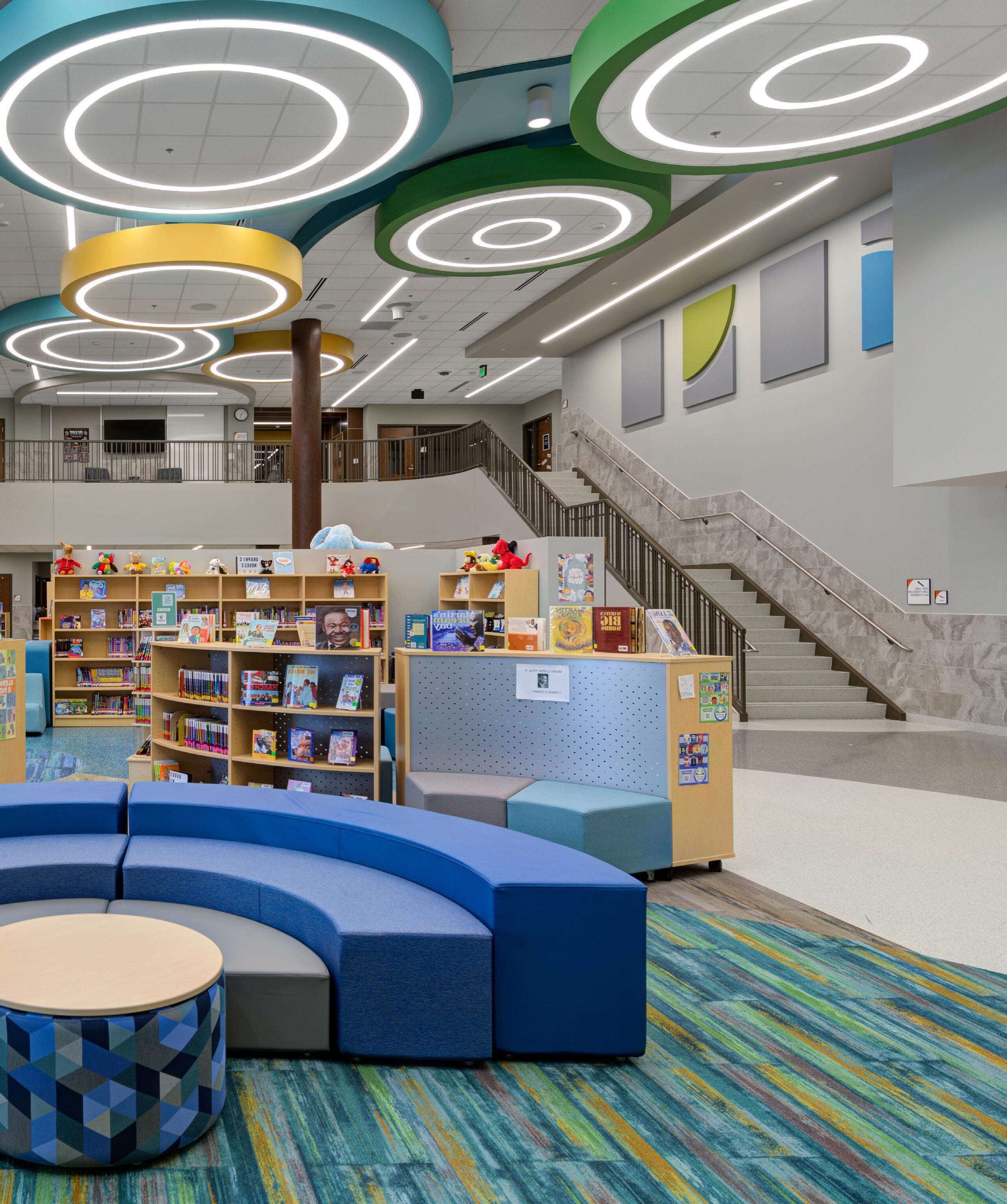
The collaborative efforts of White Bear Lake Area Schools, district staff, administrators, and Wold Architects & Engineers led to the establishment of North Star Elementary School in Hugo, MN. This state-of-the-art school accommodates up to 720 students from kindergarten to fifth grade, focusing on fostering a bright future through innovative design. The vibrant Learning Commons at the heart of the school features flexible seating, breakout learning spaces, and a literature collection of nearly 10,000 titles. The design and color scheme complement the natural beauty of the surroundings.
Six learning studios, each housing five theme-based classrooms, encourage collaboration, STEM, art activities, and cutting-edge technology integration. The grade-level configuration provides personalized support for each student.
According to Paul Aplikowski, Partner at Wold Architects and Engineers, there is a dramatic shift in people’s tastes and demands for schools. Districts are seeking a different environment that students can take pride in, making North Star Elementary School a unique learning landscape with diverse environments.
To emphasize the blending of urban and natural spaces designed for the Learning Commons, the Full Circle linear lighting from Mark Architectural Lighting™ was selected by collaborating firm, Hallberg Engineering. The unique circular luminaires help to invoke a natural setting and coincide effortlessly with the circle design in the outdoor learning area. The space also integrates supplemental lighting from the Slot 4 Recessed Linear Lighting from Mark Architectural Lighting.
Scott Mason, Project Designer at Hallberg Engineering, highlighted the departure from standard lighting, creating a vibrant atmosphere that inspires learning throughout the school. “Even if they do not consciously know it when people walk into a space, they always feel something,” said Mason.
Read the full article here
See the breath-taking photos at marklighting.com
Where now, IES?
IES: A New Era Beyond Wall Street
By
JAMES R. BENYA, PE, FIES, FIALD
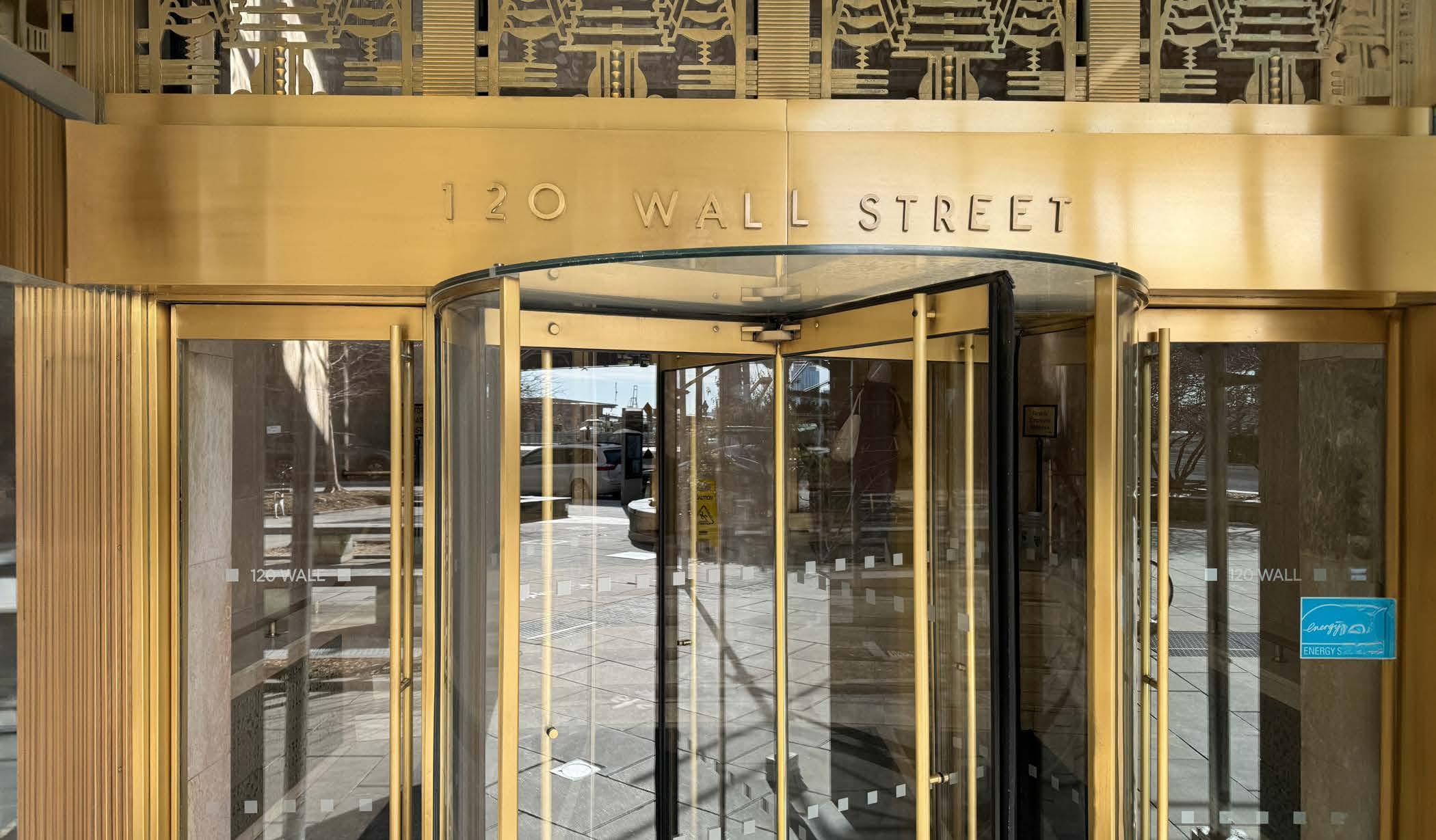
On January 31, 2024, EdisonReport reported that IES had moved out of its long-time offices at 120 Wall Street. Editor Randy Reid wrote, “During the past four decades, your humble editor has attended and hosted various meetings and discussions in that office.” So have many of us who were active enough in IES in a regional or society-level matter to participate in a highlevel meeting or meet with headquarters staff. Randy called it “bittersweet”, but I don’t think it is that bitter. Like family members moving into a new home after decades of living in the same house, you will miss the house and its memories, but the family lives on.
For most of its history, IES was a volunteer organization with only a small staff. It relied on the leadership and support, both
financial and human, of its members. For most of my career, big companies and other sustaining members carried much of the financial burden and contributed significantly to appropriate technical committees. Members from throughout the lighting industry contributed a lot through local sections and technical committee work. The benefit of whole-industry support was enough to grow IES into a high quality, responsible technical society. For example, throughout the energy crisis of the last century, IES members stepped forward as one and worked closely with government agencies and colleagues at ASHRAE to develop and promote the means to dramatically reduce lighting energy consumption while ensuring that lighting quality and cost effectiveness were maintained.
Encouraged by the success of trade shows like Lighting World and the Pan Pacific Lighting Exposition in the 1980s, the IES and
Photo Credit: Randy Reid
IES headquarters at 120 Wall Street.
IALD undertook to realize an exceptional business opportunity called LightFair in 1989. Our two lighting societies were and remain today equal partners with the show’s producer, ANDMORE.1 As LightFair grew in size and importance, the relevance and income to our two lighting societies increased dramatically. Both IES and IALD used their shares of profits to develop new programs, expand their impacts, hire more personnel and grow financial reserves.
There were some ups and downs, to be sure. I served on the LightFair Management Committee representing IALD with Randy Reid and others 20 years ago. LightFair as a whole had become complacent, and it was our job to renew and rebrand it. Within the following year, LightFair had regained its energy and appeal and resumed its role as both a financial success to its owners and a quality success to its attendees. But then the Covid pandemic hit like a ton of falling bricks. Not only was LightFair 2020 canceled (and its income lost), but there were liabilities like hotel guarantees and other costs that had to be paid from prior years’ profits. Considering the dramatically smaller shows in 2021 and 2022, no wonder that our Societies have had to take serious measures to stay alive.
But of course, we are not alone. Business has changed in the last four years in so many ways that it is difficult to keep track. A key indicator is that office buildings in cities throughout North America are becoming empty, with property vacancies as high as 30% in some major markets.2 In New York, vacancy is at the highest rate since Colliers started tracking the market in 2000.3 Many of the benefits for IES’s location on Wall Street are largely gone. And with rent at $60 per square foot plus utilities, under-used or unoccupied space is not an affordable
luxury for the IES.4 I commend IES staff and the IES Board for the personnel changes and prudent move to keep IES alive and able to continue in its important role as the ANSI-certified standards development body in lighting. CEO and Executive Director Colleen Harper and the Board of Directors made a particularly wise decision to dramatically reduce overhead costs to “…optimize our operational efficiency, embrace modern work trends, and better serve our members and the lighting community” by relocating to a WeWork space (IES Press Release, January 31, 2024).
But that is only a part of what we face. Lighting technology itself – namely the profound revolution of LEDs and digital electronics – has changed the nature, costs, and pace of innovation and education, and in the process reduced the former dominance of the industry by a dozen or so well-established companies, not to mention the way that manufacturers and sales agencies alike conduct business. Key technical persons on IES committees retired, and IES leadership ensured that a new generation of technical contributors were qualified.
We should have learned that even though our business practices have changed, we still really need IES, and we should not change much. IES is the ANSI-accredited standards developer for light and lighting. “The standards approval process is based on a rigorous consensus approach with several layers of oversight and public commentary – resulting in five collections of impartial, practical lighting guidelines and resources known as the IES Lighting Library.”5 For example, in my expert testimony work, the question of whether there was enough light at an accident or murder scene is by far the most common technical issue for which experts are hired, and I use the IES
Recommended Practices in making my analysis for depositions and trials. In my lighting design work, I use IES Recommended Practices to determine the amount of light, its energy efficiency, character and quality. And for literally hundreds of questions about lighting design approaches, physics of light, physiology of lighting and calculations of all types, the IES publications, including LD+A, Leukos and the Lighting Library, provide me with the knowledge obtained from IES experts and expert committees. And today we can be even more proactive by taking advantage of electronic meeting technology to work better, faster, and more inclusively to produce educational materials, standards and recommended practices while conserving the resources we used to spend on travel to committee meetings.
Perhaps above all, I trust the IES, our officers and Board to be my advocate in the realm of public policy, legislative and regulatory activity, and to represent my best interests in working with government and other industry organizations. Because the IES is independent and belongs to all of its membership, I don’t worry much about a political or economic agenda getting too far without the appropriate IES committee or our Board of Directors making certain that they remain within the applicable art and science of light. And it helps make me strong enough to show up at a public event involving lighting and to call out the quackery that often shows up. As an IES member, it makes me confident that I can voice an objection to any IES Board action, publication, recommended practice or standard and not be dismissed because I don’t agree.
Going forward, we lighting industry people should:
• Become an IES member, pay membership dues, and sign up to use the Lighting Library.
• Read LD+A and other announcements.
• Take advantage of IES online presentations and educational sessions.
• Participate in your IES section. Attend local meetings and get to know other local members.
• If you are an independent lighting designer, also consider becoming a member of IALD as well.
• Either in person or online, take advantage of local, regional and national online meetings and educational programs.
• Whenever possible, attend national and international conferences such as LightFair, the IES Annual Conference, the IES Street and Area Lighting Conference, and local conferences like LEDucation, Light! Design Expo, LightSPEC West, and ArchLIGHT Summit.
• Join an IES Committee. Most are online meetings and will incur minimum cost.
It is up to us. If we don’t have IES, we risk losing our honest leadership in light and lighting to a new generation of organizations and groups that have financial and political agendas. IES must be strong, independent and ANSI-certified, and we must ensure that the industry fully supports this with their resources and their words. I can live and work without IES being on Wall Street, but it would be big mistake to be without IES as we know it. ■
1 Originally Atlanta Market Center (AMC) Trade Shows
2 Statista, SFgate.com
3 Ibid
4 Because of its even smaller membership and budget, IALD closed its Chicago office in 2022 and went fully remote.
5 IES Website
Former office of Paul Tarricone, recently retired Editor and Publisher of IES’s LD+A magazine.
Optec New
For durable, economical and sustainable lighting solutions
Durable
Developed and designed for a service life of 20 years
Effective Lens system that directs light only where it is needed (lux per watt)
Future-proof
Interchangeable lenses, accessories and standardised interfaces for tracks
Lighting the Way to Fall Prevention in Older Adults
In 2008, LHRC researchers proposed a 24-hour lighting scheme for positively impacting the visual, circadian, and perceptual systems of older adults.1 Incorporating lighting principles that considered the needs of the aging eye, the scheme included delivering a robust light-dark pattern to promote circadian entrainment and better sleep. We also proposed the innovative use of horizontal and vertical doorframe lights to provide visual cues for helping with postural control and stability, which become compromised as we age.
A recommended practice (ANSI/IES RP28-20) addressing lighting for older adults already exists.2 We know that the aging eye needs greater amounts of light to see fine details, is more sensitive to glare, and takes longer to adapt to changes in the lighted environment. Moreover, sleep disturbances and falls that can result from poor lighting conditions pose major health risks for older adults living at home or in more controlled environments like assisted living centers and nursing homes.
Our research team has been testing the impact of a tailored lighting intervention (TLI) delivering high circadian stimulus (CS) during the day, complemented by low CS in the evening, on measures of sleep, mood, and behavior in dementia patients living in controlled environments.3-5 More recently, we have replicated these remarkable findings in additional nursing homes.6, 7
This contribution describes our latest work
MARIANA G. FIGUEIRO, DAVID PEDLER AND DANIEL FRERING
By Light and Health Research Center (LHRC) at Mount Sinai
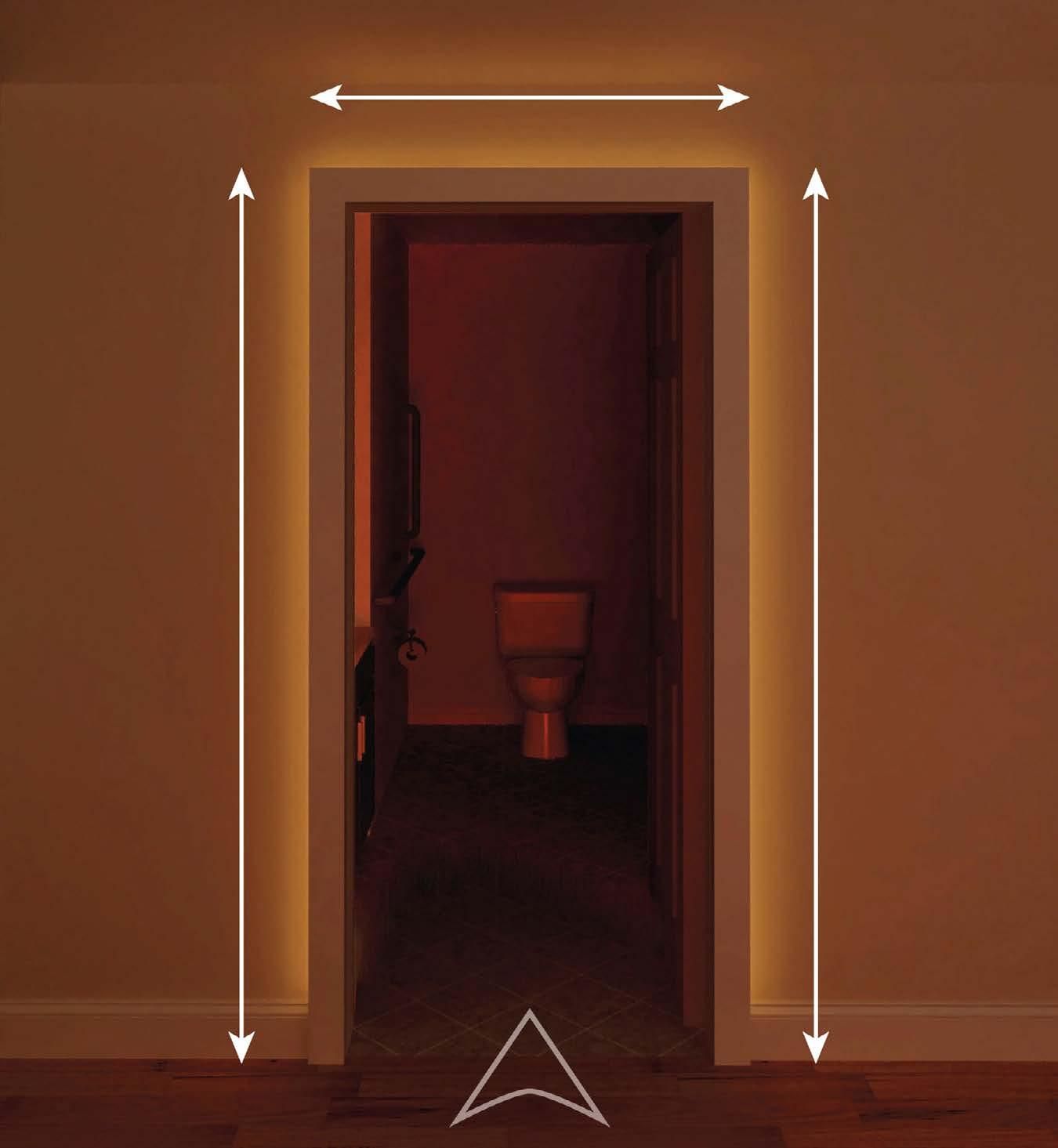
Figure 1. Rendering of the LHRC’s doorframe lighting system for reducing nighttime falls among older adults. The outer arrows mark the vertical and horizontal visual cues provided by the doorframe lights.
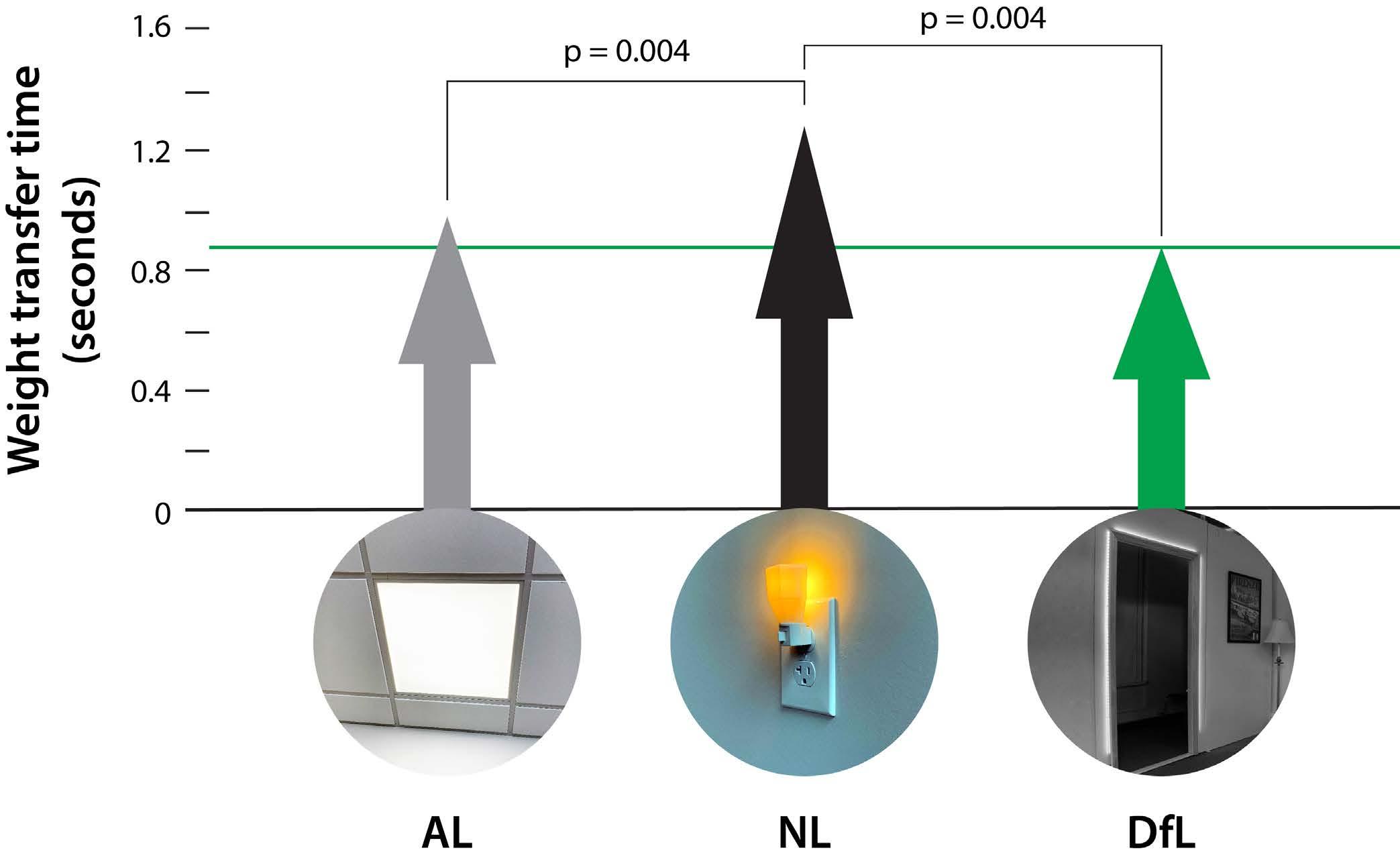
Figure 2. In one experiment, subjects were exposed to ambient light (AL) from a ceiling luminaires (≈ 650 lx at the cornea), plugin nightlights (NL), and the doorframe lighting (DfL) over three sessions. Their weight transfer time (WTT), which gauges difficulty experienced when rising from a seated position, was measured for each lighting condition. Among those with a history of falling, as shown here, the DfL condition produced the shortest WTT (least difficulty) and the NL condition produced the longest WTT (greatest difficulty). The statistically significant differences between the conditions for the “faller” subjects are represented above the arrows.
in the development, testing, and implementation of a novel lighting system designed to prevent falls, which have emerged as the leading cause of injury and death among older adults in the U.S.
An Innovative Lighting Solution
The design challenge, as we see it, is essentially twofold. First, a fall-prevention lighting system must consider the physiological and biomechanical mechanisms involved in balance and postural stability, falls, and aging. Second, because a light stimulus received at any time evokes an alerting response in humans of all ages, the light must be delivered at sufficiently low levels to avoid disrupting nighttime sleep. This latter factor is especially important when it comes to older adults, many of whom experience nighttime sleep disturbances.8 The incidence of sleep problems is reported to increase dramatically among those with Alzheimer’s disease and Lewy body or Parkinson’s disease dementia.9
Balance and postural stability are essential elements for
avoiding falls. But those elements are governed by several interconnected body systems (e.g., sensory, musculoskeletal, neuromuscular, vestibular, and cognitive) that deteriorate as we age. The aging eye, for example, can experience reductions in nighttime vision that inhibit our ability to perceive obstacles in darkened spaces. Age-related cognitive decline can adversely affect awareness of our surroundings and compromise our ability to plan and navigate nighttime routes to the bathroom or the kitchen.
The LHRC’s past research has demonstrated that a lighting system providing vertical and horizontal visual cues via diffuse low-level illumination around a doorframe (Figure 1) can effectively help to prevent falls in older adults without delivering an incidental alerting effect.10, 11 The doorframe lighting system reduced sway; improved postural stability, spatial orientation, and balance (Figure 2); and made nighttime navigation safer for older adults without compromising their sleep quality.
A very recent (but not yet published) clinical trial study conducted by researchers from the LHRC and the University of North Carolina (UNC) demonstrated that, compared to
conventional plug-in nightlights, a simple doorframe lighting system (fabricated in the LHRC lab) contributed to a 34% reduction in falls among older adults with Alzheimer’s disease and related dementias living in long-term care facilities. Only one of the study’s 38 participants was reported to have experienced greater difficulty falling asleep and none were reported to have been disturbed by the lights while asleep.
In a follow up, multi-year, multi-million-dollar project funded by the National Institute on Aging, we are continuing our collaboration with UNC and extending the research to over 300 rooms in various independent and assisted living facilities in North Carolina. Stay tuned for the exciting results!
What Else Is in Store?
Given what’s at stake and the tantalizing prospect of delivering a relatively low-tech, decidedly low-cost, yet effective intervention for reducing nighttime falls in this vulnerable population, the time is now to bridge the gap between laboratory research and real-world practice in the homes of older adults. To date, only a single manufacturer has developed a similar system for new-build and retrofit architectural applications. But this situation is about to change with the upcoming introduction of
References
a commercially available, competitively priced (around $50 US) DIY-friendly doorframe lighting system that requires only simple tools for installation and an available electrical outlet.
LHRC researchers hope soon to embark on a groundbreaking project that will see this new product furnished in 40 lowincome residences visited by home healthcare providers for older adults. The intervention will be evaluated in terms of reductions in patient falls, fear of falling, effects on sleep onset and sleep quality, ease and frequency of use, and overall level of satisfaction with the device.
We are optimistic that this research will pave the way for tangible improvements in quality of life and thereby support low-income adults’ continued ability to live safely and independently in their homes. Should the project’s results prove beneficial and practical on a larger scale, we also expect that the intervention will reduce older adults’ healthcare costs and lead to a positive return on investment in preventative care for agencies providing healthcare services for older adults.
In the 15 years since we first published our proposed 24-hour lighting scheme for older adults, we have come full circle: proposing the idea, lab and field testing the system, and working with industry to develop products and make them available in the market. The next step is for designers to implement it! ■
1. Figueiro MG, Saldo E, Rea MS, Kubarek K, Cunningham J, Rea MS. Developing architectural lighting designs to improve sleep in older adults. The Open Sleep Journal 2008; 1: 40-51.
2. Illuminating Engineering Society. Lighting and the Visual Environment for Older Adults and the Visually Impaired. Standard ANSI/ IES RP-28-20. New York: Illuminating Engineering Society, 2020.
3. Figueiro MG, Plitnick BA, Lok A, Jones GE, Higgins P, Hornick TR, Rea MS. Tailored lighting intervention improves measures of sleep, depression, and agitation in persons with Alzheimer's disease and related dementia living in long-term care facilities. Clinical Interventions in Aging 2014; 9: 1527-1537.
4. Figueiro MG, Plitnick B, Roohan C, Sahin L, Kalsher M, Rea MS. Effects of a tailored lighting intervention on sleep quality, rest–activity, mood, and behavior in older adults with Alzheimer’s disease and related dementias: A randomized clinical trial. Journal of Clinical Sleep Medicine 2019; 15: 1757-1767.
5. Figueiro MG, Sahin L, Kalsher M, Plitnick B, Rea MS. Long-term, all-day exposure to circadian-effective light improves sleep, mood, and behavior in persons with dementia. Journal of Alzheimer's Disease Reports 2020; 4: 297-312.
6. Figueiro MG, Pedler D. Be creative! Three approaches to a tailored lighting intervention for improving sleep-wake cycles in dementia patients. designing lighting. Brentwood, TN: EdisonReport, 20233, p. 20-22.
7. Figueiro MG, Pedler D, Plitnick B, Zecena E, Leahy S. Tailored lighting intervention (TLI) for improving sleep-wake cycles in older adults living with dementia. Frontiers in Physiology 2023; 14: 1290678.
8. Gordon NP, Yao JH, Brickner LA, Lo JC. Prevalence of sleep-related problems and risks in a community-dwelling older adult population: A cross-sectional survey-based study. BMC Public Health 2022; 22: 2045.
9. Wong R, Lovier MA. Sleep disturbances and dementia risk in older adults: Findings from 10 years of national U.S. prospective data. American Journal of Preventive Medicine 2023; 64: 781-787.
10. Figueiro MG, Gras LZ, Rea MS, Plitnick B, Rea MS. Lighting for improving balance in older adults with and without risk for falls. Age and Ageing 2012; 41: 392-5.
11. Figueiro MG, Plitnick B, Rea MS, Gras LZ, Rea MS. Lighting and perceptual cues: Effects on gait measures of older adults at high and low risk for falls. BMC Geriatrics 2011; 11: 49.
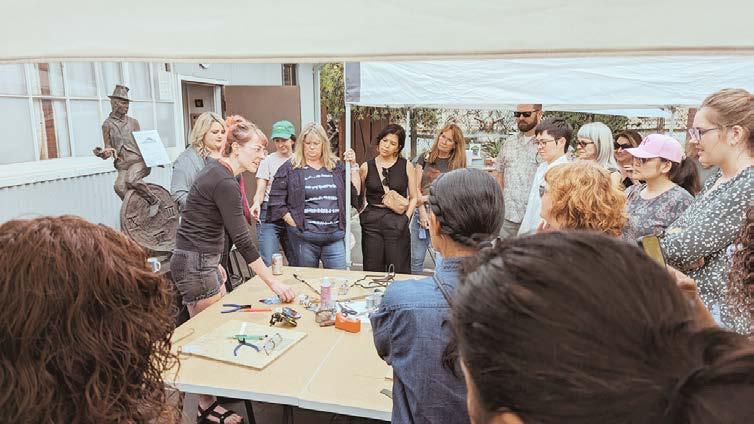
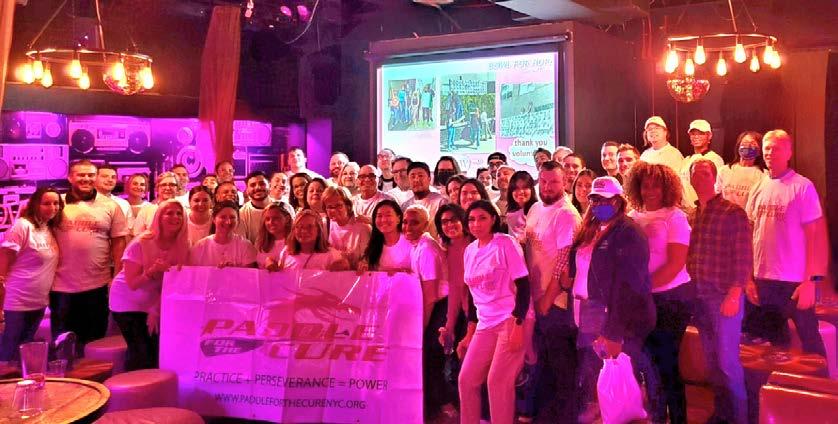
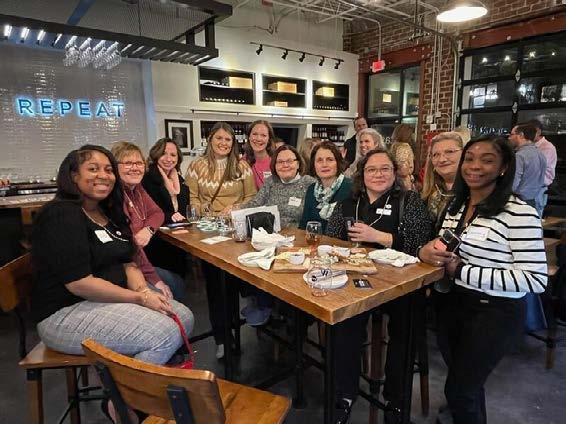
We are a community of women and allies in the architectural lighting industry, using the power of collected experience and action to drive change. Come be a part of our community!
Participate in national events across North America, as well as local chapter events nationwide
community leadership advocacy networking ARE
WILD? join us join us
TruCurve
By PureEdge Lighting
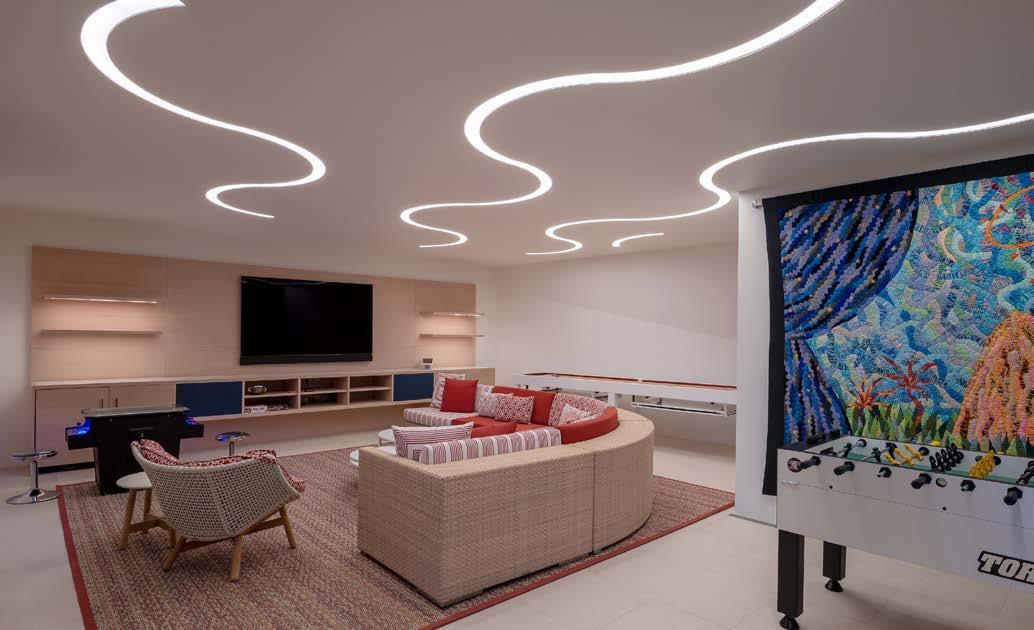
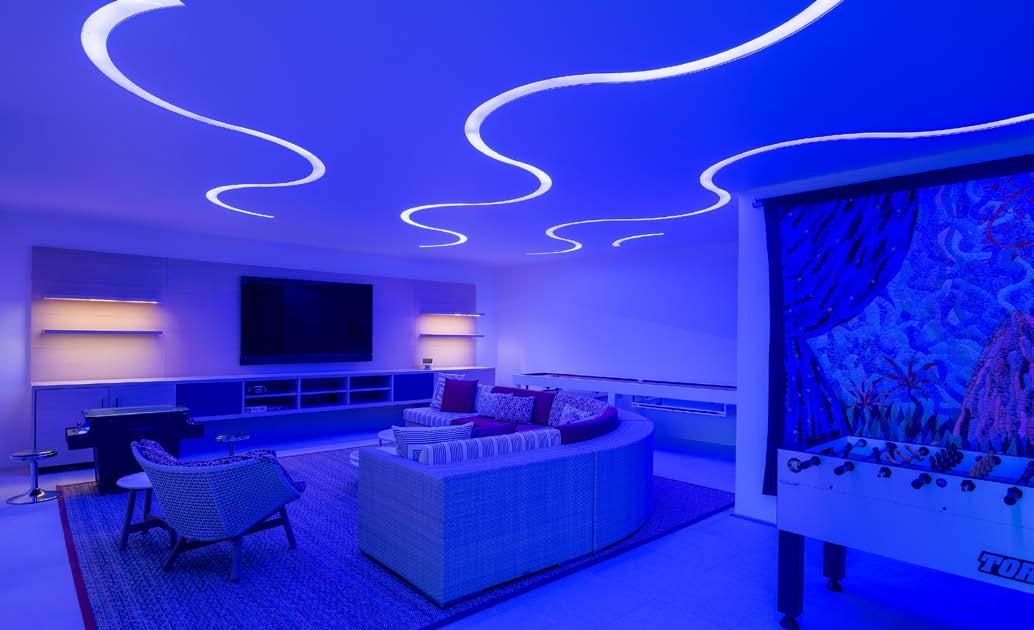
Illuminate Your Space in Any Shape, Any Color
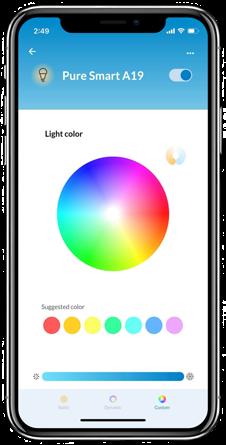
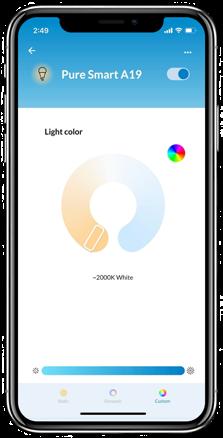
Let the drywall be your canvas and enjoy total design freedom with TruCurve, our curved recessed system for 5/8” drywall. Our patented design bends seamlessly from left to right, allowing for organic shapes without modifying the studs. TruCurve is now part of Pure SmartTM TruColorTM family featuring RGBTW (1500K-6500K), offering over 16 million colors and 85,000 white tones with a single touch. With intuitive controls through the WiZ PRO software suite, including the setup app and dashboard, giving you access to a near-infinite palette of color.
ILLUMINATING
UC DAVIS HEALTH: Light and Space A STANTEC STORY OF
In the realms of healthcare and administration, lighting plays a pivotal role in creating an environment that promotes well-being and productivity. For UC Davis Health's administrative offices, this was the ethos behind the lighting design spearheaded by the multi-disciplinary team at Stantec, including lighting designer Lauren MacLeod. The extensive project, set within a mammoth 194,000 square foot facility over two floors, sought to bring the outside in, all while working within the constraints of the LEED Gold standard.
MacLeod detailed how Stantec's integrated team structure, encompassing interior designers, architects, and engineers, cultivated an environment ripe for innovative lighting solutions. The collaboration began early in the conceptual phase, ensuring that lighting was not an afterthought but rather a central component of the design.
Reflecting on the process, she remarked, "We were brought in early, right at the onset of concept development." She emphasized the significance of this phase, noting, "That's where most of our work is done—in concept development, SD phases, and then DD phases." Lauren commented on the extent of her involvement, adding, "We may or may not be included in the CD phase. We don't come back on board again until the CA phase where we conduct submittal reviews and ensure everything is in order with a final site visit."
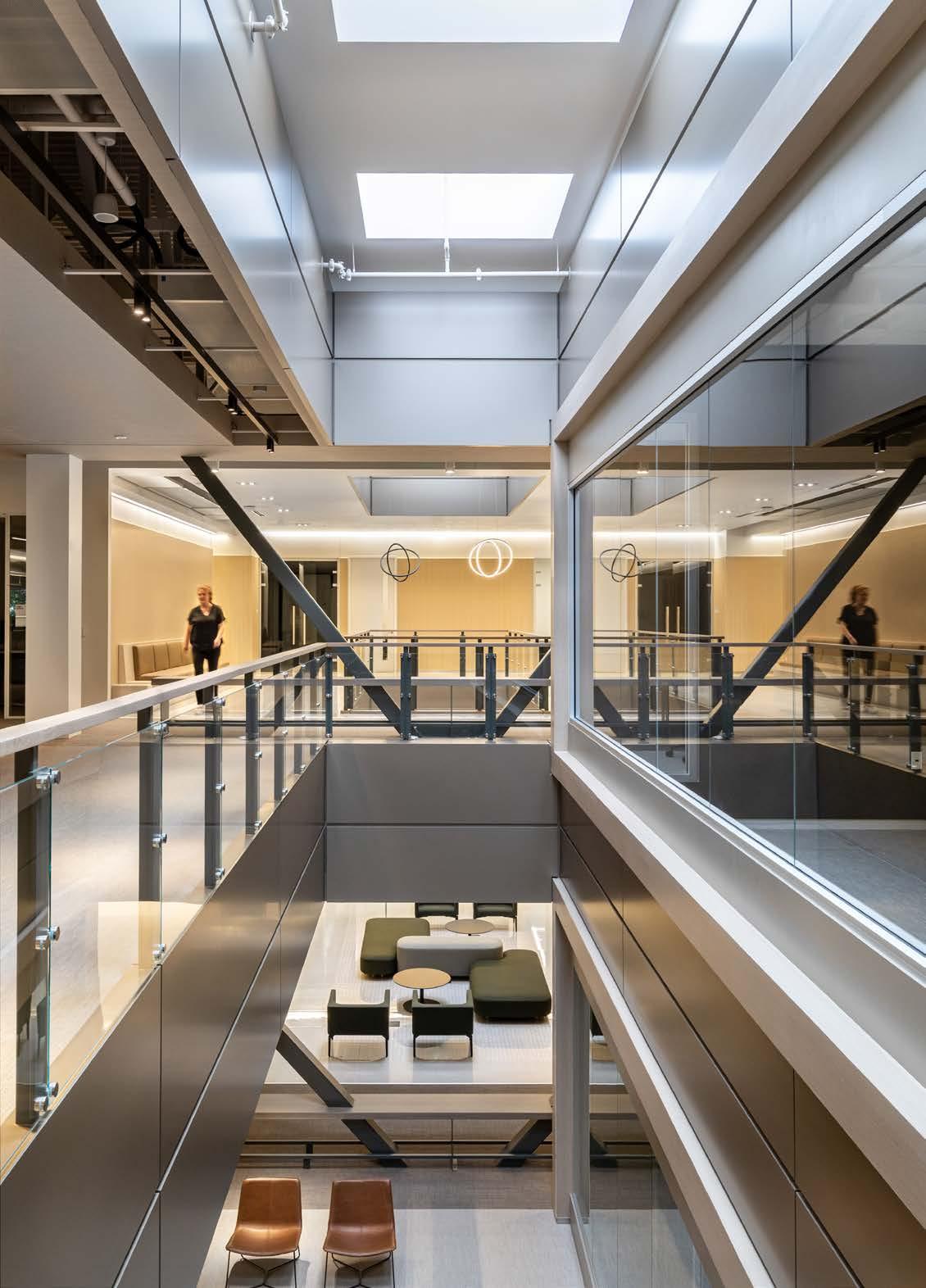
A significant challenge was the building's massive 2-story floor plates and limited perimeter glazing, which initially allowed minimal daylight penetration. The design solution? Introducing new skylights that not only enhanced the natural light flow but also created visual connections between the two floors, creating a sense of openness and accessibility throughout the expansive interior spaces.
Lauren explained, "The new skylights we introduced transformed the space, bridging the first and second floors with natural light. From the second floor, there's this beautiful visual connectivity to the first, which really opens up at the two-story spaces flanking the building's entrance."
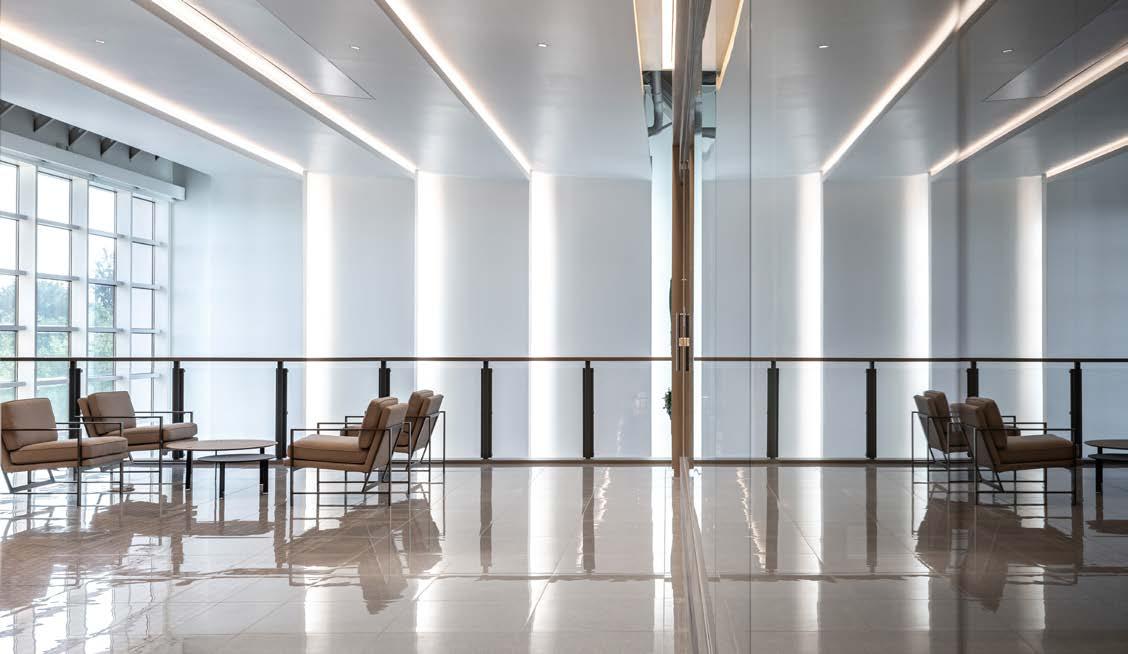
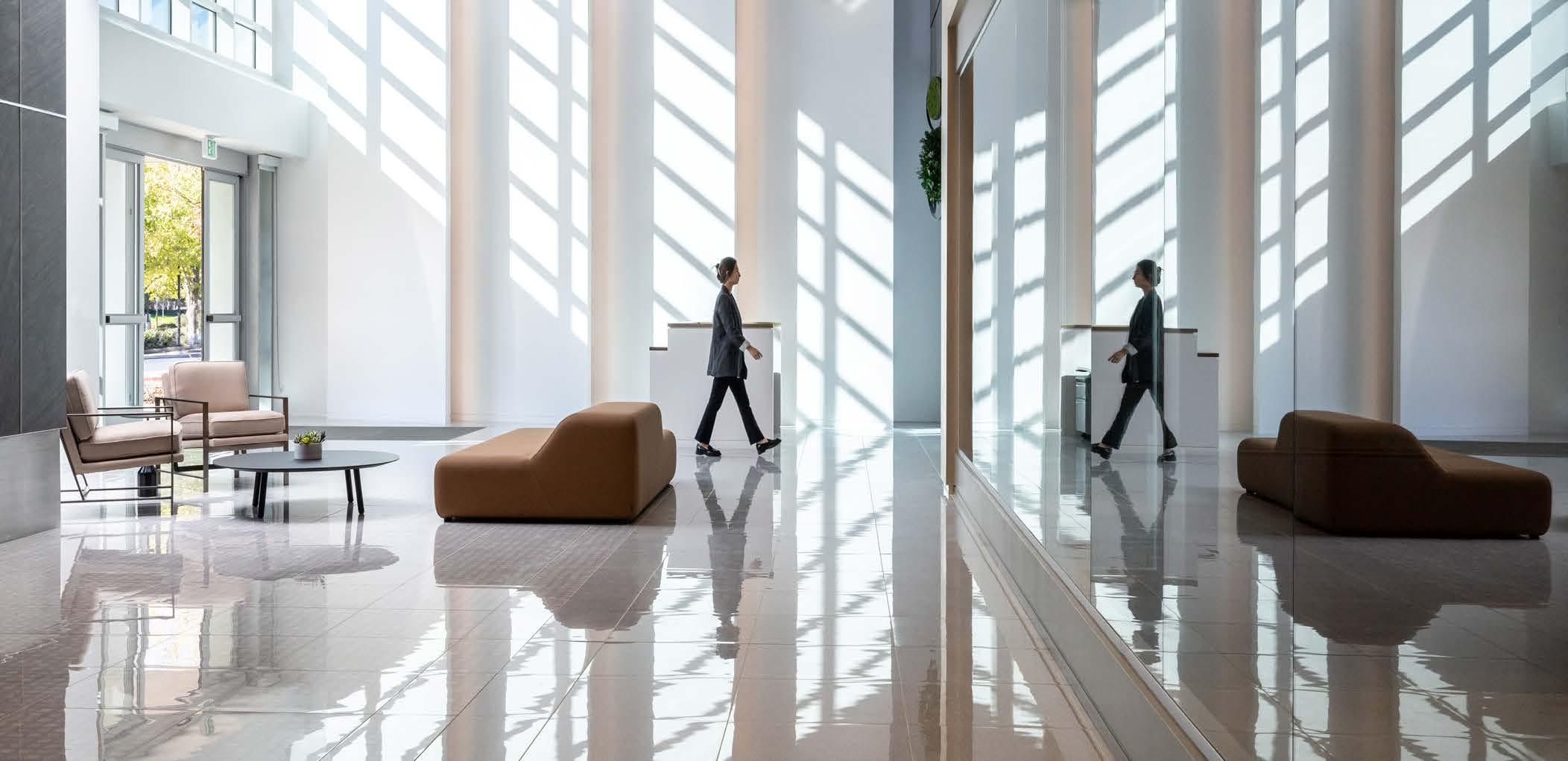
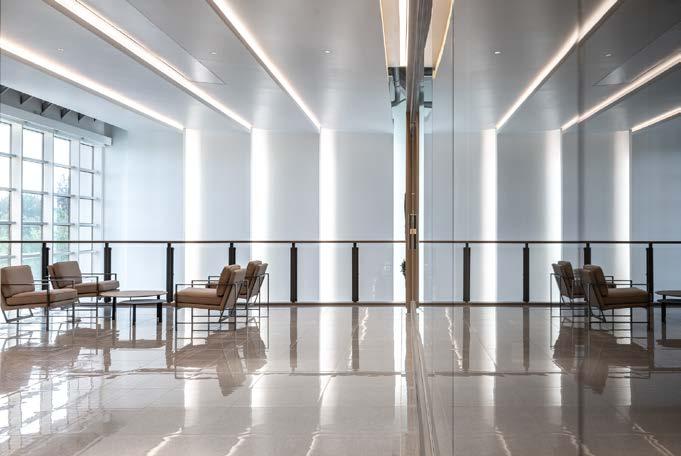
The project's sustainable design was further exemplified by the introduction of architectural elements such as west-facing vertical panels to mitigate direct sunlight and heat gain. These panels, coupled with strategic backlighting, achieved a dual purpose – controlling the light while crafting an inviting entrance that would resonate with visitors and staff alike. The vertical highlights extended to the ceiling plane in the form of light coves to envelope the entire space.
RANDY REID By
Newly introduced skylights not only enhance the natural light flow but also create visual connections between the two floors.
Vertical panels coupled with strategic backlighting control the light while crafting an inviting entrance.
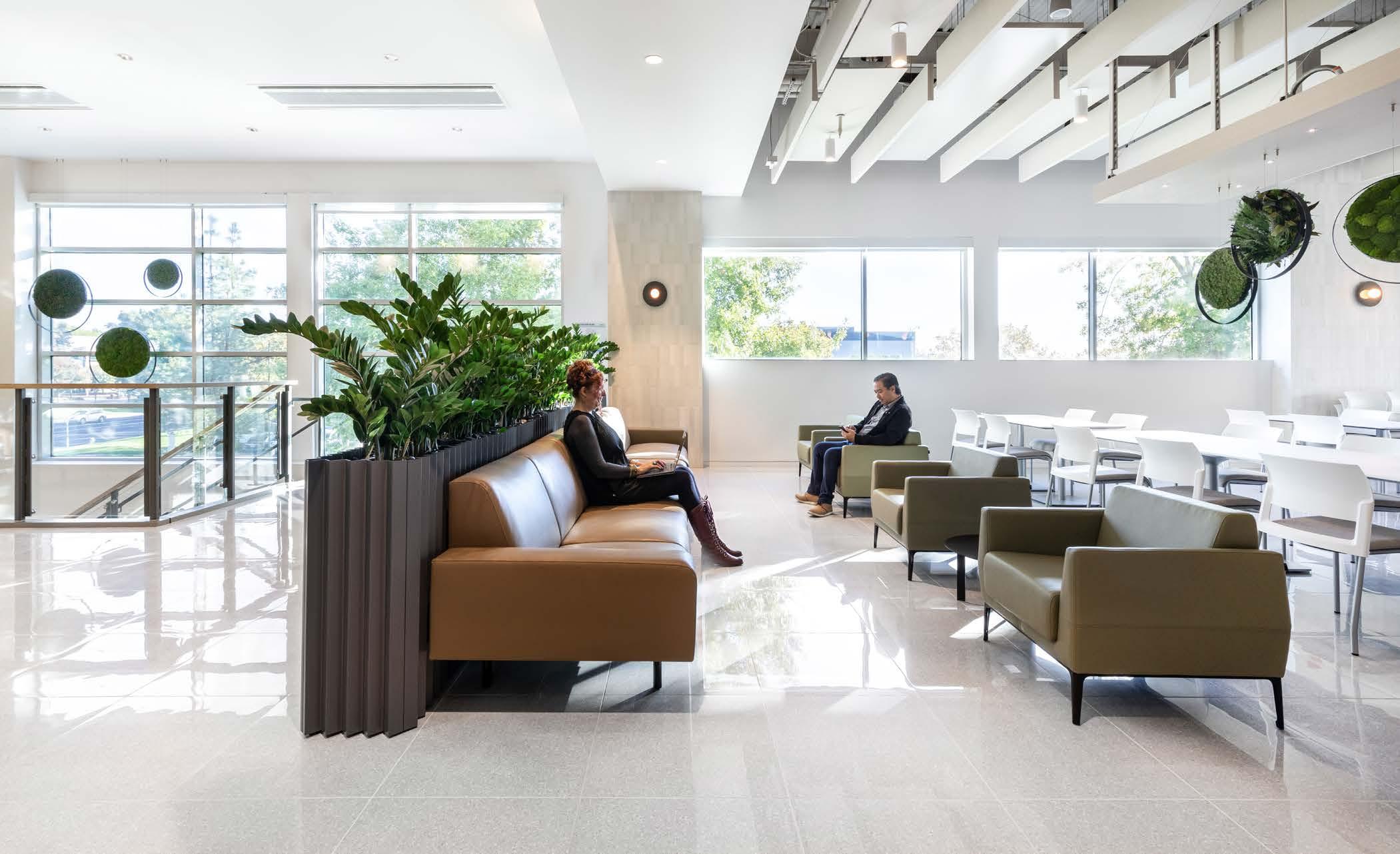
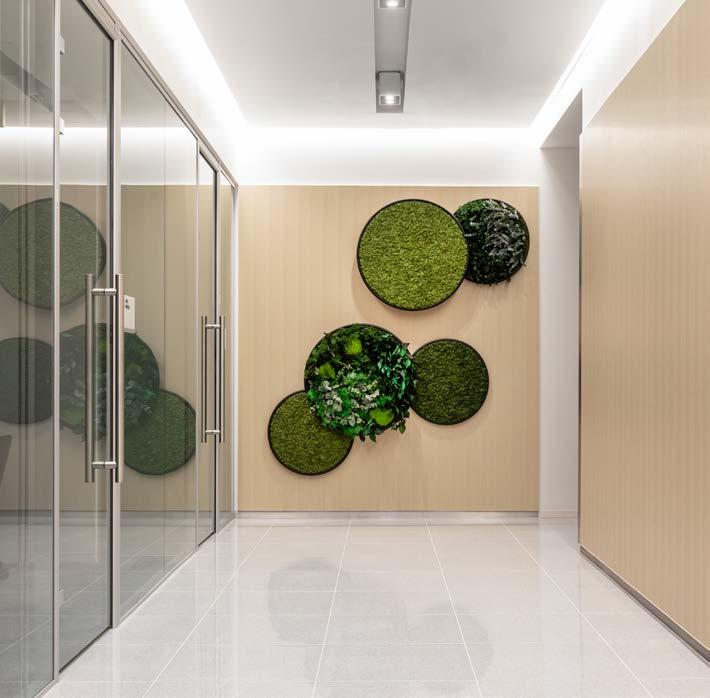
MacLeod's approach to lighting was holistic, focusing on both the building's functional needs and aesthetic aspirations. The result was a series of well-lit open office areas, complemented by direct-indirect lighting fixtures. Artificial biophilic elements, although not originally planned, added a touch of nature, reinforcing the connection to the environment.
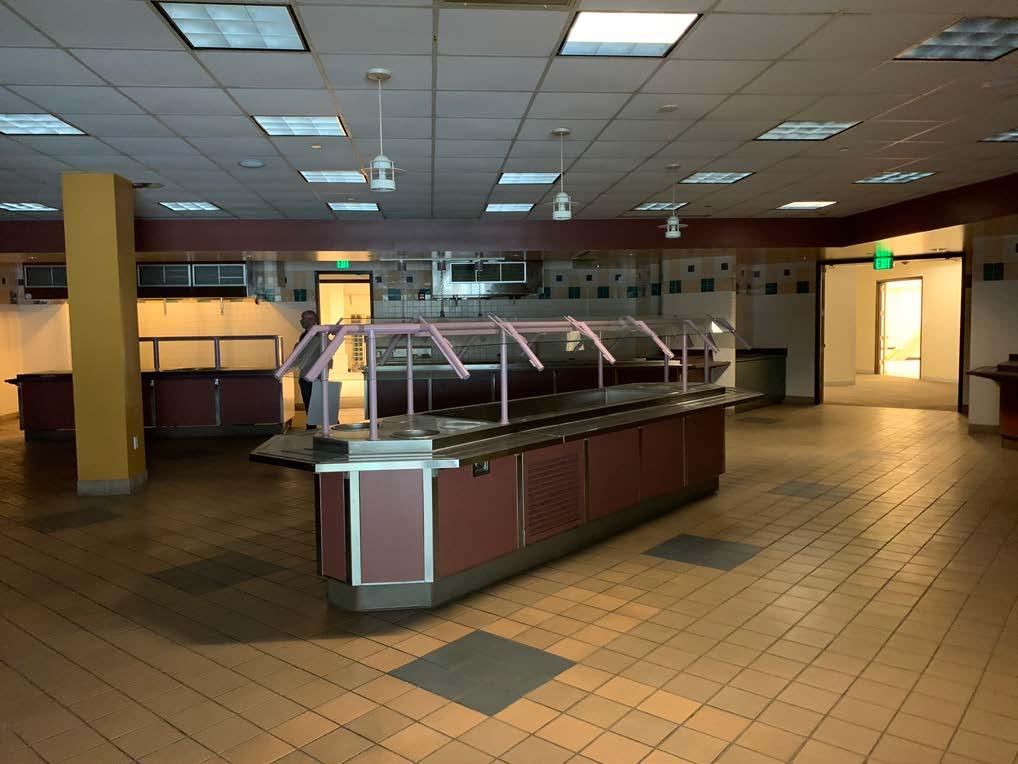
The transformation of spaces like the cafeteria and the elevator lobby was stark, as illustrated by the before and after pictures. She highlighted the inviting nature of the area, saying, "The entrance to the café is seamlessly integrated with an al fresco dining area, inviting both light and community into the space."
The project also showcased an innovative use of lighting controls, with occupancy and daylight sensors integrated seamlessly to manage the luminosity throughout the building. The lighting controls, orchestrated by the electrical engineering team, provided a range of dimmable settings to adapt to
various zones and fixture types, from the direct-indirect luminaires to the sconces, creating an adaptable and energyefficient environment.
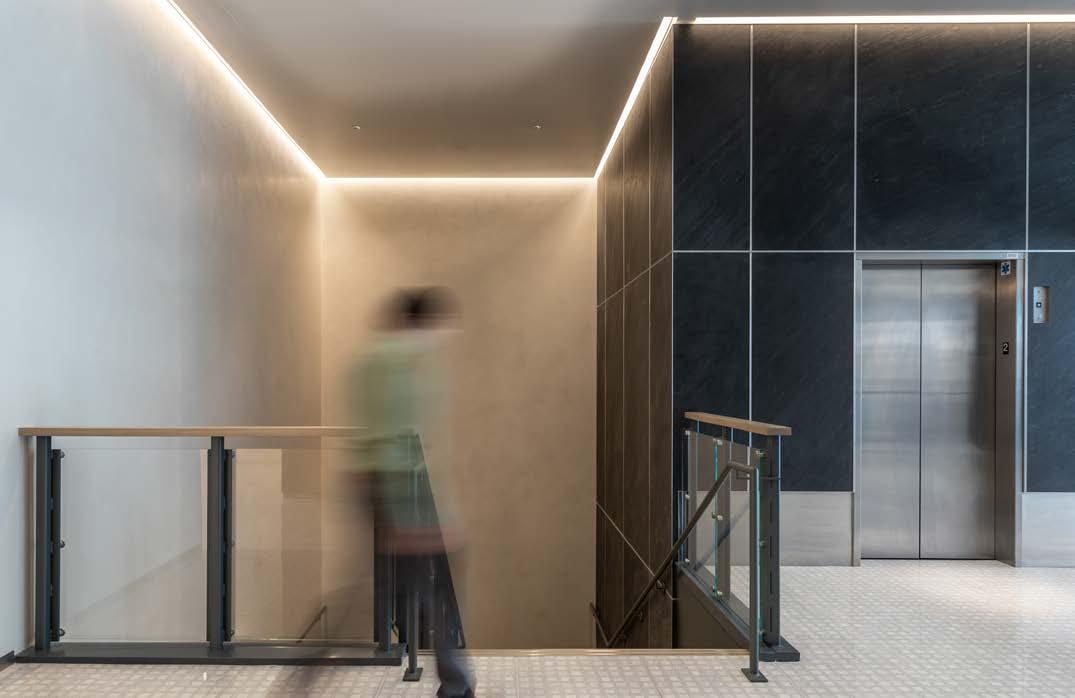
The lighting design extended into even the most secluded internal areas, where ceiling coves were employed to simulate the presence of daylight. Lighting the walls was key to balancing overall light levels and uniformity with daylight. This approach, coupled with the use of light finishes recommended by the interior design team, ensured that light was reflected throughout the spaces, enhancing the warmth of wood veneer walls and the building's warm finishes.
MacLeod also highlighted the collaboration with interior designers to select light finishes, a crucial aspect of enhancing the natural illumination within the space. This partnership was essential to achieve the design team's vision of a lit environment that felt both natural and conducive to well-being.
UC
Artificial biophilic elements add a touch of nature, reinforcing the connection to the environment.
FIXTURE SCHEDULE
Primary Linear Lighting: Extant Huntington
Specialty Linear Lighting: ALW, Focal Point, Lumenwerx
Recessed and Surface Multiples: Amerlux
Pendant Cylinders: DMF
Recessed Downlights (include adjustable accent and wallwash): HE Williams
Pendant Track: WAC
Decorative Manufacturers: Pablo, Lumetta
Acoustic series, Santa and Cole, Ring
Ring Lights: KEPLER PETITE by Nemo
MacLeod proudly shared that despite the challenges, the project flowed smoothly, owing to the strong collaboration between Stantec's in-house team and the contractors. The final design, a testament to their work, was recognized with an AIA Central Valley Design Award, highlighting the project's architectural and lighting design excellence.
The project excelled in energy efficiency, coming in at an impressive 0.52 watts per square foot, well under the energy budget. MacLeod emphasized the efficiency of the lighting design, noting that the vast majority, if not all, of the specified luminaires operated at a high efficiency rate, with many achieving over 100 lumens per watt.
The UC Davis Health project stands as a beacon of Stantec's dedication to collaborative, sustainable, and innovative design, proving that when architects, designers, and engineers come together under one roof, the results can illuminate far more than just a physical space. ■
Lead Architect: Brian Crilly
Lead Interior Designer: Rebecca Keehner
Photo Credit: Kat Alves
The use of light finishes ensures that light is reflected throughout the spaces.
Ceiling coves were employed to simulate the presence of daylight.
The design team's vision was that of a lit environment that felt both natural and conducive to well-being.
ZAYTINYA’S ELEGANT Statement
Lighting Sculpts a Mediterranean-Inspired Interior
Photo Credit: Jason Varney
VILMA BARR By
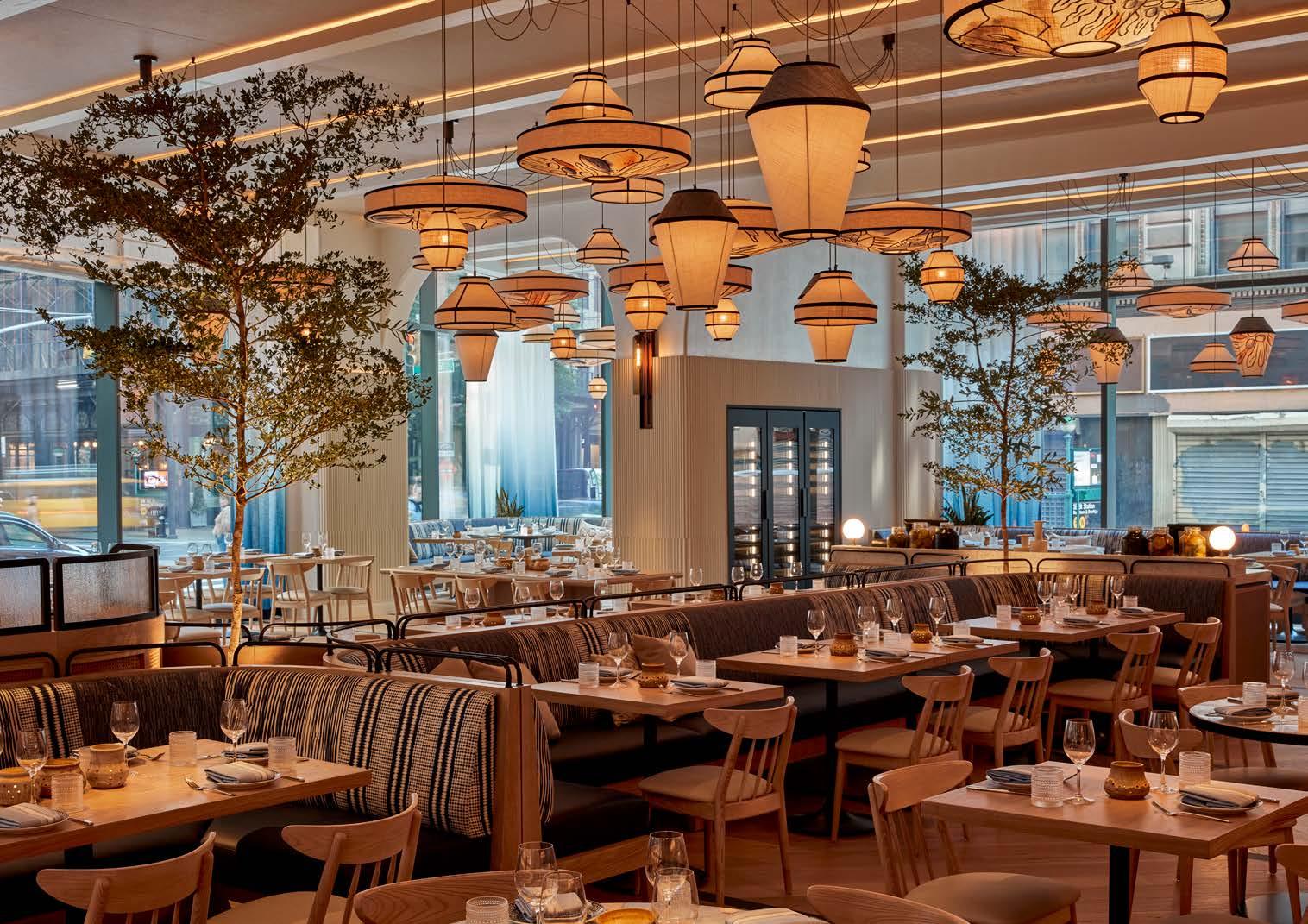
Despite its high-traffic location on the ground floor of New York’s Ritz-Carlton Hotel at the corner of 28th Street and Broadway, Zaytinya’s vibrant interior retains a feeling of elegance and intimacy. Housed within a 50-floor tower designed by Rafael Viñoly, the all-day restaurant and bar occupies a 3,000-sq-ft corner wedge, with glass frontage on two sides.
In keeping with the menu created by chef and honored humanitarian José Andrés, patrons can select from mezze-style dishes influenced by Turkish, Greek, Lebanese and Italian cuisines. “Zaytinya” is derived from the Turkish reference to olive oil. A specialty is an array of shareable small plates of authentic selections influenced by Chef Andrés’ extensive international travels. New York is the second location for Zaytinya, which originally opened in Washington D.C. in 2002.
Isometrix Lighting & Design served as lighting design consultants for the Manhattan Zaytinya site.
The restaurant’s interior by design studio Rockwell Group evokes the environmental influences of the Mediterranean coast. This Eastern Mediterranean flavor is translated across the light and neutral space that benefits from high ceilings and exposed wood ceiling beams against a neutral palette injected with accents of blue.
Rockwell Group’s design for the 140seat bar and restaurant teams white oak woods with bronze metals, creating a strong contrast against bright blue accents, pattern detailing, and specially commissioned artwork. Architectural finishes continue the theme of a neutral base to give added dimension to elements of texture and pattern found in the upholstered banquettes and at the bar, incorporating the cyan blue color that characterizes the regional waters of the Aegean Sea.
Chevron-patterned flooring is inset with blue tiles. Layers of sheer blue ombré curtain provide light privacy and line the vast floor-to-ceiling street-facing windows. The adjacent wall contains large arched antique bronze mirrors and booth seating, which compliments the warm leather detailing on the credenzas. Arched openings and tambour walls introduce elements of classic Greek and Roman architecture.
ART OVERHEAD
Exposed wood ceiling beams are interspersed with acoustic linen-texture panels that correspond to the patterns of the floor bands. Groupings of pendant
White oak woods and bronze metals contrast against bright blue accents, pattern detailing, and specially commissioned artwork.
Groupings of pendant lamps in a variety of shapes and sizes are suspended above the dining tables.
lamps in a variety of shapes and sizes with hand-painted woven textile shades are suspended above the dining tables, casting a generous warm glow in the main dining room.
The line drawings created by Rockwell Group’s Graphics studio are an interpretation of Mediterranean culture, its harvests and art expressed over the ages. Their illustrative sketches were translated into original art hand-painted on the fixture’s linen shades by The Alpha Workshops. Founded in 1995 in New York, The Alpha Workshops is the nation’s first nonprofit organization to provide decorative arts education and employment to adults with disabilities.
THE BAR AREA DESIGN
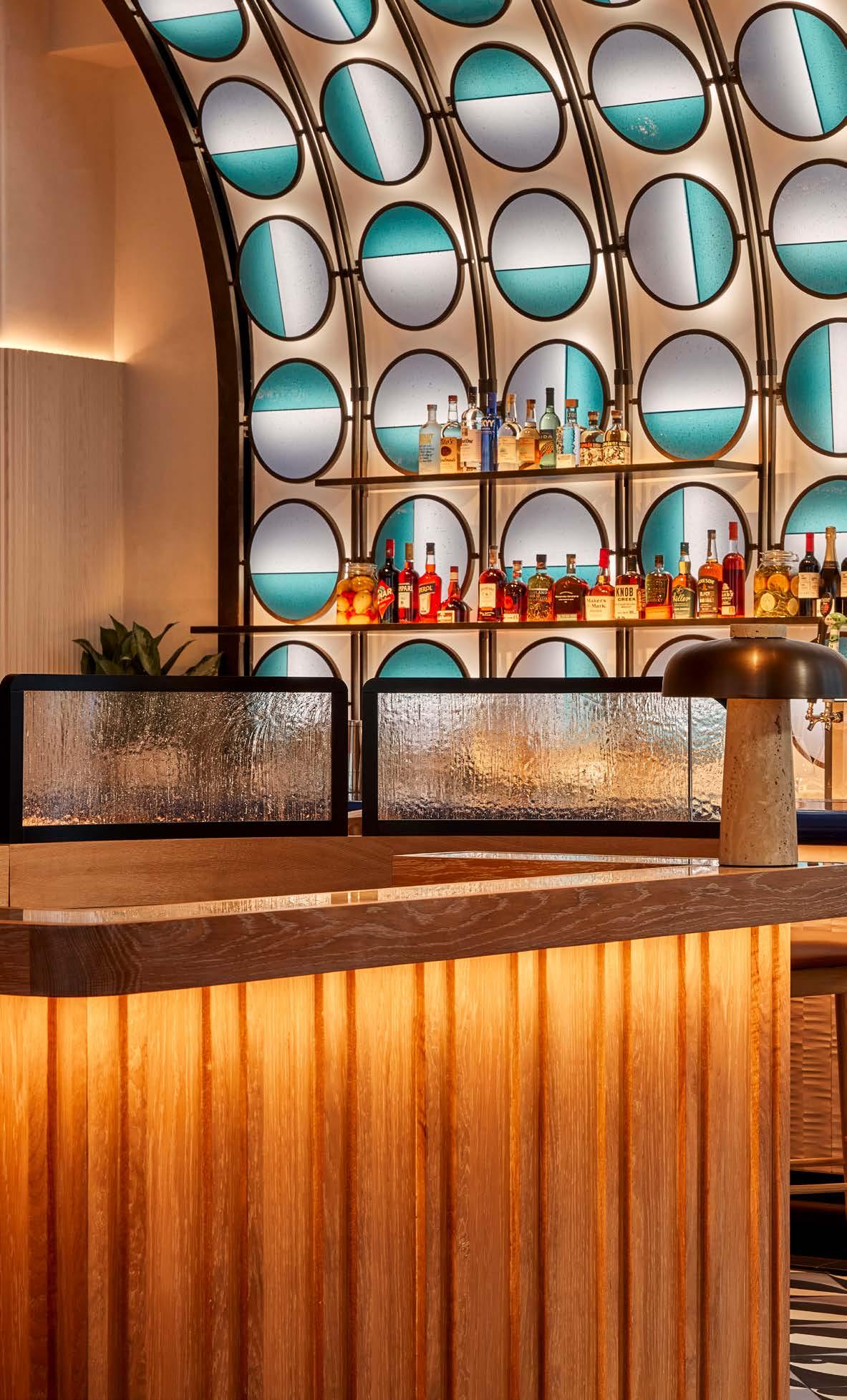
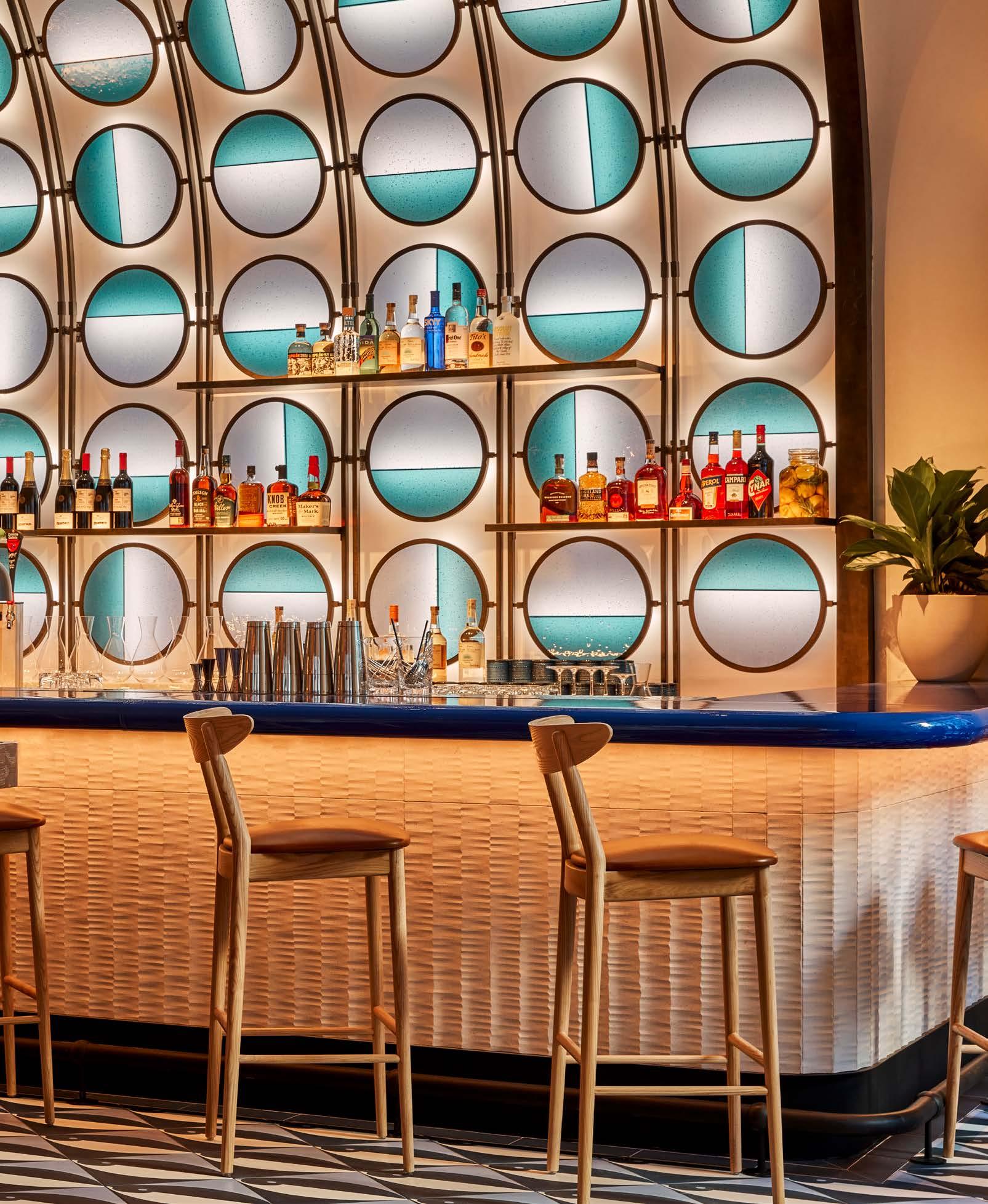
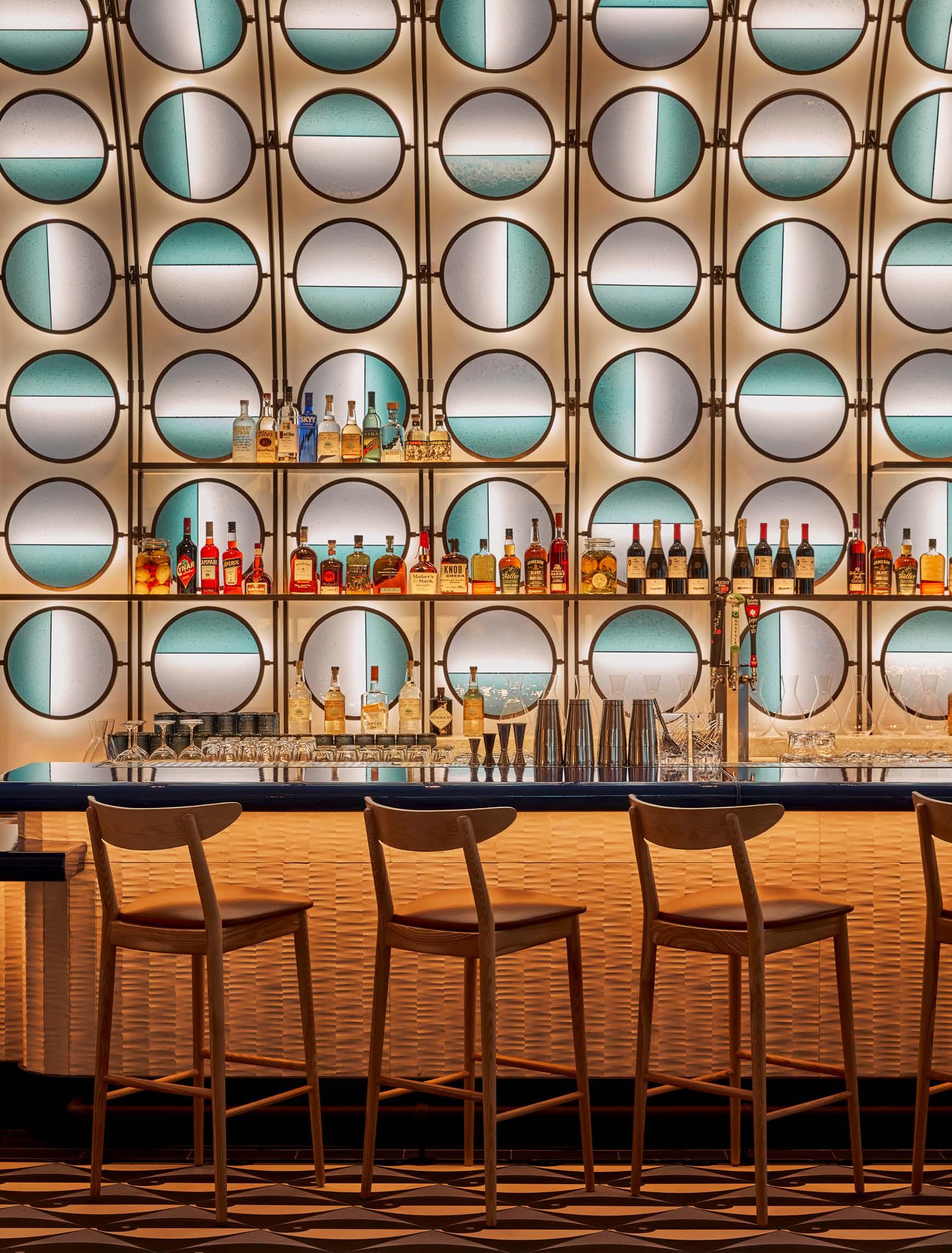
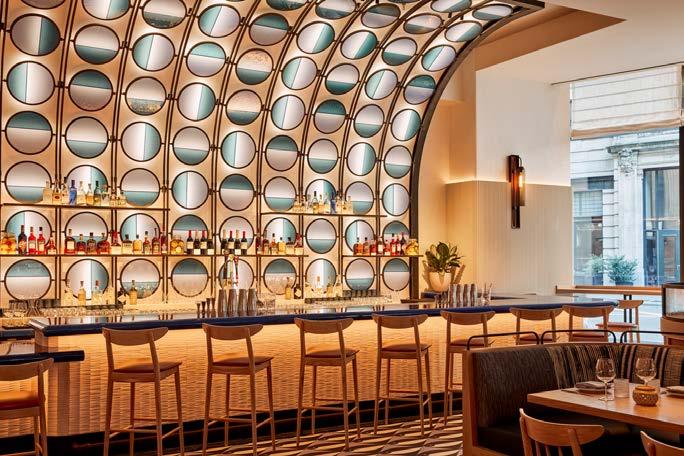
Zaytinya’s bar contrasts to the soft contours and hand-applied drawings of the overhead lighting fixtures with a glistening wall of blue multi-tone circular shape mirrors. Each mirror is attached
to a frame that curves up towards the ceiling. Backlighting adds drama to the overall space, becoming the focal point of the restaurant.
The wall’s geometric assemblage of the illuminated circular mirrors creates a sculptural effect that provides a distinctive visual statement that balances the architectural arches in other areas of the restaurant. Inspiration, according to the designers, was adapted from image of the Evil Eye “Mati,” the magical and protective talisman.
Materials that comprise the bar counter include blue lavastone and a chiselled stone bar die.
Zaytinya is open daily, serving breakfast, lunch, brunch, and dinner. It is part of the Think Food Group founded by Chef Andrés and partner Bob Wilder that operates three dozen dining facilities in the U.S. and the Bahamas. ■
A glistening wall of blue multi-tone circular shape mirrors adorns the bar area.
Conquer outdoor 2024
Light is the language of architecture.
Arclux
Ideal for creating a uniform arc of light to elegantly accent window reveals.
Compact linear outdoor asymmetric luminaire ideal for illuminating surfaces uniformly from one edge
CATIRPEL
CATIRPEL is a flexible modular outdoor system designed for landscape and architectural applications that require great installation flexibility and accurate light control.
Infinite configurations, infinite possibilities.
The ONE you've been waiting for!
VADER is an All-In-One modular floodlight projector that offers the extreme flexibility in optic, color temperature, and mounting configurations for all environments.
One product, one code.
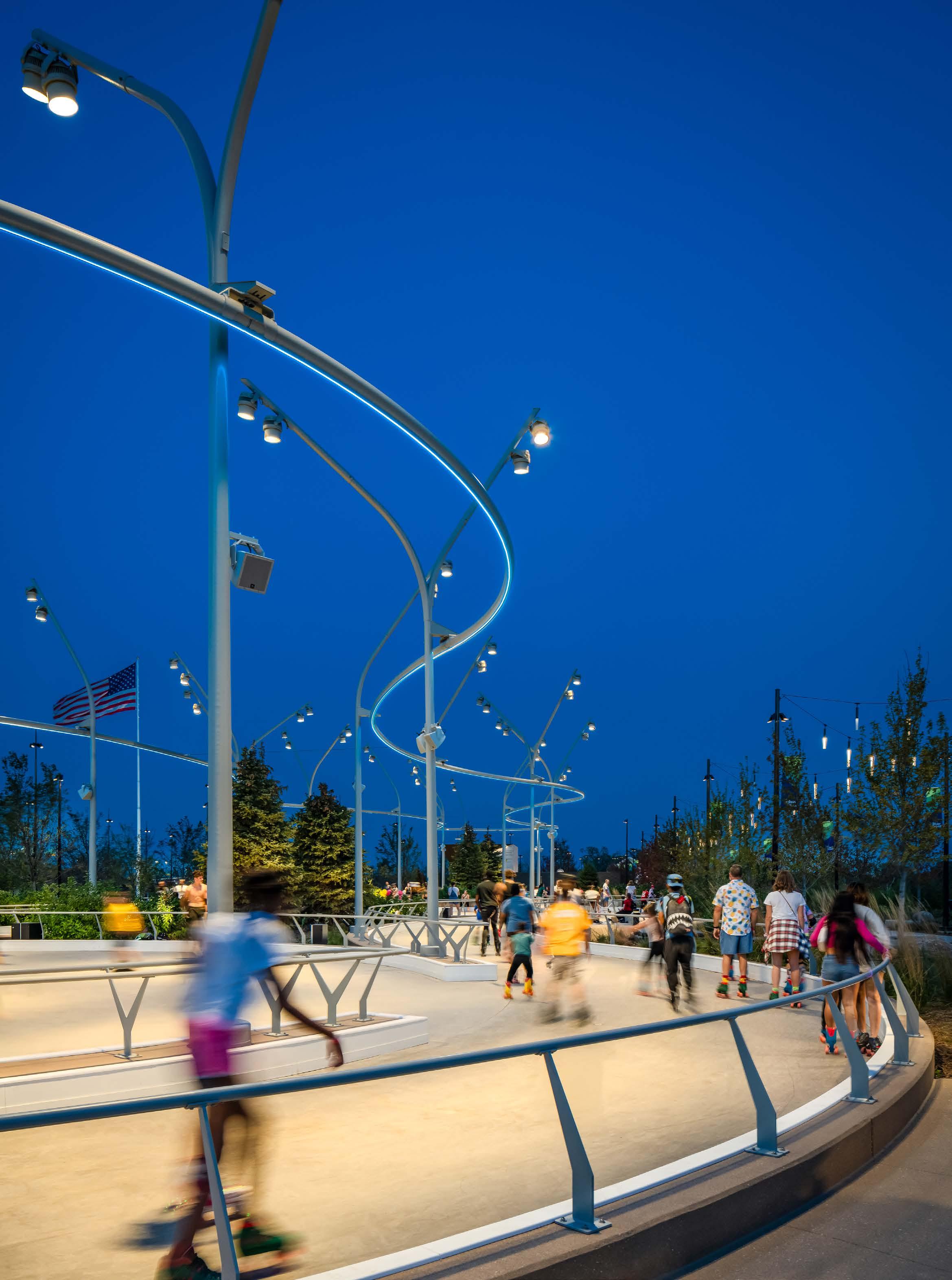
The Heartland of America Park at The RiverFront, Omaha, Nebraska.
THE HEARTLAND OF AMERICA
Like so many waterfront cities, Omaha was looking for ways to revitalize its downtown parkland in an effort to create an aesthetically pleasing destination point. The city’s vision was to transform its three underutilized parks into a beautiful, entertaining recreational hotspot along the scenic Missouri River.
What became known as the Omaha RiverFront Revitalization
Project encompassed 72 acres of parkland that served as a gateway between the city’s historic Old Market and north downtown area. The goal of the $325 million project, which was made possible through a public-private partnership, was to connect Gene Leahy Mall, Heartland of America Park, and Lewis and Clark Landing to create a welcoming, accessible recreational area that spurs economic growth by bridging to the downtown area.
RANDY REID By Photo credit: Ryan Fischer
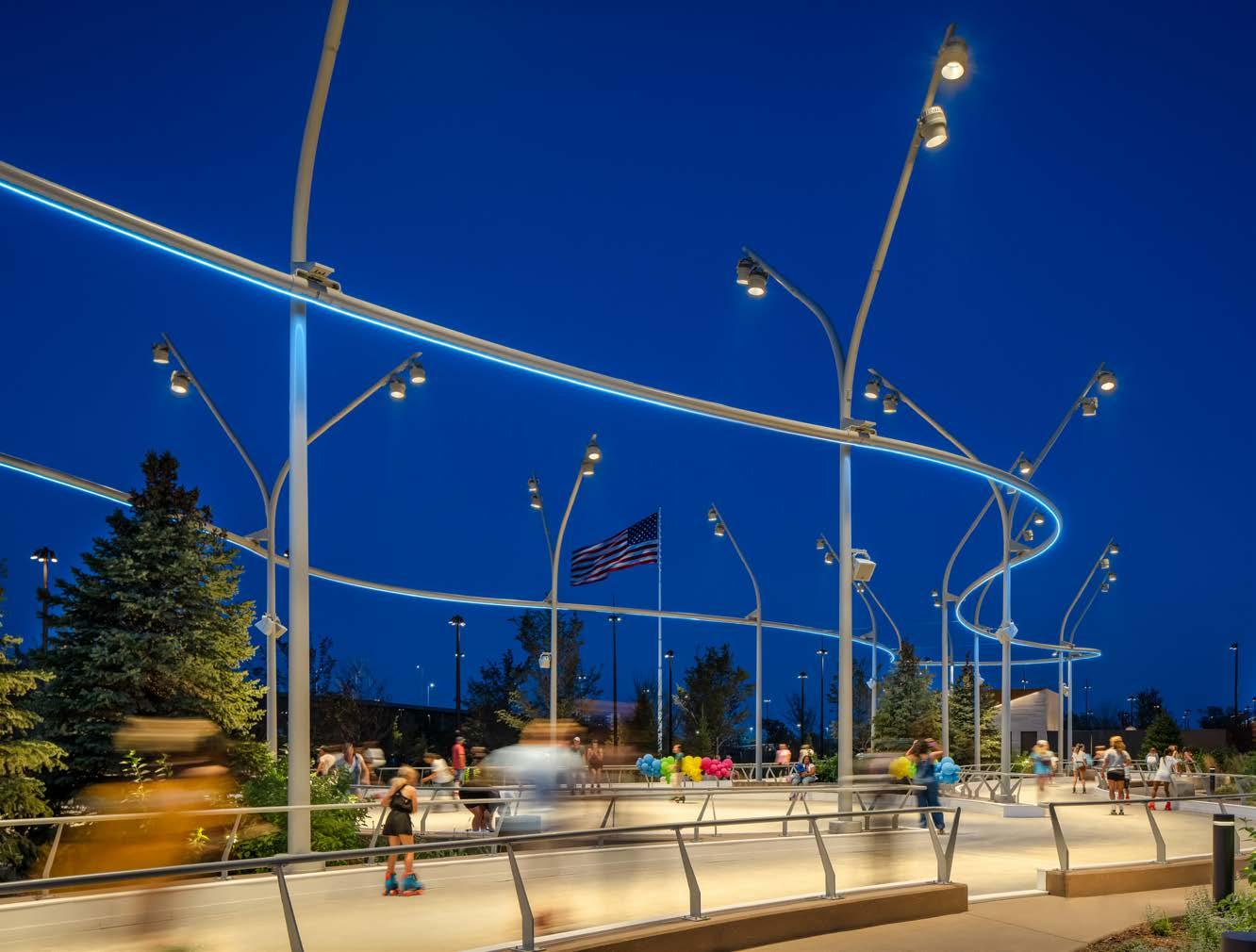
The Skate Ribbon.
The Skate Ribbon.
The design team struck a balance between creating a modern, safe and inviting environment while preserving some of the parks’ iconic structures and protecting the flourishing native landscaping.
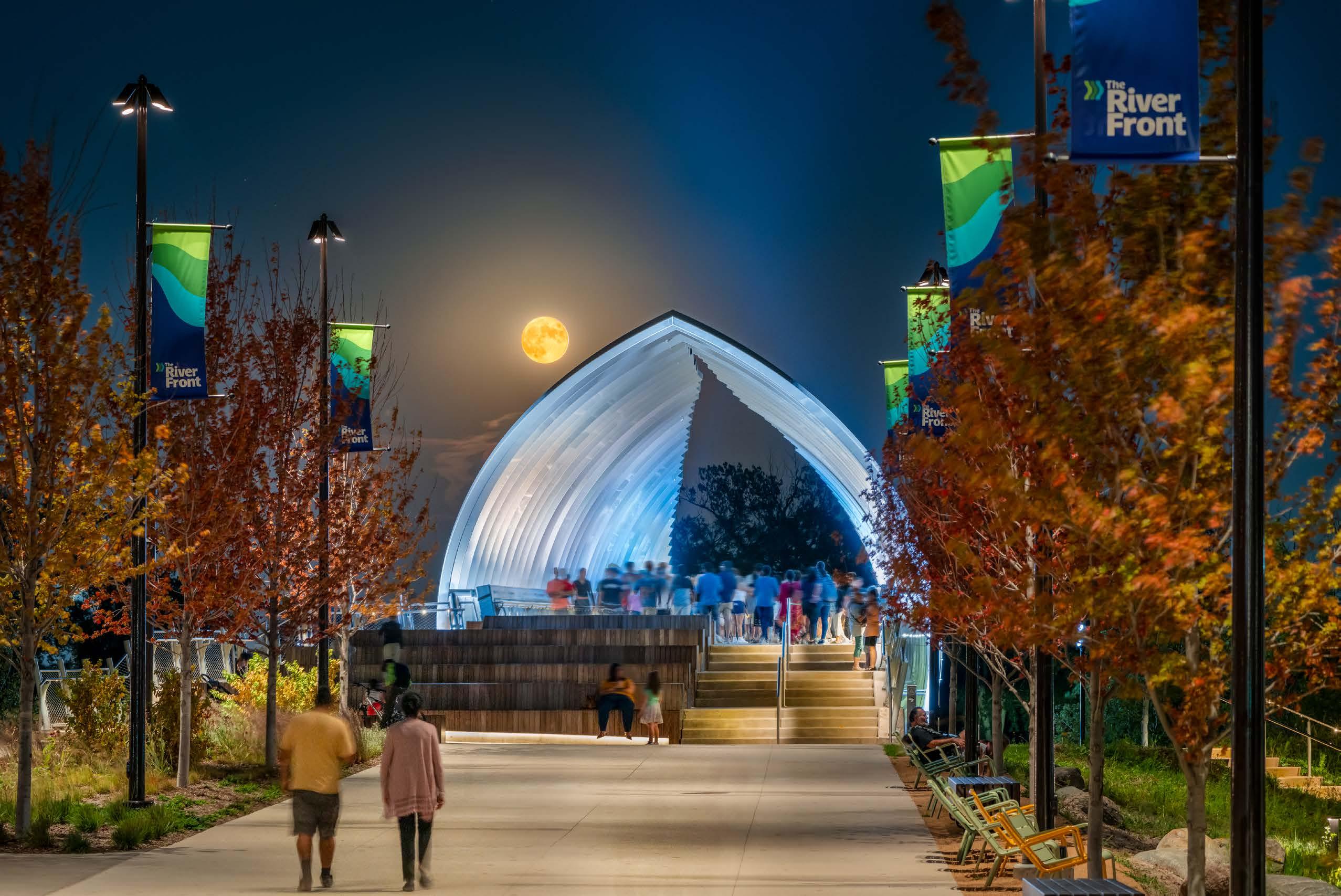
The design and vision for the rehabilitated riverfront came from architectural and engineering firms from across the country, including OJB Landscape Architecture, Atelier Ten, Safdie Rabines Architects, RSM Design, Alvine Engineering, Fluidity, HDR, Kiewit Infrastructure Group, Gensler, Miller Electric, and Applied Ecological Services. Such intentional design resulted in the space featuring a number of unique park spaces and structures. These include two expansive playgrounds, a Performance Pavilion, the Cascades – a multi-pool, interactive water attraction, The Skate Ribbon, which accommodates both ice skating and roller skating, and the Farnam Pier, which provides magnificent views of the river and the downtown skyline.
Joshua Spitzig, IALD, Director at Atelier Ten in New York, said, “It was important to us that the pier be visible from many vantage points at night. It acts as a visual anchor at the edge of the park with several paths leading straight to it, so the lighting had to be magnetic and iconic. We needed the ability to program many specific colors with no weird shadows, so we knew we wanted a quad-chip fixture with great color mixing. We also needed the fixtures to be high output, compact in size, and
sturdy enough to stand up to the rough Nebraska weather.”
DRUMMING UP A LIGHTING SOLUTION
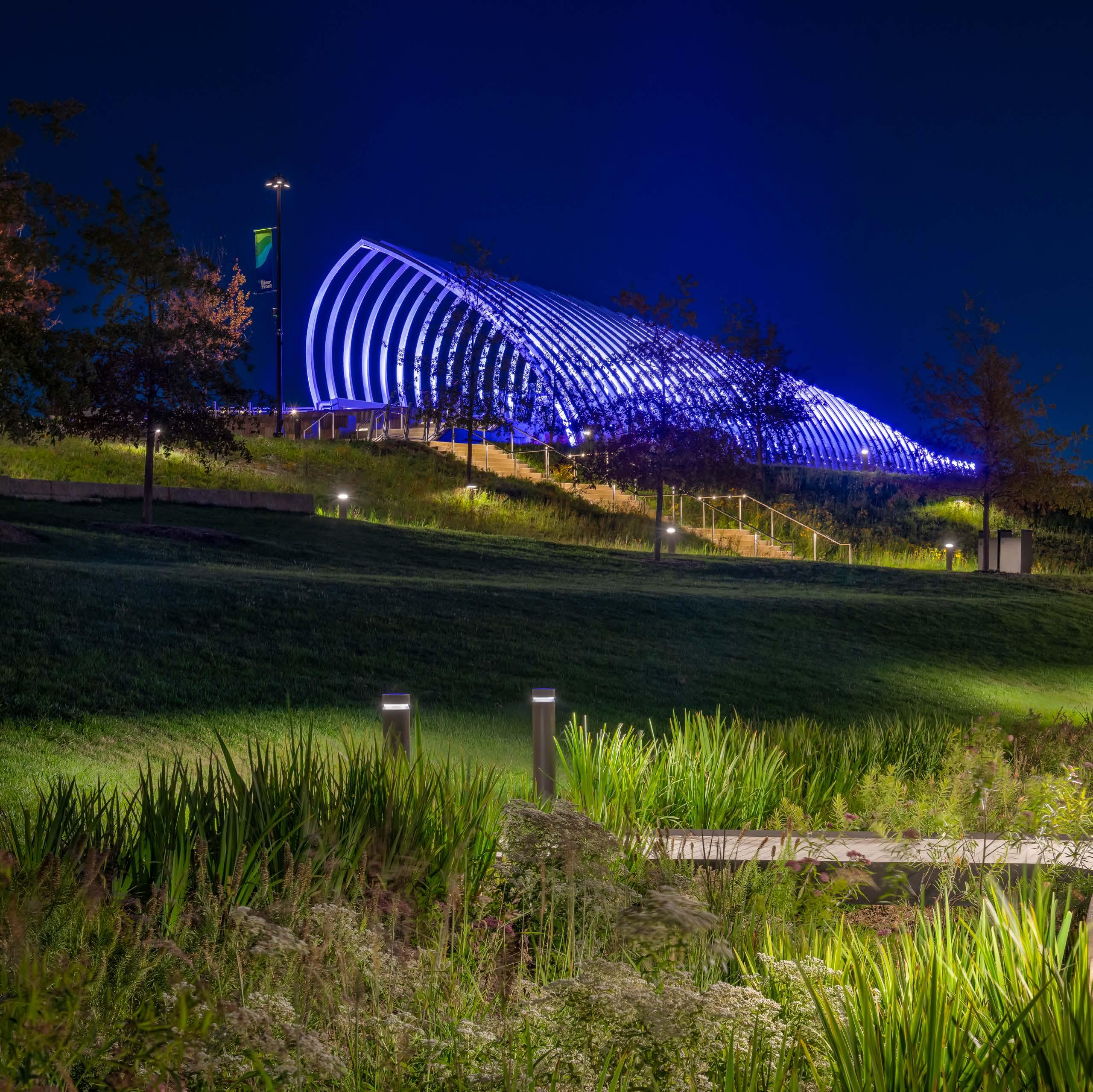
According to Spitzig, the design team mocked up one of the pier’s giant ribs for a shootout to compare the performance of various brands. Ultimately, the team determined that it was the Dyna Drum EO color fixtures from Acclaim Lighting that outperformed the other brands in every aspect. Dyna Drum EOs are high output, compact outdoor-rated LED floodlights featuring a unique Spectrum Four color system. Acclaim’s Spectrum Technology offers more usable colors, including pastels, dedicated whites, and dynamic white options, all in the same system.
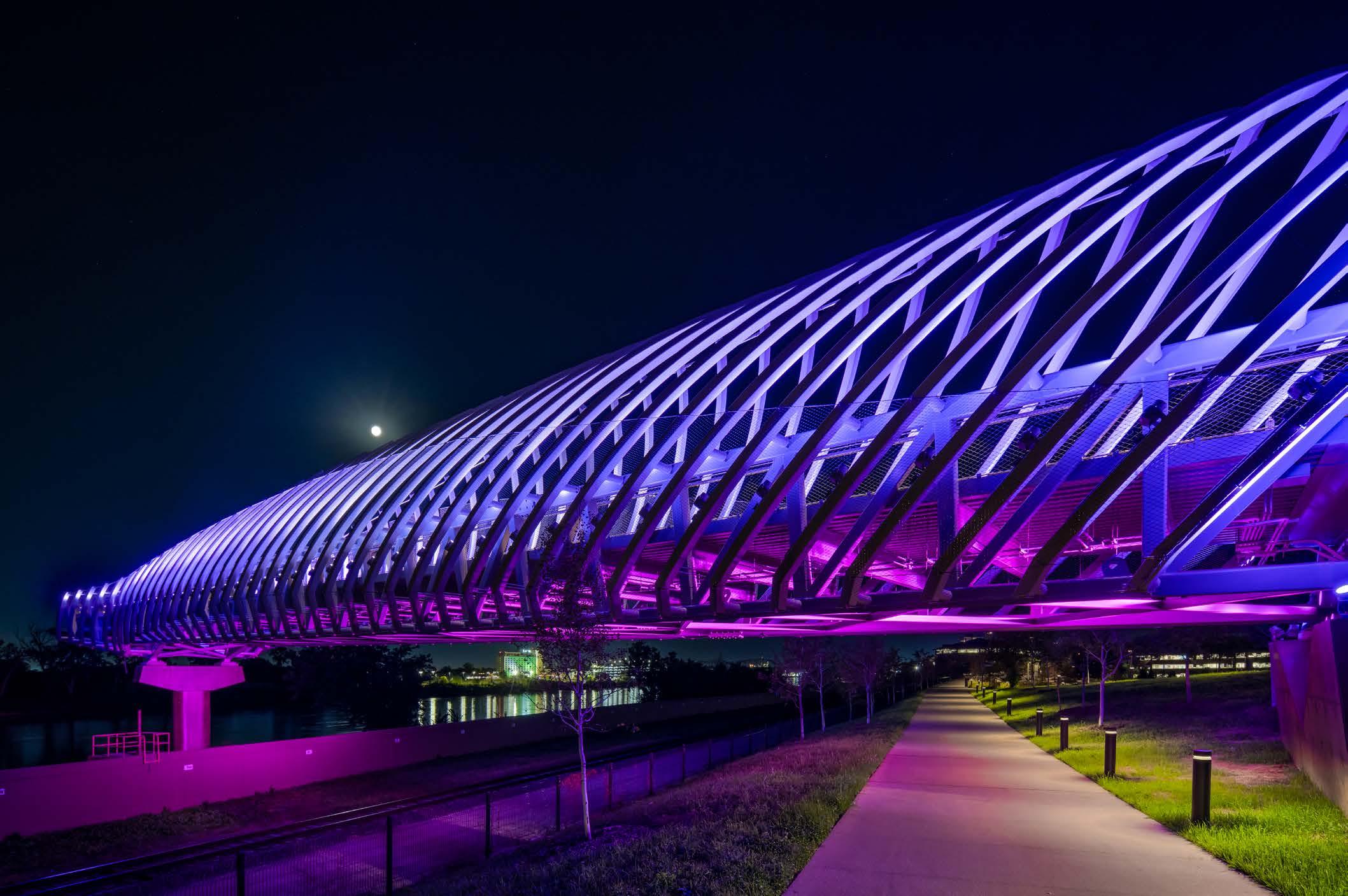
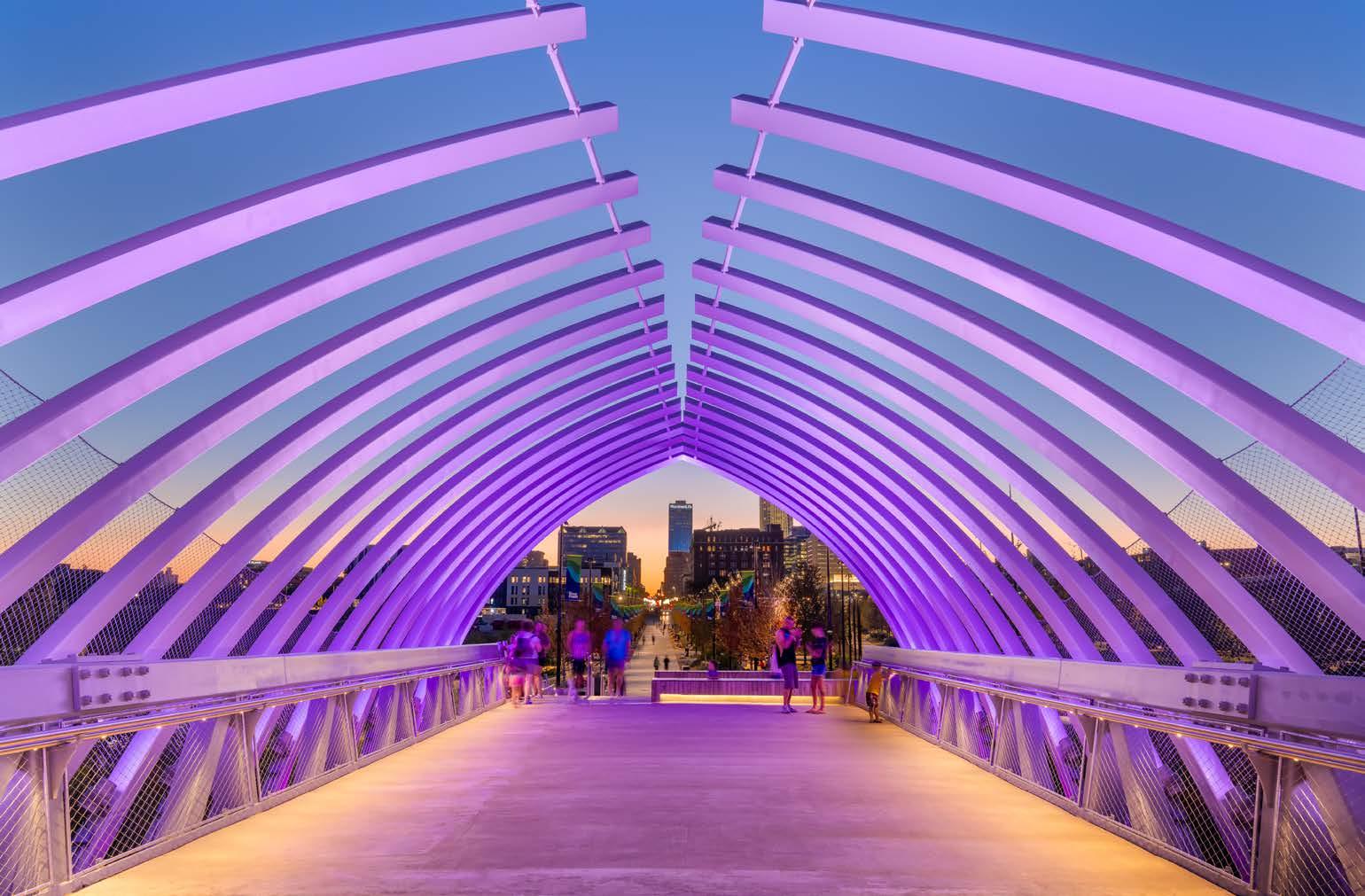
Farnam Pier.
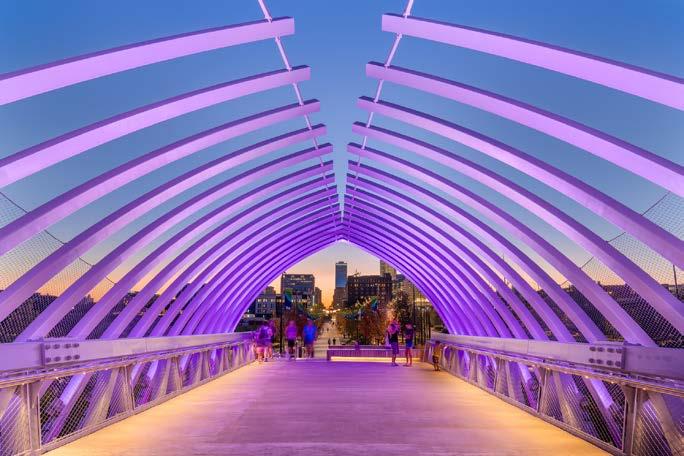
Farnam Pier’s giant ribs, bathed in purple light from Dyna Drum EO color fixtures.
While the Dyna Drum EO color fixtures were specified for the pier’s main rib structure, Dyna Drum HO color fixtures were used to shoot light horizontally through the lower trusses beneath the pier’s deck. These fixtures are high output, outdoor rated, LED floodlights featuring an internal 100-277VAC power supply, onboard DMX+RDM driver, and Aria wireless DMX technology inside for precise lighting control without the need for additional hardware. The Dyna Drum fixtures also come with a 10º narrow beam standard, with optional quick-change spread lenses for wider applications.
“We have had a lot of good experiences using Dyna Drums over the years. I’ve found them to be a great balance of performance and value,” said Spitzig. “The fixtures have been very dependable, and they have a lot of options. That makes them easy to specify.”
To complete the lighting of the Farnam Pier, 96 Dyna Drum EO RGBW fixtures were used to light the ribs on the structure, while 8 Dyna Drum HO G2 RGBW fixtures were installed at the bulkhead under the pier.
“The coverage of the pier was even better than we had hoped,” said Spitzig. “From some angles, the ribs look like they are almost glowing from the inside.”
The RGBW Dyna Drums were also critical to the programming, which was inspired by the colors of specific flowers and plants that OJB used throughout the park. Atelier Ten programmed seven of these flower-inspired presets, one for each night of the week.
At the Skate Ribbon, the main objective was to provide very high light levels for safety reasons. The lights had to be individually
dimmable and needed flexible optics so that they could be changed in the field during aiming if needed.
Spitzig explained, “Due to the stringent light level requirements at the Skate Ribbon, we needed fixtures that we could trust to give us complete coverage of the skating surface, both for when the surface is gray concrete for roller skating and when it is white ice for ice skating. After conducting extensive photometric calculations and in-person tests, we found the Dyna Drum HO fixtures were by far the best option because of their output and light quality. Knowing that they are also very dependable outside in the elements made the spec an easy choice.”
The optical system and high-power LEDs provide exceptional output and efficacy, as they come with a narrow 5º beam standard with optional quick-change spread lenses for wider applications. With their intense output, these represent Acclaim’s brightest floodlights, providing up to 16,418 lumens and more than 1,101,000 center candela.
Sixty Dyna Drum HO G2 3000K fixtures were mounted in pairs to a custom pole structure that rings the inside of the skate path.
“The lighting from the Dyna Drums makes the Skate Ribbon one of the most noticeable features of the park,” said Spitzig. “It is always a center of energy long after dark, thanks to the Dyna Drum fixtures.”
Omaha's riverfront now stands as a shining example of how intentional design, innovative lighting solutions, and a commitment to blending tradition with modernity can transform urban spaces into dynamic, welcoming, and economically thriving destinations. ■
OVER 55 YEARS OF INNOVATION & LINEAR LIGHTING LEADERSHIP
Product: COB TivoTape
Location: Fogo de Chão / Huntington Beach, California
Tivoli provides solutions for your projects, from customized vision to large-scope designs that produce the right amount of light where needed. Tivoli has maintained a customer-first approach, with quality products and uncompromising service year after year. Follow Us!
Lifetime Achievement Awards 9th Annual
Recognizing
JIMALEE
PISCES
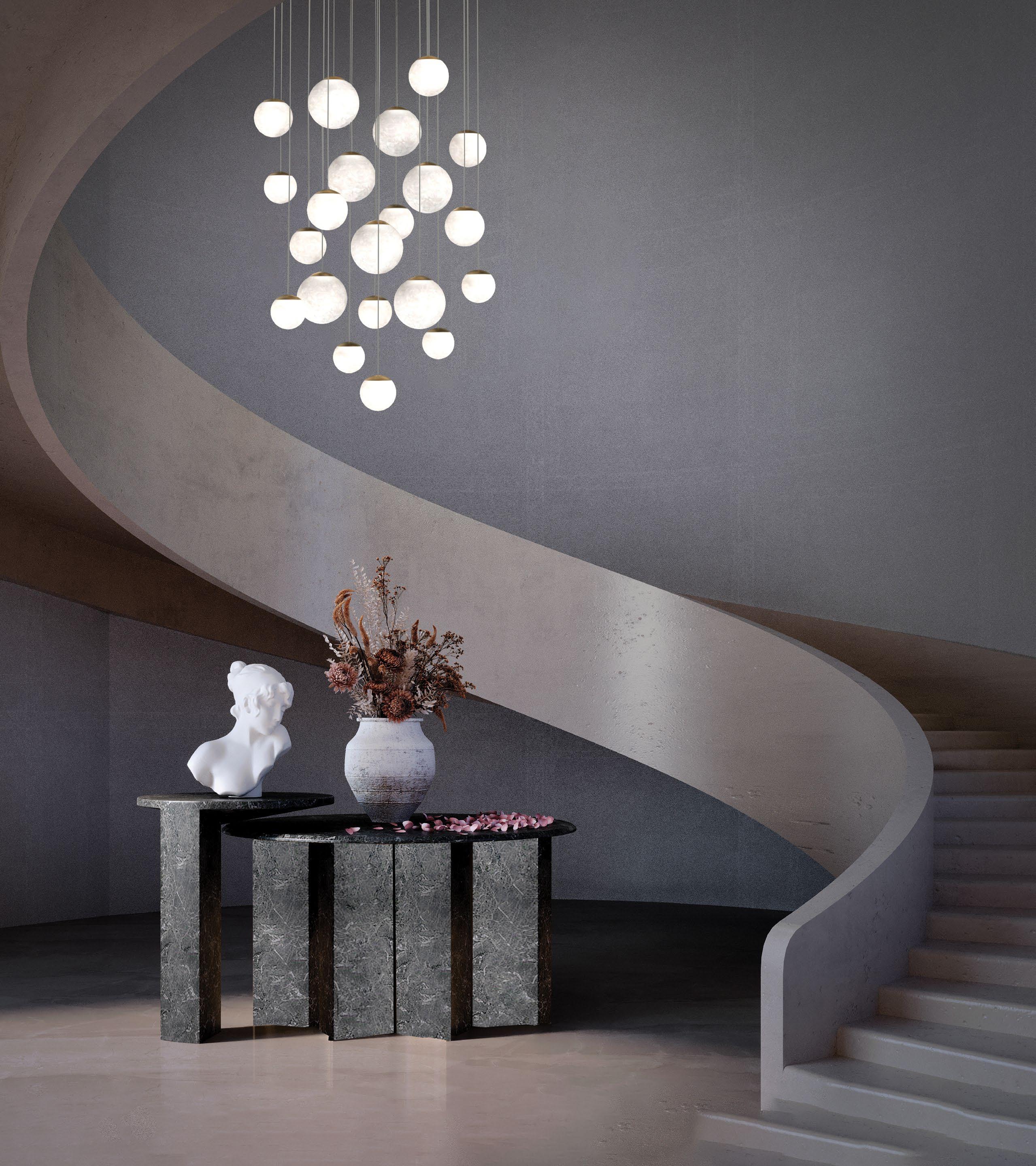
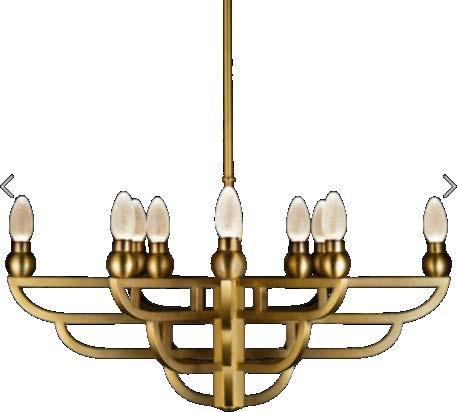
Multi-Light Pendant
Pisces multi-light pendants create an artful statement in spaces.
Natural Spanish alabaster orbs shimmer on a square, round or linear canopy finished in elegant aged brass or black.
See the entire Pisces collection at modernforms.com/pisces
THE NLB'S GAINS TRACTION TESLA AWARDS
REID By
The National Lighting Bureau's (NLB) Tesla Awards have quickly become a noteworthy event in the lighting industry, marking a significant increase in participation in 2024. Under the guidance of NLB chair Mary Beth Gotti, the Tesla Awards reached a new milestone with an unprecedented 39 nominations, the highest number to date. The awards this year were distributed across three categories: four Awards of Excellence, five Awards of Merit, and six Special Citations, reflecting the diverse and exceptional quality of contributions in the field of lighting.
EXCELLENCE Awards of
Casa Marea
Los Cabos, Mexico
LIGHTING DESIGN
LS Group
• Elise Streeb
• Sarah Erickson
Draper White Photography
Luminaire Schedule
• Acclaim
• Auroralight
• Axis
• Liton
• Lucifer
• Luminii
• ParadigmLED
• Tarengo
Controls
• Lutron
Casa Marea, an opulent 12-bedroom residence at Mexico's exclusive Four Seasons Resort Los Cabos, stands as a testament to the power of lighting in architecture. The challenge was to create a lighting scheme that felt organic to the space, complementing the sophisticated design while catering to the needs of three generations of family who would gather there.
The design team approached this by embedding lighting into the very architecture of the home, ensuring it was felt more than seen. This was achieved through custom solutions, such as the fabric-covered home theater's concealed lighting and the architecturally carved recessed elements, which become a feature rather than mere fixtures.
Ambient lighting within the suites was designed to be restorative, catering to both the older and younger generations with a balance of serenity and playful color-changing elements that evoke the whimsy of ocean waves.
The designers also harnessed the home's interior architecture to give ambient light to spaces while minimizing the visibility of fixtures. For instance, a cavity with a sloped detail in the custom hall houses a recessed fixture that
supports wayfinding with a soft emission of light, almost as if by intuition.
Maintaining the architectural integrity, the exterior fixtures are discreet, with in-floor lighting on upper levels and indirect sources that blend with the home's furnishings and architecture. The downlight layouts were carefully clustered to minimize ceiling penetrations, preserving the clean lines dictated by the architecture.
The lighting of the entry walls presented a complex task, tackled with a water-submersed linear source with RGBW capabilities, demanding a highly detailed wiring and installation process. This process was crafted meticulously, from the edge of the walking path to the wall, ensuring the fixture maximized output while maintaining the design's sleek aesthetic.
Casa Marea’s lighting design is a prime example of how lighting can be intricately woven into the fabric of a space, creating a luxurious atmosphere that is as practical as it is enchanting. The level of detail and customization in every aspect of the lighting plan stands as a narrative of light, serving both functional needs and aesthetic desires, ensuring a timeless elegance for generations to come.
RANDY
Jio World Centre
Mumbai, Maharashtra, India
LIGHTING DESIGN
Lighting Design Alliance
• Christopher Bright
• Chip Israel
• Kenneth Moore
• Meghan Murphy-McLeod
• Varma V.S.K. Namburi
• Jason Stroebel
Photography: Harshan Thomson
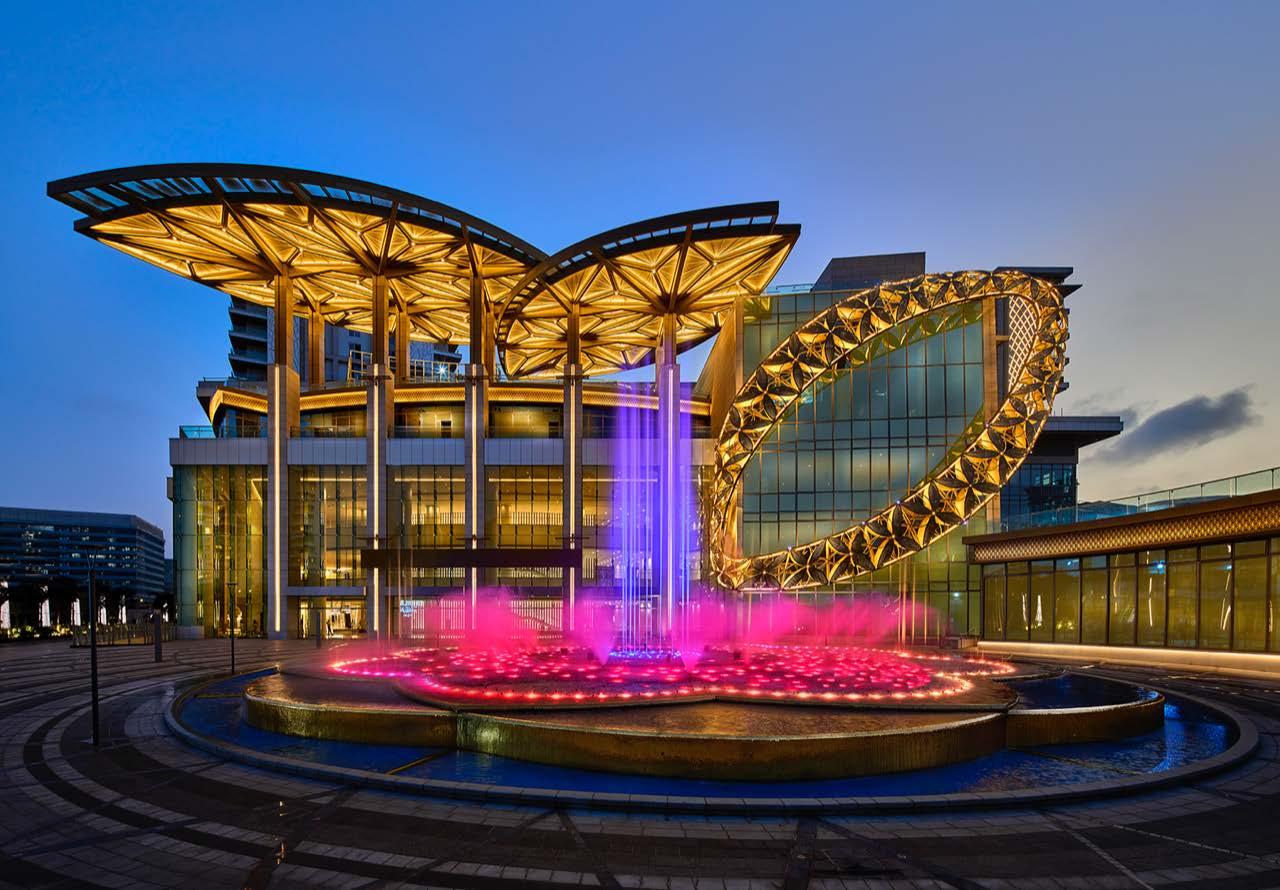
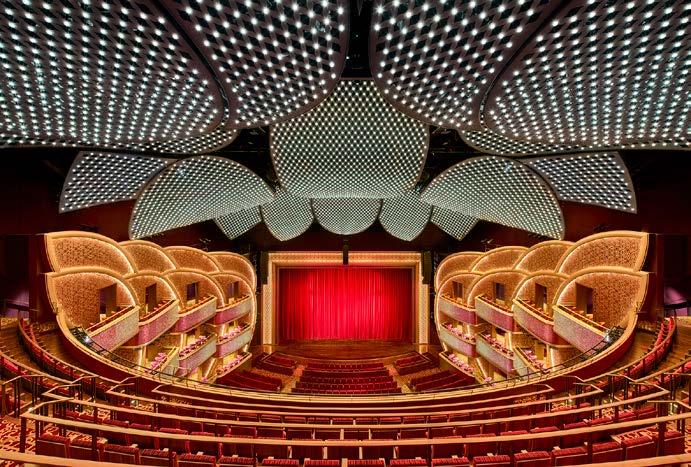
At the Jio World Centre, lighting transcends mere functionality—it becomes an integral part of the architectural narrative, a spectacle of innovation and artistic expression. This prestigious project redefines the norms of commercial lighting through a blend of sophisticated technology and traditional Indian design elements, setting a new benchmark in the realm of architectural illumination.
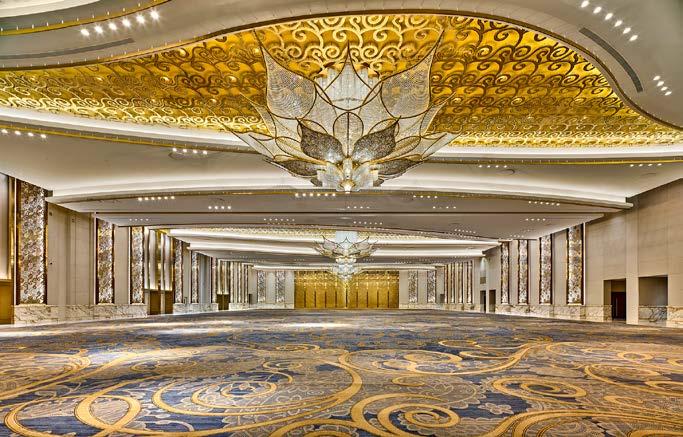
The design intricately weaves lighting with architectural features, transforming functional spaces into a world-class destination. It uses technology as a canvas to paint with light, integrating custom chandeliers, lotus flowers, and traditional Indian building techniques with a modern twist. This fusion creates a dynamic ambiance, where large-scale artwork and elements like vertical metal grillwork are illuminated not just to be seen, but to be experienced.
Attention to detail is paramount, with full-size mock-ups ensuring each design element meets the exacting standards of the construction team and ownership. The elimination of glare is a study in precision, with reflective polished stone floors, walls, and tiled surfaces posing unique challenges that are masterfully overcome with deeply shielded downlights and custom diffusing glass trims.
Not only is each light individually controlled and programmed via a modern DALI control system, but the introduction of dynamic lighting includes 4-channel RGB DMX controlled LED bulbs, coordinated through the same lighting control system. The complexity of the system is evident in its over 14,500 unique control zones, highlighting the centre's commitment to both innovation and functionality.
The pre-function area, spanning four stories, integrates advanced control systems, including photocells and occupancy sensors, ensuring energy efficiency in all non-performance spaces. This level of detail extends to the competitive bidding process, necessitating custom documentation for over 240 individual fixture types.
The exterior façade showcases a juxtaposition of modern and traditional, with uplighting techniques that softly highlight architectural features while respecting the integrity of the design. The main entry is a symphony of light, adorned with a lotus leaf trellis illuminated by concealed RGB fittings, and complemented by an ornate bracelet-inspired feature with integrated color washes and sparkle strobe lights.
All lighting elements are meticulously concealed, ensuring viewers are captivated by the light itself, not the source. This not only enhances the visitor's experience but also presents a true challenge in lighting design—achieving maximum impact while maintaining the illusion of effortlessness.
Moreover, the Jio World Centre's commitment to sustainability is affirmed by its LEED Platinum Certification, ensuring that the beauty of its lighting is matched by its environmental consciousness.
Luminaire Schedule
• Acclaim Lighting
• Altman
• ALUZ (Formerly CALI Lighting)
• Bega
• Birket Lighting
• B-K Lighting
• DALI
• DiodeLED
• Ecosense Lighting
• ERCO
• ETC
• Focal Point
• HK Lighting
• iGuzzini
• Intense Lighting
• Inter-lux
• Klik
• LEDConn
• Linelight
• Luce & Light
• Lucent Lighting
• Lumenpulse
• Luminii / Optic Arts
• Organic Lighting
• Philips Cooper, Philips Color Kinetics
• Selux
• Specialty Lighting
• Spectrum Lighting
• Targetti
• TokiStar
• Traxon Lighting
• Wibre
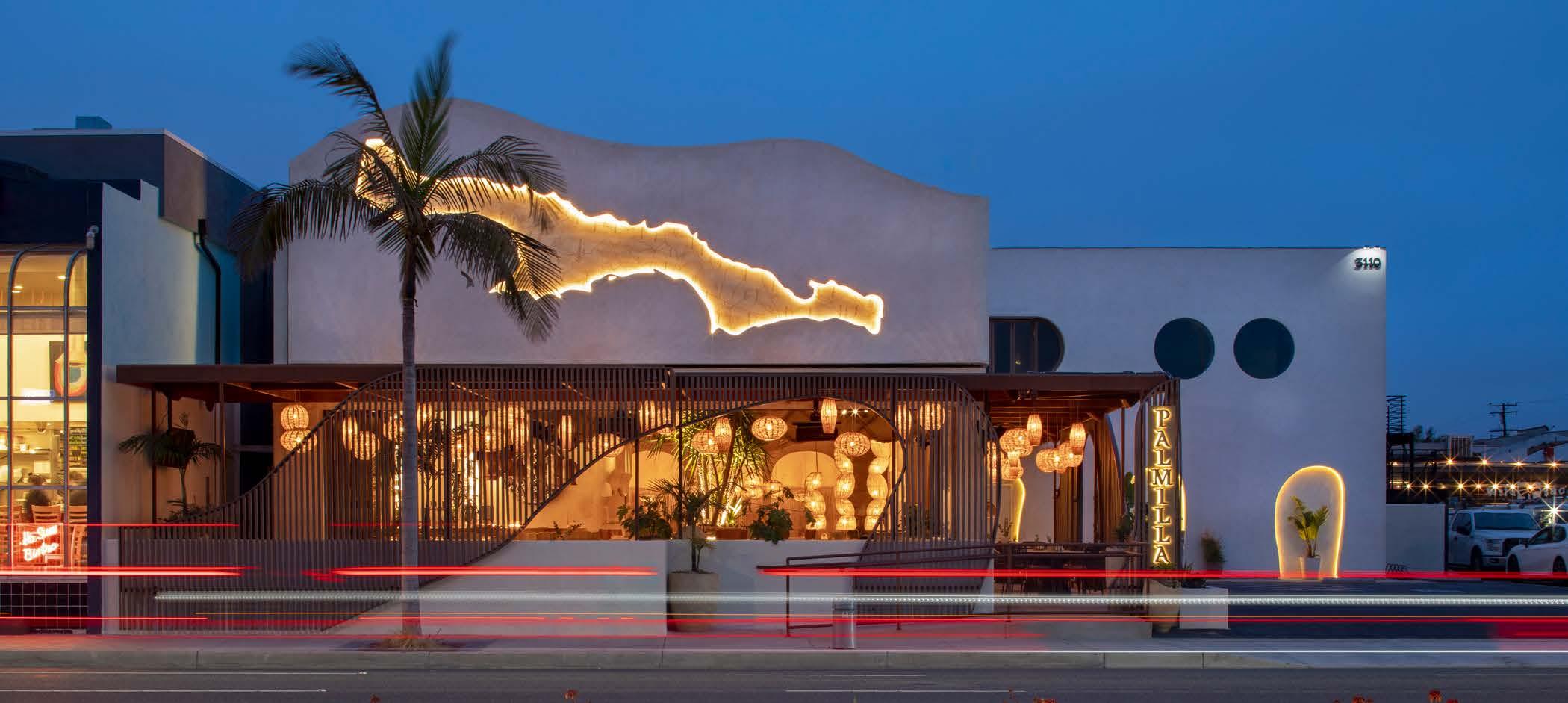
Palmilla Cocina y Tequila
Newport Beach, CA
LIGHTING
DESIGN
Lighting Design Alliance
• Kyllene Jones
Photography: Art Gray
Luminaire Schedule
• Archipelago
• DiodeLED
• Intense Lighting
• LEDConn
• Luminii
• Lutron
• Solais
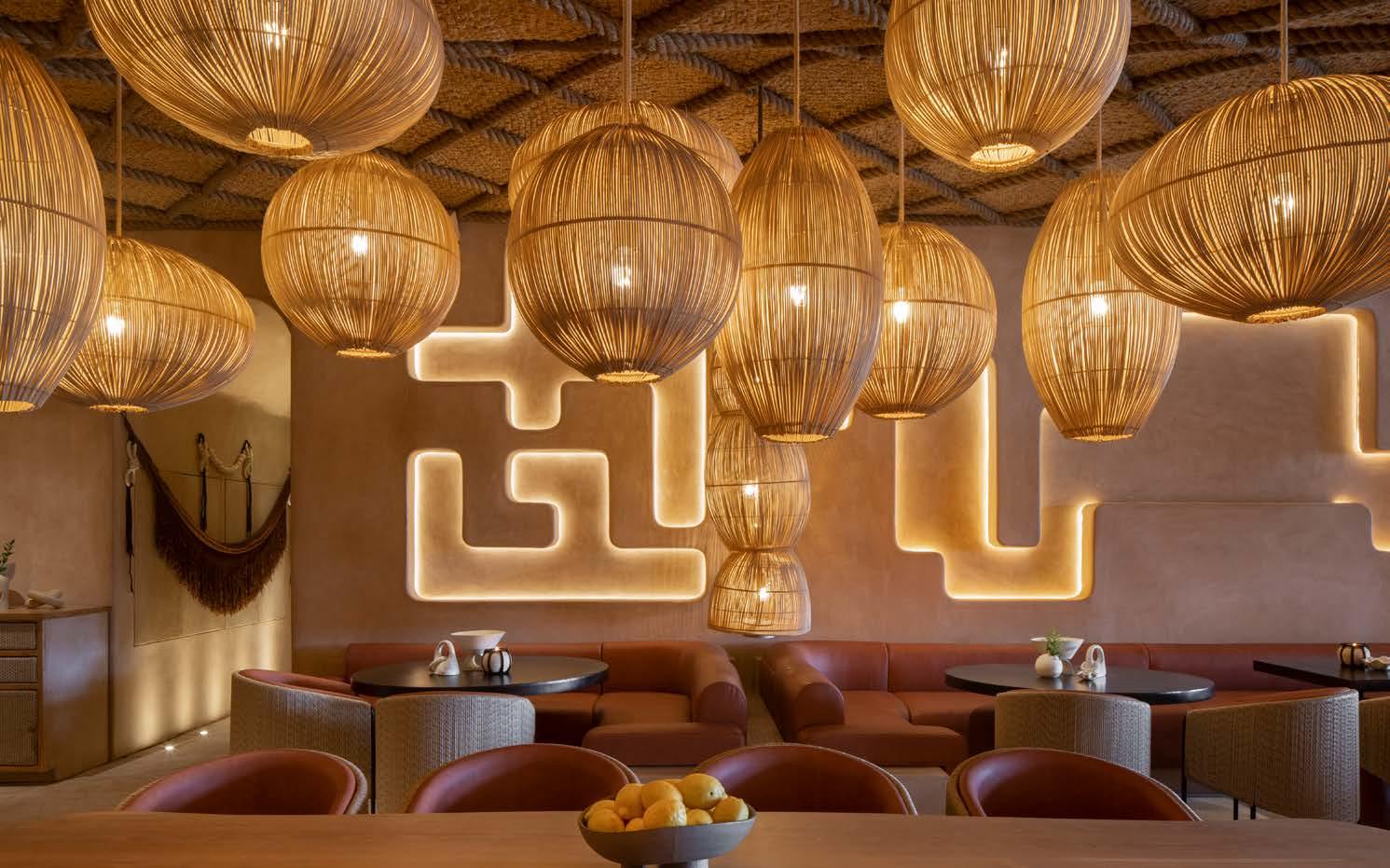
The coastal charm of Mexico cascades into the vibrant lighting design of the Palmaria Cocina y Tequila restaurant in Newport Beach, California. The designers have artfully weaved the essence of Mexico's dynamic coastline into the restaurant's ambiance. The lighting concept is a tribute not only to the visual feast of Mexico’s landscapes but also to its legendary craftsmanship and European design influence.
The lighting design takes patrons on an evocative journey from the entrance, through the dining areas, to the bar, mirroring the warmth of Mexican sunsets with terracotta tones and the soft glow reminiscent of a serene Cabo San Lucas dusk. These choices were intentional, with terracotta tones set at a warm white (2200K-2700K) and amber tones selected to simulate the intimate play of light and shadow that one experiences in Cabo, creating a romantic, flickering ambiance.
Attention to detail in lighting continues throughout the space, setting the stage for an array of shadow and light interplays. A standout feature is the space with high ceiling conditions full of equipment and limited space for fixtures, which presented unique challenges. A methodical culling at the bar presented another challenge of creating design flare for brand recognition. When closed, the integrated uplights at the barrel vault wash the plants
and enhance the tropical wallpaper-covered ceiling. When open, the space becomes an outdoor terrace with views of the sky above. Both the lighting design and controls had to respond to this flexibility.
The design team's collaboration with the interior designers and contractors resulted in various effects to create shadows from the slatted façade, planters, and textured surfaces. Slim rod-to-wall LED surface mount fixtures were used only for task lighting of accenting tables to supplement the decorative and large art moments. The thoughtfully woven fibers were carefully detailed to provide minimal architectural and decorative fixtures, which were crucially positioned to honor 2700K side emitting linear LED fixtures to create the Aztec-inspired geometric patterns and arched openings on the floor.
In every design decision, nature played muse – the color of light, the play of light and shadow, and the sustainability goals to conserve lighting effects for maximum impact. Guests are transported to a space with art and nature at the forefront of the design via modern technology, and lighting. While a multi-layered space, the project was designed to adhere to California's stringent lighting code, a testament to sustainability.
Yale University, Sterling Memorial Library – Nave & Exhibition Gallery
New Haven, CT
LIGHTING DESIGN
Cline Bettridge Bernstein Lighting Design
• Francesca Bettridge
• Nicole Yoon Kim
• Nira Wattanachote
• Min Young Kim
Apicella & Bunton Architects
Chris Gardner Photography
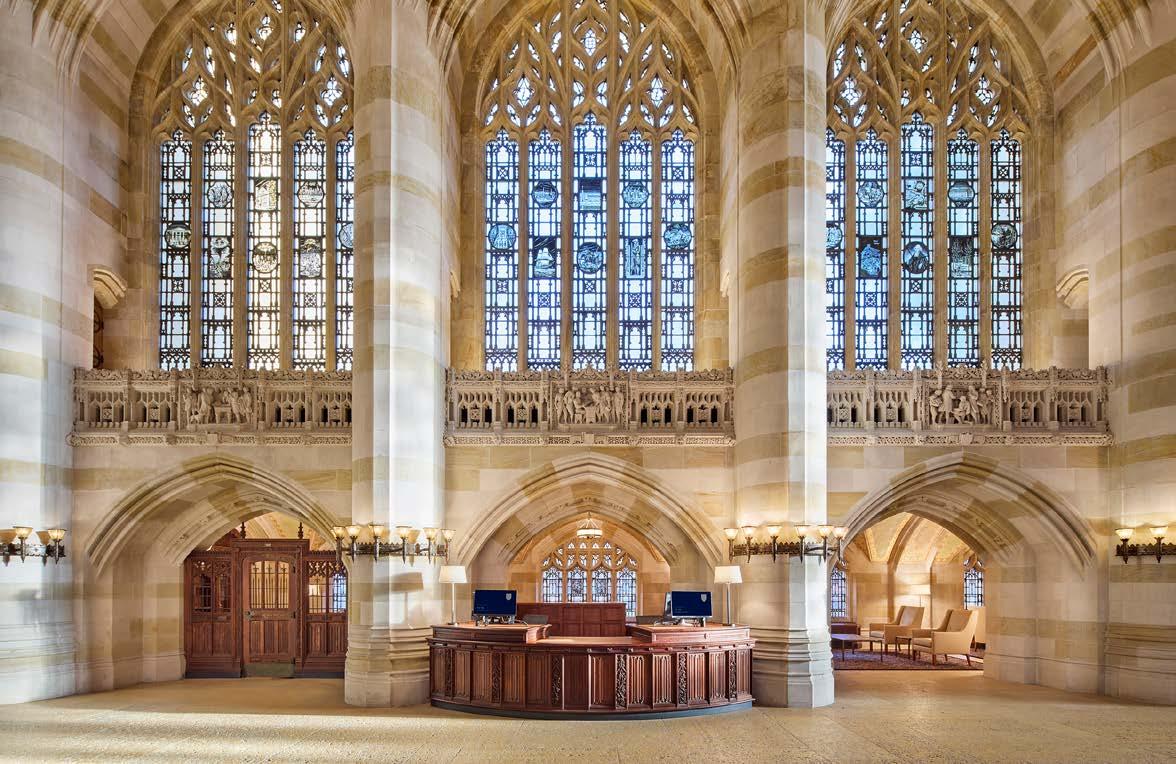
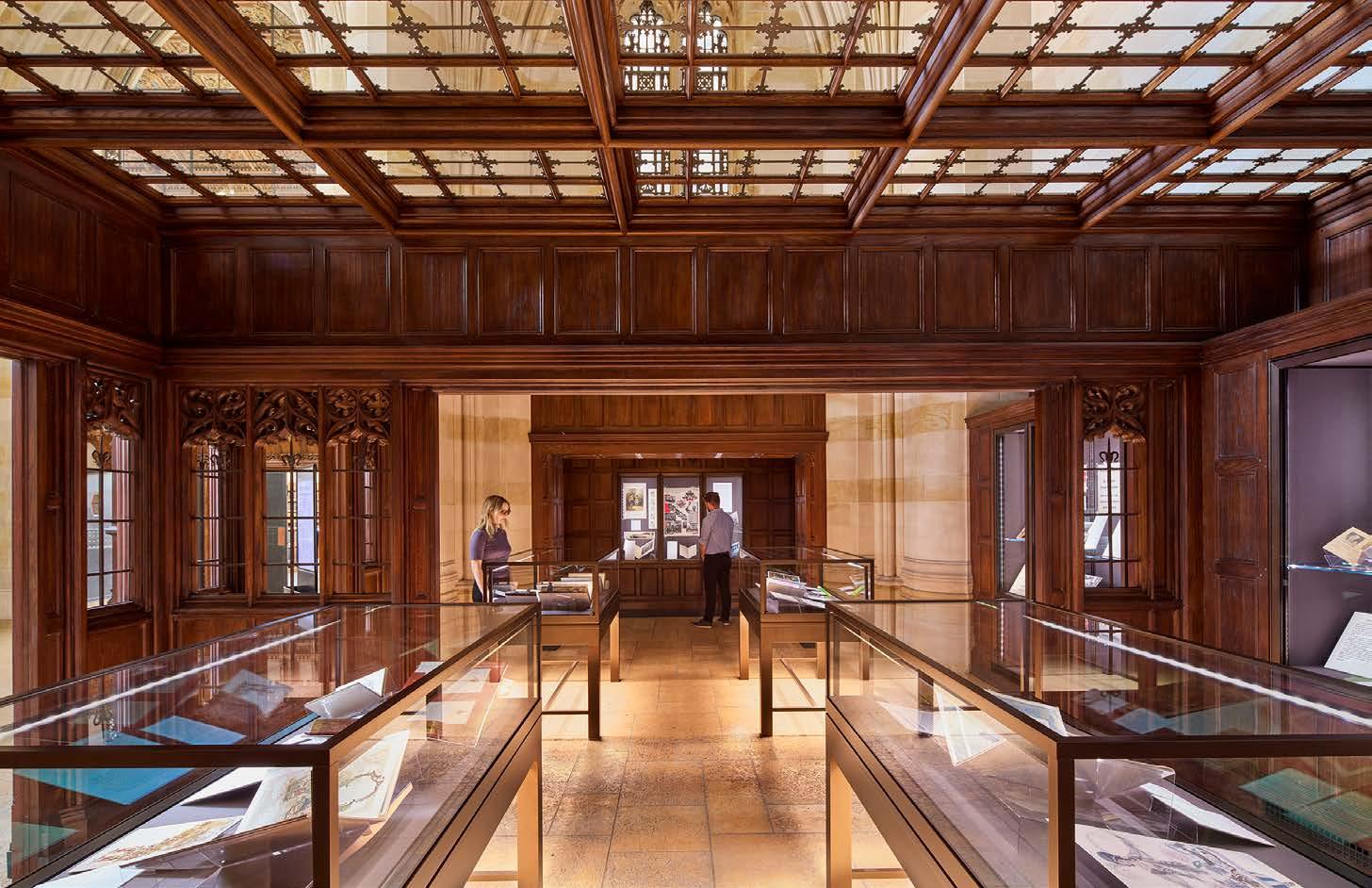
Yale University's Sterling Memorial Library exemplifies the integration of modern lighting solutions into the newly established Nave and Exhibition Gallery stands as a beacon of thoughtful preservation and innovative design.
Upon entering the gallery, one is greeted by the seamless blend of past and present. The restoration of the nave is marked by the strategic placement of custom linear LED lights that trace the vaulted ceilings, drawing the eye upwards and highlighting the intricate stonework without detracting from the storied ambiance of the space.
The nave, the gallery's centerpiece, has been thoughtfully enhanced with up-lights mounted at the base of the iconic gothicarched windows. These lights not only define the parameters of the gallery but also cast a gentle glow that enriches the warm wood
Luminaire Schedule
• Elements
• Green Creative
• Hafele
• Hydrel
• Nessen
• Optolum
• Selux
and stone, enhancing the textural depth and inviting quiet study and contemplation.
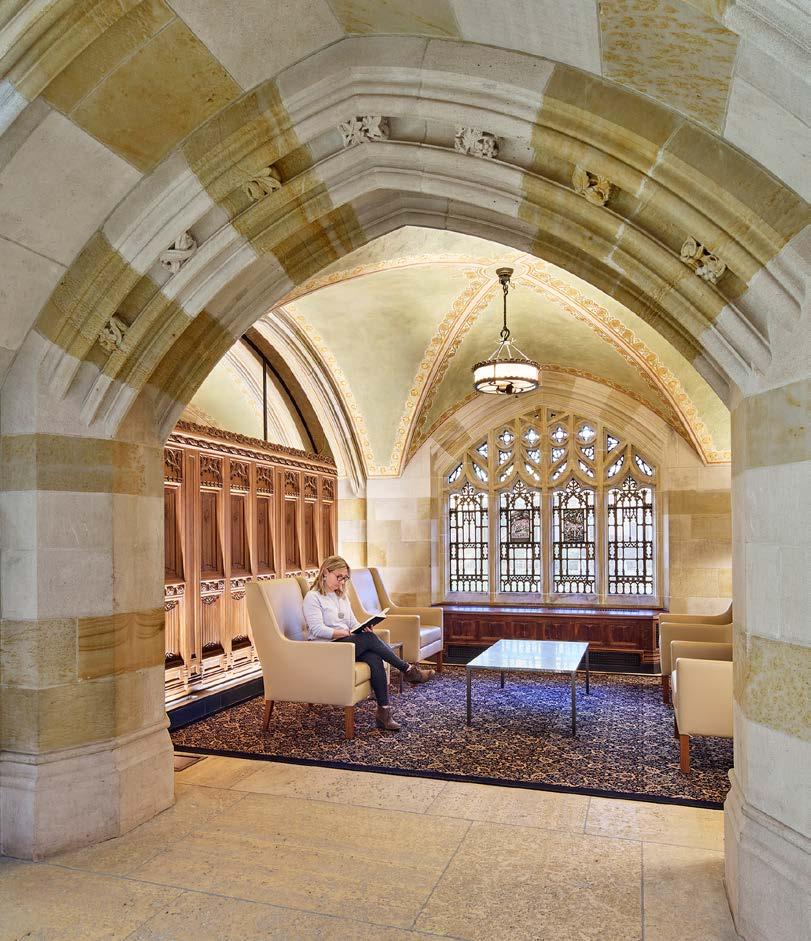
Visitors experience a welcoming transition into the library's inner sanctum, where translucent shades and 2700K LED lamps illuminate the revered surfaces, offering a contemporary homage to the neo-gothic architecture. This lighting approach respects the original design while introducing a level of accessibility and modern comfort. Moreover, the installation is remarkably energyefficient, operating at a mere 0.21 watts per square foot, blending sustainability with architectural reverence.
Mounted high on the back of the columns, custom canopymounted adjustable accent lights with 2700K PAR38 LED lamps bring drama and life to the new balustrades. They demonstrate how contemporary lighting can be integrated into a historical context to both preserve and showcase architectural beauty.
The corridor leading to the private reading rooms is bathed in light that guides patrons gently along their scholarly journey. Here, the design is not just about the visual appeal but also the functional requirement of providing adequate illumination for navigation without disrupting the building's scholarly aura.
As visitors leave the library, the existing historical decorative fixtures are re-established and re-lamped with 2700K LEDs, ensuring that the transition between the gallery and the rest of the library is both fluid and reverent.
The Sterling Memorial Library's new Nave & Exhibition Gallery is a testament to the power of lighting as a medium that respects historical integrity while embracing modern efficiency and aesthetics. It is here that light not only reveals but also protects and enhances the narrative of time, space, and legacy at one of the world's most prestigious institutions.
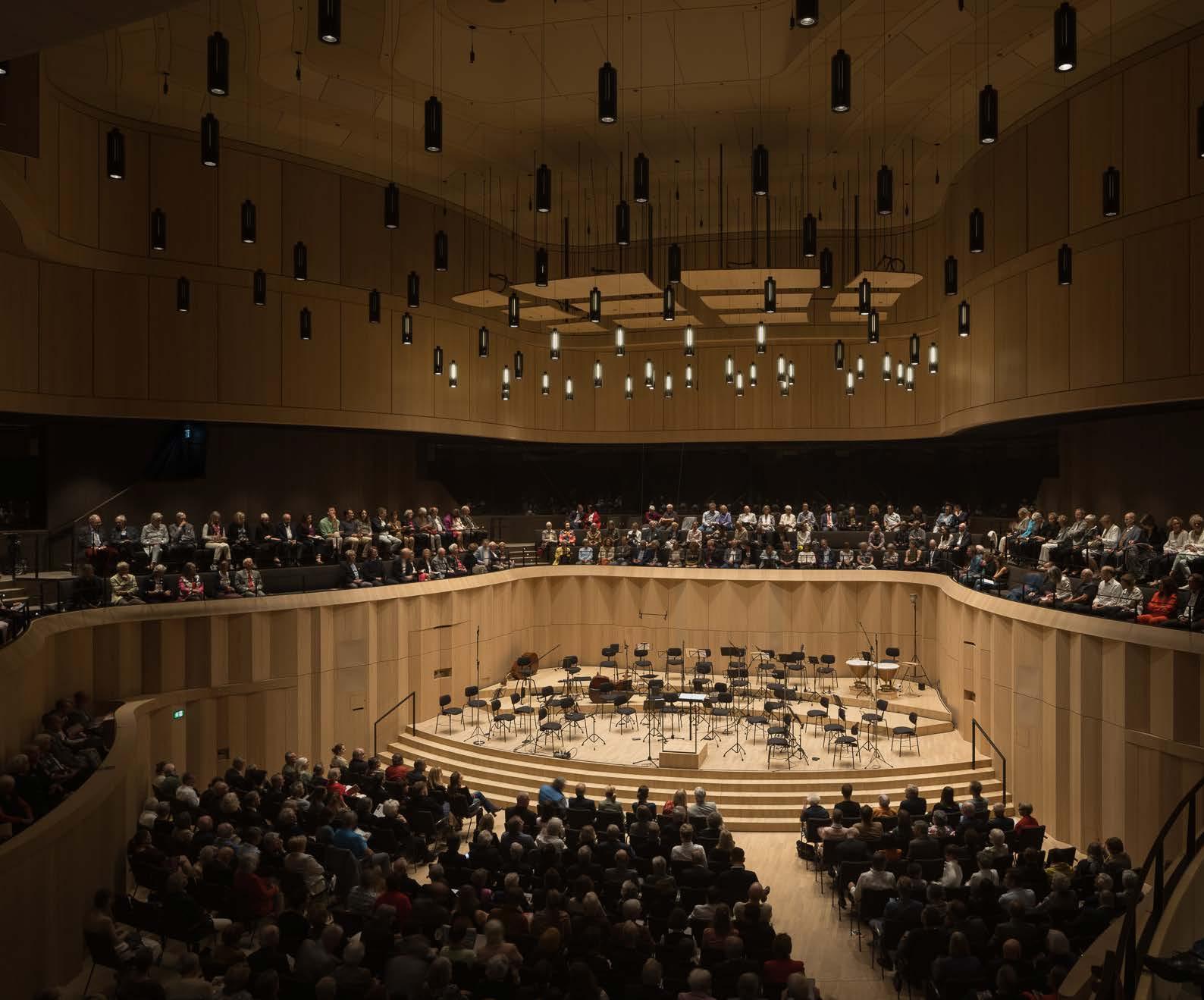
In Kronberg, Germany, the Casals Forum stands as a beacon of innovative architectural design harmonized with state-of-the-art acoustics and lighting. Five years after its foundation stone was laid, the forum has opened its doors, unveiling a space where light not only illuminates but also enhances the musical experience for every attendee.
The hall, shaped like an elliptical sloping shell, allows for the seamless projection of sound waves. In tune with this, the lighting design is equally thoughtful. The walls of the hall on the second floor are mostly transparent, featuring adjustable slat panels that connect to the outside world. During performances, the slat panels close, transforming the space into a cocoon of sound and light.
The lighting design in the upper foyer wraps around the uniquely shaped body of the hall, integrating discreetly into the serpentine metal grid ceiling. This allows for an unobstructed view of the floating architecture, where individual light sources are neatly recessed, providing a constellation of light without visual interference.
A narrow LED strip light channel runs along the Chamber Music Hall's glass wall, offering a subtle illumination that complements the concerts. This strip light, by enhancing the spatial design coherence, creates an atmospherically charged space that
transitions effortlessly to the exterior vista.
The lighting scheme of the Casals Forum is a testament to the power of minimalism and integration. The "Welcome" lighting scene introduces a warmer, more intimate light scenario, employing pendant luminaires that cast a gentle glow over the foyer. As visitors move through the space, the light transitions into a brighter, more dynamic "Events" scene, where the intensity of the light above the audience slowly fades out to focus on the performers' area, emphasizing the primary action of the event.
The exterior of the Casals Forum is no less remarkable. Architectural wall luminaires and bollard luminaires guide visitors safely across the topography of the site, ensuring the quality of stay for visitors is uncompromised. These lighting elements highlight key architectural features while also respecting the natural landscape, enhancing the visitor's journey and elevating the architectural dialogue between the building and its environment.
The Casals Forum, with its integrated lighting design, provides not just a venue for performance but a holistic experience where every note of music and beam of light plays a crucial role in crafting an unforgettable atmosphere. It stands as a pinnacle of design where light, sound, and space come together in a majestic symphony.
Confidential Global Technology
Company Office TI
Redmond, WA
LIGHTING DESIGN
Alison Fiedler of Stantec and Megan Sudol of Niteo
Photography: Lara Swimmer
Decorative Products
• Alora
• ALW
• Andlight
• ANP
• Barnlight Electric
• Bega
• Bover
• Camman
• Carpyen
• Castor
• Eureka
• Incommonwith
• Kuzco
• Lightology
Non-Decorative Products
• A-Light
• Birchwood
• Cooledge
• Fluxwerx
• Focal Point
• Gotham
• Intense
• Kelvix
• LED Linear
• Nelson
• Northern
• Petite Friture
• Resolute
• Rich Brilliant Willing
• SAL
• Santa and Cole
• Scott Architectural
• Studio PGRB
• Tech Lighting
• Tegan
• Tivoli
• Vibia
• Zero
• Ledalite
• Lightheaded
• Lighting Services Inc
• Lithonia
• Lumentruss
• Luminii
• Prudential
• Senso
• Zaneen
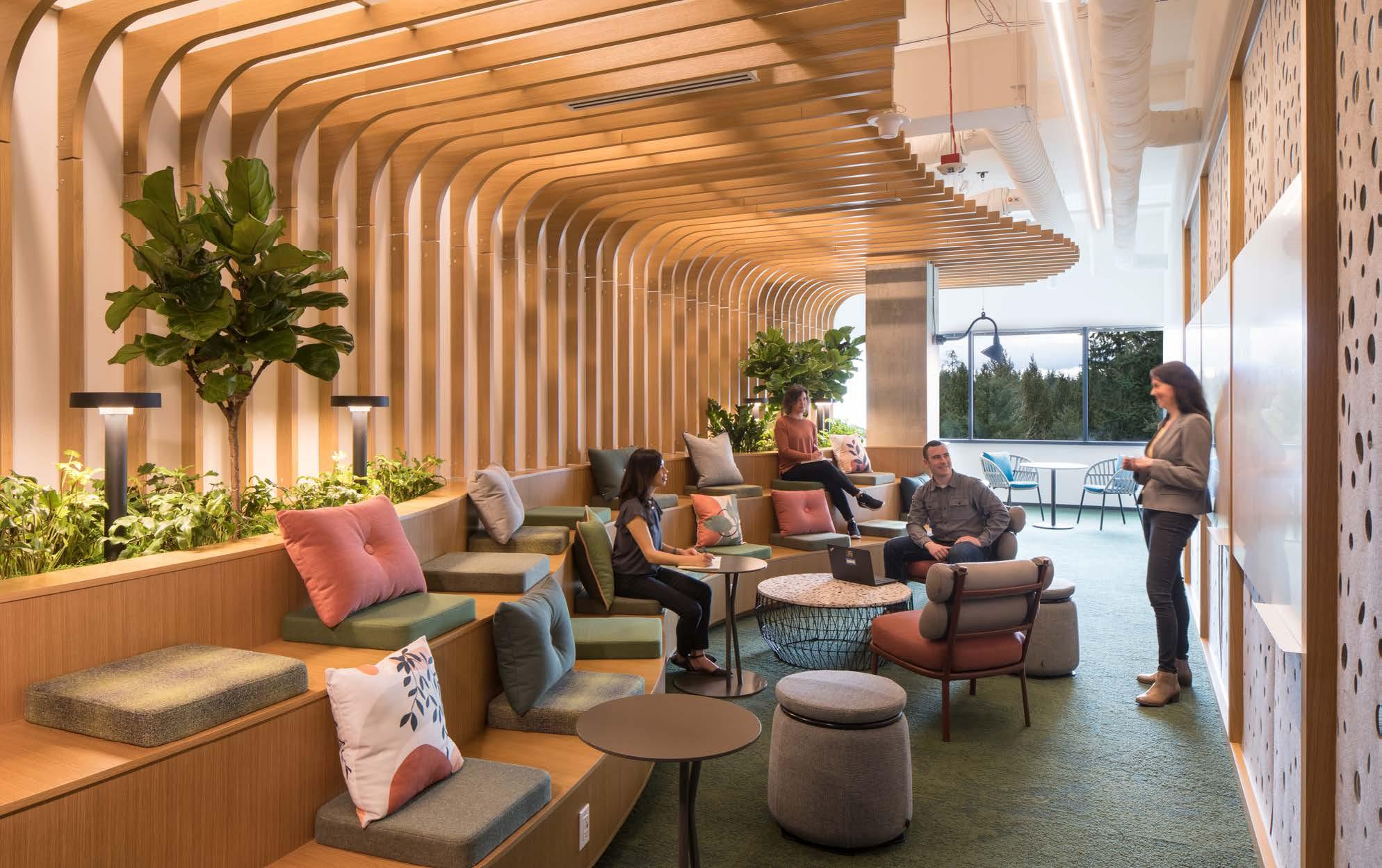
In the heart of Redmond, WA, stands an office space that is a paragon of modern lighting design. Spanning seven floors with over 206,000 square feet of office, circulation, conference, and multipurpose areas, plus a dynamic 13,000 square foot café, this workspace is a marvel of energy efficiency and visual dynamism. Achieving this feat at just 0.47 watts/SF, 30% below energy code, is an exemplary testament to sustainable innovation.
The design mantra for this project was twofold: "Spaces are for people, and nature is our ally.” These principles are palpable from the moment one steps into the building. Beneath a wooden ceiling, a system inspired by nature unfolds across two floors, reminiscent of branches and light filtering through a canopy of trees. LED strips integrated into the woodwork play with ambience and shadow, creating illusions of natural sunlight and enhancing the connection to the outdoors.
This design philosophy extends throughout the building, from casual meeting areas to quiet rooms, infusing a semblance of daylight where it is otherwise scarce. The lighting strategy is meticulously curated, prioritizing human comfort and minimizing glare. Each specialty room boasts its own distinctive lighting design, featuring a mix of decoratives, wallwashers, adjustable accents, and concealed linears.
In open office areas, linear direct/indirect pendants offer both illumination and control, with local dimmers fine-tuning the atmosphere. The café becomes a beacon of identity, with each venue expressing its unique character through track lighting that offers versatility for the circulation, signage, seating, and food preparation zones.
Through the harmonious blend of functional and aesthetic lighting elements, the project stands as a testament to the ethos that spaces are crafted for people, with nature as an inspirational ally. This modern workspace not only meets the rigorous demands of energy efficiency but also serves as a beacon for human-centric design in the age of sustainability.
The Matheson Healdsburg, CA
LIGHTING DESIGN
Electrolight
• Claudio Ramos
• Lu-Yu Huang
• Burak Yilmaz
Photography: Cesar Rubio
Luminaire Schedule
• Aion Led
• Allied Maker
• Alto Lights
• B-K Lighting
• Bega
• Heather Levine Ceramics
• John Beck Steel
• Juniper / Metropolis
• Juniper / Red Dot
• Lindsey Adelman Clamp Light
• Lucifer
• Luminii
• McEwen Lighting Studio
• Mp Lighting
• Pinnacle
• Sklo
• USAI
• Wo & We
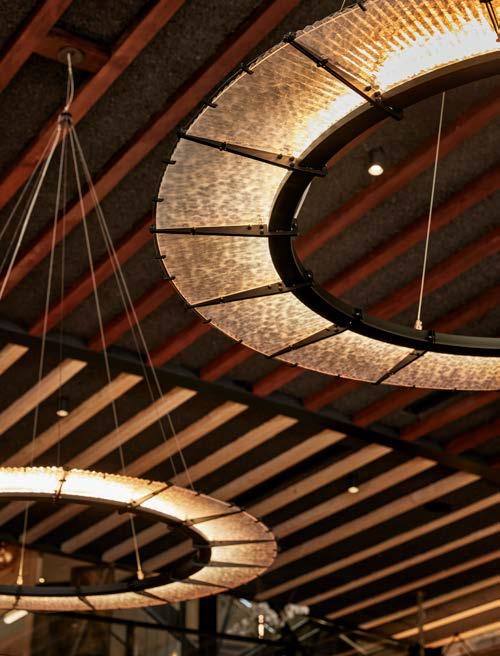
Nestled in the heart of downtown Healdsburg, CA, stands The Matheson, a beacon of thoughtful design that pays homage to local artisanship and the agricultural bounty of Sonoma Valley. This expansion, renovation, and restoration project is more than a mere building; it's a meticulously woven narrative of place, community, and history.
Custom-made lighting fixtures meld seamlessly with natural materials such as oak, walnut, and stone, to evoke the warm and spacious atmosphere intrinsic to Sonoma Valley’s heritage. The design team's dedication to preserving the building's character while creating a localized sense of place is a testament to their respect for the fabric of the community.
Collaboration was key in this endeavor. The architects and lighting designers worked hand in hand to ensure that the lighting not only enhanced the building's historic charm but also provided a modern functionality. They chose a palette of materials, from white oak to walnut and from steel to leather, ensuring that each element
contributed to an expansive and welcoming ambiance.
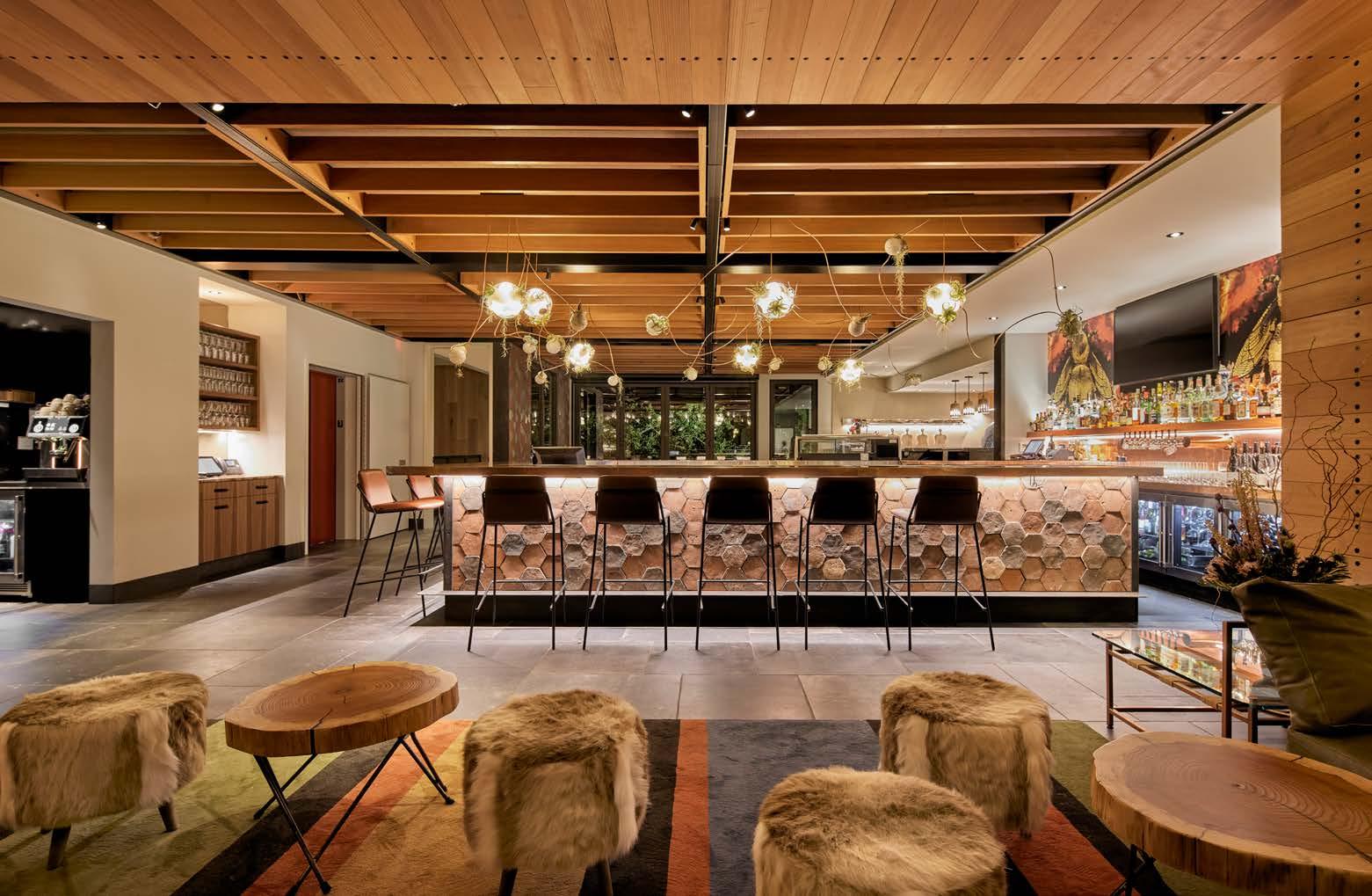
On the top floor, The Bee Bar stands as a testament to art and craftsmanship. Under the bar top, concealed linear lighting illuminates hexagonal tiles, adding a soft glow to the beehiveshaped mosaic, while decorative fixtures with planted elements echo the natural ambiance of Sonoma’s landscape.
This attention to detail extends beyond the visual to the tactile, where craftsmanship is evident in every aspect, from food to interior finishes. The integration of custom-made luminaires into structural elements weaves a narrative of community, spotlighting the local lighting manufacturers' contributions to this grand vision.
At 0.26W/sq ft., The Matheson is not merely a project; it is a celebration of energy efficiency deeply rooted in the local community. It serves as a stage for sharing stories over remarkable food, with lighting playing a crucial role in facilitating this experience. The localization itself is a story worth sharing, illuminated by the thoughtful design of The Matheson’s lighting.
Charles R. Jonas Federal Building and Courthouse
Charlotte, NC
LIGHTING DESIGN
Cline Bettridge Bernstein
Lighting Design
• Stephen D. Bernstein
• Renata Gallo
• Francisco Casablanca
• Nick Stuchlak
• Lu-Yu Huang
• Burak Yilmaz
Robert A. M. Stern Architects
Jenkins Peer Architects
Photography:
Francis Dzikowski/OTTO
Luminaire Schedule
• Gotham
• Green Creative
• Landscape Forms
• Lithonia
• OCL Lighting
The Charles R. Jonas Federal Building & Courthouse in Charlotte emerges as a monument of architectural and engineering brilliance. The grandeur of this 15-story structure extends beyond its role as a crucible for justice; it is a beacon of eco-conscious design, distinguished notably by its cuttingedge lighting solutions.
The lighting design, crafted with precision and care, does more than illuminate; it harmonizes with the building's aesthetic, enhancing both its functionality and its architectural form. Upon entering the courthouse, visitors are greeted by a lighting design that respects the historic nature of the building while providing a contemporary edge. The main atrium flourishes under sky-lit panels that grant a cascade of ambient light, creating a welcoming pathway for the thousands who pass through daily.
One of the standout features of this design is the 'Believe' plaza, where linear fixtures accentuate the architectural lines, offering both guidance and visual delight. The belief in justice and transparency, symbolic of the courthouse's function, is echoed in the clarity and openness of its lighting design.
The designers faced the complex task of balancing natural and artificial light within the courthouse and its new annex. The solution was found in the strategic placement of LEDs and DMX controls, facilitating an adaptable environment responsive to both the time of day and the required use of each space. The result is a seamless continuity between tradition and innovation, history and progress.
AFTER
BEFORE
This modern courthouse has significantly surpassed the standard requirements by achieving a lighting power density of just 0.43 watts per square foot in the renovated spaces, marking an impressive 57% improvement over the allowance set by building codes. Meanwhile, the annex building further demonstrates efficiency at 0.90 watts per square foot, still 22% more efficient than code allowances.
With an illuminance of 3000K and a color rendering index (CRI) over 90, the building ensures that the quality of light contributes to both functional visibility and the aesthetic ambiance suitable for a federal building.
The courthouse's dedication to energy efficiency and sustainability is evident in every aspect of its design. From LED luminaires to solar-responsive controls, the building meets a high standard of environmental responsibility. The lighting design supports this ethos by providing an optimal balance of form and function, contributing to the building's LEED certification goals.
Phoenix Suns Arena
Phoenix,
AZ
LIGHTING DESIGN
Electrolight
• Claudio Ramos
• Lu-Yu Huang
• Burak Yilmaz
Photography: Christy Radecic
The Phoenix Suns Arena stands out as a beacon of sustainability and energy efficiency, a shining example of how modern lighting solutions can transform a space. With a sprawling 95,000 square foot project area, this venue has been meticulously outfitted with a lighting design that not only meets but exceeds the rigorous standards for professional sports facilities. The arena's lighting power density is a testament to this, registering at a mere 0.35 watts per square foot.
Delving deeper into the specifics, the Suns Arena features a blend of 2700K and 3500K lighting solutions. The warmer 2700K lighting is reserved for intimate spaces, creating an ambiance of comfort and warmth where fans can relax and socialize. Meanwhile, the brighter 3500K lamps are designated for high-traffic areas, where clarity and visibility are paramount. This
Luminaire Schedule
• Abramson Lighting
• ACDC
• ALW
• ANP Lighting
• Artemide
• Axis
• Boca Flasher
• Buster & Punch
• Delta Lighting
• ELEEK
• EOS
thoughtful allocation ensures that each area of the arena is lit to optimal standards, enhancing the experience for every visitor.
What's more, the lighting design is not just about creating an environment that's easy on the eyes; it's about contributing to the health and safety of everyone who walks through the doors. This is evidenced by the 50fc lighting levels at food counters, a requirement set by the health department to ensure that food preparation and consumption areas are well-lit, clean, and safe.
The Phoenix Suns Arena's approach to lighting is a paradigm shift, showcasing how venues can enhance the fan experience while upholding the highest standards of energy efficiency and sustainability. This lighting design not only illuminates but also inspires, paving the way for future projects to think green and shine bright.
• Feelux
• Finelite
• Focal Point
• Hubbardton Forge
• Inter-lux
• Kelvix
• Lucifer
• Lumenwerx
• Lumiani
• Petite Friture
• Reggiani
SPECIAL CITATIONS
• Serno
• Sonneman
• Specified by Others
• SPJ Lighting
• Stuff by Andrew Neyer
• Tech Lighting
• The Light Source
• Tokistar
• USAI
• Vibia
• Wagner
Congratulations to the following firms who received a Special Citation for their lighting design.
Optiver Chicago, IL
LIGHTING DESIGN: Schuler Shook
• Travis Shupe
• Emily Klingensmith
• John Jacobsen
Design of Daylight System for a Control Center
West Germany
LIGHTING DESIGN: ANDRES + PARTNER
• Bruno Thomas Menczigar
• Arne Hűlsmann
• Katja Schielbler
• Peter Andres
Hotel West and Main Conshohocken, PA
LIGHTING DESIGN: Paragon
• Scott Kerns
Indian Community School Franklin, WI
LIGHTING DESIGN: Morlights
• Sean Murphy
• Avraham Mor
• Casey Diers
• Kelsey Knowak
Westbridge Capital San Mateo, CA
LIGHTING DESIGN: Electrolight
• Claudio Ramos
• Lu-Yu Huang
• Burak Yilmaz
Safeco Plaza Seattle, WA
LIGHTING DESIGN: Fisher Marantz Stone, Inc.
• Kevin Frary
• Charles G. Stone II
VIRTUAL SESSIONS MARCH 14
2024 Presentations
Micro Lens Arrays (MLAs) and Grey-Scale Photolithography
Andrew Finch, Brightview Technologies
Thursday | March 14, 2024 | 7:00 am - 8:00 am EST
Credits: 1 LU | Elective | Intermediate
Why are PK-12 schools choosing to install tunable lighting?
Are they still happy with their choice?
PANEL DISCUSSION
Sarah Safranek, Pacific Northwest National Laboratory
Andrea Wilkerson, Pacific Northwest National Laboratory
Alexandra Christiana, HMFH Architects
Thursday | March 14, 2024 | 8:30 am - 10:00 am EST
Credits: 1.5 LU | Elective | Introductory
The A,B,C’s of PoE
The Emergence of Power over Ethernet for Lighting Control, Daylighting and other Operational Technologies
PANEL DISCUSSION
Harry Aller, Innovative Lighting | David Robinson, Mecho Shading Solutions | Kim Johnson, MHT Technologies | Tyler
Andrews, PoE Texas
Thursday | March 14, 2024 | 10:30 am - 12:00 pm EST
Credits: 1.5 LU | HSW | Intermediate
Navigating the Future: Code Compliance and Energy Efficiency
Sean Lafferty, Steinel America
Thursday | March 14, 2024 | 12:30 pm - 1:30 pm EST
Credits: 1 LU | Elective | Intermediate Better Than Blue Light
Jay Neitz, PhD, University of Washington
Thursday | March 14, 2024 | 2:00 pm - 3:00 pm EST
Credits: 1 LU | Elective | Introductory Horticultural Lighting for Architectural Spaces
Yan Ren-Butcher, RAYN | Hannah Ball, Rayn Growing Systems
Thursday | March 14, 2024 | 3:30 pm - 4:30 pm EST
Credits: 1 LU | HSW | Introductory
Unveiling Potential: Bridging Gaps in Circadian Lighting Design Guidelines
Levent Sahin, CCNY
Thursday | March 14, 2024 | 5:00 pm - 6:00 pm EST
Credits: 1 LU | Elective | Intermediate
7 Basic Rules for Successful Lighting Integration to the BMS
Scott Ziegenfus, Current Lighting
Thursday | March 14, 2024 | 6:30 pm - 7:30 pm EST
Credits: 1 LU | Elective | Intermediate
VIRTUAL SESSIONS MARCH 15
Feng Shui and Lighting
Deborah Khorsandy, Luminostri Lighting Design Studio
Friday | March 15, 2024 | 7:00 am - 8:00 am EST
Credits: 1 LU | Elective | Introductory Frontiers of Sustainable Lighting PANEL DISCUSSION
David Bergman, David Bergman Eco | Shaun Fillion, RAB
Lighting | Chelsea Kreielsheimer, Atelier Ten | Alessa Aguayo, Coronet LED
Friday | March 15, 2024 | 8:30 am - 10:00 am EST
Credits: 1.5 LU | HSW | Introductory Designing Lighting to Enable Workplace Equity and Performance PANEL DISCUSSION
Jose Dos Santos, Signify | Meg Smith, LWLumens | Tony Esposito, International Well Building Institute
Friday | March 15, 2024 | 10:30 am - 12:00 pm EST
Credits: 1.5 LU | Electiv | Intermediate
Beyond the Visible
The proven effects of near-infrared light on our health and well-being
Dr. Anne Berends, Seaborough BV
Friday | March 15, 2024 | 12:30 pm - 1:30 pm EST
Credits: 1 LU | HSW | Intermediate
Scalable Energy-Efficient Lighting
Harnessing Fault Managed Power and X-PoE for cost effective Low
Voltage DC Lighting
Luis Suau, Sinclair Digital
Friday | March 15, 2024 | 2:00 pm - 3:00 pm EST
Credits: 1 LU | HSW | Introductory
Taming DMX
Understanding DMX controls systems and their integrations, and setting the behavioral narrative of your dynamic Lighting Design
Sahil Lotia, Mulvey & Banani Lighting
Friday | March 15, 2024 | 3:30 pm - 4:30 pm EST
Credits: 1 LU | Elective | Intermediate Perfecting Light for Improved Wellbeing
A Quest to Minimize Glare
Henri Uutela, Ledil
Friday | March 15, 2024 | 5:00 pm - 6:00 pm EST
Credits: 1 LU | Elective | Intermediate
IN PERSON MARCH 19
3 Times Square / Touro College Lobby and the Creative Process
Anita Jorgensen, Anita Jorgensen Lighting Design
Location: Nassau
Tuesday | March 19, 2024 | 8:30 am - 10:00 am EST
Credits: 1.5 LU | Elective | Intermediate
Creative and Practical Design Strategies for Delivering Visual and Non-visual Benefits of Lighting
PANEL DISCUSSION
Daniel Frering, Icahn School of Medicine at Mount Sinai | Mariana Figueiro, Mark Rea, and Jennifer Brons, Light and Health Research Center, Mount Sinai School of Medicine
Location: Gramercy
Tuesday | March 19, 2024 | 8:30 am - 10:00 am EST
Credits: 1.5 LU | HSW | Intermediate Game On: Lighting Your Way to an Energy Code Win!
PANEL DISCUSSION
Harold Jepsen, Legrand / Wattstopper | Michael Jouaneh, Lutron | Julie Donovan, Horton, Lees Brogden Lighting Design
Location: Murray Hill
Tuesday | March 19, 2024 | 8:30 am - 10:00 am EST
Credits: 1.5 LU | Electiv | Intermediate Deciphering Code Updates for IECC and ASHRAE 90.1 Lighting and Control Requirements PANEL DISCUSSION
Mike Lehman, ConTech Lighting, a Leviton Company | Joe Briscoe, Leviton
Location: Nassau
Tuesday | March 19, 2024 | 10:30 am - 12:00 pm EST
Credits: 1.5 LU | HSW | Introductory Recommendations vs Reality
3 million eye-level spectral measurements taken in factory and office spaces have a thing or two to teach us about lighting for human health PANEL DISCUSSION
Wendy Luedtke, ETC | Andrea Wilkerson, Pacific Northwest National Laboratory | Jessica Collier Kelly, Pacific Northwest National Laboratory
Location: Gramercy
Tuesday | March 19, 2024 | 10:30 am - 12:00 pm EST
Credits: 1.5 LU | HSW | Intermediate A Brighter Tomorrow
Tuesday | March 19, 2024 | 10:30 am - 12:00 pm EST
Credits: 1.5 LU | Elective | Intermediate Specifying Outdoor Lighting That Enables Decarbonization and Minimizes Light Pollution Doesn’t Have to be a Headache
Leora Radetsky, DesignLights Consortium | Tony Esposito, Lighting Research Solutions LLC
Location: Nassau
Tuesday | March 19, 2024 | 12:30 pm - 1:30 pm EST
Credits: 1 LU | Elective | Intermediate Light Me The Way Home
Residential Lighting Design
Deborah Gottesman, Gottesman Associates
Location: Gramercy
Tuesday | March 19, 2024 | 12:30 pm - 1:30 pm EST
Credits: 1 LU | Elective | Introductory
Facade Lighting
Reducing Its Contribution to Skyglow
Craig Bernecker, The New School, Parsons School of Design |
Ajin Cho, Domingo Gonzalez Associates
Location: Murray Hill
Tuesday | March 19, 2024 | 12:30 pm - 1:30 pm EST
Credits: 1 LU | Elective | Intermediate
Adapting to the new requirements of UL 924 Emergency Lighting Challenges and New Opportunities
Eric Miller, Avi-on Labs, Inc.
Location: Nassau
Tuesday | March 19, 2024 | 2:00 pm - 3:00 pm EST
Credits: 1 LU | HSW | Intermediate
A Refined Approach to Exterior and Landscape Lighting within DarkSky Recommendations
Kathryn Toth, Theia Lighting Design
Location: Gramercy
Tuesday | March 19, 2024 | 2:00 pm - 3:00 pm EST
Credits: 1 LU | HSW | Intermediate
Specifying Sustainable Luminaires
Scott Roos, Acuity Brands
Location: Murray Hill
Tuesday | March 19, 2024 | 2:00 pm - 3:00 pm EST
Credits: 1 LU | Elective | Introductory
Specifying for Success with Today’s Wireless Mesh Controls
Rita Renner, McWong International | C. Webster Marsh, Penumbra Controls
Location: Nassau
Tuesday | March 19, 2024 | 3:30 pm - 4:30 pm EST
Credits: 1 LU | Elective | Introductory
Architectural Case Study
Bold Exterior Choices at the Gershwin Theatre
Christien Methot, Design One Lighting Design
Location: Gramercy
Tuesday | March 19, 2024 | 3:30 pm - 4:30 pm EST
Credits: 1 LU | Elective | Introductory
A Five-Step Human-Centric Lighting Design Process for Your Next Project
Tony Esposito, International WELL Building Institute | Kevin Houser, Oregon State University
Location: Murray Hill
Tuesday | March 19, 2024 | 3:30 pm - 4:30 pm EST
Credits: 1 LU | HSW | Introductory
Not All RGBW Is The Same Challenges of designing RGBW luminaires
David Grassi, Lumenpulse Lighting Inc.
Location: Nassau
Tuesday | March 19, 2024 | 5:00 pm - 6:00 pm EST
Credits: 1 LU | Elective | Intermediate
Illuminating Illusions
The Art and Science of Artificial Windows
Jonathan Clark, Innerscene Location: Gramercy
Tuesday | March 19, 2024 | 5:00 pm - 6:00 pm EST
Credits: 1 LU | HSW | Intermediate
Connected Emergency Lighting
Tom Stoll, Bodine Emergency Lighting | Dave Bratt, Bodine
Emergency Lighting (Signify)
Location: Murray Hill
Tuesday | March 19, 2024 | 5:00 pm - 6:00 pm EST
Credits: 1 LU | HSW | Intermediate
Lighting and Control Design to Promote Health and Well-being in Healthcare Spaces
Christian Groom, Legrand | Stacey Kennedy, Focal Point | Tom Kaczkowski, HOK
Location: Nassau
Tuesday | March 19, 2024 | 6:30 pm - 7:30 pm EST
Credits: 1 LU | Elective | Intermediate
Decarbonization in Lighting – the Hotspots
Leela Shanker, WAP Sustainability | William Paddock, WAP Sustainability | James Salazar, WAP Sustainability
Location: Gramercy
Tuesday | March 19, 2024 | 6:30 pm - 7:30 pm EST
Credits: 1 LU | HSW | Intermediate Darkness by Design
Jane Slade, Speclines
Location: Murray Hill
2024 Presentations
Tuesday | March 19, 2024 | 6:30 pm - 7:30 pm EST
Credits: 1 LU | Elective | Intermediate
IN PERSON MARCH 20
What If We Thought of a Lighting System as a Teammate? PANEL DISCUSSION
Andrea Wilkerson, Pacific Northwest National Laboratory | Corey Fallon, Pacific Northwest National Laboratory | Rachel Fitzgerald, Stantec Location: Nassau
Wednesday | March 20, 2024 | 8:30 am - 10:00 am EST
Credits: 1.5 LU | Elective | Introductory Catching Up with Bluetooth® Technology and DALI Advances in Interoperability, Technology and Applications PANEL DISCUSSION
Carol Jones, DALI Alliance | Henry Wong, Bluetooth Special Interest Group | Stephen Zhou, McWong International Location: Gramercy
Wednesday | March 20, 2024 | 8:30 am - 10:00 am EST
Come visit the Verozza booth to see the 17 New Luminaire Inserts that expand the
Verozza’s Moduline 48V track system has expanded its product collection with the introduction of 17 new luminaire inserts. These additions enhance the versatility, functionality, and aesthetic appeal of the track system, catering to commercial and residential design preferences.
VEROZZA.COM
"We're proud to use a material that is at least 55% recycled or bio-circular - that's a testament to our commitment to eco-friendly practices."
— Neil Hardwick
For an extensive period, we've been on the search for a significant 3D-printed lighting project designed by a lighting designer, yet such a project has remained elusive. Unwilling to postpone any further, we opted to showcase the AutoStore project, hoping to inspire the creative community of lighting designers to explore and embrace the unique benefits of 3D printing technology.
AutoStore, a leader in robotic storage solutions, faced a unique challenge in finding a lighting solution that matched the sophistication of their automated warehousing systems. Standard off-the-shelf options were insufficient for their cutting-edge facility nestled within the Tuscan Village of Salem, New Hampshire.
AutoStore's vision was specific: a light fixture that not only performed efficiently but also mirrored the hightech environment of their headquarters and met their construction deadline. This led to a partnership with Cooper Lighting Solutions and PrentaLux, their brand of on-demand, 3D-printed lighting fixtures.
Enter Larry Fallon, Business Development Manager at PrentaLux, and his team from Cooper, whose reputation for flexibility and rapid prototyping precedes them. Fallon recounts how a connection through Sara Grossman, an agent from Reflex Lighting Group in Boston, initiated the personalized lighting project. "AutoStore and their architect had a specific look in
mind, one that wasn't readily available or within the desired budget," Fallon explained. "They needed a design that didn't exist yet, and that’s where our expertise came into play."
Traditionally, tailor-made lighting could entail lengthy design cycles, tooling and production times, along with a significant expense. PrentaLux, however, upended these norms. "Our PRLX-205 Series had the bones of what AutoStore was looking for, but it needed to fit their unique space and operational requirements," Fallon noted.
The team’s flexibility allowed PrentaLux to transform AutoStore's concept into a reality in a remarkable 10 days.
“By adjusting the design, we could preserve the integrity of the light engine while tailoring the fixture to their precise needs,” Fallon continued, emphasizing the transformative power of 3D printing in lighting design.
The solution lay in adapting an existing product to meet the specific needs of the project. "We started with our PRLX-205 engine from our PRLX-200 luminaire series," Fallon said. "It was close to what AutoStore envisioned, but the luminaire required some significant modifications – it needed to be 'squished', shorter in height, more rounded and with a wider diameter."
SUSTAINABLE SOLUTIONS: THE ECO-CONSCIOUS APPROACH
The materials chosen for these fixtures symbolize a commitment to sustainability. PrentaLux products are crafted from bio-circular polycarbonate derived from wood processing byproducts—a meaningful move away from petroleum-based plastics. Neil Hardwick, Product Manager for PrentaLux, emphasized this strategic choice: "We're proud to use a material that is at least 55% recycled or bio-circular - that's a testament to our commitment to eco-friendly practices."
The strength of Fallon's approach lay in the power of 3D printing technology, which allows for such exacting personalization.
Photo Credit: Cooper Lighting
With multiple test printers at their disposal in Boston and Denver, Fallon's team was able to reimagine the PRLX-205 fixture to meet AutoStore’s requirements. "We presented this challenge to our designers, and with remarkable speed, they reshaped the PRLX-200, maintaining its performance while meeting the design criteria AutoStore was looking for," he noted with pride.
This rapid innovation cycle, from the initial design to a ready-to-ship product, is a testament to the transformative capabilities of 3D printing.
"The process began on December 8th, and by January 4th we had a purchase order. Because our designs are software based, there is no tooling up of new designs. In fact, by February 27th, we’ll have shipped 219 tailored fixtures," Fallon highlighted. This project not only demonstrates the team's agility but also underscores the potential for 3D printing to revolutionize how custom lighting solutions are conceived and delivered. Each PrentaLux luminaire is printed in approximately 2 hours.
Neil Hardwick reflected on the innovative process: "The beauty of our method is its responsiveness to customer needs. If AutoStore needs a change or if a fixture gets damaged, we can print a replacement on-demand. Our designs are stored as digital files, making them immortal in a sense—there's no physical tooling that will wear out or become obsolete."
The fixtures created for AutoStore met rigorous lighting requirements, providing 3500K at 90 CRI, crucial for their operation. Beyond performance, PrentaLux fixtures offered extensive personalization in shape, size, color and texture, enabling seamless integration into AutoStore's distinctive environment. "The ability to choose from various colors, textures, and shapes allowed for a lighting solution that truly complements
AutoStore's innovative spirit," Fallon noted.
In the design process, every aspect was scrutinized, ensuring each fixture not only performed its intended job but also contributed to the broader aesthetic and environmental goals. “We looked at every angle, from how the light interacts with AutoStore’s space to how the fixtures would be recycled at the end of their life,” Fallon remarked. “We're moving away from a cradleto-grave mindset to a more circular, cradle-to-cradle approach. We're not there yet, but cradle-to-cradle is the goal for all our 3DP fixtures.”
AutoStore's quest for the perfect lighting fixture became a journey of innovation and environmental stewardship. "What we've accomplished for AutoStore is a beacon of what can be achieved when you merge technology and manufacturing ability with ingenuity, " Fallon stated. With PrentaLux technology, the lighting industry is on the cusp of a revolution, moving towards on-demand, local manufacturing that promises responsiveness, waste reduction, and an adherence to the principles of sustainability.
The project's success led to an expanded collaboration when Tuscan Village commission an additional 125 fixtures for their headquarters. “This order is a validation of our work and a signal that we're on the right path,” said Fallon.
The implications of this partnership extend beyond the immediate project. Hardwick pointed out, “The industry is evolving. We're exploring the idea of printer farms that could be brought directly to job sites, cutting down on shipping costs and environmental impact.” These innovations offer a glimpse into a future where lighting fixtures are produced on-demand, tailored to each client’s specifications, and aligned with the overarching principles of sustainability and efficiency. ■
Photo Credit: Cooper Lighting
CREATE THE PERFECT AMBIANCE
Discover the extraordinary with Sunlight2® dim to warm LEDs. Immerse yourself in an inviting, focused, full-color accuracy daylight of 3000K CCT and seamlessly transition into a warm and soothing ambiance at the end of the workday. Simply set the mood using a standard dimmer and effortlessly set the perfect atmosphere for any occasion. R
• Light for well-being
• Architectural Grade
• CRI 94+ R9 90+
• Full Spectrum TM30˜100
• Dim to Warm 3000K dims to 1800K CCT
• Beam Angles 15°, 24°, 36° & 60°
• Title 24/JA8 compliant
• Custom finishes available
• MR16, GU10, PAR20, PAR30 & PAR38
120V & 220V Models Available
JUST IN...
New architectural lighting products available for specification
This cluster of nineteen small round hand-blown glass shades that make up the Cloud from Curiousa has maximum impact but suspends from a discreet plate just 360mm wide – making it a very versatile piece for a focal point in any room. Choose from twenty-two available colors and multiple finishes to create your own unique Cloud.
Zaniboni Lighting’s new Bongo 2 Pendant Hyperbolic is the perfect fixture for high ceilings, virtually eliminating glare with its hyperbolic reflector seamlessly integrated into the fixture. The light source is regressed with an anti-glare splay that incorporates a hidden air intake for optimal performance. The Bongo 2 is available in over 100,000 different configurations.
Illuminate your landscape with Colorscaping from WAC Lighting, featuring tunable white light from 2700K to 6500K and a nearly infinite color palette. Using only two-wire conventional landscape wiring, all fixtures can be individually controlled to change both brightness and color. Choose custom colors and create scenes, zones and groups by MyWAC App via Wi-Fi or wired ethernet.
FINCH collection from Amerlux fits comfort, sustainability and architectural aesthetics within an inch, offering output up to 1500 lumens in several configurations. Domestically engineered, FINCH is a versatile design tool that can blend in with its interior and exterior applications or stand out as a decorative element.
Eureka introduces three new architectural luminaires – Joli, Elke, and Marro. These pendants feature rich colors, large-scale formats, and simple shapes, all with acoustic properties. Available in thirty decorative colors and multiple sizes, each pendant features eight acoustic felt panels that radiate from a central globe diffuser.
Cree Lighting announces their new OSQP™ Pathway Bollard, featuring its patented NanoComfort™ Technology. The OSQP delivers exceptional energy efficiency and applicationbased optical performance without sacrificing visual comfort at night. The addition of field rotatable optics also provides a level of versatility installers and customers can both appreciate.
Designplan Lighting’s latest product, the aKupolo Concave, is a fully configurable dome-shaped acoustic pendant luminaire. The LED pendant comes in four sizes with multiple etch-designs and choices of felt and ring colors. Multiple color temperatures and wattages are available.
The Define series by NeoRay from Cooper Lighting Solutions is the ultimate in minimalist simplicity, providing clean, uniform lines of illumination. Perimeter, recessed, suspended, surface, and wall mounting options mean you can find a solution that fits any architectural environment.
Tivoli’s new ADAPT 2.0 is a commercial-grade, outdoor-rated, low voltage LED strand lighting system. The glass globes are silicone-coated for durability and safety, coupled with the proprietary ADAPTer that allows each globe to be threaded on for added patron safety.
GAMMA from Nemo Lighting features an essential and linear design, with the light source running the entire length of the lamp arm. It is equipped with a dimmable push button for separate management of direct and indirect light and is available two color temperatures (3000 and 4000K).
Innovations in Lighting announces the launch of Elisterno Outdoors, a new line of high-end UL wet-rated outdoor chandeliers. The line is a return to classic European design and craftsmanship, resulting in truly timeless lighting fixtures. Authentic materials and the latest in LED technology bring a new level of luxury to the outdoors.
The LeeSti Pyramid 3D is the newest architectural fixture from archlit. The extruded aluminum pendant with adjustable lighting modules on its axis features architectural lighting grade output with different color temperatures and a CRI over 90. Remote drivers can control the fixture at up 80 feet.
SUBSCRIBE
Illuminate your world with the ultimate guide to lighting design! Subscribe now to designing lighting (dl) and get exclusive bimonthly deliveries straight to your inbox. Discover the latest trends, cutting-edge products, and exclusive interviews with industry experts. From captivating interior designs to breathtaking exterior illuminations, we've got your inspiration covered! Don't miss out on shedding light on your space. Subscribe today!
The RiverFront in Omaha
Ryan Fischer
UC Davis Health Center
Zaytinya Bar at Ritz Carlton NYC
Jason Varney
Kat Alves
Jio World Centre
Photography: Harshan Thomson
SCAN ME
LIGHT AND SHADOW
A Dance of at the RitzCarlton Mexico City
RANDY REID By
The Ritz-Carlton Mexico City is a luxurious hotel that exudes high society and glamour. Its lighting design, created by Artec Studio and principal Jose Cardona, is as opulent as the famous Irving Berlin tune "Puttin' on the Ritz" that celebrates the splendor of the elite. Cardona's lighting tableau at the Ritz-Carlton serves as a dazzling story of light, enhancing the hotel's elegance without overshadowing its innate grandeur. The meticulous orchestration of illumination at this new property echoes a radiant performance that harmonizes with the architecture's rhythm and upholds a commitment to the brand’s luxurious reputation.
Photo Credit: Jaime Navarro
The collaboration between lighting and interior design was not incidental but intentional.
Artec Studio was tasked with illuminating dark and reflective surfaces in a way that complemented the Ritz-Carlton's lavish design. Cardona looked to Spanish brand Arkos, ensuring that high standards were upheld without sacrificing quality. "For downlights, we also had to pivot to another Spanish brand, LedsC4," he recalled, emphasizing his commitment to maintaining excellence amidst financial limitations.
The design journey took an unexpected turn when the initially chosen translucent fabric was replaced by a synthetic material. Cardona praised the fabric for its natural diffusion of light but embraced the change as an opportunity to innovate. "The material change necessitated a new strategy," he explained. Rejecting the notion of flat lighting, Cardona designed an array
of downlights, some with narrow beams, others with wide beams and some even with elliptical lenses, creating a dynamic interplay of light and shadow.
This inventive application of lighting design is especially transformative come nightfall. "It's during the evening that these different beams and optics create a very nice effect," stated Cardona, revealing the magical transformation of the ceiling grid into a canvas that mimics the tranquil motion of slow-moving water.
Artec Studio’s collaborative efforts with interior designers are equally notable, especially in the creation of a custom chandelier in the elevator lobby. Despite challenges in installation and application, the chandelier stands as a beacon of diffused lighting, countering the glare from reflective surfaces with its warm 2,700K glow.
In Mexico, where the Ritz-Carlton basks in year-round sunlight, Cardona capitalized on the natural luminance, opting for a simpler lighting scheme that leverages the country's abundant daylight. "We have beautiful sunlight all year," he shared. He chose scene-based lighting controls from Lutron over dynamic white temperature changes. The hotel thus features three main lighting scenes—daylight with high levels, a medium scene, and a low scene—that respond fluidly to the time of day and ambiance.
Artec Studio innovatively illuminated a series of shelves to create a separation between the corridor of level 34 and an adjacent restaurant. The design brief called for a solution that would offer privacy for the restaurant patrons while also providing a light and airy feel to the corridor space.
Artec Studio partnered closely with interior designers to achieve this balance. The design team chose textured glass that was strategically placed on the corridor side of the shelves, providing just the right amount of transparency and privacy. This glass was chosen for its ability to interact beautifully with light, creating an inviting ambiance.
The lighting itself was concealed. "We used LED strips in a way that they're virtually invisible to onlookers," Cardona explained. The LED strips were meticulously integrated into the design of the shelves, some placed at the bottom and others at the top, in a seemingly random method that catered to the design elements of each shelf.
This collaboration between lighting and interior design was not
The guest rooms feature discreet one-inch downlights, precisely controlled by Lutron’s myRoom.
The elevator lobby’s custom chandelier stands as a beacon of diffused lighting, countering the glare from reflective surfaces with its warm 2,700K glow.
incidental but intentional. "Working with the interior designer, we selected the glass together, ensuring that it complemented the lighting," Cardona shared.
The bar area features tequila bottles double as lighting fixtures, creating a warm atmosphere augmented by decorative lamps and under-bar lighting. "The idea was to make a lighting design without being the protagonist," Cardona articulated, highlighting the seamless integration of lighting fixtures into the furniture.
Artec Studio’s custom fixtures throughout the hotel showcase his resourcefulness, from marble stone tabletop fixtures to discreet one-inch downlights, all harnessing DALI technology for precise dimming. This attention to detail ensures flicker-free, consistent light quality throughout the space.
A standout installation at the spa entrance employs LED fixtures that create the illusion of gently moving water, drawing visitors into a tranquil, nature-inspired space. Artec Studio used LED fixtures with narrow beams positioned on both sides of the ceiling. The subtle genius lay in the programming of the lights, achieved with Lutron.
Cardona acknowledges that while DMX is often the go-to for dynamic lighting projects, the choice to use DALI control systems was deliberate. "We did it with DALI because we don't need very
Manufacturer Product
Arkos
Flos
LedsC4
fast movement. It's something very slow," he said, underscoring the nuanced control that DALI systems offer for creating the gentle ebb and flow reminiscent of a calm body of water.
Artec Studios added Lutron’s myRoom feature, providing benefits to guest and management. For guests, myRoom offers precision lighting control, enhancing the in-room experience with dimming down to 0.1% and a bedside "master off" for easy management of lights and shades.
The system's intuitive design requires no technical expertise, with universal icons for straightforward operation, and combines elegant aesthetics with functional USB and plug receptacles.
For staff, myRoom promotes operational efficiency without compromising guest service. The Guest Presence Detection automates resource management, conserving energy when rooms are unoccupied and signaling when to service rooms.
The Ritz-Carlton's lighting design, orchestrated by Artec Studio and principal Jose Cardona, sings a similar song of opulence to the Berlin masterpiece. At nightfall, the hotel dons its finest display, where lights choreograph an enchanting ballet reminiscent of the silver screen's golden age. Each beam glides across the ceilings and walls, proving that the Ritz-Carlton knows how to put on the glitz by marrying the legacy of Berlin with the lighting innovation of the present. ■
Recessed downlight in service showers, LED, 6.3W, 4000K, No dimming, IP55
Recessed luminaire in service ceilings, LED, 28W and 41W, 4000K, No dimming, IP42
LUX LED Spotlight, LED, 1.2W, 2700K, No dimming, IP68
MAGG
Technique
Zeraus
Lutron
Recessed downlight in service bathrooms, LED, 20W, 4000K, No dimming, IP20
Recessed luminaire in 60x60 ceiling, LED, 20W, 3000K, No dimming, IP65
Superimposed luminaire on ceiling in service area, LED, 15W and 51W, 4000K, No dimming, IP65
Ceiling LED strips, LED, 10W/m, 2700K, Phase dimming, IP20
LED strips integrated into furniture, LED, 5W/m, 2700K, No dimming, IP20
LED strips integrated into wet areas and outdoors, LED, 10W/m, 2700K, No dimming, IP65
Vegetation projector, LED, 68W, 3000K, 40°, No dimming, IP68
Quantum control system in amenity spaces
myRoom Guestroom solution
Palladiom keypads
Palladiom thermostats
The bar area features an innovative design where tequila bottles double as lighting fixtures.
“The idea was to make a lighting design without being the protagonist.”
ADAPTS TO YOUR SPACE
ALL-NEW
GX ADAPT
The GX Adapt is a modern, compact luminaire that redefines the traditional multiple light fixture. It boasts a sleek small form factor and combines the architectural refinement of Birchwood extrusions and machined endcaps with the renowned optical performance of Intense lighting. This makes it an ideal choice for offices, hospitality spaces, and high-end retail environments. The GX Adapt is available in pendant and surface mounted configurations, and its stylish design and superior functionality make it a perfect lighting solution for various commercial applications. www.intenselighting.com
Powerful 2-inch aperture heads provide up to 800 lumens each in 1 to 4 head configurations
Seamless operation with tool-free adjustability & locking mechanism
Effortless aiming with 30° vertical tilt and 360° horizontal rotation
3.25” extruded housing can be surface mounted or cable suspended
“SUSTAINABLE” LIGHTING: What Are Lighting Designers Asking For?
By
Are you confused about what lighting designers are asking for regarding material transparency, and how they are defining the ambiguous term “sustainability”? 100+ specifying firms (114 and counting, to be exact) have signed the Lighting Advocacy Letter. Written in 2021 and hosted on Mindful Materials’ website, this missive clearly outlines the specific things the lighting specification community is looking for.
The Letter is inspired by the AIA Materials Pledge, written in 2019 and signed by over 190 architecture and design firms. The Pledge encourages designers to be more intentional about materials specification and asks them to support five distinct priorities:
• Human health, by preferring products that support and foster life throughout their life cycles and seeking to eliminate the use of hazardous substances
• Social health & equity, by preferring products from manufacturers that secure human rights in their own operations and supply chains, positively impacting their workers and the communities where they operate
• Ecosystem health, by preferring products that support and regenerate the natural air, water, and biological cycles of life through thoughtful supply chain management and restorative company practices
• Climate health, by preferring products that reduce carbon emissions and ultimately sequester more carbon than emitted
• A circular economy, by reusing and improving buildings and by designing for resiliency, adaptability, disassembly, and reuse, and aspiring to a zero-waste goal for global construction activities
The Lighting Advocacy Letter brings the focus of these 5 “buckets” to the lighting industry. It asks manufacturers to provide material ingredient reporting (MIR) and environmental impact disclosures (Environmental Product Declarations
SARA SCHONOUR, LC, MIES, IALD – LUXSI REIKO KAGAWA, LC, LEED AP BD+C, WELL AP, WELL FACULTY
or EPDs) for their products. It encourages the design of products for long life and built-in end-of-life solutions like in-field component replacements and reuse/take-back/ recycling programs.
It also urges manufacturers to strive toward the optimization of materials and resources that go into their product manufacturing. Factories consume large amounts of energy and other resources and negatively impact the environment through air pollutant emissions, toxic waste disposal, and water contamination. Working conditions in manufacturing are often sub-par, especially as the supply chain gets longer and includes smelting, mining, and mass production.
The shipping and transportation of goods accounts for another substantial portion of pollution and carbon emissions globally.
These are just some of the ways the manufacturing and delivery process affects our world ecosystem, so every step that lighting manufacturers can take to make their products lighter, more efficient, more sustainably packaged, more humanely produced, and longer lasting once installed is highly encouraged by the design community.
Finally, the Letter gives a call to action to manufacturers and asks them to help in building awareness, sharing
knowledge, creating demand, and developing solutions around these topics to pave the way for sustainable design and manufacturing practices to become the new norm.
After the Letter began circulating, a toolkit and a series of webinars were developed and delivered to begin the sharing of knowledge and experiences. The toolkit provides a wealth of resources for designers to bring more sustainability into their everyday practice.
It begins with an overview of frameworks, standards, and verifications and how they relate to sustainable lighting, then covers definitions of common documentation types and labels. Also included are links to product search and collection curation tools, a conversation tree and starter questions to help strategically advance sustainable discussions, action steps for each phase of the design and construction process, and even language to include in luminaire schedules and product specifications to ensure clarity around the sustainable goals of the project. The toolkit’s third edition is about to be released, with even more useful tools and tips on the way.
The toolkit and the premise of the Letter were presented during the first webinar in a series that’s now up to its 5th session, which is slated for Spring. Every six months (alternating October and April), these well-attended webinars have been hosted by Mindful Materials and bring together specifiers, agents, manufacturers, and others, providing them a platform to learn from each other and discuss industry progress.
Topics have ranged from case studies and lessons learned on the design side to the perspectives of reps and manufacturers on the supply side, who offer insight into some of the challenges and obstacles they face but designers don’t always see. Each of these webinars is recorded and is available to be viewed on the mM website.
This coming April’s webinar (4/22, 5 p.m. ET) will focus on the results of a recently released survey to specifiers regarding the ways these sustainable priorities are regularly showing up in their firm’s practices.
The folks behind the LAL and
its toolkit and webinars are just a few of many who are working to accelerate the sustainability of lighting products. For example, GreenLight Alliance’s LCA Incubator is tackling the topic from another angle, working specifically on life cycle assessments (LCAs) and advancing the proliferation of EPDs. It’s practically impossible to scan the speaking topics at our industry’s top conferences and not see one or more focused sessions with top voices in our industry sharing experiences and expertise on lighting more sustainably.
Overseas, the conversation – and legislation – has been advancing even more rapidly, and we’re beginning to see entire conferences dedicated to discussion of the topic. October saw the UK’s “Circular Lighting Live” event, where over 35 speakers reviewed actions that companies in the UK and elsewhere are taking to drive forward the circular economy.
The call to action is getting undeniably louder, and manufacturers have begun to hear it and respond. By continuing to nurture a collaborative dialogue between the manufacturing and design communities and aligning intent and action around common frameworks for sustainability, our industry is on the way to a brighter, cleaner, greener future. ■
Ray Molony speaking at Circular Lighting Live in October, 2023.
Photo Credit: Peary-MacMillan Arctic Museum @ Catherine Forand
Photo Credit: National Music Museam @Jaron Keener
Focus Clearly, Change Easily
When we help clients understand the benefits of light, we can transform the design process and deliver better results.
By
Light is nothing like a new couch, so why are millions of homeowners happy to spend several thousand dollars on a new sectional sofa every few years, but balk at swapping out a $10 disc light for a $100 recessed downlight? Residential lighting, whether it be in large apartment complexes or luxury estate homes, has arguably gotten worse in the last ten years instead of better. Yes, we are saving some energy by switching to LEDs. But the energy gains are offset by increased glare, decreased dimmability, and just plain ugly environments.
I am afraid it will not get any better until we, the lighting industry, stop baffling clients and hawking products and instead start sharing the gift of light. When we move away from confusing metrics (ask the average client about TM-30 and watch confusion spread across their face) and stop focusing on how easy it is to install (this wafer light installs in seconds and provides bad lighting for years!), we make room to talk about the many ways light can help us live our best lives.
The sofa, according to its clever marketing, promises to make our homes beautiful, make clean up a breeze, and give our
lives the fabulous aura of “European beach getaway vibes.” Yes, that is a real ad for a sofa, essentially promising that changing out our couch will magically transport us to another continent, another house, another family…another life.
There is a difference between a new couch and better lighting. Better lighting can actually change the way people live – for the better – every single day of the year. For decades. So why are architects, interior designers, builders, electrical contractors, and homeowners choosing container loads of poor lighting every day? We are the lighting industry, and we are to blame. That is good news, because we can make it better.
So far in this series, I detailed several ways that light can help our clients live better lives. Light, where we hold things in our hands, can help us see what we are doing so we can do it better. Light, for faces and places, can help us know where we are, where we are going, and who is with us. Light, for our bodies, can help us feel more rested in the mornings, more alert in the afternoons, more relaxed in the evenings.
DAVID K WARFEL
Photo credit: David Warfel.
Light can also help us focus clearly and change easily. These are not potentially frivolous extras (our lights can pulse with the music!), but universal human needs we all share.
FOCUS CLEARLY
When I think about how light can help us focus clearly, I often reflect on the many years I spent with one foot in architecture and the other firmly in the world of theater and performance. “Focus” was the name for hours and hours of work in the theater, patiently and carefully aiming, adjusting, and tweaking hundreds of individual light fixtures above the stage. Every light had to be just right, but why? Because humans, whether in the audience or at home, are biologically responsive to light.
The easiest example of how light directs our attention and drives our ability to focus is that of a followspot during a live rock concert. Followspots are deliberately brighter than everything else around them (though few theatrical designers will use the term “contrast ratios”), and inexorably draw attention to the star performers. In an audience of 70,000 people, there is little doubt that nearly every eye in the stadium is focused on Taylor Swift, even if it is nearly impossible to see her from 100 yards away. Light gives us focus.
How many people have heard, “Are you even paying attention to me?” from a significant other sitting in shadow while some other place in the room is brightly lit? Biologically, we respond to an imperative to find the brightest spot in the room. If it isn’t the face across from us, our bodies and minds will fight to pay attention.
How many youth have trouble focusing on their homework?
In most secondary bedrooms, there is a bright spot of light on the ceiling in the middle of the room and a desktop in relative darkness. A student in that environment will be biologically driven to look away from their homework.
I got into lighting because I thought it was fun. Light, on the other hand, is more than fun. It is essential.
CHANGE EASILY
There is an overplayed saying that change is the only constant, but it survives and thrives because it is built on a simple truth. Light in the typical home, however, works hard to completely
Our eyes are inexorably drawn the brightest spot in a room, not unlike the effects of a spotlight at a concert. Illustration by the author. Rendering by Michael Weber.
Darkening the theater draws our focus to the screen, helping us prepare for and enjoy the experience. Renderings by Michael Weber, courtesy of Light Can Help You.
ignore our biological and psychological need for change. You can have your lights on or off. If we want to help people with light, it is time to retire the light switch in any room we occupy for more than five minutes.
Light can help our clients live better lives by making change easier – and refocusing our conversation on the benefits of light will help clients make better choices.
Light for change goes beyond light for feeling good. While a diet of only apples is not good for us, a life filled exclusively with eating healthy foods, all day, every day, is not good either. We need exercise, companionship, learning, work, and other activities to make a full, healthy, happy life. Light, then, must not only be the right light, but also the right light at the right time, and that requires constant change. While there are countless ways change happens to us and around us, a quick look at natural light, age, activity, and mood will usually be more than adequate for client discussions.
Imagine a world without natural light. There would be no rising sun to help get us going in the morning. There would be no sunny days for walking the dog, no beautiful sunsets, no gradual darkening to prepare us for rest, no moon, no stars. Or imagine a world where the sun hangs directly above, twenty-four hours a day. It does not take much imagination to realize this would be horrible for our lives. Yet that is what most of our homes (and, sadly, workplaces) contain: unchanging light completely ignorant of natural cycles.
Imagine a world where there is only one level of light, a constant brightness that must work equally well for an infant, a teen, a middle-aged person, and an elder. That is how we live when we limit ourselves to “off” and “on” in our homes. Yet we know that our bodies change, our eyes age, our corneas yellow, our muscles stiffen. We know that light at sixty years of age needs to be different than light at twenty. And what does our kitchen have? The same light for everyone.
Imagine a world where your every minute was spent in a big box store like Walmart. You’re never allowed to leave, never allowed to visit a comfortable restaurant or relaxing home. You must work in Walmart, get married in Walmart, sleep in Walmart, exercise in Walmart, celebrate holidays in Walmart, play with your children in Walmart. It sounds like a miserable experience, but the unchanging light that makes it easy to for Walmart to stay open 24/7 is remarkably similar to the light many of us have over our heads at work and at home. We need light to change as our activities change.
Finally, imagine someone who loves using emojis but is limited only to ☺. Our moods change – sometimes imperceptibly, other times dramatically – and those changes can happen multiple times a day. If we want to support our lives in different moods, light can help us. Excitement? We can do that with light; it gets done in nearly every popular musician’s concert. Relax? Sure, how about a crackling fire and some candlelight. Sad? Cozy up to warm, soft light. Angry? I suppose bright flashing lights would keep you that way, but certain soft colors can have a much-needed calming effect.
Light can help us change easily, just as it can help us focus clearly.
If we talk about the real, tangible, critical benefits of light, if we refocus our client conversations on simple, easy to understand ways light can help us, a good number of those clients will put off replacing the sofa for a couple of years and invest in lighting instead. This happens when we ask them not to spend money on lighting, but to invest in their lives by investing in the miracle of light. There is no need to make false promises. The promises of light are amazing enough. ■
The only constant is change…and static white undimmed LEDs. Illustration by the author.
Light can help us change easily, turning an energetic home office into a place to relax. Renderings by Michael Weber, courtesy Light Can Help You.
designing lighting (dl) and designing lighting global (dlg) are pleased to salute
designing lighting (dl) and designing lighting global (dlg) are pleased to salute
Pharos Architectural Controls on its 20th anniversary.
Pharos Architectural Controls on its 20th anniversary.
C o n g r a t u l a t i o n s P h a r o s o n t h i s
C o n g r a t u l a t i o n s P h a r o s o n t h i s
m i l e s t o n e o f e x c e l l e n c e
m i l e s t o n e o f e x c e l l e n c e
i n t h e l i g h t i n g i n d u s t r y , f r o m a l l y o u r f r i e n d s a t d l a n d d l g !
i n t h e l i g h t i n g i n d u s t r y , f r o m a l l y o u r f r i e n d s a t d l a n d d l g !
Pharos Architectural Controls is an award-winning and independently owned British manufacturer of dynamic lighting control solutions for architecture, themed entertainment, and other specialist industries. Its hardware and software solutions are designed and built in-house, backed by a 5-year warranty, and supported by an experienced technical team. Pharos products are trusted to run day and night, illuminating iconic installations around the world - from international landmarks and historic architecture to theme parks, airports, stadiums, bridges, shopping malls, art installations, and more.
Pharos Architectural Controls is an award-winning and independently owned British manufacturer of dynamic lighting control solutions for architecture, themed entertainment, and other specialist industries. Its hardware and software solutions are designed and built in-house, backed by a 5-year warranty, and supported by an experienced technical team. Pharos products are trusted to run day and night, illuminating iconic installations around the world - from international landmarks and historic architecture to theme parks, airports, stadiums, bridges, shopping malls, art installations, and more.
p h a r o s c o n t r o l s c o m
2024 Commercial Lighting Rebate Outlook
CRAIG DILOUIE, LC, CLCP By
Craig DiLouie is education director for the Lighting Controls Association, a council of the National Electrical Manufacturers Association that educates the public about lighting control technology and application (www.LightingControlsAssociation.org).
In 2024, commercial lighting rebates remain a strong incentive for adoption of energy-efficient lighting and controls in existing buildings.
Notable trends in prescriptive rebates include continuing widespread availability, softening demand for rebate dollars, more bonus programs, generally increasing average rebate amounts, and strengthening of networked lighting control rebates.
REBATE REVIEW
Utilities and energy efficiency organizations offer rebates as an investment in reducing electric demand, thereby avoiding the higher cost of acquiring new generating capacity. These programs have traditionally placed a heavy focus on lighting and are primarily targeted to existing buildings.
Prescriptive (downstream) rebates are straightforward but require upfront investment and an administrative process. With this type of rebate, the program incentivizes adoption of energy-efficient lighting and controls by offering a cash amount per qualifying installed product. The rebate is typically awarded to the owner.
While fairly straightforward, an upfront investment may be required, and the process of acquiring the rebate may involve pre-approval and inspection. This is the most popular type of commercial lighting rebate and the focus of this article.
Point of sale (midstream) rebates simplify the rebate but are limited in availability. This subset of prescriptive rebates is distinguished by being realized at the point of sale, such as at a distributor. The result is an instant rebate.
While growing in popularity, typically as a supplement to other rebate types in a mix, these programs are generally limited in terms of qualifying product types. They place a major focus on very common LED replacement lamps and, in some cases, very common LED luminaires.
Custom rebates can offer big rewards but more complexity. With this type of rebate, the project team proposes an innovative design that goes beyond the prescriptive program. The resulting process is therefore more complex than with prescriptive
programs. An example is a rebate based on $/kWh savings.
Regardless of approach, rebates are largely unstandardized, so if working across programs, one should gain familiarity with individual requirements.
2024 REBATE TRENDS
Looking at the BriteSwitch RebatePro for Lighting rebate database for 2024, we can identify several notable trends for prescriptive commercial lighting rebates.
Rebates continue to be available throughout North America. According to BriteSwitch, nearly 80% of the United States continues to be covered by an active commercial lighting rebate.
A notable development in 2023 was in Ohio. After discontinuing rebates at the end of 2020 as the result of state legislation, it saw the reopening of a commercial lighting rebate offered by FirstEnergy, which covers about a third of the state.
Demand for commercial lighting rebates appears to be softening. Traditionally, demand for commercial lighting rebates achieved a level where funds would run out in the third or fourth quarter of the year in as many as 25% of programs. In 2022, fewer programs ran out of funding. In 2023, this happened again in what may be a strengthening trend. Last year, only 5% of programs ran out of funding, and this quite close to the end of the year, according to BriteSwitch.
As a likely result, a significant number of rebate programs offered accelerated rebates in the second half of 2023. One-fifth of programs, in fact. And some of these are continuing into 2024.
Softening demand for commercial lighting rebates appears to be related to LED saturation. In some regions, LED lighting’s success has led to saturation exceeding 50% of the installed lighting base. Market research conducted by utility consulting firm DNV projected LED share of the linear ambient lighting market to be over 70% in Connecticut, Massachusetts, New Jersey, and Rhode Island in 2023. As early adopters and the early majority have converted, the late majority and laggards are more difficult to capture.
After stabilizing since 2021, LED product rebates are seeing a modest increase. As incentive programs stay current with the lighting market, they transitioned to LED technology, with steadily declining average rebates per product resulting from falling market costs in those early years. Average rebates subsequently stabilized, likely reflecting cost stabilization in the market.
In 2023, average rebates in some categories increased, possibly in response to rising material and labor costs. In 2024, this increase strengthened, potentially due to inflation, with an overall 2% increase for LED products as a whole. The highest average increases (6-7%) are for outdoor and parking garage luminaires.
Despite federal legislation eliminating traditional general-service, mediumbase lamps, LED replacement lamp rebates surprisingly endured. In July 2023, the Department of Energy ruling on the Energy Independence and Security Act of 2007’s backstop energy standards took effect, which eliminated many traditional general-service lamps (e.g., A19 lamps) from the market. As a result, ENERGY STAR announced it is sunsetting its listing for many residential LED products. The average rebate for suitable LED replacement lamps saw a significant increase in 2023 as incentive programs staged a final push.
It was expected that these rebates would be eliminated in 2024, and while this occurred to a large extent, some smaller rebate programs continued them, and with higher average amounts, according to BriteSwitch. Again, this may have been due to these programs struggling to reach their energy savings targets.
Horticultural rebates continue to present a strong specialized category. In 2022, the number of rebates focused on horticultural lighting tripled, with many programs adopting a prescriptive instead of the custom approach. This growth stabilized in 2023.
In 2024, nearly 650 programs are offering an incentive for horticultural lighting, with the average prescriptive rebate being about $100 per luminaire, according to BriteSwitch.
Lighting control rebates remain widely available and substantial, and they are increasing. In most of the United States, if a lighting rebate is available, one is
Popular LED luminaire categories featured in prescriptive commercial lighting rebate programs in 2020-2024, with average rebate amounts per product for programs in the U.S. and Canada. Data source: BriteSwitch RebatePro for Lighting rebate database, February 2024.
Popular LED lamp categories featured in prescriptive commercial lighting rebate programs in 2020-2024, with average rebate amounts per product for programs in the U.S. and Canada. Data source: BriteSwitch RebatePro for Lighting rebate database, February 2024.
Popular lighting control categories featured in majority of prescriptive commercial lighting rebate programs in 2020-2024, with average rebate amounts per product for programs in the U.S. and Canada. (Networked control systems are not included, as programs are still relatively unstandardized.) Source: BriteSwitch RebatePro for Lighting rebate database, February 2024.
available for controls as well. This continues to position lighting controls as an attractive upfront addition to a lighting upgrade.
Popular rebates include remote-mounted, wallbox, and luminaire-mounted occupancy sensors; photocells; and daylight dimming systems. In 2024, all of these categories are seeing an average increase of 2-7%.
Network lighting control rebates are showing signs of standardization. Networked lighting controls are intelligent systems in which devices are connected within a network to enact control strategies. The flexibility of this type of system can produce substantial energy savings, making it attractive for adoption by rebate programs, while availability of data can produce non-energy benefits.
Traditionally, rebate programs treated networked controls as a custom option, but in recent years, a significant number of prescriptive rebates became available. This coincided with a new DesignLights Consortium (DLC) Qualified Products List for Networked Lighting Controls, used by a majority of prescriptive programs to qualify systems as being eligible for rebate.
According to BriteSwitch, the number of utilities incorporating
incentives for networked lighting controls grew by 8% to 450 in 2024, with about 53 percent of these rebates being prescriptive, which is a more channel-friendly type of rebate than custom rebates. Additionally, most are now established on a per-luminaire basis, with an average of $211 per luminaire installed and controlled. It is also interesting to see 2% of networked lighting control rebate programs offered as midstream/ instant rebates.
Commercial lighting rebates may evolve to accommodate the coming LED era. As LED saturation increases, rebates are likely to evolve to enable energy efficiency programs to continue to derive substantial energy savings from this category where possible.
In the future, commercial lighting rebates may shift to favor higherefficiency LED lighting, targeting first-generation with current-generation LED technology (potentially seeing a $/W rather than a per-product rebate), lighting redesign approaches, more strongly tying lighting and controls as a package, networked and luminaire-level lighting controls, HVAC integration, and specialized applications such as UV disinfection, data, and tunable lighting. As lighting controls are underutilized in existing buildings, they are likely to play a strong role.
Looking at networked lighting controls alone, the DLC estimated that widespread adoption could reduce average lighting energy consumption by half. In 2023, the DLC published a study that underscored the energy savings potential of networked controls and recommended revising energy efficiency incentive models to capture the full benefits of controlled lighting, including pairing with HVAC systems in large buildings.
GETTING REBATES
Rebates take time and effort, but the results can be lucrative as they offer a potentially substantial sweetener for lighting and control upgrade proposals.
Consider rebates. First and foremost, evaluate the potential impact of rebates on your sales and include them in proposals if they make sense for your project.
Get to know applicable programs. Research and stay on top of rebate programs where you do business. Some manufacturers offer support in identifying rebate programs. Get educated on the process, requirements, and the amount of time that various steps require from pre-approval to receiving the check.
Manage risk. Understand that rebate applications may not be approved or may award a smaller amount than expected. The customer should be educated so they have appropriate expectations. Be sure to properly complete all required paperwork to expedite the process and maximize success.
After approval, keep abreast of the program, including policy changes. While many programs saw a softening of demand in 2024, it is still possible in some regions that strong participation may drain funds early. Note that some programs maintain a “reservation of funds” policy, which sets asides funds for approved projects working through the process.
Pre-approval is often required. The rebate program may require an application that must be approved before installation begins. This may ask for information such as description of the existing lighting, hours of operation, and square footage. Note that some programs have automated the application process, requiring familiarization with web-based forms.
Select qualified products. Many rebate programs require that qualified products be installed, basing their qualification on listing in the DLC’s Qualified Products Lists (solid-state lamps/ retrofit kits/luminaires, horticultural lighting, and networked lighting controls). Standard lighting controls generally require
minimal qualification beyond core function.
Inspection may be required. On-site (or virtual) inspection may be required to verify product installation. Certain documentation detailing the installation may be required. Some programs may require measuring and monitoring to capture and validate energy savings.
PUT REBATES TO WORK
For decades, commercial lighting rebates have offered a powerful incentive for buildings owners to adopt energyefficient lighting and controls. While rebates can require effort and pose a degree of risk, numerous building owners have tapped them to help fund installation of new lighting and controls.
The overall outlook for commercial lighting rebates in the U.S. in 2024 is very strong, with widely available rebates supported by freely available, detailed listings of qualified products. They are particularly attractive for projects involving solutions adding lighting controls, including networked lighting controls. While capturing lighting upgrade projects may be more challenging as LED saturation increases, rebates can be even more critical to convert this business. ■
The ACR Series is designed for short to medium throw applications. Now offering customization through Casambi Bluetooth technology. The Casambi app serves as a user-friendly interface for dimming control, compatible with iOS and Android devices, and is accessible to users of all technical levels.
5 Holt Drive
Stony Point, NY 10980
(845) 947-3034
www.tslight.com
THE CELESTE is a powerful, Americanmade house light, featuring numerous dimming options, seven available beam angles, and five standard finishes. Its durable construction and craftsmanship ensure that it will be a fixture in your venue for many years to come.
The Evolving Role of the Lighting Agency
CARLOS ALONSO-NIEMEYER By Reflex Lighting Group
Every day we hear of changes – changes in technology, culture, transportation, and even changes in the weather. In the lighting industry, the role of a lighting agency is evolving as they face challenges, and over the next five years these changes will be more visible.
Lighting Agencies Will Not Go Away
Lighting manufacturers depend on lighting agents for market knowledge and for their personal connections in each territory. Large or small manufacturers cannot service hundreds of lighting designers, engineers, and distributors. The resources needed to promote products, coordinate sales transactions, and provide customer service are so labor intensive and complex, that it would be extremely costly for one manufacturer to do it all. Therefore, lighting agents, or representatives, are the face and physical presence in each market on behalf of manufacturers.
Twenty to thirty years ago, our industry was complicated because it required the expertise of lighting specialists who could navigate the complexities of running a business and
master the world of ballasts, transformers, and lamps. This work was done with fax machines, telephone calls, and paper catalogs.
Faster Response, Using New Modes of Communication
Along with the adoption of solid-state lighting and LED products, we have gone through an acceleration of the service cycle of the industry, with our clients, from designers to distribution, requiring new, and faster, levels of service. We now live in a service environment that requires instant response, where websites, email and text messages are the way of communication. This evolution is forcing lighting agencies to change and adapt.
Leadership and Succession
In addition to the pressure to evolve, lighting agencies all over the country are going through generational changes. Many of these organizations are small companies, founded or lead by one or two individuals. These people were industry leaders throughout their time, and in many instances, legends in their
The lighting at 43 Foundry played a huge role in the space’s revitalization.
Photo Credit: Lumen Studio and CBT Architects
own territories, molding and inspiring lighting salespeople throughout the decades. But organizations need to change, and new leadership needs to take over to perpetuate the success of these organizations. Change is always difficult but inevitable.
An Audience that Values Service over Entertainment
There was a time when it was not unusual for lighting salespeople to rely on golf, cigars, scotch, and lunches to establish relationships with their clients. With changing demographics, our typical audiences making design decisions today are more likely to be people in their thirties, recent professionals with five years at their firms, married or single, perhaps with small children. This person is not interested in going out for lunch to have drinks - they want service, and accurate responses. Personal life takes priority over work; they want to finish on time to go home and be with their family and other friends.
Electrical engineers are busier than ever, often overwhelmed by the pressures faced to turn projects around. They need to have larger teams of trained, competent staff managing Revit. More than ever, they rely on lighting agents to assist with lighting controls to turn their work around. Lighting controls are intimidating for lighting sales professionals, but to be successful, the lighting agency salespeople collaborating with electrical engineers need to be technically competent. We need to train a new generation of salespeople on lighting controls.
Improving Internal Processes
Handling orders has always been a labor-intensive affair. The speed of communication has increased as orders moved from postal mail to fax machines and now email, but the industry is not yet capable of managing orders well at this increased speed. Manufacturers are working to improve the ease of doing business, with some manufacturers offering internet portals to expedite some of the transactions between distributors and lighting reps, but the process continues to be a mostly manual, labor-intensive job. A typical large project
still requires submittals, approvals, shop drawings, color selection, consolidated deliveries, etc.; the order process is an administrative nightmare. Lighting agencies need to evolve and improve operations. Otherwise, the cost of doing business will stifle growth.
Leveraging New Areas of Revenue
In a fierce and competitive market, a 5% to 10% commission average for a lighting agency is not unusual. This revenue is not enough to support the infrastructure and resources needed to run a lighting agency. So, lighting agencies are constantly looking for alternate revenue opportunities. Unfortunately, these ventures can be a trap if not managed correctly. Some agencies are looking to engage in selling other non-lighting products, such as pipe and wire, tile, and even HVAC equipment. These new markets require different skills that are not easy to transfer. One dependable revenue opportunity is to provide lighting control services, including project startups, and service agreements. Some lighting agencies private label products to increase revenue.
Management and Leadership
In the next five years, we expect to see a generation of lighting professionals retire, leaving a void of expertise within lighting agencies. Lighting agencies need to recruit, retain and develop the resources that are needed for the future of their businesses. Our industry needs to build the next class of lighting professionals that will take over these organizations; the challenge is, where are we going to find these individuals?
More Trends in the Industry
We have seen an increase in multi-territory lighting agencies. These new agencies are stronger organizations that benefit from these consolidations.
Larger conglomerates will pressure other brands to change lighting reps in order for them to align line cards in multiple markets.
Lighting design firms continue to expand and open satellite offices, creating a challenge for lighting agents as they navigate the coverage and service for these multi-state clients.
Change Will Lead to Better Organizations
The next five years will change the landscape of lighting agencies as new business platforms and better teams are developed to meet the needs of our lighting industry. If we meet the challenges, the coming changes will result in better lighting agencies and a stronger industry. ■
Company.
Advocating for Equity with Elaine Cook ARE YOU WILD?
KELLY ROBERTS By
What does it mean to be WILD? Women in Lighting + Design immerses you in a vibrant community that champions inclusivity, equality, and diversity within the dynamic landscape of the lighting industry. Elaine Cook, a trailblazing member of WILD NYC, not only embodies these values, she propels them into action through the organization Equity in Lighting.
Elaine is an unapologetic lighting enthusiast, currently blending a passion for engineering with her skill in sales as the NYC Regional Sales Manager at Lumenwerx. Growing up surrounded by the intricate workings of her family's lighting fixture factory, Elaine imbibed a spirit of innovation and resilience. “I was always tinkering, because I was always shown that my ideas had value. I was taught that if I made a mistake, it wasn't the end of the world. It’s just part of the process of learning and finding a solution,” she recalled.
From playing hooky during primary school in order to build things from scraps, to pursuing her fascination with robotics as a mechatronic systems engineer, Elaine's trajectory has been dynamic. She was inspired to succeed professionally by the strength of her mother, the CFO of the family business, and her grandmother, an immigrant, who built a thriving antique business in Toronto. Later, finding Women in Engineering at university and WILD in NYC, Elaine's experiences cemented her belief in the capabilities of women in our industry and the importance of community.
“[Women in Engineering] was such a great network. It brought so many incredible females into one room, and I met my best friends and mentors there. When I moved to New York, I knew there had to be something like it for the lighting industry. I was so excited when I found WILD.”
FOUNDERS
Through WILD, Elaine met Lana Lenar and Francesca Bastianini. And in the summer of 2020, they founded Equity in Lighting (EIL). Inspired by the Black Lives Matter movement, EIL started as an effort to quantify the diversity in the lighting industry and create actionable measures to increase it. The three founders also
recognized the need to diversify the industry's narrative beyond the white male perspective.
“When you think of who gets credit for designing the light bulb and how the lighting design industry started, for example, you realize that lighting design itself was historically created through the lens of a white male. So of course the industry now is only going to know and understand that point of view,” Cook said.
As EIL came to understand the baseline of the industry better, their strategic vision became more focused. EIL’s mission now is to provide the lighting industry with the knowledge, the frameworks, and the skills to successfully illuminate every community in our world. This includes diversifying voices across all sectors of the industry, and ensuring that the unique experiences and needs of different communities are considered.
PROGRAMS FOR CHANGE
As Executive Director, Elaine is responsible for providing the Equity in Lighting team—Zachary Pearson, Dominique Davis, Narali Prajapati, and Austin Young—with the resources to fulfill their collective mission. EIL's Research team is currently identifying gaps in industry guidelines
"The strengths of WILD, IES, IALD, etc. are the communities they have built and the boots they have on the ground."
— Elaine Cook
and guiding research efforts on initiatives from understanding lighting on different skin tones to catering to neurodiverse experiences. Collaborations, such as the 2023 joint panel with IESNYC, “Lighting and Skin Tone,” showcase how EIL can integrate into the industry. They work with existing organizations to support their causes and enhance opportunities and education for their members.
Through the Primary & Secondary educational outreach programs, EIL is introducing lighting as an accessible and exciting field to young minds. Their goal is to inspire a more diverse group of individuals to join the industry.
Fun educational modules, which are currently in beta testing, include lighting equipment for the students to explore. The fully guided program can be run by anyone,
whether they have experience with lighting or not. EIL is seeking more schools and teachers to participate in the beta program prior to the national launch. For Elaine, working directly with these students is the most rewarding part of EIL. Witnessing their "light bulb" moments, as they grasp the magic of lighting and its potential, is what fuels her determination.
BUILDING COALITIONS
Elaine is always on the lookout for volunteers willing to contribute their time and ideas to further the cause. She is not necessarily expecting a full commitment (although that is welcome too!). She prefers strategic project volunteers with a smaller fixed timeline. She especially is looking for more opportunities to collaborate with existing industry organizations.
“The strengths of WILD, IES, IALD, etc. are the communities they have built and the boots they have on the ground,” she said. “However, before Equity in Lighting there was nothing connecting the lighting industry’s DEIR efforts. Now, EIL can be the hub that helps share resources and avoids each group having to reinvent the wheel. Partnering with organizations and communities inside and outside of lighting is so important for Equity in Lighting’s success, and for the success of the various advocacy initiatives in the industry.”
Elaine's involvement with Equity in Lighting and her tireless efforts to advocate for equitable practices within the lighting industry highlight her dedication to breaking barriers. Her commitment to fostering inclusivity is paving the way for a more diverse and innovative future in lighting design.
As she puts it, making that small light bulb moment happen, even occasionally, is undeniably worth the effort. We are proud to call her a Women in Lighting + Design member! ■
HLB just got a little brighter! Ann Reo joined the firm as Director in Chicago.
Buro Happold
Jane P. Madden was appointed Lead ESG Partner. Madden will lead Buro Happold’s ESG consulting team, and with U.S. Advisory Partner Simon Kaye, the fast-growing Buro Happold Advisory offering.
FMS
FMS announced the promotion of
• Kristina Jajalla to Senior Associate.
• Vadim Ternovski to Senior Associate | IT Manager.
• Amy Elizabeth Leder to Associate.
• Abby McDougal to Senior Designer.
• Deanna Valcour to Senior Designer.
• Laetitia Stephanos to Senior Designer.
L’observatoire International
Gianni Franchesci and Jacinda Ross were promoted to Senior Designers. Gianni Franchesci Jacinda Ross
Stantec Lighting
The lighting team is growing and is excited to welcome new additions.
Rohini Pendyala joined the Buildings team in late 2023 as a Senior Lighting Designer.
Carlton Chew joined the Mid-Atlantic Buildings group as Senior Lighting Designer.
IALD
Six lighting professionals earned the prestigious Certified Lighting Designer (CLD) designation.
• Amer AlChama, Lighting Designer II at SmithGroup
• Angelica Santana, Senior Associate at C.M. Kling and Associates
• Huong Ly Duong, Lighting Designer, Ho Chi Minh, Vietnam
• Lena Kang, Lighting Designer at The Flaming Beacon Pty Ltd
• Margareth Sunjoto, Lighting Designer, Surabaya, Indonesia
• Michelle Johnson, Lighting Designer at Karpinski Engineering
Rohini Pendyala
Carlton Chew
Kristina Jajalla Vadim Ternovski Amy Elizabeth
Abby McDougal Deanna Valcour Laetitia Stephanos
Amer AlChama Angelica Santana Huong Ly Duon
Lena Kang
Margareth Sunjoto Michelle Johnson
salutes and thanks its advertisers for their support. We
salutes and thanks its advertisers for their support. We applaud the achievements of lighting practitioners and recognize the importance of their work in architecture and design.
salutes and thanks its advertisers for their support. We applaud the achievements of lighting practitioners and recognize the importance of their work in architecture and design.
salutes and thanks its advertisers for their support. We applaud the achievements of lighting practitioners and recognize the importance of their work in architecture design.
UP CLOSE WITH ANNE KUSTNER HASER
SHIRLEY COYLE, LC By
Soon after starting at Marquette University as a Business Major, Anne Kustner was drawn to the newly developing field of computer-aided design and encountered some sage advice –that computers are just a medium, and what she really needed to learn was design. So, Anne went on to graduate with a BFA in Graphic Design, with her final semester including an Interior
One day, her sister asked Anne whether she had thought about going into interior design (her sister wisely observing that Anne was getting five interior design magazines and only one graphic arts magazine). Anne got referred to speak to lighting designer , who told her she should get a feel for the lighting industry by talking to an engineer, an architect, an interior designer, a manufacturer and a rep agency. Among the many conversations she had, the engineering firm told Anne they had an opening for a draftsman: “I thought, I’m an art director, so I Arnold & O’Sheridan, and Chuck Geiger as Head of Electrical at the time. “Chuck was so passionate about lighting, and he taught me all about hand calculations and
The next step on Anne’s lighting path was working as an in-house lighting designer for a lighting showroom, doing commercial and high-end residential projects. Just as the 80-hour weeks were leading Anne to think it was time for a change, an interior designer offered Anne an assignment to do the lighting design for a 36,000 square foot home, along with the request, “I want to work with you now, and a year from now!” Once again, Anne sought out advice from those she trusted and respected. Chuck Geiger advised it was “time to move on – do your own thing.”
Anne’s dad suggested she start her own business – and offered to be her business manager while she focused on lighting design. AKLD Lighting opened in October of 1994, and is coming up on their 30-year anniversary! “My Dad walked on water” says Anne.
“He passed last year, but he made it to our 25th year.”
When asked about big challenges faced along the way, Anne’s optimistic attitude is a balm for the current climate of complaint:
“I’m a glass half full person; it’s just the way I’m wired. I think of the business as more of an adventure than a challenge. I took things one day at a time
– things happen, projects would stop, people would leave – but you just keep going. Working with good, creative teams makes the work fulfilling. Working with those who respect your opinion, working with architects that support you – it’s really rewarding. I’ve been working with some people for more than 30 years! You grow from each project, you learn to maneuver in different ways, learn to put your foot down and say, ‘No, this is really important, and you’re not going to get the same look by going with that more cost-effective fixture!’”
Reflecting on current issues affecting the lighting community, Anne cites two concerns – fixture pricing, and Revit. On pricing:
“I wish there was a better way of getting fixtures to market. I’d almost like to have online pricing just so we know what things will cost and can help our clients budget. All of a sudden, this inflated pricing comes in, and you don’t know where it came from.” On Revit: “I’m concerned about my designers getting weighed down by the technology – there’s already so much to know between lighting and design, and it’s a challenge for designers that each architect draws a little differently in Revit.”
Anne also offers her positive thoughts on great tools available in bringing designs to life. “I just came back from a meeting where we were using virtual reality to be able to walk through a project that hasn’t gotten off the ground yet. The architects were surprised at how small the interior spaces were, and how big the exterior spaces were With this tool, like Revit, there are fewer surprises. I’m excited about tools like Zoom and Teams – we’re working on projects all over the country, effortlessly, and it’s reduced the need for some of the travel.” AKLD has maintained an active in-person work environment in their suburban Chicago location – they take precautions, but Anne feels it’s important to have reps in to the office, for the team to see and experience lighting product performance.
For those who are just coming into lighting design, Anne stresses the importance of getting them excited about lighting, showing them the power of lighting. “There are so many ways to learn. You can see more online with YouTube videos, etc., or you can just go downtown and observe, see what works and what doesn’t.” Anne’s own passion for lighting design comes through clearly: “I think it helps to have a passion for lighting. Lighting is not a job, it’s a real career, it’s a craft, a profession. I’m still learning, and I’ve been in for a long time. It’s about making a composition – lighting instills emotion into a space. Lighting can make a space feel clinical or soothing, big or small, exhilarating for a dynamic space, or may be used for wayfinding.” Anne’s education in graphic design still serves her well in creating compositions with light.
And what does Anne do for fun when she is not busy creating inspiring spaces through her lighting design? Well, she notes that she is married to an amazing man, John Haser – who took over the business management of Anne’s firm from her father years ago as the business’ needs grew more complex. Anne and John love to ski, and were heading for the IALD Rocky Mountain Annual Ski Day, one of her favorite events. Another fine example of Anne finding inspiration and fun at the intersection of people and lighting! ■
Meet the LittleTwosTM
EdisonReport.tv serves as a hub for all digital content in the lighting industry. A premier source for critical information surrounding lighting, EdisonReport.tv is dedicated to delivering industry news by way of video and serving its audience by spotlighting product launches and up-to-date educational videos, as well as information about upcoming webinars.
The Lighting Quotient
Multi Optic Sample Kit
Landscape Forms
Northport Collection
Introducing LEDVANCE
Dual Selectable Bullet Flood
American Lighting
The Senik Reflekt is Here
KHORI BOLLARD | Durable Stainless Steel with Easily Replaceable Electronics