DESIGN FILE ORGANISATION NEWS TRADE SHOWS VIDEOS CIRCULARITY IN LIGHTING HUMAN CENTRIC LIGHTING CASINO LIGHTING SOFTWARE REVIEW
designing lighting global VOLUME IV
A SLITHER
of light
ISSUE 2
We explore how embedded LED lighting was the key to a dramatic light art installation in Shanghai by PHAI design.
SPECIAL FEATURE
MEET THE MAKERS
– WE PROFILE UP-AND-COMING LUMINAIRE DESIGNERS FROM AROUND THE WORLD
GARDEN DESIGN SPECIAL INNOVATIONS LIGHTING AND HEALTH PROJECT FILE DESIGN BUSINESS HOSPITALITY WORKPLACE
table of
CONTENTS 6 EDITOR’S NOTE An introduction from our editor Ray Molony.
8 PROJECT FOCUS: Chasing shadows Sanjit Bahra from DesignPlusLight has created a delightful and engaging garden lighting scheme for a London client.
12 COVER PROJECT: A slither of light
Embedded LED lighting was the key to a dramatic light art installation in Shanghai by PHAI design.
16 PROJECT FOCUS: Tunnel Vision
VOLUME 4 ISSUE 2 2026
48 LIGHT AND HEALTH: Gimme the moonlight Humans have an internal lunar clock – but increased light pollution due to LED proliferation is disrupting it, says Stefano Arlaud
51 CIRCULARITY: Turning streetlights into lampshades A special recycling technique is helping to turn components from exterior lights into pendants. Mark Tomlinson reports.
52 INNOVATIONS We curate the stand-out designs this quarter
For the Metro Stations in Melbourne, Speirs Major Light Architecture has created an uplifting atmosphere for the city’s dramatic underground spaces, supporting safe, intuitive movement and enriching the passenger experience.
54 THE SCIENCE OF LIGHT: Blinding lights
24 HOSPITALITY: Homage to icons of lighting
We explore the new Taman, an AI-powered programme for designing exterior lighting
Cateto Club in Marbella is a visionary interior design project by Alejandro Cateto of Cateto Cateto which celebrates classic luminaires.
30 BUSINESS OF LIGHTING DESIGN: Nulty’s era of enlightenment We talk to Nulty’s director of education Gary Thornton, a newly created role that will see him oversee professional development, technical excellence and sustainable working practices.
34 HUMAN CENTRIC LIGHTING: Lessons in light A pioneering lighting project in Colombia has transformed a preschool into an emotional, sensory and educational environment, where light becomes a key architectural and teaching tool.
There is a hidden science behind the illumination of casinos, writes Glen Dighton.
56 SOFTWARE REVIEW
58 ORGANISATION NEWS The latest reports from the lighting design community and its representative bodies
59 AWARD DATES The key submission dates you need to keep an eye on this year
60 TRADE SHOW CALENDAR
We mark your diary with all the big events in lighting design right into 2027.
61 UP CLOSE We speak to a lighting designer about how they got into the industry and the advice they’d give to a newcomer
62 NEXT ISSUE 40 LUMINAIRE DESIGN: Meet the makers A new generation of designers is reshaping how luminaires look and how they work. Here we celebrate some product pioneers and their creations.
46 OPINION: Let’s value what already exists
2
Jordi Arasanz, technical director and member of the Innovation and Sustainability Committee at Lamp, calls for a mindset change in the lighting industry
We give you a heads up on what you can look forward to the next issue of designing lighting global
64 BACKPAGE VIDEOS
We select the best videos on lighting from recent months
ON THE COVER: On the facade of a century-old building in Shanghai China, Mystical Serpent was created as a lighting art installation by PHAI design, blending serpent legends from ancient China and Rome. Photograph: DXIN/Qiao Wu
3
the gauntlet to the Lighting Industry. It will set the vision for the next decade and a half, showing how “business as usual” will be
2040
CIRCULAR LIGHTING LIVE 26 will throw down
VISION
BOOK YOUR PLACE AT
THE MINSTER BUILDING EC3R 7AG
BUILD BACK BETTER AWARDS 26 will take place at Circular Lighting Live, celebrating and rewarding creativity, innovation, social purpose and environmental leadership in lighting.
replaced with new business models and technologies, driven by new market and regulatory forces. A
CONFERENCE
‘26 Attendees can choose from six specially curated sessions: A
B
C
D
E
F
Metrics Masterclass
Future Lights
Disruptive Design
Confronting Cat A
Projects Uncovered
Materials Masterclass
From EPDs to DPPs
Next-gen luminaires
The role of designers
Six ways to cut waste
Real World Lessons
Low carbon alternatives
circularlighting.live | Book Now! FREE for Lighting Specifiers - Independent fee-based lighting designers, architects, consulting engineers, wholesalers, and end-users.
4
HEADLINE SPONSOR
EVENT SPONSORS
5
An inspired
designing lighting global VOLUME IV ISSUE 2 2026
appointment
Few appointments signal a shift in mindset as clearly as Nulty’s creation of a Director of Education. In an industry often defined by project delivery and visual impact, this move reframes lighting design as a discipline rooted equally in knowledge, responsibility and long-term thinking. Gary Thornton’s remit is notably expansive, spanning technical standards, sustainability, mentorship and outreach. That breadth is precisely the point. Lighting design now operates within a dense web of
environmental targets, wellbeing metrics and interdisciplinary collaboration. Treating education as infrastructure rather than an afterthought feels both timely and necessary. What stands out is the practice’s rejection of a single entry route into the profession. By valuing apprenticeships alongside academic pathways, Nulty acknowledges a reality many studios quietly depend on: great designers are shaped through exposure, curiosity and iteration as much as formal study. The emphasis on applying learning to live projects is particularly compelling, bridging a gap that education providers have long struggled to close. Thornton’s comments on hybrid working also strike a chord. The loss of informal, studio-based learning is one of the quieter challenges facing design practices today. Reintroducing intentional mentorship, rather than relying on passive absorption, is a pragmatic response that others would do well to observe.
Sustainability, meanwhile, is treated not as a slogan but as an evolving system of knowledge. The focus on circularity, embodied carbon and certification literacy suggests a maturing approach, one that recognises the limits of checkbox compliance. Crucially, it positions education as the mechanism through which ambition becomes action. There is, of course, a strategic dimension. Investing in education supports retention, strengthens culture and sharpens competitive edge. Yet it also raises a broader question: if this role proves successful, will it become a blueprint for the wider industry? Nulty’s move hints at a future where design excellence is inseparable from continuous learning. That is an idea worth illuminating. Importantly, this initiative challenges peers to reconsider how knowledge is structured, shared and valued across studios, redefining professional standards for the next generation.
Ray Molony EDITOR
Editor: Ray Molony
Publisher: Randy Reid
Associate Publisher, Advertising:
Bill Middleton
ISSN 2837-2360
Staff Writers: Bridget Leary
The opinions expressed in this publication are those of the authors. They do not purport to reflect the opinions or views of designing lighting global or its management. The designations employed in this publication and the presentation of material therein do not imply the expression of any opinion whatsoever on the part of designing lighting global magazine concerning the legal status of any country, area or territory or of its authorities, or concerning the delimitation of its frontiers. © designing lighting global 2026.
Published by EdisonReport PO Box 131, Brentwood, TN. 37027 Phone: +1 615 371 0961 www.designinglightingglobal.com
6
designing lighting global is focused on the Business of Lighting Design™ and provides business information to the lighting design community across the world. In addition to the website, designing lighting publishes bi-monthly online magazines featuring original content, interviews within the community and highlights successful and award-winning lighting designs.
Reproduction of the material contained in this publication may only be made with the written permission of designing lighting global.
VOYA
F LO O D & AC C E N T L I G H T I N G
See landscapes in a better light VOYA brings QTL’s signature light quality outdoors. Custom-designed COB engines render landscapes at up to 95 CRI and R9 over 90, with warm dim and precise optical control. Because QTL engineers the light and the power as one system, your design intent holds from specification through the field.
QTL.lighting 7
The idea was to just express the architecture and planting in an understated and elegant manner Sanjit Bahra
CHASING SHADOW
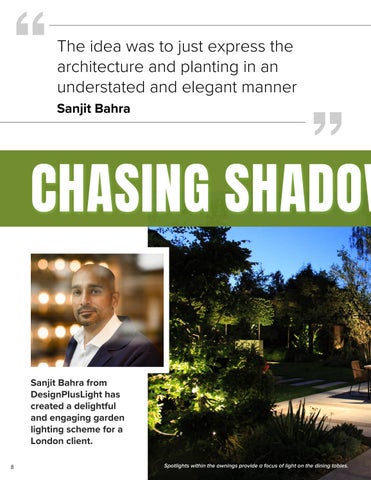
Sanjit Bahra from DesignPlusLight has created a delightful and engaging garden lighting scheme for a London client. 8
Spotlights within the awnings provide a focus of light on the dining tables.
WS
GARDEN LIGHTING
A side summer terrace becomes an extension of the internal spaces with the light drawing the eye onto lit pots and a fireplace feature.
The placement of the light sources ensures that only the inner face of the trees is lit
9
GARDEN LIGHTING
The lighting is designed to draw the eye across the water and then up to the trees – culminating in a punctuated lit sculpture by Owen Bullet, against a leafy backdrop. During the day the planting blends the form of the garden – while at night the structural elements are lit to give it a more architectural feel. Shadow plays just as an important feature as the light itself. The dining terrace is softly lit with perimeter floor washers – which define the thresholds. The terrace has been kept visually clean so the lit garden takes precedence, says Bahra. However, the client loved entertaining – so he concealed spotlights within the awnings that, at the touch of a button, could provide a focus of light on the dining tables. A side summer terrace becomes an extension of the internal spaces with the light drawing the eye onto lit pots and a fireplace feature. The front of the house is softly lit – to maintain a sense of privacy, with just the approach to the front door and side entrances lit.
Uplighting accentuates the pleached trees that define the border of the space
‘We never want to advertise a house,’ says Bahra. ‘The idea was to just express the architecture and planting in an understated and elegant manner. This enables the place to feel secure as you enter the property. We often integrate the garden lighting with the security system – which is often a sufficient deterrent and that way we can minimise harsh floodlighting.’
Landscape designer Stephen Woodhams and lighting specialist Sanjit Bahra of DesignPlusLight collaborated to turn a London garden into a masterclass of restraint and balance. After all, the award-winning garden presented a perfect canvas for light. It’s beautifully framed with softly up-lit pleached trees that define the border of the space. The careful placement of the light sources ensures that only the inner face of the trees is lit – making for a very low glare lighting solution for the neighbouring properties. A long rectangular feature pool is evenly illuminated from one side with concealed linear strip lighting to create a contemporary architectural feel.
10
The idea is to just express the architecture and planting in an understated and elegant manner.
GARDEN LIGHTING
The garden lighting features a control system that is designed to simple to use and understand. ‘It should be simply controlled with a few buttons – on full and half settings–and managed on a time clock’ says Bahra. ‘Any use of a control system is purely to manage the circuits and keep the controls simple and intuitive.’
A long rectangular feature pool is evenly illuminated from one side with concealed linear strip lighting to create a contemporary architectural feel.
11
COVER PROJECT
Embedded LED lighting was the key to a dramatic light art installation in Shanghai by PHAI design. 12
COVER PROJECT
On the facade of a century-old building in Shanghai China, Mystical Serpent was created as a lighting art installation, blending serpent legends from ancient China and Rome.
and the pseudo-3D mural. It renovates the original appearance of the building's facade, connecting the ground and the walls, and giving this century-old building a new visual experience.
The winding 3D inflatable snake body is made of lightweight recyclable materials.
The entire installation is installed on the building and the ground, allowing people to interact with it by observing or taking photos in the square.
It passes through the walls and windows that present a pseudo 3D effect by covering printed murals and pasting glass stickers. This installation connects the horizontal and vertical spaces, creating a three dimensional sense as a whole. It also brings a new visual experience to this century-old building. The inspiration comes from the legend of Zhulong, a serpent deity from ancient Chinese lore who governs day-night cycles and symbolises eternal life. Additionally, it incorporates the story of the ancient Roman ‘domestic snake’ the guardian of family. The fusion embodies renewal, protection, and the unbroken thread of life across civilisations. Also this integration achieves a convergence of Eastern and Western cultures, and conveys the profound meaning of protection and the continuation of life. The winding 3D inflatable snake body intertwines with the building's windows
Using lightweight recyclable material, the main body of the ‘Mystical Serpent’ is an inflatable device. The material properties ensure that installation can be stably displayed under various weather conditions. The pseudo-3D effect is achieved by covering the building walls with printed fabric and pasting glass stickers on the building's glass. With carefully designed colours and patterns, and through ingenious visual treatment, a strong threedimensional sense is created as a whole. The bold patterns of the serpent`s body are crafted from recycled materials, interlaced with traditional Chinese auspicious motifs and ancient Roman motifs such as snake scales and peony designs, symbolising the dragon-snake transition of the Chinese new year. Lighting was key to the dramatic presence of the artwork. One of the most distinctive aspects is that the project is designed to change identity between day and night.
Internal lighting activates the inflatable serpent, turning it into a soft, glowing, almost ethereal figure that appears to float across the façade.
The serpent itself is made of lightweight, translucent material, allowing it to be lit from within. The lighting is diffused, not harsh—so the body glows evenly rather than showing point sources.
13
COVER PROJECT
The lantern-like effect is culturally resonant with Chinese festival lighting. During the day, the serpent reads as a bold, graphic object—bright colours, patterns, and murals dominate. Light is mostly natural, emphasising surface detail and cultural motifs. But by night, internal lighting activates the inflatable serpent, turning it into a soft, glowing, almost ethereal figure that appears to float across the façade. This duality reflects the myth of Zhulong, a serpent deity controlling day and night, making lighting directly tied to the narrative. The serpent itself is made of lightweight, translucent material, allowing it to be lit from within. The lighting is diffused, not harsh—so the body glows evenly rather than showing point sources. This creates a lantern-like effect, culturally resonant with Chinese festival lighting. The
14
glow emphasises the serpent’s curves, enhancing the illusion that it is alive and moving. This approach avoids external floodlighting and instead makes the object selfluminous, which is key to its visual impact. It also provides ambient illumination for the surrounding square, making the space usable after dark. Through light and shadow interactions and immersive experiences, it transforms the traditional neighbourhood into the heart of festive celebrations. Its lighting design, which clearly differentiates between day and night, balances functionality (nighttime illumination) and artistry. It attracts diverse groups of people, including children, the elderly, and international tourists, demonstrating the inclusiveness of public art. The original building is The Inlet, a unique ShanghaiThe glow emphasises the serpent’s curves, enhancing the illusion that it is alive and moving.
COVER PROJECT
The bold patterns of the serpent's body are crafted from recycled materials, interlaced with traditional Chinese auspicious motifs and ancient Roman motifs such as snake scales and peony designs, symbolising the dragon-snake transition of the Chinese new year. style architecture that incorporates both Chinese and Western architectural cultures. When designing ‘Mystical Serpent’, PHAI design also took into account the approach of integrating Chinese and Western elements to interpret the traditional culture of the Year of the Snake, which represents the city's all-embracing spirit.
The project recently – and deservedly – won a Platinum Design Award in the Fine Arts and Art Installation category of the A’Design Awards.
PROJECT CREDITS
The installation integrates Eastern mythology with Western guardian culture, which promotes cross-cultural understanding, provides the public with an open cultural experience space, and enhances social cohesion.
The creative director on the project was Weijie Yang, founder of PHAI design. Yang is a graduate of Tongji University and received his master degree from Domus Academy in Milan.
Project: Mystical Serpent Location: Shanghai Design: PHAI design, Shanghai Creative Director: Weijie Yang Designers: Jiewen Luo, Linhui Miao, Yanlong Li Client: The Inlet Photographs: DXIN, Qiao Wu
15
TUNNEL
PROJECT FOCUS
For the Metro Stations in Melbourne, Speirs Major Light Architecture has created an uplifting atmosphere for the city’s dramatic underground spaces, supporting safe, intuitive movement and enriching the passenger experience.
16
VISION
PROJECT FOCUS
An integral part of the architecture, the lighting supports safe, intuitive movement and an uplifting passenger experience © Peter Bennetts 17
PROJECT FOCUS
Intuitively guiding movement, the lighting supports easy wayfinding and a smooth, enjoyable journey © Peter Bennetts
Lighting plays a central role in the new Melbourne Metro Stations project. Designed by the internationally renowned lighting design studio Speirs Major Light Architecture (SMLA) in collaboration with architects RSHP, it creates an uplifting atmosphere for the city’s dramatic underground spaces, supporting safe, intuitive movement and enriching the passenger experience. Sensitively integrated with the architecture, the lighting gently articulates spaces and forms, highlighting structural rhythms and geometries and establishing a powerful, cohesive line-wide identity. A family of bespoke luminaires and brackets further reinforces each station's character, collectively creating a visual language that connects effortlessly with the city’s public realm. With the opening of full passenger services in February 2026, the Metro Tunnel delivers a vital new public transport connection through the heart of the city. Five new stations
18
Responding to each station, bespoke luminaires create ambience and individual character while contributing to a cohesive line-wide civic identity © Peter Bennetts
- Arden, Parkville, State Library, Town Hall, and Anzac - are each designed to set new standards in passenger comfort, accessibility, and sustainable design. Appointed to develop the lighting for all public spaces, SMLA joined the project in 2020, at a time when the initial approach to artificial lighting design was under review. Working closely with RSHP and the wider design and construction team, SMLA’s scope covered all passenger areas, including the entrances, concourses, escalators, lift cores and platforms. Mark Major, senior partner at SMLA, who led the team alongside director Hiroto Toyoda and associate partner Benz Roos, describes the approach as 'a dialogue between light and architecture - one that consistently supports safety across the network while celebrating the individual character of each station and creating the right ambience at different times of the day.'
PROJECT FOCUS
The lighting approach focuses on the passenger experience while gently articulating and celebrating each station's unique architectural features.© SMLA
The large glowing surfaces of the drum lights provide a comfortable, soft ambience and a strong visual identity © Peter Bennetts
A balance of functional and feature lighting expands the perception 19 of space and creates a wow factor © Peter Bennetts
PROJECT FOCUS
Although daylight has been incorporated wherever feasible as a sustainable source of illumination, the stations' subterranean nature means that artificial lighting is essential to meeting operational needs while creating an engaging passenger experience at different times of day. To support the passenger journey, the composition of light and dark shapes a highly legible environment that intuitively guides movement and supports wayfinding, particularly at points of transition. Reflecting the two main typologies: the ‘Box’ stations - Arden, Parkville, and Anzac - and the ‘Trinocular’ stations - State Library and Town Hall - the approach balances functional lighting with highlights to key vertical surfaces and a celebration of the volumes, structural rhythms and materiality of each station. Circular dual-element luminaires were mounted on the under canopy © Peter Bennetts
Hiroto Toyoda elaborates: 'Beyond visual performance, lighting is essential to humanising the underground experience, creating an ambience that feels uplifting and engaging. In lower-height spaces, we employed soft downlighting that reflects off the loose-fit ceilings, adding comfort and creating a greater sense of height. In the taller, vaulted areas, gentle uplighting emphasises the scale and drama of the architecture, expanding the space and delivering a real wow factor.' While simple, energy-efficient LED downlights provide the primary functional lighting, RSHP and SMLA collaborated on the design of a family of bespoke luminaires that read as the main light sources and contribute to the distinct character of each station. Conceived as natural extensions of the architecture and developed with input from local manufacturer ISM, they contribute to a sense of visual harmony and human scale across the network, with an emphasis on ease of maintenance to ensure reliable, long-term performance in a demanding operational environment. The principal custom lighting systems are as follows: Drum Lights Located on the concourses and platforms, the circular ‘Drum Lights’ provide soft, ambient illumination. Suggestive of rooflights, their glowing surfaces create a strong visual identity, enhancing comfort and aiding orientation. Linear Chandeliers Suspended in the naves of the Trinocular stations, the Linear Chandeliers add a refined architectural presence. Developed through extensive prototyping, their slim, blade-like form explores the interplay of diffusion and reflection through material finish. Bracket-Mounted Lights Used across the network, the Bracket-Mounted Lights combine spotlights and floodlights within an elegant, unified framework. Bespoke brackets allow for direct, indirect, or combined lighting, delivering consistency, efficiency, and strong technical performance. An innovative swivelling mechanism ensures ease of maintenance in double-height spaces.
The softly glowing elongated form of the linear chandeliers
20 introduces a refined architectural presence © Peter Bennetts
PROJECT FOCUS
Given the complexity and scale of the project, we are immensely proud of the outcome - a lighting design that aligns technical precision with architectural intent" - Mark Major
The Linear Chandeliers add a refined architectural presence. Developed through extensive prototyping, their slim, blade-like form explores the interplay of diffusion and reflection 21 through material finish. © Peter Bennetts
PROJECT FOCUS
A final lighting layer highlights the Metro Tunnel’s public art programme, which plays a central role in shaping the identity of the new network. Working closely with artists and curators, SMLA ensured artworks are sensitively lit to enhance their impact while maintaining the overall visual balance of the stations. Guided by first principles, the design minimises energy use. Major explains: 'As in our projects, we aimed to use the minimum amount of equipment necessary to meet the functional requirements and shape the desired experience. Through robust design and the selection of optically efficient luminaires and intelligent controls, we not only met the rigorous performance targets required for the project but also created a truly excellent atmosphere, while ensuring all passenger routes remain clear, safe, and accessible.' Major concludes: 'Despite the challenges of designing much of the lighting for this project during the Covid pandemic, close collaboration with CYP, RSHP and other members of the team was iterative and fastpaced.
22
'Given the complexity and scale of the project, we are immensely proud of the outcome - a lighting design that aligns technical precision with architectural intent, while carefully addressing pragmatic considerations such as compliance with safety standards, energy use and ease of maintenance. It exemplifies what can be achieved through true interdisciplinary working. The lighting helps shape a safe and positive experience of this important new series of public spaces for Melbourne—a visual expression of connectivity and civic identity.'
Bracket development sketches and renders © RSHP and SMLA
The lighting meets rigorous performance targets while maintaining a pleasing ambience © Peter Bennetts
PROJECT FOCUS
Beyond visual performance, lighting is essential to humanising the underground experience, creating an ambience that feels uplifting and engaging" - Hiroto Toyoda
Lighting expands the sense of space in low-height zones © Peter Bennetts
Project Credits CLIENT
Cross Yarra Partnership for The Government of Victoria LIGHTING DESIGN
Speirs Major Light Architecture LIGHTING DESIGN TEAM
Mark Major, Hiroto Toyoda, Benz Roos ARCHITECTS
RSHP, Hassell, Weston Williamson CONSULTING ENGINEERS
ARUP Partners, Hassell PHOTOGRAPHY
Peter Bennetts
Artworks are sensitively lit to enhance their impact © Peter Bennetts
23
HOSPITALITY
HOMAGE to icons of lighting
Cateto Club in Marbella is a visionary interior design project by Alejandro Cateto of Cateto Cateto which celebrates classic luminaires.
Luminaires are clustered to add drama to the space 24
HOSPITALITY
Cateto Club is an interior design project by Alejandro Cateto (Cateto Cateto), inside Marbella Design and Art 2026. The project reinterprets the club culture of the Costa del Sol in the 1960s through a contemporary architectural approach. Drawing on historical references and local context, it explores form, light, and material as primary design tools, while addressing themes of leisure, memory, and transformation. As its starting point, Cateto Club takes the nightlife and leisure culture of the Costa del Sol during the 1960s, a period associated with the so-called Estilo del Relax. During this time, the region became an international destination where figures such as Frank Sinatra and Brigitte Bardot were part of the social scene. The project references this historical context without relying on nostalgia. It establishes a dialogue between past and present, positioning itself between the imagery of mid-century coastal clubs and contemporary nightlife environments. The spatial concept is structured around a single formal gesture: the cylinder. This geometry is developed at multiple scales and functions throughout the project. It appears as void in seating areas, as solid mass in the bar and stools, and as a repeated pattern in the ceramic flooring. It is also expressed in architectural elements such as doors and thresholds, as well as in the custom-designed Sentry Sculpture Light by Ewan Lamm for Ultramar Studio.
The Sentry Sculpture Light by Ultramar Studio complements the other classics in the room
25
HOSPITALITY
A PH5 by Poul Henningsen sits above a Panthella lamp by Verner Panton
This approach results in a consistent spatial language in which form, color, and light define the experience. Decorative elements are minimized in favor of architectural expression. The project draws on the work of Mario Bellini and Verner Panton, particularly in relation to the use of colour, geometry, and immersive environments. It also incorporates references to local architectural landmarks, including the Aqua-Tec diving club in Fuengirola, the brutalist towers of Torremolinos, and the Ciudad Sindical de Vacaciones Tiempo Libre in Marbella. Lighting plays a central role in the project. The selection includes iconic pieces such as the Panthella lamp supplied by Louis Poulsen, the Nesso by Artemide, and the Gambosa by Marset. The main entrance is defined by a circular door measuring three meters in diameter. This element references the concept of “I am a monument” described by Robert Venturi, and recalls the expressive entrance façades of nightclubs along the N-340 in Montemar, Torremolinos, Costa del Sol. The project incorporates rough finishes and visible textures
26
as part of its material strategy. These elements are informed by construction methods typical of the period, including techniques such as gotelé and whitewashed surfaces. Rather than being treated as imperfections, these features are used intentionally to reflect vernacular building traditions and to introduce a tactile dimension to the space. Cateto Club includes an artistic installation by interior landscaper Charo Benitez in collaboration with Alejandro Cateto. The installation addresses the current condition of several 1960s leisure structures along the Costa del Sol, many of which are now abandoned. Through the introduction of vegetation, including gerberas and sunflowers, the installation reflects processes of natural reclamation. It also raises questions about preservation, decay, and the potential for reuse. Cateto Club combines architectural form, historical references, and material exploration to reinterpret a specific moment in the cultural history of the Costa del Sol. Inside Marbella Design and Art 2026, the project examines how past leisure environments can inform contemporary spatial practices.
HOSPITALITY
TECHNICAL SHEET The Cateto studio began its activity at the end of 2022, under the creative direction of Alejandro Cateto, following a prior stage of work as a creative in internationally recognised interior design studios in Madrid and Barcelona. From its inception, the studio has demonstrated a clear vocation for designing hospitality spaces and an explicitly international vision. From its early years, the studio has operated and established a continuous presence between Seville and Lisbon, where, starting in 2023, it began consistently developing projects in the restaurant and hotel sectors.
The project reinterprets the club culture of the Costa del Sol in the 1960s through a contemporary architectural approach. 27
HOSPITALITY
Among its completed works, notable projects include the El Mar restaurant in Lisbon, the execution of a new hotel associated with the restaurant A Cevicheria — a wellestablished reference in Lisbon’s gastronomic scene with over a decade of history — as well as the redesign of various gastronomic concepts across the city that are currently under development. This body of work reflects a gradual and sustained presence, based on a solid and informed relationship with the urban, cultural, and social context of Lisbon in which the studio operates. Reflecting its design practice, Cateto Cateto’s work has garnered significant and organic editorial attention, with features in leading national and international publications in architecture, design, and hospitality.
28
In 2025, the studio was awarded two prizes by the Andalusian Designers Association (AAD) and received two AMA Awards, earning the Silver Award for the El Mar restaurant and being recognised as the 2025 Emerging Studio. That same year, it was also nominated for the DIN Awards and the Interhotel Awards. This trajectory defines a growing studio with a clear and coherent identity, focused on the dialogue between concept, space, and experience. With a particular, though not exclusive, focus on contemporary restaurants and hospitality, Cateto Cateto establishes itself as a practice aiming to consolidate and expand its presence in the international interior design and architecture scene.
The Panthella lamp by Verner Panton is celebrated at the Cateto
HOSPITALITY
PROJECT CREDITS Lead Designer: Alejandro Cateto Studio: Cateto Cateto Collaborating Architects: Daniel Espada / Gabriel Bascones de la Cruz Photographer: @loveladrillo Lighting specialist: Tailoring Deco Lighting designer: Sentry Sculpture Light by Ultramar Studio Official lighting distributor: Bonanova. Gambosa by Marset, Nesso by Artemide and Panthella by Louis Poulsen Electrical fittings: Jung
LED tape in the recessed shelving contrasts with the luminaires in the space
29
BUSINESS OF LIGHTING DESIGN
NULTY launches era of enlightenment We talk to Nulty’s director of education Gary Thornton, a newly created role that will see him oversee professional development, technical excellence and sustainable working practices.
Global lighting design consultancy Nulty has appointed Gary Thornton as Director of Education, a newly created role that will see him oversee professional development, technical excellence and sustainable working practices across the firm’s global studios. The position is a first for the lighting design industry and reflects Nulty’s ongoing mission to build a team of informed and conscious designers, empowered to respond to the evolving demands of the built environment industry. As Director of Education, Gary will lead both internal team development and external client engagement, implementing an education strategy that encompasses training, research and CPD programmes.
‘One of the great things about the lighting design industry is that formal education isn’t the only route into a career,’ says Thornton.
30
He will also work to continually refine the team’s knowledge of accreditation frameworks and technical standards, while developing internal policies and compliance structures to ensure high standards across the business.
BUSINESS OF LIGHTING DESIGN
‘We’re also focused on mentoring our designers and creating opportunities for them to absorb, ask questions and understand the bigger picture.
The role will also include a focus on early-career development initiatives, as Gary will lead Nulty’s in-house apprenticeship scheme, student internship programme and outreach to schools and colleges. ‘One of the great things about the lighting design industry is that formal education isn’t the only route into a career,’ says Thornton. ‘Historically, some of our best people have come into the studio without a degree. They have learnt on the job and flourished. ‘The undergraduate and postgraduate paths obviously have their merits, because when someone chooses to study the art of lighting design, it cements the idea and shows that they have really committed to it. ‘While higher education can be a vocation, it’s by no means a prerequisite and shouldn’t be seen as a substitute for on-the-job training. ‘Balancing hands-on training with academic learning is the sweet spot – exactly what our apprenticeship scheme offers. It gives aspiring lighting designers maximum exposure to an office environment, with the added benefit of a structured academic course. ‘Rather than studying in isolation, apprentices get to apply what they learn to live projects week after week.’ Thornton admits that part of the business strategy is not only to bring in new talent but retain it too. The practice also has a global head of people, engagement and culture, responsible for ensuring that it has the right culture across its offices.
Hybrid working makes it harder to bounce ideas around, overhear conversations or run a detail past somebody in the way that I did when I was in the office five days a week. ‘I plan to spend meaningful time with each of our global offices and provide one-to-one guidance on whatever the team needs, whether that be explaining the value in achieving different WELL credits to avoid it becoming a box ticking exercise, or calculating LPDs to hit a particularly onerous Ashrae standard. ‘As we have a diverse pool of creative talent and experience, my philosophy on mentoring will be equity, not equality – giving individuals what they need, rather than simply offering up the same thing for all. ‘Shaping our approach to sustainability will also be a major focus. As a practice, we’ve led by example, committing to circularity metrics and holding ourselves accountable.
Gone are the days when junior designers spent 40 hours a week soaking everything up and learning from the more experienced colleagues around them.
Part of the education and business strategy is not only bring in new talent but retain it too. The practice also has a global head of people, engagement and culture, responsible for ensuring that it has the right culture across its offices.
31
BUSINESS OF LIGHTING DESIGN
‘The question is how we push that on? How do we take what we’ve learnt in London and apply it to other offices, implementing a similar model in a phased and strategic way? ‘Another challenge is how we extend the strategy we developed around the circular economy to other areas of sustainability, such as embodied carbon. Decarbonisation is a complex issue, and this role gives me the opportunity to dig deeper into the detail. ‘We’re also looking to refine our approach to certification metrics and standards by talking to other disciplines and specialists across the built environment industry to gain a broader understanding of what each of those certifications involves. ‘Ultimately, we want to show that achieving these goals doesn’t mean compromising on creativity. You can still have incredibly beautiful and impactful lighting schemes while doing all the right things.’ Paul Nulty, the practice’s founder, echoes the sentiment. ‘Education is fundamental to who we are as a practice and how we deliver boundary-breaking design work for our clients. ‘As lighting design now sits at the crossroads of creativity, technology, sociology, psychology, physiology and environmental design, Gary’s role is about recognising the complexity of our discipline and ensuring we are prepared to meet the industry’s ever-shifting challenges. By aligning education with sustainable innovation, we will maintain our position as industry leaders and continue to redefine the impact of light on the world around us. ‘A core pillar of Nulty’s education movement will be sustainability research, knowledge sharing and advocacy, an area that Gary has championed in recent years by establishing in-house circular economy benchmarks to drive accountability and reduce the environmental impact of the team’s schemes.’
Thornton is keen to show young designers that achieving sustainability goals and other metrics doesn’t mean compromising on creativity.
32
One Language of Light
Meet 20 Linear. At just 0.7" wide, it's our smallestprofile, largest-range family
Downlight
Wash
Graze
Perimeter
Direct/Indirect
Cove
of luminaires, fulfilling every interior application. This is 20 Linear!
BAA/BABA
tools for lighting
inter-lux.com/20l
33
HUMAN CENTRIC LIGHTING
Lessons in LIGHT
A pioneering lighting project in Colombia has transformed a preschool into an emotional, sensory and educational environment, where light becomes a key architectural and teaching tool.
34
At night, the building’s lighting highlights its architectural volumes and transparency.
HUMAN CENTRIC LIGHTING
In the playroom and dining hall, lighting takes on a playful character through hexagonal Fil 45 structures that integrate organically into the architecture. Could light become a powerful emotional, educational and architectural tool in education? That was the challenge that lighting design studio DEDÓS set out to explore at a preschool in Colombia. The project seeks the organic integration of lighting elements, allowing children to associate each space with a specific experience. The 4,000 square metre building revolves around two semiarched volumes and houses a variety of spaces including classrooms, a music room, play areas and a dining hall. The Sagrado Corazón Montemayor Preschool in Envigado, designed several years ago by architecture studio Convel, remains strikingly contemporary thanks to its innovative approach.
Conceived to support children’s emotional, cognitive and sensory development through light, the project features a pioneering lighting scheme by studio DEDÓS, founded by architect and lighting designer Paula A. Serna. Her work positions lighting as a key element for wellbeing, learning and spatial experience. 'Light is measured in lux, but felt in the heart,' says Serna, summarising the philosophy behind the project. 'Lighting cannot be limited to a technical function; it must accompany people, create calm, stimulate the senses and reinforce architecture.' The lighting design of the school is pioneering in its use of tunable white technology in an educational setting of this kind. By precisely adjusting colour temperature and intensity, light follows circadian rhythms and adapts to different moments throughout the school day, improving concentration, rest and emotional balance.
35
HUMAN CENTRIC LIGHTING
Tunable White technology adapts lighting to children’s circadian rhythms throughout the school day. 'Artificial lighting should behave like another natural element,' explains Serna. 'When light is consciously integrated into architecture, spaces become more welcoming and children feel safe and cared for.' Based on a deep understanding of daily routines, a series of lighting scenes were developed to act as milestones throughout the day: a warm welcome light to reduce anxiety on arrival; focused lighting for learning; dynamic light for playtime; and transitional light to restore calm after physical activity.
36
This concept, known as a lighting itinerary, was realised through a collaboration between DEDÓS and Spanish luminaire manufacturer Lamp, who shared a common vision of lighting as a tool for wellbeing and sustainability. 'We needed reliable, high-quality solutions with seamless architectural integration,' says Serna. 'Lamp offered that assurance, along with a strong sensitivity to the impact of light on people.'
HUMAN CENTRIC LIGHTING
Light is measured in lux, but felt in the heart. Paula A. Serna, founder, studio DEDÓS
Lighting plays a crucial role in educational environments, particularly when approached through the concept of lighting itineraries, which adapt to rhythms, ages and learning activities. The combination of natural and artificial light creates dynamic environments that support biological and emotional cycles, enhancing wellbeing, concentration and motivation. Studies show that appropriate lighting — in terms of intensity, colour temperature and dynamism — improves academic performance, confirming that light influences not only visual perception but also physical, cognitive and emotional development.
37
HUMAN CENTRIC LIGHTING
Based on a deep understanding of daily routines, a series of lighting scenes were developed to act as milestones throughout the day: a warm welcome on arrival; focused for learning; dynamic light for playtime; and transitional light after physical activity. In classrooms and shared spaces, these itineraries provide flexibility, enabling dynamic lighting scenes through adjustable colour temperature and light levels: warm, dim light for transitions and relaxation; cooler, brighter light to support attention and learning. For younger children, their importance is even greater. High visual comfort is essential for healthy eye and nervous system development. Flicker-free lighting and low-glare luminaires help prevent visual fatigue and stress. In early education, where children are more sensitive to light, the use of photobiologically safe luminaires and indirect lighting is recommended as part of these itineraries.
38
The preschool spans 3,713 m² and includes 13 classrooms along with specialised spaces such as a music room, playroom, dining hall and chapel. In classrooms, lighting is provided by Lamp’s FIL 45 System linear luminaires, combining general and accent lighting in a single solution. Equipped with tunable white technology and opal comfort diffusers, they ensure low glare and compliance with regulations. Lighting is controlled via sensors and DALI protocol to optimise daylight use. Integrated Hance spotlights add warm accent lighting to highlight specific areas such as libraries or displays, creating a welcoming atmosphere.
HUMAN CENTRIC LIGHTING
Serna’s lighting concept developed the idea of ‘lighting itineraries’ In the playroom and dining hall, lighting takes on a playful character through hexagonal Fil 45 structures that integrate organically into the architecture. In specialised rooms such as the music classroom, coloured light stimulates the senses, while the chapel features warm indirect lighting that encourages calm and reflection. Circulation areas are illuminated with Ocult luminaires, providing discreet, comfortable guidance and encouraging exploration. Administrative areas use cooler, more activating light, while the staff room offers a warm, restful atmosphere. The building is organised around two semi-arched volumes facing each other and slightly offset to optimise solar orientation. Each volume, composed of two-storey modules, is connected by a walkway, while the space between them forms outdoor play areas.
Although primarily a daytime building, its night-time lighting highlights the architecture, emphasising both the volumes and the transparency of large windows. 'At night, light reveals another reading of the building,' says Serna, 'more introspective and poetic, yet fully consistent with its identity.' The building is the first in the region to achieve EDGE Advanced certification, with energy savings of up to 40 percent and water savings of up to 35 percent. This commitment to sustainability aligns closely with Lamp’s philosophy of creating environmentally responsible solutions. The project has also been selected as a winner at the Latin American Architecture Biennial, where the jury praised its conceptual strength, the integration of lighting as a wellbeing tool, the thoughtful use of technology, and the positive impact on its users — in this case, children — as well as the coherence between architecture, light and educational purpose.
The artificial light complements and compensates for the natural light throughout the day
39
LUMINAIRE DESIGN
Meet the
Makers
Tsotne Mazmanishvili, co-founder and CEO of Shre Studio, demonstrates the unique tactile sliding design of the Moono.
A new generation of designers is reshaping how luminaires look and how they work. Here we celebrate some product pioneers and their creations.
Moono Tsotne Mazmanishvili/Shre Studio Georgia The Moono, created by Georgia-based Shre Studio, features a unique tactile sliding design for interaction with the user and consists of a stable wooden base and a movable panel that carries the light source.
As the occupant of the space gently slides the panel along a concealed track, brightness shifts and direction changes. A fully hidden mechanical system is embedded within solid wood, engineered to create a smooth, aligned motion and calibrated resistance. The sliding mechanism uses no electronics; instead, it relies on the material's natural behaviour and highaccuracy joinery. The integrated light source is designed to disperse heat safely, preserving the wood’s integrity. As a result, Moono moves between two states — a calm, planar object and a projecting architectural element — each activated directly by human touch. ‘This is not a button, not a switch — it is a tactile dialogue,’ say the studio. ‘Moono invites the user to participate in modulating light physically and to feel how form and function move together.’ There are two lengths - 111 cm and 88 cm - and a choice of either solid oak or walnut. The metal finish can either be brass, aluminum or copper. The integral LED engine is
40
available in three colour temperatures 3000K, 4000K and 6500K. The highest lumen package delivers 2430 lm. Shre Studio is a Tbilisi-based architecture and design practice working across interiors, furniture and product design. The studio’s name, ‘Shre’, meaning ‘layer’ in Georgian, reflects its method of shaping material, space and concept through layered systems. Their work combines clarity of form with deeply considered technical detail, resulting in environments and objects that feel both intuitive and structured. The practice says it operates as an ‘AI-driven studio, integrating artificial intelligence and digital tools into research, design development and system coordination.' This approach, it says, supports informed decisionmaking and technical refinement, while preserving material sensitivity and craftsmanship.
The key to the Moono is a fully hidden mechanical system is embedded within solid wood which is engineered to create a smooth, aligned motion and calibrated resistance.
LUMINAIRE DESIGN
Seyedsajad Jalalsadat was one of the team behind the Infinito
Infinito Seyedsajad Jalalsadat Iran The infinity shape became a central theme during the design journey. As the team worked with light cuts and forms, the concept of endless rotation emerged, perfectly aligning with the product’s 360-degree functionality. This dual connection of infinity in form and function inspired both the design and the product’s name. By blending aesthetics, adaptability, and sustainability, it offers an elegant and versatile lighting solution for diverse environments.
This lighting product uniquely combines 360-degree rotation with a waterproof design. It ensures reliable performance in both outdoor and indoor settings, adapting to installations on the ground or walls. Light cuts and forms during the design process naturally guided us toward the infinity shape, which is reflected in both its function and appearance. With multifunctionality, decorative light effects, and sustainability, this product redefines technical precision and elegance. Infinito’s 360-degree rotatable head allows effortless adjustment, providing precise illumination for various needs. This functionality ensures optimal lighting for both functional and technical purposes. Its waterproof design guarantees durability, making it ideal for outdoor use in all conditions.
The product is crafted from high-quality 6063 aluminium using precise CNC machining technology. It incorporates Cree LEDs from the USA and lenses and drivers from reputable manufacturers. The surface is finished with powder coating, anodising, or cathodising for durability and corrosion resistance. The waterproof design ensures excellent performance in harsh conditions, while its sustainable production aligns with environmental responsibility. The product features a cylindrical design with a diameter of 60 millimetres and is available in various customisable heights to suit different applications. The team conducted applied research focusing on outdoor lighting solutions. The objectives were to achieve a waterproof and multifunctional design with precise 360-degree rotation. Their methodology included prototyping, simulation, and testing under environmental conditions. Data were collected through user feedback and durability experiments. The results revealed innovative solutions for combining mobility with waterproofing.
The dual connection of infinity in form and function inspired both the design and the Infinito’s name.
41
LUMINAIRE DESIGN
Nest Tzuhsiang Lin USA The Nest Lamp draws its inspiration from the natural nests found in the wild. It takes the form of an organic shape created by intertwining millions of metal threads. This intricate interweaving of metal threads symbolises the profound bonds and mutual support between family members. In ancient China, silk was often associated with longing due to its similar pronunciation. Placed within homes, it gently emits a soft glow through the metal threads, creating a warm ambiance. The entire light structure is intricately shaped into an organic form using advanced metalworking techniques. Complementing this design, two pieces of nest-like metal sheets intertwine, offering a different organic pattern and lines from various angles when suspended at home. In the centre hangs a doughnut-shaped light. The light radiates through the circular aperture between the two metal pieces, while soft glimmers shine through the interwoven metal threads, providing the right illumination. When suspended at home and viewed from different angles, the pendant light reveals various facets, offering distinct visual experiences through the interplay between the two harmonious organic metal sheets and the light. The light seeping through the metal threads resonates with the soft glow, creating a dynamic interaction.
The Nest pendant explores a fresh interpretation of the bird's nest motif and meticulous material selection.
The two metal sheets are intricately woven into an organic form using advanced techniques, and in the center, a translucent light tube takes on a doughnut-shaped design. The bird's nest symbolizes the warmth and comfort of home, and this intricately crafted lamp imparts a sense of warm longing to people. In ancient China, threads held diverse meanings, with one of the most common associations being with feelings of longing. This linguistic connection stems from the phonetic similarity between missing and silk or threads. This linguistic resemblance gave rise to a metaphor for the hidden sentiments between individuals.
42
Tzuhsiang Lin is a New York-based product designer and graduate student at Pratt Institute in New York.
LUMINAIRE DESIGN
Ori Lincoln Chen USA Ori is a floor lamp influenced by Japanese origami, where Ori signifies folding. Constructed from a single sheet of recyclable aluminum, it features a streamlined and sustainable design without the need for welding. The top section is folded in reverse to create a seamlessly integrated lampshade. With a height of 35 inches and a compact base, Ori delivers soft, glarefree illumination suitable for reading while remaining easy to reposition. Departing from conventional geometric structures, the design achieves a refined balance between functionality and aesthetics. Chen aimed to design a lighting fixture with an elegant and minimalist form that is easy to produce and transport while using a single material whenever possible. Drawing inspiration from Japanese origami, he explored how simple folds could transform a flat sheet of material into a three-dimensional and visually engaging structure. Ori is a floor lamp inspired by Japanese origami, with “ori” meaning “folding.” Crafted from a single sheet of recyclable aluminium, Ori is minimal and ecofriendly, using no welding and featuring a graceful, reverse-folded top that forms an elegant lampshade. With a compact footprint and 35-inch height, Ori provides ample, glare-free light for reading while being easy to move. Designed to break from conventional geometric styles, it achieves a unique blend of aesthetics and function. Constructed from a single sheet of recyclable aluminum, Ori features a streamlined and sustainable design without the need for welding.
Chen conducted extensive form studies for this project, aiming to create an elegant and minimalist design while using the least amount of material possible. Inspired by origami, he experimented with high-GSM paper to develop the form. By creating models in various shapes and sizes, he arrived at a refined final design. This form optimises material usage and manufacturing efficiency, is easy to transport, and achieves a balance of simplicity and visual interest. A challenging aspect of the design was achieving an elegant and minimalist form while minimising material and manufacturing complexity. The folded structure needed to provide both stability and production efficiency.
Lincoln Chen is a furniture and lighting designer based in Pasadena, California and a graduate from the ArtCenter College of Design's Undergraduate Product Design programme.
43
LUMINAIRE DESIGN
Tangent Seyed Shahriyar Shahriyari Iran/Austria Inspired by Armin Hofmann’s geometric studies, the design of Tangent explores the connection between circles and their tangents. This approach enabled us to create adaptable patterns that respond to both the spatial context and the objects they illuminate. By refining these patterns for both form and function, we enhance the interplay of light and shadow, enriching the atmosphere while ensuring that the design is both aesthetically pleasing and functionally effective in the space.
The design of Tangent explores the connection between circles and their tangents. This innovative lighting system adapts seamlessly to its surroundings, with dynamic geometric patterns that enhance both aesthetics and functionality. Its fully customisable design allows users to create unique configurations, ensuring a tailored lighting solution for any space. By responding to spatial characteristics, it provides a harmonious blend of adaptability, personalisation, and visual impact. This design interacts simultaneously with both the environment and the user. The pattern can either be directly designed by the user or created to suit a specific space. Additionally, this customisation capability aligns with the functional needs of the space, enhancing its architectural synergy. By allowing users to personalise the design, the lighting solution fosters a dynamic relationship between the space, its purpose, and the people who inhabit it. After determining the desired pattern based on the functionality and spatial needs of each project or user preferences, the extruded body profile undergoes the bending process. The LED light is then installed inside the profile. Following this, the top cap and diffuser are laser-cut and attached to the body. This process ensures that each component fits precisely. The challenges of this process include creating unique patterns that are both functional and visually striking. Additionally, transforming two-dimensional patterns into large-scale lighting products posed its own difficulties. Finding the best solution for manufacturing these designs while maintaining their visual and functional integrity was a key challenge.
Seyed Shahriyar Shahriyari is the CEO of both Rona Light in Tehran and Trio Licht in Vienna. 44
45
OPINION
LET’S VALUE WHAT ALREADY EXISTS Jordi Arasanz, technical director and member of the Innovation and Sustainability Committee at Lamp, calls for a mindset change in the lighting industry Over the past decades, technological innovation in lighting—from the shift to LED technology to the digitalisation of control systems—has enabled remarkable advances in energy efficiency. However, this progress has often been accompanied by the premature replacement of functional luminaires, generating significant volumes of waste and unnecessary loss of material resources. Today, in the face of decarbonisation challenges and raw material scarcity, it’s essential to adopt a circular perspective that instead prioritises upgrading and intelligent maintenance over systematic replacement. The circular economy applied to lighting represents a paradigm shift. It means extending the useful life of what already exists, integrating innovation systemically, and designing with the future evolution of spaces in mind. Lighting sits at the intersection of architecture, engineering, and industry. Every installed luminaire forms part of a building’s architectural language while also functioning as a technical system that can be refurbished, adapted, or digitised. Understanding it as an evolving element—rather than a limited-lifespan product—opens new opportunities to reduce environmental impact without compromising lighting quality or user comfort. This approach requires closer collaboration between manufacturers, specifiers, and building managers to develop solutions designed for upgradability.
Jordi Arasanz believes that as an industry, we’ve a responsibility to move from producing more to producing better, and to design solutions intended to be maintained, adapted and evolved. 46
OPINION
CircuLight is a service which enables the upgrading of already installed luminaires through adapted technological modules—extending their lifespan and significantly reducing their environmental impact.
Designing for maintenance and adaptation becomes a key tool in advancing toward more responsible construction models. At Lamp, we have spent years working to decouple technological progress from waste generation. This vision translates into projects that integrate ecodesign, efficiency and circularity criteria throughout the entire product life cycle. One example is CircuLight, a service which enables the upgrading of already installed luminaires through adapted technological modules—extending their lifespan and significantly reducing their environmental impact.
From our experience, real progress towards more sustainable architectural lighting is built on two complementary lines of action: Upgrading what already exists. Services such as CircuLight demonstrate that it is possible to extend the lifespan of installed luminaires, avoiding replacement. CircuLight projects have achieved annual energy savings of over 50 per cent, recovered kilometres of aluminium profiles, and reduced more than 300 tons of CO₂ equivalent. codesign as a driver of innovation. At the same time, new developments E incorporate circular design criteria that facilitate upgrading, disassembly and adaptation of luminaires throughout their life cycle. I n this context, innovation means anticipating change and designing products prepared for it. oth approaches share the same goal: demonstrating that sustainability doesn’t B limit innovation but rather guides it toward more durable, efficient solutions aligned with today’s challenges. he challenge now is to broaden this perspective. If we’re capable of upgrading T lighting systems instead of replacing them, why not apply the same principle to other building elements? The circular economy not only reduces environmental impact—it also fosters stronger relationships among industry stakeholders, promotes transparency, and compels us to design with the long term in mind. s an industry, we have a responsibility to move from producing more to producing A better, and to design solutions intended to be maintained, adapted and evolved. Lighting can—and should—be a visible example of this transformation: a way to move forward without destroying, to innovate without wasting. Jordi Arasanz, Technical Director and member of the Innovation and Sustainability Committee at Lamp.
Ecodesign can be a driver of innovation, creating luminaires that facilitate upgrading, disassembly and adaptation of luminaires throughout their life cycle.
47
LIGHT AND HEALTH
Gimme the
MOONLIGHT Humans have an internal lunar clock – but increased light pollution due to LED proliferation is disrupting it, says Stefano Arlaud
48
Most animals, including humans, carry an internal lunar clock, tuned to the 29.5-day rhythm of the Moon. It guides sleep, reproduction and migration of many species. But in the age of artificial light, that ancient signal is fading – washed out by the glow of cities, screens and satellites. Just as the circadian rhythm keeps time with the 24-hour rotation of the Earth, many organisms also track the slower rhythm of the Moon. Both systems rely on light cues, and a recent study analysing women’s menstrual cycles shows that as the planet brightens from artificial light, the natural contrasts that once structured biological time are being blurred. Plenty of research suggests the lunar cycle still influences human sleep. A 2021 study found that in Toba (also known as Qom) Indigenous communities in Argentina, people went to bed 3080 minutes later and slept 20-90 minutes less in the three-to-five nights before the full Moon. Similar, though weaker, patterns appeared among more than 400
Seattle students in the same study, even amid the city’s heavy light pollution. This suggests that electric light may dampen but not erase this lunar effect. The researchers found that sleep patterns varied not only with the full-Moon phase but also with the new- and half-Moon phases. This 15-day rhythm may reflect the influence of the Moon’s changing gravitational pull, which peaks twice per lunar month, during both the full and new Moons, when the Sun, Earth and Moon align. Such gravitational cycles could subtly affect biological rhythms alongside light-related cues. Laboratory studies have supported these findings. In a 2013 experiment, during the full Moon phase participants took about five minutes longer to fall asleep, slept 20 minutes less, and secreted less melatonin (a hormone that helps regulate the sleep-wake cycle). They also showed a 30 percent reduction in EEG slow-wave brain activity – an indicator of deep sleep.
STRIKING
Their sleep was monitored over several weeks covering a lunar cycle. The participants also reported poorer sleep quality around the full Moon, despite being unaware that their data was being analysed against lunar phases.
Perhaps the most striking evidence of a lunar rhythm in humans comes from the recent study analysing longterm menstrual records of 176 women across Europe and the US. Before around 2010 – when LED lighting and smartphone use became widespread – many women’s menstrual cycles tended to begin around the full Moon or new Moon phases. Afterwards, that synchrony largely vanished, persisting only in January, when the Moon-SunEarth gravitational effects are strongest. The researchers propose that humans may still have an internal Moon clock, but that its coupling to lunar phases has been weakened by artificial lighting.
49
LIGHT AND HEALTH
A metronome for other species The Moon acts as a metronome for other species. For example, coral reefs coordinate mass spawning events with precision, releasing eggs and sperm under specific phases of Moonlight.
In a 2016 laboratory study, researchers working with reefbuilding corals (for example A. millepora) replaced the natural night light cycle with regimes of constant light or constant darkness. They found that the normal cycling of clock-genes (such as the cryptochromes) was flattened or lost, and the release of sperm and eggs fell out of sync. These findings suggest lunar light cues are integral to the genetic and physiological rhythms that underlie synchronised reproduction. Other species, such as the marine midge Clunio marinus, use an internal ‘coincidence detector’ that integrates circadian and lunar signals to time their reproduction precisely with low tides. Genetic studies have shown this lunar timing is linked to several clock-related genes – suggesting that the influence of lunar cycles extends down to the molecular level. However, a 2019 study found that the synchrony of wild coral spawning is breaking down. Scientists think this may be due to pollutants and rising sea temperatures as well as light pollution. But we know that light pollution is causing disruption for many wildlife species that use the Moon to navigate or time their movements. For most of human history, moonlight was the brightest light of night. Today, it competes with an artificial glow visible from space. According to the World Atlas of Artificial Night Sky Brightness, more than 80 percent of the global population – and nearly everyone in Europe and the US – live under a light-polluted sky (one that is bright enough to hide the Milky Way). In some countries such as Singapore or Kuwait, there is literally nowhere without significant light pollution. Constant
50
sky-glow from dense urban lighting keeps the sky so bright that night never becomes truly dark. This near-permanent brightness is a by-product of these countries’ high population density, extensive outdoor illumination, and the reflection of light off buildings and the atmosphere. Even in remote national parks far from cities, the glow of distant lights can still be detected hundreds of kilometres away. In cognitive neuroscience, time perception is often described by pacemaker–accumulator models, in which an internal ‘pacemaker’ emits regular pulses that the brain counts to estimate duration. The stability of this system depends on rhythmic environmental cues – daylight, temperature, social routines – that help tune the rate of those pulses. Losing the slow, monthly cue of moonlight may mean that our internal clocks now run in a flatter temporal landscape, with fewer natural fluctuations to anchor them. Previous psychological research has found disconnection from nature can warp our sense of time. The lunar clock still ticks within us – faint but measurable. It shapes tides, sleep and the rhythms of countless species. Yet as the night sky brightens, we risk losing not only the stars, but the quiet cadence that once linked life on Earth to the turning of the Moon. • Stefano Arlaud is a PhD candidate in time processing and metacognition of time processing at Queen Mary University of London • Reproduced with permission from The Conversation. Copyright 2026
The tech turning streetlights into lampshades A special recycling technique is helping to turn components from exterior lights into pendants. Mark Tomlinson reports.
CIRCULARITY
Developed by Trinseo and Signify, the project uses dissolution recycling to convert end-of-life polycarbonate streetlight covers into new luminaires with 75 percent recycled content.
The resulting material is compounded into granules and supplied to Signify’s myCreation innovation hub, where it is extruded into filament and used to 3D print new lampshades.
An innovative circular lighting initiative is transforming discarded streetlight components into high-quality lampshades, demonstrating how advanced recycling can keep materials in use within the same application. Developed by Trinseo and Signify, the project uses dissolution recycling to convert end-of-life polycarbonate streetlight covers into new luminaires with 75 percent recycled content. At the centre of the innovation is Calibre™ ECO DI, an opticalgrade polycarbonate designed to meet the strict performance requirements of lighting applications, including colour consistency and light transmission. The material is now being used in Signify’s myCreation Urban Grey range, produced through 3D printing for on-demand manufacturing and reduced waste. The process begins with the collection of end-of-life streetlight shades across the Netherlands, ensuring a clean and traceable waste stream. These materials are then processed at Trinseo’s Terneuzen facility, where dissolution recycling separates and purifies the polycarbonate to produce a high-quality recycled polymer.
Urban Grey comes in a classic bell shape style with two sizes and a variety of basic and on-trend colours
The resulting material is compounded into granules and supplied to Signify’s myCreation innovation hub, where it is extruded into filament and used to 3D print new lampshades. The Urban Grey comes in a classic bell shape style with two sizes and a variety of basic and on-trend colours. There’s a variety of optical configurations and a choice of opaque or translucent materials with a variety of finish textures. The collaboration builds on a long-standing partnership between the two companies and reflects growing efforts to address the challenge of lighting waste. Across Europe, large-scale street lighting upgrades are generating significant volumes of discarded materials, many of which have historically been incinerated or landfilled due to recycling limitations. By enabling true lighting-to-lighting recycling, the project diverts substantial quantities of polycarbonate from disposal while maintaining performance standards. It also highlights the potential of combining advanced recycling technologies with additive manufacturing to deliver scalable circular solutions for the lighting industry.
51
INNOVATIONS
STIX BLADE
COMPAR
This Italian brand has unveiled minimal linear luminaires with crisp optics, including the Stix Blade modular outdoor system. With lots of variants, it’s designed to give you creative freedom to put together your own artwork.
Erco says track downlights combine the best of both worlds: the precision and visual comfort of recessed luminaires with the flexibility of track. The Compar linear track downlight delivers high output from a slim aluminium housing and combines compact optics with anti-glare louvres, with efficiencies of up to 130 lm/W.
MIDCENTURY COLLECTION Bega’s Midcentury collection draws on the formal clarity and material aesthetics of the period to create a classic suite of luminaires in chrome, stainless steel and glass.
ECLIPSE
SOLENA A beautiful piece of engineering, this modular pendant features a 70mm glass cylinder with a central load-bearing profile that combines glare-free optics, electronics and sensors. Developed with Herzog & de Meuron and Reflexion.
52
An industry first: an indirect downlight. Here, the LED uplights the reflector from below, like the AR111 lamp of old. The reflector also rotates, so you can aim the beam either down or horizontally onto a wall at a 45 degree tilt.
GEO This streetlight features an elegant rearmounted electronics panel which is accessible without tools and whose plug connector instantly disconnects the power. The light engine and driver can be easily upgraded and reconfigured.
UPGRADE KITS
NANO TRACK
As part of its 360 degree Renovation programme, German brand RZB has developed plug-and-play LED gear-tray upgrade kits for its popular luminaires. Which begs the question: why isn’t everyone doing this?
Yes, iGuzzini launched the 3.6mm Filorail a few years ago but that was designed to disappear into the ceiling. This 7mm superslim track appears as an elegant black line which brings the luminaires together more legibly.
WALL 28 This pioneer in miniaturisation unveiled a remarkable wall washer with a diameter of just 28mm. Mounted 1m from a wall with 1m spacings, it gives impressive scallop-free illumination. Available in 350lm and 470lm versions.
IZURA MINI An ultra slim version of the Izura with a width of just 21mm and a recess depth of 35mm. Designed in collaboration with the boffins at Bartenbach, it boasts a peak performance of 95 percent optical efficiency.
53
THE SCIENCE OF LIGHT
BLINDING LIGHTS There is a hidden science behind the illumination of casinos, writes Glen Dighton.
Lighting in casinos is often designed to heighten arousal, dull sensitivity to losses, and encourage riskier decisions.
There’s a reason casinos rarely have windows or clocks, they’re engineered to make you lose track of time. But what if it’s not just time you’re losing? New research suggests that the lighting used in gambling environments could be quietly altering how we make decisions, making us more prone to take risks. The colour of the lights surrounding us can do more than just set the mood. It can shape our behaviour. The new study from researchers at Flinders University in Australia found that blue-enriched lighting (the same cold, bright hue used in many modern LED lights and digital screens) can reduce a gambler’s sensitivity to losses. In a controlled experiment, participants exposed to this kind of light took riskier bets and responded less emotionally to losing.
54
The researchers believe this change in decision-making is rooted in our biology. The human body is sensitive to different wavelengths of light, not just for vision but also for regulating our internal clocks and emotional states. Blue light in particular has been shown to suppress melatonin production, a hormone which signals to the body it’s time to prepare for sleep. Research has also shown blue light can increase alertness and influence brain areas tied to reward and motivation by stimulating the neural circuits involved in anticipation and decision-making. In the case of gambling, this heightened arousal might dampen our natural aversion to loss, even when the odds are stacked against us.
Surprising Light can influence us in many other surprising ways. Studies have shown that cooler, blue-toned lighting can enhance cognitive performance and alertness during the day, which is why it’s often used in offices and classrooms. Warmer lighting is more relaxing and is typically recommended by sleep scientists and health professionals for evenings to promote better sleep. Retailers, too, have long exploited the psychological effects of lighting, using bright, targeted lighting – often in the form of spotlighting or high-intensity LEDs – to draw attention to products. The colour and intensity of lighting can also affect consumers’ perception of value and attractiveness. This encourages spending by increasing visual salience, making a product stand out more and grab your attention, and creating a more engaging sensory experience. Specific colours of light seem to have an array of effects in different environments. Red lighting may have effects which increase appetite. This is possibly because it stimulates the sympathetic nervous system, which is associated with arousal and physiological readiness. Meanwhile studies suggest green light may reduce pain and light sensitivity for migraine sufferers. But lighting is only one half of the sensory equation in casinos. Sound design plays a major role in immersive gambling environments. Upbeat music can make people less risk-averse by speeding up decision-making and creating a sense of urgency. Jingles and celebratory sounds serve as auditory rewards, reinforcing positive feelings even in the absence of a financial win. When players lose, slot machines often produce celebratory sounds and flashing lights, creating what researchers call a 'loss disguised as a win'. This sensory mismatch tricks the brain into thinking it’s succeeding, distorting our ability to assess risk or stop playing. In gambling environments, red light combined with casino‑style sounds has been shown to eliminate the usual cognitive slowdown after losses during decision-making tasks, leading players to make faster choices without the normal pause for reflection.
A 2018 study showed that flashing animations and vivid colours can increase arousal and attention, making gambling more stimulating and immersive. This, in turn, delays self-regulation and increases time spent gambling. In effect, your surroundings are constantly nudging you to stay, to play, and to believe the next win is just around the corner. As gambling moves increasingly online, these principles are being translated to digital platforms. Online slot games often use flashing animations, vivid colours, and background music that mimic the ambience of a physical casino. The blue light emitted from screens can be just as stimulating – especially late at night – potentially exacerbating the effects seen in the Flinders University study. If subtle changes to lighting can lead to riskier decisions, then regulating these features might help promote less harmful gambling behaviour. For instance, encouraging warmer lighting in gambling venues or digital settings could help prevent excessive play. The lights and sounds that surround us in these environments aren’t just decoration. They’re carefully designed to heighten arousal, dull sensitivity to losses, and encourage riskier decisions. Our responses to colour, brightness and sound happen at a subconscious level, meaning even informed players can still be swayed by them. Reducing your device’s screen brightness, using blue light filters at night, or turning off in-game sounds can help counteract some of these psychological effects for online gambling. But meaningful change will probably require policy intervention that treats environmental design not as a neutral backdrop, but as a powerful behavioural influence – one that should be shaped with responsibility to the wellbeing of the consumer, not just profit, in mind. • First published in The Conversation. Copyright 2026 • Glen Dighton is Research Officer at the Centre for Military Gambling Research (MilGAM), Swansea University
Blue light can make you less sensitive to losing.
55
SOFTWARE
DARK ARTS
A ‘standard’ lighting scheme created by conventional design software
The first major fruit of AI technology for the profession is revolutionary exterior lighting design software which promises to ‘put light where it’s needed and and darkness where it belongs’
The word ‘taman’ in Croatian has more than one meaning. It can refer to something that is exactly right – neither too much nor too little – but it can also mean dark, describing something dimly lit or dark in colour. It’s a fitting name for Taman, a new AI-driven lighting design platform that aims to redefine the way outdoor illumination is planned.
Created over five years by multi-awardwinning lighting designer and Build Back Better Awards judge Dean Skira and a team of developers, the software is built around a simple philosophy: ‘put light where it’s needed and darkness where it belongs’. Taman is a web-based lighting design platform that reverses the traditional street lighting process. Instead of manually positioning luminaires and repeatedly adjusting layouts to meet standards, the software automatically calculates optimal luminaire placement and generates ideal photometric curves based on 3D models and regulatory requirements. By doing so, it can deliver energy savings of between 20 and 30 percent at the initial design stage. Users simply upload a layered 3D
56
How a lighting design for the same streetscape is cre
model or draw a polygon, define project parameters, and run an automated 3D light mapping process. Taman then calculates the ideal luminaire placement, beam distribution and lumen output needed to comply with international and local standards – without requiring any product preselection.
Unlike conventional approaches that focus primarily on roadway illumination, Taman analyses entire urban zones. It adapts to different road categories, widths and geometries while also taking into account surrounding buildings, vegetation, pedestrian areas and private properties.
SOFTWARE
eated by Taman
A heat map of the streetscape
The result is lighting that is applied only where needed, minimising spill light, glare and light pollution. Each luminaire is designed with a maximum 80-degree light angle to prevent upward light spill, helping to protect the night sky and reduce unnecessary illumination. The software automatically generates idealised photometric curves in IES/ LDT formats for every luminaire position, then matches them with the closest available products from an integrated manufacturer database. This enables engineers to select preferred manufacturers while ensuring compliance with all design criteria. According to Skira, the platform reduces unnecessary light pollution and spill through advanced calculations that prioritise environmental harmony
without compromising safety or visibility. The system creates bespoke light distribution curves tailored to the exact site conditions, ensuring the correct light levels with no overillumination, maximum efficiency and minimal waste. It also aligns projects with zoning standards and sustainable urban planning regulations for environmentally conscious cities. For engineers, Taman calculates the optimal lighting layout and matches it with real-world products available in its database. For architects and lighting designers, it automates luminaire placement and light distribution calculations directly from a 3D model, significantly reducing design time and complexity while guaranteeing compliance with international standards. Manufacturers also benefit. Taman can generate precise IES files that define the ideal light distribution and lumen output for a project, providing a reliable foundation for developing new luminaires or remanufacturing existing ones. Skira says the platform ‘unlocks data-driven insights’ that allow manufacturers to create products optimised for real-world performance and energy efficiency demands.
an optimised layout to identify issues such as excessive light spill or poor uniformity. Engineers can then log in, apply corrections and update the project collaboratively, streamlining the review process. At the heart of the platform is an AIpowered light optimisation algorithm designed to turn complex lighting calculations into an automated, datadriven workflow. Designers can access real-time simulations of light distribution and make decisions based on actual road conditions and surrounding architecture. ‘There’s no more guesswork,’ says Skira. ‘Instead, you work with real-world data to create smarter, more efficient street lighting solutions.’ Perhaps most significantly, Taman can design the LED array for each individual luminaire to achieve the ideal lighting distribution, opening up the possibility of bespoke, site-specific lighting solutions tailored to individual streetscapes. Additionally, the software can design LED arrays and any associated optics to create the perfect luminaire for the space. Even individual lights can have bespoke arrays for their location. This functionality is designed to help manufacturers upgrading the luminaires from traditional technology to LEDs.
Taman also enables rapid project verification. Users can compare submitted lighting schemes against
Taman guarantees compliance with international standards, reducing design complexity and enabling faster, smarter, and more sustainable projects
57
ORGANISATION NEWS London gathering explores Cat A ‘lighting as a service’
The End Cat A Lighting Waste campaign held an engaging evening of discussions in London on how we reduce the quantity of lights, floors, and ceilings that is discarded with office fit-outs. Over 100 built environment professionals heard thoughtful and entertaining speakers including architect John McRae, director, Orms, host for the event; Paul Beale, founder of 'lighting-as-a-service' startup 18 Circular, innovative workplace designer Charlie Green, cofounder, The Office Group and Tina Paillet FRICS, CEO, Circotrade, a trading platform unlocking the future value of a building's materials explore alternatives to Cat A. It’s clear there’s no one single bullet to arrest waste in the sector. Instead, a range of solutions and alternatives were discussed. Green said Cat A was the worst of all worlds. A shell-and-floor offer or Cat A+ were infinitely better from an environmental standpoint. The group was set up to highlight
and challenge the scandal, as it sees it, of Cat A fit-outs which are typically installed in speculative offices to attract a tenant. These are often ripped out to be replaced by a bespoke ‘Cat B’ installation to the client’s specification, with new lights, ceilings and floors removed. Estimates suggest that Cat A fit-outs are responsible for between 30 to 100kg (of which lighting is 11 kg) of equivalent carbon dioxide per square metre (CO2e/m2). Cat B fit-outs are responsible for a further 25 to 75kg CO2e/m2* (of which lighting is 13 kg). However, the tenant fit-out is rarely included in life cycle modelling and there could be multiple fit-outs in the typical 60-year life of a building. This doesn’t appear consistent with the industry’s net zero aspirations. Critics say that Cat A lighting in its current form limits the industry’s ability to deliver innovative and integrated lighting solutions that can create value for clients and enhance their brand identity and reputation.
Paul Beale of 18 Circular gave a hands-on demonstration of his new Cat A lighting-as-a-service technology
SLL’s LG23 guide covers sustainability The Society of Light and Lighting (SLL) has released LG23: Design, Creativity and Compliance, a lighting guide developed to support lighting professionals navigating the growing complexity of contemporary lighting design. The guide addresses the challenge of delivering creative, high-quality lighting solutions while meeting increasingly rigorous environmental and regulatory requirements.
A key feature of LG23 is its dedicated section on dark sky design, reflecting the importance of minimising light pollution
58
LG23 is available as a free download for SLL and CIBSE members and provides practical guidance on balancing innovation with compliance. Written during a period of unprecedented change in lighting design, the guide recognises the critical role lighting plays in shaping the built environment and responds to evolving expectations around sustainability, responsibility, and ethical practice.
A key feature of LG23 is its dedicated section on dark sky design, reflecting the importance of minimising light pollution and protecting the night-time environment. This focus reinforces the guide’s wider commitment to environmentally sensitive and socially responsible lighting, offering designers clear principles and considerations to apply across a range of project types. The guide is intended for lighting designers and built-environment professionals who are responsible for delivering successful schemes that satisfy artistic intent, technical performance, and statutory obligations. By bringing together creativity, environmental awareness, and compliance, LG23 aims to act as a trusted reference for modern lighting practice.
Emer Gillespie of Spark + Bell receives a Build Back Better Award for the innovative Seraphín Chandelier. It won both GOLD and GREEN Build Back Better Awards for transforming recycled CD cases into a statement chandelier. Each three-tier fixture reuses over 120 CD cases, diverting more than eight kilograms of plastic from landfill. Designed by founder Emer Gillespie, Seraphín features hand-formed crystalline drops made from the studio’s proprietary recycled “Jewel” plastic, creating a luminous, ethereal effect.
Build Back Better
AWARDS LIT Design
AWARDS 30 April, 2026
Early bird entry price deadline
14 June 2026
Extended early bird deadline
31 August 2026
Standard deadline
30 September 2026
Final deadline (10% late fee applies)
18 October 2026
Final program close
Wednesday, 27 May, 2026
Open for entries
Thursday, 30 July 2026
Early bird entry price deadline
5pm, Friday, 11 September 2026
Final entries close
Thursday, 8 October 2026
Winners announced live at Circular Lighting Live in London
www.buildbackbetterawards.com
Upcoming AWARDS Darc Awards 2027: To be announced
Red Dot Awards 2027: To be announced
https://litawards.com 59
TRADE SHOW DATES 6-8 September 2026
15-18 September 2026
8 October 2026
London
Sao Paulo
London
27-30 October 2026
18-19 November 2026
13-18 April 2027
Hong Kong
London
Milan
9-12 June 2027
5-10 March 2028
April 2028
Autumn Edition
Spring Edition Guangzhou 60
Frankfurt
Hong Kong
UPCLOSE WITH SURBHI
I was born in Delhi but grew up in the small town of Roorkee, on the banks of the River Ganges in northern India. Roorkee is home to the prestigious Indian Institute of Technology, so education and curiosity were always part of the environment around me. Looking back, I think those roots shaped the way I approach lighting today — with equal parts creativity and discipline. I originally trained as an architect and had no plans to become a lighting designer. Nobody in my family came from architecture or design, so I was finding my own path. My introduction to lighting happened almost by chance during my first job after university with Martini Lighting Systems in Delhi. That experience changed everything for me. What fascinated me most was that lighting wasn’t purely aesthetic. Behind every beautiful effect there was technical depth and precision. I realised very quickly that lighting sits perfectly between art and science. Unlike many other design elements, light is intangible — you can’t physically touch it — but you instantly feel its impact. That combination completely drew me in. Working at Martini also gave me the opportunity to work on major projects very early in my career. I started at the bottom of the ladder and learned through experience, project by project. There was no shortcut, and honestly, there was no turning back after that. My architectural training has been a huge advantage throughout my career. Being an architect helps me understand space differently and communicate in the language of architecture with architects and interior designers.
Every lighting project is collaborative, and that shared understanding makes an enormous difference. Over the years I’ve been fortunate to work with some of the best global lighting manufacturers and design firms, including Signify and John Cullen Lighting. In 2017, I helped bring John Cullen Lighting into India, working closely with Peter van der Kolk. That experience exposed me to international standards and broadened my understanding of the profession. After more than a decade in the corporate world, I founded my own practice, Da Light Hub, around seven years ago. Today, our work spans lighting design, bespoke decorative lighting and education. We primarily focus on high-end residential, hospitality and commercial projects. Education has become a particularly important part of my journey. Through workshops and short-term courses, we teach both students and professionals who want to deepen their understanding of lighting fundamentals, controls, software and design thinking. One of the biggest lessons I’ve learned is that lighting is a constantly evolving profession. You cannot learn it once and assume you know everything forever. Technology, controls, sustainability standards and client expectations are all changing rapidly, so staying relevant requires continuous learning and adaptability. I’ve also realised how important industry conversations and peer learning are. Some of my greatest learnings have come from exhibitions, conferences and discussions with fellow professionals. Those opportunities to exchange ideas are incredibly valuable. That is something I strongly encourage young lighting designers to embrace. Get involved in the industry. Attend exhibitions, meet people and listen to experienced professionals talk about their work and challenges. At the same time, I think younger entrants need patience. I often see graduates wanting immediate recognition, perhaps because we now live in such a fast-moving digital world. But lighting design still requires experience, resilience and time. You have to go through the grind, learn from mistakes and build your understanding project by project. Recognition comes later — and it comes naturally when the foundation is strong. For me, lighting has never been just a profession. It has been a journey of continuous learning, collaboration and evolution — and that is exactly what still excites me about it today.
Surbhi Jindal Founder and CEO of Da Light Hub (Mumbai)
61
In your next issue…
Workplace special
Independent lighting practice DesignPlusLight has just completed its latest commercial project at One Paddington Square in London. It’s an iconic ‘glass cube’ designed by Italian architect Renzo Piano, which has arisen above Paddington’s rail network and forms part of the new Crossrail entrance.
We explore lighting trends in office and commercial projects and showcase some cutting edge projects which point to a more informal and interactive working environment.
Lighting and the circular economy
Remanufactured luminaires is part of big trend for the lighting industry in 2026 62
The reuse of remanufactured and upgraded luminaires is one of the big trends of 2026. But what are the issues for designers raised by this practice? And how can specifiers and their clients become confident that the lit environment won’t be compromised?
Find the right solution for your next project Architectural lighting projects don’t come in standard sizes, so Pharos builds reliable lighting control systems for projects of every scale. With two product ranges designed for the control of dynamic DMX & DALI lighting, Pharos powers unforgettable lighting experiences across structures, landscapes and environments. Explore applications and real-world installations, discover seamless integration possibilities, and compare the Pharos product ranges to find the right solution for your next project. pharoscontrols.com/solutions
Golden Jubilee Bridges, UK
Pharos Designer
Pharos Express
Comprehensive, scalable, featurerich dynamic lighting control solutions for architainment, show control and themed environment lighting projects.
The easy to specify, easy to install, and cost-effective DMX and DALI control solution for architectural projects with decorative and dynamic lighting requirements.
Rockheim, Norway
Antwerp Central Station, Belgium Image: Benno Van den Bogaert
272 Gunnersbury Avenue London, W4 5QB United Kingdom
Scan to learn more
+44 (0)20 3696 4050
sales@pharoscontrols.com pharoscontrols.com @pharoscontrols
63
EdisonReport.tv serves as a hub for all digital content in the lighting industry. A premier source for critical information surrounding lighting, EdisonReport.tv is dedicated to delivering industry news by way of video and serving its audience by spotlighting product launches and up-to-date educational videos, as well as information about upcoming webinars.
64
Lighting designer Sabine De Schutter says we need to end 'fast lighting'
Ren De Cherney of the Cradle to Cradle Products Innovation Institute on why certification is gaining traction
Lighting designer Kael Gillam says her profession needs to look more deeply at where products come from
'Why can't lighting manufacturers warranty other brands?'
, Lighting designer Emilio Hernandez discusses LCA and EPDs
Paul Beale | Waste luminaires: My journey to connect the dots