
designing lighting
DYNAMIC LIGHTING CONTROL
Pharos Architectural Controls - celebrating its 20th anniversary year in 2024 - is an award-winning and independently owned British manufacturer of dynamic lighting control solutions for architecture, themed entertainment, and other specialist industries.
Pharos hardware and software solutions are designed and built in-house, backed by a 5-year warranty, and supported by an experienced technical team.


Q-Tran is now QTL
Over thirty years ago, Q-Tran was born with a vision: to manufacture superior power solutions. As we grew, we expanded our offering to include the highest quality LEDs and fixtures, positioning us as a leader in architectural lighting. Now it’s time that our brand reflects the dynamic, innovative company we’ve become.
We are QTL

Autodesk | Boston, MA
Lighting Designer: Lam Partners
Architect: Utile
Photographer: Chuck Choi

JOIN US! designing lighting

Sponsored by

2 5 J U L Y 2 0 2 4
Calling all lighting specifiers – designers, architects, and illuminating engineers – for an unforgettable evening of exploration and education. Dive into the world of sustainable luminaires and discover the tools you need to embark on your journey to cutting-edge design. Don't miss out on this opportunity!
ProTools Cylinders


A complete family of 2.4", 4" and 5.5" cylinder downlights for surface, suspended and wall mounted applications.
n Wide range of beam angles, lens options and wall wash.
n High lumen output and excellent color rendition.
n UGR < 19 for some configurations to comply with WELL requirements.
n WL Wet Location (IP65) optional on some models.
n 92+ CRI, 2 step MacAdam Ellipse LEDs standard for Static White and Warm Dim (1800K - 3000K). 95+ CRI optional or Static White.
n Long life L70 55,000 hrs.
n Flicker-free constant current drivers. 0-10V, Phase, Lutron, DALI and DMX dimming options available.
n 5 Year warranty.
2.4" ProTools Downlight Round Cylinder
2.4" ProTools Downlight Round Cylinder Tall
4" ProTools Downlight Round Cylinder
4" ProTools Downlight Round Cylinder Wall Mount
4" ProTools Wall Wash Square Cylinder
2.4" ProTools Downlight Round Cylinder Wall Mount
4" ProTools Wall Wash Round Cylinder
5.5" ProTools Downlight Round Cylinder
4" ProTools Downlight Square Dark Cylinder
IALD E NLIGHTE N EUROPE 2024 LIGHTING DESIGN CONFERENCE
21 - 22 JUNE · 155 BISHOPSGATE ·
A vital part of the lighting design industry’s leading conference series, IALD Enlighten Europe 2024 takes place in the vibrant city of London this June.
In addition to a two-day agenda of informative seminars, educational sessions, and hands-on workshops, attendees will see the return of popular and professionally beneficial Enlighten conference features, including:
Innovative Keynote Speakers•Social Receptions
Lighting Cross Talk•Exhibitor Demonstration Tables
Member Meetings•Region + Chapter Gatherings
IALD Education Trust Student + Educator Recognition
Join hundreds of the world’s best and brightest professionals as they converge in London for IALD Enlighten Europe 2024, and get ready to #IlluminateTheFuture of the lighting design industry.
Register today: iald.org/ee24


Light by ERCO means precision and creativity. With wireless controls and advanced projection optics, our lighting solutions let visitors’ imaginations take flight.


Light is the fourth dimension of architecture
By James R. Benya, PE, FIES, FIALD
Mark S. Rea, PhD
By Randy Reid
Randy Reid
By Randy Reid
Randy Reid
CONTRIBUTORS


James Benya, PE, FIES, FIALD
David Warfel
Shirley Coyle, LC Vilma Barr
Craig DiLouie, LC, CLCP
Sara Schonour, LC, MIES, IALD
Thomas Paterson
Carol Jones
Mark Rea, PhD
Kaare Sola, LEED Green Associate, NCIDQ, WELL AP
Kelly Roberts
JP Bedell
Casey Serrano

Customizable finishes
No unsightly ceiling holes
Cluster in perfect symmetry or daring asymmetry
Look Up and Relish the Beauty
Survey the soft square trim, hanging 2” below the ceiling. With premium finishes spanning neutrals, hues, metallics and wood grains, these semi-recessed downlights add striking visual interest and gentle ambient light so that your design is always an invitation to pause and appreciate the allure.
a
By David K. Warfel
Guiding clients to better lighting design solutions is simplified by understanding their values and storytelling, ultimately making the benefits of lighting design more accessible and widely understood.
By Craig DiLouie, LC, CLCP
By Carol Jones
By Casey Serrano
Randy Reid


Creating Wonderful Spaces and Experiences
A signature park that attracts visitors from Southwest Ohio and beyond with expertly lit spaces.
Kingswood Park | Mason, OH
Designed by MSP Design, FD Lawrence and Delta Electrical
Landscape Forms | A Modern Craft Manufacturer
Editorial Director: Randy Reid
Publisher: Cliff Smith
Director of Audience Development: Angie Hullfish
Contributing Writers:
James Benya PE, FIES, FIALD Benya's Art & Science Contributor Principal at Design Services, Inc. and The Benya Burnett Consultancy
Shirley Coyle Up Close Contributor President, Cree Lighting Canada Principal, RELEVANT LIGHT Consulting Inc.
Craig Dilouie Get Control Contributor Principal at ZING Communications
Kelly Roberts Are you WILD? Contributor Principal, Primary Arc Design Past-President, WILD
Stefanie Schwalb
Hospitality Lighting Contributor Interim Managing Editor at Boston Magazine
Sara Schonour Circular Lighting Contributor Owner/Creative Catalyst, Luxsi
David Warfel
Residential Lighting Contributor Founding Designer Light Can Help You
Staff Writer
Parker Allen
Published by EdisonReport 1726C General George Patton Dr. Brentwood, TN 37027
Phone: 615-371-0961 designinglighting.com
Happy Circular Hour Comes to Boston

Featuring free admission for the lighting design community.
designing lighting is focused on the Business of Lighting Design™ and provides business information to the lighting design community. In addition to the website, designing lighting publishes bi-monthly online magazines featuring original content, interviews within the community and highlights successful award winning lighting designs. While designing lighting is based in the U.S., it has contributors from Europe and is developing a global presence. (ISSN 2693-9223)
Statements and opinions expressed in articles and editorials in dl are the expressions of contributors and do not necessarily represent the policies or opinions of the EdisonReport. Advertisements appearing in the publication are the sole responsibility of the advertiser.
With the 25th of July on the horizon, Boston's lighting design community is gearing up for an event dedicated exclusively to practical steps toward sustainability. Hosted by designing lighting (dl) magazine and Luxsi, the gathering at the Roslindale Reclaimed Substation in Boston is not your average industry meet-up. It's a focused forum for the exchange of sustainable ideas and techniques.
Doors open at 5:30 pm welcoming designers with a common goal of sustainable practice for an evening of expertise and real-world application. The panel includes esteemed figures from LMPG and Cooper Lighting Solutions alongside experts like Brienne Willcock of IES, Leela Shanker of WAP Sustainability Consulting, and Sara Schonour of Luxsi.
The format? A series of short presentations followed by a panel discussion I'll be moderating. The conversation will be direct, aimed at equipping designers with the latest tools needed to incorporate sustainability into their projects. And yes, attendees earn CEU credits for their participation, underscoring the educational value of the night.
The bar opens at 5:30 p.m., offering beverages and appetizers, a chance to network and discuss in a relaxed atmosphere followed by the program at 6:30 p.m.
The event also includes a limited number of tabletop exhibits featuring sustainable luminaires.
It's clear that we're not just “talking about sustainability;” we're putting it into action. This is about making real changes in how the industry works and designs.
If you're part of the Boston lighting design community, don’t miss this!
Sign up at: happycircularhour.eventbrite.com


NARROWEST SPOTLIGHT 120/277V
4º Fixed Beam Angle Up To 70,000 CBCP
4 5/16” Diameter, 10 5/16” Length COB, 13 Watts
The latest expansion of the wildly versatile LX2044 Series is the ZE3 version. We’ve combined three powerful 4 degree spotlights into one clean, crisp package for unsurpassed optical performance, unleashing 70,000 CBCP of power. With the addition of various accessories, changing the beam from 4 degrees to wider distributions is as simple as adding a lens, making the LX2044 / COB / ZE3 Spotlight the most powerful tool in your space.


Hang on! Coming About! Changing the Course of Lighting Design
JAMES R. BENYA, PE, FIES, FIALD By
Lighting design as a profession is not very old. I don’t pretend to be an historian, but based on my personal experience and contacts, the profession of lighting design as we know it today is about the same age as computer drafting. It remains very specialized, with only a few lighting design degree programs1 in the US and only a few others around the planet. Most lighting designers grew up in the industry, and now there are lighting design firms in most major markets worldwide.
Where did lighting designers come from? Many lighting designers, especially older ones, have degrees in other fields such as architecture, architectural engineering, interior design, electrical engineering or theater, and got the itch, like I did, to dedicate a career to lighting design. Most younger designers have the advantage of having more appropriate educations and have grown up in the industry, working directly with the founders of their practices.
I’d like to start at the beginning. By the middle of the 20th century, lighting had become a significant part of any building project because the IES published recommended illumination levels based on visual tasks. In turn, bright lighting was believed to be related to productivity and success. Lighting plans were prepared by architects and engineers to achieve IES recommended lighting levels, which were much higher than those today. Other than hanging chandeliers in appropriate locations in a church or over a dining table, recessed lighting was the name of the game, from living rooms to classrooms. I remember when in the 1970s I had to explain the meaning of the word “sconce” as modernism had all but killed off ornamental or sculptural lighting. Like many things “modernist”, the lighting system of 50 years ago was orthogonal, regular, bright, very evenly distributed, and although largely uninteresting, it worked.

But not everyone was enamored with bright evenness. At the time, lighting “design” was little more than laying-out lighting symbols on a plan in order to achieve IES recommended lighting levels. But there was a group who believed building owners and occupants would benefit from and appreciate better lighting than the ordinary lighting of the day – thirteen friendly yet competing lighting designers, mostly from New York and having a theater, architecture and/or interior design background. They were smart, skilled and strong, and above all, principled. They believed that lighting design was an opportunity to enhance buildings and environments, and that the business model of the industry either prevented it from happening or made it expensive. They took a stand, and the International Association of Lighting Designers (IALD) was born in 1969.
IALD’s founders made a monumental choice to keep their own work as pure from the temptation of money as possible by disallowing the selling of lighting products. A professional fee and expense reimbursement only, please. I’m sure that they knew they were taking on a battle with the norms of design, bidding, contracting, construction and above all, the mechanics of how lighting construction went from working drawings to a completed building. Considering all the stuff that happens during construction such as substitutions and “value engineering”, lighting designers were going to have to be tough and principled. But they were determined to straighten out the system by setting a squeaky-clean example. It was, after all, the 1960s.
I can honestly say that, after 35 years as a professional member of IALD and 20 years as a Fellow, I honored the rules, and I think the restriction made an impression and raised the profile of IALD. For instance, IALD’s representation of lighting designers to the State of Texas overturned a

It will change the nature of the lighting design business.
The lighting industry is changing at a fantastic pace.
ruling in the mid-2000s that lighting designers had to be licensed architects or engineers. The Code of Ethics was the centerpiece of a very successful action that identified lighting design as a profession and protected IALD members in Texas, setting a precedent for future legal matters.
But that was 20 years ago, and as we all know, the lighting industry is changing at a fantastic pace. Lighting products have gotten smaller, lighter, more energy-efficient and more sustainable, perhaps more than any other aspect of the construction industry. Made of recyclable and renewable materials and weighing very little, today’s lighting products ensure that the heavy-duty days of steel boxes and cast aluminum will soon be over. Not only are the products dramatically changed from only a few years ago, their energy needs are increasingly small, their weight a fraction of comparable lighting of the last generation, and their efficiency amazing. By virtue of the voting margin, the IALD membership apparently feels that lighting is not what it used to be, and the totality of the impacts of progress means that it is now probably practical for a lighting design business to sell and manage lighting products. Online computer skills will help ensure that the historic duties of distributors can be equally well-managed by the lighting designer – and the lighting designer can personally ensure that the products were exactly what was specified, sold at a fair price and delivered on time.
In preparing this article, I discussed the issue with IALD Fellow Larry French, a long-time friendly competitor and colleague from my San Francisco days. Larry was concerned, as am I, that the business of acquiring, stocking, re-selling and delivering products and getting
paid for it is a hard-core business and art form practiced for decades by lighting distributors and sales agencies. It will change the nature of the lighting design business, from looking out for the clients’ interest to being concerned with managing stock, shipping, deliveries, freight damage, rejects, returns, defects, delays, back charges, profitability and all other things that don’t need to be concerns of a lighting designer. It will add an entirely new business management layer to a design business. And most of all, it will require business and financial resources that could easily be wiped out by a mistake, an accident or a bad check.
I’ve spent the last 40 years of my career owning and managing a lighting design and consulting practice, and I know that I am not qualified nor have the time to take on this type of business and the risks of product sales. I think the IALD founders also foresaw these risks and how much it would take away from the true reason for independent lighting design. But those were different times, and the structure of lighting distribution, sales agencies and their roles in the process have changed. I also think the founders were concerned about companies like Lightolier in the 1970s, whose sales personnel were also lighting designers, providing free lighting design consulting that ensured the sale. I am certain that founders felt that a true lighting designer had to be free to be creative, no matter who made the products, and for me, I still do. But they never envisioned the internet, and if I were looking at it through younger eyes and had the skills and resources today, I would be tempted to find a good business partner. Because in coming years, it will be increasingly hard to maintain the absolute purity of lighting design envisioned by the “old” IALD. IALD members have spoken. ■
1 Not including theatrical degree programs


LiQ LiQ LiQ LiQ
Shaping environments for human connectivity.


Up Close and Personal

MARK S. REA, PHD By Light and Health Research Center at Mount Sinai
Figure 1. Two examples of local lighting that support better sleep at night (high CS, blue; left) and less sleepiness during the day (low-CS, white; right).
It’s probably fair to say that lighting design for commercial spaces is mostly limited to the specification of ceiling luminaires, framed in terms of lighting energy codes and IES horizontal illuminance recommendations. Exceptions are lobbies, conference rooms, cafeterias, and other gathering places where aesthetics and flexibility are important. Most of the lighting “acreage” is, however, dedicated to providing general illumination to the office worker.
The pandemic has changed the workplace. The United States General Services Administration (GSA) reports that 85% of federal employees work both at home and in the office during any given week. This statistic is not surprising to employers. Office workers now want to minimize long commutes as well as the time spent in bland, one-size-fits all commercial workplaces.
Real estate owners have always depended upon employer tenants to occupy their commercial buildings and pay rent while, in turn, employers have always expected suitable accommodations for their employees to work productively. This pre-pandemic arrangement provided building owners with a steady, predictable return on their capital investment and allowed employers to concentrate on worker productivity.
Post-pandemic, occupancy rates in commercial spaces are at an all-time low, so owners are trying to entice employers to stay in their buildings, while employers are renegotiating rental costs and the amount of space needed to house their employees.
In this new commodity-driven world of lighting, the future should not be about making ceiling lighting still cheaper. Rather, untapped opportunities lie in the creation of luminous environments where workers actually want to come to the office. The opportunities lie in making workplace lighting personal
Sure, that sounds good, but what exactly does that mean?
It first means that manufacturers, specifiers, and architects need to stop thinking about lighting as ceiling furniture. Of course, every building needs general illumination for circulation, and our visual system is so adaptable that bland, general illumination works, not just for circulation, but for paper-based tasks as well — turn the lights on, you see; turn them off, you don’t.
Why make it more complicated?
For the same reason that ergonomic chairs were developed. It’s not enough to simply give the worker a place to sit — we can pretty much sit on anything. Rather, today office seating is all about ergonomic chairs. Unlike lighting designers who constantly battle value engineering, interior designers never have their ergonomic chairs value-engineered out of the project. Everyone now recognizes that sitting is personal; the same can and should be said about lighting — it’s time to make workplace lighting personal.
If lighting is not about impersonal ceiling furniture, what are we talking about?
In short, lighting needs to be “up close and personal.” A

General lighting from the ceiling should simply provide enough illumination to support safe circulation through the space.
first step would be to take advantage of the inverse square law by routinely providing a circadian-effective lighting layer in proximity to the individual worker. There are many ways to provide local lighting efficiently and glare-free (Figure 1, previous page). And if the opportunities to move away from commodity lighting are to be seized, every lighting design should include personal, local lighting for the worker, just like every interior design should provide ergonomic seating. General lighting from the ceiling should simply provide enough illumination to support safe circulation through the space.
A second step in this transformation would be to provide dynamic personal lighting that supports the individual worker’s 24-hour activity-sleep cycle. Some people are “larks,” getting to work early in the morning, while others are “owls,” getting to work later in the day. The specification community’s job is to provide light when a person is awake, but it is the time that a person is awake that matters. When an individual sleeps at night and wakes for the workday should determine when and what type of lighting needs to be provided to that person.
Specifically, for lighting to be personal, it is important to know when a person falls asleep and when they wake up during the workweek. The activity-sleep cycle sets the timing (or phase) of the individual’s circadian clock, which in turn determines the effectiveness, or counter-effectiveness, of light exposure while that person is awake, both during the daytime and during the evening before falling asleep. Importantly, the individual’s complete, 24-hour light-dark cycle must be designed to support
the individual’s chosen activity-sleep cycle, not the other way around. People vary in their chosen activity-sleep cycle, particularly since the pandemic, so rather than forcing people to have a fixed one-size-fits-all light-dark cycle, it should be customized to support a person’s preferences.
Personal lighting can be complicated, but that should not deter specifiers from considering lighting that supports sleep quality at night and reduces sleepiness during the day. Some simple, useful heuristics are available to specifiers to support better sleep at night for daytime workers (e.g., UL 244801), but these “rules of thumb” are not detailed enough to truly provide personal lighting. The basic science is rapidly maturing (e.g., CS Oscillator model;2 Figure 2), but application software integrated with circadian-effective local lighting is still not available.
Nevertheless, specifiers should begin to think about two general principles if we are to move from commodity ceiling lighting to personal lighting aimed at supporting circadian entrainment:
1. Local lighting, rather than ceiling lighting, is ideal for delivering personal, circadian-effective light exposures.
2. Controls must be designed to support an individual’s activity-sleep lifestyle by providing balanced daytime and evening light exposures.
In short, we all need to begin to think of lighting as up close and personal. ■

References
1. UL Standards & Engagement. Design Guideline for Promoting Circadian Entrainment with Light for Day-Active People, Design Guideline 24480, Edition 1. Northbrook, IL: Underwriters Laboratories, 2019.
2. Rea MS, Nagare R, Bierman A, Figueiro MG. The circadian stimulus-oscillator model: Improvements to Kronauer's model of the human circadian pacemaker. Frontiers in Neuroscience 2022; 16.
Figure 2. Simplified diagram of the computational model for designing personalized light exposures during both daytime and evening before sleep (after MS Rea et al.2).
TUNABLE

CREATE AN OUTDOOR WITH MORE
Transform outdoor spaces into a wonderland of illumination with the new Colorscaping smart lighting and control system. Enhance landscaping and exteriors for a personal and dynamic illuminating experience, all with the touch of a button.

Use our Smart Transformer to install luminaires, test their control and cycle through presets. The system also allows you to:
• Upgrade existing systems easily
• Control via MyWAC app, WallStation or a home control system
• Create custom color displays waclighting.com/colorscaping
IALD MAKES A BOLDChange
REID By

In a landmark shift, the International Association of Lighting Designers (IALD) has altered its bylaws to allow individuals who both design lighting and sell products to join its ranks—a move that has been colloquially referred to as the “Paul Gregory Amendment.” This change not only shatters a long-standing barrier within the professional community but also marks a significant transformation in the business of lighting design. The amendment to the bylaws was accepted with 71% in favor and 29% opposed.
Paul Gregory, a seasoned lighting designer whose career traversed from the stages of regional theatre to architectural wonders across the globe, has long been a proponent of such a change. Paul started his career in entertainment lighting, beginning with an unexpected call from Robert Stigwood, manager of the Bee Gees and the force behind the iconic film Saturday Night Fever. Gregory admits, "I didn't know who Robert Stigwood was," but this introduction led to his
involvement with the movie and subsequent lighting designs for clubs worldwide.
Litelab, located in downtown Buffalo, was founded in 1975 by Paul Gregory and Rick Spaulding, giving rise to a firm that not only designed but also manufactured bespoke lighting equipment. Gregory explained, "We had five offices across the United States—Boston, Buffalo, New York, Chicago, and LA. When the club business was booming, we were there, creating architecture with light." For the first time, lighting wasn't just a utility; it was an integral part of the club's experience, "where you could feel the lighting as you could feel the sound," said Gregory.
At the height of Litelab's operations, their designs were ubiquitous. "There wasn't a club in Tel Aviv or Baghdad or Reykjavik or Buenos Aires or Hamburg that we didn't know about," stated Paul.
RANDY
Brainstorming session at IALD Enlighten Americas Conference, SEP 2022.
Recalling the event, Paul shared, "It all began with Planet Hollywood, back in 1990. We had successfully designed one project, and then they threw us a curveball for the second one. They demanded, 'We want you to supply it.' When we said we do not do that, they were adamant. 'You do now,' they insisted."
While Litelab supplied stage lighting and control equipment to clubs worldwide, Paul never really intended to be a supplier of architectural lighting. With a desire to go back to his roots as a lighting designer, he founded Focus Lighting, an awardwinning architectural lighting design company based in New York City, in 1987.
His original intention for Focus was that it be solely a design firm, but that all changed with a request from a valued client.
Recalling the event, Paul shared, "It all began with Planet Hollywood, back in 1990. We had successfully designed one project, and then they threw us a curveball for the second one. They demanded, 'We want you to supply it.' When we said we do not do that, they were adamant. 'You do now,' they insisted."
On their first Planet Hollywood job, Paul had estimated a $90,000 budget, yet the client was billed $180,000 by a distributor, reflecting $90,000 in unplanned extras. Faced with the need to control costs due to plans for multiple new restaurants, Planet Hollywood directed their purchase orders to Paul, which solved the budget problem. Focus Lighting then
designed and supplied the next 30 Planet Hollywoods.
That was a turning point, and he realized the only way to control all aspects of the lighting job was to control all aspects of the lighting job. The added value to the client was obvious, and since then, Focus Lighting has had hundreds of clients request the service.
His model of business was a comprehensive one, encompassing design and the distribution of lighting equipment—which afforded his projects a higher degree of finish and quality, given that profits from product sales were reinvested into the design process. The problem was that this conflicted with the IALD’s ‘purity’ of practice, as lighting designers were expected to remain separate from the commercial aspects of product sales.
Leslie Wheel, whom Paul described as “a wonderful woman, incredibly smart, and her work was beautiful,” came to him and said, “Paul, you need to be a purist.” His response highlighted his dedication to the craft: "I told Leslie – I fight hard to make my projects look beautiful, and because I am involved in every aspect, I am in much more control of my projects.”

Other lighting designers often admitted to him, "We can't do the quality that you do because we can’t coordinate it." Paul’s hands-on involvement in both design and lighting distribution allowed him to surpass what was traditionally expected, coordinating the minutiae that would elevate a project from standard to extraordinary.
IALD’s amendment of its bylaws is a testament to the evolving landscape of lighting design. It acknowledges the viability and even the necessity of diversification in professional practice within the field. The change also addresses a longstanding friction between design purity and practicality, a dichotomy that Paul has navigated throughout his career.
Furthermore, this development reflects a broader trend in the industry—where rigid delineations between design and sales are being reconsidered in favor of a more holistic approach to


project execution. This shift has already been seen in Europe, according to Paul, and with the IALD’s change, it may soon become a standard in North America as well.
Notably, the revision of the bylaws also revisits past contentions, such as the resignation of Jonathan Spears from IALD due to their exclusion of Paul Gregory. It hints at a reconciliation of ideals and, perhaps, the healing of old professional wounds.
IALD's updated stance is not merely an operational change; it is a cultural one, signifying a new era where the boundaries of lighting design are expanded to embrace both the art of illumination and the tangibility of commerce. This alignment may well be the harbinger of enriched creative outcomes and a deeper understanding of what it means to illuminate spaces in ways that are both economically and artistically enlightened. ■

ARTICLE 3.02
IALD Members shall, at the bidding or request for proposal (RFP) stage of a project, disclose in writing all known or potential conflicts of interest to their clients and employers by promptly informing them of any business association, financial interest, or dual role in which they are involved, including situations where the IALD Member or business in which the IALD member is employed is engaged in the sale of lighting equipment. Such disclosures shall be made to ensure transparency and allow clients and employers to make informed decisions regarding any potential influence on their judgment in the performance of lighting design services. Additionally, IALD Members shall take steps to mitigate conflicts of interest, such as but not limited to establishing clear boundaries between the sale of equipment and the provision of design services, articulating fee structure to clients to maintain objectivity and uphold professional standards.
Watch the discussion with IALD President Andrea Hartranft and CEO Christopher Knowlton.
IALD Enlighten Americas Conference, SEP 2022


Luminaire Level Lighting Control is the catalyst for Vode’s little-but-luminous solutions and smart building technology. While offering supreme compatability and eco-conscious illumination through embedded sensors in our fixtures, Vode has partnered with industry-leading smart control manufacturers to go beyond compliance.
.
Visit vode.com/vodeconnect to learn more about vodeCONNECT™.


Navigating Cyber Insecurity in the Business of Lighting Design
Designer Jill Cody Shares Details of Cybersecurity Attack
On April 23, the Business of Light hosted a webinar entitled 'Got Cyber Insecurity? Fortify Your Business's Digital Domain.’ The event served as an eye-opener for lighting professionals who may have hitherto paid little heed to the creeping shadows of cyber threats. This 90-minute BOL session was rich with wisdom from a cybersecurity expert as well as a sobering tale from an industry professional who faced the digital tempest head-on.
That person was Jill Cody, Principal, Dark Light Design, whose experience with cyber intrusion became the central case study of the event. Jill’s business had suffered a sophisticated cyberattack that served as a stark wake-up call to her organization.
Jill explained that she thought cyber criminals only targeted large companies, but as the crime unfolded she learned that small companies, like Dark Light Design, are easier targets because they don’t have sophisticated cyber controls in place.
It started with an insidious email, likely a phishing attempt that targeted her business manager, an employee known for her meticulous nature, suggesting the sophistication of the attack. Despite robust security measures in place, including multifactor authentication, the digital assailants found a crack in the armor. Jill discovered the breach when a client called to inquire if Dark Light Design had changed their banking information— they had not.
Jill's immediate response was to inform her contacts. The revelation that sensitive data was exposed indefinitely added to the angst, stirring fears akin to the vulnerability one feels after a home burglary. This was not just a technical crisis; it was a psychological one.
Two exhaustive days were dedicated to containment and remediation, all billable hours lost in the scramble to secure what was left and to understand the depth of the breach. Jill's brother, an IT professional, quickly mobilized the necessary tools to combat the breach.
He was able to trace the events. The thief gained access to their SharePoint account and could see banking, billing and client email addresses, among other things. The thief then sent emails from the business manager’s account to clients stating that Dark Light was changing their ACH information. If the client would have emailed the business manager to confirm, it is likely the email would have been intercepted by the bad guy. Jill said that if they had not received that phone call from their client, the scam could have gone on for months before it was discovered.
Fortunately, no money was lost, but the hacker did download some sensitive banking and employee data. Those affected were notified and offered credit monitoring.
This incident resulted in Dark Light being much more discerning about which information needs to be retained. Jill stated, “Now we have a little clause at the bottom of our email that says, ‘This message originated outside of Dark Light Design,’ so if the email is an employee spoof, we can at least know that it came from outside the company.”
No funds were diverted, and the payroll—though perilously close to being affected—was secured. The threat actors had
seemingly gained access to an exclusive point of vulnerability: a singular user account that Jill and only two others accessed. Mercifully, the damage was limited; client data remained untainted, safeguarded on a hard server.
RANDY REID By

In the aftermath, the clarity that emerged from chaos was invaluable. Jill's philosophy on cybersecurity shifted—over-authentication became a trivial inconvenience against the backdrop of potential threats.
The next speaker was Darin Peruisich, the Cyber Security Manager of CannonDesign. His company has about 1,250 to 1,300 employees, and he spoke of best practices. It was smart of BOL to contrast both small and large companies. Below are some of the best practices Darin mentioned:
• Have separate emails for business and personal and never mix the two.
• Never use the same password twice.
• Use 2-factor authentication.
• If a password must be between 12 and 24 characters, choose 24 characters.
• Use a dedicated password manager for everything (CannonDesign uses Dashlane).
• SharePoint is not a good mechanism for saving your passwords.
• Use a Microsoft Authenticator app or Google Authenticator app as an extra layer of security. This means that in addition to your password, you'll also need to enter a code that is generated by the Authenticator app on your phone.
• Recommends anti-malware, anti-virus, anti-ransom software on Macs as well as PCs.
Darin explained that he has about 3000 passwords and doesn’t have any of them memorized as his password manager handles everything. He also warns that service providers are notorious for giving out SIM cards to people who say they lost their phone. He recommends calling your provider and setting up a special 4-digit PIN in order to receive a replacement SIM card.
On a personal note, like Jill, I have thought that the EdisonReport Media Network was too small to worry about cybercrimes, but after this very informative BOL webinar, we are going to take a strong look at our cybersecurity.
Perhaps you should, too! ■





A DYNAMIC, INTERACTIVE, INCLUSIVE AND COLLABORATIVE EXPERIENCE FOR THE BEST IN THE LIGHTING INDUSTRY.
DYNAMIC, INTERACTIVE, INCLUSIVE AND COLLABORATIVE EXPERIENCE FOR THE BEST IN THE LIGHTING INDUSTRY.
• Showcase NEW PRODUCTS from leading commercial brands
summit.com A DYNAMIC, INTERACTIVE, INCLUSIVE AND COLLABORATIVE EXPERIENCE FOR THE BEST IN THE LIGHTING INDUSTRY.
• Network across various DESIGN AND BUILD DISCIPLINES
• Showcase NEW PRODUCTS from leading commercial brands
• Learn about the latest LIGHTING TRENDS AND TECHNOLOGIES
• Showcase NEW PRODUCTS from leading commercial brands
• Network across various DESIGN AND BUILD DISCIPLINES
• Learn from accredited educational and HANDS-ON EXPERIENTIAL SESSIONS
summit.com A DYNAMIC, INTERACTIVE, INCLUSIVE AND COLLABORATIVE EXPERIENCE FOR THE BEST IN THE LIGHTING INDUSTRY.


• Showcase NEW PRODUCTS from leading commercial brands
• Learn about the latest LIGHTING TRENDS AND TECHNOLOGIES
• Learn about the latest LIGHTING TRENDS AND TECHNOLOGIES
• Learn about the latest LIGHTING TRENDS AND TECHNOLOGIES
September 17-18, 2024



• Network across various DESIGN AND BUILD DISCIPLINES
• Learn from accredited educational and HANDS-ON EXPERIENTIAL SESSIONS
• Network across various DESIGN AND BUILD DISCIPLINES
• Learn from accredited educational and HANDS-ON EXPERIENTIAL SESSIONS
• Learn from accredited educational and HANDS-ON EXPERIENTIAL SESSIONS





An Environment as Entertainment
At the Monumental Fontainebleau Las Vegas, Lighting and Architecture Create Visual Drama on a Grand Scale
The profile of the Fontainebleau Las Vegas reveals a towering glassenclosed mega-hospitality facility. Opened December 8, 2023, the 68-story hotel, containing 3,644 guest rooms, stands as the tallest building in Nevada.
Originally announced in 2005, construction actually began in February 2007. In the 16 intervening years, different ownerships and developers came and went, initiating projects like the El Rancho Hotel and Casino and the Algiers, followed by an extended period of complete shutdown.
Currently owned by Fontainebleau Development and Koch Real Estate Investments, Fontainebleau Las Vegas was developed at a cost of $3.7 billion. It takes advantage of its 24.5-acre site at 2777 South Las Vegas Blvd., anchoring the northern end of the Las Vegas Strip, adjacent to the Las Vegas Convention Center West Hall, by offering more than 550,000 sq. ft. of its own meeting space.
A total of 36 restaurants and bars will ultimately be operating, some available 24/7, to serve guests. Promenade is the featured food hall for casual fare.
History, Challenges, Imagination, and Innovation
Fontainebleau Las Vegas is the latter day theme interpretation of the original Fontainebleau Miami Beach that came onto the Florida resort scene 70 years ago to set a gold standard for luxury hotels. Described as “swanky” by the media of the era, it was designed by architect Morris Lapidus with a sweeping curvilinear façade. Lapidus, recognized by his signature bow tie that has since become the establishment’s logo, was cited as having designed his work as theater, functioning as “an architecture of joy.” Located on a 20acre Atlantic oceanfront site, it now has a total of 1,500 guestrooms following an extensive upgrade completed in 2008.
For Fontainebleau Las Vegas, CEO Jeffrey Soffer and Development Director Brett Mufson set about creating an experience that would transport guests and visitors from the city’s non-stop glitz into a lively and tasteful environment. The design brief’s message was to impart to each interior surroundings that would encourage users to feel comfortable, encapsulated by a distinctive environment.
Interior Light Transitions
“Accessible sophistication” was a mutual theme for the designers who applied their talents to the dining and public spaces for which they were responsible. Guiding guests and visitors within the various venues at the Fontainebleau Las Vegas was coordinated by the teams for spatial relationships, color selection, materials, and details for the layers of different lighting applications.
There was agreement among the design team members that they were challenged to find ways to bring intimacy and scale that would feel appropriate to a major hospitality facility of this size. All three of the project’s major design firms have extensive experience in the international hospitality market.
The planning of the artificial lighting took into consideration the brightness of the daylight in the desert, the transition from the lobby to the guest rooms and activity centers, and the lighting needs for the dining areas throughout the day and evening.
“The spaces for dining at the Fontainebleau Las Vegas can be sleek, colorful, and fun, depending on the emphasis that distinguishes their theme,” commented the project director for one of the participating architectural firms. “We received excellent support directly from the hotel’s top management during the design development stage for the lighting,” the architect pointed out.
VILMA BARR By
Photos: Fontainebleau Las Vegas, courtesy of participating designers; Oceans, courtesy of BREAKFAST
Oceans, located in the lobby at the southwest entrance, is a freestanding interactive kinetic art sculpture.


Members of the facility’s technical and procurement staffs handled the organization of specifications and product ordering facility-wide for the design teams.
Color temperature for ambient light ranges from 2400K to 3000K. For decorative fixtures, the range is 2200K to 2400K. CRI for the restaurants described here is a minimum of 90. Controls for light levels in public spaces and dining areas are established by the owners’ programmers to establish day, evening, and nighttime illumination levels.
Highlights of Distinctive Restaurants at Fontainebleau Las Vegas
designing lighting (dl) contacted members of the design teams that created the individual dimensional personalities of five Fontainebleau Las Vegas restaurants. Each facility balances scale, textures, patterns, and lighting to visually communicate with the user and to achieve the owners’ objectives for memorable contributions to the facility’s overall image.
Hotel Lobby
Guests and visitors are first introduced to the mega scale of the Fontainebleau Las Vegas, featuring a 20,000 sq.ft. lobby, including a 5,000 sq.ft. VIP registration area, a casino that spans more than 150,000 sq.ft., with 42-foot ceilings, 1,300 slot machines and 128 table games. Adjacent to the lobby is the Tavern.
The Tavern/Sportsbook
This large and energetic space offers a place to meet up with friends, catch a game, place a bet, plus eat and drink in a prime location. Each seat has a clear view of one or more screens. The vibe is both upscale and relaxed, with warm wood, velvet and leather.
Old-style chalkboards add to the mix of the high-tech and the traditional.
A variety of distinctive lighting fixtures were utilized to graze, highlight, and wash architectural features, enhance wayfinding, and create transitions between seating areas, betting areas, and the bar. Lighting is integrated into the architectural elements to conceal sources from direct view, mitigating glare in the many screens throughout. Rich features and textures are accented with light to create a dramatic venue with the feel of privacy. The dimming system precisely dials in levels required to enhance and create balance, while differentiating spaces and providing necessary contrast ratios and required footcandles.
Guests entering the Tavern experience darker finishes and lower light levels than in the adjacent casino space. Black track and heads are integrated into the lower black grid ceiling to provide soft illumination, while direct view LED sources accent the decoration with wall mount sconces.
Curved wood ceiling panels accented with cove lighting at the top and bottom draw the eye upward. At the wood grid ceiling above the bar are linear LED cove fixtures mounted to the top of the back bar structure. Linear bendable direct view lighting mounted under the bar top at guest side wash the bar die wall. The same fixture on the task side of the bar contributes to achieving code required light levels without creating an over lit bar and potential glare on bar top gaming. At the back bar, integrated linear lighting in bottle risers uplight bottled spirits. LED edge lit light pads and linear tape are integrated into back bar millwork.
Ambient illumination and table lighting within the bar space is achieved through recessed adjustable downlights in lower ceilings, and black finish cylinder downlights are mounted above the wood grid ceiling. Decorative sconces on columns and large decorative pendants lamped with 2700K, 90 CRI LED dimmable lamps provide direct view sparkle in the space. Recessed adjustable downlights at the betting counter and self-service machines provide wayfinding in addition to appropriate task lighting.
Komodo
Blurring the line between restaurant, club, and theater, the Southeast Asian-inspired restaurant Komodo serves creative fare in a lush, tropical oasis setting. Sculptured trees and leaves mix with wall murals showing oversize depictions of colorful flora.
The tri-level illuminated suspended structure that floats above the bar is the room’s focal point. Linear light ribbons follow its circular contours, with downlights on the bottom ring. Color is added by concealed green lights beneath the bar.
KYU
The bar at KYU is identified with slender metal shade ceiling-hung fixtures that follow the white angular shape of the white-topped counter. They contrast in form and primary material with the natural slated wood dropped ceiling.
La Fontaine
An elegant fine-dining destination specializing in French cuisine, La Fontaine can seat up to 158 in the main dining room. Each chandelier is surrounded by an illuminated recessed circle. Banquettes are accented by lighting in overhead arches on one side of the dining area, and by colored panels suspended from an illuminated ceiling band.
Papi Steak
Interior and lighting design for Papi Steak is multi-layered, from ceiling to table tops. The designers established intricate relationships with drapery, reflective surfaces, and a rich palette of saturated jewel tones accented with crystal, metal, and smoked mirrors.
A dramatic central lighting element is created by crystal strands within
The Komodo's tri-level illuminated suspended structure that floats above the bar is the room’s focal point.
The casino floor at the Fontainebleau Las Vegas

light-articulated circles. Above the booths are suspended illuminated wagon-wheel fixtures. A narrow wavy blue cord of light traces along panels that depict oversized flowers.
Promenade
Developers of Fontainebleau Las Vegas wanted a food hall reminiscent of a European piazza with cuisines from different parts of the world, rather than a quick grab-and-go stop. The 24-hour offerings include everything from a morning coffee and croissant to a full gourmet meal. The color scheme is a mix of blue, gray, and white with stone and metal accents and floor with mosaic motifs.
The curved illuminated ceiling design that is created by cove fixtures creates continuity to the dining areas. Brightness is programmed to transition from a daytime to an evening atmosphere.
Bleau Bar
Designers pulled out all the stops to create the Bleau Bar on the casino floor. Colleen Birch, COO of the Fontainebleau, commented to a group of press she was hosting when they entered the Bleau Bar, “I am reminded of a Lapidus quote: ‘If you create the stage setting and it is grand, everyone who enters will play their part.’"
Soaring ceilings are a backdrop for a chandelier of sinuous groups of dense interlocking crystal strands that are lit from above. Full-height columns contribute to the grandeur of the space.
Miami blend with contemporary Mexican styling in this elegant, streamlined, and eclectic bar and lounge bathed in blue jewel tones and rich desert sunset hues. “Azul is like an intricate jewel-box-like glow from inside,” observed a member of the space’s design team.
Groups of three back-lit openings introduce a classic ambiance. Shelves display bottles of wine and spirits. The top of the bar structure is highlighted with extended circular fixtures. Blue streaks of light at the ceiling add dimension to the setting.
Oceans, Interactive Kinetic Art
"Art, architecture and design are key components of our Fontainebleau culture and guest experience," Fontainebleau Development Director Brett Mufson said at the facility’s December opening. "The caliber of artists that we have collaborated with to create never-before-seen pieces is exquisite.”
The largest of the works is Oceans, located in the lobby at the southwest entrance, a freestanding interactive kinetic art sculpture designed and fabricated by Brooklyn-based BREAKFAST Studio, led by its founder, artist Andrew Zolty.
“The sculpture's curve mimics the shape of the Fontainebleau Miami Beach, while its marble and brass-tinted stainless steel are inspired by the design ethos of the iconic 1950s property,” said Zolty. “Oceans combines art, technology, and the environment.”
Measuring 45 ft x 13.5ft x 12ft, it is fabricated of 483 motorized elements known as brixels that were designed by Zolty’s technical team. These are spinning blocks that Zolty described as a holistic approach to the Earth’s aquatic movements. Each of Oceans’ vertical elements is 23 brixels tall. Individually, they are 16” wide, 6” tall, and 4” deep.
Each motion is derived from real-time oceanographic data sourced from over 100 global cities. Patterns change every few minutes to represent aquatic conditions of a city. The driver for the wave motion is real-time Application Programming Interface (API) data. “As viewers approach, and raise a hand, the sculpture responds by integrating their impression into the aquatic tableau,” Zolty related.
LED boards that are embedded to shine out of the bottom of each brixel were created by BREAKFAST. Coordinating the mechanical and electrical aspects of Oceans took approximately a year. Zolty and staff members were present at the Fontainebleau Las Vegas for the installation. ■
Fontainebleau, a 220-page book that traces the hotel’s concept from its beginning, by Stephen Wallis, has been published by Assouline.
CREDITS
was commissioned to build and design the public and guest spaces and create the lighting that captures the drama and personality of each activity center.
• John Rawlins, Executive Vice President of Design for Fontainebleau Development, design lead for overall vision of the resort
• Carlos Zapata Studio, developer of all exterior architecture
• David Collins Studio, overall interior design themes, including the resort’s lobby, Fleur de Lis suite collection, Collins, and Don’s Prime
• Rockwell Group, food and beverage concepts, and specialty areas including ITO, The Tavern, Azul Tequila & Mezcal Lounge, Chez Bon Bon, Promenade, Komodo, Papi Steak, Poodle Room, LIV Las Vegas, LIV Beach, Fitness Center, and BleauLive Theater
• Jeffrey Beers International, Oasis Pool Deck, La Côte, La Fontaine, and meeting and convention spaces
• Lifescapes International, exterior and interior landscapes
• W. A. Richardson Builders, LLC, general contractor
• Lissoni & Partners, Lapis Spa & Wellness
Participating lighting design consultants include L’Observatoire International and Illuminating Concepts
Oceans, the interactive free-standing illuminated sculpture in the lobby at the southwest entrance to the Fontainebleau Las Vegas casino, was created and fabricated by the Brooklyn-based studio, BREAKFAST.
Azul
Classic themes credited to architect Morris Lapidus of Fontainebleau
A blue-ribbon international design and construction team
Interior and lighting design for Papi Steak is multi-layered, from ceiling to table tops.


GX ADAPT

The GX Adapt is a modern, compact luminaire that redefines the traditional multiple light fixture. It boasts a sleek small form factor and combines the architectural refinement of Birchwood extrusions and machined endcaps with the renowned optical performance of Intense lighting. This makes it an ideal choice for offices, hospitality spaces, and high-end retail environments. The GX Adapt is available in pendant and surface mounted configurations, and its stylish design and superior functionality make it a perfect lighting solution for various commercial applications.
Powerful 2-inch aperture heads provide up to 800 lumens each in 1 to 4 head configurations
Seamless operation with tool-free adjustability & locking mechanism
Effortless aiming with 30° vertical tilt and 360° horizontal rotation
3.25” extruded housing can be surface mounted or cable suspended

TRANSFORMING THE BOX THE Space Needle Came In
RANDY REID By

In the heart of Seattle’s skyline, Safeco Plaza stands not only as an iconic piece of the city’s architectural history but also as a testament to the evolution of lighting design in retrofitted office buildings. Prior to the Plaza’s construction, the Space Needle was the tallest structure in Seattle. When Safeco Plaza was finished in 1969, it narrowly surpassed the Space Needle as the tallest structure in the city and was affectionately dubbed “the box the Space Needle came in.”
The building was originally designed by a local Pacific Northwest architectural firm. In time, this firm expanded and eventually merged to form NBBJ, now a globally renowned architectural firm with a substantial office in Seattle. Charles Stone, co-founder of FMS reflected on the significance, saying, "This building encapsulates the international style that defined an era, sparking considerable conversation among the people of Seattle in the 1970s." The edifice not only represented a style but also marks a transformation in the architectural landscape from local to global prominence.

an unobstructed view from across the street. This vantage point offers a stunning visual of the building's lit interior, highlighted by a luminous ceiling, expansive glass panes, and the quintessential simplicity of a classic International Style skyscraper.
Built upon the hilly terrain of downtown Seattle, the structure is designed with multi-level access. Upon entering at one level, a descent via escalator or stairs takes you two or three floors below to another street level. Distinguishing this tower from others is its podium, which extends horizontally, allowing for
On opening day, its distinct bronze aluminum and glass façade was a beacon of modernity and innovation. Fast forward to 2021, with Boston Properties at the helm, a visionary reimagining of this venerable building began in the hands of the Seattle office of architecture firm Aedas
Photo Courtesy of FMS
Charles explained, “Renovations over the years had left the lobby with a lackluster ambiance. The large, outdated 8-inch downlights and harsh accent lighting did little justice to the travertine-clad core walls.” Some of the previous retrofits included compact fluorescent as well as white HPS. FMS’ design approach was clear – respect the building's history while elevating its aesthetic and functional presence.
Charles explained the delicate interplay of light and shadow in the lighting design, explaining how small, low-wattage downward sources contribute a subtle sparkle to the space in the lobby, while the luminous diffusers on top emit a gentle uplight.
This lighting scheme is purposefully aligned with the architectural elements, creating shadows that are so finely matched with the surrounding structure that they are almost imperceptible. The observer must look intently to even notice the shadows cast by the line sources and cables.
These minute shadows contribute to an effect of nearshadowless illumination, providing a level of ambient light that feels brighter than it is due to the psychological perception of brightness. The additional downlights enhance this sensation, contributing just enough focal glow to the environment to reinforce the ambient luminescence without overwhelming the space.
The renovation project, fueled by a profound understanding of architectural context and a careful balance between respecting tradition and embracing innovation, required a lighting designer with a rich history in the field. As Charles explained, “It wasn't just about updating old technology but applying a deep contextual and sympathetic understanding of the building’s character.” He remarked that such a nuanced appreciation for the architectural context and the delicate interplay of light and space comes with time, a commodity that he has amassed through decades of work in the industry.
The FMS team decided on a color temperature of 3000K for both up and downlighting, offering a warm, inviting glow. Using a total of 306 intersections each featuring a Vode Lighting extrusion with uplight optics, the design was a matrix of precision and subtlety. The downlights were a custom addition, with four pairs in each intersection, each only 1 watt, contributing to an understated sparkle that avoided glare and complemented the lobby’s renewed aesthetic.


An on-site mockup was a pandemic-era challenge met with diligence and creativity. Charles stated, “Kevin Frary and Zack Zanolli did the heavy lifting on the design as well as the fully masked work on site during the mockup.” The previously drab ceiling was transformed with a coat of white paint with a level 4 finish, turning it into a canvas reflecting the carefully crafted lighting design. Laser levels were used in the mockups to ensure perfection.
The project, finished in November of 2023, is more than just a redesign; it's a narrative of lighting's power to transform spaces. It’s a demonstration of how the fixtures of yesteryear – the 8-inch downlights that once ruled lobbies like this – can make way for innovation that respects a building's past while boldly stepping into the future. The seamless integration of the lighting design not only revitalized the lobby but also reinforced Safeco Plaza’s status as a cornerstone of class-A office space in Seattle.
Charles’s words encapsulated the essence of this undertaking: “The blending of seasoned wisdom with contemporary design ensured that each decision, each beam of light, was true to the building’s story and its role in the city's fabric. It stands as an eloquent reminder that the best designs come from a synergy of experience, respect for the past, and a vision for the future.” ■
At LEDucation 2024, the Safeco Plaza received a special citation from the National Lighting Bureau Tesla Awards.


May 4 – 8, 2025
Las Vegas, Nevada USA



Position your brand in front of a global audience of industry leaders.


Interested in exhibiting? Don’t miss this exclusive opportunity to shine – book your booth today and let’s illuminate the future together at LightFair 2025!


UNVEILING INDIAN COMMUNITY SCHOOL'S DESIGN METAMORPHOSIS
In the beautiful town of Franklin, Wisconsin, a revolution in educational space design has quietly unfolded. The Indian Community School's recent lighting redesign isn't just an update; it's a transformation that speaks volumes about the confluence of technology, design, and care for the learning environment. We dive into the intricate details of this retrofit project that has redefined the illumination of educational spaces.
Avraham Mor, principal of Morlights, and his team are the
visionaries behind the project. He shared, "This building was already a jewel since 2007, an award winner that dreamed bigger than the lighting technology of its time. Our task? To realign the lighting with the building's inherent connection to the natural world."
In what started as a building with minimal lighting control, the retrofit breathed new life into the space, making a profound impact on the learning experience. With classrooms that once had eight switches now streamlined and a building that

RANDY REID By
Photo Credit: George Lambros Photography


pulsates with the warmth of wood, stone, and metal finishes, the new lighting design has both respected and amplified the school's architectural ethos.
A maintenance issue – specifically, difficulties in procuring replacement ballasts and lamps – necessitated Morlights initial involvement in the job.
The specific challenge in this scenario involved lighting components. The space in question utilized three-wire dimming systems for which ballasts are increasingly hard to source. Nowadays, many resort to purchasing these components from secondary marketplaces like eBay, as they are no longer readily available through conventional distribution channels.
The second part of the problem was non-controllable uplighting of the subtle soft tones of the sloping Douglas fir timber ceilings in the classrooms. Though the system was considered rather
high end in the early 2000s, Avi sensed that newer technology could offer an enhancement of the architecture, better lighting at the desk top, greater efficiency, and better accommodation of highly variable outdoor lighting conditions on the interior spaces.
To assess the situation accurately, Avi brought along a light meter capable of measuring both light intensity and color. Measurements at a student's desk revealed an illumination level of 35 foot-candles. Existing fluorescent fixtures predominantly directed light upwards toward the wood ceiling—95% uplight and merely 5% downlight. Because the light was reflected off the wood, the color temperature at the desk level was 2200K.
Further complicating the situation, the wall switches in the classrooms operated on a 277-volt system. Crestron was the sole manufacturer of the 277-volt keypad required. However, during the submittal process, the crucial specification for this keypad was inadvertently omitted, and an order was mistakenly placed for 120-volt keypads instead. To make matters worse, when the problem was identified during the construction phase, Crestron had ceased production of their 277-volt keypads.
Despite this omission, a solution was implemented. The team at Morlights acquired 120-volt stepdown transformers to convert the voltage from 277 to 120 with a 0.1 amp draw, which the contractor then installed. Fortunately, the spacious eight-gang switch boxes at the site accommodated this unexpected addition without issue.
Another key challenge was retrofitting a modern control system into the existing infrastructure without compromising the building's aesthetic integrity. "We had to get creative with wireless solutions for DALI lighting controls. It was about preserving the integrity of the building while ushering in cutting-edge technology," Avi reflected.
The Morlights team did encounter an issue during mock-up. They installed a single lighting fixture which was equipped with a Casambi interface and controlled by a smartphone, in conjunction with the DALI system, which “performed flawlessly,” according to Avi. The challenge arose when the smartphone, which was critical as a Bluetooth bridge between the Casambi-DALI interface and the lighting fixture, was removed, leading to a non-functional system.
This raises questions about replicating a wireless system without its full infrastructure and necessary contingency measures. For future wireless installations, the strategy will involve placing wireless transmitters in concealed yet optimal spots, like above the ceiling panels, while planning to hardwire locations that are not as visually appealing but ensure

dependable connectivity. Avi explained, “The true test of a system’s effectiveness will come only after the complete array of wireless services, including Bluetooth, WiFi, and cellular signals, is activated and their collective interference can be fully assessed.”
It wasn't just about making the space brighter; it was about smarter, more interactive lighting. The new design included both uplight and downlight components, bringing depth and dimension to spaces that were previously uniformly lit. "The shadows under the tables, the highlights on the wood – it's about creating a rich tapestry of light that supports the educational journey," said Avi. The revamped design now features a dance of shadows and highlights, creating a layered visual experience.
Avi further elaborated on the choice of control systems, "Our partnership with Crestron allowed us to introduce a responsive and intuitive lighting control system that enhanced the educational atmosphere."


"We didn't just bring in LED solutions and advanced controls; we considered the daylight, the nature outside, and how we could enhance that connection within the classrooms. The new lighting is a dialogue with the sun, synced to a rooftop sensor, harmonizing the indoors with the outdoor color temperature." He added, "The classroom lighting now responds intelligently to both educators and natural cues.”
In what Avi described as "the highest quality space I've worked in to date," the retrofit has been about much more than bulbs and switches. It's a testament to what happens when a designer’s love for a space meets innovative lighting solutions tailored to improve the learning environment.
With a school so invested in the quality of its environment, the retrofit needed to be thoughtful and respectful. As Avi put it, "You can see the level of detail they've invested in. It was up to us to match that commitment in our lighting design."
Concluding the interview Avi spoke to the broader impact of such projects, saying, "We're at the frontier of a new era where educational environments are not just spaces but experiences. Our work at the Indian Community School is a chapter in that unfolding story, where light doesn't just brighten; it inspires." ■
MORLIGHTS PROJECT TEAM
Avraham Mor, CLD, IALD Sean Murphy, A. IALD
Casey Diers, CLCP
Kelsey Knowak (Formerly of Morlights)
LUMINAIRE SCHEDULE
LIGHTING
ALW: Crowne Pointe, MasterSpoke
Artemide: Alena
BEGA: 22 132 + K3, 22 203
Beta-Calco: RING
B-K Lighting: Hume
FILIX: RDP 100
Flos: Fuscia
Focal Point, LLC: Metro
Gotham: EVO, Incito
JLC-Tech: TBAR LED
Lighting Services Inc: LP2, LP4, LPW8, LX2060, LX2060, Surface Track
CONTROLS
Lithonia Lighting: CLX, CPANL
LumenArt: Illuminer
Lumenpulse: Multi 2
LumenWerx: Selka, Squero, Squero Wall, Via 2, Walo
Luminii: Bosca, Kendo 45M
OCL: TUBIE 5
Pinnacle Architectural
Lighting: ADEO, COVE, EDGE, FINA, LiFT, Moffat
Soraa: VIVID
Tech Lighting: BurkHead
USAI Lighting: BeveLED 2.2
Complete, BeveLED Block
Crestron Casambi: Wireless DALI Controls

We recently lost a hero of mine, Daniel Kahneman (1934-2024), a psychologist and Economics Nobel Prize winner. If you know who he is, you probably are aware of him from his incredibly popular Thinking, Fast and Slow
My first awareness of his work was in the late 1990s as I studied artificial intelligence, as a support and backup to being a lighting designer. His work that drew my attention was on how people understand the value of loss, versus gain, and the fundamental irrationality of human thought. Indeed, if you asked psychologists, neurologists, philosophers and especially economists about Kahneman prior to Thinking, Fast and Slow, they would almost certainly have told you about the way Kahneman (and his collaborator Amos Tversky) rocked the foundations of economics when they demonstrated that humans are not rational thinkers, and therefore you can’t analyze economics simply by assuming everyone is rational.
But over the 25 years I’ve been in architectural lighting, Kahneman’s work has been ever more dominant in my thinking, and in ever wider aspects. I’d like to share five examples that perhaps can help you see where you can use him.
1. When negotiating professional fees, make the fee seem like an emphatic gain, rather than any kind of loss, let alone a big one!
Kahneman talks about the way one is more averse, more negative, about losing than gaining. You would appreciate being given ten dollars, sure. But if someone took ten dollars from you – that would make you upset, even angry. The same change in your net worth is so exaggerated in loss compared to gain. I won’t recapitulate all his experiments here, but I’m sure you understand that feeling!
What that means is that in negotiations, you do better to ensure that losses
The Thinker Underlying So Much in Lighting
THOMAS PATERSON By

don’t feel like the subject of the debate. In a simple way, I tend to use a negotiating technique called "The Stretch and The Ask.”
Clients tend to want to hear about the company, what we do, what kind of homes or hotels or whatever, we work on. I’ll make sure I have a sense of the size of their project. Let’s say it’s a home. As we walk through the portfolio, I’ll look at a bigger, more complex project and comment on the approximate fee it would be if we were to propose it today. "For a house this size, our fee would typically be eighty to a hundred thousand". Ouch! But, the house isn’t like theirs, and it’s not a proposal for them, and it sure sounds like we do good work. They didn’t lose anything, though I bet they heard the number and got a little nervous.
Later, when they ask for a fee for their project, and it comes in at seventy thousand, they’re thrilled. They’re not losing seventy thousand – they’d priced in eighty or more in their minds, and now it’s ten thousand less! That’s a win, not a loss. And they’re getting all that we have to offer. The whole negotiation is starting with a win.
That doesn’t mean that they´re not going to negotiate - this isn’t a magic bullet. But they´re feeling like they’re negotiating in good will. Instead of losses that are both aversive AND overvalued, they’re starting from a win, or in fact, the relief of the pain of a loss. Phew.
2. Humans are bad at estimating, worse at evaluating the random errors in their estimation, and terrible at seeing their systematic errors.
In his last book, Noise, Kahneman explored the way statistical thinking fails in human brains, the ways estimates are misunderstood and how this has huge consequences for the world, society and fairness. I’d land it a bit more precisely for what we do. Lighting design fits into three areas of analysis – design thinking, estimation-based analysis and numerical analysis.
We all do a bit of photometry here and there. Some practices across everything they do, others on the challenging bits. Photometry seems very numerical and precise. But it’s not. With a well-modelled environment, any lighting design involving anything other than just direct light will be accurate MAYBE about ±20%.
But even then, there are systematic errors. The largest systematic error in my experience is in the maintenance factor, the most misunderstood and consciously manipulated value. Sales reps will often use a 90 or 95% maintenance factor, even for products with quoted L70 lives. That’s malpractice, because the manufacturer is telling you that, during the "effective life of the luminaire,” the maintained lumens of the luminaire will be at 70% of what the IES file says! Recommended practice from IES would say that in dirty environments, it might be as low as 57%. So, that’s a systematic bias from a sales rep trying to show their products as better than they really are – if this is life safety, their analysis will have you below code levels in months!
But what about random errors? The biggest one on those is finishes. What don’t we know when we do our photometry? The final finishes, quite often, nor their properties. How reflective is a concrete floor? What type of concrete? What polish will they finally pay for? How reflective is a desk? Now, what about how much paper will be on it? In that classroom, is that a nice white wall? Or will it be painted with a mural or pinned up with Mattias’s sketches of bunnies?
If one were to look at the best way to make for environmentally friendly, energy-efficient lighting, you wouldn’t focus on the
luminaires, you’d focus on pale finishes, especially the floor, where light bounces back from first, in most environments.
What does Kahneman tell us? That we shouldn’t evaluate our own skills particularly highly when it comes to estimation – nor our ability to evaluate work. We’re easily fooled by apparent accuracy. Just because AGi is telling you that you have 4.35fc (down to the hundredth of an fc!), doesn’t mean you’re that accurate. And your ability to estimate it numerically is not going to validate that accurately either. There´s too much noise in the model – too many surfaces, missing furniture, bad estimates of maintenance factors. So, where life safety is involved (or where an inspector with a light meter might prevent your building opening), you need to build in buffers, and stack all the cards in favor of underestimating (and therefore overdesigning) light levels. At least for life safety. You should also pull apart the work of any photometry you receive, and check it for finishes and maintenance factor.
3. There is no such thing as creativity. But it can be taught. You can get good at doing it and teaching it.
This is not something that Kahneman said, but something I’ve come to understand out of his work, and I rather think that he would like the thinking behind it.
I do believe there are acts of creation, and greater skill levels in creating. But creativity? There’s no box you can put it in. The little seven year old girl who paints butterflies on everything is said to be creative by their primary school teacher, but it’s not what we mean in the professional world.
The brain, says Kahneman, operates at two different speeds, in two different response channels. There is the fast reaction mode. If I ask you who won the Super Bowl, most of you say the answer without thinking. Similarly if I ask you what four squared is. It’s fast, effortless, and it’s impossible to show your working. Your brain just did it below the conscious level. You can, of course, later justify the answer – "I saw the game!" – but that actually takes more thinking than the answer did.
Then there’s slow thinking. That’s effortful, tiring, complex, and prone to errors, but you can go back and fix them, using most of the thinking and just fixing the gaps. You can show your working, explain the elements of how you got there.
We think of "creativity" as being like the first. People "come up with" great ideas. And insofar as I’m willing to concede the appearance of there being such thing as creativity, I’d argue that Kahneman explains where that fast thinking comes from. It’s not some innate talent, some gift or other. It’s like most things that are in the fast-thinking category. It’s trained.
The thinking you do in the fast channel is thinking of things that you do endlessly, or repetitively, or have trained upon. It’s like muscle memory. You don’t think about putting on the indicator in your car before you take a corner, you just do it. You didn’t "just do it" for the first seventeen times you did it while learning to drive. You still forgot it while driving for the first few months. But now? Effortless.
You can say it’s well trained, and that’s true, but consider it a different way. Consider the "driving at junctions" module in your brain to be a skills set you’ve trained and automated. Automating it doesn’t mean part of your brain is no longer doing it. Automating means you’ve moved it from your conscious brain, where executive function and discipline make it hard and costly, but allow you to do novel things. Now it’s below your conscious level, where background processing quietly gets it done.
What we call creativity is really an assembly of dozens,
hundreds, thousands of skills modules, all ticking away efficiently, passing ideas amongst themselves, evaluating, processing, improving, filtering and finally, promoting good ideas up and out of our mouths at meetings.
In lighting, I watch endlessly as the more skilled among us deliver ideas at the meeting table that seem to burst forth (come up with, overflow, etc.) with solutions and concepts that better solve the project than anything I can get to without hours of studying the plans, exploring the available products, a few test photometry models, and maybe a mockup or two. These ideas just burst forth instantly.
I don’t think they’re inspired by fairies, or that person was gifted with creative lighting skills at birth. One pattern is consistent. The people who come up with great ideas effortlessly and instantly have done the work to build out all the skills.
Sometimes it’s useful to validate an idea by seeing where it breaks down. What if that person lacks a module? We see this when designers cross from one field to another, or one context to another. Designers who might be brilliant at integrating ceilings in Europe come crashing down when they get to US projects, because the laws preclude so many of the methods used in Europe. It’s not that they can’t do it - but they’re back to working, with effort, through the new rules.
Kahneman showed us how all this works.
As people who build creative professionals, whether it’s building ourselves or those who follow us, we should learn from this. We need to help those who follow us build each module they’re going to need to have subconsciously, initially consciously. And it’ll be slow and effortful.
So what skills do you want someone to have? What modules? They’ll need to know about what products are out there, how things are maintained, what they cost, how budgets are analyzed, how architects respond to lighting design ideas, how a fixture is adjusted and locked...and on and on and on. As mentors, we should be looking for the modules our mentees lack and working out how to fill them.
4. Light switches should be operated with fast thinking.
A great control design operates entirely in the "thinking fast" part of our brains. If you have to come through the door, stop, turn around, look for the keypad, read the labels, try to understand what "North Cans" are, and then press a button in order to turn on the kitchen lights...design fail.
Great lighting control designs meet two criteria. First, they are discoverable – it’s easy to find where they are. Most of the time, this means you come through a doorway, opening the door with your left hand, while your right hand finds the keypad a consistent number of inches along the wall on the right, and always at the same height. It was easy to find, and it obviously belongs to this room.
The second is that they’re legible. And I don’t mean that they’re engraved with neat text. Indeed, if they’re legible, you may not need engraving at all!
Legible in this context means that the buttons or dials do what you think they should. I would posit in the simplest case, scenes, top to bottom, brightest to dimmest/off. I naturally hit the top button. I want it less bright, so I go down a button or two. I want it the lowest possible, so I hit the button at the bottom. It’s intuitive and conceptually legible. The scenes can each be beautifully balanced for needs at that general brightness.
As you look at your keypad planning and engraving, this should be your filter. Is this discoverable? Is it legible? Or to put it another way, can I operate this "thinking fast?”
And yes, there can be exceptions – in a garage, we’ll often add keys for putting the home into vacation mode, or in residence mode, etc. But don’t mix them with the fast-thinking keypads elsewhere!
5. Stop selling your clients (and yourself) on everything they CAN have. And stop "owning" the right to build your ideas before you’ve value engineered.
If there’s one thing that annoys me more than most, it’s designers bitching about the great ideas lost in VE, and resenting projects and clients for that.
First of all, separate yourself from believing an idea deserves to exist, until after you’ve found a way to make it exist IN THE REAL PROJECT and in the budget. That’ll save you a lot of pain when you have to VE out a project.
Clients and end users of spaces don’t need to know all the things they could have had, and feel like they’ve lost so much. Instead, design so what they receive at the end of the project feels like a great win. They’re excited for what they gained. Design is always about trade-offs, whether it’s balancing clean ceilings versus downlight task lighting, or the choice between a beautiful soft monotonic scheme or a rich, colorful, chaos of decorative objects in endless colors. Design is choice. If you feel pain for every loss, you’re in for a pretty miserable life.
And once a client has made a choice, celebrate all the good about that choice, and work to make it endlessly better. Why live in loss?
I trimmed this list down from dozens of places where Kahneman has affected my thinking, enhanced my design, enriched my business, empowered beautiful experience and onwards. The power of Kahneman underlies the projects I’m most proud of, and the building of people that is so much of my career.
For all that I feel his loss, I think the world should celebrate the depth of his thinking and its applicability to so many areas of life.
Start with Thinking, Fast and Slow. Slog through Noise (a MUCH harder read), but also read Steven Pinker and others in their summaries and analyses of Kahneman’s work. And to the many friends, colleagues, collaborators and mentees I’ve given Kahneman books to, I hope they’ve brought you insights that you, too, will pay forward.
Rest in peace, Daniel Kahneman.

Image courtesy of Roger Parkes; Alamy stock photo.

Product: TivoTape
Location: Fogo de Chão / Huntington Beach, California
Tivoli provides solutions for your projects, from customized vision to large-scope designs that produce the right amount of light where needed. Tivoli has maintained a customer-first approach, with quality products and uncompromising service year after year. Follow Us!
www.tivolilighting.com


JUST IN...

New architectural lighting products available for specification


GREENFILL3D, a startup specializing in sustainable 3D printing, presents a collection of ecological lamp shades made of innovative bioplastics and providing excellent aesthetic and lighting properties. ECO Lampshades, offered under the COLORISED brand, are fully biodegradable under industrial conditions or compostable at home.

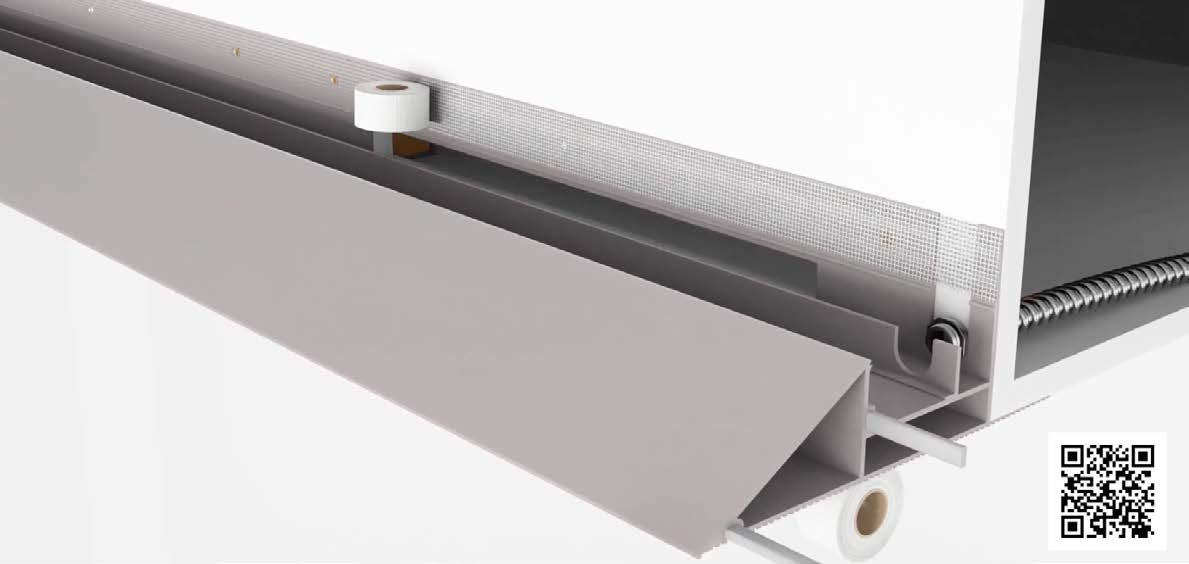
Say good-bye to unsightly air returns at no added cost. The Invisible Air Return by i2Systems is a fully integrated ceiling lighting system, engineered to integrate air circulation within the luminaire mounting profile which provides a true seamless cove lighting without compromising lighting quality or performance. It eliminates the installation costs associated with linear air diffusers and is available in flat front and knife edge profiles.

The durable and adaptable OptecNew 48V is the latest offering from ERCO. The proven, high-efficiency lighting technology for more lux per watt on the target surface is supplemented by a design aimed at durability thanks to high quality components. The system of interchangeable optics and suitable accessories provides limitless flexibility of use, now and well into the future.


Sleek, contemporary lines distinguish the Avalon 6 from Camman Lighting. Its bold but sleek body is made with extruded aluminum interior and exterior walls. Suitable for any decor and available in several sizes, this eye-catching fixture is an easy way to add lots of light and instant flair to any space.
FlexDuo by Scout Lighting is the industry’s first 1/2" wide constant voltage COB-LED flexible engine with proprietary and patented innovations. Power-injection along the side, rear and end of the channel never breaks the lineof-light. Multiple intensities are programmable on the same engine with the ability to modify on site. FlexDuo is also the illuminating engine for multiple new fixture designs, including the Discus sconce and Rollor pendant.


Pharos Architectural Controls bolsters its portfolio with the introduction of two new remote device solutions – RIO D4 and RIO G4, providing convenient Power-overEthernet solutions enabling a variety of show control, integration, and data infrastructure distribution over the control network. Each RIO device supports the distribution of four DALI buses (RIO D4) or four DMX/SDI universes (RIO G4) in a low-profile, cost-effective plastic DIN enclosure.


Black Hole S is the latest in a series of acoustic offerings from Intra-lighting. Designed by Lorenzo Truant, this multifunctional luminaire offers different possibilities of illumination. The acoustic surface reduces noise and improves speech audibility. Every detail has been taken into consideration, from no visible screws to a completely empty interior and the beauty of the faux leather acoustic fabric details.

Visa Lighting has launched the Terra Collection, a series of four new commercial decorative pendants with both up and down lighting. This collection combines minimalist design with clever manufacturing techniques to yield a group of discreetly sophisticated pendants packed with functionality. Diffused up-light provides a softly illuminated ceiling plane combined with a downlight source featuring a variety of distribution options for unparalleled versatility.


Zaniboni Lighting introduces THEA, a new series of decorative opal downlights with a full-body diffused acrylic lens. Available in 1”, 2”, 3", 4”, and 6” sizes, THEA can be regressed, flush mount, or extended below the ceiling. Not only is it perfect for interior lighting, but it's also suitable for exterior use, steam showers, and wet saunas.

The new ELK from Designplan Lighting is a sturdy, concrete LED fixture that comes as a bollard or wall mounted design, suitable for outdoor installation using an effective ground or wall fixing system. It is available in 3 color temperatures, is IP66-rated, and comes in an anthracite or natural concrete finish.


Leviton expands its Smart Sensor line with Smart Ceiling Mount Room Controllers and Smart Ceiling Mount Sensors. The line simplifies advanced lighting controls by integrating several control strategies into a self-contained, easy-to-install device. Along with occupancy/vacancy sensing, dimming, and daylight harvesting, these products can be wirelessly networked for spaces up to 10,000 square feet. These devices feature an out-of-the-box default mode and meet minimum code requirements with auto-ON/auto-OFF operation and a 20-minute timeout.


USAI Lighting has launched the brand new LittleTwos™, an expansive collection of 2” aperture pinholes and 2” diameter cylinders offering high-performance design in a small but mighty package. The line delivers up to 2000 lumens with advanced glare control and is available in a wide range of options, including trim styles and configurations, beam spreads, and housings. The entire product offering meets WELL Building Standards.
THE 4TH ANNUAL AT LEDUCATION NLB TESLA AWARDS
By
ALLEN
At LEDucation 2024, the NLB presented its 4th Annual Tesla Awards, honoring the pinnacle of lighting design and celebrating the remarkable contributions of designers and firms from around the world. Many lighting designers were on hand to accept their awards.
Awards of
EXCELLENCE
and
enhancing the experience.

PARKER
Casa Marea in Los Cabos, Mexico, shone brightly with LS Group at the helm, with Elise Streeb and Sara Erickson illuminating the project.
The savory ambiance of Palmilla Cocina y Tequila in Newport Beach, California, was recognized, with Lighting Design Alliance
Kyllene Jones
In Mumbai, Maharashtra, India, Jio World Center was distinguished with an award, thanks to the collaborative brilliance of Lighting Design Alliance. The team was led by Chip Israel, Meghan Murphy McLeod, Varna Namburi, Christopher Bright, Kenneth Moore, and Jason Stroebel.
Chip Israel of Lighting Design Alliance receives two Awards of Excellence.

Yale University, Sterling Memorial Library – Nave & Exhibition Gallery in New Haven, Connecticut, earned accolades under the luminous guidance of Cline Bettridge Bernstein Lighting Design. The designers Francesca Bettridge, Nicole Yoon Kim, Nira Wattanachote, and Min Young Kim collaborated with Apicella & Bunton Architects.
MERIT Awards of
The Casals Forum in Kronberg im Taunus, Hesse, Germany, was acknowledged, with Licht Kunst Licht AG leading the charge. Edwin Smida, Nils von Leesen, Konstantin Klaas, Jaehoon Choi and Sophie Stanitzek brought their expertise.


A Confidential Global Technology Company Office T1 in Redmond, Washington, achieved distinction under the creative leadership of Alison Fiedler of Stantec and Megan Sudol from Niteo
The Phoenix Suns Arena was another recipient of an Award of Merit, with Electrolight at the helm of the lighting concept. Claudio Ramos, Lu-Yu Huang, and Burak Yılmaz were the masterminds behind the illumination.
The Matheson in Healdsburg, California also received an Award of Merit. The lighting design was orchestrated by the team at Electrolight. Claudio Ramos, Lu-Yu Huang, and Burak Yılmaz lent their expertise to this project.
Francesca Bettridge, Nicole Yoon Kim, Nira Wattanachote, Cline Bettridge Bernstein receive an Award of Excellence.
Alison Fiedler of Stantec receives an Award of Merit.
Claudio Ramos of Electrolight receives an Award of Merit.

CITATION Special

The impressive lobby retrofit design that renews the image of an iconic office property, Safeco Plaza in Seattle, Washington, received a Special Citation. Fisher Marantz Stone, Inc., represented by Kevin Frary and Charles G. Stone II, spearheaded the project. Read about the project on page 32.
The Indian Community School in Franklin, Wisconsin, received a Special Citation for illustrating the effective use of wireless DALI controls in educational institutions. Morlights’ team, comprised of Sean Murphy, Avraham Mor, Casey Diers, and Kelsey Knowak, executed the project. (See article on page 36.)
Westbridge Capital in San Mateo, California, was honored with a Special Citation for demonstrating effective color-tuning in a work environment. The Electrolight team, including Claudio Ramos, Lu-Yu Huang, and Burak Yılmaz, were behind this innovative design.
Another Special Citation was presented for the effective use of lighting to meld historic and contemporary buildings into a cohesive hospitality experience. Hotel West and Main in Conshohocken, Pennsylvania, led by Scott Kerns of Paragon, was recognized for this feat.
The Charles R. Jonas Federal Building and Courthouse in Charlotte, North Carolina, was honored for its exceptional lighting, designed by Cline Bettridge Bernstein Lighting Design Francesca Bettridge, Stephen D. Bernstein, Renata Gallo, Nick Stuchlak, Burak Yilmaz and Francisco Casablanca steered the project, with architectural support from Robert A. M. Stern Architects and Jenkins Peer Architects.

A Special Citation was given for masterfully illustrating the successful rebirth of a luminous ceiling in Optiver in Chicago. The team from Schuler Shook, including Travis Shupe, Emily Klingensmith, and John Jacobsen, were celebrated for their execution.

A Special Citation for innovative daylighting design was awarded for the ‘Design of a Daylight System for a Control Center’ in West Germany. The talented team from ANDRES + PARTNER, including Bruno Thomas Menczigar, Arne Hulsmann, Katja Schielbler, and Peter Andres, were recognized for their work.
Stephen D. Bernstein of Cline Bettridge Bernstein receives an Award of Merit.
Jim Baney of Schuler Shook receives a Special Citation.
Charles Stone of FMS receives a Special Citation.
Arne Hulsmann of ANDRES + PARTNER receives a Special Citation.


Verozza’s Moduline 48V track system has expanded its product collection with the introduction of 17 new luminaire inserts. These additions enhance the versatility, functionality, and aesthetic appeal of the track system, catering to commercial and residential design preferences.


BOUGIE LIGHTING for a Contemporary Vibe
REID By
Pasadena’s First Neo-Bistro Uses Light as an Eccentric Sculptural Element
RANDY
Images courtesy of Tivoli, LLC

When the name of your restaurant literally means odd or strange, you need a unique décor and food offering that lives up to these unexpected themes. Bar Chelou delivers in both areas. With a name based on a French word meaning bizarre or weird, Bar Chelou has become a welcome and exciting addition to Pasadena’s culinary scene.
Located in the same 98-year-old Spanish Colonial Revival building as the Pasadena Playhouse, it is the city’s first neo bistro. To say that the business is thriving would be an understatement thanks to its quickly built reputation for offbeat abstractions.
Chef and owner Douglas Rankin has created an eclectic menu that features distinctive flavors from around the world. Following in the steps of the bistronomy movement that started in Paris, Rankin offers an array of unique culinary options designed to amaze patrons’ palates, as well as their eyes. James Beard Award winning LA Times food critic Bill Addison noted
the restaurant “…brings a welcome jolt of eccentricity to local— and really, regional—dining.”
Yet, the menu is just the beginning of what can only be described as a truly amazing and unexpected experience. As Rankin prepared for the opening of Bar Chelou in January of 2023, his goal was to create an unparalleled atmosphere that would match his inventive food offering.
He was already off to a great start thanks to existing artistic design elements left behind by the building’s previous occupant, including starburst tiles and a central oval bar near the entrance that was painted in a brilliant emerald green. The initial vision for the bar was to have the lighting serve as a semipermanent pop-up.
Rankin wanted to use the existing 3” downlight fixtures. However, under the previous design, the fixtures were concealed by a fabric wrap that did not complement the new

atmosphere. Lead by Karen Spector, co-founder of Lovers Unite, Rankin’s team searched for the right lighting designer to bring his vision to life, which took him across the country to lighting designer Sara McElroy, president and founder of Brooklyn-based Silver Shoe Design
“We needed the flexibility to design with loose parameters that could be adjusted onsite,” said McElroy, who also had other criteria in mind when identifying a new lighting solution. First, the lighting had to cast a warm glow that would span across various areas within the restaurant. Second, the fixtures had to form a sculptural element that gradually increased in complexity as they culminated over the bar. And finally, McElroy wanted the lighting to impart depth to the walls and other surfaces it traversed.
With these criteria in mind, McElroy ultimately specified the Flexile LG system from Tivoli, which provides a 360o bendable lighting surface without any shadowing. Its 1.25” bend radius with a 0.98” diameter allows for curved applications with UVstabilized and food-grade environmental silicone housing.
The Flexile LG offers versatile mounting choices, featuring a sturdy telescoping bracket that conceals surface clips, providing lighting designers with the freedom to explore diverse creative applications. Tivoli's Flexile LG series boasts a maximum run of 16.25 feet and consumes only 4.5 watts per foot. It is offered in a range of color temperatures, including 2300K, 2700K, 3000K, 3500K, and 4000K. Additionally, it can be dimmed using MLV, ELV, 0-10V, DMS, and TRIAC, allowing for customization to create almost any desired ambiance.
“I really liked the user-friendly nature and standardization of
the Flexile LG fixtures,” said McElroy. “It enabled us to craft a custom element using readily available components. Its literal and metaphorical flexibility were the key factors driving its selection. Plus, the lighting fixtures emit a gentle, inviting light while also serving as visually striking elements.”
The new lighting design starts in the hallway and extends gracefully throughout the dining area, sweeping over the communal table and ending in a captivating sculptural display above the bar.
“This artistic gesture visually gains momentum and impact as it spans across the space, effectively creating a genuine neobistro ambience throughout the restaurant,” said McElroy. “The result is a simple, yet visually engaging, sculptural element that wraps the space in warm light.” ■
PROJECT PARTICIPANTS
Architect – Lovers Unite, Los Angeles, CA
Lighting Designer – Silver Shoe Design, Brooklyn, NY
Distributor – Regency Supply, Chatsworth, CA
Electrical Contractor – Dubois Electric, Valencia, CA

CATCHING THE WAVE of Sustainability in Lighting
By
KAARE SOLA, LEED GREEN ASSOCIATE, NCIDQ, WELL AP - PARALLEL
SARA SCHONOUR, LC, IALD, MIES - LUXSI

Lighting manufacturers, are you daunted by the call for more sustainability in lighting? Between HPDs, Declare, EPDs, RoHS, and all the other labels and certifications being discussed in our industry today, it can be overwhelming to understand what to prioritize in your roadmap.
Don’t be disheartened! The industry—and the manufacturing world at large—has a unique opportunity
ahead. After all, manufacturing contributes about a quarter of the US’s greenhouse gas emissions. With strategic vision, you can seize this movement to assess your operations, find business efficiencies, recast your brand, and create an action plan to set you apart from your competitors.
Here are steps you can take to advance your sustainability journey.
With strategic vision, you can seize this movement to assess your operations, find business efficiencies, recast your brand, and create an action plan to set you apart from your competitors.
1
Recognize the demand and the opportunity.
If you haven’t already read the Lighting Advocacy Letter and checked out the accompanying Toolkit, make sure to start there. With over 100 signatories of lighting, architecture, and engineering firms specifying lighting globally, this is the demand from the design community. What an opportunity to create a dialogue with your customers!
2

Evaluate current practices.
Begin by thoroughly assessing existing operational and manufacturing processes, materials used, and energy consumption for each stage of the manufacturing process and other energy-intensive processes. Identify areas with the highest energy and environmental impact and prioritize them for improvement. Use the 5 “areas of concern” identified by the AIA to help structure and organize your discovery:
HUMAN HEALTH
Support and nurture life throughout the entire manufacturing process and seek to eliminate the use of substances that are hazardous to humans.
CLIMATE HEALTH
Strategize to lower embodied carbon wherever possible.
ECOSYSTEM HEALTH
Design processes that sustain and regenerate the natural air, water, and biological cycles of life through thoughtful supply chain management and restorative company practices.
SOCIAL HEALTH AND EQUITY
Protect human rights in operations and supply chains, and provide positive impacts for workers and the communities where they operate.
CIRCULAR ECONOMY
Create products that are designed for long life and have end-of-useful-life solutions (design for disassembly/recycling/ repurposing, create take-back/buy-back programs to re-use components in future product manufacturing, etc.) and create a closed-loop manufacturing cycle.

Create Ideas for action.
3 4
Explore Zhaga compliance and other in-field replacement options for parts that fail or need updating. Design products with standardized components that can be easily replaced reduces waste and extends the lifespan of lighting fixtures.
Consider using healthier materials in product design and manufacturing processes. This includes selecting materials with lower human health impact by evaluating and benchmarking the chemistry of products to identify opportunities to optimize or exchange for healthier alternatives.
Establish measurable sustainability goals and track progress. This may include targets related to energy efficiency, waste reduction, carbon emissions, and product lifespan. Regularly monitor performance against these metrics and adjust strategies along the way to achieve sustainability objectives.
Engage with other manufacturers in the industry to create a collective signal for sustainable practices within the supply chain. Collaborative efforts can drive broader adoption of environmentally friendly solutions and create economies of scale for sustainable initiatives. Also, look for workshops in your area and regional events focused on sustainability.
Map out and deploy your execution plan!
These are just a few ideas – and there are many more, like supply chain analysis, optimizing packaging and transportation, and end-of-life buyback and takeback solutions. There are tons of things you can do, which almost makes it easier – every action you take equates to progress!
Looking for advice and support to make your sustainable goals into reality? Check out companies like Parallel, whose mission is to provide competency, integrated support systems, and aligned networks to make companies’ sustainability strategies into business success.
No matter what step you take, by integrating sustainable practices throughout your operations you can reduce your environmental footprint, enhance your reputation as a socially responsible business, and capitalize on one of the industry's biggest movements – not to mention contribute to a more sustainable future for years to come. ■


We are a community of women and allies in the architectural lighting industry, using the power of collected experience and action to drive change. Come be a part of our community!
Participate in national events across North America, as well as local chapter events nationwide


community leadership advocacy networking ARE


WILD? join us join us


LIGHT, VALUES, AND STORIES
DAVID K. WARFEL By
Lighting design education is generally focused on tools and techniques, setbacks, beam angles, TM-30 reports, and other critical technical aspects of our profession. As a result, I find lighting design to be the easy part of the business while client relationships present an ongoing set of challenges. Discussing their values and learning to hear their stories may present an easier way of guiding them to better light.
Residential lighting designers seem to encounter two kinds of clients: those that understand the value we could bring to their project…and those that think we are crazy. Our fiercest competition is not from other lighting designers but from a lack of understanding among potential clients.


Most homeowners have never consciously experienced professional lighting design; without understanding, they are doomed to consider the merits of our work solely on price. And a room full of skilled lighting professionals developing custom solutions will never be cheap.
The clients that understand our value will come looking for us, but the rest are homeowners we find ourselves and with whom we patiently build a justification for our existence. This is exhausting work, like building an interstate highway with bricks instead of giant machines that lay down a continuous surface of asphalt. We, as an industry, are still fighting for each brick, each client. I recently discovered that we could build a television show for about two million dollars, a huge sum for one designer to finance but a tiny, insignificant amount if we all joined together. Mass media could be our paving machine, a way of reaching millions of potential clients in a twenty-two-minute episode. Until that happens, we need ways to justify our existence and help clients make better choices about light, and conversations
around values and stories can be one effective solution.
For the past few years, my team and I have used a new language of light we developed for the residential market. In previous articles in this series, I outlined most of this language and what we call the five promises of light: Light can help us do better, know more, feel better, focus clearly, and change easily. Light can also help us live our values and tell our stories, but these goals may be a bit more nebulous in the mind of a typical homeowner. Stories? Values? What does that have to do with lighting? As long as lighting costs money, personal value systems have everything to do with lighting. As long as budgets are an emotional subject, stories will be important to lighting.
VALUES
We used to ask homeowners what kind of lighting they liked, what lighting was important to them, what lighting they did not like, how much they were hoping to spend on

lighting. Then we discovered that most clients had no idea how to answer the questions; they came to us to be the experts. If they simply opened their checkbook to us and let us apply our expertise to their project, this would be an easy relationship. That happens about as often as you can guess. So we now talk to them about their values, making an effort not to discuss lighting. Four values we have found useful are quality, appearance, wellbeing, and adaptability
Our quality discussion begins with the question, “How well do you want your home to be built?” There are different levels of construction and finish quality, and understanding the homeowner’s preferences can be very helpful in developing a framework for lighting design solutions. Did the client select a builder based on price alone, or did the fit and finish of their work take precedence over cost? Are they flying to Italy to pick out marble for their floors and working to design bespoke cabinetry for the owner’s closet? Or are they ordering their cabinets from the local kitchen and bath store and picking out flooring based on price? Their answer provides a hint into whether they will be interested in fixtures that work…or fixtures that are expertly crafted of premium materials.
Appearance, which we often refer to as aesthetics, is a critical value to understand while guiding clients to appropriate solutions. Some of our clients want to make a statement visible to every passerby and to every visitor; others will tell us they just want their home to be simple or comfortable, each of which of course is tied to an aesthetic of its own. I find this value especially useful in determining how far to push the creativity of design. Clients who rate appearance highly are often more likely to appreciate striking and unique solutions. Add appearance to quality and we are well on our way to building a profile of the client we can use to guide our recommendations.
Wellbeing is a newer value to consider in our industry, but perhaps the most important. We do not begin the wellness conversation with a discussion of tunable light, but rather a broader exploration of the value of health in their lives. Do they start every day with exercise, bike to work, drink kale shakes, and avoid storing food in plastic containers? If so, it would be a disservice not to help them understand the value of dynamic lighting. Few clients will tell us they prefer to be unhealthy, but exactly how they value wellness will be useful to know in any lighting discussion.
Adaptability or flexibility is the fourth value we often discuss with clients, though I am not convinced we have the language just right. The idea is to work through how long they want to live in their home, how they will use it, and who will visit them. Their answers can tell us whether this is a forever home or just a weekend getaway, whether they use it is a solitary retreat or weekly large family gatherings. Why does this matter to lighting? Would we recommend the same solutions for a weekend beach house as a primary residence? Sure, we could…but that might not reflect their values. If I propose the most elaborate flexible system for a vacation home, the added cost may not make the cut.
Values-based discussions have proven useful in our client conversations and, when mixed with what makes each client unique, provide a glimpse into one final area of exploration: storytelling.
STORIES
I was first exposed to light as a storytelling tool in my theater years and have found that, while no one hands me a script or screenplay when designing a new home, stories are nevertheless present and powerful in residential work. I used story terminology early in my exploration of lighting languages but abandoned it for the easier-to-understand
“light for our lives helps us adapt to changes more easily” idea. Perhaps that abandonment was too hasty, a real danger for someone who likes to chase the next shiny object.
Storytelling at its most artificial or heightened could be called theming, the special application of faux finishes we see in theme parks and some casinos, but it need not be so obvious or applied. It is easy to see storytelling at Las Vegas’ Venetian, for example: we are encouraged to abandon the strip for a relaxing stroll through a European town, dining al fresco in St. Mark’s Square and taking a gondola ride on a canal. We want to be those people that vacation in Venice, so we buy into the theming.
How many homes have the same obvious but applied theming? I saw a home recently where the plaster had “chipped away” to reveal brick underneath, implying that this house had been on the Italian hillside for centuries. It was, of course, in a brand-new subdivision on a golf course that had recently been Wisconsin farmland. Meanwhile, the construction industry is building thousands of farm-house style homes in the middle of sprawling developments. Theming is alive and well.
Just down the street is City Center, a development of casinos and hotels that was hailed by one speaker as “the death of theming.” This individual called out City Center as not having an ounce of theming in its billiondollar architecture, but theming is just as present as in any pyramid or NYC-shaped casino. You just have to look more closely for the story, in this case a story present in its name but not in its reality. City Center is nowhere near the center of a city, and just out its back door is desert and development. It positions itself as urban and cosmopolitan but could be described as just the next trend in theming. How many homes are built today with a story or theme that has very little to do with its surroundings? I have seen mountain-modern homes in cornfields in the Midwest. The style tells us more about the homeowners’ values than anything else.
Each of our lives tells a story that reveals our values;
therefore, all our values are embedded in our stories. Stories, however, are more than the four values of quality, appearance, wellbeing, and adaptability added together. Stories are a particular combination of those values, of course, but they are also entirely unique to each client. Our stories are what makes us us, and tapping into that idea can be a powerful tool for developing lighting solutions that work for a client and encourage the client to pay for them.
For example, a client with a desire for the highest quality home may appreciate lighting fixtures cast of solid brass and wrapped in hand-stitched leather, but they may also hate leather and brass and prefer machined aluminum and stainless-steel hardware. Discovering their story can help us make the right choices but, more importantly, help them make the right choices.
ALL TOGETHER, BEGIN AGAIN
Each of the promises of light can help our clients live better lives; wrapping those promises in their values and stories can help clients feel more informed when they make critical decisions that will affect every minute they spend at home. We, as an industry, have a responsibility to educate our clients on why lighting matters to them. After all, who else has the knowledge we possess?
Our challenge, then, is to find ways to educate the client without requiring a midterm exam and term paper. We are called to make the amazing world of light accessible to people who may spend just a few hours of their lives – at most – thinking about how light affects them. We must find ways to help them understand what we do, rather than beating them over the head with technical terminology and incomprehensible lighting calculations. Learning their values and helping them understand their stories are two strategies that can do just that. When we light for their values and stories, we make it possible for them to live better. When more people benefit from what we do, we will no longer need to work so hard to convince others of our value. It will be known. ■
2024 Nonresidential Construction Forecast: Slower Growth
CRAIG DILOUIE, LC, CLCP By
Craig DiLouie is education director for the Lighting Controls Association, a council of the National Electrical Manufacturers Association that educates the public about lighting control technology and application (www.LightingControlsAssociation.org).
In 2023, the U.S. economy defied recessionary expectations with strong growth despite high inflation and resulting rising interest rates. The latest Conference Board projection is 2.4% growth, driven by strong consumer spending, surging investment in manufacturing construction, and increased state and local government spending.
After peaking in the summer of 2022, inflation has been steadily cooling while unemployment remained low, largely due to recovering supply chains. As inflation cooled, real wages grew.
A major contributor to the economy is construction, which overall exhibited unusually strong growth in 2023 after a solid rebound in 2022 following 2021’s pandemicrelated contraction. While about a third of this was new manufacturing investment, various nonresidential segments also did very well during the year.
The boom is expected to abate in 2024, however—still growing, but at a significantly slower pace, according to the American Institute of Architects (AIA) Construction Consensus Forecast Panel made up of leading economic forecasters. The Panel forecasted that nonresidential construction spending will slow to 4% growth in 2024 and further slow to 1% growth in 2025.
According to the AIA, despite strong spending across virtually all markets in the latter half of 2023, the construction slowdown may already be underway, as construction starts either slowed or turned negative in these markets.
2023 Construction Spending
According to the U.S. Commerce Department, U.S. put-in-place construction spending grew to a seasonally adjusted annual rate of $2.05 trillion as of November 2022, the latest month for which data was available at the
time of writing. Year over year, total spending increased 11.3%.
Through November 2023, actual construction spending amounted to $1.8 trillion, 6.2% above the $1.7 trillion for the same period the previous year.
Private nonresidential construction spending achieved a seasonally adjusted annual rate of $698.2 billion in November 2023. Private residential construction spending achieved a seasonally adjusted annual rate of $896.8 billion. Public construction spending achieved a seasonally adjusted annual rate of $455.1 billion.
The overall seasonally adjusted rate of nonresidential construction spending in 2023 showed an 18.1% increase year over year in November 2023. Driven by government policies such as the IIJA, IRA, and CHIPS legislation, U.S. manufacturing construction spending dramatically surged with a 59.1% increase in 2023. Additional markets showing strong growth included education (+16.7%), healthcare (+11.7%), religious (+31.1%), and others.
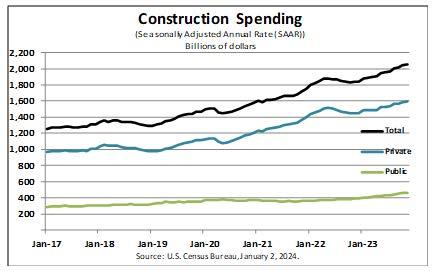

Source: Dodge Construction Network, January 8, 2024.
The AIA identified several significant headwinds affecting growth, notably regarding commercial buildings. These include tighter credit resulting from rising long-term interesting rates, increasing stress on projects; construction commodity cost inflation, currently stabilized but with cost inputs still 35-40% higher than before the pandemic, and with labor costs still rising; declining nonresidential property values led by office and retail; and lower demand for certain types of buildings due to the shift to remote work and the pandemic boosting e-commerce.
Dodge Construction Network
Issued by Dodge Construction Network, the Dodge Momentum Index (DMI) rose to a score of 186.6 in December 2023 from 181.5 in November, a 3% increase. Over the month, commercial planning grew 1% and institutional planning improved 6.1%.
“The Momentum Index ended the year 11% below the November 2022 peak, ultimately stabilizing as the year progressed,” said Sarah Martin, associate director of forecasting for Dodge Construction Network. “Regardless, the DMI averaged a reading of 184.3 in 2023, hitting levels of activity that haven’t been recorded since 2008.”
She added, “While ongoing labor and construction
cost issues will persist in 2024, a substantive amount of projects are sitting in the planning queue and will support construction spending going into 2025.”
Hotel and data center planning drove growth in the commercial segment of the DMI over the month of December, while stronger healthcare and public building planning supported more momentum on the institutional side.
Year over year, the DMI was 2% lower than in December 2022. The commercial segment was down 9% from year-ago levels, while the institutional segment was up 14% over the same time period.
Architecture Billings Index
The AIA/Deltek Architecture Billings Index (ABI) is a leading economic indicator of construction activity, providing an approximately 9- to 12-month view into the future of nonresidential construction spending activity. The score is derived from a monthly survey of architecture firms that measures the change in the number of services provided to clients. A score above 50 indicates expansionary business conditions.
As of November 2023, the ABI remained below 50 for the fourth consecutive month, as it did during seven out of the first 11 months of the year. The score of 45.3 increased by one point from October, indicating slightly fewer firms reporting a decline in billings (see chart on following page).
“This marks the seventh month in 2023 with a decline in billings,” said Kermit Baker, PhD, AIA Chief Economist. “Over the past three months, this pace of decline has accelerated, with firms in all specializations and in all regions of the country reporting weakening business conditions.”
He added, “However, with signs that credit conditions are beginning to ease, firms are reporting an uptick in inquiries for future projects.”
Firms in all regions reported a decline in billings, with business conditions remaining softest at firms located in the West as the region’s billings hit a low for the year. Firms specializing in multi-family residential continue to remain the weakest and business conditions declined further at firms with institutional specialization, despite being the strongest to start 2023.
Electrical industry confidence
Electrical industry business confidence proved neutral or negative for much of the year but ended 2023 on a positive note—a three-month run of positive confidence.

Source: AIA, December 20, 2023.

Source: NEMA, January 3, 2024
In December 2023, the current conditions component of the National Electrical Manufacturers Association’s (NEMA) Electroindustry Business Conditions Index (EBCI) for North America rose to 56.3, suggesting improving business conditions favorable to market expansion. This was an increase from an index score of 53.1 in November and 52.8 in October, which was the first time the EBCI returned to expansionary territory since February.
Nearly one-third of survey respondents reported “better” conditions during the month, with 50% calling the situation unchanged. Respondents were largely positive in their comments, while noting slowing or stalled order activity and geopolitical concerns.
The future conditions component of the index, meanwhile, proved even more upbeat, surging in December 2023 to its highest score since the spring of 2021. The December score was 81.3, a significant increase from November’s already strong 68.8, with 75% of responding panelists anticipating “better” conditions in six months.
General Contractors
Construction contractors have a decidedly mixed outlook for 2024 as firms predict transitions in demand for projects, according to A Construction Market in Transition: The 2024 Construction Hiring and Business Outlook, a report based on a survey by the Associated General Contractors of America.
“2024 offers a mixed bag for construction contractors: on
“2024 offers a mixed bag for construction contractors: on one hand, demand for many types of projects should continue to expand and firms will continue to invest in the tools they need to be more efficient."
— Stephen E. Sandherr
one hand, demand for many types of projects should continue to expand and firms will continue to invest in the tools they need to be more efficient,” said Stephen E. Sandherr, AGC’s CEO. “Meanwhile, they face significant challenges when it comes to finding workers, coping with rising costs, and weathering the impacts of higher interest rates.”
The net survey reading—the percentage of respondents who expect the available dollar value of projects to expand compared to the percentage who expect it to shrink—was positive for 14 of the 17 categories of construction included in the survey, as it was in 2023.
However, a smaller share than before expects the markets
they compete in to expand in the coming year. The net reading decreased from the 2023 survey for nine project types, increased for six types, and remained unchanged for two.
Among private sector markets, the highest expectations are for power projects, hospitals, and non-hospital healthcare facilities such as clinics. The largest increase in optimism from the previous survey is for data center construction, while contractors are also quite optimistic about the education market. Contractors are bearish, however, for lodging, retail, and private office construction.
“On balance, contractors remain upbeat about the available dollar value of projects to bid on in 2024,” said Ken Simonson, AGC’s chief economist. But the optimism regarding opportunities for most project types is less widespread than it was a year ago.” He noted 69% of respondents expect to hire in 2024.

Source: AIA, January 11, 2024
Amid these changes, contractors are struggling to cope with significant labor shortages, the impacts of higher interest rates and input costs, and a supply chain that, while better, is still far from normal, according to the survey.
AIA Consensus Forecast for 2024
After an extraordinarily strong nonresidential construction market in 2023, the industry will see weaker conditions in 2024 and 2025, according to the AIA Consensus Construction Forecast produced by a panel of the leading construction forecasters in the U.S. Spending on nonresidential buildings is expected to increase at a far more modest 4% in 2024 and slow further to a little over 1% growth in 2025.
Spending on commercial facilities will be flat this year and next, manufacturing construction will increase significantly in 2024 before stabilizing in 2025, and institutional construction will enjoy mid-single-digit gains in both years. ■
JONES By DALI Alliance®, NA Market Development Manager


Source: DOE, USDOE, EERE. Building Performance Standards Introduction, Accessed online, April 17, 2024. www.energycodes.gov, November 2023
If you aren’t familiar with Building Performance Standards (BPS), you are not alone. The words by themselves are generic and can easily be misconstrued. Without specifics or context, lighting professionals might assume that BPS refers to high performance building energy standards.
But no, building performance standards are nothing like energy codes. A highly visible BPS example is New York City’s Local Law 97. The legislation requires buildings to reduce their emissions to meet targets that increase in stringency every five years. Importantly, LL 97 has teeth. Fines will be assessed for buildings that don’t meet the targets. When LL 97 was enacted in 2019, I knew it was a gamechanger for NYC. What I didn’t realize is that it signaled the beginning of a significant trend across the country. Building performance standards have become a ‘thing.’ To say that they have picked up steam is putting it mildly.
The Institute for Market Transformation— which is the center of gravity for all things BPS—tells us that building performance standards are “…designed to reduce carbon emissions in buildings by improving energy, gas and water use, and peak demand. These standards become stricter over time, driving continuous, long-term improvement in the building stock, and complementing building energy codes.”1
BPS are designed to have phases and milestones over multiple years with planning at the front end of the process. While there are many commonalities from one BPS to the next, there are also distinctions between policies. Stakeholders engaged in the process will have significant influence on the nuances of content and methods. Each locality will determine benchmarking, milestones, performance thresholds, metrics and
life cycle analysis methods, penalties for noncompliance, and more. Once adoption happens, building owners are required to comply with the performance thresholds by specified dates. At the building level, metrics will typically include energy use intensity (EUI) and greenhouse gas (GHG) emissions.
Carrot or Stick?
As an industry, we aren’t used to this flavor of legislation or the way it influences the market. I remember (yes, back in the day…) the dynamics and culture of energy code development. For almost 10 years, I participated in the ASHRAE/IES Standard 90.1 Lighting Subcommittee meetings. Ah, the personas…the historical paradigm where government drove the process, manufacturers resisted, green groups advocated, and specifiers were caught in the middle.
Over time, the dynamics of the energy codes and standards development process has improved to where there is a greater level of agreement, a sense of purpose, and disagreements are more technical and less political. All well and good, but once codes are adopted and promulgated into state or local codes, compliance is required. For those who are engaged in lighting projects, at that point, code compliance is non-negotiable. It’s a stick, not a carrot. Don’t get me wrong, I’m not bashing energy codes. They have a vital and effective influence on the environment as well as technological innovation. My point is that energy codes are not optional, and in many ways, they are functionally prescriptive in spite of the performance language.
In contrast to energy codes, Building Performance Standards are truly
CAROL
performance based. They are technology agnostic. So, why is that different for the lighting industry, and controls manufacturers in particular? Answer: We are free to ignore the opportunity. In this paradigm, there is nothing and no one
to resist. BPS legislation and policies set targets but do not prescribe how to reach them. Success is measured by a highlevel metric and does not dictate specific types of building systems or technology thresholds. It’s a carrot, not a stick

We
have always relied on energy codes to drive lighting controls adoption into new construction, but building performance standards have now put a framework in place to raise the bar in existing buildings.
There will always
be another target down the road,
and the sooner we get in front of these trends, the sooner we can reap the benefits."
— Harold Jepsen, P.E. WELL-AP, VP Standards & Industry, Legrand
Opportunity Size
Now that we’ve laid the groundwork and clarified the distinctions between the carrot and the stick, let’s consider the carrot on its merits. Just how big is the opportunity afforded by BPS?
According to the EIA CBECS (Commercial Building Energy Conservation Survey2), there are 54 billion square feet of existing buildings that haven’t been retrofit with LEDs, never mind lighting controls. That doesn’t include retrofits that were done in 2016-17 before we saw significant increases in efficacy. Only 2% of that massive market would equal the size of the total annual new construction market.
Traditionally, the home for innovation is within new construction projects. Budgets aren’t subject to payback metrics, expectations are higher, and projects with lighting specifiers and AEC firms have the competency and experience to learn about new technologies.
ESCOs own the retrofit market for good reason, and they have it down to a science. Some of the more progressive ESCOs have tried advanced controls, and it hasn't gone well. Feedback from owners, managers, and ESCOs is consistent: the confusion related to the multiple proprietary lighting control systems has been a major frustration. Maintenance
issues are especially frustrating; the vendor lock that comes with proprietary systems makes matters worse.
Even as I highlight the massive opportunity afforded by BPS and decarbonization in general, I’m not naive about the barriers to change. Going after the existing buildings market to increase the uptake of controls is no small feat. We need to decide if we want to go after it—or resign ourselves to the status quo. Of course, any new and substantial opportunity would be challenging; it would take a lot of commitment, an open mind, and meaningful changes to our products, pricing, channels, and service offerings. The reward has a huge upside. We can take inspiration from Albert Einstein: “When you change the way you look at things, the things you look at change.”
So What’s Changed?
The reason to believe in this opportunity is not because of the opportunity size. There are legitimate market drivers that stand to make a difference in standard practice. BPS are contributing in multiple ways. The most obvious difference is that owners and managers who would not otherwise invest in their buildings will need to comply with the overarching goals in the states and localities. This will result in an overall increase in projects. In addition to the expansion of the market, there are factors that are more structural.

Metrics for decarbonization. Lighting projects in existing buildings have been limited to 2-3 year paybacks for decades. Standard practice has been limited to reduced wattage over duration of the energy services contract. When or if controls have been installed, the standard is 0-10V analog drivers and room area controls.
Now that projects will be driven by a higher-level goal of reduced emissions, there are additional metrics that will come into play. Projects geared towards decarbonization and emissions reduction will use Life Cycle Analysis (LCA) as a primary decision tool. In fact, different methods of LCA are currently a hot topic in the world of BPS and decarbonization. Return on investment will be viewed at the building level along with things like GHG emissions and source energy, rather than the lighting payback by itself, so factors such as installation and maintenance savings will be more relevant.
Increased stringency over time. BPS typically have several thresholds of compliance over many years. How do you get to the next level of savings with lighting? Sure, you can monitor energy at the circuit level, but circuits provide power for different fixture types, across different space types, which have different lighting needs.
Michael Myer, senior researcher at Pacific Northwest National Laboratory, explains the situation well, saying, "One thing that BPS have in common is that compliance targets will change over time. For lighting, if you choose analog controls, how do you know where your energy is going, or how to enable more savings in the future? Digital systems, with addressable components and monitoring, enable buildings to determine energy use at a granular level and make informed decisions about the next level of savings."
Building Energy Codes and Standards. BPS, are not happening in a vacuum. We are seeing changes along the same trend lines within the latest versions of ANSI/ASHRAE/ IES Standard 90.1-2022 and IECC 2021. Both standards are now requiring energy credits in addition to existing prescriptive baselines. For example, IECC 2021 paragraph C406.4 specifies how credits can be earned by using enhanced digital lighting controls. Digital addressability to individual luminaires is one
of the credit options, which in turn enables load shedding and digital reconfiguration of controls. Codes are finally pulling digital lighting technology into existing buildings.
Why Digital?
Here is the North American dialogue: “Digital is the future.” “Well of course, but…in North America we use 0-10V drivers because it’s the devil we know. It’s easier and cheaper, and nothing will ever change that. It is what it is. ”
What I find fascinating is that it’s the devil we don’t know. It’s not actually easier, it’s just familiar. 0-10V may be a lower first cost, but DALI drivers are faster to install. In buildings larger than 50K sq.ft., the reduced labor hours for installation and startup will almost always make up for equipment costs, and then some.
One of the things I find most surprising is that the ugly truth about 0-10V drivers is one of the best kept secrets in the industry. We hear about the difference between linear and logarithmic curves, and that the energy savings numbers aren’t as accurate as digital real-time monitoring, but it doesn’t seem like a big deal. Without going down the rabbit hole, allow me to burst your bubble quickly. Energy savings estimates based on calculated savings with 0-10V drivers are wildly inaccurate. The latest research makes this painfully clear.3 If you want to know how much energy you are saving, digital monitoring is a must.
Why DALI-2™ and D4i™?
Energy savings matter within the context of BPS, but it’s not the only important factor. BPS is a long-term play; when you are investing heavily into a long-term asset, the risk of ongoing maintenance problems is not to be taken lightly, and proprietary components are considered high risk. Products need to be trustworthy and replaceable. DALI (Digital Addressable Lighting Interface) is the internationally standardized protocol for digital communication between lighting control devices. DALI-2™ is a certification program that tests products against the relevant specifications to ensure interoperability.

In addition to accurate savings data and interoperability, consider the following list:
• Churn and space re-use are a given, especially considering the contraction of today’s commercial buildings market. Digital re-configuration solves that problem without paying fees for on-site services.
• Fault detection and diagnostics (FDD) helps to find problems and fix them quickly, saving the cost of a diagnostic visit and subsequent repair.
• D4i™ is an extension of the DALI-2™ certification program developed for wireless systems and is a great fit for existing buildings. The DALI Alliance developed gateway specifications to interface between D4i™-certified drivers and sensors, and Bluetooth NLC and Zigbee wireless protocols.
• DALI Alliance worked with the Zhaga Consortium to support the development of their specification to standardize form factors and connectors for Luminaire Level Lighting Control devices for interior (Book 20) and exterior (Book 18). The resulting modularity will enable sensor and wireless controller replacements when the time comes.
• DALI DT8 (device type 8) control gear enables methods that can be used to control the color output of light sources. Digital calibration ensures consistent color from one light source to the next, and supports tunable white, RGB, and XY coordinates.
• DALI-2™-emergency-certified products facilitate integrated, digital control systems that combine illumination and emergency lighting. Building management systems can access DALI control and querying capabilities including automated testing and reporting.
How Do We Pivot?
Clearly, lighting controls won't make sense in every existing building project. And any major market transformation takes many years. In the meantime, how do we get traction? Be strategic. Pursue projects that meet criteria. Early adoption will happen on projects that have multiple ways to benefit. Search out the localities that have BPS in place as they will have the legislative and policy pressure to meet their compliance goals. High energy costs are always a plus because the economics are better. Lighting rebates from utilities have been decreasing for some time, but the programs remaining are often focused on controls. Long-term assets and operating contracts have more room for investments to pay back. They are also more sensitive to risk and maintenance and more likely to value fault diagnostics and remote configuration. Building size is another thing to look for. Projects larger than 50K sq.ft. typically benefit more from networked lighting control systems.
Conclusion
There is no way to know how quickly the growth of building performance standards will happen, but we do know the trend will continue.
Alex Dews, CEO at the Institute for Market Transformation, tells us that “there is a sense of inevitability in the market that this is coming. The 40+ jurisdictions4 committed to developing these policies represent roughly 25% of the commercial market. The benchmarking inventories from local governments show that there are still enormous efficiency opportunities in the built environment, which is typically responsible for 60-80% of their carbon emissions. They just can't meet their goals without focusing on existing buildings, and BPS create a clear pathway and timeline for making these changes happen.”
If you want to go after the opportunity like I do, I only ask one thing—remember that we are in this together as an industry. Specifically, we must support interoperability and digital systems. DALI-2™, D4i™, and other standardized wireless options will support the BPS as well as the requirements of the end customers. In many ways, the trend towards BPS could give us a ‘do-over.’ This time, let’s make sure we don’t settle for wattage reduction alone. Standardized digitally addressable systems in new construction is inevitable. When it comes to existing buildings we have a choice: carrot or stick?


1 Institute for Market Transformation. Accessed online, April 17, 2024. https://imt.org/public-policy/building-performance-standards/
2 U.S. Energy Information Agency, Commercial Building Energy Conservation Survey. Building Characteristics Highlights, CBECS Flipbook. Accessed online, April 17, 2024. https://www.eia.gov/CBECS_Flipbook.pdf
3 “The Energy and Operational Impacts of Using 0-10V Control for LED Streetlights.” A. Waghale, M. Poplawski, S. Pratoomratana, J. Tuenge, Pacific Northwest National Laboratory (PNNL). Produced for the USDOE, EERE. Accessed online, April 17, 2024. www.energy.gov
4 Institute for Market Transformation. Maps and Comparisons: Building Performance Policies at a Glance. Accessed online, April 17, 2024. https://imt.org/public-policy/maps-andcomparisons/
How to Dance the VE Shuffle
JP BEDELL By SDA Lighting & Controls
A new dance craze is sweeping the lighting industry. It's called the VE shuffle. If you work in specification lighting, you've been doing the shuffle for a while now, whether you know it or not. In case you don't know, here are the steps to the VE shuffle:
Design with the best of intentions.
Designed lighting goes out to bid.
Designed lighting is deemed too expensive (either by the GC or the owner's rep).
(This is where the dance gets interesting. "Where did you get your pricing? Did you take into account the large quantities? I've used these fixtures before, and they weren’t that expensive!”)
Project is re-specified.
Project is re-bid.
(Steps 4 and 5 can be repeated as many times as the project timeline will allow.)
Bid is awarded.
(Bonus points are awarded here for last minute additional VE due to unforeseen circumstances.)
Lighting is installed.
This dance, as fun as it may seem, is exhausting for everyone. It is also an enormous efficiency drag on our industry.
VALUE ENGINEERING IS THE NORM NOW, NOT THE EXCEPTION
I've been writing about value engineering (VE) ever since 2020 when I presented the subject (virtually) at LightFair. In the last four years, value engineering has moved from an added annoyance to standard practice in lighting procurement. Contractors assume there is money to shave off the lighting package, and nine times out of ten, they are right.
For years, I've watched lighting designers grow increasingly frustrated with the value engineering shuffle. I have good news and bad news. The bad news is it's not going away. General contractors are hiring, either internally or subcontracting, lighting procurement professionals. The whole job description of these procurement professionals is to reduce the cost of lighting, either through renegotiation or substitution.
The good news is there are steps you can follow to take the VE shuffle from exhausting dance marathon to the Electric Slide at your cousin's wedding. You don't want to do it, but you get out there and follow the steps.
A (SHORT) VE STORY
One of my clients recently designed a catenary lighting system. When the poles came in more costly than expected, ownership balked. The lighting designer was asked to provide VE alternates. They came to me and my factory. Our answer was to stay with the specified manufacturer but reduce cost by removing different elements of the pole design – a simplified shape, no internal light strip, no metal accents, etc. The options read like a fast food menu and were easy for the owner to understand. After this relatively quick effort, ownership ultimately approved the original design because it was their vision, and their cost saving methods would have wrecked that vision.
This very simple little story is an example of how to dance the dance as best you can, and within it lie lessons for how to master the VE shuffle.

Photo credit: Eric Wolfinger Photography
REMEMBER YOUR OWNER HAS MONEY – DESIGN AMAZING THINGS
A company will lease a tremendous amount of square footage of prime Manhattan real estate and then force everyone on the construction team to work overtime, shaving what amounts to a rounding error in their annual balance sheet off the project. Design amazing things where you can, not just because that's why you got into this business, but because amazing treatments don't get value engineered.
If, for example, you are laying out 4" 1,100 lumen downlights in 3500K in an evenly spaced grid with an overlap flange for an open office, you are writing a specification that's a prime target for substitution. If, on the other hand, you've sold your client on a complex layering of indirect, accent, and decorative lighting, you have a better chance of holding on to the specifications. Sell them on a vision.
ENGAGE YOUR REPS
Designers have grown increasingly reticent to discuss their projects with their reps for fear of substitutions or alternate proposals. This gets it exactly backward.
As a spec rep, I want to help you make extraordinary things happen. That's why I got into this side of the business. I could do an entire piece on specification reps versus package reps, but that's a story for another day. For our purposes here, suffice to say that spec reps are motivated differently than package reps, and the earlier your spec rep is involved, the easier it is to defend your spec. Packaging is very common, but it's not inevitable. Engaging your spec reps early, even if it's not a local project, allows them to communicate with the factories and advise a project is coming, let them know the rough size of the


project and allow economies of scale to go to work. If a rep in your territory uses a specification as a chance to sell you on something, remember, they don't have to be your rep anymore.
PUSH THE REPS AND FACTORIES TO HELP YOU VE
In my catenary example above, we didn't go down the road of alternative manufacturers or new treatments. Most spec grade manufacturers these days know how common value engineering is and have updated their offering to include "good, better, best" scenarios. Some manufacturers are good at spelling out the compromises within their offering. For others, it's convoluted.
This is where good reps and good factory people can make a designer's life much easier. It's not your job to know how to take the cost out of a desired luminaire. Let your reps do their job. We can make the compromises dead simple to understand so when VE is proposed, owners know what they are trading.
REQUEST SPECIFIER BUDGET PRICING
Knowledge is power, and when it comes to value engineering, too many designers go into the discussion willfully ignorant. Any good specification rep will be able to provide you with specifier budget pricing. This is the best way to arm yourself against unnecessary value engineering. I cannot imagine sitting on a call with contractors and owner's reps, not knowing the costs of the luminaires I've chosen.
Too often designers are forced to justify costs that have become incredibly inflated. They inflate for all kinds of reasons, some legitimate and some less so. Being armed with the real pricing of the fixtures specified allows you as a designer to push back and say, "We were provided with a cost of xx dollars per foot. Even with markups, we should be within budget."
This is a conversation many designers don't want to be a part of, but it is incredibly powerful to be able to speak to the cost of the design. It reflects to the owner (or their rep) that you have already thought of the cost of the design and have all of the owner's interest in mind.
VE SHUFFLE, THE DANCE OF LOVE?
While no one wants to go through VE, there's a positive spin. Value engineering is getting everyone to think more about how lighting is priced and procured. The more it is discussed at the outset, the more we can talk about quality lighting and what it costs, this forced education will, over time, help designers keep more of their design intent. We're educating customers, one project at a time. ■
CBB
Architect: Duda|Paine Architects
Photo credit: Patrick Coulie Photography

DMX VS
DMX and DALI-2 – two very different lighting control protocols, with very different pros and cons. So, how does one choose between the two when designing a lighting system?
Since the 1980s and 1990s, DMX512 and DALI have been the main lighting control protocols used across multiple industries. DMX512, or Digital Multiplex 512, is a universal lighting protocol that pretty much any programmable luminaire can connect to.
Meanwhile, DALI, which stands for Digital Addressable Lighting Interface, is a regulated protocol that only works with specific types of devices. DALI’s ecosystem goes beyond lighting control and is designed to improve energy conservation with additional periphery devices such as dimmers, occupancy sensors, and daylight sensors and by using building automation. At this point, DALI-2 is the most recent iteration of DALI and provides crucial advancements in functionality.
Before diving into the best-use scenarios for each, it’s important to know the difference between DMX and DALI-2.
Communication for a DMX system is one-way, from the DMX controller to the lighting fixture. Some, but not all DMX fixtures and controllers allow for RDM (Remote Device Management), which enables bi-directional communication and allows the controller to view and edit some fixture parameters and settings. In a DALI-2 system, the controller, lighting fixtures, sensors, and switches all communicate bidirectionally between each other. Because of this, each system functions somewhat differently.
With DMX a specialized, shielded cable (up to 300 meters) is used to connect the system together. CAT5/6 cable is also approved for use as DMX wiring. DALI-2 does not require any specialized cable or wiring; any 2- wire cable will work on
a DALI-2 system up to 300ft. This makes installing a DALI-2 system somewhat easier and sometimes more affordable, depending on the size and capabilities of the system.
Configuration and programming is the next factor to consider when choosing between the two systems. Any DALI-2 approved device is built and designed to easily integrate with DALI-2's “Device Type” system. The same thing is true for DMX as any DMX approved device can function in a DMX system. Currently, there are eight different device types, DT-1 through DT-8, representing different levels of functionality. A DALI-2 controller is designed to recognize all eight device types and is therefore able to automatically configure elements in the system, setting parameters per device type. Each DALI-2 system can have up to 64 devices on it making, it an extremely versatile system.
Applicable in multiple industries and types of lighting devices, DMX is also a very adaptable protocol. A single DMX “universe” is made up of 512 channels that need to be programmed to work with a DMX controller. This can be done manually on the device, or remotely through the controller if RDM is enabled. Some DMX controllers can handle multiple universes, while others are designed to control a single 512-channel universe. At their base levels, both DMX fixtures and DALI fixtures need to be “addressed” in order to be functional in a system. Additionally, DMX systems on average can perform this function at a much faster rate than DALI systems.
The programming ease of both systems varies widely and they are all dependent entirely on the capabilities and interfaces of the system and software being used- which varies widely from manufacturer to manufacturer and product line to product line.
Determining where a smart lighting system is being installed
DALI-2:
and how it is going to be used is the next step in choosing your control system. For applications where different levels of control for individual devices are needed, such as commercial spaces, offices, and retail environments, DALI-2 is particularly well-suited. The protocol's compatibility with various types of lighting fixtures, including LEDs and fluorescent lamps, makes it a great choice for diverse projects. The interoperability of DALI-2 ensures that products from different manufacturers work seamlessly together, offering end-users greater flexibility in customizing their system. Because of all these elements, however, DALI-2 has a much slower response time and dimming curve.
In the settings mentioned above, this usually isn’t an issue. However, if real-time lighting control or effects are desired, DALI-2 is likely not the best choice.
One of the biggest strengths of DMX lies in its real-time control capabilities, making it an ideal choice for dynamic lighting displays and special effects. The dimming curve for DMX is much faster, creating much smoother dimming overall. The protocol allows for the synchronization of multiple fixtures, creating immersive and visually stunning lighting sequences that are only possible with DMX’s fast response time. DMX is especially well-suited for applications where dynamic lighting changes are paramount, such as live events, stage productions, and specialized home lighting systems.
For specific projects that prioritize energy efficiency, ease of installation, and individual fixture control, DALI-2 is an excellent choice. Its bidirectional communication allows for advanced monitoring and diagnostics, as well as “smart” error control, making it more reliable overall and suitable for applications where maintaining optimal performance is essential.
CASEY SERRANO, By American Lighting
With updates by Randy Reid
DMX is the protocol of choice for applications that demand dynamic and intricate lighting designs. The real-time control capabilities of DMX make it indispensable in entertainment venues, stages, and environments where creative lighting sequences are a focal point. Unfortunately, this also means that DMX will trigger any command it receives with zero error control, which can lead to loss of fixture control and unwanted flickering or flashing if programmed incorrectly. Despite its limitations in addressing, programming, and scalability, DMX remains unrivaled in its ability to deliver visually captivating lighting displays.
There is no one-size-fits-all solution when it comes to choosing between DALI-2 and DMX. Each protocol has its strengths. In some cases, a hybrid approach may be the best solution. Integrating both DALI-2 and DMX within a project allows for a comprehensive lighting control system that combines the precision of DALI-2 with the dynamic creativity of DMX. This approach is perfect for spaces that require both functional, task-oriented lighting, as well as captivating, dynamic visual experiences. When taking this hybrid approach, it is important to note that while DALI-2 has very little problems controlling a DMX system, DMX is not designed to control a DALI-2 system. Because of this, it is recommended to integrate a DMX system into a DALI-2 system rather than the other way around.
Both DALI-2 and DMX512 stand as pillars of control in the lighting world, each contributing to the overall spectrum of possibilities. As lighting technology continues to advance and the demands of various industries evolve, understanding the unique capabilities of DALI -2 and DMX512 will become increasingly critical to lighting designers, contractors, installers, and integrators. ■
ENGAGING IN
Conversation with AJ GORMAN KAYLENE CAMPBELL


In the dynamic world of lighting design, AJ Gorman and Kaylene Campbell stand out as catalysts for inclusivity and empowerment in the Pacific Northwest. Their inspiring journeys reflect the diverse paths that women can take in the traditionally male-dominated realm of lighting and design.
Now serving as Chapter leaders for Women in Lighting + Design (WILD) Seattle and Portland, respectively, AJ and Kaylene are advocates for gender diversity and professional development in the industry, using WILD as a catalyst for conversation to support women navigating the complexities of modern life.
Initially drawn to architectural engineering, AJ's journey took a decisive turn when she attended a Society of Women Engineers event the weekend before classes began at Penn State. At the
event she met Maggie Golden, another active WILD member in Boston, and with Maggie’s prompting during this serendipitous moment, AJ shifted her focus. AJ found a passion for the field, leading to her current career as a lighting designer at Windward Lighting Studio
In contrast, Kaylene embarked on her lighting odyssey after a successful career in tax accounting. Looking for a more artistic endeavor, she first pursued interior design, managing to earn her degree while working full time as a single mom with 3 daughters. Her shift to lighting came towards the end of her studies when, during a routine grocery trip, her 5-year-old asked about the lighting of the store.
Kaylene realized that she had been speaking about lighting and focusing on it in her studies so much that her daughters had
KELLY ROBERTS By
PORTLAND GROUP

recognized the passion before she had! Kaylene appreciated how lighting blended her analytical mindset with her creative instincts and has never looked back. She is now a lighting designer at DLR Group
Becoming WILD
AJ and Kaylene's journey with WILD began with a shared desire to create a supportive community for women in the lighting industry. AJ's involvement stemmed from her frustration with the lack of open networking opportunities beyond events organized by specific companies. Expressing her desire for a more expansive organization in Seattle, she was introduced to Mariel Acevedo, Eileen Thomas, and the existing Pacific Northwest Chapter. There she joined forces with Mariel, Eileen, and Kaylene to revitalize and expand its reach.
Similarly, Kaylene's path to WILD was influenced by empowering women's content online and inspired by WILD initiatives in Denver. She initially encountered challenges in finding a similar platform until she connected with Mariel in Portland. Recognizing the potential of WILD to provide a safe space for women in the industry, Kaylene eagerly embraced the opportunity to contribute to its growth and impact.
I think the Spotlight Series is one of our most popular events because it's women talking about not just their careers, but also their lives in general. Jill was asked how she balanced having a family and starting a business. And Naomi didn't have children, but she was asked to take on more responsibility to cover those that did. That's how their careers interact with their lives, and it’s important to understand that impact.”
— AJ Gorman


SEATTLE GROUP
Originally, Portland and Seattle were combined under the Pacific Northwest Chapter, but the success of WILD in their respective areas led to a geographical split. Despite the physical distance separating them, Seattle and Portland remain united in their shared mission, co-hosting virtual events for both sets of members.
Their developing Spotlight Series, featuring interviews with lighting powerhouses such as Naomi Miller of PNNL and Jill Cody of Dark Light Design, is a chance to highlight professionals from diverse backgrounds and career stages. By amplifying women's voices and highlighting their contributions to the field, they are challenging stereotypes and breaking down barriers that have historically hindered women's advancement in male-dominated industries.
Holding Space
As chapter leaders, AJ and Kaylene spearhead efforts to create diverse and engaging events that cater to the broad interests and needs of their members. Non-lighting related conversations play a crucial role within the WILD community, offering opportunities to connect on a deeper level beyond professional interests. By addressing topics like menopause, work-life balance and career-family dynamics, they are creating a safe space where women can share their struggles, insights, and advice with one another.
These conversations not only validate individual experiences but also highlight common challenges – they dismantle the isolation often experienced in male-dominated fields and provide a platform for mutual understanding and solidarity.
As AJ and Kaylene emphasize, these conversations are essential for empowering women to navigate the complexities of modern life. Many of the topics discussed are considered
taboo in the business world, but it is impossible to separate your life at home from your life in the office. There is an intersection between leveraging conversations that are more personal to help create a supportive ecosystem where women can thrive professionally.
Visions for the Future
AJ and Kaylene harbor ambitious dreams for the future of both their local communities and the lighting industry at large. Their shared vision revolves around prioritizing inclusivity and openness to counteract the competitive and exclusionary tendencies that often plague other professional organizations.
For Kaylene, she envisions WILD becoming the new standard for women in lighting, where membership is not just encouraged but essential for professional growth and networking opportunities.
Similarly, AJ envisions a future where WILD serves as a catalyst for change, inspiring greater engagement and participation from younger generations and marginalized communities. She emphasizes the importance of reaching out to high schools and colleges to raise awareness about career opportunities in lighting and design, particularly among women and people of color. By championing diversity, equity, and inclusion initiatives, AJ aims to dismantle barriers and create a more equitable playing field for aspiring lighting professionals.
Both AJ and Kaylene are committed to leveraging WILD's platform to spark meaningful conversations, drive industrywide transformation, and ultimately shape a future where everyone, regardless of background or identity, feels empowered to pursue a career in lighting and design. Through their unwavering dedication and forward-thinking leadership, AJ and Kaylene are paving the way for a brighter, more inclusive future for women in the lighting industry.

I think for so long women have been told what we can and cannot talk about. But I’m done with that. There are things women talk about because we really understand what it's like to hold the entire world on our shoulders. So for me, leveraging conversations that aren't just professional is key to women doing well. We're far more relational in the way we interact and thrive, and gaining industry knowledge to make us good at our jobs is only part of that. But we also want to succeed as women.”
— Kaylene Campbell
WILD Portland WILDpdxOR@gmail.com
WILD Seattle wildseattlewa@gmail.com

Women in Lighting and Design womeninlightinganddesign.org info@womeninlightinganddesign.org @womeninlightinganddesign
Become a WILD member today!

Light + Justice Symposium
By

SHEDS LIGHT ON

Neglected Interior Spaces
RANDY REID
Photo Credit: Colleen Harper

On 5 April, Light Justice, IES, and the New School at Parsons hosted the Light + Justice Symposium: Interior Spaces.
The symposium was moderated by a distinguished panel, including Edward Bartholomew, principal at Bartholomew Lighting and co-founder of Light Justice; Glenn Shrum, assistant professor at Parsons School of Design and principal of Flux Studio; Lya Shaffer Osborn, a lighting and interior designer and co-founder of Light Justice; and Brienne Willcock, the lighting education director at IES.
Edward expressed his dismay at the lack of scholarly work on the effects of poor lighting in interior spaces, particularly those unjustly ignored. This gap in research marked the beginning of what would become a series of in-depth studies and discussions.
Together with colleagues Mark Loeffler, co-founder of Light Justice, and Lya Shaffer Osborn, Edward set out to investigate various interior environments. Their research took an unexpected turn when Edward befriended Truth, a


formerly incarcerated individual, and began to examine lighting conditions in prisons—an application where lighting design is typically devalued.
This new perspective led the team to expand their research to public housing and to consider the disparities in 'back of house' areas—spaces often disregarded by designers and characterized by poor lighting conditions. They discovered that these spaces, though typically invisible to the public eye, were where staff spent most of their time and were crucial to the operation of any building. Edward highlighted the social imbalances and the neglect faced by individuals working in these areas.
The IES and Light Justice organized the first Light & Justice Symposium on outdoor public spaces in 2022. Encouraged by the positive response, Edward approached IES to host another symposium on interior spaces in collaboration with Parsons School of Design, which had recently hosted forums on the sociological impact of lighting.
Edward expressed his dismay at the lack of scholarly work on the effects of poor lighting in interior spaces, particularly those unjustly ignored. This gap in research marked the beginning of
studies and discussions.
what would become a series of in-depth
Photo Credit: Derek Porter CLD, IALD, MIES
Photo Credit: Derek Porter CLD, IALD, MIES
Photo Credit: Derek Porter CLD, IALD, MIES

The symposium, delivered in a hybrid format, successfully engaged both in-person and virtual audiences, with around 80 attendees on-site and between 160 to 190 participants online. The event was priced accessibly ($29 for IES members, free for students), particularly for virtual attendees, to encourage broader participation. Edward noted, "I was trying to get as many students to watch this as possible because these are the folks who are really excited about these ideas...the younger folks are coming into the industry, and they want to really address these issues. They're much more socially conscious than some of the older generation, I believe.”
There were several speakers and two panel discussions throughout the day. Below is a snapshot of a few of those discussions:
Benje Feehan, architect and executive director of the buildingcommunityWORKSHOP (bcWORKSHOP), spoke about community engagement that stands at the core of their organization. Celebrating its 20th anniversary, bcWORKSHOP started in Dallas, Texas, and has since extended its reach across the state, notably in Brownsville along the Texas-Mexico border, and has even impacted rural communities and several states nationwide.
Benje emphasized that engagement within the workshop's practice is far from a superficial gesture; it is a fundamental aspect of their design process, vital for cultivating lasting relationships and a deep commitment to the places they serve. He outlined the importance of self-awareness among practitioners, acknowledging the boundaries of their experiences, especially when working in communities different from where they grew up.
In the realm of lighting design, the emphasis often leans heavily towards the creation of light, overlooking the equally critical aspect of darkness. This narrative is being challenged by Kerem
Asfuroglu, the visionary founder of Dark Source, an awardwinning UK and Ireland-based lighting design studio that prides itself on its environmental ethos. A distinguished alumnus of the University of Wismar’s Art Lighting Design program, Kerem honed his expertise at Speirs + Major for over seven years before embarking on his journey with Dark Source in 2019.
Kerem emphasized his commitment to integrating darkness into lighting design, and his efforts in educating about the nuanced interplay of light and shadow. His portfolio, enriched with projects like the Brennan Outdoor Center and the ecoconscious Cloughjordan Ecovillage in Ireland, underscores his dedication to this cause.
Kerem stated, “The significance of darkness in lighting design cannot be overstated. It serves as a vital counterbalance to light, providing spaces where the mind and body can retreat and rejuvenate.”
Francesca Bastianini, founding principal of Sighte Studio in Brooklyn, emphasized the value of community involvement in her work, particularly in the award-winning Gowanus Neighborhood project. She believes in creating spaces that are not only beautiful and functional but also equitable. "We're committed to crafting environments that serve a variety of functions – from outdoor areas like parks and communities to indoor ones like libraries. Our portfolio spans from residential and retail to hospitality sectors, and even includes work in public housing and business districts," she shared.
Francesca went on to describe their role as enablers in the design of just and attractive spaces, a mission they are eager to share. She reflected on the parallels between theater production and architecture, noting a shared pursuit of common objectives and collaboration. "The process must be dynamic and adaptable, mirroring the preparation for an opening night in theater. We use a common language and shortcuts in
Photo Credit: Derek Porter CLD, IALD, MIES
communication to efficiently achieve our goals," she stated.
She highlighted the importance of communication in understanding clients' personal and communal needs, such as discussing private habits or sleep patterns. She explained, “We ask the residential client about their very private bathroom habits. In multi-housing units, we ask about their ability to sleep or their moments of distress. Getting on the same page helps us gain trust and minimize misunderstanding down the road.”
This step is crucial, especially when designing for marginalized communities. She acknowledges the challenges of such engagement, likening it to coordinating a meeting with a diverse group, which can be as tricky as setting up coffee with a friend. She noted, "Community engagement isn't new, but we're learning how to better integrate it into our professional practice."
Edward welcomed Lisa Heschong, the final speaker to the stage. A celebrated Fellow of the Illuminating Engineering Society and esteemed for her 30-year career as a licensed architect and principal at the Heschong Mahone Group, Lisa Heschong has now turned her considerable expertise towards the intersection of lighting design and public health.
Her speech commenced with a prompt for the audience to “buckle up” for an insightful journey into the intricacies of health and biology in relation to our built environments. Lisa's pioneering work marries meticulous research with innovative design, informing a myriad of projects and inspiring her peers and the industry at large.
Diving into a narrative spanning decades, Lisa recounted an anecdote involving an alarming design proposition at the University of California, Santa Barbara campus: packing 4,500 students into a windowless dorm. This chilling illustration highlighted the often-overlooked importance of natural elements, such as daylight and fresh air, in our habitats—a stark comparison to prisons in Denmark, where access to natural sunlight is a mandated right.
Lisa's talk took a broader scope, addressing the cultural shift indoors over the last century and its ramifications on public health. She drew attention to the intrinsic human connection to natural patterns, now often disrupted in our modern lifestyles, which historically involved spending significant time outdoors.
Her discourse included a critical discussion about the biochemical impacts of light—or the lack thereof—on human health. She enlightened the audience on melatonin, commonly
associated with sleep but also a marker of darkness, and its role in brain activities and memory formation. The profound impact of light on our bodies’ circadian rhythms was emphasized, along with the burgeoning field of developmental biology, which further reveals the significance of these natural cycles.
The talk was enriched by her experiences with post-occupancy evaluations, notably a poignant story from Taiwan, where factory workers expressed their deep appreciation for windows that provided them with a connection to the outside world. Such human stories brought to life the data from extensive research and studies that Lisa discussed, showcasing the undeniable health benefits of access to natural environments.
Lisa urged professionals to consider a broad spectrum of human needs and the justice of access to light and nature. Her message underscored the dire need for a more humane approach to architectural design—one that recognizes the profound influence of our environments on well-being.
In closing, Lisa highlighted recent advocacy efforts and the progress made within the Illuminating Engineering Society, signaling a shift towards more inclusive and considerate design practices. Her call to action was clear: to continue pushing the boundaries of lighting design with humanity and justice at the forefront.
Colleen Harper, executive director and CEO of IES, expressed her gratitude to all those who attended. She spoke about the IES's dedication to diversity, equity, inclusion, and respect (DEIR) and how it is reflected in the organization's leadership, with a Board of Directors rich in diversity, including Armadeep Dugar from India. The IES is expanding its global presence, having recently initiated sections in Columbia and the Middle East, with plans to unveil a Southeast Asia section soon.
The organization provides membership at adjusted rates for emerging countries, which is something they take great pride in. Colleen highlighted the establishment of the DEIR committee in 2020, noting Edward’s significant contribution to it and acknowledging Peter Hugh’s role as the Committee Chair for DEIR. She shared her enthusiasm for how this committee has been fundamental to the creation and success of their inaugural symposium.
Looking ahead, Colleen shared the IES's aspirations to continue providing these educational gatherings, both virtually and inperson, as well as in a hybrid format. In a call to action, Colleen encouraged everyone, particularly students and professionals who may feel they lack the experience, to get involved with technical committees. “Everyone’s participation and voice are valued,” she stressed, with an open invitation for those interested in joining or learning more about how to get involved, particularly in the area of general education standards.

The impact of the symposium was evident, as students approached Edward afterward with their thesis projects inspired by the topics discussed. It highlighted a generational shift in the industry, with younger members showing a keen interest in addressing the social issues associated with lighting design, contrary to the established practices of older generations.
The Light + Justice symposium initiative has sparked an important conversation, shedding light on the corners of interior spaces that have remained in the dark for too long. It's a call to the industry to rethink and reevaluate its approach to lighting design across all spaces, honoring the principles of equity and humanity. ■
Photo Credit: Derek Porter CLD, IALD, MIES
How Pharos Lights Up the World’s Stages and Skylines
This is the first in our new series, Behind the Light, where we interview C-level executives about their company and its history. Editor Randy Reid interviews Pharos Architectural Controls co-founder, Chris Hunt.

Randy Reid: Can you share the story behind the inception of Carallon and the evolution to Pharos?
Chris Hunt: Certainly. It's quite the tale, starting at Flying Pig Systems, an iconic lighting controls manufacturer in live entertainment. I joined Flying Pig in 2000 and was fortunate to meet and work alongside industry gurus Nick Archdale and Richard Mead, while they were working on projects for the likes of Sting, the Rolling Stones and Madonna. In 2004, we started Carallon with four other key engineers to channel our collective expertise into product development, which naturally progressed into the birth of Pharos for architectural lighting control.
Randy Reid: How does the relationship with ETC enhance Pharos' presence?
Chris Hunt: In a strategic move, we partnered with ETC to
OEM our product line for distribution in North America. The essence of the Pharos brand remains intact; however, these products wear the ETC Mosaic label. A cornerstone of our philosophy at Pharos is our commitment to exemplary support — it's fundamental and perhaps sounds like a platitude, but the longevity and reliability of control products hinges on this. ETC upholds this principle by ensuring that each project they do is equally well-supported. This relationship has only strengthened over time and we’ll always be grateful to them for helping us to reach new markets in those early days.
Randy Reid: Back in 2004, what was at the technological heart of your control systems?
Chris Hunt: The era of LEDs was just dawning, and our roots in entertainment lighting infused Pharos with a sense of durability and user-friendly software. It's about making sure our systems
Chris Hunt, current CFO of Carallon and co-founder of Pharos Architectural Controls
can talk to just about anything, be it mobile phones or wind speed sensors, which was quite ground-breaking at the time. Our focus was clear from the start: to captivate and illuminate themed entertainment spaces like theme parks, as well as to bring life to the structural artistry of bridges and building exteriors. A particularly strong market for us has emerged in the form of stadium and arena lighting. Our roots in entertainment lighting gave us a valuable perspective on the need for reliability and resilience in our product designs, ensuring that both our hardware and software could withstand the rigours of dynamic environments.
Randy Reid: What sets Carallon and Pharos apart?
Chris Hunt: Carallon and Pharos are distinct entities, yet intertwined by their origins and leadership. Nick, Richard, and I continue to play integral roles in both companies, fostering growth and guiding their direction. Our involvement with Pharos, though it originated from Carallon, has evolved. Over time, Pharos has flourished into an independent entity, proudly standing on the strength of its own innovations in architectural lighting control. At the helm of Pharos now is Simon Hicks, alongside a dedicated senior management team, steering the company with autonomy. While Richard and I have shifted towards a more non-executive presence, we have gradually entrusted the company's legacy to a capable new generation of leadership.
Pharos focuses on the architectural side, whereas Carallon is a melting pot of innovation for entertainment and architectural lighting solutions, advanced video processing technologies, and more. Pharos leverages Carallon for much of its R&D, and the crafting of our products happens right here in London.
Randy Reid: Speaking of London, is that where all your manufacturing magic happens?
Chris Hunt: Almost all of it, yes. It’s not the cheapest route, but it assures reliability and lends a certain prestige to our products.
Randy Reid: As you look at expanding, how do you navigate new product avenues and markets?
Chris Hunt: We've charted a course distinct from that of other lighting manufacturers; our focus is solely on developing control solutions and products that complement rather than compete. This approach allows us to maintain a product line that's compatible across the board—agnostic, as we like to say. We stand as an independent entity, owned largely by an ensemble of shareholders who are actively engaged in the company's daily operations. This independence is not just about ownership; it translates into the freedom to collaborate across the industry's expanse. Organic growth has been our chosen path, steering clear of external investment. This decision might have tempered the speed of our expansion, but it's also what has afforded us the agility to navigate the diverse landscape of architectural lighting with the kind of autonomy that only true independence can offer.
Randy Reid: With the rise of companies like Ephesus, a division of Cooper Lighting Solutions in arenas, how does Pharos fit into the larger control solutions picture?
Chris Hunt: While many manufacturers offer control solutions, Pharos positions itself a notch above, catering to installations that require a higher level of sophistication and control. We acknowledge that the features and pricing of our solutions
might surpass the needs of standard lighting setups. However, Pharos truly shines when the demand for complexity and advanced control arises — that's our niche. As such, arena lighting is a growing market for Pharos.
ETC has also had great success in arena and stadium lighting with ETC Mosaic. ETC resonates strongly with themed entertainment and theme parks, which align with their expertise and focus, but the fundamentals are highly transferrable to arena lighting, particularly where there’s an element of performance involved.
We’ve also been involved on citywide lighting projects in places like Guangzhou, Wuhan and Shanghai, which exemplify our capacity to handle large-scale, interconnected systems, illuminating multiple structures within a coordinated cityscape. These projects not only underline our expertise but also mark the successful reach of our solutions.
Randy Reid: What's on the horizon for Pharos in terms of growth?
Chris Hunt: Looking ahead, we're pivoting to explore other sectors, such as in hospitality, corporate and standardised building control, where our newly developed 'Expert' product range will come into play. This range is engineered to be more user-friendly and cost-effective, allowing us to engage with markets that require simpler solutions without compromising the quality Pharos is known for. Our goal is to form strategic alliances to penetrate these sectors further, leveraging Expert as a gateway to new opportunities.
Randy Reid: How pivotal are lighting designers in Pharos’ strategy?
Chris Hunt: The significance of lighting designers in our projects can be substantial; it varies based on the complexity and profile of the project. For high-visibility venues like stadiums, airports, and landmark shopping centres, their expertise becomes crucial. In such settings, they're not only essential for crafting the visual narrative but also for specifying the nuanced lighting schemes that bring these spaces to life — that's where Pharos often gets the call.
We look beyond our direct channels of distributors and manufacturers and make concerted efforts to engage with leading lighting designers across Europe, Asia, and the Americas. Our relationships with these creative professionals are key, as they're familiar with the advanced capabilities of Pharos systems and will often specify our products for projects that demand sophisticated and intricate lighting solutions.
Randy Reid: Looking globally, how do you perceive the trajectory of the lighting industry?
Chris Hunt: It's on a thrilling path of growth, adapting to environmental needs, which plays right into our hands at Pharos. We're all about adapting to these exciting changes, focusing on intelligent lighting management. It’s an exhilarating time to be in lighting control.
As our enlightening conversation with Chris Hunt drew to a close, we were left with a vivid image of Pharos' journey — from a seed of innovation at Carallon to a beacon of architectural lighting control. With a deep-seated belief in collaboration, quality, and support, Chris Hunt and the Pharos team are not just navigating the current landscape but actively sculpting the face of lighting.

in Florida

Sea turtles' lives are constantly threatened not only by predators but also by human interference and light pollution.
Light pollution has become a pervasive challenge, spilling across our skies and landscapes, disrupting ecosystems worldwide. Among the vulnerable, sea turtles are particularly sensitive to the encroachment of artificial light. As nocturnal creatures, they rely on the natural light from the moon and stars to navigate and maintain their life cycles. In coastal areas, where sea turtles come ashore to lay their eggs, the introduction of lighting must be managed with utmost care to avoid disorienting these ancient mariners.
Recognizing the fragile relationship between these ancient creatures and their environment, the Florida Wildlife Commission (FWC) has established the Wildlife Lighting Program, dedicated to the protection of sea turtles. This initiative reflects a commitment to striking a balance between human activity and the preservation of Florida’s diverse marine wildlife.
The Wildlife Lighting Program establishes criteria for "turtlefriendly" lighting, which includes the use of long-wavelength light sources, like amber or red LED bulbs, which reduce the likelihood of disorientation. Additionally, the program advocates for proper shielding of lights, ensuring they are directed away from the beach and minimizing their visibility to hatchlings.
The FWC Wildlife Lighting Program website lists recommended fixtures, many of which are from Florida-based QSSI, Inc.
The FWC works closely with property owners, municipalities, and lighting professionals to retrofit existing fixtures and to ensure new developments adhere to these standards. It is not merely a recommendation; in many cases, these guidelines are enforced through local ordinances, particularly in areas identified as critical habitats for nesting turtles.
Education is another cornerstone of the Wildlife Lighting Program. By raising awareness about the impact of lighting on sea turtles, the FWC fosters a community that is not only informed but also motivated to participate in conservation efforts. The commission organizes workshops and provides
educational materials to the public and stakeholders, emphasizing the importance of everyone's role in conservation.
Collaboration extends beyond individual efforts, with the FWC partnering with various organizations to promote turtle-friendly practices. They work with conservation groups, academic institutions, and volunteer networks to monitor beaches, assess the effectiveness of lighting modifications, and provide handson assistance in safeguarding turtle nests.
The impact of the Wildlife Lighting Program is measurable. Regions that have adopted FWC’s lighting guidelines have seen a decrease in the number of disoriented hatchlings, directly contributing to increased survival rates. Such results are heartening and underscore the importance of these initiatives in the broader context of wildlife conservation.
Moreover, the program serves as a model for other regions with sea turtle populations. By demonstrating successful strategies for mitigating the impact of artificial lighting, the FWC’s efforts can be replicated and adapted across different geographies, multiplying the positive outcomes for sea turtle conservation worldwide.
The Wildlife Lighting Program's success is a testament to the power of collaborative conservation efforts. It highlights how guidelines based on scientific research, coupled with community engagement and education, can lead to real change. The journey of the sea turtle is emblematic of the resilience of nature, and through programs like this, we are reminded of our capacity and responsibility to be stewards of our natural world.
In Florida, where the delicate dance between development and nature is a constant narrative, the Wildlife Lighting Program stands as a beacon of how human innovation can align with ecological needs. As the FWC continues to guide the state’s efforts in marine conservation, the story of the sea turtles remains one of hope and resilience, nurtured by the hands of those who are committed to ensuring that the lights on our shores lead these creatures to safety, not away from it. ■
SUBSCRIBE

Illuminate your world with the ultimate guide to lighting design! Subscribe now to designing lighting (dl) and get exclusive bimonthly deliveries straight to your inbox. Discover the latest trends, cutting-edge products, and exclusive interviews with industry experts. From captivating interior designs to breathtaking exterior illuminations, we've got your inspiration covered! Don't miss out on shedding light on your space. Subscribe today!


Ryan Fischer
The RiverFront in Omaha
UC Davis Health Center
Zaytinya Bar at Ritz Carlton NYC
Jason Varney
Kat Alves
Jio World Centre
Photography: Harshan Thomson


SUBMITTAL DATE TBD
ANNOUNCEMENT DATE EST January 2025 See the 2024 winners here

Tesla Awards ™
FINAL SUBMITTAL DATE Mid-January 2025
ANNOUNCEMENT DATE 18 March 2025 Winners will be announced at LEDucation 2025. LIT Lighting Design Awards
EARLY BIRD DEADLINE 30 April 2024
ANNOUNCEMENT DATE November 2024
The IALD International Lighting Design Awards 2024
SUBMITTAL DATE CLOSED
ANNOUNCEMENT DATE 19 October 2024 Live at 2024 IALD Enlighten Americas in San Diego, CA
IES Illumination Awards
SUBMITTAL DATE CLOSED
AWARD RECIPIENT NOTIFICATION 6 June 2024
Beacon Awards
SUBMITTAL DATE 3 June to 4 September 2024
ANNOUNCEMENT DATE 9 October 2024
IESNYC Lumen Awards 2024
SUBMITTAL DATE CLOSED
AWARD PRESENTATION 20 June 2024 Lumen Gala, NYC NLB
PEOPLE ON THE MOVE

LUMA Lighting Design
Colleen Peach started a new position as Senior Associate.

Palindrome Lighting Design
Lisa Miller started a new position as Designer & Marketing Director

AKLD Lighting Design
Laura Roman started a new position as Senior Lighting Designer.



Charles Matsinger Associates
After 38 years of leading CMA, principal and founder Charles Matsinger, AIA, retires.
Matthew Perna, AIA takes the helm as Principal.

Charles Matsinger
Matthew Perna

salutes and thanks its advertisers for their support. We applaud the achievements of lighting practitioners and recognize the importance of their work in architecture and design.





Growing up in New Delhi, Archit Jain was interested in design, and developed an affinity to the profession, even having a high school professor mention to Archit that he could try architecture. Archit recalled, “There was an architect living just a few houses down from our home. I would always go to his nameplate, hide the last part of Architect, and say, see - my name is right here!’
After finishing a Bachelor’s degree in Architecture and working in India for a couple of years, Archit arrived at the University of Southern California (USC) where he was pulled toward lighting as he completed his Masters in Building Science.
After applying to a few lighting design firms, Archit decided to go with Lighting Design Alliance. He spent the next 13 years there, going from assistant designer to principal, eventually running one of the studios within the firm, focusing on international work, with some U.S. retail, residential and commercial in the mix.
During his time with Lighting Design Alliance, Archit was able to learn the lighting design business from Chip Israel and to learn a “slow” design process from colleague Don Gerztoff, former partner of the great Lesley Wheel
A big challenge came with the decision to start a new lighting design firm, Oculus Light Studio, in 2012 with business partner Scott Hatton. “It was very challenging when you’ve never run a business before,” Archit laughed, remembering, “We had forgotten how to do any CAD, or how to make presentations, and quickly realized we needed to hire for that. It was about six months before we were paid on anything we did - that was tough!
We started out small and have grown steadily since then, from two of us, to fifteen now, and another joining soon. For us, work/ life balance is really important. We wanted to see how a firm can be good for the people in the firm, and we implemented the things we liked.”
Reflecting on issues in lighting these days, Archit noted that “pricing is always a struggle because it’s not transparent, not equitable. Too many internal alliances, deal making between manufacturers, rep agencies, distributors, contractors. We maintain good relationships with our local reps – we trust them, but sometimes things start moving, and the price becomes way more expensive than expected.
In 8 of 10 cases, we can give realistic estimates to ownership, but for the others, it’s much higher – too many markups. As a lighting community, we need to get the pricing issue resolved. As a lighting designer, if I am not aware of the pricing at which the lighting is being sold to my clients, I lose credibility over time.”
Reflecting on his success, Archit offered two words that he recalls hearing several years ago at an IALD Enlighten Conference session: humility and fearlessness. “I’ve conveyed to our team that these are two very important words for us as lighting designers. We must approach our work from a place of humility, in collaboration. Unlike the architect, the lighting designer does not start with a blank slate. We need to know the project first. My role is to give the client team the best lighting design for their budget – or educate them on why spending a little bit extra will result in a much better design. It is my role to make the project successful, not to say – here is my design, take it or leave it!”
BY SHIRLEY COYLE, LC
“The fearlessness comes in giving your honest opinion – in this group, as the lighting designer, you know the most about lighting. And when the client wants to cut out a certain amount of lights, I will not be hesitant in giving you my honest opinion – that it will not be helpful in the long run as the project will not look good.”
He added, “Along with these two important words, the other word is respect – respect for our internal teams and external teams. Internally, making sure that everyone is working good hours, that their voices are being heard, and that we are running a firm that is being compassionate about what people are experiencing in their work and personal lives. To me – the humility and fearlessness, coupled with respect, becomes important in everything we do.”
Archit also noted the importance of giving back to the lighting community, explaining, “With twenty-seven years in the lighting community in L.A., I have always stayed involved with USC’s lighting program for critiques and guest lectures. Lately, through IALD, I have enjoyed being on the membership committee, bringing my perspective to reviewing portfolios from across the globe, and also being part of IALD’s DEI task force to bring recommendations to the Board.”
Asked for his advice to newcomers to the lighting community, Archit recalled a comment made during his first job after architecture school: “‘We’re looking for someone who, figuratively and literally, if they see a pencil lying on the floor, will pick it up –although it’s not their job.’
The lesson I took from that comment is that anything that I can help on or have an idea on, whether it’s my job or not, I will help. Be aware of what’s going on around you, participate in the organization – give yourself completely to what you’re doing.”
With two children, one soon graduating college while the other will start next year, Archit and his wife have made and carried out a plan to see one or two new countries each year since the early 2010s – kids included, although that started to change last year. With their shared interest in architecture, they bookmark buildings they want to see, and map them out for each trip. Together they’ve managed to visit Japan, Korea, Denmark, Sweden, UK, Chile, Mexico, Czech Republic, Austria, and this year, Turkey awaits. More success by good design. ■


EdisonReport.tv serves as a hub for all digital content in the lighting industry. A premier source for critical information surrounding lighting, EdisonReport.tv is dedicated to delivering industry news by way of video and serving its audience by spotlighting product launches and up-to-date educational videos, as well as information about upcoming webinars.
i2Systems | The Invisible Air Return


USAI | Daily Light – Bring the Outside In

ERCO | Axis: The Benchmark for Best Light Quality in the Showcase


Landscape Forms: An Interview with Jordan Agustin
Verozza | Moduline
Targetti | CATIRPEL