

Design Council Systemic Design Toolkit


Introduction
The climate and biodiversity crises, and associated social injustice, are the biggest challenges facing humanity. Design has huge potential and a responsibility to be part of the transformation we need to make a more regenerative world.
Our Design for Planet mission aims to galvanise and support the 1.97m strong UK design community, as well as the commissioners of design, to address the climate and biodiversity crises, by putting our planet at the centre of everything we design.
To achieve this, design must evolve to act more systemically. In 2021 we published our Systemic Design Framework and System-Shifting Design reports. They set out new approaches for designers to work with people beyond design and shift us to alternative regenerative systems, rather than a faster, bigger version of our current model (which is failing the planet). This toolkit now draws on further research with designers, and knowledge from our Design Council Expert network, to provide a set of practical tools for designers to use with businesses, public sector and community commissioners, giving people the skills, confidence and first steps to design for planet.
“When
a complex system is far from equilibrium, small islands of coherence in a sea of chaos have the capacity to shift the entire system to a higher order.”
lya Prigogine
Systemic Design Framework
The Systemic Design Framework is our overall, high-level methodology for Design for Planet.
It keeps the core premise of the Double Diamond (divergent and convergent thinking) and asks designers to come together to Explore, Reframe, Create and Catalyse. It also expands the design process to encompass the ‘invisible activities’ that sit around it: Orientation and vision setting, Connections and relationships, Leadership and storytelling, and Continuing the journey.
Three key opportunities for design:
Drive zero emissions through equitable technology and behaviour change
Reimagine materials, re-use waste and create a fair, circular economy
Regenerate places by restoring biodiversity and building the skills of communities to care for nature and each other
Orientation & vision setting
Connections
& relationships
Leadership & storytelling
Continuing the journey
Create Catalyse
Explore Reframe
About this toolkit
This toolkit is our way of putting the Systemic Design Framework into practice. It is for people who want to use design to address the climate emergency, but who find that their current methods and ways of working are insufficient for the complexity of the challenge.
What this toolkit is
A carefully selected set of tools that help you think more systemically, building confidence, skills and action around designing for planet.
A starting point for anyone looking to put our Systemic Design Framework into practice, whether you are experienced in design or new to it.
What this toolkit isn’t
A comprehensive list of all tools and methods.
A detailed manual of all design ‘basics’, such as user research and prototyping. (These design tools are foundational to designing systemically and we recommend that you explore IDEO’s Design Thinking Resources if you would like a refresher).
If you have a straightforward problem to solve and/or a clear set of evidence-based interventions, a traditional design approach, such as the Design Council Double Diamond, is probably right for you. However, you might still find that this toolkit expands your idea of what is possible.
An invitation to take the first step towards an alternative, regenerative system.
A prototype, bringing together the best in current and emerging design thinking and practice (some of the tools are tried and tested, others are new).
A set of tools that are tailored to specific design disciplines.
A fixed document – we welcome your feedback so we can grow and evolve this toolkit.
How to use this toolkit
This toolkit is for you to use in any way that you find most helpful. The points here are guidelines for you to consider before you start using the tools, based on our thinking when creating the toolkit.
Navigating this toolkit
We recommend using all of the tools in order as you progress through the different design stages. This is because the tools build on one another and later tools may reference earlier ones.
If you are time poor or your work is already underway, take a look at the Tools map and select the tool that is most relevant to where you are in the design process.
Getting the most out of each tool
Each tool contains an overview, a ‘how to’ and a template. Read through the tool in full first, so that you know what steps to expect and can prepare any materials you may need in advance.
If you are using a tool in person, download and print the template in advance.
If you are using a tool virtually, you can access the tool templates in this Miro Board .
Ideally, someone who represents each of the four Team Roles should be present when using every tool. You will also see that the front page of tools 5-11 suggests which of the four roles may be most suitable to lead the team through that tool and its subsequent actions.
Adopting a systemic mindset
Designing systemically requires us to behave differently, to question the received way of running projects and setting up collaboration spaces. In short, it requires us to adopt a systemic mindset; to see the world as interconnected, complex and constantly changing.
This toolkit asks you to embrace the chaos and sit with the discomfort that it brings, rather than returning to a linear, disconnected way of seeing the world.
To do this requires practice. These tools are designed to flex your systemic thinking and doing skills and to support you as you navigate complexity.
Examples of systems:
A system can be natural, like a forest. The soil, trees, vegetation, animals etc. are all interconnected, relying on one another to thrive.
A system can be man-made, like a school. There are lots of elements within a school system: teachers, students, buildings, learning resources, and even provision of food during the school day. We know that this is a system because the elements are interdependent, i.e. if the teachers go on strike or the building is under repairs, the system breaks down.
A system can be found in seemingly everyday objects, like a cup of tea. A cup of tea is the result of interconnected systems. From agricultural practices and global trade, to supermarkets and shopping habits.
Look at the objects around you. What systems are at play?


Collaborating inclusively
The tools in this toolkit are designed to be used in a group setting. There are several reasons why some people may feel less able to contribute in group settings than others, such as their gender, ethnicity, neurodiversity or level of seniority. To generate the best ideas, challenge assumptions and design well for people and planet, creating an environment where everyone feels safe to speak openly is essential.
Every time you gather to use a tool:
Speak last if you are the boss, know you are someone with a loud voice or occupy a privileged position.
Try rounds, where you invite everyone in the room to share in turn, rather than free-for-alls where people speak when they want to.
If you are a leader, reward candour and vulnerability, demonstrating that this is something you welcome.
These tips scratch the surface, and we recommend that you explore inclusion and psychological safety further as a team or as an organisation, if you have not yet done so.
Assign one person in the room to represent non-human stakeholders; it is their job to be the voice of the voiceless and to provide a different perspective.
At the end of a session together, close with a quick round of feedback about what worked and what didn’t, both in terms of how you found the tool and also how you found the experience of acting more inclusively.
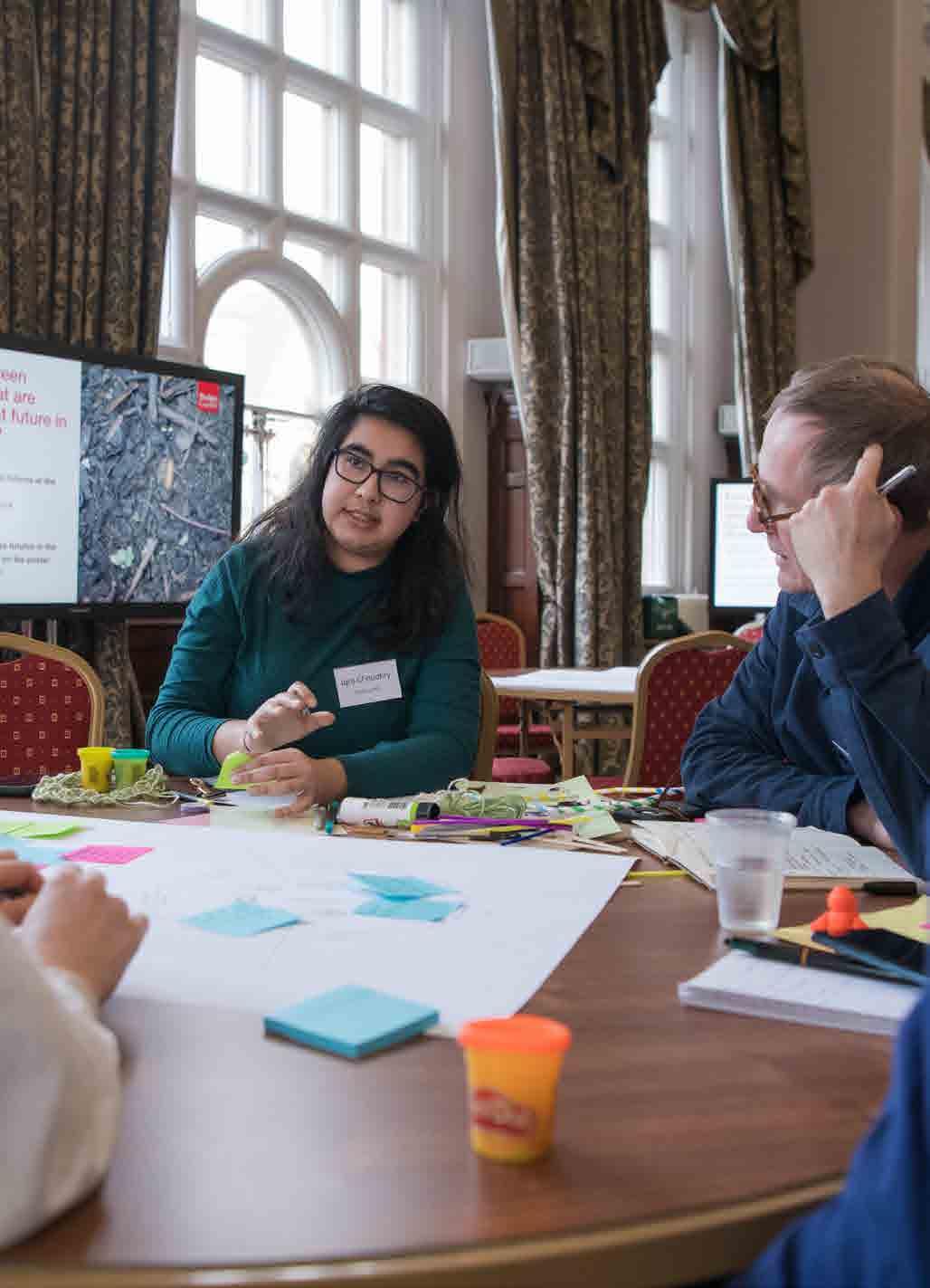
Credit: make happy
Language
Designing for planet requires a shift in the way we think about, communicate and act. The language we use is critical to this change.
This page sets out some of the key language that we use in this toolkit, alongside definitions. Some of this might be familiar and some might be new. It is important that we embrace this new language as it embodies the shift that we need to make, and transitions us away from current language that is holding us back.
One of the terms on this page is ‘non-humans’, which implies a separation between human-beings and all other living beings. We fully recognise that we are a part of nature, but we also find it helpful to distinguish between us and other living beings so that we are actively encouraged to design with a more than human perspective.
Glossary
Regenerative – designing processes and activities that utilise physical and social assets so that they can restore, renew or revitalize their own sources of energy and materials
Circular – a resilient system that eliminates waste by bringing resources back for re-use
Biodiversity – the number and variety of species found within a specified geographic region
Vision – an overall picture describing how the world might be in the future
Mission – a specific goal or opportunity that requires different sectors working together
Issue – an area or topic of concern
Challenge – a large, complex societal problem that needs collective effort
Impact – what has, or will change for the positive following an idea or intervention
Value – the measurable positive impact created by an idea or intervention
Idea – creative concepts for how to overcome challenges or realise a future vision
Intervention – actions that intervene in human behaviour
Non-humans – all living beings that are not human
Orientation

How we start our work determines the outcome. To achieve a just and regenerative world, we need to radically rethink how we live. This means working to a different set of values.
As well as aligning on a brief to set the objective, deliverables and deadline for the work, it is also crucial to start with a shared, hopeful vision, and a set of guiding principles. Spending time forming the team, with the right characteristics for systemic work and a trust that binds people, cannot be underplayed.
This section of the toolkit will help you to:
Guide your work by considering a set of six principles that help you Design for Planet (Design for Planet Principles, tool 1 ).
Ensure that the four characteristics required for designing systemically are present in your team or wider stakeholder ecosystem ( Team Roles, tool 2 ).
Create a hopeful vision that everyone can aim for (Future Vision, tool 3 ).
Consider your current and potential stakeholders, including non-humans, and how you can involve them in your work (Stakeholder Ecosystem, tool 4 ).
Design for Planet Principles
A set of systemic and planet-focused principles that guide the method and ways of working on a project.
tool Complexity 45–60 mins

Purpose of this tool:
These principles are a starting point for designing systemically and inclusively with the planet in mind.
Considering them at the outset of a project will help your team come together to explore ways of working and raise the ambition of the project.
Why this tool is important:
Systemic design is about more than following a different design process. It is about adopting a systemic mindset, which in turn leads to behaviour change. These principles are a starting point for this shift, providing a frame of reference for thinking and working in a different way.
What you need to begin:
To do this exercise, you need to gather as a team. We recommend inviting stakeholders who are closely involved in the project for this exercise too.

Design for Planet Principles
How to use this tool:
Review each of the principles as a team and ask:
What might this mean for us, and this project?
What might be easy? What might be challenging?
How might we need to think, act and work differently as a result?
Capture your thoughts on Post-its next to the relevant principle.
What now?
Take note of any actions or ways of working that you would like to embed as a team.
Review the actions and ways of working and consider:
What additional support does your team need to embed this?
What is the simplest next step your team could take to implement this action or way of working?
Consider how you might return to these principles throughout the project, for instance by deliberately coming back to them in a regular team meeting.
Further resources
Beyond Net Zero, A systemic Design Approach, Design Council
Design for Planet Principles
01 People and planet-centred
Focus on the shared benefits of all living things.
02 Inclusive and welcoming difference
Seek equity by creating spaces and language where people feel confident to share their perspectives and different ways of knowing.
03 Zooming in and out
Move between multiple perspectives – from micro to macro, local to global, root cause to radical alternative, history to future generations, fast to slow.
04 Collaborating and connecting
See the project at hand as one element in a wider movement for change and seek out opportunities to partner with others for the long term.
05 Testing and growing
Make things to learn and improve how they work and share to help more things emerge.
06 Circular and regenerative
Focus on existing assets – physical and social –and re-use, nurture and grow these where possible.
Credit: The principles were created through research with designers, and developed further with the Royal Society for Arts, Manufactures and Commerce (RSA) and Ellen MacArthur Foundation.
Design for Planet principles
Collaborating and Connecting
Inclusive and Welcoming Difference
People and Planet-Centred
Zooming In and Out
Testing and Growing
Circular and Regenerative
TOOL 01
Miro
Team Roles

Purpose of this tool:
The purpose of this tool is to help ensure that your team has considered how it will adopt the four roles that are central to systemic design.
Why this tool is important:
Our research has shown that systemic design works best when four core roles are fulfilled. These roles are systems thinker, leader and storyteller, designer and maker, connector and convener. Some teams may include people who can span more than one of these roles.
These roles are important because, taken together, they will ensure that your team adopts a systemic mindset and embeds the Design for Planet principles with greater ease throughout the project.
What you need to begin:
To use this tool, you need to have a high-level understanding of the people who will be working on, and influencing, the direction of your project. This may just be an internal team, or it might include external stakeholders who are closely involved in the project. If the latter, consider using this tool together with them.

Team Roles
How to use this tool:
Write down the name of everyone in your team on individual Post-it notes. If you will be working closely with people beyond your organisation, such as partners, external agencies or clients, write these down on Post-its too.
Move the names of everyone in your team into the role that they could potentially take on. When moving names, please note:
One person may be able to hold more than one of these roles, especially if the team has fewer than four people.
This isn’t about job title or previous experience; you could be a project manager but have excellent creative storytelling skills, meaning that you are best suited to the leader and storyteller role.
Ideally, once you have moved everyone’s names, each of the four roles should be fulfilled.
Discuss the allocation with the team. Is everyone comfortable with where they have been placed? Is anyone missing? Have all the roles been filled by someone? If not, is there someone else who could fill this role, even if they are less closely involved in the project?
What now?
Consider how you can make sure that you come back to these roles throughout the project. For instance, you might:
Add these roles to the team job descriptions or to key performance indicators (KPIs)
Reference these roles in your project plan
Make sure that all role types are in the room for important future meetings or workshops
Further resources
Beyond Net Zero, A systemic Design Approach, Design Council
Characteristics of Changemakers Series, Design Council
Tools for Systems Thinkers, Leyla Acaroglu
Building Better Systems, A Green Paper on System Innovation, The ROCKWOOL Foundation (2020)
Team Roles
SYSTEMS THINKER
Someone who can see how everything is interconnected and who can zoom between the micro and macro.
Example skills
Ability to look at the big picture, and then zoom in and find the root of the problem
Ability to handle ambiguity and conceptual thinking
Can hold complexity, expand the brief of the project and encourage the team to dream big
Can spot patterns and synthesise lots of complex information
Can understand material value chains, where relevant
DESIGNER AND MAKER
Someone who understands the power of design and innovation tools, has the technical and creative skills to make things happen and puts these to use early on in the work.
Example skills
Can translate high-level concepts into practical ideas and interventions including products, services, placebased interventions or frameworks
Has the relevant (technical) subject knowledge to be able to make ideas come to life in a tangible way
Simplifies complex ideas so that they are accessible to everyone
LEADER AND STORYTELLER
Someone who can tell a great story about what might be possible and why this is important, get buy-in from all levels and has the tenacity to see the work through.
Example skills
Can use visionary thinking to raise the ambition of the project and encourage people to think more broadly
Ability to gather support and enthusiasm for the project at all levels and align people’s thinking through compelling narrative and visual storytelling
CONNECTOR AND CONVENER
Someone who has good relationships, can create spaces where people from different backgrounds come together and joins the dots to create a bigger movement.
Example skills
People person with good interpersonal skills to engage and connect mission allies, from which further innovations can emerge Ability to connect and align different perspectives and marginalised voices, ensuring that all stakeholders – human and non-human – are involved
Has a good network of potential partners to create greater ambitions or market demand
Holds the team and finds the right people to work on the project to realise its vision.
Future Vision
A guided exercise to create a shared, hopeful vision for the work.
Complexity 1–2 hours
Purpose of this tool:
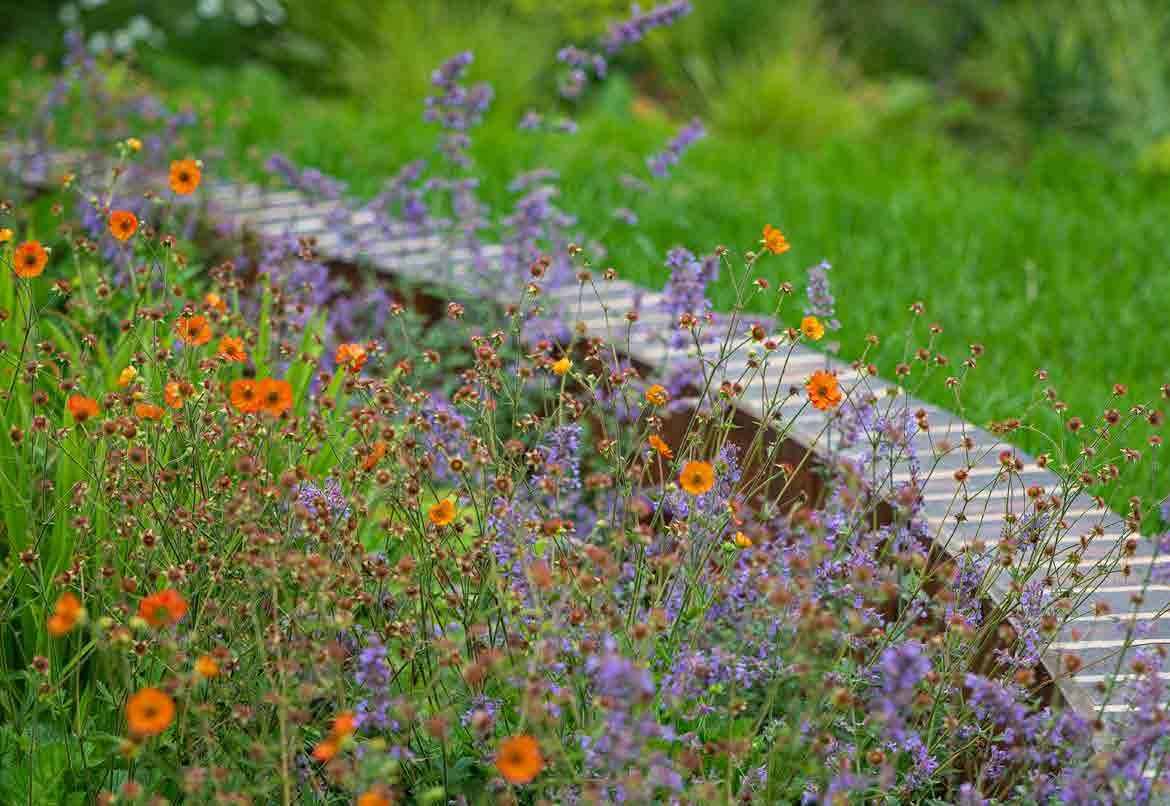
This tool helps you to imagine the world in 2050, giving you permission to be hopeful about the future and providing you with a North Star to work towards.
Why this tool is important:
Articulating a future vision enables your team and wider stakeholders to think bigger than you may be used to.
It means that your work will be focused on the big picture, driving towards a future in 2050 that turned out better than imagined, rather than on a narrow project outcome. By having this North Star, you will be encouraged to push your work further than you thought possible, and you will be reminded to zoom back out when faced with day-to-day challenges or pressures.
What you need to begin:
Time carved out with your team or wider stakeholders, and a volunteer to read the vision script.

Future Vision
How to use this tool:
Part 1: Imagine the future
Nominate one person to read out the vision script . Ask everyone to close their eyes while the script is being read out.
Once the script has been read, ask participants to spend five minutes reflecting individually in silence, writing thoughts down if desired.
Take it in turns to share your vision, focusing on:
01. What does it look and feel like?
02. What behaviours and activities are happening?
As you do so, ensure that someone is capturing these thoughts on Post-it notes, and adding them to the first two rings of the template. You can add pictures as well as words.
Once everyone has shared, cluster the Post-it notes and pictures into themes.

Future Vision
How to use this tool:
Part 2: Explore your future vision in more depth
Now it’s time to dig deeper. As you ask the following questions, add Post-its to the relevant section of the outer ring, linking to the clustered themes where possible:
03. What new stakeholders (human and non-human) and resources are a part of your world in 2050?
04. What new relationships exist?
05. What designs or interventions are in place that support the behaviours, activities and relationships of your future world?
06. What underlying structures are making these designs, interventions, behaviours, activities and relationships possible?
Make a drawing or a poster that brings the key themes and ideas to life, showcasing your shared, imagined future. You can also pull-out key words or phrases that help motivate you to strive towards your vision.
Take a moment to step back and take a look at what is on your vision poster. What stands out? What resonates with you?
What now?
Take note of any actions that you could get started with to help bring your future vision to life, i.e. are there new relationships in your future vision that you could take steps to move towards now?
Keep your physical vision somewhere accessible, where your team can see it on a regular basis (that may mean taking a photo of it and storing it digitally).
Return to your vision to help guide future decisions on your project.
Further resources
Description of Three Horizons and instruction for running a workshop, Doughnut Economics
Overview of Three Horizons with resources, International Futures Forum
Three Horizons: The Patterning of Hope book, Bill Sharpe
From What Is to What If book, Rob Hopkins
Imagination Infrastructures website
Future Vision
Adapted from Jennie Winhall
05. Whatdesignsorinterventionsareinplacethatsupport t he behaviours, activitiesandrelationshipsofyourfuture world?
02.Whatbehaviours and activities are happening?
01.What does it look andfeellike?
03 . Whatnewstakeholders(humanandnonhuman)andresourcesareapartofyourworldin2050?
06 What underlyingstructuresaremakingthesedesigns, interventions, behaviours , activitiesandrelationshipspossible?
04.Whatnewrelationshipsexist?
Our world in 2050
Miro
Future Vision script
We are doing this guided visualisation to connect with ourselves, with our hearts, with who we really are and what we want to be part of creating in this world. We are going to travel, in our imaginations, to 2050. But this is not the 2050 of the dystopia we can quite easily imagine, but rather a place we hear far less of. The 2050 that turned out OK. In fact, it turned out brilliantly. I invite you to imagine that the years between now and then are a time of remarkable social transformation.
I invite you to imagine that a cascade of change was unleashed, some triggered by crises like the Covid-19 pandemic that reset our patterns of work and travel and showed us how much communities can come together and how our habits of consumption could be broken. Other change has been triggered by Extinction Rebellion, School Strikes for Climate, Black Lives Matter and other local but connected projects and movements across the globe, so that a momentum has now built up and is unstoppable.
The pressure for this positive change has come from business, from philanthropists, from government, from local government, from communities, from schools and universities. A hunger for a new culture has built and spread rapidly after a few global crises that jolted us into the collaborative action we needed.
Cities have been reimagined, and new relationships exist between rural communities and their nearest towns. As cars were designed out of city centres, huge amounts of space in need of alternative uses has opened up. The change that’s unfolded has been underpinned by social, climate and racial justice and community involvement and empowerment, and has been focused on building a new, just, diverse, more resilient economy from the ground up. The time between now and 2050 has been characterised by remarkable change that future generations will sing great songs about. They will tell great tales about the courageous and focused people of this time. It’s a time when we feel we’ve been doing everything we could possibly have done.
Take your imaginations for a walk through the streets, the city centres, the high streets, the public spaces. What are the shops like? What do the people look like? What are they wearing? Now imagine the community spaces, the liminal spaces, the workplaces, the local parks. Where and how do people live? What are the housing estates like? Now we are in the countryside. What is happening here? What is happening in the fields, the industrial spaces, the farms, the village communities?
In this reinvented world, how are things made and distributed? What are the factories like, the food production centres, the power plants? How are things agreed and organised – what about the -online spaces? Parliament?
As you explore this 2050 of your imagination…. use all your senses. What can you see……. feel……touch… smell…..hear…. taste of this future world? What do you feel in your body at this moment? As you are walking, you find yourself in a park, and you take a seat on a bench. Look at the people around you in the park… ask yourself… what kind of people thrive here? What qualities do they need to embody? You find yourself curious to talk to someone.
As you sit on this bench you are joined by a young person of about 24 years old and you get chatting to them. What are they interested in? What motivates them? What are their skills? What do they love to do? Who do they thrive on working with in their network? How do they connect to communities?
Stay in that moment.
Now you can open your eyes, and I invite you to describe what you saw. To draw or to write, or both, something of what you imagined. The essence of it. Something specific from it. It could be as simple as a word.
Everything that happens in the future starts now.
Stakeholder Ecosystem
A tool to map out all the human and non-human stakeholders involved or impacted by the work.

Purpose of this tool:
The purpose of this tool is to map your existing and potential stakeholders, so that you have a holistic view of all of the human and non-human actors in your system.
Why this tool is important:
By widening the term ‘stakeholder’ to be more diverse and inclusive, you are prompted to expand your thinking to involve the bigger system. This leads to more effective ideas and interventions and means that you can truly design for the planet (and not just people).
What you need to begin:
Ideally, you will have created a Future Vision (tool 3 ) before creating your stakeholder ecosystem, so that you have already expanded your thinking on who can be included in your ecosystem.
If you are using this tool in person, it is helpful to have a few different coloured Post-it notes.

Stakeholder Ecosystem
How to use this tool:
Part 1: Map existing and potential stakeholders
Nominate one person to read out the vision script. Individually, or in small groups, identify all existing stakeholders. Start with people, then organisations and then consider species and natural resources.
Add these to Post-its (using one colour) and plot them onto the template towards the left-hand side.
Then broaden out to include potential stakeholders. To help you do this, you could refer to any new stakeholders or relationships that were highlighted in your Future Vision (tool 3 )
Add these to Post-its (using a different colour to existing stakeholders) and plot them onto the template towards the right-hand side.

Stakeholder Ecosystem
How to use this tool:
Part 2: Explore stakeholders in more depth
Now that you have plotted your existing and potential stakeholders onto the template, you have created your stakeholder ecosystem.
To dig deeper, you might want to ask the following questions:
What are the needs of each stakeholder? For example, what are their fundamental resources? What do they need to know about your project as it progresses? What enables them to thrive?
What influence does each stakeholder currently have on the system in question? How might you leverage this influence to achieve your vision?
What relationships are there between these stakeholders? How might you make the most of partnerships that already exist?
As you discuss these questions, add thoughts to Post-it notes (using a third colour), and plot them next to the relevant stakeholder(s).
What now?
Take note of any ideas that arise from the above questions, i.e. how you might help stakeholders with less influence or voice to contribute to the conversation, or how existing partnerships may help you achieve your vision.
For any idea that you have, write out the simplest step that you could take to make it happen.
Further resources
Non-human personas, Life-Centred Design
The Biodiversity and Environmental Stakeholder Map, UKGBC
Why nature is the most important stakeholder of the coming decade, World Economic Forum
PEOPLE
ORGANISATIONS
e.g. Citizens, customers, workers, employees, beneficiaries, future generations, people living far away, other cultures
SPECIES AND ECOSYTEMS
e.g. Groups working on adjacent issues, funders, activist & community groups, technology and AI-led organisations
NATURAL RESOURCES
e.g. Animals, plants and other living ecosystem
e.g. Air, water, soil
Orientation
Who’s doing it well?

Silverstone Park
Sustainable transport consultants
Vectos’ development at Silverstone Park — a 2 million square foot business park in Northamptonshire — was able to save £20 million that would otherwise have been spent on a motorway-style junction.
Rather than taking a traditional mobility approach of predict and provide (which forecasts an increased use of what we have currently – i.e. cars), it took a ‘vision and validate approach’. Vectos began with a positive vision for forms of life in a city or place and asked how mobility solutions could help to achieve it.
The result fuses inclusive active travel with local living and includes cycle highways and public amenities that stagger travel times to and from the park, by providing services workers can use before and after their working days.
Source: Shared by Mike Axon Redesigning Mobility for an Inclusive Future (Design Council Medium blog)
Explore
Connections & relationships
Root Cause Analysis
Orientation & vision setting
Reframe Explore
Leadership & storytelling Create Catalyse
Continuing the journey
Explore
Before developing new ideas, we first need to broaden our thinking and deepen our understanding of the issue.
At this stage, conducting design research to gather different kinds of knowledge is essential, i.e. hearing from experts or those with lived experience, learning from nature or spending some time mapping out a user journey. Those who are new to design might want to put these fundamental skills to the test by taking IDEO’s Introduction to HumanCentred Design course.

Once we have a better understanding of the system we are exploring, it is then helpful to interrogate it by thinking more systemically about what sits beneath the surface to determine the root cause of the issue.
This section of the toolkit will help you to:
Dig into the existing system and uncover the underlying structures and mental models that enable it to persist (Root Cause Analysis, tool 5 ).
Root Cause Analysis
A method of mapping the root cause of an issue through underlying structures and mental models.
Tried & tested
Complexity 60–90 mins
LEAD ROLE: SYSTEMS THINKER

Purpose of this tool:
This tool enables you to tackle an issue systemically, by uncovering its underlying structures and mental models. The iceberg model helps you do this by starting at the surface level of a challenge and progressing towards its root causes – from the ‘patterns’ that sit behind the ‘events’ to the ‘structures’ and ‘mental models’ at the root of the issue.
Why this tool is important:
Tackling the root cause of an issue is much more likely to result in a systemic shift. If you don’t consider an issue’s underlying structures and mental models, solutions will likely tackle the surface of a challenge and result in short-term fixes, rather than long-term solutions.
What you need to begin:
A complex issue that you have perceived and are hoping to tackle.

Root Cause Analysis
How to use this tool:
Start with the complex issue that you are focusing on. You can also consider multiple issues and split these between different groups.
In small groups, progress down the iceberg, remembering to consider all living beings and natural resources. Refer to your Stakeholder Ecosystem Map (tool 4 ) if helpful. Add your thoughts to Post-its in each of the following sections:
Events: what do you see happening? E.g. You see your flatmate throw a perfectly good t-shirt in the bin.
Patterns: what trends can you see? E.g. Whenever your flatmate buys new clothes, they throw out old ones, even if they are in good condition.
Structures: what enables these patterns to persist? E.g. There are no textile recycling bins nearby, or no incentives for repairing old clothes.
Mental models: what belief systems underpin these structures? E.g. Clothes are cheap and it doesn’t feel like a big deal to throw them away.
As you progress down the iceberg, draw lines between different Post-its if there are specific connections that you want to call attention to. This will be especially helpful if your issue has lots of different events, patterns, structures and mental models.
If you have split into small groups, return to plenary and spend a few minutes per group sharing what you have discovered.
What now?
Consider whether there are any patterns, structures or societal beliefs that could be leveraged to shift the system and help achieve your vision, as well as any that should be reversed or questioned.
Agree the simplest next steps that you could take to put these ideas into action.
Further resources
Iceberg Model further detail, Eco Challenge
Iceberg Model with a deeper Maori restorative approach, Centre for Social Impact
Ideas Arrangements Effects, Design Studio for Social Intervention (2020)
Root Cause
Credit: original iceberg model was developed by Edward T. Hall in 1976
EVENTS
What do you see happening in your system? What are the obvious activities and behaviours?
PATTERNS
Are there any events that are persistent and happen on a regular basis? What trends can you see?
STRUCTURES
What policy, governance, rules, organisational set-up and infrastructure sits behind these patterns and enables them to persist?
MENTAL MODELS
What societal beliefs, attitudes and narratives make these structures possible?
Miro
Explore Who’s doing it well?

Fairphone
Fairphone is the world’s first repairable smartphone. Founder Bas van Abel and his team worked to understand where the materials involved in the production of a smartphone come from as well as learn about the labour that created them.
When exploring the smartphone landscape, they discovered a persistent underlying belief in the tech industry: the goal is always to sell more phones. To tackle this mental model, their mission was to shift the industry to design products that can be easily disassembled and repaired. They also designed an alternative business model – based on subscription –to incentivise re-use. To further shift the system, they wrote to European policymakers, influencing a change in the law that has made it a requirement for other smartphone providers to make their products repairable.
Source: Shared by Bas van Abel at Design for Planet Festival ’24 (Design Council Medium Blog)
Image credit: Fairphone
Reframe
Orientation
Connections
Reframe

Moving to a more equal, regenerative world means breaking out of our current way of thinking and actively seeking out alternative perspectives. It means creating things – products, places and services – that reflect new values and beliefs. We must allow time and permission to reframe the challenge in different ways, so that new ideas can develop. During this stage, it may also be helpful to cluster and theme insights from both Explore and Reframe, in order to spot patterns and see where to take the work next.
This section of the toolkit will help you to:
Reframe opportunities through different lenses, for example with a different purpose or mission, or with regenerative or sustainable values (Different Perspectives, tool 6 ).
Take a step back and reflect on your work so far as it relates to self, project and system (Deep Reflection, tool 7 ).
Different Perspectives

Purpose of this tool:
This tool helps you to look at challenges from different perspectives and open up space for new ideas that may not have been considered.
Why this tool is important:
Challenging preconceived ideas and mindsets is an essential part of the design process. Without taking this step, it is easy to develop ideas and interventions based on assumptions, shutting down possibilities that can emerge through thinking differently. This tool asks you to let go of what you know, and to embrace a wider set of opportunities available to you.
What you need to begin:
To use this tool, you need to have a good understanding of the challenge that you are trying to tackle in your project and the types of stakeholders involved in or impacted by it. Stakeholder research is recommended ahead of completing this exercise as it requires you to understand these different perspectives. Alternatively, you may decide to invite additional stakeholders to participate in this exercise.

Different Perspectives
How to use this tool:
Start with the issue that you are focusing on (this should be a complex, systemic issue).
In small groups, look at the cards and make sure that everyone is clear on what they mean and is comfortable with the examples.
Take it in turns for each person to choose a card and lead a five-to-ten-minute conversation on how it reframes your issue. Consider the following prompt questions:
How might you change your approach to the issue?
What might be possible?
What might be difficult?
Take notes on Post-its as you go.
Once everyone in your group has had the opportunity to lead a conversation, step back and look for any patterns in your notes. Consider:
Which reframe has expanded your thinking about an issue?
Which reframe invites more possibility and resources?
Where is your collective excitement?
What now?
Discuss whether there are any opportunities to approach your issue or your project differently, based on the conversations you have had.
If there are, agree the simplest next step to make this happen.
Further resources
Frame Innovation, Kees Dorst (2015)
New Metaphors Toolkit, Imaginaries Lab
asknature.org
Biomimicry Toolbox, Biomimicry Institute
Experimental policy design methods, Policy Lab
Flourish, Sarah Ichioka and Michael Pawlyn, (2021)
System Innovation on Purpose, Jennie Winhall and Charles Leadbetter
TAKE A DIFFERENT
PERSPECTIVE
Different Perspectives
FOCUS ON A PARTICULAR SYSTEMIC ISSUE
TAKE A DIFFERENT PERSPECTIVE
Ask the bigger question
e.g. ‘How can we generate less waste?’, rather than ‘’how can we deal with the waste we create?’
TAKE A DIFFERENT PERSPECTIVE
Extend your thinking to all levels of the system
e.g. Creating office gardens with beefriendly plants, increasing biodiversity as well as helping improve employee wellbeing.
FOCUS ON A PARTICULAR SYSTEMIC ISSUE
Go further upstream
e.g. Use fewer resources and waste less, rather than recycling.
FOCUS ON A PARTICULAR SYSTEMIC ISSUE
Tackle the root cause
e.g. Look at why pollution is being dumped in rivers in the first place, instead of jumping straight to clearing it up.
TAKE A DIFFERENT PERSPECTIVE
Turn a negative into a positive
e.g. Seeing ultra-low emission zones as an opportunity to improve air quality and people’s health, rather than an inconvenience.
FOCUS ON A PARTICULAR SYSTEMIC ISSUE
Reverse an unhealthy pattern or vicious cycle
e.g. Fear of crime leads to kids not walking to school (and more traffic pollution), which leads to no investment in safe walking routes etc.
APPLY A DIFFERENT LOGIC
APPLY A DIFFERENT LOGIC
Set a new purpose
e.g. Houses that actively contribute to local communities, rather than just being somewhere for people to live.
APPLY A DIFFERENT LOGIC
Do a different type of opposite
e.g. Promoting minimalism is not the same as promoting anticonsumerism
APPLY A DIFFERENT LOGIC
Use a new metaphor
e.g. What would building a new house look like if we thought about it with the metaphor of ‘weaving’ in mind?
WHAT WOULD HAPPEN TO THE ISSUE IF YOU MOVED FROM
MOVE FROM
Short-term to long-term
MOVE FROM
Linear to circular to regenerative
e.g. Instead of developing flats to sell, develop communities that act as long-term stewards of local biodiversity, thus protecting the flats from climate change.
e.g. Buildings that use lots of energy à buildings that are energy efficient à buildings that produce energy.
MOVE FROM Separate to interconnected
e.g. A repair café that includes training for volunteers and enables people on low incomes to save money.
MOVE FROM Seeing ourselves as separate from nature, to being part of nature
e.g. Use wetlands as a natural sewage system, which then creates clean water for fish farming, which, in turn, feeds the local population.
MOVE FROM Centralised and closed to networked and open
e.g. Move from centralised energy grids to networks of citizens that produce and share solar energy with their neighbours.
MOVE FROM Managed and paternalistic to enabling and empowering
e.g. Instead of building energy efficient homes from scratch, give people the skills, funding and capacity to retrofit homes.
Miro
Credit: Adapted from Jennie Winhall and inspired by Michael Pawlyn, Sarah Ichioka and Dan Lockton
Deep Reflection
An opportunity to slow down and take stock of a project’s wider impact and learnings.
LEAD ROLE: CONNECTOR AND CONVENER

Purpose of this tool:
The purpose of this tool is to provide you with a set of questions that help you reflect at the start of a project and throughout. The questions encourage you to think about the impact of your actions and your learnings at the level of self, project and system, making sure to consider all living things.
Why this tool is important:
In a fast-paced world there are often pressures to deliver outcomes quickly. When designing systemically, more emphasis is put on thinking about a problem holistically, and taking the time to slow down and reflect so that better decisions can be made in the long run.
What you need to begin:
A relaxed environment where you can think through or journal to these questions.

Deep Reflection
How to use this tool:
Part 1: Individual or small group reflection
Create a relaxed space that feels different to your normal work environment. For instance, you might want to take a notebook to a park bench, or you could make a cup of tea and put on some calming music.
Either individually or in small groups, reflect on the questions – starting with self, then project and then system.
What now?
Take note of any ideas that arise from the above questions, i.e. how you might help stakeholders with less influence or voice to contribute to the conversation, or how existing partnerships may help you achieve your vision.
For any idea that you have, write out the simplest step that you could take to make it happen.
Further resources
Time to think: Listening to Ignite the Human Mind book, Nancy Kline Change in Nature reflective spaces On Slowing Down in Urgent Times, Dr Bayo Akomolafe
Deep Reflection
How to use this tool:
Part 2: Campfires with the wider system
Although it is beneficial to reflect individually or within your team, bringing people together from different organisations working on a common mission can be even more powerful. We suggest setting up a ‘campfire’. Typically, campfires are places where people from all backgrounds can share stories without judgement, which makes them the perfect setting for reflecting on the wider system.
Setting up a campfire:
Start by thinking about who should be present. Your Stakeholder Ecosystem Map (tool 4 ) may help with this.
When inviting people to attend, set the expectation that ‘campfires’ are regular, informal story telling sessions where the group can share and reflect on progress towards your common mission.
Running a campfire:
Remind attendees of your common mission or vision. Your Future Vision (tool 3 ) may help with this.
Check-in in pairs: how are you and what are you personally learning from this work so far?
In small groups, share progress on your project and where you might value support from the wider group.
Feedback in plenary.
In different small groups, consider the bigger signals of change that you are seeing. What else is happening that is influencing the common mission or vision?
Feedback in plenary.
What now?
Commit to three actions as a group that you will work towards before you next meet.
Ensure that the next campfire is scheduled.
SELF
What am I learning from this work?
What is helping me step into my role (assigned at the beginning of this work, through Team Roles, tool 2 )? What is hindering me?
What am I finding most energising and most draining in this work?
PROJECT
SYSTEM
What impact is our work having on humans and non-humans so far?
What could I do more of or less of going forward, to build on what works and what I enjoy?
What is helping us make progress towards our vision (see Future Vision, tool 3 ), and what is hindering us?
In what ways have we been embedding the DfP principles (tool 1 ) and what have we learned from this?
What changes have we seen across the system? i.e. to the stakeholder ecosystem (tool 4 ).
What is required to further shift the structures and mental models of the system? (See Root Cause Analysis, tool 5 ),
What unexpected or unplanned events, relationships or influence have we perceived across all living things?
What could we do more of or less of going forward, to build on what works and what is already having an impact?
What could we do more of or less of going forward, to further shift the system, and create shared benefits for all living things?
Reframe
Who’s doing it well?

Forth Valley Hospital
Forth Valley Hospital and grounds were developed on the historic landscape of Larbert House, which had fallen into neglect due to lack of maintenance and vandalism.
The landscape around it was also seen as an inaccessible liability, that had no value for the local community. During the renovation, landscape architects Raeburn Farquhar Bowen reframed the green landscape as an asset and an integral part of the new hospital. Nature was integrated into patient rehabilitation and in return, this natural resource benefitted from development with invasive species removed, native woodlands replanted, and sustainable urban drainage and green courtyards installed.
Source: Shared by Design Council Expert Sheena Raeburn Resilient Places and Designing with Nature (Design Council Medium blog)
Create
Once the issue has been thoroughly explored and reframed, it is time to start creating a series of different actions and ideas that can connect with other interventions.
Some can be small practical steps and others can be big, audacious ideas that might never happen but will help people reimagine what might be possible. However tempting it may be to launch into design as a project team, it is important to co-design; inviting people with lived experience or alternative perspectives into the process.

This section of the toolkit will help you to:
Create a portfolio of ideas, generated at different layers of the system: specific products, services and places; policies, regulations or standards; narratives or cultural mindsets (Portfolio of Ideas, tool 8 ).
Consider the unintended consequences of your ideas (Unintended Consequences, tool 9 ).
Portfolio of Ideas
Purpose of this tool:
The purpose of this tool is to help you generate ideas. The ideas might be for new products, services or policies, or they might be new ways of connecting what already exists. Not all of the ideas that you generate need to be within your scope to deliver, but zooming out to consider what interventions are needed is still a worthwhile activity.

Why this tool is important:
An essential part of systemic design is knowing what your role is within the system. Through this tool you might generate ideas that sit outside your remit, but rather than shutting these down, this tool enables you to make links to others who can work on those areas and suggest how you might influence and support them. This is important because they are your mission allies!
What you need to begin:
Start with a review of your vision (see Future Vision, tool 3 ), so that you have it top of mind when coming up with ideas that will help make it happen.

Portfolio of Ideas
How to use this tool:
Revisit your Future Vision (tool 3 ) so that it is front of mind. You may also want to revisit your Root Cause Analysis (tool 5 ), to help you think about ideas at different levels of the system.
Individually, generate as many ideas as possible for five minutes. Write one idea per Post-it note.
In small groups, share your top five ideas:
Plot your ideas onto the template as you go, arranging them from micro to macro and from ideas that your team can lead to ones you need others to lead.
Allow time to build on each other’s ideas. Do not critique at this point. ‘Yes and…’ rather than ‘no but’..
As you discuss the ideas start to consider what their social, democratic, planetary and financial value might be (see our Design Value Framework).
Feedback in plenary to summarise your top ideas from each group.
What now?
Review your Portfolio of Ideas. Of the ones that your team or organisation can do, consider if there are any that you would like to build into your project plan. Are there any quick wins that you could implement without too much effort? Are there any bigger projects that require further conversation? Agree the simplest next steps for any of the ideas that you would like to take forward.
Of the ideas that are outside your remit, consider whether any of them could be implemented by an existing stakeholder within your ecosystem (refer to your Ecosystem Map, tool 4 ). Could you set up a conversation with them or share at a future campfire (refer to Deep Reflection, tool 7 )?
Agree the simplest next steps for any of the ideas that you could influence to happen.
Further resources
A Guidebook for Adopting Portfolio Approaches, UNDP
Ideas that bring the future vision for the system to life and make it real for people, challenging the existing narratives or stories shaping the current system
Portfolio of Ideas
Ideas that help shift the structures within the system, such as through new policy, regulation or funding, as well as through initiatives that bring about new skills, data, organisational culture or platforms for connecting
Ideas for specific products, places or services that help shift part of the current system
Things that my team/org can do.
Things that I need to influence others to do.
MACRO
MICRO
TOOL 08
Miro
Unintended Consequences
A tool to help think through the positive and negative knock-on effects of a design.
Complexity 45–60 mins
Purpose of this tool:
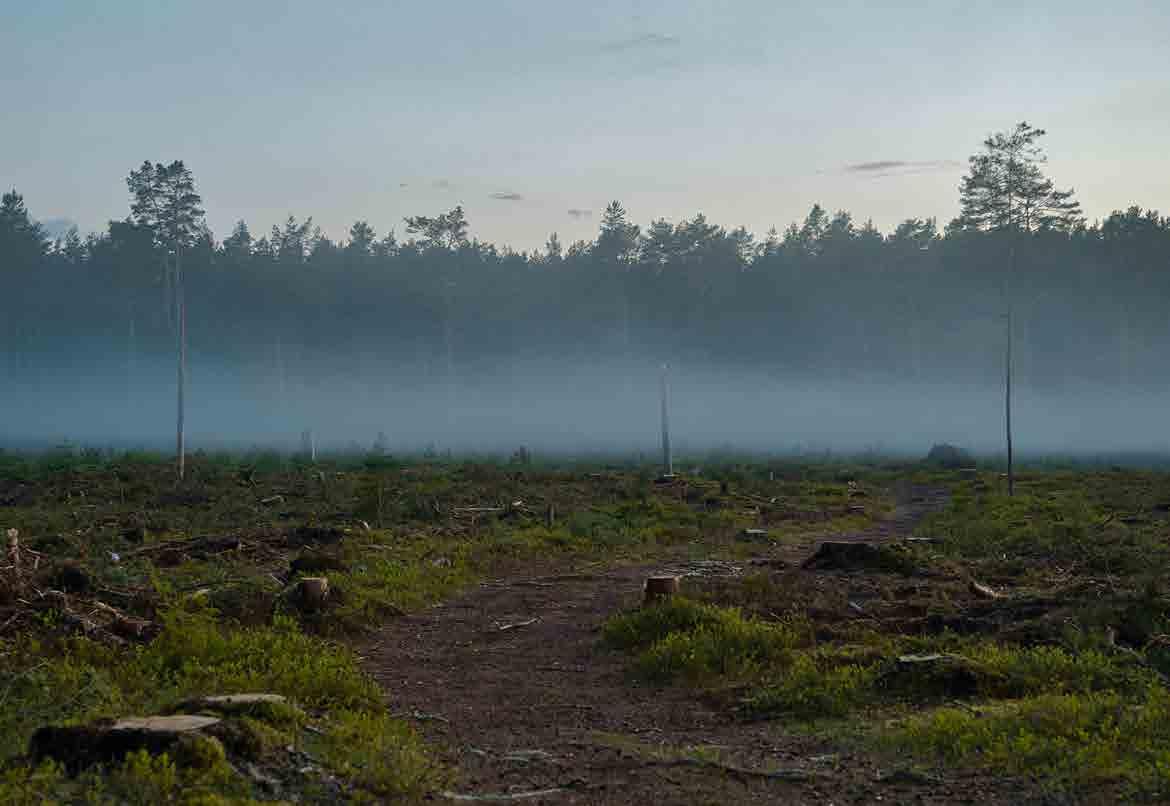
The purpose of this tool is to help you think about how your design may have knock-on effects on people or planet that you have not intentionally planned for.
Why this tool is important:
Often, things are designed and put out into the world without much thought as to what the unintended consequences might be – whether those are harmful or not. By stopping to think about them, you have the chance to mitigate against any potential harmful consequences, as well as intentionally build on potential positive ones.
What you need to begin:
You can use this tool at any point in your project, but it will be easier to think of specific consequences once you have prototyped your idea.
It may also be helpful to have your Stakeholder Ecosystem Map (tool 4 ) to hand.

Unintended Consequences
How to use this tool:
Start with an idea that you think you would like to develop further. Refer back to your Portfolio of Ideas (tool 8 ), if helpful.
Take some time to reflect individually on the immediate and wider negative consequences that it may cause.
Having your Stakeholder Ecosystem Map (tool 4 ) to hand may help you consider the potential consequences on different parts of the system.
Discuss as a group, going through each negative consequence and considering the knock-on effects.
Repeat with positive consequences.
What now?
Take a step back and think about what you have learned through this exercise. Are there any negative consequences that you can mitigate against? Are there any positive consequences that you can intentionally build into your design?
Note down these ideas and agree the simplest next steps that you could take to start working towards this.
Further resources
Unintended Consequences toolkit, Andthen
Unintended Consequences
What NEGATIVE consequence could happen?
What wider POSITIVE value could be achieved?
Credit: inspired by Indy Johar and Santini Basra
...And what would that then lead to?
What could that lead to?
...And what would that then lead to?
...And what would that then lead to?
What could that lead to?
...And what would that then lead to?
Miro

Source: Shared by Design Council Expert Prof. Katharine Willis (Design Council Medium blog) Create Who’s doing it well?
Green Minds
Green Minds is a European Union-funded project in Plymouth that uses a ‘living lab’ approach to give nature a voice.
Deploying citizen science, local residents are invited to collect data about nature and their surroundings using apps, QR codes and chatbots. City-wide sensors have also been installed in trees. This information is then used by the Rewilding Network – made up of communities across the city – to generate ideas for how to rewild the city. These ideas have been put into action and are shared openly for others to copy.
Catalyse
Radical New Narratives
Orientation & vision setting
Connections & relationships
Explore Reframe
Create Catalyse
Leadership & storytelling
Continuing the journey
Catalyse
Thinking systemically can often feel overwhelming, but making things helps us move forward.
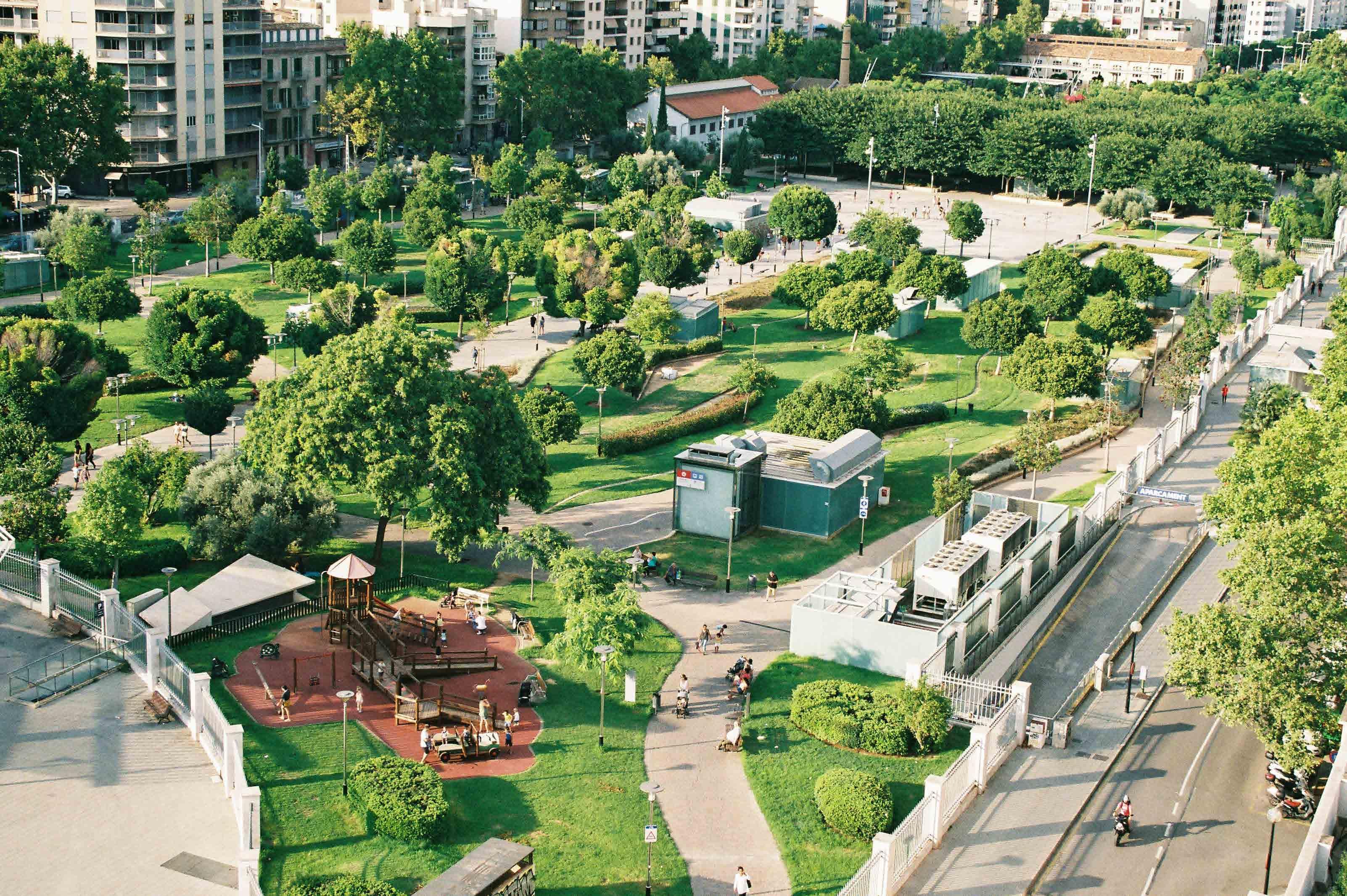
It demonstrates what a new vision looks and feels like in a tangible way, so people can get behind it or add their ideas to it. Prototyping is an important way of rapidly mocking up an idea in order to test how it works, explore how it connects with other interventions and see what else develops or grows from it. Sometimes, designing systemically may mean that there is not one obvious intervention to prototype, which is where testing the radical new narrative or big systemic shift comes in.
This section of the toolkit will help you to:
Create radical new narratives that invite you to test bold ideas and invite others along with you (Radical New Narratives, tool 10 ).
Radical New Narratives
A way to make a vision tangible so that others can really understand it and become part of shaping that future. Complexity 3 hours

Purpose of this tool:
This tool will help you develop radical ideas using speculative design techniques. Through this process you will be able to test and learn what resonates, as well as build further mission allies by inviting them into the future that you are trying to create.
Why this tool is important:
Shifting a system is difficult and requires sustained effort. Visualising ideas and making the emerging system feel more tangible will not only help you test your assumptions and grow ideas, but also help others to understand your vision better and contribute their ideas. Plus, it is a great way of generating excitement about what is possible.
What you need to begin:
Before starting, consider what system-shifting ideas you would like to test. You may want to refer to the ‘macro’ section of your Portfolio of Ideas for inspiration.

Radical New Narratives
How to use this tool:
Confirm the radical idea that you would like to bring to life. One of the macro ideas in your Portfolio of Ideas (tool 8 ) would be a great place to start. You may also want to refer to your Future Vision (tool 3 ).
Discuss section 1 of the template and add your thoughts onto Post-its. Consider which aspects of your Portfolio of Ideas and Future Vision you want to test and the questions you would like to have answered.
Next, discuss section 2, continuing to add thoughts onto Post-its. Who is it that you need to influence and encourage to join you on your mission? Refer to your Stakeholder Ecosystem Map (tool 4 ). Are there any potential stakeholders that you want to join you on your journey, including non-human ones?
Once you have agreed your target audience, move onto section 3 of the template. How can you best immerse your target audience in the future that you are hoping to create? Consider:
how you want to make people feel and the tone of voice that would resonate best
the key messages that you need to communicate
the format that would best bring your radical idea to life (this could be a video, an animation, a storyboard, an immersive experience, a performance, an exhibition, or something else entirely)
Finally, turn to section 4 and think about how you will know whether your new narrative has been a success or not.
What now?
Confirm as a team who will do what, and how you will work towards your event or experience together.
Remember, this doesn’t need to be a one-time activity. You can continue to create speculative designs and explore options, seeing what resonates best and learning as you go.
Further resources
Designing for Legacy Series, Design Council
Experimental policy design methods, Policy Lab
The Futures Toolkit, Government Office for Science
Speculative design: A design niche or a new tool for government innovation?, Nesta blog
Making Futures Work, Phil Balagtas
RADICAL NEW NARRATIVES
Radical New Narratives
Used for exploring and championing transformative system shifting ideas or a big vision, to provoke reactions and discourse to learn from.
01 What do you hope to learn, test and achieve?
02 Who might you test or share that with? How can you involve or consider input from stakeholders from nature?
03 What format might that take?
04 How will you know if your radical new narrative has been a success? How might you capture data or feedback to help you find this out?
Miro
Catalyse Who’s doing it well?

The Health Foundation x The Liminal Space
The Health Foundation worked with creative consultancy The Liminal Space to create a ‘Net zero NHS: imagining the future’ installation.
The immersive experience takes you through three different rooms, all set in a scenario of one day in the NHS in 2036. Taking this creative approach is a way of encouraging people to imagine a future NHS, by physically stepping into a world where it already exists. By doing this, the installation asks people not just to think about a future NHS, but also to imagine what their own life might look like in 2036, helping to create a personal connection to the subject matter.
Sources: Shared by Design Council Expert Sarah Douglas Net Zero NHS, The Liminal Space; One Day in 2036 blog, The Health Foundation
Image credit: Mike Massaro
Continue
Connections & relationships
Create Catalyse 11 Regenerative Business Canvas
Orientation & vision setting
Explore Reframe
Leadership & storytelling
Continuing the journey
Continue

In dynamic systems, our work is never done. Things change and other opportunities arise.
As our projects draw to a close it is important to reflect on, and learn from, any mistakes, but also plan for what comes next. Return to the vision, consider where progress has been made, and where design is needed next. Continue to build the ecosystem, sharing knowledge so designs can be open-ended with others contributing to change.
This section of the toolkit will help you to:
Consider the different types of value that your project or intervention offers to the world (Regenerative Business Canvas, tool 11 ).
Regenerative Business Canvas
Purpose of this tool:
This tool encourages you to summarise the core components of the idea that you are looking to bring to market. Like a normal business canvas, this canvas helps you communicate the value your proposition brings to stakeholders and investors and the resources needed to get there. Unlike a normal business canvas, however, this tool asks you to think about ‘value’ in a much more holistic way.

Why this tool is important:
This is a foundational tool that builds upon, and connects with, all the other tools in this toolkit. It asks you to expand your definition of ‘value’ from purely financial, to social, democratic and planetary; enabling you to demonstrate the potential regenerative business value of your proposition, so that you can gain buy-in and investment.
What you need to begin:
To use this tool, you first need to align on the proposition that you are exploring. You may be clear on this already, but if not then refer to your Portfolio of Ideas (tool 8 ) and use this canvas more speculatively.

Regenerative Business Canvas
How to use this tool:
As a team, write out your big picture vision. Use your Future Vision (tool 3 ) as a reference and summarise fundamental ideas, behaviours and attributes from it for this canvas.
In small groups or individually, capture your ‘vision foundations’ on Post-its. These foundations act as the compost, enabling you to create the right conditions for achieving your vision. It may be helpful to refer to your Stakeholder Ecosystem (tool 4 ) and Portfolio of Ideas (tool 8 ).
Once you have added your ‘vision foundations’, ask:
What is our collaborative advantage? (i.e. how might we join forces with specific mission allies, make use of resources across the ecosystem and learn from existing ideas?)
Which of these foundations will be easiest, and which will be hardest, to harness?
Which of these foundations are most stable, and which the least?
As a team, write out your proposition. Your proposition is the unique way in which you hope to achieve (part of) your vision. It is the product, service, idea or experience that you are creating.
In small groups or individually, capture your ‘value proposition’ on Post-its. Your value proposition is what will generate buy-in and encourage investment. Consider the indicators underneath each value type to help you.
Together, discuss your ‘value proposition’ and how you will know if you are generating social, democratic, planetary and financial value. Add these to Post-its in the ‘measures’ section.
What now?
Review your Regenerative Business Canvas and consider whether there are any gaps in knowledge or resource to deliver value. What might you do to address these gaps?
Agree the simplest next steps to address these gaps and move towards the value you would like to deliver.
Further resources
The Design Value Framework, Design Council
Problematizing Scale in the Social Sector, In With Forward
One Planet Living, Bioregional
Regenerative Business Model, Redesign Everything
A Compass for Just and Regenerative Business , Forum for the Future
The Regenerative Business Model Canvas, Cosmic Gold Medium
The Climate Justice Playbook for Business, B Lab
The B Impact Assessment, B Lab
Vision A few sentences that capture your big picture vision.
Regenerative Business Canvas
Mission allies
The businesses, organisations and people who you can collaborate with to achieve your vision.
Resources
The capabilities and skills that enable you to achieve your vision – whether within your organisation or via your mission allies.
Existing ideas
The existing ideas or interventions that are also working towards your vision.
Proposition A few sentences that capture the unique idea or intervention that you are bringing to market.
Social value indicators: health and wellbeing, social and food security, sense of belonging, protected heritage, housing, social cohesion.
Democratic value indicators: inclusive design processes, diversity of organisation/project team, empowerment in decision-making, governance.
Planetary value indicators: carbon footprint, biodiversity net gain, land use, water and air quality, positive behaviour change towards sustainability.
Financial value indicators: social and environmental investment, contribution to local economies, adoption of alternative business and delivery models.
Measures Key performance indicators (KPIs) that will help you know whether you are generating value.
Miro
Continue
Who’s doing it well?

BEEN London
BEEN London disrupts the fast fashion industry by designing zero waste, luxury products made from an array of recycled materials or materials destined for landfill.
Its business model is regenerative, as it thinks about ‘value’ beyond financial terms. It generates planetary value through the innovative materials that it uses and is even growing its own forest. Everything is handcrafted locally with artists who have generations of experience, adding social value. BEEN actively seeks partners and collaborators and its story is one fuelled by collaboration – from gathering initial funding from Kickstarter, to being approached by organisations like DHL, Netflix and Tate to bring waste materials back to life.
Source: BEEN London
Further links
Evidence-based interventions
Project Drawdown – existing climate solutions that reduce greenhouse gases
UN Environmental Programme – a practical guide that demonstrates how buildings and community spaces can be constructed to increase their resilience to climate change
BREEAM Communities – framework to help integrate sustainable design into master planning
Natural England Green Infrastructure Guide –tools to map green infrastructure
Climate Framework – framework that contextualises the UN Sustainable Development Goals in the built environment
Foundational theories
Leverage Points – Donella Meadows sets out nine leverage points for intervening in a system
Building Better Systems – a green paper that presents four ‘keys’ to unlock system innovation, by Jennie Winhall and Charlie Leadbetter, System Innovation Initiative
The Dynamics of Transitions – a multi-level perspective model by Professor Frank Geels
Berkana’s Explorations – an exploration of how change happens in living systems by the Berkana Institute
Planetary models
Limits to Growth – a 1972 report by Barbara Ward and Rene Dubos that highlights the earth’s finiteness and looks at the consequences of exponential growth
Doughnut Economics – a planetary model by Kate Raworth that highlights a social foundation and an ecological ceiling to human activity
Designing Regenerative Cultures – in this book Daniel Wahl explores ways of relating to the many converging crises and opportunities faced by humanity
One Planet Living – principles for living within Earth’s resources by Bioregional
Regenerative Leadership – in this book Giles Hutchins and Laura Storm provide a holistic and systemic framework for building prosperous and regenerative organisations
Further design resources, tools and organisations
Helen Hamlyn Centre
Microsoft Inclusive Design
Luma Institute
DOGA Inclusive Design (Norwegian Design Council)
The Long Time Tools, The Long Time Project
The Circular Design Guide, Ellen Macarthur Foundation
Design Kit: The Field Guide to Human-Centered Design, IDEO
This toolkit was produced by a Design Council team comprised of colleagues and Design Council Experts, including Nat Hunter, Rachel Bronstein, Nikki Van Grimbergen, Cat Drew, Alexandra Deschamps-Sonsino, Laura Melissa Williams, and Laura Malan. Eve McGowan provided copywriting support and Joana Pereira provided graphic design support.
Some of the tools in this toolkit are new. We will only learn how they work best and how they could be improved once more people start to use them. We therefore invite you to feedback so that we can continue to evolve this toolkit. Please also let us know how you are using the toolkit and what you are finding most helpful.
Email info@designcouncil.org.uk with subject heading ‘Systemic Design Toolkit’.
