CELEBRATE INDEPENDENCE DAY WITH FAMILY



COMMUNITY NEWS I FESTIVALS I ENTERTAINMENT I TRAVEL AUGUST 2023 NEWS | HEALTH | LITERATURE | FESTIVALS | YOGA | ARTS & LITERATURE | LIFE STYLE
ACCREDITED FROM G DEALS ai169044540664_IndependenceDay_794x189.pdf 3 27/07/2023 6:10:09 PM




Download Our App AUGUST I 2023 www.DesiAustralia.com 2 76th India Independence Day Wishing you and your family a joyful celebration of the Level 1, Suite 101C, 130 Main Street, Blacktown PO Box 8525, Blacktown NSW 2148 (02) 9671 4780 michellerowland com au Michelle rowland MP@aph gov au Minister Michelle Rowland MP Authorised by Michelle Rowland MP, Australian Labor Party, Blacktown NSW 2148 @mrowlandmp ADVERTISEMENT Advertisement


Download Our App AUGUST I 2023 www.DesiAustralia.com 3 Wishing you and your family a happy INDIAN INDEPENDENCE DAY (02) 9602 0101 leppington@parliament.nsw.gov.au Level 1, Leppington Village, 108 Ingleburn Rd, Leppington NSW 2179 PO Box 78, Leppington NSW 2179 NATHAN HAGARTY MP STATE MEMBER FOR LEPPINGTON AUTHORISED BY NATHAN HAGARTY MP. FUNDED USING PARLIAMENTARY ENTITLEMENTS. ADVERTISEMENT Advertisement

Download Our App AUGUST I 2023 www.DesiAustralia.com 4 Advertisement
Download Our App AUGUST I 2023 www.DesiAustralia.com 5 Advertisement
2023 Saree Soirée of Sydney

Breaking the Silence: Empowering Women & Talking about Healthy Relationships
Heartthrob Ali Zafar live in Adelaide Musical concert Excitement starts building up for this upcoming event on 22nd September
HM Designers Melbourne, a pinnacle of excellence Randhawa sisters creating waves in women’s fashion
2023:


08 Indian Independence Day 24 26 28 34 36 38 A
Respect
A Saree Club
A
The Perfect Cup Of Chai Comes In A Box AIBC farewells Mr Manish Gupta,
General of India in Sydney 12 16 18 20
53 31 48 43 46 54 10
documentary on ‘Chenda’ finding home in Sydney The Indian Tea Room
A Delightful Blend of Culture, Purpose, and Awareness
and Recover
Initiative
New Air India is unveiled, representing bold New India on the world stage
Consul
CONTENTS
PUBLISHER
Desi Media Group (Desi Australia Pty Ltd)
Editor-in-chief
Arti Banga
NSW Editor:
Harmohan Walia
Sales and Marketing:
Dimple Deez
Victoria Editor:

Daljeet Bakshi
Queensland Editor:
Rajni Ghai Malhotra
ACT Editor:
Rajni Ghai Malhotra
Western Australia Editor:
Ankita Tandon
South Australia Editor:
Daljeet Bakshi
Designer Ravi Mathur
Email : info@DesiAustralia.com
Mob: 0433121339
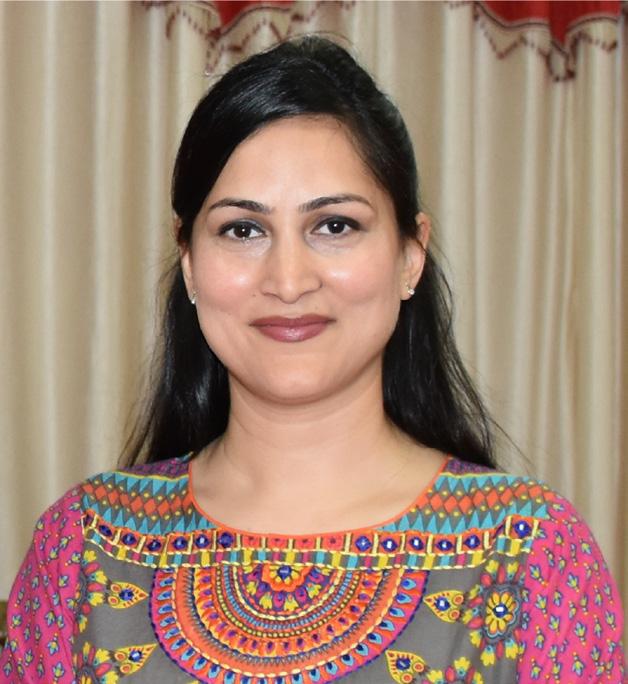
Hello Everyone, Wishing you a very Happy Independence Day. This month we will witness flag hoisting, speeches and many festivities that follow to celebrate the Independence Day and we will bring you this coverage in our next edition. In this issue we bring to you the coverage of various local event including the Farewell event for the CG of India to Australi Mr Manish Gupta and his wife Nimeesha Gupta, historic moment of Australia hosting excersie Malabar the importance of health and Yoga can make it better and many more.
If you have a talent that you want to share or have a story that you would
Arti Banga Editor-in-Chief

like to reach to the wider audience then please feel free to send an email at info@DesiAustralia.com Stay safe and stay healthy.
DesiAustralia.com
you connected”
/CityofRyde www.ryde.nsw.gov.au Customer Service Centre 1 Pope Street, Ryde (within Top Ryde City shopping centre) P: 9952 8222 E: cityofryde@ryde.nsw.gov.au 76 th Commemorating the Indian Independence Day Clr Sarkis Yedelian OAM CITY OF RYDE MAYOR Clr Shweta Deshpande CITY OF RYDE DEPUTY MAYOR City
Ryde
2023
12.30
1.30pm
“Keeping
of
will be holding a flag raising service to commemorate, we will also sing the Indian national anthem, followed by light refreshments. Please join us. When: Tuesday 15 August
Time:
-
Disclaimer: All rights reserved. Do not re-use any content and photo from Desi Australia without the prior written permission from the editor. All the material published in Desi Australia, including articles, features, fillers, advertisements, and all other contents, are published in good faith, and the editor or the Desi Australia magazine cannot be held liable for any errors or omissions. All material is published on the understanding that it is copyright free, and Desi Australia accepts no liability for any subsequent copyright issues. We also cannot accept responsibility for and do not endorse views expressed by the contributors.
Where: Kissing Point Wharf Flag Poles, Waterview Street, Putney
Address: Desi Australia Pty Ltd PO Box 102, Casula, NSW 2170
Indian Independence Day

and so not everything is perfect about India too. There are things that need change. But I have always believed in working ‘with’ strengths and working ‘on’ weaknesses. So instead of standing on the sidelines and commenting and complaining, get in there and make the difference you want seen.
By: Poornima Menon
15th August 1947, a red lettered day indeed. Many lives were lost and many taken before we could proudly call the tricolour our own, before India was freed from colonial rule. While there were many winners, there were many losers as well. Before the British left the Indian soil, they decided to drench her in blood one last time. The country was unceremoniously divided, displacing families, separating loved ones and tearing people apart. And this move created the divide, the chasm that continues to widen as India celebrates the 76th anniversary of 15th August 1947. While most people of the two nations would like to build a bridge of friendship and bring back the days when all lived together harmoniously, there are some who thrive on propagating hate and taking lives. Unfortunately that small minority seems to be winning and that small minority seems to be defining all relationships.
15th August without a shadow of a doubt is a day to celebrate as there are many reasons to celebrate. And amidst all the celebrations let us spare a thought for those who lost their family members, with the home they had so lovingly built no longer theirs as it was on the ‘other side’ of the border. For me 15 August is a date in history when the country I call my motherland became her own and then she became my own. Living on foreign soil I am very proud of my roots, about what my country of birth has achieved and her strong forward thrust in many fields, giving the ‘developed’ nations a run for their money. We don’t live in a perfect world
I spoke to a few of the expatriate Indians who are also friends. These are people who are proud Indian Australians and are making the country of their origin proud by making meaningful contributions in their adopted country.

global mobility, exchange of knowledge and ideas, equality and cooperation, freedom of speech, elimination of poverty and corruption. For me - The standards we walk past are the standards we accept. It’s time to get India to global standards with its potential and talent, time to move from ‘developing’ to ‘developed’.”
Kala Philip, is the CEO of BSI Learning and for her, “Indian Independence Day , 15th August 1947 was freedom from colonialism, oppression and exploitation. It was the opportunity to build free India, a democratic and secular nation with its people and inspiring leaders. My memory of that moment and vision was strong during my childhood years. Amongst the wonderful achievements over the last 75 years, there is also a huge amount of work to be done. The new generation strives for

Rupa Parthasarathy is Creative Director of Mindkeshtra, an art clinic that focusses on managing mental health through art. She says, “ Independence Day to me symbolises a day to commemorate and acknowledge the struggles and sacrifices generations before us underwent collectively to secure our individual rights. It is also a day to celebrate the collective power of unity.”

Download Our App AUGUST I 2023 www.DesiAustralia.com 8
Cover Story
Dipika Gandhi is a homemaker and a great community supporter who participates and contributes in many meaningful ways. According to her, “Independence Day to me is a day where we celebrate the freedom fighters, acknowledge the sacrifices made, and embrace our patriotic spirit. However far we are from the motherland, and regardless of what nation we reside in, it is a day when the tricolour soars high, and binds all Indians together. Our national anthem echoes across continents, jalebis are shared across different communities, and parades and cultural events highlight our diversity. It is also a day which takes us down memory lane. I still remember my school flag hoisting, singing ‘Jana Gana Mana’ that rose to crescendo. It is a day where we can celebrate the strong Indian communities we have built on foreign shores. Today, in Australia, 15th August

sees some famous monuments illuminated in the tricolours symbolising the strong friendship and respect between the two countries. 15th August marks the birth of India. But it fundamentally represents so much more – it’s a day to express our culture, diversity, recognise the heroic acts that provide us pride in being an Indian.”


eran’s wife has this to say, “ While Indian Independence Day is ceremoniously celebrated every year around the world to remember the freedom movement and the sacrifice of our fellow Indians , for me it’s a time to reflect . Immigrants are often told they abandoned the country. I wouldn’t agree and after being a military family for more than 2 decades , no one can better understand what service to the nation means and how it is above all. I’m probably more an Indian here in Australia than I was in India with a great Indian community and upholding my cultural heritage and values. Now Independence Day is all about reminiscing about my country , celebrating the freedom of democracy, and renewing my affection for the country. And no matter which part of the world you are , the recital of the National anthem will continue to give one goosebumps and bring a tear to the eyes. Patriotism resides in the heart and not in geographical locations.”

While 15th August is a day of great importance to all Indians no matter where they reside and all of them enjoy the common celebrations of hoisting the flag, the speeches that follow and the festivities after, at a more deeper level the day has different meanings for different people and the significance of this day can not be described in a linear, one dimensional way. It is multifaceted and multi dimensional.
What does this day, 15th August mean to you ?
Download Our App AUGUST I 2023 www.DesiAustralia.com 9 Cover Story
Yamini Hemanth, a senior manager with Macquarie Bank and a navy vet-
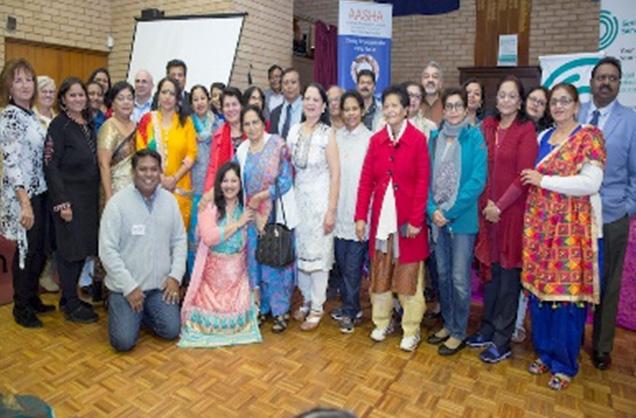
AASHA meaning Hope
AASHA motto is “caring for those who care for us”.
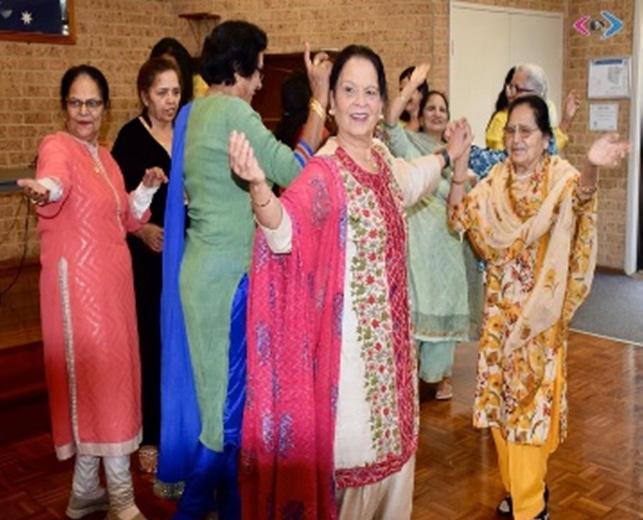
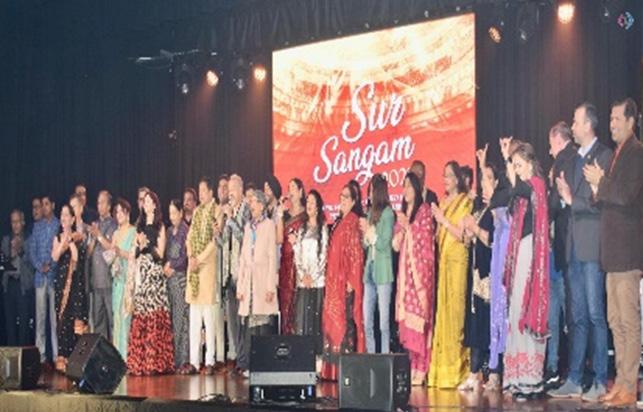
AASHA’s social hubs are located in Blacktown, West Ryde, Crows Nest, Wentworthville and ‘online’. They infuse colour, entertainment, dance, music for the Sydney Indian community of Greater Sydney and beyond.

AASHA’s aim is to remove the barriers that hold older people back by providing
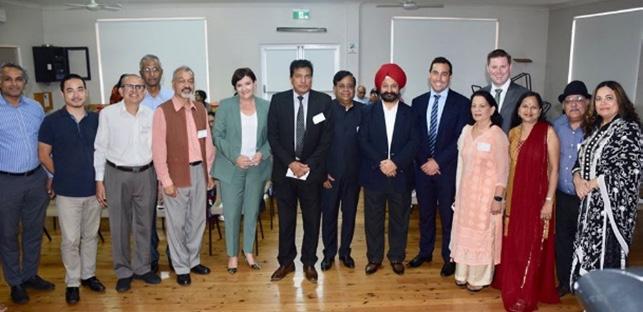
a safe space where they can be themselves and feel valued.
From Bollywood dance sessions via Zoom during Covid lockdowns AASHA also provides specialist health forums held by doctors and digital literacy workshops as well as community celebrations including Harmony Day, Seniors Week and Diwali.
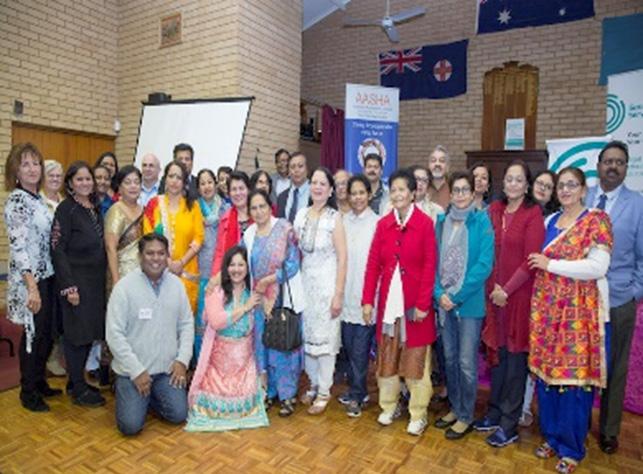
Music and dance are at the heart of AASHA’s work. Not restricted by language, the colourful, hypnotic beat of Bollywood Dance bridge cultures and provide exercise, mental stimulation, culture, and joy.
AASHA works to prevent early Dementia and Alzheimer’s. Our programs are designed to keep the brain healthy and prevent cognitive decline and promote so-
Download Our App AUGUST I 2022 www.DesiAustralia.com 10
Community News | Sydney
AASHA is a Sydneybased not-for-profit organisation that assists seniors, their families and carers from the Indian sub-continent community of Greater Sydney live independent and vibrant lives.
cial wellbeing. We are focused on assisting those who have experienced elder abuse and social isolation. Having gifted 1,000 free health checks so far, our goal is to continue to grow their organisational services to also cover cancer screening and prevention.
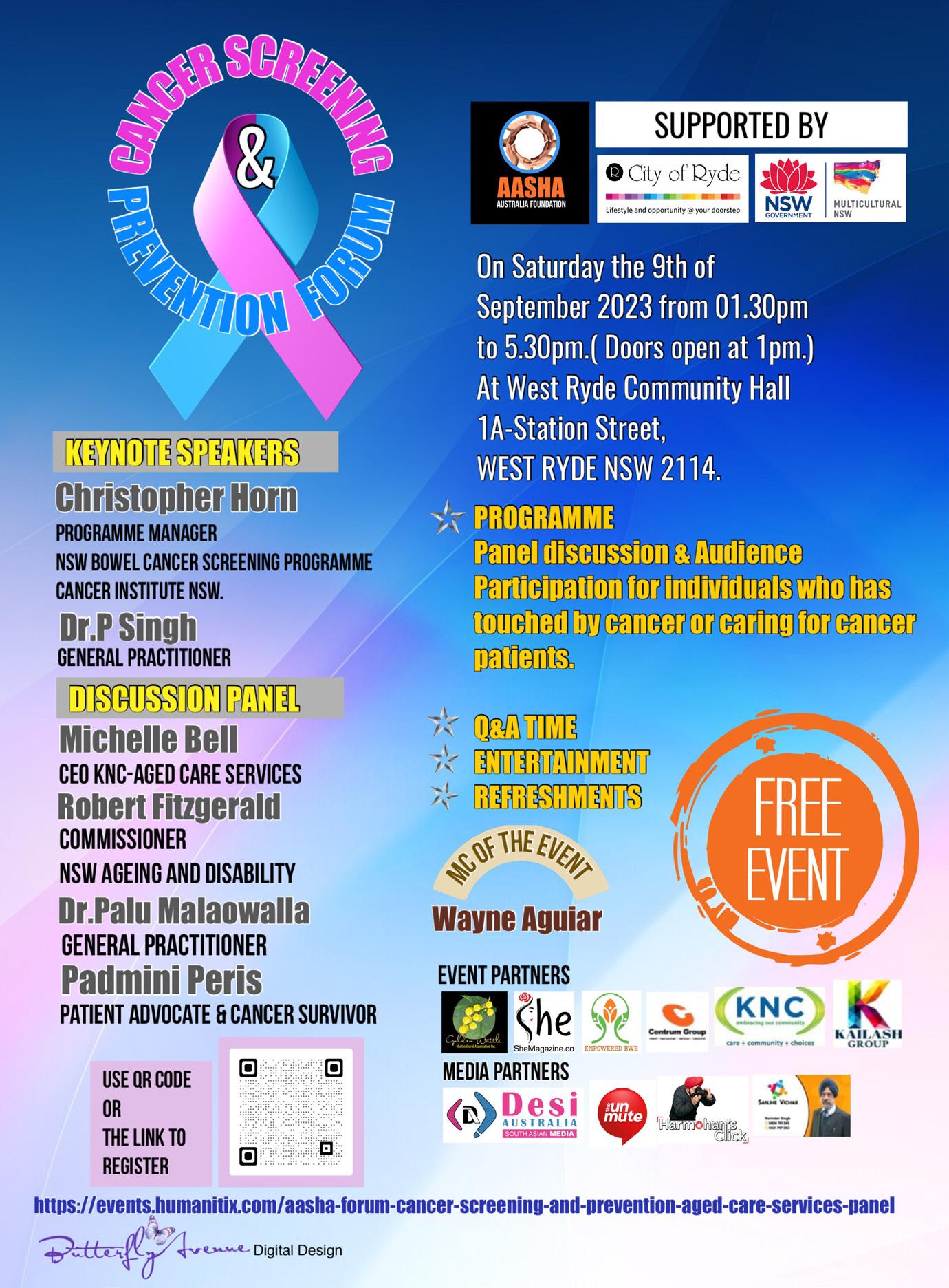
Please join AASHA’s monthly social hubs. We also invite you to become a member and volunteer.
WEST RYDE SENIORS MEETING
First Wednesday of each month
11-2pm
1A Station Street, West Ryde Community Hall, West Ryde
Yoga, Bollywood music, dance, ’chai and chat’, lunch
BLACKTOWN SENIORS MEETINGS
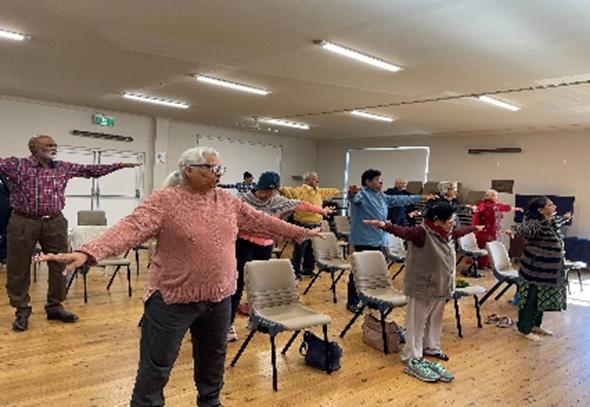
Second Wednesday of each month
11-2pm
Westpoint Shopping Centre, Community Room Level 4 (opposite Gym), Blacktown
Yoga, Bollywood music, dance, ’chai and chat’, lunch
CROWS NEST COMMUNITY CENTRE
Third Wednesday of month
10-12pm
2 Earnest Street, Crows Nest Bollywood music, dance, ’chai and chat’
WENTWORTHVILLE SENIORS
GROUP
Fourth Saturday of each month
12-4pm
2 Lane Street, Wentworthville (opposite Wentworthville Library)
Yoga, Bollywood music, dance, ’chai and chat’, lunch
ONLINE VIA ZOOM, FACEBOOK
LIVE
4th Wednesday of month
11-1.30 PM
Yoga
Music
Soon to open – Gordon and Castle Hill Social Hub

Community News | Sydney AUGUST I 2022
2023 Saree Soirée of Sydney

Saree Enthusiasts, a Sydney based Facebook group completed five years of its existence.


It’s been an interesting and enjoyable journey since June 2018 when it all began.
2023 Annual Meet held on 29th July 2023 couldn’t have come sooner for its
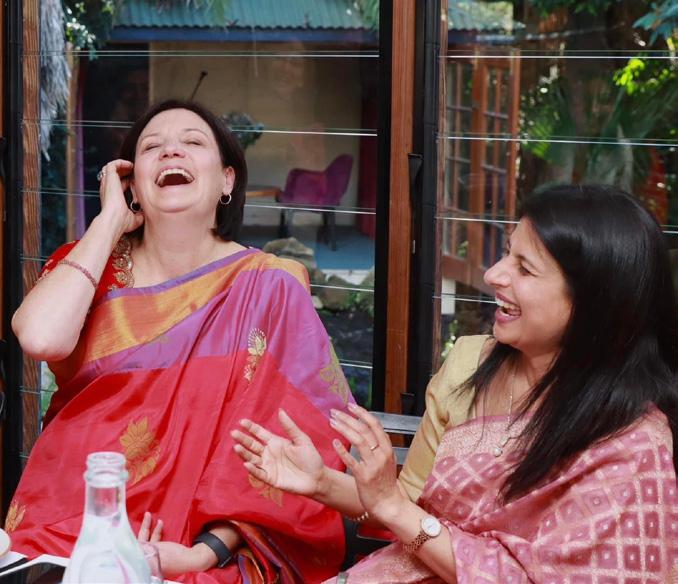
members. The energy, zest and camaraderie in the room was infectious and the 200 Saree clad women were one family for those few hours. Happy to see each other and hugged and laughed in delight.
It began with Helen Clarke, Director of Cultural Diversity & Justice at Knox Grammar, delivering an acknowledgement
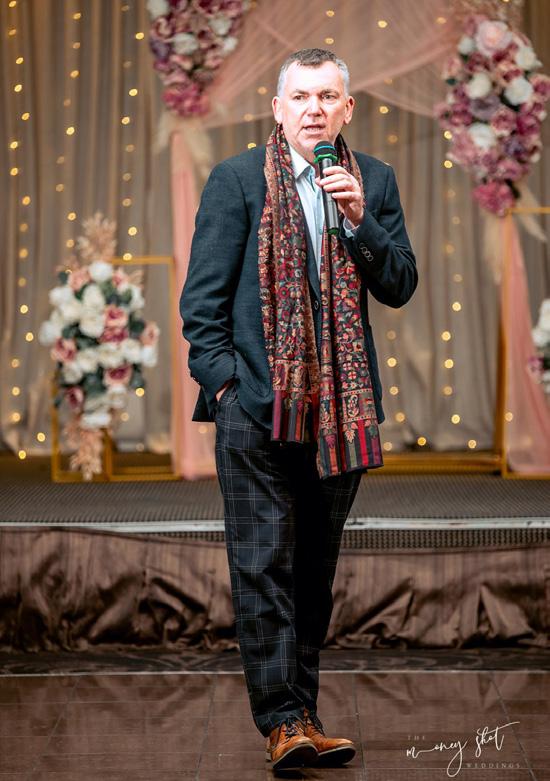
of country and the traditional lighting of the lamp was done by the troika: Shirley Jacob, my Ma Beenu Gupta, myself along with our very own fellow saree enthusiast and Chair of the Australia-India Business Council Jodi McKay and the CEO of Transplant Australia Chris Thomas.
It was followed by a mesmerising Bharatanatyam piece by our very talented
Download Our App AUGUST I 2023 www.DesiAustralia.com 12
Life experiences
Sydney
exponent of this dance form, Sneha Rao. The grace of the performance blended the magic of music and the precise movements, enthralled the audience.
We were very fortunate to have Chris Thomas, CEO of Transplant Australia share his insights on Organ Transplant and the vision he has to combat the scarcity of resources in this field. His motivating address to the ‘decision makers’ of
the family about Organ donation and the statistics around it was very impressive and held the audience spellbound. He also took questions from the audience and patiently answered them. We are very grateful for this as it ties up very aptly with our charity in focus Rotary Club of Organ Donation’s “Lift Up Project.” However, one can’t go by without mentioning the sartorial splendour of Chris’ beautiful men’s shawl.
This year we also welcomed Charishma Kaliyanda the MP for Liverpool into the fold. It was wonderful to have her and Jodi face the impromptu rapid-fire questions. It was fascinating to get an insight into the composition of their Saree collection, and the importance of the threads that connect them to each one of them. The responses were candid and it was sheer joy to see
them carry the six yards with such aplomb. The agenda was clear; an afternoon filled with fun, an opportunity to showcase our beloved six yards of fabric and connect with the Saree sisterhood. Nothing pays tribute to a Saree like a ‘Sashaying in your Saree’ to a foot-tapping score and do it with your mum is priceless! That’s what happened as a’ Flash’ Parade took place with the mum-daughter duo Gabby and Bubbles Garewal, Jasneet and Harinder in that vein. Swinging to the beat of the music were ladies in a pair: Baisakhi and Medha, Abhilasha and Deepti, Sujata and Pooja, Julini and Suzy, Urvashi and Sonali, Nita and Razia, Punita and Deepali and it ended with Shirley, Ma(Beenu) and I dancing down the ‘runway’. The tone was set for the ladies to get on that floor, and they danced to their heart’s content.


Download Our App AUGUST I 2023 www.DesiAustralia.com 13 Life
experiences
In midst of all this, we also cut the cake. Now this was no ordinary cake! Shirley created a perfect cake for the event. The stage setting was perfectly designed by Harika Alapati of Ishi, where fantastic memories were created with the wispy and dreamy background. Will let the photos speak for itself.

The Raffle was a great hit as there were about 65 prizes to win and some people won it five times!! The smiles and the cheering by the tables was heart-warming. Nita Vaarwerk, the expert was absolutely amazing as the Raffle Salesperson.
A big thank you to the sponsors, in no particular order: O’Bombay Restaurant,
Atria Dental, APLUS Tax Solutions, Visa and Travel Services (VTS), Maxwell’s Services Pty Ltd, Mr Nitin Kumar(U.S) and Shishir Verma (U.S), Stall holdersPunjaban Diva, Kritha, Dagina, Style up with Ratan, House of Krishathi, XENO, who made shopping an exciting and convenient experience.
Raffle prizes- Ishita Bose, Gabby Garewal-Aurora, Madhu, Gili Bagwe and Royal India Catering
Thank you to Parravilla Function Centre for the excellent service. The food and ambience were perfect. Adding to the afternoon was the music by DJ Dimple’s Team who had everybody dancing, and capturing these moments were Ribin Joseph of The Money Shot Weddings, Rudy Kalele of Rudy Graphics and our very own Ewan Jacob. Adding to the excitement was the 360 Photo Booth where Ribin Joseph and his team patiently got us to navigate that space. Yes, after the last event we realised we would need to have five photographers to satiate the Saree Enthusiasts to be photographed!!
Last but not the least a heartfelt gratitude to all the Saree Enthusiasts who
stood by us and had faith that the event would eventually happen and happen it did and what a happening event it was! You all rocked and looked absolutely gorgeous in your favourite Saree for the afternoon. The profusion of colours and the range of weaves on display were a delight. It was lovely to have Sujata Patel volunteer to display 11 of her prized handloom sarees from different states of India. Abhilasha and Usha stepped in to regulate the traffic going past to fill in the sheet with the correct names of the weave in a set time frame. It was heartwarming to hear the conversations where the weaves and fabrics of the sarees came from. Interestingly nobody was hitting the google button but more interested in asking each other and validating their understanding of these.
We are most humbled and flattered by all the positive feedback that we are looking forward to our 2024 Saree Enthusiasts’ Annual Meet and it is exciting to know that tables are already being planned and we hope to see more of you join us next year.


Ladies who love their sarees and reading this please join our Saree Enthusiasts Group on Facebook.

Download Our App AUGUST I 2023 www.DesiAustralia.com 14
Life experiences


Download Our App AUGUST I 2023 www.DesiAustralia.com 15 TAKE AN APPOINTMENT TO VISIT & SEE OUR COLLECTION CALL US ON 0415 822 542 Advertisement
Breaking the Silence: Empowering Women & Talking about Healthy Relationships
By: Deepa Nair
In a resounding display of solidarity and commitment to women’s empowerment, Indian Women Empower (IWE) hosted a transformative event titled “Empowering Women & Cultivating Healthy Relationships” on July 30, 3023. The event, held at Campbelltown, Australia, aimed to provide support, empower survivors, and drive significant social change while informing survivors of the available options, resources, and support services within the community.

Domestic violence remains a persistent issue that affects countless lives, making events like these crucial for raising awareness and fostering positive change. With an unwavering determination to make a difference, IWE organised this
free event, which attracted a diverse audience of individuals, professionals, and advocates dedicated to ending domestic violence and promoting healthy relationships.
At the heart of the event was a rich and diverse panel of experts from various fields, all united by a shared goal of combatting domestic violence. Experts spanning Psychology, Mediation, Immigration, Police, and General Practice came together to lend their unique insights and initiate impactful discussions. These discussions aimed not only to shed light on the complexities of domestic violence but also to promote a multidisciplinary approach in addressing its multifaceted challenges.
Prominent figures on the panel included: Ms. Rosemary Kariuki OAM: Multicultural Liaison Officer Campbelltown and celebrated as the NSW Local Hero of the Year 2021.

Dr. Renu Narchal: An experienced psychologist, who contributed invaluable psychological perspectives. Mrs. Deepa Nair: A seasoned mediation expert, providing insights into conflict resolution and safety planning. Mrs. Thara S

Download Our App AUGUST I 2023 www.DesiAustralia.com 16
Community News | Sydney
Namboothiri: An immigration lawyer with extensive experience, offering legal insights and avenues for assistance.

Dr. Nisha Padmanabhan Nair: A compassionate General Practitioner, shedding light on the medical aspects of domestic violence. The event’s significance was further amplified by the presence of Mrs. Charishma Kaliyanda, Member of Parliament for Liverpool, who actively engaged in the discussions and reinforced the importance of collaborative efforts in tackling domestic violence.
The driving force behind this impactful event was Mrs. Mansi Bhatia, the ambas-

sador for IWE. Mansi under the vision of Mrs Melissa Monterio, the CEO of CMRC and founder of IWE, played a pivotal role in coordinating and organizing the event. Her dedication and commitment to women’s empowerment were evident in every aspect of the event’s execution. This event was supported by community support organisations, including World Malayalee Council Sydney Province, Multilingual Community & Culture, Deeps Mediation and Metro Malayalam. IWE’s commitment to uplifting and empowering women from all walks of life, regardless of their background, culture, or experiences, was a central theme throughout the event. The gathering served as a powerful platform to cel-
ebrate the strength of diversity, the resilience of survivors, and the unity among women. By fostering an environment of open dialogue and shared experiences, the event laid the foundation for positive change in society.

As the event concluded, it was clear that “Empowering Women & Cultivating Healthy Relationships” was not just an event; it was a collective step forward towards a brighter, more empowered future for women in Australia and beyond. With such initiatives, IWE continues to pave the way for a world where women can thrive, relationships can flourish, and societies can evolve into more compassionate and supportive

Download Our App AUGUST I 2023 www.DesiAustralia.com 17
Community News | Sydney
Heartthrob Ali Zafar

Musical concert Excitement starts building up
 By: Daljeet Bakshi
Download Our App AUGUST I 2023 www.DesiAustralia.com 18 Community News | Adelaide
Hammad Zafar,Lubna Hammad
Zafar live in Adelaide
for this upcoming event on 22nd September
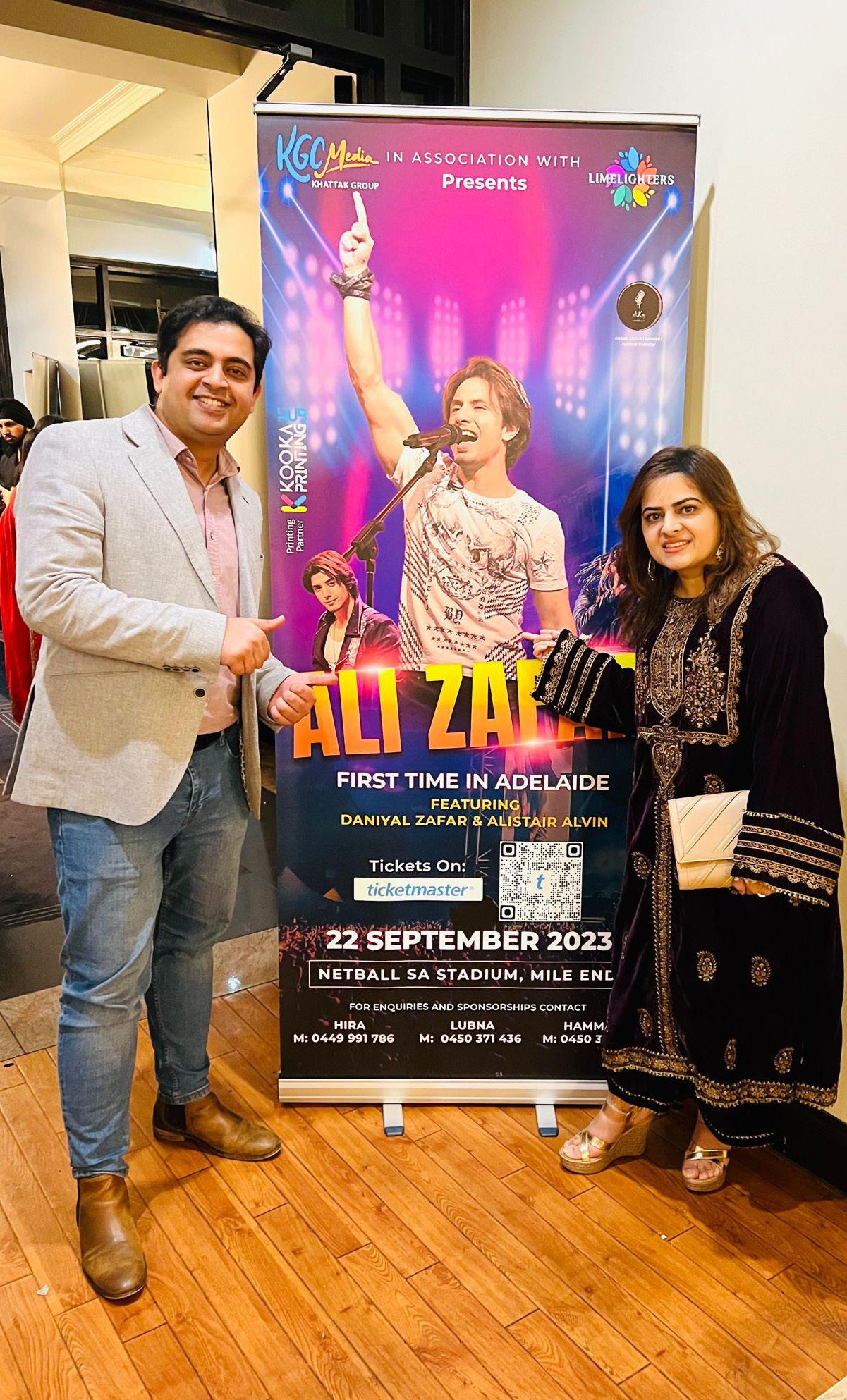
Renowned Singer Ali Zafar will be performing live in Adelaide on 22nd September 2023 at Netball SA Stadium.
In this concert he will be joined by Daniyal Zafar and Rapper Alistair Alvin coming who are coming to Adelaide First time ever!
Enkay entertainment is the national promoter of the Ali Zafar to Australia tour. KGC Media and Limelighters are the promoters and organisers of the Adelaide event . Talented team

of Hirakhan Khattak, Rizwan Khattak, Lubna Hammad, Hammad Zafar have already been able to build up excitement among adelaidians about this wonderful rocking event.
Their professional experience and community engagement is marvellous and they are leaving no stone unearthed to make this a memorable and successful event . And for sure their experience, relationships withing the community is all set to make it happen.
Ali Zafar is a Pakistani singer, songwriter, model, actor, producer, screenwriter and painter. He started out on Pakistani television before becoming a popular musician, later also established a career in Bollywood and his success led many Pakistani actors to venture into Hindi films.
Alongside his acting and singing career, Zafar participates in tours, concerts and stage shows, is active in humanitarian work and has a number of endorsement deals. In 2013, Zafar was voted as the “Sexiest Asian Man on the Planet”, based on a worldwide poll by the British newspaper Eastern Eye. On 23 March 2021, Ali Zafar was awarded the highest literary award, Pride of Performance, for his meritorious contribution and achievements in the field of arts and music.
Get ready for the ultimate music, dance and fun night with the Rockstar.
We wish team KGC Media, Limelighters, Enkay Entertainment all th of best for this upcoming biggest show with charismatic artists.
Download Our App AUGUST I 2023 www.DesiAustralia.com 19 Community News | Adelaide
up
Rizwan Khattak, Hirakhan Khattak
HM Designers Melbourne, Randhawa sisters creating
HM Designers, founded by the visionary Randhawa sisters, Harjot and Mandip Randhawa, stands as a pinnacle of excellence in the world of women’s fashion creating exquisite ensembles that reflect individual styles and desires.
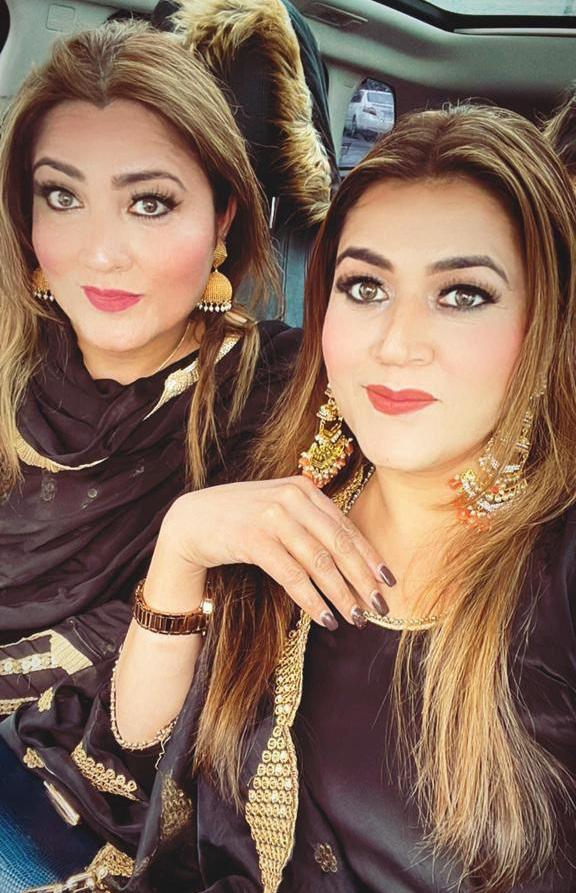
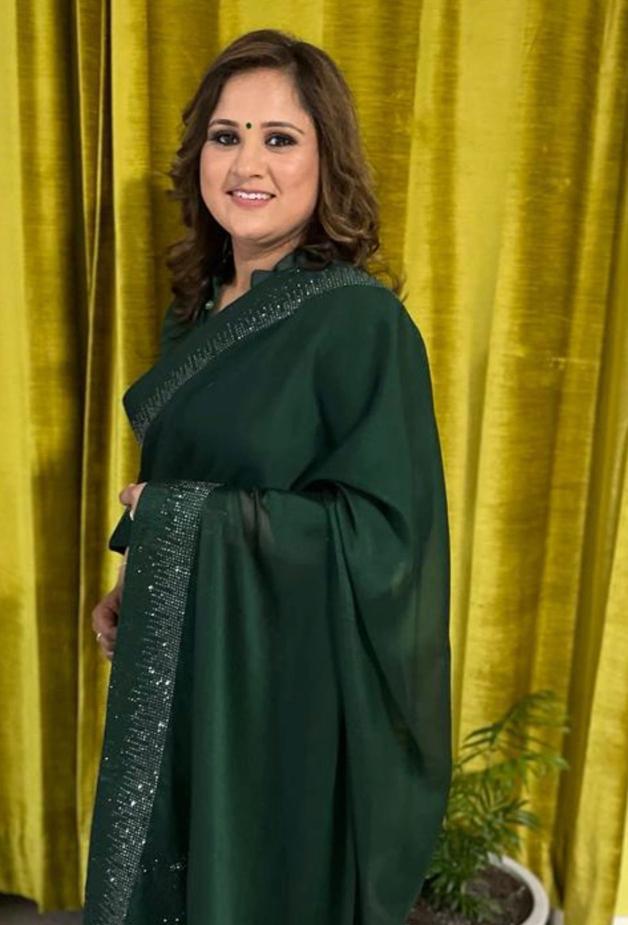
Embracing a commitment to our com-
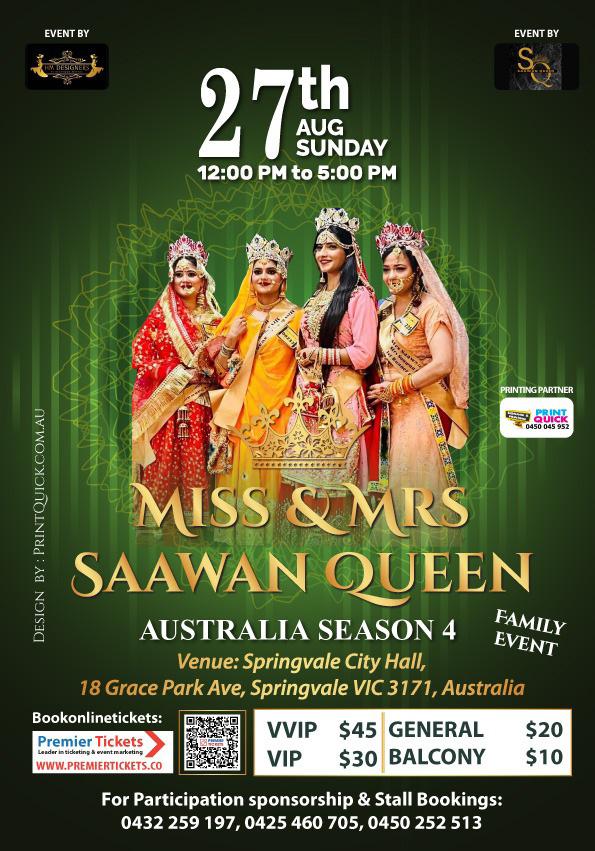
munity, HM Designers proudly present the renowned Miss and Mrs. Saawan Queen Contest.
Saawan Queen empowers girls and women to showcase their diverse talents. Every year comes with something new and exciting!
Download Our App AUGUST I 2023 www.DesiAustralia.com 20
Community News | Adelaide
By: Daljeet Bakshi By: Satinder Chawla
a pinnacle of excellence waves in women’s fashion
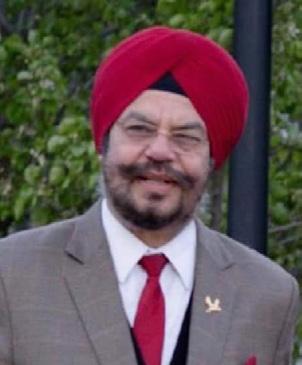
This year , the anticipation builds for the fourth Miss and Mrs. Saawan Queen Contest, welcoming all to the Springvale Town Hall on August 27. A new addition this year is “Love Forever Zindagi,” starring the dazzling Mr. and Mrs. Chawla as showstoppers.
HM Designers along with Ruby Singh looking forward to see you step you into the world of grace and glamour with Saawan Queen. Experience, shine, and embrace your essence at the Miss and Mrs. Saawan Queen Contest – a testament to a community united in Spirit.
We wish Harjot , Mandip, Ruby all the best for their event .


Download Our App AUGUST I 2023 www.DesiAustralia.com 21 Melbourne,
Community News | Adelaide

Download Our App AUGUST I 2023 www.DesiAustralia.com 22 Advertisement

Download Our App AUGUST I 2023 www.DesiAustralia.com 23 Advertisement
A documentary on ‘Chenda’
‘Chenda’, a documentary film on the subcontinental percussion instrument with the same name, was commissioned by Blacktown city council as part of its


autumn-winter festival, Magnify. The film was premiered in early June by the council at Sydney’s only drive-in cinema, Skyline cinemas, in Blacktown. A private
screening was then organised for invited guests and community leaders in July, where a round table forum was also conducted, focusing on the story of the instrument in Australia, the musicians involved, and migrant storytelling in general.
The film ‘Chenda, finds home in Sydney’ unfolds the story of how the drum integrates into the multicultural space within the city, giving a collective identity to a group of talented musicians in suburban Sydney. These musicians are part of the ‘IndOz Rhythms group’ which is stepping into their 10th year of existence, with around 150 performances behind them in Sydney and the surrounding regional towns and cities.
Why Chenda? The writer and director of the film, Emie Roy remarked “When I was considering a subject for the film, I felt that the story of this drum and the group of musicians has to be documented, as part of the history of the place we live in. Just like Chenda that is suited to the tropical climate had to gradually be acclimatised to Australia, the musicians and their families assimilated to the country, and rediscovered themselves as a community, by virtue of practising the drum over the years. Their steady commitment, passion towards music and culture and the legacy they live is fascinating”.
Download Our App AUGUST I 2023 www.DesiAustralia.com 24
Community News | Sydney
‘Chenda’ finding home in Sydney

The commitment these musicians demonstrate is to be seen to be appreciated. “This is not a day job for us. We come together to practise the instrument every week. Some of us had to start from the scratch. The beginners have to practise the vocal rhythms and drumming on a piece of wood for 6-9 months before they start playing on the drum” says Biju George, the president of IndoZ rhythms, who has been a member of the group since its inception.
The screening of the documentary saw the active participation of elected and community leaders - Hon Stephen Bali MP, member of Blacktown, Clr Living-

ston Chettipally, Clr Sree Pillamarri, Clr Susai Benjamin, Clement Warille Meru, Sue Advani, Irfan Malik, Beena Ravi, Babu Valsa Varughese, Nalika Padmasena and Manjula Viswanath.
Stephen Bali MP said that he was “very pleased to see stories of discipline and commitment being told”. He shared some hearty, personal recollections on his childhood and how he learned martial arts, while reflecting on the effort taken by the musicians, documented in the film. Clement Warille Meru, Settlement & Community Programs Manager & Acting
CEO of SydWest Multicultural Services noted, “the documentary is an excellent example of how the Chenda,a percussion musical instrument was introduced to Sydney through the Indoz Rythms group, and how it brings community and families together. It is a story of history passion, discipline and comradery.”
The crew of the film consisted of cinematographer Paul Kochukudy, Nito George (live sound) and Binumon Mathai (B Camera). The documentary can be viewed here - https://youtu.be/aZuo8cVE9Po.

Download Our App AUGUST I 2023 www.DesiAustralia.com 25
Community News | Sydney
The Indian Tea Room 2023: of Culture, Purpose, and
platform to spotlight social causes while indulging in the grandeur of a high tea experience. This year’s charity partner, Pratham Aus, shone a spotlight on the urgent need for child literacy in India. Attendees reveled in the knowledge that their enjoyment was aligned with a greater mission.
The captivating theme of the event, “Gujrati Fusion,” was more than just a culinary choice; it was a journey into the heart of India’s rich cultural heritage. The sumptuous spread crafted by The Secret Kitchen tantalized taste buds with a harmonious blend of traditional Gujarati flavors and modern culinary artistry. The fusion didn’t stop at the food; Bollywood Mantra4U’s decor infused every corner with the exuberance of Gujarat.
Amidst the backdrop of cultural vibrancy and philanthropic zeal, the much-anticipated event, “The Indian Tea Room,” unfolded its magic on August 6th, 2023. The Indian Tea room founder Mansi Khanna Bhatia has raised the bar this year by add-


ing a fusion of elegance, gastronomic excellence, and a higher purpose, this high tea extravaganza with an Indian twist.
The event, held with the noble goal of raising awareness for various non-profit organizations, provided an exemplary
A resplendent highlight of the event was the fashion show by Krina’s Ethnic Wear, a breathtaking parade of elegance and tradition. Attendees were treated to a stunning showcase of Indian attire that paid homage to the country’s diverse and timeless fashion heritage.

Download Our App AUGUST I 2023 www.DesiAustralia.com 26
Community News | Sydney
A Delightful Blend
Awareness
form’s essence.
The evening’s entertainment was a symphony of soulful melodies and rhythmic harmonies. Nikhil Goyal and his troupe delivered captivating dance performances that painted stories through movement. The musical fusion of Prujeeth Joshua’s guitar, Prashant’s flute, and Ajeet’s tabla evoked an enchanting atmosphere, weaving emotions and tunes in perfect harmony.
captured the fleeting moments, ensuring that the event’s magic lives on in photographs and memories.
The vibrant stalls that adorned the event spanned a spectrum from fashion and shoes to decor and children’s books. Earthy Souls, a beacon of healthy living, added a holistic touch to the affair, embodying the holistic essence of the event.
In the spirit of cultural immersion, Indian Matrimonial partnered with the event, bringing the vibrant energy of Holiya Dance Academy to host a lively Garba workshop. The beats of Garba reverberated through the air as participants joyfully embraced the dance

An event of this stature owes its success to its dedicated sponsors and partners. The support of Signature Group of Training, Monty’s Pizza, Evol Group, Akshara Jewellers, E3 Events, and Extreme Communications illuminated the path toward a remarkable experience. The event also marked the launch of our ticketing partner’s platform, a partnership that commenced with a shared vision.
Bringing this vision to life required the artistic touch of Brand Canva Aus, who intricately wove the essence of The Indian Tea Room into every aspect. Guru Productions Sydney
Graced by over 200 like-minded women, The Indian Tea Room 2023 achieved more than just a remarkable turnout. The event’s greater purpose resonated deeply, leading to a collective fundraising achievement of over $7000. The event serves as a testament to the power of unity, culture, and compassion.

The Indian Tea Room 2023 wasn’t just an event; it was an experience, an embodiment of cultural celebration with a heart. It showcased the fusion of India’s rich traditions with modern purpose, proving that when intention meets action, remarkable outcomes follow.

Download Our App AUGUST I 2023 www.DesiAustralia.com 27 Community News | Sydney 2023:
and
RESPECT AND RECOVER - A
By: Poornima Menon
Domestic and Family violence destroys lives. It slowly yet surely knaws into the self esteem and self worth of an individual, thus reducing them to someone they don’t recognise, acknowledge or like. The victims tend to blame themselves for the abuse and look for flaws within themselves. They begin to doubt their choices and decision making skills as the constant barrage of the garbage thrown at them begins to leave its stench behind. Unfortunately, the fear of stigma and judgment, the fear of how it would affect the children and the fear of how one would cope alone become shackles that slowly start tightening the grip.
It takes immense courage and determination to take that first step, to take that bold step. This step is important and it needs support. The support of our loved ones, support of our trusted ones, support of our cheer leader gang, who will stand by our
side no matter what. Knowing that one has that safe circle is a great enabler. The ‘Respect & Recover’ forum organised by The Saree Club on 23 July at the Parramatta City Council Library was attended by over 70 ladies and the main focus was education and building awareness. When we see or hear something, we must do or say something.
Domestic and Family Violence can happen to anybody. When a human being is being physically and / or emotionally subjected to inhumane behaviour, it is no longer a private matter. Everyone deserves ‘Respect’ and if anyone is scarred they deserve that support to get up and ‘Recover’ that respect and put their lives back together.
The panel members from different areas shared their valuable insights into what could be the first steps and what bystanders can do. When a mishap occurs in the community, bystanders have very significant roles to play. The guest speakers on the

panel who have done significant community work, shared information that was extremely important for everyone to know. Saree club thanks them for their participation, their time and for sharing some crucial pieces of information.


Mittu Gopalan is a renowned practicing solicitor, with over 25 years of experience in the legal profession. Mittu is the Principal Solicitor and owner of Freedman & Gopalan Solicitors, a legal firm located in Sydney CBD. Freedman & Gopalan Solicitors prides itself in engaging its multicultural team to provide legal services to the community in a caring and respectful manner, with its mission and motive being “People Over Profits”. Mittu and her firm were finalists in the Lawyers Weekly Women in Law Awards for Boutique Diversity Law Firm, and India Australia Business & Community Awards as Business Woman of the Year in 2016.
Kittu Randhawa is the founder of the
Download Our App AUGUST I 2023 www.DesiAustralia.com 28
Life Experirnces
A SAREE CLUB INITIATIVE

Indian (Sub-Continent) Crisis and Support Agency the first NGO for this community in Australia. ICSA is the first fully CALD organisation running professional support services for the target community with a dedicated focus on client-centric support services and advocacy. She is an expert in complex and culturally driven forms of domestic and family abuse, particularly dowry abuse. Kittu has been an advocate against dowry abuse since 2013 and is committed to seeking reform in legislation and systems to protect women who are victims of this form of abuse. Kittu won the Edna Ryan Award in leadership in 2021.
Nimish Matani, FCA, is a qualified Chartered Accountant with full membership of the Institute of Chartered Accountants of India and Australia - New Zealand with over 25 years of experience in finance, audit, human resources, risk, and treasury. His area of expertise is within the ‘Not-forprofit’ sector that strives to serve in the best interest of the community. He is passionate to serve the well-being of the Chartered Accountants which is reflected in his engagement with the Australian Sydney Chapter of ICAI serving as its Vice Chairman. The Sydney Chapter has 350+ Chartered Accountants from India who have chosen Australia as their permanent home.
Yojana Pareek is a compassionate and dedicated migration consultant and though her primary expertise lies in providing migration assistance, Yojna goes above and beyond her professional responsibilities to support survivors of domestic violence, both migrants and citizens alike. She not only helps individuals with their immigration processes but also actively takes on pro bono cases related to domestic violence. She collaborates with legal professionals, social workers, and support organizations to provide a holistic approach to her clients’ needs. Yojna’s dedication to helping survivors of domestic violence, particularly migrants who may face additional hurdles, has positively impacted the lives of many.
Lord Mayor of Parramatta, Councillor Sameer Pandey was elected to City of Parramatta Council in 2017. He was elected Lord Mayor in May 2023, and is the City’s first Lord Mayor from the Indian subcontinent. A small business owner with a background in technology and law, Cr Pandey is passionate about ensuring Council delivers what community and local businesses need. Building on the work done by Council over many years, Cr Pandey’s vision is for a healthy, liveable, smart, sustainable and inclusive City. Cr Pandey is focused on ensuring Parramatta continues to thrive as a major economic powerhouse and as the best place in Sydney to live, work and play.Lord Mayor Pandey also served as Deputy Lord Mayor from January 2022 – May 2023 and represents the Parramatta Ward.
A huge shout out to Elizabeth Lovell, CEO Lifeline Harbour to Hawkesbury and Veronica Macdonald, CEO Macarthur & Western Sydney for your support and sharing of resources. We are immensely grateful to Jodi McKay, National Chair, AIBC and a role model to many of us for her ongoing support and encouragement.
Saree Club also thanks all her members for their participation and support. The mental health session organised by Rupa Parthasarathy was engaging and therapeutic. The participants used art to express themselves, thus creating a meaningful piece of artwork that was donated to Lifeline. A perfect way to finish the afternoon.

The event was a power packed session. It was robust. It was meaningful. It was informative. It was interactive. I feel immensely proud that I was able to initiate, collaborate and execute this forum. Thank you all who attended and supported. ‘Respect & Recover’ ! All attendees walked away with information that made them more aware and better understand how DV can affect lives, what help is out there and what needs to be done.
PS: Indian (Sub-Cont) Crisis & Support Agency runs the First Responder course for anybody who may be interested in understanding what a bystander can do. Please reach out to the Saree Club if you are interested.
Download Our App AUGUST I 2023 www.DesiAustralia.com 29 Life Experirnces
Good Bye and Best Wishes
By: Poornima Menon
Iwas the lady wife of a serving Army officer for 20 years. Being married to a man in uniform while is glamorous comes with its own set of responsibilities and decorum to follow. The role of the lady wife though not be as important as that of the officer’s , is still quite an important one,especially when she is the commanding officer’s wife, first
lady of the unit.
My understanding is that the role of the wife of a foreign diplomat is no different. Foreign postings are seen as glamorous and coveted. Being posted to a foreign land as the representative of your country is no mean task. While the diplomat has his set of roles and responsibilities, the


Download Our App AUGUST I 2023 www.DesiAustralia.com 30
Mag
Corner
lady wife can play an important role in keeping the diaspora connected. Nimeesha Gupta, did that and more. She ensured that she attended as many community events as she possibly could and build a connection with the Indian diaspora in Sydney. Be it discussion forums, literary and cultural events, she graced the occasion and also shared her love for poetry with all. With her warmth she established a sense of belonging with all she came in contact with. As the Consul General finishes his tenure in Sydney and moves to a new post and a new destination, Nimeesha Gupta will be sorely missed by the Indian diaspora.
The Women in Business Chapter of the Australia India Business Council planned a small intimate farewell for the lady who touched many with her amicability and grace. The lunch at Jaggi’s Regal Gardens in Annangrove was special in more ways than one. Jodi McKay, National Chair, AIBC and Sheba Nandkeolyar, Chair, Women in Business Chapter and many
present shared their cherished memories with Nimeesha. Rekha Rajvanshi read the poem she had penned about Nimeesha and Pallavi Jain read her poem on


women’s empowerment.
On the day, Nimeesha also released her first book of poems, “Choti si Mutti”, an anthology of her experiences, her emotions and her musings during her time in Sydney. This we are sure is the first of the many books Nimeesha will pen.
The Sydney siders wish Manish Gupta, Nimeesha Gupta and their son Manas the very best in all their future endeavours.
Download Our App AUGUST I 2023 www.DesiAustralia.com 31
Mag Corner
CELEBRATE INDEPENDENCE DAY WITH FAMILY

Advertisement
ACCREDITED FROM G DEALS C M Y CM MY CY CMY K ai169044535462_IndependenceDay_A4.pdf 2 27/07/2023 6:09:23 PM
Download Our App AUGUST I 2023 www.DesiAustralia.com 33 Advertisement
A New Air India is unveiled, representing bold New India on the world stage
Air India unveils new global brand identity and aircraft livery

Air India, a Tata Group-owned airline, today unveiled a modern new brand identity and new aircraft livery that capture the essence of a bold new India, marking a milestone in its Vihaan. AItransformation of the national institution into a national inspiration.
The new look reimagines the iconic Indian window shape, historically used by Air India, into a gold window frame that becomes central to the new brand design system –symbolising a ‘Window of Possibilities’.
Air India’s new logo symbol – ‘The Vista’ – is inspired by the peak of the gold window frame, signifying limitless possibilities, progressiveness, and the airline’s bold, confident outlook for the future.
Air India’s brand-new aircraft livery
and design features a palette of deep red, aubergine, and gold highlights, as well as a chakra-inspired pattern. It also boasts a striking new custom-made ‘Air India Sans’ font, marrying confidence with warmth to position Air India as premium, inclusive, and accessible.
Campbell Wilson, Air India CEO & MD, said: “Our transformative new brand reflects an ambition to make Air India a world class airline serving guests from around the globe, and that represents a new India proudly on the global stage.
“The new Air India is bold, confident, and vibrant, but also warm and deeply rooted to its rich history and traditions that make Indian hospitality a global benchmark for standards in service.”
Designed in partnership with the brand
transformation company, FutureBrand, the iconic new brand identity combines Air India’s glorious past with its drive to aim for excellence and innovate for the future, creating a standout brand design for a premium global airline with an Indian heart.
Travellers will begin to see the new logo throughout their journey starting December 2023, when Air India’s first Airbus A350 enters the fleet in the new livery.
“Colours, patterns, shapes and how they come together and what they represent matter, but our actions speak so much louder. We are in the midst of a total transformation to reimagine the role of India’s flagship airline”, Wilson said.
Air India is making significant investments throughout the guest experience to elevate its service and to strengthening its position
Download Our App AUGUST I 2023 www.DesiAustralia.com 34 Mag Corner
as the preferred airline for travellers flying to, from, and within India:
4�Air India has confirmed historic purchase agreements to acquire 470 aircraft from Airbus and Boeing at US$70 billion (based on published list prices), with deliveries of the new aircraft starting November this year.
4�The transformation of Air India’s fleet has already begun with the airline leasing and buying 20 widebody aircraft this year. A US$400 million programme to completely refurbish the interiors of its legacy fleet of 43 widebody aircraft commences mid-2024, which will lead to the installation of brand-new seats in every cabin, new inflight entertainment systems, and inflight Wi-Fi internet connectivity. By March 2024, 33% of the airline’s widebody fleet will be upgraded, and over the next two-and-ahalf years, its entire long-haul fleet will be reborn.

4�Air India has launched a new website and mobile app, offering a significantly improved web experience with new digital tools and features.
4�The carrier will also launch a new “open all hours, every day” customer contact centre in nine Indian and foreign languages by the end of this year, as well as a completely redesigned loyalty program in early 2024 that will enable thousands of new redemption possibilities.
4�The airline is investing in building completely new lounges at Delhi and New York JFK airports, having recently announced a global lounge network expansion, achieving 100% lounge access coverage for premium customers at all destinations in its international route network.
4�Air India has now welcomed more than 5,000 new staff, including 3,200 Cabin
Crew and nearly 1,000 Cockpit Crew, who are helping to drive the cultural transformation taking place at the heart of Air India. It is also heavily investing in building one of the world’s largest aviation training academies in India that will upskill a massive number of aviation professionals.
About Air India
Air India is the leading airline of India. Based in New Delhi, and founded over 90 years ago in 1932 by JRD Tata. The airline has the largest international network connecting India with destinations across Europe and the world.

It has been a member of the Star Alliance (the world’s biggest airline alliance) since 2014. Following its welcome return to the Tata Group in 2022, Air India is now being transformed into a modern, premium and digitally-led global airline with an Indian heart.
Air India’s major five-year Vihaan.AI, transformation programme will ensure it becomes a world class global airline with an Indian heart. The first phase focused on fixing the basics, including reintroducing grounded aircraft back to the fleet, welcoming new talented colleagues, upgrading IT and technology and strengthening of customer care initiatives.
Download Our App AUGUST I 2023 www.DesiAustralia.com 35 Mag Corner
The Perfect Cup Of Chai Comes In A Box
Monica Sunny boxes up and preserves the goodness of spices, traditions, and rituals of chai-making
The rituals of chai
If you grew up in a desi household, you know how important chai is to us, a warm tradition that is at once calming and welcoming. Every home has its own traditions and rituals around the making of chai, signaling the slow awakening of the household in the morning, bringing everyone together.
Whenever I visit India, the smell of brewing chai leaves and spices permeates the air, wafting from homes and street vendors. Chai there is more of a lifestyle than a beverage. Everywhere you go — on buses, in shops, banks, offices, high end boutiques, and outside every train station — you will see people drinking, what we call in our Gujrati house, “cha.”
“Chai” literally means “tea” in Hindi, which originates from “cha,” the Chinese

word for tea.
Two tales of the origin of chai date back to approximately 5,000 (or according to some 9,000) years ago to an ancient royal court, either in India or Siam. The reigning king created the recipe as a cleansing, healing Ayurvedic beverage. Another legend traces the journey of Prince Bodhi Dharma, who traveled to China to spread Buddhism. He was committed to staying awake during his nine–year mission, but nearing the end of his third year, he was exhausted, so he decided to pluck a few leaves off a tea shrub and eat them. The leaves gave him the strength to stay awake, so his followers started consuming tea as a stimulant.
The English cuppa tea
However, history credits the British for introducing tea to India. The British, who established the British East India Company, attempted to reverse the overwhelming Chinese monopoly on tea supply to Great Britain. In 1870, approximately 90% of tea consumed in Great Britain was sup-
plied by China. By 1900, this had reduced to 10% largely replaced by tea sourced in India and Ceylon.
Indians couldn’t afford black tea and so they modified their chai with milk, fresh ginger, cinnamon, cloves, cardamom, black pepper, and other spices depending on the region. In many parts of northern India, you might find chai with prominent notes of fennel and ginger, while in Kashmir you might find chai laced with

Download Our App AUGUST I 2023 www.DesiAustralia.com 36 Food
Monica Sunny in Kerala, India, from where she sources her chai spices. (Photo courtesy: The Chai Box)
“As an immigrant family, we may not have been able to afford much, but we could always afford chai.”
-Monica Sunny
saffron. Every household has its own version, passed down from generation to generation.
You likely make your chai just the way your mom did. I did too, till about two weeks ago when I tripped and had a pretty bad fall. I was badly injured, bruised, with sprains and a hairline fracture on my right hand. Forced to rest, I was immobilized. The husband somehow cobbled together meals. But the chai, well that was another story. We wanted it done the traditional way, but with work meetings, hubby couldn’t always make time for chai!
That’s when I discovered Monica Sunny, founder of The Chai Box, and her chai concentrate. I was skeptical of this “chai in a bottle,” but when you open it you can smell the aromatic blend of tea and spices, and it is so very convenient. Just heat, add milk and voila! Homemade chai, that gave us the perfect cup when I couldn’t make my own.
The Chai Box was named one of Oprah’s Favorite Things in 2021, and last year it was part of the Everyone Wins nominee gift bags that went to the Oscar nominees in the top categories.

Chai Box offers premium, single-origin, spiced teas from small-scale farmers in India. Every blend is handcrafted in small batches by this family business that started in Atlanta.
An immigrant family’s ritual
When Sunny was nine years old, her family moved from India to the U.S. and settled in Atlanta, GA. “We came as immigrants and my parents were working a lot just to make ends meet,” recalls Sunny. Alone at home with her brother, they had to cook and clean, while exploring a strange new world. As she tried to make sense of her surroundings, the only thing that kept Sunny grounded was her family’s chai ritual. It also reminded her of home. “It was the one thing that stayed consistent,” she says.
She remembers her grandparents in Punjab would wake up early, at 5 a.m. and make chai. It was much later that Sunny
realized the value of this “me” time, and incorporated it into her daily life. She too wakes up early every day and immerses herself in the ritual of chai making, a time for reflection and quiet.
Chai in a dabba for the boys
She developed the Chai Box in a masala dabba for her three sons. Wanting to pass along the tradition to them, she filled the dabba with different chai blends, sugar and spices. Every Friday, they would whisk out the dabba for chai time with mom and the boys. As her sons got older, they wanted to learn how to prepare it themselves. So Sunny took out her dabba and began to teach them.
Her oldest son had some allergies and thus she preferred playdates at her house. Eventually their friends, and their friends’ moms wanted to learn too. They would ask for the chai box and they would all enjoy tea time together. Sunny began to teach people how to make chai the right way, very different from the sweet, syrupy stuff at Starbucks.
The business of a proper cup of chai
One day, someone ordered 50 chai boxes and the seeds for a business were sown. A business she runs with her family—her parents, sons and husband. In fact, she
developed the chai concentrate along with her son Ethan, a college student who relied on it because he lived in a dorm without a stove. When we spoke, her mom and dad, who come over every day, had just arrived with lunch (saag and roti). She credits her dad, who ran a Dairy Queen, with teaching her the fundamentals of the business. They were all getting ready for “production day,” right after lunch. It was her father-in -law who introduced her to farmers in Kerala, where they source their spices “ethically and sustainably.”
“It started with simply wanting to introduce my boys to chai, but now I’m teaching people how to make chai the traditional, proper way,” Sunny says. “I want to make sure I teach my kids the value of family.” She makes time for them and teaches them through their chai ritual to make time for family and for each other.
Chai Box Chai Recipe
Serving: 2 Cups of Chai
Ingredients
4� 1 cup of water
4� 1 cup of milk or nut milk
4��3-4 tsp of True Blend (loose leaf tea blend)
4� 4 cardamom pods, lightly crushed open
4� 2 cloves, lightly crushed
4� 3 small pieces of cinnamon
4�A pinch of fennel (8-10 seeds)
Directions
4�On the Stove (traditional Indian method of making chai):
4�In a small saucepan, add water, cardamom, clove, cinnamon and fennel and bring to a boil.
4�Add in True Blend loose leaf tea and simmer for 1-2 minutes.
4�Add milk and bring it to a boil.
4�Turn off the stove once the chai starts to bubble up.
4�Use a strainer to strain ingredients when pouring chai into a tea cup.
4�Add honey or sugar if desired.
Author: Mona Shah
This article was originally published in India Currents
Download Our App AUGUST I 2023 www.DesiAustralia.com 37 Food
The Chai Box. (Photo courtesy: The Chai Box)
AIBC farewells Mr Manish Consul General of India in
Sydney, 11 August 2023: A grand farewell was organised in Sydney by the Australia India Business Council (AIBC) for Mr Manish Gupta, the Consul General of India, Sydney and South Australia on Tuesday 8 August 2023.

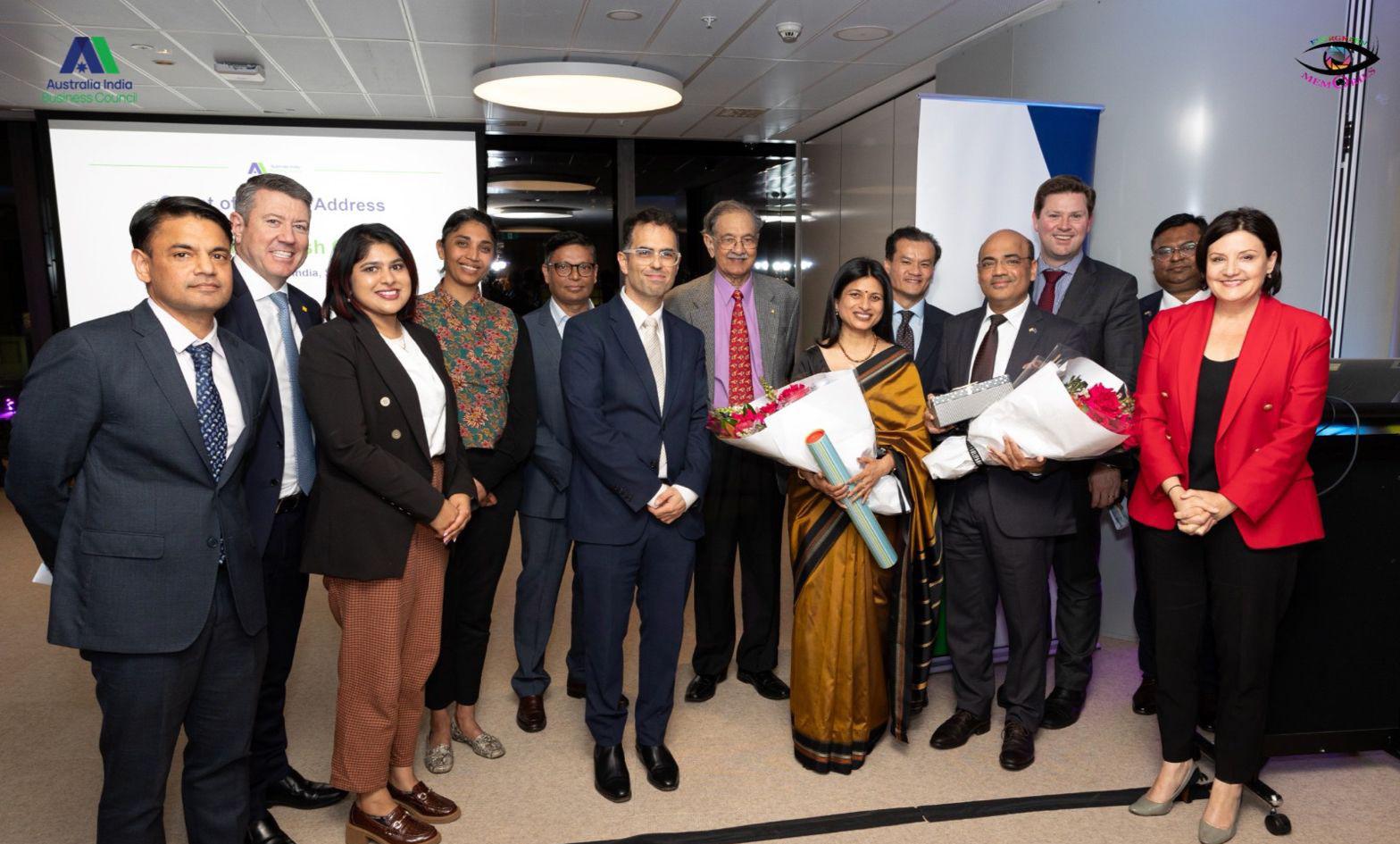
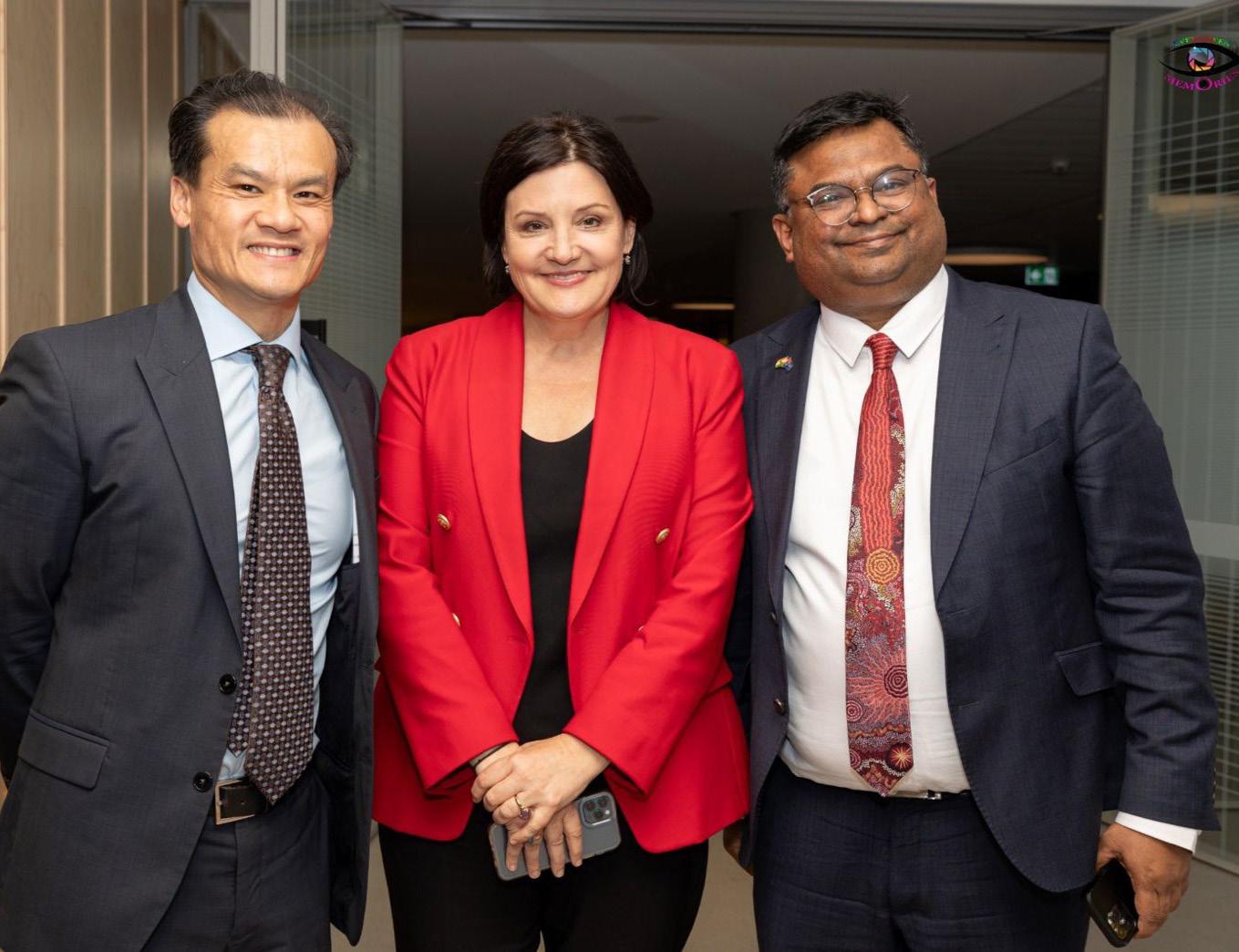
About 100 people joined the farewell reception, held at the Australia headquarters of Commonwealth Bank in Sydney,
Download Our App AUGUST I 2023 www.DesiAustralia.com 38 Community News | Sydney
Manish Gupta, in Sydney
including the NSW Treasurer, the Hon Daniel Mookhey MLC, other NSW Ministers, Members of Parliament, business personalities, AIBC’s national and state leadership team members.
Mr Gupta has been serving as the Consul General of India since 2019 for New South Wales and South Australia and has now been appointed as India’s Ambassador to Ghana.
The NSW Treasurer, Hon. Daniel Mookhey MLC, acknowledged the great contribution by the Consul General to the economic partnership between the state and India.
In his special address to the invitees, Mr Gupta expressed great optimism in the Australia India trade, stating that it was
bound to grow more significantly in the coming years than the projected estimates. He added that he was leaving with many pleasant memories of his association with the diaspora community in Australia. He also congratulated AIBC for its contribution for over 35 years to the Australia India trade and economic partnership.
The Consul General has been deeply committed to expanding the bilateral business corridor, particularly with AIECTA, and has been closely associated with ministerial and business delegations. Ms Jodi McKay, AIBC National Chair said that Mr. Gupta turned out to be the best Consul General of India in the recent years supporting the Australia India relations in every aspect and also thanked him for his great support to AIBC.
Mr Mark Jones, Executive General Manager of Commonwealth Bank said it was his privilege to host the farewell reception and outlined the bank’s activities in India, while also acknowledging the Mr Gupta for his active support to Commonwealth Bank in this journey.


Hon. Anoulack Chanthivong MP, NSW Minister for Industry and Trade, thanked
the Consul General for his tireless support to ongoing initiatives in Trade and skill development.
The reception concluded with a presentation of vote of thanks by Mr. Sid Jha, General Manager, Commonwealth Bank is Australia’s leading provider of integrated financial services.
Download Our App AUGUST I 2023 www.DesiAustralia.com 39 Community News | Sydney

Download Our App AUGUST I 2023 www.DesiAustralia.com 40 Advertisement

Download Our App AUGUST I 2023 www.DesiAustralia.com 41 Advertisement
Dying to live- Every week dies waiting for an organ
By: Ewan Jacob
As his body fought against the virus of unknown origin, his weakened heart ultimately became sustained by a mechanical crutch, holding onto the hope that eventually he would receive a call from a heart donor. Four months later, Adam received that call and underwent a heart transplant which saved his life. Twenty-five years on, he is now a husband and father, and paying it forward by working in healthcare. Adam’s story serves as a vivid reminder that in death, lives can be reborn, and a heartbeat can echo through generations transcending the limitations of our temporal existence. But most aren’t so lucky – every week an Australian dies waiting for an organ transplant. Despite 4 in 5 Australians showing support for donation, only 36% are registered to be a donor. The chasm between intent and action is reflected in Australia’s low organ donation rates, which severely lag behind other Western Nations, and is further pronounced within Asian communities due to lower match rates.


Whilst organ donation rates are beginning to improve globally due to policy intervention, it is still far below the minimum threshold required to sustain most nations as they struggle with endemic diseases, aging populations, and rising hospitalization rates. The lack
of organ donors is a global problem, and exposes a lingering hesitation that holds back a surge of life-saving possibilities. Rationally speaking we know we should donate, but organ donation isn’t a heart vs head thing – it’s both! So why do we continually have an organ shortage problem, and why are most well-intentioned individuals continually choosing not to register as donors? To paint a clearer picture, I have examined multiple literature reviews to explain the sociological and psychological phenomena which dissuade people from donating.
Trust and Understanding: Key Barriers to Bridge
A common issue which surfaces is the mistrust of medicine and lack of under-
standing around brain death. The advantage of using brain death as primary criterion for organ donation is that it is easily observable, and well entrenched legally, medically, and socially. Once a person is brain-dead everything that made that person who they were; their memories, personality, ability to interact with others and the world are irreversibly lost. Further, there has never been an unconfounded false positive case within decades of surgery in Australia – essentially, no one has ever come back from death after being declared brain-dead. Despite this, a study by NSW Health (2022) cited that people would not donate the organs of their next of kin if their heartbeat was sustained artificially, even if they were proclaimed brain-dead.
Download Our App AUGUST I 2023 www.DesiAustralia.com 42 Health
Rotarian Shirley Jacob with Chris Thomas
an Australian organ transplant
Another study by University of Pennsylvania discovered the less people trust medical professionals, the less likely they
are to donate. This mistrust may arise from personal experiences or misconceptions regarding how the medical community treats registered organ donors. This
was one of the largest deterrents within the USA for organ donation, driven by the unfounded belief that doctors might invest less effort in saving the lives of registered donors. However, this belief contradicts the reality: ER doctors operate independently from the Transplant Unit, and all doctors are bound by the Hippocratic Oath to prioritize saving lives. Brain death is only declared after exhausting all possible measures, which is in itself a statistical improbability as fewer than 2% of all hospital deaths are brain-deaths. Transitively, it is evident this medical distrust and lack of understanding is often clouded by irrationality and misinformation.
The Religious Riddle: Disentangling the Threads of Faith Religion, a cornerstone of identity and belief, often looms as the largest barriers to organ donation within Asian communities. Interestingly though, most religious doctrines do align with the act of organ donation, portraying it as both a moral and ethical obligation. This was encapsulated when Jesus spoken in the sermon on the Mount, “Do unto others as you would have them do unto you.” Though the Golden rule is known to the West through the gospels of Matthew and Luke, this principle is both older and more universal than that – it is prominent in Buddhism, Confucianism, Hinduism, Islam, and Judaism. This rule universally requites that we accept the desires of others as if they were our own.
Helping those in need is strongly emphasized in Judaism – the Hebrew word for “charity”, tzedakah, simply means “justice” and as this suggests for Jews is an essential part of living a just life. Whilst others may view charity as an act of benevolence, tzedakah is doing what is righteous, it is an ethical obligation. There is nothing new about the idea that we have a strong moral obligation to help those in need. In situations where rescue is easy, our intuitions tell us that it would be wrong not to do so. Yet we all see or read appeals to help those living in extreme poverty, or dying from illness, and nevertheless most of us fail to ‘do unto others’.

Download Our App AUGUST I 2023 www.DesiAustralia.com 43 Health
week
Chris Thomas, CEO of Transplant Australia
From Idealism to Action: The Heart of Altruism
Beyond religion, is there a philosophical argument why we may not donate? Libertarians may reject the idea that we have a duty to help others. At a glance, a political philosophy where “You respect my space, and I’ll respect yours” may seem attractive, as it appeals to an ideal where we can carve our own life unperturbed by others. However, this philosophy is callous and denies we have any responsibility to those who, through no fault of their own, are in need. The essence of a just and functioning society unfurls when we stand accountable for the well-being of fellow humans. Organ donation transcends individuality; it is a tangible embodiment of helping others founded on the pillars of altruism.
Investing in Humanity
The threads of argument converge on a vital note - beyond the ripples of saving lives, how does this benefit the economy and society? A recent study on Kidney Donations in Australia discovered that a 20% increase in donations would translate into a cost-saving of $650 million and a gain of 10 400 quality-adjusted life years (QALY), whilst saving the lives of over 1500 individuals. As we expand the
study to include other organs we can see how these positive effects will accumulate. The act of donating thus becomes an investment in both humanity and fiscal stability.
The Final Battle: The Heart and Mind Dilemma
Consider a very simple truth: a life is a life, no matter where that life lives. A human being abroad is no less valuable than a human being here. Given that simple transitive property of inherent human value, shouldn’t we consider treating the life of strangers with the same care and attention we give to our own kin? Yes, but it’s not so simple.
Take for example, Zell Kravinsky, a professor at the University of Pennsylvania who famously donated his kidney to a stranger. When he told his wife about the kidney donation, she vehemently objected on the grounds that one of their family or friends may need it - a sentiment shared by most. Prioritising family feels natural and in most cases is right. However, Kravinsky argued that “the sacrosanct commitment to family is the rationalisation for all manner of greed and selfishness.” In a way this rings true, no one says I work for Philip Morris or

Monsanto because I like the money, they oft justify themselves by saying they’re saving up for the kids.
Kravinsky further argued that the chances of dying from surgery are about 1 in 4000 and to withhold a kidney from someone meant that you valued your own life 4000 times more than that of a stranger, an equation he deemed nonsensical. Upon reflection, when guided by the fierce emotional bond of family I can see how even I would object to the donation. As such it is easy to see how the intangible value assigned to a loved one’s life can cloud the scenario irrationally and is a reminder that our choices are often dictated by both cognition and emotion.
The Unspoken Conversation: Family and Donation
This familial sway isn’t unique; it’s a reminder of the vital role family plays in the organ donation narrative. In Australia, family consultation is often sought in such decisions. Engaging in an open dialogue with loved ones about organ donation becomes essential as they can decide not to donate your organs and tissues, even if you wanted to be a donor. As many as 40% of Australians do not
Download Our App AUGUST I 2023 www.DesiAustralia.com 44
Health
Deepali, Rtn Anil Srivatsa and Jennifer Jones, President Rotary International 2022-23.
know the donation wishes of their family members.

Further, the conversation of organ donation ultimately rests on the tombstone of our own mortality– a topic most individuals are afraid to discuss with their families, especially within minority communities, stemming from fears of summoning untimely demise. Yet, this unspoken fear feeds a cycle; only 14% of Australians have advance directives,
and reluctance persists. But researchers unveil a glimmer of hope—the more candid and normalized the discussion on death and organ donation, the greater the likelihood of inspiring individuals to register. Discussing your intentions with your family ensures your wishes are understood and respected, even amidst the swirl of emotions.
The Paradigm Shift: Making Donation the Norm
By exploring the rational, cognitivebased variables and more visceral or spiritual noncognitive variables, it is clear that becoming a registered organ donor is the right thing to do. However, an ardent shift is needed - a transition where organ donation is culturally ingrained. Initiatives which target diverse groups—a mix of ages, ethnicities, and professions— and seek to dissolve apathy are critical elements in increasing awareness and ultimately registrations around organ donations. I witnessed this recently, when Chris Thomas, CEO of Transplant Australia, inspired 200 Indian women at the Saree Enthusiasts event in Sydney with his impassioned words about the life-transforming impact of organ donation. Partnerships like these between Transplant Australia and the cause-based Rotary Club of Organ Donation are critical bastions in shifting the collective consciousness around organ donation and ultimately saving lives.
A vital conversation pulsating beyond boundaries
In writing this article I hope that you will not blithely ignore the tragedy of the organ shortage issue we face globally without considering—even if just for a moment—the impacted lives of those affected. It is not necessary you become a live donor and donate your kidney, but at the very least you should look into organ donor registration or have a discussion with your loved ones around organ donation to dispel the myths and taboos which shadow an important topic.
Adam Vasser’s saga, and the countless stories of recipients echo with a common refrain—a call to step beyond hesitation, to bridge the divide between intent and action. In the symphony of life, organ donation emerges as a powerful crescendo which can reverberate across lifetimes. Interlacing religion, philosophy, trust and economics, it is clear that organ donation harmonises with all our beliefs, rational or irrationaland is the morally right thing to do. Within us all lies the power to reshape destinies, to gift life, and to sow hope where it’s needed most - don’t bury that gift in the ground.
Download Our App AUGUST I 2023 www.DesiAustralia.com 45
Living kidney donor Rotarian Anil Srivatsa, along with the recipient, his brother Dr. Arjun Srivatsa, at the World Transplant Games, Perth 2023.
Health
YouGo with Rajni – Let’s Meditate
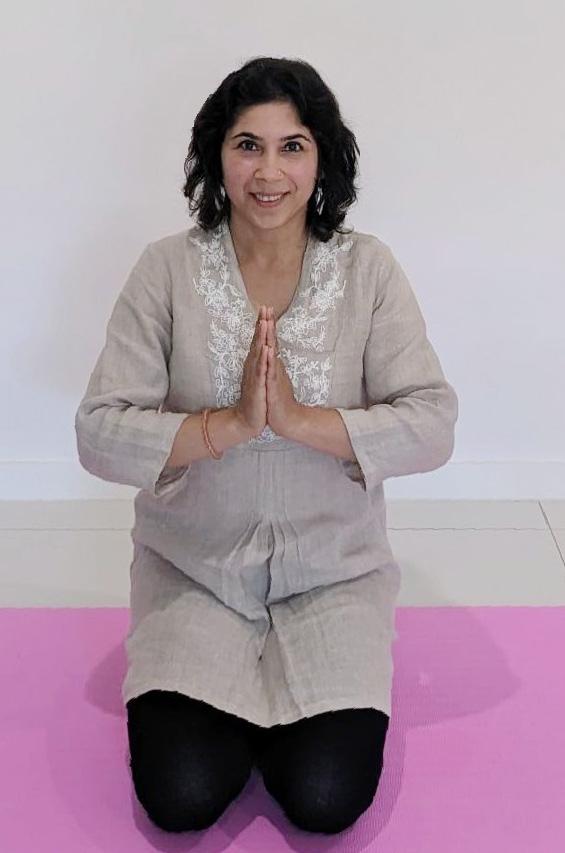
Mindful Meditation – Breaking Step 3: Mindful transition from meditation
 By: Rajni Ghai Malhotra

Meditation can be long spread over days and hours or short, spanning a few minutes. Regardless of its duration, returning to the outside world can be disturbing and even overwhelming.
Stepping back into the outside world after meditation is moving from a place of gentleness and calm into a place of noise and sensations. It is important to adopt a mindful approach to transition between the two stages to retain the benefits of your meditation practice.
This brings us to the third and final part of this three-part series on Mindful Meditation broken into the following steps:
Step 1: Sitting mindfully (focus on posture)
Step 2: Mindfulness Meditation (focus on breath work and flow of thoughts)
Step 3: Seamless transition into our everyday world
In this edition, I share a few tips that could be used to form your own routine of transition from meditation to ordinary consciousness.
How to mindfully transition from meditation to ordinary consciousness
Sitting in meditation for as little or as long as you feel comfortable, you know it is now time to bring your meditation to a close.
Attention - Begin to direct your attention to your breath. Keeping your attention to your breath, savour the delicious feeling of being
home in your body.
Shifting of focus - Slowly shift your focus
Download Our App AUGUST I 2023 www.DesiAustralia.com 46 Yoga
Series
down the Basics
from inwards to outwards – begin to feel the sensations of your body, listen to the sounds around you.
Movement – Beginning with your toes and finger tips, gently move your upper and lower body.
Opening your eyes - Rub your hands together to create a tingling sensation, until you can feel warmth in your palms. Place your hands on your eyes and open your eyes into the gentle warmth of your palms.
Take in the sights - Once your eyes are open, remain seated and continue to breathe gently as you take in the sights around you.
Feel Gratitude - If you were in solitary practice, feel gratitude for these moments that you were able to invest in meditation for yourself. If you meditated in a group, express gratitude for meditation, for other meditators in the room and for the meditation leader.
Adjust to your surrounds – You may be thirsty after your practice, have a sip of water. Your
body temperature may have risen or dropped during meditation. Take off or add a layer if needed.
Conversations – As you pack up your mat and belongings, it is perfectly normal to not wish to break the harmony of the moment by engaging in conversation. It is your choice to either speak with others or withdraw quietly.
Close with a smile – As you transition out of your meditative state into the ordinary, keep a gentle expression in your eyes and a smile on your face.
There YouGo!
Stepping mindfully out of meditation into the ‘real’ world allows our calm and peace to seamlessly transition into our day, radiating into everything we do.
This brings us to the close of the three-part series on meditating mindfully. Happy meditating!
Yours mindfully, Rajni Follow Rajni on Facebook @YogaWithRajni
YouGo Yoga with Rajni
Yoga

Yoga
Mindfully
Breaking
meditation
ordinary consciousness
Meditate
to
&
Experience the benefits of yoga and mindfulness through the following workshops: ✓ Beginner’s yoga ✓ Mindful breathing and meditation ✓ Yoga-in-isolation and de-stressing techniques ✓ Yoga-Zing with Rajni: Fun filled, creativity infused workshops for women and children Rajni Ghai Malhotra | Founder, YouGo Yoga | 0424 434 031 | www.facebook.com/YogaWithRajni *All workshops now delivered in a physically distant, socially connected manner
Mindfulness workshops for adults and kids
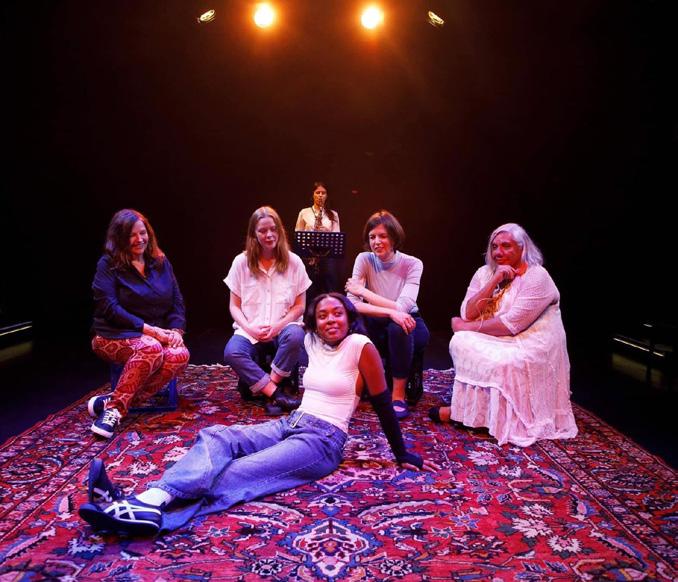
Embellishment - Voices of Women

Voices of Women spent a year talking, listening, workshopping, mentoring, and gathering women’s stories from across Australia and the world. They were shown live at the KXT theatre Broadway in Sydney from August 9 to August 12, 2023.


An immersive collage of stories, performance, and live music was developed through engagement with women on Wiradjuri country in Wagga Wagga, the lands of the Tubba-Gah people of the Wiradjuri nation in Dubbo and Yuin country in Nowra and on Gumbaynggir Country in Macksville plus a national and international call out for new work.
Embellishment – voices of women’s artistic directors were Lliane Clarke and Cheryl Penrith OAM. The actors included in the show were – Aunty Cheryl OAM, writer, singer actor Lucy Heffernan, Ahumin Adebe, Hasitha Adhikariarachchi, whose performances captivated the hearts of drama fans. Sussanah Lawergren, Alice Morgen, and Di Bird performed live music throughout the event, which gave the stories an extra significance. These stories were strengthened by the gorgeous music that
Ten female writers with a passion for storytelling, wrote ten powerful monologuesstories of tradition and mythology, memories and fears, the comedy of dating, the power of love and the perils of climate change, childhood, and motherhood. Advice was written by Cheryl Penrith OAM, Once I saw her Dance by Anne Casey, Special Performance by Kalina Davis, Down the Beach by Yaara Straede, Stuck in my Head by Kirsty Jagger, The Date by Sarah Strong, Observance by Suzi Mezie, Jinn in a Well by Madhvi Ashok, Sweetie by Louise Hopewell, The Soul Care Motel by Jeanine DeHoney.
Light was done effectively by Tyler Patrick,
Performances that honoured First Nations women at their core and modern writers from Australian, South Asian, Indian, African American, and Irish cultures were pleasant to see because they linked with storytelling traditions in a meaningful way.
It’s vital to share the experiences of women with everyone so that we can all relate to them, feel less alone, and realise that it’s okay to feel certain feelings, such as rage, upset, and perplexity. And to consider other people’s experiences in order to understand their viewpoints, be inspired by them, and become stronger as a consequence.

Download Our App AUGUST I 2023 www.DesiAustralia.com 48 Arts and Culture
Elizabeth Jigalin directed and wrote.
and stage was managed skilfully by Gorgia Tyrill.
By: Rekha Rajvanshi
Ethnic Bazaar Australia-connecting multicultural communities in Australia
Urmi is a founder of Ethnic Bazaar Australia (EBA). She aims to improve ethnic product market access for multicultural communities in Australia by promoting local ethnic boutique brands & connecting with local shoppers. This is a unique opportunity for our small business owners to meet, network & connect with shoppers from multicultural communities under one roof. They can utilise EBA’s platform to generate potential leads to boost the sales of their businesses.
Her vision is to give unique experiences to the shoppers, where fashion meets values. To encourage and empower other women, she says, “If I can do what I love to do, all the mums and women’s out there can too”.
Ethnic Bazaar Australia (EBA) is excited to showcase the wide range of ethnic boutique brands as part of 2023 Dussehra Exhibition. Dussehra Exhibition is dedicated to promoting ethnic wear and supporting mainly women in business.

EBA platform collaborates with local businesses to showcase their vast collection of ethnic products including Designer Saree’s, Lehenga’s, Salwar Suits, Kurtis, Clutches, shawl, Men’s Kurta’s, kid’s outfits, traditional jewelleries, festivals accessories & authentic foods.
Dussehra exhibition has products to offer for everyone in the family which makes it one stop shop destinations that attracts shoppers from all over Sydney. Exhibition will provide a hands-on, multi-sensory experience, allowing shoppers to taste, touch and feel the diversified products.
In 2022, UCreations presents Dussehra Exhibition had about 35 local boutiques entrepreneurs & showcased their ethnic outfits at fashion ramp. All day, lovely music played at the background. Shoppers
& vendors love this approach, as it is a direct path to the emotional heart. Shoppers feedback was “we have found what we want & need with reasonable prices.
Fashion at Dussehra delivered a diverse combination of local and professional models fashion walk, it’s one of its kind & happened for the first time in western Sydney.
For 2023, EBA has reached at indoor market stalls capacity with more than last year and planning for Fashion show themed
as Fashion with a vision of sustainability which Celebrate Diversity & Inclusivity. Together, through our daily actions, we can create a more sustainable future for Australia.
EBA is Looking forward to welcoming Sydney multicultural communities to join for a unique festive shopping experience.
Date: Sunday, 3 SEP 2023
Time: 13:00pm -19:00pm
Venue: The Bowman Hall (35 Campbell Street, Blacktown, 2148)
Download Our App AUGUST I 2023 www.DesiAustralia.com 49
Festivals
Language & Literature Open the Door to the World
Many people today think that reading books and mastering languages is not that significant.
By: Rekha Rajvanshi
There is a belief in society that one who is more inclined towards science and math will be more successful in life, and that one who is more enthusiastic towards writing and other craftsmanship shapes will be ordained to a life of low-paying employments and unacceptable careers. The development of media and information technology has brought about a paradigm change in the creation and distribution of literary material.
Whereas research says that learning languages and reading good literature opens the door to learning and expands knowledge and understanding of the world. Literature demonstrates how people connect and socialise, making it one of society’s vast and important components. Literature aims to educate and amuse via songs, poetry, tales, and theatre.
I talked to various authors, Language activists and language scholars on why we should encourage our kids to study languages and read literature.
Sharon Rundle – Award winning English author

Sharon is an award-winning English Author, Chair, UTS Alumni Writers’ Network also an advocate for Australia-India relations encouraging people-to-people links. Sharon has won UTS SMSA medal and Award 2001 and UTS Alumni Award for Excellence 2010.
Here is what she shared - It’s bliss to gain proficiency in any language, to be able to portray breathtaking and compelling imagery and convey
fury and passion in stories and poetry; to read and contribute to the wealth of literature. Many Indians speak several languages and have their own style of speaking English, as do Australians. Learning languages creates plasticity in the brain and challenges us.
I was keen to speak Hindi to Indians when in India, so I attempted to learn some words and phrases. On one trip to Uttar Pradesh, I spoke in Hindi to a guide who promptly told me he spoke Urdu! One lives and learns. I was persuaded to try my hand at writing a story set in India with Indian characters and a sprinkling of Hindi words and phrases. I asked my friends to be severe with their criticism. Thankfully, they approved the story and helped fine-tune it.
Dr Peter Friedlander ANU – Senior Lecturer, Australian National University
I’ve been involved in language learning and teaching for almost fifty years. But even after all this time I am still constantly amazed by seeing how learning a new language and studying its literatures opens their eyes of students to new ways of seeing the world and finding a home for

ourselves within its countless cultures. I have come to realise that languages and literatures are the heart and soul of cultures.
Language is the heartbeat of a culture - it gives life to how its speakers see the world. Literature is the soul of a culture - within its hidden depths lie ideas, ideals and memories which make life meaningful for the speakers of a language. I hope that in the future people will discover how their lives can be changed by studying language and literatures, just as my life was changed by learning Hindi and studying Indian literatures.
Melissa Monteiro - Author and CEO CMRC Culture has the power to transform entire societies, strengthen local communities and forge a sense of identity and belonging for people of all ages especially young people. Language is a critical element in communicating culture from one generation to another . It plays an important role for youth development and their own circles of friendship & civic engagement.
Languages, however, are declining because of competing factors , internet , values, being
Download Our App AUGUST I 2023 www.DesiAustralia.com 50 Language and Literature
‘trendy’ & fusion of culture & identity of young people . There often is confusion in young people’s minds about “ pleasing elders & maintaining a balance with generational “ pull “factors .
Research has proven the importance of both Language & culture as essential elements in promoting sustainable social and economic development for generations. Youth can act as a bridge between “cultures” and serve as key
agents in promoting peace and continuing tradition. All these elements go hand in hand and are interrelated . Language is one of the most important parts of any culture. It is the way by which people communicate with one another, build relationships, and create a sense of community.
Charles Thomson – Hindi Activist and Actor

Given how Australia is rapidly growing as multicultural society, the ability to learn another language enhances economic opportunities. If one is able to speak second language, it can open doors in trade, tourism and collaboration with other countries. It is often forgotten that many of our nearest neighbours, all speak a second language other than English.

Often issues like racism occur because we are not familiar with other cultures and traditions. Second, language can be a great way to bridge that gap with Australian born and new migrants. Also, if we truly want our First Nations citizens language to become part of mainstream Australia, it’s critical that we all become familiar with becoming multilingual.

Here are a few justifications for why reading quality literature in our languages is important Literature, in the first place, extends our horizons and aids in our ability to look beyond what is vis-
ible from the front door. It also encourages critical thinking – Reading increases our understanding to the world. The two disciplines of literature and history are intertwined. It enables us to understand the past events and prepares us better to deal with difficult situations. It is also believed that reading quality literature helps us write better. We must encourage our children to read good literature as it fosters development, fortifies the intellect, and enables us to think creatively.
Download Our App AUGUST I 2023 www.DesiAustralia.com 51 Language and Literature
Australia To Host Exercise Malabar For The First
Australia welcomes key partners India, Japan and the United States to Sydney as it prepares to host Exercise Malabar for the first time.
Exercise Malabar is an important Indo-Pacific military exercise that seeks to deepen interoperability between participating regional partners.
This year marks the 27th iteration of the Malabar series, held in the Sydney and across Australia’s east from 10 to 21 August.
Royal Australian Navy Ships HMAS Brisbane and HMAS Choules are participating in the exercise, with Navy MH60R helicopters and Royal Australian Air Force F-35A Lightning II, Hawk

127 and P-8A Poseidon aircraft.
They will join partner nations in high-end training including air defence and anti-submarine exercises, aviation, communications and replenishment at sea between ships.
Quotes attributable to Deputy Prime Minister, the Hon Richard Marles MP:
“It is an honour to host Exercise Malabar for the first time here in Australia.

“Amid the current strategic circumstances, it is more important than ever we partner with our neighbours, and deepen our defence partnerships.
“Cooperation, shared understanding and knowledge coupled with training contributes to shared security and prosperity for our region.”
Quotes attributable to the Chief of the Royal Australian Navy, Vice Admiral Mark Hammond, AO:
“The Royal Australian Navy is honoured the Indian Navy has provided us the opportunity to host Exercise Malabar; reinforcing the trust and strength of our Navy to Navy relationship.
Download Our App AUGUST I 2023 www.DesiAustralia.com 52 Mag Corner
Exercise First Time
(L-R) The Indian Navy, Flag Officer Commanding in Chief, Western Naval Command, Vice Admiral Dinesh Tripathi, Royal Australian Navy, Commander Australian Fleet, Rear Admiral Chris Smith AM, CSM, RAN, United States Navy, Commander, U.S. 7th Fleet Vice Admiral Karl Thomas, and Japan Maritime Self- Defense Force, Vice Admiral Akira Saito attend the official guest book signing during their visit to Fleet Headquarters at HMAS Kuttabul, NSW


‘’This esteemed exercise provides rich opportunities for our people to work and train together, to be prepared as high-functioning teams ready to face the complex challenges of the maritime domain.”
“Exercise Malabar is an investment in Australia’s Navy to Navy relationships, as well as the relationship between the four Navies involved. In this way we complement diplomatic efforts to deepen our regional ties and contribute to a region based on trust and respect.”


The Indian Navy, Flag Officer Commanding in Chief, Western Naval Command, Vice Admiral Dinesh Tripathi, signs the official guest book during his visit to Fleet Headquarters at HMAS Kuttabul, NSW

Download Our App AUGUST I 2023 www.DesiAustralia.com 53
Mag Corner
Authorised by The Hon Richard Marles MP, Deputy Prime Minister, Australia.
Most of us have been fortunate to be born in a free country. However, regardless of our generation or physical location, we celebrate our Independence with gratitude.

Some may hang a flag, search for good quotes/pictures to post (been there done that), cook (the situation since morning at our individual headquarters) or just reminisce. But whatever we do our emotions of patriotism bring us together today.
Wait! Wait! While we have, you all here…
Together, lets pray for our Motherland to: have the STRENGTH to overcome hardship maintain its PEACE and,
always GROW above all.
Happy Independence Day from one proud Indian to another.
Jai Hind!
To make it more fun we did a High Tea with tri colour theme too..
We wanted to keep it as simple as we could, but our taste buds never let us get away with simple flavors. So here it is :
Tricolour kheer- made with khush flavor (green) and saffron flavor ( orange)
Sandwiches , muffins,Pistachio, orange and vanilla macaroons, Masala Tea, Saffron Coffee Shot( it’s an Arabic flavor)
Our Amazing followers were given the challenge to post their photos: Sharing some of their photos too Thank You Cheryl and Deepti, Seema for accepting this..
We hope these meals brighten up your day too!


We are Rassasyfied... Until next time ...
WatdoyouMeal Team
Download Our App AUGUST I 2023 www.DesiAustralia.com 54
Receipe

Download Our App AUGUST I 2023 www.DesiAustralia.com 55 Advertisement

Download Our App AUGUST I 2023 www.DesiAustralia.com 56 Advertisement

Download Our App AUGUST I 2023 www.DesiAustralia.com 57 Advertisement
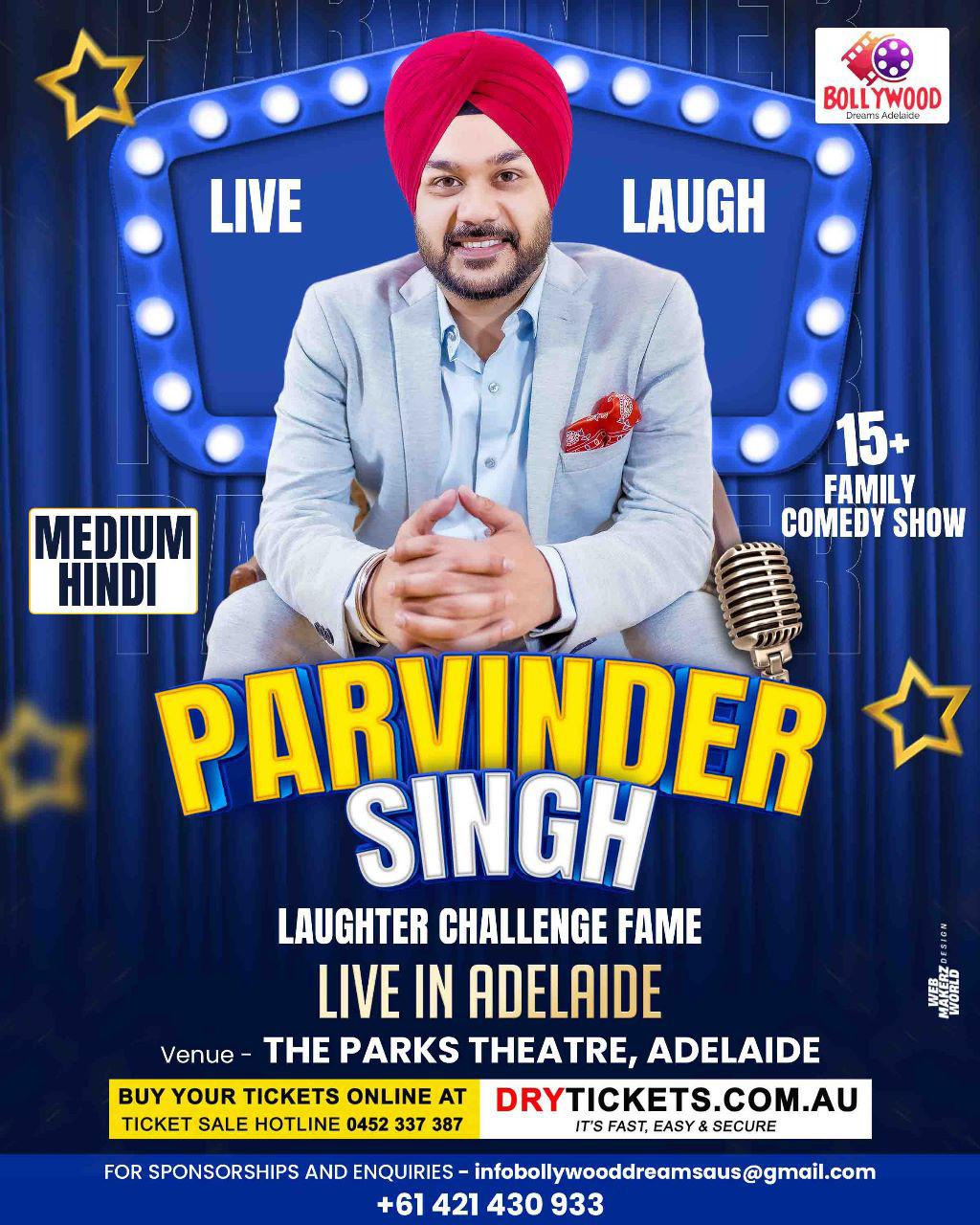
Download Our App AUGUST I 2023 www.DesiAustralia.com 58 Advertisement
