volume 9 issue 6 december 2016
issn 1757-4625
the
technologist the official journal of the dental technologists association
In this issue: Looking into facial prosthetics 3D printing in practice More medical emergencies
3.75
HOURS OF VERIFIED CPD PLUS 1 HOUR OF UNVERIFIED CPD IN THIS ISSUE!
december 2016 1
the
technologist in this issue Editor: Vikki Harper t: 01949 851 723 m: 07932 402 561 e: vikki@goodasmyword.com Advertising: Sue Adams t: 01452 886 366 e: sueadams@dta-uk.org
DTA administration: Sue Adams Chief Executive F13a Kestrel Court Waterwells Drive Waterwells Business Park Gloucester GL2 2AQ t: 01452 886 366 e: sueadams@dta-uk.org DTA Council: James Green President Delroy Reeves Deputy President Tony Griffin Treasurer Gregg Clutton Andrea Johnson Mike McGlynn John Stacey Gerrard Starnes Marta Zarnowiecka
Editorial team: James Green Tony Griffin Andrea Johnson Mike McGlynn
news dta column hr facts: brexit and beyond business planning and budgeting a facial prosthetics case update on medical emergencies: fainting and choking update on medical emergencies: asthma and anaphylaxis going digital – 3D printing – one DT’s experience case planning & guided surgery: it’s not the scan, it’s the plan classified adverts continuing professional development
02 04 06 07 10 12 13 15 18 21 22
Design & production: Kavita Graphics t: 01843 583 084 e: dennis@kavitagraphics.co.uk
Published by: Stephen Hancocks w: www.stephenhancocks.com
The Technologist is published by the Dental Technologists Association and is provided to members as part of a comprehensive membership package. For details about how to join, please visit: www.dta-uk.org or call 01452 886 366 ISSN: 1757-4625
Find out the 11 reasons to join DTA by visiting:
www.dta-uk.org the
technologist
Views and opinions expressed in the publication are not necessarily those of the Dental Technologists Association.
Cost effective professional indemnity insurance for dental technicians and laboratories
Tel: 01634 662 916
2 december 2016
news&information ■ WHAT MAKES A DENTAL TECHNICIAN? This may seem like an obvious question: it is someone trained, qualified and registered to fulfil the role of a DT.
B
ut what we want to know is what makes someone decide to be a dental technician? Do dental technicians share interests? Do they favour one side of the brain over another? Do they like to do things with their hands rather than with their heads? What makes them tick? Not being a dental technician myself, but having interviewed many of you during the eight years of editing this publication, the common themes amongst everyone that I have spoken with are an interest in creativity, especially with the hands; and often pastimes associated with nature or machinery of some form, be they trains, cycles, motor bikes, fast cars, flying machines, etc. We would love to make 2017 the Year of the Dental Technician by featuring images of you pursuing your favourite ‘away from the bench’ activities on the front cover of TT. If you would like to share your fascination and prove my assumptions about what makes a DT, a DT, then send me a high resolution shot of you doing what you love best!
■ Email me at vikki@goodasmyword.com Thanks - Ed
■ GLANCING BACK AND LOOKING FORWARD: A YEAR OF CLOSE WORKING TIES BETWEEN DTA AND DENTAID By Andrea Johnson
I
can scarcely believe that it has now been a year since I got involved with Dentaid. The first weeks and months were quite scary with regard to the project I was taking on, and the money I had to raise to support the fantastic dream of getting a dental laboratory up and running in Uganda for Dentaid. On my journey, I discovered there are some fantastic people in this world who will go out of their way to help others. I had some of those helping me fundraise in the early days: friends and family who I cannot thank enough. When the DTA offered to help me and take on Dentaid as its first-ever supported charity, my efforts were really given a boost! The DTA helped me raise the profile of this wonderful charity and the work they do, and it gave me a portal to some of the most generous people of all – you the members! I have been deeply touched and humbled by the generosity of DTA members. You have acknowledged this project as a worthy cause and you have supported it wholeheartedly – it’s just amazing. I do not know how I can thank you all enough for the donations of
equipment, supplies and sponsorship, and I promise that all of this equipment and money will be put to very good use in Dentaid’s first-ever lab project. In fact, two Ugandan technicians have already been given a helping hand through your donations and will use the donated equipment to improve the lives of those most in need in their country. To be able to offer people the chance to live a normal life, to eat and look normal is no small gift, and you are helping to provide just that. You make me proud to be a member of such a fantastic organisation. If any of you wonderful folk would like to help Dentaid and myself continue with this work, please do tick the box on your membership renewal form and donate £1. Every penny of this will go directly to Dentaid to continue their work wherever it is most needed. My heartfelt thanks - Andrea
■ CARDIFF METROPOLITAN UNIVERSITY By Mike McGlynn Former Cardiff dental technology students were invited back to Cardiff to help celebrate 50 years of dental technology training in the Welsh capital, 1966–2016.
T
here have been many changes over the last 50 years in the methods employed to train dental technicians in Wales and vast improvements made to the facilities at the Llandaff Campus site. The two new teaching laboratories have a joint, large and well-equipped plaster/ polishing room with a separate casting room, including burnout furnaces, induction
the
technologist
and vacuum casting machines, ceramic pressing furnaces, air abrasion units and orthodontic welders. The two teaching laboratories feature numerous, large, flat screen monitors around the walls, used for displaying digital dental images, webinars and dental technique videos, radiographs and live practical demonstrations, mainly for the full-time BSc students.
december 2016 3
news&information
■ MHRA JOINS FORCES WITH BDIA TO STAMP OUT DENTAL COUNTERFEITS UK medical device regulator, the Medical and Healthcare products Regulatory Agency (MHRA), is joining forces with the British Dental Industry Association’s (BDIA) award-winning Counterfeit and Substandard Instruments and Devices Initiative (CSIDI) to launch a new advertising and awareness campaign to help stamp out counterfeit dental devices. Alastair Jeffrey, MHRA Head of Enforcement, comments, ‘The MHRA is responsible for protecting public health and we have seen a worrying trend in the number of websites offering to supply dentists with unregulated and potentially dangerous equipment. Dental patients are entitled to expect quality care, including the standard of the instruments and devices used by dental professionals. We are pleased to be adding our authority and resources to the new joint campaign with the dental industry to tackle this serious issue. ‘It is vital that dentists and dental staff buy equipment from bona fide suppliers and avoid unapproved or counterfeit devices. I urge all dental professionals to be cautious of seemingly cheap devices which may be unfit for purpose and potentially dangerous to patients and the staff that use them.’
This exciting new joint venture will see hard-hitting advertisements regularly appearing in the dental press from November, backed up by a digital campaign and informative articles for the whole dental team. BDIA Policy and Public Affairs Director, Edmund Proffitt, adds, ‘The BDIA is delighted that the MHRA is joining the campaign. Together we can make a real difference educating dentists to the dangers of counterfeit devices, ensuring that they can buy with confidence and eradicating these dangerous and fake products from dentistry.’ This joint action by the MHRA and BDIA, supported by the dental profession, is promoting a very simple message: Counterfeit and non-compliant dental instruments and devices are potentially dangerous to patients and users and it is strongly recommended that all purchases, however small, are made from a reputable supplier and that all suspect devices are reported to the appropriate authorities at the earliest opportunity. All reporting can be done via the MHRA’s simple ‘Yellow Card’ system – www. yellowcard.mhra.gov.uk .
SCHOOL OF DENTAL TECHNOLOGY There is a digital visualiser camera display unit to enable students to view practical demonstrations by the instructors to any part of each teaching laboratory.
VISIBLE DISPLAY OF REGISTRATION The General Dental Council (GDC) is encouraging all dental professionals to display their official registration numbers in their practice or place of work, following last month’s decision to remove registered addresses from the online register. This decision was made following a consultation with key stakeholders, such as dental technologists, nurses, dentists, other registered dental professionals and patients. This came into effect on 10 October. The consultation showed strong support in the dental profession for the move, with 74% of the 2,500 professionals responding being in favour of the change. However, the public still needs a way of identifying practitioners and ensuring they are seeing someone who is adequately trained and qualified. The GDC believes displaying the registration number for each dental professional is the most appropriate way of doing this. The Standards for the Dental Team document elaborates that this should be in an area where it can easily be seen by patients. If it isn’t possible to display the number, it should be readily provided if requested.
The recent refurbishment provides 27 fully equipped bench spaces in one of the new labs and 24 bench spaces in the other laboratory. In addition, a new digital technology suite has been added that includes a Renishaw touch probe scanner, as well as a 5-axis, 3D white light scanner and several CAD computers for students to learn more about 3D designed appliances and restorations.
■ GDC RECOMMENDS
The facilities today are a long way from those used by returning students attending a memorable 50th reunion. ■ For the full article and images, please visit http://www.dta-uk.org the
technologist
The GDC believes that this is the most effective balance between information security and public confidence, enabling dental professionals to let patients know they are registered to do the job they are qualified to do in a much fairer way than publishing all registrants’ addresses online.
4 december 2016
thedtacolumn
■ THE DTA COLUMN
DTA Christmas Opening The DTA team will be breaking up for the Christmas and New Year break on Friday 23 December at 1.00 pm and reopening on Tuesday 3 January 2017 at 9.00 am. Merry Christmas and a Happy New Year to one and all.
Annual subscriptions 2017 You will shortly receive your annual subscription reminder. Payment is due by the end of December and can be paid by cheque and post, online @ www.dta-uk.org or by BACS. The renewal fee for 2017 is £103 for 12 months and this covers the many membership benefits available to you. Here is a reminder of what great value for money membership is: ■ The Technologist – 6 issues each year with about 4 hours of verifiable CPD in each one, including the core subjects ■ Articulate e-journal – also 6 issues each year with up to 45 minutes of verifiable CPD
■ www.dta-uk.org – our website provides news, views, a huge library of articles, guidance documents, plus events and jobs ■ Legal helpline 24/7 ■ Access to preferential rates for professional indemnity cover with UK Special Risks ■ A voice at national level ■ A library of guidance documents, including pay scales for the commercial sector ■ Your own CPD records ■ DTA App to keep you up to date with everything when you are out and about ■ Fully mobile-friendly website In addition to supporting you to achieve your full quota of learning, our website offers you the facility to complete your CPD online, to check your scores immediately to stimulate learning, and to keep a record of your progress so that when the time comes to provide the GDC with your results, they are all organised and easily accessible.
Council observers Do you have a passion for your profession? Would you like to get involved in the management of the DTA, but are not sure how? Come along to the next DTA Council meeting and meet the team, participate in the meeting and generally get to know what we do and how you might contribute. The next Council meeting will take place on Saturday 11 March 2017 in Gloucester. DTA will cover your expenses to the meeting (travel and hotel). ■ Contact Sue Adams on 01452 886 366 for further details. The DTA management team (Council) is sorry to see Nargisa Rikena and Jack Thurkettle leave our team and we wish them well for the future.
Give £1 to Dentaid! When you pay your subscription to DTA this month, why not add on £1 for Dentaid? All contributions will be forwarded to the charity in the New Year. Help make a difference this festive season.
■ CPD meter: Year Four – from 1 August 2016 until 31 July 2017 the
technologist
Disinfection and decontamination
CPD-o-meter
DTA Fellowship Awards 2017
Medical emergencies
required
Do you know someone who has made an outstanding contribution to dental technology and who you would like to recommend for a DTA Fellowship? Full details and a nomination form can be found on the website – www.dta-uk.org (About us, Fellowships).
provided in TT Materials and equipment
provided in Articulate
Radiography & radiation protection
Other specific verified CPD (including: legal and ethical issues, complaints handling, oral cancer: early detection)
HOURS
40
30
20
10
0
The requirement is to complete 50 hours of verifiable CPD, 20 hours of which relates to core topics: decontamination, materials & equipment, (or radiography) and medical emergencies. You can use the additional hours provided in the core subjects to fulfil the total verified CPD target.
■ Closing date for nominations is 31 January 2017.
the
technologist
Keep in touch with DTA on Facebook and Twitter:
@DentalTechnologistsAssociation
@The_DTA
december 2016 5
thedtacolumn DTA Strategy Day At the end of October, members of the DTA management team met to discuss the future strategy of the association – the discussions included: how it should develop, what members would like and what services should be provided. Tony Griffin led the day using the ‘De Bono Six Thinking Hats’
method to encourage everyone to look at options from different perspectives. Six Thinking Hats is a tool designed by Edward de Bono to promote group discussion and lateral thinking using six coloured hats. More about this in the February edition of TT.
■THE TECHNOLOGIST CHRISTMAS TEASER
1 What colour are the berries of the mistletoe plant?
3 What is the name of the cake traditionally eaten at Christmas in Italy?
2 How many points does a snowflake have?
7 4 What is Boxing Day also known as?
5 Christmas Island, in the Indian Ocean, is a territory of which country?
8
6 The North Pole, said to be Santa’s home, is located in which ocean?
Which Christmas condiment is made from fruit sometimes referred to as marshworts?
9 In what film did the song, ‘Walking in the Air’ feature?
In Charles Dickens’ novel ‘A Christmas Carol’ who was Scrooge’s dead business partner?
10 Name three reindeer not including Rudolph
Email sueadams@dta-uk.org or post your answers to DTA by the 23rd December and someone, with all the right answers, will win FREE membership for 2017. Answers and winner published in the February 2017 edition. the
technologist
6 december 2016
hrfacts
■ Brexit and beyond Standards for the Dental Team: Standard 7.3 Update and develop your professional knowledge & skills ■ Educational aim: – to summarise how employment law and working conditions have changed over the last year and to consider the impact of Brexit for small businesses with regard to employment law ■ CPD outcome: – to have a better understanding of the main changes affecting employment law in 2016 and how these might change with Brexit
Brexit, a new Living Wage, and a raft of new employment Acts could signal a period of uncertainty for many small businesses. Richard Mander, HR consultant, looks at the main changes to the HR landscape during 2016 and tries to anticipate the impact of Brexit for small business employers in the area of employment legislation.
Brexit and employment rights
S
o what impact will the Brexit vote have on employment law? Over the past few decades, EU directives have affected workers’ rights across the whole economy. The biggest changes have come in the areas of working time, annual holidays, rights for women and family-friendly policies. In addition, employees now benefit from enhanced anti-discrimination legislation thanks to the impact of EU legislation. These changes protect the individual but other important ‘collective rights’ protect groups of employees in the areas of business change and communication, referred to as the Transfer of Undertakings (Protection of Employment) [TUPE], European Works Councils and information and consultation regulations.
the
technologist
How did we get here?
Typically, European law is initiated in Brussels through directives and, once agreed, transposed into national legislation across all of the Member States.
changes to workplace rights will depend on the shape of the political and economic relationship that the UK negotiates with the EU.
ECJ won’t go away A whole swathe of UK national employment legislation that incorporates EU rights and principles will remain unaffected by Brexit unless, and until, these laws are repealed. This can only be done by Parliament.
It’s complicated In theory the UK Government could amend employment law if it could gain parliamentary approval. However, in reality the legal framework under which EUderived employment law is transposed into UK law is complex and will not be straightforward to dismantle, even if there is the political will to do so. So it really looks as if nothing will change in the short term. Any analysis of what the future holds for EU-derived employment law is based on speculation, and reliable commentary will have to wait until we see what appears on the negotiating table. Ultimately, any
On leaving the EU, the European Court of Justice (ECJ) would no longer have jurisdiction and its future decisions would not be binding on UK courts. It seems likely, however, that if we retain any laws originating from the EU (which is probable), our courts would still take account of future ECJ judgments as persuasive, albeit not binding, when ruling on those laws. In that case, the ECJ would continue to exert an appreciable influence.
Flexible workforce It’s also worth bearing in mind that the current employment law landscape is shaped by the UK Government using its veto to abstain from certain aspects of EU legislation. Some would argue that this has resulted in the UK labour force being one of the most flexible in Europe. Other UK-driven legislation may have gone too far the other way. New rules and fees affecting access to employment tribunals introduced by the UK Government have seen a 60% reduction in claims that many argue may be preventing genuine cases from gaining access to justice.
New Living Wage Looking at other significant events during 2016, a recent Chartered Institute of Personnel and Development (CIPD) survey found that over half of all UK employers have been affected by the new Living Wage which came into force in April. The minimum wage for workers aged 25 and over is now £7.20 per hour. The National Minimum Wage amendment regulations also double the financial penalties if employers are found to have paid less than the minimum.
december 2016 7
hrfacts
Other New Acts
the
technologist
Standards for the Dental Team: Standard 7.3 Update and develop your professional knowledge and skills ■ Educational aim: – to understand the importance and benefits of adequately planning your business performance and how to use budgets and other techniques to monitor performance and deliver the desired result ■ CPD outcomes: – to recognise the elements that drive a business plan – to have a greater understanding of how to plan and budget for your business – to understand the drivers and importance of cash flow forecasting
‘Failing to prepare is preparing to fail’ is a common phrase used to describe businesses that do not see the importance or find the time to adequately plan and budget. In this article, I will take an overview on popular ways of planning and budgeting and how to use them to monitor the performance of your business.
Planning
B
usiness planning can take many forms, from a very simple outline of a few main goals and strategies, to a full-blown, documented, financial business plan. Some business owners are put off by what they think is a business plan – some overblown essay on their business and why would they need to put on paper what they already know in their head? A business plan is very useful, not just for attracting finance and investment, but to the business owners themselves, to make them think about all aspects of the business and not just the ones they enjoy doing! It helps you to ensure that things are actually working as you think they should be and to help you plan any needed changes: growth, diversification, introduction of new services, personnel,
business planning & budgeting
brexit and beyond
Richard Mander Richard Mander is a freelance HR consultant with over 20 years’ experience. If you would like to find out more about this topic or advice on other HR matters you can contact him at www.manderhr.com 07715 326 568.
■ Business planning and budgeting
other specific verified CPD
other specific verified CPD
■ The Scotland Bill became an Act in March. It devolves further powers to the Scottish Parliament, including financial powers and elements of the welfare system. Under the Act, the Scottish Parliament has announced its intention to abolish employment tribunal fees in Scotland. ■ The Childcare Bill, which became an Act in March, applies to England and Wales only. The number of hours of free childcare for 3- and 4-year-olds in working families is expected to be doubled from the current 15 hours to 30 hours from September 2017. Pilot programmes in some areas are expected to offer 30 hours of free childcare from September 2016. ■ The Trade Union Bill Living Wage, which became an Act in May, allows the government to reform strike laws in Great Britain. Future regulations will bring the Act into force. ■ The Enterprise Bill, which became an Act in May, includes provisions on apprenticeships and capping exit payments for public sector workers. ■ The Immigration Bill, which became an Act in May, contains more provisions on illegal working, the introduction of a skills charge and a new duty on public authorities to ensure that everyone who works for them in a customer-facing role speaks fluent English. Changes to the illegal working rules and certain other provisions came into force in July.
businessplanningandbudgeting
8 december 2016
businessplanningandbudgeting
marketing strategy, etc. It also acts as a reference document so you can monitor how you are progressing in relation to your expectations.
Typical contents of a business plan A business plan can be as complicated or as simple as the business requires and may contain some or all of the following: 1. Sales pricing strategy – Looking at your pricing structure to assess how it compares to your direct competition, whether it is giving you sufficient profit margin and if it is attracting enough of the ‘right’ kind of customers. 2. Direct costs – Reviewing the suppliers you use to obtain your materials and finished products to ensure you are getting the best deal and right quality of service that allows you to be competitive in the marketplace. 3. Marketing strategy – Looking at the ways you are promoting your business and reviewing whether they are as effective as you need them to be. Assessing your target audience, how you could reach more clients, whether you could sell additional services to existing clients, and so on. 4. Competitor comparison – Do not ignore what your competitors are doing! Look at them and the way they market themselves, their prices and their services to see if there is anything you can learn from them and also if there is anything they are not doing that you might be able to take advantage of. 5. SWOT analysis – Most useful business plans contain a SWOT analysis to help you see what you can take advantage of and where more attention might be warranted. These may change from time to time, so reviewing your SWOT can be a useful exercise. To remind you, SWOT stands for: Strengths – These are internal to your business and within your direct control.
the
technologist
Weaknesses – These are internal to your business and within your direct control.
the business. It helps you plan any needed investments or highlight any potential cash shortfalls that may need outside funding via a loan or temporary overdraft.
Opportunities – These are external to your business and not within your direct control. Threats – These are external to your business and not within your direct control. 6. Goals – Do regularly review your business and personal goals to ensure that your strategies are working towards achieving these goals and, if not, what you need to change to make your goals more realistic. 7. Financial forecasts – Any good business plan will contain your forecast for sales for the next 12 months, along with your cash flow forecast. A cash flow forecast is your best guess as to when monies will come into and leave
If you were preparing a business plan to attract investment then you might want to include some of the following sections: ■ ■ ■ ■
An overview of the business Your qualifications and history Details of key personnel and suppliers A contingency plan
Budgeting The two most commonly used budgets are a profit forecast and a cash flow forecast. We have looked at profit and loss accounts and cash flows in previous articles, so I will not spend much time here explaining what they are.
Table 1. An example of a profit and loss account
Sales Direct Costs Gross Profit Overheads
x (x) x (x)
Net Profit
x
december 2016 9
businessplanningandbudgeting Table 2: An example of a variance analysis
Actual
Variance
3500 1500 700
3100 1350 725
(400) 150 (25)
other specific verified CPD
Sales Direct Costs Overheads
Budget
Profit and loss account This is the trading statement for the business and looks at the sales, direct costs and overheads the business incurs over a period of time, be it monthly or yearly. It will typically look something like Table 1.
As explained earlier, this is your forecast of when all monies will hit the business account and leave the business account. Budgeting is all about being as realistic as you can be using your knowledge of the industry and expectations of any changes that may occur in the next year to arrive at your forecast profit and cash flow. But it does not stop there. You then need to review these forecasts on a regular basis, usually monthly, to compare your budgeted figures to the actual figures that occurred in that month. This comparison is usually carried out using ‘variance analysis’, which looks at the variances between the budgeted figures and the actual figures to see if any further investigation is required to understand why those differences occurred.
sales to understand why it has occurred and if any action is required to bring the result back on track. For instance, it could be that you were away on an unplanned holiday and it was therefore the forecasting that was wrong. Or it may be that a key client has taken its business elsewhere and you need to act to replace that chunk of business. In either scenario, a revision of the budget may be required for the next month. By budgeting and reviewing like this on a regular basis, you can ensure that the business stays on track, as it allows you to take remedial action as soon as you spot a variance and not a year or so later when the final accounts are done and it’s too late to act!
Types of budgeting It may be that differences were due to a reason that means you need to revise your forecast for the rest of the year in light of that new situation. For example, a supplier unexpectedly increases their prices! An example of a variance analysis is shown in Table 2. In this situation the business owner may want to look at the unexpected fall in
There are two main methods of preparing a budget. The most common and straightforward approach is to take last year’s figures and apply a percentage increase or decrease based on your
knowledge. For example, you might look at last year’s sales figure and estimate that this year will show a 5% increase, and prepare your budget accordingly. The second way is to do something called zero-based budgeting, where you start with a completely clean slate, paying no attention to previous year’s figures, and enter your budgeted figures line by line on what you think is realistic for the year ahead.
business planning & budgeting
Cash flow forecast
This method is useful to do every few years to make sure you are being completely realistic and not basing performance on previous unreliable conclusions.
Conclusion Adequate planning, budgeting and reviewing are essential tasks that every business owner should do to ensure the business is heading in the right direction and you are in a position to grab the controls and get it back on track when obstacles get in the way!
About Peter Blake Peter Blake is a chartered accountant, business coach and master practitioner of NLP. He has his own practice based in Wiltshire, lectures on finance and mentors new business start-ups for Gloucestershire Enterprise Ltd. For further details, contact Peter on 07912 343 265 or email peterblake@pbcoachingandtraining.com the
technologist
10 december 2016
facialprosthetics
■ A facial prosthetics case Standards for the Dental Team: Standard 7.4 Update and develop your professional knowledge and skills throughout your working life ■ Educational aims: – to Illustrate an example of the type of cases and issues a maxillofacial prosthetist has to overcome – to understand the process of providing patients with customised rehabilitation devices/prostheses – to convey the potential emotional impact of working directly with people with debilitating conditions ■ CPD outcomes: – to get a better understanding of the cases faced by a maxillofacial prosthetist – to understand the process for building customised prostheses
Figs. 1 and 2: – Wax up of the prosthesis showing magnet positioning.
By Daniel Shaw, Maxillofacial and Orthodontic Technician
A clinical and technical report
T
his particular patient was treated for a squamous cell carcinoma (SCC). His surgery involved removal of the anterior section of the maxilla (hemimaxillectomy) and his nose (rhinectomy).
He was referred to the maxillofacial prosthetist (MfPT) following his surgery to provide him with an obturator, to aid with swallowing and speech, and also to provide him with a facial prosthesis. A new maxillary impression was necessary to be able to provide the patient with an adequate obturator, as the current denture he had was now obsolete.
Fig. 3: Obturator in situ
the
technologist
After small alterations, the obturator (cover plate) fitted loosely and was utilised as an impression tray for the secondary impression. Positioning of the patient was difficult, as he had unfortunately also suffered a stroke. The patient had to be seated upright to avoid alginate flowing down through the facial cavity into the oropharynx, an extremely sensitive area. The impression with the denture was returned to the laboratory, where an extended re-line was performed. Slight alterations were
required upon fitting, several hours later, but the patient was then allowed to go home. A review was planned for two weeks; however, before the review the patient was in contact, complaining the denture was too loose. At this stage, the denture was relined using Eversoft (Dentsply Austenal PA USA) and the patient was instructed to use a denture fixative to help prevent further loosening. At the one-month, follow-up appointment, the same complaint was made. The old Eversoft was removed and replaced with an extended section to incorporate a magnet (Maxi-Magnet – Long Lip; Technovent; UK) that was attached to the implant on the left side of the maxilla and on to a Maxi-Cap (Technovent; UK). At this point the denture relied on mucosal support, support from the nasal floor, and the single implant as a locator.
december 2016 11
facialprosthetics Fig. 4: Mixing the M511 with pigments and flocking to colour the silicone accordingly
A replacement nasal prosthesis was manufactured, utilising the magnet and the patient was extremely happy with the result. A six-month, follow-up review was arranged, but in August of the same year the patient had again been admitted to hospital.
Two days before Christmas, the nasal prosthesis was fitted to the patient with no adjustment necessary.
DISCUSSION
In the New Year the patient still complained of friction and soreness at various contact points of the obturator/denture. This proved it was necessary to design a denture that incorporated a magnet in an extended labial flange. It was also reported that when the patient wore the prosthesis, his eyes were itchy and watery. After investigation, it was thought to be local irritation caused by the edge adhesive used (Technovent UK). Therefore, both components were replaced and the design changed so that a magnet receiver was incorporated into the back of a second nasal prosthesis to give more stability to the denture.
The patient himself was also extremely understanding of the level of my experience, but was happy for me to complete the work necessary for his rehabilitation.
CONCLUSION
The silicone used was M511 (part of the M72 Prosthetics Kit from Technovent) and flocks and colours were used to match the skin tone.
Renewal of the prosthesis due to soft tissue changes
An MfPT is exposed to a wide range of needs but this was my first case of this kind. It was necessary to seek help and advice from MfPT colleagues (Jason Watson, Andrew Richmond and Frank Johnson), and this resulted in the successful rehabilitation of this patient.
The first obturator/denture was designed to best suit the needs of the patient at that immediate post-operative period. Additions and removal of material would be an ongoing and necessary procedure in order to compensate for the changing healing growth of the naso-facial cavity. Looking at the clinical treatment, when the second device was fitted, there was a huge reduction in the number of complaints that the patient had. This proved how well the two components (prosthesis and denture) interlocked to create a more secure device. The failure of the implant in the nasal bone proved how much load was bearing on it through mastication and swallowing, and a second, two-part device was the only way forward. If it had been possible, more than one implant could have been incorporated into the first obturator,
As an MfPT, working so closely with a patient of this nature, and developing a relationship with them and their family, it is difficult not to become emotionally involved, and writing this case study became difficult and brought back many memories.
materials & equipment
A new facial impression was taken for a nasal prosthesis. The wax pattern (incorporating magnetic retention studs) was tried and adjusted due to its shape not matching the patient’s previous natural nose, and processed in the laboratory.
temporarily until the nasal prosthesis had been manufactured.
core verified CPD
The denture was again loose twenty-eight days later, and the implant placed into the maxilla had come out due to the constant load friction. It was discussed that to provide the patient with a well-fitting obturator, a facial prosthesis would be helpful in retaining the obturator.
This process began with an accurate impression, taken using the exiting denture, and a heat-cured acrylic resin (WHW Fast cure, WHW, Hull UK) baseplate was constructed. The device was fitted and acrylic teeth were added in wax, as a try-in. Once the patient’s bite was balanced, the denture was processed, in the same heat-cured resin. The magnet was also incorporated into the extended labial flange. The patient was fitted with the new denture and Eversoft lining material was used to secure the plate. The patient felt this second denture was extremely comfortable and food and liquid was successfully swallowed without leakage.
Fortunately, I can feel confident that I provided this patient with the necessary treatment he required during his rehabilitation and eventual palliative care. The devices provided adequate functionality and the patient was again allowed to feel a sense of normality in his appearance and day-to-day life.
Fig. 5: The fitted prosthesis
the
technologist
12 december 2016
medicalemergencies
■ Update on medical emergencies: Fainting and choking Standards for the Dental Team: Standard 7.3 Update and develop your professional knowledge and skills ■ Educational aims: – to gain knowledge of the types of medical emergencies that commonly occur in the dental setting – to meet General Dental Council requirements for training in medical emergencies – to work as a team when dealing with a medical emergency ■ CPD outcomes: – to know the causes and be able to recognise the signs and symptoms of syncope (fainting) and foreign body aspiration – to know how to manage a person who is fainting or choking
All dental professionals have a duty to be able to recognise when a medical emergency is occurring and respond accordingly. Two common emergencies that may occur in any setting are fainting and choking. This article will discuss the signs and symptoms that a person will develop and the immediate management.
Syncope (Fainting) Syncope is the most common type of emergency occurring in the dental setting with the average dentist encountering two cases per year (Girdler & Smith 1999). A person will faint when there is a reduced blood and oxygen supply to the brain. It is a reflex triggered by emotional stress or pain that results in widespread vasodilation. This diverts blood supply away from the brain and into the peripheries. It can also be triggered by changes in posture or hypoxia. Some patients are more prone to fainting than others and this will be apparent from the previous medical history. It is wise to treat these patients in a supine position to reduce the likelihood of a faint developing (Greenwood & Meechan 2014). the
technologist
Diagnosing vasovagal syncope The signs and symptoms of a simple faint include: ■ ■ ■ ■ ■
dizziness pallor and sweating nausea and/or vomiting pulse rate slows (bradycardia) loss of consciousness
To treat a simple faint: ■ Lie the patient flat and raise the legs. ■ Loosen any tight clothing or ties around the neck. If they feel hot, fans or a cold compress will be helpful. ■ Monitor and maintain the airway throughout. The hallmark of a simple faint is the rapid recovery, usually within seconds. If recovery is delayed, give high flow oxygen (15/L minute) and consider other causes of collapse and call for help.
Choking and aspiration Choking is the obstruction of airflow into the lungs and may result from a blockage of the upper airway (mouth and throat) or the lower airway (trachea and lungs). Here we will discuss the management of choking due to an inhaled foreign body. In dentistry, items such as crowns, impression material or filling materials may all pose a risk to the airway (Greenwood & Meechan 2014).
obstruction. The victim that cannot speak, has a weakening cough or is struggling to breathe has severe airway obstruction. It may be accompanied by exaggerated breathing movements and abnormal breath sounds on inhalation (stridor) or exhalation (wheeze).
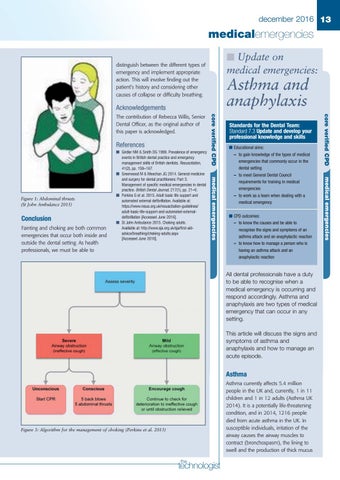
Management of choking ■ Coughing – In the first instance, coughing should be encouraged as this is the body’s natural reflex to clear the airway. ■ Back slaps (Fig. 1) – The victim should be bent forwards, and using the heel of the hand, give up to five sharp back blows. ■ Abdominal thrusts – Place linked hands between the bottom of the ribcage and the naval. Pull sharply inwards and upwards five times. (Fig. 2) This should be alternated with back blows until the object is dislodged or the victim becomes unconscious. If at this point, CPR should be commenced and help called for. These steps are summarised in Fig. 3. If you suspect the foreign body has been aspirated, take the patient to the emergency department for assessment, as they will require a chest X-ray to confirm there is no foreign body in the lungs.
Signs and symptoms of choking and aspiration Recognition of an airway obstruction is the key to a successful outcome. It should not be confused with fainting, seizures, asthma attacks or other conditions that cause acute respiratory distress (Perkins et al. 2015). It is important to ask the conscious victim ‘Are you choking?’ The victim that is able to speak and cough has a mild
Figure 1: Back slaps (St John Ambulance 2015)
december 2016 13
medicalemergencies ■ Update on medical emergencies:
distinguish between the different types of emergency and implement appropriate action. This will involve finding out the patient’s history and considering other causes of collapse or difficulty breathing.
Asthma and anaphylaxis
Acknowledgements
Fainting and choking are both common emergencies that occur both inside and outside the dental setting. As health professionals, we must be able to
■ Educational aims: – to gain knowledge of the types of medical emergencies that commonly occur in the dental setting – to meet General Dental Council requirements for training in medical emergencies – to work as a team when dealing with a medical emergency ■ CPD outcomes: – to know the causes and be able to recognise the signs and symptoms of an asthma attack and an anaphylactic reaction – to know how to manage a person who is having an asthma attack and an anaphylactic reaction
All dental professionals have a duty to be able to recognise when a medical emergency is occurring and respond accordingly. Asthma and anaphylaxis are two types of medical emergency that can occur in any setting. This article will discuss the signs and symptoms of asthma and anaphylaxis and how to manage an acute episode.
Asthma Asthma currently affects 5.4 million people in the UK and, currently, 1 in 11 children and 1 in 12 adults (Asthma UK 2014). It is a potentially life-threatening condition, and in 2014, 1216 people died from acute asthma in the UK. In susceptible individuals, irritation of the airway causes the airway muscles to contract (bronchospasm), the lining to swell and the production of thick mucus
Figure 3: Algorithm for the management of choking (Perkins et al. 2015)
the
technologist
medical emergencies
Conclusion
medical emergencies
Figure 1: Abdominal thrusts (St John Ambulance 2015)
■ Girdler NM & Smith DG 1999. Prevalence of emergency events in British dental practice and emergency management skills of British dentists. Resuscitation, 41(2), pp. 159–167. ■ Greenwood M & Meechan JG 2014. General medicine and surgery for dental practitioners: Part 3. Management of specific medical emergencies in dental practice. British Dental Journal, 217(1), pp. 21–6. ■ Perkins G et al. 2015. Adult basic life support and automated external defibrillation. Available at: https://www.resus.org.uk/resuscitation-guidelines/ adult-basic-life-support-and-automated-externaldefibrillation [Accessed June 2016]. ■ St John Ambulance 2015. Choking adults. Available at: http://www.sja.org.uk/sja/first-aidadvice/breathing/choking-adults.aspx [Accessed June 2016].
Standards for the Dental Team: Standard 7.3 Update and develop your professional knowledge and skills
core verified CPD
References
core verified CPD
The contribution of Rebecca Willis, Senior Dental Officer, as the original author of this paper is acknowledged.
14 december 2016
medicalemergencies in response to exertion, infection or exposure to an allergen (Greenwood & Meechan 2014). This results in obstruction of the airways.
in an emergency situation, as they will come to no harm with short-term use of high flow oxygen.
Anaphylaxis
Managing an acute asthma attack
Signs and symptoms of anaphylaxis
(Greenwood & Meechan 2014) Most attacks will respond to the patient’s own inhaler, for example, salbutamol. Repeat doses may be required as studies have shown that only 10% of each dose reaches the lower airway. It would be helpful to be supplemented with a spacer device as this improves the delivery of the drug to the lower airway.
(Greenwood & Meechan 2014) During anaphylaxis, signs and symptoms usually develop rapidly and include:
Signs and symptoms of an asthma attack
If the patient does not respond to their own inhaler or shows signs of lifethreatening asthma, urgent transfer to hospital should be arranged. The patient should be given oxygen whilst awaiting the ambulance service. Four to six actuations should be given every 10 minutes until the ambulance service arrives, supplemented with high flow oxygen (15L/minute). All patients, including those with chronic obstructive pulmonary disease, who rely on a hypoxic drive to breathe, should be given oxygen
Conclusion ■ itchy rash (urticarial) ■ facial swelling, sneezing and itching/redness of the eyes ■ upper airway swelling causes breathlessness with wheezing or stridor (high-pitched breath sounds) ■ signs of circulatory collapse (shock) – rapid and weak pulse, pale, cold, clammy skin and confusion ■ respiratory arrest may occur leading to cardiac arrest
An anaphylactic reaction may present with similar symptoms to an acute asthma attack. Anaphylaxis will usually have an accompanying itchy rash, swelling, breathlessness and signs of circulatory collapse. Prompt action and early access to the emergency services are required in both cases. This is particularly the case when the patient is starting to show signs and symptoms of developing lifethreatening airway obstruction.
Initial treatment of anaphylaxis
Acknowledgements
(Greenwood & Meechan 2014) First-line treatment includes managing the airway and breathing and restoring blood pressure. High flow oxygen should be given (15L/minute) and the patient laid flat and the feet raised to support the circulation.
The contribution of Rebecca Willis, Senior Dental Officer, as the original author of this paper is acknowledged
Table 1: Signs and symptoms of an asthma attack
Acute severe asthma attack
Life-threatening asthma attack
Inability to complete sentences in one breath
Exhaustion, confusion, decreased conscious level
Respiratory rate > 25 per minute Tachycardia (heart rate > 110 per minute)
Cyanosis or respiratory rate < 8 per minute Bradycardia (heart rate < 50 per minute)
the
technologist
All patients treated for an anaphylactic reaction should be transferred to hospital by ambulance for further assessment and monitoring, irrespective of any initial recovery. Hospital treatment may include fluid replacement, steroids and antihistamines, as well as further airway support if required (Maher et al. 2014).
References ■ Asthma UK 2014. Asthma Facts and FAQs. Asthma UK. Available at: https://www.asthma.org.uk/about /media/facts-and-statistics/ [Accessed June 2016]. ■ Greenwood M & Meechan JG 2014. General medicine and surgery for dental practitioners: Part 3. Management of specific medical emergencies in dental practice. British Dental Journal, 217(1), pp. 21–6. ■ Maher NG, de Looze J & Hoffman GR 2014. Anaphylaxis: an update for dental practitioners. Australian Dental Journal, 59(2), pp. 142–8; quiz 273. ■ Pemberton MN & Gibson J 2012. Chlorhexidine and hypersensitivity reactions in dentistry. British Dental Journal, 213(11), pp. 547–550.
medical emergencies
(Greenwood & Meechan 2014) The signs and symptoms of an asthma attack are shortness of breath, coughing and wheezing. It is important to differentiate between a mild asthma attack and an acute severe or lifethreatening asthma attack (see Table 1).
Anaphylaxis is a severe and potentially lifethreatening type 1 hypersensitivity reaction. Typical causative agents in dental practice include antibiotics, latex, iodine skin preparations and anaesthetic drugs. A true allergy to local anaesthetic is rare, and is more likely to be caused by the preservative agents contained in the solution, such as sulphites (Maher et al. 2014). Recently, two cases of deaths in dental practice caused by chlorhexidine allergy have been reported (Pemberton & Gibson 2012), and a good history from the patient is essential to identify potential triggers.
core verified CPD
A history needs to gather information of precipitating factors, effectiveness of medication and history of hospital admissions for acute asthma attacks.
For severe reactions, where there is lifethreatening airway, breathing and circulation signs, adrenaline should be given intramuscularly. It is given either into the muscle of the mid-third of the anterolateral thigh or the deltoid muscle of the shoulder. An Epipen is a preloaded device that delivers 0.3 ml of 1:1000 adrenaline solution. It is available for immediate self-administration for patients known to have severe reactions. Alternatively, 0.5 ml of 1 in 1000 adrenaline solution drawn from a vial is given. The dose is repeated if necessary at 5 minutes if no signs of improvement.
december 2016 15
3Dprinting
■ Going digital – one DT’s experience By Joe Pyke I have been a dental technician for 17 years and owned my own traditional dental laboratory, A1 Aesthetics, for 12. Two years ago, I set up Elite dental, a completely digital laboratory that runs with just myself and a colleague, Jaqui Brown.
E
lite allows dentists to send digital images from intraoral scans that we receive and use to produce 3D printed models and to mill other restorations, such as zirconia copings, and full contour crowns and bridges. We can also mill PMMA, wax and peek. 3D printing is still a relatively new concept in the industry, although it has been around for a good few years. It works by software interacting and accepting digital scans, which are then sent to the printer’s computer as STL files. These are then nested on the build platform and printed. The 3D printer can print anything that can fit on its build tray, which is around 30 cm x 40 cm x 15 cm. Whilst the printer is great for printing simple aligner models, and C and B models with ditch dies, I think it really comes into its own when producing implant models from digital impressions. I manage the workflow on my own although it has taken time to adapt to a new way of working. Getting used to the new software, discovering what it can and can’t do, has taken time but I believe that any technician with a small amount of training would be able to use it. I am 36 and have adapted without too much drama. When I decided I wanted to go down the route of buying into the 3D market, I spent around 18 months researching what was available and which printer could print at the quality I needed. In the end I chose the Eden 360 vantage by Stratasys. I felt this machine could deliver
the quality of print I needed, not only for dental aligners but also crown and bridge models and implant work. Although these printers are expensive (upwards of £50k), I think the return on investment will be worthwhile. I’ve worked with the printer for almost two years now and it runs most days producing a mix of aligner, c and b models with ditch dies and implant models. The great advantage of 3D printing is that the print quality is always the same, removing some of the inaccuracies found in traditional methods. The other great advantage is that the printer can run overnight, so your lab is being productive and working when you’re not. This obviously helps increase productivity. All 3D work comes at a price. We charge a premium over work produced by more traditional methods, but we try to keep our prices competitive. The reason for the premium is due to the price of the resins that are needed to produce the models. Simple aligned models are priced at £10. The only problem I have found with the 3D resin models is in the cleaning process. Support material needs to be washed off and then cleaned from the model, which is a little time-consuming.
When the printer arrived at the premises, it was installed and calibrated by an engineer. Once this was done, and I’d set up a 3-shape scanner and design software, the engineer was able to return and do one-day’s training on how to clean and maintain the machine and how to use the software. This was sufficient training to get me started, and when I needed any further help, the support team has been at the end of the phone. It has all worked perfectly well. Moving into digital work has been a long and expensive journey, but 3D printing has a massive role to play in the dental industry and I think in the not-too-distant future it will take over because it will be capable of producing more and more appliances. I would definitely recommend 3D printing, as it offers so much and I believe it is the future of our industry.
the
technologist
16 december 2016
3Dprinting
The images shown reflect the process of creating the 3D models. We receive a scan from the dentist that gets processed via our specialist software. We can manipulate the information to get an accurate model of the patient’s mouth and teeth, and assess what needs to be done.
Fig. 5: Implant aligned with cross section
Fig. 1: Order form
Fig. 3: Implant designed
Fig. 2: Lower untrimmed
Fig. 7: Finished model design with implant analog hole
Fig. 4: Implant alignment
Fig. 8: Design models
the
technologist
december 2016 17
3Dprinting The images displayed on this page show a fully printed 3D model on a build tray and a fully cleaned and readied model on the build tray.
Fig. 1: Just finished printed models on build tray
Fig. 5: Two models separated; shows die in position and implant hole
Fig. 2: Just finished printed models on build tray
Fig. 6: Close up of implant hole
Fig. 3: Side on view of printed models on build tray
Fig. 7: Ditch die and hole
Fig. 4: Finished and cleaned model with ditch die in position
Fig. 8: Close up of the ditch die in position
the
technologist
18 december 2016
caseplanningandguidedsurgery
■ Case planning & guided surgery: Standards for the Dental Team: Standard 7.3 Update and develop your professional knowledge & skills ■ Educational aims: – to discuss how guided surgery can promote more predictable treatment outcomes – to explain how the use of 3D imaging (CBCT) and interactive treatment planning software assist with planning, design and ultimately the result of an implant restoration ■ CPD outcome: – to have a better understanding of how case planning and guided surgery assists outcomes – to use the coDiagnostiX™ system to explore one dentist's approach to case planning and enhanced communication with his dental laboratory partners
Balraj Sekhon discusses the benefits of guided surgery to deliver predictable treatment outcomes.
A
lthough implant dentistry has evolved into one of the most predictable treatment alternatives for patients with missing teeth, we are still striving to improve our surgical and restorative techniques. The foundation for all procedures should be a proper diagnosis to determine the appropriate treatment options. To help take the guesswork out of the diagnostic phase, the use of 3D imaging (CBCT) with interactive treatment planning software, such as coDiagnostiX™, aids the planning of implant placement, the design of surgical drill guides and the ultimate restoration. I have found that by incorporating a digital implant planning system and working closely with a dental laboratory that offers CAD/CAM production, I benefit from well-designed surgical drill guides and high quality, implant-borne restorations. This, in turn, reduces complications and enhances the communication within the interdisciplinary team.
The use of CBCT and coDiagnostiX™ has greatly impacted my ability to diagnose in all dimensions, allowing a full appreciation of individual, patient-specific anatomy and a clear understanding of the existing quantity and quality of bone, trajectory of the alveolus, and location of vital structures. It also serves as a powerful communication tool for patients, colleagues, and with my laboratory of choice.
Digital workflow for implants The ideal for me is to achieve prosthetically driven implant reconstruction. To achieve this, I need a complete understanding of the relationship between the tooth and the underlying bone. In addition, proper diagnosis may require working closely with a laboratory to create ‘virtual’ diagnostic wax-ups of the surgical guide and the proposed final restoration, allowing adjustments to be made to achieve the best possible outcome. Therefore, it’s not the scan but the plan that becomes my driving force. When a tooth is fractured or requires extraction, a dental implant is the ideal treatment option that will restore the root of the tooth and provide support for a new clinical crown. The coDiagnostiX™ system offers many options for diagnosis, consultation and seamless workflow integration. Virtual implants of known length and diameter can be simulated within the receptor site, establishing the proper trajectory of the implant within the cross-sectional image and in relation to the desired restorative option (i.e. screw- or cement-retained). Using advanced software features and the process of segmentation, the existing tooth root can be virtually extracted and the proposed implant with an abutment projection can then be positioned to emerge through the desired restorative result.
3D images produced by the Straumann coDiagnostiXTM software
the
technologist
Improved outcomes As a general dentist I have found using advanced implant planning software, such as coDiagnostiX™, to be very beneficial and have been using it fully for about a year now. We don’t have a CT scanner inhouse and it would be difficult for me to justify the costs because we are a mixed practice, so we refer our patients to a local scan centre and they send us an open file scan that we can place into the software. Once in the coDiagnostiXTM system, we can take the various measurements and access the best placement for the implant.
Improved clinician/ laboratory communication I currently work with Ken Poland Milling in London and I regularly share my STL files with them. The communication features in the system synchronise planning and design work between practice and laboratory, allowing us to collaborate in real time, which makes the treatment planning process considerably easier and ensures that all parties’ expectations are met.
december 2016 19
caseplanningandguidedsurgery
It’s not the scan, it’s the plan I now have the ability to show the patient a digital representation of the proposed implant placement and the design of the final restoration. Patients respond well to being involved in the planning and design process, it gives them the opportunity to discuss the case in-depth and raise any areas of concern, and it undoubtedly helps manage the patient’s expectations of the final results.
coDiagnostiXTM is an investment in terms of direct cost and time to gain the depth of knowledge to fully utilise all the elements and tools in the system. However, I firmly believe it improves the patient journey, enhances communication and clarity with the dental laboratory, delivers a more efficient and robust surgery process, reduces stress, and ultimately delivers better dentistry.
Case example 1 using Straumann coDiagnostiXTM
materials & equipment
Replacement of two posterior teeth with screw-retained crowns
core verified CPD
Another advantage of the coDiagnostiXTM system is improved patient communication. Rob Poland comments, ‘We have been supporting clients with coDiagnostiX™ for a number of years from stent production to full planning, design and final restoration. The results have been excellent, eliminating compromised situations and aiding communication between clinician and dental technician.’
Fig. 2: Guided image
Fig. 1: X-ray pre-op Fig. 3: X-ray post-op
Fig. 4: Final below
Fig. 5: Final front
the
technologist
20 december 2016
caseplanningandguidedsurgery
Case example 2 using Straumann coDiagnostiXTM Replacement of upper left central incisor with screw-retained crown
Fig. 6: Initial presentation
Since qualiďŹ cation he has acquired the Diploma of Membership of the Joint Dental Faculties from the Royal College of Surgeons and a Master’s Degree in Dental Implantology with Distinction from the University of Central Lancashire. Balraj is also a published author in the Journal of Operative Dentistry.
Fig. 7: Initial presentation
Fig. 8: Gap X-ray Fig. 9: coDiagnostiXTM
Fig. 10: Final placement
Fig. 11: Final restoration 1
the
technologist
Fig. 12: Final restoration 2
Balraj has studied dental implantology to a high standard and currently works with a Yorkshire-based surgical team with specialist surgeon Dr Robert Dyas. He has a keen interest in teaching and this has been recognised by his appointment as Educational Supervisor by the Northwest NHS Deanery. For more information on case planning and guided surgery, contact Straumann on 01293 651 230 or visit one of our sites: straumann.co.uk straumanndigitalperformance.co.uk therevu.co.uk Facebook: Straumann UK Twitter: @StraumannUK
materials & equipment
Balraj graduated from the University of Manchester in 2003. He is one of the principal dentists at Circle Dental.
core verified CPD
Balraj Sekhon BDS (Manc), MJDF RCS (Lond), PGCert (UCLan), MSc Dental Implantology (Distinction)
december 2016 21
classifiedadverts
Guy’s and St Thomas’ NHS Foundation Trust
An opportunity has arisen to join the team in the removable laboratory at Guy’s Hospital as a Band 6 Specialist Dental Technician. This is a permanent appointment. You will be expected to provide a broad range of work; however, the majority will be the construction of highly complex, removable prosthodontic appliances for clinical staff and postgraduate students. You should also be experienced in the production of implant-retained dentures; all forms of removable metal frameworks, including attachments; and be capable of constructing the full range of complete and partial dentures to a high standard. Knowledge of obturators and surgical appliances would be an advantage but not necessary as full training would be given. You must have an appropriate dental technology qualification, such as a National Diploma, and ideally an advanced qualification in removable prosthodontics or equivalent experience. You should have at least 10 years’ postqualification experience and be registered with the GDC.
● For informal enquiries, please contact Martin Stevens on 02071 881 851. ● To apply, please go to the Guy’s and St Thomas’ website www.guysandstthomas.nhs.uk/jobs Closing date for applications is 1 January 2017.
Knight Dental Design Join our small, friendly team producing high-level aesthetics. An opportunity to join an award-winning private London laboratory is open for a talented ceramist with experience of smile design and full arch restorations. Also metal work/emax /diagnostic waxing/cad cam technicians needed. Competitive salary based on experience
● Email tony@kdduk.net www.knightdentaldesign.co.uk Tel 0208 316 6248
Do you want to advertise a vacancy in your lab? Visit the DTA website to view our competitive rates and complete the online form to place your ad and make payment. All advertisements are featured online as well as in this publication. If you are a DTA member you’ll be eligible for a discount off the published rates. ● Find out more @ www.dta-uk.org
the
technologist
22 december 2016
continuingprofessionaldevelopment Continuing Professional Development (CPD) Programme The Technologist is pleased to include a continuing professional development (CPD) programme for DTA members in accordance with the UK General Dental Council’s regulations and the FDI World Dental Federation’s guidelines for CPD programmes worldwide. The UK General Dental Council regulations required that from 1 August 2008 all dental technicians must start documenting their CPD. They are required to complete and record a minimum of 150 hours of CPD every five-year cycle, a third of which should be verifiable CPD (50 hours). This should include verifiable CPD in the following core subjects: ■ medical emergencies (10 hours per cycle) ■ disinfection and decontamination (5 hours per cycle) ■ materials and equipment (5 hours per cycle)
The questions in this issue of The Technologist will provide verifiable CPD for those entering the programme. Complete your answers for free online at www.dta-uk.org, or use the answer sheet overleaf (or a photocopy if this is preferred, so as not to remove the page). Return your answer sheet to the DTA Head Office address with your £5 payment (please note that your CPD won’t be processed without payment) before the 18 January 2017. Online and paper responses must be received by the deadline. Dental technicians completing the programme will receive a certificate for the prescribed number of hours of verifiable CPD, together with the answers to the questions either online or by post according to the above guidelines.
■ The aim of The Technologist CPD Programme is to provide articles and material of relevance to dental technicians and to test their understanding of the contents. ■ The anticipated outcomes are that dental technicians will be better informed about recent advances in dental technology and associated subjects and that they might apply their learning to their practice and ultimately to the care of patients. Please use the space on the answer sheet or online to provide any feedback that you would like us to consider.
Brexit & beyond (Other specific cpd – 30 minutes)
Business planning and budgeting (Other specific cpd – 45 minutes)
Q1 – When the UK leaves the EU:
Q1 – Failing to prepare is preparing to:
A – All existing UK employment laws will become obsolete B – All existing UK employment laws derived from the EU will no longer apply C – All existing UK employment laws derived from the EU can no longer be changed D – All existing UK employment laws (including those derived from the EU) will continue to apply unless and until changed by UK parliament
Q2 – The minimum wage for all workers aged 25 and above is: A – £9.90 per hour B – £50 per day C – £7.20 per hour D – £6.90 per hour
Q3 – Since the introduction of fees, applications to employment tribunals have: A – Reduced by 60% B – Remained at the same level C – Increased by 20% D – Reduced by 50%
Q4 – The Trade Union Bill will focus on: A – Union membership B – Reforming UK strike laws C – Union ballot procedures D – Promoting union membership
Q5 – The Childcare Bill aims to: A – Provide childcare for 4 & 5 year olds B – Halve the amount of free childcare currently available C – Increase access to free childcare in Scotland D – Increase access to free childcare for working families
the
Aims and outcomes In accordance with the General Dental Council’s guidance on providing verifiable CPD:
technologist
A – Succeed B – Fail C – Grow D – Sell
Q2 – Comparing budget figures to actual figures is called: A – Ratio analysis B – Cash flow forecasting C – Variance analysis D – Profit forecasting
Q3 – Preparing a budget from scratch is called: A – Zero-based budgeting B – Variance analysis C – Profit forecasting D – Cash flow forecasting
Q4 – Direct costs are: A – Overheads B – Materials and finished goods C – Capital purchases D – Wages
Q5 – The ‘O’ in SWOT analysis stands for: A – Overheads B – Operations C – Options D – Opportunities
Q6 – The two most common forms of budget forecast are profit and: A – Balance sheet B – Cash flow C – Overheads D – Assets
Q7 – A cash flow is a forecast of: A – Assets and liabilities B – Break-even point C – All monies in and out of the bank account D – Overheads
december 2016 23
continuingprofessionaldevelopment Fainting and choking (Medical emergencies cpd – 30 minutes) Q1 – Which of these is not a sign of a simple faint? A – Pallor B – Sweating C – Slow pulse rate (bradycardia) D – Fast pulse rate (tachycardia)
Q2 – What is the correct management of a simple faint? A – Put the patient’s head between their knees B – Lie the patient flat with the legs raised C – Pinch the bridge of the nose D – Give five back slaps
Q3 – The most common medical emergency seen in dental practice is: A – Hypoglycaemia B – Simple faint C – Anaphylaxis D – Angina attack
Q4 – Which one of these is not a sign of severe airway obstruction? A – Unable to speak B – Abnormal breathing movements C – Strong cough D – Struggling to breathe
Q5 – The correct ratio of back slaps to abdominal thrusts is: A – 30:2 B – 15:2 C – 10:5 D – 5:5
Asthma and anaphylaxis (Medical emergencies cpd – 30 minutes) Q1 – What is a common symptom of asthma? A – Wheezing B – Whistling C – Full breaths D – Snoring
Q2 – Which of these is not a sign of an acute asthma attack? A – Central chest pain radiating to the left arm and jaw B – Inability to complete sentences in one breath C – Respiratory rate > 25 per minute D – Tachycardia (heart rate > 110 per minute)
Q3 – What dose of adrenaline does an Epipen contain? A – 0.05 ml of 1 in 1000 adrenaline B – 0.3ml of 1 in 1000 adrenaline C – 0.03 ml of 1 in 10,000 adrenaline D – 0.5 ml of 1 in 10,000 adrenaline
Q4 – How long should you wait before repeat doses of adrenaline are given? A – 30 seconds B – 2 minutes C – 5 minutes D – 10 minutes
Q5 – What is the best position in which to treat a conscious patient with anaphylaxis? A – Recovery position B – However the patient feels most comfortable C – Supine D – Supine with feet raised
A facial prosthetics case (Materials & equipment cpd – one hour) Q1 – Where certain cells (keratinocytes) in one of the layers of the skin (the epidermis) grow out of control into a tumour, this might likely be: A – Kaposi sarcoma B – Squamous cell carcinoma C – Acne D – Eczema
Q2 – This patient’s case most likely first appeared as a scaly or crusty area of skin, with a red, inflamed base and was likely not painful and likely to be: A – Leukoplakia B – Oral lichen planus C – Lymphoma D – Squamous cell carcinoma
Q3 – Rhinectomy is a term used to mean: A – Removal of a cyst B – Removal of oral lichen planus C – Surgical removal of a nose D – Anterior maxillae removal
Q4 – The surgical removal of one entire side of the upper jaw, including the premaxilla, maxilla and hard palate is termed: A – Bi-maxillectomy B – Hemi-maxillectomy C – Tomographic scanning D – Inferior hemi-maxillectomy
Q5 – A prosthesis that totally covers an opening in the roof of the mouth to aid with swallowing and speech is likely termed: A – Sathi Limb B – Obturator C – Spoon denture D – Cosmesis
Q6 – When the initial prosthetic devise was found to be loose, it was relined with: A – Hard denture acrylic B – Moloplast B C – Eversoft D – Tissue conditioner
Q7 – Additional retention of the prosthesis was gained from: A – A version of a swing lock device B – Engaging undercuts with soft denture base material C – Magnetic link to an implant D – Simple clasps around remaining teeth the
technologist
24 december 2016
continuingprofessionaldevelopment Q8 – The facial part of the prosthesis was constructed from: A – Silicone B – Tissue-coloured epoxy resins C – Room temperature cured poly-ether D – Cross-linked telopeptide collagen
Q9 – The final prosthetic restoration was comprised of: A – Facial prosthesis B – Denture prosthesis and a) C – Magnetic fixation and b) D – Interlocking the restorations and all the above
Q10 – What was the likely goal for this case? A – Matching skin tones and form, b) and c) B – A sense of normality for the patient C – Adequate function and a) only D – To link to the patient emotionally and c) only
Q3 – Why is prosthetically driven implant reconstruction using coDiagnostiX™ the ideal? A – It provides a complete understanding of the relationship between the tooth and the underlying bone B – It is not important as the dentist will tell me how he wants the case restored C – It is important to make sure the patient is happy D – It is ‘ideal’ for the dentist but not the dental technician who is not involved in this aspect
Q4 – coDiagnostiX™ offers the opportunity to plan using ‘virtual’ implants; what are the benefits? A – It establishes the proper trajectory of the implant within the cross-sectional image and in relation to the desired restorative option B – The dental laboratory doesn’t need to understand anything about implant planning C – The dentist can do all the planning without the dental technician D – It is a cost-saving device
Q5 – Why is ‘real-time’ collaboration between clinician and technician important? A – Makes the treatment planning process considerably easier and ensures that all parties’ expectations are met B – Makes treatment planning more complex C – Allows the clinician to tell the dental technician what to do D – Makes the process more demanding for the laboratory
Q6 – How does coDiagnostiXTM facilitate patient communication?
Case planning & guided surgery – It’s not the scan, it’s the plan (Materials & equipment CPD – 30 minutes)
A – It provides a digital representation of the proposed implant placement B – It shows the design of the final restoration C – It provides the opportunity to discuss the case in depth with all parties D – It assists in managing patients’ expectations of the final results and all of the above
Q1 – What determines the appropriate treatment options? A – Proper diagnosis using interactive treatment planning software B – Using 2D X-rays only C – Guesswork D – Consultation between clinician and dentist
Q2 – What are the benefits of use of coDiagnostiX™ for a dental laboratory? A – Takes the guesswork out of the diagnostic phase and aids the planning of implant placement, the design of surgical drill guides, and the ultimate restoration B – Not much benefit for the dental laboratory and is expensive technology C – The benefits are only for the dentist D – It seems a powerful communication tool but not very useful for the dental laboratory
the
technologist
Simply fill in the multiple choice answer sheet on the inside back cover and complete the form ...
december 2016
continuingprofessionaldevelopment
answer sheet the technologist december 2016 Please PRINT your details below: First Name*
Last Name*
GDC no.*
Title
DTA Member: Yes
No
DTA no.*
*Essential information. Certificates cannot be issued without all this information being complete.
Complete free online at <www.dta-uk.org>. First-time users will need to register; those already registered need only log in. Or, either remove this page, or send a photocopy to: Dental Technologists Association, F13a Kestrel Court, Waterwells Business Park, Gloucester GL2 2AT. A £5 payment must be included with your CPD answer sheet – please do not forget! Please note that you must achieve a score of 50% or more to receive a certificate.
Answer sheets must be returned before 18 January 2017 for CPD responses returned in the post and for online CPD users. Answer sheets received after this date will be discarded. Answers Please tick the answer for each question below Brexit & beyond (Other specific cpd – 30 minutes) Question 1:
A
B
Question 2:
C
D
A
B
Question 3:
C
D
A
B
Question 5:
Question 4:
C
D
A
C
D
A
C
D
A
C
D
A
C
D
A
C
D
A
B
C
D
A
C
D
A
C
D
A
C
D
A
C
D
A
C
D
A
D
A
B
C
D
C
D
C
D
C
D
C
D
C
D
C
D
Business planning and budgeting (Other specific cpd – 45 minutes) Question 1:
A
B
Question 2:
C
D
A
C
D
A
Question 6:
A
B
B
Question 3:
C
D
C
D
A
B
Question 5:
Question 4:
B
B
Question 7:
B
Fainting and choking (Medical emergencies cpd – 30 minutes) Question 1:
A
B
Question 2:
C
D
A
B
Question 3:
C
D
A
B
Question 5:
Question 4:
B
B
Asthma and anaphylaxis (Medical emergencies cpd – 30 minutes) Question 1:
A
B
Question 2:
C
D
A
B
Question 3:
C
D
A
B
Question 5:
Question 4:
B
B
A facial prosthetics case (Materials & equipment cpd – one hour) Question 1:
A
B
Question 2:
C
D
A
C
D
A
Question 6:
A
B
B
Question 3:
C
D
C
D
Question 7:
B
A
B
Question 8:
A
B
Question 5:
Question 4:
B
Question 10:
Question 9:
B
B B
Case planning & guided surgery – It’s not the scan, it’s the plan (Materials & equipment cpd – 30 minutes) Question 1:
A
B
Question 2:
C
D
C
D
A
B
Question 3:
C
D
A
B
Question 5:
Question 4:
C
D
A
B
C
B
Question 6:
A
B
Feedback We wish to monitor the quality and value to readers of The Technologist CPD Programme so as to be able to continually improve it. Please use this space to provide any feedback that you would like us to consider.
An important note for non-DTA members Non-DTA members will incur a £25 fee for undertaking CPD provided through this publication. Cheques made out to DTA should accompany your answer sheet. the
technologist