IN V E NTION S
Why Reinvention is Basically a ShamWow Arman Adel
Arman Adel is a first-year student who enjoys playing guitar and soccer, and going rock climbing. In the eighth grade, Arman entered his Radiohead phase that he never really grew out of. Recently, Arman has started collecting the most ridiculous vinyl records that he can find. He has an eclectic music taste, ranging from Interpol to Casey Jones to Lil’ B. The only thing that Arman fears is ghosts.
“To change the image and sound of an artist is to lose that core identity, the meaning and emotion of their work.”
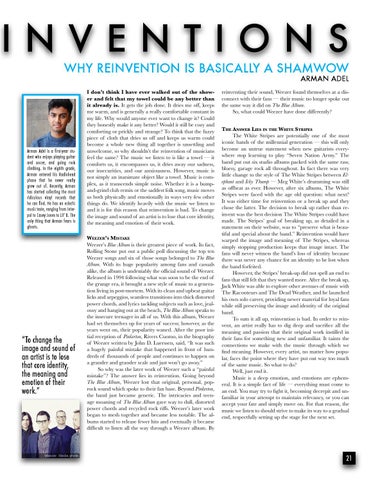
Weezer. Media photo.
I don’t think I have ever walked out of the shower and felt that my towel could be any better than it already is. It gets the job done. It dries me off, keeps me warm, and is generally a really comfortable constant in my life. Why would anyone ever want to change it? Could they honestly make it any better? Would it still be cozy and comforting or prickly and strange? To think that the fuzzy piece of cloth that dries us off and keeps us warm could become a whole new thing all together is unsettling and unwelcome, so why shouldn’t the reinvention of musicians feel the same? The music we listen to is like a towel — it comforts us, it encompasses us, it dries away our sadness, our insecurities, and our anxiousness. However, music is not simply an inanimate object like a towel. Music is complex, as it transcends simple noise. Whether it is a bumpand-grind club remix or the saddest folk song, music moves us both physically and emotionally in ways very few other things do. We identify heavily with the music we listen to and it is for this reason that reinvention is bad. To change the image and sound of an artist is to lose that core identity, the meaning and emotion of their work. Weezer’s Mistake Weezer’s Blue Album is their greatest piece of work. In fact, Rolling Stone put out a public poll discussing the top ten Weezer songs and six of those songs belonged to The Blue Album. With its huge popularity among fans and casuals alike, the album is undeniably the official sound of Weezer. Released in 1994 following what was soon to be the end of the grunge era, it brought a new style of music to a generation living in post-mortem. With its clean and upbeat guitar licks and arpeggios, seamless transitions into thick distorted power chords, and lyrics tackling subjects such as love, jealousy and hanging out at the beach, The Blue Album speaks to the insecure teenager in all of us. With this album, Weezer had set themselves up for years of success; however, as the years went on, their popularity waned. After the poor initial reception of Pinkerton, Rivers Cuomo, in the biography of Weezer written by John D. Luerssen, said, “It was such a hugely painful mistake that happened in front of hundreds of thousands of people and continues to happen on a grander and grander scale and just won’t go away.” So why was the later work of Weezer such a “painful mistake”? The answer lies in reinvention. Going beyond The Blue Album, Weezer lost that original, personal, poprock sound which spoke to their fan base. Beyond Pinkerton, the band just became generic. The intricacies and teenage moaning of The Blue Album gave way to dull, distorted power chords and recycled rock riffs. Weezer’s later work began to mesh together and became less notable. The albums started to release fewer hits and eventually it became difficult to listen all the way through a Weezer album. By
reinventing their sound, Weezer found themselves at a disconnect with their fans — their music no longer spoke out the same way it did on The Blue Album. So, what could Weezer have done differently? The Answer Lies in the White Stripes The White Stripes are potentially one of the most iconic bands of the millennial generation — this will only become an untrue statement when new guitarists everywhere stop learning to play “Seven Nation Army.” The band put out six studio albums packed with the same raw, bluesy, garage rock all throughout. In fact there was very little change to the style of The White Stripes between Elephant and Icky Thump — Meg White’s drumming was still as offbeat as ever. However, after six albums, The White Stripes were faced with the age old question: what next? It was either time for reinvention or a break up and they chose the latter. The decision to break up rather than reinvent was the best decision The White Stripes could have made. The Stripes’ goal of breaking up, as detailed in a statement on their website, was to “preserve what is beautiful and special about the band.” Reinvention would have warped the image and meaning of The Stripes, whereas simply stopping production keeps that image intact. The fans will never witness the band’s loss of identity because there was never any chance for an identity to be lost when the band forfeited. However, the Stripes’ break-up did not spell an end to fans that still felt that they wanted more. After the break up, Jack White was able to explore other avenues of music with The Raconteurs and The Dead Weather, and he launched his own solo career, providing newer material for loyal fans while still preserving the image and identity of the original band. To sum it all up, reinvention is bad. In order to reinvent, an artist really has to dig deep and sacrifice all the meaning and passion that their original work instilled in their fans for something new and unfamiliar. It taints the connections we make with the music through which we find meaning. However, every artist, no matter how popular, faces the point where they have put out way too much of the same music. So what to do? Well, just end it. Music is a deep emotion, and emotions are ephemeral. It is a simple fact of life — everything must come to an end. You may try to fight it, becoming decrepit and unfamiliar in your attempt to maintain relevancy, or you can accept your fate and simply move on. For that reason, the music we listen to should strive to make its way to a gradual end, respectfully setting up the stage for the next set.
21