ZCO | Beyond the Commitment | Waste OPERATIONAL EMISSIONS BEYOND THE COMMITMENT Although the WorldGBC’s Net Zero Carbon Buildings (NZCB) Commitment does not include GHG emissions from operational waste, employee commute, business travel, fleet vehicles, and work from home (WFH), we understand that these are a significant part of our corporate emissions. Therefore, Integral Group’s CSER team has started to identify targets for measurement, reduction, and offsets within the Environmental Footprint roadmap. Future iterations of this ZCO Implementation Plan will expand upon these emissions. The following pages provide initial insight into our Plan related to some of these operational emissions. EMISSIONS FROM OPERATIONAL WASTE To address waste emissions, we will create targets to ensure the inclusion of waste generation and diversion reductions. Our Environmental Footprint Roadmap targets: • • • • •
2022 | Identify Recycling Champions and begin to implement training at the local level. 1 waste audit per year to set the baseline 2023 | 2 waste audits conducted per year 2024 | 1 waste audit per quarter 2025 | Divert 75% of our waste from landfill; reduce total waste emissions per person by 25% 2030 | Divert 90% of our waste from landfill; reduce total waste emissions per person by 50%; offset 100% of emissions from waste generated during operations
Select offices currently measure waste generation and diversion and have set local targets. We must determine a global waste baseline so that performance against global targets can be measured and achieved. We identified several steps and created and beta-tested a Waste Audit Protocol based on best practices published in the BOMA Building Environmental Standards. Roll-out of the protocol will begin when we return to office (RTO).
Identified local-level recommendations are as follows: 1. Identify a recycling champion in every office. 2. Develop educational training on waste reduction for each office (due to city-by-city differences in waste removal). 3. Develop training plan for conducting waste audits globally. 4. Conduct annual waste audit for every office in year 1 of the roll-out, bi-annual audits in year 2, scaling up to once per quarter. Perform audits with the intention of both quantifying waste generated and identifying areas of improvement each time. Office waste improvement strategies may include: Compost •
•
Not all municipalities accept compost as a separate waste stream from business units, but private contractors may be available to haul it. Advocacy with landlords to include composting & recycling to their tenants is necessary. Small-scale office compost could include donating to community gardens and growing vegetables in offices with patios/outdoor spaces.
E-Waste Reduction •
Eliminate single use plastic from offices • • • •
•
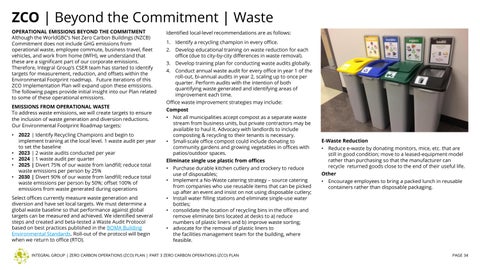
Purchase durable kitchen cutlery and crockery to reduce use of disposables; Implement a No-Waste catering strategy – source catering from companies who use reusable items that can be picked up after an event and insist on not using disposable cutlery; Install water filling stations and eliminate single-use water bottles; consolidate the location of recycling bins in the offices and remove eliminate bins located at desks to a) reduce numbers of plastic liners and b) improve waste sorting; advocate for the removal of plastic liners to the facilities management team for the building, where feasible.
INTEGRAL GROUP | ZERO CARBON OPERATIONS (ZCO) PLAN | PART 3 ZERO CARBON OPERATIONS (ZCO) PLAN
Reduce e-waste by donating monitors, mice, etc. that are still in good condition; move to a leased-equipment model rather than purchasing so that the manufacturer can recycle returned goods close to the end of their useful life.
Other •
Encourage employees to bring a packed lunch in reusable containers rather than disposable packaging.
PAGE 34