nov/dec 2022
BarBriefs
The Off icial Magazine of the DBA
UNL CLE MEMBERSHIP Upgrade your membership and let us assist you with meeting all of your CLE needs, in-person or on-demand, conveniently and affordably!
trustee's message My DBA Why pg 4
annual udsl gift column
PARALEGAL
The Perfect Gift Ideas for Legal Professionals
Remote Notarization After the Pandemic
pg 18
pg 24
BarBriefs L
L
rP esident
LL
no.
2
Columns:
4
L
First Vice President
TRUSTEE'S L MESSAGE
L Second Vice President
Treasurer
20
Secretary
JUDGE'S DESK
L
L
72
nov/dec 2022
Contents
DBA Board of Trustees 2022-2023 L
vol.
L
My DBA Why By Anne P. Keeton Esq., DBA Vice President | Freund Freeze & Arnold
Application of Revisions to Ohio’s Self-Defense Law By The Honorable Judge Timothy N. O'Connell. | Montgomery County Common Pleas Court
Features:
Member–at–Large
L Member–at–Large
6
Diane Kappeler DePascale Esq. DePascale Law Office
8
Do Judges Have Authority to Order a Forensic Examination of a Juror’s Smartphone?
BARRISTER OF THE MONTH
By Nathaniel M. Fouch Esq. | Ohio Court of Appeals - 12th District
Member–at–Large
L Member–at–Large
L
CRIMINAL LAW
By Professor Thaddeus A. Hoffmeister | UDSL
Immediate Past President
, ex offcio
L Bar Counsel
LL fl
fl
, ex offcio fl
10
Morgan K. Napier Esq. Faruki+ PLL
12
Synopsis of Legal Remedies Available to Domestic Violence Survivors in Domestic Relations Court
RISING STAR fl
DOMESTIC RELATIONS
16
FEDERAL PRACTICE
24
PARALEGAL
By Nathaniel M. Fouch Esq. | Ohio Court of Appeals - 12th District
By Magistrate Jacqueline V. Gaines | Montgomery County Domestic Relations Court
Looking Forward to the New Supreme Court Term By U.S. Magistrate Judge Caroline H. Gentry | Southern District of Ohio
U.S. Magistrate Judge, Southern District of Ohio R?KvNKvai"¡av"KBOB"K*mFKim"BvPaRmOƒD}i"BvBPaBd?"c By Tania M. Welch, OSBA Certified Paralegal | Taft Stettinius & Hollister LLP
Also In This Issue:
2
DAYTON Bar Briefs | nov/dec 2022
7 2023 DBA DISTRICT MOCK TRIAL COMPETITION Volunteers Needed! 9 NOVEMBER SECTION MEETINGS After November, sections don't meet again until 2023. 11 DBA ANNUAL HOLIDAY LUNCHEON Join us on December 13th! 14 NOVEMBER - DECEMBER CLE Get all of your CLE with the UNL CLE Membership - $349. 18 UDSL ANNUAL HOLIDAY GIFT COLUMN 31 CLASSIFIEDS, MEMBERS ON THE MOVE & AD INDEX
Now accepting applications!
2022-2023
DBA ANNUAL PARTNERSHIP
Provide annual financial support and partnership in our mission to further the administration of justice, enhance the public’s respect for the law, and promote excellence & collegiality in the legal profession.
DBA ANNUAL PARTNERS RECEIVE:
• • • •
Advertising & Marketing Exposure Event Sponsorships & Attendee Registrations CLE Discounts Concierge Service
Thank You 2022-2023 DBA Annual Partners
FARUKI+ ficlaw.com
Thompson Hine LLP thompsonhine.com
FARUKI+ is a premier business litigation firm with offices in Dayton and Cincinnati. The firm’s national practice handles complex commercial disputes of all types, including class actions; antitrust; securities; unfair competition (trade secrets and covenants not to compete); employment; advertising, media and communications; attorney malpractice; data privacy and security; intellectual property and product liability. While its trial practice is national, the firm has always been, and continues to be, committed to the local legal community.
Thompson Hine LLP, a full-service business law firm with approximately 400 lawyers in 7 offices, was ranked number 1 in the category “Most innovative North American law firms: New working models” by The Financial Times. For 5 straight years, Thompson Hine has distinguished itself in all areas of Service De-livery Innovation in the BTI Brand Elite, where it has been recognized as one of the top 4 firms for “Value for the Dollar” and “Commitment to Help” and among the top 5 firms “making changes to improve the client experience.” The firm’s commitment to innovation is embodied in Thompson Hine SmartPaTH® – a smarter way to work – predictable, efficient and aligned with client goals.
For More Details on Becoming a DBA Annual Partner Contact: JENNIFER OTCHY, DBA CEO | jotchy@daybar.org | (937) 222.1364 nov/dec 2022 | DAYTON Bar Briefs
3
Trustee's Message
My DBA
Why
By Anne P. Keeton Esq. DBA Vice-President Freund, Freeze & Arnold akeeton@ffalaw.com
I
t all starts with “why.” DBA President Hon. Caroline Gentry recently challenged the Board of Trustees to share their “why” for membership in the DBA. And not just the “why” for membership, but the “why” for involvement as well. My “why” is the same response I’ve had for many of the experiences that turned out to be formative and memorable in my life: Why not? But those two words from my simple soul may not inspire. I’ll try to elaborate.
DBA is a great way 1. The to meet other lawyers.
2.
The importance of community is undeniable. Lawyers work with, and against, other lawyers, and knowing other attorneys can often aide in navigating what would otherwise be a difficult case. Most lawyers in Dayton are collegial, and you never know who will become a friend, colleague, employer, or referral. (I met one of my best friends in Dayton at a DBA function. As we were about to head into a CLE, I mentioned that it was “National Talk Like a Pirate Day.” Who knew there was such a thing?! She whipped around in her formal suit, hand over her eye like a patch, and cragged in her best pirate voice, “Arg! I’m a pirate.” We’ve been close ever since, and I’m now fortunate enough to call her my law partner.)
At a time when even the litigators among us don’t see the inside of the courtroom as much as we’d like, involvement in the DBA allows young lawyers to interact with judges in a way they might not otherwise be able. (A brief plug, if I may, for the DBA’s Carl D. Kessler Inn of Court, which offers the benefits of networking and CLE.) Involvement in the DBA brings lawyers and judges together on a regular basis.
4.
The DBA is a great way to meet judges.
The DBA is a great way to invest in yourself and your own personal development.
Section meetings and CLEs allow you to work on public speaking. Leadership opportunities abound. Improve your health and wellness with the DBA’s new Health and Wellness Committee. And the DBA’s unlimited CLE membership makes lifelong learning easy and cost-effective.
3.
DBA membership is a great way to build your practice.
Active involvement in a substantive Section helps you stay on top of trends and best practices. Give CLEs and write articles in Bar Briefs to build your reputation in your area of practice. Sign up to be a part of the DBA Lawyer Referral Service. Get to know other lawyers who can refer cases to you, or even hire you. I know, I know. You’re busy. You walk out of work to take up your second job as an unpaid Uber driver for your kids. You have to meal plan and prep. And exercise. And stare off into space, because it’s good for you, and someone said you should do it. (It is actually good for you, by the way.) You just don’t have time to commit. But here’s the thing, investing in your practice and your career is up to you. If you don’t do it, no one else will. Except maybe the DBA.
membership is a 5. DBA great way to give back to your community.
The DBA offers service opportunities and passion projects (think the oral history podcast project). And if there’s something of interest, that you don’t see offered, the DBA will provide the support you need to make it happen.
That’s a lot of “why,” my friends. So, I ask you, why not?
4
DAYTON Bar Briefs |
nov/dec 2022
HERBERT M. EIKENBARY
Trust
R.L. EMMONS AND ASSOCIATES, INC. 842–A E. Franklin Street Dayton, Ohio 45459
Professional Investigative and Legal Support Services Firm
What is The Eikenbary Trust? The late Herbert M. Eikenbary granted the bulk of his estate to fund Grants and Loans to lawyers under the age of 35 who practice/reside in Montgomery County. These Grants and Loans are to aid young, deserving lawyers who are in need of financial assistance. Individual loans, are available up to $6,000 at 4% interest, while grants up to $4,000 are also available.
To Apply: Jennifer Otchy, DBA Chief Executive Officer Dayton Bar Association | 109 N. Main St., Suite 600 | Dayton, OH 45402-1129 jotchy@daybar.org | 937.222.7902 | www.daybar.org
Polygraph Asset Searches Criminal Defense Process Service Witness Locates / Interviews Surveillance Civil Case Prep General Investigation DAYTON: 937 / 438–0500 Fax: 937 / 438–0577
nov/dec 2022 | DAYTON Bar Briefs
5
Feature
BaristeroftheMonth:
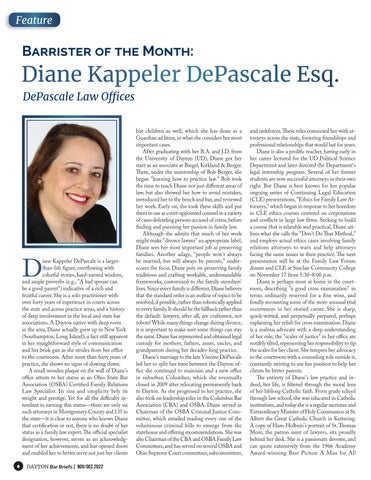
Diane Kappeler DePascale Esq. DePascale Law Offices
D
iane Kappeler DePascale is a largerthan-life figure, overflowing with colorful stories, hard-earned wisdom, and ample proverbs (e.g., "A bad spouse can be a good parent") indicative of a rich and fruitful career. She is a solo practitioner with over forty years of experience in courts across the state and across practice areas, and a history of deep involvement in the local and state bar associations. A Dayton native with deep roots in the area, Diane actually grew up in New York (Southampton, Long Island), a fact still apparent in her straightforward style of communication and her brisk gait as she strides from her office to the courtroom. After more than forty years of practice, she shows no signs of slowing down. A small wooden plaque on the wall of Diane's office attests to her status as an Ohio State Bar Association (OSBA) Certified Family Relations Law Specialist. Its size and simplicity bely its weight and prestige. Yet for all the difficulty intendant in earning this status—there are only six such attorneys in Montgomery County and 135 in the state—it is clear to anyone who knows Diane that certification or not, there is no doubt of her status as a family law expert. The official specialist designation, however, serves as an acknowledgment of her achievements, and has opened doors and enabled her to better serve not just her clients 6
DAYTON Bar Briefs | nov/dec 2022
but children as well, which she has done as a Guardian ad litem, in what she considers her most important cases. After graduating with her B.A. and J.D. from the University of Dayton (UD), Diane got her start as an associate at Biegel, Kirkland & Berger. There, under the mentorship of Bob Berger, she began "learning how to practice law." Bob took the time to teach Diane not just different areas of law, but also showed her how to avoid mistakes, introduced her to the bench and bar, and reviewed her work. Early on, she took these skills and put them to use as court-appointed counsel in a variety of cases defending persons accused of crime, before finding and pursuing her passion in family law. Although she admits that much of her work might make "divorce lawyer" an appropriate label, Diane sees her most important job as preserving families. Another adage, "people won't always be married, but will always be parents," underscores the focus Diane puts on preserving family traditions and crafting workable, understandable frameworks, customized to the family members' lives. Since every family is different, Diane believes that the standard order is an outline of topics to be resolved, if possible, rather than robotically applied to every family. It should be the fallback rather than the default: lawyers, after all, are craftsmen, not robots! While many things change during divorce, it is important to make sure some things can stay the same. Diane has represented and obtained legal custody for mothers, fathers, aunts, uncles, and grandparents during her decades-long practice. Diane's marriage to the late Vincent DePascale led her to split her time between the Dayton office she continued to maintain and a new office in suburban Columbus, which she eventually closed in 2009 after relocating permanently back to Dayton. As she progressed in her practice, she also took on leadership roles in the Columbus Bar Association (CBA) and OSBA. Diane served as Chairman of the OSBA Criminal Justice Committee, which entailed reading every one of the voluminous criminal bills to emerge from the statehouse and offering recommendations. She was also Chairman of the CBA and OSBA Family Law Committees, and has served on several OSBA and Ohio Supreme Court committees, subcommittees,
and taskforces. These roles connected her with attorneys across the state, fostering friendships and professional relationships that would last for years. Diane is also a prolific teacher, having early in her career lectured for the UD Political Science Department and later directed the Department's legal internship program. Several of her former students are now successful attorneys in their own right. But Diane is best known for her popular ongoing series of Continuing Legal Education (CLE) presentations, "Ethics for Family Law Attorneys," which began in response to her boredom in CLE ethics courses centered on corporations and conflicts in large law firms. Seeking to build a course that is relatable and practical, Diane utilizes what she calls the "Don't Do That Method," and employs actual ethics cases involving family relations attorneys to warn and help attorneys facing the same issues in their practice. The next presentation will be at the Family Law Forum dinner and CLE at Sinclair Community College on November 17 from 5:30–8:00 p.m. Diane is perhaps most at home in the courtroom, describing "a good cross examination" in terms ordinarily reserved for a fine wine, and fondly recounting some of the more unusual trial occurrences in her storied career. She is sharp, quick-witted, and perpetually prepared, perhaps explaining her relish for cross examination. Diane is a zealous advocate with a deep understanding of her role; the "scales of justice" in her office are notably tilted, representing her responsibility to tip the scales for her client. She tempers her advocacy in the courtroom with a counseling role outside it, constantly striving to use her position to help her clients be better parents. The entirety of Diane's law practice and indeed, her life, is filtered through the moral lens of her lifelong Catholic faith. From grade school through law school, she was educated in Catholic institutions, and today she is a regular sacristan and Extraordinary Minister of Holy Communion at St. Albert the Great Catholic Church in Kettering. A copy of Hans Holbein's portrait of St. Thomas More, the patron saint of lawyers, sits proudly behind her desk. She is a passionate devotee, and can quote extensively from the 1966 Academy Award-winning Best Picture A Man for All
Seasons (adapted from Robert Bolt's eponymous 1960 play). As she memorably puts it, we all "need friends admitted to practice before the Highest Court, for prayers of intercession"! This profile would not be complete without noting Diane's ardent love of bears. A self-professed "Bearaster" (n. Attorney who loves bears), her office is adorned with portraits, paintings, and sculptures of bears, especially from her beloved Great Smoky Mountains. Fittingly for her primary practice area, her unbalanced scales of justice hold a mother bear on one side and two cubs on the other. This passion is a reminder to have fun and not take herself too seriously. As Diane advises young lawyers, "Follow your passion—that is, your God-given talent—into whatever area of law that leads you." At the end of the day having worked hard you will be tired, but "tired-happy."
By Nathaniel M. Fouch Esq. Ohio Court of Appeals - 12th District fouchn@12thdca.com
nov/dec 2022 | DAYTON Bar Briefs
7
Criminal Law
Do Judges Have Authority to Order a Forensic Examination of a Juror’s Smartphone? By Prof. Thaddeus A. Hoffmeister Esq., Co-Chair, Criminal Law | UDSL | thoffmeister1@udayton.edu
“N
o,” according to a three-judge panel of the 6th Circuit Court of Appeals which recently decided United States v. Alexander Sittenfeld (6th Cir. Sep. 23, 2022). This past summer Alexander “P.G.” Sittenfeld, former Cincinnati City council member and rising political star, was convicted of two counts each of honest-services wire fraud, bribery, and attempted extortion under color of official right. Like most trials in the Digital Age, the presiding judge told the jurors in the Sittenfeld case not to discuss the case online or consider extraneous information. Nonetheless, on the third day of the nine-day trial, a court employee informed the judge that Juror X was posting about the trial and that her Facebook page was visible to her friends, “of whom the court employee was one.” The trial judge ultimately obtained printouts of Juror X’s facebook page which did not contain facts about the case nor was the defendant named. However, Juror X’s Facebook friends did make comments about the trial to include specifically naming the defendant which Juror X hid so that others could not see it. Another friend provided a newspaper link about the case and yet even another friend posted about jury nullification. More importantly, Juror X wrote the following about Juror Y: “shouldn’t be on the jury because [she] hates anyone that shares the same profession as our person on trial. Not cool!!!” The trial judge brought the opposing parties in to share the Facebook information. Simultaneously, the jury reached a verdict. Prior to hearing the verdict, the defense moved for a mistrial which was denied without prejudice. The jury then issued its verdict and the judge dismissed the jurors save for Juror X and Y who remained in the courtroom so that the judge could conduct a Remmer hearing derived from Remmer v. United States (1954), which is required whenever “a defendant presents a ‘colorable claim’ that extraneous information or contact had an obvious or likely adverse effect on the jury.” After being put under oath, attorneys for the defendant questioned Juror X who “reasserted her opinion that Juror Y should not have been on the jury because she hated politicians.” Juror X also stated that she never conducted any outside research about the case and “had hidden Sittenfeld’s name from one of the Facebook comments so that others would not see it.” Juror Y was sworn in next and testified that she had “no opinions about politicians” and had followed the court’s instructions about use of social media. The following day the court gave both parties “screenshots of all of Juror X’s posts and comments.” Four days later, the court then directed
8
DAYTON Bar Briefs | nov/dec 2022
Juror X to preserve any electronic communications relating to “her service as a juror.” Unfortunately, Juror X responded “that she had already deleted the Facebook posts and comments,” which led defense counsel to ask for a forensic examination of Juror X’s electronic devices. Prosecutors opposed the defense motion citing both juror privacy and lack of any proof that the juror was exposed to extraneous information likely to impact the verdict. The trial judge agreed with the prosecution and denied the request finding “no basis to believe that Juror X was prejudiced against Sittenfeld by any extraneous information, [and] conclude[d] that no basis exists to order a forensic examination of Juror X’s cell phone.” The defense appealed. The 6th Circuit in upholding the decision of the lower court noted that the Supreme Court has serious concerns about post-verdict investigations into juror misconduct. The appellate court went on to say that “a court should be reluctant to investigate accused jurors so invasively, if at all.” The 6th Circuit continued to question whether a trial judge had any authority to permit a forensic examination of a juror’s devices during a Remmer hearing but nonetheless did explore potential possibilities. First, the 6th Circuit looked at the court’s inherent power and ultimately determined that the “district court has inherent power to hold a Remmer hearing, which includes juror testimony. But that inherent power does not extend to…a search of the juror’s belongings.” Second, the court explored the subpoena power. Here, the 6th Circuit determined that “[a] district court conducting a Remmer hearing has no power [to] enforce a subpoena request that a juror produce her electronic device on the basis that a search of that device might uncover evidence to impeach that juror’s Remmer hearing testimony.” Third, the 6th Circuit examined three different statutes 28 U.S.C. §1651 (a) (All Writs Act), 28 U.S.C. §1826(a) (Civil Contempt), 18 U.S.C. §401 (Criminal Contempt) none of which “provides a court conducting a Remmer hearing with the power to order a search of a juror’s belongings.” The 6th Circuit concluded its opinion by noting that the “lack of clear authority is particularly troubling when a court’s exercise of power threatens a third-party’s constitutional rights.” The appellate court then went on to discuss Riley v. California (2014) where the U.S. Supreme Court held that police need a warrant in order to search a suspect’s smartphone. Arguably, had the court come out the other way, criminal defendants would have greater privacy rights in their phones than jurors.
DBA Sections/Groups/Divisions
NOVEMBER MEETING DATES:
Visit daybar.org/sections for meeting topics & agendas Appellate Court Practice Terry W. Posey Jr., Co-Chair & Jeffrey S. Sharkey, Co-Chair November 9 @ Noon Topic: Working with Amici-How to Win Friends and Influence Judges
Paralegal Vanda Morgan, Chair & Dana Ryan, Co-Chair November 17 @ Noon Topic: Active Shooter Training
Social Justice Civil Trial & ADR Jeff Cox, Co-Chair & Michael Sandner, Co-Chair November 9 @ 7:30am Topic: Discovery
Corporate Counsel & Employment Law Marcie Hunicutt, Co-Chair & Lynn Reynolds, Co-Chairs of Corporate Counsel Gretchen Treherne and Marc Fleischauer, Co-Chairs of Employment Law November 17 @ 5pm Topic: Avoiding and Mitigating Unnecessary Litigation-Employment Law Considerations for Corporate Counsel
Criminal Law Thaddeus Hoffmeister, Co-Chair & Kyle Lennen, Co-Chair November 16 @ Noon
Bonnie Beaman Rice, Chair Visit daybar.org for November meeting date and agenda
Real Property Shannon Costello, Co-Chair & Shannon Martin, Co-Chair November 10 @ Noon Topic: Environmental Law for Commercial Real Estate & Business Attorneys
Workers’ Comp / Social Security Michael Rake, Co-Chair & Kristina Curry, Co-Chair Canceled - November 3 @ Noon
Young Lawyers Division Kaylee Price, Co- Chair & Jordan Jennings, Co-Chair November 2 @ Peolking DAyton South @ 6pm-8pm *Social event with pizza provided!
Diversity Issues Ebony Davenport, Co-Chair & Ashton Hood, Co-Chair November 15 @ 4pm
Domestic Relations Kirstie Gotwald, Co-Chair & Mag. Jacqueline Gaines, Co-Chair November 30 @ Noon Optional CLE, visit daybar.org for details.
Estate Planning Trust & Probate Edward M. Smith, Chair & Kristina Rainer, Vice-Chair November 9 @ 4pm Topic: Current Probate Legislation and Proposals
After the November meetings, DBA Sections resume their monthly meeting schedules in January 2023.
Get involved with a DBA Section, if not NOW, in the new year! Contact Kate Bertke to join: kbertke@daybar.org
Federal Practice Daniel Gentry, Co-Chair & Hon. Peter Silvain, Co-Chair November 15 @ Noon
Juvenile Law Misty Connors, Co-Chair & Sara Barry, Co-Chair Canceled - November 1 @ Noon
nov/dec 2022 | DAYTON Bar Briefs
9
Feature
DBA Rising Star: Morgan K. Napier Esq. Faruki+ PLL
T
hough ascribing busyness to a lawyer is a timeworn cliché, in this month's Rising Star Morgan Napier's case, it really does ring true. Between her practice as an associate at Faruki in complex commercial litigation and contract disputes, her work on the Dayton Bar Association's Bar Briefs Editorial Board, and now—following her recent engagement—planning her wedding, Morgan is making the most of her time! But keeping busy is nothing new for Morgan, who has a long history of using her time and energy to serve others and grow herself. Born and raised in Miamisburg, Ohio, Morgan is the oldest of three, with two younger brothers. After graduating from Bishop Fenwick High School, Morgan attended the University of Kentucky, where she earned a B.A. in Finance in 2016. Though she had not initially planned on returning home, Morgan was offered a spot in the University of Dayton School of Law's Leadership Honors Program. She accepted, beginning her studies the semester after completing her undergraduate degree, and quickly took the school by storm. Morgan served as the Comment Editor and Staff Writer on the University of Dayton Law Review, earned CALI Awards (for the highest grade) in Torts II, Constitutional Law II, and Law and the Internet of Things, and ultimately graduated cum laude in 2019. She put her summers to good use as well, working in the Montgomery County Prosecutor's Office and at Coolidge Wall. She credits the Prosecutor's Office with first getting her truly excited about the practice of law, and her experience at Coolidge with giving her broad exposure to different areas of law. An inflection point came when an unexpected opening came available in the Fall Semester of her 3L year. Judge Gregory Singer, 10
DAYTON Bar Briefs | nov/dec 2022
of the Montgomery County Court of Common Pleas, needed a temporary staff attorney to step in immediately. Morgan jumped at the opportunity, and while still a student, worked for Judge Singer. This gave her a unique opportunity to see a variety of lawyering styles and get a front-row seat to watch the judicial decision-making process, all before earning her degree. Morgan then rounded out her law school experience through an externship at Gottschlich & Portune in the Spring Semester of her 3L year. Morgan was hired by Faruki while studying for the bar exam. After a trip to out west to Washington—Morgan is an avid traveler—she hit the ground running at the firm. That was Fall 2019, right before the COVID-19 pandemic struck, upending nearly every aspect of professional life. Undeterred by the ensuing isolation, Morgan recognized she needed to step up, and step up she did. Morgan has a history of seeking out and cultivating relationships with mentors wherever she has been, and this was no exception. Now in her fourth year at the firm, Morgan has been able to take her experience of starting just before the pandemic and navigating those challenges, and serve as a mentor herself to newer associates whose law school experiences were similarly disrupted. Characteristically, Morgan also dived into active participation in the Dayton Bar Association as soon as the opportunity arose. She was looking to get connected into the Dayton legal community, to meet people, and to form relationships. Once again, she excelled in all three. Morgan was selected to participate in the 2020–21 Leadership Development Class, where she helped organize a blood drive. She is also a longstanding member of the Bar Briefs Editorial Board, for which she has written several articles and profiles (like this one!).
Through that experience, she has "met a lot of interesting people [she] would not have otherwise met." Curious, affable, and quick-witted, Morgan is a wonderful conversationalist and an excellent writer, and has not wasted the opportunity to showcase either talent in her work for Bar Briefs. In her "spare time," Morgan has shown herself to be just as passionate as her work. She is devoted to her family, and rarely misses an opportunity to watch her brother play basketball for Ohio Northern University. Speaking of which, she is a fervent basketball fan, having attended two historic basketball schools in UK and UD, and having gotten to watch NCAA Tournament games at the former. She also took up tennis during the pandemic, and recently won her first competitive match! Finally, as previously mentioned, Morgan is an enthusiastic traveler, who wastes no opportunity to go exploring; this past summer alone, she went to both the Bahamas and to Moab. While a "Rising Star" might be unfairly pigeonholed as a leader of tomorrow, Morgan has shown that she is a leader today. The passion for service and intellectual curiosity that led her to law in the first place have served her well in her practice and in her community involvement. Though she will be busy for the foreseeable future, Morgan is a paragon of grace and calm under pressure. She is certainly one to watch as she continues her rise in the Dayton legal community.
By Nathaniel M. Fouch Esq. Ohio Court of Appeals - 12th District fouchn@12thdca.com
11
Domestic Relations
Synopsis of Legal Remedies Available to Domestic Violence Survivors in Domestic Relations Court By Magistrate Jacqueline V. Gaines, Co-Chair | Montgomery County Domestic Relations Court | GainesJ@mcohio.org
O
n the eve of National Domestic Violence Awareness Month, on September 21, 2022, the United States District Court for the Southern District of Ohio partnered with the Dayton Bar Association and presented a free Pro Bono Work to Empower and Represent Act of 2018 (“POWER Act”) CLE.1 The POWER Act mandates that each year, the chief judge of each federal judicial district hold at least one public event with state and local domestic violence service providers or a local volunteer lawyer project to promote “pro bono legal services as a critical way in which to empower survivors of domestic violence, dating violence, sexual assault, and stalking and engage citizens in assisting those survivors.”2 The September 21 event was held virtually, with over 70 people in attendance. The Honorable Chief Judge Algenon L. Marbley welcomed the attendees and District Judge Michael J. Newman introduced the POWER Act. The event included panelist: Summer Hawks, Executive Director of the Greater Dayton Volunteer Lawyers Project; Carl Anderson, Senior Attorney at Legal Aid of Western Ohio; Jane M. Keiffer, Executive Director of Artemis Center; and me, Montgomery County Domestic Relations Court Magistrate and Co-Chair of the DBA’s Domestic Relations Committee. Here is a summary of the legal remedies survivors can obtain from the Domestic Relations Court.
DOMESTIC VIOLENCE CIVIL PROTECTION ORDERS
Survivors of domestic violence or dating violence can obtain a domestic violence civil protection order (“dvcpo”) from the Domestic Relations Court pursuant to R.C. 3113.31. A protection order provides a plethora of protections such as removal of the perpetrator from the home; no contact order; requirement that the perpetrator stay at least 500 feet from the petitioner at all times; orders that the perpetrator not destroy the survivor’s property or pets; exclusive use of the vehicle for the survivor; child support; prevention of the perpetrator from shutting off the utilities or phone; custody and parenting time orders if no other court has exercised jurisdiction; and orders allowing the perpetrator to pick up personal property from the home only in the presence of a uniformed police officer within a specified timeframe. The protection orders can last up to five years, and can be renewed upon proof of a new incident of domestic violence. As of October 6, 2022, a total of 1,625 dvcpo petitions have been filed in the Montgomery County Domestic Relations Court. In contrast, six years ago, 1,463 dvcpo petitions were filed in the entire year. DVCPO cases are the Montgomery County Domestic Relations Court’s largest case type. More dvcpos are filed than divorces, dissolutions, legal separations, annulments, custody motions, parenting time motions, support motions, or property motions! Many of the dvcpos are filed pro se. Programming
12
DAYTON Bar Briefs | nov/dec 2022
like the POWER Act presentation are critically important to recruit and educate attorneys on ways they can help survivors. Survivors have a higher success rate in obtaining a dvcpo when they have counsel.3 A well-prepared attorney can help a petitioner determine if filing a dvcpo is the right course of action for their situation. Research shows the lethality threat level increases when the petitioner leaves the abuser. A lawyer can also help a petitioner: develop a safety plan; determine whether alternative legal avenues should be explored; navigate the legal system; and focus their testimony and evidence on events that meet the statutory definition of domestic violence. Often in dvcpo hearings, petitioners will state the respondent has engaged in emotional abuse, mental abuse, psychological abuse, or name calling. However, under Ohio law: (1) “Domestic violence” means any of the following: (a) The occurrence of one or more of the following acts against a family or household member; (i) Attempting to cause or recklessly causing bodily injury; (ii) Placing another person by the threat of force in fear of imminent serious physical harm or committing a violation of sections 2903.211 [menacing by stalking] or 2911.211 [aggravated trespass] of the Revised Code; (iii) Committing any act with respect to a child that would result in the child being an abused child, as defined in section 2151.031 of the Revised Code; (iv) Committing a sexually oriented offence. (b) The occurrence of one or more of the acts identified in divisions (A)(1)(a)(i) to (iv) of this section against a person with whom the respondent is or was in a dating relationship.4 Emotional abuse, mental abuse, psychological abuse, or name calling without physical abuse or a threat of physical harm will not result in the issuance of a dvcpo. While financial abuse has been recognized by leading domestic violence advocacy groups, it is not included as a type of domestic violence recognized in the dvcpo statute.5 ENDNOTES:
1. 115 P.L. 237, 132 STAT. 2447 2. 115 P.L. 237, 132 STAT 2448, Section 3(a) 3. 115 P.L. 237, 132 STAT 2448, Section 2(8) 4. R.C. 3113.31(A)(1). 5. The National Domestic Violence Hotline explains, that “financial or economic abuse occurs when an abusive partner extends their power and control into your financial situation,” and can include stealing from the victim, preventing the victim from working, not paying bills, taking victim’s paycheck and depositing it into an account the victim cannot access, or maxing out credit cards without permission. https://www.thehotline.org/resources/types-of-abuse/ (last visited Oct. 5, 2022). 1.
HOW DOMESTIC VIOLENCE IMPACTS DIVORCE PROCEEDINGS If the parties are married, a survivor’s concerns about emotional abuse, mental abuse, psychological abuse, name calling, and financial abuse may be addressed in a divorce action. In the majority of divorce cases, the grounds for divorce is incompatibility. However, a survivor may seek grounds based on extreme cruelty, which can include physical violence or reasonable apprehension of it, but also acts and conduct that the effect of which is calculated to permanently destroy the peace of mind and happiness, rendering the marital relationship intolerable.6 And when the Court is evaluating a child’s best interest for purposes of allocating custody and parenting time, the Court must consider domestic violence convictions and guilty pleas.7 In a divorce action, the Court can consider a party’s financial misconduct when dividing the marital property and awarding spousal support.8 Under Ohio law, financial misconduct includes, but is not limited to: “the dissipation, destruction, concealment, nondisclosure, or fraudulent disposition of assets.”9 “Although the statute ‘does not set forth an exclusive listing of acts constituting financial misconduct, those acts that are listed *** all contain some element requiring wrongful scienter. Typically, the offending spouse will either profit from the misconduct or intentionally defeat the other spouse’s distribution of marital assets.’” 10 The DBA’s Domestic Relations Committee discusses domestic violence and other timely domestic relations issues. It is cochaired by Attorney Kristie Gotwald and Magistrate Gaines. It meets once a month at noon at the Domestic Relations Court in Judge Wood’s courtroom. Free CLE is offered at most meetings. The upcoming meetings will address: DR 101 Basics presented by Gary C. Schaengold, Esq. on October 26, 2022 and Financial Considerations of Divorce presented by Beth Handwerker, CFP, JD, CDFA, CKA on November 30, 2022.
DBA Recent Events
Join us for what's next at daybar.org October 13: DBA 50-Year Honoree Luncheon
Moderator Dave Greer with honorees Judge Jeff Froelich; Judge Alice McCollum; Prosecuting Attorney, Mathias Heck Jr.; and Peter F. vonMeister. Not in attendance, Richard Broock, Judge Robert Messsham Jr. and JohnMohr.
October 7: Bench Bar Deans Meeting at Supreme Court of Ohio
DBA First Vice President Anne Keeton and DBA CEO, Jennifer Otchy attended the meeeting with UDSL Dean Andrew Strauss.
ENDNOTES:
6. R.C. 3105.01(D). Buess v. Buess, 89 Ohio App. 37, 100 N.E.2d 646 (3d Dist. Hardin County 1950); Warrick v. Warrick, 2d Dist. No. 1246, 1990 Ohio App. LEXIS 879, 1990 WL 26093 (March 2, 1990); Verplatse v. Verplatse, 17 Ohio App. 3d 99, 477 N.E.2d 648, 1984 Ohio App. LEXIS 12441 (Ohio Ct. App., Hancock County 1984). Ginn v. Ginn, 112 Ohio App. 259, 16 Ohio Op. 2d 164, 175 N.E.2d 848, 1960 Ohio App. LEXIS 663 (Ohio Ct. App., Lawrence County 1960). 7. R.C. 3109.04(F)(1)(h); R.C. 3109.051(D)(11). 8. Blanchard v. Blanchard, 11th Dist. No. 2021-A-0003, 2022Ohio-162, ¶ 27 (applying R.C. 3105.171E(4)); Kirkpatrick v. Kirkpatrick, 11th Dist. No 2020-T-0078, 2021-Ohio-4260 (applying R.C. 3105.18(C)). 9. R.C. 3105.171(E)(4) 10. Blanchard v. Blanchard, 11th Dist. No. 2021-A-0003, 2022Ohio-162, ¶ 27 (quoting Calkins v Calkins, 2016-Ohio-1297, 62 N.E.3d 686 ¶ 15 (11th Dist.)).
October 3: The DBA & UDSL partner for the First Monday in October Opening of the U.S. Supreme Court Term
nov/dec 2022 | DAYTON Bar Briefs
13
DBA Continuing Legal Education
DBA FALL/WINTER CLE OFFERINGS: November
professional conduct hrs
December 1
16 ?:|a5NNa5|DAB Se5afasEE5 R
Video Replay | 1.5 PC hr
?a5^5|ZEE5
VadeERe^,a&|sN|GefBsx
Working Parents in the Law A perspective from two (un/semi) successful working parents
MCJV^^, CS e5efEV^s S e5EV eC sGAL Preservice Course
18
5
?a5^5|ZEE5
new lawyer training hrs
NEEfN:|^5|DAB Se5afasEE5 R |
VadeERe^,a&|sN|GefBsx
21
NLT hrs
NNGefEs
NLT hrs
6
NEEfN^5|DAB Se5afasEE5 R |NN|GefBs
aR fSE5e,LExeSE5e: Preparing for and Surviving Against Ransomware Attacks
?a5N:N^5|afS c,aasEf C fesefceCfes|N|GefBsx
28
8
NEEfN:|^5|DAB Se5afasEE5 R |NNGefEs
NLT hrs
J·eVdS efKNDafEEfqx|Csa5afa,LaU^dae
?a5N:N^5|DAB Se5afasEE5 R |N|GefBsx
Preparing a Case for Tsaa,: DaxcE·es& Evolving with Technology and the Civil Rules
|Fedsa,EV C sU^daJaBe Vdex
30
?a5NN:|a5|ZEE5|
?a5N:N^5|DAB Se5afasEE5 R N|NLBsx T EsN|GefBsx
NNGefEs
VxaB fexxLaN|N: Contracts and Employment Law for the Business Practitioner
MCJV^^, CS e5efEV^s S e5EV eC sGAL Preservice Course
ANN|PCBs
DBA Core Components for New Lawyers
9 NPCBsx
HasdKfEcExafBePsacaceEL f a EBacxafdCa·a,a&IxxVexPsacacafLaaf|
12 NEEfN:|^5|DAB Se5afasEE5 R |
Pse^asafaCaxEs ef Tsaa,: Evaluating Evidence for Purposes of Trial
14 N:||^5N^5|ZEE5
Video Replay | NN|PCBs
The POWER Act
15 ?a5N:N^5|DAB Se5afasEE5 R |N|GefBsx
|DE5exacRe,aaEfxEV C sU^dae
16 ?a5N:N^5|DAB Se5afasEE5 R N|Bsx=N|GefBsx ANN|PCBs
AffVa,Ife,,ecVa,PsE^es&Es f Gefesa, and Corporate Practitioners
19 NEEfN:|^5|DAB Se5afasEE5 R |
1.5 PC hr
SecEfdas&TsaV5aVsfEV ,B afdSe,Caf sEs ef La&esx
21 ?a5N:N^5|ZEE5
JVdeBsEafqxNU SNV^s S e5EV eC sU^dae
14
DAYTON Bar Briefs | nov/dec 2022
VadeERe^,a&|N|GefBsx
DBA Continuing Legal Education
On-Demand DBA CLE Over 125 On-Demand Programs
Available to Stream at Your Own Pace!
Access all of your on-demand, self-study CLE from the DBA! Get your CLE credit by the first of the year by purchasing and streaming from our pre-recorded program catalog. If you’re an Unlimited CLE Member, you can access all on-demand content for FREE!
New Programs to be added in 2023! daybar.org/seminarweb
UNL CLE MEMBERSHIP DBA UNL CLE Membership is a way to upgrade your membership to include unlimited access to all in-person and on-demand CLE at one affordable price. Take advantage of this great opportunity today and meet all of your CLE needs. UNL CLE is valid now through June 2023!
only
$34 ! 9
Contact Kate Bertke, to purchase: kbertke@daybar.org
nov/dec 2022 | DAYTON Bar Briefs
15
Federal Law
By The Honorable Caroline H. Gentry, U.S. Magistrate Judge, Southern District of Ohio
DBA President & Member, Federal Practice Section | Caroline_Gentry@ohsd.uscourts.gov
Looking Forward to the New Supreme Court Term
I
am writing this article on the first Monday of October, also known as the “Opening Day” of the United States Supreme Court. The Supreme Court hears oral arguments on Monday, Tuesday, and Wednesday during selected weeks. You can find more information, including transcripts and audio recordings of oral arguments, on the Supreme Court’s website: https://www.supremecourt. gov/oral_arguments.aspx. In a typical one-year term, the Supreme Court receives 7,000-8,000 petitions for a writ of certiorari and hears oral argument in about 80 cases. To date, the Supreme Court has granted requests for oral argument in 41 cases (some of which are consolidated) during the 2022-2023 term. Here are the issues presented in those cases, along with the argument date noted if scheduled: Sackett v. EPA (arg. 10/3/22). Issue: Whether the U.S. Court of Appeals for the 9th Circuit set forth the proper test for determining whether wetlands are “waters of the United States” under the Clean Water Act, 33 U.S.C. § 1362(7). Delaware v. Pennsylvania & Wisconsin (arg. 10/3/22). Issues: (1) Whether MoneyGram Official Checks are “a money order, traveler’s check, or other similar written instrument (other than a third party bank check) on which a banking or financial organization or a business association is directly liable,” pursuant to 12 U.S.C. § 2503; (2) whether the Court should command Wisconsin and Pennsylvania not to assert any claim over abandoned and unclaimed property related to MoneyGram Official Checks; and (3) whether all future sums payable on abandoned MoneyGram Official Checks should be remitted to Delaware.
Merrill, Alabama Sec. of State v. Milligan / Merrill, Alabama Sec. of State v. Caster (arg. 10/4/22). Issue: Whether the State of Alabama’s
2021 redistricting plan for its seven seats in the United States House of Representatives violated Section 2 of the Voting Rights Act. Arellano v. McDonough, Sec. of Virginia (arg. 10/4/22). Issues: Whether the rebuttable presumption of equitable tolling from Irwin v. Dep’t of Veterans Affairs, 498 U.S. 89 (1990) applies to the one-year statutory deadline in 38 U.S.C. § 5110(b)(1) for seeking retroactive disability benefits, and, if so, whether the government has rebutted that presumption; and (2) whether, if 38 U.S.C. § 5110(b) (1) is amenable to equitable tolling, this case should be remanded so the agency can consider the particular facts and circumstances in the first instance. National Pork Producers Council v. Ross (arg. 10/11/22). Issues: (1) Whether allegations that a state law has dramatic economic effects largely outside of the state and requires pervasive changes to an integrated nationwide industry state a violation of the dormant commerce clause, or whether the extraterritoriality
16
DAYTON Bar Briefs | nov/dec 2022
principle described in the Supreme Court’s decisions is now a dead letter; and (2) whether such allegations, concerning a law that is based solely on preferences regarding out-of-state housing of farm animals, state a claim under Pike v. Bruce Church, Inc., 397 U.S. 137 (1970). Reed v. Goertz (arg. 10/11/22). Issue: Whether the statute of limitations for a 42 U.S.C. § 1983 claim seeking DNA testing of crime-scene evidence begins to run at the end of state-court litigation denying DNA testing, including any appeals (as the U.S. Court of Appeals for the 11th Circuit has held), or whether it begins to run at the moment the state trial court denies DNA testing, despite any subsequent appeal (as the U.S. Court of Appeals for the 5th Circuit, joining the U.S. Court of Appeals for the 7th Circuit, held below). Andy Warhol Foundation, Inc. v. Goldsmith (arg. 10/12/22). Issue: Whether a work of art is “transformative” when it conveys a different meaning or message from its source material (as the Supreme Court, U.S. Court of Appeals for the 9th Circuit, and other courts of appeals have held), or whether a court is forbidden from concerning the meaning of the accused work where it “recognizably deriv[es] from” its source material (as the U.S. Court of Appeals for the 2nd Circuit has held). Helix Energy Solutions Group, Inc. v. Hewitt (arg. 10/12/22). Issue: Whether a supervisor making over $200,000 each year is entitled to overtime pay because the standalone regulatory exemption set forth in 29 C.F.R. § 541.601 remains subject to the detailed requirements of 29 C.F.R. § 541.604 when determining whether highly compensated supervisors are exempt from the Fair Labor Standards Act’s overtime-pay requirements. Students for Fair Admissions v. University of North Carolina (arg. 10/31/22). Issues: (1) Whether the Supreme Court should overrule Grutter v. Bollinger, 539 U.S. 306 (2003) and hold that institutions of higher education cannot use race as a factor in admissions; and (2) whether a university can reject a race-neutral alternative because it would change the composition of the student body, without proving that the alternative would cause a dramatic sacrifice in academic quality or the educational benefits of overall student-body diversity.
Students for Fair Admissions v. President & Fellows of Harvard
(arg. 10/31/22). Issues: (1) Whether the Supreme Court should overrule Grutter v. Bollinger, 539 U.S. 306 (2003) and hold that institutions of higher education cannot use race as a factor in admissions; and (2) whether Harvard College is violating Title VI of the Civil Rights Act by penalizing Asian-American applicants, engaging in racial balancing, overemphasizing race and rejecting workable raceneutral alternatives.
Jones v. Hendrix (arg. 11/1/22). Issue: Whether federal inmates who did not—because established circuit precedent stood firmly against them—challenge their convictions on the ground that the statute of conviction did not criminalize their activity may apply for habeas relief under 28 U.S.C. § 2241 after the Supreme Court later makes clear in a retroactively applicable decision that the circuit precedent was wrong and that they are legally innocent of the crime of conviction. Cruz v. Arizona (arg. 11/1/22). Issue: Whether the Arizona Supreme Court’s holding that Arizona Rule of Criminal Procedure 32.1(g) precluded post-conviction relief is an adequate and independent state-law ground for the judgment. Bittner v. U.S. (arg. 11/2/22). Issue: Whether a “violation” under the Bank Secrecy Act is the failure to file an annual Report of Foreign Bank and Financial Accounts (no matter the number of foreign accounts), or whether there is a separate violation for each individual account that was not properly reported. Axon Enterprise, Inc. v. FTC (arg. 11/7/22). Issue: Whether Congress impliedly stripped federal district courts of jurisdiction over constitutional challenges to the FTC’s structure, procedures, and existence by granting the courts of appeals jurisdiction to “affirm, enforce, modify, or set aside” the commission’s case-and-desist orders. SEC v. Cochran (arg. 11/7/22). Issue: Whether a federal district court has jurisdiction to hear a suit in which the respondent in an ongoing SEC administrative proceeding seeks to enjoin that proceeding, based on an alleged constitutional defect in the statutory provisions that govern the removal of the administrative law judge who will conduct the proceeding. Mallory v. Norfolk Southern Railway Co. (arg. 11/8/22). Issue: Whether the Due Process Clause of the 14th Amendment prohibits a state from requiring a corporation to consent to personal jurisdiction to do business in the state. Health and Hospital Corp. v. Talevski (arg. 11/8/22). Issues: (1) Whether, in light of compelling historical evidence to the contrary, the Supreme Court should reexamine its holding that spending clause legislation gives rise to privately enforceable rights under 42 U.S.C. § 1983; and (2) whether, assuming spending clause statutes ever give rise to private rights enforceable via Section 1983, the Federal Nursing Home Amendments Act of 1987’s transfer and medication rules do so. Haaland, Sec. of Interior v. Brackeen (arg. 11/9/22). Issues: (1) Whether various provisions of the Indian Child Welfare Act of 1978—namely, the minimum standards of Section 1912(a), (d), (e), and (f ); the placement-preference provisions of Section 1915(a) and (b); and the record keeping provisions of Sections 1915(e) and 1951(a)—violate the anticommandeering doctrine of the 10th Amendment; (2) whether the individual plaintiffs have Article III standing to challenge ICWA’s placement preferences for “other Indian families” and for “Indian foster home[s]”; and (3) whether Section 1915(a)(3) and (b)(iii) are rationally related to legitimate governmental interests and therefore consistent with equal protection. 303 Creative LLC v. Elenis. Issue: Whether applying a public-accommodation law to compel an artist to speak or stay silent violates the Free Speech Clause of the First Amendment. Perez v. Sturgis Public Schools. Issues: (1) Whether, and in what circumstances, courts should excuse further exhaustion of the Individuals with Disabilities Education Act’s administrative proceedings under Section 1415(l) when such proceedings would be futile; and (2) whether Section 1415(l) requires exhaustion of a non-IDEA claim seeking money damages that are not available under the IDEA. Bartenwerfer v. Buckley. Issue: Whether an individual may be subject to liability for the fraud of another that is barred from discharge in bankruptcy under 11 U.S.C. § 523(a)(2)(A), by imputation, without any act, omission, intent or knowledge of her own. U.S. ex rel. Polansky v. Executive Health Resources. Issue: Whether the government has authority to dismiss a False Claims Act suit after initially declining to proceed with the action, and what standard applies if the government has that authority. Percoco v. U.S. Issue: Whether a private citizen who holds no elected office or government employment, but has informal political or other influence over governmental decisionmaking, owes a fiduciary duty to the general public such that he can be conviction of honest-services fraud. Wilkins v. U.S. Issue: Whether the Quiet Title Act’s statute of limitations is a jurisdictional requirement or a claim-processing rule.
Ciminelli v. U.S. Issue: Whether the U.S. Court of Appeals for the 2nd Circuit’s “right to control” theory of fraud—which treats the deprivation of complete and accurate information bearing on a person’s economic decision as a species of property fraud—states a valid basis for liability under the federal wire fraud statute, 18 U.S.C. § 1343. MOAC Mall Holdings LLC v. Transform Holdco LLC. Issue: Whether Bankruptcy Code Section 363(m) limits the appellate courts’ jurisdiction over any sale order or order deemed “integral” to a sale order, such that it is not subject to waiver, and even when a remedy could be fashioned that does not affect the validity of the sale. Moore v. Harper. Issue: Whether a state’s judicial branch may nullify the regulations governing the “Manner of holding Elections for Senators and Representatives … prescribed … by the Legislature thereof,” and replace them with regulations of the state courts’ own devising, based on vague state constitutional provisions purportedly vesting the state judiciary with power to prescribe whatever rules it deems appropriate to ensure a “fair” or “free” election. Gonzalez v. Google LLC. Issue: Whether Section 230(c)(1) of the Communications Decency Act immunizes interactive computer services when they make targeted recommendations of information provided by another information content provider, or only limits the liability of interactive computer services when they engage in traditional editorial functions (such as deciding whether to display or withdraw) with regard to such information. In re Grand Jury. Issue: Whether a communication involving both legal and non-legal advice is protected by attorney-client privilege when obtaining or providing legal advice was one of the significant purposes behind the communication. Santos-Zacaria v. Garland. Issue: Whether the court of appeals correctly determined that 8 U.S.C. § 1252(d)(1) prevented the court from reviewing petitioner’s claim that the Board of Immigration Appeals engaged in impermissible factfinding because petitioner had not exhausted that claim through a motion to reconsider. Glacier Northwest v. Int’l Brotherhood of Teamsters. Issue: Whether the National Labor Relations Act impliedly preempts a state tort claim against a union for intentionally destroying an employer’s property in the course of a labor dispute. Turkiye Halk Bankasi A.S. v. U.S. Issue: Whether U.S. district courts may exercise subject-matter jurisdiction over criminal prosecutions against foreign sovereigns and their instrumentalities under 18 U.S.C. § 3231 and in light of the Foreign Sovereign Immunities Act. The Ohio Adjutant General’s Dep’t v. Federal Labor Relations Authority. Issue: Whether the Civil Service Reform Act of 1978, which empow-
ers the Federal Labor Relations Authority to regulate the labor practices of federal agencies only, empower it to regulate the labor practices of state militas. Twitter v. Taamneh. Issues: (1) Whether a defendant that provides generic, widely available services to all its numerous users and “regularly” works to detect and prevent terrorists from using those services “knowingly” provided substantial assistance under 18 U.S.C. § 2333 merely because it allegedly could have taken more “meaningful” or “aggressive” action to prevent such use; and (2) whether a defendant whose generic, widely available services were not used in connection with the specific "act of international terrorism”" that injured the plaintiff may be liable for aiding and abetting under Section 2333. U.S. v. Texas. Issues: (1) Whether state plaintiffs have Article III standing to challenge the Department of Homeland Security’s Guidelines for the Enforcement of Civil Immigration Law; (2) whether the Guidelines are contrary to 8 U.S.C. § 1226(c) or 8 U.S.C. § 1231(a), or otherwise violate the Administrative Procedure Act; and (3) whether 8 U.S.C. § 1252(f )(1) prevents the entry of an order to “hold unlawful and set aside” the Guidelines under 5 U.S.C. § 706(2).
Financial Oversight and Management Board for Puerto Rico v. Centro de Periodismo Investigativo. Issue: Whether the Puerto Rico Oversight, Management, and Economic Stability Act’s general grant of jurisdiction to the federal courts over claims against the Financial Oversight and Management Board for Puerto Rico and claims otherwise arising under PROMESA abrogate the Board’s sovereign immunity with respect to all federal and territorial claims.
nov/dec 2022 | DAYTON Bar Briefs
17
Gift Column Curated By Marie Poinsatte University of Dayton School of Law JD Candidate May 2024
DECORATE YOUR TECH | Emily's Secret crafts, etsy
20
$
Decorate someone’s modern technology with classical artwork from Van Gogh and Michelangelo, or choose from over a hundred other unique designs. Karaoke Microphone Speaker | Uncommon Goods
50
$
For the spontaneous friend who is always the life of the party, make it easy for them whenever the moment strikes to sing! Crankbrothers M19 Multi-Tool and Case | Amazon
30
$
With seven hex wrenches, four spoke wrenches, Phillips and flathead screwdrivers, a t-25 driver, and a universal chain tool, this pocket device has everything a biker needs to solve problems on the trail and get the wind back in their face. prosourcefit Acupressure Mat and Pillow Set | Amazon
60
$
Help someone relax their muscles or ease back pain after exercise or a long day in court!
CREATE YOUR OWN SAUCE KIT $ 45 | Uncommon Goods
Someone who embraces variety as the spice of life can create their own spicy concoctions with the whole peppers and spices in this kit! 18
DAYTON Bar Briefs | nov/dec 2022
Homemade Limoncello Kit $ 55 | Uncommon Goods
All your friends need is lemons, sugar, and vodka to create their own Italian after-dinner drink! Also available are kits to create your own Merlot, Chardonnay, Gin, Whiskey, and Mead.
Desk Chair Wrap | Uncommon Goods
$120
The office freeze-baby will appreciate you every day for this lush wrap that stays comfortably on the desk chair and looks stylish for professional video calls. Bamboo Charging Station for Multiple Devices with 5 Port USB Charger | Amazon
$51 We have so many devices to keep track of, so help someone declutter their desk with this neat charging station that has a place for every device. Personalized Executive Candy Dispenser | Personalization Mall
$35
No quarters required! Young and old visitors alike experience the classic joy of a gumball machine – bring some sweet energy into your coworker’s space! Customizable Clipboard | AllAboutImpressions, Etsy
$29
Gift a fellow professional this crisp and distinctive clipboard for their most important meetings. Golf Ball Whiskey Chillers Set of 2 | Uncommon Goods
$25
What do golfers do on their day off ? Putter around! A nice addition to an office decanter set for the coworker who wishes they were on the golf course! Personalized Whiskey Barrel starting from $85 -$200 | Uncommon Goods
Complete someone’s at-home bar with this handmade (and functional!) whiskey barrel! Coming in two sizes from coopers in Manassas, VA, be sure to purchase the accompanying set of whiskey and rum essences to start your friend’s distillery adventure!
PASTA ART KIT $ 35 | Uncommon Goods
Create a culinary masterpiece with this unique set that makes 8-10 servings of colorful and delicious noodles! Also available, sets to create your own sushi, churros, ravioli, and fortune cookies!
OYSTER MUSHROOM LOG KIT $ 30 | Uncommon Goods
Oyster mushrooms’ sweet, mild flavor and velvety texture make for delicious eating whether they’re raw or cooked. Grow sweet, velvety oyster mushrooms from these organic mushroom growing logs.
nov/dec 2022 | DAYTON Bar Briefs
19
Column
FromtheJudgersDesk:
Application of Revisions to Ohio’s Self-Defense Law T
he Ohio General Assembly, beginning in 2019, passed various revisions of Ohio’s selfdefense law. In particular, the law was changed to shift the burden of proof with respect to self-defense. In addition, the new law expanded the locations where there is no duty to retreat, or a person could “stand your ground.” Defendants sought to have these provisions applied to their cases immediately. That is, defendants sought to have the burden of proof shifted to the State of Ohio even if the alleged event occurred prior to the effective date of the statute. They argued that the State should have to prove the accused did not act in self-defense if the trial was held subsequent to the effective date. Likewise, defendants argued that they could assert they had a right to stand their ground if they were in a place they could lawfully be, as long as the trial took place subsequent to April of 2021. The State challenges the defense motions. The State argues the laws regarding retroactivity and ex post facto prevented courts from applying the new laws to cases involving events that occurred prior to the effective date of the revised statutes. The Ohio Supreme Court has spoken on the issue regarding the burden of proof. The Second District Court of Appeals has issued a decision on the matter of duty to retreat or stand your ground. Eventually, these issues will become academic as the cases evolving from events prior to April 2021 will be completed, but these matters provide an opportunity to review the law regarding retroactivity of statutes and ex post facto provisions.
Statutory Law Regarding Application
The revised code provides that a “statute is presumed to be prospective in its application unless expressly made retrospective.”1 This is consistent with the fact that the Ohio Constitution provides that the “General Assembly should have no power to pass retroactive laws.”2
Common Law
A statute may not be applied retroactively unless the General Assembly makes it retroactive.3 Generally, when the legislature has made a statute expressly retroactive, the determination whether that statute is unconstitutionally retroactive in violation of the Ohio Constitution depends on whether it is “remedial” or “substantive.” If the law is “remedial,” then its retroactive application is constitutional; if the law is “substantive,” then its retroactive application is unconstitutional.4 Laws relating to procedures, rules of practice, courses of procedure, and methods of review are ordinarily remedial in nature.5 Laws affecting rights, which may be protected by procedure, are substantive in nature.6
20
DAYTON Bar Briefs | nov/dec 2022
By The Honorable Timothy N. O'Connell Montgomery County Common Pleas Court timothy.oconnell@montcourt.oh.gov
United States Constitution
The Federal Ex Post Facto Clause, Article I, § 10 of the United States Constitution prohibits the enactment of ex post facto laws.7 The United States Supreme Court has described four (4) categories of prohibited ex post facto laws: “1st. Every law that makes an action done before the passing of the law, and which was innocent when done, criminal; and punishes such action. 2nd. Every law that aggravates a crime, or makes it greater than it was, when committed. 3rd. Every law that changes the punishment, and inflicts a greater punishment, than the law annexed to the crime, when committed. 4th. Every law that alters the legal rules of evidence, and receives less, or different, testimony, than the law required at the time of the commission of the offence, in order to convict the offender.”8 In Youngblood9, the Supreme Court stated that the categories of prohibited ex post facto laws that were identified in Calder10 may not be purposely avoided. “[B]y labeling a law ‘procedural’, a legislature does not thereby immunize it from scrutiny under the Ex Post Facto Clause.”11 If a law fits into one of the enumerated categories that were described in Calder12, then it may not be applied retroactively regardless of whether that law is characterized as “procedural” or “remedial” by the legislature.
Burden of Proof Rule
Under House Bill 228, the new law on self-defense, the burden of proof shifted to the State of Ohio. The prosecution must prove beyond a reasonable doubt that the accused did not use force in self-defense, defense of another, or defense of that persons’ residence, as the case may be. This new law was effective March 28, 2019. In a prior case, the Ohio Supreme Court dealt with a change in the burden of proof involving the insanity defense. In that case, the initial burden of proof law indicated the defendant had a common law burden of proving the affirmative defense, but the change required only that the defendant had a burden of going forward with evidence of the nature and quality sufficient to raise the defense. The burden was not to establish the defense by a preponderance of the evidence. In the Humphries case, regarding that change, the Ohio Supreme Court decided the amended statute applied prospectively to trials, making no distinction as to when the underlying criminal conduct occurred.13 The 2019 change in the burden of proof was similar to Humphries, and thus, the amendment applies prospectively and, because it does not increase the burden on a criminal defendant, there is no danger of it violating Ohio’s Retroactivity Clause or the United States Constitution’s Ex Post Facto Clause. The change in burden of proof applies prospectively to all trials after March 28, 2019 regardless of when the underlying alleged criminal conduct occurred. The key here is that the burden of proof change is favorable to the defendant. Thus, it does not meet category four of the prohibited ex post facto laws under the Constitution. In addition, the statute for the burden of proof explicitly ties the new rule to the time of trial. The revised burden of proof rule effects trial procedure and therefore is applicable to proceedings conducted after the adoption of the law.14
was modified to read; “a person has no duty to retreat before using force in self-defense if that person is in a place in which the person lawfully has a right to be.”24 The change did more than just alter a procedure; it expanded the law creating a new right, the right to stand one’s ground. A person is no longer limited to their home or vehicle; the use of force in self-defense can now be used anywhere the person is legally permitted to be. Therefore, the change to R.C. 2901.09 is substantive in nature.25 In the Degahson26 case, the new rule was not applied because the alleged crime occurred in August of 2019, prior to the effective date of the statute.
Conclusion
As a final result, the two changes are treated differently in these cases. The burden of proof change is applied to all trials after the effective date of the statute regardless of when the event occurred. The duty to retreat rule is not applied at trial to cases involving an event that occurred prior to the effective date. However, the rules of law are consistent. Generally speaking, the burden of proof rule is considered more procedural and thus, can be applied retroactively without violating the Constitution. The duty to retreat rule is substantive, therefore, it cannot be applied retroactively. There are other rules impacting the statutory change such as the statutory text and the lack of increasing the burden on a criminal defendant, or put another way, benefit to the defendant. This honors the principal that a law should not make criminal what was innocent when done, aggravate a crime, change the punishment to inflict greater punishment or require less in order to convict the offender. There have been some amendments to Ohio’s weapons laws and other changes to the criminal law that could be anticipated in the near future. Therefore, the Bench and Bar are well advised to keep these rules regarding retroactivity and the ex post facto law in mind.
Duty to Retreat / “Stand Your Ground”
The duty to retreat change also raises the retroactivity issue. In April of 2021, S.B. 175 took effect, amending R.C. 2901.09 to indicate that “a person has no duty to retreat before using self-defense if that person is in a place in which the person lawfully has a right to be.”15 It further states that “[a] trier of fact shall not consider the possibility of retreat as a factor in determining whether or not a person who used force in self-defense reasonably believed that the force was necessary to prevent injury, loss, or risk of life or safety.”16 Simply put, the new “stand your ground” law removes, in most cases, the duty to retreat before using self-defense.17 In the Degahson18 case, the Second District Court of Appeals sets forth the rules for determining retroactivity. The first step is the rule of law that a statute is presumed to be prospective in operation unless expressly made retrospective. To overcome the presumption that the statute applies prospectively, it must “clearly proclaim its retroactive application.”19 In amended R.C. 2901.09 there was no language that would indicate the legislature intended the statute to be applied retroactively. Therefore, on that reasoning, the amended R.C. 2901.09, or “stand your ground” would not apply to cases involving incidents prior to April of 2021. The Second District Court of Appeals engaged in some further analysis that invokes retroactivity law. The Second District indicated that a third step would be that even assuming a legislature did clearly intend for the amended R.C. 2901.09 to apply retroactively, the statute would then run afoul of the Ohio Constitution, which provides that the “General Assembly shall have no power to pass retroactive laws.”20 “Generally, when the legislature has made a statute expressly retroactive, the determination of whether the statute is unconstitutionally retroactive depends on whether it is ‘remedial’ or ‘substantive.’’’21 If the law is remedial in nature, then its retroactive application is constitutional; if the law is substantive, then applying it retroactively is unconstitutional.22 “Laws relating to procedures – rules of practice, courses of procedure, and methods of review are ordinarily remedial in nature. But laws affecting rights, which may be protected by procedure, are substantive.” 23 The Second District found R.C. 2901.09 to be substantive in nature. Prior to the passage of S.B. 175, a person, unless in his or her residence or vehicle, had a duty to retreat before using force in self-defense. The law
ENDNOTES: 1. R.C. 1.48 2. Ohio Constitution, Article II, Section 28. 3. Hyle v. Porter, 117 Ohio St.3d 165, 2008-Ohio-542, 882 N.E.2d 899, ¶ 9. 4. Van Fossen v. Babcock & Wilcox Co., 36 Ohio St.3d 100, 106-108, 522 N.E.2d 489 (1988), superseded by statute on other grounds as stated in Hannah v. Dayton Power & Light Co., 82 Ohio St.3d 482, 484, 1998-Ohio-408, 696 N.E.2d 1044. 5. Id. at 108, citing Wellston Iron Furnace Co. v. Rinehart, 108 Ohio St. 117, 1 Law Abs. 453, 1 Law Abs. 867, 104 N.E. 623 (1923) in favor of 1 of the syllabus, and In re Nevius, 174 Ohio St. 560, 564, 191 N.E.2d 166 (1963). 6. Id. citing Weil v. Taxicabs of Cincinnati, Inc., 139 Ohio St. 198, 203, 39 N.E.2d 148 (1942). 7. State v. Walls, 96 Ohio St.3d 437, 2002-Ohio-5059, 775 N.E.2d 829, ¶ 20, footnote 4. 8. Collins v. Youngblood, 497 U.S. 37, 42, 110 S.Ct. 2715, 111 L.E.2d 30 (1990), quoting Calder v. Bull, 3 U.S. 386, 390 (1798). 9. Id. 10. Id. 11. Youngblood at 46. 12. Id. 13. State v. Humphries, 51 Ohio St.2d 95, 98, 364 N.E.2d 1354 (1977). 14. State ex rel. Holdridge v. Industrial Commission, 11 Ohio St.2d 175, 228 N.E.2d 621 (1967), ¶ 1 of the syllabus. 15. R.C. 2901.09 (B). 16. R.C. 2901.09 (C). 17. State v. Degahson, 2022-Ohio-2972, ¶ 15 (Clark App. 2021-CA-35). 18. Id. 19. R.C. 1.48; State v. Brooks, Ohio Slip Opinion No. 2022-Ohio-2478, ¶ 9 and 10. 20. Ohio Constitution, Article II, § 28. 21. Brooks at ¶ 10. 22. Id. 23. Id.; State v. Degahson, 2022-Ohio-2972 ¶ 18. 24. R.C. 2901.09 (B). 25. State v. Degahson, 2022-Ohio-2972 ¶ 19. 26.
Id.
nov/dec 2022 | DAYTON Bar Briefs
21
News You Can Use
Have you heard about the Montgomery County Office of Reentry? Submitted By the Reentry Council Legal Subcommittee
T
he Montgomery County Office of Reentry [Office] works with a variety of community stakeholders to provide programming and services to the men and women who are returning to Montgomery, Greene, Preble, Miami, and Darke counties from incarceration. Perhaps you have represented “Returned and / or Returning Citizens” who would benefit from the Office’s mission of “Serving the community with programs and services that minimize barriers to effective reentry while promoting public safety through the restoration of returning citizens”. The Office lives up to its motto of “Action, Alliance, Accountability” by offering a variety of programs through the Montgomery County Reentry Council and its subcommittees that all operate under the direction of Co-Chairs County Commissioner Debbie Lieberman and Judge Walter H. Rice. The Reentry Council Subcommittees focus on Employment, Housing, Legal & Legislative Advocacy, Public Education, Community and Family Engagement, and Women In Reentry. This article focuses on the Legal and Legislative Advocacy Committee and the opportunity you have to volunteer to assist “Returned Citizens”. The Legal Committee activities include Driver’s License Reinstatement, Record Sealing, and Certificate of Qualification for Employment [CQE] Clinics, Voter Registration and Voting, and the Governor’s Expedited Pardon Process. The Dayton Metro Library has partnered with the Office of Reentry to host Record Sealing and Drivers License Reinstatement Clinics every other month since September 2021. The Greater Dayton Volunteer Lawyers Project leads the Record Sealing Clinics with support from WilmerHale, and the Montgomery County Public Defender's Office takes the lead on Drivers License Reinstatement. Here is the library’s perspective on the Clinics:
Community members with legal challenges large and small often come to the Dayton Metro Library branches to get help solving their problems, so the decision to partner with volunteer attorneys was an obvious one. Libraries are familiar, comfortable places where individuals can meet with legal aid groups without the intimidation of entering a courthouse. So far in 2022, the library’s legal aid clinics have served 194 patrons. At the license reinstatement clinic in May, we served 95 people, but at least twice that many came in the door—some just to inquire about the program, others who had to be turned away near the end of the 4-hour event. The massive attendance of the previous events--and the fact that most patrons learned about the clinics through word of mouth—demonstrates the high level of community need in this area. Currently these clinics are being hosted every other month at the downtown branch. In order to meet demand, we are aiming to have one license reinstatement and one record sealing clinic event every month in 2023, spread out at a variety of Dayton Metro Library’s 17 locations. 22
DAYTON Bar Briefs | nov/dec 2022
For those ineligible to have their records sealed at these clinics, CQE applications are available. [A CQE is a Certificate of Qualification for Employment which an individual with a criminal conviction may obtain an order from a Common Pleas Court that will provide limited relief from certain bars to employment or licensing in the State of Ohio.] The Dayton Metro Library’s ability to offer consistent clinics for both driver’s license reinstatement and record-sealing gives structure and accessibility to services that are often very hard for people to access. The need at the clinics always exceeds that availability of services The Montgomery County Public Defender's Office has also collaborated with the Office of Reentry and other community partners to provide several different record-sealing initiatives in both virtual and in-person formats. Some initiatives have targeted specific groups, like students at local colleges and universities and chemical dependency professionals and peer support specialists. Others have been entirely open to the community. Attorney volunteers have the ability to prepare paperwork for counties all over the state of Ohio. One of the biggest needs in the community and one of the biggest gaps in services is with driver’s license reinstatement. After an initial slow start, Ohio universities and the governor’s office worked with the Ohio Department of Rehabilitation and Correction to significantly shorten the process by which certain people may apply for a formal pardon from the Governor. Based on the positive experiences with the project to date, the Ohio Governor’s Expedited Pardon Project was expanded to include additional project partners, including the University of Dayton School of Law.
*Please see contact information for reentry programs on next page.
Refs&PsEsa5Ef C acIfEs5 f aaEf: MEfE5es&EV C f&OfficeERefs& f Ad5afaxsaa·eOffice 1133 S. Edwin C. Moses Blvd, Suite 370, Dayton, Ohio 45417 Hours of Operation: Mon-Fri 8:30am-5:00pm Reception Line: (937) 496-7129 Fax: (937) 225-6426 Da&EfMsE e Labsas&:Lea,C,afacDaexTa5, ex&ReaxsaaEf Jacqueline Gazda | jgazda@daytonmetrolibrary.org 937-496-8630
A final note on voting, you may know that only those individuals of voting age incarcerated for a felony conviction on an election day, those convicted of two (2) or more offenses involving voting, and those found incompetent for the purposes of voting by a court order are disenfranchised from voting in Ohio. Voter registration paperwork is also available to fill out and turn in at any Dayton Metro Library location. So, how can you help? Volunteers are needed for the Drivers License Reinstatement Clinics. If you know of a “Returned Citizen” or someone with a criminal record who has not been incarcerated who would benefit from a CQE or a Pardon, you could assist them with that process, or refer them to the appropriate contact listed below. As to voting, spread the word and encourage all who are eligible to resister and to vote for the candidates and issues of their choice
Volunteering for License Reinstatement Ja,,VcB asE,MW,L S IS,L W ICDC MEfE5es&EV C f&PVb,acDeffdesrxOffice 117 S. Main Street, Suite 400, Dayton, OH 45422 (937) 224-8629 CesacaeEQf Va,acaaEfEs f E5^,E&5ef https://drc.ohio.gov/cqe OBaEGE·esfEsqxE»^edaPasdEfPsE#ec UDLaScBEE,E,, C abEsaa·e Professor Katie Wright | wrightk@udayton.edu (937) 229-2235 https://www.ohioexpeditedpardon.org/ Voter Registration Montgomery County Board of Elections 451 W. Third St. Dayton, Ohio 45422 (937)225-5656 web@montgomery.boe.ohio.gov Ohio Secretary of State www.ohiosos.gov
nov/dec 2022 | DAYTON Bar Briefs
23
Paralegal
Remote Notarization: Ohio’s Foresight Pays Off During the Pandemic
By Tania M. Welch, OSBA Certified Paralegal | Taft Stettinius & Hollister LLP | welcht@taftlaw.com
W
hen met with change, we adapt, and sometimes, we legislate.
Ohio’s recent modernization of the laws governing notaries public seems prescient in hindsight. Ohio’s Notary Modernization Act took effect in September 2019 and ushered in new capabilities and responsibilities.1 Six states had already fully implemented remote notarization procedures; Ohio and nine other states followed suit in taking preliminary action and authorizing online notarizations. It could not have come at a better time. The stay-at-home orders beginning in the spring of 2020 challenged all professions and businesses to adapt. The legal profession -- steeped in tradition and slow to change – was particularly challenged. Our profession has traditionally preferred personal interactions. The gradual adoption of virtual depositions in some circumstances signaled a slow shift toward more efficient methods, and paved the way for Ohio’s Notary Modernization Act. No one could foresee the challenges the legal profession would face in 2020, but Ohio did foresee an ever-increasing role for virtual work. Fast forward to today, and we are now fully immersed in the culture of working remotely. The change was difficult, but it was made much easier by Ohio’s changes to notary laws in 2019. Online Notarial Acts were performed prior to the dawn of COVID, but not with the regularity and ease with which we do so today. While separate from the authorization for remote online notarization, in June 2020, the Ohio Supreme Court would further act on the need for change, and would issue its first Administrative Action Order permitting the remote administration of oaths (relevant to trials, hearings, and depositions), and on July 31, 2020, would extend that order indefinitely “providing that an oath or an affirmation required by a rule of the Court may be administered remotely . . . .” 2 So what exactly did the Ohio Notary Modernization Act change? It allows qualified notaries to notarize documents without ever being in the physical presence of the person executing the notarized document. The procedure to become qualified is fairly simple. Pursuant to Ohio Administrative Code 111:6 and Ohio Revised Code 147.62, individuals who are duly appointed and commissioned as notaries public, and are residents of Ohio, can qualify to become an online notary public by submitting a fee and application, and participating in and passing a state-approved education course and exam. An authorized Ohio Secretary of State education and testing provider then administers a two-hour, online exam that covers all notarial rules, procedures, and ethical obligations. 3 Final approval by the Secretary of State of a remote online notary application is dependent upon providing evidence of a state-approved vendor and their software, to be used for the signing and authentication process. Online notarization systems require two-way live audio and video connections and require the signer to not only verify their credentials, but also to answer questions, using knowledge-based 24
DAYTON Bar Briefs | nov/dec 2022
authentication, within a specified amount of time. Ohio remote online notaries must also be within the state of Ohio when conducting a notarization session; however, the signer can be located in any U.S. territory, or, assuming adherence to applicable procedures and conditions precedent, outside of the U.S. Oaths are still orally administered, and affirmed; but the affixing of signatures and seals comes with the click of some keys as opposed to a pen. The remote commission runs concurrent to a notary public’s traditional commission, and is therefore renewed every five years. The requirements incumbent upon an attorney who is a remote online notary differ slightly from those of a non-attorney, but one notable similarity is renewal. Non-attorneys must renew both their traditional and remote commissions every five years; and attorneys, while not required to renew their traditional commissions, must renew their remote commissions. And good ideas spark imitation. Following the introduction of the Securing and Enabling Commerce Using Remote and Electronic Notarization Act of 2021 to the House of Representatives on June 17, 2021, the House passed the bill on July 27, 2022 (known as H.R.3962 SECURE Notarization Act of 2022). A companion bill is now pending action in the Senate. If enacted into law, this bill would allow notaries public in all states to perform remote online notarizations. When performed pursuant to the laws of a notarial officer’s State, or performed pursuant to SECURE, these notarial acts would be valid in any U.S. Court, and from state to state, with the notarial officer’s signature and title serving as prima facie evidence of the genuineness and authority of that notarization. And while the federal rule would set the minimum standards, it would complement a state’s existing laws while not impeding on an autonomous exercise by that state to specify additional requirements that are consistent with the SECURE Notarization Act. Remote Online Notarization has essentially taken the show on the road and provides a great benefit to clients who may travel frequently, who may not even work in an office at all, or who simply prefer to conduct business in a remote manner. Embracing this new option for providing service to our clients, and offering it as an alternative to personal notarization in appropriate situations, can only enhance our clients’ satisfaction with our work and strengthen the relationship. Success in the legal profession requires strong client relationships. We are now in a position to offer a flexibility and responsiveness that our clients will surely appreciate. ENDNOTES: 1. ttps://www.ohiosos.gov/notary. 2. 07/31/2020 Administrative Actions, 2020-Ohio-3861. 3. See, generally, Ohio Administrative Code 111:6, and Ohio Revised Code 147.62
DBA Membership Advantages - ONS
Sign Up! becomeanohionotary.com
Become an Ohio Notary! Through a joint venture with the AEsEfCaf, caffaa, C,·e e,afd,E, T ed E and Ohio State Bar Associa tions, the DBA is helping new and renewing notaries across all of Ohio with all of their education and testing needs. Ohio Notary Services (ONS) is truly the one-stop-shop for all things notary in Ohio, including required courses, tests, and notary supplies. NEas&LaCBecE,ax: Step 1 Obtain a formal Bureau of Criminal Investigation (BCI) background check e^S Visit www.becomeanohionotary.com, attend class virtually and pass the test (if required.) ONS will provide you with a certificate for submission to the Secretary of State. Step 3 Visit the Ohio Secretary of State's website and select File Online to submit your application. Step 4 Return to www.becomeanohionotary.com to purchase your notary supplies. Free standard shipping on all notary bundles! (Use the code “FREE”) nov/dec 2022 | DAYTON Bar Briefs
25
Law Related Organizations - DBF
Dayton Bar Foundation
From the President of the Dayton Bar Foundation
As
Sthe end of the year approaches, we are asking you to financially support the Dayton Bar Foundation, the charitable giving arm of the Greater Dayton Legal Community. Your contribution will make a real difference in the lives of many people in our local Greater Dayton community. Please help our Dayton Bar Foundation continue its tradition of supporting local community and charitable organizations. We encourage you to join in our Foundation’s mission by making a year-end charitable contribution to the Dayton Bar Foundation (a 501 c3 charitable organization since 1984). Every dollar received will help to provide grants to local organizations. Thank you in advance for your continued generosity. The Dayton Bar Foundation could not do its good work without your support and participation.
~David P. Pierce Esq. 2022-2023 DBF President Coolidge Wall Co., LPA
SUPPORT: The tireless efforts of your fellow members of the legal community who defend those who need it the most.
HELP: Local disadvanted citizens. Families in need of assistance. Those trying to navigate the legal system. Provide wills to those who have served our country.
26
DAYTON Bar Briefs | nov/dec 2022
STRENGTHEN: The Foundation and charitable giving arm of the Dayton Bar Association as they continue their many great works!
EDUCATE: Professional training in law & leadership for those with a desire to learn about the law and sustain a career in the legal field.
Law Related Organizations - GDVLP&PBPO
Contact Jennifer Otchy, DBF & DBA CEO for information about the Foundation. jotchy@daybar.org | (937) 222-1364
Your Gift Will Help
STRENGTHEN Our Foundation.
The Dayton Bar Foundation (DBF) is a 501 (c)(3) charitable organization and serves as the giving arm of the Greater Dayton Legal Community. Your contribution will enable the DBF to continue to fulfill its mission of funding innovative local organizations in their quest to improve our community by promoting equal access to justice and respect for the law. In the past few years your contributions helped to fund grants to:
•
Advocates for Basic Legal Equality (ABLE)
• Greater Dayton Volunteer Lawyers Project (GDVLP) •
Law & Leadership Institute
•
Legal Aid of Western Ohio (LAWO)
•
Miami University Pre-Law Center
• Wills for Heroes A,,afxase,aab,Es ef cBasaab,edVcaEfxEf&EVsfedsa,afcE5ea»sVsf e &EV af ae5a˜edVcaEfxN = = = = = = = = == = = == = = = = = = = = = = = = = DETACH AND RET URN OR SCAN TO DONATE= = = = = = = = = = = = = = = = = = = = = = = =
Dayton Bar Foundation, 109 N. Main St., Ste. 600, Dayton OH 45402-1129 Contributions may also be submitted online: daybar.org/?pg=Foundation Make a donation now and help us make a difference through our programs. Gifts may also be made in honor or in memory of family, friends or colleagues. Ia5^,eaxE ed xV^^EsBeDa&EfBasFEVfdaaEfaBaafEf:
$50
$100
$250
$500
Other $________________________________________
Check Enclosed : Check # ______________________________________________________________________ Charge my:
VISA
MASTERCARD
DISCOVER
AMERICAN EXPRESS
Name: ___________________________________________________________ (AS YOU WISH IT TO APPEAR ON OUR RECORDS)
Firm: _____________________________________________________________ Address: ________________________________________________________
Expiration:
/
Security Code (3 or 4 digit)
Billing Zip Code: __________________________________________________________________________________ Signature: ____________________________________________________________________________________________ M&afx:af5e5Es&Ef
in honor of
________________________________________________________ Phone: __________________________________________________________ Email:____________________________________________________________
______________________________________________________________________________________________________________________
Please notify: _________________________________________________________________________________________________________________________________________________________________ Address: _______________________________________________________________________________________________________________________________________________________________________
nov/dec 2022 | DAYTON Bar Briefs
27
Law Related Organizations - OLAP
28
DAYTON Bar Briefs | nov/dec 2022
Law Related Groups - GseaesDa&EfAseaDEILea,EV R fad b,e
nov/dec 2022 | DAYTON Bar Briefs
29
DBA Membership Advantages - LRS
30
DAYTON Bar Briefs | nov/dec 2022
DBA Members on the Move
The 5th edition of Benchmark Litigation, Labor & Employment has recognized JeffIse,afd as a Labor & Employment Star. Labor & Employment is the definitive guide to the region’s leading litigation law firms and lawyers. Benchmark Litigation is the only publication in the United States that focuses solely on litigation. The selection process involves an eight-month research period, in which the publisher's researchers conduct extensive interviews with litigators and their clients, and an examination of recent casework handled by the firms, with the goal of identifying "the firms and attorneys who have displayed the ability to consistently handle complex, high-stakes cases in multiple jurisdictions." Jeff Ireland is one of the founding partners of Faruki PLL, and is a frequent mediator and arbitrator. His practice focuses on competitive issues (e.g., trade secrets, antitrust, false advertising, etc.) as well as class actions and employment. This year Jeff completed the Harvard Program on Mediation at Harvard Law School that trains mediators to successfully resolve disputes by focusing on the development of a common understanding among the parties, an interest-based approach to mediation. For several years Jeff has been recognized as an America's Top 100 High Stakes Litigators by America's Top 100 LLC. Jeff has been recognized each year since its inception by his peers in the Ohio Super Lawyer pool as an Ohio Super Lawyer, rated as one of the top 10 attorneys in Cincinnati, and one of the top 50 in the state. He has repeatedly been selected for Best Lawyers in America®, and named "Lawyer of the Year" for several years. He is listed in Chambers USA: America's Leading Lawyers for Business. He has written articles for publication, and is a frequent lecturer at continuing legal education programs on various subjects relating to commercial litigation.
Daily Court Reporter.......................7
dayton legal heritage foundation.7 dayton disability foundation........25
EIKENBARY TRUST.................................5 Ferneding Insurance........................31 LCNB Bank............................................5 oBLIC...................................back cover R.L. Emmons & Associates..................5
Members on the Move Guidelines:
DBAC7amm"'dAdm MEDIATION/ ARBITRATION
DISPLAYADINDEX:
MEDIATIONS
NEED A MEDIATOR?
Jeffrey A. Hazlett Esq. John M. Meagher, Judge Dennis J. Langer 5276 Burning Bush Lane, (Retired) Retired Common Pleas Kettering, Ohio 27 years as a Mediator Judge 45429-5842 2200+ mediations (937) 367-4776 | (937) 689-3193 My fees are adjustable. LangerMediation.com hazlettjeffrey@gmail.com (937) 297 604-4840 nadn.org/jeffrey-hazlett Jmeagher2@gmail.com
If you are a member of the DBA and you’ve moved, been promoted, hired an associate, taken on a partner, received an award, or have other news to share, we’d like to hear from you! • News of CLE presentations & political announcements not accepted • Printed at no cost • Must be submitted via email and are subject to editing • Printed as space is available Contact Shayla to submit your announcement or ad:
seggleton@daybar.org | 937.222.7902
nov/dec 2022 | DAYTON Bar Briefs
31
109 N. Main St., Suite 600 Dayton, OH 45402–1129 ADDRESS SERVICE REQUESTED