The Work of Art in the Age of Planetary Destruction
PUBLISHED IN 2023 BY CUSSH D.OSRIN@UCL.AC.UK ALL IMAGES © THE ARTISTS AND ALL TEXTS © THE AUTHORS. ALL RIGHTS RESERVED. NO PART OF THIS PUBLICATION MAY BE REPRODUCED, STORED IN A RETRIEVAL SYSTEM, TRANSMITTED IN ANY FORM OR BY ANY MEANS ELECTRONIC OR MECHANICAL, INCLUDING PHOTOCOPYING, RECORDING OR OTHERWISE WITHOUT PRIOR PERMISSION FROM THE PUBLISHER. ISBN: 978-1-3999-6669-6 A CATALOGUE RECORD OF THIS BOOK IS AVAILABLE FROM THE BRITISH LIBRARY. PROJECTCUSSH.ORG/PROJECTS/ THE-WORK-OF-ART
EDITORS AARATHI PRASAD DAVID OSRIN CREATIVE DIRECTION HUMAN AFTER ALL PRINT IDENTITY
The Work of Art in the Age of Planetary Destruction
TEAR AFTER READING {-}
This is a book about art, consequence and planetary destruction. It’s been designed to be pulled apart — to remind us that the things we take can’t always be put back, and the things we lose can’t always be recovered. It’s precious. There are only a small number in print. But the authors, artists, editors and creators of this book give you their express permission to take from it what you want. And if you need a helping hand, just look out for this symbol {-}.
How can eyes be asked to see more than they can see?... For hundreds of years there have been people whose function was precisely to see and make us see what we do not naturally perceive. These are the artists.
— Henri Bergson, La Pensée et le mouvant, 1934
Places we live in
GRACE ATIENO, AN INFORMAL SETTLEMENT WASTE MANAGER, SHARES LEARNINGS FROM HER WORK DURING A LIVE BROADCAST ON RADIO VICTORIA. EYERIS/CUSSH 8
Aarathi Prasad David Osrin In the autumn of 2018, we joined a research partnership that set out to track the progress cities were making towards their sustainability goals and to help those who governed them bring about change faster. While colleagues worked on computer models and gathered data to use in complex simulations, our job was to engage the wider world. Twentysix years had passed since countries had first signed the United Nations Framework Convention on Climate Change, created as a structure for international cooperation, and some 21 years since the adoption of the Kyoto Protocol had bound its signatories to emission reduction targets. The years rolled on, the research continued, funding and verbal and written commitments increased, 23 UN COP Conferences came and went. But decisions and changes — even those that could have come from smaller but cumulative actions politicians across the globe might have taken — felt woefully insufficient. And then, exactly a month before we began working together, on 20 August 2018, a 15-year-old Swedish student skipped classes and sat instead outside her country’s parliament, setting in motion tremors that soon became an avalanche of youth protests for climate action that the world’s media and decision-makers were unable to ignore. In 2020, the murder of George Floyd and the societal and global imbalances of the Covid-19 pandemic unmasked (at least to those who had not experienced them) entrenched racism and pernicious structural inequities, catastrophes invisible to some perhaps because they were so normal. Both movements — School Strike for Climate and Black Lives Matter — illustrated how some voices carry more weight than others because of historical power structures of age, skin colour, gender and place.
9
There is no doubt that, in the space of a few short years, we have seen both wider and deeper engagement around a global catastrophe born of not seeing the scars rent upon planet and people, but also in arming ourselves with knowledge to enable direct action closer to home, in the places in which we live. There has been a recognition that the damage was set in motion by the actions of those with greater wealth and political clout, but that the impacts arrived first at the doors of those who were already the most vulnerable. That certain populations were more vulnerable than others, and that such planetary erosion was possible, were linked inextricably with the historical exploitation of land, water and people seen as inferior by a mindset that held that whatever was extractable should be used for profit. The history of physical and cultural colonisation is manifest in the present in forests and seas and cities and in the inequities between and within countries.
ABOVE AND OPPOSITE: REMJUS ODHIAMBO AND CAREN ONYANGO OF KISUMU’S OBUNGA SETTLEMENT COLLECT DISCARDED SCALES, SKINS AND SKELETONS OF NILE PERCH FROM LAKE VICTORIA TO CREATE A RANGE OF PRODUCTS, INCLUDING FISHSKIN LEATHER BELTS, SHOES AND BAGS. EYERIS/CUSSH
In the main, our work has taken us to Kisumu, a city on the Kenya shore of Lake Victoria. Our partners were residents of four of the informal settlements that are home to 60% of Kisumu’s population, along with journalists, experts in urban planning and community engagement, and solid waste managers: informal workers with precarious incomes who are adept at reusing, recycling and repurposing the objects the city discards.
10
This is a time of great anxiety, but it may also be an inflection point. It is at moments like these that stories become important: shared experiences, diverse knowledges brought together with a common aim from which we might draw solutions. As part of our research, we were seeking, not the graphs and figures of our profession, but another way to see, a form in which we might make visible the impacts of non-action and of positive change on how people experience the places they live in.
1. BILL MCKIBBEN, "WHAT THE WARMING WORLD NEEDS NOW IS ART, SWEET ART," GRIST, APRIL 22, 2005. HTTPS://GRIST.ORG/ ARTICLE/MCKIBBEN-IMAGINE
We began to work with film-makers and artists. In Nairobi, James Muriuki joined us to consider the problem of waste in work that became an exploration of becoming and unbecoming, recording and celebrating what we create, use and leave behind as part of the cyclical movement of matter. It made us wonder. Alongside the decades of interaction between scientists and policymakers, the narratives of climate sceptics and the curious persistence of business-as-usual despite all the scientific evidence that the need to act is pressing, there have been writers, artists, storytellers and activists who, through deep thought and action, have involved everyday people in a complex discussion in varied, beautiful, nuanced ways. Back in 2005, environmentalist Bill McKibben worried that artists were not engaging with climate change and sustainability: “Where are the books? The poems? The plays? The goddam operas?”1 The people who have contributed to this book would take issue with this — not being seen is not 11
the same as not being there — but when McKibben looked again four years later, the trickle of art had become a flood.2
2. BILL MCKIBBEN, "FOUR YEARS AFTER MY PLEADING ESSAY, CLIMATE ART IS HOT," GRIST, AUGUST 6, 2009. HTTPS://GRIST.ORG/ ARTICLE/2009-08-05-ESSAY-CLIMATEART-UPDATE-BILL-MCKIBBEN 3. ZOE LESCAZE, "HOW SHOULD ART RECKON WITH CLIMATE CHANGE?," NEW YORK TIMES STYLE MAGAZINE, MARCH 25, 2022 4. GABRIELLA GIANNACHI, "REPRESENTING, PERFORMING AND MITIGATING CLIMATE CHANGE IN CONTEMPORARY ART PRACTICE," LEONARDO 45, NO. 2 (2012): 124–31 5. JOANNA NURMIS, "VISUAL CLIMATE CHANGE ART 2005–2015: DISCOURSE AND PRACTICE," WIRES CLIMATE CHANGE 7, NO. 4 (JULY/ AUGUST 2016): 501–16. HTTPS:// DOI.ORG/10.1002/WCC.400 6. WALTER BENJAMIN, THE WORK OF ART IN THE AGE OF MECHANICAL REPRODUCTION (LONDON: PENGUIN BOOKS, 1936)
Zoë Lescaze says that effective protest art (and is this the right name for it?) “… does not confront us with evidence we’ve already proven perfectly willing to ignore. Instead, it broadens the narrow ways in which we tend to conceive of time and our position within larger ecologies, without necessarily mentioning climate change by name. The resulting works are not demands for immediate action but ones that expand our psychological capacity to act.”3 But here’s an example of why addressing a wicked problem is hard: because art can evoke the sublime, and while we might talk about the urgency of global action in the face of the climate emergency, we might instead respond to artworks that show us our dystopian future with a combination of nostalgia and bliss,4 or an ecstasy of terror.5 In his essay The Work of Art in the Age of Mechanical Reproduction, Walter Benjamin suggested (in 1936, in the run-up to another catastrophe) that humanity’s alienation had gone so far that “it now allows its own destruction to be savoured as an aesthetic pleasure of the first order.”6 We invited more artists to talk to us about their work and perspectives. We were curious about what they felt, personally or generally, about the role of creatives in imagining the local and global future. We asked them to tell us how they came 12
FRED JAOKO DUYU FROM KISUMU’S MANYATTA SETTLEMENT MAKES SHOES FROM SPENT TYRES. EYERIS/CUSSH
to a planetary focus in their practice. We wondered whether there is something that creatives do that politicians and climate scientists can’t do or won’t do. What is it about creative responses that is different? Is challenging thinking and behaviour around people’s relationship with environmental justice to do with using our senses or our imagination? Is creative thinking and practice driven by a sense of purpose in this respect? What do they hope will happen when people engage with their images, or writing, or photography, music or dance? What came back to us was a rich collection of thoughts, ideas and works from emerging and established artists, curators and writers from Algeria, Australia, Germany, Iceland, India, Kenya, Lebanon, Malaysia, Nigeria, Panama, Peru, the UK and the USA. We have compiled them in this anthology, which we have called — for obvious reasons — The Work of Art in the Age of Planetary Destruction. We have arranged the contributions in porous and overlapping blocks, a handful of ideas in search of a blueprint. Diego Galafassi and colleagues looked at almost 200 artworks arising from over 100 projects and described some clusters of orientation: art that tried to create intellectual and emotional awareness, art that tried to foster dialogue and bring different disciplines together (along with Bill McKibben and Gabriella Giannachi, we realised that some of the most interesting work was interdisciplinary), art that tried to find practical solutions, and art that imagined the future.7
7. DIEGO GALAFASSI, SACHA KAGAN, MANJANA MILKOREIT, MARIA HERAS, CHANTAL BILODEAU, SADHBH JUAREZ BOURKE, ANDREW MERRIE, LEONIE GUERRERO, GUÐRÚN PÉTURSDÓTTIR, AND JOAN DAVID TÀBARA, "‘RAISING THE TEMPERATURE’: THE ARTS ON A WARMING PLANET," CURRENT OPINION IN ENVIRONMENTAL SUSTAINABILITY 31 (APRIL 2018): 71–79. HTTPS://DOI. ORG/10.1016/J.COSUST.2017.12.010
In the spirit of Benjamin’s idea of aura — the unique existence of a work of art in time, place and culture — there is one true version of the book, which is precious and needs to be protected. All other versions — printed and online — are mechanical reproductions of it abroad in the world. Tear bits of them out, deface them, change them, but remember that we can’t go back to a moment in which they were intact. In a time that differs radically from any in living memory, when we, collectively and inequitably, face a challenge so great that our own power over things and circumstances feels minute, all of us who attempt to enact change (citizens young and old, scientists, governments) or feel we could do more, who realise we cannot continue to consider or treat our world and its people in the same way as before… perhaps through the eyes and minds of our contributors we might carve a path to truly seeing what is, where we would like to be, and how we too might imagine our own creative routes to getting there. 13
01. REMEMBERING
02. RECORDING
03. RECONNECTING
18—21 NADIA OWUSU THE THREAD
54—63 IAN TEH TRACES: CHINA’S NEW DESERTS
112—123 HAWAPI FESTIVE CATALYSTS
22—29 IEVA SAUDARGAITĖ DOUAIHI THE TREES BEFORE LAST
64—71 LARA TABET ELEVEN FRAGMENTED SEAS
124—127 ESTUDIO NUBOSO BRIDGING THE GAP
30—37 MARIANA HEILMANN BELOW THE DEAFENING SOUND
72—91 ANTHONY OBAYOMI LOOKING AT IT ANOTHER WAY
128—131 ASIEM SANYAL BRIDGE OF COMPREHENSION
38—45 ALI HOSSAINI ELECTRIC ANIMAL
92—95 MAYA RAMSAY THE UNIMAGINABLE, THE UNTHINKABLE AND THE UNKNOWN
132—137 MARY MATTINGLY SWALE: FORESTS ON THE WATER
46—51 LUCIA PIETROIUSTI THOUGHTS ON ECOLOGICAL PRACTICE (A LETTER FROM AMERICA)
96—109 HIMANI GUPTA MELTING LANDS / IN BEAUTY, POWER, SENSE AND TOUCH
138—141 ARTESUMAPAZ ECOSYSTEM OF COMMUNITIES: HOW AN ART AND CULTURE ORGANIZATION IN THE ANDES CREATES RESILIENCE
142—153 EVE MOSHER FLOW: FROM AWARENESS THROUGH HEALING TO IMAGINATION
154—163 NNENNA OKORE CREATING A CLIMATE OF CHANGE: BIOPLASTIC CALL-AND-RESPONSE
14
04. REPURPOSING
05. REIMAGINING
06. RESHAPING
166—171 SYOWIA KYAMBI CARRYING THE SUN ON YOUR BACK: RECENT THOUGHTS ON PLACE AND SUSTAINABILITY
192—195 OLAFUR ELIASSON EARTH PERSPECTIVES
226—229 ALEKSANDAR HEMON THE SURVIVAL DANCE
172—177 MARINA DEBRIS TRASHION
196—199 AVIVA RAHMANI THE FOREST FIRE AND THE DROP OF WATER
230—247 STACY LEVY TIME TO MAKE A BETTER HOME FOR RAIN
178—185 ORIOLE CULLEN FASHION IN MOTION: CONNECTING AUDIENCES AND INNOVATORS
200—203 DAVID BUCKLAND CRITIQUE — ECOLOGY AND ART PRACTICE
248—251 IKRAM HAMDI MANSOUR MENDING THE EARTH, HEALING THE BODY
186—189 NAOMI WANJIKU GAKUNGA THE ART OF RENEWING MATERIALS
204—217 JAMES MURIUKI A POINT IN A CIRCLE (AN INTERVIEW)
252—257 FIBRA COLECTIVO DESBOSQUE: UNEARTHING SIGNALS
218—223 JENNY KENDLER DOWN HERE IN THE DIRT / OVER THE TOPPLED SPIRES, A GARDEN
258—261 FLORIAN MUSSGNUG DOOM LOOP
262—271 MICHAEL WANG MANIFESTO OF PHOTOSYNTHESISM
15
①
Remembering
17
The thread
18
Nadia Owusu
Nadia Owusu is a writer and urbanist. Her memoir, Aftershocks, was a best book of 2021 in over a dozen publications, a New York Times Editors’ Choice, named one of Barack Obama’s favourite books of the year, and selected by Malala Yousafzai for her Literati book club. Owusu won a Whiting Award in nonfiction and her writing has appeared in the The New York Times, Orion, Granta, The Paris Review and The Wall Street Journal. She is Director of Storytelling at Frontline Solutions, a consulting firm supporting social-change organisations.
One crisis after another, the story goes. In the news: hurricanes, heatwaves, drought, famine, fire, flood, oil spills, oppression, people fleeing, nowhere to run, a deadly virus, state violence, war, corporate greed, government inaction, ruined ecosystems, mass extinction, irreversible destruction, a breaking point, hopelessness rising along with the seas. But these crises aren’t happening one after another, and they’re not separate. They overlap, accumulate, merge, multiply. See that thread? Pull it, I dare you. What’s the connection? It’s a question I ask myself as I’m trying to find the right form for a piece of writing. My early drafts are jumbles of seemingly disparate ideas and images. I’ve learned to trust that, eventually, I’ll understand why my subconscious has brought these things together. Then, I start over. Let me show you. Here are the first lines I wrote of this essay: In January 2020, I went off my meds. For over a decade I’d been taking Lexapro for depression and Xanax for panic. When I told my psychiatrist that I wanted to taper off, she asked why, and why now. I said that, although I was still often sad and anxious, I’d done a lot of work to understand the causes of those feelings, many of which I’d previously hidden from and denied, which empowered them until they overwhelmed me. Facing the truth had freed me, had put me back in control of myself, enabled me to act. What’s the connection? This was supposed to be an essay about the role of the artist in the age of planetary destruction. What did going off my meds have to do with anything? Maybe it was about truth telling, about reclaiming agency. Isn’t that part of what’s required of artists in 19
this moment? Despite the conclusive scientific evidence about the causes of climate change, and what we must do to save ourselves, according to a Gallup poll, almost half of Americans believe that the seriousness is generally exaggerated — a dangerous delusion. I told myself to keep going, to keep pulling the thread. My timing for going off my meds was awful. Soon after I took my last doses, I found myself confined to my New York City apartment, terrified, donning rubber gloves to disinfect groceries, refreshing news feeds, despairing for an obvious reason: the onset of a deadly global pandemic, which disease experts had warned us about for decades. We largely ignored them. Vividly, I remember coming across the drone footage of workers in hazmat suits on Hart Island, just off the coast of the Bronx. They were digging mass graves, stacking wooden coffins into them — a shocking scene. A Google search, however, revealed that it wasn’t a new one. It had been playing out all along; I’d just never noticed. Since 1869, Hart Island has been the burial place for people whose families can’t afford a funeral, and for New York’s unidentified and unclaimed dead. With Covid-19, the numbers had risen sharply, from about 25 burials a week to about 25 a day. Still, why had I never wondered about where and how some of my city’s most vulnerable people were laid to rest? As an urbanist, I’ve spent my career working on issues of social, spatial and environmental justice. As a writer, these same issues obsess me, as do questions of grief, both private and collective. How had I not known that over a million people are buried on Hart Island? How had I not known that, for many years, the burials were carried out by inmates at Rikers jail, a place of profound suffering and injustice, against which I’ve protested. I’d also seen images of the horrific conditions inside Rikers at the time: dozens of men crowded in cells without toilets or sinks, forced to relieve themselves in plastic bags. They were offered no protections against the virus. What am I missing? — Another question I ask myself as I work. I hadn’t known about Hart Island. Perhaps something else this inquiry was leading me to was that I — that all artists, given what’s at stake now — need to pay better attention so that our work makes the invisible visible. 20
Gallup polling also found that people are most worried about environmental problems they can see, smell, taste and feel. Water, soil and ocean pollution are at the top. Climate change is towards the bottom. Paying attention, making connections, truth telling, reclaiming agency. An argument was emerging, but still incomplete. How to bring it together? How to end? Remember the thread I dared you to pull? Did you? Do you see what I see? The brutal political and economic systems insisting upon extraction and exploitation of natural resources, and of animal and human life? Sure, you might say, but that’s such a big, impossible problem. What can any of us do about that? I’m thinking now about prison abolitionist organiser and scholar Ruth Wilson Gilmore. I’m thinking about her because reading her work, and the work of other prison abolitionists, has taught me a great deal about beginnings and endings, about interconnected crises, about imagination. To imagine a world without prisons is to stretch one’s mind. It requires practice. Practice in the sense of repetition, habit and devotion, even when we can’t see the whole picture. But also, in the sense of action — changing behaviours, dismantling and transforming institutions, campaigning and organising, making art. Gilmore has written that, “What the world will become already exists in fragments and pieces, experiments and possibilities.” I return to this quote often and, when I do, I think about people throughout history who have dared to not just imagine, but also to create the future they desired in the present — I think about the movement to abolish slavery, the Civil Rights Movement, movements across the world against occupation and colonisation, movements for Indigenous rights, workers’ movements, environmental justice movements. I think about how all these struggles are intertwined; how slavery, colonisation, systemic oppression, the destruction of our planet, the creation of cages instead of systems that care for communities and our environments, all sprung from one kind of imagination. We need a radically different kind. I think about making art, about how artists imagine, experiment and speculate, about how the best endings also contain beginnings. I think about the thread, about how we must keep pulling it. 21
The trees before last
22
Ieva Saudargaitė Douaihi
Ieva Saudargaitė Douaihi is a visual artist with a background in architecture. Her practice spans different media and is often site-specific and her works explore various subjects including the built environment, our relationship with nature, climate change and sociopolitical issues. Saudargaitė co-founded Digital Fountain, an online platform for photography from Lebanon, and established Takeover, an artist-run project space in Beirut. She is a member of the Lebanese photography collective Collectif ١٢٠٠
ALL PHOTOS FROM THE SERIES 'THE TREES BEFORE LAST', IEVA SAUDARGAITĖ DOUAIHI
When I was a kid, I remember spending hours on end outdoors, running, climbing, digging, falling and exploring my environment. I remember mundane things like the feel of a wooden stool that was heavily polished by countless trousers that had sat on it, the feeling of popping a white berry between my fingers, the smell of freshly picked mushrooms, the taste of stinging nettle blossoms and the crunch of ripe rose hip fruits on my milk teeth. And yet, I didn’t live in the countryside, but on the second floor of a generic Soviet housing block on a generic street in a non-descript town in Lithuania. Now, 30 years later, the grounds where we roamed laughing and playing are empty of children and are stuffed with cars instead. Every generation mourns itself and the things that seem to have been lost to time and “progress”, but I hold firmly to the understanding that our hardware and software (body and brain) have been designed for a world that doesn’t resemble the one we are building for ourselves today. As a first-time mother, I mainly mourn the scarcity of these dear experiences for my son. As much as I try to immerse him in the natural world, it is harder and harder to come by. We live in Beirut, a city that is a sprawling concrete jungle on the edge of the Mediterranean Sea, which is beautiful to look at, but heavily polluted. To escape pollution, to seek out fresher air or wider and wilder spaces, we have to get in the car and drive, which usually means spending at least 30 minutes in traffic. And so, my effort has shifted from trying to escape the city to embracing whatever nature we can find in it. We observe snails climbing windows after the rain, ant highways on kerb stones, bats feasting on mosquitoes, geckos hiding in drain holes and rats feeding on garbage. We talk about how flies love eating dog poop on the sidewalks, how plastic floating in the sea shouldn’t be there, how trees provide 23
24
shade and how they can grow out of cracks in aged concrete or bullet holes. As an artist, I take a similar approach: highlighting what is overlooked and perhaps even unremarkable. I aspire for my work to challenge others’ perspectives and encourage them to view their world through a fresh new lens, one that acknowledges the natural world that we are gradually losing. The project that seems to have accomplished this most is my series of portraits of trees in Beirut, “The Trees Before Last”. Although I do not exhibit my work frequently, I often post what I am working on on Instagram, which is great as it reaches many people instantly and allows them to respond as well. “I had no idea we had so many trees.” “I started noticing trees all over the city now!” “What is this tree called?” Just as I try to ignite my son’s curiosity about his environment and heighten his awareness, these photographs seem to do it too. My only hope is that some day this will influence someone’s actions. Maybe they will plant a tree, or choose not to butcher one, or they will tell their kid about the wonderful beings that trees are, make them appear magical, mythical, and sacred.
25
26
Every generation mourns itself and the things that seem to have been lost to time and “progress”, but I hold firmly to the understanding that our hardware and software (body and brain) have been designed for a world that doesn’t resemble the one we are building for ourselves today. — Ieva Saudargaitė Douaihi
27
{–} LINE BY LINE
GROW A TREE {-}
28
29
Below the deafening sound
ENERGY SERIES, 2005, BIRO ON CANVAS, 60CM X 60CM 30
Mariana Heilmann
Mariana Heilmann uses her art practice to try to understand the forces that underpin life. Through her work she explores scale, interdependence and the ways in which humanity is a meeting point between micro and macro scales. She makes use of an extensive range of methods and media to make work that includes wallbased pieces, sculptures and installations. Her work has been exhibited and sold in London, Paris, Princeton, Houston and Doha.
Reflecting on the question of the role of art in the age of planetary destruction, I think about why art is made at all in the first place, and why some humans are compelled to dedicate their lives to externalising their thoughts, feelings and ideas through art practices. As the urgency of our ecological crisis rings ever louder, many creatives have been responding through art, design, literature, music, dance and architecture, to name but a few. But when the planet is burning, what good can a painting, a song or sculpture do? Maybe artists are like finely tuned barometers responding to the ebb and flow of life. It’s as if they collectively capture nuances or tendencies of their time and channel them into song, dance, sculpture and so on. The work of an individual artist can give us pause for reflection on their experience. Collectively, however, artists’ work has the power to mirror us back to ourselves, sometimes in confusing or uncomfortable ways. If our future on this planet depends on changing our collective behaviour, the starting point is surely to care on a deep level for all the communities and forces that make up life on earth. A public understanding of ecological interdependence is therefore fundamental for change to happen. Where other forms of broadcast fail, the developing association between art and ecology in the public domain is showing itself to have the power to open new channels for communication, reflection and assimilation. An evolving fusion between art and science is resulting in many works that shine light on the diverse aspects of our predicament in ways that raw data, complex scientific literature and journalism cannot. This synthesis demonstrates 31
ENERGY SERIES, 2005, PEN ON PAPER, 60CM X 60CM 32
the potential of art to shift perspectives and open minds to the depth and complexity of the problem at hand. As an artist of this time, I too hear the bells of doom. But below the deafening sound, I look for hope. For me, hope begins with nurturing my own respect for Life on Earth. This begins with developing an understanding of what underpins Life. In particular, I am interested in the way that the biological forces at play on Earth relate to human existence. Scale, symbiosis, and interdependence are central themes in my work explored through works that consider the relationship between microbial and human life. What science reveals about Life pulls me like a magnet. It fascinates and astounds me, it comforts me, it humbles me. It is there that I often roam… in that space of awe and wonder, of ignorance and curiosity, of confusion and enlightenment. Science is the lens through which I zoom in and out of scales. It shows me that I am massive and diminutive at the same time — a whole universe to my microbiome, a mere speck on this pale blue dot. I use my work to make sense of what I see and what I learn. I watch, I look, I hear, I feel a constant influx of impressions. Tiny details, bird’s eye views, satellite visions. I perceive connections, patterns, stories to be told, and questions to be posed. My work is a way of weaving all this together. Where words fail me, image and form serve to externalise and process how I perceive scale, interdependence and the part that humans play in this spectrum. An early fascination with scientific imagery, as well as the making of the Energy Series (2005), opened my mind to the possibility that everything might be interconnected. Not only interconnected, but also expressing the same patterns at all scales and in all aspects of life. In my search for a vehicle to understand scale and interconnectivity, I chanced upon the fungal kingdom and their mycelial networks. Learning about fungi’s exemplary interconnective behaviour, their role in the cycle of life as decomposers and their symbiotic characteristics has been illuminating. Mycology has permeated my thinking and deeply influenced my work in many ways. Above all, it has become a point of reference that helps me contextualise the symphony of life that we are part of.
33
ABOVE: TOXIC AIR, 2020, AMAZON PACKAGING AIR BAGS AND SELLOTAPE, 85CM D OPPOSITE: FOREVER AND EVER, 2022 (DETAIL) MIXED MEDIA ON DIGITAL PRINT, 3M X 4M 34
35
RUBBISH CELLS SERIES, 2021, STUDIO RUBBISH, PLASTIC BAGS AND SELLOTAPE, 60CM D 36
My work is made with three main approaches: clarifying, narrative, and intuitive. I make use of an extensive range of methods and media to make work that includes wall-based pieces, sculptures and installations. All are responses to my core interest. Each gives me a different way of making sense of what I perceive and what I want to understand. The clarifying works are ways to simplify and assimilate scientific phenomena. The narrative works are a synthesis of the various aspects of my focus. They are layered considerations about humanity in the context of life at large. Here I weave contemplations on our human story — past, present and future — with insights into the forces that underpin life. Importantly, I also make work that doesn’t spring from questions, thoughts or ideas. I refer to it as work that springs out of a material curiosity. In truth, it is much more than that, for it is in this space that I make my most valuable work. In the moment of making it, I let intuition take over, and trust that it has something valuable to say to me even if it makes no sense at first. Reflecting on the role of my work in the light of today’s dilemma, I think about the responsibility of being an artist working in the space of art and ecology. I think about the possibility that my work does not belong to me alone, and that I have a duty to share it. Artists are privileged to be part of a group of people that don’t have to ask for permission to say what we want to say; we have the freedom to connect with others in ways that many other sectors can’t. My contribution to the bigger picture is only fulfilled when the work is shared. This assumes that the work will be of value to someone. I have to have faith in the knowledge that no matter what, I am part of a whole where the actions of every living creature matter.
37
Electric animal
LIBERA ME IS A SONG FROM EPIPHANY: THE CYCLE OF LIFE. IT WAS WRITTEN BY NILOUFAR TALEBI, COMPOSED BY PAOLA PRESTINI, AND PERFORMED BY THE YOUNG PEOPLE’S CHORUS OF NEW YORK CITY AT BAM IN NEW YORK CITY. MANY PEOPLE COLLABORATED ON THE PROJECT.
LIBERA ME
I, Electric Animal Dust of the universe Born into a species against itself Bound by my gadgets Whether a common soul A saint, a martyr, idol A hero warrior Comet in the starry sky My best, I hope I did try I beg you withhold your reckoning I thought I was learning to live Untether me Deliver me Dissolve me into my diamond self How I will miss everything I am in love with this world But I am ready Release me Libera me-me-me-me... Ma-ma-ma-ma-ma-ma... Kyrie eleison Lord have mercy
38
Ali Hossaini
The New York Times calls Ali Hossaini "a biochemist turned philosopher turned television producer turned visual poet". Hossaini aims to redesign the urban fabric to create humane environments which honour ecological sustainability and the diversity of life. His work includes immersive video art, engineering standards and institutional crafting. He is a senior research fellow in engineering and principal in the Health & Social Equity Collective at King’s College London. He co-founded National Gallery X and his next book, The Power of X, advocates the role of museums in innovation. Find out more at pantar.com Niloufar Talebi is an author, multidisciplinary artist, producer and Fulbright Scholar. Her projects include Belonging, Abraham in Flames, Self-Portrait in Bloom, Fire Angels, The Plentiful Peach, ICARUS/RISE and The Persian Rite of Spring.
I held my mother’s hand as she died. A few days before, she described her world. The walls of her hospital room were breathing. The balloons over her head talked. Death came with mercy. As my mother became inanimate, her world came to life. Before my mother died, my own fate terrified me. My mother’s death drew me closer to that fearful moment. As a child, I held my breath near cemeteries. As an adult, I feel an umbilical connection into Virginia’s rich soil. Death is not so dreadful when you have kin. Coming to terms with loss wasn’t easy. For years I contemplated my mother’s words. Is the world full of grace? Had she found passage to another world? I don’t know. What feels certain is what I see. We borrow our bodies from the Earth, and, when we die, the Earth takes us back. Digested, dissolved into the Earth’s womb to be reborn in bacteria, worms, plants and flowers. What is lost? Gradually I turned to art. My video is called experimental, or poetic, because I use cameras to destabilise perception, then braid the sequences into abstract constellations. The Bardo Thödol describes the onset of death, and it resonated with my mother’s description. In both cases, perception dissolves, and the poetic fracture of my technique was well suited to explore the boundaries of reality. Epiphany began with distressed optics. Through video I found a world of grace — a world where walls breathe, balloons talk, and everything pulsates with life. By dancing with the camera, and confusing its electronic ballast, I found pulsating currents of super-saturated imagery. Editing requires rhythm. To set my pace, I hummed a Palestrina requiem learned as a young chorister.
39
TRIPTYCH 40
Soon I desired to be immersed in my images. Projected on four walls, I could share this world of grace. But I wanted more than a video installation. These braided passages could inspire more: a requiem mass for my mother. An ecumenical mass, rooted yet contemporary, sung by a choir immersed in an exuberant riot of colour. My good friend Paola Prestini decided to compose Epiphany, and she introduced me to Niloufar Talebi, who wrote the libretto. We agreed not to shrink from the subject — death — but we wanted to be positive. Paola recruited a chorus of 40 teenagers to perform Epiphany. Death became a vantage to celebrate life. Paola’s energy drove Epiphany forward. She attracted dozens of collaborators, each of whom made the piece their own. Epiphany remembers all our mothers. Before writing, Niloufar absorbed the world’s spirituality, but we conserved the structure of the Latin mass. Niloufar’s rendering of Libera me — Deliver me — opens this chapter. I chose them because, in their beauty, passion and profound irony, they bear deeply on this book’s theme. Reconciling to my mother’s death meant accepting my own. My mother had a wicked sense of humour. At funerals she’d whisper, "Ashes to ashes, dust to dust, if the maggots don’t get you, the worms must." Propriety aside, she offered her own cocky requiem. We are part of nature. And nature wastes nothing. Humans crave immortality. Billions of people believe in spiritual resurrection, and billions of dollars seek its medical equivalent. Yet I think: life extension, how awful! Nature evolved generations so life can innovate. Others may differ, but I foresee moral senility. Do we really need 400-year old, resource-sucking megalomaniacs? Through art we can experience eternity in a moment. Epiphany started with the agony of reconciling materialism with the longing for life. Elsewhere I have called for a "culture of ecology."1 What does this mean? Participating in nature rather than controlling it. Most societies promote humanity’s dominion. Technology is not the problem; how we apply it is. The culture of ecology aims to create new tangencies between our lives, especially the pivotal moments, and the ecosystem. 1. ALI HOSSAINI, "A CULTURE OF ECOLOGY: THE 21ST CENTURY RENAISSANCE," IN THE NEXT RENAISSANCE (EDITIONS ODILE JACOB, 2022). WWW.NEXTRENAISSANCE. EU/A-CULTURE-OF-ECOLOGY
Art can bind us to nature anew. Like ancient rituals, and forms of nature worship which we are unlikely to adopt, a culture of ecology offers catharsis, understanding and a path forward. For 41
EPIPHANY
42
me the notion of purposeful art began by exploring the natural boundary of death — a point where rationality fails. Aligning technical systems with ecosystems requires more than intellect: we must feel the cycles of life, realign our desires to them, and recover the lost sensibilities of our animist ancestors. Living in harmony with nature is not just a metaphor. It is a method. Nature has always inspired artists, but often at a distance. Nature alone was terrifying, a confused, tangled and dangerous chaos, and the ideal landscape imagined by humanity undermines the foundations of life. Ecology is no less tangled and dangerous, but, like the tribes who keenly observed the balance of nature, artists can find infinite inspiration in the nuance and terrible beauty of Gaia — nature in the raw. Through art, we can reflect upon the processes which sustain life even as they casually dispose of our own, and we can reconcile to ourselves the forces of vital harmony. We can align civilisation with nature. We are born to live, long, suffer and create. At every stage, let us willingly, even gladly, yield ourselves to the Earth.
{-}
{-}
{-}
THROUGH ART
WE CAN EXPERIENCE
ETERNITY IN A MOMENT
43
44
EPIPHANY
WE ARE PART OF NATURE.
NATURE WASTES NOTHING.
45
HUMANS CRAVE IMMORTALITY.
Thoughts on ecological practice (A letter from America)
46
Lucia Pietroiusti
Lucia Pietroiusti is a curator working at the intersection of art, ecology and systems. She is Head of Ecologies at Serpentine, London, where she founded the General Ecology project. She curated the Golden-Lion winning opera performance Sun & Sea by Rugile Barzdziukaite, Vaiva Grainyte and Lina Lapelyte. Recent projects include The Shape of a Circle in the Mind of a Fish and Persones Persons: 8th Biennale Gherdeïna (both with Filipa Ramos), and Back to Earth. Pietroiusti’s publications include More-than-Human (with Andrés Jaque and Marina Otero Verzier), Microhabitable (with Fernando García-Dory) and PLANTSEX.
Under this bright, overcast sky, the Paraná river is a light shade of brown, almost pink. From a car window driving through Rosario, Argentina, I briefly mistake the water for sand — a long, large beach like the ones you might find at low tide in some parts of Ireland. Since the mid-1800s, Rosario’s privileged position on the banks of the river has made it one of Argentina’s most important commercial ports. With an influx of foreign money and influence (much of it Italian, in the late 1800s), the city grew frantically, spreading widely atop its wetland ecosystems. The cemetery filled with the names of Italian business people carved on tombs built by Italian architects. I wander around this city of the dead with art historian Lorena Mouguelar, an expert in Rosario’s modernism, looking for the signs of architect Luigi Fontana’s booming business, and his illegitimate son’s Lucio’s earliest works, simultaneously defiant of, and faithful to, the family’s legacy. Newspaper clippings from the early 1900s depict Rosario as a port city of the sort you’d imagine: wealth, drugs, futurism, violence, some kind of anything-goes sexual permissiveness. Today, soja and narcotraffico are words you hear commonly from Rosarinos talking about the city’s problems: same transportation methods, similar levels of devastation. Rosario’s had it hard in recent years. An intensification in the conflicts between local drug cartels has meant that murders have skyrocketed since 2018. Families with young children who can afford to think about it contemplate moving away: “Children get caught in the crossfire,” they say: “We are tired.” And then there were the fires. By the time I arrive in Rosario, the air is clear, but I’m told that just a few months ago smoke could envelop the city for days at a time, making the skies yellow and the atmosphere 47
unbreathable, forcing people indoors, wet towels at the windows. Photographer Sebastián López Brach, who has been documenting the wetlands, explains that they were anthropogenic fires, lit just across the river in the islands of Entre Rios, to clear out vegetation and local inhabitants and install industrial cattle farms. I’m in Rosario to visit Adrián Villar Rojas’ new studio. In order to fabricate works for The End of Imagination, his exhibition at the Art Gallery of New South Wales — a project the scale of which is nothing short of insane — Adrián has had to settle into a large workshop space. “I am not a studio artist,” he explains: many of his projects take place on site, where they might remain for a while, and sometimes they then return to the earth. But this was different. The End of Imagination began by building worlds digitally, worlds in which the artist would place objects, imaginary creatures, monuments, materials, landscapes, beings of all kinds. He then let time run, with all its catastrophes: conflict, natural disasters, the geological pushing and melding of matter against matter, fusion. A lot of fire. Long stretches of time created new materials, new patterns on objects, new skins. New sculptures, conceived in these “other” worlds and brought into this one as hypotheses. The workshop, then, was developed to work with as many material processes as possible in order to test these hypotheses as tactile reality. In short, making worlds that, in turn, make sculptures: the digital worlds, the ecosystems of Rosario, the ecologies of the studio. As the wetlands burned across the Paraná, Adrián and a countless number of collaborators — artists, makers, robotics experts, architects — stretched and melted and burned, recreating the gargantuan geological actions of deep time on the planet at lightning speed in the microcosm of the studio. One of the digital worlds they made, Adrián tells me, is Rosario itself. In the beautifully designed exhibition catalogue, screenshots from the digital worlds and shots taken by López Brach of actual wetlands on fire are juxtaposed in such a way that Noelia Ferretti, the catalogue’s editorial director, takes a beat before being able to confirm which is which. For years, the artist has insisted that Rosario is an agent in the making of his works, and this agency is simultaneously human and more-than-human. Maybe you have to actually be here to realise it. Plastics and scraps from around the city’s recycling facilities are spotted by the keen eye of the artist’s father, and 48
reconfigured by dozens of hands, pliers, printers and drills. Photos from the most active months of preparations for the Sydney works show the entire studio creating not only art, but the processes to get to it. It’s a bit like making, but in reverse: you start with knowing what the final thing will be like, and it is only in the process of getting there that you find yourself having to invent the machines, materials, support structures, instruments and tools for it—a world that begins with the world and ends with making sense of it. Over time in the studio, relationships form between people, as they do between materials (I am told there are not one but two “workshop babies”: concentric worlds within worlds). Briefly, I wonder whether particles of smoke from outside the window may somehow have ended up in Sydney, stuck to or fused into the sculptures. In Rosario’s museum of history and anthropology, director Pablo Montini looks at the collection with new, careful eyes. The programmatic displacement and genocide of pueblos originarios that has gone hand-in-hand with the terraforming of the landscape remains, for the most part, all but invisible in everyday culture and most museums. Of Rosario’s collection, very few artworks survive from the region, while the bulk of the precolombino collection comes from the Andes much further north, where material wealth was concentrated. Montini shows us examples of what he calls arte coloniál: paintings, sculpture and silverware with Christian themes dating roughly between 1500 and 1800. A world ends, Italian anthropologist Ernesto de Martino reminds us, when the signs of it are no longer readable.1 Forced into practising an imported cult that seemed nonsensical (try and sell me the holy trinity), Indigenous artists hid local sacred colours and drawings of seeds and animals in the images, generating a syncretism that spelled the survivance of a handful of memories in the face of extinction.
1. ERNESTO DE MARTINO, LA FINE DEL MONDO (TURIN: EINAUDI, 2016)
As in Villar Rojas digital worlds, time and trauma reveal relationships, and yesteryear’s missionary colonial genocide moulds and stretches into new forms and new objects that are just as terrifying: political powerlessness, abject poverty, inequity baked into the system since forever. This has been the case in much of my recent experience of Latin America; the frontline (campesino and Indigenous) struggles for water, seed justice, decontamination and land sovereignty that I read about 49
occasionally in the Western media appear cloaked in silence in the daily lives of the middle class in the continent’s large cities, from Santiago to Buenos Aires, from Rosario to Lima. In Argentina, seed law is a contentious issue that benefits the large, multinational corporations and severely restricts the use of seeds cultivated informally by farmers.2 Artist Adriana Bustos, whose practice traces the ancient and contemporary instantiations of power and empire, tells me this while walking around her exhibition in a gallery in La Boca, Buenos Aires. A project she runs with a number of Indigenous women conserves and plants “illegal” seeds in art gardens, which require special dispensation as artworks to avoid the seed laws. I ask her whether hiding a garden as an artwork could be a reasonable strategy to multiply gardens in places where they may be scarce. I think about ways art organisations have plenty of chances to contribute to a larger sense of purpose, by hook or by crook. Further away, in Santiago de Chile, and some weeks ago, artist Patricia Dominguez walked with me around an exhibition on shamanism at the Museo de Arte Precolombino in the city centre. Having trained in botanical illustration, Dominguez now runs workshops on decolonial botany for artists. Her interviews with medicine men and women in the Mapuche regions of Chile tell stories of ancestral connections between plants, people and places in the face of persistent, relentless breakdown. In private, Patricia paints visions of plant mothers and machine hybrids; deep future and deep past meet around the works, closing a loop.
2. LEY DE SEMILLAS Y CREACIONES FILOGENÉTICAS, HTTPS://WWW. ARGENTINA.GOB.AR/SITES/DEFAULT/ FILES/DECRETOLEYPEN20247-73_1.PDF
So what is ecological practice? I ask myself and Adrián this question in the late afternoon as we are about to leave the studio, headed to a restaurant with the extended Rosarino family to watch Argentina play a friendly with Panama (which Argentina will later win). Given the breadth of possible approaches to the question, I wonder this: whether ecological practices today may be, in all their multiple possible forms, ones that consciously make themselves aware of the fact that they grow, exist in and belong to this planet. That, at all moments of the day and night — and in everything we do and choose and leave and destroy and repair — we are all part of this planet, all of the time. And that, in asking themselves what to do with this fact, they offer gestures (be they poetic or practical: honestly, I’m not picky) that are gestures of repair, of making sense or of making world. Or also: of love. 50
SANTIAGO, 27 FEBRUARY 2023 ROSARIO, 23 MARCH 2023 BUENOS AIRES, 26 MARCH 2023
51
WITH THANKS TO BEATRICE GALILEE, SILVIA TABACHNIK, LUIS VILLAR ROJAS, MARIANA TELLERIA, EVERYONE AT ADRIÁN VILLAR ROJAS STUDIO, AND EVERYONE ELSE WHO SHARED THEIR TIME AND KNOWLEDGE.
②
Recording
53
Traces: China’s new deserts
THE YELLOW RIVER. SANJIANGYUAN NATIONAL NATURE RESERVE, QINGHAI, CHINA CROPPED DETAIL FROM ORIGINAL IMAGE
54
Ian Teh
Ian Teh is a documentary photographer motivated by environmental and social issues. His work explores dreams and desires in society and the individual and the ecological sacrifices often made to realise them. His panoramic series, Traces: Landscapes in Transition on the Yellow River, returns to the classical monumental landscape, sounding an alarm of terrible beauty as he heralds the threat we pose to our planet. Teh’s books include Undercurrents, Traces and Confluence, and his work is in the collections of the Los Angeles County Museum of Art, Houston Museum of Fine Arts and the Hood Museum.
The Yellow River, the birthplace of China’s 5,000-year civilisation, originates 4,500m above sea level in the rarefied atmosphere of the Sanjiangyuan Reserve. The name means “three river source”, a 300,000-square-kilometre area feeding China’s mightiest rivers. It lies on the northeast of the Tibetan Plateau — the highest tableland in the world,—and spans an area five times the size of Spain. After the Antarctic and Arctic, the plateau holds the third-largest reserve of ice. It acts as a giant water tower for Asia, supporting 1.4 billion people downstream, while its landmass protrudes into the Earth’s atmosphere, helping regulate the Asian weather system. Global warming is accelerating the glacial melt in the region. In the last two decades, new deserts have appeared. Expanding close to the Yellow River source area at an elevation significantly above 4000 metres, they are some of the highest-altitude deserts in the world. To access this remote region, I joined a research expedition led by the prominent Chinese environmentalist and geologist Yang Yong. We drove in a two-car convoy to Madoi County to explore the headwater of the Yellow River, where nearly half of its water originates. Yang has surveyed the sources of China’s main rivers on the plateau for the past 30 years. He first saw the beginnings of a desert through binoculars in 1997, a small, windblown patch of sand surrounded by greenery. Now, we looked past a stretch of sloping grassland to a new desert extending beyond the horizon. Once-scattered patches of degraded land had, over that time, joined to form vast deserts. According to a 2015 Chinese Academy of Science report, in Madoi County alone, 2,745 square kilometres of land have turned to dust. The many forces that cause desertification at such high altitudes in this region include natural physical processes, 55
YAKS GRAZING IN DESERT. SANJIANGYUAN NATIONAL NATURE RESERVE, QINGHAI, CHINA
human mismanagement, and climate change. The semi-arid land cannot sustain high densities of human and wildlife populations, while the high altitude and dry climate make it vulnerable to wind erosion. Rising temperatures accelerate the melting of permafrost, exposing once-frozen topsoil to winds and burrowing rodents. For some time, the Tibetan Plateau’s water cycle has been severely stressed, with glaciers shrinking, lakes expanding, and rivers overflowing. Past its upper reaches, the Yellow River sweeps across the northern plains, where water has always been scarce. In a nation with the same amount of water as the US, but five times its population, this shortage is acute, especially in the industrial north. Here half of China lives on 15% of its water. At its worst, in the late 1990s, overuse from growing cities and industry caused the Yellow River to stop flowing to the sea for months. The national alarm instigated government policies to contain growing deserts and ecological damage to the river and included the creation of the Sanjiangyuan Reserve.
56
Simultaneously, China was in one of its fastest periods of economic development that helped lift some 800 million people from poverty. Amid that unsustainable industrial revolution spanning over three decades, the government’s ambitious conservation policies struggled to reverse the ecological damage. These photographs are part of my extended series, Traces: Landscapes in Transition on the Yellow River Basin. The work studies forces that affect, but are rarely seen within the image. By exploring the river’s place in Chinese culture and history and China’s ongoing emergence as an economic power, I seek resonance with ideological notions of past and present. The quest is for muted signs of a landscape in the throes of transition, a dissonance created between bucolic yet ambivalent scenes, set against historical, economic and scientific narratives accompanying the photograph. The intention is to make tangible what seems glacial to the human eye — the incremental change of the landscape that manifests humanity’s ambitions through the marks we leave in an era of climate change. Cartier Bresson, the late, great photographer who fundamentally influenced modern photojournalism and its establishment as an art form, said, “To take a photograph is to align the head, the eye and the heart. It’s a way of life.” The American photojournalist Eugene Smith, a key figure in the development of the photo essay, said, “Photography is a small voice, at best, but sometimes one photograph, or a group of them, can lure our sense of awareness.” In my 20s, these were inspiring philosophical propositions for someone looking for a path in life. Two decades later, even as the language of photography and the platforms of dissemination have evolved dramatically, these remain the guiding principles for my work. I am visual, and the camera is my tool for making sense of what I see. By extension, I see myself as a messenger and, to some extent, an interpreter, making the abstract nature of facts and figures tangible. The contents and visual narrative of photos provide an emotional experience — sometimes visceral, at other times encouraging reflection on the issues presented. Storytelling and the visual narrative arc take viewers on an emotional and intellectual journey that facts and figures cannot. In my case, it enables me to make climate change a felt reality.
57
Along the Yellow River,
Land turned to Dust.
{-} TEAR THE RIVER TO DUST
58
59
PREVIOUS PAGE: GRASSLANDS. SANJIANGYUAN NATIONAL NATURE RESERVE, QINGHAI, CHINA BELOW: YELLOW RIVER. GUIDE, QINGHAI, CHINA
60
The climate crisis is one of the most significant problems we face as a global society, but it’s also an opportunity. The solutions, those that are sustainable and circular in design, have the potential to reinvent how we function as a society and coexist with nature. We have the knowledge — what we miss is the collective imagination of what a sustainable and equitable future might look like. Within that remit, to which my practice aims to contribute and inform, the creative challenges that arise become the objective. How can I engage the audience with images that communicate more than simple reporting? How can images be a space for reflection and deep thought, where new perspectives are being considered or realised? The image serves as a starting point, a window through which the audience can start their journey.
61
WETLANDS I. SANJIANGYUAN NATIONAL NATURE RESERVE, QINGHAI, CHINA 62
63
Eleven fragmented seas
64
Lara Tabet
Lara Tabet is a medical doctor and visual artist working at the intersection of art, biology and politics. Often in collaboration with other scientists, her work questions the tension between biopolitics and bio-poetics. Tabet has been awarded the Arte East fellowship, the Sursock Museum Prize and the Prince Claus mentorship award for cultural and artistic response to environmental change. She was artist in residence at musée Nicéphore Niépce, La Cité internationale des arts, the National Center of Biotechnology Madrid, La Becque, and the Tara scientific boat.
AMCHIT, LEBANON 19/05/2019
Like the year before, we had rented an apartment by the sea for a month before the official start of the summer season. To access the beach, we trespass through an abandoned private mansion almost entirely covered by unruly pink bougainvillea trees. It’s midday and even though it is still only May, the sun is burning hot. The sea is a staggering blue then suddenly turns a murky brown. The fisherman said That the neighboring city flushes its wastewater at noon into the sea The fisherman said It was a fact well known the currents will almost inevitably bring it here I get closer to the pointy rocks that form a natural pool at the edge of the open waters. The smell is strong, that of sewage brewed within the foamy salty sea. I pick an empty plastic bottle littered some days ago and take a water sample.
N33°30’98.6"E"35.7’ 14° 18
A man rushes to help me Patriarchy overrules the fear of toxicity I kindly say no My heart is racing as my hand plunges into the foul sea and tries to steadily maintain the bottle immersed until it fills up. I go back home Next to a candle, I dip a cotton swab into the soiled water and rub the dark red agar plates gently in a zig zag pattern. 65
I put the lid quickly back on to avoid contamination It should take about 2 days for the colonies of germs to appear. AMCHIT, LEBANON 21/05/2019
The bacteria are actively growing, I remove them from the petri dish and inoculate them onto a strip of large format color film. It is made of gelatin as well. They start to slowly eat at it, creating shapes and colors through mechanical erosion and chemical corrosion. A cartography, drawing its own maps and territories. The interaction between a biological entity and photographic matter reveals the different agencies involved in making an image. A hybrid between diagnostic microbiology and landscape photography. I look at it intensely, but am unable to crack its code. Tomorrow, I will scan it.
66
N35°12’38.9"E"21.4’33° 15 67
LEBANON, OCT. 2019 – MAY 2020
During the year that forever changed everything, I will roam the 210 km coastline from north to south and take a water sample precisely every 20km. At the heart of our now long failed revolution the urge to reclaim our sea.
N35°39’ 19.4"E"56.7’34° 13 68
ELEVEN FRAGMENTED SEAS
Bordered by the Mediterranean Sea and home to numerous rivers and groundwaters, Lebanon is considered a water-rich country in an overall arid region. This heritage has always been at the heart of strategic geopolitical struggles as well as corrupt local politics. Immediately after the civil war, the coastline became the site of real estate speculations as illegal constructions started popping up. The water is heavily polluted from chemical spills, untreated sewage and the garbage that overflows from neighbouring leaking landfills. The seashore is a tool of power and the government lets it deteriorate to justify its future privatisation. Through the study of seawater, I question the neoliberalist politics that transformed the Lebanese waterscape by mapping its microbiological content. Trained both as a photographer and a medical bacteriologist, I travel the Lebanese littoral from south to north, drawing a water sample every 20km and inoculating it onto large-format colour film that acts as a bacterial incubator where microorganisms grow and alter the chemistry of the medium. The resulting image shows the corollary of microbial activity, thus crossing diagnostic bacteriology with landscape photography. My work comments on water ecologies through performative gestures both at the macroscopic and microscopic scales. The first corresponds to the gesture of the artist/activist/ scientist, that of trespassing, reclaiming public land as well as sampling and analysis. The latter corresponds to the micro-performativity of the bacteria themselves whose microbial activity creates an image, a bacteriograph. To work in collaboration with bacteria means to work at the resolution of microscopic phenomena anchored in a space–time scale and with an agency of its own. Waiting for them to become visible. My naked eye cannot see the individual microorganisms but it will perceive their activity, the indirect indicator of their presence. The image is no longer a representation but a corollary.
69
70
THE BACTERIA ARE ACTIVELY GROWING, CREATING SHAPES AND COLOURS THROUGH MECHANICAL EROSION AND CHEMICAL CORROSION. A CARTOGRAPHY, DRAWING ITS OWN MAPS AND TERRITORIES.
N34°8’12.81"E°35 38’23.58" 71
Looking at it another way
OCEANS, GULF OF GUINEA, NIGER DELTA 72
Anthony Obayomi
Anthony Obayomi is a documentary storyteller. He uses photography, film and visual arts to document and present stories about his society and culture. His work takes on the perspectives of young people, speaking on issues of social justice and cultural preservation in his community. Obayomi won the National Geographic Portfolio Review Prize at the Lagos Photo Festival and the Taurus Prize for Visual Arts. His work has been shown at the Breda Photo Festival, African Artists Foundation, Photoforum Pasquart and Biel/ Bienne Festival of Photography.
I believe that most, if not all, humans have the power of observation, imagination and creative thinking. It is a fundamental human attribute. I find the uniqueness in my artistic practice most present to me in my attempts to process my thoughts and imaginings into tangible material or experiences. In my efforts, I was found by an audience and offered a privileged observation post. I am invited to gaze at others and I continually find ways to empower myself through their perspectives and stories. Of the things I see, I amplify those that feel special to me. My perspective is still single and limited, but my position allows me to change and move constantly, finding many points of view and seeing the panorama of possibilities beyond obvious encounters. The audience who choose me can access these multiple perspectives without doing the tiresome work of gathering stories. They often trust that my questions are important to them too, maybe because I ask by looking in more than one way. I even attempt to look outside of my own perspective, if such a thing is possible. But the mechanics of my interests are often beyond my control, just like those of others. In my practice, I am looking for how closely human I am with other humans, what experiences I share, and how connected our stories are. These fascinate me just as much as the disconnections and miscommunications that separate us. Why are we all so different when we are all also alike? What is the material that makes up the spaces between us? Why are we gathered here, in our villages, towns and cities?
73
74
ABOVE: ABEOKUTA NEXT PAGE: KANO 75
76
77
ABOVE AND OPPOSITE: ENDSARS 78
79
80
We are gathered here today because of our need for stories. We trade stories every day in our economies, and as a species have chosen that over total isolation. All the stories that exist, so many of them put together, make for an impossibly overwhelming experience, wider than the scope of our limited perspective. The magic of art for me rests in its power and audacity to pull my gaze and hold it long enough to make me see, perceive and feel, because I am often in the audience too, experiencing moments of stillness in a world of constant vibrations. Having a backstage access to stories sometimes makes me feel like I have backstage pass to life. I am constantly reminded that the stories of others matter just as much as mine and that without them my experiences would float in the void, with no relevance or relativity. My work and voice share a wealth of perspectives offered to me because it is my work to look. To look until light becomes an image, an image becomes a story, a story becomes an emotion and an emotion becomes action. To look hard until life reveals itself and, when it does, to look at it one way and another and tell others all I have seen. In this body of work, I am presenting instances where I was able to look at the same people, place or experience from more than one perspective.
CURRENT PAGE: KANO NEXT PAGE: LAGOS 81
82
83
OCEANS, GULF OF GUINEA, NIGER DELTA 84
85
86
87
88
PREVIOUS AND CURRENT PAGE: OSUN OSOGBO
89
CURRENT PAGE: TAKWA BAY 90
91
The unimaginable, the unthinkable and the unknown
CALL TO PRAYER, 4 MINS, 2022
92
Maya Ramsay
Maya Ramsay is an artist, writer and curator whose work focuses on the climate emergency, conflict and unauthorised migration. Using sculpture, drawing, photography and film, her recent works have been shown at the Migration Museum, London, and The World Conference on Statelessness at The Hague. She co-curated the Sink Without Trace exhibition on migrant deaths at sea at P21 Gallery, London, in 2019. Ramsay’s works feature in 50 Women Sculptors and the Encyclopaedia of Global Migration: New Mobilities and Artivism.
I first made work on environmental destruction 25 years ago, using lichens to highlight the issues of deforestation, pollution and nuclear warfare. Since then I have focused on the subjects of conflict, migrant deaths at sea and the climate emergency. With the impending progression of the climate emergency, the numbers of “climate refugees” are set to rise exponentially. “Today just 1% of the planet is considered too hot and dry for civilisation. But, by 2070, researchers have concluded that, 19% of the planet — home to some 3 billion people — might be uninhabitable ... Mass migration at this level will be globally destabilizing.”1 “With current warming trends, 1.2 billion people will be forced to migrate by 2050. The UN High Commissioner for Refugees estimates that 20% of these people will migrate out of their countries or regions entirely.”2 This equates to more than 200 million people. Art has the ability to make the facts and figures relating to the climate emergency more accessible and digestible.
1. ABRAHM LUSTGARTEN, "CLIMATE REFUGEES," IN THE CLIMATE BOOK, ED. GRETA THUNBERG (ALLEN LANE, 2022) 2. TAIKIN OKI, "WATER SHORTAGE," IN THE CLIMATE BOOK, ED. GRETA THUNBERG (ALLEN LANE, 2022) 3. CHRISTOPHER SMITH, "WHY ARTISTS MIGHT HOLD THE KEY TO ACHIEVING THE URGENT CLIMATE GOALS OF COP26," OUR CHANGING CLIMATE: UK RESEARCH AND INNOVATION, NOVEMBER 11, 2021
“Artistic expressions of the devastating challenge of climate change offer an immediacy that graphs and data cannot match (...) If we want the innovation being created in the fields of environmental science to really catch hold, we need strong messaging (...) when art is in conversation with science, giving it shape and visibility, translating it into immediacy, and feeding back into core questions.”3
93
LEAVE OR REMAIN, TARAKA AW BAQQA, 4 MINS, 2017 94
4. WESTMINSTER UNIVERSITY, "HELPING MIGRANTS TO RECLAIM THEIR NARRATIVE THROUGH ART", (LONDON: WESTMINSTER UNIVERSITY, 2022) 5. CHRISTOPHER SMITH, "WHY ARTISTS MIGHT HOLD THE KEY TO ACHIEVING THE URGENT CLIMATE GOALS OF COP26," OUR CHANGING CLIMATE: UK RESEARCH AND INNOVATION, NOVEMBER 11, 2021
Art can undoubtedly increase awareness and understanding of the climate emergency but how do we avoid it becoming yet another form of “edutainment” receiving an empathetic response from viewers, followed by inaction? How do we change the passive consumption of art? In 2019, I co-curated the Sink Without Trace exhibition on migrant deaths at sea. Visitors to the exhibition were encouraged to complete a questionnaire regarding their experience of the exhibition and to take action — to donate to relevant charities and to lobby politicians. We commissioned an impact study of the exhibition to attempt to analyse the impact of art on the subject.4 Art can help to change public knowledge, opinion and behaviour, but what we really need are changes in governmentpolicy, and for those policies to be implemented. “The arts have rightly taken a central place at key climate summits, for art has always shown us to ourselves in unflinching mirrors, and that is as important for policy makers as it is for the rest of us (...) it is precisely the role of the artist as a thinker and a radical that we need to see more of, not depicting other people’s debates but asking the questions we need to ask and answer, and sometimes are too keen to avoid.”5 Art has the ability to make the unimaginable imaginable, the unthinkable thinkable, and the unknown known.
LUNGS OF THE WORLD, LICHENS AND MOSS, 20CM X 12CM, 1998–9 95
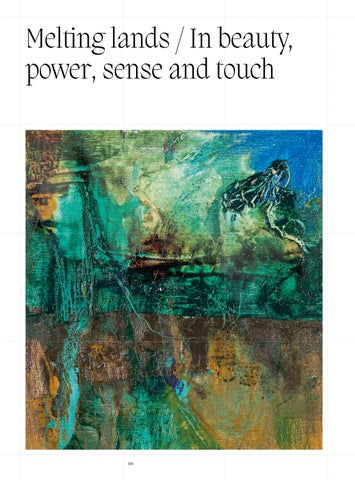
Melting lands / In beauty, power, sense and touch
96
Himani Gupta
Himani Gupta is a visual artist who works in painting, drawing and mixed media. She is interested in urban ecologies and land, fantastical places, identity, psychology and space, which she explores through drawing, mapping and mark-making, and largescale paintings. In walking, she records experiences of spaces, land and nature through visual notes and sound recordings, unveiling the complexities and layers of the physical realm, and manifesting her experience through drawing and painting from observation and imagination.
A question I like to work with often is around impact we humans have on the spaces we occupy and move through. Looking at land and city forms and the role of bodies in these spatial contexts led me to start thinking about the kind of footprint living beings are leaving on these spaces, consisting of land, water and air. Working from maps, spatial concepts and the human identity within them — I began to explore urban ecologies, plant, fungi and animal synergies and changing topographies. I began to think more about the idea of “Artist as Witness”. “Karura” was part of my wider response to the pandemic and was made in 2020 — during the initial periods of uncertainties and lockdown, while I was in Kenya for a month. Kenya was one of the three countries where I experienced being locked down. My practice and the work created during the pandemic involves both obvious and subtle references to cartography overlaid on land — painted, drawn, traced, documented. Maps offer the illusion of understanding a landscape, and are an underlying element of all my works and studies. I used the skies, plants, earth, objects, buildings as art material to respond to a new understanding and experience of time. Time that sits still and rushes past, sometimes both at once. Time in a place which was planned to be home. “Karura” is a series of spontaneous sound and visual notes in the form of drawings and paintings from Karura Forest, Nairobi. The drawings are painted in oils and sanguine — true to the colour of the Kenyan red earth.
KARURA I (2020) PHOTO COURTESY: THE ARTIST PHOTO: ALINA TIPHAGNE 97
KARURA II
98
Karura Forest is one of the last remaining local indigenous forests to provide a vital carbon sink for Nairobi’s growing urban activity. It also serves as an important water catchment area and has great relaxation and recreational value for Nairobi city dwellers. Creatives will activate and organise — through their work which could be visual/oral/performance based/literary and more. They could activate people towards protests and actions, feelings and sentiments about our role on earth and in our lives and communities. Creatives will choose to maybe not work with hard data but try and convey the message through a sensory language. “Morphologies” is a set of 12 prints (edition variables) which explore our ever-changing micro and macro environments through rigorous working on one zinc plate over six weeks. Processes such as etching on ground, aquatint, chine-collet and engraving on the plate — constantly shifting form, boundaries and texture with each stage — is central to this series. The intention was to arrive at changing forms and tonal scapes on paper using rigorous intaglio printmaking processes, impressions from found objects such as leaves, twigs and shells, and intuitive map drawings. The work is akin to the act of walking and transmuting through ever-changing internal and external experiences. “Morphologies” is a part of my wider interest in transient lands and shifting topographies. Through the mixed-media works, there is an inquiry into how land and topography evolve and devolve with climate chaos, human activity and movement. Through this work, I’ve attempted to explore fungi intelligence and the role of fungi systems in the context of the rapidly urgent planetary crisis. Fungi are seen to be between the plant and animal worlds, as the circulatory systems of the planet and a vast carbon sink with an ability to absorb eight times the carbon than that of spaces without fungi. The ability of fungi systems to exist through environmental and social trials, to rewire and find new pathways, could be an important way of looking at ecological and personal challenges we are facing. The physical form of fungi, its growth and mutation, and layers with bodies, buildings and ecology, is a key visual feature of this work.
99
MORPHOLOGIES (2022) EV 10/12 PHOTO COURTESY: THE ARTIST 100
KARURA V 101
{-} SHIFT THE TOPOGRAPHY
MORPHOLOGIES EV 1/12 102
{-} WATCH THE LAND EVOLVE
MORPHOLOGIES EV 5/12 103
KARURA III
104
MORPHOLOGIES EV 7/12 COURTESY: THE ARTIST PHOTO: JOE OSWALD 105
106
Art evokes a response from the emotional centre of the brain and translates into something which cannot be brought about through language, structure, data or logic. The work of creatives involves using imagination and dreams in order to create experiences. It is these experiences of viewing and sensing art that evokes human emotion which could lead to helpful actions towards environmental justice. “Melting Lands” is a large mixed-media painting incorporating map and land forms and aspects of human inhabitation as one cause of changing fault lines in the earth. The work intends to be a living, moving painting — both as a stationary object in controlled environments and an installation in shifting spaces and places. “Melting Lands” is painted using natural pigments where possible and upcycled cloth and paper which have been assembled and sculpted onto the artwork. It took me about six months to make this work from conceptualising, sourcing, layering and curing the material to painting. Trying to use my imagination, vision and dreams helps to navigate my way through my inner life — the wins and the crises. Maybe the imagination is inherited from many generations ago. The planetary crisis is macro, urgent and common for us all and could also be looked at through this lens — and that is something that I hope to be able to achieve.
MELTING LANDS (2023) COURTESY: THE ARTIST PHOTO: JOE OSWALD LOCATION: RAILWAY ARCHES BY THE ARTIST’S STUDIO 1. HEATHER DAVIS AND ETIENNE TURPIN, ART IN THE ANTHROPOCENE: ENCOUNTERS AMONG AESTHETICS, POLITICS, ENVIRONMENTS AND EPISTEMOLOGIES (LONDON: OPEN HUMANITIES PRESS, 2015)
While it is suggested that the Anthropocene cannot simply be represented in art (for example Anthropologic landscapes), but that art is the means by which this ecological perspective is incorporated into vision. It consolidates a way of seeing and breaking down vast expanses of space and land and talks about how we are using and occupying our lands.1 I would call this tactile artwork a “sculpted tapestry-painting”. I sourced my material from three places in India for this: one of the oldest khadi paper factories in Ahmedabad, Gujarat — where scraps of cloth and waste are repurposed into a very resilient khadi paper; a textile studio called Paiwand Studio on the outskirts of Delhi that upcycles textile waste and turns it into yarn and fabrics; and generations worth of heirloom textiles, discarded/ forgotten cloth, and keepsakes in family storage in Delhi. I want viewers to sense temperature when they look at this painting. The shade, humidity, the vast expanse of land they 107
MELTING LANDS DETAILS 108
have to walk through, the rainforests, coasts and mountains. This is a painterly response to shifting topographies and map lines due to human-led land erosion, forest decline and the expansion of croplands and buildings — an enquiry into the connection between identity and lands, and the occupation of space by human and animal presence. Not everything that has to do with reality has to be factual, and this is what art seeks to explore and convey. To make art that arises from questions in our current times is as important as putting together facts and numbers. It is equally (if not more) important because it speaks to the other side of the brain which doesn’t understand facts and figures, but feeds off emotions, colours, sensations, methods of madness. It communicates in beauty and power, in sense and touch. Personally and collectively, as creatives I believe we possess an ability to make work that can stir discussions and make some difference. Art demands attention, as do activism and policymaking. It is through feeling and focus that action is led. Sometimes consciously and intentionally and at other times as a derivative of making art, observing the mundane and thinking about essential questions through colour, form, line and repetition. The practice of drawing and painting and working with material invariably leads me to a bigger ‘why’ which almost always aligns with the purpose.
109
③
Reconnecting
111
Festive catalysts
PHOTO: MICHAEL CANDY TAKEN FROM JUST OUTSIDE HUEPETUHE, FACING DUE NORTH 112
Hawapi
Maxim Holland is a curator, producer and cultural manager. In 2012 Holland started HAWAPI, an independent arts organisation that each year takes a group of local and international artists to politically complex territories to produce public interventions focusing on social, political and ecological issues. Holland has received wide recognition for his work in the Peruvian cultural sector and has curated exhibitions in some of Peru’s leading exhibition spaces, including the Convento Santa Doming Qorikancha and the Lima Museum of Contemporary Art. Susie Quillinan is a researcher, editor and curatorial practitioner with an interest in knowledges shaped through practices of accompaniment. She is co-director and editor of publications at Hawapi and co-director of Masters Studies at Transart Institute for Creative Research. Susie also developed the project sala de lectura (Lima), which cultivates slow research on practices of reading together.
Hawapi is an independent cultural association based in Peru which develops encuentros for artists and other researchers in territories that are embedded in the daily realities of particular eco-social struggles. Hawapi works with places described by scholar Lisa Blackmore as “sites of ecological, social, economic and political relevance that demonstrate processes of abandon, fracture and ongoing transformation”. During the encuentro, participants are invited to develop interventions in public space that respond to the specificities of the context. In 2015, Hawapi took place in Huepetuhe, a town located in the Madre de Díos region of southern Peru. Madre de Díos is home to three of Peru’s largest national parks, which boast some of the most biodiverse regions on the planet. Huepetuhe is a small and relatively young community that was founded and built by immigrants — pioneers and prospectors (mostly from small and impoverished communities in the southern Peruvian Andes) drawn to the area by the allure of its rich deposits of gold. For over four decades, people have been mining in Huepetuhe, largely ignored and unnoticed by the rest of the country. Mining in the region initially operated at a very small artisanal scale, but during the 1980s and 1990s these original prospectors incorporated the use of heavy machinery and more sophisticated mining techniques. In 2007, the construction of the Interoceanic Highway between Peru and Brazil opened vast areas of previously inaccessible rainforest. Soon after, the 2009 financial crisis precipitated a sharp increase in the price of gold. These two events led to a massive unregulated gold rush in the region. Despite these developments, current mining operations in Huepetuhe continue to be largely family-run, unlike the majority of mining projects in Peru, which are owned 113
114
PHOTO: MICHAEL CANDY TAKEN FROM THE SAME VANTAGE POINT AS THE PREVIOUS PHOTOGRAPH, FACING DUE SOUTH
115
ILLUSTRATIONS: ANDRÉS REYES AND RODRIGO JAUREGUÍ
by multinational corporations. This has meant that gold production in Huepetuhe has resulted in a direct economic benefit to residents of some of Peru’s poorest regions, who have typically been excluded from the management and profits of the country’s rich natural resources. Unfortunately, this has gone hand in hand with a proliferation of corruption, crime, human trafficking, deforestation and desertification. The highly visible environmental impact prompted by this sudden surge in activity captured the imagination of the global media in 2014, generating considerable public outcry in Peru and abroad. It was under these conditions that Hawapi 2015 took place in Huepetuhe. During the research phase of the project, it became apparent that the local community was highly suspicious of outsiders, especially anyone taking photographs. The residents of Huepetuhe often credit images that circulated in the media in 2014 as being the direct cause of subsequent legal and military interventions by the Peruvian government, thereby causing a deep mistrust of outsiders with cameras. Hawapi recognised that, in order to engage with the community and work within it, the group would need to operate without cameras as a sign of good faith. Inspired by courtroom sketches, Hawapi invited two artists from Lima’s Escuela de Bellas Artes, Rodrigo Jaureguí and Andrés Reyes, to accompany and document the activities of the encuentro. Another challenge posed to the organisation of the encuentro was that many local residents assumed Hawapi was representing an international NGO or environmental organisation, entities which were perceived as a threat to the community’s way of life. To counter this misconception and transparently share Hawapi’s intentions and methodologies, we decided to create a “temporary cultural centre” in the central plaza as a way to make the group’s activities accessible and transparent to the community and to house workshops, evening film screenings and a public reading area. Two architects, Augusto Roman and José Bauer, were invited to develop a temporary structure for this purpose. Roman and Bauer chose to model their design on the Kallanka, a multi-use open structure often found at the heart of Inca settlements. The architects made it their goal to source the elements needed for the construction of the Kallanka by upcycling some found materials and borrowing others from residents. In the Hawapi 2015 — Huepetuhe publication, Roman and Bauer 116
117
note, “From an economical point of view, this allowed us to maintain a low budget, as it saved us from having to buy bulky and heavy materials and transport them to Huepetuhe. In terms of sustainability, it allowed us to use existing materials and — provided they were kept intact — return them once the event was over [...] we succeeded in sourcing most of the materials as loans from the local residents of Huepetuhe. As a result we generated a social network of people who were involved with the project and could, at least theoretically, replicate this structure in the future, given that all the elements needed for its construction were returned to them.”
ILLUSTRATION: ANDRÉS REYES
Eight artists’ projects were developed during Hawapi 2015 Huepetuhe, one of which was Dulce Afán by Philippe Gruenberg and Haydee Vargas in collaboration with Paulina CachoSouza (a member of Hawapi’s production team). Philippe was one of the invited artists and came from a predominantly 118
photo-based artistic practice in Lima. Given the restrictions around the use of cameras, Hawapi’s invitation prompted Philippe to explore other ways of working. On a research visit, he met Haydee, a longtime Huepetuhe resident and entrepreneur who ran a business baking and decorating cakes for local celebrations, and the pair decided to collaborate.
ILLUSTRATION: RODRIGO JAUREGUÍ
Over the course of the 10 days that Hawapi was in Huepetuhe, Philippe and Haydee designed, prepared and decorated a giant cake (measuring approximately 2m long by 80cm wide), representing the landscape surrounding Huepetuhe. The cake was a playful depiction of the contrasting geography encircling the town — the lush green forests to the north and the barren landscape of the mine to the south. Over the course of the encuentro the baking challenge was often mentioned on the local radio stations and word spread in the community that there would be an unveiling of the biggest cake ever seen in Huepetuhe. 119
120
ILLUSTRATION: RODRIGO JAUREGUÍ
121
When the cake was finally unveiled in the Kallanka on the last night of the encuentro, over 150 residents attended to sample it. In order to handle the crowds, Roman and Bauer created a makeshift walkway and platform allowing people to approach the cake one at a time to observe it from above and select the piece they wished to eat. An unexpected result of the portioning out of the cake was that everyone showed a preference for the lush, colourful rainforest section, leaving the area representing the mine for last. This in turn prompted spontaneous conversation amongst the residents about the inherent value of the natural environment and mining’s impact on it. Without the festive catalyst of the cake, it would have been impossible, as outsiders, to initiate such a conversation in Huepetuhe. These are the kinds of unplanned but vital dialogues that Hawapi believes artists and their work can prompt, especially with relation to contested territories and complex eco-social and political problematics. While this may not present concrete solutions to the tensions that Hawapi grapples with, it can create the conditions for meaningful dialogue and cooperative speculative thinking.
122
PHOTO: PHILIPPE GRUENBERG
123
Bridging the gap
PHOTO: TOVA KATZMAN 124
Estudio Nuboso
Ela Spalding is an artistfacilitator, writer and consultant exploring art as a conduit for expanded notions of ecology and interconnectedness. Her background is in film, photography, dance and somatic awareness practices with a keen interest in sound, wellbeing and nature’s processes. She is the founder director of Estudio Nuboso, a nomadic platform for exchange between art, science, nature and society. Her current focus is on developing the Suelo Methodology, which seeks to support individuals and communities to connect with the places they inhabit and the soil beneath their feet.
The work we do in Estudio Nuboso is perhaps more about bringing people from different walks of life together to look at issues or topics that pertain to our environment than it is about creating a specific artistic output. The processes and experiences that result from these encounters (residencies, workshops, projects) are an invitation to others to see and feel the issues or wonders of their world in a new way. We use the space and flexible approaches that art can offer to facilitate exchange, dialogue, experimental and creative ways to share knowledge and practices in order to bring about an expanded awareness of our interconnectedness with all of life. The participants in our projects often have profound reflections on their habits and limitations in this compartmentalised world. They enjoy bridging the separation that has got us into the mess we’re in and discovering new roads towards collaboration and relating with the more-than-human. They find themselves thinking and co-creating beyond their labels as scientists, artists, architects, teachers or farmers, and more as humans with common concerns finding solutions together. As a platform for art and ecology, we see facilitation as an art form and we make art that facilitates connection. Observing, sensing, relating, listening, expressing and communicating are common to both ecology and art. If we stay stuck in responding only to policy and fear, we lose the possibility inherent in being present in the world and being a part of life, which is always full of surprises. Ultimately, we want to retune ourselves with nature and its creative forces. And we do indeed aim to deepen the intrinsic human–nature connection, to raise our awareness of our role in the environment, and to inspire wonder, care and kinship in order for us all to bring forth more reciprocal and regenerative futures. 125
PHOTO: TOVA KATZMAN 126
PHOTO: CARO BORRERO 127
Bridge of comprehension
THE COMMUNITY REPRESENTATIVES ENJOYED VISUALISING THE CONCEPT OF GOOD GOVERNANCE THROUGH ART PHOTO: ABRÃO SOARES PEREIRA 128
Asiem Sanyal
Asiem Sanyal is a marine biologist and conservationist, a diving instructor and a creative. He has worked on islands around the world, from Cape Verde and Timor-Leste to São Tomé and Príncipe, where he is currently located. The marine realm has always fascinated him and finds expression in most of his work, which looks at the overlapping spheres of biodiversity, sustainable livelihoods for communities dependent on ecosystem resources, and environmentfocused education, within the broader context of conservation.
A couple of years ago, on an unusually warm February in Dili, the capital city of Timor-Leste, representatives from nine different coastal fishing communities gathered to discuss the very important concept of governance. The specific context was locally managed marine areas (LMMAs): areas of the ocean abutting their communities, which they used as fishing grounds and managed to ensure sustainable utilisation of marine resources, in order to ensure that future generations could continue to thrive off the waters. The communities in their respective LMMAs had decreed that trespassers would be penalised, but they continued to witness instances of illegal fishing. The organisation I worked with at the time decided to conduct focus group discussions with the community representatives to determine what they thought could constitute “good” governance of their LMMAs in order to better safeguard them. Except, it transpired, there did not exist an equivalent for the word “governance” in Tetun, the language most widely spoken in Timor-Leste. A colleague of mine came up with the idea of representing the concept of governance through a series of drawings, and to use them to elicit responses from the representatives. In many ways, the old adage “a picture is worth a thousand words” rings very true, particularly in the face of new and emerging concepts in the climate crisis. Many crisis-vulnerable communities and economies do not possess the vocabulary to make sense of certain concepts and are not able to work effectively towards either mitigating risks or establishing crisis-relevant safeguards in their respective spaces. The speedy development of the climate crisis also necessitates more urgent measures to 129
130
address this situation, and it is at this point that art has a crucial role to play. By serving as a “bridge of comprehension” between scientific jargon and practical realities, art has the potential to serve as the vehicle for a much-needed and cogent response to mitigating the impacts of environmental crisis. It especially holds value for children and youth, who will inherit the earth with all its incumbent situations and problems and limited time to address them. Creatives are more needed today than ever before, to extend the conservation aesthetic beyond the confines of scientific rigour and into a wider collective consciousness. Being at the unusual intersection of being both a scientist and a creative, I have often found art an effective tool for working with children. Over time, I have found a lot of my work becoming increasingly more art-centric in order to effectively communicate with this demographic. I have found the approach particularly effective in working with children who may lack the means to procure a formal education, or for whom environmental themes and topics do not feature significantly in the curriculum. Unfettered by enforced notions of what scientific concepts are supposed to look like, children can utilise art to dream their future into existence, imagining potentially novel solutions to the climate crisis. I am increasingly hopeful that art becomes, in a sense, the new “language” to articulate the problems facing the world today, and acts as a unifier for people from different backgrounds to unite in the global efforts against the advent of the crisis. In Dili, the community representatives disperse for dinner after what has been a long day. The concept of “governance” has been understood, visually, and discussed and debated for a few hours. The representatives are unanimous in wanting to set up a dedicated committee to enforce community laws on their LMMAs. A group of children from the community in Dili where the discussion is taking place are gathered around the drawings, their brows furrowed in deep thought. Suddenly, their eyes light up and they scamper away into the deepening darkness, lost in discussions around securing their marine resources for the coming years.
131
Swale: Forests on the water
SWALE AT BROOKLYN BRIDGE PARK PIER 6, 2017 PHOTO: MARY MATTINGLY 132
Mary Mattingly
Mary Mattingly builds ecosystems that prioritise access to food, shelter and clean water, using absurdity to shift perceptions. Swale was a floating forest where people picked free food from perennial plants in New York’s harbour, because it was illegal to pick food on public land. Public Water (with +MoreArt) was a campaign and sculpture that cleaned water. Mattingly has worked on public projects with the Museo Nacional de Bellas Artes de la Habana, Bronx Museum, MoMA and the NYC Department of Cultural Affairs.
The role of art and artists in the age of planetary destruction is multifaceted. The climate crisis is a global issue that affects humans from diverse cultures and backgrounds, and a one-size-fits-all approach to communication will never be effective. By incorporating art into climate actions and communications, it is possible to cultivate movements and create messages that are meaningful and resonant across places and communities. Art is an essential element of life and culture, and it’s also part of building collective agency around a climate crisis that is upending the lives of humans and non-humans around the world. It can instigate actions in multiple ways. Forms of art can serve as a means of raising awareness about environmental issues and inspiring action towards sustainability. Other forms provide connections for individuals facing the impacts of environmental degradation. Art may critique systems and practices that contribute to planetary destruction, or it may imagine alternative futures and inspire systems thinking. Art also models sustainability through material use; for example, an artist may refuse to utilise harmful or wasteful materials. Art also serves as a means of community engagement, bringing people together to work towards common goals and promoting collective action. I focus on public art, which I believe has great potential to be a form of resilience and a catalyst for generative movements by both modelling alternatives and serving as a platform for community-based action. It provides an outlet for people to share experiences, work towards common goals, and foster a sense of shared purpose and belonging. Outlets like these are more and more necessary in a place where public space is fragmented, and increased disparities affect community cohesion deeply. Through 133
SWALE AT CONCRETE PLANT PARK, BRONX, 2017. PHOTO: SUBHRAM REDDY
134
SWALE AT CONCRETE PLANT PARK, BRONX, 2016 PHOTO: RAVA FILMS
its ability to bring people together, create shared narratives, and inspire action, public art has the potential to play a vital role in promoting resilience, catalysing and maintaining movements. Swale was a floating food forest built on a barge that circumnavigated New York City’s harbour, allowing anyone access to pick fresh foods for free. It came out of a need to focus on water and its vitality, on commons management systems, and on access to different food sources. It docked adjacent to New York City’s public land, using the common laws of the water as a loophole to do what was illegal on public land: Swale was a public platform where anyone could pick fresh foods for free, an illegal act when committed on parkland due to New York City’s public land laws. Arguably the oldest form of gardening, Swale was based on agroforestry — edible ecosystems generated through companion planting methods that involve cultivating diverse arrangements of plants that strengthen, support, and nourish each other. Because of their natural regeneration, they are one of the most resilient agroecosystems as well as a sustainable means of food production. Unlike industrial agriculture, food forests grow to be stronger and more plentiful each year. Swale followed traditional ecological knowledge and the insights of social scientist Elinor Ostrom, who claimed that in a vibrant commons, people had a vital role to play not only as beneficiaries, but also as co-creators, protectors, and decision-makers. Swale was experiential. Imagine walking onto a barge adjacent to a city park to find that it looks, smells, and 135
tastes like land but feels different, as the barge moves from the wakes in the water. Slowly, as a visitor grew accustomed to the moving vessel and the new surroundings, their perspective would shift and suddenly it could look like the city was moving back and forth, and the land the vessel provided would start to feel stable. At some point within what I want to describe as a perceptual transition, people recognised where they were standing — in a particular food system that was engaging and possible: they would then inquire about where the soil came from, where the water came from, and the conversation about food access would usually expand to the grocery store nearby. An edible forest built on an industrial barge could question land use in the city and the food systems residents rely upon. Swale was imaginative. The vision for Swale was to increase access to local food and clean water through commons governance systems in a largely privatised city. Through its existence, it empowered people to become stewards and take control of local food systems to improve access to alternative options. Swale was meant to model a commons governance system, characterised by reciprocity, resource pooling,
FORAGING ON SWALE AT CONCRETE PLANT PARK, GOVERNORS ISLAND, AND THE BROOKLYN ARMY TERMINAL, BRONX, 2017–2018 136
and stewardship. It provided opportunities for individuals to engage in collective action towards food justice. Through Swale, in 2017, the New York City Parks Department felt enough pressure and support to open their first landbased pilot — a public “foodway” at Concrete Plant Park in the Bronx that the Swale team continues to help steward. If there is enough additional interest from residents in stewarding edible plants from people in communities near other public parks, the Parks Department will work with groups to do more. An embodied nature of art — whether through performance, interaction, or physical experience — can foster a deeper connection between the participants and the message, leading to greater engagement and potentially transformative experiences. While the impact of one public artwork may be small compared with the scale and scope of the climate catastrophe before us, it can be part of a larger movement of people working towards local systems change, sustainability, and the health of the planet.
137
Ecosystem of communities: How an art and culture organization in the Andes creates resilience
138
ArteSumapaz
Ric Dragon, a painter, musician, and writer, is the Executive Director and co-founder of Fundación ArteSumapaz, an arts and culture foundation in the mountains of Cundinamarca, Colombia.
ArteSumapaz is an art and culture centre founded in 2019 on a former coffee plantation in Cundinamarca, Colombia. Our strategy for the centre is based on an ecosystem of communities, with the belief that no one community type by itself is sufficiently robust to create enduring meaningful change in the system. The centre’s initial central function is that of an artist residency, in which artists come from all over the world and stay anywhere from one to six months. The residency is artist-funded, meaning we don’t rely on government funding. Because of the difference of economies between Colombia and the US and Europe, it means modest fees from a handful of artists ensures a financial break-even for the foundation’s operating costs. The creation of an intentional community in which interested individuals make a more substantial donation to the foundation forms the basis for purchasing the property over a five-year agreement with the owners. Meanwhile, we have already demonstrated that with artists and passive reforestation, we are able to generate more revenue than the local traditional model of cow ranching, which has allowed the land to regenerate with local species. The three main communities that have thus far worked together include the local agricultural community, international artists, musicians, writers and other makers, as well as the longer-term participants in the intentional community. Each community provides either a historical perspective or a source of fresh new ideas. The idea that nature is at the centre of creative endeavours can be heard in the advice of artists going back to the Renaissance, and even more recently, in the pedagogy of the Bauhaus and Black Mountain College in the United States. 139
VIEW OF THE RIO NEGRO VALLEY TOWARDS CHINAUTA, FROM ARTESUMAPAZ 140
Saying that nature conservation is at the heart of art-making comes easily, as does a focus on social justice issues such as colonialism, racism, misogyny, and discrimination against trans persons. We’ve come to believe that these are not separate issues, but in themselves are all a part of creating innovative solutions to help heal both the traumas of people, and those traumas inflicted against our very environment. We ask creatives to ponder these issues, but also, how do we then share them across with local communities in a non-colonialist spirit? This, ultimately, requires a mutual sharing of ideas; it cannot be unidirectional. We have to work within the realm of not only creative solutions, but in the systems of communication in which those ideas can be received and help to create change.
141
Flow: From awareness through healing to imagination
142
Eve Mosher
Eve Mosher works at the intersection of climate change and imagination. She moved from New York City to rural Scotland, where she is developing tools for imagination and creativity to help communities — both urban and rural — tell their own story of tomorrow. Neither Mosher’s work on the climate crisis, nor her accolades, press or degrees has prepared her adequately for the moment we are in. She explores the coastline daily and attempts to grow a permaculture garden to increase sustainability in her small piece of the world.
This is a visual depiction of the inflection points that my practice has played in the evolution and response of a community to climate change. Projects range from increasing awareness, to offering space for reflection and healing and then onto imagination and rebuilding the world around us. In early 2006 I found myself outraged by increasing stories about the obvious impacts of climate change (even as early as 2006) that we were witnessing and the not only slow, but denialist approach to the crisis by those in positions of power, wealth and influence. I literally took my creativity to the streets to engage with my larger community of New York City residents on their awareness, experience and solutions to climate change and its impacts. Since that time I have focused on engaging communities in collaborative, site-specific and immersive works of art. This way of working builds a sense of collective ownership and responsibility that I hope inspires people to think differently about their relationship with the environment and to take action to address climate change. In thinking about the roles of the artist in the larger response to the changing world, they span from bearing witness to communicating complexities to acting as a collaborative partner across disciplines — a partner who can challenge the accepted reality and participate in building the future.
143
COMMUNICATE OUTSIDE SCIENCE OR MEDIA
PERSONAL STORIES LIVED EXPERIENCE DIFFERENT LEARNING MODALITIES
INTERNALISING SCIENCE SITE SPECIFIC EMBODIED DATA
CONNECT ACROSS GEOGRAPHIC DIVISIONS MULTI-SENSORY INPUT NON THREATENING
COLLABORATION CROSS CULTURAL DIVIDES SPACE TO HEAL AND GROW
PROVIDE SOLACE REVEAL COMPLEX EMOTIONS
CREATE CONNECTIONS
ENCOURAGE REFLECTION
PROVOKE EMPATHY
BUILD SOCIAL RESILIENCE LISTENING
INSTIGATE CONVERSATIONS
IMAGINATION IS NECESSARY
"AHA" MOMENTS PROVOKING EMOTIONAL RESPONSES
VISUALISING POSSIBILITIES
SCAFFOLDING FOR IMAGINING
ENCOURAGE ATTACHMENT TO PLACE
BUILDING ANOTHER WORLD
SURPRISE EXPLORATORY
ENCHANTING
COLLECTIVE POWER
INSPIRING CHANGE SPARKS CURIOSITY
144
CHALLENGES WHAT IS
FUTUREPHILLY_EVE: FUTURE PHILLY, STILL FROM VIDEO BY EVE MOSHER FUTUREPHILLY_GINA: FUTURE PHILLY, STILL FROM VIDEO BY GINA RAFAELLA FUTUREPHILLY_NATE: FUTURE PHILLY, STILL FROM FROM VIDEO BY NATE DORR
145
HEATRESPONSE_POPCYCLE: HEAT RESPONSE PHILADELPHIA WITH TRUST FOR PUBLIC LAND, BY ABI MLO 146
HIGHWATERLINE, MIAMI, BY JAYME GERSHEN 147
HIGHWATERLINE, MIAMI 2, BY JAYME GERSHEN 148
HIGHWATERLINE, MIAMI 3, BY JAYME GERSHEN 149
HOLDINGTHEOCEAN: HOLDING THE OCEAN, BY EVE MOSHER 150
STORY OF TOMORROW WORKSHOP, BY DEREK MITCHELL 151
152
STORY OF TOMORROW WORKSHOP, BY EVE MOSHER
153
Creating a climate of change: Bioplastic call-and-response
EXHIBITION VIEW FROM IN FLUX (2023) 154
Nnenna Okore
Nnenna Okore PhD is an acclaimed artist, researcher, teacher and Fulbright Scholar who uses artistic practice, pedagogy and social engagement to address ecological issues. Working largely with natural materials, Okore creates delicate works that engender awareness about sustainable artmaking practices. Her works have been featured in major exhibitions at the Museum of Art and Design, New York, Spelman Museum of Fine Art, Museu Afro Brasil, Memphis Brooks Museum of Art and Cleveland Museum of Art.
1. FOOD AND AGRICULTURE ORGANIZATION OF THE UNITED NATIONS, FOOD WASTAGE FOOTPRINT AND CLIMATE CHANGE, HTTPS://WWW. FAO.ORG/3/BB144E/BB144E.PDF 2. IBID 3. BIOPLASTIC IS A BIODEGRADABLE MATERIAL THAT I MAKE FROM FOOD SCRAPS, INCLUDING SCRAPS OF MUSHROOM AND CELERY, AND PEELS FROM BANANA, POTATO, CARROT, ONION, AND KIWI FRUIT. UNLIKE PLASTIC MATERIALS MADE FROM PETROCHEMICAL SOURCES, MY HOMEMADE BIOPLASTIC MATERIALS USE PLANT MATERIALS AND OTHER BIOLOGICAL ELEMENTS THAT ARE COMPOSTABLE.
While food wastage represents a huge ecologic concern for the world, not many people recognise that it is among the leading causes of high greenhouse gas emissions in the climate change discourse. The Food and Agriculture Organization of the United Nations (FAO) notes that food wastage is a problem that plagues the world’s richest and poorest countries.1 The difference is that the poorer countries, due to the lack of infrastructure and poor food storage and handling, combined with unfavourable climatic conditions, have high levels of food spoilage and loss. Whereas in wealthier nations, issues like aesthetic preferences and arbitrary expiry contribute to the abundance of food wastage. It means that the global food waste problem is significant and contributes to about 8% of total anthropogenic greenhouse gas emissions — making food waste gas emissions almost equivalent to 87% of global road transport emissions.2 To address some of these concerns, my research explores how food waste can be repurposed through art to spotlight and ameliorate food waste problems. I think creatively and ethically about expired fruit and vegetable waste as a way of extending the material possibilities of food waste to engender ecological awareness, creative thinking, and eco-learnings. From the revivified food waste, I develop a biodegradable material called bioplastic, which is used to draw attention to waste problems while also contributing to its solution by procuring less wastage in my artmaking.3 Furthermore, I employ an African-inspired call-and-response approach that fosters ecological consciousness by bringing people into my studio practice to engage with my bioplastic material.
155
A SCENE FROM AN IGBO NEW YAM FESTIVAL IN NIGERIA. CREDITS: NONSO EGBO, ACCESSED 19 MAY 2022, HTTPS://WWW.GUARDIAN. NG/LIFE/IWA-JI-THE-NEW-YAMFESTIVAL-IN-IGBO-LAND 156
4. JOHN MBITI, AFRICAN RELIGIONS AND PHILOSOPHY (NEW YORK: ANCHOR BOOKS, 1970), 141 5. STACY HOLMAN JONES, "CREATIVE SELVES/CREATIVE CULTURES: CRITICAL AUTOETHNOGRAPHY, PERFORMANCE, AND PEDAGOGY," IN CREATIVE SELVES/ CREATIVE CULTURES: CREATIVITY, EDUCATION AND THE ARTS, EDS. STACY HOLMAN JONES AND MARC PRUYN (CHAM: PALGRAVE MACMILLAN, 2018), 3–20
A CALL-AND-RESPONSE APPROACH
Supported by the African ideology by John Mbiti, which asserts that “I am because we are, and because we are, therefore, I am,”4 the African call-and-response approach adopted in my research offers me a way of galvanising people to confront climate change issues. Captured in the communal interconnectivity that occurs in events like the Igbo New Yam Festival, call-and-response at its core catalyses civil responsivity and interdependencies that recognise the collective voices of different bodies, selves, and ideas in maintaining a harmonious ecological environment.5A bioplastic call-and-response engagement is, therefore, a valuable approach for connecting people to their environment and engendering honest and critical dialogue about climate change (see figure below).
CALL-AND-RESPONSE DIALOGUE
INVITATIONS
PROVOCATIONS
BIOPLASTIC
PARTICIPATION
ECOLOGICAL DISCOURSE/ENVIRONMENTAL CONSCIOUSNESS/SUSTAINABLE PRACTICE
A DIAGRAM ILLUSTRATING THE PROCESSES AND OUTCOMES OF A CALL-AND-RESPONSE ENGAGEMENT IN MY BIOPLASTIC PROJECT 157
So, what is bioplastic, and how is it made? Bioplastic is a quasi-plastic material made from organic and biodegradable matter. In my case, it includes peels from bananas, orange and onion peels, and other expired fruits and vegetables. My process involved blending, cooking, spreading, and air drying. This process yields a flexible membrane or skinlike bioplastic structure that I use for my artmaking. BIOPLASTIC CALL-AND-RESPONSE ENGAGEMENT
To elicit serious responses and dialogue about food waste, I shared my bioplastic processes with participants — during the pandemic, and later, in person. I also mailed a few bioplastic samples to people across different geographic zones and started an online Padlet webpage to bring people together to interact with the bioplastic materials.6 Interestingly, some participants opted to create the bioplastics at home with family and friends, using my DIY bioplastic recipe, and others offered stimulating provocations and ideas that inspired me to try new bioplastic experiments. Though the call-and-response engagements were limited due to the pandemic, they generated unpredictable, dynamic, and transformative experiences for the participants, who connected to each other and the bioplastics in personal and meaningful ways.
ABOVE: THE BIOPLASTIC PROCESS 6. PADLET IS A WEB-BASED PLATFORM FOR COLLABORATIVE ONLINE ENGAGEMENT. SEE PADLET.COM 158
EXAMPLES OF PARTICIPANTS’ COMMENTS FROM PADLET “IT’S INTERESTING CONSIDERING IT AS A MATERIAL SUBSTITUTE, FOR TENTS. I AM LOOKING AROUND NOW AND THINKING — WHAT DO I HAVE NOW THAT IT COULD BE A SUBSTITUTE FOR… IT’S INTERESTING HOW IT’S DURABLE BUT ALSO DEGRADABLE. AND THE MARK THAT DEGRADATION WILL LEAVE IN THE LONG-TERM CAPACITY WON’T NECESSARILY BE GOOD WITHOUT A PROTECTIVE COATING, BUT THEN THAT DEFEATS THE PURPOSE… IT’S AN INTERESTING CONUNDRUM (PUZZLE).” – GRACE S. “…I AM ACTUALLY NOT THAT FAMILIAR WITH BIOPLASTIC. BUT WHEN I DID SOME GOOGLE SEARCH CONFIRMED THAT I INTERACT WITH IT EVERY DAY, AND THIS PIECE THAT WAS SHARED WITH ME, HUNG ON MY FAMILY CABINET, AND I MADE IT MY HOMEWORK. IT TOTALLY REMINDS ME OF A FRUIT ROLLUP AND THE FIRST THING I DID WAS CONTINUE TO SMELL IT. I DON’T KNOW WHY I WAS EXPECTING STRAWBERRY RED… I WANTED TO TASTE IT AND SEE WHAT IT TASTES LIKE, (LAUGHS) BUT I DIDN’T… I DID HAVE THE DESIRE TO EAT IT AND TO TASTE IT, BECAUSE IT DID HAVE LIKE A FRUITY SMELL, EVEN THOUGH IT HAS A PLASTICKY SMELL, AS WELL. VERY STRANGE. BUT IT’S INTERESTING HOW I DO INTERACT WITH IT EVERY DAY AND AS I WAS SITTING WITH IT, I WAS JUST FINDING MYSELF RIPPING IT AND PULLING IT BECAUSE THERE ARE THESE TINY HAIRLIKE PIECES AND FOLLICLES IN IT.” – RYAN R.
THE OUTCOMES
Following the call-and-response engagements, I exhibited the resultant bioplastic works in an exhibition, titled Making Kin (2022) and In/Flux (2023). In the spirit of call-and-response, the exhibition visitors were allowed to touch the artwork, while interacting with me and others in the space. Creative workshops at the exhibition site further enabled participants to interact with me and experiment with the bioplastic. Through handson artmaking with participants, I learned new methods for combining bioplastic material and creating complex textures. What this essay illustrates is that the African-inspired call-and-response practice can expand the eco-dialogue using bioplastics. By generating environmental awareness through call-and-response, my study presents a novel way of building eco-centred mindsets. My call-and-response research, in essence, presents generative and unique avenues of engaging with ecological issues, while enabling people to think critically or casually with me about waste matters and other climatic problems. By enlivening these kinds of calland-response interactions, I hope to create an environment where we create “waste to delight in, not to lament on”.7
7. WILLIAM MCDONOUGH AND MICHAEL BRAUNGART, EDS., CRADLE TO CRADLE: REMAKING THE WAY WE MAKE THINGS (NEW YORK: NORTH POINT PRESS, 2002) 159
NEW BIOPLASTIC ART THAT WAS INSPIRED BY SOCIAL ENGAGEMENTS 160
161
PARTICIPANTS PLAYING WITH THE BIOPLASTIC WHILE DISCUSSING WASTE ISSUES, 2022 162
NEW TECHNIQUES LEARNED FROM PARTICIPANTS DURING THE WORKSHOPS 163
④
Repurposing
165
Carrying the sun on your back: Recent thoughts on place and sustainability
BANANA SPLIT 166
Syowia Kyambi
Syowia Kyambi’s work incorporates photography, video, drawing, sculpture and performance, examining how contemporary human experience is influenced by constructed histories and exploring cultural identities, loss, memory, race and gender. Kyambi is the co-founder and curatorial creator of Untethered Magic, a collective that supports research-based conceptual arts in Nairobi. She was represented in the Kenya Pavilion, La Biennale di Venezia, and her work is held in the Nairobi National Museum, the Kouvola Art Museum, Finland, and the Sindika Dokolo Foundation.
As I strolled through the supermarket, my trolley wheeling through the vegetable section, I knew I wasn’t going to buy any veggies since I could get them cheaper from the market. However, my attention was caught by some bananas from Kampala. They made me wonder if bananas in Kampala are really better than those from Kenya, as many Kenyans attest, or is it an idea we have about produce from Uganda? After all, don’t we have lush and fertile soil just like them? Then I noticed the banana leaf stitching on the banana skin, and took the photo you can see on the opposite page. I love this photo. It’s an image that I’ve carried with me over the years, mostly as my desktop background. The banana in the photo was split, making it unfit for export. I take delight in the ingenious idea of using a small bit of banana leaf fibre to stitch the cracked skin together again so that the whole bunch could be included for export. It makes me think of all the strict regulations and standards for the appearance and quality of fruits and vegetables in European food production industries, leading to unfathomable amounts of food waste. The extreme standardisations of shape, colour and “quality”, and an imagined idea of what vegetables and fruits one can eat and what they should look like, is far removed from the natural, non-uniform mish-mash of colours and forms of food produced without the overuse of pesticides. I wonder about this vast contrast to the beauty and diversity of natural produce that the “stitched banana” evokes in me. The photo is a reminder of what we are losing and a reminder of what’s still possible. Stitching is a constant action in my artistic practice. I frequently incorporate acts of breakage and repair in my performance installation work, where the performance activates and tells a story within the installation. Traces of repair and attempted repair 167
KASPALE’S PLAYGROUND, SYOWIA KYAMBI, PHOTO CREDIT, LINDSEY BAHIA, ORDINARY LIVES OF WOMEN EXHIBITION, MALTA, 2022 168
are ever present. In my life, I seek to employ specific language and methodologies to navigate the terrain of globalised postcolonial, post-industrial effects in my daily experiences. My work examines how our contemporary human experience is influenced by histories framed through the lens of the oppressing powers that maintain unequal power dynamics. I explore cultural identities, linking them to issues of loss, memory, race and gender. Incorporating photography, video, drawing, sound, sculpture and performance installation, my approach takes aim at the politics of the time as well as its legacy today: what is remembered, what is archived and how we see the world anew. The title of this text, Carrying the Sun on Your Back, comes from an excerpt from Hendrik Witbooi’s letters (that always resonate with me when I read them) and speaks to the conflicting emotions I often feel in my practice. I came upon Witbooi’s letters while doing research for a work I produced in 2016, I Have Heard Many Things About You, which I performed in Bremen, Germany, and which contends with the genocides Germany committed in Namibia during colonial rule. The heavy histories of colonialist projects and their onerous effects on the African independence era are a burden I carry in my work. I often attempt to escape, yet always find myself inexorably drawn back to this subject matter, which, for more than 15 years, has been constant in my practice. Is it that the body is so enduringly strong that it can carry the sun on its back, or that the burden of the themes is so heavy that the sun is burning the body, making it impossible to carry? I would like to come back to the banana and stitching photograph. I have recently started to make a parallel with this image and its metaphor for me of being a problem-solving mechanism to alleviate the pressures we place on our planet and the consumption we require, but also exercise in excess, to what I imagine as a lifelong curatorial project called Untethered Magic. In 2019, Untethered Magic was established as a collaborative space that I co-run with Kibe Wangunyu and Ciaran Nash. It serves as a home as well as a sanctuary for creatives — a safe space with a focus on supporting the process of research-based conceptual contemporary arts. Our self-made oasis hosts and nurtures residencies and individual practices, promoting growth, independence, learning, unlearning and relearning about 169
I HAVE HEARD MANY THINGS ABOUT YOU (2016), SYOWIA KYAMBI, DOCUMENTATION CREDIT: CANTUFAN KLOSE, BREMEN 170
space around ideas of home, process, life and art. Untethered Magic is a re-imagination of living human relationships, a supportive communal space that also defies the normal societal structure specific to the context of Kenya. Autonomy and selfsustainability are at the heart of our approach. The Nairobi art scene has historically been influenced by an imported hypothesis of what contemporary African art is, should be and can be. This is heavily directed by commercial gallery systems which are essential for the livelihood of artists, but there are large vacuums in our cultural ecosystem because few resources are put towards experimental work, ephemeral work and the trial-and-error process in creating art. Turning my home into Untethered Magic is a counter-action, creating a space that facilitates and supports the process, a home that allows you to take a moment to breathe, to have time to reflect, to have time to explore things that may not be financially viable, to engage deeper with your and other people’s practices, to rethink methodologies of how to become self-sustainable and autonomous in a cultural space that relies heavily on external funding. The fundamental basis of what it means to be an artist isn’t fostered by funding models that solely depend on the capacity to create items that can be sold across the art market. As proprietors of the property upon which our space is built, we enjoy considerable freedom and flexibility as we do not incur monthly rental expenses. In order to minimise the allocation of resources to salaries, we operate on a project-based compensation system and we have constructed six small accommodation structures which run on two use cases: a local tourism market and opportunity for creative residencies. Our objective is to circulate the financial resources back into supporting the artistic process, which entails thinking and exploring and not necessarily having a clear direction on where the experimentation is leading you. I correlate this back to banana stitching because it’s an exercise in creative problem-solving in defiance of hegemony, creating a foundation that is by artists, for artists. Overall, the image of the stitched banana acts as a potent metaphor for the type of thinking and actions necessary for addressing the problems that the world is currently facing. By accepting our natural inherent creativity, we are able to work towards a more sustainable and equitable future. 171
Trashion
FROM THE SERIES: "BEACH COUTURE: A HAUTE MESS". TRASHION DESIGNER: MARINA DEBRIS. PHOTOGRAPHER: STEPHEN WONG. MODELS: ALLIE GRAHAM (DIRTY LAUNDRY), CLOE FOURNIER (DO I MAKE MYSELF CLEAR) 172
Marina DeBris
The work of artivist Marina DeBris provides a unique way to communicate the harm that we are causing our oceans. Rather than using overwhelming statistics, her art makes the issue personal to the viewer, forcing us to come face to face with items we use daily and often discard without a second thought. The Inconvenience Store won three awards at Sculpture by the Sea, Sydney. DeBris was awarded the Waverley Art Prize and the Helen Lempriere Scholarship. Her work has been exhibited internationally and has featured in Harper’s Bazaar magazine.
The human threat to the environment is grim, but it’s no fairytale. Not even the most scrupulous scientific warnings about climate change and other looming problems seem to move an indifferent public. Are there other ways of hammering home dangers that are tempting to ignore? I think so. My method, and passion, is to put repurposed trash from the shores and streets right in the public’s face… but in a nice way. For over 10 years I’ve been devoting myself to putting marine debris on conspicuous display by fashioning selected bits into wearable art — trashion. I call this ongoing project Beach Couture: A Haute Mess, and see it as advocacy as entertainment. Originally from Los Angeles and now based in Sydney, I’ve always cared about the environment. I started my current work because I found out how much the rubbish was affecting sea life. I clean up two beaches every day and always have a bag of stuff by the end of it. It’s frustrating because the issue is just getting worse and worse, but we’ve reached a stage where it should just not be happening. You shouldn’t bring something to the beach that you’re not going to take back with you. I mean, why is that? As soon as recycling is going on, there is another life to things that you didn’t need to use in the first place. In a way, it legitimises consumption. I’m not saying we should stop recycling. I’m not saying, get rid of artists who reuse materials. It just makes me sad because I cannot understand how as a culture we got to this place where we’re so dismissive of where things come from, where they’re going, what they’re worth. Take these fairly Victorian vignettes. In a well-appointed mansion, put-upon drudge Tasket tries tirelessly to serve her haughty and 173
frivolous mistress, Lady Claire Waystefull. There are no winners in the endless struggle between the dutiful and the negligent, and it’s no surprise that these two emblems of human nature turn out to be non-identical twins separated at birth. We used historic Elizabeth Bay House for the shoot. It’s an ironically suitable setting since its original owner, Alexander Macleay, was an enthusiastic botanist and naturalist who built and displayed an impressive specimen collection. Australia now faces grave extinction threats to its many unique species. Even Macleay’s meticulously planned and once extensive gardens have long since been splintered and diminished by development and neglect. Lady Waystefull’s outfit is made largely of takeaway containers collected over two years from debris washed up on Gordon’s Bay. The top was found on the street. Tasket’s outfit is made of discarded socks, underwear and bras. The laundry baskets were sourced from the streets. When you look at them up close, you can see that they are not clean. I never clean anything. They’re really foul. They’re disgusting, they’re dirty and they’ve got seaweed attached to them. Some of them are quite interesting because they look so used. Some have lipstick, make-up, you name it. I get comments like, “Oh, that’s disgusting”— which is great because it’s exactly what I want. My favourite compliment is, “it’s beautiful and disgusting.” That’s exactly what I want people to get out of it. I’m 100% driven by what I see going on around me and I feel like that’s my purpose in life. I don’t know if it’s just the older I get, the more driven I am to make a dent while I’m here, because I just can’t see the point of being on this planet if you’re not trying to help someone, or help us, survive. Ultimately, I hope that people take notice and realise what we’re doing to the environment and to animals, and change our habits, change our ways. If it doesn’t speak to them in some way, just looking at it quickly, then I haven’t done my job. That’s the ultimate goal. It’s very hard to achieve it and I feel this is the best method I personally have. I think it’s putting a visual face on issues, which is what artists do — try to be impactful with it, not just make it pretty or attractive to look at, because it’s not. It’s really an ugly issue.
174
CURRENT AND NEXT PAGE: LOCATION: ELIZABETH BAY HOUSE, SYDNEY, AUSTRALIA. CHOREOGRAPHERS: LADY WAYSTEFULL — CHLOÉ FOURNIER; TASKET — ALLIE GRAHAM. CO-SPONSORED BY RAY WHITE ELIZABETH BAY
{-} WE’RE SO DISMISSIVE OF WHERE THINGS COME FROM, WHERE THEY’RE GOING, WHAT THEY’RE WORTH.
175
176
IT’S BEAUTIFUL AND DISGUSTING
177
Fashion in motion: Connecting audiences and innovators
FASHION IN MOTION: DANIEL LISMORE, 2022 178
Oriole Cullen
Oriole Cullen is a senior curator of fashion and textiles at the Victoria and Albert Museum. She runs the Museum’s Fashion in Motion programme, showcasing the work of contemporary designers through live events within the Raphael Gallery. Curating and writing on the subject of fashion and textiles, her recent exhibitions include Christian Dior: Designer of Dreams, and Gabrielle Chanel: Fashion Manifesto.
Late in the evening behind the closed doors of the V&A Museum, in a vaulted gallery hung with monumental Renaissance pictures, a giant checked laundry bag is slowly materialising. Conceived by Johannesburg-based fashion designer Thebe Magugu, the laundry bag, which stands at over 4m high, is the central piece of a set design celebrating Magugu’s latest collection, Discard Theory, the current focus of the museum’s Fashion in Motion series. Fashion in Motion is a programme of free, live fashion shows held within the museum, each event celebrating the work of an individual contemporary designer. It offers a unique way for the Museum’s Textiles and Fashion section to connect with design practitioners, many of whom are leading the way in adapting and reforming the fashion system. The show brings the work of these innovators to a wide public audience, with over 1,000 people attending each event. In the 21st century, the role of the museum is not merely to collect the past but to inspire creativity, reflect, question and engage with the world around us. As we recognise and showcase the artistry and craftsmanship of the fashion industry, we must also acknowledge the unseen costs, from the extraction of raw materials and exploitative employment practices to excessive carbon emissions from transport and manufacturing and the millions of tonnes of discarded garments annually burned or emptied into landfill. How can we continue to support the aspiring designers and the natural drive for novelty and invention while looking for ways to reform our destructive habits? Temporary exhibitions can provide an active platform for this engagement. Successful exhibitions such as Fashioned from Nature (2018, curated by Edwina Ehrman) have examined many of the issues and demonstrated positive ways that the fashion 179
180
CURRENT AND NEXT PAGE: FASHION IN MOTION: THEBE MAGUGU, 2022
industry might move forward, be it via new textile inventions or circular economies. Yet temporary exhibitions must draw to their inevitable conclusion and regular programmes such as Fashion in Motion enable the museum to promote progressive practices and continue to work with fashion creatives who strive individually to forge new paths and to make a difference and, crucially, to disseminate and share their work with a live audience. Magugu’s show was organised in conjunction with the V&A’s Africa Fashion exhibition (2022, curated by Christine Cechinska and Elisabeth Murray), a show which celebrates the abundance, talent and sustainable approach of many contemporary fashion designers across the continent. Discard Theory is a commentary on the tonnes of discarded garments from Europe and America which flood into countries across Africa every year, overwhelming markets and stifling local industry and innovation. Magugu has reframed this narrative, purchasing items from Dunusa, a second-hand clothes market in Johannesburg. He has refashioned the garments, using them as inspiration for his collection and recording a short documentary film of his process. The giant checked bag in his set design echoes those in which the second-hand garments are often carried. Stamped with his sisterhood logo, a split in the side of the bag reveals not overflowing discarded garments, but models emerging onto the runway in his exquisite clothes — each ensemble inspired by items that were once perceived as worn out and useless. Alongside Magugu, designers who have brought their perspectives to Fashion in Motion include Mexico City-based designer Carla Fernandez, who collaborates with artisans to create and produce her collections. Her business supports traditional crafts and is an important sustainable lifeline for some remote communities. She has produced a Manifesto of Fashion as Resistance. Her motto is “Fashion is not ephemeral.”
1. PHOEBE ENGLISH, "ABOUT," HTTPS://WWW.PHOEBEENGLISH. COM/PAGES/ABOUT
London-based designer Phoebe English’s creative approach has always focused on a reduced waste method of working, experimenting with textiles in order to create innovative and beautiful designs, often made specifically to order. Her aim is “to develop ways of working with design, and its surrounding systems, that better fit within the realities of our planetary boundaries.”1
181
FASHION AS RESISTANCE
182
183
184
Artist, designer and activist Daniel Lismore fashions himself as a living sculpture, creating majestic, arresting ensembles fashioned from found objects, repurposed materials and gifted items. And visual artist and designer Fredrik Tjaerandsen, another participant, makes his giant balloon garments from natural rubber latex, sourced sustainably from farmers in Sri Lanka. His models, encased in giant air-filled balloons, release a clasp at the garment neckline, enabling the air to fly out as the deflated balloons gradually come to rest on their bodies as simple elegant dresses. The garments are designed to gradually degrade, leaving no trace behind. The Fashion in Motion programme allows us to continue to engage with and debate these ingenious approaches to fashion, diverse approaches and viewpoints as we look to the future. Alongside the live event, a film of each show is uploaded online and images archived for future reference. Museum audiences can engage in a transformative, ephemeral moment and hopefully feel spurred on to reconsider and reevaluate what fashion means, inspired by the creativity and force for change which these designers strive to create.
FASHION IN MOTION: FREDRIK TJAERANDSEN, 2020 185
The art of renewing materials
MULTIGENERATIONS 186
Naomi Wanjiku Gakunga
Naomi Wanjiku Gakunga is a sculptor and visual artist known for her metal pieces. Drawing on her Gikuyu heritage, her work combines African craft traditions, classical art history and contemporary experimentation. Wanjiku learned basket-weaving from her grandmother and the Migiyo technique of straw yarn-making. She uses weaving and natural dyes in new interpretations of baskets, textiles and jewellery. Wanjiku is the winner of the Charles Wollaston Award (2021). Her work is in the collections of San Antonio Museum of Art, National Museums of Scotland, Museum of Textile Latvia, Vehbi Koç Foundation Contemporary Art Museum, Turkey, and The World Bank.
My art processes and materials are aligned with that of the Jua Kali — “under the hot sun” — a movement of artisans in Kenya who take their name from their makeshift workshops that barely shield them from the fierce African sun. They use everything and anything they can find to construct functional objects and art, a method that is both sustainable and innovative. In 2010, I was awarded the Artpace San Antonio Travel Award to study Jua Kali artisanship in Kenya. I adopted their spare use of materials and tools, coupled with native creativity, to make that which is both meaningful and beautiful. I dipped myself into the Jua Kali experience and brought back to San Antonio The Art of Renewing Materials: Lessons from the Kenyan Experience. These art works came out of this experience. I transformed recycled materials into contemporary art. The new, the old and the not-so-old cans were stitched into each other. The bringing together of these materials created a rebirth of the discarded materials. The study of the Jua Kali experience served to build awareness of the value of the recycling and its relationship to our environment. By seeing new life and purpose in neglected objects, I discovered creative processes of recycling. My art is a conceptual conduit for raising awareness of the benefits of recycled art. It offers an ecological worldview that leads to less wasteful behaviours. This work is a metaphor of the continued triumph of the creative spirit towards global environmental crisis, and the role of the artist in the conservation and recycling of resources.
187
TRANSFORMATIONS
188
189
⑤
Reimagining
191
Earth perspectives
192
Olafur Eliasson
Olafur Eliasson’s works explore the relevance of art in the world. His solo shows — featuring installations, paintings, sculptures, photography and film — have appeared in major museums internationally. He installed The Weather Project at London’s Tate Modern and returned for the comprehensive solo exhibition In Real Life. His projects in public space include The New York City Waterfalls and Ice Watch. Eliasson is a UNDP Goodwill Ambassador for climate action and founded the social business Little Sun. He and Sebastian Behmann founded Studio Other Spaces, an office for art and architecture.
For this work of art, you become the artist. Stare intensely at the black dot at the centre of the image for 10 seconds. Now shift your gaze to any neutral surface to see what we share. You will then become an earth projector. YOUR PLANET SEEN FROM WITHIN
Create your own earth view – Your unique planet, Your afterimage, Your artwork. This blurry earth is your home, An image of what you are sitting on, Standing on, Walking on, Right now And all the time. While everyone’s relationship with the planet is unique, It is home to us all. Look around. Look down, Down to earth.
OLAFUR ELIASSON ORIGINALLY CONCEIVED ONE EARTH PERSPECTIVE MAP FOR THE MAGAZINE REAL REVIEW. NINE MAPS WERE CREATED ON THE OCCASION OF EARTH DAY 2020 IN RESPONSE TO THE SERPENTINE GALLERY’S BACK TO EARTH PROGRAMME. THE POEM ‘YOUR PLANET SEEN FROM WITHIN’ WAS ORIGINALLY PUBLISHED AS PART OF AN ARTWORK BY OLAFUR ELIASSON FOR TIME MAGAZINE ON THE OCCASION OF COP27, NOVEMBER 2022.
Not long ago, philosopher Bruno Latour wrote: "The ground is giving way beneath everyone’s feet at once, as if we all felt attacked everywhere, in our habits and in our possessions." He continued: "There is no planet . . . that can shelter the utopia of modernization." Today we know – We would need several earths to sustain that utopia.
193
PREVIOUS PAGE: THE EARTH VIEWED OVER THE MARIANA TRENCH, PACIFIC OCEAN, THE DEEPEST TRENCH ON EARTH, REACHING ALMOST 11,000 METRES BELOW SEA LEVEL. DESPITE ITS EXTREMITY, BOTH LIVING ORGANISMS AND HUMAN-MADE PLASTICS HAVE BEEN FOUND AT ITS BOTTOM.
Who, ‘we’? Those of us who take more from the planet than we give, Who borrow from the future to spend now, Who have colonized, Industrialized, Modernized, Who have forgotten to respect earth And listen to its ecosystems, We have taken from the future, Leaving our kids to pay the debt. Fifty years ago, a famous photo of the planet The Blue Marble Was taken from Apollo 17 (A ‘Man’-goes-to-the-moon mission). It presented a view from outer space, Earth from outside earth, At a distance, For the very first time. People were moved by the image. Your planet seen from within Moves you to shape your own earth, Still a ‘blue marble’, Fragile and home To all of us – to the more-than-human. Mindful of this, Make the artwork again. Create your earth anew And be present to the feelings that arise. The earth in your afterimage is also under your feet. We are learning That we can only see earth While part of it. We are nature. Look down. Look around. Let us re-world. IN MEMORY OF BRUNO LATOUR (1947–2022)
194
THE EARTH VIEWED OVER ECUADOR THE FIRST COUNTRY IN THE WORLD TO RECOGNIZE RIGHTS OF NATURE IN THEIR CONSTITUTION, RATIFIED IN 2008. NATURE HAS THE ‘RIGHT TO EXIST, PERSIST, MAINTAIN AND REGENERATE ITS VITAL CYCLES’. 195
The forest fire and the drop of water
BREAKING WAVES 196
Aviva Rahmani
Aviva Rahmani is an ecoartist and affiliate of the Institute for Arctic and Alpine Research at the University of Colorado. Rahmani authored Divining Chaos: The Autobiography of an Idea, and co-edited Ecoart in Action: Activities, Case Studies, and Provocations for Classrooms and Communities. Her work has been shown at the Cincinnati Center for Contemporary Art, Sichuan Fine Art Institute, Chongqing, KRICT Gallery, Daejeon, the Independent Museum of Contemporary Art, Cyprus, the National Centres of Contemporary Art, Ekaterinburg and Moscow, and the Cultura21 Group at the Joseph Beuys Pavilion, Venice Biennale. She is the cofounder of the ecoart listserv.
We live in extraordinary times. Globalisation has homogenised and exacerbated international conflicts. I believe artists are canaries in the world’s mine, demanding attention when things go wrong. We can also be the ultimate cultural healers, first responders triaging disaster with empathy. Years ago, when I proclaimed, ‘what the world needs is a good housekeeper,’ I inverted the original terminology of the Aramaic pre-King James bible. Rather than dominion, the text meant “caring for,” to “husband” the world. The linguistic inversion was my ecofeminist response to ecocide. Anthropocentric priorities have unleashed chaos, with torrents of consequences, from plastic pollution and climate change to species loss. A housekeeper keeps a home clean and safe, with humble attention to detail and empathy for a family. As an artivist and ecoartist, my priority is knowing where to pay attention. I have written about where to pay attention to effect change simultaneously out of empathy and partnership with science; and pedagogical essays on ecoart to address our ecosystem crises with art, grounding my point of view in my original theory of trigger points, a blueprint to initiate a black swan, modelling healing with rules for change. Before I understood complex adaptive modelling or complexity theory, I began observing systematic change when I restored a pocket salt marsh (Ghost Nets 1990–2000) on a former dump site and speculated about the repercussions of ecological restoration as I made a home on the property. In 2015, I initiated another seminal work, The Blued Trees Symphony (2015–present), based on a legal theory of where specific laws for copyright protection and the 197
1. AL JAZEERA AND NEWS AGENCIES, "WHAT IS THE ARAB SPRING, AND HOW DID IT START?," DECEMBER 2020. HTTPS://WWW.ALJAZEERA.COM/ NEWS/2020/12/17/WHAT-IS-THE-ARABSPRING-AND-HOW-DID-IT-START
official takings of private lands (eminent domain law in the USA) might be challenged with artmaking. The latter work won an injunction against fossil fuel corporations in a 2018 mock trial produced by A Blade of Grass. The trigger point was between legal theories about ownership, common good, earth rights and accountability for ecocide. The trial became the basis for an experimental opera-in-progress, exploring arguments to challenge the ecocidal scale of our disorder. None of this is sufficient to restore order and safety to our earthly home. My studio is on the Eastern shore of Vinalhaven Island, a fishing community in the Gulf of Maine, on the site of Ghost Nets. In April 2022, I moved the art I had stored in New York City to my studio. The building was a sawmill during the days of the granite industry, sitting 3 feet from deep water. As the sea level rises, the building is periodically threatened by high tides, spring surges and storm waves. For me, this was performative. My move was an embodied metaphor for anguish and helplessness, comparable with the decision of Mohamed Bouazizi, the fruit seller who catalysed the Arab Spring by setting himself on fire 17 December, 2010 in Tunisia.1 At times, I have seen flood waters surround my studio, which is fortunately on concrete piers, albeit not high enough to protect my life’s work from the sea-level rise projected to occur in my lifetime.
198
The move and my reflections on risk are performative. On site, I make paintings of the slowly vanishing shoreline and daily photograph dawns and sunsets whose light asserts a paradox in time: all life is provisional, light is eternal. These projects take place far from artworld centres or media attention. They are like any other mark an artist might make on a surface, except my marks are ephemerally symbolic and my canvas is at the boundaries between land and sea, individual human, and whole ecosystem issues. I want to catalyse resistance to hegemonic corporations and their political allies around the world. But they seem heedless to the collateral damage inflicted by their extractive campaigns against nature and all her populations, human and non-human. One day, my life work and all the housekeeping it represents might wash out to sea and end up on Portuguese beaches. I throw myself against obdurate reality like waves crashing against rocks. But eventually that is exactly what breaks down rock into soil, nature’s own housekeeping. At the heart of trigger point theory is the butterfly effect from chaos theory, except that my theory defies the presumption of unpredictability. I have always been inspired by a story by the late Wengari Maathi, Nobel Prize winner and initiator of the Green Belt movement, of a hummingbird who flies towards a forest fire with one drop of water in her beak, because that is “all I can do”. The home I work out of is our state of chaos. I live in the forest fire with my drop of water.
199
Critique – Ecology and art practice
200
David Buckland
David Buckland is an artist, writer and film producer. In 2001, following a creative pathway that led him to the work of climate modellers, oceanographers and the challenge of the climate crises, he set up the Cape Farewell foundation. The Cape Farewell foundation has for 20 years brought artists, scientists and educators together to collaboratively promote long-term change in cultural attitudes towards the climate crises through creative expression. This has produced a feast of ecological artworks from all mediums — fine art, poetry, music, dance, film and photography.
1. SYSTEMIQ, UNIVERSITY OF EXETER AND BEZOS EARTH FUND, THE BREAKTHROUGH EFFECT: HOW TO TRIGGER A CASCADE OF TIPPING POINTS TO ACCELERATE THE NET ZERO TRANSITION, JANUARY 2023 2. TOM RAND, KICK THE FOSSIL FUEL HABIT: 10 CLEAN TECHNOLOGIES TO SAVE OUR WORLD (TORONTO: ECO TEN PUBLISHING, 2010)
The artist Michael Pinsky, when asked at a Q&A session why he focused his creative art practice on being an activist for the climate movement, replied that if he was an accountant he would have equally chosen to address the challenge of climate chaos. Just published is a contemporary report by Systemiq, in partnership with Exeter University, among others. They argue that we are at a critical point, the fulcrum of change, where multiple tipping points of climate catastrophe are set against tipping points of a sustainable cultural shift.1 The catastrophe scenario is a well-trod path — Greenland ice cap melt, the demise of a key current in the Atlantic, our overheating weather systems — and each tipping point crossed raises the chance of accumulated chaos. Interestingly, the report also includes the notion of cultural tipping points for positive change: the switch from fossilfuelled to electric cars, agricultural practice involving the production of fossil-fuel-burning nitrates and ammonias being replaced by green fertilisers, and alternative proteins beating animal-based proteins on cost. Each technological shift cascades into an avalanche towards a sustainable global society. Ensuring that this cultural shift is manifest is obviously critical for humanity’s survival and addresses the urgent need to repair our damaged ecology. It is clear we have the green technology available, and when delivered at scale it again beats fossil-fuel-burning for energy on price.2 What is missing is the societal agreement to act, urgently. The exciting bit is that we are on the cusp of a major human upheaval, the cultural challenge identified in the Systemiq report and the possibility of cascading non-carbon activity. 201
There isn’t an alternative. Our current trajectory is just not sustainable — 8 billion people cannot continue abusing the natural systems that govern our planet without dire consequences. Humanity’s shift towards a sustainable society is fuel for artist enquiry on a massive scale: how to comprehend what is happening, how to give meaning and how to envision what is possible. History has told us that artists gravitate towards the salient issues of their time, but where does this new quest of ecological art practice sit and how can it be critiqued? Why are some artworks more resonant and fit for purpose? How do we narrate the celebration of an artwork that moves us beyond reason, its power so unquantifiable, its qualitative edge so resonant. This is a new territory of critique that deserves interrogation, a sharing of thinking and evolution of practice. Cape Farewell is already proposing its own workshop of critical minds at our Dorset HQ: an artist-led enquiry tempered by our ecological surroundings of organic farm practice and physical wilding. This needs to be just one of many such workshops that have to take place in our cities and within our urban lives. An old adage: science gives us truth and reasoned facts that clarify why something just is, but art gives meaning. Ecological art practice takes on the scientific truths and weaves them into our human psyche to give meaning to our collective human endeavour. It questions our embedded notion of human superiority over animals, natural systems3 and the magic of the oceans that surround us. Art now manifests itself in so many new forms. How does one critique the art generated in this age of social media where we perhaps want to be in the artwork rather than frustratingly relegated to passive observers. Is the artist’s role to be provocative, the orchestrator of shared events?
3. KATE RAWORTH, DOUGHNUT ECONOMICS: SEVEN WAYS TO THINK LIKE A 21ST-CENTURY ECONOMIST (NEW YORK: RANDOM HOUSE BUSINESS, 2018)
Where is the idea? What is a relevant idea? To create beauty, to create change, to con and manipulate, to provoke, to celebrate? Is the idea strong, does it have resonance, is it unique, dangerous and, by qualitative reasoning, more powerful? And the point is? The point can be just to have beauty, just to notice how awesome our ecological home is, a light human footprint that celebrates our notion of care. Or, as in Pinsky’s Pollution 202
Pods, where the point is to make us fully take on board how polluted air damages humans and fragile natural systems, both the consequence of digging up and burning fossil fuels. Or a projected Ice Texts: an eminent scientist informed me that he had a postcard of my glacial ice projection Sadness Melts in his shower. Every morning an unfathomable but accurate thought. Part of the artist’s practice is to ensure that their offering has an audience, a public forum. Museums like Tate Modern are now public spaces inviting their audience to be not just observers and consumers, but practitioners of its cultural activity. I am excited just to enter this space, a buzz of humans gathering in a shared cultural quest. Art of ecology is trying to find its place, not to preach, but to assume its rightful place. The challenge to the artist is to entertain and earn their audience. It is no wonder that so many artists have made ecological care and the threat of a possible climate Armageddon their focus of inquiry. This is a growing trend, and young artists have fully absorbed the climate scientific proof. However, a blinkered critical denial still prevails in the old truths of modernism, postmodernism, romanticism and impressionism; these ‘isms’ fall under capitalism, a cult dependent on the manufacture of a cultural object to interrogate how society functions and the capital invested in it. Kate Raworth and others are proposing an economy in balance with natural systems. If it damages these systems (and us), it has negative value, and if it nurtures them, its value increases. As an artist I am trying to figure this out on a human scale. What does shopping mean? How to get food, how to have fun, how to fund being an artist — it’s a mind-boggling exercise on the same scale as trying to make sense of the science behind climate chaos. From the get-go, the Cape Farewell project was born with the realisation that only a collective of creative minds would be of a scale sufficient to address what Sir David King calls “humanity’s greatest challenge”. It is now clear, 20 years later, that we need a fundamental cultural shift where artists and the creative estate are functioning at the core of a changing society. These words are a provocation: the notion of critique is central to democracy, and climate chaos is democracy’s greatest challenge. 203
A point in a circle
204
An interview with James Muriuki James Muriuki uses materials and objects of personal or communal reference as visual elements and metaphorical symbols of human capacity. His primarily lens-based work examines the transition of society and the development of rapidly evolving urban spaces. He uses forms such as architecture and construction as visual elements and symbols that anchor his compositions and question his viewers. His work has been exhibited in Passing It On: Inventorying Living Heritage in Africa, Windhoek; and Foreign Bodies, Common Ground, Welcome Collection, London.
Q: Do you feel that you personally, or creatives in general, have a role in the discussion of imagining the future, locally and globally? A: I think every person and discipline has a role to play, as the future does not belong to certain disciplines rather than others. It is through the multiple transdisciplinary web that ideas and actions grow and partly help us shape our futures. Q: How, or why, did you come to a planetary narrative /focus/thinking in your practice? A: I came to think and engage the possible futures initially through the frustration that I found myself in. I wondered why, as humans, we are not managing to look after the very basics that support our existence, yet we have made such huge strides in areas that I thought were not priorities. It is still frustrating. Q: Is there something that creatives do that politicians and climate scientists can’t, or won’t, do? A: Creatives bring an area that is not always deliberate with many other disciplines, and it is that of play. In my practice as a creative, it became clearer to me that play and exploration without necessarily expecting specific outcomes has the ability to present to me ideas that I was not aware that I didn’t know. It is these new findings that we formalise into sensory triggers and image modalities that gradually direct our emotions and structure our actions.
ALL PHOTOS COURTESY OF JAMES MURIUKI 205
206
Q: What is it about creative responses that is different? For example, how might they challenge thinking and behaviour around people’s relationship with the environment or environmental justice? Is it to do with engaging the senses or the imagination? Is your thinking and practice driven by a sense of purpose in this respect? A: I think of my work as a highlighter and reflection of ourselves. I’d hope that through it, one is looking into the mirror of being human, and conjures our aspirations and imagination. Q: What do you hope will happen when people engage with your art/writing/photography? A: I hope people will be able to look at themselves (like looking into the mirror) and realise the fragility of the place we take within a much larger web of relationships, to which every interference and alteration we introduce has a definite (perhaps unclear) alteration in the cycles of the universe.
207
208
209
A POINT IN A CIRCLE
Where do we come from? This is a curiosity that has occupied me, although not always actively, every single day. As a child, I was told we come from heaven and we are created by God. It was difficult to contest this at a young age and I took it as a truth. As time moved on, my position and environment meant I was very much in touch with natural occurrences — that of trees, flowers, fire, insects, domestic animals, the seasons, and so on. At that time of life, a lot was yet to be introduced to me, yet death was just as regular as the air we breathed or the food we ate. Slowly, death, as we commonly refer to it, came into my conscience, and I revisited the question of where we are going. The common answer again was “they have gone to be with God”. When someone dies, these are times loaded with emotional turmoil, and culturally there is homage to the deceased person as they transition to other realms. In many ways, these answers that were presented to me spoke to the intangible part of what we are — something pointing to our conscience and sense of meaning. But what about our physical selves and the things around us? It seems to me, besides our conscience, that our bodies are a temporary container that is of little use after death. The remnants of it act as a placeholder for memories as recorded in different methods with many cultural variations, including symbols of where we come from, and where we are going. We come from the things around us, the earth, the plants, the animals, the air, the light, the movements, the thoughts — things that cannot be permanent, but temporal encounters that were and will always be. Our lives are marked by cyclical movements, becoming and unbecoming, and what we create, use, and leave behind are part of all of us. In this project, I celebrate and record these limited items and moments of physical transition.
210
211
212
213
214
215
216
217
Down here in the dirt / over the toppled spires, a garden
JENNY KENDLER, BIRDS WATCHING I, 2018, AS PART OF INDICATORS: ARTISTS ON CLIMATE CHANGE AT STORM KING ART CENTER IN NEW YORK — REFLECTIVE FILM MOUNTED ON ALUMINUM ON 40FT. STEEL FRAME. BIRDS WATCHING DEPICTS 100 EYES OF BIRD SPECIES WHO ARE THREATENED OR ENDANGERED BY CLIMATE CHANGE, REMINDING US THAT WHEN WE LOOK AT NATURE, NATURE LOOKS BACK. 218
Jenny Kendler
Jenny Kendler is an interdisciplinary artist, wild forager and environmental activist. She is a founding member of Artists Commit, an artistled effort to raise climateconsciousness in the art world, is on the Board Fundraising Committee for 350.org and the board of ACRE residency, and is artistin-residence with environmental non-profit NRDC. Her work has been shown at London’s Hayward Gallery, New York’s Storm King Art Center, the Smithsonian National Museum of Natural History, the Pulitzer Arts Foundation, the Buffalo AKG Museum, the Eden Project and the MCA Chicago.
No more urgent and all-encompassing issue than the climate crisis has ever faced humankind. And yet, for decades, countless white papers, congressional testimonies, technical manuals and books have failed to engage the public’s care. Some of this, we know, is because of deliberate efforts by the fossil fuel industry to sow disinformation — but also because climate change, though it’s just the weather, is hard to talk about. Climate change is diffuse, vaporous. Climate change may seem invisible — allowing the fiction to be perpetuated that it exists “elsewhere.” And this is one reason why art and artists must be called urgently into service: because art can make the invisible visible. Because art can make the diffuse tangible and the un-verbalisable emotionally legible. Art is needed to re-oxygenate the vacuum of apathy, because in this age of planetary destruction, human care — or the lack thereof — has itself become an ecological force. And whether we succeed or fail at this will affect the justice of existence in all parts of our world. In engaging the senses, in approaching from the realms beyond the verbal, art can get under our skin — shifting our loci of concern and permanently changing us from the inside out. Ultimately, it is our culture that needs to be healed and we as culture creators must step into the service of this fierce green fire. Under contemporary capitalism, we are overstimulated and undernourished. We live in cultural sacrifice zones where children recognise far more logos than leaves. We are ecologically impoverished, disconnected. Art can help reknit this frayed tapestry, reconnecting us to the more-than-human world. Art can remind us that we once existed within a web of reciprocity 219
SCULPTURE—>GARDEN (VENUS XII), 2017, IN THE BURNHAM WILDLIFE CORRIDOR IN CHICAGO — FULLY BIODEGRADABLE MATERIALS INCLUDING SOIL AND NATIVE PRAIRIE GRASS AND FLOWER SEEDS. SCULPTURE—>GARDEN REMINDS US THAT WE ALL GO BACK TO THE EARTH, BY LITERALLY RECASTING CLASSICAL GRECO-ROMAN STATUARY IN BIODEGRADABLE MATERIALS, WHICH WEATHER AND DECOMPOSE — EVENTUALLY BECOMING SELFSUSTAINING PRAIRIE GARDENS. 220
— not as above the earth, but as part of it. Art can remediate the cliché. When Hallmark cards have made birds and flowers banal and abject, art can present us once again with the real, the vitally stunning wonder of what it is to be miraculously alive in this diverse, bizarre and marvellous biosphere. When offered a chance to slake this thirst, we will drink. Art tells us a story about how things might be otherwise. We need stories — new ones and old — about who we are and who we might become when in the right relationship with the many others who accompany us on our planet’s journey through space and time. True, we should have acted decades ago, but it is never too late. There is always something to be saved, always the work of healing to be done. And take heart: the end of the world is already here. It’s been here for a long time… just unevenly distributed. And so the task for artists in this moment is not so much how to bring the top-heavy system down, but to show us how we can live here, feeding the beneficial, healing rot to the bottom of capitalism’s impossible towers. We all know now that radicalism is all about the roots, and as artists we can plant under the feet of the powerful. They would never think to look down here in the dirt. We need art and artists to show us how we, and our most widely cast net of others, can really live — and thrive — here in the already-the-end-of-the-world aftermath. As artists, we can practise cultural seed-saving, planting our ideas forward into the future. The news cycle is intentionally disposable, singleuse servings created to leave us wanting, but art is recyclable, intended to sprout in new and unpredictable ways in each person. Hard won acre by acre, artists can help to bioremediate this toxic wreckage — and over the toppled spires grow a garden.
221
JENNY KENDLER, AMBER ARCHIVE, 2021–2022, INSTALLED AT THE MSU BROAD AS PART OF JENNY KENDLER: "THE LONG GOODBYE" — CREATED AMBER, BIOLOGICAL MATERIAL FROM SPECIES THREATENED BY HUMAN ACTIVITIES, STEEL AND RUBBER MUSEUM MOUNTS ON LIGHT TABLE. AMBER ARCHIVE IS AN ONGOING PROJECT WHICH PRESERVES GENETIC MATERIAL FROM THREATENED SPECIES FOR A FAR-DISTANT FUTURE, WHILE PROVIDING A POTENT PORTRAIT OF WHAT WE STAND TO LOSE IN THE AGE OF THE SIXTH EXTINCTION. 222
Over the toppled spires grow a garden.
We can plant under the feet of the powerful. They would never think to look down here in the dirt.
— Jenny Kendler
223
⑥
Reshaping
225
The survival dance
226
Aleksandar Hemon
Aleksandar Hemon is the author of The Making of Zombie Wars; The Book of My Lives, a finalist for the National Book Critics Circle Award; The Lazarus Project, a finalist for the National Book Award and the National Book Critics Circle Award and a New York Times bestseller; and three books of short stories. He has received a Guggenheim Fellowship and a Genius grant from the MacArthur Foundation. His most recent book is The World and All That It Holds.
As soon as the pandemic was declared in March 2020, Princeton University, where I teach, dismissed all of the students to shut down. Within a week, I bought an electric guitar, an amp, and loop, distortion, and delay pedals. At first, I abused the guitar in my bedroom, improvising distorted riffs over the loops, but then I managed to regain access to my office. Subsequently, I spent weeks figuring out the Logic Pro music-production software (with help from a Bosnian friend). Long story short, for the following 18 months, practically alone in an empty brutalist building, I was stacking audio patches and loops on the Logic grid, looking out on the campus devoid of human presence, at turkey vultures circling above a desolate golf course. The vista was positively apocalyptic, as was that moment in America: Covid-19 ran riot, the west coast was being scorched with wildfires, violent Trumpism was shifting its racist shapes, while the people who stood up to it were shot down by the police and white vigilantes. Throughout all that, I was making music and writing. The novel I was working on was under contract, so there was enough motivation to keep at it. The music, on the other hand, came from a need that I didn’t fully understand but was in no position to question. What I was producing was heavily influenced by electronic dance music, and I kept imagining a future in which someone — my friends, myself, strangers, anyone — would dance, or at least listen, to what I came to call “hysterical disco.” The worse everything was getting, the more compelled I was to make danceable music, asking myself, daily, why in the world I was doing it. One reason, I realised, was to counter the profound sense of helplessness in the face of the ongoing catastrophe. The music wasn’t a means of escape, but a way to confront a severely diminished sense of agency. I needed a domain where 227
whatever (micro)decisions I was making would have (micro) consequences. I needed to conceptualise a time extending from that particular present while being fundamentally unlike it. Making art implies a belief in an available future wherein someone else will engage with it. But the length of the imaginable future depends on the moment in history within which it’s imagined. In 2020, the future was at most a couple of years long and marked — as it still is — by the endless, compounding pandemic and a reasonable possibility that the USA and/or the world might come violently apart. Nevertheless, there was always an imaginable portion of the future beyond the apocalypse, featuring living people dancing and experiencing some kind of shared joy. I suppose that means that some form of hope is inherent in any act of creation. If not, why make anything? There were times when people thought that art could last forever, either because it was sacral, celebrating eternal entities, or because it was optimistic and humanist enough to believe that we and our societies would progress, or at least last for a while, and be congruent or continuous. For whatever reason (war, displacement, America), I was never able to stretch the imagined future too far. If you’re in survival mode, the future is never long — it only reaches the craggy shores of the next safe place. A foreshortened future forces a focus on the present process, but eventually the process has to be reified, it has to result in something, and that thing won’t objectively exist until and unless other people engage with it. Which is to say that in any act of making art, the hope of other people being at the very least alive to experience it is always inscribed. Death is not only cessation of life, but of art as well.
228
But if art reproduces hope by way of creation, then we can never create or imagine utter hopelessness — say, the end of humanity. Imagination does have limits, for there is a mechanism of human psychology that blocks our minds from envisioning the moment of our death and annihilation. If that was possible, we would be unable to live, for the implied horizon towards which we’re all always moving would be perpetually at our feet. In relation to climate change, that means that the real possibility of the extinction of all life on earth is intellectually available, but still cannot be imagined because it’s far too frightening. Which is why we’re up to our necks in the irreversible and cataclysmic climate transformation while, at best, still believing that we’ll figure something out before it’s too late or, at worst, pretending that everything is just the way it’s always been. We have reached the point where the audacity of hope is far from sufficient — what we need is the audacity of despair. We need to imagine not being here anymore, while still making music. In case there is a survival afterparty.
229
Time to make a better home for the rain
TWO WAYS OF CREATING A SENSE OF THE WATERSHED UNDERFOOT: PAINTING IN TEMPORARY CHALK TO SHOW WHERE THE EDGE OF THE SEA USED TO BE AND WHERE RISING SEAWATER WILL REINHABIT THE EDGE, IN FLUSHING NY. AND COLLECTING WATER FROM THE ENTIRE WATERSHED TO SHOW THE HIDDEN WATERWAYS FLOWING THROUGH A TOWN IN TOWSON MARYLAND. FLUSHING PAINTING 230
Stacy Levy
Stacy Levy works as an ecorevelatory artist in the public realm. Her work with rain, urban tides and aquatic food webs gives new understanding to the life of water, building a bridge between art and science as she collaborates with experts in fields ranging from engineering to zoology. Levy has worked with urban tides in the East River and the Hudson, as well as the Schuylkill River in Philadelphia. She received the Henry Meigs Environmental Leadership Award and the Penn Future Award for Women in Conservation.
Our expectations for living with the rain need to change. We delineate the world as wet or dry, but most of our landscapes will now need to embrace the soggy in between to survive the new extremes of weather. Temperate biomes that have known more steady accumulations of rainfall will be experiencing stochastic changes in the amount and duration of rain falling on surfaces, surging down drainage systems and flowing in waterways. How can we begin to live better with the new rainfall? How can our landscapes embrace the new sogginess to create places of celebration and collaboration with the rain, instead of inflexible resistance to the wetter conditions? This is where art needs to step in, and hold hands with engineering, ecology and land and building architecture to make collaborative solutions that create a home. This home needs to be for both people and the rain. As an artist, I work with translating ecology — to show people how the human-made and natural world interact around us. My skill set is the ability to work with an environmental issue, such as storm water runoff, and create a visual metaphor that both tells the story of the site and creates a solution. Art can initiate the first moves towards creating places for people and rain to cohabit. As an artist, I think with visual metaphors as a method to expand and reframe the relationship of rain and people. Instead of driving the rain off the site, art can work out ways to embrace the rain and create new, celebratory ways of living with it.
231
THE RAIN IS GOING TO FALL — HOW CAN OUR NEW INFRASTRUCTURES TRY TO LIVE BETTER WITH THE RAIN, EMBRACING THE SOGGINESS, GIVING RAIN A PLACE TO SOAK IN AND NOT BEING STUCK WITH IMPERVIOUS SURFACES THAT CANNOT HANDLE IT? LEFT: WET EPHEMERAL POND RIGHT: PARKING LOT WITH MAIL TRUCK 232
233
MEANDER WALK RED SOIL 234
235
THE “BUNK BED” APPROACH GIVES A PLACE FOR THE RAIN TO INHABIT THE SOGGY BELOW AND A PLACE FOR PEOPLE TO WALK IN THE DRY ABOVE. FINDING JOY IN RAIN SEEMS TO STOP AT A CERTAIN POINT IN OUR LIVES — HOW CAN WE REKINDLE THAT RELATIONSHIP IN THE BUILT ENVIRONMENT? LEFT: RAIN YARD OVERVIEW RIGHT: RAIN YARD KIDS 236
237
Our rain-blindness comes to light when we look at parking lots. We think too narrowly about the car’s needs and lack the impulse to share our real estate with other natural systems. My work is attempting to recalibrate how the parking lot can be better shared with rain. The rain requires space and time for infiltration, just as the car requires space and time to linger when it is not being driven. Artful parking lot interventions create new ways to see how much land we give over to “car daycare”, and how the surface can share its functions — by giving a home to the rain and to other life forms like pollinators. If my art makes someone think about the water flowing underneath their feet, or sense when the roadway crosses an unnamed stream, I have started a conversation. If I can give a home to the rain, I may have started a method. Art can happen off the pedestal and outside the containment of the museum. Art should not be separated from function. It should be out telling the story of our environment in a visceral, experiential way. And art can be doing some work, too — in changing how we think of and live with the incoming rain. We need to make a home for the rain in all of our built places. We need to share the real estate of our cities and suburbs and find a place for rain to dwell.
RAIN RAVINE SHOWS THE DELICATE GEOLOGY OF THE SLOPING SITE AND HOW THE WATER MOVES FROM SKY TO ROOF TO WETLANDS. LEFT: RAIN RAVINE OVERALL RIGHT: RAIN RAVINE CLOSE 238
239
PRECIPITATION
CONVEYANCE
INFILTRATION
THIS RAINWATER ARTWORK MAKES THE CONNECTION BETWEEN THE RAIN FALLING ON THE ROOF AND THE GARDEN OF PERENNIALS ACTING LIKE A SPONGE TO SOAK IT UP, WHILE CREATING A GREAT TERRACE SPACE FOR AN OUTDOOR CLASSROOM. SPRING SIDE DIAGRAM 240
THE PARKING LOT CAN BE BOTH A SURFACE FOR PARKING AND A PLACE TO LET WATER INFILTRATE BY DISTRIBUTING LAND USE MORE DELICATELY: ROOM FOR INFILTRATION SWALES AND POSTRAINSTORM EPHEMERAL PONDS. 9
PIER 53. GREEN SHOT 241
HERE IN A PUBLIC PARKING LOT IN THE CITY OF CUYAHOGA FALLS, A CORNER IS TAKEN AWAY FROM CAR DAYCARE AND PUT INTO RAIN CARE. THREE-FOOT-DEEP SWALES DUG IN THE PARKING LOT ASPHALT AND FOUNDATION ALLOW RAINWATER FALLING ON THE PARKING LOT TO INFILTRATE. THE SWALES ARE PLANTED WITH NATIVE GRASSES AND PERENNIALS, CREATING A PARKING LOT PRAIRIE. NOW PEOPLE WANT TO WALK THROUGH THE PARKING LOT AND ONLY 15 SPACES WERE GIVEN UP. TOP LEFT: PARKING LOT MILLED TOP RIGHT: PLANTED SHOTS 242
CREEK WATER WAS COLLECTED FROM EVERY TRIBUTARY AND BROUGHT INTO THE GALLERY — THEN POURED INTO RECYCLED JARS, FORMULATING AN ANKLE-HIGH MAP OF THE WATERSHED. TOWSON WATER MAP 243
244
SPIRAL WETLAND IS A FLOATING WETLAND ON AN URBAN LAKE. RAINWATER RUNOFF CARRIES THE CHEMICALS FROM THE LAWNS THAT FEED ALGAE BLOOMS. THE CYANOBACTERIA ON THE PLANT ROOTS DANGLING INTO THE LAKE WATER ABSORB SOME OF THE CHEMICALS FROM THIS RAINWATER RUNOFF AND CREATE HABITAT FOR BIRDS, FISH AND AMPHIBIANS. SPIRAL WETLAND 245
THE SWALES IN WASHINGTON GREEN PARK, A FORMER PARKING LOT IN PHILADELPHIA, PA, IN AUTUMN,CELEBRATING SEASONAL CHANGE IN A PARKING LOT THAT HAD OTHERWISE ALWAYS STAYED THE SAME. HERE A YOUNG PERSON PLAYS IN EVEN THIS TINY PIECE OF NATURE REINTRODUCED TO THE MONOTONY OF THE PAVEMENT. GIRL AND HOLES 246
THE ENTRANCE INFRASTRUCTURE FROM PARKING LOT TO DOORWAY OF THIS NATURE PRESERVE AND WATERSHED MUSEUM BECOMES A MEANDERING WALKWAY, HOVERING OVER THE WET INFILTRATION BASIN FOR THE SITE. VISITORS GET TO START THEIR STUDIES OF WATERSHEDS BY MOVING KINETICALLY IN STREAMLIKE MEANDERS AND WALKING OVER THE WETNESS THAT WILL SLOWLY FLOW INTO THE STREAM BELOW. BLUE MEANDER WALK 247
Mending the Earth, healing the body
248
Ikram Hamdi Mansour
Ikram Hamdi Mansour is an ecoarchitect, independent researcher and cultural practitioner. With a background in architecture and environmental design, her focus centres on sensory awareness and nature connection practices to reconcile the sacred relationship between humans and the natural realm. She is the founder of Climate Change Culture Change, an organisation that conceives artistic and cultural projects addressing environmental challenges, particularly those linked to climate change.
In the face of the urgent global climate crisis, individuals from diverse fields find themselves reflecting on their roles and responsibilities in addressing the pressing environmental challenges of our time. As an architect, I am fully immersed in this introspection, constantly contemplating my place in this narrative and exploring avenues to make a meaningful impact. It is within this context that I have delved into the immense potential of natural materials, particularly mud, in construction, embracing eco-friendly practices that benefit all living beings. Through this exploration, I have come to view nature as not separate from ourselves, but rather as an extension of our own existence, recognising its diverse forms as unique opportunities to experience and express life itself. Guided by this perspective, my endeavours are driven by an unwavering commitment to foster a global narrative that transcends the limitations imposed by self, architecture, and territory. To bring this vision to fruition, I actively engage with communities, children, and individuals through interactive and participatory cultural projects facilitated by Climate Change Culture Change, an organisation that I founded. By cultivating close collaborations with local organisations and leaders, we aim to explore profound insights into environmental issues and develop innovative solutions. It is through the adoption of a holistic approach that gently integrates sustainability and creativity that we seek to revitalise the inherent connections between humanity and nature, inspiring a sense of stewardship for our planet. The creative lens, in this context, serves as a powerful tool for forging a deeper connection between humans and the natural world. Artists possess a distinctive perspective that sets them 249
apart from politicians and climate scientists. Their ability to weave emotional connections and compelling narratives enables them to effectively communicate complex ideas, thereby engaging and inspiring a wider audience. They have the capacity to challenge societal norms, provoke critical thinking, and envision alternative futures that may not be prioritised by politicians and scientists. Furthermore, their innate aptitude for interdisciplinary collaboration allows them to bring together diverse expertise, fostering the birth of innovative solutions. Through their ability to shape culture and public discourse, creatives push boundaries and introduce novel ideas, ultimately influencing societal attitudes and behaviours. Within the framework of my encompassing methodology, ecology and art merge seamlessly to raise awareness about the environmental crisis. By employing various mediums, I strive to showcase the connection we share with nature. Recently, I ventured into the realm of filmmaking, embarking on the creation of an engaging short film that serves as a poignant portrayal of the intense bond between a woman’s body and the Earth. It elucidates the transformative power ingrained in the creative process, inspiring personal and collective growth. The film captures the woman as she engages in the construction of a house using raw earth materials, highlighting the tactile contact between her body and the elemental substances. This intimate encounter blurs the conventional boundaries between creator and creation, as the woman harmoniously fuses with the Earth on physical, emotional and spiritual levels. Through this intimate connection, the core essence of the Earth’s material becomes intertwined with her very essence, nurturing a meaningful feeling of belonging and oneness. Simultaneously, the film probes the historical and spiritual bonds that exist between women and the Earth, drawing inspiration from the early philosophical, spiritual and religious contexts exemplified by Gaia, the ancient Greek mother goddess, who symbolises the Earth, emerging from the primordial Chaos. By tapping into this rich heritage, the construction process depicted in the movie transcends its practical nature, transforming into a sacred ritual that allows the woman to connect with her body and tap into the sacred essence of the Earth itself. Embracing our inherent connection with the Earth serves as a catalyst for perceiving it as an integral part of our very being, thereby cultivating a pro-environmental 250
mindset. The incorporation of Earth’s materials within the built environment acts as a conduit, infusing spaces with wonder and awakening our senses. Through the medium of film, a powerful and resonating message underscores the interconnectedness of all living beings and emphasises the vital importance of aligning our actions with the natural world. In conclusion, the interplay between creativity and sustainability presents a revolutionary perspective that enables us to deepen our understanding of our own existence. By harnessing the power of imagination and ingenuity, we unlock boundless potentials that propel us towards a thriving and flourishing world. Let us wholeheartedly embrace this comprehensive shift, where the realms of artistic expression and ecological guardianship effortlessly intertwine, leading us towards a more promising tomorrow for future generations. Together, we have the capacity to cultivate our planet, foster creativity, and ignite a profound sense of interconnectedness, leaving behind an enduring legacy of resilience and inspiration.
251
Desbosque: Unearthing signals
DESBOSQUE: UNEARTHING SIGNALS PHOTO: JUAN PABLO MURRUGARRA — MAC LIMA 252
FIBRA Colectivo
FIBRA is a Peruvian women’s art collective founded by Gabriela Flores del Pozo, Lucia Monge and Gianine Tabja. They interweave disciplinary, traditional and embodied knowledges in researchbased projects on environmental issues. Desbosque: desenterrando señales won a visual arts award from the Peruvian Ministry of Culture and was exhibited at the Lima Museum of Contemporary Art, the Havana Biennial and Le Chant des Forêts, Paris. FIBRA’s work won the COAL Prize Art and Environment and has been seen in Mexico City, Bogotá, Lima, Portland and during a residency at Fondation LAccolade, Institut de France. It features in the books Eco-lógicas Latinas and Let’s Become Fungal: Mycelium Teachings and the Arts.
TRANSLATION CREDIT: TARA LUMLEY-SAVILE
1. MARÍA GALINDO, FEMINISMO BASTARDO (BERG PUBLISHERS, 2021) 2. ANNA LOWENHAUPT TSING, LA SETA DEL FIN DEL MUNDO: SOBRO LAS POSIBILIADES DE VIDA EN LAS RUINAS CAPITALISTAS (CAPITÁN SWING LIBROS, 2021) 3. YVETTE SIERRA PRAELI, "UN JUZGADO AMBIENTAL EN UCAYALI PARA FRENAR LA DESTRUCCIÓN DE BOSQUES," MONGABAY, 4 JULY 2018, HTTPS://ES.MONGABAY.COM/2018/07/ JUZGADO-AMBIENTAL-UCAYALI-BOSQUES 4. URRAGA ET AL., "EL MOMENTO DE LA VERDAD," 13
FIBRA is a collective of female Peruvian artists: Lucia Monge, Gianine Tabja and Gabriela Flores del Pozo. We have worked together since 2019 and we believe in collective creation and feminist confluence as defined by Galindo, one that is enriched by our own differences without reducing them to a single dimension.1 We address environmental problems about the impact of extractivism in Peru. Our projects are conceptualised and start with interdisciplinary investigation which aims to weave together different perspectives and theories. We are interested in analysing the intersection between environmental, political and cultural issues. In seeking coherence among our topics of investigation and our artistic practices, we have decided to work with sustainable, natural materials that we usually create hand-in-hand with other species. We have collaborated with fungi, plants and bacteria, among others, and we value the narrative potential and temporality that each species contributes to our work. We try to respect and understand these different ways of inhabiting the world since they enrich our relationships and, as Tsing reminds us, “multiple projects of the configuration of time exist” and are mutually coordinated to configure landscapes.2 Our first project, Desbosque: Unearthing Signals, is a bioinstallation that transmits the rhythm of deforestation in Ucayali, one of the five regions with the largest number of forests in Peru, and at the same time the region with the greatest number of reports of tree-felling.3 In 2019 alone, the loss of 50,400 hectares of primary forest was recorded, equivalent to 72,000 football pitches. In this zone, the main causes of deforestation are the illegal trade in wood, land trafficking and large-scale cultivation such as African oil palm plantation.4 253
254
DESBOSQUE: UNEARTHING SIGNALS PHOTO: TATIANA GUERRERO — FIBRA
Our visual proposal takes as a starting point communication networks and the exchange that happens between the roots of plants and the hyphae of fungi. These networks, called mycorrhizae, have been popularised as the “Wood Wide Web” because they allow a flow of information and exchange similar to that of the internet. Our installation, therefore, is composed of a series of sculptures co-created with fungi which transmit recent data about deforestation. The sculptures are a product of our investigations with biomaterials. Their creation involved training and collaboration with Jorge Diaz, a food-industry engineer, and with Oyster and Ganoderma mushrooms. We make moulds of human communication devices such as megaphones, radios and headphones, and fill them with a previously sterilised organic substrate. Then we introduce cloned tissue from the fungi so that they grow and reproduce in the substrate. As it grows, the organism adheres to the material to compose a compact matrix in the shape of the mould. It is a process that produces sustainable materials and sculptures that challenge the binary divide between nature and culture. In the installation, we add data about deforestation through a system of light and sound which comes from Global Forest Watch, a satellite monitoring platform that sends annual reports about changes in vegetation cover and weekly alerts designed for the early detection of deforestation. We analysed more than 365,000 pieces of data, working with Ariel Weil and Alí Mejía, to visualise the trajectory of tree-felling in the territory. The location of every alert was posted in the exhibition space to establish a temporalgeographic parallel for this area of the Peruvian Amazon. The sound was produced in collaboration with the artist Brian House, who composed a piece that interpreted the same data and translated it into a distributed system in which 30 speakers, inserted into the sculptures, functioned as a choir of voices. Each speaker emitted a different sound and the centre of the composition moved via a net of electric signals carrying non-human voices and earthy tones. In this way, the fungi communicated the perspective of the trees, converting the exhibition space into a perceptual experience in which it was possible to hear, smell, touch and visualise data.
255
As Vich said, “For those of us who work with art and symbolic practices, politics involves building and proposing forms that alter the perception of what exists, that show unknown possibilities and contribute to creating new identities…”5 We were seeking to create a micellar network that pulsates with the same frequency as deforestation.
ABOVE: DESBOSQUE: UNEARTHING SIGNALS PHOTO: JUAN PABLO MURRUGARRA — MAC LIMA
With its expansive nature, capitalism today seeks the exploitation of natural resources and the instrumentalisation of the natural world. Many contemporary art sectors have not escaped this model and are guided by market forces that promote competition and individuality. Our decision to work in a women’s collective is an act of resistance based on collective creation beyond the survival of the fittest. Rita Segato said that “the connected and communal world places limits on the objectification of life.”6 FIBRA is committed to symbiosis and shared creativity.
5. VICTOR VICH, POLÍTICAS CULTURALES Y CIUDADANÍA: ESTRATEGIAS SIMBÓLICAS PARA TOMAR LAS CALLES (BUENOS AIRES: TEMAS CLACSO, 2021) 6. RITA SEGATO, CONTRAPEDAGOGÍAS DE LA CRUELDAD (PROMETEO LIBROS, 2015) 256
DESBOSQUE: UNEARTHING SIGNALS PHOTO: TATIANA GUERRERO — FIBRA
257
Doom loop
258
Florian Mussgnug
Florian Mussgnug is Professor of Comparative Literature at University College London and at Università degli Studi Roma Tre. His recent Research Fellowship at the University of Heidelberg’s Käte Hamburger Centre for Apocalyptic and Post-Apocalyptic Studies (CAPAS) focused on Anthropocene fiction as world literature. His publications include Dwelling on Grief: Narratives of Mourning Across Time and Forms, and Mediating Vulnerability: Comparative Approaches and Questions of Genre. His monograph, The Eloquence of Ghosts: Giorgio Manganelli and the Afterlife of the Avant-Garde, was awarded the Edinburgh Gadda Prize in 2012.
1. LAURIE LAYBOURN, HENRY THROP AND SUZANNAH SHERMAN, 1.5°C – DEAD OR ALIVE?: THE RISKS TO TRANSFORMATIONAL CHANGE FROM REACHING AND BREACHING THE PARIS AGREEMENT GOAL (IPPR AND CHATHAM HOUSE, 2023), HTTPS://WWW.IPPR.ORG/RESEARCH/ PUBLICATIONS/1-5C-DEAD-OR-ALIVE
A recent report by the Institute for Public Policy Research (IPPR) and Chatham House warns that the consequences of global heating will soon challenge our ability to tackle the roots of the planetary ecological crisis.1 Record-breaking temperatures, superstorms, droughts, wildfires, rising sea levels, zoonotic pandemics, forced mass migration, resource wars: these catastrophic manifestations of climate change and environmental degradation have already entered our daily lives. Disaster mitigation is necessary, but must not draw attention or resources away from more ambitious forms of social, political, and economic reform. We need emergency planning, but also collective, transnational efforts to achieve sustainability. If we fail to plan ahead, a rapidly growing number of catastrophic climate events will increasingly stand in the way of the realisation of greener, more resilient, and fairer societies that are necessary for the long-term survival of our species. We are entering an age of competing anxieties, short-term frenzy and deep-seated fatalism: a doom loop of accelerating environmental shocks and counterproductive, defensive reactions that will leave us with dwindling support for forward-looking environmental policies. We are losing hope for radical change, beyond the strictures, injustices, and existential threats produced by global capitalism. We have good reasons to fear the progressive breakdown of essential forms of transnational and intergenerational solidarity in the face of intensifying climate disaster. The arts are caught in a similar loop. Many authors of climate fiction imagine the future as a global, catastrophic unfolding of contemporary calamities: a dystopian grand finale or apocalyptic culmination of sadly familiar processes of planetary deterioration. Popular narratives of future doom leave no room for alternative forms of social organisation or strategies of collective, organised 259
resistance. In the third decade of the 21st century, literature and film are increasingly dominated by a dysphoric mood, which finds expression in the affective registers of solastalgia, ecological grief and pretrauma.2 Cultural attitudes to the future are shaped by a mixture of disorientation and despair. It is impossible to predict with accuracy when and how the Earth system will cascade over the precipice, but it is entirely clear that it will happen if business-as-usual approaches continue to prevail, especially in the world’s most affluent societies. In the arts, this fatalistic attention to future catastrophe is reflected in an ever-more predictable array of near-identical narratives about apocalyptic battles, ruined or flooded cities, zombie invasions, bunker romance, debased and brutal surveillance regimes, and so on.
2. GLENN ALBRECHT, "SOLASTALGIA: A NEW CONCEPT IN HEALTH AND IDENTITY," PAN 41, NO. 3 (2005); E. ANN KAPLAN, CLIMATE TRAUMA: FORESEEING THE FUTURE IN DYSTOPIAN FILM AND FICTION (NEW BRUNSWICK: RUTGERS UNIVERSITY PRESS, 2015); ASHLEE CUNSOLO AND NEVILLE R. ELLIS, "ECOLOGICAL GRIEF AS A MENTAL HEALTH RESPONSE TO CLIMATE CHANGERELATED LOSS," NATURE CLIMATE CHANGE 8 (3 APRIL 2018): 275–81 3. LOUISE AMOORE, THE POLITICS OF POSSIBILITY: RISK AND SECURITY BEYOND PROBABILITY (DURHAM, NC: DUKE UNIVERSITY PRESS, 2013) 4. EVAN CALDER WILLIAMS, COMBINED AND UNEVEN APOCALYPSE (WINCHESTER: ZERO BOOKS, 2011)
In the doom loop, mainstream literature echoes cognitive orientations towards risk and disaster that have been forged in the social sciences. Discussions in macroeconomics, security studies and finance have turned towards “low probability, high consequence” events such as terrorist attacks, extreme weather events and financial market collapse.3 Strategies of disaster prevention have been replaced by anticipatory modes that do not seek to forestall catastrophe, but aim to enhance resilience through increased speculative engagement with a widening array of projected catastrophic futures. Many of these risk scenarios bear a disturbing resemblance to commercially successful narratives of apocalypse and postapocalypse in literature, television and gaming. Film studios and publishing houses keep audiences entertained with a seemingly interminable stream of near-identical stories of catastrophe, in a spirit of otherwise unperturbed entrepreneurial optimism about the future and without any evident awareness of the apparent contradiction that this entails. Cultural theorist Evan Calder Williams has described this popular and commercial interest in apocalypse as a schizophrenic obsession with civilisational collapse and mass death, in a world that believes itself to be never-ending.4 We are obsessed with gory detail. We do not see the (burning) wood for the (falling) trees. Can we escape the doom loop? Focusing our imaginative energies on planetary survival, we must learn to embrace alternative knowledge practices, sensory orientations, effects and creative strategies. This means narrating the climate and ecological emergency in new ways: not as a spectacular disaster, 260
but as an encroaching, uncanny presence that threatens what is most dear to us. The world that we inhabit today is profoundly troubling, but rarely resembles our serialised fantasies of doom. We must be worried, but we cannot know how things will end. Our unfolding age of planetary destruction is also an era of post-Holocenic unpredictability, when conventional forms of anticipation falter and personal, shared and intergenerational futures can no longer be easily imagined. In this situation, literature may guide us towards new forms of world-making. Across periods and cultures, the value of the arts has often been defined in relation to anomalous events and sudden, unexpected changes. For example, tragedy invites us to ponder human error (hamartia), divine punishment, acts of violence or breaches of trust. Experimental literature and speculative writing highlight the contingency of social routines and collective obligations. Utopias and dystopias explore possible worlds, where temporal, moral and political orientations need to be recalibrated. Elegy gives aesthetic form to grief. These cultural forms engage the unexpected, but also heighten our awareness of social relations. For example, loss alerts us to the importance of kinship and love. In mourning, we suffer the absence of ties that have been tragically severed by death, but also test the strength of the bonds that remain. Narratives of catastrophe belie the permanence of social attachment, but also affirm our capacity to begin again. The doom loop affects our ability to respond creatively and ambitiously to unpredictability and loss. Literature may get us beyond this impasse. Visual and verbal storytelling can evoke a sense of continuity through the plotted ordering of past, present and future. But new cultural forms also emerge when plotlines of obligation, opportunity and desire are brutally interrupted, or when personal futures become unpredictable. For this reason, literature remains an important affective and imaginative tool that can help us channel the instability of Anthropocenic planetary futures. We need good stories in order to imagine fairer, more sustainable futures, and so that we can continue to bear our quotidian, troubled, uneven coexistence with catastrophe.
261
Manifesto of photosynthesism
CYAN SEA, 2018 CYANOBACTERIA, WATER, LED LIGHTING, AIR PUMP, MINERAL AND NUTRIENT MEDIA IN DECORATIVE FOUNTAIN. DIMENSIONS VARIABLE. FROM THE SERIES THE DROWNED WORLD. 262
Michael Wang
Michael Wang uses systems that operate at a global scale as media for art, addressing climate change, species distribution, resource allocation and the global economy. A recent largescale work harnessed Shanghai’s hydropower-fuelled electric grid to create a facsimile of the glaciers at the origin of the Yangtze river (13th Shanghai Biennale) and First Forest, a living replica of a Carboniferous forest installed in a disused coal-gas plant (Manifesta 12). Wang has exhibited at Prada Rong Zhai, Shanghai, Lower Manhattan Cultural Council Arts Center and the Fondazione Prada, Milan.
The human organism, like all animals, transforms organic matter (food) into inorganic compounds, water and CO2. The extraction of energy from fossil fuels extends the body’s metabolic processes to machines. Animal appetites and athleticism are recast in oil and iron. Industry is zoomorphic. The artists of modernity celebrated this grand metabolic expenditure. The futurists gloried in fires, smokestacks, and speed. But the race car lost its glamour long ago. Machine metabolism follows ruthless chemical laws. Burning organic carbon produces carbon gas. Industrialisation is an endless act of exhalation. Modernity’s balance sheet shows a carbon debt in blood-red ink. The ancient forests and long-dead microbes once preserved as coal, oil, and subterranean gas now haunt the air. Their angry ghosts seek vengeance in storms, fires, droughts and floods. Humans cannot calm these avenging spirits on our own. Our animal bodies are powerless to return these gaseous beings to embodied forms. And yet, from at least the time the ocean turned green, carbon gas has been remade as life. Photosynthesis runs animal metabolism in reverse. Water and CO2 — transformed by light — become sugar and oxygen, the foundations of animal life. While modernity harnessed photosynthesis for the production of food and fuel, the photosynthetic world was largely exiled from the aesthetic imagination of the avant-garde. Today, we declare photosynthesis the central mechanism and metaphor for a new, green age. We bear witness to the birth of photosynthesism. The air-conditioned museums have become cryogenic chambers for a freeze-dried modernism. But we are no longer enamoured of the petrochemical hues of acrylic paints, the shiny steel sculptures 263
birthed from the blast furnace, or even the calcified walls of carbon-producing Portland cement. The green beard of algae that clogs the courtyard fountain, the moss that grows from the cracks in the foundation, and the tastefully ordered ornamental garden, merely a backdrop, now invade the space of art. The industrial world arose from the conflagration of forgotten forests, but the green world now returns as the only possible future. 1. We are enthralled no more by the steam engine and its black smoke, or by the crypto farm and its tangle of wires and jerry-rigged cooling fans. Instead, we marvel at the kelp forest and its twisting photosynthetic fronds, the redwoods and their millions of tonnes of carbon-rich cellulose and lignin, and the pond scum that brightens the surface of stagnant pools with an acid green skin. 2. We view photosynthesis as metonymic for all carbonnegative processes. We mark the chemical weathering of basalt and the formation of limestone. In addition, we revere the mycorrhizae as reservoirs of photosynthesised carbon. And we laud the great carbon sinks in humus and peat, and the shadowy sediments at the bottom of the sea. 3. We acknowledge, also, the potential for humans and other non-photosynthetic beings to collaborate with and facilitate photosynthesis. We exalt the emerald green sea slug, which incorporates algal chloroplasts into its own cells. We glorify lichens — symbiotic hybrids of algae and fungi. We emulate the farmer, the gardener, the forest steward, and the algaculturist as attendants of carbon fixation.
264
FIRST FOREST, 2018 POLYPODIOPSIDA, CYCADOPSIDA, AND ARAUCARIACEAE SPECIES INSTALLED IN COAL GAS PLANT; IRRIGATION SYSTEM; STEEL VIEWING PLATFORM. DIMENSIONS VARIABLE. FROM THE SERIES THE DROWNED WORLD.
4. Photosynthesism counters the asceticism of carboncounting and the carbon-offset ledger. We look to the extravagance of the photosynthetic sphere to envision carbon-negative futures overflowing with abundance and diversity. The 10,000 forms of the orchid flower and the fantastic crystalline geometries of photosynthetic diatoms rival the formal inventions of the many modernisms. 5. We recognise the urgency of the climate crisis but regard all timescales, including geologic time. Modernity’s obsession with speed incinerated hundreds of millions of years of coal, gas, and oil in only a hundred years. Photosynthetic and geochemical processes might take many more millions to replenish those reservoirs. We aspire to think and create — in collaboration with photosynthetic beings — across the spans of deep time. 6. The 20th century extolled expenditure. Now, we celebrate florescence.
265
266
ABOVE AND OPPOSITE: SHANGHAI SWAMP, 2022. CORRUGATED STEEL, WATER, SOIL, SOD, WETLAND PLANTS, 60 X 1000 X 1000 CM 267
268
EXTINCT IN NEW YORK, 2019, LIVING ORGANISMS, LIGHTS, AIR AND WATER CIRCULATION DEVICES, SUBSTRATE, ALUMINUM, POLYCARBONATE AND ACRYLIC ENCLOSURES 269
ABOVE AND OPPOSITE: EXTINCT IN NEW YORK 270
271
ACKNOWLEDGMENTS
272
CUSSH
The aim of the Complex Urban Systems for Sustainability and Health collaboration was to deliver global research on the systems that connect urban development and population health. Thirteen partner organisations across four continents worked to help cities develop in ways which improve population health and environmental sustainability. HTTPS://WWW.UCL.AC.UK/COMPLEX-URBAN-SYSTEMS/CUSSH HTTPS://PROJECTCUSSH.ORG THE EDITORS WOULD LIKE TO THANK:
Grace Atieno, Fred Jaoko Duyu, Remjus Odhiambo, Isaiah Odhiambo Manyala and Caren Onyango in Kisumu, Mike Davies, Gemma Moore and Jana Sabinovska at UCL, Chili Hawes at October Gallery, Carol Lees and Kui Wachira at One Off Gallery, Blessing Mberu and Florence Sipalla at the African Population and Health Research Center, Lauren Mills at Wellcome, Joy Obuya at Eyeris Communications, and Bernard Okebe at the Community Empowerment and Media Initiative.
273
274
275
276