Page 6 — The PORTLAND Daily Sun, Friday, August 16, 2013
–––––––––––––––––––––––––––––––––––––––––––––––––––––––––––––––– OPINION –––––––––––––––––––––––––––––––––––––––––––––––––––––––––––––––––
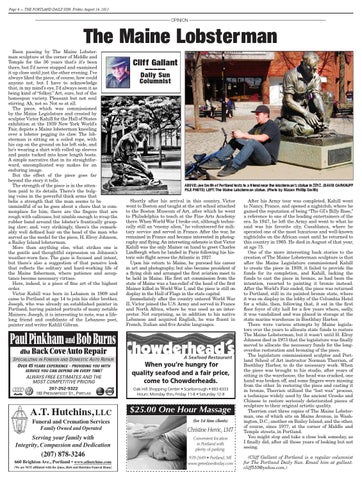
The Maine Lobsterman Been passing by The Maine Lobsterman sculpture at the corner of Middle and Temple for the 36 years that’s it’s been there, but I’d never stopped and examined it up close until just the other evening. I’ve always liked the piece, of course, how could anyone not, but I have to acknowledge that, in my mind’s eye, I’d always seen it as being kind of “folksy.” Art, sure, but of the homespun variety. Pleasant but not soul stirring. Ah, not so. Not so at all. The piece, which was commissioned by the Maine Legislature and created by sculptor Victor Kahill for the Hall of States exhibition at the 1939 New York World’s Fair, depicts a Maine lobsterman kneeling over a lobster pegging its claw. The lobsterman is sitting on a coiled rope, with his cap on the ground on his left side, and he’s wearing a shirt with rolled up sleeves and pants tucked into knee length boots. A simple narrative that in its straightforward, uncomplicated way makes for an enduring image. But the effect of the piece goes far beyond the story it tells. The strength of the piece is in the attention paid to its details. There’s the bulging veins in the powerful thick arms that belie a strength that the man seems to be unmindful of as he goes about a chore that is commonplace for him; there are the fingers that are rough with callouses, but nimble enough to wrap the rubber band around the lobster’s frantically grasping claw; and, very strikingly, there’s the remarkably well defined hair on the head of the man who served as the model for the piece, H. Elroy Johnson, a Bailey Island lobsterman. More than anything else, what strikes one is the gentle and thoughtful expression on Johnson’s weather-worn face. The gaze is focused and intent, but there’s also a suggestion of that pensive look that reflects the solitary and hard-working life of the Maine fisherman, where patience and acceptance become necessary virtues. Here, indeed, is a piece of fine art of the highest order. Victor Kahill was born in Lebanon in 1909 and came to Portland at age 14 to join his older brother, Joseph, who was already an established painter in Portland, having painted portraits of many notable Mainers. Joseph, it is interesting to note, was a lifelong friend and confidante of the Lebanese poet, painter and writer Kahlil Gibran.
Pa u lPinkh a m db a
Cliff Gallant –––––
Daily Sun Columnist
ABOVE: Joe Smith of Portland texts to a friend near the lobsterman’s statue in 2012. (DAVID CARKHUFF FILE PHOTO) LEFT: The Maine Lobsterman statue. (Photo by Mason Phillip Smith)
Shortly after his arrival in this country, Victor went to Boston and taught at the art school attached to the Boston Museum of Art, after which he went to Philadelphia to teach at the Fine Arts Academy there. When World War I broke out, although technically still an “enemy alien,” he volunteered for military service and served in France. After the war, he remained in France and became interested in photography and flying. An interesting sidenote is that Victor Kahill was the only Mainer on hand to greet Charles Lindbergh when he landed in Paris following his historic solo flight across the Atlantic in 1927. Upon his return to Maine, he pursued his career in art and photography, but also became president of a flying club and arranged the first aviation meet to be held in Maine. His first art commission from the state of Maine was a bas-relief of the head of the first Mainer killed in World War I, and the piece is still on display in the Hall of Flags in the state capital. Immediately after the country entered World War II, Victor joined the U.S. Army and served in France and North Africa, where he was used as an interpreter. Not surprising, as in addition to his native Lebanese and acquired English, he was fluent in French, Italian and five Arabic languages.
a nd Bob Bu rns
B a ck Cove A u to R ep a ir
A Seafood Restaurant
SPECIALIZING IN FOREIGN AND DOMESTIC AUTO REPAIR OVER 45 YEARS EXPERIENCE - PROVIDING YOU WITH SERVICE YOU CAN DEPEND ON EVERY TIME! ALWAYS FREE ESTIMATES AND THE MOST COMPETITIVE PRICING
When you’re hungry for quality seafood and a fair price, come to Chowderheads.
207-252-9322 193 PRESUMPSCOT ST., PORTLAD
Oak Hill Shopping Center • Scarborough • 883-8333 Hours: Monday thru Friday 11-8 • Saturday 12-8
A.T. Hutchins, LLC Funeral and Cremation Services Family Owned and Operated
Serving your family with Integrity, Compassion and Dedication
(207) 878-3246
660 Brighton Ave., Portland • www.athutchins.com
(We are NOT affiliated with the Jones, Rich and Hutchins Funeral Home)
$25.00 One Hour Massage (for 1st time clients)
Christine Herric, LMT Convenient location in Portland with plenty of parking. 939-2649 • Portland, ME www.getrelaxedtoday.com
After his Army tour was completed, Kahill went to Nancy, France, and opened a nightclub, where he gained the reputation of being “The GI’s Billy Rose,” a reference to one of the leading entertainers of the era. In 1947, he left the Army and went to what he said was his favorite city, Casablanca, where he operated one of the most luxurious and well-known nightclubs on the African coast until he returned to this country in 1965. He died in August of that year, at age 75. One of the more interesting back stories to the creation of The Maine Lobsterman sculpture is that after the Maine Legislature commissioned Kahill to create the piece in 1939, it failed to provide the funds for its completion, and Kahill, lacking the funds to cast the piece in bronze, as had been the intention, resorted to painting it bronze instead. After the World’s Fair ended, the piece was returned to Portland, still in its painted bronze state, where it was on display in the lobby of the Columbia Hotel for a while, then, following that, it sat in the first floor foyer of city hall for a few years where, sadly, it was vandalized and was placed in storage at the state marine warehouse in Boothbay Harbor. There were various attempts by Maine legislators over the years to allocate state funds to restore The Maine Lobsterman, but it wasn’t until H. Elroy Johnson died in 1973 that the legislature was finally moved to allocate the necessary funds for the longoverdue restoration and bronzing of the piece. The legislature commissioned sculptor and Portland School of Art instructor Norman Therrien, of Boothbay Harbor, to do the necessary work. When the piece was brought to his studio, after years of sitting in the warehouse, the head was cracked, one hand was broken off, and some fingers were missing from the other. In restoring the piece and casting it in bronze, Therrien utilized the “lost wax” process, a technique widely used by the ancient Greeks and Chinese to restore seriously deteriorated pieces of sculpture to their original artistic quality. Therrien cast three copies of The Maine Lobsterman, one of which sits on Maine Avenue, in Washington, D.C.; another on Bailey Island; and the other, of course, since 1977, at the corner of Middle and Temple streets, in Portland. You might stop and take a close look someday, as I finally did, after all those years of looking but not seeing. (Cliff Gallant of Portland is a regular columnist for The Portland Daily Sun. Email him at gallant. cliff555@yahoo.com.)