ISSUE 67 | September/October 2022


Review books are free to reviewers There must be 3 active reviews to trigger this giveaway

4| uncagedbooks.com
September/October
2022 Summer sure is going out fast. It’s been a heck of a summer with a lot going on at the farm. Some things slowed down because of my mom’s treatments, and some things are now speeding up with a bit cooler weather coming in. This month we have a lot of authors to choose from, from romance to scifi and some thrlling suspense, there is sure to be something for everyone.Wewillbe continuing with the “Buy 2, Get 1” promotion we’ve been running, with some changes for 2022. The promotion will only be for Full Page Ads, so if you buy 2, you will get one free. No other advertising will be eligible. With the issues selling out advertis ing more frequently, this gives more opportunities for all in advertis ing in the magazine. It really does help from a marketing standpoint, to have an advertisment run three months in a row - to repeat in the readers mind. You don’t just see a commercial on TV one time and remember it, right? So we will continue to try and provide the best bang for your buck and get the most eyes we can on your work. If you’d like to be a Feature Author, you can also fill out a form on the Reviews/Feature Info Page to request a Feature in 2021. Put in your top 3 choices and this is normally first come/first serve, but I do move around months to keep a good selection of genres in each issue. Soon I will also put up forms for Catch Up Features - these are for past feature authors that have a new book releasing, and we can do a shorter feature, and also a Short Story Submission form. Any author submitting an approved short story receives a full page ad in the same issue. The new form for Short Story Submissions has been added, and a Catch Up form will come next. Enjoy the 2022 issue of Uncaged Book and healthy.
September/October
X cyr ENE n FROOTEm T h E E d ITOR contents 14 Pamela Gibson 26 Roni Hall 42 Beth D. Carter 76 Humphrey Hawksley 66 Cody Thompson historical romance contemporary romance romantic suspense thrillerthriller FEATUREauthors 86 Bill Bush cozy mystery 104 Lori Duffy Foster mystery 126 L.A. McGinnis 142 Alan Smale 152 Christy Cooper-Burnett dark fantasy scifi scifi/time travel thriller


StayReviews.safe


5Issue 67 | September/October 2022 | Issue 67 | September/October 20224Note from the Editor 7 Contributors|Partnerships 166 Uncaged Reviews xxx FangFreakinTastic Reviews 170 Amy’s Bookshelf Reviews 100 authors and their pets Uncaged’s Feature Authors introduce you to their devoted writing buddies, and the devotion goes both ways. fangfreakintastic 58 EXTRAfeatures 160 Angelus Maximus greek & roman drama Uncaged on Instagram SHOWcases Character Micro-Growth in a Series Kelly Brakenhoff The Greatest Story Never Told 36 GUESTcolumns 120 Rienzi Testimonial Kristina Rienzi Robert Byrum48 Pamela Levin M.D. 52 William F. Johnson Vincent M. Krivda 20 62 Dave Spiering 9638 Academy’sInspirational Memories X.O. fantasyHartzlerViewThrough the Speculum Judy Warrenton non-fiction 114 Waves of Love Lina poetryDow 74 Barbara J. Meredith 118 Robert Byrum84 Marnee Patricia Banks 102 Marnee Patricia Banks 110 Michelle Copeland 122 Beatrice Fairbanks Cayzer 132 A Look Inside the Man Archie Brown poetry Cover by Cyrene Model @jagged-eye, Stock smoke @Wen-JR, Tunnel from Pixabay, Blood brushes @KeReN-R 138 Four Children’s Books Harmony Brantley childrens Connie Ann Lovell136150 Maryann Lukowich


7Issue 67 | September/October 2022 | Follow Uncaged on Facebook Paranormal lover’s rejoice. Uncaged review Contributorscontributors.|Partnerships


2022; Las Vegas, NV https://lovenbooks.com/lovenvegas Fall in Love with New England October 21-22, 2022; Marlborough, MA https://www.fallinlovenewengland.com Uncaged will watch for any cancelations or modifications for the 2022 season. Please watch their websites for information as the dates get closer. Books Books Books Event September 17, 2022; Lancaster, PA http://bit.ly/BooksBooksBooksGroup Historical Romance Retreat September 28–October 2, 2022; San Diego, CA http://www.historicalromanceretreat.com/


OctoberLoveNVegas28–30,

8| uncagedbooks.com | upcomingconventions Bookmarks Festival of Books and Authors September 22-25 2022; Winston-Salem, NC https://www.bookmarksnc.org/festival Penned SeptemberCon22–24, 2022; St. Louis, MO https://pennedcon.com/





Pamela Gibson Beth d . Carter Roni Hall
feature authors historical romance | contemporary


Pamela
My favorite character was a man called Gabriel de la Vega, the hero of Return of the Fox, the second book in my early California rancho period series. He’s wily, pretends to be an effeminate dandy, but is a tough observer of the ills of society as California transitions from a Mexican to an American culture.
He’s funny, loves deeply, and is sexy as hell. This series hasn’t received much love, but it is close to my heart and has won awards.
That’s an interesting question. I once took a writ ing class where we were told the easiest scenes are the ones with anger and the hardest are the ones with love. I think that’s true for me in most of my books. Love scenes are difficult, having to balance physical acts with emotion. Harsh, angry scenes where some one lashes out tend to be easier. But in this book my
This is the story about a woman who is struggling to find herself after society cuts her off and a man who must learn to trust again if he’s to find true love. While it is the final book of my Scandal series, it is almost a continuation of Scandal’s Deception, the book which preceded it. Deception features one twin and Redemp tion features the other. In this book, however, there is also a mystery. What is the most difficult scene for you to write? What is the easiest?
Do you have a favorite character you’ve written?
Has there been a character that’s been hard to write about?
15Issue 67 | September/October 2022 |
The character that required the most research, was the hero of Scandal’s Promise. He is a wounded war hero, addicted to his pain medication, who has to hit bottom before he realizes he has to go through what was then a very dangerous, very painful withdrawal if he’s going to have a normal life. I spoke at length
Uncaged welcomes Nancy Thorne Welcome to Uncaged! Can you tell readers more about your latest release, Scandal’s Redemption?
Author of eight books on California history and eighteen romance novels, Pamela Gibson is a former City Manager who now lives in the Nevada desert. She has a bachelor’s degree in history and a master’s degree in public administration, but her passion is and always has been writing.
Having spent three years messing about in boats, a hobby that included a five-thousand-mile trip in a 32-foot Nordic Tug, she now spends most of her time indoors happily reading, writing, cooking and keeping up with the antics of Ralph, her Siamese rescue cat. www.pamelagibsonwrites.com gibson
favorite scene is the one where the heroine assists, quietly and at a distance, with the birth of her twin sister’s babes.
The Scandal series was pretty easy since my pub lisher wanted to keep that word to help with brand ing. My favorite titles are in my contemporary, Love in Wine Country, series. Each has a varietal in the title and the last four titles are a play on words. For example, It’s a Zin to Tell a Lie, and A Pinot for Your Thoughts. Those were fun. What behind-the-scenes tidbit in your life would probably surprise your readers the most?
Which comes first, the plot or the characters in the planning stages?
I married a man who loved boats and made his living as a hydrographic surveyor. When he retired we bought a 32-foot cruising boat and lived on it for a six-month cruise in Canadian waters and the following year an eight-month cruise circumnavigating the eastern third of the United States. Yes, it is possible. When he had a stroke we had to sell the boat. We both cried.

to addiction counselors and even attended a few AA meetings in order to get a sense of the struggle and what it might have been like 200 years ago. In some respects, it was horrifying, but my hero comes through and gets the girl. How do you come up with the title to your books?
I don’t plan. I write, meaning I have an idea for the beginning and the end and that’s it. The first draft develops as I go, as do the characters. When the first draft is finished I go back and fill in what’s missing and apply
| FEATUrE AUTHOr |
When Ralston learns his ward is to be used as a pawn in an elaborate scheme involving a secret impersonation, he will move heaven and earth to keep her safe. Because proximity has brought the uncomfortable knowledge that his interest may be more than duty—it just might be love. Excerpt “Do you still play the harp? As I recall, you were fond of the instrument.” Her face lit up with true animation. “I do, and I brought it with me. Would you like to accompany me to the music room for a demonstration? You can tell me if I have improved.”
If you could have one all-year season, which would it be and why? Winter. I live in the Las Vegas area and the winter months are cold because it’s the high desert, but so much nicer than summer. Plus I love Christmas.
| PAMELA GIBSON |


Jane Stafford, raised in America, is shocked to learn she is a wealthy heir ess, her late father was an earl, and her English mother is alive. Anxious to meet the woman she longthought dead, she travels to London, only to be whisked away by her sin fully handsome guardian to a remote estate to be “schooled” in the ways of the ton.
Scandal’s Deception Scandal’s Deception Pamela HistoricalGibsonRegency

I read ebooks mostly, but I have physical books, too. I haven’t ventured into audiobooks yet. Right now I am reading The Giver of Stars by JoJo Moyes, an interest ing novel about librarians on horseback in the 1930s who delivered books to mountain people in remote areas. I’m a huge fan of anything historical. What would you like to say to fans, and where can they follow you? I adore my fans although I don’t hear from many, but I know they’re out there when I see how many ratings my books have (even the first Scandal book is still be ing read). Thank you to everyone for reading my books and leaving a rating or review. I hope they have bright ened your life, even for a little while.
17Issue 67 | September/October 2022 | structure to the whole. By the third or fourth draft I can polish. I am what’s called a true “pantser.”
Gilbert Carmichael, Lord Ralston, chafes at hav ing to make a rebellious young heiress acceptable to society, especially one who is impetuous and blatantly democratic. Because the instruction she needs is more than deportment and dancing. It’s also about how to spot a rake who might woo her for her fortune.
Do you prefer ebooks, audiobooks or physical books? Are you reading anything now?

Stay Connected
What are some things you like to do to relax when you aren’t writing or working? I love to read and I read constantly. But my life is not very relaxing these days because I am a full-time caregiver for my husband who is still partially disabled. He is my biggest fan, my beta reader, and he does a lot of my marketing graphics. Can’t do without him.
Enjoy an excerpt from
“I would be honored to give you my opinion.” He swallowed the last of his tea and followed Joce lyn into an adjoining chamber. Roberts did not move from her place in the corner. Jocelyn seated herself behind the instrument, pat ting the chair beside her. He repositioned the chair slightly so he could watch her fingers pluck the strings and, at the same time, view the expression on her face as she played. When the dulcet tones of Mozart filled the room, Jocelyn closed her eyes and seemed to be letting the music carry her into another time and place where gentle sounds and subtle movements reached the soul. She had improved, indeed. Beguiled by the me lodious tones, he couldn’t keep his eyes off the subtle movements of her shoulders, the way she stroked the strings of the harp with knowing fin gers, and the dreamy expression on her face, as if she were one with the music. Her breasts seem to spill over the top of her gown as she leaned forward to reach the farthest strings, and he was mesmerized by the candlelight, the music, and the subtle scent of the flowers on a table behind him. When she finished, she stopped, opened her eyes, and stared into his as if willing him to move, to put his hands on her and bring her close. He com plied, as if drawn by a song that was only in his head, one of yearning and need for human con nection. He leaned in, took her face between his palms, and kissed her deeply, running his tongue along the seam of her lips until she opened for him. It was a kiss he’d only dreamed about, her subtle perfume teasing his nose as he left her lips and dropped kisses along her cheek and her neck. Spurred by her soft sounds of encouragement, he kissed her bare shoulder and the tops of her breasts and drew her up as he stood so he could wrap his arms around her. Her mother wants her to seduce you. The memory brought him back to his senses, and instead of covering that luscious mouth with his own once again, he placed a chaste kiss on her fore head and dropped his hands. He swallowed hard. His body was not reacting as a gentleman’s should. He wanted to feel her soft breasts against his chest and kiss her like she’d never been kissed before. He wanted to run his tongue along the lobe of her ear and drop gentle kisses down her neck and along her collarbone. He wanted to move lower and place kisses in the center of her cleavage. He wanted his hands on her. God, he wanted her. Des Iperately.haveto leave. Now. “Forgive me, my dear. I’m afraid your divine music made me lose control.” She stared at him, her lips parted, her breathing rapid. She clenched her hands and held his gaze, as if forc ing herself to remain still.
“I am so glad you found time to dine with us.” If Joss had been affected by their encounter, she gave no hint. The perfect hostess was his Joss. No, not his Joss. He must keep reminding himself. She had dismissed him—cruelly. He was going to marry someone else. “As I said, invite me any time. I adore your cook. I may try to steal her.”
“Your music was mesmerizing, Jocelyn. I mean that sincerely. I look forward to future musicales where you are the featured artist.” He reached out and took her stiff fingers in his hand, bringing them to his lips. He turned his back so she couldn’t see how aroused he was, then strode into the sitting room, nodded at Roberts, and asked her to tell the butler he was ready to Jocelyndepart.had followed him into the room and had a crimson flush on her cheeks. Hopefully Roberts wouldn’t notice, but if she’d done a proper job of chaperoning—well, he wouldn’t think about that now.
“You cannot do that, milord. My mother pays her well.”
18 | UncagedBooks.com | FEATUrE AUTHOr |
19Issue 67 | September/October 2022 | | PAMELA GIBSON |

The“Indeed.”disingenuous.butlerarrivedwith
James’s outerwear and led him to the door where his carriage awaited. Jocelyn followed. “Please send a note around when Lady Longley returns.” “I shall.” He turned, bowed, and kissed her hand as a proper gentleman should. Entering his carriage, he turned and waved then headed home. Lord, how was he going to get through this farce? His feelings for Jocelyn seemed to grow each time he saw her. Perhaps proximity generated lust. It is more than lust, and you know it. Slaking his needs might help him forget that he’d once wanted Jocelyn Stafford more than anything in the world and was cruelly denied. He could visit a brothel. Or not. He needed to forget Jocelyn, forget someone was try ing to kill him, and forget the fact that he was about to saddle himself to someone he didn’t love. But could he?
“Your mother does have a way with getting what she wants, does she not?” He hoped his tone did not sound
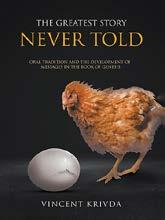
The first books of the Bibles include stories from oral tradition handed from generation to genera tion. The Torah is the first five books of the Hebrew and Christian Bible. Torah means to teach. But what does the Torah teach? How does the Torah teach?
Readers Can Finally Read The Greatest Story Never AuthorToldprovides read ers an understanding of what the first five books of the Bible teach
3 Page
Author Vincent Krivda discusses the development of the messages in the book of Genesis in his new book. The reader is invited to experience the vivid world of antiquity and for the first time, hear The Greatest Story Never Told.
Scholars agree the Bible evolved from an oral tradi tion to its written form. This book examines the mes Promo

The Greatest Story Never InspirationVincentToldM.Krivda
Vincent M. krivda

20 | UncagedBooks.com


Vincent M Krivda is the Executive Director of Education Directions. With over 35 years of experience writing and negotiating contracts, he now serves as an adjunct professor in the disciplines of ancient religions and business/finance. He is a 1984 graduate of Lee University and has completed graduate degrees at American Graduate University (Master of Contract Management, 2008) and Liberty University (Master of Arts Theological Studies, 2012). He currently teaches at Oakstone Academy in Westerville Ohio as an adjunct of Ohio Christian University. He resides in Pickerington, Ohio with the beautiful wife of his dreams. They have three grandchildren. sages of the Book of Genesis, the first book of the Bible, based on what those messages would have sounded like to an audience in the original oral tradition. The epi sodes of Creation and the 21 separate stories of the icon ic figure of Abraham are recast under the microscope of the prevailing Near Eastern context of their birth. This task has challenged established interpretations of the numerous episodes contained in the book of Gen esis. It will not threaten the text itself, instead reevaluate how the text is understood. The book of Genesis is not the construction of a single author, nor is it per se the product of multiple authors. Instead, it is the redacted surviving account(s) of multiple oral traditions that were naturally transformed over hundreds of years, thousands of years ago. The author hopes to reveal the lessons that might have been told.
21Issue 67 | September/October 2022 | BOOK EXCERPTS
What Does It Mean to Say That the Bible Is True?
Chap: Dearest, I was thinking of spending the evening with my friends! Wife: Beloved, let me know how that works out for you! Classic univocal speech is always straightforward with no room for second-guessing.
Chap: Dearest, I was thinking of spending the evening with my friends!
What Does Torah Teach?
The Torah was born in the ancient art of oral tradition. Engaging an audience around discussions served as a primary format to transmit values and morals. In ancient cultures, each age sought to provide the next generation with direction in answering basic questions about life. That next generation though sought those answers on their own terms, not the terms of the previous generation. The dialectical pattern of history has proven that when there are tensions in one generation, they will be worked out over time. The resolution, more often than not, is embodied in a form that rejects the previous set of assumptions.
In the Fertile Crescent, which included Canaan, after tens of thousands of years, the pursuit of meaning settled upon the grand conclusion that man was creat ed to serve the gods. That conclusion made the most economic sense in light of the reality of daily toil, hardship, and man’s limited life span.
Wife: Beloved, if you leave me with all this work, your marital bliss will end!
The temple gained support over time because of its recognized connection with the gods and promotion of economic security. It emerged as an institution to buffer man from the harshness of government. Kings shared a certain amount of responsibility for the wel fare of the citizens with the religious hierarchy. Societies encouraged the tension between the temple and government. The temple-controlled markets, social norms, education, and worship. The king-controlled armies, rules, regulations, and juridical matters.
When we think of the word fact, it is easy to misuse that word for truth. The most fundamental belief held among many is that the Bible is true. This notion is problematic. There is no specific delineation as to the definition of true. There is an old axiom: “The Bible said it! I be lieve it! That settles it!” There is no room to wiggle, or is Somethingthere? as true needs to be parsed either under equiv ocal terms or univocal terms. Equivocal language is common. Equivocal speech allows for several possible interpretations. One illustration of this is when a good chap tried to carve out some time from his wife to go bowling with his friends. However, the wife had other ideas for his time.
In that environment, the practice of religion was cen tered in community welfare and justice. If one fastforwards the clock from 3,500 BCE to AD 1,900, religion by then was not only separated from gov ernment, it promoted social stabilization functions as well. By ca. 450 BCE the Judeans were trickling back into Palestine from Mesopotamia. The written text attempted to establish a form of law and history. A branding iron of orthodoxy at least set the stage for a religion ordered and controlled by a priestly cast. Prior to this time being a Hebrew was not so good. Now it was the beginning of a nationalistic rallying Readerscry. of the Bible in this day and age are often caught up in deciding what the Bible will mean to them. This requires a reader to respond to a written text. It focuses primarily on an existential application based upon the accumulation of our personal experiences. This book therefore proposes a return to the way of hearing the story preserved in the text. The book of Genesis should be told as separate episodes/ stories that are not meant to be woven into a historical saga. Instead, these episodes were edited as a Best Of ancient stories preserved to teach. That is why the first five books in the Bible gained the moni ker Torah. In short, one must imagine what the story would have sounded like. Probably the best analogy would mirror a theater play. In the theatrical produc tion, showmanship would include actors stealing the scene with their oral skills.


“Allow me to introduce myself. Bridge Rat, minion to Hawk Claw, Fairy King of New Yorke at your service, Lady Taina. I am in charge of this sector of The Bronx. My liege lord shall arrive in a moment.” He bowed, and his arm gestured like he was sweeping the sidewalk.
Carole Ann Moleti
Void of Course

“I daresay the foul language you’ve acquired in such a short time bodes well for your ability to rise to your duties.”
“Knock it off. The only court around here is on 161st Street and the Grand Concourse. This isn’t Camelot, and I’m not a lady. I’m a woman and don’t rise to do anyone’s duty.” The fairy rustled his wings. Magick tingled along Taina’s spine and soothed the angst roiling in her gut since she’d gotten off the plane and into that fetid yellow cab at Kennedy airport two weeks ago. “Ah, I beg to differ, my lady.” Bridge Rat turned his eyes skyward. A majestic ruddy hawk glided to a landing on top of Ritual Rock. Another fae-induced shiver crawled down Taina’s back like a spi Theder. haughty fairy king coalesced out of a rusty dust spiral. Red hair hung in wavy tendrils over his shoulders, obscuring much of a bare chest. Pointed ears, adorned with cuffs, spikes, and jeweled earrings, wiggled. A lime-green cape swept the gum-stained asphalt as he flitted toward her, bare, six-toed feet hovering only inches above the ground, maroon and ochre wings beating like a translu cent Bridgeheart.Rat announced him. “Hawk Claw, King of The Fairydom of New HawkYorke.”Clawalighted, swept the cape over one shoulder, and bowed. “Hail and welcome, White Witch. Long have we awaited your re Yes,turn.”this night could get even weirder. “I think you must be confus ing me with someone else. I’m brown and barely a witch at all.”
24 | UncagedBooks.com
Carole Ann Moleti Fantasy Romance Taina Aponte, the sole survivor of an arson fire that killed her family, was taken to safety in Puerto Rico by her grandmother to escape the wholesale destruction of The Bronx. Thirty years later Taina, now a witch and still haunted by her memories, is back in the hood. She’s inexperienced in urban magick and illprepared to battle the roving gangs of dhampirs and werewolves that set The Bronx aflame and wrested control from the police. But time is run ning out to find those who set the fire—and why. Taina’s search for the murderers uncovers a vast werewolf/dhampir conspiracy—and an alli ance of fae to aid in her quest for justice. It’s not long before she realizes she needs more than the elderly santera who teaches Taina mysterious Santeria rituals. She enters into an uneasy alliance with Arnaldo Arroyo, a reformed addict turned community activist who schools her his own special mix of sex magick and brujería. Excerpt A creature, waist high to Taina, with a Cheshire-Cat grin, a British accent, two iridescent blue wings, and a squat, leafgreen body materialized. The fairy’s choice bits were barely concealed by a brown rag.
The fairies in PR were more like fireflies, quiet, silly, tricky. Of course, everything in The Bronx mutated to the most extreme de gree “Fearpossible.not,ithas been foreseen and will occur.” Hawk Claw pro nounced, expressionless, like one who hasn’t had good news in a long time. “Bridge Rat will summon me and the others when the time comes.” He fluttered his wings, rose into the air, and trans formed back into a majestic bird as he flew west over Ritual Rock toward the Manhattan skyline.
SneakPeek
“On the contrary, Lady Taina. You are just beginning to realize your powers. We trust that Sir Arnaldo will be at your side during the impending battle.” She suppressed a giggle at that image. “I’m just trying to get to the bottom of a murder mystery, then get my bottom out of the Fairy dom of New Yorke.”


Thank you so much for the invite! I’d be happy to. I love stories about heroes-everyday, unsuspecting he roes who step up to do the right thing at the right time, especially female heroes.
27Issue 67 | September/October 2022 |
In Third Man on the Left the main character, Dani, is a young woman who unfortunately did not have the best environment growing up. Her father was mentally and emotionally abusive causing Dani to be an insecure young woman. After years of her father’s negative up bringing, she believed his repeated claims that she was incompetent and flawed.
As an ER nurse Dani knew better but took the blame for the death of a toddler patient. To redeem herself, she volunteers for a six-month medical mission to Tan zania. When the mission is savagely attacked, her very survival and that of four others depends solely on her. Her competency is put to the ultimate test. Many of us don’t know what we are fully capable of till we are tested. Heroes dig deep when they see others in distress. After years of abuse Dani believed that seeking help from others was a sign of weakness. Trauma can affect how one feels about themself and how they relate to others. Many everyday heroes neglect their own well-being when others are in need.
Roni hall
place to write is in her hammock at their small Michigan cottage where she literally dodges the feeding hummingbirds while being serenaded by the lake’s loons. Besides writing, she loves hiking, biking, and antiquing. The pandemic has taught me to savor time with family and dear friends. Life is too short to sweat the small stuff. ronihall.com
The summer after high school graduation, Roni worked two jobs to pay for nursing school. During the mid night shift as a waitress, a charismatic young man at the counter flirted with her for hours as he consumed seven cups of coffee. Their first date was eventful enough to be a book itself! Forty-some years and two kids later, the love story continues. Just like her novels, life can’t be too simple and you must make it an adventurous Herride!favorite
Mental health awareness and strong women are two
Uncaged welcomes Roni Hall
Welcome to Uncaged! Can you tell us more about your latest release, Third Man on the Left?
Being strong doesn’t mean going it alone. Get help, seek assistance and counseling if needed. Especially, if like my heroine, Dani, you have experienced post-traumatic stress disorder (PTSD) or any type of abuse: physical, emotional, mental, sexual. There is no shame or stigma in needing or asking for as sistance to help you heal. You are not alone. Even heroes need help sometime. Trauma and abuse are never your fault.
28 | UncagedBooks.com |
FEATUrE AUTHOr | issues I am passionate about. What are you working on next that you can tell us about? No comment…the work is still in its infancy stage, and I don’t like to comment till it is near comple tion…which it is not! LOL But I can tell you that the story revolves around a woman who is put to the test. What is the most difficult scene for you to write? Filling in necessary backstory is always difficult for me. The information is vital, but it must flow and not feel awkward or forced. It can’t be too much or too little; it’s a fine line. What is the easiest? Tense, emotional scenes are the most fun though it takes numerous edits and rewrites. I keep tweaking it to get it just where I want it, and when I do, it’s heaven! Do you have a favorite character you’ve written?
What behind-the-scenes tidbit in your life would probably surprise your readers the most?

Dani is my favorite. She is flawed, fragile and insecure all due to her history of emotional/verbal abuse by her father. For her own self-worth she tries to prove herself at work as a nurse. Taking one day at a time, she manages to cope until she takes a toddler patient’s death personally. Dani thinks she is weak but when the lives of other are threatened, she has a spine of steel. How do you come up with the title to your books?
With THIRD MAN ON THE LEFT, I pulled the title out of a pivotal scene. The third man on the left saved Dani in more ways than one…I can say no more! No spoilers here.
I am a jack-of-all-trades, master of none. I am a nurse but retired from formal work now. I love to cook, studied and practiced the art of calligraphy, dabbled in stained glass works and wood working classes/projects, was a long-distance runner and completed three 26-mile marathons. I am an antique dealer, political activist and last, but not least, an author. Even though I did enjoy writing earlier in life, I didn’t formally attempt writing for pleasure until a decade ago.
Which comes first, the plot or the characters in the planning stages?
Getting away to our cottage is my reset. It’s on a small lake where I appreciate being outside four seasons a year. I enjoy biking, hiking, swimming and kayaking.
Oh, and I love to travel!

What are some things you like to do to relax when you aren’t writing or working?
Some turn out good, some not so good. Their journey through the story changes by how they react to the circumstances thrust upon them. They are unpredictable at times, but I let them work it out as they see fit. I become quite attached and protective of them and hate to see them leave me when the story ends.
29Issue 67 | September/October 2022 | | rONI HALL |
For me, the plot comes first. Then I birth the characters and like a parent, watch them grow, mature, make mis takes and hopefully learn from them.
If you could have one all-year season, which would it be and why?
That’s a tough one. Here in Michigan each season offers so much and has its own pros/cons. But if I had to choose, it would probably be early fall when the lake water is still warm, the mornings are crisp and the afternoons toasty. The scent of fall seasons the breeze like no other time of the year. And fall
It may sound odd, but writing is relaxing for me… when I’m not on a deadline that is. My cottage is also my writing hideout…my ‘office’ is in my ham mock where I dodge the hummingbirds and listen to the haunting call of the loons. Being outside inspires me.

Enjoy an excerpt from Third Man on the right Third Man on the Left Roni ContemporaryHall Romance


Excerpt Chapter 1
What would you like to say to fans, and where can they follow you? Read, read, read! In this time of social media and 24-7 news in the palm of our hands, I worry that reading ‘books’ for pleasure will fade away, espe cially for young adults. All types of worlds open to you when you read, exposing your mind to emo tions, characters and worlds you never dreamed of.
Stay Connected
30 | UncagedBooks.com leads to the holiday season which I love! Do you prefer ebooks, audiobooks or physical books? Are you reading anything now? I prefer an actual physical book because I love the feel of it in my hands and it takes me back to sim pler times. I was resistant to an e-reader for a long time; however, I can’t deny the convenience of an e-reader when I am traveling and having a library at my fingertips is a bonus. Audiobooks encourage me to walk for long periods as I can take a story with me and forget that I am exercising. I have always been a Stephen King fan and I recent ly started re-reading some of his classics that I read decades ago. The Stand is one of my favorites!
Tragic stories are common in the ER but nurse Dani takes the blame for a tod dler patient’s death person ally, confirming her abusive father’s belief that she is inept. To prove her compe tency and free herself from overwhelming guilt, she volunteers for a humanitar ian mission trip to Tanzania where she can focus on doing good. Prior to leaving, she meets the love of her life, Noah, who says he will wait for her. However, her mission partner/physician, Carter, is a surfer poster boy who has a thing for Dani. Noah’s gut tells him something about the picture perfect doctor is off but the expedi tion goes on. Weeks into her trip the mission is savagely attacked by rebels and Dani is a microsecond too late to prevent her coworker from a devastating injury but saves him from certain death…for now. More rebels are on their way and Dani escapes into the jungle with four lives who are now solely dependent on her for their very survival. The ultimate test of her com petency has begun. Was the strike on the mission random, or was she an unsuspecting dupe in a smuggling deal gone bad?
| FEATUrE AUTHOr |

With nothing holding her back now, Dani longed for adventure, which started today. It was the next chap
31Issue 67 | September/October 2022 | | rONI HALL |
ter in her life and a new job awaited her. Just being dressed in a swing skirt and blouse for work instead of medical scrubs lifted her spirits. Her honey-brown hair landed on her shoulders rather than her normal upswept work bun. She exited the New York subway with a messenger bag slung over her shoulder and a bounce in her step, determined to make this change work. It’s got to work. Shaking her head, she refused to let her thoughts go down that slippery dark slope. Not today. She checked her phone. Thirty minutes to kill. Don’t want to appear overanxious. Aha, coffee shop di rectly across the street from her new office. The line was short and she sat at a tall table with cell in hand trying to distract herself from the jitters of that awk ward unavoidable first day on the job. God, is there anything worse? Somber thoughts rushed at her invi tation. Okay, okay, sorry I asked. Pushing the demons back into their black hole, she closed her phone, stood up, and flung her messenger bag over her shoulder. Standing in place, she gulped the last of her coffee. Her attention was caught by loud laughter behind her. It came from a man in his twenties sharing the table with a handsome dark-eyed guy in his thirties. The curls of his wavy brown hair hid one eye as he looked in her direction. Loud laughter from the younger man interrupted her mid-swallow and she turned their way. His laugh was infectious. She smiled, which seemed to increase his cackling. What’s so funny? The younger guy was el bowing the cute guy repeatedly. She turned her back to them which sent the loud one roaring. Turning to them again she now noticed another ta ble of coffee drinkers staring her way and smiling.
Mortified, Dani pulled her skirt down as her face scorched with embarrassment. Her feet couldn’t get her out of there fast enough, but as she reached the exit, she stopped for a microsecond then did an about-face and marched back to the jerks’ table. The younger guy was bent over still laughing and she couldn’t catch his eye, but the cute guy stood at attention so she turned to him judging him guilty by association. Shooting fiery daggers straight into his eyes, Dani stood inches from his face, but stayed silent. The intensity of her raw anger blocked any coherent words. Instead, she hoped lingering for a few seconds sent the message her voice couldn’t articulate. Had he stood up to get a closer view or to alert her of her clothing malfunction? She would never know as she pivoted on her heel and strode out. Fuming, her embarrassment was replaced with rage and confusion of how the humiliation of one human being could be so humorous to another. Shake it off! It’s a new day and a new beginning. Dani stopped and shook her shoulders, then turned and continued on her way. Assholes. Arriving at the entrance to We Are One (WAO) Dani took a minute to gather her composure. I’m good. She pasted a smile on her face and pulled the thick glass door open, entering into a new em ployment experience. She walked toward the re “Hi,ceptionist.I’mDani Roberts. I’m the new Medical Liai son for Fundraising. I was told to ask for Michael ItKelser.”tookonly a minute for the Administrative Man ager to appear. Michael was an attractive man, for tyish with blue eyes and a kind smile. “Welcome, Dani. I’m so excited to meet you in person. I’ve heard nothing but good things about you from our HR Department.” He shook her hand,
The taller, cute guy stood up, looked at her with a furrowed expression, took a step toward her then stopped, took a step again, then glanced at the floor. The joker stood, now howling, and pointed behind Dani. She turned her head and looked down only to see her rear fully exposed. The strap of her bag had caught her skirt and lifted it for all the world to see. Why had she worn a thong instead of the panties she’d first picked out?
FEATUrE AUTHOr | then escorted her through the main lobby.

32 | UncagedBooks.com |
“As you know we’re a nonprofit group with worldwide outreach to end hunger and offer aid for humane caus es. I personally feel so fortunate to be involved with an organization that can claim that as their mission state ment. Follow me, and I’ll give you the VIP tour.”
The first floor was one large open space with side of fices and an audio room which housed a grand piano and some equipment used for their promotion videos, marketing, and recordings. Before leading her upstairs, he showed her where her workspace was located. The second floor housed a couple of large rooms, one equipped with another piano and assorted media art items. Michael led the way. “Marketing is a big part of what we do. It’s how we raise funds and without funds, there is no WAO. Our cause is great and peo ple recognize that.” His pace was quick, and Dani, not used to wearing heels, struggled to keep up with him. “Everyone has official titles, but we all work together to achieve one goal, to do what we can to end hunger. Everyone checks their egos at the door.”
After an hour, Michael glanced at his watch. “Dani, we might as well throw you in headfirst. We have a meeting now regarding our new fundraising campaign and this is as good a time as any to start. Let’s go to the conference room and you can meet the rest of the crew.” He guided her through the first-floor gallery and en tered the glass-walled room where four people were seated around an oval table. Michael gestured for Dani to enter first, and she stopped dead in her tracks. Seat ed front and center was the cute coffee shop jerk who saw her ass.


PsychologicalBeatriceJerusalemKidnappedbeatricecayzer.cominFairbanksCayzerFiction


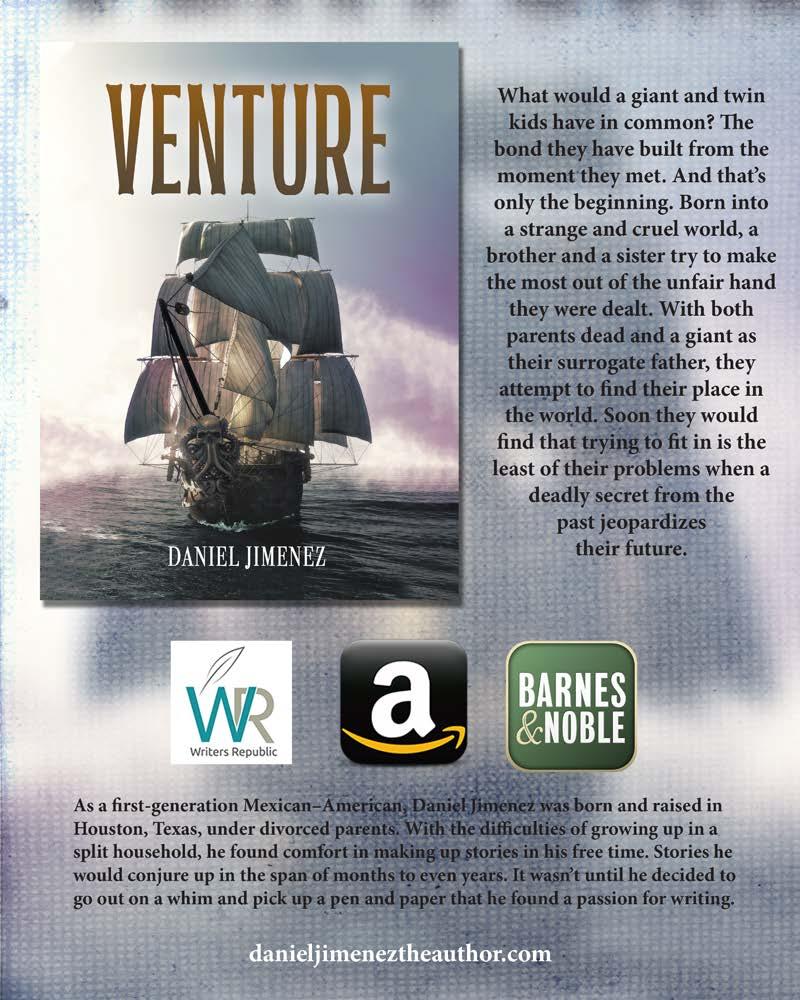
Dennis McLeary, sexually abused at age 6. At 18, he accepts sexual advances of a 14 year-old girl hoping to prove to himself that he is a normal man. Jailed for 17 years for having sex with the under-age girl, he is abused in prison by fellow inmates and the prison chaplain. Free at 35, he determines to bet ter himself and hopes to have a normal marriage. Ensnared in a messy event, he escapes more prison time by becoming a waiter on a passengerfreighter. He gets leave from his ship to swim in Turkish waters, where he meets and falls in love with Myriam al-Montee, a half-Turkish half-Saudi Arabian Muslim woman. Instant adora-tion is reciprocated. Myriam elopes with Dennis, they are married by his ship’s captain. Myriam does not tell Dennis that her fanatical father, who hopes to use her to found his dynasty, is known to behead any person showing fondness for her. When three women are beheaded at her father’s orders, she warns Den nis, he could be next. They hide from her father in Alexandria and in Cairo, but are located by her fa-ther’s agents in Jerusalem. Kidnapped, Myriam is brought to her father in Saudi Arabia. He orders her locked in a cell-like room in a desert house where recently a cousin has starved to death. After three months, she get help and relieved by Alf, an Oil field worker. He tries to rape her. Den nis, agonizing for her, would travel any where includ ing to a country where they would behead him in order to reach Myriam. They find each other near a famous oasis in time to stop Alf from raping Myriam. But fate holds more vicious challenges.
36 | UncagedBooks.com

BeatriceFairbanksCayzer


Showcase
Beatrice Fairbanks Cayzer comes from an illustrious family. Her two ancestors who came to Upper Virginia in 1620 helped found their community. She founded the Cayzer Museum for Children in England where she was the wife of Stanley Cayz er, a grandson of Sir Charles Cayzer, founder of shipping companies that evolved into Caledonia Investments, and nephew of Admiral Lord Jellicoe, the second Governor General of New Zealand. Then she turned into writing. In Oxfordshire, she wrote The Princes and the Princesses of Wales. In Guernsey, she wrote The Royal World of Animals. Returning to the USA, she wrote nine Rick Har row novels, winning Book of the Year Award from the Horseracing Writers’ Associa tion. In 2016, she had a sell out with The Secret Diary of Mrs. John Quincy Adams and in 2018 had another sell out with New Tales of Palm Beach.
“After reading this manuscript, I can say that I fell in love with Louisa Adams. She was a strong individual whose life story needed to be told. Louisa Adams made an impact. I couldn’t put the book down. A must read.”
THE HARROW QUARTET takes the reader to many unusual places because the narrator Rick Harrow is a racehorse trainer, and a trainer has to bring his horses to the most likely tracks to win. The reader goes to Dubai, Russia’s St. Petersburg, romantic villages in Italy, tycoon homes and estates of the newly rich in Spain, and the wilds of Mexico’s most inaccesssble mountains as well as to its over-crowded and dangerous capital city.The characters vary from a Chechen terrorist to Milan’s exquisite models, to the wild west drug lords of today’s Mexico. ~ ~ Anthony Roberts ~ ~ Inspiring story of a great lady. ~ ~ garbonzo ~ ~ Here is another installment from Beatrice Cayzer’s fabulous series featuring Happy and Rick Harrow. Travel with them as the traipse across the globe from one extravagant horse exhibition to the next, and finding trouble wherever they go. Cayzer’s prose is filled with vibrant imagery, plenty of action, and enough hanky-panky to make a sailor blush. These stories are great fun, and will have you coming back for more. Fans of any of the modern detective series found on BBC/PBS will feel right at home. Don’t be surprised if these adventures are turned into their own small-screen production. Enjoy! ~ ~ Cathryn Elwyn ~ ~ It’s not every day that jockeying, an estate in the British countryside, and a complication involving the president of Russia figure in one story, but best-selling author Beatrice Fairbanks Cayzer is nothing if unpredictable. Deaths, conspiracies, and . . . a threat to beloved Happy’s life? This has got to be BFC’s best yet.
~ ~ Brett Virgo ~ ~ I just finished reading this wonderful book. I was so hooked I could not put it down. I highly recomend this Murder Mystery. It will not disappoint. Each chapter draws you in, that you have to keep on reading. I am eager to see what BF Cayzer will come up with next.
~ ~ Samira Sowan ~ ~ “The author Beatrice succeeded to keep the reader thrilled to read every page in her book and to take us through the journey of the unique character of Louise and live the era of the 1700 and 1800.in such a fascinating way. I definitely enjoyed every page in this compelling story. A must read..”
~ ~ DEE ~ ~ Murder by Medicine is a deliciously delightful book that reminds everyone of how wonderful London can be, during the Season. The descriptive scenes take you there with intrigue and GLAMOUR! Horses, men and murder are an intoxicating read in the hands of B. F. Cayzer. Without a doubt, Murder by Medicine is one of the best books that I have read. It is a perfect gift for any stylish acquaintance or be wickedly selfish and keep it all to yourself!
~ ~ VIV ~ ~
“Reader observes as main personages meet the ups and downs that bruise those on the top level yet took to heart the enormous wrongs done to slaves in America and went into battle”
37Issue 67 | September/October 2022 | Amazon Customer Reviews ~ ~ Ladybella ~ ~
~ ~ Cathy ~ ~ If you like murder mysteries, this is a great book to read. It brings you into the horse people who have their own ideas of life. It travels from Ethiopia to England with fast paced action. Do read.
I have never been to Morocco until reading this BOOK. What a wonderful trip it took me through. The mysterious possibilities that the characters of this story endure are nail-biting. This is truly a masterpiece that will enthrall all mystery and vampire fans. I highly recomend reading this masterpiece. I loved it.
X.O. Hartzler believes that it’s never too late to have found a passion through words and tales. He simply wishes to create a place where readers can escape the world, even for just a moment. Decent authors, es pecially those who dwell in the realms of fantasy, are becoming less prevalent as the clock turns. His wish is to shine a light over a new land, as his stories are meant merely to be enjoyed, while leaving behind the insanity of the world. Hopefully this book has found its way to cherished readers, and perhaps made an impact in some way.
Q: What is the best thing about being an author?
AUTHOR INTERVIEW BOOK TITLE – Academy’s Memories: The Second Gravelback Novel

Q: What’s the hardest thing about being an author?
3-Page Special Promo X.O.
38 | UncagedBooks.com
AUTHOR’S NAME – X.O.Hartzler
Academy’s Memories X.O. FantasyHartzler Academy’s Memories is to be the second install ment in a new age of fantasy novels. Succes sor to Stones Beneath the Mountain, the story takes place eleven years after one particular wiz ard nearly jeopardized the land of Bauzzurath. However, the new queen of DuLock and her party of misfit adventurers find themselves yet another bizarre adversary: a cruel elven leader who lives and breathes beneath the power of the moonlight. What has become of the Gravelbacks and of some the other familiar faces? One must step forth into the academy to find out. Come and join the ac tion, drama and adventures.
The “hardest thing” about being an author, quite simply to me, is how one discovers the words to properly portray the story they are attempting to display. A constructed narra-tive is one approach, a goofy gutbuster is another. Choosing which route to take and which dialect to use in order to sketch a picture in one’s mind requires focus, devotion, and perhaps above all, much creativity. There are thousands of ways to tell a single story, yet only one way will be written in ink.
The “best thing” about being an author is obtaining the ability to share one’s creation with the world. I know I’m not alone in the fact that little stories play in one’s mind through-out the day. Whether one is more like me and they enjoy delving into the fantasy realms where bizarre magics and creatures reside, or whether perhaps their stories remain more modern or scientific, transferring those images onto paper can seem daunting. Even still, once one has applied the effort and dedication to writing the rough draft of something, the product will reach the eyes of another. Having someone read and enjoy something which you have created… Now that is the “best thing” of it all.
Q: What book changed your life? How is one to choose a single book? However, anything written by my favorite fanta-sy authors, which include R.A.Salvatore, Terry Brooks, Weis & Hickman, Tolkien (of course), could be considered life-changing as they
hartzler
Q: What inspired you to write this book? This book is a sequel to my first, and as much as I would like to simply answer “time”, that would be a lie. Prolonging the Gravelback series is truly the answer. My lovely wife was the one who really convinced me to sit and begin typing out the things in my head, and even-tually my ADD took over and finished the two books.
Q: What is the take home lesson you wish your readers will learn after reading this book?
Q: Anything you would like to say to your readers and fans? Of course. I hope to whoever’s eyes my words may reach, that they savor the moments of their own lives. A “short time” is the depiction that we are all given at a young age, and there is much truth in that. Value your time, cherish those around you, and read more books! I hope you can relax throughout the Gravelback series and throughout whatever else the future may hold. Thank you all for your support! Book Excerpts Nothing alters the boundaries of the mind quite like the death of recent. Practiced attachments and customary love are only to be forgotten. Although typically unspoken, family and ancestry united create the focal point of foundation among many dwarves, particularly the Southern dwarves of DuLock. Many of their once-plentiful lives had been stolen away after the Great Battle where the deceitful wizard, clad in robes of crimson, introduced a foreign power that rivaled even their greatest of warriors. Fallen from the throne was the esteemed king, cherished leader among the mountain fortress, and having taken his place, a young she-dwarf whom the former royalty discerned practically as a granddaughter; family. No such trial had plagued the rock sanctuary before the inauguration of the dwarves, and no such trial had since the fateful days. Instants turn to moments, moments to periods, and the passage of time remedies many traumas, both fleshly and Recentconceptual.death is relative only to one, as each affected person is affected quite differently. Occasionally, the undesired death, whether it be superfluous, accidental, or even unsolicited, may be necessary to prolong the lives of the many. The she-dwarf who had rightly taken control of the throne had made an abundance of punishing decisions that ultimately led to her unquestioned leadership;
There is no isolated or overarching lesson, just simple stories to be read and enjoyed. Whether one is to view fiction as a fable, or whether something is morally obtained, that is up to them.
Q: Do you feel that writing is an ingrained process or just something that flows naturally? Controversial or existential questions are not my forte, yet for me, I would say that writing moves as a river does. Some days the river remains undisturbed, a flawless picture of marble or glass which makes perfect sense to anyone who sees it. Yet many things may affect the river—A storm, for example, will alter its course, creating rampant and muddy waters which prove more difficult. The same variables affect writing. Some days it proves effortless, and others, well…
Q: How would you describe your style of writing to someone that has never read your work? My “style” is a bit unorthodox. Regardless of if someone had described it as dishev-eled, modern, or perhaps the opposite—as antiquated or even mature—I could argue either point on the matter, for they are all possibilities. Still, I chose my route, and the way I wish to tell my stories is mine, alone.
39Issue 67 | September/October 2022 | have impacted my own works.
Q: What books are currently in your to be read pile? My “to be read” pile is unfortunately much larger than I wish it to be, yet many of the books within are much older. I recently picked up the life works of one H.P.
Lovecraft, and I’m excited to dive into his peculiar world.
40 | UncagedBooks.com


She’d even had to decimate her own father, her only parent that lived. Nothing developmental could have ever prepared the girl for having made a decision so mortifying, but it had indeed been necessary. The advancement of time kept the voyage afloat. She had forgiven herself, but how could an act so repulsive ever be selfforgiven? Still, as seconds turned to moments, her jurisdiction carried forth, and all who loved her had learned also to admire her, as passing time helped to heal their own personal wounds of loss. There was one dwarf, however, who’s life had become considerably more unfathomable since the massacre of the many, which included the execution of his own brother. KaRina Gravelback was well renowned among the Clan she had forged from the remains of the Great Battle. All had come to love and respect her as the overseer of their people, and after eleven years had passed, her word had become absolute. After having called for a council in what had appeared to have strange timing on an arbitrary day, all members of Clan Gravelback, still roughly two thousand strong, had shown their faces to the queen beneath the mountain. KaRina did not have a difficult time with her line of questioning, as she thoroughly explained the predicament that was presented before her that same day. There would have been no secrets between Southern dwarves, although there was a moment which she had carefully considered slipping away from DuLock unnoticed. The loyalty of the dwarves was fortified, however, especially through the battle that their people had faced only sometime prior. Having held their fists to their chests as a symbol of acceptance and dignity, the queen understood that she could usher them through the icy winds of the North, or even through the molten heat of the volcano-riddled lands farther South than even DuLock. When their council had come to a satisfying conclusion, the dwarves began to pack their sentimental belongings for the long road ahead to Falor. The girl tried, also, to prolong her convincing tone as she stomped back to Castle DuLock. Rehearsing verbatim in her head the words she would speak seemed almost futile. What will his reaction be, she wondered, as she neared the door that was never to be knocked on. Peaceful, one may have imagined it to have been beyond the well-crafted jeweled handle. Another may have perceived it more as a prison of self-captivity. Times of required courage drew KaRina closer to the advice of her deceased parents, although they would have agreed that more time together would have benefitted them all. Well, things happen fer’ a reason, she thought as she began twisting the doorhandle. What awaited her on the other side, deep within the walls of Castle DuLock, was to her dismay. Positioned enigmatically upon the same stone chair he hadn’t abandoned for what may have been perceived as over a decade was the girl’s uncle, GaRod Gravelback. A once-decently maintained beard was then streaked with rays of wearisome grey, and similar streaks could be found atop his stubborn, unwashed noggin. A dilapidated briar pipe hung loosely from the edge of his parched lips, which emanated a soft orange glow that lit his face slightly in the gloomy room. His two eyes appeared tenebrous, almost vacant and expressionless as he stared into the nothingness of the stone Beforewall.him would be found a table which supported only a couple of objects. One was the golden helmet of the Greyshield lineage, the forefathers and ancestry of kings that had originated the foundation of DuLock. Another was a necklace that contained a sizeable, alluring emerald. The jewel was owned by HeLena Gravelback, KaRina’s mother, GaRod’s deceased brother’s wife, and a dear companion of his own, although KaRina hadn’t recognized the jewel herself. Clearly, the item was a symbol for the purpose of mourning not only her, but also his brother. The emptiness within the grieving dwarf was startling, and his niece’s entrance in the room bore no effect on his emotions. He remained still as he stared absently toward the unattractive wall, silently mouthing something to himself.


Beth D. carter
What is the easiest?
What is the most difficult scene for you to write?
place to write is in her hammock at their small Michigan cottage where she literally dodges the feeding hummingbirds while being serenaded by the lake’s loons. Besides writing, she loves hiking, biking, and antiquing. The pandemic has taught me to savor time with family and dear friends. Life is too short to sweat the small stuff. Uncaged welcomes Beth D. Carter Welcome to Uncaged! Can you tell readers more about your Forgotten Rebels MC series and the first book in the series Unbroken? Are you planning on continuing this series? The Forgotten Rebels is a motorcycle club where the men are ex-military. The series has four books, and I’ve expanded the universe with a short story in the Lawless Anthology from Evernight, and a new series called The Death Riders. The first book will be published soon through Evernight! You also have the World of Danger series, with three books, is this an ongoing series? Can you tell us more?
The summer after high school graduation, Roni worked two jobs to pay for nursing school. During the mid night shift as a waitress, a charismatic young man at the counter flirted with her for hours as he consumed seven cups of coffee. Their first date was eventful enough to be a book itself! Forty-some years and two kids later, the love story continues. Just like her novels, life can’t be too simple and you must make it an adventurous Herride!favorite
For me, it’s the day to day, mundane aspects of what the characters are doing that’s the hardest. The action is the easiest. I love writing Points A and B, but in between takes me the longest.
Do you have a favorite character you’ve written? Has there been a character that’s been hard to write about?
This is one of those instances where a character was so powerful, he demanded he have his own happy ever after. In books 3 & 4 of The Forgotten Rebels, the heroines are running from an assassin, Lee Masterson. I liked him so much I knew I had to write his story. This turned into three Romance on the Go series from Evernight.
My favorite couple was in book 4, Warrior, of The Forgotten Rebels. The hero, Darrell, has come back from war missing not only his leg, but his place in the club. He butts heads with the President constant ly. The heroine of the story is named Church, and she has her own issues. These are two very damaged souls who help each other and find love. I really loved writing their story.
43Issue 67 | September/October 2022 |
Stay Connected Enjoy an excerpt from Unbroken RomanticBethUnbrokenD.CarterSuspense

| FEATUrE AUTHOr |
Desperate and alone, she turned to her step-brother for help. He just happened to be president of a motorcycle club.
44 | UncagedBooks.com
What behind-the-scenes tidbit in your life would probably surprise your readers the most?
When she was eighteen, Piper’s obsessed boyfriend murdered her family right in front of her. She went into police protection, but his family’s wealth made it easy for him to track her down.
Eight years later, when the club is patched into a larger club the White Death MC, Piper meets its president. Kix Rockwood is a force to be reckoned with. He wants her, but he has no idea about the danger that lurks for her if she leaves the club. Because no matter how long it’s been, someone blames Piper for what happened and wants revenge for the past. Excerpt The afternoon flew by and she knew the men in Church
Hmmm…I’m a huge Star Wars fan. So is my hus band. We had a Star Wars themed wedding and our anniversary is May the 4th (be with you!). Which comes first, the plot or the characters in the planning stages? The characters are the first thing that comes to me, and I have to have their names before I even start thinking about what their journey will be. When I write a story, I have the beginning and the ending in mind, and then every thing in between is usually plotted out chapter by chapter. What are some things you like to do to relax when you aren’t writing or working? Being with my husband. He’s probably the funni est man on the planet and I laugh all the time with him. We’ll hike (when the weather isn’t a thousand degrees in Vegas), or go shopping together. Or just hang out watching TV. If you could have one all-year season, which would it be and why? Fall. I love the cool weather. Here in Vegas, for about four months it’s hotter than Tartarus. When October rolls around, the temperature drops and at night it’s heaven to sit on the patio, drink some wine, and watch the stars. Do you prefer ebooks, audiobooks or physical books? Are you reading anything now?
What would you like to say to fans, and where can they follow you? Thank you, to everyone who reads one of my books. All I’ve ever wanted to do was be an author, so I’m always thrilled when I get a review or a social media message.
How do you come up with the title to your books?
I prefer ebooks because I can read on my phone wher ever. I do have lots of paperbacks, mainly older romance books, but I’d rather download books.
Sometimes I get the titles from songs. For instance, Book 3 is Take Aim and Reload. That phrase came from an Ed Sheeren song, Don’t. Each book I write has a signature song. Music inspires me a lot. I also ask my husband to help me with titles.
The men of The White Death chuckled and Sissy pulled her gaze away from Kix to look at the newcomers. Parky had been correct. Each man was gorgeous, a far cry from the current Rebels stock. The Brothers might be family, but some of them had a face only a mother could love. “Who’s old lady are you?” Kix asked. She lifted her chin. “I’m no one’s old lady.” He gave a wicked little grin. “Good,” he mur mured. Piper flushed and turned, hurrying out of the room. It might be rude, but she didn’t care. Her heart raced in her chest, and she put her hand over it as if that would make it slow down. What was wrong with her? She’d met bikers through the years, no mads mostly, who’d stopped by the clubhouse to stay a few nights and rest. She lived around hard men who never did things half assed, and have seen things that stripped off all her blinders. No one and nothing had ever made her acutely aware of her own body, of every pulse and electrified need, quite like looking into Kix’s green-eyed gaze had “Gooddone. looking, aren’t they?” Parky asked.
45Issue 67 | September/October 2022 | | BETH D. cArTEr | had to be getting hungry, so she went into the kitchen and began organizing food into sandwiches. It was something she’d done a hundred times before. After the platter was finished, she sent a quick text to Wick. He replied almost immediately that it was okay for her to enter with the food. Picking up the platter, she carried it to the Church door where one of the men opened it for her. Wick smiled his appreciation when he saw the pile of food she’d made. She quickly set it down and made a beeline for the door, knowing to get out as soon as possible. “Wait,” came a deep voice. “I thought I met all the club Pipergirls.”halted and glanced over to the opposite end of the table. Her gaze met a pair of eyes so green it made her think of emeralds. They were framed with the type of dark lashes that women would kill to have. His black hair flopped a little over his forehead and scruff outlined a strong jaw. Next to his left eye was a small tattoo, a black diamond. The man was big, muscular, and he stared at her like he wanted to de vour her. Butterflies swarmed through her belly and her mouth went dry. She tried to wet her lips with her tongue but didn’t have enough saliva to do the job. “She’s not club pussy, Kix,” Wick said evenly. Kix flicked his gaze toward her brother. “Is she your old Wicklady?”shook his head. “My sister.” Kix visibly relaxed. “I see.” He looked at her once more. “What’s your name?” “I’m Sissy,” Piper said. “I take care of the house.” “Sissy,” he repeated, then frowned. “That name doesn’t seem to suit you.” She cleared her throat. “It’s what I’m called.” “And we’re all called something, aren’t we, sweet heart?”
Piper let out a little squeal and spun. Now her heart thudded with a completely different feeling. “You scared me!” “I’m sorry,” Parky said quickly. Piper took a deep breath to settle her nerves. “It’s fine. And yes. They are certainly good looking.” Parky cocked her head. “You like one of them.”
“I do not!” Piper must have said that a little too fast because a smirk crossed over Parky’s face. “Oh yes you do.” She clapped her hands like a
Piper “Because,asked.silly, I’m your friend and I won’t have it in the back of your mind that I once sucked off your man.”
Piper flushed. “He’s not my man.” Parky put her hands on her hips. “Not yet. So which one caught your fancy?” His name was on the tip of her tongue. All Piper had to do was just say it, but it seemed that effort took an enormous amount of courage, and she’d never been very good with being fearless.
46 | UncagedBooks.com little girl. “Oh goodie! You’ve finally found a man! Which one?” “No one,” Piper said. Her mind flashed back to Kix and the animal magnetism that had briefly sucked her “Spill,under. Sissy. I gotta know which man to keep my hands off.” “Why would you care about keeping your hands off?”
| FEATUrE AUTHOr |

“Listen here, Sissy,” Parky said fiercely. “You will be there, do you understand me? If I have to break down your door and drag you out, you will come after you Aman.”grin tugged at the corner of Piper’s mouth. “Well, with such sweet intentions how can I refuse? But I’ve already told you he’s not my man.”
“And I’ll guarantee that he’ll be your man tonight.”
“Um…I thought K-Kix was good looking,” she whis Parkypered. winked at her. “You got it, love. I quite had a liking for his V.P. myself. Well, I have to get ready for the party. You’re going to be there, right?”
Piper frowned. She usually didn’t attend the parties. “I don’t know.”

Byrum
Seeing Life Living a Full Life Author shares his experiences and memories in new book

Showcase
Robert Byrum has lived a full life of action, adventure, friendships, and lots of laughter.

Author Robert Byrum has lived a full life of action, adventure, friendships and lots of laughter. He had A Life Well Lived, and this memoir, he looks back on his long life and recounts all of the memories and experiences that have made his life unique. It has been an enjoyable trip. He hopes that through his personal stories, he will be able to let readers see that life is worth living, no matter what.
48 | UncagedBooks.com
Robert
In this book, he records of his life journey, from the hardships of growing up as a young boy during the Depression; his adventures as a pre-teen who is free to explore his world without too many restrictions or worries; his high school sports and college escapades; the Korean War; to his own professional engineering practice, re tirement, and the challenge of moving to Montana. All of these recorded with humorous ex periences. Following his passion for living and adventure has allowed him and his wife Nancy to travel the world, witnessing other lands and people. They have enjoyed their opportunities to fish, hunt, train dogs, and compete with their Labrador Retrievers and these experiences are included in what is a remarkable life’s account. This book is available and can be purchased at online bookstores; www.dorrancepublishing. com, www.amazon.com and www.barnesandnoble.com.
49Issue 67 | September/October 2022 | Upcoming Book Event!!! 2022 Frankfurt International Book Fair WHERE: Frankfurt, Germany WHEN: Oct 19, 2022 - Oct 23, 2022


roshanrajrajamanickam.com

52 | UncagedBooks.com
Showcase
meredith
Barbara J. Meredith was co-owner of Kids Express Learning Center & Daycare, LLC until her retirement in 2013. She was also the director and head teacher for 14 years. Portions of the proceeds of this book will be donat ed to Kitty of Angels of Coventry, Connecticut, and to Bandits Place, Inc. of Connecticut. Her first book in the series was Daisy and Friends: How to Stay Healthy. the cat and her three canine friends, H-Dee, Smokie, and Rocky, as together they face a worldwide pandemic. This time, the story tack les the Covid-19 pandemic and how everyone’s life changed in just one year. It begins with the definition of the words ‘pandemic’ and ‘essen tial workers’. The story then explains the changes in people’s daily lives before and during the Thepandemic.author also hopes that kids everywhere will enjoy the other book titles of Daisy and Friends books series: “Daisy and Friends How To Stay Healthy”; “Daisy and Friends Rocky’s New Friend”; “Daisy and Friends Outside Our Window”; “Daisy and Friends Waiting for the School Bus”. She shares, “The animals in the Daisy and Friends books are my actual pets. The inspiration for the books came from over 20 years as a pre-school teacher observing children’s behaviors.” This book is available online and can be pur chased at online bookstores; www.sbprabooks. com, www.amazon.com and www.barnesand noble.com.

Barbara J.
Another new book in the Daisy and Friends children’s picture book series will entertain and inform young readers. In “Daisy and Friends What Happened to Yesterday: A Covid-19 Story”, author Barbara J. Meredith offers children an informative and vibrantly illustrated read as they discover how these animal friends faced Covid-19. Once again, young readers will meet Daisy
Daisy and Friends are Back New picture book follows the well-loved ani mal characters as they face the pandemic

53Issue 67 | September/October 2022 | Upcoming Book Event!!! 2022 Frankfurt International Book Fair WHERE: Frankfurt, Germany WHEN: Oct 19, 2022 - Oct 23, 2022


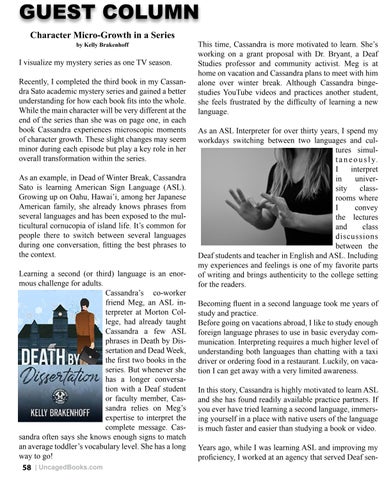
Character Micro-Growth in a Series Guest column by Kelly Brakenhoff

58 | UncagedBooks.com
Cassandra’s co-worker friend Meg, an ASL interpreter at Morton College, had already taught Cassandra a few ASL phrases in Death by Dissertation and Dead Week, the first two books in the series. But whenever she has a longer conversation with a Deaf student or faculty member, Cassandra relies on Meg’s expertise to interpret the complete message. Cassandra often says she knows enough signs to match an average toddler’s vocabulary level. She has a long way to go! This time, Cassandra is more motivated to learn. She’s working on a grant proposal with Dr. Bryant, a Deaf Studies professor and community activist. Meg is at home on vacation and Cassandra plans to meet with him alone over winter break. Although Cassandra bingestudies YouTube videos and practices another student, she feels frustrated by the difficulty of learning a new Aslanguage.anASL
Deaf students and teacher in English and ASL. Including my experiences and feelings is one of my favorite parts of writing and brings authenticity to the college setting for the readers. Becoming fluent in a second language took me years of study and practice. Before going on vacations abroad, I like to study enough foreign language phrases to use in basic everyday com munication. Interpreting requires a much higher level of understanding both languages than chatting with a taxi driver or ordering food in a restaurant. Luckily, on vaca tion I can get away with a very limited awareness. In this story, Cassandra is highly motivated to learn ASL and she has found readily available practice partners. If you ever have tried learning a second language, immers ing yourself in a place with native users of the language is much faster and easier than studying a book or video.
Interpreter for over thirty years, I spend my workdays switching between two languages and cul tures betweendiscussionsandtheIroomssityinItaneously.simulinterpretuniverclasswhereconveylecturesclassthe
GUEST COLUMN
Character Micro-Growth in a Series by Kelly Brakenhoff
As an example, in Dead of Winter Break, Cassandra Sato is learning American Sign Language (ASL). Growing up on Oahu, Hawai’i, among her Japanese American family, she already knows phrases from several languages and has been exposed to the multicultural cornucopia of island life. It’s common for people there to switch between several languages during one conversation, fitting the best phrases to the Learningcontext.a second (or third) language is an enormous challenge for adults.

Years ago, while I was learning ASL and improving my proficiency, I worked at an agency that served Deaf sen
I visualize my mystery series as one TV season. Recently, I completed the third book in my Cassandra Sato academic mystery series and gained a better understanding for how each book fits into the whole. While the main character will be very different at the end of the series than she was on page one, in each book Cassandra experiences microscopic moments of character growth. These slight changes may seem minor during each episode but play a key role in her overall transformation within the series.

©Copyright 2022 Kelly Brakenhoff for Uncaged Book
Publishedwww.uncagedbooks.comReviewswithPermission
DISSERTATION,ingseriesSatotheENHOFFBRAKwritesCassandraMysteryincludDEATHBY a 2020 RONE Award WEEK,Finalist,MysteryDEAD“adivert
59Issue 65 | May/June 2022 | ior citizens in Hawai’i. One of my job duties was to chat or play games with the folks who attended the community center. They taught me some of their in digenous Hawaiian Sign Language (HSL) signs which were different than ASL, and I was an eager student. One day particularly stands out. I had joined a table of elderly Deaf ladies playing Mahjong. They gossiped and chatted in a mix of ASL and HSL about their fami lies and current events. Months earlier, I would have struggled to keep up with their friendly, rapid conver Butsation.after months of daily immersion, it felt like a light switch magically flipped inside my brain, and I under stood them! In that no-pressure environment, I was laughing along with their jokes. I was even able to an swer a question posed to me without asking the woman to repeat it! In that moment, I finally felt comfortable and fluent in ASL. In Cassandra and Dr. Bry ant’s storyline, there’s a scene in Dead of Winter Break where Cassandra feels the thrill of under standing his signing with out an interpreter or extra help. What might appear insignificant becomes a pivotal detail in her grow ing awareness of Deaf Culture and cementing a friendship with a col league who initially in timidated her. In each novel or episode in my series, there are many micro-growth moments that combine to move Cassan dra and the other characters down the overall path of the story. I think that pattern imitates real life where we all experience those aha reactions that lead to greater awareness.
KELLY
ing whodunit,” (Publishers Weekly), and DEAD OF WINTER BREAK, a holiday themed who dunit. Kelly is an American Sign Language Inter preter whose motivation for learning ASL began in high school when she wanted to converse with her deaf friends.


NEVER MIND, FARTS MAKE NOISE, and MY DAWG KOA, her children’s picture books and printable workbooks featuring Duke the Deaf Dog and illustrated by her sister, Theresa Murray, are popular with children, parents, and educa tors for promoting inclusive conversations about children with differences. Sign up here to get free Duke coloring pages, ex clusive stories, and recipes with Kelly’s monthly newsletter. https://mailchi.mp/78c3aaa46ef3/kel lybrakenhoffnews


Showcase
William F. johnson
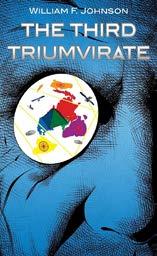
Author William F. Johnson’s first pub lication brings forth suspense and gripping political drama as he weaves intriguing plots and characters in The Third Trium virate. What happens when the five politi cal regions unite and combine strength to elect a president? It’s a new triumvirate, but it seems that dirty politics is every where, even with this newfound unity. After two brutal years of political nego tiations, the five former political regions of Canada, the United States, Mexico, Central America, and the Caribbean Rim Island Nations have forged to become a single government, the world’s Third Triumvirate. The election for the new President of the Third Triumvirate has commenced. Threats are everywhere but finally, the final count and results are here. It is the dawning of a new era for the North American Triumvirate, Garth Brady has just been announced as the new President, and he is ready to put his thought-out plans into place. What he doesn’t expect, however, is the opposition he will encounter along the way. As various issues begin to come to light, the President will be forced to make choices he never expected. This book is available online and can be purchased at online bookstores.
62 | UncagedBooks.com


William F. Johnson lives in St. Helens, Oregon, with his wife Alice. He enjoys reading, movies, chess, lively discussions, and traveling for pleasure. Although he has written other stories, The Third Triumvirate, is his first published work.


63Issue 67 |September/October 2022 | Upcoming Book Event!!! 2022 Frankfurt International Book Fair WHERE: Frankfurt, Germany WHEN: Oct 19, 2022 - Oct 23, 2022

Cody J. Thompson Bill Bush Lori d . Foster
feature authors


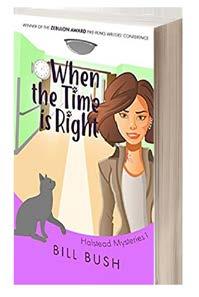
thriller | mystery

h umphrey Hawksley


67Issue 67 | September/October 2022 |
Uncaged welcomes Cody J. Thompson Welcome to Uncaged! Can you tell us more about your new book, Bonesaw Serenade that will release in October?
I feel like it’s a perfect fit for lovers of a good thriller, horror stories, true crime and anyone who might enjoy a twisted love story. If anyone enjoys any or all of those, check it out!
Writing
Cody J. thompson
What is the most difficult scene for you to write?
Bone Saw Serenade is my first published novel, and I could not be more excited about getting it into readers hands and minds. I went into the story thinking “Thriller! Thriller!” And as the story unfolded, it definitely remained a thriller, but a lot of horror elements also came to life within. Domestic thriller, modern day horror, both work when describing the story. It’s all about modern horrors, really. The things we all deal with in everyday life. Not that we’ve all gone through what these characters deal with, of course. But I wanted it to be relatable on some level.
Cody James Thompson is a writer from San Diego, California. He has been writing for many years and is finally diving into the world of novels and storytelling. Previously, he wrote as a columnist with his work featured in San Diego CityBeat, San Diego Weekly Reader, The Westcoaster Magazine, San Diego Downtown News and he was the staff columnist for San Diego Uptown News writing about the beverage industry. With storytelling, he focused mainly on thriller inspired work. When he is not writing or reading he spends time with his wife and their two pit bulls, cheers on his Golden State Warriors and San Diego Padres and can be found writing, producing and hosting the first and longest running podcast in San Diego, Beer Night in San Diego.
What is the easiest?
A husband goes missing, an old friend appears in town for a reunion, and people start to question who truly has good intentions or purely evil ones. We’ve all had new, or old, friends come into our lives. And sometimes, unfortunately, it’s too late before we realize what truly lives behind the friendly mask they wear around us. I really love the way Rex Pickett described the book in
his cover blurb. “…A complex flashback narrative structure that involves past jealousies, betrayal and the worst in humankind.” I think that sums it up quite well, and I am pretty proud of that description.
The most difficult scene in Bone Saw Serenade was probably the very first that I wrote. Which, inside scoop, is absolutely not the first chapter. That came much later. I think it was the most difficult because this is my first full novel. And I am learning on the fly. Figuring out what works, what doesn’t and hammering down (hopefully) a style that’s mine. Being as this was not only my first novel, but the first scene or chapter I created from out of nowhere, it took me some time to dial it and get it where I felt happiest. Moving forward, I don’t believe any book, scene or story will be easy to write or craft.
68 | UncagedBooks.com a book is very hard work. But it’s great hard work, and I love every single second of it. The book is still in its pre order phase, and it has already been more rewarding than I could have imagined. It’s a dream come true.
What behind-the-scenes tidbit in your life would probably surprise your readers the most?
I don’t know if I have a set formula for this. For Bone Saw Serenade, I had the idea and plot points planned out in my head well before I had a title chosen. I racked my brain for something that I thought would work. But not just work, stand out and have some strength behind it. Not only do I want to story itself to be strong and intriguing, but I want the title to hit hard. Something that when a reader sees it, maybe it will stir up some emotion or fascination. My second book, which releases in March, that title came to me while going through a tough time in life, and it was something I said to myself many times in an attempt to be prepare for what I knew would ultimately come. So, I guess this is a very long-winded way of saying I don’t really have a set formula for titling a book or story. I really just wait for something to grab me and shake me a bit. Once it does, I definitely know. And when I can’t ignore it, I know I made the right choice. Besides, someone already asked if they could use this title for a band name, so, I guess I did OK.
| FEATUrE AUTHOr |

How do you come up with the title to your books?
Probably that I didn’t truly love most horror when I was younger. It’s more of an adult realization for me, to love all things horror. I was always interested on comedy/ horror when I was younger. Ghostbusters, Gremlins, Night of the Creeps type stuff. But now, I am all in and can’t get enough. There really is something beautiful about the horror genre. It’s not all gore and nastiness, or doesn’t have to be, I should say. It can be poetic and intriguing and fantastic. Also, although maybe not surprising, one of my favorite things in life in Back to
Has there been a character that’s been hard to write about? Super cliché answer, but it’s still true. I loved writing all of the characters in Bone Saw Serenade. It honestly took a while for me to be able to break away from them for my second novel, which luckily, is now complete. Maybe because I loved writing for them, or maybe, because it was my first completed novel, they will always stick with me like a first love. Hard to say, really. Each one is so unique with their flaws, strengths and what makes each one themselves. But if I had to choose one, writing for Angus, the lead detective in Bone Saw Serenade might have been my overall favorite. Readers thus far seem to really enjoy who Angus is, and I loved creating a world for him to exist and bring him to life.
Do you have a favorite character you’ve written?
I’ve been hosting a podcast for over a decade. Although, I wouldn’t necessarily say its any more or less relaxing. They can be a lot of work, too. I love to read stories and books. I have recently taken up oil painting, which is something that has quickly become one of my favorite relaxing activities. It’s so freeing, and like writing, I am able to create a whole new world that otherwise didn’t exist. I enjoy cooking, which for some reason relaxes me. And when in season, I strongly follow MLB and NBA. Mainly, the Golden State Warriors and San Diego Padres. I also enjoy visiting local breweries with buddies and playing Galaga whenever I can.
itself is usually where I begin the process. What are some things you like to do to relax when you aren’t writing or working?
If you could have one all-year season, which would it be and why?
Definitely fall or winter. I have always preferred colder weather. Although, being born and raised in Southern California, I may not have a firm grasp on what true “cold” actually means. California cold, I guess you could say. Spring is beautiful in California, too. Really anything but summer. I don’t enjoy the heat or humidity. Do you prefer ebooks, audiobooks or physical books? Are you reading anything now?
69Issue 67 | September/October 2022 | | cODy J. THOMPSON | the Future. I even have a full sleeve tattoo based on the movie. My band when I was 15 years old released a cassette on an actual record label. That’s pretty surprising. Which comes first, the plot or the characters in the planning stages?
I have always been a physical book fan. I absolutely love the feel of a physical book and smell of fresh pages. It’s something I have always loved. When my copies of Bone Saw landed, the first thing I did was smell the pages. It’s such a comforting, beautiful thing to me. Though recently, I have fallen for ebooks. For me, it’s all about the ability to store so many in one tiny little device is helpful when stacking up TBRs. But, I would always prefer a physical copy. I recently finished my second novel (Releasing in March) and am about to dive in to book three. In between writing I love to dive
For me it’s usually the plot. When the idea was born for B.S.S., I thought of potential plot points, twists and actions, and as those came to life, so did the characters. As the story grew, so did the characters. Their strengths, weaknesses, flaws and everything else that makes them who they are came to life along with the story. I let the situations sort of guide them on their way, and allow them to grow as human beings based on experiences within the story. But for me, the story idea
70 | UncagedBooks.com into some of my TBR stack. Most recently I read “You’ve Lost a Lot of Blood” From Eric LaRocca which was absolutely phenomenal. And not long ago I purchased the brand-new horror anthology released by an author I love, Spencer Hamilton. I really look forward to jumping into those stories. What would you like to say to fans, and where can they follow you? I just hope that people who find, share and read Bone Saw Serenade, my second book (releasing in March) or anything else I create enjoy the stories. This is lifelong dream of mine, to have words published on pages for people to read, and I really more than anything hope that people enjoy the books. When asked as kids what we wanted to be when we grew up, I always said “writer.” Or, professional pinball player, maybe. So, this is truly a dream realized. Even being interviewed about a book I wrote is a dream come true. Thank you to everyone who is interested in my work. You can follow me on all social media @CodyWritesBooks. Hopefully, I will have a lot more coming for everyone.
Enjoy an excerpt from
Stay Connected
Bone Saw Serenade Bone Saw Serenade Cody J. Thompson Crime ReleasesThrillerOctober 27
Everyone loves running into and reconnecting with an old friend. Someone you have lost touch with for any number of reasons over the years. It can stir up a cocktail of euphoric emotions through feelings of nostalgia, amusement, hope and love. That is exactly how Emma Goodwin felt when she ran into her high school best friend Char lie Claymore after they found one another randomly after a decade of not seeing or speaking in a small coffee shop in Seattle. Soon after their reunion, Emma’s husband Eddie goes missing without a trace of evidence linking anyone to the disappearance. Anguished, she spirals into her old ways with Charlie. When Detective Angus Pratt is assigned to the case, Charlie is determined to stay by Emma’s side, casting a dark veil over her he calls Asprotection.theyclose in on the truth, a sinister plan is re vealed that is darker and more terrifying than the vast, uninhabited woods that lay on the outskirts of town. Angus will stop at nothing to find the truth, and Emma may learn the hardest truth of them all. That the flames you hold the closest always burn the worst. Excerpt They watched as Johnny and Reggie left. Eddie could see through the windows that Johnny had turned left, heading down into the dark alleyway. Reggie had not followed Johnny into the darkness, choosing to make his way to the main street illuminated by street lights
| FEATUrE AUTHOr |


“Very funny,” Eddie said. “Get the hell outta here. I’ll see you on Monday.”
“Not if I see you first,” Courtney yelled back as she threw the door open and exited the bar.
71Issue 67 | September/October 2022 | and teaming with people who hoped to begin their night of partying as this group retired for the night. “Let me ask you something,” Courtney said. “You and Johnny hate each other, right?” “Why would you say that?” Eddie asked. “I heard some things.” “We’ve had our issues in the past. But I think we have turned a corner on all of that.” “Didn’t he push you up against a wall or something before I started working at the theater?” “Well, I mean,” Eddie said, stumbling over his words. It might have been the beer, or maybe the embarrass ment. Maybe a decent mixture of both. “Don’t be so embarrassed,” Courtney said with a giggle. “I’m just asking for the facts, not attacking your manhood or “Myanything.”manhood?”
She said, tucking her phone into the back pocket of her “Can’tjeans.youjust deal with this tomorrow?” Eddie “Thatasked. means our camera system dropped, too. I don’t want it to be down all night,” she said, stand ing up from her stool. “I guess this is goodbye for me. Are you ready to head out? We can walk back “Nah,together.”you go ahead,” Eddie said. “I need to settle up my tab and hit the restroom.”
Eddie laughed. “Yes, he pushed me up against a wall. But that was long ago. We are very much past all that.” “Hey, I’m not worried,” she confirmed. “If he tried that on me? I would end his ability to have children.” “If he did that to you, I would end his ability to have children,” Eddie said. Just then, Courtney’s cell phone, which was sitting on top of the table mixed in with the empty beer glasses and saliva drenched bones, chimed. She lifted it from the table as her eyes shot open in surprise. “Ah,” she said, flicking her thumb over the screen. “Everything OK?” Eddie asked, taking another sip of beer. “Not really,” she said. “It looks like the wifi at the theater just dropped. Dammit, I need to head back.”
“You sure you don’t need any protection as you walk down the scary alley? Just in case someone else tries to put you up against a wall?”
“I need to close out, please,” Eddie said to the bar Thetender.bartender retrieved Eddie’s credit card and dropped it onto the bar top with a receipt. Eddie scribbled his name “before pushing it back across the bar. At the end of the bar in the far back of the room were two doors with an old-fashioned jukebox sitting between them. The right with a “Men’s” sign, the left with a “Women’s.” He en tered the restroom to handle his business. He pushed open the door leading to the alley way. The alley was cold, dark and the fog in the air made everything damp like a wet, shaggy dog had shaken himself silly. The dampness forced all kinds of unappetizing smells up into the air from past inhabitants and visitors who had called the alley home. He continued down the path, making his way past the back of the Paramount Theater.
| cODy J. THOMPSON |
| FEATUrE AUTHOr |
The alley splintered off in different directions, al lowing access to the main street as they cut past the various buildings making up Downtown. When he reached the edge of the theater building, he turned right. This branch of the alley spilled out into the main drag, which led to a parking garage where Eddie’s car was parked. The Paramount stood tall in the damp al ley, and three open dumpsters sat pushed up against the theater’s exterior wall. As Eddie walked, he heard his phone chime in his jeans pocket. He pulled out the phone to see a text message from his wife, Emma. Emma had flown to San Diego that afternoon with their daughter Sophie and the incoming message was a sweet text letting him know they had arrived safely.
72 | UncagedBooks.com
Having done this walk many times, he didn’t look up from his phone as he walked. He passed the first dumpster, then the second, locked in on the glow of the bright screen. Just then, the enclosed alley ech oed with a loud whack sound as Eddie’s world went completely black. It was inaudible to anyone passing by as the sound was swallowed by the car noise of the busy street, loud music blaring from various clubs and too many young people hooting and hollering as they went about their business, unaware of the vicious attack that had just taken place. He fell to the ground, letting out a throaty gasp as the air flooded from his lungs. His cell phone dropped and bounced away onto the wet asphalt. Standing over Eddie’s lifeless body was a man dressed head to toe in black, his face cov ered by black cloth. In his right hand, he held a ham mer. He stepped over Eddie’s limp body and picked up the phone, deleting everything Eddie had written to his wife, and tucked it into his back pocket. He then pulled a syringe from his pocket, removed the cap, and sank the needle deep into Eddie’s arm. He lifted Eddie from under his arms and dragged him across the wet asphalt, dumping his body between two of the dumpsters before he turned and walked towards the street. There Eddie sat, blood gushing out of his head. He was barely breathing, clinging to the scraps of life left in his body.
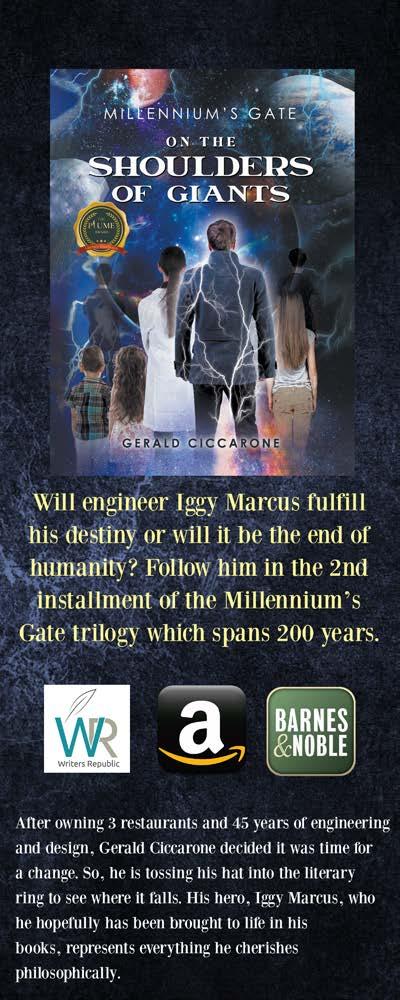
robinhosking.com

Dr. Pamela Lewin is a family physician and wellness consultant. For her, writing has been a hobby. She stud ieat the Institute of Children’s Literature and did their book course as well. Dolly Duitt & the Improbable Tasks was the outcome of that endeavor. In 2018, she self-published a book of poetry, My Life… An Inspired Journey. She sings in her church choir, and loves music, poetry, energy and laughter. She is an avid pickleball player. Like Dolly Duitt, she has had to conquer her tendency to procrastinate due to attention deficit, by being distracted, so her character was easy for her to imagine. She likes to travel and spends time with her husband, a retired physician, their two adult children and six grandchildren. She has launched a new initiative of helping to improve the lives of the underserved and children at risk, and donate her service, in Ocala, Florida, where she lives. As a Christian, she believes she is her brother’s keeper. As a wellness consultant, she helps adults “live younger” using a new technology that involves light therapy. Her next planned project will be about this phase of her life.

Showcase
Pamela Levin M.D.
74 | UncagedBooks.com
Dolly is a procrastinator, but not intentionally. She simply forgets she has begun one task, then becomes distracted, and moves to another, and another, making the completion of any one of these tasks “improbable”. She forgets to water her plants, take her dog Flossie for a walk, and pay her bills. This habit creates a frightening situation for Dolly until she gets a “wake-up call” which results in the necessity for her to figure things out for herself, to her surprise and satisfaction. When Dolly notes that she forgot the most important things in life which must take priority, readers will sympathize with her and rejoice when she has that AHA! Theremoment.isa lesson that awaits between the covers of Dolly Duitt and the Improbable Tasks, something all readers can learn from. This book is available online and can be purchased at online bookstores.
In this day and age when everyone seems to be running around in all directions, Dolly Duitt and the Improbable Tasks serves as an eye-opener to help everyone evaluate the consequences of their actions. This book is about doing first things first, and next things next, and getting them all done.
Tasking?orProcrastinationMulti-
Author invites young and old alike understandto what it means completetoa task Dr. bothLewinPamelaofferschildren and adults something they can relate to, which makes this very special, whimsical and hopeful.
75Issue 67 | September/October 2022 | Upcoming Book Event!!! 2022 Frankfurt International Book Fair WHERE: Frankfurt, Germany WHEN: Oct 19, 2022 - Oct 23, 2022


Welcome back to Uncaged! Can you tell us more about your newest book in the Rake Ozenna Thriller series, Ice Islands?
Humphrey Hawksley is an author, journalist, political commentator and moderator. His assignments as a for eign correspondent have taken him to crises all over the world. He is a regular panelist and speaker, and his work has appeared in most mainstream publications in North America and the United Kingdom. He is the author of the much-discussed Dragon Strike ‘future history’ series which examines conflict scenarios between world powers. His latest non-fiction book is Asian Waters: The Struggle Over the Asia-Pacific and the Challenge to American Power. His Rake Ozenna thriller series, with a unique protagonist from a remote island on the Ameri can border with Russia, has been praised for its vivid scene setting, fast pace and depth of research. The series originated from a BBC reporting assignment to the Bering Strait.
His television documentaries include The Curse of Gold and Bitter Sweet examining human rights abuse in global trade; Aid Under Scrutiny on the failures of international development; and Danger: Democracy at Work on the risks of bringing Western-style democracy too quickly to some societies.
Humphrey hawksley
Rake’s back-up asset is Sara Kato, Michio’s younger sister who has been rejected by the family. She was sent away to boarding school in England aged ten and raised by guardians. She loathes her family for abandoning her, but also craves its love. Rake is to approach her at a peace conference on the Finnish Aland Islands in the Baltic Sea. But there, assassins murder a delegate who turns out to be the secret son of the Russian president. Sara is implicated. Rake is ordered to get her out and keep her safe. The action moves from the Baltic Sea through Washington D.C. to Hokkaido in northern Japan. One backdrop of the story is the unresolved dispute between Russia and Japan over the Kuril Islands or Northern Territories
In ICE ISLANDS, protagonist Rake Ozenna is tasked with getting information from the Kato family, a Yakuza crime organization which is turning Japan against the United States. He has identified a Japanese businessman and heads to meet him at a vineyard in the Douro Valley in Portugal. By the time Rake gets there, all at the meeting have been massacred by Michio Kato who is soon to take over as head of the crime family.
Humphrey hosts the monthly Democracy Forum Debates on global issues and the twice-weekly Goldster Inside Story Book Show where he has lively conversations with authors about their work. He has been guest lecturer at universities and think tanks such as the RAND Corporation, The Columbia Business School, the Center for Strategic and International Studies and MENSA Cambridge.
77Issue 67 | September/October 2022 |
Welcome to Humphrey Hawksley
78 | UncagedBooks.com which coincidentally are the setting for NO TIME TO DIE, the latest James Bond film. ICE ISLANDS is the fourth in a series featuring the hard-as-nails hero Rake Ozenna who comes from the Alaskan island of Little Diomede right on America’s border with Russia. Rake himself evolved from a BBC reporting assignment to Little Diomede back in 2015 when US-Russia relation ship was becoming tense. I had expected to find some form of American military or U.S. Customs and Border Protection there. But there wasn’t even Little Diomede islander looking across to Russia a local cop or a state trooper. Little Diomede is a craggy, rough island with a population of around eighty Indigenous Alaskans living less than three miles across a narrow stretch of water from, a Rus sian military base. It was such an incredible and little-known situation that I wrote the first in the se ries, MAN ON ICE, where Russia seizes the island and takes hostages on the eve of a U.S. presidential inauguration. Rake Ozenna is a compilation of the rugged, gritty, brave characters on Little Diomede who live by their wits and instincts in a remote and hostile environment.
FEATUrE AUTHOr |
What is the most difficult scene for you to write? What is the easiest? What a great question! The opening is the trickiest because you have to make it immediately compel
|
Has there been a character that’s been hard to write about?
ling while also giving information about character, loca tion and motivation. In ICE ISLANDS, I experimented with three different openings, each of which had been drafted and redrafted several times. In a similar vein, the easiest (if that is the right word) is the last chapter because all pieces by then are in place -- except for the very last lines. They can turn on a dime because you have to leave the reader satisfied, stimulated, want ing and ive them a final twist or unexpected thought. Maybe, those last lines are the most difficult to write.
Do you have a favorite character you’ve written?
My favorite character is protagonist Rake Ozenna because of his background of being raised as an Indig enous Alaskan on Little Diomede island on the Russian Humphrey and U.S. Patrol


The first in the series, MAN ON ICE, was created to portray the single figure battling an unforgiving enemy in a hostile and frozen environment. The Man concept was drawn partly from the Girl titles that have been so popular, like Gone Girl, Girl with the Dragon Tattoo and Girl on a Train. It also has a dual interpretation of mankind in trouble. MAN ON ICE was intended as a stand-alone, but both my publisher and I wanted to do another with the simi lar high stakes of world catastrophe. Therefore, I wrote MAN ON EDGE, when military secrets went missing in the Russian Arctic and MAN ON FIRE when the villains possess a weapon of unimaginable power. After that, I felt we had run out of elements that Man could respectably be on. ICE ISLANDS is similarly snappy and stays with the concept of cold, threat and hostility. What behind-the-scenes tidbit in your life would probably surprise your readers the most?
How do you come up with the title to your books?
I absolutely love the Thai desert of sticky mango with rice. On the first taste, wherever you are, it conjures up the tranquility and sensuality of the Southeast Asian tropics. The juxtaposition of the sticky coconut rice and the cold, soft mango clears the palate and the mind and takes you, for a mo ment, to a beautiful, faraway place.
79Issue 67 | September/October 2022 | | HUMPHrEy HAWKSLEy | border. He is a tough man of few words who instinc tively knows right from wrong. Over four books, I have been able to introduce complexities and dilemma into his character. Should he become a tribal leader on his home islands or continue tackling crises around the world. And what of his occasional lover and soul mate, Carrie Walker, a trauma surgeon he met in Afghanistan, to whom he was once engaged to be married. They are not the types to settle down as a couple. But if not that, what? In the crowded field of thriller fiction, Rake is pretty unique and has been praised by critics including the great Nelson DeMille who said simply that Rake is ‘smart and tough, and we’re glad to have him on our side.’ As for hard characters, it took some time to get Sara Kato right. With a first-time character I always find it tricky to get the balance between steel, vulner ability, motivation and backstory and, in Sara’s case, working out how far to take their mutual attraction. The series has a small cast of permanent characters of which my favorite is Stephanie Lucas, a high flying diplomat and politician, who was raised by a single father in a used car lot in South London.
Which comes first, the plot or the characters in the planning stages? It is a mix, but the way my mind works as a former foreign correspondent is to create a plot situation which will drive the characters. In the Rake Ozenna series, once I decide on the political and geographi cal premise, I will spend time talking to experts and doing research to get my ducks in the row. After that, I work out how to throw at Rake the dangers,Patrol Agent Lee Pinkerton

80 | UncagedBooks.com complexities and challenges that drive the plot through. Similar treatment is given to the antagonist which, in ICE ISLANDS, is Michio Kato.
On location on Little Diomede Island

If you could have one all-year season, which would it be and why?
Another great question? I do love winter, where the cold encourages coziness, and early dark evenings gives time to read and write. With winter, too, there is always Spring to look forward to if that makes sense. My hero, Rake, is good with winter, too. But could I live in winter all the time?
Do you prefer ebooks, audiobooks or physical books? Are you reading anything now?
What are some things you like to do to relax when you aren’t writing or working?
I love cycling, the wind in the hair, the rain or sun on the face, the quietness and the access that can take you along canals and rivers and through mead ows of wild summer flowers. I also like swimming and walking. I used to have a travel bug. But the first time I walked into an airport after Covid with the security checks and hanging around, I thought, ‘What the hell am I doing back here.’ Of course, once at the destination the heart thumps with the anticipation of a new people in a new place.
I host a weekly Book Show so am usually reading the
I love them all. I mostly use e-books and audio now because you can read a chapter on the phone at a bus stop and pick it up on an Ipad back home, then switch to audio in the gym and it will keep your place throughout.
81Issue 67 | September/October 2022 | book of an upcoming guest, which today is The Car by Bryan Appleyard; a non-fiction political for my journal ism which is The Fifth Horseman and the New MAD by Harlan Ullman; and a thriller for myself which is Never by Ken Follet. What would you like to say to fans, and where can they follow you? Thank you for reading the Rake Ozenna series. I love feedback absorb it, adjust and write accordingly. As a journalist, I know there are no greater editors than your readers. My website is www.humphreyhawksley.com Rake has his own pages on www.rakeozenna.com and ICE ISLANDS is on www.iceislands.co.uk . You can sign up to occasional newsletters here My parting tip for new readers: Start with MAN ON ICE or one of the earlier ones because we’ve dropped those prices right down for the hardback launch of ICE ISLANDS. Enjoy an excerpt from Staked by Desire Ice HumphreyIslands Hawksley Thriller On an inhospitable frozen island, Rake Ozenna must gain the trust of a young woman fleeing a Japanese crime empire and caught in the crosshairs of the Rus sian Majorgovernment.RakeOzenna’s mis sion is simple: gain access to the Kato family - Japan’s most dangerous crime Butempire.when the secret son of the Russian leader is ex ecuted and Rake’s target, Sara Kato, is implicated in the murder, a political crisis between Russia, Japan and the US is set in motion. As Rake learns the true extent of their deadly plans, he must draw on every ounce of his training to succeed. Because if he fails, it won’t just be his life that will be lost . . . the consequences will be global. Excerpt SheTokyoPROLOGUEwasout, clear of the death house. She had to get away. Completely. Long distance. Free from dread. From guilt. From paralyzing fear. An air port. Another country. Sara Kato rode in the back of one of the family sedans, her brother Michio be side her, window down, city noise in her ears and drizzle splattering on her face. In the bag strapped around her shoulder was her passport, credit cards, vaccination certificates, a few hundred euros and her phone from London which worked in Japan. She still had the American soldier’s phone in her jeans Shibuya’spocket.lights shone around her, massive fu turistic images of gadgets, celebrities, fashion wrapped around skyscrapers. Umbrellas bobbed up and down as people ducked around each other in the rain. It would be so easy to slip away, vanish in the crowds. Easy, if she did it right. ‘Why don’t we walk?’ she suggested. ‘And I need an ATM to get some yen. I only have euros.’ ‘There you are.’ Michio peeled off a wad. ‘That’ll keep you going.’
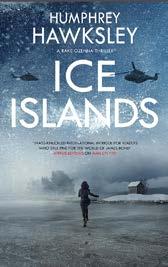
| HUMPHrEy HAWKSLEy |
‘Thank you, but no.’ Sara lay a hand on his arm, trying to hide a repulsive shiver on showing any affection. ‘I need to do something normal, be on the street, go to an ATM, get some money, feel people around me, feel cold.’ After the horror in that stifling house, she made it sound believable. First step, out of the car. Second step, run as fast as she could.
| FEATUrE AUTHOr |
82 | UncagedBooks.com
Bar owners bowed or raised hands in greeting. Not just to Michio, also to the men with him. They moved from place to place. One moment they were in an old red-light district of hodgepodge narrow streets. The next they were guests of honor at a bar decked out like a film set, with cameras, spotlights, fake sand dunes and thumping music. She let Michio talk. Justifying. Explaining. Most in Japanese. Some in English. About being Japanese. Bloodlines, Family. They kept moving from place to place, sometimes on foot to a bar or café nearby, a couple of times, a short journey by car. She lost track of where they were. She had never known Tokyo well, hadn’t lived here since she was ten. The security cordon stayed. Even in the rest room, a woman appeared from nowhere to keep Shewatch.tried to leave. They were perched on stools in a tiny counter bar, Michio discussing with the owner the outcome of the Pacific War. Sara touched him warmly on the shoulder and spoke in English, ‘I’m beat, Michio. We both know why I can’t go back to the house. You stay. I’ll check into a hotel.’ Michio laid a hand on hers, gently but firmly. ‘It’s late. We’re all tired. There’s a hotel just around the corner.’ She was terrified to show anger. To survive, she had to show she supported him in his evil. She felt suffo cation. Her mind didn’t know where to go. Stop, she wanted to scream. Stop controlling me. Stop giving me surprises. Stop being so bloody nice. ‘Let me treat you. Just tonight.’ He smiled at her. ‘I need to—’ ‘I know,’ interrupted Michio. ‘You need to be by your self. You will be, and early tomorrow morning I want to show you something about our family.’ She didn’t want to hear anything more about her fam ily. Her father had banished her from Japan when she ‘Of course. I wasn’t thinking.’ He squeezed her hand and instructed the driver to pull up. ‘We’ll get out here. The rain, getting a bit wet doesn’t worry you?’ ‘It’ll be refreshing.’ She took her hand off his arm. The driver turned into a narrow road and stopped behind a green taxi. Sara pulled the handle to open her door. It was locked. The driver glanced at Mi chio who gave a single nod. There was a click. The door opened. She gripped her bag’s shoul der strap and stepped out. She drew in the bustle and buzz, eyes scanning on how best to escape. ‘There’s an ATM.’ Michio pointed to a bank of three along the sidewalk, green and yellow lights glowing from their screens. She saw two men ahead. She turned. Another two behind. A motorcyclist, engine running, foot on the sidewalk, looked toward her. They would be trained to stop her going anywhere. She needed to slow down and work out how to get past them. ‘They’re with us?’ she asked. ‘Sorry.’ Michio shrugged. ‘If you’re a Kato in this city, you can’t just go for a walk.’ He took her arm. ‘Ignore them. Come. Get your money.’ She stood in front of the cash machine, the cordon around her, taking her time, checking her PIN, her balance. Michio was a man she adored more than any other, her brother whom she trusted com pletely. What she had just seen shook her to the core, even though it wasn’t against her. Michio was picking up as if nothing had happened, which made it worse, more confusing. She craved to un derstand him. She concealed trembling, fought hard against a choking sense of more despair. She withdrew 50,000 yen. Turning to Michio, she forced a smile, ‘Now, at least I can buy my big brother a drink.’ Michio led her into a tiny, winding street with poky counter bars and sushi places crammed next to each other. The same six or seven men trailed or went ahead of them. They were recognized.
83Issue 67 | September/October 2022 | | HUMPHrEy HAWKSLEy | was just ten. He was a monster. She knew the Kato family were stinking rich. She had never asked de tails because she had never felt part of them. She had been smart enough to keep her distance, but not smart enough to stay completely away. She had come back because she loved Michio, her elder brother and her protector. Everyone needs family. Now, she had seen that Michio was a monster, too. ‘Our businesses are much more than just hotels, golf clubs, airlines and karaoke joints,’ Michio was say ing. ‘We help people all around the world. I want you to see that, then you can decide what you want to do. Let’s all get a good night’s sleep.’ Her hotel room was vast with a huge bed, a sunken bath, a rain shower and windows with a surround view of the city. Sara walked around and around, sinking her bare feet into the thick yellow carpet. Michio’s men were outside the door. Her brother had taken the room next door with an adjoining door to hers. She knelt and lowered her head to the carpet like in prayer. She let her mind go blank for five sec onds, ten, more, until she realized that Michio could be watching her every move. She tried to rid herself of the thought that he would harm her. She couldn’t. She had seen his eyes, his determination, the way he wiped blood off his hand. She pushed herself up, went to the bed and, fully clothed, enveloped in ex haustion, she crawled under the covers, pulling the sheet over her head. She pulled the American’s phone from her jeans pocket and scrolled through to see how it worked. She recognized neither iPhone nor Android technology. It was something different. Surely, they could pinpoint where she was. The American had made her register a thumbprint. It worked. She remembered the fournumber pass code. The screen lit. Her heart pounded as she typed out a message in capitals. HELP. She thought a moment on how to make it clearer so it didn’t get lost in some bullshit American bureaucra cy. She deleted it, rewrote the message and sent it. R-A-K-E O-Z-E-N-N-A. H-E-L-P M-E P-L-E-A-S-E. DON’T MISS THESE TITLES:


Showcase Matter?Words
Robert byrum
Robert Byrum was born in San Diego, California in 1930. He is a veteran of the Korean War. He has a degree in Structural Engineering and worked in engineering for over thirty years. He developed his own engineering practice and designed many buildings in California and the adjoining states. During his lifetime, he has enjoyed many hobbies including fishing, hunting training dogs for competition, travel and now writing. Words Matter is one of the three books he wrote during 2021-2022. Desiring a better quality of life, he and his wife, go ing on 68 wonderful years of marriage, moved to Montana in 1990 after retiring. They have been fortunate to be able to have traveled the world studying the history, architecture and culture of many people.
forappreciationreaders’backthoughtful,sincere,andmeaningfulwordsinnewbook
Do
People learn and live by the words they hear, read and speak. They help people think, understand and react. Through this book, nonagenarian author Robert Byrum tries to step back, to present words that have meaning, excite emotions, trigger thinking and contemplation with the stories and quotes presented. In Words Matter, there’s a sprinkling of humor spread across the pages, making it a fun read, while still keeping it informative as it delves into the philosophy of living, aging, senses, love, beauty, friendship, youth, laughter, dog stories, sex, and quotes and bits of knowledge from famous people. Sometime in the many years past, the author started collecting short stories, quips, and sayings of wisdom intelligence and humor. They are about the peoples of today, yesteryears and their beloved four-legged friends. Then it grew into writing about subjects he felt were thought-provoking and Eventually,enduring. he had a computer library crammed with a variety of subjects standing by themselves with no place to go. This book is comprised of many of these thoughts. His hope is that they will find a home and be useful to others that share a willingness to reflect on the business of living, of life and love, and to cherish their lives, with some chuckles and maybe a few Thistears.book is available and can be purchased at online bookstores; www.dorrancepublishing.com, www. amazon.com and www.barnesandnoble.com.

84 | UncagedBooks.com
Author hopes to bring
85Issue 67 | September/October 2022 | Upcoming Book Event!!! 2022 Frankfurt International Book Fair WHERE: Frankfurt, Germany WHEN: Oct 19, 2022 - Oct 23, 2022


Welcome to Uncaged! You have three books out in the Halstead Mystery series. Can you tell readers more about this series? Are you planning continuing with the series? The series is set in Halstead, Kansas, the small town I’ve lived in since 2008. In the middle of town sits the Halstead Hospital, which has remained empty since 2002. I thought, what a great place for a murder mystery, and so I wrote When the Time is Right with the hospital as the center piece of the story.
I am currently putting the final touches on book 4 (should be available in late summer/early fall) and have the basic ideas for books 5-7. I don’t foresee the series going indefinitely and want to wrap it up at some point but I don’t know how many books that will entail.
Bill Bush grew up in Yates Center, Kansas, and is a graduate of Yates Center High School and Tabor College, where he earned a Master’s degree in Accounting. He is a runner and pickleball player as well as a writer, is author of several collections of short stories, and has written a column in the Harvey County Independent since April, 2013. Besides the acclaimed Halstead Mysteries series, Bill is the author of the Vetrix series and dozens of short stories. His flash fiction stories, Lonely Lucy and Uninvited Guest, were included in the Podcast, Alone in a Room With Invisible People, in 2019 and 2020 respectively.
You also have a pretty nice collection of short story anthologies. Can you tell readers more about those? In 2016 my aunt introduced me to an online writing forum (hollyswritingclasses.com) and I took a free course on writing flash fiction by the forum creator Holly Lisle. I wrote a few dozen flash fiction stories that year.
Eden Price, a big-city girl from Wichita who just graduated high school, spends the summer with her grandmother in Halstead. After a local retired doctor goes missing she sees a body in her neighbor’s car. Her snooping leads her to the hospital where she finds a mysterious machine, a dead body, and we’re off and running.
Uncaged welcomes Bill Bush
87Issue 67 | September/October 2022 | Bill bush
The series follows Eden as she makes friends, solves mysteries (yes, it’s a lot of dead people for a small town), and begins to accept herself and the people of Halstead, who are not as different from her as she first thought.
You can learn more about Bill at billbushauthor.com or snaderpublishing.com, his publishing company.
| FEATUrE AUTHOr |
That year I also decided I wanted to give writing a serious effort and so I published some of the flash fiction into e-books because I read somewhere it was a good idea. All of those stories are unrelated. I also wrote eleven flash fiction stories involving the three main characters (sixth graders Flipper, Allison, and Josh) from my first book and series, Vetrix. They’re fiction based off of my son’s reallife experiences. I published those in Before Vetrix. What is the most difficult scene for you to write? What is the easiest? I don’t outline all my scenes before writing but have an idea of where my story is going. The Vetrix series has been easier to write in the sense that I almost always know what action is taking place and can fill in needed information from there. The Halstead Mystery series has been more challenging because sometimes I know what information I need my MC to discover or who she needs to investigate but I don’t know what needs to happen, what action is taking place. Those are the times I can end up the most stumped. Do you have a favorite character you’ve written? Has there been a character that’s been hard to write about?
My favorite character is easy. My son and I brainstormed the story and main characters for Vetrix and then the subsequent books in the series. He was 11 at the time and wanted to be the main character so Flipper, nicknamed so because he has a nervous tick
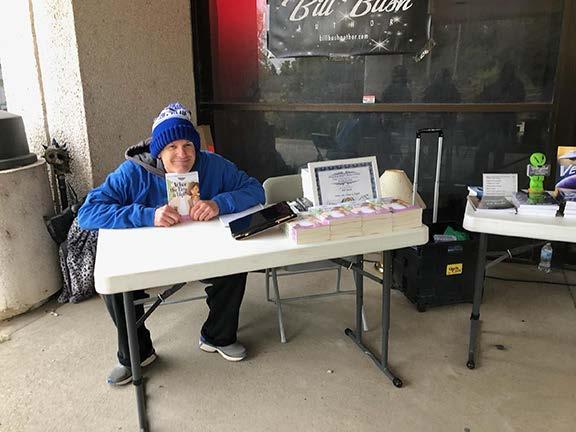
The Vetrix Series: My son Blake named the planets Vetrix and Rex (Rex will be book 5) in the first book. Since half the story took place on Vetrix I went with that as the name, then decided to name each book in the series by the name of the planet featured. Earth (book 2), is obvious. For Zentron (book 3), I think I just searched the internet until I found a name I liked. I finished Sevitan (book 4) before I named it because I couldn’t think of a good name. Throughout the book I had called the people on the planet the natives so I spelled the word backwards to get Sevitan.
89Issue 67 | September/October 2022 | and flips things, is a pretty good representation of my son Blake. So Flipper will forever be my favorite Flipper’scharacter.cousin in the series, Allison, shares many attribute with my daughter but that likeness isn’t as strong as the main character’s. Certainly some characters have been more challenging to learn who they were. In Zentron, book 3 of the Vetrix series, the inhabitants on Zentron are brilliant but very literal so they don’t get the humor my main characters bring to the table. It took some work for me to distinguish between them, to give them unique personalities when they are all kind of the same.
The Halstead Mysteries: When the Time is Right (book 1) is a phrase used early in the book so that was my working title. It eventually grew on me and stayed.
Three Blind Mice (book 2) I came up with early because the story centers around the state baseball tournament and specifically three umpires, who are often called blind mice in the baseball community. A writing friend of mine, N. Jade Gray, came up with Toxic Intentions (book 3). I’m hoping she’ll also think of a name for the fourth book because I’m about to send it to beta readers and still don’t even have a working title. What behind-the-scenes tidbit in your life would probably surprise your readers the most?
Once or twice a week I like to spend a few hours in my local Chic-Fil-A to write. It’s usually my most productive writing time of the week. I usually go there after working out at the YMCA so I feel energized, alert, and relaxed. I’ll eat and then get to Sometimeswork. I stop after two or three hours and at times I’ve gone on for six hours or more. I am often asked whether the crowds of people or the background music distracts me and it honestly doesn’t. Or usually doesn’t. Being out of my apartment helps me focus and when I take breaks it’s easy to get right back to work. When I take
How do you come up with the title to your books?
| BILL BUSH |

I’m also involved with my church, teaching, overseeing the finances, and serving on the leadership team. Now that both of my children are adults I spend the majority of my free time on my developing writing career. I don’t own a television or have any online subscriptions, not even Amazon Prime. My dad has a Netflix account that I use occasionally but I think the last series I watched by myself was the fourth season of Cobra Kai last December. If you could have one all-year season, which would it be and why?
I’ve been a runner since I was in college. I swim a little and last year started playing pickleball and do that 1-2 times a week. I don’t usually take more than one day off a week from activities.
breaks at home it’s easy to get started on something else without thinking about it. I’ll also visit coffee shops to write but I’m most consistent with Chic-Fil-A. I prefer to get there while they’re still serving breakfast. Which comes first, the plot or the characters in the planning stages?
What are some things you like to do to relax when you aren’t writing or working?
I’m primarily a plot first writer because the story means more to me than the people involved. That sounds horrible but I like to figure out how to add twists and surprise the reader. I’m an accountant by trade so that stems from my analytical side. Of course, with two series in process I start each book knowing who my main characters are going to be already. Once I know what I want to happen I’ll add in the people that need to participate to get my story told. I have noticed I’m changing in this regard though, especially with the cozy mysteries. I have introduced a number of characters in the first four books and not all of them have made return appearances. I’ve already started thinking about how I should bring them back and how I want their stories to end before I finish the series.
| FEATUrE AUTHOr |

When the Time is Right Bill CozyBushMystery

Based on weather I’d take summer all day long. I hate being always cold (which is most of the time) and have to deal with that a lot less during the summer.
Eden didn’t peg bribery, kidnapping, and murder for summer activities For eighteen-year-old Eden, her court-mandated community service is set to be every bit as punishing as prison. Sent off to work at a pizza joint while living with her grandmother in a little out-of-the-way town, at least she can appreci ate the peace and quiet. But the town is hiding its own secrets, and pretty soon peace and quiet will be very hard to come by. She might not realize it, but between the spiteful neighbor, the enigmatic mayor, and the calculating owner of the abandoned hospital, Eden’s 90 days in Halstead are set to be the most exciting of her life. Follow Eden’s unexpected adventure in this strange and entertaining tale of mystery. Excerpt Eden slipped between the table and high chair full of plates and uneaten pizza crust, tipping over the crushed red pepper shaker which spilled open on the floor. She quickly cleared tables four and seven, pocketing two whole dollars. Two unleashed chil dren and a larger than normal customer who didn’t understand narrow aisle courtesy delayed her re turn trip to the kitchen.
Do you prefer ebooks, audiobooks or physical books? Are you reading anything now? Physical books! I occasionally read an e-book because I can’t get it in paperback and I don’t think I’ve listened to an audiobook in years. I just upgraded to a smart phone a couple of years ago and have a real basic model that doesn’t hold a lot of data so I can’t store books on it. Besides, the screen’s too small so I don’t read on it and only use the internet when I’m at an event all day and it’s my only source of checking Ie-mail.recently read a lot of middle grade horror novels including several of RL Stine’s books, Neil Gaiman, Lindsay Currie, and Mary Downing Hahn because I wrote a middle grade horror story in the fashion of Goosebumps. It hasn’t been published yet. I’m now back to reading cozy mysteries and going through two series—A Haunted Guesthouse by E.J. Copperman and Beyond the Page Bookstory mystery series by Lauren Elliott—to see how they handled the progress and ultimately the ending of the series. What would you like to say to fans, and where can they follow you?
91Issue 67 | September/October 2022 |
complement I have received was when someone said they stayed up all night reading Three Blind Mice.
Enjoy an excerpt from When the Time is right
| BILL BUSH |
First of all, thank you for reading my book(s). Obviously a lot of time, love, and frustration goes into every story and I appreciate each person who spends the time to consume what I have created. Obviously writers want to sell books but the greatest support you can give us is free. Tell a friend, leave a review, send a message. I love to hear from readers who enjoyed one of my books. The greatest thing
Based on seasons, my favorite is fall. The temperatures are nice, I love the seeing the leaves changing colors, and there isn’t the wind like spring provides. The bonus is that all those holidays – Halloween, Thanksgiving, and Christmas – take place in fall (or close enough).
Lucas Walls,” the smiling, blond-haired girl working the cash register told her. “All four boys just graduated. They’re celebrating because their baseball team won sub-state to advance to the state tournament.” The blond was petite and pretty. The four boys were clean cut and well groomed. Eden fidgeted with one of the two ear-piercings she wore on each side, thankful to have left the others out. She started to slide her hand down as she thought of the dice tattooed on her neck, but stopped herself. She chastised herself for worrying about what an yone in this town thinks. “Eden, can I talk to you for a minute?” the man ager asked. His round face and body reminded her of Eden’sBB-8.eyes met concern in the cashier’s as she followed the manager away from the crowd. “I noticed you gave refills to the four high school boys in the other room.” He rubbed the back of his neck. Was he going to say something about her tattoo? “We charge for refills. And typically we let them come to the counter to pay before giving them more to drink.” Eden clenched her teeth. They’d given free refills at her job last year at On the Border so she’d assumed the Pizza Parlor also did. Apparently her manager read her mind. “Don’t worry about it. Those boys are in here a lot and know better. They were just taking advantage of the newbie.” “I’m sorry,” she managed, her ears still burning. He chuckled. “I said don’t worry about it. It’s part of the learning curve.” “Order’s ready,” a voice rang from the kitchen. “You’re doing fine, Eden,” the manager assured her. “Why don’t you deliver those meals?”
92 | UncagedBooks.com “Hey, can you get us more drinks?” One of the four teenagers in booth nine, the cute one, held up an empty cup. She lifted the tub full of dirty dishes as if they couldn’t see her hands were full. “I’ll be right back. ‘ Oh God, I smell like toilet backwash and prob ably look awful. She set the dishes on the counter and brushed her hair down with her hand. They look like they live in Pleasantville and I, well... She brushed her short hair again, this time taking pride in her half-shaven style. What do I care what they think? She popped a mint into her mouth and refilled their drinks. “Two Dr. Peppers, a Pepsi, and a Mountain Dew,” she recited, setting each glass on the table. “You’re new to Halstead.” It was the cute one who had asked for the refills. His smooth, black hair flowed down to his shoulders, and his baby face made Eden wonder if he even shaved yet. The rest of his body was well-developed though. He wore a blue cap with a white ‘H’. His tank top showed muscular arms and his shorts displayed large calves. “Um, did you just move to Halstead?” he repeated. She blushed, realizing she was checking him out instead of answering his question. “I’m just visit ing,” she managed, then hurried back to the kitch “That’sen.
| FEATUrE AUTHOr |
Eden hurried to the kitchen to pick up two plates, one with spaghetti and garlic bread and one with a sand wich, chips and a long pickle. The aroma streamed from the plate to Eden’s nose and her stomach raged in protest. She had been too nervous to eat prior to her shift and now she suffered the consequences. “Those go to table eight,” the girl at the register in formed her. She glanced at the table map pinned to the wall and grunted. Table eight was next to the four boys. Ugh! The line to order wove past the soda fountain, salad bar, and out the front door. Eden slipped through the crowd to the first dining room. Were all Friday nights this busy? She passed the boys, determined not to make eye con tact. Her foot caught and she stumbled forward, losing control of both plates. She landed hard on the ground with a thud and the glass plates cracked on contact. Laughter erupted from booth nine. Except one boy wasn’t laughing—Lucas. “You stupid b—! You idiot! ‘ The dining room went silent. He had the audacity to call her a bitch? Sure, he had stopped himself, but everyone in the restaurant knew what he meant. She wanted to take a swing at him but had landed awkwardly on her side. The thin carpet had offered
93Issue 67 | September/October 2022 | little cushion. What a klutz! He was right, though. It was all her fault. Could she hide under the table? That wouldn’t help, but maybe she could make a run for it. He shook his leg and spaghetti flew off his foot and landed on her arm. “These are brand new Nikes!” She reached to wipe the spaghetti sauce off of his Heshoes.slapped her arm away. “Don’t touch me!” She glared at him. He had no right to talk to her like Someonethat. behind Eden gasped. Someone else shouted, “Lucas, your mom’s going to hear about this!” He didn’t look back as he stormed away. “Let’s go Theguys.”other three boys shared uncertain glances, and one looked at her remorsefully, but when the two scur ried out of the restaurant, he followed. Eden’s anger burned, but she kept her head down. She heard the manager scolding them as they left, but she busied herself with cleaning up the mess, doing her best to ignore them and the other diners. She fought back tears as she scooped noodles, meat balls, and the insides of a ham and cheese sandwich back onto the plates. The flat carpet would have to be shampooed to remove the sauce stain already setting in. Eden raced the ruined food back to the kitchen. Then she bolted out the back door and slammed her fist against the metal maintenance shed. Pain shot through her hand and up her arm. She should have been at Disney World celebrating high school graduation with her two best friends in stead of in this godforsaken dump. Her face and ears flushed, but she refused to cry. Her hand bled and ached, so she kicked the shed sev eral times. The dents she made blended in with pre vious hail damage or other employee outbursts. She slumped to the ground and gave in to her tears. How could her new job have started any worse?
The manager stepped outside. “I told Lucas he wasn’t welcome here for a while and that I was going to talk to his parents.” Talk to his parents? That sure wouldn’t happen in the big city. “Thank you,” she said half-heartedly. “Accidents happen. What he said to you was unac ceptable. His parents are good people. Lucas used to be a nice kid; I’m not sure what’s gotten into him Whenrecently.”Eden didn’t say anything, he rubbed the back of his neck and continued. “I know you’re up set, so take a couple of minutes to collect yourself, but then we need you back in there. We are extra busy tonight.” Eden hated herself. If she hadn’t fallen she wouldn’t be sitting outside, humiliated and alone. The guilt was familiar. Even though the judge had berated her, the court-appointed lawyer had been pleased. “You’re fortunate. This is a good deal.” Her lawyer was an idiot. The judge was an arrogant bastard. And Lucas was a bully! Soon the overwhelming guilt turned to anger. Whew! Anger she could live with, but not the guilt. She could quit the job, but her probation agreement required her to live with her grandma for the sum mer. Jobs, especially for teenagers, were scarce in Halstead. So against her own wishes, Eden marched back into the Pizza Parlor. As she finished washing her hand and snotty face, the tall cook immediately handed her a plate of spaghetti and another with a sandwich. Déjà vu. “This is the replacement for the ones you...uh, that were dropped.”
Eden trudged back out to table eight, this time without the tripping or the annoying boys sitting at table nine. She swore everyone’s eyes were glued on her to see if she would do a repeat performance. She set the plates in front of the couple, an old er couple of at least fifty. “I’m so sorry it took so “That’slong.” okay, dear,” the woman said with a smile.
“We’re in no hurry. What that boy said to you was Edenhorrible.”dropped her head. The man started in on his spaghetti, but the lady put her hand on Eden’s arm.
Eden looked up and saw a pair of the kindest, most sympathetic eyes staring back at her. “I don’t think I’ve seen you before. Are you new in town?” Eden was relieved to change the subject. “Yes.” “What’s your name?” the lady asked.
| BILL BUSH |
94 | UncagedBooks.com
“I—I—this is too much,” Eden stuttered. Doctor Emmet let go of her hand, stabbed a meatball, and shoved it in his mouth. “Nonsense. We insist,” Mrs. Emmet said. “Besides, Roger’s the most stubborn man I know. You’d never be able to give that back to him.” “Thank you. ‘ On her way back to the kitchen she glanced again at the twenty-dollar bill. Wow. She stuffed it in her pock et and finished her shift. Eden*** stopped at her grandma’s front door and huffed. She wiped blood, once again, on her jeans. Everyone wore holes in their jeans; what was a little blood stain? The blood had soaked through her bandage. She’d nearly screamed herself silly when she’d been clean ing the bathroom and bleach got into her cuts. Now it wouldn’t stop bleeding. At least she wasn’t going to die from chlorine poisoning. Although the Pizza Parlor closed at nine it was nearly ten before Eden arrived at her grandma’s house. She swiped at a moth that dipped down from the porch light and crossed her face. Stepping inside, the strong smell of coffee tempted her taste buds and she couldn’t help but smile. Maimeo never drank coffee at night; said it kept her awake. She had made it for Eden. Eden got an even greater surprise when she saw the plate of homemade peanut butter cookies in the center of the table. She wanted to shove every cookie in her Maimeomouth. was the best, but she often overreacted. As she shot out of her chair faster than Eden thought a seventy-one year-old could, Eden fought rolling her eyes. In her haste, Maimeo kicked the card table and
| FEATUrE AUTHOr |
“Eden “Eden!Price.”What a unique name. I love it. I’m Steph anie Emmet, and the rude old man across from me is Doctor Roger Emmet.” Dr. Emmet continued eating. “He’s retired. He used to work at the hospital. We liked Halstead, so when the hospital closed we de cided to retire instead of starting over elsewhere. Did you move here with your parents?” “I’m just here for the summer. Staying with my “Oh,grandma.”what’s your grandma’s name?” “Marcia Murphy.” Mrs. Emmet’s eyes rolled up in thought. “No, I don’t think I know her.” “She moved here a few years ago, after my grand pa died,” Eden explained. “She likes the small town and quiet neighborhood.” Eden stepped aside to allow a thirty-ish year old woman pass by with a plate full of salad. Even the salad looked delicious. She eyed it for several seconds before Eden stepped forward and focused her attention back to Mrs. Emmet. “Well, welcome to Halstead. And if you ever need anything, we live on Washington, across the street from the hospital in a two-story brown house. In fact, why don’t you come by tomorrow afternoon? I would love to visit with you and your grandma.” What a wonderful gesture. No, no, she shouldn’t. She wasn’t in town to make friends. “I’m sorry, but I have to work tomorrow.” “Surely not all day. Will you be done by four?” She wasn’t making this easy. A baby screamed in a nearby booth and Eden paused to think up an ex cuse. “I don’t know what my grandma’s schedule is.”“Well, if she can’t make it then it’ll just be the two of us. I’ll have some snacks and tell you all you need to know to survive the summer in Halstead.” It would be nice to get some insight. Eden consid ered making up another excuse, but Mrs. Emmet was too nice to refuse. “Sure, sounds nice.” “Then I’ll see you at four.” “Thank you.” She noticed the doctor was almost finished. “I’d better let you eat.” She flipped her hand upward in dismissal. “Oh, he’s used to waiting for me. It was nice to meet you.” Before Eden turned, the doctor gently grabbed her arm, slipped a twenty-dollar bill in her hand and closed her fingers around it. “Don’t spend this.” Eden looked at the doctor, perplexed. His eyes were wide and determined. “Read it when the time is right.” “Oh, Roger,” Mrs. Emmet scolded. “He means spend it when the time is right.”
| BILL BUSH |
95Issue 67 | September/October 2022 | several puzzle pieces ended up on the floor. She didn’t seem to notice. She tenderly examined Eden’s bandage. “What hap pened, Maimeo’sPeaches?”nickname for Eden since her peaches-lov ing toddler years. Eden had outgrown it years ago. Maimeo hadn’t. She pulled her hand away and grabbed a cookie. “It’s Hernothing.”grandmother hustled her into the bathroom, cleaned and bandaged it properly. She reluctantly agreed that Eden didn’t need stitches, which relieved Eden because she wanted cookies and coffee, not a trip to the emergency room. Maimeo insisted on making a sandwich when she heard Eden’s stomach growl. Of course, the food would cost her. “Small straight.” Maimeo wrote thirty on her Yahtzee score sheet. Eden had devoured the sandwich and started to re lax. Now that her hunger was tamed, she noticed other things like how much her feet and legs ached, that Maimeo had a new dish towel—probably home made—with an owl in a tree embroidered on it, and the ticking of the wall clock. She might have to en dure the Pizza Parlor all summer, but at least she had Maimeo’s house to retreat to between shifts. She bit off her coffee-soaked cookie and rolled. She rolled two more times and wrote nine in the three’s “Howcolumn.was work, dear?” We charge for refills. Lucas and his friends had taken advantage of her. She shoved the thought from her “Were“Good.”mind.the people you worked with nice?” You stupid… his words echoed through her mind and Eden tensed. She thought of her manager and the friendly girl at the cash register. “Did“Yes.”you make any new friends?” These are brand new Nikes! Eden saw herself grab bing his foot and ripping it right off of his leg. She gritted her teeth. “No.” At least the manager had barred Lucas from coming to the restaurant for a while. Hopefully for the rest of the summer. If BB-8 let him come back before that she would just quit. She didn’t care what the judge would do to her. “Eden Grace Price, what is going on?” Her grandmother’s stern voice brought her focus back to the present. “I’m sorry, Maimeo.” Her grandmother retrieved the pot of coffee and refilled Eden’s cup, then poured herself one. “Why don’t you tell me about it?” Her hand prevented her from pretending nothing happened and she had never been able to lie to her “It’sgrandma.aretarded boy.” “Eden! Calling someone retarded is a very disre spectful way to refer to a person with mental chal Maimeolenges.” was right, but Eden laughed. “Actually, comparing them to Lucas Walls was disrespectful to the mentally disabled and I’ll gladly apologize to every one of them.” Maimeo gaped at her and said nothing. Eden told her everything, including how she had gotten angry and hit the shed behind the Pizza Par Herlor. grandma leaned forward, took her hand and squeezed. “I’m so sorry, Peaches.” She was so sincere, Eden relaxed and smiled. “I know. It’ll be fine. Lucas isn’t allowed back at the Pizza Parlor and I don’t plan to do much other than work, so hopefully I won’t see him again.” “I don’t know how to tell you this.” Eden pulled away from Maimeo, frightened that she wasn’t making eye contact. “Tell me what?” “Peaches, the Walls’ live next door.” ***
Author shares the story of how she evolved in the 1960s from being a home maker into becom ing a licensed prac tical nurse who worked for five years in labor and delivery and another thirty-two in a busy ob-gyn practice. There are some sad stories and some hilarious stories. It offers a window into the humanity of both doctors and nurses, and their contribution to a better life for mothers and babies. Witness another side of the ob-gyn practice, through the eyes of someone who helps the doctors, supports fellow nurses, and calms the parents from all colors and walks of life.
Occasionally a pregnant patient would be admitted to Postpartum due to premature labor, and medications were given to try to prevent delivery for as long as possible to increase fetal birth weight. A big problem with premature birth weight is Hyaline Membrane Disease where a baby is so premature that the lungs are incapable of fully inflating and become stuck together causing death. The most well-know of these was the last baby born to President and Mrs. Kennedy who was born prematurely and died shortly afterward. These patients are on strict bedrest that require the use of bedpans, as standing puts downward pressure on the cervix.
Depending on how many weeks they are from normal delivery date, they could be in the hospital for quite a Onewhile.slow night in L&D, Rikki was called out to Postpartum. A patient had been brought in who had had a seizure. Convulsions among the pregnant are almost always caused by untreated pre-eclampsia, commonly called “Toxemia”. This is a syndrome that can start around thirty-four weeks gestation or later. (A normal pregnancy is counted as forty weeks from first day of last menstrual cycle to due date). Usually the patient experiences warning signs; headaches, weight gain, swelling in the hands, feet and face, high blood pressure and protein in the urine. Sometimes the patient is unaware of the problem and a lot just complain of feeling “not sick, but not well”, but are unable to explain exactly what feels wrong. Rikki’s patient had bitten her tongue so badly it filled up her mouth. Her blood pressure was sky high. She had severe eclampsia. Her chart said her religion did not condone medical treatment, you were
96 | UncagedBooks.com 3-Page Special Promo Judywarrenton www.viewthroughthespeculumbook.comVIEWTHROUGHTHESPECULUM:ANURSE’STHIRTY-SEVENYEAROB-GYNCAREERJudyWarrenton

BOOK EXCERPT

97Issue 67 | September/October 2022 | supposed to just use prayer. That meant no prenatal care, which would have caught the onset of the problem, and she would have been treated and never have advanced to this level. Upon admittance, she had been given anti-seizure meds and was knocked out cold. In cases like this, when a patient had no outside attending doc, the resident became her primary caregiver. Rikki got a tongue depressor which had one end wrapped in a gauze square with tape over it. She pulled up a chair and spent the rest of the night holding the tongue depressor at the ready to stick in the patient’s mouth should she start to seize again. As she kept her eyes glued on the patient, she wondered what kind of true faith would have prompted her family to call for medical help after the crisis and yet never do anything in the way of preventative care. These were not poor people without resources. They were just imprisoned by their beliefs. To say she was angry at this circumstance was putting it mildly. The general public thinks medical personnel are trained to set aside their feelings and just tackle the problems at hand. This does happen because if it did not, the normal emotions of anxiety and even sometimes horror would not allow the staff to function. However, no doc or nurse ever, ever wants a patient to die while on their watch. Now because of her religious beliefs she not only affected the people who loved her but also those whose job it was to care for her. Why didn’t she follow through and stay home when things became critical if she has no belief in medical intervention? Rikki tended to view religion as black and white; either you believe and obey, or you do not. Another night, there was a patient in labor whose religion prohibited blood transfusions. She had small children at home, and this pregnancy had a low-lying placenta which had started to separate before delivery and caused a lot of bleeding. She was white as a sheet and had been given IVs and oxygen. The usual practice in this situation would be immediate multiple blood transfusions until her blood count was reasonable, and then do an emergency C-section to save the baby and remove the placenta. The patient would not consent to a transfusion. Her blood count was too low to risk surgery without transfusions. Her husband was begging her to get the blood, and her religious advisor was telling her to stick to her religious beliefs. Surprisingly, a full night later when Rikki came to work, this patient was still in the labor area. Things were getting really dire now. Apparently a lot of phone calls had been made, and finally a judge decreed that transfusions could be given without the patient’s consent to save the baby. Once delivered, she could not be compelled to receive any more. She was pumped full of blood and taken to delivery for the C-Section. The baby did not survive, mostly due to very low blood oxygen when in utero, but the mother did. Rikki wondered if the mother suffered permanent brain damage with such a low oxygen level in her blood for so long. If so, then her children would have a damaged mother to grow up Therewith.is nothing more frustrating to a doctor than to know what to do for a problem, and not be allowed to do it. Doctors are not robots. Losing a patient for any reason is a trauma that takes them a while to get past. It is a lot more than some of the public thinks is just a fear of lawsuits. Some docs once in private practice refuse to take on patients who will refuse blood transfusions. Who can blame them?


LORI & Marco
RONI & Brody
My wife and I are proud parents of two pit bulls. They are the sweetest, most loving babies. Rufus and Sidney. They are so unique and weird and funny. It’s amazing how I pretty much want to spend every waking minute with them, even when they want nothing to do with me. They are both rescues, as we are huge advocates for pet rescue and adoption.


CODY & Rufus & Sidney
PAMELA & Ralph
My adult son moved back home temporarily, and a short time later adopted a puppy. My chocolate lab had died ten years prior, and my dog days were over as far as I was concerned. I was not ready to get attached again, but I reluctantly agreed as I knew they would both be moving out in the not-too-distant future. A year later when my son announced he was leaving, I wished

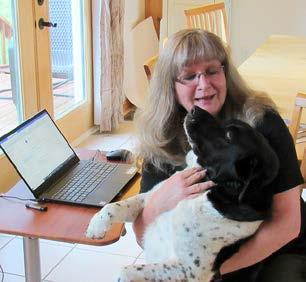
100 | UncagedBooks.com
My pet is Ralph, a thirteen-year-old Siamese cat we adopted from the local animal shelter when he was ten. He is a smart, sassy, opinionated cat who loves treats and is a true cuddle bug. He was quite shy when he came to live with us, having spent time on the streets. He still likes to eat after we go to bed and patrol the house while we sleep. Because we live in the desert, he is an indoor cat. He is my writing companion, often napping right next to me. My husband and I love him to pieces, and of course he knows it.

Pets and companions come in many shapes and sizes. From furry to feathered to hairy and scaley - there is a place for all of them. Authors have a special relationship with their pets - whether they remind them to get up and take a break or they inspire their writing. Meet the critters that share their love and devotion to Uncaged Feature Authors.

I have a thirteen-year-old rescue beagle named Gertie. She loves to howl and is such a snuggler. Her favorite treat are bananas, believe it or not. I may have created a bit of a diva by spoiling her, but I adopted her when she was eight years old, and because she was a senior, she had been at the adoption place for a long time. I wanted her to know she mattered, and someone loved her. So I CHRISTY & Gertie do spoil her outrageously. And you know what?

I don’t regret a single moment of that! him luck, but of course added, “You’re not taking MY dog.”
101Issue 67 | September/October 2022 |
AUTHORS AND THEIR PETS
Marnee Patriciabanks


Readers to Meet the Warrior Queen of Africa First book of au thor’s fantasy fiction series follows a warrior’s journey to her destiny Inspired by the Olympians and the actresses playing Xena and her best friend Gabrielle, author Marnee Patricia Banks takes old myths and revamps them into a new, thrilling tale in Book One of Patricia “Warrior Queen of Africa”. She invites readers to embark on a fascinating journey as they follow Patricia in this fun, beautiful, and ancient adventure in the far distant past. Patricia is the prophesied “Warrior Queen of Africa”. With a lineage of great Olympic goddess and demi-gods, Patricia was molded from Heavenly Father Himself to accomplish greatness in the ancient world. With the support from her friend and sister Brianne, the strength provided to her from her earthly mother Markeeta, Amazon Queen, and the bravery and fierceness of her companion, the flying lion Simba, Patricia sets out to become what she was destined to be. Her journey is an age-old tale of good vs. evil… and how good will always come out the victor in the end. Readers can join Patricia as she begins her adventures in this new fantasy-adventure book series. This book is available online and can be purchased at online bookstores; www.dorrancepublishing.com, www.amazon.com and www.barnesandnoble.com.
Showcase
102 | UncagedBooks.com
103Issue 67 | September/October 2022 | Upcoming Book Event!!! 2022 Frankfurt International Book Fair WHERE: Frankfurt, Germany WHEN: Oct 19, 2022 - Oct 23, 2022


Never Broken, book two, takes place two years later when Lisa finds a near-corpse of a stranger hiding in the backseat of her car. The man has no idea where he’d been, how long he’d been there or who had kept him captive. But one thing intrigues Lisa even more than his story: recent memories of a local woman who disappeared seven years earlier without a trace. The man takes Lisa deep into a world of sweatshops, modern-day slavery and white supremacy. She must keep the stranger hidden while she gathers enough evidence to turn the case over to city police or the FBI. At least three lives—her own, the stranger’s and missing woman’s—depend on it. What is the most difficult scene for you to write? What is the easiest?
Foster
Lori Duffy Foster is a former crime reporter who writes from the hills of Northern Pennsylvania. A DEAD MAN’S EYES, the first in her Lisa Jamison Mysteries Series, is a Shamus Award finalist and was an Agatha Award nominee. NEVER BROKEN, book 2 in the series, released in April. Her debut thriller, NEVER LET GO, releases in December from Level Best Books. Lori is a member of Mystery Writers of America, Sisters in Crime, The Historical Novel Society, International Thriller Writers, Private Eye Writers of America and Pennwriters. Uncaged welcomes Lori Duffy Foster
Lori Duffy
Welcome to Uncaged! Your latest release is the second book in The Lisa Jamison Mystery series, Never Broken. Can you tell readers more about this series and the books? Thanks for having me here and for giving me this Theopportunity!protagonist
of my series, Lisa Jamison, is a newspaper reporter in Central New York who got pregnant at fifteen and landed in foster care after a witnessing a tragic incident. With the help of her foster parents, she kept the baby and put herself though college, but she lost contact with the baby’s father before her child was born. Lisa’s biological parents chose drugs over their daughter, never even trying to find her after she ran away.
From a craft perspective, the middle of the book is always hardest for me. I have to keep up the pace and keep readers intrigued while also holding back on the resolution. I am a fast writer, eager to get to the end. So, restraint can be a bit painful for me. The
A Dead Man’s Eyes, book one in the series, takes place sixteen years later. Lisa’s next assignment is the murder of her ex-boyfriend, father to her daughter Bridget. The cops call it a drug killing, but Lisa doesn’t believe it. She ignores warnings from her medical-examiner friend. She fails to heed barely veiled threats from the sheriff of a neighboring county. Instead, she risks her life and the lives of her daughter and their closest friend on a dangerous quest for answers.
105Issue 67 | September/October 2022 |
beginning and the end are always the easiest. Emotionally, the scenes in Never Broken in which Saul discusses his captivity were difficult. I can’t imagine having all those years of my life stolen from me, just gone. The suffering and inhumanity Saul endures might seem implausible today, but slavery isn’t a crime of the past. There are more slaves in the world today than there were in any period of recorded history, more than 40 million. Human trafficking is more profitable than the drug trade. We absolutely must open our eyes to it if ever we want it to end.
Do you have a favorite character you’ve written? Has there been a character that’s been hard to write about? That’s a toss-up. I love both Saul, from Never Broken, and Dorothy, Lisa’s best friend and former live-in nanny to her daughter, who is both books.
Both are people I would be fortunate to have in my own life. In thinking about it more, I now realize that both Saul and Dorothy have artistic souls and a kind of deep inner strength that comes with surviving and thriving. Maybe that’s what I love about them.

| FEATUrE AUTHOr |
I usually try to draw from some important reference or concept in the book. A Dead Man’s Eyes was initially entitled Invisible Ink, a reference to the unseeable line we draw between ourselves and evil to convince ourselves that we have not crossed that line, but my former agent talked me out of it. She said it didn’t feel like a mystery and she was right. The new title came from Lisa’s insistence on seeing her ex-boyfriend’s body. The viewing convinces Lisa the corpse is Marty because she sees her daughter in his eyes. The title for Never Broken was easy. Saul’s captives insist they “broke” him, that they took from him all
How do you come up with the title to your books?
Readers are the best! I would like to say “Thank you,” for being always being so kind and supportive, and for reading, recommending and, often, reviewing my books. I feel a strong connection to readers in ways I did not expect. It’s
107Issue 67 | September/October 2022 | that made him human. They didn’t. It is clear from the beginning of the novel that Saul was never broken. If anything, his experiences in captivity made him stronger and more deeply human.
What are some things you like to do to relax when you aren’t writing or working?
I’ve run six marathons, each either below or a few minutes above four hours. You would not guess that to see me now! Which comes first, the plot or the characters in the planning stages? The concept for the plot always comes first for me, the truth that I am eager to explore. After that, the plot and the characters tend to grow together, each influencing the other. I usually have a vague idea of the ending, but that changes throughout the writing process. I have a thriller releasing December 20, Never Let Go. The ending for that novel took totally by surprise.
I don’t have a lot of down time between work, my books and our kids, but when I do, I love to read, hike, take photos, pick berries, garden and explore new cities and places with the kids. My husband bought me a paddle board for my birthday. I’ve only had time to use it once this summer, but I hope to spend more time on it as our two youngest become more independent. We
live on 151 acres with a patch of forest and a creek beside the house. My husband developed those woods into an outdoor entertaining space with a fire pit, a treehouse, a conversation deck and a largescreen TV. I enjoy spending time out there with family and friends, too. If you could have one all-year season, which would it be and why? That’s a tough one. I love the temperatures of both spring and fall in Northern Pennsylvania, but I suppose spring is my favorite because spring is full of discoveries, rebirth and renewal. Every day, I find something new on my hikes—new plant life, new birds, new animals. I also love a good spring thunderstorm. As a child growing up in the Adirondack Mountains of New York State, I associated the arrival of spring with the gradual exposure of concrete on the village sidewalks as the hard-pack snow retreated. That was such an exciting time for me. It meant the verge of summer, which was a blast with so many lakes and rivers to swim in. I still get excited by the sight and scent of melting snow and the feel of spring air on my skin.

What behind-the-scenes tidbit in your life would probably surprise your readers the most?
Do you prefer ebooks, audiobooks or physical books? Are you reading anything now? I prefer physical books, but I appreciate audiobooks and ebooks as well. I usually have one of each going—a physical book to read in the house, an ebook to read on the go and an audiobook for the car. Right now, I am reading The Silent Patient by Alex Michaelides in paperback and Deadly Intent by Laraine Stephens on my Kindle. I am listening to a book about the history of the Adirondack Park Agency in my car. What would you like to say to fans, and where can they follow you?
| LOrI DUFFy FOSTEr |
Lisa promised her teenage daughter she would stay away from the dangerous stories ever since her job had nearly gotten them both killed two years before. But she no longer has a choice. She must keep the stranger hidden while she gathers enough evidence to turn the case over to city police or the FBI. At least three lives—her own, the stranger’s and Chandra’s— depend on it.
A split-second decision to help the man takes Lisa on a race against time. His captors want him back, there is evidence someone on the police force might be involved and the man knows that if he were recaptured, they would torture him until he revealed the names of the two people who helped him escape: Lisa Jamison and Chandra Bower.
Stay Connected Enjoy an excerpt from Never Broken
108 | UncagedBooks.com a lot of fun to experience that. I am most active on Facebook at Lori Duffy Foster Author, but I also have a monthly newsletter. A link for subscribing to the newsletter pops up when visitors arrive at my website, www.loriduffyfoster.com.
Never Broken Lori Duffy Foster Mystery
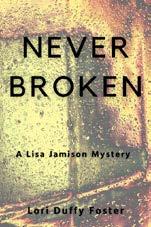
The near corpse of a stranger had no idea where he’d been, how long he’d been there or who had kept him captive. But one thing intrigued journalist Lisa Jamison even more than his story: recent memories of a woman named Chandra Bower. Seven years had passed since Chandra disappeared from Seneca Springs without a trace. Police investigators still compared DNA records whenever an unidentified body appeared, hoping to at least bring her family closure. Lisa still chased down leads from desperate family and friends, being careful to hide her investigations from an editor who thought she’d become obsessed with a woman who was clearly dead. But this man had just seen her, sewing designer clothes in a dark, filthy basement with about twenty other men and women under horrifically inhumane conditions. And the sweatshop workers all had one thing in common: All were people of color.
| FEATUrE AUTHOr |
Excerpt Lisa hadn’t bothered to lock her black Toyota Camry, the same car she’d driven for the past six years. One look at the odometer and even the dumbest of criminals would choose to walk instead. Already, it had one hundred and sixty thousand miles on it from her drives all over the region for interviews and breaking news, and it was full of discarded food wrappers, old newspapers, and ponytail holders in case she needed a spare. She was determined to at least clean it before the summer’s end, though it seemed that was a resolution that kept rolling over from year to year. Still, she wasn’t surprised when she noticed the back passengerside door was slightly ajar. She’d left a handful of change on the console, more than a dollar, probably. To desperate addicts, every penny counted, and there were probably more than a few people squatting in the old factory buildings here. She slowed her pace as she approached her car but could see no one inside. She knew better than to catch a drug addict in the act. Addicts could summon amazing strength when their weakened bodies were desperate for more. Lisa steeled herself for the mess she might find—slashed seats, an empty glove compartment, radio wires bulging from the dashboard—and pulled the door open. Then she screamed, dropping her notebook as she raised her hands to her mouth. On the floor was a man—small, curled up and filthy. She leaned in for a better look and, for a moment, she
109Issue 67 | September/October 2022 | thought he was dead. His fingers were deformed and covered with bloody, swollen gashes. His lips were blistered and dry. His cheek bones protruded from his dark skin. He was thin and drawn. Then he looked at her with dull, pleading eyes and put a finger to his lips, a movement that seemed to drain his last bit of energy.
| LOrI DUFFy FOSTEr |
“Not a good idea for a lady like you to be hanging out Thehere.”driver smirked. It was the kind of smirk that told her he was used to getting his way, especially with women. She was tempted to show him just how effective her daily runs, her pushups and her kickboxing routine were against men like him. She was nearly killed covering a story two years ago— twice. She wasn’t going to let that happened again, and she would have loved to practice her own moves on him. Instead, she pulled herself together and gave him the flirtatious smile he was looking for. Better to play the game. “I’m a reporter. I was here for a press conference, but I’m leaving now,” she said. “Maybe you’d better get out of here, too. That’s a nice car you’re “Idriving.”would, but I’m looking for a man,” he said, his expression more serious now. “Maybe you’ve seen him. He escaped from Oakland, the psychiatric hospital, and might have gotten into a fight with some local guys. He’s probably beaten up pretty bad. He stopped taking his meds and he’s dangerous. You know, they’re unpredictable when they do that. He’s a Black guy. Not too tall. Skinny. The last we heard, he was wandering around here.” Liar, Lisa thought. She’d done enough time on the crime beat to know that if the guy hiding in her car really did escape and really was dangerous, there’d be a patrol car or two looking for him as well. She hadn’t seen any cops in the neighborhood except those who were assigned to the press conference, and they had left the second it ended. “I haven’t seen him and, like I said, I’m leaving now.” Lisa climbed into her car, turned the key, and started the engine. The stowaway’s stench almost drove her back out—a mix of sweat, blood and rot. She worked hard to keep a straight face and look forward, but the sedan did not move. This driver was not going to leave until she did. So, she did. Lisa left Iron City Heights with the interview in her notebook and a near-corpse in her back seat.
Lisa was so shaken she hadn’t even noticed the gold sedan that had come around the corner and was now stopped before her, or the driver who had rolled down the window and was asking whether she was okay. His shouts grew louder, and Lisa faintly heard them through her shock, and then pulled herself out of it. The man on her car floor was trembling now. She saw then what was going on and she should have said, no—that she was not okay. She should have done whatever was necessary to get that man out of her car. But he was pitiful, he was pleading, and he was sick, and the man in the sedan, who had gotten out and was standing inside his open door, was too well-dressed in his expensive golf shirt and silken slacks. For whatever reason, the man hiding in her Camry was afraid of the other guy. His fear should have persuaded Lisa to stay out of it, but she couldn’t do that to him. She would always wonder, always fear, what had become of him, and living with that guilt would be far worse than anything else she could imagine. “I’m sorry,” Lisa said, trying to still her shaking hands. She silently vowed to call an ambulance and the police as soon as the driver disappeared. “There was a bee in my car and I’m allergic. I freaked out for a second, but it’s gone. I’m fine.” Lisa slammed the door shut, picked up her notebook and walked around to the driver’s side. She expected the man in the sedan to keep moving, to drive away. Instead, he got back in his car, leaned out his window and looked Lisa up and down. His hand rested on the window frame, and he drummed his fingers as he watched her, tapping a thick, gold ring on the metal. She was suddenly conscious of the fact that she was almost as overdressed for the neighborhood as he was even though she wore jeans and had pulled her long, brown hair into a simple ponytail. Her jeans were too expensive, and her hair was too smooth. Her boots were Italian.
Author Dave Spiering offers readers an intriguing read to challenge what they might think if the powerbrokers and intellectuals of today could actually go back in time and rewrite history. In Seven Score And Four, readers can see for themselves how these modernists might want history to be rewritten, and what they want people to believe, regardless of it being true or not. They will do anything to ensure that their distortions become reality, even if it means going back in time to change what really Whathappened.would happen if someone wrote an autobiography and someone else came along and completely changed it? What if they told everyone that their edited version was the one everyone wanted to believe? For half a century, the progressive, secular modernists have been doing just that with history, mirroring their new religious and philosophical mindset, their standard of values have been superimposed on the past. The old ideas of truth, morality, and spiritual destiny have been erased. Now, readers can follow the adventurers as they go back in time and rewrite history to change the past. With careful attention to the actual lives of those in the past, Seven Score and Four paints a picture of what may have happened should humanity have time-traveling capabilities. This book is available online and can be purchased at online bookstores.
HistoryTravelTime-toChangeAsEveryoneKnowsIt
110 | UncagedBooks.com Showcase Dave spiering
Author weaves a riveting fiction that will keep readers at the edge of their seats

111Issue 67 | September/October 2022 | Upcoming Book Event!!! 2022 Frankfurt International Book Fair WHERE: Frankfurt, Germany WHEN: Oct 19, 2022 - Oct 23, 2022

Jaiden Calhoun is sixteen years old and just trying to find his thing. He hopes to help many people, mostly teens, find the strength to find help. He encourages being open with loved ones and wanted to show that just because people can’t see something, doesn’t mean a struggle isn’t happening. The author hopes that this book will show people that they aren’t alone.
A: Personally, the hardest thing about being an author would have to be the constant looking for motivation and ideas.
A: The best thing about being an author would probably have to be the fact that you get to make and control your own fantasy or ideas without the pressure of pleasing others. What book changed your life?
A: For me I never had a specific book that changed my life, I read too frequently to have just one. What inspired you to write this book?
calhoun
Sneak Peek
The Little Things

He still wants to live but everything has become unbearable so he thought of jumping off a cliff in a remote spot. What he was not expecting is a Mystery Boy who appeared just in time, before he was about to jump. He didn’t know who the mystery boy is, but somehow, he’s saved by him. They only meet at night, the cliff becoming their spot. Who is this Mystery Boy and will Jamison ever get to jump?
AUTHOR INTERVIEW
Jaiden
112 | UncagedBooks.com
What is the best thing about being an author?
Jaiden Calhoun Young Adult Fiction Follow Jamison, a suicidal teen, who is physically abused by his father, incessantlymother,manipulatedemotionallybyhisandbulliedinschool.
What’s the hardest thing about being an author?
A: The take home lesion would be that no matter how hard you try, no matter how good things seem to be going, there is always a chance that it can change in the blink of an eye. So, you have to learn to enjoy the little things. What books are currently in your to be read pile?
A: I would describe my style of writing as informative, descriptive, and, to some, inspirational. Do you feel that writing is an ingrained process or just something that flows naturally?
How would you describe your style of writing to someone that has never read your work?
A: In this moment I don’t have any, I usually just pick up a book at random and hope that I like it. Anything you would like to say to your readers and fans?
A: I would like to say that no matter what you are someone else is going through, its ok to take things slow and simply enjoy the little pleasures in life.
There are so many things in this world that have no meaning that it is almost impossible to not want to indulge in them all, and honestly, I think that’s where life truly begins.

113Issue 67 | September/October 2022 |
A: I believe writing can be both a process and something that flows naturally, it all depends on the type of book you wish to write. For me personally, it flew more naturally, it was something that allowed my brain to go on autopilot and simply say what it wanted to. What is the take home lesson you wish your readers will learn after reading this book?
A: Many things inspired me to write this book, one being that every book that I have read that contained suicide ended the same way and I wanted to show that, suicide isn’t something to romanticize.
114 | UncagedBooks.com Waves of Love Linda PoetryDow Every day, we all surf through the Waves of Love and inhadstandbeetrythatLinapoet-authorDowhopeswiththispo-book,you’llabletounder-whatshegonethroughlife.Fromgrief to heartbreak to everything else, these are poems on the different waves of emotions that we all feel at some point in our lives. The verses speak of a gamut of emotions, mostly about losing the ones we love, the process of grieving and getting through the pain, the heartbreaks we face daily, the beauty of nature and how blessed we are to experience such beauty. 3-Page Special Promo Lina dow EXCERPTSFEELINGS(PAGE2) Dreams come true Especially when it comes To you and loving you Love is forever Love is tough but Love also hurts I never loved anyone Like you I don’t want Another lover but you I gave you my heart even Though you didn’t I don’t want to let you go But I won’t beg you to stay As long as I live as long as I breath with every heartbeat I’ll always need you near me DESCRIPTION(PAGE3)


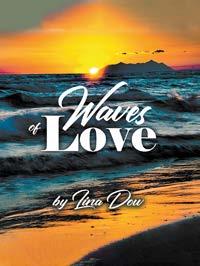
There is this question i ask Myself all the time how can Something so scary be So beautiful At every end of a thunderstorm
No matter what they’re Always together even though They are opposite maybe That’s why they work so well With each other
Thunderstorms never leave Lightning behind just like the Moon and the sun
Love is just a word like any others I keep wondering does true love Really exist is it really meant For me, Though hearts get broken Seems that love still exist
There tends to be beauty left Behind the storm
Maybe I been hurt too many Times that I stopped believing That love is for me, I keep Searching in every soul scared That I might get hurt again

REASONS(PAGE8)
115Issue 67 | September/October 2022 |
I believe things happen for A reason sometimes I wish I knew what the reason was I should be happy with what I have things don’t change I need To accept that then I wouldn’t Have to feel alone too Many nights.
You have to get out of Your storm to find beauty In your life maybe i found My answer to my question
LINADOW.COM
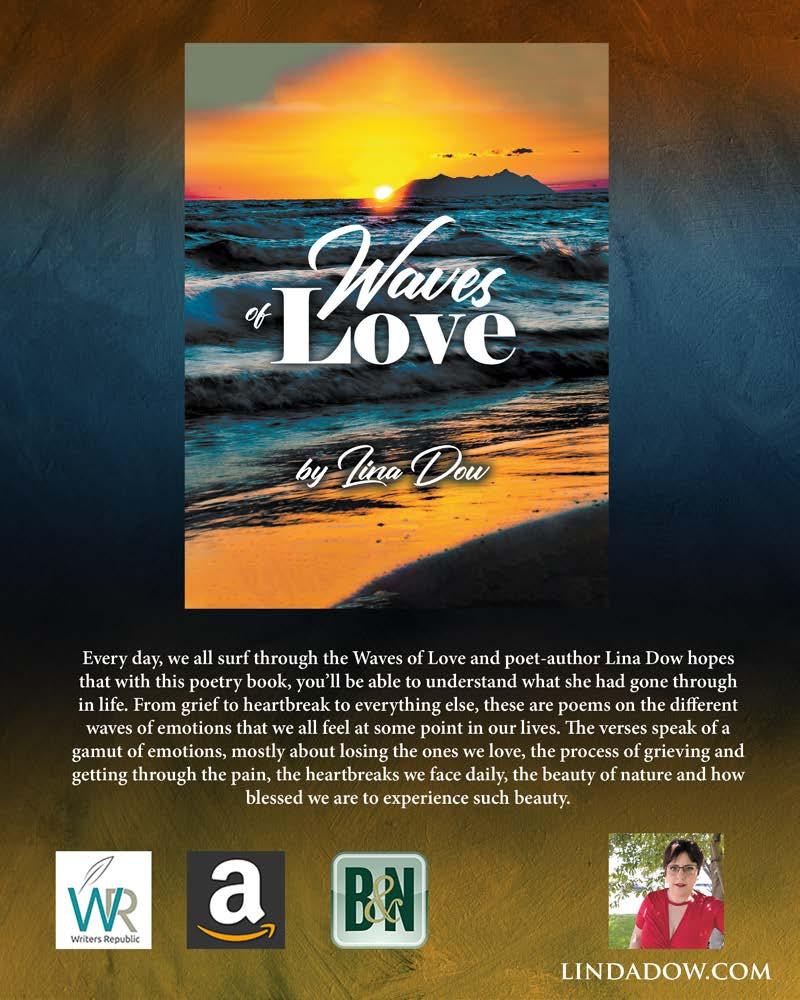

118 | UncagedBooks.com
Michelle copeland
Showcase
When Life’s Unexpected Blessings Happen Author weaves a story of how life will turn out as it’s supposed to be, even if it’s not what one expected This may be a fictional novel, but author Michelle Copeland took this from her own life. Life’s Unexpected Blessings is about life in general --- its ups and downs --- and follows how the main character has grown and is still Readersgrowing. are invited to accompany a young woman, Sheila, who is questioning her life at the age of 35, because her life has not turned out like she planned or expected. She lost her dad a few years ago to Parkinson’s and Alzheimer’s disease. Her sister has her own health issues too. Soon she loses her sister as well. It’s now just her mom and her. A new life chapter begins for Sheila. Now she works at an art gallery where her art is also being shown. She meets a young man, James, who has also faced some of the same challenges. Their faith in God got them through those challenges. Sheila soon inherits the gallery from the owner after she dies. She and James also inherits her estate. Love blossoms between the two of them. She wasn’t expecting any of this stuff to happen, but maybe this is how it’s supposed to be. Maybe her life turned out better than she expected. Maybe this is what God had planned all along. All she knows is that she is going to be grateful for and enjoy the special people in her life and this journey God is putting her on. The author hopes that this story will have an impact to readers, especially those who are experiencing the same feelings and Thisthoughts.book is available online and can be purchased at online bookstores.
Michelle Copeland never expected to become an author. She wanted to be many things when she was younger, but she decided she wanted to go into medicine. She attended UF and majored in pre-medicine, more specifically, microbiology. After college, she tried to get into medical school. She didn’t get in, but people say that one never gets in on their first try. She learned phlebotomy and ECG after graduating college in hopes of improving her chances of being hired, with no luck. She put that dream aside to help her family. However, she then remembered when she was a young girl that she loved to draw and sketch, so she started painting. One day, she decided to write a book. One should never say never.

About the Author
119Issue 67 | September/October 2022 |

Rienzi testimonial Guest column by Kristina Rienzi

If you’ve read my bio, you’ll get a pretty-good sense of who I am even if you don’t know me and you’ve never read my books. However, there’s more to an author than her writing life summed up in one paragraph. I’m here to let you in on the details I left out.
If you’ve read my thrillers, but never met me in real life, you’d likely believe that I’m an introvert. You’d also probably believe that something dark lurks inside of me. Then, you’d meet me in person and your head might just spin around. We’d talk and you’d see that I’m bubbly, outgoing, positive, and intently engaged in our conversation. I’d look like any other extrovert you’d ever seen. As we chatted, you’d hear me talk about dreaming big, never giving up, and likely glean some inspirational message or positive affirmation from our conversaDarkness?tion. Not so much. Two different people, yes. Nevertheless, we’re one in the same. I assure you, the motivational-speakerpersonality you meet in real life IS the real me. So is the introverted, dark girl. We go hand in hand. Not surprising for a Gemini. When you add writing to the mix, it makes for interesting stories. Confusing? Sure. That’s because introversion isn’t what it seems on the surface. It’s not about being quiet vs. loud. Social vs. antisocial. Friendly vs. shy. It’s about where introverts get their energy from, and the answer is, ourselves. Extroverts, on the other hand, get their energy from other people.
It’s probably why most writers are introverts at heart, even if they feel extroverted in social situations. However, introverts feed off being alone. We’re energized when the door is closed, and only our thoughts and our story (plus some coffee!) remain in the room. It feeds our souls so much that after we write as many words as our fingers can speedily type, we still have the wherewithal to rally with friends. That is, until we inevitably collapse from social interaction. Because as introverts, we lose our energy around people. We give every ounce of what we have to others until we’re depleted en tirely. Therefore, after a conference or a book signing, you’ll find me in my usual restorative place---on the couch binging Netflix, wine in hand,…zombified. For my darkness obsession, it’s real. Sadly, no matter how hard I try to be a kind person and bring those around me up, darkness lives in our world. Instead of confront ing it head on and trying to change the unchangeable, I write dark stories where, as the author, I’m in control. Through my stories, I can face my fears and grow. Pow erful Truthstuff.betold, darkness has always intrigued me. It in spired my advanced psychology degree, and then my coaching certification. I wanted to learn why people did the things they did, and what motivated them to change, or not. I hope my dark stories inspire others to face their fears and embrace the unknown so they can live their best life--happier, stronger, and more in tune with who they are and what they want. When my characters overcome ob stacles, I want my readers to feel empowered to do the Because,same. as Martin Luther King, Jr. said, “Darkness cannot drive out darkness, only light can do that.”
GUEST COLUMN

Rienzi Testimonial by Kristina Rienzi
120 | UncagedBooks.com
Publishedwww.uncagedbooks.comReviewswithPermissionKristinaRienziis

a Jersey
©Copyright 2022 Kristina Rienzi Book
Shore-based new adult thriller author, certified professional coach, and the former president of Sisters in Crime-Central Jersey. An INFJ who dreams beyond big, Kristina encourages others (and herself) to em brace the unknown through her stories. When she’s not writing or drinking wine, Kristina is spoiling her baby girl, watching Lifetime and Hallmark, singing (and dancing) to Yacht Rock Radio, or rooting for the WVU Mountaineers. She believes in all things paranormal, a closet full of designer bags, the Law of Attraction, aliens, angels, and the value of a graduate degree in psychology. Her debut audiobook, Among Us was featured on Audible’s ACX University and is an Audible Editors Select pick. Visit her online at KristinaRienzi.com

121Issue 67 | September/October 2022 |
I’m grateful for all the readers who trust me to pull them through the darkness and into the light. They’re why this introvert writes at all. If you haven’t read my books, I hope my words intrigued you to come over to the intro verted, dark side!
for Uncaged
122 | UncagedBooks.com
Marnee Patricia banks
The Warrior Queen of Africa is Back Author’s sequel to her fantasy fiction series is equally tion-packedac-

Coming from the success of her first book, author Marnee Patricia Banks is back with the sequel to Patricia “Warrior Queen of Africa”. The action, adventure and drama are equally intriguing and absorbing in Book Two with the Two Mighty Queens ruling the land. Readers can continue this fantasy journey with the well-loved characters from the first book as Patricia embarks on another adventure in this second book of the series. Patsy and Brie have returned in this thrill ing sequel. Now queens in their own right, they take guidance and wisdom from the great Goddess Athena in making a difference for the greater good in their ancient world.
Showcase
After a terrible tragedy, Patsy returns to her home from Africa with Sasha, her newly adopted daughter, at her side. With the aide of Brie, Athena, Simba, and Sasha, Patsy learns to grieve and fight the darkness inside her, and to love again.
Filled with heroes and villains, time travel, romance, adventure, and family, Two Mighty Queens is a wild ride through the myths and legends of old, as seen in an entirely new Thislight.book is available online and can be pur chased at online bookstores.
123Issue 67 | September/October 2022 | Upcoming Book Event!!! 2022 Frankfurt International Book Fair WHERE: Frankfurt, Germany WHEN: Oct 19, 2022 - Oct 23, 2022

Christy Cooper-Burnett Alan Smale

feature authors L.A. McGinnis dark fantasy | scifi | time travel


What is the easiest? I always write the sex scenes last, because I want to get the emotional part of the scenes to resonate with readers. I write reverse harem, so there are usually three or four spicy scenes in every book.
What is the most difficult scene for you to write?
Welcome to Uncaged! You’ve been releasing two different series, both Vampire Clan series, the latest being the Blackstone Vampire Clan. Can you tell us more about the series? Are the Vampire Clan series related?
Do you have a favorite character you’ve written? Has there been a character that’s been hard to write about?
L.A. mcginnis
Fueled by black coffee, ice cream and bad nineties music, L.A. McGinnis spends her days writing bestselling steamy fantasies filled with damaged heroes who long to be whole and smart, authentic heroines. A life-long fascination with storytelling inspired her to weave these contemporary tales of legendary fated mates where the princess never needs rescuing, but sometimes the hero does.
I have a special place in my heart for Logan. She’s been through so much, and spent most of her life alone, so I really empathize with her struggle to build her own found family and find happiness with her guys.
Uncaged welcomes L.A. McGinnis
www.lamcginnis.com
I am so excited about these new series! Both related series feature similar worldbuilding: the Darkfell Vam pire series is set in New Orleans, while the Blackstone Vampire Clan books are set in Charleston, SC. I modeled the Darkfell series after Game of Thrones, so you have a strong feudal structure, with royal houses, a royal court, and strict hierarchy headed by a vampire queen/king. Seraphina was raised human, but comes into her power after being captured by the current Darkfell king, who plans to kill her to preserve his un disputed reign. While she’s being held captive, Luthor and Cyrus come to her aid, and together they defeat Viktor and retake the kingdom. The Blackstone series has more modern elements. Logan is a bound witch who is drawn into the Black stone Clan in order for the current king to break a five hundred year old curse, and maintain his hold over his denizens. She has to master her magic in order to defeat him, and claim her place within the clan. She and Constantine Darke have an enemies-tolovers relationship, while she and Robert start off as friends, book one ends up with the three of them together, in a HEA.
127Issue 67 | September/October 2022 |
I’m a full time glass artist! I actually began writing before I started making glass, but the glass took off before my writing did! I’ve been lucky to find suc cess in my artist career, but I’m hoping to be a full time author by the end of 2022.
What are some things you like to do to relax when you aren’t writing or working?
| FEATUrE AUTHOr |
How do you come up with the title to your books?
Which comes first, the plot or the characters in the planning stages? After years of pantsing my way through my books, I have recently became a plotter. I lay every chapter out before I start, and I make up character sheets for every main character before I start writing. I do go off the rails at least once in every book, but that’s part of the fun.
What behind-the-scenes tidbit in your life would probably surprise your readers the most?
I’m fortunate enough to live at the edge of a national park, so I try to find time every week to hike, or take a bike ride.
For the Darkfell series, I didn’t have a clear plan, so each book is named using words I thought sounded “vampire-ey”, haha. For the Blackstone series, I kept the titles very similar, but the second part of the title is a hint to the main theme in each book.

If you could have one all-year season, which would it be and why? That’s a hard question. I look forward to spring the most (especially after a long Ohio winter) but I love fall, so I suppose I’ll choose hot chocolate and bonfires over chocolate bunnies and tulips
A virgin queen determined to choose her own fate. A scarred warrior marked by Anddarkness.theking who will kill them both to keep the Ithrone.wasplucked from my or dinary, ho-hum life and plunked into a nightmare. Abducted by a corrupt vampire king, I’ve gone from night classes to navigating the dangerous world of the Darkfell Clan, where the courts are a maze of deception, you test your wine before you drink it and never, ever sit with your back to a Theydoor. say I’m the strongest queen in a thousand years. Destined to overthrow the king and take back my kingdom. I don’t know about all that, but I know I can’t face him alone. He commands a legion of monsters, but I’m build ing my own army, and though my bonded warriors are few, together, we’ll defeat Viktor. Or die trying. I might be a queen, but this isn’t like any other fairytale.
I’m really bad, I buy both the hardback for my book shelves, and the Kindle to read. Ebooks are easier, since I have carpal tunnel, and physical books are usually heavy. I also like to bookmark passages on my Kindle, which is a nice reference for later! What would you like to say to fans, and where can they follow you?
Excerpt Chapter 39 LazarusLogan was a malevolent slug, a carbuncle on an ass’s “Thanksass. for sending Temperance to collect me. She’s such a good little minion. You must be so proud.” I looked over and smirked. I was in a con crete room, no windows, no door that I could see. Stay Connected
Enjoy an excerpt from: Bad Deal for America Night Marked L.A. DarkMcGinnisFantasy

I’d like to let readers know how much I appreciate the investment they make in a book or a series. It seems like every year we have less and less free time, and the fact that someone uses those precious hours to read one of my books, means the world to me.
Do you prefer ebooks, audiobooks or physical books? Are you reading anything now?
129Issue 67 | September/October 2022 | | L.A. McGINNIS |
Two days. My birthday. The solstice. His voice took on the lazy cadence of an executioner. “Two days, and you’ll be flayed alive, your magic sucked out of you like water through a straw. Your blood is precious, little witch, but only on a certain night, and only for one purpose.” I forced myself to focus, to memorize every word. If I got out of here— When I got out of here, I had to remember what he said, so Rob and Con could figure out who was pull ing this asshole’s strings. “Still, I guess that means you have to keep me alive for a while longer.” His hand was large enough it encompassed my entire head. His claws penetrated my forehead, the nape of my neck. They sank in deeper, and I started panting. “Alive only means breathing, little witch.” Warm blood trickled down my cheek. He licked it off. His breath was like rotting corpses. I gagged, despite the pain. “Alive doesn’t mean anything except your heart beats and your lungs draw air.” He swept his tongue over my entire face, licking and licking, digging his
130 | UncagedBooks.com
Usually, I had a plan for everything. Usually, my plans had plans, all possible contin gencies accounted for. Right now, I had nothing. I had a note in my pocket and unusable magic in my veins, which sounded like a bad song title. I might be helpless, and I might not know how to use my magic, but Temperance was wrong about one thing: I was both powerful and smart, which I’d prove when I got free of this horrid magic of Lazarushers. ran that nail down my face, and it sliced my skin like a scalpel. The smell of blood saturat ed the air around us, and his eyes flared wide. His tongue flicked out like a snake’s, except snakes had more personality.
“We’ve only met twice, and I’m hearing the same sto ry again. I take it you’re a one-hit wonder, and have nothing else to brag about?”
Temperance’s shadows wound around my throat, clamping down as Lazarus glided closer. She squeezed so tight I thought my eyes might burst out of my face. “She is, isn’t she?” His jet-black gaze devoured me, and a claw pushed out of the end of his fin ger. I couldn’t take my eyes off that curved black sliver, narrowing to a needle-sharp point.
“You smell delicious.” His voice thickened as he licked the point of his red-stained claw. “You taste even better. Shame I can’t keep you as a pet.”
The air thickened in the coffin-like room. “I should kill you right now for your insolence.” He circled closer, rage pouring off him in sheets. He stank like the bottom of a sewer. “Except you won’t.” He stopped directly behind me. “You need me alive, remember? I’ll bet you forgot you said that the last time you were yammering on about how fucking awesome you were.” He scraped his claws over my scalp, fisted my hair and dragged me backward. His hot breath scalded my bloody cheek. “You are a stupid little human, playing at being a witch. Talk all you want. I have survived a millennium; you won’t live another two more days.”
“Did you know I wiped out the witch covens of Britannia?” Lazarus drawled. “All of them.” His gaze drifted over to Temperance, a mocking smile creasing his gaunt face. “With a little help, of course, from a certain traitorous witch. I do enjoy killing your kind. There have been times…” Apparently, the only thing I was in danger of was being bored to death. If only I could get free of
|
FEATUrE AUTHOr |
Temperance chuckled, and I hated her a little “Whymore. am I here?”
Temperance’s shadows. If only I could conjure a fire bolt. I’d send it straight through this asshole’s eye socket, just like I had the revenant.
131Issue 66 | July/August 2022 | very stimulating fling, which I have no intention of making permanent.” I was playing a dangerous game, with deadly opponents, but if I lost… “You told me they were mated.” Lazarus stalked to ward Temperance, and some of the magic imprison ing me flew across the room to form a barrier between them. I sucked in my first deep breath in an hour. “They are.” Her eyes flew over to me, and they were filled with doubt. “I smelled it… Trust me.” “That’s the last thing I’d ever do…witch.” “They will come.” Temperance sounded surer this time. “And when they do, the wards will sap their powers, the deeper into the Crypt they descend. By the time they get here”—she waved her hand at the plain gray walls—“they’ll be nearly helpless. You can kill Darke.” Her eyes flicked to mine. “But I get “YouLockhart.”canhave him,” Lazarus said. “If they survive the revenants, of course.” | L.A. McGINNIS | claws in deeper. I struggled against Temperance’s magic, fought to get away from this crushing grip on my head, from the blood streaming down my face and the monster feasting on it. “And right now, you only have to be alive enough to bait a trap. To draw in your protectors, so we can kill Somewherethem.” outside of the pain I heard Temperance’s high laughter, smelled the rank, animal scent of La Theyzarus.were using me to draw out Con and Robert. They’re setting a trap for them. My pain turned into fear, coating my insides with ice. I should have stayed at Aviemore. I should have made my stand there, where I had backup. Where I had a slight advantage, since I knew the house like the back of my hand. Here…I didn’t even know where this was, a closedoff room with no way inside. “They won’t fall for your pathetic little sham.” I tried to blink away the rivulets of blood, escape the black swirling magic that kept me pinned down. “You’ve already lost—you just don’t know it yet.”
“You don’t know what you’re talking about.” I snort ed. “You seriously think I’m mate material? Trust me, this is just a fling.” I winked at Temperance. “A
“The last time a witch mated a vampire was two thousand years ago. That pairing nearly destroyed our kind. That will not happen again. That’s why it’s my mission to exterminate your kind from the earth. Abominations, all of you,” Lazarus spat, his claws retracting, slipping out of my flesh. “They will come.” He pushed his stained fingers into his mouth, like he couldn’t get enough. “They will come be cause they’ve mated you, and they will not be able to resist two thousand years of instinct.”

A Look Inside the ArchieMan Brown Poetry Inspirational poetry for the heart and soul, this book of poems gives readers some moments of hope, in spiration and realiza tions. From poet-au thor Archie Brown comes a collection of poems that date back from 1985 to the present. He invites readers to take A Look Inside the Man through the verses and words of his poems that range from Christian poetry to poetry about life. He hopes to inspire readers of all ages as they go through their own life and faith journeys. Both heartwarming and heart-wrench ing, these poems will let readers think of their own emotions, experiences and realities.
Archie brown
It never comes except from that place with in Fifty days in the hospital taught me what happens when we lose our way
The storms of life rage though we pray for calmness
Archie Brown resides in Connecticut. He is a veteran of the US Navy where he served for 4 years.
This is when you know who your true friends are as the fog closes in on all sides They’re the ones who keep on yelling for you
BOOK EXCERPT pages 58-63

The ones who want you to survive So white are the wall in here They’re sterile Unreal are the rules in here They are a bunch of lies
S t e r i l e
132 | UncagedBooks.com 3-Page Special Promo


But the truth is to face our problems and know they’ll never go away And maybe we’ll be a little stronger when the storm comes another day
They’re sterile Unreal are the rules in here They are a bunch of lies So white are the walls in here like marrow No blood or consciousness to open up my eyes H o m e
From the time we’re born until the time we die we are searching for that right place in life
133Issue 67 | September/October 2022 |
We hope to find that place that we can call our own
‘Everything will be alright’ The doctors say You can overcome most anything if you know the game
A shelter from the shadows and the great unknown And our hearts yearn for friendship and for that safe haven Where we can be the ones we
They’re sterile Unreal are the rules in here They are a bunch of lies So white are the walls in here like marrow No blood or consciousness to open up my eyes
So white are the wall in here
The same storms will rage again from the ages of yesterday the same substance from my inner self that drives me so insane So white are the wall in here
So white are the walls in here like marrow No blood or consciousness to open up my eyes
Here I am again walking down the same road will i make the same choice again
Given what I’ve learned, can I say tomorrow that i am a different man
Someone will call my name No more living in a place of boundaries
Someone will call my name No more living in a place of boundaries
It will be so familiar what better place to be Than the home I’m longing for determinedly Take it from me I have been hoodwinked before mistaking acquaintance for what I thought was home
It will be so familiar what better place to be Than the home I’m longing for
It’s a disappointment jumping hurdles for those who take advantage of the homeward call It is no fault but my own for those mistakes
UncagedBooks.com
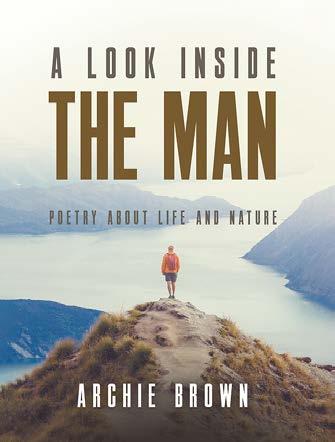
134 |
want to be I’ll know it when I find it
Surroundeddeterminedlybylovedones who see me as I truly am And long for us to be a family
I must use common sense just a little more I’ll know it when I find it

Connie Ann Lovell was born and raised in a conservative and idealistic rural town of Del ta, Utah. She knew she was blessed to grow up in this highly favorable condition. She thought the rest of her life would be like this also; but it was not. She married a good, smart and hardworking farm boy who was also her high school sweetheart. He was the love of her life. With her nursing degree and background in music, she was able to help put him through law school. She taught him to be an accomplished pianist and they had two children, who were handicapped. Sadly, after 45 years, their marriage ended. Many times, she has viewed her life through tears; however, she is also blessed to see fun, and even growth through her trials. It is because she has faith to believe there is a purpose in this life. This book shows a few snapshots of her story.
Connie Ann lovell
Fun, Uplifting Stories on Aging
Author’s interesting book unfolds unpredictably like aging does Fun and growth can be seen all along one’s path to oldness. It is equally adventurous and dangerous as climbing Mt. Everest; but it’s still fun and fulfilling nonetheless. That’s what author Connie Ann Lovell hopes to share with her Ob servations on Oldness, which is unique because it skips around to different stories and observations instead of chapters and Evenconnections.asachild,the author had a lot of interest and curiosity about aging. As she went through her middle-age years, the experiences continued to grow. They took on a life of their own. She saw humor and meaning all around her, and kept notes to remember details. In her old years, her stack of age happenings grew larger, and she felt a need to tell the many fun and uplifting stories to her family, so she turned it into her little book. What’s even more exciting is that her oldness has continued to give her more materials to Manywrite. readers will relate to her stories and be reminded of their own similar entertain ing times and enriching adventures. This book is available online and can be purchased at online bookstores.
136 | UncagedBooks.com Showcase
137Issue 67 | September/October 2022 |
Frankfurt, Germany WHEN: Oct 19, 2022 - Oct 23, 2022
Upcoming Book Event!!!

WHERE:
2022 Frankfurt International Book Fair
Ellie May, What Did You Do Today?
Harmony brantley
138 | UncagedBooks.com
The Cryptid Party

Children’s What do you think Ellie May, the cute little pink pig, does in a day? Does she have a full day or a lazy one? Come and see what Ellie May is up to today in author Harmony Brantley’s new children’s picture book, Ellie May, What Did You Do Today?. Follow Ellie May, the pig on a wild and wacky adventure, on what she did today. Join her as she eats, plays, runs, and so much more. It looks like it’s going to be a full and fun-filled day for Ellie May. This book’s for anyone who loves pet pigs.

Children’s Do you want to meet some new friends? No mat ter what they look like or who they are, friends are the ones who are with you whatever happens and whenever you need them. But it seems like a little girl is looking for her friends. Come and join her in The Cryptid Party. Help the brave girl find her friends so they can join her for a tea party. In this whimsical story that takes kids on a wild and wacky adventure to find well known Cryptids, au thor Harmony Brantley helps introduce children to the world of the illusive Cryptids.
3-Page Special Promo

AUTHOR INTERVIEW
The Snug Bed Bug

A: The books that my grandmother read to me when I was young really shaped my world and imagination to this day.
A: I absolutely loved doing the illustrations. I have always enjoyed drawing so being able to show off my art is so heartwarming. What book changed your life?
Children’s Will the young moth ever sleep? The little Moth needs help to be convinced to go to bed. Come and listen to a bed bug explaining to the young moth why it’s good to go to bed and sleep. Written and illustrated by Harmony Brantley, this whim sical story of a bed bug telling a young Moth the reasons to get snug in bed and have a good night’s rest. Both parents and children will enjoy the curious questions of The Snug Bed Bug.
A: Personally, the hardest part is the gram mar of writing. I have dyslexia so writing can be difficult. Having friends and family to help proofread is always the best too.
Join this little Viking as he prepares his oar and goes offshore to fish. But when his net is torn, he has to go back to shore where a surprise awaits him there. With fun lines and rhymes, and colorfully vibrant illustrations, author Harmony Brantley hopes to entertain young readers with this short story. Go along the adventure with The Little Viking Who Could Do More as he finishes his chore. Enjoy this wacky adventure of a Viking whose chore is to find a forever friend.

What is the best thing about being an author?
139Issue 67 | September/October 2022 |
The Little Viking Who Could Do More Children’s What can The Little Viking Who Could Do More do?
What’s the hardest thing about being an author?
A: Well for my book about Ellie May the pig. It is about my very own pet pig. As for the Viking and Cryptids that has just been an interest to me.
What inspired you to write this book?
A: That really depends on the topic. For children’s books, I try to do little rhythms to my stories. What is the take home lesson you wish your readers will learn after reading this book?
How would you describe your style of writing to someone that has never read your work?
Anything you would like to say to your readers and fans?
A: To give ideas to people to look for things that interest them or to adopt a pet pig for yourself.
What books are currently in your to be read pile?
A: The series “Extinction” by Nicholas Smith is what I am reading right now. It is an extreme contrast to what I write.
140 | UncagedBooks.com
A: Some say that my writing is adventurous and out-of-the-box. Do you feel that writing is an ingrained process or just something that flows naturally?
A: If you have a drive to draw or to tell stories, please make a book or a show, and share your work to the world!
www.tobiyaza.com


Alan Smale writes alternate history and hard science fiction. His novella of a Roman invasion of ancient America, “A Clash of Eagles”, won the Sidewise Award for Alternate Histo ry, and his novels, Clash of Eagles (2015), Eagle in Exile (2016), and Eagle and Empire (2017), are available from Del Rey. His Roman baseball collaboration with Rick Wilber, The Wandering Warriors, came out from WordFire Press (2020), and Hot Moon, an alternate-Apollo thriller set entirely on and around the Moon, was launched by CAEZIK SF & Fantasy in July 2022. Alan has also sold over forty stories to Asimov’s and other magazines and anthologies. alansmale.com
Apollo Rising won’t be one of those never-ending sagas. By the end of Book Three, my characters’ stories and the arc of the action will come to a close.
143Issue 67 | September/October 2022 |
And while they’re there, Columbia comes under attack from Soviet Soyuz spacecraft. It’s the world’s first space battle, with the retro technology of the era. Eventually, Vivian does get to the Moon’s surface, but not where and how she expected … and, well, matters go from bad to worse. Hot Moon is the gritty hard SF novel about the Apollo Program that I always wanted to write. I call it my technothriller with heart, because obviously the space technologies of the US and USSR play a criti cal part in the plot and the action, but it’s also very closely focused on my characters – Soviet cosmo nauts, as well as US astronauts. We get to see both points of view.
Sure! Hot Moon begins in lunar orbit, with Apollo 32 Commander Vivian Carter and her Lunar Module Pilot, Ellis Meyer, getting ready to descend to the surface for their mission of exploration in the Marius Hills. But first, they rendezvous with Columbia Station, a NASA Skylab in lunar orbit, to bring much-needed supplies.
Welcome to Uncaged! Can you tell us more about your newest scifi book, Hot Moon? This is the first in a series, do you have a plan on how many books will be in this series?
Uncaged welcomes Alan Smale
As you mentioned, it’s the first in the Apollo Rising series. I originally wrote Hot Moon as a standalone, so it’s complete in itself – no cliffhangers. The book will be satisfying for readers who go no further. But there will be a second book, Radiant Sky, with much the same cast of characters, beginning three years after the end of Hot Moon. That will also present a complete story, but I do have a third book in mind if the first two do well! That would be it, though.
Alan smale
Has there been a character that’s been hard to |
FEATUrE AUTHOr | write about? My main protagonist in Hot Moon, Vivian Carter, was a naval aviator before she was accepted into the NASA astronaut corps. She’s grown up in a traditionally maledominated arena and found her own way of surviving within that environment. She’s naturally snarky and independent, and a lot of her character comes through in her dialog. I enjoy writing her conversations with her fellow astronauts, and her much more adversarial interactions with her Soviet counterparts, Makarov and Belyakova, plus the book’s major antagonist, KGB/ Spetsnaz operative, Sergei Yashin. Hard characters? Sometimes some of the bit players and spear carriers, the supporting characters who don’t get much “screen time”, can be a little harder to write because I want them to have their own distinct per sonalities as well. I want readers to be able to picture them and recognize what sorts of people they are, but in a small number of words, and in a way that doesn’t
What is the easiest?
What is the most difficult scene for you to write?
Easiest for me are the dialog-heavy scenes. Once I have a distinct idea of how the characters think and talk, active dialog scenes where characters are either in conflict, or trying to figure something out – those spill easily onto the page as if the charac ters are literally talking in my head and I’m just writing down what they say. A lot of my dramatic conversational scenes need very little editing. Hard est are the battle scenes and other extended action sequences, because there tend to be a lot of mov ing parts to keep track of, and I’ll often write them several different ways and then have to synthesize the versions together to make one smooth narrative. But it’s certainly worth taking the time to get them right.
Do you have a favorite character you’ve written?

distract or slow the action down. I like my books to be populated by “real” characters and not ciphers. Some times that’s a tricky balance to get right.
For Hot Moon, I knew its title just as soon as I knew I wanted to write a book about the Apollo Program during the Cold War, with space combat sequences. It just seemed obvious: direct, short, unpretentious – a thriller title. The second book title was harder, because I wanted something in the same thematic vein, with the same associations with energy and spaceflight. It took me several days to settle on Radiant Sky, and it was another couple of months after that that the perfect title for a third book came into my mind. If there is one, I know what I’ll call it, but I won’t be revealing that for some time! What behind-the-scenes tidbit in your life would probably surprise your readers the most?
145Issue 67 | September/October 2022 | | ALAN SMALE |
I find that outlining a plot only takes me so far. Once I start writing the full scenes in the manuscript, the characters often steer the plot in directions that I don’t anticipate. Characters need to be true to them selves. What are some things you like to do to relax when you aren’t writing or working?
I love to travel. I explored Europe pretty thoroughly in my teens and early twenties, and more recently have traveled through China, Mongolia, Japan, Mo rocco, Peru, the Galapagos … We’ve been held back by the pandemic lately, but I feel the wanderlust growing again. I also sing with a six-person a cappella group called The Chromatics, three men and three women. We write a lot of original music, and have a whole set of astronomically correct songs that we’ve performed at the Kennedy Center, and at science museums and science fiction conventions across the country.
The sheer amount of note-taking I do. Every book I write has associated files of notes that are longer than the books themselves. All my research doesn’t show up blatantly on the published page, obviously, but it helps to provide the authentic settings and personal and tech nical backgrounds to the stories I’m telling. Another tidbit would be that when I’m writing, I’m writing – not really pausing to stare out the window, not stopping to look up details. Pretty much just typing continuously. Which comes first, the plot or the characters in the planning stages?
Really, the concept: the setting and situation. For my previous Clash of Eagles trilogy, I knew I wanted to write about Cahokia, the great moundbuilder city of the North American Mississippian Culture, long before the time of Columbus. I wanted an outside invading force, and it seemed interesting to me that it would be the Romans who were coming in – culturally very different from the Native Americans, and with very different mo tives from the Spanish, English, and French invaders in our own timeline. All of that predated the full plot and characters, although once I had the concept, every thing else flowed naturally. Same with Hot Moon: I wanted 1970s Apollo and Soyuz craft, I wanted war in space, but with very clunky technology, waged by people who were having to figure everything out in real time, as they went along, improvising and making mistakes they then needed to recover from.
I knew that the Moon itself, and the hard vacuum of space, would be “adversaries” just as challenging as the human antagonists. With that as backdrop, I de veloped the cast of NASA and USAF astronauts and Soviet cosmonauts who would inhabit that world. At that point, plot and character really developed synergistically, each feeding off each other. Here’s a situation: how does Vivian respond? How is she motivated, how do her actions then drive the plot going forward? What do Nikolai Makarov and Svel tana Belyakova want, and how do they react? How (and where) do the tough constraints that everyone is dealing with drive them and proscribe their actions? Where are the surprises? And so on.
How do you come up with the title to your books?
Are you reading anything now?
146 | UncagedBooks.com
What would you like to say to fans, and where can they follow you?
If you could have one all-year season, which would it be and why? Forever springtime! The budding trees, the new life building. Although it’s hard to imagine what a perpetual springtime would look like if it tumn.declinegradualthroughsummerculminatedneverinorledtothecolorfulofau-See,I’m being scientific again. From growing up in England, I really enjoy that annual cycle through four distinct seasons.
Functionally, ebooks are easier to carry around and often cheaper, so I do read them. But hardbacks are my true love.
I prefer physical books you can hold, and skim through, and riffle the pages. I love the look and feel of books.
I’m extremely happy and gratified that people enjoy what I write, and that I’ve established an audience. And I do love engaging with my readers! I can be found online at https://www.alansmale.com, on Facebook as https://www.facebook.com/alan.smale/, and Twitter as @alansmale.

Do you prefer ebooks, audiobooks or physical books?

CHAPTER 1 Apollo 32: Vivian Carter Mission Elapsed Time (Hours): 105:40:16
In orbit around the Moon, ferocious bees assaulted a tin Spacesuited,can. untethered, and in free fall, Viv ian Carter struggled to focus her thoughts and make sense of the scene before her. Woozy from pain and shock, she heard no voices in her head set, nothing but the seething white-noise hiss of jammed S-band communications. That can’t be right. It was that empty hiss that freaked her out the most. She was alone in the void, between space craft, and as isolated as she had ever been. Comms were critical, and Vivian had none. She’d been out of it for long, precious moments. Ever since the Soviet cosmonaut’s bullets smashed into her shoulder and raked her helmet and sent her tumbling slowly in space, sixty miles above the mares and uplands, the basins and craters of the Moon. Since the impact trauma, she’d been suspended in a stunned reverie.
147Issue 67 | September/October 2022 | Enjoy an excerpt from Hot Moon | ALAN SMALE |

Apollo 32, commanded by career astronaut Vivian Carter, docks at NASA’s Columbia space station en route to its main mission: exploring the volcanic Marius Hills region of the Moon. Vivian is caught in the crossfire as four Soviet Soyuz craft appear without warning to assault the orbiting station. In an unplanned and desperate move, Vivian spacewalks through hard vacuum back to her Lunar Module and crew and escapes right before the station falls into Soviet hands. Their original mission scrubbed, Vivian and her crew are redirected to land at Hadley Base, a NASA scientific outpost with a crew of eighteen. But soon Hadley, too, will come under Soviet attack, forcing its unarmed astronauts to daring acts of ingenuity and improvisaWithtion. multiple viewpoints, shifting from American to Soviet perspective, from occupied space station to American Moon base under siege, to a covert and blistering US Air Force military response, Hot Moon tells the gripping story of a war in space that very nearly might have been. Excerpt
C’mon, Viv. Snap out of it. Work to do. She dragged in a long, shaky breath. It was stale with pressure-suit odors, an odd blend of metal and rubber, Vivian-smell, and the acidic tang of pure oxygen. An assault rifle in space? No reason why it couldn’t fire in a vacuum—ammunition had its own oxi dizer—but dissipating the heat was another mat ter. Hopefully the weapon would jam before the cosmonaut could fire again.
Vivian blinked hard to shake away the drops of sweat that wouldn’t fall from her eyelashes in zero G. Glanced down at the compressed-air gun she was still clutching in her gloved hand and not us ing. Squinted at the pressure gauge on her wrist. Low, but steady. Her suit was probably compro mised at the shoulder and maybe the calf as well, even with its twenty-one layers of thermal and micrometeoroid protection. But the holes must be small, and her PLSS—the portable life sup port system that she carried on her back—could replace the leaking oxygen at that rate. If she could get back to her ship soon, she should
Hot HardAlanMoonSmaleSciFi
Even with the collapsing détente between the Cold War adversaries, and with Soviet tanks rolling into Afghanistan, this was an astonishing development. Who’d have guessed the Soviets would be so bold?
Four days ago, Vivian had been at Kennedy Space Center preparing for launch and dreaming of the Marius Hills: a pristine lunar landscape with volcanic domes and rilles, regolith yet to be trodden by hu man boots, a thousand scientific discoveries yet to be made. A landing site she had studied in so much detail that it was inscribed on her soul. And, ironically, that was the area she was passing over right now: the wide basaltic plain of Oceanus Procellarum. Her Moon. Her mission. Her life, for so many years. And now it was all going to hell. Three of the Soviet vessels were clustered around Co lumbia, with the Progress tanker apparently attached to the US station like a limpet, close to the airlock module. The final Soyuz interceptor still stood apart from the others, above Columbia from Vivian’s per spective, and rolling gently.
Vivian was about to concentrate her thoughts back onto her trajectory and use the gas gun to correct her course to the Apollo stack, when she caught a motion from the rotating Soyuz. The cosmonaut who’d just minutes ago shot bullets at her—with, what? An AK47?—had reappeared in the hatchway. He was easy to spot in his orange-tinged Orlan spacesuit, and even easier because he was lugging a tube that must be six feet long. A tube he was now settling into a suit attachment on his shoulder, and aiming in her direction. A rocket launcher? Oh, man. You have got to be kidding me. The Ocean of Storms, unrolling beneath her, might be the last thing Vivian ever saw.
FEATUrE AUTHOr | be all right. Okay, fine. I’ve got this. ThereMaybe.was no time for self-doubt. A hundred yards ahead of her was the Apollo stack Vivian had seen in her dreams for a decade. A Command and Ser vice Module mated with a Lunar Module, in glori ous orbit around the Moon. NASA’s iconic image, the fundamental visual of the US space program since Apollo 11. Under its shiny hood, Apollo 32 was better equipped than the crate that brought Armstrong and Aldrin to the Moon ten years ago, but from the outside it looked pretty much the Asame.similar distance behind her, Columbia Station was a patchwork beetle, a blocky cylinder with an X of solar panels resting on its shoulders. It was a converted Saturn V third stage, flown from the Earth to the Moon and decked out as a Skylab. In side it was a relatively luxurious living space with three separate levels, each a circular deck twenty feet in diameter. Vivian had just come from there, having escaped through the airlock of the third port in some weird slow-motion version of the nick of time. And then there were the three Soyuz interceptors and the uncrewed Progress cargo tanker, stalking over and around Columbia Station in a careful ballet. Sinister predators from the USSR, come to assault the US orbiting platform. With oddly curved lines compared to the blocky angularity of Columbia and Apollo 32, each Soviet craft resem bled a bell with a ball affixed to its top. Two of the vessels were black and the other two mostly dark green, and each had “CCCP” emblazoned in red on its They’dside.appeared from nowhere. And they were jamming NASA’s communications so hard that Vivian couldn’t talk to her crew, Columbia Sta tion, or Mission Control.
148 | UncagedBooks.com |

150 | UncagedBooks.com
Maryann lukowich
Showcase
AnSoredren’stiveInforma-Chil-BookonDealingwithThroat
Author gives parents a tool to help explain to their children what to expect when visiting the doctor and during recovery From a veteran nurse practitioner comes this instructive children’s picture book, My Throat Hurts!, to serve as an aid in explaining to the young ones what sore throat is and how to deal with it. Being a nurse prac titioner, Maryann sees multiple children for strep throat each year. This gave her first-hand experience on how children feel and react when they arrive at the doc tor’s office. She hopes that with this book, she will be able to help parents explain to Maryann Lukowich is a family nurse practitioner. She currently has about two thousand patients from newborn babies to the elderly. She has been working as a NP in underserved areas for the past fourteen years, but has been a nurse for thirty-three years. She has worked in a variety of settings over this time: labor/delivery and the medical/surgical units in a hospital, caring for the elderly in a nursing home, being a school nurse, and working in various doctors’ offices. She is happily married and is a mother of two grown children and has a three-year-old grandson named Finley. their children that there’s nothing to be afraid Myof.
Throat Hurts! is a children’s book about what to expect when a child has a sore throat and needs to go to the doctor’s office to be checked for strep throat. My Throat Hurts! was written so children will not be afraid to go to the doctor by teaching the process of a doctor’s visit, from getting the vital signs checked to testing for strep throat. It also explains the steps to recovery, such as treating with an antibiotic, how to prevent the spread of the disease, and when a person is no longer contagious and can safely return to their Maryannactivities.hopes that this book will be able to help and support parents and guardians eve rywhere; as well as ease and calm the young ones as they go through this experience. This book can be purchased at online bookstores; www.amazon.com and www. barnesandnoble.com.

I’ve always wanted to write children’s books. Working in health care, I wanted to write some thing to help teach people to seek help when their child is ill and to teach children that it is not scary to visit the doctor’s office.
WHERE:
151Issue 67 | September/October 2022 | Upcoming Book Event!!! 2022 Frankfurt International Book Fair
AUTHOR INTERVIEW
What’s the hardest thing about being an author? Finding time to write when I already have a full time job in which I work overtime as well as multiple volunteer organizations to which I belong. I also have multiple other hobbies I love to do such as playing the piano and quilting. What is the best thing about being an author? Being able to impart my knowledge to others. What inspired you to write this book?
How would you describe your style of writing to someone that has never read your work? It comes from a health care worker expertise. My goal is to help people. Do you feel that writing is an ingrained process or just something that flows naturally? Both. I love to write, so for me, it flows naturally. What books are currently in your to be read pile? My favorite writers are Steven King and Danielle Steele. My favorite book is the Bible. Anything you would like to say to your readers and fans? I hope to get more out to you soon!
Frankfurt, Germany WHEN: Oct 19, 2022 - Oct 23, 2022

Christy cooper-burnett
Christy Cooper-Burnett is an award-winning author based in California with a degree in Administration of Justice. After retiring early from the new home construction industry, she now divides her time between norther and southern California. She has one grown son who inspiredher to write her multiple award-winning debut novel, No Way Home. She began her writing career later in life, but once she began, she couldn’t stop. Her work fo cuses on creating Relatable stories and characters that transcend genres and encourage readers to imagine what they would do if thrown into the unique, imaginative situations her protagonists end up in.
153Issue 67 | September/October 2022 |
christycooperburnettbooks.com
Christy’s debut novel was the recipient of the 2020 California Author Project award in the adult fiction category, the 2020 PenCraft Award for science fiction, and a finalist in the International Book Awards in science fiction.
Welcome to Uncaged! You have a time travel book, Passport to Terror releasing September 15th. Can you tell readers more about the book? Passport to Terror centers around Madison Taylor, who owns the rights to the world’s only time travel technology. She operates a vaca tion company that escorts clients to the past to witness historical events or sightsee. Madison is thrilled at the prospect of increased business and her staff have stars in their eyes when a popular director backed by a large motion pic ture company books a tour for nineteenth-cen tury London with two popular movie stars.
Jack the Ripper decides to leave town until things cool down, he uses the informa-
Things don’t go as planned when the lead ing lady ignores all the rules set in place for traveling through history. She unknowingly meets Jack the Ripper and convinces him to take her on a midnight tour of Whitechapel where she replaces Mary Jane Kelly as his last victim—but not before confessing to him she is there from 2032 on a time travel Whentour.
How do you come up with the title to your books? Honestly, that’s probably the easiest part of writing. 90% of the time I wind up using my work
154 | UncagedBooks.com tion from the actress to his advantage, to slip through the time portal into 2032 Los Ange les. But he finds himself unable to control his urge to kill, even in the unfamiliar time and place he is struggling to adapt to. When Madison and movie director Derek Por ter miss the call out for home while searching for the starlet, they are temporarily stranded in the past after discovering Jack the Ripper has made his way to modern-day Los Angeles. Once home, and with Jack the Ripper having the advantage of a two-day lead, the hunt is on as they track him through the city with the help of two detectives. Passport to Terror presents a fresh alternative to explain why Jack the Ripper disappeared without ever being caught.
My all-time favorite character I’ve written is Christine Stewart, the protagonist in my first series, The Christine Stewart Time Travel Adven tures (No Way Home, Finding Home, Escaping Home). She is not your typical young, gorgeous, sword-wielding heroine. And that’s what I love about her. She is a normal, 40-something year-old mother who isn’t a people person by nature. An ordinary woman who finds herself in extraordi nary circumstances. She is gutsy and outspoken with a tender side we get to see from time to Whiletime.
| FEATUrE AUTHOr |
Christine Stewart is my favorite character, she was also the hardest to write. Even more difficult than Jack the Ripper. I knew what I was getting into with Jack the Ripper. Christine’s personality had to mature and unfold across three very different storylines. She had to be suffi ciently tough and capable, but likeable enough to carry the protagonist role throughout the series.
What is the most difficult scene for you to write? What is the easiest? The most difficult scenes to write were by far the murder scenes with Jack the Ripper. Hor ror is way out of my comfort zone in terms of what I typically write. However, I knew those scenes had to believable and real to keep the reader in the storyline. He is one of history’s most ruthless killers, and the mystery sur rounding his murders is still alive one hundred thirty-four years after his killing spree ended. I constantly kept that in mind. I wrote the starlet Alysha’s death from both Jack and her perspectives. They naturally each have very different takes on her death, and I knew it was a pivotal point in the storyline and I had to get it right. The easiest (and most fun) were the scenes with Alysha Beck, the entitled starlet. She is so over the top, the epitome of what I envision any spoiled Hollywood actress to be. It was tricky to write the evolving friendship between Madison and the Derek, but definitely one I enjoyed the most. They were not fans of each other when they met but forced into an impossible situation to gether, their relationship evolved into a friendship with a strong bond. Do you have a favorite character you’ve written? Has there been a character that’s been hard to write about?
| cHrISTy cOOPEr-BUrNETT |
I had never written anything before my first novel. Becoming a published author was never a goal of mine, either. I had a dream about the story, and it evolved from there. I fourexpectednevertogetofferson my first novel, but I found I enjoyed writing it so much, I considered novelist as a career option. I took the next two years off and wrote two more books to complete my first series. It’s a huge part of my life now, and I have no intention of ever giving it up! Which comes first, the plot or the characters in the planning stages? Definitely the plot for me. I have a basic outline in my head and then I begin to take notes as things materialize and scenes and charac ter traits come to me. By the time I’m in the right head space to start writing I usually have a good idea of where the story is going. Al though I write characters as I go along. And strangely, I never know how a book is going to end. I let that develop organically as I write.
I feel the story leads me where it needs to go, and I know when it’s done. What are some things you like to do to relax when you working?writingaren’tor It ciousIsurprisecomesprobablyasnothatamavorareader.
Traveling is my dream, and I hope to do that one day soon. If you could have one all-year season, which would it be and why?
155Issue 67 | September/October 2022 | ing title. I obsess over several other titles while I write the book, and in the end, I go with the one that feels right. Which is almost always the first title I came up with. What behind-the-scenes tidbit in your life would probably surprise your readers the most?
I blurb at least five author’s books a year and toquethreehaveImanyreviewswriteformore.typicallytwoorinthewaitingread.Ilove
live music and never pass up the chance to see a band or a show. I love a good movie, too.

Enjoy an excerpt from Passport to Terror Passport to Terror Christy Cooper-Burnett

Time Travel Thriller Releases Sept. 15
Stay Connected
156 | UncagedBooks.com
I am all about the winter. I love a cozy fireplace. I love the rain and the cold. The list goes on and on. A cabin in the mountains when it snows is my happy place. We don’t get snow in Southern California except the mountains, and I’m a lifelong So Cal girl. So any chance I get to be in the snow, I jump at it! Do you prefer ebooks, audiobooks or physi cal books? Are you reading anything now? I will always prefer a physical book over everything else. The weight of a book in my hand gives me a nostalgic feeling from childhood. I do read a lot on my kindle app, though. In fact, most of my reading is done there strictly for convenience purposes. I have never been one for audiobooks. I think that is because I like to hear the character’s voice inflection in my own mind, and I enjoy seeing the words on the page and anticipating what’s coming Inext.am currently reading Silver or Lead by James Cox, a fellow Black Rose Writing au thor. It’s such well written mystery thriller, I am jealous! Next on my list is The Red Brick Road by Levi Bronze, a new Black Rose Writing author. I am also eagerly awaiting an advanced reader copy from my dear friend, Tom McCaffrey, of his fourth installment in the Claire Trilogy (The Wise Ass, An Alien Appeal, Kissing My Ass Goodbye). Every thing Tom writes is magical. What would you like to say to fans, and where can they follow you? First and foremost, I’d like to say thank you for reading my books! Thank you for the feed back and reviews. Nothing spurs an author on more than hearing someone enjoyed your story or your characters. I get email through my website and messages on social media often. I read every message and answer every one of them. If someone takes the time to message me about my book, I absolutely think they deserve a response. I also read every review, even the not-so-great-reviews. Every author gets them, and I am no exception to that. I only read the less than stellar reviews once and then move on, but I do try to take something away from them. Sometimes they make a valid point, and that can only improve my writing. So I consider that a win.
They always say, “Be careful what you wish for.” I wish I had been careful. I could’ve easily sold my time travel machine for billions and walked away. Instead, I opened The Taylor Travel Group where I take the elite on vacations into history, to a time and place of
What really happened to Jack the Ripper?
| FEATUrE AUTHOr |

“We’re here!”
The stranger dropped his cape, then tossed something he was holding in the same direction. He smirked at me, and despite being overheated from running, chills engulfed me. He was a striking man, but something in the way he grinned at me conveyed that he was anything but the charming gentleman he appeared to be. Every fiber in my being shifted to alert as the warning bells went off in my head. He took a step toward the portal. Don’t do it. Please don’t do it, I silently plead ed with him. I held my hands up, trying to warn him. His hesitation was suddenly gone. He turned away and walked through the portal as if he had done it a hundred times. My God. Someone from this century just transported to 2032 Los Angeles. I gasped and ran toward the fading portal.
“Run, Derek!” I screamed at him. To his credit, Derek matched my pace as we raced the remaining few hundred yards to the portal. But we weren’t fast enough. I realized we wouldn’t make it in time as I watched the portal disintegrate before me, mere seconds before we reached it. Our way home was gone.
But Tyler wasn’t who turned to face us. It was a stranger. A nineteenth-century stranger. And when he turned, it stopped me in my tracks. Derek was behind me but caught up to stand next to me. He was bent over, hands on his knees, dragging in air like a fish just pulled out of water. Who the hell was that?
157Issue 67 | September/October 2022 | | cHrISTy cOOPEr-BUrNETT | their choice. But when a big-time movie studio hired my company, I sold my soul. What was supposed to be a few days of methodactor immersion in nineteenth-century London went horribly awry. Now America’s hottest star let is dead, and Jack the Ripper is on the loose in modern-day Los Angeles. And it’s all my fault. I was careless enough to let history’s most ruthless serial killer slip out of the past. Am I smart enough to match wits with him and send him packing before he vanishes forever? Excerpt We ran like our very lives depended on it. And honestly, we thought they might. We didn’t let up until we hit West London, where we slowed down to a fast walk. There were a few people out readying businesses to open for the day, and we didn’t want to draw any unnecessary attention to ourselves. Two people sprinting at top speed through the city streets was a sure way to do that. We picked up a brisk pace as we maneuvered our course to the park. When I saw the hill, I had a burst of energy. We were close. I had no idea what time it was, but I prayed we were going to make it. We didn’t dare stop to look at Derek’s watch. That would burn too much precious time when every second counted. We crested the hillside and caught sight of the familiar clearing near the benches. The outline of the portal was unmistakable from where we were, shimmering in the distance. What was unexpected was the man facing the energy field, hesitating as if he was undecided whether to step through or not. Was it Tyler waiting for us until the last pos sible “Tyler!”minute?Ishouted.

fang-FREAKIN-tastic reviews feature author AnGELUS mAXImUS



Amazon Author Page - https://www.amazon.com/Angelus-Maximius/e/B08G7XQ7P8/
Since he couldn’t afford a time machine, he decided to write a series in the LitRPG genre. He is a huge Caesar 3 fan along with the Age of Empires game series and wanted to combine the two into a novel.
161Issue 67 | September/October 2022 | FangFreakinTastic
Did he mention that he loves his chainmail, now he needs a sword and shield to complete his dream of being a Roman soldier? He’ll also need a time machine but he’ll have hope for a miracle on that one.
Where can you find this mysterious man? Simple, follow the links below.
Facebook Group - https://www.facebook.com/groups/legionnairesofangelus
He is just a dude who wishes he lived in Ancient Rome. Angelus is crazy about everything Roman to the point where he named himself based on a Pleb who might have lived during Roman times.
Newsletter Sign-Up - https://mailchi.mp/7a32e648cb04/join-the-empire-today
Angelus maximus
His first complete series, The Great Centurion has been read by many. It has city building, land battles, a Roman who becomes an honorable general, naval battles, and even a bit of fun with women in togas.
The honest truth is that Angelus Maximus is simply a 30 something year old man who is living out his childhood fantasy. He absolutely loves ancient history and talking about it. When he’s not working on his books, he loves heading to the beach, the rainforest, and eating bacon. Besides, who doesn’t like bacon.
Angelus Maximus! Who is this mysterious man?
162 | UncagedBooks.com The Great Centurion Angelus Maximus Greek & Roman Drama An minedyounglic,InofthreatensPunicDawnLitRPGempire-buildingsetontheoftheSecondWar.AnoldfoetheexistenceRome!theRomanRepubVictorMaximusaromanisdetertobethenext
legendary soldier. Through determination and grit, he has impressed his superiors and becomes a great Roman general.
Victor will have to use the spoils of war to im prove his weapons, construct forts, manage settlements, and lead his armies to victory while having to tread the borders of the Roman Repub lic. Leading armies on land and leading warships on epic naval battles, Victor will have to juggle everything along with his desire to make some fine female friends. That is despite the lovely women being in enemy lands and having to break the code of ethics set in Rome, by the Senate. Prepare yourself for a story of the rough life of a Roman general as he becomes, The Great Cen turion! This is a LitRPG set in the real world. As Victor will learn, not every battle is winnable, and being a general isn’t always glorious! Excerpt Victor began marching back to the fort. The rain Enjoy an excerpt from: The Great Centurion continued to fall steadily along with the sound of thun der. His uniform was muddy along with teammates, but he didn’t mind being dirty. He knew he could reward himself with a nice bath at the bathhouse in Sar dinia. The sun began to set, though, as the rain picked up in earnest once again. “Men, we shall stop here until daybreak. We shall enjoy a big feast when we return home. For now, let us rest here. We have a ways to go before we return home,” Victor said as he began to eat a piece of bread he still had in his pocket. April 232 B.C. Victor marched back to the fort along with his army. He wondered how Brutus had done in defending the clay pit camp. When he and the army crossed the bridge, Victor saw that the SPQR flag was still up. He felt relieved that the clay pit camp was still under his control. Marching by the camp, he saw the clay pit was fin ished. Workers could be seen gathering clay and be ginning to produce pottery to export to Messina. Once he saw that the clay pit was operational, Victor felt confident about heading back to the home fort. Distant Battle Won! Thanks to the brave force you sent, the clay pit camp remains under your control. The Carthaginian snakes were crushed. Your brave heroes have arrived back home or at least the ones that managed to survive. Victor returned to the fort with his army and decided to catch up with what was taking place.
Current Soldier Count 725 Legionnaires (525 in Victor’s Army + 200 in Bru tus’s Army) 675 Auxiliaries (600 in Victor’s Army + 75 in Brutus’s Army) You paid Arretium 250 Dn to import iron for two months. City Denarii: 2,425 Victor decided that it was time to cut imports from Arretium.
Victor finds himself in the midst of the Second Punic War between Rome and Carthage. A period where the elephant riders have become hostile and threaten war once again. He’ll have to quickly hone his skills as a general, gain expe rience, and manage his own army.

FangFreakinTastic off their arms and their heads just to send the other enemy soldiers a message. “Kill, kill, and kill again!” The spirit of Mars Moreshouted.swordsmen from Carthage began to rush into the fort. Victor would get hit with a few strikes from the enemy swords. Health: 135/210 Victor and Brutus kept their focus on the incom ing swordsmen as they continued to fight with them. The two of them blocked enemy attacks with their shields and kept their composure. Some of the legions went down as they were attacked from Victorbehind.sawsome of his men attacked with javelins from the enemy javelin men that were on top of the stone wall. He blocked the javelins thrown at him with his shield. He saw that his men were having trouble on the wall holding off the javelin “Brutus,men. we got to get on the wall and help our men there. If not, those jackals will continue to pick off our men. I hate to admit, but an ambush was a genius idea,” Victor told his friend. The two of them dodged pelts of pilum as they rushed towards the wall. They climbed the ladder and faced the enemy on top of the wall. With a sword thirsty for blood, Victor slashed the javelin men until his arm got tired. Even then, he never stopped swinging his sword until his sword was filled with enemy blood. After about five minutes of fighting, he cleared off the wall. Before Victor could savor the victory, he saw a few Carthaginians breaking into his quarters and steal ing some of the cities Denarii. He tried to jump down to intercept the thieves, but he was pushed down by more enemy soldiers who had climbed the wall. Falling to the ground, Victor rolled out of the way from being stabbed. The enemy sword hit the wall and Victor performed a leg sweep to knock down the enemy soldier. Victor got up and threw the enemy off the wall to his death. By the time Victor got up, though, the thieves had gotten away. Also, the enemy army began to retreat. You have stopped importing Iron from Arretium. You have started trading Pottery to Messina. You will get 150 Dn Monthly. You have used a Medium Healing Oil and a Small Healing Oil. 75 HP recovered!
163Issue 67 | September/October 2022 |
HP: 145/210 Small Healing Oil: 2 Medium Healing Oil: 0 After healing his wounds, Victor decided to sit down and catch up on some much-needed rest. Despite being victorious, being apart from Victoria was starting to affect him mentally. In one sense, he missed his wife. However, he did enjoy cutting through his en emies and he did get a strange satisfaction from killing the Carthaginians. “I heard you successfully defended the clay pit from the jackals,” Victor told Brutus. “Yeah, they thought they could catch us off guard, but we showed them. We didn’t leave any trace of them. I hope that gives them the message to not return,” Bru tus “Thereplies.Carthaginians might be inferior, but they are still formidable opponents. I give them credit for one thing… They don’t show signs of giving up. If we are to win this war, we will have to overpower them with brute force. I got a feeling this will be one enemy that will not go away easily.” “Not to mention the Iberians are on Hispania. They don’t seem to like us either.” “Yes, it’s quite possible Carthage might ally with the Iberians. The Gauls are also running rampant, but I’m sure the emperor has control over that,” Victor told Brutus. Iberians Become Hostile! It’s no secret that the Iberians don’t like us, but now their hatred for us is public. There’s no telling what they might do. Make sure your shores are protected. Victor got up when he saw the messenger deliver the weekly scroll for him to read. He opened the scroll and read the contents.

R E V I E W S XXX166 170 U N c AGED BOOKS Un CAGE d BOOKS.CO m FANG F r EAKIN TASTI c FA n GFREAKI n TASTICREVIEWS CO m AM y ’S BOOKSHELF WRITERA m YS h A nn O n. WIXSITE CO m/ BOOKS h ELFREVIEW SSWEIVER

The only way for darkness to thrive is to destroy the light... Sabine owes her life to the two demon brothers who helped keep her hidden from the fae for the past ten years. When she learns Dax has been forced back to the Underworld to stand trial for his treasonous crimes, Sabine races to their volcanic home to save him.
Since the night of her brutal attack and unwilling transformation into a vam pire, Merit has stood as Sentinel and protector of Chicago’s Cadogan House. She’s saved the Windy City from the forces of darkness time and again with her liege and lover, Ethan Sullivan, by her side.
Shadows and Twilight Jamie A. Waters Fantasy Romance


Uncaged Reviews
Uncaged Review: The final book in this series goes out with a bittersweet bang. Bittersweet that this is the ending the main group of Chicagoland supernatu rals that has kept me mesmerized for 13 books. I do realize that there is a spin-off ongoing, and Cadogan House remains, but not having Merit, Ethan and Mal lory front and center is still a sad pill to swallow, even though the series is wrapped up nicely here. Sorcha is back, and it take everyone in the supernatu ral community to bring her down before she com pletely destroys the city, and she is demanding Merit and Mallory as sacrifices. But we all know neither of these two will ever go down easily, and it’s time for a show down, once and for all. This book moves at an incredible pace, with plenty of action, suspense and some romance sprinkled in. This is a top series for me, and I recommend anyone start from the beginning, and buckle up, it’s been a fun ride. Reviewed by Cyrene
166 | UncagedBooks.com
Uncaged Review: The fourth book in this series has Sabine and her companions having to venture into the Underworld for the next artifact. This is their most perilous adventure yet and their time is up, and will have to go because the King of the Underworld is Bane and Dax’s father, Kal’thorz – with Dax going to have to face trial and prob able execution. Sabine will need an alliance with the demons, to be able to go up against her father, and to do so, she’ll have to fight with more than what she has to get in and out alive with all her Youcompanions.learnmore and get a lot more answers in this book from lingering questions. The author does a fantastic job keeping this intricate storyline mov ing along at a reckless pace and still delivering a well thought out world and storyline. The main story arc continues, but it doesn’t leave the reader on a cliffhanger. Admirable job by the author keeping this story and series as good as the last book, if not better. Reviewed by Cyrene
Blade Bound Chloe ParanormalNeill Romance

For a hundred years, a queen was Nowpromised.thatshe’s arrived, war is not far Everythingbehind. in the Darkfell Clan world puts you at risk. From the twisted king determined to kill me, to the demonic revenants hunting me down, it seems everyone wants me dead.
DarkMcGinnisFantasy
167Issue 67 | September/October 2022 | Shadow Bound L.A.
Reviewed by Cyrene
Uncaged Review: This is a horror book, not with the traditional monsters like zombies or creatures, this one is a horror about the dark twisted minds of people in our real world. This book is a twisted, dark look at a killer that the plot twists and turns and you will never know until the end which way it’s going to go. I will say this book is disturbing and a bit gruesome, so if that’s not your cup of tea, than this is not the book for you. Because this is a school setting, I’m giving it a trigger warning given the problematic issues in volving schools these days. But this is a well writ ten book, that keeps a tight plot and never bores it’s reader and reminds us that monsters aren’t always fantasy.
MichaelbrentMalignant Collings

Horror Suspense When armed commandos storm an elite boarding school, the po lice think it’s a plot for ransom, or an attempt to extort favors from the teens’ powerful parents. But the men, led by a killer who calls himself ‘‘Teacher,” have much darker plans in mind.
Reviewed by Cyrene
Uncaged Review: The second book of this series really ratches up the tension and secrets. Some things are answered as Seraphina begins to come into her powers. Learning more of who she is, and becoming stronger with her allies. There is a lot of danger, ac tion and hard hitting sex scenes – enough to keep you flipping pages quickly. There isn’t any filler charac ters here, every one has a purpose to propel the story forward. There is not a lot of wasted pages in this Lutherbook. and Cyrus are in great form, and Deston is the vampire that the reader falls for. The romance is spot on, and in this addition to the series, you find out more background of the clans and Seraphina’s history. This is the book that ties the first one and the series together. Can’t wait to start the next one.
168 | UncagedBooks.com
I really should’ve known better than to play around with that old book of spells…
Uncaged Review: Shannon casts a spell from an old book, and ends up summoning her demon soul mate, much to her dismay. The author does a good job de scribing Malphas, and even getting the reader to be lieve he’s pretty hot. This is at times a fun book, and at times it isn’t. What’s good, is the original concept of a shadow demon, known as a Sombra, and the way he can move and become just shadows and become corporal. What’s not great is the main character of Shannon. I didn’t like her much until near the end of the book. She comes off as a snotty spoiled brat in the first part of the book, and only improves a little by the end. This does have some erotic scenes, so be aware that this is an adult only book, but it’s not as hard hitting as others I’ve read. Overall, the storyline was good and it was entertaining. Reviewed by Cyrene
One dead body. One century-old haunted opera house. One zombie musical. One pissed-off detective.
Uncaged Review: This is a fun series and the fourth book in the series is as fun as the first three. There is an overall arc running throughout the series so far, and it will continue on, but this wasn’t a book with a cliffhanger, at least not the typical tear your hair out kind of cliffhangers. Violet is still trying to get Cornelius to finalize the hotel sale, she’s still hanging with Doc, she’s get ting in trouble with Cooper, her new boss wants to use her in an ad campaign, she is still encoun tering creepy things and ghosts and she’s still on the outs with Natalie. A lot of things are answered in this book, and a lot more questions are popping up. The humor and snark is back in force, and it’s a fun way to spend some time. This book didn’t slow down and the action scene at the end was creepy and nail biting. Easily recommended series. Reviewed by Cyrene
Uncaged Reviews
Better Off Dead in Deadwood Ann GhostCharlesMysteries
Mated to the Monster

Sarah OccultSpadeMagic
How was I supposed to know that the incantations scrawled inside of it worked? That the first one I read would open a portal into a demon plane — or that the next one was an unbreakable vow to the seven foot tall shadow monster I unwittingly summoned into my bedroom?
Will Violet “Spooky” Parker keep her tail out of trouble or will she end up as one of Deadwood’s walking dead?

She’s a woman in need of a dashing rescue… Miss Gabriella Winston finds herself on the auction block, about to be sold into marriage. That is until a stunning stranger swoops in and saves her. He’s kind and handsome and her relief would be complete if he didn’t propose rules along with marriage… He’ll need one heir and then they’ll go their separate ways. It’s a tempting offer but no one in her life has ever really loved her. If she accepts, she’s giv ing up any hope of ever having her own happily ever after.
The Other Half of the Grave Jeaniene ParanormalFrostRomance From the New York Times best selling author of the Night Hunt ress series comes a thrilling new look at the iconic origin story of Cat and Bones, as experienced by Bones…from the other half of the grave.

Uncaged Review: This is another classic from this series from this author. I have enjoyed this series and always look forward to reading more. This time out, Gabriella is being auctioned off to the highest bidder for marriage by an abusive father. The Viscount, Aus tin, pays a good sum and offers Gabriella a safe home and taken care of, all he requires is an heir. Gabriella and Austin begin their journey, but Austin’s sickness as a child has him at a disadvantage, any thing strenuous could make his breathing difficult and even cause his death. This is a good story, with both love and danger – and found myself rooting for this couple. Austin is a stronger man than he realizes and he will realize that with the help of the love a woman like Gabriella. Reviewed by Cyrene
I think I liked this one better, and I’ll explain. The original series, just got better and better with each book. This one already has that accomplished and then some. If you’re a fan of this series, you will experience Bones so much more, and will make you fall in love with him all over again. I would definitely love to experience more of this world from Bone’s POV. Reviewed by Cyrene
Uncaged Review: Like everyone else in the para normal romance world, we’ve all read the Night Huntress novels and when the author announced this book, it immediately went up on preorder. Most of this series is from Cat’s point of view (except for the offshoots), and the author gives us a treat with this re-write of the first book, Halfway to the Grave, this time in Bone’s point of view. And she gives us more background on Bones, and much more insight into his mind that we never had before. Even though it’s the same plot as the first book, it’s also a brand new book.
169Issue 67 | September/October 2022 | Viscount of Vanity Tammy HistoricalAndresenRomance

When Peter Kaminski was sixyears old, his mother ran away from home with a prizefighter, leaving Peter and his father, an immigrant shoemaker, to fend for themselves. From that moment, Peter’s life became an uphill battle.

170 | UncagedBooks.com
Amy’s Review: The wait for the release was worth it! What an absolutely grand story in Beneath Mem ory by A.J. Scudiere. This is the eleventh book of the NightShade Forensic Files series. This is the last book she has published in this series. And even though they are standalone books, the books are so “binge” worthy. It’s not just a robbery, it’s a heist, and the clues are opening up more questions than answers. More secrets are revealed, and it is an action-packed story. The plot drives the story, but the characters, everyone is important to the story.
Amy’s Review: Enjoyed this story!
A young woman holds the key to solving the greatest heist of the last century. But she wasn’t even alive when the money was stolen… As Eleri and Christina work their strangest case yet, the clues all lead to a string of robberies in the late eighties. But why is this a NightShade division case?
BernardKeystoneLeo Medical/ComingRemakusofAge

What a remarkable story in Keystone by Bernard Leo Remakus. The reader is introduced to Peter Kamin ski. Peter has had a long, and enduring life. Dealing with obstacles throughout his entire life and decided to go to medical school. He sacrificed a lot, by tak ing care of his father, and his father’s business, still he wanted to be a doctor. Eventually, the story takes Peter to Keystone Medical College in Pennsylvania. Peter discovers that it is another tough part of his life, but an important part. Peter, his wife, and his friends he met at Keystone, have a medical school adventure, with the ups and downs of school, and of course, life itself. Peter’s story is very interesting, and for him, it’s just the beginning of what is to come. The char acters had a lot of depth and were very realistic. It is a very well-written plot, and I enjoyed it. It’s one of those embraceable stories.
Amy’s Bookshelf Reviews

Beneath Memory A.J. SuspenseScudiere

Simply masterful. Masterfully written!
The Parasitic Role of Elites Bill Greene Nonfiction/History “The Parasitic Role of Elites” is an easy-to-read yet enlighten ing historical examination of civilization. Author Bill Greene begins by examining the mystery of why some nations have pros pered more than others. Then, after finding the simple answer to that riddle, the author examines possible reasons why the expert historians and econo mists, instead of solving the question, have merely presented dozens of possible answers.
171Issue 67 | September/October 2022 |
What a magnificently poignant story in A Dog of Many Names by Douglas Green. Green’s inspira tion for the story is his rescue dog, and the story is one of survival, and dealing with past abuse, which is only identified by behavior. This dog had several names, and he finally found his forever home with the author. It’s something that is unimaginable, and yet, the dog, a mix-bred with German Shepard, cowers and shakes, and sometimes, it is unex pected and makes the owner wonder what went on with this poor dog. This is the first of this author’s stories that I’ve read, and I fell in love with the book, more like the dog. It’s one of those embrace able stories. It’s definitely un-put-downable! Wow!

Amy’s Review: The history of history!
Amy’s Review: Magnificent

Born a runt, Rascal is destined to be an underdog. Despite what looked like an unbreakable bond with the daughter of the family who bred her, Rascal’s devo tion is discarded when she finds herself left roadside, with nothing but a few pieces of kibble to help her survive.
What a remarkable and intriguing title in The Parasitic Role of Elites by Bill Greene. I haven’t read work from this author before, and I enjoyed this title. It’s interesting how this author’s mind works, and how he examines the history of nations, some surviving while looking into other’s demise. This book gives a lot of information about economics, prospering, and failing nations. There is a lot of ideology that Greene explores, especially with the events happening in the United States. It gives us a new perspective of how American prospered, but also in many ways, didn’t succeed, especially when it came to the gravity of corruption, immigration, and what could possibly be next. It’s not always easy to look “under the hood” to see what is wrong, or even expose it to the rest of the world. Even if some don’t agree with everything in the book, it is an interesting read, especially if you have a like for politics without the politicians, and economy’s rise and fall, and failures. Recessions, depressions, and whatever could happen next. Greene writes his views well, and backs up his statements with truths, and facts.
A Dog of Many Names Douglas Animal/RescueGreen

What a grand ancient story in Hag of the Hills by J.T.T Ryder. This is the first book of Ryder’s that I’ve read, and I just found one of those hidden gems, that I’m always looking for. It’s a step back to ancient Celtic mythology. It’s an interesting tale that brings the fantasy world and the Celtic ancient isle of Skye. What a wonderous and fantastical world built by Ryder. Vengeance, survival and magic fill this story. It’s a grand adventure, with a lot of action, and different layers of storytelling. It is a very well-written plot, and I enjoyed it. Who could ask for more when it’s filled with magical, fantastical and mythological interesting beings? What an action filled story. This read is so engrossing that it brings you right in the middle of the story.

Hag of the Hills J.T.T HistoricalRyderFantasy “Nothing is unconquerable; even our gods can die.” Brennus is destined from birth to become a warrior, despite his farmer’s life. But when the Hillmen kill his family and annihilate his clan, he now has the oppor tunity to avenge those who he loved.
172 | UncagedBooks.com
Amy’s Review: A great read

Words That Matter: JacobFamilyPaul Children/InspirationalPatchen
Amy’s Review: A fun and inspirational read Patchen pens a fun story in Words That Matter: Fam ily. I have read work from this author before, and I really enjoyed it. It’s a grand children’s story, and it shows what a family means, even if they aren’t all related. It’s important to know the word family, but also feel “family.” Silly goose is a grand character, and it reminds me of times where children still had innocence and were learning about real life and rela tionships. This author has a great imagination and I’m glad it’s being shared with stories. I believe that more adults should read children’s stories, they may just learn something.
Silly Goose doesn’t under stand what a family is. But he soon learns that family is the people that you care most about. Grandpa Goose tells a story about a family of fish. Kid Fish spends his birthday with his family. But Baby Sister breaks his favorite present. Tuffy, Lovey, and Silly Goose learn that families love, help, share, protect, and respect each other.
Amy’s Bookshelf Reviews
Immoral Origins Lee Matthew Suspense/ThrillerGoldberg

It’s 1978 in New York City, and disco is prominent. As are mobsters, gritty streets, needle parks and graffitistained subways. Jake Barnum lives in Hell’s Kitchen. He’s a petty thief selling hot coats with his buddy Maggs to make ends meet and help his sick kid brother.
Amy’s Review: Magnificent third book What a magnificent story in Keys to Eternity by Lali A. Love. This is the third book in the Ascending An gel Academy series. I’ve read the first two books of this series, and I enjoyed this one as well. Love brings the character’s to life. Jo and Alicia come together, in the disarray of the world, and lingering humanity, such that it is. It’s filled with action, adventure, and the fight for survival, and connection with enchanted realms and mythical warriors. What is the Keys to Eternity? I am a definite fan of this author! Whatever this author writes, I read. This author brings the story to life. The characters had a lot of depth and were very realistic. This author has a great imagination and I’m glad it’s being shared with stories. The story brings in the believable, even if almost impossible. It’s definitely un-put-downable! It is always an honor to read this author’s books. This author is a great storyteller. The story brings the reader on a superb journey.
173Issue 67 | September/October 2022 |
YA/Sci-fi/Fantasy Lust, greed, destruction. Humanity has fallen into an inverted matrix. Menacing energy vampires are hunting Jo’s best friends and siphon ing the souls of StarSeeds. To save everyone she loves from extinction, Jo must collapse the false Phantom timeline using Stargate portals and time hops into the ancient Age of Lemuria.
Keys to Eternity Lali A. Love

Amy’s Review: Brilliantly chilling What a superb story in Immoral Origins by Lee Matthew Goldberg. I am a definite fan of this author! Whatever this author writes, I want to read. The characters had a lot of depth and were very realistic. This is the first book in The Desire Card series. It is definitely a heart-pounding, what’sgoing-to-happen-next thriller. Here we are, 1978 NYC, more precise, Hell’s Kitchen. The reader is introduced to Jake, and he is a raw and intense character that leads the reader through this fastpaced, action filled story. Organized crime, death, impending doom, and survival is brought into this multi-layered story. Both thrilling and intriguing, all the way to the end. The characterizations are engrossing and dynamic. I just love, love, love this story. Masterfully written!

Amy’s Bookshelf Reviews

Deus Ex Miles MysteryWatsonThriller

Amy’s Review: Death is only the beginning! What an interesting premise in a thrilling story in Madness by Paityn E. Parque. This is the first book of Parque’s that I’ve read. Ezra is a very interesting character, so much that she is killed, and finds herself in a world that is beyond her own world, not even Hell could compare. This author has a great imagina tion and I’m glad it’s being shared with stories. The story brings in the believable, even if almost impossi ble. This author is a great storyteller. The story brings the reader on an interesting (after)life or death jour ney. Both thrilling and intriguing, all the way to the end. I will definitely add more of this author’s books to my bookshelf. Mayhem and murder, beyond life completes this story.
174 | UncagedBooks.com
PaitynMadnessE. Parque Science Fiction/ Dystopian Death is not an escape. One night Ezra Adkins is brutally murdered in her own home. As she was dying, she expects to wake up in the after Sheworld.was wrong.

Many men dream of becoming gods. Magnus Antonius Magnus achieved this dream, conquering half the globe and ruling it with an iron fist. Now, however, he is learning a painful lesson: gods, like men, can go too far. They can blunder. They can even fall. But does the story of Magnus end with the destruction of his empire...or is that where it begins?
Amy’s Review: Magnificently mysterious and thrilling! What a thrilling story in Deus Ex by Miles Watson. This is the second book of this author’s that I’ve read, and probably, so far, my favorite. The feeling of the story is like reading a Greek mythology, a story told by Homer. The reader meets dictator, Magnus Antonius Magnus, who now rules the world, or the world as they know it. Magnus is not just a dictator, but a God. It’s an interesting short story or novella, as some would call it, bringing in the right amount of details, keeping the reader engaged, and satisfied, by telling a complete story. I really enjoy reading mythology, and I felt I was read that, definitely. Men wanting to be Gods, and Gods, wanting to rule the world, or their part of it, and even Gods aren’t perfect. I am a definite fan of this author! This author brings the story to life. It’s definitely unput-downable! It is an honor to read this author’s books. This author is a great storyteller.
175Issue 67 | September/October 2022 |
Amy’s Review: Very intense and raw! A thrilling (and chilling) read! What a terrifying and magnificently chilling story in No Chance In Hell by Rod Glenn. It’s not just about war. It’s not just about defending; it’s about surviv ing the enemy of monsters ... damned Devils. Major Guthrie is on a secret mission, black ops to be exact with his team over seven soldiers, and this is unlike anything they’ve ever faced before. I’ve read Glenn’s Sinema series, so I was not surprised, but I loved this so much. The battles against Hell, and the battles were hell, and the need to survive, not just for their own sake, but for humanity. It’s a story told before, but not like this. No, never like this and I’ve read thousands of books. So, I never know when I read one of his stories, which one gets killed first. I am a definite fan of this author! Whatever this author writes, I want to read. This author brings the story to life. You could almost feel like you were in the middle of the battle. This is a magnificent story that kept this reader turning the pages. Both thrilling and intriguing, all the way to the end. Yes, it’s the end of the world as we know it. A reader can get lost in the story.

Amy’s Review: Brilliant What a Brilliantly written story in The Portable Nine by Pete Mesling. This story kind of reminds me of Richard Connell’s “The Most Dangerous Game.” I know this type of story can be very popular, but what I loved about Mesling’s story is that it was about hunting humans, but there were a lot of layers to it. There were a lot of twists and turns, and Mesling’s Davenport was something else, that’s for sure. He is known as the hunter and called the Mad Marksman of Malta. A huge twist comes into his life, when the portable nine comes together, and things definitely change. It’s a well-written story, and the characters, all of them, have their own personality, morals and ethics, and they focus on what needs to be done. Murder, Mayhem, and revenge. The recipe for great storytelling. I only read one other book by this author, which was a children’s story, and I found how tal ented this multi-genre author is. It’s definitely un-putdownable! This is a magnificent story that kept this reader turning the pages. A definite attention grabber, so much I couldn’t put it down. Both thrilling and intriguing, all the way to the end. Masterfully written! This author not only tells the story but shows it with words as well.
No Chance In Hell Rod Horror/SinisterGlenn Seven mercenaries, led by ex-SAS Major Tom ‘Geordie’ Guthrie, on a black op to assassinate an entrenched despotic Middle-Eastern leader find themselves transported to an unknown land when their aircraft is struck by an atmospheric anomaly.
The Portable Nine Pete Crime/ThrillerMesling Meet Davenport, also known as the Mad Marksman of Malta. He is a hunter. Not of game or fowl, but of men. What he hunts he finds, and what he finds he exterminates—until his trusty revolver fails him at a crucial moment in Italy, that is, leaving a job unfinished and his resolve shaken.

StephenRook Memoir/BiographyEoannou

176 | UncagedBooks.com
Rook is based on the true story of Al Nussbaum. To his unsuspecting wife, Lolly, Al is a loving, chess playing, family man. To J. Edgar Hoover, he is the most cunning fugitive alive. Al is the mastermind behind a string of east coast robberies that has stumped law enforcement.
The Silence of Kings Samuel Perin Dark Fantasy When a young man named Leo Gryffl rediscovers an old family heirloom it changes his world forever, sending him down a rabbit hole of adventure, self-discovery, and insanity.

Amy’s Review: Dark and dystopian, a great blend Perin pens a great story in The Silence of Kings. The author has a knack for telling a story, with the plot so intense, mixed with dark fantasy and dystopian worlds. The characters have a lot of depth and lead the storyline, and how they are impacted by their world. The story is written in a good pace for this type of story. Leo is a young man who starts on a tumultuous journey. A very well-written story, and it is an enjoyable journey. The author’s technique of intense characters and great plotlines is a gift. It’s a great story to follow and try to figure out what will happen next. There is a great chemistry between the characters, and a depth that makes them realistic and flawed. Leo’s journey is a long journey of mystery and magic, filled with darkness and some whimsy. The story brings in the believable, even if almost impos sible. This author is not just a writer but a great storyteller. I am a big fan of Perin.
Amy’s Review: Magnificent tale What a magnetic story in Rook by Stephen Eoannou. This is the first book of this authors that I’ve read, and his debut novel. Eoannou writes this fictionalized story of a real man Al Nussbaum. In his day, Al Nuss baum, was a thorn in J. Edgar Hoover’s side. Nuss baum was a mastermind. He planned and enforced east coast bank robberies. Nussbaum is a legend in his hometown of Buffalo, NY. It’s a very interesting story, and I can tell a lot of research went into this story, to share it with the world. I live in upstate NY and never heard of Nussbaum, and I find while it’s not a True Crime tale, it is intense and compelling, all the way to the end, especially when Nussbaum needs to go in hiding, and retrieve his family, still in Buffalo. This author brings the story to life. It’s definitely un-put-downable! The story brings the reader on a superb journey. This is a magnificent story that kept this reader turning the pages. A definite attention grabber, so much I couldn’t put it down. Both thrilling and intriguing, all the way to the end. The characteriza tions are engrossing and dynamic. Very impressive story telling.
Amy’s Bookshelf Reviews

Thriller/ParanormalTSPsychicRose
Amy’s Review: A bold and powerful modern-day (COVID-era) story
What a magnetic story in Shout the Battle Cry of Free dom by K M Breakey. I am a definite fan of this au thor! Whatever this author writes, I want to read. It’s not your everyday COVID story that keeps popping up since the start of the “never-ending” pandemic turned epidemic. It’s a thrilling story, and we meet Congressman Thomas Baker, who used to be an “All American boy.” And that is no doubt. He still believes in his country, so even politics haven’t swayed his views. Crime, over running of boards, and entering a land of Dystopia, the climate is unsteady, full of unrest, and things are about to get worse. What a remarkable take on something so real, and something that effects the entire world, humanity. The characters had a lot of depth and were very realistic. It’s definitely un-putdownable! It is always an honor to read this author’s books. It’s so real, it’s scary and something some have been living in real life. This author is a great story teller. The story brings the reader on a superb journey. This is a magnificent story that kept this reader turning the pages. Masterfully written! This author not only tells the story but shows it with words as well.
Amy’s Review: Enjoyed this story!

Modern day Britain, with the ter rorism threat level set at severe and rising to critical, needs extraordinary measures to over come the next threat, including the use of students with psychic abilities.
Shout the Battle Cry of
177Issue 67 | September/October 2022 |
What a great story in Psychic by TS Rose. This is the first book I’ve read from either author, or what I gather, they are a mother/daughter duo. Psychic takes place in present day Britain. The reader is introduced to Alpha, who has great powers, and then Sunday, a thief, who, when they connect, they find they need each other to survive. The story reads as if there is only one author, which is great, since they must have similar writing styles. It is not always easy with duo authors, but this story works. This story is filled with action, the will to survive, and terrorism at every turn. This author is a great storyteller. The story brings the reader on a superb journey. The story brings in the believable, even if some doubt certain abilities, I don’t. I really enjoyed this story and could feel its tension and urgency in this greatly fast paced story. It’s a great story to follow and try to figure out what will happen next. The authors’ characters develop and interacts well with the other characters.
PoliticalKFreedomMBreakeyFiction From quarterback to Con gressman, Thomas Baker’s the All-American Boy. He loves hunting, fishing, and football. More than any thing, he loves the United States of America – the greatest nation on earth.

Do you have a short story that you’d like published in Uncaged? Uncaged is now accepting short stories - in return, Uncaged will provide ONE FULL PAGE to promote up to 3 books from the author, OR a free Sneak Peek promotion! Guidelines: • Must be PG/PG-13 rated per Issuu’s Terms of Use • Must be approved • Free promotion will be scheduled for the same month as the short story • Submit the story or any questions to UncagedBooks@gmail.com Submit your story today!


