Warmer weather is finally coming upon us in Wisconsin even though winter wasn’t too bad this past year, I look forward to the longer days. This magazine has been a challenge this month. At the time of this magazine’s writing, my mother had been entered into hospice care, and at the time of publishing, she has passed away. I won’t go into details here, but I wanted to be able to be transparent in why the magazine is late being released.
Unfortunately, with all going on at home, I’ve only been able to see my horses a couple times a week. I know that the time will come for me to spend more time with them, but for the next few months, I know that it will be a hectic time. I am very relieved that the horses are in good care, and I’ve even found a better home than I could even hope for, for my goats. They will be given to a husband and wife with a small farm and they will probably be spoiled rotten. I hope they eliminate the weeds and bring them laughter like they have for me. The Life in Motion column will continue soon, hopefully in the May/June issue.
We will be continuing with the “Buy 2, Get 1” promotion we’ve been running, with some changes for 2022/23. The promotion will only be for Full Page Ads, so if you buy 2, you will get one free. No other advertising will be eligible. With the issues selling out advertising more frequently, this gives more opportunities for all in advertising in the magazine. It really does help from a marketing standpoint, to have an advertisment run three months in a row to repeat in the readers mind. You don’t just see a commercial on TV one time and remember it, right? So we will continue to try and provide the best bang for your buck and get the most eyes we can on your work.
If you’d like to be a Feature Author, you can also fill out a form on the Reviews/Feature Info Page to request a Feature in 2021. Put in your top 3 choices and this is normally first come/first serve, but I do move around months to keep a good selection of genres in each issue. Soon I will also put up forms for Catch Up Features - these are for past feature authors that have a new book releasing, and we can do a shorter feature, and also a Short Story Submission form. Any author submitting an approved short story receives a full page ad in the same issue. The new form for Short Story Submissions has been added, and a Catch Up form will come next.
Enjoy the March/April issue of Uncaged Book Reviews and I wish for 2023 to be a great year for all.
Uncaged will watch for any cancelations or modifications for the 2023 season. Please watch their websites for information as the dates get closer.
North Texas Teen Book Festival
March 3-4, 2023; Irving, TX http://www.northtexasteenbookfestival.com/
Southwest Florida Reading Festival
March 4, 2023 Ft. Meyers, FL http://readfest.org/
Tuscon Festival of Books
March 4 -5, 2023; Tuscon, AZ
https://tucsonfestivalofbooks.org/?id=67
Los Angeles Times Festival of Books April 22-23, 2023; Los Angeles, CA https://events.latimes.com/festivalofbooks/
The Imaginarium Book Festival
May 20-21, 2023; Washington, D.C. https://www.imaginariumbookfestival.com/
Texas Book Festival June 23-24, 2023; Grapevive, TX https://bookbonanzaevent.com/
feature authors
historical | cozy mystery | suspense | memoir
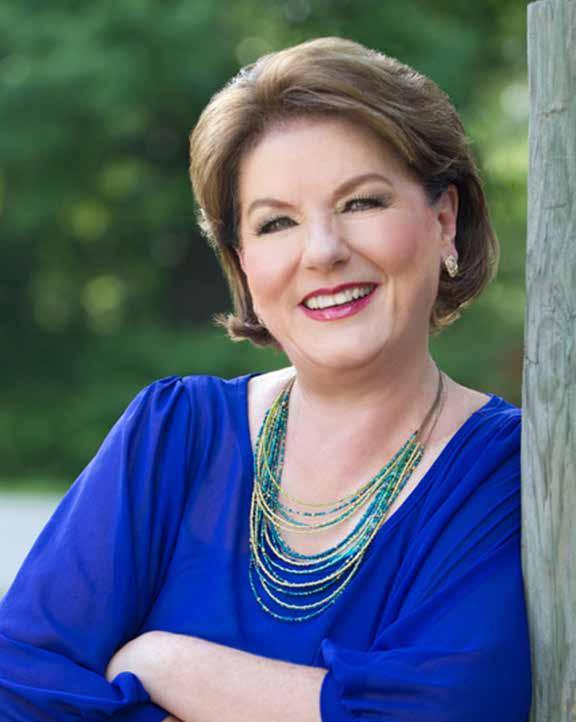
Linda Bennett Pennell
J.S. Marlo
Dr. Roger
Leslie
W.A. Schwartz
Linda Bennett pennell
Ihave been in love with the past for as long as I can remember. Anything with a history, whether shabby or majestic, recent or ancient, instantly draws me in. I suppose it comes from being part of a large extended family that spanned several generations. Long summer afternoons on my grandmother’s porch or winter evenings gathered around her fireplace were filled with stories both entertaining and poignant. Of course, being set in the American South, those stories were also peopled by some very interesting characters, some of whom have found their way into my work.
As for my venture in writing, it has allowed me to reinvent myself. We humans are truly multifaceted creatures, but we tend to sort and categorize each other into neat, easily understood packages that rarely reveal the whole person. Perhaps you, too, want to step out of the box in which you find yourself. I encourage you to look at the possibilities and imagine. Be filled with childlike wonder in your mental wanderings. Envision what might be, not simply what is. Let us never forget, all good fiction begins when someone says to herself or himself, “Let’s pretend.”
I reside in the Houston area with one sweet husband and one adorable, sweet Labradoodle who is quite certain she’s a little girl.
“History is filled with the sound of silken slippers going downstairs and wooden shoes coming up.” Voltaire
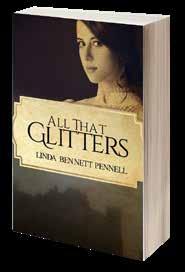
Uncaged welcomes Linda Bennett Pennell
Welcome to Uncaged! Can you tell us more about your book, All That Glitters?
Thank you so much for featuring me! All That Glitters is a work of women’s historical suspense with romantic elements. If you like your fiction flavored with suspense and spiced with a touch of romance, you have come to the right place!
What is the most difficult scene for you to write? What is the easiest?
I am fortunate in that I generally do not find scenes or topics difficult. Some may take more thought, planning, and revising, but that is just part of the job. On the other hand, writing certain types of scenes can elicit strong emotion. While writing All That Glitters, there were a few scenes where I cried as I wrote them. When Adelia, the little girl, asks why her parents do not love her like they do her older brothers, the tears ran. When she tries so hard to please people who will never give her the care and love every child deserves, my heart broke for her. She is a fictional character, but her plight is based on the situations in which some very real former students found themselves. I have heard authors say
that their characters feel like real people for them and I must say I fall into that camp.
Where do you get your ideas for new plots and characters?
The part of me that remains perhaps childlike is my love of imagining what might be. Writing fiction for me is simply the adult version of playing “let’s pretend.” If one is so inclined, one can find stories everywhere and among any group of people. Observe, listen, explore, be curious, pay attention, read historical sources, especially the footnotes – these are the secrets to finding plot and character ideas.
What are you working on now that you can tell us about?
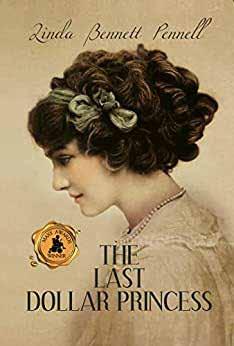
My work-in-progress, The American Countess, is a sequel to The Last Dollar Princess which released June 2022. It continues the story of India, an American heiress coming of age in the last gasp of the Gilded Age and George V’s coronation year England. If you are a Downton Abbey fan, India is the girl for you!
Do you base any of your characters on real-life people?
The advantage of beginning a career in fiction later in life is that one has encountered humanity in so many of its varied and sundry forms. The vast majority of my characters are based in some way on people I have actually known or have read about. For example, the villain in All That Glitters has some characteristics of a serial killer who once brought grief and tragedy to my hometown. Sarah Anne, the main character, has the traits of many teachers with whom I have worked, including myself. The child, Adelia, and her parents incorporate characteristics of family dynamics I observed over the course of a career in public education.
What behind-the-scenes tidbit in your life would probably surprise your readers the most?
I always love this question! Based on my appearance and professional life, many people are caught off-guard by my answer. The thing that surprises them is my saying that at one time I had close personal relationships with bona fide gangsters. This usually raises some eyebrows. There was a serious rivalry between the Latin Kings and Crips in the secondary schools where I worked. As a teacher and later as an administrator, I was called upon to deal with their behaviors and intervene to keep the peace. Young gang members want some one to care about them just like every other kid. So often, that is the reason they were lured into the gang in the first place.
Which comes first, the plot or the characters in the planning stages?
I generally begin with both. I have the beginning, middle, and end actions, and the main character in mind before I begin writing. The rest gets filled in as the spirit moves. I have often described myself as a “plotter with pantser tendencies.”
What are some things you like to do to relax when you aren’t writing or working?
I enjoy singing with Texas Master Chorale and my church choir, as well as serving on the boards for two arts organizations. We are blessed in our part of the Houston metro area in having a thriving arts community with both the performing and fine arts represented.
Do you prefer ebooks, audiobooks or physical books? Are you reading anything now?
It really doesn’t matter. The format is determined by the situation in which I find myself. Presently, reading for pleasure is sort of on hold. I am under an April 1 deadline with my work-in-progress. YIKES!!
What would you like to say to fans, and where can they follow you?
A huge thank you to fans of my work! Your kind words in reviews and in person make the time, effort, and energy it takes to research and write historical fiction a
tremendous joy. I love hearing from you and hope you enjoy my novels as much as I do writing them!
Stay Connected
Enjoy an excerpt from All That Glitters
All That Glitters
Linda Bennett Pennell Historical Gothic Romance
A gloomy mansion on an isolated island. A position she never wanted. A secret that may prove deadly. Set in the age of robber barons, All That Glitters tells the story of a Sarah Anne Mercer, a young woman who must battle immense evil to protect the people she loves.
Becoming governess to a robber baron’s deeply troubled daughter is not the life Sarah Anne Mercer had envisioned, but she must face this reality with grit and determination for all other doors are closed to her. The atmosphere of Ripon House, her employer’s winter residence on the Georgia coast, is positively funereal and the cultural clashes between her rural southern upbringing and that of her employer’s wealthy northern family send her reeling. Further complicating her position, two young men of the family vie for her attention. She is flattered and attracted to them, but knows such emotions must be quelled if she is to succeed in her position.
Through patience and dedication, Sarah Anne breaks
through the emotional wall her student has built, but in the process realizes there may be good reason for the child’s unsettling behavior. Something is not right within Ripon House. As her understanding of the family dynamic deepens, a terrible suspicion forms. It seems Sarah Anne’s employers are hiding a secret – a secret someone may have committed murder to safeguard.
Excerpt
CHAPTER ONE
Is she dead? The flesh on her face feels cool to the touch. It would really be too bad if the whore is in fact no longer among the living. Killing is not a taste I have developed thus far. Much more satisfying to think of them permanently marked and remembering. Checking her throat is in order.
Ah, good. My method holds true. A strong pulse thumps beneath her surprisingly alluring flesh. If she were a lady instead of a whore, she might even tempt me into an actual relationship. As is, she will live, but with considerable bruising around her windpipe and an ugly scar near her hairline.
See how the moonlight brightens the blood trickling over her temple toward her ear. Perhaps I should deepen the rouge on her tawdry cheeks by smearing some of it on them. Yes. That’s better. She now looks exactly like what she is – a whore who will remember tonight for a very long time. If she hadn’t resisted, I wouldn’t have hurt her. But then, they always force me to hurt them. All they have to do is submit, but the stupid trollops never catch on until it is too late.
Chapter 2
Oglethorpe Island, Georgia 1890
The sound of buggy wheels crunching over crushed oyster shells would now forever be associated in Sarah Anne Mercer’s mind with loss and unex-
pected beginnings. This position was not what she had dreamed of, but there was no going back for all other doors had closed. Nervous hands twisted mesh gloves until the fibers dug into the webbing between her fingers, raising red welts between the strings. Glancing down at the mess, she forced her hands to rest primly in her lap and stretched her neck to relieve the tension building at the base of her skull. Dwelling on what might have been was a useless, unedifying occupation. Acceptance was the only course. Instead of wishing for a different life, she must focus on this time, this future, this place.
The buggy bounced over a rut, sending a tingle up Sarah Anne’s spine. As she grabbed an armrest for support, dampness rose on her forehead and beads of moisture formed on her upper lip. Drawing her gloves from her hands, she attempted to fan herself, but nothing could decrease the discomfort of air so thick it felt liquid against the skin. South Georgia’s heat and humidity had not diminished simply because the calendar declared that autumn had commenced. Heat and nerves were not a good combination. She trained her gaze ahead and fixed it upon a clump of palmettos to avoid embarrassment. Fouling the vehicle’s leather appointments with the contents of her predawn breakfast would be a disastrous introduction.
The road curved around a stand of pines and her destination came into view situated upon a broad expanse of manicured lawn. A small gasp escaped. So, Uncle Zach’s prejudice had not influenced his opinion after all. His description, while uncharitable, was quite accurate. Ripon House, all three glowering stories of it, squatted on Oglethorpe Island like a boil on the backside of a beautiful woman. Rumor among the locals had it that the boil was filled with corruption, but Uncle Zach did not place credence in such speculation. As a man of science, he dealt with facts. Of course he did. He wouldn’t have sent her here if he suspected anything untoward. All would be suitable and she would be a great success. This house was now
her destiny for better or worse. As the vehicle rolled to a stop, Sarah Anne straightened her posture and plastered on what she hoped was a confident expression.
The driver cleared his throat. “Best not keep Mrs. Bogard waiting, Miss. She gets in a powerful stir when folks wastes her time.”
“Oh. Of course. Thank you. I guess I’m a little awestruck by all of this.” Babbling was a nervous habit Sarah Anne thought she had rid herself of long ago. To staunch the flow of words, she jumped from the buggy before the driver could get around to her side, but when she made to grab her satchel, he stepped forward.
“We cain’t have that, Miss. Wouldn’t be right.”
Heat rose in Sarah Anne’s cheeks. “Thank you . . .” She looked inquiringly at the driver.
“George, Miss.”
“Thank you, George. I hadn’t thought of that.”
A wry smile spread over the driver’s features. “Pardon me saying, but I suspect there’s lots about this place you ain’t thought of just yet. Give it time and you’ll settle in fine. I can see you a young lady with grit.”
Sarah Anne gave her advisor a weak smile. Oh joy. Grit would be required. It wasn’t that she didn’t possess a certain amount of the stuff. Orphaned at age ten and sent to live among people who cast sidelong glances at her dark hair, dark eyes, and prominent cheekbones, she learned early on how to deal with snide comments and left-handed compliments. The only issue presently at hand was how much grit would be needed. Sarah Anne peered up at the house and fought back a sigh.
The driver waited patiently for her to precede him up wide stone steps that led onto a deep veranda. That fixture of Southern architecture looked very odd
tacked onto this particular house, as though someone had been determined to sneak in a feature that actually made sense in their subtropical climate. All he had accomplished was to enhance the granite pile’s sinister appearance. A small shiver ran down Sarah Anne’s spine.
As Uncle Zach told it, controversy had swirled from the moment of the house’s conception. The architect, a graduate of Virginia, surely knew better, but he didn’t allow something so pedestrian as training to get in the way of a colossal fee. The builder, a Savannahian by birth and inclination, must have had objections, but according to local gossip, generous compensation had overcome any qualms he may have had. The good people of Mayweather County absolutely had objections, accustomed as they were to unmolested access to the riches of the island’s acres and waters. Uncle Zach had often railed against Mr. Jedediah Littlewood’s iniquitous defilement of the land in having his monstrosity of a house built. The fact that the Yankee industrialist owned the entirety of the barrier island did nothing to lessen his enmity. Of course in the end, Ripon House had gone up stone by craggy gray stone. Nobody was happy except the man who had the thing built.
Sarah Anne shifted from one foot to the other before mahogany double doors, her hand stranded at her side unable to knock. Hesitation in the face of the unknown had never been her nature, but today it froze her into a state of inaction. This was so unlike the woman she thought herself to be. To complete her humiliation, her midsection once again threatened open rebellion. This would never do. Inhaling slowly, she held her breath for several beats then allowed the air to escape in one measured stream while she distracted herself with an inspection of the house’s exterior. Despite the day’s warmth, the windows stood firmly shut and the drapes drawn. If windows were the eyes of a structure, Ripon House chose to be blind to the world around it. An atmosphere of gloom seemed to hang about the place. The house might have been in mourning, but no one had mentioned a death and no black wreath decorated the door. It was as though
Thornfield Hall, that haunted Yorkshire manse of Charlotte Bronte’s Jane Eyre, had been transported to the Georgia coast. It did not suit. Not in the least. There might not be an insane Bertha Mason guarded by Grace Poole hidden away in the attics, but Sarah Anne couldn’t quite rid herself of a niggling sensation of unease. The place just didn’t feel right.
Sarah Anne bit down on her inner cheek to rein in her rushing thoughts. This was not the time to let her imagination run free. Failing in this position simply was not an option.
With that, she squared her shoulders and yanked the gloves back over her hands until her fingers strained against the mesh. The force of her knock served as a physical reminder of why she stood upon the Ripon House threshold awaiting admittance to its world.
Don’t miss this title:
J.S. marlo
J.S. grew up in Shawinigan, a small French Canadian town, attended military college, married a dashing officer, and raised three spirited children. Over the years, she enjoyed many wonderful postings in many different regions of Canada.
After her children left the nest, she began writing. She captured her dream of becoming a published author with her underwater novel “Salvaged”.
Many of her romantic suspense novels are set in Canada or feature Canadian characters. She has also written a few time-travel and cozy mysteries.
J.S. isn’t sure where time flew, but decades later, she ended up writing under the Northern Lights in Alberta while spoiling two gorgeous little granddaughters.
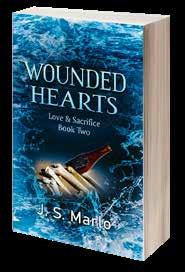
Uncaged welcomes J.S. Marlo
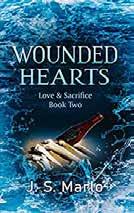
Welcome to Uncaged! Can you tell us more about your latest book, Wounded Hearts?
Glad to be here!
Wounded Hearts is a romantic suspense that takes place on Prince Edward Island, Canada, and in Iceland.
My main female character is an adventurous and resourceful woman named Rowan. She was first introduced as a minor character in Seasoned Hearts, but she begged me for an adventure of her own, so here’s what was revealed about her in Seasoned Hearts:
Rowan hails from the Canadian Rocky Mountains where she grew up with her mom and brother. She knows next to nothing about her paternal ancestry. And she studied geology in Iceland where she met a dude
named Bjorn.
For reasons Rowan won’t share unless you read Wounded Hearts, she moves back to Canada and settles down in Buccaneer, a Bed & Breakfast on Prince Edward Island.
Rowan inherited Buccaneer from a paternal aunt she didn’t know existed. Her auntie’s death was quite tragic.
Despite knowing nothing about running a B&B— Rowan is a geologist after all, not a manager—she gives it a try. A bubbly cook, a taciturn handyman, and a charming family doctor lend a helping hand, but good intentions and excellent results don’t always go hand-to-hand.
Over the summer, many guests stay at Buccaneer. Some are interesting, others are annoying, a few are
undesirable, and one moves into the attic room for an indefinite period of time. His name is Avery.
Avery came to Buccaneer to escape his past and forget his future, but despite his steadfast intentions not to get involved with anyone or anything, he can’t resist examining the bones exhumed by Rowan or looking into her auntie’s death.
Along with the strange bones, Rowan also uncovers increasingly complicated family secrets, but when she inadvertently unearths a murderer, fighting for her future takes a whole new meaning.
Now, if you’re curious about Bjorn, the Icelandic dude, I’m afraid he’s also dealing with a few family problems of his own.
What is the most difficult scene for you to write? What is the easiest?
In Wounded Hearts, the most difficult scene was the love scene inside a volcanic chamber and the easiest was... I wouldn’t qualify any scenes as easy, but some were definitely easier than others. Generally speaking I find love scenes harder to write than action scenes.
Where do you get your ideas for new plots and characters?
Ideas always spark from real life. A comment I overhear, a person I cross in an airport or meet for coffee, a picture I glimpse, a conversation I remember, an activity I witness... Everyday life is full of potential adventures, real and fictional.
This is the story behind Wounded Hearts:
Many years ago, hubby and I went on a two-week vacation on Magdalen Islands, a small archipelago in the gulf of St. Lawrence, not too far from Prince Edward Island. We stayed in a cozy B&B on one of the smaller islands.
The B&B’s hosts/owners were two charming guys. I was the first author they’d ever met, so they were curious. After sharing some interesting conversations, one of them suggested I wrote a story taking place in a B&B.
By the time we flew back home, Wounded Hearts was born, and I could finally give Rowan the adventure she deserved.
What are you working on now that you can tell us about?
A year ago, my son got married in the Canadian Rocky Mountains. The ceremony was outdoor on a gorgeous autumn day. It was beautiful! Nonetheless, when I looked around, I couldn’t help thinking there were so many places where you could hide a dead body LOL So, I’m currently writing a murder/mystery taking place in the Rocky Mountains against the backdrop of an eventful wedding. All I can say right now is that one guest will encounter a mama grizzly and her cubs while another will stumble on a large sum of money.
Do you base any of your characters on real-life people?
There is some truth to the saying “Please do not annoy the writer. She will put you in a book and kill you.”
That being said, most of my characters are fictional, but when a character is inspired from real-life, it rarely resembles a single person. It’ll be more like a blend of different persons—unless someone really annoyed me.
ably surprise your readers the most?
I learned English in my twenties, therefore I still speak with a French-Canadian accent. My granddaughter started correcting my English pronunciation when she was two years old, but I’m slowly turning the table on her as I’m now correcting her French pronunciation LOL
Which comes first, the plot or the characters in the planning stages?
It depends what pops into my mind first. I’ve written plots around characters, and I’ve written characters to fit the plots. They both work for me.
What are some things you like to do to relax when you aren’t writing or working?
I spoil my granddaughters, I do jigsaw and escape room puzzles, I read, I walk or hike, I snowshoe, I
travel, and I knit.
Do you prefer ebooks, audiobooks or physical books? Are you reading anything now?
I like to read physical books in my bath, but I prefer ebooks in bed. That way I can read in the dark and my hubby can sleep.
What behind-the-scenes tidbit in your life would prob-
I’m reading lots of children and chapter books to my
granddaughters, either in person or on Facetime, on a daily basis.
I also have three grown-up books on my night table with bookmarks in them: Origin by Dan Brown, Random Passage by Bernice Morgan, and The Apollo Murders by Chris Hartfield.
What would you like to say to fans, and where can they follow you?
I had a reader once who emailed me to say she stayed up until for 4:00 am because she couldn’t put my book down. She needed to finish it even though she had to get up at 6:30 am to go to work.
So, I’d like to apologize in advance if my books keep them up past their bedtime.
Stay Connected
WEBSITE
Enjoy an excerpt from Wounded Hearts
Wounded Hearts
J.S. Marlo
Cozy Mystery
Faced with the impossible choice of hurting the man she loves, or leaving him forever, Rowan Kendrick flees Iceland for Prince Edward Island, Canada. Heartbroken, and unable to forget him, she finds refuge at The Buccaneer, a bed & breakfast recently
willed to her by an estranged aunt.
Haunted by a fatal shooting, Avery Stone seeks his escape in Buccaneer’s attic room. Despite himself, he is drawn into the peculiar circumstances behind the previous owner’s death and the strange bones exhumed by Rowan. His dislike for the doctor befriending her turns to mistrust as matters unravel.
Rowan struggles to cope with difficult guests, the puzzling Mr. Stone, and her increasingly complicated family secrets. When she unearths a murderer, is she doomed to death like her aunt? Or will the men in her life, including the love she left behind, set aside their own troubles and band together to help her?
Excerpt
Awoken from his mid-afternoon nap by loud clatters and bangs, Avery left the bench near the stream and trekked through the garden in search of the disturbance.
As he peered around the corner of the house, he spotted a stranger in a fancy suit rushing across the lawn. The unidentified male headed toward the gazebo where— At the sight of O’Reilly perched on the roof like a reckless rooster waiting to be gunned down, Avery’s jaw dropped.
“Rowan?” The blond stranger yelled her name. “Have you lost your mind?”
The hammer slipped from her hand. She leaped back as if she had been hit by the tool and lost her footing. An invisible blow knocked the wind out of Avery. Too far to intervene, he squeezed his cane, but he couldn’t tear his gaze away from the body sliding down the roof.
Arms outstretched, O’Reilly reached up. Whatever she managed to grip near the edge halted her deadly descent.
“Rowan? Are you all right?” The brainless fool who had startled her stood where the hammer had fallen.
Looking haggard, she struggled to sit away from the void.
“Does she look all right?” Avery muttered under his breath, his stomach reeling from the near-tragedy. O’Reilly swayed her head, blood running down her face. “Doctor...Chris?”
The fool is a doctor? His dubious tactic to recruit new patients didn’t impress Avery.
“You shouldn’t be alone on a roof, Rowan.” The doctor crossed his arms. “It’s dangerous.”
How dare this Chris character admonish her after scaring her half to death? Tempted to have a word or two with the unsolicited doctor, Avery tapped the ground with his cane.
“Are you trying to kill me?” she snapped before wiping her forehead with the back of her hand. “In case you didn’t notice, I was doing fine until you yelled at me.”
The doctor dug his hands into his pockets. “I’m sorry, but when I saw you, I pictured Mattie falling down and breaking her neck.”
Avery had never heard of a Mattie. Maybe Gail would know about the mysterious woman who had broken her neck.
O’Reilly crawled toward the ladder. “I’m not Mattie.” “I know. You’re much more beautiful.”
Smooth-talker. Wrinkling his nose in distaste, Avery backtracked into the garden. If O’Reilly fell for the guy, she might as well drop dead. ~ * ~
As soon as Rowan’s feet touched solid ground, Chris led her from the gazebo to the terrace, where he coaxed her into sitting on a lawn chair. “You’re bleeding. Let me have a look.”
“It’s nothing...really.” Despite her objections, he knelt by her side and gen-
tly ran his fingers over her forehead. “The skin is bruised, but the cut is superficial. Just keep it clean.”
She could have told him that. “What brought you here?”
“I’m hurt, Rowan.” In an exaggerated motion, he placed his hand over his heart. “Do I need an excuse to come visit a beautiful woman?”
The term beautiful couldn’t possibly describe a bleeding girl with bright red curls and huge cucumber eyes like her. Besides, his previous visits had been strictly business-related. “I wasn’t aware that doctors made social calls.”
A disarming smile brightened his boyish face. “I didn’t come as a doctor. I’m off on Wednesday afternoons.”
Gail had hinted the doctor was interested, but Chris hadn’t given her any reason to believe it might be true. “You are?”
His blue eyes sparkled like the ocean. “You’re an intriguing woman.”
Another adjective that had never been used in her presence until now. “I am?”
“Yes.” From his pocket, he pulled a hankie and dabbed her wound. “Would you have dinner with me tonight?”
“Me?” Guilt over the incident had incited him to ask her out. It was the only logical explanation. “I—” The Jensens would be arriving, but she could always ask Gail to welcome them. “Are you sure?”
He slowly lowered his hand along her cheek, leaving a feathery caress in its wake. “I’ll pick you up at 7:00 p.m. Don’t be late.”
Beatrice Fairbanks Cayzer
KIDNAPPED IN JERUSALEM
Beatrice
Fairbanks Cayzer comes from an illustrious family. Her two ancestors who came to Upper Virginia in 1620 helped found their community. She founded the Cayzer Museum for Children in England where she was the wife of Stanley Cayzer, a grandson of Sir Charles Cayzer, founder of shipping companies that evolved into Caledonia Investments, and nephew of Admiral Lord Jellicoe, the second Governor General of New Zealand. Then she turned into writing.
In Oxfordshire, she wrote The Princes and the Princesses of Wales. In Guernsey, she wrote The Royal World of Animals. Returning to the USA, she wrote nine Rick Harrow novels, winning Book of the Year Award from the Horseracing Writers’ Association. In 2016, she had a sell out with The Secret Diary of Mrs. John Quincy Adams and in 2018 had another sell out with New Tales of Palm Beach.
Kidnapped in Jerusalem
Beatrice Fairbanks Cayzer
Psychological Fiction
Dennis McLeary, sexually abused at age 6. At 18, he accepts sexual advances of a 14 year-old girl hoping to prove to himself that he is a normal man. Jailed for 17 years for having sex with the under-age girl, he is abused in prison by fellow inmates and the prison chaplain. Free at 35, he determines to better himself and hopes to have a normal marriage. Ensnared in a messy event, he escapes more prison time by becoming a waiter on a passenger-freighter. He gets leave from his ship to swim in Turkish waters, where he meets and falls in love with Myriam al-Montee, a half-Turkish halfSaudi Arabian Muslim woman. Instant adora-tion is reciprocated. Myriam elopes with Dennis, they are married by his ship’s captain. Myriam does not tell Dennis that her fanatical father, who hopes to use her to found his dynasty, is known to behead any
person showing fondness for her. When three women are beheaded at her father’s orders, she warns Dennis, he could be next.
They hide from her father in Alexandria and in Cairo, but are located by her fa-ther’s agents in Jerusalem. Kidnapped, Myriam is brought to her father in Saudi Arabia. He orders her locked in a cell-like room in a desert house where recently a cousin has starved to death. After three months, she get help and relieved by Alf, an Oil field worker. He tries to rape her. Dennis, agonizing for her, would travel any where including to a country where they would behead him in order to reach Myriam. They find each other near a famous oasis in time to stop Alf from raping Myriam. But fate holds more vicious challenges.
Amazon Customer Reviews
~ ~ Ladybella ~ ~
“After reading this manuscript, I can say that I fell in love with Louisa Adams. She was a strong individual whose life story needed to be told. Louisa Adams made an impact. I couldn’t put the book down. A must read.”
I have never been to Morocco until reading this BOOK. What a wonderful trip it took me through. The mysterious possibilities that the characters of this story endure are nail-biting. This is truly a masterpiece that will enthrall all mystery and vampire fans. I highly recomend reading this masterpiece. I loved it.
~ ~ Samira Sowan ~ ~
“The author Beatrice succeeded to keep the reader thrilled to read every page in her book and to take us through the journey of the unique character of Louise and live the era of the 1700 and 1800.in such a fascinating way. I definitely enjoyed every page in this compelling story. A must read..”
~ ~ VIV ~ ~
“Reader observes as main personages meet the ups and downs that bruise those on the top level yet took to heart the enormous wrongs done to slaves in America and went into battle”
THE HARROW QUARTET takes the reader to many unusual places because the narrator Rick Harrow is a racehorse trainer, and a trainer has to bring his horses to the most likely tracks to win. The reader goes to Dubai, Russia’s St. Petersburg, romantic villages in Italy, tycoon homes and estates of the newly rich in Spain, and the wilds of Mexico’s most inaccesssble mountains as well as to its over-crowded and dangerous capital city.The characters vary from a Chechen terrorist to Milan’s exquisite models, to the wild west drug lords of today’s Mexico.
~ ~ Anthony Roberts ~ ~ Inspiring story of a great lady.
~ ~ garbonzo ~ ~
Here is another installment from Beatrice Cayzer’s fabulous series featuring Happy and Rick Harrow. Travel with them as the traipse across the
globe from one extravagant horse exhibition to the next, and finding trouble wherever they go. Cayzer’s prose is filled with vibrant imagery, plenty of action, and enough hanky-panky to make a sailor blush. These stories are great fun, and will have you coming back for more. Fans of any of the modern detective series found on BBC/PBS will feel right at home. Don’t be surprised if these adventures are turned into their own small-screen production. Enjoy!
~ ~ Cathryn Elwyn ~ ~
It’s not every day that jockeying, an estate in the British countryside, and a complication involving the president of Russia figure in one story, but best-selling author Beatrice Fairbanks Cayzer is nothing if unpredictable. Deaths, conspiracies, and . . . a threat to beloved Happy’s life? This has got to be BFC’s best yet.
~ ~ Brett Virgo ~ ~
I just finished reading this wonderful book. I was so hooked I could not put it down. I highly recomend this Murder Mystery. It will not disappoint. Each chapter draws you in, that you have to keep on reading. I am eager to see what BF Cayzer will come up with next.
~ ~ DEE ~ ~
Murder by Medicine is a deliciously delightful book that reminds everyone of how wonderful London can be, during the Season. The descriptive scenes take you there with intrigue and GLAMOUR! Horses, men and murder are an intoxicating read in the hands of B. F. Cayzer. Without a doubt, Murder by Medicine is one of the best books that I have read. It is a perfect gift for any stylish acquaintance or be wickedly selfish and keep it all to yourself!
~ ~ Cathy ~ ~
If you like murder mysteries, this is a great book to read. It brings you into the horse people who have their own ideas of life. It travels from Ethiopia to England with fast paced action. Do read.
W.A. Schwartz
WA Schwartz was born in Northern California and raised in both the UK and the US. She studied literature at UC Davis and novel writing at Stanford. She holds a BS in biochemistry from Cal Poly San Luis Obispo and an MD from UC San Diego School of Medicine. She worked many years as medical director at a mental health clinic on the outskirts of New Orleans and is currently in private practice in California She is the author of poetry, short stories and novels. Her work has been recognized by the journal Glimmer Train (2018) and was long-listed for the Alexander Chee prize in fiction 2020.
Uncaged
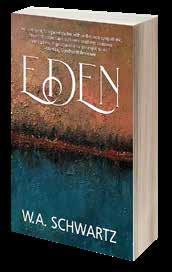
welcomes WA Schwartz
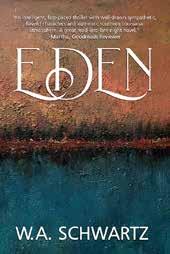
Welcome to Uncaged! Your newest novel, Eden, will release in April. Can you tell readers more about this novel?
Well, technically, EDEN is a suspense story, a murder mystery, but that’s not really what the book is about. EDEN is about a small group of people from a small town in southeast Louisiana and the secrets they keep for decades. When a child’s body is unearthed, the investigation that follows unravels the town and the secrets very interestingly. I force the characters involved to reveal themselves in ways they wouldn’t have imagined, and the book becomes more about toxic family relationships and generational secrets.
How has your work as a psychiatrist helped in writing?
All the books and stories I write are character driven and focused on relationships between people, often people within families. As a psychiatrist, I have spent most of my career working with neglected and abused children and families with minimal support. For many years, I was the medical director at a mental health clinic in the outer parishes in Louisiana, which is where the story
takes place. Although this story is completely fictional and none of the characters are based on real people, I could use much of what I know in developing the relationships between my characters. My career has given me a solid understanding of what it is like to deal with extreme poverty in the south and the stressors that it brings on. In addition, some characters in Eden suffer from acute and chronic mental illnesses based on real diagnosis which are commonly treated by psychiatric physicians. I don’t think it would have been possible for me to write EDED had I not worked many years as a psychiatrist.
What is the most difficult scene for you to write?
There is a scene in the book in which a character is burying his young daughter. Without giving away spoilers, I will say this was at least one of the most challenging scenes for me to write. The man’s tremendous grief over what he was about to do made it hard for me to write each sentence. Not only did I want to get the words right and do justice to his pain, but as a mother myself I really felt I was experiencing the scene along with him as I wrote it I probably rewrote that scene fifteen times What is the easiest?
This is tough for me to describe without giving spoilers, but I will try. There is a teenager a prominent character in the book, who finds herself in a difficult situation and manages very violently to get herself out of it. Although the scene itself is quite violent and not pleasant, I found it really easy to write. I think it had something to do with her personal empowerment and the strength of her family character, and I really enjoyed writing her way out of that predicament. The truth is, most young girls in a situation like that don’t wind up the way this particular teenager does, and the scene I wrote might to some degree have been my wish.
Where do you get your ideas for new plots and characters?
This is always a tough question. For me, ideas for books and stories come at me sort of all at once and it’s hard to separate one piece from another. They don’t come from a “place” they just come inside my head. If I had to pull it apart I would say I learn of characters first and then situations so for example I might be talking with someone about a particular experience they had or I might be in a particular place and see something and suddenly imagine a certain character having that experience or having a group of experiences like that and then from there I might imagine what that would be like or what it would be like for them to have a slightly twisted version of that experience. It usually comes to me visually. I hope this is making sense. With Eden it was actually Evelyn the protagonist who came to me first. I saw her as this very troubled woman in her 40s who had escaped her hometown and was living on the West Coast but was still struggling with alcohol and failed relationships and a very troubled teenage daughter and was somehow called back to her home which she’d fought so hard to escape. From there I had to develop a reason for her to be called home and that reason ended up being the discovery of this body so the plot kind of followed from her being in the situation where she was called home I wanted to sort out what would happen if a damaged person who had struggled hard to survive, then during it all gets sort of boomeranged back to the source of all the pain
and suffering. I wanted to look at what that would mean and how they might COPE in that situation, so that’s an example of how I come about my stories
Bottom line, I would have to say it always starts with character. I am most interested in people. I certainly never start with the plot. In other words, I never outline a certain story and want to have it happen ABCDE and then stick people into it. That doesn’t work for me
What are you working on now that you can tell us about?
I’ll tell you just a little. I’m working on a book about a young woman who is not at all who she seems to be at the beginning of the book. It is a psychological thriller and I think readers will find it a little edgier than EDEN.
Do you base any of your characters on real-life people?
Never. I never base characters on real-life people and the only exception would write historical fiction I have recently finished a book very loosely based on the life of Sylvia Plath and Ted Hughes and that book does not try to hide that those are the figures depicted. Otherwise, I never use real people for one it is not particularly interesting to limit oneself to the life of a particular person and in fact, even in historical fiction and author will have a lot of leeway and adding and subtracting details. before another, I think basing your characters on real people is somewhat disrespectful to those real people so no all of my characters are 100% fictional.
What behind-the-scenes tidbit in your life would probably surprise your readers the most?
I’m pretty dull, really. I have three children I adore, the youngest is now 19. I’ve been snowboarding once. I was a ballerina for almost twenty years and danced in a company called the Civic Ballet Company of San Luis Obispo. Today I do yoga instead.
Which comes first, the plot or the characters in the planning stages?
Character always.
What are some things you like to do to relax when you aren’t writing or working?
Yoga, play with my dogs (two big labs). Tend to my English Roses. Talk to my kids, quilting and sewing, I’m a secret Netflix binger.
Do you prefer ebooks, audiobooks or physical books? Are you reading anything now?
I love physical books and have a library in my house, but I admit my eyes prefer ebooks. I am always reading something. Right now it’s THE BOOKS OF JACOB by Olga Tokarczuk.
What would you like to say to fans, and where can they follow you?
First, thankyou!! I love to write and obviously could not do it without a reader, so thanks a million. Next please comment and email and send me feedback. I love to hear your thoughts. you can reach me at: wa@waschwartz.com, www.waschwartz.com
Stay Connected
W.A. Schwartz Suspense
On a hot, muggy afternoon in Eden, a tiny, rural town deep in southeast Louisiana, two boys make a grim discovery: they unearth the decades-old remains of a child, strands of hair and clothing still attached to the bones.
Meanwhile on the other side of the country, in California, forty-one-year-old Evelyn Yates, a single mother is struggling to maintain psychological equilibrium despite problems with alcohol, a difficult teenage daughter, and her own traumatic past. Evelyn is devastated by a phone call from the Eden coroner informing her that officials suspect the remains are those of her sister who disappeared over thirty years earlier.
Evelyn, who has mentally reduced her childhood to a series of blotchy and painful memories, fled Eden years ago and has no desire to return. Her fragile internal world is suddenly threatened with collapse by this discovery and the pressure to return home to help identify the remains.
The discovery of the body sets in motion a series of events leading inevitably to the uncovering of secrets dating back nearly a century; terrible events that may involve the entire town of Eden. As Evelyn pursues answers, she finds her sanity, her life, and the life her daughter threatened. She must face her memories and delve deep into her family’s history to find answers.
Eden explores the devastating nature of secrets and the power of love to overcome.
Part One: Dead Girl
Saturday, June 3
Present Day
Chapter One
Eden, Louisiana
The day they found the dead girl, the sky was the color of marble, and the air stank of rubber and mud. Spring had escaped Bonfante Parish early that year, and it was much too hot for early June. Ray Lee Beaumont was thirteen years old, skinny as a jackrabbit and brimming with the sweaty, excited newness of burgeoning adolescence. He stood, with the self-conscious, impatient, cool, peculiar to young adolescent boys, under the shade of a live oak, half-moons of damp staining his T-shirt underarms and smoking a stolen cigarette. Legs apart, shifting weight from one foot to the other, head down and cocked, peering out from under a lock of shaggy black hair. One hand to his lips, he held the Lucky Strike between his first two fingers, the way he remembered his daddy had done when the man still lived with them. A thin curl of smoke wafted into the still, hot air and hung there for a while before breaking up into nothing. Sporadically, he held the cigarette away from his body and tapped at it, letting the ash fall to the ground next to his feet.
All at once, he flicked the butt aside, took two steps forward until he was standing just outside the shade of the tree, and he shouted. “Basco, what in the hell is taking you so long?”
Gene Basco, twelve, just four months younger than Ray Lee but six inches shorter and lacking the peach fuzz that darkened Ray Lee’s upper lip, materialized from the woods, pulling up his pants.
“I don’t know Ray Lee. I don’t feel too good. I got the diarrheas.”
“Oh, shoot, Basco. You ain’t got the diarrheas. You’re just scared I’m gonna shoot you full of holes before
you get one round off,” Ray Lee said, laughing. “I ain’t scared,” insisted Gene. He approached, and Ray Lee studied his face. Pale, big-eyed. “I’m telling you; I don’t feel too good.”
“Yeah. Well, don’t be thinking we’re going back now that we’re all the way out here, and I got my brother’s gun and all. No way. Like my daddy says, time to man up.”
Ray Lee gave the younger boy a hard stare, so he’d know there wasn’t a choice. Not now. Ray, who’d been practically shooting out of his shoes with excitement since waking up this brilliant Saturday morning to find Mack’s paintball gun, and all his gear, sitting by the back door, had no intention of turning back. Mack never left his gear or anything he cared about, out where Ray Lee might get into it. He must have come in drunk or too tired to think straight, or both. Ever since Mack made sixteen and started driving and got a girlfriend, he thought he was all that. Ray Lee had secretly snatched up the gun and the half-full box of yellow paintballs and made his way out of the house. He’d ridden his bike straight over to Gene’s since Gene was the only other kid he knew owned a paintball gun which, Ray Lee was pretty sure, the little softie shit never even used.
“And look,” added Ray Lee, picking up the weapon from where he’d laid it on the ground. “I gotta get this gun back before Mack wakes up, or he’ll kill me. So, get your stuff and come on. I already loaded yours for you.”
They started out back behind a wood structure that looked like, once upon a time, it might have been an outhouse. Everything out here looked like it came from another century. As far as Ray Lee knew, nobody had lived out at the Crazy Yates Place since the old man died, and that was almost before Ray Lee was born.
“Ray Lee,” came Gene’s whine. “Are you sure we ought to be doin’ this? I mean, what if we get
caught? My mom says the Sheriff will arrest you for shooting outside in, like, the wild. I don’t know.”
Ray Lee turned around, peering at his friend. “See, I told you, you was scared.”
“I ain’t!” Gene took another step.
“Well then, quit jabbering.” They trudged across the field about a hundred yards before Ray Lee stopped just on the edge of the forest. “Ok. Here’s good.” He looked at Gene, softening. “Hey, look, I won’t aim at your face, ok? Or your neck. And I’ll give you first shot. Ok?” The twelve-year-old nodded, looking reluctant. Ray Lee felt a little bad for him. Getting splatted with a paintball hurt like a bitch, and Gene knew how good a shot Ray Lee was, too.
They crept into the forest in opposite directions, counting off before they turned and began. Immediately, Gene started firing indiscriminately, all his balls hitting tree trunks or rocks, leaving neon yellow and green paint splatter everywhere. He’ll be out of ammo in five minutes, thought Ray Lee. Idiot.
Ray Lee avoided the shots, snuck deeper into the woods, and circled behind a live oak’s thick, gnarled trunk. When the toe of his runner clipped a fat root and sent him sprawling, face first, into the earth, the gun spilled from his grip and went skittering off into the darkness. Once he’d caught his breath, he pushed himself onto his hands and knees, peering around for the weapon. A tiny kernel of panic seeded itself in his belly. Mack would murder him if he lost that gun.
He screamed back at Gene to quit firing and come help him and continued to scrabble around in the half-dark. Finally, there it was. Brown plastic sticking half out of the muck. Reaching for it, Ray Lee wrapped his palm around the hilt and at once knew the thing in his grasp was not the plas-
tic gun. Fear shot through him like ice water, and he yelped, drawing his hand back so rapidly that droplets of mud splashed his face, stinging his eyes. He scrambled away from whatever it was and leaned against a rock, panting and peering into the darkness.
After a moment, he pulled a penlight from his jeans pocket and, using it to navigate, took a few steps forward. It seemed suddenly darker inside the cypress wood. His foot sank into the mud so thick it overflowed the top of his shoe, oozing through his sock, like fingers. Inside the jungle of plants, he was briefly disoriented. He swung his head this way and that, panic rising, and suddenly, he saw it. Sticking out of the wet earth, it was small and appeared dipped in layers of sludge and rot. Picking up a branch, Ray Lee used it to poke at the thing, trying to separate it from his gun. No way did he want to touch it. Pushing some filth away, and leaning in for a closer look, he jammed the branch underneath it. As he did so, a brownish bowl-shaped object appeared from the earth. He stared, horrified, as a clump of long hair fell away in a thin, stringy sheath. He made a garbled gagging sound, dropped the stick, turned, and pushed his way out of the trees, slicing the skin of his forearm on the spiny petioles of a giant palmetto as he stumbled past. Emerging from the forest edge, he paused, bent at the waist, and vomited into the dirt.
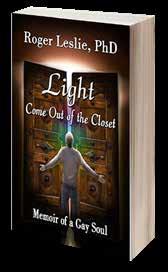
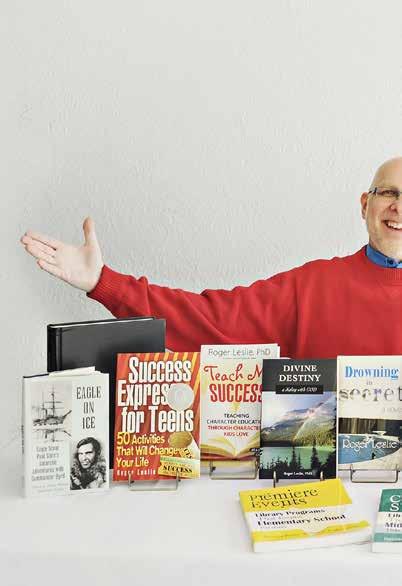
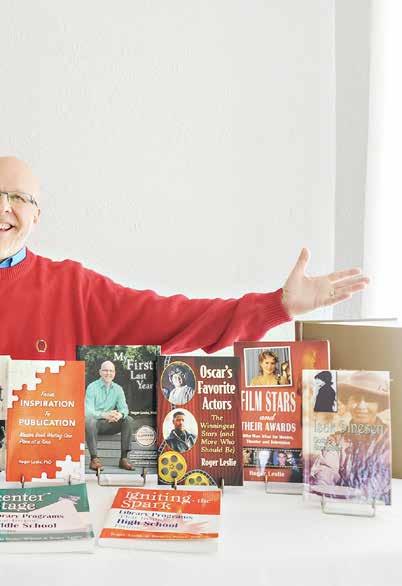
Roger leslie phd
Dr. Roger Leslie is a scholar in the fields of success and education. Through major literary houses, medium and small presses, and his own publishing house, Leslie has published fiction and nonfiction books in multiple genres: historical fiction, inspirational self-help, spirituality, writing and publishing, movie reference, teaching and librarianship, biography, history, and memoir.
Leslie has won numerous national awards including ForeWord Book of the Year, The Ben Franklin Award, and Writer’s Digest’s #1 Inspirational Book of the Year. At its inaugural event, Leslie received the Houston Literary Award for his body of work.
His vast experience as an author, publisher, writing coach, and talk show host have put Leslie is in high demand as an international speaker. In every book and presentation, Leslie entertains, inspires, and empowers people to live the life they dream and soar toward their own ideal of success.
Uncaged welcomes Dr. Roger Leslie
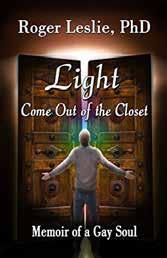
Welcome to Uncaged! Your book will release on June 5, Light Come Out of the Closet and is a memoir. What inspired you to write this? What do you hope readers will take away from reading it?
My goal in life is to inspire people to live the life they dream and empower them to follow their own unique spiritual path. Light Come Out of the Story tells the foundational stages of breaking free of traditional thinking that did not fit my life and embarking on the spiritual adventure that has shaped my life since. I want my book to invite readers to explore their own soul and find the courage to live unapologetically and love unabashedly.
Is this your first published book?
Oh, no. I’ve been an author all my life and have awardwinning books in numerous genres including spiritual-
ity, self-help, writing & publishing, education, librarianship, biography, historical fiction, and even movie reference.
What is the most difficult part for you to write? What was the easiest?
I have a lifelong commitment to saying and writing only positive, encouraging words. But, of course, drama arises from conflict, and my most profound childhood learning resulted from being challenged and even berated by some adults. The most difficult but exciting quest in writing Light Come Out of the Closet was to present those persons honestly but fairly. I believe I achieved my objective by exploring my multidimensional, layered relationships with those adults.
The easiest scenes were the funny ones. I have some very quick-witted relatives whose bon mots are legendary.
What are you working on now that you can tell us about?
I’m always in the process of writing a work of fiction and nonfiction. Currently I’m revising a Christmas novel and tracing a spiritual journey into my own soul.
What behind-the-scenes tidbit in your life would probably surprise readers the most?
While I love creating emotional risks and intellectual challenges for myself as an author, I’ve never been much of a physical daredevil. Yet I’ve faced death more than a few times. Among the most memorable were being in my house when a tornado ripped off my roof and surviving a train derailment in England.
What are some things you like to do to relax when you aren’t writing or working?
Like most authors, I’m a voracious reader. I also love spiritual practices such as meditation and yoga. I find assembling jigsaw puzzles very therapeutic. I usually do six or seven 1,000-piece puzzles in a single day.
Do you prefer ebooks, audiobooks or physical books? Are you reading anything now?
I love them all, but I still read physical books most often. I recently finished Louise Penny’s mystery, Still Life and am currently reading Paul Selig’s I am the Word and Paul Gallico’s Mrs. ‘arris Goes to Paris. (I bought that novel because the movie enchanted me.) What would you like to say to fans, and where can they follow you?
Before you ever felt the inspiration to pursue anything, Life already set in place everything you need to succeed. Simply uncage your mind, trust your intuition, and follow your heart. You are meant to live the life you dream. Fans can find me at https://rogerleslie.com/. Beyond subscribing to my inspirational emails, they can follow me on social media or watch my live weekly show, I’m Spiritual…But, on YouTube
Stay Connected
Light Come Out of the Closet
Roger Leslie, PhD
Memoir Available June 6
When a joyful boy realizes he is gay, he fights against family and religious prejudices to reclaim the God of love he learned about in hopes of discovering what it means to be a gay soul.
Excerpt
Before I was old enough to articulate them as defining truths, I have known three absolutes:
I love God. I love my family. I am gay.
The sliver of the world I knew in childhood consistently supported those first two insights. I was raised by parents so committed to our religious upbringing that Dad worked extra to send my sister, brothers, and me to Catholic school. In my closeknit, Polish-American enclave, the family unit was paramount. Loving God and loving my family came with a guarantee: who I loved loved me in return. Though it remained unspoken, I always belonged. Then I awakened to a frightening suspicion. My third truth—that I am gay—could negate my assumption that love was automatically reciprocal. As the truth of my sexual identity clarified for me, so did the possibility that my family might not love me gay. But an intense terror loomed more threateningly in my waking life as a child and my
hours of prayer as a young soul: What if being gay meant that God wouldn’t love me either? All the affections and desires for love that felt natural to me, as a child of God made by God’s hand in the image and likeness of God, seemed at odds with what the world and my religion suggested was honorable and spiritual.
I have always known I am gay. Even before I understood what that meant, I sensed that I was different from everyone else I grew up around, even my own family. Yet in my stable home with my loyal parents, I felt safe, protected, and, yes, loved. But whether a sign of the era or my culture, love as I recognized it in my childhood home was neither verbalized nor demonstrated with physical affection.
When I was very, very young, I know that my dad held my hand when we walked on vacation because once we lost each other’s grip on a packed boardwalk. When I reclaimed the hand, it felt rough, and it pushed mine away. I was shocked to look up and discover I had grasped a stranger’s hand. On another vacation we walked so long down sidewalks of Toronto that I dragged beside my father, leaning on his arm as we trudged to our hotel. At the time, I didn’t recognize his support as love.
In my family, Dad always encouraged us to forge our own path. “Be a leader, not a follower,” he admonished all his children. As a result, my siblings and I were vehemently different. It seemed a requirement in our family to develop our character by finding interests that no one else in the family enjoyed.
Judy, the eldest of us four children, became an accomplished ballerina from early childhood through her teens. It took little time for her to outperform all her peers and become the star pupil of once-famous ballerina Leona Lucas.
My older brother Randy loved—and excelled in—every sport available to a suburban boy in the
1960s. In the basement he hung caricatures of his favorite baseball players. On his desk he displayed an entire collection of walnut-sized pro football team helmets. Most proudly, he cherished a ceramic mug embossed with the front page of the September 18, 1968 Detroit Free Press with the headline “WE WIN!” in reference to the Tigers’ World Series victory. Before long, that mug was buried among trophies my brother won—for baseball and football and basketball. Most impressive about my brother was the fact that he overcame an early childhood mobility issue to excel in athletics.
I wanted no part of dance or sports. Instead, I loved visual and literary arts. I didn’t just watch movies and television and read books. I studied them, then researched the background and process of developing anything creative. I wrote stories or designed scrapbooks of my favorite celebrities. I loved developing all types of puzzles. I created my own word searches and crosswords. Once I decided I wanted a jigsaw puzzle featuring my favorite movie, The Poseidon Adventure. When no company manufactured one, I assembled a thousand-piece puzzle I had at home, turned it over, and drew my own.
Whatever I loved, I immersed myself in so passionately I didn’t care how often others made fun of me. But it did lead me to perceive myself as different from other children.
I could be sociable. I enjoyed playing outside with most of the other children who grew up around me on our cul-de-sac. We raced our bikes or bounced our Super Balls so high in the air we would momentarily lose sight of them. I played with girls more than boys. Despite our dissimilar interests, Judy, Randy, and I often had similar toys. When Ray came along, he never seemed interested. While very young, Judy had a Barbie, Randy had a Ken, and I had an Allen. Not thinking anything of it, one day I saw neighbors Cathy and Jackie Farchione on their front porch playing Barbies, so I brought over Allen and joined them. They were happy to include me, but other children on our court made fun of me. I didn’t quite get why.
So rather than join others in their interests, I took Dad’s “be a leader” advice to heart and led activities. Once I decided to teach the younger children on the court how to roller skate. When I designed fliers about my upcoming free lessons (“Fun! Fun! Fun!” promised my tagline), Randy chastised me for planning activities where I was better than others. That wasn’t my intention. When I learned something new, I liked teaching others so they could join me.
For a period, I wrote and directed some of the neighbor kids in skits based on TV shows like Bewitched and The Addams Family and Here’s Lucy. In time I even created my own show. The season Henry Fonda starred in The Smith Family, I developed my own, totally original live-action series, The Jones Family. For my pilot episode, I went all out, even redesigning our entire garage to replicate a family house. In one corner where we stored the lawnmower, I turned two sleds covered in beach towels into twin beds where the children of the family would reflect on the events of the show and end it with an uplifting moral.
In time I got more ambitious and wrote stage versions of movies. My cousin and I did a few scenes from Mary Poppins, but we never gave a full performance of my play. Eventually my lofty goals outgrew my directing talent. After only a few rough and contentious days of rehearsing my production of The Poseidon Adventure, my neighbor and main costar, Jeannette Mamo (I was planning to star in Gene Hackman’s role—hmm, maybe Randy had a point) marched into the garage where I was building the scaffolding for Belle Rosen’s heroic dive and barked, “I have just five words to say to you.” Raising one finger at a time, she counted out each emphatic word. “I. Quit. This. Stupid. Play.”
Considering the activities I enjoyed, I wonder how anyone could have missed the fact that I was gay. But in the early 1970s, I don’t know that many people even thought about anybody being gay. On his occasional TV specials, Liberace paused between interludes to describe how his mother would remain the woman in his life until he found the right girl, for which he was searching. I read nothing more into that. When Mom
and I talked about what we’d read in fan magazines, she usually included a lesson about becoming an honorable man. She told me how starlets’ husbands who didn’t want to attend premieres entrusted Cesar Romero to escort their wives because he was such a trustworthy gentleman around all women. I never considered the more obvious reason that he was no threat to their marriage.
The little exposure I had to gay characters came from the movie reference books I had begun to collect. Richard Burton and Rex Harrison had starred as gay lovers in a film called Staircase, which I could never find in the TV Guide movie listing. I also read about The Boys in the Band and Sunday Bloody Sunday, but they were only telecast on the late, late movie.
The first gays I ever saw on television were not fictitious characters, but authentic people. One evening I stayed up very late with my mother watching television. After Johnny Carson’s program ended, The Tomorrow Show came on. That night, Tom Snyder featured a lesbian wedding. Personally, I didn’t feel one way or another about what I was watching. I was too overcome with the vehemence of my mother’s disgust as she grumbled, and watched, but never changed the channel. “They’re going to Hell” she told me with the same acidity that she spat the identical statement when Helen Reddy accepted her Grammy for “I am Woman” by thanking “God because She makes everything possible.”
The seething intensity of my mother’s reaction left me feeling both frightened and dead. I was already confused about sexual identity and God (“She?” I had no idea!). But in those moments it was as clear as the white carpet in the church those lesbians walked down how my family felt about what I was struggling to understand about myself. If I was gay, I was going to Hell.
How Writing Horror Makes Me a Better Psychic Detective
Guest column by Francesca Maria
Guest Column
How Writing Horror Makes Me a Better Psychic Detective
by Francesca Maria
“We cannot have light without dark and we cannot have dark without light …We are no less important than the light for without us, the light would not know itself.” – Lucifer Morningstar, excerpt from THEY HIDE: Short Stories to Tell in the Dark coming April 7, 2023 from Brigids Gate Press
Writing horror has helped me become a better psychic detective. What is a psychic detective - you may ask? As a psychic medium (yes, that means I see and talk to dead people), sometimes clients present me with a mystery to solve, i.e., Uncle John went missing back in 1972 and hasn’t been seen since, or, my daughter didn’t come home last weekend, can you help us find her, or where did grandma stash the jewels before her death?
My job as a psychic detective is to use my sixth senses and mediumistic abilities to try and locate missing people, find out the circumstances around a mysterious death or help pinpoint where a body is located. I have worked and trained as a psychic detective for a number of years. I work on cases each week with a team of fellow psychic detectives. We are oftentimes contacted by family members of a missing person, looking to bring their loved ones home.
In some cases we confirm what the family already suspects: that their loved one is alive or dead, was murdered, suffered an accident, or died by their own hand. In others, we help to narrow down a specific area on a map for search and rescue teams. And when a case involves a perpetrator, we give detailed descriptions of the suspect. We’ve helped bring closure to families in a number of cases. It is a difficult job but one that can help bring healing and clarity to distraught families if traditional methods fall short.
During this process of diving into cases, I clear my mind and let the information unfold. Sometimes I will see images playing out in my head like a movie, other times I sense, in my own body, what happened to a person, sometimes I hear words or even get
whiffs of smells as I’m tuning into in a particular case.
Often, what I see and sense is graphic and horrific.
As a horror writer, I explore the dark places and hidden evils that lurk in the shadows. I stretch my imagination to the heinous and horrendous acts people inflict on each other. This ability for me to imagine the worst of the worst helps me in my psychic detective work because it expands the world of possibilities that I can envision. If, for instance, I knew little about sex trafficking, it would be hard for me to tap into that as a possibility on a case psychically. If I had a limited understanding of the various ways people commit murder, it would make it challenging for me to see those possibilities in my psychic vision.
Likewise, being a psychic detective and seeing real life horrors greatly influences my writing. When I am working on a case, I get glimpses of the intense emotions victims feel during the moment of their death. I take those impressions and try to translate them into tales where I get to create the ending, turning the victim into a survivor, giving them power over their abuser, shedding light and hope into the darkness. It’s a cathartic way for me to process the real-life horrors I encounter while working on cases.
Writing horror has always been a vehicle for me to process my own fears and sense of powerlessness. I wrote my first horror story when I was six years old. It was my way of expressing the legitimate fear of living in a haunted house. I never felt safe as a child and my parents never believed us kids that something was going on under their roof. Writing was my only escape.
As an example, my latest collection, THEY HIDE: Short Stories to Tell in the Dark, is a direct result of me working through my fears during Covid. In the early days of the pandemic, I was taken back to those early childhood fears of feeling unsafe combined with the unpredictable nature of something that can control
you, but that you have no power over. My collection contains several stories that deal with these feelings in a way that I hope leaves the reader feeling more empowered, more hopeful.
Not every story, whether in real-life or in fiction, has a happy ending. But hopefully exploring these stories and shedding light into the dark can help us heal and make us stronger for it.
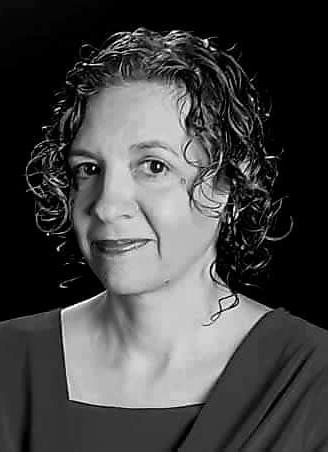
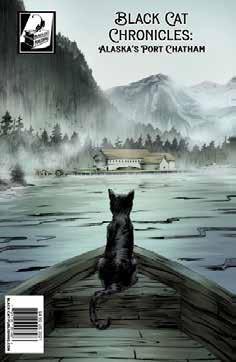
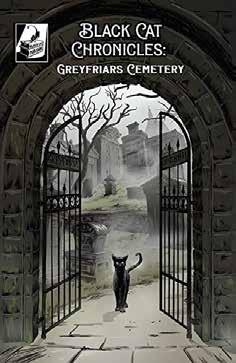
Francesca Maria writes dark fiction surrounded by cats near the Pacific Ocean. She is the creator of the Black Cat Chronicles, a true horror comic book series narrated by a mystical black cat. And her short story collection; They Hide: Short Stories to Tell in the Dark will be out in April 2023 from Brigid’s Gate Press. Her short stories and essays can be found in Crystal Lake Publishing’s Shallow Waters series and anthologies and Death’s Garden Revisited. You can find her at francescamaria.com and on Twitter @Writer_of_Weird.
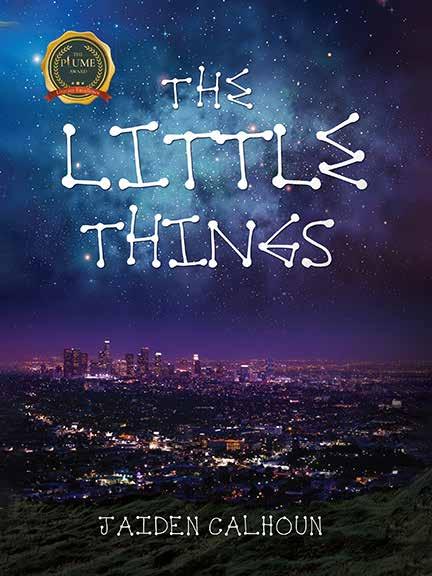
Follow Jamison, a suicidal teen, who is physically abused by his father, emotionally manipulated by his mother, and bullied incessantly in school. He still wants to live but everything has become unbearable so he thought of jumping off a cliff in a remote spot. What he was not expecting is a Mystery Boy who appeared just in time, before he was about to jump. He didn’t know who the mystery boy is, but somehow, he’s saved by him. They only meet at night, the cliff becoming their spot. Who is this Mystery Boy and will Jamison ever get to jump?
Q: What’s the hardest thing about being an author?
A: Personally, the hardest thing about being an author would have to be the constant looking for motivation and ideas.
Q: What is the best thing about being an author?
A: The best thing about being an author would probably have to be the fact that you get to make and control your own fantasy or ideas without the pressure of pleasing others.
Q: What book changed your life?
A: For me I never had a specific book that changed my life, I read too frequently to have just one.
Q: What inspired you to write this book?
A: Many things inspired me to write this book, one being that every book that I have read that contained suicide ended the same way and I wanted to show that, suicide isn’t something to romanticize.
Q: How would you describe your style of writing to someone that has never read your work?
A: I would describe my style of writing as informative, descriptive, and, to some, inspirational.
Q: Do you feel that writing is an ingrained process or just something that flows naturally?
A: I believe writing can be both a process and something that flows naturally, it all depends on the type of book you wish to write. For me personally, it flew more naturally, it was something that allowed my brain to go on auto-
pilot and simply say what it wanted to.
Q: What is the take home lesson you wish your readers will learn after reading this book?
A: The take home lesion would be that no matter how hard you try, no matter how good things seem to be going, there is always a chance that it can change in the blink of an eye. So, you have to learn to enjoy the little things.
Q: What books are currently in your to be read pile?
A: In this moment I don’t have any, I usually just pick up a book at random and hope that I like it.
Q: Anything you would like to say to your readers and fans?
A: I would like to say that no matter what you are someone else is going through, its ok to take things slow and simply enjoy the little pleasures in life. There are so many things in this world that have no meaning that it is almost impossible to not want to indulge in them all, and honestly, I think that’s where life truly begins
Jaiden Calhoun is sixteen years old and just trying to find his thing. He hopes to help many people, mostly teens, find the strength to find help. He encourages being open with loved ones and wanted to show that just because people can’t see something, doesn’t mean a struggle isn’t happening. The author hopes that this book will show people that they aren’t alone.
feature authors paranormal romance
Christina Lynn Lambert Faedra Rose A.D. Brazeau
Christina Lynn lambert
Before I had the wild idea to write a book, I worked in a few different fields. I was in sales for a while, and after I finished college, I worked as a case manager. When my children were little, I was a personal trainer and running coach. During the evenings, when I was supposed to be studying for another fitness training certification, I started writing a story. Finally, I gave in and acknowledged that writing is what I’m meant to do. I love creating imperfect but determined characters who find the courage to love and the strength to survive in a world where there are no guarantees. My stories include a fair amount of sarcasm, suspense, steam, and violence. When I’m not writing, I enjoy spending time outside and finding ways to avoid cooking. I live in beautiful Virginia with my husband, two teenagers, a sweet, hairy monster of a dog, and two devious cats.
Uncaged welcomes Christina Lynn Lambert
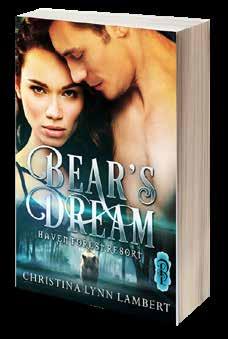
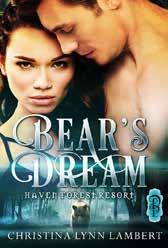
Welcome to Uncaged! Your latest release is book one in a shifter romance series called, Bear’s Dream. Can you tell us more about this book and series? How many books are planned for the series, or is it open ended?
A snowstorm on New Year’s Eve brought bear shifters Ellie and AJ together. Will they survive the danger threatening to tear them apart?
Bear’s Dream is about two bear shifters who would never have chosen to spend time together if it weren’t for a chance meeting in a hotel bar on New Year’s Eve. AJ’s dream of opening a shifter resort is what leads Ellie to end up working for him as an Events Manager. When a relationship between Ellie and AJ seems impossible, she has a recurring steamy dream about him that just won’t leave her alone. I plan to do at least 3 books, maybe 4, for my Haven Forest Resort series. Each book will feature a different hero and heroine on their search for happily ever after.
You also have a trilogy, Stranger Creatures series out. Is this a finished series or do you plan on adding to it in the future?
While the series isn’t finished yet, I just finished writing Coyote’s Vow, which will be book 4 in the series. Book 4 will feature Trevor and Kylie’s story. Trevor is a coyote shifter who appeared as a minor character in my Stranger Creatures books 1 and 3.
What is the most difficult scene for you to write? What is the easiest?
I had the most difficulty writing the scene where Ellie is interrogated in Bear’s Dream. I didn’t want anything bad to happen to her, and it hurt my heart to write her being tortured since I’d gotten so attached to her. I had a much easier time writing different scenes where Ellie and AJ were getting to know each other. That part flowed so well for me that I could barely type fast enough to get the ideas down.
Where do you get your ideas for new plots and characters?
I start with the characters first. I just get flashes and images of ideas and I have to sit and think about where the characters live and what might happen to them. A lot of ideas hit me when I’m out for a walk or driving in the car, by myself, with the music up loud. I have learned the lesson that if I have an idea before bed, then I absolutely have to write it down, otherwise, when I wake up in the morning, trying to remember things from the night before is like sifting through mush.
What are you working on now that you can tell us about?
I’m working on a few different projects at once. I always like to be working on more than one thing at a time, that way, when I get stuck on one work in progress, I can work on a different project for a little while. I’m making some progress with books 2 and 3 of my Haven Forest Resort series. For book 2, Greg Shepherd, AJ’s brother in book 1, gets his own story. Book 3 will feature Rob, the leopard shifter head of security at the Haven Forest Resort.
For my Stranger Creatures series, I just finished writing book 4 (Coyote’s Vow) and will be working on the edits and other things the publisher sends me to do for the story. I’m planning out the next book in the series, which will feature Matt Blackwell and Alicia Mercer. Both characters have had small parts in book 3 (Tiger’s Last Chance). There may be a small novella featuring Luke Daniels, the guy who makes the surveillance and weapons tech referenced throughout the Stranger Creatures series.
I also write poetry. I’ve been working on some short poetry books as well as poems and essays to contribute to different anthologies.
Do you base any of your characters on real-life people?
Many of the villains I write are very loosely based
on people I have either observed or interacted with. I imagined what those angry, hurtful people would do in positions of great power. How would they abuse their power for their own gain? I also like to imagine villains as people who endured something terrible and perpetuated the cycle of pain and misery because they didn’t understand how to do anything else with their frustration and outrage.
What behind-the-scenes tidbit in your life would probably surprise your readers the most?
I get lost when going new places, even with satellite navigation. The GPS on my phone is somewhat helpful at getting me sort of near the destination but when navigation lady tells me to turn left way too late or tells me to go north/south/east/west, I want to throw my phone out the car window. Navigation lady should give me plenty of time to turn because it takes a second to remember which is left and which is right. Navigation lady should also never ever act like I have a compass in my head. Don’t tell me east or west, tell me whether I should turn my car left or right, and what road (not state route number, I need the name of the road!) to take. I need landmarks and encouragement to find my way to a destination.
Which comes first, the plot or the characters in the planning stages?
I always start with the characters. They speak to me first before I have any idea what should happen in the story. The characters are the lifeblood of the story to me and I see them in my head first. As their mannerisms, backstories, and desires all begin to take shape, the rest of the story follows.
What are some things you like to do to relax when you aren’t writing or working?
I love swimming, hiking, and riding my bike. There are a lot of beautiful parks and trails in Virginia and many are just an hour or two from my house. A day trip to the beach where I can swim, walk along the boardwalk, and sit on the beach reading is the ultimate good day for me.
Do you prefer ebooks, audiobooks or physical books? Are you reading anything now?
I like all three formats. Each have their merits. I don’t listen to podcasts, talk shows, or audio books while I’m driving though. I get too interested in what’s being said and end up missing turns and exits.
Right now, I’m reading Daylight by Oya Marsh and Music for the Dead and Resurrected by Valzhyna Mort.
What would you like to say to fans, and where can they follow you?
I have always loved writing. For years, I wrote poetry and essays for fun then stored them in a folder, never to be seen again. I went to school for psychology and then for business. After graduation, I worked as a case manager, and when my children were young, as a personal trainer. I never planned on writing a novel until I got an idea for a story that wouldn’t leave me alone. Completely changing careers to enter a field I knew nothing about was hard and overwhelming at times but I found my passion. I love creating stories about characters who find the courage to love and be loved.
Stay Connected
Enjoy
an
excerpt from Fallen Comrade Bear’s Dream
Christina Lynn Lambert Shifter Romance
She had every reason to hate him
Aiden “AJ” Shepherd’s mistake during a Shifter Army Enforcement rescue mission cost Ellie Ortiz’s brother, Marco, his life. She hates AJ with a passion until a chance encounter with him on New Year’s Eve reveals he’s not the cold, heartless man she once thought him to be. Her attraction to him takes her by surprise and she vows to ignore her feelings. When a new job puts her in contact with him every day, the heat building between them threatens to flare out of control. Her resolve to keep the sweet, sexy man in the friend zone is weakening by the day.
His secret could ruin everything
During a disastrous assignment with Shifters United, AJ uncovers some information that changes everything. Keeping the truth hidden from Ellie is killing him but he might lose her forever if he tells her what he learned on his mission. When Ellie ends up in danger, AJ will stop at nothing to save her. To survive, they’ll have to work together to stop a reporter who is determined to prove the existence of shifters.
Excerpt
AJ staggered toward Ellie, holding his side. She caught him before he fell. People rushed over to them, asking if he was alright.
I guess they only care how he is now that the fighting is over.
“He’s fine. Just a little bruised up.”
The wolf shifter woman cleared a path to AJ and guarded his other side. “I’ll help you get him to the woods. My friend can stall the cops and do crowd control while you guys shift out your injuries.”
“Thank you. Seriously, thank you.”
The wolf shifter nodded. “No problem. Hurry.”
Ellie grasped AJ’s face in her hands and looked him in the eye. “We just have to get to the woods. It’s not far. Stay awake and stay with me. I can’t carry you. Understand?”
“Yeah.” His voice was barely audible.
An eternity later, they found a spot amongst the pine trees and bushes with enough cover for him to shift.
“Hold on. Don’t shift yet. Let me pull these chunks of metal out of your head first.”
He cursed as she pulled one particularly large, jagged chunk out of his scalp. Blood poured down his face and neck. His eyes drifted shut.
“Come on! Wake up! Shift!”
He slumped over, oblivious to her yelling. She stripped him then dug her fingers into his stab wound. He growled and shifted into bear form. A sob of relief escaped her. AJ shifted back to human form, then, a split second later, he was a giant furry brown bear again. The bear walked around for a moment, dug his claws into a tree, then pressed his nose to Ellie’s cheek, making her laugh. In the blink of an eye, he was in human form again.
“You’re alright now?” she asked.
“Yeah, I’m fine.”
“You’re sure?” She ran her fingers over the places on his head she’d seen cut and gouged. No sign of any wounds. She looked at his eyes. He focused on her properly. She breathed out a sigh of relief. “I’ve seen more than one shifter be pressed for time to heal and they weren’t healed up as well as they thought.” His
injuries hadn’t been superficial. He wouldn’t have made it to their room to shift in privacy without being stopped by well-meaning regulars—shifters and psy often referred to humans with no strange, extraordinary abilities as regulars—insistent on taking him to a hospital.
People who hated shifters lurked in hospitals, watching, waiting to destroy anyone they found out of the ordinary. Today, some ignorant haters had almost killed AJ, at a winter festival celebration. Nowhere was truly safe. She was still freaked at how close he had been to losing consciousness and never waking up. She knew damn well he would have died if he hadn’t shifted when he did. She didn’t want his light to burn out. Didn’t want anybody’s light to dim, really, but he was… She shook her head. A good guy. That was all. She didn’t want to see a good person die too young. She wrapped her arms around herself and her eyes teared up. “Hey,” he spoke softly, “look at me.” She met his gaze, reluctantly.
“I’m all right,” he assured her. “The important thing is, a group of angry men didn’t get the chance to beat the living hell out of a shifter teenager.” She nodded.
He gently stroked her cheek and his hand came away bloody. “Your turn to shift.” She hadn’t felt any pain in her face. Probably because several of her ribs were cracked and her stomach had a fistsized knot in it where she’d been punched. She stepped behind a tree, undressed, and shifted. B shook out her thick black fur and walked around a few paces in the woods. After a moment, she reluctantly shifted back to human form. Ellie stopped still when she caught AJ staring at her.
“Damn, you’re beautiful.” His appreciative tone wrapped around her. She gulped and ducked behind the tree to put her clothes back on. She emerged, wrapped back up in her bloodstained winter coat and clothes. At least the blood wouldn’t show up since everything she was wearing was black.
A.D. brazeau
A.D. Brazeau is an award-winning author who writes what she loves. From dark and fantastical paranormal romance to quirky contemporary romance, and everything in between, she loves nothing more than to immerse herself in new worlds. A.D. Brazeau is a book-obsessed wife, mother, and dog lover, who grew up surrounded by stories. Not much has changed. A.D. is from Colorado Springs, Co.
Welcome to A.D. Brazeau
Welcome to Uncaged! Your book, Blood & Ravens is the first book in The Casket Girls series. Can you tell us more about the book and the series?
Thank you so much for having me! I’m happy to tell you more about the Casket Girls. This series was really born from my love of New Orleans and its lore. My series is a paranormal imagining of what the real Casket Girls endured when they arrived on New Orleans soil. Reports vary as to when the Casket Girls of New Orleans arrived, or if they arrived at all. It is generally believed they arrived in 1728, although I have read varying accounts. Oftentimes, women who were sent over the Atlantic were known as “undesirables”, prostitutes, or convicts. The Casket Girls of New Orleans were known for their virtue, having come from church charitable institutions. There is little documentation regarding the Casket Girls, leading some historians to question if this group of women even existed. If the women did indeed come over in 1728, they wouldn’t have stayed at the convent as it stands today. Today’s Ursuline Convent wasn’t finished until 1753.
How many books are you planning for the series, or is it open ended?
I’m finishing up the third book now and have plans for an extended world. How many books that will end up being has not been decided.
What is the most difficult scene for you to write? What is the easiest?
The most difficult scene in any book for me is usually the ending. As an author you want to nail the ending, so it feels extra difficult. The easiest scene for me, of any book, is always the opening scene. This scene is always so vivid for me, that it comes rather easily.
Where do you get your ideas for new plots and characters?
I’m typically inspired by locations. For the Casket Girls, I was inspired by the New Orleans and the legend of these women. I’m currently working on a secret project that came to fruition after being inspired by a cemetery walk.
What are you working on now that you can tell us about?
I’m finishing up the third Casket Girls book with
my editor and am working on a secret project that is unlike anything I’ve written yet. I can say it’s a suspense and set in my home state of Colorado.
Do you base any of your characters on real-life people?
Yes and no. The Casket Girls series is based on a group of real-life women. However, the characters themselves are entirely fictional. I have included historical characters in other novels. For example, Nikola Tesla makes an appearance in my historical mystery, Murder in the Lightning Room.
What behind-the-scenes tidbit in your life would probably surprise your readers the most?
I’m a Disneyland fanatic. Can’t get enough.
Which comes first, the plot or the characters in the planning stages?
Plot. Always the plot for me.
What are some things you like to do to relax when you aren’t writing or working?
I love to walk, hike, and enjoy the outdoors. I read a lot, love to travel, and generally just enjoy being with my family which includes our rescue dogs.
Do you prefer ebooks, audiobooks or physical books? Are you reading anything now?
I read both ebooks and physical books. Either are just fine, although who doesn’t love the smell of physical book pages?
What would you like to say to fans, and where can they follow you?
Thank you so much for the continued support. The love an author receives from readers makes all of it worthwhile. You can find me on just about every platform.
Stay Connected
Enjoy an excerpt from Blood & Ravens
Blood & Ravens
A.D. Brazeau Paranormal Romance
Casket girl, Greer, will sacrifice everything to save her love and protect her friends.
22-year-old Greer is ripped from her small Paris life and thrust into the world of the casket girls of New Orleans. There she finds herself living in a convent, promised to a man who is a stranger to her. As Greer begins to experience dreams of a nightly visitor she calls the Dark Knight, she awakens to a frightening fact, the visions are real - Greer and her friends are being fed upon by whatever lurks in their casket-shaped cases.
Theron, a demon cursed by Hades to live his eternity as a blood-sucking vampire, finds his bitter, cold heart, warming to the woman who was to be nothing more than food. As he finds himself falling under her spell, he helps her and her friends, putting himself firmly in the path of Hades’ wrath. To free Theron, and save her friends, Greer must offer a sacrifice to the lord of the Underworld, but will it be enough, especially when Hades is the least of their problems?
Blood & Ravens, a dark, paranormal romance, takes place in 1728 New Orleans. This is book one
of The Casket Girls Series.
Excerpt
Excerpt - Chapter Two Theron
He was slipping and he knew it. He’d allowed his food moments of wakefulness in which she had been semi-conscious. Conscious enough to see him, to feel him. Each time, he pushed her back into the oblivion of sleep. She would likely think he was nothing more than a dream, but there was always the chance she would remember more and more if he continued in this vein.
Vein.
The very word sent a shiver through him. He was a slave to his baser needs, and always had been. Now was no different, really, he was just tiring of it all. The endless thirst, the endless night, centuries of torment. When would it be enough? When would this curse end?
Theron knew the answer to that question. The curse would end when he did. Only, he wasn’t so easy to end. It was as simple and as complicated as that. Still, it was a question he pondered more and more. Could he put a stop to not only his suffering but the suffering of his victims?
They weren’t always innocent, his victims. Usually they were degenerates, killers themselves, rapists, men of the night who only wanted to hurt. He felt no remorse about them. None whatsoever. But over the centuries, he’d often taken the sweet, the simple, the kind. They tasted better, those kind souls, not so bitter, not so tainted as the evildoer. And for the longest time, he hadn’t cared. They were food, pure and simple. He, the apex predator, was simply doing what it was in his nature to do. Then, he’d found himself roped into this scheme. This scheme of Rook’s to what? Move onto fresh meat on a new continent? The whole idea was asi-
nine, and he’d had no choice but to do as he was told. Theron sat in the cargo hold. It was somewhere around midnight. He could tell by the position of the moon streaking through the lone porthole. A porthole that had been painted black to protect what lurked inside the cassettes. He’d opened it, carefully, for the fresh air. During the day, if he stayed behind the porthole and didn’t allow the sunlight to directly touch his skin, he could do this. He wasn’t like the others, not fully. For this one thing, he was grateful.
The ship swayed and buckled. He wondered how the humans had braved the rocky waves, then realized he didn’t care. He was fine and that was all that mattered. In a short while, he’d leave the hold, along with the other creatures of the dark. They would be taken to the convent, then he’d be able to find his meal. She was his alone. Something Theron appreciated. No one wanted sloppy seconds.
The dock was dark, just as he liked it, the fog so heavy he could easily stand out of the way to observe the casket girls, as he liked to call them, as they disembarked the vessel. Brackish air swept off the water sloshing around the wooden posts.
Watching the girls wasn’t of the greatest interest. What he wanted to do was make sure the transference of the cassettes went smoothly. The task was not a difficult one, the cassettes were to be off-loaded, handed to the women to be taken to the convent, then stored away from prying eyes. But with Rook still halfway across the world, and the others just mindless fools, he felt as if the burden of supervising the transition fell to him. Maybe, just maybe, he’d catch a glimpse of his little rabbit in the process.
Would she be weak? Would she even be able to carry her cassette?
Why such a thing should concern him was confusing. Maybe he was turning into the fool. It would be stupid to let her see him even for a moment. She probably wasn’t particularly bright, she was where she was, after all, but he should avoid anything that put himself
Theron told himself he was merely curious, which he knew was a lie. He wanted her to see him, but why? Hubris? Ego? Was he trying to scare her?
Scaring his food wasn’t his style. Did the human scare the cow before consuming it? Or the chicken? No, they simply went about the task of the slaughter and consumption. Feeding was the same for him.
The women began descending the gangway, Theron doing his best to melt into the misty night behind him. There she was, at the front, stumbling behind the redhead whose bed had been under hers. His little rabbit wasn’t the most graceful, but she’d been drained over the course of the long voyage and was malnourished on top of it, they all were.
That line of women looked like a chorus of walking corpses. Something ached in Theron’s chest. He ignored the sensation, pushing the feeling aside.
The little rabbit turned her head when he wasn’t paying attention and he found himself locked, gaze to gaze, with her.
He froze in the moment, staring at her as she stared at him. When she looked away, he allowed himself to change form, right there on the dock. Doing so was a mistake, but he could remain no longer.
He flew off, his form fractured into that of dozens of midnight black ravens.
Why did I do it?
He was angry with himself for letting her observe him, so angry he’d made another error. He’d manipulated himself where he could be seen, not only by her, but by the other women, the dockworkers, the nuns. He shouldn’t have done it, but he wanted to. An unkindness of ravens was his favorite form. A surge of life pulsed through his veins when he manifested in that way. Free somehow, though he wasn’t. He loved to
soar high above the humanity that sickened him so, high above the petty uselessness of it all.
The moment had come to get his head straight. They were in this town called New Orleans, and it was time to move into the next phase of their detestable plan.
Don’t miss these titles:
My family and I are animal lovers. My husband and I once bred Quarter Horses and I miss seeing these beautiful animals in the pasture. We have not been without a dog or cat, often both, for all the years of our marriage. Our present pet is Lulu, a labradoodle rescue who has become quite certain she is a little girl. At mealtimes, she never fails in pointing out that she is the only member of the family not given a chair and plate at the table. When we were ready for another dog after our last dog passed away, my only requests were under 50 pounds and shed-free. Lulu is 75 pounds and if we did not keep her clipped and groomed, I would have white tumbleweeds of dog hair rolling through the house. Not what I ordered, but definitely one of the sweetest dogs we have ever had. Just don’t believe that stuff about doodles not shedding!
ROGER & Manny
Our miniature dachshund, Manny, lies wrapped in a blanket on my lap all day while I work. (He’s been sleeping here all the while I’ve responded to this interview.) We’ve always had dachshunds, and Manny is the smallest and gentlest we’ve ever been lucky enough to love.
I have two English Labs. Louis, my black lab, who is twelve and Scarlett, my yellow lab, six. I love them dearly and they are the sweetest pups you can imagine.
CHRISTINA & Yuki, Gerald & Lu
I have two cats and a dog. Yuki is my giant fluffball dog. He loves to romp around in the snow and follows me around everywhere. His favorite snacks are pizza and black bean burgers. My cats, Gerald and Lu, chase each other through the house at all hours of the night and spend their daylight hours getting into more mischief. They both like to sit on my notebooks and climb across my keyboard while I’m trying to write. Lu W.A. &
AUTHORS AND THEIR PETS
Pets and companions come in many shapes and sizes. From furry to feathered to hairy and scaley - there is a place for all of them. Authors have a special relationship with their pets - whether they remind them to get up and take a break or they inspire their writing. Meet the critters that share their love and devotion to Uncaged Feature Authors. has destroyed several sets of curtains by climbing on them. Gerald drags around stuffed animals in the middle of the night and meows as loudly as possible to tell everyone in the house he has caught something.
A.D. & Luna & Phil
We love our rescues. Luna, a grey and white Siberian, was adopted from the Laguna Beach Animal Shelter after having been found, as a stray, running along the highway. Phil, a black and white Siberian, was rescued from Taysia Blue Siberian Husky Rescue out of Colorado. We’ve had six other fur babies along the way, five of them Siberian Huskies. They bring so much joy and love.
FAEDRA & Princess
My family is beholden to a beautiful, fluffy girl we call Princess—because she’s our baby! She’s affectionate and brave, but does have a bit of a catty attitude when she decides she’s annoyed and had enough attention. (It’s hard being adored!) She loves the garden, and being outdoors the most, though she comes inside to escape the weather when it suits her royal highness! She is very well spoiled, and fawned over by the children.
C.T. & Jade
MACK & Bella
Bella is the cowardly commander of the family. She may run and hide under our legs, shaking like a cheap motel vibrating bed, at the first drop of rain, but she does keep the house in order and running smoothly. First, there is no running in the house. If she sees you doing it, Bella will bark reprovingly and nip your heels. She knows what time we need to wake up in the morning and makes sure we never oversleep—or sleep in for that matter— the little beast. I work from home, and when my workday is done, she comes upstairs and herds me to my writing spot outdoors.
My Dog, Jade.
Faedra rose
Faedra Rose is a USA Today Bestselling Author of Erotic Romance, including Ménage, Reverse Harem, and LGBT love. While she writes everything from the fantastical to contemporary … you can always be sure that her stories will be laced with an undercurrent of danger, and lashings of delicious darkness!
Uncaged welcomes Faedra Rose
Welcome to Uncaged! Your latest release, Immortal Hearts is the third book in the Hearts of Avalar series. Can you tell readers more about this series?
Thank you so much for having me! Set in a medievalcome-Victorian Gothic world, Hearts of Avalar is a paranormal romance novella series published with Evernight Publishing which focuses on the relationships and bonds of friendship which blossom between the witches and shifters of the magical, unseen realm of Avalar as an epic struggle for power and Balance takes place in their ancient lands which are presided over by Fate and the Goddess.
Strong alpha males support their Fated mates (heroines and beta males) through their personal journeys to selfdiscovery and acceptance of the roles they must play in the upcoming War of Elements.
Hearts of Avalar is an inclusive series, and features both heterosexual couplings, as well as LGBT, and alternative relationship dynamics such as ménage and reverse harem!
While each and every Hearts of Avalar title reads perfectly as a stand-alone romance, the series is best
read sequentially to fully appreciate the overarching world storyline, as well as the exciting and fun cameos of previously introduced characters!
Book three, Immortal Hearts, is the story of a noble ancient vampire and a pair of identical twin Fire witches who are exiled from their coven and on the run for their lives. Fate conspires to push them together, revealing their unique Fated mate bond as a triad, as well as the discovery of a new Element in Avalar...
You also have written stories for two anthologies that released towards the end of last year. Can you tell us about those?
Absolutely! Wild Hearts, the first book in the Hearts of Avalar series, features in Evernight Publishing’s Alpha Male anthology. This story sets the tone for all the titles that follow, and introduces the major concepts of Fate and Balance in Avalar, as well as the existence of the Elements: Earth, Air, Fire, Water, and Chaos.
Carnal Hearts, which is the second book in the Hearts of Avalar series, features in the m/m anthology Alpha Male: Manlove Edition. This story introduces the presence of warlocks in the realm,
and ongoing conflict behind the scenes to overthrow the predominantly matriarchal rule of Avalar.
What is the most difficult scene for you to write? What is the easiest?
I’m not sure that any scenes are difficult or easy, per say. Some scenes I find I’m able to write faster, because they’re intimate, or dialogue heavy; whereas others I take a little more slowly to ensure that I’m being consistent with my world lore and the connecting events taking place around Avalar that are relevant to each book in the series.
I can say that I really enjoy writing the emotionally charged, and more violent scenes, as they really allow you to get inside your character’s heads, and demonstrate just what kind of people they are. I believe a great deal is revealed about someone when they are under significant pressure, or forced to defend someone they love!
Where do you get your ideas for new plots and characters?
The bane of any author’s existence: this question! I can’t say where I get my ideas, as those I come up with are born of a culmination of my own life experiences, as well as everything I’ve ever read, watched, and appreciated. I can reveal that my deep love of epic, dark fantasy and paranormal romance has been inspired by some of my favorite authors over the years. J.R.R. Tolkien, Terry Brooks, Anne Bishop, Anne Rice, Jacqueline Carey, and George R.R. Martin just to name a few!
What are you working on now that you can tell us about?
I just wrapped up work on Entangled Souls, which is the first in a new series of mine published by Evernight Publishing called Soul Mates. It’s presently up for pre-order and releases on the 3rd of February. It’s a bit of an homage to my deep love of the trope of the eternal battle between Dark and Light, and my personal addiction to all misunderstood, and morally grey Dark Lords.
Outside of that, I’m presently diving into the world of dark contemporary MC romance. I’m nearly done penning the first in a new series, and can’t wait to share it with the world. It has a very uniquely Australian flavor, and highlights many of the colloquialisms, the beauty, and eccentricities of our culture and landscape.
Do you base any of your characters on real-life people?
Check and mate! Absolutely—to a degree. Every single male I write is a reflection in some way, shape, or form of my very own soul mate. His personality, heart, and strength of character constantly inspires me to create beautiful and uniquely flawed men who will do anything to protect their girl.
Other people, places, stories, and experiences certainly come into play, as well; which is why I love what I do. Everything I write is like a little facet of the diamond of my life on the page.
What behind-the-scenes tidbit in your life would probably surprise your readers the most?
Hm. That’s a tough one! I try to keep my personal life and professional life separate, so I haven’t revealed all that much about myself Online. But I think readers might be surprised to learn that I watch and read horror to relax before bed!
Which comes first, the plot or the characters in the planning stages?
First things first. I have to admit I am not a planner. I am utterly and unapologetically a ‘pantster’—I write by the seat of my pants. Everything is written on the fly as it comes to me. That being said, when something first pops into my mind, it’s already a complete rough draft. Something like a faintly sketched out painting. I already know everything— broadly speaking—that’s going to happen from start to finish; but as I go, the layers grow, the gaps fill in, and the story becomes more complex as I add detail.
What are some things you like to do to relax when you aren’t writing or working?
I think to some degree an author is always working. Inspiration is everywhere, and our stories are never far from our thoughts no matter where we are. But when I’m actively trying not to work, I can be found enjoying quality time with my family exploring the stunningly rugged Australian great outdoors, or indoors chilling with a good series or movie.
Do you prefer ebooks, audiobooks or physical books? Are you reading anything now?
I’ve never tried audiobooks, and I think digital and physical books both have their place—their benefits and downsides. With eBooks you can have an almost unlimited library, but with paperbacks you run out of shelf space pretty fast. But then, you can never replace the feel of a real book in your hands, the smell, or the delight of owning a signed copy!
I’m currently re-reading Wilbur Smith’s Warlock. It’s left-of-field compared to what I write, myself, but I love his evocative language, and the detail of his work. As a lover of all things historical and mythological, it’s a favorite of mine.
What would you like to say to fans, and where can they follow you?
Thank you for reading my stories! It’s been my lifelong dream to write and be a published author, so to think that anyone out there in the big wide world is enjoying the madcap imaginings of my mind is totally amazing!
My fans can find me on most social media platforms, and I also have my own website which contains everything you need to know regarding my publications.
Connected
Immortal Hearts
Faedra Rose
Paranormal Romance
While patrolling his family’s ancient seat of power, The Crypt, lonely vampire Sebastian Gorefang spies two Fire witches drowning in the sea below. His curiosity piqued, he swoops down the sheer cliff in bat form to investigate. Drawing near he feels the undeniable pull of the Fated mate bond. Desiring nothing more than to share eternity with a companion, Sebastian rescues the pair of witches … only to discover that they are identical twins— and he shares the sacred bond with not just one of them, but both.
Excerpt
Teaser Excerpt
Sebastian
The moon rises, cold and distant, cloaked by dark, turbulent shadows—just like my heart. As pale as the moonlight itself, I observe the shimmering ocean from the battlements of my keep, The Crypt, a great castle hewn into the steep, solid, and immense obsidian cliff face of Avalar’s western coast that overlooks the Sea of Sorrow. Having originally crossed the sea to reach these shores, my forefathers aptly named these lands Sorrow’s End.
Burrowed deep into the cliff, my family sleeps peacefully in their crypts, knowing that they are safe on my watch. My mother and father slumber together, wrapped in each other’s arms, the very vision of immortal love. I sometimes visit them as
they dream, and envy stirs in my heart. Of all my extended and great family, I alone … am alone. Without a mate to share my eternal life, I feel hollow.
The pleasures so relished by our kind have grown stale to me, and I yearn for a companion, someone with whom to covet the joys of immortality. I long for a precious beauty to treasure and call my own. Someone to warm my heart and bed. Someone who can see into my black soul and love me despite what horrors they witness there. But charged with the duty of guarding my kin, when would I meet such a woman? There is no opportunity!
Vampires have long been thought of as the monsters of Avalar. We feed on the blood of the innocent and guilty alike, venturing out only under the cover of darkness. The thirst drives us to unfathomably heinous acts of cruelty and devastation—not that we care. It is our way. It is what we are, what we have always been. We are proud creatures of the night, not self-loathing undead corpses of timeless memories and regret. The witches steer clear of our domains entirely, and shifters skulk through our lands only when necessary, giving our keeps and crypts a wide berth. Though most are not old enough to know it, there are greater terrors that dwell in Avalar than vampires. But they are ancient, more so even than the Goddess most worship. But thankfully, they sleep, entombed beneath the waves.
Dragons. The thought of them sends a shiver down my spine. Dragonfire burns all, the stories of my kin whisper. No Element that exists can extinguish it. It burns until there is nothing left to feed upon. It stops only when it has devoured everything in its path, leaving behind a charcoal feast of destruction for the mighty beasts. The inhabitants of Avalar don’t know how lucky they are that we are their monsters, their creatures of nightmares and destruction. What death we could reap as a race in a single day would not compare to that of a single dragon.
Turning from the ocean, I sigh and prepare myself to walk the usual routes around the keep and the coast, ensuring the safety of my kin, when something catches my eye. A glint of firelight in the night. It gleams warm and painfully insignificant against the gloom of the open ocean.
My curiosity piqued, my predatory senses engage. Transforming into my giant bat form, I take wing, sweeping around the cliff face toward the waves. Two young women are flailing, drowning in the chaotic waves ruthlessly pounding the cliff face. One of them has her palm thrust up toward the sky, and in her hand burns fire. A fire without fuel? Witches!
I realize. What in the name of the Goddess are two Fire witches doing in the Sea of Sorrow? Alone? Seeing the two witches struggle in the turbulent waters stirs something in my soul, and it’s like the darkest parts of me suddenly burst into flame, rekindling the long-starved embers of my heart. Like a man possessed, I give in to the song in my heart and the instinctual need gnawing away at my belly. Diving down, I plummet. At the last possible moment, I back wing and snatch one witch from the water with my clawed feet, lifting her toward the stars and my keep.
After setting her down on the battlements, I waste no time retrieving the second witch from the surf. Laying her beside the other, I transform back into my vampire self and stare in awe. They’re twins. Identical twins. Flame-haired, fucking porcelainskinned sisters of Fire. The witches stir vaguely, enough to splutter and cough, clearing the cold, briny seawater from their lungs. One of them makes fleeting eye contact with me before her cerulean jewels roll back in her head. She falls limp, passed out with exhaustion while the other instinctively reaches a weak, protective arm over her sister, before she too, loses consciousness.
They look so tragic, lying there together, sodden, half-drowned, and bedraggled. My heart inexplicably aches for them. They could—were they conscious— set me ablaze with a single thought, and yet the danger and risk serve only to solidify my will and
my need for them. I will have them both, I decide. There is no other choice. They have come to me, practically to my threshold and into my waiting arms, seemingly delivered by Fate itself.
After scooping them up with ease, one over each shoulder, I carry the twins down from the battlements, into the heart of our subterranean keep, and to my personal chambers. Their skin, though warmer than mine, is icy for their kind. Resting them on the bed, side by side, I bite my lip as I gaze at their glorious, young forms, nipples prominent beneath their transparent, wet dresses.
The scent of their blood causes me to salivate and my fangs to ache, but I force the hunger down by sheer force of will. I have never before smelled such exquisite deliciousness in all my thousands of years. I close my eyes and swallow the urge to tear open their throats to sample their precious crimson nectar. No. They are mine. There will be time for blood, but it is not now.
After fetching two beautiful gowns from the family vault, acquired at some point centuries ago, I undress the twins and wrest them into the new, dry gowns before covering them over with my luxuriously thick duvet. Once I’ve lit the fire in the hearth, I retire to a plush, velvet chair by the window and settle down to watch over them throughout the night.
Welcome to the Weird West
Guest column by KC Grifant
Guest Column
“Welcome to the Weird West”
by KC Grifant
Say the phrase, “Old West,” and several images immediately come to mind. Hats and pistols. Stoic cowboys and daring outlaws. Dusty towns with saloons and horses. The gold rush. Clashes between newcomers and indigenous cultures.
What you probably don’t think of is monsters, ghosts, magic or other supernatural happenings. But a genre called the “weird west” offers a fresh take on this critical time period in human history. Though the genre has been around for decades, the weird west is having a recent resurgence in books, particularly among small-press publishers.
Simply put, the weird west genre mashes Old West elements with other genres ranging from horror, science fiction and fantasy. Examples include The Wild Wild West, Preacher, Jonah Hex, the Dark Tower series or Cowboys & Aliens. These stories of werewolves, demons, zombies, aliens, and otherworldly elements are set among the endless mountains, unforgiving deserts, and other vast landscapes of the American West.
One of my favorite things about writing weird westerns is the freedom to include off-the-wall ideas while finding new ways to tell the stories of this pivotal historical period. The contrast between the romanticized notions of gunslinging heroism and adventure against the realworld violence and tragedies of the Old West further adds to the intrigue. In fact, it makes some weird west mashups—such as with the horror genre—all the more apt. There’s also plenty of history to draw on for inspiration, especially around tales that are not often portrayed in popular media (e.g., those centered around women and under-represented groups).
All my weird west stories, including my recent supernatural novel Melinda West: Monster Gunslinger (Brigids Gate Press), take place in the same alternate history. This world features a location in the late 1800s that resembles the U.S., where a rupture in the earth released an array of monster species. This event leads humans to band together to fend against ongoing attacks. The novel centers around two characters: Melinda, a stoic sharpshooter bent on exterminating monsters, and her partner Lance, an easy-going charmer who gets them out of tricky situations when brute force won’t work. They fight monsters ranging from psychic gremlins, giant flying scorpions, ice krakens, brain leeches and many more.
In addition to creating outlandish monsters, I enjoy using the flexibility of the weird west genre to experiment with some of the archetypes in Old West mythos (e.g., the lone gunslinger, the helpful mystic, the love interest). In this world, a variety of women and other diverse characters –inspired by real-world, under-shared historic accounts—take center stage in fast-paced adventures. Aside from being invigorating and just plain fun, writing these types of stories is a good reminder that history is fluid and changes as our interpretations and collective memory dictates.
New books, novellas, anthologies and other mediums featuring horror and fantasy westerns have been popping up more frequently, and feature everything from dinosaur-fighting cowboys to gnomes and magicians in the Old West. Publishers like Death’s Head Press, Brigids Gate Press, and many others are showcasing horror westerns in particular, including “splatter westerns” (these include more graphic horror elements).
Like many stories that take place at the intersections between multiple genres, there’s a wealth of weird western tales out there that are entertaining and thought-provoking for both writers and readers. Happy reading!
KC Grifant is a Southern Californian author who writes internationally published horror, fantasy, science fiction and weird west stories for podcasts, anthologies and magazines. Her writings have appeared in Andromeda Spaceways Magazine, Unnerving Magazine, Cosmic Horror Monthly, Tales to Terrify, the Lovecraft eZine, Siren’s Call Publications and many others. She’s also contributed to dozens of anthologies, including: Chromophobia; Musings of the Muse; Dancing in the Shadows - A Tribute to Anne Rice; Field Notes from a Nightmare; The One That Got Away - Women of Horror Vol 3; Six Guns Straight From Hell; Trembling with Fear Year 1; Shadowy Natures - Tales of Psychological Horror; Beyond the Infinite - Tales from the Outer Reaches; and the Stokernominated Fright Mare: Women Write Horror. A member of SFWA and a co-founder of the San Diego HWA chapter, she enjoys chasing a wild toddler and wandering through beachside carnivals. For details, visit www.KCGrifant.com or @kcgrifant on social.
feature authors
C.T. Phipps
Phillip L. Johnson
Mack
Little
Sky
Robert
C.T. Phipps
C.T Phipps is a lifelong student of horror, science fiction, and fantasy. An avid tabletop gamer, he discovered this passion led him to write and turned him into a lifelong geek. He is a regular blogger on “The United Federation of Charles” (http://unitedfederationofcharles.blogspot.com/).
He’s the author of Agent G, Cthulhu Armageddon, Lucifer’s Star, Straight Outta Fangton, andThe Supervillainy Saga.
Uncaged welcomes C.T. Phipps
Welcome to Uncaged! Can you tell us more about your book, Brightblade?
Brightblade is an urban fantasy detective novel set in my United States of Monsters universe (which contains books like I was a Teenage Weredeer, Psycho Killers in Love, Esoterrorism, and Straight Outta Fangton). It stars Ashley Morgan, who is a burned out detective and part-time bounty hunter.
Ashley was raised to be a spy for the House (The Men in Black equivalent) but that all fell apart when the supernatural was revealed in 2008. Her brother went missing then and she’s found out that he got turned into a vampire right as she acquires a magic sword everyone wants.
You wrote this book with another author. How do you both work out the writing process?
My co-writer, Michael Suttkus, is a good friend and a great visionary. We have a lot of fun trying to get the dialogue perfect for Ashley and her oddball collection of friends. A good lesson to have with writing along-
side another author is to not get too controlling and let a maximum amount of freedom for each of you to explore your ideas. If they’re contradictory, don’t take it personally but try to figure out which is the better story if you can’t make them work.
What is the most difficult scene for you to write? What is the easiest?
I think my hardest thing to do is the serious dramatic scenes. Not because I can’t do them, but I believe they need to be true to the characters. Otherwise, you get melodrama and useless angst. The easiest thing for me to do is quick snappy dialogue because it just comes natural to me like Kevin Smith. Indeed, dialogue is what I specialize in and primarily what makes my book special.
Where do you get your ideas for new plots and characters?
The United States of Monsters books were inspired by my love of urban fantasy, horror, and my tabletop gaming obsession in the Nineties. Brightblade is a little bit Underworld, a little bit True Blood, and a little bit Jessica Jones. Ashley Morgan has really
been run through the ringer by events, but she’s emerged as a harder more effective person—or so she tells herself. Basically, I write the books I’d like to read myself.
What are you working on now that you can tell us about?
In addition to the second Brightblade book, Brighteyes, I’m working on a couple of new novels including my third Cthulhu Armageddon book. That’s a post-apocalypse Fallout-esque series with the Great Old Ones. The other two books are my Supervillainy Saga and Space Academy series. They’re genre-busting comedies set against superhero and space opera worlds.
Do you base any of your characters on real-life people?
I think all my characters have some of me inside them as well as elements from people I know. However, my characters feel like real people to me after a while.
What behind-the-scenes tidbit in your life would probably surprise your readers the most?
I dunno, my readers are a depraved and imaginative lot. They can imagine quite a bit.
Which comes first, the plot or the characters in the planning stages?
I’m definitely more of a pantser than a plotter. I feel like I write my books like I do a tabletop RPG. I set the stage and have a rough idea about the plot before introducing the characters. The characters then roughshod over any plans I’ve made.
What are some things you like to do to relax when you aren’t writing or working?
I’m a book reviewer as well as a writer. I review books for Booknest.EU, Before We Go blog, and Grimdark Magazine along with my own blog (The United Federation of Charles). So I spend most of
my free time reading indie books in my favorite genres. I also play video games and tabletop game. Yeah, I’m a fairly classic nerd.
Do you prefer ebooks, audiobooks or physical books? Are you reading anything now?
Audiobooks have been a big boon to my work and I absolutely love all of the ones that have been done by such narrators as Jeffrey Kafer (who has done most of my books) as well as Heather Costa (who did the adaptation of Brightblade). However, I can’t deny the convenience of reading an ebook on my Kindle.
What would you like to say to fans, and where can they follow you?
Keep reading and reviewing, friends!
Stay Connected
Michael Suttkus & C.T. Phipps Urban Fantasy
Psychic. Superhero. Spy. Detective. Bounty Hunter. Ashley Morgan has been many things and failed at all of them. The twenty-eight-year old has her whole life ahead of her but has already resigned herself to working a dead end job bringing in the debt-ridden
supernatural criminals of New Detroit. A chance encounter with the vampire sheriff reveals a secret that motivates her to change her life forever: her longmissing brother Arthur is alive (in a manner of speaking).
Ashley sets out on a quest to not only find him but also deal with old lovers, treacherous criminals, a magic sword, and a quest to raise an ancient vampire from the dead.
Brightblade is set in the same world as the Red Room series, The Bright Falls Mysteries, and Straight Outta Fangton.
Excerpt
Chapter One
All According to Plan (Yeah, Right)
“I’ll never get used to seeing that.”
Bryce was a trainee, fresh faced, with dark, curly hair and light brown skin that hinted at a biracial lineage I was too polite to ask about. He was dressed in a rental business suit since he didn’t have the knack with a sewing machine that I did.
It almost fit right. Bryce had recently moved up from the wilds of central Michigan and was entirely too impressed with the Big City. It was funny because he wasn’t that much younger than me at the old and haggard age of twenty-eight. But as Indiana Jones said, it wasn’t the years but the mileage.
“Seeing what?” I asked, following the trainee’s gaze out the front window of the car up into the sky. High above, there was a short, rapidly fading contrail following a black man in a jean jacket from the Nineties. It made him look like a comet, except for the blue part. “Oh, one of them.”
“How can you be so blasé about that, Ashley?” he asked. “There’s a man flying out there.”
“There have been vamps showing off for a decade,” I replied, trying to pretend seeing a flying vampire wasn’t the least bit exciting. “Usually young ones but sometimes the Old Ones do too. They go around punching other people with powers and occasionally
flattening the odd city block just to show they don’t have to hide anymore. Don’t worry, you’ll get used to it.”
Bryce looked at me like I was kicking his puppy while telling his daughter that there was no Santa Claus. Not to imply that he had a daughter or a puppy (or some combination since werewolves were real too). We were about ten miles away from Bright Falls. That was the werewolf capital of the world. It was about twenty minutes from New Detroit, the vampire capital of the world. Ten years ago, they were just a podunk lumber town and Motor City. Now, virtually the entire state of Michigan was supernatural, or at least it felt like it.
“Yeah, but not flying ones,” Bryce muttered. “Spoilsport.”
Ten years ago, in the mystical year of 2008, I’d been a newly graduated student of Solomon Academy. It had been a secret government(ish) facility designed to teach psychics (called “brights”) how to be good little spies who would work against the covert supernatural threats that imperiled humanity.
Solomon Academy was part of a paramilitary organization called the Red Room that obeyed an Illuminati-esque group of mages called the House. Confused yet? Don’t be, since they’re both kaput. It was our job to make sure the threats to reality were contained and no one knew the supernatural existed. The aunt I was named for used to tell me that the House and its cronies were pure evil, and she eventually fled from them. But I’d always believed in the Mission. Mission with a capital M. Me, my brother Arthur, and my sister Anna were going to be the next generation of monster hunting badasses out to save the world.
Yeah, it didn’t work out that way.
Before I got my first assignment, the supernatural came out and I was suddenly out of a job. Not much point in covering up the supernatural if everyone knew about it. No point in hunting the creepy-crawlies if they paid taxes. I was now an overqualified as well as underpaid bounty hunter as well as private eye. Because, really, what other jobs did you pursue when you were a trained spy
and the government wasn’t hiring ex-wizard minions? I’d even tried to be a superhero, no joke, but the less said about that the better. It hadn’t ended embarrassingly; it had ended tragically.
“Morgan is just upset that a vampire once smashed her car,” Jack Peters said through the comms we were wearing. He was an older bounty hunter that had shown me the ropes after I’d decided to try my hand at the private sector of ass-kicking.
“He picked up my car and hit a werewolf with it!”
I snapped angrily. “The vamp was damn near invulnerable, so he is made out of harder material than my car; therefore, it would hurt the puppy worse if he just punched the thing and didn’t ruin my goddamned car doing it!”
“Told you,” Jack said smugly.
“Just don’t ever get into a fist fight with a vampire, okay?” I suggested to Bryce.
“I’ll try not to,” Bryce replied. “Or any supernatural for that matter.”
One of the things I’d learned at the Solomon Academy was that undead weren’t like the ones on Buffy. They weren’t easily disposed of with a pair of crossed fingers or a sharpened wooden spoon. The older the vamp was, the stronger he was, and some of them were more like the Incredible Hulk than Dracula. It didn’t help the cops in the city were firmly under the vamps’ thumb. The thousand-year-old monster had beaten the poor puppy to death and then walked off to reporters taking his picture. None of them bothered to record the fact the puppy turned into a sixteen-yearold girl after her death. That would ruin the story of “heroic vampire defeats rampaging.”
Some days, I just wanted to stake them all and leave them out for the sun. I had issues regarding vampires. It wasn’t just because of a vampire smashing up my car once, either. I’d been trained to hunt and fear them. Hell, Solomon Academy had even done experiments on me and my siblings to bring our speed up to vampire levels. Now, I
was expected to treat them like any other citizen. I just couldn’t—even if they were the ones in charge of my hometown.
“Does she always refer to werewolves as puppies?” Bryce asked.
“Yes,” Jack replied, nonchalantly. “She refers to vampires as vamps, werewolves as puppies, fairies as Tinks, mages as wands, and psychics as brights.”
“That’s kind of racist,” Bryce said.
“Supes are not a race,” I said, dryly. “Or group of races. Powers are like a skill. You wouldn’t call mechanics a race.”
“The Supreme Court disagrees,” Jack said. “We also make our fortune because they do. The courts charge much more for super bail and that means they must borrow more money from us. Which means more interest. Money, money, money.”
Jack was following us with the van, while we drove toward the target’s house. Bounty hunters who showed up in vans tended to, shockingly, look like bounty hunters. It’s amazing how many people won’t open the door to someone who looks ready to cart them off to jail.
“What money?” I asked, smirking. “Am I getting a raise?”
“You’re part owner, so no,” Jack said.
The Jones, Peters, and Morgan Bail Bond Agency (yes, technically it was JP Morgan, but we never called it that) was one of sixteen bail bonds agencies that operated in New Detroit. It was also the only one that brought in lowlifes that had connections to the Supernatural World. Most individuals with powers preferred to handle things “in-house” and avoid the mundie courts.
That ticked me off to no end and part of the reason why I worked at JPM was that I liked dragging supes before the law. It didn’t usually do any good but sometimes, it meant that they served the same sentences as the rest of us. Even if the rest of us didn’t include me as far as the law was concerned.
“I’ve never even seen a supernatural up close,” Bryce said wistfully. “I mean, I see them at the casino shows
and sometimes with crowds gathered around them but that’s just tourist stuff.”
“This is why you still have a car,” I said, bitterly. “You have powers,” Bryce continued. “You can’t really hate supernaturals.”
“Well, for one thing, there is a difference between having powers and running around in your Goth fetish wear pretending to be oh so much better than other people. That’s what I hate. The arrogance and showmanship. If you want to be a celebrity, learn to play the violin. Don’t just think the world will love you because you’re special. You know who are the real heroes? Firemen! Police! EMTs!”
“Because you have such a great relationship with the police,” Jack said. “Of course, if you believe the rumors, our own Ashley Morgan used to be a superheroine.”
“No!” I snapped sharply. “Do not start up that nonsense again!”
Everyone knew about my past, but I was still in denial. I didn’t need Jack to go spreading around old news. “Really?” Bryce asked, looking at me with his eyes widening.
“They say she was the Red Widow, and she wore a bloody harem girl outfit and ran around New Detroit asking criminals nicely to give up, and they did!” “Really?” Bryce asked again.
“No,” I lied. “Not a chance in hell. Don’t believe all the conspiracy website garbage. The Red Widow had, what do you call them, empathic powers, messing with people’s emotions. I have telekinesis. Completely unrelated. And stop imagining me dressed like that.” I’d been able to pull off a superhero outfit back then. That didn’t mean I should have. There’s way too many pictures of my twenty-two-year-old self in way too many geeks’ private folders. The things you don’t think about when you’re young(er).
“Oh, sorry,” Bryce said, turning a bit red. I swear the kid was easy to read, even without the emotion sensing powers I was pretending I didn’t have. “I mean, I’ve seen pictures online, but you wore a veil—”
“Stop,” I said, preparing to tweak his nose with my TK. “Or I will go all bright on your ass.”
“Doesn’t calling psychics ‘brights’ mean that powerless people are dims?” Bryce asked.
“Can you throw things with your mind?” I asked. “No.”
“Then content yourself that I don’t call you dims.”
“Is that why you—?”
“I was young and stupid. End of story.”
“Yes, because you’re so old now,” Jack said. “Young and very stupid,” I corrected him. No end of stupid. Oh Mac. Man did I fuck up that whole business. I’d just wanted to do something useful with my powers. All I’d done was get people I cared about killed and violate the few rules I’d set out for myself. Anna and Arthur would have been ashamed of me—wherever those two were.
“So, you were the Red Widow!” Bryce said, cheerfully. “I knew it. Tracy told me you were an ex-spy school trainee too. So, since you’re a bounty hunting P.I that makes you a psychic superspy bounty hunter P.I. ex-superhero. It’s like you’re a ninja pirate robot zombie except hot, err, conventionally attractive! They should make a show out of you.”
“Drop it rookie,” Jack said, simply.
“You brought it up.” I needed to change the subject, hard. I didn’t need it brought up that I had two skills, being a bright and being a spy, that had gotten me a series of jobs I couldn’t hold down. Hell, the only reason I had my current licenses was because I lied so well. “We’re almost there. How do I look?”
“I said conventionally attractive,” Bryce said, looking guilty.
Someone should have told him hot wasn’t an automatic insult when you were dressing for success, even in the office.
“I meant my fashion sense.”
“Like one of those lawyers you only see on TV,” Bryce said.
“He means professional yet slutty,” Jack said. “Well, that was the basic look I was going for,” I said. “There’s a reason the top buttons are undone.”
“It’s the shoulder pads,” Jack said. “Nothing says professional yet slutty like shoulder pads. Look, it’s nice that you enjoy playing dress up and all, but….”
“The look sells the con,” I said. “These people don’t hang out with lawyers; they see them on TV. And men get stupider around attractive women and stupid people are easier to arrest.”
“You can put me in handcuffs anytime, honey.”
“This is why you’re still single, Jack. Women really just don’t go for the creepy sexual harasser thing you have going for you.”
“My three ex-wives disagree.”
“Accent on ex,” I said. “Maybe you should think about that part.”
“I do every day,” Jack said.
Bryce smiled at that. And then we were there.
The Brooks house was a stereotypical redneck dwelling. A car under the tree in the process of being worked on. A garage that hadn’t had its door closed in a decade, filled with all manner of junk. A lawn that had more dirt than grass and a series of cement stones acting as a walkway to the front door, which in turn looked like it had seen better days. But then the whole house was peeling from what Michigan weather did to paint jobs.
“Ah, you can just smell the dead possum,” I said, pulling our car out in front of the gravel driveway next to an overgrown front yard in the middle of nowhere.
“It’s my own personal vision of hell,” Bryce said.
“Mine too, kid,” Jack said. “Afghanistan was better than the 10th Circle of Hell: Smallville, America.”
“Stick to the script, Bryce, and you shut up, Jack,” I said as I walked up the path to the front door and rang the bell. It didn’t seem to make any noise, so I followed it with a knock.
Our target was a man named Gilroy Brooks. He had been supposed to appear in court on a variety of assault and weapons charges, but you know the story.
Now we got a paycheck if we could find him and bring him in. Smart money was that he was just hiding out at home. Though, of course, we couldn’t exactly walk in and start looking for him.
A few moments later, a hard craggy-faced woman of about forty-five going on seventy opened the
door a crack. She was wearing a house coat and had curlers in her hair like someone from local TV news interviews. Her voice was a raspy longtime smoker’s. “What do you want? If it’s bills, I’m all paid up.”
I sincerely doubted that. Unfortunately, I couldn’t be sarcastic here. I needed to win her trust. Since I could feel the suspicion rolling off her in waves, I gave her my most disarming smile. “Are you Meredith Brooks?”
Bryce tried not to snigger. Apparently, he thought it was funny when women shared the name of once-famous singers.
“Gilroy Brook’s mother?” Bryce added, a little too sooner.
“What’s it to you?” she asked, her suspicion managing to rise even higher.
“We represent the firm of Redock and Fitzpatrick,” Bryce said. “We believe your son is one of two hundred people unlawfully cheated out of his lottery winnings by the state’s manipulation of the lottery process. We’re filing a class action suit to force the government to pay the money it owes to the people it has deprived.”
It was, of course, complete B.S. However, we needed to know where Gilroy was in order to bring him in. He was worth approximately $200,000 in bail money and I wasn’t about to lose that if he didn’t show up for court. Mind you, I wouldn’t have lent him the money in the first place, but Jack was a great believer in risk/reward ratios. Specifically, that he was willing to risk his partners’ money for big rewards.
The waves of suspicion hiccupped and began to be swallowed by curiosity and greed. “What’s this now?”
“What my partner means, in English,” I said, “is that the state of Michigan has been screwing with the lottery results, so that several weeks go by without a winner, so the jackpot goes up and more and more people buy tickets. The people who should have won on the no-winner weeks have thus been cheated out of their share of the money.”
“So, lawsuit,” Meredith said, “You want him in court?”
“Oh, no, nothing like that,” I assured her. “All he has to do is sign this piece of paper.”
I’d printed out the most confusingly verbose legal document I could find online. “It’s a class action lawsuit. The more names we sign up for it, the better our case will look. We don’t need any of them to appear in court because we’re sure the government will pay us just to keep this case from going to trial. If that happens, well, they stand to lose billions of dollars if people think the lottery is fixed. Trust us, they’ll pay.” “How much?” she asked.
“We estimate each signee will get a check for $200,000 in the mail in six months.”
I’m pretty sure no real lawyer would make such specific promises, but what do I know about lawyers?
Reality didn’t matter. What mattered was that I could see the naked greed in her aura. Literally. Psychic empathy was one of my powers even if I never used it to manipulate emotions anymore. Never again.
“You just wait here a minute,” the old woman said as she shut the door. Then she opened it a moment later. “Can you just hand me that piece of paper and I’ll take it to him?”
“Sorry, no, we have to witness the signature for it to be legal,” Bryce said. “Right,” Meredith said. “Notary stuff.”
She shut the door again and we heard her call Gilroy.
“Criminal geniuses, they aren’t,” Bryce said. “Stick to the script,” I quietly repeated.
“I’m ready to pull the van forward,” Jack said through the comms. “Waiting for you to make contact.” Jack was an asshole, but he was good at his job. I knew he’d be in place at the right moment. Everything was going according to plan. That probably should have been my first warning.
The chain was taken down and the door opened. Gilroy Brooks looked just like his file photo. Basically, imagine a six-foot-tall block of cement and then give it a head, legs, and arms. “So, I’m supposed to sign something?”
We both jumped him in an instant. Bryce shouted, “Bail enforcement agent, you’re under arrest for failure to appear.” He did so like making the announce-
ment. As we held his weight down between us, I slipped a plastic zip tie around his wrists.
“What the hell?” Gilroy demanded, struggling as we dragged him off the porch. “You lied! Cops ain’t allowed to lie!”
“We aren’t cops,” I said. “We get to lie all the time.”
I could feel Gilroy’s rage and anger mixed with his mother’s sense of betrayal as well as guilt. Being an Empath was simultaneously one of the best abilities and the worst. Telepaths like my sister could pick up specific thoughts and ideas but were blind to the intent or ferocity of the feeling behind it.
Plenty of people thought about killing their boss but few people acted on it. I knew when someone meant it, but the cost was feeling that anger every bit as much as my own. It was intense, murderous, and remorseless—far more than I’d expected to feel. Gilroy was terrified and not just of being put away for a few months.
“Be careful,” I said, through gritted teeth. “He’s a fighter.”
“You have no idea!” Gilroy said, suddenly feeling both murderous as well as confidant. That wasn’t a good sign.
His mother was screaming vulgarities at us. He was struggling but between Bryce and my telekinesis (or TK) enhanced strength, we had him. Jack rapidly pulled the van into the yard and threw a switch that slid the side door open, which was one of the tricks the van could do since we’d modified it eight ways to Sunday for holding captives. Yeah, everything was going to plan.
Jack himself was a white-haired man in his midfifties with a goatee and ponytail who was trying to look like Sean Connery in the Nineties and failing badly. He wore a Hawaiian shirt and beaten-up blue jeans that I think he’d worn for a week straight. Jack was a seasoned bounty hunter and bright that often referenced adventures across the globe against forces mysterious. Since knowing him, the ones I’d most seen him struggle against were his ex-wives. We were shoving Gilroy through the door when he suddenly threw himself against the side of the van. He looked bulkier now, as if he’d grown about six
inches and put on a hundred pounds of muscle. Gilroy also looked a lot harrier and he hadn’t exactly been clean shaven before.
“I don’t know what the hell that was about,” Bryce said, “But if you’re trying to give yourself a bruise….”
The handcuffs snapped. Crap.
I barely had time to step back. Bryce didn’t and Gilroy backhanded him so hard he was thrown a good four feet back and sent sprawling across the dirt. Then Gilroy reached out and tore the door off the van.
“Holy shit!” Jack shouted. “He’s a super! That wasn’t in his file!”
No kidding!
“I said you were gonna regret this!” Gilroy said, laughing as his face began twisting, causing him to slur his words. “Y’all put me in thissss here position. You made me show off! I’m grrrrr gonna make ya bleed for it!”
That was when he turned into a nine-foot-tall grizzly bear.
Double crap.
Don’t miss this title:
Do you want to meet some new friends? No matter what they look like or who they are, friends are the ones who are with you whatever happens and whenever you need them. But it seems like a little girl is looking for her friends. Come and join her in The Cryptid Party. Help the brave girl find her friends so they can join her for a tea party. In this whimsical story that takes kids on a wild and wacky adventure to find well known Cryptids, author Harmony Brantley helps introduce children to the world of the illusive Cryptids.
Author Interview
Q: What’s the hardest thing about being an author?
A: Personally, the hardest part is the grammar of writing. I have dyslexia so writing can be difficult. Having friends and family to help proofread is always the best too.
Q: What is the best thing about being an author?
A: I absolutely loved doing the illustrations. I have always enjoyed drawing so being able to show off my art is so heartwarming.
Q: What book changed your life?
A: The books that my grandmother read to me when I was young really shaped my world and imagination to this day.
Harmony brantley
THE CRYPTID PARTY
Q: What inspired you to write this book?
A: Well for my book about Ellie May the pig. It is about my very own pet pig. As for the Viking and Cryptids that has just been an interest to me.
Q: How would you describe your style of writing to someone that has never read your work?
A: Some say that my writing is adventurous and out-ofthe-box.
Q: Do you feel that writing is an ingrained process or just something that flows naturally?
A: That really depends on the topic. For children’s books, I try to do little rhythms to my stories.
Q: What is the take home lesson you wish your readers will learn after reading this book?
A: To give ideas to people to look for things that interest them or to adopt a pet pig for yourself.
Q: What books are currently in your to be read pile?
A: The series “Extinction” by Nicholas Smith is what I am reading right now. It is an extreme contrast to what I write.
Q: Anything you would like to say to your readers and fans?
A: If you have a drive to draw or to tell stories, please make a book or a show, and share your work to the world!
Sky robert
Sky Robert is a mom of two tiny humans in training, narrates audiobooks for fantasy/sci-fi indie authors, and when she isn’t writing (which is MOST of the time) you can find her consuming copious amounts of coffee, creating podcasts for Blind Indie Novel Dates, BINDER, to promoting indie authors, reading alien smut, fantasy, sci-fi and romance books, chowing down on Indian butter chicken, and when she actually hangs out with people in person, in real life, outside of the internet, (gasps) she’s playing board or card games. All around nerd, lover of the strange, and all things fantastical.
Grab your first free alien monster fated mates romance Her Alien Exchange for free when you join the Romance Newsletter: https://sendfox.com/lp/m2gyw5
Uncaged welcomes Sky Robert
Welcome to Uncaged! Your newest book, Jewel of the Alien Bandit is a SciFi Romance that is the first book in a new series. Can you tell us more about the book and the series?
I was an alien romance addict before I decided to write it myself, and I found that the things I loved about the genre were the escapism, and the acceptance of who you are, no matter what. Aliens loved their mates whether they shaved their legs or not, whether they were traditionally pretty or not, whether they were considered the smartest of the bunch of humans or not. I guess, what I’m trying to say is that alien love was true, and to them, their mate was the most perfect, and then there is the super awesome acceptance and normalizing of sex! What was not to love.
So, the only thing I didn’t like was an overwhelming majority of the alien romance I read had so much acceptance and so much nonconsent as well… my goal was to create that same sense of acceptance, but always with alien mates that held consent to the highest degree, possessive alphas, but also highly respectful. Don’t get it twisted, respect has nothing to do with whether they would bend you over and take you how they want once consent is given. Haha.
Jewel of the Alien Bandit is about a leader of Estreldez escaping the confinement of her role to save her species, and discovering she’s fallen for an outlaw that challenges her beliefs on how to accomplish that goal. It follows both Vareo and Luan’s POVs as they struggle with their fated mate bond and their own obligations within the universe. Plus, hot steamy alien love. Haha. There is no fade to black with this one. Each book in the series is a stand
alone romance, but the universe, and the planet’s cultures develop over each book. You find out more and more about each species and the plot within the universe as each romance unravels. You can choose to jump into the universe at any book, but it’s definitely more enjoyable to start from the beginning.
You also write as S.M. McCoy. What was the reason for the different pen names?
Yes! I do, I don’t hide this fact. Sky Robert is my nom de plume, and I am proud of it. Nor am I ashamed of all the fun sexy scenes I write under it, but the pen name is solely to set expectations for the readers. People will know what they are getting when they pick up a Sky Robert book, versus what they get when they pick up a book by S.M. McCoy. Each book is still written by me, same style of writing, still world building, still adventure, still romance, but S.M. McCoy is a slow burn. The world is developed more slowly, and so is the romance. Lots of adventure, but they are the kind of books that specific people like to read because if you give them a chance you fall hard for the universe created, but some people don’t like to wait for the payoffs. Sky Robert builds things out more quickly, and there is a higher focus on the romance, so the universe takes longer to build out, but being fated mates, it’s all about the relationships, and of course all the fun sexy times.
I just don’t want someone picking up an S.M. McCoy book expecting what they get with my other books and then being like (Eyeballs bulging) when they say, “this is SUPER graphic!” (flips pages quickly…) “Omg, it keeps going! How long is this sex scene?” Author interjection: “Ahem, it’s a love making scene, and they are meant to be together, and this particular scene is like two chapters long… because both characters want to get into it…”
What is the most difficult scene for you to write? What is the easiest?
Haha, I’d say the sex scenes are actually the easiest to write. They flow a lot more quickly than
the rest of the book, well because I still have to figure out how the romance fits into the rest of the story in a fun way. So, the hardest part is interweaving the storylines between the books, everything has to stay accurate between books, and what one character does will affect the rest of the universe/what happens in the other books. I have a style guide I follow and add to as I write. I have to refer to it often. What did I call that creature on Estreldez again? A hergslat? Oh, right, and they looked like what? Haha, you get the point.
Where do you get your ideas for new plots and characters?
I have WAY too many plots and characters that I can’t possibly write them all. And they all come from the question, “What if?” What if my alien mate didn’t want to have a fated mate? What if accepting a fated mate was a choice between them and something equally important, like finding their family? Or what if accepting their fated mate meant putting their whole planet at risk, because now you can’t make a political mating arrangement for peace? I could go on…
What if?
What are you working on now that you can tell us about?
I’m working on book two of the Trillume Universe, as well as book three. It’s actually easier to work on multiple storylines at the same time, because they all interweave in terms of what one character does is going to influence the other storyline. So, I’m working on a romance between a krelin warrior and an estreld scientific advisor fated mate storyline, and a human jack of all trades sort and a necia warrior commander. Her Alien Prince, and Her Alien Savior. I’m around 33k words into Her Alien Savior, and 10k into Her Alien Prince. The goal is to have Her Alien Prince first draft finished in a month or so, then have it out for edits!
Her Alien Prince directly follows and layers onto what happens in Jewel of the Alien Bandit, and Her Alien Savior is part of the alien exchange program with Earth that started with Her Alien Exchange, the prequel to the
Trillume Universe that I have for free for my newsletter V.I.P.s. I send out emails a few times a month, and everyone can see what I’m up to, get to know me more, and of course join me in my obsession over alien romances. People can join here to grab Her Alien Exchange for freesies: https://sendfox.com/lp/m85g8r
Do you base any of your characters on real-life people?
I like to cherry pick attributes from people I know, but there isn’t a single character that is a complete representation of someone I know. As I discuss in plot versus character, I pick some basics and I get to know them as I write. But, I will say I put a lot of myself into the characters, both male and female. Different aspects in different combinations, and they are truly a new amalgamation, becoming unique from any other character I’ve written.
What behind-the-scenes tidbit in your life would probably surprise your readers the most?
I am absolutely NOT adventurous. I am the epitome of homebody. I am a rabbit. I like to burrow into my hole, stay there, occasionally I’ll come out and frolic, only to scurry back to my home. Like a rabbit, I also like to cuddle, but on my terms when I’m not hyperfocused on something, like writing or narrating an audiobook… or reading. Then I become a bear, and it was better if you didn’t disturb me.
Which comes first, the plot or the characters in the planning stages?
I’m a pantser… meaning most of my plots, and characters are created on the fly. I don’t know what’s going to happen until it happens most of the time. I mean, sure, I do have set things that I’m like I know this is happening in the background so I have to account for that, but I have a style sheet for a reason, and I simply add to it as I go. I’m going to be honest with you… it wasn’t until like the last 3rd of the book that I was like, WHAaaa? I had no idea this was going to happen and I love it! The twist at the end is just one of my favorites, and unconsciously, I didn’t even realize I had created
breadcrumbs that fit the reveal perfectly, it tied into the theme so well, I swear some muse took over my body and I didn’t actually write this. That’s how I feel most of the time. Haha. But characters come first, I guess that’s the real question, but even they have basics down, and they become more real and 3D as I write them and I find out more along with the reader.
What are some things you like to do
to relax
when you aren’t writing or working?
Eep, this is one of those questions that make me seem like a workaholic. When I am not making sure my kids aren’t flying off a couch, or flinging nail polish on the floor, I sequester myself into my closet… yes, you read correctly. My closet! Don’t worry, it’s a very nice closet that I’ve converted into a studio space. I spend most of my time in there, writing, or narrating audiobooks. When I’m not, well I try to remind my friends that I’m not a complete flake on the social front, and do boardgame night. I really like playing games that have some kind of strategy. deck building games are fun, social card games like Card Against Humanity, dice games like Roll for the Galaxy, or large group games like Werewolf. Really, any, and all, board/card/dice games. All of the things. But I get exhausted spending too much time socializing… I honestly do prefer to socialize digitally and spend time in my closet… alone. Haha.
Do you prefer ebooks, audiobooks or physical books? Are you reading anything now?
I love all the books! In any and all formats. I do read more ebooks than anything else, just because of the convenience of it being on my phone. As a mom, you get the time you can get, when you can get it. But audiobooks! Yes, I have one available every time I get in the car. At least half the trips are chauffeuring the kids around, and I drop off one at pre-school, and another at therapy, so half the trip is singing stuff like Frozen on repeat, and the other is an audiobook. Haha.
| FEATURE AUTHOR |
Print books have kind of fallen to the wayside, they are what I call trophies. They are the carcasses of my conquests. If I like a book enough, I get a print book and I display my conquest on a shelf. Every time I look at it, I am reminded of the story and the happiness it brought me, but I rarely read a book in print first.
What would you like to say to fans, and where can they follow you?
You can find me on Twitter, follow on Bookbub, check out the website: https://linktr.ee/skyrobertromances
But really, I’m most active on my newsletter. I write about what’s going on, what I’m working on, tell them what I’m reading, share fun free alien romance reads from fellow alien/monster romance lovers, and fans can reply to my newsletter. I read all my emails and get to know them as well! I have a free book Her Alien Exchange that I made during NaNoWriMo and have gifted as a newsletter exclusive to anyone who joins me: https://sendfox.com/ lp/m85g8r
I’m working on the Audiobook adaptation of Jewel of the Alien Bandit, and I hope to have it released within a month of launching the ebook! A sneak peek of the first few chapters will be shared with the newsletter soon!
Stay Connected
Enjoy
an excerpt from
Jewel of the Alien Bandit
Jewel of the Alien Bandit Sky Robert SciFi Romance
A jewel to steal. A planet to save. A leader to love?
I’m supposed to be taking rulership of my planet when I find myself sneaking aboard an off-worlders’ ship.
It’s just my bad luck the last known Shol male is a compatible mate, when being with him could jeopardize my entire species. I am a ruler, and it is my clan duty to mate for survival… not love. He can’t be mine if I wish to protect my planet from invasion.
I can’t keep him, but my mating loh react to his touch, and everything in me wants him to be mine.
A sci-fi fated-mates alien romance from Sky Roberts, first of the Treasures of Trillume series. This steamy, page-turning romance between an outlaw alien and the strong female ruler that wants him, will have you devouring every morsel towards their HEAFN.
A standalone romance, consensual steamy 18+, and an overarching plot laced between each book. World building sci-fi adventure but with a sexy twist. Strong females, and possessive (but respectful) love interests. For all you alien lovers out there that like vibrating, pulsating extremities, and mates that bond for life. The steamy bare chest should be evidence enough of what you are getting yourself into. You’re welcome
Excerpt
I rubbed my face in disbelief, re-reading the transmission once again. I’d heard of rich psychopaths before,
but this was too good to be true. Being a system pirate wasn’t always easy work, most of the bounties were extremely illegal to the Lunar Administration, but they were spread pretty thin these days, and the pay was better than the regular bounty fare. Whoever this rich f**ker was, they were offering enough credit to make me tattoo their face on my left a**cheek if that’s what they wanted.
“What’s the job?” Carmen asked from behind me, slinking her arm around my neck. Her tongue licked at my ear, and I grinned thinking about all the other things that tongue could be capable of. We’d never gone that far, but that never stopped her from teasing. She was the one that got me into this career path to begin with, and I knew she’d sooner shoot my nuts off than let me touch her.
That was fine by me, but the long cycles alone had my mind addled with urges that were tough to ignore, and that’s exactly why Carmen did it. I ignored her, and pinched her cheeks to focus her on the screen. She would have tried to kick my a**, but she was just as stunned as I was at the price tag on this black market lister.
“That has to be a glitch,” she finally said.
“You could leave me the f**k alone with that kind of credit.” The offer was enticing, the only problem was whether it was legit or not.
“With that kind of credit, you’ll have paid off your debt, and have credit left over to buy your own small planet.” I swiveled in my chair to see the glitter of profit in her eyes. She could finally get off my heap of metal, and tell her bosses, the necia of Necias Delta Fal, I’m a free agent.
Necia were a fiery bunch of alien outlaws, where their main trade of their planet was basically being mercenaries for hire. How I got involved with them wasn’t exactly my choice, but I blew my chance at escaping when I was a boy.
“If it’s real,” I added, trying to bring reason back into both of our credit hungry egos.
“Even if it isn’t real, you still have to show proof to Jax that you’re going to pay up, or she’ll gut you.”
“I thought that was your job?” I gave her a wry smile, and she gave me a wink in return before her extra finger bones sliced from her flesh, and dug into my throat. I shook my head, feeling her grip loosen, unable to follow through with her threats just yet. I wondered, however momentarily, that I could have thought of Carmen as more than a thug. She was pretty by any standards, dark hair hung short at her shoulders, hazel eyes that changed color depending on what she wore, and a tight jumpsuit that revealed all her curves. But necia were a rough breed, and it would be easy for her to morph her bones from her skeleton into weapons like a creepy pin cushion. I would have shivered at the thought, but any movement would have given me an extra close shave.
“Don’t test me, Vareo. I’ve been kind to you, haven’t I?”
My Adam’s apple bobbed, feeling the pressure of the sharp bone. But, this wasn’t the first time she threatened me, and she needed me for the credits. I was worth more alive, and I’ve long since found her threats towards me to be more bark than bite. Easing the weapon of her extra finger bones away from my skin with my own fleshy finger, I smiled. “Kind as a krelin’s horn up my—“ It was the kindest endearment I could ever muster for her.
“Don’t be crass.” She shoved my face with the palm of her hand back towards the screen that was flickering due to the repairs that my ship badly needed. Those credits were tempting. “Go screw a few Estreldez females and bring back their prized jewel. Even if the job’s a scam we can milk them for what they’re worth, or sell the jewel on the black market, and take whatever the buyer has for trying to f**k us.”
“Aren’t you the picture of propriety,” I mocked her eagerness to send me out to pimp myself to an alien planet so I could steal their treasure. That was a first, but it was the only way we’d gain access to the planet Estreldez. They weren’t open for tourism, and kept strict closed borders. In fact, it was only recently that they even allowed offworlders to join their mating ceremony. Though, really even that was a very select few. Which had me doubting whether we could even get the job.
“How are we supposed to get an invite?” I wondered out loud.
“Maybe that’s why the credits are so large. Figure it out.”
Carmen sauntered off to go comm Jax about the job. She wasn’t going to let me turn this down. Somehow, I had to find a way onto the invite list. As much as having my go with a bunch of alien women might have been appealing, the idea of having children that I’d never see again was not. My dad was never around as a kid… I swore I’d never have children if I couldn’t be around for them.
I’d have to steal the jewel and get off planet before the mating could ever be consummated. Get my credits, and I never have to see Carmen, Jax, or any other necia outlaws again. Glaring at the screen, and all of those zeros at the end of the credits meant certain freedom, but I highly doubted the necia would give up easily even after they got their credits. They probably never expected anyone to make enough credits to pay off their debts when the costs kept on rolling in to cover the operation’s overhead. Plus, I wasn’t dumb. They weren’t known to play fair, and just like they’d screw over the client if they didn’t hand over the agreed upon sum it was just as likely they’d do the same to me.
Mack little
Mack Little grew up in the Deep South and has accumulated a vibrant experience that she often emulates in her storytelling. Her studies in International Politics and service in the Army have given her impressive perspectives to bring to her novels new layers of intrigues and twists, which are all quite prevalent in her latest novel, Daughter of Hades.
Background story:
After leaving the Army, Mack worked as a medical librarian and an adjunct professor at Texas Woman’s University. Mack has authored and co-authored several articles for professional journals such as the Journal of the Medical Library Association, Medical Research Services Quarterly, and the Journal of Electronic Resources. She has presented at the Medical Library Association Conference, the Texas Gulf Coast Healthy Communities Partnership, and the Special Libraries Association Conference. She co-authored the book, Disaster Planning: a How-to-do-it manual, published by Neal-Schuman Publishers in 2005. Mack occasionally performs in Community Theater.
Uncaged welcomes Mack Little
Welcome to Uncaged! Your latest release, Daughter of Hades is the first book in the Love and Peace series. Can you tell readers more about this book? How many books are planned for the series?
Set in the 17th century, Daughter of Hades depicts two sets of siblings as they escape their homes in search of a new life. Both end up on the seas of the Caribbean, as slavery and its ef-
fects loom around them and as pirates challenge their way of living. Their escapes lead to great adventure, danger, romance, and a huge fight to survive in harrowing times.
So many characters in DH fascinate me as well as historical details I would like to explore. I cannot really see an end to it. Initially, my plan was to write about the English invasion of Jamaica, and the resistance put up by the maroons on the island. I’ll get there eventually, but I’m taking the scenic
What is the most difficult scene for you to write? What is the easiest?
I often write from my villain and/or antagonist’s point of view. I dread writing those scenes. In an effort to flesh these characters out, I must get inside their head and understand their motives, and there’s much darkness there and pain.
Sex scenes are also difficult. There seems like there are only so many ways to describe a kiss or a caress. However, I have to remind myself and keep in mind that sex is a form of communicating what the character needs, fears, or some other thing. I try to get to the core of that.
The easiest scenes are the dialogue-heavy scenes. Sometimes I start with dialogue to help me get into those scenes that I find difficult to write.
Where do you get your ideas for new plots and characters?
I usually stumbled upon an interesting historical tidbit, and I research it. Most times, a story grows around that. For instance, in the Daughter of Hades, I saw maroons on a TV show. I was, like, are they real? I did a little research and found out that not only were they real, but they were heroic and inspired terror in the hearts of the British. Growing up in the states, there were stories of sporadic revolts of the enslaved people or heroic characters here and there (though all the enslaved who endured were heroic in their way
because, without them, I wouldn’t be here). But the maroons of Jamaica applied constant pressure and were undefeatable and became a pseudo-nation unto themselves. It was just freaking inspiring.
So, as I research a topic, I am thinking about how I might insert my character into the story. Once I get a foothold, I start a character sheet.
What are you working on now that you can tell us about?
I’m working on a couple of things at once. I am revising the novels in my Vampire series. And I am researching the third novel in the Love and Peace series. It deals with an African queen who is defeated by a neighboring kingdom. She and her people are sold into slavery. They turn to piracy in the Caribbean to gain the means to return to Africa and take their kingdom back.
Do you base any of your characters on reallife people?
Yes. It helps to make sometimes outrageously incredible events real. For instance, In the DH, a captive Igbo man forms a friendship with a white sailor on a slave ship who helps the captives in a revolt. Sounds kind of outrageous, right? But that actually happened with a true-life pirate called Black Caesar.
Ami, another character, is based on Queen Nanny of the Maroons, who led the maroon resistance against the British. Ami, however, is much younger and likely only has her status in common with Queen Nanny.
What behind-the-scenes tidbit in your life would probably surprise your readers the most?
I write all my novels longhand with a fountain pen in one hand and a cigar in the other. And because my husband won’t let me smoke inside, I write outdoors. Now I need the open air to write no matter the weather. If it’s cold or rainy or windy I find a way to get it done as comfortably as possible.
Which comes first, the plot or the characters in the planning stages?
My characters definitely come first. As I mentioned before, when researching a topic, I consider how I might insert my character might fit into historical events. Once that’s decided, I start a character sheet that details their characteristics, background, goals, and obstacles. All that writes the story for me and leads to the creation of other characters, and I repeat this process as a new character is created/needed.
What are some things you like to do to relax when you aren’t writing or working?
I like to smoke and drink whiskey, which, consequently, is how I like to write my longhand draft. I also enjoy reading a really good/entertaining book or watching a really good TV show or movie. I was really into yoga before COVID. I’m trying to get that going again.
Do you prefer ebooks, audiobooks or physical books? Are you reading anything now?
My preference is physical books. I like to write in them, break the spine and dogear the pages. Really, I’m the worst. Never loan a book to me. You must give it to me outright. That said. I don’t hate the other formats. I find them useful in certain circumstances. eBooks are good for traveling. I like having a library at my fingertips.
What am I reading now?
• Lilith’s Brood by Octavia Butler, paperback, for an hour after work and for 30 minutes before bed.
• The Akata Witch by Nnedi Okorafor, audiobook for my daily 3-mile walks.
• The Spare, by Prince Harry, eBook, I read it when I should be doing something else.
What would you like to say to fans, and where can they follow you?
You can find me at https://mack-little.com. There you can sign up for my newsletter. I like to meet the people who are reading my books. So, on my site and in my newsletter, I can give you heads-up about the events where you can find me.
Enjoy
an excerpt
from Daughter of Hades
Daughter of Hades
Mack Little Black & African
American Historical Erotica
Dinny and her brother make their escape from slavery on the pirate ship the Hades. It is the last place in the world
Dinny imagined she’d meet the love of her life. Lei, a Chinese exile, recognizes Dinny as the woman of his destiny. But their new life is shattered when her former owner seeks his revenge. With the help of their friends, family, and colleagues, Dinny and Lei will face the challenges of finding love and happiness in the Caribbean world of the 17th century.
Enjoy this erotic historical romance with true-to-life relationships of both heterosexual and LGBTQ partnerships.
Excerpt
20th May 1649
Cove Bay, Barbados
The Hades was a small sailing ship. Dinny heard Lei refer to it as a barque. It had, according to how the Chinese man described it to Jimmie, three tall spars to which the sails
were attached. What made the Hades a ship was those three masts. Anything with less than that was merely a boat. However, what made it a barque was rather nuanced.
“Barque is the general name given to small ships,” Lei said, “and usually to those with no mizzen topsail.”
Dinny listened to Lei speak. The sound of his voice quelled the anxiety of running away. Concentrating on his words kept her from worrying about what was to come.
“In ancient Egypt,” Lei rowed the jolly boat toward the Hades,
“the pharaoh, when he dies, journeys to become a god, in a barque.”
“That sounds rather odd,” Dinny said. “How would they know such a thing?”
“A boat is built for the pharaoh, and a model of it is placed in the tomb with him, as well as anything else he might need. It is quite elaborate.”
Dinny wanted to ask about Egyptian burials, but the subject at hand was boats.
“They had these ships in ancient Egypt?” she asked.
“A version, yes. Though they kept slaves in the galley who rowed the boats—”
“Row a ship as big as the Hades?” said Jimmie.
“Aye, fourteen oars—long oars on each side,” Lei said. “Three slaves to move each oar.”
“Where did they get the slaves?” Dinny said.
“Prisoners of war, mostly.”
As they drew closer to the Hades, the nondescript blotch on the argent horizon grew more defined. The bow of the ship had the shape of a flute, and toward the rear, the hull bulged.
“Why is the Hades shaped so oddly?” Dinny asked Lei.
“It’s a Dutch fluyt. It was built to transport very large and bulky cargo. So the hulls tend to take on a bulbous shape to create maximum space in the lower decks.”
Jimmie nodded. He seemed engaged with Lei’s discussion of ships. Dinny simply enjoyed the distraction.
The stern of the rowboat butted gently against the elongated and bulging hull of the Hades. Dinny’s heart sank a little. She’d enjoyed the intimacy of the smaller vessel. The sound of Lei’s voice soothed her.
Dinny looked up at the tall, dark, ominous Hades and felt anxious as she floated toward an unknown future. Lei let go of the oar and grabbed the rope ladder. He pulled the boat about so that broadsides touched. Jimmie, who couldn’t wait to sail off to his future, grabbed the ladder and scaled it eagerly. This, despite the limitations his African blood presented. As a man, he had more promising prospects than Dinny. He could sail or farm—perhaps with
his fair skin and light-colored hair, he could even pass himself off as white if he cut his hair short. That way, he could buy land… buy slaves. Well, Dinny could tame her curls, for that matter, and marry a wealthy landowner. But she could not—would not—abide any person in that evil service.
“Dinny?”
She startled at the sound of her name. Lei held the boat to the ship as he looked on her with concern. His dark eyes twinkled in the waning starlight. He was beautiful in a way that moved her—not sexually. She didn’t think she would ever want such an intrusion on her person in that way ever again. Lei’s comeliness moved her in the way a sunset might, one with colors and patterns she had never seen before. Every aspect of him entranced her. His eyes, so lovely—of course, she had seen striking eyes before, but none seemed to really see her. Dinny felt sure, when he looked at her, that Lei could gaze into her very soul. She felt laid bare by them. It wasn’t just his eyes. She could spend endless hours contemplating the cut of his jaw and the angles and planes of his face, how they met to form such an unusual yet absolutely exquisite visage. Her gaze fell to the hard sinews of his body, which looked as unyielding as cut marble. The candied amber hue of his skin fascinated her. Lei, she decided, was a being crafted by God—a strange and singular version of the human form, as if God were suddenly inspired in the creation of Lei.
“Are you okay?” Lei said. “Yes…yes. I’m fine, truly.”
Lines unfurled as they fell over the edges of the rail of the ship. Lei tied one end to the stern. Dinny grabbed the other rope and attempted to tie the knot as Lei did. When he finished his side, he moved to the bow and helped her tie her side off. “This is called a bowline.” He guided her in making the loops. “It never slips or jams.” Lei yanked on the rope, and the slack in the lines disappeared. The boat began to rise as sailors hoisted them from above. A slight vertigo overcame Dinny, and she sat on the rower’s seat. Lei smiled as he stood. One foot rested on the rail, the other in the hull. He appeared to Dinny as some heroic figure standing there, even as he held the line for balance. Dinny couldn’t help but return his smile. Such a thing of beauty was the mirth upon his face. When they reached the rail of the ship, Lei jumped agilely onto the deck and extended his hand for Dinny. She took it and held on tight as she climbed onto the narrow deck of the Hades. Her first step aboard was greeted with cheers from the crew who crowded the rail. With the many lines and shrouds all sharing the limited space with so many people on the main deck, Dinny felt overwhelmed. Trapped.
The crowd parted as a man of average height stepped forward. He had the swarthy complexion of a Spaniard. His dark hair framed his face with gently tousled waves. He approached Dinny with arms outstretched. Her eyes were drawn to the white cuff on his right wrist. It encompassed the man’s thick wrist and forearm, digging into the skin a little. Dinny recognized Gregory Duff straightaway, though she was a small child when she’d first met him. It was the time before Owen Craig
took Dinny from her family to be his daughter’s pet. Duff had gotten his first ship, and wanted to show it to Badu. In retrospect, Duff may have wanted to rescue Dinny’s father. But Dinny understood very little in those days. For her, it seemed natural that a white man like Duff would seek Badu’s approval, because other white men showed deference to her father. Badu worked as a ranger on the Craig plantation. He had a large, imposing figure. That, along with his intelligence and brawn, gave him an air of authority that allowed him to facilitate plantation business with neighboring landowners. If slaves had grievances with overseers, his mediation settled the matter.
Dinny didn’t know all the particulars, but she knew that Duff had served on the slave ship that brought her father to Craig. In spite of this, Badu called Duff friend. Something significant had happened on that journey which forged a strong bond between the men. Badu and his brother, Jojo, were captives on that ship. Duff kept track of the bothers, who were sold to masters on different islands. Through Duff, they had kept in touch, especially after Jojo escaped slavery in Jamaica and started living with other Maroons in the belly of the island. And now that Dinny was in trouble, Duff would deliver her to her uncle.
Standing before her now, Captain Duff bussed both Dinny’s cheeks and announced, “I am Gregory Duff.”
“I know!” Dinny cried. She couldn’t help but match his exuberance.
Favian segovia
THE LAST MAN
Favian Segovia was born in Bravo, Mexico. He began writing in 2017, and he lives in Texas. Even though The Last Man? is his first novel, he found the path in writing to show his love for sci-fi. He is committed to be recognized as the best sci-fi adventure author one day. He wants to share his passion with the readers. authorfsegovia.com
A new sci-fi book series awaits readers as author Favian Segovia releases the first installment in The Last Man? He invites readers to embark on this journey to the New Eden with the last man on Earth. What will happen to the world, as people know it?
Can one man still bring hope despite the challenging circumstances that lie ahead? Readers will find out in the pages of Book One of “Journey to New Eden”.
A world war of greed and power pushes the governments into their own extinction. A virus outbreak targets men into a near extinction. A military driven by women search for surviving men in an attempt to control a world in ruins. All faith has been lost with no future and no hope. Only one secret place holds the answer to restore peace. One man is the key of hope.
A man out of the ashes rises forward in search for the last city called New Eden, in the hopes and desperation to re-establish humanity. But he has to find out the hard way the perils of being the last man.
Author Interview
What’s the hardest thing about being an author?
I believe in having the time and dedication to establish a timeframe and peaceful area to write a book. If that is the case with many writers, then I believe it’s okay. From my perspective of seeing things, writers/authors can write under pressure and in environments that are not ideal for writing a book. At the end of the day, ideas come and go at times you do not expect. Then, you have to have a piece of paper and pen ready to take note of those essential ideas for your book, song, or invention. Be ready.
What is the best thing about being an author?
The best thing about being an author is that your mind becomes the mind of thousands or even millions. People that would do anything to know you to be like you and give you a hug. And because you understand them, but will also create people that will hold a grudge against you like a double edge sword, dangerous but at the same time rewarding. Being an author opens your mind to a whole different level of storytelling. The stories that every author says are unique and beautiful. And we should be thankful for that. No book should be equal in writing style. Your style will make you different, like a brand makes itself different with its kind.
Phillip L. JOHNSON
Phillip L. Johnson was always a bookworm. A military brat, he did most of his growing up in Columbia, South Carolina, attending Columbia High School and graduating from The University of South Carolina School of Business. He enjoys the outdoors and wildlife. He hits the gym regularly, and relaxes with a good book, film noir, good music of any genre, good food, good drink, and the company of family and friends.
After a not entirely misspent youth, he settled into a career, married, raised a family, and eventually retired from the world of nine-to-five. Now, along with his other interests, he has the time to indulge in what he considers the most extended fun he’s ever had: writing stories of excitement and adventure.
Uncaged welcomes Phillip L. Johnson
Welcome to Uncaged! You will release Stronghold, Book Two in the Maiyochi Chronicles series in March. Can you tell readers more about this series?
Thanks for having me! The Maiyochi Chronicles is a six-book series I’ve carried in my head for a while. It revolves around Raymond A. Covington, a twenty-six-year-old middle class African-American, not quite your ‘everyman’, who has settled into the American dream scenario of “get an education, get a job, find a girl, build job into career, get married, etc.” As the story begins, he is at the beginnings of the
“build job into career” phase.
When a group of childhood friends encourage him to join them on a canoe trip down a local river, he welcomes the chance for a new experience and a little adventure in an otherwise mundane life. Tragedy changes everything, and now Raymond finds himself in a world completely foreign to him. He only recognizes nature, nothing manmade registers, and he has no idea where he could be. Of course, he wants nothing more than to get back to his world, his city, and his nondescript life.
In comes the Maiyochi, a young warrior
named Hanshee, of Clan Dula. He has earned his legendary title by enduring/surviving The Testing, a series of challenges given by the Elders of The People of the Earth - the name by which his people refer to themselves. The Testing is done only in times of great peril, to determine the absolute best among them. Hanshee is a naturally gifted warrior who has honed his abilities through focus and dedication. His skill is now such that he might possibly be the preeminent warrior of his day. He will need every bit of his considerable teaching, training, and abilities, to complete his task: find that which will aid his people in an impending time of great need, the particulars of which are unknown even to the wisdom of the Elders who chose him.
While on his quest, Hanshee discovers an injured Raymond, rescues him, and nurses him back to health. Only when Raymond has recovered is it revealed that he is no longer in the world with which he is familiar, but a different world…an ancient world. A world of kingdoms, city-states, and the occasional settlement, with vast tracts of wilderness separating them. A world where edged weaponry is the highest form of military technology. A world where life is the cheapest of commodities and the order of EVERY day is survival.
Together the two of them attempt to navigate this brutal world. Hanshee is on a quest to save his people from undefined future peril. Raymond is trying to maintain his sanity and his life by gaining some understanding of that which defies understanding: where he is, how he arrived, and how
he can possibly get back to the world he has always known. Their adventures together make up the series of books I have titled “The Maiyochi Chronicles”, Book II of which will drop in March.
I could go into much more detail but, if the reader is like me, he/she doesn’t want too much info up front, preferring instead the process of discovery when immersing themselves in a good story. (this paragraph can be deleted)
What is the most difficult scene for you to write? What is the easiest?
When I started Book One of the series, “Awakening”, I was having the most difficult time writing what I considered realistic dialogue. I believed this was because the characters were new and not fully formed. In a real sense, I was getting to know them as I wrote. Several times I would erase whole pages of dialogue, even whole chapters, before I found something I could at least live with. As the story progressed, I grew more and more comfortable with dialogue, and sometimes found myself struggling with the passages that set the table for the dialog and action.
Presently, I find I have the most difficulty with descriptions of combat. My preference is for precise, descriptive combat; something I can easily visualize. It’s not enough that a character triumphs and another is defeated. I want to know how they fought… all the strikes, blocks, parries and counters…all the actions that, taken together, describe the skill, precision, and viciousness of combat. This sometimes leads me to questioning whether I have included too much description, if the sequences make sense,
or if the reader can actually visualize the combat as I intended. One of the first questions I ask of someone who is reading my books is “how did the combat sequences come across?”
Where do you get your ideas for new plots and characters?
I am a reader, from a family of readers. In my youth, I was constantly reading whatever was available in the house; short stories, comic books, histories, biographies, World Book Encyclopedia, even a few classics. But fiction is where I spent most of my energy. Whatever label you want to put on them: historical fiction, science fiction, detective fiction, military/ techno fiction, political fiction, urban fiction, sword and sorcery, adventure fantasy. I kept my head in a book, sometimes to the detriment of my responsibilities (ahem…schoolwork). I read so much, there were times when I would find a new book and settle down to read it, only to get into it and realize I had already read it years ago!
I count among my favorite authors Robert Ludlum, Rudyard Kipling, James Clavell, Alex Haley, Tom Clancy, Robert B. Parker, and my current favorite, Walter Mosely.
So, the answer to your question is, because I have read as much as I have, and have a vivid and active imagination, my head is always filled with ideas, dialogue, plots and characters. Acting on them is the hard part.
All that being said, I was inspired to write this series because of the stories of Edgar Rice Burroughs, J. R. Tolkien, Robert B. Howard, and Robert Jordan. They wrote stories of the purest
adventure, sometimes in settings that they invented from whole cloth. I loved the exotic adventure and the world-building aspect of their work. It is something I hoped to emulate, without magic, monsters and the supernatural.
I was also motivated by the issues I had with some of their work, but that is a subject for another time.
What are you working on now that you can tell us about?
The Maiyochi Chronicles is my first published work. Book II, ‘Stronghold’, is scheduled for release on March 16th of this year, with Book III, tentatively titled ‘The Road to Cantor’, coming out in the fall. After I finish the books V & VI of this series, I have an idea for an urban crime story that I’ve felt pulling at me for a while now. Also, before I published Awakening, I was excited about a sci-fi tale that I had begun. As things now stand, that book will have to wait its turn.
Do you base any of your characters on reallife people?
Definitely. Not famous people, but people I have known or have come across in everyday life. I’ve had the privilege of meeting and working with some real characters, people who have stories, or aspects of their lives, that should be told; if not in a biography, then in the context of a character in the pages of a book. I have not leaned too heavily in that direction in this current series, but look forward to incorporating some of them in my future writing.
What behind-the-scenes tidbit in your life would probably surprise your readers the most?
This is a difficult question to answer. Don’t get me wrong, I feel my life has been pretty interesting, but nothing stands out to the degree that it would generate surprise. The one thing I can share, that some might find unusual to writers, is that I can’t spell worth a damn. Thank God for modern technology! Spellcheck is a trusted friend.
Which comes first, the plot or the characters in the planning stages?
The plot definitely comes first. The plot is the frame of the story; the skeleton of the living thing the writer strives to create. I couldn’t see beginning a story without an idea of where it’s going and how it would end. That’s not to say that I have the entire story in my head before I sit down to write. Far from it. I have found that the story reveals itself in the writing.
It’s the same with the characters. I said earlier that dialogue became easier as I wrote the story, i.e., as I became more familiar with the characters. This is true. A character has never sprung into my head fully formed. I have found that I fleshed them out considerably in the writing.
A man starts on a journey at sea. I know how his story will end before I sit down to write. In writing the story, I explore who that man is, how he came to be at sea, why he makes the choices he makes in the different situations he finds himself, how he
adjusts to the outcomes of his decisions, and the different characters he comes into contact with due to all of the variables above. In this way I both flesh out the man, and meet/ create new characters I may have had no idea were going to be in the story.
In fleshing out both the man and any new characters, I open the door for more of the details of the story to reveal themselves. In this way I’m adding walls, rooms, windows, and doors to the frame, if we’re sticking to a house metaphor. Or putting meat on the bones of the overarching plot, working my way toward creation of a complete story.
So, to answer your question, the over-arching plot precedes the characters. There are a great many characters in The Maiyochi Chronicles that I had no idea would be there when I began the series. And that’s just part of what makes writing so much fun.
What are some things you like to do to relax when you aren’t writing or working?
I believe in living a well-rounded life. This means, apart from my love of a good book, I have stuck my toes in the water of many rivers and lakes, literally and figuratively.
For a guy raised in the city, I really enjoy wildlife and the outdoors. I’ve done my share of camping, fishing, and hunting. More than that, I love the whole vibe of a forest and the wildlife that inhabits it. If I couldn’t experience the outdoors, to include just sitting on my deck and looking out over the adjacent woods, I don’t know what I would do with myself.
I don’t party like I used to… but I still party. I love music. In my time I’ve played a little horn, and spent some time with a microphone in my hand. I will always love good music of almost any genre. I love to dance to a good beat. I take in a live show whenever the opportunity presents itself. For live music, I prefer jazz in an intimate venue, where you feel like you could reach out and tap the artist on the shoulder.
Sports, especially combat sports, have been a lifelong interest and I’m an avid follower of boxing, though I can appreciate MMA. I’ve studied Tae Kwon do, Kenpo Kung Fu, and Shuri Ryu Karate. Practitioners will spot its influence in my fight scenes. With team sports I prefer college to professional and the teams I follow, college and pro, I follow for life. I live in SEC country so I am surrounded by the best sports in the nation.
I’m in the gym four or five days a week and the benefits, both physically and psychologically, have enriched my life for a good many years. God willing, I will be an avid fitness enthusiast for the rest of my life.
Traveling and exploration are becoming big in my life. It’s something I plan on doing even more of in ‘23.
And, of course, I always enjoy having family and friends over for a sip or two, smoking or grilling meat, engaging in healthy debate (about damn-near anything), and a good game of spades. All of the above is usually happening at the same time! Bid Whist will do, if no spades players are around.
Do you prefer ebooks, audiobooks or physical books? Are you reading anything now?
I enjoy a real book, with pages and a spine. I like the way they feel in my hands. I like the art of the covers. I like the fact that you can mark in them to emphasize something that stood out to you. I like the act of searching through a bookstore for the latest contribution of my favorite author, and sometimes finding something else that I never expected. I like that you can put books on a book shelf and look at them every now and then with a sense of satisfaction.
I’ve got nothing against ebooks and audiobooks. I’ve just never seen a reason to try them when I can still lay hands on an actual book.
At the moment I’m not reading anything. I try to avoid reading in the same genre as I’m writing for fear that something I read might bleed into my story. Pretty soon I plan to get ‘Blood Grove’ and ‘Trouble Is What I Do’, two of the latest books by Walter Mosley.
What would you like to say to fans, and where can they follow you?
What I would like to say to fans is that I appreciate each and every one of you! Knowing someone has read and enjoyed my stories is, to me, probably the greatest joy associated with writing, right up there with the writing itself!
I’m not very good with social media but I’m attempting to put a Maiyochi Chronicles Facebook page together. In the meantime, I have a website, www.phillipljohnson.com, where I will be posting an index so that anyone who is interested can better understand the characters,
the cultures, the places, the histories, along with random interesting tidbits, of the world of the Maiyochi. For writing or business inquires, I can be reached at my email address of Phillip@ phillipljohnson.com.
Enjoy an excerpt from Stronghold Stronghold
Phillip L. Johnson Fantasy
Now under the protection of Council Priest Jusaan, Raymond and Hanshee are spirited to the center of the Kingdom of Pith: Stronghold. Behind nearly impenetrable walls of natural rock lies the beating heart of royal power and religious authority: the Citadel. As honored guest of the Temple of the One Spirit and the Royal House, the duo is introduced to a life of pampered luxury in stark contrast to their previous existence in the wilds east of the Ursal Mountains.
But their new life of comfort does not come without a price.
From the lowliest servants to the highborn whose hands rest upon the levers of Pithian power, a new cast of characters come into play. With new acquaintances come new alliances, new intrigues, new questions and new perils as Raymond and Hanshee plumb the
depths of the “schemes within schemes” that have provided them a plush respite while increasing their peril in ways they can’t fully understand.
The history and secrets of an ancient people merge with the mysteries of Raymond’s current plight, resulting in revelations poised to draw all involved ever deeper into the turbulent world of the Maiyochi.
Excerpt
When Jusaan finally reached his chambers, a messenger from the Royal House awaited him. He had expected this. With the dust of the road still upon him, he pushed away thoughts of a hot bath and a change of garments and allowed the servant to escort him to the first of the many trials along the path which he had chosen this night.
From the door of his quarters overlooking the great sanctuary, they turned left and proceeded down a long hall. Reaching its end, they turned right, moved past the servants’ hall, and proceeded down the wide staircase to the eighth level. This entire level was devoted to the quarters of the lord high priest, with a few apartments for his personal servants. The only other feature was a foyer leading to a covered archway. It was the only known passage by which the Temple and the Royal House were connected.
The royal messenger led Jusaan across the archway, which formed a bridge one hundred feet above the cobblestones of an
alley between the two buildings. At its other end was an identical foyer in the Royal House, adorned with couches, chairs, tables, sculptures and tapestries. Upon an oversized highbacked chair sat Lord Cecil, chief advisor to the King and arguably the second-most powerful personage in the kingdom. Any argument would center on whether he was the most powerful.
Cecil did not stand when Jusaan arrived. He would not have stood for the lord high priest himself, except where protocol demanded. He made a point of eyeing the council member as he was led before him by the royal messenger.
Coming to a halt, the messenger bowed deeply before addressing the chief advisor.
“Lord Priest Jusaan of the Council of the Nine,” he said, gesturing toward the priest who had come to a halt beside him.
He then turned to Jusaan and with a sweeping gesture toward the older man said, “Lord Cecil, Chief Adviser to the Marble Throne of Pith.” Having completed the introductions his duty required, he again bowed low before disappearing into the Royal House. The pair remained silent as the advisor continued to eye the priest. When satisfied his stare had achieved the desired result, Cecil spoke.
“How much have I wagered in indulgence of your foolishness, Jusaan?”
“Should you not offer me a seat before we discuss important matters?” the priest asked,
attempting to put the advisor on his heels.
“Sit or stand, priest,” Cecil said. “Your posture changes your situation not in the least!” Recognizing these words for their true meaning, Jusaan chose a seat close to Cecil and slowly, carefully sat down. Taking time to gather his thoughts, Jusaan lifted his eyes to meet the adviser’s stare before speaking.
“You require an explanation.”
It was a statement, not a question.
“Indeed,” shot back the older man. “I require a very good explanation, considering your request.”
Reaching into the folds of his robe, Cecil produced the small wooden tube made from young bamboo, further hollowed to reduce its weight. Jusaan recognized it as the tube in which he had placed his message to the Royal House while he was encamped with Galin and his forces in the Ursal Mountains. Jusaan watched as Cecil’s thick fingers removed a wooden plug, the original having been of wax, and shook loose the roll of thin paper concealed inside. Carefully unfurling it to its full length, Cecil let his eyes scan the miniature document before once again raising them to Jusaan.
“Of highest importance to the Royal House. Prophesy! Send transport for two,” Cecil recited, his eyes boring into Jusaan’s.
“One of your station would be a fool to send such a message
directly to the Royal House,” Cecil stated flatly.
“A fool?” Jusaan questioned. “In what way?” Cecil’s stare turned cold. Brandishing the message before him, he asked, “You would secretly approach the Throne on a matter of prophesy? You would circumvent the council and assume for yourself the mantle of lord high priest?”
Leaning into the priest’s face he continued, “You would demand expulsion from the Temple? You would invite execution? You think yourself not a fool? You think this wisdom? Think again.”
Having driven home the consequences of his actions, Cecil was surprised to see no fear in Jusaan’s eyes. Slowly he leaned back in his chair, intensely curious as to what secret knowledge lay at the foundation of such audacity. Having calmly withstood the chief advisor’s admonitions, Jusaan gazed beyond him as if in deep thought. Presently he spoke, weighing every word.
“Whether I be wise or foolish has yet to be judged,” he began, “but judged I most assuredly will be. Yet only in the context of loyalty and self-sacrifice can my actions be truly judged, so let me not be judged by those for whom self-preservation comes before duty, and let me not be judged by those who see their own aggrandizement in the downfall of their fellows.”
“What I am poised to bring forward,” Jusaan continued, “can only be judged by one who dwells above the petty entanglements of sta-
tion, privilege and ego. One whose wisdom has been long established, and whose devotion to Pith is unquestioned.”
There were insults and compliments aplenty in this statement. Cecil knew that answering to them would be likened to self-incrimination. No fool himself, he saw the path the priest had chosen, and understood what he was requesting. He knew that such a path was a plea for the headman’s axe, unless the unknown information being bartered here was of such value as to bring instant validity, instant relevance, and therefore instant authority to he who had discovered it. Jusaan was intelligent and ambitious. Cecil found it difficult to believe he was also suicidal. Cecil carefully rolled the message back up and, placing it again inside the small bamboo tube, tucked it into an inner pocket of his robe. Only then did he respond to the council member.
“I brought you here in order to hear an explanation, and as yet you offer none. Instead, you cast aspersions on those of your caste and, laying the foundation of your own destruction, request a judgment by the King. Am I not correct?” Not waiting for a response, Cecil continued. “But I grant you this; by your boldness and audacity you have made your point and, should your explanation impress, you will have your royal audience. However, it is only through me that this audience is possible.”
The chief advisor’s eyes bore into the priests. “You now have my pledge,” he said. “Impress me.”
******************** Cecil was impressed.
So much so that he granted the additional requests Jusaan had made. It was now his place to arrange the audience, prepare His Majesty, and let the King’s judgment decide the future of the empire.
A smile came unbidden to his lips. The next few days could be both momentous and entertaining!
Don’t miss the first title in the series:
Uncaged Reviews
Emperor’s Throne
Shannon Mayer Urban Fantasy
Three against one is not the best odds in any fight. But does she dare gamble on making an enemy into an ally. There might be no rest for the wicked, but there’s no rest for the exhausted either. We’ve barely survived one fight, and we have another blade at our throats-strike that, three blades.
I can see only one possible chance at surviving the three evils we face, no matter how much I might hate it.
Uncaged Review: The last main book in this series wraps up the ongoing storyline quite well. The overall arc between Ishtar and the Emperor comes to a standoff, and the truth will surprise some readers, as the author did a great job twisting it around. Whether everyone survives, well, that’s for the reader to find out.
This is a great urban fantasy series, with a lot of action, surprises and good character and world building. This is a very hard series to put down. The next three books are books that will tie up loose ends with the remaining characters. I hate to see this series end, it’s been a fun ride and when I didn’t feel like reading - a few pages of this series pulled me back. Reviewed by Cyrene
Infinite Azure
Suzanne M. Sabol Fantasy Romance
The supernatural world has come out to humanity with a bang!
All the precious planning Patrick and Dean have worked toward and all the connections they have developed are worthless. When the Master Vampire of North America decides to remind humanity of their place on the food chain, the city and its people will pay the price. The battle for the North American vampire colonies has begun in earnest and only a single vampire can be at the top.
Uncaged Review: Dahlia must save the world from some supernatural beings. She’s a feisty strong willed character. Despite never having read any of the previous books in this series, once started I found this book a bit hard to get into. After a while it was easier to read. Finding myself cheering for Dahlia and her friends as she kicked ass. I would be happy to read more in the series which I’m sure is going to be a ten book series. Reviewed by Jen
My Lord My Rogue
Anna St. Claire Historical Romance
A dangerous deceit…
Lady Honora Radcliff was betrothed to the most sought-after man of the Season — just not the man she loved. Too much champagne and too many dances with a handsome stranger leaves her life in tatters and she finds herself married to an abusive and dangerous man whose only interest is the dowry her father refuses to release. Desperate to save her life and that of her unborn child, Honora fakes her death and disappears.
Uncaged Review: I found Lady Honora an interesting and very likeable character. We follow her journey throughout this book where she’s forced to go into hiding due to her past. This book has lots twists and turns and you find yourself eager to see what happens next. This book was a gripping read which can be read as a standalone or as part of a series. There’s a few trigger warnings in this book for domestic violence and suicide though. I’m very keen to read more in this series. Reviewed by Jen.
Iron Queen
L.A. McGinnis Dark Fantasy
The Darkfell Vampire Clan is ruled by one queen.
She has to be strong. Ruthless.
Willing to do anything to keep her crown and survive the royal court’s treacherous maze of deception.
Today, that queen is me. Tomorrow… Who knows?
Uncaged Review: The final installment in this series brings more action, more angst, and secrets that the reader has been wanting to know will all be revealed. Caine is the biggest threat to Seraphina, and even though he shows support for her, he’s ruthless and has his sights set on Seraphina and the throne, and will destroy the world if he doesn’t get his way. On top of all the problems, Seraphina develops an incurable blood disorder because of the different magics competing against each other inside. She needs to move fast to complete her goals before the disease takes her life.
This was a great ending to this group, even though the very last pages felt a bit rushed. The epilogue was a great addition and I really wished authors included them more often at the end of a series or a book that it makes sense to. Even though this is the end of the Darkfell Clan, the author is treating the readers to more stories of other clans in this world. And I’m all in. Reviewed by Cyrene
Fracture Five
A.J. Scudiere
Occult Suspense
Eleri and Donovan are back! Nightshade’s newest agents are in LA to bring down a burgeoning terrorist cell. To make matters worse, it’s not just one terrorist cell, it’s two. Or is it three? There is little to go on, only links between missing Army munitions and a veteran named Cooper Rollins. With his special ops training and severe PTSD, it’s impossible to tell what kind of game Rollins is playing.
Amy’s
Amy’s Review: A Grand Read
What another grand story in Fracture Five by A.J. Scudiere. This is the second book in the NightShade Forensic Files. I love this author’s work, and this series. It’s a unique forensic and FBI story. NightShade is a division of the FBI that handles certain cases. Terror and terrorists, and Eleri and Donovan are still newbies of the NightShade. There is a lot going on, and it’s a perfect pace for the investigations into the terrorist cell, and now, something else is looming. I am a huge fan of this author! It’s definitely un-put-downable! A definite attention grabber, so much I couldn’t put it down. This story was very unpredictable. I just love, love, love this story.
Hannah, a forty-six year old author plagued with anxiety, and her partner James, an HR recruiter caught in a headlock of grief over his brother’s death, are as desperate for inner peace as they are clueless about how to find it.
Amy’s Review: Wonderfully told.
Becky Parker Geist writes a self-discovery tale with The Left Turn: Two Lives, Worlds Apart. I haven’t read anything by this author before, and what a hidden gem. I enjoyed it so much, that I have now followed the author and look for more books to read. This book is definitely well written, and the characters are very engaging, and very realistic. Imagine if everything you knew and remembered was all of a sudden gone, and you’re living a new life. I can’t imagine having to rebuild a life into someone you’ve never been, as our pasts help define us. The reader is introduced to Hannah and James, both plagued with demons of the past, anxiety, and the search for peace. It’s a normal day for the duo, but then everything changes, their entire world. I can’t imagine, and with this story, the trials and triumphs, and the search for themselves, while dealing with the blur of their past, makes this story so unique, and very intense. This is one of those books that grabs you from the start and pulls you in. Geist has a great imagination. An emotional rollercoaster. Un-put-downable! It’s a great story to follow and try to figure out what will happen next.
Amy’s Bookshelf Reviews
Oh Love, Come Close: A Memoir
Lindsey Frazier Biographies
From debut author Lindsey Frazier comes a raw and honest memoir about identity, overcoming trauma, and the sheer beauty that can be found in life if we open ourselves up to love.
Amy’s Review:Intriguing Memoir
What an interesting title in Oh Love, Come Close: A Memoir by Lindsey Frazier. I haven’t read work from this author before, and I enjoyed Lindsey’s story. This is a unforgettable story, as Lindsey shares her life, and a lot of interesting realizations, comes to her after a very life changing event, marriage. There are some triggers that she probably never realized that she had, or things that happened to her that she didn’t remember, or she just put away. Her emotions are all over the place, and she’s not sure she is where she wants to be. Her husband, is not the trigger, but he loves her so much, and even when she says she wants out, he doesn’t turn his back on her. It’s a journey to self-discovery, and how, sometimes, we need outside help. And for Lindsey, she is lucky to have someone who loves her, and she just needs to learn to love herself.
HIDDEN DEMONS: Evil Visits A Small New England Town Margery Metzger
Biographies of Serial Killers
On January 7, 1994, residents of the Berkshire Hills woke up to a typical snowy winter day in the majestic woods of Western Massachusetts. The quaint New England towns, the idyllic scenery and the people who lived there could have stepped out of a Norman Rockwell painting.
Amy’s Review: “These things don’t happen here!” Margery Metzger writes about evil events that take place in Berkshire Hills (part of the Appalachian Mountains, that is in Berkshire county, Massachusetts) in HIDDEN DEMONS: Evil Visits A Small New England Town. This is the first book written by this author that I’ve read. It is the story of evil, and how no matter how big or small a town is, the thinking is always “These things don’t happen here!” It’s in the statement that proves “these things” can happen anywhere. The first question I noticed that made me sit back before really getting into this book was “What other changes in our lives are hidden in plain sight?” In the small town of Berkshire Hills, a staggering list of killings, and kidnappings, and body appearances, don’t seem like they are related, as they spanned over a few years, but soon, the truth would be revealed. A serial killer is in the midst. Evil has come to this town. The book starts out with a history of the Berkshires, and the expansion of the Shakers. I don’t know if that was necessary, but maybe to paint a picture of this town, and how it came about. This book was written very well. It provides the details of the events that seem unrelated, but all come together on January 7, 1994.
Amy’s Bookshelf Reviews
Civil War
TC Marti
Military Fantasy
I was Culled at age five into the Bastille Military, the World of Rondure’s superpower…
…Having lived on-base for thirteen years, military life taught me two things: Mastery of the Smoke Element and to never apologize about using it on enemies
Amy’s Review: Enjoyed this story!
TC Marti writes a dystopian fantastical tale with Civil War. I am a big fan of TC Marti. This book is part of the Chronicles of Rondure series, and this is volume one. Imagine you’re in prison, shackled in your cell, can’t walk, can’t lie down, your only refuge is to sit on your toilet. Chapter one just brings you in. A “war crime” criminal tells his story, making you wonder, what exactly is a Smoke Master, and why is that a special “skill.” It’s an action-packed story that as it unravels, you continue to read it. Narc tells his stories, and sometimes, when he describes being dehumanized by being call “it,” is heart breaking. It’s a story beyond time and place, and in TC Marti’s mind, but it could be on any world. Any country. Any planet. Riveting and Compelling! Absolutely chilling, with seemingly death around every corner. Narc is determined and tenacious, and determined to survive, and become what he needs to be, by doing whatever needs to be done. Narc listens to Bane, and comes to some troubling realizations, when he says “Now, how would it feel, Narc, to become such a scourge of society that you and your descendants, many of whom will die in their early twenties, would be condemned to live their entire lives as deformed ...”
The
Black Wasp
Alistair Cross Vampire Horror
Something is coming … As he grieves the death of his girlfriend at the fangs of his own brother, Cade Colter attracts the attention of a group of fanatical vampire killers. His life is in turmoil and just when it seems things couldn’t get any worse, a new evil comes to town.
Amy’s Review: Whatever you do, don’t scream! Alistair Cross writes a chilling vampiric paranormal tale with Alistair Cross- The Black Wasp. I’ve read work from this author before, and each time is a new experience, and a story to be afraid of and enjoy at the same time. This book is part of the Vampires of Crimson Cove series, and this is volume three. “Don’t Scream … She wants to know your terror. She wants to taste your pain.” Cade recently lost his love from the fangs of a vampire, his own brother. He’s as low as he thinks he can get, life spinning out of control, and then, she comes ... She lingers with the fog, in the dark, spewing her poison and now, she has her sights set on Cade. It’s a chilling, and thrilling evility that brings nothing but pain, death, and darkness. Cross is a brilliant writer and has this imagination that just cannot be explained. I love all of his work, and this one really caught my attention. It’s one you sometimes have to look away, but then realize you’ll miss the best parts.
Amy’s Bookshelf Reviews
An Imaginary Affair
Diana Raab Poetry
An Imaginary Affair is a collection of sensitive and sensuous poems for poets and non-poets who appreciate the challenges and intricacies of being human. The poems touch on key human elements, such as love, desire, passion, memory, loss, and gratitude.
Amy’s Review: Magnificent and Intimate
This collection of poetry by Diana Raab, PhD is a remarkable work of words and expression. Diana Raab’s poetry resonates withs Pablo Neruda, one of the most widely read poets in the 20th century. Raab, however, puts her own thoughts and emotions into her work. Neruda was one for writing love and odes. In An Imaginary Affair the words almost linger across the pages, the emotions filling the air as each one is read. I liked this so much, I read many of the poems twice or more. Each one was so intimate, intense and a celebration of being a woman, and a human being, that I can’t pick just one that I loved. Each one is different and shows the heart and passion of the poet. Somethings you can’t explain, especially when you read something, and it invokes emotions of your own, while feeling the emotions and thoughts of the poetry. I look forward to reading more by this poet.
What Wakes the Heart
Karen A. Wyle
Historical Romance
Immerse yourself in a story of love, immigration, and religious differences, set in 1884-1885 Nebraska.
Will their hearts bring them together, or will their differences keep them apart?
Amy’s Review: Another Grand Romance!
Karen A. Wyle writes a romantic historical tale with What Wakes the Heart. This book is part of the Cowbird Creek series, and this is volume four. Wyle writes imaginative and romantic historical romance stories, and each one in the Cowbird Creek series really brings it together. Different stories with romance, fate, and of course, the setting and story itself. It’s not just about who met who and fell in love. The lovers are not forced together through writing, it is a connection that the author brings to the story. The story is set in the 1880’s in Nebraska, and it gives a lot of the interactions and time setting that shows a story of not just immigration and the relationships of not just brother and sister, but the rest of the small town, and respect of humans, especially immigrants and religious differences. It’s a very interesting and intriguing story with a lot of details and it is definitely unpredictable. I’m a big fan of this author!
Whispered Truths
Ted Tayler
Noir Crime
Mark Fennell moved to a small village in 2005 with his partner, Helen Roker. Six months later, Fennell lay dead in the hallway of his home. Someone had shot him with a double-barrelled shotgun.
Helen Roker was found dead in her bath nine months later.
Amy’s Review: Another Magnetic Case
What a great story in Whispered Truths by Ted Tayler. This book is part of the Freeman Files series, and it is volume 19 (and I’ve read every one of them). I really love reading about Gus and his team, and how they have these interesting cases to solve, some feeling unsolvable. The cold case they are working on now, is the death of Mark Fennell and suicide of his partner, Helen, months later. Gus and his Crime Review Team are on the case, working hard, and trying to decide what is relevant as clues start to slowly spill out. The characters had a lot of depth and were very realistic. This author has a great imagination and I’m glad it’s being shared with stories. It is a very well-written plot, and I enjoyed it. It is always an honor to read this author’s books. This author is a great storyteller that keeps this reader coming back for more. The story brings the reader on a superb journey. This is a magnificent story that kept this reader turning the pages. This book captures the reader’s attention at chapter 1. The author’s technique of raw, magnetic characters and great plotlines is a gift. It’s a great story to follow and try to figure out what will happen next. Tantalizing and intriguing!
The Quiet Girl Nichole Heydenburg YA
How far would you go for revenge?
Violet Hale is a quiet teenager whose family moved from Michigan to North Carolina. She misses her friends, especially her best friend, Abby, and her old life. But the worst part of her new school is the popular students who have targeted her, bullying her ceaselessly until she can’t stand going to school.
Amy’s Review: Wonderfully told Nichole Heydenburg writes a thrilling tale with The Quiet Girl. If you haven’t read work from this author before, like I have, this is one of those hidden gems. The story introduces Violet, a shy and quiet young girl, who just moved with her family, leaving all her friends behind. Coming to a new school, she becomes the target of bullying, and that is putting it mildly. When reading it, sometimes you have to put it down and take a breath or two, especially if you get as enraged as I do about bullies. This story is very well written, and shows the audience how bullying can affect a chain of events that neither the bullies or target can see. I’m a big fan of this author! Whatever this author writes, I want to read. It’s such an emotional rollercoaster. You keep thinking “will she?” or “won’t she?” and what happens next, well, is unpredictable.
Do you have a short story that you’d like published in Uncaged?
Uncaged is now accepting short stories - in return, Uncaged will provide ONE FULL PAGE to promote up to 3 books from the author, OR a free Sneak Peek promotion!
Guidelines:
• Must be PG/PG-13 rated per Issuu’s Terms of Use
• Must be approved
• Free promotion will be scheduled for the same month as the short story
• Submit the story or any questions to UncagedBooks@gmail.com Submit your story today!