the
friday, february 25, 2022 volume LIII, issue 21 estd. 1969

friday, february 25, 2022 volume LIII, issue 21 estd. 1969
As February winds to a close, so does Black History Month. However, the Office of Multicultural Affairs (OMA) at Case Western Reserve University wants to ensure it ends on a high note—with a reminder that celebrating of Black history does not and should not end on Mar. 1.
OMA is hosting an art exhibit that honors 13 Black artists from across the country by showcasing 47 of their pieces. One artist is Jade Purple Brown, from New York, who has done work for companies such as Apple and Vans using “strong figures, vibrant colors,
and messages of optimism to create new, dynamic worlds of individuality and empowerment.” Her work uses a variety of bright colors and simple silhouettes—all with the goal of empowering others.

Nigerian native and metaphoric figurative painter Akindele John will also have his work displayed, with pieces that aim “to depict moods, expressions, and body language in relation to his society.” His artwork draws from a stark and contrasting palette to evoke the true emotion of his subjects from his audience.
Afro-Cuban American artist Harmo-
nia Rosales, in contrast, creates art “focused on black female empowerment in Western culture.” Her work includes depictions of the famous “Madonna and Child” trope, but with Black figures in place of the traditionally white ones from antiquity.
Formerly a student at a school of applied arts and visual communication in France, Baro Sarré plays on the idea of an “Afropean” style in his collection of works, which are influenced by “the urban universe” and by “Africa with its mosaics of shapes rich in colors.” His work will be showcased in the exhibit as well.
These four, along with several other talented Black artists, have their work displayed at the Office of Multicultural Affairs and will continue to be featured in the coming days. Staff and students of OMA were also asked why they chose these 13 artists and what stood out to them the most about the artists they chose. Their answers will be up in addition to the pieces.
Help us all celebrate Black artists and their extraordinary contributions to the world of art during Black History Month and remember that our celebration of Black culture and expression does not end here.
The club that has perhaps saved the most lives at Case Western Reserve University is here to help you save some yourself. For the rest of this month and March, CWRU Emergency Medical Services (EMS) is offering a cardiopulmonary resuscitation (CPR) course to students for the low cost of $15.
These three-hour sessions are taught by CPR certified CWRU EMS emergency medical technicians (EMTs). Participants will learn basic life support (BLS) skills, including proper operation of automated external defibrillators (AEDs) and how to perform effective CPR.
“CPR/AED operations can be instrumental in saving a life, especially when medical attention isn’t immediately available,” said Emma Heironimus, the CWRU EMS External Operations Director. “Incidents may occur in any person of any age group at any time, so it is important to be prepared.”

Given the fact that there are over 500,000 cardiac arrests happening each year, CPR training could mean the difference between life and death. There are also differences in knowing when and how to treat children and adults, and participants will learn how to effectively approach both populations during this course. While the course is designed to help a bystander deliver care when it is needed the most, it is likely that these skills will weaken if not practiced regularly. This course, then, could be the answer even if you already know CPR, if only to renew your skills.
Upon completion of the course, participants will receive their CPR/AED certification, which lasts up to three years. In order to renew certification, one must take a BLS CPR course, such as the one offered by CWRU EMS. For more information on the dates and times of these classes, email cwruemsexops@case.edu. To learn more about CWRU EMS, please visit https://case. edu/ems/.
Friday, February 25, 2022
7:00 p.m., 9:30 p.m., 11:59 p.m.

Rated PG-13 (135 min.)
Director: Ron Howard
With Russell Crowe, Ed Harris, Jennifer Connelly
Cosponsored by Women in Economics and Weatherhead Economic Society
This year’s Yule Ball—an homage to the winter season and Harry Potter—was as festive as ever, despite an unexpected rescheduling due to snow days. Hosted by the CWRUcio Quidditch Team in the Thwing Ballroom, it featured performances from CWRU Swing Club, Nritya and Spartan Tappers, as well as tables for multiple clubs that advertised their own wizarding-themed activities. However, the spotlight of the event was the traditional Quest, which invited guests to solve an escape room-esque Hogwarts mystery.
Starting at 8 p.m., the Yule Ball quickly came to life. Guests dressed formally, in wizarding attire or a unique mix of both. Shortly after, the CWRU Swing Dance club took the stage in pairs to showcase several dance numbers. Following them was the Nritya Dance Team which performed in traditional attire. Finally, the Spartan Tappers took the stage and ended the entertainment portion of the night on a high note.
Following these performances, guests were free to engage in the activities at the ball as they liked. Many opted for the highlight of the night: the magical Quest. So many joined that the line began to snake up the third-floor staircase.
First-year Jared Hausman shared some insight on the ins and outs of this event, as well as his feelings about it: “There were 3 challenges for the Quest, which had us searching for 3 of Voldermort’s Horcruxes. After we collected all three we met with Dumbledore and used

the Sword of Gryffindor to destroy the Horcruxes. It took about 30-45 minutes to do it and it was a lot of fun.”
A couple of hours later, food and refreshments were offered to guests, which consisted of bagel bites, chicken nuggets and fries for snacks, pumpkin-flavored pastries and cupcakes for sweets and the infamous Butterbeer—the non-alcoholic drink featured in many Harry Potter stories.
Throughout the event, clubs and service fraternities ran promotional tables, including Alpha Phi Omega which exhibited some of their current philanthropic projects for women. Adjacent to them, CWRUcio Quidditch displayed a table discussing their namesake sport—albeit modified for Muggles. On the other side of the room, Writers Writing Words held a table that let you create your own quill. Finally, our beloved Observer—posed as the Daily Prophet—held a table of its own, handing out merchandise and copies of the latest issue. In addition, Alpha Chi Sigma displayed some interesting science experiments, and Case Juggling Club had magic tricks of their own, offering to teach passersby the basics.
This event showed the true spirit of our student body in their creativity and diversity of interests while also offering a safe and fun environment. However, all good things must come to an end, and by 11 p.m. Yule Ball was officially over, leaving guests fulfilled and excited for next year.
From the heights of notoriety to the depths of depravity, John Forbes Nash, Jr. experienced it all. A mathematical genius, he made an astonishing discovery early in his career and stood on the brink of international acclaim. But the handsome and arrogant Nash soon found himself on a painful and harrowing journey of self-discovery. After a long struggle, he eventually triumphed over his tragedy, and received the Nobel Prize.
Saturday, February 26, 2022
7:00 p.m., 9:00 p.m.

Not Rated (98 min.)
Director: Mathieu Kassovitz
With Vincent Cassel, Hubert Koundé, Saïd Taghmaoui
The day after a serious riot, Vinz, Hubert, and Saïd wander the streets of Paris. After an incident the day before, the police assaulted a friend of theirs in custody, and tensions between police and the migrants and working-class residents of the Paris suburbs increase. It’s the story of a man who falls from a 50-story building. As he falls, he repeats over and over to reassure himself: “So far so good, so far so good, so far so good.” But it’s not the fall that’s important—it’s the landing.
Free Admission this Weekend
Strosacker Auditorium, CWRU Campus Quad
Free Parking: Lot 44 at Adelbert Rd and Murray Hill
FILMS.CWRU.EDU
The first season of “Euphoria” quickly became a social media sensation. The show’s graphic depictions of sex and drug use, glittery purple lighting and star actress Zendaya made headlines and created controversy. Outfits and makeup from the show became trends quickly and the soundtrack blew up on Spotify. The world was obsessed, and “Euphoria” became synonymous with everything cool, stylish and Gen-Z adjacent. The show also garnered a lot of criticism due to its focus on addiction and substance abuse. But if the show has people emulating the characters’ personalities and fashion styles, the question becomes if we are supposed to emulate everything else that comes along with it.
Rue, the narrator, answers this question in the second episode of the first season. She narrates, “I know you’re not supposed to say it, but drugs are kinda cool…I mean, they’re cool before they wreck your skin and your life and your family.” Rue’s attempts to stay clean for the first time in years contrast with other characters such as Cassie and Maddy casually getting high at the town fair with no legal repercussions. Sometimes drugs are cool, with puffs of smoke adding to the intrigue of a house party, but sometimes they leave Rue screaming and crying at her dealer’s door upon his refusal to restock her supply. The first season ends with Rue relapsing, her girlfriend Jules leaving on a train for another city and psychotic Nate Jacobs getting off scot-free. It was anyone’s guess what would happen in the second season, with questions
surrounding how the cast of characters could possibly return to their everyday lives after everything the first season had put them through.
But return they did. The second season, released three years after the first due to COVID-19 related filming delays, features most of the previous lead actors. Many elements from the first season have carried over, for better or for worse. The frequent nudity, trendy clothes and apparent lack of homework at the high school are all back in full swing. The aesthetic of the series, one of the more universally-praised choices of the first season, has even been given an update. Instead of multicolored lighting and bejeweled eye makeup, this season is shot on film, giving scenes a golden, washed-out look. Showrunner Sam Levinson says, “If season one was a house party at 2 a.m., season two should feel like 5 a.m.—way past the point at which everyone has gone home.” Levinson is certainly right. The continuation of “Euphoria” definitely trades in some of its glitz and glam for grit and realism, though not all fans are on board.
The biggest noticeable change in the second season is undoubtedly the portrayal of the majority of its main characters. Cassie, a previously sweet and naive girl, begins a relationship with her best friend’s exboyfriend and lies to her face about it. Kat’s only screen time also revolves around her boyfriend, whom she treats terribly. Jules completely betrays Rue when she cheats on her with their close friend, Elliot. And Rue transforms from her flawed
but likable self into a person who screams terrible things at her mom, sister, mentor and her ex-girlfriend Jules. “You know, I have a lot of regrets in my life,” Rue whispers. “But I gotta tell you, Jules, meeting you, has got to be at the top of my fucking list.” Old Rue would never have dreamed of saying such a thing.
Everyone was far from saintly in the first season, but these characterization changes are extreme, even for “Euphoria.” In addition to Twitter— where users decry Sam Levinson as “public enemy number one”—the show has also been making mainstream news headlines. USA Today commented on the development of Cassie when they said that actress Sydney Sweeney “is especially wasted this season, with most of her screen time spent either screaming, crying or being ogled by the camera,” and that actress Barbie Ferreira, who portrays Kat, “is similarly underused.” On a more serious note, the Drug Abuse Resistance Education program (DARE) has released a statement about the show overall. Part of it reads, HBO’s television drama “Euphoria,” “chooses to misguidedly glorify and erroneously depict high-school student drug use, addiction, anonymous sex, violence and other destructive behaviors as common and widespread in today’s world.” Clearly, the second season of “Euphoria” has not rectified its previous mistakes, and has somehow managed to stir up even more controversy than before.

But while some of the second season’s plot points and character
developments feel out-of-character, Rue’s downward spiral comes as no surprise. Her shouting matches and teary breakdowns don’t stem from a bad breakup or friend’s betrayal (although technically these happen to her as well); they occur when her family discovers her drug use and takes away her supply. Rue’s behavior perfectly reflects the reality of addiction: the lying, manipulating, gaslighting, pleading when caught and the way she would do anything—even putting her own life at stake in a transaction with dealer Laurie—to keep herself high. As much as people think series creator Sam Levinson gets it wrong, he himself is a recovered addict who pulled from his own high school experience when writing the show, so he most likely knows what he’s talking about. Rue’s character arc this season finally shows how messy and heartbreaking addiction is. No lights and no glitter. The writers’ room has finally delivered what people have been asking for, but unfortunately, the messy nature of the show makes this hard for viewers to recognize.
The second season of “Euphoria” isn’t bad by any means. It’s just messy. The characters are hard to root for and their interactions can be hard to watch. But the one thing that seems right is Rue and her rocky, uphill road to recovery. So maybe the second season lost a little bit of its charm, its humor and its likeability. That’s not necessarily a bad thing if it finally shows opiate addiction in a more realistic light.
Did the second season of “Euphoria” lose some of its charm—and is that a good thing?Sydney Sweeney, Hunter Schafer, Zendaya, Maude Apatow and Jacob Elordi (left to right) star in Season Two of the HBO hit TV show, “Euphoria.” Courtesy of IMDb
Case Western Reserve University students are great at many things––remembering endless protein structures and equations, overloading our work schedule while still managing to get everything done, and even functioning effectively on a miniscule amount of sleep.
Unfortunately, our students seem to be lacking in one specific department––namely, their ability to flirt.
After last week’s article on cuffing season, I received a number of comments agreeing that as a student body, we rely solely on long-distance pining as our form of affection. In a perfect world, we’d be advanced enough to show interest in another person without the need for flirting. However, we do not live in such a perfect world, so your favorite relationship guru has taken up the task of exploring all things flirting in my newest three-part series. So, to all of my favorite socially awkward readers––this one’s for you.
Eye contact
Although the whole “eyes are the window to the soul” metaphor has long become a cliché, one thing still rings true—eye contact is a big deal when it comes to getting to know someone. Establishing connections doesn’t usually start with words; it starts with a glance. So if you struggle with establishing eye contact, this might be where your difficulties with flirting begin.
Look, I get it—sometimes it can feel so uncomfortable looking into the eyes of someone you don’t know well, especially if that person is someone you might have a crush on. You might feel the need to fidget or look away to ease the nervousness in your brain. Fortunately, if this is a skill that you want to get better at, there are certain methods that you can practice to gradually improve at catching (and keeping!) the gaze of someone you find attractive.
Part of flirting is having some degree of self-confidence, and nothing says self-confidence like being able to look at someone straight in their eyes without hesitation or nervousness. Now, this is easier said than done, and if you don’t have this kind of certainty yet, that’s fine! The “fake it till you make it” method works too. If you can’t hold someone’s gaze for extended periods, try looking from their eyes to an imagined dot in the middle of their face. This gives the illusion of a mutual gaze without all of the pressure of actual eye contact. Another alternative is laughing at their jokes to give yourself a chance to chuckle while looking at the ground. Not only will this make your crush feel funny, but it also allows you to break eye contact when you need to.
In the long term, try desensitizing yourself to the act of looking at strangers in the eyes. Instead of staring at your phone and avoiding an acquaintance while walking through Tinkham Veale, make eye contact, smile and nod. When checking out, look at food workers, shop clerks, coffee baristas, etc. This will give you small, achievable goals by which you can measure your success. You’ll find that once you have mastered that ability, batting your eyelashes at a crush is only a little more challenging.
Once you’ve got basic eye contact down, there is a whole world of flirting at your disposal. Maybe you want to master the seductive up-down glance or try out the casual side wink. It might seem uncomfortable at first, but in time, you’ll find these flirty behaviors can become a useful part of your social repertoire.
My final piece of advice? Don’t forget to blink!
College is hard, but relationships and sex are even harder (pun intended). In this latest Observer advice column, the ever-thoughtful Miss Bea Haven reprises her role as the go-to guide for all things scandalous at CWRU. Got questions or in need of advice? Anonymously email missbeahaven@case.edu and you could be featured in next week’s article!

Conversation
After almost two years of on-againoff-again isolation, it is no surprise that we are struggling to connect conversationally with each other now more than ever. If you naturally prefer small group interactions or have a low social battery, you have an even greater uphill battle when it comes to conversational flirting.
Fortunately, I have a technique that really helps whenever I need to navigate a chat session or flirtatious banter. In your mind, picture having a conversation as a giant tree.
I know it’s weird, but bear with me.
When chatting with a stranger, you usually start off with small talk and surface pleasantries. In my mental metaphor, this is the thin branches at the crown of the tree. They are easy to break and not exactly something you want to grasp onto when trying to flirt. Luckily for you, tree branches never grow alone––they are always connected to a branch, which is connected to another branch and so on. By using these connecting topics, small talk can allow you to get a better understanding of any person while also not being overwhelming or too serious.
An example: you’re at a gathering and your friend introduces you to someone you might be interested in. They’re attractive and seem nice, but you don’t know them well enough to start an in-depth conversation. Here you might ask something like, “How do you know (insert friend’s name here)?” This casual question doesn’t carry a lot of weight by itself, but it connects you to a larger picture of your counterpart’s interests. If they respond by mentioning a school organization, a class or even the year they met, you now have a slightly larger connecting branch that you can build upon. From there, you can ask any number of questions, as long as they segue from the branch that was connected before it.
Using this technique, you can connect any small topic to something larger and more meaningful. Does someone start a dreaded conversation about the weather? Discuss how the
snow in Cleveland compares to your hometown, and afterward, ask about their hometown. With each question, you strive towards your ultimate goal of getting closer to the base of the tree, i.e. getting to the core of the person you’re trying to get to know intimately.
Once you grasp the nuances of having a conversation, you can move on to body language. Of the flirting basics, body language is probably the most difficult to fully grasp. Everyone is different, and one person’s obvious flirtation could be another person’s version of just being nice.
Basic flirtatious body language includes body position, voice tone and physical touch.
Body position is probably the most instantly recognizable indicator of interest. Next time you are in a group with someone you are interested in, look at how you’re positioned. Are your feet angled towards them? Do you accidentally catch yourself looking in their direction more often than not? Do you find yourself turning to listen better? These nuances are not exclusive to just you, I promise. Even unwittingly, we have a tendency to focus on the things that we like. It’s kind of like how your eyes tend to wander towards the dessert area of a buffet, even when you haven’t started eating your dinner.
When trying to understand body language, you can learn just as much by watching and listening as you can by doing. For instance, did you know that women tend to pitch their voices up when flirting with someone they are interested in? Even I notice that I put on my pleasant “phone voice” whenever I’m interested in an individual. On the other hand, men tend to pitch their voices into a lower octave when they are feeling flirtatious. So be aware of anyone talking differently in your presence—maybe they have a cold, or maybe they are engaging in the oldest form of flattery.
Compliments
Speaking of flattery––compliments! Give them, and lots of them. You will
rarely go wrong with a respectful compliment. Even if people don’t interpret them as flirting, you still make others feel good in your presence, which is the easiest way to attract people.
A good formula that I like to use for complimenting women is an exciting adjective plus something she chose for herself. “Oh! What a great new hairstyle,” or “Wow, your blue eyeshadow is so cool!” As long as you stay away from surface compliments and comments on her body, you should be good. When complimenting men, on the other hand, you can get away with just about anything. Socially, men don’t receive nearly as many compliments as women, so anything from “Oh wow, have you been working out lately?” to “You look great in (insert color here)!” could make his day. And if you’re a man reading this article, don’t forget to compliment the homies. Flirting is good, but hyping up your friends is even better.
As much as I hate adding to the ever-growing list of things that you need to apply yourself to, flirting is just one of those things that you have to work on in order to improve.
When I was younger and far more awkward than I am today, I would actually practice my chatting skills. I would visit the touristy part of my neighborhood and chat with anyone I thought looked open to a conversation. Most visitors were only there for a short period of time, so there was little risk for further embarrassment if I botched any flirting attempts. These areas were also the most secure areas in the city, so I never felt like I was in danger if a situation turned uncomfortable.
Although these interactions usually ended in rejection at first, I slowly got better. I could feel myself beginning to understand how to navigate a conversation effortlessly and how to pat someone on the shoulder without feeling like a dad at a little league baseball game.
Social skills are like any other muscle––you have to exercise them in order to get better.
Short films are an art form that is often overlooked in today’s society. Whether we entertain ourselves with an unengaging Netflix show or go to an overcrowded movie theater, we often take for granted the time, effort, money and craftsmanship that goes into filmmaking.
But never fear, the beauty and art of filmmaking will once again be revived as the Short. Sweet. Film Fest. returns for its 11th year. Located within the Metropolitan at the 9 hotel, the Alex Theater hosts this celebration of local, national and international talent from Feb. 23-27. For us festival first-timers, the festival’s founder and executive director Micheal Suglio summarizes the event: “It’s a pretty sweet festival to experience shorts from northeast Ohio to around the world.” Suglio touches on the importance of the festival to the local and widespread community of short filmmakers and how valuable the event is to up-and-coming artists. “It is a great networking opportunity. I can’t stress that enough. As with any film festival, that is one of the main reasons why people enter films is not only to show on a bigger screen and get immediate audience reactions…but meeting peers, other people who are maybe further in their careers than you— or not—and then ultimately getting more jobs or more projects based off of that,” Suglio said.
The festival also provides film -
makers the perfect opportunity to put their hard work on display. Suglio says his favorite part is “watching the filmmakers get to finally see their films on the big screen in front of a live audience and see that reaction of a sense of accomplishment. People don’t realize until you start making a film just how long it takes.” What is better than witnessing the joy that your hours of hard work can bring? He compares this feeling of excitement, accomplishment and relief to that of how we all feel when we’ve made it to the end of a grueling semester and receive our hopefully amazing final exam grades.
Fueled by Suglio’s love for short films, the festival has evolved from a Saturday afternoon at Market Garden Brewery to a five-day long event held at a professional venue in the center of Cleveland that attracts attendees from all over the country. “This year we got 550 submissions,” Suglio recalls. “I viewed them all between the months of October and November/December. Any free time and I would be trying to get through them. That has narrowed down to a little over 150.” The rigorous selection process has created an extremely promising lineup for this year’s festival, with entries ranging from the Ohio area, to other parts of the country, to other parts of the world, including one entry from Germany. The five days feature three-hour
long sections that each have a theme, ranging from “Animation and Comedy” to “Dog Park inside the Metropolitan at the 9 hotel” (films featuring animals in a positive light, hosted at a dog park!), allowing viewers to explore the many areas of film and allowing the artists to display their work amongst creators of similar interest areas.

Earning both his undergraduate and graduate degrees from Case Western Reserve University, Suglio expresses how the theater department—as well as all areas of study at CWRU—ignited his love of short films. “They did a great job at showing me the power of storytelling,” he explains. It was also because of his own experience creating short films that he came together with other CWRU students to create the festival. While an undergraduate student, Sulgio would make movies but would then struggle to know what to do with them or where to display his work. Suglio explains that in the days before the festival, “YouTube and streaming [was]…not how it is now. That is why I created the festival … mainly for the local filmmakers to be able to showcase their work because I was struggling with that and I just wanted to share my films with other people.” At the end of the day, that is what films are all about: sharing and spreading creativity.
For us students, the festival is the perfect opportunity to take a short
trip off campus. “It is just something fun to do. I want to go back to the networking and jobs aspect. That is so important. When you graduate you want to have as many possibilities as possible so you want to know as many people as possible so festivals are such a good opportunity to meet people,” Suglio explains. So far, it sounds like the festival brings students nothing but great opportunities and quality, thought-provoking entertainment!
The festival is extremely accessible for all CWRU students. Tickets for a three-hour installment range from $25-35 and include about 15 films showcasing 15 different stories, styles and messages. A couple online alternatives are also available. For example, a ticket can be purchased that allows for 30 days of access to upwards of 150 films. Suglio also explains that “if you don’t want to go in person at all, on Feb. 23 you can … register [and] have access to 150 films for free for the five days of the festival.”
The benefits of attending the Short. Sweet. Film Fest. are endless. Whether you go for the connections or to see some unique short films, it is sure to be an unforgettable experience. I for one can’t wait to attend the festival. Fundamentally, it allows filmmaking to fulfill its purpose: to be a celebration of hard work and creativity.
Four Of Wands (Upright)
That friend you haven’t spoken to in ages? Reach out! They will welcome your presence back in their life again.
The Lovers (Upright)
Meaningful connections with accepting and genuine people will come your way.
Five of Swords (Upright)
Being right is a victory by itself, but is it worth fighting for the last word when you hurt the ones you love in the struggle? Try to be the bigger person and leave the conflict while you can.
The Hermit (Reversed)
It’s okay to keep to yourself about certain things, but there are times when silence will harm you more. Vocalize your grievances and people will reach out to help.
Six of Wands (Reversed) You’ve been giving to others for so long, but it’s time for you to receive. Give yourself some charity. Treat yourself.

The Tower (Upright)
Dramatic events will send you into a tumultuous upheaval but shape you to be a wiser person.
Queen of Swords (Reversed)
Your relationships with people are clouding your own individual judgment and emotions. Unwise decisions result from peer pressure.
Seven of Cups (Upright)
The things and ideas that you deem as only coming true in your wildest dreams have the potential to be real.
The Devil (Upright)
Although you may blame the outside world for feeling trapped or stuck, at the end of the day you make your own choices. If you don’t like how things are, change how you act.
Ace of Cups (Upright)
Now is a great time to socialize and get to know new people, you’d be amazed how a single conversation can spark a lifelong friendship.
Three Of Coins (Reversed)
Your hard work will pay off in the distant future. Although that sounds abysmal and too long-term, you will be repaid exponentially.
The Magician (Upright)
Tap into the resources around you. Everything is aligned in your favor! Whether that be applying for a job you might feel unqualified for or just attending a club meeting, good things happen to those who seek them.
“Give Me Everything”Pitbull
“Closer”- The Chainsmokers
“Turn Down For What”- Lil Jon
“Clarity”- Zedd
“Get Lucky”Daft Punk
“Rather Be”Clean Bandit
“I Love It”Icona Pop
“Sexy and I Know It”LMFAO
“Super Bass”Nicki Minaj
“Summertime Sadness”- Lana Del Ray
“Harlem Shake”- Baauer
“Feel So Close”Calvin Harris
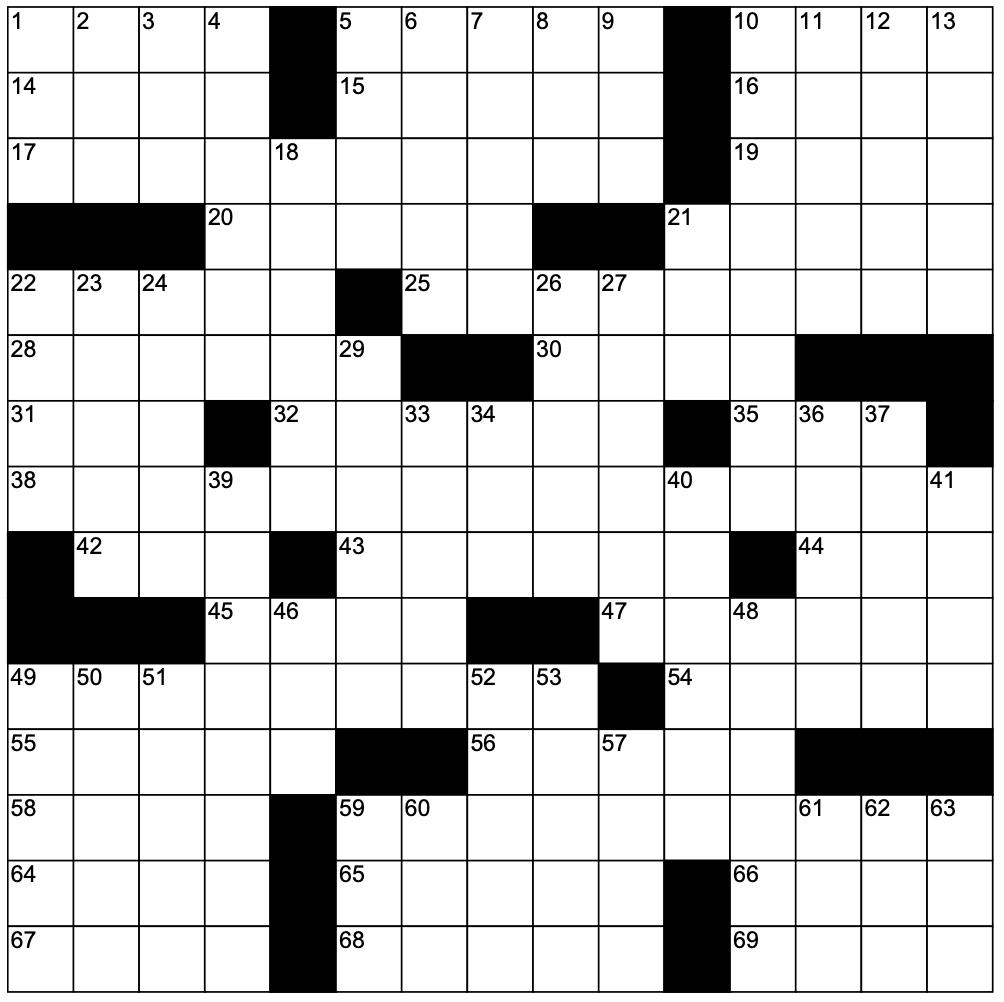
ACROSS
1 Black-bordered news item
5 Anne of “Wag the Dog”
10 Dull-colored
14 Internet connection at a restaurant or airport
15 Fanfare
16 Seized vehicle
17 Snoop
19 Height: Prefix
20 Steak that a dog might end up with
21 “Huckleberry Finn” author
22 Wet mascara worry
25 Felix and Oscar, with “the”
28 Bathroom powder
30 Wyatt of the Wild West
31 Magazine
V.I.P.’s 32 1980s video
game with a maze
35 Down, usually, on a light switch
38 Carouse
42 Golf peg
43 Boxed stringed instrument
44 “___ solemnly swear ...”
45 Ax or awl
47 Judicial assertion
49 Symbol of purity
54 Figure of speech
55 Wall art
56 Mutual of ___
58 “Gotcha,” to a beatnik
59 Want ad heading... or a hint to the starts of
17-, 25-, 38- and
49-Across
64 Queue
65 More than steamed
66 March Mad-
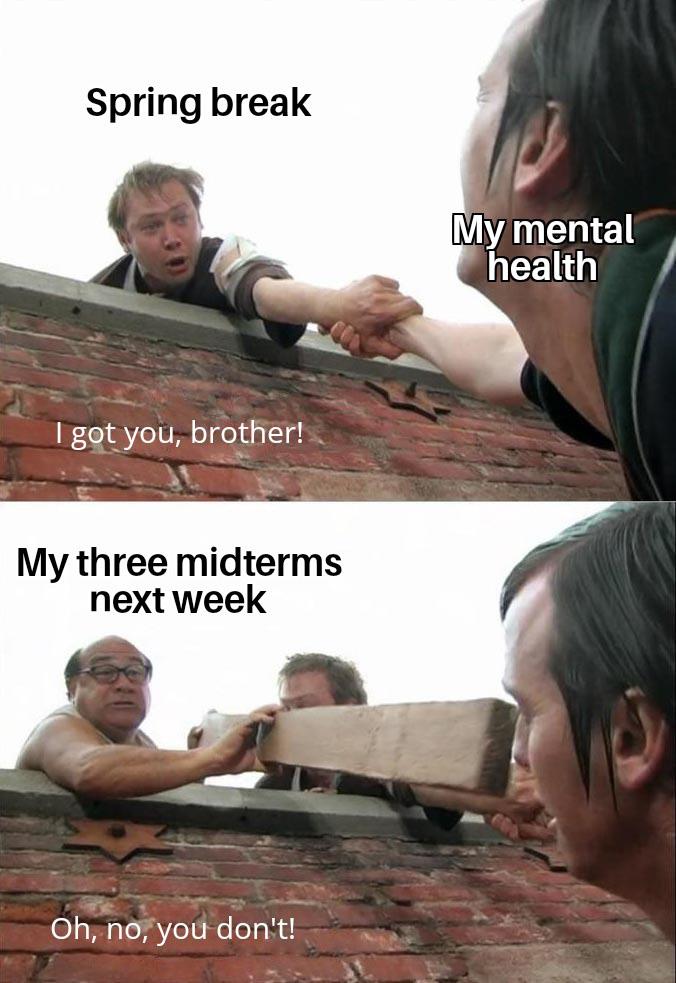
With midterm season upon us, most of us are drowning in papers, exams and presentations. Sleep is scarce, and it seems like the day isn’t long enough for everything that needs to get done. While this isn’t unusual for this time of the year, something feels different about this spring semester. As of late, things seem even more desperate than usual.
First, let’s keep in mind that weather probably has a significant impact on how we feel during the semester. The constant overcast, early sunsets and persistent wind and snow make it miserable to trek to class. Although the past couple of weeks have been overwhelming, on Monday, when the weather was a balmy 55 F—a welcome respite from the minus 30 temperatures from days before—the joy was palpable in the air. Heavy coat jackets, hats and snow boots were shed and cute outfits were donned. Even though most of us had several major assignments due this week, having this sunny and warm start was refreshing. But when the
weather reverted back to a frigid, bleak landscape within a couple of days, our slightly improved moods quickly went away, leaving us with only stress.
Going back to earlier in the semester, the university gave us two “true” snow days, which were definitely needed. Being able to just take a couple of days off and not trudge through the snowstorm or even log into Zoom courses was a relief. However, the palpable relief clearly shows how overworked we are. Aside from those two days, Case Western Reserve University—from administration to professors—never really considers our need for a break. It feels as if professors think that their class is the only class we take. They fail to realize we are all also applying for internships or jobs and are involved with extracurriculars—plus, we do also have social lives. So, when professors give us five assignments and an exam due within the span of two weeks, it’s cruel. It perpetuates the unhealthy mindset of only working, and that we need to disregard our collective mental health to do well in school. And
sure, part of making sure we have a healthy work-life balance is through time management, but how can we possibly manage our time when the workload isn’t manageable?
We aren’t saying that all professors don’t take our mental health into consideration or have unreasonable expectations, but this semester, it is becoming more of a trend. To a certain extent, it is reasonable that professors want to have assignments and grades before we go on break, but why make everything due within the span of two weeks? Surely an assignment schedule that is more evenly distributed is possible. Instead, students suffer the consequences. We lose our sleep and healthy eating and hydration habits; we sacrifice our sanity to get good grades.
In spring 2021, not having a break significantly impacted our mental health, and the university thought that giving us two mental health days in the middle of the semester—which several professors disregarded and still assigned work as normal—was an adequate replacement. This semester, while we do have a week off,
work is still being piled on, which will make many of us extremely burned out by the time we reach that coveted break. And sure, we technically can take breaks to recharge ourselves, but most of us don’t feel like we can afford to truly take time for ourselves; if we get out of the zone, it’s hard to get back in.
The student body needs official mental health days through the semester. One week off after several weeks of constant assignments and exams is honestly not enough. Having a few mental health days and more spread out assignments during the semester would benefit everyone. Professors would likely see better class participation as well as better engagement overall with students, with better work on exams and assignments also arising as a result.
CWRU continues to put our coursework above our physical and mental health, but they have the power to change that culture. Maybe students would “think beyond the possible” more often if the university prioritized our well-being.
The Observer is the weekly undergraduate student newspaper of Case Western Reserve University. Established in 1969, The Observer reports news affecting students and provides an editorial forum for the university community. Unsigned editorials are typically written by the opinion editor but refle ct the majority opinion of the senior editorial staff. Opinion columns are the views of their writers and not necessarily of The Observer staff. For advertising information, contact The Observer at (216) 302-4442 or e-mail observer-ads@case.edu.
LETTERS TO THE EDITOR should be e-mailed to observer@ case.edu or submitted on our website at observer.case.edu. Letters can be mailed to Thwing Center 11111 Euclid Avenue, Suite 01, Cleveland, Ohio 44106. For policy and guidelines related to the submission of Letters to the Editor, refer to observer.case.edu/submit-a-letter.
The Observer is a proud member of CWRU’s University Media Board. Follow The Observer on Facebook, Twitter and Instagram @cwruobserver.
executive editor & publisher SHREYAS BANERJEE
director of print SARA KHORSHIDI
director of digital media HANNAH ALLEN
director of design VINAYAK MATHUR
development editor BEAU BILINOVICH
engagement editor MULAN MA
news editor GRACE JOHNSON
life editor CHRISTIE LANFEAR
opinion editor KARUNA LAKHIANI
sports editor PUNEET BANSAL
social media editor SOPHIA POPKIN
photo editor CHRIS HEERMANN
web editor COLLIN WONG
copy editors JOEY GONZALEZ, RITIKA DEVARAKONDA, JULIA FENG-BAHNS & SHIVANGI NANDA
layout designer TARUN SEPURI
business managers NIKKI D’COSTA, PHUONG NGUYEN
When I was in high school, my school sometimes brought in speakers to give talks to the school body at weekly assemblies. One week, the speaker was an American soldier who related some of his experiences in the military and how they affected his outlook on life. I remember one particular part of his speech well— he brought up something called the “Heinz dilemma.” There are a number of different ways to describe it, but here’s how he presented the scenario: Your spouse is very ill and will surely die unless they get the medicine they need. However, the pharmacist upcharges the medicine considerably, making it too expensive for you to afford. Do you steal the medication and break the law, but save your spouse? Or do you follow the law and allow your spouse to die a preventable death? His answer was: you should steal the medicine, save your spouse, but then afterwards, turn yourself in to the police and take responsibility for your actions, to make right for the crime you committed.
While I believe the soldier told us his answer to generate a discussion, I find the actual implications of the viewpoint to be disgusting and harmful. That answer epitomizes a
larger problem with how we view the concept of justice in America.
The problem with his answer is that it posits that you have a moral imperative to receive punishment because you broke the law. But in this scenario, no one is helped by you turning yourself over to the police and then going to jail because you stole the medicine. You are certainly worse off because you’ll be in prison, and your spouse is worse off because you won’t be there with them after they recover. The taxpayer, and society as a whole, are worse off because your imprisonment is a financial burden. This action helps no one, and many people are harmed. So why would the soldier have come to this conclusion?
It stems from the idea of “justice.” What is justice? Many a philosophy student has debated this question, but a quick internet search reveals many basic definitions—almost all of which revolve around the idea of people getting what they “deserve.” Simply put, justice as defined here, and as many people think of it, is a harmful concept. In the Heinz dilemma, the soldier believes that because you break the law to steal the medicine, you need to pay for that crime by serving time in jail, getting what you deserve
for breaking the law. “If you do something bad, you should be punished” is seemingly the fundamental tenet of justice to most.
I’m hesitant to embrace an idea like this. I want to make the world a good place for as many people as possible, so it’s essential to remember that law-breakers are also people. The only reason I think someone should be “harmed” is if it will truly make the world better off. The common concept of justice is directly contradictory to this—it suggests that people should be punished based on past acts, regardless of their present or future intent. Justice is no more than revenge and retribution under a different name—the brute desire to harm those who have harmed us. But in a modern society, we must rise above that desire to gain the best possible outcomes.
However, I’m not arguing that we should never punish people for their crimes. Legal systems do serve a crucial role in keeping serial criminals off the street, deterring crime and rehabilitating criminals. Yet, I think the idea of punishment being morally righteous is more damaging than whatever good it actually does create by helping us maintain a functional
society.
While this may seem like semantics, it’s an important distinction. The real-world effects of this “righteous” mindset are plain as day in the American justice system. Many aspects of the system clearly embody the idea of punishing those who commit crimes with no regard for the actual impacts of those punishments. The United States holds 2.3 million people in prison—far more than any other nation in the world. This is a result of many problems within the judicial branch, including over-punishing minor crimes, ripping fathers out of families with long prison sentences and generally focusing on punitive rather than rehabilitative sentencing. All of these consequences are harmful, and all of them are caused by a skewed idea of justice. In order to effectively fight crime and help people in our country, we need to discard the idea of justice as it is today and focus only on finding the most positive outcome. If we cling to the notion that every misdeed inherently needs an equal punishment, we are only inflicting unnecessary harm on criminals and ourselves. That’s right: the problem with our justice system is how we view justice itself.
Next Friday, Mar. 4, is National Employee Appreciation Day. Observed on the first Friday of March, the official holiday was created to remind employers to thank and reward employees for their good work. In a message to the university, President Eric Kaler stated he wants to use the holiday to focus on “self-care and gratitude for our staff employees,” planning a variety of benefits for university workers throughout the day, including, but not limited to, an appreciation lunch and early dismissal.
I noticed President Kaler addressed his message to the university staff, not the student body. This struck me as odd, as we’re the group that benefits most from the work each staff member contributes to the university’s success— and, by extent, our education. From the professors teaching us our coursework to service workers maintaining the facilities where we live, work and eat, every Case Western Reserve University employee helps provide us with the environment and resources we
need to thrive during our time here.
In the fast-paced environment that comes with attending a top university, it’s easy to forget that a staff member had to put time and energy into making and supplying the food you eat at the dining hall. It’s easy to forget the late nights that security guards endure to keep our campus safe while warding off further crime. It’s easy to forget the service workers who clean up residence hall messes students are too disgusted to even look at. We’re so busy going to class or doing our homework that we often forget to be thankful to those who make our experience at CWRU possible.
With President Kaler’s message in mind, I think the student body should use this week to develop gratitude towards university employees. Gratitude is a strong feeling of appreciation to someone or something for what that person has done to help you. There are many benefits to practicing gratitude in your life; research has shown that gratitude is strongly correlated with improved health, stronger re-
lationships and an overall greater level of happiness. In my experience, whenever I have gratitude towards others, I have a greater appreciation for my privileges and a healthier perspective on my challenges.
Genuine gratitude has to be developed from within. Popular techniques to develop gratitude include meditation, thank-you notes or counting your blessings. Personally, I like to think about how fortunate I am right before my meals. Since not everyone has convenient access to decent-tasting food—yes, this includes Leutner and Fribley Commons—it’s easy to remember how lucky I am to eat a good quality meal that gives me energy for my studies. The idea behind these habits is that the more time you spend thinking about good things that happen in your life, you’ll more easily notice them in the future.
Developing an awareness of gratitude also makes it easier to express it. It can be shown through words or actions—on either a small
or large scale. Relating to the university staff, this could be as simple as an unprompted “thank you for what you do,” or “I hope you have a good day” (as someone who’s worked in customer service, those quick compliments really do help). If you want to do better, try displaying gratitude in your actions: move the furniture in the common area back to its proper place, don’t leave your waste outside of the garbage for someone else to pick up and clean up the mess you make in the bathroom. It’s those simple actions that make all the difference.
Just like too many national holidays, National Employee Appreciation Day values a group of people that should always be appreciated but rarely are. We should take this opportunity to grow and show our appreciation of CWRU’s employees, making their jobs more enjoyable while improving our ability to be thankful for their work. By showing gratitude to others in our community, we can develop positive habits and promote a healthier, happier university environment.
It has finally happened. Eight years after the invasion of Crimea, Russia has officially sent troops to the Donbas region—specifically, to the two separatist breakaway regions of Donetsk and Luhansk in southeastern Ukraine. The Russian government has acknowledged the independence of these regions, yet sent in troops under the preposterous notion of “peacekeeping.” Russian President Vladimir Putin attempted to justify these forceful violations of international law in a televised address: “Ukraine is not just a neighbor. It is an inherent part of our own history, culture and spiritual space”—a convoluted attempt to convince the world that somehow he had the moral high ground and that Russia had a right to Ukraine.
Such a thought inevitably draws comparisons to other international situations, namely Chinese President Xi Jinping’s vow to reunite with Taiwan: “The historical task of the complete reunification of the motherland must be fulfilled, and will definitely be fulfilled.”
Both countries are trying to take back nations they lost during their moment of weakness: for Russia, the dissolution of the United Socialist Soviet Republic (USSR), and for China, the Chinese Communist Party’s failure to suppress the democratic Republic of China, now relocated to Taiwan, in the aftermath of the Chinese Civil War.
However, this is just the start of their imperial ambitions. Both states have expanding interests, with Russia aiming to expand influence over its fellow post-Soviet states and China advancing further in the Indo-Pacific region and the South China Sea. Their growing friendship is indeed concerning, as we may be at the beginning of a new combined autocratic sphere of influence.
During this past Winter Olympics, the two autocratic leaders seem to have formalized their relations on the international stage, with both meeting and taking aim at the United States and its allies. They both promised that they would “counter interference by outside forces in the internal affairs of sovereign countries under any pretext”—warning the U.S. to refrain from interfering in Ukraine and Taiwan.
With a friendly relationship between Russia and China becoming more conspicuous, the U.S. and its allies must focus on preventing their catastrophic intentions. Diverting attention to just one would present a major fatal flaw in international affairs. After all, the U.S. has made this mistake before. Back when the USSR was at the height of its power, Soviet leader Joseph Stalin and Chinese Communist Party leader Mao Zedong had a fallout, showing cracks in the relations between the two communist regimes. The U.S. sought
to exploit that by coddling China so that China would provide a means to contain the USSR. Domestically, the U.S. granted China “most favored nation” status for years, allowing China to gain access to U.S markets, while globally, the U.S. permitted China’s admittance to the World Trade Organization. This allowed for Chinese businesses and products to expand rapidly via global markets. At the time, Chinese companies copied U.S. technology in areas including, but not limited to, aerospace and consumer electronics. However, the U.S. was more focused on the USSR, so it did not care to have barriers to its proprietary technology with China or to disrupt their relationship until it was too late.
One can argue that China would have found other ways to rise to its current status as a global economic superpower. But back then, the U.S. provided most of the world’s sophisticated technology—any sanctions could have slowed China’s economic growth. As a consequence of the U.S.’s failure to handle more than one threat at a time, China is now a serious contender with the U.S. in various sectors, such as military power and advanced technologies. If we do not learn from our past mistakes of focusing only on one threat, how are we supposed to redeem ourselves in the future?
Unfortunately, former President Obama’s main foreign policy initiative
was to disregard Russia and to focus mainly on combating China through the Trans-Pacific Partnership, and former President Trump furthered this through his use of tariffs and through his pro-Russia rhetoric. President Biden is not doing so well in foreign policy either. The withdrawal of U.S. forces and its European allies from Afghanistan last year left a power vacuum for Moscow and Beijing to exploit, allowing both to further expand their influence in the Middle East. Moreover, the fact that both Russia and China see the U.S. and its allies as threats means that Afghanistan emboldened both of these countries—they saw the U.S. withdrawal as a sign of weakness and of decline in the U.S.’s unipolarity in the world.
Economically, both happen to mutually complement each other, with Russia providing oil and gas to an energy-starved China and China providing advanced technology to an uninnovative Russia.
Their shared skepticism of the West’s future and their complementary economies will be the drive that pushes them to a coalition of powers that will oppose Washington. The utmost foreign policy priority of the U.S. and its allies should be to sever this increasingly close relationship. Otherwise the consequences could be disastrous.
Course Registration opens soon!
• March 21 for graduate students
• March 28 for undergraduate students
• April 4 for visiting and non-degree students
Tuition for courses numbered 100-399 is half the price of fall and spring semesters. Over 100 courses available.
2022 Summer Session:
May session: May 9–May 27
8-week session: June 6–August 1*
5-week session: June 6–July 11*
4-week session (1): June 6–July 1
6-week session: June 20–August 1*
4-week session (2): July 12–August 8
*No class on Monday, May 30 or Monday, July 4
summer.case.edu

Last weekend, Cleveland hosted the NBA All-Star Weekend and the NBA’s 75th anniversary celebration. The festivities kicked off with the Celebrity Game and the Rising Stars Challenge on Friday, followed by the NBA HBCU Classic, Skills Challenge, 3-Point Contest and Slam Dunk Contest on Saturday. Finally, the highly anticipated AllStar Game closed out the weekend on Sunday night.
The Celebrity Game, played at the Wolstein Center, featured a head coach matchup between Hall-of-Famers Bill Walton and Dominique Wilkins. Team Walton won in a 65-51 battle with players such as musician Machine Gun Kelly, Cleveland Browns running back Kareem Hunt, rapper Quavo, Bollywood superstar Ranveer Singh and game MVP and Peloton instructor Alex Toussaint. Wilkins’ team notably had Cleveland’s mayor Justin Bibb along with singer Kane Brown, Browns defensive end Myles Garrett, comedian Tiffany Haddish and rapper Jack Harlow.
This year, the Rising Stars Challenge welcomed a new format in which NBA icons Rick Barry, Isiah Thomas, Gary Payton and James Worthy drafted and coached teams of seven from a pool of selected rookies, second-year players and G League players. The four teams then faced off in a tournament. In the first round, which was played to 50, Team Isiah narrowly survived Team Worthy to win 50-49 while Team Barry ultimately defeated Team Payton 5048. The final round was played to 25 and culminated in a 5-point victory for Team Barry. Guard Cade Cunningham, the first overall pick by the Detroit Pistons in the 2021 NBA draft, nailed the game-winning free throw and was named MVP of the Rising Stars Challenge.
The Wolstein Center also marked the site of the inaugural NBA Historically Black Colleges and Universities (HBCUs) Classic. The Howard University Bison defeated the Morgan State University Bears 68-66, and the NBA and AT&T donated $100,000 to the athletic
departments of each university.
The Skills Challenge kept things going on Saturday, with yet another new format introduced for All-Star Weekend. Instead of competition between selected individuals, the Skills Challenge was a three-team activity and featured four rounds of play. Each team consisted of three players. Team Rooks was represented by Cunningham, Toronto Raptors’ Scottie Barnes and Oklahoma City Thunder’s Josh Giddey. Team Cavs sought to defend home court at Rocket Mortgage Fieldhouse with Jarrett Allen, Darius Garland and Evan Mobley of the Cleveland Cavaliers. Finally, Team Antetokounmpos featured the three Greek brothers, Giannis and Thanasis of the Milwaukee Bucks and Alex of the Raptors 905, Toronto’s G League team.
The first round focused on team shooting. Each player had 30 seconds to shoot from five different spots on the court, with each shot earning 1-5 points based on its difficulty. Team Cavs ended up with the highest collective score, earning 100 Challenge Points. The second round involved team passing and each team had 30 seconds to pass the ball through three targets of various sizes, distances and point values. Team Antetokounmpos won via a tiebreaker against Team Rooks, as the three brothers completed more outlet passes and collected 100 Challenge Points.
The third round was perhaps the most interesting, as it was built around obstacles in a relay race. Each player had to complete an outlet pass to a moving target, dribble down the court and weave between three moving pylons, nail a short shot, sink a corner 3-pointer against an automated defender and dribble back up the court to make another basket. Team Rooks emerged victorious with the fastest time and 200 Challenge Points to catapult them to the final round. Meanwhile Giannis Antetokounmpo and Garland faced off in a 3-point shootout tiebreaker for the other final round bid. Garland made his first attempt after Giannis missed to advance Team Cavs to the finals.
In the final round, Team Rooks and Team Cavs competed to see who could nail a halfcourt shot the fastest. Team Rooks went first, setting a daunting time of 9.9 seconds. Team Cavs didn’t back down as Mobley swished it in 5.5 seconds to secure the win for Team Cavs.
Next came the 3-Point Contest, in which seven guards and one big man, Minnesota Timberwolves’ Karl-Anthony Towns, aimed to make the most 3-point shots across two rounds. Los Angeles Clippers guard Luke Kennard started off by making a round-high 28 3-pointers, while Towns and Atlanta Hawks guard Trae Young each made 22 to advance to the final round. While Kennard and Young each put up 26 in the finals, the crown went to Towns. He crushed the rest of the competition with a finals-record 29 3-pointers to become the first center to ever win the event.
The Slam Dunk Contest, meant to close out Saturday with an exciting finish, was an absolute disappointment. New York Knicks forward Obi Toppin eliminated Golden State Warriors forward Juan Toscano-Anderson in the final round 92-69. Many criticized this year’s edition for its lack of flair and creativity, with Hall of Fame guard and former Slam Dunk Contest judge Dwayne Wade especially vocal and effectively calling it the worst dunk contest ever.
Sunday arrived with a palate cleanser in the shape of the All-Star Game. On Feb. 10, the captains, Brooklyn Nets forward Kevin Durant and Los Angeles Lakers forward LeBron James, drafted the All-Star players for their teams. Team LeBron, coached by Phoenix Suns head coach Monty Williams, took stars such as forward Giannis Antetokounmpo, Warriors guard Stephen Curry and Chicago Bulls forward DeMar DeRozan. Team Durant, coached by Miami Heat head coach Erik Spoelstra, selected Philadelphia 76ers center Joel Embiid, Memphis Grizzlies guard Ja Morant and Boston Celtics forward Jayson Tatum along with a few others. The high tensions between Durant and
guard James Harden, who recently left the Nets for the 76ers out of frustration, saw Harden fall to Team LeBron as the last pick in the All-Star draft.

Unlike other facets of All-Star Weekend, the All-Star Game followed a previously used format—the first three quarters were 12 minutes each and the winner of each quarter would donate money to a certain charity. Team LeBron won the first quarter 4745, Team Durant won the second quarter 49-46 and the two teams tied at 45 in the third.
However, the fourth quarter was played until one team had scored at least 24 points past the highest team score through the first three quarters. This goal was not arbitrary, as the points represented the late NBA legend Kobe Bryant’s jersey number. The NBA also honored Bryant following his tragic death in 2020 by naming the All-Star MVP award after him, as he had tied with Bob Pettit for most AllStar MVP awards won in NBA history. Seeing as how Team Durant held a 139138 lead after the third, the target score to win was 163 points. Team LeBron outscored Team Durant 25-21, with LeBron himself hitting the game winner to seal a 163-160 victory. However, Curry took home MVP honors, smashing an All-Star Game record with 16 3-pointers and putting up 50 points.
The weekend was a huge win for Ohio. Cleveland hosted the events and local stars played in the Celebrity Game, the Cavaliers walked away victors of the Skills Challenge and Akronborn LeBron James and Steph Curry worked wonders during the All-Star Game. More importantly, hundreds of thousands of dollars were raised for organizations supported by All-Star Weekend, including the Kent State I PROMISE Scholars Program, chosen by Team LeBron, and the Greater Cleveland Food Bank, selected by Team Durant.
Following an eventful weekend, the NBA looks to get back into the swing of things, with 14 teams resuming action on Feb. 24.
Following a four-game losing streak, the Case Western Reserve University women’s basketball team notched their third conference win in an overtime thriller against Emory University last Friday. The win marked the second OT victory of the campaign and the first road overtime win since 2018. The momentum didn’t last on Sunday, when the Spartans fell 68-55 to the University of Rochester, dropping to 8-16 overall and 3-10 in the conference.
Second-year forward Preet Gill opened the action in the first quarter against Emory with a jump shot to give the Spartans a 2-0 lead. That wouldn’t last long as the Eagles had answers to every CWRU bucket. With less than four minutes left in the period, Gill scored on back-to-back field goals to put the Spartans ahead 12:10. Emory tied it yet again, but two made free throws from second-year guard Margaret Terry gave CWRU the 16-14 lead heading into the second.
It was a similar story half of the second quarter. At 6:27, Emory tied the game at 21-21 but the Spartans sparked a 7-0 run, giving them a 2821 advantage with 2:10 until halftime. The Eagles didn’t back down and overpowered the CWRU defense to put themselves back in the game, finishing the half on a made 3-pointer to bring themselves within one at 28-27.
In the third quarter, the Spartans retook a big lead following a layup by second-year forward Kayla Characklis to make the score 40-32. However, the Eagles once again proved to be great closers and kept themselves in the game, finishing the quarter 42-41.
Emory took the 50-49 lead with 5:47 remaining in the fourth quarter with a pair of free throws. The teams traded leads until two successful free throws from third-year guard Isabella Mills put CWRU ahead 55-52.
The Eagles pushed back and tied the game 55-55 after a layup and a made free throw. With 29 seconds left in the quarter, the Spartans had an opportunity to capitalize. However, third-year guard McKenna Gross missed a jumper and Emory turned the ball over, sending the game into overtime.
After Emory scored off a layup for the first points of overtime, the Spartans’ stalwart defense spurred a 13-0 run that catapulted CWRU to 68-57 with 50 seconds left. The Eagles desperately tried to make a comeback but only scored twice before the final buzzer sounded. CWRU came away with
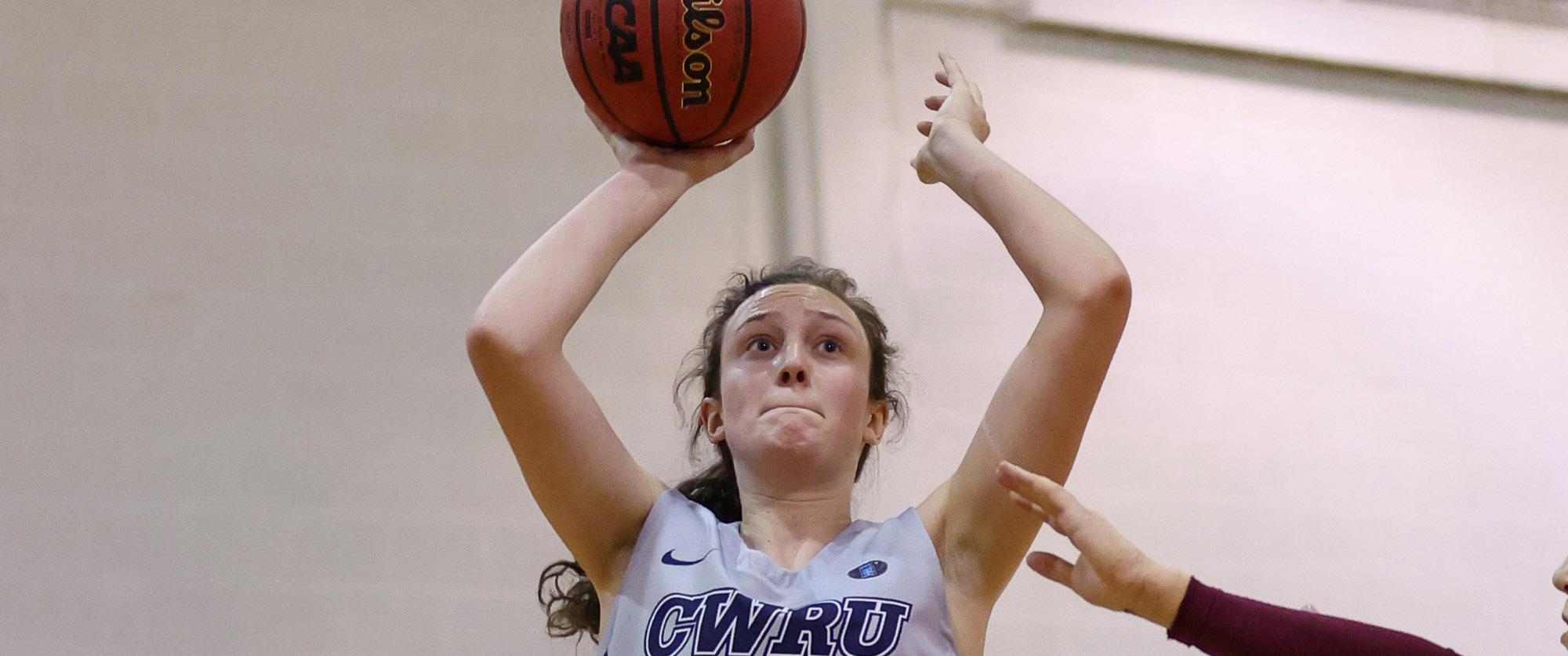
the 68-61 victory on the road.
Mills led all scorers with 24 points while adding 11 rebounds, Gross put up 13 points with 2 rebounds and Characklis had an all-around game with 8 points, 6 rebounds, 2 assists, 1 steal and 2 blocks. The Spartans’ impressive win was highlighted by the fact that Emory had the advantage in almost every major team stat. It was CWRU’s firepower that made the difference, posting very efficient percentages in field goals (41.1% to 32.9%) and 3-pointers (38.5% to 9.1%).
Against Rochester, Characklis controlled the tempo, pouring in 6 of the total 12 points in the first quarter. Rochester answered the bell and scored a buzzer beater to tie the game 12-12. The Spartans built a 5-point lead about midway through the second but Rochester used a balanced attack to take the lead at halftime 31-30.
CWRU’s defense fell apart to begin the second half and the Yellowjackets expanded their lead 37-30. On the other end, the Spartans couldn’t take the lid off the basket and missed two straight layups. Rochester kept rolling and went up 48-34 before CWRU found some rhythm to bring the game within 7 points. Characklis converted a 3-point play after being fouled on a layup and first-year guard Lucy Vanderbeck nailed a 3-point shot to cut the deficit to 5. A last second layup from Rochester, however, put the Yellowjackets back up 51-44 heading into the fourth quarter.
The Spartans scored six straight points to cut the lead down to 51-50, but Rochester countered with back-toback 3-pointers, moving up 57-50 with less than six minutes to go. CWRU never found their offense again and allowed the Yellowjackets to go on a 11-5 run to finish the game 68-55.
Characklis tied for a game-high 19 points on 8-of-15 shooting while Vanderbeck added 13 points and 4 rebounds off the bench. Second-year guard Margaret Terry chipped in 7 points, 4 rebounds and 4 steals. The Spartan bench outscored Rochester’s bench 22-11, but the Yellowjackets pummeled CWRU in field goal percentage (42.2% to 33.3%), points off turnovers (18-6), points in the paint (36-18) and fastbreak points (17-4).
On Feb. 26, the Spartans will battle against Carnegie Mellon University at home in their season finale. The game is scheduled at 4 p.m. in the Veale Athletic Center.
Have you seen the

In collaboration with Ryan Bennett of the CWRU Farm and student farm workers, this cabinet is growing microgreens and herbs for the meals prepared in Fribley. We’re growing items such as basil, cilantro, mustard greens, and more.
The next time you see these herbs being used in your meal at the From The Field station, you know that they came fresh our indoor field! It doesn’t get more fresh than that!
Want to learn more about our sustainability practices and farm to fork program?
case.cafebonappetit.com