Advocacy Wall built to facilitate social expression on campus
Spring semester outlooks: The firstyear perspective
For Case Western Reserve University first-years, the fall semester was filled with new experiences as they navigated the uncharted territories of independent living and college life. With the spring semester just beginning, we decided to interview some freshmen, now in their second semester, on their feelings and outlooks on the coming months. As an icebreaker, we started with a fun question:
What is your order at The Den by Denny’s?
“The Den is gone … [but] maybe the French toast, [and] the pink lemonade if they have it.” – Nathan Green
“I’m not picky so I usually just go with the crispy chicken salad.” –Noah Henriques
“Chicken tenders and mozzarella sticks.” – Nikhita Arun
like, learning more … skills in our clinicals. We’re learning more about physical assessments, and so I’m excited about those and to practice them.” – Gloria Lee
“Physics ‘cause it’s actually interesting. This time around it’s actually new, and really [in] all of my classes it’s something new … and pretty much everything except [ENGR] 145.” – Nathan Green
“I’m part of Case Kismat and [the CWRU] Figure Skating Club, and both of those have comps this semester, so that’ll be fun.” – Isha Shah
Are there any activities or clubs are you looking to join?
“... it would probably be Black Student Union (BSU), and [I want to] hopefully get a job this semester.” –Nyat Isack
Shreyas Banerjee Executive Editor
In June 2020, at the height of the protests surrounding racial injustice and police brutality against African Americans, the Spirit Wall between the Thwing Center and the Tinkham Veale University Center was painted over with the statement, “BLACK LIVES MATTER,” along with a list of those murdered by police officers, including the (at the time) recently deceased George Floyd.
In doing so, the space traditionally used by student organizations to promote their events transformed into a lasting mural and a declaration of values. Trouble arose in August 2021 when all students finally returned to campus after several remote semesters. Rules around the Spirit Wall were questioned when a student attempted to paint over the mural early in the semester, leading to discussions over what should be done. The Student Presidents’ Roundtable (SPR)—a board composed of the presidents of all the major umbrella student organizations, including the Undergraduate Diversity Collaborative (UDC), University Media Board (UMB), University Program Board (UPB) and Undergraduate Student Government (USG)—came together to find a solution. Fourth-year pre-law student and SPR Chair Jim FitzGibbon organized meetings with all those concerned, including the Black Student Union (BSU), UDC and USG, with the end result being the new Advocacy Wall.
“These discussions resulted in three primary objectives,” FitzGibbon said. “First, we wanted to maintain some form of mural to the Black Lives Matter movement, which is important to many students at CWRU and has had a transformative impact on our society. Second, we wanted to return the Spirit Wall, or some iteration of it, to its original purpose of providing a space for all students to post advertisements, messages and more. And third, we wanted to increase expression spaces on campus in general, as the free exchange of
ideas is vital to the role of universities in our society.”
The resulting Advocacy Wall was then created, giving students a space for social and political expression in ways that the original Spirit Wall was unsuited for. This way, the original Spirit Wall will be allowed to return to its original purpose as a space for postings more directly related to Case Western Reserve University.
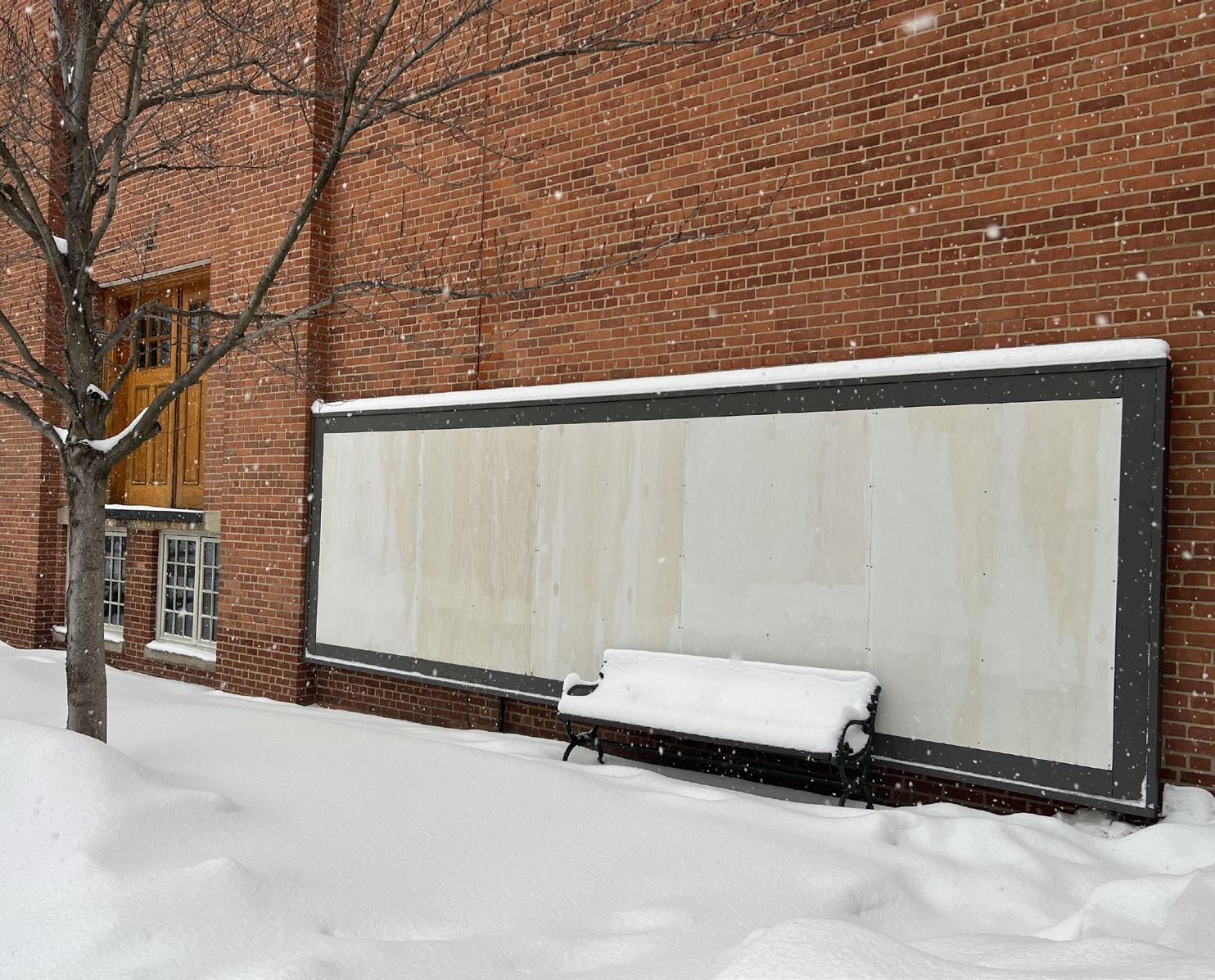
On Jan. 24, the Advocacy Wall was finally finished, being placed on the side of the former Eldred Theater, in the middle of the Case Quad. With Eldred soon to be renovated into a student center, it was picked for its central location and visibility. The renovation of Eldred is expected to be completed in August, by the start of the fall semester. SPR will also be heavily involved in this process to ensure that the student voice is heard as the former theater is converted into a student center with study spaces, meeting rooms and performance spaces.
As to why SPR was central to the project, FitzGibbon explained,“The SPR works with issues that impact the entire campus community as well as multiple constituent boards. The Spirit Wall is used by all eight boards of the SPR. Thus, we wanted to tackle this issue as a group, as this would ensure that each board had a say in the process.”
“The free exchange of ideas is an integral component to university life. By increasing the amount of space through which students can share their views, and by creating a dedicated space for the expression and advocacy of those views, we can live up to the mission of [CWRU] to promote a culture of global citizenship,” Fitzgibbon added. “It is the hope of the SPR that this new space will provoke discussion and understanding regarding the multitude of causes supported across the university, ultimately creating a stronger campus.”
“Mozzarella sticks with fries and … a combination of ketchup, ranch and honey mustard.” – Isha Shah
“Mozzarella sticks [and] potato rounds.” – Nyat Isack
“Bacon brioche melt with a side, one-sixth bubbly and five-sixths pink lemonade.” – Matthew Chang
What are you looking forward to this semester?
“Just hanging out with friends, … waiting for the snow to melt and … warm weather to come back.” – Danielle Sun
“Getting to explore Cleveland more.” – Era Srivastava
“I’m a nursing major, so I guess,
“I went to … Art History Club once last semester, and it seemed really fun, and then I got busy with school. And then also join, like, an orchestra.” – Era Srivastava
“Rock climbing. I know the wall just opened up.” – Allan Seo
“Last semester I was still trying to adjust … but I want to get more involved in, like, [Asian American Alliance (AAA)].” – Gloria Lee
Evidently, freshmen are already looking forward to Cleveland’s warmer months, as well as The Den by Denny’s reopening. In the coming weeks, we hope to interview more students on campus about their feelings on all things student life. So be sure to look out for your favorite Observer Staff members, Shivangi Nanda and Ritika Devarakonda.
1 opinion observer.case.edu Observer the Sports: Men’s basketball win streak
by Emory, bounce back vs. Rochester (pg. 11) friday, january 28, 2021 volume LIII, issue 16
snapped
Ritika Devarakonda and Shivangi Nanda Copy Editors
The newly built Advocacy Wall on the side of Eldred Theater offers a fresh and well-frequented space for the student voice to be heard. Shreyas Banerjee/The Observer
Subscribe to our newsletter. We’re asking nicely.
SEC Allocations Committee audit details mistracking of spending from student organizations
Dylan Jewell Staff Writer
If you’ve ever taken the time to closely examine the fees you pay as part of your tuition, you’ve probably seen a charge of a couple hundred dollars listed as the “student activity fee” (SAF). What exactly does this mean, and what is it for? Instead of being used by Case Western Reserve University administration, it goes directly to student organizations through the Student Executive Council (SEC), funding campus activities.
This is no small sum either—the SAF pool totaled $515,000 for the spring 2021 semester. This money is allotted to and handled by the member organizations of the Student Presidents’ Roundtable (SPR), one of the two branches of SEC. It is composed of the presidents of major campus umbrella organizations such as the Class Officer Collective (COC), Interfraternity Congress/Panhellenic Council (IFC/PHC), Undergraduate Student Government (USG), Undergraduate Diversity Collaborative (UDC), University Media Board (UMB) and University Program Board (UPB). These organizations are tasked with allocating funding to other student groups under their administration. All groups are expected to properly budget for their operations and to keep organized and itemized accounts of how they plan their spending and how much of their funding they actually utilize. Unfortunately, and for a variety of reasons, this doesn’t always happen.
To keep organizations accountable and promote financial transparency across campus, the other branch of the SEC, the Allocations Committee (AC), audits these organizations and makes sure that they are using student money to the best of their ability. The AC recently finished an audit of campus student groups’ spending in the spring 2021 semester and found that many groups were not careful enough in their handling of funds. “A lot of
CWRU faces surge of carjackings over winter break
clubs just did not track their spending last year,” said third-year Shreyas Banerjee, Chair of the AC. “It’s concerning that student organizations are not aware of how much money they have, and are also not making plans for how to spend their rollover money from previous semesters.” The organization with the worst performance in the audit was USG, with the organization unable to provide a full budget to the AC for review.
“It’s difficult to stay on top of the budget because there’s always money moving in and out,” says fourth-year student Preeti Naik, the VP of Finance for USG. “We do make plans, they’re just not laid out in the budget because it’s mostly for discretionary spending.” USG, like other member organizations of the SPR, distributes funds to numerous other student groups under their purview. “[USG] is allocated 23.4% of the [SAF], and the vast majority of money is used to budget other clubs.”
The AC audit reported that treasurers did not seem to be doing their duties and that lack of transition training may be to blame. Despite this, Naik remarked that USG is very concerned with its finances and has every intention to better its handling of them. “Monitoring internal spending, the Student Activities Fair and our past funding helps us get a better idea of how much money to budget...we’re always trying to improve, [and make] information more readily available to club treasurers.”
The AC echoed this sentiment in their audit and placed importance on efficient budgeting and accounting as well as proper training for student group treasurers—many groups, they report, have already made plans to meet with them to discuss these matters in the coming semester. Needless to say, student organizations at CWRU have a duty to use the money provided to them by the student body both responsibly and equitably.
CWRU has been taking steps to increase students’ safety after a surge of carjackings over winter break. Chris Heermann
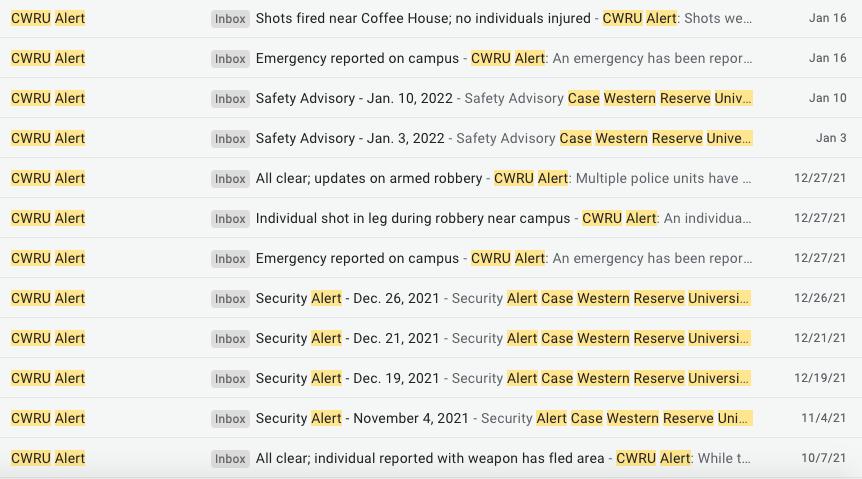
Over winter break, Case Western Reserve University experienced a surge in carjackings in the campus area, with four occuring in the span of one month.
The first two, which took place on Dec. 19 at 6:25 p.m. and Dec. 21 at 9:05 p.m., happened on Mayfield Road between 123rd and 125th St. The third case took place on Dec. 25 around 11:23 p.m. and happened near Mayfield Road and E. 120th St. on Random Road. Just two days later, the fourth incident occurred on Dec. 27 at 9:48 p.m. near Paul Avenue.
In all four instances, the suspect carried a gun with them. During the fourth encounter, the suspect shot a student in the leg. Thankfully, the student was transported to University Hospitals, where they were treated and later discharged.
In the early afternoon of Dec. 31, CWRU announced that they arrested four suspects that were involved in the carjackings and recovered two of the four stolen vehicles, in collaboration efforts with multiple surrounding police departments.
CWRU stated that the health and safety of its campus community remain
its primary concern. Multiple steps have been taken to increase the university’s public safety presence. The first involves the increased number of Safe Ride vehicles around campus to lower wait times and to allow for better commute times. CWRU still highly encourages all faculty, staff and students to use this service after dark.
The university has also increased campus safety measures in the Little Italy area, the location of several of the carjackings. University Circle and Cleveland police departments are working closely with CWRU to identify ways to reduce risks within and near the campus. The university has also engaged with Little Italy residents and business owners about this issue.
In addition, officers provide a breadth of safety training, during which participants can learn ways to protect themselves from danger. More information can be found at the CWRU Public Safety Training site. The public safety staff at CWRU also hosts presentations to share prevention and safety recommendations in the face of danger. If you have any questions or concerns, their office can be contacted at crimeprevention@case.edu or at (216) 368-1243.
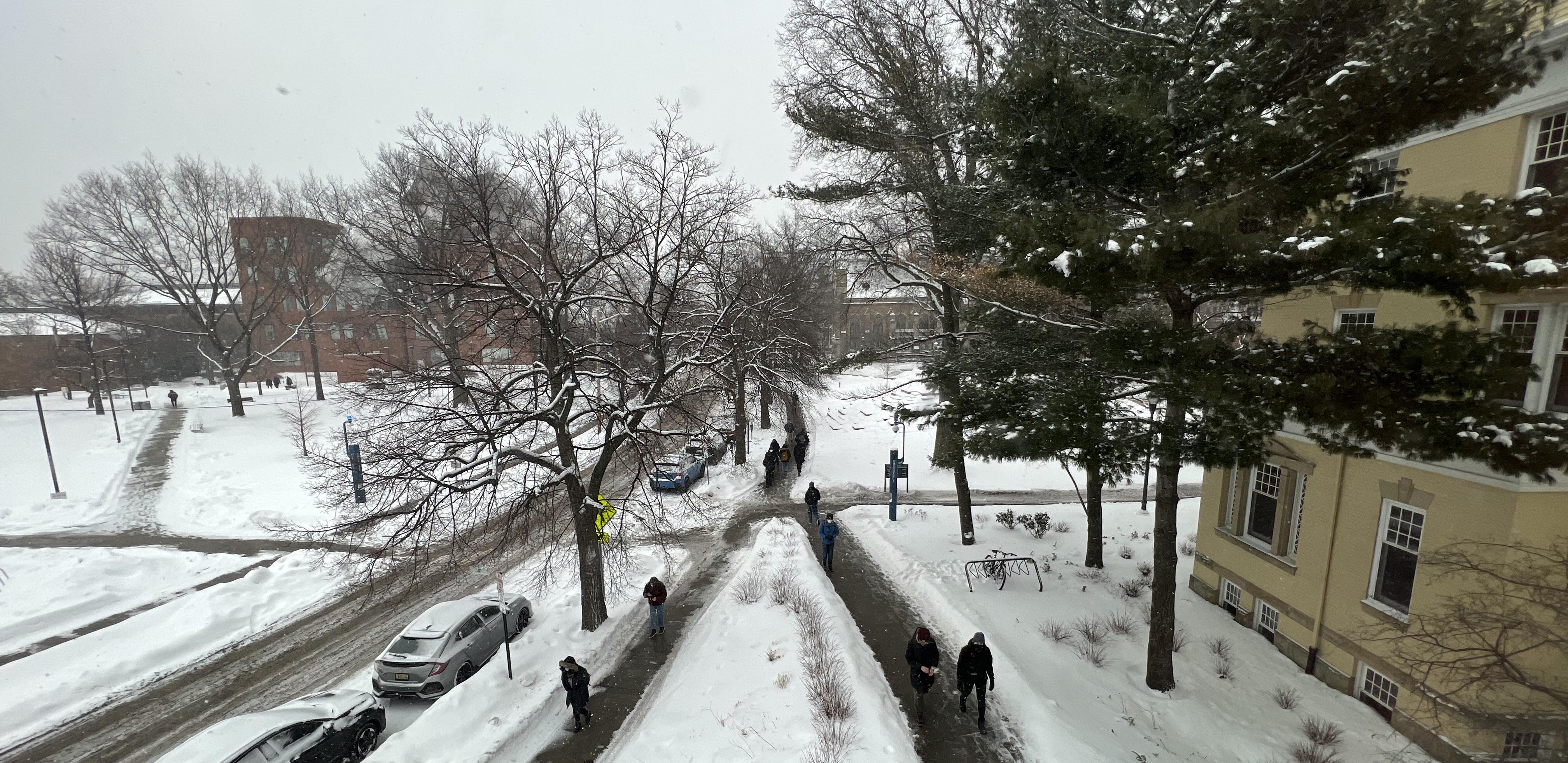
Picture of the week @Shreyas Banerjee
news
Matthew Chang Staff Writer
Your Cleveland winter fun survival kit
Cleveland offers a variety of exciting snow-centered activities such as ice skating, snowshoeing and sledding Courtesy of National Parks Service
Christie Lanfear Life Editor
Just over a week ago, Case Western Reserve University saw its first proper snow of this school year. Real, bus-stopping, slippery, fun snow. As a New Englander, a foot of snow accumulating in one storm is not at all bizarre. For some students, however, this was their first-ever snow. I only vaguely remember my first real snow, granted I was only a toddler, so I wasn’t expected to remember much. But I do remember the thrill and the wonder at the curious ice falling from the sky. When walking back from a friend’s dorm during the storm here on campus, I was not surprised to see dozens of 18 or 19-year-old students transported back to those childhood years; the years when white fluffy stuff was mesmerizing. It was almost comical watching toddlers temporarily surfacing in the bodies of fully grown college students.
Even for students such as myself who have been experiencing a snow-covered winter for as long as they can remember, snow is so much fun and is rich with the potential to make some lifelong memories.
The difficulty with snow is deciding what to do in it. Once you’ve participated in enough snowball fights that you are now basically an armed and dangerous snowball maker and have made so many snow angels that your arms are ready to fall off, what do you do? This is where my article comes in. It will be a roadmap for your winter here at CWRU, detailing the best places to go and activities to do with your friends, all in between classes and homework of course.
Ice Skating
Although it might seem cliche, this only tradition is an essential piece of any winter fun survival kit. Take your friends and learn together! I promise it will be worth it and become something that you look back on fondly in the future. You will spend an hour laughing so hard that your ribs hurt by the end; a memory worth every penny. Below I have listed a couple of places located near or on campus where you can unleash the pro skater within you.
The Rink at Wade Oval - located right on campus, this little rink is irresistibly Instagramable, super dinky and wonderfully cute. What makes it even better is the reasonable prices: you can get skates and rink time for only $3. They even have free lessons! Utilize Wade Oval’s close proximity and “take winter for a spin.”
Pavilion Skating Club of Cleveland Heights - if you are looking for something a little bigger, this is the place to try. It is slightly more expensive than Wade Oval—$9 an hour—but is justified by the larger skating space. I can’t wait to get over there and attempt to teach some of my friends the art of staying on your feet for just over five minutes—big flex I know.
Sledding
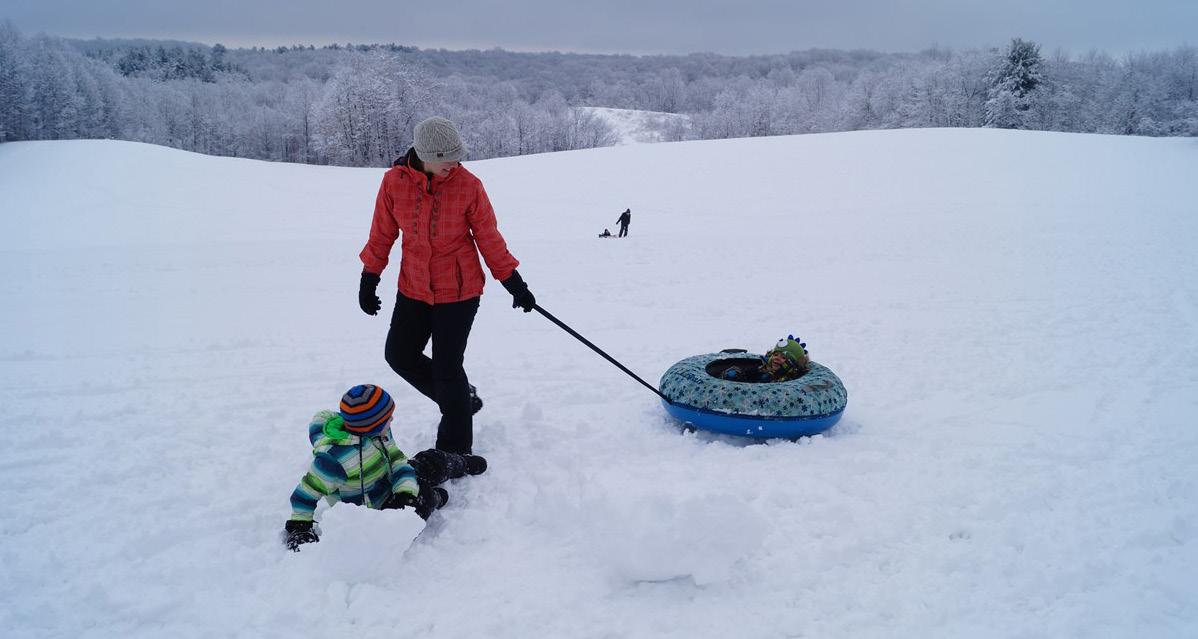
I am sure that this is quite familiar to
anyone who grew up around snow, and it is such a winter classic. No matter your age, there is something so thrilling about going down a hill at a million miles an hour, hoping that you don’t fall off and get a face full of snow. The only hitch here in Cleveland? Well, finding a hill. But don’t worry, I got you. As well as the occasional little one on campus, I found some nearby that are more suited to the thrill-seekers.
Knob Hill at Forest Park - only slightly beyond Coventry, it is the perfect sledding spot. Definitely the location for bombing down the hill holding on for dear life.
Thornton Park - just a short bus ride away through the beautiful Shaker Heights. This location looks equally fun and thrilling as Knob Hill.
Hot Cocoa
Drinking this liquid heaven is a fundamental winter activity, and it is one of my favorite things to do. Below are a couple of the best places to find that perfect cup of hot chocolate.
The Coffee House - starring you in the face and located across from the North Residential Village, this place is so cute for hot cocoa or any warm wintry drink. It is also equally perfect as a study stop if you are pressed for time and want to bring your homework with you to accompany your hot drink.
Phoenix Coffee - located just off campus in Coventry, Phoenix Coffee is renowned for its amazing coffee and equally delightful hot chocolate.
Snowshoeing
Despite being slightly more unique than the other activities on this list, snowshoeing is definitely equally as entertaining. Walking on top of the deep snow is such a cool feeling and it is still one of my favorite activities back home. Luckily for us students, a majority of the national parks in the Cleveland area rent snowshoes. There are a few just a short drive away and most have snowshoes for rent!
Winter Hiking
Lastly, we have one of my favorites. Although it may seem boring in comparison to some of the other activities, I promise that you’ll be taken aback by the winter wonderland beauty that can be found near campus. The first place that comes to mind is the gorgeous CWRU farm. I went walking here before the snow arrived, and it was so peaceful. I can’t wait to get over there to see its winter transformation. It feels so refreshing to get out of the city and breathe purer air.
The activities listed above are just some of the necessities for winter excitement. There are, of course, countless more. Your friends might have unique hometown traditions to share, or maybe you’ll come up with your own unique winter pastime. Either way, I promise that snow is so much more than traffic-stopping, cold-inducing white stuff. I hope that my article inspires you to venture out and enjoy it!
CWRU Film Society

Friday, January 28, 2022
7:00 p.m., 9:00 p.m., 11:00 p.m.
The Cat Returns (2002)

Rated G (75 min.)
Director: Hiroyuki Morita
With the voices of Chizuru Ikewaki, Yoshihiko Hakamada, Aki Maeda
A teenage girl rescues a mysterious cat from traffic and soon finds herself the unwelcome recipient of gifts and favors from The Cat King, who also wants her to marry his son, Prince Lune. With the assistance of a fat, grouchy real cat and an elegant cat statuette come to life, the girl visits the Cat Kingdom and narrowly escapes again.
Saturday, January 29, 2022
7:00 p.m., 9:00 p.m.
Shaun the Sheep (2015)

Rated PG (85 min.)
Directors: Mark Burton, Richard Starzak
With the voices of Justin Fletcher, John Sparkes, Omid Djalili Shaun has a boring life on the farm. When he decides to take the day off and have some fun, he gets a little more action than he bargained for. A mixup with the farmer, a caravan, and a very steep hill leads Shaun and his flock to the Big City, and it’s up to them all to return everyone safely to the green grass of home.
Free Admission this Weekend
Strosacker Auditorium, CWRU Campus Quad
Free Parking: Lot 44 at Adelbert Rd and Murray Hill
FILMS.CWRU.EDU
life
Recent snowstorm brings out CWRU students’ inner child
 Kate Gordon Staff Writer
On Sunday Jan. 16, a week into the spring semester, in the middle of a blizzard that covered Cleveland in over a foot of snow, Northside buzzed with activity. In numbers that hadn’t been seen since Discover Week, students were out and about. Walking around in groups, talking and laughing, many students were amazed, having never seen so much snow before. Additionally, some students got creative with their fun. A group outside Cutter House threw snowballs into an open window on the first floor; another wrestled each other in a ring they drew outside Wade Commons. A post from that night on the CWRU Missed Connections Instagram page read, “To everyone who was having a snowball fight right outside clarke tower the night it first snowed, you all looked so happy and it made me happy.” One student built a group of snow ducks, perched on the low wall outside the Ford & Juniper bus stop. It seemed like everyone on campus, in the midst of academic stress and COVID-19 scares, had let loose and
rediscovered their inner child, even if only for the night.
However, it didn’t last just one night. There was another snowball fight at DiSanto Field the next day, and snowmen of all shapes and sizes sprouted up in areas around campus (unfortunately no more snow ducks were observed). The excitement around the snow clearly wasn’t just for freshmen. Social media, too, filled up with Snapchat stories and Instagram posts highlighting student experiences from the past couple of days. Groups went ice-skating, drank hot chocolate and were just generally out and about at a time when no other adults dared to.
Though the snowstorm might have ruined roads and stopped cars, it provided a much-needed outlet for everyone at Case Western Reserve University—a chance for people to act stupid and childish and to mess around with friends. At a school with a reputation for sacrificing fun for work, that’s probably exactly what we needed to get us through the upcoming semester.
Tips for avoiding unwanted winter weight
Shivangi Nanda Copy Editor
Living in Ohio, Case Western Reserve University students are brutally aware of the challenges that come with winter: slippery sidewalks, frozen noses, snowy jackets and grey slush that soaks through our shoes. Yet, we have learned to overcome these hurdles so that the beauty of the season—hot cocoa evenings and snowmen building mornings—can be enjoyed to the fullest. Keeping with this trend, we must be mindful of ways to maintain optimal mental and physical health during the winter months, especially with regards to the dreaded winter weight gain. Perpetuated by a desire to stay indoors and excuse oneself from healthy habits, winter weight gain can negatively impact one’s self-esteem and potentially cause other long-term health issues. However, health and happiness are not mutually exclusive. Here I have listed several ways to keep off any unwanted winter pounds without compromising on the fun and food that make this season the best time of year.
1. Paying attention to food
This one seems like a given, but as winter laziness sets in, it’s not uncommon for students to become complacent about their food choices. That said, who can blame them? It’s hard to visit on-campus dining halls or make home-cooked meals when DoorDash is a tap away. But, healthy eating habits are vital to maintaining proper wellbeing and weight. Studies have shown that diets that are high in calories, rich in dietary fats and are overly processed, are correlated with increased incidence of obesity. Therefore, it is important to prioritize fresh, nutrient-dense foods like fruits, vegetables, nuts, lentils and lean protein. If you have time, you can use these foods to try your hand at meal planning, lessening the strain on your wallet as well. When sitting down for meals, ensure that at least half your plate is composed of vegetables while the other half is a mix of carbohydrates and protein. Lastly, remember you can still satisfy cravings for comfort foods by finding higher quality alternatives to unhealthy ingredients. For instance, when baking choose natural sweeteners like honey or raw turbinado sugar or perhaps try adding chia seeds or flax seeds to increase the food’s nutritional value.

2. Get some sleep
During the academic year, you may
feel the need to compromise sleep in return for more study hours or time to hang out with friends. However, a lack of sleep can disrupt your natural hunger hormones, leptin and ghrelin, which can negatively impact your weight. Specifically, leptin, the satiation hormone, is decreased when you receive insufficient amounts of sleep, while ghrelin, the hunger hormone, is increased. Together, lower leptin levels and high ghrelin levels work to increase your appetite and perpetuate weight gain. Taking steps to improve your sleeping habits, such as reducing blue light exposure before bed and avoiding caffeine later in the day, can help regulate your circadian rhythm and prevent unhealthy cravings the next day. Not to mention you’ll feel much more energized for any potential snow fun.
Focus on your mental and physical health to prevent winter weight gain from tipping the scale Courtesy of CWRU ability to succeed academically. However, many may not realize that the stress hormone cortisol is also known to instigate weight gain by increasing fat and carbohydrate metabolism and heightening cravings for sweet and salty foods. For these reasons, managing stress through meditative practices can help prevent increased cortisol levels and the winter weight gain that will likely follow. Some common techniques to inhibit stress are practicing yoga, listening to music, doing art therapy and performing other activities that can help calm you down. Stress can also be reduced by limiting caffeine and alcohol intake, both of which increase feelings of anxiety and nervousness. Regardless of your preferred method of relaxation, taking the time to acknowledge and manage your stress will bring you one step closer to staying healthy this winter.
3. Managing stress
As college students, we are no stranger to the effect stress has on our
4. Keep exercising (start if you haven’t already)
Exercising is probably the most well-known method to both losing weight and preventing weight gain. However, when the temperature drops below zero and it’s harder than ever to motivate yourself to go to the gym, you must turn to at-home alternatives. Thanks to the power of social media, you are able to access thousands of virtual workouts that can be done from the comfort of your dorm room. If you think staying in your dorm isn’t motivating enough, ask a roommate or friend to join in on your workout sessions to lessen the chance of backing out. Even if dorm workouts don’t suit your fancy, making sure to stay somewhat active throughout the day can mitigate the gain of those unwanted pounds.
And there you have it! A few simple, but effective, ways to make the most of this winter season, without having to worry about the unwanted weight gain.
4 life 1/28/22
CWRU students revive their child-like love for snow by engaging in winter activities around campus. Shreyas Banerjee/The Observer
52 Drifter
55 Lumberjacks
56 Sandwich chain whose name is French for “ready to eat”
60 Time in history

61 Actress Hatcher of “Desperate Housewives”
62 Sailor’s affirmative
63 Singer ___ King Cole
64 River of the underworld
65 See 59-Down
66 “What’s the ___?” (pessimist’s cry)
DOWN
1 Works like “Animal Farm” and “Gulliver’s Travels”
2 Rapid spread of a disease
3 “Way to go, sister!”
4 Tushie
5 Bard’s “before”
6 “Wailing” instrument
7 Fish by dragging a net
8 Place for mascar
9 Raison d’___ 10 Pallid 11 Out of neutral,
Jessica ___
19 “You’ve got to be kidding me!”
21 Top 10 song
25 Lower in position
26 Ones selling commercial time, informally
28 Boxing venue 30 Cling (to)
31 ___ than a doornail
34 Egyptian cobra
36 October’s birthstone 37 Country singer
Yearwood
38 Where to find “Cut” and “Paste”
39 Coastal resort areas
42 Someone who was literally born yesterday
43 Makes a screenplay out of

44 Search (out)
45 Flimflam
47 Frightens
48 Men’s formal attire, informally
50 “A blessing that is of no advantage to us excepting when we part with it,” according to Ambrose Bierce
53 Minnesota representative Ilhan ___
54 1990s Indiana governor Evan
57 Box office purchases, for short
58 Pod of whales
59 With 65-Across, what the last words of 18-, 35and 56-Across are to each other

observer.case.edu fun| 5 fun Aquarius Boring Articles Pisces Not the Observer Aries Pretentious Humor Taurus Awful Merchandise Gemini Bad Graphics Cancer Terrible Mascot Leo Knockoff Onion Virgo Barbara Snyder Kiss Ups Libra Bland Formatting Scorpio Nonsensical if not satire Capricorn Lack of Journalistic Integrity Sagittarius No legacy Horoscope The signs as the best aspects of the Athenian
Tarun’s LOLs ACROSS 1 Poseidon’s domain 4 Mortar accompanier 10 Swirl of smoke 14 Well-suited 15 Noah’s landing place 16 Tennis’s Kournikova 17 ___ for tat 18 Lone Star State baseball player 20 State whose “Famous license plates say Potatoes” 22 “That was a close one!” 23 “It’s a mouse!” 24 Not national, as an airline 27 Fad 29 Gave off, as radiation 30 “Secret” person who writes a love note 32 What Marcie calls Peppermint Patty in “Peanuts” 33 Take unfair advantage of 35 What you might drape a dress or shirt on in a closet 40 Got ready to be operated on 41 Loud noise 43 Foreign ___ (international matters) 46 Fidgety 49 Hands out cards 50 Young gallant in “Romeo and Juliet” 51 Noah’s craft 12 “Gesundheit!” elicitor 13 “Sex and the City” star Sarah
Crossword
car
as a
Word Search: 2022 Award Season


Movies
BELFAST CODA
DON’T LOOK UP
DRIVE MY CAR
DUNE
HOUSE OF GUCCI
KING RICHARD
LICORICE PIZZA
LOST DAUGHTER
NIGHTMARE ALLEY
NO WAY HOME
POWER OF THE DOG
SPENCER
TICK TICK BOOM
TRAGEDY OF MACBETH
WEST SIDE STORY
1/28/22 6 | fun Sudoku Hard Easy
Editorial: President Kaler’s false positivity is not needed at CWRU
On Jan. 24, Case Western Reserve University President Eric Kaler announced that he and his wife tested positive for COVID-19, and “fortunately” they only have mild symptoms. But according to Kaler, their “situation further illustrates the value of science.” Out of all the responses he could have sent to the CWRU community, Kaler used his positive test result as a measure of (false) encouragement, demonstrating how little the university thinks we should value our own health and safety.
There is already anxiety circulating around in-person classes and the Omicron variant, and instead of reassuring the community about the safety measures in place beyond the vaccine and booster requirement (which, while high, is not at 100% compliance), we are reassured that it’s fine because we continue to excel in research and in our education.
Kaler’s email illustrates this unhealthy mindset within the CWRU community. Even if we are sick, we are expected to prevail. It should
be very concerning that thousands continue to get infected with COVID-19 and that death and suffering surrounds us all. It should be concerning that not even our university president is safe from this virus, even if his symptoms are mild. We shouldn’t just ignore reality for the sake of returning to a status quo that no longer exists. To this administration, our education is more important than our health, so we must continue to learn and work, even if it is clear that our bodies just need rest. Beyond that, students are burned out, and our mental health is even less considered a reason to take a break than COVID-19. While most of us recognize that we are exhausted both mentally and physically, we can’t afford to pause.
CWRU’s transition to in-person learning after two weeks has been disorderly and, frankly, unsafe. Classes at the introductory level continue to have packed lecture halls, with students unable to practice any degree of social distancing. Additionally, many professors have not offered the
option of watching lectures remotely without grade penalties—so students feel increasingly pressured to attend class. This further places a strain on students’ mental health, and with most professors unwilling to accept mental health days as a valid reason to miss class, it is almost impossible to break out of this toxic cycle.
Clearly, it is difficult to receive genuine help and encouragement as students at CWRU, despite the false assurance that we have resources at our disposal to improve our student wellness. The abundance of negative experiences when students actually seek help—as detailed in past editorials—is not the hopeful encouragement the university thinks it is. Kaler’s email feeds into the toxic mindset that even if we are distressed, physically or mentally, our education takes priority over our basic needs.
We have seen time and time again—not just with this email—that CWRU doesn’t value its students. We are just vehicles for better publicity and innovation. Kaler even mentions
that he is “especially proud that some of [the COVID-19 research] findings have come from our own Case Western Reserve faculty.” While, yes, research and education are important, it doesn’t mean that they should be prioritized at all times over our sanity. Yet, that is the culture that students are immersed within, and CWRU’s administration welcomes and encourages it.
If Kaler needed to use his positive result as an example, it should have been that our health is our number one priority, and we should take the time to nurse ourselves back to our full capacity. We don’t need to always look for the bright side in situations. We don’t always need reminders that everything will turn out okay. And we certainly don’t need false positivity when we don’t feel our best.
So, President Kaler, the next time you send out an email stating that you tested positive for COVID-19, just know that your suffocating optimism is not helping us.
The Observer is the weekly undergraduate student newspaper of Case Western Reserve University. Established in 1969, The Observer reports news affecting students and provides an editorial forum for the university community. Unsigned editorials are typically written by the opinion editor but refle ct the majority opinion of the senior editorial staff. Opinion columns are the views of their writers and not necessarily of The Observer staff. For advertising information, contact The Observer at (216) 302-4442 or e-mail observer-ads@case.edu.
LETTERS TO THE EDITOR should be e-mailed to observer@ case.edu or submitted on our website at observer.case.edu. Letters can be mailed to Thwing Center 11111 Euclid Avenue, Suite 01, Cleveland, Ohio 44106. For policy and guidelines related to the submission of Letters to the Editor, refer to observer.case.edu/submit-a-letter.
The Observer is a proud member of CWRU’s University Media Board. Follow The Observer on Facebook, Twitter and Instagram @cwruobserver.
executive editor & publisher SHREYAS BANERJEE
director of print SARA KHORSHIDI
director of business operations MILES KOSTOLANSKY
director of digital media HANNAH ALLEN
director of design VINAYAK MATHUR
development editor BEAU BILINOVICH engagement editor MULAN MA
news editor SHREYAS BANERJEE
life editor CHRISTIE LANFEAR
opinion editor KARUNA LAKHIANI sports editor PUNEET BANSAL
social media editor SOPHIA POPKIN
photo editor CHRIS HEERMANN
web editor COLLIN WONG
video editor ASHLEY SHAH
7 opinion observer.case.edu
opinion
Editorial Board EDITORIAL
the observer
established in 1969 by the undergraduate students of case western reserve university
JOEY GONZALEZ, RITIKA DEVARAKONDA, JULIA FENGBAHNS, ANA PEREZ CESPEDES & SHIVANGI NANDA layout designer TARUN SEPURI business managers NIKKI D’COSTA, PHUONG NGUYEN Want to write for us? observer@case.edu
copy editors
Eettickal: A promise to stop overpromising
Enya Eettickal Staff Writer
In Dec. 2021, I thought about what I’d resolve myself to do this year. But I couldn’t shake the thought that it wouldn’t matter if I couldn’t keep up with it anyway (I have a track record of failing my resolutions pretty quickly). Regardless, I still went ahead with contemplating any major changes I wanted to make. Finally, after some serious reflection on 2021, I’ve come up with the perfect resolution—one that functions as an ideal cop-out answer, but also serves a very important function.
My 2022 resolution is to “stop overpromising and under-delivering.” As far as I’m aware, I didn’t come up with this phrase; it’s commonly used in the business world. But I heard it for the first time from my good friend Vishu in relation to mock trial. She was using the phrase in the context of attorneys overpromising at the beginning of a trial, and then it biting them in the butt if they underdeliver throughout the proceedings. The principle is universal, however. Those dangers I risk while overpromising in the little bubble of mock trial translate substantially into the significant decisions of my day-to-day life.
If you’ve read my writing before, you know that I think it’s integral to define terms before using them. And given how open to interpretation the terms overpromising and under-delivering are, I’d like to explain how I’ll be using them.
When I say overpromising, I’m referring to intentionally and willingly making bold claims with high stakes. While promises are obviously made with the intention of being kept, overpromising is almost always a setup for failure. I gauge if I’m overpromising by considering if the promise I’m making is too good to be true or would be out of character or beyond expectations of me. But overpromising doesn’t have to be overly grand. Given an individual’s circumstances, agreeing to
even seemingly small and simple tasks can be an instance of overpromising. This can include someone overexerting themselves to achieve the goal or taking a responsibility up alongside many other tasks.
Under-delivering is a bit harder to pin down with a definition. I don’t think showing up five minutes late to an appointment or writing half a page shorter than what you were assigned is necessarily under-delivering. Flexibility is essential, especially since other variables may be at play. But how large should the margin of flexibility be? First, under-delivering has to be understood in the context of overpromising. I define under-delivering as doing anything that falls short of an instance of overpromising. That may seem harsh, but I think that it’s the unfortunate reality of overpromising. By actively choosing to take on a precise and highly demanding goal, you’ve limited the leeway you receive when it’s time to deliver. Any goal you fail to achieve is always going to sting, no matter how big the goal or the failure. Let’s say hypothetically, my mock trial coach asks me to come to practice two days a week, and I say that I’ll be at practice for four days; it would be very noticeable if I only went to the initial two practices they asked. It wouldn’t have been a problem if I’d just agreed to what they initially asked me to do.
At the end of last semester, I noticed the dangers of overpromising in action. Things were getting hard to juggle between classes, research, activities and my general health. I consider myself a work-oriented individual, so the prospect of dropping one of those responsibilities terrified me. Inherently, I don’t think it was wrong for me to want to maintain the amount of work I had, given that there were other potential drawbacks to making those choices. But in an attempt to hold myself accountable and be on top of everything,
I set goals with myself and others that I deemed “above adequate,” which I can now say with confidence were overpromising.
It was a big mistake, considering that this strategy only gave me desirable results for two weeks. There was only so much sleep I could sacrifice before my health took a hit in due time. And so, the consequences of my actions caught up to me. I got sick, and suddenly all the deadlines I’d set for writing, applications, activities and my personal goals overwhelmed me. I survived the semester and luckily walked out with a decent number of my goals accomplished. However, I went into winter break needing a long-overdue recovery period. What was worse than not reaching my implausible goals was realizing that it was all avoidable. If I hadn’t tried to do more than I needed, all in an attempt to appear put together or “up to pace” with my friends and classmates (a metric that, mind you, is a construct of my own insecurities about successes), then I probably wouldn’t have suffered as much as I did through the semester.
This article is probably less than motivational and nowhere near as entertaining as my other pieces. However, I felt compelled to write it because I have a strong feeling that it’s a relatable situation for many of us, especially here at Case Western Reserve University. I’ve seen so many of my classmates overload on credits, commit to multiple leadership positions and take on other side tasks just for the challenge. And while I admire their tenacity, I’ve seen what happens when people over-commit their time and energy to the point of not sleeping, eating and just doing anything for their own happiness or health. Overpromising is an issue that’s rampant on CWRU’s campus, and it’s not a practice that should become a habit. And while I understand that sometimes societal or
familial pressures play a role in why we may overpromise, the only one who has to face the consequences of overpromising is yourself.
So what’s the solution for those who overpromise? I don’t think the goal is to stop aiming high or working hard. I understand that those who constantly strive for more will rarely switch away from that mentality (myself included). So while planning your schedule, it’s important to communicate and draw boundaries. Actively giving yourself space to breathe and time to accomplish the work you need to do is essential. Rather than committing to a hard and fast promise to yourself (or someone else), create a range of time or goals to accomplish. If I give myself three days to work on a paper and only take two, it’s not as terrible as if I tell myself I’d only take one and end up needing two. The key is that I take the same amount of time and am as productive in both situations. The main difference is how I frame my mindset towards the situation and how I present the situation to those who work with and around me.
With just a few weeks of implementation, I can proudly say that the small shift in mindset has had a big impact on my overall wellbeing and productivity. By going out of my way to avoid overpromising, I better understand my usual productivity rate, and I can better communicate with those who work with me. On top of that, I’ve learned to say no to certain opportunities since I know that it would cause all my other goals to decrease in productivity. While it’s been hard, I’ve seen the payoff already.
Sometimes, it’s okay to not always be doing the most. In fact, it’s okay to be lazy occasionally (just like this lazy resolution). As long as you’re open and honest with yourself about what you can actually do, you’re sure to reap the benefits of all your work.
Bilinovich: The enduring myths of the Second Amendment and their dangers
Beau Bilinovich Development Editor
One month after the shooting at Oxford High School, which left four students dead and seven injured, the superintendent released a message to the community detailing solutions to make the district safer. One stood out in particular: clear backpacks.
Four students were killed in a shooting, which not only physically impacted the community but also caused grave emotional trauma. And apparently, clear backpacks are supposed to make kids feel safer. Who could have known after the shooting at Columbine High School that more than 20 years later, tragedies like this would become another feature of American society? That it would become just another item on the list of reasons why America stands out from the rest of the world?
Of course, the school district is only using the options available to prevent another shooting from happening. The government won’t do anything—it’s much better for the school district to take matters into their own hands.
But clear backpacks are not a true solution, nor is entrusting police officers to protect students. The Parkland shooting showed that all it takes for a shooter to roam free is one police officer who cowers from his duties.
Thus, we must admit that the only effective solution to reduce gun violence drastically is gun control. All other solu-
tions that do not target the source of the problem are trivial.
A cacophony of counterarguments and myths immediately follows whenever one makes such a bold statement. Many can easily be countered with a bit of research.
The most persistent myth is that any and all gun control is unconstitutional— that “the right of the people to keep and bear Arms, shall not be infringed.” Looking at constitutional and Supreme Court precedent, it becomes obvious that this is not even close to true. For one, even the other freedoms guaranteed in the Bill of Rights are not unlimited: obscenity and speech that incites lawless action are not protected by the First Amendment, despite its stated commitment to “freedom of speech.” Two, the Supreme Court decreed in District of Columbia v. Heller, a case which expanded gun rights, that the Second Amendment right “is not a right to keep and carry any weapon whatsoever in any manner whatsoever and for whatever purpose.”
Sure, some regulations are unconstitutional, but that does not mean that there isn’t anything that we can do to curtail rates of gun violence in the United States. With the help of gun control bills enacted at a state and federal level, we can ensure that Americans remain safe and secure without the threat of another mass shooting.
Even though that fact is made clear by looking at what the Supreme Court has actually said over the years, it still isn’t enough to convince Congress to do what it ought to be doing.
Let’s next look at the myth surrounding guns and safety. First, we need to clarify that a good guy with a gun does not always stop a bad guy with a gun. In fact, Centers for Disease Control and Prevention (CDC) data shows that more guns in circulation lead to more gun deaths, including both homicides and suicides. In Alaska, where nearly 65% of residents own a firearm—higher than any other state—there are 20 gun deaths per 100,000 residents, which is the highest rate in the country.
In addition, there isn’t always a good guy with a gun. Sometimes, guns are in the wrong hands, and that is where we see deadly consequences. For example, a study from 2019 found that the presence of firearms in a household can increase the risk of domestic homicide.
Increased gun ownership does not mean that people will feel safe. In fact, research suggests the opposite.
However, what would gun control do to prevent this from happening? Is it actually effective?
Answering that question is not easy, especially since the CDC was blocked for more than two decades from studying gun
violence. However, research from other organizations and from other countries suggests some positive benefits to gun control.
For example, a study from the RAND Corporation analyzing the effects of the 1996 ban on guns in Australia found that the ban was linked to a reduction in gun deaths. Only 12 mass shootings had occurred in the 23 years since it first took effect, marking a drastic decrease.
Gun control is also linked with a decrease in suicides. A National Institutes of Health study discovered that states with tighter gun control laws are less likely to have high suicide rates. Considering that the majority of gun deaths are suicides, this research is striking. Implementing gun control will go a long way in making America safer.
But Congress has not yet passed any meaningful legislation to reduce gun violence. Long-running representatives and senators would rather listen to the demands of corporate gun lobbyists instead of the constituents they are supposed to serve.
We cannot let this continue any longer. We cannot keep inventing absurd solutions such as clear backpacks or arming teachers. We need real solutions. If we truly want to make America safer, then the time is now to pass gun control legislation. That is how we achieve real change.
8 opinion 1/28/22
Kinstler: Me and my 3,415 closest friends
Ethan Kinstler Staff Writer
“Be yourself because everyone else is already taken.” These words were on the poster that stared back at me every day in my seventh-grade math class. This quote was also a favorite of my overzealous guidance counselor, who relentlessly tried to convince socially anxious middle-schoolers not to care about other people’s opinions. Cool, right? Conveniently, she failed to mention how we should go about dismissing the harsh gaze of our unforgiving classmates—a Herculean task for me, considering I was a fourfoot-something 12-year-old with the pastiest of skin, freckles galore and hair so red and bushy it would put Little Orphan Annie to shame. I was hardly blending into any crowds unless, of course, it was a crowd of clowns.
People love to tell us to “just be yourself” when we feel insecure, believing it’s life-changing advice, but nobody ever tells us how to “just be yourself.” That’s because the “how” is hard to figure out. Everyone struggles with insecurity. It’s hard to keep ourselves from wondering why that person unfollowed us on Instagram or didn’t smile at us this morning. It’s challenging not to internalize these situations as questioning our core characteristics.
The fact is that we learn how to be confident, but nobody learns how to be insecure. Our insecurities are inherently part of who we are. Sure, different situations in our life awaken us to our insecurities. However, we do not have to actively seek out our flaws to know they are there; instead, we
need to actively nurture our sense of self in order to build confidence.
It’s human nature to want to be liked. Evolutionarily, it was extremely advantageous to “fit in”; the caveman who strayed from the group got eaten by prehistoric beasts. Survival of the fittest taught us that it was really survival of the most well-liked; when people like us, they help us, and vice versa. All this science means that you currently seek out those Instagram likes as a manifestation of this primordial instinct to survive, and there is nothing wrong with wanting our friends and others to like us. But, often, we judge how well-liked we are through avenues like social media— even though how many likes you get won’t help you survive—, and therein lies the disconnect. While our brains tell us that we need to fit in to survive, we continually judge how successfully we fit in based on arbitrary things.
This column isn’t going to be a trite anecdote filled with self-righteous grandiloquence about how the opinions of others don’t matter as long as you’re happy—we both know that sentiment won’t stop you from worrying about what others think. So go ahead and worry if you must. Just make sure you’re worrying about the right people. Imagine, it is the first day of the semester, and you walk into your first class. Who are the people you would be excited to see in class with you? Or, think about the last time you laughed uncontrollably. When was the last time something was so funny that it is now an inside joke? Did it make you smile to think about
that? Who shares the inside joke with you? While I’m giving you a pass on the whole “worrying about what others think” thing, try and limit yourself to only worrying about what these people think—the people with whom you have the inside jokes; who you are excited to see in your classes. These are the people who would make sure you didn’t get eaten by the prehistoric beasts, and therefore, these are the people who are advantageous in your survival.
Just because you got 300 likes on an Instagram post does not mean that 300 people would make you soup if you were sick. It doesn’t mean that 300 people would ask you how your day is going. It doesn’t mean that you have memories that make you smile with 300 different people, and that’s okay. As long as you have some people who make you smile when you think about your time with them or people whose presence makes you happy, you’re doing something right. Sometimes, all it takes is one person that makes you smile. All it took was another caveman asking, “where did Jimmy go?” to make the group search and save you from a man-eating lion. The people who make you smile, ask about your day and go the extra mile to say hello are whose opinion you should value. You don’t need @ becky_likes_cats343’s validation.
` Furthermore, because our anxiety and drive to seek external validation stems from a judgment of our survival potential, we may also compare ourselves to others as another way to judge how successfully
we are “surviving.” Yet again, the 100 comments of heart emojis and compliments on someone else’s post doesn’t mean that those 100 people would be there for them on a rough day. At best, it means that 100 people are too scared to form their own personalities, so they latch onto someone else whose personality is big enough for the both of them.
You can never know what is going on inside someone’s head, and sometimes the loneliest people exude the most confidence to mask their insecurities. When we feel anxious because someone else is more popular on social media, we project our insecurities onto them. While we might only get five comments on our posts, those comments are from our closest friends. We might assume that the person receiving hundreds of comments are from the abundance of close friends, but in reality, nobody has 100 genuine friends.
Look, I have 3,415 followers on Instagram. I don’t know 3,415 people. Of those 3,415 followers, I only consider 30 of them to be my good friends. Of those 30, about 15 have not posted anything on Instagram in upwards of a year. If I were to judge how well I fit in by how many of my actual friends comment on my Instagram, I would consistently miss half the people in my life who love and support me.
Again, I’m not going to tell you not to worry; just make sure you’re worrying about the right things and people.
Gonzalez: It’s time to let sexually active queer men donate blood
Joey Gonzalez Copy Editor
As the nation enters another blood crisis, fueled by a seemingly endless pandemic, sexually active queer men are still barred from helping to combat the shortage.
The Red Cross recently announced that the United States is experiencing the worst blood shortage in over a decade, with donations and supplies dangerously low as the pandemic rages on. Hospitals and doctors are yet again forced to make difficult decisions about who receives life-saving care in the form of blood. The organization itself was forced to limit its blood delivery to hospitals as it desperately tries to provide 40% of the country’s blood supply. The Red Cross and other blood collection organizations are begging for donations to help combat the shortage. Furthermore, the U.S. Food and Drug Administration (FDA) holds firm to its discriminatory and harmful policies, making the Red Cross’ job increasingly more difficult. While many blood collection organizations acknowledge the harm this policy presents to queer men and the LGBTQIA+ community as a whole, federal law requires that they enforce it.
An outdated and frankly discriminatory law put in place by the FDA prohibits gay and bisexual men from donating blood within three months of their last sexual encounter with another man. The policy originates from the fears of the AIDS and HIV epidemic, where queer men were solely blamed for the spread of both diseases and, as a result, barred from blood donations. The original policy
established a blanket ban on blood donations from high-risk groups, including intravenous drug users, recipients of animal organ or tissue grafts, and those who had travelled or lived in specific countries. This policy is understandable considering there was no way to test individuals for the diseases, blood donations or the blood supply as a whole. With advancements in testing and increased awareness of the disease, the FDA changed its blanket ban in December 2015, allowing queer men to donate blood with the clause that they are required to abstain from sexual activity with another man for at least a year. While this policy was a small step in the relative scheme of blood donation rights, the federal law remains discriminatory and harms not only the LGBTQIA+ community, but also the American public.
The FDA only recently revisited their policy during the height of the COVID-19 pandemic as blood donation organizations were forced to shut down blood drives across the United States. In 2020, the FDA announced that sexually active gay and bisexual men were still barred from donating blood; however, the period which disqualified them as eligible donors was lowered from a year to three months. While this revision is a positive step towards eliminating the discriminatory policy, it was driven not by the advancements in testing or preventative technologies, but instead, by desperation. Queer men only became viable candidates for donating blood out of desperation,
yet they are still expected to sacrifice their sexual lives, regardless of the circumstances, in order to be deemed worthy of donating blood.
We are lucky to live in a time when an HIV diagnosis is no longer a guaranteed death sentence. While there is no cure for HIV, advancements in technologies and medicines have provided plenty of options for people living with the disease. There are HIV preventatives, like PrEP, which is a pill taken as an HIV preventative for non-positive individuals. There are also options for people with HIV that can lower the levels of the virus in their body and make it undetectable to our current tests, and therefore non transmissible to a partner. Testing for HIV has also seen significant advancements as they become increasingly more accurate. Yet, with all of these advancements and measures, our laws continually blame queer men for the spread of HIV and AIDS.
The FDA’s policy acts as a blanket ban, rather than analyzing on a caseby-case basis. It sets a dangerous and frankly harmful precedent for queer and LGBTQIA+ rights. What options do queer men have other than celibacy? Further, the policy isn’t actually enforced, meaning someone collecting blood cannot make assumptions about your sexual history and therefore prevent you from donating blood. However, it’s dangerous to establish a system where people are forced to lie to their healthcare professionals to do something as simple and selfless as donating blood. There
is also no option for queer men who do not live a promiscuous lifestyle, such as those on HIV preventatives, those in healthy monogamous relationships or continually up to date on their HIV and other sexually transmitted disease statuses.
So, where does this leave queer men, and what are the possible solutions to the ban?
While I acknowledge there is a need to quell the spread of HIV, it doesn’t start with blood donations. We need proper LGBTQIA+ sex education in schools so queer kids can learn safe sex practices. There is also a need for general education about LGBTQIA+ issues like the transmission of HIV. The laws that still exist—which stem back from the AIDS epidemic, like the blood donation ban—often continue to exist because of ignorance and improper education.
In regards to the ban, the developments in technology have allowed us to gain greater accuracy in testing for HIV and other diseases in blood supplies and donations. There should be no need to disqualify an entire community as viable donors, especially to help end the current and future blood shortages. According to the Centers for Disease Control and Prevention, all blood donations are tested for diseases and pathogens like HIV. We possess the capabilities and policies to curb the spread of HIV in our blood supply, but the United States continues to cling to its discriminatory laws, which bar gay and bisexual men from donating blood.
9 opinion observer.case.edu
Mizuno: End Putin’s game of Russian roulette
Dane Mizuno Staff Writer
In recent weeks, tensions between Ukraine and Russia have never been this high since Russia’s illegal annexation of Crimea. Ukraine is bracing itself for a full-scale conflict as thousands of civilians volunteer for the resistance in the event the 100,000 Russian troops stationed at the border of the two former Soviet republics invade. Given that the United States and United Kingdom’s governments have started to pull some of their personnel out of embassies, the expectations are that open hostilities are seemingly imminent.
In such dire circumstances, Ukraine giving up its nuclear weapons back in 1994 is without a doubt a major blunder in international diplomacy. Its past liberalist foreign policy is the one to blame for such foolish behavior because it gave Ukraine a disillusion that Russia would uphold Ukraine’s territorial integrity as agreed in the Budapest Memorandum. Further, it created the impression that the lovey-dovey post-Cold War peace would prevail forever. This idealistic folly produced a status quo of Ukraine throwing away its greatest weapon of protection known as nuclear deterrence.
This was evident when Russia forcefully annexed Crimea in 2014 and only faced minor repercussions even after violating every single international treaty. If Ukraine had its nuclear weapons, perhaps Crimea would still be under the sovereignty of Ukraine. However, with such a precedent set, Russian President Vladmir Putin has this misconception that he can do anything he wants, and no one can stop him. Considering that the circumstances are simi -
lar to those in 2014, it looks like an invasion of Ukraine is highly likely.
Just as in 2014, Putin is playing to the nationalistic sentiments of Russians who yearn to go back to the glory days when the Soviet Union was at the peak of its powers. By forcefully obtaining diplomatic concessions or perhaps even invading Ukraine, he puts Russia in this position of power. With his popularity waning from his handling of the COVID-19 pandemic, such a move would instantly turn the tables for him and bolster his ability to maintain his despotic control over Russia. Putin’s unreasonable demands—that in no way the West would ever succumb to—only further solidify this point that he will twist anything to become a pretext for invading Ukraine.
Now, international diplomacy is a dangerous game of Russian roulette, where Putin is holding the trigger. One minor incident could create a major conflict, such as how the Balkan Peninsula—also previously known as the “powder keg of Europe”—was the catalyst of World War I.
But history doesn’t need to repeat itself. There are ways for the trigger to be in the hands of the West. At this crossroads where the fate of Europe and global democracy is at stake, Europe and the North Atlantic Treaty Organization (NATO) have to be united now more than ever for the West to prevail. To unite Europe, the difficult but necessary decision will be for the U.S. to pull out its military commitments in Europe. For far too long, the U.S. has coddled European states, leading to an overreliance of U.S. protection of Europe. American
protection has led to Europe living in a state of utopian delusion that the threat of Russia is not imminent. It is why much of Europe’s military, such as its European equipment—from submarines to fighter jets—are not in the condition needed to be mobilized.
No, the status quo is that a resurgent Russia is seeking to undermine everything the West has built since the dissolution of the Soviet Union. By having the U.S. pull out, it would force Europe to form a balance of power in response to Russia’s growing threat and stop neglecting its Article 3 “to maintain and develop their individual and collective capacity to resist armed attack.” If both countries rely on the ideology that “the enemy of my enemy is my friend,” they could set aside their differences and allow for practical realpolitik action to occur against Russia. However, Putin has one trump card up his sleeve that can strike the Achilles heel of any multilateral European cooperation. That trump card is his ability to extort one of the linchpins of NATO and the European Union: Germany.
The trade relationship between Germany and Russia is lopsided in Russian favor; Germany imports more than half of its natural gas from Russia. Especially, given that Germany has pledged to move away from coal by 2038 and shut down its last three nuclear power plants by the end of this year, its reliance on Russia to provide more natural gas for heating and energy production is only increasing.
Once this Nord Stream 2 pipeline is approved, Russia will be able to export double its previous amount of
natural gas to Germany. Germany’s economy will be at the mercy of Russia if Russia decides to engage in coercive energy diplomacy to get its demands across. Historical evidence suggests that Russia will carry out such despicable behavior if it gets the chance. One of many examples is that Gazprom, one of Russia’s largest natural gas companies in the world, accepted massive debt from its clients in Ukraine. However, when geopolitical tensions between Russia and Ukraine go up, Gazprom has weaponized gas by jacking up its prices and enforcing strict payments.
The threat of cutting off Germany’s supply line gives massive leverage to Russia, compromising NATO. Therefore, Germany ought to reopen its nuclear power plants since the dividends of nuclear energy far outweigh its costs. Major nuclear meltdowns have only occurred in two nuclear power plants out of hundreds across the world. Yes, the fact that one of the incidents happened in Japan, one of the most technologically advanced countries, can be unnerving. However, rationally speaking, nuclear meltdowns are rare, looking at statistical likelihood. On the other hand, climate change is an existential threat to humanity. Nuclear energy provides clean, reliable energy that operates close to full capacity without any breaks making it a valuable asset in the fight to preserve our climate.
Thus, reopening these nuclear plants is something that warrants serious consideration as it kills two birds with one stone: combating Russia and combating climate change.
Nanda: CampusGroups is in need of a refresh
Shivangi
Nanda Copy Editor
By now, most Case Western Reserve University students are used to the familiar CampusGroups icon on their lock screen, notifying them of an ID card gone astray, an upcoming movie showing in Strosacker auditorium or a biology textbook in need of a new home. If it wasn’t for Discover Week mayhem, I’m sure most of us wouldn’t have downloaded the app and considered its potential to help us connect with organizations, events and students on campus. However, following our initial excitement over the application’s ability to propel our college lives, we began to uncover imperfections in the system that led us to sideline its use. For those requiring a refresh, CampusGroups— launched in 2005 and used by 70% of the world’s top colleges—is a mobile platform that allows students to engage with their campus community through access to clubs, alumni and events. Created to encourage student engagement, this app offers various features, including a live feed, forums and group pages, tailored to making a space for students to network and seek out opportunities. However, despite developer Yorick Ser’s noble intentions, this app currently has certain, difficult to overlook, technological and design flaws that impede its ability to be a resource, rather than a
burden, for students.
Among these issues are the poorly located features within the mobile app and an inscrutable user interface. For instance, with the QR code scanner being used as the primary method to sign into in-person events, it is inexplicably hidden within the “More” subsection. Navigating to this feature can be especially confusing for new users, and even once found the scanner does not load reliably. This frustrates both students and event coordinators in everyday use as it slows the registration process.
Another major hindrance is the layout of the “Events” section. Organized in a way that requires students to scroll through events listed in order of date, it is not uncommon for the page to get glitchy or crash. Especially during busy weeks, such as orientation or Greek Life rush, it can become tedious to find and register for activities on campus, causing some students to bypass the online registration process altogether. This leads to even more chaos on the event day. Additionally, the overly simple formatting can make it difficult to determine the intended audiences for events. Club and Greek Life meetings are often blended with campus-wide events, so separating them based on type would help students better iden-
tify and register for events suited for them. A majority of the Greek Llife events posted on CampusGroups are open events, meaning anyone can attend, however this is not evident anywhere on the app.
A final design issue is in the details provided within the “Groups” section of the app. Used to find clubs on campus, this subsection lacks adequate information for each club. While there are options to access the club’s website and view the member roster, there is no direct access to an email or number to contact every club’s executive board directly. Only some clubs provide personal CWRU emails for their executive officers—it is not a requirement for all officers. Even the linked websites are often poorly edited templates with little content. For these reasons, when exploring clubs, we are left to rely on short descriptions in the details section of the group page, which often vary in length and quality.
While such shortcomings are vast, the app does succeed in offering a space for students to ask questions, sell items, find roommates and foster connections with other students. Furthermore, the CampusGroups feed is more reliable than online marketplaces such as Craigslist, giving students a sense of reassurance and comfort
when reaching out. This, in turn, has created a small digital community, where students may shamelessly troll for used textbooks or iClickers. On a more serious note, this feed has offered students an affordable and safe way to access class resources and has even helped reunite some with lost IDs.
Evidently, for CampusGroups to continue to live up to its mission statement, it needs to make specific design changes to make features more accessible. Among these changes is a better club interface to provide descriptions and contact information. Also, the app should make regular updates to ensure that all new clubs are immediately added to the CampusGroups system. Lastly, finding a way to rework the method of searching and registering for events will encourage students to use this platform more often as a way to explore the campus and find things they are interested in. Overall, I think we can all agree that CampusGroups and platforms like it are a vital part of the community-building mission of college campuses around the world— especially CWRU. However, developers need to make it a more efficient platform that reflects the ideals of modern-day students and technology standards. Only then can it bolster its relevance and user base.
10 opinion 1/28/22
observer@case.edu
Men’s basketball win streak snapped by Emory, bounce back vs. Rochester
The Case Western Reserve University men’s basketball team, in the midst of a 12-game winning streak, entered this past weekend with high hopes as they hosted two conference opponents, Emory University and University of Rochester. Unfortunately, the Emory Eagles were willing to play spoiler on Friday and extinguished the Spartans, handing out an 80-70 defeat.
Emory’s team had a shaky start to the season, losing three of their first four games. They then went on to win eight of their next 10 games before heading to Cleveland for their first of two games against CWRU this conference season.
The game started out with plenty of back and forth and remained close until the Eagles went up 20-15 with a 3-pointer with 11:18 left in the first half. Thirdyear forward Cole Frilling nailed a jump shot to put CWRU within three, but the following CWRU timeout allowed Emory to regroup and capitalize on the quick break. Back-to-back 3-pointers blew their lead up to nine before second-year forward Hunter Drenth sank a jump shot. The Eagles retaliated and scored twice for every CWRU bucket. The pattern saw the deficit slip to 14 before graduate student guard Mitch Prendergast and Frilling hit back-to-back threes of their own. Prendergast split a pair of free throws with less than two minutes remaining, but Emory simply owned the last minute and a half before halftime, scoring nine straight points to end the first half with a 45-29 lead.
The Spartans entered the second half determined to win the uphill battle, but Emory began a 6-0 run seconds after Frilling drilled his second 3-point shot of the game. With a scoring flurry from

Prendergast, fourth-year forward Ryan Newton and second-year forward Daniel Florey, the 10-0 desperation run by CWRU halved the Emory lead.
The Spartans were holding their own, but time was not on their side. Six minutes passed and the lead hadn’t budged much, but a three by the Eagles swelled their lead back up to 14 and forced the Spartans into overdrive. A big-time 3-point play from Newton trimmed the deficit down to four with just over two minutes left, but Emory scored five points in the next 30 seconds and shut down CWRU for the remainder of the game for an 8070 road victory.
Emory’s ability to disperse the ball between different players proved to be their winning formula, whereas the Spartans focused their scoring potential on a few players. The Eagles had four players with at least 10 points and totaled 21 assists compared to CWRU’s three players with similar point totals and a total of 14 assists. However, the Spartans’ true downfall was the vast difference in scoring efficiency. The Eagles’ field goal percentage was 21.5% higher (CWRU shot at a meager 39.3% from the field) and their 3-point percentage was 19.9% higher. The Spartans’ only victories were in the turnover margin (with 25 points off turnovers) and in the free throw battle (13-for-17 compared to Emory’s 6-for-11 performance).
Frilling and Prendergast shouldered the load while Newton filled in nicely from the bench, but it was clear that the team as a whole had work to do before they hosted Rochester. Frilling finished with 24 points, 6 rebounds and 3 blocks while Prendergast and Newton chipped in 18 and 10 points, respectively.
The University of Rochester Yellow-
jackets arrived in Cleveland hoping to improve upon their solid 10-4 record after defeating Carnegie Mellon University 71-60 on Friday. However, disappointed with the snapped win streak, the Spartans were on a quest for vengeance in the Sunday game.
CWRU seized an early 17-5 lead thanks to shots from Prendergast, Frilling, Florey and graduate guard Griffin Kornaker. Just when it seemed as though they may run away with the game, the Yellowjackets erupted with 16 unanswered points to snatch the lead. Newton sank a 3-pointer to get the Spartans back within a point, but Rochester answered with a layup, a three and a free throw, extending the lead to 7. In the last six minutes of the half, the two teams traded blows, with players exchanging jump shots and free throws almost evenly until Rochester nailed a jump shot in the last second of the half to give Rochester a 3835 lead before the break.
Determined to prevent a losing streak in such an impressive season, the Spartans entered the second half fired up, with enough defensive prowess to silence the visitors. Graduate forward Brian Hines got things going with a pair of layups and fourth-year guard Robert Faller got a layup of his own before the Yellowjackets had an answer. Though CWRU was able to erase the halftime deficit with ease, Rochester held their own. With less than eight minutes remaining, the game was tied at 55. However, the Spartans found their groove and went on a 12-1 run to go up by 11 with just 3:27 left. The run featured big-time shots and steals from Prendergast, Drenth, Faller and Kornaker.
The late burst gave CWRU a chance to coast to the end, as they essentially
matched Rochester shot for shot till the final whistle, securing their 13th win of the season with a final score of 74-61.
It was evident that CWRU had learned from Friday’s defeat and emulated the Eagles’ strategy to much avail: four Spartans starters scored points in the double digits while three more scored at least five points. The Yellowjacks only had one player in double digit points, possibly costing them the game as it had with the Spartans on Friday.
From a team stats standpoint, CWRU dominated in several categories. The Spartans shot 15.8% better from the field, an absurd 27.5% better from the 3-point line and 17.7% better at the free throw line. The team also outperformed Rochester in rebounds (39 to 27), assists (12 to 8), fastbreak points (10 to 2) and bench points (17 to 11) but were out of control with turnovers. The Spartans turned the ball over 23 times, leading to 26 points for the Yellowjackets. The visiting team only returned the favor 13 times for 22 Spartan points. Still, solid performances from all five starters and a few bench players guided CWRU to victory. Prendergast finished with 20 points while Faller (11 points, 5 rebounds, 3 assists, 4 steals), Hines (10 points, 7 rebounds, 2 blocks), Frilling (10 points, 6 rebounds, 2 blocks) and Kornaker (6 points, 6 rebounds, 4 assists, 3 steals) all did a bit of everything. Drenth scored 9 points off the bench on perfect shooting and recorded 3 rebounds, 2 assists and a steal.
The Spartans’ home conference games continue this weekend with a Friday matchup against the University of Chicago (6-9) and a Sunday bout with Washington University in St. Louis (141, 13 game win streak).
sports
Second-year forward Hunter Drenth (pictured) helped CWRU redeem their recent loss, scoring 9 points against the University of Rochester. Courtesy of CWRU Athletics
Gaurav Hardikar Staff Writer
Indoor track and field, wrestling, swimming and diving earn top results over the weekend
The Spartans will be competing next on Jan. 29 in Berea, Ohio to participate in the Dr. Taraschke Team Challenge hosted by Baldwin Wallace University.
Wrestling The men’s wrestling team took a winning 2-1 record at the Dr. Si Ostrach Duals, hosted at the Adelbert Gymnasium. The Spartans fell to Baldwin Wallace University (18-32) before defeating Waynesburg University (38-14) and Defiance College (28-27) to finish off the meet. The meet was held in honor of the late Dr. Si Ostrach, the former CWRU Wilbert Austin Distinguished Professor Emeritus of Engineering and former director of the National Center for Space Exploration Research who was acknowledged by NASA as one of the 12 Super Stars of Modern Aeronautics. Outside the lab, Dr. Ostrach served as the faculty advisor for the wrestling team and was a highly respected NCAA wrestling referee, officiating for 35 years during his lifetime.
In the first match of the day, firstyear Aidan Gassel (12-1 major decision, 184 lbs), fourth-year Grant Robinson (3-2, 285 lbs), fourth-year Brandon Callow (win by forfeit) and third-year Mitchell Arch (15-0, 149 lbs) won their respective matches, but it was not enough to earn the victory.
teams split the weekend meets against Ohio Northern University and Kenyon University. The men defeated Ohio Northern with a whopping score of 220-75 but fell to Kenyon 226-73. The women’s team also won against Ohio Northern 238-58 and lost to Kenyon’s top-ranked team 216-84.
For the diving events, first-year Abigail Wilkov showcased an impressive performance, winning both the diving events. She earned winning scores of 247.00 and 244.50 in the one-meter and three-meter dives, respectively. On the men’s side, first-year Trevor Elliot was the team’s top performer in both events, earning fifth-place in both the onemeter dive (221.6) and the threemeter dive (194.35).
Indoor Track & Field
This past weekend, the Case Western Reserve University track and field team competed in their first meet of the year at the Otterbein Invitational in Westerville, Ohio, bringing home some incredible finishes in their third meet of the season.

Third-year Jack Begley was the star performer and set a university record in the 3,000-meter run after completing the distance in 8:30.57, taking sixth-place. The previous record was set by former athlete Sam Merriman in 2018 (8:33.13).
Additionally, the Spartans took first-place in six different events. Fourth-year Juan Perez owned two of these, taking the 60-meter dash in 7.01 seconds and the 200-meter dash in 23.29 seconds. Fourth-year Logan Singer won the 800-meter dash in 1:58.85 while second-year Yusuf Shaaban placed first in the high jump (1.89 meters). For the women’s events, fourth-year Julia Kocherzat won the 5,000-meter run (19:07.39) while second-year Jessica Kwasny placed first in the 800-meter run (2:23.02).
There were three second-place finishes for the men’s team. First-
year Nicolas Lende took secondplace in the 400-meter dash (52.69), second-year Jack Wragan in the pole vault (4.00 meters) and the quartet of Shaaban, Singer, third-year Ben Pinkowski and fourth-year Bryden Moxley in the 4x400-meter relay (3:38.20). Pinkowski also claimed a third-place finish, taking the position in the triple jump with a mark of 12.81 meters. Third-year Peculiar Nzegbuna also took third in the 60-meter hurdles (8.87) and thirdyear Liam O’Reilly, who placed third as well in the 5,000-meter run (16:41.73).
For the women’s team, secondyear Grace Jackson was the sole second-place finisher, completing the 800-meter run in 2:25.51. The women’s team also brought in five third-place finishes: secondyear Elise Moore in the 400-meter run (1:02.83), second-year Emily Hopkins for the triple jump (10.57 meters), third-year Mia Vargo in the high jump (1.59 meters), thirdyear Victoria Zhou for the pole vault (3.00 meters) and the team of Moore, third-year Mia Kilroy, second-year Anna Zinsser and thirdyear Melissa Phung in the 4x400meter relay (4:21.84).
For the second match, Callow secured a pin at 2:23 in the 141-pound match while Gassel earned the pin at 4:32 in the 197-pound match to headline the win over Waynesburg. First-year Calvin Cai and fourthyear Thomas Gallagher earned victories in the 157-pound and 174-pound matches, respectively, while fourth-years Patrick Hebreard and Manhattan Gatton earned wins by forfeit.
The final match of the day was neck-and-neck, coming down to Gassel’s pin in the 184-pound match against Defiance. At that point the Spartans were down 22-24, but Gassel’s timely pin at 4:21 put CWRU up 28-24. Arch earned a pin in the 149-pound match at the 6:02 mark. Gallagher got the pin at 5:23 in the 174-pound match. Cai earned a major decision win of 12-2 in the 157-pound category. Hebreard won by forfeit.
Callow, Jack Chipps, Gallagher, Gatton, Hebreard and Robinson were honored prior to the events on Saturday for the “Senior Day” ceremony. During their college career at CWRU, the six athletes have won 13 dual matches since the 2018-19 season and have helped the team rank among the top 11 Division III teams in GPA two times.
The Spartans, who stand at an even 3-3 record, will continue their season on the road at Wheaton, Illinois where they will participate in the Pete Willson Invitational hosted by Wheaton College from Jan. 2829.
Swimming & Diving
Both the men’s and women’s
First-year Peter Meng was the only other athlete who earned a first-place result at the competition, winning the 400 IM (4:02.10). Meng also placed a team-best second in the 1,000-meter freestyle with a time of 9:31.76. First-year Kate Menzer placed second in the 100-meter breaststroke (1:08.24), the 100-meter fly (59.19) and as a part of the 200-meter free relay with first-years Gabriella Chambers, Nara Lee and Simone Vale (1:39.66). Menzer, alongside Vale, first-year Caroline Schlessman and Chambers, also earned a third-place finish in the 200-meter medley relay.
Vale also finished third in the 100-meter backstroke (59.86) and sixth in the 100-meter freestyle (54.86). Third-year Johanna Pearson earned third-place finishes in the 1,000-meter freestyle (11:07.39) and the 500-meter freestyle (5:23.50). Third-year Abby Halsdorfer also added a third-place performance in the 200-meter fly (2:13.29), while first-year Elishka Bailey earned second-place in the 200-meter backstroke (2:08.30).
On the men’s side, second-year Ethan Chuang took second-place in the 100-meter breaststroke (57.67) and third in the 200-meter backstroke (1:58.33). Chuang, fourthyear Ryan Gilbert, first-year Jackson Pollard and third-year Campbell Patterson also notched third-place in the 200-meter medley relay (1:35.99).
Third-year Xander Guerrero earned two third-place finishes after completing the 200-meter freestyle in 1:44.95 and the 500-meter freestyle in 4:48.97. Fourth-year Clavin Tecson also took third in the 50-meter freestyle (21.91), while thirdyear Connor Chignell took third in the 200-meter backstroke (1:58.33) and fourth in the 100-meter backstroke (54.11).
The teams will host the final dual meet of the season at the Veale Natatorium on Jan. 29 and will be hosting Baldwin Wallace University. Before the events begin, CWRU will celebrate the graduating team members with the “Senior Day” ceremony.
12 sports 1/28/22
With six first-place finishes, CWRU track and field teams reign victorious at the Otterbein Invitational. Chris Heermann
Puneet Bansal Sports Editor
athletics.case.edu
