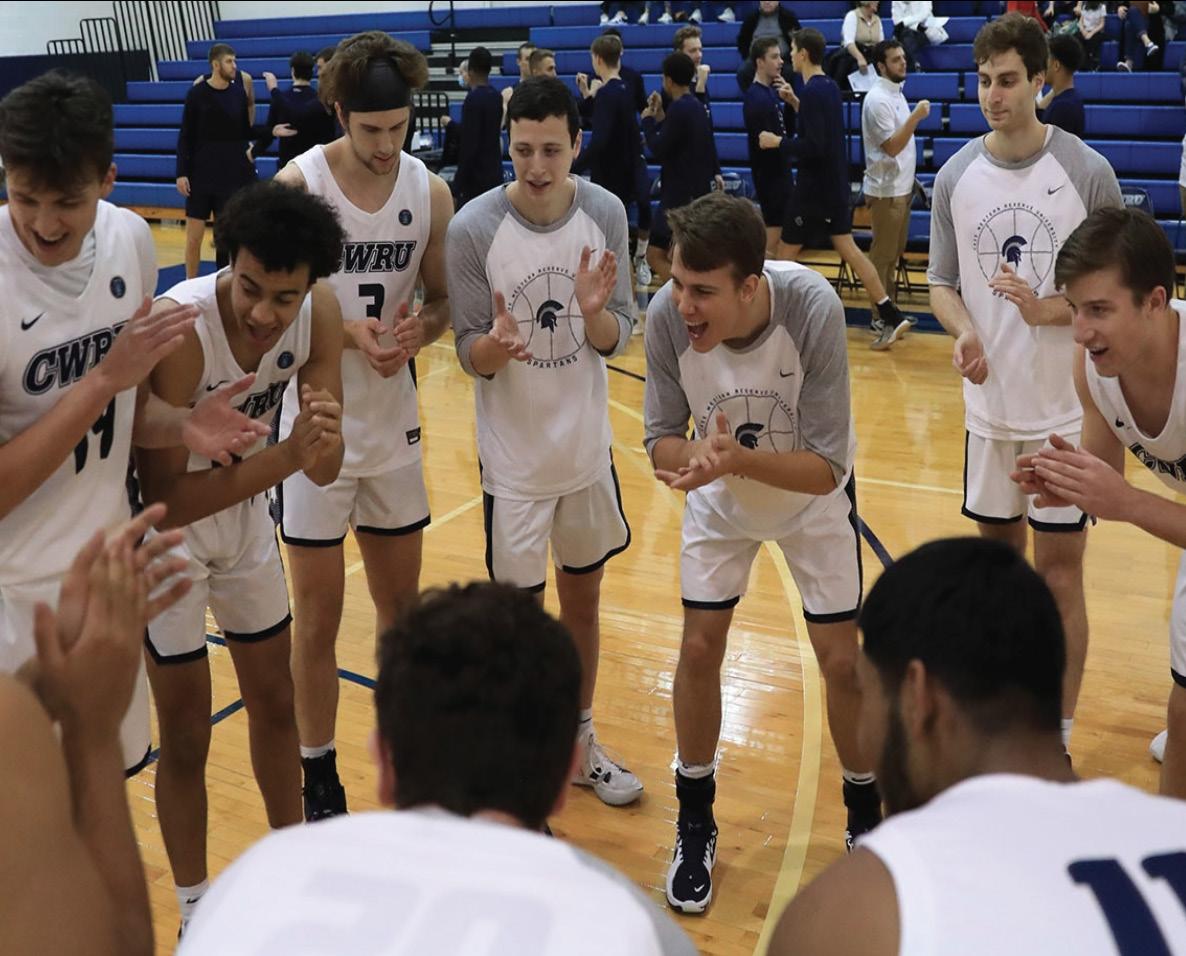
After losing the season opener to the University of Wisconsin – Eau Claire in the Bill Sudeck Tournament, the Case Western Reserve University men’s basketball team has been absolutely tearing through their opponents, sparking a 12-game winning streak that was capped off with last Friday’s 98-71 victory at New York University.
The NYU Violets had been off to a solid start themselves, entering the weekend with a 9-1 record and ready to host the 11-1 Spartans. However, CWRU grabbed an early lead and never looked back, raining buckets all throughout the first half.
Though initially trailing with a score of 3-0, graduate student guard Griffin Kornaker got the Spartans going with a layup that ignited an 8-0 run before NYU retaliated with a jump shot to put the Violets within 3. CWRU got another scoring spurt going and soon found themselves up 21-7 while evenly spreading around the scoring efforts.
The game already seemed hopeless for NYU: for every point they scored, CWRU retaliated with a barrage of their own. At one point, NYU’s deficit ballooned from 7-21 to 11-41, continuing to do so until the halftime whistle mercifully blew. By halftime, the Spartans rested comfortably with a 52-24 chokehold over the stumbling Violets.
Though the Violets were able to outscore the Spartans in the second half, 47-46, the damage of the first half put any chance of redemption for NYU out of reach. NYU scored first again to begin the half, but fourth-year guard Robert Faller nailed a three-pointer to nudge the lead higher. Another NYU layup later and it seemed as though the home team had finally found life despite the grueling opening half. Unfortunately for them, CWRU was ready to match them shot for shot. Faller iced the game with a three-point play, making the free throw after being fouled on the made layup to put the Spartans up by 30.
Desperate to stop the bleeding, the Violets called a timeout but it didn’t make much of a difference. They went
Case Western Reserve University raises tuition by 5% for 2022-2023
1-for-2 on their next pair of free throws before Kornaker sank a three-pointer and, with it, the hopes of the home team. NYU’s spotty free throw shooting continued to haunt them as the score sat at 62-33 and it felt as if the Violets were doing nothing but damage control at this point anyway. NYU nailed a three before second-year forward Hunter Drenth made one of his own, with Kornaker adding a jump to top it off.
NYU finally managed to put together a string of good plays that culminated in an 8-0 run, but a jump shot from graduate student guard Mitch Prendergast got the Spartans right back into rhythm. As the blowout wound to a close, the Spartans coaches began to sub in their bench players, who sealed the 98-71 road demolition.
Faller, Prendergast and third-year forward Cole Frilling were the standouts in the impressive victory, combining for nearly half of CWRU’s points. Faller scored 19 points with 5 rebounds and 4 assists, while Prendergast scored 15 points and had 2 rebounds and 1 assist. Frilling ended with 14 points, 7 rebounds and 4 assists.
Other noteworthy performances were by second-year forward Daniel Florey, who shot nothing but threes at 75% accuracy, and by Kornaker, who did a little bit of everything with his 7 points, 7 rebounds and 8 assists.
The purely dominant team performance by the Spartans was evident in every metric. They outperformed the Violets in field goals made, field goal percentage, 3-pointers made, 3-point percentage, free throw percentage, rebounds, assists, second-chance points, points in the paint, fastbreak points and bench points.
After back-to-back conference wins, the Spartans look to keep the extraordinary win streak going with more conference games ahead to close out the season. The Jan. 16 game at Brandeis University was postponed, so CWRU’s next chance to assert dominance will be when they host Emory University on Jan. 21.
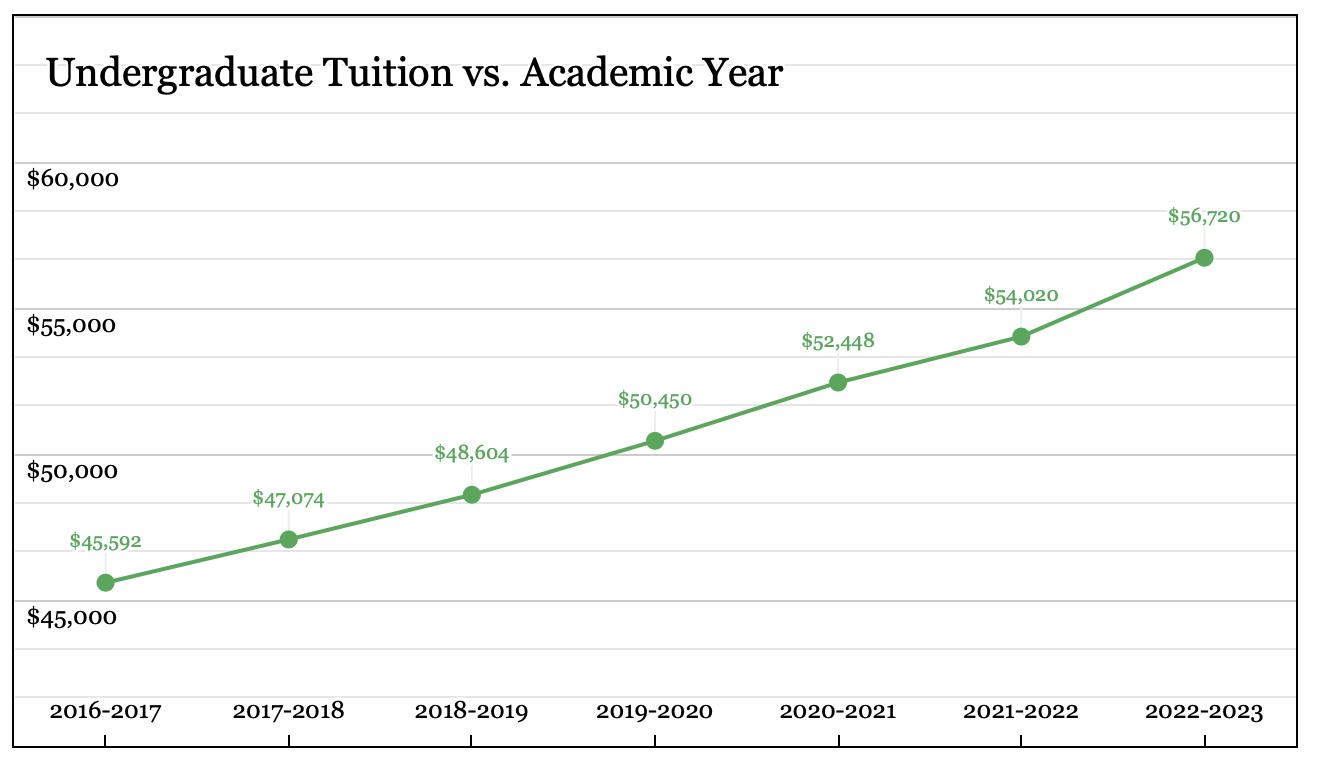
The tuition for returning undergraduate students to attend Case Western Reserve University in the 2022-2023 academic school year will increase by 5% from last year’s figure, an amount totaling to $56,720.
This marks the greatest percent increase in tuition that CWRU has mandated in the last few years. For the 2019-2020 school year, tuition was $50,450. During the 2020-2021 school year, tuition rose about 4% to $52,448. The cost of tuition for the current 2021-2022 school year is $54,020, which is approximately 2% more from the previous year. This year’s hike to $56,720 amounts to a $2,700 increase in tuition. In addition to the increased tuition cost, campus housing rates and meal plan rates will increase by 3% and 4% respectively, adding hundreds of dollars to the cost of attendance at CWRU.
The sole reason stated by the CWRU administration for such a tremendous increase in tuition comes from the recent surge in inflation. Last week, the federal government made an announcement that the consumer price index climbed 7% in 2021—the nation’s highest annual gain since June 1982. Gasoline and fuel prices jumped to 50%, while food and electricity each rose by more than 6%.
CWRU stated that they will be investing the revenue from increased tuition dollars into hiring faculty in “strategic areas, enhanced technology, and improvements to teaching labs and classrooms.” No further detail on these categories were provided. CWRU has also stated that it will augment its need-based financial aid as part of these changes.
In addition, CWRU has worked with Undergraduate Student Government (USG) leaders over the past two years to increase clarity on why tuition is increased and how it will be spent. The university has provided substantial information on the topic of the university’s budget and tuition process through the organization. Furthermore, USG leaders have frequently reached out to make sure the administration recognizes student priorities in its expenditure.
Although this sharp increase in tuition is substantial, CWRU’s tuition is the second lowest among private universities in the Association of American Universities, an organization composed of the United States’ and Canada’s leading research institutions.
In the coming years, college tuition is expected to continue to rise steadily, but hopefully not as much as it did this year.
1 opinion observer.case.edu Observer the Sports: Women’s basketball splits weekend vs NYU, Brandeis (pg. 12) friday, january 21, 2021 volume LIII, issue 16
Matt Chang Staff Writer
Following their victory against NYU, the men’s basketball team ranks first in the UAA standings, tying them with WashU. Courtesy of CWRU Athletics
Gaurav Hardikar Staff Writer
Subscribe to our newsletter Do it Tuition and fees have increased drastically up to the 2022-2023 school year, threatening CWRU students’
security Data courtesy of CWRU and collegetuitioncompare.com
Men’s basketball win streak extends to 12 with blowout win vs. NYU
financial
If you want more of Andrew Garfield, here’s what to watch next
Kate Gordon Staff Writer
After stealing the show in a certain Marvel movie this past December, the world (or at least the portion of it that lives online) cannot get enough of Andrew Garfield. The 38-year-old, British-American actor has found himself in the middle of a massive pop culture renaissance, trending on TikTok and Twitter for roles including Spider-Man in the franchise’s 2012 installment, Eduardo Saverin in “The Social Network,” Jonathan Larson in “tick, tick… BOOM!” and more. Fans praise not only his range but his performances as well, with the general consensus being that Garfield nails it every time, no matter what the movie is or the character he’s given. So here’s what to watch next and where to watch it, if you, too, want to delve further into the emerging Garfield-verse.

Honorable mentions: “99 Homes” (2014), “Never Let Me Go” (2010), “The Eyes of Tammy Faye” (2021), “Mainstream” (2020).
7. “Breathe” (2017)
Where to watch: Hulu Premium, Sling and Roku Premium, Starz or available to rent on Amazon Prime, Apple TV and Youtube.
In spite of a staunchly mediocre Rotten Tomatoes rating, this heartwarming romance between polio patient Robin Cavendish (Andrew Garfield) and his wife Diana (Claire Foy) manages to pack a big emotional punch. Sometimes moving a little too fast to be truly poignant, Garfield still does a standout job portraying someone struggling to breathe and Foy does an excellent job as well. A movie to watch if you want a good cry, and nice visuals, too.
6. “Boy A” (2007)
Where to watch: Available to rent on Prime Video.
One of Garfield’s first major roles, “Boy A” is a complicated story of redemption. Jack Barridge, a deliveryman-turned-local celebrity after his rescue of a little girl, suddenly finds himself on the receiving end of public outrage when his dark past comes to light—one where he was a convicted child killer. Suspenseful and compassionate at the same time, Garfield manages to portray a deeply distributing character in a very human way. His haunting performance will stick with you long after you’ve finished watching.
5. “The Amazing Spider-Man” (2012), “The Amazing Spider-Man 2” (2014) and “Spider-Man: No Way Home” (2021).
Where to watch: Hulu Live TV and available to rent, except “No Way Home” which is only in theaters.
Andrew Garfield’s Spider-Man is funnier, edgier and most importantly, taller than Toby Maguire’s and Tom Holland’s interpretations. He’s more of a skater and a rebel than a nerd, but other than that, his first movie sticks pretty closely to Spider-Man’s comic book origins before going more off the rails in the second. All three are solid superhero flicks, balancing comedy with darker themes of loss and revenge. And as for who is the best
4. “Hacksaw Ridge” (2016)
Where to watch: HBO Max and available for rent on Prime Video.
A grisly war movie about real-life pacifist Desmond T. Doss, Garfield’s performance in “Hacksaw Ridge” earned him his first and only Oscar nomination. A little gruesome at times, he and director Mel Gibson tell an incredible story of heroism and highlight the horrors of World War II. The protagonist is inarguably the best part of the movie, his religious moralism adding an edge absent from most films set in this era.
3. “Silence” (2016)
Where to watch: Paramount+, Hulu Premium and available to rent on Prime Video.
Andrew Garfield and Adam Driver play a pair of Portuguese missionaries looking for their missing mentor
(Liam Neeson) in 17th century Japan, where Christianity is punished by death. Grappling with their faith in the midst of religious persecution, both Garfield and Driver, coming off of roles in blockbuster franchises, get a chance to showcase their range as actors. Though this film received mixed reviews from the general public, it’s a must-watch to understand everything Garfield can do on screen.
2. “tick, tick… BOOM!” (2021)
Where to watch: Netflix.
This year, we got to find out that Andrew Garfield can sing as well as act. A predicted Oscar frontrunner, Garfield plays struggling writer Jonathan Larson, who created the widely popular musical “Rent.” In his directorial debut, Lin-Manuel Miranda captures the sense of urgency behind Larson’s life and writing as he inevitably runs out of the little time he has left. Both funny and tear-jerking at times, this movie will resonate with anyone, especially musical theater
fans.
1. “The Social Network” (2010) Where to watch: Netflix or available to rent.
Now this is the performance that’s taken the Internet by storm. Highly regarded by critics both today and at the time of its release, “The Social Network” stars Jesse Eisenberg as future tech billionaire Mark Zuckerberg and Andrew Garfield as Eduardo Saverin, his best friend and later victim and enemy. And while Garfield does a phenomenal job throughout the movie, his final scene with Eisenberg is one that many viewers can quote line by line. His emotions come through in such a raw and realistic way that I can’t imagine any other actor or movie even coming close to replicating it. If you somehow haven’t seen “The Social Network” already, this is definitely the first one I would recommend you sit down and watch.
life
Andrew Garfield has amassed a huge fanbase with his captivating roles in films such as “The Social Network” (pictured above), “The Amazing Spider-Man” and “tick, tick... BOOM!” Courtesy of Sony Pictures Spider-Man out of the set? Obviously, the right answer is all of them swinging through scaffolding in tandem.
A guide to staying together after college
Miss Bea Haven Consultant

Hi Miss Bea, I’m a third-year, and my wonderful partner of almost two years is a fourthyear in their last semester of undergrad. We’re both from out of state, and their plan for next year is to rent off-campus, take a gap semester/year to work, then finish their MS at [Case Western Reserve University]. They seem to be under the impression that I’m going to grad school at CWRU as well, but I’m not sure what I want to do after undergrad, and even then I’m not 100% certain that I’m going to stay in CLE for whatever I end up doing. We did long-distance at the beginning of our relationship, and with all the stresses of being remote and having to deal with school, it was really difficult to maintain a good schedule to talk to them consistently.
I guess my questions are, how do I go about planning my future when I have my significant other to consider? How should I prioritize? How do we go about talking about this?
Thanks,
Thoughtful Third-Year
Dear Thoughtful Third-Year, College relationships are a bittersweet experience. You’re finally in an adult relationship! And then you realize … you’re finally in an adult relationship. This comes with the stunning reminder that your decisions no longer impact just you, but also your partner.
Now, if this were a high-school relationship, I would tell you not to even consider including a partner in your future plans. Too often we hear about young teens giving up university scholarships and career opportunities so that they can stay together, only to be dumped three months into their first year. But this is different. You and your partner have been together for some time—it is natural to want to include them in your future, whether that be in the same city or in a long-distance relationship capacity.
Here, you have two separate issues that need to be addressed.
The first issue concerns your ultimate plans for life after school, which can only be decided by you—not by your partner and definitely not by your friendly neighborhood advice columnist. Independently, you should take some time and decide what you are/are not willing to compromise on in terms of your own future goals. Once you have a better idea of what you want and what you are open to, without the influence of a partner, you will inevitably get a better idea of how to approach the conversation about your combined futures.
If you are open to the idea of continuing on to going to graduate school at CWRU, you can remind them that this is just one of the many possible pathways that would allow you to spend your lives together in the next couple of years. On the other hand, if you absolutely do not want to stay in Cleveland––regardless of whether you go to grad school or not-––that is something that needs to be discussed.
Once you have a good grasp of what you may or may not be willing to compromise on, you must then have a conversation about what they are willing to compromise on. Find a quiet moment where you won’t be interrupted and hash out what you both think would be good
for your combined futures. For instance, grad school usually only takes an extra year when students apply to the university they are already attending for undergrad. Would they be willing to skip out on taking a gap year so that you both could graduate your respective programs at the same time? Are they willing to wait around in Cleveland for another year should you choose to pursue your master’s degree?
Keeping your partner involved in your thought process ensures that there are no surprises further down the line. You say that “they seem to be under the impression,” but only you can provide the clarity that is needed to move forward after college. Be firm and clear about your expectations and ideas for the future. Not only will this discussion ensure that you are in sync post-graduation, but it will also help you gauge if both sides are willing to put in effort to make sure your relationship works.
If you think about it for a while and still don’t find the answers to these questions––that’s fine! You’re still a thirdyear, and while your partner is already forced to make a decision about where their life is going, you still have plenty of time before adulthood rears its ugly head. As a fourth-year, they should understand that you may still have to take time and figure out what is ultimately best for your future. However, you still need to lay your cards on the table so that they can be prepared for possibly unsavory scenarios ahead, such as long-distance.
This brings us to the second subject that needs to be addressed––the struggle of long-distance relationships (LDR).
Other than the obvious physical separation, I stand by the fact that the biggest challenge with a LDR is couple complacency. You get busy, they get busy––then, sooner or later, you are only managing to fit in an hour a week for chatting and focusing on your relationship. As cheesy as it may sound, you have to actively pursue your significant other as if they are right by your side. I know several premed and engineering couples who use a shared Google Calendar so that they can plan romantic times around their hectic schedules.
Now, this might be a little clinical for some––but it’s the thought that counts. Set up funds that are specifically meant for things like date night or flights to and from visits. Send romantic text messages, and make time for shared activities like movie night or board games. Ask questions, be open, and never forget what made you fall in love in the first place.
–Miss Bea
College is hard, but relationships and sex are even harder (pun intended). In this latest Observer advice column, the ever-thoughtful Miss Bea Haven reprises her role as the go-to guide for all things scandalous at CWRU. Got questions or in need of advice? Anonymously email missbeahaven@case.edu and you could be featured in next week’s article!
Holding on to motivation
Playlist of the week 1/21/22
Online school is tedious and emotionally challenging at the best of times. In the absence of quality music, though, it becomes much worse. Attempting to remain focused on your homework without the perfect tunes is a laughable feat. An equally challenging task, however, is seeking out said “quality” music that simultaneously relaxes you, motivates you and allows you to maintain your focus.
Over my years as a student, making study playlists has been a ritual. Combining my favorite music with studying makes the experience seem almost fun. Below, I have put together songs that meet my study music standards; I’m sure you will enjoy them as much as I do.
I AM WOMAN - Emmy Meli
If I’m feeling the need for a dose of serotonin or some extra motivation, this is the song that I play. It is so beautifully written and wonderfully celebrates being a brilliant person. Wanna feel awesome? Listen to this song.
Winnebago - Gryffin (feat. Quinn XCII & Daniel Wilson)
This is one of the most carefree songs out there. The lyrics stress the importance of letting go and going with the flow. Everyone needs a little encouragement to loosen up every so often, and this song provides just that.
Heaven Falls / Fall on Me - Surfaces
This song describes the recipe for a productive day: wake up early, open the window and eat some banana pancakes— though preferably not from Leutner.
Where Is the Love? - Black Eyed Peas
A classic and a deserving member of this playlist. As one of my favorite songs, it conveys messages that I value highly and find especially relevant to our lives today. It encourages us to recognize society’s flaws and acknowledge that it is perfectly okay to feel overwhelmed or upset by the things that we read or watch or experience. When taking classes online, it is normal to feel overwhelmed, and this song is the anthem of accepting that feeling.
SPF10 - Requiem Inc.
It’s hard not to be drawn in by the warm, sunny imagery and motivating affirmations beaming from this song’s hook. I promise it will help you power through even the most boring homework assignment or give you the energy to attend your last class of the week.
Just the Two of Us - Grover Washington Jr. (feat. Bill Withers)
I discovered this song again a few weeks ago, right before online school started. When listening to the lyrics, “Just the two of us / We can make it if we try,” people’s thoughts usually go to romance and all that jazz. But in the light of virtual school, my first thought was the relationship between myself and my computer, as we would be spending lots of time together in the online school experience of the coming weeks.
Rise Up - Andra Day

In this masterpiece, Day will empower you to keep going despite the monotony. If you believe in yourself, you can “take the world to its feet … move mountains … rise up.” Carry on. Push through. You’ve got this.
The Good Part - AJR
Despite powering through online school and trying to make the most of it, I know that all of us students are counting down the days until in-person classes begin. This song perfectly embodies this feeling: “Can we skip to the good part?” Although this waiting game we are playing with COVID-19 and all of its challenges can be tedious, I have confidence that the Case Western Reserve University Board of Trustees is working hard to keep us safe and get us back into the classroom as fast as they can.
Orlando - Blood Orange
I
Wish I Knew How It Would Feel to Be Free - Nina
Simone
As one would guess from the title, this song is about the desperation to break away from things or people that are holding you down. Feeling restricted in this way is something that I have experienced during these past few weeks, so getting validation for those feelings really helped me to accept and move past them. It brought me a fresh feeling of the extra motivation that I needed.
Power - Temani
“The power lies within me.” I’m just going to leave this here.
Reggae-inspired and wonderfully cheerful, this song offers us the best way to wrap up the night after a hard day studying. The song ends this playlist with a fantastic line: “You know, it’s an insult we often put onto / A lot of folk is, like, ‘oh, you’re doing too much.’ … You know what? My resolution, my eternal resolution will be / To do too much. / Yes, I love it.” This song’s message is loud and clear: stay on your path and great things will come.
As well as making my own playlists, I love receiving ones made for me by friends, even if we have slightly different music tastes. That is what I have done for you here. I have made what I hope to be a motivating and fun playlist to keep you and your homework company. Feel free to switch up the order and enjoy it however you like. Before you know it, you’ll be on your way to finishing up your homework for the evening at lightning speed.
3 life observer.case.edu
Christie Lanfear Staff Writer
Emmy Meli’s “I AM WOMAN” is one of the many songs that will get you through your study sessions. Courtesy of Emmy Meli
“tick, tick… BOOM!” has Jonathan Larson’s life leap onto the screen
Streaming recommendation of the week 1/21/22
Scout Carter Staff Writer
Jonathan Larson isn’t a name that a lot of people have heard of. Unless they’re a major theater nerd or have fallen in love with the radical rock revolution that is “RENT,” a reference to Larson is likely to draw a blank for most. Before this year, even those who would consider themselves musical connoisseurs of the most obscure Broadway shows knew very little about “tick, tick… BOOM!”— other than the fact that it was one of the only other major shows that the “RENT” creator ever wrote. A cult classic, “tick, tick… BOOM!” is a semi-autobiographical testimonial to what it takes to be a starving artist, with Larson typifying this portrait.
However, when this movie was announced to be produced by Netflix with the famed, fan-favorite Lin-Manuel Miranda as its director (with Miranda also making a quick cameo in the film), more people than ever knew about “tick, tick… BOOM!” Talk about the movie grew when its leading man was chosen: Andrew Garfield. Many felt that this was coming from left field—though he has a rich theatrical background, having recently won a Tony Award, Garfield had never been seen in a musical before. This skepticism of his qualifications, along with other starry additions to the cast such as Vanessa Hudgens and Bradley Whitford, only drew more viewers in, making the movie a great success when it released in theaters and on Netflix in November 2021.

The film itself depicts the week or so of the composer’s life before his 30th birthday. The great Broadway composers who came before him, like the legendary Stephen Sondheim, had found great success well before this age, according to Larson. His lack of success might be short-lived, however, with his upcoming work, “SUPERBIA,” a futuristic, genre-
defying piece that has been in the works for eight years. His girlfriend Susan wants him to give up his scrimping lifestyle, though, as she has been offered a long-term position in the Berkshires and asks Jonathan to accompany her. Larson navigates these stressors whilst the reality of the AIDS epidemic hangs in the air, affecting many of his close friends. Tragically, nobody ever ends up actually biting the bullet and producing his show, leading the real-life Larson to dive into the work that would eventually actually make him famous—“tick, tick… BOOM!” and, of course, “RENT,” as the epilogue of the film’s commentary notes. However, like many other artists, Larson’s fame only came after his death. On the morning of “RENT”’s off-Broadway premiere, the composer tragically passed due to an aortic dissection—he would never get to see the full success of the show and its lasting impact on the musical theater industry.
This impact has certainly found its way to Case Western Reserve University as well. Most directly, “RENT” was put on by our musical theater group, the CWRU Footlighters, in April 2011. But much more broadly, it’s easy to see the continued influence that Larson has had on the kinds of shows we put on here. One large example of this would be a production put on just a few shows after “RENT”—that of “Next to Normal” from the mind of Tom Kitt, another show proclaimed to be a rock musical. This is a common descriptor among the kinds of shows that get produced in today’s musical theater industry. But during Larson’s time, he was deeply underappreciated. To create a show that combined the traditional tunes of musicals with the energy of rock was certainly groundbreaking. The film shows that this is exactly why Larson’s show was never picked

up—very few people had the vision to get behind his concepts. But hindsight is 20/20—we can certainly thank him now for his work in shaping the musical theater we see today.
Jonathan Larson was a musical prodigy, one whose life was tragically cut short, robbing us of the many years of successful music that he could have had. Though we never got a slew of shows that could break our hearts like “RENT” can, we will forever feel the ways in
which Larson shaped musical theater. This is why “tick, tick… BOOM!” is an essential movie to watch. Look past the star-studded cast and production team and you get a love letter to art, to those who lost their lives to AIDS and to the man who put all of those feelings into a show that tells us to keep on living with the time that’s left.
“tick, tick… BOOM!” is streaming on Netflix.
Picture of the week @Shreyas Banerjee
4 life 1/21/22
Andrew Garfield (pictured above) shows the struggles of turning 30 in the ’90s as playwright Jonathan Larson in Netflix’s “tick, tick… BOOM!” Courtesy of Netflix

5 life observer.case.edu
Tarun’s LOLs
Horoscope
The signs as dog movies
Crossword

ACROSS
1 Modern Persia
5 Arnaz who loved Lucy
9 Become acclimated
14 “Finding ___” (2003 Pixar film)
15 Alternative to a wood, in golf
16 Name said twice before “Wherefore art thou”
17 In vogue
18 Oscar the Grouch’s home
20 International Court of Justice location, with “The”
22 Bulls in a bullfight
23 Old weapon in hand-to-hand
Pisces Air Bud Aries Old Yeller
Taurus
combat
26 Place for a nest
30 Digital picture, maybe
31 Less fresh

33 Emergency call in Morse code
36 Wild guess
39 With 60-Across, one of two U.S. vice presidents to resign from office
40 Result of a football blitz, maybe
44 Completely anesthetized
45 Exercise that might be done on a mat
46 Cover gray, perhaps
47 Like vinegar 49 “Holy moly!”
52 English channel, informally,
Leo Lassie Virgo Bolt
Libra Hachi
with “the”
53 Bit of fashionable footwear
58 Home in the shape of a dome
60 See 39-Across
62 Dreaded cry from a boss ... or a hint to the ends of 18-, 23-, 40- and
53-Across
67 Listing in a travel guide
68 Texas ___ (school NW of Houston)
69 Dealer in futures?
70 It’s a plot!
71 News media
72 Rival of Harvard
73 Wood for boat
decks DOWN
1 Not give an ___ (be stubborn)
2 Give a makeover, informally
3 Spanish girlfriend
4 “Hey, don’t jump in front of me in the line!”
5 Insult
6 Time span sometimes named after a president
7 Rather, informally
8 Where work may pile up
9 Best Picture winner set in 1-Across
10 Swims at the Y, say
11 “The Walking Dead” network
12 Cause of a sleepless night for a princess, in a fairy tale
13 Whole bunch
19 Greek counterpart of Mars
21 Yadda, yadda, yadda

24 Zap with a light beam
25 Contest attempt
27 Classic work that’s the basis for Shakespeare’s “Troilus and Cressida”
gracious!”
29 Not having two nickels to rub together
32 “For shame!”
33 Fledgling pigeon
34 Weight whose abbreviation ends in a “z,” oddly
35 “Sexy” lady in a Beatles song
37 Blood grouping system
38 Hole-some breakfast food?
41 Nickname for the Cardinals, with “the”
42 Prefix with -pod or -partite
43 Zoo enclosure
48 Foal : mare ::
: cow
50 Lawyers’ org.
51 Took care of someone else’s pooch 54 Loud
55 Land with a demilitarized zone
56 Delayed
57 Four: Prefix
59 Insets in a crown 61 Line on a calendar
62 Talk, talk, talk
63 Regatta implement
64 French “a”
65 Wriggly fish 66 Dr. of hip-hop
Scorpio Cujo
Capricorn 101 Dalmations
Sagittarius
Beverly Hills
Chihuahua
12/3/21 6 | fun fun
Aquarius Marley & Me
Beethoven Gemini Lady and the Tramp Cancer Hotel for Dogs
28 “Goodness
Word Search: CWRU Buildings


ADELBERT BINGHAM
CRAWFORD
FRIBLEY
KELVIN SMITH
MILLIS SCHMITT
NORD HALL SEARS
STROSACKER
THINKBOX
TINK
VEALE
One hidden word: What is the worst place to eat on campus?
Follow and message us with the solution on Instagram at @cwruobserver for a prize
observer.case.edu fun| 7
Hard Medium
Sudoku
Editorial: The add/drop deadline should have been extended
Editorial Board
By the time this editorial is published, it will be the final day of the add/drop period for the spring 2022 semester at Case Western Reserve University. Most of us will already have our schedule set for the semester, with the work for classes we just started already picking up. However, with the first two weeks of the semester having been remote and classes set to resume in-person on Jan. 24, our courses during the add/drop period weren’t indicative of how they would be the rest of the semester or even next week. Due to the switches in the learning environment, the add/drop period should have been extended slightly. While students do have the option to withdraw from classes later in the semester, such changes will be shown on their transcript. Extending the add/drop period to the third week of this semester would have allowed students to properly make a decision on their course schedule; we would have been able
to gauge—not just how a class is like online—but also how our schedule plays out in-person when the workload starts to increase. By extending the period by a week, CWRU students would have been able to experience a full week of in-person learning, and all that comes with that experience. Attending online classes does not provide the same experience as leaving 15 to 30 minutes early to walk to class, having a break between classes that isn’t long enough to go back to your dorm or physically going to extracurriculars or work between/after classes. So by lengthening that add/drop period, students could have decided if their schedule was actually manageable when they are physically on campus. However, extending the deadline for add/drop this semester could have been tough on professors if they are holding out on assigning more substantial homework because there is a possibility more students could join the class. On the other hand,
students typically don’t tend to add classes, but instead, switch sections or drop classes. Even if a student adds a course in the third week, they likely know that they are a bit behind and will try to make up for the gap in learning. In addition, because professors don’t normally make major assignments—such as papers, quizzes or tests—due until the third week, extending the add/drop period would allow CWRU students to experience those harder assignments and be sure about their decision to remain in a class.
At the very least, the drop (not add) period should be extended an additional week beyond this remoteto-in-person learning transition. All the reasons mentioned above are also applicable to other semesters— students get a better feel for classes and are able to determine if they can actually handle their course load without consequence. This compromise also wouldn’t really affect professors since they wouldn’t have to
worry about new students coming into their class and having to hold off on any larger assignments. Extending the drop period to the third week for all semesters would be beneficial to students in any semester, let alone one where we haven’t actually experienced how our classes will be for the remainder of the academic year.
We already know that CWRU will not make the remote-to-in-person transition any easier, and that they probably expect most students to be perfectly fine with the adjustment. However, we are just starting to get used to online classes after doing them in-person last semester, and now, we have to deal with adapting back to in-person. Extending the add/drop period would have aided in the switch, but alas, the administration doesn’t seem to be keen on taking all necessary measures to guide our community through these uncertain times.
The Observer is the weekly undergraduate student newspaper of Case Western Reserve University. Established in 1969, The Observer reports news affecting students and provides an editorial forum for the university community. Unsigned editorials are typically written by the opinion editor but refle ct the majority opinion of the senior editorial staff. Opinion columns are the views of their writers and not necessarily of The Observer staff. For advertising information, contact The Observer at (216) 302-4442 or e-mail observer-ads@case.edu.
LETTERS TO THE EDITOR should be e-mailed to observer@ case.edu or submitted on our website at observer.case.edu. Letters can be mailed to Thwing Center 11111 Euclid Avenue, Suite 01, Cleveland, Ohio 44106. For policy and guidelines related to the submission of Letters to the Editor, refer to observer.case.edu/submit-a-letter.
The Observer is a proud member of CWRU’s University Media Board. Follow The Observer on Facebook, Twitter and Instagram @cwruobserver.
executive editor & publisher SHREYAS BANERJEE
director of print SARA KHORSHIDI director of business operations MILES KOSTOLANSKY
director of digital media HANNAH ALLEN
director of design VINAYAK MATHUR
development editor BEAU BILINOVICH
news editor SHREYAS BANERJEE
life editor NATHAN LESCH
opinion editor KARUNA LAKHIANI
sports editor PUNEET BANSAL
social media editor SOPHIA POPKIN
photo editor CHRIS HEERMANN
web editor COLLIN WONG
video editor ASHLEY SHAH
layout designer TARUN SEPURI
business managers NIKKI D’COSTA
8 opinion 1/21/22 opinion
EDITORIAL
the observer
established in 1969 by the undergraduate students of case western reserve university
BAHNS, MULAN MA, ANA PEREZ CESPEDES
NANDA
copy editors JOEY GONZALEZ, RITIKA DEVARAKONDA, JULIA FENG-
& SHIVANGI
Want to write for us? observer@case.edu
Horwitz: Save our Delta Gamma Refugees
Avi Horwitz Staff Writer
COVID-19 has been causing mass death for over two years. We’re sleepwalking towards authoritarianism and climate catastrophe. Not to mention all the other symptoms of living in a white supremacist, patriarchal, capitalist society that we face. When it was announced that Delta Gamma’s housing would be taken away for a semester, that was the last straw for Case Western Reserve University students, for whatever reason. Shortly after the new year, a petition began circulating on social media attempting to reverse a move by CWRU to use the Delta Gamma sorority’s house as housing for students quarantined due to COVID-19 infections. As of the writing of this column, the petition has garnered just under 2,000 signatures. This reflects seriously unhinged behavior.
As one self-described “Case Parent” wrote in the petition comments, “the audacity and absurdity of the white privilege and entitlement is stunning. Kudos
to Case for putting the health and safety of all their students over 19 Greek life peers. Voting so folks can read that fellow Case parents know that this is absurd and an utterly privileged, poorly understood stance.” While this parent hit the nail on the head with their assessment, my main gripe does not focus on the literal validity of Delta Gamma’s petition. As the petition points out, there are other spaces, such as an unused fraternity house, that the university could have chosen to designate as quarantine housing. The true absurdity of the situation lies in its outlier status.
It’s well known that CWRU students live in a “bubble.” There are few groups on campus that go beyond performative and exploitative philanthropy in favor of truly challenging the status quo. These groups tend to get far less attention, likely due to our inclination for resume building over solidarity. I’ve all too often heard my peers lament that they don’t have the time
or don’t know how to galvanize collective action. Well this has now been disproven. The ease and quickness with which Delta Gamma obtained the significant number of petition signatures, poetic Instagram stories and heart-wrenching Facebook posts shows that CWRU students have the capacity for action when their privileged conditions are immediately at risk.
This is not to say that we should follow the exact strategy followed by Delta Gamma’s supporters for more serious causes. Awareness-building methods, such as petitions and social media posts, will never be liberating on their own (or even effective as the main focus of action). In this sense, it reminded me of the much more warranted uproar to the Undergraduate Student Government (USG) recognition of Case for Life (CFL), formerly known as Students for Life (SFL), in the spring of 2020. Students quickly mobilized to share the petition for a student referendum and garnered the nec-
essary 500+ signatures. The referendum succeeded in momentarily overturning the recognition. However, beyond the initial spurt of support, no long-term base was built to harness this energy. CFL would succeed in receiving their recognition, with little widespread opposition, less than a year later.
What needs to become commonplace is the supportive energy displayed under the two scenarios mentioned above. As I discussed in my last column, community organizing is the best way to harness that attitude to build a better world.
So, maybe, just maybe, instead of going through Greek Life recruitment this month, you can join a community-based organization. The people you meet in these organizations—those who will march in the streets with you on a cold rainy day or work through mundane strategy at a weeknight meeting—are far better “family” than whatever “brothers” and “sisters” you get through Greek Life.
Radwan: LinkedIn is a great tool to plan for your career
Aziz Radwan Staff Writer
Since LinkedIn launched in 2003, professionals have used it to network and develop their careers. Today, it has become an indispensable tool for job seekers to post their curricula vitae (CVs) and employers to post jobs. We can see that the LinkedIn platform allows members to create profiles listing their education, skills and achievements, while employers and recruiters post positions or search for qualified candidates. Because of this, LinkedIn has gained enormous popularity, including earning the “premier digital platform” title for professionals to network online. It has come a long way since only having about 20 sign-ups a day. Because it managed to optimize its platform with personalization features and company advertisements, the number of LinkedIn connections has skyrocketed to over 800 million registered members worldwide as of January 2022.
Perhaps the most notable advantage of LinkedIn for students and professionals is personal branding, which is in the member’s profile. Sections such as About, Activity, Experience, Education, Skills and Recommendations help
members brand themselves as they try to make new connections or interact with existing ones. Additionally, after creating your profile, you will find out that your name is searchable, and more than likely, your LinkedIn profile link will appear on the first page of Google Search results. People who want to get to know you better will likely visit your LinkedIn profile page. Remember, your profile page always leaves the first impression about you, so uploading an appropriate profile picture and writing a good summary in the About section is essential.
Pamela Green, author of “Think Like a Brand: A 7-Step Strategic Brand Plan to Increase Your Career Satisfaction and Success,” describes a personal brand as “the emotional experience you want people to have as a result of interacting with you.” Green’s idea is that as a job seeker, you need to be intentional in how you interact with professionals—be it in person or digitally—so you can leave an impression that drives an emotional connection.
Another advantage for college students is the profile updates of professionals. As a student, you may want to
connect with professionals in your field. Skills posted on their profiles can aid you in planning what skills you should strive towards gaining during your education. For example, a computer science student will need to develop technical skills, including data analysis, software development, technical writing and mathematics. Other soft skills such as attention to detail, communication, organization and time management can be equally as important as technical ones in job hunting. Technical skills are typically acquired through classwork and internships, while soft skills are learned first-hand from student clubs and activities.
Although LinkedIn is an excellent platform for students and professionals, it is not without its downsides. One of the downsides I get annoyed by is seeing some connections posting non-careerrelated activities; it seems as though they don’t know there are other social media platforms for this purpose, such as Facebook or Twitter. LinkedIn engagement should primarily be in the realm of career or business development. If we keep seeing personal or social content on LinkedIn, then it will be a waste of time
to check updates.
Another flaw of the platform is the abundance of malicious activity by scammers. For instance they may stalk users by sending fake job offers, which can lead to stealing the user’s information. As it is probably known, stealing personal data is fuel for identity theft. Scammers lure users into filling out their personal information such as their full name, home address and credit card information. This can result in selling the user data to other criminals and creating phishing attacks. Hence, it is important for LinkedIn users to be aware of such activities and not share or post any sensitive, personal information on any social media site.
All in all, LinkedIn is a powerful tool for connecting with colleagues and professionals. It helps us create our personal brands, find jobs, make connections and stay updated on others’ professional lives. It is a great resource to grow our professional network. However, as we build our LinkedIn connections, we need to keep an eye out for scams, so we don’t fall prey to criminal activities, especially identity theft.
Chintada: Advancing the field of OB/GYN for all
Latavya Chintada Staff Writer
There is no doubt that medicine has significantly advanced through the decades. These advancements have improved quality of life, reduced mortality rates and decreased disease rates. For example, the use of robotics in urological surgeries has aided in speeding up the duration and precision of surgeries. Likewise, other technological advancements in imaging, such as MRIs, CTs and ultrasounds, have improved the accuracy of diagnostic exams, allowing simultaneous detection of diseases in their beginning stages. Recently, a certain medical procedure conducted at the University of Maryland Medical Center made headlines when surgeons transplanted a pig heart into an 57-yearold man. This was the first pig-to-human transplant ever performed, and it speaks volumes about how far we have advanced medicine. While the ethics of putting a genetically modified pig heart into a human is a separate issue, these major advancements still raise the concern that some practices in medicine—which seem almost barbaric—still exist without major developments on them today.
A field that still holds some gruesome practices is the specialty of obstetrics and
gynecology (OB/GYN). While there have definitely been significant developments in the discipline, it falls short in terms of making patients feel comfortable and at ease compared to other fields. An example is that of the insertion process of the intrauterine device (IUD). IUDs are used as a form of birth control to prevent pregnancy and are inserted through the cervix and attached to the top of the uterus. Those who undergo this procedure can experience a lot of cramping, spotting and irregular menstrual cycles as it involves a small piece of plastic being shoved inside the uterus, an internal organ. If other procedures involving internal organs such as colonoscopies can use sedation, then why can’t this one? IUD insertion has no sort of anesthetic or numbing for the patient; most patients are told to take over-thecounter pain medication before coming in for their appointment, which hardly seems appropriate for the amount of pain they will experience. As for why sedation is not deemed necessary for IUD insertions, some physicians have dismissed its need and instead raised concerns about the potential risk. However, healthcare workers allow intravenous (IV) sedation
for relatively minor procedures such as wisdom teeth removal, which is what I have experienced.
While it is true that there are risks associated with IV sedation, as well as high costs, it is justifiable to demand proper anesthetic for such procedures. While patients can request IV sedation for their IUD insertions, it is less common and not commonly offered or discussed by the practitioner. Ultimately, it is the safety and comfort of the patient that needs to be in the physician’s top priority, and having a piece of plastic jammed up a sensitive organ to prevent pregnancy does not seem like the most comfortable procedure, or even something that should be a part of modern medicine.
Likewise, the dreaded speculum is another element of modern OB/GYN that doesn’t seem quite updated for the times, and instead, a little barbaric. The speculum is a “hinged, two-bladed instrument” used to better inspect the cervix during procedures such as IUD insertions, pap smears and STD testing. This instrument originated from institutionalized patriarchy and racism, as its creator was a white man who tested it on enslaved
Black women throughout the mid 1800s. It seems shocking that an instrument developed by a man for women’s health is still being used in practice today, as it does not aim for the comfort of patients. Many OB/GYN patients have described the speculum as uncomfortable and a source of anxiety and nervousness. This makes patients less likely to opt for these prophylactic gynecology exams, putting them at risk for undetected gynecological diseases.
However, this is not to say that there will never be any developments regarding these matters. Thankfully, teams of women are working on redesigning the speculum to make it more comfortable and less frightening. Similarly, I hope there will be a consideration to making anesthetics more accessible during certain OB/GYN practices, such as IUD insertion. When there is a long history of women being mistreated in the maledominated medical field, it is important that a specialty dedicated to women’s health has the proper tools and procedures to maximize the comfort and safety of its patients.
9 opinion observer.case.edu
Miller: CWRU refuses to allow remote accommodations for disabled students during the pandemic
How many lives is a college life worth?
Lio Miller Contributing Writer
“The overwhelming number of deaths, over 75%, occurred in people who had at least four comorbidities. So really, these are people who were unwell to begin with. And yes, really encouraging news.” That’s what Centers for Disease Control and Prevention (CDC) Director Dr. Rochelle Walensky had to say about the COVID-19 pandemic last week.
I have six comorbidities.
But Case Western Reserve University doesn’t seem to care any more than Dr. Walensky does about students like me. Five semesters into the pandemic, CWRU is intent on pretending it’s over. The administration sends letters to the student body assuring us that they know everyone expects things to return to normal as soon as possible. But who is everyone? Because clearly, I’m not included in that, and neither are other disabled students. Nor are we included in considerations of how to “provide an equitable experience for our students” or allow them “to attend as many classes as possible.”
Because if we were involved, CWRU wouldn’t be denying disabled students the opportunity to attend classes remotely after the two-week mark. And yet that’s exactly what they’re doing.
Disability Resources is denying almost all undergraduate students’ requests for remote attendance accommodations in the very same semester during which almost the entire school is spending the first two weeks learning online. Their justifications run the whole gamut of excuses, including that if professors had to change their syllabus when the school went remote, “that’s a fundamental alteration”—in
which case, where is everyone’s tuition refund for the spring semester of 2020? This question I again found myself asking when Assistant Dean of Disability Resources Eboni Porter said, “it changes the nature of the degree.” Another excuse was that “courses that are highly participatory, what I’ve found so far is that no university has provided a remote option for it for an approval for a disability accommodation”— false. Or, “If you have a question, and the instructor is talking, the instructor is not always going to be able to pay attention to [you] if you’re raising your hand.” Then why are hybrid courses still being offered through the Master of Public Health Program? And how can we guarantee that they’d see our hands in person? Not to mention just how hard it would be to see the raised hand of a dead student. This one is just grasping for straws. But the cherry on top is when Eboni Porter told a student, “In that situation, what I would say to a student is, for the pandemic situation, then take time away…This would be a time that we would say, do not take classes.”
That’s right, folks. Eboni Porter told students that if the pandemic endangers them, they should leave CWRU. Not only is this an extremely unethical thing to be telling students, but it’s also plainly illegal.
As an institution of postsecondary education, CWRU is subject to federal law. It is required by Section 504 of the Rehabilitation Act of 1973 and by Title 34 of the Code of Federal Regulations to provide reasonable accommodations. There is also a five-year Department of Education (DOE) precedent
establishing that if a class was offered remotely in the past, it absolutely cannot be called an unreasonable accommodation to offer remote attendance for this class in the future. Plus, the DOE said in a letter to the public in 2020 that schools should not use federal law as a reason to deny remote learning. Despite its aforementioned troubling rhetoric, even the CDC recommends remote learning as an accommodation for at-risk students.
CWRU made its ability to provide remote education crystal clear two years ago. Since then, its legal requirement to continue to do so has been reiterated numerous times by multiple different governing institutions. This is not a question of ability. It’s not a question of requirement. It’s a question of how far CWRU thinks it can contort the law—and its “reasonable accommodations” qualifier—to appease donors and students who want a traditional college experience while the pandemic rages on, killing disabled people left and right. I have a right to an education. I have a right not to die. And I have a right not to be forced to choose between the two. It is not that difficult of a concept to grasp. So why is the administration struggling so much with this? There is no ethical reason to deny remote attendance. If students want to attend in person, and their professors are comfortable with it, then, by all means, allow it. But that’s a far cry from forcing everyone to do so.
The problem is that an influential group of people stands to gain from denying this accommodation: those who monetarily benefit from reinforcing the perception that this pandemic no longer
exists. The sooner everyone gets back in person, the sooner we can cram more students into a room. The sooner we can require fewer safety measures at work. The sooner we can build more profit in industries that rely on crowds or travel. The sooner industries connected to CWRU can churn out more significant profits from their workers. The sooner we can appeal to coronavirus-denying donors who throttle the donation pools when schools dare to buy into conspiracies or scare tactics. The sooner we can stop dropping money on tests, sanitizers and masks—which could be going straight into the administration’s pockets instead. The sooner we can get back to building the castle of our 21stcentury American lifestyle built on the foundations of the dead bodies of those deemed lesser.
There’s no doubt that CWRU’s ableist history—and present—have become more visible as of late, revealing an obvious decline in their ability or even desire to pretend that they care about access. I knew going into college that there would be parts of my education that would be subject to ableism; it is simply the reality of living in this society, at CWRU or anywhere else—especially as someone with multiple other marginalized identities. But when did tuition here become so expensive that my life was part of the bill? Would you rather see a fellow student physically present in class for two weeks and then in a coffin, or see them over a computer screen for one more semester? How much value does your in-person education carry compared to that of someone’s life? And what are you going to do about it?
Reyna: A year of Biden’s ups and downs
Christian Reyna Staff Writer
By the time this column is published, we will have lived through an entire year since President Joe Biden took the oath of office on January 20, 2021. Just before he took that oath, we witnessed a terrifying insurrection on January 6, 2021, in an effort to discredit his presidential election victory over former President Donald Trump. It’s safe to assume that the Biden presidency after one year has had its fair share of ups and downs as the threat of COVID-19, amongst other things, continues to impact his time in office. This brings to mind the following question: what has and hasn’t he done in the one year he’s been president? And, what problems have arisen during his tenure? Let’s take a closer look.
We must address the elephant in the room first: COVID-19. It has greatly affected our lives, and we expect the United States government to act accordingly, especially now with the Omicron variant causing a new wave of cases. Ohioans are overwhelmed with the new variant, but they are not alone. The entire country is facing a huge surge in positive tests and hospitalizations. What is the Biden administration doing to combat this? Biden has ordered for one billion at-home tests to be purchased and shipped to Americans who request them and is sending medical teams to help overwhelmed hospi-
tals, including to the Cleveland Clinic. This is helpful, but right now, we don’t know exactly when we will get all of these at-home tests. Furthermore, although the Omicron variant took us all by surprise, the Biden administration has fallen short on its promises as Americans are still being forced to wait in long testing lines and scramble for limited at-home tests. We’re approaching two years of this pandemic; how can this be possible? Yes, vaccinations have significantly increased since he took office, giving us a great defense against the virus. However, the administration should’ve assumed the worst, knowing how unpredictable this entire situation has been.
Another defining feature of this administration is the Bipartisan Infrastructure Law passed this past November. I believe this is one of the bright spots of the Biden presidency compared to its poor handling of Omicron. This legislation will invest $55 billion in expanding access to clean water, $65 billion in broadband infrastructure deployment, $7.5 billion in establishing a national network of electric vehicle chargers and $65 billion in upgrading our power infrastructure, to only name a few–which is incredible. I applaud the Biden administration for finally passing this long overdue piece of legislation. It is a good first step into
preparing the U.S. for the future in the fight against climate change and providing better services to the community. I just hope the implementation isn’t as slow as the rate of road repair here in Cleveland.
Lastly, let’s address the situation of student loans—affecting a good portion of Case Western Reserve University students. Some may owe thousands of dollars, since CWRU is a private, not public, university. As a result, we should be concerned about what this administration may do regarding student loan forgiveness. Federal student loan payments have been paused several times under the Biden administration, as well as a pause on interest accrual. This, however, is not a permanent solution. While the extensions are short-term victories, they fail to live up to Biden’s campaign promise of forgiving at least $10,000 in federal student loans per person. Should Biden resume payments again this year or not fulfill his campaign promise quickly, it will certainly hurt Democrats in a midterm election. President Biden had favorable views on his performance, with 51% approving of his first 100 days, but it is now 41%, according to a poll conducted by UMass Amherst. His failure to move forward with student loan forgiveness could further lower this approval percentage as the
midterm elections approach. The President had requested the Department of Education to compose a memo in April 2021 to determine his authority regarding student loan forgiveness, but it has been months since with no word. If he wants his approval numbers to go up, then Biden should act on this delay and avoid leaving recent college grads in the dark. I, for one, am disappointed in the slowness of this situation, and it will most certainly affect my vote if nothing fruitful appears.
The first year of Biden’s presidency has certainly been different from Trump’s four years in office. It reminded me that our government could change for the better. There have been some bright spots, but there have also been hiccups along the way. Hopefully, Biden will perform better his second year, and we will all see and experience the benefits. He has devoted his life to public service, and while I am grateful for that, there has to be accountability for his actions, inactions and failures. If we don’t criticize and hold accountable the President, even if we initially voted for him, then we will not progress as a country. However, this doesn’t just stop with Biden. We should challenge your elected officials. We voted them into office to represent us, and we can vote them out if they do not act in our best interests.
10 opinion 1/21/22
Kuntzman: CWRU’s vaccine mandate is undermined by current exemption policies
Caroline Kuntzman Staff Writer
On December 16th, I, like all undergraduate students, received an email informing me that Case Western Reserve University canceled all campus events. My initial response was disappointment, but I also found the email strange. It took a couple of reads to determine what about the email was off, but I eventually figured out that it was primarily one sentence: the claim that a “significant portion” of new cases were among the unvaccinated. I knew that not all CWRU students, staff and faculty were vaccinated for various religious and medical reasons. However, I didn’t think there were enough unvaccinated people to account for any significant percentage of new cases. This prompted me to investigate how large CWRU’s unvaccinated community is.
I started my investigation by looking at the university’s COVID-19 dashboard, as this provides some useful insights into the state of COVID-19 on campus. I checked it both before and after receiving the updates for December 14-20. Several aspects of this dashboard caught my attention. The first is that while the total percentage of unvaccinated campus community members is 2.1%, these numbers vary greatly depending on a community member’s role. Rates of vaccination are equal for students and faculty, at 98.2%. This number dips down substantially for staff, at only 94.2%, with 5.4% of staff members receiving religious or medical exemptions compared to 1.2% of faculty and 1.4% of students. Based on the information provided it is unclear if this only includes people who have received no vaccines or people approved for exemptions from a booster shot only. The second aspect of the dashboard that caught my attention was when specific numbers were and were not used. The university states the number of campus community members in isolation and quarantine, as well as new COVID-19 patients every week. In contrast, CWRU only tells us percentages for the number of vaccinated and unvaccinated people. I don’t think that this is inherently wrong as this information isn’t necessarily indicative of the state of COVID-19 on-campus or as important for campus community members to know on a day-to-day basis as information about how many new COVID-19 cases there are. Howev -
er, it creates a lack of transparency, especially since it is not entirely clear if these figures are just for unvaccinated people or if they include people who have not received a booster.
The next step of my investigation included finding an estimate of the number of students, staff and faculty at CWRU. I was successful in doing so, as CWRU published its enrollment for Fall 2021 and employment statistics for Fall 2020. I did not find updated numbers for either group, so I worked with those under the assumption that the number of people enrolled at or employed by the university did not change drastically.
I also acknowledge that some students have graduated from CWRU, started during the spring semester and transferred in and out of the university, so the student number also needs to be treated as an estimate.
According to data reported by CWRU, fall enrollment for both graduate and undergraduate students was 12,069. Fall 2020 figures for faculty and staff are 3,657 and 3,144, respectively. Given that the dashboard does not distinguish between graduate and undergraduate vaccination rates, I will treat the two as one group. Faculty and staff will be counted separately, as they are shown as different groups on both the COVID-19 dashboard and the campus population numbers. Because the university provides new individuals with a 14-day grace period to receive vaccines, I calculated a separate “status unknown” figure. It is under the assumption that individuals in the dashboard’s non-compliant/grace period row will either soon be vaccinated or are vaccinated individuals who have yet to submit proof of vaccination.
According to the data provided, the estimated total community size consists of 18,870 students, faculty, and staff. Based on current reported exemption data, there are 169 students (rounded up from 168.966), 44 faculty members (rounded up from 43.884) and 170 staff members (rounded up from 169.776) with religious or medical exemptions, for a total of 383 individuals with either complete vaccination or booster exemptions. In regards to those whose vaccination status is unknown, I estimated that there are roughly 48 students (rounded down from 48.276), 19 faculty members (rounded up
from 18.864) and 13 staff members (rounded up from 12.576) for a total of 80 campus community members with unknown vaccination status. This makes for an estimated total of 463 campus community members who are or may be unvaccinated.
By percentage of our community, the unvaccinated and under-vaccinated, those eligible to receive a booster shot who have not, are not a large group. With that being said, if 186 new cases in December were enough to prompt health services to stop issuing notifications for potential COVID-19 exposures, I am concerned that the university granted so many exemptions. This is not to say that we should have a 100% vaccination rate, as I do not doubt that these exemptions include people for whom it would be genuinely unsafe to receive a vaccine. With that being said, approximately 383 exemptions seem high. According to the CDC, most people with underlying medical conditions should be vaccinated for COVID-19, making it unlikely that 383 people would need medical exemptions. When it comes to religious exemptions, data collected by Vanderbilt University found that very few religions expressly prohibit vaccination, although individual religious beliefs not endorsed by specific religious groups can still meet the legal standards to require protection.
The final stage of my investigation was opening the religious exemption application to see what types of questions it asked. What I found inside surprised me. The questions were generally very thorough, addressing both practical concerns such as an individual’s willingness to comply with COVID-19 safety protocols, whether or not they would be on campus and if their education program includes work in a medical setting. There were also questions to gauge the sincerity of an individual’s beliefs such as asking them to explain why vaccination is a problem for their beliefs and what responsibilities their belief system has to the well-being of the broader community. In regards to the questions themselves, I was impressed. The questions seemed like a fairly effective vetting system to prevent accommodations from being abused. However, what I found disappointing was the specific language about the nature of exemptions that
CWRU would grant. I was unpleasantly surprised to learn after reading the application that it was for “religious, ethical, or moral” accommodations, not just religious ones. One of the biggest problems associated with religious exemptions is that it can be hard to tell if an individual’s belief is sincere. By including other nonmedical exemptions in the “religious exemptions,” the vaccine mandate’s efficacy is undermined. Furthermore, by failing to clearly disclose the full range of approvable exemptions, CWRU fails to provide the campus community with information they have a right to know about what is or is not being done to keep them safe.
I am not an expert on employment law. I don’t know what would hold as an acceptable religious exemption in court, nor am I familiar with all of the medical reasons that should exempt an individual from vaccination for COVID-19. What I do know is that there appear to be several hundred people at high risk for becoming infected with COVID-19 and spreading it to others. I also know that individuals unwilling to be vaccinated were allowed to apply for exemptions for reasons that were neither religious nor medical, contrary to information sent to students about vaccine requirements. Furthermore, individuals who were initially denied “religious” exemptions were allowed to reapply to avoid receiving the COVID-19 booster, which seems inappropriate given that an individual’s beliefs should not change so much over a few months to necessitate granting them a previously denied application.
I have no way of determining the breakdown of exemptions, but I’m inclined to believe that “moral and ethical” exemptions are contributing to the substantial unvaccinated population. Keeping campus safe during COVID-19 is a collective responsibility that by no means falls exclusively on university policymakers. Still, we as members of the campus community should be able to expect policies that minimize risk and promote honest communication as to what the policies applicable to community members are. As it currently stands, the religious exemption policy hinders CWRU’s vaccine mandate’s efficacy, so it should be reevaluated for future semesters.
11 opinion observer.case.edu
Want to share your thoughts about a CWRU policy? Write for The Observer observer@case.edu
Women’s basketball splits weekend vs NYU, Brandeis
nifer Reimer in an interview with the CWRU Athletic Department. “I thought it was wonderful for us in terms of exposing some of the things we’ve been trying to improve on.”
The Spartans had a quick turnaround after this loss as they went against Brandeis on Sunday. CWRU remained within striking distance for the first quarter, down six points heading into the second. The Brandeis Judges knocked down back-to-back 3-pointers to start the second period and went up 21-12 with a little over nine minutes left in the half.
points and 12 rebounds. Mills and Lawrence notched 13 points each while third-year guard McKenna Gross added eight points off the bench.
CWRU clearly took some lessons from the NYU loss and plugged some holes on both sides of the court to take this win.
The Case Western Reserve University women’s basketball team holds a 1-2 conference play record following a 6286 loss to New York University and a 57-49 victory over Brandeis University last weekend. The Spartans now hold a 6-8 overall record.
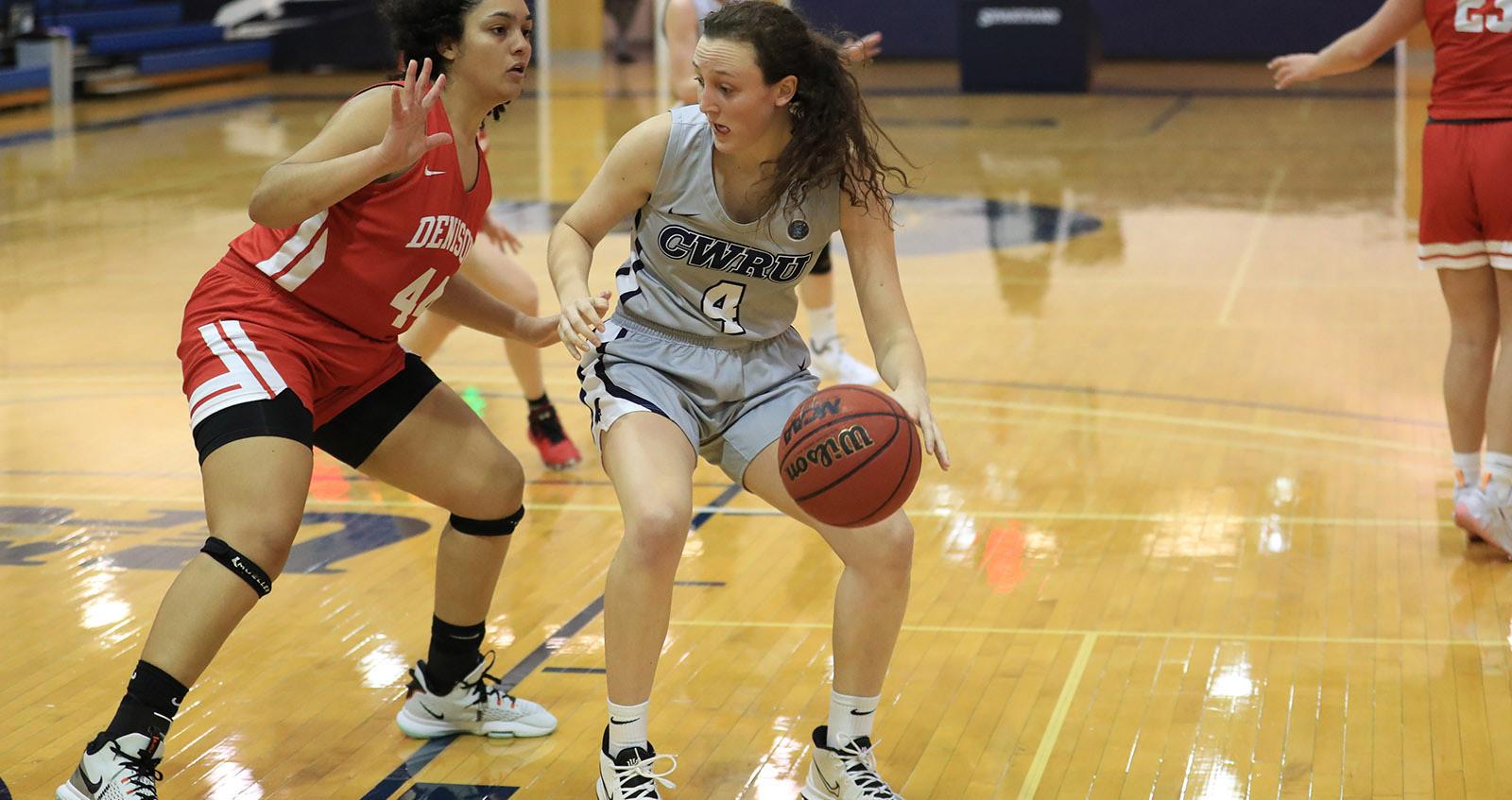
Against NYU last Friday, the Spartans hung around the Violets for much of the first quarter. Second-year forward Kayla Characklis led the team on both sides of the ball, scoring six of her teamleading 14 points in the first half to go along with a game-high nine rebounds.
The game started to slip away from CWRU in the second quarter. The Violets went on a 9-0 run in the first two minutes and exploded to a 27-14 lead. The two teams traded baskets for the rest of the half and the Spartans man-
aged to stay within 10 points as the half expired with a 45-35 score favoring NYU.
The Violets’ lead ballooned to 20 points with about four minutes left in the third quarter and they kept the Spartans at bay to finish the game 86-62.
Though CWRU shot 45.2% from the field and 50% from three-point land in the first half, their offense stagnated after halftime as the team finished shooting 36.9% overall. NYU shot 44.6% for the game and led in rebounds (51 to 40), assists (21 to 9), points off turnovers (18 to 8) and fastbreak points (15 to 6).
Third-year guard Isabella Mills contributed 12 points, five rebounds and six steals while fourth-year guard Abbey Lawrence notched 12 points, two assists and two rebounds.
“NYU is so good [and] really tough at each position,” said head coach Jen-
CWRU remained unfazed and kicked up their defensive intensity, holding Brandeis scoreless for about six minutes while mounting a 14-0 run to take a five-point lead with 3:02 left in the second quarter. The Spartans held on to a 31-28 lead at the midway break, shooting 44.4% overall and 60% from the 3-point line in the second after an abysmal offensive first quarter.
The lead steadily grew to nine points at the conclusion of the third quarter, but the Judges had other plans. In less than five minutes, Brandeis evened the score 49-49 and it was a new ball game in the final minutes. Fortunately, the Judges cooled off on the offensive end for the remainder of the game and the Spartans wound up taking the eightpoint victory 57-49.
The Spartans had a relatively poor shooting night, finishing the game shooting just 30.6%. But the team made up for it with rebounds (53 to 40) and points off of turnovers (17 to 8).
Characklis led all players with 15
“We watched a little bit more of ourselves [from the NYU game] on Saturday’s practice in preparation for Brandeis,” reflected coach Reimer. “We took a hard look at some of the things that we need to do better and as a result, I thought we did those things much better on Sunday.”
The Spartans now look ahead to the upcoming weekend matchups against Emory University on Friday, Jan. 21 and the University of Rochester on Sunday, Jan. 23 with hopes of taking the momentum from the win into the thick of the UAA schedule.
“The energy was good going into [the Brandeis game],” said Characklis. “Hopefully it’ll keep us going into Emory and Rochester this weekend. It’s always good to play at home.
Hopefully, these two home games will be final ones without fans in the stands. With the updated COVID-19 guidelines, spectators will be allowed at CWRU home athletic events starting Jan. 24. Spartan fans will have the opportunity to support the team on the latter half of the four-game homestand, where CWRU will face the University of Chicago on Jan. 28 and against the Washington University in St. Louis on Jan. 30.
Cavs ride five-game win streak at season midpoint
liers ventured to Oklahoma City where they took on the Thunder and ground out another close game victory of 107102. Garland led both teams with 27 points and a career-high 18 assists as the Cavaliers overcame an 18-point deficit to extend their winning streak to four games. In addition, Mobley scored 20 points and Allen added 13 points and 13 more rebounds. For the Thunder, guard Shai Gilgeous-Alexander led with 21 points and 7 assists. Throughout the first half, the OKC had control, shooting an impressive 49% from the field compared to Cleveland’s 38%.
The Cleveland Cavaliers have been on quite a hot streak. On Friday, Jan. 14, the Cavs traveled to San Antonio where they faced the Spurs, eventually beating them in a close game, 114-109. Guard Darius Garland led both teams with 32 points to go along with 8 assists and 4 rebounds. With the loss, the Spurs’ losing streak was extended to five. On the Cavs, center Jarret Allen finished the game with 17 points and an impressive 16 rebounds. Center Evan Mobley added 15 points and Lauri Markkanen put up an additional eight points. For the Spurs, guard Dejounte Murray had a whopping 30 points, 14 rebounds and 8 assists, with Keldon Johnson adding 18
points and Bryn Forbes put up another 15 points. The Cavaliers shot 53% from the field in the first half of the game, where they led in scoring in the first quarter. The first three quarters of the game were mellow, with back and forth alley-oops, dunks and 3-pointers. In the final five minutes of the third quarter, San Antonio went on a 15-6 run and took their largest lead right before Cavs star forward Cedi Osman made a three-pointer at the shot clock buzzer to bring Cleveland within two points of the Spurs. The Spurs’ momentum was snapped and, in the final quarter, the Cavaliers fought back to win by five.
After defeating the Spurs, the Cava-
By halftime, the Thunder led the game 56-46 and extended their lead 74-56 within the opening minutes of the third quarter. The Cavs continued their aggressive push and closed the margin to single digits by the start of the fourth quarter. With 11.4 seconds left in the fourth quarter, Lauri Markkanen made a clutch 3-pointer to secure the Cavalier’s victory.
After a long road trip, the Cavaliers arrived back home to face the Brooklyn Nets on MLK day. The Nets were without Kevin Durant, who is out for 4-6 weeks due to an MCL sprain in his left knee. The Cavaliers had some strong performers in this impressive 114-107 victory, with Garland scoring 22 points with 12 assists, forward Isaac Okoro adding another 15 points and Allen had 14 points and 10 rebounds. With their win against the Nets, the Cavs extend-
ed their win streak to five straight wins. On Brooklyn’s end, guard James Harden scored 22 points and 10 assists and Kyrie Irving had a strong 27 points and 9 assists. The Cavaliers dueled with the Nets for most of the game, going back and forth with changing leads. The Nets missed several key shots throughout the game, costing them the lead, but they were only down 110-107 with less than a minute left in the game. At the end, a costly turnover from Harden led to Okoro’s game-sealing dunk. The Nets were hoping to have their star trio of Durant, Harden and Irving finally all play together, but Harden and Irving will have to wait several weeks for Durant’s return.
The Cleveland Cavaliers currently rank sixth in the Eastern Conference with a record of 27 wins and 19 losses. So far this season, the Cavs have been performing rather well, as the core of the team has been molded around the younger stars such as Osman, Allen and Mobley. There have been some challenges with the point guard position, as key pieces Collin Sexton and Ricky Rubio are out indefinitely. In their absence, the Cavaliers traded forward Denzel Valentine for veteran guard Rajon Rondo to fill the vacancy. Overall, the Cavaliers have improved on their previous year’s performance, with budding stars Garland and Allen playing at an All-Star level with hopes of propelling the team to the playoffs in April.

sports
Second-year forward Kayla Characklis (center) lead the Spartans in their recent conference games, scoring 14 points against NYU and 15 points against Brandeis. Courtesy of CWRU Atheletics
Puneet Bansal Sports Editor
Forward Isaac Okoro (pictured) secured a Cavalier victory with a last-minute steal and game-winning dunk against the Brooklyn Nets. Courtesy of Getty
Akhil Medarametla Staff Writer
