The legacy of Trey Razanauskas
second all-time among CWRU runners. He also holds the second-fastest times in the outdoor 10K, at 30:49.55, and outdoor 1,500m, at 3:54.57, both set in spring 2019.
Though he consistently excelled at running, Razanauskas encountered, and eventually surmounted, numerous challenges along his journey. At the 2019 NCAA National Championships, Razanauskas placed 118th overall. When the pandemic disrupted athletic programs in March 2020, his discipline and work ethic throughout that year and through 2021 prepared him to return to CWRU for one final season in the fall of 2021. Along the way, he overcame injuries and illness, always keeping his goals in mind.
after placing 13th at the meet in 2018, fourth in 2019 and third in 2021. At the NCAA National Championships in 2018, Razanauskas placed first on the team and 64th overall. This past year, he placed 45th overall and led the Spartans to a 19th-place finish out of 32 teams, the best finish for the men’s team in 35 years.
Off the track, Razanauskas excelled academically as well, earning multiple inductions into the Van Horn Society for achieving a cumulative grade point average of 3.8 or higher while studying economics and philosophy.
On Nov. 20, 2021, at E.P. “Tom” Sawyer State Park in Louisville, Kentucky, fourth-year Trey Razanauskas ran for a time of 24:25.7 on the 8K course, the fastest time ever run by a member of the Case Western Reserve University men’s cross country team at the National Collegiate Athletic Association (NCAA) Division III CrossCountry Championships. He capped
off his collegiate career with a 45thoverall performance, having had his friends, family and teammates supporting him every step of the way.
Razanauskas, of Zelienople, Pennsylvania, leaves a legacy at CWRU that is second to none. In addition to holding the school record in the 8K, Razanauskas also set school records in the indoor 5K run with a time of 14:40.40 and in the outdoor 5K run with a time of 14:24.9. His indoor 3K time of 8:35.45, set in spring 2020, is
Beyond his individual accolades, Razanauskas elevated the stature of the men’s cross country team at CWRU. When Razanauskas transferred to CWRU from Washington & Jefferson College in Pennsylvania in the fall of 2018, CWRU men’s cross country had not qualified as a team for the NCAA Championships since 2012. Spearheaded by Razanauskas’ leadership, the team made three straight appearances at the meet between 2018 and 2021, the longest streak of consecutive appearances since the 1970s. His athletic honors are remarkable beyond just his record times. Razananauskas earned All-UAA Second Team honors in 2018 and First Team honors in both 2019 and 2021. He earned three Great Lakes all-region honors
New resources for students at the Mather Center
Phuong Nguyen News Editor
An ever-changing semester is starting, and the Flora Stone Mather Center For Women in the Tinkham Veale University Center has prepared plenty of new resources for students.
The Mather Center violence prevention and education initiative is currently accepting custom workshop requests, which can be sent through the violence-prevention entity, It’s On CWRU. The center has historically been known for conducting workshops such as financial workshops for women. Additionally, the center also offers leadership workshops, with mentors being paired with students, having discussions about women in leadership positions and in workplaces. One ex-
ample is their financial literacy workshop: how to plan for the future, how taxes work, with the workshop made mainly for freshmen, but other years are also welcome to join.
Recently, the center has also hired staff who are advocates from the Cleveland Rape Crisis Center. There are many workshops with topics revolving around training bystanders. In addition, the workshops will also include information and resources for people who have experienced sexual assault. The workshops are not only for students and staff outside of Mather, but there will also be ones which focus on creating a safer and more welcoming environment for traumatized individuals within the center itself. The center plans to focus a lot more on Title IX is-
sues, which they did not have resources for in the past. However, with a new direct link to the Rape Crisis Center, the topics can expand exponentially with incredible specificity.
The Mather Center has hosted many in-person events in the past, with great numbers of students attending. However, with events being online, Mather Center staff are afraid that the community bonding atmosphere will not be as prevalent as in previous years. The workshops are still available in the end, with topics ranging from sex and health to sexuality. Recently, the Mather Center hosted a collaborative event with University Hospitals, with experts coming in to talk about HIV and how to practice safe sex. There was also a table with petitions protest-
Razanauskas is a leader, a fighter and a friend. His support and encouragement brought out confidence in the teams he led while he was at CWRU. In my two seasons of being his teammate, I will remember his humor and his ability to make anyone feel welcome. His disciplined work ethic inspired me and others on the team to be great at everything we pursue.
Future runners at CWRU would do well to remember these words of advice from the greatest runner CWRU has ever seen:

“Never stop fighting for your dreams.”
Yoshmar Pinal-Alfaro is a fifth-year student studying political science, and a former runner on the cross country team at CWRU. He strives to be curious, patient and a good listener in life.
ing Ohio’s newly-approved abortion bills.
Despite school policies requiring events to be remote, there are still many other resources for students to utilize at the Mather Center. A lactation room is available for use at the Mather Center, and condoms and dental dams are available for free to pick up. The center typically hosts events (when permissible) for student groups (with the most prominent student group collaboration in the past being Period@ CWRU).
While events cannot be held in person, the Mather Center remains open for emergencies and will continue to provide resources and events to CWRU’s campus.
CWRU Missed Connections makes complimenting others contagious
Among the countless possible honors and accolades one may collect during their time at Case Western Reserve University, a feature on the CWRU Missed Connections Instagram page might be one of the most memorable achievements for any student. If you haven’t heard of them already, @cwrumissedconnections is a student-run Instagram account that posts blurbs from students about “missed connections”—interactions with fellow students that flew by too quickly for a friendship to blossom. Most of the posts are positive experiences, whether they are about a wholesome conversation at the Tinkham Veale University Center or a noteworthy outfit spotted at Tomlinson Hall. On Sundays, the account specifically posts “Sunday Shoutouts” for the submissions that mention students by name.
The page has been a blessing in many ways, with the main goal of missed connections pages across college campuses being to make socializing easier. And con-
sidering the miserable state the pandemic has left our social skills in, missed connections allows awkward, shy and quarantineafflicted people to find the person who held the gate open for them at the Kelvin Smith Library, all without having to speak to them in public.
Some missed connections submissions are oriented towards getting to know someone better after a brief shared spark—the numerous Dave’s Cosmic Subs and The Jolly Scholar posts almost all share this goal. Other missed connections posts have less of an objective, but are just as entertaining to read, as they use a myriad of colorful emojis to express an undying desperation for a specific person.
But the most common type of post— and my personal favorite type—simply compliments someone for their positive vibes. For instance, “The girl outside [insert building] with [insert clothes description] and talking about [insert conversation topic] had such a beautiful smile!” and “The person I ran into at [insert food place] had amazing [music taste/sense of style/
hair]” both follow the generic formats of so many wholesome missed connections.
Regardless of which format the missed connection follows, there is something about receiving one that makes you feel special. Seeing yourself complimented anonymously is exciting, and even finding one about your friends and tagging them in the comments can be entertaining. And the beauty of missed connections has not gone unnoticed. The page’s following speaks for itself—I’m sure all 2,499 followers have not received missed connections about themselves, yet all of us eagerly look forward to reading what interesting moments or thoughtful compliments others have to say for the CWRU community.
It sounds strange when put in perspective—the fact that I get excited for people I might not know to compliment other people that I might not know—but that’s part of the magic of missed connections. Positivity at CWRU is contagious and the sentiment of wanting to spread it is becoming contagious too.
Because of this, stumbling upon a
missed connection on my feed never fails to make me smile. Knowing that someone put in the effort to fill out a Google form to selflessly compliment a stranger from what may have been a 2-minute interaction completely brightens my mood. And the submitters often opt to omit their Instagram handle from the Google form, making the act even more genuine.
As the @cwrumissedconnections page continues to gain traction and receive more submissions, I can’t help but think that the people who run this account truly make a difference in CWRU’s atmosphere, no matter how imperceptible. The more we see genuine kindness and the giddy effect it has on us, the more we are inspired to be the ones spreading it.
So, unless you’re afraid of overworking the @cwrumissedconnections admins, don’t hesitate to type out a compliment for someone you briefly met—it might cross an item off their CWRU bucket list, and if not, it can brighten their day and the campus atmosphere, as well.
1 opinion observer.case.edu Observer the Editorial: The start of a disorganized semester (pg. 7) friday, january 14, 2021 volume LIII, issue 15
Shejuti Wahed Staff Writer
Yoshmar Pinal-Alfaro
Contributing Writer
Fourth-year Trey Razanauskas, second from the right, gives an impassioned speech at the NCAA National Meet on Nov. 20, 2021 in Louisville, Kentucky. Chris Heermann
“Spider-Man: No Way Home” is the COVID-era blockbuster that transcends generations
Shivangi Nanda Copy Editor
Disclaimer: This review contains spoilers.
Crushing domestic and global box office records, “Spider-Man: No Way Home” has officially become the biggest cinematic sensation of the year. Given its unprecedented success, we cannot help but wonder what makes this movie superior to its predecessors. Is it the starstudded cast, boasting veterans Tobey Maguire and Andrew Garfield, or the relatable teen character trope depicted by Tom Holland in the most recent version of Peter Parker? Either way, Marvel Studios and Sony did not cut any corners in the creation of this film, and we cannot fully appreciate its genius without taking a moment to remember the epic comicto-screen journey of our friendly neighborhood Spider-Man.
Originating as a modest superhero in Marvel Comics publications, Stan Lee and Steve Ditkos’ Spider-Man is now a household name. After Tobey Maguire pioneered the transition to the silver screen with his uber-successful trilogy, Andrew Garfield led his own legacy as SpiderMan in the “Amazing Spider-Man” films directed by Marc Webb. However, the latest installments in the Spider-Man series—starring Tom Holland—catalyzed by the integration of Spider-Man into the Marvel Cinematic Universe (MCU), have brought a renewed interest in the franchise. Not to mention, the update to the relatable teenage nuances intrinsic to the Spider-Man character has made this era of Spider-Man films especially intriguing for younger Generation Z audiences.
If I were to describe the recent SpiderMan films in a single word, “balanced” seems most appropriate. This series gives viewers the ideal balance between actionpacked sequences—the hallmark of the MCU—and the comforting realness and naivety of Parker’s struggles navigating highschool life. Notably, his relationship with best friend Ned Leeds (Jacob Batalon) and his girlfriend MJ (Zendaya) display a Parker that is more authentic and vulnerable than ever before. It’s likely that this welcome focus on Parker himself has allowed the newer Spider-Man films, especially “No Way Home,” to touch the hearts of millions.
Opening with Parker, MJ and Ned in the process of applying to colleges, “Spider-Man: No Way Home” immediately transports us into the chaotic life of a highschool student turned superhero. Following the ending of “Spider-Man: Far From Home,” where Parker’s identity is revealed, there is suddenly aroundthe-clock coverage of his every move. This overwhelming attention causes every university to reject the trio, leaving Parker feeling responsible. In this state of guilt, he seeks out the guidance of Doctor Strange (Benedict Cumberbatch), who willingly agrees to cast a spell that would cause everyone to forget Parker was ever Spider-Man. However, the plan goes awry when the spell is preemptively stopped and villains from other SpiderMan universes are spotted in the city. It is revealed that a disruption in the multiverse is what allowed villains, and even previous Spider-Men, to tumble into this universe.
As such, capturing and rehabilitating the villains becomes the principal conflict, and the film is carried by its emotional and nostalgic beats. The playful quips between the three Spider-Men, Gar-
Tom
and new Marvel fans alike. Courtesy of Columbia Pictures field’s déjà vu moment when he saves MJ and Aunt May’s (Marisa Tomei) iconic last words are what brought audiences to their feet. Additionally, with appearances from Spider-Man legends Electro (Jamie Foxx), Green Goblin (Willem Dafoe), Dr. Otto Octavious (Alfred Molina) and others, this film caters to every generation of fans. Even for the less knowledgeable audiences, the multifaceted antagonists and brother-like interactions of Maguire, Holland and Garfield allow each character’s unique personality to cut deep and shine.
These personalities become increasingly evident in the middle of the film when the Spider-Men are tasked to produce cures for the villains and devise a plan to administer them. In this process, Maguire, being the older and wiser Spider-Man, adopts the mentor role, while Garfield and Holland act as his juvenile pupils, who are easily marveled by his ability to naturally produce web fluid. Despite their differences, they act as a cohesive unit, quickly taking down foes in a series of intense CGI cinematography. While you cannot help but be enamored
by the angelic swiftness of the trio’s calculated moves, the fight sequences themselves felt slightly drawn-out. Nevertheless, the dialogue among the Spider-Men and Ned’s ability to create but not close portals using Doctor Strange’s ring offer some much needed comedic relief.
The last leg of the movie—when the Green Goblin is defeated and Maguire, Garfield and the rest of the rehabilitated villains return to their respective universes—is bittersweet, but the most gutwrenching aspect is the end of Holland’s character arc. Following the completion of the spell cast at the beginning of the film, Parker’s existence is wiped from people’s minds, and he is left with no high school diploma and no family or friends. Alone in his rundown apartment, merely a spectator to his friends’ successes, Parker bears the audience’s pity. While devastating, it is widely accepted that this ending was needed to tether Holland’s character to the original intentions of the Spider-Man role: an anonymous superhero who sacrifices himself for the greater good of the community. Consider-
ing the public frustration associated with Holland’s sudden and poorly-explained introduction to the MCU, connecting his character back to its humble comic book roots effectively sets the stage for the next generation of Spider-Man.
Overall, with surprise cameos, welldeveloped characters and incredible performances by Holland, Zendaya, Cumberbatch, Tomei and others, “Spider-Man: No Way Home” is the perfect medley of action, nostalgia and emotion. Pulling us out of our pandemic-dreariness and leaving us tied in a web of great pacing, casting and writing, the MCU has achieved a level of quality that has exceeded our expectations. Alongside reviving cinema halls, “No Way Home” has unified a fragmented Spider-Man franchise by respectfully giving closure to previous Spider-Man casts and highlighting the franchise’s growth. We can only hope the future of the MCU remains this promising, and that the tricks up their cinematic sleeve continue to be worthy of the bigscreen.

life
Holland’s Spider-Man (pictured above) returns for another action-packed hit that strikes the hearts of old
The CWRU Un-Official Guide to Hookups
Miss Bea Haven Consultant
Hookups. They’re as much of a part of college tradition as cheap beer and late nights worrying about your future. Even Case Western Reserve University, which has a distinct lack of party scene, has developed what is tantamount to a hookup culture. As students pour in from around the country, opportunities for future hookups are guaranteed to increase. For those who have yet thrown themselves into a hookup—and for those who are considering doing it again—I would like to take this opportunity to outline 5 reasons why you should (and should not!) move forward with a hookup.
5 reasons that you should NOT have a hookup
1) Because everyone is doing it (not really)
If you haven’t had the chance to take one of the university’s very educational Sociology 101 courses, let me save you a couple of chapters of reading and tell you that many of our perceptions surrounding casual sex are wildly inaccurate to the realities of everyday college life. Perhaps it is our growing need for meaningful relationships or the fact that housing prices have forced us to live in our parent’s homes for longer, but young adults are having much less casual sex than ever before. In fact, according to a study developed by Rutgers University-New Brunswick, the number of men aged 18 to 23 who admitted to having casual sex in the month prior dropped from 38 to 24% over the course of 10 years. Women of the same age saw a similar drop in percentage, from 31 to 22%. But if we, as a generation, are hooking up less, then why does it feel like everyone is getting it on? Unfortunately, the reality of young adults having less casual sex does not change the fact that we can still feel left out of the proverbial loop. It might seem cheesy, but in this instance, I am reminded of the classic mom expression, “If everyone else jumped off a bridge, would you?” Except in this scenario, research shows us that not very many people are actually jumping off a bridge, even if it feels like they are.
2) Because you’re lonely (it won’t help long term)
College is a stressful time even without the looming threat of a pandemic. First-year students are slowly becoming acclimated to their new environment while second- and third-years are forced to remember what exactly it’s like to work with their classmates in-person. Everyone is so eager to have friends and create experiences, but no one has been in an open social setting in almost two years. The transition between pre-pandemic college life and our current COVID-19 reality is guaranteed to cause some difficulties and perhaps even a great degree of loneliness. To deal with this loneliness, it might be natural to want to run to the arms of the closest willing person for some good, old-fashioned physical comfort. However, this remains only a temporary solution to a larger issue. An alternative to physical comfort is seeking out ways to bond with fellow students. This could be through joining clubs or sports, checking out events hosted by student organizations or working out in the community. If your struggles continue to persist, CWRU also offers counseling sessions at no cost to students. These combined efforts will be far more beneficial in treating loneliness than any short-term affair could be. By resisting the temptation to get immediate comfort, you provide yourself with the opportunity to gain a long-term healthier mind-
set. So, in the case of hooking up, delay the oldest kind of gratification and wait a couple of months before you start throwing yourself back into the quagmire that we call CWRU’s hookup scene.
3) Because you just broke up with a high school partner (who hasn’t?)
Everyone knows the story. The young romance that blossomed in high school has been inevitably dashed when you move hours away to go to college. Now, here you are, a couple of weeks into school with only ice cream and a soft blanket for comfort. So what do you do? You hit the town and try to find someone to hook up with. Unfortunately, as wellintentioned as your hook-up attempts may be, I would be remiss if I didn’t act like a good friend and remind you that shacking up with someone for the sake of getting over an ex is rarely a good idea. Maybe it’ll make you feel better, maybe it won’t. Either way, any satisfaction that you get from a post-relationship hookup will be short-lived at best and will probably make you feel worse in the long term. Countless love songs have reminded us that heartbreak, even after something as cliche as a high school relationship, is one of those things that just takes some time to work through. Not having the added work that comes along with having hookups can make it a little easier to help navigate your post-relationship feelings
4) Because you’re looking for love (setting yourself up for disappointment)
Although some STEM students might disagree—there is no specific equation that you can put into a calculator to find the love of your life. Dating in college is a gamble and the odds are not always in our favor. Some people will date their entire collegiate career while others might remain single all four years. Some couples will end in marriage while others will end in heartbreak. However, if I were to make a guess, hookups are probably not the best for finding true love. Now, I will have a disclaimer that it is not unheard of for two individuals to enter a relationship after hooking up together for a short time. However, these couples are the exception, not the rule. If you approach a hook-up with the intention of finding your forever partner, you are only setting yourself up for disappointment. If it happens—great! You just had an unexpected surprise. But there is nothing worse than setting unreasonable expectations and then inevitably not being able to meet those expectations. Be kind to yourself and your possible partners by remaining optimistic, but reasonable about your sexual escapades. If love is your end goal, dating is much more likely to produce a better outcome.
5) Because it’s been a while (you can wait)
Look, I get it. You’ve been stuck inside for the past year-and-a-half—at least some of which was spent with your parents’ watchful eye ensuring that your extracurricular activities go no further than hand holding. Now, you’re shoved into a small enclosure with hundreds of other young adults, so your first instinct is to throw caution into the wind. But hooking up just to say that you have is tantamount to taking an extra shot just because it’s your record amount. It might feel good now, but it’s going to hurt when it comes back up. Hookups are not a race and you’re not going to get a prize for being the most accomplished. So go at your own pace and your own comfortability. Take note of how you’re feeling and
what you think the future has in store. It will take people weeks to get adjusted to actually seeing their classmates in person, so you can be assured that no one is judging you for taking your time to get back in the game. The beauty of casual relationships is that they will always be there when you’re ready.
5 reasons you SHOULD have a hookup
1) Because everyone is open and completely consenting
This goes without saying that the first and most essential part of hooking-up should also be the most freely given— consent. I know, I know. Between the orientation week seminars and the strategically placed campus bathroom posters, you might think that you have a firm grasp of the concept of consent. Unfortunately, as the recently-retired Instagram account @cwru.survivors has reminded us over the past year, consent is something that needs to be continuously and unabashedly re-established. So here I am reminding you that consent between two or more parties need to be both open and verbal. For those who think that this would be stifling the mood, I remind you that there is nothing sexier than when a person recognizes your needs and checks in on how you’re feeling throughout a sexual situation—hookup or otherwise. If the person that you are choosing to engage with is even just a little bit hesitant, it’s best to just call it a night. I promise, there will always be opportunities for further exploration on a different day. And if there isn’t, then that person was not really ready to move forward with the encounter anyways.
2) Because you’re down for something casual
When it comes to hookups, casual is the name of the game. Hookups allow you to forget the pressure that comes with dating and courtship, allowing two individuals to get their rocks off without all of the complicated “what-ifs” of a serious relationship. Whether it be your traditional “one-night stand” or the mutually advantageous “friends with benefits,” you should never go into a hookup expecting anything to come of it other than an evening of fun. I would highly encourage you to make your expectations and desires explicitly clear to your partner before moving forward. Here, communication is key. Talk to your partner and confirm the nature of your hookup, because I promise nothing ruins one more quickly than someone getting feelings that may not be reciprocated. Take some time. Think it over first. If you like the idea of something fun with no strings attached, hookups might be the right path for you.
3) Because you like your hookup partner
Although hookups are designed for casual experiences, this does not necessarily mean that your partner always has to be some random stranger. In fact, to make the most out of your hook-up experience, I would recommend that you choose someone that actually you enjoy being around. Now, when I use the term “enjoy” I do not mean that you have to love your hookup partner—in fact, you don’t even have to know them for very long. But choosing someone that you like spending time with—even outside of the bedroom—can go a long way to ensure that both experiences are satisfying. Not only does this help ensure that everyone meets their ultimate goals, but this also
creates an environment where honesty and open communication can flourish. Are all needs being met? Is everyone having a good time? All of these questions and more can be answered because you actually enjoy listening and talking to the person answering them. Being friends also encourages a certain level of intimacy that can be useful when going over difficult subjects such as possible body insecurities, triggers and hookup expectations.
4) Because it’s the best time for experimentation
As students, you are slowly growing into the people that you want to become––figuring out what you like, what you don’t like and what you’re open to learning more about. This includes all of our interests––from classes to hobbies and, yes, even sex. Perhaps it is my appreciation for the “free love” movement of the ‘60s and ‘70s, but I have always enjoyed the idea of using college as the time to explore your own personal sensuality. Social pressures from parents, peers and even our own partners can make it difficult to navigate our own sexual interests. Add a little bit of religious guilt into the mix and you have a complex that makes it nearly impossible to figure out what you like in the bedroom. But you’re back at college now, you can be exactly who you want to be and try whatever you want to try. If you don’t like something—that’s fine! Try something else. It seems kind of cliche, but the age-old adage of “I experimented in college” is true. Experimentation is the foundation of finding answers, so you might just learn something about yourself along the way! Pick up a ceramics course if you enjoy sculpting, join The Observer if you enjoy writing and maybe try a bit of light choking if you think you might be into that. Crucially, remember to always have a safeword and press on the side of the neck not the larynx.
5) Because it’s fun
Ultimately, the whole point of hookups is to have fun. Maybe you use it for stress relief or maybe that Marvin Gaye song just really got you in the mood, but regardless you are supposed to leave the experience feeling better than you did going in. You should not be leaving your hookup partner’s house in a walk of shame—you should be skipping down the sidewalk feeling light, breezy and overall sexually satisfied. Is it going to perfect all of the time? Of course not, what relationships—including casual ones—are? At the end of the day it should be an experience that leaves you feeling comfortable and confident about your decision. Once hookups start becoming a nuisance or a chore, the point is defeated. If hookups have brought more difficulty in your life than orgasms, delete Tinder and just walk away.
In conclusion, may all of your hookups be stress-free and all of your endings be happy.
College is hard, but relationships and sex are even harder (pun intended). In this latest Observer advice column, the ever-thoughtful Miss Bea Haven reprises her role as the go-to guide for all things scandalous at CWRU. Got questions or in need of advice? Anonymously email missbeahaven@case.edu and you could be featured in next week’s article!
3 life observer.case.edu
Adele’s “30” shows a different side of love than her previous work
Kethan Srinivasan Staff Writer
Getting a new Adele album is about as exciting as seeing Halley’s Comet—and, thankfully, that excitement is more alive. The wait for Adele’s fourth record has been the longest. Nearly six years have passed since her release of “25” in 2015. This delay is justified, though, considering we’re talking about the legendary London crooner with 15 Grammys, 18 Billboard Music Awards, an Academy Award and a legion of followers down on their knees, reeling from her crushing ballads of betrayal and doubt. With songs like “Rolling In The Deep,” “Hello” and “Someone Like You,” Adele has consistently been a frequent sighting at the top of the music charts both across the pond and beyond. And now, the public is blinded once again with “30,” a true-to-form Adele record like all others, but with a tale of love like no other.
Like her other albums, Adele drew upon her experiences to create this one. This time, in the aftermath of her divorce from ex-husband Simon Konecki, Adele found herself in what she described to be a state of regret. Speaking to Oprah Winfrey around the album’s release, she related this experience to her early life, noting the lack of a nuclear family in her childhood, and the guilt and anxiety stemming from the fall of the family she created with Konecki and her son, Angelo. In an effort to make sense of her present, Adele wrote this album to explain herself and her new life with Angelo, through the medium she knows best.
As such, unlike her past hits, “30” takes a different stance on the fragility of love—explaining how easy it is to fumble and break on your own, instead of describing how others may break it. Listeners got to have a taste of that differing stance when “Easy On Me,” the record’s second track, was released as a standalone single in October. “I had good in-
tentions,” she laments during the bridge, “and the highest hopes / but I know right now / it probably doesn’t even show.”
Continuing this theme, snippets of conversations between Adele and her son are interspersed throughout the track “My Little Love,” which is almost directly aimed at Angelo in its production and lyricism. “I’m holding on (barely),” she says in one passage, for instance, “Mama’s got a lot to learn (it’s heavy).”
The hardest-hitting part of the album, though, is the heft of pain felt in “To Be Loved.” Shortly after the album’s release, a video of Adele performing the ballad from her sofa was released, which has accrued over 7 million views on YouTube. It’s a hymnal piece that conveys a painful sorrow that conceals a glimmer of hope for her and her son’s future. She won’t go quietly, she explains, as her grand belting further underscores her refusal to “live a lie.” “Let it be known, let it be known that I tried,” she further pleads, “I’m so afraid but I’m open wide.”
Adele’s lyricism has aged gracefully, as has the production of her music, to my surprise. A few of the tracks contain some bits that seem like a grand departure from her Southern-esque productions of “21” and her hybrid pop-and-soul of “25,” almost as if she’s created a blend of sounds of her own inspired by newer visionaries like Frank Ocean and Amy Winehouse. The opening track, “Strangers By Nature,” kicks off with a camp production (credits to Ludwig Göransson) of Disney-like strings and flutes accompanied by dramatic and forlorn wording, right from the first stanza. “I’ll be taking flowers to the cemetery of my heart,” she croons. From there, the pace picks up, with a personal favorite being “Oh My God,” which showcases a rare trait among Adele songs—a beat you can dance to. But perhaps the most unique
work of music in “30” is found in “All Night Parking,” an interlude that gives a perfect blend of Adele’s jazzy roots and modern pop, thanks to the sampling of the late pianist Errol Garner. Having gotten past the genre shifts and the long tracklists, the trajectory of “30” feels clear and easy to comprehend. Six years of life is not simple enough to whittle down and concisely describe with three-minute pop songs that have amazing hooks and bridges (ahem, “SOUR”). Like I’ve written before,
Adele has repeatedly demonstrated a resounding sense of maturity within every era of stardom. Emotional carnage and a castigation of love aren’t very simple things to remedy, especially when you come so close to the life to which you aspire, in the manner that she had done. The process toward healing is a therapeutic one, and time is a crucial necessity. “30” is reflective of this path—it leaves Adele reassured of her wants and the listener knowing she will find a better place.
 Christie Lanfear Staff Writer
Released just over a month ago, “Don’t Look Up” has since broken the Netflix record for the most viewing hours in a single week and has become the company’s third most-watched film. In other words, this disaster comedy movie featuring the all star cast of Leonardo DiCaprio, Jennifer Lawrence, Cate Blanchett, Timothée Chalamet, and Meryl Streep is skyrocketing in popularity. But, does it deserve the hype?

Upon first glance, “Don’t Look Up” seems rather simplistic, perhaps balancing on the edge of receiving the dreaded ‘popcorn’ classification. After all, the plot begins with a graduate astronomy student from Michigan State University named Kate Dibiasky (Jennifer Lawrence) making a potentially catastrophic discovery—a comet that will obliterate Earth is quickly approaching. After confirming her calculations with her advisor, Dr. Randall Mindy (Leonardo DiCaprio), Dibiasky and Mindy present their findings to the President of the United States, Janie Orlean (Meryl Streep). From there, chaos ensues.
Despite this premise being nothing new, there are some thought provoking and extremely impactful themes woven into this movie’s plot that give it more depth than others of its type, which I’m sure has been the driving force of its popularity.
One of the main messages of “Don’t Look Up” is related to social status and college education—the idea that the individual delivering the facts is equally, if not more, important than the facts themselves. A major conflict that
Dibiasky and Mindy face in the film is simply convincing the public and the president that their discovery is real and needs to be addressed. Instead, the two characters are snubbed on the basis of not being from an Ivy League university. One character even responds to their information with: “[We’ll] get some of our people on it. Some Ivy Leaguers, no offense”. Bringing this issue to attention was definitely not a mistake. The film director and writer Adam McKay recognized the unwarranted exaltation placed upon Ivy schools in the real world and incorporated this theme into the plot, raising awareness about the importance of analyzing the facts themselves to see through any societal biases. McKay’s message went through loud and clear due to the fact that the catastrophic events are partly down to the inability of some characters to look past Dibiasky’s non-Ivy status.
Another theme of “Don’t Look Up” is the public’s habit of making light of serious situations. In the movie, Dibiasky and Mindy appear on a popular morning talk show, attempting to present their findings in a way that the public will listen to and absorb. However, they get shot down when the presenters attempt to dismiss their facts to make the situation light-hearted. When Dibiasky loses her patience in an upset outburst, the public have a field day and memes of the event go viral. Her words before exiting the interview are “maybe it’s supposed to be incredibly terrifying... and upsetting...and maybe we’re supposed to stay up all night every night crying.”
Despite her grave words and warnings, no one seems to listen. Even Dibiasky’s ex-boyfriend responds to the interview by calling her a “crazy chick.” McKay drives home his message of the dangers of a superficial culture that values flash over facts, with the remainder of the movie unfolding as a result of the public’s ignorance.
At the center of the film is the issue that is staring at society square in our collective face: a changing climate. McKay puts an interesting twist on the situation, with the elites of society escaping from the disaster on Earth to a far away planet. The characters emerge from their spaceship in almost an Adam and Eve manner, stepping onto the new
planet naked and without any knowledge of their new environment. A completely fresh start, so to speak. What happens next—the closing scene of the movie—is rather shocking and satirical, but I will let you experience that comedy for yourself.
I could go on forever about this movie; the messages that it sends to viewers are so impactful and thought provoking. Even if one doesn’t agree with some of the ideas, it is still a quality movie that is definitely worth your time. I encourage you to go watch, and then reflect on the themes you felt were included. I promise that “Don’t Look Up” is definitely not a ‘popcorn’ failure and 100% lives up to its high expectations.
4 life 1/14/21
“Don’t Look Up” is setting records, but does it live up to the hype?
Don Cheadle, Meryl Streep, Jonah Hill, Cate Blanchett, Tyler Perry, Leonardo DiCaprio and Jennifer Lawrence (clockwise from left) are part of the star-studded cast of “Don’t Look Up,” Netflix’s newest hit. Courtesy of Netflix
Adele reflects on six years of love and loss with the release of her new album “30.” Courtesy of Columbia Records
CMA’s “Revealing Krishna” revives ancient Cambodian art with an inspiring modern twist
Elie Stenson Staff Writer
The weight of centuries rides on the smooth rippling of water as it washes against the boat’s hull, and the river, displayed on the three screens that flank the entrance of the exhibit, parts easily as we sail upon it. Issuing from these electric views of nature comes the rhythmic murmuring of human voices chanting in worship and celebration, singing to the land and sky of ancient stories unfolding into the modern era. This striking ingress to “Revealing Krishna: Journey to Cambodia’s Sacred Mountain,” the Cleveland Museum of Art’s part-virtual, part-traditional exhibition of Cambodian sculpture, sets the tone for an expedition that is as much a journey through the records of human history as it is a gallery of exquisite Southeast Asian artifacts.
The sandstone depiction of “Krishna Lifting Mount Govardhan,” also dubbed “Cleveland Krishna,” is the crowning jewel of this temporary exhibit, but before one can see it, they must garner a deeper understanding of its significance. “Revealing Krishna” leads viewers through a chronological retelling of the statue’s past by introducing the powerful elements of augmented reality (AR) to the conventional museum-going experience, truly bringing the story of this monument to life by focusing on both the context of its former glory and its influence on modernity.
In the hall adjacent to the exhibit’s entrance stand several superb examples of Cambodian sculpture that are speculated to date as far back as A.D. 550. Here, too, the myth of Krishna, a Hindu god of great importance, is told.
As a boy, Krishna’s village was subjected to a terrible storm that threatened to wash it away. Before that could happen, however, Krishna lifted up the nearby Govardhan Hill to create a place of shelter for his people, who in turn deified him for his great compassion and wisdom. As Hinduism began to spread from India throughout Southeast Asia via the Silk Road, Cambodians adopted many of its practices—including the worship of Krishna—into their own culture. Along with worshipping Krishna, Cambodians also adopted a hierarchy resembling the Hindu caste system, elements of Indian design and art and religious myths from India, which later sparked the emergence of the Khmer Empire lasting from the ninth through 15th centuries.
Following this introduction comes a fork in the exhibit’s path—either proceed into the main gallery where the coveted Cleveland Krishna awaits or participate in an AR tour brought to life through the support of CWRU and Sears think[box] faculty. Upon donning the AR headsets, a series of glittering bubbles hover in the air as the voice of a small child introduces themself as the Cleveland Krishna, offering to take us along on a trip through their lifetime. This almost otherworldly immersive experience reimagines the initial creation, fall, rediscovery and restoration of the Cleveland Krishna before our eyes using digital magic, weaving a centuries-old tale out of thin air.
We are virtually introduced to the location of the statue’s original shrine on Phnom Da, a two-peaked mountain in southern Cambodia that is famed for its

beauty and 2,500-year human history.
The Cleveland Krishna, along with several other effigies of Hindu deities, were once ensconced in various caves on the mountain by local worshippers, but as the influence of the Khmer Empire and Hinduism wavered in the 15th century, the statues tumbled into disrepair. When French colonialism swept through the country in the late 1800s, many of the Phnom Da statues, including the Cleveland Krishna, were forcibly removed from their locales and brought to Europe, where they were sold to wealthy collectors or displayed at attractions like the 1889 World’s Fair in Paris.
How the fragments of the shattered Cleveland Krishna were unearthed in the backyard of a Belgian Art Nouveau mansion is best told by the Cleveland Krishna itself, but the story does not end there. Upon its acquisition by the Cleveland Museum of Art in 1973, the statue was brought to Ohio for a complete refurbishment. Lingering confusion over the statue’s origins and ramshackle appearance prompted questions—many of which could not be answered as the despotic Communist Party of Kampuchea, known as the Khmer Rouge, had cut off virtually all communication with the West. Although the statue was roughly pieced together over time, mysteries continued to enshroud it, including the unexplainable presence of several pieces that didn’t seem to fit in with the rest. It wasn’t until recent years that conservators were able to restore the statue to the greatest capacity after a phenomenal discovery traced it back to its origins on Phnom Da.
The AR experience closes with a breathtaking re-creation of the Cleveland Krishna as it would have appeared, lacquered and adorned with jewelry, holding up the ceiling of its Phnom Da grotto, reaffirming that this statue, although now a pinnacle of artistic standards, was once a deeply personal monument through which so many generations achieved deep spiritual and emotional wealth.
With visions of celebrated grandeur still swimming in the mind’s eye, visitors are invited to behold the Cleveland Krishna itself. Bearing a gentle smile on its smooth, childlike face, the statue effortlessly stands in the position of supporting a great mass, though the present emptiness above its head echoes mournfully, as if the statue yearns for its former vocation, in the middle of a mountain. Other sandstone figures of Hindu deities, also obtained from Phnom Da, flank the Cleveland Krishna, their stories equally warped by the erasure of context through their removal from native lands. Yet the light issuing from the depths of their majestic carved faces has not been dampened, still spilling forth with venerable charm. The shattered backing supports, the broken joints, the missing limbs are all cause for recognition of Cambodia’s ancient history and serve as a reminder that despite being marred by oppression and violence, beauty will continue to shine through in the indelible fortitude of belief and culture so long as we look to the past in admiration.
“Revealing Krishna” will be on display until Jan. 30, and tickets to the exhibition cost $12 for CWRU students.
5 life observer.case.edu
The CMA invites attendees on a virtual tour into the depths of Cambodia, culminating in an awe-inspiring vision of “Krishna Lifting Mount Govardhan” as it once was. Courtesy of Cleveland Musuem of Art


observer.case.edu fun| 5 fun Aquarius PBL Pisces Nord Aries Thwing conference room Taurus In bed Gemini Dorm desk Cancer KSL Stacks Leo Tink Virgo Car Libra Classroom Scorpio Starbucks Capricorn Mandel School Sagittarius Outside Horoscope The signs as places people take their classes Sudoku Easy
Tarun’s
ACROSS 1 Thick rugs 6 Like some exams and medicines 10 Pack (down) 14 No-no 15 Actress Moore of “Ghost” 16 ___ 51 (U.F.O. landing site? ... hmm) 17 Toward the back 18 Rule by a small group 20 Early addendum to the Constitution 22 Radio host Glass 23 Doves’ home 24 Stag’s mate 27 Crying ... or laughing hysterically 31 “I’ve got it!” 33 Train unit 34 Gutenberg invention 37 Coup d’___ 39 “Woo-hoo!” 40 NSFW stuff 41 Sauna plus massage at a spa, perhaps 46 “... ___ he drove out of sight ...” 47 Traveling, as a band 48 Slowly burn 50 N, E, W and S, on a compass: Abbr. 51 Follower of open or pigeon 54 Spartans’ sch. 55 1998 Hanks/ Ryan rom-com ... or a hint to the cellphones 10 Covers with black goo 11 Section of a circumference 12 “I’m not impressed” 13 Equal ___ for equal work 19 Avidly enjoyed 21 Taxi charge 24 Adjudged 25 “Fine, works for me” 26 Occasion for an egg roll 27 Frozen summer treat
Floating on water 29 Land parcels 30 Ocular affliction 32 $200 Monopoly properties: Abbr. 35 Little bit 36 Snake ___ (dice roll) 38 Boxing ruling, for short 42 Dealership inventory 43 Large-mouthed food fish 44 Peas, to some classroom pran sters 45 Writing in
nowadays 49 Wood for building 52 Give the slip 53 Java without the jolt 55 Holler 56 Pearls and peridots 57 First-class 58 Notion 59 Raunchy 60 What tapping a maple yields 61 Dazzle starts of 20-, 34and 41-Across 60 Welcoming environment for everyone 63 Dwelling 64 Someone sought by mil. police 65 Semihard Dutch cheese 66 What some couples do with their wedding vows 67 Outside of an orange 68 Almanacs and atlases, for short 69 Tire pattern DOWN
Wild guess
Mata ___ (W.W. I spy)
Brother betrayed in the Bible
Heavily padded hockey player 5 Sisterly 6 Febreze target 7 Ancient artifact 8 “Adios, ___!” 9 Something waved at concerts prior to the age of
Crossword
LOLs
28
script,
1
2
3
4
EDITORIAL
Editorial: The start of a disorganized semester
Editorial Board
When we left Case Western Reserve University at the end of 2021 it would have been hard to imagine this sort of start to the semester. With the rapid spread of the omicron variant, CWRU administration decided to move classes online for the first two weeks of classes. However, while we acknowledge the need to move to remote instruction in order to mitigate the spread of the variant, the return to online classes may have plummeted students’ spirits and the disorganized responses from the administration haven’t made this transition seamless.
To start off, as essential as COVID-19 testing is, the university hasn’t made it easy to acquire one. While CWRU may have set up vending machines with COVID-19 tests around campus, those machines have been found to not always function properly or are empty for too long. If machines are consistently broken or empty, then students and faculty have to
hunt for a test from other vending machines across campus or trek all the way to the Robbins Building for a test (which isn’t available after 3 p.m. or on weekends). Though students also had to take surveillance testing the first weeks of the fall semester, we had more accessible testing sites and locations. That level of accessibility should be available for students throughout the semester; faulty vending machines shouldn’t be acceptable.
The overwhelming amount of information that the university seems to be hurling at us at an unrelenting pace hasn’t made the transition any easier. Over the break, we were told that classes were going to be online the first two weeks, and since then, we have been barraged with emails detailing changing guidelines and protocols. For example, we were told classes are remote but nothing about how and when students were required to return to campus during this period. Then, weeks later and only a few days before classes started, we
were told that we were required to return to campus by Jan. 10. While the reasoning behind returning to campus is understandable (with the goal to reduce case rates and prevent extended times in isolation for students in the middle of the semester), we should have been told of it sooner. It is unreasonable to expect students to return to campus during a remote learning period when given a three-day notice. While certain information, such as testing protocols on campus, can be everchanging due to the nature of COVID-19, other information isn’t as variable.
Something else that has us all on edge is the possibility that remote instruction will last for even longer than the two week period. CWRU is certainly assuring that a return to in-person instruction is likely, especially given the fact that certain organizations’ meetings are allowed in-person and campus buildings are open during this two-week period. While we can’t blame the university for taking action during this dan -
gerous wave of infections, CWRU does have a reputation for telling us important information at the last minute. With this track record, if we do have to continue courses online, we most likely won’t know until right before classes are supposed to start back in person, making many feel anxious or worried about how the rest of the semester will go. The university could have handled this remote period better, whether through more consistent messaging and information, a better testing structure or even sympathy towards students struggling with this remote transition once again. However, despite CWRU’s fumbling at the beginning of the semester, there is still hope that we will go back to in-person courses. As we go into the new year and semester, it is important to remember that we all are struggling a bit with this unsure stage of the pandemic and college; however, we can hold onto that hope that we will get through this together.
The Observer is the weekly undergraduate student newspaper of Case Western Reserve University. Established in 1969, The Observer reports news affecting students and provides an editorial forum for the university community. Unsigned editorials are typically written by the opinion editor but refle ct the majority opinion of the senior editorial staff. Opinion columns are the views of their writers and not necessarily of The Observer staff. For advertising information, contact The Observer at (216) 302-4442 or e-mail observer-ads@case.edu.
LETTERS TO THE EDITOR should be e-mailed to observer@ case.edu or submitted on our website at observer.case.edu. Letters can be mailed to Thwing Center 11111 Euclid Avenue, Suite 01, Cleveland, Ohio 44106. For policy and guidelines related to the submission of Letters to the Editor, refer to observer.case.edu/submit-a-letter.
The Observer is a proud member of CWRU’s University Media Board. Follow The Observer on Facebook, Twitter and Instagram @cwruobserver.
executive editor & publisher SHREYAS BANERJEE
director of print SARA KHORSHIDI
director of business operations MILES KOSTOLANSKY
director of digital media HANNAH ALLEN
director of design VINAYAK MATHUR
development editor BEAU BILINOVICH
news editor PHUONG NGUYEN
life editor NATHAN LESCH
opinion editor KARUNA LAKHIANI
sports editor PUNEET BANSAL
social media editor SOPHIA POPKIN
photo editor CHRIS HEERMANN
web editor COLLIN WONG
video editor ASHLEY SHAH copy
7 opinion observer.case.edu
opinion
the observer
established in 1969 by the undergraduate students of case western reserve university
editors JOEY GONZALEZ, RITIKA DEVARAKONDA, JULIA FENGBAHNS, MULAN MA, ANA PEREZ CESPEDES
SHIVANGI NANDA
Want to write for us? observer@case.edu
&
layout designer TARUN SEPURI business managers NIKKI D’COSTA
Editor’s Note: Shining a light on all of CWRU’s little worlds
Shreyas Banerjee Executive Editor
When I entered Case Western Reserve University in the fall of 2019, I did not expect to join The Observer. Having had very little experience writing and zero exposure to the world of journalism, joining the campus newspaper was not the natural choice. I hadn’t foreseen going to CWRU earlier in the year, but there I was, after going through the cycle of college admissions, not particularly enthusiastic about the next four years and my time here. Then something happened within my first few weeks on campus, something I could have never expected: I fell in love with CWRU. With its bizarrely conflicting yet beautiful architecture, its proximity to cultural institutions and its diverse social environment, CWRU’s wily charms slowly enchanted me until I was a proud Spartan. Wanting to learn more about my new home, I picked up an issue of The Observer from one of the many newsstands around campus, and my eyes were opened to everything beyond the veneer I had grown fond of. Telling the stories of students, through their interests, activities and actions, The Observer became my guide to the years ahead of me and a place to step into the conversation of CWRU. Joining the organization then was a leap of faith that I could help relay this student experience to others and help keep all in the university informed about the ongoings of student life. I might not have predicted it earlier, but The Observer became an integral part of my student

experience here, and I wanted it to do the same for others.
Now as executive editor, I come into this role with the student experience as fragmented as ever. After almost two years of living through a pandemic and the many ups and downs that have come along the way, the college experience we all hoped to have has been completely altered. As classes and clubs went all-digital, many of us turned away from the notion of campus life, and even with a return to in-person instruction, things have never quite been the same. This, of course, has been exacerbated by the omicron variant and the return to remote learning for the next two weeks, give or take. But let us be honest: Case Western Reserve University has never had the most engaged campus population, even before the pandemic. Many CWRU students will likely never vote in Undergraduate Student Government elections, attend the many events around campus or keep up to date with the latest campus controversy. The stereotype of CWRU students being simply devoted to academics above all else may not be a completely accurate portrayal, but there is some truth to it. As we strive to return to normal college life, we must also try to rebuild our community into a more cohesive and supportive one. While student life may seem superfluous, the issues we face as students at CWRU are the ones we face in our everyday lives. Only as a community together can we tackle them and make
this a place that molds us for the better, not just academically but in every way. We want a community that makes us come out of CWRU better than we were when we came in, which can only happen if we are all invested in it. The Observer can help with that.
Just as local newspapers are important for their communities, student newspapers help campuses stay informed and up to date with the ongoing issues affecting their daily lives. Without local newspapers, communities tend to have lower voter turnout and decreased civic engagement, with misinformation and rumors allowed to proliferate and no real attention being turned to the many problems affecting people daily. Similarly, student newspapers at their best can help people better grasp their university’s happenings and understand the ongoing issues and efforts. Student newspapers can give a voice to the student body and act as a proper check on those with power over our academic lives. All this helps to create an invested and engaged student body. However, this can only happen if the newspaper covers the issues relevant to students.
As executive editor, my main guiding principle will be to consider The Observer as a spotlight on what matters to our student body. By bringing attention to the matters that impact us all—whether socially, academically or civically—we can guide discourse in a fragmented community. Many little worlds make up the universe of
CWRU. Each student has their own story and experience that make up their time here. By highlighting enough of them, we can give a fuller picture of the student experience here at CWRU, warts and all. There are always things students are talking about around the tables of Leutner, Fribley and Tink— whether it be about the latest sports game, concert or tuition increase. It is our job as The Observer to capture that. Only by delivering content that is relevant to students and helps people navigate their university can this paper help bind this campus together.
This can only be done by having as many student voices as possible involved in our paper, so we can showcase every single little world that is here at CWRU. My first few actions as executive editor will be to refocus our content on what is pertinent for students to be aware of and help build a collective spirit in our staff to enable as diverse a set of student voices as possible. So I call on all of you reading this note. Come and join us. Help us document the ongoings of CWRU and shine a light on your little world. Come aboard as a writer, editor, photographer, videographer, graphic designer or a business person, and help us deliver content that truly encompasses the entirety of CWRU. If we want to be a community that lives up to our potential, we need as many people as possible invested in recounting our collective experience. Help us tell the story of the university we all love so much.
8 opinion 1/14/21
Third-year student Shreyas Banerjee (pictured above) steps into the role of executive editor of The Observer as CWRU goes through uncertain times. Shreyas Banerjee/The Observer
Vetter: The case for a national vaccine mandate
Milo Vetter Staff Writer
As omicron surges and we all retreat to our dorm rooms once again, I imagine that most of us are feeling apathetic, exhausted or even bitter about the pandemic. This situation has now dragged on for two years, all the while interfering with our ability to live normally. Part of what makes COVID-19 so infuriating is that a great deal of the death and suffering it has caused was completely unnecessary. We can attribute much of the disease’s spread to those who chose not to get vaccinated. Even though the vaccines do not currently seem to be preventing infections very well, the unvaccinated are still far more likely to be hospitalized for COVID-19. Ever since the supply of vaccines outstripped the demand, there has been a lingering question of enacting a vaccine mandate on the grounds that the implementation of one would be extremely effective at reducing cases of COVID-19 and deaths.
However, this proposition has been met with staunch opposition, and not just by anti-vaxxers. In fact, many liberals and conservatives alike are both provaccine and anti-mandate at the same time. The main argument they share is rooted in the uniquely American emphasis on personal freedom; the freedom to choose whether or not to get vaccinated is valuable to many. I strongly disagree with this argument, but I need to discuss the motivations for legislation of action to show you why.
In a non-authoritarian free society, governments generally follow a simple
rule when telling people what they can and can’t do. That rule is that an action that causes harm to others is wrong. Here’s an example: hitting yourself in the head with a hammer on purpose would be extremely dangerous and stupid, yet not illegal. But as soon as you do it to a different person, you could easily have charges pressed against you. This rule is pretty good at understanding the types of laws that a government might pass that reduce freedoms. After all, passing a law making it illegal to assault someone takes away your freedom to assault people.
Now, there are exceptions to this general rule, such as laws requiring drivers and passengers to wear seatbelts. In this case, the line between personal harm and harm to others is blurred. If everyone stopped wearing seatbelts, the number of hospitalizations and deaths due to car crashes would immediately skyrocket. Because of this, seatbelts have become normalized due to their low cost and convenience of use.
And now, we can suddenly see a parallel. Vaccines are analogous to seatbelts in that they cost little, are convenient and cause massive social harm if they aren’t adopted widely. A significant portion of our population remains unvaccinated, causing demonstrable social damage. They are facilitating the spread of COVID-19 and also causing unnecessary stress on our medical system. This stress also manifests in multiple ways, ranging from the raw cost of treating so many
people, the mental cost from overworking of medical staff and the cost of precious time as other hospital services, such as emergency services and cancer treatments, are delayed. In the face of this level of social harm, a vaccine mandate would certainly fit the general rule of legislation previously laid out.
Some may object to the analogy of vaccines to seatbelts because vaccines are much more complicated and involve more complex decision-making. This is because anti-vaxxers have tried (successfully, in part) to reframe the decision to get vaccinated as a difficult one over the past two years. Many feel as if they must carefully weigh the pros and cons of vaccination. However, there are no cons to vaccination except for a brief and usually mild immune response, a minuscule chance of an allergic reaction and some very rare health problems. There is no rational reason not to get vaccinated if one doesn’t have these rare conditions.
We already mandate other vaccines, since public schools do not allow admission if a child is not up to date on their immunizations. And yet there’s rarely a discussion over whether those vaccinations should be mandatory. It seems that the only reason we object to COVID-19 vaccinations is that they’re new and scary.
Finally, there is a major argument against vaccine mandates that I have not yet addressed. Supposedly, a vaccine mandate sets a dangerous precedent that could be abused in the future. If a bad ac-
Kinstler: A love letter to yourself
Ethan Kinstler Staff Writer
Recently, a reader of The Observer asked why she still missed her partner even though he had hurt her. She explained that she felt bad for missing someone who clearly didn’t care about her feelings. This sort of self-criticism and judgment is common when relationships end; however, ruminating over the “why” rather than simply accepting the situation as it stands will only prolong the healing process.
We come by these prejudices honestly though. The “keep calm and carry on” mentality has somehow become the standard for good mental health. You may tell yourself that you need to pick yourself up and dust yourself off and just keep it pushing, but sometimes that simply doesn’t work, and that’s okay. Mental strength does not come from being strong all the time; it comes from knowing how to be vulnerable in your toughest moments so you can accurately describe your emotions and triggers and find the space and clarity to employ the strategies that will help you grow.
When relationships end, it can feel like our loneliness, sadness and anxiety are gripping our brain so tightly that no other thoughts can slip through the cracks and loosen the hold. When this happens, it’s probably because you’re romanticizing your partner and aspects of your relationship.
When we miss someone, it does not take much to be reminded of them. Perhaps a certain song, place, smell or location is enough to send us spiraling. The mental grip tightens, and we not only reinforce these habitual patterns of anxiety and longing, but we also convince ourselves that our partner is someone worth missing. You put so much effort into making the relationship work that you begin conflating your effort with your partner’s character; why would you have worked so hard for someone
who wasn’t worth it? This is a defense mechanism known as “projecting.’’ When a relationship ends, we may fear that we wasted our time chasing someone who was not the person we thought they were. To avoid the crushing reality such a realization would bring, we convince ourselves that our effort was worth it. How do we do this? We only remember the good times in our relationship and what we liked about our partner. We ignore the negative aspects of our partner and excuse their role in our pain to save ourselves the trouble of feeling foolish. Ironically, these projections are meant to help instead of impede your healing because you’re longing for a perfect situation and a person who never existed rather than accepting what was. Step one to stop missing your ex: break up with your projections.
Understand that there is a reason all relationships end, even in amicable break-ups. So, start by making a list of all your partner’s qualities that you disliked. Don’t be afraid to be brutally honest. Whenever you begin to miss your partner, you can refer to this list as a reminder that your partner was not perfect. This exercise allows whispers of reality to slip through when we grip onto our sadness so tightly; when that grip loosens, we can finally breathe. Next, connect the dots. Now that you’ve established that your partner was not a paragon, what did you learn? Based on things your partner did not have, what are things you need to be satisfied in a relationship? This aspect of the exercise shifts the focus from simply lambasting your partner—which can certainly be cathartic—to your own healing. Eventually, the hope is that you will continue to learn new things about what you need from a relationship based on what your partner did not give you. Further, you’ll view your partner not as the finish line, but as the jumping-off point for your
self-love and healing journey.
Another reason you may miss your ex is because they were emotionally unavailable, which creates a cycle of toxic longing. When things are good and your partner shows affection, they are great! Your partner is everything you could have hoped to find in a person. But then, your partner recoils without warning or explanation, leaving you to wonder why? And then, soon enough, your partner is back with “good morning” texts, lunch dates and flowers. Shortly after, though, they recoil again. Of course, you don’t want to assume the worst of your partner. You tell yourself that your partner loves you. If someone loves you, they would never intentionally hurt you, and so you try and understand why they would suddenly become so distant, and you convince yourself that the reason is you. So, you work harder and harder, putting in more effort to try and keep your partner’s affection. Subsequently, you’re that much more grateful for even the slightest crumb of affection your partner may give you.
Additionally, remember projections? Because an emotionally unavailable partner puts us in a cycle of constantly fighting for their attention, we work just as hard after the relationship to justify that effort. Thereby, we put our partner on a pedestal so high that it makes our sense of loss feel insurmountable.
An emotionally unavailable partner will always leave you feeling like you are not enough to make the period when things were “good” last. When things end, this mindset tells us that we are the reason things fell apart when, in reality, it was our partner’s own inability to show affection and effectively convey their feelings that are to blame. You did nothing wrong and never deserved the emotional rollercoaster that was your relationship.
Furthermore, humble yourself. You
tor has the precedent to mandate a vaccine, they could use it to mandate things like sterilization or a massive increase in government surveillance. The people who make this argument have their heart in the right place. However, while valued by leaders who truly care about their people, precedent would be irrelevant to a leader so corrupt that they would consider something like mass sterilization. Consider the horrible actions of, say, Joseph Stalin. If you asked him why he was taking completely unprecedented action to affect the citizens of the Soviet Union, he’d probably laugh in your face (before sending you to a gulag). Regardless, while there could be a harmful precedent set, the benefits of a vaccine mandate would outweigh the risks (which, as I’ve pointed out, aren’t nearly as relevant as most would assume).
Considering that 98% of the students at Case Western Reserve University are fully vaccinated, I’m willing to bet that most of the readers of this article are at least a little bit frustrated with the unvaccinated population. A vaccine mandate is our chance to channel that frustration into serious, tangible social good. Our collective fight against COVID-19 is an extremely difficult one, and vaccines are the closest thing to a silver bullet we’re going to get; so why must we continue to handicap ourselves in that fight by refusing to take drastic but reasonable action to protect our collective health?
do not have the power to change people at their core. If you did, you would be the world’s most renowned therapist, appearing on every talk show in the country. You did not cause such a drastic shift in your partner’s behavior; they simply showed their true colors and will continue to traverse relationships in this pattern of emotional inconsistency. Because we assign blame to ourselves, your sadness may combine with the fear that your partner will find someone who is enough to make them happy. However, no one could ever be enough for an emotionally stunted partner, and a person insisting on perfection will rarely find happiness. Let a therapist figure it out and take solace in knowing that you did everything you could.
Finally, whenever you feel sad, you miss them or you feel anxiety begin to creep into your brain, close your eyes and breathe. Imagine that you are sitting by the banks of a flowing stream. Let each thought and feeling be like a leaf in the water flowing away. Simply breathe into each feeling acknowledging that “here is a feeling of anxiety” or “here is a feeling of sadness,” and attach it to a leaf, allowing it to flow away. Do this for as long as it takes to loosen your mental grip. It’s okay if you assign multiple leaves with a repeating thought, not allowing judgment for it, and simply let them flow away. If your mind begins to wander, that’s okay too; simply acknowledge the experience and bring yourself back to the stream, attaching that thought to a leaf and allowing it to flow away as well. With each thought, remember to breathe. The point is not to empty your brain of these thoughts or completely detach yourself from your experience; instead, the point is to allow reality and the present moment to seep through the cracks and simply loosen your grip.
9 opinion observer.case.edu
Johnson: COVID-19 and our college campus: some observations
Grace Johnson Staff Writer
This newspaper’s goal is to provide insight into the ongoing events of the week at Case Western Reserve University—an “observation” on campus and non-campus-related entities. It seemed fitting to tap into the realm of this namesake for the first issue of the semester and provide some thoughts on these first strange weeks at this university we call home.
On that note, let’s address the elephant in the room.
The coronavirus pandemic has changed the trajectory of our campus pretty much entirely from its conception. In the spring of 2020, the university abruptly sent thousands of students home with very little knowledge or guidance on what to expect. The following fall saw weekly testing and first-year students with no roommates, and left second- and thirdyear students without a place to live.
However, in spring 2021, there seemed to be a light at the end of the tunnel; vaccines became widely available, including within our campus community. Coronavirus numbers went down, and a world in which we could live normally seemed to be a possibility, especially during the
summer months when numbers were so low that our CWRU administration briefly lifted the mask mandate for vaccinated individuals.
The very beginning of the fall semester followed suit: a vaccination mandate followed by bimonthly testing led to small numbers of cases, with students able to attend all inperson classes for the first time since March 2020. However, the end of the semester came with significantly more COVID-19 cases and a boostershot mandate for the spring semester due to the new Omicron variant.
Now, we find ourselves in a situation different from anything we have experienced thus far—two weeks of remote classes with roommates and while also having a fully populated campus. I, for one, worry about roommate conflict within this time, as options for leaving are minimal, and overlapping Zoom classes in the same space could result in numerous disagreements and frustrations.
During my time at home in isolation at the beginning of the pandemic, there were times where I was left frustrated with my family and wanted to get away, but I was unable to do so
given the circumstances. This situation, however, is more complex than that. Most dorm rooms are shoeboxsized and are shared by students who most likely have only known each other for a short time, making them less likely to air their grievances for fear of pushback or damaging new relationships.
However, for myself and many others, single-room status may lead to an entirely different host of problems. I fear for the mental health of those in these situations and that many will end up traveling home, ultimately creating more opportunities for the coronavirus to spread.
I sincerely hope that our university’s administration is weighing students’ mental health just as seriously as their physical health. I also hope that CWRU’s counseling services are prepared for a potential onslaught of students struggling through these dark times.
While I agree that for the time being, online classes are safer during these times of COVID, I believe that eventually, students’ mental health and learning ability may take precedence—especially with an almost
100% rate of full vaccination and the mask mandate on campus.
Further, I wonder if the distribution of KN95 or N95 masks to all students might also aid in mitigating this threat, as they have been proven to be more effective in protecting against the coronavirus when compared to other types of masks.
I did not write this observation to complain or offer a pessimistic view of our current situation, but rather to show what we may need to be prepared for in the coming weeks so we can proactively address certain issues.
I hope that this article helps someone in showing that others may also be struggling in the foreseeable future. This is a friendly reminder that these circumstances are not forever and that this storm will, with time and prudence, be followed by clear skies.
Things right now may seem bleak, but if we stick through this troubling time and address issues that may arise, we can truly get through it and come out safer, stronger and more ready to learn than before.
Agarwal: The fifth wave’s preventable severity
Aambar Agarwal Staff Writer
Yet again, the world is in the midst of a COVID-19 surge. Fueled by the omicron variant, a highly contagious form of SARSCoV-2, the wave has closed schools, strained hospitals and disrupted the economy—an unnervingly similar narrative to March 2020. After nearly two years since the start of the pandemic, one would imagine that people now understand the importance of wearing masks and getting vaccinated. One would imagine that the governments of developed countries would realize the need to vaccinate the entire world—not just their own country—and for a welldefined public health response. However, as demonstrated by the extent of the surge, individuals and governments still have not learned.
Currently, in the United States, the total number of COVID-19 cases is greater than double that of the peak in January 2021. While this figure may seem inevitable, considering the omicron variant’s higher transmissibility, Americans’ continued resistance towards mask-wearing and vaccinations only helps accelerate and increase the magnitude of this trend.
In lecture halls, grocery stores, doctor’s offices and other public spaces, it is not difficult to spot maskless individuals or those with their masks only covering their mouths, acting as if they are invincible—as if droplets laden with coronavirus can’t enter their unprotected airways and wreak havoc.
And if they do anticipate contracting COVID-19, they fail to consider they could require hospitalization or spread the virus to a vulnerable loved one. They fail to consider that they are burdening healthcare workers, the immunocompromised, children who cannot get vaccinated, the elderly as well as the general public, with their ignorance.
The unclear guidance from the U.S. government on masks exacerbates this issue. It is widely known that COVID-19 is an airborne virus and that the vaccines do not guarantee complete immunity. Yet, mask guidance for indoor spaces has often gone back-and-forth over the months and been contradictory. The government’s actions are in part due to the ever-changing nature of the virus and information on it; however, without consistent directions and federal mandates, some individuals fail to grasp the importance of mask-wearing as they misconstrue the uncertainty of the situation as a lack of gravity, subsequently becoming burdens in the new waves.
Likewise, over 15% of American adults are unvaccinated, having received no doses of any of the COVID-19 vaccines. Due to their lack of protection, these adults are more susceptible to being infected and becoming gravely ill from COVID-19. These same adults also cause overflow in hospitals during each surge, taking away beds from those who need to be hospitalized for other reasons and straining the
healthcare system. Their hesitancy is fueled by vaccine misinformation, which prominent public figures often propagate, such as former President Donald J. Trump. While President Joe Biden has been trying to implement vaccine mandates for federal workers and businesses, it is not enough. In unison, Biden needs to combat misinformation more rigorously and from multiple angles, rather than lightly pressuring social media companies and producing ads.
Furthermore, the omicron variant and the severity of the surge could have been entirely prevented had the U.S. and other developed countries donated more of their stockpiled COVID-19 vaccines to developing countries with low vaccination rates, as discussed in a previous article (“The mess of COVID-19 vaccine distribution”). It would be difficult for the virus to spread and mutate by guaranteeing global herd immunity, resulting in its complete eradication or, more likely, COVID-19 becoming endemic. However, the U.S. and other countries chose to roll out boosters for their own populations instead, leaving other nations largely unvaccinated and at risk for a rise of the omicron variant and others in the future. In these ways, the U.S. government and others have failed to properly guide and protect the public from COVID-19.
While the omicron variant seems to result in fewer deaths and hospitalizations than previous variants,
cases continue to rise faster than before. In fact, we might see death and hospitalization rates similar to those of previous waves. In other words, the virus’ higher transmissibility could bolster its lethality, making the current wave just as dire as those prior.
As a result of this fifth wave, hospitals are overwhelmed and economic recovery has been disrupted in the U.S. once again. To free up beds for COVID-19 patients, hospitals postponed elective surgeries until after the surge. As hospital staff test positive at greater rates, they are unable to return to work for several days, worsening the effects of existing staff shortages and causing further strain. Similarly, as more workers test positive, businesses are becoming short-staffed, resulting in supply shortages and greater inflation.
To end this mess, the U.S. and other governments globally need to enforce proper mask-wearing and vaccinations, preferably through mandates, as well as distribute vaccinations equitably among nations. In the meantime, individuals must continue to persuade anti-maskers and anti-vaxxers of the importance of masks and vaccines against COVID-19, for both their and the public’s well-being. Without decisive action by both governments and individuals, the world will be forced to ride out each wave, wondering when the needless deaths and stress will finally come to an end.
10 opinion 1/14/21
observer@case.edu
How and why the omicron wave should have been mitigated
Women’s basketball falls to CMU in opening UAA matchup
tallied 19 assists with a season high 47 rebounds. The win was grounded in an all-around team effort, as 11 of the 13 players who played scored.
Lawrence led both teams in scoring with 27 points, recording her third 20-point effort in a row and her eighth of the entire season. Second-year forward Kayla Characklis scored 10 points with a career-high 11 rebounds, while second-year guard Sarah Mitchell and firstyear guard Nyah Moore each chipped in career highs of 10 points. Head coach Jennifer Reimer acknowledged the fantastic team play in an interview with the CWRU Athletic Department when she said, “We always battle and [we’re] always so proud of how hard we fight.”
“At the end of the day,” Coach Reimer explained, “we need to be better in the rebounding column and we need to take better care of the basketball.”
Even with this in mind, the Spartans suffered a loss of 58-64.
The entirety of the game was neckand-neck. However, the first quarter showed great promise as it ended with the Spartans up 14-10. The Tartans slowly pulled ahead in the second quarter, culminating in a 26-35 Tartan lead at the end of the first half.
The Case Western Reserve University women’s basketball team returned from break as strong as ever. The Spartans left on high note, beating Kenyon College in a resounding 94-40 victory on Dec. 18. The team returned to finish off the non-conference portion of their schedule with a 5-6 record after defeating Hilbert College 86-47 on Jan. 3.
The first quarter began with a quick layup from Hilbert College. However, once fourth-year guard Abbey Lawrence scored four free throws in a row, there was no going back: the Spartans would maintain their lead throughout

the remainder of the game. By the end of the first quarter, the Spartans were up 26-17 and, by halftime, the Spartans almost doubled their score while holding Hilbert to only 6 points in the second quarter. The first half finished with CWRU holding a 56-23 lead.
The second half started as strong as the first for the Spartans, as they continued to score points and ended the third quarter 72-34. At this point, it was clear that the final score was going to be a blowout in favor of the Spartans, and the Spartans wrapped up the game with a dominating final score of 86-47.
The Spartans shot 47% overall and
The Spartans had built some momentum before entering the UAA conference, winning three of their previous four games. According to third-year Isabella Mills, “in the UAA it could be anyone’s day any day.” Anxiety was high entering the conference schedule, and coach Reimer explained that “once you step into conference play, the teams that you’re playing know you better than you know you.”
Unfortunately, the conference opener against Carnegie Mellon University was not as triumphant as the game against Hilbert College. The team entered the game knowing very well that there were some things they needed to work on to emerge victorious.
The second half was closer than the first with the Spartans down by five at the end of the third quarter with the score 46-51. The Spartans put up a fight in the final quarter but it wasn’t enough to close the gap.
Although this loss ended their twogame winning streak, the Spartans played a strong and consistent game and should be proud of the way they played. Lawrence scored a game-high 21 points while Mills contributed 16 points. Second-year forward Preet Gill snatched a career-high 10 rebounds, and Characklis filled up the stat sheet with four points, nine rebounds, and a team-high four assists. CWRU shot 35% from the field and 41.2% three-pointers but were outrebounded 51-40.
The UAA conference matchups will continue next weekend when the Spartans play against New York University on Jan. 14 and Brandeis on Jan. 15.
Browns triumph 21-16 over Bengals in a Battle of the Backups

ued, with running back D’Ernest Johnson shouldering the load. He carried the ball 3 times for 20 yards, including a 4-yard run into the end zone, swelling the Browns’ lead to 14-0.
The teams traded 3-and-outs before Cincinnati’s final possession of the half. On the drive, Clowney continued to ruin Allen’s day, strip-sacking him to put the Bengals in a sticky 3rd and 33 situation. The Bengals punted, but their defense stepped up despite their stalling offense.
and, already inside Bengals territory, put together a scoring drive that effectively shut the door on Cincinnati. Johnson carried the ball on every play except the last, tallying 36 yards on 9 carries before Keenum threw a 10-yard touchdown pass to running back Demetric Felton.
The 2021 NFL season finale featured several high-profile matchups with playoff spots on the line, but for the Cleveland Browns it was a chance to finally put this disappointing season in the rear view. The Browns hosted the Cincinnati Bengals, who were fresh off a divisionclinching win over the mighty Kansas City Chiefs.
With their playoff spot locked, the Bengals gave their backup players a chance to shine to prevent injury to their stars before the postseason. The Browns also played some of their backups since they had been eliminated from playoff contention and key players, such as quarterback Baker Mayfield, needed rest after playing through injury in desperate hopes to catapult the struggling team to
the playoffs.
The game started out sluggishly as expected, with 5 punts before either team scored. With over 4 minutes left in the first quarter, the Browns finally put together a scoring drive on their third possession. Quarterback Case Keenum hit wide receiver Donovan Peoples-Jones on the first play for a 22-yard reception. A few plays later, Keenum found wideout Jarvis Landry on a 26-yard pass for a touchdown to put the Browns up 7-0.
The Bengals’ subsequent possession took the game into the second quarter before Browns defensive end Jadeveon Clowney sacked quarterback Brandon Allen for a loss of 7 yards on third down to force a punt.
Cleveland’s offensive success contin-
Safety Trayvon Henderson recovered a fumble on the third snap and took it 29 yards to the house, trimming Cleveland’s lead back down to 7. The Browns tried to tack on a few more points before the half and orchestrated a 63-yard drive, but Bengals cornerback Mike Hilton killed the drive with a clutch red zone interception to send the game to halftime.
The Browns opened the second half with possession but went 3-and-out. Bengals running back Trayveon Williams was everywhere on the next drive, picking up 25 rushing yards and 4 receiving yards on the 52-yard march downfield. A timely sack from star defensive end Myles Garrett killed the Bengals momentum and held them to a field goal.
With a 14-10 lead and the ball, the Browns tried to bury their division opponents deeper, but turned the ball over once again with an incomplete pass on 4th down just 2 yards from the end zone.
The game was now in the fourth quarter, but the Bengals played without any urgency and punted the ball after picking up just one yard. The Browns got the ball
The Bengals offense eventually found a little life, but the 75-yard touchdown drive was too little too late. The possession was highlighted by a 26-yard pass from Allen to wide receiver Trent Taylor and a 4-yard touchdown pass to running back Chris Evans on 4th down. The Bengals opted for a 2-point conversion attempt to put them within a field goal of tying the game, but Allen missed Taylor, and the Bengals deficit sat at 5.
The Browns ran the clock out to sign off the season finale, finishing with a measly 8-9 record. Injuries to key players proved to be detrimental, as they finished the year with 3 fewer wins than in the 2020 season, in which they captured their first playoff win in 26 years under reigning Coach of the Year Kevin Stefanski.
The Browns will sit at home for the playoffs, contemplating the improvements necessary heading into the 2022 season. For now, they remain committed to Mayfield, giving the injured quarterback the benefit of the doubt in a time when even the local media has turned on him. As for the Bengals, they will host the Las Vegas Raiders in the wild card round on Saturday in hopes of earning their first playoff win in 31 years.
sports
Second-year forward Preet Gill (center) scored 4 points and captured a careerhigh 10 rebounds in the Spartan’s conference opener against Carnegie Mellon University. Courtesy of CWRU Atheletics
Alyssa Zimmerman Contributing Writer
Running back D’Ernest Johnson (pictured above) leads the Browns offensive in NFL regular-season finale. Courtesy of Bengals.com
Gaurav Hardikar Staff Writer
Men’s basketball extends win streak to 11 after defeating Hilbert College, CMU
they went against CMU in the conference competition opener.
The road trip continued last Saturday in Pittsburgh, Pennsylvania where the Spartans took on the Tartans in enemy territory. The first half started off incredibly close, with neither team being able to pull ahead by more than four points. With about two minutes until halftime, CMU strung together an 11-2 run that was capped off by three free throws after Faller committed the foul at the buzzer. The Tartans held a 47-34 advantage over the Spartans after limiting CWRU to 41.7% shooting and forcing six turnovers. CMU also made all six of their free throw attempts while the Spartans missed all four.
from the field.
The Spartans shot 43.0% overall and 32.1% from three and held advantages in points in the paint (46-40), rebounds (47-41) and bench scoring (24-7).
“Coach had kind of getting to the weak side because we were trying to get anything for Mitch [Prendergast] or Cole [Frilling],” reflected Newton on his game-winning tap in an interview with the CWRU Athletic Department. “[Frilling] got the ball and he got a pretty good look at a shot. I thought it was going to go in and I was 90% certain it was down. But it just tipped out and I got a hand on it. And that was that.”
The blistering season for the Case Western Reserve University men’s basketball team continued last week as the Spartans defeated Hilbert College and conference rival Carnegie Mellon University. The loss to the University of Wisconsin – Eau Claire to open the campaign sparked the Spartans’ longest win streak and the best start in program history.
Last Monday, the Spartans played in the final non-conference game of the season against Hilbert College in Hamburg, New York. The Hawks struck first with a quick layup within the first two minutes to go up 2-0, but the stalwart Spartan defense forced four straight misses, allowing CWRU to go on an 11-0 run in the next two minutes.
Following a 12-2 run and several strong defensive stops, the Spartan lead ballooned to 55-36 at the end of the first half. Nine Spartans scored up to this point, led by third-year forward Cole Frilling, who tallied 10 points with two three pointers, and fourth-year guard Robert Faller, who added nine points with one three pointer. CWRU’s defense was on full display, holding the Hawks to 35.1% shooting and record-
ing six steals and seven blocks, including four from Frilling.
The offensive onslaught continued in the second half as CWRU maintained their double-digit stranglehold. Hilbert managed to cut the lead to 13 points but could not surmount a comeback. After taking a game-high 30-point lead with six minutes to go, the Spartans sealed a 22-point victory with a final score of 102-80.
Frilling led all players in points, finishing the game with 25 points after shooting 11-of-18 overall. He also recorded a game-high nine rebounds and added four steals, four blocks and four assists. Graduate student guard Mitch Prendergast pitched in 14 points on 6-of-10 shooting along with four assists and three rebounds while graduate student forward Brian Hines added 11 points on 5-of-7 shooting along with 3 assists and eight rebounds.
With the victory, the Spartans matched the longest winning streak in program history which was previously set in the first season of CWRU men’s basketball in 1971-72. CWRU improved to a 10-1 record and looked to take advantage of their momentum as
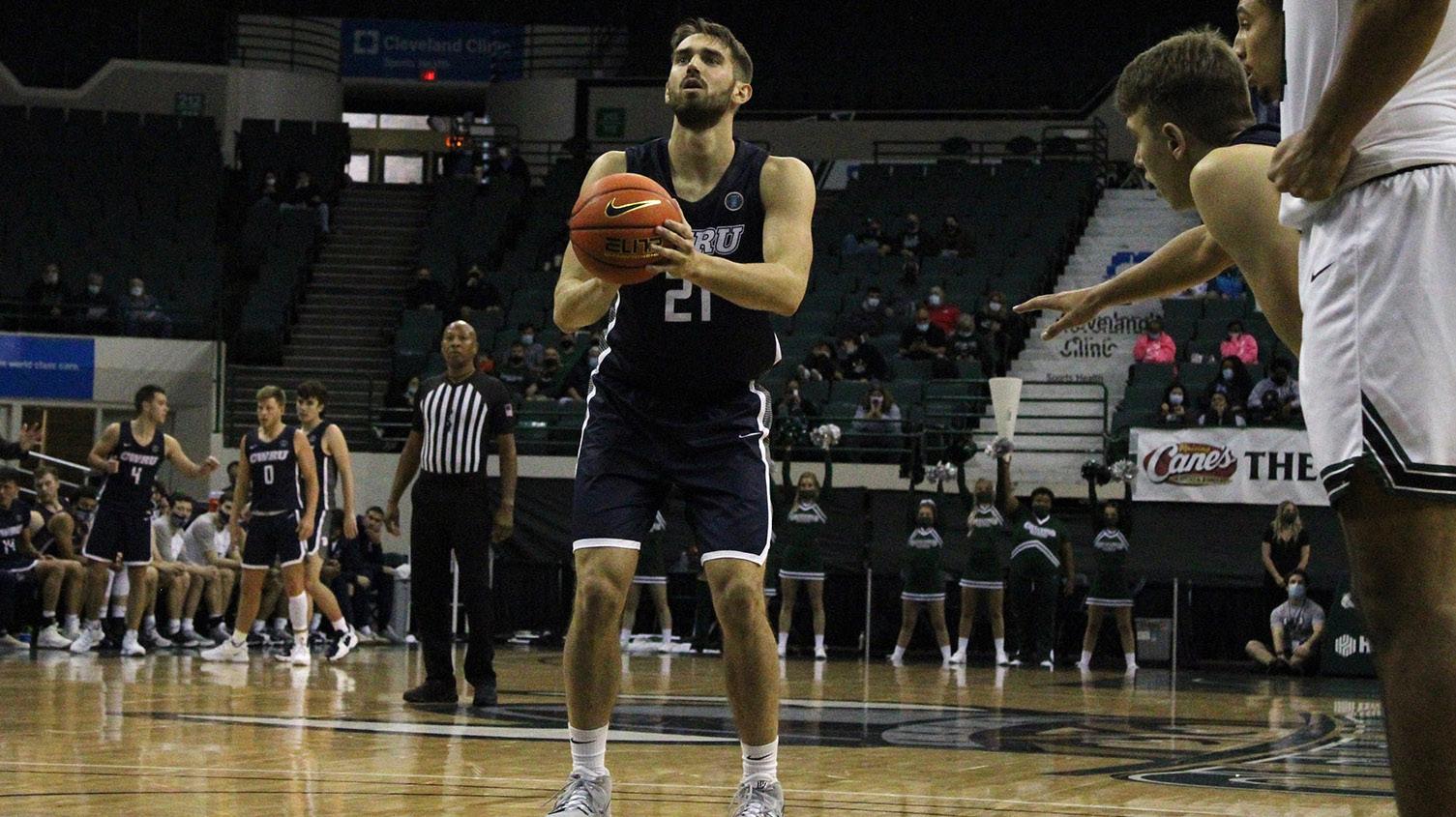
The Tartans extended their lead to a game-high 16 points with 18:06 left in the game. The Spartans, however, never gave up and slowly clawed their way back to single digits, cutting the lead to 78-79 for CMU with five minutes remaining.
As the half wound down, the Tartans held on to a three-point lead with 51 seconds on the clock, 87-84. Faller tied the game with a clutch three-point shot, his second of the day. With only 13 seconds left, CWRU committed a shooting foul that sent the Tartans to the line. CMU split the free throws and took an 88-87 lead with the ball in the Spartans’ hands.
Following a timeout, the Spartans ran a play that set up Frilling for a shot outside the paint. With just two seconds remaining, Frilling took the shot but it bounced out. Fortunately, fourth-year forward Ryan Newton was in the right place at the right time and, having sealed off his defender, tapped in the ball with his left hand at the buzzer to give the Spartans the impressive victory.
Prendergast scored a team-high 23 points on 9-of-17 shooting along with four assists and five rebounds. Faller dropped 22 points on an efficient 8-of12 shooting and a perfect 2-of-2 from three-point land and grabbed seven rebounds. Coming off the bench, Newton tallied 13 points after going 5-of-10
Newton was named the Spartan Club Athlete of the Week and Faller was awarded the honor of UAA Athlete of the Week for their instrumental play in the past two games. Coach McGuinness was also named the HoopDirt.com Coach of the Week, presented by Just Play Solutions, after leading the Spartans to the program’s best start and longest winning streak.
The Spartans will travel to New York City on Friday, Jan. 14 to play against New York University in their second conference game of the season. NYU, which has gone 9-1 on the season so far, will certainly present several challenges for the Spartans.
“[NYU] is good,” said Coach McGuinness. “They’ve beaten people pretty easily and their only loss is on the road. They’re tough [and big]… They’ve got a real good center in Bobby Hawkinson [and] they run a good offense… It will be tough, every game from here on out is going to be a battle.”
Though the intensity will be high and the game will be incredibly difficult, the Spartans have no thoughts of slowing down.
“We just have to play well,” added Coach McGuinness. “NYU will be ready, but they haven’t played in five weeks. I think that’s a little advantage for us [since] we’ve played a couple games here and we’re getting our game back.”
Cavaliers go 2-1 to start off west coast road trip
lowing the injury to point guard Ricky Rubio, who was having a strong season while starting for injured point guard Collin Sexton.
The team had an all-around great performance with steady contributions from guard Darius Garland, who had 26 points and 6 assists, and center Jarrett Allen, who recorded 13 points to go along with 13 rebounds. Rondo was a strong plug off the bench as he scored 11 points, grabbed 5 rebounds and dished out 3 assists. The Cavaliers’ defense did not allow anyone on the Blazers’ team to score more than 19 points and the team came out with a strong win to begin the road trip.
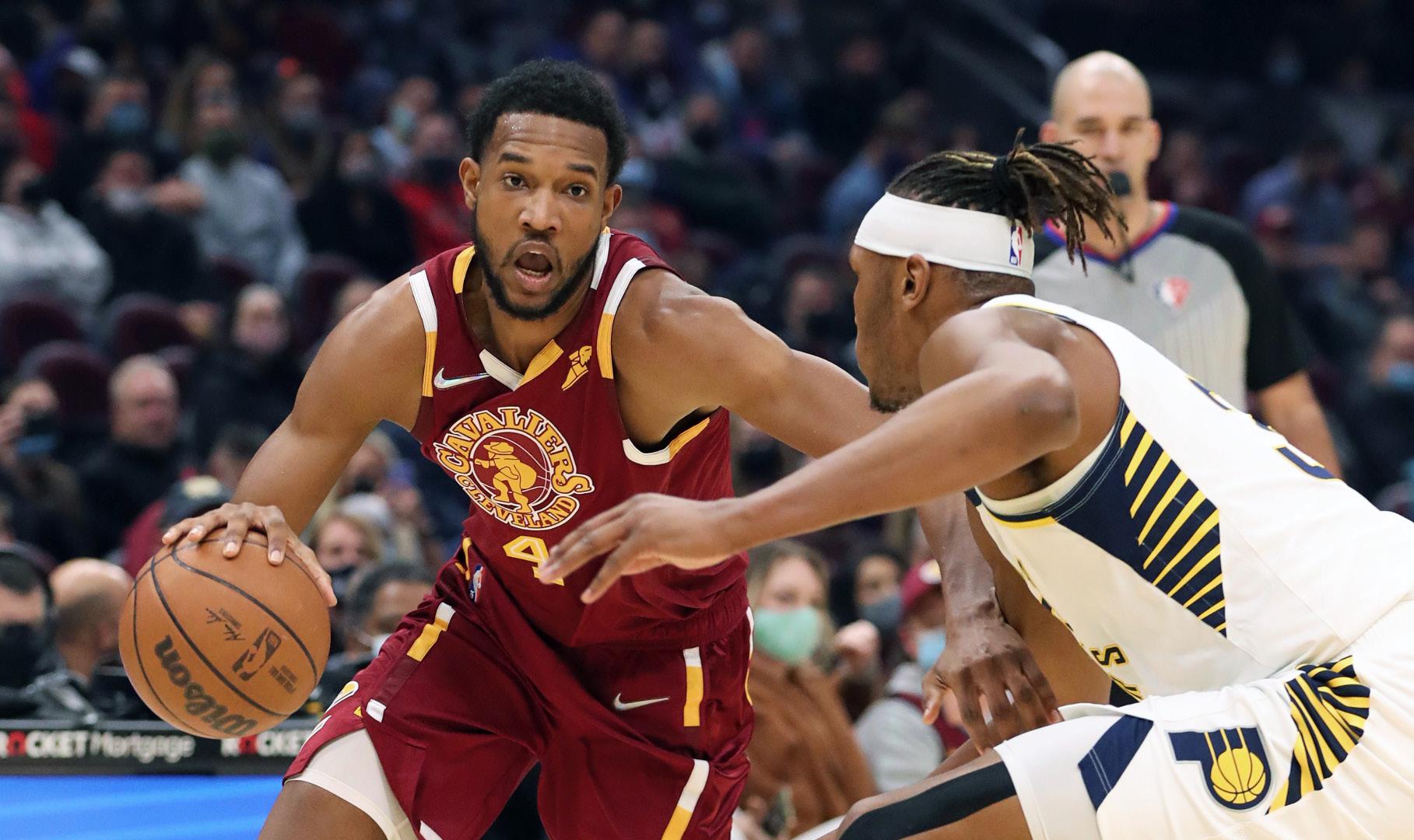
field, and the team did not have enough defensively to stop Stephen Curry, who scored 28, and Klay Thompson, who scored 17. The final score was 96-82, with the Cavaliers losing their first game of the road trip.
The Cleveland Cavaliers have taken basketball fans by surprise this season with their high level of play as new acquisitions and young talent continue to blossom. The same continued on the first week of their west coast road trip as Cleveland aimed to improve upon their 21-17 record.
Their first stop was in Portland, Oregon against the Trail Blazers where the team won convincingly 114-101. This was the first game that newly acquired point guard Rajon Rondo played for the team following a trade with the Los Angeles Lakers. This trade was made to shore up the point guard position fol-
Their next opponent was the Golden State Warriors, one of the top teams in the Western Conference. This game was especially significant for the basketball world as it marked the season debut of Warriors star Klay Thompson, who had missed the past two seasons with an ACL tear and Achilles injury. This game proved to be a tough one as the Cavaliers played against an emotionally charged Warriors team. The Cavaliers were held to only 82 points with the highest scorer being Lamar Stevens, who racked up only 17 points. Garland struggled all night, going 3-12 from the
The next game of their road trip was against a much weaker opponent than the Warriors: the Sacramento Kings. This game was a nail-biter, but the Cavaliers managed to hold on till the very end. Offensively, it was another all-around performance from the team as six players scored in the double digits, with two coming off the bench. Both big men Allen and Evan Mobley had 2 blocks and a steal each as they protected the rim. Kevin Love and Cedi Osman played strongly off the bench, scoring 18 and 15 points, respectively. The Kings also had a strong offensive performance as they had six players in the double digits and were led by Tyrese Haliburton, who scored 21 points. The Cavaliers managed to squeak by with a one-point 109-108 victory.
After finishing off the second half of their road trip against the Utah Jazz, the San Antonio Spurs and the Oklahoma City Thunder, the Cavaliers will return home to host the Brooklyn Nets.
12 sports 1/14/21
Fourth-year forward Ryan Newton (above) secured a CWRU victory in the final seconds of their conference opener ending with a score of 89-88. Courtesy of CWRU Atheletics
Puneet Bansal Sports Editor
Evan Mobley (left) led the Cavs to a 108-104 victory against the Indiana Pacers on Jan. 2. Courtesy of NBA.com
Ishan Kulkarni Staff Writer
