The Crazy Wisdom Community Journal Southeastern Michigan’s Conscious Living Magazine
January Through April 2026 - Issue 91 FREE
SCAN TO READ ONLINE
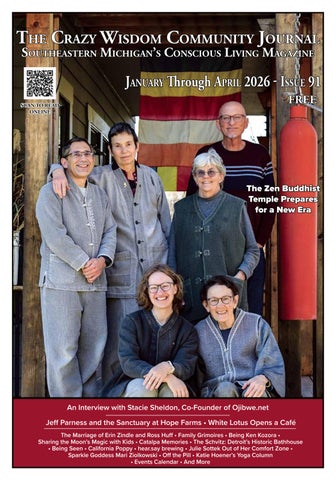
The Zen Buddhist Temple Prepares for a New Era
An Interview with Stacie Sheldon, Co-Founder of Ojibwe.net Jeff Parness and the Sanctuary at Hope Farms • White Lotus Opens a Café The Marriage of Erin Zindle and Ross Huff • Family Grimoires • Being Ken Kozora • Sharing the Moon’s Magic with Kids • Catalpa Memories • The Schvitz: Detroit’s Historic Bathhouse • Being Seen • California Poppy • hear.say brewing • Julie Sottek Out of Her Comfort Zone • Sparkle Goddess Mari Ziolkowski • Off the Pill • Katie Hoener’s Yoga Column • Events Calendar • And More
The Voice of Ann Arbor’s Conscious Living Community
If you aren’t reading
The Crazy Wisdom Monthly
You’re missing out! NEW articles and personal essays, NEW event listings, and NEW author, artist, and musician interviews, it’s the best of Crazy Wisdom Right at your fingertips!
Join our mailing list to receive The Crazy Wisdom Monthly in your inbox automatically the first of every month!
The Crazy Wisdom Community Journal • January through April 2026 Page 1
Dr. Susannah Park, DO Integrative Muskuloskelatal Medicine Dr. Parke is an osteopathic physician offering integrative pain consults and osteopathic manipulation to ease pain and guide patients toward musculoskeletal well-being. Her holistic approach will help you rediscover the Health within. Board certified in Osteopathic Manipulative Medicine & Physical Medicine and Rehabilitation. RYT2oo. Phone (734) 984-3612 Office - 231 Little Lake Dr, Suite E, Ann Arbor, MI 48103 Email: susannahparkedo@gmail.com Visit the website for more information, www.susannahparkedo.com
THE CRAZY WISDOM SALON SERIES
Sage Women of Ann Arbor in conversation with Bill Zirinsky
An Evening with Mary Anne Perrone When life changes, make it your opportunity to realign body, mind, heart, and spirit. Integrate somatic modalities with life coaching for momentum.
Lisa Patrell
https://dellAureo.com
March 25th at 7:00 p.m. Mary Anne Perrone is a Spiritual Guide who gently works with individuals exploring their spiritual lives. “We can all use a soul friend, someone who is willing to go there with us.” She has been deeply engaged in social justice activism related to Latin America, and works to support immigrants in the U.S. She spent the earlier years of her exceptional career as an educator, particularly involved in Special Education. She is also a devoted mother and grandmother.
An Evening with Wasentha Young April 15th at 7:00 p.m
Connect us!
with
Weekly Mindfulness Tip and Reflection
Weekly Inspirational Poem
Wasentha Young has been a practitioner and teacher of Tai Chi for more than 50 years, and she also teaches Qigong and Meditation. She started Ann Arbor’s Peaceful Dragon School in 1990 and was a founding board member of the Association of Women Martial Arts Instructors. Peaceful Dragon offers programs in the martial arts, but also in meditation, acupressure, and the healing arts. She is also an accomplished mosaic artist and poet, and she has a master’s degree in Transpersonal Psychology.
An Evening with Haju Sunim April 22 at 7:00 p.m.
Upcoming Mindfulness Events
SCAN ME SCAN ME
SCAN ME
Creating Mindful and Compassionate Schools where all Students Thrive!
SCAN ME
www.mc4me.org
Rev. Haju Sunim has been the Resident Priest at the local Zen Buddhist Temple for decades. She was ordained as a Dharma teacher in l984, and as a Buddhist priest in l993. She hails from Vancouver, British Columbia. Haju Sunim will talk about the Zen path, the evolution of the Zen Temple over the last 40+ years, and her own life’s journey.
All salons take place at the Crazy Wisdom Celestial Lounge and are FREE to attend. For more information, contact Bill at: billz@crazywisdom.net.
The Crazy Wisdom Community Journal • January through April 2026 • Page 2
Resources for Conscious Living Acupuncture
Rosanne Emanuele • Kiiko Matsumoto Master Acupunturist • Certified Japanese Acupuncturist 27 years • Brazilian Crystal Light Therapy 734-302-7300 2350 Washtenaw, Suite 10, Ann Arbor, MI 48104
Emanueleacupuncture.com
Breathwork Jackie Miller
Certi�ed Breathwork Facilitator
I work with people who are ready to get to the deep and early roots of di�cult emotional struggles� thisbreath�com � 734-883-7130 � jackie@thisbreath�com Ann Arbor & Ypsilanti, Michigan
Childbirth Education Ypsi-Arbor Childbirth Education Know your options, Build community, Birth with confidence! SUPPORTED
Astrology/Chart Services NORTHERN SKY AND BEYOND, LLC Astrology with Alice
Charts • Readings • Star DNA
INFORMED EMPOWERED
Hybrid Group Classes on Weekends and Evenings Virtual Private Classes YpsiArborCBE@gmail.com
YpsiArborCBE.com
www.northernskyandbeyond.com 734.892.8809
Bodywork/Bodymind Therapy
Craniosacral Therapy RCST Deep Tissue Massage Therapy LMT Continuing Lynda Diane Feldt's work Mama's babies and all! 30 years of experience, referred by UM Doctors. For Free Consultations and Bookings call or text
Community Banking
JUMP-IN Therapy and Wellness Gentle Therapies – Real Relief •Increase mobility •Ease pain and discomfort •Reduce stress •Improve sensory processing •Improve sports & academic performance We offer Craniosacral, Myofascial, Microcurrent, Interactive Metronome, Reflex Integration and other gentle, effective therapies. Tailored to your needs. Jackie Kilburn – 810.231.9042 info@jumpinot.com Insurance accepted
Please support our advertisers. They help keep The CW Journal free!
The Crazy Wisdom Community Journal • January through April 2026 • Page 3
Resources for Conscious Living Daycare
Energetic Healing
Wildwood
Release What You Have Been Holding
Fa
rm
& Dayca
re
A HOME-BASED WALDORF INSPIRED NATURE PROGRAM
Enrollment Open ENROLLING MON-THUR 8:30 AM TO 5 PM AGES 18 MONTHS TO 5 YEARS OLD 1639 KNIGHT RD., ANN ARBOR, MI 48103
Energetic healing Return to yourself. • Remote 1:1 sessions • Emotional + energetic release • Clearer mind, lighter body, more you JOY DETTLING joy@ignitelife.net 810-510-2929 https://ignitelife.net
We help children thrive through exploration in nature, practical life-skills, and abundant opportunities for outdoor and indoor child directed play. wildwood.farm.daycare@gmail.com
wildwoodfarmdaycare.com
Diamond Approach U-M OLLI 6-week Study Group: Self-Inquiry as a Spiritual Practice starts Jan 26
Fertility/Women’s Health Sacred Roots Healing
Intuitive and Functional Healing for Women
Julie Endress Diamond Approach® Teacher Ann Arbor, MI Julie.endress@gmail.com 503-753-7959
Individual and small-group health coaching. Young adult through perimenopause.
SacredRootsHealing.org katygladwin@gmail.com
Herbal Apothacary Diamond Approach Michigan A Journey from Ego to Being
Lou Weir, Diamond Approach Teacher diamondworkmichigan@gmail.com diamondworkmichigan.org
Resources for Conscious Living ADS for as little as $162 an issue with a 3 issue prepaid agreement ($404.00) Contact Tana at tana@crazywisdom.net for more information.
The Crazy Wisdom Community Journal • January through April 2026 • Page 4
Resources for Conscious Living Holistic Health & Services
Life Coaching/Counseling
CHÉRIE ANN McMULLEN Holistic Health Practitioner
Nutritional Consultations Vitamins/Herbs/Homeopathy 734-355-5369 2223Cherieann@gmail.com
Local Psychic Fairs
Integrative Functional Medicine BEP Medical Group Integrative Functional Medicine Dr. Marcie MD PhD • Healthy Aging • Hormone Support • Brain Optimization • Manual Lymphatic Drainage • Light Therapy • Chronic Pain • Environmental Illness • Diet & Nutrition 3045 Baker Rd Suite I / Suite K Dexter, MI 48130 (734) 215-5643 www.bepmedicalgroup.com
Mental Health CYRUS SCHOLL
holistic mental health certified trauma care practitioner somatic coaching | dreamwork mindfulness | pain & illness | life myth an ifs-informed, poly-vagal, & mystical approach
dreaming-butterfly.com
Intuitive Coaching ,
Engage full wisdom Add dimensions of creativity & intuition Live with expanded purpose Create experiences you love
Ruth Wilson 248-990-1902 Superconscious creation Book a short sample session & see the improvement.
https://go.oncehub.com/Ruth-Wilson
Naturopathy
The Crazy Wisdom Community Journal • January through April 2026 • Page 5
Resources for Conscious Living Organic Hemp Farm/Living Soil Services
Psychotherapy/Trauma Therapy Stephen L. Rassi, PhD, LMSW, MA Clinical Social Worker
Cultivate Resilience
Soil microbiology help for all types of growers.
www.pottfarms.com
CBT for Anxiety; TIR for PTSD and Trauma Concerns Skills for Increased Focus and Concentration Counseling for Trans* and Gender-Diverse Clients
mercury@umich.edu • 734.945.9100 Chrysalis Facilitation and Counseling Services, LLC
Transitions LLC
Pain and Mobility
Helping you successfully navigate the changes you encounter as you go through life. Specializing in: Abuse and trauma issues Adjustments to changes in health Anticipatory and ongoing grief work Linda S. Bender, ACSW, LMSW 734.395.2285 LindaBenderTransitions@gmail.com 405 Little Lake Drive Suite A #6B Ann Arbor, MI 48103 LindaBenderTransitions.com
Reflexology Pet Pschyic/Medium Natural Healing Center
2002 Hogback Rd. Suite 14 Ann Arbor, MI 48105 734-649-2891 (C) denisebheld@gmail.com www.a2reflexology.com www.facebook.com/A2Reflexology
Reiki
Professional Dog Training Services Learn How to Have More Fun with Your Dog!
20% off your first session through Dec. 30, 2025 Code CWJ25
Positive Reinforcement-Based, Private Dog Training Start Puppies off Right. Train Manners. Have Fun & Give Your Dog a Job with Scent Detection Behavior Consultations for Distracted & Reactive, Anxious, or Aggressive Dogs. K9Translations.com • info@k9translations.com (248)496-3582
Spiritual Space Healing/Clearing
In This Issue ~ The Crazy Wisdom Community Journal
The Crazy Wisdom Community Journal • January through April 2026 • Page 6
Being Ken Kozora — Just Go Out and Be Love—Be Grateful by Susan Slack Page 10
CWJ
Features
The Art of Rest — 10 Tips for Winter Rejuvenation by Lisa Viger-Gotte.................................................................................Page 10 Being Ken Kozora — Just Go Out and Be Love—Be Grateful by Susan Slack........................................................................................Page 18 Ojibwe Speaks — Stacie Sheldon and the Revitalization of Anishinaabemowin by Kirsten Mowrey.................................................................................Page 20 Jeff Parness and the Sanctuary at Hope Farms — How to Transform Loss into Hope and Healing by Hilary Nichols....................................................................................Page 24
Kindred Conversations ~ The Poet and the Philosopher: The Marriage of Erin Zindle and Ross Huff by Hilary Nichols Page 14
Resurrecting Detroit’s Historic Bathhouse — The Schvitz by Cashmere Morley...............................................................................Page 38 White Lotus Farms Café: Bread, Beauty, and Belonging — Extending the Spirit of the Farm into the Heart of the Community by Tchera Niyego....................................................................................Page 43 Ojibwe Speaks — Stacie Sheldon and the Revitalization of Anishinaabemowin by Kirsten Mowrey Page 20
Pouring Pints and Punchlines — Ann Arbor’s hear.say brewing by Cashmere Morley...............................................................................Page 46 Ann Arbor’s Zen Buddhist Temple Prepares for a New Era by Catherine Carr....................................................................................Page 58 Family Grimoires: Not Just For the Rich, Famous, or “Evil” by Michelle A. McLemore......................................................................Page 64 A Q&A with Nicole Leffler of Alchemy Holistic Collective by Samantha Beidoun.............................................................................Page 72
Jeff Parness and the Sanctuary at Hope Farms — How to Transform Loss into Hope and Healing by Hilary Nichols Page 24
Off the Pill — Zainab Alradhi’s Quest to Restore the Sacred Knowledge of Body Literacy by Kaili Brooks.......................................................................................Page 76 A Warrior Spirit — A Q&A with Intuitive Scott Baker by Samantha Beidoun........................................................................... Page 111 Sparkle Goddess — A Q&A with Mari Ziolkowski, PhD by Leif Laufeyjarsen............................................................................. Page 112 Becoming Athena — An Experiment in Divine Possession by Julia Minerva Rhodes...................................................................... Page 114 Holiday Baking with Tea by Peggy A. Alaniz Page 52
CWJ
Personal Essays
Being Seen by Katherine Munter...............................................................................Page 12 Everybody Carries a World by Sandor Slomovits...............................................................................Page 13 Vulnerable by Amy Lagler........................................................................................Page 66
Ann Arbor’s Zen Buddhist Temple Prepares for a New Era by Catherine Carr Page 58
Catalpa Flowers and Steadfast Branches by Michelle A. McLemore......................................................................Page 68 CWJ
Columns
Kindred Conversations ~ by Hilary Nichols Sustainable Health ~
Perimenopause — What’s Going on with Your Body? by Katy Gladwin Page 74
The Poet and the Philosopher: The Marriage of Erin Zindle and Ross Huff......................................Page 14
Out of My Comfort Zone ~
Julie Sottek — Making Friends With Sticks And Stones by Julie Sottek.........................................................................................Page 28
What’s New in the Community ~
by Lynda Gronlund.................................................................................Page 30
Our Yoga Column ~ Namaste, Katie
by Katie Hoener......................................................................................Page 42
Winter Crazy Wisdom Kids Column
Green Living ~
The Solution Rises Every Morning by Rosina Newton...................................................................................Page 70
The Moon & Me by Christine MacIntyre Page 79
Sustainable Health ~
Perimenopause — What’s Going on with Your Body? by Katy Gladwin.....................................................................................Page 74
Weekend Getaways ~
Heading Down South — Our Lady of Fatima Retreat House by Petula Brown......................................................................................Page 82 Sparkle Goddess — A Q&A with Mari Ziolkowski, PhD by Leif Laufeyjarsen Page 112
Pet Column ~ Messages from the Beyond, Empowerment from Within — Discovering My Purpose as an Intuitive Animal Communicator by Triana Jones.....................................................................................Page 108
Astrologically Speaking ~
Tuning in to Neptune by Catherine Carlson............................................................................. Page 110 Spirit Seeds by Triana Jones..................................................................................... Page 116
The Crazy Wisdom Community Journal • September through December 2025 • Page 7
Serving the Community Since 1982
On the Cover From left to right: Magamok (Mike Umbriac) , Tongsan (Catherine Brown), Maum (Gloria Cox), Chijang (Cliff Brown), Seated: Jagwa (Kelly Davenport) , and Haju Sunim (Linda Lundquist).
info@crazywisdom.net crazywisdomjournal.com crazywisdombookstore.com
Cover Photo by Hilary Nichols
Conscious and Tasty Eating and Nutrition
CWJ
Food Section ..........................................................................Starts on Page 49 Gardening for Nutrition and Delight by Emily Springfield........................................................................Page 50 Holiday Baking with Tea by Peggy A. Alaniz..........................................................................Page 52 Herbs for Your Garden — California Poppy by Caitlin Potere..............................................................................Page 53 Cleaning Out the Winter Freezer by Karen Quinn................................................................................Page 54 Cooking with Lisa by Lisa Viger-Gotte..........................................................................Page 56 CWJ
Kids Section
The Crazy Wisdom Kids Section .........................Starts on Page 78 Children’s Book Picks...................................................................Page 78
Winter Crazy Wisdom Kids Column
The Moon & Me by Christine MacIntyre....................................................................Page 79 CWJ
Book Reviews
Book Review: How to Dream By Deedee Cummings Book Review by Christine MacIntyre....................................................Page 93 Book Review: Vow of Aliveness by Ravi Baikei Mishra Book Review by Christine MacIntyre..................................................Page 102 CWJ
The Calendar
The Crazy Wisdom Calendar Section Calendar Edited by Kaili Brooks...........................................Starts on Page 84 The Calendar.........................................................................................Page 84 Our Calendar Editor’s Picks of Interesting Happenings in our Community........................................Page 85 Background Info on the Teachers......................................................Page 103 Core Transformation — The Treasure Map to the Wellspring Within by Tchera Niyego...........................................................................Page 88 The Art, Science, and Reciprocity of EcoCreativity by Robin Lily Goldberg.................................................................Page 96 Light Therapy — Energy Medicine for Body, Mind, and Spirit by Paula Neys...............................................................................Page 107 CWJ
Advertisers
Resources for Conscious Living .............................................Starts on Page 2 Advertiser Directory...............................................................................Page 8
crazywisdomjournal.com This issue will be posted on our website as of January 1, 2026
The Crazy Wisdom Community Journal has been published three times a year since 1995. Copyright © Crazy Wisdom, Inc. — December 2025 No parts of this publication may be reproduced for any reason without the express written approval of the publisher. There is a token fee charged if you would like to use an article in this publication on your website, so make sure to contact us first. Articles from back issues are available on our website’s archive. Crazy Wisdom was founded in 1982. Since 1989, it has been owned by Crazy Wisdom, Inc., which consists of Bill Zirinsky and Ruth Schekter. Senior Design and Production Editor Carol Karr Managing Editor/Staff Coordinator Jennifer Carson Design and Production Editor Jennifer Carson Advertising Sales Manager Tana Dean Advertising Sales Associate: Eve Berton
This issue is distributed starting December 18, 2025 The deadline for Free Calendar submissions for the May thru August 2026, Issue #92 is Wednesday, March 18, 2026 Contact kaili@crazywisdom.net The deadline for reservations for Paid Advertising is Wednesday, April 1, 2026 Contact tana@crazywisdom.net
Distribution Richard Knapp, Paul Stehle Editing Jennifer Carson, Michelle McLemore Kaili Brooks Calendar Editor Kaili Brooks Writers Peggy Alaniz, Samantha Beidoun, Kaili Brooks, Petula Brown, Catherine Carr, Catherine Carlson, Crysta Coburn, Lisa Viger-Gotte, Lynda Gronlund, Richard Gull, Katie Hoener, Audrey Hall, Triana Jones, Amy Lagler, Leif Laufeyjarsen, Christine MacIntyre, Michelle McLemore, Cashmere Morley, Kirsten Mowrey, Rosina Newton, Hilary Nichols, Tchera Niyego, Caitlin Potere, Karen Quinn, Susan Slack, Sandor Slomovits, Peggy River Singer, Emily Springfield Artwork Jennifer Carson, Anthony Powers, Karen Quinn Photography Susan Ayer, Mary Bortmas, Linda Lawson, Hilary Nichols, Edda Pacifico Publisher/Editorial Director Bill Zirinsky
Listen to the interview AADL Talks To: Crazy Wisdom Crazy Wisdom Bookstore 114 S. Main St. Ann Arbor, MI 48104 See website for hours crazywisdombookstore.com 734.665.2757
The Crazy Wisdom Community Journal • January through April 2025 • Page 8
Expand Your Business Horizons! Join our family of satisfied advertisers ...
Spirit Post Readings messages from beyond. grounded in love. mediumship • intuitive readings animal communication • spirit letters
JESS CARMICHAEL SPIRITPOSTREADINGS.COM
I’m thrilled to be at Crazy Wisdom; it’s been a long dream of mine. I hope that as my business grows, I can purchase larger ads to support CW. I deeply appreciate the journal and all the work you all do - I can imagine it’s a lot of work to get it together, and it always looks so beautiful. —Jess Carmichael, Spirit Post Readings
Over years and years of devoted service, Crazy Wisdom has grown into a magical, influential, and inspiring institution. It is one of the things that make Ann Arbor rate as a top place to live, nationwide, and an awesome place to put down roots. Thank you for all your determination and dedication over years and years, to increasing conscious living and quality of life, growing our community, and providing a platform to the highest of standards, for like minded people! —Jody Tull, Be in Awe Yoga
Leslie Science & Nature Center is honored to continue being a part of this critical local publication. Personally, I love reading CWJ, both the digital and print publications. There is something special about the people featured within both journals. I feel more connected and appreciative of the individuals and businesses who care for and celebrate the world around us. The consistency of intimate personal stories, alongside deeper philosophical conversations that I really enjoy! Thanks, Crazy Wisdom Journal, for continuing to seek out and feature all of the incredible people making our community special! —Susan Westhoff, Executive Director Leslie Science and Nature Center and Ann Arbor Hands on Museum
Advertising, for over 20 years, in The Crazy Wisdom Journal has been a resource that keeps my business, Peaceful Dragon School, connected with a community of those looking for self-care and wellness methods that will augment their more traditional health support. —Wasentha Young, Peaceful Dragon School
Tai Chi
Short Form Push Hands Sword, Staff, Dao, Cane
Qigong
Wild Goose Form Meditation Self-Acupressure
Mediation in Motion * Relaxation * Balance * Flexability 1945 Pauline Blvd., Suite B, Ann Arbor (734) 741-0695 peacefuldragonschool.com info@peacefuldragonschool.com
Advertise in The Crazy Wisdom Community Journal and reach over 25,000 loyal readers in southeastern Michigan interested in a healthy, holistic, and conscious lifestyle!
Advertiser Directory Advertise with CW................................................................................. 1 Alternative Hospice & Grief Support..................................................... 49 Angel Whispers Healing Center............................................................. 75 Ann Arbor Holistic Resource Guide....................................................... 77 Bank of Ann Arbor................................................................................. 2 BEP Medical Group................................................................................ 4 Beth’s Body Works................................................................................. 2 Castle Remedies.................................................................................... 11 Chérie Ann McMullen............................................................................ 4 Chris Nordin Fine Art............................................................................. 67 Chrysalis Holistic.................................................................................... 3 Crazy Wisdom Journal Videocasts......................................................... 48 Crazy Wisdom Winter Salons................................................................. 48 Chrysalis Holistics.................................................................................. 4 Cyrus Scholl........................................................................................... 4 Deep Spring Center............................................................................... 29 dellAureo Wellness................................................................................ 1 Dexter Natural Health Center................................................................ Inside Back Cover Diamond Approach, Julie Endress......................................................... 3 Diamond Approach Michigan/ Lou Weir............................................... 3 Dr. Susannah Park, DO........................................................................... 113 Dynamic Points Acupuncture / Henry Buchtel...................................... 2 Emanuele Acupuncture Center............................................................. 2 Enlightened Soul Center........................................................................ 23 Eve Wilson............................................................................................. 73,115 First Unitarian Universalist Congregation of Ann Arbor........................ 83 Happy Hooves........................................................................................ 67 Humane Society of Huron Valley / Tiny Lions........................................ 115 Integrative Muskuloskelatal Medicine / Dr. Susannah Park................... 1 Interfaith Center for Spiritual Growth................................................... 83 Intuitive Readers at Crazy Wisdom........................................................ 51 Jessica’s Apothecary.............................................................................. 109 Jewel Heart............................................................................................ 92 Joy Dettling, Ignite Life.......................................................................... 3 Judy Ramsey/ Heart to Heart Animal Communication.......................... 109 Jump-IN Therapy and Wellness............................................................. 2 K9 Translations...................................................................................... 5 Leslie Science & Nature Center and Ann Arbor Hands-On Museum..... Back Cover Little Lion Roar / Jennifer Carson........................................................... 113
Mankind Project.................................................................................... 71 McLaren Wealth.................................................................................... 69 Melisa Schuster, LMSW......................................................................... 2 Michigan Collaborative for Mindfulness in Education........................... 1 Michigan Psychic Fair............................................................................. 4 Monica Turenne / Four Paws Veterinary............................................... 9 Natural Healing Center/Denise Held..................................................... 5 NITE - Naturopathic Institute................................................................. 36 Northern Sky and Beyond/ Alice Davinich............................................. 2 Pain & Mobility Specialist...................................................................... 5 Peaceful Dragon School......................................................................... 11 Pott Farms............................................................................................. 5 Reset Brain and Body............................................................................. 67 Rise & Reset Counseling, Keri Warren, Ph D, DMin, LPC....................... 4 Ronora Lodge & Retreat Center............................................................. 23 Roos Roast............................................................................................. 11 Rowena Conahan/Nature Speak........................................................... 5 Rudolph Steiner Schools........................................................................ 80 Ruth Wilson........................................................................................... 4 Sacred Roots Healing/Katy Gladwin...................................................... 3 Sing! Ann Arbor..................................................................................... 29 Sophia Code Circles/Constance Hart..................................................... 65 Stable Wisdom Coaching....................................................................... 80 Stephen Rassi / Chrysalis Facilitation and Counseling........................... 5 Suzy Wienckowski / Reiki....................................................................... 5 Tchera Niyego........................................................................................ 89 The Crazy Wisdom Monthly.................................................................. Inside Front Cover The Rainbow Bridge Medium................................................................ 5 This Breath / Jackie Miller..................................................................... 2 Todd Stockwell/Beyond1111................................................................. 83 Threads of Connection Workshop......................................................... 86 Traditionally Empowered Healing/Anat Shlagman................................ 4 Transitions LLC / Linda Bender.............................................................. 5 Triple Crane Retreat Center................................................................... 75 Upstairs at Crazy Wisdom...................................................................... 104 Wildwood Farm & Daycare.................................................................... 3 Witches’ Night Out................................................................................ 77 Ypsi-Arbor Childbirth Education............................................................ 2 Yuliya’s Naturals..................................................................................... 3
The Crazy Wisdom Community Journal • January through April 2026 • Page 9
In appreciation of all the talent and hard work that goes into The Crazy Wisdom Community Journal, we highlight some of our contributors in every issue.
Meet Some of Our Creative Team Rosina Newton is an ecological horticulturist with over 40 years’ experience, specializing in organic gardening, native plants, and landscape design for biodiversity. She is a writer, herbalist, and creative visionary who enjoys planting seeds for a wiser and healthier future for all. Rosina is also a member of the international Subud spiritual community. Her new radio show, Love Letter from Our Future, is airing on WNUC-FM 96.7. Read the article of the same name in our archives at crazywisdomjournal.com/ thecrazywisdomjournalonline/2022/4/19/love-letterfrom-our-future?rq=love%20letter
Kirsten Mowrey practices massage, Trager, and
Scarwork privately in the Ann Arbor area. Her individually focused work ranges from post operative recovery to chronic pain management. Kirsten trained with Francis Weller in 2019 and hosts community grief rituals in Michigan and New York. She has been writing for The Crazy Wisdom Community Journal since 2014.
Catherine Carlson is a native of Ann Arbor. She was trained as an Astrologer and has degrees in Professional Writing and Communication. She enjoys swimming, sewing, and tinkering with recipes, as well as traveling near and far with her family. In her column Astrologically Speaking, she hopes readers are able to learn more about themselves through the energies of the zodiac and how planetary transits affect all of us. She offers astrology and medical astrology consultations for adults and children.
For as long as she can recall, Dr. Katherine Munter has used art and writing to process her thoughts and experiences. Her art therapy practice, Creative Life Therapy, grew out of a desire to share these powerful healing tools with others. She teaches at U of M and enjoys collaborating with others. You can read her personal essays in The Crazy Wisdom Monthly and in this issue on page 12.
Susan Slack is a professional Teaching Artist, published author, musician, and a recent Ann Arbor resident. After 25 years in Florida and too many hurricanes, she relocated here to find a welcoming, green, and thriving city. She has been leading the Dances of Universal Peace (which are interactive spiritual chants and simple circle dancing) for decades and continues to offer them at the Interfaith Center for Spiritual Growth.
..
Amy Lagler is packing a lot of different lives into this one go around. For quite awhile she aspired to be a serious person, even becoming a history professor back when she believed linear time was a thing. Eventually she reverted to her true calling, trying to make people laugh, a life’s purpose she discovered in Junior High (a very, very long time ago). She started writing for The Crazy Wisdom Community Journal in 2024.
NOW OFFERING HOMEOPATHY
owc FOUR PAWS -
C•
Veterinary Wellness
Monica Turenne, DVM, CVA, CT, CHPV Offering in-home and telemedicine appointments for both holistic and hospice/palliative care patients. Please call for more information!
Dr. Monica is certified in palliative and hospice care for pets! She is passionate about helping pets and their families through this incredibly important journey.
0 In-home Euthanasia
r""-----"'!!",'I C, Hospice and Palliative Care 0 End-of-Life consultations O Natural Death
0 Holistic Services 0 Acupuncture for Dogs & Cats 0 Ozone Therapy 0 Wellness Examinations 0 Chinese Herbology 0 Vaccination Guidance II •.- Food Therapy Homeopathy
0
& Administration
The Crazy Wisdom Community Journal • January through April 2026 • Page 10
The Art of Rest:
10 Tips for Winter Rejuvenation
u
By Lisa Viger-Gotte Winter invites us inward. As colder days settle over the landscape (especially here in Michigan), everything takes on a slower pace. Trees conserve energy. Animals burrow and rest. The air itself encourages stillness. As every living thing knows, true rest isn’t laziness, it’s nourishment. Winter gives us permission to soften, restore, and rebuild energy before spring arrives. Thankfully, there are so many lovely ways to incorporate rest and relaxation into your everyday routine.
u
Trees conserve energy. Animals burrow and rest. The air itself encourages stillness. As every living thing knows, true rest isn’t laziness, it’s nourishment. Winter gives us permission to soften, restore, and rebuild energy before spring arrives. Here are ten supportive practices to help you embrace the quieter months with intention, comfort, and joy.
1. Create Cozy Rituals with Firelight & Candles Soft light calms the nervous system. Fireplaces, either simple or grand, can anchor a room with warmth. Candles turn evening hours into an atmosphere of peace. Create a nightly ritual: dim the lights, bundle up in a favorite blanket, and let the glow help your body unwind.
2. Cook Hearty Homemade Meals Cold-weather food is comfort. Think simmering pots of soup, roasted root veggies, warm spices, and deeply satisfying plant-based stews. Cooking becomes therapy as the kitchen fills with warmth and aroma as you nourish yourself from the inside out.
Art pages might include a silent winter landscape with written reflections on possibilities when the world slows down. Or, illustrate something that makes you feel warm, like a teacup, a sleeping pet, or cozy mittens.
5. Get Lost in a Good Book Stories are worlds where the cold cannot reach us. Create a winter reading list and curl up with something that feeds your imagination. Fiction for wonder. Nonfiction for curiosity. Poetry for magic. Reading gives the mind a vacation without leaving home. Amy Busch, owner and lead instructor for Breathe Yoga in Chelsea, said, “One of my favorite rituals is to get the coffee maker ready the night before. I love waking up before anyone else in the house and enjoying a long, quiet morning to myself—sipping coffee and reading while it feels like the world is still asleep. In the winter, I wrap myself in a long cardigan with a blanket across my lap and savor that feeling of stillness. It helps me begin my day with a sense of calm and ease.”
6. Practice Yoga & Meditation for Inner Warmth Slowing down can be deeply energizing. Gentle yoga warms the muscles and supports circulation. Meditation quiets the mental noise and settles the nervous system. Even a few minutes of mindful breathing each day can shift stress into spaciousness. Busch said, “To me, true rest means allowing the body to be still, the mind to quiet, and stepping away from the commotion of the world. It’s about finding a quiet space all to myself—lying down, putting my legs up the wall, and closing my eyes. If my mind won’t settle, I gently tap the space between my eyebrows and rest my fingers there to stimulate the pineal gland which helps the body release melatonin. Taking a break from people, screens, and noise allows my system to reset. That’s what true rest feels like to me—simple, quiet, and deeply nourishing.”
Mugs of warmth are winter’s love language. Herbal teas soothe and support wellness. Rich, plant-based cocoa offers pure delight. Pause while you drink. Notice the scent, the first sip, the settling warmth. Let the moment itself be restorative.
Busch also noted that even gentle movement can have big benefits. “While it’s wonderful to be wrapped up and cozy in winter, it’s also a season when we tend to move less. It’s important to keep the whole body moving each day— you don’t have to do anything intense. Simply making gentle circles with the joints—shoulders, wrists, hips, and ankles—and moving the spine in all six directions (forward, back, side to side, and twisting right and left) can make a big difference. A gentle yoga practice helps keep the body feeling open and comfortable, supporting overall wellness through the colder months.”
Nonni Cole, a holistic bodyworker in Ann Arbor and Owner of Mamma Mantra Healing Arts, said, “My favorite go-to teas for winter are chaga with maple syrup, cardamom, and a newfound love addiction to lapsang souchong which smells like a toasty campfire and feels like a warm hug inside. Keeping our bodies regulated with warmth throughout the cold season is vital! Drinking teas during the day and early evening is a great way to help with this.”
Winter creates emotional spaciousness perfect for creative reflection. Set up a simple art or journaling spot...Expressing yourself on the page helps process emotions, explore dreams, and plant seeds of new ideas.
3. Sip Teas & Cocoa with Intention
4. Recharge Creativity with Art & Journaling Winter creates emotional spaciousness perfect for creative reflection. Set up a simple art or journaling spot. Grab watercolors, markers, collage scraps, or a favorite pen. Expressing yourself on the page helps process emotions, explore dreams, and plant seeds of new ideas. Try journaling prompts like: What is winter asking me to release? What might I be nurturing below the surface?
u
7. Walk or Hike in the Snow Fresh air rejuvenates the body and mind. Winter hikes require presence—from the crunch of snow to the brightness of winter skies. Even on short days, sunlight supports mood and Vitamin D. Bundle up and step outside into nature’s quiet beauty. Nichols Arboretum offers nearly 3½ miles of trails weaving through forest, along the Huron River, and across ridges and valleys. In winter, the landscape is especially serene: snow-blanketed branches and crisp air make it a perfect spot for a reflective walk.
The Crazy Wisdom Community Journal • January through April 2026 • Page 11
Wear boots with good traction as slopes can get icy and go early in the day for the best light. Bird Hills Nature Area features woods and rolling hills, offering a bit more terrain than typical flat city paths. The mixture of hill and forest makes it feel a little more adventurous. Bring poles or walking sticks for extra stability on any downhill or uneven terrain.
Established 1984
8. Grow Herbs Indoors for a Burst of Green
10% Senior Discount on Tuesdays!
Winter doesn’t have to be colorless. A windowsill garden of basil, rosemary, thyme, or mint offers fragrance, flavor, and a tiny oasis of life. Caring for plants connects us to nature’s resilience—a little green hope on gray days.
Your trusted source for 3rd party tested nutritional supplements, herbs, homeopathic remedies, flower essences and essential oils
9. Visit a Greenhouse to Breathe Warmth & Life Greenhouses are winter magic. Warm, humid spaces filled with foliage let your senses thaw. The smell of soil and leaves brings instant relief from dry winter air. Many cities—even here in Michigan—have conservatories that feel like stepping into another season entirely.
Save $10 on our Intro to Homeopathy class with code CRAZYWISDOM 2345 South Huron Pkwy, Ann Arbor • CastleRemedies.com
Hidden Lake Gardens in Tipton and Matthaei Botanical Gardens in Ann Arbor both offer indoor warmth and greenery even in the coldest months with their conservatories. Even in the winter plants native to tropical and desert areas thrive indoors at these conservatories.
u
“The art of a deep rest ritual does not need to be a difficult challenge. It just needs to be a consistent dedication to yourself.” —Nonni Cole, Mantra Mamma Healing Arts
Tai Chi
Short Form Push Hands Sword, Staff, Dao, Cane
Qigong
Wild Goose Form Meditation Self-Acupressure
10. Soothe Body & Spirit with Bath Rituals There is profound comfort to be found in a hot soak in the tub. Add lavender, eucalyptus, or chamomile sachets to your bath and melt into the moment. Follow with gentle skincare to protect from winter air. These rituals remind the body that it is cared for and cherished. Winter is more than a slowdown; it is renewal in progress. Nature doesn’t rush this season of restoration, and we don’t have to either. Even in the darkest months, beauty, comfort, and healing are available when we permit ourselves to pause. A few last words from Amy Busch, “If you can make just one small change this winter, take a few minutes before bed to unwind your body with gentle reclined twists. As you lie in bed, draw one knee in and extend the other leg long, then guide the bent knee across your body and rest there for several breaths. Notice any areas of tension and breathe into those spaces, letting the breath smooth and soften. Stay for several rounds of breath or as long as it takes to feel your body release. Then switch sides and repeat a few times if you like. Twisting before sleep helps release the day from your body and calm the nervous system. I’ve added this simple ritual to my own evenings, and it makes such a difference in how I rest and feel in the morning.” A few last words from Nonni Cole: “I’d suggest listening to your body, fully and deeply to find this one thing: to intentionally and whole heartedly cultivate a practice that works for YOU and dedicate the time each day to follow through is the greatest gift you can give your soul for self-care. If that’s brewing a pot of tea each morning and making a gratitude list, do it! If it’s making time for breathwork and meditation before you go to sleep, do that! If it’s standing outside in the sunshine for seven minutes in the cold and telling yourself all the amazing things that make you an awesome human being, absolutely do that! And if it’s scheduling a healing session for bodywork or energy work once or twice a month for your winter self-care ritual, by all means, please do it! You won’t regret any of these options, but connecting with a therapist who is kind, supportive, and intentional with their work is an incredible way to support yourself throughout the season. Mostly, just find something that you truly enjoy and look forward to doing each day that soothes your soul and feels grounding and supportive for your overall mind and body health. The art of a deep rest ritual does not need to be a difficult challenge. It just needs to be a consistent dedication to yourself.” Let winter reshape you gently into someone ready to bloom when the world warms again. Information about Nichols Arboretum and Matthei Botanical Gardens can be found at mbgna.umich.edu/nichols-arboretum and mbgna.umich.edu. Information about Hidden Lake Gardens can be found online at ipf.msu.edu/hidden-lakegardens. Information for Bird Hills Nature Area and other local parks can be found at washtenaw.org/289/Parks-Preserves-Trails.
For more information about Amy Busch and Breathe Yoga online explore atbreatheyoga.com. Find Nonni Cole and Mantra Mamma Healing Arts on IG @ mantramammahealing or on Facebook @ truetribeMICH.Information.
Mediation in Motion * Relaxation * Balance * Flexability 1945 Pauline Blvd., Suite B, Ann Arbor (734) 741-0695 peacefuldragonschool.com info@peacefuldragonschool.com
The Crazy Wisdom Community Journal • January through April 2026 • Page 12
Being Seen By Katherine Munter “An understanding heart is everything in a teacher, and cannot be esteemed highly enough. One looks back with appreciation to the brilliant teachers, but with gratitude to those who touched our human feeling. The curriculum is so much necessary raw material, but warmth is the vital element for the growing plant and for the soul of the child.”
One day, I was putting away my crayons, and the bottom of the box opened, spilling the contents. I watched the colorful crayons roll across the white linoleum, and I cried out in frustration. My teacher thought I used profanity, and despite my adamant and honest denial, she grabbed the back of my uniform and had me sit on a stool in the front of the classroom. My heart pounded out of my chest as she instructed me to clench a bar of soap in my teeth. The task didn’t seem terrible at first, but then I started to salivate, and bitter soap bubbles slowly made their way around the sides of my mouth and under my tongue. I tried desperately not to gag, swallow, or drool as 25 students sat at their desks, pretending to work while nervously glancing up at me.
—Carl Jung I was recently invited to a new friend’s house for a small gathering. Over appetizers, I was included in a conversation that reached right into my chest, caught my breath, and pulled my heart. A man told us of his former high school teacher—how much she’d shaped his life path. Once a shy and awkward adolescent who was having difficulty finding his way, he felt seen by her in a way he hadn’t experienced before. Tears welled in his eyes as he recalled a specific moment when he was seated in her literature class. She’d told him that he was often quiet, but when he spoke, it was with wisdom and clarity. Those words helped him to grow in confidence and stuck with him through the decades. Mentors can have a powerful impact. That moment of sharing felt like receiving a gift, and I began to contemplate those who inspired and helped to shape me into the person I am today. My mind drifted to one of my own literature teachers. Over thirty years ago, I met Christine Stearns as her student. I was awed at the energy she brought to every class, how she taught with her heart wide open. She made me feel cherished at a time in my life when I had difficulty seeing my own value. Through the lens of writers such as Hemingway, we learned powerful lessons about life. Hemingway was nearly killed on the battlefield. While healing, he came to realize that we will all experience trauma during our lives. Some of these wounds will be so deep, they will change us to the core, and we’ll never be the same again. Rather than trying to run or hide from our pain, we can allow ourselves to feel. Once we’ve processed the pain and evaluated our lives, we get to choose how we move forward.
Over appetizers, I was included in a conversation that reached right into my chest, caught my breath, and pulled my heart. One afternoon after class, Mrs. Stearns called me to her desk. I had recently lost the grandmother who had helped to raise me. I tried to be present in class, but I had trouble focusing, and my grades were suffering. When I approached her desk, I was terrified that she realized I was struggling. Rather than challenge or reprimand me, she looked at me with her gentle blue eyes and told me that her mother once told her she had the heart and mind of a writer. In me, she similarly saw a writer who was waiting to bloom. At the time, I wasn’t ready to see it, yet her kind words stuck with me. During my years in school, I also experienced relationships that diminished me. In first grade, I was taught by a nun who used fear and intimidation to maintain control of the classroom. She hung a paddle next to her blackboard, and she carried a ruler in her clenched fist. If we used our fingers to count during arithmetic, she’d swat our hands. She wore a long rosary at her waist, and the beads rattled when she walked. The sound of those tapping beads instantly brought a room of giggly, playful children to silence.
Soap isn’t the only thing that can silence a voice. Shame can also leave a bitter taste in one’s mouth, strangling your confidence. Relationships are often nuanced, and I found that I could learn powerful lessons even from those who treated me harshly. Soap isn’t the only thing that can silence a voice. Shame can also leave a bitter taste in one’s mouth, strangling your confidence. Relationships are often nuanced, and I found that I could learn powerful lessons even from those who treated me harshly. Sometimes their words bubble up and weaken my courage. Over time, I’ve learned to separate my own voice from the judgment of others. When someone raises their voice at me, I can give myself space to wonder what role I play and what is simply an expression of their own suffering. Those harsh word bubbles can help me to navigate tough situations, reminding me of my strength when I’m struggling. Time can quietly preserve relationships, as though locked away in a capsule, waiting to be reopened. Though I carried Mrs. Stearns’ life lessons in my heart, I didn’t have contact with her for many years. During the space where we traveled different roads, we both began to write. Finding our voices helped us to understand our experiences. Eventually, those same words found their way back to one another. I found that my respect and admiration for her hadn’t dissipated over time. We fell easily into a relationship, talking about life and love, dreams and wounds. All that which makes us human. During my high school years, I once gave Mrs. Stearns a drawing of the characters of Twelfth Night. I recently learned that she used that drawing in classes for over 20 years. When it came time for her to retire, she wanted to gift something meaningful to the incoming Shakespeare teacher. Thus, she gave her my drawing. When I learned that story, I was deeply touched. I got out my pencils and began to draw her a new one. When the University of Michigan Medical School asked me to teach a course, I decided that I would only do it if I could give it my entire heart. I wanted to be able to be fully present to the students and support them as individuals on their paths. The first day of my second year teaching the course, ten of my students from the first year stopped by and made heart hands through the window. In that moment, I realized with tears welling in my eyes that I’m doing what I set out to do, and I’m able to do so because of the warmth, acceptance, and encouragement that was given to me. Who were the powerful mentors in your own life who saw your light and inspired you to shine? Katherine Munter, clinical psychologist, art therapist, and founder of Creative Life Therapy, an Ann Arbor practice of art therapy and integrative wellbeing. Learn more at CreativeLifeTherapy.com.
The Crazy Wisdom Community Journal • January through April 2026 Page 13
Everybody Carries a World
By Sandor Slomovits “Look around, look around/At how lucky we are to be alive right now.” The first time I heard that line I was listening to the cast recording of the musical Hamilton. It was the fall of 2015 shortly after the musical opened on Broadway. That first listen of the entire musical was so powerful for me that I still vividly remember exactly where I was, in our van with my wife, on our way home after a brief vacation in South Haven. We listened throughout the entire trip, and I marveled at the singing, the orchestrations, the words, and the music. A few months later when my daughter, wife, and I finally got to see Hamilton on Broadway, we all knew many of the lyrics by heart (actually, my daughter knew all of them) and burst into tears at the sound of the opening dum da da da dum dum dum, as powerful it seemed to me, as the da da da dum of Beethoven’s Fifth.
That first listen of the entire musical was so powerful for me that I still vividly remember exactly where I was, in our van with my wife, on our way home after a brief vacation in South Haven. I found many of the lyrics in Hamilton to be instantly memorable, but that line, “Look around, look around/At how lucky we are to be alive right now,” particularly spoke to me that first time I heard it in our van, as well as the day I finally heard it live in the Richard Rodgers Theatre on Broadway; it perfectly captured not only how I felt about my life, but also my feelings about the state of our nation and of the world. Listening to Hamilton while we drove on back roads to extend the trip in order to finish listening uninterrupted, and then sitting in the very last row in that dark theater and feeling like I was almost on stage with the actors, I felt that despite everything that was not right in the world at the time—as always, there was plenty of that then also—even so it felt like a hopeful, good, and yes, lucky time to be alive.
a al be to
ive right now. ”
“Look aro
ok
d/At how lucky n u we aro
re
und , lo
I have read enough history to know that there have been countless tough times before, many arguably much rougher than now. Nonetheless, I don’t find the old bromides, “It could be worse,” and “This too shall pass,” comforting.
Today, when I “look around,” our “right now” does not seem as fortunate. (I don’t want or feel the need to list the litany of disasters and outrages of the last ten years. You, dear reader, know them as well as I.) But now, a decade after I first heard, “Look around, look around/At how lucky we are to be alive right now,” I find it difficult to agree with that assessment. While I am still keenly aware of and deeply grateful for my good fortune—I’m healthy, have family I cherish, work I love—the events of the past decade, magnified and amplified by the rolling thunder of the daily news, at times leaves me feeling unsettled and helpless in the present and fearful of the future. I have read enough history to know that there have been countless tough times before, many arguably much rougher than now. Nonetheless, I don’t find the old bromides, “It could be worse,” and “This too shall pass,” comforting. Listening to Hamilton recently, hoping for heartening words and a broader perspective, another line caught my attention. “Look at where you are, look at where you started/The fact that you’re alive is a miracle.” In the musical, those words are sung by Eliza Schuyler and directed only at her husband, Alexander Hamilton, but I found myself expanding her audience to include all of us.
This is no passive act, this carrying. We all have a say, however small, in what happens. “Look at where you are.” Every human being on Earth today is the end product, if you will, of an unfathomable number of evolutions of life forms, a vast number of generations of human beings, over an unimaginably long period of time. “Look at where you started.” Each of us owe our existence to all our forebears. Each of us is the most recent link in an inconceivably complex chain of humans and other life forms dating back to the deepest history of life on our planet. “The fact that you’re alive is a miracle.” We all are the literal embodiment of all our ancestors, of all their failures and successes, of all their trials and perseverance. As Niall Williams wrote sparely and elegantly in his novel, This Is Happiness, “Everybody carries a world.” This is no passive act, this carrying. We all have a say, however small, in what happens. The past presses inexorably on the present. Shakespeare said in The Tempest, “What’s past is prologue.” Yes. However, it is not destiny. It is a guide, though not always a reliable one. “There were many wrong things thought then, as no doubt in time we’ll find out there are now too” (Niall Williams, This Is Happiness). Time, the ultimate alchemist, transmutes the past into the present and minute by minute into the future. Still, we are the ones who carry our world from the past into the present and the future. Niall Williams writes in This Is Happiness, “We’re all, all the time, striving, and though that means there’s a more-or-less constant supply of failure, it’s not such a terrible thing if you think that we keep on trying.” Sandor Slomovits is one of the two brothers in the Ann Arbor folk music duo, Gemini. Along with his daughter, Emily, San and Laz also perform together as Gemily (Gemini+Emily=Gemily). Visit them at GeminiChildrensMusic.com. In addition to The Crazy Wisdom Community Journal, he also writes for The Ann Arbor Observer and The Washtenaw Jewish News. His essays and other writings can be found at SandorSlomovits.com.
The Crazy Wisdom Community Journal • January through April 2026 • Page 14
Kindred Conversations
with Hilary Nichols
The Poet and the Philosopher:
The marriage of Erin Zindle and Ross Huff
W
hat happens when a poet and a philosopher fall in love? What does it sound like when a violin and a trumpet harmonize? Erin Zindle and Ross Huff invited the whole town to find out. On December 12, 2024, their wedding invitation welcomed all to join in their unique ceremony. The post on their public Facebook pages invited “Everyone we know and love to come and celebrate with us, so we’re sharing this event with friends, students, neighbors, etc. No personal invitation or RSVP is required.” When two of the most talented and prolific musicians in Ann Arbor come together, the synergy of sound and sentiment is too beautiful to miss. “We’ve been writing words and melodies to express our love story in all of its depth and magic, with the goal of sharing it with you, our dearest ones, as we celebrate our union together.” Erin Zindle plays the fiddle and keyboard and is the songwriter and leader of the nationally touring folk-rock band Erin Zindle & The Ragbirds. Zindle’s voice is honey warm and real with the power to deliver intricate and vulnerable lyrics over globally infused rhythms. The band has performed in 47 states averaging 150 shows a year on stages and festivals such as Electric Forest/Rothbury, Wheatland, Blissfest, Green Room Festival (Yokohama Japan), South by South West and more. Ross Huff is Ann Arbor’s premiere trumpet and flugel horn player working on stage and in studio, as a bandleader and sideman in at least six active acts: Rhyta, Rolly Tussing Trio, Jive Collosus, The Pherotones, The Tone Farmers, and The Macpodz, and he sits in with the Ragbirds. The Macpodz and The Ragbirds are considered brother/sister bands, having toured and performed on the same festival circuit for years. When did they meet? They can’t answer that question. “I don’t remember meeting you—it’s like we’ve always known each other,” Zindle sings from a yet unreleased love song.
Zindle was equally wowed when Huff would arrive at any bonfire with a bag of potatoes and a roll of foil under his arm. “What is he doing?” She wondered. By the end of the night, he passed out hot and buttery baked potatoes straight from the coals. “He got some notoriety for his weird magical potato tradition. We all loved it.” The potato became more than mere sustenance: it is a central allegory of their operating system. “Off to the mines,” Huff chimed. “I call myself a potato miner when I play a gig. We extend this energy, as we offer our gift of music exchanged as our currency. For that we get the pay that we take to the shop to purchase the potatoes that replenish our energy.” He is philosophical about the process. “You can’t take your songs to the grocery store. This is our alchemy.” Gigging and teaching is how both Huff and Zindle make a living and a life.
What happens when a poet and a philosopher fall in love? What does it sound like when a violin and a trumpet harmonize? Erin Zindle and Ross Huff invited the whole town to find out.
The two have been stalwarts in the Ann Arbor music scene for nearly two decades. “Ross used to sit in with us,” Zindle remembered. The two have jammed with each other’s bands many times over the years. There are photos of Huff sitting in with the Ragbirds at Rothbury, Hoxyville, and Summer Camp festivals. “Ross was such a great improviser and could always find his fit.” Zindle remembered late night after a gig in Traverse City with the two crews. “Ross came through with a plate of toast hot with melty butter.” Zindle took note. The two shared mutual appreciation for years. “Sharing food was the start of our story,” Huff recounted. “The Macpodz would bring one cliff bar for the weekend. It was mine. Split five ways. And then, there was Erin, making hot breakfast burritos on her camp stove to share. She may have saved our lives.”
They already shared such a familiar lifestyle, now sharing their home and a rehearsal studio, “It has been such a natural fit,” Zindle expressed. Huff affirmed, “This is my version of success. This is a bounty. Not accumulating wealth, but flourishing.” “Before our relationship started in our current form we would talk a lot,” Zindle noted. “I always had a lot of respect for Ross. When we were in conversation with other people, I would get rolled over. I am very quiet. Ross would bring it back, ‘Erin what was that you were saying?’ He was a listener. I noticed. That meant a lot to me.” Zindle continued, “He is good at managing the whole social dynamic. He is good at parties, but it is so much deeper. He is good at making people feel seen. I would see his posts about his process, and it inspired me.”
Huff writes short prose to post on his pages. “Nothing profound,” he deferred. But some would disagree. His pieces are insightful, philosophical, and so true they are heartbreaking, making meaning from the mundane. Zindle was impressed. “I was trying to get you to turn your beautiful writing skills into song lyrics, but then I realized you weren’t really interested in that form.” Huff affirmed, “That is the difference between us. You are structured, I am free form.” Zindle credits their astrological charts. (Huff has more immutable signs, where Zindle has more fixed signs.) The two rave about and respect each other’s ways. Huff commented, “I get to see the wood working of her crafting process from a rough-hewn thing becoming refined. The outline of an idea becomes a song that we are then all immersed in.”
The Crazy Wisdom Community Journal • January through April 2026 Page 15
The Crazy Wisdom Community Journal • January through April 2026 • Page 16
The Poet and the Pholosopher continued...
Erin Zindle has been turning her poetry into lyrics for as long as she can remember. Zindle sits at the piano as a composer, recording all her sessions to pick-up those perfect keepers. “It doesn’t make it less true by being deliberate, written down so that you can share it with a community. Take a feeling and make it into a song to record and repeat and share.” Zindle has written hundreds of songs in this way. She has released five studio albums with the Ragbirds, a solo album, plus 13 singles to be found on Spotify and all the other music apps. Ember and Ash, her newest project is a duo between Erin and her writing partner Alex Holycross of the band The Native Howl. “We are about to take the world by storm,” Zindle bragged. Their debut EP release is slated for 2026. “We have been writing songs together for six years, and we are finally launching this year.”
“ The Macpodz would bring one cliff bar for the weekend. It was mine. Split five ways. And then, there was Erin, making hot breakfast burritos on her camp stove to share. She may have saved our lives.” ~Ross Huff
Huff writes carefully but off the cuff. “I write like an improviser. In all rehearsals, someone will say, we should record this, just after the best jam. That was the one.” Huff gestures upward. “That’s where I think they all should go. Trying to record for mere mortals is unnecessary.” Huff received his BFA at UofM in 2004 specializing in Jazz and Contemplative studies. He knows Jazz standards, but for him, that’s not the point. Huff finds meaning in the making.
“I had my gigs. I was pretending to work on a book. I had my little place. The laundry was all folded. My band sounded good. I had a life. I thought, ‘this is it.” But he realized, “The music isn’t the point. I took up being a baseball fan. Turns out that wasn’t it either.” He was contemplating the next step in his quest. “That’s when he called,” Zindle said. It was January 2020. They had just wrapped the EBird and Friends Holiday Show at the Ark. Huff traditionally checked in to debrief about their annual show. “We had a really nice conversation. He happened to call on the perfect night.” Zindle had been divorced for a full year. “I just had a prayer of release.” Huff remembered “You were a little sad. I was just pacing around the apartment, feeling like I don’t know what I am doing tonight. I will call Erin. We ended up talking about life and everything and laughing and laughing and both got in better moods.” She invited him over. “I had a bottle of Chartruesse and a song I needed help with.” Their first date wasn’t intentionally a date. “I just wanted to hear how the trumpet would sound.” For the 18th year in a row, Zindle has produced the EBird and Friends Holiday Show. Huff has always been one of the friends, a collaborator, and an arranger for the show. With four performances each holiday season, this complex revue is an important and unique showcase of up to twenty local talents sharing the stage to collaborate on traditional holiday tunes, and a few originals, too. It represents a huge amount of work each year. Huff said, “My cue to start preparing for Christmas is MLB’s all-star break in midJuly.” Along with Zindle and musical director Brad Philips, Huff started writing charts and arranging for the horns and string sections in spring. “Erin was my boss. I didn’t want to damage a really functional working friendship,” Huff noted. “We have been friends for so long.” Zindle recounted, “It took us both by surprise. But of course, there is love here.” In 2024, we were in the midst of a major home renovation, our kitchen fully dismantled as we were still cranking full time, gigging, and teaching, and
The Crazy Wisdom Community Journal • January through April 2026 Page 17
keeping my kid in school while we were hard core producing the show,” Zindle recounted. “We had been engaged for over a year. But we couldn’t figure out the puzzle. Our guest list was insane. We wanted to have a weekend-long music festival as we were writing music with the ceremony in mind.” “We could keep writing forever, and dreaming about it forever, and never call it done,” Huff added. “We had bundled our home and auto insurance. We had merged all of our proper paperwork. Everything short of that piece of paper was complete. We just needed to get married.”
Erin Zindle sits at the piano as a composer, recording all her sessions to pick-up those perfect keepers. “It doesn’t make it less true by being deliberate, written down so that you can share it with a community. Take a feeling and make it into a song to record and repeat and share.”
“It was around harvest that I was getting this really clear astrological message,” Zindle shared. “The thing in the pipeline, it’s time to complete.” Zindle came up with a crazy idea. “Let’s not wait until Spring.” Just a month out from the Holiday show she proposed, “Let’s just get the Ark for one more day.” Huff agreed, and so, into the mayhem they added planning the food, wedding attire, the officiant, the vows, and all the details to host not only one of Ann Arbor’s biggest musical shows of the year, but also their wedding ceremony and reception. “I work well under pressure,” Zindle noted. “I saw Erin happy,” Huff said. Their publicly posted wedding invitation extolled, “Our love story in all of its depth and magic…Our wedding ceremony is the first iteration of what we call “The Liturgical Thesis of Love”—a work of art, poetry, and music in honor of our unique story and the lessons it has taught us. Our thesis is simply this: we are only here to learn how to love. Everything we experience, everything we create, every encounter, thought, work of art, force of nature, from the trivial to the sublime, is meant to teach us about love and lead us closer to our union with one another.”
Ross Huff is a premiere trumpet and flugel horn player working on stage and in studio, as a bandleader and sideman in at least six active acts: Rhyta, Rolly Tussing Trio, Jive Collosus, The Pherotones, The Tone Farmers, and The Macpodz, and he sits in with the Ragbirds.
After a successful weekend of four complex Holiday performances, their crew returned to the Ark on Sunday, December 15th, 2024 to perform this very unique story of love told in song, amplified in fourpart harmony. Backed by their full band of trusted and talented friends, they invited their guests to sing along: “We are here, to bear witness, to a new love, to an ancient love. We are here to bear witness. We are here to learn how to love.” And again, on their anniversary they returned to the Ark as they do each year, to share holiday cheer and their love on full display.
“This is what we have been training for,” Huff shared. “We know that this is a privilege. We feel wealthy to get to spend our days working in music. Getting to build and collaborate and play with our friends. This is what I call success.” Even their portmanteau reflects their love when combined, Erin and Ross becomes Eros, the God of Love. You can follow along and fall in love with their love and music on their social media links at theragbirds.com, facebook.com/emberandashband, linktr.ee/ emberandashmusic, rosshuff.com, and on YouTube atwatch?v=gaAMJXekIiA.
The Crazy Wisdom Community Journal • January through April 2026 • Page 18
Being Ken Kozora Just Go Out and Be Love— Be Grateful By Susan Slack • Photos by Susan Ayer Ann Arbor musician, composer, and educator, Ken Kozora, is a one-of-a-kind gem. I asked him on a quiet afternoon at the Interfaith Center for Spiritual Growth, a favorite music venue and hang out, what was the pathway that led to receiving the Love Award from the Artist Advocacy Foundation in Detroit this past September. Our conversation was delightful as he spoke with energy, expression, and conviction. But before we get to the Love Award, let’s flashback to 1996. Kozora had been working all sorts of jobs. “I’d managed a music store for many years and people used to come in and bring instruments like clarinets and trumpets, but we were a rock and roll store with high end synthesizers and audio stuff. We didn’t really do band instruments, but they’d bring them in all the time and wanted us to buy them. Sometimes we’d give $20. So, I knew there were all these instruments in people’s closets.” A few years went by. A nice guy with a nice music store offered Kozora a nice new position there, but he’d been there and done that. It was the week of Thanksgiving, and he just wanted to go serve in a soup line and help people. He wanted to contribute to society. While the nice music store owner waited for a call back, Kozora debated with himself. How can he do something musical? He remembered the many instruments sitting in closets. They’d get put in the landfill to become waste. His inner light bulb lit, and the idea came to him about how he could merge both concerns. “I thought to myself, ‘there are kids in need, and I can do an ecological recycling program!’”
He knew the instruments were there, he knew teachers in the school system, and he knew some repair people. His big idea became clear within 15 minutes after that music store offer. Boom! Horns for the Holidays was born.
He knew the instruments were there, he knew teachers in the school system, and he knew some repair people. His big idea became clear within 15 minutes after that music store offer. Boom! Horns for the Holidays was born. He made a poster and called around looking for collection sites. Sooner than he expected, he received a bunch of instruments that were repaired and put into the hands of deserving kids. “Over the years more instruments showed up,” Ken recalled. “We expanded to five collection sites. But it’s just me with help from folks like the extraordinary repair guy, Michael Westhoff, who’s been replacing clarinet pads and repairing trumpet valves for ten years. For me it became a full-time effort, but not paying
full-time. Since I started, with the help of many people (it takes a village) I’ve probably collected, refurbished, and redistributed well over a thousand instruments. That’s not tons, but it is for one little local program. Instruments find their way to me. I don’t own them,” Ken told me. “I just pass them through and into the hands of kids.”
Kozora knew it was important for kids to have instruments. It wasn’t until a few years into the program that he realized his motivation for it, beyond what he was conscious of.
Kozora knew it was important for kids to have instruments. It wasn’t until a few years into the program that he realized his motivation for it, beyond what he was conscious of. As he was being interviewed by The Ann Arbor News about the program, the journalist asked how he got started. A memory revealed itself in that moment. “I remembered in fifth grade, somebody had donated an instrument to the school. We couldn’t afford an instrument. When I was telling him this I started crying. I was like, full circle, right?” People have urged Ken to turn this venture into a nonprofit. “I answer, I don’t want to. That’s a lot to keep track of. And I say if one kid’s life changes and is affected as much as mine was by somebody donating an instrument, I’ve done my job. Any of us can pitch in if we discover our barrier to doing something. Often, we think it has to be something bigger; it has to be something complicated; it has to be an important thing. So, for me, a non-profit is way too big. It’s just too much to do. But helping somebody, like holding the door, or carrying groceries, whatever it is, that’s part of it. Figure out where your niche is. And do that.” Four years ago, the Detroit Symphony Orchestra (DSO) started a very similar program called Detroit Harmony that distributed donated instruments throughout Michigan. They were financially set up to market and get the program rolling. Kozora informed them that he had been doing the same thing for years. So, he donated instruments from his program into theirs and a relationship was formed. They agreed if ever a reciprocal opportunity happened in the future, they should stay in touch. In 2024 Kozora heard from Ron Colone, Executive Director of the multi-state Artist Advocacy Foundation (AAF). For eighteen years the foundation has given grants to artists who provide special inspiration. The AAF was really into Horns for the Holidays which is one of the many things Kozora does. “Learning about your instrument repair program,” the grant notice read, “we
The Crazy Wisdom Community Journal • January through April 2026 Page 19
enthusiastically voted to award you the Artistic Merit Grant, acknowledging your positive presence, the good work you do as an artist, and thanking you for the inspiration.” Though very appreciative of the award, Kozora found something even more valuable. “What I’ve discovered through the program is the good feeling of helping people.”
“Everything we do, the heart of it is, it doesn’t matter what we’re doing; it’s how we’re being as we’re doing.” —Ken Kozora
Then in January 2025 in Los Angeles, the worst happened. The city was on fire. Neighborhoods were wasted. Ken recalled, “When you see something like that, you never know quite what you can do [to help]. There’s so much in the world going on, and you’re like, how can I help? I’m not very good at internet fundraising and all that. I saw photos from L.A. and I thought, what about the kids? The schools probably burned down too. I texted Ron Colone at the AAF and asked, what about the schools? Mr. Colone responded, “My niece is the principal of a school that totally burned down to the ground. They’re teaching in a rented third floor office and they’ve lost all their instruments.”
“We’re all creative beings, not one more than the other. A lot of people feel they’re not being creative. We quantify everything and put all of it into categories: This is creative. This is not. To me the joy is the validation for everybody. And if we get rewards beyond that—money or recognition— that’s all nice.” —Ken Kozora
Kozora remarked, “In any situation, you can ask, ‘What can I do?’ For me it was just a call, a vision that came clear in 15 minutes. I said, boom! I know how to do this. Many of us think, ‘I should do something.’ I was like, I could do this, and I actually acted on it. When I called the nice guy that was trying to hire me and told him, ‘No thank you,’ that was the turning point, motivating me because I wanted to do something else, something more compassionate. Not that sales and management isn’t.” We paused as quiet drumming sounded from the Interfaith Center’s sanctuary as the drum circle for those with Parkinson’s started. Our conversation turned to his approach to living. “Everything we do, the heart of it is, it doesn’t matter what we’re doing; it’s how we’re being as we’re doing. I’ve done many things: truck driver, computer programmer, a million things. It doesn’t matter what we’re doing. It matters how we’re being and then the doing becomes irrelevant. That being said, I love doing music. So doing music while I’m being is a nice combination. But if the doing goes away, the being doesn’t. How do I want to be? Do I want to be love? Do I want to be compassion? Do I want to be sharing? Do I want to be friendly?” Kozora teaches trumpet and drum kit at Oz Music on Packard (a drop-off site for Horns for the Holidays). “Some of my students are going through the school band program. They learn the technique and all that, right? But I have this being speech with them because they get to 10th grade and already, they are asked what college are you going to? What are you going to do the rest of your life? I ask them my question and then tell them not to answer, but rather to think about it: ‘How do you want to be while you’re doing? I think that fundamental question helps them make a better choice.” I asked Kozora why is it important for kids to have instruments? Does music serve in a spiritual or unseen way? He thought before answering. “There’s been so much written about brain stuff and all that. Music makes you smarter and teaches you teamwork. Part of the arts community mission, which is a good thing, is to quantify the arts to get the funding: to justify: to validate. But for me, the joy of musical engagement is validation with value in and of itself. Because other stuff makes you smart, too. Business makes you smart. Sports teaches you teamwork, but we must sell music specifically because [some] funders want to cut the purse strings.” “We’re all creative beings, not one more than the other. A lot of people feel they’re not being creative. We quantify everything and put all of it into categories: This is creative. This is not. To me the joy is the validation for everybody. And if we get rewards beyond that—money or recognition—that’s all nice.” It’s downright difficult to list all the genres and venues Kozora plays: The Kozora Quartet, for which he composes and plays bass, is a global fusion, high-energy group. He also composes soundtrack music and is a solo artist playing original pieces at book signings, art galleries, modern dance concerts, and of course, Haiku Jazz. He plays rock and roll drums with Marissa and the Starter Pack and synthesizer with Muruga. Another project, Landfill, recorded an improvisational CD right there at the Interfaith Center. Ken Kozora and Steve Oz, owner of Oz Music, founded and facilitated the eighth annual Know Obstacles Special Needs Summer Camp. Oz works with three special needs bands year-round. Kozora nods as he commends Oz for his work. “He knows the value of joy.” As we wrapped up our conversation, I asked Kozora if he had any last bits of wisdom? “I’m involved in 100 different projects, grateful for everything and everybody. I’ll say, just go out and be love—be grateful. Don’t let the complication or the difficulty of things keep you from engaging and doing whatever it is you can. Because it’s all ONE anyway, right?”
Kozora told him, “We’ll start a drive here and we’ll help. We’ll figure that out.” He called the Detroit Symphony Orchestra and let them know the situation. He and a team soon had 67 instruments to send to the L.A. kids. But they needed to be shipped across the country which required special packing. That was his biggest concern. He was going to do a drive in Ann Arbor, but in order to ship, you need pallets and shipping material—a whole business in itself. The DSO stepped in. They knew how to pack them. They had a shipping dock right there in their building and the stage crew volunteered to pack them up. A truck came and away they went. So, the kids in California have instruments. That first school was supplied. And for that kind and unselfish work he received yet another award from the AAF. At a very fancy party in Aretha Franklin’s now public Rose Estate, Kozora was presented the “Love Award.”
Ken Kozora can be reached by email at zenkora@gmail.com or on his personal page on FB at ken.kozora. Those wishing to donate to the Horns for the Holidays program can drop used instruments off at Oz Music located at 1920 Packard Street in Ann Arbor. Discover open hours and more on their website ozmusic.com.
Susan Slack is an author, musician, and leads Dances of Universal Peace. She can be contacted at peaceinacircle@gmail.com. Learn more at her website, slacksusan.wixsite.com/susan-j-slack or visit the Dances of Universal Peace Facebook page @AnnArborDancesofUniversalPeace.
The Crazy Wisdom Community Journal • January through April 2026 • Page 20
Ojibwe Speaks: Stacie Sheldon and the Revitalization of Anishinaabemowin
Asiginaak-Negamojig (Blackbird Singers) Left to Right: Rebecca Shea Irvine, Selena Smith, Edna McCabe (child), Natalie McCabe, Stacie Sheldon, Linda Purchase, Linnaea Rousch (child), Anna Roush, and Janessa Esquible.
By Kirsten Mowrey • Photos by Edda Pacifico Language is the lens through which we express our internal experience of the world and build relationships outside ourselves. For centuries, the Great Lakes watershed and Anishinaabemowin (Ojibwe) danced this give and take, Land shaping language, language mirrored to Land, until ruptured by colonization. Twenty years ago, Stacie Sheldon and Margaret Noodin founded the website ojibwe.net in Ann Arbor, beginning the hard work of revitalizing Anishinaabemowin language, speakers, and culture. Their work is part of greater regional shift, which in 2025 saw Detroit’s first pow wow in thirty years, a major exhibit open at the Detroit Institute of Arts, and the arrival of Ann Arbor District Library’s mascot, Akako G. Shins (“little groundhog” in Ojibwe). I spoke with Stacie in September, the day before her women’s singing group, Asiginaak-Negamojig (the Blackbird Singers) performed the welcome song opening the exhibit at the DIA. Kirsten Mowrey: Where did you spend your childhood? When you were growing up and in college, what was your relationship to the Anishinaabe language? Stacie Sheldon: I grew up in Cheboygan, Michigan which is on the eastern side of the tip of the lower Peninsula, about 15 miles south of Mackinaw City. I went to Michigan State. I studied literature and literary theory, border identity—Mexican and American. I didn't have a relationship with Anishinaabe language until 2006 or so. I was 15 when the Native American Languages Act was passed in 1990. There was not any language stuff happening in northern Michigan or anywhere.
I always knew I was Native; I just didn't know anybody that spoke the language, or nobody talked about it. [In] Michigan there’s some people who know some language, but most of the fluent speakers of Ojibwe today are from Northern Minnesota or parts of Ontario. They're not in Michigan.
Kirsten Mowrey: What was the Native American Languages Act about? Stacie Sheldon: [With] the Indian Removal Act [of 1830, which forced relocation off of tribal lands], other laws that were passed, and the general atmosphere, it’s fair to say that our language was really being suppressed and erased. For instance, in boarding schools, children were beaten for speaking their language. I don't want to say it was a felony to teach or publish in the language, but it certainly wasn't being done. In 1990, the Native American Languages Act lifted the prohibitions against the language that had previously been established. I always knew I was Native; I just didn't know anybody that spoke the language, or nobody talked about it. [In] Michigant here’s some people who know some language, but most of the fluent speakers of Ojibwe today are from Northern Minnesota or parts of Ontario. They're not in Michigan. Very few in Wisconsin. Kirsten Mowrey: Originally, Ojibwa was an oral language. On Ojibwe.net you explain the sounds, with native speakers coming together to talk about subtleties and nuances of the language. Stacie Sheldon: After that act was passed, there was a convention of Anishinaabe speakers and advocates, academics and linguists to decide on what should be the standard writing system for the language. They selected what's called the double vowel orthography, which does make it really easy to phonetically understand how to make the sounds. But then there are still [nuances] like a double O will sound like an “o” in some communities and a “Ooh” [in others]. There's still variations, but it’s much simpler to read and make the sounds accurately than in English. Kirsten Mowrey: What happened after you graduated college? Stacie Sheldon: The tech boom was happening. I got a job building websites at just the right moment in time. I was in a long-term relationship with a man, and he wanted to move to Ann Arbor. I didn't think going home would be a good idea with both of us working in tech, so we stayed downstate. I had a real experience when I first went to college of "nobody here knows that I'm a Native American."[Stacie is an enrolled tribal member of the Sault Ste. Marie Ojibway.] A city environment is really different than a northern Michigan environment. There's not really anybody talking or thinking about American
The Crazy Wisdom Community Journal • January through April 2026 Page 21
Indians down here, as opposed to the hunting and fishing squabbles of Northern Michigan. It really was much later when I started doing more with the culture and the language. Kirsten Mowrey: What moment do you remember as being THE moment when you really started working with the language and the culture? Stacie Sheldon: I remember writing poetry in college and trying to use what I thought were some Ojibwe words from some literature that probably weren't even accurate. It wasn't until 2006 I found a language table at the University of Michigan and realized that there were people who were working together, forming language nests, and finding ways to bring in fluent speakers. The University of Michigan had an Ojibwe language program around that time and Ann Arbor was a place where Ojibwe language stuff was happening. Early [2006], my friend Margaret [Noodin, co-founder of Ojibwe.net] and I,we would drive to Zwiibiwing Center in Mount Pleasant to Nokomis Center in Lansing to go to classes. Now there's more options, but at the time, there wasn’t. [Creating] Ojibwe.net [initially] was, “Hey, we found some worksheets and took notes” and shared them with each other, for the foundation. Kirsten Mowrey: I was looking around the website and the breadth and depth of resources on there are amazing. I'm sure you've built that piece by piece by piece. Stacie Sheldon: Some of it has had to be refreshed and updated because it's been there so long, but yes, it's 20 years of materials. I feel like the earliest form was really a list of resources. Margaret was in academia, so she was able to get us resources to bring in an audio person who supported us for a while. You could go record with his stuff and he would send us nice files. Nowadays we use iPhones for everything. We did get grant support for different aspects of ojibwe.net to pay for the domain name and the web hosting services. But for the most part, we've paid for everything ourselves.
I don't know that you need to learn the language. I think you could learn a lot about the language and have some exposure to it. It could be an intro series and there would be great benefit to that. The language is so dominant, it doesn't occur to English speakers to think about how their worldview is informed by their language. I just did a class recently where I talked about the Detroit River, which is part of the Great Lakes watershed. I said, the French call this " Dé troit " and that means "the passage." That's how you use that body of water. And it's how it's come to be used—they’ve dug it out to make it deeper for ships. We called it Waawiyaatanong which is a characteristic of the river where the water goes around because it used to have, may still have, whirlpools. I imagine there's less of them now with the water being deeper. We named it based on a characteristic of itself, because we see water as a being and having character, personality, and power. The Europeans named it for how we would come to use it. I don't think that English speakers ever think about anything like that. And they don't have to because they're never challenged on needing to learn another language. Kirsten Mowrey: I know you have a singing group. Do you sing traditional songs or new songs? Stacie Sheldon: It's enjoyable to sing in the language. I started a singing group with my friends Linda and Marsha in 2008. Two years ago, I started the group that I have now which is Asiginaak-Negamojig, Blackbird Singers. We sing songs for ceremony or family, like a lullaby, and learn those songs together. Our goal for our particular group is to sing songs in Ojibwe. There's plenty of songs that have been made that are in English or just vocables. We tend to mix vocables and Ojibwe language together. We do sing newer songs, because language revitalization means that you are creating new things and not just sticking with the older things. Kirsten Mowrey: I don't know what vocables are.
Kirsten Mowrey: Wow. Out of pocket. How has [the language community] evolved from when you and Margaret started?
Stacie Sheldon: For example, if you're [singing] "way ahe.” It's not a word, but people are singing sounds.
Stacie Sheldon: There's a lot more online. If you wanted to take a class out of Bemidji (MN) or Trent University (Canada) you can find online classes. Tribes often have programs where they'll run a Zoom class for a certain amount of time. There's online language tables. There's social media now. There's language-based words of the day and all this other kinds of stuff that didn't exist at the time. I think it's so much easier to access and learn the language now than it ever has been. I feel like the work that we do [is] for educators. A lot of teachers use our resources. The work that we do help[s] people take their work and help[s] them put language as an aspect of what they're doing. That has felt important to me. Is it an important website? I don't tend to think about it that way.
I think vocables really [came about] during that time when it was very prohibited to speak in languages. People did sing and because of language loss, people did sing a lot in vocables. Now with language revitalization, I think we'll hear more and more songs that have some vocables but are more of the language of intent.
Stacie Sheldon and Linda Purchase
Kirsten Mowrey: Robin Wall Kimmerer was in town a few weeks ago. I'm going to ask you the question I asked her, which is, given how language shapes thinking, how important do you feel it is for people to learn Anishinaabemowin, including people for whom that’s not their culture?
We called it Waawiyaatanong which is a characteristic of the river where the water goes around because it used to have, may still have, whirlpools. I imagine there’s less of them now with the water being deeper. We named it based on a characteristic of itself, because we Stacie Sheldon: I would like people who live see water as a being and having character, personality, and power. The in the Great Lakes Basin to have exposure Europeans named it for how we would come to use it. I don’t think that to the language. Wisconsin has something English speakers ever think about anything like that. And they don’t called Act 32, where Native American have to because they’re never challenged on needing to learn another curriculum is mandatory. Michigan doesn't have that. We're sharing this basin together. language. The Great Lakes Watershed and [children] should have an awareness of who they're sharing it with. I don't think they do. There are massive treaty boundaries. [For example,] the Treaty of Washington of 1836 is a really important treaty. I don't know very many people who could tell you much about it. [The Treaty of 1836 was initiated, under duress, by northern Michigan tribes to avoid removal to Kansas and Oklahoma. Read more here: nps. gov/articles/leaving-our-native-country-forever.htm].
Kirsten Mowrey: What has it meant to you to create this website that is part of the re-blooming and restoration of your traditional culture and language? Stacie Sheldon: Since you're a fan of Robin Wall Kimmerer, you probably understand that she has expressed that if you have a gift, you have a responsibility. I had this whole accidental career in tech, which was not ever what I had imagined that I wanted. But I have learned the skills to create a website, and that has been a gift. I felt the responsibility of that has been the work that I've done on Ojibwe.net.
We have, due to genocide and the boarding school era, real problems in Indian country. [In] any socioeconomic factor or indicator you can think of, we're going to rank the lowest. Poverty, incarceration, education, alcoholism… our suicide rate is insane. Native kids are 20% more likely, I think, than non-native kids to commit suicide. To me a lot of that is language and cultural loss, or this weird in between of not having language and not understanding who you are. I get overwhelmed when we think and talk about that. You have that feeling of what can I do? Ojibwe.net has always been my answer to that [question] of what can I do? All I can do is keep working on this language revitalization project. I don't know how to fix any other problems. I don't have any other gifts to fix problems in any other way.
The Crazy Wisdom Community Journal • January through April 2026 • Page 22
Ojibwe Speaks: Stacie Sheldon and the Revitalization of Anishinaabemowin Kirsten Mowrey: Part of the work that I have been doing for myself is to be with the question of how do I live well in this place? Within the Great Lakes watershed, reckoning with the history of actions taken by settlers in this place. What can I do to start to face these wounds that are here in our culture and in our communities? When I've hosted group events, I do a land acknowledgement. I understand that acknowledging needs to recognize not just traditional stewards of the land, but also the people who are still living here. Do you often encounter when you and your group do public events that people are surprised native peoples are still here?
At some point I’d love to see people want their kids to learn about the language and the culture—for them to demand that to be in the curriculum. I think to us, what’s really important to all Native Americans is, or all these people who are tribal, is our sovereignty. We need to be recognized as a people who are unique and who have a language and it’s alive and it’s here now.
Stacie Sheldon: Yes. We've gotten questions like, do you live in tipis? We've gotten some alarming questions. A lot of surprise that the language still exists. A lot of, “You don't look like a Native American.” A whole range of things that we get asked are pockets of ignorance. Some people get grouchy about those questions, comments, or perceptions. I have made my peace with that. I feel like we know where our stories aren't being shared in school. Unless somebody got curious and really pursued that information themselves, and even then, [with] the internet you’re not always finding accurate information. I tend to just look at those as opportunities to address some of these things and to not let it impact the day and experience that I'm having. Kirsten Mowrey: What would be your hope for people of European descent to learn from ojibwe.net, if as a result of this interview, they decide to take a look at the website? Stacie Sheldon: I would like them to know that our language is here. The Great Lakes Watershed is the ancestral home of our language and the traditional home of our language. [Editor note: Ancestral references the many generations that have lived here. Traditional references language shaped by Land in a continual relationship, and honors that, unlike other peoples, Ojibway people were not removed to other parts of the country.] There's a lot of things that are unique about Ojibwe that are also unique to the watershed. At some point I'd love to see people want their kids to learn about the language and the culture—for them to demand that to be in the curriculum. I think to us, what's really important to all Native Americans is, or all these people who are tribal, is our sovereignty. We need to be recognized as a people who are unique and who have a language and it's alive and it's here now. That would be a great takeaway just in and of itself. Michigan has 12 federally recognized tribes and a number of state-recognized tribes. I always feel like that surprises people.
Linnaea Rousch (child), Janessa Esquible, and Rebecca Shea Irvine. Kirsten Mowrey: What is your focus right now? Stacie Sheldon: We have been refocusing a little bit on our lessons. We have been exploring the use of reels more. I don't know that anybody's learning the language by watching reels, but it somehow becomes part of the day and part of your life. I feel like the language world is very active. Young people have so much more access to the language right now that we're going to have to keep up with them. You can't, at a young age, start sharing all these songs and really teaching the language and not having anything to support it after that. I feel like we're busy and it's hard. We all have full-time careers outside of ojibwe.net. Kirsten Mowrey: Anything else you want to say about Ojibwe.net and its future? Stacie Sheldon: Ojibwe.net is always the outcome of everything else that's happening. I think our language teaches us about our beliefs and about how we see the world. If we know our name, we know our place in the world. And if you know your place in the world, you know your name, and those sorts of relationships are all part of that work that we're doing. I've been doing this work for a really long time, and I suddenly feel much more community engagement and things happening. I don't know, I couldn't say what's behind that, but it seems like an exciting time right now. The webpage is the outcome of whatever happened: a garden being built, signs going into a school, decolonizing a map [revising Eurocentric maps to show Indigenous names, territories and histories]. Those are things that are happening in the world, and the thing that shows up on ojibwe.net is a piece of that story. Janessa Esquible, Edna McCabe (child), Natalie McCabe, and Selena Smith.
Kirsten Mowrey: I want to say thank you for being willing to talk to me, and I want to acknowledge that the health and wellness community has not always been in right relationship with the Anishinaabe community.
The Crazy Wisdom Community Journal • January through April 2026 Page 23
MEDIUMS & PSYCHICS • ENERGY HEALING • CLASSES & EVENTS • TACHYON CHAMBER CRYSTALS & STONES • SAGE • MONTHLY PSYCHIC FAIRS • RENT OUR ROOMS!
Largest Selection of Tarot/Oracle Cards & Metaphysical Stones in Southeast Michigan! Open Tuesday–Saturday Starting at noon each day • FREE parking!
Linnaea Rousch and Anna Roush
Ojibwe.net is always the outcome of everything else that’s happening. I think our language teaches us about our beliefs and about how we see the world. If we know our name, we know our place in the world.
Crane Clan Drum Stacie Sheldon: When I first got your email, I thought, no. Then I thought healing doesn't happen just because we want it to. Reconciliation doesn't happen by skipping all the reconciliation. I don't want to be the person that just slams doors shut and is a jerk. I have enjoyed talking to you, so I appreciate you said that. Kirsten Mowrey is a bodyworker, grief tender, and a lifelong lover of the Great Lakes watershed. Visit her online at kirstenmowrey.com.
The Crazy Wisdom Community Journal • January through April 2026 • Page 24
Jeff Parness and the Sanctuary at Hope Farms— How to Transform Loss into Hope and Healing
Article and Photos by Hilary Nichols Jeff Parness parked his utility vehicle, affectionately named Giuseppe, at the high point on his 143 acres just west of Ann Arbor. He named his UTV after an elderly gentleman in Italy who loved the dance reels Parness posted on Facebook during the pandemic. “I made videos of myself dancing with my Stetson hat on, to the Italian song “Everything will be okay.” The story went viral and connected Parness with a man living at an old-age home in Italy. “How do you create joy in the world during lockdown?” Parness asked, “You make a fool of yourself, dancing for an old man half a world away.” Jeff Parness is full of stories; entertaining, detailed, and animated. But this story is about Parness and his newly built home in Ann Arbor. “This property saved my life. It was the clouds,” he told me. “I found this property as I was storm chasing.” Their home, that Jeff’s wife, Sandra, named Sanctuary at Hope Farms, is a cutting-edge example of Net Zero, climate-responsive architecture designed and built by two exceptional Ann Arbor firms specializing in sustainable design-build projects: Architectural Resource, LLC, and Adaptive Building Solutions, LLC.
Jeff Parness is full of stories; entertaining, detailed, and animated. But this story is about Parness and his newly built home in Ann Arbor. Jeff Parness was born and raised in an Orthodox Jewish community in Brooklyn, New York. “But I always felt like a country boy at heart.” He met his wife, Sandra Hauser, while they were U of M students in the 1980s. “It was in Ann Arbor that I began to discover myself as an American.” He used to travel for spring break to Ishpeming in the U.P. with his college roommate. “The Midwest is really cool, I decided.” In April of 2020, he and his wife took a long-term rental to be closer to their two sons, both U of M students at the time, while steering clear from the contagion of Covid in their Manhattan apartment building. “In all my years as a student and visitor here we would do the traditional stops at Zingerman’s and Dominick’s, but I had never been west of town.” Parness began to tour the country roads by mountain bike. “I had stopped to photograph the old cemetery at the corner, when I saw a big storm cloud stretched like eagle wings over this tree line. Like a magnet, I was drawn down the rough old drive onto this land.” With a bottle of wine and two camping chairs he and his wife then returned nightly to watch the sun set under the collage of clouds from this field. “We could not ever have imagined finding a more peaceful spot on the planet. There is something magical here. Like a Norman Rockwell painting. I had never been to a more tranquil place, and I discovered it at the exact right time in my life.” On their way out he saw a “for sale” sign that had fallen into the bushes. “I brought you to this spot to report how this land saved my life.” Parness is poetic about this terrain. He pointed out an arcing swale where the shadows
contrasted with the curve of tall grasses catching the last of the sun, surrounding a natural pond. “The gentle undulation of this topography feels like it is hugging you.” He gestured his hand broadly toward the expansive horizon as though to offer credit where it is due. “This is a crazy story, but all my stories are crazy. Or divine. Or guided.” Parness wove a tale of serendipity and coincidence, talismans, angels, and signs from the other side, and he rooted it into this present time and place. “The story starts in Stanley, North Dakota and it ends right here at this exact spot, on this hill.” Local Pheasants Forever volunteers were refurbishing the natural wildlife habitat on his land, when one gentleman said, “See that swale, it looks just like a spot in North Dakota.” Parness asked where. “Oh, you wouldn’t know it, just a small farm town called Stanley, North Dakota.” With the organization that he founded, which is called ‘New York Says Thank You,’ Parness had spent months in North Dakota. He’d taken a group of New York fire fighters to build Annie’s House, a ski lodge and adaptive ski program for children and adults with special needs. The lodge honored 9/11 victim Annie Nelson, who was born and raised in Stanley, North Dakota. “This may be the craziest 9/11 story, but it proves, when some people die, they never leave,” Parness took the serendipity as a sign. “That was Annie. I guess she approved.” In a full circle moment, the inspiration for his philanthropic efforts signaled her appreciation of his Ann Arbor move. It was in 2020, as he was researching how PTSD would impact the frontline medical workers faced with the oncoming Covid crisis, that Parness realized he had to take a break. “You have to make a conscious decision not to let trauma have power over you anymore.” Parness learned this from Josh Garcia. Having survived the Pulse Nightclub mass shooting, Garcia was an active volunteer with New York Says Thank You. Parness advanced Garcia into his role as executive director of the Foundation, and took his leave, finding himself west of Ann Arbor on a mountain bike. “The two most powerful words in the English language,” he told me, are “What if?” He asked his wife when they first saw the ‘For Sale’ sign, “What if? What if we sell our four-bedroom apartment of 25 years on the Upper West Side of Manhattan to buy this beautiful 143- acre piece of bare land outside of Ann Arbor?” And within 33 days, as the signature of sale was signed, they completed the purchase of this dream land.
Parness is poetic about this terrain. He pointed out an arcing swale where the shadows contrasted with the curve of tall grasses catching the last of the sun, surrounding a natural pond.
The Crazy Wisdom Community Journal • January through April 2026 Page 25
Jeff Parness spent the next five years on the land, building a small cabin with his own hands while overseeing the building of his dream home. His son, Josh, remembered, “Before there were any foundations, my dad built a massive wooden rectangle standing up in the middle of the property where the great hall window would eventually frame the property’s rolling hills. The house’s foremost feature is the appreciation for the land itself.” Josh continued, “The focus was always on artistry, both in the structure itself, and of the natural beauty of Michigan’s landscape. Every window, every sightline, all materials, and other design choices were specifically made to be as non-disruptive as possible, so that the house would sink into and fall away behind the beauty of the property, with or without a house.” Their relationship to the land was never overlooked.
Jeff Parness
It was his son, Evan, that insisted the land and natural resources be honored first. Evan graduated from Taubman College of Architecture at U of M in 2021 with a minor in Environmental Sustainability. Evan said, “If we are going to build a house on this property, we have to honor the environment.” As an intern with Architectural Resources, Evan was able to do just that. “I feel really lucky to have had the opportunity to embed so many meaningful design decisions, each an example of how environmental design can be a project driver leading to beautiful architectural resolution,” Evan said.
“Before there were any foundations, my dad built a massive wooden rectangle standing up in the middle of the property where the great hall window would eventually frame the property’s rolling hills. The house’s foremost feature is the appreciation for the land itself.” —Josh Parness “We were blessed to work with Michael Klement and Susan Hall of Architectural Resource,” Parness continued. “We loved their aesthetics and their ethics as innovators committed to sustainability on the cutting edge.” Architectural Resource centers choices not just for clients, but for climate concerns first. Verified net-zero buildings currently represent less than one percent of all commercial buildings. The collaboration of Architectural Resource, working together with Adaptive Building Solutions, have been responsible for many of them. “We have collaborated on eight houses with Architectural Resource, and all of them have received a sustainability certification,” said Andrea Mahon. Mike and Andrea Mahon founded Adaptive Building Solutions as a sustainable Green Building and Design company specializing in high performance, sustainable green building and design. Jeff Parness gushed about the collaboration of Architecture Resource and Adaptive Building Solutions. “As a team they are true thought-leaders in environmental sustainability in building and design, with innovations like a permanent wood foundation which stripped out a lot of concrete in the building process, to geothermal cooling, bird safe glass, solar power generation, and using reclaimed lumber on the exterior and interior of the home to minimize tree loss. Their values and our family’s values were in total alignment to honor the natural environment first in everything we chose.” “Sustainability is a necessity now,” said Mike Mahon. Micheal Klement noted, “This is one of the most incredible pieces of architecture that we have ever designed.”
Andrea Mahon said, “It was and is a once in a lifetime opportunity to collaborate on such a remarkable project. It is something we can all feel proud of.” “In the end there is a lot of love that goes into the karma of the house,” Mike Mahon added. (You can read more about the environmentally sustainable efforts of these design teams in an upcoming article on their collaborative work in the Spring 2026 issue.) The good karma of the home echoes that of its owner. Jeff Parness is rich in karma credit from his decades spent at the front lines of altruism. Jeff Parness started the New York Says Thank You Foundation in 2003, driving a truck of donations from his West 96th Avenue apartment to San Diego’s Cedar Fires survivors. He gives credit to his kids. “It was our son’s idea. We heard a human-interest news story of a girl that lost her princess costume in the San Diego fires. Parness asked his kids, “What do you think you would do to help that girl?” His four-year-old son Evan spoke up. “Dad, maybe we could box some of our toys and mail them to that little girl.” Then he expanded. “Maybe we should put some clothes and coins in the box for the little girl, too.” Stunned, Parness asked, “Maybe your friends would want to pitch in too?” His son’s response of “Wow! Dad we could send lots of stuff to the kids in California,” resulted in his first trip. In three days, they had 500 volunteers helping load a 17-foot U-Haul trailer for Parness to deliver to the San Diego
The Sanctuary at Hope Farms continued...
The Crazy Wisdom Community Journal • January through April 2026 • Page 26
relief efforts. “I put a huge sign on the side of the truck that said, ‘New York Says Thank You.’” That is how it all started. “For me it was selfish, but they say all altruism always is. I wanted to take a road trip. I wanted to teach my son something about sharing. And finally, I knew it was a way to return the favor.”
“We wound up on 22 television news stories around the US that week telling of the little boy in New York who wants to help a little girl in California.” Then, my son’s response to a report of a tornado in Iowa was, “Dad, can Josh and I drive the truck if they need toys?” Parness recognized he wouldn’t be going back to his corporate finance work anytime soon. He realized this might be an ongoing project. Jeff Parness spent his college-age summers as a young intern in Washington D.C., in Reagan’s White House, working in the office tasked with the administration’s strategic defense initiative. Later, he quit his first job at the ProIsrael Lobby AIPAC after two weeks when “I realized I couldn’t be authentic with my belief system that Palestinians should have the same exact rights as Israelis. We are all God’s children; we are all one people.” Raised in Brooklyn as a good Jewish Yeshiva student, Parness’s senior thesis may have been unexpected. “I wrote from the perspective of a Palestinian refugee inside Lebanon.” He studied Arabic for two years, ignited by the realization that, “if you want to create peace with a people, you have to honor their language.”
Parness has been trying to find a way to honor the death of his great friend and business partner ever since. That is when his life took a turn. He became an accidental serial nonprofit entrepreneur starting New York Says Thank You, Stars of Hope, and five other foundations in the names of disaster victims. The impact of witnessing Americans rushing in to help New Yorkers was the impetus. “I’ll never forget the day after. It wasn’t 9/11 that inspired us. It was 9/12, when everyone from all the “quote unquote” flyover states showed up to help.” The motivation was meaningful and magnetic.
“I realized, wait a minute, if this is about transforming the worst day in American history into something positive, with 9/11 as a catalyst, what emerged, the gestalt, was really about 9/12.” —Jeff Parness
“I realized, wait a minute, if this is about transforming the worst day in American history into something positive, with 9/11 as a catalyst, what emerged, the gestalt, was really about 9/12. Honoring the sense of compassion, kindness, and volunteer spirit of unity—not just from fellow Americans but from people all over the world.” In 2003, he took eleven volunteer New York firefighters and three survivors to help rebuild after San Diego’s fire. That was the beginning. A 10’ x 5’ photo of their subsequent build is in the permanent collection at the 9/11 Memorial and Museum at Ground Zero. “In response to destruction, constructing something to last, that is more therapy than many of these firefighters will ever have. The healing impact of swinging a hammer can’t be underestimated,” Parness said.
Rather than take another job, he turned his DC experiences into a self-compiled guidebook on internships. While seeking to get published, he received advice that set the course for his life. His best friend’s dad, a publishing executive, offered some advice. ‘Don’t rely on someone else to do it for you, when you can do it yourself and keep the profits.’ “This changed the course of my life and put me on an entrepreneurial path,” said Parness. When his friend and Arbinet founder Alex Mashinsky proposed they start their own venture, Parness said, “Introduce me to the smartest people you know.” That is when he met Hagay Shefi, who became a colleague, a mentor, and a dear friend. Shefi was presenting at a conference at Windows on the World, on the top floor of the World Trade Center, on the morning of September 11, 2001.
That is when he met Hagay Shefi, who became a colleague, a mentor, and a dear friend. Shefi was presenting at a conference at Windows on the World, on the top floor of the World Trade Center, on the morning of September 11, 2001.
The Crazy Wisdom Community Journal • January through April 2026 Page 27
Eventually over 700,000 volunteers participated in New York Says Thank You Foundation’s service initiatives in all 50 states, and its programs have lifted the spirits of millions of disaster survivors in 31 countries around the world. He described the growing community of volunteers as a huge dysfunctional family of disaster survivors. “It is the power of human connection that really heals people.” Parness realized it was time to expand the outreach. He sunsetted New York Says Thank You in 2015, to focus more effort on his follow-up foundation, Stars of Hope. Started in 2007, the healing arts program transforms tragedy into hope through the healing act of community creativity. “If you can empower those at disaster sites to paint words of compassion and creativity, you can offer healing to anyone, anytime, anywhere. Survivors sending hope forward to survivors at the next site in need, is how we facilitate healing exponentially, to touch all corners of the world.” Through their network of disaster volunteer coordinators, these stars have been hung at every disaster site around the world, including every mass shooting since San Bernardino in 2015. All from the question Parness asked himself, “How do we transform loss into hope and healing?”
“This home lays the groundwork for a lifestyle rooted in environmental connection and stewardship. That we can build a better-built environment that enriches and regenerates the natural environment, breaking down the separation between the two, it gives me hope for the future.” —Evan Parness
While reading Toward a Meaningful Life, The Wisdom of Rebbe Menachem Schneerson, Parness pondered the simple premise that everyone has a divine life purpose. “I took out a piece of paper and wrote my divine purpose is… and before I could even pause, I quickly wrote, ‘My divine purpose is to bring hope and healing to people in need.’” The exercise surprised him. “Well damn, that explains why I have been doing all this stuff.” And ever since that day, “I have been pretty much at peace, knowing that I am living my divine purpose.” Though purpose doesn’t come without a price. “When you are in the hope and healing biz full time,” Parness continued, “bringing firefighters who survived 9/11 to help disaster victims of tornadoes and mass shootings, and on the front lines at the Israeli/Palestinian border—you absorb all that pain.” And then the pandemic hit. To avoid both the pathogen and the pathos, Parness knew it was time to seek a new path. That path led him to Ann Arbor. “This home lays the groundwork for a lifestyle rooted in environmental connection and stewardship. That we can build a better-built environment that enriches and regenerates the natural environment, breaking down the separation between the two, it gives me hope for the future,” Evan Parness said. Again, Jeff Parness embraces and embodies his commitment to hope. “Finally, it feels like I can rest.” Parness sighed, “This is my sanctuary.”
In 2017, Combatants for Peace shared a post from a gentleman in Gaza that read, “I just want to live in peace and love with our neighbors. For us to be free, Hamas has to leave.” Parness was moved. In 2018 the same man posted, “Today was the greatest day of my life. I got to meet my neighbors,” with a photo of himself with Israeli Jews and Israeli Arabs on the Israeli side of the border. An Israeli volunteer driver had brought him to the meeting. Parness realized, “Holy shit, these people are stars of hope.” Compelled to sanctify that meeting with what he knew best, hope, Parness booked a flight. “I wrote to the volunteer driver: ‘I have to go to the exact spot, and you’re the only one that knows where it is. I am on my way.’” Within 24 hours he was driven to the ‘Light House to Gaza’ in Kibbutz Be’eri near the border wall, where quiet conversations consider coexistence sincerely. Parness hung stars that had been painted with hope by children at the United Nations International School, halfway around the world.
Now, five years later, all the pieces are in place. Parness moved into the rustic new build on this idyllic piece of property west of Ann Arbor all because of the clouds. The 12 x 40-foot wall of windows was custom-built with the sky in mind. “When the weather channel reported that the nearest storms I was viewing through the window were over Fort Wayne, Parness googled “Considering the curvature of the earth, can I view the clouds 140 miles away?” The answer was yes. “I can see Indiana from my living room,” he marveled. The night sky stretches across the length of the living room. “I see the Milky Way from my living room. This really is something.” Facing west, the wall of windows is ideally oriented to view the sky that inspired the Parness’s relocation. His neighbors were concerned that the empty land where they all sat for sunset was purchased. “I let them know, I bought the land. I didn’t buy the sunset!” So, with his hammer back in hand, Parness built benches to welcome his neighbors to enjoy the view. “The greatest remedy for PTSD is nature and physical activity. That is how this house saved my life.” Explore more about Jeff Parness, and his foundations, New York Says Thank You, and Stars of Hope at wave3.com/story/5363065/new-york-city-firefighters-tohelp-rebuild-tornado-stricken-town. And keep a lookout for an article in our next issue on Architectural Resource LLC — https://architecturalresource.com, and on Adaptive Building Solutions LLC — https://adaptivebuilding.com/about-us.
The Crazy Wisdom Community Journal • January through April 2026 • Page 28
out of my
Comfort Zone By Julie Sottek • Photos by Michelle McLemore
Julie Sottek is a Reiki Master, Shamanic Practitioner, End of Life
Doula, and nature communicator with her friends, sticks (pure plant extracts) and stones (crystals). She supports her clients through transformational Shamanic Reiki sessions, Reiki instruction, and Shamanic Apprenticeships. She resides in Jackson County with her husband and cat, Sir Lavender. Learn more online at myeventcafe. com/portal/dragonflydreams.
A
A
Making Friends With Sticks And Stones S
he called me a witch. Not as an insult flung in fear, my worst fear, but with energy that sang high off her tongue. The energy of wisdom, healing, nature, earth magic—deep connections in wisdom ritual and community—all the things I was longing for in my every day and had only been able to catch glimpses. I automatically slunk away in denial with my shoulders at my ears, attempting to shrink into myself—a pattern I had perfected over many years. I took that step away but stopped and turned. I don’t know why, but I took a chance, a chance to finally be seen by those around me. My shoulders eased down a bit, and I stepped back to the table, stood before her, and chose to embrace my magic. This happened at a large psychic fair. My secret weekend pleasure far away from my other life—my “normal” life as a special education teacher. I didn’t share with my co-workers my experiences talking to crystals and to the dead—that would surely raise eyebrows at staff meetings. They didn’t know I had placed Reiki symbols in the corners of my classroom, or that I was clearing away the heavy energy in the room with my hands under the table. I had perfected subtlety. But here I was, purchasing this most heavenly magical candle and swapping stories with the vendor when she addressed me in the manner that she addressed every magical person she met. It shocked my system. It was also my soul reminder. She planted a seed. I decided it was time to let it grow.
She called me a witch. Not as an insult flung in fear, my worst fear, but with energy that sang high off her tongue. My hesitation was never about being called a witch—it was recognition and exposure. Witches were hunted and killed. They were hung, drowned, burned or, worse in my mind, rejected. My greatest fear was being discovered. My earliest magical moment fear was at Girl Scout camp in elementary school. We were playing a game of two sticks—one stick is longer than the other and the guesser is to decide which hand is holding the longer stick when presented to them. I was the guesser paired with a competitive partner. She wanted to win and was very strategic in her concealment. That made her energy easier for me to predict. Added to the mix was the building frenzy of the other young girls as I won round after round. The first five correct guesses I made were acceptable, but as the number crept closer to 10, I felt uneasy. At around 12 correct guesses, I felt the others start to question—the feeling grew along the edges
of our group and then crept into the inner circle, but it wasn’t coming from my peers. I glanced around at the moms and recognized the questioning laced with a bit of fear. I was pushing past statistical luck. I purposefully lost the next try and slunk back into obscurity, losing quickly on my next round. I had spent years of calculated denial, wrapping myself in a camouflage of normality, only to be exposed by this stranger living her best life. What had she seen? I knew even then what I was, but I wasn’t sure I was ready for others to know. I am the person who walks into a room and gravitates to the saddest person. I naturally lighten the mood in a crowd. I am the person who knows who is on the other end of the phone way before Caller ID became standard. I am the person who has seashells and rocks collected in bowls and antique dishes scattered around my home. I go to church. I pray to God. I trained in Usui & Holy Fire Reiki because I channel the love healing of God and Jesus. I thought all this made me a normal, acceptable, good person. I felt comfortable openly expressing that side of me, but I also had my hidden magical side…the side I could not pretty up. I am the person who flickers the lights and turns the computer screen black when having an off day. I am the person who unconsciously takes a deep sigh expanding her boundary bubble. When standing next to me, you might feel warmth or an energetic shove, depending on which is needed. I dream of the dead. They come to visit me in vivid dreams that feel real and give me comfort. I hear vibrational voices from rocks and shells—snippets of songs and vibrations that become an inner knowing.
The Crazy Wisdom Community Journal • January through April 2026 • Page 29
This conflict of holding my life in rigid conformity was affecting my health and I couldn’t deny myself any longer. I had unconsciously placed myself in larger rooms, with the saddest people, working to lighten their mood. I had learned along the way to ignore my inner knowing and overwhelmed soul. I had been working at a center-based program of sad children, sad families, and sad coworkers. My secret weekends of teaching Usui Reiki, making crystal jewelry, and hanging out with psychics could only fill me up for so long. I was also facing the physical and emotional challenges of failed infertility treatments. The insecurity of weight gain was simply annoying. The medications combining with untrained empathic abilities triggered unexplained panic attacks. This greater unexplained knowing made me more anxious of exposure. I was trying to live smaller while being pushed to expand. I was at a crossroads. I could continue to deny who I was, remain weak and sick, or embrace my true self, discarding the comfort I felt with the label others tried to place on me. I wasn’t ready to fully embrace the title of witch, but I was ready to consciously blend my gifts seamlessly into my life.
The thing about starting at rock bottom when you are an empath is you no longer have the desire to focus on other people’s need to feel comfort and will focus on your own.
2026 Programs Livestream via Zoom
Classes | Events with Spirit | Retreats | Workshops Weekly Silent Meditation
Live Retreat—Sept. 13-18, 2026 Weekly YouTube videos
Join us on our path to living a life of Lovin g kindness with non-harm to all beings. Experience the wisdom and compassion of Aaron, as channeled by our founder and guiding teacher, Barbara Brodsky.
DeepSpring.org | info@deepspring.org | 734.477.5848 Deep Spring Center is a 501(c)(3) non-profit. See website for details.
The thing about starting at rock bottom when you are an empath is you no longer have the desire to focus on other people’s need to feel comfort and will focus on your own. I had already moved laterally in my job teaching students with cognitive impairment and autism. Happier students, happier families, but still sad co-workers. I raised a few eyebrows the first time I placed a basket full of crystals to facilitate cooperation and communication under my chair at our staff meetings. They must have been recognized as necessary because when I forgot once, my supervisor quietly reminded me to go back and get them. I began receiving surprise gifts from my students in the form of crystal chips piling up in a dish on my desk—unusable ones sorted from our jewelry making. (After retiring, I carried them home where they are now reused in my fairy house.) Because my students knew I liked “big rocks,” a ring of tumbled rocks steadily grew in the classroom. A crow feather appeared because another knew I would like it. I was given the opportunity to teach one overwhelmed non-verbal student to focus his energy flow and guide it to his feet instead of painfully squeezing my hands. When I explained to his mom what we discovered, her curiosity about energy techniques to help him led to her becoming a tai chi instructor. My staff and students even threw me a chakra-themed retirement party. We played “Place the Chakra on the Buddha.” They gave me a beautiful smokey quartz and the monetary gift from the union paid my shamanic apprenticeship deposit. These were just a few of the opportunities I would have missed if I had chosen to keep hiding. The best part was that I learned to no longer worry about what others choose to call me. Being recognized for your gifts makes them all the more magical.
CRAZY WISDOM BOOKSTORE
JANUARY
Art Gallery Exhibit Lauren Kingsley Free and open to the public!
Exhibit runs through the month of January 2026
UPSTAIRS AT CRAZY WISDOM BOOKSTORE 114 S MAIN ANN ARBOR 48104 CRAZYWISDOMBOOKSTORE.COM
The Crazy Wisdom Community Journal • January through April 2026 • Page 30
What’s Newin the
Photo by Lynda Gronlund
Community
Mary Buescher of Twin Bird Yarn and Notions
Mary Buescher is a community builder, connecting people
to one another and to the yarn crafting arts. She believes strongly
in the therapeutic nature of creating with one’s hands. Three years ago, her twin brother passed away from Covid-19, having already been weakened by cancer. His hobby was macrame; hers was crocheting. The shop is named in his honor: his childhood nickname was “Bird Dog,” and the two bluebirds on the sign represent him and Mary. She said that crochet helped her deal with her own diagnosis of Cushing’s disease better than talk therapy ever did, and she wants to spread awareness of yarn crafting as self-care and community connection. See page 37.
The Crazy Wisdom Community Journal • January through April 2026 Page 31
What’s Newin the
Community By Lynda Gronlund This ongoing column features upcoming events within Ann Arbor/Washtenaw County and surrounding areas’ Body/Mind/Spirit communities, new (during the past year or two) practitioners and holistic businesses, new books written by local/regional authors, new classes, as well as new offerings by established practitioners and holistic businesses.
New Offerings by Established Businesses and Practitioners Ypsilanti-based priestess, teacher, mystic, and ritualist Mara Evenstar has spent the last two years creating and preparing her new Sacred Temple Sanctuary program which starts in January. This is a nine-month program with three levels participants can choose from. Evenstar explained: “In my work, “temple” describes an event—a time and place where we come together for sacred work. It is also more metaphorical, describing the container I craft for transformation—a sanctuary for shadow and light, for archetype and alchemy, for deep connection and belonging. It is where we gather to remember, to re-member: to call the soul back into the body, and the body back into its knowing.” The Temple program is hosted at Evenstar’s newly created home temple space in Ypsilanti, near the Eastern Michigan University campus, which hosts her private practice as well as practices and gatherings. She said that there are lots of online programs for sacred learning and connection, but not many local, in-person opportunities for this kind of work. She said that meeting in person creates a different kind of energy which is very potent. The base level of the Temple program is Chalice Temple. This consists of nine monthly 90-minute Temple gatherings on the second Sunday of each month as well as a monthly “Guided Meditations for Healing & Growth” recording. This level is included with the more advanced Temple levels. “It is not a watereddown, easy-access version, but foundational,” said Evenstar. It is “about really being able to be in a devotional and sacred space that nourishes you.” The next Temple level is the Alchemical Rainbow Temple for “those who want to really invest and do deep work.” Evenstar stated, “this temple is not a place of quick fixes or performative spirituality. It is a space of courageous inquiry and compassionate integration.” In addition to the Chalice Temple offerings, it includes a two-hour private session with Evenstar, nine two-hour Alchemical Temple meetings, eight Online Peer Wisdom Circles, regular online office hours, eight Quests, and more. “Alchemical Rainbow Temple expands the journey into the realm of transformation, weaving the light frequencies of the rainbow, shadow work, and archetypal alchemy into a vibrant path of healing.” The final Temple is the Luminary Temple, for those drawn not only to personal transformation, but to leadership and social change, “where the wisdom of transpersonal psychology and the art of social transformation supports your emergence as a steward of new realities.” This level includes all of the Chalice and Alchemical Rainbow offerings, as well as four full-day Luminary Temples and two additional two-hour private sessions with Evenstar. All levels include discounts on divine feminine annual retreats and monthly moon gatherings through Sophia Unfolds, a program Evenstar has been cocreating with her daughter Andrea. The level any participant chooses will depend on where they are in their path and what will be compelling for them, she explained. She believes that people are hungry for this kind of offering. “As we witness the crumbling of egobased and self-serving structures in society, the need for a sacred space of remembering and reconnecting is more urgent than ever.”
Mara Evenstar
Temples begin in January and continue through August. Asked why she had opted for a nine-month structure, Evenstar explained that nine months is a complete creation cycle for humans and a sacred number to the divine feminine. When sitting with her calendar contemplating what was needed to make this offering work, she realized she wanted to spend the remaining three months of the year on retreat, regenerating, and creating for what comes next. She is not sure yet whether the Temples will be an annual offering and said that the program will probably change and evolve. The Chalice Temple will open enrollment monthly, and she is considering opening enrollment for the Alchemical Rainbow Temple quarterly. She is excited to offer Temples in her new home temple where she recently moved after closing her storefront and event space Evenstar’s Chalice in 2024. Temples are open to all adults, backgrounds, religions, and belief systems, assuming they are able to hold “sacred, brave, respectful space for yourself and others.” More information and online registration is available at maraevenstar.net, and Mara Evenstar can be reached via the contact link on her website.
The Crazy Wisdom Community Journal • January through April 2026 • Page 32
Franklin-based Traditional Naturopath Anat Shlagman has been offering a unique healing session she calls Trad Em, combining reflexology, lymphatic massage, and castor oil packs on the abdomen and chest, at her practice Traditionally Empowered Healing, LLC. This type of session, she explained, relaxes the autonomic nervous system, creating the right environment for the body to heal itself. In 2023 she began incorporating Trance Mediumship Healing Energy as taught by Edinburgh-based healer Chris Ratter, known as the “Psychic Surgeon,” into her work. Shlagman said that the combination of these techniques creates a very deep state of relaxation, which can initiate healing from digestive issues, depression, anxiety, joint or foot pain, autoimmune conditions, and more that have not been able to be resolved by the mainstream medical establishment. Her work dives deep into the root causes of physical, emotional, and mental conditions, and since she is able to understand what is happening in the body through foot reflexology and energy, she can provide detailed explanations of what clients can do at home to promote their own health and healing. She also reports that clients tell her their sleep improves, pain decreases, skin glows, joy in life returns, and they even feel a burst of creativity and motivation to make changes to increase their own wellbeing.
Anat Shlagman
“I truly feel that my whole session is channeled,” said Shlagman. She first came across castor oil packs while learning from Mary Light at the Ann Arbor Naturopathic School of the Healing Arts. Light, she said, was frustrated that no one was trying them out, so she assigned it as homework. As assigned, Shlagman placed castor oil on her stomach, covering it with a towel and a hot water bottle, sleeping this way. When she woke up feeling well-rested and generally amazing, she bought supplies for her husband and kids, who all experienced similar results. This practice is now a big part of her sessions and follow-up self-care assignments.
She also offers herbal salves, tinctures, and lip balms as well as a special oil for lymphatic massage that helps with decreasing pain after breast surgeries, clearing bruises, and local inflammation, clearing of cysts, and more. Shlagman offers a free discovery call for anyone considering working with her. She said that best-fit clients would be those who are ready and willing to make some changes in their lives to support their healing. Traditionally Empowered Healing, LLC is located at 32710 Franklin Road, Franklin MI, 48025. Anat Shlagman can be reached by phone at (248)982-1203 or by email at trad.em.heal@gmail.com. Her website is trad-em.com.
In July of 2026, Steiner Health in Ann Arbor will for the first time offer a one-week outpatient Life Force Intensive Retreat, designed to help patients medically and therapeutically so that all aspects of the person—mind, body, and spirit—are addressed. Steiner Health is a 501(c)3 medical non-profit that has been operating in Ann Arbor for over 28 years, consisting of both an outpatient office and an inpatient retreat center. Founding physicians Molly McMullen-Laird, M.D. and Quentin McMullen, M.D. attended medical school in the United States and then served in the US Air Force in Germany and Switzerland, learning more about Rudolph Steiner’s anthroposophical medicine practiced in clinics overseas. This is a holistic model of medicine in which the whole person is considered. Steiner, who lived from 1861 to 1925, was an Austrian philosopher who had theories about education, medicine, farming, and architecture, which survive in organizations all over the world (such as the Rudolph Steiner School in Ann Arbor and the Community Farm of Ann Arbor—which uses his practice of Biodynamic Agriculture).
In Germany and Switzerland, Doctors McMullen-Laird and McMullen worked in clinics that offered three-week intensive programs for patients experiencing chronic illness or cancer. In the United States, people tend to have less time available and fewer resources for medical treatment, so they adapted the protocols to a two-week stay. Patients receive various therapies individualized to their needs, which in addition to doctor’s visits and Western medical treatments may include massage, sauna, movement therapies, color light therapy, liver compresses for detoxification, art therapy, and more. Patients also come together for meditation, movement, and singing activities, and are provided organic vegetarian meals which are eaten together, for social engagement as part of the therapeutic plan. In 2026, the doctors are offering a one-week, Monday through Friday, outpatient version of this program, to make it even more affordable and realistic for those with financial and work constraints who would benefit from a restorative medical retreat. Patients will arrive at 9:00am and leave at 5:00pm, enjoying an organic vegetarian meal at lunchtime.
For more information, visit steinerhealth.org. Steiner Health is located at 1422 West Liberty, Ann Arbor, Michigan, 48103 and can be reached by phone at (734) 663-4365.
Dr. Quentin McMullen & Dr. Molly McMullen-Laird
The Crazy Wisdom Community Journal • January through April 2026 Page 33
What’s New in the Community continued... Practitioners from Angel Whispers Healing Center
In the year since opening their new Dexter location in November of 2024, Angel Whispers Healing Center has grown, evolved, and added a variety of new services and practitioners. Co-founders Vicky Lovell and Danielle Groth continue to offer their core services: Reiki, Clinical EFT, Vibrational Sound Healing, Grief Care, and Pastoral Care, along with their signature modality, Shift Your Lens: Healing Your Stories. Dan McConnell, an original member of the Angel Whispers Collective, offers spiritual direction and exploration under the business name Spirit Listening. New to the Collective are Nichole Jensen-Lillie of Hand and Heartwork, massage therapist Michelle Chute of Second Hands Healing, holistic health coach Barbara Bowman of Health Yourself Well, Jen Kramer of SEL Rocks, Jodie Hastings, MS, CCC-SLP, LLC of Dexter Speech Therapy, Dr. Marcie Bockbader, MD of BEP Medical Group, N.C. Clair, CF, M.S. of Soul Care, and Qigong teacher Cyrus Scholl. Jensen-Lillie serves as the new coordinator for the space and teaches herbs and plants. Chute specializes in therapeutic and grief-focused bodywork, integrating aromatherapy and craniosacral therapy to support deep restoration. Bowman teaches practical, cost-effective approaches to those who are wellness-centered on nutritious food, movement, and mindset. Kramer blends life coaching, creative rock painting experiences, social-emotional learning, and community programs to help people connect to their “gem within” and live with greater purpose and connection. Hastings treats preschool and elementary school age children with articulation, phonological, and language disorders. Bockbader, along with a team of clinicians, uses a range of advanced technologies and holistic treatment modalities to support the whole person in body, mind, spirit, and lifestyle. Clair supports clients in discovering post-traumatic growth as they navigate experiences of loss, grief, and religious trauma. Scholl is a somatic coach and trauma care practitioner who offers a comprehensive approach to relaxation techniques and the cultivation of a strong mind-body connection through the
After closing her state-licensed Ann Arbor School of Massage in December of 2024 and taking some time to regroup, massage therapist, traditional naturopath, clinical herbalist, and teacher Mary Light has landed in a new location and business structure: the Dexter Natural Health Center. The Center is situated in a large historic home built by pharmacist Dr. Robert Honey in 1895, still called the “Honey House” by locals. Among other things, Light said that she is building an herbal apothecary there and imagines Dr. Honey would appreciate this continuation, in a sense, of his pharmacy. The house has a lot of space, said Light, and she sees potential in all of it. Light will continue offering massage therapy and naturopathic medicine in private practice. The 2026 cohort of students for the herbal medicinal certification series beginning in January. Also in January, a separate “fourth Saturday” extension series focusing on different areas of interest, including holistic pet care, medicinal garden design, muscle and bone care, and cleansing methods, will all meet at the new Health Center building. Light will also offer space to other natural and holistic practitioners. The Center offers classroom space, private space, and ample free parking. The large front porch can host small gatherings in the spring, summer, and autumn months. The space would be ideal for bodywork, acupuncture, talk therapy, movement and yoga classes, and more. She is open to providing space for free offerings as well: such as support groups, 12-step meetings, and similar groups looking for quiet meeting space.
use of Qigong. Together, these practitioners create an integrated environment where clients can explore physical health, emotional health, and spiritual wellbeing in one collaborative space. The Center offers a range of workshops, classes, and retreats designed to nurture creativity, support healing, and encourage mindful movement. Many workshops and classes such as AA meetings, meditation sits, prayer and intentions circles, grief support groups, and spiritual book discussion groups are offered for free, as Angel Whispers is a 501c3 nonprofit organization focused on giving back to the community. Free classes and workshops are also often a way for people to discover the practitioners and perhaps choose to use paid services, helping sustain the practitioners and the space. Upcoming classes and retreats include: a six-week Healing Your Grief program using Lovell and Groth’s Shift Your Lens framework; a Shift Your Lens Heal Your Story Retreat, Herbal Spotlight: a monthly class highlighting the healing power of plants; Sewing Club for Kids; an American Red Cross Pediatric First Aid/CPR/ AED Certification Course; a Seed Swap Day; a painting class with local artist Debra Hintz; a Sound Bath and Massage Oil Make and Take on February 14, and more. Event dates and details are available at the Center’s website, and in The Crazy Wisdom Community Journal calendar listings section. The center’s boutique has also grown and is now offering jewelry, teas, clothing, crafting kits, rocks and crystals, essential oils, books, and more. Angel Whispers Healing Center is located at 3045 Baker Road, Dexter, MI 48130. Danielle Groth can be reached at (734) 604-6938, email at info@ angelwhispers.org. Learn more by visiting angelwhispers.org.
The Crazy Wisdom Community Journal • January through April 2026 • Page 34
About her herbal medicine course offerings, Light said that she has noticed an increase in interest. People are seeking this knowledge for personal and professional empowerment, she explained. She is also noticing more of a demand for her own services as a naturopath and herbalist, as people seek alternative methods of healing and taking care of their health. As she settles into the Dexter area and connects with people and businesses there, Light looks forward to collaboration and participation in local events like the Dexter Christmas Walk and Dexter Daze summer festival. She anticipates a more formal Grand opening sometime in January or February. Keep an eye on the website for a date. The Dexter Center for Natural Health is located at 3255 Central Street, Dexter, Michigan, 48130 and is open by appointment or class time. Mary Light can be reached by phone at (734)769-7794 or by email at nshaaassociates@gmail. com. Her website is naturopathicschoolofannarbor.net.
Dexter Center for Natural Health
Her work now is a way for her to give her experience meaning, and to offer something to the world. In addition to her coaching practice, Gruber has published her first book with plans for a second complimentary one. Living Alongside Chronic Pain: Affirmations for Your Journey is a handy book broken into seven themed sections, intended to be a gentle companion for those living with chronic pain, as well as for those whose loved ones live with pain. The second book, slated for release early this year, is much more comprehensive autobiographical exploration from the point of view of “a regular person struggling with chronic pain.” This book arose out of journals she kept as she worked to adjust to her new reality, transitioning out of the work she had loved as an educator and into the unknown of what life held for her now. Both books are self-published and can be purchased through her website. She also writes a bimonthly newsletter on Substack and is developing downloadable resources on self-care and selfcompassion related to chronic pain. She provides occasional talks and seminars on chronic pain as well. Julie Gruber can be reached through the contact form on her website, thewordwiseproject.com. She offers a free discovery call for those considering working with her, which can be booked online.
Eve Wilson
New Books by Area Authors Julie Gruber, a Whitmore Lake resident and former language instructor, launched her coaching practice, The WordWise Project, in the spring of 2025. She is a certified transformation and mindfulness coach focused on helping those living with chronic pain. She uses empowerment and resilience strategies that she has learned and developed in her own journey. She named it a “project,” because it continues to evolve, she said. Gruber’s own experience with chronic pain began in 2016, changing her world in ways she could never have foreseen. It began following an intense exercise routine she undertook. She felt great for the first month, and then she started feeling pain in her abdomen where she had previously had surgery, and her legs felt “like tree trunks.” Something was wrong, and she spent over two years going from one doctor to the next as the pain only grew worse. She is still not sure exactly what happened–whether or not the intense exercise was a final trigger for some kind of perfect storm in her body. She said it was like her nervous system turned the pain on and never turned it off. Just as some people can be predisposed to an autoimmune disease that gets triggered and manifests, now it’s about treating and managing, rather than curing. At some point, Gruber said, you learn to live with it and manage it rather than resist it. “It’s a constant conversation with the pain.” As a former language instructor, she said that using language mindfully has helped her redefine her relationship with pain, enabling her to feel empowered, and helping her to survive what felt insurmountable for a time. She said that she has come to be thankful for this catastrophic thing coming into her life, forcing her to rethink everything, slow down, and focus on what is important. She was working so hard and so much and was consistently burnt out. She loved her job, but it wasn’t healthy for her, on top of being a single mother. She had no ability to prioritize herself and had to learn how to do so.
New Classes Ann Arbor-based healer, author, and teacher Eve Wilson will offer for the first time a Couples and Family Relationships Healing Two-Part Class starting on April 30th. Though she has not offered this work in this format before, she said that “this type of work is kind of a secret treasure of my healing practice.” She has worked with couples and families for years and even through different generations of families, helping individuals heal not only themselves, but their entire family to overcome patterns blocking them from spiritual and earthly growth. The series will consist of one group class from 7:30-9:30pm on April 30th, followed by a private session for each family or couple. During the private session, Wilson will help them “assess their individual opportunities, clarify why
The Crazy Wisdom Community Journal • January through April 2026 Page 35
What’s New in the Community continued... Childbirth educators and birth doulas Katy Gladwin and Ariana Riegel
they have been drawn into their dynamics, and what they are destined to gain from the experience if they approach it from the right perspective.” They will also be given tools to work with and further support if they desire.
to cram all the info into a one-day course, but that isn’t enough! So, we’re building a new model,” Gladwin said. Dates are to be announced and will be listed on the website.
Surprisingly, Wilson said, only one individual from the couple or family needs to attend for this work to be very effective, though all can participate. She said that she has seen children and spouses break addictions, become successful, and build relationships all because of work that a mother did. “We are working outside time and space, not limited by linear time,” she said. This means that she can help people work retroactively to heal and balance events across their lifetime, clearing genetic and hereditary blocks, and reworking family dynamics. “When one person grows and changes and works on their blocks,” she said, “…they stop pushing each other’s buttons and stop reacting, finding their own center and balance and strength.” This allows relationships to become less polarized and extreme, so that each individual and the family can heal, balance, and become whole. With the new format for this type of work, Wilson said that she expects to help people “move a lot of old baggage.” Wilson does most of her work with people by teleconference call, stating that this helps her and those she is working with to focus and get right to the point, connecting with their higher selves. She said that this helps people “really see what is happening versus what they think is happening…. People are less defensive.” She said “we’re here to learn from these things with no judgement, just compassion and humor”
Gladwin is also a certified women’s health coach, Reigel a therapist, and they will be offering a new monthly small group for women moving through perimenopause starting January 10. This group offering, called Wholistic Vitality for Women, will offer “support and education around how to maintain balance and health through life’s big and small shifts.” Participants will be offered group Zoom meetings three times per month, as well as one private Zoom session with Gladwin or Riegel each month. Group size will be limited, and the group will dive into one broad topic each month. Some topics include sleep hygiene, finding and setting boundaries, organization and time management, selfadvocacy, and nutrition.
In January, Wilson will begin a new cycle of her Healing and Ascension Monthlies, a group program focused on empowering participants to “increase unity with Higher Self and Inner Wisdom, releasing blocks to health and wholeness of body, emotion, mind, and spirit.” Because everyone is connected to others through family and soul groups, she explained, “the shifts we make personally empower others as well.” On October 18, 2025 she led the First International Our World Ascension Event with 53 participants from all over the USA and Ontario, Quebec, France, and Costa Rica by teleconference call working together to “raise the vibration of the world.” She described it as a beautiful experience and “a real gift to do.” She will lead this event again in October of 2026 and hopes for even more participation. “Everyone in the world is ready to ascend; they just don’t know how to get out of their heads,” she said.
More information about childbirth classes is online at ypsiarborcbe.com, while information about Wholistic Vitality for Women is at sacredrootshealing.org. Katy Gladwin and Ariana Riegel can be reached by phone at (734) 288-7784 or by email at info@ypsiarborcbe.com.
New Practitioners and Businesses
More information is available online at spiritualhealers.com, and Eve Wilson can be reached by email at evew@spiritualhealers.com or by phone at (248) 8546873.
PhD neuroscientist, meditation teacher, and end-of-life doula Amy Pletsch formalized her coaching, teaching, and consulting practice Contemplative Research Consulting, LLC in the beginning of 2025.
Childbirth educators and birth doulas Katy Gladwin and Ariana Riegel, LLMSW, through Ypsi-Arbor Childbirth Education will for the first time offer hybrid childbirth classes.
“My ideal is to provide and further knowledge from contemplative and neuroscience research, in ways that help people find happiness, meaning, and purpose in their everyday lives—and in whatever stage of this journey they find themselves,” she explained.
They combine in-person, live-Zoom, and move-at-your-own-pace online education, making it easier for busy parents to learn about pregnancy, labor, birth, and postpartum in a holistic and complete way, while building community with other new parents. “So many classes built for busy new parents just try
Pletsch is certified through the Wayfinder Coach Training Program with Martha Beck and plans to complete her International Coaching Federation (ICF) credential early this year. Her end-of-life doula training was through Merilynne Rush’s program The Dying Year, based in Ann Arbor. She has practiced meditation for decades and has participated in extensive solitary retreats. She is
The Crazy Wisdom Community Journal • January through April 2026 • Page 36
trained in several Tibetan Budhist lineages, stating that she has been very drawn to teachers that are “open-minded” about all spiritual and other paths. Having always been fascinated by neuroscience and the study of the mind, Pletsch loved her initial career as a neuroscientist. However, she said, there “came a point when I realized I was no longer listening to my body and inner voice, and I needed to take a break.” She dove into meditation, examining the mind from the inner perspective. “Somewhat ironically,” she said, “I ended up eventually repeating some of the same patterns of pushing too hard and not listening to certain parts of myself in an effort to ‘succeed’.” At this point, she realized that she had “learned to ignore parts of myself continuously.” “It’s been a process learning to reconnect and unlearn how to ignore certain parts of myself, and I’ve found that coaching can be an amazing tool to gain access to the inner wisdom that the ‘essential self’—the self that exists before we learn social convention—already knows,” she explained. Now, she works to bring insights from neuroscience and contemplative science, including meditation, to people in ways that can help them improve their daily lives. Another tool Pletsch has learned and now shares with others is lucid dreaming. “Those can be very fun, different, and sometimes insight-giving practices as well,” she said. She hopes at some point to offer a lucidAmy Pletsch dreaming retreat to allow people to explore the practice in an environment where they don’t have to worry about getting to work the next day. In her coaching practice, Pletsch helps people “navigate transitions, make large and small decisions, negotiate life’s obstacles, and be more productive in their chosen passions.” She provides insight, helps people flesh out what they really think, want, and need, and generally guides them to listen more closely to their deeper selves. She can provide accountability and instruction as well, but emphasized that she does not provide answers, but helps others to find their own answers. “The type of person that would benefit most from me is one who is open-minded, curious,
and is wanting to live a life aligned with their essential self as much as possible, even if only by making small everyday changes—those wanting not just to be productive, but to have joy, peace, and purpose,” she said. “I find that frequently the person I can help the most is the one who is so busy getting everything done and helping others that they often don’t take the time to help themselves.” Pletsch works with people primarily online through Zoom and other video platforms, due to the convenience for clients, but can also meet in person in the Ann Arbor area. She offers a free discovery call to determine whether working with her would be a good fit. More information is online at dharmaallday.com, which includes a contact form for those wishing to reach out. Amy Pletsch can be reached by phone at (231) 753-824.
Ann Arbor area native and University of Michigan alumnus Ryan Hoffman, MA, LMFT has returned to Michigan after pursuing his graduate degree and Marriage & Family Therapist licensing in the San Francisco Bay area, and has partnered with Dr. Jamarie Geller, MD, MA to form a new healing collective in Ann Arbor. “Psych3” (pronounced ‘psyche’) offers an integrative approach to care, considering the mind, body, and spirit. Geller and Hoffman provide psychedelicassisted therapy using Ketamine, also known as ketamine-assisted-therapy/ KAP. Hoffman said, “We believe healing unfolds when all parts of the self are invited into awareness and cared for by a team.” Describing the Psych3 office, he said “[it] is designed to feel calm, restorative, and deeply human—a place to reconnect with inner wisdom and rediscover wholeness.” He enjoys working with adults navigating complex trauma, anxiety, depression, relationship challenges, and life transitions. Ryan Hoffman can be reached by email at ryanhoffmantherapy@gmail. com. More information is available on A2Psych3.com.
Ryan Hoffman
Belong! Explore! Become!
Find Your Way at The Institute! Explore all the available programs of study and apply online at:
naturopathicinstitute.org Inspire a world of health! Your diploma in Massage Therapy or Natural Health is here. (989) 773-1714 ~ Mount Pleasant, MI contact@naturopathicinstitute.org www.naturopathicinstitute.org
Over 30 Years of Experience Licensed and Accredited
The Crazy Wisdom Community Journal • January through April 2026 Page 37
What’s New in the Community continued... On November 1st, Mary Buescher opened Twin Bird Yarn & Notions just south of Ypsilanti Township on Stony Creek Road. Formerly an accountant, she had been considering a change when her motherin-law’s husband, an electrician, decided to sell his business property. She bought it along with her husband, who owns a roofing business now housed in a large building behind the yarn shop, in May. The buildings needed “everything,” she said. Her brother, who had recently moved to Michigan from Florida, put in the flooring. The owners of Plum Tree, a yarn shop in Milan which closed in September due to a decision to move states, offered advice, displays, and sold her some of their inventory. An acquaintance donated the large wooden dining table that is the center of the shop’s large crafting area, where classes and lessons are taught, and knitting, crochet, and other crafting groups can meet. “Community can do anything together,” she said. Buescher is a community builder, connecting people to one another and to the yarn crafting arts. She believes strongly in the therapeutic nature of creating with one’s hands. Three years ago, her twin brother passed away from Covid-19, having already been weakened by cancer. His hobby was macrame; hers was crocheting. The shop is named in his honor: his childhood nickname was “Bird Dog,” and the two bluebirds on the sign represent him and Mary. She said that crochet helped her deal with her own diagnosis of Cushing’s disease better than talk therapy ever did, and she wants to spread awareness of yarn crafting as self-care and community connection. She said that completing a project brings the most satisfaction, which is part of why she will host events like “Washcloth Wednesdays,” where people can get together and complete a small, doable project. She is also excited about having groups create items such as “soap sacks”—consisting of a knitted cotton “sack” that can be used as a washcloth containing a bar of soap—a project started in 2017 by Stacy Wiener to allow crocheters and knitters one way to give to the community of unhoused people. Another community program Buescher described is “knitted knockers”—an inexpensive, lightweight, soft mastectomy prosthetic made with a special yarn that can help breast cancer survivors feel like themselves again without the discomfort and expense of traditional breast prosthetics which can be hot, heavy, and sticky. She also accepts donations of yarn and notions to be used for community projects. Buescher is passionate about making the store about the needs and wants of her customers. Every person that comes in is encouraged to fill out a survey about what items they would like to see in the store as she works to build her inventory. She said that she was “devastated” when Joann Fabrics closed earlier this year, and that other big craft retailers didn’t have as much selection, had some yarns in only a single skein when her projects would require several, or were too far away. As she continues to stock the store, she said that she will be adding macrame supplies next, to honor her brother, and will continue to add other items that customers indicate interest in. The shop also sells knitting machines as an official dealer of Silver Reed. Buescher is still learning how to use the machines herself and is seeking teachers for knitting machine classes at the store. The store already hosts two teachers of hand knitting and crocheting, who offer both classes and private lessons. It was important to Buescher to have a community space for people to craft together in, so the store has a cozy and spacious area for this. She has tea, coffee, and hot chocolate available for people to enjoy while browsing or working. She said that people have already been driving to the shop from surrounding areas, and though it is not in a heavily populated area, it is close to US-23 with an easy on and off-ramp and has ample free parking. She is still adjusting the store hours but said that she feels it is important to be open a bit later than many small shops allowing people time to come in after work. Twin Bird Yarn & Notions is located at 8965 Stony Creek Road, Ypsilanti, Michigan 48197. Mary Buescher can be reached by email at twinbirdyarnshop@ gmail.com or by phone at (734) 273-2040. The store’s website is twinbirdyarnnotions.com.
V
Submit your listing for the May through August 2026 issue. Please note that the “What’s New in the Community” column is part of the editorial (not paid-for-advertising) content of The CWC Journal. The editors may or may not include what you submit. Whether your submission material is used or not will depend on space considerations, as well as other editorial issues, such as the need for high resolution photos and the overall mix of stories included in the “What’s New in the Community” column in a given issue. If you would like to submit information to be considered for this column, please email communitynews@ crazywisdom.net. The firm deadline for submissions for the next issue (May through August 2026) is March 1, 2026.
Writers Wanted
Great way to be visible in the community, and connected.
We are always looking for good articles about the holistic scene… reportage, personal journaling and essays, profiles, interviews, journalistic explorations,and other feature writing. Modest but respectable pay. If you might be interested, please send a letter of interest and links or PDF samples of previously published writing to jennifer@crazywisdom.net.
The Crazy Wisdom Community Journal • January through April 2026 • Page 38
Resurrecting Detroit’s Historic Bathhouse
Th
e Sc
By Cashmere Morley • Photos by Susan Ayer
On the edge of Detroit’s North End, on the corner of Melbourne Street and Oakland Avenue, is a hulking gray building. Cars steadily line the otherwise empty surrounding streets. People spill out of the unmarked building, sometimes in robes or bathing suits. Laughter and conversation bubbles from the patrons, steam rising off their bodies if it’s cold outside or sticking to their skin if it’s hot. The building is pockmarked with clouded windows, giving no visual cues as to what’s inside. The neighborhood the building sits in, once dense with working-class Jewish families, Eastern European immigrants, and factory workers drawn by the hum of the city’s industrial heart, is now dotted with old warehouses.
z t i v h
Once central to Detroit’s auto manufacturing boom, these buildings are weathered but still standing. To the well-aware, the gray building acts as a mirror to its surroundings offering reprieve to the weathered but still standing Detroit scene since 1930. The building was never part of the manufacturing boom, at least not in the same way, but it housed and healed many people who were. Paddy Lynch, sitting in one of the Schvitz’s bathhouse rooms in the early 2010s, knew this. He saw, firsthand, the transformative power the crumbling building had on not only the people who came and went through its heavy, unmarked door, but on the community as a whole. When the building quietly went up for sale in 2017, the third-generation funeral director, and avid house restoration contractor, knew he could breathe life into the dying bathhouse. But the story of how Lynch transitioned from funeral director to funeral director/ bathhouse owner requires a bit more explanation. “I bought a house in Detroit 14 years ago,” Lynch began, “And at the time, my friend, photographer Ara Howrani, encouraged me to go into the Schvitz when we were driving around the neighborhood one day. I didn’t know anything about it, other than it’s seedy, sketchy reputation at the time as a swinger’s club on the weekends,” Lynch laughed. “And then finally, one night, this has got to be at least 12 years ago, we went in. We went down this long hallway. The place was, like, really dingy and kind of run down, but we came upon a table full of old Jewish and Russian dudes eating steaks in their robes and drinking vodka and smoking joints. And we were like, oh my god, this is unbelievable. They were actually really nice. We told them who we were, and that we lived in the neighborhood, and we were just there to check it out. And ever since that first encounter, I just started going back once a week as a funeral director. I was… well, I guess I still am, but especially then in my late 20s, I was just really stressed, trying to figure out where to find some peace and quiet and sort of a break from the sadness of the work. And I found myself going to the Schvitz once a week and just loving the fact that I could lock my phone away and just detach for like, two or three hours.”
The building is pockmarked with clouded windows, giving no visual cues as to what’s inside. The neighborhood the building sits in, once dense with working-class Jewish families, Eastern European immigrants, and factory workers drawn by the hum of the city’s industrial heart, is now dotted with old warehouses.
The Schvitz, Yiddish for “sweat,” has long been a space for physical and spiritual renewal. Originally frequented by Detroit’s Eastern European Jewish population, and later owned by gangsters, it served as a vital community center where men gathered to detoxify, socialize, and find respite from their daily lives. “At the height of prohibition, the Meltzer family, who was loosely affiliated with the Purple Gang, the Russian Jewish mafia of Detroit, took control of the building, and they’re the ones that established it as the Oakland Avenue Bathhouse. They loved it, and wanted it for religious and cultural reasons, but also for business reasons. When you’re in a 220-degree room, you can’t wear a weapon or a wire, and so that’s where they had their confidential conversations.”
The Crazy Wisdom Community Journal • January through April 2026 • Page 39
said Lynch. “After Prohibition, it was racketeering, high stakes gambling, hookers. I mean, it had everything. But at the same time, it always attracted rabbis and businessmen and bureaucrats and it always kind of had this fascinating duality, where… if there was sinning, it was sort of sinning privately, but it was always also open to the public.” The public, meaning, at the time, only men. “Well… old grandma Meltzer, who ran the kitchen, she’d kick all the gangsters out once a week and let all the women in from the community, which I think is awesome,” Lynch added. But beyond the occasional charitable Yiddish grandmother, the Schvitz remained a men’s only club until Lynch bought the bathhouse in 2017. “There was always a thread of femininity there. It just wasn’t fostered and celebrated until we took over. I’m super proud of it, but it’s also been a team effort.”
Paddy Lynch, sitting in one of the Schvitz’s bathhouse rooms in the early 2010s, knew this. He saw, firsthand, the transformative power the crumbling building had on not only the people who came and went through its heavy, unmarked door, but on the community as a whole. Paddy Lynch, owner of The Schvitz Over the years, the bathhouse’s clientele diversified, but its core purpose of offering sanctuary remained unchanged. The 1930s were a time when communal bathhouses were as much a part of daily life as corner delis and union halls. The men who came here in the early days—factory workers from the auto plants, newly arrived immigrants, butchers, tailors, bricklayers—spent their days toiling in unforgiving conditions. Their bodies ached, their lungs burned, their bones settled into the dense weight of industrial life. The Schvitz was where they came to burn it all off. They’d strip down, sweat out the soot and strain, and emerge—however briefly—lighter. The idea to diversify the bathhouse came to Lynch when one day, Lynch’s sister, an opera singer, invited him to New York to watch her perform. Knowing he frequented the Schvitz, she asked her brother if he had ever been to the Russian and Turkish baths in the famous East Village. “The Schvitz is a dump,” she told him, “You need to check out this famous place in New York.” And it was there that Lynch’s “eyes opened.” “It was young, it was old, it was white, it was black, it was male, it was female, it was all these things,” said Lynch. “And I was like maybe the Schvitz in Detroit could be bustling again like it was 100 years ago. And so, I called this old Soviet caretaker who’s still with me. He’s 78 years old. He never owned the building, but he had been taking care of it for, you know, at that point, 40 years, and he was sort of in charge of figuring out who the next owner would be, because this old widow owned it and never really had anything to do with it. She sort of inherited it, and it was uninsured and in disrepair, and it wasn’t listed for sale, but it was quietly for sale. And so, Daniel [the Soviet caretaker] sort of brokered the deal for me, and then I bought it in 2017. It’ll be eight years next month [that I’ve owned the Schvitz]. It was March 17 that I bought it.” Inspired by his experience in New York, Lynch saw an opportunity to bring a new generation of people into the Schvitz, preserving its heritage while expanding its reach. His journey of restoration and community-building has not only saved the Schvitz from disrepair but has also turned it into a thriving hub that now welcomes over 300 visitors on busy days. A $40 entry fee guarantees you access to the health club for as long as you desire. His first major change was introducing women-only hours, a shift that instantly broadened the bathhouse’s appeal. Before this, the space primarily attracted around 25 men on busy nights; with the introduction of women-only hours, attendance soared, eventually reaching upwards of 125 to 300 people during peak evenings. “And that, in some ways, probably became the backbone of the business; when I bought it and told Daniel, ‘Hey, man, I’m sorry, but one of the first things we’re gonna have to do is cancel swinger night, because it’s only one night a week, but it’s probably keeping way more people away than it’s attracting.’ And no judgment. I always tell people like, ‘Hey, God bless the swingers, they help keep the lights on.’ It’s just that we’re in the middle of a full restoration. Keeping swingers night wasn’t gonna be in the cards. Daniel was extremely nervous about that. He was like, ‘You’re cutting the little revenue that this place has.’ And I was like, ‘you know, basically, have faith, we’ll figure it out.’ One of the things that we did immediately is establish women-only hours on a weekly basis.”
The building’s interior still feels carved out of time. The walls are thick with decades of condensed steam. The original tilework, some cracked and faded, still clings to the floors and walls like a mosaic of the different lives it’s seen. The wood-paneled sauna, large enough to fit a small congregation, has turned deep shades of brown from nearly a century of heat. The communal cold plunge pool— fed by icy water—has shocked generations of bodies back to life for decades. Detroit itself has changed dramatically around The Schvitz. In the decades after it was built, the city soared—its auto industry powering the country, its neighborhoods dense with families, its streets alive with the hum of industry. Then came the unraveling. Factories closed. Families moved. Entire blocks were left to rot. But The Schvitz remained. Even as the neighborhood around it hollowed out, the bathhouse endured—a stubborn ember of heat and community in a city gone cold. Today, the North End is stirring back to life. Artists, small businesses, and longtime Detroiters alike are reimagining what the neighborhood can be, and The Schvitz is a part of that reimagining. It is a place that belongs, in a profound way, to Detroit’s bones—a space where the city’s past, present, and future blur in the steam rooms.
Over the years, the bathhouse’s clientele diversified, but its core purpose of offering sanctuary remained unchanged.
And this, Lynch understands deeply. He understands that buildings like the Schvitz are rare—not because of their grandeur, but because of their persistence. In a city that has been written off, rebuilt, abandoned, and reclaimed time and time again, the Schvitz has simply stayed. It has absorbed the weight of the city’s history and kept burning. And now, under Lynch’s care, it has once again become a central Detroit hub—a place where bodies can unburden themselves, where the heat works like prayer, and where the city, in some small but essential way, heals itself. There is something to be said for a person that deals with both the living and the dead. Both spaces serve as thresholds between two states of being. In a funeral home, one guides people through the transition from life to death, offering solace, ritual, and closure. In a bathhouse, one facilitates a transition
The Crazy Wisdom Community Journal • January through April 2026 • Page 40
The Schvitz, continued... from tension to relaxation, offering renewal, healing, and restoration. Both spaces strip away pretense—in the funeral home, death reduces everyone to their most vulnerable state; in the bathhouse, nudity and sweat dissolve social hierarchies. But both, in their own way, are about care for the human form. Lynch’s role in both spaces speaks to a deep, perhaps unconscious, calling to serve people at their most human moments—when they are stripped of artifice, either in death or in the vulnerable act of sweating and cleansing. In a way, both spaces offer rituals of passage—one for the soul and one for the body. Without necessarily intending to, Lynch has found himself shepherding people through transformation—helping them let go of something old (whether it’s tension, grief, or life itself) so that something new (peace, community, or renewal) can emerge.
The Schvitz’s story is ultimately one of restoration—not just of a building, but of a tradition, a community, and a shared human experience. The energy of the bathhouse, while fueling a space for forward, intergenerational human connection, also feels rooted in the past in a way that is hard to communicate. The lives and conversations of many bathhouse-goers hang in the air as thick as the steam. “The Schvitz is an equalizer,” Lynch said, noting how people from vastly different backgrounds come together here. “What’s really interesting is that people always think, ‘oh, you’re a funeral director. The funeral home has to be more haunted than the old bathhouse’. What I’ve learned anyway, from people who consider themselves experts in that field, is that the dead would really want to haunt where they spent a lot of time alive, and people don’t spend a lot of time in a funeral home. But they hang out here every week to relax. I had one young woman I know, sort of a local clairvoyant legend in Detroit come through, and she was like, ‘the Schvitz is just absolutely packed with spirits.’ And most of it being benevolent people that just want to be there. But yeah, they said the energy is incredibly thick.” Lynch’s commitment to inclusivity and accessibility turned the Schvitz into more than just a bathhouse: it became a gathering place where people from all walks of life could connect, unwind, and rejuvenate. Today, the Schvitz operates seven days a week, offering a range of services including sauna sessions, massages, steam baths, and cold plunges, all of which have been celebrated for their health benefits such as improved cardiovascular health, reduced anxiety, and enhanced overall well-being. Initially a venue for pop-up food events, the Schvitz has since evolved into a fullservice dining destination featuring a consistent traditional menu. The transition was driven by increasing demand from Schvitz patrons who craved a space to continue their conversations and experiences after their sauna sessions. Today, visitors can enjoy everything from Eastern European comfort food to inventive modern dishes, creating a seamless connection between the old and the new. The resurgence of interest in communal bathing spaces has further fueled the Schvitz’s popularity. In a world increasingly driven by digital interactions, the physicality of the Schvitz experience offers something rare and profound: genuine human connection. As the Schvitz continues to thrive, Lynch and his team are already looking toward the future. Plans are in place to expand the Schvitz’s reach by opening satellite locations in other cities, allowing more people to experience the magic of communal bathing. Additionally, there are discussions about expanding hospitality services at the Schvitz, including the possibility of overnight accommodations for visitors seeking a full immersive experience—look at the Little Schvitz and the North Schvitz locations for more information. Their ballroom is also in full renovation with the hopes to host parties and weddings in the near future. Beyond physical expansion, Lynch remains deeply committed to preserving Schvitz’s core values of community, inclusivity, and wellness. He envisions a future where the Schvitz serves as a model for how historic spaces can be reimagined and repurposed without losing their essence. The Schvitz’s story is ultimately one of restoration—not just of a building, but of a tradition, a community, and a shared human experience. It stands as a reminder that even in a rapidly changing world, some things—like the healing power of steam, the warmth of community, and the importance of human connection—remain timeless. Visit The Schvitz online at schvitzdetroit.com, or on Facebook @schvitzdetroit and Instagram @theschvitz. Check online for women’s hours, men’s hours, and all-gender hours.
The Crazy Wisdom Community Journal • January through April 2026 • Page 41
The building’s interior still feels carved out of time. The walls are thick with decades of condensed steam. The original tilework, some cracked and faded, still clings to the floors and walls like a mosaic of the different lives it’s seen.
The Crazy Wisdom Community Journal • January through April 2026 • Page 42
YOGA COLUMN
Namaste, Katie...
Whether you're a seasoned yogi or getting ready to roll out your mat for the first time, here you'll find a variety of useful tips from local yoga instructor, Katie Hoener. By Katie Hoener Namaste Katie, I love a twist. Feels like it really gets to everything, and I am looking for more standing twist options as my practice is developing. Thank you, Denise Thank you, Denise! Twists are so versatile. They can be utilized to invigorate and to soothe. When I have left twists out of my practice for a bit I can certainly tell and bringing them back in is a reminder of their importance to the body. One of my favorite standing twists that you’ve helped me remember and reintegrate into my practice is a revolved triangle. It involves layers of twisting, which can feel intimidating. This requires body awareness and focus as we move into the posture. To come into Utthita Trikonasana—Revolved Triangle—we start in a stance that is similar to coming into a Pyramid: feet separated at a distance front to back and side to side that feels grounded and comfortable. Our back foot is going to shift slightly in toward the midline of the posture, knowing that each of us will have different orientations of that foot based on what feels good. On an inhale, raise the arms to a T, and with the exhale, rotate the body toward the front leg. For some of us, this will be enough to challenge our balance and find that twist through the torso. If we wish to proceed, inhale for length and exhale as the front arm finds a spot on the leg, or on a block (as shown). The top arm may stay lifted toward the sky, or it may find a resting spot on the body. To care for our necks, we may want to aim our gaze toward the floor in a neutral position or toward the sky. There are many choices to add twists and to take them away. Breathe into spaces created, into new pathways, and into openings whenever possible!
the body by focusing on the exhale and extending it a few beats beyond the length of the inhale. The amount of extension is all about our comfort from day to day. One specific practice used for bringing down the temperature of the body, as well as regulating the nervous system, is Sitali Breathing. In addition to drawing cool air into the body, it also invites moisture, which can be a relief in the warmer months. To engage in Sitali breathing, we roll our tongue (if you are in the percentage of people who cannot roll their tongue, not to worry, we purse the lips and let the tongue lay lightly on the bottom lip) and allow the tongue to protrude slightly out of the mouth. We use the inhales to draw air in through the rolled tongue, or over the tongue on the lips, to the length that feels good. If over time we can lengthen these inhales, that is delightful. A short pause is helpful, and then we exhale through the nostrils. As described above, if we are able to extend the exhale slightly longer than the inhale, that can be beneficial to soothing the nervous system. When we start, and are new to the practice, we may be in a space that even inhales and exhales are best for our practice. When starting, try for three to four breaths and take a moment to see how you feel. Continue on if this remains comfortable and the sensations are working. Namaste Katie, What has been the best part of your journey with The Crazy Wisdom Community Journal over the years? Love, Courtney, Dexter Thanks for the question, Courtney! The best part of this journey was my amazing partner, and the community at Verapose Yoga, which has been around the same 10 years I have been writing for Crazy Wisdom. As I get ready to pass the yoga block, I have been so fortunate to have such a wonderful community to support writing this column over the last decade! In yoga we call this Sangha. This concept of community is critical to being. In order to move forward as an individual, we thrive on the support of others. In the West we often see yoga as a space for fitness, a place to stay limber and flexible, whereas the intention of this column and of yoga in a holistic sense, is built on this idea of Sangha. In community we recognize the beauty and strength in one another. We recognize and respect differences while looking for all that unites us. I have found over these last 10 years many curious readers looking for connections. More people have been seeking where to find places of acceptance, spaces that were forgiving of not being an expert yogi, rather than people looking for advice on a pose or posture as if such a thing were common. As we look for a place where we all have the chance to begin again, and again, I hold the deepest gratitude for everyone at Crazy Wisdom for editing, for community, and for connection. May the light continue far into the future.
Dear Katie, I have spent the winter with some wonderful warming practices that I have been able to utilize to support some chilly days. As things warm up, or we hold hope of things warming up, I am looking for a cooling breath practice. Any suggestions?
Katie Hoener is a RYT 500, receiving her 200 and 500 hour trainings. She is also a Licensed Master Social Worker and a partner at Verapose Yoga in Dexter. Find them online at veraposeyoga.com.
Elijah, Ann Arbor Namaste Elijah, Congrats on some wonderful warming breath practices to support the winter months: these are vital to energy balancing. Many practices that we use to warm can also be used to cool. Diaphragmatic breathing can support slowing down
photograph by Heather Nash Photography
The Crazy Wisdom Community Journal • January through April 2026 Page 43
White Lotus Farms Café: Bread, Beauty, and Belonging— Extending the Spirit of the Farm into the Heart of the Community
By Tchera Niyego • Photos by Heather Pennell “To affect the quality of the day, that is the highest of arts.” — Henry David Thoreau The buzz had been building for months about White Lotus Farms opening a Café, and by the time you’re reading this, it is open. I visited in September to meet with the farm managers Trinlé Tsomo, Kat Tsomo, and Byron Johnson, just as the space was coming alive. Sparkling new equipment was arriving, plans for the grand opening were well underway, and the air was electric with excitement. A story was unfolding, and you could sense the joy and dedication that had gone into every decision. White Lotus Farms itself blossomed as a creative expression rooted in right livelihood, arising from the shared interests and inspirations of a Buddhist community. That spirit still shapes the farm, the food, the relationships, and the atmosphere, carrying seamlessly into this new venture.
“We hope our practice translates into the high quality of the business,” Trinlé shared. “It is linked with everything we do; It is how we treat people, the environment we create, and the kind of place this becomes—for both guests and employees. There’s a concept of a “third place” where it’s not home, not work, but a place where people feel good, and part of a communal gathering. That is the vibe that we’re hoping to create here.”
“People love coming out to the farm, but we can’t be open five days a week there. Now we can offer something all week.” — Trinlé Tsomo “People love coming out to the farm, but we can’t be open five days a week there,” Trinlé continued. “Now we can offer something all week. On Saturdays, our customers often head to the downtown Ann Arbor farmers’ market and then
Left to Right: Byron Johnson, Farm Manager, Kat Tsomo, Cafe Manager, and Trinlé Tsomo, Bakery and Cafe Manager
I visited in September to meet with the farm managers Trinlé Tsomo, Kat Tsomo, and Byron Johnson, just as the space was coming alive. Sparkling new equipment was arriving, plans for the grand opening were well underway, and the air was electric with excitement.
The Crazy Wisdom Community Journal • January through April 2026 • Page 44
Mango K., Retail Specialist Poet Gary Snyder once remarked during a reading at the farm, that lotuses are not native to this region, yet lotus phenomena have begun appearing everywhere—including actual blossoms on the farmland—offering an apt symbol of White Lotus Farms’ growth, resilience, and blossoming creativity.
Kat Tsomo, Cafe Manager, and Becca S., Barista
Tyler D., Retail Specialist
For the team, the Café represents the culmination of years of work. “It brings all the different aspects of what we do onto the plate,” Kat said. “Creating a warm place where people can enjoy simple, delicious, quality food.”
The Crazy Wisdom Community Journal • January through April 2026 Page 45
White Lotus Farms Café: Bread, Beauty, and Belonging still drive out to the farm to spend the afternoon. It’s such a beautiful place to simply be. It’s an experience that goes beyond just buying food. The Café extends that experience, and with the farm only five minutes down the road, this location is just perfect.” Kat added, “Our hours will be 7 a.m. to 7 p.m., Tuesday through Saturday. We’ll start with espresso, pastries, and breakfast, then lunch for the nearby neighborhoods and shops, and early dinners or take-home meals. It’s more convenience, more days of the week, and a cozy spot in the winter months. We want it to carry the same experience as coming to the farm—a place to relax, enjoy, and eat really good food.”
deli making coffee, and taking small business management classes, while Trinlé was at the Bakehouse.” “Later I worked at Café Japon,” Trinlé said. “A French-Japanese bakery by Miyoko Honma, where I learned croissants. At home, I built a wood-fired oven in our backyard and started baking bread—about 20 loaves a week—which we sold at the farm cart. Around 2009 we officially became White Lotus Farms. I traveled around the country to visit bakeries and learn from them. Soon after, we opened our own bakery, and a year later we started our creamery.” The spirit of learning and teaching continues. “We’re always researching and following what others are doing,” Kat said. “New food entrepreneurs in Michigan often come to see our setup. Our [Washtenaw County] health inspector sends them our way.” Trinlé added, “Over the years I’ve trained a lot of bakers. Kat has focused on cheese, I’ve focused on bread and pastries, and the farm has expanded in many directions. But it’s very hard to have a successful farm just on produce without growing huge, so we’ve had to diversify.” Kat agreed. “The evolution of the farm, the produce aspect, has gone through many phases, expanding with different vegetables, then cutting back to focus on microgreens. Now we’re building a salad brand that Byron is leading.” “We’ve gone through a lot of iterations,” Trinlé said. “We once ran a CSA and sold wholesale to restaurants, like Jolly Pumpkin and other locals, but it wasn’t sustainable. We realized we wanted to keep things creative and personal, selling face-to-face at farmers’ markets. Even as we tried other things, we always came back to that. That’s been our foundation for almost 15 years now—Eastern Market, Ann Arbor Farmers’ Market, and the farm cart. The Café is a natural extension—it’s still us, still face-to-face, but in a new form.”
With the opening of its bustling Café, the farm extends an open invitation to savor life’s simple pleasures—a gathering place where mindfulness, craftsmanship, and community meet in a daily offering of nourishment, connection to the land, and the art of living.
Part of what prompted White Lotus Farms to expand was necessity: the bakery had reached capacity. “We couldn’t make more bread in the space we had,” Kat explained. “It was either expand the bakery or open a second location. A café had been a long-term goal from the start, so this was the right moment.” “This Café will be like the farm cart, but more abundant,” Trinlé said. “We’ll have pizza with seasonal toppings, artisanal breads and cheeses, produce, microgreens, salads, pasta, our staple sandwiches, and of course, croissants, and espresso—plus partnerships with other Michigan producers, just like at the farm.” Byron added, “We’ll have more space than at farmers’ markets, so we can offer a broader range—almost like a small grocery, but centered on fresh, local foods.” And it’s not only about the food. “The aesthetic presentation of this space is important to us,” Byron continued. “It’s about hospitality, the human connection, and the visual atmosphere. Nothing can be left out—it’s a whole vision.” The Café’s offerings are wide ranging: pastries, artisanal breads, goat and cow cheeses, microgreens, greens, tomatoes, cucumbers, root vegetables, herbs, premade salads, pasta, frozen ravioli, frozen pizza, and frozen croissants to takeand-bake. Also, there are carefully curated complementary products like olive oil, vinegar, jams, mustards, eggs, honey, cured meats, olives, and cheeses from other local farms. The pasta is a standout, made at the farm’s creamery on a traditional Italian pasta machine. “It’s handmade in small batches and naturally air-dried using nets over three days in the traditional Italian style,” Kat explained. “That’s what makes it so flavorful. We also make the ravioli fillings ourselves.” “You can stop by, pick up four-cheese ravioli, olive oil, sage, and a baguette, and have a whole artisan meal ready to take home,” Byron said.
Accessibility is part of the mission. “Here in Scio, there aren’t many options for fresh local food,” Trinlé noted. “It’s mostly fast-food chains and big groceries. With so many new housing developments, we hope to become a real destination and a source for fresh, local artisan products.” Byron reflected on the location in broader terms: “We’re keeping the link to this being a historically agricultural area by having a storefront connected to a working farm just a couple of miles away.” Poet Gary Snyder once remarked during a reading at the farm, that lotuses are not native to this region, yet lotus phenomena have begun appearing everywhere—including actual blossoms on the farmland—offering an apt symbol of White Lotus Farms’ growth, resilience, and blossoming creativity. Kat recalled the early days. “We started in 2007 as Wishing Tree Gardens, mostly composting [food waste] with Ann Arbor businesses. Then we began growing produce and donating all of it to Food Gatherers. At the time, their food and faith program only got canned goods from church drives, and they weren’t receiving much fresh food. Our first farm cart was just a roadside stand—no advertising, just produce. Around then, I was working at Zingerman’s
For the team, the Café represents the culmination of years of work. “It brings all the different aspects of what we do onto the plate,” Kat said. “Creating a warm place where people can enjoy simple, delicious, quality food.” From the earthy hints of compost, and the charm of roadside carts, to the warm aroma of freshly baked bread, artisanal cheeses, blooming flowers, and restorative botanicals, White Lotus Farms has unfolded slowly and mindfully over nearly two decades. With the opening of its bustling Café, the farm extends an open invitation to savor life’s simple pleasures—a gathering place where mindfulness, craftsmanship, and community meet in a daily offering of nourishment, connection to the land, and the art of living.
White Lotus Farms Café is located at 355 South Zeeb Road in Ann Arbor. They are open Tuesday through Saturday, 7:00 a.m. to 7:00 p.m., closed Sunday and Monday. To contact them, call (734) 369-3205. Visit the farm online at whitelotusfarms.com.
The Crazy Wisdom Community Journal • January through April 2026 • Page 46
Pouring Pints and Punchlines: Ann Arbor’s hear.say brewing By Cashmere Morley During the English Renaissance, theatre and ale were inseparable. In crowded playhouses, patrons jostled shoulder to shoulder, mugs in hand, waiting for the performance to begin. There was no glowing screen replacing intimacy, no digital wall between performer and audience—just the immediacy of laughter, storytelling, and shared human experience. Audiences were part of the performance in a way that feels familiar to today’s improv theatre: reactions shaped the show, humor was spontaneous, and the energy of the crowd became a central character. Fast forward to modern-day Ann Arbor, and a similar spirit is being cultivated at hear.say brewing. Founded and owned by Tony DeRosa and his wife, Lauren, in September 2024, the brewery is more than a place to grab a craft beer—it’s a crossroads of comedy, music, and community. What began as a dream to merge DeRosa’s passions for improv and brewing has evolved into one of the city’s most creative gathering spaces.
During the English Renaissance, theatre and ale were inseparable… Audiences were part of the performance in a way that feels familiar to today’s improv theatre: reactions shaped the show, humor was spontaneous, and the energy of the crowd became a central character. Fast forward to modern-day Ann Arbor, and a similar spirit is being cultivated at hear.say brewing.
DeRosa said, “hear.say came about from the idea of having a community hub where different types of people could all feel at home and sort of find the vibe that they’re looking for any given day or night. Or possibly multiple vibes, because you can kind of enjoy the [all] different spaces [at once].” The brewery also serves as a testing ground for experimental comedy. DeRosa encourages performers to bring unconventional ideas, from interactive audience games to sketches exploring current events in real time. For instance, a recent show invited attendees to submit headlines from the week, which were immediately turned into improvised scenes. The unpredictability keeps both audience and performers on their toes, creating a sense of immediacy where the unexpected is part of the thrill. For instance, their show Extra Credit blends academic lectures with improv comedy, turning topics like “Censorship Is So 1984” into comedic explorations. Extra Credit occurs the first Sunday of every month and has three 10-minute lectures and three 10-minute improv sets per show.
Tony DeRosa and his wife, Lauren
The brewery also serves as a testing ground for experimental comedy. DeRosa encourages performers to bring unconventional ideas, from interactive audience games to sketches exploring current events in real time. DeRosa’s vision for hear.say arose from a void that Covid bore into our community. After a small improv-theatre brewery shuttered post-pandemic, Ann Arbor lost a dedicated home for comedy—especially improv. Seeing an opportunity, DeRosa took over a brewery that had already passed through two previous owners. What drew him in wasn’t just business potential but the character of the space itself which offered four distinct areas for patrons to explore: two indoors and two outdoors. Each space provides a different vibe, from live music in the beer garden to improv shows in the theatre, casual games in the taproom, and leisurely afternoons on the front patio.
When asked to describe hear.say, DeRosa doesn’t hesitate: “Quirky, fun, unique.” But more than anything, it’s inclusive. “We’ve made space for a lot of different voices,” he says, pointing to hear.say’s partnerships with nonprofits, local roller derby teams, LGBTQ performers, and community organizations. The brewery even brought a comedy troupe to Ann Arbor Pride, reinforcing its reputation as a place where everyone is welcome. “We’re not corporate,” DeRosa laughed. “It’s owned by my wife and me. We live here. We want to make Ann Arbor a little bit weirder.”
The Crazy Wisdom Community Journal • January through April 2026 Page 47
That sense of local pride fuels hear.say. A peek at their calendar boasts over 30 comedy events a month plus live music, private parties, and community gatherings.
“It’s a show-up go-up open mic kind of event,” DeRosa said. “You come in, put your name on the list, and we’ve never turned anyone down.” This opendoor policy sets hear.say apart from other venues that may be more selective. The brewery’s role as a cultural connector has a far reach—partnering with local universities, nonprofits, and community groups. The brewery hosts shows that encourage improv principles as tools for communication, teamwork, and confidence-building. Patrons learn to think on their feet, navigate uncertainty, and support each other—a skill set that translates far beyond comedy. DeRosa emphasized that these programs are intentionally intergenerational: retirees, students, and young professionals often participate in the same session, fostering connections that might not otherwise happen in a city divided by age or occupation. The stage at hear.say has become a platform for storytelling that reflects the complexity of the times. DeRosa recalled a favorite collaboration with the University of Michigan’s School of Information, where one person tells a tenminute story, and then they do comedy inspired by that story. Past guests have included Supreme Court scholar Leah Litman, and topics have ranged from academic research to online trolling.
Just as Elizabethan playhouses thrived on communal participation and ale-fueled camaraderie back in their heyday, hear.say blends craft beer and live performance into a modern-day space for social connection. When hear.say first opened, not everyone knew what to make of it. “Some people immediately got it, and others were hesitant,” DeRosa said. “They didn’t know what a brewery-theatre hybrid was supposed to be.” That uncertainty didn’t discourage the team—it became part of their mission. Education and outreach followed along with a renewed emphasis on quality. “Even though we have this unique model, the beer still has to be great,” DeRosa said. “It’s not an afterthought.” The menu at hear.say boasts a wide variety of hops, sours, ciders and spirits—one can even find some non-alcoholic options and other family-friendly beverages if younger group members come to find entertainment. The result is a dual-identity business that excels in both worlds: a brewery dedicated to crafting memorable drinks and a theatre committed to building connection through laughter. Just as Elizabethan playhouses thrived on communal participation and ale-fueled camaraderie back in their heyday, hear. say blends craft beer and live performance into a modern-day space for social connection. Audience and performer interact directly; laughter and conversation shape the experience. In that sense, every beer poured and every punchline delivered is part of a centuries-old tradition of building community through entertainment. At its core, hear.say is about more than performance—it’s about people. DeRosa and his team see the venue as a response to a growing sense of social isolation. DeRosa even cites Robert Putnam’s Bowling Alone—a book about America’s declining community participation—as inspiration for hear.say’s mission.
At its core, hear.say is about more than performance— it’s about people. DeRosa and his team see the venue as a response to a growing sense of social isolation. DeRosa even cites Robert Putnam’s Bowling Alone—a book about America’s declining community participation—as inspiration for hear.say’s mission. “Basically, the book is about participation in bowling league, and talks about how bowling together has declined, but bowling in general was going up, and there was this kind of framework of, okay, there are more people bowling, but less people bowling in leagues. “Where I’m going with this is that, I think that there’s a huge opportunity for people to create connections and form community in a way that’s lacking in the world right now. And that’s really what I want more than anything. I want people that jump in to do improv. We have intergenerational combinations, [at hear.say] certainly, all kinds of folks, different racial and gender identities and that, I think, is really great. You cross paths with folks who have signed up for something or come to one of our events that you might not have otherwise. And it’s an important time to cultivate a space that does that for people.” Some regulars come strictly for the beer; others show up for the improv. College students, retirees, artists, and newcomers all mingle in the same space. The team takes pride in that mix. “We’ve got people from all walks of life connecting over shared laughter,” DeRosa said. Their open-mic nights are unique for that reason. Every Thursday from 8:00 to 10:00 p.m., comedians of all experience levels can sign up. Sundays bring improv jam sessions—three times a month—where participants are grouped into small teams for playful, low-pressure collaboration. For those who want to go deeper, hear.say offers classes, starting with a beginner-friendly Improv 101.
Comedy, DeRosa believes, can help people process tough realities. “I think we see a good dose of people from all different professions from all over the city. You know, a lot of the improv winds up being professional stories. There’s a lot of pessimism about technology. You kind of go back to 2016 and the whole ‘fake news’ idea. There’s a lot of stuff about vaccine skepticism and relitigating Covid, and what happened during that era. And I think being in Ann Arbor, in a town that is extremely progressive, there’s a lot of people trying to wrap their heads around what era we’re in. Comedy can be a useful way to parody the types of things you’re hearing from people like RFK, or from Trump… some of those attitudes, right? When you put them on stage, you’re kind of finding humor in what is, and what can be difficult to talk about otherwise.” The sense of hospitality at hear.say extends beyond the bar and the stage. Upstairs, the team runs a two-bed, one-bath Airbnb, popular during football season and graduation weekends. “It’s perfect for visiting families or even locals hosting in-laws,” DeRosa said. The on-site lodging turns the venue into a destination, allowing guests to experience hear.say’s community from morning to night. The brewery’s large, pet-friendly beer garden—one of the biggest in Ann Arbor—adds to the welcoming feel. Dogs, kids, and live music coexist easily in the space, embodying the spirit DeRosa envisioned: joy, laughter, and connection. “We definitely have our regulars, and they come for different reasons. We have some regulars on the beer side that are really, like, ‘I’m just here for the beer,’ and that’s how they see us, and that’s great. The brewery side is definitely the core business. It’s what keeps us going. We want to be known for the beer just as we are known for the theatre. And then we definitely have our regulars on the theatre side. They might come to two or three shows a month, if not more. And then students can get free tickets to come to shows on Wednesday, which is great for them, because then they’re learning about the craft, so we have our student regulars as well. And then some of the bands that we’ve booked have a certain following where they just bring out a lot of people who might not have heard of us before, so it ends up being a nice mix of people from all over.” Of course, not everyone has discovered hear.say yet. “There are still people who hear about us and think, ‘That’s not for me,’” DeRosa admitted. “But every time they visit, they leave saying, ‘I didn’t know it was like this.’” For the hear.say team, that’s both the challenge and the thrill—turning skepticism into surprise, and strangers into regulars. Their hope is simple: that everyone in town visits hear.say at least once, and that connections can be made from the experience. “We want people to walk away having met someone new,” DeRosa said. “It’s about friendship as much as it’s about beer or comedy.” As hear.say grows, so do its ambitions. DeRosa and his team want to make the venue a recognized improv hub—not just in Ann Arbor but nationwide. They’re developing flagship beer styles, exploring collaborations with local artists and businesses, and planning more events that bring together seemingly different worlds. Their long-term vision is built on partnership. “We’re always open to collaboration,” DeRosa said. “If someone has an idea for an event, we want to hear it. I’m always happy to partner with orgs and businesses and different towns. If anybody reading this has an idea, I think collaborations are really key and I’m open to hearing about what you’re thinking.” The philosophy behind hear.say is simple but powerful: joy and creativity thrive when people feel safe to express themselves. By blending brewing and theatre, DeRosa has created something Ann Arbor didn’t know it was missing—a place where laughter is communal, beer is a bridge, and everyone belongs. As the night winds down and the stage lights dim, you’ll often find DeRosa chatting with guests, dogs lounging in the beer garden, and comedians laughing over pints. It’s a reminder that hear.say brewery isn’t just a business—it’s improvisation in motion…one told through every pour, every punchline, and every connection made along the way. Visit hear.say brewing online at heardotsay.com or on Instagram @hear. saybrewing and Facebook @heardotsay. Check out their brick and mortar location at 2350 W Liberty St in Ann Arbor or look at their website for open hours, menus, events, and more.
The Crazy Wisdom Community Journal • January through April 2026 • Page 48
e ur s e mak visit CrazyWisdomJournal.com to
read. interact. explore. Southeastern Michigan's Conscious Living Magazine — a resource on mindfulness, healthy living, spiritual growth, psychology, conscious parenting, sustainability, and integrative medicine, plus community profiles, news, and events related to Southeastern Michigan’s vibrant holistic community.
The Crazy Wisdom Community Journal has been published three times a year since 1995. 6,500 copies of The Crazy Wisdom Community Journal are printed, and are available at more than 235 locations in the area, with more distribution points being added all the time. Full digital issues of the journal dating back to 1995 available to read online. Hundreds of body/mind/spirit blogposts written by over 100 local authors & practitioners. A community calendar with hundreds of listings of events, classes and worshops taking place in southeast michigan. Information on submissions for writers, event listings, advertisers and much more!
The Crazy Wisdom Community Journal • January through April 2026 Page 49
Food & Nutrition Section Gardening for Nutrition and Delight... Page 50 Holiday Baking with Tea... Page 52 Herbs for Your Garden: California Poppy... Page 53 Cleaning Out the Winter Freezer... Page 54 Cooking with Lisa... Page 56
Conscious & Tasty Receive our Weekly E-blasts which feature events at at Crazy Wisdom Bookstore, the latest issues of the CW Monthly our digital online magazine, The Crazy Wisdom Community Journal, and more! You will also receive occasional emails, through us, from organizations, centers, and groups that sponsor the kinds of events, classes, and programs that you care about.
Stay
Inform
ed!
Alternative Hospice & Grief Support Comfort for the dying and the bereaved from a Buddhist perspective • Buddhist hospice* • Buddhist grief support • Transitioning counseling and coaching • Mindfulness/meditation instruction • Ongoing group meditation sittings • Forty-nine day transitioning journey assistance
to subscribe: click or scan the QR code, or visit crazywisdom.net
We will never sell or share your information!
*Non-medical. Can be an auxiliary part of conventional hospice.
The Crazy Wisdom Community Journal • January through April 2026 • Page 50
Gardening for Nutrition and Delight By Emily Springfield A couple years ago, I talked frequently with a gardener who was growing corn for the first time. Every couple of days, she’d regale me with its progress: how fast it was growing, how its leaves unfurled, when it developed its first tiny proto ears, how it tasseled out. For weeks, the corn was a daily source of wonder and delight. At the end of the season, alas, the corn didn’t get properly pollinated, and there was really no crop to eat. At this point, the gardener deemed the crop “a failure” and decided she’d never grow corn again.
Green beans—especially pole varieties, which will produce all summer long. One packet of seed can easily produce dozens of quart baskets of beans from July through September.
It’s true that in terms of nutrients, the crop was a huge disappointment. But what about the wonder, the smiles, the anticipation of going out to the garden each day and seeing how the corn had grown since the last visit? You see,I think gardens grow more than just calories and vitamins: I think they grow joy.
Raspberries—They need a sunny spot and room to roam, but raspberries are unbelievably expensive at the store because they are so fragile to ship.
I’ve helped many people start gardens over the years, and my first question is, “What do you want to accomplish with your garden?” The answers vary widely, from “saving money” to “growing exotic ingredients” to my favorite: “The garden is now solely for the delight of the kids.” These are all valid approaches! To help you think about different approaches to gardening, here are some ideas for a simple 4’x8’ raised bed garden.
I’ve helped many people start gardens over the years, and my first question is, “What do you want to accomplish with your garden?” The answers vary widely, from “saving money” to “growing exotic ingredients” to my favorite: “The garden is now solely for the delight of the kids.” These are all valid approaches!
Every couple of days, she’d regale me with its progress: how fast it was growing, how its leaves unfurled, when it developed its first tiny proto ears, how it tasseled out. For weeks, the corn was a daily source of wonder and delight.
Tomatoes—cherry or grape tomatoes produce the most food per plant. Herbs—basil, rosemary, sage…whatever you like! Buy the plants already started and they’ll pay for themselves many times over.
Flavor Garden
Whether you’re a gourmet cook or dressing up plain beans and rice, a few fresh ingredients can make your supper sing. Try these crops for unique varieties you can’t buy at any market. Herbs—there’s nothing like the flavor of fresh garden herbs! Just be aware that any kind of mint and related herbs like oregano will spread wildly. Consider keeping them in pots. Garlic—ranges from sweet to peppery to downright hot! If you want garlic scapes, too, be sure to buy “hardneck” varieties. Tomatoes—there are hundreds or thousands of kinds of tomatoes to suit every palate. Every color, every shape, every firmness…knock yourself out! Peppers—sweet or hot. These benefit from a lot of sun and heat. Sometimes they don’t do well in a cool or partly shaded garden. Snap or snow peas–Money literally can’t buy pod peas as good as what you’ll grow yourself.
Money-Saving Garden
Potatoes—Try fingerlings, purple potatoes, red potatoes for salad. It’s amazing to find potatoes that aren’t just a vehicle for butter!
Some crops are both easy to grow and phenomenally expensive to buy. If you are interested in saving money, here are some great candidates for growing at home in Southern Michigan or other Zone 5b/6a gardens.
Green beans—nothing compares to home-grown. Pick your color (green, yellow, or purple), size (slender haricort vert or full-size), and texture (with or without “fuzz” on the beans).
Lettuce—surprisingly pricey per pound. But, it’s easy to grow at home, at least until the 4th of July, when it will go bitter.
Dry beans—It’s hard to grow large quantities, but they are beautiful, varied, and delicious. And, you can just save a handful for next year and never buy seed again.
Snap or snow peas—eat the whole pod! As a bonus, these will taste better than anything you can buy at the store. Kale, chard, and mustard—if you love greens, grow them easily at home. Garlic—if you like fresh garlic, especially in unique varieties, this is a huge money saver. A $2 bulb of garlic will make 6-8 new bulbs!
Baby winter squash—–if you think zucchini are flavorless and boring, try this: plant butternut squash, and start harvesting them when they are about the size of your hand with tender green skins.
The Crazy Wisdom Community Journal • January through April 2026 Page 51
Crazy Wisdom Bookstore Meet our Readers! Nina McDermott
Intuitive Card Reader
Mari Ziolkowski Tarot Reader
Whether you’re a gourmet cook or dressing up plain beans and rice, a few fresh ingredients can make your supper sing. Fascination Garden
Marcella Fox
Intuitive Card Reader
These items grow fast, produce over long times, and encourage kids to try new foods. Radishes—fastest growing food in the garden–four weeks from seed to table If they are too sharp for your tastes, try roasting them in the oven. Lettuce—grows fast and comes in a million fun colors and textures. Snap or snow peas—eat the whole pod! These are fun to watch climb a trellis, and they are absolutely my favorite thing to eat from the garden, right off the vine. Potatoes—push a potato in the ground, cover it with straw, and a couple months later, go on a treasure hunt!
Debora Cherrin
Intuitive Guide and Oracle Card Reader
Onions—from onion sets. Put these baby onions in the ground with the just tips poking up first thing in April. They’ll first give you scallions, then sweet bulb onions (like a really fat green onion with a small bulb on it), then finally the dry, papery onions you’re familiar with. Green beans—both bush and pole varieties. There is nothing so dramatic as pushing a bean seed into the ground and watching the bean plant shouldering its way out of the ground a few days later! Interesting textures (sandpaper leaves!), interesting flowers, tasty (and familiar) food, and sky-high plants.Beans have it all. Any variety will do.T ry a couple, and consider yellow and purple varieties, too. Corn—especially multicolored varieties. If you only plant half a dozen corn seeds, you won’t get much to eat. You can hand pollinate it to help it set ears, but don’t expect piles of sweet corn. Still, corn is just plain fun to watch grow, and if you do get a couple decorative ears to use in a fall centerpiece, great! Cherry tomatoes—any color or size. Cherry (or grape) tomatoes produce fruit earlier and for a longer season than big slicing tomatoes. Just plant one or two plants and give them LOTS of room and they will give you tons of tasty little toms all season long. Zucchini or summer squash—wouldn’t be summer without it. Pick a fun shape or color, plant a seed and stand back! Squash is known for producing a lot of food. By the time the powdery mildew hits, you’ll be relieved to yank it out of the garden and give room for something else to grow.
Mylita Benjamin
Intuitive Guide and Oracle Card Reader
Afternoons Thursday-Sunday
Swiss chard—two plants will give you spinach-like greens all summer. The stems can be white or neon colors, and you can eat them like celery. Emily Springfield is a gardener, somatic bodyworker, and herbal teamaker from Chelsea, Michigan. She loves to help people find joy through garden play and delicious harvests. For diagrams and more ideas, see her “How to Start a Garden” blog at eatclosetohome.wordpress.com/how-to-garden/ or she also does garden planning consultations! You can join her in her garden for bodywork, tea, and learning via fenhaven.com.
Crazy Wisdom Bookstore 114 S Main Ann Arbor 48104 734-665-2757 @crazy-wisdom_bookstore
The Crazy Wisdom Community Journal • January through April 2026 • Page 52
Holiday Baking with Tea
For the Cake: 1 cup of milk 4 chai tea bags or 8 tablespoons of loose-leaf chai tea ¾ cup of salted butter softened 12/3 cups of granulated sugar or 1 cup of honey 3 large eggs 2 tsps. of pure vanilla extract ¾ cup of sour cream or unflavored Greek yogurt 3 ½ cups all-purpose flour (not packed) or gluten free flour 2 ½ tsps. Baking powder ¼ tsp salt 4 tsps. Chai spice mixture For the Crumble Topping: 1 cup of all-purpose flour or gluten free flour 1/3 cup light brown sugar 1/3 cup granulated sugar 4 tsps. Chai Spice mixture ¼ cup of finely chopped pecans (can be omitted) ½ cup salted butter melted
Brunch Chai Tea Cake Recipe By Peggy A. Alaniz
For the Icing: 1 cup powdered sugar 1 tsp. Chai spice 2 to 3 teaspoons of milk Directions:
Ushered in with the crisp cool air and the gentle flutter of snowflakes, the holiday season is here. Time with friends, family, and co-workers. Gatherings with good food and drink. When planning gatherings, I always look for a balance between old favorites and something new. People tend to like a nice cocktail or hot toddy, yet tea is much more versatile than just something to drink—it can also be used to enhance your baked goods. Using tea in your baking has become popular in the last couple of years. Cooking shows and competitions often incorporate Earl Grey and Matcha tea in recipes. Even one of the most popular music stars of the past decade (Taylor Swift), has her own sugar cookie recipe which contains chai spice. The wonderful thing about baking with tea is that it not only gives you a unique flavor profile, but it is easy to add to your already existing recipes or store-bought baking mixes. Tea can be incorporated either directly or by infusion. Incorporating herbal tea or tisane can have challenges depending upon type. For example, hibiscus should be added after baking soda in a recipe because it can curdle dairy or soy milk. In my experience, adding vanilla prior to adding hibiscus helps as well. Two of the preferred ways to incorporate tea would be by adding it to the butter in the recipe or by steeping it in milk. When adding tea to butter you should melt the butter in a pan and then add the tea blend to the butter. Gently stir it on low to medium heat for five minutes. After five minutes, strain and dispose of the tea solids, then either refrigerate or freeze the butter until it is a solid mass, or a soft consistency, depending upon what the recipe calls for. When adding tea to milk, warm up the milk in your saucepan on low to medium heat until it begins to steam or boil. Remove it from the heat, then add your tea bags, allowing them to steep or sit in the hot milk for a minimum of five minutes and as long as twenty minutes, depending upon how strong of a flavor you would like. The advantage to steeping the tea in the milk is that it imparts a smooth rich flavor without bitterness or acidity. I often think of warm spices such as ginger, cinnamon, cloves, and nutmeg when I think of holiday cooking. One of my favorite tea types, chai, incorporates all of these spices and is perfect for brunch cake. The recipe is good for a holiday gathering or if you just happen to want to try baking with tea!
Brunch Chai Tea Cake Recipe For the Chai Spice Blend: 1 tsp. ground Allspice 1 tsp. ground cardamom 1 tsp ground cloves 1 tsp. ground nutmeg 3 tsps. ground ginger 3 tsps. ground cinnamon
Start by combining the chai spices and blend well. Set it aside. For the crumble topping, combine all of the dry ingredients first, then add the melted butter. Stir batter until it has been combined and set it aside. Preheat the oven to 350 degrees. Grease a 9” x 13” baking pan and set aside. Heat one cup of milk to a simmer. Take off the heat and add the chai tea bags or loose-leaf chai. Steep for 10 to 20 minutes, then remove the tea bags or strain the tea solids. While the tea is steeping you can combine the softened salted butter and granulated sugar. Beat until smooth, then add your eggs and vanilla extract. Once blended add the sour cream and blend together until smooth. In a separate bowl combine the flour, baking powder, salt, and Chai spice mixture. To the butter sour cream mixture, add 1 cup of your dry ingredients and mix. Then add 1/4 cup of the steeped chai milk mixture and mix. Repeat until all of the ingredients have been combined to form a nice smooth batter. Then pour the batter into the greased baking pan. Add the crumbled topping that was made earlier to the top of the batter, pressing it in between your fingers to form clumps. Bake for 45 to 55 minutes or until a toothpick inserted into the center comes out clean. Allow the cake to cool. In a small bowl, combine the powdered sugar, remaining chai spice (approximately 1 tsp.) and milk. Drizzle the icing over the cooled cake and enjoy! P.A. Alaniz is a poet and tea and travel blogger. She has been published in Chicken Soup for the Soul.
The Crazy Wisdom Community Journal • January through April 2026 Page 53
Herbs for Your Garden: California Poppy By Caitlin Potere I’d love to introduce to you one of my favorite herbs to grow in my garden: the California Poppy. It’s used in traditional herbal medicine for certain types of anxiety and insomnia, as well as pain associated with tension. And while it is a useful plant, it could be grown simply for its beauty. The flowers glow a brilliant orange color, floating playfully over a carpet of airy green foliage. In over 10 years of community gardening, California Poppy always attracted the most attention from visitors and fellow gardeners. Down on my knees with hands in the soil, I would often hear from astonished passersby: “What is that beautiful flower?” Native to California (it’s the official state flower), California Poppy thrives in arid, nutrient-poor soils and grows in huge orange swaths across mountainsides and plains. Keeping its native landscape in mind can help when choosing the perfect spot in your garden. The only time I’ve heard about failed plantings is when the soil is actually “too good” meaning very rich garden soil or wet areas lacking drainage. Save the pampering for your spinach and carrots. California Poppy prefers a dry, unenriched spot with plenty of sun and a bit of neglect, but it will grow in most conditions. It shouldn’t need any watering; rain is usually enough. Seeds can be purchased through Strictly Medicinal Seeds, Mountain Rose Herbs, and the Theodore Payne Foundation Store among others.
It’s used in traditional herbal medicine for certain types of anxiety and insomnia, as well as pain associated with tension. And while it is a useful plant, it could be grown simply for its beauty. I vividly remember the first time I planted California Poppy almost 15 years ago. I was working in a medicine wheel garden on the property of the Gaia Center Herbal School in Ann Arbor. I had been tasked with planting California Poppy from seed. After preparing an area, I read the seed packet: spread on top of the soil, sprinkle a small amount of soil around, and tamp firmly. I was used to planting vegetable seeds at least ¼” deep, so these instructions were foreign. Despite my doubts, I followed the instructions and a few weeks later I received generous feedback about how well the seeds had grown. I’ve used this planting method many times now without fail. Consider this: when the plant goes to seed, it creates crescent-shaped seed pods that explode and send seeds flying. They land right on top of the soil and start growing. In Michigan, California Poppy is grown as a self-seeding annual. The entire plant (roots, leaves, and flowers) can be harvested in late summer when the plant is flowering. Preserve the fresh, finely chopped roots in 40% alcohol to make a tincture that will last for years. Flowers and leaves can be carefully dried to make tea. Use one or two teaspoons of dried herb in eight ounces hot water and steep for 45 minutes. To collect seeds, watch for the plants to form long, thin seed pods and wait until the pods begin to turn brown and dry. Collect intact pods into a brown paper bag and allow them to dry. The pods may burst open on their own, or you can gently roll them between your fingers to extract the small, black, round seeds.
In Michigan, California Poppy is grown as a selfseeding annual. The entire plant (roots, leaves, and flowers) can be harvested in late summer when the plant is flowering. The entire plant is used in herbal medicine, although the fresh root is the most potent part. It’s indicated for “yang” insomnia, usually characterized by the inability to slow down and become still enough to sleep. The person may be anxious, irritable, or feel excited. It’s a common side effect of our modern society’s hectic lifestyle. California Poppy is also useful for tension headaches caused by stress. As a pain reliever, it’s used in cases of spasmodic pain, such as muscle cramps, menstrual pains, and digestive spasms. Herbalists generally use California Poppy combined with other herbs as part of a formula, rather than using it by itself. For best results, consult with an herbalist for a customized recommendation. Modern holistic practitioners have explored the healing powers of California Poppy flower essence, a special medicine made just from the flowers which amplifies the spirit of the plant. (Flowersociety.org has an excellent article for anyone interested in a deep dive.) In a nutshell, this flower essence helps us learn to tame and balance the inner and outer motions of our soul. It teaches us how to gather the energies of our spirit and anchor them in our heart— the home of the soul. Patterns of imbalance include anxiety, sleep troubles, addiction, escapism, and ungrounded spirituality.
The pressures of modern life can create excess energy in the ecosystem of our body. In Traditional Chinese medicine, the spirit, or “shen,” could be imagined as a flock of birds migrating around the body during the day and roosting in the heart at night during sleep. The heat and excitement of our daily stresses can make the heart an uncomfortable roost for our metaphorical flock of birds, leaving them no choice but to fly restlessly around our heads. California Poppy essence gently reminds us how to kindle the light and warmth of our hearts, ensuring a calm, safe, and attractive environment within for our spirit to dwell. Now for some words of caution. California Poppy is in the same plant family as the opium poppy, but it is non-addictive, and its pain-relieving properties are comparatively feeble. There’s controversy amongst herbalists about whether this
California Poppy essence gently reminds us how to kindle the light and warmth of our hearts, ensuring a calm, safe, and attractive environment within for our spirit to dwell. plant can cause false positive on drug tests, so consider avoiding internal use if you expect to be tested. There’s a possibility that California Poppy may interact with certain prescription medications including sedatives, antispasmodics, and anti-anxiety drugs. If you are pregnant or breastfeeding, consult with your healthcare practitioner before using any herbs or supplements. California’s native people used this plant to dry up breast milk. Herbalist and gardener Caitlin Potere is the manager of Castle Remedies in Ann Arbor and a volunteer coordinator of the Great Lakes Herb Faire. If you would like to learn more about adding herbs to your garden, check out Caitlin Potere’s free online class: Herbs for the Michigan Gardener, which covers 20 different medicinal and culinary herbs suited for the southeast Michigan garden. It’s prerecorded so you can watch at your own pace. Visit CastleRemedies.com and click on “Classes.”
The Crazy Wisdom Community Journal • January through April 2026 • Page 54
Cleaning Out the Winter Freezer By Karen Quinn During the summer, when the growing season begins to bear fruit, it’s easy to make a few small batches of preserves as our produce comes in. But as the season ramps up, I usually end up with more than I can handle, and it gets minimally processed (or what I like to call “preserved in the raw”). By the time the growing season is all said and done the freezer is loaded with full-size tomatoes stacked between layers of freezer paper in a cardboard box, freezer bags filled with various berries, pounds of blanched veggies, gallons of frozen purees…you get the picture. But, as soon as I put the gardens to bed, we roll right into the hustle and bustle of the holiday season, and then I find myself staring down the coldest, darkest months of the year.
Winter Recipes
My favorite way to shed those “winter blues” is to shuffle down the basement stairs, open the freezer, and set to the task processing all those “raw” fruits and veggies. Nothing beats seasonal depression like a warm kitchen full to bursting with colorful, glittering jars filled with the gifts of the Earth. Whether this article finds you in this scenario, or if it plants an idea in your head for next year, there are a few resources I want to share that have helped me over my many years of preserving. First, a good cookbook is nothing to snuff at. My go-to preserving book is by the Ball Jar company called, the Ball Blue Book of Preserving. I’ve been using this cookbook for over 15 years now. It’s loaded with step-by-step instructions, tons of amazing recipes, and most importantly, their ratios and times are correct. I’ve attempted many recipes from plenty of other publications and often the ingredients aren’t proportioned correctly, or the timings are off. We have never had a bad batch from this book. It’s an absolute 10/10. Next, sanitization should be your number one priority. Always clean your kitchen and equipment before each preserving run. If you’re canning, wash all your jars, rings, and lids with hot water and rinse them thoroughly. If you have a dishwasher, run them through the sanitation cycle, even if they are stored clean. The last thing you want is to have dust or pollen sour a batch of marinara sauce that took you three hours to produce. Finally, this is something I learned over many years of gardening and preserving. If you weigh your produce out and log it into a notebook as you are packing it away in the autumn, you can plan better for preserving it in the winter. That way, before we even begin pulling things out of the freezer, I can sit down with my recipes and know exactly how much of each ingredient I need, as well as how many jars/freezer bags are needed. This way I’m not mid-canning and run out of jars or need to pause to go pick up more salt. I always seem to end up with an overabundance of tomatoes, zucchini, berries, and pumpkins at the end of the season. The earliest tomatoes are used in at least one batch of salsa, but the rest I just freeze whole and wait until the end of the season to process. Most of them get canned as whole tomatoes for soups, stews, and chilis, but before that we make a few cases of various tomato sauces. One of those is our family famous “Markwart Marinara.” What makes it special is our own blend of herbs that we grow here on our farm, and a secret ingredient that I’ll be sharing with you in the recipe below, as well as a few suggestions on how to turn it into your own signature sauce. Early season zucchini is chopped up, blanched, and mixed into stir fry packages with eggplants, peppers, carrots, and onions. But those late-season, massive black beauties are steamed and frozen by the gallons for baking. Our son’s favorite is our Double Chocolate Zucchini Bread (another recipe I plan to share). What I love about this recipe is that it can be used as bread or muffins. We have even adjusted the flour ratio to turn it into cookies before. The berries that aren’t used fresh as they come in get frozen to be turned into jams, syrups, and preserves. We usually have bags of blueberries, strawberries, black raspberries, blackberries, and mulberries. Once each berry type is used in whatever recipes we decide, there is always a large bowl of mixed remnants. These leftover berries are combined with our homemade goat milk farm cheese and baked into sweet bread to create our Goat Cheese and Mixed Berry Coffee Cake. Lastly, we come to my garden favorite: pumpkin! I have a huge repertoire of pumpkin recipes I have either gathered or created over the years. Pumpkin and sage macaroni and cheese, pumpkin and barley soup, pumpkin pie cookies, pumpkin oatmeal, and pumpkin, sage and goat cheese biscuits. The list goes on and on! If you don’t steam and freeze your own pumpkin puree, I implore you to give it a shot! And when you do, try making my Blue Ribbon Cream of Pumpkin Soup! Karen Quinn is a writer and artist who homesteads on a rural urban farm in Livonia, Michigan with her husband, son, and a menagerie of animals. Her favorite things are reading, exploring, and drinking tea.
Markwart Marinara Yields about 7 pints Equipment: •
Hot bath canning pot
•
Jars and lids
•
Large sauce pot
•
Blender, food processor, or immersion blender
Ingredients: •
20 pounds of tomatoes
•
1 large onion, chopped
•
2 large bulbs of garlic (about 8-10 cloves) peeled, then minced
•
1 tablespoon olive oil
•
1-2 tablespoons Genovese basil
•
1-2 tablespoons oregano
•
1-2 tablespoons parsley
•
¼ cup Chinese cutting celery (special ingredient!)
•
2 teaspoons crushed red pepper flakes
•
Bottled lemon juice
Instructions: Fresh tomatoes: Wash tomatoes; drain. Remove core and blossom ends. Cut into quarters, set aside. Frozen tomatoes: Thaw tomatoes. Remove blossom ends and skins. Cut into quarters, set aside. In large saucepan, sauté onion and garlic in olive oil until transparent. Add tomatoes; simmer 20 minutes, stirring occasionally. Puree tomato mixture, (if using fresh, you can strain the mixture to remove skins if desired) and return to saucepan. Add basil, oregano parsley, and cutting celery. Cook over medium high heat until volume is reduced by half, stirring to prevent sticking. Add 1 tablespoon of bottled lemon juice to each pint jar. Ladle hot sauce into hot jars, leaving ½ inch headspace. Adjust two-piece lids. Process 35 minutes in a boiling-water canner. Notes from our kitchen: 1. The Chinese celery adds a distinct, bright flavor to the sauce without adding the water of traditional American celery. I also appreciate the lack of celery strings! 2. The way we make this our signature sauce is to adjust the herb ingredients based on what grew best that year. If we have a bumper crop of basil, we add more basil. 3. If you are making this with fresh ingredients, I encourage you to add fresh chopped herbs by the handful to really capture that garden fresh flavor. 4. The way to make this your own personal sauce, taking the “Herbes de Provence” approach, is to use whatever herbs you grow in your garden! Admittedly, our signature sauce changes flavor profiles every year, since I don’t always grow parsley. I’ve used sage, thyme, marjoram, rosemary, and even mint once. Play with it, and over time you’ll create your own “secret sauce” blend.
The Crazy Wisdom Community Journal • January through April 2026 Page 55
Winter Recipes
Goat Cheese and Berry Coffee Cake
Double Chocolate Zucchini Bread Yields 1(5” x 8”) loaf or 12 muffins
Equipment: •
10” Cast Iron Pan
•
Mixer
•
One 5”x 8” loaf pan, or muffin pan
•
2 large bowls
•
Parchment paper or muffin cups
•
1 medium bowl
•
Mixer
•
1 small bowl
•
Large mixing bowl
Ingredients for filling:
Equipment:
Ingredients:
•
8 ounces goat cheese, room temperature
•
½ cup granulated sugar
• 8 tablespoons (1 stick) unsalted butter, at room temperature (+1 tablespoon for coating pan)
•
1 egg
•
1 cup granulated sugar
•
1 cup leftover berries
•
2 large eggs
•
1/2 cup unsweetened cocoa powder
Ingredients for cake: •
2 cups all-purpose flour
•
2 teaspoons baking powder
•
1 teaspoon salt
•
1 tablespoon of cinnamon
•
½ teaspoon baking powder
•
1 teaspoon pure vanilla extract
•
½ teaspoon baking soda
•
1/4 teaspoon kosher salt
•
½ cup unsalted butter, room temperature
•
2 cups (1 large zucchini) coarsely grated zucchini
•
½ cup sugar
•
1 1/3 cups all-purpose flour
•
¼ cup brown sugar, packed
•
1/2 cup semisweet chocolate chips
•
1 egg
Instructions:
•
¾ cup sour cream, or plain Greek yogurt
•
1 teaspoon vanilla
Line the pan or muffin tin with appropriate liners. If you prefer not to use liners, coat the pan or tin with butter and then coat with flour to prevent sticking.
•
Ingredients for topping:
•
½ cup all-purpose flour
•
½ cup brown sugar, packed
In a large mixing bowl, cream butter and sugar until fluffy. Beat in eggs one at a time until fully incorporated. Add cocoa powder, baking powder, cinnamon, vanilla, and salt.
•
½ teaspoon cinnamon
Fold in zucchini, flour, and chocolate chips until fully combined. Don’t overmix.
•
½ cup unsalted butter, melted
Transfer to pan or tins. If making muffins, fill ¾ of the way.
Instructions: Preheat oven to 350 degrees. Coat cast iron with 1 tablespoon of butter. Set aside. Filling: In a medium bowl, beat egg and sugar until combined. Fold fruit into mixture and set aside. Cut the goat cheese into slices and set aside.
Preheat oven at 350 degrees for bread or 375 degrees for muffins.
For bread, bake for 50-60 minutes. For muffins, bake for 30-40 minutes. Check for doneness with a toothpick. Let cool for 10 minutes in the pan or tin, then remove and cool completely on a wire rack.
Cake: In a separate large bowl, whisk flour, salt, baking powder, and baking soda until combined. In another large bowl, beat butter and sugars on medium-high speed 2-3 minutes until light and fluffy. Stir in egg, then stir in sour cream (or yogurt) and vanilla. Stir flour mixture gradually into butter mixture until batter is just combined. Spread two-thirds of batter into bottom of prepared pan. Lay the cheese across the batter, then spread the fruit over the cheese. Top with dollops of remaining onethird batter; spread gently with a spatula as best as you can without crushing the berries (it’s okay if the batter doesn’t completely cover the berries and cheese). Streusel topping: In a small bowl, stir flour, brown sugar, cinnamon and butter until well combined and mixture looks like wet sand. Sprinkle evenly over top of cake. Bake for 60 to 70 minutes until top of cake is a deep golden brown and a toothpick inserted in the center comes out clean. Cool completely.
Check out the Blue Ribbon Pumpkin Soup Recipe online at crazywisdomjournal.com
The Crazy Wisdom Community Journal • January through April 2026 • Page 56
Cooking with Lisa
Harvest Lentil and Wild Rice Soup There’s something deeply comforting about letting dinner simmer while you go about your day. This Harvest Lentil and Wild Rice Soup captures that feeling perfectly. It features a slow, gentle cooking process that fills your kitchen with warmth and earthy aromas. It’s a bowlful of fall coziness made from humble, nourishing ingredients: lentils, wild rice, carrots, and herbs that mingle and deepen in flavor as they simmer. This recipe is as grounding as it is healthy and delicious. It’s an edible reminder to slow down and savor the season. Ingredients: (Serves 6–8)
By Lisa Viger-Gotte
Moon Milk Recipe for Rest and Renewal Moon Milk is a centuries-old Ayurvedic remedy that can soothe and relax the body and mind before sleep. This comforting plant-based version combines creamy oat or almond milk with ashwagandha and nutmeg. Ashwaganda is a gentle adaptogen known for easing stress, and nutmeg can help relax the nervous system. Sweetened with a drizzle of maple syrup and lightly spiced with cinnamon or cardamom, it’s both nourishing and deeply calming. Sip this warm, cozy elixir slowly 30 to 60 minutes before bed to invite a sense of peace, lower cortisol, and help your body drift naturally toward rest and renewal. Ingredients: •
1 cup oat or almond milk
•
1/2 teaspoon Ashwagandha powder
•
1/8 teaspoon nutmeg (freshly grated if possible)
•
1/4 teaspoon cardamom (optional)
• 1 tablespoon maple syrup or agave •
1/2 teaspoon vanilla extract (optional)
•
pinch sea salt (optional)
•
1 cup green or brown lentils, rinsed
•
½ cup wild rice, rinsed
•
3 medium carrots, chopped
•
3 celery stalks, chopped
•
1 medium yellow onion, diced
•
3 cloves garlic, minced
•
1 (14.5-ounce) can diced tomatoes
•
1 tablespoon nutritional yeast
•
6 cups vegetable broth (or more as needed)
•
2 tablespoons olive oil
•
1 teaspoon sea salt, plus more to taste
•
½ teaspoon freshly ground black pepper
•
1 teaspoon dried thyme (or 1 tablespoon fresh thyme)
•
1 bay leaf
•
1 teaspoon dried rosemary (or 1 tablespoon fresh rosemary)
•
2 cups baby spinach or chopped kale (optional, added at the end)
•
1 tablespoon of lemon juice (optional, for brightness)
Instructions: Prep the vegetables: Chop all vegetables and rinse the lentils and wild rice under cool water. Add ingredients to the slow cooker: Combine lentils, wild rice, carrots, celery, onion, garlic, diced tomatoes, nutritional yeast, broth, olive oil, herbs, bay leaf, salt, and pepper. Set and forget: Cover and cook on low for 7–8 hours or high for 4–5 hours, until the lentils and rice are tender. Finish and season: Remove the bay leaf, stir in spinach or kale if using, and season to taste. Add a splash of lemon juice for brightness. Serve: Ladle into bowls and drizzle with olive oil or top with fresh herbs or additional nutritional yeast.
Instructions:
Tips & Variations!
Warm plant milk gently in a small saucepan over low heat. Do not boil.
For a creamier soup, blend 1–2 cups of the finished soup and stir it back in.
Whisk in ashwagandha powder, nutmeg, and optional spices until smooth.
Add a pinch of smoked paprika or cumin for extra depth.
Add maple syrup and vanilla to taste.
If you prefer a thicker consistency, reduce the broth slightly; for a thinner soup, add extra broth near the end.
Pour into a mug and froth if desired. Sip slowly, preferably under a cozy blanket before bed.
This soup pairs beautifully with a slice of toasted sourdough, a drizzle of olive oil, or a light green salad. It’s also perfect alongside roasted root vegetables or vegan cornbread for a complete autumn meal.
Tip!
Let the soup cool completely before transferring to airtight containers. Store in the refrigerator up to five days. Reheat gently on the stove, adding a splash of broth or water if it thickens.
A small pinch of sea salt enhances flavor and balances sweetnes
Ashwaganda Powder
Harvest Lentil and Wild Rice Soup
The Crazy Wisdom Community Journal • January through April 2026 Page 57
Thirty years of local businesses in the spotlight.
We have created advertising packages that will dramatically expand your reach in the Southeastern Michigan community. The Crazy Wisdom Community Journal, supports advertisers with a readership of over 25,000 and a distribution network of over 235 businesses in four different counties. The Crazy Wisdom Monthly, our online publication, is continuing to grow with a readership of 35,000+ per month! Your advertisement will appear in ALL of our media, including: • The Crazy Wisdom Community Journal • The Crazy Wisdom Journal Online • The Crazy Wisdom Community Journal, an Online Magazine
Plus, our online marketing is constantly expanding the publication’s viewership. These include: • Weekly paid Facebook/Instagram posts promoting our articles, and with live links. • Our Facebook trailers promoting our publications receive 26,000+ views each month. • All Online Magazines include a link to your business
• And The Crazy Wisdom Monthly Online
Learn more at crazywisdomjournal.com/advertise
The Crazy Wisdom Community Journal • January through April 2026 • Page 58
Ann Arbor’s Zen Buddhist Temple
Prepares for a New Era
From left to right: Jagwa (Kelly Davenport), Maum (Gloria Cox), Haju Sunim (Linda Lundquist),Tongsan (Catherine Brown), Chijang (Cliff Brown), and Magamok (Mike Umbriac). *Momasam is not pictured.
The Crazy Wisdom Community Journal • January through April 2026 Page 59
By Catherine Carr • Photos by Hilary Nichols Six years ago, I wrote “Breath and Spirit,” an article for the Journal about my experience living at Ann Arbor’s Zen Buddhist Temple. The clarity and support I found there helped me to launch my writing career (read the article at crazywisdomjournal.com/thecrazywisdomjournalonline/2019/9/1/the-scienceof-breath-and-spirit?rq=breath%20and%20spirit). This month, I returned to the Temple to interview Reverend Haju Sunim again, and three of the six new teachers who are preparing to take the reins as she heads toward a partial retirement. Ann Arbor’s Zen Buddhist Temple offers a rich variety of community and spiritual wellness services to the Ann Arbor community. In addition to its weekly Sunday Services, which offer community meditation and dharma talks on ethics, virtue, and joyous living, the Temple offers meditation classes for beginners, monthly meditation retreats, weekly yoga classes, a Mindful Parenting group, a prison dharma program, and a 12-step inspired addiction recovery group which can be attended both in-person and via Zoom. The Temple even offers a residency program in which people can live at the Temple for periods of weeks to months and participate in the daily meditation services and communal meals for members. In 2019 it upgraded its residency facilities with the construction of a new Sangha House which is powered by geothermal energy and equipped with a new community kitchen, conference room, and bedrooms for those seeking peace to stay in.
As we enter the late 2020s, the American Zen community is preparing for a changing of the guard. With many of today’s Western Zen teachers trained during the 1960s and 1970s, temples and teaching centers across the country are preparing to hand leadership to a new generation of students and enter a new era of American Zen Buddhism.
As we enter the late 2020s, the American Zen community is preparing for a changing of the guard. With many of today’s Western Zen teachers trained during the 1960s and 1970s, temples and teaching centers across the country are preparing to hand leadership to a new generation of students and enter a new era of American Zen Buddhism. For the first time, the leaders will be largely Western people who were taught by other Westerners in the late 20th century--not Westerners who were taught directly by Zen teachers from Asia. Zen Buddhism has been a slowly growing presence in the West since the 19th century. Among Buddhist branches, Zen was particularly appealing to many Westerners due to its emphasis on meditation and reflection as tools for facilitating compassion and direct spiritual experience. Rather than emphasizing obedience to religious authority, Zen offered poetic meditations on beauty and virtue, and practical tools that anyone could use to experience these things. Zen has been present in Asian American communities for as long as Mahayana Buddhists have been living in the United States. The first white Americans to embrace Zen Buddhism were artists and philosophers who worked with Buddhist teachers to support the translation of Buddhist teachings into English. Transcendentalists like Henry David Thoreau and Ralph Waldo Emerson found wisdom in the poetic nature-based parables of the Lotus Sutra. After the 1893 Parliament of World Religions, American attendees formed relationships with Japanese Buddhist teacher Soyen Shaku that resulted in him and his student, D.T. Suzuki, moving to the United States to teach Zen and publish books about Buddhism and Taoism in English. Zen came to be more widely known outside of Asian American communities in the U.S. during the social change of the 1960s and 1970s, when many Americans left conservative churches in pursuit of spirituality which would support pacifism and the personal experience of connection between all beings. The Buddhist Society for Compassionate Wisdom and our own Rev. Haju Sunim trace their Zen roots to this time.
Zen came to be more widely known outside of Asian American communities in the U.S. during the social change of the 1960s and 1970s, when many Americans left conservative churches in pursuit of spirituality which would support pacifism and the personal experience of connection between all beings.
Rev. Haju’s teacher, Rev. Samu Sunim, came to North America in the 1960s. Samu Sunim entered a Buddhist monastery after being orphaned during the Korean War and completed his Zen training under Master Solbong Sunim. When he was conscripted into active military service despite being a monk, he left for Japan, and then for New York City. There he followed the Asian tradition of traveling Buddhist monks who live off of donations while teaching Buddhism and meditation. He founded what was then called The Zen Lotus Society in New York City in 1967. In 1971, Rev. Samu Sunim began teaching in Toronto, eventually gathering a group of followers in a former flophouse. He met the woman who would become Rev. Haju Sunim, when she rode up to morning meditation on a motorcycle one day in 1976. At the time she was Linda Lundquist, a Vancouverborn teacher in Canada’s alternative schools. She soon became a dedicated student of Rev. Samu Sunim and began living in the Ann Arbor Zen Buddhist Temple shortly after its founding in 1982. She was officially ordained as a Buddhist priest in 1989.
The Crazy Wisdom Community Journal • January through April 2026 • Page 60
Ann Arbor’s Zen Buddhist Temple
Now, Rev. Haju Sunim is preparing for a partial retirement. “Partial” because she, and Jeolrector Maum, plan to continue to reside at the Ann Arbor Temple and will play important roles in its operations. But they are preparing to hand over the essential duties of running the Temple to a team of six lay teachers who have been in training for over a decade. I met with three of these teachers, as well as Rev. Haju, for an interview. “Figuring out what is essential to continue this work is an important responsibility,” Jagwa, one of the lay teachers who will assist with running the Temple, said. She told me of her own path to becoming one of the Temple’s leaders beginning with her first attendance during her graduate school years at the University of Michigan. “I was invited to attend Sunday service by a friend,” she shared. “Afterward, I felt more settled and less stressed. When I attended my first meditation retreat, it was like getting on an airplane and not knowing where you’re going to arrive. I’d never meditated for eight hours before, and I didn’t know what it would be like.”
The monthly retreat included “work practice”—a foundation of Zen which treats everyday labor as an important gift to the living world, and a potential gateway to enlightenment.
The monthly retreat included “work practice”—a foundation of Zen which treats everyday labor as an important gift to the living world, and a potential gateway to enlightenment. To her dismay, Jagwa was assigned to scrub one of the Temple’s bathrooms—a task she hated at home. But as she scrubbed the tile floors of the Temple bathroom, she experienced a sense of peace. “It was surprising and magical to me that my mind could be like this,” she told me. “I was so present in that moment. My mind wasn’t trying to push away things that it didn’t like.” Jagwa has now been practicing and studying at the Temple for thirteen years. Mosamsam, another member of the leadership group, told me that this would continue to be the Temple’s mission moving forward. “Our mission is to provide space for mindfulness and meditation specifically from the Buddhist perspective. It’s not just about personal experience: it’s about meditation practices that allow
Jagwa (Kelly Davenport)
continued...
The Crazy Wisdom Community Journal • January through April 2026 Page 61
us to investigate our own minds, so that we may be more able to act in skillful, ethical ways in the world.” I relate to Mosamsam’s statement at a deep level. In today’s world, many have commented on how difficult it is to maintain morality in one’s actions. When so many of the products and services we’re offered in daily life have deeply unethical roots, how does one muster the moral fortitude and executive function to make the more ethical choice?
Rev. Haju Sunim (Linda Lundquist) has been leading the Ann ARbor Zen Buddhist temple since the 1980’s.
Fortunately, meditation has been clinically shown to increase executive function. It’s easy to personally experience how actions and decisions become more conscious and intentional after Zen meditation. The enhanced sense of peace and well-being come from this clarity of mind.
Zen came to be more widely known outside of Asian American communities in the U.S. during the social change of the 1960s and 1970s, when many Americans left conservative churches in pursuit of spirituality which would support pacifism and the personal experience of connection between all beings.
Five of the six members who are slated to take over temple leadership responsibilities are lay teachers with full-time jobs in the outside world. “We have full-time jobs in the outside world,” teacher Magamok told me. “I like to think that people who come to the Sunday service can relate to us easily for that reason.”
Magamok first encountered Zen teachings while studying karate during high school. His teacher was a philosophy professor at Penn State who required that students memorize the Four Noble Truths and Eightfold Path of Buddhism as part of their green belt exam. “The dojo’s motto was ‘Conquer oneself,’” Magamok explained. “I loved that, and I later learned it was a saying of the Buddha.” The full quote from the Dhammapada is: “Though one should conquer a thousand men in battle, yet he who conquers himself is the noblest victor.” — Dhammapada, Verse 103 “In Zen,” Magamok said, “we’re not putting our trust in an external power. It’s about observing and learning how your own mind works.” Now, he wants to give the same gift to seekers who come to Ann Arbor’s Zen Buddhist Temple. “This time is like being in a crucible,” Rev. Haju told me. “These teachers have all been part of this community for close to twenty years, but my body of experience is not theirs. So, we have to ask: where’s the wisdom here? Where’s the compassion? What is essential for this work to continue? How do we cultivate mindfulness and compassion here and now?”
Chijang (Cliff Brown)
TIn today’s world, many have commented on how difficult it is to maintain morality in one’s actions. When so many of the products and services we’re offered in daily life have deeply unethical roots, how does one muster the moral fortitude and executive function to make the more ethical choice?
The Crazy Wisdom Community Journal • January through April 2026 • Page 62
Ann Arbor’s Zen Buddhist Temple
continued...
Magamok (Mike Umbriac)
As I speak to three of the six dedicated teachers who have stepped up to take over leadership, I see stability. I see people who share the same core understanding of the Temple’s mission giving thoughtful consideration to what needs to be done.
The importance of these questions, and the mindful consideration being given to them, is palpable in the body language of every Temple member I speak to. Deep contemplation of one’s actions is a gift of Zen practice, and for them, this is not just about continuing a meditation class or an ideology. The Temple is a 44-year-old residential community which has always been led by Rev. Haju. It is a community and an institution which is undergoing a seismic shift. Yet, I don’t fear for its future. As I speak to three of the six dedicated teachers who have stepped up to take over leadership, I see stability. I see people who share the same core understanding of the Temple’s mission giving thoughtful consideration to what needs to be done. Rev. Haju emphasized to me that the temple is in a state of fluid evolution, as all parties involved contemplate the best ways to handle responsibility and authority in the era to come. “To say there is a new leadership team with job titles is not quite right,” she told me. “This is all good hard work,” Rev. Haju says, “and I look forward to its flowering.” Those interested in joining the Zen Buddhist Temple for a Sunday service, class, or retreat can find their events and contact information at ZenBuddhistTemple. org/AnnArbor. Sunday services are open to the public at 10:00 a.m. on Sunday mornings. The Zen Buddhist Temple is located at 1214 Packard Street, Ann Arbor, Michigan. Catherine Carr is an author and cultural documentarian from Ann Arbor, Michigan. She now lives in Chicago with three cats, two snakes, a giant Fenris wolf, and various wayward witches.She has spoken on Pagan spirituality at the Parliament of World Religions, the University of Chicago, and other venues. Her books, World Soul: Healing Ourselves and the Earth Through Pagan Theology and Breaking Your Bonds: Finding Freedom Through Adversity are available wherever books are sold, including Amazon, Bookshop.org, and BarnesandNoble. com.
Maum (Gloria Cox)
The Crazy Wisdom Community Journal • January through April 2026 • Page 63
Haju Sunim (Linda Lundquist) has been a student of Samu Sunim since she first showed up on a motorcycle for morning meditation in Toronto in 1976. Haju Sunim is the resident priest for the Ann Arbor Zen Buddhist Temple in Michigan, where she has lived since 1982. Much loved, Haju is an example of "an ordinary Buddha, a Buddha of deep humility and compassion" according to Samu Sunim.
Haju Sunim and the Zen Temple Archived Articles and Interviews
She was ordained as a priest by Ven. Samu Sunim in 1989 and received Dharma transmission on July 3, 1999. On this occasion, Samu Sunim gave this verse to Haju Sunim: Dharma is the Universe. Earthworms and flies are Sangha; Rocks and soil, Buddha. Play with your boundless heart Enjoy unlimited action. Haju Sunim was born in Vancouver, Canada in 1944. She taught in alternative schools in British Columbia and in the Faculty of Education at Simon Fraser College. As a single mother, Haju raised two daughters.
Maum (Gloria Cox) grew up in the rolling hills of western Iowa. When her work led her to Michigan, she came to the Zen Buddhist Temple, where her commitment to the Dharma deepened over several years. She was ordained as a lay Dharma Teacher in 2010 and then as a resident Zen Priest in 2016. With a heart of loving kindness and peaceful dedication, Maum teaches meditation classes, leads retreats, and oversees the temple schedule. Tongsan (Catherine Brown) has practiced with the Ann Arbor Zen Temple since the late 1990s. She was ordained as a Dharma teacher in 2024. When she's not at the temple, she studies medieval illuminated manuscripts and cares for a mouthy cat named Little and a thirty-year-old sourdough culture named Cindy. Magamok (Mike Umbriac), whose Dharma name means "Mountain Ash Tree" in
Korean, grew up in the mountains of Northeastern Pennsylvania. He took a course about Buddhism in college in the 1990’s, then tried to study Zen on his own using books and began attending the Zen Buddhist Temple in 2003. After several years of volunteering in different capacities, he began studying in the Temple's formal training programs in the fall of 2019. At the University he is a lecturer in engineering, where he does his best to help his students approach engineering projects with a calm and systematic mindset. He volunteers at the temple on some weekends.
Mosamsam is a recently ordained lay dharma teacher who has been active with the Zen Buddhist Temple sangha since 2008. She has enjoyed developing and facilitating the Mindful Parenting program as part of the Zen Families program for many years. Additionally, Mosamsam enjoys working with sangha members around the precept-taking process which supports those interested in formally "becoming" Buddhist. More recently, she has joined those offering service at Women's Huron Valley Correctional Facility as part of the temple's prison dharma program. She is a therapist in private practice and is an enthusiastic beginning sewist. Jagwa (Kelly Davenport) is a lay dharma teacher at the Ann Arbor Zen Buddhist Temple. She completed teacher training four years ago and has been a sangha member for 13 years. Inspired by the Zen saying, "Even the hedgerows teach the dharma," Jagwa finds glimmers of Buddhist teachings woven into everyday life—from baking bread, to working in software development, to weightlifting. As a teacher, she uses the material of her life to make the case that we can always come home to our fundamental stability, discovering the joy and juiciness of interconnection. She lives in Ann Arbor with her husband, Ian, and a lot of books. Chijang (Cliff Brown) began practicing Buddhism in the mid-90’s and soon after received the five lay precepts. In 2003 he ordained as a Buddhist Monk in the Plum Village Tradition under Ven. Master Thich Nhat Hanh and received the Dharma Name Chan Phap Vu (True Dharma Rain). In 2011, he was ordained as a Dharma Teacher. After about 19 years as a monastic, he decided to return to lay life but yet still dedicated to the practice and understanding the teachings of Buddhism. Currently, he resides at the Ann Arbor Zen Buddhist Temple where he reconfirmed his lay precepts and received his Dharma Name Chijang.
1997 Cover Story — Interview with Haju Sunim (then known as Sukha Murray) by Bill Zirinsky 2008 Interview with Haju Sunim by Bill Zirinsky 2015 Cover Article by Rachel Urist on Haju Sunim and the Zen Temple 2019 Article by Catherine Carr A Young Scientist’s Adventures in Breath at the Ann Arbor Zen Buddhist Temple All of the articles and interviews may be viewed as PDFs on crazywisdomjournal.com by clicking this link https://bit.ly/A2ZenTemple
The Crazy Wisdom Community Journal • January through April 2026 • Page 64
Family Grimoires: Not Just For the Rich, Famous, or “Evil” By Michelle McLemore Editor’s note: A typical definition of ‘Grimoires’ is a book of magic, often referred to as a spell book. They usually contain instructions on how to perform magical spells, create magical objects, summon or invoke supernatural entities, and perform rituals and divination. These books often also include lists of magical ingredients, correspondences, and preparations for magical tools. Some grimoires are believed to possess inherent magical powers, in and of themselves, but in this article, our writer expands that definition into a book of collected family wisdom, recipes, and tips for living that can be used and passed down through the generations, no matter your spiritual beliefs.
thumb at overly fear-filled belief systems.) Perhaps you will safeguard your family wisdom before it becomes lost to your descendants. Keep reading to explore possible section topics and formatting.
Grimoire topic sections Recipes—Tried and true recipes that make it into the grimoire are the Holy Grail concoctions that became integral parts of family memories and all cozy affiliations. For me, some of these include Mom’s famous chili, Sister Sue’s broccoli salad, Dad’s kielbasa hobo stew, my mother-in-law’s banana pudding, my crumb-topped pumpkin pie, and my husband’s special hamburger patty recipe. Pairing charts for charcuterie, wines, and fragrances are also included. This isn’t a full recipe book, but the ones that family and friends clamor over. What would be sorely missed in your family if someone passes and hasn’t shared a recipe? Include the recipe, who it came from, and possibly a picture of them in the kitchen if possible.
In 1994, the movie Hocus Pocus brought the concept of grimoires to the general U.S. populace in a whimsical eye-winking, Salem-spooky way. Yet, I was intrigued to discover 1600’s European Christian clergy also compiled healing prayers and ‘practices grimoires.’ The concept of astral magic, influenced by Remedies, Potions, and Lotions—This section combines essential oil and herb knowledge from Arab cultures, featured prominently in European medieval use, energy healing techniques, smudging directions, grimoires to channel universal energies through spirits stretches for common muscle strains, vertigo relief and angels. Preceding that, collected practices for postures, and helpful hand mudras. Whatever nonpower, safety, and life manipulation may be traced back pharmaceutical assistance to ailments were found helpful to ancient Egypt, the Middle East, Far East cultures, and In 1994, the movie Hocus across lifetimes should be preserved here. (Even if it is various religions. Pocus brought the concept of castor oil for some of you.) I also suggest incorporating tips for taking care of children and aging parents. I want To see actionable practices of protection still in use grimoires to the general U.S. younger generations to know what sundown syndrome today, go to any vendor show and you are likely to populace in a whimsical eyeis, what life to death transitions may incorporate, how to still find Mariam’s Hand/Hamsa hand aka Evil Eye winking, Salem-spooky way. Yet, I handle caregiving with grace, how to change bedsheets pendants for sale to ward away curses from ill-wishers. Multiple cultures and practices still advise drawing salt was intrigued to discover 1600’s with someone in the bed, and so on. Remedies could incorporate the respectful language or methods across thresholds and window ledges to prevent European Christian clergy also to use with someone with dementia. The category negative spirits from crossing. Additionally, the goal is to soothe, heal, and cure when possible. Jewish Passover is still kept as a reminder of compiled healing prayers and when Israelites smeared lamb’s blood on their ‘practices grimoires.’ Power Prayers, Meditations, and Motions— door posts to keep their family safe from the Every grimoire needs a few spoken spells which passing Angel of Death. Perhaps you may even break down into powerful words, affirmations, cross your fingers for lucky outcomes? (As a prayers, poems, mantras, and possibly how to supposed pre-Christian practice, it provided a address specific archangels or other dimensional junction to draw friendly spirits who may help beings. What do you or your family say for hold and nurture a wish into reality.) protection, appeals, or life guidance? Do you keep table salt handy? Do you make crystal Folklore customs as well as generational grids? Do you find it’s helpful to pray at certain practices for healing, heartbreak, and dealings times of day? Include the what, how, when, and with the mystical still abound. However, oral diagrams if relevant. tradition of teaching family wisdom is dwindling, and family “books” for many have been reduced Be creative. “Thank you” and “I’m sorry” can be to genealogy charts and possibly a Bible in powerful words for healing relationships. When which obituaries or birth announcements are I visited a relative in a mental health facility, stuffed. she had a poem taped to the wall. It was “After Awhile” by Veronica A. Shoffstall. It is a beautiful, but direct poem, about how to At the most basic level, a grimoire is a book of collected wisdom to be kept strengthen and recover from a broken relationship. within a family and passed down through the generations to family members who would preserve, and add to, the knowledge. During the last few years, I Symbols, Talismans, and Journeying—Power tools aren’t always from Duwalt was drawn repeatedly to wishing someone before me had collected and written or Milwaukee. Whatever we trust to enhance our spiritual connection, could be down a variety of family knowns—aging tips, histories, recipes, solutions to shared here. Do you have holy water in your house? Do you wear a cross, carry every-day hazards, and so on. That desire became the impetus for me creating an angel coin, or hamsa hand pendant? Which are your most used crystals? How a grimoire for my family. (Well, that and a cheeky personality streak to bite my
The Crazy Wisdom Community Journal • January through April 2026 • Page 65
do you use and care for them? Have you hung a dream catcher? What are the basics to understanding its use? Journeying, dream analysis, and intuitive visions could be explained regarding their process, common symbols, and wisdom revealed if they have been part of your path. Are certain animals, plants, or ancestors common guides for you or other family members? Family Folklore, Wisdom, & Humor—This section provides brief narratives and anecdotes to preserve family stories of importance. Some may be serious such as my mom’s determination to stand at an intersection collecting signatures to make it a four-way stop, or brief, like the wisdom she learned as a child of the U.S. Great Depression to squeeze an ear lobe to temporarily forget about being hungry. Then, there was Grandma Virginia’s adamant belief that one’s shoes and nails should always be clean and polished as they are often first line of judgement by others. Other stories may be mystical encounters with nature spirits and UFOs or practical like, “Don’t lick a metal pole in winter.”
Folklore customs as well as generational practices for healing, heartbreak, and dealings with the mystical still abound. However, oral tradition of teaching family wisdom is dwindling, and family “books” for many have been reduced to genealogy charts and possibly a Bible in which obituaries or birth announcements are stuffed.
Mentor with Divine Feminine Ascended Masters
Sophia Circle Journeys® starting in Fall
Constance Joy Hart
In person September 11 Sophia Circle Leader, Soul Coach, Past Life Healing, Space Clearing . . . Virtual October 22 Meet weekly for 5 weeks, then biweekly for 8 weeks www.constancejoyhart.com Instagram: @constancejoytransformations Facebook: Constance Joy Transformations
constancejoyhart@gmail.com 248-982-7859
Traditions—Did you marry with “something old, something new, something borrowed, and something blue?” Then you were participating in a Victorian England tradition to protect and draw happiness to the bride. How about drying and breaking a turkey’s wishbone at Thanksgiving? That wish-winning activity dates back to ancient Etruscans and Roman life. As a U.S. mainstream multi-ethnic family mix of Scottish, Irish, English, French, and German, my family had few actual “traditions.” The ones we had mostly revolved around holidays. Christmas BINGO at grandma’s, Tooth fairy visits, watching the Perseid meteor showers—whatever brings you together or is a practice of love and kinship should be recorded. New traditions can be started at any time. For instance, when my kids had families of their own, we began Thanksgiving morning brunch to still gather on the day but allow them to begin making their own family traditions. Ancestry, Genetic Concerns, and Talents—Tracking family genealogy can reveal interesting patterns of first and middle name choices. Also, charting genetic health conditions can provide awareness to make healthy choices based on ancestors’ health diagnosis. Some medical and psychological conditions have strong genetic components which can impact inheritability. Samples include cystic fibrosis, sickle cell disease, Huntington’s disease, Turner syndrome, schizophrenia, bio-polar disorder, OCD, ADHD, and types of anxiety. Being aware of family potential genes could empower descendants to do genetic screening to determine risks of having children, or to help them choose healthy life choices to avoid triggering the latent genes. Finally, skills and talents are often seen across family patterns: art, writing, design integration, insightful understanding of history, intuitiveness, green gardening thumbs, musicality, and more often shows up across family trees. This can help youth explore if they have the gift as well and to take pride in a lineage of workers. Recommended Readings—the works we’ve read, heard on audiobook, or watched as movies deeply influence our beliefs and convictions. For me, this section includes books from my childhood, spiritual and metaphysical studies, as well as works that enriched my life. You may list these as one alphabetical list or break it up into lists from each family member.
During the last few years, I was drawn repeatedly to wishing someone before me had collected and written down a variety of family knowns—aging tips, histories, recipes, solutions to every-day hazards, and so on. That desire became the impetus for me creating a grimoire for my family.
Grimoire Cover Construction I still enjoy books that I can hold in my hands. Because I desired a tome that could be added to and rearranged as needed, I envisioned a three-ring binder. A crafty former student of mine asked me to choose a theme, main color, and
symbol and then she decorated a binder for me to use. I used plastic sleeves to put in typed information, photos, and physical artifacts as needed. Other more fastidious, better-organized creators may choose a bound paper journal in which to handwrite and add sketches or pressings. Regardless, if your grimoire is digital or physical, the importance is the content. In 2026, the movie Practical Magic II will be released. Bound in a toad-skinlike material, the grimoire within the movie contains personal information and dictates it be burned if no family member is designated to inherit it. That brings up one final key point: Who do you trust with preserving and honoring family knowledge? If your grimoire is in digital form, you may share it with several descendants and perhaps give joint editorialship in Googledocs or a similar platform. If a family line dies out, what then? I guess, if dangerous secrets are involved, designate who will burn it. However, if it’s primarily wisdom, medicine, and general family information, I’d consider donating it to a close family friend or local history museum. Hopefully someone will preserve your ancestral journey and may it benefit others for years to come. In the meantime, “Lang may yer lum reek.” (It’s a Scottish saying for, “Long may your chimney smoke.”) And may you gather strength from your ancestors and lineage—the good, the bad, the ugly, and the potential that you get to cultivate to share every day in your way.
Michelle McLemore is a freelance writer, workshop speaker, energy practitioner, and stress management guide working on courses. Her background as a psychology and writing teacher supports personalizing client self-care to boost balance and vitality. Learn more at facebook.com/MichelleMcLemoreHealingGuide, michelle.mclemore on Instagram, and mclemore.substack.com. Email inquiries to energy@michellemclemore.com.
The Crazy Wisdom Community Journal • January through April 2026 • Page 66
Vulnerable By Amy Lagler A few days ago, my boyfriend told me to “toughen up.” He was joking, but it still made me smile. Really, it made me feel successful, as I’ve been heading in the other direction for a while now, searching for the softer, more vulnerable side of myself. It’s taken me decades to get here, to push past my fears and pull down my own defenses from the inside. I’d built myself a pretty impressive fortress.
A few days ago, my boyfriend told me to “toughen up.” He was joking, but it still made me smile. I grew up in the seventies, an era of empowerment for women and living in a college town, I was raised on the heady promises that I was just as good as the boys and could be and do anything I wanted—nothing was out of my reach. But, like now, the path was a dangerous one and the threats mostly came in the form of men. To be fair, the first person to beat me up was my friend Nancy. It was third grade, and I certainly had it coming, but it was the first time anyone had hit me. It’s sad to me that I look at that statement now and think how lucky I was. I made it to third grade without anyone striking me! I didn’t even know what to do, except go home and tell my mom I got beat up. She was a little alarmed that I hadn’t even tried to defend myself. It wasn’t the first time she wondered whether there was something wrong with me (I didn’t learn to tie my shoes until second grade) and she told me, in no uncertain terms, that I should always defend myself, that I should never allow someone to hit me. It was great advice, and I took it to heart.
I grew up in the seventies, an era of empowerment for women and living in a college town, I was raised on the heady promises that I was just as good as the boys and could be and do anything I wanted—nothing was out of my reach. The problem, of course, was that the ensuing years were full of threats of violence, and I learned the best way to respond was with more violence, often preemptive violence. If it appeared that I was turning the other cheek it was only because I was setting my stance and winding up. In junior high, I became a bit of an enforcer, avenging myself and my girlfriends when the boys tried to hurt us. I wouldn’t develop my verbal abuse skills until later (I was still too shy), so my fists and my feet were my weapons of choice. I’d been a scrawny kid, but by high school I was 140 pounds of muscle, and I needed every pound of it. High school was brutal.
Over time though, the boys got bigger and I got smaller, so I learned to rely on my words more than my fists when I needed to attack. My particular high school had a common area that you had to pass through to get anywhere (who thought that was a good idea?). The upperclassmen would
hang out on “the rail” at the entrance to the commons and hurl commentary and insults at the girls as they passed by. I had older sisters so was already aware of some weak spots and potential lines of attack that I needed to defend, mostly centered on my maiden name, which was easily converted into a sexual slur. The very first time I walked through the commons as a totally terrified freshman, a boy stepped away from the rail, blocked my path, and called me the slur. Thankfully, he was on the small side so when I hauled off and decked him with a right hook to his face he went down. Then, I stepped over his body and went to class. No one ever called me that name again. I went on to develop a number of reputations in high school but that first one, the “don’t mess with her” one, lingered and I was grateful for it. Over time though, the boys got bigger and I got smaller, so I learned to rely on my words more than my fists when I needed to attack. Eventually, I got really good at verbal abuse and could typically eviscerate anyone in three sentences or less. It didn’t necessarily make me popular, but it made me feel powerful and protected. Needless to say, I never cried. If I felt scared or wounded, I lashed out—an unfortunate life skill I relied on for a long time as the world didn’t become a less threatening place when I got out of high school. In the following years, I had to fend off men who were far more powerful than me—a professor, a state senator, a giant biker in a blues bar. I liked men, a lot, but I didn’t trust them at all. Then I met my husband, who was trustworthy and gentle in every way. We were married 28 years, an experience which taught me a lot about building and keeping a loving relationship going. Rule #1: don’t ever, ever be mean to one another, even when you are really, really, annoyed. Of course, that didn’t translate into me never being mean to others. I remained capable of some serious verbal brutality when provoked. I also remained doggedly independent, refusing to let my husband run any kind of interference when other men insulted me or challenged me. He learned to step out of my way so I could fight for myself.
In truth, living in a fortress was exhausting, and trying to protect myself from the meanness of others by being even meaner had taken a huge toll on me. It also made me sad, and I had enough to be sad about already, so I decided to drop my defenses—to put it all down—to refuse to be provoked. In the end, the fortress I was defending proved a sorry bulwark against the really threatening stuff, like illness and dying—and I learned to cry. Well, it wasn’t really a learning thing. I guess I’ll say I started to cry. I’m still not a fan of bursting into tears, but it’s something that happens now whether I like it or not. In truth, living in a fortress was exhausting, and trying to protect myself from
The Crazy Wisdom Community Journal • January through April 2026 Page 67
the meanness of others by being even meaner had taken a huge toll on me. It also made me sad, and I had enough to be sad about already, so I decided to drop my defenses—to put it all down—to refuse to be provoked.
It was going pretty well until, inevitably, I found myself in a situation where a snarky stick would have come in handy. Anyone who has ever tried to rid themselves of a bad habit or pattern of behavior knows that it wasn’t that simple. I liken it to trying to get your dog to put down some nasty thing they’ve picked up in their mouth along the way. It usually involves a lot of yelling “Drop it!” or “Put that Down!” at increasingly more insistent volumes. For years now, I have been yelling “drop it” to my train of thought whenever it veers off to pick up a snarky stick in order to pummel some jerk. It was going pretty well until, inevitably, I found myself in a situation where a snarky stick would have come in handy. I was in a sailing class, trying to learn how to rig a Hobi Cat. I had volunteered to be the first to learn how to raise the sail, but when I stepped up, in front of a dozen other students, the male teacher said, “You know what, why don’t you just figure it out on your own?” I have no idea what his problem was, but when I looked at him, I recognized the expression I’ve seen so many times in my life—the mean, little, self-satisfied smirk of someone who’s set you up to fail, or be publicly embarrassed, or (in this case), both. In the past I would have humiliated him right back with a few choice, vicious words. But in that moment, I just stood there, looking at the rigging, his smirk, and the sympathetic faces of the other students, who didn’t need me to say anything to understand this guy was being an ass.
reset brain + body
i n t e g r a t i v e
m e n t a l
h e a l t h
Contact us & submit a client inquiry form today:
TM
c a r e
offering in-person & virtual mental health care services for individuals (12+ yrs), couples, and teams
260 S Union St
Plymouth, MI
341 E Main St
Northville, MI
www.resetbrainandbody.com info@resetbrainandbody.com 734-531-8563
2725 Packard St
Ann Arbor, MI
33515 State St,
Farmington, MI
FINE ART BY CHRIS NORDIN
Ultimately, I didn’t say one word. I didn’t even want to say one word. The impulse to respond to meanness with more meanness was completely gone, and I genuinely didn’t know what to do. I just stood there. Part of me felt vulnerable, exposed, defenseless, but another part of me felt immensely powerful.
Metal - Glass - Wood
Custom Works RESIDENTIAL HEALTHCARE CORPORATE HOSPITALITY
CHRIS NORDIN S T U D IO S
GALLERY
Ultimately, I didn’t say one word. I didn’t even want to say one word. The impulse to respond to meanness with more meanness was completely gone, and I genuinely didn’t know what to do. I just stood there. Part of me felt vulnerable, exposed, defenseless, but another part of me felt immensely powerful. It’s the power you feel when you finally get yourself under control and let go of an old, impulsive pattern that is harming you. In this case, it was the power of realizing that other people’s bad behavior no longer provoked me. It felt great. At some point, my boyfriend (a skilled sailor) stepped up and calmly showed me how to rig the boat. I don’t know how the teacher took that as I had stopped paying attention to him completely. I hope he got a little schooling of his own, in what it is to be a kind man. I should say a kind human being as, obviously, it’s a lesson it took me a long time to learn myself. In the end, I’m still not sure about this crying thing (really? right now? over that?) but if it’s the cost of living outside the fortress and putting down all my sticks, it’s a price I’m grateful to pay.
Amy Lagler lives in Ann Arbor. She never did learn to sail but the nice boyfriend is still around. Lagler can be reached at habitualtimewaster@gmail.com.
Gallery Hours: Thur 12 - 4 pm 12 - 4pm Fri 10 - 4pm Sat 117 E Ann St Ann Arbor Ml 48103 www.chrisnordinstudios.com
The Crazy Wisdom Community Journal • January through April 2026 • Page 68
Catalpa Flowers and Steadfast Branches
By Michelle A. McLemore Bundled up, Mom and I slogged through deep snow to do chores. The day had been long with school, club meetings, and an away volleyball match. Still, the animals needed to be fed and watered before I could eat and begin homework. On the way back up the hill from the barn, Mom suddenly stopped in her tracks, dropped the water bucket, turned toward me with a slight smile, and then dropped backward. I was stunned for a moment as she lay there. Then, I saw her slowly slide her arms up toward her head while her legs fanned out. This fifty-six-year-old woman was making a snow angel! I hobbled another few steps without a word, plopped next to her, and slowly began making my own modest wings. The earth and snow cradled our bodies. The stillness of the night and the twinkling of the stars carried our spirits upward. The catalpa tree stood sentinel, half lit by the back porch lights. It was a gallant guard between the animal barns, dark countryside, and the farmhouse with its expectations and routine. Reality paused.
The earth and snow cradled our bodies. The stillness of the night and the twinkling of the stars carried our spirits upward. The catalpa tree stood sentinel, half lit by the back porch lights. Beauty, peace, refreshment, nurturing, familiarity—it was all simultaneous through etheric and physical knowing. It was more than reconnecting, it was temporarily leaving “human” business and remembering—no surrendering— ourselves back to the much larger natural world. I’m not sure how long we stayed. Probably both long enough to avoid hypothermia and not quite long enough to completely bridge the gap between my teenage angst and her perimenopausal grief. But the trees and the stars stood witness to our moment of solidarity and agelessness. Not all of our time together was as magical. One night during late chores of carrying water buckets, graining the sheep, horses, and rabbits, the dark gulf between us was wide and I didn’t have the energy or strength to build a bridge. Maybe all I had was the resolution to stay silent and not agitate. I don’t remember the cause. I just know that when I made it to the foot of the hill that night, the porch light glow offered no comfort, no call to sanctuary. Without plan, I walked through the damp grass to the catalpa tree and paused only briefly to feel the rough bark under my palms before pulling myself up, like my sister had shown me: then curl to hook one leg over the branch, then the other. After a shimmy to the trunk, I climbed higher. This was the perfect climbing tree—branches everywhere you needed them at almost every age of your growth. (They are fast growing trees.) It had a limb partly over the farm lane drive, which was handy for hanging upside down, for preparing to mount a horse, or to hang a flannel on that you didn’t want to drop and lose in the tall weeds. This night, I climbed through the dark of my confusion to somewhere near the top quarter of the tree. I braced myself to sit on one branch, hooked my foot, and hugged the main trunk. It was solid but I could just make out a slight sway. I relinquished my human decision-making to a simple “just hold on”—something I’d later find out was a common moment (or phase) for most of humanity.
I listened. The breeze ruffled some leaves. Occasionally an owl hooted. The hills strategically funneled the sound of lone trucks motoring on the highway a few miles away. Then, I heard her. Was it the crunch of her boots? I can’t recall if it was late fall or early spring, but there was no snow or frost. She plodded halfway up the hill and called with her voice raising in question. “Michelle?” Why I didn’t answer, I don’t know. I could see her as I looked down. If she looked up, I knew she could see me. I wasn’t hiding from her. I just…did not respond. I sat, clinging to the tree, exhausted inside, numb inside…and watched. She didn’t look up. She listened, took a breath, and just finished walking to the house. She was wearing barn boots (plastic black slip ons that she bought at a hardware or farm store—cheap), a worn-out, black zip up coat, and that ratty blue and purple plaid scarf over her hair and ears—she wore that scarf forever in the fields. (When she passed, I took it home and put it in my dresser drawer.) I watched her walk all the way to the back door without looking any further for me. Maybe I should have been concerned that she’d lock the door on me. Yet, I wasn’t. Maybe I knew, that she knew, I just needed to be with the trees and the stars and the night. In fairness to me, I didn’t know she was battling the throes of hormonal changes and the strange journey of one’s entire body shifting uncontrollably from a dependable frame to…well to a constantly observable, seemingly fast and tangible state of discomfort. And in fairness to her, as the eldest sibling of her clan and only surviving female, she didn’t know how to navigate it well. How could she? Her generation didn’t talk about menopause even if they did have other females with whom to discuss it. I risk digression to explain in fairness and in love. This isn’t a memoir about menopause, nor my teenage dysthymia, nor even my relationship with my mother, per se. It is about the watchers who wait, shelter, and sustain our breath after our mothers have done their jobs. Every spring, the tree grew and casually showered faerie hats to the earth. Beautiful conical, ruffled hats with brilliant yellow and red stripes inside—each was a delightful gift for the curious, imaginative seeker. It also sent out long string-bean-like finger pods which eventually dropped. Its bark and branches were course, but strong like a father’s sun-tanned hide from field work—hard labor, hot labor, respectable labor. With room to grow it spread its branches out wider than most trees in the area and its heart-shaped leaves—larger than my hand, larger than my head—offered shade and shelter sufficient from sun and rain for kids finding their own amusement in the yard.
I risk digression to explain in fairness and in love. This isn’t a memoir about menopause, nor my teenage dysthymia, nor even my relationship with my mother, per se. It is about the watchers who wait, shelter, and sustain our breath after our mothers have done their jobs. It had a character of its own. Our backyard catalpa was friendly, nurturing, and playful. The front yard catalpa held a soldier’s posture, making any veteran proud. It seemed taller than the farmhouse sitting on the hill. I heard it was already tall at the time my parents purchased the farm in 1950. Was it 70 feet, 80? Or Higher?
The Crazy Wisdom Community Journal • January through April 2026 Page 69
Shortly before the passing of my parents, the front yard catalpa sent up two babies right next to the front porch. There was too much to take care of for anyone to trouble pulling them up. Within the span of three years, both Mom and Dad passed and then came the decisions about how to prepare the house for sale. “We should probably get rid of those,” one sibling observed. “It wouldn’t be wise to let them grow any bigger this close to the house.” So, I took a shovel and started to dig around the base of the saplings. The smaller one was able to be extracted, and I planted it on a hill behind my house. The other already had a massive root too wide and strong to be dug out. I covered its roots again and gave it my blessing. The first winter was hard for the sapling I planted as deer seemed to have chewed its new growth back. I chided myself for not being a better adoptive mom. I made sure to stake and provide the tree with boundaries the next year. Then one time, I became woeful to discover the leaves were chewed up seemingly overnight. I rushed out to discover over twenty furry caterpillars having a feast on the leaves. My first instinct was to knock them off thinking it must be like a tomato worm infestation, but as my hand neared, one shot out a stream of smelly liquid. (I would find out via research I had been “projectile vomited” upon as their defense mechanism.) I let them be and prayed for my tree. For five years now—I can’t believe it’s been five years—the transplanted catalpa has survived. It survived and is growing and spreading—it needs nothing from me—it is sturdy creature. Yet, I still call out to it to wish it a good day…to thank it for wanting to survive, and thrive, here and now. It is the sole of its type on my property reminding me of my childhood home, reminding me of climbing with my sister Susan, escapes during my teenage years, and the various moments with Mom, Dad, and all the history that the catalpas witnessed—from first day of school photos on the front porch to training 4-H livestock in the backyard. Now, this one, this descendant, watches as my kids and grandchildren play softball, deal with falls and scraped knees, and the throes of their own complicated relationships. It is taller than me already, but not ready for climbing. I hope I am still able to when, and if, it invites me. Regardless, I will go to the trees as long as I am able and bed down with them when I can no longer stand. They wait for us all to come home. Michelle McLemore is a freelance writer, speaker, and energy practitioner. Her background as a psychology and writing teacher supports personalizing client self-care to create balance and vitality. Learn more at facebook.com/ MichelleMcLemoreHealingGuide, michelle.mclemore on Instagram, and mclemore. substack.com. Email inquiries to energy@michellemclemore.com.
Communion with Trees I wish to see old familiar faces-the indigenous of the soil. Trees are not above our business. They do not conceal their hands— crooked or straight. We have oft exchanged pleasantries in the fields during my meanderings. Moreover, I have been in the habit of coming across some of you in some out-of-the-way nook, and inquire if you were, or are, not lost? (Since, I have never seen you there before.) It is no mystery to me to happen upon you there. And yet, it is. Lay down your stress. Water it with your tears: A redwood may rise. —Michelle McLemore
HELPING BRING BALANCE TO YOUR FINANCIAL LIFE
Sam Maness, CFP® Financial Advisor
Jason Coleman, CIMA® Financial Advisor
Emily Rice Relationship Manager
Joelle Emery Branch Associate
Justin Rice Investment Manager
Sam.Paul.Maness@ raymondjames.com
Jason.Coleman@ raymondjames.com
Emily.Rice@ raymondjames.com
Joelle.Emery@ raymondjames.com
Justin.Rice@ raymondjames.com
315 E Eisenhower Parkway Suite 301 Ann Arbor, MI 48108
Phone: 734-944-7556 Fax: 734-661-1314
For all of us, time marches on. You may have been managing your finances successfully for many years. You may still feel you can manage the funds but would like some oversight to help you out as things change. Perhaps you want someone who will listen, take good care of you, and not push you into the product of the day. Check with us to discuss how our services might help to reduce your stress at a very reasonable cost.
Independent
Local
Thoughtful Advice
Securities offered through Raymond James Financial Services, Inc. member FINRA/SIPC. McLaren Wealth Strategies is not a registered broker/dealer and is independent of Raymond James Financial Services. Investment Advisory Services offered through Raymond James Financial Services Advisors, Inc.
www.McLarenWealth.com
The Crazy Wisdom Community Journal • January through April 2026 • Page 70
Green Living
The Solution Rises Every Morning
By Rosina Newton What do you think of when you hear about solar energy? I’m thinking that in an ideal world I wouldn’t even be writing this article. If our ancestors had greater wisdom and foresight, every structure on earth would include solar power. They would have seen the sun as the most obvious energy source with the least amount of toxic waste. Early investments in research would have led to advanced solar material recycling as part of a well-developed circular economy. We would not be debating about or fighting for solar energy in 2026. Yet here we are, in a climate crisis of our own making paying higher and higher monthly fees to DTE whose electricity is generated using 86% fossil fuels or otherwise unsafe sources. In 2024, electricity from DTE was generated predominantly by coal (41%), natural gas (26%), and nuclear energy (19%). The environmental hazards of coal are well-known. Hazards of natural gas have been greenwashed for decades, even before we knew about fracking. Natural gas contains 95% methane which has a Global Warming Potential (GWP) 27-30 times greater than carbon dioxide according to the EPA.
To call nuclear “clean energy” simply because it doesn’t produce greenhouse gasses is like saying automobile crashes are not dangerous because they don’t cause cancer. “Nuclear power may be the key to a clean energy future in Michigan,” declares an MLive news piece covering plans to reopen the Palisades Nuclear Power Plant on the shores of Lake Michigan. To call nuclear “clean energy” simply because it doesn’t produce greenhouse gasses is like saying automobile crashes are not dangerous because they don’t cause cancer. To have faith in nuclear energy we must have amnesia about Three Mile Island, Chernobyl, and Fukushima. To believe that nuclear energy is “clean,” we must ignore the facts about the massive, embedded energy, toxicity, and environmental racism in the industry, from mining uranium and building reactors, to building immense radioactive waste storage facilities. Finally, we have to agree to forget about lethal radioactive waste. In her Forbes article, Christine Ro says that the high-level nuclear waste, “according to some, needs to be safely stored for up to a million years.” That’s too big a number, so “regulatory authorities” decided that “nuclear waste sites operate on [a] much shorter [timeframe]: often 10,000 or 100,000 years.” As Nathaniel Johnson writes in his Grist article, “Nobody…wants to get stuck with nuclear waste that stays radioactive for 10,000 years—but perhaps some would prefer that to coal waste which contains mercury and lead and remains toxic forever.” If coal and nuclear were our only options, our choices look bleak. Yet sometimes the simplest and best solution is in front of us. All life on earth depends on solar energy; our homes and businesses can too.
If coal and nuclear were our only options, our choices look bleak. Yet sometimes the simplest and best solution is in front of us. All life on earth depends on solar energy; our homes and businesses can too. The U.S. Department of Energy states that, “enough energy from the sun hits the earth every hour to power the planet for an entire year. There are obvious advantages to solar PV technology. It produces clean energy. It has no emissions, no moving parts, it doesn’t make any noise, and it doesn’t need water or fossil fuels to produce power. And it can be located right where the power is needed, in the middle of nowhere, or it can be tied into the power grid.”
I met two neighbors in Southeast Michigan who are putting solar energy to work in their local community. Rev. Joan Ross and North End Woodward Community Coalition of Detroit (MyNEWCC.org) have completed 19 solar projects in addition to other impressive social justice work. When Detroit neglected to repair streetlights, they installed solar-powered streetlights for safety. They installed off-grid Wi-Fi/charging stations so that residents can stay connected during DTE power outages. NEWCC also installed no-cost rooftop solar systems for low-income residents. Speaking about their solar energy and climate change school curriculum, Rev. Joan said, “The sun shines on more than just the rich people. It shines on you. Let’s show our children how they can use what God’s given u—the sun.” When Dave Strenski started SolarYpsi.com in 2005, he wanted people all over the world to be able to find the solar energy information they needed on his website, and he wanted Ypsilanti to be the place for solar. He, along with a network of volunteers, install solar power on any roof they can, including the Ypsilanti fire station. In 20 years, Solar Ypsi has brought in over a half million dollars in funding for solar projects, and Ypsilanti became ranked as a “solar leader” in a 2019 Environment America report. Both Dave Strenski and the NEWCC are seeking funding for upcoming projects; unfortunately, they both lost crucial potential funding when the Trump administration cancelled all Solar for All grants. The federal solar tax credits were axed also. This is a blow to clean energy industries, as well as residents and businesses who want to disinvest in DTE’s dirty electricity. Not only that, as Chris Hopper points out in Fortune.com, it “weakens domestic energy output just as the country faces surging demand— weakening our energy resilience and adding at least $2.8 trillion to our national debt.” However, Mark Hagerty of Michigan Solar Solutions shared a refreshing perspective. Their research showed that, because of DTE’s incessant rate increases, by investing in solar now a household or business could still get the equivalent of that federal rebate soon enough. Adding solar energy mitigates these volatile rate hikes. In addition, Strenski says that with the elimination of the federal tax credit, “there might be a glut of solar panels on the market lowering the price.” I was surprised to learn that the photovoltaic effect—the science behind solar panels—was discovered in 1839. The first solar panel was installed on a rooftop in New York City in 1884. Photovoltaics (PV) starts with extremely thin solar cells that absorb the sun’s energy and turn it into electricity. Multiple cells are embedded into a sturdy panel that is approximately 3.5’ x 7’, less than two inches thick, and weighing about 50 pounds. An array of several panels can be installed on a roof or the ground. The electricity produced by solar panels is DC, or direct current. To function in our homes, DC electricity is converted into alternating current (AC) by adding an inverter to the system. Voila! This is the simplest PV arrangement to offset our electric bills and reduce our contribution to global warming. To get power during an outage and bigger savings on our electric bill, a battery system is added. How long you have power in an outage depends on the battery size, how much of your home is managed by the battery backup, how energy-conserving you are, and what time of year it is. Hagerty said, “The same battery might last for days in the summer, but hours in the winter.”
To get power during an outage and bigger savings on our electric bill, a battery system is added. How long you have power in an outage depends on the battery size, how much of your home is managed by the battery backup, how energy-conserving you are, and what time of year it is.
The Crazy Wisdom Community Journal • January through April 2026 Page 71
With the most advanced system – with a generator and a smart home load panel that manages usage – power can last for days, weeks, even months. This is called a microgrid – it provides power if you’re connected to DTE or in the “middle of nowhere.” Generators could be powered by natural gas, propane, or diesel. Some “preppers” who plan for grid failure choose diesel so they can use biodiesel.
Home solar energy system costs range from $7,700 to over $34,000, with the average being $16,600 to $20,500 for a 6.5kW system, according to a 2025 Forbes article. For a typical Michigander who uses about 20kW per day, it may cost a minimum of $15,000 to install 5kW of solar panels at $3 per watt. Home solar energy system costs range from $7,700 to over $34,000, with the average being $16,600 to $20,500 for a 6.5kW system, according to a 2025 Forbes article. For a typical Michigander who uses about 20kW per day, it may cost a minimum of $15,000 to install 5kW of solar panels at $3 per watt. To add enough battery to cover a couple of days’ blackout, it might cost a couple thousand dollars. This again, depends on what all is connected to the battery and how conservative you are with energy. The Great Lakes Renewable Energy Association (2glrea.org) is a great place to learn more about solar, and they provide a list of installers.
Even without the cash for this large upfront investment, residents can still acquire solar energy. First, Forbes and Nerdwallet compare several lenders and provide information on solar financing options with no down payment. Second, groups like NEWCC and Strenski’s SolarYpsi actively seek funding for low-or nocost solar. Finally, the Honnold Foundation funds solar energy projects all over the world. In fact, NEWCC was a 2019 Honnold grantee. Once the investment is made, a solar power installation pays for itself in energy bill savings within an estimated seven to 12 years. Hagerty said, “It’s like getting a pay raise.” If you combine solar power with conservative energy usage, it’s possible to reduce electricity payments to the eight or nine dollars for basic connection to the DTE grid. Solar power is a good financial investment and an investment in our planet’s future—away from fossil fuels and nuclear waste. Solar panels can last decades. The U.S. Department of Energy reports that “The estimated operational lifespan of a PV module is about 30-35 years, although some may produce power much longer.” “Panels are made from tempered, shatterproof glass and are designed to withstand up to 1” diameter hail strikes at over 50 mph as well as wind and snow loads up to 112 pounds per square foot (psf) according to Srinergy.com. Isn’t Michigan too cloudy? Too far north? What about snow? Strenski explained in his TEDxEMU talk, Michigan gets about four hours of peak solar power per day–direct, perpendicular sunlight on our panels. Germany is the world leader in solar energy, and they get three hours of peak solar. By comparison, California and southern Arizona get six hours of peak solar. “Google Project Sunroof” (sunroof.withgoogle.com/sunroof.withgoogle.com) is where you can see how viable solar energy is for your structure. Solar panels emit a small amount of heat, so snow may melt, or it can be brushed off with a snow removal tool made for solar panels. Is solar energy the truly ecological energy choice? Yes, and…we have a dire challenge ahead of us. In Maddie Stone’s Grist article, “The solar e-waste glut is coming.” Right now in the U.S., it costs more to recycle PVs than to landfill them. In the 2021 Harvard Business Review article entitled “The Dark Side of Solar Power,” authors Atasu, Duran, and Van Wassenhove wrote “The International Renewable Energy Agency (IRENA)’s official projections assert that “large amounts of annual waste are anticipated by the early 2030s” and could total
78 million metric tons by the year 2050. We need much more research and development into solar technology now, instead of retarding the science. An August 2025 press release from SolarCycle reports, “Illuminate USA, the largest single-site solar panel manufacturer in North America, has signed a five-year agreement with SOLARCYCLE to purchase domestically-manufactured solar glass....SOLARCYCLE, a technology-based solar panel recycler and materials company, will produce glass using recycled materials from retired solar panels, further strengthening the circular economy for clean energy manufacturing.” This is good news, and we need more of it.
Is solar energy the panacea to all our energy problems? Can we ditch all other forms of energy and survive on solar energy alone? Dave Friedrichs, founder and principal of HomelandSolar.com, takes the long view. He says, “the cost of power direct from Mother Nature, versus cost involving fabrication of ‘fuels,’ is absolutely less for solar (and wind or waves). We believe economics and science alone will drive us into a more natural, hopefully sustainable, future for our planet.” Is solar energy the panacea to all our energy problems? Can we ditch all other forms of energy and survive on solar energy alone? We don’t know yet, because we haven’t come close to utilizing solar energy to its fullest potential. However, it is heartening to know that we can have personal power regarding our own energy usage. Additionally, by investing in and advocating for solar energy, we can benefit financially, reduce our impact on global warming, and be a good ancestor. As Arthur Ashe said, “Start where you are, use what you have, do what you can.” Rosina Newton is an ecological horticulturist with over 40 years’ experience, specializing in organic gardening, native plants, and landscape design for biodiversity. She is a writer, herbalist, and creative visionary who enjoys planting the seeds of a wiser and healthier future for all. Say hello or find out about an upcoming co-visioning project by emailing rokanew@proton.me.
The Crazy Wisdom Community Journal • January through April 2026 • Page 72
Ancient Wisdom Meets Modern Techniques Questions for Nicole Leffler
By Samantha Beidoun From a start in retail and cannabis management, to thinking bigger and broader and opening her own brick and mortar, to now offering a space for individuals to heal through a multitude of transformative healing services, Ann Arbor native Nicole Leffler has made her way to delivering something special for all.
What is neurofeedback?
It’s very much a no-nonsense nudge to choose the path that’s choosing you. Most often it is interactive, in-person (or virtual) group work with raw, real honesty and emotion amidst passion exploration.
Which of your businesses came first and how did the others flow into procession? Nicole Leffler: My first business began with consulting in Ann Arbor right after business school, but my first brick and mortar was Wild Ginger Apothecary in 2014 in Sarasota, Florida. My “starter career” was as a Licensed Builder running my father’s Residential Remodeling firm with the intention to take it over, and after a few years, I left both my Ann Arbor roots and that role with a dream to open a metaphysical shop. I stepped into leadership roles within the natural retail, wellness, and then cannabis industries in the process. I moved to Florida which led to opening WGA.
Nicole Leffler: The neurofeedback we offer, IASIS Micro Current Neurofeedback (MCN), supports both the brain and central nervous system by allowing it to reorganize itself and shift from fixed patterns. Unlike traditional neurofeedback that most are familiar with, (which primarily works via brain training) MCN is similar to toggling a light switch. Basically, we are helping the brain move from the sympathetic (fight or flight, anxious, stressed, burned out) response and into a parasympathetic (rest and digest, relaxed, calm, alert) space. So, we give the mind and body a “reboot” with creating new neural pathways and increased neuroplasticity in order to support clients suffering with anxiety, depression, insomnia, PTSD, ADHD, OCD, or other diagnoses. We really focus on long lasting sustainable shifts and improvements to revitalize the nervous system. This occurs especially when paired with other modalities we offer. Tell me about Dharma Hive Workshop.
WGA started as predominantly clean beauty and lifestyle retail but quickly shifted into a larger metaphysical store with a healing studio/ community including dozens of practitioners, teachers, readers—so my calling to that realm couldn’t escape me. I then sold that space in 2022 to move back to Washtenaw County with my family. In 2023, my husband and I began our practice in Chelsea as New Moon Neuro, only offering Neurofeedback. Less than a year later, we evolved into the ALCHEMY Holistic Collective studio space with a larger array of wellness offerings.
Nicole Leffler: There are a few different versions over the years, but my core offering is the Inspired Business Intensive. This deep dive into our soul calling is focused on getting out of our own way and anchoring in how we want to feel in our lives, business, body, and interactions. From there we work on tangible, impactful, inspired action to make things happen faster, louder, and in a bigger way than previous attempts. It’s very much a no-nonsense nudge to choose the path that’s choosing you. Most often it is interactive, in-person (or virtual) group work with raw, real honesty and emotion amidst passion exploration.
Nicole Leffler, photo by Mary Bortmas
The Crazy Wisdom Community Journal • January through April 2026 Page 73
Currently I teach these classes for private groups only, though I hope to bring them back within ALCHEMY someday soon. Everything I do with Dharma Hive (my consulting practice) is focused on our dharma itself. Like David Simon said, “We know we are in dharma when we cannot think of anything else we would rather be doing with our life.” I know that ALCHEMY now offers scar therapy. Tell me a bit about how that came about and what it entails. Nicole Leffler: The body and mind intersect in so many ways—and after an emergency C-Section delivery for my daughter, I realized how much energy (plus pain, blockages, and restriction) scars hold. I had received amazing results with a broken wrist scar with Scar Release Therapy many years earlier and couldn’t find any practitioners locally to work on my abdominal scar, so it was a perfect addition to our lineup. Scars affect your mental health and trauma recovery, which is something no one talks about. Now we offer SRT as a companion to neurofeedback and other healing arts. For anyone who has a surgical scar, it’s often the place we start even with mental health support. Plus, now I’m more passionate than ever about postpartum recovery and supporting mamas of all stages—which is definitely my current dharma path. SRT, whether for c-section, or joint replacement, or even common surgeries like gallbladder, is a must-have healing tool for everyone, especially mamas! Were you raised with holistic medicinal practices or did that come to you in your own self-discovery?
Couples & Family Healing Class April 30th, 7:30-9:30 pm Part I – Group Class teaches how soul contracts draw us to our families and relationships, the spiritual dynamics that make us heal and grow as individuals and together, and how to make use of them for success and satisfaction. Meet by teleconference call. Or by recording for those who can’t attend live. Part II – Private Healing with Eve to shine light on your particular dynamics and opportunities, provide guidance and begin the healing process. Scheduled individually. Only one person required per couple or family to accomplish what is needed. More is great! Cost $300 for series. See “What’s New In The Community” in this issue for more about this class and visit www.spiritualhealers.com for testimonials and to enroll. Eve Wilson is a UCM Master Healer with 40 years experience helping couples and families to succeed in the fullest ways as individuals and together.
Nicole and her husband Brandon
Nicole Leffler: A little of both! We grew up pretty crunchy in Ann Arbor with a special affection for the Co-Op and original Arbor Farms, which allowed me to better understand and appreciate holistic health. My family gave me the foundation to explore and trust alternative medicine, but I really branched out further as I worked more with it.
What pivotal point in your life led you down the path of becoming a founder of a holistic business? Nicole Leffler: In this current business, having our daughter and stepping out of the hustle of a primarily retail business led my husband and I to a deeper desire to work together and within one-on-one transformative healing modalities with a mandatory work-life balance for our family. In my personal “entrepreneur” and lifelong overachiever burn out, nervous system support was critical– then motherhood really emphasized that need all over again. In the early days, I was really focused on finding what I personally truly loved to do, share, and learn.Once I realized that passion work was what it was all about, I couldn’t stop chasing it. I had to do something that makes a lifelong impact and improvement on lives in an approachable, accessible way. Is what you do intuitive to you? Are there parts that feel more challenging? Nicole Leffler: In my intuitive business consulting, it’s absolutely intuition driving it. The same goes for taking the leap with business launches, changes, evolution, even offerings from a business perspective. It also comes into play with healing clients and “next step” protocols! The most challenging part of that process is getting those you are working with, whether clients, employees, even employers, on the same page and to be willing to let go of their old stories and patterns that have kept them stuck for so long. Ironically that’s part of how neurofeedback came into our path: the majority of my consulting clients (predominantly mindful entrepreneurs) in the last 20+ years limited their business potential, abundance, and freedom by being in mental loops they couldn’t get out of (which is a lot of what neuro resolves).
The most challenging part of that process is getting those you are working with, whether clients, employees, even employers, on the same page and to be willing to let go of their old stories and patterns that have kept them stuck for so long.
How do you manifest your goals and dreams? Nicole Leffler: I love a crystal-clear manifestation list or chart. I have had wildly detailed lists I edited for years and decades that spelled out exactly what became with Wild Ginger, re-meeting my husband, or even moving to a small town like Chelsea, but I think an intentional intuitive practice is where it all begins. I’ve always been aware of what I do and don’t want around me energetically, but only as I fine-tuned my own skills, did I actually fully CHOOSE it and got more refined in just what I was calling in. How did you and your husband meet? Nicole Leffler: I met my husband the first time in 2011, when we casually dated in Ann Arbor. We reconnected in divine time at the start of 2020 after many, many years out of touch, and by that fall he moved to Florida to start our life together. Our daughter was born in 2022, and she was very much a spirit baby that had led me to meet him the first time (and led us back together). More on that in another story! What do you enjoy outside of work? Nicole Leffler: These days my biggest joy involves time with my family, particularly my three-year-old. We love to explore outdoors, sing, dance, cook together, and nurture our newfound love for neuroart. She loves a good tarot or oracle deck as much as her mama (which always gives me the messages I need these days!) She’s the most inspiring sidekick I’ve ever had. To learn more about ALCHEMY and all that Nicole Leffler and team has to offer you, visit her website alchemyholisticcollective.com.
The Crazy Wisdom Community Journal • January through April 2026 • Page 74
Sustainable Health
Perimenopause — What’s Going on with Your Body? By Katy Gladwin Women’s hormones during perimenopause: What is going on with our bodies? As soon as we sort of figure everything out—maybe our cycles finally make sense after kids, or we learned how to take the edge off during the week before our periods start—everything changes…again! All of a sudden, certain foods don’t sit right anymore. You’re waking up either 1000 degrees, with a leg cramp, or because you remembered you didn’t do something, and you’ll never get back to sleep again. You notice your periods have become irregular again, sometimes closer together, sometimes spacing WAY out. Your skin is breaking out…? The brain fog and focus difficulties are real, and you’re just…so…tired. Perimenopause is not-so-delightfully referred to as the “second puberty.” FUN! And it is. Hormones are fluctuating, and your body is trying to maintain balance while also under stress assault. So many women are told “yep, that’s just your lot” or “nothing can be done” or on the flip side, “here are some hormone replacement medications, maybe this will help?” There is a middle ground though!
Katy Gladwin One thing to keep top of mind when it comes to understanding hormones is how important blood glucose levels are when trying to maintain balance.
As soon as we sort of figure everything out—maybe our cycles finally make sense after kids, or we learned how to take the edge off during the week before our periods start—everything changes…again! Think of this time as a reimagining of how you care for yourself. An invitation to shift into radical selfcare. Lean in to nourishing yourself, finding joy, and welcoming peace. First of all, if medication is the right choice for you, I think it can be a great option. For the last two plus decades there has been huge stigma and fear around hormone replacement therapy (HRT) that is unwarranted and based on bad information (about how women’s bodies work). With the right provider, who is doing the right testing, you can absolutely manage your symptoms with medications.
Start with a self-evaluation: • How much of your time is spent intentionally, and how much is on auto pilot? • What do your community and nurturing relationships look like? • What kind of support can you lean on, and what kind of energy are you using in supporting those around you? • What brings you joy? • What does sleep look like? • Why do you choose the foods you choose? • Where do you spend your time and energy? • Does that align with how you want to be and feel? • From here we can ask, “How much energy do I have to make changes to what I’m doing now?” This will guide what kind of changes you can make, large or small, as we start getting into the work of adding nourishment in. • Understand your “Why.”Why do you want to feel different? What is the way you feel getting in the way of? What do you wish was different?
However, if you’re hoping to delay using medications, hoping to need less, or never planning to use them at all, there are a ton of non-pharmacologic options out there. As a Board-Certified Integrative Women’s Fertility and Perimenopause Health Coach, I support women with the non-medical aspects of their healing journeys.
You can imagine how much good juicy info. we can get out of this conversation and how this could lead us down many different roads. (This conversation by itself can make a huge difference in motivation and directions for which shifts a person might make.) Shifts, and the order they are made, will be different for everyone, and individualized care is very important: there is no one size-fits all remedy.
So, here’s where I would begin if we were trying to relieve some of the symptoms of early perimenopause and beyond.
Once we get an idea of where we’re starting and what relief might look like, we can start making changes.
The Crazy Wisdom Community Journal • January through April 2026 Page 75
Our hormones are chemical messengers. They are released (or not) based on the signals they are getting from the rest of the body. Our central nervous system is always on and working to maintain balance. It will always do its job, but we can make it easier by supporting our bodies in nutritive and restful ways. It is very hard to heal root causes if we don’t consider how the body sends, receives, and interprets information. Your body and mind MUST find times of safety in order to heal. Some stress is healthy, and our bodies are excellent at being resilient and seeking homeostasis. When there is no safety, our bodies are stuck in a constant state of survival, the sympathetic state.
MIND Shift Your Lens™: Healing Your Story Reiki EFT / Tapping Vibrational Sound Healing Art Healing
BODY
Perimenopause is not-so-delightfully referred to as the “second puberty.” FUN! The mechanisms our bodies have to keep us in a stable state are always working, but energy gets shifted from these automatic responses when our nervous system thinks we are being chased by a lion. And guess what? Our brains don’t know the difference between a lion, a story about a lion, or fluorescent lights! I’m sure you can think of 10 other things that your body responds to as though you’re being chased by a lion. (Public speaking, huge stores, traffic, kids saying, “mom, mom, mom,” running through all the to-do lists in your head, etc.…) When your nervous system is overworked and burned out, you will also feel overworked and burned out. When the systems that are intended to keep metabolism stable, oxidative damage to a minimum, and blood sugar levels safe get pushed into constant survival mode, all of your systems will start to feel out of balance–nothing happens in a vacuum. Simple ways to shift into moments of parasympathetic nervous system response (the rest and digest, healing state) might be taking a nature walk, breath awareness practices, body scan (notice that you, in fact, are safe), getting enough quality sleep, eating enough calories, and intentional movement. These simple practices have also been shown to lower which is essential to hormone health. Even when meeting with someone with high levels of inflammation, the nervous system is still the first thing I consider. When considering inflammation, we talk about environment, relationships, stress, and of course food. Sometimes eliminating feels like the right thing to do, sometimes just adding more, easy to digest nourishment is all we need. You can talk to your provider about adding supplements, such as NAC, or black seed oil to lower inflammation. One thing to keep top of mind when it comes to understanding hormones is how important blood glucose levels are when trying to maintain balance. There are a number of ways to support healthy blood glucose levels, and the first thing I would offer as a suggestion is to keep a food diary, as well as tracing how you’re feeling around meals and snacks. Sometimes we think that we’re having the sugar high jitters, when it’s really a fast decline in blood sugar, and vice-versa. The goal would be to have appropriate rises and falls, but with big fewer spikes and crashes. When trying to manage glucose levels, usually we can do this by adding in more nourishment. Adding fiber and protein to meals, making sure we’re getting the right amount of fats for your body, and herbal support, while pre-and probiotics have their place, too. As we move through body systems, and optimize their function, many of the “normal” perimenopause symptoms can lessen or disappear completely. I spent a little time here with nervous system, inflammation, and nourishment, but as you can imagine there are so many more conversations we can have about ways to help the body heal, rest, and maintain balance. Finding moments of rest and joy can be just as powerful as reducing inflammatory foods. Regular movement can support your hormones as much as focusing on blood sugar. With a plan that fits your life, you can make big strides in feeling more energized and focused, and more in control of your healing and hormone journey. Katy Gladwin owns Sacred Roots Healing in Ypsilanti, MI. Gladwin is a National Board-Certified Health and Wellness Coach with further certifications in Integrative Women’s, Fertility, and Perimenopause/Menopause Health Coaching. Gladwin has also been working in the Ann Arbor area for 15 years as a doula and childbirth educator. Gladwin supports her clients and students to find their authentic path through life’s big changes. Find out more information on her website at SacredRootsHealing.org or email katygladwin@gmail.com.
BEP Medical Group & Functional Medicine Doctor Massage Therapy Exercise Classes Food Over Medicine Coaching Herbal Support
SPIRIT
Pastoral Care Grief Care Spiritual Direction Living RED Healing Ministry PSKCH-K
Angel Whispers healing center
It’s in the Experience! A nurturing space where compassion meets holistic care. Individual Appointments Classes Workshops Retreats
Celebrating National Women's Day Join us for our retreat celebrating women’s health and wellness. 3/8/26, Sunday, 1-5pm 3045 Baker Road Dexter, MI. 48130 734-808-2222
info@angelwhispers.org www.angelwhispers.org
The Crazy Wisdom Community Journal • January through April 2026 • Page 76
Off the Pill: Zainab Alradhi’s Quest to Restore the Sacred Knowledge of Body Literacy
By Kaili Brooks Zainab Alradhi’s practice cannot be limited to the title of her business, Niswa [niswə]. Translated to mean “collective of women,” Niswa contains the living knowledge of women across the ages. Seeking to reconnect all women with their bodies in a reverential and intimate fashion, she works with women across Michigan and the Middle East, placing them back in control of their fertility. Kaili Brooks: How did you discover the topic of body literacy and how did your business come to fruition based on your findings? Zainab Alradhi: In my last year of college, my husband and I were looking for contraception methods, and we wrote a list of the qualities we wanted this contraception to have. One was hormone-free, side-effect free, environmentallyfriendly, and as effective—if not more—than the hormonal methods available. We didn’t know what was out there waiting for us. After so many months and phases I started reading the book Taking Charge of Your Fertility. I devoured that book. To me it was an initiation for myself—a rebirth. I entered womanhood and understood my body in a way I never had before. It was the first time I had read about my body in an honoring yet neutral way. It was amazing. I started to chart my cycle; I took a course with a Fertility Awareness counsellor. It truly felt like I was learning a new language. I remember sitting with my husband and he asked me, “What do you think about starting your own business?”
Translated to mean “collective of women,” Niswa contains the living knowledge of women across the ages. It almost felt like a weight had been lifted off my shoulders. I was subconsciously thinking about starting a business and sharing this information with people, but in five or ten years. Once he asked the question, I knew maybe it could be now. When I think about Niswa, it has its own soul, its own entity, and it wanted to be born right then and there. I started to create the materials for body literacy, then fertility awareness, all of the language that’s associated with the biological processes of the body in Arabic, in a way that I felt them—not in a sterile way. How would I speak this in a way that wasn’t a biology lecture? Arabic is a very poetic language; nothing is more fitting than describing the miracle of the body in this way. Kaili Brooks: How would you define body literacy, and how does the Fertility Awareness Method align with this? Zainab Alradhi: We have had the term body literacy for a very long time. To me, body literacy is self-knowledge of the menstrual cycle as the fifth vital sign of health. It is the ability of women to understand their biological markers, signals, and signs to make informed decisions based on their health, lifestyle, and reproductive decisions. When I look at how Fertility Awareness works, once you start charting your cycles, you are literally paying attention to your biological markers and getting to understand your body in a way that is unavailable in any other way. In the privacy and comfort of your own home, you are not only able to identify your fertile window to achieve or avoid pregnancy very accurately, but you are given health records every single cycle. I am able to assess my hormonal health and balance: do I have a deficiency in something? I am able to see it on paper, and my body is communicating with me. When I talk about the Fertility Awareness method, I am not talking about the Rhythm Method. I am speaking of the Sympto-Thermal Method which requires monitoring of the basal body temperature as well as cervical fluids. We’re talking about an accurate, scientific, well-studied method of monitoring based on real-time signs to determine fertility.
Kaili Brooks: What are the differences between the medical forms of birth control? Are there spiritual changes as well as physical? Zainab Alradhi: It’s hormonal and side-effect free, both short and long term. When it comes to fertility awareness, one of the major forms of differences between the IUD or the shot, is that it doesn’t put the burden on the woman alone. It puts the responsibility on both partners. When it comes to hormonal BC, [the few attempted] studies on men have been stopped before conclusions can be made because of all the side effects. Women have been enduring suffering and even death in these studies. Those methods have been made safer in time, but it usually is put on the woman. When a woman is on the pill, the chemistry of her brain is changing. The book This is Your Brain on Birth Control goes deep into the physiological changes within the body. Hormonal contraception shuts the communication between the brain and the body down by flooding the system with synthetic hormones. When discussing spiritual impact I think, “Am I truly myself when I am on the pill? What is this version of me?” I am preserving my true entity if I am not taking those drugs. The Sympto-Thermal method is unique because it is knowledge and awareness based. Once you learn it, it’s yours. You’re not relying on a drug, a company staying in business, or laws and regulations. No one can take it from you. You are truly independent. Kaili Brooks: What are some examples of how birth control changes a woman’s brain and body? Zainab Alradhi: You hear of women coming off the pill and they have different preferences or hobbies; they begin liking or disliking their partners differently. Based on the studies that we have, women who are on the pill are more attracted to men with less masculine features or attitudes. The body is not trying to be pregnant or looking for a reproductive mate. The idea of finding someone as a partner is not taking the biological process of reproduction into account. You’re not looking for a sexual partner, you’re looking for a friend to provide comfort. We know now that the level of estrogen the body produces is related to the level of testosterone in the body of the other person. On hormonal BC, the level of estrogen is very low.
I was subconsciously thinking about starting a business and sharing this information with people, but in five or ten years. Once he asked the question, I knew maybe it could be now. Kaili Brooks: Why is body literacy necessary in today’s world? Are there advantages to putting in the work when controlling fertility is seen by some as an exclusively medical process? Zainab Alradhi: It’s multifaceted. I cannot emphasize how much it’s needed in today’s world to be body literate and to have that self-knowledge. Body literacy is a soft power; it has the ability to shift communities, families, and societies. It can be passed through generations. I do believe that a body well-understood is a body easier to trust. If I don’t understand my body, I’m not able to trust it. By digging deep and understanding this language, I am able to honor my body because it’s my best friend. When we think about friendships, they don’t just happen. You invest time, energy, and support—you are there when they need you and when you need
The Crazy Wisdom Community Journal • January through April 2026 • Page 77
It’s a disservice to minimize it to ‘period’ and ‘PMS.’ Once a woman learns to trust and honor her body, she is empowered, able to advocate for herself when seeing professionals, and seek the help she deserves. There is a great remembrance that occurs. I can’t tell you enough that when I look at another woman, I can’t not see the intelligence of her body. I started seeing women in a different light because I now understand what her body is capable of being and bringing into this world. Women start gathering. This is what I’ve seen in my own practice. Women start sitting in circle together again and remembering their stories. You can think of this girl who had an unpleasant, maybe surprising or scary experience with her first period, now she’s a woman and rewriting her story. Her daughter, or her niece will never have to experience that because the woman will not be mirroring the negativity in her life the way her mother did. There is a personal, community, and generational aspect. Once women recognize the cycle within their bodies, they’re more in harmony with themselves, with nature. That is the point—we bring more healing into the world. It’s not just within us; we have a ripple effect on our whole environment. For more information or to connect with Zainab, email info@niswa.com or visit her on Instagram at @niswaorg. Her website, currently available in Arabic-only, is niswa.org.
Kaili Brooks is a mother, writer, and teacher based out of Ypsilanti, and the editor of The Crazy Wisdom Community Journal calendar. You can, contact her at kaili@crazywisdom.net.
W it c h e s ’ N i g h
B o o k s t o re
When a woman is on the pill, the chemistry of her brain is changing…Hormonal contraception shuts the communication between the brain and the body down by flooding the system with synthetic hormones.
t
C ra zy W t a t isd Ou
om
them. We need to make that investment. When we do that, we start honoring it in how we eat, how we move or choose to rest, our creative process. It divorces the idea that we have to be the same every day and on a linear timeline because we are cyclical beings. Once we realize the fact that there is nothing wrong with us when we need to rest and recharge, when we’re not as fast, when our words come quicker or more slowly from week to week, we discover superpowers in every aspect of the cycle.
Crazy Wisdom is hosting our monthly WNO gatherings on their newly remodeled 2nd floor. We meet the 2nd Wednesday of each month, 6:00 to 8:00 p.m. (We head downstairs to shop at 8 pm.) Join like-minded individuals to discuss upcoming events, share topics of interest, and ask/answer questions. While the tearoom is no longer upstairs, you’re welcome to bring your own food and drinks (just avoid anything too messy). This is a judgment-free zone, everyone is welcome! For more information email: Moira Finkel at mopayne@umich.edu
The Crazy Wisdom Community Journal • January through April 2026 • Page 78
The Crazy Wisdom Kids Section
Our Book Picks for Kids and Tweens Night Creatures: Firefly
By Robert MacFarlane • Illustrated by Luke Adam Hawker
The Amazing Generation: Your Guide to Fun and Freedom in a Screen-Filled World
In the darkness of December, Through the winter’s deepest snowing,
By Jonathan Haidt and Catherine Price • Illustrated by Cynthia Yuan Cheng
When the world is steep in camber, And all hope is downwards-flowing
Jonathan Haidt’s blockbuster book, The Anxious Generation, has sparked a global conversation about the effects of smartphones and social media on young people’s development, and has inspired millions of parents, teachers, and leaders to take action. Now, Haidt and Catherine Price, author of the bestselling How to Break Up with Your Phone, have teamed up to create a new book that speaks directly to kids and early teens. Their goal? To empower young people to stand up for themselves by choosing a life not dominated by screens.
Then’s the time to seek what’s glowing... Written in lyrical verse, this story follows one sun-seeking child who discovers a meadow illuminated by fireflies: “fallen constellations” that dance like stars among the summer grasses, setting fears to flight. Enchanting to read aloud and exquisite to hold in the hand, each scene is rendered in spellbinding detail, showing the power of hope in a world steeped in darkness.
War is Over!
By Sean Ono Lennon, Dave Mulllins, and Brad Booker • Illustrated by Max Marciso A picture book adaptation of the Oscar-winning animated short film inspired by the song by John Lennon and Yoko Ono. John Lennon and Yoko Ono’s iconic anti-war anthem “Happy Xmas (War Is Over)” inspired an Academy Award–winning animated short. Now the team behind the film has created an unforgettable picture book to carry on this timeless message of peace. So this is Christmas. Another year over. A new war just begun. Julia, a carrier pigeon, delivers messages to the battlefield. But she also has a secret mission. Even though the Red Jackets and the Great Coats are at war, Julia helps the soldiers on both sides play a special game to bring each other some joy during the holiday season. Inspired by one of the most important songs of the twentieth century and the film that carried on its legacy, War Is Over! is a stirring reminder of the human connection that binds us all, even during the most divisive times.
Spark
By Chris Baron Finn and his friend, nicknamed Rabbit, live in a rural area that’s been hit hard by wildfires. Families were displaced and school was interrupted. Moreover, their beloved forest is suffering -- animals and plants haven’t been able to come back, and the two friends wonder if there’s anything they can do to help. Rabbit’s uncle, a science teacher, is part of a study that may help bring the forest back to life, but Finn and Rabbit wonder if the forest can wait. And what if another fire comes in the meantime? They believe a small part of the forest -- the forest heart -- that survived the wildfire may hold the key to regrowth, but first, they have to find it and then convince the adults around them to listen.
Written for nine- to twelve-year-olds—and relevant whether or not they already have smartphones or social media accounts—this engaging guide is packed with surprising facts, a graphic novel, interactive challenges, secrets that tech leaders don’t want kids to know, and real-life anecdotes from young adults who regret getting smartphones at a young age and want to help the next generation avoid making the same mistakes. But this isn’t just a book about what not to do. It’s a bold, optimistic, and practical guide to growing into your most authentic, confident, and adventurous self. Readers won’t just discover how to avoid becoming the next anxious generation. They’ll learn how to become amazing.
Rebellion 1776
By Laurie Halse Anderson In the spring of 1776, thirteen-year-old Elsbeth Culpepper wakes to the sound of cannons. It’s the Siege of Boston, the Patriots’ massive drive to push the Loyalists out that turns the city into a chaotic war zone. Elsbeth’s father—her only living relative—has gone missing, leaving her alone and adrift in a broken town while desperately seeking employment to avoid the orphanage. Just when things couldn’t feel worse, the smallpox epidemic sweeps across Boston. Now, Bostonians must fight for their lives against an invisible enemy in addition to the visible one. While a treatment is being frantically fine-tuned, thousands of people rush in from the countryside begging for inoculation. At the same time, others refuse protection, for the treatment is crude at best and at times more dangerous than the disease itself. Elsbeth, who had smallpox as a small child and is now immune, finds work taking care of a large, wealthy family with discord of their own as they await a turn at inoculation, but as the epidemic and the revolution rage on, will she find her father?
The Crazy Wisdom Community Journal • January through April 2026 Page 79
Winter Crazy Wisdom Kids
The Moon & Me
By Christine MacIntyre The moon has a way of catching a child’s eye. It lingers above treetops, follows the car home, disappears for a few nights, then returns—quiet, steady, familiar. For parents, it’s a reminder to pause, to notice, and to reconnect with something simple yet deeply grounding: the rhythm of nature itself.
The moon has a way of catching a child’s eye. It lingers above treetops, follows the car home, disappears for a few nights, then returns—quiet, steady, familiar. Syndallas Baughman, executive director of the Nature Learning Community in Ann Arbor and a naturalist, has spent decades helping families do just that. “I’m an outdoor educator and science teacher,” she said. “One thing I think about a lot is how knowledge and noticing the world around us help ground people.”
Sharing the Moon’s Magic Children live in a swirl of change—their bodies growing, teeth falling out, seasons shifting. “Kids have these experiences, all these things happen, and they don’t know why,” Baughman said. “They’re living on this planet where seasons are changing, day and night alternate. Any knowledge we can give them that helps them understand what’s happening makes rhythms more predictable and helps them feel more in control of their lives.”
about growing, changing, and shining in their own way? These reflections bridge imagination, mindfulness, and emotional awareness showing that, like the moon, we all move through phases of light and shadow. Building moon awareness doesn’t require a telescope or a clear night, just curiosity. “Another great thing that ties the moon to culture,” Baughman said, “is knowing how it connects to holidays. Easter can be early or late because it follows the lunar calendar. It made sense—because the moon is so apparent, such a nice way to follow time in 28-day cycles.” Learning the difference between solar and lunar calendars—or noticing how constellations shift overhead—deepens a child’s sense of place in the universe. “It’s all about helping them use the moon and stars to understand what’s coming and what’s behind us,” Baughman said. “It’s nice to hand kids some knowledge for themselves—and for them to think of the moon and stars as friends.”
Make the Moon Part of Your Family Rhythm Mark the next full moon on your family calendar as if it were a holiday. Let the anticipation build—a small ritual that reminds everyone that nature has its own calendar too.
When her children were young, Baughman found that watching the moon together became a fun family ritual. “I was a solo parent working long hours,” she said. “I was giving myself task on top of task, rather than just being together. But we could totally notice the moon every night.”
You don’t need an agenda: the act of being present is the ritual itself. Maybe bring a thermos of cocoa, a blanket, or a notebook to sketch what you see. Let your children notice how the moonlight touches the familiar—rooftops, trees, snowdrifts—and how it feels both new and old at once.
Baughman and her children would debate on whether it was truly full or talk about how to tell if it was waxing or waning. “It can be such a nice piece of knowledge,” she said. “Make time when the moon is full—especially in winter— to go for a walk, even a short one, in the evening when it’s getting dark.”
Over time, these small moments start to mark the months more meaningfully than the grid on a wall. You begin to live by the rhythm of light and dark, fullness and rest—the rhythm of the moon itself.
Baughman pointed out that the simplest experiences—a moonlit walk in a familiar spot or a few quiet minutes spent gazing out the window—can be deeply magical. Baughman pointed out that the simplest experiences—a moonlit walk in a familiar spot or a few quiet minutes spent gazing out the window—can be deeply magical. “It doesn’t need to feel like a task,” she said. “Just a chance to notice.”
Moon as Rhythm Keeper & Friend Walking and noticing create space for wonder. Parents can easily gift children small facts that spark awe: the same side of the moon always faces us, ancient storytellers said, because it’s keeping secrets. Or try a simple ritual—once a month, share a wish, worry, and wonder for the moon to hold until it’s full again. Ask your child what the moon might say if it could talk. What would it tell them
Ask your child what the moon might say if it could talk. What would it tell them about growing, changing, and shining in their own way?
On a full moon night, plan an evening walk. Baughman suggests a specific time—“maybe a 6:30 p.m. hike when the moon is full,” she said—so it feels like an occasion, not an obligation. Dress warmly, bring a flashlight you might never use, and notice how much light the moon provides on its own. You can also play a game of ‘Moon Bingo’ where you mark off different lunar phases as you observe them during your walks. Connect sky and story. Try a free app like Star Walk or Sky Guide. “You can point your phone at the sky, and it shows you planets, constellations, the moon…,” Baughman said. “Even in the day, you can see the moon—if it hasn’t risen yet, it shows it below the horizon [in the app].” Let kids discover Venus, track Jupiter, or find constellations as they move through the seasons. “[These apps] are so much fun and easy to use.”
Create a Simple Moon Water Ritual On the next full moon, invite your child to help you make moon water—a simple way to capture the quiet energy of the night. Fill a small jar or bowl with clean water and set it outside (or on a windowsill where the moonlight can reach it). As you do, talk about what you’re thankful for, or something you hope to “grow” this month. Leave the water overnight, letting it soak up the stillness and light. In the morning, bring it inside. Let your child choose how to use it—watering a houseplant, dipping a paintbrush, or adding a few drops to a nature altar. The idea is about mindfulness: a reminder that the world around us is alive, and that intention can make even a cup of water feel sacred.
Create a Moon Journal Invite your child to “check in” with the moon each night, just as they might check in with a friend. Ask them to look up and quietly wonder, what kind of mood does the moon seem to be in tonight? They can draw it—maybe the moon looks sleepy, playful, shy, or bold. Encourage them to color the sky, add stars, or sketch how the world looks under that light. Over time, they’ll have a series of “moon moods,” a visual diary of awareness and imagination.
The Crazy Wisdom Community Journal • January through April 2026 • Page 80
Winter Crazy Wisdom Kids
If they want, they can add a sentence or two: “The moon looks tired, like it’s taking a break” or “The moon looks happy tonight—it made the snow sparkle.” Prompt older children to dig deeper, noticing what the moon looks like and how it feels—hazy, bright, sharp, hidden, far. Then, in a notebook or phone note, they can write a few sentences beginning with, “Tonight the moon feels…” and “Tonight I feel….”
The Moon & Me
Encourage them to see if there’s a connection between the two. Maybe a bright, bold moon mirrors confidence before a big event. Maybe a waning crescent feels like winding down after a long week. Over time, this becomes a kind of emotional weather journal—a place to track not just moods, but awareness. It’s a quiet self-awareness practice disguised as observation. Teens learn to name feelings, recognize patterns, and find steadiness in nature’s rhythm without it feeling like “homework” or therapy. Each small act, whether it’s drawing, walking, or simply noticing, turns the moon from something distant into something deeply familiar, a teacher of both science and wonder.
Development Coordinator (at Leslie Science & Nature Center) Nathan Phillips said there are a couple of great spots for catching the moon’s glow. Moon-Watching in Ann Arbor
HELPING FAMILIES GROW STRONGERWITH THE WISDOM OF THE HORSE IMPROVE COMMUNICATION RESOLVE CONFLICT ENCOURAGE EMPATHY PROMOTE MUTUAL RESPECT & TRUST RECONNECT- AND HAVE FUN
connect@stablewisdom.net 734-845-6542 www.stablewisdom.net
In Michigan, winter nights arrive early, winter deepens early, and the nights hold a stillness that the moon seems born to illuminate. The moon becomes our quiet companion—glinting off frozen ponds, tracing silver across snowdrifts, turning the bare trees to lace. This is the season when the moon feels closest, when even its tiniest sliver brightens the deep blue hush of evening. January’s full moon is known as the Wolf Moon, a name that reaches back to ancient midwinter traditions. In long-ago northern climates, wolves were often heard howling through the cold—voices echoing across frozen landscapes when food was scarce and nights were long. Today, the Wolf Moon reminds us of instinct, connection, and endurance. It’s a time to listen closely to the natural world, to our families, and to ourselves. Under its silver light, even quiet places feel alive. The Wolf Moon calls us back to community and to the wild, reminding us that, like wolves, we are meant to belong. One of the most magical ways to connect with the moon is to make it placebased, tied to where you live.
Cherry Hill Nature Preserve Loop Cherry Hill Nature Preserve in Superior Township offers a peaceful place for a moonlit stroll with kids. The half-milesquare preserve winds through gentle hills, meadows, and woods perfect for an easy walk under the glow of the Wolf Moon. Listen for owls, spot a few night birds, and enjoy the calm of nature after dark. For more information, call (734) 647-7600 or visit mbgna.umich.edu/nicholsarboretum. Cherry Hill Preserve Nature Loop is located at 6375 Cherry Hill Rd, Superior Charter Twp.
Gallup Park
A Human Education in an AI World • small classes • caring faculty • experiential learning • phone-free environment • future-ready students • flexible tuition
734-669-9394 | SteinerSchool.org
At Gallup Park, the moon rises over the Huron River like a lantern. Its reflection rippling beside drifting ducks and bending willows. Families pause on bridges or grassy banks to watch the water shimmer with twin moons—one above, one below. The park’s gentle trails and open sky make it a perfect place for an evening walk, where calm feels close and wonder is easy to find. Gallup Park is located at 3000 Fuller Rd, Ann Arbor. Call them at (734) 7946240, or visit a2gov.org/parks-and-recreation/parks-and-places/gallup-park/ for more information.
Leslie Science & Nature Center / Black Pond Woods
The Crazy Wisdom Community Journal • January through April 2026 Page 81
Just beyond city lights, 50 acres of woods, prairies, and meadows stretch quietly. Trails cradle moonlit shadows, and open clearings invite stargazing. The boundary with Black Pond Woods deepens the sense of wilderness within reach. Development Coordinator Nathan Phillips said there are a couple of great spots for catching the moon’s glow. “We have a one-mile trail through the Black Pond Woods,” he said, adding that while it’s a pleasant trail in the spring, summer, and fall, it can be more difficult in the wintertime when there’s snow on the ground. He added that the open prairie near the front of the property is another option. “There is a clearing without much tree cover there,” Phillips said. Just be sure to dress warmly and wear snow-friendly shoes or even bring snowshoes if the ground is covered. Check their calendar for upcoming New Moon Hikes which will restart in April. For more information, call (734) 997-1553 or visit their website at discoverscienceandnature.org. They are located at 1831 Traver Rd, Ann Arbor.
Judy and Stanley Frankel Detroit Observatory
Their moonlit walks and forest classes invite you to see the world as children do: alive, breathing, and full of small miracles. It’s the kind of place where you don’t just watch the night sky—you belong to it. For more information, visit naturelearningcommunity.org or email naturelearningcommunity@gmail.com. They often lead classes at Nature and Nurture Farm in Dexter, as well as outdoor “classrooms” such as Bird Hills Natural Area, County Farm Park, Lilly Park, Matthaei Botanical Gardens and Nichols Arboretum, and Honey Creek Community School.
When children learn to greet the moon in places they know—the same playgrounds and paths they walk daily—it deepens their sense of belonging not only to the sky above, but also to the Earth beneath their feet. The moon doesn’t ask for our attention, yet it offers its light freely to the curious, the sleepless, and the ones simply walking home. Maybe that’s why children see it so easily. They know instinctively that wonder belongs to everyone. As Baughman said, “You kind of want anything you do with the moon to bring a sense of joy, ease, and magic.” And that’s the beauty of it: we don’t have to travel far, buy equipment, or master the science. We only have to look up. Because in the end, the moon is more than a celestial body. As Baughman said, “The Moon is a friend in a world where everything constantly changes—the moon is one thing that stays constant.” It’s a reminder—a quiet companion showing us that everything changes, everything returns, and everything shines again in its time.
Moon-Inspired Reads for Kids & Teens Reading under a lamp while the moon glows outside creates its own kind of ritual. Here are some recent or upcoming children’s/poetic moon-themed book recommendations. On a hill of old campus grounds, the observatory opens its dome to the night. As the sky darkens, telescopes peer into lunar craters, star clusters, and planets. Families gather—whispers of “look there” passing between adults and children—to watch the cosmos together. The Judy and Stanley Frankel Detroit Observatory is one of the few remaining historic observatories with original instruments. They are a public museum where visitors can observe the moon using a telescope from 1857. “We love when families visit…” said director Gregory Parker. “The moon is a real crowd pleaser, and it’s a great entry point to get kids interested in astronomy. They might see the moon regularly at home but viewing it through a telescope truly brings it to life, enhancing all of its nooks and crannies.” Call the Observatory at (734) 764-3440 or visit their website, detroitobservatory.umich.edu, for more information. Their address is 1398 E Ann St, Ann Arbor.
Nature Learning Community
The Talking Moon by Apeksha C: A rhyming picture book about the moon. Grandmother Moon by Barbara E. Elgutaa: An Indigenous-centered title about the moon’s story in the night sky. Everywhere You Are by Victoria Monét: A lyrical debut picture book that imagines the moon as a gentle guardian watching over a little star. Perfect for bedtime, it soothes children navigating separation or transitions, wrapping them in reassurance that they are always connected. What the Moon Is Like by Franklyn M. Branley: A classic nonfiction picture book that invites young readers to imagine what it would feel like to stand on the moonexploring its gray dust, silent craters, and distant Earth hanging abovewhile introducing real scientific facts in a clear, engaging way. The Complete Guide to Living by the Moon by Stephanie Gailing: A holistic handbook that teaches how to align daily life with the moon’s phases. Blending astrology, wellness, and reflection, it offers lunar calendars, rituals, and journaling prompts to help readers harness the moon’s natural rhythms for balance, creativity, and emotional clarity. Moon Surfing: A Lunar Astrology Handbook for Teens by Nikki Harper: Everything a teen needs to know about how moon phases influence moods, relationships, and life choices. Turtle Moon by Hannah Gold: This story brims with moonlit imagery and environmental mindfulness. It’s ideal for families raising naturecurious kids, sparking conversations about how cycles of the natural world mirror our own lives. Syndallas Baughman (of the Nature Learning Community) also shared some of her favorites, tried and true books that she’s enjoyed over the years: The Story of Science: Aristotle Leads the Way by Joy Hakim. (Chapter three, in particular, is about moon and star cycles and how humans mark time.) “This is a great family introduction… I can’t recommend it enough!”
In the quiet woods of southeast Michigan, the Nature Learning Community gathers people back to the Earth and to wonder. Beneath open sky and whispering branches, families learn to slow down, listen, and look up.
A Peterson Field Guide to Stars and Planets by Jay Pasachoff: A timeless companion for skywatchers, this guide turns stargazing into a gentle ritual of observation and wonder. With clear charts and constellation maps, it helps families find their way among the stars and planets—an invitation to look up, linger, and learn the night sky together.
The Crazy Wisdom Community Journal • January through April 2026 • Page 82
Weekend Getaways
Heading Down South: Our Lady of Fatima Retreat House By Petula Brown Through the years, my CWCJ travels have taken me to numerous locales in Michigan and Ohio—states where I have a fair degree of history (personal and professional). Realizing that Ann Arbor’s neighbor to the southwest deserved some of the spotlight, I wanted to explore the scene in northern Indiana. Since I’m a regular on I-94, I took the road less traveled through Fort Wayne via US24 then I-69 to reach my destination.
Though the area is still considered the northern U.S., I felt a distinct southern vibe. At a pit stop on the outskirts of Fort Wayne, the concessions staff kept calling me “Ma’am.” With an open mind and an adventurous spirit, I continued toward a retreat location 10 miles from downtown. Though the area is still considered the northern U.S., I felt a distinct southern vibe. At a pit stop on the outskirts of Fort Wayne, the concessions staff kept calling me “Ma’am.” With an open mind and an adventurous spirit, I continued toward a retreat location 10 miles from downtown. Most of my retreat experiences have been in relatively rustic or secluded areas, so an urban retreat seemed a bit oxymoronic. Yet, as I drove up an unassuming driveway between I-69 and a major thoroughfare (Bindford Boulevard) surrounded by woods and modest structures, I felt like I was transported to an oasis of calm. At the center of the oasis stood Our Lady of Fatima Retreat House.
However, Fatima’s proximity to Indy neighborhoods meant easy access to takeout options from grocers and eateries, as well as a variety of dine-in restaurants. During a dinner excursion, it was intriguing to see the high-energy activity during the State Fair at the nearby Indiana Fairgrounds contrasted with the calm environs of Eagle Creek Park’s woodlands and waterways on Indy’s west side. However, the intent to focus on inner work led to a quick return to Fatima to end the day in restorative sleep with a backdrop of classical music. Greeting the next day after a restful sleep meant exploring Fatima’s grounds. Starting with the wooded trails on Fatima’s 13 acres, one could forget being situated in the middle of the city. The Francisco and Jacinta trails, the farthest from major roadways, are particularly serene and ideally suited to visitors who can negotiate hilly or uneven terrain. Closer to the house, Fatima offers paved walkways surrounded by tranquil landscaping providing more accessible meditative grounds. Walking meditation can also be experienced by traversing the labyrinth situated between the house and the Stations of the Cross Trail. The flora around the labyrinth (as well as the entire property) creates a calming atmosphere that encourages reflection.
Greeting the next day after a restful sleep meant exploring Fatima’s grounds. Starting with the wooded trails on Fatima’s 13 acres, one could forget being situated in the middle of the city. Given my urban roots, I usually visit neighborhoods, explore museums, and sample restaurants when visiting cities, but after a nearly four-hour drive that concluded with a jaunt in construction traffic, my body was looking for recuperation—and Fatima delivered. Before entering the main building with my luggage, I paused to survey the tranquil landscape surrounding the parking lot. Though steps from a major roadway, the grounds were sheltered from the busy comings and goings of an urban area. Taking a few deep breaths, it seemed like a sacred aura was encouraging me to embrace stillness. The warm greetings from Fatima’s staff reinforced my interest in keeping my Indy experience focused on emotional renewal and spiritual reflection, with Fatima an essential part of the self-directed journey. As part of the ministry of the Archdiocese of Indianapolis, Fatima has a Catholic foundation that is a key part of its identity while welcoming all faiths. Settling into a room with modest furnishings (sans television or phone) for meditative practice, the space was adorned with religious symbolism (biblical scripture, crucifix). I was reminded of my Catholic upbringing and how it influenced my spiritual evolution, which incorporated a new dimension to my meditation session. Intrigued to explore further, I perused the library on the lower level of the main building before visiting the adjacent Gathering Space to snuggle in a recliner while reading library selections focused on respite and healing. The setting was ideal for refreshing and re-grouping, but unfortunately, my visit did not coincide with a public program or workshop with a meal offering.
Built in the 1960s on land previously owned by the Sisters of Providence, Fatima’s connection to the Archdiocese of Indianapolis has a clear Christian focus. Yet, in its quest to provide a sanctuary to “rest with God,” Fatima’s Director of Retreat and Renewal Ministry, Sandi Patel, notes that it embraces all by providing space for spiritual exploration across the ideological spectrum. She said, “No matter your faith, there is a need for retreat.” As such, Fatima is not an event center…it is a retreat center that has hosted high school programs and ministry groups with a staff focused on supporting spiritual wellness. Groups can bring food for private retreats or choose to engage the resident chef to
The Crazy Wisdom Community Journal • January through April 2026 Page 83
Find Where YoUU Belong
Yet, in its quest to provide a sanctuary to “rest with God,” Fatima’s Director of Retreat and Renewal Ministry, Sandi Patel, notes that it embraces all by providing space for spiritual exploration across the ideological spectrum.
UUAA is a community devoted to radical welcome. Join us in our work fighting for climate justice and against racism and oppression. Learn More at uuaa.org Check Us Out In Person Sundays 4001 Ann Arbor-Saline Rd Ann Arbor, MI 48103 Summer Service: 10:30am Fall-Spring Services: 9:30am and 11:30am Stream Our Service Online uuaa.org/service
Grounded in Community - Centered on Justice - Lifted by Love
make dining arrangements. Whether a day visitor to the grounds, a retreatant participating in a Fatima program, or a guest attending an event not sponsored by Fatima, you can find a space for contemplation and renewal. Looking forward, Fatima aims to grow by evolving physically and by expanding program offerings. Planned facility renovations include incorporating single bathrooms within overnight accommodations to replace shared bathrooms. While Fatima will continue to provide on-site programs, a key goal is to provide offerings that extend beyond their physical location. By leveraging social media and introducing outreach services, Fatima plans to broaden its footprint as a source of spiritual support. Our Lady of Fatima Retreat House is located at 5353 East 56th Street, Indianapolis, IN 46226. You can reach them by phone at (317) 545-7681, email at fatima@archindy.org, or visit their website at fatimaretreathouse-indy.org.
The Crazy Wisdom Community Journal • January through April 2026 • Page 84
The Crazy Wisdom
Calendar January through April 2026
a free guide to local classes, workshops, and events Calendar edited by Kaili Brooks
A Course in Miracles “A Course in Miracles” Study Group with Rev. David Bell & Randall Counts • Ongoing Mondays from 6:45 to 8:00 p.m. OR Thursdays from 7:30 to 8:30 p.m. • Practical application of course principles to daily life. Additional, supporting works are also presented and discussed. Text and study materials are included. FREE, donations welcome. For more information visit interfaithspirit.org.
Animals and Pets Holistic Pet Care with Mary Light • Saturday, March 28 • 9:15 a.m. to 4:00 p.m. • Mary will discuss and demonstrate how to administer topical and ingested herbal formulations and the reasons for each. We will make in class, two different commonly useful therapeutics to take home and have on hand along with that which is needed to administer. We will also learn how to palpate and observe and assess pets. $200; includes formulas. For more information contact Mary at (734) 769-7794 or visit naturopathicschoolofannarbor.net. Telepathic Animal Communication with Judy Liu Ramsey • Saturday, February 28 & Sunday, March 1 • 9:00 a.m. to 5:00 p.m. • Learn to communicate with animals the way they communicate with each other. Using all your senses, open to your intuitive, playful perceptions through exercises that will support your opening safely and comfortably. Pre-requisite: Read Animal Talk, by Penelope Smith. The class is taught via Zoom. $180/$90 for repeating students. For more information contact Judy at info@judyramsey.net or visit judyramsey.net.
Art and Craft
Rock Solid Love: Connecting the Gem Within with Jen Kramer & SEL ROCKS • Monday, February 9 • 3:30 to 5:00 p.m. • Celebrate love and connection by creating a heart-shaped pebble canvas. Explore self-love, meaningful relationships, and the wisdom of the heart while making art that radiates kindness and connection. $40. For more information contact Jen at (810) 7721852, or visit selrocks.com or angelwhispers.org. Illustrating and Writing for Children’s Books with Jennifer Carson & Whitepine Studios • Monday, March 2, 9, 16, & 23, April 6 & 13 • 6 to 8:00 p.m. • Course is designed to guide you through creating a children’s story, from concept to illustrated page! You’ll learn the fundamentals of writing engaging stories and receive supportive peer and instructor feedback to help refine your ideas and strengthen your writing voice. You’ll also learn to create simple illustrations that complement your story. $150. For more information contact Joanne at (734) 330-2079 or email joanne@whitepinestudios.org. Polish & Shine: Rocks of Renewal with Jen Kramer & SEL Rocks • Monday, March 9 • 3:30 to 9:00 p.m. • Embrace renewal as spring approaches! Polish, shine, and decorate river rocks while exploring themes of growth, reflection, and self-care. Leave feeling refreshed, grounded, and shining from the inside out. $35. For more information contact Jen at (810) 772-1852, visit selrocks.com, or angelwhispers.org. The Art, Science & Reciprocity of EcoCreativity with Robin Lily Goldberg • Monday, March 9, 16, & 23 • 6 to 7:00 p.m. • This interdisciplinary series illustrates how meaningful poems, stories, and paintings can emerge through cocreating with the Earth. We’ll draw inspiration from visionary writers and artists to experience the regenerative benefits of collaborating with our environments. Everyone has creative capacities within, and everyone is welcome. $32. For more information contact Robin Lily at robinlily@reciprocalripples.earth or visit reciprocalripples.earth.
Rock Your Intentions with Jen Kramer & SEL ROCKS • Monday, January 12 • 3:30 to 5:00 p.m. • Start the year with intention and awareness. Create a personal “Work of Art” stone that reflects your 2026 goals and inner gem. A mindful workshop to inspire clarity, creativity, and purpose. $35. For more information contact Jen at (810) 772-1852, visit selrocks.com, or angelwhispers.org.
Our Earth Rocks: Love, Care & Connection with Jen Kramer & SEL ROCKS • Monday, April 13 • 3:30 to 5:00 p.m. • Honor Earth Day with creativity and purpose. Paint rocks that inspire love for our planet and learn simple ways to care for the Earth. A workshop filled with art, awareness, and positive impact. $35. For more information contact Jen at (810) 772-1852, visit selrocks.com, or angelwhispers.org.
Westside Art Hop Call for Artists with Sophie Grillet • Sunday, February 1 through Monday, March 16 • Are you an artist who would like to be part of the 2026 Westside Art Hop? If you’ve done a hundred art fairs or zero art fairs, we would love to hear from you! Applications are open for Ann Arbor’s quirkiest and highly accessible art fair from February 1 through March 8. $18. For more information contact info@westsidearthop.com or visit westsidearthop.com.
Ayurveda Learn to Nourish Yourself with Laurie Dean • Wednesday, January 21 • Noon to 2:00 p.m. • Join Laurie as she takes us through preparing a simple vegetarian soup, using delicious immune and digestive boosting spices that are integral to Ayurvedic cooking. Learn more about the health benefits of spices,
The Crazy Wisdom Community Journal • January through April 2026 • Page 85
Our Calendar Editor’s Picks of Interesting Happenings in Our Community Quiet Beginnings: A New Year Tea Ritual with Courtney Fitzpatrick • See Listing under Tea Events Polish & Shine: Rocks of Renewal with Jen Kramer & SEL Rocks • See Listing under Art and Craft Lucid dreaming with Amy Pletsch • See Listing under Dreamwork Introduction to Original Strength Resets with Rodger Park • See Listing under Exercise and Fitness Self-Inquiry as a Spiritual Practice with Julie Endress • See Listing under Spiritual Development Threads of Connection with Shannon Clare & GrieveWell • See Listing under Healing Illustrating and Writing for Children’s Books with Jennifer Carson & Whitepine Studios• See Listing under Art and Craft Wild Goose Qigong with Master Wasentha Young • See Listing under Martial Arts, Tai Chi Understanding Birth and Baby: Childbirth Education with Ariana Riegel & Katy Gladwin • See Listing under Childbirth Salon Series at Crazy Wisdom • See Listing Under Salons, and Ad on page one the why of seasonal choices, the importance of incorporating six tastes in your foods. $35; early bird $30 if you book by January 14. For more information contact Joanna at Imagine Fitness and Yoga at (734)622-8119 or email imagine@imaginefitnessandyoga.com.
Bodywork and Bodymind Therapies Qigong for Nervous System Regulation with Cyrus Scholl • Wednesday, January 14 • 7 to 9:00 p.m. • Master basic techniques to help regulate your nervous system with the ancient medicine of qigong. We’ll move, stretch, breathe, and learn about why these practices work from a poly-vagal perspective. $35. For more information contact info@angelwhispers.org or visit angelwhispers.org. Reflexology for Psychedelic Support: A Hands-On Training for Facilitators with Martha Richards • Sunday, January 25 • 11:30 a.m. to 4:00 p.m. • Learn intuitive reflexology for supporting clients in altered states. Explore key foot points, chakra-informed holds, and gentle grounding touch. Perfect for facilitators wanting simple, non-intrusive ways to help clients move through emotional or somatic intensity without formal reflexology training. $350; Early bird special before December 20th: $300 ($50 off). For more information contact Martha at (734) 219-3606 or email bodytruthhealing.com.
10 to 25: The Science of Motivating Young People: A Groundbreaking Approach to Leading the Next Generation—And Making Your Own Life Easier by David Yeager, PhD with Leanne Fu • Saturday, April 11 • 1:30 to 2:30 p.m. • 10-to-25-year-olds are wired to prioritize seeking respect. What can be transformed when we work with that instead of against it—pairing high standards with effective support that lets them earn respect through real contribution? How can Teddy Bear Talk Support come in to help young people thrive? FREE. For more information contact Leeann at (734) 237-7676, email teddybear@teddybeartalksupport.com, or visit teddybeartalksupport.com.
Breathwork Guided Group Breathwork with Jackie Miller • Sunday, January 4, 18, & 25, February 1, 15, & 22, March 1, 15, & 22, April 5, 19, & 26 • 6 to 7:30 p.m. • A group session of gentle, energizing breathing with music, guided by Jackie Miller, certified breathwork facilitator. Experience the power of breath energy and non-ordinary states. 1st and 3rd Sundays in Ann Arbor, 4th Sundays in Ypsilanti. FREE, donations welcome. For more information visit thisbreath.com.
Buddhism
Book Discussion Groups
Sunday Service with Temple Clergy • Ongoing Sundays • 10 to 11:30 a.m. • Morning meditation service consists of two periods of meditation followed by chanting and a talk. Donation-based. For more information contact the Zen Temple at (734) 761-6520 or email annarbor@ZenBuddhistTemple.org.
Spiritual Book Study with Sunny Johnson-Lemieux • Ongoing Wednesdays • 6:30 to 7:30 p.m. • Join our weekly online book study, currently reading The Second Coming of Christ by Paramahansa Yogananda. Each session includes a brief meditation, prayer, shared reading, and uplifting discussion. All are welcome at any point. The format encourages positive, focused sharing and a supportive space for spiritual growth. FREE. For more information contact Song of the Morning at (989) 983-4107, email office@songofthemorning.org, or visit songofthemorning.org
Jewel Heart Sunday Talks: Ancient Wisdom, Modern Times, with Demo Rinpoche • Ongoing Sundays • 11:00 a.m. to 1:15 p.m. • Join Demo Rinpoche for weekly Sunday morning public talks on a variety of topics that are suitable for newcomers and long-timers alike, followed by a facilitated group discussion based on the morning talk. FREE, donations welcome. For more information contact Jewel Heart at (734) 994-3387, email programs@ jewelheart.org., or visit jewelheart.org.
If you are interested in obtaining some biographical information about the teachers, lecturers, and workshop leaders whose classes, talks, and events are listed in this calendar, please look in the section that follows the calendar, which is called “Teachers, Lecturers, Workshop Leaders, and The Centers” and which starts on page 103.
The Crazy Wisdom Community Journal • January through April 2026 • Page 86
The Crazy Wisdom
Calendar Buddhism continued...
Never-Ending Lamp of Liberation: A Lam Rim Master Class with Demo Rinpoche • Ongoing Tuesdays • 7 to 8:30 p.m. • In Tibetan, Lam Rim means the Stages of the Path and concisely presents the Tibetan Buddhist path in logical steps that can be learned by the practitioner. With Rinpoche’s special guidance, the Lam Rim can help us develop a stable mind committed to enlightenment. No charge for Jewel Heart members / $100 for non-members who are registering for the first time. Give what you can; no one is turned away. For more information contact Jewel Heart at (734) 994-3387, email programs@jewelheart.org., or visit jewelheart.org. Nagarjuna’s Precious Garland of Advice to a King with Demo Rinpoche • Ongoing Thursdays • 7 to 8:30 p.m. • In his Precious Garland, Nagarjuna offers sound advice on how to gain happiness in this life, individually and as a society. He then expands the scope to include happiness in future lives and attaining enlightenment through practical ethics, great compassion and the wisdom of emptiness. Note: This program continues previous Precious Garland events. $65 Jewel Heart members/$75 Jewel Heart non-members. Pay what you can; no one turned away. For more information contact Jewel Heart at (734) 994-3387, email programs@jewelheart.org., or visit jewelheart.org. Dexter Sangha with Whitney Prince • Ongoing Fridays • 9 to 9:50 a.m. • Open to all, these weekly drop-in sessions include a short talk, meditation, and opportunities for sharing, emphasizing the Buddha’s approach (Early Buddhism tradition) to liberation from suffering. They are a wonderful way to explore and deepen our meditation practice in community and appropriate for meditators of all levels. $5 suggested donation. For more information visit veraposeyoga.com.
Rowena Conahan has worn many hats. She’s
been a nature-connection mentor, a bodyworker, an author, a facilitator for intentional community, a forest caretaker, an herbalist, and a teacher trainer. The theme of healing has bubbled under the surface of all these works. Now it’s rising to the top. Her current offerings include massage, spiritual healing table sessions, indoor space clearing, and outdoor land healing. She also coaches clients through the Renewal of Creative Path, a process she’s followed herself for many years with extraordinary results. Find out more at naturespeak.life, or email naturespeaklife@gmail.com.
THREADS OF CONNECTION WORKSHOP
SUNDAY FEBRUARY 22, 2026
2 PM -4 PM
With Shannon Clare, in partnership with Grievewell; GrieveWell builds a community that promotes healthy grieving and healing for adults after loss.
Visitor’s Program and Residential Opportunities with Maum Gloria Cox • Dates to Be Discussed with Inquirers • The Visitor’s Program is for people who want to spend some time living in a Buddhist community. They follow the daily schedule and participate in programs such as retreats, study groups, public services, and yoga classes as their schedules permit. Cost varies depending on length of stay. For more information contact Maum Gloria at maum1952@gmail. com. New Year’s Day Service with Temple Clergy • Thursday, January 1 • 11:30 a.m. to 1:00 p.m. • Come join us as we begin the new year with meditation, contemplation, chanting, and resolutions. Donation-based. For more information contact the Zen Temple at (734) 761-6520 or email annarbor@ ZenBuddhistTemple.org. Gampopa’s “Jewel Ornament of Liberation” with Khenpo Tshering Chophel • Saturday, January 10 & 17, February 7 & 21, March 7 & 21, April 4 & 18 • Noon to 1:00 p.m. • Gampopa’s “Jewel Ornament of Liberation” is a comprehensive explanation of the Buddhist path, including such key topics as Buddha nature, impermanence, karma, and the cultivation of bodhicitta: selfless compassion for all beings. Each session we discuss a new chapter,
Crazy Wisdom Kids An ongoing section of
The Crazy Wisdom Community Journal Articles, calendar listings, advertisements, music and book reviews, and other features that focus on raising conscious and spirited kids.
When a loved one passes, they may leave unfinished projects (crochet, k n i t t i n g , e m b r o i d e r y , q u i l t i n g ) . W h e t h e r y o u a r e a n e x p e r i e n c e d c ra f t e r, o r have never picked up a needle, we invite you to bring your loved ones' unfinished projects to continue the creations they have begun.Continuing t h e i r c ra f t s s t r e n g t h e n s t h e t h r e a d s o f l o v e , m e m o r y , a n d s h a r e d w o r k . Contact Shannon Clare at shannonclare4 4@gmail.com to reserve your spot or for more information. L o c a t i o n : C ra z y W i s d o m B o o k s t o r e 114 South Main Ann Arbor 48104 c ra z y w i s d o m b o o k s t o r e . c o m
If you like our CW Kids section, and would like to contribute to it, contact jennifer@crazywisdom.net. We welcome story ideas, illustrations, feature writing, and photographs.
The Crazy Wisdom Community Journal • January through April 2026 • Page 87
Art by Karen Quinn
with commentary by Khenpo Chophel. FREE, donations welcome. For more information contact Lama Nancy (734) 649-2127, email lamanancy@ karunabuddhistcenter.org, or visit karunabuddhistcenter.org. Introduction to Buddhist Teachings and Meditation with Whitney Price • Tuesday, January 6, 13, 20, & 27, February 3, 10, 17, & 24 • 11:15 a.m. to 12:30 p.m. • Focused on the key components of the Buddha’s approach to liberation from suffering, this course will set participants on a path of transformation and greater peace. Based in the “early Buddhism” tradition, it is appropriate for both beginning meditators and individuals with some meditation experience seeking to nurture their practice. Standard fee: $104 for 8 classes; before December 30, $96. Verapose Yoga students: $96 for 8 classes; before December 30, $88. Drop-ins: $15 per class. For more information, contact Whitney at wprice@me.com or visit veraposeyoga.com. Life and Teachings of the 5th Dalai Lama with Glenn Mullin • Saturday, January 10, 17, & 24 • 10:00 a.m. to 1:00 p.m. • This three-part series looks at three aspects of the Great Fifth’s life and teachings: Outer, Inner, and Secret. All three sessions place the emphasis that the Great Fifth placed on the idea of “Easy Enlightenment”— bridging the chasms of samsara and non-being, indulgence, and restraint. Online only. $160 Jewel Heart Members/$180 NonMembers. Pay what you can—no one turned away. For more information contact Jewel Heart at (734) 994-3387, email programs@jewelheart.org., or visit jewelheart.org. Family Services with Temple Clergy • Sunday, January 11, February 8, March 8, & April 12 • 9:45 to 11:30 a.m. • Family Services with age-appropriate groups are being offered the second Sunday of the month, for toddlers through high school. Program includes music, activities, and dharma lessons from qualified instructors. Donation-based. For more information contact the Zen Temple at (734) 761-6520 or email annarbor@ZenBuddhistTemple.org. Mindfulness and Equanimity: A Path to Peace with Dawn Scott • Sunday, January 11 • 10 to 11:30 a.m. • Sunday morning dharma talk. Through the practices of mindfulness and equanimity the heart discovers a capacity for steadiness and love, which allow us to stay open to the challenges of our times without being broken by them. Presented on Zoom. FREE, donations welcome. For more information contact Still Mountain Buddhist Meditation Center at retreats@stillmountainmeditation.org or visit stillmountainmeditation.org. World Peace Chanting Service with Temple Clergy • Thursday, January 22 • 10 to 11:30 a.m. • A kido chanting and purification service for repentance, peace of the world, and happiness for all beings. Open to all. Donation based. For more information contact the Zen Temple at (734) 761-6520 or email annarbor@ZenBuddhistTemple.org.
Buddha’s Enlightenment Sitting with Temple Clergy • Friday, January 23 at 8 p.m. through Saturday, January 24 at 4:00 a.m. • Come and meditate to awaken to your true nature, inspired by Shakyamuni Buddha who sat under the Bodhi tree and came to freedom. Sit from 8 to 10 p.m. and/or 10 p.m. to midnight. After midnight, please stay until 4a.m. Bring an offering of flowers, fruit, candles, nuts, incense, dried fruit, or money for the altar. Everyone is welcome. Donation-based. For more information contact the Zen Temple at (734) 761-6520 or email annarbor@ZenBuddhistTemple.org. Earth Day Celebration with Temple Clergy • Sunday, April 26 • 10 to 11:30 a.m. • This annual observance commemorates the 1970 birth of the modern environmental movement. We honor the gifts of mother earth and pledge ourselves to the principle of non-harming. Following the service there will be an outdoor celebration and garden planting. Donation-based. For more information contact the Zen Temple at (734) 761-6520 or email annarbor@ ZenBuddhistTemple.org.
Cannabis/ Medical Marijuana Grow Your Own Workshop with Robbin Pott • Tuesday, April 28 • 6:30 to 8:30 p.m. • Grow Your Own Workshop empowers participants to confidently cultivate cannabis at home using regenerative methods. Over six virtual sessions, Robbin Pott provides guidance through every stage of outdoor growing. Growing your own is a fun, affordable way to ensure you are getting quality flower, and it’s completely legal in Michigan. 6-month session begins in April. Sliding scale $250 - $750. For more information visit pottfarms.com.
Ceremonies, Celebrations, and Rituals Chalice Temple with Mara Evenstar • Sunday, January 11, February 8, March 8, & April 12 • 11:00 a.m. to 12:30 p.m. • At its heart, Chalice Temple is a space of renewal. Designed as a touchstone for the world-weary, it offers an invitation to connect more deeply with yourself, other like-hearted souls, and the Divine. Whether you are new on the path of awakening or returning, you are met where you are and invited to drink deeply. $333 prorated based on enrollment date. For more information visit maraevenstar.net. Spring Equinox with Esther Kennedy • Sunday, March 22 • 3:30 to 4:30 p.m. • Celebrate the awakening. Breathe the freshness of the Earth. Share a song, a story or, perhaps, a treat to share. FREE, open to all. Registration not required. For more information contact the Weber Center at (517)266-4000 or email webercenter@adriandominicans.org. Inai at Madden • Sunday, April 12 • 1 to 3:00 p.m. • Join us as we open a new art gallery on the Motherhouse Campus: Inai at Madden. FREE. For more information contact the Weber Center at (517)266-4000 or email webercenter@adriandominicans.org.
The Crazy Wisdom Community Journal • January through April 2026 • Page 88
CORE TRANSFORMATION: The Treasure Map to the Wellspring Within
By Tchera Niyego
What if that same energy could be redirected into playfulness, pleasure, and presence instead of keeping us stuck in endless cycles, chasing our tail?
“Every psychological problem, at bottom, is a spiritual problem.”
Options-strategy-action approaches, goalsetting, accountability, and willpower are valuable. Yet these approaches often miss the mark when it comes to addressing the deeper unconscious limitations that truly hold us back.
~ Carl Jung
For almost three decades, I explored models of healing and transformation— studying, experimenting, and applying what worked. I reinvented myself a few times, reaching new levels of wellbeing and functionality. Yet the pervasive anxiety always returned, striking the same tender spot time after time, each turn of the inward spiral revealing it on a subtler level than before. “How many times can one become an orphan?” At the outer skirts of the spiral, I’d crashed headlong into the wall of fixed ideas about myself and the world. The ground I imagined myself standing on vanished beneath me. That was a long time ago. Yet once again, it became clear that the personal issues I faced couldn’t be resolved with what I already knew. It was time to dive deeper. I plunged back into rigorous research—exploring, studying, and experimenting in search of what might help.
That was a long time ago. Yet once again, it became clear that the personal issues I faced couldn’t be resolved with what I already knew. It was time to dive deeper. Then, I discovered Core Transformation. I’d reached the wellspring within. We all have within us a profound and transformative resource, and no matter what we’ve been through, it’s still there—it can’t be destroyed. Core Transformation provides a simple and reliable path to this resource. Its step-bystep process is deeply gentle while being a powerful intervention. Developed by Connirae Andreas, PhD—American author, psychotherapist, and one of the first ten certified Neuro-Linguistic Programming (NLP) trainers in the 1970s—Core Transformation (CT) builds on NLP, the study of the structure of subjective experience: how thoughts, language, and behavior interact to shape our perception and how these patterns can be transformed to achieve specific outcomes. Beyond NLP, Andreas credits two key influences for guiding her discoveries: Dr. Milton Erickson, whose brief yet life-altering encounter set her on a new course, and Ramana Maharshi, whose teachings on self-inquiry and non-duality reveal the essence of genuine inner transformation. As it turns out, inner peace has a structure too, and Connirae Andreas mapped the steps. We are a constellation of “parts,” often at odds and sometimes at war with each other. “A part of me wants to do this, but another part of me is scared.” Inner conflict often reveals itself as opposing motivations—the impulse to move forward met by an equal pull to retreat. We experience this lack of congruence whenever we consciously want to change something, yet something else keeps happening. In those moments, we’re encountering the influence of our unconscious parts. These inner struggles often lead to a freeze; we can’t take action because, whichever decision we make, opposing parts are not at peace with it. When we do push ourselves forward, resistance arises as self-criticism, procrastination, or perfectionism. This tug-of-war strains the system, draining energy and focus.
Most of our inner parts develop during our early years to help us survive, feel safe, and experience love. Each part carries its own strategy—a coping mechanism—based on the belief that satisfying our deepest needs requires first achieving or obtaining certain things. Yet these strategies often don’t work as intended leaving the yearning unmet despite their best efforts. Many parts-work models have gained popularity over the years. While acknowledging the parts and letting them express themselves is a valuable first step, these approaches seldom lead to lasting transformation. Fascinating as it may be to listen to them meander, these parts don’t know how to change either. True progress comes from redirecting a part’s attention with precision to access the powerful resource it holds within.
“To get deep-level change that lasts, it’s necessary to work in the domain of experience that many call ‘spiritual’.” ~ Connirae Andreas
CT goes far beyond helping parts communicate better or make new behavioral choices. It reaches the deepest layers of experience helping the parts heal and transform into inner resources that integrate into our wholeness. We don’t just experience solutions; we navigate profound, pivotal shifts in our perspectives and being. It begins with a simple yet radical presupposition: “All our negative emotions, bad habits, and limiting beliefs—no matter how destructive—have a positive purpose.” This doesn’t deny harm, and it allows us to meet them with curiosity instead of conflict. After all, we won’t find inner peace by fighting ourselves. Consider someone who constantly overworks: perhaps as a child, they learned that productivity and achievement were the only ways to feel worthy or receive affection. That strategy may have helped them feel valued back then, but now it leads to exhaustion and burnout. Even when they try to slow down, the drive to keep doing more takes over automatically—despite their wish for ease and rest. The inner “part” driving the overworking strategy seeks a sense of worthiness and affection, and at its very core lies an even deeper yearning for a wellbeing state—a “Core State.” Through CT, when we discover and fulfill this part’s deepest yearning using a carefully worded sequence of questions, new responses naturally emerge from within. This allows the part to easily access a wider range of behavioral choices and respond more resourcefully. Tamara Andreas, an international trainer and co-author of Core Transformation: Reaching the Wellspring Within, outlines how CT transforms all three levels of human experience through the simple “Three B’s” model: Behavior, Belief, and Being. The first layer is the Behavioral level of our surface experience, including what we think, feel, and do that we want to change. At the second layer, we hold limiting Beliefs underneath all dysfunctional behaviors. Often, our behaviors are governed by a web of subtler, unquestioned beliefs. At the core of our experience lies the Being level. Optimally, at this level, we’re embodying our authentic nature beyond the confines of our beliefs and societal roles. It is at this level that we can fully experience “wholeness,” “joy,” “love,” “presence,” or other natural states beyond naming. However, when an inner part is stuck in old coping patterns and has no way to uncover or fulfill its unconscious yearning, it experiences a sense of lack at
the level of Being—rather than its natural state. With CT, we gently guide each part to re-access its own Core State allowing change to unfold naturally from the inside out. What makes this transformation an organic rediscovery of our authentic nature is that the answers come from our unconscious mind rather than being imposed on the part. CT is one of the safest ways to work with deeply imprinted emotional wounds and unresolved experiences, as it does not require telling any story. Instead, it invites one to notice experience as it unfolds in the present moment. It takes us beyond the content level and the “inner story of struggle” to the experience the part seeks to fulfill.
While acknowledging the parts and letting them express themselves is a valuable first step, these approaches seldom lead to lasting transformation. And we get real change. We don’t just understand differently—we are different. In this way, transformation keeps unfolding. Since discovering it a few years ago, Core Transformation has been central both in my work with others and my own transformation. It continues to nourish and beautify every aspect of my life—through personal practice, guiding clients, facilitating groups, and training practitioners. At one point, while writing this piece, I became aware of an inner voice that was getting a little worked up: “There’s not enough time left until the deadline!” When I checked inwardly, I experienced it as a nexus of light swirling in and around my chest. I welcomed the part, thanking it for being there, as I knew it had a positive purpose, and asked the first question, “What do you want?” The answer was, “to be good.” As I continued, the part revealed its deeper desires: “freedom,” “zeal,” “wholeness,” and “aliveness.” Once the part reached its Core State, I invited it to notice how already having this state of “aliveness” naturally transforms every experience. My breathing deepened. My body relaxed. Yawning away constricting beliefs, a smile spread through my heart and face. This was just the beginning, but a good place to pause for the time being. I felt ready for a brisk walk before getting back to writing. And since you’re reading this, I made it on time, too!
The Crazy Wisdom Community Journal • January through April 2026 • Page 89
Channeling Remembering Wholeness: Darshan with Barbara Brodsky & The Mother • Sunday, January 11, February 15, March 22, & April 26 • 2 to 5:00 p.m. • Darshan with The Mother offers loving guidance to support your journey. The Mother speaks both personally and collectively, addressing where we may feel stuck and helping release what no longer serves. With support from Aaron and Yeshua, she shares messages of wholeness, always holding each being in a container of deep, unconditional love and compassion. Suggested Donation: All-$50$140; Single: $10-$30. For more information contact Tana at (734) 4775848, email om@deepspring.org, or visit deepspring.org. A Live Channeled Discussion with Spirit: Living in a Stressful World with More Ease and Joy with Barbara Brodsky, Aaron; Colette Simone, & Yeshua • Wednesday, March 4 • 6:30 to 8:30 p.m. • A unique opportunity to spend time with Spirit. Join us for a special evening when Spirit offers a discussion with Barbara Brodsky, channeling Aaron and Colette Simone, channeling Yeshua. This lively discussion may also include other spirit friends. FREE, donations are welcome. For more information contact Tana at (734) 477-5848, email om@deepspring.org, or visit deepspring.org.
Childbirth Understanding Birth and Baby: Childbirth Education with Ariana Riegel & Katy Gladwin • March 7, 14, 21, & 28, April 4 & 11 from 10:00 a.m. to 1:00 p.m. AND March 11, 18, & 25, Pril 1 & 8 from 7 to 8:30 p.m. • With evidenced based information and knowledgeable anticipatory guidance we equip parents with the information they need to make the next best decisions for their families. Our hybrid format--2 In-person weekends, 4 virtual evenings—combines a virtual classroom with recorded content, worksheets, handouts, and resources with synchronous sessions to give you over 15 hours of learning about childbirth and postpartum. This model allows for the convenience of virtual classes while also reaping the benefit of in person sessions for connection and kinesthetic learning. Our multi-week hybrid course gives you time and space to truly digest and integrate all material. $390. Located at the Gladwin Center: 4105 West Liberty Road, Ann Arbor, MI 48103. For more information contact Ariana and Katy at ypsiarborcbe@ gmail.com or visit ypsiarborcbe.com.
Children and Young Adults Tchera Niyego has lived and worked as a writer, actor, and facilitator in Istanbul, Tel Aviv, London, and New York City. For over twenty-five years, she has practiced methodologies for approaching the non-dual view through mystical oral traditions. Now based in Dexter, MI, she offers transformational coaching to individuals around the world. As a practitioner and facilitator devoted to the awakening of innate wisdom, compassion, artistry, and play, Niyego supports contemplatives and creatives in navigating life’s challenges—whether it’s anxiety, grief, trauma, self-criticism, unhelpful habits, health issues, or dealing with difficult relationships. Niyego helps clients release limitations and step into a fuller expression of wellness, resilience, and aliveness. For more information, email tcherina@usa.net or call (734) 277-2126 to schedule a free, no-obligation 30-minute discovery call with Niyego to explore how Core Transformation can specifically benefit you.
Music Together Classes with Robinsongs for Kids • Classes Begin January 5 • Classic Music Together® class, one that a child can attend from birth through age five—and through all nine song collections. Each week in mixed-age classes at Robinsongs For Kids, Babies, Toddlers, Preschoolers, and the Grownups Who Love Them®, we gather for 45 minutes of fun-filled family music time, from lullabies to fullon jam sessions. See class schedule for more details. $240. For more information contact Robin at (734) 929-2133 or visit robinsongsforkids. com. Mommy and Me Classes with Kaili Dence • Saturday, January 10, March 14, & May 2 • 10 to 10:45 a.m. • Mommy & Me Classes are held once a month on Saturdays and are the perfect way to spend creative time together! Each session features a special themed project that kids and their caregivers will love making side by side. $15. For more information contact Joanne at (734) 330-2079 or email joanne@ whitepinestudios.org. Spring Break Art Adventure Camp (Ages 5-12): Passport to Creativity with Hollyann Stewart and Kaili Dence • Monday, March 30 through Friday, April 3 • 9:00 a.m. to 4:00 p.m. • Pack your bags and get ready for an artistic journey around the globe! In this week-long camp, young artists will explore landmarks, customs, and traditions from countries near and far, using them as inspiration for exciting art projects. $395. For more information contact Joanne at (734) 330-2079 or email joanne@whitepinestudios.org.
Death and Dying Ann Arbor Virtual Death Café with Rachel Briggs • Ongoing 1st Saturdays • 11:00 a.m. to 12:30 p.m. • Conversation on Zoom about all things related to death and dying. Participants join in small and large group discussion with deep listening and sharing from the heart. No agenda, no presentation. Open to all adults. Please note: this is not a grief support group. FREE. For more information contact Merilynne at (734) 395-9660, email thedyingyear@gmail. com, or visit thedyingyear.org.
The Crazy Wisdom Community Journal • January through April 2026 • Page 90
The Crazy Wisdom
Calendar
Death and Dying continued... Ann Arbor Death Café with Merilynne Rush • Ongoing 3rd Saturdays • 11:00 a.m. to 1:00 p.m. • Conversation about all things related to death and dying. Small & large group discussion, deep listening and sharing from the heart. No agenda, no presentation. Coffee, tea, snack available. Open to all adults. Accessible, confidential. Please note: this is not a grief support group. FREE. For more information contact Merilynne at (734) 395-9660, email thedyingyear@ gmail.com, or visit thedyingyear.org. Death Café with Rev. Annie Kopko • Tuesday, January 6, February 3, March 3, & April 7 • 6:30 to 8:00 p.m. • A group-directed discussion about death, with no agenda, objectives, or themes. It is a discussion group rather than a grief-support or counseling session. FREE, donation welcome. For more information visit interfaithspirit.org. End-of-life Doula Training with Merilynne Rush • Wednesday, February 11, 18, & 25, March 4, 11, & 18 • 4:30 to 7:30 p.m. • Learn from an experienced doula and hospice nurse and a diverse team of facilitators. 100page study guide includes resources on how to set up a business. No prior experience necessary. We emphasize practical aspects of caregiving, addressing the whole person and their “family,” and culturally and LGBTQ-sensitive care. $725; scholarships and payment plans available. For more information contact Merilynne at (734) 395-9660, email thedyingyear@gmail.com, or visit thedyingyear.org. Advance Care Planning Facilitator Training with Merilynne Rush • Thursday, April 16 • 8:30 a.m. to 5:00 p.m. • Learn how to assist healthy adults identify a healthcare advocate, discuss their values and wishes with them. For nurses, doctors, social workers, chaplains, administrators, end-of-life doulas, and all healthcare professionals across the continuum of care. Advance registration required. $265. For more information contact Merilynne at (734) 395-9660, email thedyingyear@gmail.com, or visit thedyingyear.org.
Dreamwork Lucid dreaming with Amy Pletsch • Wednesday, January 14, 21, & 28, February 4, 11, & 18 • 7:45 to 8:45 p.m. • Explore the art and practice of lucid dreaming — knowing that you are dreaming within the dream. Experiment with flying, walking through walls, and altering your dream reality. This class explores the theory and practice of lucid dreaming, as well as daytime and nighttime practices to stabilize and deepen lucidity, aid dream recall, and help you become lucid within dreams. $15-30 per class or ~$108 for the session package. For more information contact Amy at meditativejourneys108@gmail. com or visit dharmaallday.com. Awake in the Dream with Cyrus Scholl • Tuesday, March 3 • 6 to 8:00 p.m. • Play with principles & tools to help interpret your dreams and usher your subconscious dreaming into conscious awareness, fostering balance in your waking life. $35. For more information contact info@angelwhispers.org or visit angelwhispers.org.
by phone or computer or anytime by MP3. $300 Series of 6—sliding scale available. For more information contact Eve at (248) 854-6873, email evew@ spiritualhealers.com, or visit spiritualhealers.com. Wild Goose Qigong with Master Wasentha Young • Tuesday, January 6, 13, 20, & 27, February 3, 10, 17, & 24, March 3, 10, 17, 24, & 31, April 7 from 6 to 7:00 p.m. AND/OR Thursday, January 8, 15, 22, & 29, February 5, 12, 19, & 26, March 5, 12, 19, & 26, April 2 from 10 to 11:00 a.m.• The Wild Goose Form is a series of ongoing movement – a reverent dance that embodies the multidimensional aspect of Chi. As a form of movement, it brings together imagery, yogic like stretches, and your energy acu-point system. Reaching upward, to the sides, and bending forward the form becomes a lovely dance of connection to not only your energy but cultivates and receives the energy of the universe, nature, and earth. You can attend one or both sessions per week for the same price. $225. Located at 1945 Pauline Boulevard, Suite B, Ann Arbor, MI 48103; down a flight of stairs, no elevator access. For more information contact Peaceful Dragon School at (734) 741-0695, email info@ peacefuldragonschool.com, or visit peacefuldragonschool.com.
Exercise and Fitness Original Strength Resets Community Sessions with Rodger Park • Ongoing Tuesdays • 7 to 7:30 p.m. • Reset your neuromuscular system to move better! Simple, gentle, scalable movements great for everyone, from recovering couch potatoes to hardcore athletes, all ages and conditions. FREE, donations accepted. For more information contact Huron Valley Aikikai at (734)417-2735, email hvaikikai@gmail.com, or visit hv-aikido.com. Introduction to Original Strength Resets with Rodger Park • Saturday, January 17 • 2 to 3:00 p.m. • Human beings are designed to move, and our neuromuscular systems come “pre-programmed” with specific instructions for how to do that. These are rooted in our development as infants, getting us from lying on the floor to rolling over, crawling, walking upright, and doing all the other things we can naturally do. Original Strength Resets are a system of gentle movements that reboot these patterns to help anyone in any condition meet their goals for better movement. Come try it out! Located at Huron Valley Aikikai: 1904 Federal Boulevard, Ann Arbor, 48103. FREE, donations accepted. For more information contact Huron Valley Aikikai at (734)417-2735, email hvaikikai@gmail.com, or visit hv-aikido.com.
Festivals and Fairs Enlightened Soul Holistic Psychic Fair with the Enlightened Soul Center & Shop • First & Third Saturdays • Noon to 6:00 p.m. • Join us for a fun-filled day at the Enlightened Soul Center! We have a selection of readers and healers for your enjoyment, along with visiting vendors for shopping! A great way to explore lots of readings and healings at one time, under one roof. $5. For more information visit enlightenedsoulcenter.com.
Drumming
Laughter is the sun that drives winter from the human face.
Intro to Taiko Drumming Workshop with Eileen S. Ho & the Great Lakes Taiko Center • Sunday, January 25, February 22, & March 22 • 3 to 4:30 p.m. • Join us for a workshop in the powerful artistry and generous spirit of Japanese Taiko Drumming through demonstrations and hands-on activities. Share in our dream of collective play as we explore the rhythms and groove of Taiko music together. $49/workshop. For more information contact Eileen at (734) 489-1090, email eileen@greatlakestaiko.org, or visit michigantaiko.net
– Victor Hugo Film
Drum and Dance Jam with Curtis Glatter • Saturday, April 4 • 7:30 to 9:00 p.m. • Drumming improves musicality, hand/eye coordination, and cognition, relieves stress, and enhances spiritual joy in all ages! No experience is necessary. Bring a drum or use one provided by the event. $5 suggested donation. For more information visit interfaithspirit.org.
Free Film & Discussion with Jewel Heart instructors • Friday, January 9, February 13, March 13, & April 10 • 7 to 9:15 p.m. •
Energy and Healing
•
Healing & Ascension Monthlies Series with Rev. Eve Wilson • Thursday, January 1 & 29, February 26, March 26, & April 23 • 7:30 to 9:30 p.m. • Be an influence for unconditionally loving transformation. Join with Master Healer, cutting edge leader of World Healing Ascension, Eve Wilson. Strengthen unity with Higher Self and ground into your body to bring healing and ascension to yourself and the world. Meet every 4 weeks on Thursday live
•
• •
January 9— “The Last Dalai Lama.” 2022. What is truly important for the 14th Dalai Lama? Will there be a fifteenth Dalai Lama? February 13— “The Dalai Lama: Scientist.” 2022. His Holiness tells the unknown story of his lifelong journey into the world of science and how things have changed as a result. March 13 and April 10— “On Life and Enlightenment.” 2006. Principles of Buddhism presented by his Holiness the Dalai Lama. FREE; concessions available. For more information contact Jewel Heart at (734) 994-3387, email programs@jewelheart.org., or visit jewelheart. org.
The Crazy Wisdom Community Journal • January through April 2026 • Page 91
Light (734) 769-7794 or visit naturopathicschoolofannarbor.net. Muscle and Bones care with Herbal Therapeutics • Saturday, January 24 • 9:15 a.m. to 4:00 p.m. • Highlights: compound liniments and ointments to apply locally to specific tissue and joint areas. A safe, warming balm for deeper penetration into restricted muscle tissues. Instruction and practice on an arm or a back, as to how to safely and comfortably incorporate massage into botanical treatments. $200 includes supplies and formulas; $750 for the whole series. For more information contact Mary Light (734) 769-7794 or visit naturopathicschoolofannarbor.net. Digestive, Gallbladder, & Colon Treatment Methods with Mary Light • Saturday, February 28 • 9:15 a.m. to 4:00 p.m. • Highlights: Showing students how to palpate the gall bladder and attune to red flags that it needs attention. Two gentle botanical applications —topical and ingested—to promote beneficial movement in the upper digestive area. Discussion of compound formulas to rejuvenate colon and small intestine function. $200; includes supplies and formulas. For more information contact Mary Light (734) 7697794 or visit naturopathicschoolofannarbor.net.
Holistic Health
Diane Grant
is a therapist, educator, explorer, listener, and problem solver. She lives with her husband, their college age son, and their dog. In 2026, she will be concluding 35 years in public education and focusing more on her private practice in counseling and healing workshops through Connecting the Dots Counseling. For fun, she tutors teens in math. She always finds time to garden, to go camping, to travel, and to laugh with friends! Contact Diane to learn more at (734) 474-5700, or email connectingthedotscounselor@gmail.com. You can find her online at connectingthedotscounseling.us.
Gardening and Ecosystems Medicine Garden Design with Mary Light • Saturday, April 25 • 10:00 a.m. to 2:00 p.m. • Each participant will bring in a photo, if they have one, plus information about size and sunlight orientation. Mary will discuss and guide plant choices of common and effective medicines, how to care for and harvest them, and give local resources. $100. For more information contact Mary Light (734) 769-7794 or visit naturopathicschoolofannarbor.net.
Healing “Making Sense Of” Series: A Problem-Solving Approach to Healing with Diane • Ongoing Wednesdays • 7 to 8:30 p.m. • Are you feeling overwhelmed? Need help figuring out where to start? In small groups, I will lead you through a unique problem-solving process. Topics include Parenting & Communication (February), Menopause (March), and Big Life Transitions (April). Each topic will be explored in sessions once a week on Wednesdays for the first 3 weeks of each month. $150 per topic (3-week session). For more information contact Diane at (734) 474-5700, email connectingthedotscounselor@gmail. com, or visit connectingthedotscounseling.us. Brain Tune-ups for Saturdays with Debra Metler • Ongoing Saturdays • 11:00 a.m. to Noon • Brain Tuneups are one hour long, virtual, group workshops created by Debra Metler MSW, CHC. They include scientifically proven brain exercises and pertinent information to help improve cognitive functions like memory, focus, problem-solving, and overall mental health. Tune-up your brain with your friends and family! $20/person (minimum of 3 participants). For more information contact Debra at (248) 819-2131, email debmetler@gmail. com, or visit guffaw.square.site. Threads of Connection with Shannon Clare & GrieveWell • Sunday, February 22 • 2 to 4:00 p.m. • When a loved one passes, they sometimes leave behind unfinished projects—knitting, embroidery, etc. We welcome the bereaved to share in maintaining connections to their loved ones through continued creation. We celebrate our loved ones as we weave our hearts into their work. No experience necessary. FREE. For more information contact Shannon at (201) 407-2497, email laresh@med.umich.edu, or visit GrieveWell.com.
Herbal Medicine Medicinal Herbalist Certification Series with Mary Light • Saturday, January 17, February 21, March 21, April 18 • 9:15 a.m. to 4:00 p.m. • A practical, hands-on experiential training in foundational herbal medicine practice. Sessions continue through July. Entire series is $1750. For more information contact Mary
Open House Dexter Natural Health Center with Mary Light • Saturday, January 10, February 14, & March 14 • Noon to 1:00 p.m. • A time to look ahead, register for classes, set up those self-care appointments. Hot Chocolate here! FREE. For more information contact Mary Light (734) 769-7794 or visit naturopathicschoolofannarbor.net. Reawakening the Mind-Body-Mother Earth Connection with Robin Lily Goldberg • Monday, January 26, February 2 & 9 • 6 to 7:00 p.m. • This experiential series explores our vastness and interconnectedness. From reflexology to polyvagal theory, we’ll rediscover how inner networks like the nervous system communicate with the natural world. By tracing our ties to the Earth, we can remember our wholeness and revive our sense of belonging. $32. For more information contact Robin Lily at robinlily@reciprocalripples.earth or visit reciprocalripples.earth
Intuitive and Psychic Development Focused Mind Meditation: Teleconference with John Friedlander • Sunday, January 4, February 1, & April 5 • 9:00 a.m. to Noon • Development of sustained focused meditation makes it easy to develop a whole new magnitude of psychic skill and healing ability, as well as a whole new level of clarity and spiritual openness. $15. For more information contact Gilbert at gchoud@ yahoo.com or visit psychicpsychology.org. Psychic Psychology Women’s Group: Teleconference with John Friedlander • Tuesday, January 6, February 3, March 10, & April 7 • 7 to 8:00 p.m. • For Women Only: Meditations concentrating on women’s issues relative to biological energies as well as that of the aura. Some prerequisites. $10. For more information contact Gilbert at gchoud@yahoo.com or visit psychicpsychology.org. Winter Intensive: Webinar & Teleconference with John Friedlander • Thursday, January 22 & Friday, January 23 from 7 to 9:00 p.m., Saturday, January 24 & Sunday, January 25 from 10:00 a.m. to Noon & 2 to 4:00 p.m. • New material introduced with continued development of advanced and core techniques seeking a natural sense of skill in everyday life. Prerequisite: Level 1 Psychic Development class, CD or permission of instructor. $275. For more information contact Gilbert at gchoud@yahoo.com or visit psychicpsychology.org. Manifesting your Dream with Renee Lennard • Saturday, February 28 • 11:00 a.m. to 1:00 p.m. • Whether you’re seeking clarity, motivation, or a fresh perspective, this workshop offers a structured approach to help you move forward with confidence. Join us on this transformative journey and unlock the potential to manifest your dreams. $40. For more information contact call Renee at (810) 634-1892, email angelreadingswithrenee@yahoo.com, or visit angelwhispers.org Spring Intensive: Webinar & Teleconference with John Friedlander • April 26, Exact Dates TBD • New material with continued development of advanced core techniques seeking a natural sense of skill in everyday life. Prerequisite: Level 1 Psychic Development Class, CD set or permission of instructor. $275. For more information contact Gilbert at gchoud@yahoo.com or visit psychicpsychology.org.
Love and Relationships Couples and Family Healing 2-Part Class with Rev. Eve Wilson • Thursday, April 30 • 7:30 to 9:30 p.m. • One or more person(s) per couple or family meet by teleconference class to understand what draws us into families and relationships, what we are trying to accomplish, and how to find greater intimacy, love, and fulfillment. Part II is a private session with Eve to understand and heal dynamics in your relationship or family. $300 for both parts I and II. For more information contact Eve (248) 854-6873, email evew@ spiritualhealers.com, or visit spiritualhealers.com.
The Crazy Wisdom Community Journal • January through April 2026 • Page 92
The Crazy Wisdom
Calendar
Massage Public Massage Class with Irene’s Myomassology Institute • Friday, January 23 OR March 13 • 7 to 9:00 p.m. • You can relax and have some fun at Irene’s Public Massage Class. During this two-hour class, you will be able to learn basic techniques while giving and receiving a massage. If you’ve never given a massage, this is a great chance to explore the benefits of touch. Classes fill up quickly so don’t delay! For more information contact Irene’s Myomassology Institute at (248)350-1400, email contact@irenes.edu, or visit irenes.edu. Couples Massage with Irene’s Myomassology Institute • Sunday, March 8, 15, 22, & 29 • 1 to 4:00 p.m. • In this class, you can take a break from everyday life to spend four fun evenings with your significant other, while learning proper techniques of a relaxing full body massage. Share the gift of massage as you learn the true art of touch. $275 per couple for all 4 classes. For more information contact Irene’s Myomassology Institute at (248)350-1400, email contact@irenes.edu, or visit irenes.edu.
Meditation White Tara Guided Healing Meditation with Jewel Heart Instructors • Ongoing Sundays • 9:30to 10:35 a.m. • Tara is the mother goddess of Tibetan Buddhism, known for her quick and compassionate activity. White Tara is particularly associated with healing and long life. These guided meditations use visualization techniques to overcome physical, mental, and emotional suffering. For more information contact Jewel Heart at (734) 994-3387, email programs@ jewelheart.org., or visit jewelheart.org.
CHANGE STARTS HERE
Having a teacher and community to support spiritual growth is a critical aspect of personal transformation.
Weekly Silent Meditation Practice with Colette Simone • Ongoing Sundays and Tuesdays • Sunday from 11:00 a.m. to Noon AND/OR Tuesday from 9 to 9:30 a.m. • This offering is open to all with a willingness to observe the self-kindly and rest in pure awareness. We begin with brief chanting, followed by silent Vipassana meditation. After the bell rings, you may leave or stay to share or ask questions. This is not a class or guided meditation—simply shared practice. Suggested donation: $5. For more information contact Tana at (734) 477.5848, email om@deepspring.org, or visit deepspring.org. Healing and Compassion Meditations with Hartmut Sagolla • Ongoing Mondays • Noon to 1:00 p.m. • Hartmut Sagolla leads a 30–40-minute guided meditation on a Buddhist theme followed by discussion. Meditations are centered around healing oneself and others and developing compassion. They include concentrated meditation, visualization, and contemplative meditations. Online only. FREE, donations welcome. For more information contact Jewel Heart at (734) 994-3387, email programs@jewelheart.org., or visit jewelheart.org. Meditation on Serenity & Compassion with Khenpo Tshering Chophel • Ongoing Saturdays • 10:30 to 11:30 a.m. • Meditation on compassion starts with serenity then opens our hearts to genuine caring for all beings. Recognizing that everyone shares the wish to be happy and free from suffering, we practice broadening our focus beyond our own wellbeing. Ongoing; participants can attend whenever they wish; no prior meditation experience necessary. FREE, donations accepted. For more information contact Lama Nancy at (734) 649-2127, email lamanancy@karunabuddhistcenter.org, or visit karunabuddhistcenter.org. Evening Group Meditations with Song of the Morning Community • Ongoing Tuesdays, Wednesdays, Thursdays, Fridays, & Saturdays • 8 to 9:00 p.m. • Evening Meditations include guided prayer, chanting, and silent meditation, with simple instruction to help newcomers feel supported. Practices are offered in the spirit of Paramahansa Yogananda’s teachings. FREE. For more information contact Song of the Morning at (989) 983-4107, email office@ songofthemorning.org, or visit songofthemorning.org. Mantra Kirtan with Ananda and Deva • Ongoing Thursdays • 6:30 to 8:00 p.m. • Traditional Hare Krishna chanting circle for healing and connection with vegetarian meal served after at 8 p.m. All welcome. FREE. For more information contact the Harmony Collective at deva@theharmonycollective.org. Overnight Introductory Meditation Class with Temple Clergy • The Weekends of January 7 & 8, March 27 & 28, & Apr 17 & 18 • 7:00 p.m. Friday through Noon Saturday • This course covers the same content as our 5-Thursday evening class in a condensed format. It is ideal for out-of-towners, or local people who cannot attend the Thursday evening course. Cost is $160/$120 students or unwaged; includes accommodation and a vegetarian breakfast. For more information contact the Zen Temple at (734) 761-6520 or email annarborzentemple@gmail.org.
DEMO RINPOCHE - Spiritual Director Recognized by His Holiness the 14th Dalai Lama as the 11th holder of the Demo Tulku Lineage
• FREE WEEKLY TALKS & MEDITATION • RETREATS • SEMINARS • INITIATIONS • PILGRIMAGES • VISITING LAMAS including Tokden Rinpoche Dagyab Rinpoche, Geshe Yeshe Thabkhe • GUESTS including Thubten Chodron, Glenn Mullin Robert Thurman, Guy Newland, Joseph Loizzo STUDY. PRACTICE. CONNECT.
Jewel Heart Website
Gelekrimpoche.org
Introductory Zen Meditation Course with Temple Clergy • Thursday, January 8, February 19, and April 2 • 6:30 to 8:30 p.m. • 5 Thursday evenings, starting dates are listed in the title. The viewpoint of Zen is that life lived fully in each moment is the end and purpose, and not the means for something else. Held in the Temple’s meditation hall, the course includes simple stretching exercises, work with the breath, meditation postures, concentration, and mindfulness practice. Cost is $160/$120 unwaged. For more information contact the Zen Temple at (734) 761-6520 or email annarborzentemple@ gmail.org. That Which is Already Awake is the Path: Awakening to the Joy and Unconditional Love Within; Going Deeper into Nonduality with Barbara Brodsky, Aaron, & John Orr • Tuesday, January 13 & 27, February 10 & 24, March 10 & 24, April 14 & 28 • 6:45 to 9:00 p.m. • Each class blends meditation instruction with shared exploration. Sessions include a talk from Aaron, time for questions, and related practice. Together, we remember what is already awake within us and the practices that support resting in presence. How do we meet life’s challenges with clarity, compassion, and deep, grounded participation in a changing world? Suggested donation: $135-$450. For more information contact Tana at (734) 477-5848, email om@deepspring.org, or visit deepspring.org. Meditations for the Heart with Amy Pletsch • Wednesday, January 14, 21, & 28, February 4, 11, & 18 • 6:30 to 7:30 p.m. • Join us for a gentle, nourishing meditation series exploring the four boundless qualities of the heart, sometimes known as the Four Immeasurables— loving-kindness, compassion, empathetic joy, and equanimity. Rooted in the Buddhist contemplative
The Crazy Wisdom Community Journal • January through April 2026 • Page 93
How to Dream G
By Deedee Cummings
BOOK REVIEW She also introduces the concept of “inhaling words.…Inhaling affirmations means that you breathe the words in and let them travel throughout your body. You invite the words to live in your mind. You let the words take root. You welcome them and give them room to grow.” Cummings also shares real-life stories of people who’ve reached various forms of success—not to encourage comparison, but to affirm what’s possible. “We need to be reminded that it is real. It is possible. But... don’t measure your journey by the journey of anyone else.” Cummings’ book echoes the belief that transformation starts from within— that lasting change isn’t forced but grown through awareness, presence, and intention.
By Christine MacIntyre Dreaming is an act of courage. It asks us to look beyond the practical and predictable—to listen for that small, persistent whisper that says, “There’s more.” In How to Dream: A Motivational Guide to a Life of Hope, Success, and Freedom, author, therapist, and entrepreneur Deedee Cummings reminds readers that dreaming isn’t childish or indulgent—it’s essential. It’s how we return to ourselves. Cummings writes from experience, having worn many hats: attorney, mother, therapist, and founder of Make a Way Media. Her voice carries the authority of someone who hasn’t just studied transformation but lived it. She invites us to imagine a life where hope is not a detour from reality but the most honest reflection of it. The result is a guide that blends reflection, encouragement, and gentle direction—a book that feels like sitting down with a friend who believes in you, even when you’ve forgotten how to believe in yourself.
Whether you’re a young dreamer unsure where to begin, a parent modeling courage for your children, or someone quietly rebuilding after life’s detours, How to Dream offers a lantern for your journey. It doesn’t claim to hold all the answers—it reminds you the answers are already within you, waiting to be remembered. Perhaps the most powerful takeaway from How to Dream is its gentle insistence that dreaming is a form of self-care. It’s not about escaping reality. It’s about reshaping it. When we give ourselves permission to dream, we grant others that same freedom.
Early in the book, Cummings poses a question that feels both intimate and urgent: “How do you dream in a world that actively crushes dreams?” For anyone who’s ever set aside their passion in the name of practicality, her words feel like sunlight breaking through a darkened room. She speaks to those of us who once dreamed boldly but grew quiet over time, buried beneath responsibilities, doubt, or the slow erosion of confidence. Through personal stories, affirmations, and accessible exercises, Cummings gently guides readers back to their inner voice. She doesn’t promise grand outcomes, instead, she emphasizes small, intentional steps. The dream, she insists, doesn’t begin with grandeur—it begins with clarity. With courage. With a quiet “yes” whispered in the stillness of an ordinary morning.
Cummings writes from experience, having worn many hats: attorney, mother, therapist, and founder of Make a Way Media. Her voice carries the authority of someone who hasn’t just studied transformation but lived it. What sets this book apart is Cummings’ ability to marry emotional depth with practical tools. Her background as a therapist infuses each page with compassion and insight. She understands the tangled roots of fear and the lingering wounds that silence ambition. But she doesn’t dwell in pain—she uses it as compost for growth. Her writing has a rhythm that feels like a heartbeat—steady, human, and hopeful. Each chapter ends with reflective questions that help readers uncover not only what they want, but why they want it. She challenges us to stop waiting for the “right” moment and instead take action now. Dreams aren’t distant destinations, she reminds us: they’re cultivated in our daily choices. Cummings doesn’t just inspire—she equips. The book is full of actionable advice for readers at every stage of their journey. For those unsure where to start, she offers clear steps: if you can’t fill in the blanks about your dreams, begin by expanding your support circle: consider adding a therapist, mentor, or coach. She addresses how to manage negativity, to filter out the noise of the world— “The world is loud. Your dreams have to be louder”—and how to rediscover purpose and passion. She explores how to deal with failure and how to stay committed to dreams that may seem out of reach—like her own ambition to produce a Broadway show. “This dream is not easy or quick, but it is something I’m dedicated to. It absolutely can happen. I hang on to that. This dream can happen. And every day I do something to take a step toward that dream.” Her formula for progress: One Step + The Next Step x The Power of Positivity = Way Made is both motivational and practical. She calls it the Make A Way Mindset, and she doesn’t leave it at theory. She offers dozens of ways to bring it to life—even when resources are scarce. No money? No connections? She encourages readers to read books, attend local events, document your learning, become an expert, and map out your dream.
As I read, I kept thinking about my own daughter—her boldness, her curiosity, her unshaken belief that anything is possible. Somewhere along the way, many of us lose that. Cummings’ book is a call to remember. To pick up the thread. To begin again. In a culture that rewards busyness over meaning, her words feel like an exhale. They invite us to slow down, to listen inward, and to ask, “What if I tried again? What if I believed I could?” How to Dream is more than a motivational book—it’s an act of compassion disguised as a guide. It belongs on the nightstand of anyone longing for a softer, truer life. Deedee Cummings doesn’t hand you a roadmap—she hands you a mirror. And in it, if you look closely, you might just recognize the dreamer you’ve always been.
The Crazy Wisdom Community Journal • January through April 2026 • Page 94
The Crazy Wisdom
Calendar
tradition and adapted for modern life, this class invites you to deepen your relationship with these innate capacities through guided practice, reflection, and shared inquiry. $15-30 per class or ~$108 for the session package. For more information contact Amy at meditativejourneys108@gmail.com or visit dharmaallday.com. Days of Mindfulness Meditation with Esther Kennedy • Saturday, February 7, March 14, & April 11 • 10:00 a.m. to 2:30 p.m. • Join our mindfulness community as we deepen our understanding of and commitment to daily meditation practice. Reflecting upon our relationships with honesty and courage, we amplify our capacity to be love within family, neighborhood, city, and world. Cost: $35/session, includes lunch. Registration required. Each session is limited to 30 participants. For more information contact the Weber Center at (517)2664000, or email webercenter@adriandominicas.org. GOM Day of Meditation with Jewel Heart Instructors • Saturday, February 21 AND/OR April 25 • 9:00 a.m. to 5:00 p.m. • Meditation is an essential tool that helps develop peace, joy, concentration, and wisdom. The day includes practice sessions with light guidance. Instructors are available for assistance. Silence will be enjoyed throughout. Come when you can. FREE; donations welcome. For more information contact Jewel Heart at (734) 9943387, email programs@jewelheart.org., or visit jewelheart.org. Yoga and Meditation with Kapila Castoldi at Crazy Wisdom • Sunday, March 15, 22, & 29 • 2 to 4:00 p.m. • Meditation is part of a broader picture: Yoga. Developed by the ancient rishis (seers) thousands of years ago, the Yoga philosophy applies still to our modern life. The class will explore the sheaths of the body, vital, mind, and heart, and the concept and evolution of the soul along with concentration, relaxation, and breathing techniques. FREE. For more information contact Kapila at (734) 994-7114, email castoldi@oakland.edu, or visit meditationannarbor.com.
Gift of Song at the Whittaker Library with The Threshold Choir of Ann Arbor • Saturday, April 18 • 3 to 4:30 p.m. • Experience loving song wherever you are in life’s journey. As you sit or recline, the Threshold Singers share peaceful, soothing music to bring you comfort and support in meeting life’s challenges. We then invite you to quietly sing along to a few of our songs. Please arrive before 3 p.m. to park and settle in. FREE, donations accepted. For more information contact the Threshold Choir at (734) 531-7960, email thresholdofaa@gmail.com, or visit thresholdchoirofannarbor.org.
Nutrition and Food Medicine Nutritionar with Valarie Thomas • Wednesday, January 7 & 21, February 11 & 18, March 11, & 24, April 8 & 22 • 6:30 to 7:10 p.m. • During a Nutritionar(TM) presentation you will learn about a curated number of nutrients in each food that are scientifically found to give health and wellness support to your bodily operations. Nutritionar(TM) food subjects will change monthly. $20 per person, $15 each for a pair. For more information contact Valarie at ChE4theEarth@gmail.com.
Winter is the season of bad hair days and
even worse outfits, but at least we get to wear cute scarves!
—Unknown
Movement and Dance Elemental Ecstatic Dance with Andrew Werderitsch & Hilary Nichols • Sunday, January 4, 11, 18, & 25, February 1, 8, 15, & 22, March 1, 8, 15, 22, & 29, April 5, 12, 19, & 26 • 11 a.m. to 1:00 p.m. • Elemental Ecstatic dance is a free form music and dance practice, no dance experience necessary. In the spirit of West Coast Ecstatic Dance, Five Rhythms, and Dance Church. Inspired by Funk, Disco, Ethnic, Drum ‘N Bass, House, EDM, West Coast Bass, Classical, Americana, and all music that moves us. ADA supported. $20. For more information contact Andrew at (310) 926-0272 or email andjru@yahoo.com. Cardio Kickboxing with Lynda Gronlund • Friday, January 9, 16, 23, & 30, February 27, March 6, & 13, & April 8 • 7 to 7:45 p.m. • Get a fun cardio workout while learning basic kickboxing moves with heavy kick/punch bags. All fitness and ability levels welcome. Gloves covering to 2nd knuckle recommended. $89 / 8 sessions. For more information contact Lynda at (248) 739-0841, email balancepoint.fitness@gmail.com, or visitbalancepointfitnessa2.com.
Music, Sound, and Voice Cafe 704 with the Interfaith Center for Spiritual Growth • Ongoing Second Saturdays • 7 to 9:00 p.m. • Live music in a smoke-and-alcohol-free venue, in person or livestream on Zoom. January 10: Nutshell; February 14: Peter “Madcat” Ruth and John Churchville; March 14: Spirit Singing Band w/ Kath Weider; April. 14: Marlena Studer, Steve Ragsdale, & friends. $10 to $20 donation suggested. For more information visit interfaithspirit.org. Singing for Comfort with Layla Ananda • Friday, January 9, February 13, March 13, & April 10 • 7 to 8:15 p.m. • We sing short, easy-to-learn, comforting songs, many of which come from the Threshold Choir repertoire. You can sing along, lead a song for our friendly, welcoming group (usually around a dozen people), or simply listen. No experience is necessary. FREE, donations welcome. For more information visit interfaithspirit.org. Community Sing with Matt Watroba • Wednesday, January 14, February 11, March 11, & April 8 • 7 to 8:30 p.m. • You don’t need to be a good singer— whatever that means. You just need to love singing. $5-10 suggested donation. For more information visit interfaithspirit.org. Spirit Sing with Karen Chalmer • Friday, January 2, February 6, March 6, & April 3 • 6:30 to 8:00 p.m. • No expertise necessary. We will teach each other simple songs and chants that give voice to our spirits, whether high, low, or in between. Let that still small voice inside you rise singing. Weave your voice with others just for fun. Families welcome. Suggested donation of $5-10; no one turned away. For more information visit mfcenter.org.
Food Over Medicine Club with Barbara Bowman • Tuesday, January 13, February 10, March 10, & April 14 • 11:30 a.m. to 1:00 p.m. • Monthly meeting open to anyone interested in learning more about how to use whole food plant-based meals to improve your health. Bring your lunch and sample new recipes. FREE. For more information contact Barbara at (734) 478-4263 or email barbara@health-yourself-well.org. Fasting for your Health Weekend on Zoom with Steiner Health • Friday, January 23 through Sunday, January 25 • Refresh and reset with the Steiner Health Fasting for your Health Weekend on zoom. A simple fast can reset the mind, body, and immune system and leave you feeling more energetic and better prepared to fend off illness. $75-$150 (The cost of the weekend is $120. We provide a sliding scale option to accommodate those who need assistance). For more information contact Dr. McMullen-Laird at (734)222-1491 or email rshc@ gmail.com.
Pagan Spirituality Witches Night Out with Moira Finkle at Crazy Wisdom • Wednesday January 14, February 11, March 11, & April 8 • 6 to 8:00 p.m. • Join like-minded individuals on the second Wednesday of each month to discuss upcoming events, share topics of interest, and answer questions. This is a judgment-free zone, open to everyone! We head downstairs to shop at 8 p.m. Come to share, listen, learn, and enjoy the gorgeous new space. Everyone is welcome! FREE. For more information contact Moira at mopayne@umich.edu. Women’s Goddess Gathering with Chandra Mitchel • Wednesday, January 21, February 18, March 18, April 15 • 6 to 8:30 p.m. • The women’s goddess circle is a monthly meet up for Maven/Late Millennial/GenX+women. Everyone is welcome, but topics will center around these ages & stages. Join our Facebook group, @ CrazyWisdomGoddessCircle, for details on each month’s topics, activities, and after discussion. For more information contact Chandra at chandra@crazywisdombookstore.com.
The Crazy Wisdom Community Journal • January through April 2026 • Page 95
Art by Jennifer Carson
Parenting Clearing the Way for the Power of Listening to Work its Magic: Online Workshop for Parents with Leanne Fu • Saturday, March 7 • 3 to 4:00 p.m. • It happens so often. Something you say causes a disconnection, and your child checks out. What becomes possible instead if you offer to be a “teddy bear”? Explore how Teddy Bear Talk provides structure for keeping the teddy bear’s own concerns or agenda out of the picture and leaves plenty of room for the talker. For more information contact Leeann at (734) 237-7676, email teddybear@teddybeartalksupport.com, or visit teddybeartalksupport.com. Book Discussion of How to Talk So Kids Will Listen & Listen So Kids Will Talk by Adele Faber and Elaine Mazlish with Leanne Fu • Saturday, March 21 • 1:30 to 2:30 p.m. • One advantage of this classic is that it has a lot of comic strips in it that make it easy to quickly grasp the key ideas. Feel free to come discuss the book even if you’ve only read the comic strips. This book is about connection—replacing lectures and nagging with fostering willingness because children feel heard and respected. FREE. For more information contact Leeann at (734) 237-7676, email teddybear@ teddybeartalksupport.com, or visit teddybeartalksupport.com. A Book Discussion of No Bad Kids: Toddler Discipline Without Shame by Janet Lansbury with Leanne Fu • Saturday, April 25 • 1:30 to 2:30 p.m. • Explore topics including viewing misbehavior as communication about unmet needs, sportscasting (the helpful, non-judgmental account adults are advised to give of their children’s play-by-play), calm respectful limit-setting, and the importance of acknowledging, validating, and an “all feelings allowed” attitude. FREE. For more information contact Leeann at (734) 237-7676, email teddybear@ teddybeartalksupport.com, or visit teddybeartalksupport.com.
Peace Peace Generator with Craig Harvey • Friday, January 16, February 20, March 20, & April 17 • 7 to 9:00 p.m. • Join our silent circle, in person and on Zoom, as we meditate on and pray for healing, miracles, and peace within ourselves and across the globe. Drop in at any time during this event. FREE, donations welcome. For more information contact Craig at peacegenerator2001@gmail.com.
Personal Growth Renewal of Creative Path with Rowena Conahan • Wednesday, January 7, 14, 21, & 28, February 4 • 7 to 9:00 p.m. • What does it mean to be deeply connected to nature, to self, and to others? In this series, we’ll explore this question through individual reflection, small group discussion, and artistic activities. Finally, each participant will design a creative vision for their own future. This is a powerful individual journey and community building experience! 4-week session held online via Zoom, optional in-person potluck on February 4. $75 (scholarship donations/ requests welcome). For more information contact Rowena (734) 660-6011, email naturespeaklife@gmail.com, or visit naturespeak.life. Believe it to See it with Barbara Bowman • Friday, January 9 • 11:30 a.m. to 1:00 p.m. • Give up shame and guilt in the new year. Learn how to transform your beliefs from sabotage to support. An eye-opening presentation by Barbara Bowman, Spontaneous Transformation Technique Certified Practitioner. FREE. Contact Barbara at (734) 478-4263 or email barbara@health-yourself-well.org. Mindful Self-Compassion with Lama Nancy Burks • Saturday, January 10, February 14, March 14, April 11 • Noon to 1:00 p.m. • This experiential workshop focuses on increasing our awareness of our own unhealthy patterns relating to ourselves. Research in recent years has shown that self-compassionate people tend to be happier and healthier, both mentally and physically. Through mindfulness exercises and supportive group discussion, we can develop healthy new habits. FREE, donations welcome. For more information contact Lama Nancy at (734) 649-2127, email lamanancy@karunabuddhistcenter.org, or visit karunabuddhistcenter.org. The Challenges and Opportunities of Living with AI with Berit Reisenauer Guidotti • Thursday, January 15 • 7 to 8:30 p.m. • Advanced algorithms are contributing to important scientific breakthroughs, especially in medicine. We discuss Christian and Catholic reflections on technology, on creation, and on how our shared social world might help communities begin to recognize the challenges and opportunities of AI in an increasingly algorithmic society. $25. For more information contact the Weber Center at (517)266-4000 or email webercenter@ adriandominicans.org.
and pray with some of Teilhard’s most beautiful mystical essays in which he shares with us the inner glow that throughout his life drew him more deeply into an encounter with the living presence of Christ incarnate in matter. Cost: Commuter $125: (includes lunch) | Double occupancy: $225 (includes all meals) Single occupancy: $325 (includes all meals). For more information contact the Weber Center at (517)266-4000 or email webercenter@ adriandominicans.org.
Prosperity and Abundance
Using Inner Wisdom with Ruth Wilson • Dates Ongoing • 1-2 Hours • Learn to use your genius and create something new that you love instead of trying to fix Inner Alignment Rewiring Coaching with Barbara Bowman • Friday, April 10 & things. Learn to develop coherent energy, call on your natural superpowers, and May 8 • 11:30 a.m. to 1:00 p.m. • A six-week program designed to help you calm choose experiences you prefer. Easy changes that make life more fun. FREE. For more information contact Ruth at (248) 990-1902 or visit ruthwilsonguide.com. your nervous system and get you off the endless treadmill of fatigue, stress, and worry. This multidisciplinary series incorporates sessions with movement, massage, meditation, and muscle testing. $388. Contact Barbara at (734) 478-4263 or email Fixing Law of Attraction Failure with Barbara Bowman • Friday, March 13 • 11:30 a.m. to 1:00 p.m. • Find out why the Law of Attraction doesn’t work barbara@health-yourself-well.org. for you and how to fix it. Discover the essential beliefs needed to manifest your desire. Bring your lunch and enjoy learning. FREE. Contact Barbara at (734) Growing in Radiance with Kathleen Duffy • Sunday, April 26th at 6:30 p.m. 478-4263 or email barbara@health-yourself-well.org. through Wednesday, April 29 at 3:30 p.m. • During this retreat we will read
The Crazy Wisdom Community Journal • January through April 2026 • Page 96
The Art, Science, and Reciprocity of
EcoCreativity Essay and Art by Robin Lily Goldberg On a rainy spring day during the Covid-19 pandemic, I sought steadiness with my morning tea routine in an uncertain world. As wild weather howled at my window, I spilled rooibos upon the countertop, a fortuitous mistake that transported me back in time, and into the future simultaneously. Splattered beyond the confines of my favorite mug, the tea’s rich red hue captivated me in a new way. This scented stain deserved to be embraced, rather than washed away. Humans have cherished organic colors for hundreds of thousands of years. Long before painting upon the walls of caves, Homo sapiens decorated their skin with ochre clay, filled with the same iron element that flows through our veins today. In this way, our bodies became our first canvases. Since then, people around the globe have continually drawn inspiration from bioregional soils, minerals, flora, and fauna resulting in movements ranging from Land Art (landscape installations) to Ecopoetry (poems reflecting the nature-culture nexus) to the Environmental Humanities (a field convening artists and scientists to communicate poignant environmental stories). When grounded in respect, reciprocity, and regenerative practices, collaborating creatively with the Earth conveys timely reminders about interdependence thereby fostering multispecies connection and compassion. Like many contemplative practices, the ecological arts have roots in the traditions of Indigenous Peoples who have cultivated strong bonds with their surroundings. Through observing and listening deeply, they have learned directly from the land, water, and their inhabitants. Writers like Seed Keeper Rowen White (Akwesasne Mohawk) and botanist Robin Wall Kimmerer (Potawatomi) exemplify how articulating insights from the environment through the arts can amplify accountability. While caring for the Earth has always been essential, it has become increasingly crucial. By combining ancient wisdom and scientific innovation with soulful songs, stories, and emotionally moving paintings, we can generate momentum toward actions that improve the future for our home planet. Long before I heard my first goldfinch or smelled prairie sage, my ancestors began shaping the arc of my ecological artistry. Before I was born, my parents chose a name for me that honors a relative on each side of our family, Robin Lily. At the time, they did not realize that the bird plus flower combination would carry interspecies and intergenerational significance, stretching back to our human, avian, and botanical ancestors, and forward toward my relationship with Mother Earth. All Homo sapiens are animals and therefore part of nature, and I feel an especially deep kinship with the natural world thanks to my feathered and floral namesakes Since childhood, I have relished the arts embracing dance, music, and poetry to convey my intrinsic affection for the planet. Even before formal schooling, I moved in ways that emulated gentle waves while composing poems as odes to seeds and snowflakes. Preserving time for creative expression became more challenging during adolescence and early adulthood, but eventually I found my way into an interdisciplinary MFA program. On the morning when I spilled rooibos, I was entering this immersive educational experience to integrate the arts and sciences in service of social and environmental justice. Initially, I planned to study poetry as a mode of articulating information and emotions rising around climate change, but spilling the tea expanded my academic inquiry. As I marveled at the vibrant rooibos, I felt inspired to experiment with visual art. Thus far, my only exposure to the medium had entailed being told to render an object with acrylics in elementary school, an assignment that felt stifling to me. Decades later, I decided to see if images could surface freely through spilling tea. By surrendering expectations, I invited my senses and plant teachers to lead. Over time, herbal prints, paintings, and assemblages emerged.
While weaving these pieces into my MFA portfolio alongside essays on ecology and climatology, I studied with faculty devoted to preserving their ancestral art, research, and writing traditions from the islands of Taiwan and Puerto Rico as well as the Oneida and Kickapoo Nations of this continent. Through their mentorship, I absorbed core lessons about honoring lineage and the sovereignty of all living beings. Additionally, I gleaned that instead of copying my instructors’ techniques as had been standard in elementary school, my responsibility was to center reciprocity and then allow creativity to flow through me in the ways that Mother Earth and my forebearers intended specifically for me. My relationship with nature began among the woods and waterways of the Great Lakes states, and although my ancestors lived oceans away from present day Michigan, they tended to the land in ways that nourished their families and communities. Generations later, their influence appears in the herbal visual art that I interweave with words and restorative soundscapes As my explorations into different art forms started coming together, the multisensory magic felt calming, enlivening, and liberating, reminding me of meditation. This experience echoed what I happened to be learning through a gentle mind-body program called Organic Intelligence® (OI), which I began for personal development, and eventually pursued professionally. Although I had not set out to approach OI academically, I quickly realized that it was important to integrate it into my graduate research. Based upon complexity science and polyvagal theory, this growth-focused method establishes a foundation for selfhealing through orientation, defined as connecting to the environment through the senses. This instinctive human action can deepen appreciation for the Earth, strengthen one’s sense of belonging, and build neurophysiological prosiliency. Both intellectually and experientially, I have found that this sensory pathway also activates artistic processes. We live and breathe upon a precious planet thanks to beautiful blue-green cyanobacteria and countless organisms who have made the atmosphere habitable for us, so my work channels gratitude for these species into streams that support their wellbeing. As human constellations of water, stardust, and inimitable Earth elements, we all contain creative capacities. Nourishing these gifts can engender personal and planetary vitality. Robin Lily Goldberg (MFA, RYT, OICC) nurtures the human-nature connection through accessible ecological arts courses, personalized Organic Intelligence coaching sessions, and collaborative community opportunities that support social transformation and environmental revitalization. To learn more, please visit reciprocalripples.earth or contact robinlily@reciprocalripples.earth.
The Crazy Wisdom Community Journal • January through April 2026 • Page 97
The Crazy Wisdom
Calendar
Reiki Usui System of Reiki Healing: First Degree with Suzy Wienckowski • Saturday, April 25 from 10:00 a.m. to 5:00 p.m. & Sunday, April 26 from 10:00 a.m. to 1:00 p.m. • Reiki is a hands-on healing practice that promotes balance of the body/mind/spirit allowing you to feel and function better. Reiki is an invaluable resource for self-care and for bringing healing touch to others. Class includes, Reiki history, spiritual precepts, treatment form for yourself and others, and individual initiations. $200. For more information contact Suzy at (734) 476-7958 or email SuzyReiki@aol.com.
Retreats Day of Mindfulness with Emily Adama • Sunday, January 11, February 8, March 8, April 12 • 10:00 a.m. to 4:00 p.m. • Immersed in nature, we will be supported by time-honored practices, the presence of other practitioners, and themed readings exploring key mindfulness teachings. Most of the day will be in guided silence; however, the day will begin and end with optional sharing and reflection with the group. Suggested price is $80; 5 price options between $45110. For more information contact Emily at hello@earthwellretreat.com or visit earthwellretreat.com. Silent Reflections: A New Year Hatha Yoga Retreat with Marilyn Beker and Golden Lotus Yoga Teachers Association • Friday, January 16 through Sunday, January 18 • A silent winter retreat for body, mind, and soul. Enter the New Year through sacred silence, gentle Golden Lotus Hatha Yoga, and soulguided meditation. Explore introspection and meaningful goal setting inspired by Paramahansa Yogananda’s teachings. Create space for clarity, inner stillness, and a centered, purposeful beginning to 2026. Commuter rate: $150. Lodging fees vary by accommodation and include all meals. For more information contact Song of the Morning at (989) 983-4107, email office@songofthemorning.org, or visit songofthemorning.org. Inner Peace Retreat with Song of the Morning Community • Friday, February 13 through Sunday, February 15 AND/OR Friday, April 10 through Sunday, April 12 • Retreat into a peaceful forest setting for meditation, devotion, gentle Hatha Yoga, and quiet reflection. Guided practices and warm community help you recharge and reconnect with your true nature, inspired by Paramahansa Yogananda’s timeless teachings. $108. Lodging fees vary by accommodation and include all meals. For more information contact Song of the Morning at (989) 983-4107, email office@songofthemorning.org, or visit songofthemorning.org. Guru Bhakti Retreat: Honoring the Life of Paramahansa Yogananda with Naren K. Schreiner & Lopamudra Bose • Friday, March 6 through Sunday, March 8 • Deepen your devotion and be immersed in divine love. In honor of the mahasamadhi of Paramahansa Yogananda and Swami Sri Yukteswar, we will meditate, chant, hold devotional services, and read from their sacred teachings. Together as a circle of friends, we will drink from the eternal spring of love and wisdom they shared. $150. Lodging fees vary by accommodation and include all meals. For more information contact Song of the Morning at (989) 983-4107, email office@songofthemorning.org, or visit songofthemorning.org. Day of Mindfulness Retreat with Temple Clergy • Saturday, March 7 • 9:00 a.m. to 5:00 p.m. • Sitting and walking meditation, simple manual work, vegetarian meals, and rest–an interval of deepening, of slowing down, silence, and mindfulness. $60; includes a vegetarian lunch. For more information contact the Zen Temple at (734) 761-6520 or email annarborzentemple@gmail.org. Daylong Meditation Retreat with Carol Blotter • Saturday, March 14 • 9:00 a.m. to 4:00 p.m. • Meditation practice of sitting and walking plus a short talk. Find peace and calm in the quiet wooded space of Michigan Friends Center in Chelsea. Appropriate for all levels of meditators. $30-60 suggested donation. For more information contact Carol at cb.meditate@ChelseaMeditation.com or visit ChelseaMeditation.com. ReVillaging for Women: a Day-Long Retreat with Miriam Dowd-Eller & Emily Adama • Sunday, March 22 • 9:30 a.m. to 5:00 p.m. • This retreat is for women of all ages and stages looking to fill their cup with self-connection, community-building, and deep rest. It is for those who long to feel witnessed and validated, find companionship and kinship, and process our lives using timeless ways of healing. Movement, community, singing, nature, and stillness. $70-150. For more information contact Emily at hello@earthwellretreat.com or visit earthwellretreat.com.
Mindfulness and Equanimity: A Path to Peace with Dawn Scott • Friday, March 27 through Sunday, March 29 • Through the practices of mindfulness and equanimity the heart discovers a capacity for steadiness and love, which allow us to stay open to the challenges of our times without being broken by them. During this silent retreat we call on mindfulness to support the cultivation of equanimity through meditation practices and dharma talks. Donation-based retreat; organization cost to host event is $340. For more information contact Song of the Morning at (989) 983-4107, email office@ songofthemorning.org, or visit songofthemorning.org. Holy Week Retreat with Father John Kasper • Sunday March 29 through Thursday April 2 • Journey through the sacred days of Holy Week and experience the passion and death of Jesus. Commuter (includes lunch): $125; double occupancy (includes all meals): $225; single occupancy (includes all meals): $325 Registration required. For more information contact the Weber Center at (517)266-4000 or email webercenter@adriandominicans.org. Four-day Spring Retreat: Yongmaeng Jeongjin: with Temple Clergy • Wednesday, April 8 through Sunday, April 12 • This retreat is an intensive period of Zen practice geared toward the experienced student. Cost is $60/day, $50/day for members. For more information contact the Zen Temple at (734) 761-6520 or email annarborzentemple@gmail.org.
Never limit yourself because of others’ limited imagination; never limit others because of your own limited imagination. —Mae Jemison, American engineer
Salons at Crazy Wisdom Crazy Wisdom Salon Series—Sages of Ann Arbor • An Evening with Mary Anne Perrone, Spiritual Director and Social Justice Activist, in Conversation with Moderator Bill Zirinsky of Crazy Wisdom • Wednesday, March 25 at 7pm • What’s on your mind these days, Mary Anne Perrone, what’s in your heart, what have you relished, what’s been really hard, what matters? Mary Anne Perrone works with individuals exploring their spiritual paths. She is also active in social justice organizations helping immigrants and refugees. She will talk about her own life and spiritual path. Free. For more information, contact Bill at: billz@crazywisdom.net. Crazy Wisdom Salon Series—Sages of Ann Arbor • An Evening with Wasentha Young, Tai Chi Master and Founder/Director of the Peaceful Dragon School of Tai Chi, in Conversation with Bill Zirinsky of Crazy Wisdom • Wednesday, April 15 at 7pm • What’s on your mind these days, Wasentha Young, what’s in your heart, what have you relished, what’s been really hard, what matters? Wasentha Young will talk about her life’s journey and life’s work, and the wisdom she’s derived over 50 years of practicing and 35 years of teaching Tai Chi. Free. For more info, contact Bill at: billz@ crazywisdom.net. Crazy Wisdom Salon Series—Sages of Ann Arbor • An Evening with Haju Sunim, Resident Priest of the Zen Buddhist Temple of Ann Arbor, in Conversation with Bill Zirinsky of Crazy Wisdom • Wednesday, April22 at 7pm • What’s on your mind, Haju Sunim, what’s in your heart, what have you relished, what’s been really hard, what matters? Haju Sunim will talk about the evolution of the Zen Temple over the last 40+ years, and her own life’s journey. Free. For more info, contact Bill at: billz@crazywisdom.net.
The Crazy Wisdom Community Journal • January through April 2026 • Page 98
The Crazy Wisdom
Calendar
Shamanism Shamanic Sound Journey: Cacao with Mary Ledvina • Sunday, January 11, February 8, March 8, & April 12 • 2 to 4:00 p.m. • Experience the healing, guidance, and interconnection of this shamanic journey, after drinking cacao, which enhances the spiritual connection. Arrive 15 minutes early. Doors will be locked at 2:15 pm. For more information contact Mary at (734) 646-9161, email maryledvina@gmail.com, or visit maryledvina.com. Shamanic Journeying Circle with Judy Liu Ramsey • Thursday, January 8 & 22, February 5 & 19, March 5 & 19, April 2 & 16 • 7 to 8:30 p.m. • Explore your inner world, do your inner work in a community of practitioners who will welcome and support your process. Required: shamanic journeying skill. Class is online via Zoom. First journey circle is free. $25 per session or $40 per month. For more information contact Judy Ramsey at info@judyramsey.net or visit judyramsey.net. Shamanic Animal Communication with Judy Liu Ramsey • Tuesday, January 13, 20, & 27, February 3,10, & 17 • 7 to 9:00 p.m. • 6-week session. Learn the difference between telepathic and shamanic animal communication and how to apply the best of both in an integrated way. Join us for this deeply spiritual exploration of communication. Knowledge of telepathic communication not required. Optional mentoring sessions are offered with this class on Mondays following. Class is online via Zoom. $350/$175 for repeating students. For more information contact Judy Ramsey at info@judyramsey.net or visit judyramsey.net.
They who sing through the summer must dance in the winter.
—Italian proverb
Medicine for the Earth: Healing with Spiritual Light with Judy Liu Ramsey • Wednesday, March 4, 11, 18, & 25, April 1 & 8 • 7 to 9:00 p.m. • 6-week session. Explore the depth of your own inner light and connection with all relations. Transform the energy behind toxic thoughts and achieve balance in yourself and harmony in your world. Learn how to heal yourself, your community and your environment. Suggested reading: Medicine for the Earth by Sandra Ingerman. Class is online via Zoom. $440/$220 for repeating students. For more information contact Judy Ramsey at info@judyramsey.net or visit judyramsey.net. Shamanic Gardening with Judy Liu Ramsey • Saturday, April 11 • 9:00 a.m. to 4:00 p.m. • From vision to harvest, take steps to manifest your life dreams and goals through shamanic gardening. Learn how to work with blocks and challenges so that everything contributes to your growth and synchronizes with your own pace and flow. The class is taught via Zoom. $160/$80 for repeating students. For more information contact Judy Ramsey at info@judyramsey.net or visit judyramsey.net. Introduction to Journeying with Connie Lee Eiland • Sunday, April 12 • 10:00 a.m. to 5:00 p.m. • 6 hr. class includes power animal retrieval and journeys to upper, lower, and middle worlds. Journeying is done with drums and rattles. $100 until March 28, then $125. For more information contact Connie at (248) 809-3230, email clshebear7@gmail.com, or visit shamanicteachers.com. Ancestors: The Power Within with Judy Liu Ramsey • Saturday, April 25 & Sunday, April 26, • 9:00 a.m. to 4:00 p.m. • Ancestors can be powerful allies in your practice and healing our ancestral lines can help us heal ourselves and our families. Deepen your connection with the grandmothers and grandfathers in ceremony, in initiation, and in the shamanic journey. Prerequisite: basic journeying skills. The class will be taught online via Zoom. $220/$110 for repeating students. For more information contact Judy Ramsey at info@ judyramsey.net or visit judyramsey.net.
Spiritual Development Sufi Gathering • Ongoing Tuesdays • 7 to 8:00 p.m. • An evening of discussion and Sufi chanting on Zoom. For more information visit interfaithspirit.org. Humans: Divine Co-creators in the Cosmos with Barbara Brodsky, Aaron, Colette Simone, & Yeshua • Saturday, January 17, March 7, & April 18 • 11:00 a.m. to 3:00 p.m. • An introduction to deepening our understanding of the vastness of the multidimensional cosmos and how we can begin to bring the gifts of the human to this inter-cosmos collective. Expanding on this foundation, exploring co-creation, and the role humans are gifted and challenged to play on expanding positive polarity in the multiverse. Suggested donation: all workshops: $90-$330; single: $30-$110. For more information contact Tana at (734) 477-5848, email om@deepspring.org, or visit deepspring.org. A Shamanic View of Death & Dying with Judy Liu Ramsey • Saturday, January 17 & Sunday January 18 OR Saturday, February 21 & Sunday, February 22 • 9:00 a.m. to 4:00 p.m. • Traditionally, shamans prepared the dying for a good death, escorted the souls of deceased to ancestors, and helped those left behind. Learn shamanic ways to companion end-of-life. Prerequisite: Soul Retrieval training and shamanic journeying skills. Advanced skills class. Limit 6 persons. Online via Zoom. $440/$220 for repeating students. For more information contact Judy Ramsey at info@judyramsey.net or visit judyramsey.net. Basic Journeying: The Art of Shamanism for Practical and Visionary Purposes in Daily Life with Judy Liu Ramsey • Saturday, January 24 & Sunday, January 25 • 9:00 a.m. to 3:00 p.m. • The shamanic journey is an easy and powerful tool to access spiritual information. You will meet a compassionate spirit or power animal who wants to help you in your life. Learn techniques for empowerment, allowing you to move safely, intentionally in a balanced way. This class is prerequisite to advanced shamanic studies. Online via Zoom. $180/$90 for repeating students. For more information contact Judy Ramsey at info@judyramsey.net or visit judyramsey.net. Shamanic Personal Safety: Creating Sacred Protected Space with Judy Liu Ramsey • Saturday, February 7 • 9:00 a.m. to 4:00 p.m. • Learn techniques for creating sacred space, and why energy hygiene is critical in shamanic work. The class will be taught online via Zoom. $90. For more information contact Judy Ramsey at info@judyramsey.net or visit judyramsey.net.
Self-Inquiry as a Spiritual Practice with Julie Endress • Monday, January 26, February 2, 9, & 23, March 2 & 9 • 10:00 a.m. to Noon • Ever tried meditation or wondered what is meant by “inner work?” Discover your rich inner landscape through a modern spiritual practice of inquiry. We work to awaken and explore what gets in the way of your deeper personal truth. In the process you are liberated from negative self-talk or the weight of other’s judgments. The meditation, talks, and inquiry exercises in small groups are guided by teachings from The Unfolding Now: Realizing Your True Nature through the Practice of Presence by A.H. Almaas. All are welcome. $60 through OLLI at U-M. Located at the First Presbyterian Church: 1432 Washtenaw Avenue, Ann Arbor, MI 48104. For more information contact Julie at (503)753-7959 or email julie.endress@ gmail.com. Healing and the Ever Healed: Workshop with Barbara Brodsky, Aaron, John Orr, Colette Simone & Tavis Taylor • Sunday, February 1 through Friday, February 6 • The healing that we seek as a world and individually, is accessible if we know how to open to it. Opening to the ever-healed, spiritually, physically, emotionally, personally, and universally, is the focus of this workshop. Suggested donation: $150-$600. For more information contact Tana at (734) 477-5848, email om@deepspring.org, or visit deepspring.org. ST101: Qigong Meditation Basics 1 Online with Steven Sy • Saturday, March 21 & Sunday, March 22 OR Saturday, March 28 & Sunday, March 29 • 9:30 a.m. to 4:30 p.m. • Qigong Meditation Basics 1 is a set of meditations designed to release inner tension, increase self-acceptance, open the heart, detoxify negative
The Crazy Wisdom Community Journal • January through April 2026 • Page 99
emotions, balance one’s inner energy, and rejuvenate the body. These meditations are combined with soft physical body movements (qigong) to promote health and well-being. No prerequisites. $295. For more information contact Steven at (517) 295-3477, email steven@spiritualtao.com, or visit spiritualtaoworkshops.com.
Stress Management Get to Bed Challenge with Debra Hopper • Thursday, January 22, 23, & 24 • 8 to 8:45 p.m. • Ready to stop scrolling and start sleeping? Join Certified Embodiment Coach Debra Hopper for a 17-day sleep reset combining three live “wind-down” evenings with a guided 14-day follow-through. Daily reflections, gentle accountability, and practical tools help you unwind, restore rhythm, and finally get the rest you’ve been craving. From $77. For more information email Debra at hello@debrahopperonline.com. How to Get Along Better with Yourself & Everyone Else with Barbara Bowman • Friday, February 13 • 11:30 a.m. to 1:00 p.m. • Use selfknowledge to learn how to make peace with yourself and extend the olive branch to everyone else. Learn how to use HeartMath techniques to reduce stress in the moment. Bring your lunch and get ready to learn. FREE. Contact Barbara at (734) 478-4263 or email barbara@health-yourself-well.org.
Tai Chi, Martial Arts, and Self Defense Learn Shinobi Ninjitsu with Grand Master Farooq Azizuddin • Ongoing Saturdays & Sundays • Noon to 2:00 p.m. • You have the right to defend yourself from looters, criminals, personal attacks, lack of water, blackout, etc. $40 per month. For more information contact Farooq at (313) 215-0294 or visit nakanomartialarts.com. Qigong class with Samatha Cyrus Scholl • Ongoing Mondays • 6:30 to 8:00 p.m. • The class teaches you to use gentle movements, stretching, and mindful breathing to bring your body, mind, and spirit deeper into harmony. $12 per drop-in session. For more information contact the Zen Temple at (734) 7616520 or email annarborzentemple@gmail.org. Chen Tai Chi Chuan with Joe Walters • Ongoing Tuesdays, Thursdays, & Saturdays • 4 to 5:00 p.m. • Unique movement art emphasizing inner stillness and relaxation developed through disciplined whole-body integration and refined awareness. Instruction in stance training, coiling exercises, and Chen forms. FREE. For more information contact Joe Walters at annarbortaichi@gmail. com or visit annarbortaichi.com. Adult Self Defense with Lynda Gronlund • Sunday, January 11, 18, 25, February 1, 8, & 22 • 1 to 2:00 p.m. • Learn crucial self-defense skills from prevention and de-escalation to escapes, resistance, and fighting back when all else fails. No experience needed, techniques can be adapted to all fitness and ability levels. $75 for all 6 classes. For more information contact Lynda at (248) 739-0841, email annarborpksa@gmail.com, or visit pksaannarbor.com. Silk Reeling Qigong: Chi Kung with Joel Robbins • Thursday, January 15, 22, & 29, Feb 5, 12, & 19 • 7 to 8:00 p.m. • Cultivate spiraling energy through gentle, flowing movements that promote relaxation and coordination. Silk Reeling Qigong forms the foundation of Tai Chi, teaching you to move with natural, effortless power. The class is for students of all ages and experience levels, those new to Tai Chi and Qigong, and those wanting to deepen their practice. $125 for the 6-class session. For more information contact Joel at (734)315-0573, email joel.innerculture@gmail.com, or visit patreon.com/ InnerCulture.
Tea Events Quiet Beginnings: A New Year Tea Ritual with Courtney Fitzpatrick • Sunday, January 4 • 2 to 4:00 p.m. • We’ll take time to reflect on the sacredness of the New Year in this gently quiet, reflective space. We’ll have ample time to share and gather while tuning into the ancient wisdom of tea. Join us for a deepening of one’s connection to nature, to self, to the stillness of the mind, and to community. $45. For more information contact Courtney at (734) 436-1373, email courtney@veraposeyoga.com, or visit veraposeyoga.com.
Theater Kayak by Jordan Hall with Theatre NOVA • Weekends from Friday, January 30 to Sunday, February 22 • Friday from 8 to 9:30 p.m., Saturdays from 3 to 4:30 p.m. OR 8 to 9:30 p.m., & Sundays from 2 to 3:30 p.m. • A doting suburban mother, Annie Iversen is blindsided when her son, Peter, falls in love with Julie, a passionate environmental activist. Desperate to protect her son from what she sees as a reckless path, Annie, stranded in her son’s old kayak, recounts her story and fights to hold on—until the danger she feared finds her instead. $30 general, $25 for 65 and over, $15 for students with ID. For more information contact Theatre NOVA at 734-635-8450, email a2theatrenova@ gmail.com, or visit TheatreNOVA.org.
Debra Hopper
is a Certified Embodiment Coach who helps people connect with their bodies to manage stress, support better sleep, and feel more present. Her approach is shaped by over a decade as a bodyworker and by her ongoing study of nervous system regulation, sensory awareness, and practical embodiment tools. She facilitates the Free Focus Café, a weekly international space where gentle embodiment and body doubling help people focus and get things done. Her own experiences with sleep deprivation inform her Get to Bed Challenge, a practical reset for better nights. Learn more at debrahopperonline.com or reach her at hello@debrahopperonline.com. Reach for the Stars—a Musical Cabaret with Theatre NOVA • Friday, February 27 at 8:00 p.m., Saturday, February 28 at 3:00 p.m. AND/OR 8:00 p.m., & March 1 at 2:00 p.m. • Reach for the Stars is Theatre NOVA’s dazzling musical cabaret fundraiser, celebrating hope, ambition, and the power of community. Join us for an inspiring performance of songs and stellar performances—all to support the innovative, inclusive theatre you love. $25$2500. For more information contact Theatre NOVA at 734-635-8450, email a2theatrenova@gmail.com, or visit TheatreNOVA.org. The JonBenét Game by Tori Keenan-Zelt with Theatre NOVA • Weekends from Friday, March 27 to Sunday, April 22 • Friday from 8 to 9:30 p.m., Saturdays from 3 to 4:30 p.m. OR 8 to 9:30 p.m., & Sundays from 2 to 3:30 p.m. Rae returns to her hometown as a school counselor after the death of her childhood best friend, Molly. When Molly’s 12-year-old daughter, Hazel, comes to her, the two slip back into the secret JonBenét Ramsey game Rae and Molly once played—stirring buried grief and blurring the line between past and present. $30 general, $25 for 65 and over, $15 for students with ID. For more information contact Theatre NOVA at 734-635-8450, email a2theatrenova@ gmail.com, or visit TheatreNOVA.org.
Work and Right Livelihood Free Focus Café with Debra Hopper • Thursday, January 8, 15, 22, & 29, February 5, 12, 19, & 26, March 5, 12, 19, & 26, April 2, 9, 16, 23, & 30 • 10 to 11:00 a.m. • Need help getting things done? Drop in for this weekly virtual co-working hour combining body-doubling and mindful focus. Certified Embodiment Coach Debra Hopper hosts the Free Focus Café every Thursday morning — a steady rhythm of shared presence and gentle structure to help you finish what matters with less stress and more flow. FREE. For more information contact Debra at hello@debrahopperonline.com.
Writing and Poetry Write & Heal with your Favorite Childhood Book: 4-Week Series with Julie Mariouw • Wednesday, January 7, 14, 21, & 28 OR April 8, 15, 22, & 29 • 4 to 6:00 p.m. • All levels of experience are welcome. Writers read their favorite childhood books, then write to prompts: i.e. write with a character, become a character, etc. Invitation to share aloud and receive positive feedback. Join us to create healthy community through shared imagination. $180 for 4-week series. For more information contact Julie at (734) 730-6175, email julie@ wellspringwritingworkshops.com, or visit wellspringwritingworkshops.com.
The Crazy Wisdom Community Journal • January through April 2026 • Page 100
The Crazy Wisdom
Art by Anthony Powers
Calendar Writing and Poetry continued... Write & Heal with your Favorite Childhood Book: 8-Week Series with Julie Mariouw • Thursday, January 8, 15, 22, & 29, February 5, 12, 19, & 26 • 6:30 to 8:30 p.m. • All levels of experience welcome in this 8-week online workshop. The story of your favorite childhood book is a template for your healing and creative growth. Write to prompts: i.e. become a character, add a new twist, etc. Invitation to share aloud and receive positive feedback. Join us online to create community through shared imagination. $240. For more information contact Julie at (734) 730-6175, email julie@wellspringwritingworkshops.com, or visit wellspringwritingworkshops.com. Crazy Wisdom Poetry Circle Poetry Workshop with David Jobson, Ed Morin, & Lissa Perrin • Wednesday, January 14, February 11, March 11 & April 8 • 7 to 9:00 p.m. • On the second Wednesday of the month, we hold an informal poetry workshop. You are encouraged to present a poem you are working on for positive and constructive comments by your peers. Workshops are held online via Zoom. FREE. For more information email cwpoetrycircle@gmail.com visit cwcircle.poetry.blog. Write & Heal with your Favorite Fairytale: 4-Week Series with Julie Mariouw • Wednesday, February 4, 11, 18, & 25 • 4 to 6:30 p.m. • All levels of experience are welcome. Writers choose their favorite fairytales, then write to prompts: i.e. write with a dragon, become a princess, etc. Invitation to share aloud and receive positive feedback. Join us to create healthy community through shared imagination. $180 for the 4-week series. For more information contact Julie at (734) 730-6175, email julie@ wellspringwritingworkshops.com, or visit wellspringwritingworkshops.com. Joy in Embodied Journaling with Debra Hopper • Sunday, February 15, March 15, & April 19 • 1 to 2:30 p.m. • Give your writing a heartbeat. In this 90-minute online workshop, Certified Embodiment Coach Debra Hopper blends mindfulness and movement to help you write from your body, not just your head. Offered monthly, these sessions build a gentle rhythm of reflection and creative flow—no perfection required. $20. For more information contact Debra at hello@debrahopperonline.com. The Prana Yoga Studio • See Website for Schedule • The studio offers traditional Bikram (hot) yoga as well as Yin Yoga. For more information visit thepranayogastudio.com
If you are a teacher, lecturer, workshop leader, business owner, or local naturopathic practitioner, list your business or practice for free in the Ann Arbor Holistic Guide online at
annarborholistic.com
Hybrid Writing Workshops with Tarianne DeYonker • Saturday, April 11 • 1 to 4:00 p.m. • In this creative writing workshop we’ll look at options that encourage us to show up and write more regularly. Do you know what that would take for you? Creating accountability links, joining (or creating) a writing community, and other options. Beginning and experienced writers are welcome. $35, registration required. For more information contact the Weber Center at (517)266-4000 or email webercenter@adriandominicans.org.
Yoga Yoga at Zion Well • See Website for Schedule • Zion Well offers a variety of classes, including gentle, restorative, Yin, and meditative yoga. For those looking for more, they also offer retreats, private sessions, and teacher training courses— the next beginning in February. For more information visit zionwell.com.
The Yoga Focus Collective • See Website for Schedule • This studio offers a wide variety of classes, ranging from supported beginners, levels 1-4, Pranayama, and pre/postnatal classes. Individual drop-in class: $25; 6-week session: $132; 6-week Pranayama: $90; Pranayama drop-in class: $18; Pre/ Postnatal Packages: 5 for $110, 10 for $200. For more information visit yogafocuscollective.com. Imagine Fitness & Yoga • See Website for Schedule • The studio provides comprehensive classes in cardio, strength, tai-chi, Pilates, Vinyasa, Ashtanga, Yin, and Hatha yoga. Private training is also available. For more information visit imaginefitnessandyoga.com. Open Level Yoga with Michele Bond • Ongoing Sundays from 4 to 5:30 p.m., Tuesdays from 6 to 7:30 p.m., & Saturdays from 10 to 11:30 a.m. • Each student is encouraged to honor their own unique abilities and limitations in this mixed level class, with variations offered for all levels. Our method blends the science of biomechanics with an openhearted, uplifting philosophy. Classes are designed to optimally benefit each student, with myofascial release techniques incorporated as needed. $15 if registered for the semester, $20 drop in with instructor’s permission. For more information contact Michele at (734) 358-8546, email michele@yogahouseannarbor.com, or visit yogahouseannarbor.com. The Practice with Michele Bond • Ongoing Wednesdays • 6 to 7:30 p.m. • Great for athletes or anyone looking for a strong practice. Enjoy increasing core strength, enhancing flexibility, mobility, balance, and mental focus with this fun and energetic practice. Classes are designed to optimally benefit each student, with myofascial release techniques incorporated as needed. $15 if registered for the semester, $20 drop in with instructor’s permission. For more information contact Michele at (734) 358-8546, email michele@yogahouseannarbor.com, or visit yogahouseannarbor.com. Hatha Yoga with Samantha Lieberman • Ongoing Thursdays • 9:15 to 10:15 a.m. • Grounded, breath-led movement that builds strength, balance, and calm from the inside out. Drop-in $18 per session. 10% senior discount. Cash or
The Crazy Wisdom Community Journal • January through April 2026 • Page 101
Venmo at door. Bring your own mats. For more information contact Jewel Heart at (734) 994-3387, email programs@jewelheart.org., or visit jewelheart.org. Yoga Stretch with Samantha Lieberman • Ongoing Fridays • 9:15 to 10:15 a.m. • A full-body reset with intentional stretching to release tension and move with more freedom. Drop-in $18 per session. 10% senior discount. Cash or Venmo at door. Bring your own mats. For more information contact Jewel Heart at (734) 994-3387, email programs@jewelheart.org., or visit jewelheart.org. Golden Lotus Hatha Yoga with Golden Lotus Yoga Teachers Association • Ongoing Saturdays • 2 to 3:30 p.m. • Golden Lotus Yoga, created by Paramahansa Yogananda’s disciple Yogacharya J. Oliver Black, offers slowpaced, gentle, meditative classes for every level. Each class weaves in brief meditations and spiritual guidance, helping you experience peace, clarity, and a renewed sense of inner well-being. Please call to confirm times and dates as they occasionally change. Donation-based. For more information contact Song of the Morning at (989) 983-4107, email office@songofthemorning.org, or visit songofthemorning.org Hatha Yoga with David Black • Tuesday, January 6, February 17, & March 31 • 6:30 to 8:00 p.m. • Offered in three six-week sessions; start dates listed above. Beginning and experienced students in the classes learn traditional yoga postures (hatha yoga) with an emphasis on relaxation, concentration, and working with the breath. Cost is $60 for all six sessions or $12 per drop-in class. For more information contact the Zen Temple at (734) 761-6520 or email annarborzentemple@gmail.org. Peaceful Dragon Rising Qigong Warm-Ups with Master Wasentha Young • Monday, January 12, 19, & 26, February 2, 9, & 16 • 8 to 8:40 a.m. • Here’s a wonderful way to start the week. During these sessions you will learn 15 Qigong (energy work) stretches from head to toe. Designed by Master Wasentha Young, these easy to learn routine helps to loosen joints and relax muscles. She uses this routine at the beginning of all her classes. In addition, participants will learn some basic self-acupressure and meditation. $90. Located at 1945 Pauline Boulevard., Suite B, Ann Arbor, MI 48103; down a flight of stairs, no elevator access. For more information contact Peaceful Dragon School at (734) 741-0695, email info@peacefuldragonschool.com, or visit peacefuldragonschool.com. Yoga for Healers: Trauma Informed Somatic Yoga with Leslie Pertz • Sunday, February 8, 15, & 22, March 1, 8, 15, 22, & 29, April 5, 12, & 26 • 10 to 11:00 a.m. • Gentle yoga for anyone who is a healer—a person who works in the world of mental/healthcare. Come rest your weary heart. Pay what you can. For more information contact Leslie at (734) 926-8590, email peachtreeyogami@gmail.com, or visit peachtreewellnessmi.com. Valentine’s Day Partner Yoga with Courtney Fitzpatrick • Friday, February 13 • 7 to 8:30 p.m. • Bring a partner (significant other, family member, friend) to celebrate Valentine’s Day with someone you love in this lighthearted partner yoga class. Give your loved one a gift of your undivided attention, support, and love while we move together. Of course, we will enjoying some delectable sparkling cider and chocolate! $50. For more information contact Courtney Fitzpatrick at (734) 436-1373, email courtney@veraposeyoga.com, or visit veraposeyoga.com. Lunar Reset: A New Moon Flow & Circle with Courtney Fitzpatrick • Sunday, February 15 • 3 to 5:00 p.m. • Join Courtney for this special offering, which blends gentle yoga and movement, storytelling, as well as ample time for sharing/connecting and contemplation. The New Moon is an opportunity to heal, grow, and create space for a more aligned and authentic life. $40. For more information contact Courtney Fitzpatrick at (734) 436-1373, email courtney@ veraposeyoga.com, or visit veraposeyoga.com.
Winter, a lingering season, is a time to gather golden moments, embark upon a sentimental journey, and enjoy every idle hour. – John Boswell
The Crazy Wisdom Monthly The voice of our community. It’s the best of Crazy Wisdom in a bite-sized read! With NEW articles and personal essays, NEW event listings, and NEW author, artist, and musician interviews in every issue. Visit our website to read the current and past issues of The Crazy Wisdom Monthly!
The Crazy Wisdom Community Journal • January through April 2026 • Page 102
BOOK REVIEW
Vow of Aliveness By Ravi Baikei Mishra By Christine MacIntyre Right from the first page, Vow of Aliveness offers a striking invitation to wake up—not just spiritually, but physically, emotionally, and existentially. The book begins with an introduction to the Zen evening gatha—a mindful reflection recited through chanting—as an “exhortation to practice and wake up, to examine and open our minds and hearts while we’re alive and have the opportunity to do so.” It’s a sentiment I’ve heard before but rarely expressed with such directness and clarity. Ravi Baikei Mishra weaves a deeply personal memoir with a spiritual framework for reimagining how we engage with our inner and outer worlds. At its heart, Vow of Aliveness is a reckoning with the “default world”—a term Mishra uses to describe the consumer-driven, noise-saturated, status-obsessed culture that shapes our values and identities. From this critique emerges a guide for reclaiming something quieter and more true: a life led from within. Mishra reflects on seasons of his life spent doing things for the wrong reasons—pursuing goals disconnected from the heart, getting caught up in busyness, pleasing others, and losing himself in the noise. These passages aren’t confessional for their own sake; they model the honest self-inquiry he urges readers to embrace. “We need to understand how the background context of our lives reproduces itself within the logic of how we think, speak, and act if we are to ‘live a life true to ourselves.’” This line captures a core thesis: we must become aware of invisible forces—stories and patterns—that control us. The default world thrives on attention, impulsiveness, and a warped sense of worth. It teaches us to consume—to feel real—through stuff, status, distraction, or people. In the process, we lose contact with the miracle of being alive. For Mishra, Zen isn’t about fixed doctrine. It’s a way of being—an embodied presence. He stresses meditation and stillness as foundational, not just spiritual extras, for returning to the body, breath, and now. He argues that aliveness is not a blissful escape, but an act of opening to love, attachment, pain, and beauty alike. It’s gritty and grounded. And it takes intention. “It was Aliveness, the natural consequence of being engaged in something that spoke to and flowed from my Inner World. The energy it gave me was natural, renewable, and opened up access to the best parts of myself.” This insight resonates deeply. Rather than chasing outcomes, Mishra invites us to shift focus: Does this nourish my aliveness? If not, what are we doing? A central framework Mishra introduces is that of loops—self-perpetuating cycles that dictate how we live. Whether distraction, self-criticism, productivity addiction, or withdrawal, he shows how these patterns become habits and shape our identities.
“The moment-to-moment diversions lay the groundwork for the whole process, as daily behaviors become habits, habits turn into values, and these values work themselves into what we want to prioritize and who we are.” Mishra describes how these loops exhaust our energy and obscure our connection to life. He even likens the numbing effects of the default world to a slow spiritual death, where autopilot becomes our primary mode of functioning. “It’s not just that we’re not living a life true to ourselves—we’re dying, little by little, exhausting our life energy in keeping these loops spinning every day.” That line is a wake-up call to readers. What’s refreshing about Vow of Aliveness is that it doesn’t stop at philosophy or critique. Mishra offers tangible, accessible practices for cultivating presence and what he calls the “Inner World.” He emphasizes curiosity, embodied awareness, allowing and feeling fully, designing life with intention, and making space for ritual and reflection. He doesn’t claim this work is easy, but insists it’s possible and necessary.
Ravi Baikei Mishra weaves a deeply personal memoir with a spiritual framework for reimagining how we engage with our inner and outer worlds. Through detailed insights and personal stories, Mishra helps readers notice when they’re stuck in loops, teaches mindful redirection of attention, and provides everyday tools to move toward what’s life-giving. He underscores that consistent practice—whether on retreat or in daily life—is essential for sensing aliveness and feeling that, at its core, everything is okay. Mishra grounds the book in his own ongoing vow—to move through life in alignment with aliveness, rather than being pulled unconsciously by the tides of culture. “My Vow is to go in a different direction, to trust and follow the Aliveness I feel inside of me. What comes out of this Vow is more peace, energy, and less chaos and confusion. It’s a power that cuts through the default world and keeps me connected to the feeling of life flowing through my veins.” That sense of personal commitment—alongside his vulnerability—makes the book feel less like advice and more like an invitation. By blending all these components, Vow of Aliveness emerges as a rare book— both intimate and instructive, spiritual and grounded, poetic and practical. Ravi Baikei Mishra combines memoir with mindfulness, Zen training with real-world modernity, and spiritual discipline with emotional honesty. He doesn’t offer a silver bullet or a step-by-step fix. Instead, he gives us something more valuable: a path to wake up, to notice, and to begin again— right now, in this body, in this life. If you’ve ever felt like you’re living on autopilot, drifting from your true self, this book will help you name that experience and directly offer guidance to reconnect with what’s alive. Through mindful observation, practical exercises, and reflection, Vow of Aliveness illuminates a way back to authentic living.
The Crazy Wisdom Community Journal • January through April 2026 • Page 103
Teachers, Lecturers, Workshop Leaders & The Centers Aaron is a non-embodied spiritual teacher, guiding through wisdom gained across lifetimes. Emily Adama, MSW from U of M, has been teaching mindfulness and meditation in various therapeutic and community settings since 2013. Layla Ananda is a trained musician whose story reflects a lifelong search for harmony within herself and with others. Ananda and Deva have a combined 30 years of experience leading kirtan circles for healing and connection all over the globe at retreats and in Sanga. Angel Whispers Healing Center offers healing for the mind, body, and spirit in Dexter. Farooq Azizuddin, Grand Master, is a 10thDegree Koga Ryu Shinobi Ninjitsu red belt at Nakano Martial Arts. Marilyn Beker has over five decades as an SRF Kriyaban; she blends devotion to Paramahansa Yogananda’s teachings with her professional experience as a writer, filmmaker, and professor. Rev. David Bell is a founding minister at the Interfaith Center for Spiritual Growth.
Carol Blotter has been teaching meditation for almost 25 years. Her practice and study has led to a blending of Buddhism and Non-Duality teachings.
Jennifer Carson is a published children’s author and illustrator, managing editor of The Crazy Wisdom Community Journal, and Production Designer for Chicken Scratch Books.
Michele Bond has 800+ hours of training in yoga, therapeutics, meditation, and a lifetime devoted to fitness and wellness.
Dr. Kapila Castoldi is a physics professor who studied meditation under the guidance of spiritual teacher Sri Chinmoy for nearly 40 years.
Lopamudra Bose is a lifelong devotee of Paramahansa Yogananda and practitioner of Kriya Yoga. He teaches Sanskrit chanting and Kali worship.
Karen Chalmer has 70+ years of enjoying singing with others.
Caitlin Boyce is a local artist who helps organize the Westside Art Hop to connect the artist community with their neighbors who support them. Barbara Bowman is a Wellness Forum health certified Food Over Medicine Club leader. Rachel Briggs is an end-of-life doula and assists in running the Ann Arbor Death Café. Barbara Brodsky, founder of Deep Spring Center, is an ordained Interfaith Minister who has practiced meditation since 1960. She teaches Vipassana and non-dual awareness. Lama Nancy Burks is a retired psychologist and Buddhist teacher. She has a PhD from UNC-Chapel Hill and has completed a traditional Tibetan threeyear retreat.
David Black has been trained by the Sivananda Yoga Organization, and combines that experience with meditation training.
Cyrus Scholl is a native Ann
Arborite and long-time practitioner of internal martial arts. He is a Certified Trauma Care Practitioner who received his training from the Global Trauma Institute and ProcessWork Institute. He uses an IFS, poly-vagal, and mystical lens to help bridge the conscious and unconscious through openness, experimentation, and play. Together, we can explore windows such as Dreams, Somatics, Relationships, and Peak Experiences to reveal how our nervous systems are seeking balance. He does his best to curate de-colonial and depathologizing spaces, offering workshops, classes, groups, and individual sessions. Visit him online at dreaming-butterfly. com and see his class listings under the heading Dreamwork and Tai Chi, Martial Arts, and Self Defense on page 99.
Khenpo Chophel earned a Ph.D in Buddhist Studies following traditional monk’s training in India. He applies the ancient wisdom of Buddhism to the problems facing the modern world. Shannon Clare is a 4th year medical student at University of Michigan, excited to partner with GrieveWell to bring this project to the community. The Clear Light Community is rooted in Paramahansa Yogananda’s vision of harmonious world communities, is a joyful, cooperative place where residents support one another in balanced, uplifting living. Harmony Collective, 11 years young, offers an authentic experience of Krishna Bhakti to all seekers. Rowena Conahan, author, healer, and educator, has led groups and individuals through the renewal of creative path many times over the years.
The Crazy Wisdom Community Journal • January through April 2026 • Page 104
Teachers, Lecturers, Workshop Leaders & The Centers Maum Gloria Cox is the Director of the Ann Arbor Zen Buddhist Temple. Diana Cramer is an end-of-life doula and assists in running the Ann Arbor Death Café. Samatha Cyrus Scholl is a Somatic Coach and Traditional Chinese Martial Arts practitioner. The Dying Year provides comprehensive natural death care planning and end-of-life doula training.
Julie Endress, MBA and engineer, is a spiritual teacher in a modern path rooted in depth psychology and ancient traditions. She has practiced inquiry for 20 years. Mara Evenstar, priestess, educator, and mentor, has been creating transformational spaces for over twenty years. She is the owner and co-founder of Evenstar’s Chalice and Sophia Unfolds. Evenstar’s Chalice exists to enhance the experience of growth, beauty, and the sacred.
Laurie Dean has been teaching yoga for almost 20 years and continue to study with her teacher Rod Stryker. She recently became a 1600 hr. Ayurveda Practitioner.
Courtney Fitzpatrick, RYT-500, is a Reiki Master and owner of Verapose Yoga & Meditation House.
Tarianne DeYonker, OP, MSW, is a certified leader of Amherst Writers and Artists workshops.
John Friedlander, psychic, teacher, has degrees from Duke University and Harvard Law School. His latest book, Recentering Seth, Teachings from a Multidimensional Entity, launched in 2022.
Miriam Dowd-Eller, LMT, has a massage therapy practice in Chelsea, and teaches yoga. Kathleen Duffy, SSJ, Professor Emerita of Physics and Director of the Institute for Religion and Science at Chestnut Hill College, is President of the American Teilhard Association. Connie Eiland, shamanic practitioner and teacher for 20 years, has studied extensively with Sandra Ingerman, Betsy Bergstrom, Carol Proudfoot-Edgar, Herb Stevenson, Ana Larramendi, and more.
Leeann Fu, PhD, co-facilitates Empowering Wisdom parenting circles, and has a decade of experience co-teaching a graduate level “owner’s manual for your brain” class at U of M.
Robin Lily Goldberg, MFA, RYT, OICC, is an Ecological Artist, Organic Intelligence Coach, and Healing-Centered Educator. ®
Diane Grant, MS. Ed and Licensed Professional Counselor, has 35 years in education and school counseling, as well as 25 years as a Licensed Professional Counselor. GrieveWell builds a community that promotes healthy grieving and healing for adults after loss. Sophie Grillet is a local artist who helps organize the Westside Art Hop to connect the artist community with their neighbors who support them. Lynda Gronlund, 5th Degree black belt in Tang Soo Do (Korean martial art), is a certified selfdefense instructor and personal trainer with over 15 years’ experience. Craig Harvey is a member at the Interfaith Center for Spiritual Growth. Jewel Heart is dedicated to bringing the practice of Tibetan Buddhism to everyone.
Mara Gibson is an experienced faster. Katy Gladwin is a mother, women’s health coach, doula, childbirth educator, and women’s advocate. Curtis Glatter is an artist, composer, improviser, and percussionist.
Eileen S. Ho is a Taiko artist, educator, and organizer at the Great Lakes Taiko Center. She shows up in SE Michigan communities to drum, dance, and dream.
The articles in this issue of The Crazy Wisdom Journal will go live online beginning January 1, 2026. Find and share them at crazywisdomjournal.com.
The Crazy Wisdom Community Journal • January through April 2026 • Page 105
Laurie Dean is curious and passionate about
learning. She has been practicing Yoga for over 25 years and teaching for 22. She is a Yoga Alliance certified 500 +hr teacher, E-RYT 500, YACEP, has a BA in Social work and is a NAMA certified Ayurveda Practitioner. We all understand that food is medicine, and Laurie is passionate about helping people learn how to nourish themselves—through their diet and lifestyle practices. Contact her at laurieedean@gmail. com and see her calendar listing under the heading Ayurveda on page 84.
Teachers, Lecturers, Workshop Leaders & The Centers Debra Hopper is a Certified Embodiment Coach. Her weekly Focus Café helps participants reduce overwhelm, find flow, and move through procrastination with ease and accountability.
Mary Light is a practicing clinical herbalist, Naturopath, Apothecarist, and credentialed bodyworker. As an Approved Provider she has offered training for 20+ years.
Huron Valley Aikikai and the Michigan Budokan practice community based martial arts and mindbody disciplines.
Debra Metler MSW, CHC, is a Clinical Social Worker and Certified Health Coach. She created an innovative and effective tune-up program to assist in healthy brains.
The Interfaith Center for Spiritual Growth is a diverse spiritual community exploring all spiritual paths. Father John Kasper, OSFS, is the former pastor of Saint Perpetua Church in Lafayette, California, and is a member of the Oblates of Saint Francis de Sales. Esther Kennedy, OP, is a Dominican Sister of Adrian, Michigan. She is a retreat leader, spiritual director, and conducts a monthly Day of Mindfulness at Weber Center. Rev. Annie Kopko is an associate minister at Interfaith Center for Spiritual Growth in Ann Arbor. Jen Kramer, SEL ROCKS, blends life coaching, creative rock experiences, social-emotional learning, and community programs to help people connect to their gem within and live with greater purpose. Mary Ledvina is a healer, writer, artist, teacher, and trained cacaoista. She is a former massage therapist who heals through creative practices like writing, art, and music. Renee Lennard, is a psychic Medium and performs angel readings. Sam Lieberman received teacher training in Yoga Fit and Yoga Medics and has been practicing yoga since 1988.
Jackie Miller is a Certified Professional Breathwork Practitioner trained by Transformative Education International and certified by the Global Professional Breathwork Alliance. Michigan Friends Center is a non-proft, Quaker- based rental space promoting justice, environmentalism, and contemplation. Glenn Mullin studied philosophy, literature, meditation, yoga, and the enlightenment culture under 35 of the greatest living masters of the four schools of Tibetan Buddhism. Irene’s Myomassology Institute is the oldest and largest massage school in the Midwest. Founded by Irene Gauthier in 1987, it continues to set high standards for massage education. Julie Mariouw is a former English teacher, published writer, Amherst Writers & Artists affiliate, certified to lead workshops in the AWA method.
Rodger Park is the Principal Instructor at Huron Valley Aikikai and an Original Strength Certified Professional. The Peaceful Dragon School has provided the self-care practices of Tai Chi, and Qigong since 1990. Leslie Pertz, LMSW, RYT-200, uses her two decades of social work experience to infuse trauma-informed, somatic, and liberation focus into all her yoga classes. Robbin Pott has seven years of regenerative outdoor cannabis experience. A certified living soil consultant, she runs a Regenerative Organic Certified hemp farm in Willis, Michigan. Whitney Prince, former Professor of Music at Eastern Michigan University, has taught meditation through Chelsea Community Education, EMU, Verapose Yoga, and Meditation House. Judy Ramsey is an approved instructor for Sandra Ingerman’s courses. She offers shamanic healing and mentoring for practitioners; she also teaches and provides animal communication. Berit Reisenauer Guidotti, M.T.S., is a doctoral candidate in Theological Ethics at Boston College. She previously earned her Master of Theological Studies from the University of Notre Dame.
Nakano Martial Arts holds its core goal, purpose, and vision to inform and guide people.
Martha Richards, M.D., is a reflexologist, journey facilitator, and integration coach who blends medical training with intuitive, body-based wisdom.
John Orr trained for eight years as a Theravada monk. He is the guiding teacher of New Hope Sangha and longtime teacher with Deep Spring Center.
Ariana Riegel is a therapist, parent, childbirth educator, and occasional doula with a passion for infant and maternal mental health.
The Crazy Wisdom Community Journal • January through April 2026 • Page 106
Teachers, Lecturers, Workshop Leaders & The Centers Demo Rinpoche is Jewel Heart’s Resident Spiritual Advisor. He studied under the supervision of the Dalai Lama and holds the highest monastic degree of Geshe Lharampa. Joel Robbins, BS in holistic nutrition, has been studying Taichi and Qigong since the early 1990s. He has a master’s degree in Acupuncture and Oriental medicine. Robin Robinson founded Robinsongs for Kids center in 2008, after having taught the Music Together® program for eight years in various centers in New York City. Merilynne Rush, is an end-of-life doula, among other things, and started the A2 Death Cafe in 2012. Hartmut Sagolla has been studying Tibetan Buddhism for over 30 years. Since 2002, he has served as a Program Director at Jewel Heart. Cyrus Scholl is a Somatic Coach and Trauma Care Practitioner. Naren K. Schreiner is a lifelong devotee of Paramahansa Yogananda and practitioner of Kriya Yoga. He is an ordained Hindu priest and sacred musician. Dawn Scott, graduate of the Insight Meditation Society’s training program, served as the Family Program Coordinator at Spirit Rock Meditation Center. Colette Simone holds a doctorate in Clinical Psychology and a master’s in music. Drawn to the
Ra Material and Aaron, she joined Deep Spring Center in 2017. Hollyann Stewart, holds a BA in Art and Design from U of M, and teaches summer camp and private art lessons at Whitepine Studios. Steven Sy began Tai Chi in 1996. In 2007, he started learning Master Mantak Chia’s system of qigong and meditation, which has about 1000 instructors worldwide. Teddy Bear Talk Support supports talkers and listeners who serve as minimally responsive “teddy bears.” Valarie Thomas, PhD in chemical engineering, aims to inform the public about inner workings of nutrients sourced from food & their impact on bodily chemistry. The Threshold Singers of Ann Arbor honor the ancient tradition of singing at the bedsides of people who are struggling, some with living, some with dying. The University of Michigan Osher Lifelong Learning Institute offers study groups for those 50 years or older. Hannah VanDuinen is a local artist who helps organize the Westside Art Hop to connect the artist community with their neighbors who support them. Joe Walters is a long-time practitioner of Chen Tai Chi Chuan.
Matt Watroba is producer and host of the “Folks Like Us” program, the “Sing Out Radio Magazine,” and “Folk Alley” on WDET. Andrew Werderitsch studied ecstatic dance movement practice for over 20 years, acknowledging Gabrielle Roth’s Five Rhythms lyrical wave influence. He is devoted to music making and teaching. Whitepine Studios, was founded by Kaili Dence, artist and educator with a BFA from U-M. Suzy Wienckowski has been a Reiki Master for 30 years. She has studied with Masters trained by Hawayo Takata and with Hiroshi Doi of Japan. Rev. Eve Wilson is a master healer, trainer of world healing and ascension workers, best-selling author, columnist for Body Mind Spirit Guide, and international award-winning blogger. Ruth Wilson has an MBA, is a life and relationship coach, peak performance hypnotist certified by Paul McKenna, and intuitive reader. Wasentha Young, Master of Tai Chi and Qigong, has formal instruction in Buddhist and Taoist meditation, is certified in Acupressure and Five Element Practice. Ypsi-Arbor Childbirth Education is committed to providing evidence-based education for modern parents to make empowered choices. Zen Temple Clergy have been ordained as priests and lay teachers through the Maitreya Buddhist Seminary.
Voices of this Region’s Conscious Living Community Videocast Interviews on crazywisdomjournal.com View complete interviews from Crazy Wisdom’s Salon Series — The Sages of Ann Arbor — as well as other interesting and informative interviews with community leaders. Interviews newly posted are with Dr. Dennis Chernin, Lisa Gottlieb, Dr. Jay Sandweiss, and Demo Rinpoche. These public “conversations” in the Crazy Wisdom Lounge are moderated by Bill Zirinsky, longtime Editorial Director of the Crazy Wisdom Community Journal. Check back as new interviews will be posted periodically! Demo Rinpoche, a Tibetan Buddhist monk and incarnate lama, leads Jewel Heart, the Ann Arbor-based Tibetan Buddhist Center, recognized nationally and internationally as a center of Buddhist teaching. Demo Rinpoche has spent most of his life studying in monasteries in India with thousands of other monks, and under the Dalai Lama’s direct supervision. One of the wise men of integrative medicine in this region, Dr. Dennis Chernin (and Dr. Lev Linkner) founded the Parkway Center, the original and pre-eminent clinic for practitioners of complementary, holistic, and integrative medicine in Ann Arbor. Dr. Chernin now offers Homeopathic, Holistic and Preventive Medicine Consulting.
One of Ann Arbor’s modern-era renaissance women, Lisa Gottlieb has been a leader in the community for decades. In recent years she’s been deeply involved in Nonviolent Communication, as a certified trainer, and as the Founder and Director of Compassionate Communication of Ann Arbor. Physician and skilled raconteur, Dr. Jay Sandweiss is one of the best-known and most respected integrative physicians in the region. Dr. Sandweiss is board certified by the American Osteopathic Association in neuro-musculoskeletal medicine and osteopathic manipulative medicine, and board certified in medical acupuncture by the American Board of Medical Acupuncture.
The Crazy Wisdom Community Journal • January through April 2026 • Page 107
Light Therapy: Energy Medicine for Body, Mind, and Spirit By Paula Neys What if healing could be as natural as sunlight on your skin? For centuries, wisdom traditions have spoken of the body as an energetic system—alive with rhythm, resonance, and flow. Modern science is now showing that light itself is medicine. Each wavelength carries a frequency, a vibration, a kind of language our cells understand. When we receive light, we are not just absorbing energy; we are reconnecting with one of nature’s oldest forms of nourishment. In holistic traditions, energy medicine is the art of restoring balance to the body’s subtle systems. Light therapy works by offering the body frequencies that nourish and recalibrate it. Every color of light carries its own wavelength, and every wavelength holds a unique vibration. For example, red light vibrates at a slower, grounding frequency, while blue light pulses at a higher, more activating one. These vibrations are not only measurable in physics, but they are also felt in our bodies. Think of how you feel at sunrise as compared to the brightness of the midday sun. Each frequency speaks to us in its own way, supporting rhythms of sleep, cycles of energy, and processes of renewal. When light interacts with the body, it acts like a tuning fork: cells begin to resonate with the frequency they are receiving. This resonance encourages balance, communication, and flow. Many who experience light therapy describe not only physical benefits but also a sense of inner calm.
For centuries, wisdom traditions have spoken of the body as an energetic system— alive with rhythm, resonance, and flow. Modern science is now showing that light itself is medicine. In the language of holistic health, we often describe light therapy as working through vibration, resonance, and the body’s subtle energy fields. These ideas are not separate from science, they run parallel. What we call vibration can also be understood as frequency, and what we call energy can be measured as photons. This bridge between holistic wisdom and modern biology shows us that light is both a spiritual and scientific medicine: it resonates with our energetic system while also activating the very mitochondria that fuel our cells.
While light therapy can be described as vibrational medicine, research shows us that its effects are deeply biological: • Photons as messengers—Light is made of photons, tiny packets of energy. When specific wavelengths reach the body, they are absorbed by cellular receptors, especially inside the mitochondria, the “powerhouses” of our cells.
One of the beautiful aspects of light therapy is its versatility. Just as different musical notes create different moods, each wavelength of light brings a unique set of benefits to the body. • Near-Infrared Light (700-1100nm) —Near infrared light penetrates approximately 5-10mm into the deeper tissues such as muscle, bone, and brain. It supports muscle recovery, reduces joint pain, and enhances brain function by improving circulation and oxygenation. • Red Light (620-700nm) —Red light penetrates fascia into the muscle about 4-6mm. It stimulates collagen production, reduces inflammation, and encourages wound repair. It’s also anti-viral. • Amber Light (570-620nm) —Amber light penetrates the fatty layer below the skin about 3.5-4mm and is known for skin repair and anti-aging. • Green Light (510-565nm) —Green light penetrates 3-5mm into the capillary beds. It is known for soothing nerves and increasing blood oxygenation. It’s great for headache relief. • Blue Light (400-500nm)—Blue light penetrates the skin about 1-2mm. It’s known for its antimicrobial properties and can help with conditions like acne. It also influences mood regulation. What’s remarkable is how these frequencies can be used in daily life, easily, safely, and effectively to restore balance and energy. While many people discover light therapy for its physical benefits, the effects often ripple far beyond the body. Clients frequently report that regular sessions leave them feeling light emotionally, more grounded, and clearer in their thinking. Light influences the nervous system, mood, and subtle energy fields. Light therapy can be calming, easing stress and anxiety. Mentally, it supports focus and clarity. Spiritually, light can be a reminder of connection. Light renews us. For those of us living in Michigan, how wonderful to have these doses of light during the darker winter months!
In the language of holistic health, we often describe light therapy as working through vibration, resonance, and the body’s subtle energy fields. These ideas are not separate from science, they run parallel. Whether we describe it as vibration, frequency, or photons, light therapy reminds us of something profound: the body is designed to heal when given the right kind of nourishment. Light is not only energy, but also information— a gentle language that cells and spirit alike can understand.
• Cellular energy boost—This absorption stimulates the production of adenosine triphosphate (ATP), the molecule that powers nearly every function in the body, from tissue repair to circulation. • Improved communication—Light exposure also encourages the release of nitric oxide, which enhances blood flow, and influences gene expression, turning on natural healing pathways. • Depth matters—Different wavelengths penetrate to different levels (see next). What holistic practitioners describe as “frequency and resonance” has a biological counterpart: photons delivering measurable energy and information to awaken the body’s innate healing intelligence.
Paula Neys is an occupational therapist and certified light therapist with five decades of experience supporting individuals in enhancing their health through both traditional therapeutic methods and energy medicine. She is proficient in the work of Hanna Kroeger, the “Grandmother of Health.” Kroeger started Kroeger Herb Products, trained many practitioners, and wrote several books. Her most popular is God Helps Those Who Help Themselves. Learn more with a free intro course at dr336.isrefer.com/go/FREEINTRO/a673. Paula Neys lives and works in Northville. Contact Neys at paula@northvillelighttherapy.org, facebook.com/ NorthvilleLightTherapy, and at northvillelighthterapy.org.
The Crazy Wisdom Community Journal • January through April 2026 • Page 108
Messages from the Beyond, Empowerment from Within — Discovering My Purpose as an Intuitive Animal Communicator By Sushma Hallock, PhD A friend once taught me a simple method to manifest my dreams. At the time, I had no idea it would lead me to love, heartbreak, and ultimately my true purpose. The method seemed straightforward: write down what I wanted in my future husband and then wait. I used a large page from an art book, and I wrote the words, “My Future Husband” in the center of the page and circled it. Then I drew lines from those words outward with the characteristics of my future husband. He would be over 6’0” tall, intelligent, love to laugh and make me laugh, have a good job, and have other attributes that were important to me. Fast forward five years. I’m working as a massage therapist and teaching anatomy at a local college. I was doing well but still hadn’t met the person of my dreams. However, I started to feel that I needed to go to graduate school. And let me tell you, the universe was not subtle in letting me know where I needed to go. I started noticing signs about Massachusetts, specifically Boston. In the end, I followed my instincts and was accepted into Boston University School of Medicine Master’s program for Anatomy and Neurobiology. Interestingly, this was the only grad school that I had applied to. And it was where I met the love of my life. Kevin was from rural Michigan, and I wasn’t sure what to make of him. He was 6’5”, had Einstein hair, wore jeans and a sweatshirt every day. I couldn’t tell if he was cute or not. Unlike me, he was a postdoc, whereas I was just starting my grad school journey. He had a Ph.D. in Physical Chemistry and Biophysics. Before we go any further, let’s review my wish list: over 6’0”—check, he’s smart—check, loved to laugh and make me laugh—double check, had a good job—hmm… I was willing to bend a little on this one, because he was a postdoc (and cute)! After eight months of being friends, our relationship slowly evolved into something more. When we started dating, I told my dad that anytime we went out, Kev would always put his hand out for me. My dad said, “because he will always support you” and that is precisely how it has been ever since! We got married in 2008, and after a year, decided to start a family like many other married couples. Kevin and I were both from the world of science and research. We were extremely goal-oriented and thought this was something we could achieve. We didn’t smoke, we exercised, ate healthy, drank minimally—you name it we were all in! But things were not as easy as we had envisioned. Every time someone asked when we were going to start our family, I would break down and cry. People eventually stopped asking. We decided it was time to speak with a fertility doctor. Like other women, when I stepped into the world of fertility treatments, I dreamt of holding a child in my arms, believing that medicine would help make that dream come true. I had faith that we were meant to be parents. My journey with IVF was one filled with equal parts hope and heartbreak. Each round brought a mix of cautious optimism, waiting, praying, and wondering if this would finally be the moment. But with every failed attempt, the weight of disappointment grew heavier. It felt like I was being tested—in ways I could never have imagined. The endless appointments, medications, and
procedures were not just physically exhausting, but emotionally draining as well. There were moments I felt utterly alone, as if my body had betrayed me, and I felt that I had failed. During this time, I looked for answers through alternative healers. I wanted to understand why we weren’t getting pregnant. I discovered that in this lifetime I would not have children (alas, a story for another day). This was before I found out through the doctors that I had severe endometriosis, and that I might never carry a baby. It took seven years to find out the reason. I found myself moving through deep grief—grieving the life I had imagined, the family I thought I would build, and the identity I believed was tied to motherhood. I knew I needed to heal; I knew I wanted to be there for other women who went through what I went through. I didn’t want women to feel alone. I turned my attention to my academic and spiritual training. While I didn’t become a mother in the way I once dreamed, the journey reshaped me and taught me resilience, compassion, and how to create a life filled with meaning in other ways. I became a spiritual student under the tutelage of Tony Stockwell from England. With him, I started my formal training in a branch of mediumship called Trance Mediumship. He described it as an altered state of consciousness that allows a blending of souls for channeling guidance. With his guidance, I developed and strengthened my skills as an intuitive medium, enabling me to communicate with people who had crossed over to the other side and provide intuitive readings for the living. For some reason, I was drawn to people who loved animals—this was ironic because I was scared of them. After one of my channeling classes, I was speaking to a classmate named Stacy who had two dogs, and I had a feeling about her dogs. I started sharing the intuitive thoughts coming through for Lola and Monkey. Lola was a chihuahua and rat terrier mix, and Monkey was a chihuahua and miniature pinscher mix. I was drawn to Monkey. There was something about him that I could not resist. I was able to tap into his spirit easily. I knew things about his personality, habits, likes, and dislikes, which only Stacy could validate. Stacy is a natural animal communicator and has worked with other animal communicators, so it was a surprise for both of us that I was able to do this. After this eureka moment, I took a leap of faith—I started offering free readings via Zoom for pet parents—I did group, one on one, and email readings. It was at the end of my first group reading in July 2020 that a participant (Julie) asked me if I could read horses. (During the gallery, I had been able to connect with her dog Ripple). I told her that I didn’t know but was willing to try! In August of that summer, I read for Star—her favorite horse. It was another monumental moment in my life. We had a fantastic session! Intuitively connecting to Star was like connecting to an old friend. I could share things with Julie about Star that only she knew, and other things that she did not. Julie was incredibly kind, patient, and willing to work with me for several weeks, bolstering my skills for reading different animals. I read for Donnie the goat, Jimmy the sheep, Twix the pig, followed by a mini donkey! We even did a trance/ channeling reading for her horse, Feisty. That summer changed my life. I noticed that many in the intuitive world were connecting with people, and while I knew I could do the same, my heart and spirit felt called to walk a different path— animal communication. It just felt right. One of the most popular types of sessions is called an “email reading.” In these sessions, the client sends me their animal’s picture, name, gender, and whether their fur baby
The Crazy Wisdom Community Journal • January through April 2026 Page 109
is still here or has crossed over. I ask for no other details. Using a structured template, I share intuitive impressions under headings such as: Info from Fur Parent, General Thoughts and Feelings, and Guidance for the Fur Parent. I also explain to clients that, as a diverse energy practitioner, information may come through in many ways—intuitive messages, past-life impressions, or other channels. I encourage them to take what resonates and set aside what doesn’t, trusting that sometimes meaning reveals itself with time. Over the years, I’ve been blessed to work with many animal companions, though a few readings stand out in particular. A client asked me to connect with her beloved dog, Princess, who had crossed over. When I connected with her, I immediately felt the discomfort she had carried in her body. My chest grew tight and heavy, as though I couldn’t get enough air. It felt like I needed to cough up mucus but couldn’t, and I received an image of blood in the lungs—a sense of internal bleeding. While difficult to put into words, this was the clear physical impression that came through. I also sensed significant joint pain, and my anatomy background allowed me to see the word “osteoarthritis” as though written on a whiteboard. When Princess crossed over it felt like a powerful release: “she could finally breathe...I am taking the deepest breaths as I type this.” The last image that came through was of Princess playing with sheep on the other side.
Here is a synopsis of my client’s validation: Thank you Sush for the reading. You captured her personality perfectly...every aspect of it! She was 13 when we had to put her down…so even though older, we weren’t ready. She did have a lot of medical issues: in her chest area she had three very large tumors, one of which she broke open in January. They didn’t think she’d survive the surgery to remove the tumors and if she did, it would have been very hard on her. She did have a lot of bleeding in the chest area from this…The tumors did put pressure on her lungs making it difficult to breathe and was painful for her. She did have coughing and “reverse sneezing” often as well…She did have osteoarthritis–both front and back, but it was most severe in her back legs and hips. She could hardly walk sometimes and toward the end of her life, it was very difficult for her to sit or even get comfortable. She was a herding dog, and I have no doubt she is with the sheep and loving it. Working with horses always feels like greeting an old friend. I had the honor of reading for a client’s gelding, Jupiter, who was very much alive and thriving. I shared the following with the client: “Overall, he [Jupiter] feels confident—sometimes he may shy away from something new to try, but I feel that he takes your encouragement to heart and will try it (new task etc.). I am wondering if there is anything going on with his ears—it feels like they get itchy on the inside—maybe an extra cleaning would be ok…just a gentle recommendation. There is also a feeling that eyesight in one eye seems to be stronger than the other eye. I feel like he will turn his head to let the stronger eye see what’s going on (I know that horses don’t wear glasses like a young child but that is the image I am seeing). I also feel that when you speak with him, it’s like having a conversation with a friend. You have a sense of what he is thinking and feeling. And so, this is why the two of you have such a good relationship. There is genuine love and kindness that is exchanged…People are drawn to him. They want to be close to him; they want to say hello. There is something magnetic about him…He is here to protect you as much as you are here to protect and love him. He is “your happy place.” I feel the connection between the two of you doesn’t feel like it just happened in this lifetime. It’s like a promise was made on the other side to watch out for each other.” My client’s feedback: You’ve got him to a T, and it was fun to read it and to share it with my daughter who is also very close to Jupiter. Honestly, it’s so good that I can only offer one
tiny piece of feedback—regarding his ears, he doesn’t have any health issue and they are always clean, but I think the reason that came up for you is that he does really love to have his ears scratched on the inside and our special little thing is that I scratch into both of his ears whenever I’m with him and he really likes it. I’ve never had another horse that enjoyed having their ears scratched as much as Jupiter (on the inside—the rest of them have all hated it) and I’m the only one that does that for him (even my daughter doesn’t do that with him), so that is our unique connection whenever we are together. He’s also a horse that really, really loves his massage/scratching all over (he has almost knocked us over by shoving his butt toward us to get his back end scratched), so I’m not at all surprised that the “itchy” thing came up. He has broken fences, knocked over small trees and pulled gates off their hinges by doing his own self-massage against anything he can find. He is a character! These experiences not only deepened my trust in spirit but also expanded the reach of my work far beyond what I could have imagined. I established myself within the intuitive community as an animal communicator, which allowed me to work with people from many countries including England, Australia, Sweden, and the Netherlands. Before becoming an animal communicator, I never truly understood the depth of people’s emotional connections with their fur babies. As a child, I had a frightening encounter with a dog, and for years, I carried that fear. Everything changed when I learned how to communicate with animals. When Monkey passed, it felt as though a piece of my heart had been torn apart. I cried as if I had lost my own child. Even though I never held him in my arms, I loved him deeply. For me, I was Auntie Sush—and that bond will always remain. Through this journey, I’ve learned that purpose often emerges from heartbreak, and the wisdom of the unseen can guide us toward fulfillment in unexpected ways. I discovered a deeper purpose: to intertwine my passion for empowering women with my gift of connecting to the animal kingdom. The animals have become my greatest teachers—reminding me to love unconditionally and to fully embrace the present moment. Truly, their messages from beyond continue to bring me empowerment from within. Ann Arbor resident, Sushma D.A. Hallock MBA, MA (affectionately known as Dr. H) was born in Guyana, South America, raised in Canada, and educated in the U.S. Her journey has taken her across continents and into both science and spirit. She holds a Master’s in Anatomy & Neurobiology from Boston University School of Medicine, an MBA, and a Ph.D. in Clinical Sexology with a focus on Sex Education from Modern Sex Therapy Institutes located in West Palm Beach, Florida. As a lifelong learner, Dr. H connects with people on both an intellectual and soul-to-soul level and serves as an intuitive animal communicator helping people connect with their pets, both here and in spirit. Learn more at therainbowbridgemedium.com.
The Crazy Wisdom Community Journal • January through April 2026 • Page 110
Astrologically Speaking: Tuning in to Neptune By Catherine Carlson
How does Neptune affect you?
“Now you see me, now you don’t,” says the magician. This is an excellent catchphrase for the planet Neptune because it applies both astronomically as well as astrologically. Dimly lit Neptune was discovered via mathematical calculations and Newton’s gravitational theory years before it was officially observed with a telescope in 1846. Even with the help of our modern telescopes, it can be elusive.
Neptune is the modern ruler of Pisces. If Pisces is your sun sign, ascendant, or moon sign, or you have a lot of planets in the twelfth house, you will connect with the significations of Neptune. However, even if none of that applies, Neptune still has an effect on you. Do you love to daydream? Did you have imaginary friends growing up? Have you ever seen a ghost or had a paranormal experience? These are all Neptunian experiences.
Dimly lit Neptune was discovered via mathematical calculations and Newton’s gravitational theory years before it was officially observed with a telescope in 1846. Around the time of Neptune’s discovery was the advent of photography and the creation of the first electric light bulb. Both inventions opened up new worlds and are tied to the meaning of Neptune in astrology. Photography allowed us to capture and see what a person or place looked like beyond paintings or physically witnessing them. Electric light also allowed us to see beyond what we had before with candles and lanterns, something we especially appreciate in these dark winter months.
What does Neptune represent? Named after the Roman god of the sea, Neptune represents the mysteries of our unconscious, our hopes, dreams, and the concept of unity. Neptune is the master of illusion (and disillusion) and can show us what exists in another time or place. A perfect example of Neptune’s influence is the entire Science-Fiction and Fantasy genres, which are born out of our imaginations. Neptune can also represent out-of-this-world creativity such as classical music, refined architecture, and haute couture. In the modern Cinderella movie Mrs. Harris goes to Paris, she pursues her fantasy to own a Dior gown as a means to a more dignified life. Neptune represents the impulse to escape through drugs or alcohol—formerly known as “spirits”—causing altered states of consciousness. We all experience other realities in our dreams when we sleep. Deep diving into spirituality, transcendental meditation, past life regression, or the metaphysical arts are other explorations of the unconscious.
Named after the Roman god of the sea, Neptune represents the mysteries of our unconscious, our hopes, dreams, and the concept of unity.
Neptune is a lot like Harry Potter’s invisibility cloak. Are there places in your life where you are less visible? Maybe you have the ability to see, hear, or learn things that others are unaware of? Neptune energy is like the rose-colored glasses most of us wear on occasion, or the blind spot we all experience when driving—both literally and metaphorically. Neptune is also the place in our life where we have had to make a sacrifice in some fashion. In medical astrology Neptune represents soft tissue with its permeable boundaries. It also represents the Pineal Gland, Melatonin, allergies, funguses, parasites, and addiction. As a distant planet, it remains in a sign for many years, and you will share your Neptune sign with those in your age group.
Neptune has been transiting quite comfortably in dreamy Pisces for about 14 years. During that time, we have seen fantasy books and movies explode, spirituality and unity consciousness become mainstream, and plant-based medicine is again a popular healing tool.
Where is Neptune now? Neptune has been transiting quite comfortably in dreamy Pisces for about 14 years. During that time, we have seen fantasy books and movies explode, spirituality and unity consciousness become mainstream, and plant-based medicine is again a popular healing tool. We have all become one through technology and we have blurred many a boundary. All of this draws to a close when Neptune moves into Aries on January 26 for the first time since 1866 where it will remain until 2039. The fiery Aries energy Neptune is moving into is vastly different. Ruled by red-hot Mars, Aries is more self-oriented, direct, and energetic. This gives Neptune a charge. The dreams that were incubating during the Pisces’ transit, might inspire in some the courage to take action. Others may find themselves assertively pushing boundaries in favor of the underdog. There may be a mass wake-up call with people seeing things with new eyes or inspiring some to spiritual independence instead of a reliance on groups and religions. Previous Neptune in Aries’ transits throughout history have consistently seen church reform. Individual sovereignty is also a theme. During the transit from 1861-75 Russia ended serfdom, President Lincoln was instrumental in ending slavery, and several states seceded from the union. There is an especially opportune time to take action in the direction of your dreams in February when Neptune will conjunct Saturn in Aries. Saturn will lend a hand with purposeful structure and discipline to help you overcome obstacles.
The flip side of being blissed out in another reality is disillusion and illumination. Once the fog and mist fade, much is revealed. When truths or secrets come to light, suddenly life takes on new meaning. Perhaps you learn your grandmother had an earlier marriage nobody knew about. Another situation could be finally learning what is causing an ambiguous health issue so you can finally seek help. These are true lightbulb moments.
Playing hide and seek is Neptune’s specialty just like the ocean tide moves out revealing the life, beauty, and fossils for a time, only to cover them up again. Catherine Carlson is an Astrologer who offers consultations for adults and children. She is an Ann Arbor native who enjoys living locally with her family. She can be reached at catherine-carlson.com or catenka@mac.com.
The Crazy Wisdom Community Journal • January through April 2026 Page 111
A Warrior
Spirit Intuitive Scott Baker By Samantha Beidoun • Photo by Susan Ayer Meet Scott Baker aka Chetan, a Dexter local that has homed in on powerful intuitive abilities. These abilities have helped him navigate his own life in a more meaningful way and allowed him to help others understand themselves better. Baker has found a connection to those who have passed and can tap into the spirit of those around him through psychic and tarot card readings. I met Scott through his amazing wife, Jennifer, who helped me raise healthy monarch butterflies. The Bakers live just one street over. Recently, in speaking with a mutual friend, I learned of this incredible side of Scott I had never known and had the opportunity to really find out just who my neighbor is. Through a peaceful morning chat at the Dexter library, Scott Baker opened up about his life of many roles—from dishwasher to sergeant at Jackson Correctional Facility, his place in the world as a father of three, a husband, a friend, and how he has decided it is time to delve back into the realm of connecting with others through readings. What was your first experience with the intuitive gift you have? Scott Baker: When I was a teenager, I was hospitalized for being suicidal. I had horrible depression. I was a really good runner but got a knee injury in high school and that did not help in my plans–on top of that, home life wasn’t great. One night I had a dream where a woman in a sari came to me and took all of the rain away; all of my worries were gone. It was as bright as day in this dream. A few weeks later I’m flipping through a book at one of my childhood friend’s houses and a picture fell out, and it was of the exact same woman from my dream. I got goosebumps and almost started crying. My friend’s dad was deeply into the power of intuition and spiritual awakenings, and it was all just clicking for me. What was your first step in harnessing your abilities? Scott Baker: After the dream, and getting to know more from my friend’s dad, I went full bore into it. I traveled to most of the states, into Canada in multiple spots, and visited Ashrams and teachers. I read and meditated. I then found myself with a real connection to the kundalini energy and awakened that.
Do you find these abilities come easily? Scott Baker: You must have a warrior spirit sometimes to do this stuff. It’s not always like roses. You have to dig in the dirt a little bit to try to flesh yourself out and that can be hard. You don’t always want to face some things, but you just do it anyway. I try to look at everything as a positive, even a negative experience is an experience that needs to happen. So, with that mindset it makes you stronger. What is the most profound experience you’ve had? Scott Baker: I’ve had a couple. I think probably the most profound was my first couple of trips to an Ashram. I had to be carried out. I’m lying there full of relief, but also feeling so sick, and didn’t need validation for anything anymore. It was like this awakening inside of me to get out all the bad, and then I was like out of it, like somewhere else for a while where I could see over everything and I didn’t want to come back from it. Another profound experience I had was a car accident where I got a head injury. It was a near death experience–but not like seeing some light that I felt like I needed to go toward or anything. I think it was more after the fact. Stuff just started making sense to me (in a different way). Like, I must be here for a reason. Like, I had to get hit by drunk driver and, get a little bump on the head, which was a big deal, but I think some of the kind of shocking things (even like a suicide attempt) you go through is the stuff that makes you relatable to people in some way.
You must have a warrior spirit sometimes to do this stuff. It’s not always like roses. You have to dig in the dirt a little bit to try to flesh yourself out and that can be hard. Where does your name Chetan come from? Scott Baker: The name was given to me by a spiritual teacher years ago. It means consciousness, awareness. She told me, “a spirit-like mind.”
Tell me a bit about how this wove into your upbringing. Scott Baker: I had a very abusive childhood, which a lot of people do that become empathic or sensitive. I dealt with two alcoholic parents and having to walk on pins and needles (constantly). There was a time I was telling my mom how excited I was about this retreat, and all this kundalini and stuff, and all of a sudden these Gregorian chants started rising from the basement. And my mom stops and looks at me, and I asked her if she heard that too. It started getting louder and the windows were rattling a bit. She told me, “That’s nothing. You just turned the radio on.” And I questioned that since I was right there with her talking, not in the basement with a radio. And she ran into the back bedroom, and that’s all I needed to know. I think the chants were trying to help me clear the space and give me some peace. I’ve had a lot of interesting experiences like that, which I think I needed. The power I found stumbled onto me when I needed it most and was life changing. Was there religion in your childhood? Scott Baker: I was baptized, but we didn’t really practice anything. I remember going to a Methodist church, but nothing of that sort really stuck. Some of the best wisdom I got was to just kind of soak in what you can with a bunch of different things and then kind of all mesh it together. And I think that worked for me well. And it can always change.
What do you find challenging when interacting with others through readings? Scott: The hardest thing is to be myself, and say what is coming to me, because I might tell you something you might not want to know. Or you might think I’m full of it. But my job is to try to just be a conduit. I don’t say I’m right or wrong, I might not even understand what I tell you sometimes, but it’s not always my message to be telling. It’s all about a process. What can people expect if they come to you for a reading? Scott: I’ve always thought of myself as kind of a jack of all trades–I don’t put myself in a box. I engage with our surroundings from smell, sight, audio. Anything at all that comes through as significant I will take note of. I watch my whole environment coming and going. I just try to always keep myself open as a conduit and try to clean my lens as much as I can and then we just have a conversation. Scott Baker is available to schedule readings in most local places. He’s done them in parks, in homes, and anywhere that there is an open space for those wanting to connect. To contact Chetan and inquire about readings please email psychicreadingchetan@gmail.com or follow him on Tik Tok @ psychicreadingchetan.
The Crazy Wisdom Community Journal • January through April 2026 • Page 112
Sparkle Goddess A Q&A with Mari Ziolkowski, PhD
By Leif Laufeyjarsen • Photo by Mary Bortmas Mari Ziolkowski, PhD, embodies a remarkable breadth of multicultural experience. Her background spans academic and experiential/altered state study of the Hindu goddess tradition to living and working with traditional African spiritual practices in New Orleans and even risking her own safety while researching human rights abuses in Guatemala. Culturally, she is truly well-rounded. Despite her extensive experience, she remains grounded—warm, approachable, and full of bubbly enthusiasm, her presence brightened by a childlike, sparkling smile.
Leif Laufeyjarsen: Your earliest international experience was researching human rights abuses in Guatemala. How did this shape your understanding of the world? Were you naive in any way in doing this? Mari Ziolkowski: This was in the early ’90s, and on my first visit to Antigua, I saw army tanks outside the city gates. It was surreal. I had been active in protests back home focused on getting the U.S. out of Central America, so I knew what was going on, but even so, it was surreal. Yes, I was, in a sense, naive—on some level–feeling that, even while I was living there, I was safer as a U.S. citizen to ask such questions—but on another level, I knew the risks. In fact, I was cautioned about the “orejas” (ears) that were everywhere. So, I stepped back from getting actively involved in the protests in Guatemala City and instead continued more covertly.
I stepped back from getting actively involved in the protests in Guatemala City and instead continued more covertly. I wanted to know how one could live—how anyone could function—with the threat of the “death squads” hanging over their heads (I had read firsthand accounts, but still, it was beyond my emotional comprehension). In response to my queries, I was shown a list of “asesinados” (assassinated) on the wall of a church near Lake Atitlán. Others shared their levels of high anxiety and too much drinking. And someone else took me to watch a Posada—women in black walking slowly and rhythmically through streets strewn with carpets of flowers carrying a huge platform with a life-size Madre de los Dolores statue (Mother of All Pain). Leif Laufeyjarsen: You lived in New Orleans for eight years and learned something about one of the traditional African religions, Voudou, while there. That still gets negative coverage in the media and even gives some people in the New Age community the heebie-jeebies. Was your time there spent sticking needles into dolls? Mari Ziolkowski: [Laughing] No. That [sticking needles into dolls] is actually a tradition known to be handed down from pre-Christian Europeans. Not sure how all that got attached to Voudou. My training in the tradition was rather focused on the healing spirits of Voudou, called Lwa/Loa. Even if you weren’t initiated,
there were spirits interested in helping. This is simplifying it, but for example, Erzulie Freda could help with love, Ogoun with protection, Papa Legba with abundance. These Lwa were mediators between Le Bon Dieu (the Good God) and humans and were here to assist us. I also attended public and private Haitian trance rituals and found them very powerful ways of invoking/calling in the Lwa. Once the spirit came through an initiate, they would share the energy and blessings of the Lwa with others present.
Interestingly, my five-year-long introduction to the Peruvian High Andes Q’ero tradition was with an Inca priest and priestess—the sacred masculine and sacred feminine—doing ritual together, sharing initiations with us, always together. Leif Laufeyjarsen: You specialize in the Divine Feminine. In one way, what that means is very obvious; in another way, there are probably as many definitions of “Divine Feminine” as there are people who use the phrase. What does it mean to you? Mari Ziolkowski: For me, there are many layers: the creative energy within women (and if we all carry a continuum of feminine and masculine within us, then also within men)—sometimes also known as the kundalini at the base of the spine; also the female power to bring a new soul across/give birth; the female archetypes within the collective (e.g., maiden, mother, healer, teacher, lover, witch, warrior, queen, wise elder); the very many goddesses represented across cultures and spiritual traditions; and the Great Cosmic Creatrix. Leif Laufeyjarsen: You are a goddess initiate in the Tantric Hindu tradition as well as the Peruvian High Andes Q’ero tradition. Could you tell us how those two traditions are unique? Mari Ziolkowski: My experience in the Shakta (Goddess) Tantric tradition involves the realization that all the universe is within us—all the beauty, all the challenges. We are a microcosm of the macro. The Goddess is within us. And we are Her—we are “all that.” It is a path that asks us to accept the paradoxes within and outside ourselves—which can be challenging. The tantric yoga tools I find most helpful are meditation, to include mantra (chanting), yantra (focus on images and symbols of the Goddess), and tantra (honoring the warp and weave of the universe within). Because the path also honors the raising of the kundalini and the ecstatic in meditation—which includes sexual energy as a sacred (part of “all that”)—and because this involves rebalancing the sacred feminine/sacred masculine within us and/or with a partner. The larger Western culture often focuses only on that aspect of Tantra. It is that, but, as you can see, not only that. Interestingly, my five-year-long introduction to the Peruvian High Andes Q’ero tradition was with an Inca priest and priestess—the sacred masculine and sacred
The Crazy Wisdom Community Journal • January through April 2026 • Page 113
feminine—doing ritual together, sharing initiations with us, always together. Their approach and their teachings work with Pachamama/Mother Earth as sacred, as the chief of all ceremonies, while at the same time honoring the diverse sacred feminine aspects of nature, like oceans and lakes (nustas), and sacred masculine aspects like mountain spirits (apus). Working with them felt very Tantric, both in practice and in initiatory experiences that opened us up to be in ecstatic communion with Pachamama. And then I found out later that the Q’ero, in fact, consider the Tibetans in the high Himalayas (who also have Tantric practices) to be their brothers and sisters!
I
Leif Laufeyjarsen: You were raised Catholic, where the only feminine divine role model you were exposed to was the Virgin Mary. While you appreciate her, she did not resonate with you. How many women—or indeed people—do you feel have been drawn to New Age traditions because of a lack of sacred feminine models they can identify with?
I have come to respect Mother Mary, as I believe she held the archetype of the Sacred Feminine in Western culture when nothing else could. Mari Ziolkowski: I think many, as Western culture has historically and intergenerationally whitewashed the Goddess out of our hearts and minds, under pain of death (e.g., the Burning Times and Inquisition). And how do women see the sacred in ourselves if we don’t see images of the Divine Feminine around us? However, I will say I have come to respect Mother Mary, as I believe she held the archetype of the Sacred Feminine in Western culture when nothing else could. But growing up, I felt she was too purified and homogenized by the Catholic Church for me to identify with. I felt much closer to Mary Magdalene, who had clearer connections to the physical and sensual world we find ourselves in. And after I found Magdalene’s links to the Gnostic Gospels, Sacred Temple Priestesses (like those of Isis), the Holy Grail, Black Madonnas, and Tantric Yogini practices around the turn of the century (aka the year 2000), I exhaled. There was a Sacred Feminine presence I could be in communion with from my religious tradition of origin! (For more specifics, see “Resurrection of Magdalene” on her website research page.)
Crazy Wisdom's E-Blast Service is a great way to showcase yourself, your business and your services! This service is a cost effective method of reaching a targeted audience without the need for investment in costly hardware and mail related software! Send out a listing of your upcoming classes, workshops, and events. This is a great way to reach the more than 8000+ people who are currently subscribed to receive our E-Blasts.
Affordable pricing starting at $99.00 for any one email! For all requirements and to pay visit www.crazywisdom.net Click on "Eblast Service" in the menu. E-Blast Service ads must be mail-ready (see website) and emailed to Carol. Questions? Contact Carol at carol@crazywisdom.net
Leif Laufeyjarsen: You were a licensed mental health practitioner for 15 years. How do your spiritual practices overlap with your past clinical practice? Does your multicultural experience factor into this at all? Mari Ziolkowski: So, I bring both—15 years of holding safe space for emotional healing as an MSW-level counselor, and 25 years of meditation and trancestate spiritual practices—to the spiritual counseling container. I also bring a respectful degree of cross-cultural understanding after living and working in predominantly Mexican-American, Central-American, and African-American cultures for 35 years. As well, I bring experience across spiritual traditions with what I call the BIG LOVE energies. That means when you walk in the door, you have access to my BIG LOVE spiritual team, and we also get to connect with yours! Leif Laufeyjarsen: You offer too many services for us to list here, including meditative tarot. However, I am especially interested in light language channeling. What is it, and who would it benefit? Mari Ziolkowski: Light Language Channeling is like a sound vibrational attunement. Your guides are invited in to bring you healing energy and direct messages. When your spirit guides/angels/ancestors/or deities come through, it sounds like I am “speaking in tongues.” This is the language of spirit, and your only job is to sit back, relax, and receive the energy, as well as notice any emotions, vibrations, or movement in your body. Light Language Channeling thus provides a way for you to directly connect with your spiritual team and experience these Big Love energies for yourself!
•Artist Designed and Made Swaddle Blankets for Baby• •Handmade Waldorf Dolls• •Sewing & Embroidery Patterns• •Illustrated Bible Verse Cards• •Cards, Stickers, and more!•
littlelionroar.com Mari Ziolkowski offers a range of services centered around the Divine Feminine. She also has a blog, YouTube channel, and book, and offers spiritual readings locally both at Crazy Wisdom and Enlightened Soul Center. You can learn more about what she has to offer at her website at sparklegoddessspiritualservices. com. Her book Fierce Shakti/Fierce Love is also available for a limited time at Crazy Wisdom Bookstore.
big gospel & big fun for little cubs
The Crazy Wisdom Community Journal • January through April 2026 • Page 114
Becoming Athena: An Experiment in Divine Possession
By Julia Minerva Rhodes I made Minerva my middle name as a show of devotion to Wisdom. Little did I know that in doing so, I was signing up for a fascinating encounter with the Greek wisdom goddess Athena and her Roman counterpart Minerva. As my curiosity about philosophy grew, I discovered in the writings of philosopher Baruch Spinoza the same ideas about God, nature, free will, and joy which I had embraced independently: God is nature, there is no free will, and the meaning of life is to enjoy it. Nietzsche once joked that Spinoza wrote as if Athena herself imparted her wisdom to him. I agreed, but to me, it was no joke; I felt her calling to me through these ideas.
As my curiosity about philosophy grew, I discovered in the writings of philosopher Baruch Spinoza the same ideas about God, nature, free will, and joy which I had embraced independently: God is nature, there is no free will, and the meaning of life is to enjoy it. I viewed the altered state I experienced from psilocybin mushrooms as a window of communion with her. Since writing in these states proved too difficult, I had to wait until afterward to channel my idea of what I felt her telling me. But these attempts were overconfident. At the time, Athena for me was more an abstract personification of wisdom than the warrior goddess of Greek myth. I hadn’t made a serious effort to know her yet, and so I could never get the words right; my writing felt like it came more from me than her. Still, I remained haunted by Athena’s character. I surrounded myself with owls (one of her main associated symbols) and kept reading religion and philosophy. In turn, she signaled her presence in my life, each sign increasingly difficult to ignore. Other Greek god devotees came into my life and we traded advice. They helped me see how Greek gods could be divine forces of nature, and, at the same time, flawed personalities like ourselves. Strangest of all, I found myself working at, of all places, a bookstore named “Crazy Wisdom.” And so, I began to take Athena more seriously.
Still, I remained haunted by Athena’s character. I surrounded myself with owls (one of her main associated symbols) and kept reading religion and philosophy. In turn, she signaled her presence in my life, each sign increasingly difficult to ignore. In addition to being the goddess of wisdom, Athena is also the goddess of war, the arts, the crafts, and related spheres of civic life. She wears golden armor, and while known for being wise and caring, is also known for being egoistic, short-tempered, and virginal. For this reason, I sometimes doubted if I was the right person to be her devotee. My personality is more feminine, peaceful, and amorous. Was this masculine, warlike, and at once too-flawed and too-perfect goddess really the energy I wanted guiding my life? While working at the bookstore, I stumbled upon a book called Living Theurgy by Jeffrey Kupperman. Theurgy is a form of magic whose name means “godworking,” which was practiced by the Neoplatonists of late antiquity. In the spring, I attended a meditation on Athena hosted by Mara Evenstar and her spiritual group Sophia unfolds. During this ceremony, I gained an appreciation for aspects of the goddess I hadn’t taken into consideration before—like her colors, her incense, and her armor. Finally, I bought and read Athena: A Biography by Lee Hall, the most comprehensive book about the goddess I could find.
In her book, Hall accuses Athena of being a traitor to her sex, and she’s not the first person to make this criticism. In the myth of Athena’s birth, Zeus eats Athena’s mother Metis, who gives birth to Athena inside Zeus, upon which Athena bursts forth from his head a full-grown adult in golden armor. For Hall, archeological evidence suggests this myth symbolizes how Athena originated from a pre-existing goddess who was subsumed by and made subservient to patriarchal Hellenic culture. From birth onward, Athena was Zeus’ right hand, and her role in mythology has largely been to guide heroic men—Heracles, Perseus, Achilles, Odysseus—and punish women (such as Arachne and Medusa) who defy the gods. But I had to wonder: would Athena really forgive Zeus so easily for killing her mother? Instances of Athena defying Zeus are rare, but not inexistent… for example, Hall cites a lesser-known myth of Athena challenging his authority by collaborating with Prometheus in creating humans, a truly scandalous crime! Having finally gained a better idea of who Athena was, I knew what I wanted to ask her when we met: Did she obey Zeus because she wanted to or because she had to? Even better, my theurgy book gave me a new technique for meeting her: divine possession, a ritual method which allows a god to inhabit a person for purposes such as divination. A person does this through dressing up as the god, surrounding themselves with their associated objects, burning their associated incense, and entering a trance. Following these instructions, I assembled the materials and performed the ritual. First, I surrounded myself with her associated objects, which for me meant my owl figurines and my idol of her. Second, I burned cedar incense, one of the recommended scents for communing with her. Third, I prayed to her by reciting the Orphic Hymn to Athena in my own words. Fourth, I entered a trance by means of psilocybin mushrooms and a hypnosis tape I had recorded for
It felt very real at first. I moved with the power and poise I imagined royalty would move with. I hallucinated owl eyes, Greek patterns, and grape vines decorating the walls.
The Crazy Wisdom Community Journal • January through April 2026 Page 115
myself. Fifth, I donned her vestments—inspired by the paintings of the Athena– obsessed 17th century painter Rene-Antoine Houasse, my costume consists of a white lace dress, a blue sash, and a brass helmet. It felt very real at first. I moved with the power and poise I imagined royalty would move with. I hallucinated owl eyes, Greek patterns, and grape vines decorating the walls. Most interestingly, when I reached for a drink, my hand recoiled at the realization that, as Athena, this was not my glass, and the apartment was no longer my home, but a place I was a guest in. However, drinking out of the wooden chalice on the altar, set aside for spirits and the sacred, felt perfectly natural. The physical difference mirrored a spiritual shift: I had stepped out of the house of my own mind and into the Olympian halls of Athena’s mental palace. I could look on myself as an outsider, and from her vantage point, she seemed to feel toward me the mix of gratitude and irritation which a celebrity might feel toward an obsessed fan.
Those few minutes of deeper possession I had experienced at first were interesting, but not stable. What she wanted from me was something more akin to method acting, where I channel her not so much as a shaman, but as an artist, albeit an artist incorporating theurgic techniques into her process. In the living room, I had set up a chair in front of a camera and tripod so she could sit down and deliver a recorded message for me. At first my question— “What would you say if you could tell Zeus how you really feel about him?”— seemed to emotionally trouble her, but when she sat down in the chair, she became peaceful… too peaceful. No words were coming. Moments after I got her, I lost her. But I was determined. I changed out of her clothes and into my own, and I was me again. I took a walk in the September air to get my blood pumping, as she is an athletic goddess, after all. Upon returning indoors, I realized I’d have to beg for her to come back. So, I prayed, this time not with candles and incense and prewritten prayers, but by looking up at the ceiling and speaking from the heart. “I know there’s an untold story here you want told,” I prayed. And in that moment, it became clear: just as relying entirely on myself wasn’t the answer, relying entirely on her wasn’t the answer, either. Those few minutes of deeper possession I had experienced at first were interesting, but not stable. What she wanted from me was something more akin to method acting, where I channel her not so much as a shaman, but as an artist, albeit an artist incorporating theurgic techniques into her process. If I wanted to work with her, we had to work together. I saw that she called me for that same soft artistic temperament that made me doubt if I was worthy of her. She wanted me for me.
Healing & Ascension Monthlies with Eve Wilson – UCM Master Healer Together we transform the world! Join International Healer Eve Wilson for six powerful evenings of healing, growth, and ascension. Experience deep transformation, balance, and connection as we uplift our world together. ♥ 6 Monthlies – 7:30–9:30pm (every 4 weeks, Thursdays) live by teleconference or by MP3 recordings at your own pace. ♥ Cost: for the series or pay-as-you-go | Sliding scale available ♥ Contact her team at evew@spiritualhealers.com View all Eve’s offering at www.spiritualhealers.com See Video at https://www.facebook.com/reel/1367567571609727 For more info, please email us events@crazywisdombookstore.com
Host your next event Upstairs at Crazy Wisdom Bookstore! The perfect space for classes, workshops, small parties, corporate meetings, and more!
Crazy Wisdom
Bookstore
crazywisdombookstore.com
Now, when I put on her clothes, it’s an act of creativity, but having paid homage to her traditions, I believe she’s there guiding me also. As for how much of her presence shines through, that’s for the audience to judge. So, I sat back down in the chair, this time planning, not to lose control and have her take over, but to simply hold her energy and let it flow. Watching the camcorder footage afterward, I found the Athena I got was neither weepy and indignant for being made an accomplice to Zeus’ rapes, nor was she smiling in an angelic bliss detached from any trace of humanity. This Athena was scheming and Machiavellian in a way that surprised me. With the sex crimes of patriarch tyrants fresh in the news, this was an appropriate time to confront Zeus about his injustices which had so enraged her when she saw them portrayed in Arachne’s tapestry. But her stance was not open rebellion; instead, she seemed to be attempting to use social pressure to persuade Zeus to consider abdicating and leaving her the throne. It was a short monologue, and open-ended. We don’t get Zeus’ response, but I imagine the throne of heaven is not gained easily. If Heracles is any example, proving one’s divine worth is a long journey filled with many difficult tests.
MAKE CAT POSE COUNT for homeless kittens in Ann Arbor
YOGA with CATS Thursday evenings & Sunday mornings
Is Athena going through these tests as we speak? Who can say? Personally, the story compels me, and it would explain a lot. I can see myself devoting a great deal of time to exploring it artistically. She seems a part I was born to play. And if anyone asks, “Are you acting or channeling?” I’ll direct them back to what I’ve written here. The answer is a bit of both. Now, when I put on her clothes, it’s an act of creativity, but having paid homage to her traditions, I believe she’s there guiding me also. As for how much of her presence shines through, that’s for the audience to judge. Julia Minerva Rhodes is a video essayist and musician with interests in cinema and mysticism. She has worked at the Michigan Theater Foundation, Crazy Wisdom Bookstore, First United Methodist Church, and University of Michigan. She can be found via her YouTube channel (youtube.com@JuliaMinervaRhodes) or contacted via her email at xanaduforever@proton.me.
SCAN HERE
to join the next session GIFT CARDS AVAILABLE! 5245 Jackson Rd, Ann Arbor, MI 48103
734.661.3530
TINYLIONS.ORG
The Crazy Wisdom Community Journal • January through April 2026 • Page 116
Spirit Seeds By Triana Jones Welcome to Spirit Seeds! I’m Triana, your guide through this journey of inquiry. I am a single mother, a Wounded Healer, an Eclectic Witch, and a practicing Spiritualist of sixteen years. My last few years have been spent in the pursuit of knowledge, which I believe is one of the master keys of life. I received my first oracle deck from my grandfather sixteen years ago and have been reading cards professionally for the past seven years. In 2023, I was certified in Quantum Healing Hypnosis Therapy and Herbalism. In this column, readers submit their questions, and we delve into the answers. We’ll embark on a journey of holistic exploration, delving into ancient practices and unraveling the enigmas of existence. Whether you’re a seasoned enthusiast or a curious newcomer, this column offers a platform for deepening your understanding and expanding your consciousness. Are you curious about a certain new-age subject or practice? Seeking advice or perspective on a spiritual or holistic matter? Submit your questions to AskSpiritSeed@gmail.com and have a chance to be featured in our next issue. How can I release a past-life vow that is blocking abundance in this lifetime? When it comes to past-life vows, especially those rooted in poverty, chastity, or self-denial, I’ve found they can linger in the soul’s energy field and create invisible barriers to abundance now. The first step, and one you’ve already seemed to accomplish, is recognition of the block. If you notice repeating patterns, like money slipping through your fingers, feeling unworthy of prosperity, or constantly sabotaging opportunities, it’s often a sign of an old vow still active. This doesn’t mean it cannot be dissolved; it just means that there may need to be more work done to help clear away this unnecessary energy that is hindering you. I always begin by setting sacred space: light a candle, ground yourself, and call on your higher self and guides. Then, in meditation, affirm your sovereignty across lifetimes. I’ll say something like, “I lovingly release all vows of poverty, limitation, and lack, made in this or any other lifetime. I honor the lessons they taught me, but I now dissolve them in love and reclaim my birthright of abundance.” The key is not to fight the vow, but to thank it, because at the time it was made, it served a purpose, perhaps for devotion or survival. Gratitude softens the energetic imprint and allows release. When you show gratitude to an experience for the lesson it taught you, instead of holding resentment and trying to push it away and resist it in anger, it shows that you actually learned and appreciated the lesson being taught. Your spirit will be more willing to let go of that energy now. For extra depth, I’ll write the vow down on paper, burn it safely, and scatter the ashes in moving water, symbolically returning the energy to Source. Afterward, it’s important to anchor new programming. Create an abundance talisman, wear a crystal like citrine or green aventurine, and speak daily affirmations that align with prosperity. Releasing the vow opens the door, but embodying new beliefs keeps it open. Abundance isn’t greedy, it’s your soul remembering that prosperity allows you to serve your path fully. What’s the most effective technique to integrate my shadow after an intense ritual? Shadow integration is one of the most important parts of deep ritual work because it prevents you from carrying raw, unprocessed energy into your daily life. After an intense ritual, I always begin by grounding, literally. I’ll step outside, barefoot if possible, or place my hands on the floor and visualize excess energy flowing back into the Earth. Grounding helps calm the nervous system which is the bridge between your spirit and body. When I ground, I also pay attention to my breath. Slow, intentional breathing helps regulate not just the physical body but also the emotional and energetic field. I often inhale while imagining drawing in stability and exhale as though releasing what no longer serves me. This simple rhythm keeps me rooted and clears away residue from the ritual. Sometimes, I’ll incorporate physical movement into grounding. Stretching, light yoga, or even a slow walk outdoors helps my body remember that I am here, present, and safe. Movement bridges the gap between spiritual intensity and daily living, gently bringing me back into balance. Next, I give myself space to process without judgment. Journaling is my goto tool here. I don’t censor or try to “make it pretty,” I simply let the stream of consciousness flow. Often, what comes through are the hidden truths my ritual stirred up. Sometimes it’s uncomfortable, sometimes it’s liberating, but putting it on paper makes it tangible and easier to work with. I also allow myself to revisit
the journal entries after a few days or weeks. With time, patterns and themes emerge more clearly, showing me the deeper lessons my shadow is offering. This helps transform raw emotions into wisdom that I can carry forward consciously. In addition, I may pair journaling with symbolic expression. Drawing, painting, or creating simple sigils gives form to what words can’t always capture. Creative processing opens another channel for shadow energy to move, ensuring it does not stagnate within me. I also use what I call a “gentle mirror practice.” I’ll sit with a candle and say aloud what surfaced—fears, anger, grief—followed immediately by an affirmation that reclaims my power. For example, “I saw my fear of rejection. I accept that fear, but I am not ruled by it. I choose belonging on my own terms.” Speaking it aloud rewires the subconscious and anchors the lesson. And finally, I rest. Integration isn’t instant, it happens over days or weeks. I’ll support the process with nourishing food, water, meditation, and time in nature. Shadow work doesn’t end with the ritual: it continues in how you treat yourself afterward. Compassion and patience are the real keys to integration. How can I infuse my cooking with intentional energy, so every meal becomes a spell? Food is one of the most direct ways to work magic because it becomes part of you, literally woven into your body and energy field. When I want a meal to carry intention, I treat cooking as a ritual. Before I start, I wash my hands slowly, imagining any stagnant energy rinsing away, and I light a candle or say a quick blessing over my kitchen. This shifts the atmosphere from “task” to “sacred act.” As I prepare the food, I choose ingredients with both nutritional and energetic qualities in mind. Garlic for protection, cinnamon for passion, basil for prosperity, lemon for cleansing—each herb or spice carries its own vibration. I’ll whisper my intentions as I add them, like stirring abundance into a pot of soup or sprinkling peace over roasted vegetables. It doesn’t have to be elaborate; intention is the seasoning that makes the difference. I also align meals with cycles of time—seasons, moon phases, and even planetary influences. For example, cooking root vegetables during the dark moon supports grounding and reflection, while fresh greens in spring align with renewal and growth. Tuning meals to these natural rhythms deepens the connection between body and cosmos. Sharing food multiplies its magic. When I cook for loved ones, I consciously infuse the meal with collective intentions—healing for someone recovering, joy for a celebration, comfort during hard times. Food becomes a vessel of care, carrying blessings from my spirit into theirs with each bite. I also use mindful movements. Stirring clockwise raises and attracts energy (for growth, joy, prosperity), while counterclockwise releases or banishes (perfect for letting go of stress or illness). Even the way I chop vegetables can carry rhythm—sharp, deliberate motions when I need focus, or slower, flowing cuts when I want calm. Before eating, I pause for just a breath and hold gratitude for the food and its energy. I’ll silently affirm by saying, “This meal nourishes my body, mind, and spirit. May it bring me strength, clarity, and love.” When food is created with intention, every bite becomes a blessing. When cooking is transformed into spell work, you, and those you love, can taste, feel, and carry that magic within when the food is consumed.
Your Natural Medicine Experts Classes • Certification • Consultation • Advanced Bodywork Therapies
Open House Every Month Beginning December 6, 12-1pm. See calendar for details.
Dexter Natural Health Center 3255 Central Street, Dexter
Mary Light ND MH LMT NaturopathicSchoolOfAnnArbor.net 734-769-7794 (Call or Text)