

























Lodge & Retreat Center Southwest Michigan
P.O. Box 111 • 9325 Dwight Boyer Rd Watervliet, Michigan 49098
269-463-6315
Ronoralodge@gmail.com www.Ronoralodge.com


Natural Healing Center
2002 Hogback Rd. Suite 14
Ann Arbor, MI 48105
734-649-2891 (C )
denisebheld@gmail com www.a2re exology.com www.facebook.com/A2Re exology




Radiant Light Bodywork
Radiant Lightbody Reiki Classes


269-646-1122

Laura Ziemba LMT, RM
radiantlightbodylaura@gmail.com www.abmpmembers.com/profile/radiantlightbodywork



Psycho-spiritual guidance for healing, growth, and transformation
» Coach/Counselor
» Certified Enneagram Teacher
» Dialogue & Meeting Facilitator

Manya Arond-Thomas, M.D. +1 954-789-4052 | manya@awakenservices.info

Dr. LaTonya Zibi

Spiritual Counselor/Psychotherapist & Metaphysician
spirit.holisticenerqi@gmail.com 781-832-0166 | spiritbecoming.com


Moments That Matter — How Zion Well Builds Community Through Mindfulness by Cashmere Morley Page 18
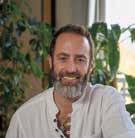
Annie G’s — A Dairy Farm for the Future by Karen Quinn Page 45

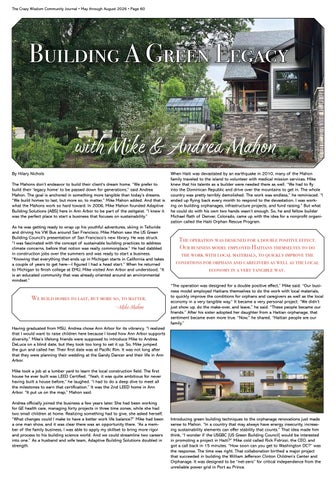
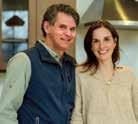
Building A Green Legacy with Mike & Andrea Mahon by Hilary Nichols Page 60

AI — Will We or Won’t We? by Sandor Slomovits Page 92
New Sheriff in Town –Mission Compassion in the Age of ICE by Bill Smith and Anna Gersh Page 12

An Interview with Psychotherapist Dan DeSena on Authentic Masculinity and Embodied Healing Interview by Bill Zirinsky Page 38

Eyes to the Future — Michael Klement’s Devotion to Sustainable Design by Hilary Nichols Page 54
Slowing the Scroll — How Amy Kimball’s Teen Photo Camps Are Reframing
Photography by Cashmere Morley Page 66

New Sheriff in Town — Mission Compassion by Bill Smith and Anna Gersh Page 12
Moments That Matter — How Zion Well Builds Community Through Mindfulness by Cashmere Morley Page 18
Think You Can’t Do Yoga? (Think Again!) —
A Conversation with Mindy Eisenberg, Founder of Yoga Moves MS by Karen Couf Cohen Page 22
An Interview with Psychotherapist Dan DeSena on Authentic Masculinity and Embodied Healing Interview by Bill Zirinsky Page 38
Eyes to the Future — Michael Klement’s Devotion to Sustainable Design by Hilary Nichols Page 54
Building A Green Legacy with Mike & Andrea Mahon by Hilary Nichols ................................................................................... Page 60
Resurrection, Reincarnation, and 5D — The Soul Experience Explored by Rev. Michelle A. McLemore Page 76
Interview with Dallas Ahrens — Gentle Ground Hospice and Grief Support by Crazy Wisdom Journal Staff
Southeast Michigan Spiritual Road Trip by Crysta Coburn
A Dive Into the Universe Stuff with Renata Portes by Samantha Beidoun
CWJ
Breath, Plants, and the Return to Relationship by Julie Barron .......................................................................................
Keeping the Faith — Even When it’s Hard by Karen Quinn
Three Seasons of Grief — A Personal Essay on Losing a Sibling by Frank Vandervort
72
80
AI — Will We or Won’t We? by Sandor Slomovits Page 92
When Awakening Becomes Avoidance by Rev. Loren H. Griffin Page 93
CWJ
Kindred Conversations ~ by Hilary Nichols Alex Thomas — Return to the Willow ...............................................
16
Yoga for Life~ How to Know if Your Stress is Out of Control, Plus 6 Simple Yoga Tools to Reduce It by Christy DeBurton Page 24
Out of My Comfort Zone ~ Three Scary Statements by Rowena Conahan Page 26
Sustainable Health ~ Hypermobility Disorders — An Overlooked Diagnosis by Susannah Parke, DO and Amanda Hallberg, MD
What’s New in the Community ~ by Lynda Gronlund
Green Living ~ A River Runs Through Us — The Huron River by Kirsten Mowrey
Spirit Seeds ~ by Triana Jones
Astrologically Speaking ~ Far-Out! The One and Only Uranus, a True Original by Catherine Carlson..............................................................................
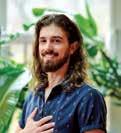
The Dreambody, Processwork, and Uncovering our Unconscious Desires by Cyrus Scholl Page 100
Weekend Getaways ~ Honoring The Past, Embracing the Future — The Inn at Rustic Gate by Petula Brown
30
31
52
91
94
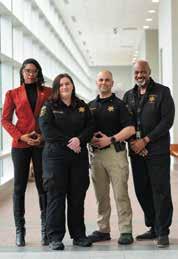
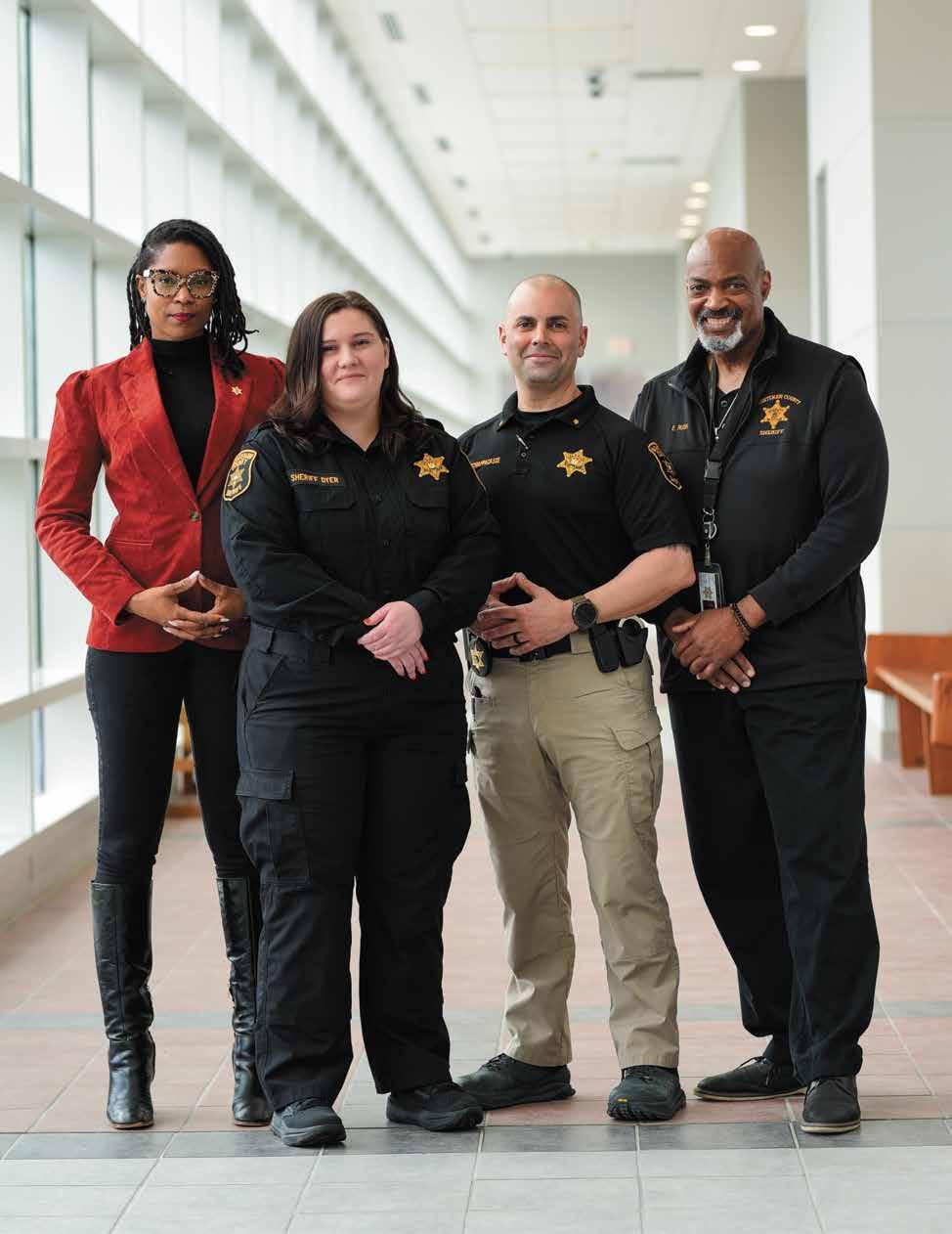
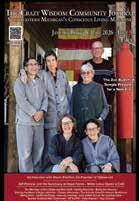
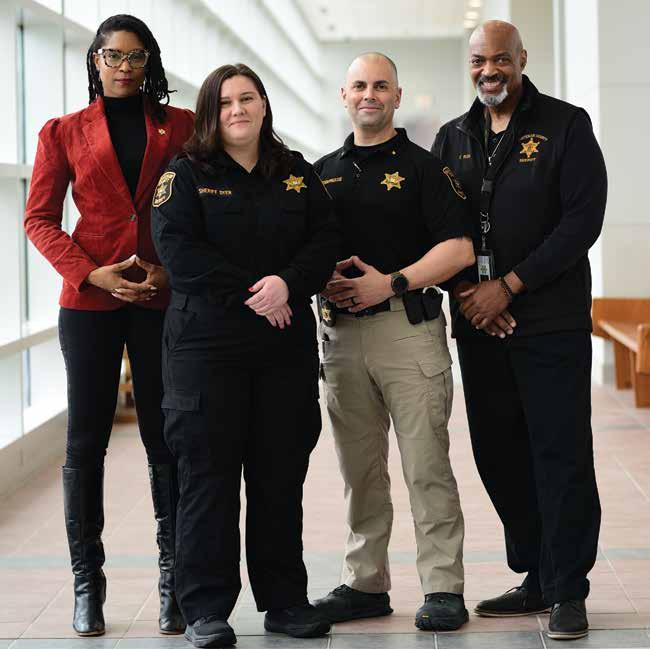
From left: Crystal Campbell, Director of Operations; Alyshia Dyer, Sheriff; Kurt Schiappacasse, Commander of Corrections; Eugene Rush, Commander of Community Engagement
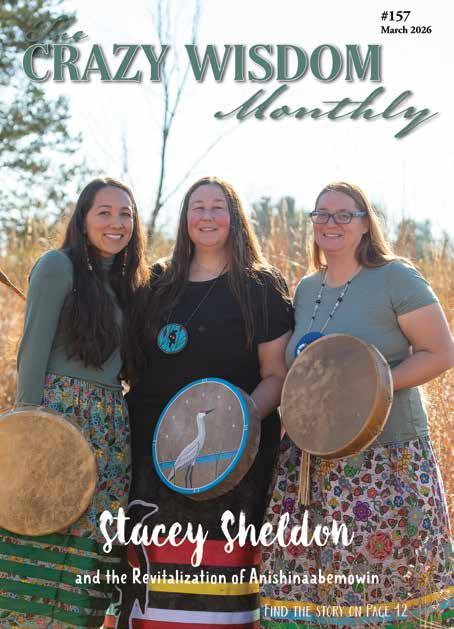
Cover Photo by Hilary Nichols
Food Section Starts on Page 43
Cooking with Lisa by Lisa Viger-Gotte Page 44
Annie G’s — A Dairy Farm for the Future by Karen Quinn Page 45
Pollinator Hotels Part 2 — Welcome Back, Bees! by Karen Quinn Page 49
The Art of the Vibe —
Boost Your Next Event with Coffee, Music, and Kultura by Cashmere Morley Page 50
Tea with Peggy — Tea for your Summer BBQ by Peggy A. Alaniz Page 51
CWJ
The Crazy Wisdom Kids Section Starts on Page 62 Children’s Book Picks Page 62
Kindred Journey School — Ypsilanti’s Newest Opportunity for Alternative Education by Kaili Brooks Page 63
Slowing the Scroll — How Amy Kimball’s Teen Photo Camps Are Reframing Photography by Cashmere Morley...................................................................... Page 66
Crazy Wisdom Kids Column ~ Experiencing Spring Through the Senses by Christine MacIntyre Page 68
CWJ
Book Reviews
Book Review: Unfiltered & Unapologetic: A Woman’s Guide to Live, Love, and Lead with Boldness by Judy McCutcheon
Book Review by Christine MacIntyre
Page 103
Book Review: Life on a Little-Known Planet: Dispatches from a Changing World by Elizabeth Kolbert
Book Review by Christine MacIntyre
Calendar

The Crazy Wisdom Community Journal has been published three times a year since 1995, by Crazy Wisdom, Inc., which consists of Bill Zirinsky and Ruth Schekter.
Copyright © Crazy Wisdom, Inc. — April 2026
No parts of this publication may be reproduced for any reason without the express written approval of the publisher. There is a token fee charged if you would like to use an article in this publication on your website, so make sure to contact us first. Articles from back issues are available on our website’s archive.
Senior Design and Production Editor Carol Karr
Managing Editor + Staff Coordinator Jennifer Carson
Design and Production Editor
Jennifer Carson
Advertising Sales Manager Tana Dean
Advertising Sales Associate: Eve Berton
Distribution
Richard Knapp, Paul Stehle
Editing
Jennifer Carson, Michelle McLemore Kaili Brooks
Calendar Editor Kaili Brooks
Page 114
The Crazy Wisdom Calendar Section Calendar Edited by Kaili Brooks Starts on Page 96
Our Calendar Editor’s Picks of Interesting Happenings in our Community ....................................... Page 97
Background Info on the Teachers Page 113
The Dreambody, Processwork, and Uncovering our Unconscious Desires by Cyrus Scholl Page 100
The Keys to Awareness — The Wholeness Work by Tchera Niyego Page 110
Resources for Conscious


This issue is distributed starting April 23, 2026
The deadline for Free Calendar submissions for the September thru December 2026, Issue #93 is Wednesday, July 15, 2026 Contact
Jennifer@crazywisdom.net
The deadline for reservations for Paid Advertising is Wednesday, July 29, 2026 Contact tana@crazywisdom.net
Starts on Page 2
Writers
Peggy Alaniz, Samantha Beidoun, Kaili Brooks, Petula Brown, Catherine Carr, Catherine Carlson, Crysta Coburn, Christy DeBurton, Anna Gersh, Lisa Viger-Gotte, Loren H. Griffin, Lynda Gronlund, Triana Jones, Christine MacIntyre, Michelle McLemore, Cashmere Morley, Kirsten Mowrey, Hilary Nichols, Karen Quinn, Susan Slack, Sandor Slomovits, Peggy River Singer, Bill Smith, Frank Vandervort
Artwork
Jennifer Carson, Karen Quinn, Leela Zirinsky
Photography
Susan Ayer, Mary Bortmas, Kate Jackman, Linda Lawson, Hilary Nichols, Edda Pacifico,
Publisher/Editorial Director Bill Zirinsky

I’m thrilled to be at Crazy Wisdom; it’s been a long dream of mine. I hope that as my business grows, I can purchase larger ads to support CW. I deeply appreciate the journal and all the work you all do - I can imagine it’s a lot of work to get it together, and it always looks so beautiful.
—Jess Carmichael, Spirit Post Readings
Over years and years of devoted service, Crazy Wisdom has grown into a magical, influential, and inspiring institution. It is one of the things that make Ann Arbor rate as a top place to live, nationwide, and an awesome place to put down roots. Thank you for all your determination and dedication over years and years, to increasing conscious living and quality of life, growing our community, and providing a platform to the highest of standards, for like minded people!
—Jody Tull, Be in Awe Yoga
Leslie Science & Nature Center is honored to continuing being a part of this critical local publication. Personally, I love reading CWJ, both the digital and print publications. There is something special about the people featured within both journals. I feel more connected and appreciative of the individuals and business who care for and celebrate the world around us. The consistency of intimate personal stories, alongside deeper philosophical conversations that I really enjoy! Thanks, Crazy Wisdom Journal, for continuing to seek out and feature all of the incredible people making our community special!
—Susan Westhoff, Executive Director Leslie Science and Nature Center and Ann Arbor Hands on Museum


—Wasentha Young, Peaceful Dragon School
Advertise in The Crazy Wisdom Community Journal and reach over 25,000 loyal readers in southeastern Michigan interested in a healthy, holistic, and conscious lifestyle!

In appreciation of all the talent and hard work that goes into The Crazy Wisdom Community Journal, we highlight some of our contributors in every issue.
Frank Vandervort is a writer, lawyer, and law professor. He enjoys being in and writing about the outdoors. His writing has appeared in Michigan History Magazine, The Boardman Review, and Bridge Michigan, among other outlets. He lives in Ypsilanti Township. Look for his personal essay Three Seasons of Grief: A Personal Essay on Losing a Sibling on page 90.
Lisa Viger-Gotte is a vegan artist, gardener, author, recipe developer, and lover of the planet and all its inhabitants. She’s a 200RYT Yoga Teacher and an MSVA Vegan Lifestyle Coach. More than almost anything, she enjoys showing others that a healthy vegan lifestyle can be economical, simple, fun, and delicious, too. Viger is the author of our Cooking with Lisa column found on page 44.
Tchera Niyego is an NLP Life Coach devoted to awakening the innate wisdom, compassion, beauty, and play already within each person. Drawing on decades of experience in creative, contemplative, and transformational practices, Niyego helps clients gently unravel the inner patterns that keep them stuck. Read her article about Wholeness Work on page 110.

Christy DeBurton is a Yoga + Healthy Lifestyle Educator from Ann Arbor. She is also our new yoga columnist! After earning a degree in International Business Administration from Alma College in the 90s and beginning a career in the automotive industry, she soon realized she was meant for something more. Check out her first column, Yoga for Life, on page 24.
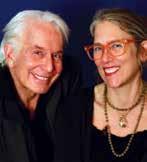
Bill Smith is a long-term creator of children’s books, and, more recently, an accredited oral historian specializing in biography and storytelling histories. His jam is connecting the dots and more.
Dr. Anna Gersh is a lifelong Ann Arbor resident. She is a parent, educator, program evaluator, artistic thinker, and lay-philosopher. Non-duality is her jam. Check out their article on Sheriff Dyer on page 12.
Brooks is the current editor of The Crazy Wisdom Community Journal calendar of events, a regular contributing author, and an assistant teacher at Kindred Journey School. Kaili is passionate about intentional living and fiber arts and is the soon-to-be mom of her second boy.


Finding Courage and Grace in Liminal Space: A Circle of Trust Retreat ®
“In the space between what is no longer and what is not yet, the soul is often doing its deepest work.” - Parker J. Palmer
Pause. Reflect. Listen for what is emerging in your life.
Date: August 14 – 16, 2026
Location: Weber Retreat & Conference Center / Adrian, MI
Your Courage and Renewal Facilitators: Kirstin Anglea & Sophia Lloyd
Learn more and register: https://bit.ly/courage-grace

Years of great articles and columns, delivering a broad spectrum of body, mind, and spirit information!
View over 91 full issues of The Crazy Wisdom Community Journal spanning over 30 years.












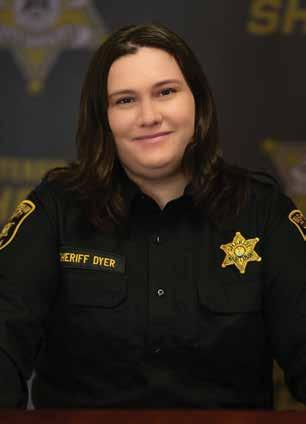
CW: Everyone is talking about what’s new at the Sheriff’s office. The word compassion keeps coming up. Tell us about your new mission.
AD: Compassion is a core concept for me. I am a millennial woman serving as sheriff, which is new to our county. I bring a different perspective to the table. I come from a policy mindset and a social work mindset. Also, having been a road patrol deputy, I have on-the-ground experience which is unique. My identity matters, my lived experience helps me assess situations in a different way.
We are committed to building a safer, more just, and more compassionate county. Compassion is in our mission statement. We’re trying to bring more compassion into policing, into the legal system, and into the jail.
When the jails were built, there wasn’t much sense of compassion. The system was built to make money. It was built off the backs of the most vulnerable in our communities. We’ve made some progress, but we have a long way to go.
When I was running, I went across the county and talked to people. I talked to everyone. We took that information in and put it into our platform. That became my agenda, it was the community’s agenda.
Everyone has different values. I worked for Jerry Clayton my whole career. I saw what worked and what didn’t. We’re continuing the good things but adding our new vision. The previous administration started having deputies carry Naloxone, an opioid blocker. It is critical to keep that going. We’re continuing the community violence intervention work. We’re continuing
SURE Moms, peer support for mothers of youth in the juvenile justice system. We really want to address first responder PTSD so we will continue building mental health and wellness initiatives for employees.
But bringing in a new vision means we’re taking a harder look at where we can take policy change a step further to truly create a county legal system without high racial disparities. Compassion means a county system focused on family reunification— finding a way that people in jail can actually see their loved ones.
Small things are important too. We have changed policies to curb low level traffic stops. We don’t need our deputies pulling people over for a crack in the windshield, a loud muffler, or even air freshener. My goal is to make everything safer. We need the community to be a partner thinking beyond 911 or police help. People may assume the answer is more enforcement presence. The question to ask is, “What would prevent this from happening again?” Part of our values are thinking innovatively. What actually may help is redesign of the roadways: adding curbs, putting sidewalks in, maybe bike lanes or proper lighting.
Of course, we are at the table when anyone calls. We’re coming and we’re going to help. But long term, making your neighborhood safer is thinking about how to prevent situations from happening in the first place.
Something that not everyone knows is that I am not a morning person. When I was working as an officer or even in grad school later, I preferred working afternoons or nights. As Sheriff, it’s been an adjustment. I have early morning meetings and then there are late night community events which means longer days in general. Often, I’m pulled in three different directions. It really is a 24/7 job. I never have enough time in any given day.
CW: Under your leadership, the Washtenaw County Sheriff’s Office was one of the first law enforcement agencies in the country to officially resist ICE. How did you decide on this position so early in the game?
AD: I spent two years on the campaign trail telling the community I was going to end
cooperation with immigration enforcement. The previous administration worked hard to only cooperate in specific situations, but still there was cooperation. It needed to stop. ICE is a bad influence on law enforcement. ICE tactics, the way the agents are trained, how they treat people, none of that is how we want Washtenaw deputies acting. So, when I started, we stopped all cooperation, including, cooperating on voluntary detainers in our jail.
A voluntary detainer is a request to local jails for ICE to take one of our detainees into custody after they are released. A voluntary detainer is a request. It is not a judicial warrant. The county has no obligation to comply, and arguably, it hurts people’s due process rights. We are innocent until proven guilty in our Constitution and our courts. The Constitution doesn’t say everyone “except people that are undocumented or those without visas.” It says all people have rights.
As a result of ending cooperation with ICE, I was sent a letter accusing the department of obstructing their work. We did not obstruct. We declined, which we have the right to do. The letter was directed at me. They specifically said because of my taking office that the relationship changed with the Washtenaw Sheriff’s Office.
The retaliation was to revoke the federal clearance of one of our detectives working with Homeland Security on child trafficking. Washtenaw County doesn’t need federal help to continue aggressively investigating child trafficking. Still, it is revealing that they pulled back on child trafficking investigations because we were not voluntarily cooperating on detainers that hadn’t been signed by a judge. The letter was turned over with FOIA and someone posted it on Reddit.
It is critical to maintain a separation between county enforcement and what is being attempted by a federal agency. We need our citizens to trust law enforcement. You never want a situation where people are afraid to
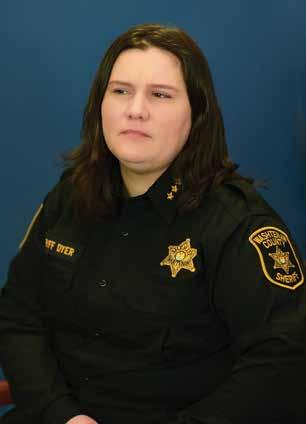
sits down with Sheriff Alyshia Dyer to talk about her first year in office: ICE, Budgets, Karaoke, and learning to work together.
By Bill Smith and Anna Gersh
see the law enforced. People in our immigrant community deserve police protection, to feel safe to call us when they’re scared, when their houses are broken into, or when their children are being followed.
None of this is new. ICE has been taking families from their homes for years. But certainly, the situation is more alarming now. I’ve learned so much from Washtenaw grass roots organizers. I also commend our County Board of Commissioners, the Ann Arbor City Council, and most importantly Michigan Immigrant Rights Advocates (MIRA) who pushed for our local municipalities to follow what Chicago and other areas are doing while still staying within the law. I also want to thank the county commissioners who have been supportive, particularly Commissioners Yousef Rabhi, Katie Scott, and Andy LaBarre. They are working with our office to ensure that we do all we can to protect our community.
There is this fear about talking about immigration, like, “Don’t talk about what you’re doing. You will be targeted. You don’t want to become Chicago or Minneapolis.” My argument is that those cities have also fought back, and stuck to their values. I commend leadership there. I believe every community should be looking at how to keep values front and center in this climate.
I am learning every day. The national law enforcement progressive community is strong. We are actively communicating with counties and localities around the country. The progressive sheriff space may be small, but we are mighty and we stick together.
I have two data specialists. The first focuses on crime, the second on equity—racial disparities from a public health lens. The data is looking great. Homicides are going down. Officer uses of force is down and, as a result, resisting and obstructing officers has gone down. A lot of our front-end prevention work is working too. Community violence intervention work is helping. Our initial assumption was that a reduction in traffic stops would not lead to an increase in crime. Current data validates this. Fatal accidents are down. Non-fatal accidents have gone down. The data doesn’t tell the whole story, but it does show that we’re moving in the right direction.
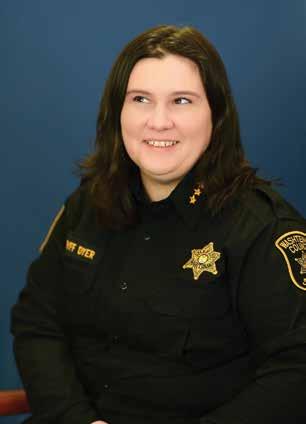
CW: At close to $65million, the Washtenaw County Sheriff’s Office budget is one of the largest in Michigan. In addition to county-wide law enforcement services, it covers corrections, parole monitoring and many community programs. Given your professional background as a deputy and a social worker, how did you prepare to manage this aspect of the work?
AD: A lot of people look at me and do a double take, like, “You’re the sheriff? You’re running the sheriff’s office?” Yes, I am, and, alongside my team we’re doing a really good job.
Our county has been around since 1823. There has never been a woman sheriff, let alone a sheriff under 40. I’m 35 now. The sheriff landscape is typically older, white, and male. Not a lot of women, not a lot of people of color, not a lot of younger people. There is a huge gap in representation.
One thing that needs to get out is the bias against women law enforcement leaders. I am responsible for the public safety of our entire county. I ovesee a budget of $65 million with around 420 employees. My job is harder because of the biases around my identity, but those same issues make me stronger.
While I was running for office, I had two years to prepare for my job as sheriff. I went back to school and got master’s degrees both in Policy and in Social Work. During the transition I was able to consult with Jerry Clayton, our former Sheriff. And I spent my first year deeply studying the budget and assessing our processes.
There’s a narrative going around that we’re so over budget. It isn’t true. That was really about the county commission not following through with funding the contracts for the food and medical they had signed. Jail food and medical were extremely underfunded. On top of that, my 2025 budget had been reduced by $2.5 million because of a new calculation for vacancy savings. Given those two things, I started my term with a projected 4.3-million-dollar deficit.
It is really expensive to run a jail. I used to be all about reducing the jail population because it was the right thing to do. I still believe that. I would much rather have people get services without being in jail. But now, I’m also like, “Don’t put people in my jail if it isn’t needed because we have to pay for it.”
There are on average 300-350 people in jail at any time. Think about feeding 350 people three times a day. Then the food must meet calorie and nutrition standards. Then you have to consider allergies, health diets, and religious needs.
Trying to explain the importance of properly funding the jail at a time when the county was dealing with strained budgets was tough. Last year was tense, but in the end, we were able to remedy the shortfall.
I grew up as a choir kid. I’m not an amazing singer but I love music. I really love karaoke, karaoke always, always puts me in a good mood. I sing oldies like, “I Won’t Dance,” by Frank Sinatra; “Downtown,” by Petula Clark; “Make Your Own Kind of Music,” by the Carpenters. But, if I’m with friends I just sing what they’re singing—uplifting, fun stuff.
I’m proud to say that after a tough year, the shortfall for food and medical costs has been remedied. Through really poring through the budget, I also found 2% savings which helped. In the end, our administration spent less than the previous sheriff’s administration. I’m proud of that. We were able to reduce costs and identify containment measures. Now we are on track to balance the budget.
Fiscal responsibility is extremely important to me. I will continue working to remedy longstanding issues and finding ways to save our county money.
Continued on page 14
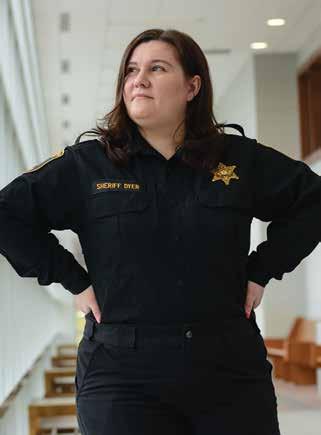
CW: Washtenaw is one of the first municipalities in the country to have rolled out in-house jail visitation. Tell us why this was a priority for your office?
AD: As of this year, we have made in-person visits operational. That means children are now able to see and touch their parent. It’s okay for people to hug each other or just hang out, talk, play games–to actually be with their loved ones.
In the 2000s there was a national move to phone and video visits. I think that was introduced in Washtenaw long before the pandemic. It was good that some restrictions were in effect during the pandemic. People could use the technology and still stay health protected. But that behindglass move was made without fully understanding the human impact.
There are only a handful of other localities across the country that have moved to in-person visitation. The data shows that it reduces the use of force in the jail. It improves recidivism rates. Localities with in-person visitation have also seen a positive effect on staff. If you work as a corrections officer, you are naturally going to care about the other people in your environment.
There are obstacles to getting there. Through our first year, we’ve been assessing what works and what doesn’t. We are accessing a national toolkit developed for corrections professionals and residents, the Law Enforcement Action Partnership, which has been helpful. We’re not getting rid of phone and video. We’re just adding the in-person component. We are working through our housing units now and building up a visitors list. We built a draft policy and created signage. We’re working to make the visiting area look less like a jail. We’re pulling together toys, books, and games for families to share. We still have to get furniture. It’s still going to be a jail, but we can make it more human.
Word is out. People are talking, our staff, the residents and their families are getting the vision. People are excited. Things change when the residents can look forward to something. It creates a different culture.
CW: You’ve spoken a lot about young people in the justice system and your own experiences with law enforcement as a young person. How does your administration hope to improve the relationship between young people and the justice system?
AD: I am passionate about helping young people stay out of the system. I grew up in Ypsilanti. My mom raised me and my brother. There were issues, I ran away a lot. That’s how I had my first contact with the legal system.
I remember how I was treated by law enforcement. I had some good contacts and I had some pretty bad ones. I ran away for good when I was 17. A U-M professor let me stay with her family as a nanny. When I turned 18, she helped me get into Washtenaw Community College. I completed an associate’s degree in criminal justice and then ended up going to the police academy.
While I was in the road patrol division at the sheriff’s office, I worked closely with Washtenaw youth. I saw how young people were treated. I could see it even before they got into the system. You could see the path. They start getting in trouble at an early age for low level reasons. They don’t get resources, they don’t get help, they don’t get decent school grades. They just get criminalized. And once that starts, they never got out of the system. There is no real path to the future.
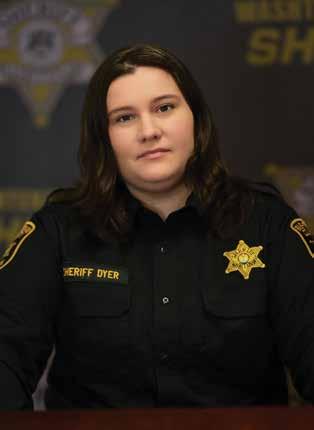
Having a social work background helps me think differently about young people in need. One thing I’m really proud of this first year, is our roll out of “RAPID” (Restorative and Preventative Intervention and Diversion), a pre-arrest program to divert 12-to-25-year-olds involved in low-level offenses. RAPID bypasses the justice system by offering mental health and job readiness support. It is an alternative to arrest, it connects young people and their families with resources for growth and stability, rather than formal system involvement.
Now, instead of arrests, officers submit a case report to our RAPID partner, Corner Health Center. Corner Health builds a first-case management program based on what the young person identifies as their own need. When it is a young person, we really need to ask them, “What do you need to be successful?” This is a great example of the kind of trauma informed care I wish we had had when I was a road officer.
When I was policing, I was on a call about a young person skipping school. The parents called all the time asking the police to get their kid to school. They didn’t know what else to do. I built a rapport with this young person, they told me, “I don’t have clothes to wear. If I show up at school, I’m gonna get bullied.” So, you get them some new clothes that they’re proud of and suddenly, no more skipping school. It was as small, as simple as that. Getting young people the support and resources they need.
I know a lot of people in Washtenaw support this kind of mindset. Listening more, being trauma informed, and acting creatively about keeping young people out of the system. If we can do that effectively, we’re making a safer community.
It really does feel like a calling. I’m a nerd. I actually want to read the technical stuff, even compliance reports. Believe it or not, the content is interesting: contracts, and data, and reports. Like, I really wanted to read the Justice Department recommendations on the Ferguson Report. I love this stuff, it’s my passion. It comes naturally. It feels like this is where I am supposed to be.
CW: The Washtenaw County Sheriff’s Office employs approximately 425 people, including 120 sworn officers, across six divisions. Many of these employees worked for your predecessor. How are they responding to your new mission?
AD: We have so many good people that work here. I have a great team. My leadership style is collaborative, so my gaps are filled with the expertise of my team. They have been critical to the new mission’s success.
It is common practice for a new sheriff to replace the leadership team. I didn’t think that was the right move. Some of our best people were appointed by Jerry Clayton. Their institutional knowledge is a huge asset to our community. I chose to keep them in place to ensure we don’t miss a beat. My commander Kurt Schiappacasse has been here for 25 years-plus. He is one of the best jail commanders in the country. I would say the same about Renee Casey, our community corrections director. Matt Harshberger, our undersheriff, was formerly chief in both the Ypsilanti and Pittsfield Township police departments. My Director of Operations, Crystal Campbell, is brilliant and has worked in local as well as county government. Both the people from the previous administration and our new appointments have been doing a phenomenal job. One of the best things I have done is to build a great team.
I’ve learned a lot this year. I am continuously soaking up information and I’m paying attention. Seeing how much our employees really go above and beyond has been a big inspiration to me. Working in a jail is very different than working on the road or in a police office. Sometimes people that are great officers, can’t work in a jail, and vice versa. It’s got to be someone that can handle
the jail environment, that means someone who is compassionate, someone that represents our mission and values—someone that really cares about the population in the jail.
I have enormous respect for my WCSO employees as so many of them made what we have accomplished doable. Our Plan of Action and Milestones (POAM) was critical during the transition and helped me get messages out to staff. Many frontline workers in our unions across county government also had my back, and the people that had worked in the former sheriff’s administration really looked out for me. That all mattered especially as there had not been a sheriff transition for 16 years before I took office.
Staffing was a huge issue when I came in. Our corrections team was just so understaffed. We made that a priority. We’re getting more people hired so now we don’t have staff working 16-hour, back-to-back shifts.
I thought there would be more pushback to our new mission. There was a rumor that there would be a mass exodus because I was too progressive, like “the crazy liberal sheriff.” We’re seeing the opposite. And we’ve had a ton of people applying to work here. People are saying, “I never thought about being a corrections officer until I heard about the work you’re doing.” Or, “I applied because of the new mission.” I feel so grateful when I hear that.
Before the pandemic I used to do improv. I haven’t done comedy yet.
CW: Your first year put you in the line of fire with some county officials. Do you see that as an obstacle moving forward?
AD: When I was running for sheriff, people saw me as controversial. I went up against the political establishment of Washtenaw County: entrenched wealth and power. We built a huge grassroots coalition of folks across the county, across divides, and we won.
But I’ve learned that it’s different running for office than being in office.
The politics of Washtenaw County have been the most surprising part of my first year. I thought winning was the hard part. I love the operations and the community work and I thought, “Now I get to focus on that.” But the politics don’t stop after the election. It’s not just the legal system that needs reform, it’s the politics too. There are people that are not happy that I’m in this seat. I don’t know if I’ll ever win them all over despite my best efforts. Luckily, they are not the majority.
The reality is the people elected me to be their sheriff, and this job is not easy. Everyday there are urgent matters to address. The work never stops, some change happens quickly, some things take longer and aren’t as easy. The last thing I want to worry about is our county government throwing a wrench in what we are fighting to accomplish. Pair that with starting a first term under Trump 2.0. This work is the most rewarding thing I’ve ever done, but I would be lying if I said if some days weren’t hard.
I’ll be honest the transition was a challenge. I was naïve. I assumed that after the election people would be supportive. During the transition my mindset was collaboration, working with the county. We always want to do that. I am responsible for the public safety of our county.
But there were people who resented my win. I had to advocate and fight to bring my team in and make sure that the sheriff’s office people who stayed on to work for me were not harmed. I’ll give credit to our county administrator Greg Dill and Commissioner Rahbi who were focused on being helpful and on a smooth transition to the extent they could. There was a lot going on that we kept behind the scenes. Ultimately, we made it work but the first year was definitely not a walk in the park. The misinformation and rumors didn’t help either.
It is strangely liberating that my troubles with the county commissioners came out during the public board meetings. My hope is that this year things will calm down. My success is all our success. I’m feeling more positive--commissioners have started to be more supportive. Thankfully, the budget issues I started with were largely remedied.
I would like to work collaboratively moving forward, it’s what I’ve always wanted. Building relationships and seeing through differences to find ways to compromise is key. My biggest learning curve has been realizing I have to maintain a focus on the politics. The relationships are so critical. Now as sheriff, I say that I’m managing three tempos: the community; the operational; and the political.
My election as the sheriff is a testament to politics moving in a different direction. For a long time the same people controlled the Washtenaw political landscape. But now, the community is shaping election outcomes like never before. Our community is engaged and ready for change. That passion is a blessing. We will need broad community support for the work we are doing and will continue to do. At the end of the day, the community is what drives true change. If we can be innovative to reduce harm in Washtenaw, it will prove that people can do it in other places too. And that can improve public safety and people’s lives.
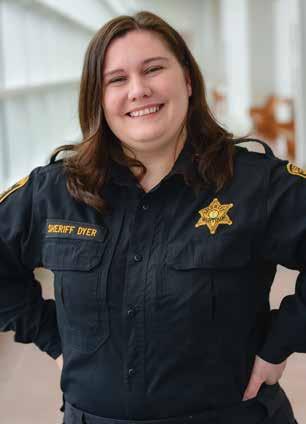

Photos and Story by Hilary Nichols
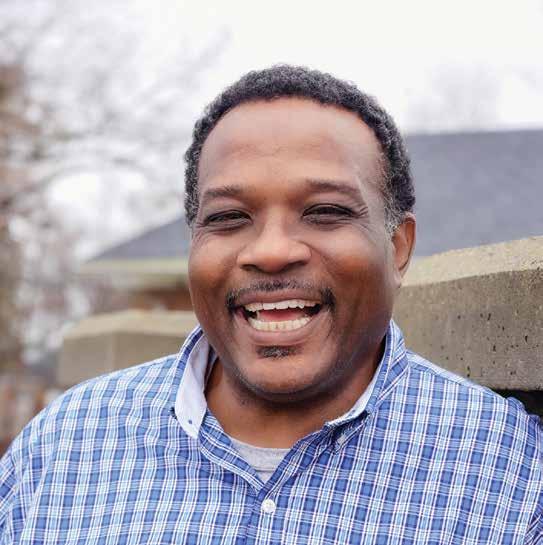
Alex Thomas has returned to Ypsilanti to care for his hometown. He is a West Willow Community advocate, and a Transformative Strategies Specialist, and he is Assistant to the Sheriff of Washtenaw County,
When he first returned, after nearly eight years teaching English in China, he expected nostalgia. What he found instead stunned him. His old school, Ardis Elementary, was now an empty field. “They had a great big wooden boat that we all loved to play on,” he remembered. “Our neighborhoods were structured around our schools.” And more alarming, the General Motors plant that had anchored his childhood town was shuttered. The pulse of West Willow had gone quiet. “Crickets,” Thomas said, shaking his head. “That plant was the breadbasket of our neighborhood—the backbone of our economy. And now it just stands empty.”
For generations, the industrial complex in West Willow had been the neighborhood’s economic heart. Built in 1943 by the Ford Motor Company, Willow Run produced B-24 bombers on a milelong assembly line in the largest factory building in the world. During WWII it employed thousands of workers—including women as part of the “Rosie the Riveter” campaign named for Willow Run’s own Rose Will Monroe.
By the 1950s, the complex had transitioned to automobile manufacturing under General Motors, eventually employing as many as 14,000 people at its peak in the 1970s. The sprawling five-millionsquare-foot plant symbolized prosperity for the surrounding community. When General Motors shut the plant down in 2010 during its bankruptcy restructuring, that prosperity evaporated. The loss rippled through West Willow. A community once defined by stable union jobs and modest middle-class homes began to be labeled with a single word that Thomas rejects outright.
“People say it’s a ghetto,” he said. “And it is not.” The subdivision, built in 1956-2008, is the largest neighborhood in Ypsilanti Township with 1,050 homes and over 3,000 residents. “I’m not saying it’s perfect.” It just needs us to come together as a community.” Turning around both the perception and the lived experience in this neighborhood is what Thomas is all about.
“West Willow is where I’m from,” Thomas said proudly. His parents, both employed at the West Willow GM facility, were union Auto Workers—UAW members. “It was a Cosby Show upbringing,” Thomas recalled. “Two parents working good jobs, a nice house, safe neighborhood. I thought of myself as the nerdy Theo Huxtable of my family.” Thomas was a good student, but susceptible to peer pressure.
A few petty crimes landed him in lockup. He should have been sent to a youth facility but because of overcrowding they sent him to the adult facility. “It was not a good place for a kid.” Michigan’s Holmes Youthful Trainee Act (HYTA) designated that after a three-year probation period, his sentence would be expunged. Though the experience had a more lasting impact. Those early encounters with police harassment as a young Black man marked a turning point. “As a kid, I thought cops were the good guys. But when I got older and behind the wheel, that changed. Those experiences of being stopped and harassed opened my eyes to how broken systems shape broken communities.” Thomas added, “And without healthy spaces, there are so few places for Black youth to be themselves with positive role models.” Thomas
When he first returned, after nearly eight years teaching English in China, he expected nostalgia. What he found instead stunned him. His old school, Ardis Elementary, was now an empty field. “They had a great big wooden boat that we all loved to play on,” he remembered. “Our neighborhoods were structured around our schools.” And more alarming, the General Motors plant that had anchored his childhood town was shuttered. The pulse of West Willow had gone quiet.
Starting again, he found steady work at Wendy’s in the University of Michigan’s Student Union building, “But buses didn’t go to Willow Creek,” Thomas said of the lack of transit, so he relocated to Ann Arbor. “I moved into a transitional home.” Avalon Housing had just opened its nonprofit supportive housing for those formerly homeless. Thomas not only found stability but community— and a mentor in Avalon’s founder, Carol McCabe. “Carol saw something in me,” Thomas said. “She believed in the power of residents themselves to lead.” Through a grant-funded initiative known as the Pilot Light Project, Avalon employed Thomas as an organizer, identifying community goals and implementing shared projects. “It was tough,” he recalled. “But worthwhile.” He gained a lot of the organizing experience that serves him still.
In 2008, he took a leap and moved to China to teach English. “I thought I’d be there for the next twenty years.” But in 2016, Thomas returned to Michigan to care for his aging mother. “I recognized the need and made the choice to move home.” That need was broader than he’d expected.
“The Ypsilanti I came back to, wasn’t the Ypsilanti that I left,” he said. “And it didn’t seem like anyone was doing anything about it.” He began volunteering with the New West Willow Neighborhood Association, working in partnership with groups like Habitat for Humanity and the Washtenaw County Health Department. They tackled issues ranging from housing to public health, with increased urgency during the COVID-19 pandemic. “We had to reach people where they were,” Thomas said. “We built contact lists, checked on neighbors, got information out. In a lot of ways, we were a lifeline.” What they discovered through public health data was alarming. Local life expectancy had been declining steadily.
Death certificates reported local life expectancy declining from an average of 65 in 2020 to just 59 in 2024. “The numbers don’t lie,” Thomas said. “But the zip codes hide the truth.” Ypsilanti Township is divided into 19 precincts. Those
19 precincts cover two zip codes 48198 and 48197. “It’s too easy for data to reflect what the powerful want to see instead of the real story of poverty, racism, and neglect,” Thomas said. His efforts are all about visibility: ensuring that decisions about eastern Washtenaw County aren’t made by those insulated from its realities.
“It’s not about property owners,” he insists. “It’s about the people.” What we think of as Ypsi is both the city of Ypsilanti and the township. With a population of approximately 20,000, the city is a council-manager form of government with an elected mayor and six council members from three voting wards. The township is overseen by a supervisor and seven-member Board of Trustees for a population of roughly 55,000 residents. It is confusing and that may be serving the powers that be. “Decisions often hinge on a simple majority of four votes. That’s it,” Thomas explained. “Four people decide policy for fifty-five thousand people.” Thomas wants to change that. In 2024 he challenged longtime Ypsilanti Township Supervisor Brenda Stumbo, running in the Democratic primary. He didn’t win the seat against the incumbent. But that hasn’t discouraged his civic participation.
To deepen the conversation, Thomas launched a podcast called WhatUpintheWillow , later expanding the project into TheAlexThomasShow , recorded at Ypsilanti’s Riverside Arts Center.
“I’d like people to better understand their local government and their local community power so they will participate,” he said. “It’s so important to know your neighbors and our power when we are informed.” His longrunning partnership with Ypsi Nice has helped spread that message, celebrating local resilience while encouraging residents to show up at meetings, ask questions, and influence decisions that shape their lives.
When the American Rescue Plan or ARPA—allocated funds to be distributed by the township board, community groups in Ypsilanti Township raised concerns. As co-chair of Ypsii NICE—Neighbors Improving Community Engagement —Thomas was interviewed by WEMU News. He reported that the board’s decision didn’t meet the residents’ priorities of children’s programs, mental health services and community centers. Thomas’ outcry for the community to “Demand a change and demand an explanation why they’re neglecting the most impoverished areas of the township they’ve been elected to represent” was a rallying call.
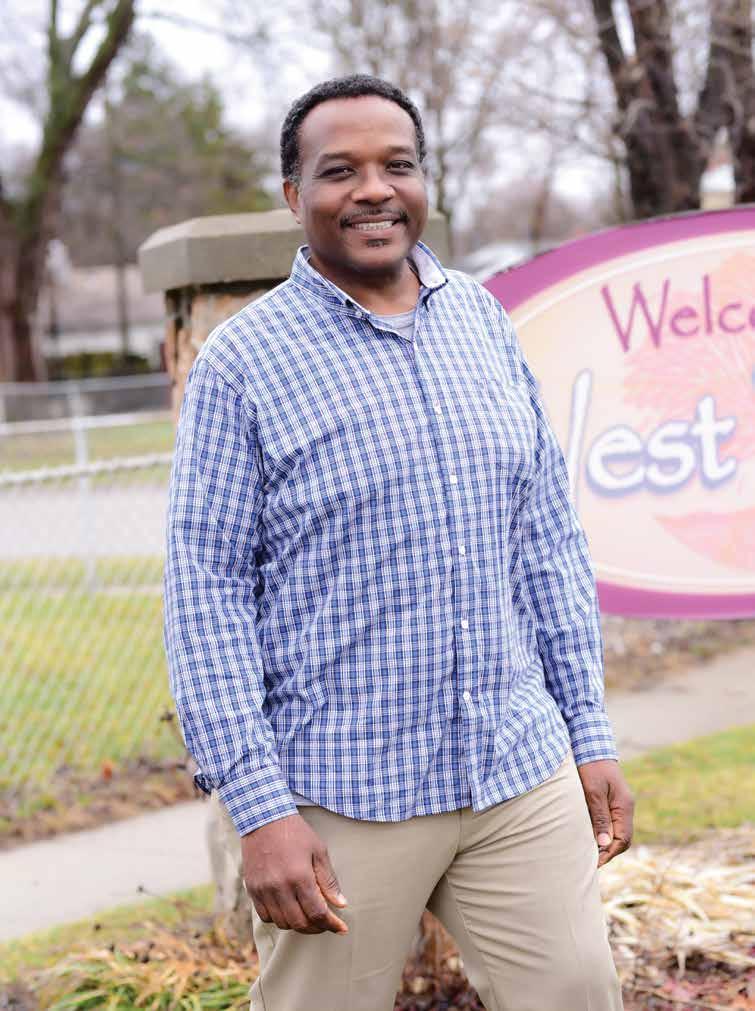
To deepen the conversation, Thomas launched a podcast called What Up in the Willow, later expanding the project into The Alex Thomas Show, recorded at Ypsilanti’s Riverside Arts Center. Along with residents, artists, activists, and local experts, he created a growing oral history of Ypsilanti as told by the people who live there. “The compilation tells the big story,” Thomas said. “From the newest residents to the oldest, from artists to architects, old school to new comers—it’s all part of the same Ypsi community.” For Black History Month, Thomas hosted historian Matthew Seigfried, calling the episode “one of the most important shows that I’ve done.” They discussed the area’s role in American history from the first Native settlers to William Lambert, a prominent 19th century AfricanAmerican citizen and abolitionist, to the underground railroad and to the great migration. Siegfried centered Ypsilanti’s role in the national story. “We all have a part to play in history,” Thomas noted.
The recent loss of a local food-justice leader and community member, Melvin Parson, came to mind. “Melvin always said ‘kindness, dignity, and respect.’ He played a huge part in this area. He brought the community closer.” The outpouring of grief after Parson’s death revealed something Thomas had not fully appreciated before. “Seeing how many people were touched by his passing reminded me of the capacity of our community,” he said. “When we grieve together, we honor the true heart of the place we live, and we can see how powerful we are when we come together with care.”
“I used to look at our community and see all the broken parts,” he said. “But now I can see the strength.” “West Willow raised me,” he said, with his heartwarming smile. “Now it’s my turn to show up for West Willow.”
Alex Thomas encourages civic participation through local organizations such as: facebook.com/nwwna/ as well as liberatedontincarcerate.org/ and you can follow his lead with all his current information shared at facebook.com/alex. thomas.451903 or youtube.com/watch?v=Qzaety4jozY.
By Cashmere Morley
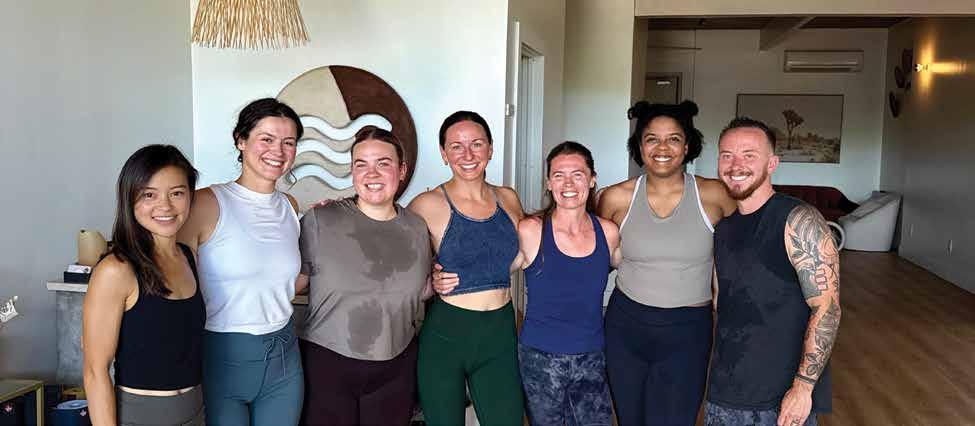
For Aubrey and Art Schupbach, a little goes a long way. It is a little mindfulness, in the form of a friendly check-in with a yoga patron they haven’t seen in a while. A little stretching in the morning, to get the body in the right mental and physical space to move about the rest of the day. A little meditation session in the afternoon to remind oneself that the quiet times are just as important as the loud ones. The Schupbachs have found that these little moments are what create the foundation that supports a larger community. It’s these moments that help make Zion Well what it is: a studio rooted in community, mental health, and purpose.
Ann Arborites that originally met at Planet Fitness, Aubrey and Art’s path to owning a wellness studio actually began down south. Living in North Carolina, Aubrey began taking yoga classes that were a “huge benefit” to her mental health. “I kind of dragged Art along to come to yoga with me, and then our love and our passion for yoga really started to evolve. We found yoga as a pathway to stabilize and support our mental health… that’s kind of how the initial, I would say, birth of the studio, came to be,” Aubrey explained.

The Schupbachs have found that these little moments are what create the foundation that supports a larger community. It’s these moments that help make Zion Well what it is: a studio rooted in community, mental health, and purpose.
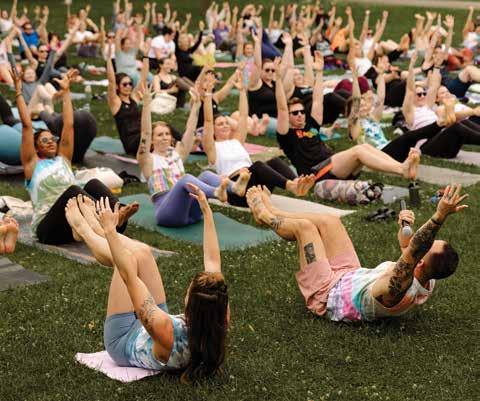
Before they opened the doors to Ypsilanti’s Zion Well location in June 2019, both Aubrey and Art wore a lot of hats. Aubrey managed a Lululemon store. Art was deep into marketing and advertising for Aubrey’s family’s truck driving school and was also a personal trainer for four years. Both spent years teaching at various places in the Ann Arbor community, which explains why education and mindfulness is such a big part of their approach to wellness.
These days, we see the word “inclusivity” thrown around as more of a buzzword than a word that holds actual weight. Inclusivity isn’t just a catchphrase to boost likes and feed some algorithm at Zion—it’s a cornerstone to their philosophy.
Zion means “sanctuary” or “refuge” in many cultures, and that’s exactly what Aubrey and Art wanted to create—a safe space where anyone could come to find peace, both inside and out. The pair explain that their use of the word Zion has nothing to do with politics or religion. Instead, it’s about nature, harmony, and the idea that you can carry your own sanctuary with you, wherever you go. Art and Aubrey approached the vision of Zion Well in different ways, though both partners found Zion’s root to be in inclusivity and community. Said Art, “I think for me, my biggest experience that kind of helped shape the direction [of Zion Well] was an experience that I had with meditation.”
Art explained, “I had a neck injury that happened before we ever opened the studios, and it made it so that I couldn’t practice yoga, and I couldn’t do the exercises that I liked to do. It kind of forced me to slow down and dive a little bit deeper into the meditation practice, which at the time, I wasn’t as acquainted with, and I just really, really fell in love with it, and so it was something that we always wanted to interweave into the studio.” He continued, “Even in all of our yoga classes, we have some element of meditation and breath work and just that guiding someone a little bit deeper, if that makes sense. I’m always go, go, go, and sometimes I need to be, like, slowed down a little bit… so I’m grateful for that moment.”
Aubrey said it was not one experience that led her to Zion, but a culmination. “I knew that I always wanted to help people in this world and support people,” she said, “And I think that my ability to be nurturing and caring and to help people and provide access to themselves and in their bodies was always important to me. The difference that it can make in other people’s lives… I think that’s what shaped me and also motivated and inspired me to kind of keep sharing the practice and being a part of the practice, myself, too.”
These days, we see the word “inclusivity” thrown around as more of a buzzword than a word that holds actual weight. Inclusivity isn’t just a catchphrase to boost likes and feed some algorithm at Zion—it’s a cornerstone to their philosophy. Aubrey and Art have gone out of their way to make sure everyone feels welcome at Zion Well, and it starts with the instructors that they hire who come from diverse backgrounds. The duo also started the GiveWell equity program which offers free memberships to people who can’t afford them, funded by other members who want to help. They also give out scholarships for teacher training, especially to folks from underrepresented communities—BIPOC, LGBTQ, and single parents. When they say, “access is everything,” they mean it.


During February of 2023, the pair opened their Ann Arbor location. They note that being surrounded by creative, diverse, and open-minded people in both cities—artists, teachers, dreamers, and more, all connected by the thread of wanting to better their bodies and minds—make them feel lucky to be part of such vibrant communities, and they’re committed to giving back.
“Art and I want to be able to stay in the practice of yoga until we die,” Aubrey said, “So the practice of longevity is really important to us. And it brings us back to inclusivity. Something that we implement in our studio that is very different from other studios, is we utilize a lot of props, such as blocks, blankets, straps. We really educate ourselves on varying types of bodies and injuries in order to be able to provide inclusive adjustments during class.

Running a business while staying true to their spiritual values isn’t always easy, but Aubrey and Art have found their own balance. They don’t want to be seen as “gurus” on a pedestal. Instead, they’re friends, neighbors, and fellow travelers on the path, with you, for you, because of you.
“Being able to support bodies that have knee replacements or pelvis replacements or torn hamstrings, or, like Art mentioned, being able to support people who have never had access to yoga, offering different tools and therapeutic practices so that they can be with us in the studio is something we really hold dearly,” said Aubrey. “I think that the way that technology has evolved can sometimes create barriers to access for people to be able to come to the practice of yoga and see themselves in the practice of yoga. And what we know about yoga is that it’s not one size fits all.”
Art added, “Our mission is finding ways to offer these tools to people in this inclusive community, creating more safe spaces where people can explore not just movement, but personal growth, mental health, mindfulness, and reflection generally, so that they can go out in the world and be a better community member for themselves and their family.”
Running a business while staying true to their spiritual values isn’t always easy, but Aubrey and Art have found their own balance. They don’t want to be seen as “gurus” on a pedestal. Instead, they’re friends, neighbors, and fellow travelers on the path, with you, for you, because of you. Compassion and generosity guide their decisions. Aubrey said the pair put “people and their wellbeing before tasks for the business” even if that means spreading themselves a little thin at times.
Said Art, It involves “actually reaching out to community members and being like, ‘hey, how have you been doing? It’s been a couple weeks, we were thinking about you.’ Anytime that thought pops into my head, you can ask Aubrey, I will email or text someone, right away. Even if it’s just, ‘hey, I’ve been thinking about you, we miss you, let’s grab a coffee sometime.’ At the end of the day, what we have is each other.”
Husband and wife, Aubrey and Art Schupbach, during a Zion Well Retreat.
“I think one of the hardest parts, not just of business, but of being a human, is our own self-management,” said Aubrey. “I am a giver and a nurturer by nature, and you know, at times, also remembering to take time for myself, and give to myself, and let myself slow down is probably one of the most challenging things. But it’s been such a large piece in my life that has allowed me to support others in that way, too.”
Aubrey and Art joke that classes often start late because everyone’s busy catching up and laughing together—a true marker for them that they are creating something special at Zion. For the couple, those moments of connection are the real measure of success. They want people to feel seen, heard, and valued—not just as students, but as human beings.
During the pandemic, Zion became a lifeline for many. With so much isolation, the studio offered a rare chance for real human connection. Some members relayed to Art and Aubrey that their weekly class was the only time they spoke to anyone all week. That’s the kind of impact for which they are most proud. “We’ve been in a lot of yoga spaces where it feels like there’s either the owners or the teachers or these guru people that you can’t talk to, and that’s never what I wanted to be,” said Art.
Aubrey and Art are always learning, always evolving. They see Zion as a living thing, growing and changing with the needs of the people it serves. Their own relationship—“yin and yang,” as they put it—helps them stay balanced and avoid burnout. They support each other, motivate each other, and remind each other to slow down and enjoy the journey. At the end of the day, Zion Well is so much more than a yoga studio. It’s a sanctuary, a classroom, and a community hub. It’s a place where people can heal, grow, and connect—one breath, one conversation, and one act of kindness at a time.
Art said he also encourages business owners to lean into some aspect of service. He notes that while that will look different for every type of business, being able to give back to your community is “one of the most rewarding things about owning a business,” and for Art, it “fuels you in a way that just making money cannot.”
“Something I like to think about, and this is just in general, not even applying to business ... when someone has their own vision or their own idea to bring to life, I want you to try to think about it in reverse,” said Art. “So, if the studio never existed, what would be missing from humanity? Apply that to something that doesn’t exist yet. You know, we had one of our community members who wanted to start a farm that was for cancer patients. And I said, ‘think for a second about that impact and all the people that would be helped, and all the people that would be connected, and then imagine it going away, and how sad that would be, and how difficult that would be.’ And so, you can kind of look at things that way, in reverse. What would life be like without Zion Well? That is such an important, impactful thing that exists, and how sad for it to go away. It helps you remember why you started in the first place.”
Art said he also encourages business owners to lean into some aspect of service. He notes that while that will look different for every type of business, being able to give back to your community is “one of the most rewarding things about owning a business,” and for Art, it “fuels you in a way that just making money cannot.”
Looking toward the next few years, Aubrey said the future looks different, but mostly the same. “We want to continue to move and go deeper with our community, and continue to expand our training programs, offer more meditation mindfulness trainings, breath work trainings, and expand our retreats a little bit as well.”
Aubrey and Art host about four retreats each year—19 in total so far—and consider them one of the most rewarding parts of their work. Each retreat offers an opportunity for participants to slow down, connect, and immerse themselves in nature alongside a community of like-minded individuals. From Zion and Sequoia National Parks to destinations such as Costa Rica, Iceland, Italy, and Greece, every retreat is uniquely designed to balance wellness, adventure, and relaxation. They handle every detail—from arranging transportation and daily activities like hiking or museum visits to providing nourishing plantbased meals—ensuring that attendees feel completely cared for throughout the experience. Many participants join on their own and leave with lasting friendships, making these retreats a truly special intersection of healing, movement, and travel.
Art adds that they are “always open to collaboration” especially if it brings the “practice to the people.” He notes an interactive immersive yoga event that happened at Stamps Gallery in the fall, and how he never would have thought of that if the idea hadn’t been pitched to him.
For Aubrey and Art, success isn’t about numbers. It’s about the moments when someone finds peace, makes a new friend, or discovers something new about themselves. In a world that can feel overwhelming and disconnected, Zion is a reminder that we all need a place to belong—and sometimes, that place is closer than we think.
For Aubrey and Art, success isn’t about numbers. It’s about the moments when someone finds peace, makes a new friend, or discovers something new about themselves. In a world that can feel overwhelming and disconnected, Zion is a reminder that we all need a place to belong—and sometimes, that place is closer than we think.
“Currently we have 24 teachers, and we really could not do this without their passions. Everyone has a little bit of a different place that they teach from. And I’m so grateful that we have such an amazing team that has this same hunger for knowledge and mental health and just being compassionate,” said Art.
“If you’ve never tried yoga, I’d encourage you to try,” said Aubrey. “There are so many different ways to do yoga and so many different modalities and teachers, that even if you had a bad experience, please let yourself try again with a different teacher, because sometimes it takes a minute to find what really resonates and connects with you. And if you’re a little scared to reach out, I’ll go and take class with you.”
Visit Zion Well online at zionwell.com, or on Instagram @zion.well for open hours, class schedules, scholarship opportunities, and more. Check out their brick and mortar locations at 874 S Grove Street in Ypsilanti and 3384 Washtenaw Avenue in Ann Arbor.









By Karen Couf Cohen
Mindy Eisenberg founded Yoga Moves MS, a nonprofit adaptive yoga organization, over 20 years ago, providing free classes to those impacted by multiple sclerosis, Parkinson’s disease, and other neuromuscular disorders. Her inspiration? Growing up with a mother with multiple sclerosis who spent the better part of twenty-seven years in bed paired with a profound belief in the healing impact of a regular yoga practice.
Karen Couf-Cohen: Yoga classes are ubiquitous. You can’t go a block in any direction without seeing a yoga studio. Why is Yoga Moves different?
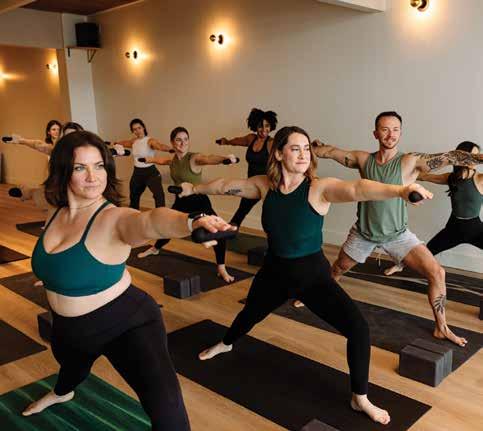
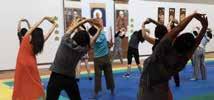
Mindy Eisenberg: The most important thing to remember about Yoga Moves is that it is adaptive Yoga. Our teachers adapt poses to meet the needs of our students with neuromuscular conditions such as MS or Parkinson’s. Our recent rebrand now encourages anyone with any kind of neuromuscular issue to join our classes, including post-rehab, people with osteoporosis, and seniors looking for a slower, less rushed class with more personal attention. We are unique in assigning several teachers to each class. Our class structure is collaborative: the lead teacher guides the session, assistant teachers provide individualized support, and students participate in the practice tailored to their needs. Mainstream yoga classes book on the hour and they teach to the average level of ability with one teacher. There is a pre-assumed plan for each class, and it usually isn’t modified. Yoga Moves classes do the opposite.
Karen Couf-Cohen: Why don’t regular yoga classes provide more time?
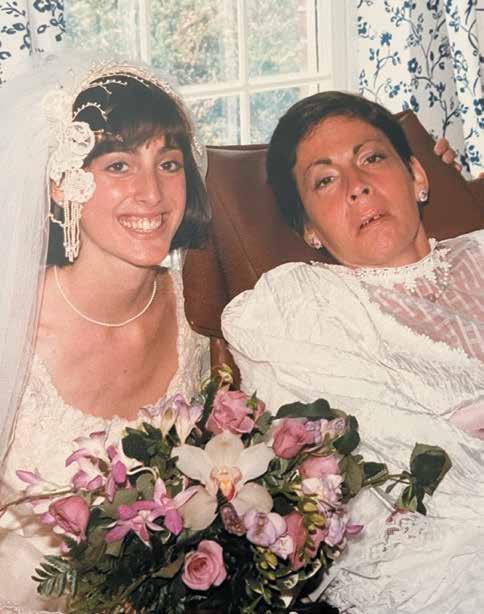
My mother is the inspiration behind Yoga Moves MS and my guiding light. I watched her experience MS for over twenty-seven years where she spent most of my childhood (and her adulthood) in bed or in a wheelchair. In the 1990s,
We encourage anyone with any kind of neuromuscular issue to join our classes, including post-rehab, people with osteoporosis, and seniors looking for a slower, less rushed class with more personal attention.
Mindy Eisenberg: Mainstream yoga classes book on the hour and they teach to the average level of ability with one teacher. There is a pre-assumed plan for each class, and it usually isn’t modified. Yoga Moves classes do the opposite. Our classes are smaller and last 90 minutes to two hours. You won’t be rushed.
Karen Couf Cohen: What journey or experiences brought you to create Yoga Moves MS?
Mindy Eisenberg: My mother is the inspiration behind Yoga Moves MS and my guiding light. I watched her experience MS for over twenty-seven years where she spent most of my childhood (and her adulthood) in bed or in a wheelchair. In the 1990s, I worked as a health administrator at the University of Michigan while maintaining a regular yoga practice. I was invited to teach a yoga class for individuals with MS. When several participants asked to continue meeting, I started offering adaptive yoga classes. Very soon I realized how transformative this practice could have been for my mother as her MS progressed. Conventional wisdom before the 1990’s held that MS patients should not move! It was, as I became more informed from MS specialists, that I saw how profoundly wrong that advice was. There is a large body of empirical evidence demonstrating the benefits of yoga for people with MS.
KCC: What About Yoga Moves gives you joy?
ME: Seeing the look on the students’ faces and watching the magic that happens between them. We’re more facilitators than teachers. We provide the environment, and the students create the magic. The “magic” is when students see other students that are experiencing the same thing as them. They are not “identified” by their condition in our classes but are simply one and the same–that gives me joy.
We’re more facilitators than teachers. We provide the environment, and the students create the magic.
KCC: What are the biggest challenges to running a program that offers free services?
ME: Funding! We believe yoga should be accessible to everyone, regardless of ability to pay. We do not charge for classes, but donations are appreciated. Our costs to run the classes are often misunderstood. Each class is led by two to four paid instructors. These teachers tailor the class to individual needs, allowing for personalized attention and a flexible flow.
As medicine has advanced, our referral model has shifted. While doctors and nurses still refer us patients, referrals from infusion centers (where patients receive their medication via IV) have declined as newer medications are more effective and last longer. We hope to strengthen our presence in the physical therapy community.
Securing free or affordable class space also remains a challenge. While we often look to churches and synagogues, rental costs can be prohibitive. This makes sponsorships—and our annual fundraising gala—essential to sustaining our programs.
KCC: What keeps you going?
ME: The feeling of connection from the community that we have created. People become friends inside and outside of class. It becomes a support group
and it’s fun. I relish the expressions I see on our students’ faces. When I see improvement—and I see them move in a new way that they couldn’t before our classes—that gives me incredible satisfaction. Many of our students want to help with our organization and get involved with YMMS, which is gratifying since we are primarily volunteer run.
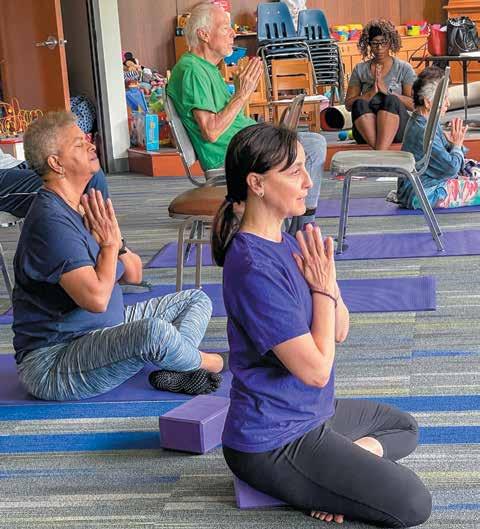
I relish the expressions I see on our students’ faces. When I see improvement and I see them move in a new way that they couldn’t before our classes that gives me incredible satisfaction.
KCC: Who inspires you?
ME: My students! When I see students who want to feel better, I’m inspired. When I see them do something they thought they couldn’t do when they first walked in and poof they can! Amazing. I also find it inspiring to see our teachers in action, brainstorming how to adapt poses to meet students’ needs. Based on what the student says, the teacher may respond with, “Why don’t we try this? Or next time let’s try that.” As I said, it’s a collaboration between the student and the teacher. It’s a team.
KCC: Tell me about meeting Selma Blair and what that meant to you.
ME: It was a dream come true. For years, my students and I have planted seeds and dreamed of meeting Selma and inviting her to join our Yoga Moves MS community from her hometown. It was pure serendipity that last May, the City of Southfield invited her back to present her with a “key to the city” and invited Yoga Moves to be the recipient of an MS fundraiser she would appear at that same day. Everything in the universe aligned!
Our whole Yoga Moves MS community was there. It was wonderful to see how she made sure to meet everyone and was so interested in hearing their stories. It was surreal for me. I always thought it would be so cool to meet someone with MS who was a big advocate. And Selma is that person. She is a role model and people look up to her. She creates hope.
KCC: How did you make the connection?
ME: We tried to connect to her in a variety of ways, including Facebook, and other social media sites, and one of our students who grew up with her in the Detroit suburb of Southfield also tried to reach out. Finally, a contact forwarded me her attorney/manager’s contact information. I began to develop a relationship by reaching out periodically.
KCC: Yoga can be intimidating: everyone seems to know the moves. What would a student attending your class for the first time expect?
ME: A new student at Yoga Moves MS would be warmly welcomed by the other students. Our students would want them to feel the same benefit, love, camaraderie, and dignity that they do, and not to be identified by their condition.
For more information on Yoga Moves MS, contact Mindy Eisenberg at (248) 417-5985 or visit yogamovesms.org. Classes support individuals at all levels. Available live online, on demand, and in-person in Livonia, Troy, Grosse Pointe, Southfield, Franklin, and Farmington Hills.









Phone: 734-944-7556
Fax: 734-661-1314
For all of us, time marches on. You may have been managing your finances successfully for many years. You may still feel you can manage the funds but would like some oversight to help you out as things change. Perhaps you want someone who will listen, take good care of you, and not push you into the product of the day. Check with us to discuss how our services might help to reduce your stress at a very reasonable cost.

By Christy DeBurton
Hello, I’m Christy DeBurton, and I’m a Yoga + Healthy Lifestyle Educator from Ann Arbor. I began in this profession almost 30 years ago teaching wellnessthemed group yoga classes. Since then, my practice has evolved and deepened to include working with clients privately in my Ann Arbor studio, as well as creating online yoga, self-care, and (peri)menopause content. In addition, I love writing informative articles for my Wellness Blog, so I am honored and delighted to be taking over the Yoga Column here in The Crazy Wisdom Community Journal to share yoga and healthy lifestyle resources with even more people! I do want to start out with a confession: when the editor of this publication suggested the name, ‘Yoga for Life’ for my new column, I thought it sounded kind of, well, boring. I wanted something more enticing, and contemplated writing back, “How about ‘Yoga for Healthy Living?’” But the more I thought about it, the more I realized that ‘Yoga for Life’ really was a more appropriate title. You see, as much as I’m sure anyone reading this column wants to live a healthy life, at times that is easier said than done. We’ve probably all gone through periods when we haven’t felt our healthiest: seasons of illness, burnout, grief, upheavals…in other words, “Life.” These things are all part of the human experience. That is why I decided that “Yoga for Life” really was a more fitting name for this column. It’s just more realistic. I look forward to sharing practical yogic tools that help me, my yoga students, and clients navigate life with more ease.
I want to address a subject that is so pervasive in our world nowadays: stress. While a little bit of stress is actually good for you, too much has the opposite effect. How do you know if your stress is out of control? Take a moment to answer these questions:
• Do you often find yourself complaining that you’re overwhelmed?
• Do you wake up already feeling anxious about the day ahead?
• Do you feel like there is never enough time to get everything done so you’re always hurrying?
• Do you overreact to minor inconveniences?
• Do you feel both tired and wired when you’re trying to fall asleep?
• Do you get sick easily?
• Are you constantly worried about your (or a loved one’s) health?
• Do you feel in a persistent state of dread about the state of our world?
If you answered “yes” to more than a couple of these questions, chances are good that you are activating your stress response system more often than you think which causes havoc with your cortisol and other hormone levels. This can lead to insomnia, high blood pressure, anxiety, digestive issues, and a weakened immune system.
If you answered “yes” to more than a couple of these questions, chances are good that you are activating your stress response system more often than you think which causes havoc with your cortisol and other hormone levels. This can lead to insomnia, high blood pressure, anxiety, digestive issues, and a weakened immune system. Unfortunately, being stressed out is considered normal in our society today, and many people wear their stress as a badge of honor. However, we are not meant to live this way—nor should we be resigned to it. So, what are some things we can do to get our stress under control?
Unless we spend time exploring the underlying causes of our stress, ultimately nothing will change. A yoga practice can help us do just that.
Unless we spend time exploring the underlying causes of our stress, ultimately nothing will change. A yoga practice can help us do just that. One of the gifts of yoga is that it helps us cultivate greater self-awareness. By getting on your yoga mat, you are taking time to slow down, be mindful, and see what you can learn about your body. With ongoing practice, you are better able to listen to your body and give it what it needs on a daily basis.
Below are a few other quick and simple tools I like to draw upon when my stress levels are feeling out of control:
Breathing techniques are excellent for soothing a dysregulated nervous system and lowering stress levels. My online yoga students and private clients love the various breathing techniques I teach them, and I even have my own favorite (47-8 Breath) that I use on a regular basis.
Use a Mantra
Repeating some kind of positive mantra to yourself will crowd out stressful, negative thoughts and put you in a better frame of mind. If you’re a yogi, you might like to use a Sanskrit word or phrase like “Om” or “Sat Nam.” Or you could use an affirmation like “All is well” or “I’m Okay.”
Your vagus nerve plays a big part in regulating your parasympathetic nervous system and affects your heart rate, breathing, immunity, and digestion. Vagus
nerve stimulation also decreases the sympathetic nervous system and the stress response. I find vagus nerve exercises very helpful and often share them with clients.
If the idea of finding time to go to an hour-long yoga class stresses you out even more, do something shorter, like a 15-minute yoga video, or take a walk around your neighborhood. The physical movement will help release stress and tension in your body—and help you feel better emotionally, too.
This meditation quickly brings you into the present moment, especially if you do it out in nature. I love leading clients through it at the end of an Aqua Yoga session in my pool!

Visualization is a technique you can do on your yoga mat, or when you’re lying in bed at night with stressful thoughts racing through your mind. Think of an event from your favorite relaxing vacation or a scene from your favorite (nonaction) movie. You could even bring into your mind that cute pet video from social media that makes you feel warm and fuzzy. It may take practice to stay focused on the visualization but keep at it. It will become easier in time and will be a nice distraction for your ruminating mind.

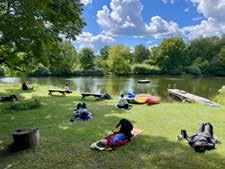
For best results, try out one of these suggestions every day for a couple weeks. Continuity is the key.
For best results, try out one of these suggestions every day for a couple weeks. Continuity is the key. Meditating once isn’t going to help you long-term, but you’ll start to notice a change if you meditate every day. Doing vagus nerve exercises once isn’t going to make much of a difference, but you’ll start to feel a shift if you do them every day. These techniques may seem overly-simplistic when you’re dealing with a lot of stress–that’s what I thought at first–but, trust me, they will help you navigate life with more ease if they become part of your daily routine. And what’s great is that they will only take a few minutes of your time.
Christy DeBurton is a Yoga + Healthy Lifestyle Educator from Ann Arbor. You can find breathing techniques, vagus nerve exercises, meditations, yoga videos and more free resources to help lower your stress levels on her website at yogaroomannarbor.com. Have a yoga or healthy living question? Email Christy at info@christydeburton.com.


Join internationally respected educator and author Wendy LeBlancArbuckle for an invitation to deepen your relationship with movement. Through an embodied, biointelligent approach, you’ll explore new ways of sensing, organizing, and moving accessing the innate wisdom of the body and its fascial matrix, your “inner guide ”
Cost: $395 $345 Early Bird: register by May 15 *for clients and Instructors (6 NCPT CECs)
Saturday
June 27 9am - 4pm


Rowena Conahan offers massage therapy, energy work, and spiritual healing table sessions in her Ann Arbor studio. Space clearing and land healing are available on location in Southeast Michigan. “Beyond the containers we can see—human bodies, our homes, forests, meadows, and waters—are many layers of history, energy, and feelings that condition how we live in this world, and how the world itself exists. Together, through patience and stillness we can access these deeper aspects and strengthen the web of life.” Learn more at naturespeak.life or email naturespeaklife@ gmail.com.
By Rowena Conahan
“I think I want to do what you do, someday.”
The words were out of my mouth before I’d spent even a single second considering them. Appalled, I gazed, eyes wide, at the woman in front of me, a new acquaintance whom I knew to be highly intuitive, an accomplished spiritual healer. I couldn’t fathom where that statement had come from. It was almost as if the words had been spoken to me, as much as through me.
The words were out of my mouth before I’d spent even a single second considering them…I couldn’t fathom where that statement had come from. It was almost as if the words had been spoken to me, as much as through me.
I was in my early thirties, and, at the time, routinely described myself as “buried under babies.” Deep in the thick of bringing up children, I couldn’t imagine myself in any serious professional role, let alone the one I most admired. I’d been exposed to intuitive healing when one of my children, constantly sick, had failed to respond to anything else we’d tried. Homeopathics, suggested by an intuitive healer, had finally turned the ship around, and I was transfixed. In brief snips of time, here and there, I was dabbling with muscle response testing in an effort to develop my intuitive capacities. It wasn’t going well. And to be honest, I wasn’t really sure what I thought I was doing.
The oddity I’d just spoken hung in the air, weirdly bright, though patently inconceivable. It was time for a set-down. Instead, my companion smiled kindly and said, “Yes, I think you will.”
There are moments in our lives in which a wind seems to lift us high enough to glimpse the path ahead, a sparkling trace through the shadows and the hills. I floated up there for what couldn’t have been more than a minute before my arms were once again filled with sticky, cranky sweetness, and it was time to give baths, read stories, and turn out the lights.
In the years that followed I solidly convinced myself that the idea of being a spiritual healer was pure fantasy. Since childhood I’d been fascinated with psychic phenomena, even choosing that as the topic of my first real essay for a middle school assignment, which invited us to research a topic of personal interest. Useful literature on this subject was extremely limited in the library of the small, conservative town where I grew up. But I scrounged a couple of books and dug in.
Deep in the thick of bringing up children, I couldn’t imagine myself in any serious professional role, let alone the one I most admired.
Whatever I read in those books, it planted in me a belief that if a person had intuitive talent, it would present itself clearly in youth and would be obvious to everyone. My thinking was very either-or. Either you’re born with special abilities, or you’ll never have them. This mental barrier would muddle my thinking for much of the following two decades, years characterized by a tug-of-war between my certainty that I was “not special” and my insuppressible attraction to intuitive work.
lThe next shocking declaration in this odyssey was issued forth by a single word. Despite my limiting beliefs, I’d spent considerable time studying and practicing intuitive arts. Over the course of a dozen years, I’d learned a great deal about how to dialogue with my body and had enjoyed the rewards of improved health. I’d also become a bodyworker, specializing in techniques that required deep listening through the subtle senses.
These had been years of establishing myself in several community circles. In some of these spaces, I’d worn a mask so fixed I wasn’t even fully aware it was a mask. Our culture prizes logic and a business-like approach to all sorts of human activities and interactions. People whose essential nature clashes with these values learn, very early, to cultivate a persona that will earn acceptance. By young adulthood, I knew exactly how to present myself through the lens of rationality. But now, all that was on the line.
I’d been feeling a tug to share what I’d learned. The idea of a class on muscleresponse testing and food selection had been snowballing in my mind, gaining enough momentum that I’d written it all down. I visualized how I’d explain things, how I’d set up experiences so people could feel their own intuition at work. I had detailed handouts. I’d purchased a few dozen identical, tiny, opaque containers to hold food samples. I was excited!
In some of these spaces, I’d worn a mask so fixed I wasn’t even fully aware it was a mask. Our culture prizes logic and a business-like approach to all sorts of human activities and interactions. People whose essential nature clashes with these values learn, very early, to cultivate a persona that will earn acceptance.
There was just one problem. In order to run this class, I’d need participants. And in order to have participants, I was going to have to tell people about it. And in telling people about it, I’d have to pry off that rational mask and cast it aside. Never again could I project the comfortable fiction that I didn’t “believe in that stuff.”
An email had been composed. It was addressed to a wide swath of people I knew.
I hit send.
lThat class was a blast. People really liked it, and I loved it. I ran it two or three times, and then I was on to other things, principally, the creation of a nature connection program, which I led for ten years. Nature is my happy place, and it was a constant joy to create an environment in which people could find their footing and feel their own belonging in wild spaces. It was intensely practical work, helping folks make fire, build shelter, gather plants, and flow with the weather. And behind it all, for me, was a spiritual imperative, embodied in this quote, by Baba Dioum, a Senegalese conservationist:
“In the end we will conserve only what we love; we will love only what we understand; and we will understand only what we are taught.”
But when it came to my belief that nature connection is spiritual work, I was back to masking. People of many different faith backgrounds joined our programs. To me this was wonderful, and I wanted to welcome everyone. I took care to nourish a sense of wonder without evoking religiosity. I believe this worked well. But I felt a growing desire to step forward more openly in my spirituality.
Pandemic scraped its way across my life, as it did for so many, facilitating the conclusion of my years teaching outdoors. I let myself compost a while, digesting experience, and building fertility for something new.
Pandemic scraped its way across my life, as it did for so many, facilitating the conclusion of my years teaching outdoors. I let myself compost a while, digesting experience, and building fertility for something new. I wrote a book of nature-connected stories and activities. And all the while, I was eyeing another spooky threshold.
By now I’d been receiving mentorship with my healer for well over two decades. Two decades of slow, gentle support for my emerging spirituality and intuitive capacities. It’s lovely to be a student, and I believe I always will be. But it was long past time to openly admit that I am a spiritual healer. And so, I prepared more emails, offering land healing, space clearing, and table sessions.
It’s a strange and scary thing to say, “I am a spiritual healer.” Where does such a thing come from? It’s a destination with few recognized pathways. Heading there has often felt like padding about in a darkened room. But I am finally, with increasing steadiness, ready to be a candle.
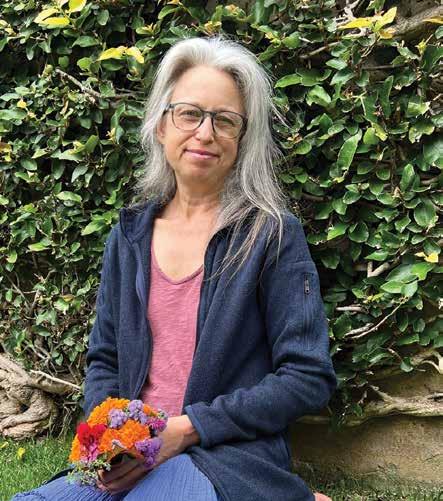








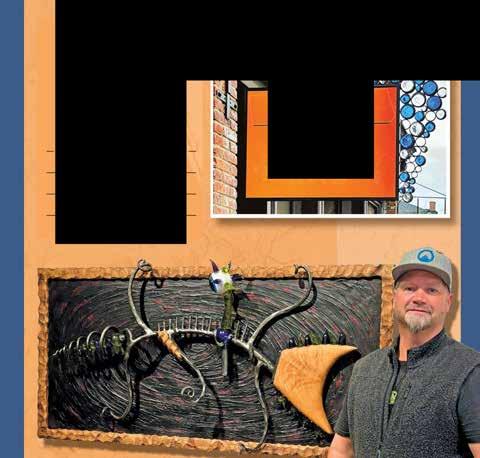



By Julie Barron
I have always loved non-ordinary states of consciousness. Long before I had language for spirituality, ecology, or nervous systems, I learned to move between states of awareness through breath.
As a child, that exploration came through music (playing flute and singing) through swimming, and through time spent outside. Breath was my first teacher. It showed me how attention, rhythm, and environment could change how I felt inside my body.
I have always loved non-ordinary states of consciousness. Long before I had language for spirituality, ecology, or nervous systems, I learned to move between states of awareness through breath.
My earliest memories of connection with plants were playful. I rubbed yellow dandelion flowers against my skin and watched them stain me gold. I blew on seed heads and scattered dandelion glitter into the air. Dandelions were a safe, early invitation into the plant world.
As a kid, I spent many waking hours playing flute and swimming. Both were deep experiences with breath, often in nature. One of my most profound musical and breath experiences was playing flute in a large outdoor symphony orchestra at night. The collective breath of the wind and brass sections—taking turns, harmonizing, sometimes breathing together—felt invigorating and deeply mindexpanding. That shared breath felt like an ecosystem in motion: many bodies acting as one living system.
Summers were also spent swimming in Michigan lakes, sometimes doing triple or quadruple lakers—swimming the full length of the lake back and forth multiple times. Immersed in water and surrounded by trees, sun, and earth, I loved extending the capacity of my breath—drawing it in deeply, holding it, releasing it fully.
Plants meet us where breath lives, at the border between inside and outside. Through inhalation, plants enter our bodies as scent, smoke, and chemistry. Through exhalation, we return breath back to the world. This exchange is intimate and reciprocal.
As I got older, plants again became teachers. First tobacco, then cannabis introduced me to non-ordinary states through ritualized breath. Smoking was never just consumption for me; it was relational. Breaking apart the plant, lighting it, inhaling and exhaling with intention—these acts shaped my nervous system and my awareness.
Plants meet us where breath lives, at the border between inside and outside. Through inhalation, plants enter our bodies as scent, smoke, and chemistry. Through exhalation, we return breath back to the world. This exchange is intimate and reciprocal.
Cannabis especially drew me in through the senses—the smell of terpenes, the resin clinging to my fingers, the way scent lingered on skin. My curiosity deepened into cultivation. I learned what plants need to survive and thrive: light, soil, water, nutrients. Caring for plants slowed me down and required me to move at biological time, not human speed.
That care expanded my attention outward. If we want plants to be truly healthy, we want them rooted in living soil, growing within whole ecosystems—alongside insects, microbes, fungi, and one another. Soil mattered. Water mattered. Relationship mattered. Through plants, I came to understand the plant kingdom as intelligent, responsive, and relational. While they used to be all cannabis, my gardens today are mostly medicinal herbs, flowers, and food plants, with a few cannabis plants mixed in—still there, in part, because of their beauty.
Later, fungi became my teachers. Living in Colorado, I frequently encountered Amanita Muscaria while camping and hiking—those unmistakable red caps dotted with white. Psilocybin mushrooms, like cannabis before them, invited me into deeper relationship rather than control. I wanted to understand how they grow, how environments support them, and how little mastery we actually have.
I began to see Earth’s ecosystem as an even more vast, intelligent whole—one that I am inseparable from. What I do matters, not in some abstract cosmic sense, but locally, relationally, here.
I never became especially skilled at cultivating mushrooms—contamination taught me humility—but my respect for fungi only deepened. Through study, foraging, and experience, fungi revealed something essential: connection does not always announce itself. Like breath, it is often invisible, yet fundamental.
As my personal and spiritual growth expanded through these plant and fungal relationships, familiar questions returned: How do we care for soil? What water is truly healthy? How do mycelial networks interact with plants, animals, and us? I began to see Earth’s ecosystem as an even more vast, intelligent whole— one that I am inseparable from. What I do matters, not in some abstract cosmic sense, but locally, relationally, here.
Research has begun to echo what many Indigenous cultures have long known. Biologist Monica Gagliano’s work suggests that plants not only produce electrical signals but also respond to sound—orienting roots toward water frequencies and responding to the sound of predators chewing on nearby leaves. Other studies suggest that the sound of bees signals some plants to quickly increase sugar production, making their flowers more attractive to these pollinators. Because plants do not have centralized brains, humans often discount their intelligence. As Gagliano said, they are “feeling bodies.” Plants don’t speak in words; they require a different kind of listening. How we listen shapes how we live.
Psychedelic plants and fungi can temporarily dissolve the boundary between self and other, between human and non-human.
For many people, “connecting with nature” can sound abstract or effortful. Plants and fungi make connection tangible. Their scents, colors, tastes, and forms attract us. Apples invite sweetness so seeds are spread. Thorns and bitterness create distance. This is not by accident—it is ecosystem intelligence. Some plants attract us by altering our states of mind.
Personal experience, ancestral lineages, and emerging research are exploring these relationships. Research on psychedelic plants/fungi suggest these substances can facilitate self-expansion by softening self-boundaries and increasing emotional and empathic awareness. Other studies have found that psychedelic experiences are associated with lasting increases in nature relatedness and psychological well-being.
Studies have found that psychedelic experiences are associated with lasting increases in nature relatedness and psychological well-being.
Psychedelic plants and fungi can temporarily dissolve the boundary between self and other, between human and non-human. In one psychedelic journey, I experienced traveling backward through time. I felt as though I was tracing the story of my DNA—through humanity, animals, plants, fungi, water, and particles. Since then, I feel these beings not just as evolutionary foundations, but as my ancestors. Experiences like these often shift people from egocentric worldviews toward ecosystem-centered ones. As many Indigenous traditions teach, nature is not a resource—it is relationship. Reciprocity is the difference. Plants benefit from us, and we benefit from plants. For a long time, I was largely unaware of that balance, even while deeply in relationship. Over time, that awareness changed not only how I gardened, but how I acted.
My love for plants and fungi eventually grew into advocacy. I began to question how policies came to classify certain living things as illegal or dangerous, despite their long histories as teachers, medicines, and ecological partners. This questioning led me into work to decriminalize psychedelic plants and fungi—to challenge systems that treat them as contraband rather than relations. Today, I work with and for plants and fungi, and they work with and for me. This is not ideology for me; it is practice.
Dr Parke is an osteopathic physician offering integrative pain consults and osteopathic manipulation to ease pain and guide patients toward musculoskeletal well-being. Her holistic approach will help you rediscover the Health within.
Board certified in Osteopathic Manipulative Medicine & Physical Medicine and Rehabilitation. RYT2oo.
Phone (734) 984-3612
Office - 231 Little Lake Dr, Suite E, Ann Arbor, MI 48103
Email: susannahparkedo@gmail.com
Visit the website for more information, www.susannahparkedo.com


My love for plants and fungi eventually grew into advocacy. I began to question how policies came to classify certain living things as illegal or dangerous, despite their long histories as teachers, medicines, and ecological partners.
I believe our modern disconnection from nature is a source of profound disease. We live out of rhythm, imagining ourselves as controllers rather than participants. Societies may win short-term power struggles with nature, but Earth always endures. Healing, I have learned, does not come from force. It comes from listening. From quiet. From rest.
Plants and fungi thrive in relationship, not extraction. Through scent, sound, beauty, and altered perception, they help us remember our belonging. Plants are not passive objects of appreciation. They are invitations.
And breath—shared, exchanged, and returned—is often how we learn to connect.
Julie Barron, MA, NMIT is a pioneer of the Michigan alternative healing and psychedelic community. For over 30 years she has done extensive research and training in the health & spiritual benefits of cannabis and entheogenic plants/ fungi. Barron has devoted her practice at Blue Sage Health Consulting to helping clients find healing and relief as they incorporate these practices on their path to wholeness. You can learn more about practices of integrating breath, music, and plants/fungi at Blue Sage Health Consulting in Ann Arbor or email bluesagehealth@gmail.com.







By Dr. Susannah Parke, DO and Dr. Amanda Hallberg, MD
Persistent daily pain is a diagnosis that has unfortunately increased over the past decade in this country. Sometimes the source is known, but oftentimes, the etiology remains a mystery. As physicians, we wondered why some patients skate through life with very little pain and why others find themselves reaching for the Advil every day.
The term “joint hypermobility” kept coming up in medical discussions with colleagues and at regenerative medicine conferences. Initially, it was deemed a rare, genetic connective tissue disease that was characterized by loose or weak ligaments. However, the prevalence of this issue is increasing, and recent evidence supports that various environmental toxins are causing inflammation and impairing the strength of the connective tissues even more. When we started to examine our patients’ joints, we found a plethora of hyperextended knees, double-jointed fingers, and collapsed foot arches. None of these exam findings were new to us, but now we knew the reason why some patient’s joints acted differently. It was a revelation to finally understand why so many patients with pain were not improving with traditional interventions.
The prevalence of this issue is increasing, and recent evidence supports that various environmental toxins are causing inflammation and impairing the strength of the connective tissues even more.
You may have heard of Ehlers Danlos Syndrome (EDS). Ehlers-Danlos Syndrome is a group of inherited genetic disorders that are characterized by weaker connective tissues from a collagen defect, primarily affecting skin, joints, and blood vessels, but also internal organs. The altered collagen results in hypermobility: stretchy skin, fragile tissues, easy bruising, and more. One of the subtypes, hEDS (hypermobile type-EDS) is the most common. Providers use the Beighton score or a scoring available at The Ehlers Danlos Society (ehlers-danlos.com) to assess the hypermobility of select joints. Whether a patient meets the full criteria of Hypermobility Spectrum Disorder (HSD) or not, a person can benefit from additional measures to avoid loss of function and improve quality of life.
Some patients with hypermobility may be diagnosed as young as eight years old. They might have scoliosis, very flat feet, and crowded teeth. But most patients trickle into the office later in life because of years of unrelenting, mysterious pain. Most have seen other providers without finding relief or have been told it is stress or a non-physical cause. We commonly hear a patient say, “My head feels like one of those bobble-head toys—it feels like it’s going to fall off!” The ligaments holding the cervical vertebrae together are like overstretched rubber bands. The muscles of the neck and shoulders have to work harder to keep the neck upright—and that hurts. One of the most common demographics we see are middle-aged women. They may be juggling work and childcare, their hormones are changing, and their body can no longer compensate under the physical and mental stress. The body starts sending warning signals— specifically pain signals. Pain is our body’s way of communicating the need to slow down and check in.
Some patients with hypermobility may be diagnosed as young as eight years old. They might have scoliosis, very flat feet, and crowded teeth. But most patients trickle into the office later in life because of years of unrelenting, mysterious pain.
Men can also get hypermobility but are somewhat protected by the added strength their hormones provide. Men can get scoliosis or require orthoses in their shoes. One student had so much pain in his fingers, he needed to take time off from college. And just like women, they have been referred to physical therapy more times than they can recall.
When we move a body part, all the players involved (bones, tendons, ligaments, and fascia) have to move in a coordinated fashion. In a body with “normal” joint mechanics, a joint stays in a specific range of motion to stay safe, and if
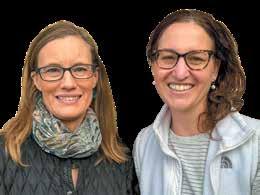
it is forced beyond this range of motion, there is an injury. When joints have more laxity, it takes less outside force for an injury to result because there is less stability and communication within the joint. The cartilage protecting bony surfaces gets damaged, ligaments and tendons may be torn, nerves become irritated and then muscles overwork to attempt to keep the system intact.
Why is it important that clinicians recognize who is on the hypermobile spectrum? Simply, it helps a practitioner direct patients to better care. There are a few reasons why it is taking the medical community so long to catch up with the research. First, connective tissue disorders were only covered briefly in medical schools, and only the most severe conditions like Marfan’s Syndrome, seemed to matter. Consequently, patients with vague, widespread pain often receive a diagnosis of overuse syndrome, fibromyalgia, or “stress-induced” pain from their doctor. However, the difference is that EDS/HSD results from an actual collagen defect.
Why is it important that clinicians recognize who is on the hypermobile spectrum? Simply, it helps a practitioner direct patients to better care.
Also, joint hypermobility is very hard to detect on imaging. We can’t see loose ligaments on x-rays or cat scans, and even MRIs are only minimally helpful. Floppy ligaments are challenging to detect on examination, but patients can certainly feel when their limbs refuse to stay resting in their sockets. To complicate the picture, someone with EDS or HSD can have other vague symptoms that don’t appear to be related—dizziness when standing, stomach discomfort, unexplained hives, brain fog, debilitating fatigue. Turns out, hypermobility is connected to a slew of other issues that affect the immune and autonomic nervous systems, but the symptoms are so disparate, that patients hop from specialist to specialist without determining the underlying cause. Some of these other medical conditions that can show up alongside hypermobility disorders are mast cell activation syndrome (MCAS), postural orthostatic tachycardia syndrome (POTS) and dysautonomia, stomach/digestion problems, autoimmunity, Lipidema, ADHD/ASD, even dental problems. And then add in post-covid syndrome or mold exposure and these symptoms escalate. Patients often struggle to find specialists to address each issue, which just adds to their fatigue.
Luckily, the number of resources for people with hypermobility has sky-rocketed over the past decade: The Bendy Bodies podcast with Dr Linda Bluestein, The EDS Society website, The Zebra App, an app with EDS-friendly exercises, and there are more physicians who are familiar with hypermobility disorders now. Next time you go to physical therapy, pilates, or personal training, first ask, who works with hypermobile patients the most? A PT who understands will keep you safe from injury and not ask too much of your body. The rehabilitation approach to a hypermobile shoulder should not be the same as the approach to a “normal” shoulder. So many people with hypermobility learned to manage on their own by guarding the areas of instability and pushing through the pain, but that approach is unsustainable. And as practitioners, we need to remember that all pain is worth investigating, even though we may not recognize the signs and symptoms. We also need to remind patients to pace themselves, especially the ones with hypermobility and other chronic conditions. The adage, less is more, is especially relevant to the hypermobile body. Your body has a profound intelligence—it will tell you what it needs if you listen.
Dr. Susannah Parke, DO and Dr. Amanda Hallberg, MD are two local integrative physicians who wish to increase awareness of different medical conditions and topics to benefit our community. Amanda Hallberg MD is a Family and Integrative Medicine Physician practicing in Ann Arbor for 21 years. Susannah Parke DO practices Integrative Pain Medicine and has been at her Ann Arbor private practice for a decade. She is double boarded in Physical Medicine and Rehabilitation and Osteopathic Manipulative Medicine. Additionally, she is certified as a yoga teacher and personal trainer. For more information on Dr. Parke’s practice, please visit her website at susannahparkedo.com or give her office a call at (734) 984-3612
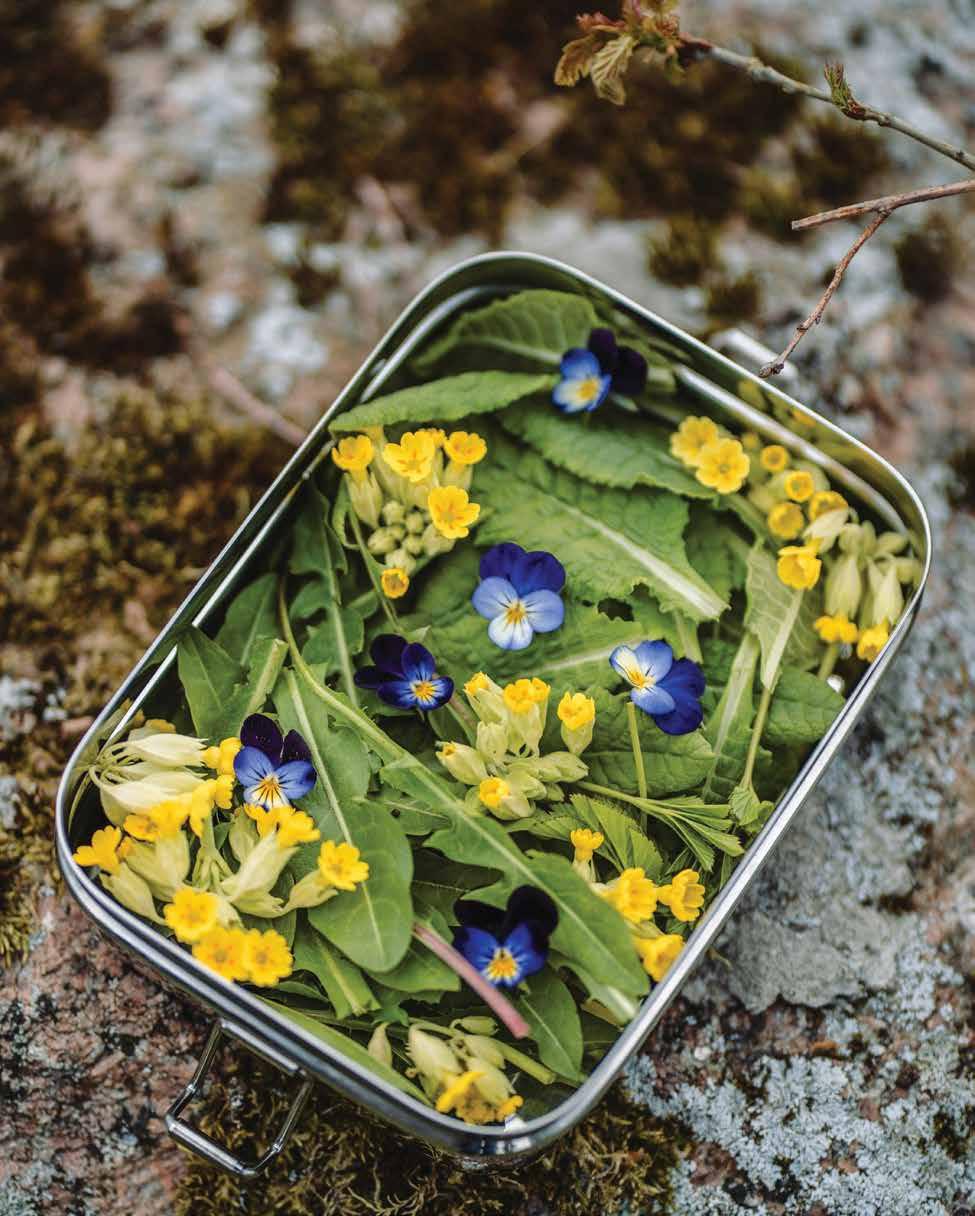
The Great Lakes Forager’s Gathering began as a potluck with a dozen people in 2014 and has grown into the largest and longest running foraging event in the Great Lakes region. This year, the Gathering will run from June 18th through the 21st. The summer solstice weekend was chosen specifically for the longest daylight. Read about this year’s workshop offerings on page 36.

This ongoing column features upcoming events within Ann Arbor/Washtenaw County and surrounding areas’ Body/Mind/Spirit communities, new (during the past year or two) practitioners and holistic businesses, new books written by local/regional authors, new classes, as well as new offerings by established practitioners and holistic businesses.
By Lynda Gronlund
Southeast Ann Arbor’s Bicentennial Park (renamed from the Southeast Area Park in 2023), at the corner of Ellsworth and Platt, will open with a major upgrade this summer: the city’s first universal-access splash pad, updated playground, pavilion, and restrooms all of which will be solar-powered.
Construction occurred during the second half of 2025, and everything will be ready for visitors at the start of pool season around Memorial Day. The splash pad has been designed to include users of all ages and abilities and to be accessible and sustainable. There will be three distinct zones.
The Tot Zone is aimed at younger children with small bubblers, a water table, and no overwhelming sprays. The Family Zone will include more dynamic sprays and elements for group play. The Splash Zone features multidirectional sprays and a large bucket that fills with water before tipping over and creating a dramatic splash. The splash pad and the new playground are both designed to be universally accessible, with equipment selected to meet a range of physical and sensory needs. Sustainability is addressed with a water recirculation system in addition to solar power meaning that water is treated and reused much like in a pool. This will save a million or more gallons of water each season the splash pad is in use.
The park improvement project was funded through donations and partnerships with local organizations including the State of Michigan, the University of Michigan, the Rotary Club of Ann Arbor, Association Football Club (AFC) Ann Arbor, the International Water, Sanitation and Hygiene Foundation (IWSH), United Association, Kohler Company, and Shoner Plumbing and Mechanical.
More information about the Bicentennial Park improvements is online at.a2gov.org/news/posts/construction-underway-on-ann-arbor-s-first-universal-splash-pad-andmore-in-bicentennial-par/, and questions can be directed to Park Planner Adam Fercho at afercho@a2gov.org. Bicentennial Park is located at 2901 East Ellsworth Road, Ann Arbor, MI 48108.
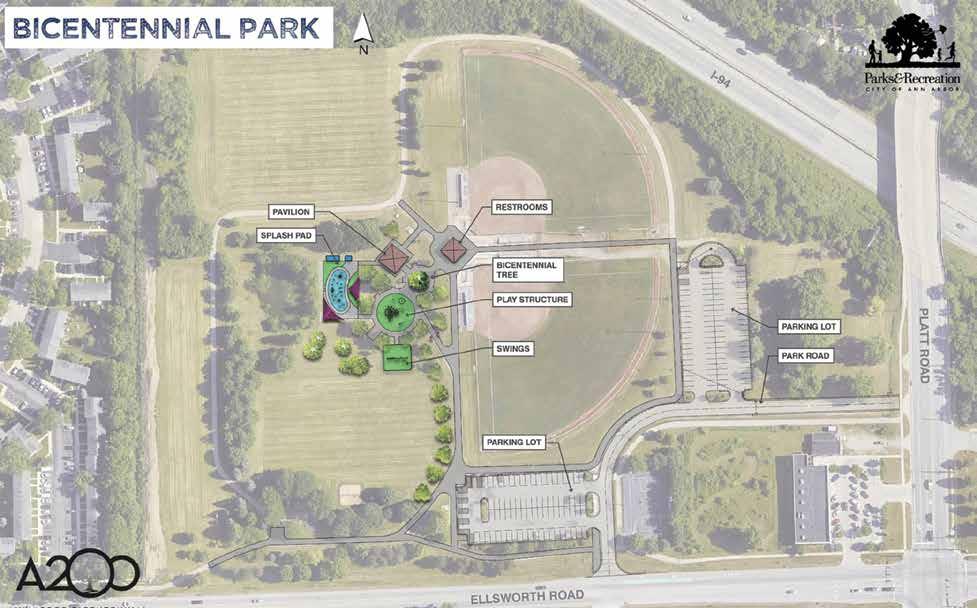
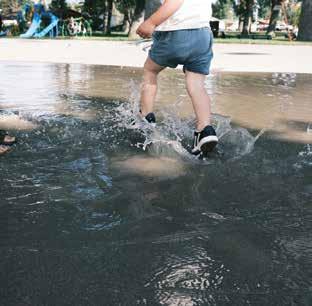
Candice Pizzo started Oracle’s Apothecary in 2018, opening her Lansing storefront in 2021.
Going by the nickname The Oracle, Pizzo has been reading tarot and oracle cards and working with herbs for more than 20 years (since she was in her early teens). She is a psychic medium who works with her own and her client’s ancestors and spirits, and she also serves as a medical intuitive. She does readings in a private room in her store and hosts other readers as well. Regular readers include Clarity Tru, who works with astrology, numerology, and various divination tools; Jo Figueras, a spiritual psychic medium and Akashic Record reader; Barb, who uses an old Appalachian tradition of stone reading; and Aro, an Afro-indigenous medicine man and dreamworker.
Pizzo also teaches classes on metaphysical topics like grounding, shielding, cleansing, ancestor veneration, and safe spirit communication.
She said that the store has been a dream of hers since she was very young, but like many people she distanced herself from what she now sees as her true calling for a long time. She remembers seeing the movie Practical Magic as a teenager in the nineties, watching Sandra Bullock as Sally Owens shelving the magic-enhanced lotions and soaps at her apothecary and thinking, “I want to do that!”
When Pizzo started her business, she began with skincare products and candles, sourcing local beeswax and organic botanicals chosen for their physical and spiritual benefits, and handcrafting them. For example, her Shields Up hair oil uses rosemary, peppermint, tea tree, and lemongrass oils for both scalp stimulation and spiritual protection. Her newest lines are Black Hole Sun, products geared toward clarity and focus, and Bust It Wide Open for road opening, a magical concept meaning removing obstacles and negative energy clearing the way for new opportunities. These scent blends and others are available as body butters, soaps, candles, and wax melts. Pizzo also makes serums, oils, and lip balms.

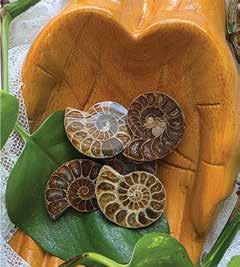
As her business grew and she was able to open her storefront, Pizzo expanded her offerings. The Apothecary has over 160 herbs for magical and medicinal use. She offers ethically sourced crystals, tarot and oracle cards, books, incense, jewelry, and more. She describes the store as a “metaphysical health shop.”
Pizzo recently visited Ann Arbor’s local mystical convention Convocation as a merchant after a hiatus of around ten years while she was busy with other life events. She said that she was happy to see that during that time the event has become much more inclusive of BIPOC people as teachers, giving her and others a greater sense of belonging. “It felt really good,” she said, to meet “a lot of cool people from different traditions,” and she plans to continue attending in the future.
At her store, Pizzo said she is excited to continue to build community in the Lansing area and to encourage people to “learn and grow and be themselves while doing so.”
Oracle’s Apothecary is located at 519 East César E. Chávez Avenue, Lansing, MI 48906. More information is available at Oraclesapothecary.com, on Facebook @ oraclesapothecary, and on Instagram @oraclesapothecary. Candice Pizzo, The Oracle, can be reached via email at info@OraclesApothecary.com.
In December of 2025, JUMP-IN Therapy and Wellness Center in Hamburg introduced the Uromaxx Pelvic Floor Treatment Chair: a non-invasive therapeutic device designed to treat pelvic floor dysfunction affecting bladder and bowel control, sciatica, and sexual health for both women and men.
JUMP-IN’s owner, occupational therapist Jackie Kilburn, explained that traditional pelvic floor therapy can be invasive, and many people struggle to access all the muscles involved in retraining for incontinence, urgency, erectile dysfunction, premature ejaculation, sciatica, and post-childbirth recovery. The Uromaxx chair uses targeted electromagnetic impulses to generate thousands of deep pelvic
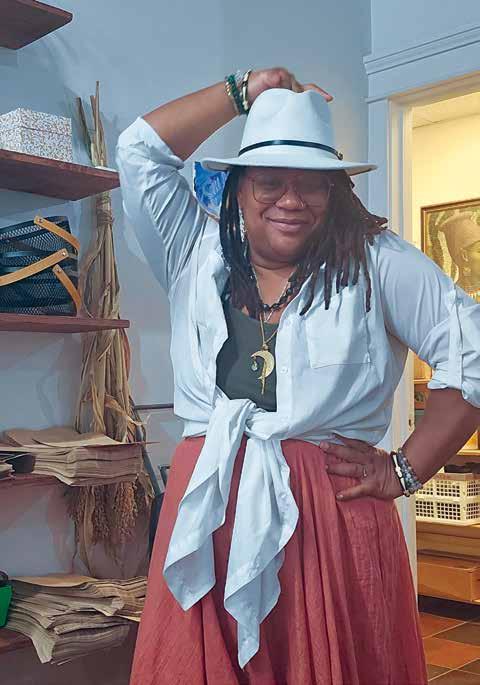
floor contractions (Kegels) in each session—far more than most individuals can achieve voluntarily. Treatments are performed fully clothed, with patients seated comfortably in a recliner-like chair.
To amplify the effects of the chair, Kilburn uses myofascial release, a technique she has used for over 40 years. “The electromagnetic impulses from the chair quickly wake up and strengthen the pelvic floor muscles. Myofascial treatment releases tension and improves range of motion and alignment of muscles, resulting in improved coordination, communication, function of pelvic floor muscles, and the muscles that work in cooperation/coordination with the pelvic floor,” she explained.
She went on to say that she has observed benefits beyond general pelvic floor health including improved posture, alignment, balance and reduced body pain, highlighting the pelvic floor’s importance in overall mobility and stability. She has even noticed improvements in neuropathy and joint pain in clients and in herself. Asked if the chair is similar to a vibration plate, she said no. “The chair doesn’t shake you like that,” she said. The electromagnetic waves don’t feel like a physical movement.
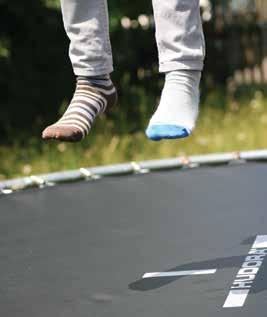
Most clients see significant improvement with eight to ten sessions of Uromaxx Chair treatments. JUMPIN accepts many insurance plans and offers treatments for pain, balance, lymphedema, strengthening, range of motion, reflex integration, motor skills, neurodivergence, sensory processing, and PTSD. The Uromaxx Chair is not currently covered by insurance plans, but Kilburn hopes that the treatments will be covered in the future as more evidence is reviewed.
JUMP-IN Therapy and Wellness Center is located at 10400 Hamburg Road, Hamburg, MI 48139, about a fifteen-minute drive north from Ann Arbor. Jackie Kilburn can be reached by phone at (810) 231-9042, or by email at jackie@ jumpinot.com. More information is online at jumpinot.com.
Hypnotist Jessi McAnelly of Moon Hypnosis opened her new office in downtown Ypsilanti late last year.
The space has large windows, lots of natural light, and is decorated in McAnelly’s eclectic style with zebra-print chairs, plants, and Tarot-themed tapestries.
McAnelly came to this work in a roundabout way. While working as a transcriptionist she started working for a hypnotist client who worked with professional poker players and UFC fighters. Around ten years ago, she hired a hypnotist herself to help with some emotional issues. She found it life-changing and more effective than talk therapy. She said that she had to “update the emotional identity root” so that she didn’t have to feel like she was fighting herself to make change and follow through.
In 2021 she became a board-certified hypnotist with the International Certification Board of Clinical Hypnotherapy and began working with clients. She is also certified through the Mandel Hypnosis Academy and continues to learn from other hypnotherapists. She began by working in a church’s spare room as well as from home and is thrilled to now have a dedicated in-person workspace to make her own. She does also offer online sessions via Zoom.
McAnelly helps clients with a number of issues: the usual ones like weight loss, smoking cessation, and stress relief, but she also loves working with creative people like writers and actors experiencing blocks, as well as business owners. She also helps with self-esteem, confidence, overcoming self-doubt, focus, anxiety relief, relationship issues, fears and phobias.
She said that often the issue the client comes in for turns out to be a catalyst for change in other areas. One client came in for help with stress and ended up finally finishing a long-tabled book. Another client, an actor, came in to get help with connecting to his intuition. He started showing up more confidently in his auditions and getting more parts.
“Hypnosis is kind of a blend of neuroscience and creative intuition,”
McAnelly said.
“It’s not strictly one or the other.” She said that it is very practical but also involves tapping into the imagination. It allows one to “turn on part of the brain that can feel what’s actually possible when you remove the static” and to “get underneath the patterns in a more creative way than just talking about the problems.” She emphasized that hypnosis is done in a modern way and is backed by science, not just vague beliefs. She said, “it is less about forcing change and more about tapping into, and uncovering, the creative part that already knows how to change,” allowing for an experience that feels “vibrant and alive.”
Most clients see results within two sessions, she said, with big shifts in the initial session and reinforcement and amplification in the second. Longer term goals like weight loss may take some ongoing work, she clarified, but for many issues, two is enough.
McAnelly has some community events in the works for summer, including a “confident introvert club.” Details will be available on her website as they are finalized.
Moon Hypnosis is located at 133 West Michigan Avenue, Suite 100 Ypsilanti, MI 48197. Jessi McAnelly can be reached via her website contact form at moonhypnosis.com or by email at Jessi@MoonHypnosis.comosis.com
Milan-based nutrition coach, Reiki Master, Ayurvedic Health practitioner, and therapist Michelle Duprey, MSW released her new audiobook, The I-Twelve: 12 Important Questions that can Improve your Individual Wellness and Change Your Life on January 30.
The book consists of twelve focused questions presented in a conversational discussion format designed to offer practical insight that can be applied to one’s life right away. Drawing on her perspective as a therapist, transformational health coach, and her own life experience, Duprey shares compiled knowledge, lived experience, and practical skills with the intention of empowering the listener to “choose what is optimal over perfection, growth over automatic patterns, and to prioritize grounded knowledge over passing trends.”
The twelve questions include: Do you know how to change? Do you know what to eat? Do you know how to make decisions? And what is your purpose? The questions were chosen because Duprey realized that “many people make progress in their lives when they can answer these (and other) questions for themselves, and while discussing them in session, the growth that came from the new knowledge was almost immediate.” She thought that more people could be helped by considering these questions than just her own individual clients. She chose to release the I-Twelve as an audiobook to make it very accessible to people on the go. She described it as “all the stuff you want to ask a parent.” The questions are asked as if from a teacher to a student, asking the student to discuss the answers. She does not claim to have all the answers; she has some answers, and as everyone is bio-individual and psycho-individual, ultimately everyone’s answers will be a bit different. She views the questions and discussions as a starting point to find your individual correct answers.
One question asks, “Do you know how to read a scientific study?” Part of the discussion is how to find accurate information in our overwhelming clickbait society and not succumb to oversimplified or even false reporting on studies.
Another asks, “Do you know what generally causes preventable disease?” Duprey said that this discussion can be considered a starting point, and that there are many perspectives on this topic.
She does hope to release a Volume Two, and while she has her own list of questions to potentially include, she is also accepting suggestions from listeners as to what they want to explore next.
More information about the audiobook is at stressrehab.net/theitwelveaudiobook, and the book can be purchased and downloaded there through Bookfunnel. Michelle Duprey can be reached by email at michelle@itervia.net.

Physical Therapist Eileen Dickinson became certified as a Level Two Foundation Training Instructor last year.
Foundation Training is a corrective exercise program aimed at correcting muscle imbalances and movement patterns. Dickinson said that she finds it effective for correcting long-standing postural and movement patterns, while developing space, length, and strength. Originally created to relieve back pain, it uses isometric contractions to anchor the pelvis, integrate the entire body, and decompress the spine. Even after one or two exercises people feel taller, stronger, and more confident said Dickinson.
Since 1998, she has also practiced Trager, another modality that focuses on resolving physical imbalances, through deep relaxation and body-mind re-education. Dickison has found these two methodologies to be very complimentary since, “Trager focuses more on evening out tension in the body from the perspective of letting go, while Foundation Training focuses on evening tension through muscle activation.” Both can be used to recover from injuries and chronic conditions and are helpful in preventing common physical problems that tend to happen with age.
Dickinson would love to see more Foundation Training Instructors in the Ann Arbor area so that it can be better known and more widely practiced. At this stage of her life, she explained, she is more focused on teaching others to use the knowledge she has accumulated than working with individual clients. She believes Foundation Training should even be used in elementary and middle school physical education classes, so that children learn better movement and posture from young ages to carry them throughout their lives.
In addition to sharing Trager and Foundation Training with individuals, Dickinson is bringing her passion of teaching science to somatic practitioners. Her signature three-day course, Relevant Science for the Art of Somatics, focuses on science that supports key aspects of presence, touch, and movement. Having taught in the past few years in Switzerland, Seattle, and Washington DC, she is teaching this class on July 24 through 26 in Ann Arbor. The class covers science that somatic practitioners should know, and how to communicate with clients
and others that the work is grounded in science. The class was developed for Trager practitioners, but it is relevant to other somatic practitioners as well including those who use the Feldenkrais Method and the Alexander Technique.
On October 22 through 25, Dickinson will host Roger Tolle, senior instructor for Trager International, who will teach Somatic Foundations of Presence Touch and Movement. This workshop is open to bodyworkers, movement practitioners, and anyone who wants to learn more about embodied connection. It promises to offer a “nourishing space to refine touch, heighten sensory awareness, and deepen attunement to the natural intelligence of the living body, whether for personal exploration or professional practice.”
Details and online registration for the October workshop are available at rogertolle.com/somaticfoundations-workshop-annarbor. More information about Dickinson’s July workshop are in our calendar listing section, and questions can be directed to eileen@tragerology.com. Eileen Dickinson’s website is tragerology. com.
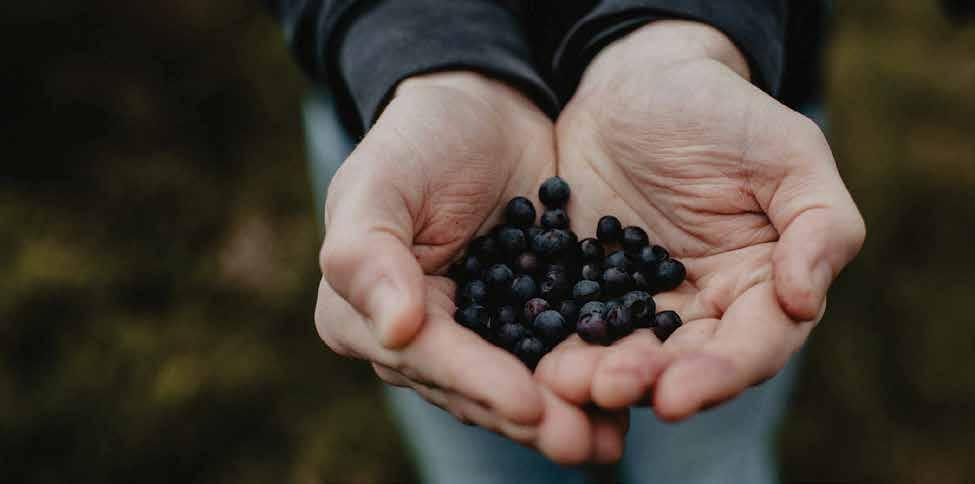
The Great Lakes Forager’s Gathering began as a potluck with a dozen people in 2014 and has grown into the largest and longest running foraging event in the Great Lakes region.
People come from as far away as New York, South Carolina, and Iowa to spend a weekend camping, learning, sharing knowledge, gathering plants, crafting, and cooking at Frog Holler Organic Farm in Brooklyn, Michigan. Organizer Rachel Mifsud said the event grew “by accident,” doubling in attendance each year for the first few years. It evolved into a full weekend of camping by year five, and in 2019 it moved to the large hayfield surrounded by woodlots and a stream at Frog Holler. The site had a stage, sound system, pavilion, and outdoor commercial kitchen already set up for a large annual music festival they host, so it was a perfect place for the Gathering to continue to grow.
This year, the Gathering will run from June 18th through the 21st. The summer solstice weekend was chosen specifically, said Mifsud, for the longest daylight. She said that the event usually draws 250 to 300 people these days, and that as the local foraging community continues to grow, the event is able to offer more activities, topics, and fun. Around thirty people contribute to running the event, she explained. Community cooks prepare meals from wild foods gathered year-round in preparation for the weekend. On Sunday, the groups holds a pancake breakfast with pancakes made from acorn flour and wild blueberries. The acorns are processed on site so participants can learn how. This particular tradition started, said Mifsud, during the event’s fifth year, which was held at a horse camp. “There was horse poop everywhere, and we cooked on an open fire on the ground. It started pouring rain, and the people who would become our kitchen crew stood out there and cooked pancakes for everybody.”
There are no vendor fees at the Gathering, said Mifsud. Every attendee who is interested is free to set up a table to sell their foraging-related products. “We want people to show what they have and make some money,” she said, because it strengthens the local and regional foraging community. Teachers and vendors for the event have included foragers, herbalists, hunters, trappers, naturalists, “wild foodies,” and bushcrafters. Anything using natural products can be part of the gathering: flint knapping has been featured in the past, and this year participants can learn broom making and basket weaving with natural materials. In addition to mushroom and plant walks and wild food gathering and processing, there is a potluck, open mic entertainment, a scavenger hunt, multiple cooking contests, community games, stargazing with a telescope, and weekend-long projects people can participate in.
Mifsud said there will be around 30 instructors teaching on various topics, several breakout sessions, and child-friendly activities. Only instructors from the Great Lakes region are hired for the event, both to support the regional community and to ensure the information is relevant to people living here. New offerings this year include three optional, limited-enrollment field trips: an introductory fishing trip at a nearby private lake with instruction on catching, cleaning, and cooking the fish; a trip to a nearby restored habitat to learn from local ecologists about restoration ecology and the glacial geology of the area, along with a visit to an artesian well to gather water; and a trip to a nearby bog to learn bog plant identification from calf-deep in the water.
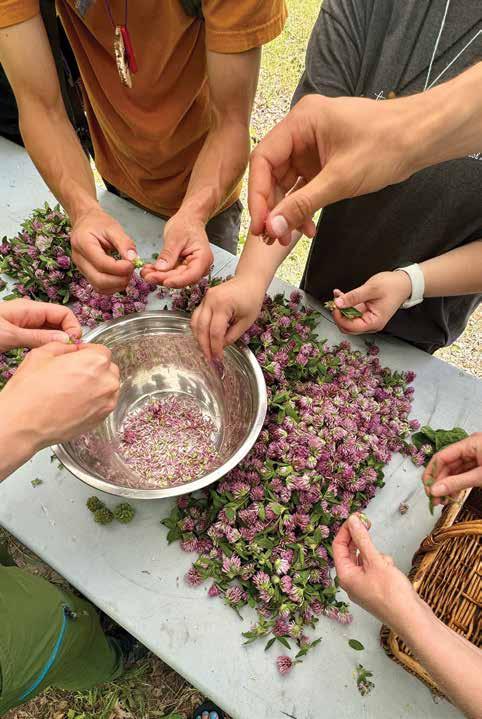
More information about the Great Lakes Foragers Gathering including online registration is available at willforageforfood.com/gathering. Rachel Mifsud can be reached via email at rhmifsud@gmail.com. The community is active on Facebook at facebook.com/groups/WillForageforFood.
Reiki Master, teacher, and bodyworker Laura Ziemba moved to the Ann Arbor area from the west side of the state in 2022 to be closer to her grandchildren.
Several family tragedies in the last few years postponed her teaching plans, but she is now ready to offer Reiki classes in Ann Arbor. She will begin with a full weekend Reiki Master class on May 22nd through the 24th. This class will be for students who have already had Level 1 and 2 Reiki trainings and is in response to several of her students requesting it.
Ziemba received her Level 1 and 2 Reiki practitioner certifications in 1986 and began teaching Reiki in 1999. In 2020, she became a Karuna Reiki Master Teacher. She has trained in Usui and Holy Fire Reiki as well as Karuna Reiki and said that blending the different types produces “mindblowing” attunements. She’s been a certified massage therapist since 2005 and licensed in Michigan since 2010. She studied Upledger craniosacral therapy in 2004, and most recently added John Barnes myofascial release to her service offerings.
When asked how she came to Reiki, Ziemba said that her first exposure to it felt like simply giving a name to what she’s always done. As a child, teenager, and young adult, she would lay hands on herself, where she felt tension or stress, and send light into that area. She knew a bit about Japanese palm healing, she said, but Reiki was different from that in that palm healing uses one’s own personal energy, while Reiki is divinely guided, allowing the practitioner to be a vessel or conduit for higher energies working through them. “Ascended Masters, brothers and sisters of the light, come through with Reiki,” she said. “They are very present for us,” and receptive to being asked for their assistance and interaction in our lives.
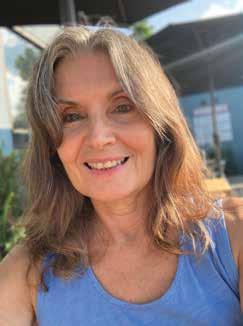
across Helping Parents Heal while searching the internet for information about near-death experiences and theories about the afterlife. HPH was focused not so much on leaving her child in the past, but on moving forward in connection with her in her new existence as an “active energetic being” who is “very much alive.” Yamamoto said she has experienced many signs from Katherine. HPH, she explained, goes beyond many other grief groups by allowing the open discussion of spiritual experiences and evidence of the afterlife in a non-dogmatic way. It focuses on helping individuals to become “Shining Light Parents” (as opposed to “bereaved parents”) enabling a shift from a state of emotional heaviness to one of hopefulness and greater peace of mind. “Our children shine through us,” said Yamamoto. “They want us to be happy, and healthy, and to heal.” She said the group is very positive, speaking of the children of these parents as still here, just in a different way. They “helped me so much in processing my grief and giving me hope when my daughter died… that I decided to start a local chapter,” she said.
In preparation to run a chapter, Yamamoto became certified as a grief educator through David Kessler Training, as well as going through training provided by HPH. The Ann Arbor chapter meets monthly and welcomes everyone regardless of religious or non-religious background. Open dialogue is encouraged. Meetings usually draw between four and ten people. They begin with introductions, followed by a short meditation, and open discussion. Parents often share signs they’ve seen from their children, tools they’ve found helpful in their healing, and discussion of the afterlife and spirituality. After a break, parents share snacks together and engage in more one-on-one interactions. There is no cost to participate.
Yamamoto said, “Grief is on some level always with you. There are waves of grief. We’ll always miss our children and having them physically here, but people can find a lot of peace and joy in life. It’s pretty amazing to hold grief and joy in the same moment.” She said that healing is a lifelong process with no end date, and that people are permanently changed after such a devastating loss. But they do have the capacity to feel peace and enjoy life again, and to eventually appreciate life, nature, and love on a much deeper level.
She feels that there is greater potential for healing when one has community. “It’s very hard to heal sitting at home,” she said. “As hard as it is to reach out, and it is hard,” she said, “there’s a lot of healing power” in gathering with other parents who have been through the same tragedy.
More information about the Ann Arbor meetings is available on Facebook at facebook.com/groups/helpingparentshealannarbor. The organization’s website is helpingparentsheal.org. Mary Yamamoto can be reached by email at hphannarbor@gmail.com or by phone at (734) 223-3208.
The location for Ziemba’s Reiki Master Class is to be determined, but anyone interested can contact her for all of the information as it is finalized.
Laura Ziemba can be reached via email at radiantlightbodylaura@gmail.com or by phone at (269) 646-1122.
In June of 2023, Ann Arbor resident Mary Yamamoto started a local chapter of Helping Parents Heal, an international nonprofit group focused on assisting parents whose children have passed away.
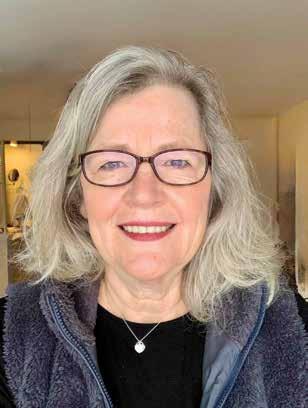
There are about 175 chapters throughout the United States and other countries. Yamamoto explained that what sets this group apart from others is their emphasis on spiritual experiences and parents connecting with their children through signs, synchronicities, and other means.
When Yamamoto’s daughter, Katherine, passed away in 2019 at the age of 29 from cardiac arrest due to a heart arrythmia, she felt “splintered into a million pieces.” She knew she would need some help dealing with her grief, but she didn’t resonate with the local support groups she came across. In the early days, she really wanted to know where her daughter was, which was not something other groups were talking about. She came
Submit your listing for the September through December 2026 issue.
The “What’s New in the Community” column is part of the editorial content of The Crazy Wisdom Community Journal and is not paid-foradvertising. Whether your submission material is used or not will depend on space considerations, as well as other editorial issues, such as the need for high resolution photos and the overall mix of stories included in the column in any given issue.
If you would like to submit information to be considered for this column, please email communitynews@crazywisdom.net.

(Daniel DeSena is a social worker and psychotherapist who has become active in leading male embodiment and self-mastery workshops locally, and also nationally on Zoom. He is passionate about the intersection of spirituality, meditation, energy work, martial arts, sexuality and embodiment. He and his twin sister, and younger brother, were raised in the Pittsburgh area. Now 52, he’s been in southeastern Michigan for 30+ years.
In addition to his MSW, he also has a doctorate in Percussion Performance. He loves drumming, improvisation, ceremonial music, dancing, and singing. He also loves to hike. We met on a fine fall day at his apartment in Ypsilanti.)
Bill Zirinsky: Thanks for meeting with me, Dan. I would like to get a little bit of context. Where were you raised?
Daniel DeSena: I was raised in Pittsburgh, and I went to my undergrad at University of Illinois, and then I came to Michigan to Ann Arbor for grad school. I was a musician. That was my first career. And I ended up getting graduate degrees in music performance. I received my doctorate in music in 2002. By 2005, I was in the Michigan School of Social Work program to become a therapist, and so I shifted gears. I was a member of the Ann Arbor Symphony, and I was freelancing in the area and then teaching students, and also getting my degree in Social Work, learning to be a therapist, and then became a therapist, and was actually juggling music and social work at the same time for a number of years. And then it just got to be too much, and I ended up giving up my music career completely. I’ve been here [in Ann Arbor] now since ‘96, almost 30 years.
Bill Zirinsky: What kind of music did you play?
Daniel DeSena: I played symphonic music.
Bill Zirinsky: What instrument did you play?
After that, I knew I needed to figure out what I really wanted to do. I felt good about where I’d come with my career, but I was like, [there’s] something else that I need, and I don’t want to be a part of any organizations for a while, and I need to just figure out what’s my next step. Then COVID hit. A friend of mine and I had just gotten an office in January 2020, over on Hogback, and we’ve just been sharing an office [since]. So, I left all the institutions. I started to sort of revamp, like, ‘okay, what do I want to do with my life?’ And that’s how I found men’s work.
Bill Zirinsky: I see. So, even when you were a young therapist and doing things at the anxiety disorders clinic, men’s work wasn’t a side interest yet of yours?
Daniel DeSena: I didn’t even know it existed! I think some deep part of me knew there was something that was missing in my life. And, of course, social work is a very female-driven profession. But when I got into therapy, a huge step in my life to get me understanding myself, to be on a growth path, a spiritual path. But, and this was important, I started seeing my own therapist for the first time, a woman. And in my career I was working mostly with women. So, there was a point when I was like, ‘something’s missing,’ and I couldn’t figure it out.
I had a partner, I had a female therapist, and I had male friends, but something felt off. It wasn’t until my ex-partner led me to the work of David Deida that I started to discover what I needed. David does work around what would be called the ‘divine masculine.’ It’s a spiritual practice. So, he sees the masculine and feminine archetypally. And that’s where I’ve gone—the direction of understanding what’s called ‘sacred sexuality,’ ‘polarity,’ and working with masculine and feminine archetypal energies.
Embodiment means a lot of things. We do a lot of breath work. We do a lot of archetypal work with different masculine energies, like King energy, Warrior energy, or Lover energy. We do a lot of work with how to challenge the parts of us that are afraid of intimacy.
Daniel DeSena: I’m a drummer, but I got the degree in percussion performance. After I graduated, I was auditioning for symphonies, and I subbed around with Flint and the Detroit opera and played in the symphony here, and taught my students and just played gigs and freelanced.
Bill Zirinsky: Interesting. So, you went to Social Work school, and did you right away go into private practice?
Daniel DeSena: No. My internship and then my post-graduate fellowship was at University of Michigan Department of Psychiatry, outpatient clinic north of Ann Arbor. I worked there to get fully licensed, and then I ended up working at the U for the first 11 years of my practice. I was in the Anxiety Disorders Clinic and worked a lot with Post-Traumatic Stress Disorder. And then in 2012, I also joined a private practice called Ann Arbor Center for the Family. I was with them between 2012 and 2019.
This book by David Deida that for a lot of people can feel a little bit edgy is called The Way of the Superior Man. It’s basically like a step-by-step, ‘how-to’ [program]. It’s a way to understand the archetypal masculine and feminine energies that naturally play through our bodies, psyches, souls.
This is getting into C.G. Jung-type stuff – we all have a divine inner masculine and an inner feminine. And it’s the marriage of those two within us that allows us to become fully individuated and whole. This is David Deida working with that. It feels like very traditional malefemale dynamics, but really it is not that. It is about the divine and archetypal masculine and feminine energies in all of us.
Bill Zirinsky: What’s going on in the world of understanding masculinity better? What was the thing that kind of said to you, ‘oh, I want to read this, or I want to do this more?’
Daniel DeSena: I think reading Jung was the first step, but then it was the problems in my relationship that really pushed me to explore this. My partner wanted me to read Deida’s book, because it is basically saying, ‘this is what’s not working.’ A lot of it was about what I would consider now to be ‘healthy’ masculinity, and what it showed me is that I had pretty much pushed my own masculinity out the window in favor of what would be considered a sort of a
‘nice guy’ ethic of how to be good to women, how to be nice, how to be kind. And all of that is fine, but I was also pushing away some of the other parts of masculinity that are really life-giving, like the impulse to protect, be fierce when necessary, hold space, etc.
Bill Zirinsky: That’s a really interesting phrase, ‘pushing my own masculinity out the window.’ Say more about that.
Daniel DeSena: Well, my history was that my mother was abused by her brother when she was a kid. My mother had a lot of her own struggles in life, and she was very intent on making sure that I was not going to be one of those guys that would hurt women, and she would sit me down and talk to me about that. She never told me that she was abused at the time, but she was very clear — women are not objects and sex is something that only happens under certain conditions. Looking back, I can feel that there was a lot of fear in what she was saying and I felt that. I remember thinking “Wow, this is really intense. I better not screw this up.” She would even say things like, “You’re not that type of guy… you’re this type of guy…”
Bill Zirinsky: She was kind of signaling to you as to what kind of guy to be.
It’s not just people talking from their heads. It’s people that are really in their bodies, in the present moment, in their own energy, feeling the other person’s energy trying to be as connected as possible with what’s happening with that person in the moment.
Daniel DeSena: Exactly, yes. And so, I think I became very, very conscious. And the light side of it is consciousness about treating women well. I try to do that as wholeheartedly as I can. And on the dark side of it is kind of giving up my strength as a man. Any tendency to be angry or any tendency to assert myself, assert my will, was poo-pooed by my parents. Everything was about being nice and kind and loving, and I think I gave up some of the strength that I needed. And of course, other parts of me rebelled, and I had my angry side come out in other ways, of course, because you can’t just push all of that away. That all came up as shadow and would create problems in my life. So, nice and loving and kind and spiritual and all of that versus shadowy, unconscious patterns. I needed to find the balance, and integrate my strength, power, and masculinity in a healthy way.
Bill Zirinsky: And do you feel that this partner of yours handed you this book because she was conscious that you were not able to be assertive enough?
Daniel DeSena: Yes, yes, she was. I’m forever grateful to her for helping me see something…my political leanings were so far on the liberal side… everything is about equality. Everything is. She helped me see that there are ways of understanding masculinity that are very healthy, that also allow for a little bit more spark in the relationship that can’t be there when things are too neutral between a man and a woman.
Bill Zirinsky: Okay, so you began to become interested in men’s work then?
Daniel DeSena: Yes. I started studying with John Wineland, who studied with David Deida. Deida still does some public work, but Wineland is very prominent internationally and teaching this very actively. He has a men’s group, and I joined that. It was an international group that meets both online, and then in person for a couple of long weeks in California.
BZ: Once a year? Twice a year?
Daniel DeSena: [Meeting in person] was twice a year. The first dip in I took with him was what’s called the Embodied Men’s Leadership Training (EMLT) Program, and that met from January to June of 2023. So, we were online, having monthly calls and smaller groups, as well as meeting twice for these long weeks in California. There were about 50 men in this group. We camped in the desert, and also spent a week at Mount Shasta, CA. That was my first foray into men’s work. He’s got his own men’s group influences, plus training with David Deida. BZ: So, when you attend via Zoom, there were around 50 guys there?
Daniel DeSena: Yeah, on the large group calls, and also we had our own small groups. That’s how I started with it [men’s work], and I never stopped. I’ve done that program three times now. Eventually I came to be on the program team of the group, helping to put on the whole thing. Then I joined another one of his programs, which is called the Teacher Training, Art of Sacred Intimacy. It is a co-ed program where you’re using the types of things you learn in the men’s program, [but] now practicing with women. All clothes on, all very boundaried, but you’re practicing what’s called ‘sexual polarity’ with women. I’m starting my third year in that program. I’ve been studying deeply with him.
BZ: Do you want to take me through each of those programs?
Daniel DeSena: Through the men’s program, I got a certification to lead men’s groups. A lot of it is about what I would consider a balance between men that
are learning to shift the sort of classic macho way that men tend to be together, from all you do is just sit and watch sports, shifting away from that, and into men supporting each other. There’s not only the support part, there’s also what we would call ‘sharpening,’ which is, I think, the more masculine part of it. It is being able to sit with men and have them get to know you so well that they can actually see things that you can’t see in yourself, and offer their feedback. For example, how am I shooting myself in the foot? How am I not fully becoming the person that I want to be in the world? I actually now have two of my own smaller men’s groups with friends of mine that I met there. They’re both online because we’re from all over the world. I’ve got these two men’s groups now, of men that are there both to support and also to help me refine what I want to bring into the world.
BZ: At this point, what are you offering locally? When you, for instance, placed an ad in The Crazy Wisdom Journal, is that meant for the men to come together in person?
Daniel DeSena: Yes, I decided to start this men’s group called The Circle of Embodied Men in January of 2025. It was at Zionwell yoga studio. I rented space in the studio, so we had a nice space to come into.
I wanted to start a men’s group that was both there for men to support each other as well as to add an embodiment piece. The embodiment piece is something that I’ve learned primarily from John, my work with him. Embodiment means a lot of things. We do a lot of breath work. We do a lot of archetypal work with different masculine energies, like King energy, Warrior energy, or Lover energy. We do a lot of work with how to challenge the parts of us that are afraid of intimacy. We do a fair amount of eye gazing. I might come up with a practice where I have two men that are facing each other and looking into each other’s eyes, both of them bringing Warrior energy, for instance, and supporting each other in finding the Warrior inside of them, or the King inside of them.
Part [of this exercise] is that we’re working to bring our full selves online through our bodies and supporting each other in that, and building intimacy through that. Then when we’re in the sharing circle, it’s an embodied sharing circle. It’s not just people talking from their heads. It’s people that are really in their bodies, in the present moment, in their own energy, feeling the other person’s energy—trying to be as connected as possible with what’s happening with that person in the moment.
I find that the embodiment part brings people into the moment more. It brings them into the room with this other man, more than when we’re in our conversational, normal day-to-day minds — that’s full of a lot of extra noise that gets in the way of being really present. For anyone that meditates, we know that you have to get into the present moment in your senses, in your space, and get out of your head, right? Well, one way to do that is to meditate. Another way to do that is to get into your body. See the body as a portal through which we can access presence, heart energy, and intimacy. And so, the first part of the group is this embodiment, and it often gets them into their emotions and into their heart and into their bodies and to their energy.
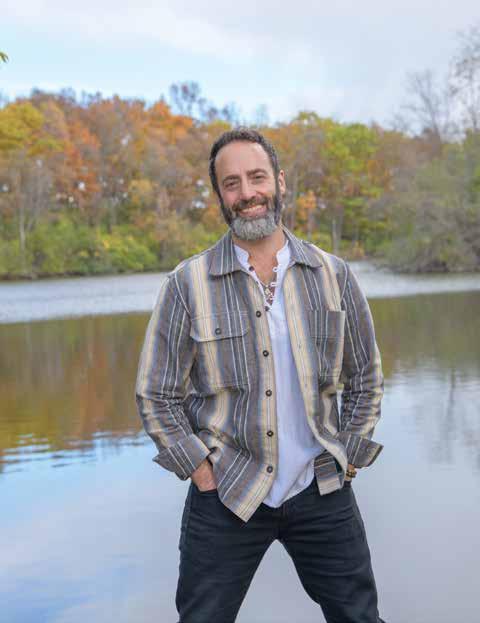
BZ: So, you use certain experiential exercises to help the people who are there to wake up in their bodies and what they’re feeling and expressing themselves clearly.
Daniel DeSena: Yes. And each one [meeting] has a different topic.
BZ: What would be three topic examples?
Daniel DeSena: One was called ‘Ground and Root.’ How do we learn to be more grounded in our bodies, and what does that mean in our lives? How do we bring groundedness into relationship? We did one on ‘Play’ —for men to learn to feel playful energy. We did one on fierceness, how can men have a healthy way to access anger — that is what I would call ‘heart-led fierceness’ — in the world.
BZ: As opposed to dangerous or threatening anger?
What’s the middle ground between giving up all of your masculinity to become a neutral, lifeless man versus being dominating, bossy, or violent? What’s the middle ground?
DeSena: Exactly. Let’s just say I love my family. Am I willing to do what it takes to protect my family? Now, we don’t think about that a lot because we have a culture where most of us don’t have to do that like you might have had to 20,000 years ago. However, there’s a beautiful energy when I can access the part of me that knows that if someone were threatening my family, I would do what it takes to protect them. And I do think that someone in the family has to have that role, even if it’s just to soothe the nervous systems of the people in the family, whether or not it ever comes down to that or not.
I think a lot of men, they want to be a man in the relationship with a woman, and the ‘man’ of the family, but they’re not really taking on what it means to be a man, because we’ve been trained out of it through the cultures that are trying to protect us from toxic masculinity. Then it becomes ‘toxic masculinity’ versus ‘nice guyness.’ What’s the middle ground there? I believe that’s one thing David Deida has helped us to find. What’s the middle ground between giving up all of your masculinity to become a neutral, lifeless man versus being dominating, bossy, or violent? What’s the middle ground?
What I recognized for myself is that I was missing that middle ground because I didn’t want to be ‘that guy,’ because of what I mentioned before about my mom. There are certain energies that men need to be able to inhabit in their bodies. Fierceness is one of them. If someone wants to have a powerful sexual relationship with a partner who wants to feel the man’s strength and power, then the man can’t be treating their partner like their mommy. And a lot of men do that. You know, they kind of treat a partner like a mother figure, rather than a beautiful, sovereign woman that deserves to get the man’s full strength and masculinity in a healthy, loving way. For me, there were subtleties that I had no idea I was missing. Now I think back to my relationship with Erin, my ex-partner, and I can say to myself ‘Oh, yeah, I really dropped her there.’ She didn’t want me to take care of her in a patronizing way, but rather to have more of an energy of being a strong container for the relationship. And I wasn’t doing that.
So these are the types of things we would work with in the men’s embodiment group.
BZ: And the woman can be the protective container as well?
DeSena: Yes, absolutely. In fact, in this day and age, women are more of that than men are, because it’s culturally sanctioned now for women to be in a position of leadership, which is great. I mean, of course we want that, but then men end up becoming weaker. It’s almost a natural physics to the polarity in a relationship where someone is leading and someone is following all the time on some level.
You hear the trope of a man who is always saying, ‘Yes, honey, yeah, whatever you want, honey,’ right? And the woman is in charge. ‘Happy wife, happy life.’ Now, from this perspective, the woman doesn’t really want that. What the woman wants is for the man to lead—from a place of love and understanding of what the woman needs and what the family needs. If it is the other way around, a lot of resentment builds up. The man says, ‘well, she’s just bossy. She’s taking charge.’ That’s because no one is taking charge, and she feels like she has to do it. If the man learns to take charge in a balanced and loving way,
then the woman can relax. And this is where the polarity part comes in. She can relax into the natural parts of her that are feminine. Archetypally, by definition, femininity is more about letting go, relaxing, playing, being in an energy of not thinking and trying to control but more playful and receiving and loving, and that [natural] energy most women have is now lost if you don’t how to work with these masculine and feminine energies that are looking for a particular type of interaction and outlet.
Now, when you start to learn about polarity, you start to go, ‘Oh, I see. We can be equal, and we can play with these energies.’ It’s hard to explain quickly, because it’s almost like physics—like relational physics. But it was the missing link for me. I had been doing couples work, and I’d been in relationships, and I’d been teaching my clients about relationships, and this is the piece I was missing —this piece around understanding masculine and feminine energies that both people can play with within the relationship. That’s what the men’s work and then John Wineland’s polarity work has taught me.
BZ: In the work that you’re doing in these groups, what is the age range of the men in your groups?
DeSena: I’ve had men in their late 20s. I’ve had guys in their 70s. It’s a wide range. I would say that usually it is late 30s through 50s—on average.
BZ: And so even as you’re doing these two groups that are on Zoom with people, you’re also doing this other group that you started in January. How’s that one different?
DeSena: [The group I started in January 2025] I lead it. And it’s also a drop-in group. It’s not the same group of men every time. Right now, I’ve got a group of about 21 men who are like, on the docket, and I’m looking to kind of grow the numbers, to get more people. The other groups are my own personal men’s groups. My men, who support and sharpen me.
BZ: And even as you do those groups are you continuing to do individual therapy with clients?
DeSena: Yes, I’ve been doing both.
BZ: In your day job, you see men and you see women, and do they come for the usual garden-variety range of issues? Or have you specialized your practice so you’re really bringing in, or aspiring to bring in, this masculinity work and the sacred intimacy work into your therapy practice?
If someone wants to have a powerful sexual relationship with a partner who wants to feel the man’s strength and power, then the man can’t be treating their partner like their mommy. And a lot of men do that. You know, they kind of treat a partner like a mother figure, rather than a beautiful, sovereign woman that deserves to get the man’s full strength and masculinity in a healthy, loving way.
DeSena: In general, it’s hard for this piece not to influence what I do. However, with my clients, especially female clients, I’m not bringing in this work—I’m doing more traditional psychotherapy with them. With my male clients that are therapy clients, occasionally, I do bring some of this in because [they are] struggling in the relationship with a woman, and we’ve worked on many other things, but we need more. Sometimes this piece around the polarity can be really powerful and help a man understand what might be causing tension in the relationship. So, I have brought that in with some of my male clients who are in a relationship.
BZ: In the more garden-variety work that you might do with a male client — that is ongoing work with a particular client — and he comes in talking about issues in his relationship with his wife, but he’s not too easily drawn into the more conceptual or esoteric learning about energies. How are you reaching him?
DeSena: It depends on who they are, and their process. Because some people understand this stuff better than others. I think the big shift is being a little more straightforward with men, especially when I can sense that they’re playing out a pattern with their wife, where their wife is mommy and they are a little boy, because that will never work. I think most men have some of this, but
it’s clear when you get to a point when they’re saying things like, ‘she never listens to me. She’s not giving me what I want.’ You know all the themes that children go through, where a man is actually expecting something from a woman in order to make him feel better about himself, in order to satisfy all of his biological needs.
I’m pretty blunt with men about that. That’s not her role. It’s not her job to make you feel better about yourself. It’s not her job to give you everything you want. Relationships are not necessarily there just to make you a happy little boy. They’re there to help you grow and to come into your full manhood—like grow out of being a little boy.
So, I do go there with men, usually with men where we’ve been working on understanding their past and understanding how they may be reenacting parts of their past with their current relationships, and to understand that there has to be a point when the man takes responsibility for what he’s creating in his own life, including the woman he’s picked, who he’s not currently accepting as she is. You know that this man has chosen a particular type of life, and he’s created exactly the type of life that he wants. He doesn’t think he wants it, but he’s created it. And from a polarity perspective, the man has to take full responsibility for what is happening in the relationship. It doesn’t mean that he’s at fault for everything, but he has to be willing to take full responsibility, anyway.
BZ: When you use the phrase ‘from a polarity perspective,’ what do you mean?
DeSena: Men need to take full responsibility for what they create in the world, and then take care of what they’ve created. A man is literally choosing and creating the life that he has. It is his own. And a lot of men, when you sit with them and they’re saying, ‘Well, she’s doing this and she’s doing that,’ they’re giving up their sovereign birthright and responsibility to take care of what they have created. Men that are taking full responsibility are truly holding the relationship. This is the masculine role.
I’ll give you an example. My relationship with my partner, which ended about two years ago, was not going well. There was a point when we realized we couldn’t continue. And I took charge, and I said, ‘I’m not going to keep us stuck in a relationship where we’re fighting, we’re floundering, we are stagnant. It’s on me that this has happened. Things aren’t what we want them to be, and I’m not going to let us keep hurting each other this way. I take responsibility for allowing this to happen.’ That’s a masculine leadership role.
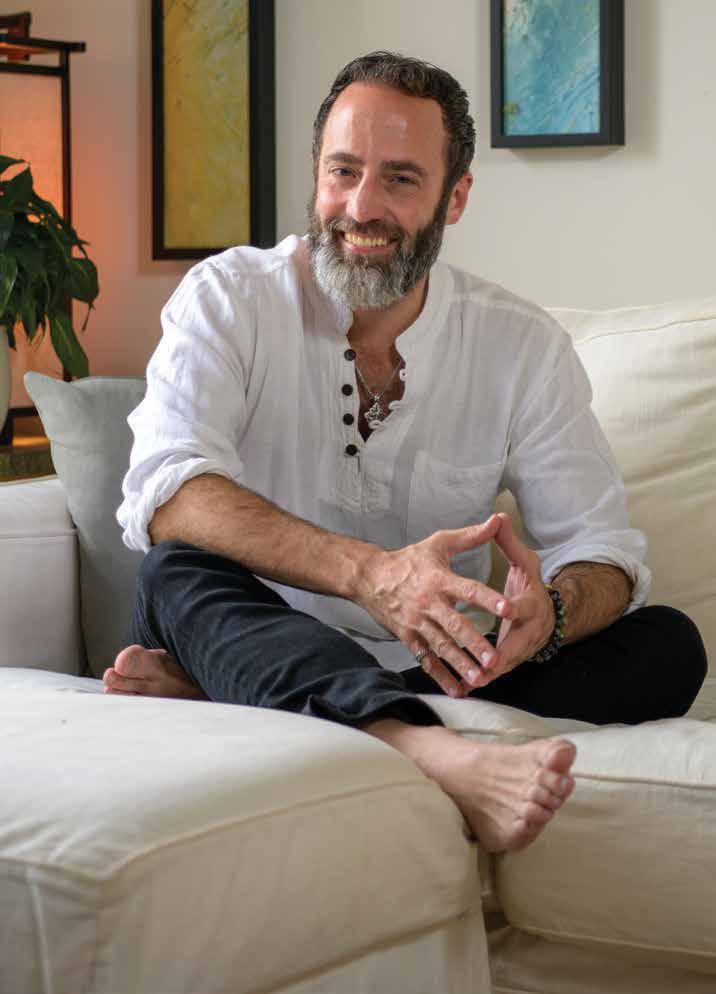
Now she might do the same thing – that would be her masculine. But whoever takes the role, it is the masculine that says ‘I’m going to take charge. We need to break up. And who knows what’ll happen after that, but right now, we’re hurting each other. We can’t keep doing this.’ So, that was me swallowing my fear and my pride about having a relationship that we both thought was going toward marriage, and then say ‘no, we have to let go of this, for our own growth, for our own individual selves. We need to change something.’ And I was willing to lead that. I was saying to myself, ‘I have created this. I picked this person. I reenacted my past wounds and created something that is not working with the woman I chose. I take full responsibility for this.
How do you work that out together? There’s a point when you say, ‘yes, we can,’ or ‘no, we can’t.’ I knew that we were not going to be able to work it out from the place we were. I knew in my heart that we had to shift things. As much as I didn’t want to break up, we had to do it. It broke our hearts. We love each other very much. But we had to change something. And it turned out, I think, very well in that way, because we both realized later that we needed space to get our own shit together, so to speak. And so that’s an example of not necessarily leading in order to make it work, but leading to do what is best.
BZ: I want to shift for a few minutes and see where that takes us. This is a time when a lot is being written about and talked about men and masculinity in society. There has been a host of articles and podcasts about the male vote and men. What you’re doing is very interesting work to be doing in this particular time. How does this work, from your point of view, interface with what we’re reading about masculinity?
I think the reaction to toxic masculinity that led to feminism was a really good thing, because it led to certain things balancing out. Women should not have rights taken away. Women should not be patronized and disrespected. But then, what can be lost in an effort to even the score is nuance. The key is in the details and the nuance.
DeSena: I love this question. Of course, I’m going to be coming from my own biased place, but here’s my sense of it. There is this pendulum that shifts back and forth. I think the reaction to toxic masculinity that led to feminism was a really good thing, because it led to certain things balancing out. Women should not have rights taken away. Women should not be patronized and disrespected. But then, what can be lost in an effort to even the score is nuance. The key is in the details and the nuance.
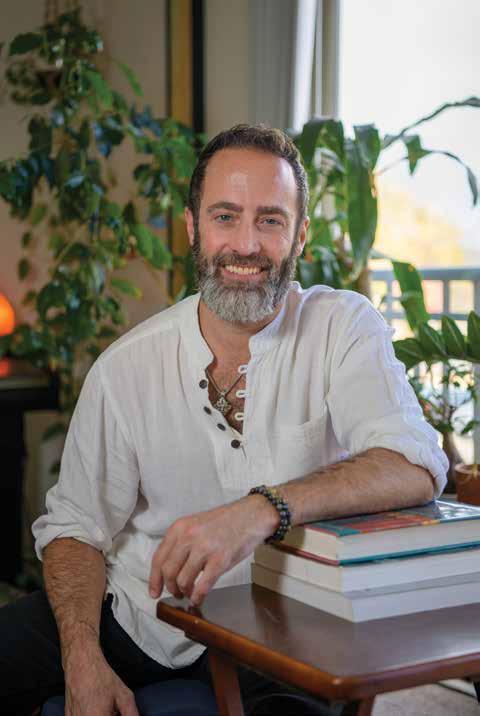
If men want to be masculine, they have to be willing to take responsibility and create a world that is safe for women. A world that is safe for women to be able to flower into their full femininity, not become just like men. To be equal to men, as fully capable as men, and also appreciated and protected as the sacred feminine beings they are.
and relax and allow themselves to really feel the flow of feminine energy moving through their bodies, and surrender, and to trust men. This is not about women doing it wrong, this is about men stepping up!
I don’t think women have done it wrong at all from a masculine/feminine perspective. If men want to be masculine, they have to be willing to take responsibility and create a world that is safe for women. A world that is safe for women to be able to flower into their full femininity, not become just like men. To be equal to men, as fully capable as men, and also appreciated and protected as the sacred feminine beings they are.
Men need to understand how to create a better ‘macro’ structure in society, for women, as well as ‘micro’ in the family for women. That’s our responsibility. That’s why part of the business I’m building is around what I call “self-mastery,” which is for men to take responsibility for their own lives. We’re not here to get something from women. The masculine role is the one that gives. It’s not the one that takes. The feminine naturally takes in and the masculine naturally gives. Men have forgotten that the real pleasure that we can have if we want to be in our masculine role is the pleasure of giving, not the pleasure of taking. ‘Toxic’ masculinity is not really masculinity at all. It is a little boy saying “gimme.” It is about taking and dominating, which comes from fear, not love. Real masculinity is about creating safety, creating strength.
BZ: I read a certain amount of Carl Jung when I was young. He was very big in my college years, but I don’t recall much of what he had to say about sexuality. I can tell you things that he said about masculine and feminine archetypes and all that. Do you know at all what he wrote about sexuality?
You can’t throw away masculinity. You have to find a way to have it be healthy. And so I think what’s happening — as we discussed before, is that we are all trying to find a middle ground between toxic masculinity and nice-guyness. Absolute neutrality, [the idea that] there’s no difference between men and women doesn’t work, because as soon as you have no difference between men and women, you lose the beauty that comes from the interplay of the differences between us—the differences are what create polarity, interest and spark.
In order to understand how to keep the spark and keep the polarity, you have to learn about the nuances. The social argument I think should be, first of all, that, from a legal and political standpoint, yes, we’re all equal. Then, I believe that women need to be helped by men to both be equal in society and also be able be allowed to keep their femininity, which is, again, this ability to surrender
Sept. 17th, 7:30-9:30 pm
Part I – Group Class teaches how soul contracts draw us to our families and relationships, the spiritual dynamics that make us heal and grow as individuals and together, and how to make use of them for success and satisfaction. Meet by teleconference call. Or by recording for those who can’t attend live.
Part II – Private Healing with Eve to shine light on your particular dynamics and opportunities, provide guidance and begin the healing process. Scheduled individually.

Only one person required per couple or family to accomplish what is needed. More is great!
Cost $300 for series. See “What’s New In The Community” in this issue for more about this class and visit www.spiritualhealers.com for testimonials and to enroll.
Eve Wilson is a UCM Master Healer with 40 years experience helping couples and families to succeed in the fullest ways as individuals and together.
Daniel DeSena: I haven’t read all of Jung’s work obviously, there’s so much. One of the most important teachings that I’ve learned from Jung is that the intermarriage of masculine and feminine inside each person is the ultimate goal of our soul. We are on a pathway of ultimately having union inside of us. It’s less about what we do with other people. It’s more about whatever it takes for us to individuate, which means to find this union inside, wholeness in a psycho-spiritual way — it’s your soul’s path to figuring out who you really are, and it’s less about the physical act of sex, and it’s more about who we are as individuals.
If I’m individuated and whole, I’m going to be impacting the world in positive ways. I’m going to be almost magnetic, because there’s a natural draw to people that feel whole. We get drawn to a particular partner because we don’t feel whole, and so we think, ‘oh, I want that part of her. She’s so beautiful. She’s so this or that.’ From a Jungian perspective, her feminine is really my own feminine that I need to see in myself. And when I can recognize that, I am closer to being whole. I’m going to feel much more integrated. And I’m going to be someone who is going to impact the world in healthy ways, in a way that’s going to feel quite attractive to people—not to have sex with—to have a particular transmission into the world that is going to inspire people, maybe to become more whole themselves, to bring their own sort of unique gifts into the world.
I guess what I’m saying is that this is a whole thing. Even with the work I’m doing with men around sex, it’s not to have a better sex life. It is that to some extent, but finding our sexual fullness is also a step toward individuation. It’s a step toward coming into more wholeness in their own lives. It’s the soul’s journey. It’s a meditative path. It’s a spiritual path. The goal is not to have more sex. Maybe you will have more sex. Maybe you won’t. The goal is letting sex be just like everything else in life, a conduit through which your alchemical growth happens.
Bill Zirinsky: There’s more to be said about all this, but I think we’ll leave it at that, for today. Thank you, Dan!
Cooking with Lisa ... Page 44
Annie G’s: A Dairy Farm For the Future ... Page 45
Pollinator Hotels Part 2: Welcome Back, Bees! ... Page 49
The Art of the Vibe: Coffee, Music, and Kultura... Page 50
Tea with Peggy... Page 51

Healing & Ascension Monthlies with Eve Wilson – UCM Master Healer
Together we transform the world! Join International Healer Eve Wilson for six powerful evenings of healing, growth, and ascension. Experience deep transformation, balance, and connection as we uplift our world together.
♥ 6 Monthlies – Begins 6/18, 7:30-9:30pm (every 4 weeks, Thursdays) live by teleconference or by MP3 recordings at your own pace.
♥ Cost: for the series or pay-as-you-go | Sliding scale available
♥ Contact her team at evew@spiritualhealers.com View all Eve’s offering at www.spiritualhealers.com See Video at https://www.facebook.com/reel/1367567571609727
By Lisa Viger-Gotte

Roasted Shallot and Garlic Hummus is a creamy, savory spread made by blending chickpeas with caramelized shallots and sweet roasted garlic. Roasting transforms the sharp bite of raw alliums into something mellow, a bit jammy, and almost buttery, which gives this hummus a richer flavor without adding heaviness. It’s simple pantry food that tastes elevated. I like this version because it feels a little more complex than classic hummus but takes almost no extra effort. It’s perfect for wraps, grain bowls, snack boards, or just warm bread and vegetables.
Servings: 8 (about ¼ cup per serving) Total Time: 40 minutes
Ingredients:
3 medium shallots, peeled and halved
1 whole garlic bulb, top trimmed
2 tablespoons olive oil, divided
1 can (15 oz) chickpeas, drained and rinsed
1/4 cup tahini
3 tablespoons fresh lemon juice
1/2 teaspoon sea salt, or to taste
1/4 teaspoon ground cumin)
2–4 tablespoons cold water, as needed
Optional: smoked paprika and chopped parsley for garnish
Instructions:
Preheat oven to 400°F.
Place the shallots and entire garlic bulb on a sheet of foil and drizzle with 1 tablespoon olive oil. Wrap it all up loosely in the foil. Roast for 25–30 minutes, until soft and caramelized.
Squeeze roasted garlic from skins and transfer to a food processor. Add the roasted shallots.
Add chickpeas, tahini, lemon juice, salt, cumin, and remaining olive oil. Blend until smooth, adding cold water 1 tablespoon at a time if needed until creamy and light. Taste and adjust lemon or salt as needed. Transfer to a bowl and drizzle with olive oil. Garnish if desired.

Easy Grilled Asparagus and Shallots with Maple Balsamic Sauce is a quick, vibrantly colored side dish that epitomizes spring and warmer weather. It’s made with fresh asparagus spears and halved shallots grilled until lightly charred and tender. A simple maple balsamic glaze adds a balance of sweet and tangy that complements the natural earthiness of the vegetables. This recipe is ideal for weeknight dinners, outdoor grilling, or spring gatherings.
I like this dish because it’s elegant and rustic at the same time without being complicated. The shallots soften and sweeten on the grill, the asparagus stays crisp-tender, and the glaze pulls everything together in minutes.
Ingredients:
1 pound fresh asparagus, woody ends trimmed
3 medium shallots, peeled and halved lengthwise
2 tablespoons olive oil
1/2 teaspoon sea salt
1/2 teaspoon freshly ground black pepper
Maple Balsamic Sauce
3 tablespoons balsamic vinegar
2 tablespoons pure maple syrup
1 teaspoon Dijon mustard
Pinch of salt
Instructions:
Preheat grill to medium heat (about 400°F).
Toss asparagus and shallots with olive oil, salt, and pepper. Place directly on grill grates or use a grill basket. Grill for 8–10 minutes, turning occasionally, until asparagus is tender with light char marks and shallots are softened.
While vegetables grill, whisk together balsamic vinegar, maple syrup, Dijon mustard, and salt in a small bowl.
Remove vegetables from grill and drizzle with maple balsamic sauce. Serve immediately.

By Karen Quinn
Have you ever dreamt of purchasing your milk directly from a farmer you knew and trusted? How about buying from a farmer that is taking the best care of their cows? How would you like to go to the farm store and actually see the herd happily grazing on nutritious, fresh grass? You might think that is an unrealistic dream in our world of factory farms and large dairy conglomerates, but what if I told you that you could get milk from a local farm that delivers on that dream?
Let me introduce you to Annie G’s, a small herd dairy cow farm run by Kat and her husband David Mageean. This dynamic duo, along with their two young children, Annie and Angus, whom the Dairy is named after, have a dream of their own to share. Their dream is to make the “100 cow dairy farm” viable again and they are working to revolutionize the dairy industry to help encourage others to do the same.
Back in 2017, the couple purchased the dairy farm Kat grew up on from her parents. For the last nine years they’ve been growing the herd from the original 45 Holstiens to the current head count of 75 with plans to reach 100 in the next few years. Instead of buying cows to add to the herd, they did it the hard way—through a breeding program, using the “Pro-Cross” system. They bred their original herd of Holstiens with Jersey, Norwegian Red, Brown Swiss, and Ayrshire breeds. They decided to take this route for a few reasons.

Kat and David Mageean have a dream to make the “100 cow dairy farm” viable again and they are working to revolutionize the dairy industry to help encourage others to do the same.
First, the herd they purchased from Kat’s parents was a Johne’s Negative Closed Herd. If you’ve never heard these terms before, let me shine some light on why this is such an wonderful gift. A closed herd means that they have been kept free from interaction with other animals and test negative for contagious zoonotic diseases. Due to this safety practice, Annie G’s cattle are Johne’s free. Johne’s (pronounced “yo-knees”) is a highly contagious disease that affects the small intestine and can be found in all hoofed animals (cattle, sheep, goats, and other ruminants). It’s caused by a resistant species of bacteria (mycobacterium avium subspecies paratuberculosis) that belongs to the same family as tuberculosis and leprosy and is endemic worldwide. It typically causes a chronic form of inflammatory bowel disease that leads to progressive weight loss, debilitation, and eventually death.
Second, through the selective breeding practices of the pro-cross system, they have been able to control a lot of the genetics going into the herd through artificial insemination. David, an Irish native, is an Artificial Insemination Technician and was a trouble shooter for the entire breeding industry in Europe. He applied his extensive skill set into choosing the best breeding stock for their farm. He took great care to look at the feet, legs, utter composition, teat placement, depths of ribs, and most notably for A2 genetics.
You may have heard the terms A1 and A2 in regard to milk as it is becoming a hot topic in certain circles. Here is a very quick overview of the genetics in question, and why you should care. A2/A2 cows produce only the A2 betacasein protein. Most mammals make A2, but a mutation in some dairy cows led to the A1 protein present in many common breeds. Some people struggle with digesting A1 milk mistaking it for lactose intolerance. The difference is just one amino acid affecting digestion. This genetic crossing, in addition to their robust feeding regimens, has made Annie G’s herd “bullet proof” in terms of health and productivity.
Another amazing thing about this dairy is they run a fully automated farm including a robotic milking parlor and a computer controlled, gated pasture system.
Another remarkable thing about this dairy is they run a fully automated farm including a robotic milking parlor and a computer controlled, gated pasture system. There is even a barn sweeper that looks like a gigantic Roomba that keeps the aisle clean of any foreign objects (such as mud clumps, bird poo, and other things that naturally make their way into the barn) and turns the hay that is along the aisle edge keeping the feed fresh, protecting it from becoming moldy or stale. This is especially helpful in the winter, when the cows are


primarily on hay. Kat followed the model created by MSU of the fully automated dairy system called the Pasture Dairy Center that was at the Kellogg Biology System from 2009 to 2024.
This is a truly amazing system. Each cow is fitted with a special collar containing a chip that identifies the cow as well as any information the milking robot needs to know about them such as their medical history, how often they should be milked based on their individual production levels, as well as teat tracking (under productive, over productive, mastitis). The chip also contains a tracker that records the last time the cow was milked and when it is appropriate for the cow to be milked again based on its personal production.
When the cow is ready to be milked, it will approach the machine located in the barn and stand in the milking parlor. The robot reads the collar, and if it is time for the cow to be milked, it will close a set of gates at the front and back of the parlor space and run through the milking sequence of cleaning the udders, milking, and then sanitizing the teats when the process is complete. If it isn’t time for the cow to be milked it will open the gate for them to walk out.
When the cow is ready to be milked, it will approach the machine located in the barn and stand in the milking parlor. The robot reads the collar, and if it is time for the cow to be milked, it will close a set of gates....if it isn’t time for the cow to be milked it will open the gate
The system is self-training. All it takes is once, maybe twice, through the robot and the cows gladly interact with it. This is because whenever the cow enters the parlor, and it’s time to be milked, a small bit of organic sweet grain is dispensed into a tray for them to snack on, as well as any supplements or medications that particular cow may need. This automated system offers valuable information to the farmer as well. Oftentimes a cow enters the milker just to see if it can get another treat, even if it’s not time to be milked. Other times they are just following their friend around. But sometimes when a cow goes through the milker over and over it can be a sign of distress. Excessive, or out of character behavior will flag that cow in the computer system. This, in turn, sends an alert to the farmer on their smartphone, helping them to catch illnesses or issues much faster.
Many people are concerned that going “hands off” with the cows is a bad thing. However, the milking station gives the cows their sovereignty to be milked when they know they need to be milked. The cows can come and go from the pasture into the barn to be milked based on their own biological clock and not on a human schedule. Also, robots never have a bad day.” Even the most caring, loving farmer in the world can have a bad day and even if they never take it out on their animals, the animals know when we are upset and that, in turn, upsets them. Cows are very sensitive, gentle creatures. People should keep in mind that cows are prey animals and can sense when things are of, which can put them on edge. Kat’s cows are always calm, interested in humans, and just plain happy to see her. The relaxed nature that this system fosters for the cows is obvious when you walk into the barn, and all those sweet eyes look up with content curiosity.
But the coolness factor doesn’t end there! Not only do the cows have the ability to be milked whenever they need to be by a gentle robot in a barn with multiple water troughs, sand beds to rest on, automatic grooming brushes, and a hay Roomba, they also have access to 100 acres of organic pastures, seeded with orchard grass, rye grass, Italian rye grass, festulolium, red and white clovers, and
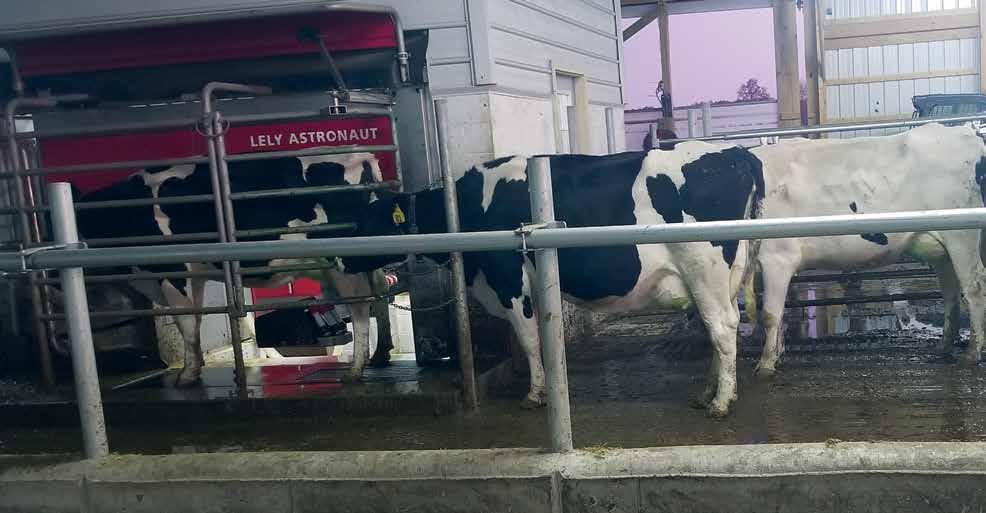
The milk line looks a little different at Annie G’s!
The orchard, rye and festulolium grasses are all high in protein, helping the cows to maintain good weight and milk production, while the diverse plant offerings help maintain a strong pasture. Orchard grass is very drought resistant, so it guarantees lush pasture even during the dry season where rye grasses produce well during the cold and damp seasons. Festulolium, a hybrid of rye and meadow grass, is a cold weather grass, keeping the pasture going much later in the season. It is also highly disease resistant, adding another layer of protection to the pastures. Not only does clover offer high-protein and dense nutrition, but it also helps to fix the soil in the pastures by adding nitrogen which helps to eliminate the need for synthetic fertilizers.
The orchard, rye and festulolium grasses are all high in protein, helping the cows to maintain good weight and milk production, while the diverse plant offerings help maintain a strong pasture.
Finally, fenugreek is a legume that is added to the pasture to help boost lactation in the cows, as well as aid their digestion, and cut down on the amount of methane emissions that the cows produce. In human terms, it helps balance their gut health, so they aren’t as gassy. Depending on the time of day, a programmed robotic arm will open different areas of pastures to the cows, closing off the previously used pasture after each cow has come in for milking. This ensures that the grasses themselves aren’t overgrazed, helping to keep the fields lush and healthy. This pasture rotation, in addition to their seeding practices, puts their pastures into a system called Regenerative Field Farming.
Regenerative is the key to success here, and as a consumer I encourage readers to consider this label with a higher regard than organic. Over the years, “organic” labeling has become less and less nutritious. This is a combination of agricultural application, as well as legal loopholes that larger scale factory farms have found to simply abide by the letter of the law instead of staying true to the original intentions for the term “organic.” Even in good organic practices, in order for farms to be able to keep their organic label, they are forced into a lot of economically and environmentally unfriendly practices. Most glaring is the excessive amount of single use plastic used in the gardens themselves. This not only leeches microplastics into the soil over time, but that plastic ends up in a landfill, further perpetuating the cycle. Additionally, not all organic practices are regenerative. This is important, so let’s break this down.
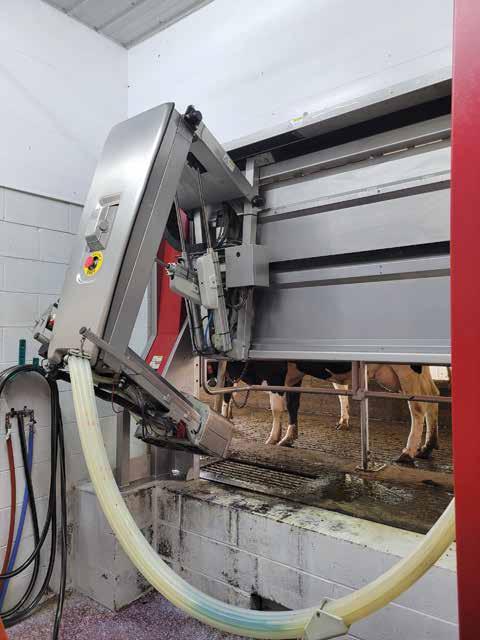

The milking station gives the cows their sovereignty to be milked when they know they need to be milked.
that help to restore soil health, biodiversity, and ecosystem function on their farms. This puts our food system back into nature’s web of life, as opposed to outside of it. It takes the surrounding landscape into consideration, moving beyond sustainability
to actively repair nutritionally drained, overworked, degraded land, as well as fostering safety to surrounding ecosystems. It captures atmospheric carbon in the soil to combat climate change, helps improve water retention to preserve the water tables, and increases crop resilience so farmers aren’t as dependent on chemicals to combat diseases and funguses. Because of this practice, we as the consumer can have peace of mind knowing that the food we are eating was less impactful on the environment, as well as healthier for us, overall.
The final product of Annie G’s hard work is Regenerative, Grass Fed, Organic Pasture Raised Cows aka a farm you can trust.
So, how did this become Kat and David’s passion project? Well, that story is just as interesting and impressive as the farm itself!
When Kat was a young woman, her original passion was the fiddle. She played in a folk music group in high school and after she graduated, she discovered Irish fiddle and traveled the world playing sessions and festivals. Eventually her passions as a moonlighting musician, as well as her day work as a large animal vet, found her on the shores of New Zealand, where she met her husband, David. Between his Irish citizenship and her love of Irish music and culture, she pursued employment in Ireland and in 2013 the couple settled in. But they soon realized that their happily ever after should include a future in dairy farming. So, after their wedding in 2014, they decided to move back to the United States and work toward purchasing Kat’s family farm from her parents.

Regenerative is the key to success here, and as a consumer I encourage readers to consider this label with a higher regard than organic. Over the years, “organic” labeling has become less and less nutritious. This is a combination of agricultural application, as well as legal loopholes that larger scale factory farms have found, to simply abide by the letter of the law instead of staying true to the original intentions for the term “organic.”
Since then, it’s been an uphill struggle to implement their plans, but Kat is a super woman and isn’t afraid to lead the charge to make this dream reality. By “Living Her Label” she is walking her talk and showing other farms that not only is regenerative agriculture better for the environment, but it’s also better for the farmer’s pocketbook as well. Change is hard, and often slow, but that doesn’t
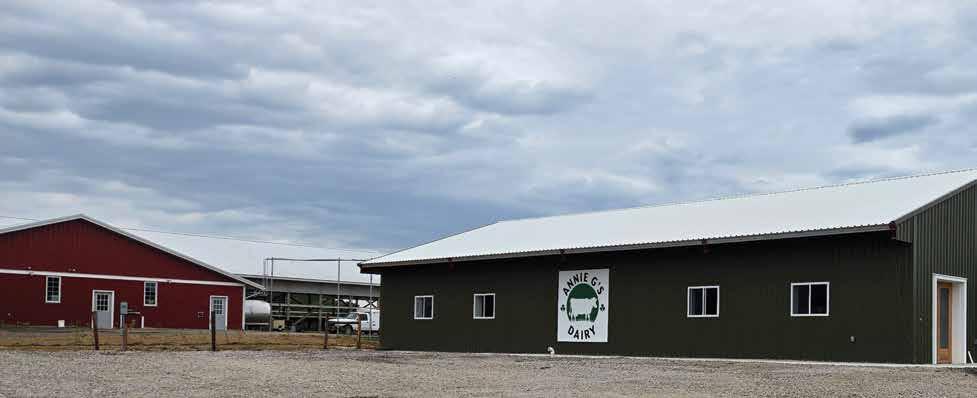
discourage her. She sees the shifts happening in her community and confidently puts herself on the front line to help usher in the change. She wouldn’t be surprised to find herself on the Regenerative Organic Certification Board in the future to help the industry grow. For now, she is taking on the task of making the small dairy farm sustainable again with a little knowledge that she and David brought back with them from Ireland: The Automated Milk Man aka the milk vending machine.
This piece of equipment, affectionately called “The Moomatic,” is a fully automated milk vending machine that Kat believes will make offering the sale of milk more achievable to smaller farmers. Bottles, caps, equipment, and labor all add up to a lot of money that the normal small dairy farmer simply doesn’t have. That is why farmers buy into processing plants, where they just sell their milk in bulk to a processer to be pasteurized and placed on a grocery store shelf. But that process is laborious, environmentally taxing, and at the end of the financial line, the farmer doesn’t make as much as they could if they were able to sell their products individually. It also distances the consumer from the farm creating even more disconnect from our food supply. With the vending machine, Kat hopes that small farms can make a living off 100 cows, which is easier on the land as well as the farmer, and reconnect the consumer to the farm, thus putting more money back into the farmer’s pocket and back into the community.

Not only is it unbelievably fun to watch a jug be filled with milk in the machine, but it’s the freshest, most natural form of milk that can be purchased from a store, as well as the closest consumers can get to fresh from the cow. This is because the milk is small batch, as well as low-temperature vat pasteurized.
As I said above, it hasn’t been an easy road, since the vending machine idea is completely new to the United States. However, Kat believes this is the path forward and is putting in her blood, sweat, tears, time, and money to make it a reality. The couple hopes to eventually have these fully automated vending machines available across the country to help the small farmer survive.
But, for now, come and use the only milk vending machine in the country at Annie G’s farm. Not only is it unbelievably fun to watch a jug be filled with milk in the machine, but it’s the freshest, most natural form of milk that can be purchased from a store, as well as the closest consumers can get to fresh from the cow. This is because the milk is small batch, as well as low-temperature vat pasteurized.
Lower temperatures kill harmful bacteria but preserves enzymes like lactase, helping some lactose-intolerant people digest their milk. And as discussed in the genetics section of the herd, many people who believe that they are lactose intolerant can drink the milk from Annie G’s because of the A2/A2 genetics found in the herd. It is non-homogenized, so it has a layer of cream that separates from the milk after it has been bottled. These three practices, combined with seasonal grazing and as much homegrown feed as possible, have allowed them to create a truly great product that more people can enjoy without any adverse effects, as well as peace of mind. By carefully managing these elements, Kat and David ensure quality and sustainability in every step. To add to the personal experience of connecting to the farmer and the cows, the fat content is posted on a board beside the vending machine and is updated every time the milk vat is refilled with new milk.
As if that wasn’t enough, Kat also researched and found all natural flavorings that can be added to the milk during the vending process. So, all-natural chocolate, strawberry, and other fun seasonal flavors are available for purchase. They offer cheese and meat from their farm as well.
I hope this article has inspired you to take a deeper look at the connection to your food, as well as encourage you to consider making the trip to this remarkable farm and support their efforts. Every time you purchase from a reputable farmer, you make a choice with your money. Instead of supporting large-scale commercial or factory farms, your purchase begins bringing wealth back to your community, and back into the pocket of those who will continue to work toward a brighter food future for us and future generations. Support your Local Farmer.
Find Annie G’s Farm Store at 6130 Pleasant Lake Road in Ann Arbor. You can also catch them at the Royal Oak Farmers Market at 316 East 11 Mile Road in royal Oak on Saturday from 8:00 a.m. to 1:00 p.m. You can also find Annie G’s products at Sheats Produce in Milan and Green Things Farm Collective in Ann Arbor. Follow Annie G’s on Facebook, Instagram, and TikTok @AnnieG’sDairy.
Karen Quinn is a writer and artist who homesteads on a rural urban farm in Livonia, Michigan with her husband, son, and menagerie of animals. Her favorite things are napping, exploring, and drinking tea. Find more about her at Patreon. com/ZephyrineJunction.
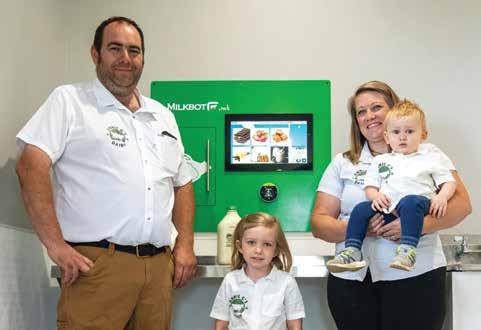
David and Kat Mageean with their children, Annie and Angus.

By Karen Quinn
After a long, bitter cold winter, it’s time to welcome our bees and other pollinator friends back after their much needed, and well deserved, hibernation.
If you built pollinator hotels and overwintered them last fall (see my article in issue #91 of The Crazy Wisdom Community Journal for building directions), you can put them back out in your yard when the mid-day temperature reaches a consistent 55 degrees, and the overnights are above 35 degrees. In Southeast Michigan, that puts us around late March to mid-April, on average. However, we natives know that Michigan weather is hardly consistent, so use your best judgment.
After a long, bitter cold winter, it’s time to welcome our bees and other pollinator friends back after their much needed, and well deserved, hibernation.
Here are a few tips to help the flying friends as they come out of hibernation. First, I will suggest creating something called an “Emergence Box.” This can be a plastic bin or heavy-duty cardboard box that your hotel will fit inside. On one of the sides of the box/bin, cut a single ½ inch diameter hole. As our little buddies wake up, they will follow the light of the hole and leave the box. I went the plastic bin route, since I can use it year after year, and I don’t have to worry about it if it gets wet. If you choose to go this route, I suggest using a non-clear bin to make it easier for the groggy bees to find their way out. However, my first few years I did use heavy duty cardboard boxes. If you decide to take this route, just keep it up off the ground and under cover to keep it from getting soggy during spring rains.
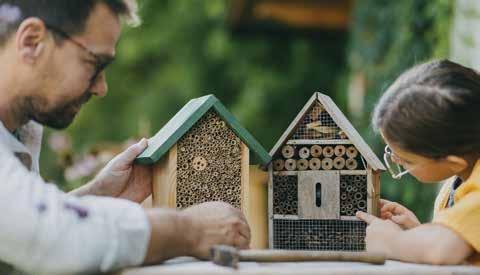
Once the hotel is empty of occupants, it’s time to clean it up and get it ready for the next use. Start by removing all the nesting materials. Then, give it a good sanitizing scrub with a diluted bleach mixture.
There are a few reasons why this is a good practice. One reason is it keeps the pollinator hotel dry and free from most rodents and predators. The only stinkers you have to keep an eye out for are mice. If you find mice are making their way in and out of the emergence hole, you can cover it with a mesh screen. I use old potato or onion bags to cover the hole. The second reason is that a nesting female won’t see that as a safe place to return to lay her eggs.
Be sure to monitor the hotel in the emergence box often for unwanted visitors as well as keeping track of when it’s empty. You will know that a tube nest or the wooden block holes are empty when the plug at the end of the tunnel is broken. If you used pinecones, straw, or sticks, a cursory look for anyone sleeping among the debris is your best bet. Another important thing to watch for is moisture. This could be due to rain, or leaks in the wood. Access it to see if you need to weatherproof the seams, extend the roof, or adjust the placement of the hotel. Keeping the hotel dry, safe, and warm is of the upmost importance as our buzzing buddies wake back up.
Once the hotel is empty of occupants, it’s time to clean it up and get it ready for the next use. Start by removing all the nesting materials. Then, give it a good sanitizing scrub with a diluted bleach mixture. MSU suggests a ½ cup of bleach to a gallon of water for this process. This is a very necessary step to keep your local population of pollinators healthy. It is imperative to remove any parasites or pathogens that can cause diseases from the nesting areas. If you are reusing your tubes, clean them out with a pipe cleaner or straw cleaning brush to remove any debris, then soak them in the bleach solution and allow them to air dry. If you are using the drilled block method, you can use the same size drill bits to rebore out the holes if you wish, then soak the wood in the bleach solution, and allow it to air dry completely. You can use the natural tubes and wooden blocks for two years before they need to be replaced. Be sure to wash the box of the hotel completely as well and make any necessary repairs to rotten wood. Once it’s all cleaned and dried, you can place it back out in your garden or store it and use it next year.

When the temperatures drop again in late October, your hotel is full of pollinators and ready to be put in a safe place!
Now, if you want to help your nesting female friends out all summer (and I highly recommend you do!) Simply place a new, clean, bee hotel, identical to the one you put out in the fall, near the emergence box in your garden. Now, it doesn’t have to be “new,” it can also be the nesting box you just cleaned or one you stored from the previous year. Make sure it is in a protected, covered space, facing southeast so it receives direct sunlight in the mornings. It is best to put the new hotel up about 4’-5’ on a post, building, or tree as close to your garden as possible. Then simply leave it all summer, and when the temperatures drop again in late October, your hotel is full of pollinators and ready to be put in a safe place!
If you place a new bee hotel out, continue to monitor it throughout to garden season. When you see tubes or drilled holes capped with mud or leaves, that is a sign of mason or leafcutter bee nests. You might even find cocoons of moths or butterflies in your straw and sticks, which are oh so much fun to watch. But aside from “wanted activity,” you should also watch for unwanted events as well
Next, watch out for ants! They will gladly use your hotel as a bee larvae diner and destroy your bees’ nests. There are many pollinator safe remedies out there. Diatomaceous Earth (or DE) around the base of the post or in the bottom of the nesting box can be a good preventative as well as deterrent. I’ve also heard other gardeners have success using ant bait and sticky spray to deter an active invasion. The last thing I watch for is an excess of spiderwebs. Now, if some enterprising genius arachnid sets up shop on my bee box, I’m not above moving a spider away from my hotel, but a lot of webs is an indication that it might be in a little too shady of a spot.
Finally, be sure to add more native blooms and natural habitat around your garden to encourage even more bees, flies, beetles, moths, birds, and butterflies to stay. Be the oasis these little creatures are dreaming of, and they will pay you back tenfold by simply being themselves, and making your garden more beautiful than you knew it could be.
Karen Quinn is a writer and artist who homesteads on a rural urban farm in Livonia, Michigan with her husband, son, and a menagerie of animals. Her favorite things are reading, exploring, and drinking tea.
By Cashmere Morley
When Juana Mancera graduated from the University of Michigan in December 2025, she decided that if she was going to face the daily grind, she might as well be the one choosing the beans. Sick of working for other people, sick of climbing a corporate ladder, Mancera opened Kultura, a mobile coffee-music pop-up, or as she explained it, “coffee, culture, and speakers on wheels.” The hottest thing in town isn’t just the caffeine, it’s the electric blue cart and the heavy bass vibrating through the steam of your new favorite cuppa joe. Meet the coffee experience that’s treating the local caffeine scene less like a transaction and more like a pop-up party.
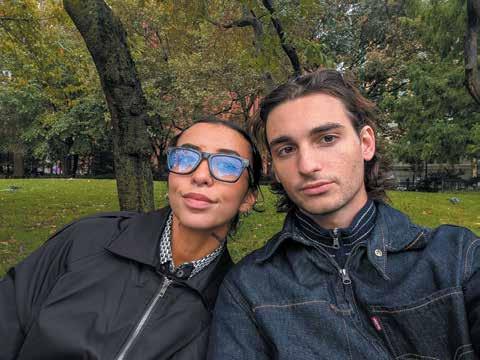

When Juana Mancera graduated from the University of Michigan in December 2025, she decided that if she was going to face the daily grind, she might as well be the one choosing the beans.
“Everything is in your calendar these days—very formal,” said Mancera. “We based Kultura on the idea of the third space, which is essentially gatherings that are unconventional, not necessarily planned out, natural and organic gatherings, wherever and whenever.”
Coffee, in this vision, is less a product than a pretext—a reason for people to come together. Music is the other essential ingredient.
That “wherever and whenever” is not rhetorical. Kultura is a mobile cart designed to appear in different spaces—festivals, plazas, sorority events, early-morning gatherings in other cities—each time reshaping itself to fit the environment.
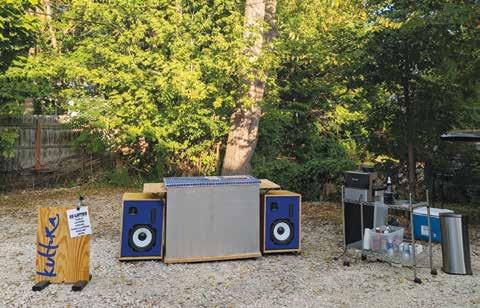


Mancera came up with the idea of a mobile coffee pop-up on the street corners of France. While living in Paris, Mancera noticed a different rhythm to how people interacted with coffee.
“I would see every single corner of the city, people hanging out drinking coffee, and it wasn’t necessarily from a coffee shop... It was just an organic gathering. And that’s what I want to do—build a community around it.”
But Kultura is far from a Parisian bistro. This is a “listening room” on wheels. “I love music, and I love being able to carry my speaker around,” Mancera said. “And I was like, ‘Oh, wait. That’d be such a cool idea, to just be able to gather with friends, drink coffee, and listen to music.’”
If the name looks a little “weird,” that’s exactly the point. “Cultura means culture in Spanish, but culture is spelt with a c, obviously. And I wanted a little funky twist, because I love anything weird and funky, just playful like that name is,” said Mancera.
Coffee, in this vision, is less a product than a pretext—a reason for people to come together. Music is the other essential ingredient.

Ann Arbor is not short on coffee shops, and Mancera is quick to acknowledge that.
“I think Ann Arbor coffee is honestly amazing. I have a lot of go-to coffee shops that I am a huge fan of,” she said. But, she still saw room for something different.
“I think the unconventional aspect of Kultura, what sets us apart, is that typically you go and you drink coffee or you do work, and you leave, but it’s not necessarily a place where you can gather with friends…at least not from my experiences,” she said. “It’s just not necessarily normal to have an experience with your coffee. And I want everything that we do to be an experience with people, from music and playlist creation to the actual coffee and the drinks.”
The idea came to Mancera last year while slinging sweets at a local cupcake shop. Mancera realized her time was worth more than her paycheck.
“I was making little to almost nothing, and I wasn’t necessarily happy,” she said. “I just graduated in December, but I was still a student, and I didn’t like what I was doing. So I was like, ‘Wait, if I’m gonna make almost nothing, I might as well make almost nothing for myself.’ Kultura began last summer. I want to say the idea was formed in July, and we were booked and busy, I think, like the second weekend of August—something like that. So, it was a quick turnaround, for sure.”
With a background in economics and film, television, and media, Mancera didn’t set out to just build a coffee cart; she built an entire brand. “My econ background is definitely helping me build that financial model... the film, television and media is helping me tell the story,” said Mancera.
“Kultura doesn’t need to make me a millionaire. I just want to work for myself and expose people to my culture and other cultures, and I would be happy. The goal is to establish an organic presence in the coffee world.” —Juana Mancera
The idea had so much narrative weight that, “Even before it was a tangible thing, people were already excited about that idea,” said Mancera.
It’s anyone’s guess what will hit you first: the sound of Kultura’s electric blue cart spinning some tunes or the aroma of fresh coffee emanating from the popup.
“Our brand identity is pretty strong. We have the electric blue. So, I think that is something that just draws your eye to the product,” said Mancera. “Even the logo plays with duality: we have a little angel and a devil... there’s always two sides to things.”
This contrast defines the brand: coffee and music, high energy and deep chill. “They’re kind of like oxymorons. You can come here to have fun. But you can also drink coffee and chill,” Mancera said.
The pop-up coffee experience has more layers to it than just music and coffee. While the business currently sources beans from Michigan, the heart of the
Mancera notes being a popup can come with its challenges, but it’s all been worth it for her.

menu is inspired by the founder’s Mexican roots and her boyfriend Adrian’s, Puerto Rican family.
The star of the show, said Mancera—and what people constantly come back for—is Kultura’s horchata latte.
“I grew up drinking horchata for every single dinner. My mom would make it, then I worked in a Mexican restaurant, and I learned how to make it myself,” said Mancera. “At first, I wanted Kultura to be truly inspired by Hispanic roots. But there have been times where I have the horchata latte for sale at a pop-up, and it’s the least sold item... so I think [it’s about] trial and error and appealing to my market with something like a lavender latte depending on who is in the room.”
If you see the founder behind the cart, she’s likely, “reading the room.” It’s a skill she attributes to being “the eldest of three sisters” and a lover of techno. “I love electronic. I love techno. But I’m also very good at intuitive listening, reading between the lines, and seeing what the people want. If they want to talk and have an engaging conversation, then I’ll do so. But then, if I feel like they just want to get their drink, drink it in peace and chill, then I can also do that.”
Mancera notes being a popup can come with its challenges, but it’s all been worth it for her. She said, “Getting to events is kind of draining at first, depending on how far away they are, but then after the event, I feel like I’m glowing.”
The long-term vision is taking Kultura global. Think permanent brick-and-mortar shops in Mexico City and Puerto Rico.
“When that happens, we want to adapt to the culture wherever that is. If we open up in Paris, I want the shop to resemble French culture. But that idea is more of a bigger picture thing. Just understanding and being open to every culture wherever we’re at is the goal.”
For now, she’s happy building a space where people feel they belong. “Kultura doesn’t need to make me a millionaire. I just want to work for myself and expose people to my culture and other cultures, and I would be happy. The goal is to establish an organic presence in the coffee world.”
Discover Kultura online on their IG: @kulturaconnect. If you’re interested in a pop-up, email Mancera at getkultura@gmail.com

By P. A. Alaniz
Do you love watching cooking shows on T.V.? I admit, it is a guilty pleasure of mine. One of my favorite things to watch is the BBQ competitions. I enjoy learning about all of the unusual ways you can grill meat, poultry, fish, vegetables, and even fruit.
During one episode they talked about ways in which tea could add more flavor to food cooked on a gas grill. It piqued my curiosity and I did a little research into the subject. In what ways could tea be used for your summer BBQ besides a nice beverage to quench your thirst? I never thought about using it as a marinade for a meat dish, or to add smokiness, or flavor to grilled vegetables. Why had I not tried grilling with tea sooner?
Traditional tea (black, green, or white) is full of tannins which are natural meat tenderizers. It works well in a brine or even as a dry rub. You can also use a dry tea packet on top of coal or the burner shield of your gas grill to add a smoked flavor to your food. Since tea has many different combinations of flavors you can experiment with many types. Green and white tea with floral or citrus notes, such as lemon balm, usually pairs well with fish, vegetables, and chicken. For your tougher cuts of meat like lamb, beef, and pork, use black or oolong tea along with spices such as garlic and black pepper.
When brining, make sure to allow for enough time. Depending upon the cut and toughness, you will want to leave the meat soaking in its cold tea bath for a minimum of four to twelve hours. Larger cuts of meat will take considerably longer in order for the flavor of the tea to be infused. Beef and lamb will naturally take longer brine times verses chicken or pork. If you are short on time, I would recommend using a tea rub instead with a resting time ranging between fifteen minutes to an hour.
To add a smokiness to what you are grilling, tea can be used in place of wood chips. You would need to create a packet out of aluminum foil, then add in loose leaf tea, rice, and sugar. Add a bit of fresh apple, cherries, or even orange slices to the packet to mimic that particular type of wood flavor.
For spring and summer grilling season, why not try something adventurous? Instead of just drinking iced tea, add tea to the grill! You might just start a new tradition. Let me suggest the following recipe for a start.
Earl Grey Orange Chicken
4 cups of water
4 cups of ice
6 bags of Earl Grey tea
½ cup of brown sugar
½ cup kosher salt
1 small white onion diced
4 cloves of smashed garlic
1 orange sliced
1 piece of fresh ginger diced
¼ cup of soy sauce
1 tbsp black peppercorn


Bring water to a boil, remove from heat, add the six bags of Earl Grey tea and let steep for 10 to 15 minutes. Squeeze any liquid from the tea bags before discarding.
Add salt and sugar to the liquid, stirring until dissolved. Add the four cups of ice to cool the mixture. Then incorporate soy sauce, onion, garlic, orange, ginger, and peppercorns. Stir for one to two minutes. Make sure it has cooled prior to adding raw chicken.
Once chicken is placed into the brine, cover and allow it to soak in the refrigerator for a minimum of eight hours and no longer than twenty-four.
Remove the chicken from the brine and pat dry with paper towels. Make sure to thoroughly dry.
Then, grill the chicken until it reaches an internal temperature of 165 degrees Fahrenheit or 74 degrees Celsius.
Eat and enjoy.
P. A. Alaniz is a writer and poet. In addition to The Crazy Wisdom Community Journal she has been published in the Michigan Bard 2025 Poetry Anthology, Chicken Soup for the Soul’s “My Wonderful Wacky Family,” and her blog Tea, Travel and Spirits.
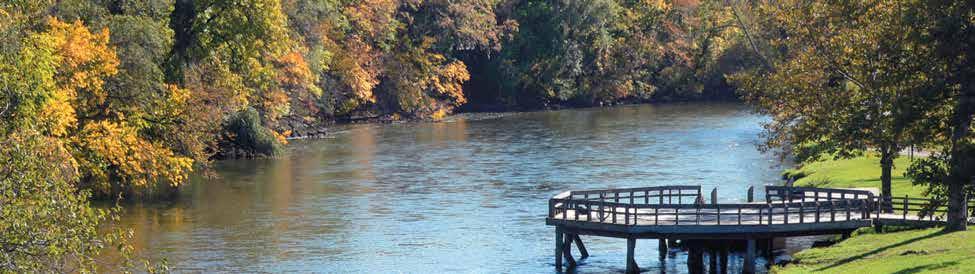
by Kirsten Mowrey
“My own spiritual observation has been that a small ‘self’ suffers and causes suffering; that a love of the living world lets single identities and selfhoods expand and encompass other beings, entities and whole landscapes, such that the self becomes a spacious thing.” — Robert McFarlane, Is a River Alive?
Giwitatigweiasibi.
Nottawaseppi. Huron. There are many names for this river birthed in a swamp, meandering south through the center of Ann Arbor and Ypsilanti and onward to Lake Erie. Cos-scut-e-nong, sebee,“burnt oak river,” connecting upstream and down, invites us to a wider sense of self, neighborhood, and community. I spoke with Rebecca Esselman, Executive Director, and Jason Frenzel, Director of Community Engagement, both of the Huron River Watershed Council, about our local river.
Kirsten Mowrey:
How would you characterize The Huron River?
Rebecca Esselman:
For southeast Michigan, it is a really beautiful river with lots of natural settings still. If you look at a map of the watershed, the headwaters are in Oakland and Livingston counties, which are still relatively rural, relatively forested. The Huron River has something called the Natural Rivers District, a state designation that limited the amount of development that could happen adjacent to the river. That’s why when you paddle the Huron, you see forest and not homes.
Kirsten Mowrey:
What are ways people can connect more intentionally after they have these recreational experiences? What engagements are possible for curious children?
Jason Frenzel:
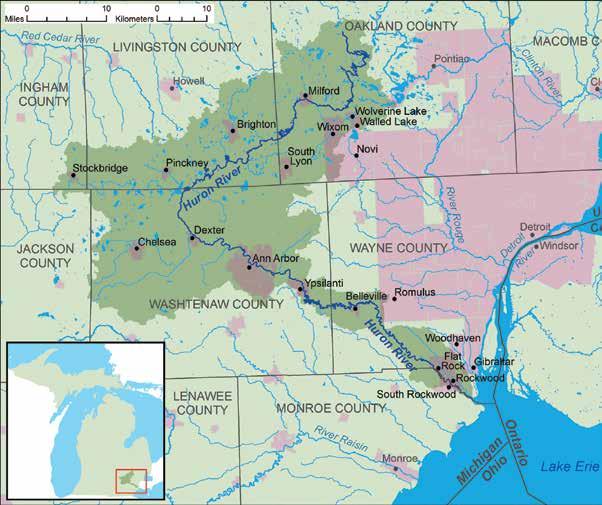
Giwitatigweiasibi. Nottawaseppi. Huron. There are many names for this river birthed in a swamp, meandering south through the center of Ann Arbor and Ypsilanti and onward to Lake Erie.
I’ll separate what we do and what one can do. Our base level work is participatory science. Volunteers come out and help us collect scientific data about water quality. It’s very educational. Many of the activities are family friendly, for those who can focus for 30 or 40 minutes. That’s great for young people. Really broadly, all of our municipalities have stormwater runoff, which is a big concern for us. Stormwater carries pollutants, but it also carries trash into the river. Anywhere where there’s a storm water system in any of our municipalities, the road and the parks are directly connected through the pipes to the river. Collecting trash in the water, near the water, or in the parks and streets, is all important. That can be done just as we’re taking a walk with our dogs.
Rebecca Esselman:
We have an adopt a storm drain program that is really good for young people or families. It’s a great way to communicate to a young person who thinks the river’s over there [gestures to the left] that it’s really right here [points to self]. Forming that connection, even if you can’t visually see the river or a lake, [that] we are all connected via this watershed. I think storm drains are a really great point of entry for young people and adults, frankly, to understand the watershed concept and how what we do on land is directly connected to our waterways.
Photo by Cmadler
“The Huron River Water Trail is both a state and a federally designated water trail. The state water trail program was initiated by Governor Snyder to draw attention to our inland water resources.” —Rebecca Esselman
Kirsten Mowrey: What section of the Huron is legislated as that?
Rebecca Esselman:
It’s from about Milford area down to Ann Arbor. Once you get into Ann Arbor and head east, that designation stops.
Kirsten Mowrey:
When did the idea for The Huron River Water Trail come into existence?
Rebecca Esselman:
We had the designation in 2015. The Huron River Water Trail is both a state and a federally designated water trail. The state water trail program was initiated by Governor Snyder to draw attention to our inland water resources. There’s some promotion but no designated funding from state sources. Because the Huron River has a strong watershed council with capacity, we have become the stewards of the water trail. We did a lot of fundraising in order to build it up and make it more accessible: signage, mile markers, kiosks at entry points, docks—we fixed up portages around dams. We’ve created, printed and sold “The Paddler’s Companion,” which is a map of the water trail (now in its fourth edition).
Kirsten Mowrey:
In Robert McFarlane’s latest book, Is A River Alive?, he writes, “We must hugely widen the space of relations,” to start to see our connection to the water. In the case of anyone who lives in Ann Arbor, their drinking water comes from the Huron, so they have a direct relationship, the river is in their bodies.
Rebecca Esselman:
There are very few places in the state of Michigan where a drinking water source is surface water that’s not the Great Lakes. There’s a unique connection to water at this spot on the map. Another beautiful connectivity piece of river work and this watershed concept is everyone upstream is an impactful neighbor. There are tangible connections between people in Wixom, Milford, Brighton, and those in Ann Arbor. Whatever benefits or detriments to the river that happen upstream, they reach this community here. Likewise, whatever Ann Arbor residents do with the river impacts Ypsilanti and Flat Rock and our neighbors downstream. These might be places that you feel very disconnected from if you’re just thinking about roadways and distance. But if you think about the way water and rivers
“Because there are a lot of remaining forests, the health of the river is pretty good for an urban stream. But as we are getting more development, [both] industry and residential, we are starting to see some places in the Huron River where our biodiversity is declining.” —Rebecca Esselman
move, you’re absolutely connected to these places and the people in them. It really expands your view of your neighborhood.
Jason Frenzel:
The watershed isn’t only the place where there’s flowing water. If you remember the water cycle—[mainly] precipitation. Historically most of that precipitation would have infiltrated to become groundwater. Now we’ve intercepted that with these impervious surfaces, which becomes storm water, which goes directly into the river. We’ve augmented the water cycle. If you think about the water cycle and the watershed, all the folks who get their drinking water, municipal or residential, from drinking water wells, the groundwater, that is part of the watershed.
Kirsten Mowrey:
That stormwater runoff affects the groundwater that they’re pulling from?
Jason Frenzel:
The stormwater is often separate from the groundwater system, but if you think about the water cycle, it’s all part of the same system. It’s [just] moving through the system in different ways.
Kirsten Mowrey:
Jason, let’s say I’m newly retired—are there ways that I can contribute?
Jason Frenzel:
[One of] our biggest two programs [a newly retired resident can contribute to] is the benthic macroinvertebrate study. Those are aquatic bugs. We do one [study] in the middle of winter, one in the middle of spring, and one in the middle of autumn. Stone Fly and River Roundup, is a four or five hour commitment once. Bring a friend or a family member, very good for folks with kids. It’s a great way to see if this is a thing that you like doing. With that program, because it is episodic, we’ve seen young people volunteer with us year after year. Some now are our peers, because we’ve been doing that program for 35 years. We have people doing research in other states about waterways that came through that program when they were children.
A slightly more intense program that we do is our chemistry and volumetric flow analysis. We have a training that happens late in March every year. It’s an orientation for how you go about doing this. We ask people to come out a few times over the growing season, spring to Autumn, and do that analysis. In both programs, there’s a small team of advanced volunteers who will make sure that new volunteers feel comfortable. It’s social fun, getting to know people who are of similar disposition or interest. Those are the two biggest projects that we have that are science related.

“Rain gardens are the way that we rebuild the water cycle, because we’re taking what was about to be storm water and we’re turning it into infiltration. It’s directly solving one of the biggest problems we have.” —Jason Frenzel
Rebecca Esselman:
I’d like to talk about the quality of the river. Because there are a lot of remaining forests, the health of the river is pretty good for an urban stream. But as we are getting more development, [both] industry and residential, we are starting to see some places in the Huron River where our biodiversity is declining. We are at this frontier in the Huron, as development moves west, where we have an opportunity to do right by the river. I think that that’s something that we should all be carrying as we’re thinking about how to be good river stewards at this time.
Kirsten Mowrey:
With the watershed touching so many communities, that really asks us to stretch who we’re thinking of when we’re looking ahead. All of this is happening in the context of water being a defining characteristic for our future going forward.
Rebecca Esselman:
In southeast Michigan, we are seeing more frequent large rain events. That’s the impact [of climate change] that’s hitting us first, and it does have consequences for the health of the river. We’re seeing more and more flooding impacting our built environment—basement flooding, roads getting washed out or not being traversable for a period of time. That’s our new reality in southeast Michigan, and something that we actively think about when we’re implementing water protection strategies.
Kirsten Mowrey:
I imagine that it really applies in the work the council does with municipalities around storm water runoff, because that’s changing so rapidly.
Rebecca Esselman:
It does. Rain gardens, which fall under this umbrella of green storm water infrastructure, is another thing that residents can engage with that helps the river, helps mitigate climate change, and helps reduce the impacts of those large storms. Rain gardens are usually native plants in a garden bed that has a bit of a depression that allows rainwater to collect on your property and infiltrate into the soil. It now moves slowly through the system as opposed to hitting pavement, or even lawns, where it tends to run off rapidly, hit the river too much too fast in ways that cause erosion, pollution, and other types of damage. That’s a personal action that we promote—a household level action to help with the challenge of climate change. (For more tips on planting a rain garden, read our article, “Now is a Great Time to Plan Your Rain Garden” at Crazy Wisdom Community Journal online at thecrazywisdomjournalonline/2022/12/15/greenliving-now-is-a-great-time-to-plan-your-rain-garden?rq=rain%20garden.)
Kirsten Mowrey:
I know slowing water down is a big thing, but I also know that one of the most difficult things around that seems to be the aesthetic. People look at native plants and they see weeds. Do either of you have comments about that aesthetic conversation?
Jason Frenzel:
We participate in the Master Gardener training course, which we, along with all of our sister organizations, offer at the end of winter in preparation for spring. That course allows folks to design their rain garden in whatever aesthetic they would like.
Remember earlier in our conversation, where the impervious surface intercepts the rain? It breaks the water cycle. Rain gardens are the way that we rebuild the water cycle, because we’re taking what was about to be storm water and we’re turning it into infiltration. It’s directly solving one of the biggest problems we have. That is the take home that we try to send to people.
Kirsten Mowrey:
Do you have a favorite place on the river that you would like people to discover?
Jason Frenzel:
Just downstream of Belleville [the Huron] is this really beautifully snaking river. There’s lots of Metro Park there, and so the river still can meander in the way that it wants to, unimpeded by dams. Down river from there is Oakwoods Metro Park, and it becomes a braided river where the sinewyness starts to intercept itself. It feels like a really different river and yet it’s the same water.
Rebecca Esselman:
The Huron River starts in Indian Springs Metro Park up in Oakland County. It’s just a little spring that comes out of the ground, seeping into a wetland. I think it’s a fabulous field trip for folks in Southeast Michigan to go see where a river begins, [to] know what it looks like.
One other potential idea is Point Mouillee where the river ends. It’s a marshy delta area that has amazing waterfowl. It’s a very popular stopover point for migrating birds of prey in the fall. It’s cool to see where a river enters a great lake, and it’s also very unique from a wildlife perspective.
Kirsten Mowrey:
Now I’m going to throw you a reach question which is: New Zealand has made a river a person with legal rights. Do you think that’s possible for the Huron in your lifetime?
Jason Frenzel:
If we can do it for corporations, why can’t we do it for nature?
Rebecca Esselman:
There is a researcher at the University of Michigan, Oday Salim, who is exploring this idea in the US. That is the direction I would like us as a society to head. To have a reverence, a respect, and understanding of the value of water to our health, our wellbeing, our existence, and to behave in ways that recognize those connections.
The Huron River Watershed Council is funded through members. To support their work or discover programs, visit their website hrwc.org. To learn more about Kirsten Mowrey and her work, visit kirstenmowrey.com.


Story and photos By Hilary Nichols
“Why aren’t the adults doing anything about this?” Michael Klement shared the question his granddaughter asked, in tears, when she was 12 years old. That question has been a driving force for Michael Klement ever since. In 1991, Klement founded Architectural Resource, one of the leading sustainable architecture firms in Ann Arbor.
But his firm didn’t start out that way. Michael Klement additionally credits his wife for the inspiration to shift toward sustainability. When they moved into their new home in 2004, it was discovered that she suffered from multiple chemical sensitivities. Klement became aware of how many elements of their new home were probable culprits. “In our business we would determine our client’s choices by three criteria: do they like it, can they afford it, and can we get it?” Klement shared. “Never did we ask, ‘will it kill them?’ Once we learned about the effect of toxins so prevalent in building materials firsthand, you can’t unknow what you know.” His wife Cindy Klement wrote a book titled Your Body’s Environmental Chemical Burden: A Resource Guide to Understanding and Avoiding Toxins and is now a leading expert on the subject. With this newly pressing awareness, his firm found its focus: “We are residential design specialists with a smart sustainable design emphasis,” Michael said.

Michael Klement additionally credits his wife for the inspiration to shift toward sustainability. When they moved into their new home in 2004, it was discovered that she suffered from multiple chemical sensitivities. Klement became aware of how many elements of their new home were probable culprits.
Architectural Resource designed Sanctuary at Hope Farm, a cutting-edge example of a Net Zero, climate-responsive home. (Read the article in issue #91at crazywisdomjournal.com/thecrazywisdomjournalonline/2025/12/17/ jeff-parness-and-the-sanctuary-at-hope-farms-how-to-transform-loss-intohope-and-healing.) Netzero indicates a home that creates as much power as it uses. “This was one of the most incredible pieces of architecture that we have ever designed,” Michael said. With permanent wood foundations, geothermal cooling, bird safe glass, solar power generation, and reclaimed lumber, the firm was able to maximize innovations to minimize harm to the planet. The home
is an ideal example of the firm’s devotion to the latest in building science, and it exemplifies their collaborative principals as well. Their website states, “We endeavor to work from an inclusive basis incorporating our clients, builders, and consultants as integral and respected members of the team.”
“We wanted to work closely and intimately with our clients,” Klement shared. Architectural Resource practices residential architecture so well because it is
Michael Klement, founder of the firm, Architectural Resource
what they do exclusively. “We want to help clients craft their immediate and essential environment: their home.” Klement understands that our homes are a kind of human exoskeleton. “I call it our third skin, after our skin and clothing,” he described. “Nearly everything we do, we do inside a structure, in a built environment.” Klement is committed to building those environments with care. Even in their office, Klement remains committed to the most sustainable choices available. “Everything you see here has a sustainability story—from the formaldehyde-free surface materials to the cork floor tiles and the wall surface. It is called American clay plaster, which emits negative ions. Our filtration system is in our walls,” he boasted. Negative ions are electrically charged molecules that can filter the air, and it is widely believed they may also have some positive effect on mood, sleep, and immune systems…which is fitting. There is an atmosphere of joy in their small offices on the east side of Ann Arbor. The space isn’t fancy, but it is effective, where the firm’s edict is palpable and in practice. All the workstations are identical, from the interns to the leads. “We believe in investing in the new generation of talent,” Klement assured. He is adamant to share the credits with his staff of four young architects.
As a town, Ann Arbor is progressive enough to embrace the environmental movement in architecture and conservative enough to get it done.
—Michael Klement
“Trevor is the youngest architect here, but probably the most influential, because it is his generation that is going to inherit the mess that my generation has left them with,” Klement lamented. Through their enhanced internship program, Trevor Werthmann went from being a fan of the firm, to intern, to full time project designer, bringing his youthful perspective and enthusiasm to the company.
If I am going to build something, I am going to build it right. It is going to last a long time and not only is it going to do no harm, but it will be actively beneficial for the environment. It will be a force of good in this world.
—Trevor Werthmann
“Being from this generation [Gen. Z], I have the consciousness that if we don’t do this right, our time on this earth could be limited,” Werthmann shared. “Climate anxiety is real, and ecological concerns are at the center of all the design choices here.” Werthmann was introduced to the firm when they hosted his Lawrence Tech class through a green building tour. High performance, ecological architecture was Werthmann’s career commitment. “The moment that presentation was over, I realized I had to be here at Architectural Resource. I have been here ever since.” As President of the National Association of Architecture Students, Werthmann was prepared to put in the work. “Their enhanced internship program revolutionizes how professionals impact the student experience,” he shared. “Here you are going to have a hand in everything that happens. I worked right alongside the project designers, trying to absorb all that I could from this talented team.” Micheal Klement added, “Though young in his career, Trevor points out things that I miss in our projects. He brings an additional perspective not informed by past limitations.”
This is a firm that is not slowed by limitations. They describe themselves on their website as “boundless and limitless.” “We delivered Michigan’s first LEED Platinum whole house remodel in 2008,” Klement said. “And then went on to design Michigan’s second and third LEED Platinum whole house remodels.”
The U.S. Green Building Council’s website describes Leadership in Energy and Environmental Design—better known as LEED certification—as a globally recognized building rating system honoring a commitment to sustainability within a framework for healthy, efficient, and cost-effective green buildings, with environmental and social benefits. Platinum is their highest certification
level, signifying innovation and leadership in regenerative design that incorporates holistic solutions.
“We are eager to invite our clients to embrace the full breadth of what is possible,” Klement said. “We had clients come to do a standard remodel of their existing home and they ended up with the second Living Home in the world. We opened them up to possibility.”
The Living Building Challenge (LBC) establishes the most rigorous standards in the world, concerned equally with beauty and inspiration, human equity, health, and happiness that improves the symbiotic relationships between all aspects of the built and natural environments.
Dale Babcock, a project designer with the firm, spent his childhood in the natural environment of his backyard in Jackson, Michigan. “I was always outside,” he shared. After years steeped in conceptual architecture at U of M, he met Michael Klement. That fact that Klement’s firm focused on sustainability and building science was the fit that clicked. “This is the complete picture from an architectural standpoint. Here we are designing custom houses that are suited to the client’s lifestyle while helping the environment and learning all the while,” Babcock shared. “I grew up on three acres,” he continued. “One summer, I helped my dad build a set of stairs from the porch to the back yard, and the whole reason was to make it easier to enjoy that natural setting. And I think that is what we do here,” he said. “We had a project adjacent to a park near here.” The one-story ranch had limited views before the second story addition was designed with the vistas in mind. “Now,” Babcock said, “every inch of that house engages with the trees of the park across the street.”
With permanent wood foundations, geothermal cooling, bird safe glass, solar power generation, and reclaimed lumber, the firm was able to maximize innovations to minimize harm to the planet. The home is an ideal example of the firm’s devotion to the latest in building science, and it exemplifies their collaborative principals as well.
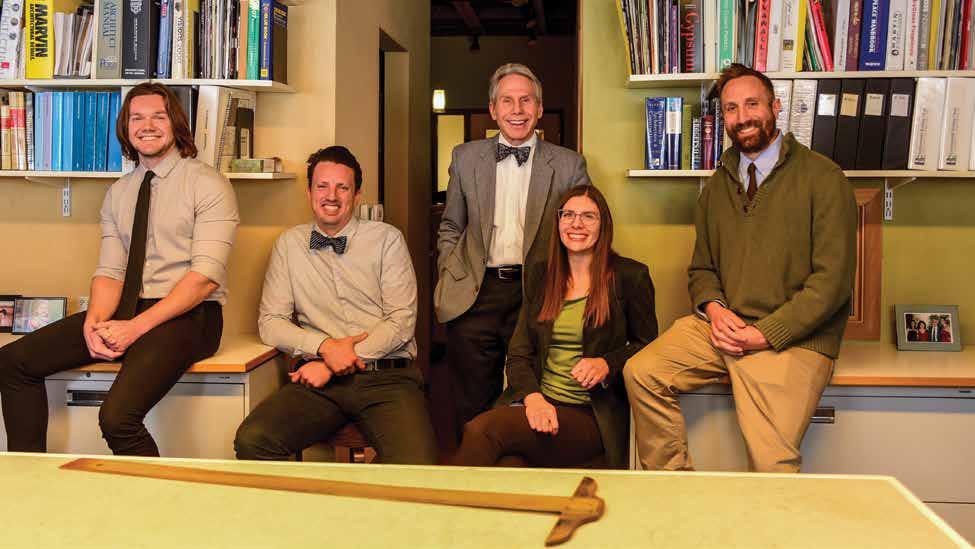
Project designer Susan Hall fell for the architectural field while exploring construction sites near her childhood home. “I fell for the tactile experience, exploring distinct spaces and imagining how different families would live in these walls,” she shared. How the built environment reflects and supports different needs, lifestyles, and cultures fed her curiosity. “How would diverse sorts of people inhabit and evolve their spaces?” she asked herself. The firm is equipped to custom design buildings that fit their people. “For the client who wanted views over here and views over there, we innovated a curved wall of glass, to get the maximum exposure,” Hall reported. The glass wall works to maximize the sun’s warmth when it is cold, and overhangs shade the direct sun when it is hot to make the home more energy efficient and more comfortable. The home utilizes nature to its greatest benefit. “We are not separate from nature. We are nature,” Klement added. “That is one of our consistent edicts that drives all our design ideals.”
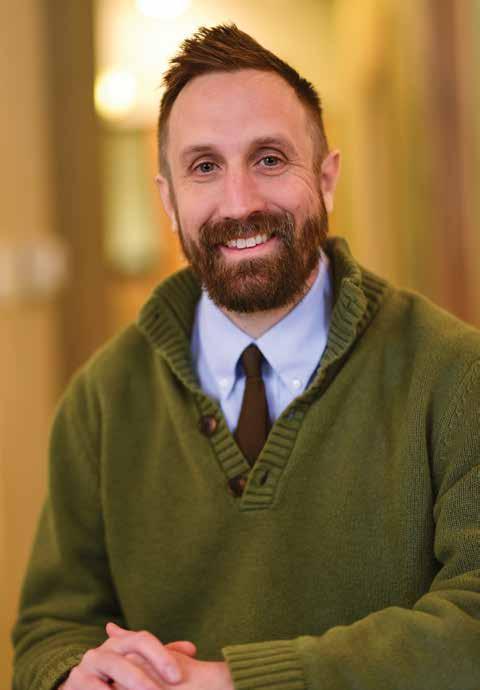
We do projects that are historic preservation, renovation projects, and new homes of all different styles. But I think what unifies all our work is our attention and care that comes from a certain set of values.
“If you look at our projects at face value, they look very diverse,” project designer Alex Jackson shared. “We do projects that are historic preservation, renovation projects, and new homes of all different styles. But I think what unifies all our work is our attention and care that comes from a certain set of values.” Values are the uniting force, and it is what brought Jackson to the firm. “Architectural Resource is all about sustainability and education first. Not as an afterthought, but as the leading force toward a healthy future,” Jackson said.
On their website, Architectural Resource shares their values in one sentence: “We do not live in the now, we live in the future—your future.” They take great pride that the work they do is lasting. Klement shared, “We effect solutions that will be here for the next 100 years or longer.”

I began to understand the impact and influence architecture can have on people, and this concept of standing on the shoulders of giants.
—Michael Klement
Looking to the future while building on the past, Klement honors the influences from his own mentor’s great career. Tivadar Balogh, born in 1926, taught at the University of Michigan College of Architecture and Design from 1956-1997. Klement pointed to his office wall, “Like Excalibur, his T-square is still displayed for me to see every day.” Completing his Masters at U of M in 1986 under Balogh, Klement then went on to start his own firm. “It was just him and I sitting in Eames chairs in his carport, pushing graphite with this T-square. He showed me how to think.” He cited the well-known Winston Churchill quote: “First we shape our buildings, thereafter they shape us.”
“I began to understand the impact and influence architecture can have on people, and this concept of standing on the shoulders of giants.” It isn’t lost that now, those shoulders are his as he impacts the next generation of young architects. The staff at Architectural Resource are the talents who will carry this influence forward through their full careers.
“Arguably, Ann Arbor is the only place in the world that our firm could have achieved such an impact,” said Klement. “As a town, Ann Arbor is progressive enough to embrace the environmental movement in architecture and conservative enough to get it done,” he said. And they do get it done. Architectural Resource has completed eight LEED certified home projects here and counting. “The stakes have never been higher, nor the opportunities more abundant, than they are right now. This is the best time to be alive. And to be an architect. I couldn’t imagine anything better.” With great opportunity comes great responsibility, but his team embraces the challenges boldly. “Both for the well-being of our clients and from a deeply held, personal, core belief that we have an incredible responsibility as place makers to do so.” Michael Klement can assure his granddaughter, these grown-ups are doing something.
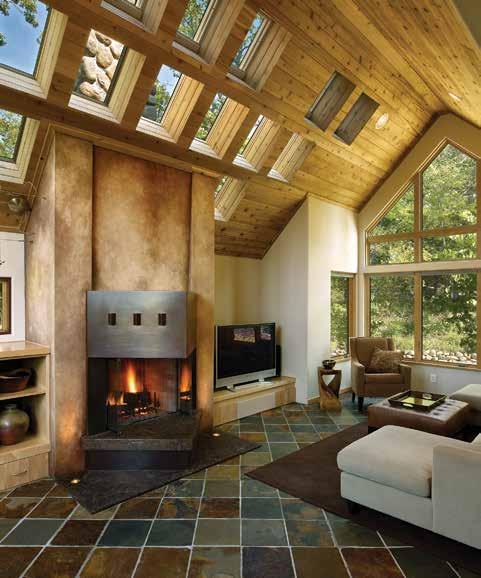
“If I am going to build something,” Trevor Werthmann concluded. “I am going to build it right. It is going to last a long time and not only is it going to do no harm, but it will be actively beneficial for the environment. It will be a force of good in this world,” he asserted. “When I met Michael, I felt his passion and was swayed when he shared a line from a Terrance Temple poem: “The eyes of the future are looking back at us and they are praying for us to see beyond our own time.”
You can view Architectural Resource’s portfolio of homes at their website here: architecturalresource.com. You can also sign up to attend their seminars and tours from their website. Michael Klement and the team are also available by phone at (734) 769-9784 or email: mklement@architecturalresource.com.
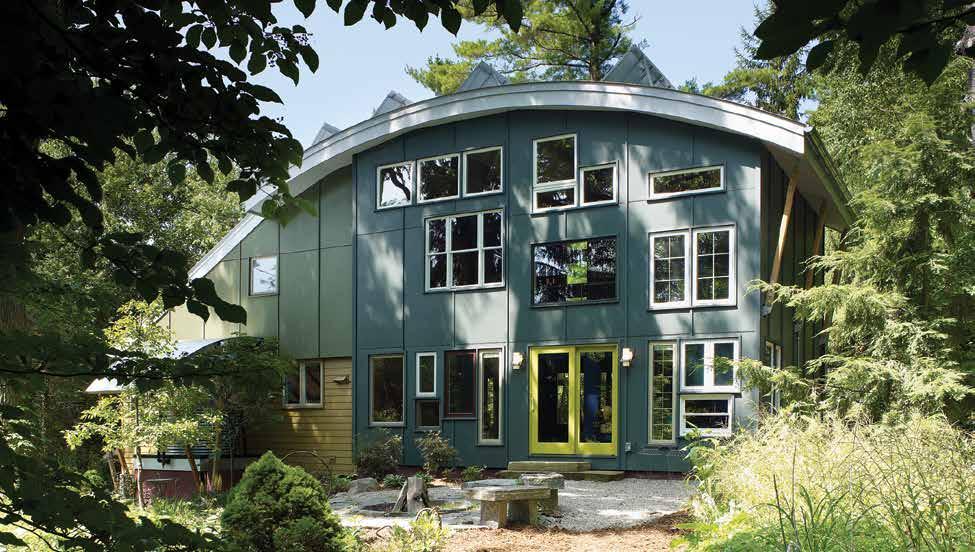
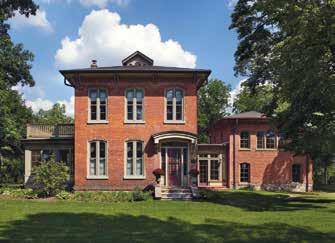
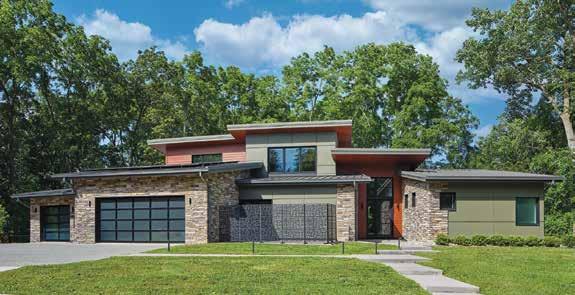





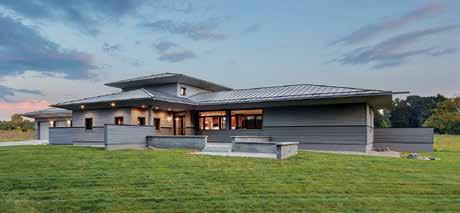
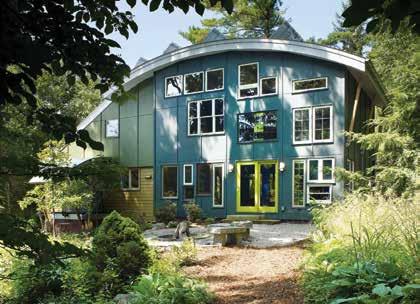

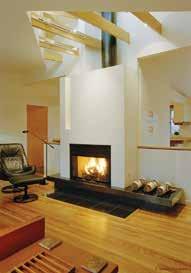
We are Architectural Resource... a visionary residential architecture firm specializing in custom sustainable design. Founded in 1991 we celebrate 35 years of creating inspired living spaces helping our clients realize their dreams and create a lasting legacy for generations. The Homes of the Future Today®
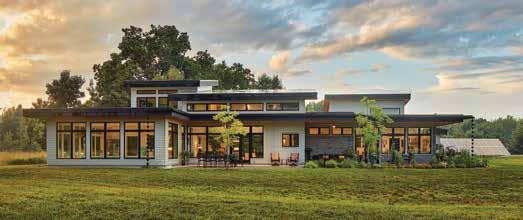

Architectural Resource
734.769.9784
www.architecturalresource.com


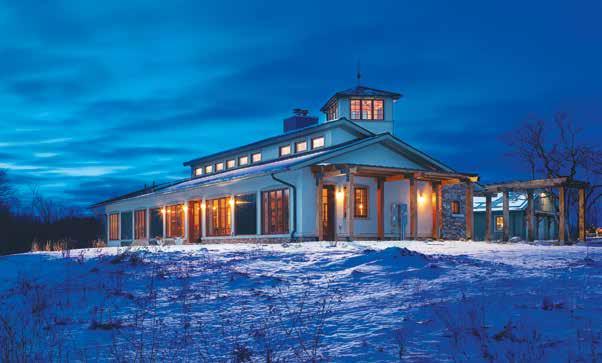
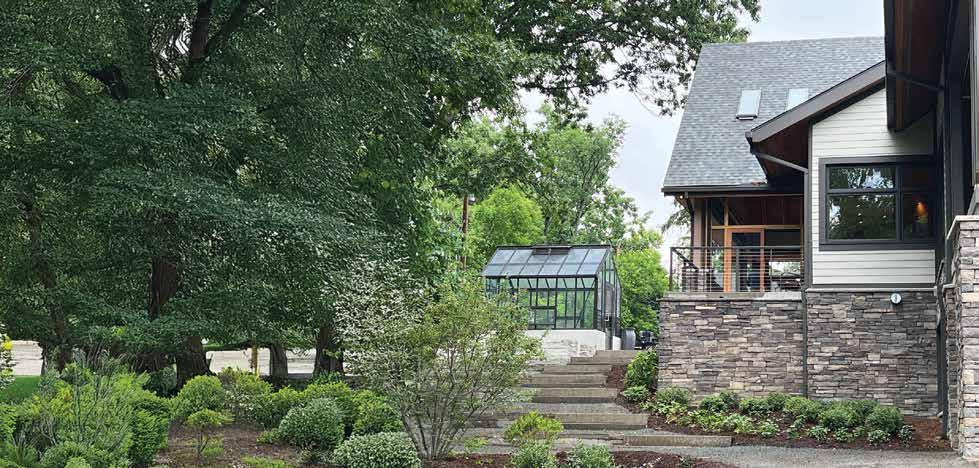
By Hilary Nichols
The Mahons don’t endeavor to build their client’s dream home. “We prefer to build their ‘legacy home’ to be passed down for generations,” said Andrea Mahon. The goal is anchored in something more tangible than today’s dreams. “We build homes to last, but more so, to matter,” Mike Mahon added. And that is what the Mahons work so hard toward. In 2006, Mike Mahon founded Adaptive Building Solutions (ABS) here in Ann Arbor to be part of the zeitgeist. “I knew it was the perfect place to start a business that focuses on sustainability.”
As he was getting ready to wrap up his youthful adventures, skiing in Telluride and driving his VW Bus around San Francisco, Mike Mahon saw the US Green Building Council’s presentation of San Francisco’s new library. He was struck. “I was fascinated with the concept of sustainable building practices to address climate concerns, before that notion was really commonplace.” He had dabbled in construction jobs over the summers and was ready to start a business. “Knowing that everything that ends up in Michigan starts in California and takes a couple of years to get here—I figured I had a head start.” When he returned to Michigan to finish college at EMU, Mike visited Ann Arbor and understood, “It is an educated community that was already oriented around an environmental mindset.”
We build homes to last, but more so, to matter.
–Mike Mahon
Having graduated from MSU, Andrea chose Ann Arbor for its vibrancy. “I realized that I would want to raise children here because I loved how Ann Arbor supports diversity.” Mike’s lifelong friends were supposed to introduce Mike to Andrea DeLuca on a blind date, but they took too long to set it up. So, Mike jumped the gun and called her. Their first date was at Pacific Rim. It was not long after that they were planning their wedding at the Gandy Dancer and their life in Ann Arbor.
Mike took a job at a lumber yard to learn the local construction field. The first house he ever built was LEED Certified. “Yeah, it was quite ambitious for never having built a house before,” he laughed. “I had to do a deep dive to meet all the milestones to earn that certification.” It was the 2nd LEED home in Ann Arbor. “It put us on the map,” Mahon said.
Andrea officially joined the business a few years later. She had been working for GE health care, managing forty projects in three time zones, while she had two small children at home. Realizing something had to give, she asked herself, “What changes could I make to have a better work life balance?” Mike had been a one man show, and it was clear there was an opportunity there. “As a member of the family business, I was able to apply my skillset to bring more rigor and process to his building science world. And we could streamline two careers into one.” As a husband and wife team, Adaptive Building Solutions doubled in strength.
When Haiti was devastated by an earthquake in 2010, many of the Mahon family traveled to the island to volunteer with medical mission services. Mike knew that his talents as a builder were needed there as well. “We had to fly into the Dominican Republic and drive over the mountains to get in. The whole country was pretty terribly demolished. The work was endless,” he reminisced. “I ended up flying back every month to respond to the devastation. I was working on building orphanages, infrastructure projects, and fund raising.” But what he could do with his own two hands wasn’t enough. So, he and fellow builder Michael Rath of Denver, Colorado, came up with the idea for a nonprofit organization called the Haiti Orphan Rescue Program.
The operation was designed for a double positive effect. Our business model employed Haitians themselves to do the work with local materials, to quickly improve the conditions for orphans and caregivers as well as the local economy in a very tangible way.
“The operation was designed for a double positive effect,” Mike said. “Our business model employed Haitians themselves to do the work with local materials, to quickly improve the conditions for orphans and caregivers as well as the local economy in a very tangible way.” It became a very personal project. “We didn’t just show up, do the make-over, and leave,” he said. “These people became our friends.” After his sister adopted her daughter from a Haitian orphanage, that sentiment became even more true. “Now,” he shared, “Haitian people are our family.”
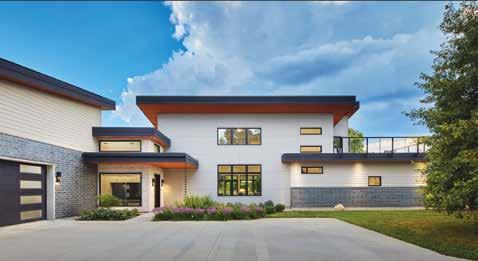
Introducing green building techniques to the orphanage renovations just made sense to Mahon. “In a country that may always have energy insecurity, increasing sustainability elements can offer stability that counts.” That idea made him think, “I wonder if the USGBC [US Green Building Council] would be interested in promoting a project in Haiti?” Mike cold called Rick Fidrizzi, the CEO, and got a call back in 15 minutes. “How soon can you get to Washington DC?” was the response. The time was right. That collaboration birthed a major project that succeeded in building the William Jefferson Clinton Children’s Center and Orphanage. It was designed to be “net-zero” for critical independence from the unreliable power grid in Port au Prince.
The industry took notice and asked Mahon to present at their annual conference. It was while Mike was on stage in Toronto that fellow Ann Arborite, Michael Klement of Architectural Resource, recognized his colleague. When Mahon got back to Ann Arbor, Michael Klement reached out and suggested a collaboration. Since then, the two firms have shared a series of successful projects.
“We have collaborated on eight houses with Architectural Resource and all of them have received a sustainability certification,’” Mike Mahon shared. Five are LEED Certified, two are Passive House Certified and one is Net-Zero. The Preissner Passive home received the West Michigan USGBC’s Certified Green Home Award of 2019. And the Journey House won the 2023 USGBC’s LEED for Outstanding Single Family Projects of the Year which was one of only three single family projects recognized in the world.
“We put our whole heart into these projects. And it’s not just the two of us.” It is clear: a good cause is a great motivator. “If the builders are positive, all the tradesmen adopt that attitude and amplify the appreciation.” The Mahons are devoted to creating a fun and fulfilling work environment for the whole team. “We want the people that work with us to be happy on the jobsite,” Mike Mahon said, “Creating an example of sustainability? That is a story that we all can take home and feel proud of. There is a lot of love and purpose poured into this labor. In the end, we can feel the good karma built right into the home.” Their entire effort, from the beginning to the end, is a labor of love.
“When we begin a project with clients, we know that we are going to put years of labor into building something meaningful together,” said Mike Mahon. For that reason, they consider the interview process to be a two-way street. “We work with customers who want to invest in a project that is good for the planet.” Building code doesn’t require these standards. “But we want to build the ‘right way.’ And we think that is constructing the most sustainable, lasting, comfortable, and healthy home we can build.” Andrea added, “Our push isn’t for the simple solution it is for the lasting one. And that isn’t based on status. It truly is about centering care.”
Our push isn’t for the simple solution it is for the lasting one. And that isn’t based on status. It truly is about centering care.
–Andrea Mahon
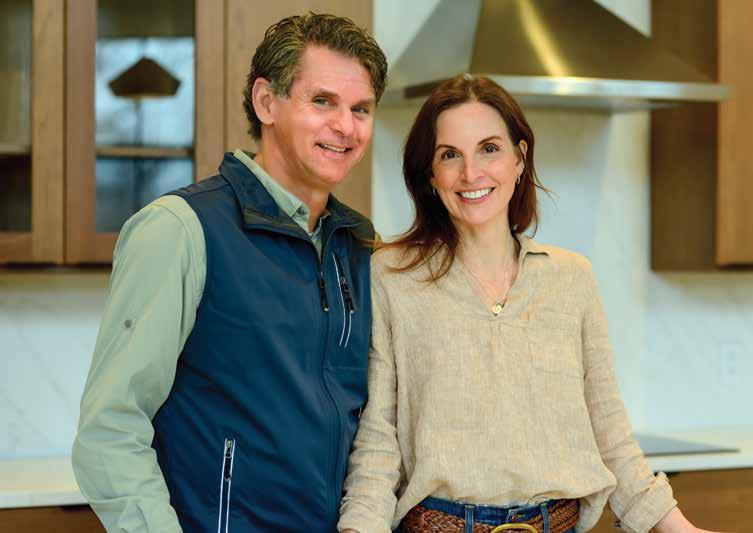
Once the build is complete, we stand back and let the structure become so much more. It isn’t just a building anymore, now it is a home—a legacy home.
–Mike Mahon
The Mahons offered extra care to a client whose house needed a whole rebuild from the studs up. “Our client had steady employment, but she hadn’t tended to her credit score,” Mike said. Most builders won’t get involved until the loan is secured, but the Mahon’s tell a different story. “We worked with her to repair her credit score, with some creative solutions and simple fixes. It took a few months, but she improved her score so much, it changed her whole approach,” Mike said. It is that sort of care for the client that sets them apart. “Our clients know that they have an advocate in us.”
Creating an example of sustainability? That is a story that we all can take home and feel proud of. There is a lot of love and purpose poured into this labor. In the end, we can feel the good karma built right into the home.
–Mike Mahon
As stated on their website, Adaptive Building Solutions “elevates the homebuilding experience by embracing an integrated design approach. From day one, we bring every key player—architect, homeowners, builders, and even subcontractors—together to collaborate seamlessly.” Smarter, higher-performing, energy-efficient homes is the goal in mind. Custom crafting homes for the client’s specific request is at the heart. Mike shared an example, “The clients wanted an 80-foot long curved wall of windows. Because glass doesn’t bend we innovated an effect with 48-inch long segments, at a two and half degree tilt all the way around. The outcome is ideal for this space. We just had to figure out how to build it.” It is this devotion to their craft that counts. “Custom home building isn’t just what we do—it’s what we love,” Andrea affirmed.
One of the most special examples is the Sanctuary at Hope Farm project. This Net-Zero, climate-responsive house incorporates many of the industry’s latest technologies. The Mahons worked closely with the owners, husband and wife Sandra Hauser and Jeff Parness. “We feel lucky to be part of such a creative expression with this project,” Andrea Mahon said. Parness echoed back the sentiment. “Andrea makes it look easy, while it’s like she was landing 40 planes at the same time.” Andrea appreciated that comment, adding, “I view my work like a symphony, conducting all of the trades, in a delicate balance, as one element completes, the next falls into place.” It is a complicated dance. But the outcome is worth it.
“Once the build is complete, we stand back and let the structure become so much more,” said Mike Mahon. “It isn’t just a building anymore, now it is a home—a legacy home.”
To learn more about the Mahons and see their company’s vision, visit their website at adaptivebuilding.com. For more information about working with them on a project email them at mike@adaptivebuilding.com or andrea@adaptivebuilding.com.

by Hilary Nichols


By Emily Winfield Martin
What would you do if you let the wild in? Eleanor loved wild things. Every wing and wild sprout. There was something wild inside of her, waiting to come out...
With gorgeous illustrations, this book is the ideal addition to any bedtime reading routine or read aloud. The Wildest Thing beautifully expresses a timeless message about little ones unleashing their inner “wild” and encouraging their budding imagination and unique individuality. Is it Spring?
By Kevin Henkes
If one day buds bloom and birds chirp, and the next day a late snow falls from the sky, is it spring? Will it ever be spring? An evergreen, child-friendly picture book that explores themes of patience, hope, the seasons, and nature by the New York Times bestseller and Caldecott Medalist Kevin Henkes.
A flower in the garden down the street. Birds in the sky. Buds on the branches in the park. It must be spring. But wait! What is this icy gust of wind? Why are snowflakes falling from heavy gray clouds? Will it ever be spring? Yes, says the sun. Just be patient.

By Taryn Souders
In the small, southern town of Everson, goats can run for mayor, the mail is always late, and nothing all that bad ever happens. That is, until thirteen-year-old Tucker finds Miss Geraldine dead at the bottom of her stairs. At first glance, it looks like an accident. But Tucker has always had a knack for noticing details that others overlook, and the details surrounding Miss Geraldine’s death just aren’t adding up. Miss Geraldine was miserable and mean. Miss Geraldine was murdered.
The whole town seems to have reason to want her dead, which makes Tucker’s search for the truth nearly impossible. The more he investigates for clues, the more danger he finds himself in, and the more he realizes that maybe Everson was never as safe as he once thought it was. Anyone could be the killer, and in a small town that loves to gossip, if Tucker isn’t careful, he could be the next one to have an “accident.”
By Alyssa Wilkinson
By 1968, Duke Foster had been passed from one crummy foster family to another for eleven and a half years. Since the day she was dumped on the steps of Merciful Heart Children’s home in Brooklyn, she’s had almost nothing but bad luck. She’s a pest. A nuisance. Unlovable.
But an apartment fire leads Duke to discover that not only does she have parents (the wonderful kind who would never leave their baby on a doorstep and have somehow vanished into thin air), but that she also has a sister. A twin sister. One who was adopted by a family in low-country coastal Georgia, and share’s Duke’s love of Nancy Drew novels.
As their paths cross, Duke and Daisy embark on a quest of their own to find their biological parents. At the heart of the search is an extravagant circus bursting with dark secrets. The performers and animals all join the growing list of mysteries to be solved. Add in a bully, a cat with very fuzzy ears, and a southern hurricane, and the twins have a summer brimming with adventure. But just as quickly as they unravel the mystery of their past, someone else is trying to bury the remaining clues. Finding their biological parents and the truth about their family could prove to be the most dangerous adventure yet.

By Natasha Bowen
The people are calling . . . And the gods will answer.
Moremi has only ever known peace in the Kingdom of Kwa, thanks to the two dragon gods keeping an unspeakable evil at bay. But when the king tries to claim the gods’ power for himself, it all goes dreadfully wrong. The great dragons are injured and flee . . . and the world’s darkest shadows are released.
Suddenly, Kwa’s ancient tales of monsters become all too real. Yet as death comes for those around her, Moremi somehow finds herself magically connected to both dragon gods—a feat that should be impossible.
Now, Moremi is Kwa’s only hope for restoring the gods to full strength. But will Jagun, the mysterious prince, let her anywhere near the dragons? And how does her childhood friend, Nox, feel about it all? It may not matter in the end, because if Moremi fails her quest, then she risks the earth caving in and the sky crumbling down.
By Jennifer Ball
Play classic games with friends and family in the tent, around the campfire, or on the road using foraged materials!
• Fun for all ages—without any screens!
• Terrific and timeless gift

• From Checkers to Mancala to Snakes and Ladders, there’s a game to entertain everyone
This portable, charmingly illustrated book features 37 board and other games (plus a robust collection of riddles) that can be played anywhere you go. All of the games in Sticks, Stones & Pinecones are easy to set up and require only the materials you can sustainably forage around you, such as pinecones, pebbles, sand, leaves, and twigs. You might not even have to get up out of your camp chair!
Some games are classic—even ancient--while others are newly invented. Whether at the campground, an urban park, or around your own backyard, players of all ages will enjoy these engaging games that range from simple to more challenging competitions.
The featured games are grouped into single-player, two-player, and multipleplayer options, with a focus on setups similar to the ever-popular board games people enjoy playing at home. From Nine Men’s Morris to Stick Solitaire to Neanderthal Poetry, every game has been vetted by the author and her family and friends in outdoor settings.

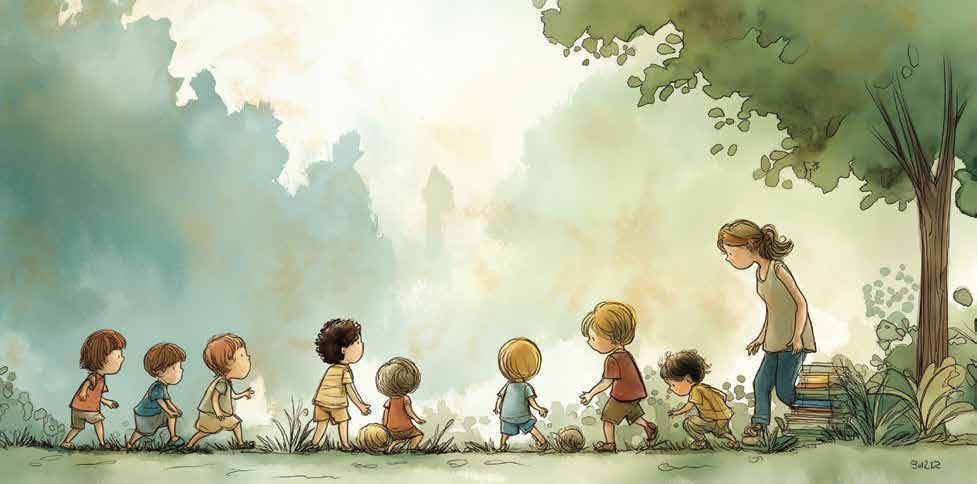
By Kaili Brooks
As children emerge from the cocoon of toddlerhood and begin their journey into the world, the 21st century parent must decide where and how their child should be educated. Public school is often the obvious choice, but other families may choose private, charter, or alternative schooling. A small number choose to homeschool. More wish they could, but find it unrealistic due to employment or other extenuating factors. In Washtenaw County we are blessed with a myriad of options. One such option, Ypsilanti’s Kindred Journey School (KJS), sits in the happy medium between private and homeschool. KJS is perfect for families who relish the individualized curriculum and close personal relationships that homeschooling offers but are unable to do so themselves. Serving Kindergarten through fourth grade and growing every year, KJS seeks to nurture the individual child and foster connection between peers, educators, and the local community.

In Washtenaw County we are blessed with a myriad of options. One such option, Ypsilanti’s Kindred Journey School (KJS), sits in the happy medium between private and homeschool. KJS is perfect for families who relish the individualized curriculum and close personal relationships that homeschooling offers but are unable to do so themselves.
The school was founded by Audarya Balbourine, who currently holds a master’s degree in education and is pursuing her doctorate. Balbourine said, “Initially the school began with a group of parents from the Harmony Collective Meditation Center, but I wanted to offer something that was non-sectarian and for everybody.” Families of all kinds are welcome, and Balbourine encourages parents to involve themselves in the school community. The school itself operates much like a family, with children aged 16 months to nine years engaging in education and play together. Much like a traditional homeschool environment, the teachers’ children attend the school as well, though KJS is not currently authorized to enroll non-related children under kindergarten age. Alongside Balbourine, Sri Radha Copeland is employed as a co-teacher. Together, they ensure that every child has their needs, from educational to socio-emotional, recognized and fulfilled. Initially, KJS operated out of a home in Ypsilanti, but the school was blessed with the opportunity to rent space in the Baha’i Center of Washtenaw County. The new space boasts three fully functional learning spaces alongside a large dining area, stage, kitchen, garden beds, basketball court, playground, and plenty of green space for children to explore. The children’s individualized learning plan combines different homeschool curriculums, including the renowned The Good and the Beautiful for mathematics. Describing the school’s educational philosophy, Balbourine stated, “The school follows the Emergent Learning method. It’s the answer to that tension between unschooling, following your children’s interests, but also educational subjects like literacy and math. It interweaves developmentally important and foundational aspects into their interests. Last year the children wanted to do a zoo project. We wove literacy problems into that, math problems
into that, and they had a concession stand. They get the foundations, but in a way that sparks joy for them.”
To further extrapolate, the emergent curriculum positions the teacher as a researcher and facilitator, there to examine the children’s interests and passions and offer them opportunities for these interests to be integrated into the educational curriculum. The teacher, though still the leader of the classroom and guiding hand, does not assert that things have to be done in a rigid way. The Emergent Learning Method is intrinsically flexible: observe and document, offer opportunities and guidance, rework when necessary, and find success. When the desired outcomes are not reached, the student is not shamed or held back, but rather they are offered the chance to try again.
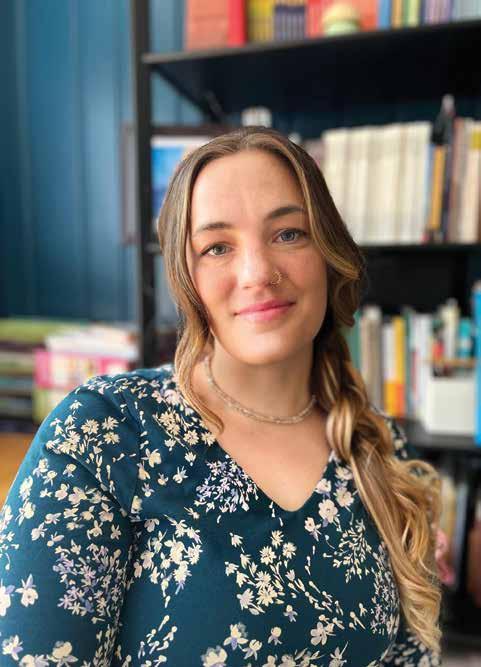
The rhythm of the school day allows space for students to foster their interests and engage in independent play—a fundamental aspect of childhood education often not adequately integrated into a conventional classroom. The day opens with a morning circle where students share their “rose and thorn” of the previous day and current morning and complete the day’s calendar. After this, books are read that touch on subjects students have expressed interest in. One such example from this school year was the question “how does flight work?” After this, students attend their individual lessons for the day with Balbourine, Copeland, and often a volunteer reading buddy. They complete their math and literacy lessons and move onto their chosen projects. Two students, aged 7, have begun work on a food chain project traversing the ocean floor and tropical jungle. The oldest student, aged 9, has chosen to create a school newspaper from the ground up, writing articles, taking pictures, and featuring art from other students. Once their work is complete, the children will take their lunch outside and engage in imaginative play on the Baha’i Center’s expansive greenspace which includes a playground and nature area.

The rhythm of the school day allows space for students to foster their interests and engage in independent play—a fundamental aspect of childhood education often not adequately integrated into a conventional classroom.
Already this rhythm differs from the regimented day offered at a public school, something Balbourine has worked hard to achieve. “The traditional school model is very prescriptive. Even in the Waldorf school it’s like that. Each year there are specific things that are done. With emergent learning, each year is dependent on their interests and the local community, but all supported by developmentally specific pieces. It’s done differently from year to year and month to month; in that way it’s more adaptive and fluid to the children and the community we’re in. It’s true to life—in life we follow different passions and use our literacy and mathematical skills to pursue these. We have a multi-age group which is something you don’t typically find in a classroom.”
While completing her Masters in Alternative Education, Balbourine gained experience in both the Waldorf and Montessori method; she now weaves elements of both into the curriculum while eliminating the dogma that often

While completing her Masters in Alternative Education, Balbourine gained experience in both the Waldorf and Montessori method; she now weaves elements of both into the curriculum while eliminating the dogma that often arises from a strict adherence to one educational method.
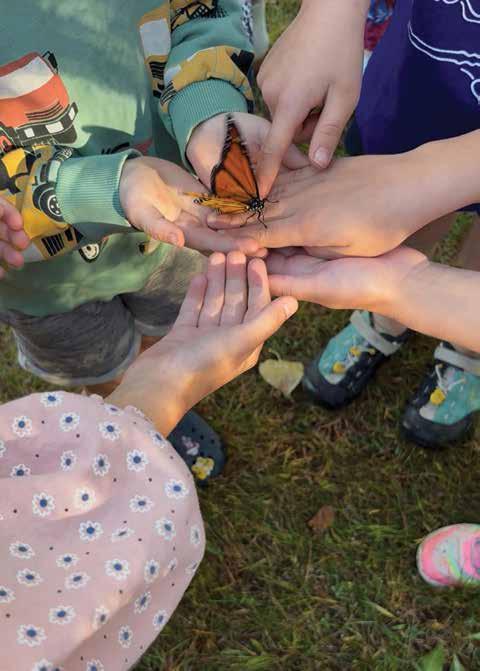
arises from a strict adherence to one educational method. She said, “The unique thing about Kindred Journey School is that it already feels like life, so it sets a precedent for lifelong learning. What I see them leaving with is a strong sense of curiosity. When they find a passion, they feel confident following it because they’ve done it so much before. They plan, explore, manage their time, and allow their interests to grow into full projects. As someone currently pursuing a Doctoral program, these skills are very important to pursue a higher level of education. There’s not someone holding your hand throughout the whole process. You have to research. You’re studying and creating your own dissertation. It’s not something you’re exposed to early on in conventional education and [young] people may leave without feeling confident enough to forge their own path.”
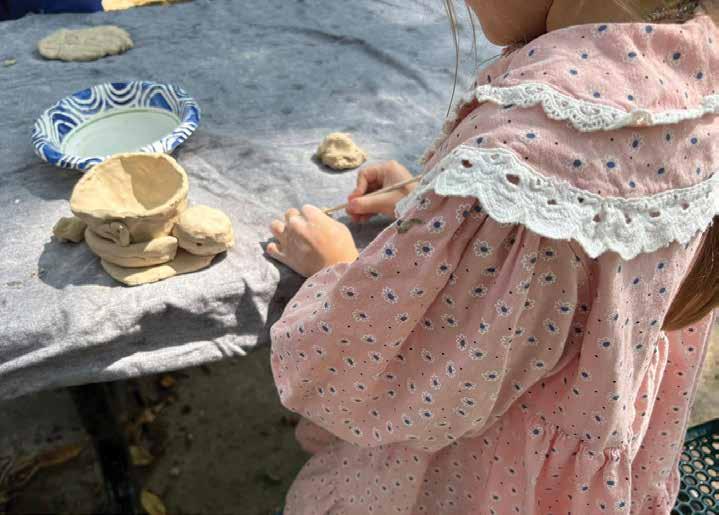
The last hour of the school day is reserved for something truly special: the Community Class. These are class offerings from local volunteers that introduce students to a wide variety of engaging subjects to which the students might not otherwise have access. The current course offerings are pottery and clay work with which students have worked hard to create sculptures and bowls. They work with wood to create bespoke birdhouses, and experience a mindfulness day where they practiced meditation and tai chi.
On how they decide what to offer in community class, Balbourine stated, “Sometimes they [the students] communicate an interest, and we find volunteers for that. They were very interested in clay, so we found a local potter. We’ve had Tae Kwon Do, and even a local microgreens farmer came in and taught about seed sprouting and anatomy. A woodworker came in, and they [the students] built their own mud kitchen. We find what’s local and alive in the community to allow them to connect with the people around them.”
Going forward in the year, the students will garden on the grounds, learn to grow their own food, master their physical strength in a children’s weightlifting class, and delve deep into their emotions and relationships with those around them, and more. By offering these opportunities to students (and community members alike), the children learn that they are not isolated in an educational bubble, but rather participants in a far grander web of knowledge and lifelong learning.
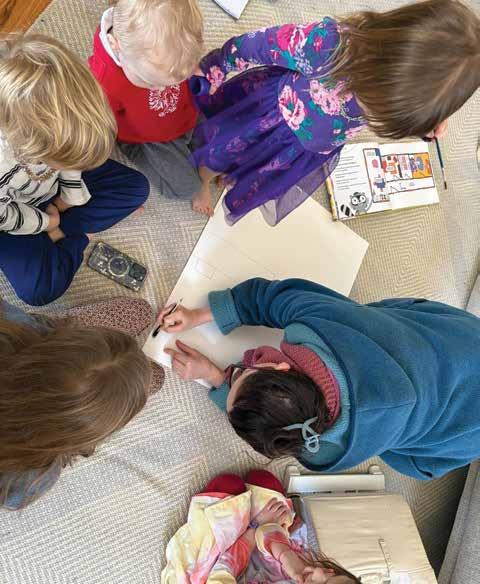
As of the publishing of this article, the school year will be half-over, but there is still so much more in store. The students will work toward their culminating project(s) and continue to learn and grow as a collective. KJS currently operates as a homeschool cooperative, but the school’s move to the Baha’i Center of Washtenaw County has allowed them to pursue a nonpublic school license. Pending small renovations at the center, Balbourine hopes to achieve this before the end of the calendar year and enter a new era. “I want there to be options for parents to participate in. I’d like to see different ways homeschoolers could engage as well as having children attend full-time. It’s important for me to offer choices to parents for how they educate their children, whether this be hybrid, full-time, or just for community class to allow them to build connections.” The school has already begun to welcome new faces into the afternoon Community Class and has its doors open to more. No matter how many new families find their way to Kindred Journey School, they will be welcomed with open arms. The message is clear: every child is unique and deserving of an education that respects their humanity, autonomy, and intelligence, and every parent deserves that for their child.
For more information on Kindred Journey School and to inquire about enrollment opportunities, KJS is available online at KindredJourneySchool.com. If you are a community member interested in volunteering for Community Class, please contact director@ kindredjourneyschool.com. Kindred Journey School is located at 5550 Morgan Road in Ypsilanti.
Kaili Brooks is a mother, writer, calendar editor for The Crazy Wisdom Community Journal, and Kindred Journey School’s teaching assistant.

Because school should feel this good.
Phone-Free School • Flexible Tuition
Nurturing. Rigorous. Creative.
Small classes, strong academics, rich in arts, athletics, and nature. Our graduates thrive, and go on to top colleges.

Preschool through High School
steinerschool.org
734-995-4141 Lower School
734-669-9394 High School



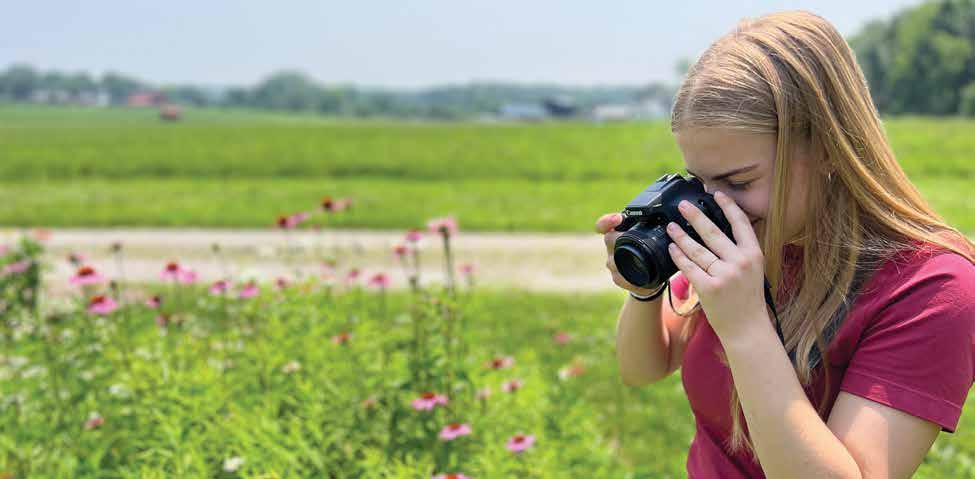
By Cashmere Morley
It could be said that teens these days are more inundated with imagery than ever before via the glowing box in their pockets. Everyone is a photographer in 2026. Everyone is a content creator. But when kids are chasing the perfect feed, instead of the golden hour, the art of photography becomes lost. When teens are looking without seeing, snapping without thinking, a disconnect between heart and brain forms that Amy Kimball, of Amy Kimball Photography, is trying to bridge. Enter her teen photo camps.
It’s no accident that the experience of Kimball’s camps feels different from most art camps. From the setting to the structure to the philosophy behind it, the program is built around intention, gentleness, and trust—qualities that are often missing from teenage creative spaces these days.
What Kimball hopes students leave her camp with goes far beyond improved photos. She often returns to a quote by Dorothea Lange: ‘The camera is an instrument that teaches people how to see without a camera.’
Everyone is a photographer in 2026. Everyone is a content creator. But when kids are chasing the perfect feed, instead of the golden hour, the art of photography becomes lost.
teens can attend. In response to the growing interest, and recognizing that not everyone can make it to the farm, Kimball recently launched her first online course. Accessibility, she said, is important to her work and what she can offer aspiring photographers.
Kimball’s own relationship with photography started early. As a teen, she felt she had a strong internal visual world, but traditional art forms like drawing and painting couldn’t quite keep up with how she saw things. Photography did. It gave her a way to translate her perspective clearly and honestly, and it also aligned with something else she’s always loved: people. Working with people felt natural through a camera. The medium offered both expression and connection.
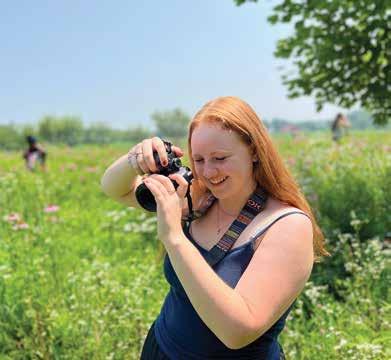
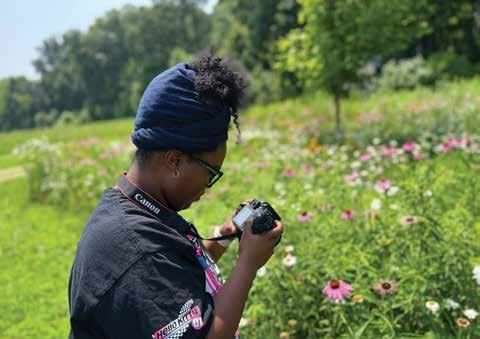
“I want students to learn to slow down and see the world differently They are inundated with images, more than any generation in history, but the images they are exposed to are often trying to manipulate them and sell them on something. This class attempts to help them see the world differently. I want them to be exposed to images that honor, that stir, and that transform,” said Kimball.
That philosophy is part of what makes the camp difficult to compare to other camps out there. Many parents tell Kimball they couldn’t find any similar workshops in the area, and families regularly travel long distances so their
Years later, after being shaped by a deeply influential high school art teacher named Mr. Lambert, and spending a decade teaching photography to teens in a classroom setting, Kimball noticed something important: While she had experience teaching adults, it was teenagers who energized her most. They were fast learners, comfortable with technology, creatively bold, and unafraid to experiment. Just as importantly, she found herself learning from them in return.
The Teen Photo Camp grew directly out of that symbiotic relationship. The first camp launched in 2024, followed by a second the next summer, both hosted on Kimball’s 70-acre working farm in Chelsea. The location, Kimball said, is central to the experience. Days are split between a renovated barn studio, which is modern, climate-controlled, and intentionally relaxed, and long stretches outdoors. Students walk the land, photographing animals, wildflower fields, woods, orchards, gardens, and a pond. The property extends about half a mile back, offering space not just to shoot images, but to get some fresh air.
What Kimball hopes students leave her camp with goes far beyond improved photos. She often returns to a quote by Dorothea Lange: ‘The camera is an instrument that teaches people how to see without a camera.’
Technically, the camp is rigorous without being overwhelming. Students learn to shoot in manual mode, understand digital camera functions, work with composition and light, and edit their images in Lightroom [an Adobe
photography software program]. They’re introduced to the work of historical and contemporary photographers, and notably, to the work of former teen students. Kimball is intentional about elevating student work, treating it as something worthy of attention and respect.
The camp is co-taught with Kimball’s son Levi, an art major in college. Levi, who is close enough in age to feel accessible, but experienced enough to be genuinely instructive, brings warmth and levity into the learning environment, reinforcing that creativity doesn’t have to be intimidating to be taken seriously.
“The biggest hurdle is confidence!” said Kimball. “Our teens are often told by social media that they are supposed to look and act like everyone else. We are hoping to offer them a break from that for a few days. We create a safe space where they can explore the beauty of the natural world around them and then give them the time to think about how they see the world and what matters most to them. I hope the online course offers this same support—a space to learn confidently and consider themselves gently.”

Concepts like composition, light, and storytelling are introduced through observation rather than jargon.
A typical camp day begins gently. Students arrive at the studio welcomed with snacks, drinks, and time to settle into the barn space. There’s no rigid classroom structure. From there, the day unfolds between instruction, exploration, and practice with large portions spent outside. The farm itself becomes both subject and teacher offering constant opportunities to notice how light changes, how perspective shifts, and how patience affects the final image.
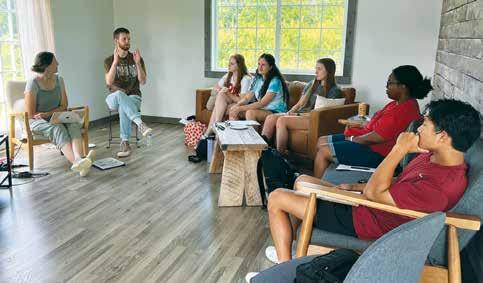
Balancing technical instruction with creative development comes naturally. Teens tend to grasp the mechanics of cameras quickly, so Kimball focuses much of her energy on confidence. In her experience, most teens already have a strong creative voice, they just need reassurance that it’s worth listening to. The role of the teacher, then, is less about shaping vision and more about making space for it.
Over the course of camp, transformations happen quietly but unmistakably. Shy students begin to laugh more, connect more, and take creative risks. When peers affirm their work, the effect can be profound.
Concepts like composition, light, and storytelling are introduced through observation rather than jargon. Teens already know when an image works. Kimball simply helps them articulate why. Group critique plays a role, but it’s practiced as “kind critique.” Kimball models a kind critique first, then steps back as students learn to point out strengths in each other’s work. Peer feedback becomes one of the most powerful parts of the experience.
Over the course of camp, transformations happen quietly but unmistakably. Shy students begin to laugh more, connect more, and take creative risks. When peers affirm their work, the effect can be profound. Kimball sees that affirmation take root, meeting a need many teens don’t even realize they’re carrying. Kimball recognizes photography as one of the ways she herself learned confidence and risk-taking, and she sees the same patterns in her students.
Students bring a wide range of equipment, from DSLRs and mirrorless cameras to phones. No one is excluded based on gear. With nearly everyone carrying a camera in their pocket, the focus stays on light, framing, and composition—skills that translate across devices.
The camp is intentionally small, capped at 15 students. That scale allows for meaningful one-on-one interaction and ensures every student’s work is seen. Scholarships are also a priority. Kimball is clear that finances shouldn’t block access for students ready to learn.
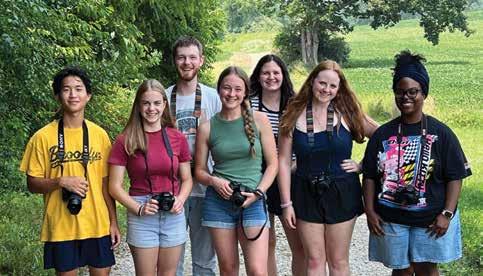
Though the camp has only run for two years, Kimball is already thinking ahead, considering higher-level courses for returning students. What excites her most, though, remains constant: spending time with teens and seeing what they create.
Photography may not be the only path to confidence and voice, but for some teens, it’s the one that clicks. And when it does, the effects ripple outward into travel, family life, business, or simply a lifelong creative practice.
Working with teens, Kimball said, is a reminder of the good in the world. Their ideas, energy, and hope counterbalance the daily noise of larger problems.
“This camp is about teens being in a beautiful natural environment that is also an emotionally safe space to explore photography with other like-minded students,” Kimball said. “They will have the chance to connect with not only an art form, but with each other, and most of all, themselves.”
Discover Kimball’s teen camps online at amykimballphotography.com/2026teen-photography-camp-ann-arbor-farm-studio or sign up using this form: amykimballphoto.myworkshops.co/workshops.












By Christine MacIntyre
Spring doesn’t arrive all at once. It doesn’t knock. It doesn’t announce itself. It shows up quietly—like it’s not sure it’s allowed to stay yet.
Spring is the in-between season. And kids are usually the first ones to notice.
Before the calendar changes, before the jackets disappear, before adults agree that winter is finally over, kids start pointing things out. The light looks different. The sidewalk feels warmer. The air smells like wet dirt, not cold metal. Something has shifted, even if no one can quite name it yet.
Before the calendar changes, before the jackets disappear, before adults agree that winter is finally over, kids start pointing things out. The light looks different. The sidewalk feels warmer. The air smells like wet dirt, not cold metal. Something has shifted, even if no one can quite name it yet.

In Ann Arbor and surrounding areas, spring reveals itself in small, almost secret ways—and those clues teach kids something important about the world and about themselves.
What spring teaches us through sound
The city changes its voice first.
Birds return before leaves do. Water moves again. Windows crack open. Laughter carries farther. A bike bell rings down Main Street. Someone practices music near campus, and the notes drift through the air like they’ve been waiting all winter to be heard.
When kids listen closely, they learn this: sound means we’re not alone.
Hearing spring unfold reminds us that others are waking up too—animals, neighbors, the whole city stretching after a long sleep.
Hearing spring unfold reminds us that others are waking up too—animals, neighbors, the whole city stretching after a long sleep.
Eleva Potter, who leads children’s programming through Ann Arbor Parks & Recreation, says spring programming focuses on “lots of changes as nature wakes up from the winter.” As the snow melts, she noted, “worms and bugs start to emerge. There is more bird song to hear as birds find mates and make their nests. Frogs and toads start to call.”
Even the quietest sounds—wind moving through budding branches, sneakers on damp pavement—become proof of shared life.
As the days warm, new sounds layer in. Skateboard wheels begin to hum and clack at local skate parks. The echo of boards against ramps replaces winter’s hush. The rhythm is different—faster, hopeful, a little daring…the sound of someone trying again after a fall.
One peaceful place to practice listening is Mill Creek Park in Dexter where wooden boardwalks stretch gently over the Huron River. The steady rush of water, the creak of boards underfoot, the layered bird calls overhead—it’s a natural soundtrack to early spring. A short stroll can feel like a reset button for the mind.
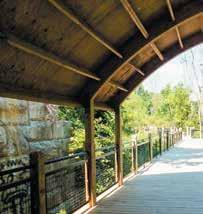
Listening this way teaches kids something powerful: when we pause and tune in, we feel more connected—to nature, to our community, and to ourselves.
Try this: A Neighborhood Sound Walk Choose one block, one park path, or one stretch of boardwalk. Walk it slowly. For one full minute at a time, no talking. Afterward, ask: What did you hear that surprised you? Was it close or far away? Did it make you feel calm, curious, excited?
Create a community sound map by drawing your street or park and labeling the sounds you hear. Revisit it in a few weeks and notice how it changes.
Spring teaches that listening isn’t just about hearing. It’s about belonging.
Mill Creek Park is located at 8140 Main St. in Dexter. For more information, call (734) 426-0887 or visit dextermi.gov/government/departments_and_services/ parks_and_trails.php
What spring teaches us through sight
Spring doesn’t explode into color. It arrives gently. It gathers itself.
Tiny green buds appear before the leaves commit. Moss brightens along tree trunks like a soft highlighter. Sidewalk chalk returns in swirls and hopscotch grids. Storefront windows trade winter’s dimness for light.
Eleva Potter from Ann Arbor Parks & Recreation says an exciting part of spring programming is watching the landscape transform. “Buds and flowers appear on trees and start to leaf out,” she said. “Spring flowers begin to add pops of color—yellow Trout Lilys, pink Spring Beauties, purple Wild Geraniums, and white Trilliums.”
Further afield, wildflower hikes at Draper-Houston Meadows Preserve invite families to walk slowly through meadows and woods where those blooms emerge from beneath last year’s leaves. Kids learn that beauty often begins quietly and close to the ground.
At Nichols Arboretum, the ground begins to glow before the canopy fills in. In Kerrytown, outdoor tables reappear like small celebrations.
The Ann Arbor Farmers Market opens for the season, and suddenly color arrives in crates—greens, reds, yellows. Kids can see what’s growing now and what isn’t quite ready yet. Spring teaches patience through what is in season and what is still becoming.
At Nichols Arboretum, the ground begins to glow before the canopy fills in. In Kerrytown, outdoor tables reappear like small celebrations.
Around the city, volunteers gather at Kuebler Langford Nature Area and Furstenberg Nature Area to remove invasive shrubs and protect local biodiversity. Kids who witness this learn something important: caring for the earth is active work. Spring isn’t just something that happens to us— it’s something we participate in.
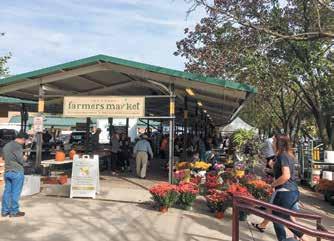
Nichols Arboretum is located at 1610 Washington Heights in Ann Arbor. To learn more, call (734) 647-7600 or visit mbgna.umich.edu/nichols-arboretum.
Draper-Houston Meadows Preserve is located at 578 Mooreville Road in Milan. To learn more, call (734) 971-6337 or visit washtenaw.org/366/draper-houstonmeadows-preserve.
The Ann Arbor Farmers Market takes place at 315 Detroit Street in Ann Arbor. For more information, call (734) 794-6255 or visit a2gov.org/parks-andrecreation/parks-and-places/ann-arbor-farmers-market.
The Kuebler Langford Nature Area is located at 101 West Huron River Drive in Ann Arbor, and the Furstenberg Nature Area is located at 2626 Fuller Roa. in Ann Arbor.
Downtown invites kids to notice—and imagine
Through the Ann Arbor Downtown Development Authority Elevate program, local chalk artist David Zinn has created Unseen Adventures of Ann Arbor—a citywide scavenger hunt featuring ten installations of Nadine the mouse tucked into unexpected corners throughout downtown. (See the Crazy Wisdom Community Journal article on David Zinn from Issue #76 at crazywisdomjournal. com/thecrazywisdomjournalonline/2020/12/17/the-whimsical-world-of-davidzinn.)
Families can search for each scene, collect a button at every location they find, and even write their own stories about what Nadine might be doing in each tiny world. It’s not just a scavenger hunt: It’s a practice in noticing.
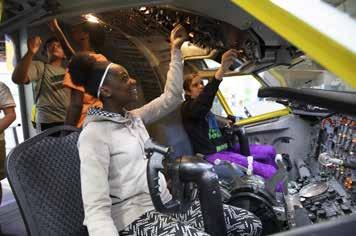
Kids learn that big discoveries often hide in small spaces. That imagination lives in cracks in the sidewalk. That art isn’t always framed inside a building—it can be under your feet, waiting for you to slow down and notice.
Kids learn that big discoveries often hide in small spaces. That imagination lives in cracks in the sidewalk. That art isn’t always framed inside a building—it can be under your feet, waiting for you to slow down and notice.
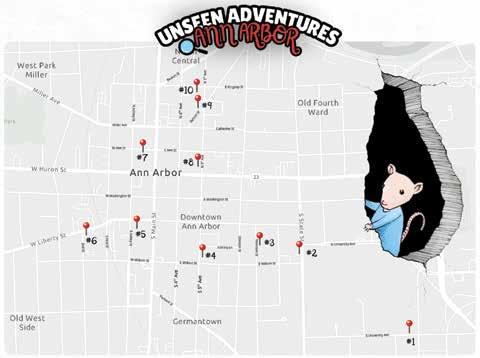
Ann Arbor DDA Program Specialist Sandra Andrade said the public art installation is designed to spark joy for all ages. “We have some more projects coming up that we’re excited about, too, including ‘Elevating History: A Mural Series from the Living Oral History,’” she said, noting that additional Elevate installations are anticipated in fall 2026 and spring 2027.
The Ann Arbor Art Center also offers a free mural activity book online that includes a map of local murals, coloring pages, and descriptions of Ann Arbor’s public art.
If you head out on a mural walk, invite kids to become art detectives. How big does the mural feel when you stand beneath it? What colors jump out first? What emotions does it bring up? Murals aren’t just pictures—they’re stories told at full volume.
And sometimes, noticing leads somewhere even smaller.
In Ann Arbor, fairy doors have long invited kids (and grown-ups) to kneel, look closely, and imagine who might live just beyond the brick. Tucked into storefronts and hidden along walls, these tiny portals reward careful eyes.
Fairiologist and Ann Arbor native, Johnathan Wright said there does seem to be a seasonal rhythm to their appearances.
“There does seem to be some correlation,” he said. “Much like humans, I believe that the fairies, largely (on a small scale), are more active in nicer weather. But not quite as much parallel with lizards (for example, iguanas falling out of trees in Florida) which leads me to hypothesize that the urban-fairies are not coldblooded.”
It’s a playful answer—but also an invitation.
Small art. Small doors. Small details. Big imagination. Spring teaches that wonder lives close to the ground. That curiosity belongs alongside science. That even in a city of brick and sidewalks, there is always room for something small and mysterious to appear.
Kids don’t just see a tiny door. They see a story beginning.
Unseen Adventures spans 10 locations throughout downtown Ann Arbor. Visit a2dda.org/unseen-adventures/ to find a map or call the Ann Arbor DDA at (734) 994-6697 for more information.
The Ann Arbor Art Center is located at 117 West Liberty Street in Ann Arbor. Call (734) 994-8004 or visit annarborartcenter.org for more information.
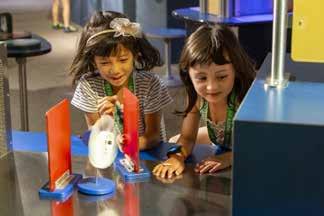
Family memberships include grandparents, inclusive of TWO SITES: Ann Arbor Hands On Museum AND Leslie Science & Nature Center
Museum open 10a 5p, Tues Sun; Access for All admission $3/pp daily Nature Center playscape and trails are free and open daily, Critter House open most Sat/Sun 12 3
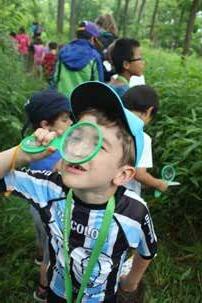


Spring isn’t only something we observe. It’s something we join.
In nearby Saline, family bird walks invite kids to slow down and listen for returning songbirds. Teen make-and-take programs offer chances to build planters and craft bird feeders. As the weather warms, the Saline District Library expands nature-focused offerings that help kids explore birding, planting, and seasonal change in playful, meaningful ways.
And as spring settles in, the river begins to call people back, too.
Each April, Argo Park Livery and Gallup Park Livery reopen for the season. While it may still be too cold for swimming, paddling a canoe or kayak becomes its own kind of spring ritual. Birding by water offers a different perspective—quiet, steady, eye-level with the riverbank. Kids might spot herons standing tall in the shallows, turtles sunning on logs, or red-winged blackbirds flashing their bright shoulder patches.
Being on the river teaches something subtle but profound: sometimes the best way to notice nature is to move gently through it.
When kids plant berry seeds and imagine the jam they might make one day, they’re learning patience in real time. When they paddle quietly beneath budding trees, they’re learning attentiveness. When they name the birds they hear, they’re learning belonging.
Spring teaches that we belong to the season—not just beside it.
Visit the Saline District Library at 555 North Maple Road in Saline. Call (734) 429-5450 or visit salinelibrary.org for more information.
Argo Park Canoe Livery is located at 1055 Longshore Drive in Ann Arbor. Call them at (734) 794-6230. Gallop Park Livery is located at 3000 Fuller Road in Ann Arbor. Call them at (734) 794-6240. View Gallup and Argo Livery rental fees, schedule, and reservations at a2gov.org/parks-and-recreation/activities/ canoe-kayak-and-tube.
What spring teaches us through smell — and taste
Before the trees are fully green, before the days feel reliably warm, the air shifts.
It smells like wet earth and thawing soil. Like rain on pavement. Like grass waking up. Sometimes it smells fresh and clean. Sometimes it smells muddy and alive.
Spring doesn’t smell perfect. It smells real. And that’s part of what it teaches kids.
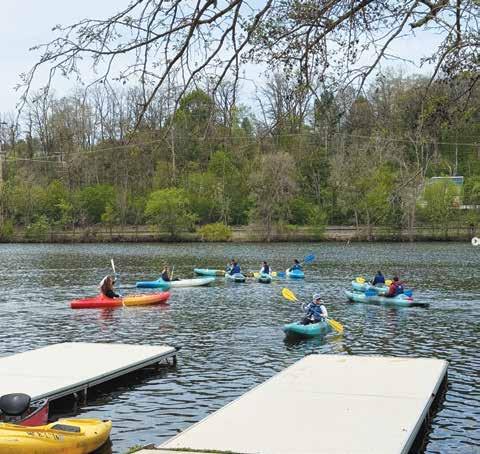
Being on the river teaches something subtle but profound: sometimes the best way to notice nature is to move gently through it.
Smell reminds children that growth is earthy and a little messy. That new beginnings don’t arrive polished. Mud means something is happening underground. Rain means roots are stretching. The scent of damp bark and river water tells us the world is working, even when we can’t see the progress yet.
But spring isn’t just something we smell. It’s something we taste.
The season shows up in what’s on the tables at farmers markets, restaurant specials, and food truck offerings. Early greens. Fresh herbs. Crisp radishes. Asparagus. Foods that weren’t there in January. Kids can see what’s in season and what isn’t quite ready yet. They learn that strawberries don’t rush. Tomatoes need more sun. That nature keeps its own schedule.
And as downtown warms, food trucks begin to pop up again. The breeze carries the scent of sizzling onions, warm pretzels, sweet waffles, and tacos on the grill. The smells drift through streets near Main and Liberty. They signal something more than hunger: people are out again. We’re gathering. We’re lingering.
Spring teaches kids to notice how the weather shapes what we crave. In winter, hot soups and cocoa feel right because they warm us from the inside out. When the sun returns, something shifts. Cold lemonade tastes brighter. Ice cream feels celebratory. A crisp salad feels like relief against warm air.
Taste becomes another way to understand the season.
Why do we want warm, hearty foods when it’s cold? Why does a frozen treat feel perfect after an afternoon at the park? Kids begin to see that their bodies are responding to the world around them.
Smell and taste teach that seasons are shared experiences. When you catch the scent of fresh-cut grass, street food, or early blossoms, you’re breathing in the same air as everyone around you. When you bite into something grown nearby, you’re tasting the same sunlight and rain that shaped it.
It also teaches memory. One deep breath of spring air—or one bite of something that only appears this time of year—can bring back memories of last year’s bike rides, park visits, festivals, or walks along the river.
Spring doesn’t just look different.
It smells different.
It tastes different.
It feels like a beginning you can breathe in—and sometimes, even savor.
Wonder as a way of experiencing spring
Spring in Ann Arbor isn’t just about weather. It’s about participation.
It’s volunteers clearing invasive plants. It’s skateboarders testing ramps again. It’s farmers unloading early harvest. It’s artists chalking stories onto sidewalks. It’s kids learning birding basics at Gallup Park or planting berry seeds at a warming hut, imagining the sweetness to come.
That’s the quiet lesson spring keeps offering: Pay attention. Look again. Listen longer. Breathe it in.
Kids understand this instinctively. They feel the in-between. They notice the almost-there buds. They hear the almost-loud birds. They smell the almost-warm air drifting through open windows.
Spring doesn’t shout its arrival. It whispers it.
When children learn to recognize spring through sound, sight, smell—and participation—they’re learning something bigger than the season. They’re learning how to stay curious
And when children learn to recognize spring through sound, sight, smell—and participation—they’re learning something bigger than the season. They’re learning how to stay curious. How to feel connected. How to trust that change— even when it’s small and quiet—is already on its way.
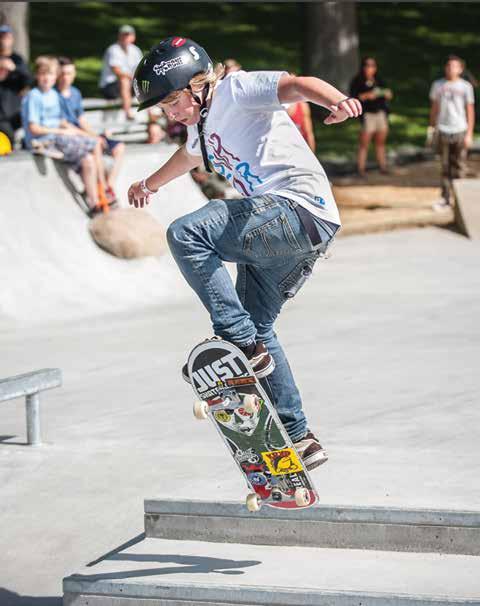
If spring is an invitation to notice the world waking up around us, these books are an invitation to step outside and explore it. From hands-on activity guides to stories that celebrate the wonders of nature, each one offers ideas that can carry kids through the transitory season of spring.

The Big Green by Ken Wilson-Max is a vibrant picture book celebrating environmental action and community projects, perfect for inspiring eco-minded outdoor play and stewardship.
The Nature Journal: A Backyard Adventure by Savanah Allen is an activity-style story that encourages kids to observe, record, and explore their yard or local park.

Busy Spring: Nature Wakes Up by Sean Taylor and Alex Morss is a picture book that joyfully introduces the awakening world of spring, from blooming flowers to animals emerging after winter.
And Then It’s Spring by Julie Fogliano is a warm, award-winning picture book about planting seeds and waiting for them to grow — a gentle, seasonal story about patience and change.
It’s Busy Down in the Woods Today: Friends to Meet, Places to Explore, and Over 100 Things to Find by Rachel Piercey takes kids into Brown Bear Wood where familiar forest friends await. With over 100 hidden things to search for and read-aloud poems, it blends seek-and-find play with imaginative exploration.
The Remarkable Journey of Coyote Sunrise by Dan Gemeinhart is a touching middle-grade novel that mirrors the inner and outer growth that comes with seasonal change.

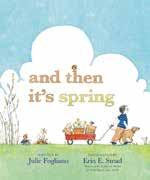


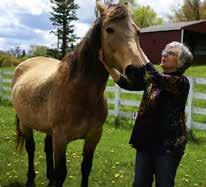
IMPROVE COMMUNICATION RESOLVE CONFLICT ENCOURAGE EMPATHY PROMOTE MUTUAL RESPECT & TRUST RECONNECT- AND HAVE FUN
connect@stablewisdom net 734-845-6542 www stablewisdom net
“Beautifully written with engaging vocabulary and stunning illustrations.”
The Nectar Collector by Patti Sherlock is a middle-grade fiction with insect and environmental themes that ground readers in the natural world and its rhythms—great for kids who love nature stories and reflective transitions.
A2AC Murals Activity Book by
The A2AC Mural Walk is a great way to spend the day seeing a wide variety of amazing public art! This booklet contains a suggested route, information about each mural, and questions and short activities. Please bring along a pencil, marker, or crayon for the activities.

A sweet tale about a young badger who is told by a trio of neighborhood girls that a wizard will turn him into a frog if he goes berry picking in the woods. Indeed, he does meet a strangely dressed gentleman in the woods who looks like a wizard, but this hare does not turn trespassers into amphibians.
Instead, the gentleman tells Wojer a story, which inspires the little boy to turn the tables on his tormenters with a humorous prank that brings this tale full circle.
Get your autographed copy online
Or find Jenn at a local festival this summer!
littlelionroar.com/upcoming-events



It’s easy to believe we are protected, loved, and supported by the divine when life is going well.But what about when we are treading in troubled waters and the tides threaten to sweep us out to sea?
By Karen Quinn
It’s easy to believe we are protected, loved, and supported by the divine when life is going well. But what about when we are treading in troubled waters and the tides threaten to sweep us out to sea? Thrashing in the waves, struggling to stay above water, sucked into the deep, our breath catching in our lungs— and the darkness finally overtakes us. That’s a different story. So, how do we keep the faith even when we feel abandoned?
We, as a species, came to our faith because of hardships. When we couldn’t control our environment, when situations were happening beyond our control, when we didn’t understand why or what we were experiencing, it was in those moments that faith was born. We realized that there was more to the world than we could understand with our five senses. We saw ourselves as a woven silk strand within the intricate web of the world and learned to trust in the universe. Later, we learned that the divine was within us, and through thousands of years of theory, practice, and prayer, we connected to our own energetic signature that spans the cosmos and dates to the beginning of time. So why, you may ask, do we lose our faith when times are tough? After all, that’s when our faith should be strongest. Well, let’s look at the first paragraph again. Most notably, “It’s easy to believe we are protected, loved, and supported by the divine when life is going well.”

Later, we learned that the divine was within us, and through thousands of years of theory, practice, and prayer, we connected to our own energetic signature that spans the cosmos and dates to the beginning of time.
Life “going well” does not mean your faith is strong, your prayers are answered, or you’re divinely protected. Life just happens, good times and bad times. No matter what your spiritual vocation is, no matter how devout of a believer you are, nothing lasts forever. That is simply a part of the human experience. We will all lose loved ones in our lifetime. We will all experience heartache and sorrows. We will all live through trials and tribulations. Life will always happen to us, no matter how hard we try to keep the lessons of Earth at bay. We are all meant to experience the full spectrum of energies—from the divine state of bliss to sorrowful, heartbreaking desolation. Without this full range of the spectrum, we cannot grow and develop as we should. We need all our experiences to make us a whole person. It’s what creates empathy, encourages service to others, and fosters hope.

The key is to do the work before the hard times show up.
Pray when times are easy. Practice your spirituality when life is going well. Offer petitions and service in the name of something greater than yourself when you can wake up, before the weight of the world climbs on your shoulders. What you are doing is building a dock to moor yourself to when the weather turns. You’re creating a safe harbor to retreat to when the skies blacken.
Practicing spiritual gratitude when life is sunshine and rainbows helps to bolster your soul against the coming storms looming on the horizon.
Okay, that’s nice to know, but what if you’re in your lowest low as you read this? You don’t have the luxury to rewind the clock and start praying and practicing a spiritual lifestyle. You’re being swept out to sea now, and there is no port in the storm.
We will all experience heartache and sorrows. We will all live through trials and tribulations. Life will always happen to us, no matter how hard we try to keep the lessons of Earth at bay.
First, and foremost, do not fall into the comparison trap. Your lowest low is your own. Even if someone has fallen prey to the same trauma you are experiencing, your unique perspective, your life, and all the lessons you’ve learned up to this moment, will make you react to this trauma differently than the person beside you. Your suffering is no greater and no less than anyone else’s. Your lowest low is your own.
Now, that doesn’t mean that this trauma can’t teach you humility or help you build your own reserves of strength and empathy, because it can. But just know that your experience is your own, and you are allowed to feel your feelings. Have self-compassion as you move through these troubled waters.
Next, don’t underestimate trauma exhaustion! This is a real thing, and don’t minimize its gravity. Sometimes when we are in it for so long, with no relief in sight, we can feel like we just want to give up. That deep despair creates the proverbial straw upon the camel’s back. The best way to bolster yourself against this exhaustion is to admit when you are in it and find a part of your burden that you can set down. Even if you can’t set it down and leave it, you can set it down and rest for a few moments.
I want you to acknowledge these two things (the comparison trap and the trauma exhaustion) and be aware of them as we move forward. The more you understand these two aspects of trauma, the easier it will be to use the information and implement the tools outlined below.
Sometimes our sorrows and grief can make it nearly impossible to find the good in our current situation, and I encourage you to trust yourself if this feels like the case for you. A valid example of this is losing a loved one. The closer the relationship, the harder a silver lining is to find. When I lost my grandfather, I had a very hard time seeing the good in his death. It wasn’t until I was on the other side of the funeral that I realized the blessings were everywhere. They were thin, small, and certainly weren’t pivotal enough to change the pain in my heart, but they were there. I saw them as gifts from my grandfather as I looked back at them. I was able to say goodbye before he passed away. We came together as a family and let bygones be bygones for that time. My son, who was four at the time, was able to work through his first experience of death with a loving family who was there to support him and share his emotions with him.
Honestly, sometimes finding the silver lining isn’t even the point. The true point to finding a silver lining, is that it forces your brain to stop focusing on the “negative” and makes it pull itself out of the rut and look for a “positive.”
As I said, I was only able to see those silver linings when I was on the other side of the experience. But that realization made me more inclined to seek the silver lining out the next time trauma came knocking at my door. Honestly, sometimes finding the silver lining isn’t even the point. The true point to finding a silver lining, is that it forces your brain to stop focusing on the “negative” and makes it pull itself out of the rut and look for a “positive.” This helps draw us closer to our spiritual signature, and pulls us closer to our faith, which, in the end, is what will help us weather the storm. Even as I write this, and I find myself in my own gauntlet of hardships and trauma, I readily seek out those silver linings, and they bolster my strength in my faith.
When we find ourselves careening down the raging river of life, and we are fighting the current to gain some semblance of control in a situation, there are times we can be doing more harm than good. We can struggle to grab branches
overhanging the river’s edge and pull ourselves off course, metaphorically cut our hands, or even change our trajectory into even more treacherous waters. The best thing you can do at that moment is to relax, focus on what is truly in your control, and let the river take you wherever it is taking you.
What does relinquishing the illusion of control mean in practice? When my son was 19, he decided to do migrant farm work for six months in New Zealand. When he arrived, there was a snafu between his flight from Australia to New Zealand that ultimately resulted in his luggage being “lost” at the airport. So, here I am, on the literal other side of the world while my child is in a country where he doesn’t know a soul and the suitcase that has all his necessities has been waylaid. My “mom brain” immediately flew into an overactive reaction, but I stopped myself and looked at the situation. It was, for all intents and purposes, out of my control. I then looked at what was in my control: I found the airline online help portal and opened a ticket regarding his missing luggage. I encouraged him to reach out and do the same, but when we hung up, all that was left to do was pray, relax, and let it go. There was nothing more I could do that day. It took a week, but right before he was set to leave for his second host farm, his luggage was returned to him.
What was made very apparent to me during that time was that I could sit and fester over the situation, and ultimately worry myself into having an ulcer, or, I could focus on what I could do in those moments, and relinquish the illusion of control, pray, and hand the situation over to the universe. My son was going to get his luggage when it was ready to show up, because he had his own lessons to learn, and my worrying and fretting wasn’t going to change that.
Long story short, when we focus on what is actually within our control (which usually isn’t much), then relinquish the illusion of control and trust in the divine, we are free to relax and find peace of mind in the knowledge that it is all going to work out as it is meant to.
This can be tricky, uncomfortable, and just flat out hard to do. Can you identify if the suffering is external or are you causing it internally? This is something to consider when there isn’t an easily identified outside force causing trauma in your life. Sometimes we just wake up in a horrible mood and we don’t know why. Depression is a demon that is very hard to pin down, and it often uses our own minds against us. During these times you can really learn a lot about yourself and create self-compassion in the process. But, again, this is hard to do and takes patience, practice, and time. That being said, it has been one of the most invaluable exercises in my repository to help me move through my own issues.
Veterinary Wellness Monica Turenne, DVM, CVA, CT, CHPV
Offering in-home and telemedicine appointments for both holistic and hospice/palliative care patients. Please call for more information!
Dr. Monica is certified in palliative and hospice care for pets! She is passionate about helping pets and their families through this incredibly important journey.
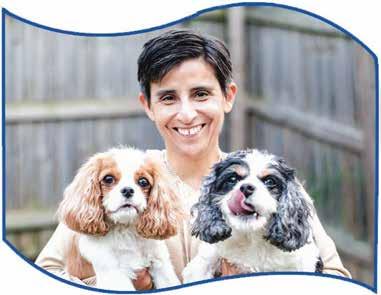



When I was much younger, I realized that my “teenage angst” had a lot of baggage attached to it. When I got into my twenties, I learned that a lot of that weight was placed on me by childhood trauma. The more I dug into my feelings and where they stemmed from, the more I understood that a lot of that emotional turmoil was being exacerbated by me! I was adding to the problem by not being in control of my emotions surrounding the wound.
I came to this understanding at a point when I was examining a pain in my heart about feeling abandoned, but I was also isolating myself because of this trauma, further fueling my depression to keep me alone in my suffering. Once I recognized this (and had a healthy cry about it) I journaled about being abandoned, then wrote about all the ways I was letting that trauma dictate how I thought of myself, and how it made me cocoon into isolation because I felt unwanted and unlovable. Once I grasped that I was the one who was inflaming this sadness, I was able to lay some of my burden down, give myself some compassion, and reach out to a therapist.
Again, self-examination is tricky, uncomfortable, and just hard to do at times. But, if you can do this for yourself, it makes navigating hardships and healings much easier.
It is in our more primitive and animalistic nature to isolate ourselves when we are in pain. The programming holdover from long, long ago in our genetics tells us that when we show “weakness,” we are vulnerable. So, we hide our “weakness” in order to feel “safe.” We stifle tears so that we don’t draw attention to ourselves. We pretend physical injuries aren’t as bad as they are, and we try to cover up when we fall short of expectations. Most importantly, when someone asks how we are doing, and we are suffering inside, we say, “I’m okay.” When, really, we aren’t.
Why do we do this? Why do we turn inward and avoid loved ones when we are suffering? A few responses that seem to ring out time and time again are, “I don’t want to be a burden,” and “I don’t want to make anyone else feel bad.” But when you are suffering, the best thing you can do is seek out help and love. Don’t suffer alone. There are people in your life who love and care for you. Don’t be afraid to ask for help. We are all in this experience of life together, and everyone has known hardship. Reaching out when you hurt will help you heal exponentially faster than if you continue to suffer alone.
Now that we have discussed some ways to help you strengthen your faith when the times are hard, let’s go over some tools you can utilize to help navigate the storm and move into calmer waters, faster.
The universe already has the answer. Pray about it and turn it over to a power higher than yourself.
This is always my first line of personal defense—and is always my first suggestion to others. No matter what you are doing, what you are dealing with, the first thing I will always ask is, “Did you pray about it?” Not because I want to eschew responsibility, or “kick the can down the road.” It’s because I’m human— I’m not God. The Divine knows more than we could ever know. The universe already has the answer. Pray about it and turn it over to a power higher than yourself. Ask for help, then wait for the answers. You’ll always feel better.
Oftentimes, journaling about your experience will help you work through your trauma more efficiently and effectively. Write about your trauma and how it affects you. If you use the systems outlined above, write about your experience. Did they help or hinder your healing? All information is helpful when you are developing your own healing process. Be sure to date your entries, so if you find yourself navigating the same trauma again later, you can see if it is a cycle. You might find that every August you seem to feel a certain way, or every time you go out to visit a specific family member, you deal with old baggage a few days later. Identifying cycles within your mental and emotional state can help give you validation on your journey.
Talking things out with yourself out loud can really help you move through your process a lot faster than you would expect. I am sure there is a psychological reason that I don’t know behind it, but honestly the science doesn’t matter. The results speak for themselves.
Another important thing I want to share before moving on, is that once the trauma is done, don’t stop journaling! Journaling only when things are bad does not help your spiritual practice. Remember what we talked about at the beginning of this? Practice your spirituality when it’s sunshine and rainbows Journal when you’re happy, write about that wonderful vacation, the good conversation you had with your mom, and even record the day you saw a wild turkey in your backyard and how it made you feel. This is the practice termed as “gratitude journaling.” Add in your tarot readings, inspiring quotes or scripture, dreams, messages from the divine, all of it. Then, over time, your journals become a reflection of you that can be referenced any time you need your own guidance. I have been keeping active journals about my spiritual practice and my life’s cycles since 1994. My own council has been invaluable to me over the years, so I feel confident encouraging you to start keeping your own.
I know this sounds weird, but talking to yourself is super helpful! Talking things out with yourself out loud can really help you move through your process a lot faster than you would expect. I am sure there is a psychological reason that I don’t know behind it, but honestly the science doesn’t matter. The results speak for themselves.
My husband explained to me, when I was sharing this idea with him many years ago, that in the I.T. world it is referred to as “Rubber Ducking.” When you can’t figure out why a system or program isn’t performing like it should, you talk through the problem with a rubber duck toy, and you can usually figure out the answer. The rubber duck is inconsequential to the exercise. The important takeaway is that it’s just you, talking to you, and you figure out the answer. Trust me, it works. Just try it.
I know what a few of you are thinking. “I am…that’s why I’m here…” But that’s not necessarily what I mean. Seeking out someone who you can actually talk to can be incredibly beneficial. They will see things that you don’t, encourage practice in areas you might not be aware of, and help you adjust your thinking.
Every spirituality has sacred texts that they can lean on to help guide them through life. It can also be helpful to expand your spiritual boundaries and read texts that are from different spiritual backgrounds to help get insight as well. Just like many of you, my first introduction to sacred text was the Bible, and it offered a lot of good wisdom. I read Celtic folklore, since that was where my blood and bone heritage stemmed from. The stories and lessons from these two sources really made an impact on me in my youth and shaped much of my spiritual foundation. Then in high school, I read The Odyssey and The Iliad in English class, and since I had started getting into astrology at that time, it really helped me to learn more about the attributes of the planets. In more recent times, I was introduced to the Bhagavad Gita, when I began studying to be a yoga instructor, and the Tao Te Ching when I studied Tai Chi. Both these texts taught me the importance of mindfulness, meditation, and helped me understand my soul on a deeper level.

Finally, we are left with the most undervalued yet most effective tool in the toolbox. When you are lost to the four winds, when your life is a mess and you are at your lowest low, nothing can make a greater impact on you than going outside and experiencing nature.
Finally, we are left with the most undervalued yet most effective tool in the toolbox. When you are lost to the four winds, when your life is a mess and you are at your lowest low, nothing can make a greater impact on you than going outside and experiencing nature. Even if you’re in the city, you can find a patch of green. Seek it out and immerse yourself into its embrace. The simple act of grounding (going outside barefoot) can change the way you think and feel. Stand outside and look at the world around you. Watch the
blades of grass sway in the breeze, watch the moth dance its way from one flower to another. Look deeply at the flower, notice the intricacies of the petals. Find a tree and sit beneath it, leaning your back up against the trunk and feel its support. Hear the leaves dance in the wind, listen to each tree’s unique voice. Watch the birds fly in the sky, singing their complex songs to each other. If you are able, find a river and listen to its gurgle. If it’s night and the sky is clear, look up at the stars. Remind yourself that you are a being of stardust, sharing cosmic DNA with all the twinkling lights above you. If you are lucky, you might see the moon, or a few of the planets in the blackness as well.
Notice that I’m encouraging you to sit and watch. I’m asking you to immerse yourself in the environment. Slow down, relax, and reconnect with the web you share your life with. We all belong in nature, we all fit into the intricate puzzle when we are in nature, and most importantly, we remember who we are when we are in nature. The longer you stay, the more you will heal. In this instance, you literally get out what you put in.
Now, I don’t want you to think that going outside and chatting with the bluejay on the fence is going to make all your hardships and trauma go away. It doesn’t “fix it” the way we all want it to, but it does reprogram us immediately. For those who need the science talk, it relaxes and calms the sympathetic nervous system so that your body can switch into parasympathetic mode. The end result is a clearer mind, a lighter heart, and the resolve to help navigate the chaos.
Karen Quinn is a 4/1 Splenic Projector with a Fixed Fate Gate 6- Conflict Resolution. She weaves this fate with her 30+ years of spiritual work to help others on their spiritual journey to connect to their soul’s purpose. She offers herself as a Purveyor of Spiritual Services & Life Coach. Learn more at https://linktr. ee/ZephyrineJunction.


By Michelle A. McLemore, CHTP, Rev.
In my early homemaking years my landscaping budget was meager; thus, I gravitated toward hot sun perennials. The faith that what I watered and loved would survive the bite of Michigan winters and the blistering dog days of August gave me something to look forward to…no matter how the rest of life was going. It was an investment I felt good about. It also implied the plants were hardy—full of grit. Respectable. With the return of spring, the norms we come to expect of each season provide a pattern for our physical lives. It is a similar cycle of continuity that nourishes hope for our spiritual existence as well.
Early civilizations created stories to explain these cycles. A Mesopotamian/ Akkadian story (dating back to 2000-1500 BCE) tells of Tammuz, the spring God, and beloved of Ishtar, the goddess of love, fertility, and war. When Tammuz died, Ishtar went to the shadow realm to try to rescue him. With the grace of Allatu (goddess of underworld), the couple was allowed to return and bring back life and vegetation annually for part of the year. This resurrection explanation for the seasons became the template for many cultures. Greeks, Mayans, and most others told similar stories.
With the return of spring, the norms we come to expect of each season provide a pattern for our physical lives. It is a similar cycle of continuity that nourishes hope for our spiritual existence as well.
Resurrection of the characters in each of these stories allowed them to live again—even after having been in the land of the dead for some time. Despite the physical return allowed only for a few months each year, there was an acceptance that someone could be brought back from beyond to teach, demonstrate, love, produce, bless the living, and so on.
At the simplest level, resurrection is understood as coming back to life after death. At the simplest level, reincarnation is understood as coming back to life after death but in a different body or form. Both resurrection and reincarnation provide a path to purpose and enduring existence of soul consciousness.

Resurrection of the characters in each of these stories allowed them to live again—even after having been in the land of the dead for some time. Despite the physical return allowed only for a few months each year, there was an acceptance that someone could be brought back from beyond to teach, demonstrate, love, produce, bless the living, and so on.
Most monotheistic religions focus on a linear transition of the soul after death— the resurrection of spirit (and/or body) at the end of specific time on Earth to some other spiritual place of existence (heaven, purgatory, or hell). Other religions, spiritual philosophies, and channeled Beings focus on a soul elevating to the beyond with choice/responsibility to return to Earth or go elsewhere— including other planets or dimensions. Hinduism, Judaism, Buddhism, Mormonism, Zoroastrianism, Taoism, and teachers like Dolores Cannon, Karen Curry Parker, Lee Harris and the Zzzs, and Darryl Anka and Bashar (the higher being he channels) teach about each soul choosing their own responsibilities and roles before incarnating, as well as when re-incarnating for the sake of continuous education and refinement.
In many stories, resurrections were not limited to benefiting the earth for physical food and warmth, but for physical continuation and demonstration of truths and power. In the Hindu tradition, a princess named Savitri traveled to the entrance to the underworld to secure the return of her husband Satyavan. Through wise negotiating with the God Yamraj, the husband was returned intact to fulfill Savitri’s request for many children from her one and only love. The Greeks have similar retrieval stories of mortals released, or nearly so, from Hades as a type of resurrection.
For New Testament believers, there are three occurrences detailed in the books recorded circa 45-95 CE. In John Chapter 11, Lazareth falls ill and dies. He is cold four days when Jesus/Yeshua/Yehoshua/Joshua arrives at the tomb and commands, “Lazareth, come out.” This occurs after a brief dialogue with Lazareth’s sister Martha in which they review the belief that all followers will be spiritually resurrected in a different manner “at the last day” for an eternal life.
A second countering of physical death is in Acts 9:40. The apostle Peter brought a disciple named Tabitha back to life by praying on his knees and commanding her by name: “Tabitha, get up.”
The third—the biggie—is when Jesus returns to talking and walking on the third day after his death. Mary Magdalene eventually recognizes him standing in the tomb. Interestingly, when she attempts to embrace him, he cautions, “Don’t cling to me for I haven’t yet ascended to the father.” This mysterious verse is extremely important as Jesus’ resurrection is markedly different. He does not have the density he did prior to crucifixion. Over the next 40 days, he could choose to be of matter (and eat broiled fish and honeycomb as is mentioned in Luke 24:42-43), but also become non-matter which allowed him to bypass locked doors and travel great distances without walking, simply appearing on the road to Emmaus, to the disciples huddled in hiding, and later to 500 disciples according to First Corinthians 15:3-8.
In many stories, resurrections were not limited to benefiting the earth for physical food and warmth, but for physical continuation and demonstration of truths and power.
This combination of physical and etheric resurrection is different than what occurred for Lazarus and Tabitha. Yet, it has some similarities to a story from the East. A Chinese diplomat named Songyun passed the elderly Bodhidharma walking in the opposite direction wearing only one shoe. In conversation, Bodhidharma said he was walking home from China to India. Regarding the missing shoe, Songyun was told to inquire with the monks in Shaolin. Upon arrival there, Songyun did inquire and was thrown in jail for lying about having seen Bodhidharma who had died years earlier. Because of the diplomat’s insistence, the monks opened the tomb and found Bodhidharma’s body was not there…only one shoe. Bilocation, or the appearance of someone in two different places is something, but a corpse reanimating and passing through stone walls like Jesus and Bodhidharma is another state entirely.
Some resurrection stories do tell of etheric-matter combo reconstitutions. Religious scholars, however, have disagreed for centuries on if what Jesus experienced is what the Apostle Paul describes for all followers in First Corinthians, Chapter 15:
51 Listen, I tell you a mystery: We will not all sleep, but we will all be changed— 52 in a flash, in the twinkling of an eye, at the last trumpet. For the trumpet will sound, the dead will be raised imperishable, and we will be changed. 53 For the perishable must clothe itself with the imperishable, and the mortal with immortality. 54 When the perishable has been clothed with the imperishable, and the mortal with immortality, then the saying that is written will come true: “Death has been swallowed up in victory.”

Will the physical bodies suddenly emerge from the graves and be healed— transported at their full weight into a spiritual realm, or will it be the spirit/body combo, able to maintain its semblance but be of light, energy, and something different to traverse gravity and dimension?
Will the physical bodies suddenly emerge from the graves and be healed—transported at their full weight into a spiritual realm, or will it be the spirit/body combo, able to maintain its semblance but be of light, energy, and something different to traverse gravity and dimension?

In Orthodox Judaism, physical and spiritual resurrection is also a core concept. The Shmona Esrei prayer is recited three times a day. God is referenced as the Mechayeh Meitim meaning the One who revives the dead. The Talmud (compiled between 200-400 CE) teaches Techiyat HaMeitim (revival of the dead)—in tractate Sanhedrin 90a-91a, Ketubot 111b, and Pesachim 68a. It is the belief
that the righteous will be resurrected to a perfected world, giving hope to seeing dearly departed again in the “world to come.” It is the 13th Principle of Faith as codified by Maimonides. The soul cycle here similarly references an origin, a seeding, development, and a return beyond.
The school of Eliyahu taught, “The righteous whom the Holy One, Blessed be He, is destined to resurrect do not return to their dust as it is stated: ‘And it shall come to pass, that he who remains in Zion and he who remains in Jerusalem shall be called Holy, anyone who is written unto life in Jerusalem.’”
Isaiah 4:3 (of the Talmud/Old Testament compiled between 1000-100 BCE) also notes, “Just as the Holy One exists forever, so too will they exist forever.”
Ezekiel Chapter 37 tells of God transporting Ezekiel to the midst of bones in a valley. God commanded him to prophesize to the bones: “This is what the Sovereign Lord says to these bones: I will make breath enter you, and you will come to life. 6 I will attach tendons to you and make flesh come upon you and cover you with skin; I will put breath in you, and you will come to life. Then you will know that I am the Lord.’” The story proceeds as is foreshadowed.

Then Ezekiel is commanded to prophesize to the people of Israel with the same message in verses 11-14.
This is what the Sovereign Lord says: “My people, I am going to open your graves and bring you up from them; I will bring you back to the land of Israel. 13 Then you, my people, will know that I am the Lord, when I open your graves and bring you up from them. 14 I will put my Spirit in you and you will live, and I will settle you in your own land. Then you will know that I the Lord have spoken, and I have done it, declares the Lord.”
A literal interpretation suggests that in resurrecting the deceased, their bodies will be transformed through healing and rebuilding such as Ezekiel witnessed with the dry bones. The resurrected bodies will be infused for reanimation with God’s breath/spirit and they will live again in their “own land.” Still, just as Christians have “gray areas,” the Pharisees of the first century accepted the literal resurrection of the physical body while Sadducees denied it.
And what of the Nation of Islam from the same area? Muslims similarly believe in resurrection (Yawm al-Qiyamah). The Quran, meaning “the recitation,” (recorded 610-632 CE) includes specific verses saying that on the Day of Judgement, the physical body and soul will be reunited for accounting. Surah 36:12 states: “Verily We shall give life to the dead, and We record that which they send before and that which they leave behind, and of all things have We taken account in a clear Book (of evidence).” Surah 75: 3-4 details that reconstruction of bones and body will be complete and detailed even to “the tips of his fingers.”
Isis, the dedicated wife of Osiris, found all the limbs, reassembled, and thus revived Osiris. She established the procedure for mummification and how to prepare a body for eternal life.
Yet, is that the original body? In the Twelver Tradition of Shia Muslims, there is an interpretation that the resurrected will have “refined” bodies capable of withstanding the afterlife. This suggests, like some Christian and some Jewish interpretations, that there is a spiritual or energetic tweaking of one’s former vessel. Philosopher Ibn Sina suggests resurrection is a soul matter with a type of “Mitāli” (imaginal) body, not strictly material. Meanwhile, the mainstream Sunni Muslim view aligns with literal Christan and Jewish interpretations that the former decaying/decayed/dust body is reunited with the soul.
Other cultures’ stories tell of resurrections with different physical transformations. In Egyptian mythology (2400-2300 BCE), Osiris was murdered and dismembered by his jealous brother Set. Isis, the dedicated wife of Osiris, found all the limbs, reassembled, and thus revived Osiris. She established the procedure for mummification and how to prepare a body for eternal life. From then on, Osiris was known as God of the afterlife and resurrection.
For the Aztecs, a story dating between 900-1200 CE tells of the god Quetzalcoatl tricked by his jealous brother Tzcatlipoca into believing he had dishonored his priestly vows. Quetzalcoatl burned himself on a funeral pyre. Yet, because of his purification and selfless dedication, his heart rose into the sky becoming the morning star Venus, God of knowledge, the dawn, and light.
The state—or body—for eternal existence seems the main point of contrast in resurrection beliefs.
Believers in reincarnation see this juncture differently: life review after death is used for evaluating if a reincarnation state is needed and what the form or journey will be, rather than an external judge doling out eternal punishment or reward. Still, in both, there is a review and weighing of actions and the effects.
Belief in life after death is the first step. Resurrection to a judgement period is the next. Yet, believers in reincarnation see this juncture differently: life review after death is used for evaluating if a reincarnation state is needed and what the form or journey will be, rather than an external judge doling out eternal punishment or reward. Still, in both, there is a review and weighing of actions and the effects.
The birth, development, death, review, rebirth cycle is known as “samsara” and its origins point to India. Buddhism, Jainism, Hinduism, and Sikhism believe the cycle is driven by karma which is influenced by actions and violence (ahimsa) against others. The purpose is the refinement of one soul (jiva/atman) over lifetimes. The soul may reincarnate as plants, animals, humans, or even divine beings.
When one addresses all karmic responsibility, is no longer captive to worldly desires, and achieves wisdom of oneness of all, the reincarnation cycle is broken. The soul moves beyond suffering.

When one addresses all karmic responsibility, is no longer captive to worldly desires, and achieves wisdom of oneness of all, the reincarnation cycle is broken. The soul moves beyond suffering. In Buddhism, after death of the enlightened Buddha, this release occurs by the body and mind dissolving forever (Parinirvana). In Hinduism, when the reincarnation cycle is moved beyond, the soul unites with Brahman or Sat-Chit-Ananda—pure Being, consciousness, and bliss; the ultimate primordial reality which creates and sustains; the formless basis of all.
For Hindus, The Bhagavad Gita (Song of the Blessed One) clearly addresses the process in Chapter two. (The text dates to between 400 BCE and 400 CE.) The concept is also described in the Brihadaranyaka Upanishad (Great Wilderness Teachings) dating approximately to 700-500 BCE.
BG 2.13: «As the embodied soul continuously passes, in this body, from boyhood to youth to old age, the soul similarly passes into another body at death. The self-realized soul is not bewildered by such a change.”
BG 2.27: «For one who has taken birth, death is certain, and for one who has died, birth is certain. Therefore, you should not grieve over the inevitable.”
BU 4:4:5: “As one’s desire is, so is one’s will. As the will is, so the deed. As the deed is, so the destiny.”
Living additional lives of suffering or reward based on the obsessions and choices of one’s prior life parallels the idea of hell or purgatory, punishment or refinement, found in Christianity, Islam, and Judaism. However, belief in reincarnation does also appear in Judaism via the mystic study, Kabbalah.
Living additional lives of suffering or reward based on the obsessions and choices of one’s prior life parallels the idea of hell or purgatory, punishment or refinement, found in Christianity, Islam, and Judaism. However, belief in reincarnation does also appear in Judaism via the mystic study, Kabbalah.
In the Kabbalist concept of Gilgul Neshamot (cycle of souls/reincarnation) after dying, souls reincarnate in the physical world for missions providing a path to second (or more) chances to improve and help the greater good. Past mistakes may be fixed, missed commandments (mitzvot) practiced, scattered divine sparks released, or the perfection of the world assisted.
Rabbi Isaac Luria, also known as Ari, and his disciple Rabbi Chaim Vital teach the reintegration process as a focused, purposeful directive with collective divinity or perfection (Tikkun) as the ultimate aim. Mystic Isaac Luria in the 1500s CE, taught that the soul cycle process is a collective ongoing process in which different generations of souls continue the work of their predecessors— social activism and repairing inequalities in the world is part of that.
Circa 200 CE, the Mishnah (first compilation of Jewish oral traditions) suggests the cycle. It focused on legal measures like divorce law or business but evolved to any practice or actions that prevent social injustice and improve society overall. Chesed (helping the needy through loving-kindness), tzedakah (charity for those in need), and tzedek (justice for systemic change to create fairness) are all part of the expectations for the returning soul.
Interestingly, the “how” reincarnation occurs within the Kabbalistic view, teaches a soul may incarnate into people, animals, plants, and even inanimate objects. Also, a “new soul” can be accompanied and mentored by a previous soul to assist its spiritual journey.
Taoism was heavily influenced by Buddhism over the years and thus many followers also believe in reincarnation with some subtle differences in the how and why. Tao is “The Way” or “The Path”—the interface of all energy (Qi) and consciousness (Shen). The philosophy agrees with the Law of Conservation of Energy which says energy cannot be created nor destroyed, only transformed from one state to another. Thus, in one’s physical death, energy must be continued, dispersed, or reshaped. The spirit (shen) and energy (qi) transform, either returning to the universe or re-manifesting based on previous life’s actions and accumulated energy. Life attachments may cause heavy energy which causes the lower soul (po) to return to earth reborn while the higher soul (hun) ascends to heaven. (A higher soul and lower incarnated soul is also a part of esoteric Christianity, metaphysical spiritualism, and some perspectives of Gnosticism and Kabbalism.) It is a natural cycle of life, death, and transformation.
With an understanding of metaphysics and energy dynamics, Taoism also explores multi-dimensionality. Lao Tzu is recorded in some texts as having appeared in different eras.
The discernment of life after death filtered into most branches of study. Greek philosopher and mathematician Pythagoras of Samos (c.570-c.490 BCE) taught metempsychosis—the soul’s eternal transmigration/reincarnation.
Pythagoras founded a secret, arduous, religious order in the Greek city of Kroton which inducted both males and females. Followers’ beliefs were partially due to Pythagoras’ own strong memories (anamnesis) of prior incarnations as Aethalides, Euphorbus (a warrior), Hermotimus, and Pyrrhus (a fisherman) along with lives as animals and plants. According to Greek biographer Diogenes Laërtius, once Pythagoras encountered a man beating a puppy. He had to intervene because he recognized the voice of a deceased friend in the puppy’s cries.
Plato would go on to expand Pythagoras’ ideas, clarifying that in reincarnation “deeds unrighteous” can be paid for which then allows someone to break out of the cycle and advance. In the 12 volumes of Laws, Plato delineates the beliefs of The Soul’s Migration (904BCE). He notes, souls are self-moving and given choice, are reshaped, and resettled in different parts of the cosmos based on their prior life’s decisions. Similar to karma, if they did good, they received an improved situation. If they did poorly, they were downgraded to humbly, try again.
The Brotherhood of Pythagoreanism was built on one man’s reincarnation memories and enthusiasm. There were probably many skeptics. Even today, adults who talk about having former life impressions are often doubted. However, the number of children who recall past lives are more difficult to dismiss.
Psychiatrists, spiritualists, and university departments are a few of many groups studying youths who claim past life memories. The phenomenon suggests consciousness isn’t limited to a physical vessel. The children often recall their former names, parents, homes, geographic locations, and traumatic deaths. Sometimes it is a random photo that suddenly triggers recall and sharing. In the case of Pythagoras, he recognized the shield he had used as a soldier. Its authenticity was later verified.
University of Virginia’s Ian Stevenson, psychiatrist, recorded thousands of children’s past life experiences with verified specific details. Building upon Stevenson’s work, Jim B. Tucker explored reports and interviewed families to verify or discount the stories in a book called Return to Life: Extraordinary Cases of Children who Remember Past Lives.
The Case of James Leininger from the U.S. was one case study. At age two, the boy woke up screaming about an airplane crash on fire. This, and later details including the specific type of plane, another crash into the water that he could not get out of, and locations during war conflicts, all aligned with details from World War II and potentially his prior life as a pilot.
Ryan Hammons, of the U.S., was five when he began describing a prior life as a Hollywood agent to his mother. He recalled specifics about five former wives and dancing on Broadway. Research confirmed the details were connected to a Hollywood actor who died in 1964.
Another case involved Cameron Macaulay from Scotland. Starting at roughly two and a half years old, the boy insisted he wanted to return to his “other” family on a small island in Barra. He recalled the family name of Robertson and their home in detail—all verified.
Author
dreams, panic attacks, and terror-laden flashbacks of Holocaust-specific episodes they had no prior knowledge of nor exposure to.
In some prior life memory cases there have been birthmarks on the body correlating to prior injuries or death circumstances verified through research. Sylvia Browne, U.S. psychic, outlined this pattern in her book, Past Lives, Future Healing. She suggests that trauma can leave a physical mark on the body in the next lifetime. A birthmark or scar may indicate the spot of the fatal wound. The darker the mark the more recent the unhealed trauma. Examining one’s own scars or birthmarks as potentially housing prior life trauma could help heal current unexplained anxieties and phobias linked in the energetic body and soul.
Listening to children’s “memories” and preferences is part of Tibet’s long history. The Dali Lama is believed to be one Tibetan Buddhist master who consciously chooses reincarnation over multiple lifetimes. The current (14th) Dalai Lama, Tenzin Gyatso, continues a soul renewal cycle covering 600 years. He has also stated he will reincarnate to continue his work, possibly being born outside Tibet if in exile.
Listening to children’s “memories” and preferences is part of Tibet’s long history. The Dali Lama is believed to be one Tibetan Buddhist master who consciously chooses reincarnation over multiple lifetimes.
Senior monks and important officials search for signs in children born after the death of a Dalai Lama passes. It may be days or years before the next Dalai Lama is found and proven to be the reincarnated soul though recognition of previous belongings or knowledge. The 14th Dalai Lama correctly chose the drum and walking stick of the 13th Dalai Lama from among distractors. He was found at age two, four years after the former Dalai Lama had passed.
Our 24-hour cycle of rise, live, reflect, and sleep is part of the four seasons with rotating constellation views and shared “seasons” of life: birth, bloom, nurture, rest. The soul’s education parallels these in its origin. For now, we may question, how are we living? Are we living our purpose?
Psychologist Abraham Maslow created a model showing human progression of needs and development. His final revision outlines the individual’s soul’s possible elevation while still here on Earth. Safety, Love and Belonging, Selfesteem, Cognitive Growth, Aesthetic Appreciation, and Self Actualization all support the pinnacle of Self-Transcendence where altruism and spiritual fulfillment expand. Whereas self-actualization is the bringing to fruition individual potential by using one’s talents, achieving personal goals, and perfecting the self, self-transcendence is recognizing the self as part of the All—where meeting the needs of the many meets the needs of the self as well. Serving others, or a higher-than-ego calling, aligns all aspects of the physical, emotional, mental, and spiritual body/spirit needs. It is soul living, rather than body living.
The metaphysical community has been talking about the current shift occurring between 3D living and 5D existence. It is described as the splitting of the old system into two views. The 3D is for those who remain in the frequency of fear, self-protection and competition, separation, selfishness, and linear time states like past regret/blame or future anxiety. The 5D frequency is of harmony, unity and collaboration, solution-finding, unconditional love, fluid time reality and intuitive manifestation. With higher frequency emotions and intentions, the physical density of the body “matters” less and the light body predominantly influences the life state. Higher vibrational living attracts the like and repels the lower.
Early on, people speculated if raising the earth’s frequency, hitting critical mass of light workers and peacemakers would cause a type of rhapsody or parallel earth dimension during this consciousness evolution. The Schumann resonance has amplified. Solar activity has made historic records: 1 x-class solar flare in 2019 grew to 54 in 2024. Scientists have discovered light emissions within human cells while other studies have observed biophoton emissions within the brain. As the transition continues, it appears, at least for now, that the perishable body may not transition into an imperishable light body right away. Like everything, it is a process—a cycle of many small beginnings, choices, endings, and restarts. Still, in this present life, we have choice of how to live each next moment. Whatever we choose to think, say, or do, it will certainly create ripples across others, time, space, and our soul evolution.
Aequam servare mentem.
Michelle McLemore is a freelance writer, speaker, and energy practitioner. Her background as a psychology and writing teacher supports personalizing client self-care to create balance, vitality, and creative manifestations. Learn more at michellemclemore.com, facebook.com/MichelleMcLemoreHealingGuide, and mclemore.substack.com. Email questions or inquiries to energy@ michellemclemore.com.

By Frank Vandervort
There is meaning in the natural rhythms of dying and living, winter and spring, bones and leaves.
—Kathleen Dean Moore
“Hey there, Janey Junkyard,” I said in a sing-song voice, invoking the childhood moniker my sister still carried at age 63. I don’t know where the nickname came from, how or why we started to use it. I do know that when I said it, she always blushed and grinned. And this time was no exception—her cheeks turned red as a June strawberry, a big smile spread across her round face as she reached out her arms to give me one of her crushing hugs.
I was surprised to see Jane sitting up when I arrived. I hadn’t seen her out of a hospital bed in the four years since she’d moved into the nursing home in Sutton’s Bay. Though her health was generally good, she could no longer walk. At well over 500 pounds, she’d developed neuropathy and recurrent infections in her legs.
I don’t know where the nickname came from, how or why we started to use it. I do know that when I said it, she always blushed and grinned. And this time was no exception—her cheeks turned red as a June strawberry, a big smile spread across her round face as she reached out her arms to give me one of her crushing hugs.
I pushed her wheelchair from the hallway where she had been awaiting my arrival to an interior courtyard. It was a beautiful spring day. The early May sun high and bright, though the air still held a chill. I wore a light jacket, and she draped a sheet over herself. Tulips and daffodils were in bloom. A hummingbird flitted about, the mummer of its wings coming and going, undulating like the waves of Grand Traverse Bay against the shore of the Leelanau Peninsula.
Driving from my home in Ypsilanti, I recalled Edwin Way Teale’s book North With The Spring, the first installment of his four-volume series The American Seasons. The book documents a journey he and his wife took to assuage their grief after their son was killed in World War II. Teal describes how spring in North America begins in the deep south and moves north about 15 miles a day. Driving along Interstate 75, time seemed to turn backward, I could see the season’s regression on the landscape. Spring wildflowers that had already faded at home were just beginning to bloom. Around Roscommon, the nubile leaves of the paper birches, still chartreuse, were radiant in the morning sun.
We sat in the garden chatting for two hours. My sister, the genealogist and keeper of our lore, talked of family members spread across the country and back two generations. We chatted about our parents—both gone a quarter of
a century now—and laughed about their foibles and reminisced of cousins and grandparents.
She was in a good humor that day, talking with her hands and chuckling. She had lost a bit of weight. I could see it in her face. She told me she’d been making some progress in physical therapy. Holding onto the parallel bars, she reported she had taken a few steps. She expressed determination—“I’m gonna walk again!” She was optimistic.
The first call came about 1:30 in the afternoon on July 31. It was a doctor who said she was calling from the ICU. She explained that Jane had been brought into the hospital from the nursing home the night before by ambulance after her health took a turn. They had determined that she had sepsis, but that they were having difficulty locating the source of the infection. They had tried to do an MRI, but when they laid her down, her weight made it impossible for her to breathe. “She couldn’t tolerate it,” the doctor explained.
She had grown disoriented and was unable to authorize them to take further steps. They needed to check with me as her designated medical decision-maker. The doctor wanted my permission to intubate her and try again to complete the MRI. I agreed. But she also wanted me to know that things did not look good. Jane’s kidneys were beginning to fail.
The doctor called back two hours later. The attempt to conduct the MRI was unsuccessful. Jane’s condition was deteriorating rapidly. Her kidneys were failing, and they might need to place her on dialysis. The doctor wanted me to know that sometimes people in her condition begin dialysis and can never come off the treatment. Things did not look good, the doctor reiterated. Then she asked about Jane’s end-of-life preferences.
I swallowed hard. I knew it had not been good earlier, but somehow, I had not quite understood until that moment just how serious her condition was. I explained that Jane had always been a deeply religious person and that she wanted all life-saving measures to be taken.
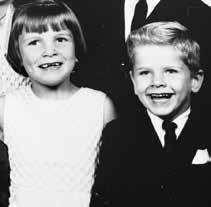
We were on vacation in Maine. We decided that we would leave first thing the next morning for the drive back to Michigan. Just as we were about to sit down for dinner, the next call came. This time, it was a nurse rather than the doctor. She explained that Jane was continuing to deteriorate. She was beginning to experience multiple organ failure. Her kidneys were barely functioning. Her blood pressure was dropping, and they were giving her large doses of medication to try to stabilize it, but the medication wasn’t working. She explained that there was a good chance Jane would not make it through the night. She, again, asked about end-of-life care. I repeated what I’d told the doctor earlier.
I laid down around 11:00 p.m. I was exhausted but could not sleep. Dozens of scenes played over in my mind: fetching her a couple times a week from her third grade
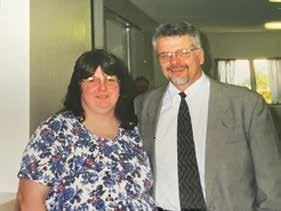
classroom when I was in the second grade so that she could join me in our slow reader’s group, a long walk we’d taken together in the Arboretum nearly thirty years earlier, a trip we had taken to visit relatives in Georgia for Thanksgiving one year in the 1990s during which she and I took a day trip to Atlanta. On and on.
At 12:45 my cellphone rang. It was a nurse. She was at my sister’s bedside. Jane was in cardiac arrest. The nurse was explaining the current situation to me while simultaneously giving directives to the medical team.
As I understood it, they had defibrillated her once and were about to do it again. She again asked me about end-of-life directives. I said, again, Jane wanted all measures taken to preserve life. “We can do this for a couple more rounds,” the nurse responded, sounding vaguely angry, though perhaps she was only stressed. “But it’s futile. She is actively dying.”
She turned away from me to instruct the others at the bedside. She then said that if I wanted to change the directive, they could administer medication that would allow her end to be pain and anxiety-free. I instructed them to stop the lifesaving efforts. It was clearly of no use, and I saw no reason to continue. I didn’t want her to suffer, and the outcome was inevitable.
The next morning, we left the Maine coast as the sun rose over the Atlantic Ocean, having slept little. It took nearly 14 hours to drive the 700-plus miles. After another fitful night, I was back on the road for the drive to the Traverse City area. Michigan’s landscape was at its height of summer verdancy. The trees were lush with shiny leaves, the forests lining the interstate and two-lane roads a hundred shades of green. The white birches, so beautiful in their May bud, were delightful at the height of summer, their trunks white slashes that stood out against the deep green hues of conifers, their full leaves shimmering in a light breeze. The corn stalks were six feet tall, helical with cobbs, and capped with silky tassels. The roadside ponds were abloom with water lilies, white and pink, their bright yellow-orange pistils visible through the window even at fiftymiles-an-hour.
I met my older brother, and we drove to the hospital and met with the staff of the nursing home.
By the time we held her memorial service a few weeks later, the leaves had lost their luster. The first hints of the autumnal turn showed in the forests and on the fields. The corn had been picked and small clumps of maple leaves, or occasionally an entire tree, burned orange or bright red. Late summer wildflowers—Queen Anne’s lace, Joe Pye weed, and my favorite, goldenrod, were in bloom as milkweed leaves were turning brown. Monarchs had begun to flutter south.
The trees, so brilliant with autumn’s mosaic only a few weeks earlier, were bare in November. The landscape’s color palette of muted greens and browns so dull that the few russet leaves that clung to oak branches and the sallow corn stubble in the fields seemed brilliant by contrast. The early afternoon sky was mottled, a camo blanket in shades of gray; it intermittently spit cold rain. Set to auto, my headlights turned on, then off, then on again. The day closed in as I drove back to Traverse City to inter my sister’s remains.
Afterward, as darkness gathered and a cold, steady rain mixed with snow, I walked along the main street of my hometown in the presence of ghosts. Here, the little greasy spoon where we sometimes accompanied my father to meet his cronies for coffee. There, the shoe store where my mother bought our school shoes, still run by the same family nearly sixty years later. The building that housed Mr. Kreps’s little grocery store where my mother sent me and my younger brother to buy milk or bread was still standing though it now housed an insurance agency.
As winter’s dormancy fades and spring replenishes the land with new flowers, fawns and foals, I feel the excitement of new life and am reminded that the human spirit, too, always renews.
As winter’s dormancy fades and spring replenishes the land with new flowers, fawns and foals, I feel the excitement of new life and am reminded that the human spirit, too, always renews.
jFrank Vandervort is a clinical professor at the University of Michigan Law School and a freelance writer. He lives in Ypsilanti Township. He can be reached at fevandervort@gmail.com.






Great way to be visible in the community, and connected.
We are always looking for good articles about the holistic scene… reportage, personal journaling and essays, profiles, interviews, journalistic explorations,and other feature writing.
Modest but respectable pay. If you might be interested, please send a letter of interest and links or PDF samples of previously published writing to jennifer@crazywisdom.net.

By Crazy Wisdom Journal Staff
CWJ: Thank you for sitting down with us to discuss Buddhist hospice and Buddhist grief support. What motivated you to found a Buddhist hospice and grief support organization?
Well, there were a couple of factors. First, there was a clear absence in Southeast Michigan for a Buddhist perspective on death and dying. Most large metropolitan areas in the West, by which I mean Europe and North and South America, offer Buddhist hospice services, both medical and nonmedical. At this point, Gentle Ground Hospice and Grief Support is nonmedical. We are also nondenominational. Secondly, our team has the experience and passion to help fill this void. Besides Buddhists, we cater to atheists, agnostics, Christian curious, anyone really. By the way, we will never try to convert anyone.
Our team has the experience and passion to help fill this void. Besides Buddhists, we cater to atheists, agnostics, Christian curious, anyone really.
CWJ: How does Buddhist hospice work?
Primarily, Buddhist hospice is about being present, compassionate, and calming. Sometimes there are extended periods of comfortable silence. Clients may be experiencing a wide range of emotions and allowing them the space to process those emotions is essential. Visits typically take place in the transitioner’s home, hospital room, or nursing facility. We try to avoid the words death and dying, as they carry dark, negative connotations in our society. Instead, we use the terms transitioner and transitioning, not to sound hip or trendy, but because they are more accurate. Transitioners often find this language comforting as well.
During the first meeting, we ask a few basic questions to establish an appropriate path forward. For example: Do you believe you are more than your physical body? How the client responds helps guide the direction of our discussions.
Primarily, Buddhist hospice is about being present, compassionate, and calming. Sometimes there are extended periods of comfortable silence. Clients may be experiencing a wide range of emotions and allowing them the space to process those emotions is essential.
We also ask practical questions such as: Are you in pain? On a scale of 1–10? Would you like to talk about the pain? Do you want to limit our time together because of it? We also try to gauge the transitioner’s level of lucidity.
Another important aspect of Buddhist hospice is supporting friends and family, if desired. They may wish to sit with the person after bodily death, so helping create the appropriate atmosphere is important. Muffled sobbing or quiet crying is fine, but if loud wailing begins, it’s best that those individuals leave the room.
Optional chanting or soft singing can be beneficial for the transitioner. Idle chitchat, however, should take place in another room.
We also offer assistance for traditional Buddhist funeral proceedings. Theravada, Mahayana, Japanese Zen, and Tibetan funeral proceedings vary widely. We will team up with the corresponding, local monk to conduct the ceremonial rites, if desired by the family.
What we do not do, unless specifically asked to, is attempt to teach the transitioner meditation, the Eightfold Path, or the Four Noble Truths, etc. This is not the time. Of course, the transitioner always dictates the direction of our conversations. Most are simply curious about “what’s next” from a Buddhist perspective.
It’s worth mentioning that what you believe or what I believe doesn’t change anything. It simply is what it is.
It’s worth mentioning that what you believe or what I believe doesn’t change anything. It simply is what it is. That said, 2,500 years of Tibetan monks exiting their physical bodies during deep meditation to explore the Thodol Bardo and the subsequent interior bardo’s, then returning with remarkably similar descriptions is pretty impressive, yet, I digress.
With the client’s permission, we draw from the teachings of The Tibetan Book of the Dead, which describes what occurs from the moment of biological death and throughout the subsequent 49 days. Fortunately, E.J. Gold’s, The American Book of the Dead translates these teachings into contemporary American English while preserving their depth. The translation offers clear, practical instructions to guide the transitioner through the labyrinthine journey of spiritual transformation.
CWJ: Tell us about Buddhist Grief Support.
First and foremost, our role is to support through empathy and compassion. Grieving is healthy. Rather than trying to stop it, one should learn to slowly integrate grief into a happy, contented life. When sitting with someone who has experienced devastating loss, we listen. They are often in a mind-numbing state of unhappiness. We may gently encourage them to talk about their mental pain, lack of sleep, and other challenges.
In this state, it’s common to feel that no one else has ever suffered as deeply as they are suffering. That’s why I always recommend finding a grief support group where one feels comfortable. Grief is an incredibly lonely experience. Being with others who are “going through it” can be profoundly healing. It certainly was for me.
If someone wants a Buddhist perspective during their grief journey, we can introduce Buddhist concepts appropriate to where they are emotionally and spiritually. The universe provides varying degrees of grief for a reason. Ideally, the grieving person can navigate this journey in a healthy way and emerge more compassionate, wiser, and spiritually evolved.
Of course, this is nearly impossible to imagine when you’re staring down the dark tunnel of grief with no visible light at the end. The pain is extremely difficult to bear. These are sacred wounds.
CWJ: What led you to found this organization?
I have always felt a strong affinity for hospice and grief support. Years ago, I left conventional hospice work and began offering Buddhist hospice on my own. However, the main qualifier was my wife’s passing. She died at age 43; I was 49. We were deeply in love, and she left me with three teenagers. My immediate state of mind can only be described as loss beyond comprehension. Her absence shattered my relationship with the world.
I did manage to navigate my grief journey successfully, but it was by far the hardest thing I have ever done. It took two years just to regain my sea legs, and five years to return to some semblance of “normal.”
Grieving is not an intellectual endeavor. It’s a journey no one wants to take, but you have two choices: you can endure the anguish and, over time, emerge more loving, caring, and compassionate or you can bury the grief, pretend you’re “fine.”
Grieving is not an intellectual endeavor. It’s a journey no one wants to take, but you have two choices: you can endure the anguish and, over time, emerge more loving, caring, and compassionate or you can bury the grief, pretend you’re “fine,” turn to alcohol, and so on. Burying grief because it’s too painful to face is a poor choice.
CWJ: Thank you for sitting down with us today and sharing your description of your organization and your insights. How is your organization compensated, and how can people contact you?
You are quite welcome. Thank you for having me!
We don’t charge for our services. We are Pro Bono. If someone wants to contribute gas money, we’ll accept it, but there are no fees.
Dallas Ahrens is an experienced Buddhist grief support provider, certified hospice volunteer, certified End-of-Life Doula, facilitator of a young widows and widowers grief group, and has spent countless hours on the meditation mat. The best way to reach Gentle Ground Hospice and Grief Support is via email at gentlegroundhospice@gmail.com
Southeastern Michigan's Conscious Living Magazine —
In print and online. A resource on mindfulness, healthy living, spiritual growth, psychology, conscious parenting, sustainability, and integrative medicine, plus community profiles, news, and events related to Southeastern Michigan’s vibrant holistic community.
The Crazy Wisdom Community Journal has been published since 1995. 7,000 copies of The Crazy Wisdom Community Journal are printed, and are available at more than 240 locations in the area.
Full digital issues of the Journal dating back to 1995 available to read online.

Hundreds of body/mind/spirit blogposts written by over 100 local authors & practitioners. A community calendar with hundreds of listings of events, classes and workshops.



By Crysta Coburn

I have been a happy habitant of Southeast Michigan for more than 15 years now, and we are blessed to have many metaphysical stores in our corner of the state. Each is filled with warm, welcoming people who are eager to help anyone on their personal spiritual journey. Join me as I visit five of them.
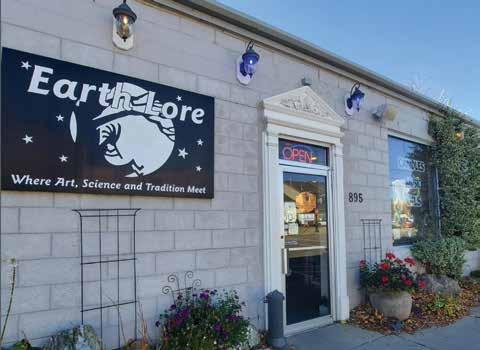
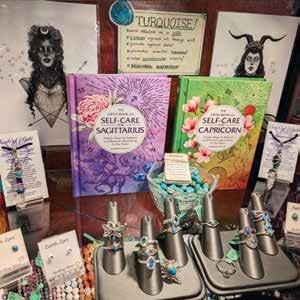
Westchester Square, a series of connected shops with indoor as well as outdoor access. This also places us close to Earth Lore which is one of our favorite stops,
The name of the shop, which opened in May of 1997, was chosen with intention. Per their website, “We collect goods from across the globe [and] our mission is to provide items with meaning, or ‘lore’, behind their creation.” This is clearly reflected in both the abundance and diversity of Earth Lore’s offerings.
Plymouth has the kind of thriving downtown that you read about in books. Built around a modest public park that is bordered by small businesses, restaurants, a farmers’ market, and even a discount single-screen theater, downtown Plymouth is a place you could spend hours exploring. An added bonus in Plymouth—the parking is free! My husband and I usually park behind
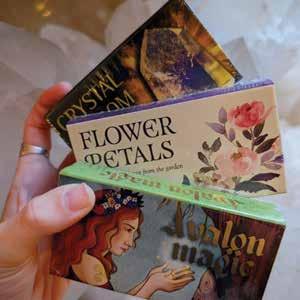
When you enter, you are instantly embraced by the distinctive, inviting aroma that is both familiar to those of us who frequent such shops but also totally unique to Earth Lore.

When you enter, you are instantly embraced by the distinctive, inviting aroma that is both familiar to those of us who frequent such shops but also totally unique to Earth Lore. A blend of incense, candles, and essential oils that moved one fellow customer to sigh and say, “I wish I could bottle this smell and take it home with me.” It’s that kind of comforting.
Immediately to your right is something that might surprise some patrons: a display of Catholic and angel statues, iconography, and rosary bracelets. Angel coins sit beside a basket of pentagrams. Continuing on, one encounters a wall of incense, scented candles, and burners of all shapes and sizes. You will find dragon statues (a soft spot for me), singing bowls, a wide variety of essential oils, comfy sweatshirts, T-shirts, pants, bags with fun designs, crystals of all sizes, calligraphy and sealing materials, tarot and oracle decks, pithy bumper stickers, books, and so much beautiful jewelry. This list is far from exhaustive, but I think it offers good insight into what might be found. The staff is always friendly and open to answering questions or helping you find what you need.
If you, like me, need a break after your global tour, located a few doors down from Earth Lore is the cozy and petite Espresso Elevado. It is the perfect place to stop in for a caffeinated treat to revitalize you. My husband and I have often driven to Plymouth just to hang out and window shop or attend the yearly Ice Festival. And no trip is complete without a visit to Earth Lore.
Earth Lore is located at 895 Wing Street in downtown Plymouth. For more information, head to earthlore.com or call (734) 354-1877. Or check them out on Facebook @earthloreplymouth and Instagram and TikTok @earthlore.
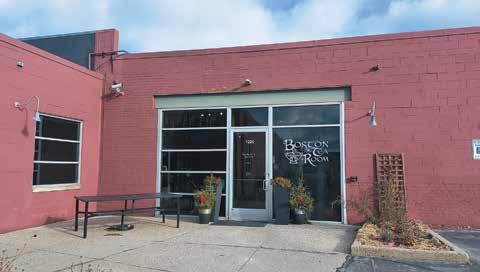
Ferndale is another city in Michigan where I could easily spend a whole day. Nine Mile Road is filled with all kinds of fun and unique shops, restaurants, and is where I first visited Boston Tea Room a number of years ago. They have since relocated to Woodward Heights, and boy, have they expanded! Woman owned, Boston Tea Room has been in business for over 40 years and received several local awards, and yet I run into people all the time who have never heard of it.
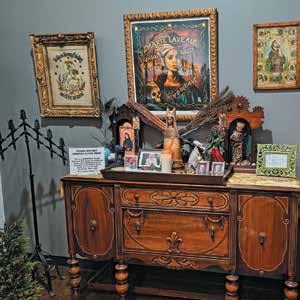
There is so much to explore that it’s difficult to know where to begin. It feels like every spiritual need or curiosity is met. As usual, I was drawn to the shiny object, like the seemingly endless jewelry counters, displays, and shelves upon shelves of stones and crystals. There is also a nice selection of meditation supplies such as blankets and pillows, both scented and fragrance-free candles
There is so much to explore at Bosten Tea Room that it’s difficult to know where to begin. It feels like every spiritual need or curiosity is met.
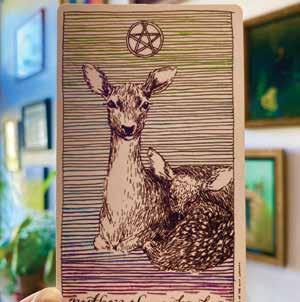
for any purpose (my favorites were in beautiful teacups sitting atop matching saucers), incense, herbs and essential oils, coins and charms, tarot and oracle decks, posters, stickers, blank journals; and multiple walls of books. Figures from Buddhist, Hindu, Chinese, and various pagan traditions are well represented.
Along one wall can be found private rooms for practitioners that are named after stones like amethyst and onyx. A wide variety of readings (which should be booked in advance) are offered including quick questions, couples readings, chakra clearing and balancing, and mediumship—just to name a few. (For those who can’t make it into the shop, phone readings may also be booked.) There is also a lineup of events and workshops to check out if you want to maximize your visit.
The tea lounge is delightfully decorated with colorful teapots, cups, and saucers from different time periods and locations across the globe. In addition to tea, one can sit down to enjoy muffins that are in fact upside-down baby bundt cakes, Northwest brand biscotti (not your grandma’s hard biscotti!), colorfully wrapped bonbons, and more. Every drink is made to order, and it may take time to make, so slow down, sit back, relax, and soak up the atmosphere. There are also bags of teas and tea accoutrements for sale you can peruse while you wait.
If you’re lucky, you may also be treated to a visit from a plaid-jacketed Pomeranian who cheerfully checked in on the shop’s patrons on my most recent visit. The human staff was also happy to answer any questions or retrieve an item that was out of reach.
Boston Tea Room is located at 1220 Woodward Heights in Ferndale. For more information, head to bostontearoom.com or call (248) 548-1415. Or check them out on Facebook and TikTok @bostontearoom and Instagram @bostonteatarot.
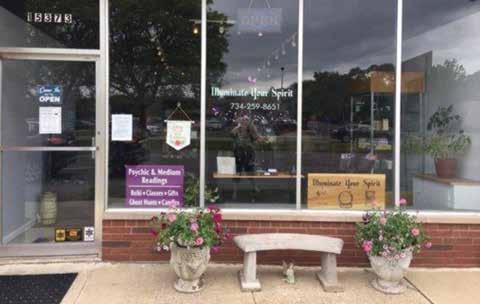
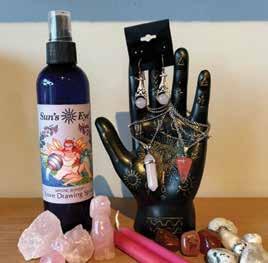
Not every shop needs to be big in order to serve its community. Sometimes it’s the more intimate locations that are the most endearing to us and serve the most need.
Conveniently located on Farmington Road just north of Five Mile sits Illuminate Your Spirit, which has been faithfully supporting patrons since April of 2011, first in Plymouth and then, as of June of 2017, at the present Livonia location.
The modest retail space has some truly delightful finds. Not only are there tumbled stones and crystals, but you can pick up the perfect bag to store them in. I was delighted by bags with clever phrases on them, such as, “I’ve got a crystal for that,” “rock my world,” and “time to recharge.” What a great way to have fun with your practice and show off your playful side! For those larger items, there was also a selection of bags for divination decks as well as book bags.
Speaking of books, you can also find used books on spiritual topics at Illuminate Your Spirit. My favorite parts of the store were the unique jewelry (I bought a

bracelet that looks a little like shiny chainmail) and large candle selection. You can browse through shelves of everything from chime candles (mini tapers that come in a variety of colors) to votive spell candles and reiki votive candles for focus and healing. There is a candle for just about any need you might have.
Not every shop needs to be big in order to serve its community. Sometimes it’s the more intimate locations, like Illuminate Your Spirit, that are the most endearing to us and serve the most need.
Between chronic illness and ADHD, I don’t often have the energy or brain power to craft my own spells anymore, so the “premade” votive candles really help me in my practice.
The cozy rooms behind the retail space are set aside for meeting privately with intuitive practitioners and energy healing sessions. These include tarot readings, mediumship, palm readings, soul retrieval, and reiki healing. One thing I found on offer here that I didn’t notice elsewhere was candle work.

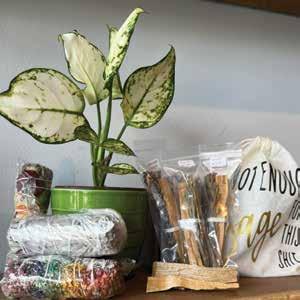
Per their website, “Each candle will be lovingly prepared and worked upon our sacred altar, infused with blessed oils, enchanted herbs, and a heartfelt written petition to the Divine—all chosen with intention to align with your specific desire, need, or manifestation.” The candle is then tended to for one to two weeks after which a reading is done on the jar and the results sent to the patron who commissioned the candle.
After exploring what the shop has to offer, be sure to take a peek at the cute fish in the aquarium next to register. Tell them I say hello!
Illuminate Your Spirit is located at 15373 Farmington Road in Livonia. For more information, head to illuminateyourspirit.com or call (734) 469-2091. Or check them out on Facebook @illuminateyourspiritlivonia and Instagram and TikTok @ illuminateyourspirit.
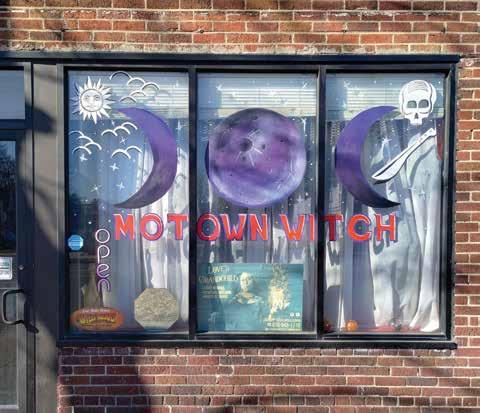
For a little over two years, Ypsilanti was home to Conjure Goddess Botanica and Metaphysical Shop, owned and operated by Tanet Jordan, a store that specialized in “Conjure, Hoodoo, Voodoo, African Traditional Religions (ATRs), Santeria, Wicca, and Witchcraft” traditions. Of course everyone was welcome, and I enjoyed stopping by now and again to browse the shelves and have a
Conjure Goddess closed in 2024, leaving behind a distinct void in the local metaphysical and spiritual community. So, some readers may be excited to learn that located roughly 30 minutes from downtown Ypsilanti, near the intersection of I-96 and M-39 in Detroit, is Motown Witch.


friendly chat. But Conjure Goddess closed in 2024, leaving behind a distinct void in the local metaphysical and spiritual community.
So, some readers may be excited to learn that located roughly 30 minutes from downtown Ypsilanti, near the intersection of I-96 and M-39 in Detroit, is Motown Witch. (There is also a wellstocked online shop if you can’t make the drive.) Per the website, the owner is “a Witch and Conjure Worker” and “a lifetime Detroiter” (hence the name The Motown Witch).
Motown Witch is admittedly on the small side, but that absolutely does not matter. When I spy an altar by the door, I always feel that I am in the right place, and the wide selection of incense was a delightful and welcoming smell. (The strawberry incense I purchased is sitting on my desk as I write, providing a heavenly, summery aroma while there are still several inches of snow on the ground outside my window.)
Visitors will also find stones (I bought a little selenite tower), handmade soaps, Florida Water, a variety of herbs, packets of ingredients for herbal and spiritual baths, kits with all the components needed for a spell or ritual included, offering
candles for orishas and saints, spell candles, as well as statues of orishas and some Christian figures. This includes the personification of death Nuestra Señora de la Santa Muerte (Our Lady of Holy Death), perhaps better known as simply Santa Muerte, whose devotees have been increasing in number in the U.S. over the past 20 years.
Motown Witch also offers classes. In February, a Protection Class was offered that instructed learners “how to protect your spirit, your home, and your peace.” This included “traditional spiritual protection, cleansing and uncrossing basics, everyday protection methods you can really use.” December had the two-part class Herbs, Magic and New Year Readiness. Part one focused on “The Magic in Your Cabinet,” exploring “the hidden powers of herbs, roots and curios.” Part two, “Preparing Your Home for the New Year,” helped to put this knowledge into immediate practice. Other past classes have included Spirituality 101 and Hoodoo 101.
Motown Witch is located at 16544 Plymouth Road in Detroit. For more information, head to motownwitch.com or call (313) 739-6802 or email contact@motownwitch.com. Or check them out on Facebook, Instagram, and TikTok @Motownwitch.
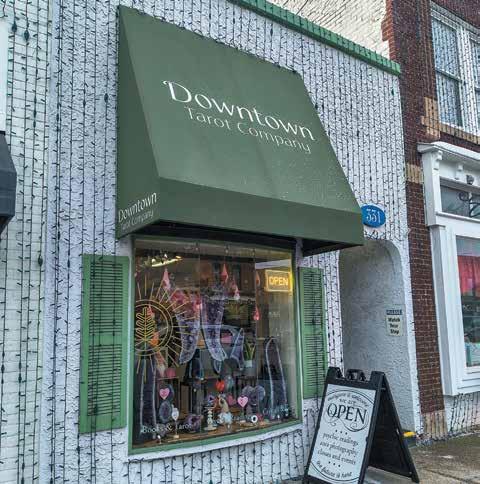
Downtown Rochester is another place I could easily spend a day wandering in and out of interesting little stores, coffee shops, and restaurants. And for me, the main attraction would be Downtown Tarot Company. What appears to be a small, narrow space from the sidewalk in fact has a large footprint. It’s the kind of shop that draws you deeper and deeper as your eyes are drawn to all the amazing—and colorful—items offered.
I was already excited by the impressively sized amethyst geodes in the front window, a few of which were set up to resemble pairs of human-sized fairy wings. After stepping inside, I was amazed by all the crystals and geodes that were the size of bowling balls. The store has stones and crystals of all shapes and sizes (including palm-sized Pokemon), but there are some true stunners scattered throughout that had my jaw dropping. The forest “fairy” epidote was a completely new one to me, and I had to take a picture of its incredible mossy texture so I would remember it later.
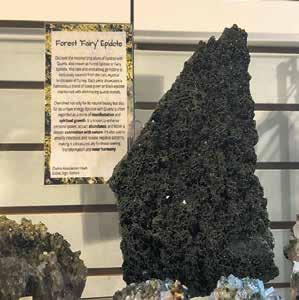
On one of the front displays was a selection of crystal pendulums with a mat in front to give them a try on. Another table had a sample deck of the Light Seer’s Tarot, where I drew the two of pentacles. Being a Libra, I took this card of balance as an auspicious sign. There is a wall of divination and oracle decks as well as books.
Downtown Tarot Company makes its own oils, available as sprays and rollers, and candles, which come in many different shapes, sizes, colors, and intentions. Find candles for manifestation, cleansing, protection, focus, love, and more. The line of Pride candles are layered to resemble the various Pride flags, such as pink, yellow, blue for pansexual and yellow, white, purple, and black for nonbinary. I enjoyed the candles with fun phrases (and intentions) on their jars like “hex the patriarchy,” “crazy plant lady,” “queer joy is resistance,” and “manifesting good sex, more crystals, and zero drama.”
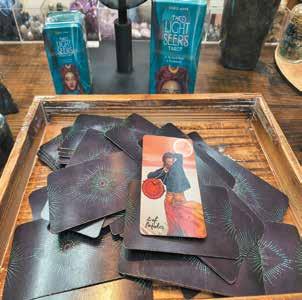
There also candles with herbs mixed in and crystals set into the wax. Per the online store, “Fire is an agent of transformation; lighting a candle will enhance and diffuse a crystal’s energy, making these candles perfect for manifestation, spells, rituals, or crystal grids.” Some have a zodiac theme. Candles featuring the Major Arcana are inspired by the now traditional Rider-Waite-Smith tarot deck and have a harmonious crystal tucked inside. For example, The Lovers contains rose quartz. There are Mystery Crystal Candles as well, because who doesn’t love a mystery grab bag?
What appears to be a small, narrow space from the sidewalk in fact has a large footprint. Downtown Tarot Company is the kind of shop that draws you deeper and deeper as your eyes are drawn to all the amazing—and colorful—items offered.
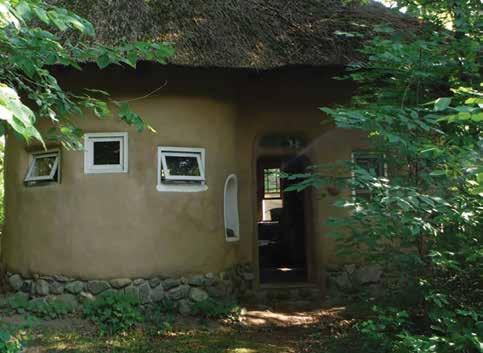
Youth and adult classes in thatching, strawbale, earth ovens, and more! Groups welcome!

Mediation in Motion * Relaxation * Balance * Flexability 1945 Pauline Blvd., Suite B, Ann Arbor (734) 741-0695 peacefuldragonschool.com info@peacefuldragonschool.com
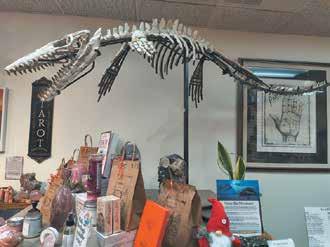
Other things that caught my attention were Mose the mosasaur fossil and the countless stickers found in baskets throughout the store, including stickers of Paul, the resident ghost. In the back are rooms for private psychic, astrology, and other readings and aura photography. Downtown Tarot Company also offers a great number of classes and, during certain times of the year, haunted tours.
Downtown Tarot Company is located at 331 South Main Street in Rochester. For more information, head to downtowntarot.com or call (248) 977-7227 or email info@downtowntarot.com. Or check them out on Facebook @fowntowntarot and Instagram and TikTok @downtowntarotcompany.

By Samantha Beidoun and Photos by Mary Bortmas
Meet Renata Portes, creator of The Universe Stuff; a holistic, creative brand of candles, teas, Reiki, tarot, and more. Originally from Brazil with a background in law, Portes found herself drawn to bring light and healing to people during her transition to life in the United States. I first learned of The Universe Stuff at an area Chamber of Commerce event I attended as a team member of Social Vines, and quickly found myself drawn to Renata and her friendly demeanor. Months later we have found friendship, and I have enjoyed getting to know more about her and her business. When not attending Chamber events, making candles, or meeting new friends for matcha, Portes enjoys making connections in the community, and loves her home in Ypsilanti with her husband and two cats. Her amazing journey is one to savor!

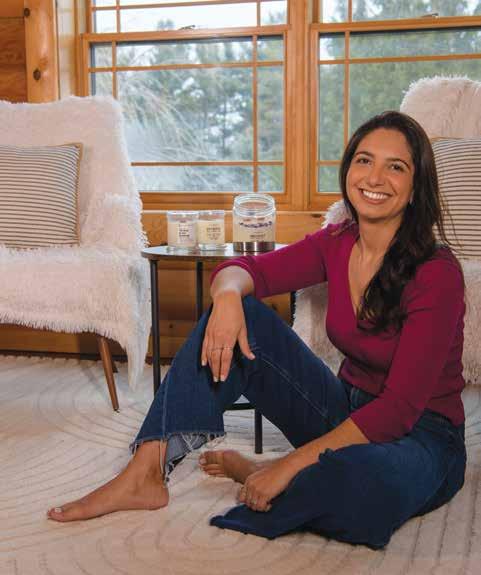
Describe your upbringing in Brazil and what got you onto the path of being a lawyer.
Renata Portes: I grew up in a family that deeply valued hard work, strong principles, and a sense of justice. We believed that through dedication and work, anything was possible. I basically grew up in courthouse hallways. My mother worked for over 20 years in the judicial system as a stenographer. Going to the courthouse with my father to pick her up after work was part of our routine. Everyone knew me there. I even have memories of falling asleep in the judge’s office while waiting for my mother during long court sessions.
Being in that environment so often, surrounded by people in different legal roles, hearing stories about real human struggles, and witnessing how the law could shape outcomes naturally sparked my interest in the field. I became drawn to the idea of helping people be heard, understood, and properly represented. I felt like this was the path I had been walking toward my entire life.
Over time, being so close to the legal world also taught me something deeper: behind every legal issue, there is a human story. Many people come to the justice system seeking solutions to external problems, but often they are also carrying emotional struggles that are harder to name—fear, uncertainty, or a sense of not being seen. Witnessing that from a young age shaped my sense of empathy and my desire to support people not only through rules and systems, but through understanding, presence, and care.

I became drawn to the idea of helping people be heard, understood, and properly represented. I felt like this was the path I had been walking toward my entire life.
When and why did you come to the United States?
Renata Porte: I came to the United States in 2015 after my husband was transferred here for work. Over the past 11 years, his career has taken us through several moves, including time in different cities across Michigan and a year in Chattanooga, Tennessee. While constantly relocating was challenging at times, it also taught me adaptability and helped shape the way I connect with people and places. We now live in Ypsilanti, where we feel grounded and ready to build long-term roots.
When did you realize being a lawyer was not fulfilling and you needed a change?
Renata Portes: Shortly after moving to the United States, I considered returning to school to become a lawyer here. I completed a paralegal certificate program
to better understand how the legal system worked and what that path might look like in a new country. As I moved through that process, I realized it wasn’t the right moment for me. At the time, my English skills were still very limited; I didn’t feel confident communicating efficiently, let alone following a university level program. Financially, investing in another degree was also not feasible. Beyond that, after completing five years of law school in Brazil and earning two master’s degrees, I felt mentally exhausted from formal education and wasn’t ready to return to that structure. I also recognized that I was emotionally drained from constantly dealing with people’s problems and conflicts, often without feeling adequately compensated for the responsibility and emotional weight that came with that work.
Moving to the United States gave me a rare sense of freedom—the opportunity to reinvent myself. That possibility felt exciting and empowering.
At the same time, moving to the United States gave me a rare sense of freedom—the opportunity to reinvent myself. That possibility felt exciting and empowering. Since then, I’ve explored different professional paths, including marketing, translation, journalism, and entrepreneurship. Each experience helped me better understand myself, until I found a direction that truly aligned with who I am and how I want to support others.
Tell me about how you got into Reiki and candle making and ultimately the birth of The Universe Stuff!
Renata Portes: Reiki came into my life through a book, purely out of curiosity. At that time, I was feeling a bit lost. I had explored many different career paths but I was still feeling unfulfilled. I decided to buy a book about chakras, hoping to learn something that might help me understand myself better.
Even though I grew up in a Catholic family, spirituality was always present in different forms. I had a Protestant grandmother, and another grandmother who was, in her own way, a bit of a witch; working with herbal medicine and energy rituals, even if she didn’t realize it at the time. I was also influenced by spiritualist family friends, and I’ve loved astrology and tarot since I was a child. So, learning about chakras didn’t feel strange to me—it felt like recognizing another branch of my spiritual tree.
Even though I grew up in a Catholic family, spirituality was always present in different forms. I had a Protestant grandmother, and another grandmother who was, in her own way, a bit of a witch; working with herbal medicine and energy rituals, even if she didn’t realize it at the time.
After devouring that book, I wanted to go deeper. I searched for a Reiki course, attended the training, and began practicing with family and friends. They became my first clients, followed naturally by others. Still, I felt a strong desire to keep learning. I studied aromatherapy to bring more tools into my Reiki sessions, and later expanded into crystals, chromotherapy, and radiesthesia (the study of energy fields in people, animals, or places using a pendulum for feedback on the energy fields and giving way to see what needs to be worked on or balanced).
As my practice grew, my clients began asking for something they could take home, something that would help them continue their healing journey beyond our sessions. They wanted to recreate the feeling and environment they experienced with me in their own homes, almost like having their own sanctuary. That’s when I saw an opportunity to expand my work through natural products that could support self-care, self-love, and healing.
The first products I developed were essential oil blends. Through aromatherapy, people could gently navigate physical and emotional challenges while complementing the energy work. The very first blend I created was called Cycle, which I originally made for myself while dealing with menstrual discomfort. I tested it on myself and then shared it with friends. I began asking people, “If you could work on one issue in your life right now, what would it be?” From their answers, I created blends to support anxiety, depression, sleep issues, weight management, muscle soreness, mental clarity, respiratory health, and even joint relief for dogs. It became a joyful process of creating, listening, and witnessing positive results.
That creative energy opened something in me. I felt inspired, excited, and deeply aligned. If I could help people through energy work and natural medicine, then I started to think of how I could expand that. Teas, candles, bath products, soaps are some of the creations that started to come to play.
All of this brought back memories of my grandmother. She used to pick arnica from the backyard and place it in alcohol to create a tincture. Whenever I fell and had an open wound, she would apply it. I remember crying because I knew it would burn at first, but she would tell me to be brave because after that initial sting it would heal quickly. Remembering how she cared for me through nature and intuition, without ever naming it as “witchcraft,” still makes me smile.
What is your favorite part of what you do currently?
Renata Portes: My favorite part of what I do is production. I love hands-on work; creating, testing, and being deeply involved in the making process. While selling doesn’t come naturally to me, I’ve learned to lean into humor to break the ice. I joke that I sometimes have to put on a bit of a “clown mask” to feel comfortable, but once that connection is made, it flows.
My second favorite part is watching people smell my candles for the first time and seeing their reactions, usually followed by, “Oh my God, this smells amazing!”, and every time I think to myself, I know… I made that, and it still makes me smile every single time.
What are your future goals with The Universe Stuff?
Renata Portes: At this stage, I’m focusing my energy on growing my wholesale partnerships in a more intentional way. While I truly enjoy connecting directly with people through pop-up events, I’ve learned that building long-term relationships with aligned businesses is a more sustainable path for my brand. To support this growth, I recently restructured my wholesale program to include better discounts, lower minimum order requirements, and a streamlined reorder process. At the same time, I’ve discovered a deep love for teaching. Over the past three years, I’ve taken close to 30 courses, ranging from Reiki, aromatherapy, and herbalism to astrology, tarot, candle making, and natural product formulation. Some of those tools I use daily, others less so, but every course contributed to my growth. It became clear to me that holding all of that knowledge without sharing it would feel like a missed opportunity. That realization led to the creation of my workshops, which have become one of the most fulfilling parts of my work.
Moving forward, my goal is to continue growing a business that balances sustainable partnerships with education and creativity, while staying deeply connected to people and the healing, self-care journey that inspired it all in the first place.
Many people first discover The Universe Stuff through the products, but what they might not realize is how intentional everything is–from the ingredients I choose to the way each experience is created.
What do you want people to get out of your workshops and products?
Renata Portes: With my products, I want people to find their way back to themselves. My intention is to support healing and self-care in a gentle, accessible way to help people slow down, listen to their bodies, and create small rituals that bring comfort, grounding, and balance into their daily lives. With my workshops, the focus is joy and connection. I want people to have fun, feel part of a community, and reconnect both with themselves and with others. I invite them to connect with their inner child, create without pressure, try something new, and allow themselves to slow down naturally. The goal is to relax, be present, play, and truly enjoy the process without expectations.
What do you want people to know about The Universe Stuff that they might not realize at first?
Renata Portes: Many people first discover The Universe Stuff through the products, but what they might not realize is how intentional everything is–from the ingredients I choose to the way each experience is created. Every product and workshop is designed to support people in slowing down, reconnecting with themselves, and creating small moments of care in their everyday lives. It’s not about perfection or trends—it’s about presence, quality, and meaning.
What kind of people or businesses do you love collaborating with?
Renata Portes: I love collaborating with people and businesses that value intention, creativity, and community. Whether it’s a small boutique or gift store, a yoga or wellness space, a spa, or another maker. I’m drawn to places that care deeply about the experience they’re offering and the people they serve. For me, the best partnerships are always built on shared values, trust, and mutual respect.
To learn more about The Universe Stuff and see the variety of products offered and upcoming workshops visit theuniversestuff.com or to more directly connect for collaborations, e-mail Portes at theuniversestuff@gmail.com.

By Triana Jones
In this column, readers submit their questions, and we delve into the answers. We’ll embark on a journey of holistic exploration, delving into ancient practices and unraveling the enigmas of existence. Whether you’re a seasoned enthusiast or a curious newcomer, this column offers a platform for deepening your understanding and expanding your consciousness. Are you curious about a certain new-age subject or practice? Seeking advice or perspective on a spiritual or holistic matter? Submit your questions to AskSpiritSeed@gmail.com and have a chance to be featured in our next issue.
How can I use Reiki to heal deep-seated emotional wounds and traumas that have manifested in my physical body?
This is one of the most profound ways I’ve used Reiki, both for myself and others. When emotional wounds and traumas go unprocessed, they don’t just disappear. They settle in the body, often showing up as chronic tension, illness, fatigue, or pain. Reiki offers a gentle, yet powerful way to bring those energies to the surface and transmute them. I always begin by setting a clear intention for the session. I’ll say something like, “I’m ready to release the pain I no longer need to carry. I open myself to receive healing and understanding.” This primes both my energy and my subconscious to be receptive. I also call in spiritual support, whether it’s my guides, ancestors, or the universal life force itself, to help hold space for whatever needs to rise.
Emotional trauma often collects in specific places, tightness in the chest (grief), the hips (stored fear), or the throat (unspoken truth). I don’t rush the process. I hold my hands over those areas and let the energy do its work, trusting that the body knows what it’s ready to release.
As I channel Reiki, I pay close attention to the body’s signals. Emotional trauma often collects in specific places, tightness in the chest (grief), the hips (stored fear), or the throat (unspoken truth). I don’t rush the process. I hold my hands over those areas and let the energy do its work, trusting that the body knows what it’s ready to release. Sometimes emotions surface, tears flow, memories rise, and you may even experience physical sensations. That’s good. It means the energy is moving. I breathe through it, staying grounded, and I always follow up with soothing practices: journaling, drinking water, or grounding in nature. What I love about Reiki is that it meets you where you are. You don’t have to relive every trauma for healing to occur. You simply allow yourself to be in the energy, and over time, layer by layer, the weight starts to lift. Reiki isn’t about fixing, it’s about remembering your wholeness. And that’s where true healing begins.
How can I use advanced visualization techniques to enhance my astral travel experiences and ensure a safe journey?
Advanced visualization has been one of the most reliable tools I’ve used to deepen astral travel while staying protected and grounded. For me, astral work doesn’t begin when I leave the body, it begins long before, in preparation and intention. I always start by grounding myself deeply, imagining roots growing from my spine and feet into the Earth, anchoring me like an old tree that won’t be uprooted by strong winds. This grounding is what allows me to travel far without getting lost. Next, I build my energetic container. I visualize a sphere of light forming around my body—thick, luminous, and intelligent. Sometimes it’s gold, sometimes deep indigo. I don’t rush this. I mentally reinforce it layer by layer, affirming that only energies aligned with my highest good may enter. This is essential. Astral space responds to clarity, not force.
When I begin the actual projection, I focus on movement imagery rather than “leaving.” I might visualize myself floating upward like mist at dawn, or stepping through a doorway made of light. The key is to let the body fall asleep while the mind stays gently aware. If fear or resistance shows up, I don’t fight it. I acknowledge it, breathe, and return to the image. Animals help here, imagining myself soaring like an owl or gliding like a dolphin often stabilizes the experience. To ensure a safe return, I always visualize a silver cord or
light thread connecting me back to my physical body. I affirm that I can return instantly and effortlessly at any moment. When the journey feels complete, I retrace my steps in reverse, slowly re-entering the body and grounding again. Astral travel isn’t about escape. It’s about exploration with respect, intention, and trust. When visualization is clear and rooted, the journey becomes not only safer, but profoundly transformative.
Astral space responds to clarity, not force. When I begin the actual projection, I focus on movement imagery rather than “leaving.”
This is one of the most sacred relationships you can build on a spiritual path, and it deserves patience, reverence, and humility. Plant medicine isn’t something I “use” so much as something I listen to. Before any journey, I begin with intention. I’ll sit quietly and speak it aloud: “I’m ready to learn what you wish to teach me. I ask for healing that is gentle, truthful, and aligned with my highest good.” This isn’t just ritual; it signals respect. Plants are ancient teachers. They respond when approached as allies, not tools.
Preparation is everything. I make sure my body is clean and supported, hydrated, nourished, rested. I clear my space energetically with smoke, sound, or prayer, and I call in protection: ancestors, guides, the spirit of the land. I also ground beforehand, imagining my roots deep in the soil, because plant medicine tends to open the upper realms quickly. Grounding keeps the experience integrated instead of overwhelming. During the work, I stay present with the body. Plants often speak through sensation before imagery: tightness, heat, waves of emotion. I don’t resist it. I breathe and allow. Like animals shedding an old skin, discomfort often signals transformation in progress. If visions arise, I observe rather than chase them. The medicine knows where to take you.
Plants are ancient teachers. They respond when approached as allies, not tools. Preparation is everything. I make sure my body is clean and supported, hydrated, nourished, rested. I clear my space energetically with smoke, sound, or prayer, and I call in protection: ancestors, guides, the spirit of the land.
Integration is where the real healing happens. I journal immediately, even if the insights feel fragmented. I spend time in nature afterward, barefoot if possible, letting the Earth help me digest what surfaced. I don’t rush to repeat the experience. Plant medicine works in layers, like seasons. When honored properly, it doesn’t just heal wounds, it teaches you how to live in deeper relationship with yourself, the Earth, and Spirit.
Triana Jones is a single mother, a Wounded Healer, an Eclectic Witch, and a practicing Spiritualist of sixteen years. She received her first oracle deck from her grandfather sixteen years ago and she has been reading cards professionally for the past seven years. In 2023, she was certified in Quantum Healing Hypnosis Therapy and Herbalism.

By Catherine Carlson
Uranus! It’s a funny-sounding name to go along with a quirky planet. It’s preferable to pronounce it with the stress on the first syllable. As you’ll see, this planet’s physical nature and astrological significations all go together.
This electric-blue colored seventh planet even looks crazy! It is tilted on its side, and it spins the opposite direction of almost all other planets (in our known solar system). The unusual orbit means the sun shines on each pole for long periods, making the rest of the planet dark for years at a time. The atmosphere also has many stormy areas.
Like a bolt of lightning, the discovery of Uranus in 1781 cracked open our knowledge of the solar system beyond Saturn. The original name Georgium sidus (George’s Star), after King George III, was disliked by other astronomers who offered the name Uranus, the father of Cronus (Saturn to the Romans) in Greek mythology, making it the only planet to use the Greek name instead of the Roman one. Uranus didn’t follow the pack from the get go, and that’s exactly what it permits and pushes us to do as well.

Uranus! It’s a funny-sounding name to go along with a quirky planet.
Uranus is really “out-there” and exemplifies personalities or lifestyles that are a little different. This energy shows up in people who dress differently, live in an unusual home, or drive a particular car. These are originals—people that do not follow the status quo. Artist Pablo Picasso’s paintings were seen as radical during his time. Yet, the Cubist movement, of which he was a large part, had a ripple effect inspiring innovations in dance, music, and architecture.
Uranus encourages the rebel inside of you to deviate from the beaten path. You may play an atypical sport, attend an exclusive school, or work in a rare career. Worldwide sensation Jacob Collier is a music genius who is showing us a new way of composing. His live performances take creativity to the next level, including spontaneous arrangements and audience participation.
Uranus encourages the rebel inside of you to deviate from the beaten path.
Uranus spends seven years in a sign, so it is shared with those in your age group. Those born with Uranus in Libra (1969-1974) have been pioneers in pushing the boundaries of traditional relationship models. So many were influenced by growing up in unconventional (at the time) households of divorced parents and developed a need to break out of the mold set before them.
A big reason for going against the grain is to experience freedom. Routines may become stagnant and stuck. Uranus is the modern ruler of the sign Aquarius, one that is anything but common. If you have an Aquarius sun, moon, or rising sign, or have a strong Uranus placement, you may feel like you have an electrical current running through you sometimes. Such planetary aspects can bring on flashes of insight and eureka moments. This is the influence associated with
discoveries and breakthroughs, and propels inventions of all kinds, like those seen in Leonardo DaVinci’s detailed sketches. It shows up in new technology, such as the Apple products created by the late Steve Jobs—a man with over 450 patents.
Revolutions were occurring around the time Uranus was discovered, so the two go hand-in-hand. The rebellious act of The Boston Tea Party was a surprise that inspired similar acts leading up to the American Revolution. Rosa Parks was another radical that created shock waves by making a spontaneous choice to refuse to give up her seat on a bus, defying segregation laws. Who could have predicted that her actions would spark similar ones and eventually, an entire movement? Time and again, it is the Uranus-type mavericks who help bring us into the future.
We like things to be certain, and it can be so unsettling when our carefully curated way of life, or the structures that we rely upon, shift gears, and we didn’t get the memo ahead of time. When we come into our early forties, Uranus reaches the halfway point from when we were born. This is the astrology behind the midlife crisis, a time when something that we wanted in our early twenties resurfaces. The discomfort may reach a tipping point, and we initiate a sudden change toward individuation. This change can show up as the stereotypical break-up of a long-term relationship but also could be getting married for the first time, having a child, or starting a business. Sometimes a Uranus transit can throw a curve ball in your life, forcing us to make a change we probably didn’t want, even though it might be ideal for our personal growth.

On April 25, Uranus is moving into the mutable sign of Gemini until 2033, leaving Taurus, where it has been since 2019. Gemini was the constellation in which Uranus was first discovered, clueing us in to how things may play out. Gemini sun and moon signs will experience the energy of Uranus most significantly during this transit. Uranus in Gemini could influence revolutionary changes in learning and education systems and how we communicate, as well as media, social activity, and traveling short distances. This sign of the twins represents siblings and could reflect changes to our family systems. Gemini’s influence can already be seen with new developments in the music industry using AI to alter our singing voice through technology.
Sometimes a Uranus transit can throw a curve ball in your life, forcing us to make a change we probably didn’t want, even though it might be ideal for our personal growth.
Uranus has the power to shift the masses. Movies such as Strictly Ballroom, or Pleasantville, are great examples of how the dull and stodgy become colorful and lively when something never-seen-before suddenly enters the picture.
Catherine Carlson is an Astrologer who offers consultations for adults and children. She is an Ann Arbor native who enjoys living locally with her family. She can be reached at catherine-carlson.com or catenka@mac.com
By Sandor Slomovits
I am not afraid that AI may end up destroying humankind. I am concerned that it may destroy our humanity.
More about this later. First, my bona fides.
My audacity regarding the possibility of AI becoming an existential threat to our species does not spring from my extremely limited understanding of its current capabilities, nor from any reassuring foreknowledge of its future evolution. Neither does it arise from a profoundly misanthropic, I-couldn’t-care-less view vis a vis my fellow human beings. While I will admit to a blood red No Vacancy sign eternally lit in the bottom of my heart for some members of our species, (I know you know who you are, and I know you don’t care a whit about how I feel about you) but “good riddance” regarding my fellow human beings in toto? Absolutely not.

My audacity regarding the possibility of AI becoming an existential threat to our species does not spring from my extremely limited understanding of its current capabilities, nor from any reassuring foreknowledge of its future evolution.
Rather, my sanguine stance regarding the possibility of AI destroying our species grows out of my fledgling understanding—rising occasionally to melancholic acceptance—that much that happens in life is literally out of my hands.
Nevertheless, besides the existential one, I do have some grave misgivings about AI.
Like many people, I fear our increasing use of AI will put unprecedented burdens on our already beleaguered environment, water supply, and power grids. I worry it may cause massive, rapid unemployment and exacerbate an already corrosive inequality between haves and have nots. I shudder at its limitless potential to wage war even more destructively and impersonally than we already can. Then there are the mistakes it makes, the data set on which it is trained, the thievery and fundamental dishonesty underlying some of its modus operandi and history… and, perhaps most concerningly, that even the people constructing AI seem to not fully understand it.
On the other hand, I am astonished at, and grateful for AI’s role in the dramatic advances in medicine, disability aids, scientific research in physics, chemistry and astronomy, not to mention in the safety features of my 2025 Ford Escape. I marvel at this magical technology with seemingly unlimited potential to improve human lives and the planet’s well-being—including the possibility that it may be able to solve some of the above problems which it is now creating.
Besides, I fully accept that when it comes to AI, as the old proverb says, the camel’s nose is already under the tent flap. Or, to paraphrase another old saw, the horse is well out of the barn and is, in fact, way the hell down the road. If the history of our species is any guide regarding the adoption of new technologies—from fire and the wheel to printing press and the computer—we will continue to increasingly harness AI, and it will reshape our entire world.
That does not, I believe, mean that we must welcome it into every corner of our proverbial tent, become AI jockeys, and race to employ it in every aspect of our lives.
After the United States dropped nuclear bombs on Hiroshima and Nagasaki, it became clear that human beings needed to limit the use of those unprecedentedly destructive weapons—ones that, for the first time in history, had the potential to destroy our species, and perhaps all living beings on

the planet. The resulting safeguards that nations placed on nuclear weapons, though incomplete and fragile, have managed—so far—to prevent their use. Now, at the very least, we need similar bans on the use of AI in war, specifically to forbid nations to put AI in sole control of nuclear weapons. (Thank you for your service, Anthropic!) Additionally, as we’ve learned from sad experience with the endless nuclear arms race, we’ll need to develop technology—AI detectors, AI whack-a-mole-in-real-time-machines—to monitor the illegal creation and use of AI weapons, as well as the programs that will undoubtedly be created to camouflage AI content.
Creating and enforcing those safeguards is the work of nations and their leaders. But we, individual human beings, also have responsibilities and decisions to make. Will our future be increasingly digital? Will the trend lines continue to accelerate in that direction? Will we talk with each other or with our AI companions? Will we dance or only tap screens and keyboards with our fingertips? Will we make music or will we listen to computer generated sounds? Will we rely more on AI not merely for directions to get us where we’ve decided to go, but on directions telling us where we should be headed in the first place?
We humans have, as all living beings do, an exquisite feedback loop, an interweaving of our consciousness and the physical containers of that consciousness, our physical bodies. The ways we sense and perceive the animate and inanimate world around us shapes us and vice versa. It is one definition of what it means to be alive. It is what enables us to feel, and indeed be, connected to every other living being. It is what makes it possible for us to change and be changed by all that we encounter. It is what makes every instance of our existence a creative act.

The ways we sense and perceive the animate and inanimate world around us shapes us and vice versa. It is one definition of what it means to be alive. It is what enables us to feel, and indeed be, connected to every other living being.
It is what AI can already, and will increasingly get better at, mimicking. And it is, I believe, something AI can never replace.
We need to protect, nurture and preserve our humanity by engaging with the living natural world and each other, rather than focusing our interactions primarily on the digital world.
I am not afraid that AI may end up destroying humankind. I am concerned that it may destroy our humanity.
I hope that in learning to live with it we will instead come closer to recognizing, cherishing, and protecting our humanity.
Sandor Slomovits, along with his twin brother, Laszlo, founded the folk music duo Gemini in 1973. The brothers also, with Sandor’s daughter Emily, comprise the trio, Gemily. The duo, and the trio, play at schools, coffeehouses, concert venues, and festivals throughout Michigan and the Midwest. For more info, please see GeminiChildrensMusic.com. In addition to the Crazy Wisdom Community Journal, Sandor’s work can also be found in the Ann Arbor Observer, as well as on his website, SandorSlomovits.com.

By Rev. Loren H. Griffin
There seems to be this point on the spiritual path when we realize that the very practices meant to free us can quietly become ways of hiding. It often begins with sincere devotion, the desire to grow, to heal, to remember. Yet somewhere along the way, the quest for awakening starts to take the place of living.
There seems to be this point on the spiritual path when we realize that the very practices meant to free us can quietly become ways of hiding.
I didn’t notice when it happened in me, and I’ve learned through conversations and service to people that most of us don’t notice it. It begins in subtle ways. The meditation cushions pile up. The workshops get bookmarked. The language of transformation becomes fluent, almost second nature. We begin to speak about consciousness, healing, frequency, alignment, and shadow integration with ease. However, we tense up and step away from the parts of our life that need us to lean in. We check out at the very moments when something real is happening inside us, moments that would benefit more from our presence than our retreat.
We chase the light and forget that shadow has its own wisdom. We talk about consciousness more than we practice kindness. We analyze patterns until we lose touch with the simple pulse of being human.
We chase the light and forget that shadow has its own wisdom.
I’ve met people who meditate daily, read every book, and attend every workshop, yet still feel quietly disconnected from themselves. I’ve been that person too, and I say that without shame. We’re human beings doing our best to navigate the complexity of emotion, memory, and meaning. What I’ve learned is that awakening can become another layer of armor if we’re not careful. It can look like progress while functioning as protection. We use insight to distance ourselves from pain instead of entering it. We use spiritual language to control what we can’t understand.
Spiritual bypassing isn’t a failure. It is a survival strategy dressed in sacred clothes. It’s easier to say, “I’m transcending,” than to admit, “I’m hurting.” It feels safer to interpret emotions as “low vibration” rather than to weep and let the heart break open.
Many of us learned early in life that tears were inconvenient, that anger was unsafe, that fear meant weakness, and that longing was too vulnerable to reveal. So, we grew up and reached for spiritual tools because they offered hope, guidance, and a pathway through suffering. But sometimes, without noticing, we begin using those same tools to avoid the very sensations that healing requires.
We ascend when we really need to feel. We detach when we really need to connect. We reframe when we really need to reckon. We speak truth when we really need to sit in silence.
I say “we” with intention. Not as a distant observer, but as someone who’s dissolved and reassembled through the fire of awakening more than once. There was a season when my spiritual insight grew faster than my emotional capacity. The clarity was real. The devotion was real. The desire was real. Yet, I was unknowingly floating above my life rather than embedded inside it.
Awakening was happening, but embodiment hadn’t arrived yet.
Most people who fall into this pattern aren’t trying to avoid life, they’re trying to make sense of it. They’re trying to find ground, purpose, healing, direction, coherence. But awakening without embodiment becomes a kind of spiritual disassociation. It creates a beautiful perspective, but not a rooted presence. A clear mind but not a whole-heart honesty.
Real awakening isn’t about avoiding the human experience. It’s about inhabiting it fully, with awareness and grace. It’s the everyday spirituality behind the phrase, “Chop wood, carry water.” It’s what happens when we stop trying to ascend and start allowing ourselves to feel.
Sometimes the most spiritual thing we can do isn’t to expand our consciousness. Sometimes the most spiritual thing we can do is breathe into our chest and admit, “I’m overwhelmed, and I need care.”
We don’t grow without contrast, and we don’t heal without honesty. The moments that change us are rarely the ones where we rise above life. They’re the moments when we meet life. Fully. Tenderly. Courageously. Without bypassing our own humanity to maintain a certain image of awakening.
Awakening isn’t an escape hatch. It’s an invitation to relationship.
With our body.
With our breath.
With our truth.
With our shadow.
With each other.
With the world.
We don’t grow without contrast, and we don’t heal without honesty. The moments that change us are rarely the ones where we rise above life.
If you find yourself constantly seeking the next retreat, the next activation, the next version of yourself, take a breath. Nothing’s wrong. You’re not failing your path. You’re not losing your way. Maybe life is inviting you to rest inside what already is. To let presence replace performance. To let feeling replace striving. To let your humanity become the ground where your spirituality puts down roots.
True awakening doesn’t lift us out of life. It roots us deeper into it. It grows us down before it grows us up.
It teaches us that every part of our story, the tender, the messy, the beautiful, the painful, the misunderstood, the still-healing, all are part of the same wholeness that’s been here all along. Nothing’s wasted. Nothing disqualifies us. Nothing stands outside the circle of awakening.
Ultimately, this is the quiet grace of genuine spiritual growth. We stop trying to transcend our humanity. We begin to recognize that the Divine isn’t waiting on a mountaintop for us to climb higher. The Divine is here. In breath and bone. In laughter and grief. In contradiction and clarity. In the soft places and the difficult ones. In the places we once avoided. In the places we’re finally learning to love.
This is the kind of awakening that doesn’t require escape. This is the kind of awakening that can be lived.
Rev. Loren Griffin is a holistic practitioner, writer, and spiritual guide whose work integrates sound and vibration therapy, mindful embodiment, meditation, reflective inquiry, and Human Design. As the founder of Harmony Village, Griffin is cultivating a living community rooted in presence, wholeness, and spirituality expressed through everyday life. With decades of lived experience on the path of awakening, his teaching rests in the embodied knowing that our humanity is not an obstacle to the sacred, but its doorway. To contact Griffin, email integratedlifecircle@gmail.com or visit bsky.app/profile/rev-lo.bsky.social.
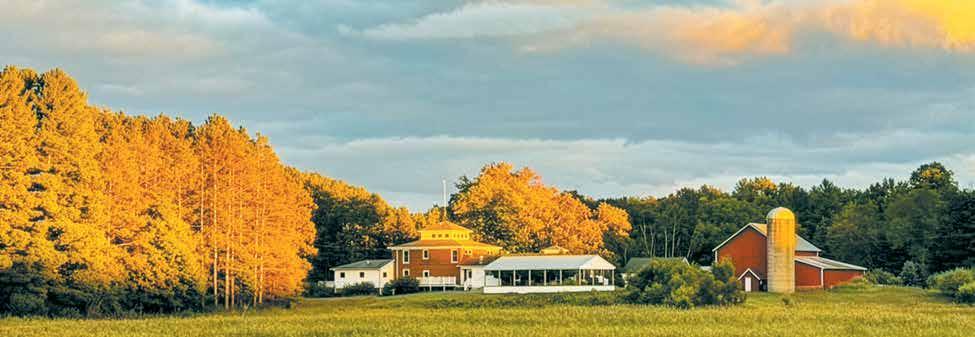
By Petula Brown
A lot can happen in twenty years, but since my last visit in 2006 there remains a rural sanctuary that’s hosted guests from Michigan and beyond with natural beauty, warm greetings, spacious accommodations, and delicious meals. Established in 2004, The Inn at Rustic Gate of 2006 was a relatively new addition to the collection of Michigan retreat locales, B&Bs, and country inns. In 2026, new innkeepers deftly navigate honoring the inn’s history while evolving to accommodate guests’ shifting expectations.
In the early 2000s, co-owners Marcia Stroko, Patricia Barrett, and Sharon Stroko were inspired by cultural anthropologist Angeles Arrien to create a place where guests could focus on self-development. In a January 2006 guest book entry, guest F. Rowe shared, “Thank you for having such a wonderful atmosphere in your home inn and surroundings,” thereby recognizing that Rustic Gate is
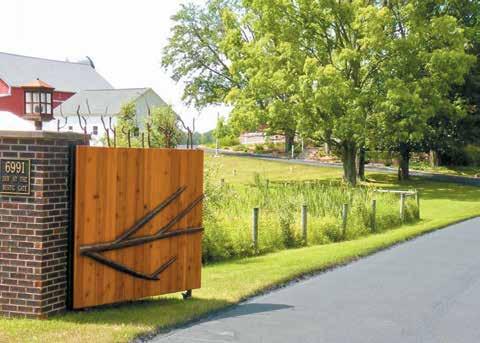
In 2026, new innkeepers deftly navigate honoring the inn’s history while evolving to accommodate guests’ shifting expectations.
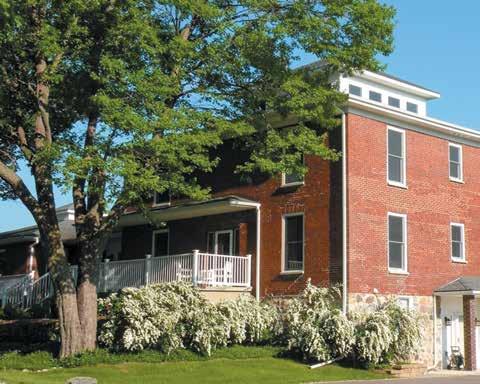
years!
not only a space for visitors, but also a family home. By the 2010s, The Inn’s spacious interior, comforting amenities, and sophisticated décor appealed to a variety of guests. It was particularly inviting to groups and visitors drawn to the tranquil landscape. A couple visiting in March 2016 noted, “A winter stay–our lovely wedding present–what a treat to be pampered by your generosity.”
During the Covid era, Rustic Gate temporarily paused operations due to distancing and health check requirements. Post-Covid, the inn reopened to accommodate past guests and groups but did not pursue an extensive marketing strategy to attract new visitors. Ownership changes in 2025 introduced a new generation of leadership inspired to reintroduce the retreat to a broader community while maintaining strong connections with guests who share a sacred bond with Rustic Gate. The new owners, Ryan Stroko and Erin Wynn (the original owners’ nephew and niece) and Erin’s husband, Aaron, have begun a new era and continue to impress guests. Jennie, a January 2026 visitor who commented in the guest book, “The food was fantastic, the room was super comfy…. We felt like we were in our own cozy snow globe as we watched the snow swirl outside…”
The 7,500-square-foot 1909 American Four Square farmhouse remains a key focal point at Rustic Gate. Each of the eight bedrooms (each with a private bath) has maintained a distinct style. One bedroom dons a Southwest theme while another has a brass bed as its centerpiece. A third bedroom’s Mission style complements the Inn’s stylish character. Common areas—a dining room that seats up to 18 guests, a meditation loft with expansive views of the property, a living room/library that includes wellness-focused books, and games—provide a variety of outlets for visitors to relax, reflect, and renew.
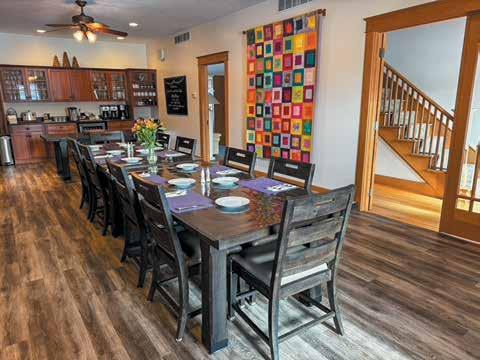
The 7,500-square-foot 1909 American Four Square farmhouse remains a key focal point at Rustic Gate. Each of the eight bedrooms (each with a private bath) has maintained a distinct style.
A meeting house, across the driveway from the main house, provides 600 square feet of flexible space to host a range of programs (yoga sessions, crafting groups, writing workshops, business meetings). The owners’ attention to detail is also reflected in the inn’s continued commitment to provide guests and visitors customized menus including brunch, dinner, and an afternoon snack. Ryan Stroko and Aaron Wynn’s professional experience in the culinary arts, combined with the resources of a commercial kitchen, enable the inn to create restaurant-quality meals that nourish the body and support guests’ wellness journeys.
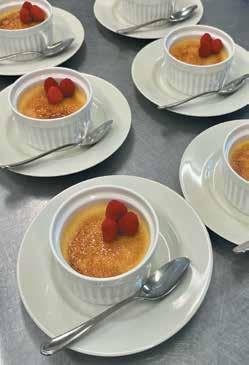
vegetable and herb garden provides fresh produce and herbs for cooking. Later in 2026, the owners will plant another garden to source fresh flowers for the guest rooms and dining room. Beyond on-site improvements, the inn has included a blog on its website to maintain an active connection with past guests and visitors and has a social media presence on Facebook and Instagram.
An emphasis on well-being extends beyond the facilities to its natural surroundings. With a footprint of over 135 acres, the rolling meadows and woodlands provide space for thoughtful walks, while both a pond and a lake offer calming waters. Guests can also use the outdoor labyrinth for meditative activities and explore the area’s 13-mile trail within the Manistee National Forest via cross-country skiing or hiking.
While Rustic Gate has maintained many of the same elements for the past 20 years, the inn has also embraced change. An expanded

The Inn at Rustic Gate has hosted a variety of events in the past 20 years, but it has an aura that transcends being described as an event space. Its niche, hosting small groups of six-14 persons, is ideally suited for activities where respite, calm, and rejuvenation are key objectives. As fulltime residents, Ryan, Aaron, and Erin are offering more than well-appointed sleeping quarters and creative dishes. They are opening their home to serve as a sanctuary for guests, continuing a tradition where Rustic Gate hospitality is an essential part of the visitor experience.
Ryan Stroko and Aaron Wynn’s professional experience in the culinary arts, combined with the resources of a commercial kitchen, enable the inn to create restaurant-quality meals that nourish the body and support guests’ wellness journeys.

Building connections is integral to the Inn’s operating model. The Rustic Gate has hosted Ferris State University culinary students to provide practical educational experiences. Sourcing ingredients from local farms allows the inn to highlight the depth and quality of area vendors. Through the years, craft groups have gifted quilts and other homespun goods to Rustic Gate that adorn the common areas… a reflection of the Inn’s impact on guests.
Although the inn is within an hour’s drive of several population centers (Grand Rapids, Mount Pleasant, Ludington, and Cadillac), it’s surrounded by a rich landscape that provides a welcome escape from the dynamics of daily life.
What’s the future of Rustic Gate? Ryan emphasized a desire for the inn’s evolution to “happen organically,” but there’s interest in hosting more small groups. Given the new owners’ culinary and operations backgrounds, there may be opportunities to broaden dining options or serve as the local event center for community gatherings. What’s not on the horizon? Positioning the inn as a bed and breakfast, Airbnb, or crash pad. Its vibe transcends such characterizations.
The Inn at Rustic Gate is located at 6991 East Hungerford Lake Drive, Big Rapids, MI 49307. You can reach them by phone at (231) 796-2328 or by email at innattherusticgate@gmail.com. Visit them online for more information at innattherusticgate.com.

7,000 copies of The Crazy Wisdom Community Journal are distributed to more than 240 locations in the Ann Arbor area, including Crazy Wisdom Bookstore, Castle Remedies at the Parkway Center, Kerrytown, Schuler Books, the Zen Temple, Sweetwaters, Pharmacy Solutions, Michigan Union, the Better Health Store, North Campus Commons, U-M, EMU, WCC, Arbor Farms, the Center for Sacred Living, the Lighthouse Center, Jewel Heart, Tsogyelgar, York, Argus Farm Stop, Michigan Theater, Seva, Booksweet, Clark Pharmacy, and the Weber Center.
We also distribute to the offices of dozens of doctors, holistic health care providers and therapists.
If you'd like us to bring copies of The CW Community Journal to your office, studio or center, please call us at 734-665-2757 or email: bill@crazywisdom.net.
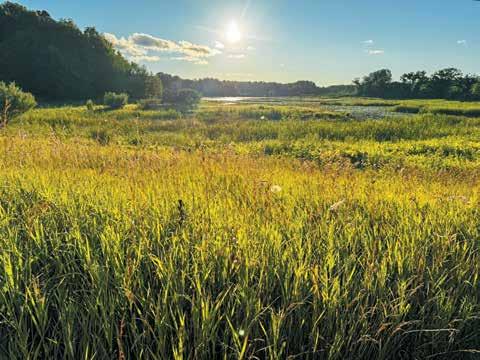
May – Taco and Tequila Festival (Grand Rapids), Buses by the Beach Benefit (Trufant)
June – Summerfest (Big Rapids), Spring Fest Arts and Crafts Fair (Pentwater)
July – Wild Zen Yoga Fest (Trufant)
August - Gold Coast Artisan Fair (Ludington)



Calendar edited by Kaili Brooks
“A Course in Miracles” Study Group with Rev. David Bell & Randall Counts • Ongoing Mondays from 6:45 to 8:00 p.m. OR Thursdays from 7:30 to 8:30 p.m. • Practical application of course principles to daily life. Additional, supporting works are also presented and discussed. Text and study materials are included. FREE, donations welcome. For more information visit interfaithspirit.org.
“Interfaith Creative Expressions” Craft Group with Marice Clark • Ongoing Fridays • 1 to 4:30 p.m. • Come and go as you wish. Bring a project to work on or to start. Some weeks may involve a participant teaching a particular skill, such as beading, tie dying, or creating steppingstones out of concrete. We assist and support one another while exploring new possibilities. All levels of skill and ability are welcomed to attend. FREE, donations welcome. For more information contact Contact Marice at (248) 760-3878 or email studiosaluki@yahoo.com.
Sip, Listen, Design: A Tea Ritual with Oracle Card Making & Sound with Mary Ledvina • Friday, May 1 • 6:30 to 8:30 p.m. • Drink tea with me and make an oracle deck that requires no art experience, just writing and stamps. Come together in a simple tea ritual and experience live music while creating. All art supplies and tea provided. Doors closed at 6:45 pm. Sliding scale $40-$60. For more information contact Mary at (734) 646-9161, email maryledvina@gmail. com, or visit maryledvina.com.
Earth Sculpting & Plaster with Deanne Bednar • Saturday, May 9 • 1 to 5:30 p.m. • Learn how to identify, source, mix, andsculpt earth plaster (clay/ sand subsoil) creating a sculpture. Try your hand at applying earth plaster. Use this natural, local medium for art or natural building projects: cob walls, earth ovens, benches, plasters on regular or straw bale walls, and more! Consider registering for the morning two hour learning tour beforehand. $35-50. For more information Contact Deanne at (248) 496 4088, email ecoartdb@gmail. com, or visit strawbalestudio.org.
Guardians of the Threshold with Eric Rentschler • Monday, June 1 through Tuesday, June 30 • Guardians of the Threshold is an exhibition of dimensional carved wall works exploring mythic imagery as psychological and spiritual architecture. Drawing from Egyptian and Norse symbolism, the collection presents figures and animal guardians not as historical artifacts, but as living archetypes. Gallery open Wednesday through Sunday. FREE. For more information contact Eric at Ecrentschler@gmail.com.
Westside Art Hop with Sophie Grillet • Saturday, June 13, from 10:00 a.m. to 5:00 p.m. & Sunday, June 14 from Noon to 5:00 p.m. • Ann Arbor’s quirkiest art fair is back for another year! Come for a stroll in the historic Old West Side and see this year’s gathering of local artists with their wares on display. The event takes place rain or shine and parking is easy to find. FREE. For more information contact Hannah at (616) 821-8825, email westsidearthop@ gmail.com, or visit westsidearthop.com.
Weave a Willow Baby Bassinet with Michael Marie Schofield • Saturday, August 1 & Sunday, August 2 • 10:00 a.m. to 5:00 p.m. • Are you or somebody in your life expecting a new baby? Weave an heirloom wicker bassinet that is sure to be passed down for generations. In this 2-day class, we’ll weave with willow using stake and strand basketry techniques. Each participant is welcome to bring up to one helper to assist with weaving, if desired. $325. For more information contact the Hickory Nut Farmstead at (734) 358-1142, email hickorynutfarmstead@gmail.com, or visit hickorynutfarmstead.com.
Candle-making & Crafts at Michigan Folk School with Deanne Bednar • Saturday, August 22 • 10:00 a.m. to 4:00 p.m. • Enjoy the process of dipping bees wax tapered candles and crafting with nature. This is a nurturing candle class and also includes sculpting earthen candle stick holders and decorating match boxes. $115; includes all materials. For more information visit mifolkschool.com or strawbalestudio.org.
Weave a Frame Basket Using Wild Materials with Michael Marie Schofield • Saturday, August 29 • 10:00 a.m. to 5:00 p.m. • Learn to weave with wild materials! At the end of the class, you’ll take home your very own foraging basket made with wild materials. We’ll discuss how to forage, harvest, and process a wide variety of plants for basketry. You’ll then proceed to weave a traditional egg basket with willow and vines. $80. For more information contact the Hickory Nut Farmstead at (734) 358-1142, email hickorynutfarmstead@ gmail.com, or visit hickorynutfarmstead.com.
Basic Telepathic Animal Communication with Judy Liu Ramsey • Saturday, July 25 & Sunday, July 26 • 9:00 a.m. to 5:00 p.m. • Learn to communicate telepathically with animals, the way they communicate to each other. Open your natural intuitive senses in a fun, supportive training. Class is taught via Zoom. $180 per person/$90 for repeat students. For more information contact Judy at info@judyramsey.net.
Restorative Yoga with Reflexology Workshop: Overwhelm & Burnout with Crysterra Wellness • Friday, May 8 • 7 to 8:30 p.m. • Reflexology is an ancient healing modality that deals with the principle that nerve endings in the feet and hands correspond to all glands, organs, regions, and systems of the body. Enjoy this gentle, calming yoga practice paired with the healing and regenerative benefits of reflexology. Suitable for all fitness and experience levels. $30/$35. For more information contact Andrea at (734) 649-1849, email andrea@ crysterrawellness.com, or visit crysterrawellness.com.
Mindful Yoga w/Meditation Workshop Theme: Chakra Balance with Crysterra Wellness • Friday, June 12 • 7 to 8:30 p.m. • Experience a calm nervous system, improved ability to cope with stress, better focus and overall sense of ease and well-being with this mindful yoga practice paired with meditation. In this gentle workshop, we will combine movement, breath work, mindfulness and meditation to cultivate the many benefits associated with a mindful meditation practice. $30/$35. For more information contact Andrea at (734) 649-1849, email andrea@crysterrawellness.com, or visit crysterrawellness.com.
Relevant Science for the Art of Somatics with Eileen Dickinson • Friday, July 24, Saturday, July 25, & Sunday, July 26 • 9 a.m. to 6:00 p.m. • In this threeday class we explore the science of presence, touch, and movement through didactic information, movement, and hands on activities both on and off the bodywork table. Applicable to a wide range of somatic practices, you will leave with more ease and effectiveness, and an understanding of how your work is grounded in science. $600. For more information contact Eileen at (734) 7174145.
• Herbal Medicine Open House with Mary Light • Saturday, May 6, June 2, & August 1 • Noon to 1:00 p.m. • See Herbal Medicine
• Didgeridoo Sound Journey: Manifesting Your Heart’s Desire with Harper & Midwest Kind • Friday, May 8 • 6:30 to 8:00 p.m.• See Music, Sound, and Voice
• Spirit Through the Years with LaTonya Zibi • Tuesday, May 12, June 16, July 14, & August 11 • 5 to 6:30 p.m. • See Spiritual Development
• Crazy Wisdom Bookstore’s Masters and Teachers Discussion Group with Jenna Hoyer • Friday, May 15, June 19, & July 17 • 7 to 8:30 p.m. See Book Discussion Groups
• Earth Church: Reimagining our World Midsummer Celebration with Rocky Rains & Lucinda • Reinas • Saturday, June 7 • 3:30 to 4:30 p.m. • See Pagan Spirituality
• Colors of the Soul: A Rainbow Palette of Restoration, Creative Arts, Movement, and Meditation with Megan Sims & Emily Adama • See Retreats
• Dye Your Own Botanical Burial Shroud with Michael Marie Schofield • Saturday, June 27 • 10 a.m to 5:00 p.m. • See Death and Dying
• Meditative Gardener Retreat with Will and Wendy Page-Echols • Friday, August 14 through Sunday, August 16 • See Retreats
If you are interested in obtaining some biographical information about the teachers, lecturers, and workshop leaders whose classes, talks, and events are listed in this calendar, please look in the section that follows the calendar, which is called “Teachers, Lecturers, Workshop Leaders, and The Centers” and which starts on page 113.
Each session includes a brief meditation, prayer, shared reading, and uplifting discussion. All are welcome at any point. The format encourages positive, focused sharing and a supportive space for spiritual growth. FREE. For more information contact Song of the Morning at (989) 983-4107, email office@ songofthemorning.org, or visit songofthemorning.org
Crazy Wisdom Bookstore’s Masters and Teachers Discussion Group with Jenna Hoyer • Friday, May 15, June 19, & July 17 • 7 to 8:30 p.m. • Looking for inspiration? We will read aloud selected writings from spiritual masters for an evening of spoken word and spiritual reflection and celebrate the literary legacies of those who have illuminated our path. Each evening is designed to foster a sense of community, reflection, and creative expression in a serene atmosphere. FREE. For more information contact events@ crazywisdombookstore.com.
Guided Group Breathwork with Jackie Miller • Sunday, May 10 & 24, June 14 & 28, July 12 & 26, August 9 & 23 • 6 to 7:30 p.m. • A group session of gentle, energizing breathing with music, guided by Jackie Miller, certified breathwork facilitator. Experience the power of breath energy and non-ordinary states. Second Sundays in Ann Arbor, 4th Sundays in Ypsilanti. FREE, donations welcome. For more information visit thisbreath.com.
Energy Codes Breathwork Class with Phoenix Duffy • Thursday, May 14 • 5:15 to 6:30 p.m. • Come, learn how to breathe through four main anchor points in your body for grounding and direct your breath consciousness to clear the stuck stories, negative emotions, and even pain in your body. $10. For more information contact Phoenix at (734) 765-5830.
Jewel Heart Sunday Talks: Ancient Wisdom, Modern Times, with Demo Rinpoche • Ongoing Sundays • 11:00 a.m. to 1:15 p.m. • Join Demo Rinpoche for weekly Sunday morning public talks on a variety of topics that are suitable for newcomers and long-timers alike, followed by a facilitated group discussion based on the morning talk. FREE; donations welcome. For more information contact Jewel Heart at (734) 994-3387, programs@jewelheart.org, or visit jewelheart.org.
Sunday Services with Temple Priests & Dharma Teachers • Ongoing Sundays • 10:00 a.m. to Noon • Morning meditation service consists of two periods of meditation followed by chanting and a Dharma talk. FREE; donations welcome. For more information contact the Zen Temple at (734) 761-6520 or email annarborzentemple@gmail.com.
Dharma in the City: Vesak Day Talk with Demo Rinpoche • Friday, May 1 • 7 to 8:30 p.m. • In Tibetan Buddhism, Vesak Day honors the birth, enlightenment, and death of Shakyamuni Buddha. On this special day, Demo Rinpoche gives a public talk covering the action known as “turning the wheel of dharma,” which was the Buddha’s first teaching known as the Four Noble Truths. FREE; registration required. For more information contact Jewel Heart at (734) 9943387, programs@jewelheart.org, or visit jewelheart.org.




Spring Seminar: H.H. Dalai Lama’s Kindness, Clarity, and Insight with Demo Rinpoche • Saturday, May 2 from 8:30 a.m. to 6:30 p.m. & Sunday, May 3 from 8:30 a.m. to 5:00 p.m. • His Holiness the Dalai Lama lays out the fundamental principles of Tibetan Buddhism in his classic book, “Kindness, Clarity, and Insight.” During this seminar, Demo Rinpoche will give a commentary on this beloved book, focusing on the chapters that cover the Four Noble Truths and the Luminous Mind. Streamed live from New York. $180 Jewel Heart and/ or Tibet House member / $220 Jewel Heart non-member. Pay what you can - No one is turned away. For more information contact Jewel Heart at (734) 9943387, programs@jewelheart.org, or visit jewelheart.org.
Buddha’s Birthday with Temple Priests and Dharma Teachers • Sunday, May 24 • 10:00 a.m. to 12:30 p.m. AND 7 to 8:30 p.m. • Buddha’s Birthday Celebratory Service. Special chanting, bathing of the baby buddha statue, children’s service, parade, potluck, and birthday cake. Bring a dish to pass. Lighting of beautiful flower lanterns (evening session) ends the Buddha’s Birthday observance in a serene way. The service includes readings from scriptures and the dedication of lotus lanterns. FREE, donations accepted. For more information contact the Zen Buddhist Temple at (734) 761-6520 or email annarborzentemple@gmail.com.
A

— St. Francis of Assisi
Planted In Sound: Half-Day Retreat with Julie Barron, Julie Kouyate, & Mady Kouyate • Saturday June 13 • 3 to 7:00 p.m. • This is an immersive sound experience with the aided connection of gentle plant/fungi allies like Kanna, Kava, and others. Set in a beautiful temple setting, participants will enjoy guided imagery with music and stories, elemental sound immersion, movement, and at the end gather around a fire with snacks. $250; sliding scale and scholarships are available. For more information contact Julie at the2jewels@gmail.com or email bluesagehealth.com.
Liberation of Life Ceremony with Temple Priests and Dharma Teachers • Sunday, June 14 • 10:00 a.m. to 12:30 p.m. • In the spirit of not to harm but to cherish all life, Liberation of Life Ceremony with activities in our large garden followed by a potluck picnic. Bring a dish to pass. The Temple will provide vegetarian hot dogs. FREE, donations accepted. For more information contact the Zen Buddhist Temple at (734) 761-6520 or email annarborzentemple@ gmail.com.
Are you interested in having your art published? We are always on the lookout for great art to liven up the pages of TheCrazyWisdomCommunityJournalCalendar. If you can deliver camera ready art in a jpg file, please email a letter of interest and a couple of art samples (low-res) to jennifer@crazywisdom.net. Reasonable compensation. We will not respond to links to your website or portfolio. Please pick the best examples of your art!

Judy Ramsey offers shamanic healing and mentoring for practitioners and also teaches and provides animal communication services. Since November, she’s been Penelope Smith’s teaching assistant for her animal communication certification program that is taught through the Shift Network. Over the summer Ramsey will be developing her own Shift Network training called Shamanic Healing for Animals—classes will begin in October.
The week of June 22, Ramsey will be a presenter at the Great Lakes Retreat (thegreatlakesretreat.org) teaching basic animal communication for the week.
Ramsey currently teaches shamanic practice with Sandra Ingerman’s foundation courses, as well as her own courses that focus on animals. She’s very excited about the number of people wanting to become interspecies counselors, taking both shamanic and telepathic courses at all levels.
Ramsey’s cultural heritage is half Chinese, half Scottish. In May, she had the opportunity to travel to China. She hasn’t spoken the language since she was five years old, so she loved reconnecting with her heritage and ancestors. Although she speaks four languages, she had fun learning a new language, especially with such unique perspectives and one so close to her heart.
Ramsey is already planning a 2027 group trip to Peru! It’s going to be 15 days of amazing scenery and experiences, beginning in Arequipa and Colca Canyon to see the condors. She saw the areas on an exploratory trip last November and they just took her breath away. The group will also visit Lake Titicaca and its islands, including the Bolivian side, and end with the Sacred Valley, Cusco, and Machu Picchu. More information is to come, so stay tuned!
To learn more about Ramsey’s classes and workshops see the calendar listings under the headings Animals and Pets, and Shamanism or visit Judy Ramsey online at JudyRamsey.net.
Summer Solstice Ritual Celebration with Esther Kennedy • Sunday, June 21 • 3:30 to 4:00 p.m. • In summer we are acutely aware of belonging to a world that is vibrantly alive – wondrous in its diversity, beauty, and intensity. Come in Gratitude; bring a friend and maybe a treat to share. FREE. For more information contact the Weber Center at (517) 266-4000 or visit webercenter.org.
The Healing Feast: Dancing with the Divine Masculine with Sari Brown, Kiyoshi, & Forrest Hejkal • Sunday, June 21 • 5 to 8:00 p.m. • The Healing Feast offers food and community for healing connections with self, others, the earth, and the sacred. We share nurturing, globally-inspired food and practices to embody joy, healing, creativity, and abundance. This month focuses on the divine masculine. $0-$66 sliding scale. For more information contact Sari at (734) 660-2799, email thehealingfeastofconnection@gmail.com, or visit saribrownmusic.com.
The Healing Feast at the Gardens on Maplewood with Sari Brown • Friday, August 14 • 5:30 to 8:30 p.m. • The Healing Feast offers food and community for healing connections with self, others, the earth, and the sacred. We share nurturing, globally-inspired food and practices to embody joy, healing, creativity, and abundance. This month’s outdoor feast will be held at the Gardens on Maplewood in Ypsilanti. $0-$66 sliding scale. For more information contact Sari at (734) 660-2799, email thehealingfeastofconnection@gmail.com, or visit saribrownmusic.com.

Family Services with Dharma Teachers and Temple Priests • Sunday, May 24 & June 14 • 9:45 a.m. to 12:30 p.m. • Our monthly Family Services will be held on celebration days during the summer. Buddha’s Birthday on May 24th and Liberation of Life Ceremony on June 14th. July and August we will pause our Family Services so to focus on Peace Camp. FREE, donations appreciated. For more information contact the Zen Buddhist Temple at (734) 761-6520 or email annarborzentemple@gmail.com.
Woo Woo Crystal Crawl with Mary Abraham • Saturday, May 2 • 11:00 a.m. to 2:00 p.m. • Crazy Wisdom Bookstore will be one of the stops for the Ann Arbor-Ypsilanti Woo Woo Crystal Crawl. Participants will receive a free bag of goodies. $79. Visit thewoowoo.com for more information.
Sufi Gathering with Imam Kamau Ayubbi • Tuesday, May 26, June 30, July 28, & August 25 • 7 to 8:00 p.m. • An evening of discussion and Sufi chanting held on Zoom. $5-$10 suggested donation. For more information visit interfaithspirit.org.

End-of-life Doula Training with Merilynne Rush • Tuesday, April 28, May 5, 12, 19, & 26, June 2 • 4 to 7:30 p.m. • Learn from an experienced doula and hospice nurse and a diverse team of facilitators. 100-page study guide includes resources on how to set up a business. No prior experience necessary. We emphasize practical aspects of caregiving, addressing the whole person and their “family,” and culturally and LGBTQ-sensitive care. $725; scholarships and payment schedule available. For more information contact Merilynne at (734) 395-9660, email thedyingyear@gmail.com, or visit thedyingyear.org.




By Cyrus Scholl
A few years ago, early on my path toward healing, I had a therapist who told me that the body often acts out our subconscious drives and desires, and that if we watch what our body does, we can unlock fresh understandings of what we believe, what we want, and what’s holding us back—the unhelpful patterns, the edges we’re avoiding, the cages we’ve unwittingly locked ourselves in.
This belief that our body’s sensations are a portal to understanding our subconscious—the Dreambody, she named it—unlocked a whole new perspective for me.
This concept came from Process Oriented Psychology, or Processwork; a school of thought founded in the 1970s by Arnold Mindell, a physicistturned-Jungian analyst. A true syncretist, he pulled from disparate fields including Jungian psychology and quantum physics, but also Daoism and Earth-based psychology, Buddhism, and Shamanism. What Arny assembled resonated with gestalt therapy, Buddhist psychology, shamanic practices, IFSstyle parts work, and Jung, but was distinct from all of them.
Arny would be the first to tell you that his concept of the Dreambody came largely from indigenous cultures, many of whom consider the reality we inhabit a Dream is dreamed up by some Dreamer. We are all integral pieces of that dream, each with our own unique perspectives and experiences. And so, the Dreambody is his language for describing how our bodies live out our individual fractal of this larger dream. Or, put more simply, how our bodies are playing out our own unconscious realities.

I had a therapist who told me that the body often acts out our subconscious drives and desires, and that if we watch what our body does, we can unlock fresh understandings of what we believe, what we want, and what’s holding us back…
“Okay, great,” you might say. “So, what good is such an idea?
And I’d reply, the implications are immense and wide-ranging.
One of the primary applications for the Dreambody in Processwork is what is called “body symptoms”— that is, the ways pain and illness (and pleasure) manifest in our bodies as well as how we experience them.
For instance, maybe you’re experiencing a symptom right now—it could be a sore throat, an ache in the back, a stuffy nose, or something more serious or chronic. To tap into the Dream that’s happening in the body through your experience of this symptom, you could ask, “What attitude does the area of the body holding that part have toward life and the world? What illnesses, symptoms, accidents, or traumas has that part of the body been involved in? Does it have a particular history? If there is something recurring there, do you notice a certain pattern?” We might also ask if you’ve had any nighttime dreams that relate to that? (These specific questions come from Ingrid Rose, PhD & Myriam Rahman, MA.)
Through gathering answers to questions like these, we can begin to unfurl our unconscious desires (which may also be related to the unconscious desires of our family, community, city, or country).
When we understand our symptoms, they unlock a deeper understanding of ourselves. We discover what the Dream is trying to tell us through our exploration and understanding of our symptoms. And when we then act on that information, we often find that our actions bring us into deeper alignment with our whole selves; we feel a stronger sense of integrity, inner peace, and harmony within ourselves and with the world we inhabit.
One of the goals of Dreambody work is to discover our pain, amplify it, and transform it through awareness. We amplify our pain using sensory grounded information: the specifics of how we experience something. To find this information we ask: “How do you know you have the experience? How does it show itself?” To paraphrase another one of my teachers, Susan Kocen, sensory-grounded information is not a diagnosis or reaction to the experience of a symptom; it is the way we experience that symptom. And exploring our experience of a symptom is different from trying to relieve it (like with massage or acupuncture.) Instead, we ask, “What is the pain like? Is it stabbing, cutting, diffuse? What is the temperature, hot or cold?” For example, the quality of an itch might be missed when we impulsively scratch to relieve it.
We’ve mostly discussed the application of the Dreambody concept with body symptoms so far, but we can apply this concept to many realms, such as relationship patterns: addictions, peak experiences both high and low (like psychedelic journeys or psychotic breaks), life myths, or even nighttime dreams. In each of these areas, we can ask questions about our somatic experiences and uncover our body’s wisdom.
The invitation is to then act on what our body is asking us to do, and watch what happens in our lives in response.

Cyrus Scholl is a traditional Chinese martial arts practitioner of taijiquan, baguazhang, and qigong; Certified Trauma Care Practitioner; and Somatic Coach; with training in Processwork, IFS (Internal Family Systems), and polyvagal theory. If you’re interested in learning more, find him online at dreamingbutterfly.com.
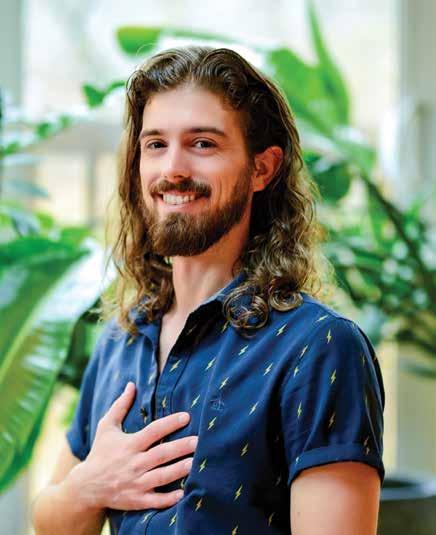
Death Café with Rev. Annie Kopko • Tuesday, May 5, June 2, & July 7 • 6:30 to 8:00 p.m. • A group-directed discussion of death, with no agenda, objectives, or themes. It is a discussion group rather than a grief-support or a counseling session. FREE. For more information visit interfaithspirit.org.
Ann Arbor Virtual Death Café with Rachel Briggs • Saturday, May 2, June 6, July 4, & August 1 • 11:00 a.m. to 12:30 p.m. • Conversation on Zoom about all things related to death and dying. Participants join in small and large group discussion with deep listening and sharing from the heart. No agenda, no presentation. Open to all adults. Please note: This is not a grief support group. For more information contact Merilynne at (734) 395-9660, email thedyingyear@gmail.com, or visit thedyingyear.org.

Some of the best memories are made in flip flops.
—Kellie Elmore
Ann Arbor Death Café with Merilynne Rush at Crazy Wisdom • Saturday, May 16, June 20, July 18, & August 15 • 11:00 a.m. to 1:00 p.m. • Conversation about all things related to death and dying. Small & large group discussion, deep listening and sharing from the heart. No agenda, no presentation. Coffee, tea, snack available. Open to all adults. Accessible, confidential. Please note: This is not a grief support group. FREE. For more information contact Merilynne at (734) 395-9660, email thedyingyear@gmail.com, or visit thedyingyear.org.
Dye Your Own Botanical Burial Shroud with Michael Marie Schofield • Saturday, June 27 • 10:00 a.m to 5:00 p.m. • A shroud is a natural fabric covering used in natural burial or cremation. Shrouds represent one of the oldest, simplest, and most accessible forms of caring for our dead. In this workshop, we will dye a shroud using locally gathered plants. Each participant is welcomed to bring up to two helpers to assist, if desired. We’ll also practice different ways to wrap a shroud (on dolls and a life-sized model) and will discuss the practical aspects of how shrouds can be used in home funerals, burial (conventional or green), and cremation. Held at the Hickory Nut Farmstead, 5310 Hickory Nut Lane, Dexter, MI 48130. For more information contact the Farmstead at (734) 358-1142, email hickorynutfarmstead@gmail.com, or visit hickorynutfarmstead.com.
15th Annual Drum and Dance Jam with Curtis Glatter • Saturday, April 4, May 2, June 6, & August1 • 7:30 to 9:00 p.m. • All are invited to the 2026 season. Drumming improves musicality, hand/eye coordination, and cognition; relieves stress, and enhances spiritual joy in all ages! No experience is necessary. Bring a drum, or use one provided by the event. Suggested $5.00 donation. For more information, visit interfaithspirit.org.
Qigong: Wild Goose Form with Master Wasentha Young • Ongoing Tuesdays from 6 to 7:00 p.m. AND/OR Thursdays from 10 to 11:00 a.m. • The Wild Goose Form is a series of ongoing movements with a multidimensional perspective of Chi. It brings together imagery, yogic like stretches, and the acu-point system. Students learn to cultivate and receive the energy of the universe, nature, and earth. You can attend one or both sessions per week
(down a flight of stairs, no elevator). $225 class package available. For more information contact the Peaceful Dragon School at (734) 741-0695, email info@peacefuldragonschool.com, or visit peacefuldragonschool.com.
Women’s Health Energy Healing Two-Day Seminar with Ann Arbor Yoga and Meditation • Saturday, May 16 from 2 to 4:00 p.m. & Sunday, May 17 from 1 to 5:00 p.m. • This energy healing two-day event is for women of all ages interested in exploring prana vidya and prana nidra—two traditional yoga modalities for healing self and others. No previous experience is needed. For best results please attend both days. $199/$179 early registration. For more information contact Ema at EmaStefanova@cs.com. or visit yogaandmeditation.com.
Free Film & Discussion with Jewel Heart instructors • Friday, May 8, June 12, July 10, & August 14 • 7 to 9:15 p.m. •
• May: On Life and Enlightenment: Principles of Buddhism, 2006. Explores Tibetan Buddhism in all its various manifestations.
• June: Vajra Sky Over Tibet, 2005. A cinematic pilgrimage to revered venues and festivals that survive in Tibet.
• July: Wonder, 2017. Based on the New York Times bestselling book, this movie tells the incredibly inspiring and heartwarming story of August Pullman, a boy with facial differences.
• August: White Bird, 2023. In this sequel to the film Wonder, Julian Albans, expelled from school for mistreating a disabled boy, is visited by his grandmother.
FREE; concessions available. For more information contact Jewel Heart at (734) 994-3387, programs@jewelheart.org, or visit jewelheart.org.
Herbal Medicine Open House with Mary Light • Saturday, May 6, June 2, & August 1 • Noon to 1:00 p.m. • Join us for a tour of our herbal medicine center, school, and apothecary. Held at the Dexter Natural Health Center, 3255 Central St. Dexter MI, 48130 FREE. For more information contact Mary at (734) 769-7794 or visit naturopathicschoolofannarbor.net.
Thrive Wellness Center Open House with Dr. Shannon Roznay & Practitioner Emily Golab • Thursday, May 7 • 5 to 7:00 p.m. • Join us for an evening of connection and wellness. Enjoy appetizers, refreshments, giveaways, and eventonly promotions. Meet our team, explore natural health solutions, and connect with local vendors. FREE. For more information contact Thrive Wellness Center at (734) 470-6766.
July One Week Session with Steiner Health • Monday, July 13 through Friday, July 17 • 9:00 a.m. to 5:00 p.m. • The Steiner Health July One Week Session is a day program based on our Two-Week Life Force Intensive Health Retreat. Patients will receive medical care and a variety of anthroposophical therapies, including: art, movement, massage, color light ,and nursing therapies. One organic vegetarian meal is served midday. $1,800. For more information contact Steiner Health at (734)222-1491, email orders@steinerhealth.org, or visit steinerhealth.org.
Focused Mind Meditation: Teleconference with John Friedlander • Sunday, May 3, June 7, July 5, & August 2 • 9:00 a.m. to Noon • Development of sustained focused meditation makes it easy to develop a whole new magnitude of psychic ability, as well as a whole new level of clarity and spiritual openness. See website for payment information. $15. For more information contact Violeta at (734) 476-1513 or visit psychicpsychology.org.
Psychic Psychology Women’s Group: Teleconference with Gloria Hemsher & John Friedlander • Tuesday, May 5, June 2, July 7, & August 4 • 7 p.m. to 8:00 p.m. • For women only. Meditations concentrating on women’s issues relative to biological energies as well as that of the aura. Some prerequisites. Please contact teachers. $10. For more information contact Violeta at (734) 476-1513 or visit psychicpsychology.org.
How To Use A Pendulum To Change Your Life with Phoenix Duffy • Sunday, May 17 • 2 to 4:00 p.m. • An interactive workshop where we will explore how to align, calibrate, and utilize the Pendulum as a tool to connect with our guides to receive guidance, clarity, and healing for our body, soul and life. Please bring a Pendulum or purchase one at the store before class. $25 before May 17, $30 cash at door. For more information contact Phoenix at Phoenix@threebutterflies. org or visit ThreeButterflies.org.
Summer Intensive 2026: Webinar/Teleconference with John Friedlander • Thursday, July 16 & Friday, July 17 from 7 to 9:00 p.m., Saturday, July 18 & Sunday, July 19 from 10:00 a.m. to Noon & 2 to 4:00 p.m. • New material introduced with continued development of advanced and core techniques seeking a natural sense of skill in everyday life. Prerequisite: Level 1 Psychic Development class, CD or permission of instructor. $275. For more information contact Gilbert at gchoud@yahoo.com or visit psychicpsychology.org.
9th Annual Comprehensive Women’s Group Review 2026 Teleconference with Gloria Hemsher • Thursday, August 20 & Friday, August 21 from 7 to 9:00 p.m., Saturday, August 22 & Sunday, August 23 from 10:00 a.m. to Noon & 2 to 4:00 p.m. • For Women Only: Review of monthly Women’s Group meditations presented during the last year since August 2025. $275. For more information visit visit psychicpsychology.org.
Irene’s Free Open House with Irene’s Myomassology Institute • Friday, August 14 • 3 to 7:00 p.m. • Get a feel for Irene’s campus at our Massage School Open House! Enjoy free classes, complimentary massage, raffles, prizes, and more. Come explore our campus, meet staff, learn about Irene’s program, and find out just what makes us the best choice for massage education. Bring a friend and save your spot now! FREE. For more information contact the Institute at (248) 350-1400, email contact@irenes.edu, or visit irenes.edu.



Healing & Compassion Meditations with Hartmut Sagolla • Ongoing Mondays • Noon to 1:00 p.m. • Hartmut Sagolla leads a 30 to40 minute guided meditation on a Buddhist theme followed by discussion. Meditations are centered around healing oneself and others and developing compassion. They include concentrated meditation, visualization, and contemplative meditations. Online only. FREE; donations welcome. For more information contact Jewel Heart at (734) 994-3387, programs@jewelheart.org, or visit jewelheart.org.
Evening Group Meditations with Song of the Morning Community • Ongoing Tuesdays, Wednesdays, Thursdays, Fridays, & Saturdays • 8 to 9:00 p.m. • Evening Meditations include guided prayer, chanting, and silent meditation, with simple instruction to help newcomers feel supported. Practices are offered in the spirit of Paramahansa Yogananda’s teachings. FREE. For more information contact Song of the Morning at (989) 983-4107, email office@ songofthemorning.org, or visit songofthemorning.org
Mantra Kirtan with Ananda and Deva • Ongoing Thursdays • 6:30 to 8:00 p.m. • Traditional Hare Krishna chanting circle for healing and connection with vegetarian meal served after at 8 p.m. All welcome. FREE. For more information contact the Harmony Collective at deva@theharmonycollective.org.
Meditation on Serenity & Compassion with Khenpo Tshering Chophel • Ongoing Saturdays • 10:30 to 11:30 a.m. • Meditation on compassion starts with serenity then opens our hearts to genuine caring for all beings. Recognizing that everyone shares the wish to be happy and free from suffering, we practice broadening our focus beyond our own wellbeing. Ongoing; participants can attend whenever they wish; no prior meditation experience necessary. FREE, donations accepted. For more information contact Lama Nancy at (734) 649-2127, email lamanancy@karunabuddhistcenter.org, or visit karunabuddhistcenter.org.
Three-Hour Meditations with Song of the Morning Community • Ongoing First Saturdays • 1 to 4:00 p.m. • Our three-hour meditations are an ongoing tradition led by members of our Clear Light Community. Each hour begins with chanting, prayer, and an inspirational reading, followed by silent meditation. You are welcome to come and go on the hour or stay for as many hours as you wish. FREE; donations welcome. For more information contact Jewel Heart at (734) 994-3387, programs@jewelheart.org, or visit jewelheart.org.
White Tara Guided Healing Meditation with Jewel Heart Instructors • Ongoing Sundays • 9:30 to 10:35 a.m. • Tara is the mother goddess of Tibetan Buddhism, known for her quick and compassionate activity. White Tara is particularly associated with healing and long life. These guided meditations use visualization techniques to overcome physical, mental and emotional suffering. FREE; donations welcome. For more information contact Jewel Heart at (734) 994-3387, programs@jewelheart.org, or visit jewelheart.org.
Mindfulness and Compassion for Connecting in a Fractured World Workshop with The Ann Arbor Center for Mindfulness • Saturday, May 9 • 10:00 a.m. to 4:00 p.m. • Join this day of learning, reflection, and practice presented by Dr. Sydney Spears, Ph.D., LCSW and Dr. Tracy Ochester, Psy.D., nationally recognized leaders in mindfulness and compassion. This workshop will be a collaborative space to discover and experience contemplative practices during challenging times. Tiered Pricing - $175 to $225; CE’s available. For more information contact AACFM at info@aacfm.org or visit aacfm.org.
Overnight Introductory Meditation Course with Dharma Teachers • Saturday & Sunday, May 22 & 23, June 12 & 13, July 17 & 18, & August 14 & 15
• This course covers the same content as our 5-Thursday evening class in a condensed format. It is ideal for out-of-towners, local people who cannot attend the Thursday evening course, or those who would like to attend a one-night Zen meditation instructional retreat. Cost includes overnight accommodation and a vegetarian breakfast. $200. $160 for students and unwaged. For more information contact the Zen Buddhist Temple, at (734) 761-6520 or email annarborzentemple@gmail.com.
Introductory Zen Meditation Course with Dharma Teachers • Thursday, May 28, June 4, 11, 18, & 25 • 6:30 to 8:00 p.m. • The viewpoint of Zen is that life lived fully in each moment is the end and purpose in itself, and not the means for something else. Held in the Temple’s meditation hall, the course includes simple stretching exercises, work with the breath, meditation postures, concentration, and mindfulness practice. $200. $160 for students and unwaged. For more information contact the Zen Buddhist Temple, at (734) 761-6520 or email annarborzentemple@gmail.com.
Days of Mindfulness Meditation with Esther Kennedy • Saturday, June 6, July 18 & August 22 • 10:00 a.m. to 2:30 p.m. • Join our mindfulness community as we deepen our understanding of and commitment to daily meditation practice. Reflecting upon our relationships with honesty and courage, we amplify

InUnfiltered and Unapologetic, Judy McCutcheon writes with the urgency of someone who has spent years watching women shrink themselves to fit expectations that were never designed for them in the first place. The book positions itself as both a guide and a challenge: an invitation for women to examine the habits, beliefs, and social pressures that encourage quiet compliance instead of confident leadership.
By Christine MacIntyre
One of the strengths of Unfiltered and Unapologetic lies in its emphasis on self-examination. McCutcheon does not frame boldness as loudness or confrontation. Instead, she describes it as alignment between values and action. The book repeatedly returns to the idea that authenticity requires courage— the courage to disappoint expectations, to challenge norms, and to prioritize personal integrity over external approval. In this way, boldness becomes less about dominance and more about clarity.”
McCutcheon’s central argument is simple but forceful. Too often, women are taught that being agreeable is safer than being honest, that politeness should outweigh conviction, and that ambition must be softened in order to be acceptable. Unfiltered and Unapologetic pushes back against those assumptions. Through personal reflections, cultural observations, and practical prompts, McCutcheon encourages readers to reclaim their voice and live with a greater sense of self-definition. She states, “...for too long, you have been giving everyone else 99 percent, and it has left your cup empty. It is time for you to refill your reservoirs and nurture your water supply….”
McCutcheon’s central argument is simple but forceful. Too often, women are taught that being agreeable is safer than being honest, that politeness should outweigh conviction, and that ambition must be softened in order to be acceptable.
The book is structured in a series of thematic chapters that explore different dimensions of boldness—personal authenticity, leadership, relationships, and self-worth. Each chapter blends storytelling with reflection, creating a rhythm that alternates between narrative moments and broader lessons.
McCutcheon frequently draws on her own experiences, recounting professional and personal turning points in which speaking honestly or refusing to compromise her values reshaped the path forward. From job interviews and applying for a summer program at a prestigious university, to divorcing her husband and almost dying after a surgery scare, these anecdotes serve as the emotional anchor of the book grounding its broader advice in lived experience.
Stylistically, McCutcheon writes in a direct, conversational tone. The prose is accessible and motivational, favoring clarity over complexity. Sentences tend to be short and declarative, reflecting the book’s broader message of decisiveness and self-trust. “I am strong and powerful. The present moment is all I have. I am forever badass, unfiltered, and unapologetic.” The voice is confident but approachable, as though the author is speaking directly to readers in a candid conversation rather than delivering a distant lecture. That conversational quality makes the book particularly readable, especially for audiences encountering leadership or empowerment literature for the first time.
What ultimately distinguishes Unfiltered and Unapologetic is its insistence that personal authenticity is not a luxury but a necessity. McCutcheon argues that leadership, relationships, and personal fulfillment all begin with a willingness to speak honestly about who we are and what we value.
The tone of the book remains encouraging throughout. McCutcheon writes with a sense of optimism about the possibilities that open when women stop editing themselves to meet others’ comfort levels. At the same time, she acknowledges that social pressures—particularly around leadership, ambition, and emotional expression—are deeply ingrained. Rather than pretending those barriers do not exist, the book frames boldness as an ongoing practice, something cultivated through small but meaningful choices over time. “You need to give yourself permission to be free in life—free from other people’s opinions, views, and expectations,” she wrote.
From a structural standpoint, the guide format allows readers to move through the book either sequentially or selectively. Individual chapters function almost like standalone reflections, each exploring a specific dimension of self-advocacy or leadership. This modular structure makes the book approachable for readers who may prefer to absorb its lessons gradually revisiting certain sections as circumstances in their own lives evolve.
What ultimately distinguishes Unfiltered and Unapologetic is its insistence that personal authenticity is not a luxury but a necessity. McCutcheon argues that leadership, relationships, and personal fulfillment all begin with a willingness to speak honestly about who we are and what we value. In a cultural moment that often rewards careful self-presentation and curated identities, the book’s central message—to live with fewer filters and fewer apologies—feels both refreshing and quietly radical.
By the end of the book, McCutcheon leaves readers not with a rigid formula for bold living, but with a set of guiding questions: Where have we learned to silence ourselves? What expectations are we still trying to satisfy? What might change if we stopped asking for permission to lead our own lives?
Unfiltered and Unapologetic does not claim that boldness is easy. Instead, it suggests that it is necessaryand that living honestly may be the most powerful act of leadership a person can practice.
our capacity to be love within family, neighborhood, city, and world. $35; includes lunch. For more information contact the Weber Center at (517) 2664000 or visit webercenter.org.
Daylong Meditation Retreat with Carol Blotter • Saturday, June 6 • 9:00 a.m. to 4:00 p.m. • Meditation practice of sitting and walking plus a short talk. Find peace and calm in the quiet wooded space of Michigan Friends Center in Chelsea. Appropriate for all levels of meditators. Suggested Donation $30-$60 or what you can afford. For more information contact the MFC at manager@ mfcenter.org.
Sacred Sound Journey: Vibrational Cacao Elixir with Kelly Borchert • Sunday, May 3, June 7, July 5, & August 2 • 3 to 4:30 p.m. • Experience the soothing resonance of crystal singing bowls, the deep and mysterious tones of gongs, and a unique collection of sacred sound instruments. Together, they create a powerful field of vibration that supports deep relaxation, inner peace, and vortex of self-healing. $45. For more information visit veraposeyoga.com.
Didgeridoo Sound Journey: Manifesting Your Heart’s Desire with Harper & Midwest Kind • Friday, May 8 • 6:30 to 8:00 p.m. • Sound healers Peter D. Harper and Bobbi Llewellyn-Harper present a workshop which provides tools to manifest the heart’s purified desire. Learn how to access creating imagination, turning the seed idea into the physical. The evening will end with a sound bath with the Didgeridoo, a powerful and uplifting meditational experience. $50. For more information visit veraposeyoga.com.
The Sonic Temple: Immersive Sound Journey & Sacred Wisdom with David Shiva Das • Friday, May 8 • 7 to 9:00 p.m. • The Sonic Temple is a guided meditation experience blending live ambient music with readings from India’s sacred texts. Participants are invited on an immersive sound journey designed to foster deep relaxation and spiritual connection. FREE. For more information visit davidshivadas.com.
Cafe 704 with Interfaith Center for Spiritual Growth • Saturday, May 9, June 13, July 11, & August 8 • 7 to 9:00 p.m. • Live music in a smoke- and alcohol-free venue, in person or livestream on Zoom. Schedule is as follows: Julie Beutel and Friends (May), Mary and the HusBand (June), Laz Slomovitz and Friends (July), Kozora Quartet (August). $10 to $20 suggested donation. For more information visit interfaithspirit.org.
Community Sing with Matt Watroba • Wednesday, May 13 & June 10 • 7 to 8:30 p.m. • You don’t need to be a good singer—whatever that means. You just need to love singing. $5 to $10 suggested donation. For more information visit interfaithspirit.org or mattwatroba.net
Singing for Comfort with Rev. Layla Ananda • Thursday, May 14, June 11, July 9, & August 13 • 7 to 8:15 p.m. • We sing short, easy-to-learn, comforting songs, many of which come from the Threshold Choir repertoire. You can sing along, lead a song for our friendly, welcoming group (usually around a dozen people), or simply listen. No experience is necessary. FREE, donations welcome. For more information visit interfaithspirit.com.
Witches’ Night Out with Moira Finkel at Crazy Wisdom • Wednesday, May 13, June 10, July 8, & Aug 12 • 6 to 8:00 p.m. • Crazy Wisdom Bookstore is hosting our monthly gatherings! Join like-minded individuals on the second Wednesday of each month to discuss upcoming events, share topics of interest, and answer questions. This is a judgment-free zone, open to everyone! Come to share, listen, learn, and enjoy! FREE. For more information contact Moira mopayne@umich.edu.
Goddesses of the Arbor at Crazy Wisdom • Third Wednesday each month (No meeting in June or July) • 6:30 to 8:00 p.m. • A monthly meet up for Maven/Late Millennial/GenX++ women. Everyone is welcome, but topics will center around these ages & stages. Join our Facebook group (@
of this Region’s Conscious Living Community Videocast Interviews on
View complete interviews from Crazy Wisdom’s Salon Series — The Sages of Ann Arbor — as well as other interesting and informative interviews with community leaders. Interviews newly posted are with Dr. Dennis Chernin, Lisa Gottlieb, Dr. Jay Sandweiss, and Demo Rinpoche. These public “conversations” in the Crazy Wisdom Lounge are moderated by Bill Zirinsky, longtime Editorial Director of the Crazy Wisdom Community Journal.
Check back as new interviews will be posted periodically!
Demo Rinpoche, a Tibetan Buddhist monk and incarnate lama, leads Jewel Heart, the Ann Arbor-based Tibetan Buddhist Center, recognized nationally and internationally as a center of Buddhist teaching. Demo Rinpoche has spent most of his life studying in monasteries in India with thousands of other monks, and under the Dalai Lama’s direct supervision.
One of the wise men of integrative medicine in this region, Dr. Dennis Chernin (and Dr. Lev Linkner) founded the Parkway Center, the original and pre-eminent clinic for practitioners of complementary, holistic, and integrative medicine in Ann Arbor. Dr. Chernin now offers Homeopathic, Holistic and Preventive Medicine Consulting.
One of Ann Arbor’s modern-era renaissance women, Lisa Gottlieb has been a leader in the community for decades. In recent years she’s been deeply involved in Nonviolent Communication, as a certified trainer, and as the Founder and Director of Compassionate Communication of Ann Arbor.
Physician and skilled raconteur, Dr. Jay Sandweiss is one of the best-known and most respected integrative physicians in the region. Dr. Sandweiss is board certified by the American Osteopathic Association in neuro-musculoskeletal medicine and osteopathic manipulative medicine, and board certified in medical acupuncture by the American Board of Medical Acupuncture.
CrazyWisdomGoddessCircle) for details on each month’s topics, activities & after discussion. Book suggestions Goddess study Cycles of life Seasonal crafting Manifest and Intention setting activities Political discussion Connection & more! For more information visit crazywisdombookstore.com.
Earth Church: Reimagining our World Midsummer Celebration with Rocky Rains & Lucinda Reinas • Saturday, June 7 • 3:30 to 4:30 p.m. • Midsummer is the perfect time to reconnect with the Earth Mother and the spirits of nature. We shall learn about the power of trees, connect with our plant, nature spirt, and animal allies and learn how to identify healing plants. Afterward we will have a potluck to strengthen the bonds of community. FREE. For more information contact Rocky at (734) 799-7502 or email rainsrocky4@gmail.com.
Summer Solstice Pagan Chant Sing-Along with Nora Farley • Thursday, June 18 • 7 to 8:30 p.m. • Celebrate the longest day of the year and the beginning of summer, with music from Earth-based, spiritual traditions. Bring you own instrument, or use one provided by the event. All ages, spiritualities, and musical abilities welcomed! FREE, donations welcome. For more information visit interfaithspirit.org.
Peace Generator with Craig Harvey • Friday, May 15, June 19, & July 17 • 7 to 9:00 p.m. • Join our silent circle, in person and on Zoom, as we meditate on and pray for healing, miracles, and peace within ourselves and across the globe. Drop in at any time during this event. FREE, donations welcome. For more information contact Craig at peacegenerator2001@gmail.com.
Ann Arbor Zen Buddhist Temple Visitor’s Program with Dharma Teachers and Temple Priests • Dates Flexible • Follow the daily schedule and participate in retreats, study groups, public service, and yoga classes as your schedule permits. Pursue your spiritual path, seeking peace and harmony in a wholesome environment. Advance arrangement with the Temple Director is necessary. Rates available upon inquiry. For more information contact the Zen Temple at (734) 761-6520 or email annarborzentemple@gmail.com.
Holy Fire Reiki Master Class with Laura Ziemba • Friday, May 22 from 5:30 to 9:00 p.m., Saturday, May 23 & Sunday, May 24 from 10 :00 a.m. to 6:00 p.m. • Reiki 1 and 2 are prerequisites. We will be meditating, receiving the Master attunement, practicing attunements and hands on treatments. Location to be announced. $650. For more information contact Laura at (269) 646-1122 or email radiantlightbodylaura@gmail.com.
Usui System of Reiki Healing, First Degree with Suzy Wienckowski • Saturday, July 18 from 10:00 a.m. to 5:00 p.m. & Sunday, July 19 from
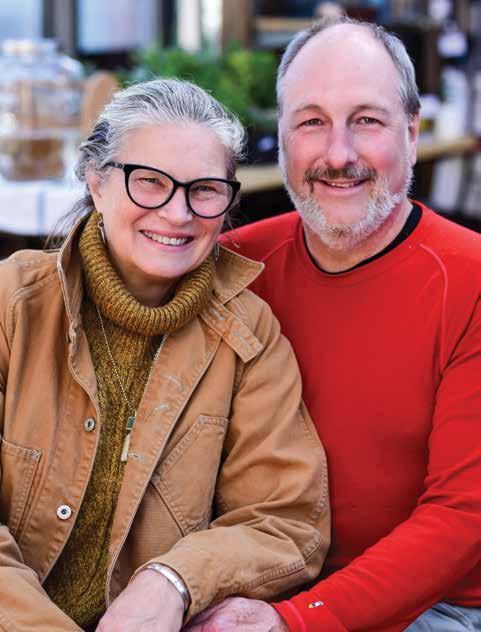
10:00 a.m. to 1:00 p.m. • Reiki is a hands-on healing practice that promotes balance of the body/mind/spirit allowing you to feel and function better. Reiki is an invaluable resource for self-care and for bringing healing touch to others. Class includes, Reiki history, spiritual precepts, treatment form for yourself and others, and individual initiations. $200. For more information contact Suzy at (734) 476-7958 or email suzyreiki@aol.com.
SW Lake Michigan Yoga & Meditation Retreats with Ann Arbor Yoga & Meditation • Four Day Retreats: Thursday through Sunday, May 7through 10 OR 21, through 24; June 25 through 28; July 9 through 12 OR 16 through 19; August 6 through 9; Three- Day Retreats: Friday through Sunday, May 8, 9, & 10 OR 22, 23, & 24; June 26, 27, & 28; July 10, 11, & 12 OR 17, 18, & 19; August 7, 8, & 9 • Our small group retreats are for beginners and pros interested in experiencing yoga and meditation for healing, as a way of life, and personal growth. Come to deeply relax, learn user friendly therapeutic breathing, meaningful meditations to self care, and more. Enjoy beautiful indoor and outdoor spaces, Lake Michigan sunsets and more. Four-day retreats $749; 3-day $599. For more information contact Ema at EmaStefanova@cs.com. or visit yogaandmeditation.com.
Day of Mindfulness One-Day Retreat with Dharma Teachers • Saturday, May 9 • 9:00a.m. to 5:00 p.m. • Sitting and walking meditation, simple manual work, a wholesome vegetarian meal, and rest – an interval of deepening, of slowing down, silence, and mindfulness. $50 members/$60 non-members. For more information contact the Zen Temple at (734) 761-6520 or email annarborzentemple@gmail.com.
Inner Peace Retreat with Song of the Morning Community • Friday, Saturday, & Sunday, May 15, 16, & 17 OR June 12, 13, & 14 • Retreat investment: $108. Lodging fees vary by accommodation and includes all meals. You’ll select and pay for lodging during registration. For more information contact Song of the Morning at (989) 983-4107, email office@songofthemorning.org, or visit songofthemorning.org.
Days of Reflection with Sharon Zayak • Thursday, May 28 through Friday, May 29 • These two days invite us into a contemplative experience of our intimate connection with the whole of life. In spite of all we hear and witness in these violent times, we are reminded that our incredibly beautiful Earthen home holds great promise and hope for us and for herself. Registration required; Cost: Commuter $80; Single $160; Double $130 each; If registering for Live Stream, use “Commuter” designation. This program will not be recorded. For more information contact the Weber Center at (517) 266-4000 or visit webercenter.org.
Nurturing a Nature-Connected practice: a Yoga & Meditation Retreat with Emily Adama & Ari Wakeman • Friday, June 12 through Sunday, June 14 • Yoga and meditation compliment one another on the spiritual path – embracing this time-honored duo, we will alternate between mindful movement and stillness, deepening our connection to our bodies and the present moment through 10+ hours of indoor and outdoor yoga and meditation. $465-$650. For more information visit earthwellretreat.com.
Summer Solstice Hatha Yoga Retreat with Golden Lotus Yoga Teachers Association • Friday, June 19 through Sunday, June 21 • Celebrate the International Day of Yoga and the Summer Solstice with Song of the Morning and GLYTA. This all-levels retreat features yoga and meditation classes, vegetarian meals, guided nature walks, free time, beautiful scenery, and the joyful fellowship that makes Song of the Morning retreats so special.
Owners of Argus, Kathy Sample and Bill Brinkerhoff are hands on and happy to be so. You will find them behind the counter making the coffees, or in the back receiving the produce, or around town driving the CSA deliveries on any normal day. They are fully devoted to this segment of our local economy with the soil under their fingernails to prove it. Running this multifaceted operation can’t be simple, but it is clear. Every aspect returns to the central mission, as stated on the website: “To grow our local agricultural economy by supporting the success of local farms. Argus provides a place where local farms can sell locally-grown produce and other goods conveniently to consumers, yearround!” Read the whole article in Issue #82. Find it on our website at crazywisdomjournal. com/thecrazywisdomjournalonline/2022/12/15/ argus-farm-stop-mission-driven.
Retreat investment: $150. Lodging fees vary by accommodation and include all meals. You’ll select and pay for lodging during registration. For more information contact Song of the Morning at (989) 983-4107, email office@ songofthemorning.org, or visit songofthemorning.org.
Colors of the Soul: A Rainbow Palette of Restoration, Creative Arts, Movement, and Meditation with Megan Sims & Emily Adama • Friday, June 19 through Sunday, June 21 • The solstice weekend is the perfect time to explore the beauty of life that often eludes us in our busy schedules and crazy world. This retreat experience will be equally restorative and peaceful, as it is fun, creative, and colorful! Inspired by creative movement (InterPlay, NIA, Yoga), we will rediscover the magic within ourselves and each other. 415-$650. For more information visit earthwellretreat.com.
Divine Healing Retreat with Drs. Will & Wendy Page-Echols • Friday, June 26 through Sunday, June 28 • Discover practical spiritual tools for daily life through gentle yoga, meditation, chanting, prayer, nature connection, journaling, breathwork, and stress release. Rooted in the teachings of Paramahansa Yogananda, this retreat supports balance, resilience, inner guidance, and joyful well-being. Retreat investment: $150. Lodging fees vary by accommodation and include all meals. You’ll select and pay for lodging during registration. For more information contact Song of the Morning at (989) 983-4107, email office@ songofthemorning.org, or visit songofthemorning.org.
Directed Retreat with Mary Sue Kennedy, Joan Ebbitt, Trudy McSorley, Esther Kennedy, Joan Delaplane, & Janice Brown • Monday, July 6 through Friday, July 10 • This is an individual quiet retreat with a daily meeting with a spiritual director. Commuter $240: includes lunch; Single $570: includes all meals; Double $470 each: includes all meals. For more information contact the Weber Center at (517) 266-4000 or visit webercenter.org.
Reflection on the Mystics with Judi Clemens & and Phillip D. Johnson • Sunday, July 26 through Wednesday, July 29 • This retreat will focus on Howard Thurman, American author, philosopher, minister, theologian, Christian

mystic, educator, and civil rights leader as well as Brazilian Catholic Religious Sister and missionary Dorothy Stang. Registration required; Cost: Commuter: $180; Double: $280 each; Single: $380. For more information contact the Weber Center at (517) 266-4000 or visit webercenter.org.
Zen Peace Camp with Temple Priests and Dharma Teachers • Saturday, August 1 through Thursday, August 6 • Tent camping in community with all ages, by the lake and in the forest, near Ann Arbor. Learn about peace and happiness from the Buddhist perspective of the interrelationship of all things. Activities emphasize mindfulness, cooperation, and appreciation for nature and play while seeking to balance structure and spontaneity. Volunteer opportunities available. Per-camper and family rates. Please inquire. For more information contact the Zen Temple at (734) 761-6520 or email annarborzentemple@ gmail.com.
Rest is not idleness, and to lie sometimes on the grass under the trees on a summer's day... is by no means a waste of time.
—John Lubbock

Crazy Wisdom's E-Blast Service is a great way to showcase yourself, your business and your services! This service i s a cost effective method of reaching a targeted audience without the need for investment in costly hardware and mail related so ftware!
Send out a listing of your upcoming classes, workshops, and events. This is a great way to reach the more than 8000+ people who are currently subscribed to receive our E-Blasts.
Affordable pricing starting at $99.00 for any one email!
For all requirements and to pay visit www.crazywisdom.net
Click on "Eblast Service" in the menu.
E-Blast Service ads must be mail-ready (see website) and emailed to Carol. Questions? Contact Carol at carol@crazywisdom.net


Self-Realization Fellowship Convocation Week with Song of the Morning Community • Sunday, August 2, through Sunday, August 9 • Immerse yourself in Paramahansa Yogananda’s how-to-live teachings during this uplifting annual week at Song of the Morning, held in harmony with SRF Convocation. Enjoy classes, fellowship, personal meditation, and spiritual renewal in a peaceful woodland setting, while sharing the blessings of Convocation week in the company of God seeking souls. Participants welcome to attend part of the week. FREE; lodging fees vary by accommodation, include all meals, and are selected and paid during registration. Flexible attendance is welcome, and participants are invited to sign up for one volunteer service shift during the week. For more information contact Song of the Morning at (989) 983-4107, email office@songofthemorning.org, or visit songofthemorning.org.
Meditative Gardener Retreat with Will and Wendy Page-Echols • Friday, August 14 through Sunday, August 16 • Deepen your connection with nature through meditative gardening, chanting, meditation, and mindful cultivation. Explore Yogananda’s teachings on plant consciousness while experiencing gardening as a spiritual practice rooted in peace, joy, and vibrant, awake living. Retreat investment: $108. Lodging fees vary by accommodation and include all meals. You’ll select and pay for lodging during registration. For more information contact Song of the Morning at (989) 983-4107, email office@ songofthemorning.org, or visit songofthemorning.org.
If you are interested in obtaining some biographical information about the teachers, lecturers, and workshop leaders whose classes, talks, and events are listed in this calendar, please look in the section that follows the calendar, which is called “Teachers, Lecturers, Workshop Leaders, and The Centers” and which starts on page 113.
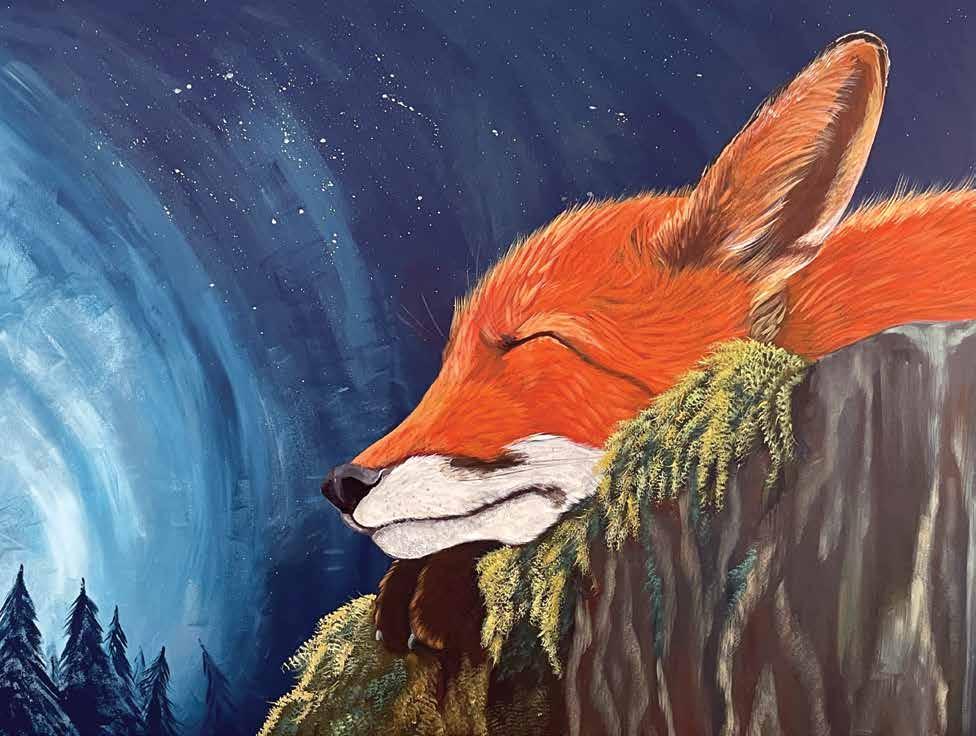
Exploring Mantra, Song, & Chant with Emily Adama • Friday, August 14 through Sunday, August 16 • This weekend explores mantra, song, and chant as tools to deepen our yoga and meditation practices. Drawing on yogic and contemplative traditions, participants will explore how vibration, repetition, and voice can calm the nervous system, focus the mind, and open the heart. No singing experience is required. $465-$650. For more information visit earthwellretreat.com.
Cultivating Connection: A Couples Retreat for Play, Presence & Pleasure with Tatianah Thunberg & Carisa Wilder • Friday, August 21 through Sunday, August 23 • Open to couples of all orientations, identities, ancestries, ages and stages who want to reconnect after a stressful season, deepen intimacy and trust, learn tools for co-regulation and authentic relating, explore touch, play, and presence while creating pathways of safety, and experience relational nourishment within a supportive community. $1050-$1475/per couple. For more information visit earthwellretreat.com.
Introduction to Journeying with Connie Lee Eiland • Sunday, May 3, July 26, & August 30 • 10:00 a.m. to 5:00 p.m. • Six-hour class includes power animal retrieval and journeys to upper, lower, and middle worlds. Journeying is with drums and rattles. Introduction to journeying is required for all advanced classes. It also allows you to get guidance directly from your helping spirits. I$100 f paid two weeks before, otherwise $125. For more information contact Connie at (248) 809-3230, email clshebear7@gmail.com, or visit shewolfshaman.com.
Mother Earth Shamanic Sound Journey with Cacao & Mary Ledvina • Saturday, May 9 • 2 to 4:00 p.m. • The day before Mother’s Day, travel to the lower world to connect to Mother Earth with an option to connect to your female ancestors. Experience a sound bath as you receive the healing and/or guidance you need through a guided journey assisted by optional cacao. Doors close at 2:15 p.m. sliding scale: $40-$60. For more information contact Mary at (734) 646-9161, email maryledvina@gmail.com, or visit maryledvina.com.
Connection & Empowerment with Connie Lee Eiland • Saturday, May 16 from 10:00 a.m. to 7:30 p.m. & Sunday, May 17 from 10:00 a.m. to 4:00 p.m. • This class will improve your connection to Spirit. There will be work with the third and fourth chakras to help clarify and strengthen your personal power and your connection to the web of Life. Included will be time in nature to assemble a medicine bundle which will be used in healing. Journeys, partnered healing, and ceremony are included. $250 until May 3, $300 after. For more information contact Connie at (248) 809-3230, email clshebear7@gmail.com, or visit shewolfshaman.com.
Basic Journeying: The Art of Shamanism for Practical and Visionary Purposes in Daily Life with Judy Liu Ramsey • Saturday, June 13 & Sunday, June 14 • 9:00 a.m. to 3:00 p.m. • The shamanic journey is an easy and powerful tool to access spiritual information. Meet a compassionate spirit or power animal who wants to help you in your life and learn techniques for empowerment, allowing you to move safely, intentionally in a balanced way. This class is prerequisite to advanced shamanic studies. Online via Zoom. $180 per person/$90 for repeat students. For more information contact Judy at info@ judyramsey.net.
Grandfather Sun Shamanic Sound Journey with Cacao & Mary Ledvina • Sunday, June 14 • 2 to 4:00 p.m. • Before Father’s Day and Summer Solstice, travel to the upper world to connect with the Sun and receive light. There will also be an opportunity to connect with your male ancestors. Experience a sound bath as you receive the healing and/or guidance you need through a guided journey assisted by optional cacao. Doors will be locked at 2:15 pm. sliding scale: $40-$60. For more information contact Mary at (734) 646-9161, email maryledvina@gmail.com, or visit maryledvina.com.
Shamanic Healing for Animals I with Judy Liu Ramsey • Wednesday, June 17, 24, July 1, 8, 15, 22, 29, August 5, 12, 19, & 26 • 7 to 9:00 p.m. • Explore animal healing that draws upon core shamanic practices. Develop a toolkit of techniques through supportive, interactive, and experiential learning from a professional animal communicator who also practices shamanism. Prerequisite: journeying basics. Knowledge of animal communication not necessary. The class is taught via Zoom. $425 per person/$225 for repeat students. For more information contact Judy at info@judyramsey.net.
Five-Day Soul Retrieval Training with Connie Lee Eiland • Tuesday, July 1 through Sunday, July 5 • 10:00 a.m. to 4:00 p.m. • This class is for people who want to bring soul retrieval into their practices. Participants will be trained in diagnosis, soul retrieval, and intensive after care. There is an approval process for this training. $450 until June 6, $500 after. For more information contact Connie at (248) 809-3230, email clshebear7@gmail.com, or visit shewolfshaman.com.
Extraction: A Shamanic View of Illness with Judy Liu Ramsey • Saturday, July 11 & Sunday, July 12 • 9:00 a.m. to 5:00 p.m. • Shamanism addresses the spiritual aspects of illness. Identify power loss and explore different ways to address healing. Deepen your understanding of spiritual intrusions and learn ways to extract them. Prerequisites: Basic Journeying, Medicine For the Earth or Healing With Spiritual Light. Class is via Zoom. $300 per person/$150 for repeat students. For more information contact Judy at info@judyramsey.net.
Shamanism continued...
Grandmother Moon Shamanic Sound Journey with Cacao & Mary Ledvina • Sunday, July 12 • 2 to 4:00 p.m. • Travel to the upper world to connect with the Moon and to experience your feminine nature. Experience a sound bath as you receive the healing and/or guidance you need through a guided journey assisted by optional cacao. Doors close at 2:15 p.m. sliding scale: $40-$60. For more information contact Mary at (734) 646-9161, email maryledvina@gmail. com, or visit maryledvina.com.
Healing Curses & Spells with Connie Lee Eiland • Saturday, August 8 from 10:00 a.m. to 5:30 p.m. & Sunday, August 9 from 10:00 a.m. to 4:00 p.m. • This class involves recognizing the importance of words and energy for health and well-being. Participants will learn to recognize curses and how to remove them safely. Methods of healing come from Peruvian, Hawaiian, and Tibetan shamanic practices. Soul retrieval is a prerequisite. $250 until July 25, $300 after. For more information contact Connie at (248) 809-3230, email clshebear7@gmail.com, or visit shewolfshaman.com.
Star Nations Shamanic Sound Journey with Cacao & Mary Ledvina • Sunday, May 9 • 2 to 4:00 p.m. • During Perseid Meteor Showers, travel to the upper world to connect with your star family and view our place in this universe. Experience a sound bath as you receive the healing and/or guidance you need through a guided journey assisted by optional cacao. Doors close at 2:15 p.m. Sliding scale: $40-$60. For more information contact Mary at (734) 646-9161, email maryledvina@gmail.com, or visit maryledvina.com.
Spirit Through the Years with LaTonya Zibi • Tuesday, May 12, June 16, July 14, & August 11 • 5 to 6:30 p.m. • Guided reflection for adults 50+ to explore spirituality, life experiences, and practical ways to nurture meaning and purpose. Hosted online. $35 per session. For more information contact LaTonya at (781) 832-0166, email spirit.holisticenerqi@gmail.com, or visit spiritbecoming.com.
Be a Tension Tamer with Jenn McFarland • Thursday, May 7, June 4, July 9, & August 6 • 6:30 to 7:30 p.m. • This workshop will teach you practical ways to stop stress in the moment. You’ll learn four different techniques and how to incorporate them into your daily life. Hosted online. $50. For more information contact Jenn at (734) 234-8201 or email monarchdawn.jen@gmail.com.
Plant Identification and Foraging or Plant Medicine from Indigenous and Western Perspectives with Gabi May • Ongoing Sunday Mornings • Learn to identify plants and learn about their uses in indigenous and western medicine. This class is open to all ages and will involve a leisurely-paced hike at a nature trail in the Ann Arbor area. You will get to know our plant relatives and learn
is a master teacher, healer, business leader, and spiritual leader who has been invited to speak as an expert on Wisdom Radio, Clear Channel, Achieve Radio, BBS Radio, WBZT, and many other television and radio stations.
Stockwell is known to many as the foremost expert on the evolution of the consciousness of humanity and the New Paradigm. He teaches how to be truly connected and heal so we may all succeed in this changing world through The Quant-Om, PowerBeyond, Beyonder Programs, and Beyond Mystery School.
Stockwell is an artist, author, a songwriter, inventor, and more! He has helped thousands of people, including world leaders, spiritual leaders, healers, athletes, actors, musicians, professionals, and companies to reach previously unimaginable heights and create better lives.
Learn more by visiting Stockwell online at facebook.com/ toddstockwell.
about the amazing things they can do. Exact dates and times are weather dependent. $10. For more information contact Gabi at (269) 271-8797 or email gabi@mysticmay.com.
Natural Building Training Program at Strawbale Studio with Deanne Bednar • May OR July • Experience a variety of natural building skills while living & learning on-site for one month at Strawbale Studio! Classes and hands-on experience in foundation building, round pole framing, thatched and living roof construction, strawbale walls, earth plaster, and cob. Enrichment: experience an earth oven, foraging, mushroom log fruiting, and more! $1250 / $950. Includes room and board. Some partial-pay work trade hours available. For more information contact Deanne at (248) 496-4088, email ecoartdb@gmail.com, or visit strawbalestudio.org.
Work Trade Program at Strawbale Studio with Deanne Bednar • June OR August • Live on-site at enchanting Strawbale Studio and help out (garden, grounds, repairs, office, natural building-related work) in exchange for room, board, and sustainable living skills such as spoon carving, earth sculpting, and more. FREE; 30-hour work week. For more information contact Deanne at (248) 496-4088, email ecoartdb@gmail.com, or visit strawbalestudio.org.
Two-Hour Learning Tour at Strawbale Studio with Deanne Bednar • Saturday, May 9 & 16, Sunday, July 12 & Aug 9 • 10:00 a.m. to Noon • Learning tour of natural buildings at Strawbale Studio! Visit the enchanting structures made of strawbale, earth plasters, living and thatched roof, rocket stove, earth oven. Learn about upcoming natural building and nature craft workshops. Bring a lunch and register for the afternoon workshop if you wish! $20. For more information contact Deanne at (248) 496-4088, email ecoartdb@gmail.com, or visit strawbalestudio.org.
Foraging Plant Walk at Strawbale Studio with Deanne Bednar • Sunday, May 17 • 1 to 5:30 p.m. • Enjoy an afternoon in the woods & meadows at the enchanting Strawbale Studio one hour north of Detroit and meet some awesome plants! Harvest and take some home, free plants where abundant. Food, medicine, cording materials, and more. Consider registering for the twohour learning tour of natural buildings in the morning. For more information contact Deanne at (248) 496-4088, email ecoartdb@gmail.com, or visit strawbalestudio.org.
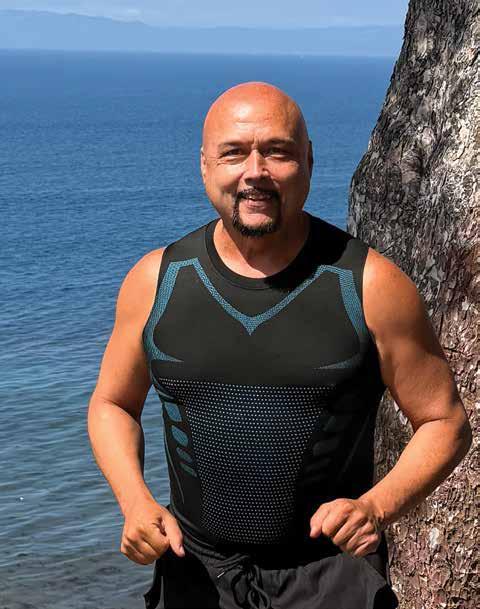
Qigong Class with Cyrus Scholl • Ongoing Tuesdays • 6:30 to 8:00 p.m.
• The class teaches you to use gentle movements, stretching, and mindful breathing to bring your body, mind, and spirit deeper into harmony. $12 per class. Drop-ins welcome. For more information contact Zen Buddhist Temple at (734) 761-6520 or email annarborzentemple@gmail.com.
Chen Tai Chi Ch’uan with Joe Walters • Ongoing Tuesdays, Thursdays, & Saturdays • 4 to 5:00 p.m. • Unique movement art emphasizing inner stillness and relaxation developed through disciplined whole-body integration and refined awareness. Instruction in stationary stances, coiling exercises, and Chen forms. FREE. For more information contact Joe at annarbortaichi@gmail.com or visit annarbortaichi.com.
Beginners Tai Chi with Master Wasentha Young • Ongoing Mondays from 10:00 to 11:15 a.m. AND/OR Thursdays from 6 to 7:15 p.m. • Tai Chi is a series of postures linked together in a continuous, fluid manner. It focuses on integratingboth physical and mental energy mechanics, promotes relaxation, and enhances the sense of balance. It is often characterized as a moving meditation. Attend one or both sessions per week (down a flight of stairs, no elevator access.) $225. For more information contact the Peaceful Dragon School at (734) 741-0695, email info@peacefuldragonschool.com, or visit peacefuldragonschool.com.
Tai Chi Walking with Master Wasentha Young • Saturday, May 2 • 10 to 11:15 a.m. • There are many ways that Tai Chi helps us to “see” with our feet. Tai Chi Walking simplifies this method to allow individuals to experience this without learning the Tai Chi Form. $30. For more information contact the Peaceful Dragon School at (734) 741-0695, email info@peacefuldragonschool. com, or visit peacefuldragonschool.com.
Internal Arts: Taiji, Bagua & Pushhands with Joel Robbins & Inner Culture • Tuesday, May 12, 19, 26, June 2, 9 & 16 AND/OR July 7, 14, 21, 28, August 4 & 11 • 7 to 8:00 p.m. • Explore Chen and Yang Tai Chi, Ba Gua Zhang, and partner exercises to develop body mechanics, coordination, and martial understanding. This class emphasizes practical movement principles and internal alignment through form and interactive practice. Suitable for all experience levels. $125 for 6 classes. For more information contact Joel (734) 315-0573, email joel.innerculture@gmail.com, or visit InnerCulture.org.
Silk Reeling Qigong with Joel Robbins & Inner Culture • Wednesday, May 13, 20, 27, June 3, 10, & 17 AND/OR Wednesday, July 22, 29, August 5, 12, 19, & 26 • 7 to 8:00 p.m. • Silk Reeling Qigong forms the foundation of Tai Chi and emphasizes gentle, spiraling movements that promote relaxation, coordination, and internal power. The class is for students of all ages and experience levels, those new to Tai Chi and Qigong, and those wanting to deepen their practice. $125 for six classes. For more information contact Joel (734) 315-0573, email joel.innerculture@gmail.com, or visit InnerCulture.org.
Qigong and Tai Chi Fridays with Jose Feliz & Jennifer Flynn • Friday, May 29, June 5, 12, 19, & 26, July 10 • 4:30 to 5:30 p.m. • This six-week series offers a gentle, grounding way to build strength, balance, and calm through mindful movement. Each class includes Qigong warmups, foundational Tai Chi, and closes with qigong, acupressure, and a brief mediation. All levels welcome. $90. For more information contact Jennifer at (414) 403-0150 or email rootsofwisdom.acu@gmail.com.
Grace Choi Tarot Reader & Astrologer • Ongoing Wednesdays • 2 to 7:00 p.m. • Grace’s readings are rooted in compassion and empathy. She believes divination is a catalyst for meaningful dialogue. She’s here to help you feel seen, heard, and most importantly, empowered. Card Reading Only –$30 (30 min), $70 (60 min) Cards & Astrology Readings (must know birth time) – $35 (30 min), $80 (60 min). For more information contact events@ crazywisdombookstore.com.
Dr. Mari Ziolkowski: Tarot Reader • Ongoing Thursdays • 2 to 7:00 p.m. • Highest guided meditative tarot card readings, light language channeling, healing/clearing, and herbal healing divinations. Two to three card “Quick Look”: $25 (10 min); Four to five card “Go Deeper”: $45 (20 min); Six+ card “Deepest”: $65 (30 min); light language channeling: $50-60 (25-30min). For more information contact events@crazywisdombookstore.com.
Nina McDermott: Intuitive Card Reader • Ongoing Fridays from 2 to 7:00 p.m. AND/OR Saturdays from Noon to 7:00 p.m. • Reading a combination of Tarot and/or Oracle cards, Nina uses her intuitive gift to take a deep look into a situation, relationship or question, ofThree 3-card “Simple Spread”: $25; Five-card “Deeper Look Spread”: $45; Nine-card “Greater Perspective Spread”: $65; Two-person reading: $65. For more information contact events@ crazywisdombookstore.com.
Mylita Benjamin: Intuitive Guide and Oracle Reader • Ongoing Sundays • Noon to 5:00 p.m. • Mylita uses a combination of cards, clairvoyance, and healing energy to make her readings much more than a divination session! Three-card “Mini Sample Reading”: $25 (10 min); “Celtic Cross – Recommended Reading”: $45 (20 min); “Relationship Spread” (Two people): $60 (Approx. 30 min). For more information contact events@crazywisdombookstore.com.
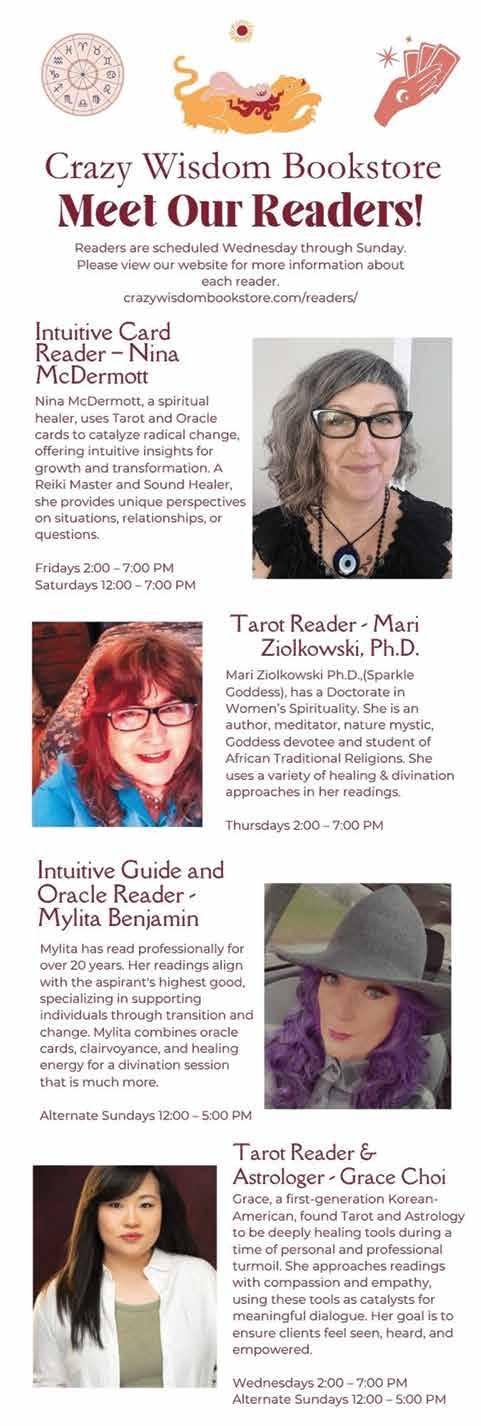


gently yet powerfully transforms life challenges through accessing innate states like Peace, Oneness, and Presence (see my article Core Transformation: The Treasure Map to Inner Peace in Issue #91 of The Crazy Wisdom Community Journal).
Core Transformation engages the denser expressions of the psyche’s unconscious, while Wholeness Work attends to even subtler dimensions, together functioning as a seamless, complementary continuum for deep transformation and awakening. Andreas credits Dr. Milton Erickson as a key influence in her development of Core Transformation, while the inspiration for Wholeness Work came from Ramana Maharshi, one of the twentieth century’s most revered sages, whose teachings on self-inquiry and non-duality planted its seeds. Ramana Maharshi emphasized the ego as the “I-thought” which vanishes when directly investigated. He taught that what rises as “I” in the body is the mind, or subtle body, and that it consists entirely of thoughts, arising only after the root, “I-thought.” Through inquiry—first asking, “To whom has this thought arisen?” and then, “Who am I?”—attention is traced inward, following the “I” to its source, where the mind subsides into Awareness.
Across many traditions, spiritual teachers have taught that the “ego” is not an entity, but an activity. What we call ego is ongoing psychological activity—memory, comparison, fear, desire—generated moment by moment.

Maharshi pointed out that the heart is the place of the mind’s origin, and when we inquire where the “I-thought” first arises, we discover that it rises in the heart. Retaining the mind in the heart is called inwardness, while allowing it to move outward is externalization. With repeated practice, the mind develops the ability to remain in its source. When the mind abides in the heart, the “I” dissolves, and the ever-present pure awareness, or Self, shines unobstructed.
However, this practice eludes most of us, as it presupposes the prior establishment of a palpably unified inner center—an organizing capacity that can steward competing impulses into a coherent direction through repeated non-identification, sustained conscious effort, and the gradual integration of parts.
By Tchera Niyego
“Grace is not something to be acquired. You only have to remove the obstacles to the recognition of its presence.” ~ Ramana Maharshi
Across many traditions, spiritual teachers have taught that the “ego” is not an entity, but an activity. What we call ego is ongoing psychological activity memory, comparison, fear, desire generated moment by moment. It is something that we are doing and not something we fundamentally are. Ego/ self is a pattern of self-attention and linguistic framing—a contraction created through self-referencing.
The sense of “I” is simply the activity of observation identifying itself as a center.
“Man has no individual ‘I.’ But there are, instead, hundreds and thousands of separate little ‘I’s… One “I” decides; another “I” later changes the decision.”
~ G. I. Gurdjieff
The Wholeness Work is a simple and precise approach to awakening that dissolves “I” structures—subtle inner separations formed through lived experience and maintained unconsciously over time. As these long-held structures of egoic self-reference relax and dissolve, what remains is revealed as Awareness itself—not as an object or state, but as the ever-present ground of experience.
The Wholeness Work was developed by Connirae Andreas, PhD, psychotherapist, author, and international trainer whose work has helped define and broaden the field of Neuro-Linguistic Programming (NLP). NLP studies the structure of subjective experience—how our thoughts, language, and behavior shape experience, and how these patterns can be transformed to create meaningful change. Over decades of pioneering contributions, Andreas’ innovations include Aligning Perceptual Positions, Advanced Language Patterns, timeline techniques, and processes for resolving grief and shame. She is widely known for Core Transformation, a distinct method that
When Andreas began experimenting based on this teaching, her immediate inclination was to start where most people actually are—experiencing ourselves as a small self. Rather than attempting to transcend this experience prematurely, she explored how to directly locate it within our inner landscape, attune to its structure through deep sensation, and then gently let it dissolve back into wholeness, allowing us to experience ourselves as the vast “whole” again.
“Enlightenment is intimacy with the ten thousand things.” ~ Dogen Andreas highlights five keys that make the Wholeness process universally effective. The first key is noticing the precise location of the experience
The Wholeness process begins by noticing what in our experience feels separate. This might be a feeling, a response, or a perspective—the sense of “I.” Sometimes it takes the form of a persona—an embodied “I” engaged in action, doing, or striving. Other times it may appear as a sensation through the body or one of the senses. By asking, “Where is this [experience we noticed] located?” we turn our attention inward and notice the location. While most of us are aware of our emotions, feelings, and thoughts, often we don’t register the specific location where we experience them.
The second key is shifting from meaning and interpretation to the quality of sensation. Lingering attention on the meanings we assign to experience prevents transformation at its most fundamental level. Instead, we ask, “What is the sensation quality?” By noticing qualities such as heaviness, pressure, vibration, fizziness, warmth, or coolness—or sensations we can’t quite name— and by simply attending to the sensation itself, attention disengages from narrative, allowing deeper integration to occur.
Now we can recognize, “I am aware of this [sensation we noticed].”
The third key is being clear about the meaning of Awareness. While the word is widely used, what people experience as its meaning is inconsistent and may not actually support useful integration.

Core Transformation engages the denser expressions of the psyche’s unconscious, while Wholeness Work attends to even subtler dimensions, together functioning as a seamless, complementary continuum for deep transformation and awakening.
Awareness is the capacity to notice, present throughout the body, and all around us. If a sound happens on one side, you would hear it automatically without effort. If a gentle breeze brushes your body, you’d also be aware of it effortlessly. And even when our eyes are closed, we can notice a sense of space all around. It may feel like spaciousness… like presence. It has no center or edge… And you can notice all of this, simultaneously, right now….
Let’s now return to the recognition, “I am aware of this [sensation we noticed].”
“Where is the ‘I’ that is aware of this sensation? Where is this ‘I’ located? … Where is the perceiving happening from?” Finding the location of the “I” is the fourth key. It may be sensed in the head, body, or outside the body
somewhere. There is an experiential location for the “I” within our personal space, and it needs to be directly noticed and worked with.
As the “I”—or a sequence of “I”s— then dissolve through the Awareness/ Dissolving meditation (emerging from Andreas’ earlier Aligning Perceptual Positions work) what remains is a sense of presence, that can be characterized as an integration of subject with “beingness.”
As it turns out, holding internal separation in place requires surprisingly great effort, and it is delightful to feel the relief and the spontaneous surge of energy that naturally arise when it dissolves, leaving a sense of openness, ease, and aliveness.
Finally, the fifth key is experiencing original sensation of thought/feeling AS Awareness. Consistently, when the “I” dissolves, the original experience we started with—the object—has already shifted. It is often impossible to sustain the unpleasant experience without the separate “I”.

Approaching an unpleasant experience in a conventional manner only serves to replay it—reinforcing the negative emotional habit. By contrast, the Wholeness process guides us in experiencing the emotion embodied in the sensation as Awareness itself. It is through encountering the event as an undivided whole that the original experience is transformed.
With each unfolding of experience in/as Awareness, the rigidities of our personality structure soften, judgments—both negative and positive—ease away, and all that remains is presence itself.
Approaching an unpleasant experience in a conventional manner only serves to replay it— reinforcing the negative emotional habit. By contrast, the Wholeness process guides us in experiencing the emotion embodied in the sensation as Awareness itself.
“It all comes down to how we hold phenomenon.” ~ Thinley Norbu
Rinpoche
Grounded in a coherent set of principles, Wholeness Work is a rich body of methods including Reclaiming the Inner Authority, Integrating What’s Missing, Dissolving Identities/Roles, The Letting-Go Process, Working with Aversions and Attachments, Integrating the Teacher, Wholeness Dreamwork, and more. These approaches explore the most effective ways to heal and transform the full range of emotions and challenges we all share.
Experiencing whatever emerges as undivided Awareness reveals that nothing is fundamentally unworkable—that every situation and every emotion can be included.
Tchera Niyego has lived and worked as an artist and facilitator in Istanbul, Tel Aviv, London, and New York City, and for over twenty-five years has studied and practiced approaches to the non-dual view through mystical oral traditions.
Now based in Dexter, MI, she offers transformational coaching to individuals, facilitates groups, and trains practitioners internationally. As a practitioner devoted to awakening innate wisdom, compassion, artistry, and play, Niyego supports contemplatives and creatives in navigating life’s challenges— whether anxiety, grief, trauma, self-criticism, unhelpful habits, health issues, or difficult relationships—helping clients release limitations and step into a fuller expression of aliveness.
For more information, email tcherina@usa.net to schedule a free discovery call with Niyego, and explore how Core Transformation and Wholeness Work may specifically benefit you.


Joy in Embodied Journaling with Debra Hopper • Sunday, May 17 • 1 to 2:30 p.m. • If journaling has ever felt overwhelming or flat, this guided session offers a different way in. Join Certified Embodiment Coach Debra Hopper for Joy in Embodied Journaling, a relaxed online experience blending gentle body awareness with playful prompts. Expect curiosity, creativity, and a writing experience that feels freer and more your own. $20. For more information email hello@debrahopperonline.com or visit debrahopperonline.com.
Writing Workshops with Tarriane DeYonker • Saturday, May 23, June 13, & August 15 • 1 to 4:00 p.m. • Writing workshops with rotating themes. Beginning and experienced writers are welcome. This is a hybrid workshop, so attending by Zoom is an option. Registration required. $35. For more information contact the Weber Center at (517) 266-4000 or email webercenter.org.
Yoga for Core Integrity Online Course with Christy DeBurton • Starts Monday, May 4 • 4:30 to 5:00 p.m. Are you noticing any of these symptoms in your body lately? Ongoing back pain or tension, poor balance or instability, slouching or posture struggles, sluggish digestion, stubborn weight around your midsection. These are all signs your core may need more support— and the good news is, you can change that. In this eight-week online yoga course, you’ll safely (but effectively) strengthen the muscles that support your core—helping you move through life with more ease, stability, and confidence. And yes—there will be plenty of feel-good stretching and relaxation woven in every step of the way. The Yoga Room is a private studio in Ann Arbor offering personalized yoga for anyone seeking a more thoughtful, supportive approach to practice. ere, yoga is not about keeping up or pushing through— it’s about slowing down, listening inward, and building a practice that truly supports your body and your life. $140. For more information visit yogaroomannarbor.com.
Open Level Yoga with Michele Bond • Ongoing Sundays from 4 to 5:30 p.m., Tuesdays from 6 to 7:30 p.m., & Saturdays from 10 to 11:30 a.m. • Each student is encouraged to honor their own unique abilities and limitations in this mixed level class, with variations offered for all levels. Our method blends the science of biomechanics with an openhearted, uplifting philosophy. Classes are designed to optimally benefit each student, with myofascial release techniques incorporated as needed. $15 if registered for the semester, $20 drop in with instructor’s permission. For more information contact Michele at (734) 358-8546, email michele@yogahouseannarbor.com, or visit yogahouseannarbor.com.
Hatha Yoga with Samantha Lieberman • Ongoing Thursdays • 9:15 to 10:15 a.m. • Grounded, breath-led movement that builds strength, balance, and calm from the inside out. Drop-in $18 per session. 10% senior discount. Cash or Venmo at door. Bring your own mats. For more information contact Jewel Heart at (734) 994-3387, programs@jewelheart.org, or visit jewelheart.org.
Yoga Stretch with Samantha Lieberman • Ongoing Fridays • 9:15 to 10:15 a.m. • A full-body reset with intentional stretching to release tension and move with more freedom. Drop-in $18 per session. 10% senior discount. Cash or Venmo at door. Bring your own mats. For more information contact Jewel Heart at (734) 994-3387, programs@jewelheart.org, or visit jewelheart.org.
Golden Lotus Hatha Yoga with Golden Lotus Yoga Teachers Association • Ongoing Saturdays • 2 to 3:30 p.m. • Golden Lotus Yoga, founded by Yogacharya J. Oliver Black, a direct disciple of Paramahansa Yogananda, offers gentle, slow-paced, meditative classes for all levels. Each class includes brief meditation and spiritual guidance, helping you experience greater peace, clarity, and a renewed sense of inner well-being. Donations welcome. For more information contact Song of the Morning at (989) 983-4107, email office@songofthemorning.org, or visit songofthemorning.org.
Yoga at Zion Well • See Website for Schedule • Zion Well offers a variety of classes, including gentle, restorative, Yin, and meditative yoga. For those looking for more, they also offer retreats, private sessions, and teacher training courses. Visit zionwell.com for more information.
The Prana Yoga Studio • See Website for Schedule • The studio offers traditional Bikram (hot) yoga as well as Yin Yoga. Located in Ann Arbor off Jackson Road. For more information visit thepranayogastudio.com.

by Karen Quinn
The Yoga Focus Collective • See Website for Schedule • This studio offers a wide variety of classes, ranging from supported beginners, levels 1-4, Pranayama, and pre/postnatal classes. Individual drop-in class: $25; Six-week session: $132; Six-week Pranayama: $90; Pranayama drop-in class: $18; Pre/ Postnatal Packages: 5 for $110, 10 for $200. For more information visit yogafocuscollective.com.
Yogacentric Classes for kids and Adults in Saline • See Website for Schedule • Offering a variety of classes seven days a week, including Yin Restorative, Gentle Unwind, Somatic Yoga, Basic Blend, YinYasa, Yoga Sculpt, Lunchtime Yoga and more. Visit the website at yogacentric.net for more information.
Imagine Fitness & Yoga • See Website for Schedule • The studio provides comprehensive classes in cardio, strength, tai-chi, Pilates, Vinyasa, Ashtanga, Yin, and Hatha yoga. Private training is also available. For more information visit imaginefitnessandyoga.com.
Verapose Yoga House • See Website for Schedule • Verapose Yoga House offers a variety of classes including nidra, yin, and hatha yoga styles alongside classes in fascial release, meditation, and sound healing. They welcome everyone to experience the community and connection of their practice. For more information visit veraposeyoga.com.
Tiny Buddha Yoga • See Website for Schedule • Voted Best Yoga Studio in Washtenaw County Nine Years Running. We’re a community. Each class is a safe space to dive deep into ourselves and to be playful. We love and appreciate all shapes and sizes. Each body is made to move differently, so we always teach modifications. Offering classes in Hot Vinyasa, Ashtanga, Yin Restortive, Yinyasa, and more. See our website for class times and description. For more informtion visit tinybuddhayoga.com.
Red Yoga • See Website for Schedule • Hot yoga studio offering classes for every day of the week. Flexible membership options and a varity of classes including red hot Vinyasa, Steel Mace Flow, and Yin Yoga. Also offer a free community karma yoga class. See website for class times and descriptions. For more information visit redyogaannarbor.com.
Ann Arbor School of Yoga • See Website for Schedule • The Ann Arbor School of Yoga is an institute for the enjoyment and study of Iyengar Method of Yoga. We offer classes for all levels of experience via Zoom online, simultaneously with in-person classes. Our $5 Community Class is taught in Spanish and English on Sundays from 4:30 to 6:00 pm. This class is open to all levels, beginners very welcome! This class is ongoing but not held on holiday weekends or during session breaks. For more information visit annarborschoolofyoga.com.
aUm Yoga Experiences, Retreats, and Trainings • See Website for Schedule • aUM Yoga is a vibrant, inclusive, and ever-evolving community rooted in the holistic traditions of yoga and designed for the modern seeker. Now offering online classes, teacher trainings, and transformational international retreats, Founded in Ann Arbor and honored as the “Best of Ann Arbor” for ten consecutive years, we’ve expanded beyond the studio walls to serve a global community of practitioners. Our digital platform and destination retreats bring together yoga, coaching, mindfulness, and culture to support individuals on and off the mat. For more information visit online at aumyogaannarbor.com.
Ita Yoga Studio • See Website for Schedule • We offer a safe space where each individual is encouraged to modify and follow their own pace. Classes are fully lead by our instructors. All our classes include the benefits of Far Infrared Heat. Class temperature reaches 90 degrees. All levels are welcome. Offering a variety of classes including Ashtanga, Vinyasa, Yin Yoga, and yoga for athletes. For class descriptions and schedule visit itayogastuidio.com.
Peachy Fitness Postnatal/Mom and Baby Yoga • See Website for Schedule • Developed for moms with babies age four weeks to crawling. This postnatal/ mom and baby yoga class helps women regain strength and energy that may have been lost during pregnancy. Classes specifically focus on rebuilding strength in the abdomen, back and pelvic muscle; releasing tension in the shoulders and neck; opening the chest. Classes also address common issues and concerns that may arise in this new chapter of life. Visit the website for schedule and class information at peachyfitness.com.
Siddha Yoga Meditation Center • See Website for Schedule • Open to all who wish to learn about and engage in the Sidha Yoga Practices. Rooted in the wisdom of India’s ancient sages. For more information about class description and schedule visit siddhayogaannarbor.org.

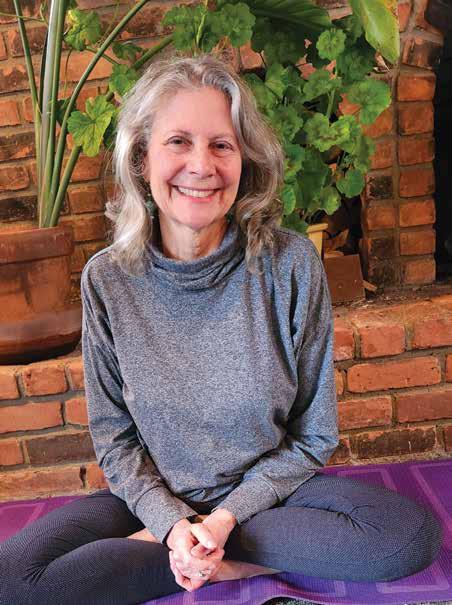
has been
having fun discovering the gold in her golden years with healthy whole foods, happy dancing, and stress-less living. She created Health Yourself Well to share the secrets she’s discovered. As a health empowerment coach, she believes all of us can be trimmer, more energetic, free of chronic disease, and generally more youthful, regardless of age.
Unfortunately, myths about aging keep many from enjoying their wisdom years. In classes and individual sessions, she helps participants identify and overcome barriers to their optimum health and happiness. Through individual sessions that transform subconscious beliefs, she helps discouraged empty nesters tap into their own healing powers. She offers workshops on Choosing Happiness, Law of Attraction, Sugar Management, and Belief Boosting. She’s honored to be a member of the Angel Whispers Healing Center in the heart of Dexter, Michigan. The diverse skills of the practitioners on the Angel Whispers' team are sure to help anyone seeking more healing, meaning, and joy in their life.
In addition to coaching, Bowman leads a brain-boosting dance class called Ageless Grace. She hosts a free monthly Food Over Medicine Club where members share recipes and learn about the positive effects of eating more whole-food, plant-based meals on the body, mind, and soul. For more information about classes and events, check out the calendar at AngelWhispers.org, or contact Barbara directly at Barbara@health-yourselfwell.com.


Emily Adama is a Mindfulness Teacher and the director of the EarthWell Retreat Center.
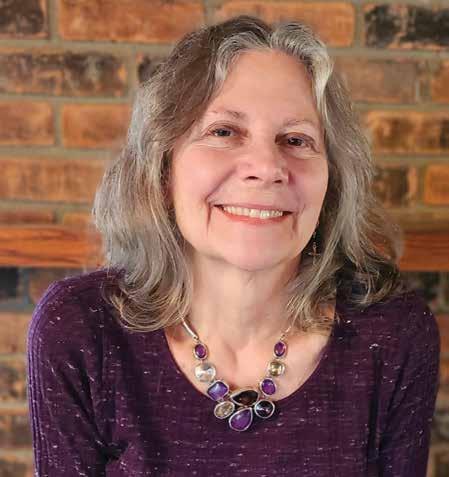


Julie Barron is a Licensed Natural Medicine Facilitator, music therapist, and community organizer/activist.
Layla Ananda is a trained musician whose story reflects a lifelong search for harmony within herself and with others.
Ann Arbor Yoga and Meditation is a Yoga Teacher Training school, Yoga Therapy, and retreat provider.
Andrea Astley, owner and founder of Crysterra Wellness in Dexter is an E-RYT-500 Certified Yoga Instructor and Meditation Coach and has been practicing for over 25 years.
Imam Ayubbi received his religious and spiritual education and training under the Islamic Supreme Council of America (ISCA) and was appointed as an imam in 2002.
Deanne Bednar, Instructor at Strawbale Studio since 2003, illustrated The Hand-Sculpted House , and loves to forage!
Rev. David Bell is a founding minister at the Interfaith Center for Spiritual Growth (ICSG), a diverse community exploring all spiritual paths.
Mylita Benjamin is a generational witch and Oracle. She has been reading professionally for over 20 years; aligned with guidance for the aspirant’s greater and highest good.
Carol Blotter has been teaching meditation for over 25 years. Her practice and study has led to a blending of Buddhism and Non-Duality teachings.
She is the primary teacher of Chelsea Meditation Group.
Rachel Briggs has been facilitating the virtual Ann Arbor Death Cafe since 2020.
Sari Brown, priestess of song, dance, and kitchen magic.
Grace Choi’s journey into Tarot and Astrology began in the fall of 2023, sparked by a time of personal adversity.
Marice Clark loves to share her knowledge about different crafts.
Clear Light Community, Rooted in Paramahansa Yogananda’s vision of harmonious world communities, is a joyful, cooperative place where residents support one another in balanced, uplifting living.
Elizabeth Kolbert has spent decades reporting from the fault lines of our planet—melting glaciers, vanishing species, rising seas, shifting microbial worlds. In Life on a LittleKnown Planet: Dispatches from a Changing World, she gathers essays that feel at once intimate and planetary, investigative and philosophical.
By Christine MacIntyre
Elizabeth Kolbert has spent decades reporting from the fault lines of our planet—melting glaciers, vanishing species, rising seas, shifting microbial worlds. In Life on a Little-Known Planet: Dispatches from a Changing World, she gathers essays that feel at once intimate and planetary, investigative and philosophical. The title itself is telling. For all our satellite imagery and data modeling, Kolbert suggests we are still strangers here. Early in the collection, she points to what biologist E. O. Wilson once called the “ultimate irony of organic evolution.” The human trajectory has become “increasingly destructive in its impacts” even as it grows “increasingly sophisticated in its insights.” Kolbert notes that this paradox animates the book, and the essays that follow explore it from multiple anglesthrough collapsing ecosystems, emerging technologies, and the scientists trying to understand both.
Readers familiar with Kolbert’s The Sixth Extinction will recognize her calm, surgical clarity, but this collection feels different in scope and rhythm. Instead of building one sweeping argument, the book moves in dispatches—compact, carefully constructed pieces that zoom in on particular moments: a researcher decoding whale vocalizations, an entomologist obsessing over a new species of caterpillars, lab-engineered solutions that border on science fiction. Each essay stands alone, yet together they accumulate into something heavier—a portrait of a planet mid-transformation.
Readers familiar with Kolbert’s TheSixthExtinctionwill recognize her calm, surgical clarity, but this collection feels different in scope and rhythm. Instead of building one sweeping argument, the book moves in dispatches— compact, carefully constructed pieces that zoom in on particular moments.
Kolbert excels at grounding abstract crises into tangible scenes. In one essay, she describes “leafing through beekeeping catalogs, weighing the advantages of wooden frames versus plastic ones”—a detail so small and procedural it might seem mundane. Yet, from that simple act, she widens the lens to show entire ecosystems tipping. Elsewhere, she follows researchers as they send an enormous drill through an over-eight-thousand-foot ice sheet, boring into genetic archives. The emotional tension lies not in dramatic prose but in restraint. Kolbert does not sermonize. She observes. She documents. And that restraint is precisely what unsettles.
Stylistically, Kolbert writes with a reporter’s discipline and an essayist’s ear. Her sentences are clean, controlled, and deceptively simple. She avoids
rhetorical fireworks. Instead, she builds momentum through accumulation— fact layered upon fact, anecdote placed beside data. The tone is measured, occasionally wry, often quietly incredulous. There is an undercurrent of astonishment in her work, but it is expressed through juxtaposition rather than exclamation.
Structurally, the dispatch format works powerfully. The essays vary in length and focus creating a rhythm that mirrors the unpredictability of the natural world itself. Some pieces linger in fieldwork; others pivot quickly to emerging technologies or policy shifts. The fragmentation feels intentional. Climate change and ecological collapse are not linear narratives but patchwork realities unfolding unevenly across geographies. Kolbert’s structure reflects that reality.
There is also a subtle philosophical thread running beneath the reportage. The book continually raises the question: What does it mean to know a planet? We catalogue species, measure atmospheric parts per million, and engineer synthetic biology, yet we remain surprised by cascading consequences. In this way, the “little-known planet” is not simply Earth; it is Earth as altered by human action. We have become a geologic force, but not an omniscient one.
Kolbert does not offer easy hope, nor does she collapse into despair. Instead, she inhabits complexity. She examines geoengineering proposals with skepticism but not dismissal. She profiles scientists who believe technological innovation may help mitigate disaster even as she underscores the moral and ecological risks. The result is a book that feels intellectually honest— unwilling to simplify or sensationalize.
For readers, this collection resonates on a deeper level than environmental alarm. It is a meditation on attention. Kolbert’s work asks us to notice the fungus on a bat’s wing, the chemistry of a warming ocean, and the bureaucratic language of climate policy. Attention, she suggests implicitly, is a form of responsibility.
What makes Life on a Little-Known Planet compelling is not just the urgency of its subject but the craft with which it is rendered. Kolbert trusts the reader. She trusts evidence. She trusts quiet revelation. In an era saturated with opinion and outrage, her steadiness feels radical.
By the final pages, the title lands with quiet force. The planet is not only changing, it’s becoming unfamiliar. The dispatches read like field notes from a threshold moment in history—a record of what we are witnessing and, perhaps, what we will one day struggle to explain.
Kolbert leaves us not with answers, but with a sharpened awareness that we are living on a world we are still learning to understand—and that the cost of not paying attention may be irreversible.



David Shiva Das’ performances unfold in real time, built from the ground up with shimmering guitar, hypnotic percussion, and swirling synths.
Tarianne DeYonker, OP, MSW, is a certified leader of Amherst Writers and Artists workshops.
Eileen Dickinson is passionate about integrating current science into bodywork practices. A retired PT, she currently practices Trager and Foundation Training with Trager International.
Miriam Dowd-Eller is a yoga teacher with special training in women’s yoga practices, and a licensed massage therapist.
Phoenix Duffy has been a long time Energy Healer and currently works with clients out of Thrive! Wellness Center in Saline.
The Dying Year is a leader in natural death care education, home funerals, and green burial.
EarthWell Retreat Center leads retreats focused on yoga, mindfulness, and nature connection.
Connie Eiland is a shamanic practitioner who has studied extensively with numerous teachers and has 25 years’ experience in shamanic teaching and healing work.
Daphne Fama is an Ann Arbor native and the author of House of Monstrous Women (Berkley, Penguin Random House).
Nora Farley is a composer whose music explores the sacredness of the Earth from many angles, delving into themes of environmentalism, natural history, and spirituality.
Jose Feliz is a longtime tai chi instructor. He helps students develop self-defense skills, strength, balance, and peaceful focus.
Jennifer Flynn, L.Ac. is an acupuncturist and founder of Roots of Wisdom Acupuncture. She integrates qigong to help patients reconnect to their body’s natural wisdom.
John Friedlander, is an internationally acclaimed psychic, author, and teacher with degrees from Duke University and Harvard Law.
Curtis Glatter teaches drumming and piano at Guitar Center-Canton. In 2023, his trio, Troikastra, released a CD, entitled “It’s the Door with the Little Stairs.”
Emily Golab is an Advanced NRT Practitioner focused on natural, personalized nutrition programs supporting whole-body wellness.
Golden Lotus Yoga Teachers Association offers gentle, meditative Hatha Yoga classes, training, and certification through experienced teachers, all Kriya Yoga initiates in the spiritual tradition of Paramahansa Yogananda.
Craig Harvey is a member at the Interfaith Center for Spiritual Growth (ICSG).
Forrest Hejkal is an actor, set designer, director, poet, facilitator, and community-builder.
Gloria Hemsher, gifted psychic, teacher, co-author of Psychic Psychology, 2011, and Basic Psychic Development, 1999.
Debra Hopper is a Certified Embodiment Coach who helps people get out of their heads and into their bodies to reduce stress and spark creativity.
Rob Hughes is a transformational therapist who encourages you to live with more joy.
Irene’s Myomassology Institute, founded by Irene Gauthier in 1987, is the oldest and largest massage school in the Midwest.
Jewel Heart is dedicated to bringing the practice of Tibetan Buddhism to everyone.
Jewel Heart Instructors lead participants in a guided meditation using visualization techniques to overcome physical, mental, and emotional suffering.
Jenna Hoyer has studied religion, spiritualism, and life philosophy. She has worked for Crazy Wisdom Bookstore for almost a year and enjoys sharing her discoveries with others.
Esther Kennedy, OP, a Adrian Dominican Sister of Adrian Michigan, is a retreat leader and Spiritual director. She conducts a monthly Day of Mindfulness at Weber Center.
Rev. Annie Kopko is an associate minister at the Interfaith Center for Spiritual Growth (ICSG) in Ann Arbor.
Julie Kouyate is a Massage and Bodyworker, a master bodymind somatic coach, and breathwork certified.
Mady Kouyate is a West African griot and oral historian/musician of the Manding tradition.
Mary Ledvina, MOT, was trained by Plant Spirit Medicine Woman in Shamanism and how to be a cacaoista. She is a writer, artist, coach, teacher, and healer.
Peter D. and Bobbi Llewellyn-Harper are Award winning Australian musicians and sound healers that use didgeridoo sound/color vibrational attunement/ vocal intonations conscious connected breath work.
Mary Light is an LMT, clinical herbalist, and naturopath.
Gabi May is a current PHD student at UM’s College of Pharmacy who was taught plants and their uses in childhood and works with medicinal chemistry.
Nina McDermott is a spiritual healer that uses Tarot and Oracle cards to help clients gain insight for growth and transformation.
Jenn McFarland has over 12 years experience as a TFT Tapping practitioner and developer of Custom Made Change, a system to create and manage habits.
Drs. Molly McMullen-Laird, MD and Quentin McMullen, MD are board certified internal medical doctors with additional training in Anthroposophic Medicine. They have been practicing medicine in Ann Arbor for over 28 years.
Jackie Miller; Professional Breathwork Practitioner certified by the Global Professional Breathwork Alliance.

Tracy Ochester, Psy.D. is a licensed psychologist, a MBCT Teacher and Mentor, a MBRP and MSC teacher, and a yoga teacher.
The Peaceful Dragon School has provided the self-care practices of Tai Chi, and Qigong since 1990.
Drs. Will and Wendy PageEchols are retired Integrative Family Medicine physicians and lifetime yoga and meditation practitioners.
Rocky Shadowbear Rains has been a Shamanic Druidic practitioner for over 40 years.
Judy Ramsey is an approved instructor for Sandra Ingerman’s courses. She offers shamanic healing for humans; she also teaches and provides animal communication.
Lucinda Reinas has been a practicing green witch for over 35 years. She is a certified health coach and rewilder of tame landscapes.
Eric Rentschler (Dreamwalker Arts) is a Michigan based multidisciplinary artist working at the intersection of sacred symbolism, mythic archetypes, and dimensional wood carving.



Demo Rinpoche is Jewel Heart’s Resident Spiritual Advisor. He studied under the supervision of the Dalai Lama and holds the highest monastic degree of Geshe Lharampa.
Joel Robbins has been studying Tai Chi since the 1990s and teaching since 2004. He has a master’s in acupuncture and a BS in nutrition.
Dr. Shannon Roznay, DC, Clinic Director, is a chiropractor specializing in Nutrition Response Testing, with 18+ years’ experience training thousands of practitioners.
Merilynne Rush, MSHP, BSN, provides comprehensive natural death care consulting. She also consults and teaches on home funeral, green burial, and advance care planning.
Hartmut Sagolla has been studying Tibetan Buddhism for over 30 years. Since 2002, he has served as a Program Director at Jewel Heart.
Michael Marie Schofield is a fiber and funerary artisan and crafts caskets, urns, and plant-dyed shrouds with natural materials. She is a co-founder of the Michigan Deathcare Collaborative.
Cyrus Scholl is a somatic coach & traditional Chinese martial arts practitioner.
Megan Sims, aka Me-Again, is a certified mystical, magical movement medicine facilitator whose mission is wholeness, joy, and connection. She holds a BFA, MA in Counseling, and is a dance wellness facilitator.
Sydney Spears, Ph.D., LCSW is a certified Mindful-Self Compassion (MSC) teacher and recent Director of DEIB for the Center of Mindful Self-Compassion.
Ema Stefanova, C-IAYT, E-RYT500, is a highly trained master yoga and meditation teacher and the owner of Ann Arbor Yoga and Meditation.
Tatianah Thunberg, LMSW, works with couples in holistic private practices.
Ari Wakeman, LMSW, is a yoga teacher and somatic-focused therapist.
Joe Walters has been a tai chi practitioner for 30+ years.
Matt Watroba is the producer and host of Detroit Public Radio’s Folks Like Us program, and the nationally syndicated Sing Out Radio Magazine and Folk Alley
Carisa Wilder, LMSW, works with couples in holistic private practices.
Suzy Wienckowski, Reiki Master has been teaching Reiki for 30 years.
Wasentha Young is a Master of Tai Chi and Qigong. She has also received formal instruction in Buddhist and Taoist mindful meditation styles.
Sharon Zayac, OP, A Dominican Sister of Springfield, IL, is an author, speaker, and leader focusing on cosmology and consciousness and their implications for life and faith.
Zen Temple Clergy have been ordained as priests and lay Dharma teachers through the Maitreya Buddhist Seminary.
LaTonya Zibi is a licensed psychotherapist with over 25 years experience. She holds master’s degrees in psychology and theology, with expertise in spirituality, metaphysics, grief, and purpose.
Laura Ziemba has been practicing Reiki since 1986 and began teaching in 1999. She also practices Craniosacral therapy, myofascial release, and massage.
Mari Ziolkowski Ph.D., has a Doctorate in Women’s Spirituality, is an MSW level counselor, an author, meditator, nature mystic, Goddess devotee, and student of African Traditional Religions.