GUARDIAN

GUARDIAN
“Guardian” is
and industry
Copyright 2026, CVSA. All rights reserved. No part of this issue may be reproduced without written permission from the publisher.
For comments, suggestions or information, email communications@cvsa.org.

CVSA is looking for interesting, relevant content for its quarterly magazine. We would be happy to consider your news, ideas, insights and articles on issues facing the commercial motor vehicle safety community for upcoming editions of “Guardian” magazine.
The deadlines for upcoming editions are available at www.cvsa.org/guardianmagazine/deadlines-for-submissions.
Questions? Please contact CVSA Writer-Editor Emily Moorhead at emily.moorhead@cvsa.org.

By Maj. Erick McGuire, Commercial Vehicle Enforcement, Florida Highway Patrol
This year’s Cooperative Hazardous Materials Enforcement Development (COHMED) Conference, held Feb. 2-6 in San Antonio, Texas, served as a premier summit for the North American hazardous materials and dangerous goods community.
The event featured a comprehensive set of activities designed to synchronize regulatory enforcement with industry operations, beginning with specialized training, such as the Level VI Inspection Refresher Course for certified inspectors. This intensive training covered critical subjects, including radiation physics, survey procedures and the application of North American Standard Out-of-Service Criteria.
Beyond technical classrooms, the conference included high-level briefings and a dedicated exhibition hall showcasing safety solutions and hazmat scenarios to challenge participants' regulatory knowledge. Sessions focused on intermediate bulk containers, radioactive materials, special permits, design of high-pressure tanks and common cargo tank violations, just to name a few.
The conference's significance was highlighted by the attendance of top federal leadership, including Federal Motor Carrier Safety Administration (FMCSA) Administrator Derek Barrs and Pipeline and Hazardous Materials Safety Administration (PHMSA) Administrator Paul Roberti. FMCSA Administrator Barrs emphasized the vital role of frontline drivers and inspectors in community safety, while PHMSA Administrator Roberti spoke on the necessity of industry partnerships to drive innovation and efficiency in hazardous materials transport.
Their attendance signaled a clear federal priority to bridge the gap between oversight and industry operations. This approach encourages a safety-first culture rooted in shared ownership, ensuring that the focus remains on real-world protection rather than just a formal system for monitoring compliance. This high-level engagement provided attendees with direct insight into national policy priorities and the opportunity to influence future regulatory changes through open dialogue.
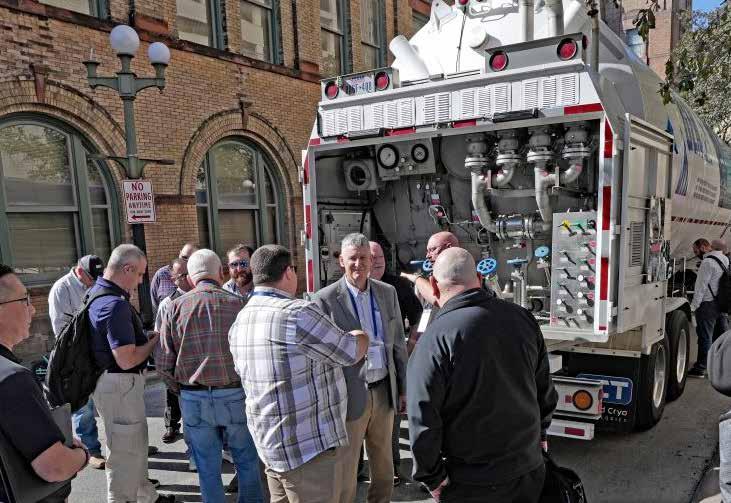
The COHMED program continues to provide immeasurable benefits to both industry and enforcement by creating a unique environment for information sharing and problem-solving.
For enforcement personnel, it offers both basic and advanced training, ensuring that inspectors across diverse jurisdictions apply regulations with high levels of uniformity and expertise. For industry, the COHMED Conference serves as a critical conduit for presenting concerns about the practical application of regulations, helping align regulatory theory with the practical realities of hazardous materials transport.
This cooperation fosters better working relationships and leads to more effective preparedness and mitigation strategies, ultimately reducing exposure risks for drivers, first responders and the general public during the transportation of hazardous materials and dangerous goods. By leveraging the latest technological advancements and shared best practices, the conference continues
to enhance the safety and integrity of the hazardous materials transportation network throughout North America.
The 2026 COHMED Conference was a resounding success, with an unmatched ability to bring together enforcement and industry to discuss and, at times, solve complex hazardous materials challenges. This event remains a one-of-a-kind training opportunity, serving as a critical conduit for improving safety and regulatory consistency across North America.
The collaboration that is always present at the COHMED Conference proves that when government and industry work together, the result is a safer environment that reduces crashes and incidents, ultimately saving lives –a momentum we are excited to carry forward to the 2027 COHMED Conference in Tampa, Florida. n

By Collin B. Mooney, MPA, CAE, Executive Director, Commercial Vehicle Safety Alliance
Public sector associations such as CVSA play a pivotal role in shaping effective governance, strengthening professional communities, and ensuring that safety, compliance and operational integrity remain at the center of decision-making. Associations serve as essential coordinators, educators and advocates. Their influence extends across enforcement agencies, regulatory bodies and industry stakeholders, making them indispensable to the advancement of commercial motor vehicle (CMV) safety and enforcement. At a time when governments face increasing complexity, rapid technological change and heightened public scrutiny, the importance of public sector associations has never been more pronounced.
One of the most critical functions of public sector associations is fostering professional development by standardizing training and enforcement practices. CMV enforcement officers are tasked with interpreting and applying a wide array of regulations, including those related to driver qualifications, vehicle maintenance and hazardous materials. Associations provide structured training programs, certification standards and continuing education opportunities that ensure inspectors across jurisdictions operate with a consistent understanding of the regulations. This uniformity is crucial in maintaining fairness and effectiveness, particularly in interstate operations, where inconsistent enforcement could disrupt commerce and undermine safety. Through conferences, training programs, certifications and publications, they help ensure that public sector professionals are equipped with the skills and knowledge necessary to perform their duties effectively. Public service roles are diverse, and associations provide structured opportunities for individuals in these fields to stay informed about best practices, emerging trends and evolving regulations.
Equally important is the role these associations play in building professional networks. Public sector work can sometimes be siloed, with departments and agencies operating independently. Associations break down these barriers by creating spaces where professionals can connect, exchange ideas, and collaborate across jurisdictions and disciplines. These networks are invaluable during times of crisis

or reform, when coordinated responses and shared expertise are essential. By facilitating communication and cooperation, public sector associations contribute to more cohesive and resilient governance systems.
Advocacy is another critical function of public sector associations. While individual public servants are often limited in their ability to influence policy, associations can collectively represent their members’ interests and perspectives. They represent the collective voice of enforcement professionals in legislative and regulatory discussions, ensuring that policy decisions are informed by practical, on-the-ground experience. This advocacy can lead to improved safety regulations and the development of initiatives aimed at reducing crashes and fatalities. They act as a unified voice in discussions with policymakers, legislators and the public, advocating for policies that enhance the effectiveness, fairness and sustainability of public services. In doing so, public sector associations help ensure that policy decisions are informed by practical experience and professional expertise.
Closely tied to training is the role of public sector associations in promoting regulatory
harmonization. CMVs routinely cross state and national boundaries, making it imperative that enforcement frameworks are aligned. Associations facilitate collaboration between state, provincial and federal agencies to develop consistent policies and procedures. By convening stakeholders and fostering dialogue, they help reduce regulatory fragmentation and support the implementation of unified safety standards. This not only enhances compliance but also reduces administrative burdens on carriers and drivers who must otherwise navigate a patchwork of rules. This sharing of knowledge enables public institutions to learn from one another and implement proven solutions rather than reinventing the wheel. As a result, associations accelerate progress and improve outcomes across the public sector.
Public sector associations play an essential role in shaping, standardizing and advancing CMV safety and enforcement across North America. Organizations such as CVSA exemplify how coordinated, multijurisdictional collaboration can significantly improve roadway safety, regulatory compliance and the overall efficiency of freight transportation systems. In an industry where CMVs traverse vast geographic regions
under varying regulatory frameworks, the importance of unified guidance, shared expertise and consistent enforcement cannot be overstated.
One of the most critical contributions of public sector associations like CVSA is the development and maintenance of uniform inspection standards. CMV enforcement relies heavily on roadside inspections to identify safety violations related to equipment, driver qualifications and motor carrier compliance. CVSA’s North American Standard Inspection Program provides a consistent framework used by enforcement agencies across Canada, Mexico and the United States. This standardization ensures that inspections conducted in one jurisdiction are aligned with those in another, promoting fairness and predictability for motor carriers and drivers. Without such uniformity, enforcement efforts would be fragmented, leading to confusion, inefficiencies and potential safety gaps.
Another key function of these associations is facilitating data sharing and analysis. Effective CMV enforcement is increasingly driven by data, including inspection results, crash reports and compliance histories. Public sector associations act as centralized hubs for collecting and analyzing this information across jurisdictions. By identifying trends, high-risk carriers and common violation patterns, they enable enforcement agencies to adopt more targeted and efficient strategies. Programs such as data-driven enforcement initiatives allow agencies to prioritize resources where they are most needed, maximizing the impact of limited enforcement capacity.
Technology integration is another area where public sector associations demonstrate significant leadership. The CMV industry has undergone rapid technological transformation, with the adoption of electronic logging devices, advanced driver assistance systems, weigh-in-motion technology and real-time data platforms. Associations like CVSA help guide the implementation and standardization of these technologies within enforcement practices. They provide training, establish best practices and ensure interoperability across jurisdictions. By doing so, they enable enforcement agencies to leverage
technology to enhance accuracy, efficiency and transparency.
Equally important is the role these associations play in fostering collaboration between enforcement agencies and the commercial transportation industry. Safety is a shared responsibility, and effective enforcement depends on constructive engagement with motor carriers, drivers and industry organizations. Public sector associations create forums for dialogue through conferences, committees and outreach initiatives. These interactions help build mutual understanding, allowing enforcement agencies to communicate expectations clearly while gaining insight into operational challenges faced by the industry. This collaborative approach encourages voluntary compliance and supports a culture of safety rather than adversarial enforcement.
Additionally, public sector associations play a vital role in public education and awareness. By developing educational materials, campaigns and outreach programs, they inform drivers, carriers and the general public about safety requirements and best practices. These efforts help reduce violations, prevent crashes and promote a broader understanding of CMV safety. Education complements enforcement, creating a more comprehensive approach to risk reduction.
In conclusion, public sector associations are indispensable as they act as connective tissue between agencies, professionals, policymakers and the communities they serve. Through standardization, training, data analysis, policy advocacy, technological advancement, industry collaboration, ethical guidance, workforce development and public outreach, they provide the infrastructure necessary for a coordinated and effective enforcement environment. As the commercial transportation landscape continues to evolve, the role of associations will only grow in importance. Supporting their work is essential to ensuring safer roads, more efficient freight movement, and a stronger, more unified approach to enforcement across jurisdictions. n

Region I
Connecticut, Delaware, District of Columbia, Maine, Maryland, Massachusetts, New Hampshire, New Jersey, New York, Pennsylvania, Puerto Rico, Rhode Island, U.S. Virgin Islands and Vermont
Region II
Alabama, American Samoa, Arkansas, Florida, Georgia, Kentucky, Louisiana, Mississippi, North Carolina, Oklahoma, South Carolina, Tennessee, Texas, Virginia and West Virginia
Region III
Colorado, Illinois, Indiana, Iowa, Kansas, Michigan, Minnesota, Missouri, Nebraska, North Dakota, Northern Mariana Islands, Ohio, South Dakota and Wisconsin
Region IV
Alaska, Arizona, California, Guam, Hawaii, Idaho, Mexico, Montana, Nevada, New Mexico, Oregon, Utah, Washington and Wyoming
Region V
Alberta, British Columbia, Manitoba, New Brunswick, Newfoundland and Labrador, Northwest Territories, Nova Scotia, Nunavut, Ontario, Prince Edward Island, Quebec, Saskatchewan and Yukon
By Sgt. Seth Turner, Motor Carrier Enforcement Unit, New Hampshire State Police
It seems almost daily that troopers here in New Hampshire stop commercial motor vehicles (CMVs), and based on the load or the configuration of the vehicles, it’s found that the driver is required to possess a commercial driver’s license (CDL) but only holds a non-CDL operator's license. As part of the inspection process, troopers review previous inspection reports. Upon doing so, they sometimes discover that the driver had previously been placed out of service in another state, while operating the same combination, loaded the same way, for the same reason: the driver needed a CDL and didn’t have one.
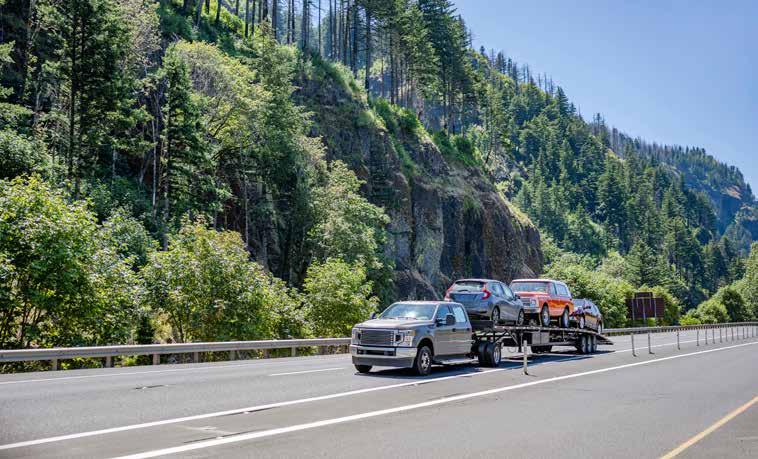
It is no secret that this example is most often found with “hot shot” motor carriers, where the gross combination weight rating is 26,000 pounds or lower, which does not require a CDL-A; however, because the CMV is laden with three or more vehicles, it puts the gross combination weight over 26,000 pounds.
Here in New Hampshire, violating an out-ofservice order falls under the following:
RSA 263:93-a: Disqualification and Out-ofService Orders
Notwithstanding any law to the contrary, any person who knowingly drives a commercial motor vehicle that is subject to an out-of-service order shall be guilty of a class B misdemeanor.
In situations like this, it is not uncommon for our troopers to charge the driver for “Operating without the Proper Class of License (CDL Required)” and for violating the out-of-service order pursuant to “NH RSA 263:93-a.” Both offenses require the driver to appear in the court of jurisdiction to answer to the charges.
Some drivers who have demonstrated their lack of compliance with these prior out-of-service orders have even been arrested and held on preventive detention, based on multiple prior inspections for the same offense and their complete disregard for the public’s safety.
Here in New Hampshire, when there is evidence to support it, we will also charge the motor carrier for allowing such prohibited operators to continue operating, under the state law of “Allowing an Improper Person to Operate.” Motor carriers are responsible for all their drivers at all times. In today’s world of technology, all inspection reports are automatically forwarded to a carrier’s email address on file. Therefore, if a driver is placed
out of service, the motor carrier should be aware of it.
As much as this all sounds well and good, successfully prosecuting the out-of-service order violations based on an out-of-service order issued by an officer/trooper/inspector from another state has been and continues to be a challenge.
I’m sure the audience reading this article could provide many examples of similar scenarios. One of our troopers recently had a case in which, due to the rules of evidence, a charge of “263:93-a Disqualification and Outof-Service Orders” was dismissed. Why? Prior to trial, the trooper attempted but was unable to obtain a certified copy of the other state’s inspection report to provide as evidence.
Under the rules of evidence submission, courts will only allow a document to be entered as evidence if it has been certified by its creator or the keeper of records. This is like submitting a motor vehicle record as evidence to prove that a driver was operating after suspension. In lieu of actual testimony from the out-of-state inspector who originally placed the driver out of service, the courts will most likely honor prior inspection records only if certified. Certified records are also required to prove that a motor carrier knew they were allowing an improper person to operate in violation of an out-of-service order or that carriers failed to correct previous defects.
After speaking with many subject matter experts as it relates to identifying who is the keeper of the records, despite inspection reports being housed and easily accessible in Query Central, the consensus says that the individual states are the keepers of the record and would be the organization to contact to obtain a true, correct and certified copy of the record. In the case mentioned above, our trooper exhausted his efforts to obtain a certified copy of the record for several reasons (not to reflect negatively on that individual state). The only option was to submit the report obtained through Query Central, which was quickly objected to by the defense.
Given that access to Query Central is limited to privileged individuals and/or organizations, it would make sense for the Federal Motor Carrier Safety Administration (FMCSA) to implement a certification seal on these documents that
the court would accept, bearing the current Secretary of Transportation’s signature. This would circumvent the significant effort required to track these documents down in a timely manner, given that we are all doing more with less nowadays. In New Hampshire, troopers often prosecute their own cases.
After a year-long discussion, the trooper who originally brought this issue to my attention was encouraged to submit a CVSA Request for Action on this very matter. The issues highlighted in the request for action submitted on Jan. 30, 2026, provide the same shortcomings as illustrated in this article, with the addition of addressing the following:
Neither CVSA nor FMCSA has a policy/ procedure or even guidance for obtaining certified copies of inspection reports.
The issue persists that states have gotten away from collecting driver signatures, and reports from Query Central do not include them. Did the driver know they were placed out of service?
There is a need for additional guidance or penalties for motor carriers that fail or refuse to return a signed inspection report acknowledging an out-of-service driver or condition on their vehicle.
Lastly, determine “who is the keeper of the record” and what is the best way to get that record in the hands of those who need it, in the proper form to successfully prosecute these motor carriers and drivers who disregard our laws and pose such a large threat to public safety. After all, that is why we are here and do what we do.
In addition to these recommendations, FMCSA should establish a regulation prohibiting the de-rating of any CMV, thereby preventing these improperly licensed drivers from getting behind the wheel in the first place. It’s not until these CMVs are loaded that these violations are encountered. Why not prevent them from operating such vehicles before the added weight and target the deceptive practices of de-rating vehicles to circumvent the CDL requirement?
In closing, for those of you who want accountability for drivers and motor carriers
who are stopped and cited for intentionally and knowingly operating a vehicle with the improper class of license, operating after being placed out of service or motor carriers who fail to correct violations, I encourage you to weigh in on this topic when brought up at the CVSA Annual Conference and Exhibition this fall. This is a tin can that can no longer be kicked down the road. With modern technology and a few bright minds, I think we can come up with a solution to address this shortcoming that will give all of us some teeth when it comes to successfully prosecuting cases like those mentioned in this article.
I look forward to the discussion that arises from this request for action, in the hope that this matter is addressed. n
By Sgt. William Vieweg, Commercial Vehicle Safety Division, Connecticut Department of Motor Vehicles
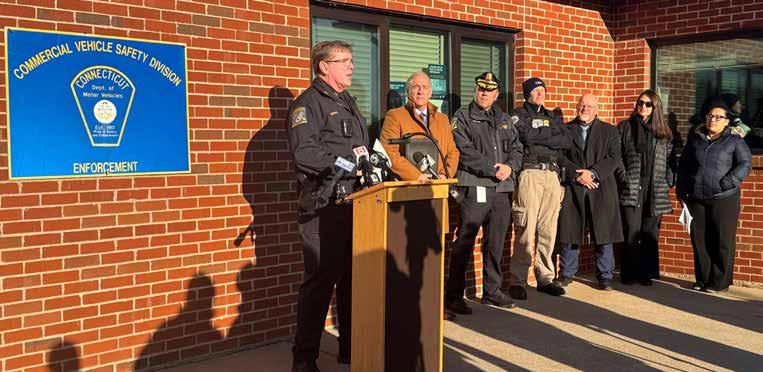
Human trafficking is a crime that affects every country in the world and people of all ages, genders, ethnicities, socioeconomic statuses and cultural backgrounds. During National Human Trafficking Prevention Month in January, the state of Connecticut participated in a joint enforcement and information campaign.
On Jan. 12, the Connecticut Department of Motor Vehicles (DMV) Commercial Vehicle Safety Division (CVSD), managed by Chief Matthew Galante; the Connecticut State Police Traffic Services Unit, managed by Sgt. Dickie Murchinson; Homeland Security; the Federal Motor Carrier Safety Administration (FMCSA); and the Connecticut Department of Children and Families (DCF), with support from numerous news outlets, conducted a joint commercial vehicle enforcement and informational effort supporting National Human Trafficking Prevention Month.
Connecticut DMV CVSD and Connecticut State Police Traffic Services routinely promote human trafficking awareness in partnership with CVSA and FMCSA. Human Trafficking Awareness Week in Connecticut proved an ideal time for Connecticut DCF to highlight their Human AntiTrafficking Response Team, a full-response, multidisciplinary team dedicated to identifying, responding to and supporting victims of human trafficking.
The operation took place at and around the Union Connecticut Weigh Station,
where normal commercial motor vehicle (CMV) inspections are conducted daily and information is routinely provided to drivers at the fixed portion of the scale. During the operation, officers stopped CMV drivers as they entered, as well as those who bypassed or even blew by the scale and those who were traveling in the opposite direction.
Not only did the officers complete various levels of inspections and administer enforcement where appropriate, but they also informed drivers of their importance in helping find and rescue victims of human trafficking. Inspectors explained to the drivers that they are the eyes and ears of law enforcement when it comes to human trafficking, as they use many different highways, truck stops and other locations as they travel locally or across our great country. Each driver was handed a “Make the Call, Save Lives” brochure with a list of potential human trafficking indicators and numbers they could call or text with information. A total of 61 inspections were completed, and officers spoke with more than 270 drivers at the scale.
The news stations filmed messages from several enforcement groups, presented in English and Spanish, to help inform the general public about the importance of the campaign. Although the concentrated campaign has ended, the effort continues at five fixed scale locations within the state and during our roadside stops. n

By Sgt. Denise Meredith, Commercial Vehicle Enforcement, Florida Highway Patrol
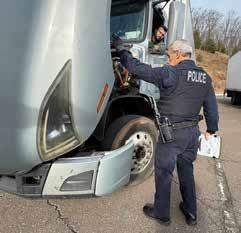
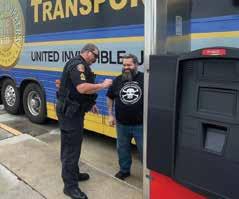
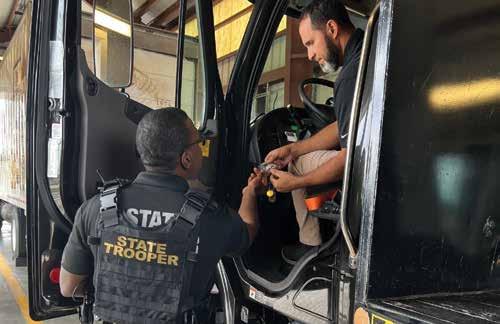
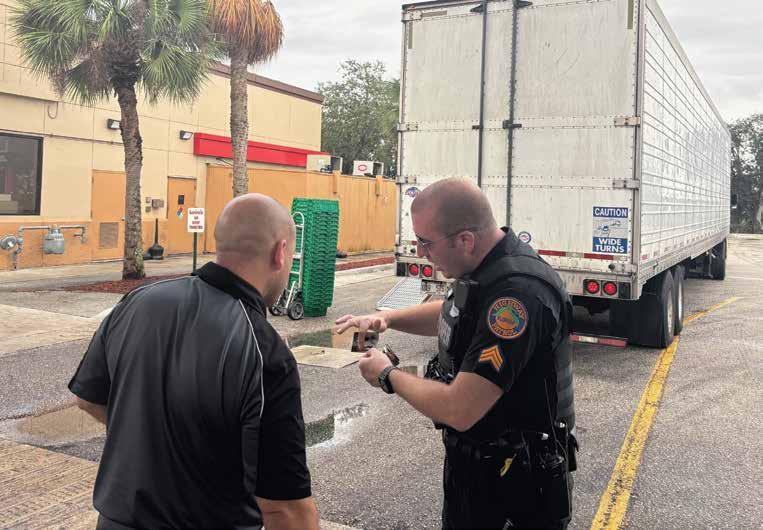
As part of CVSA’s Human Trafficking Awareness Initiative (HTAI) in January, Florida Highway Patrol (FHP) Commercial Vehicle Enforcement (CVE) officers presented information from “Busing on the Lookout” while conducting inspections.
Continued from page 7
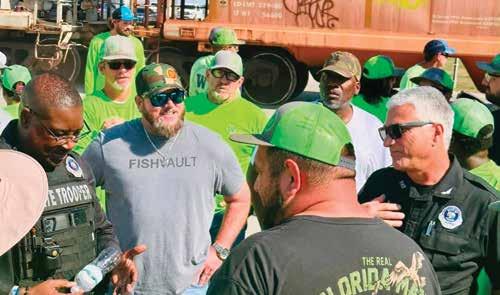
CVE Ft. Myers Sgt. Booker Ferrell and Tpr. Anthony Pardal conducted outreach at Wedgeworth Fertilizer Co. in Clewiston, Florida. They educated professional drivers on the consequences of distracted driving, alcohol and drug use, the importance of the pre- and post-trip inspections, and proper commercial driver’s license credentials and endorsements.
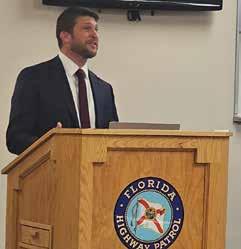
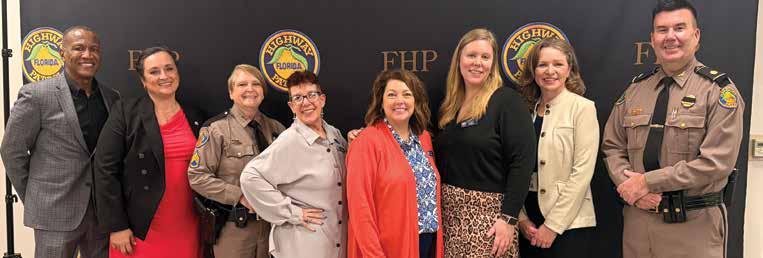
On Feb. 19, the Florida Highway Patrol hosted a coalition-building event with TAT (formerly known as Truckers Against Trafficking) at the Troop E station in Miami, Florida. This event was an opportunity to build local partnerships to end human trafficking.
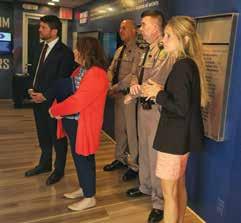
Establishing effective and sustainable working relationships between leaders in transportation and law enforcement helps combat human trafficking. Florida Attorney General James Uthmeier was a guest speaker. He and his wife, Jean Uthmeier, toured the Freedom Drivers Project exhibition trailer, which travels across the U.S. and Canada, educating audiences about the realities of human trafficking. The exhibit includes artifacts from real-life cases that connect people to the stories of human trafficking survivors. It also features portraits of everyday heroes, highlights how the transportation industry is helping to end human trafficking and shares simple action steps anyone can take to make a difference. n
By Lt. Stephen Burnham, CVE Projects and Research, Commercial Vehicle Enforcement, Georgia Department of Public Safety
Cargo theft is more than a property crime. It threatens supply chain stability, increases industry costs and ultimately impacts the consumers who rely on those goods. As freight movement has grown more complex and technology-driven, criminal activity has evolved alongside it. Organized groups now exploit digital platforms, fraudulent carrier identities and multi-jurisdictional tactics to target high-value loads and quickly move stolen goods across North America.
Addressing this challenge requires more than reactive investigation. Law enforcement agencies across the U.S. are managing significant caseloads that often require prioritizing violent crime and urgent public safety threats, making it difficult to consistently dedicate resources to complex property crimes such as cargo theft.
These investigations frequently require extensive coordination across jurisdictions and a deep understanding of how freight moves through the supply chain. Effective cargo theft enforcement demands specialized knowledge of carrier operations, freight documentation, regulatory requirements and logistics patterns, along with established relationships across the commercial transportation industry as a whole.
The Georgia Department of Public Safety (DPS) Commercial Vehicle Enforcement (CVE) operates daily within that environment and maintains strong networks with carriers, shippers and industry stakeholders. That connectivity, combined with regulatory expertise and field presence, positions CVE as an ideal law enforcement division to address the growing and increasingly sophisticated problem of cargo theft.
In January, Georgia DPS CVE assumed responsibility for the state’s Cargo Theft Unit from another state law enforcement agency. This transition reflects a deliberate realignment to place cargo theft investigations within the Georgia DPS CVE, which operates daily at the center of commercial motor vehicle (CMV) activity across the state. The transition was supported by DPS Commissioner Col. Hitchens, whose leadership enabled CVE Commanding Officer Maj. Montgomery and Executive Officer Capt. Huff to coordinate the movement of the unit from one state agency to another.
Continued on next page
Continued from page 9
CVE personnel engage with the commercial transportation industry every day. Inspectors conduct roadside inspections, compliance reviews and targeted enforcement initiatives. CVE works directly with drivers, motor carriers and safety managers, maintaining a clear understanding of how freight moves, how carriers operate and where vulnerabilities exist.
Cargo theft frequently intersects with fictitious carrier schemes, fraudulent registrations, identity theft and other CMV-related violations. Indicators of criminal activity may surface during routine inspections long before a theft is formally reported.
By housing the Cargo Theft Unit within CVE, the connection between frontline inspection activity and criminal investigation is strengthened. Information moves faster. Patterns become clearer. Leads are developed without delay.
This integrated model enhances prevention and enforcement.
The effectiveness of this approach is already evident.
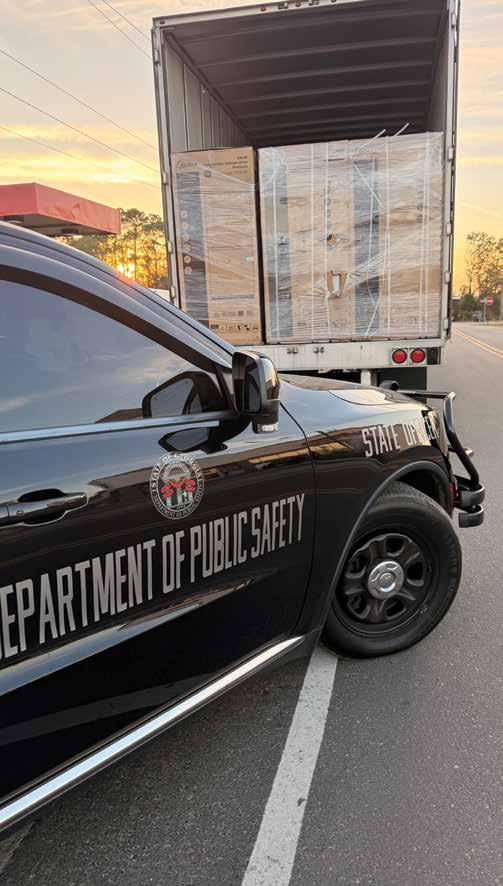
On Nov. 20, 2025, while returning from a Georgia Cargo Theft Meeting in Savannah, Sgt. Swain observed a 2020 semitrailer backed into a wooded area behind a business in Candler County. A VIN check revealed the trailer had been reported stolen months earlier, and upon inspection, it was found loaded with 57 refrigerators valued at approximately $70,000. What initially appeared to be an abandoned trailer resulted in the recovery of significant stolen property.
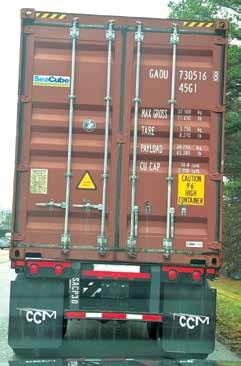
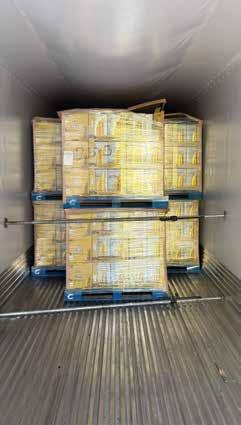
On Dec. 5, 2025, a stolen trailer was located in Fulton County containing aviation tires valued at approximately $420,000, high-value specialized cargo frequently targeted for resale through organized channels.
Following the formal transition of the unit in January, investigative activity continued. On Feb. 16, Sgt. 1st Class Bell identified a white day cab tractor connected to the theft of approximately $100,000 worth of furniture. Further investigation revealed that the tractor
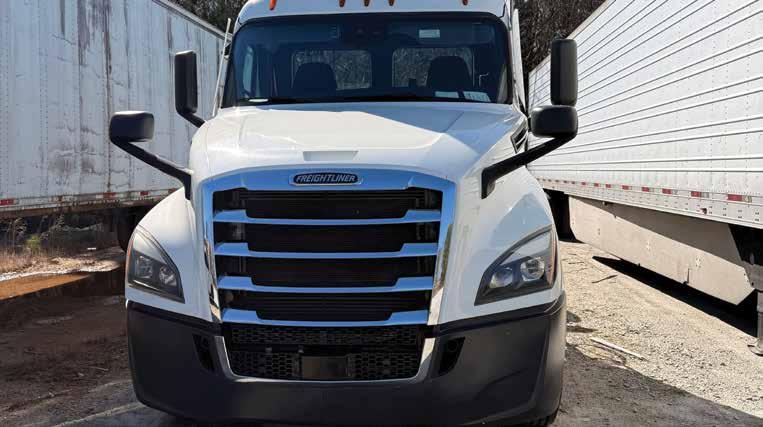
itself had been stolen days earlier and was valued at $70,000. The tractor had no tags or USDOT numbers, and its GPS unit had been removed in an apparent attempt to avoid detection. The vehicle was recovered, and the investigation remains ongoing.
These incidents reflect a consistent pattern. Equipment is concealed. Identifiers are removed. Tracking systems are disabled. Highvalue freight is redirected quickly.
Successful recovery depends on experience, regulatory knowledge and coordinated follow-up.
The mission of the CVE Cargo Theft Unit is to protect the integrity of the supply chain through proactive investigation, intelligencedriven enforcement and strategic partnership.
The unit’s core responsibilities include:
Investigating cargo theft incidents statewide
Identifying and targeting organized theft groups
Conducting intelligence analysis to detect emerging trends
Coordinating joint operations with local, state and federal partners
Providing outreach and education to industry stakeholders
Cargo theft rarely stays within one jurisdiction. Stolen freight may cross county or state lines within hours. Fraudulent carrier identities may originate in one state and operate in another. Effective enforcement requires coordination and clear investigative leadership.
The CVE Cargo Theft Unit provides that structure.
CVE delivers training to local agencies through its established CMV 101 course, providing practical instruction on CMV operations, vehicle identification and applicable state laws governing CMVs. Beyond the classroom, this training strengthens working relationships between CVE and partner agencies, creating
a foundation for coordinated efforts. With the transition of the Cargo Theft Unit to CVE, the course is expanding to include focused instruction on cargo theft awareness, investigative indicators and proper identification in agency reporting, ensuring agencies are better prepared to recognize and investigate these crimes together.
Cargo theft incidents are sometimes documented as general theft offenses, with little reference to commercial cargo theft, making trend analysis and accurate statewide tracking difficult. By integrating cargo theft education into CMV 101 and working alongside agencies on cargo-related cases, CVE is strengthening reporting practices, improving data quality and enhancing coordinated efforts.
Cargo theft cannot be addressed by enforcement alone. Successful cases often begin with information from the transportation industry. A shipment that never arrives. A carrier that cannot be verified. Equipment or drivers operating under suspicious circumstances. These early indicators matter, and timely communication can significantly increase the likelihood of recovery.
CVE’s presence within the commercial transportation environment allows for direct engagement with carriers, shippers and warehouse operators when concerns arise. That engagement goes beyond reporting. It includes investigative coordination, follow-up and feedback that helps industry partners better understand how theft schemes are evolving. Awareness of the Cargo Theft Unit is now incorporated into the division’s ongoing carrier and driver outreach and education efforts, ensuring stakeholders understand reporting pathways and investigative resources. Through expanded outreach and ongoing communication, CVE enhances industry awareness, strengthens preventive measures and provides direct support to safeguard freight from theft activity.
The supply chain is critical infrastructure. Every stolen load increases cost, disrupts distribution networks and directly impacts businesses and consumers who rely on the timely delivery of goods. Recent recoveries,
including $70,000 in consumer appliances, $420,000 in aviation components and $70,000 in commercial equipment, illustrate the scale and financial impact of these crimes.
As cargo theft tactics grow more sophisticated, enforcement strategies must evolve. Intelligence-driven approaches, regulatory expertise and coordinated partnerships are essential for an effective response. Assuming leadership of the Cargo Theft Unit in January represents a deliberate step toward strengthening Georgia’s ability to detect, disrupt and deter organized cargo theft.
Cargo theft affects industry, consumers and the broader economy. Addressing it requires sustained focus, improved reporting, collaborative investigations, proactive outreach and support from industry partners. CVE stands ready to lead this effort and to work alongside law enforcement and industry partners to protect the integrity of Georgia’s transportation system and the supply chain it supports. n
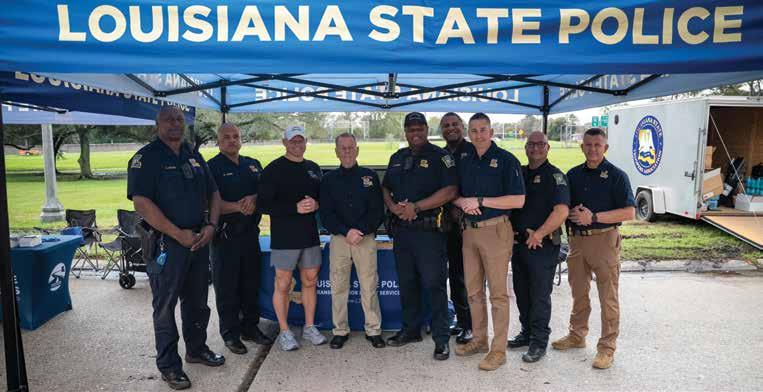
By Sgt. Gregory Handy Jr., Louisiana State Police Transportation Safety Services
In the U.S., every January since 2010 has been proclaimed National Human Trafficking Prevention Month. This raises awareness, educates the public, and encourages action to prevent and stop this crime. Human trafficking continues to affect communities nationwide. Each January, we are reminded of our shared responsibility to protect vulnerable individuals and bring offenders to justice.
The Federal Motor Carrier Safety Administration (FMCSA) now requires human trafficking awareness for Motor Carrier Safety Assistance Program (MCSAP) grant eligibility. To fulfill this obligation and promote awareness, Louisiana State Police Transportation Safety Services (LSPTSS) partnered with the Louisiana State Troopers Association (LSTA). Together, they hosted the first-ever Human Trafficking Awareness 5K Run or Walk.
The event took place on Jan. 10. The route began and ended at the Governor’s Mansion. The event featured Col. Robert Hodges, superintendent of the Louisiana State Police, as the keynote speaker. Members of the Governor’s Office of Human Trafficking Prevention, Office of Motor Vehicles, LSP-Fusion Center, and the Governor’s Office of Homeland Security and Emergency Preparedness also participated.
This race united the public to inform, engage and inspire action against human trafficking. By linking physical fitness with this social cause, we encouraged communities to join the ongoing fight.
This initiative was more than a community event; it was a unified stand against human trafficking, demonstrating the Louisiana State Police’s ongoing commitment to protecting the most vulnerable. With more than 300 participants, the event boosted efforts in prevention, reporting and education. Importantly, it reassured survivors and at-risk individuals that Louisiana supports them and that they are not alone. n




By Master Sgt. Victor McCarty, Public Affairs, Commercial Transportation Enforcement Division, Mississippi Department of Public Safety
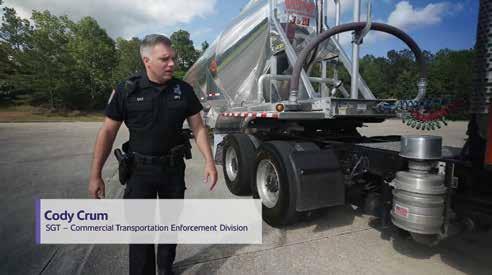
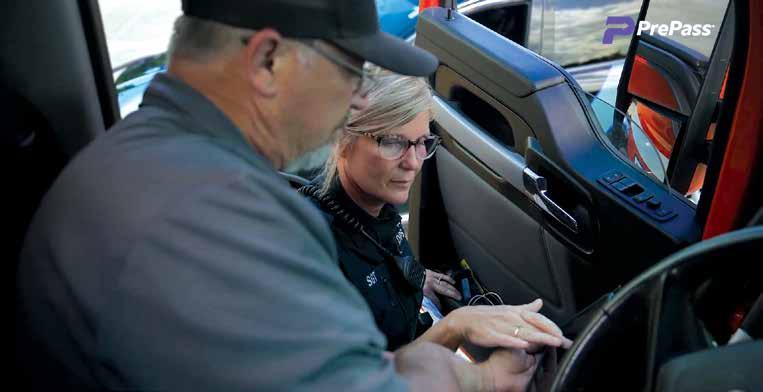
The Mississippi Commercial Transportation Enforcement Division (CTED) was recently featured on the PrePass Safety Alliance YouTube channel, where CTED officers Sgt. Cody Crum and Staff Sgt. Amanda Richardson showcased the strong partnership between law enforcement and the trucking industry. Their professionalism and clear communication reflected positively on CTED, emphasizing a modern enforcement approach focused on safety, efficiency and mutual respect. Sgt. Crum highlighted the importance of stopping only vehicles that pose safety risks while allowing compliant drivers to continue operating without unnecessary delays, reinforcing the idea that both enforcement and industry share the same goal of safer highways.
The full video is available here: www.youtube.com/watch?v=DwBZtAL7Hd8
The PrePass Safety Alliance, established in 1993, is a nonprofit public-private partnership formed by trucking industry leaders, enforcement agencies and state departments of transportation to enhance commercial transportation safety and efficiency. PrePass plays a role in inspection station operations through screening technology by identifying
higher-risk carriers for inspection and allowing safe carriers to bypass weigh stations.
The recent feature of CTED officers highlights the continued success of this partnershipdriven approach, demonstrating how collaboration between law enforcement and industry leads to meaningful improvements in highway safety and operational efficiency. n

By Tpr. B.S. Johnson, Commercial Vehicle Enforcement, North Carolina State Highway Patrol
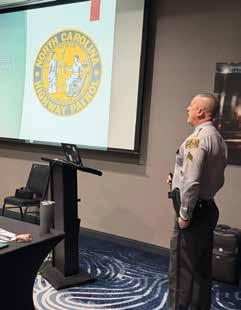
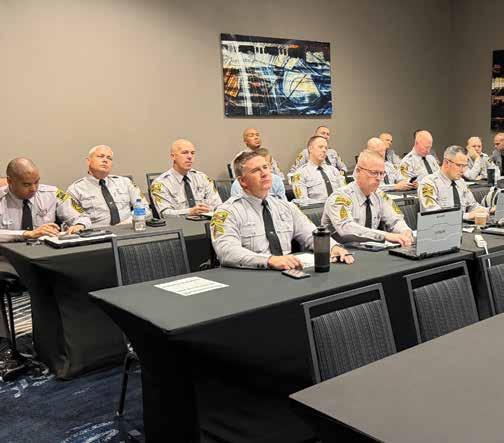
The North Carolina State Highway Patrol (NCSHP) Commercial Vehicle Enforcement (CVE) Section held its 2026 CVE Spring Conference in Wilmington, North Carolina, March 25-27. The Institute for Transportation Research and Education (ITRE) at North Carolina State University was also in attendance. Participants gathered for three days of training, updates and collaboration focused on keeping North Carolina’s highways safe and reducing commercial motor vehicle crashes.
The conference opened on March 25, with welcoming and opening remarks delivered by Col. Johnson and other NCSHP command staff. Col. Johnson emphasized the critical role CVE plays in protecting the traveling public, praised the section’s recent safety achievements, and set the tone for a productive week of professional development and strategic planning.
Following the opening, NCSHP CVE Training Coordinator Monica Greiss outlined the state’s training updates and accomplishments as a leader in virtual training and the third in overall hosted training. The remainder of the afternoon was dedicated to a comprehensive CVE headquarters updates session covering inspections, new entrant audits and compliance investigations, and other key discussion topics. CVE headquarters staff facilitated open dialogue, allowing CVE supervisors to ask questions and share field experiences directly with HQ leadership.
Thursday began with a virtual presentation from CVSA Roadside Inspection Specialist Jeremy Disbrow on the roadside inspection program and outlining ways that CVSA can assist North Carolina. The ITRE team followed with an informative overview of COVERLAB Analytics, highlighting current projects and datadriven tools that are helping CVE make smarter enforcement decisions.
Federal partners were well represented with Federal Motor Carrier Safety Administration (FMCSA) Division Administrator Michael Stewart, who addressed the group, followed by remarks from North Carolina Trucking Association President Ben Greenberg. Then, Tpr. Chesley M. McGinnis provided Post-Crash Inspection Program information and updates on the FMCSA Crash Causal Factors Study, in which North Carolina will be participating.
The afternoon was reserved for troop/district enforcement plan reports. Supervisors from
across the state were given the opportunity to showcase enforcement strategies, successes and challenges, fostering statewide alignment and sharing of best practices.
The final morning opened with Sgt. Brian A. Moseley delivering Size and Weight Unit updates, including the latest information on executive orders affecting commercial motor vehicle operations. Maj. Randy Deaton and Capt. Tim Wilson delivered closing remarks, recapping the week’s highlights and reinforcing the section’s commitment to safety, professionalism and continuous improvement.
The 2026 CVE Spring Conference once again proved to be a valuable investment in our personnel. From national-level policy updates to grassroots enforcement planning, the agenda equipped CVE troopers with current information and strengthened collaboration across troops, headquarters and partners.
Attendees left the conference energized and better prepared to meet the challenges of commercial motor vehicle enforcement in the coming year. Plans are already underway for the next CVE event. n
By Micaela Riley, Public Affairs Coordinator, Office of Public Affairs, South Carolina Department of Public Safety
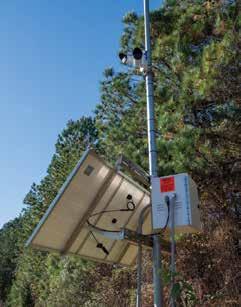
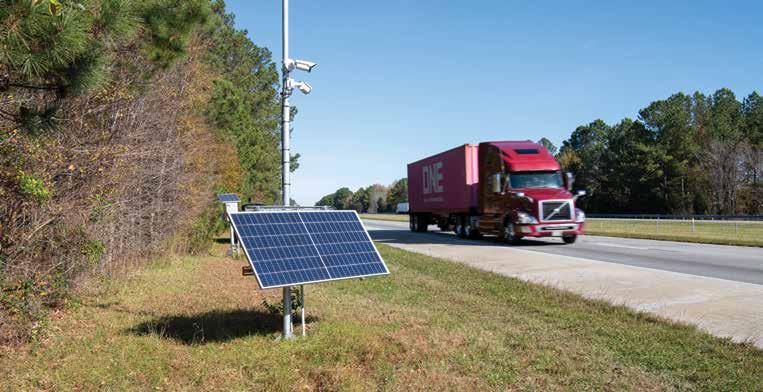
Innovative technology in South Carolina is combining many of the features of a brickand-mortar weigh station into a smaller, less expensive roadside setup.
The virtual weigh station is the product of a years-long partnership between the South Carolina Department of Public Safety's (SCDPS) Office of Information Technology (OIT), South Carolina State Transport Police (STP) and the South Carolina Department of Transportation (SCDOT). Utilizing existing SCDOT weigh-inmotion (WIM) sensors embedded in several highways across the state, SCDPS developed the technology, which consists of a WIM, a roadside computer and a camera attached to the computer.
“This is weighing and screening commercial motor vehicles in a way we haven’t really thought of beyond the traditional brickand-mortar weigh station,” said SCDPS Law Enforcement Technology Program Manager Capt. Thomas White. “These virtual sites allow our commercial traffic to continue to flow uninterrupted.”
Brick-and-mortar weigh stations, which have been and will continue to be the backbone of STP’s size and weight enforcement, require all commercial motor vehicles to exit the interstate. This not only disrupts traffic flow around the
weigh station but also costs truck drivers and their companies time and gasoline, according to STP Commander Col. Dwayne Wilson.
As a truck passes over the WIM sensor, it collects various measurements, including speed, gross weight and weight per axle, according to Capt. White. The computer analyzes that data to determine if the vehicle is overweight. If it is suspected of being overweight, the camera attached to the roadside computer will take a photo of the vehicle and transmit it to an STP officer who is stationed on the shoulder of the roadway a short distance away. That officer can then initiate a traffic stop and safety inspection and verify the truck’s weight with hand scales. The virtual weigh stations allow STP to be more strategic about which trucks their officers pull over for inspections and help supervisors better staff the roadways based on the times they see the most overweight vehicles.
The South Carolina Information Technology Director’s Association recognized the collaboration between SCDPS and SCDOT by awarding them the Technology Innovation Award at their annual conference. Wilson said other states have expressed interest in adopting the virtual weigh station concept. The goal is to have eight virtual weigh stations operational in South Carolina by 2027. n
By Lt. Billy J. Johnson, Commercial Carrier Enforcement Program Coordinator, Virginia Department of Motor Vehicles
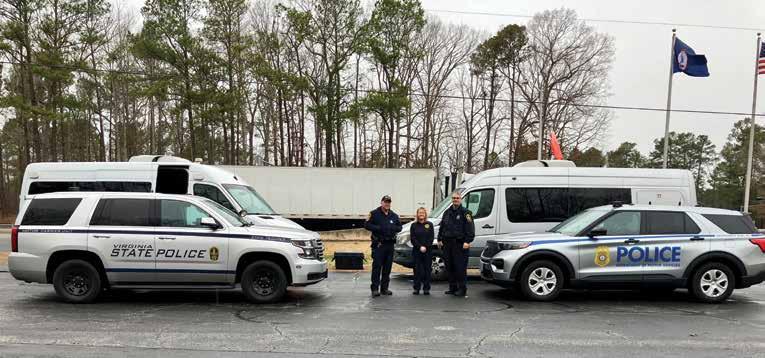
From Jan. 12-16, the Virginia Department of Motor Vehicles (DMV) Law Enforcement Division had a very active week, simultaneously participating in the Unified Carrier Registration (UCR) Awareness Initiative, CVSA’s Human Trafficking Awareness Initiative and the three-day Operation SafeDRIVE.
UCR compliance remains essential to supporting state and federal safety programs, and inspections involving UCR violations continue to present a higher risk. In January, these inspections resulted in a 38.5% outof-service rate, nearly double the national
rate of 19.4% for the same month. During the UCR initiative, sponsored by UCR’s Enforcement Subcommittee, Virginia DMV’s enforcement activities identified numerous carriers that had not paid 2026 UCR fees. More than $10,000 in UCR fees were paid due to enforcement contacts, including one carrier identified as having its UCR suspended for fraudulent credit card activity.
Concurrently, special agents distributed human trafficking awareness materials to commercial drivers, truck stop employees and school bus drivers, broadening awareness of trafficking indicators. Special agents
also conducted high-visibility enforcement along key interstate corridors in support of Operation SafeDRIVE’s goal of reducing large truck and bus crashes, working collaboratively with both the Virginia State Police and Federal Motor Carrier Safety Administration inspectors.
Despite the operational demands of supporting three initiatives simultaneously, the efforts of Virginia DMV’s special agents underscore the Law Enforcement Division’s strong dedication to regulatory compliance, highway safety and the protection of the traveling public. n
By Sgt. Steve Lowe, Virginia State Police
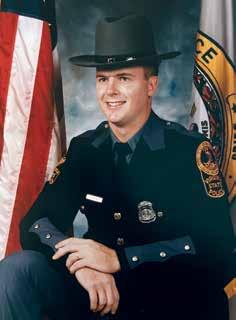
Please join us in congratulating Master Tpr. Joseph T. Bowling on 30 years of service in the Virginia State Police Motor Carrier Unit. Master Tpr. Bowling began his career with the Virginia State Police on July 1, 1988, when he was appointed as a trooper trainee and assigned to the Training Division. He successfully completed the Virginia State Police Academy, graduating on Feb. 24, 1989, and was assigned to Division IV, Area 28, in Tazewell County, southwest Virginia, as his first assignment.
Master Tpr. Bowling served with distinction from 1989 until May 1995 at the Area 28 office, serving Russell and Tazewell counties, earning the respect and admiration of his supervisors and peers. He distinguished himself as a highly professional and self-motivated state trooper, always striving to better himself. While serving as a trooper in Area 28, he enrolled at the Southwest Virginia Community College, earning his Associate of Applied Science degree in December 1992. That same year, he received the Superintendent's Award for DUI arrests.
Master Tpr. Bowling was recognized by his supervisors at the area and division levels for having a strong aptitude for enforcing commercial motor vehicle (CMV) safety violations. As a result of his enforcement efforts and his strong desire to promote highway safety related to the enforcement of CMV safety, he was selected in 1993 to
attend the CVSA North American Standard Inspection Parts A and B courses. He earned his certification as one of the first troopers in the Virginia State Police Safety Division's Motor Carrier Unit. In May 1995, he was officially transferred to the Safety Division Motor Carrier Unit.
In 1999, Master Tpr. Bowling continued his education and earned his Bachelor of Science degree from Bluefield University. He was promoted to senior trooper in February 2000 and remained in the Safety Division Motor Carrier Unit.
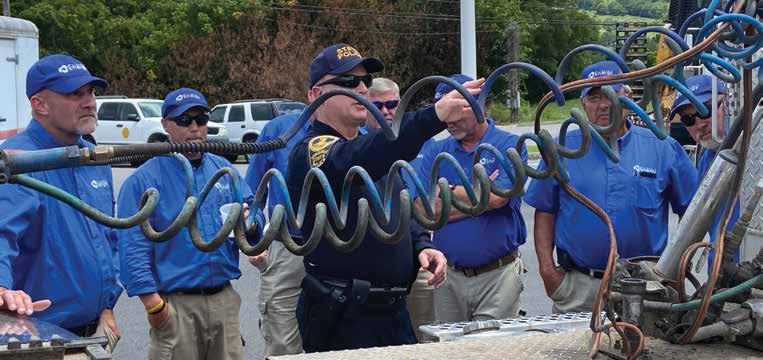
In 2003, he became certified as a Federal Motor Carrier Safety Administration (FMCSA) staff instructor. He remained in that capacity until 2007, when he became the lead staff instructor responsible for all Motor Carrier Unit training for the Commonwealth of Virginia, a role he held until 2012. During his tenure as the Department's FMCSA Motor Carrier Instructor, Master Tpr. Bowling trained and mentored hundreds of police officers from across Virginia.
In 2007, he was selected to serve as the vice chair of the CVSA Vehicle Committee. In this role, he had direct input in the development of new federal regulations, policies and best practices related to CMV safety nationwide. In August 2013, Bowling was promoted to master trooper and continued to serve with
Continued on next page
Continued from page 17
By Chris Vinson Commercial Vehicle Enforcement, Midlothian (Texas) Police Department
I first came to know Joe from the CVSA video titled “The Mysterious and Exciting World of Van and Open Top Trailers.” It was apparent to me that Joe had a fun and light-hearted way of sharing his knowledge (with a little bit of help from the video crew). Years later, I had the privilege to instruct side by side with Joe and quickly realized that he was a unique person in our industry, well beyond his ability to teach.
Not many people on the enforcement side have the tenure or resume that Joe has, coupled with the desire to share that with as many as he can. The first quality that jumps out to me is his humor. There is never a conversation which doesn't end with a laugh and smile. And of course, many stories, something about a ham sandwich at the North American Inspectors Championship or what’s in a chicken burrito – you’ll have to ask him!
But on a serious note, Joe has a unique ability to share information with a special blend of knowledge, humor and clear understanding, all being delivered with a humble personality. Joe has seen and influenced many of the changes that shaped how we, as roadside inspectors, currently conduct investigations. Joe is the kind of person who owed me nothing but chose to treat me as a friend. He has helped me develop as a better instructor and inspector. I hope we can all strive to be the kind of person Joe represents himself as. Thank you, Joe, for your friendship and service to all of us. n
distinction in the Safety Division Motor Carrier Unit. In 2019, he earned his FMCSA certification as a new entrant safety auditor, taking on the additional responsibilities of ensuring new motor carriers are familiar with and understand the Federal Motor Carrier Safety Regulations (FMCSRs). Master Tpr. Bowling again distinguished himself in this role, receiving numerous commendations from his supervisors and peers.
In 2024, he was nominated and received the prestigious Virginia State Police Outstanding Safety Achievement Award. Throughout his long and distinguished career, he consistently demonstrated his commitment to promoting highway safety through his strong work ethic and superior knowledge of CMV mechanical systems, the FMCSRs and operational policies. He also worked closely with CVSA to develop new and revised policies that are incorporated into the FMCSRs. He has served as a contract instructor for CVSA since 2017, providing industry courses nationwide.
During his career, Master Tpr. Bowling has inspected more than 25,000 CMVs and cited
over 100,000 safety violations. If the trucks he has inspected during his career were lined up end to end along I-81 in Virginia, a person could walk along the tops of the trucks from Bristol, Virginia, to Woodstock, Virginia, without ever setting foot on the ground –nearly 285 miles.
Master Tpr. Bowling’s outstanding commitment to the promotion of highway safety is unmatched and his contributions to public safety are immeasurable. Throughout his 38-year career with the Virginia State Police, he has consistently gone well beyond the call of duty. His commitment to protecting the citizens of the Commonwealth of Virginia is an inspiration and example of excellence that each of us should strive to achieve. His contributions are immeasurable and have saved an unknown number of lives because of his commitment and desire to serve in this important role. We congratulate Master Tpr. Joseph T. Bowling on his outstanding 38-year career as a Virginia State Trooper and his 30 years as a Virginia State Police Motor Carrier Unit inspector. n
By Kerri Wirachowsky, CVSA Director of Inspection Programs
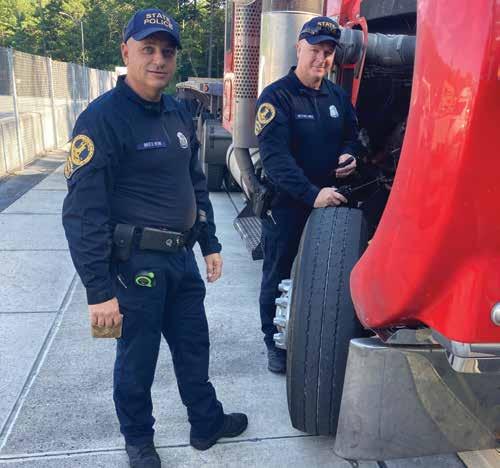
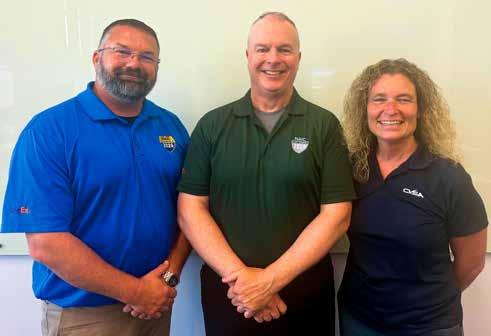
I must echo the comments made by Sgt. Lowe and Chris Vinson regarding Joe and his contribution to road safety. When I first met Joe, I was an inspector with the Ministry of Transportation in Ontario, and I was about to take responsibility of the CVSA Vehicle Committee. I was nervous and in desperate need of a vice-chair. Sitting in the Vehicle Committee before becoming the chair, I would listen to Joe’s comments, and I knew he had a vast knowledge of the regulations and the out-of-service criteria. He also had a keen ability to explain things and talk common sense. I immediately determined that he would be my best selection for a vice-chair for that committee.
Little did I know that we would be the team that we became, and I couldn’t have imagined what a good friend he would become. We worked together in the Vehicle Committee for four years, and in that time, we achieved so many things together, ranging from the development of the air disc brake and driveline/ driveshaft criteria to the. hydraulic brake inspection bulletin and other out-ofservice criteria that are still in effect today.
Joe was vital in my role as chair, and as I am from Canada, he had a huge impact on helping me learn and maneuver my way through the U.S. regulations during meetings, as I had not used those regulations in my experience. He showed up to every meeting with an additional regulation book in hand – highlighted and tabbed just like his. I can’t tell you how much that was appreciated and how much it helped me along the way. I can still remember when Joe came and told me that he would have to resign as the Vehicle Committee vice-chair position as he would no longer be coming to the meetings. To be honest, it was a bit of a panic for me. I was losing my righthand man, my great friend and my U.S. regulation specialist.
In 2011, after the conference in Austin, Texas, Joe and I parted ways, and to be honest, neither one of us really reached out to the other very often. Six years later, I started my position at CVSA. I had spent many years training members, but in my new role, I could no longer do that. Then I remembered discussions while we were leading the Vehicle Committee
about how the industry was sometimes confused on regulations versus out-ofservice criteria. We would jokingly say that one of us had to quit our job and create an industry course. If we could train the industry on the same information that we were trained on, then they could easily comply and it would result in fewer violations and out-of-service conditions.
So, I went to Collin, asked if I could try to build an industry course and hopefully the industry folks we had talked to for all of those years would be interested. I worked with the then-associate member president and took a chance. Once the course was ready, Joe was the first person I called. “Remember six years ago we said one of us had to quit our job and build an industry course? Are you willing to teach the industry course with me?” His response? “Absolutely.” We have now been instructing the industry courses since 2017, and his instruction and knowledge base are as good today as they were 19 years ago when I first met him. He is a unique individual, and I can say we have had many a laugh over several different topics, but his dedication to safety and wanting both inspectors and industry to “get it right” are what makes him stand out to many. n
Joe showed up to every meeting with an additional regulation book in hand – highlighted and tabbed just like his. I can’t tell you how much that helped me along the way.
By Lt. Mike Maytum, Nebraska State Patrol
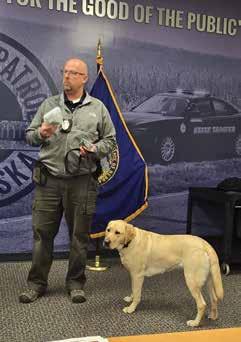
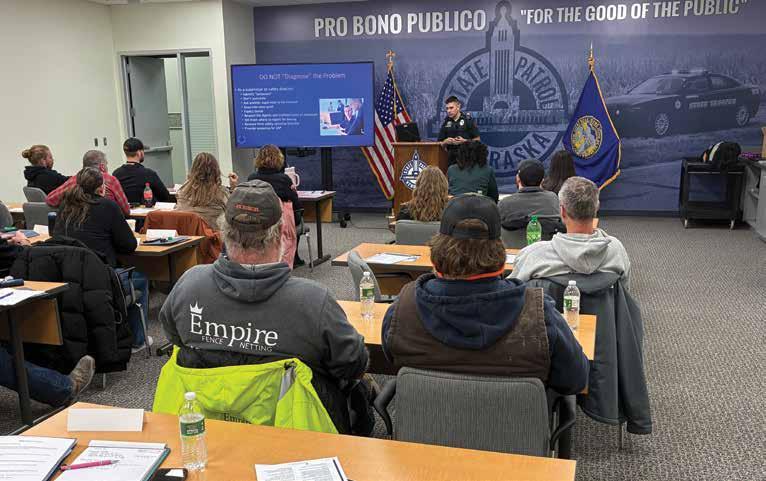
On Feb. 19, 2026, the Nebraska State Patrol (NSP) Carrier Enforcement Division held its fifth annual Citizen’s Academy in partnership with the Nebraska Trucking Association, Crete Carrier and the Federal Motor Carrier Safety Administration. Nearly 30 industry professionals representing 17 motor carriers and other professional organizations were invited to gain a behind-the-scenes perspective on commercial motor vehicle (CMV) enforcement in Nebraska. Attendees learned about the history and authority of the Carrier Enforcement Division, safety audit and compliance review processes, roadside laws and regulatory enforcement, DataQs, hours-of-service basics, substance abuse awareness, and human trafficking identification. Col. Bryan Waugh addressed the group, as did FMCSA Division Administrator Jeremy Dugger, who spoke on the partnership and shared vision of the agencies. Attendees got to meet NSP K-9 Scooter, who specializes in detecting electronics and was a hound for attention, loving pets and ear scratches from those in attendance.
After lunch, the group migrated to one of the state’s weigh stations, where they got to see first-hand operations of the scale technologies and preclearance systems. They also experienced hands-on demonstrations of a CMV inspection, a narcotics-trained K-9 and the performance-based brake tester machine. Additionally, participants received information about the NSP drone program and had the chance to explore the SWAT team’s specialty vehicle, a BearCat. The overall goal of the day was to allow industry partners to see the many sides of the agency, including an officer’s point of view. Feedback was extremely favorable, leading to plans for another event later in the year.
At the conclusion of the day, each attendee received a packet of resource materials, a certificate of attendance and an NSP shoulder patch in recognition of their special interest in NSP and their participation in the day’s events. n
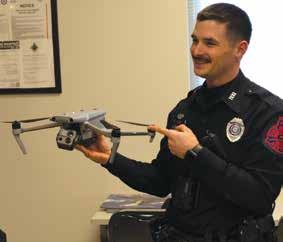
In February 2026, the NSP Carrier Enforcement Division expanded the use of a technology that has become common in law enforcement – the unmanned aerial system or drone. For several years, the Nebraska State Patrol has utilized drones to augment ground-based efforts, particularly for crash documentation, searching for lost persons, documenting largescale gatherings and events, and providing overview and intelligence for natural disaster response. In those scenarios, the drone's value has proven itself time and again.
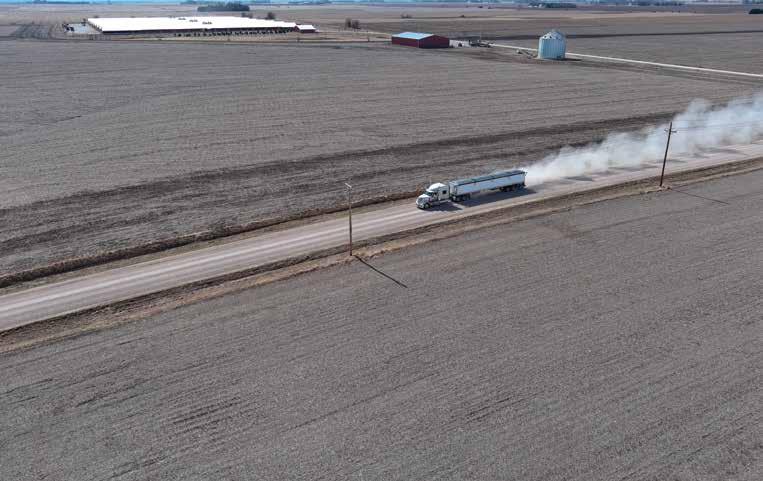
To expand the envelope of use cases, NSP has recently considered how drones might be used in CMV enforcement. NSP has undertaken efforts to demonstrate the viability of using a drone to document the interior of semitrailers, particularly to capture evidence of cargo and securement in trailers with limited access to officers due to loading or unsafe conditions. Additionally, the state has begun using drones to document bypass events at scales.
Drone use provides enhanced aerial visibility, allowing for real-time observation of traffic patterns, unusual travel on a known bypass route and the ability to document equipment issues that may not be easily visible from ground level. The elevated vantage point improves officer safety by reducing the time required on the side of a county road with no shoulders while still capturing clear visual evidence. Drone technology enables accurate documentation through 8K highresolution video and imagery, which supports enforcement actions with objective, timestamped evidence.
Drones are proving to be valuable tools for law enforcement every day, thanks to creative thinkers who have imagined how the advantages and capabilities of drones can be leveraged. That kind of forward thinking will continue to foster new and inventive ways to use these tools in the future. n
By Sgt. Steven Sekrecki, Arizona Commercial Vehicle Safety Partnership, Arizona Department of Public Safety
The Arizona Department of Public Safety (AZDPS) recently reinforced its commitment to combating human trafficking by actively participating in the annual CVSA Human Trafficking Awareness Initiative, Jan. 12-16. Through statewide outreach, education and coalition-building efforts, AZDPS reached thousands of individuals across Arizona’s commercial transportation sector and law enforcement community.
As part of the initiative, AZDPS troopers distributed more than 7,000 human trafficking awareness materials to commercial drivers, trucking companies and industry partners. These materials included informational cards, posters and hotline resources designed to help individuals recognize the signs of human trafficking and understand how to report suspicious activity. By leveraging commercial motor vehicle (CMV) inspection stops and industry engagement opportunities, troopers ensured that critical information reached those who are often in a unique position to identify trafficking activity along Arizona highways and transportation corridors.
In addition to material distribution, AZDPS delivered six formal presentations focused on identifying, preventing and reporting human trafficking. These sessions provided participants with:
Indicators of sex and labor trafficking
Real-world case examples
Reporting procedures and victim-centered response strategies
Resources available through national, state and local support networks
The presentations emphasized the important role CMV drivers play in recognizing suspicious behaviors at truck stops, rest areas and transit facilities, while encouraging them to “see something, say something.”
A key highlight of the initiative was a coalitionbuilding event hosted in partnership with the Arizona Trucking Association, Arizona Attorney General, Knight Transportation and TAT (formerly known as Truckers Against Trafficking). The event brought together more
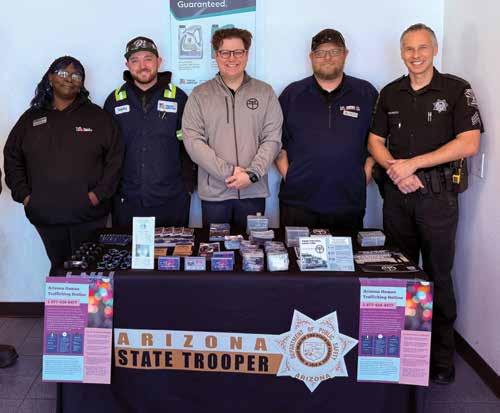
than 40 CMV industry representatives and law enforcement personnel, fostering a unique collaboration across sectors. Participants discussed emerging trafficking trends, reporting protocols and strategies to strengthen communication between industry partners and public safety agencies. By building relationships and aligning response efforts, the coalition aims to enhance Arizona’s ability to identify and support victims while disrupting human trafficking networks.
The CVSA Human Trafficking Awareness Initiative underscores the importance of coordinated action. As Arizona’s primary highway safety and CMV enforcement agency, AZDPS plays a vital role in safeguarding transportation routes that traffickers may exploit. Through the distribution of thousands of awareness materials, delivery of educational presentations and facilitation of cross-sector partnerships, AZDPS continues to demonstrate its proactive approach to protecting vulnerable individuals and strengthening community safety across the state. The department’s participation reflects a broader commitment to collaboration, vigilance and education – critical components in the ongoing fight against human trafficking. n
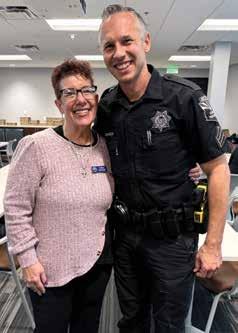
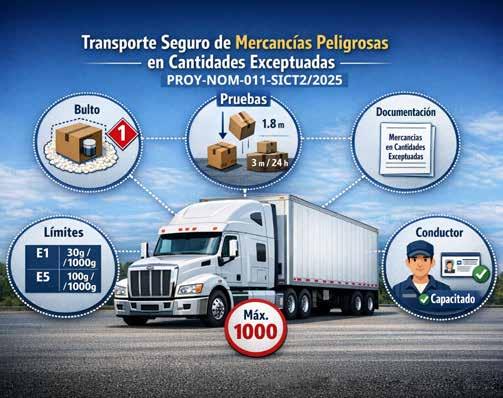
On Feb. 10, the Ministry of Infrastructure, Communications and Transportation (SICT) announced the opening of the public commentary period of the draft of Official Mexican Standard PROY-NOM-011-SICT2/2025, a regulatory instrument that aims to establish clear conditions for the safe transport of dangerous goods packed or packaged in limited quantities.
The notice was published in the Official Gazette of the Federation (DOF) and issued by SICT in coordination with the National Consultative Committee for Land Transport (CNN-TT) in compliance with the applicable legal framework regarding standardization, land transport and administrative procedure.
The draft regulation establishes technical and operational specifications that must be observed when certain classes of dangerous goods are transported in limited quantities. Once approved and published in its final version, the standard will be mandatory for consignors, carriers and consignees involved in the movement of these materials on roads and bridges under federal jurisdiction.
The main objective of the draft is to strengthen road safety and ensure adequate provision of public transport services, in accordance with the provisions of the Quality Infrastructure Law.
As stated in the document, international regulations recognize that the transport of limited quantities of dangerous goods does not pose a significant risk, allowing for more flexible provisions than those applicable to large volumes.
This approach seeks to maintain high safety standards while facilitating the import, export, distribution and marketing of products, helping to reduce logistics costs and strengthen the competitiveness of national goods.
The draft standard aligns with the United Nations Recommendations on the Transport of Dangerous Goods, particularly the Model Regulations, Twenty-second Revised Edition (2021), in Chapter 3.4. This alignment with international standards harmonizes Mexican provisions with global practices for the safe transport of dangerous materials.
CNN-TT approved the project during its Second Ordinary Session, held on May 30, 2025, and agreed to open a 60-calendar-day public commentary period, counted from the publication of the notice in the DOF.
During this period, interested parties may consult the project on the Comprehensive Technological Platform for Quality Infrastructure, as well as on the official SICT and DOF portals, and send comments in editable format to CNN-TT for consideration.
Continued on next page
Continued from page 23
SICT reaffirms its commitment to human safety and the protection of fundamental rights by implementing strategic actions to prevent human trafficking within the motor transportation sector.
Within the framework of the initiative promoted by CVSA, Mexico actively participated in CVSA's Human Trafficking Awareness Initiative campaign held from March 16 to 20, joining regional efforts to raise awareness and combat this crime, which undermines human dignity.
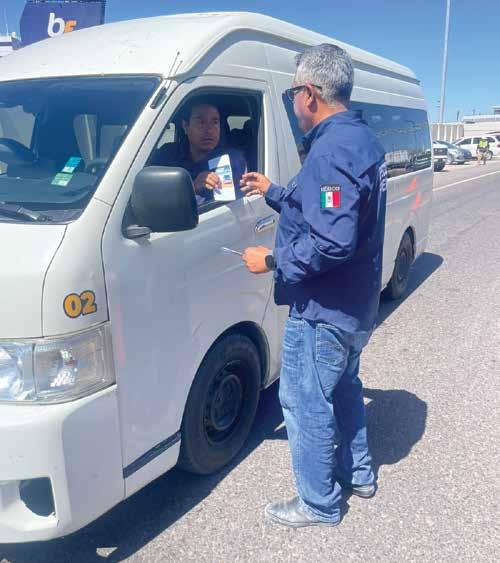
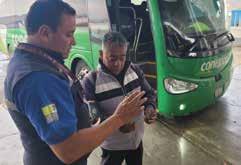
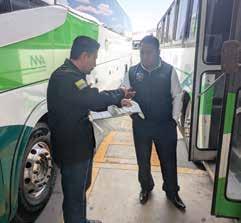
To expand the scope of its actions to prevent and address human trafficking, SICT implemented a comprehensive strategy that brought together all stakeholders within federal motor transport. Training centers, verification units, SICT centers, bus terminals, supervisors and public servants of SICT came together to strengthen early detection and coordinated response to potential cases, placing the dignity and safety of individuals at the core of these actions.
As part of this strategy, a nationwide outreach and awareness campaign was launched, focused on recognizing risk indicators and promoting reporting as a means of protection for those in vulnerable situations. The campaign sought to reach users and operational and institutional personnel, emphasizing that every attentive observation and responsible action can become a pathway to assistance.
To ensure broad outreach, the campaign was deployed through both physical and digital channels. In key locations across the sector, 16,555 brochures were distributed, providing guidance on identifying indicators of human trafficking and responding in accordance with established protocols. In addition, 968 posters featuring preventive messages and reporting guidance were shared. Each material reinforced SICT’s commitment to building safer environments, where the protection of life and human rights is a shared responsibility. As a result, the messages reached more than 9,000 people, strengthening collective awareness and encouraging greater participation in detecting this crime.
In parallel, SICT implemented a digital outreach strategy by distributing informational materials through institutional email accounts,
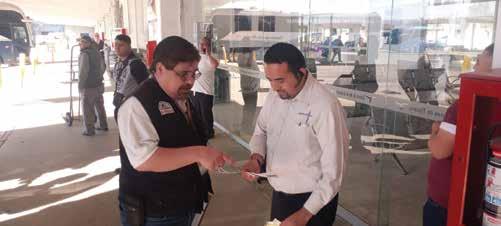
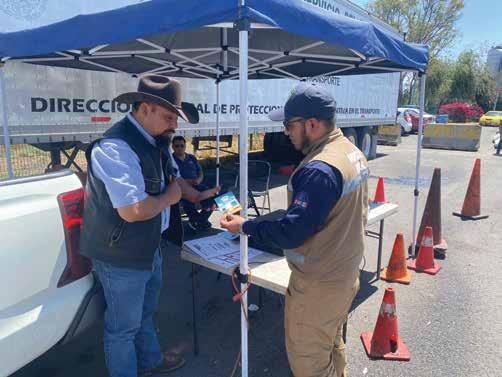
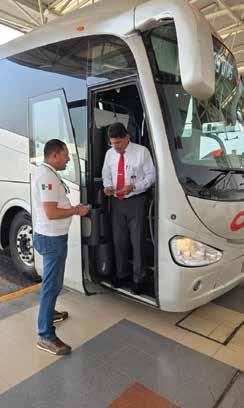
reaching 8,425 public officials. This effort contributes to strengthening internal capacities to identify situations of vulnerability and respond promptly to potential cases of human trafficking.
Furthermore, interinstitutional collaboration was strengthened with the National Human Rights Commission (Comisión Nacional de los Derechos Humanos, CNDH), through which 14,000 posters were distributed in bus terminals across the country. These materials, titled “What is human trafficking?” and “Your rights have no borders, regardless of your migration status,” aim to inform the public about the various manifestations of this crime, promote awareness of universal rights and encourage reporting. The presence of these materials in high-traffic spaces contributes to raising awareness and strengthening the institutional response to this issue.
These actions reflect an institutional commitment to promoting safe environments, protecting the integrity of users and strengthening Mexico’s capacity to address this crime, which gravely violates human rights. SICT reiterates its conviction that the prevention of human trafficking is a shared responsibility. In this regard, it will continue to promote awareness processes aimed at all actors within federal motor transportation, as well as users of these services, ensuring that each stakeholder has the necessary tools to identify risks, act in a timely manner and contribute to the protection of individuals in vulnerable situations.
Through these actions, Mexico reaffirms its commitment to strengthening international cooperation and the exchange of best practices within the CVSA framework, advancing toward a safer, more aware and more human-centered transport system. n

Passenger transport in Mexico is undergoing a transformation driven by new challenges in safety, sustainability and technological modernization. These issues took center stage during Expo Foro Movilidad 2026, which was opened by SICT Undersecretary Tania Carro Toledo. The event was attended by Luis Ruiz Hernández, head of the Directorate General of Federal Motor Transport (DGAF), as well as other authorities, business representatives and specialists in the sector, with the aim of analyzing the present and future of mobility in the country.
The event, organized by the National Chamber of Passenger and Tourism Transport (CANAPAT), has established itself as one of the most relevant forums in Latin America for exchanging ideas and analyzing trends that shape the evolution of land transport.
During the forum, the strategic role of passenger transport within the national economy was highlighted. This sector contributes about 2% of Mexico's gross domestic product and accounts for about 94% of the transfer of people in Mexico, reflecting its relevance to the country's connectivity. In addition to facilitating the daily movement of millions of people, passenger transport enables the integration of economic activities, strengthening tourism and connecting urban centers with productive regions. In this sense, several participants agreed that efficient mobility has become an indispensable element for national competitiveness.
Despite its economic and social importance, the sector faces challenges that require priority attention. Among them are road safety, the presence of irregular services and the need to promote the renewal of the vehicle fleet. The modernization of the units represents an opportunity to raise safety standards, improve the quality of service and move toward transport models with lower environmental impacts.
Likewise, the importance of strengthening the professionalization of the sector, improving regulatory processes and consolidating coordination between authorities and transport operators was underlined.
One of the events that will mark the transport agenda in the coming years is the 2026 World Cup, an event that Mexico will organize together with the United States and Canada. The arrival of millions of visitors will pose a significant logistical challenge, and passenger transport will play a key role in connecting airports, terminals, hotels, stadiums and tourist destinations.
This scenario also represents an opportunity to show advances in infrastructure, fleet modernization and operational efficiency, positioning Mexico as a country capable of offering safe and competitive mobility services at an international level.
Another recurring theme during the meeting was the incorporation of smart technologies into fleet management, the digitalization of processes and the transition to units with lower emissions.
Currently, the passenger transport and tourism sector comprises more than 650 affiliated companies and about 50,000 vehicles in operation, making it a key player in national connectivity and tourism development. In this context, spaces such as Expo Foro Movilidad are consolidated as platforms to discuss innovative solutions that strengthen safety, improve operational efficiency and move toward more sustainable mobility systems n


By Chris Vinson, Commercial Vehicle Enforcement, Midlothian (Texas) Police Department; CVSA Class II Local Member President
It’s an honor to represent the CVSA Class II Local Members, and I know I speak for all of us when I express my gratitude for the service and dedication of the officers below. We wish you all the best in the next chapter, be it traveling the world or a new career on the other side of the badge. Each of you has made a difference in safety and in safer roadways in your communities.
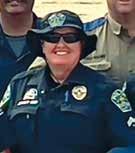

We thank Corp. Kim Jansky for her tenure, serving 23 years at the Austin (Texas) Police Department before retiring in November 2025. She served in the Commercial Vehicle Enforcement Unit for the last four years. Thank you, Corp. Jansky, for your leadership and positive impact on safety.
Ofc. Greg Ross served 25 years with the Grapevine (Texas) Police Department. While Ofc. Ross covered many roles throughout his exceptional career, he found a home and passion in the commercial vehicle enforcement community, where he dedicated his last 15 years.
Ofc. Ross always strived to excel at roadside inspections and to continue to improve his knowledge and skills. He loved competing in the inspector challenges, and in 2015, Ofc. Ross was the Texas local member inspector champion. He went on to compete at the North American Inspectors Championship later that year. This was a very proud moment for Greg and the locals he worked with.
Ofc. Ross loved participating in CVSA events and found great value in serving as a voting member on committees when he could. He always wanted to make those he worked with better, and for that, we thank you, Greg. We wish you the best as you continue to serve the commercial safety industry from the other side of the badge.
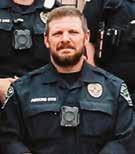
From the Austin (Texas) Police Department, we thank Ofc. Jack Perkins after a well-served 23 years, dedicating five of those to the Commercial Vehicle Enforcement Unit. Ofc. Perkins, prior to service with Austin, served his country in the Army for 11 years. Thank you to Ofc. Perkins for your commitment to the safety of Texas roadways.
Ofc. David Szatkowski
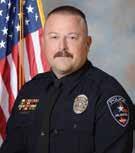
Ofc. David Szatkowski concluded a distinguished 30-year career with the Arlington (Texas) Police Department in January 2026. Since joining the force in October 1995, Szatkowski's tenure was defined by an unwavering commitment to traffic safety and investigative excellence.
After serving as a field training officer on patrol, he transitioned to the Crash Investigations Unit in 2002. Over the next 19 years, he became a highly specialized expert, earning certifications as a crash reconstructionist with a focus on motorcycle and commercial motor vehicle crashes. This eventually led him to the Commercial Vehicle Enforcement Unit, where he served as a full-time inspector from 2021 until his retirement. He was known for balancing complex crash investigations with a rigorous passion for commercial motor vehicle safety.
Ofc. Szatkowski's decorated career earned him the Police Officer's Award, Distinguished Service Award, Life Saving Award, Medal of Merit and the Purple Heart. Known throughout the Dallas-Fort Worth area for his exhaustive inspection style, he even inspired a lighthearted phrase among other inspectors – "waiting on Dave" – reflecting a reputation for detail so intense it occasionally outpaced his inspection software, which would give an alert: "Inspection will time out." This is a testament to his refusal to sacrifice quality for speed. Ofc. Szatkowski was the textbook example of professionalism and what it meant to serve. He served not only the community where he worked but also his fellow officers, and we are all better having served side by side with him. n
By Chris Vinson, Commercial Vehicle Enforcement, Midlothian (Texas) Police Department; CVSA Class II Local Member President
Once in a while, there are those in our industry who spend a career – or sometimes two or three – quietly and humbly earning the respected status of legend among their peers. I would like to spend a moment recognizing just one of those men. Many of you know Mr. Kenny Ray, whether you’ve interacted with him through a CVSA event, Dallas-Fort Worth Council of Safety Professionals events, Inspector Challenges, the insurance industry or his very distinguished career with the Texas Department of Public Safety (DPS). No matter where you met Kenny, one constant is that you will be greeted with a smile and most certainly treated as family. Kenny is just one of those people in the world who will make you smile, whether you’re talking about hazmat, truck safety, faith or taxes. But this is not why he is a legend to many.
Mr. Kenny Ray comes from a family in the trucking world. His father was a professional truck driver with an impeccable record of safety. And I believe that is where the seed for Mr. Ray’s continued commitment to the safety of our industry was planted. Kenny joined Texas
DPS in 1987 and proudly served for 24 years, spending much of that time in the commercial vehicle enforcement division, where he developed a love for all things hazmat. He went on to join the esteemed Texas Rangers Division, where he also served as a chaplain for the agency and retired as a lieutenant. Throughout this time, Kenny continued to find a connection to the commercial trucking industry and a commitment to keeping the drivers and the highway safe. As if this decorated career was not enough, Kenny was then called to serve the commercial industry through the insurance world, where he could share his knowledge of compliance with a variety of companies. Kenny currently serves as the vice president of safety and risk consulting at Marsh McLennan Agency.
As if these two amazing careers weren’t enough, Mr. Ray has served as chairman of both the Dallas-Fort Worth Council of Safety Professionals and the Texas Trucking Association’s Safety Management Council. Kenny gives much of his time as an instructor for the North American Transportation Management Institute
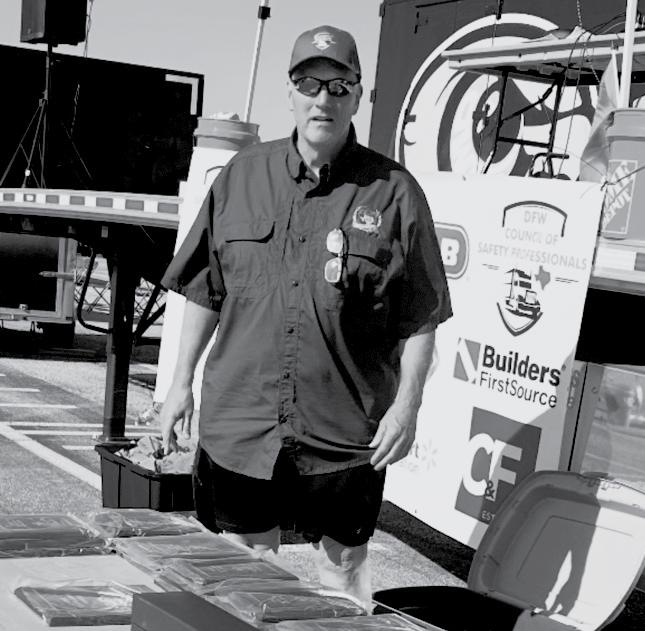
certification course, shaping the future of our safety professionals.
If I stopped there, most of us would not have done as much to reach as many or promote the message of safety, but there’s more. Kenny has played a huge role in the podcast Driving the Line: The Pursuit of Safety, where he continually shares the message to a broader audience. When I say there is no opportunity that Mr. Kenny Ray doesn’t take to make our industry and society a better place, it’s the gospel truth. Kenny has received multiple lifetime achievement awards, from the Texas Challenge Bill Durham Award to the Texas Trucking Association’s C.H. Cheshire Award. I know there are accolades for Mr. Ray that have been missed, and these amazing achievements are just part of why we call Mr. Kenny Ray a legend.
To me, the reason Kenny is a legend is that every time I am around him, his faith always comes first, and he presents it in a professional manner without excluding those who feel differently. I believe this is the basis for

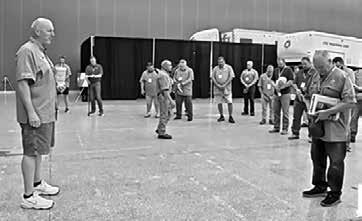
everyone being family to Kenny. Many times, in a large group setting, I have heard the words “We are all family here,” and Kenny sincerely means that.
Of all these great achievements that have blessed Kenny, I am so impressed that he finds ways to continually pay it forward. Kenny developed a presentation called “Life Beyond the Badge,” which he often offers at various events. Kenny cannot rest on his laurels; he continually strives to ensure that those he encounters can benefit from all he has learned, and in this presentation, he seeks to give those in enforcement the best opportunity to make the transition to the non-sworn side of industry.
From his humble beginnings as the son of a professional truck driver to a well-recognized member of the trucking industry, Kenny always sees the best in people and strives to bring the best out of them. These are just some of the many reasons we call Mr. Kenny Ray a friend and a legend. n
Do you know of an enforcement or industry legend who deserves to be celebrated? Consider writing an article about their career and impact. Reach out to CVSA Writer-Editor Emily Moorhead at emily.moorhead@cvsa.org with any questions and to submit an article.
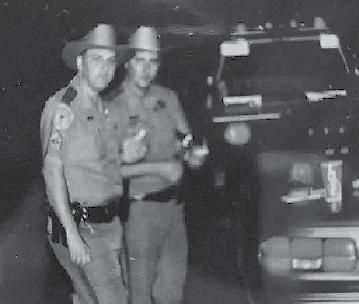

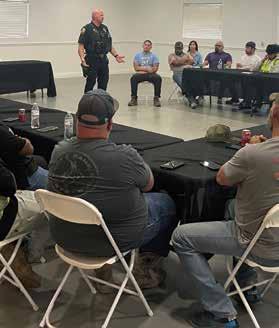
Ofc. Darren Burkhart of the Midlothian (Texas) Police Department conducts an educational talk about the inspection process to a group of company drivers on March 6.
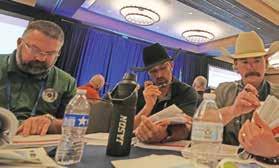
CVSA Class II Local Members in deep contemplation at the Cooperative Hazardous Materials Enforcement Development (COHMED) Conference in February. Left to right: CVSA Local Member President Ofc. Chris Vinson of the Midlothian (Texas) Police Department, Jason Belz of the Arlington (Texas) Police Department and Jared Koester of the Fort Worth (Texas) Police Department

Welcome to the second edition of “The Brake Room” – the #2 CVSA place for dad jokes. To submit dad jokes, commercial motor vehicle and enforcement-related jokes, cartoons/comic strips, and funny tales from the squad car or break room for consideration in future issues, email CVSA Writer-Editor Emily Moorhead at emily.moorhead@cvsa.org.
Did I tell you I found a bagel at the zoo? It was bread in captivity.
Pro tip: If you're ever attacked by a mob of angry clowns... Go for the juggler!
Know why a flying V of geese has one side longer than the other?
There are more geese on that side.
I once was kidnapped by mimes… They did unspeakable things.
What’s the most terrifying word in nuclear physics?
Oops.
My dog ate a whole bag of Scrabble tiles, so I took him to the vet. No word yet.
I was studying frequency in my physics class…
Now my brain Hertz.
I once swallowed a bunch of synonyms... It gave me thesaurus throat I've ever had.
Why did the scarecrow win an award? Because he was outstanding in his field!


In 2018, in Minneapolis, Minnesota, a 28-year-old semitruck driver was using his cellphone to research houses for sale – while driving. He looked at his phone for eight seconds while going 63 miles per hour, traveling a distance of about 740 feet, as far as the Golden Gate Bridge is tall. While distracted by his research, he slammed into a passenger vehicle and killed the occupant, who was a husband, father and local professor. The driver was sentenced to one year in jail, 10 years of probation and a suspended commercial driver’s license (CDL).
Distracted driving isn’t always this extreme. And part of what makes it so dangerous is that it is so commonplace. Commercial motor vehicle (CMV) and passenger vehicle drivers alike are often distracted by things like changing music, helping little passengers in the back seat, unwrapping a fastfood burger, rubbernecking at a crash or sending a “quick text.” And often, nothing bad happens. Maybe you get too close to the person in front of you and have to apply your brakes a little more forcefully than normal. Maybe you get a spike of adrenaline, put down your phone and vow to pay more attention next time. But just because it happens frequently and to nearly everyone who has driven a vehicle doesn’t mean that distracted driving is something society must accept instead of solve.
Continued on next page
From the FMCSA Driver Safety Program
Do not let objects outside the cab distract you. Stay focused on driving and avoid distractions, like billboards, buildings and people.
Don’t text and drive. If you are driving at 55 mph and take your eyes off the road for five seconds to write a text, you will travel the length of a football field without looking at the road. A 2009 study found that texting while driving increased a driver’s risk of being involved in a safety-critical event by 23 times.
Don’t use a dispatching device while driving. Although these devices can be helpful in many ways, dispatching devices can take your eyes, hands and mind away from driving safely. A 2009 study found that using a dispatching device while driving increased the chances of a safety-critical event by nine times.
While there are various definitions of distracted driving from different safetyfocused agencies, it is commonly defined as a driver’s attention being diverted from driving by a secondary task that requires focusing on an object, event or person not related to the driving task. The U.S. National Highway Traffic Safety Administration (NHTSA) and Transport Canada provide examples of distracting activities, such as talking or texting on your phone; eating or drinking; talking to people in your vehicle; or fiddling with the stereo, entertainment or navigation system.
Let’s take a look at recent studies on distracted driving across all vehicle types and CMVs specifically.
According to NHTSA, distracted driving (all vehicle types) claimed 3,275 lives in 2023, and an additional 289,310 people were injured.
In 2022, distracted driving (all vehicle types) was a contributing factor in 19.9% of fatal collisions in Canada.
Drivers who use their phone behind the wheel (all vehicle types) are 240% more likely to crash, according to a 2025 study by the Governors Highway Safety Association.
22.4% of drivers in Mexico (all vehicle types) admitted to using a handheld cellphone while driving, even though 96.8% of those surveyed identified this as a highrisk behavior, according to a study titled “It’s okay because I’m just driving”: an exploration of self-reported mobile phone use among Mexican drivers.
A 2009 Federal Motor Carrier Safety Administration (FMCSA) study found that 71% of large-truck crashes occurred when the truck driver was doing something other than driving.
A 2021 study by Omnitracks found that truck drivers who are distracted by mobile phones are three times more likely to exceed the speed limit by 10+ miles per hour.
An FMCSA and Virginia Tech Transportation Institute (VTTI) study showed that, compared to personal motorists, CMV drivers are 23 times more likely to cause a crash while texting at the wheel, seven times more likely when reaching for an electronic device and six times more likely when dialing a phone.
According to the FMCSA Large Truck and Bus Crash Facts report, in 2021, distraction or inattention was the second most common large truck driver-related crash factor, accounting for 278 fatal crashes.
Distracted driving can be deadly, and it’s clear that this problem runs deep in our society. There is some good news, though. Between government agencies, nonprofit organizations like CVSA, researchers and the motor carrier industry, many parties are committed to getting to the bottom of the problem of distracted CMV driving and promoting safety, preventing crashes and saving lives. Agencies are embracing creative enforcement campaigns and partnerships to curb device use behind the wheel, while carriers are turning to telematics and in-cab monitoring to address the problem from within and as part of ongoing training.
Distractions are everywhere, and they can come from inside or outside the cab. Distractions outside the cab can include looking at a passing building, billboard or person. A three-year data-collection effort by FMCSA and NHTSA found that an estimated 11,000 U.S. large-truck crashes involved distractions external to the truck cab. Distractions inside the cab can include dialing cellphones, texting, using dispatching devices, eating, reaching for items in the cab, reading or adjusting the radio. When you get down to it, anything that takes the driver away from the driving task is a distraction.
TYPES OF DISTRACTION:
Visual Distraction – Not looking at the road or other vehicles while driving
Cognitive Distraction – Mental attention not focused on driving
Manual Distraction – Removing hands from the steering wheel to reach for a cellphone, food/drink, etc.
Delayed Reaction – Not being able to stop in time to avoid a collision due to distractions
A 2006 study found that driver inattention was the leading factor in crashes and nearcrashes. The study found that nearly 80% of crashes involved some form of driver inattention in the three seconds before the crash or near-crash.
Texting while driving is one of the most dangerous forms of distracted driving because it combines visual, manual and cognitive distractions all at once. A 2006 University of Utah study shows that the impairments associated with using a cellphone while driving can be as profound as those associated with driving while impaired.
CVSA addresses unsafe CMV driver behaviors through its Operation Safe Driver program by educating all drivers on how to share the road safely. This program focuses specifically on drivers because drivers’ actions – whether it’s something a driver does, like speeding, or something they don’t do, such as not paying attention to the driving task – are responsible for most crashes. In fact, drivers’ actions account for a staggering 94% of all traffic crashes. However, research from the University of Missouri-Columbia has shown that interactions with law enforcement do alter drivers’ actions.
The focus of CVSA’s 2025 Operation Safe Driver Week was reckless/careless/inattentive driving. Any person who drives a vehicle in willful or wanton disregard for the safety of persons
or property is driving recklessly. Careless/ dangerous driving is defined as operating a vehicle without due care and attention or reasonable consideration for other motorists or people on the road. From July 13-19, 2025, officers/inspectors in the U.S. and Canada gave 12 citations and 47 warnings to CMV drivers for reckless/careless/inattentive driving. And CMV drivers received 107 warnings and 79 tickets/ citations for texting/using a handheld device while operating a CMV. View the full results of the campaign: www.cvsa.org/news/2025-osdweek-results.
In addition to traffic stops, another important aspect of the Operation Safe Driver Week initiative is raising public awareness of the dangers of unsafe driving behaviors. In the months leading up to Operation Safe Driver Week, CVSA mailed nearly 70,000 postcards to inspectors and motor carriers for distribution and worked with the Paramount/CBS network to distribute public service announcements focused on safe driving, delivering more than 15 million campaign impressions.
Notable enforcement outreach included:
The Colorado State Patrol conducted distracted driving awareness discussions and included distracted driving handouts with applicable inspections.
The Florida Highway Patrol conducted educational outreach at a FedEx distribution center, reaching 30 professional drivers. The discussion topics included driver safety, distracted driving, cellphone usage, safety belt compliance, pre-trip inspections, speeding and a demonstration of a Level II Inspection.
The Hawaii Department of Transportation conducted safe driver outreach, including distributing safety brochures; discussing the dangers of speeding, distracted driving and aggressive driving; and handing out lanyards and mini first-aid kits.
In addition to targeted enforcement and outreach initiatives, local/state/provincial/ territorial agencies make distracted driving education a priority throughout the year. Officers and inspectors conduct outreach focused on distracted driving and cellphone use during individual inspections and educational/community events with motor carriers, high schools, driving schools and other organizations. Their efforts ensure distracted driving awareness and prevention are priorities discussed and addressed yearround.
Continued on next page
To get involved with the Operation Safe Driver Program and receive communications, log into the CVSA member portal at portal.cvsa.org, navigate to your profile and select “Operation Safe Driver Program.”

Don’t dial a handheld phone while driving. Dialing a handheld cellphone takes your eyes off the road and your hands off the wheel. Instead, find a safe place to stop and dial, or use a voice-activated hands-free phone or app. A 2011 study found that drivers who were dialing a handheld cellphone made more frequent and larger steering corrections than drivers talking on a hands-free device.
Don’t read, write or use paper maps while driving. Printed directions, notes and maps are a normal part of a professional driver’s job, but these tasks take your eyes off the road. If you need to read or write something, pull over. Voice-activated GPS units are much safer to use while driving than maps.
Avoid eating and drinking while driving. Eating while driving can take your eyes off the road and requires at least one hand off the wheel. Always try to eat or drink before getting behind the wheel or leave time to pull over and eat. In May 2008 in Wisconsin, a CMV driver crashed into the back of a stopped school bus, which had its lights flashing and stop arm out. The CMV driver, distracted by drinking a soda, did not see the school bus. Fourteen children were taken to the hospital, four with serious injuries. The CMV driver was transported to the hospital in critical condition.
Motor carriers are embracing emerging technology to gather data, recognize patterns, provide driver alerts and interrupt distraction before crashes occur. This includes AI-powered, driver-facing cameras that detect phone use or fatigue. These systems, combined with telematics and advanced driver-assistance systems, provide real-time alerts and data for driver coaching.
AI-Powered Dash Cameras: AI dashcams are advanced vehicle cameras that use artificial intelligence to analyze road conditions and driver behavior in real time, enhancing safety through proactive alerts. They typically feature dual-facing cameras (road and cabin) to detect risks, such as drowsiness, tailgating and cellphone use, often connecting to cloud services for fleet management and video evidence. They can also detect when a driver's eyes are off the road, when they are looking at a phone or when they exhibit signs of fatigue. They can trigger immediate, in-cab audio alerts and record events for coaching.
Telematics and Driver Monitoring: Telematics and driver monitoring systems combine GPS, onboard diagnostics and sensors to track vehicle location and driving behavior in real time. These systems, which may integrate with AI-powered dashcams, enhance safety by identifying risks like speeding, erratic steering, tailgating, and harsh acceleration and braking, which often correlate with distractions.
Coaching and Behavior Analytics: Data from cameras and sensors allow managers to identify high-risk drivers, offering targeted training to improve safety habits. In addition, these systems can provide real-time, audible alerts to the driver, often using voice coaching to correct behavior immediately rather than just recording it.
Forward Collision Mitigation: These systems use cameras and sensors to monitor the road and issue warnings when a driver is following too closely, a risk often caused by inattention.
Predictive Fatigue Monitoring: Beyond detecting closed eyes, new technology uses wearable sensors and smartphone-based tests to measure driver alertness. Some systems analyze hours-of-service logs to create a "fatigue score" that updates every 15 minutes, allowing managers to intervene before safety is compromised.
Mobile Device-Blocking Technology: While “do not disturb” and “driving mode” functions have existed for quite some time and can be toggled on and off by the user, mobile device-blocking technology does not require user cooperation. These solutions actively prevent the use of apps, texting and calling while the vehicle is in motion, while often allowing for emergency calls. The mandatory use of this technology has been highly controversial due to debates over safety, privacy, personal freedom and effectiveness.
Technology alone cannot ensure safe, distraction-free driving. Technology is best combined with a culture of safety – going beyond compliance – to tackle distracted driving from many angles.
Motor carriers are combining AI and telematics technology with clear policies, training, behavior-based safety programs and safe-driving incentives to create a safety culture and tackle distracted driving.
Clear Policies: A successful distracted driving policy starts with transparent expectations for driver behavior and clear consequences for violations. Policies may include:
• Zero Tolerance Policy: Drivers are prohibited from using handheld phones or devices for texting or calling while the vehicle is in motion, in compliance with regulations.
• In-Cab Technology Limits: GPS devices and other technology should be voiceactivated or programmed before driving to minimize distractions.
• Fatigue Management Programs: Fatigue is often a cause of cognitive distraction. Encourage breaks, enforce compliance with hour-of-service rules and implement policies that promote rest.
• Penalties for Violations: Specify that violations of the distracted driving policy will result in disciplinary actions, ranging from warnings to termination, depending on the severity of the violation.
Training and Behavior-Based Safety Programs: Distracted driving information is a part of entry-level CDL courses, but onetime training is not enough to maintain safe driving practices. Effective, safety-focused motor carriers require ongoing training. This training can include:
• Annual Training Sessions: Review policies, share new statistics and reinforce handsfree technologies.
• Scenario-Based Training: Share realworld examples, like in-cab videos and simulations, that demonstrate the dangers of distracted driving.
• Driver Coaching: Incorporate telematics data for individualized feedback; schedule one-on-one coaching sessions to address issues.
Safe Driving Incentives: Reward drivers who adhere to policies, complete training and hit safety goals with safety bonuses or recognition programs.
In addition to improving safety, a comprehensive anti-distraction program benefits a motor carrier’s bottom line, too. For regulated motor carriers, the consequences of distracted driving are severe. Crashes and violations can lead to:
Increased Insurance Premiums and Legal Liability: Insurance companies often raise premiums for companies with high
crash rates and/or poor safety metrics. Lawsuits stemming from crashes caused by distracted driving can cost millions in settlements or judgments.
Regulatory Fines: Violating FMCSA rules on mobile device use can lead to fines of up to $2,750 for drivers and up to $11,000 for employers, in addition to driver disqualification.
Operational Disruption and Reputational Damage: Crashes and roadside violations can lead to vehicle downtime, delays in deliveries and damage to client relationships.
Continued
Government agencies across North America are addressing distracted driving among passenger vehicle and CMV drivers via regulations and educational and enforcement programs.
Transport Canada offers a free and comprehensive distraction mitigation program for Canadian motor carriers. Based on a scientific approach to distraction mitigation and driver training, the program aims to curb CMV crashes caused by distraction. The Driver Distraction Mitigation Program (DDMP) includes driver training modules and implementation guidelines that address driver distraction. Transport Canada worked with a team of experts from VTTI to develop the DDMP. Three driver distraction training modules are available in English and French, either with recorded voice-over for selfadministration or written narration notes for fleets that want to use an instructor.
The DDMP is available at tc.canada.ca/en/ road-transportation/stay-safe-when-driving/ distracted-driving.
Mexico’s federal approach to distracted driving is anchored by the General Law of Mobility and Road Safety, enacted in May 2022 to establish a national framework for mobility and roadway safety. Article 49 requires federal, state and municipal authorities to incorporate minimum traffic safety measures into their regulations, including a prohibition on using cellular phones and other electronic communication devices while driving unless operated through hands-free technology. The law further states that when electronic devices are necessary for the provision of transportation services, such devices must be mounted in a holder that facilitates their operation without obstructing the driver’s visibility.
On federal highways and bridges, traffic enforcement is governed by the Traffic Regulations on Highways and Bridges of Federal Jurisdiction, administered through the Secretariat of Infrastructure, Communications and Transportation and enforced by the National Guard. These rules operate alongside broader federal commercial transportation regulations and Official Mexican Standards
governing areas such as vehicle safety, driver qualifications and fatigue-related controls for commercial transportation operations.
The National Guard is responsible for enforcing traffic regulations on federal highways, including the authority to stop drivers and issue citations for traffic violations. Together, the General Law of Mobility and Road Safety, the Traffic Regulations on Highways and Bridges of Federal Jurisdiction, and federal highway enforcement activities form the core of Mexico’s federal strategy to reduce distracted driving and improve roadway safety.
Several U.S. agencies are at the forefront of addressing distracted driving. NHTSA not only addresses distracted driving in passenger vehicles but also conducts research to better understand the prevalence of this issue and how to address it. This year, during a portion of Distracted Driving Awareness Month, from April 10-14, agencies across the U.S. increased their roadway presence as part of the national paid media campaign “Put the Phone Away or Pay.” This campaign reminds drivers of the deadly dangers and legal consequences –including fines – of using a hand-held mobile device while driving.
As the primary agency for preventing CMVrelated crashes, injuries and fatalities, FMCSA has strong policies and programs in place for addressing distracted driving. Title 49 Code of Federal Regulations prohibits texting and driving in § 392.80 – Prohibition against texting and § 392.82 – Using a handheld mobile telephone. An FMCSA final rule imposes sanctions for driver offenses, including civil penalties up to $2,750 and driver disqualification for multiple offenses. Motor carriers are also prohibited from requiring or allowing their drivers to text or use a hand-held mobile phone while driving and may be subject to civil penalties up to $11,000. In addition, violations will impact Safety Measurement System (SMS) results. Texting and calling on a hand-held phone carry the maximum violation severity weighting in SMS.
FMCSA addresses driver distraction in its “Our Roads, Our Safety” campaign and the FMCSA Driver Safety Program. “Our Roads, Our Safety” is a national campaign designed to educate all road users – drivers, cyclists and pedestrians – on how to safely share
the road with large trucks and buses. The distracted driving portion of this campaign features resources for motor carriers, drivers and the public, and the full distracted driving toolkit can be accessed at www.fmcsa.dot. gov/ourroads/distracted-driving-awarenessresources.
The FMCSA Driver Safety Program is one result of a study conducted in coordination with VTTI. It aims to address “driver error,” which is a primary contributing factor in up to 87% of large-truck crashes. The University of California San Diego Transportation Research and Education for Driving Safety also has a distracted driving course. These programs address driver distraction, failure to buckle up, driving too fast for conditions, unfamiliar roadways, inadequate surveillance, driver fatigue, driving too closely, inadequate evasive action and more.
See the sidebars of this article for distracted driving tips from the FMCSA Driver Safety Program, and read more at www.fmcsa.dot. gov/safety/driver-safety/cmv-driving-tipsdriver-distraction and www.fmcsa.dot.gov/driver-safety/ distracted-driving
Distracted driving is a complex problem that is deeply ingrained in our society. And when CMV drivers are distracted, the results can be catastrophic and deadly. The severity of this issue is not going unnoticed, however. Tech developers, the motor carrier industry, researchers, government agencies and organizations like CVSA all play a part in solving this pervasive problem. From the technologies used in truck cabs to impactful statistics and public service announcements to enforcement campaigns and outreach, many different parties are putting in the work to educate the public and end distracted driving.
Next time you’re at the wheel and you’re tempted to pick up your phone, reach into the back seat or eat a snack, remember that anything that distracts from the driving task is distracted driving, and it only takes seconds for tragedy to occur.
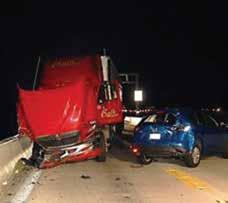
July 19, 2013 | Annapolis, Maryland
At 8:24 p.m., a passenger car was traveling eastbound on US Route 50/301. The car passed through the toll plaza to enter the eastbound span of the Chesapeake Bay Bridge, where traffic was slowed. The car reduced its speed to 4 mph when it was struck from behind by a truck-tractor and refrigerated semitrailer combination unit traveling 47 mph. The truck-tractor collided with the car, pushing the car into the concrete barrier.
As the vehicles continued forward, the front of the car collided with another car occupied by a driver and his wife. The original car was pushed up onto the barrier wall and then rode along its top before falling approximately 27 feet into the Chesapeake Bay, where it came to rest between two bridge piers in seven feet of water. The driver swam to a nearby bridge pier, from which she was rescued, transported to an area hospital and treated for minor injuries. The second car came to rest near the truck-tractor in the middle of the two travel lanes. The truck driver and both of the second car’s occupants were uninjured.
NTSB determined that the probable cause for the crash was the failure of the trucktractor driver to slow for traffic due to his inattention to the forward roadway while looking in his side view mirror.

Aug. 5, 2010 | Gray Summit, Missouri
Traffic was slowed in the approach to an active work zone on eastbound Interstate 44. A truck-tractor had slowed or stopped behind traffic. At 10:11 a.m., a light-duty pickup truck merged and struck the rear of the tractor. This collision was the first of three. Two school buses were approaching the slowed traffic and collision ahead. The lead bus was a 71-passenger bus carrying 23 passengers, and the following bus was a 72-passenger bus carrying 31 passengers.
Seconds after the lead bus passed a motorcoach that had stopped on the shoulder, it struck the rear of the pickup truck. This second collision caused the pickup truck to overturn onto the back of the truck-tractor. The front of the lead bus came to rest on top of the pickup truck and truck-tractor. Moments later, the following bus struck the lead bus. The driver of the pickup truck and one passenger seated in the rear of the lead bus were killed. A total of 35 bus passengers, the two bus drivers and the driver of the truck-tractor were injured. Eighteen people were uninjured.
NTSB determined that the probable cause of the initial collision was distraction, likely due to a text conversation by the pickup truck driver. The second collision was the result of the bus driver’s inattention due to excessive focus on a motorcoach parked on the shoulder of the road. The final collision occurred because the driver of the following school bus failed to maintain the recommended minimum distance from the lead school bus. The severity of the crash was exacerbated by the lack of forward-collision warning systems on the two school buses.
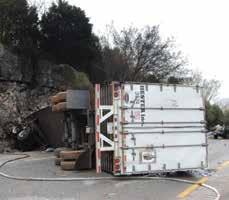
A truck-tractor semitrailer was traveling south on I-65 when it departed the left lane and entered the 60-foot-wide depressed earthen median between the southbound and northbound roadways. The truck traveled across the median and struck and overrode the high-tension median cable barrier adjacent to the left shoulder of northbound I-65. It then crossed the shoulder and entered the lanes of northbound I-65.
A 15-passenger van with 12 occupants was traveling northbound in the left lane. As the truck crossed in front of the van, its tractor was struck by the van. As a result of the crash and the truck fire that ensued, the truck driver, the van driver and nine van passengers died. Two child passengers in the van, who were using child restraints, sustained minor injuries.
Driver distraction/cellphone use was determined to be one of the causes of the crash. By mapping cellular tower service for the truck driver’s phone, investigators determined that the driver used his phone to make and receive calls as well as send and receive text messages a total of 69 times while driving in the 24 hours prior to the crash. n
By Rodolfo Giacoman, Fatigue Management Specialist, Commercial Vehicle Safety Alliance
Drivers face an unusually wide range of occupational hazards: musculoskeletal disorders from vibration and prolonged sitting; hypertension and obesity from sedentary hours and poor nutrition; obstructive sleep apnea and chronic sleep deprivation from irregular schedules and night shifts; and potentially elevated lung cancer risk associated with long-term occupational exposure to diesel exhaust, particularly in older equipment or poorly ventilated environments. On top of that, the stress of long stretches away from family, constant mental alertness and intense productivity demands creates fertile ground for risky behaviors like smoking, heavy drinking, casual sexual contacts and psychoactive substance use.
Psychoactive drugs don't just affect the driver who takes them. They delay reaction times, cloud judgment and impair executive functions like decision-making, hazard recognition and impulse control that keep a heavy vehicle out of oncoming traffic. As noted in the cover story of the third quarter 2025 “Guardian,” drug use and fatigue are consistently identified among the commonly cited contributing factors alongside speeding, roadway conditions and driver distraction in fatal truck crashes.
When I teach fatigue management courses for safety managers, some are familiar with the way caffeine works, which can be used wisely; very few are familiar with amphetamines, which pose significant safety risks in driving contexts and are generally disqualifying unless carefully evaluated under FMCSA medical certification standards. Let’s address both here.
Caffeine is the world's most widely used psychoactive substance, and for commercial motor vehicle (CMV) drivers, it is the one legal tool that genuinely helps manage alertness when used correctly. Understanding how it works means the difference between using it as an asset and inadvertently worsening fatigue.
Every hour we're awake, our brains accumulate a chemical called adenosine, a byproduct of brain activity that builds sleep pressure throughout the day. After 16 or so hours awake, that pressure becomes hard to

resist. Caffeine works by blocking adenosine receptors, preventing the brain from receiving the signal to go to sleep. It doesn't generate energy or true alertness; it masks the fatigue that's already there. The sleep debt in the form of adenosine keeps building behind the scenes.
This is why caffeine has a ceiling. It can buy us time and sharpen focus in the short term, but it cannot substitute for actual sleep, and if used carelessly, it will actively degrade the quality of the sleep we do get.
Stop 6-8 hours before sleep. Caffeine has a half-life of approximately 5-7 hours in most adults (with significant individual variability). A coffee at 3 p.m. may still have half its caffeine active at 9 p.m., right when our brain needs adenosine to build pressure for deep, restorative sleep. Late caffeine suppresses deep sleep even if we fall asleep fine.
Try the nap-uccino. Drink a cup of coffee, then immediately take a 20-minute nap. Caffeine takes 20-30 minutes to kick in, so we may wake up just as it starts to activate, more rested and alert. Keep the nap at or under 20 minutes to avoid waking groggy from deep sleep.
Know the hard limit. After 16+ hours awake, caffeine reduces our ability to perceive how impaired we are. At that point, no amount of coffee replaces stopping and sleeping.
Used within these guardrails, caffeine is a genuine ally. Used without them, especially to push through severe fatigue, it becomes a tool for deceiving ourselves about how dangerous we've become.
Amphetamines are a Schedule II controlled substance. Federal law strictly controls their use, and they are generally a disqualifying substance for CMV drivers unless a very narrow medical exception is met. While a medical review officer (MRO) may clear a drug screen as negative if one has a valid prescription, the medical examiner may still refuse to certify for a medical card. The examiner must determine if the underlying condition (like ADHD) or the medication's side effects pose a safety risk.
Amphetamines give us the feeling of alertness while dismantling the brain systems that generate real alertness. It's the neuroscience of self-deception at 70 miles
per hour.
Where caffeine quietly blocks a receptor, for those using them illicitly or without a medical need, amphetamines detonate a chemical reaction. They increase synaptic concentrations of dopamine and norepinephrine by promoting their release and inhibiting reuptake, leading to heightened wakefulness and perceived focus. For a driver who's been awake 20 hours, this feels like salvation. It isn't. It's a short circuit.
The brain's circadian system, the internal clock that regulates cortisol in the morning and melatonin at night, runs on precise, rhythmic neurochemical signaling. Amphetamines flood that system at any hour, disrupting normal circadian signaling and masking the brain’s ability to accurately interpret time-of-day sleep cues. The driver feels wide awake at 3 a.m., not because their body is ready to be awake but because the biological clock has been chemically hijacked.
Think of it mechanically. Caffeine is a heavier foot on the gas pedal; the engine works as designed, just harder. Amphetamines are nitrous oxide injected into the combustion chamber. The surge is real. But nitrous burns hotter than the engine was built to sustain, consuming future capacity in exchange for present performance.
Amphetamines severely suppress both deep slow-wave sleep and rapid eye movement (REM) sleep, two critical phases where the brain and body restore themselves. A driver who uses amphetamines and then sleeps often experiences significantly reduced restorative sleep quality, particularly in slow-wave and REM stages. Over days and weeks, this creates a compounding deficit that shows up as paranoia, impulsive decisions, emotional volatility and faltering attention, precisely the faculties that keep a driver and everyone around them alive. Chronic or high-dose use has been associated with structural and functional changes in the prefrontal cortex, the brain's center for judgment and impulse control.
The most dangerous feature of amphetamines is the confidence they manufacture. The driver genuinely feels sharp. They cannot accurately feel how impaired they are. That gap, between felt performance and actual performance,
is what significantly increases crash risk in stimulant-impaired driving.
A common question among drivers and safety managers aware of ADHD medications is whether prescription amphetamines like Adderall or Vyvanse are any different from the street drugs showing up in drug tests. They are the same class of drug in a very different context and subject to strict medical evaluation under FMCSA regulations.
Both contain amphetamine compounds (dextroamphetamine or mixed amphetamine salts) that act on the brain through the same dopamine and norepinephrine pathways. Both can suppress deep and REM sleep, both can disrupt the circadian rhythm, and both are detectable on U.S. Department of Transportation (DOT) drug screens.
Prescription stimulants for ADHD are taken at controlled, clinically calibrated doses under medical supervision. In people with ADHD who may have differences in dopamine and norepinephrine signaling associated with attention regulation, these medications can normalize brain function rather than flood it, often improving sustained attention without the euphoric surge of illicit use. The neurochemical effect is comparatively modest and targeted.
Street amphetamines and methamphetamine are taken at far higher, uncontrolled doses with no medical oversight. Methamphetamine is more lipophilic, allowing it to enter the brain more rapidly, remain active longer and produce longer-lasting central nervous system effects, thus staying active longer in the brain and producing a much larger dopamine spike than prescription formulations. This causes more severe sleep disruption, faster dependence and greater cognitive damage over time.
Under Title 49 Code of Federal Regulations § 391.41(b)(12), a driver may not use a Schedule II controlled substance unless it is prescribed by a licensed practitioner who is familiar with the driver’s duties and has advised that the substance will not adversely affect safe operation. Final certification authority rests with the FMCSA medical examiner.
Even when prescribed and MRO-verified, stimulant use does not obligate a medical examiner to certify. Certification decisions vary by examiner judgment, side-effect profile, dosage stability and documented functional performance.
Schneider National, one of North America's largest carriers, began hair follicle drug testing in 2009. Standard U.S. DOT urine tests detect most drugs for only two to five days and are relatively limited by short detection windows via brief abstinence or sample dilution. Because drugs are deposited into the hair shaft as it grows, a standard 1.5-inch sample provides an extended detection window (approximately 90 days), though it is not currently approved for U.S. DOT compliance testing and has known limitations regarding environmental exposure and variability via timing or substitution.
Since implementing hair testing, Schneider National has reported that amphetamines and cocaine are among the most frequently detected substances in hair testing programs in random screens, substances that urine testing alone would have largely missed. For safety managers, this gap represents drivers who would have been cleared as drug-free but were anything but. (Cocaine, while pharmacologically distinct, also disrupts dopamine signaling and impairs judgment and impulse control, creating similar safety risks in driving contexts.)
While carriers may use hair testing to screen out high-risk applicants, these results are currently not reportable to the FMCSA Drug and Alcohol Clearinghouse. Only U.S. DOTmandated urine or oral fluid tests carry the weight of a federally prohibited status. Federal law prohibits operating a CMV while under the influence of any controlled substance. A positive test means immediate removal from safety-sensitive duties, mandatory referral to a U.S. DOT substance abuse professional (SAP) and a reportable entry in the FMCSA Drug and Alcohol Clearinghouse.
The impairment is real whether or not we've been tested. The pharmacological effects occur regardless of whether a test is administered or the substance is detected.
Continued on next page
Continued from page 39
The neuroscience case against amphetamine use is clear. But knowing why something is harmful and being able to stop are different things. Amphetamine use disorder is a recognized medical condition driven by real neurochemical changes that willpower alone is rarely enough to overcome. If drivers recognize themselves in this article, the most important thing to know is that this is a medical problem with medical solutions. The stigma around addiction in the trucking industry keeps drivers using because they're afraid that getting help will cost them their CDL and their livelihood. That fear is real. It's also usually worse than reality and far less dangerous than continuing to drive impaired.
SAMHSA National Helpline: 1-800-662-4357 Free, confidential, 24/7, no insurance required. Treatment referral for substance use disorders.
DOT Substance Abuse Professional Program
Drivers who self-refer or test positive are evaluated by a U.S. DOT-qualified SAP who recommends treatment. Successful completion of the return-to-duty process can restore safetysensitive driving privileges. Recovery and return to work is possible.
Many carriers offer confidential EAPs with free counseling and referral, separate from the regulatory testing process. Voluntary self-referral before a positive test carries significantly different and better consequences than being caught. Self-referral must occur prior to being notified of a mandated test to receive the typical protection of a carrier’s EAP policy.
Understand your rights and the return-to-duty process at clearinghouse.fmcsa.dot.gov before fear of the unknown prevents you from acting.
Our brain is our most critical piece of equipment, one that requires the right fuel and adequate recovery to function. Use caffeine strategically, respect our need for sleep and, if you find yourself leaning on a chemical shortcut, choose the professional path: Get help, get clear and stay qualified. Proactive education and voluntary self-reporting are key components of a compliant safety program and are encouraged across the transportation industry.
Keep your comments and questions coming at rodolfo.giacoman@cvsa.org. n
How it works Blocks adenosine receptors; masks sleep pressure
Circadian impact Mild melatonin delay if taken too late
Sleep architecture quality
Moderate deep sleep reduction when active at bedtime
Self-awareness of impairment Partially reduced; largely selflimiting
Forces mass dopamine/ norepinephrine release; floods reward circuits
Disrupts normal circadian output signaling and sleep-wake integration; dysregulates cortisol and melatonin
Severely suppresses deep and REM sleep; sleep is nonrestorative
Profoundly distorted; driver cannot accurately gauge their own impairment
Long-term brain effects
Crash risk
No significant adverse structural brain effects at typical consumption levels in healthy adults
Mitigated with strategic use; elevated if used to override severe fatigue
Dependence risk Mild; manageable
Associations with altered prefrontal cortex structure and function, including reductions in gray matter volume observed in some chronic users, lasting memory and attention deficits
Substantially elevated; impairs judgment, reaction time and hazard detection
High; significant withdrawal; associated with high addiction potential and significant risk of dependence
Class I Member jurisdictions and Class II Local Membership will vote for secretary at the 2026 CVSA Annual Conference and Exhibition this September in Orlando, Florida.
Remember, when you cast your vote for secretary, you are electing a future CVSA president. The secretary position is a oneyear term, which transitions to a year as vice president, followed by a year serving as president, after which comes three years serving as past president.
Get to know this year’s candidates by reading the articles on pages 41-44, written by each candidate, which include information on their careers, philosophies on commercial motor vehicle safety and qualifications for serving as the next secretary of CVSA.
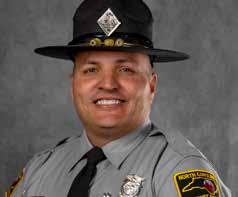
For those who know me, you know that talking about myself is one of the hardest things I do. I’ve always preferred to let my actions speak and simply be who I am. That said, I want to serve you as CVSA secretary, and I believe you deserve to know who I am and what I stand for.
I am a sergeant with the North Carolina State Highway Patrol and have lived in North Carolina my entire life. I have been married for 27 years and have two adult children. Outside of work, I enjoy riding motorcycles and staying involved in emergency services. I also serve as a law enforcement instructor at Wilkes Community College.
I have served in law enforcement for more than 28 years, with the last 25 years dedicated to commercial motor vehicle enforcement. Throughout my career, I have been fortunate to be involved in nearly every aspect of this profession. In 2015, I was honored to win the Grand Champion Award, the highest honor for a commercial motor vehicle inspector, at CVSA's North American Inspectors Championship in St. Louis, Missouri. I currently serve as the Region II chair for CVSA's Cooperative Hazardous Materials Enforcement Development (COHMED) Program after earning your trust and support in 2024.
I am certified to teach North American Standard Inspection Parts A and B, General Hazardous Materials, Cargo Tank Inspection, Other Bulk Packages, New Entrant Safety Audit and Investigative Safety Analysis through CVSA. I began instructing for North Carolina in 2005 and later with Federal Motor Carrier Safety Administration’s National Training
Center in 2016. I have been a master instructor since 2019. During that time, I’ve had the privilege of mentoring many inspectors as they began their own journey in instruction.
While instruction has become a central part of my career, I have remained committed to the field. I continue to perform commercial motor vehicle enforcement duties and bring that real-world experience directly into the classroom. I strongly believe that training is most effective when it reflects what inspectors are actually facing roadside every day.
I am a firm believer in the mission of commercial motor vehicle enforcement. Each of us contributes to public safety in ways that are not always visible but are always important. Early in my career, I realized while conducting inspections is critical, my impact could grow by helping others. Through instruction, I have worked with hundreds – if not thousands – of inspectors, who in turn perform thousands of inspections each year. Mentoring instructors has allowed that impact to continue growing across jurisdictions and over time.
As secretary, I would continue that focus on service and support. My goal is to represent the membership and contribute to efforts that make your job more effective and manageable.
One of my priorities would be simplifying regulations and guidance wherever possible. The complexity of our work is unavoidable, but how we communicate and apply that information can make a significant difference. Clear, practical guidance helps ensure consistency, confidence and efficiency in the field.
I would approach this role the same way I approach instruction – with clarity, consistency and a focus on real-world application. I value the opportunity to continue serving alongside you.
Thank you for your time and for considering me as your secretary. Stay safe, and thank you for the work you do every day. n
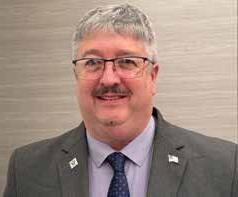
I am honored and grateful to be running for the position of CVSA secretary. It is a privilege to be considered among dedicated professionals committed to advancing commercial motor vehicle safety. I approach this opportunity with the understanding of the significant responsibilities that come with a leadership role.
More than 46 years ago, several western states envisioned forming an alliance to unify the U.S., Canada and Mexico. This vision emphasized consistency in enforcement, reciprocity across jurisdictions, strong collaboration between government and industry, and a shared commitment to improving safety through data sharing and best practices.
This foundational principle was reinforced in me when I began my career with the Oregon Department of Transportation (ODOT) 18 years ago. My dedication remains focused on ensuring safer roads and highways and protecting our communities and families.
On a personal note, I met my wife 36 years ago in the Philippines. We married on Pearl Harbor Day, December 7, 1990, in Okinawa, Japan. We are the proud parents of two children: Aaron, who currently serves full time in the Iowa Air National Guard, and Abey, who is a junior in high school.
I grew up in Cottage Grove, Oregon, and graduated from high school in 1985. Following graduation, I joined the U.S. Air Force, beginning my career as a fuels specialist –known in hazardous materials as petroleum, oils and lubricants.
While serving in this career field, I held various roles, including fuel truck driver, fuel storage attendant, cryogenics attendant and maintenance supervisor. A notable highlight was fueling the Lockheed SR-71 Blackbird, the fastest aircraft in the world.
After 10 years as a fuels specialist, I transitioned into the occupational safety and health field. Stationed at Malmstrom Air Force Base in Montana, I performed safety duties within the missile field and was involved in nuclear surety operations. During this time, I was honored to be named Technician of the Year for Space Command.
Subsequently, I was transferred to Patrick Air Force Base in Florida, where I oversaw safety operations on base and at Cape Canaveral launch pads. My military career provided diverse experiences across various locations, enriching my perspective and expertise.
My final assignment was as ground safety manager at Baghdad International Airport in Iraq. After completing 20 years of service, I retired from the U.S. Air Force in 2005.
In 2008, I joined ODOT as a compliance specialist. In this role, I conducted compliance reviews, audits and roadside inspections related to hazardous materials, cargo tanks, bulk shipments and passenger vehicles.
Since 2017, I have served as the training coordinator and point of contact for ODOT. I am also a North American Inspection Parts A and B instructor and master instructor and have mentored and instructed instructor development courses.
My involvement with CVSA began more than four years ago, and during that time I have had the opportunity to contribute in a variety of meaningful ways. I have actively participated in several ad hoc committees, including but not limited to updates to operational policies, training materials, inspection bulletins and the North American Standard Out-of-Service Criteria. These experiences have allowed me to collaborate with colleagues across jurisdictions and contribute to initiatives that directly support consistency and safety in our industry.
I currently serve as a member of the Curriculum Advisory Team for Parts A and B and Passenger Vehicle Inspection. I am part of a great team, helping ensure training materials remain relevant, accurate and up to date.
Participation in CVSA has allowed me to build valuable relationships with professionals across the U.S., Canada and Mexico. These connections have broadened my perspective and enhanced my ability to support and strengthen our state programs. I am grateful for the knowledge, experience and guidance shared by my colleagues.
If selected as CVSA secretary and ultimately serving as CVSA president, my objective will be to serve with transparency, integrity and a steadfast focus on CVSA’s mission. I am committed to fostering open communication and ensuring all members feel informed, heard and engaged. I will prioritize initiatives that align with our shared goals, embrace innovative technologies to improve enforcement and training, and support ongoing collaboration to help CVSA adapt and thrive in evolving environments n
Region V: British Columbia Ministry of Transportation and Transit
My name is Richard Roberts, and I am seeking election as secretary of the Commercial Vehicle Safety Alliance. After nearly three decades working in commercial motor vehicle safety in British Columbia and across Canada, I continue to be motivated by the importance of collaboration, consistency and leadership in keeping our roadways safe. Serving CVSA in an executive role has long been a professional goal, and I am grateful for the opportunity to once again seek the support of the Alliance’s membership.
I currently serve as deputy director of compliance and operations with Commercial Vehicle Safety and Enforcement in British Columbia’s Ministry of Transportation and Transit. In this position, I work with a wide range of domestic and national partners to support continuous improvement of regulatory compliance and operational consistency. I represent my agency on the British Columbia Association of Chiefs of Police Traffic Enforcement Subcommittee and the National Compliance Working Group for the Transport of Dangerous Goods, and I remain actively involved in the Canadian Council of Motor Transport Administrators working groups focused on electronic logging devices and cargo securement. These roles provide ongoing insight into the operational realities and policy considerations affecting our industry.
My involvement with CVSA spans more than two decades. It began in 2002 when I first competed in CVSA's North American Inspectors Championship (NAIC). There, I saw the professionalism, pride and technical excellence to which I aspired. In 2006, I was honored to be named NAIC Jimmy K. Ammons
Grand Champion, an achievement that led my agency to send me to CVSA’s annual conference for the first time. That experience highlighted to me the critical role CVSA plays in bringing jurisdictions together, sharing best practices and driving positive change across North America. From that point forward, my commitment to the Alliance deepened.
Over the years, I have had the privilege of serving CVSA in a variety of leadership roles. I joined the NAIC Program in 2015 and have served as chair since 2016, working closely with inspectors and program leaders to ensure NAIC remains relevant, fair and reflective of modern enforcement environments. In 2017, I became Region V president, a role I held for more than six years. During that time, I served as a voting member of the CVSA Board of Directors and as a member of the CVSA Finance Committee. I also contributed to two strategic plans, participated in standing committees and ad hoc groups, and took part in many important discussions shaping CVSA’s direction and long-term stability. I am currently the Alliance’s Region V vice president.
One of the most valuable aspects of my time in CVSA leadership has been the relationships built across all levels of membership. From frontline inspectors to senior executives, agency administrators and industry partners, these connections have reinforced the importance of listening, cooperation and mutual respect. As CVSA expanded and matured during this period, it became clear that thoughtful governance and responsible financial decision making are essential to supporting the Alliance’s future and the needs of its membership.
As CVSA continues to grow and adapt, I believe the Alliance must remain focused on strong communication with its members and partners. We must balance tradition with innovation, retaining the knowledge, experience and mentorship that built CVSA into the organization it is today while remaining open to new and varying ideas and perspectives. Supporting seasoned leaders and emerging “boots on the ground” professionals will be essential to addressing future challenges.
If elected as secretary, I would bring a leadership approach grounded in experience, collaboration and accountability. I am committed to listening to and representing the voices of the membership, supporting informed decision making and helping to ensure CVSA remains effective, inclusive and forward looking. Should I have the opportunity to continue serving and eventually advance to the presidency, I would be proud to support hosting a future CVSA Annual Conference and Exhibition in Vancouver, British Columbia, offering members a dynamic and welcoming destination.
The strength of CVSA lies in its people and in our uniting vision of safer roads throughout North America. Executive leadership, board members and lead agency contacts drive the Alliance’s success, and I would welcome the opportunity to serve them. I respectfully ask for your support and vote and would be honored to continue contributing my experience and leadership to CVSA’s mission as your secretary. I take this opportunity seriously and I am committed to carrying out the responsibilities of this role and meeting the full six-year time commitment.
Thank you for your consideration. n
Region II: Texas Department of Public Safety

Greetings from the state of Texas. I am Major Omar A. Villarreal, and I am humbly seeking your endorsement and support in assuming the duties and responsibilities of CVSA secretary.
I graduated from the University of Texas at Austin in 1993 with a bachelor’s degree in government. Shortly thereafter, I began my public service career as a state probation officer in Cameron County, Texas. Since 1996, I have proudly served as a Texas trooper, with more than 24 years dedicated specifically to commercial motor vehicle (CMV) enforcement.
Throughout my career, I have remained committed to a mission that closely aligns with the CVSA: improving CMV safety through education, enforcement, partnership and collaboration. The work performed by CVSA and its members across North America plays a critical role in preventing crashes, injuries and fatalities, while strengthening the relationship between enforcement agencies and the motor carrier industry.
Within the Texas Highway Patrol Division, I have served at duty stations across the state, from Brownsville to El Paso. Those assignments provided firsthand experience in addressing unique international transportation, border and enforcement challenges facing law enforcement and our transportation industry partners. Today, I oversee all CMV enforcement programs and the Motor Carrier Safety Assistance Program (MCSAP) Grant for the Texas Department of Public Safety at our divisional headquarters in Austin.
One of the things I take the greatest pride in is the team we have built in Texas. I have been fortunate to work alongside outstanding personnel at the Motor Carrier Bureau and with enforcement personnel, inspectors
and local agency partners who continue advancing strong enforcement, training, compliance reviews, safety audits, school bus safety, and radiation and nuclear detection programs. Together, we have also developed a successful program focused on preparing certified inspectors to compete at CVSA's North American Inspectors Championship.
I also greatly value the partnerships we have established with local law enforcement agencies throughout Texas that participate in MCSAP. Meaningful progress in CMV safety can only happen through communication, consistency and mutual respect between agencies, jurisdictions and industry stakeholders. Those relationships have reinforced my belief that collaboration is one of the most important tools we have in improving highway safety.
Every biennium, I testify before the Texas legislature regarding CMV safety, border security and the international transportation of goods. Over the years, I have submitted legislative proposals focused on reducing CMV crashes and improving roadway safety. I am proud that several of those efforts ultimately became Texas law and have contributed positively toward protecting the motoring public.
Earlier this year, I was also invited to testify before the U.S. House of Representatives Committee on Homeland Security as a subject matter expert. Opportunities such as these help bring greater awareness to emerging issues impacting CMV safety and allow us to advocate for practical solutions that benefit enforcement and industry.
I continue working closely with the Texas Trucking Association in support of our shared goal of improving CMV safety. I regularly participate in their Safety Management Council conferences and annual conference, and I value the strong partnership that exists between enforcement and industry. In 2015, I was honored to receive the C.H. Cheshire Award for distinguished highway safety contributions.
I have also presented before the Oklahoma Trucking Association, Arkansas Trucking Association and Missouri Trucking Association regarding the issue of fraudulent Mexican commercial driver’s licenses (licencia federal de conductor), an issue I remain deeply committed
to addressing through education, awareness and enforcement collaboration.
Since 2011, I have attended and participated in CVSA conferences and have witnessed firsthand the growth and evolution of this organization. Through those experiences, I have come to appreciate the importance of ensuring every member jurisdiction and voting entity has the opportunity to be heard and represented.
If elected as CVSA secretary, my priorities would center on transparency, communication and member engagement. I strongly believe every voting member deserves access to the information necessary to make informed decisions, especially on matters involving policy, funding and organizational direction. Questions raised by member jurisdictions should be addressed openly and respectfully prior to major decisions or votes.
I also believe strongly in continuing to strengthen partnerships between enforcement agencies and industry while supporting the professional development of inspectors and enforcement personnel across all jurisdictions. CVSA’s continued success depends on the experience, professionalism and dedication of its members.
Most importantly, I want to serve as an advocate for your region, your jurisdiction and your concerns. I value open communication, professionalism and collaboration, and I would greatly appreciate your support and confidence as I seek the opportunity to serve as your CVSA secretary.
I look forward to speaking with many of you in the near future and hope to see you very soon. n

By Cpl. Dustin Henderson, Radiological/Nuclear Threat Detection Unit, Texas Department of Public Safety
In the vast network of America’s highways, where commercial motor vehicles (CMVs) thunder by at 75 mph and buses shuttle weary commuters, a quiet army stands guard: us, the CMV inspectors. Uniforms vary among agencies, and department policies and cultures may differ here and there, but we all have one thing in common: increasing safety for the motoring public. Behind the routine checks and citations lies a hidden struggle, one that many inspectors know all too well: burnout fueled by the frustrating invisibility of their impact.
Imagine starting your day at a weigh station in rural west Texas, where the wind constantly blows so hard you cannot even see the roadway a half mile in front of you. You’re inspecting brakes, tires, lights and hours of service, flagging violations that could prevent catastrophic crashes. Yet, as the trucks roll away – some compliant, others ticketed – you’re left wondering: Did I just save a life? Or was this just another box ticked in a bureaucratic machine? For CMV inspectors, this existential doubt is a common thread, weaving through long shifts under scorching sun, several inches of snow or biting wind, leading to exhaustion that’s as much emotional as physical.
Inspecting CMVs isn’t for the faint of heart. Inspectors, employed by local jurisdictions, state/provincial/territorial agencies or federal agencies like the Federal Motor Carrier Safety Administration (FMCSA), conduct Level I through VI Inspections, scrutinizing everything from vehicle weight to driver credentials. It’s a role that demands precision; a faulty brake system or overloaded trailer could spell disaster on any roadway. Then you add the complexity of correctly comprehending and applying the regulations, especially for hazardous materials, which increases stress for future DataQs.
The burnout creeps in subtly. You pull over a rig with worn-out tires, issue a warning and send it on its way. You know in theory that you’re preventing blowouts that could cause multi-car pileups. But there’s no immediate feedback – no thank-you note from the family whose minivan didn’t get sideswiped, no headline saying, “Inspector Averts Tragedy.” It’s like shouting into the void.
This lack of visible difference-making exacerbates the job’s inherent stresses: irregular hours, exposure to hazardous materials, confrontations with frustrated drivers and carriers, and the pressure of enforcing regulations in an industry where time is money. In an era of data-driven everything, we often
feel like cogs in a system that measures success in citations issued rather than lives preserved. I’ve spoken to numerous inspectors who go home exhausted, questioning if what they do makes a difference and saves lives. They comment on how it seems we always catch the same companies violating regulations repeatedly, and nothing seems to change.
Burnout in our field manifests in myriad ways: chronic fatigue, irritability, detachment from work and even physical ailments like hypertension from constant stress. Psychologically, it’s rooted in what’s known as “impact invisibility” – a phenomenon where the positive outcomes of one’s efforts are delayed or unseen. For us, the “wins” are statistical: FMCSA data shows that rigorous inspections correlate with a 20-30% reduction in truck-involved fatalities over the past decade. We often work solo or in small teams, with limited interaction beyond the few and far between adversarial driver encounters.
However, I frequently tell truck drivers, “I’d rather stop a truck than a four-wheeler any day of the week,” because the amount of respect nearly all professional truck drivers show to law enforcement far outweighs the interactions with four-wheelers. They realize they have a job to do, and we have a job to do. They want to get the product delivered and get back home safely, and we want to make it back home to our families safely.
The good news? Burnout isn’t inevitable. With intentional steps, we can reclaim our sense of purpose and sustain our vital work. Here are proven ways to combat the drain, drawn from experts, including a few of my field training officers and fellow inspectors who’ve previously weathered the storm.
Professional networks like CVSA offer conferences and training. Collaborate, share stories, get advice and share your experiences. There are also numerous civic organizations that you can join that are not work-related.
Isolation breeds doubt, so counter it with connection. Form or join peer support groups through unions or online forums. Mentorship programs pair seasoned inspectors with newcomers, fostering a sense of shared mission.
Physical and mental health are your first lines of defense. Establish routines: I’ve been told to exercise regularly (something I have a hard time staying motivated to do), spend quality time with my family and ensure adequate sleep despite shift work. I remember asking the individual who told me this, "Do you not have young children at home along with a job? Because I do, and sleep is a thing of the past.” If burnout edges into depression, seek professional help; many agencies offer free counseling.
Reignite passion by advancing your skills. Certifications in specialized areas like hazardous materials, new entrant safety audits and post-crash inspections can make the job feel fresh and impactful. Learning to navigate the hazardous materials regulations has been very rewarding for me. Every time I open the book to look something up, I end up learning something new. Then I have to go to interpretations to see if anything else applies. It’s like an easter egg hunt that never ends.
Keep an eye on www.cvsa.org/training for certification training and continuing education courses.
Become involved in CVSA’s policymaking by attending the CVSA Workshop in the spring and the CVSA Annual Conference and Exhibition in the fall. Get involved in a committee where you can make a difference. After winning the North American Inspectors Championship last year, CVSA invited me to attend their fall conference, and it was a very eye-opening and rewarding experience to see how enforcement and industry meet in the various committees to develop regulatory policy. An Issue/Request for Action is an easy way to start a systemic change. It allows you to have a voice at the table. These can be submitted at www.cvsa. org/inspections/issuerequest-for-action.
Burnout may lurk in the shadows of unseen victories, but by embracing these strategies, you can illuminate your path. Remember: Every inspection is a potential lifesaver, even if the gratitude is silent. In a world of roaring engines and endless asphalt, our vigilance is the quiet force keeping us all moving forward – safely. n

By Adrienne Gildea, CAE, Deputy Executive Director, Commercial Vehicle Safety Alliance
Check out CVSA’s letter of support for the BUILD America 250 Act at www.cvsa.org/news/cvsa-supports-build-america-250-act
In May, the U.S. House of Representative’s Committee on Transportation and Infrastructure Committee released and approved its much-anticipated surface transportation proposal, the Building Unrivaled Infrastructure and Long-term Development for America’s 250th Act (BUILD America 250 Act).
Since passage of the previous infrastructure bill, the Infrastructure Investment and Jobs Act (IIJA) in 2021, CVSA has held hundreds of meetings with House and Senate committee and personal office staff, educating members and their teams and advocating on behalf of the commercial motor vehicle (CMV) enforcement community. Check out a full list of CVSA’s reauthorization priorities at www.cvsa.org/policy/reauthorization
The combined efforts of the CVSA Reauthorization Task Force, CVSA Policy and Regulatory Affairs Committee, the CVSA Board of Directors and CVSA staff resulted in a number of the Alliance’s priorities being included in the bill approved by the Transportation and Infrastructure Committee on May 22, including:
• Providing critical funding through the Motor Carrier Safety Assistance Program (MCSAP) and expanding MCSAP spending eligibility
• Providing additional safety funding through programs like the High Priority and Commercial Driver’s License Program Implementation (CDLPI) grants
• Expanding eligibility for CDLPI grants to include Puerto Rico and the U.S. Virgin Islands
• Supporting certification training for CMV inspectors through improvements to the Enforcement Training and Support Grant
• Improving hazardous materials training for inspectors, first responders and industry personnel by consolidating several existing grants
• Updating the requirement that the Federal Motor Carrier Safety Administration (FMCSA) adopt CVSA Operational Policy 4 – Inspector
Training and Certification by reference and requiring the agency to maintain that incorporation by reference going forward
• Requiring the establishment of minimum knowledge standards for new motor carriers
• Directing a study on the New Entrant Safety Assurance Program
• Requiring drivers operating under an active exemption to carry documentation regarding that exemption with them
• Requiring FMCSA to proactively certify electronic logging devices (ELDs), rather than relying on a self-certification process
In addition, the bill contains a number of provisions that were not part of CVSA’s reauthorization priorities, but the Alliance supports as improvements to CMV safety policy:
• Strengthening oversight of exemptions from federal regulations and expanding the associated terms and conditions for exemptions from the Federal Motor Carrier Safety Regulations
• Requiring FMCSA to study and address challenges posed by chameleon carriers
• Directing FMCSA to strengthen motor carrier registration standards and vetting
• Improving lithium battery transportation safety by establishing registration and other requirements
• Establishing a framework for CMVs equipped with autonomous driving systems
While the BUILD America 250 Act includes many provisions supported by CVSA that will help improve roadway safety, it also contains several concerning size and weight, ELD, and hours-of-service exemptions for various industry groups, which CVSA does not support. In addition, the bill excludes several key CVSA legislative priorities, like requiring all new CMVs be equipped with a universal electronic vehicle identifier and setting limits on the use of the personal conveyance designation by CMV drivers operating in commerce.
With the Sept. 30 deadline looming, time is running out to pass a new surface transportation reauthorization bill before IIJA expires. There’s still a lot of work to be done. The House Transportation and Infrastructure and House Energy and Commerce Committees have approved their portions of the bill. Additional work is needed in the House before the bill can be sent to the Senate, and as of June 1, none of the relevant Senate committees have released their own measures. As it stands, the bill contains other provisions unrelated to CMV issues that face strong opposition in the rail sector and other sectors.
At the very least, Congress will likely need to pass a short-term extension sometime over the summer to extend existing programs and authorities while legislators negotiate on the final bill. As Congress moves ahead with next steps, CVSA will continue to engage with policymakers to promote the policies approved by the Alliance’s membership. n
Want to stay up to date and get involved?
Subscribe to CVSA’s Legislative and Regulatory Updates and check out the CVSA Policy and Regulatory Affairs Committee. You can subscribe to the email list and join the committee at portal.cvsa.org.

By Michael Middleton, Professional Truck Driver, Old Dominion Freight Line; America’s Road Team Captain, American Trucking Associations
By most accounts, the North American highway system is a marvel. Every day, millions of drivers travel safely to work, school and home again. But what many people don’t always realize is that those same roads are also the workplace for professional truck drivers like me.
I am Mike Middleton, a professional truck driver with Old Dominion Freight Line. After nearly three decades behind the wheel of a commercial truck, I have driven more than 3.3 million miles safely. During that time, I’ve learned one simple truth: the safest highways are the ones where everyone understands how to share the road.
At Old Dominion Freight Line, I am also a driver trainer, preparing the next generation of professional truck drivers for successful, safe careers in the trucking industry. In this role, I mentor new drivers by teaching defensive driving techniques, proper vehicle control, safety awareness and the importance of professionalism behind the wheel. My focus is not only on operating equipment safely but also on developing the mindset and habits that lead to a lifetime of safe driving. Passing along real-world knowledge and experiences is one of the most rewarding parts of my career, and I take pride in helping new drivers build the skills and confidence needed to operate safely on North American highways.
That’s exactly the message we deliver during Share the Road events organized by the American Trucking Associations. This program brings professional drivers face-to-face with the public to discuss how drivers of passenger vehicles and commercial motor vehicles can safely operate together. Instead of hearing about trucks in headlines or on social media, people can ask questions directly to someone who drives one every day.
And those conversations can be eye-opening.
At many of these events, one of the first things we do is invite students to climb up into the cab of a tractor-trailer. Once they sit in the driver’s seat and look out the windshield and mirrors, they immediately notice something surprising: There are large areas around the truck where vehicles simply cannot be seen.
These areas of concern – often called “no zones” or “blind spots” – exist on all four sides of a tractor-trailer. When a passenger car lingers in those areas, the driver may have no idea they’re there. It’s not because the truck driver isn’t paying attention. It’s simply the reality of operating a vehicle that can be 70 feet long and weigh up to 80,000 pounds when fully loaded.
I remember one event where a participant sat in the cab and looked for a car parked just a few feet off the passenger side of the truck. From their seat, it completely disappeared. Their reaction said it all: “I had no idea.”
Moments like that are why these outreach programs matter.
Another topic we discuss is stopping distance. A fully loaded tractor-trailer needs much more room to stop than a passenger vehicle. If a car suddenly cuts in front of a truck and hits the brakes, the truck driver may not have enough distance to stop safely. It’s not about reaction time – it’s about physics.
At one Share the Road event, we showed participants exactly how long it takes a truck to come to a complete stop at highway speeds. When people see that distance marked out on pavement, it often changes how they think about merging or passing trucks.
We also talk about simple habits that can make a big difference for everyone on the road.
Give trucks extra space.
Avoid lingering beside them.
Signal early when changing lanes.
And when you pass a truck, make sure you can see the entire front of the truck in your mirror before moving back into the lane.
These aren’t complicated rules, but they can prevent serious crashes.
What I’ve noticed over the years is that most drivers genuinely want to be safe. Many just haven’t had the opportunity to learn what it’s like from the truck driver’s perspective. Programs like Share the Road really bridge that gap.
The reality is that trucks are essential to everyday life in America. Nearly everything we use – from groceries to medicine to building materials – spends time on a truck before it reaches its destination. Professional drivers take that responsibility seriously. Safety isn’t just part of the job; it’s the foundation of it.
When I speak with students, community members or new drivers at these events, I remind them that we’re all working toward the same goal: getting home safely at the end of the day.
Truck drivers aren’t just operators of large vehicles – we’re parents, grandparents, neighbors and members of the same communities you drive through every day.
Sharing the road is really about awareness and respect. When passenger vehicle drivers understand the limitations of large trucks and give them the space they need, everyone benefits.
After millions of miles on America’s highways, I can say with confidence that cooperation between drivers makes all the difference. When we look out for one another and practice patience on the road, we make our highways safer for everyone.
And that’s a message worth sharing. n
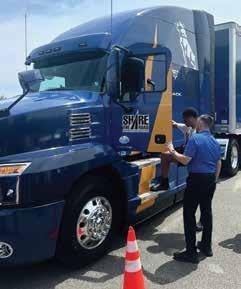
By Jim Rhodes, CPA, MST, Executive Director, IFTA Inc.
Commercial motor vehicle (CMV) enforcement programs are facing an issue as old as any organization: doing more with less. More weigh stations across North America are operating with reduced staffing compared to five years ago. Retirements, budget cuts and competition from private-sector careers have reduced inspector availability, while CMV volumes have increased over time. The result is a widening gap between the number of CMVs on the road and the available personnel to adequately screen them.
This staffing pressure creates cascading effects. At a typical weigh station, an officer's time is consumed by routine administrative work: Manually recording USDOT numbers, looking up carrier safety records in the Safety Measurement System or Safety and Fitness Electronic Records System, cross-referencing vehicle information, and making inspection prioritization decisions. Though this is a general assessment and standard process, at the end of the day, each vehicle requires time. Considering that this process can cover hundreds or thousands of vehicles per shift, that time adds up – and it impacts the time available for deeper inspection work, investigation and enforcement.
When staffing is insufficient or non-existent, triage becomes inevitable. Some vehicles receive abbreviated screening. Others bypass inspection during shift gaps or peak hours. The result is inconsistent enforcement coverage and potential safety gaps.
Emerging AI-enabled vehicle detection technologies offer a different approach to this challenge. Rather than asking officers to collect routine data, these systems perform automated data collection, freeing officers to focus on enforcement decisions and investigations.
The underlying technology leverages highresolution cameras equipped with optical character recognition to capture and read vehicle identification numbers – USDOT, VIN and motor carrier (MC) numbers – as vehicles pass through or enter a weigh station. What has evolved is the enhanced “education” of the algorithms: trained on millions of CMV images, including license plates, USDOT numbers and fonts, hazmat placards, container codes, and even driver behavior such as seatbelt use and distracted
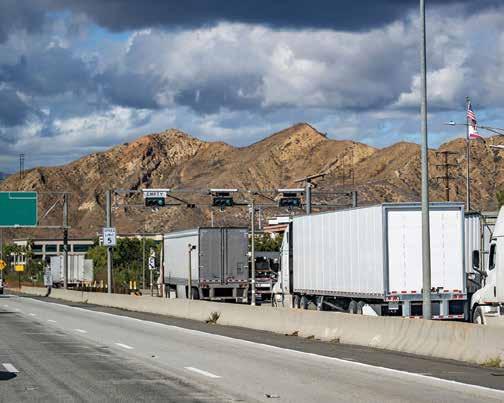
driving. Additionally, modern systems can handle variability in lighting, weather, vehicle condition and vehicle configuration. Machine learning models have reached accuracy thresholds that make them reliable for enforcement workflows.
The workflow is straightforward: As a vehicle approaches or passes through the station, fixed or portable cameras capture images. Automated systems instantly read USDOT, VIN and MC numbers and cross-reference this data in real time with federal safety databases. If the vehicle or carrier has a concerning record – repeated violations, safety issues, outstanding compliance problems – an alert is generated and delivered to the officer's workstation. Low-risk vehicles proceed without triggering alerts that would require an officer’s attention.
The critical difference is reallocation. This can be done by prioritizing screening data and inspection alerts. Instead of performing data entry and database lookups for every vehicle, officers receive a curated list of flagged vehicles ready for intervention. Their time shifts from data collection to decision-making and enforcement.
The practical impact is straightforward. Consider a weigh station processing 150 vehicles per shift. Through pre-screening tools already in the workflow – transponder-based bypass systems and weigh-in-motion sensors – a significant portion of compliant carriers are cleared before reaching the facility. What remains is a concentrated pool of vehicles requiring officer attention: those flagged by pre-screening, carriers with compliance history or vehicles presenting condition concerns at approach.
In a manual system, the officer's first task upon pull-in is triage – querying carrier records, reviewing inspection history and making prioritization calls before substantive enforcement work begins. In an AI-enabled system, that triage happens upstream. The officer receives a prioritized queue along with an enriched data package: plate and USDOT reads, dimensional data, carrier compliance profile, and any behavioral or mechanical flags captured during approach. The decision of where to start has already been made.
The time recovered from administrative triage isn't the sole point; it's how that time gets redirected. Officers can focus on Level I and II inspections, driver interviews, violation
documentation and follow-up investigation –work that requires a trained officer and cannot be automated. AI doesn't replace enforcement judgment; it clears the path for it.
As automated systems operate across time, they generate historical data that reveals patterns and trends.
Machine learning models can identify which drivers and carriers have repeated violations, which corridors exhibit elevated violation rates and which vehicle types pose a higher risk. This shifts agencies from a purely reactive enforcement, responding to violations as they occur, to predictive intelligence: identifying elevated-risk factors and corridors in advance and concentrating resources accordingly.
The picture that emerges is rarely about fleet size or carrier reputation. High-compliance carriers exist at every scale, and violation patterns often concentrate among a narrow subset of operators – independent drivers included – rather than reflecting industrywide behavior. If data shows that a particular corridor has a 40% violation rate compared to the 15% system-wide rate, enforcement resources can be strategically concentrated there. If specific operators show repeated patterns, targeted screening or outreach can address root causes before they compound.
With limited staffing, this precision becomes even more important. Resources go where risk is highest, not where assumptions point.
This predictive capacity compounds over time. The more vehicles are screened, the more data is accumulated and the more refined the pattern recognition becomes. The force multiplier effect grows with deployment duration.
Deployment requires attention to practical factors. Initial setup involves investment in cameras, software integration and connectivity to existing weigh-in-motion (WIM) systems. Integration with legacy WIM infrastructure and database systems requires coordination across hardware, software and IT teams. Inspectors need training not only in technology but also in revised workflows and alert-prioritization processes.
Data quality oversight is essential. Automated systems depend on reliable image capture and ongoing performance validation. Regular accuracy audits and image optimization ensure system reliability. Agencies should also clarify how alerts inform enforcement decisions, how confidence scoring guides officer judgment and how the technology integrates with existing compliance frameworks.
The staffing challenge facing CMV enforcement cannot be resolved through hiring alone. Budget constraints, workforce demographics and career competition make significant headcount increases unlikely. Technology will play a role in state enforcement programs; the question is how thoughtfully agencies implement it.
Automated vehicle detection technology offers genuine operational benefit: It reallocates officer time from administration to enforcement, maintains consistent screening despite staffing gaps and generates intelligence to guide resource deployment. The technology does not replace skilled inspectors; it makes them more effective and allows agencies to maintain enforcement standards despite resource constraints.
For state enforcement agencies facing persistent staffing challenges, that distinction is essential. It represents moving from a model of “doing less with less” to one of “doing more intelligently with the same or fewer people.” n

By Sulev “Swede” Oun, Owner, O&K Truck Repairs Ltd.
Knowledge is the key to identifying issues that are out of the norm. This article will be somewhat of a case study. Case studies are one of the ways I reinforce the different subjects I cover in my trainings. I try to focus on what the real world can teach us.
As inspectors (enforcement or industry vehicle annual inspectors), we become more efficient as we grow more comfortable with the required inspection tasks. Some of these tasks, such as checking for proper pushrod strokes, become second nature to us. We go underneath a vehicle with a tape measure, have the park brakes released, command someone to apply the service brake and measure the pushrod stroke. It’s either going to be within the limits or beyond the limits. That’s as simple as it gets. And now for the case study.
Recently, a small dump truck came into our shop for a periodic annual inspection (and could have just as easily been pulled over for a roadside inspection). As mentioned previously, one task is to check the proper pushrod stroke. In this case, my son Brian was underneath the vehicle with his tape measure, and I was in the cab to apply the service brakes. My son commanded, “Step on the brake.” After a couple of brake applications, I told him we had
an inversion/spring brake control valve issue. It is not a common issue. But how did I know there was an issue when I was sitting in the cab, applying the service brakes?
A little background: Besides owning a shop, I developed a brake course (and other courses) years ago, and I am fortunate to teach it in New York and sometimes out of state. At home, I provide these training courses mainly to members of the Trucking Association of New York (TANY). It’s a benefit TANY offers to its members. I also provide these training courses for various agencies in our state.
Pictures 1 and 2 show my classroom, and you will notice some of the students are from the New York State Police Commercial Vehicle Enforcement Unit. They, in turn, volunteer to help me out at so many different events, such as our annual Super Tech competition. Be on the lookout for a future article about working together for safety.
They do so much for us in this state beyond enforcement, and I would like to acknowledge that. The reason I included the picture is to make the point that it would be easier to explain the inversion valve utilizing the brake boards I have built for teaching purposes.
There’s nothing like hands-on, and I built the boards so I can create real-world problems/ issues. However, I will attempt to explain it with a few pictures. Pictures 3 and 4 can serve as references. You will notice a text box labeling the inversion valve and the QRC1 quick-release valve.
The emergency brake system consists of a portion of the service brake system or a combination of the service brake system and the parking brake system. The emergency brake system is usually triggered by a single failure in either brake circuit (primary or secondary circuits) or a complete failure of both circuits. Note: Other failures can trigger it as well.
The spring brake control valve is typically used in split systems with spring brakes. This valve is connected downstream of the parking control valve and supplies a specific, limited hold-off pressure to the spring brakes. If primary reservoir pressure is lost, it works with the secondary service brakes to modulate
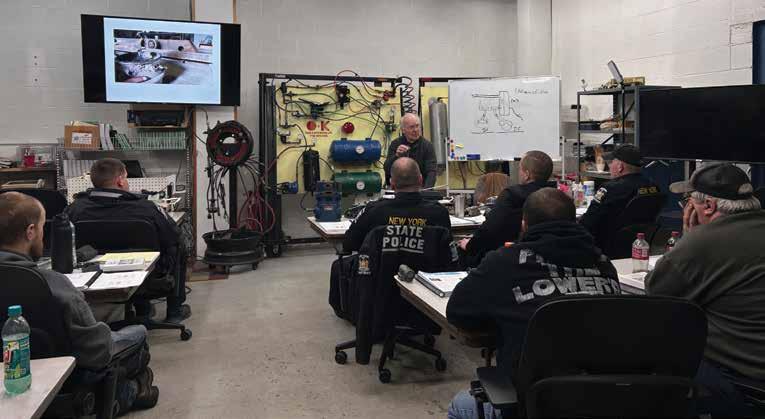
a spring brake application. In emergency mode, the spring brake valve permits modulated control of the spring brakes as long as the secondary reservoir pressure is sufficient to release the spring-brake chambers.
I refer to this valve as an “air taker-away valve.” When I stepped on the service brake, I heard air escaping, and my son verified that air was coming from the exhaust of the QRC1 quickrelease valve. Basically, in this case, the service brakes in the back were applied by the spring brake (on the park side of the chamber); see picture 5.
As air was escaping, the pushrods were coming out and mechanically applying the service brakes. Many others would have assumed the service brakes were applying normally. Air taken away from the spring side of the brake chambers were applying the brakes. How did I know that the valve itself was the issue? I looked at the air gauges on the instrument panel (picture 6) and noticed the primary tank still had air. The valve shouldn’t work as an emergency valve unless there is a loss of air pressure in the primary system. We replaced the valve (picture 7), and everything worked as intended.
Just when we think we know and have seen everything, we find that seeking knowledge is ongoing. We should never stop seeking information and knowledge to make ourselves the best in our fields. This case study is a perfect example. I put the cart before the horse. To understand the function of the inversion valve, you need to understand how a spring brake functions and its relationship to the whole brake system. Without that knowledge, it’s just a bunch of parts someone slapped on a vehicle. There’s more to it than just checking the pushrod stroke.
CVSA is a perfect example of information and knowledge with all the bulletins, videos and training they offer. Use it to better yourselves. The goal is to perform our tasks, so we allow only safe vehicles and drivers to operate on our highways. We save lives. n
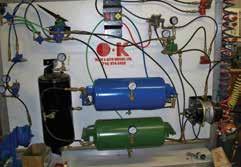
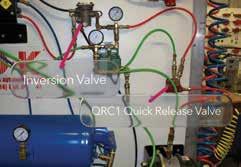
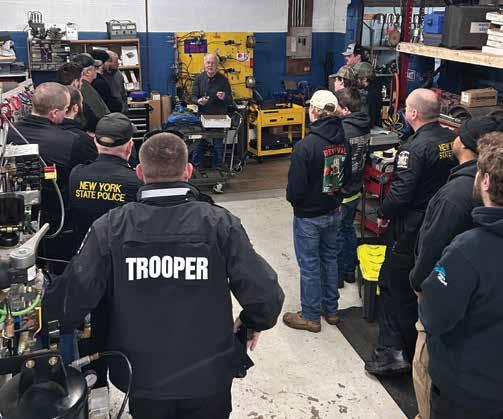

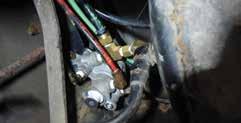
By Dave Elniski, PhD Student, CTSP, CRSP, ATCL, Industry Advisor of Safety and Compliance, Alberta Motor Transportation Association

Safety management professionals sometimes earn a reputation for being inflexible. This isn’t a bad thing when the flexibility being requested is in the form of pressure from others to permit noncompliance with regulations/procedures for the sake of expediency, efficiency, revenue, etc. In other contexts, though, flexibility can be a very positive trait in a safety professional. We need to be willing to challenge regulations, policies, procedures, best practices and anything else when there’s evidence to suggest a better way is possible and we have the ability to make changes in ways that do not compromise the health and safety of those potentially impacted by the change.
The above is probably nothing too controversial. Most current regulations and industry best practices have evolved from earlier versions or in response to new industry needs. Being open to change – in other words, having some degree of flexibility in one’s professional life – is necessary to see positive changes. But this does leave us with a question: How do we know when to be flexible or not?
This question of knowing when to be flexible in safety management deserves thought at both the individual and organizational levels.
Safety management is fundamentally about reducing the risk to people (workers, the general public, contractors, etc.) from hazards present in organizational activities. Yes, we’ll have days in safety management dedicated to supporting other areas of the organization, finding efficiencies in processes and other tasks that aren’t directly associated with frontline safety performance issues. Safety management, however, is still fundamentally about improving workplace health and safety for people.
Keeping the health and safety of people potentially affected by an organization’s operations front and center is key to critically examining questions about flexibility. Perhaps someone wants to eliminate a document entirely to ease administrative burden. If we can do so without any negative impact on health and safety (and without contravening applicable policies/regulations), then proceed. We should look at ways to ease administrative burden and reduce costs so resources can be reallocated to more impactful safety management activities.
Flexibility in the form of well-intentioned efforts to make positive change and improve the use of resources should be considered. Maintaining/improving human health and
safety serves as the compass we need to navigate these types of issues. Is the proposed flexibility going to negatively impact human health and safety? If no, then it makes sense to be flexible and consider modifications to existing practices within our control and jurisdiction (can’t get out of regulations quite like that). Is being flexible in this specific situation going to lead to any degradation of health and safety protections? If yes, then initial inflexibility makes sense until more information becomes available. We can ask these types of questions in a variety of ways and from a variety of angles as long as we keep workplace health and safety front and center.
Critical thinking, open and clear communication, a willingness to collaborate, and patience to wait for an appropriate analysis are important skills in safety management (and pretty much everywhere else). With maintaining/improving human health and safety as our focus, we can use these skills and others to determine when to be flexible versus inflexible in safety management for individual issues. n
By Joe Salisbury, Senior Director of Compliance and Safety, Load One LLC
In today’s regulatory environment, safety performance is more than a compliance requirement – it’s a business driver. Roadside inspections, enforcement initiatives, and Compliance, Safety, Accountability (CSA) scores directly impact a carrier’s reputation, operational efficiency, insurance profile and customer confidence.
One of the most effective – and often underutilized – ways to strengthen safety performance is by building a collaborative relationship with CVSA.
Rather than viewing enforcement as something that “happens to” your operation, forward-thinking carriers treat CVSA as a strategic partner in building a safer, more resilient organization.
CVSA brings together commercial motor vehicle safety officials and industry representatives across North America with a shared mission: improving uniformity and consistency in commercial vehicle inspections and enforcement.
For carriers, that consistency matters.
When your maintenance standards, driver training and internal audits align with CVSA inspection procedures and the North American Standard Out-of-Service Criteria, you reduce surprises at the roadside. You’re no longer guessing what inspectors will focus on – you’re preparing for it intentionally.
The out-of-service criteria, in particular, provide a practical roadmap. Instead of treating it as a reference document that only matters during inspections, successful carriers integrate it into:
Preventive maintenance checklists
Technician training programs
Driver pre-trip inspection routines
Quality control audits
When you build your systems around the same criteria inspectors use, you dramatically reduce the risk of critical violations.
Inspection results and violations feed directly into the Federal Motor Carrier Safety Administration’s CSA Safety Measurement System. That means every roadside interaction can influence how your company is prioritized for monitoring and intervention.
A collaborative approach with CVSA supports better CSA outcomes in several ways:
Fewer Severe Violations
By targeting out-of-service-level risks before they appear roadside, you reduce the violations that create long-term performance challenges.
Improved Inspection Readiness
Drivers who are trained with inspection standards in mind are more confident, organized and prepared, minimizing avoidable documentation or procedural issues.
Better Data-Driven Corrections
High-visibility initiatives like International Roadcheck provide valuable benchmarking opportunities. Instead of simply “getting through” inspection blitzes, proactive carriers use them as structured performance reviews.
When readiness becomes continuous – not event-based – CSA stability follows.
A collaborative mindset changes safety culture.
Instead of reacting to violations after they occur, carriers begin asking different questions:
What defects are most likely to place equipment out of service today?
Are repeat violations tied to specific equipment types or terminals?
Are we coaching drivers on the behaviors inspectors actually observe?
International Roadcheck and other CVSA initiatives become internal milestones for maintenance campaigns, focused driver training and documentation reviews. This rhythm reinforces continuous improvement instead of periodic panic.
The result is fewer disruptions, stronger reliability and a workforce that sees inspections as manageable, not intimidating.
CVSA doesn’t just support enforcement consistency; it also plays a role in policy discussion and regulatory engagement. Through its committees and industry participation, CVSA provides a forum where operational realities and enforcement perspectives meet.
For carriers, that engagement delivers:
Early awareness of regulatory shifts
Clearer understanding of enforcement priorities
Opportunities to provide practical feedback on implementation challenges
Being part of the broader safety conversation strengthens credibility with regulators and enforcement agencies alike. It demonstrates that your organization is committed not just to meeting minimum standards but also to advancing industry safety overall.
At its core, collaboration with CVSA is about alignment.
When carriers align internal controls with real-world inspection standards, training with enforcement expectations and strategy with evolving safety policy, they create stability.
That stability shows up in:
Stronger CSA performance
Reduced roadside disruption
Improved safety culture
Greater trust with customers and partners
In an industry where safety metrics influence opportunity, reputation and growth, a strong relationship with CVSA isn’t just a compliance strategy – it’s a competitive advantage. Carriers that choose collaboration over confrontation position themselves not only to pass inspections but to lead in safety excellence. n
Continuous readiness drives stability.
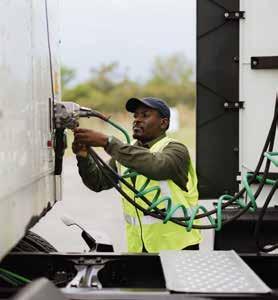
By Hajira Tahir, School of Professional Advancement, University of Management and Technology, and Muhammad Abdullah Ahsan Shah, Safety and Compliance Professional
Commercial motor vehicle (CMV) safety in Canada has long relied on compliance, inspections and enforcement. While these remain essential, emerging evidence in fatigue science, human factors and predictive analytics shows that sustainable crash reduction requires a broader shift – from reactive compliance to proactive cognitive safety.
Aligned with Transport Canada and the Canadian Council of Motor Transport Administrators (CCMTA), CVSA continues to demonstrate how coordinated enforcement, education and data harmonization improve safety outcomes.
CMVs are involved in a relatively small share of total collisions (~8%), yet they account for a disproportionate number of fatalities (~20%). Key contributing factors include inattention, fatigue and speed.
Fatigue remains underreported in collision data due to detection challenges, though broader analyses suggest it may contribute to nearly one-fifth of fatal crashes. This highlights a critical gap: Compliance alone does not fully address cognitive risk.
Commercial driving demands sustained attention and physiological resilience. Research consistently shows that fatigue can impair performance at levels comparable to alcohol.
Hours-of-service (HOS) regulations are foundational; however, time-based limits cannot fully account for individual sleep needs or operational variability. Fatigue risk is multi-factorial and requires complementary strategies beyond prescriptive limits.
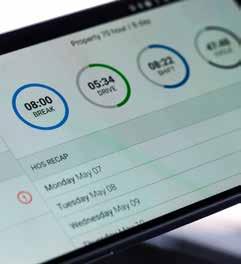
CVSA’s coordinated enforcement framework remains a cornerstone of North American CMV safety. Initiatives such as International Roadcheck combine inspections with education and data alignment.
Their effectiveness lies not only in enforcement outcomes but also in prevention through:
Harmonized inspection standards
Cross-jurisdictional consistency
High-visibility campaigns
Industry engagement
This model supports fairness, due process and continuous improvement.
Fatigue Risk Management Systems (FRMS), widely used in other safety-critical industries, offer an additional layer of protection. These systems incorporate:
Sleep opportunity and scheduling analysis
Predictive fatigue modeling
Operational risk monitoring
Non-punitive reporting
When aligned with existing regulations, FRMS strengthens compliance by informing better operational decisions without reducing accountability.
Modern telematics can identify early indicators of unsafe driving behavior, such as erratic speed, harsh braking and lane deviation. Predictive analytics can help prevent incidents before they occur.
However, implementation must remain responsible and lawful, including:
Transparency with drivers
Respect for privacy and labor protections
Proportional and secure data use
Ethical deployment is essential to maintain trust and procedural fairness.
Crashes rarely result from a single violation; they typically reflect interacting system pressures, including workload, environment and organizational practices.
Strong safety culture – supported by leadership, consistent messaging and constructive coaching – has been shown to reduce unsafe behaviors. CVSA’s educationfocused initiatives reflect this balanced approach.
Health conditions such as sleep apnea can significantly increase crash risk if untreated. Proactive screening, education and confidential support pathways can improve both safety and driver well-being.
These measures must remain non-stigmatizing and compliant with medical privacy requirements.
A modern CMV safety strategy integrates five key elements:
1 Regulatory Integrity – Strong compliance with HOS and inspection standards
Fatigue Science – Scheduling informed by sleep and circadian principles
Predictive Analytics – Ethical use of telematics data
Safety Culture – Leadership, reporting and coaching
Health and Wellness – Driver-focused support systems
Together, these shift safety from reactive enforcement to proactive prevention.
CVSA is uniquely positioned to lead this transition by harmonizing standards, strengthening enforcement training and supporting data-driven collaboration across jurisdictions.
In partnership with Transport Canada and CCMTA, CVSA helps ensure that safety frameworks remain both evidence-based and operationally practical.
CMV safety in Canada continues to benefit from strong enforcement foundations. However, long-term crash reduction depends on integrating compliance with cognitive science, human factors and responsible technology.
The path forward is not a choice between enforcement and innovation – but their careful, lawful and collaborative integration. n
By A.J. Bruning, Founding Partner, The Bruning Law Firm
Commercial motor vehicle (CMV) inspections remain one of the most effective tools for preventing catastrophic highway crashes. With approximately 3.5 million roadside inspections conducted annually across North America, the enforcement community has built a formidable safety net – yet persistent violation patterns suggest that many carriers still treat compliance as an afterthought rather than an operational priority. The data tells a clear story: Inspections work, but only when the violations they uncover lead to meaningful corrective action.
CVSA's 2025 International Roadcheck produced results that should concern every safety professional in the industry. Across 56,178 inspections conducted May 13-15, 2025, inspectors placed 10,148 CMVs and 3,342 drivers out of service (OOS) – compared to 9,345 CMVs and 2,290 drivers the previous year.
While the vehicle out-of-service rate improved from 23.0% in 2024 to 18.4% in 2025, the driver OOS rate moved in the wrong direction, climbing from 4.8% to 5.9%. That divergence suggests that while carriers may be investing more in equipment maintenance, driver compliance – particularly around hours of service and electronic logging – continues to deteriorate. The numbers behind these trends deserve closer examination.
Brake-related violations have dominated outof-service findings for years, and 2025 was no exception. During International Roadcheck, brake system violations accounted for 3,304 OOS findings (24.4% of all vehicle OOS violations), while vehicles with 20% or more defective brakes added another 2,257 findings (16.7%). Combined, brake issues represented roughly 41.1% of all vehicle out-of-service violations.
CVSA's dedicated Brake Safety Week in August 2025 reinforced the concern. Inspectors conducted 15,175 brake-focused inspections and found a 15.1% OOS rate – up from 12.8% during the same event in 2024. The trend is moving in the wrong direction.
The consequences of brake neglect extend far beyond regulatory penalties. The 2019 I-70 crash near Lakewood, Colorado, illustrates the point with devastating clarity. A semitrailer's

brakes failed on a steep grade, killing four people and injuring six others in a multivehicle collision. The carrier had accumulated 30 safety violations in the two years preceding the crash – 10 of which involved braking deficiencies, including out-of-adjustment brakes and chafed brake tubes. That crash was preventable. The violations that foreshadowed it were documented. What was missing was corrective action.
While brake deficiencies lead the OOS statistics, inspectors encounter a broad spectrum of safety issues during roadside examinations:
Tires ranked second in 2025 Roadcheck findings, with 2,899 OOS violations (21.4%). Tread depth below the minimum threshold of 4/32 inch for steer axles and 2/32 inch for drive and trailer positions remains a persistent finding, directly correlated with increased blowout risk at highway speeds.
Lighting defects generated approximately 1,737 OOS violations (12.8%), making inoperable required lamps one of the most frequently cited violations overall. In 2023, this category ranked first among all roadside violations nationwide.
Cargo securement produced 1,549 OOS violations (11.4%) – a category that received heightened attention during 2026 International Roadcheck, in which cargo securement was the vehicle inspection focus area.
On the driver side, hours-of-service violations accounted for 32.4% of driver OOS findings, followed by operating without a valid commercial driver’s license (CDL) (24.4%) and lacking a current medical certificate (14.9%). Notably, five of the top ten driver violations during 2025 Roadcheck were related to hours of service or electronic logging devices (ELD), and falsification of records of duty status was the second most-cited violation overall – a reason CVSA designated ELD tampering and falsification as the 2026 Roadcheck driver focus area.
The empirical evidence supporting the effectiveness of roadside inspections is substantial. The Federal Motor Carrier Safety Administration’s (FMCSA) Roadside Intervention Effectiveness Model estimated that inspections and traffic enforcement activities saved approximately 472 lives in a single year and have prevented more than 7,000 fatalities since 2001, while averting nearly 9,000 injuries from over 14,000 crashes annually.
Academic research supports these findings. A study published in the American Society of Civil Engineers’ Journal of Transportation Engineering found that states with vehicle inspection and maintenance programs experienced 5.5% fewer roadway fatalities per 100,000 registered vehicles compared to states without such programs. Separately, research by Yuanning Liang demonstrated that a 1% increase in reinspection probability yields a 1.09% reduction in crash probability – quantifiable evidence that enforcement visibility deters unsafe operation.
Enforcement data from 2024 further underscores the prevalence of violations among carriers investigated: 93.6% of FMCSA safety investigations uncovered at least one acute or critical violation. When inspectors look, they find problems. The question is whether carriers are looking on their own.
Effective compliance programs share several characteristics that distinguish them from carriers who rely on luck rather than systems.
Structured Pre-Trip
The daily pre-trip inspection remains the single most important preventive measure available to drivers and carriers. A thorough seven-point walkaround –brakes, tires, lighting, steering, suspension, coupling devices and cab systems – takes an experienced driver 15 minutes and addresses violations responsible for more than 90% of vehicle OOS findings.
The key word is "thorough." A pre-trip conducted at the same time each day, following a checklist, catches deterioration before it reaches OOS thresholds. A cursory walkthrough catches nothing.
Embrace Electronic DVIRs
FMCSA's February 2026 final rule formally legalized electronic driver vehicle inspection reports (eDVIR), confirming driver and mechanic sign-offs may be digital with no wet-ink requirement. Carriers that adopt eDVIR platforms gain several advantages: standardized inspection criteria, timestamped documentation, immediate notification of defects to maintenance teams and auditready records producible within minutes.
DVIRs must be retained for a minimum of three months per FMCSA requirements, but best-practice carriers maintain records longer to track recurring issues and
demonstrate compliance culture during audits and investigations.
Performance-Based Brake Testing
During the 2024 Brake Safety Week, 18 states used performance-based brake testers (PBBT) alongside traditional visual inspections. The results were striking: PBBT inspections produced a 5.75% OOS rate compared to 12.8% for visual-only inspections. The discrepancy likely reflects the objectivity of instrumented testing – measurement does not depend on inspector judgment or environmental conditions. Carriers with PBBT equipment or third-party testing services should consider incorporating it into their preventive maintenance programs.
Preventive Maintenance Scheduling
Scheduling preventive maintenance at intervals of 10,000 to 15,000 miles – or per manufacturer specifications – addresses component degradation before it reaches failure thresholds. This is particularly critical for brake systems, where adjustment and wear patterns are progressive and predictable.
Monitor SMS Scores Proactively
Under FMCSA's evolving Safety Measurement System (SMS), violations from the most recent 12 months carry greater weight in behavior analysis and safety improvement category (BASIC) percentile calculations. Carriers that monitor their scores monthly and prioritize correction of recent violations – particularly in the highfrequency categories of brakes (55% of vehicle OOS), tires (29%) and lighting (17%) – maintain lower risk profiles and reduce the likelihood of compliance investigations.
Several recent and pending regulatory changes will affect inspection practices in 2026 and beyond. FMCSA removed 14 ELDs from its approved list effective Jan. 20, 2026. Drivers using non-compliant ELDs face potential out-ofservice orders. Carriers should verify their ELD models against the current approved list.
FMCSA’s Drug and Alcohol Clearinghouse now requires employers to report positive test results, refusals and return-to-duty completions within 24 hours of occurrence – a tightened timeline demanding updated internal procedures.
FMCSA's SMS scoring methodology is undergoing significant revision, including consolidated violation codes, simplified severity weights and refined peer group
comparisons. Carriers should prepare for potential shifts in their BASIC percentile rankings as the new methodology takes effect.
Despite comprehensive enforcement efforts, 4,807 people died in crashes involving large trucks in 2023, according to National Highway Traffic Safety Administration data. While that figure represents an 11% decrease from the 5,417 fatalities recorded in 2022, it remains unacceptably high – and carriers with documented violation histories face severe legal exposure.
In 2024, a Missouri jury returned a $462 million verdict in an underride fatality case, while an Alabama jury awarded $160 million in a rollover case that caused quadriplegia. These outcomes reflect a broader trend in trucking litigation where plaintiff attorneys systematically use a carrier's inspection history, FMCSA Compliance, Safety, Accountability scores and maintenance records to establish patterns of negligence.
FMCSA's imminent hazard authority adds another layer of consequence. In July 2024, the agency ordered a motor carrier to immediately cease all operations after a fatal six-vehicle crash revealed complete failures in drug and alcohol testing, CDL verification, hours of service compliance and vehicle maintenance. The inspection record in that case told the story before the crash occurred. The carrier chose not to read it.
The inspection and enforcement framework that CVSA and its members have built represents a proven, data-validated approach to highway safety. The challenge is not the system itself but the consistency with which carriers engage with it.
Every violation documented during a roadside inspection represents a condition that existed before the inspector found it – a condition that a thorough pre-trip inspection, a functioning eDVIR system or a disciplined preventive maintenance program could have identified and corrected. The carriers with the best safety records are not the ones with the fewest inspections. They are the ones whose inspections consistently find nothing.
The results from this year’s CVSA International Roadcheck – with a focus on cargo securement and ELD compliance – will be announced later this year. The message from the enforcement community is consistent: The best time to find a violation is before it reaches the roadside. The best time to fix it is now. n
By Peter Hay, Vice President of Customer Success, Predictive Safety, and Brett Walker, Vice President of Sales, Predictive Safety

Fatigue remains one of the most persistent and underestimated risks in commercial trucking. While catastrophic crashes draw the most attention, fatigue-related incidents often occur in less visible – but still costly – ways:
Backing incidents at customer facilities
Minor collisions in yards
Equipment damage during low-speed maneuvers
Judgment errors during deliveries
Individually, these events may seem minor. Collectively, they contribute to rising operational costs, strained customer relationships and increased insurance pressure.
Over the past decade, fleets have made meaningful progress in addressing fatigue:
Hours-of-service compliance
Driver education and wellness programs
In-cab camera systems and telematics
These tools have improved visibility into fatigue-related behaviors such as distraction, lane deviation and microsleep events.
However, most interventions still occur after a driver has begun operating the vehicle.
This highlights an ongoing challenge: How can fleets identify fatigue-related risk before exposure begins?
There is growing interest across the industry in identifying leading indicators of fatigue – signals that may exist before a driver gets behind the wheel.
One emerging approach involves short, pre-task cognitive assessments designed to evaluate alertness and reaction time relative to an individual’s typical performance. Rather than relying solely on self-reporting (“How do you feel?”), these tools focus on objective performance-based measures.
The goal is not to diagnose fatigue but to create a moment of awareness:
Is the driver performing at their normal level today?
Are there signs of reduced alertness?
Should a brief conversation or intervention occur before departure?
This approach represents a shift from reactive monitoring to proactive engagement.
Many fleets are beginning to think of fatigue risk as a layered safety challenge rather than a problem solved by a single tool.
A comprehensive approach may include:
Pre-task readiness checks (assessing alertness before driving)
In-motion monitoring (detecting behaviors such as distraction or drowsiness)
Post-event coaching and training
Continued on next page
Each layer addresses a different point in the risk timeline. When combined, these layers provide a more complete picture of fatiguerelated risk.
Before driving Readiness and alertness
During driving Behavior and performance
After events Coaching and continuous improvement
Not all fatigue-related incidents occur at highway speeds. In fact, many occur in controlled environments:
Distribution centers
Customer delivery locations
Yards and terminals
These environments still require:
Precision
Situational awareness
Sound judgment
Fatigue can subtly degrade these capabilities, increasing the likelihood of small but costly mistakes.
Recognizing this broader definition of risk is critical. Fatigue management is not just about preventing catastrophic crashes; it is about reducing all preventable incidents tied to human performance.
One of the most effective fatigue management strategies is cultural.
When drivers feel comfortable acknowledging fatigue, organizations are better positioned to address risk early. This requires:
Open communication between drivers and supervisors
Non-punitive approaches to fatigue reporting
Emphasis on shared responsibility for safety
Creating structured opportunities to discuss readiness – before a shift begins – can help reinforce this culture.
As the industry continues to evolve, fatigue management is expanding beyond compliance and monitoring toward predictive and preventive approaches.
Future-focused fleets are asking:
How do we identify risk before exposure?
How do we incorporate human performance into safety systems?
How do we balance operational efficiency with workforce wellbeing?
How do we identify fatigue before a driver is behind the wheel?
How do we predict fatigue risk using all the leading indicators at our disposal?
Answering these questions will be key to reducing both major incidents and the smaller, everyday events that impact cost, safety and reputation.
Research impairment detection technology (IDT) and fatigue prevention technology:
Consider proactive pairing of impairment detection systems. These solutions are designed to complement existing in-cab camera solutions by addressing the gap between reactive incident capture and proactive fatigue prevention. While camera systems record and flag in-drive events (yawns, eye closure, lane drift) for after-the-fact review, IDT systems provide a pre-trip tool that can identify drivers that may be off their game due to emotional distress, lack of sleep, fatigue or, in some cases, substance use.
Couple IDT with pre-drive coaching. Much like a pre-shift inspection for a vehicle or a coaching session after a camera event, these solutions are designed to evaluate the asset (vehicle/driver) before they start a trip. They rarely prevent a driver from executing their duties (unless there is a clear violation of existing policy); rather, they trigger a coaching and evaluation opportunity BEFORE getting behind the wheel, thereby encouraging attentiveness and management engagement in ensuring that the driver is rested, alert and ready to work throughout their journey.
Consider technologies that use leading indicators to predict fatigue beyond the pre-trip
assessment provided by IDT. IDT will only take you so far. A pre-shift assessment through IDT often analyzes factors that are out of the control of the operation, such as staying up too late or emotional burdens from home life. Someone who passes a check at the start of a shift may still incur a high level of fatigue later in the shift, from factors such as overtime hours, call-outs or driving when their body thinks they should be sleeping. Technologies that predict fatigue risk based on leading indicators exist and are highly effective.
Fatigue risk management systems (FRMS) are one example. These systems ingest hours-of-service data in real time. They may also ingest biologic data from a watch or IDT data from a pre-shift assessment, as well as camera trigger information. They can consider the average commute time for your drivers and factor it against each driver's natural circadian cycle. Well-designed FRMS systems will provide dashboards that indicate who is currently driving and who may be at high risk of a fatigue-related incident. They include notifications to managers and dispatch, as well as fatigue analytics, enabling the enterprise to identify which sites or groups may pose greater risk.
Fatigue does not always present obvious warning signs. Drivers may feel capable, even when performance is diminished.
Creating simple, consistent ways to evaluate readiness before driving begins can provide an additional layer of protection, helping fleets move from reacting to incidents to preventing them altogether. n
By Kim Claytor, Compliance Director, FleetSafe Solutions, and Patrice Kelly, JD, Patrice Kelly Consulting LLC, Former Executive Director of the U.S. DOT Office of Drug and Alcohol Policy Compliance
On Dec. 18, 2025, President Donald Trump issued an executive order directing the thenattorney general and Drug Enforcement Administration (DEA) to accelerate rescheduling of marijuana from Schedule I to Schedule III of the Controlled Substances Act. This article explores what this means for employers with U.S. Department of Transportation (DOT) and non-U.S. DOT-regulated workforces.
The executive order represents changes to come. Through a final rule issued by the acting attorney general on April 28, those changes have started at the state level. This means that at this time, marijuana is both a state-level Schedule III drug and federal Schedule I. The full rescheduling process requires formal rulemaking by the Department of Justice and the DEA. The April 28 announcement included the declaration of a hearing process for rescheduling marijuana at the federal level, which will take place in July. Until that process is completed, marijuana remains Schedule I under federal law.
Schedule I substances are defined as having no accepted medical use and a high potential for abuse.
Current Examples:
Heroin
Lysergic Acid Diethylamide (LSD)
Marijuana (Cannabis)
3,4-Methylenedioxymethamphetamine (Ecstasy)
Peyote
Schedule III substances, by contrast, are recognized as having an accepted medical use and lower potential for abuse, but they remain regulated and controlled.
Schedule III drugs, substances or chemicals are defined as “drugs with a moderate to low potential for physical and psychological dependence.” Schedule III drug abuse potential is less than Schedule I and Schedule II drugs. These are medicines that are dosed and dispensed by licensed pharmacists, in doctors’ offices and in hospitals. There are no other plants that licensed pharmacists currently dose or dispense.
Examples of Schedule III Substances:
Anabolic Steroids (Testosterone)
Buprenorphine (Suboxone)
Ketamine
Tylenol with Codeine
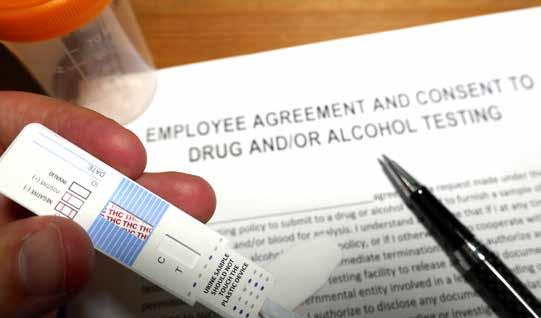
The transportation industry, substance abuse subject matter experts and other safetysensitive organizations are voicing serious safety concerns regarding the downgrading of standard forms of active delta-9tetrahydrocannabinol (THC) to Schedule III. This is the psychoactive chemical ingredient in cannabis or marijuana. Findings from a study released at the American College of Surgeons Clinical Congress 2025 indicated that more than 40% of drivers who died in motor vehicle crashes tested positive for active THC, and the average blood THC level was 30.7 ng/ mL, which according to the study, "far exceeds most state impairment limits."
Studies have shown that THC may cause altered depth perception, distortion of time, agitation and memory loss. It may have significant impacts on reaction times and complex thinking skills. Sudden cessation of THC use may cause withdrawal issues, which may affect the performance of safety-sensitive functions in the workplace.
A key problem for employers that test for marijuana as part of their drug testing program is that THC does not pass out of the body as quickly as other drugs. It attaches to fat cells, and for regular users, it can take up to 14 days or more to leave the body.
Traditional drug testing methodologies, such as urine and saliva, raise this question: Does the positive THC test reveal impairment on
the job or THC use from days earlier? It can be a challenge. Employers should carefully craft their substance abuse policies to provide robust training for supervisors in recognizing impairment in the workplace. Reasonable suspicion testing is a valuable tool for addressing on-the-job impairment.
Rescheduling at the State Level by the Acting Attorney General Does NOT Mean:
Marijuana is legalized at the federal level.
Employers must stop testing for marijuana.
Employees may use marijuana without workplace consequences.
Employers Should Know:
Understanding the distinction that rescheduling alone does not legalize marijuana at the federal level is critical.
Marijuana remains illegal under federal law as of this writing.
Existing workplace drug policies will remain fully enforceable.
Use of marijuana remains prohibited for employees regulated by the U.S. DOT.
No state requires employers to allow impaired employees to perform work.
However, if marijuana is rescheduled to Schedule III at the federal level, it will end mandatory U.S. DOT testing for marijuana unless Congress enacts a “safety carve-out” to maintain the status quo of marijuana testing.
Continued on next page
Continued from page 59
U.S. DOT-regulated employers must continue testing for marijuana as required. The executive order does not alter U.S. DOT regulations or federal testing mandates. An employer can face immediate violations and penalties for any deviation from the existing U.S. DOT regulations for required testing.
It is time for employers to change their nonU.S. DOT-regulated drug testing programs now. Marijuana testing is lawful, and for many employers, particularly those in safetysensitive industries, it remains essential to maintain a safe workplace. However, due to the changes made on April 28, at the state level, marijuana has become the equivalent of any other Schedule III prescription medication. Employers need to consider what they will do if an employee tests positive for marijuana on a non-U.S. DOT test. If the employee has a medical card sufficient under the new federal regulation, then they will need to be treated as the employer would treat other employees who are taking medications.
Company drug policies should be changed, and employers should consider what their policy should be for employees who show signs of impairment at work. Will you remove them from duty and send them home? Is it a violation of company policy to be at work and unable to perform? Does your policy include second chance options?
If you terminate an employee for use of marijuana as Schedule III medication, are you likely to be challenged under the Americans with Disabilities Act (ADA)? Consult with your attorney regarding the ADA implications of employment action.
If an employee tests positive for Schedule III marijuana, does your policy allow your medical review officer to report safety concerns to you? If so, what will you do with that report of safety concern?
Clear communication can help prevent misunderstandings and protect workplace safety.
An administrative process must be followed before the DEA can complete the rescheduling. The hearing for this issue is scheduled to take place in July. The Schedule III reclassification
would essentially treat the marijuana plant like a prescription medication. This still does not equate to federal legalization.
Historically, courts have rejected ADA accommodation requests related to marijuana use because it was federally illegal. Now, employers may see renewed arguments for accommodation when marijuana is used for medical purposes. Some states already require accommodation in non-U.S. DOT-regulated workforces (with restrictions).
Even in those situations, employers are not required to accommodate marijuana use if it:
Creates a direct threat to safety
Impairs job performance
Conflicts with federal regulations or job requirements
Is consumed at work, which can be hard to prove with current testing methodologies
Safety-sensitive positions should continue to be monitored closely to maintain a workplace free of crashes and harm to workers or the general public.
We are entering a new chapter with the rescheduling of marijuana. Employers need to learn as much as possible, which will translate into safer drivers, workers and highways. Safety should remain the key focus for employers. Marijuana use is a highly controversial topic, but one thing is clear – the issues around this hot topic are complex and will not go away. Stay informed and stay safe. n
Marijuana is still not legal on a federal level at this time.
The U.S. DOT has stated, “Until the rescheduling process is complete, U.S. DOT testing regulations will not change.”
There is an intense push for a congressional “U.S. DOT safety carve out.” If this fails, marijuana testing is expected to immediately stop.
Current U.S. DOT and non-U.S. DOT drug testing programs remain valid and enforceable. However, it is time to update your non-U.S. DOT policy now.
U.S. DOT and safety-sensitive testing requirements are still in force.
Monitor regulatory developments. Educating employees is vital, as employees are likely to hear misinformation on this topic.
Now is a great time to revisit reasonable suspicion supervisor training.


Select the Learning tab in your CVSA member portal to access training content. Content will vary based on membership type.
On CVSA Learning, You Can Access:
On-Demand Training Courses
Inspection Bulletins
Archived Webinars
Quick Fix, Inspector Focus and Inspection Bitz Videos
Essential Resources and Documents
Topics Include: Driver/Vehicle Inspections Hazardous Materials/Dangerous Goods Crash Investigations Carrier Investigations And More
PRESIDENT
Maj. Erick McGuire
Florida Highway Patrol
VICE PRESIDENT
Sgt. William Alarcon
New Jersey State Police
SECRETARY
Tpr. Robert "Beau" Wittkowski
Iowa State Patrol
ASSOCIATE MEMBER PRESIDENT
Brett Graves, CDS
Maverick Transportation LLC
ASSOCIATE MEMBER VICE
PRESIDENT
Stephen Keppler
Scopelitis Transportation Consulting
LLC
COMMITTEE CHAIRS
Audits and Investigations Committee
Jessica Davis
Utah Department of Transportation
Crash Data and Investigation Standards Committee
Lt. Mike Maytum
Nebraska State Patrol
Driver-Traffic Enforcement Committee
Capt. Chris Barr
Indiana State Police
Enforcement and Industry
Modernization Committee
Lt. Marcus Studer
Michigan State Police
REGION PRESIDENTS
Region I
Lt. Abraham Rosario
Connecticut Department of Motor Vehicles
Region II
Capt. Virgil Verduzco
Texas Department of Public Safety
Region III
Insp. Christopher Keller
Michigan State Police
Region IV
Tpr. Chase Livingston
Arizona Department of Public Safety
Region V
Richard Robinson
Ontario Ministry of Transportation
REGION VICE PRESIDENTS
Region I
Sgt. Christopher Rogers
Maine State Police
Region II
Lt. Stephen Burnham
Georgia Department of Public Safety
Region III
Capt. Chris Barr
Indiana State Police
Region IV
Capt. Kevin Adkins
Montana Department of Transportation
Region V
Richard Roberts
British Columbia Ministry of Transportation and Transit
LOCAL PRESIDENT
Ofc. Christopher Vinson
Midlothian (Texas) Police Department
LOCAL VICE PRESIDENT
Ofc. Derek Malena
Allen (Texas) Police Department
Hazardous Materials Committee
Tpr. Joshua Anderson
North Dakota Highway Patrol
Information Systems Committee
Holly Skaar
Idaho State Police
Passenger Carrier Committee
Tpr. Brian Pfarrer
New Jersey State Police
Policy and Regulatory Affairs Committee
Maj. Jon Smithers
Indiana State Police
Size and Weight Committee
Jackie Darr
North Dakota Highway Patrol
Training Committee
Keith Kerns
Public Utilities Commission of Ohio
Vehicle Committee
Ofc. Christopher Vinson
Midlothian (Texas) Police Department
PROGRAM CHAIRS
Commercial Vehicle Brake
Manufacturers Council
Greg Dvorchak
Hendrickson International
Cooperative Hazardous Materials
Enforcement Development
Sgt. Brad Gibson
Texas Department of Public Safety
Human Trafficking Prevention
Insp. Christopher Keller
Michigan State Police
Inspector Memorial
Lt. Zachary Hamilton
Michigan State Police
International Driver Excellence Award
Paul Claunch
PrePass Safety Alliance
International Roadcheck
Terry Renfrow
Reliance Inc.
Level VI Inspection
M/Sgt. Todd Armstrong
Illinois State Police
North American Cargo Securement
Harmonization Public Forum
Lt. Roger Eberle
Oklahoma State Patrol
North American Inspectors
Championship
Richard Roberts
British Columbia Ministry of Transportation and Transit
Operation Airbrake
Mike Tubaugh
Grand Prairie (Texas) Police Department
Operation Safe Driver
Jonathan Nicastro
New York State Department of Transportation
PBBT Users
Tpr. Lew Thomas
Colorado State Patrol
Collin B. Mooney, MPA, CAE Executive Director collin.mooney@cvsa.org
Adrienne Gildea, CAE Deputy Executive Director adrienne.gildea@cvsa.org
Nicole Leandro Director of Communications nicole.leandro@cvsa.org
Katie Morton Director of Compliance Programs katie.morton@cvsa.org
Kristin Yednock, CMP, DES Director of Conference and Event Services kristin.yednock@cvsa.org
Jake Elovirta Director of Enforcement Programs jake.elovirta@cvsa.org
Bill Reese Director of Hazardous Materials Programs bill.reese@cvsa.org
Kerri Wirachowsky Director of Inspection Programs kerri.wirachowsky@cvsa.org
Hon. Christopher J. Turner (ret.) Director of Leadership Development and Member Services chris.turner@cvsa.org
Ken Albrecht
Director of Multimedia Development ken.albrecht@cvsa.org
Tom Keane
Director of Research Initiatives tom.keane@cvsa.org
Shannon Heck
Director of Training Services shannon.heck@cvsa.org
Terry Kummer
Crash Investigation Specialist terry.kummer@cvsa.org
Rodolfo Giacoman
Fatigue Management Specialist rodolfo.giacoman@cvsa.org
Kevin Hogan Hazardous Materials Specialist kevin.hogan@cvsa.org
Matt Mullen Hazardous Materials Specialist matt.mullen@cvsa.org
Annie DeGennaro
Learning Management System Specialist annie.degennaro@cvsa.org
Brett Dimmerling Learning Management System Specialist brett.dimmerling@cvsa.org
Carlisle Smith Level VI Inspection Specialist carlisle.smith@cvsa.org
Mark Mills Multimedia Specialist mark.mills@cvsa.org
Terry Moore Multimedia Specialist terry.moore@cvsa.org
Jeremy Disbrow Roadside Inspection Specialist jeremy.disbrow@cvsa.org
John Sova Roadside Inspection Specialist john.sova@cvsa.org
Kevin Andrews Traffic Enforcement Specialist kevin.andrews@cvsa.org
Wendy Hall Manager of Administrative Services wendy.hall@cvsa.org
Dan Parks Manager of Federal Contracts and Grants dan.parks@cvsa.org
Margaret Edwards-Velasquez Manager of Government Affairs margaret.edwards@cvsa.org
Cassy Dafin Manager of Meetings and Events cassy.dafin@cvsa.org
Paola Berridi Certification Coordinator paola.berridi@cvsa.org
Madeleine Winslow Membership Coordinator madeleine.winslow@cvsa.org

Amy Molina Training Coordinator amy.molina@cvsa.org
Emily Moorhead Writer-Editor emily.moorhead@cvsa.org
Khari Vance Administrative Specialist khari.vance@cvsa.org
David Findlay Inspection Decal Coordinator david.findlay@cvsa.org















American Bus Association
Austin Powder Company
AWM Consulting Service
Brake Tech Tools
Cargo Transporters Inc.
FoxFury LLC
Greyhound Lines Inc.
Hoffman Transportation LLC/G&D Trucking Inc.
International Registration Plan Inc.
Kuhnle Brothers
Link Engineering Company
Loadometer Corporation
MANCOMM Inc.
Prevost
Republic Services
Seikosoft
Techni-Com Inc.
United Motorcoach Association
Werner Enterprises Inc.
Alliant Insurance Services
American Pyrotechnics Association
Cassidy’s Transfer & Storage Ltd.
DATTCO Inc.
Florida Trucking Association
Institute of Makers of Explosives
Linde Gas & Equipment Inc.
Groendyke Transport Inc.
Hendrickson
Jade Transportation Services
Marsh McLennan Agency
Nordion
Pressure Systems International
Railsback HazMat Safety Professionals LLC
Timi's Tours
Twin Lake Trucking LTD
Primary Utility Services
Scopelitis Transportation Consulting LLC
Torc
Wilbur-Ellis