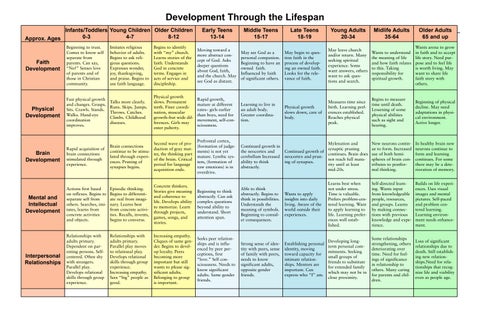
Development Through the Lifespan Infants/Toddlers Young Children Older Children 0-3 4-7 8-12 Approx. Ages
Early Teens 13-14
Middle Teens 15-17
Late Teens 18-19
Young Adults 20-34
Midlife Adults 35-64
Older Adults 65 and up
May begin to question faith in the process of developing an owned faith. Looks for the relevance of faith.
May leave church and/or return. Many seeking spiritual experience. Some want answers, others want to ask questions and search.
Wants to understand the meaning of life and how faith relates to this. Taking responsibility for spiritual growth.
Wants arena to grow in faith and to accept life story. Need purpose and to feel life is worth living. May want to share life faith story with others.
Measures time since birth. Learning preferences established. Reaches physical peak.
Begins to measure time until death. Lessening of some physical abilities such as sight and hearing.
Beginning of physical decline. May need adaptations in physical environment. Active longer.
Faith Development
Beginning to trust. Comes to know self separate from parents. Can say, “No!” Senses love of parents and of those in Christian community.
Imitates religious behavior of adults. Begins to ask religious questions. Expresses wonder, joy, thanksgiving, and praise. Begins to use faith language.
Begins to identify with “my” church. Learns stories of the faith. Understands God in concrete terms. Engages in acts of service and discipleship.
Moving toward a more abstract concept of God. Asks deeper questions about God, faith, and the church. May see God as distant.
May see God as a personal companion. Beginning to have an owned faith. Influenced by faith of significant others.
Physical Development
Fast physical growth and changes. Grasps. Sits. Crawls. Stands. Walks. Hand-eye coordination improves.
Talks more clearly. Runs. Skips. Jumps. Throws. Catches. Climbs. Childhood diseases.
Physical growth slows. Permanent teeth. Finer coordination, muscular growth–but wide differences. Girls may enter puberty.
Rapid growth, mature at different rates– girls earlier than boys, need for movement, self-consciousness.
Learning to live in an adult body. Greater coordination.
Physical growth slows down, care of body.
Rapid acquisition of brain connections stimulated through experience.
Brain connections continue to be stimulated through experiences. Pruning of synapses begins.
Second wave of production of gray matter, the thinking part of the brain. Critical period for language acquisition ends.
Prefrontal cortex, (formation of judgements) is not yet mature. Lymbic system, (formation of raw emotions) is in overdrive.
Continued growth in the neocortex and cerebellum Increased ability to think abstractly.
Mylenation and synaptic pruning Continued growth of continues. Brain does neocortex and prunnot reach full matuing of synapses. rity until at least mid-20s.
New neurons continue to form. Increased use of both hemispheres of brain contributes to postformal thinking.
In healthy brain new neurons continue to form and learning continues. For some there may be a deterioration of memory.
Mental and Intellectual Development
Actions first based on reflexes. Begins to separate self from others. Searches, imitates, learns from concrete activities and objects.
Episodic thinking. Begins to differentiate real from imaginary. Learns best from concrete activities. Recalls, invents, begins to converse.
Concrete thinkers. Stories give meaning and coherence to life. Develops ability to memorize. Learn through projects, games, songs, and stories.
Beginning to think abstractly. Can ask complex questions beyond ability to understand. Short attention span.
Able to think abstractly. Begins to think in possibilities. Understands the meaning of symbols. Beginning to consider consequences.
Wants to apply insights into daily living. Aware of the world outside their experiences.
Learns best when not under stress. Time is valuable. Prefers problem-centered learning. Want to apply learning to life. Learning preferences well established.
Self-directed learning. Wants input from knowledgeable people, resources, and groups. Learns by making connections with previous knowledge and experience.
Builds on life experiences. Uses visual images and mental pictures. Self-paced and problem centered learning. Learning environment needs enhancement.
Interpersonal Relationships
Relationships with adults primary. Dependent on parenting persons. Selfcentered. Often shy with strangers. Parallel play. Develops relational skills through group experience.
Relationships with adults primary. Parallel play moves to relational play. Develops relational skills through group experience. Increasing empathy. Sees “big” people as good.
Increasing empathy. Cliques of same gender. Begins to develop loyalty. Peers becoming more important but still wants to please significant adults. Belonging to group is important.
Seeks peer relationships and is influenced by peer perceptions, first “love.” Self consciousness. Needs to know significant adults. Same gender friends.
Strong sense of identity with peers, sense of family with peers, needs to know significant adults, opposite gender friends.
Developing longEstablishing personal term personal comidentity, moving mitments. Seeking toward capacity for small groups of intimate relationfriends to substitute ships. Mentors are for extended family important. Can which may not be in express who “I” am. close proximity.
Some relationships strengthening, others deteriorating over time. Need for feelings of significance in relationship to others. Many caring for parents and children.
Loss of significant relationships due to death. Still establishing new relationships.Need for relationships that recognize life and viability even as people age.
Brain Development
Values and Ethics
Sexuality
Family
Needs of Age
Gifts to Share
Vocation
Expectations of the Church
Does what adults say is right and wrong. Size determines importance, not intention.
Obeys to avoid punishment. Understands the significance of intention. Begins to see consequences of actions.
Reciprocal sense of justice. Strong belief in “the rules.” Sees consequences of actions and understands the significance of intent.
Body awareness
Curiosity about their body. Gender awareness.
Curiosity about sex. Exploration of what it means to be a boy or a girl. Sometimes sexual exploration begins.
Infants do not see parents as separate from themselves.
Love me, love my family. While seeing self as separate, family is intertwined into self understanding.
Awareness of family differences between self and friends. Beginning of separation from family.
Desire to save the world and great empathy for those who suffer. Can’t distinguish group values from personal values.
Affective responses toward ideas and social realities. Concern for democratic process and human rights.
Willing to act based on values. Beginning to differentiate personal values from those of the group.
May begin to critically reflect on previously unexamined values and act on newly committed to values.
Personal ethics and values are important, but may begin to see nuances as opposed to clear right and wrong.
Ethics and values shape understanding of ones life and are reflected in use of time and resources.
Responsible choices and behavior. Communication of sexual past and implications. Shifting view of self and sexuality. Sexuality and long-term relationships. Body and reproductive changes
Aging and sexual expression. Illness and loss of life partners. Physical changes. Expanding understanding of intimacy. Awareness of sexuality needs in adult living situations.
Responsibilities for nurturing and guiding others. Care giving. Parenting. Likely to experience the loss of a parent.
Emotional and sometimes financial support for families. Loss of family members. Developing new relationships.
Feeling of immunity to personal injury or hurt, stretching limits.
To be treated and Assuming adult priv- respected as adults ileges, yet still not an and peers. Arenas adult. Desire to be for fellowship, servtotally dependent. ice, ministry to others.
Opportunities to reflect on the meaning of life. Finding balance in life.
Opportunities for continued growth. Daytime activities and accessible surroundings. Good lighting and acoustics.
Expanding knowledge, creativity, intimacy, willingness to take risks.
Dependability, steadiness, concern for the future, financial resources.
Wisdom, time, endurance, objectivity, life experiences, hope, acceptance of death.
Experiencing physical changes related to maturation. Questioning whether one is “normal.” Same sex friends.
Deepening understanding of a sexual self, opposite sex friends, sexual encounters.
Exploration, recognizing relationship between emotional and physical, tied to relationships, commitment, and intimacy
Responsible sexual behavior and celibacy. Forming beliefs related to sexuality and relationships. Issues and concerns related to STD’s, infertility, contraception, genetics.
Love/hate relationship. Still dependent on family. Parents often perceived as dumb.
Some rebellion, disilRebellion less lusionment, and intense, wants to be struggle for indetreated like an adult. pendence.
Leaves family of origin. Establishes core circle of friends and a new family.
Timely responses to needs in order to develop.
Safe environment. Freedom with boundaries.
Expanded boundaries. Support for decision making. Conflict resolution.
Hope
Awe. Wonder, Joy. Unconditional love and trust.
Enthusiasm, questions, energy, passion.
Energy, passion, enthusiasm.
Idealism
Increased knowledge, leadership skills, willingness to take risks.
To grow and explore their world.
Play is work. Roleplaying various occupations and adult behaviors.
School is work. Fine tuning of abilities. Learning to be a team member.
School is work. Trying out new skills.
School is work. May have first for pay job. Developing work skills and habits.
Exploring possible careers and obtaining appropriate training or education.
Seeking fulfilling work. On the job training. Continued schooling.
Questioning, reaping, career changes, mentoring.
Retirement from primary career. May reenter or reinvent work.
Place where I belong and am welcomed.
A place to see my friends, to contribute, and to lead.
A safe place, a place to serve and lead.
Relationships with Utilizing their gifts in Accompaniment as respected adults who service and leaderthey search for are also on a faith ship. answers. journey.
Help in finding balance and making meaning of life.
Place for friendships. Help in dealing with losses.
Safe, loving place.
Egocentrism
©2008 General Board of Discipleship
All Rights Reserved