culturedarm Spring-Summer 2021
culturedarm Spring-Summer 2021
Towards Museumpleim 3 Mingus Ah Um and the Album Art of S. Neil Fujita 4 Long Read Walter Reuther, Civil Rights, and the Presidential Election of 1960 8 Put This On Your Self: Kerbside Violet 52 Holmsund Logistics 55 Movie Reviews Diego Maradona (2019) 59 The Rules of the Game (1939) 61 Enola Holmes (2020) 64 Paris Texas (1984) 67 Ascending Casa Batlló 71
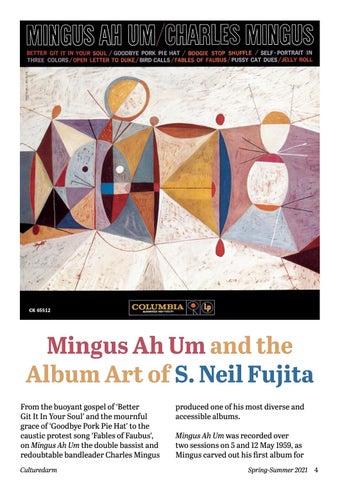
Mingus Ah Um and the Album Art of S. Neil Fujita From the buoyant gospel of ‘Better Git It In Your Soul’ and the mournful grace of ‘Goodbye Pork Pie Hat’ to the caustic protest song ‘Fables of Faubus’, on Mingus Ah Um the double bassist and redoubtable bandleader Charles Mingus Culturedarm
produced one of his most diverse and accessible albums. Mingus Ah Um was recorded over two sessions on 5 and 12 May 1959, as Mingus carved out his first album for Spring-Summer 2021 4
Columbia Records. The site was the celebrated Columbia 30th Street Studio in New York, where Miles Davis had just wrapped work on Kind of Blue, and which served as home base for so many of the greats of the jazz and blues, from Davis, Duke Ellington, and Thelonious Monk to Billie Holiday and Mahalia Jackson. Mingus gathered some of the members of his jazz workshop, a rotating group of familiar faces which on this occasion included John Handy on alto saxophone, Booker Ervin and Shafi Hadi on tenor, Horace Parlan on the piano, Dannie Richmond on drums, and Willie Dennis and Jimmy Knepper sharing trombone duties. Mingus Ah Um was released to critical acclaim on 14 September 1959, and has been referred to in The Penguin Guide to Jazz as ‘an extended tribute to ancestors’. Mingus pays homage to Duke Ellington, Jelly Roll Morton, and the recently departed Lester Young, while ‘Fables of Faubus’ drew inspiration from the Little Rock Nine, with excised lyrics directed against the segregationist governor of Arkansas. The iconic cover art for Mingus Ah Um was designed by S. Neil Fujita. Born in Waimea, Hawaii to Japanese parents, the young Sadamitsu Fujita adopted the name Neil while attending boarding school in Honolulu. He progressed to the Chouinard Art Institute in Los Angeles, but his studies were cut short in 1942, when in the aftermath to the attack on Pearl Harbor he was forced to relocate to an internment camp in Wyoming. The following year he enlisted with the 442nd Infantry Regiment, made up of JapaneseAmerican volunteers, which by the end of World War II had become the most Culturedarm
decorated unit in American military history. Fujita completed his studies after the war, and joined the Philadelphia advertising agency N. W. Ayer & Son, where his experimental designs soon brought him to the attention of Columbia Records. Fujita was hired by Columbia in 1954. Previous design work at the label invariably passed through the hands of Alex Steinweiss, the pioneering figure in album cover art, who had become the first Art Director at Columbia back when he was appointed to the position in 1938. As Steinweiss branched out and began to work for other companies, Fujita was tasked with building on what he had created. Heading a team of designers at Columbia Records, Fujita strove to compete with some of the innovative cover art then coming out of the leading jazz label Blue Note.
Many of his best-known album covers suggest the commonalities between modern jazz and modern art. With a background in painting, Fujita stretched beyond the illustrative style previously Spring-Summer 2021
5
adhered to by Steinweiss, introducing popular music to abstract expressionism. The geometric shapes and blocks of mixed colour in his own pieces share less with the all-action canvases of Jackson Pollock, instead calling to mind Arshile Gorky and the Bauhaus-era style of Wassily Kandinsky.
the swells and lulls of performance. And for ‘Round About Midnight, Fujita edited a photograph taken by the leading photojournalist Marvin Koner, to show Miles Davis bathed in red light, coy but resolute behind sunglasses.
Together with his photo edits, through his designs for Columbia from the middle of the 1950s, S. Neil Fujita managed to encompass all of the outpourings of bebop: from the relaxed tempos of cool jazz and the blues and gospel-inspired flurries of hard bop, to the shifting patterns of the avant-garde and free jazz with its emotional peaks and stunning breakdowns.
The designer Milton Glaser said of his colleague:
In addition to Mingus Ah Um, Fujita painted the covers for Time Out by The Dave Brubeck Quartet, Far Out, Near In by Johnny Eaton, and for Glenn Gould’s 1959 recording of piano sonatas by Berg, Schoenberg, and Krenek. His photo montage for the first studio album by the Jazz Messengers documented Art Blakey, Horace Silver, Hank Mobley, Donald Byrd, and Doug Watkins amid Culturedarm
‘He had superb taste and was one of the early art directors in the field who distinguished himself by having a rigorous design objective. It was a kind of synthesis of Bauhaus principles and Japanese sensibility.’ While reminiscing on his time at Columbia, Fujita recalled: ‘When I got to Columbia, there was the beginning of some idea of album cover art but it was still just type and maybe a photo Spring-Summer 2021
6
of the artist and some shapes arranged in an interesting way. That was the first concept of album cover art. Actually the first examples of album art that I can remember were on children's records, because they might have included a painting or something else to illustrate the idea. But I think that I was the first to use painters, photographers and illustrators to do artwork on album covers.’ After a brief sojourn in 1957, in 1960 Fujita departed Columbia Records for good in order to establish his own design practice. By 1963 he had joined the public
Culturedarm
relations firm Ruder & Finn, where he created the division which would become known as Fujita Design. He turned his attention towards book jackets, and designed the covers for the short story collection Pigeon Feathers by John Updike, for Truman Capote’s nonfiction novel In Cold Blood, and for Mario Puzo’s crime epic The Godfather. Fujita later taught at the Philadelphia Museum College of Art, the Pratt Institute in Brooklyn, and the Parsons School of Design in Manhattan.
Spring-Summer 2021
7
Walter Reuther, Civil Rights, and the
Presidential Election of 1960 Cover image: John F. Kennedy on the campaign trail in Detroit on Labor Day 1960. (Credit: Tony Spina/The Walter P. Reuther Library at Wayne State University)
I
n the days leading up to the 1960 presidential election, the Republican Party resounded with a familiar refrain: a vote for John F. Kennedy, the fresh-faced senator from Massachusetts, would leave labour leader Walter Reuther pulling the strings. Walter Reuther first became headline news in the spring of 1937, when as president of a local branch of the United Auto Workers, he clashed with Ford Motor Company security guards in what became known as the ‘Battle of the Overpass’. Inspired by the sit-down strikes he and his brothers had observed across Europe, Reuther and the fledgling United Auto Workers had already scored some success organising against General Motors. Now they took their fight to a rough and ready Ford, which responded to a publicised leafleting campaign by leaving Reuther and his fellow union members bloody. Blindsided by Ford’s henchmen in front of the complex in Dearborn, Michigan, Reuther recalled ‘Seven times they raised me off the concrete and slammed me down’. At the end of 1940, as the United States weighed its involvement in World War II, Reuther authored a plan which would utilise the unused capacity of the auto industry to produce as many as 500 fighter planes each day. The plan was discussed in meetings with President Roosevelt, and sparked debate well into the new year, praised by the president while facing pushback from auto and aircraft companies, who wanted the government to build cut-price factories while they remained masters of their domain.
Culturedarm
Reuther elaborated his plan on radio, observing ‘England’s battles, it used to be said, were won on the playing fields of Eton. America’s can be won on the assembly lines of Detroit’. His ideas were put into practice one year later, when the attack on Pearl Harbor compelled America to action. More than any other city, Detroit became the ‘Arsenal of Democracy’. On the fifteenth anniversary of the Congress of Industrial Organizations in 1953, President Eisenhower wrote to Walter Reuther and said: ‘When I last addressed a CIO Convention, I came to thank you for your magnificent performance in World War II in supplying the planes and tanks and ships and arms. You did your job, and you did it well.’ Meanwhile since 1946, Reuther had served as president of the United Auto Workers, now one of the most powerful unions in the country and a driving force sometimes operating with impunity within the Congress of Industrial Organizations. While racial tensions were never far from the surface among workers in Detroit, one of Reuther’s first acts as president of the United Auto Workers was to fight to end racial segregation in America’s bowling alleys. He befriended Hubert Humphrey, a future senator and vice president of the United States. As president of the United Auto Workers and briefly Congress of Industrial Organizations, Reuther signed collective bargaining agreements with Ford, General Motors, and Chrysler, including the labour-defining ‘Treaty of Detroit’. Though his early associations led the likes of J. Edgar Hoover to perpetually Spring-Summer 2021
9
identify him as a communist, Reuther worked to expel the influence of Communist Party members inside the labour movement, prompting Humphrey to write: ‘Communist infiltration of the CIO was a direct threat to the survival of all of our country’s democratic institutions. The CIO’s victory over the Communist Party was a significant victory for our nation.’ Though Nikita Khrushchev took pains to distance himself from some of the
excesses of Stalinism, when the Soviet premier met with John F. Kennedy in Vienna in the summer of 1961, he told the novice president of the United States of America, ‘We hung the likes of Reuther in Russia in 1917’. *** Forging a relationship with successive presidents from Roosevelt to Truman and Eisenhower, still Walter Reuther had plenty of detractors. Whether it was opposition from inside the labour
The United Auto Workers organisers Walter Reuther and Richard Frankensteen, fifth and sixth from left, before the ‘Battle of the Overpass’ in Dearborn in 1937. (Credit: National Archives photo no. NLR-PHOCO-A-7819(2)) Culturedarm
Spring-Summer 2021 10
movement, battles with the big automobile manufacturers and their assorted goons, or political adversaries who lamented his liberal bent and civil rights advocacy, Reuther gathered enemies who were loud and sometimes fierce. On the night of 20 April 1948, he scarcely survived the blast of a doublebarrel shotgun which fired through the kitchen window of his home in Detroit, shattering his right arm and piercing his chest. Reuther received a blood transfusion at Grace Hospital, but contracted both malaria and hepatitis and struggled to regain the use of his right hand. When Reuther’s brother Victor was almost killed in similar fashion one year later, Eleanor Roosevelt wrote: ‘It seems unthinkable that the police have never been able to discover who shot Walter Reuther and because of that, in all probability, the same person perhaps has felt that he could get away with shooting another brother. We have a right to protect men who are working in the interests of their fellow men.’
American Federation of Labor, and collectively the unions were under siege. A select committee formed by the United States Senate had fixed its sights on allegations of impropriety in the field of labour management. Many of the complaints centred around the International Brotherhood of Teamsters, which had long carried the stench of racketeering and was now in the midst of a power struggle between Jimmy Hoffa and Dave Beck. Hoffa was accused of conspiring with figures from the world of organised crime in his bid to unseat Beck as leader of the Teamsters. Chaired by the Democratic senator John L. McClellan, the select committee worked for three years, during which time it conducted 253 active investigations, served 8,000 subpoenas for witnesses and documents, held 270 days of hearings with a total of 1,526 witnesses, 343 of whom invoked the Fifth Amendment, and compiled 150,000 pages of testimony while issuing various interim reports.
J. Edgar Hoover, the staunch director of the Federal Bureau of Investigation, no doubt disagreed with Roosevelt’s assessment. When the Attorney General Tom C. Clark requested an investigation into the shooting of Walter Reuther, the message relayed back from Hoover was ‘Edgar says no. He says he's not going to send the FBI in every time some nigwoman gets raped’.
Following stints on the Permanent Subcommittee on Investigations then as an aide to presidential hopeful Adlai Stevenson II, Robert F. Kennedy served as the chief counsel for the McClellan committee. Beginning a dogged pursuit of Hoffa which has been likened to a blood feud, during the course of the hearings Kennedy was accused by the prominent Republicans Barry Goldwater and Karl E. Mundt of attacking Hoffa and the Teamsters as a way of covering for Walter Reuther and the United Auto Workers.
By the late 1950s, the United Auto Workers and Congress of Industrial Organizations had merged with the
Robert Kennedy refuted the charge in his book The Enemy Within: The McClellan Committee’s Crusade Against
Culturedarm
Spring-Summer 2021 11