2022

Contents President’s Report 2 Honorary Vice-Presidents 4 CULS Forums 14 CULS Articles 23 Department Updates 80 Society Updates 98

Staying the course is required of us all, through relentless disruption and change, be it Brexit, Covid 19, the current geo-political instability and inflationary environment, or indeed the growing cost-ofliving crisis. Yet, how is the Real Estate Industry responding throughout all of this? Are we agents for positive long-term change in society? How are we looking out for the people we work with and share our lives with (diversity) ?; how are we being good stewards of our planet and natural habitat (environment) ?; how are we shaping and curating the places around us (community) ?; how are we fostering and promoting new ideas that will help the next generation (innovation)?
can each consider how our own personal response to change, however small or great, seen or unseen, grand and simple, is able to positively impact the people and places around us, one person and community at a time.
CULS Hon. Press Secretary w.baumker@howard-ventures.comThe pace of change sees no abating, as the economy, local business and personal lives are deeply impacted by what we are experiencing on so many levels. In answer to these questions, our CULS membership actively responds with a serious of thoughtful and personal contributions. In this edition of the CULS Magazine, we canvass a wide range of fields and topics, including amongst others the drive towards greater environmental sustainability; the volatility and opportunity in global capital markets; the changes afoot within the UK planning system, and the real estate classes of Life Sciences and PRS (Private Rented Sector).
If there is one aspect of business and personal life that has stood out to me in recent times as a response to the question, it is that ‘how’ we do business is as important if not more important than ‘what’ we do in business. The way in which we respond to moments of crisis is often what stands the test of time and builds long-lasting relationships. My hope is that as we read and reflect on the stories and content presented in the 2022 edition, we notice the balance of how and what. Perhaps we

Cambridge University Land Society would like to thank the following for their generous sponsorship and support of the 2022 CULS magazine.




As ever, the production of this magazine would not be possible without the generous financial support of our sponsors, which for 2022 include Howard Group, Maples Teesdale, Taylor Wessing, Brydell Partners and Longfellow Real Estate Partners. Special thanks also go to four of our Honorary Vice Presidents for their contributions this year, including Liz Peace CBE, Roger Madelin CBE, Jeremy Newsum, and Spencer de Grey CBE RA. Finally, a big thank you on behalf of the wider CULS membership to Dan Nicholson our new incoming President, Ian Marcus our outgoing President, Ali Young our Society Secretary, and the many CULS Forum leaders.
If you have any suggestions for future content and events, wish to be involved with CULS in any way, or keen to sponsor CULS, then please visit www.culandsoc.com or contact us on info@culandsoc.com
Published by Robyn Collyer Designed by Rob Briggs Tathams Publishing Ltd. robyncollyer@tathamsltd.com
If you wish to sponsor CULS in future, do please contact us by email on info@culandsoc.com or contact any of the CULS Committee members.
For more information go to our website www.culandsoc.com or follow us on:
In keeping with the drive towards environmental sustainability and responsibility across real estate, we have ensured that the printing process of this edition has a reduced carbon footprint. The Premier Paper Group has partnered with the Woodland Trust to create an initiative called Carbon Capture, and funds raised go to the planting and restoring of Natural Woodland within the UK and thus reducing CO2. For more information on the initiative please go to www.woodlandtrust.org.uk/ partnerships/our-partners/ premier-paper/
chair, has achieved phenomenal success over its short life – all in no small part due to Ian, who has been exactly the President needed through such trying times.
 Dan Nicholson Executive Director GPE

Taking on the Presidency of the Cambridge University Land Society is something which I feel very honoured to have been asked to do. Following in the footsteps of Ian Marcus compounds the honour, setting as he has such a clear precedent for a new President.
It’s wonderful that the Society is back to hosting in-person events and is running as it was in 2019. The Society has also established an additional forum which, thanks to its very active and vibrant
Going forward, what do I hope to achieve over the period in which I have been honoured with the Presidency? Firstly, resolution of the most pressing issue facing the Department of Land Economy and the one where the members of the Society should be able to help - a new faculty building. The irony is not lost on any of us that the department which has produced thousands of successful real estate professionals, who spend their working lives improving the stock of the built environment, does not have its own physical home. Many sterling e orts have been made before, and it seems matters are moving slowly in the right direction. I hope therefore that we can give Professor Howarth and the department the support and assistance they need to make this happen.
Secondly, we should recognise more fully that our progress through the best university in the world gave us great leverage into our careers. I firmly believe
that we should use the benefits of these careers to help the students now coming through the university into their own working lives, in full recognition of how lucky we were. This help should be spread more widely throughout the student body, into ensuring that the real estate working population becomes far more diverse than its current make-up. We should do all we can as a Society to help with this, and assist with our industry becoming better educated and more active in the di usion of diversity in the real estate sector.
Lastly, the underlying theme of this year’s magazine is resilience and our ability to contribute when change and instability test us. How we respond in such times becomes our definition, the distilled essence of who we are. Whilst our professional actions (hopefully) make a physically better world, I hope that the articles contained herein show us that it’s the nature of our reaction to troubled times which really displays our innate qualities and strengths, and which makes the world a better place for those around us. Can there be a more noble aim?
Again, a formal welcome to the CULS AGM. It’s the first time under my presidency we’ve been able to conduct this live rather than virtually and also the first opportunity to follow on immediately afterwards and enjoy each other’s friendship and camaraderie at our annual dinner to be held this evening at Fitzwilliam College.
What that does mean, however, is that today I have to provide essentially two reports on the last year. Tonight will be more of a celebration and have a more reflective tone on my three-year tenure as your president so I’ve deliberately attempted to keep this presidential report as more factual as to the financial year 2021–22.
But it’s important to say, it’s great to be back in person and have the opportunity to thank all of you, and those who could not be with us today, for your support and commitment over this tumultuous period. Like many other organisations, we feared an existential threat to the society, not knowing if and when we would be able to host events again and whether our student membership would attend lectures other than online, with all the implications for not just their education but their future careers.
As someone who was struck down with Covid just a fortnight ago, for the second time, I think we are all aware that the pandemic has not gone away and as individuals and as an organisation we
will need to continually adapt to this ever-changing environment.
My colleagues will shortly provide a more detailed report on the activities of the society, but despite the challenging environment, CULS hosted 17 events during the year and under the chairmanship of Colm Lauder, the Whitehall group a further 12 events of which 2/3 were a return to the successful format of private lunches. Thank you to all the forum chairs, who have continued to work tirelessly in arranging talks, tours, workshops, and webinars. We held a further six ESG webinars, led by Ami Kotecha and generously sponsored by Savills.
We published our annual magazine brilliantly edited by Werner Baumker and successfully relaunched the careers fair with a broader church of attendees including Real Estate Balance and Women in real estate represented, to ensure we o ered the students the most relevant opportunities. Just to advertise this year’s event on Thursday, 20th October, which is likely to be the largest and most diverse we have ever hosted. Thank you to Louise Sherwin for all her time and commitment in ensuring the success of this vital occasion.
Membership has increased to almost 1000 including an ever-larger cohort from the Department of Architecture; I’d like to thank Professor Campbell not just for his hospitality earlier today in hosting us at the department but also for his engagement and involvement with CULS and the APEC forum. In relation to APEC, which will continue to be chaired by Bryan, we say thank you for the enormous contribution of James Lai who is standing down from the committee as his work is taking him abroad, but with the hope and expectation that he will continue to be actively involved with CULS.
We also say thank you and a fond farewell to Sophie Jenkinson and other members of the Silver Street Forum. Sophie is undertaking a career change to become a teacher, for which we wish her well. SSGs continuing involvement
and engagement is vital for the future of CULS and I’m delighted to announce that, subject to ratification later, a new committee has been established to be led jointly by James Webb of Eastdil Secured and Charlie Stoneham of Savills.
Following the success of the newly established ESG forum which has reached out to literally thousands of participants over the last two years, we have continued to review, examine and ensure our o ering remains relevant. We are building close links with the Cambridge Institute for Sustainable Leadership and are also in the process of establishing a residential forum recognising the interest and appetite of this asset class.
Can I formally thank Professor Howarth for all his support throughout the year. We continue to o er whatever support we can in terms of Tripos prizes to the students, sponsorship of selective teaching sta and alongside CLEAB, all we can do to promote the desire and necessity of a new building for the department.
One thing I will repeat this evening, but it merits being mentioned twice, is that we o er our congratulations to both the Departments of Land Economy and Architecture on the outstanding result in the research excellence framework where they were awarded first place, and although we will all miss the retiring Professor Colin Lizieri, who has always been a huge supporter of CULS, the department seems to be in a very good place.
Once again, I wish to formally thank Erik Ruane, honorary treasurer, for his stewardship of our finances; he will reference the detail in a few moments, but through his considered and conservative management, our reserves actually increased over the last 12 months which, considering the broader environment, is a tremendous result. We have not increased our subs for five years and continue to wish to o er true value and accessibility to our members, but this is a situation we must monitor on a regular basis to ensure our financial viability.
Of course, we rely heavily, not just on the goodwill of our members but also the generosity of our sponsors which are many and varied; on behalf of the land society, thank you to you all. I would specifically like to name check: Knight Frank, APAM and Church Manor Estates for the support of our website, the Monday Charitable Trust for the sponsorship of our educational activities, Savills, Apache Capital, Howard Ventures and Mills & Reeve for their contributions towards the magazine, as well as Rockbourne‘ s underwriting of the SSG dinner.
We are privileged to have 11 honorary vice presidents of the society, some of the most influential leaders of our industry, often without an obvious direct Cambridge connection, but who have supported us directly or indirectly over many years. I can confirm to the meeting that I’ve been in contact with all of them and they have unanimously o ered to, not only remain engaged but committed to greater involvement in the coming years. Several are attending our annual dinner tonight. So, again, subject to passing of the necessary resolution, we will agree their appointments for another three years; and in addition, it is proposed that we invite Heather Hancock, LVO, former president of CULS and currently master of St John’s College to become an Honorary vice president. Heather and her husband will also be in attendance this evening.
Of course, as we all know, the society would not be able to function or deliver on any of its objectives without the tireless work of both Ali and Fiona; on behalf of not just the committee but all members of CULS, thank you for your continued selfless commitment and enthusiasm; it’s hugely appreciated.
I now have just one final task; to thank all of you for your support during my presidency and to wish Dan every success in the role. It’s an enormous privilege to be president of CULS but, Dan, if you have a fraction of the pleasure and fun I have had over the last three years you will flourish alongside the society.
Staying the course, through relentless disruption and change is required of us all, be it Brexit, Covid19, inflation, the Supply Chain, or the next GeoPolitical crisis. How is the Real Estate Industry responding? Are we agents for positive long-term change in society, impacting people (diversity), planet (environment), place (community) and ideas (innovation)?
Roger Madelin CBE Joint Head of Canada Water at British LandIhave been kindly asked several times to write for the CULS magazine, it is always a privilege and a pleasure and usually gets the little grey cells working better. This time the ‘exam question’ above has made me think a lot harder and longer and I have found it di cult to put pen to paper, not because I do not have a view as to each of the examples of change or disruption listed in the question but because each one and many others would justify an essay, a book or more just on their own!
To make it easier for me I have looked at my personal experiences over the past 40 years of working through the well documented economic challenges of the early ‘80s, the ‘89 to 93’ recession, the early 2000’s dot com bust, the GFC, Brexit, Covid and the current challenges. Remember they are personal experiences so not everyone may agree!
A phrase often used by evolutionary biologists about the species that survive and evolve after some of the earth’s cataclysmic geophysical events. With a recession now no doubt underway in the UK, I have set out below my experiences of the previous ones that I have worked through. The causes of every recession are always said to be di erent but some factors do seem to reappear. Often oil/energy!
1980 to 1984. By some accounts this was the worst recession since WW2. Almost the whole of the 1970s had its challenges! The 1979 Iranian Revolution and the subsequent oil supply concerns certainly contributed to the sharp downturn of the early 1980s.
I left university in 1981 after completing a 4 year ‘sandwich’ degree. The industrial placement periods, as they were then called, of 6 months, 9 months and then another 6 months with a major building contractor certainly placed me in a good position to be o ered a full-time job. I do not actually recall there being any discussion or doubt about me not starting work after my graduation but I was aware that the economy was declining. The work placements meant I had gone some way to prove to the businesses and individuals I had worked with that I was pretty capable, reliable and hard working. As the recession deepened the construction industry had to reduce to survive and over a period of 3 years, my company lost, due to redundancy, two of my direct report bosses. They were not replaced so in e ect I got an instant promotion.

The lesson I took away from this period was quite simple; in di cult times, if there is someone less expensive who can do the job, get them to do it! Other lessons about work experience, apprenticeships and just allowing young people to ‘have a go’ might also be taken?
As the 1980s progressed I joined an ambitious and for a while a very successful development company. We went bust in 1986 simply because our debt fuelled ambitions of expanding rapidly, and did not provide the cash to service the debt. Interest rates were high (over 10%) and all the new projects were running into planning delays and therefore we were not getting any projects underway.
The lesson: Be able to service your debt, planning approval is unpredictable in timing and outcome!
In 1986, I met Michael and Pater Freeman, who had founded Argent but had not actually delivered a project without a development and delivery partner. They took the chance on me being able to get things built. I became a director of Argent in 1988 by which time we had over a dozen projects either delivered or underway. However, there were signs of the economy overheating especially after the then chancellor Nigel Lawson’s stimulus budget of 1988 (sound familiar). As a board we decided to batten down the hatches for what many wise heads predicted would be a tough downturn. Little did anyone know that Iraq would invade Kuwait and the resulting concerns regarding the supply of oil added to a very deep recession in the UK lasting until 1993.
Lessons: To stop going bust, get out of, conclude, wind up any liabilities if you can and watch your cash. For at least a year the main agenda item on the Board Agenda was cash flow.
From the mid 1990’s Argent went from strength to strength and as the decade neared its end, now as CEO, I thought the big financial shocks might be a thing of the past.
The Kyoto Summit in 1992 sent a clear message about climate change and the urgency for all of us to respond. Argent began to strive to deliver the best environmental performance buildings. We thought that interest and demand from occupiers would increase and that government legislation would catch up with what we were doing. (Whilst there was interest and discussion about legislation it never really came to anything as we can now
clearly see). The dot com crash and the UK fuel crisis of autumn 2000 put paid to the idea that ‘things could only get better’!
By this time Argent had left the stock market and we were backed by the British Telecom Pension Scheme and had little debt. Our developments all had low or as we would say ‘sustainable’ entry prices and our overheads were small and manageable. We had also just been selected as the development partner with the land owners at King’s Cross and had projects in the Thames Valley, The City, Birmingham and Manchester. Residential was becoming part of our development mix.
The early ‘noughties’ were certainzly not as economically buoyant as we had hoped (especially in the dot com Thames Valley market) but as the ‘noughties’ progressed the business was diverse geographically and increasingly mixed use; we were ready for anything… well almost anything.
Lessons: We, ‘the world,’ need to stop relying on oil! (Same lesson over and over again!)
2008 to 2012. Enough has been written about this period, all I would say is that when the banks got into trouble, some of them behaved despicably to some of their clients.
Lessons: Make sure you can pay back the bank, watch your cash flow and be nimble. We all had to tighten our belts and fortunately were able to make no redundancies.
At the end of 2015 after 29 years at Argent, with King’s Cross moving into its final phases, I joined British Land to head up their Canada Water opportunity. The project is of a similar scale to King’s Cross and we are trying to address the issues mentioned in the title and many more about urban living and working in these current times. (Maybe another article Ed?)
Quick fire responses to the events and issues in the title: Brexit: Many of our materials come from the EU, much of our labour including consultants and designers are or were from the EU. At present it is di cult to see the ‘Brexit bonus’.
Covid: I, like many, were surprised at the ability for many businesses to continue and adapt in what we all know was a traumatic, tragic and terrible period for many. I think cities will be as important, if not even more important in the future. Our response as property owners and developers is to make our places and buildings better (A whole subject for another time).
Inflation: Seen it before but this time it is di erent! The ‘easy answer’ as the world adjusts to post covid, supply chains will diversify and strengthen and alongside a declining demand, inflation will be tamed. Costs will have risen as well as prices and rents in due course.
Lesson: Do not just plough ahead but make progress sensibly where you can as things will get better.
The unknown of Russia however looms.
The Supply Chain: Know and look after your supply chain partner.
Diversity: Diversity is better business… period.
The Environment: Please, please may we have some government and global leadership and real action. We can and will do our bit but without clear policies and legislation we are fighting a losing battle. As someone recently said ‘we are not heading en route to destroy the planet; we are just on the route to destroying it for humans!’
Community: Our business is for the community so why should we not listen and involve?
Innovation: Humans will keep innovating and clearly much innovation is good and it has never been so needed. However, without clear aims, guidance and goals as to what innovation we want to achieve for society, we can end up with unintended consequences.
I will leave it there!

The property world has always beaten itself up about its reputation and indeed I spent my time at the BPF campaigning long and hard to improve the reputation and standing of the industry – as has my successor at the BPF. But what progress have we made – and should we worry about what people think of our sector?

Much of British industry would agree that they require the trust of a wide range of stakeholders, and particularly the public, to maintain their licence to operate. For many people the only way of determining that level of trust is by looking at their reputation as presented through a wide variety of media, which means it becomes essential for a company to be able to maintain its reputation in a credible way that stands up to scrutiny. Research carried out by international strategic communications network AMO (now H/Advisers) in 2019 suggests that some 28% of a company’s value is accounted for by its reputation – that’s a lot to lose if a company gets it wrong! But we all know that reputation is something that is hard to earn and easily lost. The now legendary story of Gerald Ratner and the M&S prawn sandwich, rather proves the point.
Much ink has been spilt on the theory of reputation management. Adapting a somewhat Einstein like formula that I uncovered in the research for this article I have boiled it down to:
R = E ± P – where R is Reputation, E is Expectation and P is Performance
In other words, one’s stakeholders’ expectations can be ruined or enhanced by actual performance.
So how does all this translate to the property industry? The BPF conducted an extensive survey back in 2018 which suggested that only the banking and finance and energy and utility sectors received a less favourable rating - and that survey didn’t include journalists! To be fair, though, property had a substantially larger number of ‘Don’t Knows’ than any other sector – I will return to this point later. There is however a fair amount of less scientifically gathered evidence to suggest that the reputation of our industry is still, 20 years after my initial BPF interview, somewhat ‘flaky’. MIPIM and the scandal of the President’s Club was a low spot. The many criticisms levelled at the house-building industry over standards, executive pay and leasehold abuses have undoubtedly rubbed o on the property sector more widely. Development is still seen by many as
providing excessive gains to just a small number of individuals. The diversity and inclusivity of the industry is seen as still sadly lacking despite the excellent e orts of many companies and umbrella organisations such as Real Estate Balance. And the fact that buildings account for some 40% of carbon emissions has led many to see us as the principal barrier to reducing the impact of climate change.
So does this not wholly favourable reputation matter to our industry or are we just part of the wider malaise that has caused a lack of trust between big business and ordinary people as evidenced over the last few years by the results of Edelman’s Annual Trust Barometer?
I would actually contend that our industry needs a good reputation and the trust that flows from our activities more than almost any other business sectors. This is because our ‘product’ is absolutely pervasive in society. Whether we are talking about homes, o ces, shops, warehouses or sports facilities, the built environment is absolutely everywhere. So that means society sees and experiences what we do at first hand and judges us accordingly. It also means that, through the democratically based planning process, ordinary people are able to have a say in what we want to do – and in many circumstances and often with some justification, prevent us from doing it.
It is also the case that popular pressure arising from a perceived piece of poor practice by the industry, often expressed through MPs’ postbags, can lead central Government into ill-judged and hasty legislative and regulatory change which impacts adversely on the industry The threat of the then Labour Government in the ‘noughties’ to ban what was perceived by the retailers, large and small, as the invidious practice of Upward Only Rent Reviews, was only thwarted eventually by persuading them that we weren’t all sharks and that through our voluntary Leasing Code we could be trusted to behave better!
So, if we accept that trust in our industry, based on establishing a solid (though probably never stellar) reputation across its various publics is necessary, what do we do about it?
Perhaps the first lesson we should draw from the conclusions of the 2018 BPF Reputational Survey is that whilst there were strongly unfavourable perceptions of our industry, the real problem was that 51% simply didn’t understand us. We are arguably a collection of very di erent industries and an individual’s experience of us will vary hugely depending on whether they are judging us by the quality of their semi-detached home, their rented apartment, the shopping centre they visit or the warehouse or small business unit where they work – even if they connect those di erent asset classes, which they probably do not. Most people are also totally unaware of the benefit that the property industry provides to the individual through their pensions. Explaining to all our di erent stakeholders just what it is we do and why we are an essential industry is a job that will never be finished and arguably requires more resource than the
A preview of a longer presentation on trust and reputation in the property industry to be delivered by Liz Peace for the The Chapman Barrigan Lecture 2023.
industry as whole has ever been prepared to invest. We need a genuine pan-industry alliance to agree a programme of awareness raising, of public presentation and of unrelenting advocacy and education which might perhaps start with better presentation for buildings, who operates them, who to complain to when things don’t work well, more creative displays about what a new building will look like and how it is being constructed.
Public awareness could also be helped by a concerted campaign showing just what a range of great careers can be had in the property industry. This isn’t just about becoming a Chartered Surveyor, though that will remain the route into the industry for many, but about showing school leavers with limited qualifications that there are many di erent routes into the industry through apprenticeships, through the various service companies that support the industry and through a whole range of associated occupations and professions. And if we can broaden the type of people who come into our industry there will be more conversation in families, schools, universities and communities generally about our industry and what it does. But as with awareness raising this needs an industry wide push to broaden the appeal of our industry. Lots of individual companies and organisations are doing good work in this area but it is fragmented and less e ective because of that. We need a coming together of e ort, a burying of individual ambitions and an agreement to provide adequate resource to do this properly – under the auspices of the BPF, RICS, Property Industry Alliance or whoever can provide the unifying force.
Of course, at the end of the day, it is no good focussing on awareness raising through a great PR campaign if the product is deemed to be rubbish and the process for delivering it cavalier and disrespecting of people’s concerns. Don’t get me wrong – there are a lot of well designed, high quality buildings out there – but the obverse is also true. There are also a lot of companies who bend over backwards to engage in proper community consultation and engagement and who put considerable e ort into understanding the social and place ecosystem into which they are attempting to insert a new building. But similarly there are many who see the community view as simply something to be worn down to the point of grudging acceptance on the grounds of financial viability of the project – not exactly the best basis for establishing trust between the industry and its public.

And at a time when we are facing an existential global climate crisis the industry needs to understand that nothing less than the highest quality, net zero carbon building – be it a house, o ce, shed or shop will do. We are not great at innovation so we need to step up and exploit new technologies, creative ideas, better design to make sure that what we are building today will genuinely meet society’s expectations. We also need to work out a plan for improving the existing stock of both residential and commercial buildings. Our reputation will not be enhanced if we simply abandon them and leave them to be bought up by unscrupulous landlords who will try and make a quick profit out of some alternative low quality use. But once again, the fragmentation of the industry’s well-meaning e orts in this area works against an e ective solution. There are plenty of practitioners and commentators on our industry who absolutely understand the need for better quality, genuinely net zero carbon buildings, for proper and thorough community engagement, and for investment in wider social benefits as well as the basic bricks and mortar. But the process for achieving this is down very much to the individual developer/investor and we do not seem to have been able to develop an industry wide definition of what is necessary. Of course, even if we get the good guys to buy into something like this, there are also those property folk for whom environmental and social value is low on their agenda. Perhaps the only answer is some sort of genuine, rather than notional, mandatory licence to operate - on similar lines to the financial services industry. Yes – I can hear the howls of outrage at such a suggestion, but I cannot think of any other way of bringing the poor performers into line.
So, in conclusion, I believe that building a reputation that engenders trust in our industry is very necessary, and arguably more so for us than for say a manufacturer of baked beans. But despite our best e orts over the last twenty years, we still have a long way to go. We would be helped to some extent by simply engendering better awareness of our industry across our wide body of stakeholders. But we need to go deeper than that and look at the quality of the product we o er and the process for achieving it. And if we are serious about a new approach, then we need to get a lot smarter about organising ourselves to bring about real, fundamental improvement. Aristotle came up with a good philosophy for delivering service which he thought should be based on logos, pathos and ethos. But if I translated that into something a bit more modern, and less Greek, for our industry, it would be about expressing logically our role in society and the economy, showing empathy with the people a ected by what we are trying to do and then behaving ethically at all times in the way we deliver it. That way lies the path to good reputation and ultimately trust.

n a small coda to my professional career (I haven’t been employed since 2017), I sold a property last year. It wasn’t mine, I supervised its sale as a trustee of the charity which owned it. It was an unremarkable o ce building in London’s East End and the charity had owned it since 1958 when my grandfather bought it for them. He was also a Chartered Surveyor and a trustee of the small venerable charity (created in 1735). His firm, long since swallowed up and, after repeated mergers and takeovers, now lodged somewhere inside the Avison Young empire, laid claim to being one the oldest firms of Chartered Surveyors. Perhaps it’s pointless to speculate what my grandfather (let alone his forbear partners) would make of the current world of property advisers and advice? And that ordinary building on the Mile End Road, what has it been witness to since 1958? In those 65 years, there have been changes as profound as anyone might have imagined them. Our CULS Magazine Editor asks a fair question, does our profession and industry shape change or simply reflect it?
Jeremy Newsum Founder Chairman of Cambridge Ahead
When my grandfather bought the building, the idea was to exchange the charity’s low yielding 4% Consols for a higher yielding property (actually 7%, being a fixed rent from a long lease with more than 80 years of the term left to run). Inflation in 1958 was 1.75% but round the corner, if not visible, were the value destroying years of stagflation. In the blink of an eye, that freehold interest was worthless (and probably an embarrassment for my grandfather) but, having inadvertently created a perfect investment for future beneficiaries, the trustees hung on to await the reversion. The headlease did retain value, of course; in the mid-1980s, it was owned by MEPC who decided to sell. The trustees asked me for some informal (aka “free”) advice. In those days, pension schemes couldn’t buy enough short leasehold investments and the charity was able to acquire the 40-odd years remaining on the headlease and simultaneously sell a new 20-year lease to a Pension Fund for the exact same sum. My favourite deal ever! Nothing much had changed, even in the charity’s balance sheet, but the reversion was 23 years sooner. Long-termists understand the real di erence between 2042 and 2065, the equivalent dates today.
In 1958, the building on the site was a tyre depot, quite newly built in the bombdamaged area. Ahead was the era of the car and everything associated with it from tyres to road building, car parks and out of town shopping centres. However, by the end of the century, the location was less suitable as a tyre depot and the building sublease was bought by a Housing Association and converted to o ces. No great surprise in the type of occupier as the post Thatcher decline in council owned housing gave way to the rise and rise of the housing associations, themselves now being eclipsed. And the world started to move towards Mile End Road as the City expanded upwards and outwards and Hackney and Stepney became more desirable places to live.
The reversion date duly arrived and the charity’s income was transformed. Over the next decade, options for redevelopment to housing were explored but, post pandemic, the decision was taken to sell. And what a sale – 40 viewings, 20 o ers, best bids, a big premium over book value. The charity, expecting a drop in income as it exchanged rent for dividends, has no such decline at all. My grandfather made a good deal after all!
This property has played many di erent roles over the last 65 years, both as a building for occupation and as an investment. I especially like the unwitting role of the pension fund supporting many of the charity’s beneficiaries. Unlike my grandfather’s generation, there has been nothing on the scale of the rebuilding required after WW2 but we’ve seen almost everything else including a 22% increase in the UK population and even bigger increase in the number of households. The need to repurpose and improve buildings is constant whether it be reclaiming redundant dockyards, repurposing bingo halls or refitting the entire building stock for a zero-carbon world. Our industry thrives on this constant change. Styles of buildings change too and it’s interesting that the Victorian builders gave us the most adaptable buildings. Contemporary buildings will not last so long.
We may love the change but I cannot argue we create the change. We go with the waves, mostly surfing, occasionally drowning. There was a period, leading up to the great recession of 2008/10 when the industry was kidnapped by finance, when buildings became primarily a financial instrument and the real purpose of a building, for occupation, was forgotten. It’s a shame that we let this happen but it’s just another example of the industry as an enabler not shaper. Today, the existential threat to us all is from climate change which manifests itself in the built environment as the carbon challenge. It might have been possible to get ahead of this wave and there were some far-sighted views and experiments 20-30 years ago but our industry is inherently cautious. Its professionalism is backward-looking – or more politely, evidence-based. So, the industry was bound to be a follower in the climate challenge; those who can claim to be doing most are to be applauded but being best of the rest is still not the same as shaping.
Some designers and, to a lesser extent, occupiers are willing to be innovative and provocative. But those who commission buildings, those who build them and finance them generally resist innovation. It’s a sad conclusion to come to but it doesn’t mean we have no value as an industry. Just don’t expect us to solve society’s problems.


Recent crises, such as the Covid-19 pandemic, have acted as a catalyst for a number of positive changes within our cities. Over the past few years, there has been an accelerated need to create a healthier, greener and more flexible urban environment. We must now seize the opportunity to build on this momentum and implement a strategic vision, in response to the unprecedented global emergency we are facing. Climate change continues to have a devastating impact across the world and requires meaningful, long-term commitments from built environment professionals.
Spencer de Grey Head of Design Foster + PartnersWhen designing for a sustainable future, adaptability is essential. Buildings and cities must be able to evolve, in order to accommodate a range of functional requirements and support the needs of future generations. This is something we have to consider from the earliest stages of the design process. Flexible, future-proof design extends the lifespan of the built environment and has the potential to significantly reduce carbon emissions.
On a city scale, we need to be creating places that respond intuitively to public needs, with a better balance of the movement of cars, bicycles and pedestrians. Foster + Partners’ new, mixed-use masterplan for the Centennial Yards site in Downtown Atlanta, generates a walkable urban environment that celebrates the outdoor lifestyle of the city. The pedestrianised routes, shared surfaces and landscaped plazas form a vibrant public realm that can accommodate a broad range of experiences and opportunities, while providing outdoor gathering spaces for all Atlantans.
In recent years, Foster + Partners’ Urban Design Team has adopted an increasingly data-driven approach to urban planning, turning statistics into a reliable resource for a better world. The intelligent analysis of data has the potential to inform design decisions and create more socially and environmentally sustainable cities that accurately reflect the people who use them: people come first.
The galleries are naturally lit from above. Adjustable louvres are used to control lighting levels.

Throughout the project there was a consistent philosophy of intervention and repair that sought to distinguish clearly between the new and the old.

As a practice, we understand that any new building we design must have longevity. We recently completed two o ce towers in New York, 425 Park Avenue and 50 Hudson Yards. Both projects have column-free floor plates and generous ceiling heights. These inherently flexible designs anticipate the changing requirements of contemporary workspaces and accommodate a range of tenants.
Retrofitting existing buildings is also crucial to meeting our net-zero carbon targets. By sympathetically adapting existing structures, we can increase performance and functionality, while reducing embodied carbon content. This includes transforming old o ce buildings into flexible workspaces, industrial districts into retail destinations, as well as extending the life of historic buildings.
There is also a richness and diversity to those cities where buildings of di erent periods, styles and materials have grown up alongside each other. Foster + Partners has always argued in favour of reuse and renewal of historical buildings, from the Sackler Galleries at the Royal Academy onwards. These can be given a new lease of life through sensitive interventions. Modern interventions in historic contexts often help facilitate access, allowing more people to use and appreciate the old building in a way that would never have been possible previously. In that sense, they are the ultimate compliment, because they are precisely about recognising and preserving the value of a building, and ensuring it is viable and accessible for future generations.
A recent example of a retrofit project with a sustainable legacy is our o ce building for the Spanish infrastructure and energy company ACCIONA. The project breathes new life into a historic industrial building in Madrid, by retaining and enhancing the original masonry structure.

Originally built in 1905 by the architect Luis de Landecho, the building once supplied energy to the surrounding areas. It later fell into disuse until ACCIONA acquired it in 2017, saving it from demolition, a fate that other similar structures in the area had experienced in recent years. The project capitalises on the existing load-bearing structure that supports the pitched steel trusses. The historic building envelope has been retained to conserve over 10,000 tonnes of original brick and mitigate the environmental impact.
The lightweight structure inserted inside the space is made from sustainably sourced timber from local forests and allows for spatial flexibility, while also integrating lighting, ventilation and other services. The timber structure will save more than 1,600 tonnes of CO2 and is recyclable and demountable. The choice of natural and recycled materials is not only sustainable but also contributes to a biophilic environment that improves wellbeing and productivity. The result is a built project that meets the UN Paris Agreement.
The lightweight structure inserted inside the space is made from sustainably sourced timber from local forests and allows for spatial flexibility.

One of the converted courtyards, here used as a canteen restaurant for employees.


Per Arnoldi artwork hangs from above.
 Courtyards have been landscaped with planting and pools to form recreation spaces for staff, while the central circular courtyard, hitherto used for parking, has been emptied of cars and landscaped to form a new public space for London.
The Commerzbank joins the cluster of towers in the centre of Frankfurt. At fifty-three storeys, the Commerzbank is the world’s first ecological office tower and the tallest building in Europe.
Courtyards have been landscaped with planting and pools to form recreation spaces for staff, while the central circular courtyard, hitherto used for parking, has been emptied of cars and landscaped to form a new public space for London.
The Commerzbank joins the cluster of towers in the centre of Frankfurt. At fifty-three storeys, the Commerzbank is the world’s first ecological office tower and the tallest building in Europe.
Over the past five decades, Foster + Partners has designed a number of contemporary additions to significant historic structures. These have sensitively extended the buildings’ lives, and broadened their potential uses, while improving readability and the capacity to attract enthusiastic new users.
Situated between Parliament Square and Horse Guards Parade, HM Treasury was completed in 1917 and is Grade II listed. In refurbishing the building, the challenge was to transform a labyrinthine and frequently under-utilised set of spaces into an e cient and enjoyable working environment. The refurbished building has set new environmental standards in Whitehall and continues to flourish, twenty years on.
The Treasury’s reconfigured, and now enclosed, light wells help to ventilate the building naturally, forming thermal chimneys through which air from the o ce spaces is exhausted by vents at roof level. Fresh air is drawn into the building through the windows, which have also been upgraded to provide improved security. This natural ventilation cycle is assisted by ‘wind catchers’ mounted on the roof. Heating, lighting and communication systems have been similarly modernised, so that the building combines a sense of history with a contemporary working environment.
Similarly, the Commerzbank Headquarters in Germany, set in an enclosed public courtyard scaled to be in keeping with its surroundings, is a project that explores the nature of the o ce environment, developing new ideas for its ecology and working patterns. Central to this concept is a reliance on natural systems of lighting and ventilation. Every o ce is daylit and has openable windows, allowing the occupants to control their own environment.

The Commerzbank is imaginatively maintained by its facilities team, who have always been supportive of our design concept. In fact, the team has increased the amount of time that the natural ventilation is used, compared to what we had originally thought might be possible. The o ces are now naturally ventilated for 85% of the year, resulting in energy consumption levels equivalent to half those of conventional o ce towers.

We should never underestimate the importance of caring for our buildings once the ribbon has been cut. Good maintenance is inherently sustainable. It is essential for ensuring a project’s energy e ciency and minimising the need for further interventions.
The opportunity to steer urban development towards a more sustainable, diverse, equitable and vibrant future is a challenge worth undertaking. Now is the time to prioritise flexible design solutions which serve today’s communities, anticipate future needs and optimise the existing urban environment.
Like their outwardlooking counterparts, all the internal offices enjoy generous levels of daylight and fresh air. With their views of the gardens, they have become the most popular desk spaces in the building. Although each one is unique, the gardens share similar layouts and are planted on the principle of ‘themes and variations’. Typically, there is a deep planter for trees in the middle of the garden and a shallow planter for foreground planting and shrubs on the atrium side.

Last year we brought together thought leaders from a broad range of backgrounds including academics and industry professionals from the built environment, finance, and technology, to take on the toughest questions facing our sector.
Never before has a movement, namely ESG & sustainability, moved so rapidly to the top of everyone’s agenda to dominate thought leadership. I’m excited to see Europe and the UK leading the way in terms of debate, discussion and implementation, but greater public and private sector collaboration, innovation and the deployment of new technologies will be central to our success in addressing the pressing issues that we face.
The CULS ESG Forum is firmly at the leading edge of this debate. We kicked o our annual webinar series in December last year, soon after COP26, and tackled the role of innovation and of mature technologies as e ective levers for asset owners and managers seeking to urgently reduce emissions within existing portfolios. Renewable energy technology and the growing reliance on data and machine learning for generating operational e ciencies are a vital part of the puzzle. However, for long term resilience we must drive greater insights that can be used to influence occupier behaviour towards waste-free utilisation.
In our second webinar in January 2022, we drilled down on the policies and incentives needed to accelerate decarbonisation of the residential sector. Our expert panellists laid out the scale of the challenge considering 35% of the UK’s homes were built pre1945, the importance of mobilising green finance and held the EPC framework up
to the spotlight. This has become increasingly urgent with the onset of the war in Ukraine which has brought forward the dual challenge of energy security and energy poverty caused by the ongoing inflationary spiral.
Over 1,200 people joined or viewed our event in February that sought to provide a temperature check on the UK’s readiness for delivery of Net Zero at scale by 2050. Panellists discussed the key roadblocks we face in our sector and how we can create a coherent, low carbon economy capable of reliably meeting our long-term needs. Panellists were of the view that we still don’t have appropriate legislation and policy incentives in place to deliver large-scale systemic change that is urgently required. There is a massive green skills gap which is expected to cause a drag on the sector’s green delivery capabilities.
In April we turned our attention to the concept of a circular economy and to how we can transform from a ‘take, make, waste’ economy to a zero-waste economy to address climate change. The construction sector currently consumes around 50% of all the world’s mined and harvested raw materials and, including the operation and maintenance of the built environment, accounts for 45% of CO2 emissions. Awareness about reusing and recycling inventories is increasing with the availability of digitalised recycled materials markets that make it feasible to create value out of waste and promote redistribution. In an inflationary environment, a circular economy should be adopted widely to save on construction costs.

We tackled the ‘S’ in ESG in our final webinar in June when our panellists shared their perspectives on social cohesion, social value, and social capital; terms that are often conflated but which together represent key outcomes in place-based social value creation. The built environment isn’t about bricks and
mortar, but rather people and communities. By focusing on ‘people, place, planet’, social value can be the golden thread that delivers benefits to the local community through the lifecycle of a development, from community consultation and planning through to construction, property management and occupation. A building is not just an asset to deliver rental income and capital growth; it’s an asset for those who use and occupy it that delivers social cohesion and community gains.
Strong collaboration between the public and private sectors is required in order to transform the supply chain, make good go further and overcome an existing ‘deficit of trust’ in the built environment sector. Considering a YouGov survey carried out in 2019 shows that only 2% of people trust developers, creating strong social value presents an opportunity for the real estate sector to set about rebuilding trust and reputation. It’s time to put people back at the heart of what we do and ask ourselves if we are genuinely benefiting communities and creating spaces where people can thrive.
Looking ahead, there are plenty of reasons to be hopeful, not least the depth and breadth of talent driving change in our sector. During the next few months, we will be delving into how we can manage a just and inclusive transition to net zero, while addressing first and foremost the cost-of-living crisis and inflationary pressures on energy bills; investment in nature-based solutions, including financing and valuing nature; and we’ll take on greenwashing as we ask how best we can encourage transparency, challenge assumptions, and move from talk to action. I o er my sincerest thanks to our fantastic sponsors, Savills who continue to support our work and to my dedicated ESG Forum committee members.
Please join us as we ask the di cult questions, share our learnings – good and bad – and push each other to go further than ever before.
The Architecture Planning Engineering and Construction Forum was set up in 2013 and aims to support both the Department of Land Economy and the Faculty of Architecture.


The APEC Forum has become one of the most active Forums and has established a series of annual events. The main one is the Planning Update afternoon conference, the fourth of which, hosted by Dentons, was held on 8th March and opened with a keynote by the government chief planning o cer Joanna Averley. For the full programme see the flyer.
James Lai and I worked with Professor James Campbell to bring nearly a dozen leading practices together with about 60 graduating students in June. These were Owers Warwick, Donald Insall Associates, MCW architects, HTA Design LLP, Plan A Consultants, Woods Hardwick, Penoyre & Prasad, Pick Everard, Allies & Morrison, Westonwilliamson+Partners and Grimshaw. Previously recruited Cambridge students presented for some of the firms. Applications and jobs followed the event.
As in previous years CULS sponsored the annual show of work and brilliant catalogue [see photo] which is entirely organised by the students (apart from the fact that the only member of faculty with an HGV licence is the Professor who had to drive the truck to the OXO building on London’s South Bank where the exhibition was held!)
Professor Campbell gave CULS an informative tour of the school of architecture before the AGM/dinner in July. As well as the impressive library and studios in the Scroope Terrace buildings we saw the ground floor of the splendid new Dyson Building with its model shop and computer room complete with 3-D printers donated by CULS [see photo]. As the engineers move out of town the architects will colonise the upper floors with splendid day-lit studios.
We learned that the faculty will have tripled in size and will include a new apprenticeship course and that it has led the way in the total abolition of written exams, helped along by Covid!


So what next? The small APEC committee has met on Zoom and needs to rebuild and maybe meet round a table or over a drink, even. New members please come forward. James Lai remains vice-chairman despite being now based in Riyadh and Martin Thompson keeps the records as Scribe.

Members of the APEC committee also include: Mike Adams, Martha Grekos, James Engwall, Melville Haggard, Rod Mcallister, Richard Morton, Dr Kevin Stone, Flora MacLeod, Sue Chadwick and Liliana Shanbhag.

In the pipeline we hope to arrange a site visit with Hopkins Architects to the new Peninsula hotel opening on Hyde Park Corner next Spring, see photos, and a tour with architect Niall Mclaughlin of the new Magdalene library, also pictured, this year’s winner of shortlisted for the Stirling Prize, before next summer’s AGM and dinner in Magdalene College.



Founded in 2014, The Whitehall Group, a forum of the Cambridge University Land Society continues to go from strength to strength. The Whitehall Group, is an influential London-based policy and networking group for (predominately) Cambridge University graduates, connected to the Department of Land Economy in particular. We count amongst our members and supporters current and former Ministers, Diplomats and senior business executives. The Whitehall Group hosts small, intimate lunches and dinners in London with a carefully selected group of FTSE CEOs, academics, politicians and diplomats to discuss and debate issues of the day. Membership to the Whitehall Group is corporate and allows members to alternate with non-Cambridge colleagues. Members are also encouraged to invite a guest to join them at events when capacity allows. The forum allows members and their guests to meet and discuss matters that are outside of their business/professional lives.

Chaired by Colm Lauder, the Whitehall Group organises a wide range of events covering macro-economic business and social issues. Past speakers have included Ambassadors, Ministers, Commissioners, leading academics and journalists. Topics have included Foreign and European policy; Education; Social Mobility; Infrastructure; Health; the Economy; Housing; Climate Change; Drugs; Transport; Conservation and Heritage; Mental Health; Devolution; Science and Technology; the Middle East, Russia and Belarus.
This year’s speakers have included –Clive Betts MP, British Labour Party politician and former economist
Subject: “The future of UK urban planning, regional development and Labour’s view on addressing the wider housing shortage”
David McAllister, MEP

Subject: “The Anglo-German relations - new year perspectives from the CDU” Roelof Opperman, Partner - Co-Head of Europe, Fifth Wall Subject: “Real Estate’s Climate Problem and Technology Solution”
Lord Hannay of Chiswick GCMG
former member of the International Relations and Defence Committee, House of Lords Subject: “Is the Ukraine crisis driving Europe closer together?”
Ambassador Dr. Ferenc Kumin, Hungarian Ambassador to the Court of St. James Subject: “The current situation in Hungary and an insight on the politics surrounding the recent election”
Sir Tony Brenton KCMG, British Diplomat and formerly British Ambassador to Russia Subject: “The Ukraine War: why and whither?”
Lord Stephen Greenhalgh, Minister of State (Minister for Building Safety and Fire)
Subject: “The ongoing cladding crisis impacting the residential property sector and retrofitting challenges to improve energy e ciencies of the UK’s housing stock.
Julia King, Baroness Brown of Cambridge DBE FREng FRS, Chair of the Adaption Committee on the CCC
Subject: “Climate Risk and UK Climate Policy Evolution post COP26”
Sir Laurie Bristow KCMG, former British Ambassador to Afghanistan
Subject: “Lessons from Afghanistan as we assess Russia’s invasion of Ukraine”
Professor Sir Lawrence Freedman KCMG, CBE, PC, FBA, Emeritus Professor of War Studies, King’s College London
Subject: “Russo-Ukraine War”
Darren Baxter, Housing Policy and Partnerships Manager, Joseph Rowntree Foundation
Subject: “The current housing crisis together with income and inflation challenges”
The 10th Whitehall Lecture - ‘Chagos: The Last British Colony in Africa - A Short History of Colonialism, a Modern Crime Against Humanity’ was presented by Professor Professor Philippe Sands QC, Professor of Laws and Director of the Centre on International Courts and Tribunals, University College London. Gideon Rachman, Chief Foreign A airs Commentator, The Financial Times, London moderated a panel discussion which followed the lecture. Panel members included Dr Colin Samson, Professor of Sociology and Director of American Studies, University of Essex; Dr. Jeanne Morefield, Associate Professor of Political Theory, University of Oxford; Fellow Quincy Institute, Washington D.C.; Dr. Bonny Ibhawoh, Senator William McMaster Chair in Global Human Rights, McMaster University, Ontario.
A recording of this Whitehall Lecture is available to view via the YouTube channel on the Cambridge University Land Society (CULS) website or via the link: https://www.youtube.com/ watch?v=t2eKawaBIqQ
All lectures in the Whitehall Lecture series are published as occasional papers and copies can be found on the CULS website at www.culandsoc. com (see ‘Articles’ Tab).
Planned forthcoming events for 2022/ 2023
Details for all future Whitehall Group events are included on the CULS events planner towards the end of this magazine.
If you would like further information on the Whitehall Group please contact Fiona Jones, Group Secretary (fionajones.wg@culandsoc.com).
The Silver Street Group is a social group for those members of the Cambridge University Land Society (CULS) who have graduated within the past 15 years. We arrange a series of social and networking events, mostly held in London and Cambridge.
James Webb Senior Vice President Eastdil Secured Stoneham Associate Director Central London & International Investment Savills

The Silver Street Group has a new committee and held its first event of the academic year in St. James’ in September 2022. The plan is for further events that are both sociable and educational. We have tours in the pipeline of exceptional developments and would love to see as many people there as possible. Events can be seen on our LinkedIn page or the CULS website:
https://www.linkedin.com/groups/4663842/ https://www.culandsoc.com/forums/silver-street-group/

The Cambridge Land Economy Advisory Board, CLEAB, comprises around 40 practitioners from industry who give part of their time to support the Department of Land Economy. CLEAB works alongside CULS, which is open to any student or graduate of the Department of Land Economy, and also the Department of Architecture, and to any graduate of the University of Cambridge who works in the Property Industry.
CLEAB is a charity. Our main purpose is to act as a link between the Department of Land Economy, and the real estate industry, with a view to sustaining and enhancing the excellence of the Department of Land Economy’s worldclass research and teaching. CLEAB provides additional financial support to the Department and acts to promote it as appropriate both within the UK and overseas. It also provides business advice to the Department, together with suggestions for appropriate research topics for the Department.
Over the past few years CLEAB has provided financial support for the Department, for projects or roles and together with CULS, a successful mentoring programme, finding mentors for more than 100 students each year. Recently it’s made a substantial contribution towards the Department’s new website and to an Outreach O cer to build links to communities that have not historically sent many students to the Land Economy programmes.
CLEAB hosts an annual dinner giving opportunities for students to meet key figures in the industry. We also host an annual mentors’ drinks party, providing mentors the opportunity to meet the other mentors and mentees. CLEAB has taken students on tours of London, arranged a series of careers talks and examples of the opportunities open to students and hosts an annual careers fair (jointly with CULS) attended by around 150 students each year.
“Along with all the other members of the Board I enjoy working with faculty and students to help keep the Department preeminent. There’s a common interest involved, because the real estate industry continues to grow and to change and needs the finest minds, of all ages, to help it do so. As someone who has worked at a global level for many years, I also particularly support the Department’s international outlook, whether in relation to recruitment or ideas”
The changes of recent years, from explosive growth through Covid to the rise and rise of institutional investor appetite for housing, create a strong case for launching this long-awaited CULS forum.

We provide members, including current and next generation real estate professionals, with opportunities to gain market-leading insights and develop quality networks.
• Political and regulatory shifts, including making the Private Rental Sector more professional and energy performance requirements
• The generational wealth divide in residential real estate, and how this influences product, returns and social impact
• The process and results of urban regeneration schemes on the ground.
Anna Clare Harper Head of Insights, Immo Capital
The Residential Forum was established in 2022 by 6 founding members including a leading residential market commentator, a pioneer of sustainable residential development and a leading ESG/real estate academic.
Our mission is to help change the face of the residential sector, which has for so many years been seen as somehow separate from the wider real estate industry despite being the largest asset class globally.
We are arranging three events in 20222023, sharing knowledge from leaders in the field on the latest trends and changes a ecting investors, developers, homeowners and tenants.
Event topics will include:
• Decarbonisation
• Quantifying returns and risks across sub sectors - from Build to Rent to Later Living
• What renters want, from city centre student housing through to the suburban private rental sector
We encourage the current generation of Land Economy students to join our events, as they can be an ideal opportunity for students to learn about the property world and network with potential employers, clients and/ or suppliers. Whenever possible, we provide free or subsidised places for students.
If you’re interested in joining the CULS Residential Property Forum or supporting our events, please do contact the Chairman or one of the other committee members.

It has been a quiet year for the Sports & Leisure Forum given that we started the year in lockdown and only latterly hosted physically attended events. We still managed to hold a keenly contested University Challenge which this year threw up some competitive matches and the final was no di erent. Fitzwilliam/ Corpus prevailed in the first 20 minutes to establish a healthy 45 point lead with 10 minutes to go. However Robinson/ Pembroke had saved all their mental reserves for the last 10 minutes and won most of the “starters for 10” giving them the opportunity to prevail over the former champions with a final score of 255 points to 220 points. Our congratulations to the Champions from Robinson/Pembroke captained by David Mortimer and whose team were Keith Bailey, James Taylor and Andrew Fox (Pembroke) and commiserations to the losing finalists from Fitzwilliam/ Corpus captained by our Immediate Past President Ian Marcus and whose team were Emma Fletcher, Paul MunroFaure and Richard Morton (Corpus).
I otherwise thought it best to devote this year’s contribution to our magazine by considering the importance or not of Sport (and to a degree Leisure) in our lives. Were there to be a debate I would side very much for the motion that sport contributes massively to
our health, well-being and mental aptitude. The two sports I pursued as an undergraduate of Caius College were rugby and tennis. I played for the Caius second XV, which was not appropriately named as we rarely managed to field 15 players. I was lucky in my last year at the University to have a car, so we used to take that long drive from West Road to Grange Road and I asked my fellow teammates to record the scores in my car’s visitors book which I have sadly lost so I cannot tell you how well we fared. Playing tennis in Cambridge is of course a dream, being played on the best surface of grass and I whiled away many summer afternoons playing tennis with fellow undergraduates with my wooden Maxply racket.
To me the best sports are those that involve striking a ball of some sort in the company of others. Those that know me well know I have a passion for golf and tennis and to me both of those sports bring out the best in humankind. As a youngster my memories of disappointment on the field of sport teach a very valuable lesson to the disappointments one encounters in later life, whether it be in the examination room, applying for employment, or gaining success in a chosen career. There is great fun to be had in playing sports with friends, and many friendships are born on and o the sports field. The ability to fit into a team and make a team greater than the sum of its individuals is a lesson for life.

Sadly I never aspired to nor achieved a Cambridge Blue and so the greatest sporting achievements I have witnessed in the last 60 years have been as a spectator, watching Bobby Moore lift the World Cup at Wembley, and Martin Johnson doing the same in rugby union in Sydney, the competitive Ryder cups between Europe and the USA when I could only marvel at the astonishing skills on display, and then three more recent World Cup victories for England in the men’s and women’s cricket at
Lord’s, and then the women winning the Euro crown this summer again at Wembley. All fabulous, and I’m sure you as a reader have plenty of your own experiences to savour.
Of course the entertainment of sport is one to be experienced either live, from the comfort of your armchair, or reading about the past weekend sport in your Monday morning newspaper. I have read the Times newspaper all of my life and their great sporting journalists include Simon Barnes, Matthew Syed and Brough Scott. All three of them have excelled in describing wonderful sporting moments but also debate and discuss the mental attitude of the participants, their will to win, their grace in losing and the enjoyment they bring to the sports fan. I was very saddened to hear of the passing of Eddie Butler this month. Whilst I didn’t know him he was a contemporary at the University, and of course we all got to know of him both as an international player and subsequently as a wonderful TV commentator.
So that takes me to the best moment of this year’s University Challenge. See if you can answer this starter for 10:
“Which is the only muscle in the human body that is connected at one end only”?
To which the contestant’s answer was Buzz – Durden “Murray Edwards College” – “cxxk”
You the reader know of course that the correct answer is tongue. How would Jeremy Paxman have coped with that?
I realise I have not covered the subject of Leisure, I’ll save that for next year perhaps on the theme of my rock ‘n’ roll collection.
We do hope as many of you as possible will enjoy the events that the sports and leisure forum hope to host this coming year.


Howard Group is a third generation family-owned business committed to improving and enriching lives through responsible investing in people, places and ideas. Our Centenary Vision is a promise to deliver positive long term impact across three key themes - social responsibility, environmental sustainability and economic performance.


By 2035, the global population is expected to rise from the current 8 billion to almost 9 billion. This will bring significant challenges, including a greater demand for energy and natural resources, climate change, and pressure on housing and global finances.
However, there will also be developments in technology and attitudinal changes that will help to address some of these future trials and provide opportunity. For example, the European Parliament and EU member countries’ recent agreement to ban the sale of new petrol and diesel cars and vans by 2035, supported by the development of electric vehicles, and the UK government’s setting of the world’s most ambitious climate change target to reduce emissions by 78% by 2035. Decisions like these will positively influence the world of tomorrow, not just benefiting our generation, but generations to come.
The golden thread running through Howard Group is that everything we do will have a positive social, environmental and economic impact. In 2035, Howard Group will be 100 years’ old. Our new Centenary Vision focuses on how we shape our business over the coming years to ensure that we are responding in a responsible and meaningful way to the many challenges ahead. It ensures that we maintain a strong focus upon what it means to be ‘responsible stewards’ across all aspects of our business, for the benefit of future generations.
The concepts of stewardship, responsible ownership and legacy run very deep within our business. We believe that responsible stewardship means handing on a business that is not only financially resilient and profitable, but one that nurtures and protects our environment and makes a positive and lasting impact upon society.
There are many ways to positively shape the future: from small acts like planting an orchard at Unity Campus and changing individual lives through apprenticeships, to advocacy on youth homelessness throughout the UK and investing in socially conscious companies, like mOm, whose vision is to give every child the best start in life through smarter healthcare technology. Earlier this year, mOm received regulatory approval for its mOm Essential Incubator, an a ordable, compact, and lightweight infant incubator o ering a safe thermoregulated environment for newborns to thrive in. Since then, mOm has gone on to do some amazing things, including helping babies during the challenging times in Ukraine by sending 51 mOm incubators to the country amidst increasing premature birth rates. Ukraine has since requested 100 more mOm incubators which is a great endorsement of the simplicity and flexibility of the product and its use in a challenging situation.
The impact of these actions and investments will be farreaching and long-lasting, creating a legacy that will be cherished and preserved long after the Howard Group business has transitioned to the next generation.
Being a responsible investor, caring about legacy and being a steward for the longer-term are central to our Centenary Vision.
It goes without saying that there will be bumps in the road that are out of our control. The potential for unforeseen, disruptive events along the way cannot be ignored and we therefore believe a premium should be placed on flexibility, adaptability and resilience in terms of people, innovation and investments rather than employing knee-jerk reactions.

Taking a short-term view can have a lasting, damaging impact on society; what we do is di erent. Of course, some of the investments we make today will have immediate outcomes - such as our capital venture Koalaa, which provides prostheses to children with limb di erence. But as a private, family-run business we are a team with a distinctly longer-term view, and we share a desire to make a positive impact on the communities where we invest, striving to support and nurture the local economy and contribute to enriching community life across generations and not just quarters.
Our Centenary Vision is our north star looking out to 2035. It unites the three strands of our purpose - people, planet and performance - and is a demonstration of our commitment to ensure we approach all our business decisions, practices and behaviours with these three strands in mind.

Of course, while you can’t compel anyone to buy-in to a purpose, you can provide the insight into what the vision looks like if achieved through working together, and o er them the opportunities to explore what that would mean for them, their friends and family and the wider community who would benefit.

Providing this insight to our team is something we strive to do every day. For example, physically connecting people to projects, like a recent team visit to see the progress at Unity Campus - our exciting new urban innovation district 8 miles south of Cambridge. Already home to 12 leading life science and technology companies, Unity Campus is undergoing a major expansion which will provide three new laboratory buildings by the end of next year. These visits foster a sense of ownership and satisfaction, enabling the team to see their individual contributions to a wider goal. In this case, that goal is providing much needed space for innovative, life science companies to undertake their game-changing work, which will in turn help to solve some of today’s most pressing healthcare issues in the longer-term.
Holding up the mirror – positive people development as a foundational element of social impact
What have we learned as a team over the last few years? One thing has become clear; how we support and nurture individual team members is critical to coping with, and learning from, adversity. Every person sees the world through a di erent lens and it is important to recognise and respect that and respond with sincerity.
A fully-stocked sta room and new IT equipment will only go so far in informing company culture – an authentic company culture runs much more deeply than that. It encompasses our behaviours, reactions and responses to one another, our partners and our communities.

Our culture of candour in a responsible way, has led to an openness in communication which is building a high level of resilience and flexibility into our business. We encourage the sharing of opinion and feedback to hold a mirror up to our ways of working and the projects we are working on. We embolden sta to make decisions, take action and create opportunities – it’s a dynamic two-way approach and not as commonplace as you may assume.
Howard Group is at its heart a people business and as such is only therefore as durable as its people. If, in the midst of challenges and disruption we can continue to support our team to be proactively agile and direct, provide the tool kit, the encouragement and support, then we will have successfully built resilience into our workforce and therefore our business.

The past few years have proven unpredictable for real estate investors. The global pandemic in early 2020 had a profound impact on the ways we work and live, whilst concurrently accentuating an existing shortage of logistics space required to support disrupted supply chains. This period of uncertainty was followed by a moment of unprecedented liquidity in the real estate markets, underpinned by a strong economic recovery as the world slowly re-opened. However, this recovery is now threatened by the return of inflation, causing central banks to raise rates across the world.
Given the unpredictability of these global macroeconomic events, at PSP Investments we root our investment philosophy in identifying and predicting secular trends and themes which, over the longterm, are intended to deliver superior risk-adjusted returns. With $230.5 billion of net assets under management at March 31, 2022, PSP Investments is one of Canada’s largest pension investment managers, managing a diversified global portfolio of investments in public financial markets, private equity, real estate, infrastructure, natural resources and credit investments.
Alongside the shift to e-commerce, urbanization, and the energy transition (amongst others), arguably the biggest paradigm shift our society is facing is an ageing population. PSP Investments operates at the crossroads of these trends across the firm with active dialogue between asset classes to share knowledge, perspectives, and insights on how these shifts could impact all parts of our portfolio.

Between 2015 and 2050 the proportion of the world’s population over 60 years will nearly double from 12% to 22% (or 2.1 billion), while the number of over-80s is expected to triple between 2020 and 2050 to ~0.5 billion1. Whilst a longer life brings with it opportunities and societal benefits, the proportion of life in good health has remained broadly constant despite advances in health technology, resulting in greater need for medical solutions to support ageing individuals2
PSP Investments was amongst the early investors that identified Life Science real estate as an attractive sector that represented a meeting point between the ageing population thematic and the technological revolution. With its significant experience of investing in the Life Science sector in North America, PSP Investments has witnessed first-hand how advances in technology such as computational sciences, AI and machine learning have fundamentally changed the drug discovery and production processes over the past 20 years.
Pharmaceutical R&D is expensive, time-consuming and uncertain. It takes on average 10-15 years and costs $1-2bn to develop new medicine before even factoring in that only ~ 12% entering clinical trials ultimately receive US FDA approval3
These challenges alongside the application of new technologies have led to what some have termed the ‘biotechnological revolution’. Small pharmaceutical companies now account for more than 70% of drugs in phase III clinical trials4 This illustrates a changing dynamic of increasing research taking place in smaller,
specialised firms. This division of labour between smaller (often venture-backed) businesses focusing on research and big pharma utilising its skills in development, trials and marketing of new medicines manifests itself not only in the statistic highlighted above, but also the increasing trend towards big pharma M&A and other commercial partnerships to tap into future drug pipelines and scientific talent.
These trends in conjunction with increased funding allocated to R&D from an increasingly broad range of sources - government, philanthropic interest, big pharma, big tech and venture capital - has helped support the significant growth of a wide range of specialised companies driving scientific R&D in this new era.

Because of the extremely high barriers to entry and human capital required
in the Life Sciences sector, companies tend to group into “clusters”, typically anchored by top universities and hospitals with cutting edge research programs. This dynamic has resulted in certain regions attracting nearly all the available government and private sector funding. From a real estate investment standpoint, this means that occupational demand for space is concentrated in predictable locations thereby reducing speculative investment risk.

The US is the largest global market for venture investment into biotech, accounting for 66% (£18.8bn) of the £28.1bn of global biotech venture investment in 20215. This investment has been concentrated into key innovation clusters in the US, including Boston, Cambridge, MA; San Francisco Bay Area, CA; San Diego, CA; Durham, NC; New York City, NY; and Philadelphia, PA. PSP Investments has been investing into the US Life Sciences commercial real
estate sector since 2018 when the sector was still nascent, building a portfolio of meaningful scale comprised of both new and converted assets.
The UK is the third largest behind only China, registering a record year in 2021 at £2.5bn. To put this UK performance in context, this is equal to the total venture investment into biotech across the whole of the rest of Europe (including Israel) combined. This investment has been largely concentrated into the UK’s “Golden Triangle” of London, Cambridge and Oxford, which exhibit the pre-requisite characteristics to be one of the world’s foremost Life Science clusters. The UK benefits from world class science and research capabilities; globally successful pharma, biotech and medtech sectors; outstanding higher education institutions, being home to four of the world’s top 10 universities (University of Oxford, University of Cambridge, Imperial College London, and University College London); the NHS itself as well as an associated wealth of genomic and health data; an agile regulatory environment; and Government support for the sector. All of these are vital ingredients for a successful scientific innovation ecosystem, which can only thrive if there are su cient suit-for-purpose spaces.
These strong fundamentals are further supported by increased healthcare spending. The UK’s overall healthcare expenditure as a proportion of GDP has risen from 6.9% in 1997 to 11.9% in 2021, with UK public healthcare spending now accounting for 45% of overall government spending on goods and services. Science and innovation is also one of the main pillars of the UK’s industrial strategy post-Brexit, with a focus on adding highly skilled jobs and enhancing productivity across the economy. A similar shift is occurring in the private capital markets, with venture investment into biotech in the UK surpassing £2.5 billion in 2021, a new high watermark.
Once the theme, sector and regions have been identified as factors contributing to market beta, PSP Investments seeks out best-in-class development and operating partners who can source key assets and can execute the envisioned strategy that will support alpha return generation. The importance of this is only amplified in specialist sectors like Life Sciences where first-hand knowledge and experience are critical to success. Given the limited availability of suit-for-purpose stock, a key focus is on valueadd, repositioning, and redevelopment strategies, where a rigorous asset selection process is required to identify the properties with the right potential to accommodate the technical specifications for specialised laboratories that life science occupiers require, including low structure vibration, enhanced MEP installations, etc.
PSP Investments benefits from longstanding relationships with best-in-class life science developers and operators, such as Longfellow Real Estate Partners. This partnership first started in the US and is delivering world-class lab and workspace to support the growth of life science companies, not only through providing the necessary space to meet their evolving needs, but also the amenities, services and communities to support collaboration and the workings of the ecosystem. Founded in Boston, MA, over 13 years ago, Longfellow became one of the market leading developers and operators of life science real estate, and have established strong relationships with the various stakeholders, including occupiers, government institutions, universities and research institutes.
In early 2022, PSP Investments and Longfellow launched their Life Science real estate platform in the UK, making their first investment into Capital Park Cambridge, a 42-acre, 245,000 sq. ft. innovation-focused campus located a 10-minute drive or 15-minute cycle ride from Cambridge railway station. This was followed in October 2022 with the exchange of agreements to recapitalize Capital Park Cambridge and enter into a new partnership between Longfellow, PSP Investments and Norges Bank Investment Management (NBIM), targeting £1.5bn of investment into Life Science and innovation real estate across the UK, with a particular emphasis on the likes of Cambridge, Oxford and London. ESG will form a key consideration in the partnership’s investments with a focus on having a positive impact in the local communities, while designing environmentally sustainable buildings that align with the investors’ stated objectives.
Partnering with experienced partners such as Longfellow is intended to give PSP Investments an excellent platform through which to target high quality, risk adjusted returns in a specialist and growing sector with compelling long-term structural tailwinds.

The resilience of real estate solutions to changing life science industry dynamics: Agents of positive change by providing solutions to two major trends impacting the life science sector.
Global venture capital life science activity in 2021 broke all previous records, from both a capital flows perspective (£113 bn in VC in 20211) and a real estate perspective (60% increase in real estate transaction volumes in UK alone2). However, in 2022 there has been a cooling o of VC and IPOs which is changing the landscape. IPO activity in the US and Europe is slowing3,4,5,6. The days of the likes of Moderna, with their rapid rise and speed to market from establishment in 2010 to IPO in 2018, is changing7. Part of the reason this happening is a stabilising of the market because riskier ventures, with not yet proven clinical data, backed by “tourist” investors during the pandemic have quelled, leading to an overvaluation of Life Science companies8. It’s not all doom and gloom though. VC in 2022 is still higher than prepandemic levels and the recalibration in the industry has stabilised its growth and shone a spotlight on other types of IP generating activity such as mergers and acquisitions (M&As) and the strategic partnerships between R&D giants and SMEs.
One such change to real estate comes in the form of the convergence of tech and life science through M&A or strategic partnerships. There has been an increase in acquisitions of tech companies by large life science corporates rather than them developing tech-based solutions from scratch. Global cross-industry acquisitions peaked in 2021 with 334 tech companies acquired by Life Science companies, representing
1PitchBook Data, Inc.
14% of the M&A deals in the life science industry. This is nearly 6x that of acquisitions in 2011. This increasing convergence will have stark changes for the industry – radicalising the way medicine is created, how medical solutions are applied, and how patients are monitored. More so, this will have implications for the real estate provided. This increasing reliance on tech could push the need for more highly connected, high specification o ce space, near data centres, or could drive the requirement for more labs fully integrated with automated equipment and technology rather than traditional lab space. The growth of cloud labs – those which are fully automated and accessed by researchers via cloud infrastructure – is an example of this trend developing. Those with life science assets in the industry will need to understand the implications of integrating these types of business into their own real estate portfolio and understanding the unique dynamics of companies within individual markets will be key.
Linking to M&A activity, companies need to be proactive in acquiring innovation to stay up to speed with the ever-changing market but the process of M&As can be slow and complex and as we have seen in the US, regulation can create uncertainty. As such, a less integrated approach that de-risks ventures is where companies absorb this innovation through strategic partnerships or alliances. Often in the form of large corporates partnering with or funding small, highly innovative enterprises.
https://reactnews.com/article/life-sciences-resilient-as-investment-soars-61/
https://www.wsj.com/articles/biotech-ipos-slow-after-record-breaking-2021-11645700402
4https://reactnews.com/article/life-sciences-resilient-as-investment-soars-61/
5PitchBook Data, Inc.
6PitchBook Data, Inc.

7https://www.biopharmadive.com/news/biotech-ipo-venture-startup-investors-market-downturn/618205/ 8https://www.ft.com/content/c90d17c6-6196-4c8a-

This includes partnerships such as AstraZeneca scaling its digital innovation through a $33 M investment in Human Therapeutics and their Software as a Medical Device (SaMD) companion apps9. GSK has partnered with NVIDIA to integrate advanced computing platforms and increased AI in its drug discovery process – the new arm is the GSK AI hub located in the Knowledge Quarter in London10. Unlike M&A activity these partnerships will unlikely require an integration of the smaller partner company assets, but the partnership will likely assist in growing their real estate portfolio and footprint. This trend may keep the balance between owner occupied and commercial space, rather than complete absorption into owner occupied space, as well as cause clustering or collocation of these partnerships to create an ecosystem. What is evident though is that it is changing the real estate landscape.

Real Estate has a proportionally large impact on the environment, contributing 40% of global carbon emissions. As such, those in real estate are strategically placed at the forefront of the industry to make impactful and positive changes to the environment. The life science industry has however historically struggled with embracing environmental sustainability in their real estate portfolios given the inherently higher energy, water, and waste usage of the assets. Despite this, in a prior JLL report Embracing Sustainability, we outlined that taking a proactive approach to sustainability can ensure the long term viability of an asset. Investors and landlords that act early to future proof assets can find increased rental and investment value, help secure green finance, attract and retain tenants, reduce operational costs, and gain a competitive edge on portfolios versus their peers. From an occupier perspective, embracing environmental sustainability can also attract and retain talent, help di erentiate from competitors, and reduce supply chain and operational costs.
Given the clear future proofing benefits of embracing sustainability, solutions need to be enacted to reduce the environmental impact of life science real estate assets. Real estate solutions are at the forefront. In our subsequent JLL report, Achieving Environmental Sustainability, we outline ways in which life science occupiers, developers, and landowners can begin to mitigate the climate impact of their portfolio by measuring and setting appropriate targets, reducing their operational and embodied carbon, curbing their waste and water usage, and preparing and managing for a sustainable future. We also outline the impact that these changes and a wider embracing of environmental sustainability can have on the value of real estate.
Establishing benchmarks is the first step to achieving environmental sustainability in the life sciences sector. It is futile to set a Net Zero target without first creating benchmarks to measure achievements against. Whether you are an occupier, investor, developer, operator, or a landlord this entails measuring and monitoring to help understand the current climate impact of the asset, as well as interventions needed to achieve sustainable targets. Once benchmarks have been established and targets set, those in the life science industry can begin to mitigate the environmental impact of their assets. Decarbonisation comes in many forms but where many are now focusing their e orts is towards Net Zero commitments. This can be through reducing their operational or embodied carbon – both of which are vital to the process. Decarbonisation is only part of the picture when it comes to addressing climate impact, however; water usage and waste output are also key considerations. Finally, a theme that runs through each aspect of these focus areas is the change in behaviour that is vital for the aftercare of an asset. Open communication, collaboration, and engagement as well as training at every step are key to ensuring both landlords and tenants share responsibility and accountability for achieving sustainable targets.
What is interesting is that each of these sustainability factors are becoming increasingly important to liquidity and pricing in real estate investment. Avoiding value obsolescence for life science buildings in the future will become a critical factor as pressures from occupiers, landlords, lenders, and legislators increase over time. Nevertheless, life sciences is an integral part of the knowledge economy, where innovation thrives. In an industry ripe with new ideas, there is real potential for research and development to help provide solutions to the climate impact of assets as well. To truly achieve this though, there needs to be a unified approach between all aspects of the life science value chain.

Since the earliest days of biotech, the UK-US relationship has moved science forward and built globally competitive companies. Cambridge, Massachusetts was named in honour of the alma mater of many of the area’s early settlers – including John Harvard, whose parting gift to the world was the eponymous university which now tops many global rankings. One of the University of Cambridge’s most famous discoveries, the structure of DNA, was the result of collaboration between Francis Crick, an Englishman, and James Watson, who was born in Chicago.
As a world-leading developer, owner and operator of life sciences and technology real estate, with a focus on core innovation markets underpinned by the triple helix of government, academia

and private investment, BioMed Realty has an established presence in both Boston/Cambridge, Massachusetts and Cambridge, UK. Our standing portfolio across both cities is in excess of 6.5 million square feet, and complemented by a development pipeline of nearly 4 million square feet.
In both city-regions, and countries, innovations in healthcare have helped deliver huge economic gains via job creation, exports of products and research, and increased life expectancy.
A perfect mix of increased public sector funding, significant capital raising among the private sector, and advancements in big data and artificial intelligence, means life sciences form a growing and crucial part of both the UK and US economies.
In the US, the National Institutes of Health (NIH) recently received a $2 billion boost, bringing NIH’s budget to $45 billion, as well as an extra $1 billion to launch ARPA-H, a new agency designed to accelerate biomedical innovation. The White House has since rolled out new investments totalling $2B aimed at expanding the U.S. biotech and biomanufacturing industry Wednesday, part of the administration’s broader e ort to boost the U.S. manufacturing economy.
Across the pond, PWC, Britain’s biggest accountancy firm, predicts that by 2030, the life sciences industry could add up to £90bn to the UK economy.
The undisputed beating heart of the UK life sciences industry is the OxfordCambridge Arc, which is anchored by two world-leading universities.
Given the close commercial ties between America and Britain, there is a huge opportunity to create a trans-Atlantic super-arc that ties together the world’s two leading life sciences superpowers.
The synergies are already there, with British biotech pioneers such as Bicycle Therapeutics, Vaccitech and Autolus Therapeutics choosing to engage in initial public o erings in the US.
However, creating a trans-Atlantic superarc will only be possible if the UK delivers the lab and workspace needed to support the industry’s continued growth.
Recent record-breaking levels of fundraising have resulted in soaring demand for life sciences real estate.
The latest data from the BioIndustry Association (BIA) shows 2021 was the highest year on record for investment into UK biotech and life science companies, who raised £4.5 billion in public and private financing – 60% more than 2020.
Savills estimates every $1 billion of venture capital investment creates demand for 50,000 square feet of life sciences real estate, while Bidwells forecasts that over 20 million square feet of lab space will be needed in the Oxbridge Arc over the next two decades to keep pace with demand.

If the ‘triple helix’ is the lifeblood that fuels life-saving research and innovation, then it is the property industry’s responsibility to create spaces which house and nurture the innovators aiming to break new ground and create life-saving treatments. Yet right now, in Cambridge, UK, where Britain’s knowledge-economy has a critical mass, there is no available lab space. In comparison, Cambridge, MA, has 44.6 million square feet available.
To respond to the growing demand for best-in-class life sciences real estate, BioMed Realty aims to double its UK portfolio. Our planned £850 million investment will create close to one million square feet of much needed high-quality lab and workspace in Cambridge, UK.
As part of a joint venture with Babraham Research Campus, we have also started work on delivering an additional 40,000 square feet on Grade-A space on the Campus. The new development will ensure space for life sciences companies that are typically underserved UK wide; namely those growing out of the early stages of incubation with an ambition to scale.
Both the UK and US played leading roles in creating the Covid-19 vaccines that are estimated to have saved at least 20 million lives globally. A trans-Atlantic super-arc, underpinned by the missioncritical research facilities needed to create life-saving treatments and cures, could help save millions more.


Since its inception, the Life Sciences sector has got used to walking a very thin wire when it comes to meeting the extraordinarily high expectations of the public and government, and doing so in a responsible way. It’s been a delicate balancing game. So what happens when the rules and expectations of what constitutes responsible change? And can real estate help?
The fact is that for decades, any less savoury side of Life Sciences has been, to some degree, tolerated. In a sector with high emotional and ethical stakes, a company that develops life-saving vaccines might also dabble in animal product testing. Game-changing drug breakthroughs might fairly bring the occasional regulatory standards scandal. Faith in science might permit genetic modification. Each development brings its own debate, and each is couched in its own notions of corporate responsibility, each judged on its own terms.
Everything has changed however with the new macro demands of environmental, social, and corporate (ESG) goals. In order to attract sustainable capital investment, firms in every sector are reckoning with their own capacity to respond to the largest environmental challenges facing the planet, all while meeting the needs of society and getting to grips with ever-increasing governance demands. And at the cutting edge of ESG adoption, companies are scoring against matrices such as MSCI ESG Ratings to judge management and performance.
In this context, it’s interesting to consider the ways in which Life Sciences firms can leverage their real estate to help with scores. And how developers and operators are making their bricks and mortar o er more sophisticated, so it is easier to do so.
Within the Life Sciences sector, desk based R&D operations might automatically benefit more than manufacturing warehouses when it comes to comparing environmental impact (considering power draw, for example) but all firms can adopt tech to measure and control their physical energy use or manage waste e ectively. And with their instinctive tendency to conglomerate, Life Sciences workspaces can even address the social limb of ESG more easily than other sectors. A well-designed Life Sciences campus space, with options for sustainable travel and meeting spaces, can foster its positive impact on its employees and nearby communities, all the time developing firms’ human capital and attracting an incentivised and engaged workforce. Transparent governance practice meanwhile raises the ethical bar above firefighting discrete headlines, and this only increases public trust for the sector as a whole.
The benefits of a properly conceived, articulated and measured ESG strategy are plain for the planet. By using the opportunities available in property development and proptech however, they also speak to deepening relationships between the Life Sciences and the real estate sector – the building not just of new products but a whole brave new world.
As I finish typing this article I feel like I’ve had more interesting conversations about our industry (especially on the buy side) in the last 8 weeks than I have had in the last 4+ years. This is of course tinged with Outrage* at the lack of ambition in limiting carbon emissions and the Optimism* of finally seeing agreement to create a loss & damage fund at COP27. *Outrage & Optimism is an excellent podcast if you are looking for new listening recommendations.
Hannah Durden Sustainable Development DirectorI feel hopeful that our industry is becoming a positive long-term agent for change in society.
Whilst there is still intense focus on commercial outcomes over sustainable ones (akin to our UK Government’s myopia over GDP), without the creation of monetary profit we are unlikely to see the investment needed in E, S and G to create a genuine ‘triple bottom line’ approach to business.
Taking the planet and environment first. In 2019 I referenced the Bloomberg Headquarters winning the Stirling Prize as it was seen as the most sustainable building in the UK at the time. Simon Sturgis was right to speak out saying that ‘we as a society cannot a ord, from a resource e ciency perspective, to be building this sort of high resource cost building.’ He asked Fosters to publish the embodied carbon data and highlighted that true innovation will come from ‘low-carbon longlife materials with high recycled content. They will be durable, flexible, easy to maintain, deconstruct and reuse.’
The Greater London Authority were listening and they issued their Circular Economy and Whole Life Carbon statements in March this year. My advice: don’t buy a scheme within the GLA boundaries and assume it will be OK to demolish and rebuild it without some significant optionality and carbon analysis. These policies have come into focus with the application to demolish and rebuild the 1930’s art deco M&S building on Oxford Street being called in by Michael Gove earlier this year. I recommend reviewing the outcome of the hearing which is imminent.
This embodied carbon issue is not going away and I have enjoyed being part of industry e orts to upskill our workforce using case study examples to provide sta training and client education: looking at the CO2 equivalent of certain material choices alongside cost and viability. LCA One Click appears to be the mainstream platform for designers and sites like Materials2050.com are helping to unravel the material challenge which I touched on last year.
When it comes to impacting people and diversity I think the industry is still failing to attract a really diverse pool of talent. Some companies are championing e orts: I have been impressed by what I’ve seen at Hollis Global and enjoyed supporting the 10,000 Black Interns programme.
Challenges remain around neurodiversity and threshold anxiety – worrying about coming back into an imposing o ce when you’ve been happily working remotely. Helen Causer recently wrote about Argent’s work in this area and acknowledged that ‘we must recognise diversity in all its guises and challenge the status quo’. According to Forbes, research from a 2018 Deloitte report found that companies with inclusive cultures were six times more likely to be innovative and agile. JPMorgan Chase found that professionals in its Autism at Work initiative made fewer errors and were 90-140% more productive than neurotypical employees.
We need to improve biodiversity and positively impact communities by creating green public space, better air quality and access to nature. As COP27 got under way, the UN highlighted that ‘for many years the climate crisis and the biodiversity crisis have been treated as separate issues, but the reality…is that there is no viable route to limiting global warming to 1.5°C without urgently protecting and restoring nature.’ There is so much more the industry can be doing to improve the external envelope of a building so that it (a) generates energy, (b) improves biodiversity and (c) sequesters carbon.
In my 2019 article I had no doubt that a strong trend will start to emerge showing that carbon neutral, zero waste buildings will command a higher rent and investment value. Whilst we haven’t necessarily seen a green uplift we are seeing a brown discount factored into valuations as the MEES deadline of 1st April 2023 looms closer. What we need now is political leadership to push the climate agenda: a Future Homes Standard that provides zerocarbon housing, a stringent measure of operational energy that goes well beyond the EPC and clear guidance on how carbon taxation is going to work. If the UK does want to be genuinely netzero by 2050 there is a lot of work to do.
One final request: please, please do the work to upskill yourselves. Learn about carbon emissions, sustainable supply chains and the circular economy. I have clients asking for EPC improvement reports when they work for a company that has an ambitious Net Zero Carbon (NZC) pathway is staggering. Look to decarbonisation reports that use the CIBSE / LETI / UKGBC guidelines to provide a roadmap – inclusive of timeframes and costs – to become net zero. If COP27 taught us anything it’s that we are not doing enough so let’s use the skills of this industry to do what we do best in a recession and start to innovate and change the status quo.
Hannah Durden runs her own sustainable development consultancy advising on ESG strategy for companies and individual assets: www.cnzw.co.uk


e’re the first generation to see the e ects of climate change, and the last generation who can do anything about it.” (Mayor of Seattle, October 2013).
This Summer’s record obliterating temperatures in the UK have forced us to feel the impact of climate change, and to see it across Europe. The disappearing Alpine glaciers, and the rivers they feed, the devastating wildfires, and all this driven by a global average temperature rise of around 1.2° and CO2 concentrations of around 420 parts per million (up from 315 ppm in my lifetime). And the planet is now reaching potentially irreversible tipping points. So how is the built environment sector responding?
The twin horns of the dilemma on which we find ourselves are market failure and government failure.
Professor Nicholas Stern described climate change as the greatest market failure the world has ever seen.
I am a property developer, though one sometimes described as ethical (igloo is a BCorps working in the most deprived neighbourhoods in the UK’s top 20 cities). Or rather I was because I am struggling to see how to do property development in a way that doesn’t exacerbate the climate crisis.
Igloo have designed a simple approach we call Planet Positive Homes and, working with our funding partners, we are steadily reducing the climate impact of the homes we build.

Its five simple steps are; minimise UpFront Carbon, o set that ‘properly’, insulate and electrify, with green electricity, and then max out on renewable energy generation.
At igloo we are already building homes that, fingers crossed and relying on the decarbonisation of the electricity grid, will be carbon positive in use by 2035. All new homes, indeed all buildings, in the UK should be the same from 2025 when the Future Homes Standard, and the Future Buildings Standard, kicks of in England.
Not my word but that of the former Secretary of State, Michael Gove.
He spelled out his concerns “we’ve essentially got a cartel of volume housebuilders who operate in a particular way, and there are all sorts of unhappy consequences…. All of their incentives are to leave it to someone else to worry about environmental externalities of any kind, rather than to include them in the way in which they think about development.”
We also see examples of government failure – defined as costs of intervention being greater than the benefits. One example was the scrapping of the Code for Sustainable Homes in 2016 as part of the ill-fated “bonfire of red tape”. As a result we lost a decade of climate mitigation and built 2 million homes that will require retrofitting in the next decade or so.
It is often the lack of government intervention that is the failure, for example, currently, in the seeming inability to regulate UpFront Carbon.
So, if markets are trashing the planet, and governments are, at best, weak in doing anything about it, what is left?
The risk that climate change poses to the financial sector has stimulated central banks to act, and this in turn influences change across the financial sector.
In the quoted housebuilding sector it is the investors who are the biggest drivers of positive behaviour change on climate at the moment.
And this is reinforced by citizens, acting as savers, who, in a significant and rapid market shift, are increasingly demanding ‘green’ investments.
And soon the big lenders to the developers, most of whom have signed up to the Net Zero Banking Alliance, will also be having to disclose the carbon from development. This will bring focus on to UpFront Carbon even in the absence of regulation.
The big remaining challenge is eliminating the UpFront Carbon from the materials they are built with.
In igloo’s winning entry to the Government’s Home of 2030 competition, currently on site for the Sunderland Expo in 2024, we drove down the UpFront Carbon at every turn. And, while we can claim to sequester carbon in the natural materials we have specified (timber frame and panels and hemp insulation), there is still CO2 released as part of the house building process.
The big UK housebuilders, responding to investor pressure, now publish their impact on the planet. Several of them appear to have substantially exaggerated their estimates. A cynic might think that they have done this on purpose because, post 2025 when they are forced by regulation to build fossil free (in use) homes, the updated calculations will make them look like climate heroes. And that will take the pressure o the urgent need for them to radically reduce (by a minimum of 40% according to the United Nations, but logically substantially more) the UpFront Carbon emitted from the manufacture of the concrete, bricks and glass they are addicted to.
Markets are powerful things, particularly when they operate like “cartels”.
There is also a private members bill currently in Parliament which seeks Government action on UpFront Carbon so perhaps there is a mechanism for reducing Government failure.
And this is being encouraged by campaigning organisations like the Architects Journal (!), UK Green Build Council and the Architects Climate Action Network who are successfully raising the profile of this issue, and the professional institutions are currently aligning around the production of a Net Zero Buildings Standard that will address it.
Change also appears to be starting in the debate around the move from building new to retrofitting what already exists. We can see the first straws in the wind already. The uproar about the proposed demolition of M&S’s Marble Arch store and the increasing number of London o ce schemes reusing historic concrete frames and foundations for example.
There are plenty of people in the sector working hard to protect the climate, and desperate for e ective legislation. But many of those with power are still resisting change.
We will all be judged by the outcome.


The current energy crisis has sparked heated debate around Europe and the world about the role of renewable energy and fossil fuels. The war in Ukraine has brought into sharp focus the importance of a sustainable energy supply. Additionally, with the climate crisis looming in the background, renewables undoubtedly will have a greater role to play in our energy generation system in the future.
When considering renewables and long term energy security, conversations do not often turn to Shetland. On the face of it, the archipelago is one of Europe’s fossil fuel poster boys. The islands are home to Europe’s largest Oil and Gas terminal, the economy is dominated by the high carbon activities of fishing, agriculture and tourism and the ferries along with air travel are only ways to travel both within and o the islands. To add to this, peat is still traditionally cut for fuel, as with many remote communities the housing stock is poorly insulated and islands electricity comes from a diesel power station. It is often said that the locals ‘sweat diesel’. More recently this has come to a head, prior to government intervention in household energy prices, locals were worried that energy bills could rise above £10,000 per year. This in an area that already experiences some of the highest fuel poverty within the UK.
Even prior to the current energy crisis, the Scottish Government has attempted to wean Scotland’s islands o fossil fuels. In May this year it was announced that 6 of Scotland’s islands would take part in the Carbon Neutral Islands Project, where it is hoped they will reach net zero by 2040 – 5 years before the mainland’s target. One of the islands chosen was Yell, the second largest island in Shetland.
While this progress should be applauded, non-governmental bodies have loftier goals in their sights. Despite the reliance on fossil fuels, Shetland has huge renewable energy potential; being the windiest place in the UK has at least one advantage!
There are already a number of renewable energy projects established or close to completion in Shetland. Most notably is the Viking Wind Farm project on the mainland, which once completed will be the most productive onshore wind farm in the UK. There are also the proposed Beaw Field and Energy Isles Wind Farms, both in Yell, which have huge electricity generation potential. Away from onshore wind, three sites in the Crown Estate’s Scotwind leasing scheme were let in August and a further consultation relating to o shore wind potential to the West of Shetland as part of the Marine Scotland Targeted Oil and Gas Decarbonisation project is taking place. Additionally since 2016, Shetland has been home to the first tidally produced electricity in the world which has recently been expanded to provide EV charging facilities in Yell. What this demonstrates is Shetland’s huge renewable energy potential, far greater than the island’s demand, which has been unlocked by the installation of a new underwater interconnector linking Shetland to the Scottish mainland and therefore the national grid.
This is where the ORION Clean Energy Project comes in. ORION is a multi-sector project bringing together government agencies, private enterprise and the Shetland Islands Council. The project is separate from the central and devolved government and has far more ambitious aims than those outlined by the Scottish Government in the Carbon Neutral
Colin J Bathgate Solicitor Harper Macleod LLP LLB (Hons) DipLP MPhil
Islands project. ORION seeks to bring together the major renewable projects in Shetland to work towards a common goal. Furthermore it seeks to repurpose the existing oil and gas infrastructure in and around Shetland for the production of hydrogen and the storage of Co2 in the existing oil wells. With the infrastructure already existing, these projects become significantly more viable than they otherwise would be. Additionally, Solum Voe Oil and Gas terminal is ideally placed to be repurposed for hydrogen generation. There is the potential for the tankers that currently export gas from the terminal to continue operating, however exporting hydrogen.
Additionally there are possibilities not covered by the ORION project. While renewable energy is vital in the journey to net zero, there are other aspects that have potential to succeed in the context of Shetland.
A reliable supply of clean, a ordable energy produced on Shetland would mean that the usage of peat as a fuel could be reduced. Healthy peat has the potential to sequester significant amounts of carbon that would otherwise have polluted the atmosphere. Peatland restoration projects are being conducted all over Scotland and ‘credits’ of sequestered carbon sold to polluters under the Peatland Carbon Code. Therefore not only would keeping peat in the ground reduce emissions, it could result in valuable revenue for landowners whose counterparts on the mainland are already exploiting.
Electricity generation does not need to be on the huge scale that is planned by ORION. O grid communities have long had to fend for themselves and innovation is invaluably borne from necessity. Some of Scotland’s most carbon e cient communities are some of its most remote, with the island of Eigg recently in the news for producing 100% of its electricity from renewable sources. In Shetland the islands of Fair Isle and Foula are also o grid, and have the potential to generate their islands electricity demand renewably. Lessons can be learnt from such remote communities on how to transition to renewable supplies. Additionally the Community and Renewables Energy Scheme administered by the Scottish Government where subsidies are available for local groups to develop renewable installations.
While this article has focussed on Shetland, the islands provide a case study for other areas around the UK. While not every area has the onshore or o shore potential that Shetland does, what it does demonstrate is what can be achieved when organisations think beyond government targets. The ORION project brings together the public and private sector, free from central government oversight, to work collaboratively to create a true world leader in renewable energy.
This integrated approach, if successful, has huge economic potential for the multinational companies involved in the project. While at the same time, it could transform the lives of the people of Shetland by providing them with highly skilled employment and a cheap, secure energy supply. Opportunities are also available for small scale landowners and communities in the shape of subsidies for natural capital grants for small scale renewable energy generation. If these opportunities are taken up, a truly ‘just transition’ for the benefit of everyone could be more than mere political rhetoric and result in tangible economic and social benefits for local people.
Shetland shows what is possible when organisations from across the public and private sector work together and look beyond government targets. It also shows what local people and communities can achieve if they work together. The possibilities are potentially huge and can be replicated throughout the UK.
Harper Macleod has had a presence on the islands since October 2015, but our connection to Shetland stretches back more than 40 years.
Our o ce in Lerwick provides access to a full range of legal services for businesses and individuals, as well as the islands’ largest estate agency and conveyancing practices.
We are one of Scotland’s largest independent law firms, with a unique footprint across the Highlands, Islands and Moray. We specialise in a range of services including those contributing to Shetland’s modern rural and marine economies. This includes corporate advice, banking, crofting, renewable energy, agriculture, employment and commercial property.

 Lucy Minyo Public Realm Lead at the Central District Alliance Business Improvement District Principal Consultant at Momentum Transport Consultancy

Covid 19 and 40 degree summers: Implications for streets and shared spaces
The Covid-19 pandemic and the growing impact of climate change have highlighted the important role of our streets and shared spaces. As social spaces, streets, squares and parks provide informal opportunities to strengthen and extend our social networks, while spending time outdoors. As restorative spaces, our parks, squares and tree-lined streets are our everyday connection to nature. As active spaces, our streets in particular support those journeys on foot or by bike that keep us moving. Social, restorative and active, our streets and shared spaces are central to our health, wellbeing and quality of life.
This summer, London temperatures hit 40 degrees Celsius for the first time. In continental Europe this has been a reality for some years, and cities such as Barcelona are already re-shaping their streets and shared spaces. Initiatives such as Green Corridors are introducing extensive planting to Barcelona’s avenues, creating shady walking and cycling routes and helping tackle both extreme heat and heavy rain. Greater prioritisation of nature in decision making, planning, technical design and ongoing maintenance of our streets and shared spaces will be crucial to keeping our valuable urban outdoor environment habitable going forward.
Many Londoners have emerged from the pandemic more connected to their local areas and more selective about their journeys. Flexibility, wellbeing and quality of life have greater value. This shines new light onto the quality of the ground floor and its role as an attractor, from the mix of ground floor amenities, to the relationship between indoor and outdoor spaces at ground level, to the quality of spaces connecting buildings, and the journey and arrival experience for pedestrians and cyclists.
In Oslo, for example, the ‘urban floor’ is taking centre stage at the mixed-use harbourside Bispevika development. Here, ground floor commercial space has been brought together and managed as a unit, enabling the delivery of a high quality experience across the area, supported by indoor and outdoor spaces that knit together at ground level.
On private land, green infrastructure can be given more prominence, reflecting not just on its important role in climate resilience, but also the extent to which green infrastructure is valued across user and local stakeholder groups. Greater priority can be placed on increasing tree canopy cover, increasing the biodiversity of planting, and increasing permeable ground area.

Streets and shared spaces within the public highway make up the majority by area, therefore present perhaps the most significant opportunity. Strengthening green infrastructure here is championed by policies at central and local government level, and by Transport for London’s Healthy Streets approach. Delivering this green infrastructure, however, can be a challenge. Highways projects prioritise road safety, working to tight budgets, meaning opportunities to embed permanent green infrastructure within existing programmes of works can be lost. Furthermore, opportunities to bring green infrastructure into streets or spaces where it is sorely lacking, but where there is no road safety imperative, may simply never come forward.
Landowners, developers, Business Improvement Districts (BIDs) and local stakeholder groups can play a really important role in the collaborative delivery of green infrastructure within the public highway. This means deeper dialogue between neighbouring landowners, Local Authority o cers, local stakeholder groups and utility companies. Recent research by Momentum Transport analysing current opportunities and best practice in this area particularly highlighted the support that BIDs can o er in facilitating this dialogue. The GLA’s Infrastructure Coordination Service for Streets can also be an important partner, helping to coordinate utilities works and integrate public realm improvements through its ‘dig once’ approach.
The real estate industry can grasp this opportunity to support the streets and shared spaces that frame its assets, and weave them into their urban environment. This support can strengthen relationships with local stakeholders, deliver on ESG commitments in a locally tangible way, and support the vitality and climate resilience of our streets and shared spaces going forward.
It is not enough to think we have done our bit by turning down the thermostat or cycling to work. As business leaders and professional consultants in the property sector we need to use our influence with clients, colleagues and end-users to take action now. Buildings generate 35% of CO2 emissions and so everyone involved in planning, design and construction needs to play their part; as do property investors and developers. Whether we are seasoned executives, junior team members or free-lancers we can all influence decision makers by asking questions, steering discussions and directing our colleagues and clients towards alternative answers.


In my spare time I am tackling climate change as a volunteer for Community Impact Challenge (CIC). CIC was founded by alumni of INSEAD Business School, where I got my MBA, to challenge the wider business community to accelerate the Race to Net Zero. I am part of the marketing and communications team and give half a day a week to posting on social media on facebook, instagram, LinkedIn and twitter. CIC is looking for industry experts to work with businesses to become net zero. If you would like to join in, either to share your experience or learn from others, sign up here https://www.communityimpactchallenge.org/startnow
CIC is active across all sectors, but as an architect, my obsession is the construction industry and the challenge of reducing carbon emissions in our towns and cities. One approach is to limit the use of CO2 producing concrete and promote timber construction. Another is to prioritise upgrading existing buildings over demolition and rebuilding. To achieve this, I would like to see VAT removed from renovation and extension projects and requirements for planning permission to be removed for external insulation and replacement windows for non-listed buildings or not located in conservation areas. One challenge is to find a cost-e ective and easy way to insulate our leaky homes – which is a major issue in the UK. My ambition is to develop a simple system for home-owners to be able to install external insulation by themselves. There are so many standard housing types in the UK, that it must be possible to mass produce a panel system which does not require skilled tradespeople to install. I am thinking of hempcrete panels, timber cladding, researching possibilities of natural materials like wool or cork. Feel free to reach out to me if you would like to get involved in this project. lmori@gol.com
But what about where you work? What are you doing to save the planet? Sometimes it can be hard to start the conversation, so I have gathered together my top 5 resources and encourage you to follow the links:
1
For students and graduates: https://80000hours.org/ 80,000 hours is a non-profit organisation which provides research and support to help students and graduates switch into careers that e ectively tackle the world’s most pressing problems including climate change. There is an excellent job board and online resources for how to plan or switch careers so that you can have the most impact.
2
For Business Leaders: https://sites.google.com/view/bs4cl/toolkit
Business Schools for Climate Leadership is a partnership between 8 leading European business schools including Cambridge Judge Business School and INSEAD (where I did my MBA) joining together to help business leaders combat the climate crisis. The reasoning is that universities must play their part as institutions that produce powerful ideas and leaders. I recommend downloading the free toolkit and particularly like the second chapter on why tackling climate change is important for business.
5
For retrofit – sign up the Architect’s Journal (AJ) RetroFirst campaign https://www.architectsjournal.co.uk/news/retrofirst
As the AJ states, the greenest building is the one that already exists. Since 2019, the journal has been campaigning to prioritise retrofitting existing buildings over demolition and rebuilding through reducing VAT on refurbishment, promoting policies via planning and building regulations and supporting whole-life carbon approach by insisting all publicly funded projects look to retrofit solutions first.

4
For architects working in RIBA Chartered architectural practices sign up to the RIBA 2030 Climate challenge which provides a stepped approach towards reaching net zero. https://www.architecture.com/about/policy/climateaction/2030-climate-challenge
Community Impact Challenge https://www. communityimpactchallenge.org/startnow
Lend your expertise to business leaders in other sectors by becoming a partner or join CIC “StartNow” campaign. Share your learning journey with other passionate climate champions, be part of the community where you will be empowered to be more e ective climate champions in your organisation. Join the private groups on LinkedIn and Whatsapp and meet the supportive community where everyone can ask questions, share experience and toolkits, and o er help. Take action and discover how to make changes at your workplace to help reduce carbon emissions.
Together, we have a chance to reduce carbon emissions and you will be able to tell your children or grandchildren how you made a di erence.
Thought leadership plays a vital role in improving the way the property industry operates. Through research, intelligence and collaboration, our industry will be able to innovate and evolve to ultimately deliver more sustainable and responsible business practices. We are at a crucial turning point in history – the climate emergency and the race to net zero has been set against a turbulent post-pandemic backdrop, further compounded by a cost of living crisis that will a ect millions across the country.
We are proud to have supported CULS in hosting a series of thought-leading webinars aimed at sharing lessons learnt, challenging the norm and mobilising the sector as a whole to act and take responsibility for our impacts on the planet. These thought provoking discussions, summarised below, mirror the discussions we’ve been having with our clients with regards to the decarbonisation of the residential sector, the race to net zero, and the shift to a circular economy.
Marylis Ramos Director, Savills Earth
68 million tonnes of carbon was emitted from UK residential property in 2020, which represents around 20% of the UK emissions. It is estimated that to meet targets set by the Government, including a desire to get all homes to EPC level C by 2035, investment in energy performance improvements will need to increase sevenfold. Residential is arguably the problem child for the UK property sector when it comes to sustainability.

A lot of the focus is going to be on retrofitting existing stock. Challenges to this include the ability to push for change in a ordable housing sector given significant competing demands for capital amongst housing associations and other registered providers; the ability to secure investment from private individuals and funding that investment in an already regulated private rented sector; and the challenge of creating e ective policy levers in the owner occupied sector. Achieving net zero carbon in the timescales that we have will need to consider the impact on both energy bills for consumers as well as economic opportunities associated with the transition.
In terms of existing homes, the challenge is significant – 85% of all buildings are connected to the gas grid, 35% of the homes we have in the UK are pre-1945 homes and we need to make sure that we e ectively decarbonise all homes by 2050. The strategy for existing buildings is on the improvement of energy performance, ensuring that homes are warm, e cient and can support the transition to low carbon heat; the phase out of fossil fuel heating and higher carbon fuels; bring down costs of the transition and put enabling policies in place for this, e.g. green finance, investment incentives, subsidies and support, growth of supply chains for net zero technology; and investments in innovation, especially around hydrogen for heat.
The role of new build is to show us what the art of the possible is. The housebuilding industry is rising to this challenge – the Future Homes delivery plan by the Future Homes Hub is a transformative blueprint to 2050 that covers net zero carbon, water usage and a host of other design issues to make new homes being built today ‘net zero carbon ready’.
We need to get to net zero emissions not just as a city or a country, but as a planet, if we’re going to limit the impacts of climate change. The UK Government’s ambition to be the first net zero aligned financial centre has led to a much welcomed mandate for financial institutions and publicly listed companies to publish their net zero transition plans by the end of 2023.
UK financial institutions are responsible for nearly double the country’s total annual carbon emissions from domestic consumption. The activities of the UK’s financial centre are significant and we really need to tackle that to bring it in line with our net zero aspirations. As of early 2022, only 20% of the FTSE 100 had a reasonable net zero transition plan and any form of resemblance to science based targets. A mandate for net zero means that we should finally be seeing all of these net zero commitments being accompanied by concrete monitorable plans.

The industry is rising to the challenge, collaborating and sharing global guidance on what net zero carbon means for real estate portfolios, and establishing knowledge sharing networks and working groups that form communications pathways and platforms for industry professionals to share learning experiences and benchmark their performance against their peers. These collaborations are crucial – a lack of joined-up thinking across the industry could be a real barrier to rapid decarbonisation.
Examples of these frameworks and guidance include the Science Based Targets Initiative, which facilitates the creation of a consistent cross sector definition for net zero, and the work by the International Sustainability Standards Board, which provides a global set of standards for the financial sectors. This will serve as the backbone for sustainability disclosure requirements (SDR) which will in turn enable people to have greater transparency and less greenwashing around sustainability.
It has been estimated that energy e ciency and moving to renewable energy can address 55% of global greenhouse gas (GHG) emissions. 80% of the buildings standing today will still be in use in 50 years. 11% of global greenhouse gas emissions are embodied within the built environment, and 50% of our natural resources are being used in buildings. We need to reduce raw material demand by refurbishing existing assets, and focus on decarbonising both our existing building stock as well as all new developments.
Commitments to circularity are being made, but roadmaps and metrics are so far not clear. Levels of awareness, understanding and ambition vary widely – and we’re all at the early stages of this journey and sharing knowledge will be crucial to this.
There is a clear business case for reducing operational waste footprints and reducing operational waste management costs. There is an opportunity for growth in material reuse platforms, product traceability, reusability and recoverability. Brown discounts are emerging in terms of existing assets that risk being ‘stranded’ in the future due to poor carbon performance – more and more developers are seeing these assets as opportunities to enhance value through retrofit and refurbishment activity.
Other real world opportunities for circular economy include the emergence of ‘products as a service,’ including lighting, flooring, finishes, furniture systems. Global issues around cost of living, raw material adaptability has driven up interest in material reuse, adaptability and supply chain resilience through local sourcing and the use of recycled and recovered materials, and organisations are embracing circularity to address business risks and create opportunities for the future.
Becoming agents of positive long-term change for our society means more collaboration, openness and transparency. We all share this challenge of securing our future and the future of our planet, our people, and our ideas and values. Savills is committed to investing in research and innovation and sharing tools and knowledge with the property industry so that we can all move towards a brighter future together and has established Savills Earth as a hub of expertise to fulfil that purpose. Climate change is one of the greatest threats facing humanity today, but it is also one of the greatest opportunities for creativity, innovation and collaboration, and we hope to continue working and sharing knowledge with industry partners to harness this energy and develop solutions together.
It ought to be axiomatic that the most sustainable building is the one we already have, with all its embodied carbon, yet for many, old buildings present a problem. They are inadequately insulated and thus expensive to heat and, for listed buildings, the process for negotiating consents for improvements is complex, inconsistent across di erent local authorities and uncertain in outcome.
There is no firm consensus on which climate change mitigation measures are appropriate within a heritage context. Each building needs to undergo an individual consent process so that its heritage significance can be assessed, and any ‘harm’ that may be caused to this significance can be measured against the ‘public benefit’ of what is proposed.
As a result, determining what is right and wrong is open to interpretation. To inform the necessary decision process, good and clear guidance on what is acceptable is important. There is a large amount of very detailed and wellresearched guidance available from Historic England and others. But its sheer volume is overwhelming and not easy to navigate. As a consequence, many owners of historic buildings are left discouraged.

This prevents us from allowing historic buildings to do what they can do best: be flexible in reacting to changing needs so that they remain comfortable and attractive places in which to live and work. We have forgotten that buildings were adapted or “dressed” to serve the needs of their occupants,
through the provision of internal wall hangings and panelling to allow a higher surface temperature and to trap warmth; externally, sun blinds were added to prevent overheating. Moreover, expectations of comfort have changed: while we naturally wear clothes outdoors to suit the season, we no longer do so indoors. The committee rooms in the Palace of Westminster itself illustrate this: a temperature of 13C is marked as “Temperate”, far cooler than would be acceptable today and made adequately comfortable by wearing heavy clothes.
Some people ask if historic buildings really matter in the context of the massive task ahead of us. Or could we just leave them as they are, avoiding all potential ‘harm’ to their heritage significance, but at the same time consigning them to diminishing use and consequential loss? If the UK wants to meet its target to be carbon neutral by 2050, historic buildings need to play their part. There are nearly half a million listed buildings and nearly 10,000 conservation areas in England alone. Upgrading all listed buildings and unlisted dwellings in conservation areas in England and Wales with a light-touch approach would result in 30% of the annual reductions in UK carbon emissions required to meet the Sixth Carbon Budget, according to figures compiled in 2021 by energy consultancy Verco. What can we do to make this happen?

In order to define the problems and suggest workable solutions, Grosvenor Britain and Ireland commissioned my practice, Donald Insall Associates, to write a policy review for them. Consultees included Peabody, Southern Housing Group, The Crown Estate, the National Trust and Historic England, supported by data from energy consultants Verco. Key recommendations to emerge included:
First, National Planning Policy which governs the historic environment should include positive policies for carbon reduction in relation to historic buildings, and ensure that these measures are seen as public benefits which can outweigh “harm” to historic significance caused by their implementation;
Second, clear guidance with positive case studies to inform and inspire should be widely available, perhaps as a supplement to the existing building regulations covering conservation of fuel and power in new construction.
Third, we should make use of existing legislation to better e ect. For listed buildings, Heritage Partnership Agreements allow owners to improve buildings without the need for repetitive consents, once an acceptable scope of works has been agreed. This would be a boon for large or complex estates.
Fourth, additional training and resources for both local authority conservation o cers and building control inspectors would enable them to guide improvements.
Lastly, and an essential measure, VAT on works to existing buildings must be equalised with that on new building to remove the disincentive to preserve and enhance our existing building stock.
These suggestions have now been shared more widely with the Ministry of Housing, Communities and Local Government, and with the heritage and architecture sector, to enable historic buildings to play their part in the addressing the climate emergency.
The full paper is available at: https:// www.grosvenor.com/Grosvenor/files/ c1/c19892d9-5734-4975-85df5d2fab87228d.pdf.
Acknowledgement: In preparing this article, I am indebted to my colleague Cordula Zeidler, from whose earlier work much of this text is drawn.
This is a round-up of the latest on the moves to replace environmental impact assessment (EIA).
I held a webinar on this topic and there is clearly great interest – more than 600 people signed up to attend. If you didn’t attend, let me know [mailto:anguswalker@ bdbpitmans.com] and you can get a copy of the slides and a recording of the webinar once available (first dibs to those who did attend, though!).
The story so far is that the proposals to replace EIA with ‘Environmental Outcomes Reports’ are contained in Part 5 of the Levelling-up and Regeneration Bill (which we are all calling the LURB), currently in its committee stage in the House of Commons. On 8 September it considered Part 5, and it got through without any amendments. You can see the Hansard report here, and the comments from the minister (Paul Scully) particularly when addressing whether the clauses ‘stand part’ of the Bill, are worth reading for the government’s intentions.
Meanwhile, a consultation is due on how it will all work but has not come out yet and although originally expected this summer may not even be this year. Once the LURB is enacted – if the LURB is enacted – regulations will be published setting out the process.

Meanwhile meanwhile, the Growth Plan 2022, as reported in the last blog, promises a ‘Planning and Infrastructure Bill’ that will ‘minimise the burden of environmental assessments’. That may mean the LURB provisions are dropped, modified, or continue as currently proposed.
If they continue, or are modified in detail rather than in principle, then it is worth knowing what an Environmental Outcomes Report might look like. The whole idea is that where a traditional Environmental Statement measures a project against a baseline environment and its impacts on that environment, an EOR will measure a project against government measures to improve the environment, the outcomes. It is therefore a more dynamic concept than went before.
A good example of an outcome is the current air quality target for nitrogen dioxide, which is an annual concentration of no more than 40 micrograms in a cubic metre of air across the country. It has not been achieved everywhere, and a project cannot slow down achievement in the shortest possible time nor turn achievement into non-achievement. I think the outcomes in EORs will be of this nature.
I think that the other outcomes will be similar to the ‘targets’ in the 25-year Environment Plan, but many will need to be adapted to be more tangible. References to ‘indicators’ rather than ‘targets’ in the plan don’t seem right to me as they are just subject headings like ‘emissions of key pollutants’. The outcomes themselves will also be subject to consultation. It is going to be di cult to pitch them so they are not so vague and national that any particular project has no significant e ect on them but not so precise and hard-edged that there are millions of them at a granular level and no project can avoid impacting them.
EORs must declare whether their projects will help achievement of the outcomes, or if not, avoid slowing down achievement, or if not propose mitigation to prevent slowing down achievement. If there are still residual e ects on the outcomes, the final two steps are ‘remedies’ and ‘compensation’.

There is also an emphasis on setting out alternatives (which I don’t think is phrased quite right in the bill) and monitoring – not just that you do what you promised, but that it works.
That’s my take on EORs, but to be taken with a Siberia-worth of salt.

Across the UK, there are plots of land that are currently not being used to their full potential, with landowners not realising their value. These pieces of land come in all shapes and sizes - you might find them on a corner of a busy road in a town centre, or on the outskirts of a major city, they may seem worthless, some even becoming derelict due to the lack of potential seen for these plots. But these disused, seemingly worthless plots of land in our towns and cities will be the driving force behind the EV transition. These sites can be turned into electric vehicle charging hubs, providing rapid charging to local communities and fast charging to overnight residents who don’t have access to a home charger by developers with the ability to achieve planning and legal agreements.
The booming EV market is aiding the UK’s transition to a more sustainable future, helping the UK meet its climate goals. Naturally, there is a large focus on EVs, given it is estimated that there will be 18 million EVs in the UK by 2030 according to the Climate Change Committee, but the infrastructure needed to charge them is just as important. Currently in the UK, there are not enough EV chargers to meet the growing demand, as many EV owners do not have a driveway or must

compete for on street EV charging. EV charging hubs are the solution to the lack of chargers, providing all EV owners access to charge quickly and easily. The development of EV infrastructure will only continue to grow in the UK as more drivers switch to EVs, with the UK government pledging to invest £1bn to boost the rollout of the charging network.
The UK is looking to the future, rapidly developing and investing in EV infrastructure, quickly making petrol stations an archaic reminder of the past, providing a stark reminder of the rapidly ticking lifespan of petrol and diesel vehicles that will be banned in eight years’ time. Why build new petrol stations which will have such a short lifespan when you can build an EV charging hub that will power the vehicles of the future?
EV charging hubs are popping up all over the country, providing a
real opportunity for landowners to develop disused plots of land into profitable charging hubs. There are multiple benefits to developing EV charging hubs, firstly, each piece of land converted is a step forward for the EV industry, helping to provide the infrastructure needed to keep up with growing demand. Secondly, it provides landowners with a profitable solution to using disused land – minimising the amount of land wasted and providing profits to landowners for pieces of land that would otherwise stand vacant. Finally, the local community can benefit from EV charging hubs, providing EV charging for all drivers, including those who do not have the option to charge at home.
RAW Charging, a rapidly growing provider of EV charging solutions, is building one of the UK’s largest networks of EV chargers, focused exclusively on destination charging and charging hubs. RAW recognise the importance of landowners and the role they will play in the transition to adopting EVs. RAW will transform your land from an unused plot to a profitable EV charging hub, paying for the EV chargers and their installation. RAW believe in repurposing old plots of land to benefit the environment, landowner, and entire EV sector and are looking for landowners who are ready to drive the EV transition. From planning and legal agreements, to the installation and site launch, RAW’s turnkey process takes the pressure o the landowner.
There is a large role for landowners to play going forward in the transition to EVs, with demand for charging hubs only increasing as we approach 2030. This is an opportunity to generate revenue from disused land. This is an opportunity to be part of a sector that is growing year-on-year and to help the UK in its transition to a greener economy.
In the wake of COP27, it is clear that the centrality of ESG, which is more prevalent in European markets, has slipped down the global agenda in favour of more immediate existential threats.
Jonathan Jay Co-founder of Conduit Real Estate, a UK and European debt and special situations capital advisory business established in 2020. Jonathan previously worked for a London-based pan-European investment manager and was responsible for capital raising across their equity and debt strategies, as well as debt origination on behalf of a sovereign wealth fund.

Jonathan holds an MPhil from the University of Cambridge and a BSc from Johns Hopkins University.
Hyperbole and misrepresentation haven’t helped the cause. At HSBC, Stuart Kirk, who was global head of responsible investing at the bank’s asset management division, was suspended after accusing central bankers and policymakers of overstating the financial risks of climate change in an attempt to “out-hyperbole the next guy”. Even the most high-profile campaigners have been accused of greenwashing by the use of carbon accounting tricks: Financial Stability Board Chair, Mark Carney, was forced to row back after claiming that his new home Brookfield was Net Zero. A report by EDHEC Business School concluded that so far institutional shareholders had “not reduced in a meaningful way their investees’ carbon footprint”. Ironically, before the 2021 introduction of Europe’s anti-greenwash rulebook, the Sustainable Finance Disclosure Regulation, asset managers in the region removed the ESG label from $2 trillion worth of funds, according to the Global Sustainable Investment Alliance, fearing their funds would not meet the criteria.
Like others in a growing chorus, we have long been sceptical of the ESG mania, “which often looks more like a new way to flog old underperforming products at a higher price point with little-to-zero discernible actual impact on the world’s pressing issues.” This chaoticism is exemplified by Elon Musk who recently tweeted: “Exxon is rated top ten best in the world for environment, social & governance (ESG) by S&P 500, while Tesla didn’t make the list! ESG is a scam. It has been weaponized by phony social justice warriors.”
The sheer scale of the response from the financial industry for ESG products (the United Nations-supported Principles for Responsible Investment says signatories have $121 trillion of assets under management) would suggest investment is making a huge contribution to making the world a better place, but sometimes ESG investing distracts everyone from the work that really needs to be done and investors should not fool themselves that their investment decisions will make much di erence to the world. Fundamentally, not investing in fossil fuels does not reduce their usage and incurring increased costs to pay higher wages or reduce their carbon footprint are just likely to lose companies their customers. The far more e ective way to achieve environmental objectives, they argue, is to use taxation and regulation. As the CEO of Patagonia, Ryan Gellert, entreats to end the “corporate doublespeak”, hold companies and our elected leaders accountable and to work collaboratively.

The scale of the change required by the built environment to reach net zero was laid out in research by JLL into decarbonising cities. In their survey of 32 cities, buildings accounted for 60% of overall emissions and over 70% in some of the large business centres. CBRE Investment Management estimate that 60-75% of non-residential real estate stock across Europe is in need of refurbishment to comply with EPC B standard, representing a stock of debt of an estimated €720-900bn, of which approximately half (€360-450bn) will be O ce, with an estimate capex requirement of 22% of asset value.
There is a question over how the cost of all stock meeting these targets be financed? Owners of such buildings requiring financing for such conversion may need to rely on non-bank lenders as bank capital requirements (Slotting, Basel IV) penalise such projects. Ironically regulation designed to stop the last financial crisis is preventing banks from tackling the current climate crisis.
The sheer scale of company commitments to ESG commitments means that it is essential that there is an alignment to the actual objectives. For example, to meet their pledge to be net-zero carbon by 2040 Amazon has ordered 100,000 electric vans to deliver packages. However, a typical EV battery contains twenty-five pounds of lithium, sixty pounds of nickel, 44 pounds of manganese, 30 pounds cobalt, 200 pounds of copper, and 400 pounds of aluminium, steel, and plastic. Inside are over 6,000 individual lithium-ion cells. To manufacture each EV auto battery, you must process 25,000 pounds of brine for the lithium, 30,000 pounds of ore for the cobalt, 5,000 pounds of ore for the nickel, and 25,000 pounds of ore for copper. All told, you dig up 500,000 pounds of the earth’s crust for one battery.” “Going Green” may sound like the Utopian ideal but when you look at the hidden and embedded costs realistically, Going Green may actually be more destructive to the Earth’s environment.
According to analysis by PIMCO, between 2005 and 2018, ESG was mentioned in fewer than 1% of earnings calls. By May 2021 it was mentioned in almost a fifth of earnings calls, after a surge in prominence over the pandemic. We really are still at the starting line. We believe greater traction will ensure a renewed focus on the commercial benefits of ESG for investors. McKinsey highlights that new sources of revenue will be created for the decarbonization of real estate, which will attract a significant proportion of the capital that has been committed to net zero and the thousands of tenants that have made similar commitments. According to a new report, early-stage investment into energy retrofitting technology has grown at a compound annual rate of 55% over the last 4 years, totalling $4.7bn+.
The histrionics around ESG misdirect from the crucial issues underpinning the need for e ective implementation of carbon o set and retrofitting strategies that are so urgently needed, but less spoken of.



Iwitnessed the Global Financial Crisis (GFC) from the cockpit of global capitalism of New York, and graduated from Columbia Business School into the post-GFC real estate market. To say that the jobs market (especially for real estate) was bleak would be to understate the savage end-of-the-world assessments of the Americans themselves. Memorably, it was as if the city itself was to be packed up as far as they were concerned.
But … It has been empirically proven that the greatest vintages for real estate (and PE) funds are always in a down market. And indeed, we now know that the years of, and shortly after the GFC turned out to be some of the best ever. I managed to ride that wave, but performance figures can’t hide the challenges faced in operating in this kind of environment.
The knowledge that this current period of adversity should be good years is scant comfort for those that have to scrounge around, jostle and battle for the capital to contemplate and to close deals. Even ‘keeping the lights on’ or the platform alive (those management fees so taken for granted during up years) is no mean feat. It is an emotional roller coaster.
So adversity in real estate - such as has been visited on us over the last few years with Brexit, Covid, increased interest rates and now a recession - in the long term is not a bad thing. It restricts capital, focuses the mind and reminds us of the opportunity cost that should never be far from an investor’s mind when deploying. This necessarily and empirically increases returns for deployments that do manage to happen in this period.
Real estate is one of the longest asset cycles and longest lived assets there are – large allocation decisions, in order to be optimal, should almost be completely counter-cyclical. In other words, you should build large projects in a recession for the recovery. This has the benefit of recession prices for inputs, and boom prices for exits. It also means that you have what is actually required when it is required (without latency).
Obviously all this is easier said than done. No one can predict the length and breadth of a recession, gaining liquidity during a recession can often be impossible and a recession never
plays out according to pre-correlations. Because there are so many and inter-dependent variables in an economy, dynamic and stochastic variables cannot be known or mapped out in the status quo ante
Down markets also change how market participants behave. A market is an average term applied to many sectors, and participants don’t always behave in the same way but are a ected by the temper of the times as well as their own predilections. But generally, in a downmarket there is a bigger spread in the relative performance of each of these sectors. Quality typically holds more value, as does income driven assets. This is because in a down market capital is at a premium so that a quality asset can be sold for capital, and an income driven asset can be held for capital. But this same emphasis on quality and income curtails the upside potential, which is why in an up market investors lean towards secondary and development plays.
Down markets test businesses and the covenants that have been ‘bet’ on in more rosy times. Clearly rent is pretty integral to a business and the fact / likelihood of it not being paid there are probably many more serious issues going on in the business itself. This is another reason why real estate is so strongly connected to financial liquidity generally. But beyond the good credit question that banks deal with real estate has to navigate the real life consequences on value of a model tenant, a defective one and a new potential tenant. During down markets the good covenants have a great deal more choice and require a lot more ‘courting’.
So, tenacity in the face of adversity (lack of capital, lack of good tenants and all other support for the real estate industry) necessarily creates a larger alpha. This is because the best possible investment comes down to betting against all the other market participants, securing the liquidity to survive until such a point as a building or investment programme comes to an end or is sold well. Coming to an end, or, being sold well in the built environment means giving people what they want when they want it. This necessarily involves estimating the future – against other market participants – and prevailing.
Inflation
The global capital markets have experienced a turbulent time of late, especially in the United Kingdom following Liz Truss’ market shaking “mini-budget” in late September 2022.
Russia’s invasion of Ukraine and global supply chain issues caused a rapid increase in inflation, sparking fear across the globe. In the UK, levels hit as high as 10.1% in July and have only marginally subdued with winter months still ahead. This level of inflation has led to central banks increasing short term interest rates in an e ort to regain price stability going forward.
James Webb Senior Vice President Eastdil Secured
The Bank of England base rate has risen from 0.25% to 3.00% since February 2022 and 5 year SONIA swap rates have risen from 1.1% at the start of the year to 3.9% at the time of writing, peaking at 5.3%. The UK and European real estate markets had not seen interest rates of these levels in years and weaning o cheap debt is no mean feat.
Inflation and higher rates have hit both ends of the commercial real estate risk spectrum. On the core end, the days of investors buying a 4.00% yield and achieving a levered IRR of 6.00% - 7.00% disappeared seemingly overnight. On the opportunistic end, cost inflation and higher interest rates have eroded development returns and created uncertainty around exit cap rate assumptions. Those with fixed price construction contracts and swapped or hedged debt could feel rather pleased with themselves.
The assets that are most likely to outperform in this environment are the best in class ESG assets - projects that go above and beyond both environmentally and socially. It is not only investors that have this high on their agenda but tenants too. The combination of strong tenant demand and lack of available stock is expected drive rents in this part of the occupational market.
From a capital markets perspective, positive news is that unlike during the Global Financial Crisis, the real estate market is still awash with capital. In fact, real estate closed end funds’ dry powder in 2022 amassed to a substantial $377 billion, according to Preqin.

Since the arrival of Rishi Sunak, the gilt markets have calmed down and hopes will be that Cirque du Tory is over and certainty will reach the white cli s of Dover. But despite the relative calm, the UK SONIA forward curve projection still has a prediction of 3.1% in 5 years’ time, significantly above 2021 levels. However, forward curve projections have seen significant volatility in 2022 and forward curve projections have historically been less accurate after the immediate 12-18 months following the projection date.
Once inflation has stabilised at an acceptable level, central banks will have the ability to lower interest rates, which may become a positive catalyst for the market. For now, it is for investors to find transactions that work at their pricing and to be brave and counter-cyclical when the appropriate opportunity arises.


Senior Advisor – NED, Oxford Properties, London, Singapore
Executive in Residence – R-Labs Real Estate
Venture Studio, Toronto
Senior Advisor – FORE Partnership, London
International Leadership Counsel / Real Estate Advisory Committee – University of Toronto
Past President British Property Federation
Former Member Commercial Property Advisory Committee – Bank of England

Former Member Henley Business School Strategy Board
Paul arrived in London 1 September 2008 to open Oxford Properties’ London o ce as the company’s first ever employee to work outside of Canada. Little did Paul know what was to come only several weeks later with Lehman Brothers filing for bankruptcy kicking o what we now refer as the Great Financial Crisis (GFC). A mere 15 years later we find ourselves in a not too dissimilar economic and geo-political situation. Following his recent return to Canada, Paul o ers a unique global perspective on the theme of this year’s 2022 CULS Magazine, which we seek to unpack in the following Q&A.
Oxford are active investors, developers, managers and builders of businesses. The competitive advantage has always been combining access to capital, global platforms and expertise with local teams and experience to diversify risk and create outsized returns. Paul refers to this as “levering your capital, levering your assets, levering your platform”. Oxford ultimately serves parent company Canadian pension plan OMERS representing 500,000 municipal (local authority) pension plan members. Through the Oxford real estate platform, OMERS partners with a select group of leading, like-minded global institutional investors to execute
allocation strategies across the asset class, geography and risk spectrum. The original plan for Oxford Europe had 5 components: follow a macro-economic thesis, meet internal cost of capital >10%, lever Oxford’s global business, balance focus with a broad enough “investible universe” and finally be do-able! This approach helped Oxford to establish a strong reputation and team in Europe and exceed the capital deployment and investment return expectations during Paul’s tenure.
What do you see as the greatest challenge in our industry at present?
We have been very fortunate over the years to progressively improve the way things are done in the property sector at our own pace but have not experienced the amount of disruption that we are facing today. Business cycles, past recessions and the GFC did change aspects of the industry and created opportunities for new participants to enter markets and take advantage of downturns (like what we did at Oxford in Europe following 2008) – however today we are facing unprecedented change that is much more fundamental in nature where COVID, technological disruption, climate change and geopolitical uncertainty are forcing us to assess our sectors, geographies, capital structure and business models. Investors, governments, customers and employees and requiring us to innovate at a pace faster than ever before and those who choose to ignore this reality I fear will face dire consequences! The flip side of this is
that “necessity is the mother of invention” and “adversity creates opportunity” and for those who are prepared this may be one of the most exciting and greatest opportunities of our generation. I am seeing things happen all around our industry in places like R-Labs venture studio where new businesses are being formed to solve problems in real estate in ways we could never have imagined only a few years ago!
In terms of our industry’s growing awareness of its impact on people and community, what stands out to you?
When I was BPF president we were facing the pending consequences of Brexit and trying to get the attention of national government. We all knew that there was no more diverse a sector than real estate, be it life at home or life at work, healthcare, infrastructure, social services, or recreation but failed to be able to get the attention of No 10 versus other sectors. The reality was that we had a credibility problem as the composition of our industry was not diverse enough and we had failed to connect with government in a constructive dialogue to help work through the problems. Today, as a result of strong leadership from my successors and programs like Pathways to Property at the Henley Business school we are making great progress and much better equipped – in a world of growing polarization where our industry has significant impact on people and communities we must use “diversity as our strength”!
Oxford adopted “sustainable intelligence” as a commitment to the environment almost a decade ago and today is a global leader in this space. Although Europe has been talking about “reduce, reuse, recycle” for even longer I am pleased to see government and corporations finally making commitments to net zero. The road to this target is going to be very challenging particular in the current economic environment however there is more than enough evidence the climate change is real and we must do everything we can to save the planet! I am encouraged to see many organizations make commitments and have the RICS require that ESG is factored into valuation methodology. Early evidence also exists that these commitments are also translating into asset pricing and a number of “green financings” have been funded at reduced costs in exchange for these commitments. I have also had the opportunity this year to work with FORE partnership, one of the UK’s leading thinkers in this space where the combination of design, construction, procurement and management has resulted in the first true carbon net zero o ce project. A good start but there is much to do!!!
Is the UK perceived as an innovator on the global stage?

London has led innovation in fintech for many years and today COVID has accelerated the awareness and need for the same leadership in the biotech and life science sectors. Despite Brexit, education is still one of the UK’s greatest exports with “Oxbridge” and Russell group university graduates leading innovation at companies and organizations around the world. I have recently had the opportunity to spend time with Professor Jerry Engel from The University of California, Berkeley who is leading research on identifying the key elements that make cities successful global “Clusters of Innovation” – the likes of Silicon Valley, New York, Toronto, London, Berlin and Singapore all share the combination of Education, Government, Capital and Corporations that propel them to attract, develop and retain the talent necessary for successful and sustainable innovation economies.
COVID has been the great accelerator and anything that was not “fit for purpose” before is now exposed. There is nowhere to hide, and we are clearly seeing a flight to quality with a third of companies flourishing, a third hanging on, and a third faltering if not already out of business. I continue to be concerned that the e ects of Brexit are only now just beginning to be felt and as evidenced by the revolving door at No 10 this year clearly requires strong collaborative and inclusive leadership to help steer the ship through the choppy waters ahead. I remain an eternal optimist and consider the real estate industry to be a key part of the solution. I look forward to seeing our young people and next generation leaders listening, learning and adapting as we take stock and develop perspective on the way forward during the interesting and challenging period ahead.

he hotel industry has faced an unprecedented 24 months. Following the initial shock caused by Covid, European hospitality markets experienced a dramatic recovery in 2021. Against a backdrop of uncertainty, Eastdil Secured has been at the forefront of navigating global capital into the hotel sector, having closed €4.2 billion of European hospitality transactions across the equity and debt markets in 2021 alone.
Despite both occupational and investment market volatility, investors have continued to allocate capital towards the hospitality sector. Traditional hotel investors have been through a period of fundraising, and private equity investors have unprecedented levels of dry powder at their disposal, resulting in new entrants to the hotel market.
In 2021, European hotel transaction volumes totalled €15.6 billion. The UK comprised a substantial portion, with £4.2 billion (€4.9 billion) traded, of which nearly half originated from the regions, outside of London. Investment volumes more than doubled in the UK over the year prior and Eastdil Secured advised on a number of high-profile portfolio transactions. These included the largest UK hotel trade of the year, Project Conrad, comprising 12 Hilton hotels, in addition to Project Horizon, a 17 asset Holiday Inn portfolio and Project Holmes, a four asset Leonardo Hotels portfolio. Moreover, sizeable single asset deals also proved possible, including the sale of the Holiday Inn Kensington Forum, one of the largest hotels in London with more than 900 keys. In combination,
Across Europe, investor appetite for hotels has been motivated by a flight-to-leisure from core capital, looking to benefit from the exceptional bounce back of the resort market and to diversify existing corporate and conference exposure. This marked an observable step change for the industry, as more risk averse, lower cost of capital investors had previously, pre-pandemic, viewed assets with significant leisure demand exposure less favourably than more corporate-driven sectors.

250
200
150
239.7 168.3 100
Jan-22 Feb-22 Mar-22 Apr-22 May-22 Jun-22
Sun & Beach Urban
Figure 3: Spanish 2022 RevPAR Evolution – Sun & Beach vs. Urban
Source: Instituto Nacional de Estadística (2022)
In turn, outside of the UK, activity in the investment market was concentrated around the Iberian Peninsula such that Spain was the only European market that experienced transaction activity in 2021 well in advance of 2019 levels. This surge came as a result of international capital seeking to get a foothold in what are considered to be the most solid leisure destinations from an operational and reputational perspective, including Malaga’s Costa del Sol and the Balearic Islands.
Rebounding international tourism has led to solid operating results and a remarkable champagne e ect throughout the summer season of 2022. Consumers have eagerly anticipated the return of international travel, buoyed by pandemic savings, lockdown fatigue and wide-reaching, successful vaccination campaigns. Destinations that rely on key source markets from European countries have done especially well, with travellers displaying a resistance towards long haul flights and therefore allowing European destinations to gain additional market share from further afield such as the Caribbean, North America and Asia. Furthermore, this trend has been amplified for the 4- and 5-star segments of the market, where target clientele are less sensitive to the higher costs of travel, not limited to the possible requirements for Covid testing or more extensive insurance cover.
Beyond the leisure sector, high margin hospitality businesses such as the extended stay and limited-service markets have also shown high demand from the core plus and value add investment community. Well managed portfolios with lean sta ng requirements are inherently self-protected from wage price spirals, as employee costs comprise a minimised percentage of the P&L, limiting the impact on profit margins in today’s high inflation environment.
Real estate has long been considered a hedge against inflation and in the commercial real estate universe, hotels have been a bright light by virtue of the capacity to make real time price adjustments via the possibility for a “rent” review every night. As a result, average daily rates for hotels can be expected to increase in 2022, with operators intending to pass on rising cost pressures to consumers whilst further seeking to recover lost revenues from the Covid restricted operating seasons.
From a financing perspective, alternative lenders emerged as the primary debt providers for hospitality assets in wake of the pandemic, o ering higher leverage options to borrowers with flexible loan structures and the best available execution certainty. With lending markets mirroring equity investor sentiment, the preference for deployment also shifted to prime city centre hotels, select service and fly-to resorts.
The inflationary environment and corresponding interest rate hikes have created some volatility in lending markets, but despite this, hotel loans continued to be priced and executed. Since the onset of Covid, Eastdil Secured has raised over € 2.25 billion of loan proceeds in the European hospitality sector, evidence that despite the pandemic and more recently the Ukraine crisis, Western European financing markets continue to present liquidity and functioning capital markets.
To note in comparison to the USA, European markets have remained somewhat insulated from CMBS volatility, given that less than 5% of UK and European debt volumes tend to be securitised via CMBS. However, uncertainty in the European CMBS market has curtailed lenders’ capabilities to underwrite very large ticket sizes. Banks are selectively re-entering the market to finance low-risk, outperforming assets such as resort and trophy hotels, in prime locations and backed by high-quality sponsorship.
In addition to these criteria, another fast-evolving trend within the industry has been the growing emphasis placed on ESG. In Europe, real estate is responsible for 40% of carbon emissions and hotels play a major role by using the most energy and water of any commercial building type. Institutional investors, core funds and certain sovereign wealth funds are among those putting the highest priority on sustainability, with commitments to shareholders to be “greener” and company level requirements to be on track to pathways for net zero by 2050. Led by the capital, it may be expected for a greater pricing disconnect to be witnessed for assets which do not satisfy ESG criteria, with standards being raised from an environmental perspective towards what can be considered investment grade. After labour costs, utilities represent the highest average variable cost for hotels and so in turn, hotel investors are prepared to pay a premium for the best-in-class ESG assets.
From a personal perspective, it has been both a challenge and a privilege to have started my career in the hospitality sector during what has arguably been the most profoundly transformative period of its history. Accelerated by the pandemic, market trends and investor sentiment have been continually redefined, with the focus on the hotel industry commonly being placed centre stage among the other real estate asset classes.
Despite the resilience of the sector to date, supported by the unwavering optimism of hoteliers and backed by rounds of private equity fundraising, it is clear that the years ahead will be critical against the backdrop of turbulent capital markets. Financing has proven to be increasingly crucial and in an increased rate environment, it will be interesting to observe whether more leveraged groups could potentially be required to restructure their capital stack or ultimately be drawn into disposing of assets to cover growing interest service requirements.
With whatever the future may bring, Eastdil Secured will continue to prove itself as the trusted advisor to the global real estate capital markets. Eastdil Secured is proud to have hired eight analysts from the University of Cambridge over the last five years, all of whom have had the opportunity to work on some of the most interesting and important real estate transactions across Europe.

With the investment community and governments across the world united in their commitment to the net zero agenda, there has been an undoubted step change in the way the real estate industry approaches sustainability. Scarcely a property conference goes by without at least one talk or panel session on what implementing ESG looks like in practice.
In a similar vein, the role the built environment can play in supporting public health - both mental and physical - has been put to the forefront in the wake of Covid-19.
In many respects, commercial real estate has been ahead of residential when it comes to considering the impact new developments can have on the natural environment and people’s wellbeing.
A large part of this has been down to the fact that o ces were ahead of the curve when it came to the operationalisation of real estate, which has changed the way the industry interacts with consumers.
WeWork was arguably the first property brand to break into mainstream consciousness. While the co-working operator has now become synonymous with VC-fuelled excess, the company’s overt embrace of environmental causes and focus on wellness - however genuine - is a trend we are now beginning to see in residential real estate.
In many ways this is surprising this did not happen sooner. Residential properties are responsible for between 17-21% of energy-related carbon emissions globally, and given home is where we sleep, eat and socialise, has a huge influence on our overall health and wellbeing.
Top-down pressure from government, regulators and investors combined with bottom-up pressure from consumers is forcing the residential industry to put a greater emphasis on sustainability, and to a lesser extent, wellbeing.

This change in behaviour and attitudes can be seen in volume housebuilders, who continue to deliver the bulk of new housing supply. However, it is in the living sectors where we can see the greatest progress.
Whether it is in build-to-rent, co-living or student accommodation, branded operators are realising the importance of treating their residents more like customers, and that means responding to changing attitudes around the environment and mental health. It is not the landlord and tenant relationship of old, quite the opposite, we are here to service our customers.
Across both our multi-family pipeline with Moda and single-family pipeline with Present Made, a wholly owned subsidiary of Apache Capital, sustainability and wellbeing is considered at every stage, from design through to operations.
At Present Made of Eddington, which is being delivered in partnership with the University as part of North West Cambridge masterplan, there will be 373 rental homes alongside a range of shared amenities. These will include a communal pavilion, gym, yoga studio, private dining room, bike café, children’s playgrounds and games room, cinema and co-working space.
The Present Made team will provide round-the-clock professional onsite management, responsible for all maintenance as well as running a year-long calendar of social and wellbeing activities. These will include zero waste pop-ups, cycling and running clubs, cultural celebrations, live music, art classes, cooking classes, charitable events and talks from inspirational people.
While so far unique in the UK’s emerging single-family sector, this amenity-rich, service-driven approach has been hugely successful at our operational multifamily schemes with Moda, where the on-site teams have managed to engender a genuine sense of community among residents. As proven in the States, community creation is crucial to driving retention rates, reducing costly void periods.

Present Made of Eddington also has a ‘people before cars’ master-plan, with expansive green spaces and liveable streets to encourage meaningful moments between residents and health and fitness, while ecology corridors and edible gardens will support the local biodiversity of the area.


There are obvious physical and mental health benefits to be had by access to plentiful green space, community activities, edible gardens, or shared spaces that facilitate a fusion of cultures, ages and backgrounds.
The homes themselves will be precision engineered and manufactured in a factory-like environment, in a process less wasteful and disruptive than traditional construction techniques. Modern methods of construction are crucial to meeting Present Made’s net zero operational carbon target, by delivering homes that are more energy e cient. In today’s inflationary environment, energy sourced from sustainable providers, and at a reduced cost, are an important benefit to our customers. We are also looking into how smart technology can be integrated to further reduce the environmental footprint of Present Made homes.
More important however is we expect the environmental credentials of Present Made developments to be a crucial consideration for our customers. Again, this has been demonstrated at our multifamily schemes with Moda, where we have had hugely positive feedback from residents, who have seen tangible financial benefits from living in a high quality, modern development that has been designed from the ground up for rent.
We see the emergence of purpose-built rental housing, which we have been at the vanguard of through Present Made and Moda, as a huge opportunity to transform consumers’ perception of the residential property industry - for the better.

The upheaval caused by both Brexit and the COVID pandemic over the last few years led to huge amounts of turmoil across the UK. We have seen logistics and supply chain disruptions, raw material price rises, and increasing import and energy costs, indirectly leading to households rethinking their current living situations, and o ces altering their work practices. Across the property market, this meant that the period between early 2020 and early 2022 saw somewhat of a ‘great migration’ as nearly 3 million homeowners re-evaluated their living situations, took advantage of the greater ease of commuting and working from home, and moved house.
Naturally though, the rate at which people were moving was matched by the strong rate of house price growth. Between early 2020 and the summer of 2022 the average UK house price increased by 23%, equivalent to an additional £52,000 to the cost of buying a house. It is in this environment that house buying becomes ever more una ordable to the average buyer, and particularly first-time buyers. As seen previously during the most recent a ordability crisis in the late 2000s, this usually means a flight to the private rented sector: between 2009 and 2019 an additional 1.5 million households entered this sector. The average a ordability ratio in England and Wales is now 8.93, up from 7.73 just three years prior, and with rising mortgage rates and increasing deposits as house prices grow it is clear that we will continue to see a move to private rented accommodation.
But there are issues within this sector too – it has long been dominated by private landlords often owning one or a small handful of properties, meaning that it has been very disjointed, sporadic, and inconsistent with its provision across the country. Additionally, over the last five or so years it has been experiencing an issue with falling supply, as legislation and tax changes have made it increasingly unpopular with private landlords.

This does not look set to change much. For example, new EPC rating regulations are planned to take e ect in 2025, meaning that all private rented accommodation will need to have a certification rating of C or above to ensure that homes are more energy e cient. Current regulations are set at an EPC rating of E or above, and with the older age of many properties in the UK, this will have a significant impact on the sector. For private landlords in particular this will be costly and could run into the thousands to replace boilers, windows, and insulation to improve the e ciency of the home, and inevitably forcing many of them to sell.
The new Rental Reform White Paper is also bound to further reduce the number of private landlords as it again imposes further restrictions on landlords: to whom and when they can terminate tenancies, periodic tenancies, pets as a right, etc. and these new measures will again almost certainly trigger more landlords to leave the sector.
The supply and demand imbalance in the sector had already made it an ideal environment for the emergence of the investor-led, institutional-driven build to rent market over the last 10 years and these kinds of new measures will only further enable this. Not only has it been a popular asset class with investors and funds due to the long-income stream and cash flow attraction, but the modern, new build nature of the industry means that they already comply with the new standards and regulations. The average private landlord will have to compete. What’s more, professional investors are used to operating in these very tightly regulated environments and will have no problems manoeuvring around the incoming rental reforms.
This is also not to mention that the sector has also been exceptionally wellliked by tenants: the single point of management contact, surety of tenure, flexibility, abundance of amenities and the modern, energy e ciency of the buildings themselves have made it a popular choice in the UK lettings market.
So what next for build to rent?

New regulations and measures that are set to be put in place over the coming years will certainly change the shape of the private rented sector. However, it will not simply be government-led initiatives that shape the market: rapidly rising environmental awareness, energy e ciencies, social awareness, and wider cost measures and how to reduce them will all impact how the sub-sector operates. The lettings market traditionally attracts a younger demographic and therefore respectful, strong environmental and moral credentials will be key priorities for this traditionally forward-thinking, conscientious group.
As environmental and sustainable practices become ever more important within live and work settings (not least because of the rising cost of gas and electricity) and tenants seek to become more environmentally friendly they will then look to live in properties which match their values, and these are more often than not found in the build to rent model where stronger environmental, social and governance (ESG) credentials are naturally and more easily met.
There are some clearly visible and easily understood ESG measures within a build to rent development or scheme. Car charging points, secure bike lockups, high EPC ratings, and community meeting areas are all examples of this, and they will soon become even more important for tenants. However, over the longer term ESG measures in the way in which the buildings themselves are built and how they operate will rise in significance; consumers and tenants are becoming more educated about both the well-being of the local and global environment and also of their own well-being and how their surroundings can impact this.
There are many further measures where a build to rent scheme can enhance all of these aspects. They are much easier to achieve in these types of cohesive, institutional-led developments than in the private landlord-led model and even more than in the build to sell sector. Some measures include: -
• Carbon-neutral builds – greenhouse gases are minimised at all stages from the manufacturing stage to the final use stage.
• Modern methods of construction (MMC) or modular builds – a timelier, energy and cost-e cient alternative to traditional building methods using digital technology.
• Heat pumps – ground or air source heat pumps which rely on electricity are alternative heating systems to the traditional boiler method which relies on gas.
• Green walls – plants growing along the walls are great for urban schemes where there may not be large spaces for gardens, reducing the carbon footprint and adding extra insulation to reduce noise levels.
• Social value and social impact – the BTR sector adds social value for the tenant experience by way of communal areas and through creating neighbourhoods and communities. In many cases the local BTR units will have a community space and social media groups that can get together in the communal areas both indoors and out. However, going forward the sector can aim to do this through the whole build process as well, through contractor collaboration, mentorship, and attention to the health and wellbeing of builders and contractors across the whole build cycle.
In summary, many of the incoming regulations and legislation are bound to reduce the overall available supply of stock in the private rented sector. Private landlords and investors will undoubtedly find some of these regulations prohibitively expensive, unachievable, and too onerous to reach a sound investment or return. This will leave a gap in supply creating an opportunity for the BTR sector as tenant demand will continue. Nevertheless, new legislation, regulations, local and global environmental concerns are going to lead build to rent into new territory.
The UK’s private rental sector (PRS) is facing two severe crises: plummeting a ordability and an ageing housing stock that is unprepared for a net-zero future.

Housing in the UK, especially in high-demand areas such as London, has always been expensive. A ordability issues have worsened in the context of post-Covid, post-Brexit and mid-Ukraine turmoil. As is the case for the wider economy, house price inflation is being driven by shortages of supply.
Whilst most other sectors of the economy were put into an induced coma during the pandemic, the housing market exploded.
The temporary SDLT reduction designed to combat the impacts of Covid on the housing market acted as a catalyst, but this was not the only cause of house price growth.
Clare Harper Director IMMO
Demand was boosted by a glut of people wanting to upsize. Thanks to historically low interest rates and higher savings as a result of repeated lockdowns, many were also more able to a ord to buy their own homes.
On the supply side, new housing was curtailed by planning backlogs from lockdown alongside labour and material shortages and inflationary pressures spiralling out of Brexit and Covid. Construction material prices rose by over 20% per year over recent years (The Construction Leadership Council).
Buoyant demand combined with stagnant supply means an ever growing shortage of housing in general, and a ordable, quality homes in the places people want and need to live, in particular.
Housing shortages and rising prices are not phenomena confined to the UK. House prices in most major economies soared even as their economies flatlined as a result of lockdown restrictions.
The unique challenge faced in the UK is one of quality, which has direct and painful consequences for renters.
The government’s latest English Housing Survey revealed that over one fifth of PRS homes are deemed ‘non-decent’ and contain ‘Category 1’ hazards including mould growth, asbestos, and lead poisoning. Our poor quality rental housing is estimated to cost the NHS £340m a year - just £10m short of what Brexiteers claimed we would get from leaving the European Union. Clearly something needs to be done.
The age of Britain’s housing also means it is deeply energy ine cient, which will make this winter even harder for many.
The Future Buildings Standard will ensure homes built from this year are more energy-e cient. However, 80 percent of the UK’s housing stock in 2050 already exists, so this only solves a small part of the problem. Minimum Energy E ciency Standards seek to tackle the e ciency of the rest. A key question is, who pays?
In the UK rental market, demand keeps growing with demographic changes and the rise of ‘Generation Rent’, who cannot or do not want to purchase their own home. Meanwhile, supply is shrinking due to a landlord exodus. Many smaller ‘mom and pop’ see the 168 laws and regulations governing residential property and its management, including Minimum Energy E ciency Standards, alongside rising interest rates and the impacts of Section 24 on their tax bills, and are re-evaluating. Plenty are selling up.
The ‘landlord exodus’ is resulting in major shortages of quality, a ordable rental housing in the places people want and need to live.
The a ordability problem is worst in big cities as life normalises, driving private rents higher and higher - in London, they are up 17.8% in a year. As a result, lower-income renters can now expect to pay up to 40 percent of their income to live in an averagely-priced rental home. This is far beyond the oftenused definition of a ordability of 30% of household income.
With the UK having experienced no real wage growth since 2008, and people’s incomes already being stretched by the cost of everyday goods shooting up, this situation is clearly unsustainable.
The quality and energy e ciency problem is dispersed throughout the UK.
Part of the problem is that underinvestment, and herein lies the opportunity for patient institutional investors.
The most sustainable building is the one already built, so a mass retrofitting campaign is needed if we are to ever meet our net zero targets.
Upgrading homes from an EPC D to B rating results in over 50% less emissions, representing two ton(ne)s of CO2 per year per house.
Clearly there is a role for the government to play here. However, given the scale of the challenge - estimates for the cost of retrofitting the UK’s housing stock sit between £300
and £500bn - policy-makers need to look for alternative sources of finance outside of public spending.
Passing the bill onto consumers is not a politically viable choice, especially with household budgets already squeezed.
There is a third way: harnessing the weight of institutional capital looking to enter the UK residential market. By transforming the ownership in the rental market, which remains dominated by non-professional landlords (82% of landlords owned fewer than 5 rental properties in 2021 - English Private Landlord Survey 2021), we can improve the quality of our housing while meeting the government’s ambitious sustainability goals.
To do this at scale, it’s essential to use technology to e ciently identify, acquire and then accurately predict the cost of retrofitting existing homes.
Fundamentally, investors want steady, long-term income streams that provide bond-like returns to help match their liabilities.
By aggregating portfolios of individual rental properties and targeting where the depth of demand is greatest - the midmarket - it is possible to provide institutions with a reliable alternative to fixed-income investments such as sovereign bonds while delivering more sustainable, higher quality homes for rent.
We recently announced plans to use £1 billion of institutional investment allocated to us by some of the world’s largest pension funds and insurers to do exactly this to over 3,000 homes across the UK.
The Department for Levelling Up, Housing and Communities estimates the average cost to upgrade a privately rented property to an EPC C rating in the UK to be around £7,650, meaning our plans could save UK homeowners, landlords and taxpayers a collective £25 million. This is only the start: the eventual saving could be far greater.
We are not alone in recognising the huge opportunity that lies in fixing broken rental markets. Investment managers such as MARK and Moorfield are targeting pre-existing rental homes as part of their residential strategies.
The benefits of a more institutionalised rental market do not end with better insulated, more a ordable homes.
A thriving, functional rental market also allows the UK to build a more transient workforce that is capable of plugging skills gaps where necessary by providing assurances to skilled labour that they will always have a great home and community to live in, no matter where they relocate.
Since the 1980s, rapidly growing equity markets and the fact that households have increasingly shifted from direct stock ownership to holdings via asset managers, mean that institutional investors have had the financial capabilities to enact real, long-term changes.
In the same way that they improved transparency and accountability across the corporate world, institutions are now well-placed to transform the PRS sector into one that is capable of tackling housing shortages, plummeting a ordability and climate change.
Andrew Shirley, Head of Knight Frank’s Rural Research team, explains how the firm is helping to make the countryside a better place for the natural habitats and communities that lie at its heart, but argues that policymakers should be doing more.

As I write, permacrisis has just been nominated as the word of the year for 2022 by Collins Dictionary.
Shirley Head of Rural Research Knight FrankThe definition of permacrisis, an extended period of instability and insecurity, at first glance ties in rather nicely with the theme of this year’s CULS magazine: There is no education like adversity - staying the course through relentless change and disruption. Indeed, some in the agricultural sector might argue that the industry, through no fault of its own, is in a state of permanent crisis. However, I think its connotations are far too negative.
It suggests rural businesses are constantly fighting fires, solving one problem only to be confronted with another. Of course, we all know some that do seem to lurch perpetually from one crisis to another – one step forward, two steps back. But for our growing Rural Consultancy team and the increasing number of forwardlooking farms and estates that we work with, at least, we don’t see crises, we see opportunities, often increasingly challenging and disruptive to be sure, but opportunities nonetheless.

Staying the course is not about standing still, it’s about moving forward and accelerating, but, crucially, not in a blinkered way, blind to the wider world. The “Three Ps” theme of the recent edition of The Rural Report, Knight Frank’s annual thoughtleadership publication for its rural-property owning clients, sums up our approach: people, planet, profit. Good businesses deliver prosperity not just for themselves, but for the communities and natural environment around them.
And challenging though they may seem, many of the issues that rural businesses are having to face currently will be catalysts for a more sustainable, long-term future.
Escalating fertiliser prices, driven through the roof by Russia’s invasion of Ukraine, will, for example, certainly hit the bottom line of arable businesses next year, but our expanding Agri-consultancy team is helping many of them to reduce their reliance on artificial nitrogen by adopting techniques such as regenerative or restorative agriculture.
As Jake Fiennes, Conservation Manager at the 25,000-acre Holkham Estate in Norfolk explains in an interview in The Rural Report, it is possible to increase profits, make space for nature and boost biodiversity. “Everybody wins,” he told me.
Some critics of regenerative agriculture dismiss it as a return to 18th Century farming, but it is very much science-led. Using fewer chemicals certainly doesn’t mean eschewing technology and often goes hand in hand with it via applications such as precision agriculture.
The use of big data, in particular, is something that we believe will deliver huge benefits around each of the Three Ps. Increasingly sophisticated mapping software means our geo-spatial teams can help estate owners make more informed decisions, whether that’s the location of tree planting to prevent downstream flooding or selecting sites most suited to growing grapes.
Higher energy costs, another consequence of the Ukraine crisis, have also ramped up the focus on renewable energy solutions and at the same time revealed weaknesses and contradictions in government policy. Our specialist teams are helping farms and estates to become less dependent on fossil fuels, but planning restrictions on ground-mounted green-field solar and on-shore wind are holding back the transition.
Geo-political instability and conflict may be hogging the headlines at the moment, but the Black Sea conflagration has only exacerbated the impacts of the two big issues that were already underpinning the rural land agenda and our clients’ future strategic direction: Brexit and climate change. If the Putin-enforced cost of living crisis and the revelation that our food supply chains are far more fragile than we had perhaps assumed them to be is to have any silver lining, hopefully it will be to make policymakers realise that it is they who are holding back the rate of change that is required, not landowners.
Our continued reliance on natural gas, for example, reflects a long-term lack of joined up government policy on renewable energy, while the UK’s new environmental support schemes that will replace EU subsidy payments and are supposed to boost biodiversity and mitigate climate change are too long in the planning. Ambitious government tree-planting targets are not matched by the incentives available. Important reports such as the Dasgupta Review, which investigated the economics of biodiversity, or Henry Dimbleby’s National Food Strategy are side-lined.
Notwithstanding, this policy deficit, natural capital is still a buzzword of the moment and much of our work with our estate-owning clients revolves around helping them identify and measure their natural capital with a view to releasing its potential value. This could involve carbon credits, biodiversity o setting or other schemes that deliver public goods and nature-based solutions such as flood mitigation, habitat restoration, rewilding or even green social prescribing.
These all have the potential to create new income streams for our clients that will temper the impact of some of the issues described above, but we have a responsibility to ensure the family silver isn’t sold o for a bargain price or that tax and other liabilities aren’t created for future generations. Polluting businesses see buying carbon credits generated in the countryside as a great way to o set their own emissions and hit net-zero targets, but one day those credits may well be needed by the farms and estates in question when their own customers ask them to hit net zero, too.
It is a steep learning curve that we are all on at the moment, but it’s an exciting journey and rural property experts are playing a key role in shaping the future of the countryside for the better and ensuring a permacrisis is a more of a permaopportunity.
To request a copy of The Rural Report please email andrew.shirley@ knightfrank.com

Agroup of Italian farmers are integrating anaerobic digestion (AD) technologies with farming practices designed to lower greenhouse gas emissions, with the goal of producing both food and fuel more sustainably.

They have developed a concept called ‘Biogas done right’, which is proving a success in terms of reducing their carbon footprint, cutting fertiliser costs and improving soil health.
Director, Head of
Oliver Harwood, director with Strutt & Parker and a biogas specialist, says there are lessons to be learned for UK producers from the approach being taken. He has recently returned from an International Energy Agency biogas meeting in Italy where he toured a ‘Biogas done right’ farm.
“What they have got right is the development of a holistic approach, which is not only generating energy and producing diversified income, but also benefiting the soil and cutting artificial fertiliser by optimising the use of digestate.”
The Cingia De Botti farm is located to the southeast of Milan and spans 1500ha of fertile alluvial plain adjacent to the River Po.
The farm houses a 600-cow fully automated dairy in a new complex, together with the three 2MW digesters.
The farm operations benefit from dribble irrigation augmented by the liquid digestate and a system of double cropping – with a rotation of white straw crops with triticale, maize and tomatoes – to produce nearly all the feed requirements for the stock and the AD plants.
One of the digesters delivers Combined Heat and Power (CHP), providing the heat to a nursing home adjacent to the farm and meeting the farm’s needs as well as exporting electricity to the grid.
Another of the three digesters is fitted with gas-upgrading equipment which means clean biomethane can be injected straight into the Italian National Gas Grid. The third is built but not yet operational.
The AD plants are producing more than 90% of the fertiliser requirements of the farm.
The nutrient-rich digestate is injected directly into the soil, which has improved soil health and saved fertiliser costs.
The Cingia De Botti’s cows are bedded on dried digestate and this is also recycled onto the farm in the form of farmyard manure, with the liquid slurry automatically scraped and fed direct to the digesters by underground pipeline.

Three very large silage clamps provide the main feedstock for the AD, while the cows are fed from bagged silage and specialist feed hoppers which reload the automatic feeder machines.
The cows at Cingia De Botti are housed all year round in a ‘cow palace’ which includes shower facilities and back scratchers for the animals, under cooling fans. They exercise and rest in wide scraped passages and lounging areas and are bedded on soft digestate fibre. The cows milk themselves on average 3.2 times a day.
The milk they produce goes to make Grana de Padano cheese in the local co-operative.
“Biogas can be done at both small and large scale and approached in the right way can o er huge environmental benefits beyond simply producing renewable energy,” says Mr Harwood.
“Cingia De Botti is a large business which has had considerable investment, but it may be feasible to replicate the model at a smaller scale.
“While the level of government support for biogas is lower in the UK than in comparable European countries - notably France - the recent hike in natural gas prices and the growing demand for biomethane for heavy transport provides a potential market for UK farmers and growers to meet demand at the same time as negating their fertiliser bills, restoring soil health and driving down their carbon emissions.”
Oliver Harwood has been assisting Dr Clare Lukehurst OBE with the International Energy Agency Biogas task for over 15 years, and since her death earlier in 2022 has been charged with keeping the UK up to date with developments in AD across the world.
In periods of inflation, real estate, particularly agricultural land, is considered to be one of safest stores of real value compared to other investment types.
The rate of inflation has rocketed over the last year, triggered predominantly by shocks to the energy market and global supply shortages. Measured using the Consumer Prices Index (CPI), inflation reached a 40-year high, rising 10.1% in the 12 months to July 2022 and dropping only slightly since. This has impacted various aspects of the UK economy, such as transport costs, household energy bills and food production costs.
Sophie Davidson Senior Research Analyst, Carter JonasCarter Jonas has explored the performance of land values in England and Wales against inflation to determine the historical e ectiveness of farmland as a means to protect wealth.
Whilst farmland is sometimes thought of by investors as an ‘inflation hedge’, periods of strong land value growth and high inflation do not directly correlate, and many other factors are at play that influence values in the short-term. Nonetheless, land values have historically outperformed inflation over the longterm, and so have the potential to protect investors against a loss of value in real terms (adjusted for inflation).


Although average land values in England and Wales have taken a slight dip over the last five years, the longer-term trend has been strong. Over a 30-year period, land values have grown in nominal terms by a robust 369%, or 5.3% when annualised over that period. Annualised growth over 50 years is even more impressive at 6.2%.
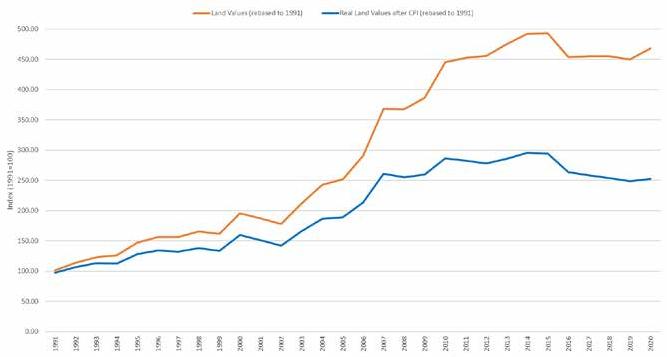
When CPI inflation is accounted for, land values have seen significant growth in real terms (figure 1), at an annualised rate of 3.1% from 1991 to 2021 (a total of 152.3%), demonstrating a substantial increase for those who have invested over a generation. Against rising inflation, pragmatic investors have been able to use farmland in order to diversify their portfolio and protect wealth, safe in the knowledge that the long-term performance o ers a strong value uplift plus a rental income stream.
Undoubtedly, farmland values have experienced periods of growth and decline at varying rates, and the market has been through notable periods of change. For instance, The Financial Times cites legal changes to agricultural tenancies in the 1990s as a reason for the increase in values in that period, with new farm business tenancies (FBTs) making land more attractive to investors.
In times of economy volatility, land values have proven resilient. Other than a slight dip in 2009, rising inflation and a steep fall in economic growth during the Global Financial Crisis drove demand for farmland by investors looking for relative safe haven assets. Even when the housing market crashed, the farmland market held strong.
Prices fell between 2016 and 2020, with Brexit and subsidy uncertainties creating more hesitancy amongst buyers. Considering the tough market conditions, values held up remarkably well and only su ered modest falls. Since then, there has been more confidence in the market and increased demand coming from new types of buyers. It is evident that real farmland values have trended upwards over a longer timeframe and weathered the variability in inflation rates. The resilience and ability to rebound quickly is promising for land values in the face of the current high inflation rates and low economic growth.

Exploring the change in farmland values compared to other common, tangible assets helps us to understand how di erent investment types perform. Over a 30-year period, equities (using the FTSE All Share index), gold, residential property and average land values have all grown at a faster rate than CPI Inflation. MSCI All Property capital growth, which is an accumulation of retail, o ce,
industrial and hotel indices and 10-year UK Government Bonds were the only asset types researched that had grown at a slower rate than inflation.
Agricultural land, when held in whole or in part as an investment, can yield steady rental income on an array of tenancies, such as leases for agricultural purposes, energy schemes or sporting. Particularly, agricultural landowners are increasingly exploring means to diversify their income by introducing complementary income streams. Even when income-producing elements of farmland are ignored, it is evident that the increase in capital value over time significantly outruns that of inflation.
On a shorter-term basis, farmland values have not performed as strongly, with the 10-year annualised growth at 0.5%. In contrast, the 10-year annualised growth of MSCI All Property was 2.6% in that period, and the FTSE All Share saw a 3.94% annualised increase. In order to generate wealth preservation benefits, farmland does experience some level of volatility but, when held over a longer period, o ers greater capital growth than many other investment types.
Over the last 30 years, farmland values have outperformed inflation and grown at a rate that exceeds many other common investments, delivering wealth preservation benefits.
In the short-term we are seeing a huge increase in input costs which is outstripping what farms can earn from their land. But, despite profitability concerns, the outlook for land values is positive. With limited supply of land coming to the market, growing demand from alternative investors and new income stream opportunities, we believe that land prices will, at the least, hold firm with potential to rise in the shortto medium- term. In the longer-term, it will continue its positive trajectory.
Encouragingly, new opportunities and income streams for landowners, both farming and non-farming, are helping to create optimism and drive prices. In particular, a new era of structural change has sparked the upsurge of environmental buyers who bring ‘green money’ to the market for carbon o setting and biodiversity purposes. Equally, emerging natural capital-based income streams will serve to benefit the market and create demand for land and the environmental solutions it can provide. History has shown that land is a safe store of value for investors in uncertain times. The costs of fixed rate borrowing have increased significantly in the last year and, whilst the tax status of agricultural land is constantly in question, demand still exists from investors, farmers and lifestyle buyers. They are all still likely to find themselves competing for farms and estate properties.
Over time, the alternative land use markets are likely to flourish. Yet, with food security moving higher up the agenda, the demand for productive arable and pasture land is also unlikely to diminish. As such, land will continue to be an attractive, long-term investment.

n his book ‘The North of England - A History from Roman times to the Present’ Frank Musgrove wrote ‘There have been four periods of particular northern distinction, importance and power....the First spanned the third century AD.... the second was the spectacular ‘Age of Bede’....the third was the military age of the Neviles and Percies from the mid fourteenth to the late fifteenth centuries....the fourth period....was the age of the Industrial Revolution’. This last was recognised by Lord Macaulay (Trinity 1818-1825) who in 1848 pointed out that ‘the regions north of the Trent possessed in their coal beds a source of wealth more precious than the gold mines of Peru’ Since the death of King Coal the economic pendulum has swung south again creating calls for Levelling Up which have generated so much heat and not so much light.
Looking at the Northern economic landscape from a Cumbrian perspective, where I chair the Local Enterprise Partnership, there is not much coal now - indeed there never was that much in comparison with other parts of the North. If one of the sources of regional wealth is identified as raw materials there might not seem to be all that much. But is that really right? I am going to suggest not, and that much of the problem is not the absence of economically important raw materials, but that their value has been expropriated in the past, and that it may be about to happen again.
It is well known that in the later Nineteenth and Twentieth Centuries those parts of the country which had plentiful water were used as header tanks for the water supplies of our great cities. While the environmental and associated aspects are still controversial it is no part of my argument to criticise the underlying idea. Rather the criticism is that it has been expropriated and not paid for. Every time a WC is flushed in Manchester it is done with Cumbrian water. Such places cannot exist without it. To go back to Lord Macaulay and the coal beds, that water is their foundation and the sine qua non of their existence. The water’s economic value is enormous, but its price to those who use it hardly begins to recognise the fact.

To come forward to the present day the Lake District is a World Heritage Site, England’s premier National Park, and one of the country’s glories, as well as being an essential component of the country’s economically important Visitor Economy. While those directly employed in that sector derive a livelihood from it, those who look after the land, which is what the visitors actually come to enjoy, principally live on crumbs falling from the agricultural table. DEFRA’s principal purpose sometimes appears to be to ensure upland farmers live at or near the level of the minimum wage and that our local communities are socially eviscerated by second homes, which makes recruiting local labour well-nigh impossible in some instances. Again the contribution to the nation as a whole is not recognised in the rewards for doing the work. Looking after this and similar places is as much a commercial output from a farm and for a land manager as meat and grain. What matters is the commercial value of what is done rather than the cost of doing it as is the general case in the rest of the in what we call the marketplace.
Perhaps, however, the most egregious example of this approach may be the way it appears Natural Capital is going to be treated. But first we need to note the fact that for years the economically poorer parts of the country have been clearing up emissions emanating from wealth creation elsewhere, like the man with the shovel at the back of the cavalcade. They have received very little proper economic recognition for it. Despite the Levelling Up Agenda Whitehall seems to be ignoring this.
If trees and peat absorb CO2, then those currently alive will be doing so, as much as those not yet planted or established. Despite this, policy appears to be primarily focussed on rewarding those who plant trees and restore peat bogs

in the future, which is, of course a good thing and needs encouragement. At the same time those who are now doing it and have done so for years appear to be being overlooked. Carbon clean-up is a commercial output which requires proper recognition and the polluter should pay, not the person doing the cleaning up.
Secondly there is evidence of large commercial businesses buying up land for planting in the future as a kind of land bank. I would if I were they, it makes sense from their perspective. What is needed now is a proper mechanism for places like Cumbria and those already living and working there to be able sustainably to exploit these possibilities and markets on an ongoing basis, rather than introducing neo colonial owners and operators from elsewhere who will expatriate the value created to other places. Now it is probably more di cult and complicated to do this rather than simply allow a crude and oversimplified model of the market to drive these things. But if it can be done - and it isn’t all that di cult to do if there is a will - it would provide an enormous fillip to the Northern Rural Economy, which the Levelling Up Agenda appears conspicuously to ignore.
The Northern countryside is blessed with plentiful natural resources (Water, Landscape, and Natural Capital), each of which has similar economic characteristics to minerals. Policy made in London is stopping this happening thereby leading to the well-known economic and social problems the Levelling Up Agenda is intended to address. Just as culture is now becoming recognised as having a real economic value which should be rewarded properly, so too should Natural Capital, Landscape and the Environment in just the same way.
The challenges seem to have come thick and furious over the last two years. COVID-19 has caused a major change in the way we work, shop, eat, share and communicate. Climate change served a poignant reminder this summer and the clock for change is ticking. If that is not enough, we are faced with an energy crisis, renewed geopolitical confrontation, and rampant inflation. All of this sets new challenges for how we use and build real estate/ Where to start?
Getting used to empty streets, queues at grocery stores and re-arranging our home set ups is something we adjusted to amazingly quickly. This is one of the most remarkable things I observed- just how rapidly we can adapt in adversity and on a global scale-the lesson should be applied elsewhere. However, for the high street it was a hammer blow to an already ailing asset class.
Andy Martin AJWM Consulting
A good thing is, I believe, we came to recognise more appreciatively those workers that continued to deal with our refuse, deliver our post, keep the power, water and phones working, and meeting our increasing home orders, as well as the heroes in the NHS. Teachers and most of us learnt to do the job remotely- something few trained for. It did us good to recognise how much we took some things for granted.
I remember in the early days of the covid lockdown wandering in Hyde Park and remarking how quiet it was- no aircraft, little tra c, the skies noticeably clearer with less smog… you could hear the birds. No pubs, no restaurants, no bustle, no music. It was also noticeable how others out for their one hour’s permitted exercise respected each other’s space but would nod in engagement as we passed.
Of course, it was not to last, but was a reminder of the pollution we live with. Climate change became a matter we could reflect on more as we watched documentaries and commentary in our enforced incarceration.
Free Hugs- a thing of the past?

COP26 was a major post Covid event yet seems so long ago. As we fight an energy crisis caused by the sad and unwanted war in Ukraine, the short-term expediency of reverting to tried and tested methods of energy production seemingly blanking out all we resolved to do. Bearing in mind the mammoth task we set ourselves to control climate change to 1.5°C, this job has just become even harder, if not, impossible. We even see some major investors doubling back on ESG policies of their holdings as they are “not in the shareholders interest”!
Given the remarkable two years we have been forced to endure, I still find it remarkable how quickly we adapted. I remember at the start of Covid lockdown phoning my brother who worked with a major US computer business and has been hybrid working for years. “How do you do it?”, I asked. It was the easiest way to learn.
At the time, as chair of a group of major advisory employers, we quickly demonstrated the power of networking and adjusting our businesses by sharing our experiences and ideas openly. I believe that spirit has endured, even as things normalise, a good outcome that this cooperation has brought.
Thinking about the future also caused me to consider what wider society would look like as we recover. Many, including two of my sons, started their working careers remotely. The ease with which we moved to homeworking is now manifesting in a reluctance to go back to the o ce full time. The debate of what is best will continue for years, but as some switch to more permanent flexible arrangements that genie may be out of the bottle. The question is now what sort of workplace do we need to create to make it attractive to rejoin? We are now adapting homes to have home o ces. Clearing out has increased demand for self storage. Other trends will emerge.
I spent some time looking at research focused on human connectivity. Papers like Mark Granovetter’s theorising on the “weak ties” the chance encounters which become an important part of our daily lives. These “collisions” give us new information possibilities and are relevant to the way we evolve our thinking and actions. Whilst we may have adapted short term, our native instincts are still to connect as humans. I sense this is the important ingredient we could be in danger of ignoring as we plan for the future. We just need to foster that connectivity in places designed to make it happen.
I read with interest the paper produced, in part by a team I met at MIT, last year. “The e ect of co-location on human communication networks” appeared in Nature computational science in August 2022. The summary statement said it all, “the ability to rewire ties in communication networks is vital for large-scale human cooperation and the spread of new ideas”. The research indicated “employees who are not colocated are less likely to form ties weakening the spread of information in the workplace”. As we move forward is it possible to have hybrid working but maintain that sense of belonging to an o ce community? That means more than just the place of work but where it sits, what is o ered around it, how accessible it is, what else can we do there? As we move also to rebuild our streets from retail failures, it is more likely the building of new cultural o erings, meeting points, and communal activities will define success. As we plan to become a more inventive economy, evidence shows we need to plan places to improve collaboration to succeed. This from the IBM Foundation.
value of openness, transparency and collaboration when pursuing innovation.
Fundamentally, this is an area we cannot ignore, already markets are adjusting. The whole o er of places is beginning to resonate more with investors and again placemaking is becoming a dominant theme. Old less e cient o ces are finding fewer takers, more modern low emission structures are almost the sole attraction to the sector. The impact on pricing, the subject of research at the Stern school at Columbia University who predict New York o ce stock will fall in value by 28% by 2029! We are seeing listed markets increasing discounts to asset value for the specialist London o ce stocks.
In all, Covid has set problems of rebuilding society in a way we were not prepared for. We had challenges of levelling up already, we knew we had to address climate change and sensed retail markets were moving in a direction for which there might be no return. On top of this, add an energy crisis which was not on anybody’s agenda and has reversed and extended the e orts on meeting our carbon reduction targets. This in turn has added greater geopolitical strife.
I sense (and hope) all these things will pull us closer together as a society than apart. The issues are plainer for all to see, and it makes it easier to demand action for change. I hope that will be the legacy of these last two years. We must think and act in the long term which means changing investment horizons which have become increasingly short term. Easing planning, building our tech economy, rebuilding communities and restoring urban centres are all opportunities for real estate.
Of course, many have chosen to leave urban centres for a more bucolic existence so creating another change in social patterns yet despite all of these changes, I believe time will show we gravitate to more central places where we can meet, eat, collaborate, and enjoy. Places where we recognise establishing these weak ties is part of the strength of community building. Covid forced us to come together to resolve a global problem. Let’s hope that experience will endure as we face a more catastrophic one of handling climate change.
They always say real estate people look on the bright side- I guess I am.
The COVID-19 pandemic has rapidly accelerated a shift towards hybrid working. This shift has had a marked and long-lasting impact on the UK real estate market, and has also presented challenges for employers, particularly with regard to managing the risk of discrimination claims from employees.

According to Savills Research, in June 2022 o ce occupancy rates in London averaged around 38%. Prior to the pandemic, occupancy rates across Europe averaged around 70 -75%. This disparity demonstrates the shift in workforce appetite for o ce-based work spaces (coupled with changes in workplace policy), with 85% of UK workers now preferring to work remotely at least 2-3 days a week. O ce space availability across the UK in 2022 remains 26% above the 5-year quarterly average, further demonstrating how this shift in approach has a ected the o ce market.
In spite of this trend, demand for o ce space increased in Q1. and Q2. of 2022 when compared with 2021. Perhaps the most significant change is not how much o ce space is demanded by employers, but the kind of o ce space which is being sought. There has been a significant increase in demand for high quality o ce space, particularly in central London. One of the core reasons behind this trend is that employers view premium workspace as the most likely to entice employees back into the formal o ce environment. A workplace which encourages collaboration and provides additional perks is much more likely to encourage employees to come into the o ce when compared with more traditional o ce setups, which can now increasingly be replicated at home.
However, the danger is that this drive to return to the o ce, even part-time as part of a hybrid working policy, leads to employers having a de-facto policy (whether deliberately or not) that risks discriminating against certain categories of employee.

Even in 2022, it is widely acknowledged that women on average continue to bear the brunt of childcare responsibilities. Hence, if an employer requires that its fulltime employees return to the o ce for a significant proportion (or majority) of the working week, yet fails to accommodate those with childcare responsibilities, it risks indirectly discriminating against female sta . If a female employee were to bring a claim on those grounds, an employer would need to be able to objectively justify the necessity for employees to return to the o ce for some or all of their time.
Pre-pandemic, it was universally accepted that the requirement for employees to work from the o ce was a legitimate aim, and Employment Tribunals would readily accept that a requirement for employees to attend the o ce most (or in some cases, all) of the time was at least potentially objectively justifiable. This was particularly the case given previous technological limitations.
However, given that the shift to remote working (driven by the pandemic) has accelerated the adoption of technology which makes remote working much more seamless, it remains to be seen how easily an employer will be able to justify a requirement going forwards.
Indeed, recent case law, not least the 2021 claim of Follows v Nationwide Building Society ET/2201937/18, has shown that Employment Tribunals are increasingly minded to side with employees in such cases, and not just in relation to conventional indirect discrimination claims.
In this case, the Employment Tribunal found that an employee (who was employed on a homeworker contract and who cared for and co-habited with a disabled person) was able to bring an associative disability discrimination claim against their employer in relation to a requirement for employees to work from the o ce, even though the employee herself was not disabled.
Associative discrimination occurs when someone is subjected to less favourable treatment not because of their own protected characteristics, but because of the protected characteristic of a person with whom they are associated. Although this is only a first instance Employment Tribunal decision (and therefore not binding on other Tribunals), it reflects the trajectory of jurisprudence in this area, and could, if a similar case was to be heard by a higher court and the decision upheld, open up a whole new category of claims to employees.
In our view, it is increasingly likely that employers who are more restrictive in terms of their employees’ working patterns will be subject to a new wave of litigation, primarily in relation to indirect and associative discrimination against working mothers.
There are some practical steps for which employers can take in order to mitigate this risk. The key is to communicate and consult with employees when reviewing hybrid working arrangements and policies to ensure that the working practices are, as far as possible, reflective of the needs of employees, particularly those who are most likely to be disadvantaged by fixed requirements to return to the o ce. While balancing these considerations, thought should also be given to whether junior employees and new joiners should have more stringent requirements to attend the o ce, in order to ensure that they are adequately nurtured and trained. Employers should likewise review how they consider and respond to employees’ flexible working request rights, as this is likely to be one of the most e ective means of ensuring successful engagement with working parents.
Dealing with these issues should be a real priority for employers in a post-pandemic world. The work from home debate will not only impact organisations’ culture and internal policies, but is also likely to have real and significant impact on long-term trends in the UK real estate market’s o ce sector.


Technology is a prime disruptor to the property industry, with potential both for positive innovation and for systemic damage. It facilitates wide scale and rapid change for many parts of the current system, whether that be automated land assessments, digital engagement, new sensory technologies in places and spaces, or the use of machine analytics to understand and predict environmental impacts.
There are already many examples of technology being used with positive e ect within the industry. The Credo2 and NUAR3 projects are good examples of emerging digital twins for environmental impacts and land management, while RIPA and BOPS projects could transform the processing and assessment of a wide range of planning applications.4
There are also already examples of technology being misused; we all remember the cries of “mutant algorithms” in response to the automated student assessments during the pandemic,5 while the recent complaint to the Information Commissioner’s O ce about the use of facial recognition technology in shops is directly relevant to the property sector.6
To modernise the real estate sector in context of data, the Levelling Up Bill7 contains draft clauses on planning data standards and there’s an existing consultation on the Golden Thread of data for the BSA.8 However, regulatory and governance mechanisms are playing a game of catch up that they may already have lost. In any case, compliance with legal requirements in respect of data use, in particular with privacy laws governing the use of personal data, should be seen as a
minimum standard. The implementation of ethical principles and policies requires consideration of more profound, moral questions about whether, for example, proposed uses of data are the “right” thing to do or whether any improvements can be made to the ways in which data is handled.
There are many – some might say too many – definitions of what data ethics are and theoretical discussions of their implications, but few examples of how they can be applied, particularly in the property industry. To tackle this challenge, a group of us from the RED (Real Estate Data) foundation have begun a collaboration on a data ethics playbook, to turn theoretical principles into practical actions.
The playbook begins with an introduction to the concept of data ethics, with an emphasis on brevity, and includes a number of industry standards, such as those of the RED foundation.9 It then examines what it means to turn principles into practice, including:
• Adjusting organisational structures to ensure that they include the right people with the right skills and technical capabilities;
• How to adjust current policies and practices to create a new modus operandi: for example, a policy should be used to embed ethical data use within an organisation but could also impose ethical requirements for data handling third parties in leases, contracts for work and services, or development agreements;


1https://redirect.cs.umbc.edu/courses/471/papers/turing.pdf
2https://digitaltwinhub.co.uk/credo/
3https://www.gov.uk/guidance/national-underground-asset-register-nuar
4https://dluhcdigital.blog.gov.uk/2021/06/30/mhclg-launch-two-beta-planning-products/
5https://www.bbc.co.uk/news/technology-53836453
6https://bigbrotherwatch.org.uk/2022/07/big-brother-watch-files-legal-complaint-against-co-opsorwellian-facial-recognition/
7https://bills.parliament.uk/bills/3155
8https://www.gov.uk/government/consultations/consultation-on-implementing-the-new-buildingcontrol-regime-for-higher-risk-buildings-and-wider-changes-to-the-building-regulations-for-all-buildings
9https://www.theredfoundation.org/dataethics

It is not possible to produce a set of rules purporting to describe what a man should do in every conceivable set of circumstances.Ian Mckenzie Senior Tech Lawyer, Osborne Clarke Janis Wong Postdoctoral Research Associate, The Alan Turing Institute Yusra Ahmad Acuity Data
• The utility of industry-wide accreditation marks or even the establishment of recognised ISO or British Standards;
• The potential to use technology like privacy-enhancing technologies (PETs)10 to ensure ethical outcomes; and
• New organisational training programmes and governance bodies, such as a data ethics board with overall responsibility for ethical data use.
The playbook digs in deeper with two use cases. First, smart homes, and how to engage with challenges from assigning a contract for a smart heating control, to thinking about how sensory technology can be used to promote health and safety without creating an ethical minefield. Next, smart cities and how we can use new technologies to manage them well, while avoiding the problems associated with the collapse of the Sidewalk Lab projects and negotiating ethical issues associated with the ‘price’ of free Wi-Fi.

We think that the playbook could be useful in managing data usage in buildings, or across an asset portfolio or for rewiring the use of data within a real estate organisation. But the playbook is not intended to be a definitive guide to ethical data use – it is more of a starting point, bringing a range of existing resources into a multi-disciplinary, iterative resource. There will not necessarily be a one-size-fits all approach and the measures will need to be pragmatic, practical, and suitable to the context in which they are being deployed. Most importantly of all, policies and practices need to allow for flexibility over time as ethical standards shift.
The current draft of the playbook ends with a list of resources – but we’d like the main content to be a collection of template policies, clauses, and examples of new practices – that’s why we’ve licensed it under the Creative Commons11, and we are always on the lookout for new collaborative opportunities.
RED Foundation is a not-for-profit initiative set up to ensure the real estate sector benefits from an increased use of data, avoids some of the risks that this presents, and is better placed to serve society. We do this by connecting people, projects, and initiatives around the topic of data in the built environment and raising the sector’s engagement with the ethical challenges that the use of data can present.
• Sue Chadwick is a Strategic Planning Advisor for Pinsent Masons LLP She is a member of the London Data Board, Chair of Business London Data Working Group and the author of the practice note on Digital Planning for LexisPSL.
• Janis Wong is a Postdoctoral Research Associate on the Ethics theme of the Public Policy programme at The Alan Turing Institute. Her research focuses on artificial intelligence, ethics, data protection, and data governance, with expertise in digital rights. She holds a PhD in Computer Science and an LLB in Law.
• Yusra Ahmad is a technology executive with over 16 years’ experience within the commercial occupier space. She has worked for Lehman Brothers, Credit Suisse, Jones Lang Lasalle and NHS Property Services and recently left her role with GWS as Global Data and Internal Technology Director to set up Acuity Data focusing on helping clients to uncover the true value of one of their most valuable assets..
• Sanjaya Ranasinghe is Global Director of R&D at WiredScore and leader of the R&D team. His current focus is on the world’s first smart building certification SmartScore which focuses on how smart technology is implemented to deliver user centric outcomes for building owners, operators and occupants.
• Ian McKenzie is a senior tech lawyer at Osborne Clarke with a focus on technology and data in the built environment. He coordinates Osborne Clarke’s international blockchain practice and regularly advises real estate clients and tech providers on the deployment and commercialisation of tech, data and data driven business models in the built environment.
Our institutions operate in a changing world to maintain the appropriate ethical codes and standards yet now appear more susceptible to “Institutional Corruption” which is manifest when there is a systematic and strategic influence which is legal, or even currently ethical, that undermines the institutions e ectiveness by diverting it from its purpose or weakening its ability to achieve its purpose.
The issues a ecting the RICS which lead to the removal of its CEO and others followed by the Levett report into what had gone wrong and the Bichard Review as to what must be done to put things right, suggests that as an institution RICS had indeed become corrupted. It was clearly failing its member’s needs, acting without its members authority and in danger of not meeting its Royal Charter requirement to act to the public advantage but there are two significant changes which give cause for concern that such corruption may still be embedded in its new way forward.
Lord Bichard’s Review has put forward 36 recommendations for RICS to adopt and additionally to amend its charter to incorporate the following revised purpose.
“The Institution exists for the benefit of society to deliver positive change in the built and natural environment in the United Kingdom and around the world. It does this by advancing and facilitating access to surveying knowledge by maintaining and promoting the usefulness of the profession and by leading, supporting and regulating a body of skilled professional surveyors and firms who demonstrate the highest ethical and technical standards.”
The recommendations look sound enough but there may be a sting in the tail when it comes to the proposed change in the Royal Charter with the suggestion by Lord Bichard that the subject of “sustainability” be added. There are hopefully few who in today’s world would not put the environment and its sustainability as a core principle and that should be replicated by RICS and its members. However, there is a danger that enshrining any specific subject in the Royal Charter alongside the public interest criteria could result in an irreconcilable conflict.

We have already seen governments worldwide look to expand fossil fuel provision so as to overcome the potential energy shortfall as a consequence of the Ukraine war, which otherwise is likely to cause hardship and death through a lack of food production and heating during the winter months. But what happens when the same position faces an institution where its Royal Charter has two objectives which are in conflict with each other. The public interest mantra alone should be su cient and therefore I would advocate extreme caution in amending the RICS Royal Charter possible political interference.
The Bichard Review identifies a number of changes required to the existing Standards and Regulations Board (SRB). On the one hand ensuring it has appropriate delegated powers but on the other ensuring it is responsible to the Governing Council in performing its Regulatory duties e ectively.
This is an important change reflecting on an ine ectual and sometimes misguided SRB activity in the past with the best example being their acceptance of 13 recommendations from the recent “Valuation Review” by a Committee that only comprised representatives of Institutional and City of London based organisations, with few chartered surveyors and only one of the major surveying practices represented.
The majority of the reviews findings were appropriate but for the first time it recommended prescribing that for all investment property on a global basis the Discounted Cash Flow model is to the Primary valuation methodology for valuers to adopt as follows:

The valuation profession should incorporate the use of discounted cash flow as the principal model applied in preparing property investment valuations.
My concern is that although RICS must ensure that there is transparency, independence, objectivity, and integrity
in the process, it must not become involved in a prescriptive approach which interferes with the skill of the valuer. That is why members who undertake “formal valuations” must be RICS Registered Valuers with the appropriate skill base and the simple but critical objective, to ensure the valuer adopts the correct methodology for the task in hand and produces a valuation which is as accurate as possible.
For RICS to insist on the adoption of DCF in sectors of the market that do not use this methodology may well encourage an inaccurate or incorrect valuation. Consequently, following RICS standards under these circumstances (that is if Recommendation 8(i) is implemented) may result in valuers facing negligence claims because they have adopted an incorrect approach and is likely to dilute RICS’s profile and standing in the markets it serves to the benefit of other valuation organisations without such strictures.
That is not to say there is not significant work to be done in ensuring that chartered surveyor valuers are professionally trained and skilled in the art of the DCF methodology. Therefore the second strand of Recommendation 8 is entirely appropriate which is as follows:
RICS should improve the knowledge and application of valuers in respect of advanced analytical techniques.
It must be completely acknowledged that DCF has a significant role in investment analytics, and in some areas of determining Market Value, but it should not be prescribed as the primary route to the determination of value or be confused with one derived from an accountancy approach delving into market practice which has not been adopted by the market.

The suggestion that other methodologies, such as the single all-purpose yield, will need to be rigorously explained if DCF is not adopted, is inappropriate, as it should be the requirement that any methodology adopted must represent the valuer’s interpretation of the market and the appropriate valuation methodology used in that sector.
It is a serious shortcoming of the valuation review that there is no definition of “Investment Property” but it is confirmed that the “Review looked at all aspects of valuations of property assets for investment purposes.” That said, the report states in noticeably clear terms that “… attention has been primarily focused on valuations of real estate assets for performance measurement and decision making purposes, upon which third parties place reliance. These are principally valuations for: financial reporting; inclusion in prospectuses and circulars, and takeovers and mergers; collective investment schemes; unregulated property unit trusts and commercial investment property financing.”
It is clear that the valuation review was limited to primarily the Institutional and major property company part of the overall investment property but has been unashamedly used to dictate the DCF valuation methodology for all aspects of private commercial and residential investment property regardless of the market approach.
As an example, Recommendation 8(i) gives no consideration to a private investor purchasing a small investment such as a newsagents shop in Margate or a 2 bedroom flat in a town such as say Rochdale. As a result of Recommendation 8(i), the purchaser and lender will be subject to undertaking a DCF valuation in addition to a traditional market valuation. Neither the purchaser nor the lender will gain anything out of a DCF based valuation, it is likely to be inaccurate as the transactional market in this sector will not operate on a DCF valuation methodology and there will be a significant additional cost and time delay for the production of a report which will have no beneficial outcome to either the purchase or lender.
The valuation review did advise that “….prescriptive standards may not be suitable to cover the vast range of valuation circumstances and …… could lead to unwarranted valuation conclusions in some situations.” The report also correctly and fairly confirms “that traditional measures of value, such as an ‘all-risks yield’ calculation, can correctly identify the exchange price at which an asset will likely trade (the all-risks yield is merely the mathematical summary of the many assumptions that go into a valuation)”
Despite this warning, RICS, through the ill-advised and unseemly quick decision of the SRB, has taken it on themselves to change the entire face of valuation methodology for investment property on a global basis and in doing so has changed the fundamental principle that the valuer should determine how to value.
The first two tests since the problems experienced in the management of the RICS, as exposed by the Levett Report are firstly the Bichard Review which seeks to amend the fundamentals of the RICS Royal Charter for what some may regard as political purposes. Secondly SRB adopted the Valuation Review Recommendation 8 (i) where the DCF is to be the “Primary Valuation Model” for all investment property on a global basis because of the preferences of a pressure group from the financial services sector based in the City of London.
RICS must make sure it retains and promotes its independence based on the skills and experience of its Members and not be corrupted by the pressure from strong dominant groups or those with their own political agendas.
 John Symes-Thompson Pembroke College 1977

Iam not really a cyclist and this journey all started as a bit of fun during the pandemic when I started going out on my bike for some exercise and “fresh air”. It was a great release from lockdown, and I later joined some local cycling friends on longer, more challenging routes. They were a lot younger than my 64 years, and a lot fitter, so I really found it a struggle to keep up with the group, especially climbing up any hills.
However, gradually my fitness improved and I enjoyed making small improvements to my bike such as fitting clipless pedals and using an old bike computer to record times and distances. Rides of 20 miles or more to attractive villages such as Finchingfield for lunch became feasible. But that is how it stayed until I bumped into my sister-in-law, a life-long cyclist, who announced she was planning to cycle from Land’s End to John O’Groats (LEJOG) later in the year. My interest was piqued and I quickly did some research on routes and timings thinking I could have a go myself – I had the time, after all, being retired!
It also made sense to me to link this plan with a charitable goal and I soon settled on helping PRACTICAL ACTION, the charity founded by E F Schumacher the author of “Small is Beautiful – A Study of Economics as if People Mattered”. I was born in Nairobi, Kenya and my early childhood in East Africa had exposed me to the real hardship facing farmers and remote populations eking out an existence in harsh environments in developing countries. Practical Action, formerly known as The Intermediate Technology Group, is all about equipping and empowering people on the ground to improve their own situations, rather than just distributing financial handouts. This is all so relevant in this era of rapid climate change, and unexpected tilts between drought and flooding.
Although my introduction to cycling had been brief, and preparation relatively amateurish, I became fiercely driven to achieve the LEJOG target. My rather dubious collection of “Lycra” and other cycling paraphernalia mushroomed, and I spent more time out on the road. My training regime during the next three months amounted to around 1,000 miles cycling around the Cambridge area with increasing distances, and shorter breaks between trips. I settled on using the SUSTRANS route on the National UK Cycle Network. This route looked more interesting as it links some of the UK’s most iconic trails with smaller, quieter back lanes but with the downside that at some 1,200 miles it was a good 300 miles longer than a more typical direct route on A roads.
The plan was to take around 26 days, without breaks, to cover the journey unsupported. This would average just under 50 miles a day with variations depending on hills and terrain. I was to be joined by my wife, other family members and friends at di erent stages of the trip.
In terms of “mapping” I now had the LEJOG route saved on my Garmin cycle computer, the handy SUSTRANS map booklet, and Google Maps on my phone so I couldn’t get lost, could I?
Once started in late May the trip went pretty much as planned although in the South West it seemed there were many more hills and valleys than I had expected! Also, the weather was fairly kind until I reached the North West where the rain became a serious di culty. Wearing glasses in wet weather made seeing the Garmin a problem, and traction less reliable especially on steep descents. However, I was thankful that I was not camping, as going from B&B to B&B gave me a better chance to dry out each evening. Further north in the Scottish
Highlands we experienced high winds of 30-40 mph over 4 days which made cycling conditions di cult on any more exposed roads. Luckily the winds were mostly westerlies meaning they were from the side, rather than being strength sapping head winds.
Yes, there were moments going up hills that I can only describe as being tough, and I had one or two “mechanicals” which lost me some time, but overall the trip was both a pleasure and a challenge. I never had to use my expensive bike lock and I really enjoyed the sections that were literally “in the middle of nowhere”! I got lost several times, mostly because road diversions were in place, but also some of the routes through town centres were di cult to find. Biking through cities including Bristol, Manchester and Glasgow seemed like massive urban jungles compared with the long open stretches through the countryside.
• Total Mileage – 1,197 miles
• Total Ascent – 69,467 feet
• Average moving speed – 10 mph
• Longest Day – 63.3 miles in 8 hours 14 mins (Dulverton to Glastonbury)

• Highest Climbing Day – 4,607 feet (Cumbria)
• Mechanicals – two brake failures, and bent handlebars after a fall in the wet, but no punctures!

• Highlights – Mousehole Harbour, Camel Trail, Tarka Trail, Exmoor, Wyre Forest, Bridgewater Canal, Whalley Abbey, Great Asby Scar, The Clyde, The Trossachs, Drumochter Pass, The Speyside Way, The Kyle of Tongue

I think I am now tougher, both physically and mentally, and proud to have raised over £3,500 for Practical Action. On the downside I am probably still addicted to flapjacks! Many thanks to all those members of CULS who supported me and my chosen charity for this challenge!

This summer Architecture and Land Economy at Cambridge celebrated their joint success coming top of their unit in the Research Excellence Framework (REF) which ranks research in subjects across the UK and allots funding to Universities. Architecture in Cambridge was founded in 1912 and last year we celebrated 100 years of examinations by asking alumni to send in their student work and holding a party in Scroope Terrace, our home since the 1920s.
Nationally, the Grenfell disaster has prompted a complete review of architectural education and professional development. The two professional bodies, the Architects Registration Board (ARB) and the Royal Institute of British of Architects (RIBA) have both been reviewing their criteria for accreditation. What is clear is change is in the air.

The current system needs overhauling. Architects take at least seven years to qualify. The normal route is a three year bachelor’s degree, a year out in practice, a two year Masters course and then at least one and normally two or three years in practice in preparation for the final registration examinations. The extreme length of training and the relatively low pay in the profession was challenging for all and a bar to widening participation.
At Cambridge we have set up an apprenticeship which encompasses the master and final registration examinations and takes three and half years from entry to qualification. The students work throughout and the Government pays the fees through the apprenticeship levy scheme. The course is now in its third year and we have been delighted by its success. It is proving highly popular with employers who see it as a way of retaining excellent sta . A number of our apprentices did apprenticeships at degree level too, broadening the diversity of our Cambridge intake.
It is likely that the RIBA and ARB will recommend shorter degrees in future, probably opting for integrated undergraduate and Master’s degrees for most students and the option of 2-3 year Masters degrees for others changing from other subjects. We have prepared for this by founding our Master of Architecture degree (MArch). Finally architecture Master’s students at Cambridge will have their own degree ceremony along with their own distinguishing gown and hood. The first students started the course this year.

Perhaps the most exciting course on the horizon is the Design tripos. The University has given us permission and the money to create this joint degree that combines Architecture and Structural Engineering with Materials Science to produce what promises to be a exciting option for more scientifically-minded architecture students, better prepared to face the technical challenges of global warming. The Department is doubling in numbers of students (45 architecture and 45 design) and doubling in number of faculty to teach this new degree. This exciting growth is allowing the expansion of facilities with a new digital fabrication laboratory being constructed in the ground floor of the Dyson building which was opened this summer.
Looking to the year ahead we are being joined by a new Professor in February and recruiting six new sta with a further 3 next year and we are looking forward to starting a new Masters in Film and Architectural Visualisation in 2024. 110 years after its opening the Department is looking forward to a bright future, training the next generation of designers to cope with the challenges ahead.


The last two years have been exceptionally challenging for the Department of Land Economy. The pandemic disrupted everything – obviously teaching but also those aspects of research that depend on being able to travel. But we coped very well, learning how to use online teaching methods very quickly, successfully adapting everything from lectures to exams, and working out how to keep research going in an online world, to the extent that many of us managed to attend and to give talks to many more international conferences than we would have done otherwise. It is great to be able to travel again, but from a climate change point of view it is also great to know that much can be achieved without participating in the burning of so much aviation fuel.
Looking forward, the e ects of the pandemic will be with us for a long time, including the physical e ects of the disease itself. Long covid will be a big problem for all organisations, but I don’t think universities have yet taken on board the consequences for them of large numbers of academic sta su ering from brain fog and tiredness. More locally in Cambridge, our problems were compounded by some ill-judged decisions by the University early in the crisis, essentially to freeze hiring, that led to unacceptable increases in workloads and threatened morale.
The pandemic was not the only challenge. Brexit is also a very big problem. Access to EU research funding, which the UK government declared would continue, has become a political bargaining chip in the negotiations between the UK and the EU about the Northern Ireland Protocol. Even if those negotiations succeed, some forms of EU funding will be lost. More immediately,
Brexit has been a contributing factor in the exceptionally high level of turnover we have experienced among academic sta
And now we have inflation, the main e ect of which will be further to erode academic salaries and add to the gloom caused by the massively reduced benefits of our pensions. As a former lecturer in the Department (now in the Law Faculty) wrote in a letter to The Times, ‘The bargain o ered to those entering the academic profession a modest (public sector) salary compensated by a comfortable (public sector) retirement has been upheld only in the former respect.’
But despite all these di culties, it has been a year of massive success for the Department, most of all the very great achievement of coming first in our category, alongside our colleagues in the Department of Architecture, in the REF, the Research Excellence Framework, the once-in-seven-years exercise through which the government attempts to assess the quality of research coming out of every university department in the country. More than two thirds of our research was judged to be ‘world leading’, the best in our category, and a big increase on the last exercise, and 98% of it was assessed as of international quality or better. The achievement is one shared across all parts of the Department and is even more gratifying given that the rules and the categorisation of research the REF uses make it di cult for us to show o the full range of our work. Only four other departments in Cambridge came first in their category.
On the teaching side, if success is measured by demand for our courses, it has also been a very successful year.

Our numbers continue to grow. We have more than eleven applicants for every place in our MPhil courses and our undergraduate entry, far from falling from what everyone thought would be a peak during the pandemic, is larger than ever – 72 new students at the time of writing, although new students switching from other subjects seem to appear every couple of days. And the number of undergraduate applicants for next year (2023-24) is already up by 25% to a new record. Beyond that, in 2024, we are starting a new part-time MSt in Climate, Environment and Urban Policy, to add to our existing (and fully restored) MSt in Real Estate. We hope to see even more interest in the Department from prospective students after the launch of our new website in the New Year, supported by a new Outreach and Communications O cer who we hope will bring the wonders of the Department to a wider and more diverse audience. We are grateful to the Cambridge Land Economy Advisory Board (CLEAB) for donations that made possible both the new website and the new o cer.
The expansion of numbers will bring challenges in terms of sta -student ratios, but the problem will be partly o set by another success, raising enough money from the Hatton Trust to fund a new chair in Climate Law, the first occupant of which will appear in 2023. The new MSt will come with its own new sta – both academic and administrative – and should at least not add to the burden. The new professor will be joined by replacement chairs in Real Estate Finance
(following the retirement of Colin Lizieri) and Land Economy (following the translation of Phil Allmendinger to the Deputy Vice-Chancellorship of the University of Bath).

Partly as a result of our success in attracting more students, the Department faces a shortage of teaching space. A more significant cause, however, is that the University sold o the lecture block where most of our teaching took place, the Mill Lane Lecture Rooms, to Pembroke College, which promptly demolished it. During the pandemic, when much lecturing was on line, this made little or no di erence, but since the full return of in-person teaching, roughly from January 2022, we have found ourselves being sent by the University to a variety of rooms all over the city centre, many of them not originally intended as lecture theatres and so di cult to see or hear in, and others positioned in interesting and possibly distracting places, such as behind the Eagle pub.
I see no immediate prospect of improvement in the teaching space problem soon, but we do at least hope to see some progress on the separate but related issue of our dilapidated, flooded and partially unheated o ces in Silver Street. (The Head of Department’s particular contribution to reducing carbon emissions is an o ce radiator that doesn’t work and apparently has never worked…) The University has agreed to a feasibility study of options for relocating us, including the option of a new (and with luck warm and dry) building. Let’s hope something has happened on that front before the next REF in 2028.
Iam writing this just as we start the new academic term at the end of September and a new cohort of intelligent, enthusiastic and engaged students have joined us to gain a deeper understanding of theories, techniques and analytical tools relevant for looking at real estate markets.
I am hoping they are not going to face too much adversity but as we think about some of the implications of what we have been through over the last few years it is a reminder that challenges can be helpful for learning and improving what we do.

From a research point of view, adversity is thoroughly normal! If it is an easy to answer question it will probably already have been answered. More usual is that the question itself is hard to define, articulate or imagine and that in itself is part of the challenge. Then there are the challenges of designing a method or approach that will actually address the question and then the challenges of how to gather data and information and finally the challenge of how to analyse that data and information. However, it is through this struggle that interesting and insightful research is produced.
Both cycles and structural shifts in real estate markets bring adversity for some. One of the research projects we’ve been revisiting and which formed the basis of the IPF report on long-term value methodologies is to look for indicators of when markets are out of line with fundamentals to help regulators, lenders and investors be more cautious and aware when downside risks are elevated. However, as we indicated in the IPF report, those fundamentals are not fixed and a greater awareness of some of the underlying factors and uncertainties around these would help in understanding risk. This has been brought to life with the dramatic movement in bond yields and interest rate expectations over the last few months. In addition, the relationships between fundamentals and the real estate market have probably changed with economic growth not feeding through to o ce demand as strongly as in the past and the growth of internet sales changing the dynamics of the retail sector. In addition, to these challenges is the need to improve energy e ciency of the real estate stock. The need to upgrade/refurbish, change use/repurpose and/or remove space to make places attractive is probably as great as it has been at any time in the last seventy years. So, whilst some of this transition will be di cult in terms of investment performance, it is also a fantastic opportunity for those with imagination, superior technical skills and the ability to bring a range of stakeholders together for a common goal. It will be a great time to learn from where things are going well and from others’ mistakes.
When the pandemic broke in 2020, we were faced with the challenge of how to technically deliver online teaching and how to make the content work for an online format. There was very rapid “learning by doing” in how to set things up and how

to record and edit videos. The second element of how to make online or hybrid teaching work well remains a challenge. It is very hard to read and engage an online class compared to an in-person class and it feels to me that online delivery of teaching material in a traditional lecture style doesn’t usually work well for students or teachers alike.
When a course is made specifically for online teaching, however, it can work very well and has many benefits, enabling students anywhere in the world to participate and learn. This is the approach taken with the real estate financial modelling certificate developed together with Bayfield Training https://www.bayfieldtraining. com/certificate/ The course is specifically designed for online delivery – with lots of exercises, the material is better suited to being looked at on a screen and it allows students to go through at their own pace is particularly important. These are all important elements for making online teaching more appropriate than inperson teaching.
Online delivery also allows us to access guest speakers from around the world for our MPhil and MSt programmes.
However, it has been an absolute joy to get back to in person teaching. The fun, energy and engagement of everyone being in the same room has been brilliant. Our 2022 part-time masters in real estate cohort made some significant sacrifices and paid some ridiculous airfares to make the first residential session in September but all said how valuable it had been to be there in person to learn from each other, be involved in group exercises and discussions and to be fully engaged with the course. It is also very hard to do karaoke remotely…

So, the adversity of the last couple of years has brought innovation into how we use online resources to support learning and it has also led me to think again about how to make the most of when students are together in Cambridge.

I have now completed around 25 long distance triathlons and unlike a standard distance race, inevitably something always goes wrong. Sometimes these are things I might have been able to do a bit about through more careful planning and checking but usually there is nothing I could have done. I went to the Austrian Alps for a race a few years ago and the temperature reached 37 degrees C for the 44 km run. Other races have also been much hotter than expected (Norway), wetter than expected (Switzerland) or stormy as expected (Scotland) and I have also had crashes, hit potholes and got a buckled wheel and even had a race where I was knocked o my bike and completed the race with one pedal. What I have learned through all the adversity is to focus on the enjoyment of being there to take part – it is amazing how the mind can control the body and by relaxing and focusing on positive thoughts the body does stu it otherwise couldn’t do - one can persuade oneself that it really is fun! There are a couple of key learnings from the tough times in races. Firstly, that preparation and training really makes a massive di erence - that inspires me to train consistently. Secondly, now I have been through so many tough times in races I know not to stress overly when the next one happens - you know you can get through it!
Adversity can make us more resilient and creative. Adversity also helps us learn more about risk, the need to prepare and have the right tools, skills and mindset for challenges ahead.

Place-making rests on three pillars. Our communities are spaces that contain such useful things as buildings, roads and utilities - our infrastructure or built environment. The second pillar is institutions, our social structures through which we interact. These institutions have a justified concern for housing and economic development, but place-making increasingly reflects important concerns for environmental quality, social justice and sound governance (ESG). The final pillar is superstructure, the beliefs that inform our daily decisions and behaviours.
When these pillars are aligned, the result is a space that embodies ESG. That space evolves into a place when it becomes a map, a guide on the road to embedding a community’s core values in our lives. A place enables people to make the right choices, empowers them to act on those choices and provides the resources for change. It enables them to practice orienteering towards shared cultural values rather than blindly following a satnav.
University of North Carolina at Chapel Hill (www.ie.unc.edu)
University of Cambridge (www.cam.ac.uk)
Director Cambridge Science and Policy Consulting (www.cspconsulting.net)


Community Carbon Reduction project (www.climateriskprojects.net)
If this sounds abstract, it needn’t be. Consider the Future Homes programme (the topic of our CULS article last year). It is ensuring new homes have high levels of environmental performance (the E of ESG). The aim is to improve infrastructure; the means to do that is through structure (here, building regulations) as well as a Home User Guide1 showing residents how to live within those homes (superstructure).
A community built to the Future Homes standard is a great space but not yet a place. How might a community of Future Homes evolve from a space into a place, and come to embody the full meaning of ESG? Here are some signposts, divided roughly between improving the built environment, institutions and behaviour.
1. Reimagine economic vulnerability. ESG and the economy are not at odds. Sustainability has roots in the 18th century idea of Nachhaltigkeit. German industry depended on wood but its forests were being depleted. Enter sustainable forestry. Economies depend on infrastructure and a supply chain. These are vulnerable to a degraded environment. A vibrant place maps out these linkages and ensures threats to the infrastructure, environment and economy are tackled as connected2
2. Embrace the top, bottom and middle. Why has the UK carbon footprint decreased recently? Part of the answer lies in top-down government policies reducing the carbon intensity of the grid. But part lies in people using less energy (the role for Future Homes) and part lies in intermediaries such as estate agents
1You can download this at https://www.gov.uk/government/publications/home-user-guide-template
2You can see a discussion of this in the Unhedgeable Risk publication of the Cambridge Institute for Sustainability Leadership, at https://www.cisl.cam.ac.uk/resources/publication-pdfs/unhedgeable-risk.pdf
directing people to low carbon properties. Individuals and organisations at these three levels must be rowing in the same direction for ESG to take hold in a place, each nudging the community towards adoption of Future Homes.

3. Mobilise collective action. Sustainability requires collective action where many groups are part of problems and solutions. Future Homes will work only if property owners, suppliers, policy makers, financiers etc are coordinated in their messages and actions to deliver low carbon homes at scale, despite di ering goals and resources3. This requires finding ways to mobilise and engage each on their own terms but all in support of the same programme of place-making.
4. Support diverse values. Multi-criteria analysis helps people understand the reasoning behind a community action. There is a crucial step where the analyst assigns value to each economic, environmental, social and governance attribute being considered. A place helps residents understand how values di er between people, and finds ways to let those values be accommodated while ensuring they are not at cross-purposes.
5. Procure conspicuously. People follow behaviours they see around them. The procurement practices of government, other large institutions and one’s neighbours help the market for low carbon buildings develop to where economies of scale emerge. And then as other community leaders jump on board, public signposts show where these solutions have been procured and nudge others onto the same path4
6. Move beyond care to duty of care. A well designed place takes residents on a journey from caring (I care about Cambridge and want it to be a vibrant place) to executing a duty of care (I incorporate ESG principles into everything
I do in Cambridge). Investing in cultural spaces is an e ective way to stimulate that journey by creating social cohesion. Too often, we design our communities with housing and economic development in mind, while paying little attention to how we express shared cultural values. Self-regulating places where people gather and celebrate shared community visions help them care about those visions and carry out their duty of care.
7. Strip signifiers from the signified. People confuse their real goal (warmth) with how they traditionally meet that goal (turning up the heat). The signifier (thermostat) slips in front of the signified (warmth) without us noticing. A place helps people see this slippage, remove the signifier and replace it with alternative ways to reach the same goal (A Future Home?).
8. Esse Quam Videri: The motto of a successful place is: “To be, rather than to seem” (Cicero). Institutions rarely monitor to see whether their actions have produced the desired e ect. The result: a programme remains on the shelf long past its sell-by date. A place contains robust monitoring systems for each ESG attribute, displays these results publically and follows a process of adaptive management with mid-course corrections as data flow in.
These are just some quick thoughts on how a space such as a development of Future Homes can become a place. We will know if this transition has been successful when everyone in the community (i) understands how that community embodies ESG (and where it is failing), (ii) uses their personal actions to influence the ESG credentials, (iii) nudges others towards taking the best actions and (iv) finds the necessary support and resources to do so.
3The Cambridge Retrofit programme was built on this idea, which you can see at communitycarbonreduction.net, followed by choosing the Cambridge Retrofit link in the navigation
4Consider the Cambridge Climate Map produced by Cambridge Carbon Footprint, found at https:// cambridgecarbonfootprint.org/map
eal estate, both as an investment and as a career choice, has a certain marmite-like quality to it. While some people condemn it as mere rent-seeking behaviour that cements or even exacerbates existing divides along gender, racial and other lines, others point to the fact that the built environment holds the key to solving some of the world’s most urgent problems, including climate change, loss of biodiversity and socioeconomic inequality to name just the most prominent. And while the former group tends to see the pandemic as a new pandemonium of negative forces that has been unleashed on the world in a spiral of growing carbon emissions, entrenched ‘white male privilege’ and dizzying wealth disparities, the latter might view it much more favourably as a kind of ‘proof of concept’ that humankind is indeed capable of rapid and lasting change in the face of an existential crisis.
Franz Fuerst Professor of Real Estate & Urban Economics CULS Fellow
RThis debate is, of course not new and it is not specific to real estate. David Ricardo who is usually credited with injecting the term ‘rent’ into the economic discourse and highlighting the distinction between labour, capital and profits is perhaps the first in a long line of thinkers who see excessive profiteering as a drag on economic and social well-being. We can think of rent-seeking as a non-productive activity that extracts profits without contributing any positive value to the economy or the society at large. By doing so, it neither distributes wealth more evenly nor disseminates the more intangible societal benefits such as equality and a better quality of life to the labour force. Even worse for future prospects, it blocks improvements, innovation and re-investment to the capital stock. Put in more practical terms, rent seeking is any activity that destroys rather than creates ‘value’, for example by introducing costly barriers to entry that only benefit the gatekeepers or by transferring wealth into the hands of the ‘already-wealthy’ through a seemingly endless cycle of buying and selling inside an elite club of investors. There seems little doubt that rent seeking in all its forms erodes economic growth and societies as Murphy, Shleifer and Vishny point out in their seminal 1993 paper in the American Economic Review (1).
So is anyone working in the real estate sector, including those working in real estate research and education, guilty of rentseeking behaviour, either directly or indirectly? Economics Nobel laureate Robert Shiller certainly has his misgivings about the finance sector when he concludes that speculation

and deal-making is a ‘wasteful activity that achieves nothing more than enabling the collection of rents on items that might otherwise be free’(2). And he certainly takes issue with the fact that many of the brightest and most educated people get diverted to finance and other rent-seeking activities, citing a New York Times survey that revealed that up to half of Ivy League graduates in the United States went into finance instead of becoming engineers, doctors, inventors or scientists (3). But it’s not just the jobs but also the very fabric of ownership structures that can be seen as deeply problematic. Here in the UK, 0.6% of the population own roughly half of the land while the remaining 99.4% own the other half (3). The numbers look similarly staggering or even worse in other parts of the world. The real estate sector seems more preoccupied with tilting this balance even further towards those wealthy few than achieving a healthier balance.
Not so fast, you might say. Before we engage in collective selfflagellation in an alumni organisation that counts a multitude of members in real estate related jobs among its ranks, let’s first ask this: how exactly can we distinguish useful from wasteful activities in the above sense? What might seem wasteful and rent-seeking to some, for example the sale of a large commercial real estate portfolio from Company A to Company B (and more often than not back again), might actually provide a mechanism for achieving more e cient and more sustainable use of the underlying assets, thereby perhaps creating more ‘value’ to society and the planet at large than an engineer working on novel methods to extract fossil fuels from previously unreachable places. Green real estate finance is another potential channel for allocating capital and resources where they are most needed and redressing injustices brought about by pursuing economic growth by some countries and individuals at the expense of others. Ultimately, whether something is considered rentseeking or useful to society is thus a moral judgement rather than an objectively quantifiable question.
What about the charge of perpetuating inequality? There is a broad consensus that the real estate sector needs to double and triple its e orts to achieve adequate equality and diversity in its workforce but recent reports also highlight some signs of steady improvement and progress over the years (4). Along this trajectory, the pandemic may have provided a watershed. While the transition to work modes that are more flexible across time and space may be the most empowering change in at least a century, it remains to be seen whether this change will stick and, more importantly, whether it opens the door to those who have previously been shut out of the real estate club. If not, it might just end up creating more inequality by turbo-charging the reach and capabilities of a tech-savvy elite to the detriment of a disenfranchised back-o ce workforce.
Similarly, the e orts to decarbonise real estate portfolios need to be scrutinised more closely and with better diagnostics to distinguish between green-washing that principally aims to be a smoke-screen and forestall stringent regulatory action from truly innovative voluntary measures by an industry that has finally woken up to the fact that combating climate change is not just a moral imperative but increasingly also a necessity for surviving as a business beyond the next few years. This, if nothing else, provides some measure of hope that the real estate sector is collectively prepared to act and embrace change rather than being dragged along by technological and social change and government regulations.

(1) Murphy, K.M., Shleifer, A. and Vishny, R.W., 1993. Why is rent-seeking so costly to growth?. The American Economic Review, 83(2), 409-414.
(2) Robert J. Shiller The Best, Brightest, and Least Productive? Sep 20, 2013.
(3) Rampell, C., 2011. Out of Harvard, and Into Finance. December 21, 2011, New York Times
(4) Inequality Briefing: Briefing 17: Who owns all the land?http://inequalitybriefing.org/brief/briefing-17-whoowns-all-the-land
(5) CREW: Annual Report 2020 and 2021. https:// crewnetwork.org/about/resources/industry-research/ gender-and-diversity-in-commercial-real-estate-202 (6) Bream, K. (2021): Why gender equality in real estate could be another victim of the pandemic https://www.egi. co.uk/news/why-gender-equality-in-real-estate-could-beanother-victim-of-the-pandemic/ )(09/02/2021)

For many years the University, alongside other universities and colleges, has contributed to the Farm Business Survey. In fact, this has run annually since 1936. This year the Department for Environment, Food and Rural A airs (DEFRA), following a process of tendering, has decided to move the contract to a new contractor, Promar International, a commercial consultancy company. The aim here is not to reflect on the wisdom or otherwise of this move. Su ce it to say that the move from a non-profit, independent partnership with very strong, longstanding personal relationships with farmers, to a commercial company risks a major break in the continuity of the data on the state of farm businesses at a time when the agricultural sector is facing a period of major upheaval.

Coupled with my retirement as Professor of Rural Economy, this looks like it could be an end of an era for agricultural and rural economics in Cambridge. Dr Zhaoyang Liu (Leo), appointed as my replacement, is a specialist in the economics of ecosystem services in China and developing countries. He has valiantly taken on teaching of Paper 16, Land, Food and Ecosystem Services (previously Agriculture, Forestry and Rural Development), with its UK rural land focus but this is not, at this stage anyway, the focus of his scholarship.
The first formal engagement in this area dates back at least to the endowment of the Lectureship in the History and Economics of Agriculture by Sir Walter Gilbey in 1896. In 1917 Sir William Dampier, Senior Tutor at Trinity, produced a flysheet advocating the creation of a ‘great School of Rural Economy’. This didn’t come to pass although estate management was introduced with the establishment of a University Readership in Estate Management in 1919. Work on farm accounting had been pioneered by Dampier, as reported in his presidential address to the Agricultural Economics Society in 1930. From Cambridge, J. A. Venn, R. McG. Carslaw and Dampier were all involved in various ways in the establishment of the Farm Management Survey1 (FMS).
The FMS, subsequently the Farm Business Survey (FBS), was undertaken in the Farm Economics Branch until the closure of the School of Agriculture in 1969 when it was transferred with the Agricultural Economics Unit into the Department of Land Economy under the Directorship of Ford Sturrock. Ian Sturgess took over the Directorship in 1977. At that time the Unit undertook a range of projects for the Ministry of Agriculture, Fisheries and Food (MAFF) alongside the FBS, notably
Lyn Hinton on Horticulture or Bob Ridgeon on pigs. Michael Murphy, who led the FBS work, was well known amongst the farming community for his quickfire and often rather pessimistic presentations. At this time, the funding available from MAFF also supported half of the Director’s salary and a further research post, held by John Cathie, that made a significant contribution to teaching in the Department and wider research activity. Many graduates will recall Michael Murphy’s first year statistics lectures.
The AEU became the Rural Business Unit (RBU) in 1998 better to reflect the focus of its activities. Alan Renwick took over from Ian Sturgess and Ben Lang in turn from him. Over time the work for MAFF and subsequently DEFRA, increasingly focused on the FBS, including its on-line dissemination for benchmarking and other applications maintained by Mark Reader, to the point where the FBS dominated the work of the RBU. Other work in the RBU includes the agri benchmark Cash Crop analysis, generating international comparisons of farm business statistics, and participation in the University NERC funded Centre for Landscape Recovery project in the Fens. But the loss of the FBS represents a severe blow to the RBU.
The holders of the Gilbey lectureship (Venn, Whetham, Wallace, Hodge) have provided another stream of teaching, research and engagement in wider rural policy issues. There was a brief flowering of rural economic research in the late1990s and early 2000s under the aegis of Cambridge Rural Economics Research by Alan Renwick, Uwe Latcz-Lohmann and me. However Uwe’s departure to a professorship at the University of Kiel, Alan ultimately to a professorship at the University of Lincoln in New Zealand and my distraction as Head of Department brought things to an end.
While the numbers have been small, Cambridge has made a significant contribution to rural economics over the years.

JA Venn2, (Gilbey Lecturer and President of Queens’ College) in 1933, defined the subject as follows: “If in Marshall’s words ‘Economics is the study of man’s actions in the ordinary business of life’. Then Agricultural Economics is clearly the study of man in his relation to the land.” That remains the case (excepting the inappropriately gendered language) but our appreciation of the nature and significance of land has changed. In Venn’s time, the use of land for the production
of food and fibre dominated human endeavours around the world. We now recognise the critical importance of rural land as a source of multiple values. We understand better the influence of alternative land uses on flood risks in the face of increasing climate variability, the threats associated with biodiversity loss, the importance of soils as a store of carbon, the impacts of greenhouse gas emissions and the importance of access to nature and open space as o ering recreation, health and psychological benefits to a pressured, largely urban population.
Other than agricultural commodities, these values are not delivered by markets, although an understanding of markets (and their failure) is fundamental to an understanding of the economics of land. These values are generally, especially in an ‘old world’ context such as in the UK, generated under multiple land uses. Some values are complementary: landscapes rich in biodiversity typically hold higher levels of carbon and o er attractive landscapes for recreation. Some, especially more intensive farming practices, are deeply damaging to other values. The consistent delivery of these values typically depends on a long term commitment, beyond the span of individual occupiers. Further, these multiple land values are situated within complex institutional environments of property rights, competing and aligned interests, uneven power and profound moral debates.
All this complexity represents a fundamental challenge for the development of governance and policy to promote sustainable ‘optimal’ land use outcomes. The immediacy of the issues arises not simply from the exigencies of the climate and biodiversity emergencies or the recent reassertion of the critical importance of food and energy security. Following Brexit we have a one-time opportunity to forge new approaches; an opportunity that the current government might, if reports in the media are correct, be minded to throw away.
These are fundamental questions for rural economics, alongside other disciplines in law and social and natural sciences. Land use and management is dominated by private property and personal motivations but the values are of great social consequence. This is the challenge for policy: to grasp the importance of the science, derive appreciation of the many values and to craft institutions to direct motivations and actions towards socially desired outcomes. This is the realm for a contemporary rural land economy.

When the term “market” is mentioned in sub-Saharan Africa and some other parts of what is euphemistically termed “the global south”, it does not necessarily mean the stock market or blue collar commerce or supermarkets, shopping complexes or malls. It means intricately connected open spaces of mini trade stations with rhythmic human aggregations in spaces whose boundaries sometimes shift based on economic and social factors. This is largely the narrative in Nigeria as well. Markets are rarely taken seriously as ‘legitimate’ workplaces of commerce because of how they look. However, prior to the colonial era, markets and their corresponding access routes in northern Nigeria and of course, Africa, were the sole platforms and spatial drivers of formal trade with global links (Mábògùnjé, 1968). Colonialism brought a certain type of calibration to the market space as it restructured African trade to accelerate the exploitation of resources and labour (Adebayo, 1992). This over time, reduced markets to the seemingly negligible real estate that it is now, while the African city exclusively embraced the western system of markets. The African market is in a way, a summary of the city. It embodies almost all social activity and human forms of social representation that a city has to o er. Everyone is connected to the Nigerian market! Complex dynamics of important social parameters like religion, culture, and demography are at play in an African market far beyond the ritual of buying and selling. These manifest in market organisation and communal orchestration leading inevitably, to the expansion and (or) growth of a market.
Markets and other open spaces are known to be the focus of attacks by a number of terror groups. In 2021, 13 of the worst 18 attacks occurred in some form of public space which included market deaths (IEP, 2022:11). African Markets and their response to harm have been overlooked for a long time. But with 80.4% of the world’s conflict-induced displacement (IDMC 2022:26), Africa is the primary arena of conflict. In 2021, the second most deadly single terror attack happened in a market in Burkina Faso claiming at least 160 deaths (IEP, 2022:10) . The north of Nigeria happens to be not only a hotspot of conflict in the country but the world. Between 2015 and 2020, Nigeria was consecutively one of the top 4 terrorimpacted countries in the world (2nd in 2015 & 2016). The continent’s vulnerable open spaces show that African markets cannot be ruled out of the impact of violence and the production of terror.
But how have markets in northern Nigeria responded to this? In 2020, the pandemic caused a total shutdown of the entire country. Only markets were opened fully to the public. The shutdown triggered mass food shortage which led to

around markets. In Abuja , the markets decreased in density as non-food vendors were barred from trading. Trading time plummeted by 91% in the markets. Perception of government support in Wuse market—the largest market in the city, dropped from 60.31% to 0%, with 94% expressing no government support. Still the market carried on while malls and plazas buckled under pressure. Some may argue that it was out of desperation, but the coordination of the traders to shield themselves from the violence through their local security practices was significantly instrumental. Table 01 shows that even though transport of food was easier during the lockdown, sales dropped drastically. However, in spite of the little government assistance, their internal support systems and practices not only made them feel safe but kept them safe. In Q1-Q2 of 2022, a largescale study I led in Maiduguri, showed that of 4493 people interviewed across all regions of the city, 49% generally agreed that their markets were safe, 35% were indi erent while only 16% felt they were vulnerable. Maiduguri and in general the state of Borno has witnessed some of the worst attacks in the world but there is more faith in the local security of the market and the communal e ort of resistance among the traders than security from the government. This is a macro-economic safety net.

In Nigeria, discussions of real estate exclude open markets. Recently, however, there have been moves to buy up large open markets dating back many decades to centuries, with the purpose of converting them to shopping malls, or plazas. This only perpetuates colonial residues of economic and socio-cultural erasure. Malls and Plazas are engulfing Abuja’s commercial real estate space for instance and they lack the real estate structure and planning direction to operate like traditional markets. They cannot deliver a variety of products, human accessibility, sociocultural identity and a holistic consistency of operation in the face of significant urban disruption. The markets can. The assumption is that more money can be made if markets are replaced, this is however a weak argument. Nigeria has one of the largest informal economy sectors in the world making up as much as 67% of the GDP (Tonuchi & Idowu, 2020). For a country of 218 million people, one can easily imagine the scale of workers that this sector embodies. The market and similar spaces are a large part of this ‘informality’. Also in northern cities like Abuja and Maiduguri, markets already generate very similar real estate revenue to formal commercial spaces. Markets of the north have been able to relatively survive major disruptions of terror, climate and health. But for how long?
The markets are tough but they are not invincible. Even though terror has not been able to bring about expected terminal consequences like market erasure, fragmentation or irreversible sale drops, other threats exist. People loose lives, food flow is disrupted and export-import su ers. The current flood in the north has ruined major villages and parts of the main cities. If the identity and socioeconomic footprint of the Nigerian market is properly understood, real estate will take advantage of the large commercial footprint and resilience qualities that open markets bring to Nigerian urbanity. Government policy also needs to mainstream the informality of the market space to bring about inclusive real estate growth… this must be done before markets finally buckle under the continuous pressure of severe disruptions. They are the major lifelines of the Nigerian city.
Adebayo, A. G. 1992. The Production and Export of Hides and Skins in Colonial Northern Nigeria, 1900–1945. Journal of African History 33(2) pp. 273-300. IEP, (2022), ‘Global Terrorism Index’, Measuring the Impact of Terrorism’ Institute for Economics and Peace https://reliefweb.int/attachments/ a62d4dc4-c69b-49ee-8ef5-50d98205e70d/GTI-2022-web_110522-1.pdf
I. D. M. C. (2022). Grid 2022: Children and Youth in Internal Displacement. Norwegian Refugee Council.https://www.internal-displacement.org/sites/ default/files/publications/documents/IDMC_GRID_2022_LR.pdf
Mábògùnjé A.L. 1968. Urbanisation in Nigeria, London: University of London Press
Tonuchi, J. E., & Idowu, P. (2020). How large is the size of Nigeria’s informal economy? A MIMIC approach. International Journal of Economics, Commerce and Management
Wclimate change is not due to human activity and that even if climate change is real, the government should not interfere as capitalism will naturally cause markets to correctly compensate to a warming world.
 Hollingsworth JD Candidate

ater is in every product we make, every food we eat and in every process for energy creation. Recognizing this, it does not become di cult to see how many might argue that “no other challenge is more fundamental to more global problems than water security” (Larson, 2020, pg. xii). Water security is what many central Californians do not have. The Central Valley supplies over 25% of the nation’s food and to sustain production as well as a burgeoning population, the aquifer system at the heart of California is one of the most pumped in the country (USGS, 2022). This has resulted in a loss of trillions of gallons of groundwater (NASA, 2022). The Sustainable Groundwater Management Act (SGMA) was passed in 2014 to respond to concerns of unsustainable groundwater withdrawal. This state agenda has led many to overlook the partisan and geographical divides that result in weak support for water and climate change policy in the state. While those living in the Central Valley are particularly a ected by drought and are most likely to see supply of water as an increasingly big problem (PPIC, 2022), regional representatives oppose government intervention and environmental legislation and vote against bills that seek to protect the quality of waterways and aim to invest in water infrastructure.
Due to the politicization of climate change, evidence of how climate change framing impacts policy preferences for increased sustainable groundwater is critical to inform policymakers about how to communicate to stakeholders and the public in a way that increases support for policies like SGMA and compliance to them. Although literature points to cultural values and beliefs as shaping climate change risk perception, evidence is lacking about how a climate change narrative influences stated preferences for managing groundwater (West, Kovacs, & Nayga Jr., 2022, p. 61). More specifically, a study looking at the e ect of a climate change frame on individualists in California has yet to be conducted. An individualist is defined as one who views nature as resilient and is skeptical of government intervention to mitigate environmental risks (Jones and Song, 2014, pg. 450). An individualist tends to be more susceptible to narratives that
This study aimed to study the groundwater policy preferences of individualists in California through a stated preference discrete choice experiment. The survey elicited responses from 1,007 residents living in 276 towns and cities across the state and 140 residents from the Central Valley specifically. Respondents were randomly assigned into two groups—a control and treatment group—and were given prompts that framed the choice experiment. The control group was provided with a prompt emphasizing the need to address water insecurity due to the overconsumption of groundwater. The treated group was provided with a frame emphasizing the need to address climate change. These prompts were followed by a choice experiment aimed at eliciting willingness to pay for increases in beneficial water attributes such as increased groundwater quantity. Identical questions aimed at gauging a respondent’s level of opposition to government involvement in natural resource management and knowledge of and belief in climate change were asked in both the control and treatment groups. These questions were used to determine whether a respondent could be categorized as an individualist. 384 California residents, including 58 Central Valley residents, were tagged as individualists and their responses were analyzed through multinomial logistic regression.
A comparison of the regression results for individualist respondents revealed that culturally incongruent messaging escalates opposition to a promoted groundwater policy. Individualists exposed to a climate change frame were less willing to pay for a policy increasing groundwater quantity than if they were exposed to a water security frame. The results show how depoliticizing critical water resource management and adjusting the national and state discourse to emphasize water security can avoid the emboldened opposition that an incongruent, climate change narrative can cause. Jones and Song (2014) showcase how individualists are positively influenced by an egalitarian cultural story frame that focuses on the moral issue of overconsumption that needs correcting to protect the community’s interests. A focus on water security is that narrative about overconsumption of a shared critical resource. It focuses on wells drying up, the buying of bottled water to fulfill basic needs and the passing down of parched property. It is a story that speaks to the intimate and daily reality of a central, rural Californian.


Fhand, has long loomed ahead of humanity. Many adversities it has created, but to no avail. Humans have been unable to e ectively respond to the impacts of climate change, rendering education impervious to adversity. Irrespective of these two outcomes, overall, humans continuously adapt. Adversity cannot be confined to specific happenings and calamities; they are part of life as much as education is part of adversity. This article is by no means intended to be academic, but rather, an interlink between Disraeli’s quote, the author’s personal opinions, and the subtheme of this year’s Cambridge University Land Society Magazine… supply chains!
El Daouk Third Year Land Economy PhD Studentormer British Prime Minister Benjamin Disraeli once said: “there is no education like adversity”. Life at its essence is as unpredictable as nature is variegated in decoration. Humans innately find comfort in normalcy until calamity thwarts the contemporality of life. Faced with calamity, humans strive to liberate themselves from restraint only to find new normalcy; somewhat like the past but better adapted to the future. In any case, life is ever changing, and it behoves humans to find solace in interim normalcies, until being compelled to find forthcoming ones. It is this very yearning for liberation during adversity in which education is conceived.
All of this sounds dandy. The aforesaid may very well be true in the case of COVID-19, but perhaps less true in the case of climate change. Covid-19 has resulted in a world better adapted to global pandemics and has transformed the rate at which medicine advances. Climate change, on the other
Supply chains fall in the nexus of the global pandemic and climate change, two adversities that humanity is currently facing. Supply chain resilience to disruptions caused by COVID-19 and climate change is the equivalent of the “education” being conceived from “adversity”. Although global supply chains have been impacted di erently by both adversities, they have ended up in the same back door. In the aftermath of COVID-19, supply chains seem to have adapted despite there being no attributable signs of the pandemic before November 2019. In the case of climate change, there was pre-emptive awareness of both climate change, and supply chain vulnerability to environmental threats, such as the 2011 tsunami in Japan and other natural disasters.1 However, the adversities posed by such preordained disasters were of no profound e ect in driving greater supply chain resilience. Supply chains were as disrupted as they would have been ten
1Fiksel, J. et al. (2015). “From Risk to Resilience: Learning to Deal with Disruption”, MIT Sloan Management Review, 56(2), pp. 79-86
2Martin, R. et al. (2016). How regions react to recessions: Resilience and the role of economic structure. Regional Studies, 50(4), pp. 561–585. https://doi.org/10 1080/00343404 2015 1136410
years earlier. Despite this, supply chains eventually re-emerged, seemingly, more resilient. Although the tsunami itself was not the key driving force in change, like the global pandemic, it exposed the diversification and concentration entrenched beneath global supply chains. These are seen by many as double-edged swords bringing both positive and negative implications on supply chains. Nevertheless, the key contribution from such a dynamic has been nurturing resilience.2
As of this paper’s writing, supply chains remain concentrated and diversified. However, they are also being disrupted at an unprecedented level.3 During the outbreak of COVID-19, a consumption shock occurred, thwarting supply chains. Supply chain actors were incapable of meeting demand levels and failed to maintain productivity levels because of lockdowns, lack of logistical mobility, and adversarial stances amongst suppliers.4 Along with the consumption shock, the fast economic recovery of large economies put further pressure on global supply chains to meet global demand. These setbacks were uneven in di erent countries. China, for example, has recovered and even surpassed its pre-Covid 19 export levels, whereas Europe still struggles to grasp the setbacks caused by the pandemic. Thus, some supply chains have seemingly adapted, while others have not. The 2011 tsunami in Japan exposed supply chain vulnerability as suppliers were incapable of resorting to short-term emergency supply chains. It also showed that supply chains, be they concentrated or diversified, were vulnerable to disruptions caused by natural disasters. Even where short-term contingencies were put in place, there had been no guarantee that supply chains would overcome any forthcoming natural disaster. Despite the unfettered uncertainty, and the uneven adjustment seen in
global supply chains, some supply chains are becoming more resilient to the two adversities; however, the means through which resilience is created rests in short- and long-term factors, far beyond the mere occurrence of adversity.

In the short run, supply chain concentration creates interdependencies amongst supply chain actors, promoting e ciency.5 In the long run, supply chain actors become reliant on fewer parties, making them more prone to disruptions in the event of a disaster or pandemic.6 As for diversification, the short-term drawback is a lack of supply chain stability. In the long run, however, diversification does create cyclical stability and promotes resilience.7 Their concurrent presence reinforces the constant adaptation of supply chains as the world changes, even though we may not see it at the moment. Therefore, supply chains are continuously evolving in ways that yield short and long-term means of overcoming di erent types of adversities such as those used in this writing.
But then again, does this really concur with adversity being the harbinger of education? The short answer is yes. Yet, there is something that sits between adversity and education before begetting the latter, which ultimately materialises the catena outlined in Disraeli’s quote. The missing interlink is weakness, more specifically, the susceptibility of humans to what is forthcoming. The pandemic and climate change are mere reflections of short- and long-term periods in which vulnerability stands at the doorstep of humanity, exposing its weakness, and eventually pushing it to overcome these challenges. Adversity is not solely an innate feature of education, rather so, both adversity and education are mirrors of one another constantly reflecting the human quest of survival.
3Panwar, R., Pinkse, J., and De Marchi, V. (2022) The Future of Global Supply Chains in a Post-COVID-19 World, California management review, 64(2), pp 5-23
4Kano, L. and Oh, H.C. (2020). “Global Value Chains in the Post-COVID World: Governance for Reliability”, Journal of Management Studies 57/8 (December 2020), pp. 1773-1777; El Daouk, M. (2022). “Introducing halāl to construction supply chains in the UK’s construction sector”, Journal of Islamic Marketing, https://doi.org/10 1108/JIMA-01-2022-0016
5Shearmur, R., & Polèse, M. (2005). “Diversity and employment growth in Canada, 1971–2001: Can diversification policies succeed?” Canadian Geographer/Le Géographe Canadien, 49(3), pp. 272–290
6Kano, L. et al. (2022). Global Value Chain Resilience: Understanding the Impact of Managerial Governance Adaptations. California Management Review, 62(2), pp. 25-45
7Drucker, J. (2011). “Regional industrial structure concentration in the United States: Trends and implications. Economic Geography”, 87(4), pp. 421–452
The 2022 Careers Fair was a great success and our biggest to date, with over 40 employers joining from across the industry. Thank you so much to our sponsors and donors for making this event possible.

Over 200 students attended from across the University and their feedback was overwhelmingly positive and appreciative. Students emphasised how
beneficial it was to be exposed to the breadth of opportunities and careers paths on o er.
Using the influence of the CULS to promote DE&I is an important current focus for the committee. So, we were grateful that Real Estate Balance, Black Professionals in Construction and WIRE were able to join us at that Fair. More to come on this agenda over the next 12 months!
Next year’s fair will be in October 2023 (date to be confirmed). In the meanwhile, if you would like to get more involved in career matters or to support the Department of Land Economy’s mentoring scheme, please don’t hesitate to contact Ali or I.
“It was amazing. It was great being able to network. There were such a vast range of employers here and we were able to speak with everybody. We got loads of advice and tips on the applications, the roles o ered, loads of support. It was incredible”
Leya

APAM
ARUP
Bank of America
Barton Willmore, now Stantec BPIC Network
Bidwells Built-ID British Land Brockton Everlast Cambridge Land Economy Advisory Board
Cambridge University Careers Service Carter Jonas Colliers
Cushman & Wakefield Currie & Brown Deloitte Eastdil Secured Fabrix Fourth Street Gerald Eve Goldman Sachs Greystar Grosvenor Homes England Knight Frank LaSalle L&G Macfarlanes Northwood Capital Places for People
RBC Real Estate Capital Partners Real Estate Balance
REVCAP Rockbourne Savills Strutt & Parker tdm recruitment
TfL Commercial Development Wates
Wells Fargo WIRE (Women in Real Estate)
The Noel Dean Prize for best overall performance in Part II Miss Tereza Zoumpalova
The Gordon Cameron Memorial Prize for best performance in Paper 7
Mr Samuel Faheem and Miss Alice Perkins
The Je ery Switzer Prize for best performance in Paper 14 Mr Aayush Pindoria
The Mike Turner Prize for best performance in Paper 15 Mr Kazim Raza
The CULS Prize for best overall performance in Part 1B Mr Harry Houillon
The Nigel Allington Prize for Best overall performance in Paper 1
The Douglas Blausten Prize for best performance in the dissertation for the Real Estate Finance MPhil
Mr Harris Whitford
Mr Martin Stepanek
The Alistair Ross-Goobey Prize for best overall performance on the Real Estate Finance MPhil Mr Martin Stepanek
CULS Committee Members
Dan Nicholson
CULS Position
President
Aubrey Adams Vice President
Ian Marcus
Immediate Past President Werner Baumker
Hon. Press Secretary
Lauren Fendick Hon. Secretary
Erik Ruane Hon. Treasurer Louise Sherwin Hon. Careers O cer
James Taylor
James Campbell
Anna Harper
Oliver Harwood
Roddy Houston
David Howarth
Ami Kotecha
Hon. Member for the Regions
Head of Department of Architecture
Chair - Residential Forum
Chair - Rural Forum
Chair - Commercial Forum
Head of Department of Land Economy
Chair - ESG Forum
Colm Lauder Chair - Whitehall Group
Noel Manns Chair - Real Estate Finance Forum
Rod McAllister
Committee Member
Dominic Reilly Chair - Sports & Leisure Forum
Brian Waters
Charlie Stoneham
James Webb
Chair - APEC Forum
Co-Chair Silver Street Group
Co-Chair Silver Street Group
ULS membership is open to alumni and students of Land Economy, Real Estate Finance and Architecture as well as many other CU graduates of other fields who are now involved in the real estate industry. As at the end of the academic year in June, CULS had an active membership of almost 1,000 ranging in age from new undergraduates to centurions. The membership network continues to evolve with increasing numbers of international members joining the cohort living and working in the UK metropoli and regions. CULS is a truly global lifetime friendship network.
C• Full members working and/or living within 100 miles of London (Charing Cross) - £75 inc VAT
• Full members working and living over 100 miles of London (Charing Cross), optional reduced rate - £55 inc VAT
• Concessionary & International members and over-65’s - £20 inc VAT
• Current students and first year post-graduation - FREE
Erik Ruane MA Hons MRICS CULS Hon. TreasurerThrough seminars, lectures, tours and dinners, CULS provides excellent learning, social and networking opportunities for members. In addition to some administrative costs of organising these events for members’ enjoyment, CULS also plays an important role in support of sta and students in the Land Economy and Architecture Departments of the University. For instance, CULS funds Tripos prizes, provides financial support for two fellowships and has been, and continues to be, available to provide financial support for relevant student Tripos dissertations.
The Committee appreciates the ongoing support for the Society from its loyal membership. Subscription revenue is perennially vital to the longterm health of the Society. The Committee has held subscription rates since November 2017:
Subscriptions may be paid either by bank standing order or securely via the website www. culandsoc.com. All membership/subscription enquiries should be addressed to me or Ali Young at culandsoc@alibrinkley.co.uk. If you do move home or business, please take a moment to update your details on the website to stay in touch – a Society can only ever be as strong as its members!
After a period of virtual-only events, CULS is pleased to have been able to resume in-person events, fostering vital and vivacious direct membership interaction. Some events will continue to be o ered online and/or hybrid.
The CULS is also extremely grateful to many corporate businesses for their continuing financial sponsorship and logistical support to the Society.
Please book tickets online (www.culandsoc.com) or contact the Society Secretary, Ali Young (01638 507843, info@culandsoc.com).
WG Lunch – Wednesday, 18th January 2023 (12.30 – 2.30pm)
WG Lunch – Thursday, 2nd February 2023 (12.30 – 2.30pm)
WG Lunch – Wednesday, 1st March, 2023 (12.30 – 2.30pm)
Katie Schmuecker, Principal Policy Advisor at the Joseph Rowntree Foundation Subject: “The cost-of-living crisis”
Professor Richard Betts MBE

Head of Climate Impacts Research, Met O ce Hadley Centre, and University of Exeter
Subject: “The climate crisis and the urgency of damage limitation”
Dame Carolyn Fairbairn DBE, former Director-General, Confederation of British Industry
Subject tbc: “Can the West survive?”
CULS Annual Planning Update, 21st or 22nd March 2023 from 2pm onwards c/o Dentons, One Fleet Place, London EC4M 7RA
WG Lunch – Wednesday, 29th March 2023 (12.30 – 2.30pm)
WG Lecture – date to be confirmed
11th July 2023 AGM 4.30pm, Annual Dinner 7.30pm
Ambassador Wegger Chr. Strømmen, Ambassador to Norway, The Norwegian Embassy
Subject tbc: Norway’s SWF and its role in energy supplies to Europe / Norway’s view of the role of the EU/Nato alliance
Gillian Tett, British author and journalist, Financial Times
Subject tbc: Political Power and the growing failure to understand other countries cultures
AGM and Annual Dinner c/o Magdalene College, Cambridge CB3 0AG
The Cambridge University Land Society would like to thank the following for their generous support in 2021–2022