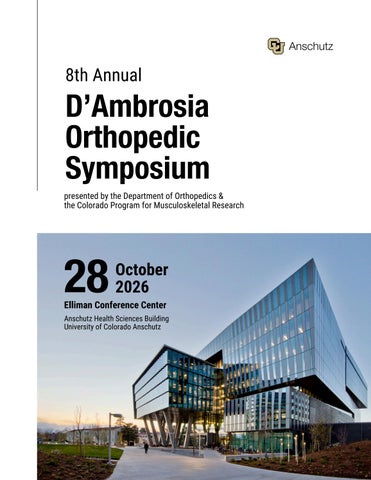
8th Annual
D’Ambrosia Orthopedic Symposium presented by the Department of Orthopedics & the Colorado Program for Musculoskeletal Research
28
October 2026
Elliman Conference Center Anschutz Health Sciences Building University of Colorado Anschutz
Agenda
tap video icon to connect via ZOOM
tap arrows to jump to specific pages of this program
8:00am - 9:00am Check-in | Breakfast | Poster Setup
10:15am - 11:30am Poster Session 1 (odd numbers)
8:00am - 9:00am Opening Remarks Evalina Burger, MD Professor & Chair, CU Anschutz Orthopedics John H. Sampson, MD, PhD Dean of the CU School of Medicine
9:10am - 10:15am Trainee Plenary Session
11:30am - 12:00pm Lunch (foyer)
12:00pm - 1:00pm Faculty Plenary Session
1:00pm - 2:00pm Mack Clayton Scientific Keynote Presentation
3:15pm - 4:15pm Robert D’Ambrosia Keynote Presentation
Martha Murray, MD
Charles D. Nelson, MD
Orthopedic Surgeon-in-Chief Boston Children’s Hospital Catharina Ormandy Professor of Orthopedic Surgery Harvard Medical School
2:00pm - 3:15pm Poster Session 2 (even numbers)
Chief of Adult Reconstruction & Professor of Orthopaedic Surgery University of Pennsylvania Perelman School of Medicine
4:15pm - 5:00pm Access and Engagement Panel Discussion Charles D. Nelson, MD Martha Murray, MD Evalina Burger, MD
5:00pm - 5:30pm Symposium Awards 5:30pm - 7:00pm Reception
8th Annual D’Ambrosia Orthopedic Symposium
1:00pm - 2:00pm Introduced by Nancy Hadley-Miller, MD
Department of Orthopedics & Colorado Program for Musculoskeletal Research
8th Annual D’Ambrosia Orthopedic Symposium
Mack Clayton Scientific Keynote Against the Grain: Navigating the Development of BridgeEnhanced ACL Restoration
Martha Murray, MD Orthopedic Surgeon-in-Chief Boston Children’s Hospital Catharina Ormandy Professor of Orthopedic Surgery Harvard Medical School
Martha Murray, MD, is the Orthopedic Surgeon-in-Chief at Boston Children’s Hospital and the Catharina Ormandy Professor of Orthopedic Surgery at Harvard Medical School. She and her team developed a novel technique of Bridge-Enhanced ACL repair which utilizes a bio-engineered implant to stimulate healing of the ligament instead of the traditional harvesting of a graft of tendon to replace the torn ACL. She and her team have successfully translated it from the lab to FDA marketing approval with grant funding from various sources, including the NIH and NFL Players Association. She has 11 issued patents and over 100 peerreviewed publications around the development of this technology. Her work on innovative ACL treatment has won the AAOS Kappa Delta Award, as well as the AOSSM O’Donoghue, Cabaud and Grana Awards. She been named one of Fast Company's Top 100 Most Creative People in Business, been featured in Stephen Hawking’s Brave New World Series and been featured in a video on Tech Insider that garnered over 75 million views. Martha has a BS in Mechanical Engineering from the University of Delaware, a MS in Materials Science and Engineering from Stanford, and received her MD from the University of Pennsylvania prior to completing orthopedic surgery residencies and fellowships at Harvard Medical School.
Mack Clayton Scientific Keynote
Agenda
3:15pm - 4:15pm Introduced by Michelle Wolcott, MD
Department of Orthopedics & Colorado Program for Musculoskeletal Research
8th Annual D’Ambrosia Orthopedic Symposium
Robert D’Ambrosia Keynote Does Value Based healthcare limit joint Arthroplasty access for vulnerable patient groups?
Charles L. Nelson, MD Chief of Adult Reconstruction and Professor of Orthopaedic Surgery University of Pennsylvania Perelman School of Medicine
Dr. Nelson graduated from Rensselaer Polytechnic Institute and the University of Pennsylvania Medical School. He completed his internship and residency in Orthopaedic Surgery at the Hospital of the University of Pennsylvania. After finishing a fellowship in adult reconstructive surgery at the Hospital for Special Surgery, he returned to the University of Pennsylvania where he is currently a Professor of Orthopaedic Surgery and Chief of Adult Reconstruction. He was an AAOS Leadership Fellow from 2004-2005 and represented the American Orthopaedic Association as an Austrian Swiss German Traveling Fellow in 2012. He has received numerous awards – he was one of two nationally chosen recipients of the National Medical Fellowship's James H. Robinson, MD Memorial Scholarship for outstanding achievement in the study of surgery in addition to winning the Helen O. Dickens, MD award, the Charles Drew Award and William T Fitz, Jr. Awards at the University of Pennsylvania School of Medicine. In addition, he has been elected to the Penn Medicine Academy of Master Clinicians, which represents the highest clinical honor for a Penn Medicine clinician, representing a commitment to leadership in exceptional patient care at present and in the future. Dr. Nelson has served in volunteer and leadership positions in various medical, fraternal and charitable organizations. He is a member of the Hip Society, the Knee Society, the International Hip Society and is a founding member of the International Knee Society. He is currently on the Board of Directors for the American Board of Orthopaedic Surgeons for which he currently serves as President. He is a Past-President of the J. Robert Gladden Orthopaedic Society (JRGOS). He serves on the membership committee of the Hip Society, and is one of the Inaugural Co-Chairs of the former Combined Hip Society and Knee Society Diversity, Equity and Inclusion Committee, now the REAL Mentorship Committee (Representation, Engagement, Excellence and Leadership). He serves as the Treasurer for The Knee Society, and has previously served as a Director-at-Large on the Board of Directors. He has also served on several committees and advisory boards for the AAOS, AAHKS, AOA. He is the past Deputy Editor for Adult Hip and Knee Reconstruction for the Journal of the American Academy of Orthopaedic Surgeons and is the past Chair for the American Orthopaedic Associations “Emerging Leaders Forum”. Dr. Nelson has been named as a "Top Doc" by Philadelphia Magazine and Philadelphia Life Magazine on several occasions and has been selected several times to be among the Top Physicians and Surgeons in America by both peers and consumers including Best Doctors, Inc., Castle and Connolly and the Consumer's Research Council of America. He has published more than 140 peer review manuscripts as well as several dozen book chapters. He has been a co-investigator or site principal investigator on both federally sponsored and industry sponsored grants.
Robert D’Ambrosia Keynote
Agenda
4:15 pm - 5:00 pm Moderator | Michelle Wolcott, MD
Department of Orthopedics & Colorado Program for Musculoskeletal Research
8th Annual D’Ambrosia Orthopedic Symposium
Access & Engagement Panel Discussion How I Got Here There’s rarely a straight line to where we end up. Drs. Charles Nelson, Martha Murray, and Evalina Burger share the pivotal moments, challenges and opportunities that shaped their careers. How I Got Here is a candid conversation about the paths we take, the lessons we carry forward and what we discover along the way.
Agenda
Michelle Wolcott, MD Moderator Dr. Wolcott is a board-certified orthopedic surgeon who is fellowship-trained in sports medicine, with expertise in the treatment of complex knee, ankle, and shoulder problems. An active marathon runner, she also has a special interest in runner's injuries, pediatric sports medicine, and women's sports medicine. She has developed techniques in the diagnosis and treatment of exertional leg pain in athletes and serves as the Practice Director for CU Sports Medicine in Denver. Dr. Wolcott trained at Georgetown University for medical school and did her residency at Loyola University where she was honored with the prestigious senior resident research award. She was also selected to participate in the Schwartz traveling fellowship where she studied advanced techniques in the surgical treatment of lower extremity sports injuries in Australia and New Zealand. She did her sports medicine fellowship at the University of Iowa where she was responsible for the coordination and care of the football, basketball and wrestling teams. Since 2003, she has been the team physician for the University of Colorado basketball teams, University of Denver gymnastics and basketball teams, Colorado Mammoth, and Denver Nuggets, and serves as co-medical director for Colorado Rapids youth soccer league. Dr. Wolcott is an Associate Professor at the CU School of Medicine and supervises the fellows, residents, and medical students in the Department of Orthopedics. She participates in an extensive list of research projects and has published numerous articles on the care and treatment of complex knee and ankle injuries, including cartilage, ligamentous, and chronic issues in professional and recreational athletes. Her areas of expertise include ACL reconstruction, realignment/osteotomy surgery, meniscus surgery, ankle instability, cartilage restoration procedures, compartment syndrome release/fasciotomy, and rotator cuff repair. Dr. Wolcott is passionate about the total care of the athlete and has dedicated her free time to promoting advocacy in sports. She has pioneered awareness and education of physician leaders in recognizing and preventing abuse of athletes and continues to work in this evolving area. She spends the rest of her time with her two children and their numerous hobbies and interests.
Access & Engagement Panel Discussion
Agenda
Charles L. Nelson, MD Panelist Dr. Nelson graduated from Rensselaer Polytechnic Institute and the University of Pennsylvania Medical School. He completed his internship and residency in Orthopaedic Surgery at the Hospital of the University of Pennsylvania. After finishing a fellowship in adult reconstructive surgery at the Hospital for Special Surgery, he returned to the University of Pennsylvania where he is currently a Professor of Orthopaedic Surgery and Chief of Adult Reconstruction. He was an AAOS Leadership Fellow from 2004-2005 and represented the American Orthopaedic Association as an Austrian Swiss German Traveling Fellow in 2012. He has received numerous awards – he was one of two nationally chosen recipients of the National Medical Fellowship's James H. Robinson, MD Memorial Scholarship for outstanding achievement in the study of surgery in addition to winning the Helen O. Dickens, MD award, the Charles Drew Award and William T Fitz, Jr. Awards at the University of Pennsylvania School of Medicine. In addition, he has been elected to the Penn Medicine Academy of Master Clinicians, which represents the highest clinical honor for a Penn Medicine clinician, representing a commitment to leadership in exceptional patient care at present and in the future. Dr. Nelson has served in volunteer and leadership positions in various medical, fraternal and charitable organizations. He is a member of the Hip Society, the Knee Society, the International Hip Society and is a founding member of the International Knee Society. He is currently on the Board of Directors for the American Board of Orthopaedic Surgeons for which he currently serves as President. He is a Past-President of the J. Robert Gladden Orthopaedic Society (JRGOS). He serves on the membership committee of the Hip Society, and is one of the Inaugural Co-Chairs of the former Combined Hip Society and Knee Society Diversity, Equity and Inclusion Committee, now the REAL Mentorship Committee (Representation, Engagement, Excellence and Leadership). He serves as the Treasurer for The Knee Society, and has previously served as a Director-at-Large on the Board of Directors. He has also served on several committees and advisory boards for the AAOS, AAHKS, AOA. He is the past Deputy Editor for Adult Hip and Knee Reconstruction for the Journal of the American Academy of Orthopaedic Surgeons and is the past Chair for the American Orthopaedic Associations “Emerging Leaders Forum”. Dr. Nelson has been named as a "Top Doc" by Philadelphia Magazine and Philadelphia Life Magazine on several occasions and has been selected several times to be among the Top Physicians and Surgeons in America by both peers and consumers including Best Doctors, Inc., Castle and Connolly and the Consumer's Research Council of America. He has published more than 140 peer review manuscripts as well as several dozen book chapters. He has been a co-investigator or site principal investigator on both federally sponsored and industry sponsored grants.
Access & Engagement Panel Discussion
Agenda
Martha Murray, MD Panelist Martha Murray, MD, is the Orthopedic Surgeon-in-Chief at Boston Children’s Hospital and the Catharina Ormandy Professor of Orthopedic Surgery at Harvard Medical School. She and her team developed a novel technique of Bridge-Enhanced ACL repair which utilizes a bio-engineered implant to stimulate healing of the ligament instead of the traditional harvesting of a graft of tendon to replace the torn ACL. She and her team have successfully translated it from the lab to FDA marketing approval with grant funding from various sources, including the NIH and NFL Players Association. She has 11 issued patents and over 100 peer-reviewed publications around the development of this technology. Her work on innovative ACL treatment has won the AAOS Kappa Delta Award, as well as the AOSSM O’Donoghue, Cabaud and Grana Awards. She been named one of Fast Company's Top 100 Most Creative People in Business, been featured in Stephen Hawking’s Brave New World Series and been featured in a video on Tech Insider that garnered over 75 million views. Martha has a BS in Mechanical Engineering from the University of Delaware, a MS in Materials Science and Engineering from Stanford, and received her MD from the University of Pennsylvania prior to completing orthopedic surgery residencies and fellowships at Harvard Medical School.
Access & Engagement Panel Discussion
Agenda
Evalina Burger, MD Panelist Dr. Evalina Burger graduated medical school in South Africa at the University of the Free State with honors in General Surgery, Pediatrics and Psychiatry. She became the first woman to receive the Cornelius Wessels Medallion in Surgery. She continued her career and became a Captain in the South African Defense Force Medical Corp where she worked and acquired surgical skills in Orthopedics, treating injuries of war and land mine explosions. She completed her internship in the Military Hospital before joining the Defense Force. She completed her Orthopedic residency over the next six years, received the G.F. Dommisse Award for best resident and also won the prize for the Best Resident Research Paper at the University of Pretoria. Following her residency, which included almost two years of spine training, she dedicated her career to spine surgery. She became the first female surgeon in South Africa to become an ABC Fellow and she traveled to North America and Canada in 2000 as a visiting professor to several large institutions. She was recruited to Louisiana State University in 2001 where she established an Adult Spine Unit. In 2006, she was recruited to the University of Colorado Denver Anschutz Medical Campus where she propelled her career, she held several leadership positions including Chair of the Orthopedic Finance Committee, Executive Vice Chair and Vice Chair of Clinical Affairs for the Department of Orthopedics and established herself in the field of research. She has international recognition for her work on the thermoplastic behavior of metal rods and also received the prestigious White Cloud Award with her research group, showing the advantages of disc replacement. Dr. Burger is currently a full Professor at the University of Colorado Department of Orthopedics and is the Chair of the Department. She is the first recipient of the Robert D’Ambrosia Endowed Chair in Orthopedics. She is the author of many peerreviewed publications and has co-edited two textbooks: Spine Trauma Surgical Techniques and Spine Surgery Basics. She has dedicated her career to complex spine surgery with a passion for scoliosis surgery.
Access & Engagement Panel Discussion
Agenda
Thank you to our sponsors
8th Annual D’Ambrosia Orthopedic Symposium | University of Colorado Anschutz
Trainee Plenary Moderator: Deirdre Rafferty, MS, ATC
9:10am
Nina Carson, PT, DPT
Robert D’Ambrosia Clinical Science Trainee Award Finalists Mack Clayton Basic Science Trainee Award Finalists Tap to read the abstract
An Inelastic Compression Garment Significantly Reduced Swelling after Total Knee Arthroplasty: a Randomized Controlled Trial Co-Authors: Amy Peters, Charlie Yang, Douglas Dennis, Todd Miner, Jason Jennings, Jeri Forster, Jennifer Stevens-Lapsley, Michael Bade
9:20am
Jacqueline Lu, BS
Early Opioid Use Is Associated with Worse PatientReported Outcomes After Total Knee Arthroplasty Co-Authors: Nina Carson, Amy Peters, Jason Jennings, Marcus Waldman, Michael John Bade
9:30am
Jenna Zajac, DPT
Risk Factors for Chronic Pain Evolve Across the Continuum of Care in Total Knee Arthroplasty Co-Authors: Laura Churchill, Jeri Forster, Michael Dayton, Jennifer Stevens-Lapsley, Michael Bade, Lisa Carlesso
9:40am
Melissa Cuevas, MS
Spatial Transcriptomics of Vertebral Bone Reveals Anterior-Posterior Molecular Gradient Disruption in a Col2Cre;Gpr126fl/fl Mouse Model of Adolescent Idiopathic Scoliosis Co-Authors: Valeria Aceves, Bridget Sanford, Kenneth Jones, Patrick Carry, Ryan Gray, Nancy Hadley-Miller
10:50am
Kanita Hrustanovic, BS
Epigenetic Rescue of Mechanical Unloading Induced Muscle Atrophy by HDAC Inhibition Co-Authors: Scott Burlingham, Soham Ghosh, Katie Sikes, Ben Gadomski, Lauren Monroe
10:00am
Yichi Chen, BS
Cross-Species Genetic Mapping Reveals Shared and Distinct Mechanisms Underlying Intervertebral Disc Degeneration Co-Authors: John Sundberg, Beth Sundberg, Gabrielle Dudek, The Colorado Center for Personalized Medicine , Jonathan Shortt, Christopher Gignoux, Cheryl Ackert-Bicknell
Trainee Plenary
Agenda
Faculty Plenary Moderator: Doug Adams, PhD
12:00pm12:30pm
Brecca Gaffney, PhD and Lynn Pezzanite, DVM, PhD
The Past, Present, and Future of the BALRG: A Clinical Research Perspective
12:30pm
Alexa Burger, PhD
Brachyury Regulation in the Notochord and Postnatal Intervertebral Disc as a Predictor of Spine Health, Disease Progression, and Clinical Outcomes
12:45pm
Klane White, MD
Growing Possibilities: Advances and Emerging Therapies in Achondroplasia
Faculty Plenary
Agenda
Posters
Tap to read the abstract
Research At-a-Glance
1 Poster Withdrawn
2 Patrick Livingston, BA Mack Clayton Basic Science Poster Award Finalist Targeting the Liver-Gut-Muscle Axis to Mitigate Cancer Cachexia in Head and Neck Cancer
Muscle, Tendon & Movement
Co Authors Nicholas Jamnick, Caleb Gammon, Afra Bushara, Mabel Kahil, Christian Young, David Orlicky, Daniel Frank, Carissa Thomas, Leah Novinger, Andrea Bonetto
3 Kenna Thomas, BS Mack Clayton Basic Science Poster Award Finalist HDAC Inhibition Partially Restores Lamin A/C Expression and HDAC1/FOXO3a Localization During Dexamethasone-Induced Muscle Atrophy.
Muscle, Tendon & Movement
Co-Authors Kanita Hrustanovic, Soham Ghosh
4 Prabil Kaini, BA Mack Clayton Basic Science Poster Award Finalist Abaloparatide Protects Against Cartilage Degradation and Chondrocyte Apoptosis in a Murine Model of Post-Traumatic Osteoarthritis
Bone, Cartilage & Joint Biology
Co-Authors Matthew Osmond, Samantha Landgrave, Michael David, Ana Ferreira Ruble, Honey Hendesi, Michael Zuscik
Posters
Agenda
Posters
Tap to read the abstract
Research At-a-Glance
5 Michael David, PhD Mack Clayton Basic Science Poster Award Finalist Machine Learning and Advanced Statistics Identify Functionally Linked Capsule and Cartilage MRI Patterns in Rat Elbow Contracture and Osteoarthritis
Data Science, Imaging & Artificial Intelligence
Co-Authors Bracken Sant, Spencer Lake
6 Seth Jacobson Mack Clayton Basic Science Poster Award Finalist Brachyury maintains intervertebral disc homeostasis through direct regulation of disease-associated target genes
Spine & Scoliosis
Co Authors Harry Smith, Christian Mosimann, Patrick Carry, Alexa Burger
7 Kelsie Richardson, MS Robert D'Ambrosia Clinical Science Poster Award Finalist Association Between Post-Concussion Plasma Biomarkers and Persisting Symptoms After Concussion Among Adolescents
Pediatrics & Adolescent Health
Co-Authors Katelyn Hurlburt, Livia Wunderlich, Mathew Wingerson, Julie Wilson, William Meehan, Rebekah Mannix, David Howell
8 Livia Wunderlich, BA Robert D'Ambrosia Clinical Science Poster Award Finalist Are Adolescents with Concussion Uniquely Vulnerable to Subsequent Injury? A Comparison of Subsequent Injury Risk Following Adolescent Concussion vs. Musculoskeletal Injury
Pediatrics & Adolescent Health
Co-Authors Katherine Smulligan, Joshua Kniss, Mathew Wingerson, Sarah Peterson, Gregory Walker, Julie Wilson, David Howell
Posters
Agenda
Posters
Tap to read the abstract
Research At-a-Glance
9 Sean Sibley, DPT Robert D'Ambrosia Clinical Science Poster Award Finalist Isolated Bioinductive Collagen Implant for the Treatment of Partial-Thickness Rotator Cuff Tears
Sports Medicine & Athletic Performance
Co-Authors Andrew Valiquette, Madison Hening, Eric McCarty, Rachel Frank, Jonathan Bravman, Adam Seidl
10 Hannah Rossing, BS Robert D'Ambrosia Clinical Science Poster Award Finalist The relationship between MRI characteristics and operative and nonoperative success rates in Pediatric Elbow Osteochondritis Dissecans
Pediatrics & Adolescent Health
Co Authors Avinash Konapala, Carson Keeter, Jay Albright
11 Emily Lindley, PhD Robert D'Ambrosia Clinical Science Poster Award Finalist A Randomized Clinical Trial of Vaporized Cannabis Versus Oral Oxycodone for Chronic Spine Pain
Spine & Scoliosis
Co-Authors Rachael Rzasa Lynn, Alan Morris, Rahwa Netsanet, Jacqueline Bainbridge, Christopher Domen, Vikas Patel, Carson Keeter
12 Phatravit Watanasiri Robert D'Ambrosia Clinical Science Poster Award Finalist Topical Cannabinoids for Musculoskeletal Pain: A Prospective, Observational Study
Muscle, Tendon & Movement
Co-Authors Miles Pellatt-Whitaker, Kent Hutchison, Thomas Henthorn, Christopher Domen, Carson Keeter, Rachel Rzasa Lynn, Emily Lindley
Posters
Agenda
Posters
Tap to read the abstract
Research At-a-Glance
13 Brett Biedermann, MD Robert D'Ambrosia Clinical Science Poster Award Finalist Glucagon-like Peptide-1 Agonist Usage Associated with Lower Nonunion Rate in Tibial Shaft Fractures of Diabetic Patients: A Large Database Retrospective Study
Trauma, Fractures & Infection
Co-Authors Joshua Finesilver, Nicholas Piccaro, Connor Littlefield, Hassan Mir, Nicholas Alfonoso
14 Jacob Welsch, MD CU Anschutz Orthopedics Resident Medicaid Patients Experience Delayed Access to Total Hip Arthroplasty Without Worse Post-Operative Outcomes
Joint Replacement & Reconstruction
Co Authors Elizabeth Cho, Evan Richman, Mauricio Alvarez, Garrett Ball, Jack Hop, Carson Keeter, Michael Dayton, Daniel Moon
15 Ryland McDermott, MD CU Anschutz Orthopedics Resident Minimally Invasive Proximal Screw Stabilization in Long Posterior Spinal Fusion Constructs is Associated with Decreased Proximal Junctional Kyphosis
Spine & Scoliosis
Co-Authors Jingdian Huang, Renzo Laynes, David Ou-Yang, Andriy Noshchenko, Vikas Patel
16 Ryland McDermott, MD CU Anschutz Orthopedics Resident Implementation of a Bone Health Provider in the Spine Clinic for Preoperative Osteoporosis Medical Optimization: Single Academic Center Experience
Spine & Scoliosis
Co-Authors Vikas Patel, Whitney Adair, Daniel Liu, Micol Rothman, Cheryl Ackert-Bicknell, Evalina Burger, Christopher Kleck
Posters
Agenda
Posters
Tap to read the abstract
Research At-a-Glance
17 Beau McGinley, MD CU Anschutz Orthopedics Resident Bankart Repair with Routine 7 O’clock Anchor Placement: A Patient-Reported Analysis
Sports Medicine & Athletic Performance
Co-Authors Haley McKissack, Evan Richman, Jonathan Bravman, Adam Seidl, Eric McCarty, Rachel Frank 18 Jack Hop, MD CU Anschutz Orthopedics Resident Variability in Patient and Surgeon Expectations for Common Sports Medicine Orthopedic Procedures
Sports Medicine & Athletic Performance
Co Authors Patrick Garvin, Daniel Stokes, Arjun Singh, Claire Noyes, Kevin Shinsako, Kati Schantz, Carson Keeter, Eric McCarty, Rachel Frank 19 Garrett Ball, DO CU Anschutz Orthopedics Resident Does the butterfly fragment of femoral shaft fractures matter for reoperation to promote union, and should it be open reduced? A retrospective review.
Trauma, Fractures & Infection
Co-Authors Anna Zakusylo, Brett Biedermann, Oluwatobi Onafowokan, Victoria Kennerly, Timothy Domashevich, Adam Schlauch 20 Evan Richman, MD CU Anschutz Orthopedics Resident Medicaid Patients Undergoing Total Knee Arthroplasty Experience Delayed Access and Greater Conservative Treatment Utilization Without Worse Postoperative Outcomes
Joint Replacement & Reconstruction
Co-Authors Elizabeth Cho, Jacob Welsch, Jack Hop, Mauricio Alvarez, Garrett Ball, Carson Keeter, Michael Dayton, Daniel Moon
Posters
Agenda
Posters
Tap to read the abstract
Research At-a-Glance
21 Faisal AbuEsh-Shaer, MB, BCh, BAO (Hons) Patient-Reported Outcomes Following Operative Management of Ankle Fractures: Early Results from the University of Colorado Orthopaedic Surgery Monitoring of Outcomes System (U-COSMOS)
Foot, Ankle, Hand & Upper Extremity
Co-Authors Shanawaz Pathan, Rose Adler, Nicholas Alfonso, Kenneth J. Hunt
22 Rose Adler, BS A Retrospective Review of GLP-1 RA Use in Foot and Ankle Surgery
Foot, Ankle, Hand & Upper Extremity
Co Authors Stephen Pinney, Kenneth Hunt
23 Rose Adler, BS Evaluation of Venous Thromboembolism Risk, Prevention, and Treatment at a Single Orthopedic Surgery Center
Trauma, Fractures & Infection
Co-Authors Conally Cooper, Stephen Pinney, Kenneth Hunt
24 Mauricio Alvarez, BA Continuity of Care Mitigates Post-operative Complications in High-Risk Patients in Total Hip Arthroplasty
Joint Replacement & Reconstruction
Co-Authors Elizabeth Cho, Evan Richman, Jacob Welsch, Garrett Ball, Jack Hop, Carson Keeter, Michael Dayton, Daniel Moon
Posters
Agenda
Posters
Tap to read the abstract
Research At-a-Glance
25 Mauricio Alvarez, BA Insurance Status Influences Same-Day Discharge Following Total Knee Arthroplasty Co-Authors Elizabeth Cho, Evan Richman, Jacob Welsch, Jack Hop, Garrett Ball, Carson Keeter, Michael Dayton, Daniel Moon
Joint Replacement & Reconstruction
26 Mauricio Alvarez, BA Arthroplasty Intramedullary Debridement as a Stromal Cell Source Co Authors Sofia Celli, Elizabeth Cho, Chris Collora, Anjelica Miranda, Laura Islas, Liyen Loh, Paul Norman, Michael Dayton
Regenerative Medicine & Biomaterials
27 Anna Bertlin Comparison of Operative Fixation Methods for Pediatric Proximal Humerus Fractures
Pediatrics & Adolescent Health
Co-Authors Madeline Hornfeck, Carson Keeter, Erika Valentine
28 Shelley Brandstetter, NDP Safety and Tolerability of Manual Blood Pressure Monitoring in Patients with Osteogenesis Imperfecta
Cancer & Complex Conditions
Co-Authors Sungmin Kim, Carson Keeter, Klane White
Posters
Agenda
Posters
Tap to read the abstract
Research At-a-Glance
29 Rahul Chavan, MS Tendon Cell Mechanosensing of Localized Collagen Fiber Damage Co-Authors Hannah Larson, Sarah Calve
Muscle, Tendon & Movement
30 Lula Clambey Predicting Subsequent Injuries Following Anterior Cruciate Ligament Reconstruction Using Isokinetic Knee Strength Measures Co Authors Hannah Rossing, Carson Keeter, Amanda Vinson, Cassidy Hallagin, Jay Albright
Sports Medicine & Athletic Performance
31 Brendan Curran, MS Patient-Specific Finite Element Modeling of Acromion Stress Following Reverse Total Shoulder Arthroplasty
Joint Replacement & Reconstruction
Co-Authors Chadd Clarry, Casey Myers
32 Kelea Damp, BA Acute Surgical Site Infections and Pathogen Trends in Pediatric Idiopathic and Non-Idiopathic Scoliosis Patients After Implantation of Magnetically Controlled Growing Rods Surgery: A Multicenter Cohort Study
Spine & Scoliosis
Co-Authors Gwendolyn McGarry, Patrick Carry, Mallory Karr, Sara Saporta-Keating, Sumeet Garg
Posters
Agenda
Posters
Tap to read the abstract
Research At-a-Glance
33 Lorin Danielsen, BS Light-Mediated Mechanical Stimulation of Engineered Meniscal Tissues Co-Authors Seth Ack, Alysse Defoe, Tim White, Jason Burdick
Regenerative Medicine & Biomaterials
34 Michael David, PhD Accelerated Segmentation of Mouse Knee Cartilage and Chondrocytes in Digital Histopathological Images Using Machine Learning
Data Science, Imaging & Artificial Intelligence
Co Authors Samantha Landgrave, Matthew Osmond, Lauren Squire, Prabil Kaini, Jaydep Halder, Clement Agyemang, Ana Ferreira Ruble, Honey Hendesi, Michael Zuscik
35 Maggie Dubus, BS Low Rates of Graft Failure with Higher Rates of Contralateral ACL Injuries More Than 5 Years After Quadriceps Tendon-Patellar Autograft ACL Reconstruction in Adolescents
Sports Medicine & Athletic Performance
Co-Authors Hannah Rossing, Carson Keeter, Samuel Noonan, Jay Albright
36 Gabrielle N. Dudek, BS Manipulating Redox and One-Carbon Metabolism as a Treatment for Low Bone Mass in Classical Homocystinuria Co-Authors Hua Jiang, Douglas J. Adams, Michael Zuscik, Kenneth N. Maclean, Cheryl L. Ackert-Bicknell
Posters
Bone, Cartilage & Joint Biology
Agenda
Posters
Tap to read the abstract
Research At-a-Glance
37 Brock Dykema, BS Retrospective review of renal cell carcinoma patients with bone metastases Co-Authors Keely Olson, Hannah Werner, Carson Keeter, Bennie Lindeque
Cancer & Complex Conditions
38 Eric Earley, PhD Increases in Free-Living Cadence Differ Between Transfemoral and Transtibial Osseointegrated Bone-Anchored Limbs Based on Pain Co Authors Peter Thomsen-Freitas, Dan Milius, Mohamed Awad, Danielle Melton, Brecca Gaffney, Cory Christiansen, Jason Stoneback
Muscle, Tendon & Movement
39 Nader El Hajj, BS Outcomes of ACLR Augmented with LET
Sports Medicine & Athletic Performance
Co-Authors Elli Higashi, Jillian Shae, Rachel Frank, Carson Keeter
40 Nader El Hajj, BA A Comparison of planned lordosis Restoration by anterior lumbar interbody fusion (ALIF) versus posterior lumbar interbody fusion (PLIF) in degenerative disc disease (DDD)
Spine & Scoliosis
Co-Authors Raymond Delray, Daniel Liu, Christopher Kleck, Andriy Noshchenko
Posters
Agenda
Posters
Tap to read the abstract
Research At-a-Glance
41 Isabelle Ford, MS The Role of Postoperative Drains in Complications Following Soft Tissue Sarcoma Resection
Cancer & Complex Conditions
Co-Authors Isabella Livits, Caitlyn Mendik, Hanna Gratny, Luke Carlson, Steven Thorpe
42 Katie Gallagher, MS Integration of Granular Extracellular Matrix Biomaterials with Native Cartilage for Defect Repair Co Authors Izaiah Ramirez, Stephanie Schneider, Shannon Blanco, Jeanne Barthold, Corey Neu
Regenerative Medicine & Biomaterials
43 Hanna Gratny, BS Characterization of folate receptors alpha and beta in sarcoma: results of a tissue microarray
Cancer & Complex Conditions
Co-Authors Michael Clay, Gregory Ottenberg, Breelyn Wilky, Carson Keeter, Nathan Donaldson, Steven Thorpe
44 Maureen Haynes, PhD Characterizing the innate immune response to poly(beta-amino ester) biomaterials Co-Authors Yashveer Soni, Stephanie Bryant
Posters
Regenerative Medicine & Biomaterials
Agenda
Posters
Tap to read the abstract
Research At-a-Glance
45 Qianbin He, BS Science to Scalpel: Development of a Multidisciplinary Team to Guide Targeted Tissue Collection for Complex Musculoskeletal Disease
Data Science, Imaging & Artificial Intelligence
Co-Authors Siera Rossi, Melissa Cuevas, Justin Wu, Mark Erickson, Sumeet Garg, Klane White, Patrick Carry, Nancy Hadley-Miller
46 Lauren Heylmun, BS Machine Learning Classification of Intra-Operative Decision-Making for Labral Repair versus Reconstruction in Primary Hip Arthroscopy
Data Science, Imaging & Artificial Intelligence
Co Authors Benjamin Judkins, Brianna Rower, Elizabeth Cho, Mauricio Alvarez, Isaac Yang, Michael Ellman, James Genuario, Michael David
47 Brian Hixon, MPH Development of an Interactive Data Mart Explorer to Support Musculoskeletal Genomics Research Feasibility
Data Science, Imaging & Artificial Intelligence
Co-Authors Cheryl Ackert-Bicknell, Chris Gignoux, Patrick Carry
48 Kanita Hrustanovic, BS Intramuscular Histone Deacetylase Inhibition Enhances Quadriceps Recovery and Functional Mobility Following ACL Injury Co-Authors Soham Ghosh, Katie Sikes
Posters
Muscle, Tendon & Movement
Agenda
Posters
Tap to read the abstract
Research At-a-Glance
49 Katelyn Hurlburt, BS Risk of Subsequent Injury after Concussion is Attenuated by Volume of MVPA During Concussion Recovery
Pediatrics & Adolescent Health
Co-Authors Kelsie Richardson, Livia Wunderlich, Mathew Wingerson, Julie Wilson, William Meehan, David Howell
50 Aaron Ishmael, BS Coronal Plane Alignment in Total Knee Arthroplasty: Gap Balancing Versus Measured Resection
Joint Replacement & Reconstruction
Co Authors Wesley Turner, Craig Hogan, Michael Dayton
51 Aaron Ishmael, BS Pediatric Tenosynovial Giant Cell Tumor: A Large Single-Center Cohort Retrospective Analysis
Cancer & Complex Conditions
Co-Authors Mia Lundin, Hanna Gratny, Steven Thorpe, Nathan Donaldson
52 Tyler Johnson, MS Pediatric Metacarpal Neck Fractures – Evaluating Angulation Tolerances after Treatment Co-Authors Lydia Belay-Shimelis, Cecile Delaune, Andy Lalka, Sarah Sibbel
Posters
Pediatrics & Adolescent Health
Agenda
Posters
Tap to read the abstract
Research At-a-Glance
53 Mallory Karr, MS Proteome wide causal inference in Scoliosis
Spine & Scoliosis
Co-Authors Harry Smith, Melisa Cuevas, Siera Rossi, Carly Morris,Justin Wu, Nancy HadleyMiller, Patrick Carry
54 Sreya Karumanchi, BS The Relationship Between Force Asymmetry and Interlimb Differences in Bone Geometry in Adolescents With and Without Cerebral Palsy Co Authors Jessica Stockhausen, Lanna Klausing, Amanda Vinson, Lucas Moore, Jason Rhodes, James Carollo, Patrick Carry, Christine Swanson, Sayan De, Kellen Krajewski
Pediatrics & Adolescent Health
55 Sungmin Kim, BS Refracture After Surgical Fixation of Diaphyseal Pediatric Both Bone Fractures: Does Treatment Type Matter?
Pediatrics & Adolescent Health
Co-Authors Elizabeth Rausch, Andy Lalka, Sarah Sibbel, Klane White
56 Lanna Klausing, MS Markerless motion capture validation during routine clinical gait assessments in children with cerebral palsy Co-Author James Carollo
Posters
Muscle, Tendon & Movement
Agenda
Posters
Tap to read the abstract
Research At-a-Glance
57 Jeremy Ladd, BS Influence of Graft Choice on Arthrofibrosis Following ACL Reconstruction Co-Author Rocci Trumper
Sports Medicine & Athletic Performance
58 Jeremy Ladd, BS Comparison of Early Strength Return Following Anterior Cruciate Ligament Reconstruction Comparing Patellar Tendon Grafts and Quadriceps Tendon Grafts
Sports Medicine & Athletic Performance
Co Author Rocci Trumper
59 Jacqueline Linn, BS A Multifunctional Antibiotic Loaded Foam for Rapid Hemostasis and Sustained Infection Control
Trauma, Fractures & Infection
Co-Authors Olivia Pyke, Renata Impastato, Steven Dow, Nicholas Alfonso, Lynn Pezzanite, Kirk McGilvray
60 Miranda Manfre, BS Preliminary Results of Patient Decisions and Attitudes on Return to Snow Sports Following Anterior Cruciate Ligament Reconstruction Co-Authors Elli Higashi, Arjun Singh, Benjamin Wharton, Eric McCarty, Rachel Frank
Posters
Sports Medicine & Athletic Performance
Agenda
Posters
Tap to read the abstract
Research At-a-Glance
61 Manouk Manoukian, BS Axial Skeleton Fracture Incidence in Children and Adolescents with Cerebral Palsy Co-Authors Sreya Karumanchi, Sayan De, Jason Rhodes, Patrick Carry, Kellen Krajewski
Pediatrics & Adolescent Health
62 Julia McConachie, BS Innate immune pathway activated mesenchymal stromal cell therapy to treat posttraumatic osteoarthritis
Regenerative Medicine & Biomaterials
Co Authors Peter Linde, Lyndah Chow, Renata Impastato, Hannah Chernavsky, Jeremiah Easley, Drew Koch, Kirk McGilvray, Ben Gadomski, Steven Dow, Lynn Pezzanite
63 Saket Mereddy, MD PROMIS Outcomes Following Ankle Collateral Ligament Repair
Foot, Ankle, Hand & Upper Extremity
Co-Authors Daniel Marchetti, Rose Adler, Kenneth Hunt, Stephen Pinney
64 Carly Morris, MS Adolescent Idiopathic Scoliosis Clustering & Prediction with Machine Learning Models Co-Authors Nancy Hadley-Miller, Michael David
Posters
Data Science, Imaging & Artificial Intelligence
Agenda
Posters
Tap to read the abstract
Research At-a-Glance
65 Michael Ntrakwa, MS Brachyury-based regulation of notochord genes in development and spine homeostasis
Spine & Scoliosis
Co-Authors Emma Harrison, Christian Mosimann, Alexa Burger
66 Matthew Osmond, PhD Mitigation of Posttraumatic Osteoarthritis via Diet and Supplementation with Hydrolyzed Hyaline Cartilage is Associated with Anti-inflammatory Shifts in the Gut Microbiome
Bone, Cartilage & Joint Biology
Co Authors Honey Hendesi, Ana Ferreira Ruble, Karrin Payne, Michael Zuscik
67 David Ou-Yang, MD
Spine & Scoliosis
Cervical Swimmer’s View for Measurement of T1 Slope Co-Authors Aaron Ishmael, Daniel Liu, Shreyaas Aravindan, Carson Keeter
68 David Ou-Yang, MD Preoperative Patient-Reported Outcomes Predict Postoperative Function and Clinically Meaningful Improvement Following Adult Spinal Deformity Correction
Spine & Scoliosis
Co-Authors Renzo Laynes, Eric Piatt, Laura Noe, Evan Kikla, Carson Keeter, Christopher Kleck, Evalina Burger, Vikas Patel
Posters
Agenda
Posters
Tap to read the abstract
Research At-a-Glance
69 Vikas Patel, MD Al-Driven Radiographic and Biomechanical Analysis for Cervical Total Disc Replacement: A Preliminary Multi-Cohort Investigation
Data Science, Imaging & Artificial Intelligence
Co-Authors Kyle Jamar, Seth Coomer, Robert Havey, Trevor Grieco, Muturi Muriuki, John Hipp, Daniel Liu, Avinash Patwardhan
70 Sarah Petersen, BA Sport Specialization and Inter-limb Asymmetry as Predictors of In-Season Injury Risk in Adolescent Athletes
Sports Medicine & Athletic Performance
Co Authors Sarah Wright, Rachel Meyers, Nathan Howell, Emily Sweeney, David Howell, Gregory Walker
71 Hailey Pfab The Association of Motivational Climate, Sport Commitment, and Burnout Rates in Adolescent Athletes Across a Sport Season
Sports Medicine & Athletic Performance
Co-Authors Sarah Wright, Sarah Petersen, Aubrey Armento, Gregory Walker, David Howell, Rachel Meyers
72 Ashley Potter, BS Dietary Omega-6:Omega-3 Balance Alters Joint Lipid Metabolism, Function, and Pathology After ACL Injury
Sports Medicine & Athletic Performance
Co-Authors Lindsey Burton, Kelly Santangelo, Jeremiah Easely, Tara Nordgren, Katie Sikes
Posters
Agenda
Posters
Tap to read the abstract
Research At-a-Glance
73 Olivia Pyke, BS Biopolymer Medical Foam for Local Antibiotic Delivery in Open Fractures Co-Authors Jacqueline Linn, Renata Impastato, Steve Dow, Kirk McGilvray, Lynn Pezzanite, Nicholas Alfonso
74 Rashmi Ramakrishna, PhD Brachyury, a key developmental gene, is involved in spine aging and disease
Trauma, Fractures & Infection
Spine & Scoliosis
Co Authors Renata Kun, Michael Ntrakwa, Alexa Burger
75 Kayla Rasavanh Development of Fibrin Based 3D In Vitro Model of the Myotendinous Junction Co-Authors Hwan Jeong, Sarah Calve
Muscle, Tendon & Movement
76 Lauren Roberts, MS Retrospective evaluation of adolescent patients treated conservatively for an acl injury
Sports Medicine & Athletic Performance
Co-Authors Hannah Rossing, Carson Keeter, Jay Albright
Posters
Agenda
Posters
Tap to read the abstract
Research At-a-Glance
77 Caden Robertson, MS Comparison of Peak Kinematic and Kinetic Variables Between Persons with Hemophilia Who Experienced and Did Not Experience Lower Extremity Bleeds
Cancer & Complex Conditions
Co-Authors Niamh Mah, Danielle Siegel, James Carollo, Beth Boulden Warren
78 Siera Rossi, BS Presence of Painful AIS Phenotype is not well predicted by Standard Radiographic and Surgical Measures of Curve Severity
Spine & Scoliosis
Co Authors Mallory Karr, Kelea Damp, Gwendolyn McGarry, Melissa Cuevas, Qianbin He, Justin Wu, Patrick Carry, Sumeet Garg, Nancy Hadley-Miller
79 Hannah Rossing, BS Patient-reported functional outcomes at 6 months post-anterior cruciate ligament reconstruction (aclr) are not associated with presence of mri-detected arthrofibrosis in adolescents
Sports Medicine & Athletic Performance
Co-Authors David Howell, Jill Stein, Jeffrey Tutman, Jay Albright, Curtis VandenBerg
80 Brianna Rowe, MS Machine Learning Identifies Three Clusters of Patients with FAIS and Hip Instability Based on Preoperative Patient-Reported Symptoms
Data Science, Imaging & Artificial Intelligence
Co-Authors Lauren Heylmun, Michael Ellman, James Genuario, Michael David
Posters
Agenda
Posters
Tap to read the abstract
Research At-a-Glance
81 Sean Sibley, DPT Does Acromial Orientation Matter? A Case-Control Analysis of Acromial Stress Fracture and Stress Reaction After Reverse Shoulder Arthroplasty
Joint Replacement & Reconstruction
Co-Authors Andrew Valiquette, Dave Daniels, Jack Hop, Jonathan Bravman, Adam Seidl
82 Danielle Siegel, PhD Dynamic Balance During Walking is Altered in Persons with Severe Hemophilic Arthropathy
Cancer & Complex Conditions
Co Authors Caden Robertson, Joanna Roybal, Niamh Mah, Brecca Gaffney, Beth Warren
83 Arjun Singh, BS The meniscus repair healing index Co-Authors Hannah Bradsell, Jillian Shae, Miranda Manfre, Drew Pitter, Elli Higashi, Rachel Frank
Sports Medicine & Athletic Performance
84 Arjun Singh, BS Short-Term Outcomes After Anterior Cruciate Ligament Reconstruction with AllSuture Cortical Button Construct
Sports Medicine & Athletic Performance
Co-Author Rachel Frank
Posters
Agenda
Posters
Tap to read the abstract
Research At-a-Glance
85 Jack Strotbeck, BA Treatment Outcomes of Fifth Metatarsal Fractures in a Large Cohort at a Tertiary Academic Foot and Ankle Center
Foot, Ankle, Hand & Upper Extremity
Co-Authors Hunter Wittholt, Nathaniel Zona, Eric Marty, Benjamin Wharton, Alexander Vlasak, Stephen Pinney, Courtney Miller, Kenneth Hunt
86 Peter Thomsen-Freitas, DPT Feasibility of Telehealth Limb-Loading Biofeedback Training for Transfemoral BoneAnchored Limb Users: Outcomes from a Pilot Randomized Controlled Trial
Muscle, Tendon & Movement
Co Authors Michael Bade, Danielle Melton, Brecca Gaffney, Cory Christiansen, Jason Stoneback
87 Megan Tidd, MS, MBA Cost per Detection of Amyloidosis with Routine Tenosynovial Biopsy During Carpal Tunnel Release: A Literature-Based Subgroup Analysis
Foot, Ankle, Hand & Upper Extremity
Co-Authors Carson Keeter, Matthew Belton
88 Megan Tidd, MS, MBA Acute Orthopedic Surgical Intervention Remains Low Despite High Rates of Extremity Ischemia in Adult Extracorporeal Membrane Oxygenation (ECMO) Support Patients
Trauma, Fractures & Infection
Co-Authors Isabelle Ford, Isabella Livits, Helen Lee, Elizabeth Bashian, Carson Keeter, Nicholas Teman, Nicholas Alfonso
Posters
Agenda
Posters
Tap to read the abstract
Research At-a-Glance
89 Dean Trujillo, BS in progress Development of a Loading System for Ex Vivo Tendon Explant Culture Co-Authors Faith Miller, Rahul Chavan, Sarah Calve
Muscle, Tendon & Movement
90 Sierra Rossi, BS Multigenerational AIS Families Support Curve Apex and Cobb Angle as Heritable Traits
Spine & Scoliosis
Co Authors Melissa Cuevas, Justin Wu, Mallory Karr, Qianbin He, Patrick Carry, Nancy Miller
91 Nicholas Vaver, BS Trajectory of Care for Patients with Traumatic Full-thickness Rotator Cuff Tears: Does Initial Provider Specialty Matter?
Sports Medicine & Athletic Performance
Co-Authors Grace Johnston, Andrew Ishikawa, Justin Hegel, Carson Keeter, Eric McCarty, Adam Seidl, Rachel Frank, Jonathan Bravman
92 Abigail Waugh, BS Kinematic Optimization of ACL Graft Placement Using a Novel Knee Center of Rotation Algorithm: A Human Cadaveric Study
Sports Medicine & Athletic Performance
Co-Authors Kirk McGilvray, Rocci Trumper
Posters
Agenda
Posters
Tap to read the abstract
Research At-a-Glance
93 Harrison Wells, BA itga10 contributes to cartilage morphogenesis and endochondral ossification Co-Authors Raeden Gray, Robert Lalonde, Rebecca O'Rourke, Harry Smith, Patrick Carry, Christian Mosimann, Alexa Burger
Bone, Cartilage & Joint Biology
94 Sam Winston, PhD Shorter Implants Improve Load Transfer in Transtibial Bone-anchored Limbs During Walking
Muscle, Tendon & Movement
Co Authors Jason Stoneback, Dana Carpenter, Brecca Gaffney
95 Sarah Wright, BS The Association Between Athletic Identity and Body Appreciation in Female Adolescent Athletes Across a Sport Season Co-Authors Sarah Petersen, Rachel Meyers, Emily Sweeney, Kristina Wilson, David Howell, Aubrey Armento
Sports Medicine & Athletic Performance
96 Manja Zec, PhD Repurposing PTH Receptor Agonists for Knee Osteoarthritis: First-in-Field Lipidomic Profiling Reveals Distinct Signatures of Teriparatide and Abaloparatide
Bone, Cartilage & Joint Biology
Co-Authors Samantha Landgrave, Prabil Kaini, Matthew Osmond, Michael Zuscik, Manja Zec
Posters
Agenda
Posters
Tap to read the abstract
Research At-a-Glance
97 Frank Zhou, BS Patient Use of Artificial Intelligence for Common Orthopedic Procedures Co-Authors Arjun Singh, Patrick Nelson, Rachel Frank
Data Science, Imaging & Artificial Intelligence
98 Clarisse Zigan, MS Anteroposterior Femoral Head Offset is Correlated to Stem Version and Associated with Hip Laxity Following Total Hip Arthroplasty
Joint Replacement & Reconstruction
Co Authors Kathryn Colone, Veronica Hogg-Cornejo, Daniele Marras, Lukas Wagner, Andrew Jacobs, Asim Rajpura, Tim Board, Casey Myers, Chadd Clary
99 Sherly Manoharan A Non-Invasive Load-Induced Rabbit ACL Injury Model Demonstrates Progressive Post-Traumatic Osteoarthritis Co-Authors Ana Ferreira Ruble, Michael Zuscki, Stephanie Bryan, Karin Payne, Kristine Fischenich
Bone, Cartilage & Joint Biology
100 Ana Ferreira Ruble A 5 mm Chondral, but not Osteochondral, Defect in Rabbits Provides a Stringent Preclinical Cartilage Repair Model
Regenerative Medicine & Biomaterials
Co-Authors Kristine Fischenich, Sherly Manoharan, Michael Zuscik, Stephanie Bryant, Karin Payne
Posters
Agenda
Posters
Summer Externship Projects (no abstracts)
Research At-a-Glance
101 Miranda Manfre, BS First Metacarpal Distraction Osteogenesis Over an Intramedullary Rail with Early Intramedullary Stabilization
Foot, Ankle, Hand & Upper Extremity
Co-Authors Rebecca Sullivan, Andrew Maertens
102 Frank Zhou, BA Prevalence and Impact of AI-usage On Elective Orthopedic Surgery Patients
Data Science, Imaging & Artificial Intelligence
Co Authors Arjun Singh, Patrick Nelson, Rachel Frank
103 Raymond Brex Delray Open Versus Closed Reduction of Segmental Diaphyseal Femur Fractures
Trauma, Fractures & Infection
Co-Authors Nicholas Alfonso, Victor Figueredo
104 Timothy Domashevich Early Insurance Experience With the TOUCH® CMC 1 Prosthesis
Foot, Ankle, Hand & Upper Extremity
Co-Authors Joshua Haas, Fraser Leversedge
105 Maxwell Conolly Machine Learning & Deep Learning in Achilles Tendon Rupture and Tendinopathy
Data Science, Imaging & Artificial Intelligence
Co-Authors Michael David, Rose Adler, Daniel Moon
Posters
Agenda
Robert D’Ambrosia Clinical Trainee Podium Award Finalist 1 An Inelastic Compression Garment Significantly Reduced Swelling after Total Knee Arthroplasty: a Randomized Controlled Trial Nina Carson, Amy Peters, CharlieYang, Douglas Dennis, Todd Miner, Jason Jennings, Jeri Forster, Jennifer Stevens-Lapsley, Michael Bade Introduction/Purpose: Knee swelling after total knee arthroplasty (TKA) is associated with pain and complications and is theorized to be a driver of strength and functional loss post-TKA. This study examined whether an inelastic adjustable compression garment (INCOM), improves lower extremity swelling compared to the standard of care thromboembolism-deterrent hose (TED) in the first 3-weeks post-TKA. Methods: This was a primary analysis of a randomized controlled trial (NIH R21 AG0565850). Participants were randomized to INCOM or TED and were fitted with the garments immediately post-TKA. Participants wore garments during waking hours for 3-weeks post-TKA with a standardized rehabilitation program. Outcomes were assessed preoperatively and week-1, 2, 3 (primary endpoint), and 12 post-TKA. The primary outcome was lower extremity swelling measured by bioelectrical impedance (BIA). Secondary outcomes included quadriceps strength, quadriceps activation, knee flexion and extension, 30 second sit to stand test, timed up and go test, Western Ontario and McMaster Universities Osteoarthritis Index, satisfaction, and adverse events (AE). To estimate change in BIA between groups an intention to treat ANCOVA was performed for week-3, and a repeated measures analysis was performed for all other timepoints. Power analysis determined that 24 patients were needed in each group to detect a 6.7% difference in week-3 BIA change. Results: 58 participants undergoing primary unilateral TKA (66±8 years, BMI 28.2±4.5 kg/m2, 64% female) were enrolled. Daily wear time for participants completing the intervention was 9.47±3.4 hours for INCOM (n=27), and 10.7±3.8 for TED (n=26). At week-3, BIA increased less for INCOM compared to TED (mean difference: 7.29%, 95% confidence interval (2.15, 12.4), p=.006), with a moderate effect (Cohen’s d: .66 (.20, 1.14)). Controlling for mean daily wear time, there was a larger effect (.76 (0.28, 1.24)). In the repeated measures analysis, BIA was lower in INCOM compared to TED at week-1 (5.32 (.01, 10.5), p=.046) and-2 (8.34 (3.08, 13.6), p=.002), with no difference at week-12 (p> .05). There were no differences in secondary outcomes between groups at weeks 3 and 12. Satisfaction and AEs were similar between groups.Discussion/Conclusion: INCOM reduced postoperative BIA compared to TED hose; however, secondary outcomes did not differ between groups. INCOM appears to be safe and effective for patients undergoing primary TKA to reduce swelling.
Abstracts
Back to Trainee Plenary
Robert D’Ambrosia Clinical Trainee Podium Award Finalist 2 Early Opioid Use Is Associated with Worse Patient-Reported Outcomes After Total Knee Arthroplasty Jacqueline Lu, Nina Carson, Amy Peters, Jason Jennings, Marcus Waldman, Michael John Bade Introduction/Purpose: Opioid use after total knee arthroplasty (TKA) has been associated with worse patientreported outcomes, but its influence on functional recovery is less characterized. Few studies have prospectively examined the effects of early postoperative opioid use on recovery outcomes in opioid naive patients. This study characterizes postoperative opioid use during the first three weeks post-TKA and examines whether early postoperative opioid utilization is associated with patient-reported and objective recovery outcomes at weeks three and 12 post-TKA. Methods: This prospective secondary analysis used data from a randomized controlled trial on opioid-naïve participants undergoing unilateral TKA (n=58, mean ± standard deviation: age 66±8 years, body mass index (BMI) 28.7±4.5 kg/m²). Opioid utilization (mean daily milligrams of morphine equivalent: MME) was measured by pill count during the first three weeks post-TKA (primary outcome). Secondary outcomes included the Western Ontario and McMaster Universities Osteoarthritis Index (WOMAC), quadriceps strength and activation, range of motion, steps/day, 30 second sit to stand, and the timed up and go test. Outcomes were collected preoperatively and weeks one, two, three, and 12 post-TKA. Multivariate regression was used adjusting for age, sex, BMI, and preoperative values. Results: MME during week one post-TKA was 32±19. Higher week one MME was associated with worse WOMAC total scores at week three (β = 0.38, 95% confidence interval (CI): 0.08, 0.6, p< 0.01) and week 12 (β = 0.45, 95% CI: 0.14, 0.76, p<0.001) post-TKA. These associations persisted after adjustment for baseline WOMAC pain and total scores. No associations were observed between opioid exposure and functional outcomes (p>0.05). Discussion/Conclusion: Week one opioid use may identify individuals who require targeted interventions to improve long-term pain recovery. Future studies should explore factors that are associated with early opioid requirements such as central sensitization, pain catastrophizing, or surgical pain response. Clinicians may consider further optimization of multimodal pain management strategies for patients with high early postoperative opioid use if higher opioid requirements are noted in the first week post-TKA.
Abstracts
Back to Trainee Plenary
Robert D’Ambrosia Clinical Trainee Podium Award Finalist 3 Risk Factors for Chronic Pain Evolve Across the Continuum of Care in Total Knee Arthroplasty Jenna Zajac, Laura Churchill, Jeri Forster, Michael Dayton, Jennifer Stevens-Lapsley, Michael Bade, Lisa Carlesso Introduction/Purpose: Despite advances in total knee arthroplasty (TKA), chronic post-surgical pain (CPSP) remains a major source of long-term dissatisfaction with surgery and disability. Psychological factors, e.g. kinesiophobia, are established predictors of poor outcomes, while movement-evoked pain (MEP) has emerged as a distinct pain construct that may interfere with activity engagement. As both kinesiophobia and MEP may contribute to altered pain modulation, understanding their relative contribution to CPSP across the TKA continuum of care may help clinicians identify opportunities for intervention. This study examined associations between preoperative and 10-week postoperative MEP and kinesiophobia with CPSP at 6months following TKA. We hypothesized that higher MEP and kinesiophobia would be associated with greater odds of CPSP. Methods: This secondary analysis included 125 older adults who underwent unilateral TKA in the MOVE randomized controlled trial. Assessments were completed preoperatively, 10-weeks postoperatively, and 6-months postoperatively. MEP intensity aggregate was calculated as the sum of peak pain ratings following the stair climb test and 6-minute walk test. Kinesiophobia was assessed using the Tampa Scale of Kinesiophobia-11. CPSP was defined as moderate-to-severe pain (0-75) on the Western Ontario and McMaster Universities Osteoarthritis Index. Logistic regression models, adjusting for confounders, were used to examine associations between pre-operative and 10-week post-operative MEP and kinesiophobia with 6-month CPSP. Multiple imputation addressed missing data.Results: Twenty-seven participants (21.6%) developed CPSP. Preoperative kinesiophobia was significantly associated with increased odds of CPSP at 6 months (OR: 1.09, 95% CI: 1.02, 1.17, p=0.02), but not preoperative MEP (OR: 0.98, 95% CI: 0.88, 1.11, p=0.79). In contrast, 10-week postoperative MEP was significantly associated with increased odds of CPSP at 6 months (OR: 1.32, 95% CI: 1.07, 1.63, p=0.009), but not 10-week postoperative kinesiophobia (OR: 1.03, 95% CI: 0.94, 1.13, p=0.56).Discussion/Conclusion: Preoperative kinesiophobia and postoperative MEP were independently associated with CPSP, suggesting that risk profiles evolve across the TKA continuum of care. Routine assessment of preoperative kinesiophobia and postoperative MEP may help clinicians identify patients requiring targeted interventions to reduce the odds of CPSP.
Abstracts
Back to Trainee Plenary
Mack Clayton Basic Science Trainee Podium Award Finalist 1 Spatial Transcriptomics of Vertebral Bone Reveals Anterior-Posterior Molecular Gradient Disruption in a Col2Cre;Gpr126fl/fl Mouse Model of Adolescent Idiopathic Scoliosis Melissa Cuevas, Valeria Aceves, Bridget Sanford, Kenneth Jones, Patrick Carry, Ryan Gray, Nancy HadleyMiller Introduction: Adolescent Idiopathic Scoliosis (AIS) is the most common structural spinal deformity in otherwise healthy children, affecting 3% of adolescents. Although the underlying driver of pathogenesis is unknown, posterior shear loading on the sagittal profile is thought to reduce rotational stability and contribute to posterior vertebral degeneration, including facet joint osteoarthritis. We used spatial transcriptomics of an established scoliotic mouse model, Col2Cre;Gpr126fl/fl, to investigate whether anterior-posterior transcriptome gradients within the vertebral body contribute to spine axial stability. Methods Spines from Col2Cre;Gpr126fl/fl mice and littermate controls were harvested at a juvenile stage (P20), prior to curve development. Spatial transcriptomics of thoracic vertebral bone was performed using the 10X Genomics Visium HD platform and processed with SpaceRanger. Four comparisons were analyzed: control vs. mutant (anterior and posterior) and posterior vs. anterior (within each genotype). Seurat was used for tissue subset identification and differential expression (t-test). GSEA and overrepresentation analysis (ORA) were performed in parallel against MSigDB Reactome gene sets, capturing both coordinated subtle shifts and strong individual gene changes. Pathways were considered significant only if both analyses reached padj<0.05. Results Wildtype Control mice vertebrae showed a strong anterior-posterior gradient in metabolic pathways, including Aerobic Respiration and Respiratory Electron Transport, Mitochondrial Fatty Acid BetaOxidation, and TCA Cycle (NES 2.6-3.7, padj<0.05 for all). This gradient was absent in mutant mice. A direct genotype effect emerged specifically in the posterior region: Assembly of Collagen Fibrils, Collagen Chain Trimerization, Collagen Formation, ECM Proteoglycans, and NCAM1 Interactions were positively enriched (NES 2.05-2.26, padj<0.05 for all), indicating greater ECM organization in control than mutant. No significant genotype effect was observed anteriorly.Conclusion Our findings demonstrate an anterior-posterior molecular gradient in control mice thoracic vertebrae, particularly in metabolic pathways. This absent gradient in mutant mice, together with muted posterior ECM activity, suggests a potential biological interplay between ECM and metabolism in AIS. Whether gradient loss drives posterior ECM dysregulation remains untested and is the focus of ongoing work.
Abstracts
Back to Trainee Plenary
Mack Clayton Basic Science Trainee Podium Award Finalist 2 Epigenetic Rescue of Mechanical Unloading Induced Muscle Atrophy by HDAC Inhibition Kanita Hrustanovic, Scott Burlingham, Soham Ghosh, Katie Sikes, Ben Gadomski, Lauren Monroe The 21st century has renewed interest in human space exploration, but prolonged exposure to microgravity remains a major biological barrier because it causes skeletal muscle atrophy and bone loss. These changes resemble disuse atrophy seen in immobilization, stroke, cancer, and extended bed rest, suggesting that the underlying driver is mechanical unloading. In skeletal muscle, the absence of contractile force suppresses anabolic signaling and promotes catabolic pathways, leading to rapid loss of mass and function. Emerging evidence indicates that epigenetic regulation may contribute to this process by altering chromatin accessibility and transcriptional control. We hypothesized that dysregulated histone deacetylase (HDAC) activity under unloading conditions promotes chromatin compaction and represses muscle-specific gene expression, accelerating atrophy. To test this, we used a mouse hindlimb suspension (HLS) model and administered a systemic HDAC inhibitor (HDACi) to determine whether chromatin-targeted therapy could preserve muscle mass, mobility, and nuclear architecture. Mice subjected to HLS showed significant deconditioning over 14 days, including reduced body weight and mobility. HDACi treatment reduced weight loss by approximately 40% compared with untreated HLS mice, despite using a dose below 10% of the known rodent toxicity threshold. Vehicle controls did not differ significantly from untreated controls. Mobility tracking with AnyMaze showed a pronounced decrease in distance traveled in control and vehicle groups after suspension, whereas HDACi-treated mice exhibited a mitigated decline. Freezing episodes, a measure of fatigue or discomfort, also trended lower in the HDACi group. Corticosterone levels were similar across groups, suggesting that HLS did not add systemic stress. Immunofluorescence analysis of quadriceps muscle showed that HDAC inhibition preserved open chromatin architecture, marked by reduced nuclear H3K9me3 staining and less chromatin compaction. RNA sequencing further demonstrated that HDACi-treated muscle retained gene expression patterns closer to baseline, while untreated and vehicle groups showed unloadingassociated transcriptional shifts. Together, these findings suggest that HDAC inhibition can partially counteract mechanical unloading by preserving chromatin accessibility and muscle-specific transcription.
Abstracts
Back to Trainee Plenary
Mack Clayton Basic Science Trainee Podium Award Finalist 3 Cross-Species Genetic Mapping Reveals Shared and Distinct Mechanisms Underlying Intervertebral Disc Degeneration Yichi Chen, John Sundberg, Beth Sundberg, Gabrielle Dudek, The Colorado Center for Personalized Medicine, Jonathan Shortt, Christopher Gignoux, Cheryl Ackert-Bicknell Introduction: Intervertebral disc degeneration (IDD) is a highly heritable, age-associated condition characterized by progressive degeneration of the intervertebral disc and a major contributor to chronic back pain and disability worldwide. Despite its clinical burden, the genetic architecture underlying IDD remains incompletely understood, limiting opportunities for risk prediction and preventative intervention. This study aimed to identify functionally relevant and potentially causal genes contributing to IDD by integrating genomewide association studies (GWAS) across human and mouse models. Methods: We performed a GWAS using an Efficient Mixed-Model Association approach to identify genetic associations with data from a mouse aging panel (n=1,259 across 25 classic inbred strains) wherein disc rupture was assessed at 12-, 20-month, and moribund by histology. Second, using an ethnically diverse human cohort from the Colorado Center for Personalized Medicine (CCPM; n=76,030:9,725 cases defined by ICD-10 code M51.1) a GWAS was conducted in PLINK 2.0, using a minor allele frequency threshold of 0.01. The analysis was adjusted for age (persons >70 y/o were excluded), sex, the first 5 principal components of genetic ancestry, and genome-wide significance was defined at P < 5×10⁻⁸. Results: GWAS in CCPM cohort identified variant in the intronic region of carbohydrate sulfotransferase 3 (CHST3), adjacent to evolutionarily conserved enhancer regulator EH38E2907634. Colocalization analysis with a prior meta-GWAS (Salo et al. 2024) demonstrated strong evidence of a shared, non-random association (posterior probability = 0.954), supporting CHST3 as a robust candidate gene for IDD. While CHST3 signals were consistently observed in human studies, no corresponding signal of CHST family genes were detected in the mouse panel, suggesting species-specific genetic architecture. By contrast, candidate genes including DIAPH3, TGFB, KMT5A, and PDZRN3 were identified in both species, highlighting heterogeneity across human cohorts and underscoring the need for ancestrystratified analyses. Discussion: These findings nominate CHST3 as a strong candidate gene for IDD, warranting future functional validation. Further, these results demonstrate both shared and distinct genetic mechanisms underlying IDD across species, highlighting the value of cross-species approaches for target prioritization and mechanistic discovery in IDD research.
Abstracts
Back to Trainee Plenary
1 Poster Withdrawn
Abstracts
Back to Posters
2 Targeting the Liver-Gut-Muscle Axis to Mitigate Cancer Cachexia in Head and Neck Cancer Patrick Livingston, Nicholas Jamnick, Caleb Gammon, Afra Bushara, Mabel Kahil, Christian Young, David Orlicky, Daniel Frank, Carissa Thomas, Leah Novinger, Andrea Bonetto Introduction: Cancer cachexia is a debilitating syndrome characterized by progressive skeletal muscle wasting and affects up to 60% of patients with head and neck cancer (HNC). Cachexia worsens treatment tolerance, increases morbidity, and reduces quality of life, yet no effective therapies exist for head and neck cancer cachexia (HNCC). Emerging evidence implicates gut microbiome dysbiosis and liver inflammation in cachexia pathogenesis through disruption of the bile acid-responsive FXR-FGF15/19-FGFR4 signaling axis. Under physiological conditions, intestinal FXR induces FGF15/19 production, which activates FGFR4 in the liver and skeletal muscle to regulate bile acid metabolism and support muscle maintenance. We hypothesized that gut dysbiosis and liver inflammation impair FXR-FGF15/19-FGFR4 signaling in HNC, driving muscle wasting, and that restoration of this pathway would preserve muscle mass. Methods: Preoperative blood and fecal samples were collected from 55 HNC patients, including 31 with cachexia. Parallel studies in C57BL/6J mice bearing B0092 HNC tumors assessed liver pathology, muscle mass and function, microbial composition, and circulating biomarkers. Bile acid profiling and 16S rRNA sequencing were performed in patients and tumor-bearing mice. Pilot nutritional interventions evaluated short-term immuno-nutrition in HNC patients and an immuno-modulatory diet (IMD) in tumor-bearing mice. FGFR4 function was examined in C2C12 myoblasts using loss- and gain-of-function approaches and in vivo through AAV6-mediated FGFR4 overexpression. Results: B0092 tumor-bearing mice developed cachexia accompanied by gut dysbiosis, liver cholestasis with bile duct inflammation, reduced intestinal FGF15 expression, bile acid dysregulation, and decreased skeletal muscle FGFR4 abundance. FGFR4 loss induced myotube atrophy, whereas FGFR4 restoration prevented atrophy in vitro during exposure to HNC-conditioned media, and attenuated muscle wasting in tumor-bearing mice. Mice receiving the IMD exhibited preserved muscle mass and function. In HNC patients, immunonutrition altered gut microbial diversity and modified circulating and fecal bile acid profiles. Conclusion: HNCC is associated with gut microbiome dysbiosis, liver inflammation, and disruption of FXR-FGF15/19FGFR4 signaling, contributing to skeletal muscle wasting. Restoration of FGFR4 signaling mitigated muscle atrophy in preclinical models, identifying this axis as a promising therapeutic target for HNCC.
Abstracts
Back to Posters
3 HDAC Inhibition Partially Restores Lamin A/C Expression and HDAC1/FOXO3a Localization During Dexamethasone-Induced Muscle Atrophy. Kenna Thomas, Kanita Hrustanovic, Soham Ghosh Introduction/Purpose: Skeletal muscle atrophy contributes to disability and can be triggered by aging, disuse, cancer cachexia, and glucocorticoid exposure. While atrophy signaling pathways are well studied, less is known about changes in nuclear organization during atrophy. Lamin A/C is a key nuclear lamina protein that supports nuclear structure and chromatin organization, and its loss is linked to muscle disease. FOXO3a is a major atrophy transcription factor, and HDAC1 is required for FOXO3a activation. We hypothesized that dexamethasone-induced atrophy would alter Lamin A/C expression and the localization of HDAC1 and FOXO3a, and that HDAC inhibition with trichostatin A (TSA) might partially reverse these changes. Methods: C2C12 myoblasts were differentiated into myotubes for four days and then treated for 24 hours with vehicle control, 10 μM dexamethasone, or 10 μM dexamethasone plus 200 nM TSA. Cells were fixed and immunostained for MYH2, Lamin A/C, HDAC1, FOXO3a, and DAPI. Lamin A/C was analyzed from maximumintensity z-stack projections, and HDAC1 and FOXO3a localization was quantified by nuclear-to-cytoplasmic fluorescence intensity ratios using a Python image analysis pipeline. Only MYH2-positive myotubes were included. Statistical comparisons were performed using one-way ANOVA or Kruskal–Wallis testing as appropriate. Results: Dexamethasone reduced MYH2 expression, confirming an atrophic phenotype. Lamin A/C fluorescence intensity was significantly decreased in dexamethasone-treated myotubes compared with control, and TSA partially restored Lamin A/C intensity toward control levels. Dexamethasone also reduced nuclear localization of HDAC1, whereas FOXO3a showed increased nuclear enrichment. TSA did not significantly restore FOXO3a nuclear-to-cytoplasmic ratios, but FOXO3a distribution appeared more diffuse and more similar to control cells. Discussion/Conclusion: Dexamethasone-induced atrophy is associated with altered nuclear architecture, including reduced Lamin A/C expression and changes in HDAC1 and FOXO3a localization. Given that HDAC1 localization changed alongside reduced Lamin A/C, these results raise the possibility that Lamin A/C-dependent nuclear organization may help regulate HDAC1 distribution and, in turn, FOXO3a-mediated atrophy signaling. Partial rescue by TSA supports a potential role for HDAC inhibition in preserving nuclear organization during glucocorticoid-induced muscle atrophy.
Abstracts
Back to Posters
4 Abaloparatide Protects Against Cartilage Degradation and Chondrocyte Apoptosis in a Murine Model of Post-Traumatic Osteoarthritis Prabil Kaini, Matthew Osmond, Samantha Landgrave, Michael David, Ana Ferreira Ruble, Honey Hendesi, Michael Zuscik Introduction: Osteoarthritis (OA) is a degenerative disease process affecting over 600 million people globally with no meaningful disease-modifying therapeutics. Parathyroid hormone agonists like Abaloparatide (abalo) and Teriparatide are often prescribed to combat osteoporosis by acting on parathyroid hormone 1 receptor (PTH1R) on osteoblasts. Prior literature, however, establish the presence of PTH1R on chondrocytes in the cartilage whose activity may also exert protective effects for cartilage integrity in a murine model of posttraumatic osteoarthritis (PTOA) by delaying harmful chondrocyte hypertrophy. Our study investigates the therapeutic potential of abalo in a murine model of PTOA. Methods: 16-week-old C57BL/6 mice were injured by destabilizing the medial meniscus (DMM) to induce PTOA in their right knees. Two weeks after injury, mice received a 6-week long, daily regimen of daily subcutaneous injections of abalo (40µg/kg) or saline. The injured and contralateral knee joints were then harvested, and the articular cartilage areas were quantified using histomorphometry and graded using OARSI scoring. Chondrocyte apoptosis was also measured using Terminal deoxynucleotidyl transferase-mediated dUTP Nick End Labeling assay (TUNEL) staining. Results: Histomorphometric analysis of slides stained with Safranin-O/Fast Green showed that articular cartilage areas in the femurs of the injured knees were significantly greater in the abalo-treated group than in the saline-treated group (p<0.05). Articular cartilage areas in the tibias also trended higher in the abalo-treated group, though not significantly (p=0.059). OARSI scores were decreased in abalo treated mice. TUNEL evaluation of the cartilage showed a significantly higher percentage of positive cells in salinetreated than in abalo-treated mice (p<0.05), indicating that the administration of abalo slowed the rate of chondrocyte apoptosis compared with the matched saline controls.Discussion/Conclusion:Administration of abalo in a murine PTOA model showed chondroprotection against the degradation of articular cartilage, a decrease in OARSI score, and a reduced rate of chondrocyte apoptosis within the cartilage. Results from this study suggest that daily abalo treatment can be used to slow the progression of PTOA. Ongoing analyses are being conducted to evaluate the differences in cell types within the cartilage of these experimental groups using automated image detection software.
Abstracts
Back to Posters
5 Machine Learning and Advanced Statistics Identify Functionally Linked Capsule and Cartilage MRI Patterns in Rat Elbow Contracture and Osteoarthritis Michael David, Bracken Sant, Spencer Lake Introduction: Contracture and osteoarthritis often develop after traumatic elbow injuries, involve multiple joint tissues (cartilage, capsule), and can be monitored with magnetic resonance imaging (MRI). Machine learning (ML) with generalized canonical correlation analysis (GCCA) may enable accelerated, objective MRI-based morphology analysis. This study developed a pipeline to: (1) segment and identify capsule and cartilage tissue subtypes in rat elbows using post-mortem MRI; and (2) integrate these tissue patterns with biomechanics to uncover post-injury and treatment groupings. Methods: Post-mortem MRI and biomechanics: High-resolution T1-weighted MRI (33 um voxels) was performed on 24 post-mortem and fixed rat elbows (5 controls, 19 injured with or without treatment) exhibiting mild osteoarthritis and moderate– severe capsule fibrosis (i.e., contracture). Contracture metrics defined healthy elbows (increased range of motion, decreased stiffness). ML tissue segmentation and clustering models: Tissues were manually segmented in ITK-SNAP, and ML models with 3D U-Net architecture were developed in Python using standard procedures and evaluated by the Dice-Sørensen coefficient (DSC). A multi-tissue segmentation model was developed for capsule and cartilage, and a clustering model was used to identify tissue subtypes. Data integration and group-level clustering: Tissue subtypes and volumes were integrated with biomechanics using GCCA. A K-means clustering model using each dataset’s first GCCA component identified group-level clusters. Results: ML segmented capsule and cartilage with moderate accuracy (~0.70 DSC) and minimal effect on tissue areas. Clustering yielded 16 capsule and 8 cartilage subtypes. GCCA identified interacting factors driving elbow mechanics. Increased ROM was positively associated with capsule clusters 8 and 16 and cartilage cluster 3, and negatively with capsule subtypes 7, 9, 11, and 13. Group-level clustering identified 4 major groups: 1 primarily associated with healthy elbows and 3 with injured elbows. Discussion/Conclusion: This study developed a pipeline using ML and advanced statistics to segment and cluster capsules and cartilage from rat elbow MRIs and demonstrated how to interpret morphological clusters by integrating them with biomechanical measures. Future use of ML could aid in identifying morphological subgroups, developing image-based biomarkers, and discovering therapeutic targets for post-traumatic joint disorders.
Abstracts
Back to Posters
6 Brachyury maintains intervertebral disc homeostasis through direct regulation of disease-associated target genes Seth Jacobson, Harry Smith, Christian Mosimann, Patrick Carry, Alexa Burger Intervertebral disc disease (IVDD) is a global cause for disability, yet it begins potentially already during development. The intervertebral discs (IVDs) develop from the notochord, an embryonic structure critical for axial development. Brachyury (T/TBXT), a T-box transcription factor, is essential for notochord formation and is maintained in IVDs throughout life. However, Brachyury expression declines with age and in IVDD due to increased chondrocytic differentiation, cell death, inflammation, and reduced extracellular matrix (ECM) synthesis. We investigated if Brachyury regulates genes implicated in aging and IVDD, and overlapped IVDDassociated genes with Brachyury target genes, resulting in 58 shared candidate genes. To assess their clinical relevance, we analyzed publicly available transcriptomic data comparing degenerative IVDs with healthy controls, as well as senescent with non-senescent IVDs. Of the 58 candidate genes, 17 and 11, respectively, were significantly differentially expressed, indicating that Brachyury-regulated genes are overrepresented among genes altered in disc degeneration and senescence. To validate the candidate genes as Brachyury targets, we integrated published Brachyury ChIP-seq and ATAC-seq datasets to identify Brachyury-bound regulatory elements. We found corresponding Brachyury-binding and accessible chromatin regions near 29 of the 58 candidate genes, resulting in 33 candidate enhancer elements. We functionally tested five enhancers associated with CHRD, EXTL3, FGFR3, KIAA1217, and SMAD3 loci using stable transgenic zebrafish reporter lines generated with our pIGLET system. All five enhancers drove strong and reproducible reporter expression in the developing notochord, providing in vivo evidence that these genes are direct Brachyury targets. Together, we show that sustained Brachyury expression maintains IVD homeostasis via a gene regulatory network involved in ECM production, inflammation, and cell fate maintenance. Age-related or diseaseassociated reductions in Brachyury expression disrupt this network, contributing to impaired matrix synthesis, inflammatory signaling, cellular senescence, and progressive disc degeneration. This presents a potential target for biomarker development and future therapeutic intervention.
Abstracts
Back to Posters
7 Association Between Post-Concussion Plasma Biomarkers and Persisting Symptoms After Concussion Among Adolescents Kelsie Richardson, Katelyn Hurlburt, Livia Wunderlich, Mathew Wingerson, Julie Wilson, William Meehan, Rebekah Mannix, David Howell INTRODUCTION: Plasma biomarkers (GFAP, UCHL1, NF-L, and Tau) differentiate adolescents with concussion from uninjured controls. GFAP, expressed almost exclusively in the brain and elevated following neural injury, has shown particularly high diagnostic accuracy. Higher acute GFAP, UCHL1, and NF-L concentrations have also been linked to delayed return-to-play in adolescents. However, whether biomarkers predict persisting symptoms after concussion (PSaC; symptoms lasting >28 days) remains unclear. Therefore, we assessed whether plasma concentrations (GFAP, UCHL1, NF-L, and Tau) in the sub-acute (≤14 days post-injury) phase of recovery predict PSaC in adolescents with concussion. METHODS: We conducted a prospective cohort study of adolescents aged 13-18 years with recent concussion. Participants were symptomatic [Post Concussion Symptom Inventory (PCSI) >9] and evaluated within ≤14 days of concussion. Venous blood was collected and assayed for biomarkers using Simoa® Neuro 4-Plex Assay. Participants completed weekly surveys until selfreported symptom resolution. Group differences (PSaC/no PSaC) were assessed using t-tests and chisquare/Fisher’s exact tests. Multivariable logistic regression examined associations between log-transformed biomarker concentrations and PSaC, adjusting for age, sex, time since injury, and initial PCSI. RESULTS:59 adolescents (15.6±1.5 years of age; 58% female; 10.3±2.6 days post-injury) completed blood sampling and PSaC follow-up categorization; 29 (49%) developed PSaC. Groups did not differ in demographic or clinical characteristics. Log-transformed UCHL1 (2.32±1.45 vs. 2.06±1.03; p=0.48), NF-L (1.51±1.00 vs. 1.17±1.00; p=0.20), and Tau (1.23±0.43 vs. 1.16±0.59; p=0.69) did not differ significantly between groups. Logtransformed GFAP concentrations were higher among participants who developed PSaC (4.17±0.44 vs. 3.85±0.50; p=0.01). After adjusting for covariates, UCHL1, NF-L, and Tau were not associated with PSaC, while higher GFAP concentrations were significantly associated with increased odds of PSaC (OR=5.83; 95% CI=1.33, 25.6; p=0.02). CONCLUSION: Higher sub-acute GFAP concentrations (≤14 days post-injury) were associated with increased odds of PSaC, independent of age, sex, time since injury, and initial symptom severity. These findings support the potential prognostic utility of GFAP in adolescent concussion recovery, though further research is needed to assess this relationship across various timepoints.
Abstracts
Back to Posters
8 Are Adolescents with Concussion Uniquely Vulnerable to Subsequent Injury? A Comparison of Subsequent Injury Risk Following Adolescent Concussion vs. Musculoskeletal Injury Livia Wunderlich, Katherine Smulligan, Joshua Kniss, Mathew Wingerson, Sarah Peterson, Gregory Walker, Julie Wilson, David Howell Background: Both concussion and musculoskeletal (MSK) injuries are risk factors for future sport-related injuries. Standardized concussion assessment and rehabilitation do not address factors underlying future injury risk, leaving athletes with concussion vulnerable to subsequent injury. Understanding if concussion introduces a unique vulnerability to subsequent injury is key to safe return-to-play (RTP) decision-making. Purpose: To compare subsequent injury rates during the year following RTP clearance between athletes with a concussion vs. MSK injury, and to identify premorbid factors associated with time to subsequent injury among those with concussion. Methods: Adolescents with a physician-diagnosed sport-related concussion or MSK injury participated in a prospective cohort study ≤21 days of injury. We defined subsequent injury as any sport-related injury resulting in ≥1 missed game/practice. Subsequent injury, athletic exposures (AEs; total hours of practices/games), and premorbid data were obtained using monthly surveys over the year following index injury RTP clearance. We compared subsequent injury rates between athletes with a concussion or MSK injury using Poisson regression. The model included age and sex as covariates and AEs as an offset term. Within the concussion group, associations between premorbid factors and subsequent injuries were modeled simultaneously using Cox proportional hazards regression. Results: We enrolled 291 adolescents: 167 participants with a concussion (15.7±1.5 years; 52% female) and 124 participants with an MSK injury (14.9±1.4 years; 65% female). A significantly higher proportion of the concussion group sustained a subsequent injury compared to the MSK group (41% vs. 25%; p=0.006). After adjusting for age, sex, and AEs, the concussion group demonstrated a 2.5x higher injury incidence rate (IRR=2.53; 95% CI: 1.66, 3.84; p<0.001) than the MSK group. Within the concussion group, younger age (HR=0.78; 95% CI: 0.65, 0.93; p=0.02) and prior MSK injuries (HR=1.90; 95% CI: 1.09, 3.31; p=0.006) were significant predictors of time to subsequent injury.Conclusion: These findings suggest that elevated sport-related injury risk is unique to concussion and is influenced by age and past injuries. While the neurophysiological mechanisms contributing to postconcussion injury risk are not well understood, incorporating factors underlying future injury risk into assessment may improve rehabilitation and clinical decision-making.
Abstracts
Back to Posters
9 Isolated Bioinductive Collagen Implant for the Treatment of Partial-Thickness Rotator Cuff Tears Sean Sibley, Andrew Valiquette, Madison Hening, Eric McCarty, Rachel Frank, Jonathan Bravman, Adam Seidl OBJECTIVES: Bioinductive collagen implants (BCIs) have emerged as an option for augmenting repair of fullthickness rotator cuff tears (FTRCT) or debridement/take-down and repair of partial-thickness rotator cuff tears (PTRCT). Evidence indicates BCI augments outcomes in FTRCT repair, but clinical outcomes with PTRCT are less clear. Our objective is to retrospectively compare outcomes of patients with PTRCT treated with BCI + debridement compared to debridement alone. METHODS: Following IRB approval, patients who underwent primary PTRCT between Jan 2019-April 2024 by one of four orthopedic surgeons at a single institution were retrospectively identified. Use of BCI was identified from surgical records. Demographic and clinical data were collected from preoperative and postoperative records, including follow-up duration, range of motion, and empty-can strength testing. Internal rotation level was graded as follows: hand to ASIS=1, sacrum=2, lumbar spine=3, mid/lower-thoracic spine=4, upper thoracic=5. Patient-reported outcomes, including the single assessment numeric evaluation (SANE), American Shoulder and Elbow Surgeons (ASES) and Visual Analog Scale (VAS) scores, were reported at pre-operative, 3-mo, 6-mo, 12-mo and 24-mo. Those with concomitant procedures during debridement were included. Means were compared using independent t-tests. Standardized mean differences and 95% CIs were reported for each variable. RESULTS: Thirty-four patients met inclusion criteria; each of these had a partial thickness tear identified arthroscopically which was treated with BCI alone. Average in-person follow-up was 7.4 months. Average pre-operative SANE=58, VAS=4.9, and ASES=67. Average 24-month SANE=86, VAS=1.5, ASES=83.79. VAS scores improved at 3, 6, 12, and 24 months (p<0.01). ASES scores were no different at 3 mo post op, improved at 6 mo (p=0.02) and 12 mo (p=0.03), but not 24 mo (p=0.13). Range of motion did not change pre-op to final follow-up. Strength with empty can manual muscle test improved (4.4 vs 4.8, p=0.008). There were no reoperations in the cohort. CONCLUSIONS: BCI provided a reduction in pain and improved patient-reported outcomes for treatment of PTRCT at 24 mo follow-up after surgery. Range of motion was similar post-operatively, but a small improvement in empty can testing strength was seen. We are currently in the process of matching this cohort to a control group for outcomes comparison and will include these findings in the final report.
Abstracts
Back to Posters
10 The relationship between MRI characteristics and operative and nonoperative success rates in Pediatric Elbow Osteochondritis Dissecans Hannah Rossing, Avinash Konapala, Carson Keeter, Jay Albright Elbow Osteochondritis Dissecans (OCD) is a common injury among pediatric throwing athletes and gymnasts that can cause pain and functional limits of the radio-capitellar joint (1). Magnetic Resonance Imaging (MRI) plays a major role in OCD treatment decision-making. There are certain MRI characteristics that can identify lesion stability status (2). However, the relationship between those MRI characteristics and operative, successful nonoperative, or failed nonoperative treatment pathways is not well understood. Data were extracted from EPIC Electronic Health Record into a secure database. Initial treatment strategy was categorized at the index visit as non-operative or immediate surgery. Non-operative management was classified as successful if no surgery occurred during follow-up, and as failed if surgery was pursued subsequently. Initial MRI characteristics were evaluated as binary variables (present/absent). Associations between MRI features and treatment groups were assessed using Pearson’s chi-square test with Monte Carlo simulation (2,000 replications). All tests were two-sided, and statistical significance was defined as p < 0.05. 44 pediatric patients with elbow OCD were included: 23 (52%) underwent initial surgery and 21 (48%) were managed nonoperatively. Of the nonoperative group, 15 (71%) failed and required subsequent surgery, while 6 (29%) were successfully managed without surgery. Joint effusion (39% vs. 4.8%, p = 0.009) and loose body (43% vs. 0%, p < 0.001) were significantly associated with initial operative treatment. 8 of the 44 patients (18.2%) presented with both joint effusion and an intra-articular loose body on initial MRI, and all 8 underwent immediate surgical treatment. Among nonoperative patients, no MRI characteristic distinguished successful from failed nonoperative management. Joint effusion and loose bodies on MRI were significantly associated with initial operative treatment in pediatric elbow OCD. Patients with both joint effusion and loose bodies underwent immediate surgery, suggesting the presence of both characteristics may serve as a strong indicator for early operative management. No MRI feature predicted nonoperative success versus failure. This suggests that MRI characteristics, specifically joint effusion and loose bodies, can help guide initial operative treatment but does not predict how successful non-operative treatment will be. Further investigation into more predictors of nonoperative outcomes is warranted.
Abstracts
Back to Posters
11 A Randomized Clinical Trial of Vaporized Cannabis Versus Oral Oxycodone for Chronic Spine Pain Emily Lindley, Rachael Rzasa Lynn, Alan Morris, Rahwa Netsanet, Jacqueline Bainbridge, Christopher Domen, Vikas Patel, Carson Keeter Introduction: Chronic spine pain is a highly prevalent and disabling musculoskeletal condition for which opioids are commonly prescribed, but are often ineffective. Cannabinoids may be beneficial for pain management in this population, but high quality studies are lacking. The purpose of this double-blind crossover trial was to compare the acute analgesic effects of cannabis to a common opioid for chronic spine pain. Methods: Participants attended 3 separate 4-hour visits where they received one of the following drugs: active vaporized cannabis (5.4% delta-9 tetrahydrocannabinol, THC), active oxycodone (5-10mg), or placebo. The primary outcome was change in numerical rating scale (NRS) pain scores (0-10 points) after drug administration; secondary outcomes included Patient Reported Global Impression of Change (PGIC) scores. Outcome measures were analyzed using linear mixed-effects models with fixed effects for time, treatment group and a random intercept for participant to account for within-subject correlation. Results: 35 participants with chronic spine pain (17 males, 16 females, 2 unspecified; mean age 46.6 years) were randomized in this trial. Cannabis led to significantly greater reductions in NRS scores as compared to oxycodone (p<0.001 at 10 minutes and 1-hour post-administration) as well as placebo (p<0.001 at all timepoints). These reductions in NRS pain scores further met the criteria for Substantial Clinical Benefit (change of ≥2 points on NRS). No significant differences in NRS scores were seen between oxycodone and placebo at any timepoint. PGIC scores were also significantly higher in the cannabis administration condition (p<0.001).Discussion/Conclusions: Vaporized cannabis produced a rapid onset in chronic spine pain relief that was superior to a commonly prescribed opioid. We are currently conducting a follow-up trial to study the analgesic effects of long-term daily use of cannabis for chronic spine pain.
Abstracts
Back to Posters
12 Topical Cannabinoids for Musculoskeletal Pain: A Prospective, Observational Study Miles Pellatt-Whitaker, Phatravit Watanasiri, Kent Hutchison, Thomas Henthorn, Christopher Domen, Carson Keeter, Rachael Rzasa Lynn, Emily Lindley Introduction: Chronic musculoskeletal (MSK) pain is one of the most common pain conditions. Topical cannabis preparations for MSK pain (balms, salves, creams) are increasingly popular given their presumed safety due to local application, particularly those containing cannabidiol (CBD). While these formulations are widely available to patients, there is a paucity of research on their analgesic efficacy and systemic absorption. Methods: After informed consent, participants with chronic peripheral joint pain were assessed via mobile pharmacology laboratory visits prior to using a topical cannabinoid of their choice (baseline), then within 96 hours after first use, at one and two weeks, with a virtual final visit at eight weeks. The primary outcome was change from baseline on the PROMIS Pain Interference 6a with secondary outcomes including PROMIS Pain Intensity and the Patient Global Impression of Change (PGIC). Venous blood was drawn to assess cannabinoid absorption. Linear mixed-effects models with participant-level random intercepts were fitted for each outcome. Type III Wald chi-square analyses of variance (ANOVA) were used to evaluate the statistical significance of fixed effects. Results & Discussion: 67 participants had complete data for analysis and were grouped according to the cannabinoid profile of their topical product: CBD only (N=25), CBD dominant (N=10), and 1:1 CBD:THC (N=32). Pain Interference scores decreased significantly across all three groups (p<0.001), with no significant differences between groups. Furthermore, these changes met the minimal clinically important difference (MCID) of >5 T-score point change. Pain Intensity significantly decreased in all groups (p<0.001) and PGIC scores were “moderately,” “definitely” or “greatly” improved in 48% of participants from baseline to 8 weeks. Two participants had low but detectable plasma levels of THC and/or CBD of less than 1ng/ml at any timepoint. Conclusions: This observational study suggests topical cannabinoids provide clinically meaningful pain relief for individuals with chronic joint pain. Plasma cannabinoid levels were minimal, indicating likely action on localized tissues without systemic effects. These findings inform further research within a randomized, placebo-controlled trial to elucidate efficacy and optimal formulations of topical cannabinoids for chronic MSK pain.
Abstracts
Back to Posters
13 Glucagon-like Peptide-1 Agonist Usage Associated with Lower Nonunion Rate in Tibial Shaft Fractures of Diabetic Patients: A Large Database Retrospective Study Brett Biedermann, Joshua Finesilver, Nicholas Piccaro, Connor Littlefield, Hassan Mir, Nicholas Alfonoso Purpose: Glucagon-like peptide-1 (GLP-1) agonists have increased in use for obesity and diabetes. Despite widespread use, little is known about their effects on fracture healing. Tibial shaft fracture nonunion rates were evaluated in diabetic and non-diabetic patients taking GLP-1 agonists.Methods: Adult patients (18–65 years) with tibial shaft fractures were identified from the TriNetX Research Network. GLP-1 exposure was defined as a prescription within one year prior to fracture. The primary outcome was nonunion within one year, identified using ICD-9 and ICD-10 codes. Demographic and clinical variables were extracted, and three 1:1 propensity score–matched cohorts were created based on comorbidities and demographics. Results: After propensity matching, 490 patients per arm were included in the overall cohort, 384 per arm in the diabetic subgroup and 106 per arm in the non-diabetic subgroup. Mean age was similar between groups (50.0 ± 9.8 years vs 50.4 ± 11.1 years). Baseline characteristics were otherwise balanced between GLP-1 users and nonusers across the cohorts. Rates of nonunion within 1 year were similar between GLP-1 users and non-users in the overall cohort (4.5% vs 3.9%; OR, 1.17; 95% CI, 0.60–2.2). Within the diabetic subgroup, GLP-1 use was associated with significantly lower odds of nonunion compared with diabetic non-users (4.2% vs 7.6%; OR, 0.53; 95% CI, 0.28–1.0). No significant difference in non-union rate was observed in the non-diabetic subgroup (5.7% vs 3.7%; OR, 1.6; 95% CI, 0.43–5.7). Stratified analyses among diabetic patients identified several subgroups with lower odds of nonunion among GLP-1 users.Discussion: This large database retrospective study demonstrated no adverse fracture healing effects with GLP-1 agonist usage and a lower nonunion rate in diabetic patients using GLP-1 agonists with tibial shaft fracture. More research is needed to understand if GLP-1s positively affect fracture healing beyond better diabetes control, and if so, how these underlying mechanisms could be used for future fracture healing therapeutics.
Abstracts
Back to Posters
14 Medicaid Patients Experience Delayed Access to Total Hip Arthroplasty Without Worse Post-Operative Outcomes Jacob Welsch, Elizabeth Cho, Evan Richman, Mauricio Alvarez, Garrett Ball, Jack Hop, Carson Keeter, Michael Dayton, Daniel Moon Introduction: Total hip arthroplasty (THA) offers successful treatment for patients with osteoarthritis (OA). Insurance type can be a factor that affects access to surgical care. This study aims to evaluate the impact of insurance type on time to THA as well as post-operative outcomes. Methods: We analyzed 514 primary THAs that included 128 patients with Private insurance, 129 with Traditional Medicare, 129 with Medicare Advantage, and 128 with Medicaid over a 2-year period at a single academic institution. We measured time from referral to first appointment with arthroplasty, referral to surgery, first appointment to surgery, length of stay (LOS), and post-operative complications. Multivariate analysis was conducted adjusting for age, sex, BMI, ASA, primary and secondary OA.Results: Medicaid patients wait significant longer from referral to their first appointment compared to Private insurance (mean difference, 59 days; SE 21.8, p=0.036), Medicare Advantage (mean difference, 91.8 days; SE, 26.8; p = 0.004), and Traditional Medicare (mean difference, 104 days; SE, 27.4, p = 0.001). However, when measuring timing from first appointment to surgery, there is no significant delay by insurance type. There were also no significant differences in LOS or post-operative complication by insurance type; but ASA score was associated with increased odds of length of stay (logodds = 1.068, OR = 2.91, p = 0.049) and post-operative complications (log-odds = 1.358, OR = 3.88, p = 0.012).Conclusion: Patients with Medicaid experienced longer wait times from referral to surgery compared to other insurance groups, despite no differences in postoperative complications or time from initial orthopedic evaluation to surgery. This suggests important disparities arise before entry to care. Addressing upstream barriers may improve equity, as outcomes appear comparable once patients are within the system.
Abstracts
Back to Posters
15 Minimally Invasive Proximal Screw Stabilization in Long Posterior Spinal Fusion Constructs is Associated with Decreased Proximal Junctional Kyphosis Ryland McDermott, Jingdian Huang, Renzo Laynes, David Ou-Yang, Andriy Noshchenko, Vikas Patel Introduction: Proximal junctional kyphosis (PJK) remains one of the most common complications of long posterior spinal fusion (PSF) constructs. Surgical disruption of the cranial posterior soft tissue envelope of PSF constructs has been proposed to contribute to PJK development though current techniques to combat this issue remain poorly defined. Minimally invasive (MIS) techniques may offer a solution to preserve the posterior soft tissue envelope along with maintaining the advantages of pedicle screw fixation. The purpose of this study was to compare PJK incidence and risk in long PSF constructs with MIS screw instrumentation versus standard open approach at the upper instrumented vertebrae (UIV) levels. Methods: A retrospective, single-institution, matched cohort study was performed investigating the incidence and risk of PJK over a 2year follow up period in subjects who underwent MIS instrumentation (MIS cohort; N=43) versus the standard open instrumentation (Control cohort; N=43) at the UIV levels of PSF constructs involving ≥8 vertebral levels.Results: Demographic, clinical, and surgical were comparable between cohorts. PJK occurred in 11 of 43 patients (25.6%) in the MIS cohort versus 22 of 43 (51.2%) in the control cohort (OR=0.33; 95% CI, 0.13– 0.81; P=0.03). Events occurred earlier in the MIS cohort (mean 4.5 versus 9.6 months; P=0.04), whereas events in the control cohort continued to accrue through the second postoperative year. Despite worse preoperative sagittal imbalance (SVA 83.0 versus 44.5 mm; P=0.007), the MIS cohort achieved significantly greater SVA correction at every follow-up, including 18–24 months (−57.1 versus −14.9 mm; P=0.005). Conclusion: MIS instrumentation at the UIV levels of long PSF constructs was associated with reduced incidence and risk of PJK when compared to the standard open approach. Prospective, multicenter studies are warranted to confirm these findings and determine long-term clinical impact.
Abstracts
Back to Posters
16 Implementation of a Bone Health Provider in the Spine Clinic for Preoperative Osteoporosis Medical Optimization: Single Academic Center Experience Ryland McDermott, Vikas Patel, Whitney Adair, Daniel Liu, Micol Rothman, Cheryl Ackert-Bicknell, Evalina Burger, Christopher Kleck Introduction: The prevalence of osteoporosis is high in adults undergoing elective spine surgery. This puts patients at increased risk of postoperative complications such as spine fractures, proximal junctional kyphosis (PJK) and proximal junction failure (PJF). Although guidelines suggest bone health assessments be done preoperatively, rates of screening and treatment remain low. Significant barriers exist to obtaining optimal treatment including ensuring timely access to a bone health specialist. The optimal duration of treatment prior to surgery is unclear with recommendations ranging from 6 weeks to 12 months. Off-label medication use will be discussed, but not named. Aims/Objectives To review osteoporosis treatment evidence in spine surgery patients, outline the structure and workflow of a multidisciplinary spine–bone health clinic with an embedded provider, and present early outcome data following initial implementation. MethodsA pre-operative pathway was developed for complex spine patients including Dual-energy X-ray Absorptiometry (DXA) evaluation ≥3 months before planned surgery. Patients with osteopenia, osteoporosis or prior fusion with complications were referred for laboratory evaluation and management by a bone health provider embedded within the spine clinic. ResultsData for 110 patients seen between 9/2023-6/2025 were analyzed. 24/110 were on osteoporosis treatment at the time of referral and 86 patients were treated naively. All patients underwent laboratory workups for secondary causes of low bone mass and received an individualized medical treatment plan. 77 patients were surgical candidates; 40 have undergone complex spine surgery including spine fusion. Time from referral to evaluation improved from 3 months to a median wait time of 5 weeks. 32/40 patients were treated with anabolic agents and 8/40 treated with antiresorptive medications. Postop follow up is pending for 2 patients and documented at 3 months, 6 months and 12 months for 9, 13 and 16 patients respectively. At last data analysis 4/40 patients hadcomplications, an overall 10% incidence rate 1 with PJK, 1 with PJF, 1pseudoarthrosis, and 1 fracture.Conclusions Embedding a bone health provider within the spine clinic facilitated timely evaluation and treatment of osteoporosis. Longer follow up is needed to assess in long term complication rates, but this multidisciplinary approach may reduce postoperative complications in patients requiring complex spine surgery.
Abstracts
Back to Posters
17 Bankart Repair with Routine 7 O’clock Anchor Placement: A Patient-Reported Analysis Beau McGinley, Haley McKissack, Evan Richman, Jonathan Bravman, Adam Seidl, Eric McCarty, Rachel Frank Introduction: Several adjunct procedures exist to reduce recurrence and optimize patient outcomes in the surgical treatment of anterior Bankart lesions, including Remplissage and bone block procedures. Some have also advocated for adding posteroinferior capsular plication to further reduce capsular volume while incorporating the entirety of the anterior and posterior inferior glenohumeral ligament complex in the repair. At our institution, a posteroinferior (7 o’clock) anchor outside the zone of injury is routinely utilized by some surgeons. The purpose of this study is to compare clinical outcomes of patients undergoing repair of isolated Bankart lesions with and without the addition of a 7 o’clock anchor.Methods: Retrospective chart review was conducted of patients who underwent isolated anterior Bankart repair for shoulder instability from 2018 to 2025. Patient Reported Outcome Measures (PROMs) including Western Ontario Shoulder Instability Index (WOSI), PROMIS Physical Function and Pain Interference (PROMIS PF, PROMIS PI), Visual Analog Pain Score (VAS), Patient reported outcome measurement information system pain interference (PROMIS), single assessment numeric evaluation (SANE), and American Shoulder and Elbow Surgeons (ASES) scores were compared between the two groups at 3 months, 6 months, 12 months, and 2 years post-op. MCID and PASS achievement rates for each PROM, as well as complication rates and recurrence rates, were collected and compared.Results: 161 patients were included. 81 patients received a 7 o’clock anchor, and 80 patients did not. Patients in both groups experienced statistically significant improvement in all PROM measures. Patients who received a 7 o’clock anchor had significantly better WOSI scores at 12 months post-op (209 vs 689, p <0.01), and significantly better PROMIS PI scores at 2 years (42.1 vs 48.8, p = 0.04). For all other PROMs at all time points, differences were not statistically significant. PASS achievement was superior in the 7 o’clock anchor group for all PROMs at all time points. Difference in recurrence rates was clinically significant at 6.3% in the control group and 2.5% in the posterior stabilization group, though not statistically significant (OR 0.38, CI 0.09 -1.99). Conclusion: Addition of a 7 o’clock anchor is a safe adjunct to anterior Bankart repair and may lead to improved patient reported outcomes. Larger prospective clinical trials are warranted.
Abstracts
Back to Posters
18 Variability in Patient and Surgeon Expectations for Common Sports Medicine Orthopedic Procedures Jack Hop, Patrick Garvin, Daniel Stokes, Arjun Singh, Claire Noyes, Kevin Shinsako, Kati Schantz, Carson Keeter, Eric McCarty, Rachel Frank Introduction/Purpose: Successful orthopedic sports medicine surgery depends not only on surgical technique and clinical outcomes but also on the establishment of realistic expectations. Variability between patient and surgeon expectations places strain on the shared decision-making process and physician-patient working relationship, which may influence surgical outcomes. The purpose of this study was to compare patient and surgeon expectations before common orthopedic sports medicine procedures and identify possible discrepancies across domains. Methods: Adult patients scheduled to undergo common knee and shoulder orthopedic sports medicine procedures between March-June 2025 were prospectively enrolled. Prior to surgery, patients and their treating surgeon independently completed a modified Hospital for Special Surgery Knee or Shoulder Surgery Expectations survey, depending on the planned procedure. The survey assessed expected post-operative percentage of normal for various pain relief and function metrics as well as return-tosport levels for various athletic activities. Paired patient and surgeon survey responses were compared to evaluate for agreement across the multiple domains of expectation. Results: A total of 44 patients were included in the study, including 30 females (68.2%), with 37 patients (84.1%) having undergone knee surgery. For knee procedures, agreement between patients and surgeons was highest for expectations regarding return to work (84%) and postoperative knee stability (68%). In contrast, there was substantially lower agreement between patients and surgeons for expectations of confidence in the knee postoperatively (34%) and future knee degeneration (11%). For shoulder procedures, patients had higher daytime and nighttime complete pain relief expectations than surgeons (86% vs 57% and 71% vs 29%, respectively) as well as higher expected return to 100% mobility (86% vs 29%). Discussion/Conclusion: Expectations differed considerably between patients and surgeons across many of the clinically important domains evaluated. While there was satisfactory alignment in expectations for some fields, many demonstrated pronounced variability between patient and surgeon responses. These findings highlight the discordance of surgical expectations that exists between patients and treating surgeons and emphasize the importance of targeted counseling prior to surgery, which may ultimately improve surgical outcomes and postoperative satisfaction.
Abstracts
Back to Posters
19 Does the butterfly fragment of femoral shaft fractures matter for reoperation to promote union, and should it be open reduced? A retrospective review. Garrett Ball, Anna Zakusylo, Brett Biedermann, Oluwatobi Onafowokan, Victoria Kennerly, Timothy Domashevich, Adam Schlauch OBJECTIVES: To evaluate whether the presence and open reduction of a butterfly fragment in femoral shaft fractures was associated with reoperation to promote union. METHODS: Design: Retrospective cohort study Setting: Single-center, academic Level I trauma center Patient Selection Criteria: Included were patients who underwent surgical fixation of an acute AO/OTA 32A–C femoral shaft fracture between January 2017 and January 2024. Patients younger than 18 years, nonunion surgeries, <3 months follow-up, periprosthetic fractures, and pathologic fractures were excluded. Outcome Measures and Comparisons: The primary outcome was reoperation to promote union. Secondary outcomes included fracture-related infection, postoperative alignment, and cortical step sign (CSS). A femoral shaft fracture butterfly fragment was defined as a singular, wedge-shaped segment of comminution from the diaphysis of the femur. Comparisons of primary and secondary outcomes were made between patients with and without a femoral butterfly fragment. A subgroup analysis was performed within the butterfly fragment cohort comparing open versus closed reduction. RESULTS: A total of 192 patients were included (mean age 36.5 years, SD = 16.1, mean BMI 27.5 kg/m², SD = 6.58), including 138 without and 54 with a butterfly fragment. A total of 33 patients (17.2%) underwent reoperation to promote union. There was a non-significant trend towards a higher reoperation to promote union in patients with a butterfly fragment versus those without (24.1% vs 14.5%, p = 0.17). Fragment size and displacement were not associated with reoperation to promote union. Within the butterfly fragment cohort, open reduction was associated with a higher rate of reoperation to promote union compared with closed reduction (54.5% vs 16.3%, p = 0.02). Open reduction was associated with a lower incidence of cortical step sign (0% vs 30.2%, p = 0.05). There were no significant differences in fracture-related infection or postoperative alignment between groups. CONCLUSIONS: The presence of a femoral butterfly fragment had a non-significant higher rate of reoperation to promote union. Open reduction of the butterfly fragment was associated with a higher rate of reoperation despite reduced CSS. These findings support prioritization of biologic preservation over anatomic reduction in these injuries.
Abstracts
Back to Posters
20 Medicaid Patients Undergoing Total Knee Arthroplasty Experience Delayed Access and Greater Conservative Treatment Utilization Without Worse Postoperative Outcomes Evan Richman, Elizabeth Cho, Jacob Welsch, Jack Hop, Mauricio Alvarez, Garrett Ball, Carson Keeter, Michael Dayton, Daniel Moon Introduction: Total knee arthroplasty (TKA) offers successful treatment for patients with osteoarthritis (OA). Insurance type can be a factor that affects access to surgical care. This study aims to evaluate the impact of insurance type on time to TKA as well as post-operative outcomes. Methods: We analyzed 625 primary TKAs that included 159 patients with Private insurance, 156 with Traditional Medicare, 157 with Medicare Advantage, and 153 with Medicaid over a 2-year period at a single institution. We measured time from referral to surgery, first appointment to surgery, use of conservative treatments prior to surgery, length of stay (LOS), and post-operative complications. Multivariate analysis was conducted adjusting for age, sex, BMI, ASA, primary, and secondary OA.Results: Medicaid patients wait significant longer from their first appointment to surgery than patients with Private insurance (mean difference, 118 days; SE, 40.1; p = 0.019) and Medicare Advantage (mean difference, 130 days; SE, 50.1; p = 0.046). Medicaid patients received 52% additional corticosteroid injections than patients with Private insurance (SE, 0.199; p = 0.008) and attended over three times more physical therapy sessions than any other insurance (p < 0.001). There were no significant differences by insurance for length of stay or post-operative complications. Conclusion: Medicaid patients undergoing TKA experienced longer wait times from first appointment to surgery compared to those with Private insurance and Medicare Advantage. Medicaid patients were also more likely to receive conservative treatments. This pattern may reflect differences in patient preference, provider decision making, or shared clinical discussions. Notably, similar LOS and post-operative complication rates across groups suggest that these differences may represent necessary adaptations to deliver equitable care. Factors such as ability to take time off work, support systems and insurance-related treatment approvals warrant further investigation to better understand these patterns.
Abstracts
Back to Posters
21 Patient-Reported Outcomes Following Operative Management of Ankle Fractures: Early Results from the University of Colorado Orthopaedic Surgery Monitoring of Outcomes System (U-COSMOS) Faisal Abu Esh-Shaer, Shanawaz Pathan, Rose Adler, Nicholas Alfonso, Kenneth Hunt Introduction: Although ankle fractures are common, prospective longitudinal data describing patient-reported recovery after operative treatment remains limited. Traditional outcomes such as radiographic healing and complications inadequately capture recovery in pain, function, mental health, and activity. The University of Colorado Orthopedic Surgery Monitoring of Outcomes System (U-COSMOS) enables automated longitudinal collection of patient-reported outcome measures (PROMs) during routine care. The purpose of this study was to characterize longitudinal recovery after operative ankle fracture fixation as determined by PROMs and assess recovery trajectories through 24 months.Methods Prospectively collected U-COSMOS data for patients undergoing operative treatment of ankle fractures from October 2019 to December 2023 were reviewed. Study inclusion criteria included all adults (≥18 years) who underwent operative treatment for an acute ankle fracture, who completed a baseline PROM assessment, and at least one postoperative PROM assessment. Patients completed PROMs preoperatively and at 3, 6, 12, and 24 months postoperatively. Patients were grouped as unimalleolar fractures (lateral/medial malleolar), multi-malleolar fractures (bimalleolar/trimalleolar), syndesmotic injuries, or pilon fractures. Outcomes included PROMIS Physical Function CAT, PROMIS Pain Interference CAT, PROMIS Depression CAT, PROMIS Global Physical Health, Foot and Ankle SANE, and Brief Resilience Scale. The primary outcome was a longitudinal change in PROM scores over 24 months. Results Among 430 patients who underwent ankle fracture fixation, 339 (79%) completed at least one postoperative PROM. The cohort included 132 unimalleolar fractures, 49 multi-malleolar fractures, 27 pilon fractures, and 131 syndesmotic injuries. PROMIS Physical Function improved progressively in all groups from a mean of 29.16 preoperatively to 50.52 at 24 months. Pain Interference decreased during follow-up, reaching a mean of 50.42 at 24 months. Patients with lower baseline resilience demonstrated inferior functional outcomes at 24 months. Conclusions: Subjective patient recovery following ankle fracture fixation continues beyond radiographic union, with progressive improvement in PROMs during the first two postoperative years. Baseline psychological health, including resilience, may influence recovery and represents a potential target for future interventions. Level of Evidence: III
Abstracts
Back to Posters
22 A Retrospective Review of GLP-1 RA Use in Foot and Ankle Surgery Rose Adler, Stephen Pinney, Kenneth Hunt Introduction: Individuals with diabetes and obesity are predisposed to musculoskeletal injury and complications following orthopedic surgery. Glucagon like peptide 1 receptor agonist (GLP-1 RA) medications, including dual glucose-dependent insulinotropic polypeptide/GLP-1 receptor agonists (GIP/GLP1 RAs), are burgeoning therapies for these conditions. GLP-1RA utilization in foot and ankle surgery remain poorly defined. This study characterized temporal trends and patient characteristics associated with perioperative GLP-1 RA use in foot and ankle surgery within a single health system.Methods: We conducted a retrospective study using the TriNetX database to identify adults that underwent foot and ankle orthopedic surgery within UCHealth/CU Medicine system from January 1, 2016- December 31, 2025. Surgical encounters were classified into the GLP-1 cohort if patients had a document GLP-1 RA or dual GIP/GLP-1 RA prescription 365 to 15 days before surgery. Surgeries were stratified by year to determine annual prevalence of perioperative GLP-1 RA use. Pearson’s chi-square test compared demographics and comorbidities between the GLP-1 RA and control cohorts. Results: Over the 10-year study period, 43,820 patients underwent 57,950 foot and ankle surgical procedures within the UCHealth system. Of these, 1,969 patients underwent 2,725 procedures while receiving perioperative GLP-1 therapy, representing 4.70% of all foot and ankle procedures. Annual prevalence of perioperative GLP-1 use increased incrementally from 1.2% in 2016 to 2.4% in 2020. After 2021, use increased substantially, rising approximately 2 percentage points annually to 10.3% of patients by 2025. Race and ethnicity differed significantly between the GLP-1 and control cohort (p<0.001), as did sex (p = 0.042). Patients in the GLP-1 cohort had significantly higher rates of overweight/obesity (77% vs 31%, p<0.001) and diabetes mellitus (78% v 18%, p<0.001) compared to controls. Conclusion: Our findings indicate a rapidly increasing prevalence of perioperative GLP-1 RA use among patients undergoing foot and ankle surgery. Patients receiving this therapy represent a clinically distinct population, with demographic differences and higher rates of overweight/obesity and diabetes than patients not receiving GLP-1 RA therapy. As GLP-1 RA use increases, understanding the risk profile of patients taking these medications will be important for informing clinical decision-making and optimizing perioperative care.
Abstracts
Back to Posters
23 Evaluation of Venous Thromboembolism Risk, Prevention, and Treatment at a Single Orthopedic Surgery Center Rose Adler, Conally Cooper, Stephen Pinney, Kenneth Hunt Introduction: Within orthopedic surgery, medical guidelines for management of venous thromboembolism (VTE) largely focus on hospitalized patients undergoing major procedures. The absence of widely accepted guidelines, standardized documentation, and surveillance systems in outpatient orthopedics leaves centers without reliable metrics to assess VTE incidence and prevention strategies. This study aimed to determine the rate and profile of patients who developed postoperative VTE following outpatient orthopedic surgery at an ambulatory surgery center (ASC) and evaluate provider VTE prophylaxis practices.Methods: This retrospective study reviewed the medical charts of patients (age ≥18) that underwent orthopedic surgery at an ASC between 6/30/2023-9/30/2025. Patients with an ICD-9 or ICD-10 code indicating VTE (encompassing deep vein thrombosis [DVT] and pulmonary embolism [PE]) recorded within three months postoperatively were identified. Manual chart review of this VTE-indicating cohort confirmed VTE diagnosis. A survey was distributed to all 15 sub-specialized orthopedic surgeons (foot/ankle, hand, and sports medicine) at the ASC to characterize VTE prophylaxis and treatment practice across various patient risk factors and procedure types. Results: Out of 9,765 patients, 0.58% (n=57) had confirmed VTE, including 53 DVTs and 15 PEs. Surgical location of VTE cases was 56.14% knee, 26.32% below knee, 12.28% upper extremity, and 5.26% spine. Chi-squared test revealed no significant difference in sex and BMI, while race differed significantly between VTE-positive and VTE-negative patients (p = 0.028). Survey responses indicated lack of consensus among providers, ranging from chemoprophylaxis for all patients to high-risk patients only. There was variability in chemoprophylaxis agent, dose, and duration. Conclusions: The observed VTE rate following outpatient orthopedic surgery was consistent with published rates for comparable procedures. Although race differed significantly between cohorts, this finding should be interpreted cautiously given the small number of VTE events. Diagnostic codes alone were inadequate for identifying postoperative VTE without manual review, highlighting limitations of current surveillance methods. In conjunction with the discrepancy in providers’ ambulatory VTE management practices, these findings demonstrate the need for standardized best-practice protocols and comprehensive surveillance integrating multiple diagnostic indicators.
Abstracts
Back to Posters
24 Continuity of Care Mitigates Post-operative Complications in High-Risk Patients in Total Hip Arthroplasty Mauricio Alvarez, Elizabeth Cho, Evan Richman, Jacob Welsch, Garrett Ball, Jack Hop, Carson Keeter, Michael Dayton, Daniel Moon Introduction: Increased body mass index (BMI) and ASA classification increases post-operative complications following surgery, which can vary by insurance type. This study aims to evaluate whether continuity of care with the same provider decreases post-operative complications following total hip arthroplasty (THA) among high-risk patients. Methods: We analyzed 514 primary THAs that included 128 patients with Private insurance, 129 with Traditional Medicare, 129 with Medicare Advantage, and 128 with Medicaid over a 2-year period at a single health system. We collected data including age, BMI ASA classification, history of previous arthroplasty procedure, history of arthroplasty done by same provider, length of stay (LOS), and post-operative complications. Comparisons across insurance types were performed using analysis of variance for continuous variables and chi-square tests for categorical variables. Results: Medicaid patients had the highest average ASA scores (Medicaid 2.53; Medicare Advantage 2.44; Traditional Medicare 2.44; Private 2.22) and BMI (Medicaid: 30.19; Private 29.93; Traditional Medicare 27.86; Medicare Advantage 27.41 kg/m2). The odds of post-operative complications increase by 3.88x for each 1-unit increase in ASA score (log-odds = 1.358, OR = 3.88, p = 0.012). The odds of post-operative complications are 7.68x time more likely in patients who did not see the same provider when compared to those that did (OR = 7.68, p = 0.037). Patients with Medicaid had the highest rates of a previous arthroplasty procedure done by the same provider (21%) compared to other insurance types. Insurance type was not associated with post-operative complications (Medicaid versus Private, p = 0.78; Medicaid versus Traditional Medicare, p = 0.38; Medicaid versus Medicare Advantage, p = 1.0). Conclusion: Although Medicaid patients demonstrated higher ASA scores, a known risk factor for post-operative complications, complication rates were comparable across insurance groups. The higher rate of continuity of care observed among Medicaid patients may mitigate the increased risk associated with greater medical complexity, suggesting that provider continuity represents a potentially modifiable strategy to address healthcare disparities and promote equitable surgical outcomes.
Abstracts
Back to Posters
25 Insurance Status Influences Same-Day Discharge Following Total Knee Arthroplasty Mauricio Alvarez, Elizabeth Cho, Evan Richman, Jacob Welsch, Jack Hop, Garrett Ball, Carson Keeter, Michael Dayton, Daniel Moon Introduction: Prolonged length of stay (LOS) after total knee arthroplasty (TKA) is associated with increased healthcare utilization and costs. Same-day discharge is influenced by both patient risk factors and healthcare system practices. This study evaluates whether insurance type is associated with post-operative admission independent of patient risk factors and hospital-level variation. Methods: We analyzed 625 primary TKAs that included 159 patients with Private insurance, 157 with Medicare Advantage (MA), 156 with Traditional Medicare (TM), and 153 with Medicaid over a 2-year period at four different hospitals within a single health system. We collected data on demographics, hospital location, length of stay (LOS), and post-operative complications. Multivariate analysis was conducted adjusting for age, sex, BMI, ASA, primary, and secondary OA.Results: Medicaid patients were the youngest (mean age: Medicaid 56.4 years; Private 58.77 years; MA 71.85 years; TM 73.12 years; p<0.001), had the highest average body mass index (Medicaid 32.80 kg/m2; Private 31.13 kg/m2; MA 29.79 kg/m2; TM 28.99 kg/m2; p<0.001), and had the highest mean ASA scores (Medicaid 2.47; Private 2.26; MA 2.51; TM 2.45; p<0.001). Medicaid, MA, and TM had similar outpatient and inpatient admission rates (Medicaid 35% outpatient/65% inpatient; MA 34% outpatient/66% inpatient; TM 30% outpatient, 70% inpatient) while Private insurance had the least proportion of inpatient admission (66% outpatient, 34% inpatient; p<0.001). Among the four hospital locations, insurance types were evenly spread throughout each. Conclusion: Despite comparable clinical risk profiles and distribution across hospital locations, Medicaid, Medicare Advantage, and Traditional Medicare patients experienced higher rates of inpatient admission following TKA. Because these differences were not explained by traditional predictors of length of stay, this represents a potentially actionable opportunity for intervention. Further investigation may help identify barriers to same-day discharge, improve care efficiency, and advance equity in arthroplasty outcomes.
Abstracts
Back to Posters
26 Arthroplasty Intramedullary Debridement as a Stromal Cell Source Mauricio Alvarez, Sofia Celli, Elizabeth Cho, Christopher Collora, Anjelica Miranda, Laura Islas, Liyen Loh, Paul Norman, Michael Dayton Introduction: Intramedullary debridement provided a viable bone marrow source for mesenchymal stromal cell recovery in both total hip and total knee arthroplasty. Methods: We collected intramedullary canal debridement specimens at predefined steps before irrigation or implant placement from primary arthroplasty cases at a single center. Total hip arthroplasty: Canal entry and first-broach removal; Total knee arthroplasty: distal femoral intramedullary entry and post-alignment rod efflux. Specimens were weighed or volumed, washed in Cell Recovery Solution/PBS, manually dissociated, filtered, and processed for mononuclear recovery using either Ficoll density gradients or immediate red-blood-cell lysis. Immunophenotyping (CD45, CD34, CD14, CD19, CD3, CD56) and mesenchymal stromal cell culture were performed in a sample subset. Outcomes included cells per gram and post isolation viability, compared between hip vs knee access, with contextual comparison to published aspiration-based yields. Results: Thirteen specimens were processed (total hip arthroplasty n=10. Total knee arthroplasty n=3; 10 female/3 male; median age 66). Intramedullary debridement yielded viable bone marrow in all cases. Total hip (proximal femur) produced higher recoveries than total knee (distal femur), with the highest yield observed in total hip specimen processed by RBC lysis (3.43E8 cells). In a comparison of isolation methods, Ficoll (n=9) showed variable recovery (min 1.17E6; median 5.45E6; max 7.6E7 cells), whereas RBC lysis produced higher and more consistent yields. Post isolation viability was preserved, and immunophenotyping confirmed leukocyte diversity (CD45+/CD34+ with CD14+, CD19+, CD3+, CD56+ subsets). In a pilot culture, mesenchymal stromal cell markers (CD90/CD106/CD73) increased by day 18 versus day 3, supporting stromal potential. Discussion and Conclusion: In this study, intramedullary debridement during arthroplasty provided a reliable bone marrow source. Proximal femoral (hip) access yielded higher cell recovery than distal femoral (knee) and achieved aspiration-comparable recoveries without additional operative steps or donor risks, highlighting a practical research tool for human multipotent mesenchymal stromal progenitors.
Abstracts
Back to Posters
27 Comparison of Operative Fixation Methods for Pediatric Proximal Humerus Fractures Anna Bertlin, Madeline Hornfeck, Carson Keeter, Erika Valentine Introduction: Proximal humerus fractures make up approximately 2% of all pediatric fractures and are primarily treated non-operatively due to the remodeling capacity of the proximal humerus. For fractures requiring surgical fixation, outcomes between plating, pinning, screw fixation, and intramedullary (IM) nailing are not well described. This study aimed to compare clinical and radiographic outcomes across multiple operative fixation methods.Methods: We retrospectively reviewed patients aged 0-18 who underwent surgical fixation for a proximal humerus fracture at Children’s Hospital Colorado between January 1, 2012, and January 1, 2026, and had a minimum of 3 months of radiographic follow-up. Demographics, clinical data, and radiographic measurements were obtained. Results: 50 patients met inclusion criteria. 54% of patients were male, 84% Caucasian, with an average age of 12.4±2.6 years at diagnosis, and average radiographic follow-up of 208.0±184.2 days, respectively. 24 patients were treated with pinning, 11 with screw fixation, 10 with IM nailing, and 5 with plating. There were no instances of malunion, loss of reduction, infection, or hardware complication. One patient treated with plating required a scar revision, and one treated with IM nailing had transient numbness following hardware removal. 10 patients complained of pain or discomfort due to hardware. 13 patients returned to the OR for hardware removal, with 76.9% of these returns being planned (n=10). 46% of patients who returned to the OR were treated with IM nailing. All patients had satisfactory alignment on their final radiographs, with average displacement and shortening of 1.0±2.6mm and 0.3±1.3mm, respectively. No long-term complications were reported. Discussion: Our findings showed that no patients had long-term complaints of pain or limited function. There were also no instances of infection, notably pin-tract infections, in our cohort. Pain and discomfort due to hardware was the most common complaint and was reported most frequently in patients treated with pinning. Return to the OR was most common in patients treated with IM nailing. Conclusion: Within our cohort, all surgical techniques were effective in long-term reduction and treatment of proximal humerus fractures. Based on our findings, patient capacity for follow-up, decisions about subsequent hardware removal, and surgeon preference may be most helpful in determining the appropriate fixation method.
Abstracts
Back to Posters
28 Safety and Tolerability of Manual Blood Pressure Monitoring in Patients with Osteogenesis Imperfecta Shelley Brandstetter, Sungmin Kim, Carson Keeter, Klane White Introduction: Routine blood pressure (BP) measurements in pediatric osteogenesis imperfecta (OI) patients have been withheld at our institution due to potential fracture concerns. BP measurement has been shown to be safe in the surgical setting but has not been evaluated in the ambulatory setting. Aside from preventing routine vital sign evaluation, there is an increasing prevalence of hypertension amongst pediatric patients. Additionally, patients with OI are at elevated risk for cardiovascular disease. Withholding routine BP monitoring in the ambulatory setting may impede early detection of cardiovascular disease and timely management of acute illness. Purpose: To evaluate the rates of fractures, bruising and pain associated with manual BP cuff use in pediatric patients with OI in the ambulatory setting. Methods: A single-center prospective study between May 2025 to July 2026. Manual BP measurements were performed by a licensed provider. Safety was assessed by evaluation of fracture, bruising and pain at the cuff site by participant, family and provider report. Descriptive statistics were used to summarize participant characteristics and outcomes. Results: Thirty-five participants (15 male and 20 female) with a median age of 9 years (range, 1-21 years) were included in this study. No fractures or bruising were reported from participant or family during the study. One participant reported pain (3/10) during the BP measurement, the pain was reported as a 0 at the 30 minutes follow up. Additionally, there was no fracture concern from manual BP measurements expressed by participant, family or provider. Discussion: Despite the small sample size (N=35), these early results support the safety of manual BP monitoring in this vulnerable OI population. Ongoing research with more participants will enable statistically meaningful comparisons and potentially support the use of manual BP measurements in the ambulatory setting.Conclusion: Preliminary findings showed no fractures or bruising and low risk of pain associated with manual BP measurements in pediatric patients with OI. Moreover, these results support the reintroduction of routine manual BP monitoring in pediatric OI patients, which is crucial for early detection and management of hypertension.
Abstracts
Back to Posters
29 Tendon Cell Mechanosensing of Localized Collagen Fiber Damage Rahul Chavan, Hannah Larson, Sarah Calve Introduction: Tendinopathy, a chronic degenerative condition, accounts for over 30% of musculoskeletal consultations. Current treatments largely address pain rather than restoring the native tissue environment, in part because it remains unknown how localized extracellular matrix (ECM) microdamage is translated into the tissue-wide inflammation and degeneration that drive tendinopathy. Tendon ECM is composed primarily of type I collagen which bears tensile loads and accumulates microdamage under repetitive stress. Tenocytes maintain ECM homeostasis by sensing mechanical changes in the surrounding matrix through mechanosensitive ion channels like Piezo1, triggering calcium signaling that can cause inflammation and ECM remodeling. Previous studies have investigated tenocyte mechanotransduction in bulk tissue tensile loading, but tenocyte mechanotransduction of localized matrix stimulus remains unstudied. Methods: We developed a custom system that maintains live tendon explant viability during tensile testing while integrating with a multiphoton microscope to image fibrillar collagen by second harmonic generation (SHG) and ablate individual fibers with a femtosecond laser. Live murine extensor tendons were collected with intact muscle and bone insertions to preserve native boundary conditions, stained for calcium transients, and loaded into the linear region of the stress-strain curve. Individual collagen fibers were laser ablated to create defined, localized microdamage, resulting in fiber recoil that caused shear stress on tenocytes, rather than global shear from tissue loading. Resulting calcium transients were imaged over time and quantified per cell as a function of distance from the ablation using a custom MATLAB script.Results: Preliminary data shows that as cell distance from ablation increased, cells had lower peak intensity and a longer time to onset. These results indicate that tenocytes sense collagen microdamage, and that the signal propagates from the local injury site.Conclusion: Future work will assess mechanotransduction of microdamage through pharmacological perturbation of Piezo1 and gap junctions and quantification of inflammatory markers and new protein synthesis following injury. By resolving how microdamage is sensed and relayed to neighboring cells, this work will identify how localized damage leads to tissue-wide degeneration, informing regenerative therapies that restore tendon rather than manage its symptoms.
Abstracts
Back to Posters
30 Predicting Subsequent Injuries Following Anterior Cruciate Ligament Reconstruction Using Isokinetic Knee Strength Measures Lula Clambey, Hannah Rossing, Carson Keeter, Amanda Vinson, Cassidy Hallagin, Jay Albright Purpose: Following an anterior cruciate ligament (ACL) injury, many adolescent patients want to return to play (RTP) as soon as possible. Anterior cruciate ligament reconstruction (ACLR) is the current treatment model for ACL injuries and consequent injury rates of ACLR fall between 1.5-37.5% (1) or 30-40x greater compared to uninjured adolescents (2). While most RTP testing results support near term decisions on RTP safety, additional analysis of isokinetic measures may better inform long term potential for reinjury. One RTP testing method is isokinetic dynamometry which provides patient-specific data to quantify their rehabilitation progress. Quadricep strength and limb symmetry are common measured values related to knee performance (3). The purpose of this study was to evaluate whether isokinetic measurements can predict if a patient will sustain a subsequent injury post-ACLR.Methods: Patients who completed an isokinetic dynamometry analysis 5.0-8.0 months after their initial ACLR were included. Participants completed concentric knee flexion and extension testing at two speeds (60°/s, 180°/s). Events of a subsequent injury within one year were compiled with participants parsed into injury laterality groups (opposite-side, same-side, or no injury). Time to peak torque was extracted and peak torque deficit ratio between sides was calculated for both motions and speeds. Multivariable logistic regression models were built to evaluate relations between peak torque deficit ratio and time to peak torque, and subsequent injury.Results: 104 patients were enrolled in the study. 78 participants had no reinjury, 8 had an opposite-side reinjury, and 18 had a same-side reinjury. After adjusting the models for sex and age at the initial surgery date, no statistical significance was found between the odds of subsequent injury and peak torque deficit ratios or time to peak torque. Conclusion: Peak torque deficit ratios and time to peak torque measures alone do not identify patients at risk of subsequent ACL injuries. These results suggest additional factors aside from physical strength and power may impact ACLR reinjury risks. Identifying patients who are at higher risk of reinjury may provide insight into subsequent ACL injuries and help refine physical therapy practices. Future studies may benefit from including influences of a patient’s RTP activity type, rehabilitation timeline, and other biomechanical measures which could have a greater impact on reinjury rates.
Abstracts
Back to Posters
31 Patient-Specific Finite Element Modeling of Acromion Stress Following Reverse Total Shoulder Arthroplasty Brendan Curran, Chadd Clarry, Casey Myers Introduction: While reverse total shoulder arthroplasty (rTSA) is an effective treatment for rotator cuff tear arthropathy and joint degeneration, acromial stress fracture (ASF) remains a debilitating and costly complication. The impact of rTSA alignment on glenohumeral joint (GHJ) muscle forces and resulting acromial stress is currently not well understood. The purpose of this study was to quantify acromial stress under contralateral native and rTSA deltoid loading using detailed imaging data in a two-staged patientspecific modeling approach.METHODS: Five (75.2 ± 6.94 yrs; 3M/2F) unilateral rTSA patients underwent bilateral upper extremity postoperative CT imaging and high-speed stereo radiography (HSSR) during coronal plane abduction. Patient-specific CT and HSSR data informed a two-step modeling workflow. 1) musculoskeletal (MSK) models that included 40 GHJ muscle actuators predicted muscle and joint contact force. 2) Finite element (FE) models incorporated CT-derived scapula bone density. Scapular deltoid forces from MSK static optimization were applied to the acromion in the FE models. Simulations were performed using the native shoulder and repeated after virtually implanting each patient’s measured rTSA position from postoperative CT. Muscle moment arms and forces, and maximum principal stress were extracted and compared between native and rTSA analyses.RESULTS: Compared to native shoulders, the rTSA center of rotation was medialized 19.7±8.8 mm and the humerus was distalized 30.5±7.1 mm, contributing to increased scapular deltoid moment arms (mean: +5.8±2.7 mm) and decreased moment arms of the rest of the GHJ muscles (mean: -6.2±2.8 mm). Despite increases in deltoid leverage, deltoid muscle forces increased in 2 patients. Accordingly, maximum principal acromial stress was increased following rTSA in these 2 patients by 8.18 and 57.1%. Average maximum stress was 67.4±36.6 MPa (rTSA) and was located in Levy zone 2 (3 patients) and zone 3 (2 patients).DISCUSSION: rTSA increased deltoid moment arms in all patients as expected, however reduced moment arms of the surrounding musculature may have contributed to increased deltoid muscle forces in two patients, ultimately increasing acromial stress. Joint alignment in rTSA plays a critical role in acromial stress. This patient-specific modeling approach may expand understanding of how surgical planning, technique and implant selection influence ASF risk in rTSA patients.
Abstracts
Back to Posters
32 Acute Surgical Site Infections and Pathogen Trends in Pediatric Idiopathic and Non-Idiopathic Scoliosis Patients After Implantation of Magnetically Controlled Growing Rods Surgery: A Multicenter Cohort Study Kelea Damp, Gwendolyn McGarry, Patrick Carry, Mallory Karr, Sara Saporta-Keating, Sumeet Garg Introduction: Magnetically controlled growing rods (MCGR) are used for treating patients with early-onset scoliosis (EOS) and have supplanted traditional growth rods as the primary implant used for surgical treatment of EOS. Existing data on infection rates are derived primarily from single-institution studies. Aims/Objectives: To evaluate the incidence of surgical site infections (SSIs) following index MCGR surgery, and to identify demographic and clinical characteristics associated with SSI risk. Methods: We utilized an international multi-center database that captures longitudinal patient data to identify eligible cases. Patients diagnosed with EOS, who were < 18 years old when undergoing MCGR surgery between February 2016 and February 2023 were included. Of the 1084 patients identified, 136 patients were excluded for missing data or < 90 days follow-up. Surgical site infections included both deep and superficial classification (as defined by the National Healthcare Safety Network). Cumulative incidence of SSIs occurring within 90 days of surgery were calculated. Risk per procedure was calculated as the number of infection episodes divided by the total number of MCGR procedures, including initial implant, exchange, or revision. All analyses were performed in R, version 4.5.2. Results: Of the 948 patients meeting the inclusion criteria, 25 developed an SSI within 90 days, accounting for 26 SSI events (n=9 superficial, n=14 deep infections, n=3 both). Cumulative 90-day incidence of superficial SSI was 0.95% (95% CI 0.44-1.79%) and 1.79% (95% CI 1.05-2.86%) for deep incisional SSIs. Ambulatory status was the strongest risk factor for SSI (rate ratio non-ambulatory vs ambulatory: 6.43, 95% CI: 1.88-22.02, p=0.001). Among cultured infections (n=20), the most common pathogens identified included Staphylococcus aureus (n=9, 34.6%), followed by other gram-negative rod (n=5, 19.2%), other gram-positive cocci (n=3, 11.5%), and Escherichia coli (n=2, 7.7%). SSIs were managed with antibiotic treatment (84.6%), incision and drainage (69.2%) and implant revision/removal (38.5%).Conclusion: The overall 90-day incidence rate of SSI following MCGR index surgery was low. Infection rates following MCGR implantation were comparable to those reported with previous instrumentation systems. Nonambulatory status remains an important risk factor for surgical site infection following MCGR implantation.
Abstracts
Back to Posters
33 Light-Mediated Mechanical Stimulation of Engineered Meniscal Tissues Lorin Danielsen, Seth Ack, Alysse Defoe, Timothy White, Jason Burdick The menisci are fibrocartilaginous tissues that distribute load in the knee joint. Meniscal injury is common and can result in pain and eventual onset of osteoarthritis. The most common treatment, meniscectomy (removal of damaged tissue), relieves acute symptoms but disrupts loading and accelerates cartilage damage, thus fueling tissue engineering approaches to create readily available meniscal implants to restore tissue post injury. Prior work by our group has demonstrated that cell-laden collagen gels cultured with 3D printed boundary conditions develop into engineered tissues with collagen alignment and improved mechanical properties. Our next goal is to expand this setup to incorporate dynamic forces like those experienced by the meniscus during development, which have been shown to enhance fibrochondrogenic and anti-inflammatory gene expression, mechanical properties, and collagen alignment. To achieve this, we employ stimuli-responsive liquid crystal elastomers (LCEs) which undergo rapid and reversible contraction upon heating. To minimize tissue heat exposure, we designed an LCE that exhibits this reversible contraction when heated slightly above normal tissue culture temperatures and then passively cooled back to 37 ⁰C, driven by encapsulated gold nanorods that absorb and convert cell-safe 850 nm light into heat. We then created an incubator setup to irradiate our tissues during culture, facilitating LCE shape change and controlled stretch of our tissues. So far, we have verified that we can reversibly stretch our tissues at a rate of 0.1 Hz (similar to prior literature) and that their temperatures remain near 37 ⁰C even after an hour of stimulation. Next, we will expose tissues to set stimulation routines and assess the impact on viability, gene expression, ECM production, and mechanical and physical properties. This mechanical stimulation has the potential to further improve tissue properties and decrease the time necessary to achieve robust tissues for implantation. Additionally, our novel and high throughput approach is not limited by the mechanical confines of existing stretching devices, enabling us to move beyond unidirectional stretching simply by placing our LCEs in any configuration atop our 3D printed boundary conditions. In future work, we will use LCEs to recapitulate the hoop stresses that native meniscus tissues experience by radially pulling on crescent-shaped engineered tissues, stimulation not achievable with prior tensile setups.
Abstracts
Back to Posters
34 Accelerated Segmentation of Mouse Knee Cartilage and Chondrocytes in Digital Histopathological Images Using Machine Learning Michael David, Samantha Landgrave, Matthew Osmond, Lauren Squire, Prabil Kaini, Jaydep Halder, Clement Agyemang, Ana Ferreira Ruble, Honey Hendesi, Michael Zuscik Introduction: Cartilage histomorphometry is a crucial step in the unbiased assessment of cartilage health and biology in digital histopathological images; however, it is laborious and semi-subjective. This study developed machine learning (ML) models to automate and accelerate segmentation of cartilage and chondrocytes in mouse knees. Methods: Images of safranin-O/fast-green-stained sections from mouse knees with destabilized medial meniscus (post-traumatic osteoarthritis model after 8 weeks, with/without treatment; contralateral limb as healthy control) were used. Sections were stained, scanned at 20x, and segmented in QuPath at a 500 μm rectangle centered on the mid-femoral-tibial contact. Each image was normalized to its synovial space and subchondral bone. ML development used a standard Python environment, packages, and model frameworks (e.g., image patching, data augmentation, and U-Net architecture). Cartilage and chondrocyte models were trained for 50 and 100 epochs, respectively. Images were obtained from different processing, staining, and imaging sessions over time and split into train/test sets of 72/77 for cartilage and 17/12 for chondrocytes, respectively. Cartilage and chondrocytes were traced in the femur and tibia. Two UNet models were trained: 1) articular vs calcified cartilage; 2) all chondrocytes, assessed by the DiceSørensen coefficient (DSC).Results: The ML model segmented both cartilages with moderate-to-high accuracy, with DSCs of ~0.76 and ~0.81 for articular and calcified cartilage, respectively. Furthermore, the other ML model achieved fair accuracy in chondrocyte segmentation, with a DSC of ~0.64. While reasonably accurate, the models generated some false positives and negatives, particularly for small and less welldefined chondrocytes. There was no noticeable qualitative difference between injured and healthy knees, nor between staining intensity or image orientation. Discussion/Conclusion: This study showed that ML models can segment cartilage and chondrocytes regardless of surface, injury, staining, or orientation using standard histology in osteoarthritis research. Ongoing work is improving models by increasing the number of samples and exploring other model architectures. Integrating ML with digital histopathology could accelerate cartilage health assessment and aid the development of image-based biomarkers.
Abstracts
Back to Posters
35 Low Rates of Graft Failure with Higher Rates of Contralateral ACL Injuries More Than 5 Years After Quadriceps Tendon-Patellar Autograft ACL Reconstruction in Adolescents Maggie Dubus, Hannah Rossing, Carson Keeter, Sam Noonan, Jay Albright Background: Pediatric anterior cruciate ligament (ACL) tears and subsequent ACL reconstruction (ACLR) have become increasingly frequent in recent years. Given this, quadriceps-tendon patellar bone autografts (QPA) have been established as a reliable and appropriate graft choice for adolescent patients undergoing ACLR. However, there is limited research evaluating the outcomes of this repair among adolescents. Hence, this study aims to assess long-term graft survival and re-injury rates following QPA ACLR in adolescent patients. Methods: A retrospective study was conducted on young patients ages 7-18 who underwent primary QPA ACLR performed by a single surgeon between January 1, 2013, and December 12, 2020, to assess greater than 5-year postoperative outcomes. Patients who met inclusion criteria were identified, and descriptive statistics were used to summarize demographic and clinical variables overall and by graft failure status, with continuous variables reported as means with standard deviations, and categorical variables as counts and percentages. Group comparisons were performed using chi-squared tests for categorical variables. Statistical significance threshold was set at α=0.05. Results: A total of 191 patients underwent QPA ACL reconstruction and were included in the analysis. Overall, 56 patients sustained a subsequent ipsilateral or contralateral knee injury during follow-up. Of these patients with subsequent knee injuries, 27 patients experienced subsequent ACL injuries specifically, 8 of which were patients who experienced complete graft failure. Subsequent contralateral ACL injuries were more common than ipsilateral ACL injuries. Overall, 17 patients experienced subsequent contralateral ACL injuries while 10 patients experienced subsequent ipsilateral ACL injuries (8 complete graft failures and 2 partial graft failures) (p=0.001). In total, 6 patients sustained a subsequent injury attributed to post-operative pain. Among the patients with subsequent injuries, 50 required operative management. Overall, 6 patients experienced a second subsequent knee injury, and 1 patient experienced a third subsequent knee injury; no patients subsequent knee injury, and 1 patient experienced a third subsequent knee injury; no patients sustained a fourth subsequent knee injury. Conclusions: Long-term follow-up after QPA ACLR in adolescent patients demonstrated low rates of graft failure despite a relatively high incidence of subsequent knee injury.
Abstracts
Back to Posters
36 Manipulating Redox and One-Carbon Metabolism as a Treatment for Low Bone Mass in Classical Homocystinuria Gabrielle N. Dudek, Hua Jiang, Douglas J. Adams, Michael J. Zuscik, Kenneth N. Maclean, Cheryl L. AckertBicknell Introduction: Cystathionine β-synthase (CBS) deficient homocystinuria (HCU) is a disorder of sulfur metabolism resulting in elevated homocysteine (Hcy). This disease is associated with connective tissue disturbances including marfanoid habitus, decreased bone mineral density (BMD), fracture, and scoliosis. HCU imposes a lifelong burden for patients, as treatment is continuous and includes a strict low-protein diet. Most HCU research has focused on the role of Hcy, but the effect of HCU upon one-carbon metabolism (OCM) is less understood. OCM is a vital network of biochemical reactions that transfer single-carbon units (methyl, methylene, or formyl groups) between molecules. Investigation of HCU-induced disturbances in hepatic and hippocampal OCM in a HCU mouse model revealed significant depletion of multiple species of folate, which may contribute to bone dysplasia and decreased BMD. Supplementation with formate and the antioxidant taurine (F+T) are hypothesized to restore the bone phenotype in HCU by providing a one carbon donor. Methods: We compared the treatment responses in “Maeda knockout” (MKO) mice, which contain a complete deletion of the mouse Cbs gene. MKO mice were treated with regular drinking water (RD, controls) or F+T supplemented drinking water. Treatment was initiated in breeders prior to conception, maintained through gestation, lactation, and continued in offspring post-weaning until sacrifice. Male mice were euthanized at 16 weeks of age, and left femurs were analyzed by microCT. Results: F+T treated mice had longer femurs than controls (F+T: 15.47±0.53 mm, RD: 14.09±0.42 mm, P-value:0.0003) and exhibited a 6-fold increase in trabecular bone volume fraction (BV/TV) (F+T: 0.063±0.025, RD: 0.010±0.0033, P-value: 0.00007). In controls, trabecular volume was very low, precluding analyses of trabecular number and thickness. In cortical bone, the predicted torsional strength was doubled in treated mice (polar moment of inertia, F+T: 0.37±0.054 mm4, RD: 0.19±0.034 mm4, P-value: 0.00001), suggesting enhanced structural geometry. Discussion: Female MKO mice exhibit poor survival and were unavailable for this study. The findings of this study show that F+T treatment has the potential to rescue bone in HCU, demonstrated by femur elongation and increase of trabecular bone volume and cortical structural parameters. Follow-up work will determine whether the improvements associated with F+T enriched the bone material quality and mechanical properties.
Abstracts
Back to Posters
37 Retrospective review of renal cell carcinoma patients with bone metastases Brock Dykema, Keely Olson, Hannah Werner, Carson Keeter, Bennie Lindeque Introduction: Bone metastases from Renal Cell Carcinoma (RCC) treated with cryotherapy have shown encouraging local tumor control in previous studies. Treatment with radiation therapy alongside cryotherapy has been understudied compared to cryotherapy alone or radiation alone. This study aims to investigate the local tumor control of RCC bone metastases when treated with cryotherapy compared to cryotherapy and radiation together or radiation alone. Methods: We conducted a retrospective review of all patients with RCC between January 2010 and December 2024. 98 patients were identified via review of the electronic medical record to have RCC bone metastases treated with cryotherapy or radiotherapy in the appendicular skeleton. Treatment success was defined as no enlargement of the metastasis of interest for up to six months after treatment. The model estimated how much more or less likely treatment success was in one group compared with the other, as well as the predicted chance of success for each treatment group. All statistical tests looked for differences in either direction and results were considered meaningful if the p value was less than 0.05. Results:184 separate bone metastases received cryotherapy alone, 98 metastases received a combination of cryotherapy and radiation therapy, and 46 received radiation therapy alone. Compared to the cryotherapy and radiation treatment group, cryoablation alone was 4.3 times (p=0.013) more likely to be successful. Radiation only was as successful as cryotherapy combined with radiation therapy. Conclusion: These results may help guide clinical decision-making in the complex treatment of bone metastases by providing comparative evidence for adjunctive radiation with cryotherapy for local disease control. Although, the results should be interpreted with respect to the retrospective design and bias.Further research is needed in a larger population to prove effectiveness of these therapies in relation to disease progression. These results should be taken in the context that in severe systemic disease, treatment of bone metastases may be intended for pain control not local tumor control. However, these results indicated that treatment with cryotherapy alone may be sufficient in certain cases for achieving local tumor control for patients with RCC and bone metastases. The fact that radiation alone was as successful as a combination of cryotherapy and radiotherapy attest to the aggressive nature of these tumors.
Abstracts
Back to Posters
38 Increases in Free-Living Cadence Differ Between Transfemoral and Transtibial Osseointegrated BoneAnchored Limbs Based on Pain Eric Earley, Peter Thomsen-Freitas, Dan Milius, Mohamed Awad, Danielle Melton, Brecca Gaffney, Cory Christiansen, Jason Stoneback Purpose: Osseointegrated bone-anchored limbs can facilitate physical activity for individuals experiencing socket-related challenges. However, previous works have not investigated how level of amputation (transfemoral and transtibial), walking bout durations, and activity-related pains may affect the changes in free-living activity with bone-anchored limbs. This study evaluated changes in free-living activities, stepping cadence, and maximum walking duration following bone-anchored limb implantation, stratified by amputation level and pre-operative pain status. Methods 42 participants with major lower-limb amputation wore activity monitors before and one year after osseointegration. We compared daily steps, sit-to-stand transitions, step cadence, and maximum bout duration between timepoints, and compared improvements in these outcomes between participant groups defined based on reported impact of phantom limb pain, residual limb pain, or back pain on quality of life. ResultsParticipants walked over 1,400 more steps daily with bone-anchored limbs, at 5-25 step per minute faster cadence and for 4-6 minute longer durations, than one year prior with socket prostheses, irrespective of their pre-operative pain. Participants with transfemoral amputation who reported their pain had high impact on their quality of life increased their daily standing time by an hour more than those with lower-impact pain, and participants with transtibial amputation and high-impact pain increased their cadence during longer walking bouts by 30 steps per minute more than those with lowerimpact pain. Conclusions Free-living walking activity increases one-year following both transfemoral and transtibial bone-anchored limb implantation. We additionally theorize that pre-operative pain may influence one-year outcomes with BAL differently by amputation level. Our findings contribute to works demonstrating clinical and functional benefits of bone-anchored limbs, particularly for individuals experiencing socketrelated challenges, and highlight the need for further research to clarify the mechanisms underlying these benefits.
Abstracts
Back to Posters
39 Outcomes of ACLR Augmented with LET Nader El Hajj, Elli Higashi, Jillian Shae, Rachel Frank, Carson Keeter Introduction: Arthroscopic ACL reconstruction (ACLR) reliably restores anterior knee stability and functionality. However, graft failure as a result of rotational instability remains a concern, particularly in young athletes. Lateral extra-articular tenodesis is becoming an increasingly popular procedure used to augment ACLR in high-risk patients, with the goal of providing reinforcement to anterolateral structures of the knee and improving rotational stability. This is a retrospective cohort study, assessing clinical and patient-reported outcomes (PROMs) following ACLR augmented with LET using a minimally invasive retensionable fixation compared to stand-alone ACLR. Methods: A retrospective review was conducted to identify patients at least 18 years of age who underwent ACLR with and without LET augmentation by the senior author between 2015 and 2025. Data including demographics, graft type, concomitant injuries, and radiographic measurements were collected. PROMs included IKDC, MARX, SANE, VAS pain, PROMIS physical function, PROMIS pain interference, and BRS. Outcomes were assessed at preoperative, 3-month, 6-month, 12-month, and 24-month postoperative time points. Results: 122 ACLR + LET patients were identified, with 76 patients having undergone prior ipsilateral ACLR. 76 patients were identified for the control group, ACLR without LET. Notably, significant improvements were seen in PROMs across the postoperative time course for both groups, with patients reporting knee function returning near baseline. No graft failures were noted in either group. Across the post-operative time course, patients who underwent ACLR + LET reported higher levels of physical function on average without a significant increase in pain scores. Discussion/Conclusion: ACLR augmented with LET is associated with a favorable postoperative recovery trajectory, with significant improvements in knee function, pain, and patient-reported status throughout postoperative follow-up. Augmenting ACLR with LET may optimize outcomes for patients at high risk of graft failure due to improved rotational stability. A higher average of physical function scores in the LET group with equivalent pain scores compared to the control group favors the use of LET in appropriate patients. This further highlights the significance of strong rotational stability post-ACLR that can be achieved with LET augmentation.
Abstracts
Back to Posters
40 A Comparison of planned lordosis Restoration by anterior lumbar interbody fusion (ALIF) versus posterior lumbar interbody fusion (PLIF) in degenerative disc disease (DDD). Nader El Hajj, Raymond Delray, Daniel Liu, Christopher Kleck, Andriy Noshchenko Introduction: Lumbar interbody fusion techniques are commonly used treatment options for restoring lordosis and correcting deformities. It is commonly accepted that the Anterior Lumbar Interbody Fusion (ALIF) is superior in restoring lumbar lordosis and disc height. The biomechanical advantages include larger cage footprint, better disc clearance, and placement of taller and more lordotic cages. With advances in planning, patient-specific technology, and posteriorly placed expandable cages, this perceived advantage has come into question recently. This study evaluates whether these advances in Posterior Lumbar Interbody Fusion (PLIF) and adjacent technologies have provided similar outcomes in PLIF when compared to ALIF, specifically in planned surgical fusions. Methods: This retrospective cohort study included patients who underwent primary ALIF or PLIF between 2009 and 2025, with up to three levels fused. Demographic, pre-operative, perioperative, PROMs, and radiographic data were collected. Radiographic data were measured at pre-operative, 3, 6, 12, and 24-month post-operative intervals. Primary outcomes included disc height, segmental and global lordosis, pelvic incidence (PI), and sagittal vertical axis. Results: A total of 71 patients met inclusion criteria (ALIF, n= 47; PLIF, n= 24). The two groups had a similar average pre-operative lordosis of 51.4° and 51.6° respectively. The majority of PLIF patients received patient-specific rods designed to achieve goal lordosis. We found no significant difference in proximity to post-operative goal lordosis between ALIF and PLIF groups. However, it was noted that patients who underwent ALIF experienced an overcorrection of lordosis, whereas an undercorrection was noted for the PLIF cohort. Each group deviated by roughly 9-11° from goal lordosis throughout the post-operative course. Conclusion: Our findings suggest that PLIF may achieve comparable correction in cases of planned surgical fusions. Prior studies have highlighted ALIF’s superiority in lumbar restoration; however, planned lumbar intervertebral fusion surgeries allow surgeons to use patient-specific hardware with a goal lordosis in mind. A larger sample size is required to accurately answer our clinical question at this time. However, given the unique complication profiles of each method, our findings suggest selecting a method based on patient-specific anatomy and risk profile, rather than on expected lordosis restoration alone.
Abstracts
Back to Posters
41 The Role of Postoperative Drains in Complications Following Soft Tissue Sarcoma Resection Isabelle Ford, Isabella Livits, Caitlyn Mendik, Hanna Gratny, Luke Carlson, Steven Thorpe Introduction: While drains are commonly used in postoperative management of soft tissue sarcoma (STS) resection, current literature does not provide guidance on decision making or management of intraoperatively placed drains. It is not currently well understood how well drains mitigate postoperative seromas or surgical site complications, and they may even increase risk of surgical site infection (SSI). In this study, we aim to identify the role of intraoperatively placed drains in postoperative outcomes (SSI, seroma, wound dehiscence, reoperation, etc.), and particularly to determine if length of time in which a drain is in place is an independent risk factor for postoperative infection. Methods: This is a retrospective chart review study of adult patients who received surgical treatment for extremity and truncal STS at the University of Colorado over the last 15 years. Data collected included demographics, tumor information, antibiotic use, surgical interventions, adjuvant and neoadjuvant therapies, and postoperative complications. Preliminary statistical analysis included descriptive statistics and correlation coefficients between tumor size, seroma occurrence, SSI occurrence, and wound dehiscence. Results: Out of 77 patients, 21 (27.3%) patients developed seromas, 13 (16.9%) patients had SSIs, and 11 (14.3%) patients had a wound dehiscence. 41 (53.2%) of the patients had postoperative drains. Of the 21 patients that developed a seroma, 19 had drains placed postoperatively. Preliminary analysis shows no correlation between postoperative drain placement and SSI development. There was no significant correlation between tumor size and duration of drain therapy (R2 = 0.014). DiscussionDespite drain use being a common practice following surgical treatment for STS, preliminary analysis indicates that post-operative drain use may not be protective of seroma and SSI development. Additionally, there was no correlation between tumor size and drain usage or duration of drain utilization, indicating that currently there is no consensus on the use or management of drains between surgeons.
Abstracts
Back to Posters
42 Integration of Granular Extracellular Matrix Biomaterials with Native Cartilage for Defect Repair Katie Gallagher, Izaiah Ramirez, Stephanie Schneider, Shannon Blanco, Jeanne Barthold, Corey Neu Introduction: Articular cartilage lacks the capacity for repair, and focal defects can initiate matrix degradation. Current treatments are limited by donor availability, fibrocartilage formation, and poor graft integration with host tissue, highlighting a critical need for integrative strategies. Previously, our lab developed a novel biomaterial consisting of granulated extracellular matrix (gECM) and thiolated hyaluronic acid (tHA). Recently, we showed, in an in vivo goat model, that microfracture augmented with porcine-derived gECM hydrogels improved repair tissue tribology and compressive properties while minimizing type I collagen. To advance clinical translation, we transitioned to human-derived gECM from donor tissue that would otherwise be discarded. Here, we aim to quantify their functional integration relative to clinical standards, such as osteochondral allografts. Methods: We extracted cartilage explants from the condyles of bovine joints and created a defect in the center. Cartilage defects were treated with either a native cartilage implant, a bone marrow MSC-laden gECM hydrogel, or an acellular gECM hydrogel. Human cartilage-derived gECM (AlloSource) was processed according to established protocols and cross-linked with 2% tHA. All samples were cultured for 28 days in chondrogenic media. We assessed cell viability and contact area via confocal microscopy. Integration strength was quantified by the force required to displace the implant core. Results: We observed a necrotic zone within the native cartilage at the defect site; however, much of the explant and encapsulated MSCs remained viable. By day 28, migrating cells bridged the previously discontinuous interface in both the cell-laden gECM and cartilage-cartilage treatments. Integration strength of cartilage-cartilage was significantly higher (139kPa) compared to gECM hydrogels. Cell-laden gECM hydrogels (20kPa) exhibited twice the integration strength as acellular gECM hydrogels (10.8kPa). Discussion/Conclusion: Enhanced integration strength in cell-containing treatments suggests that live cells within the implant may facilitate integration. Histological and biochemical assessment of matrix deposition will be an important next step. Future studies will compare gECM with clinically relevant cartilage-derived matrix in fibrin glue. Overall, human-derived gECM supported physical integration with native cartilage, and future studies will further define their therapeutic potential.
Abstracts
Back to Posters
43 Characterization of Folate Receptors Alpha and Beta in Sarcoma: Results of a Tissue Microarray Hanna Gratny, Hanna Gratny, Michael Clay, Gregory Ottenberg, Breelyn Wilky, Carson Keeter, Nathan Donaldson, Steven Thorpe Introduction/Purpose: Folate receptor alpha (FRA) is overexpressed in certain cancers vs normal tissues but remains understudied in sarcomas. This study evaluates the feasibility of targeting FRA and FRB for theragnostic and fluorescence-guided surgical applications in sarcoma. Methods: Tissue microarrays (TMAs) were constructed from sarcoma specimens obtained from a prospective musculoskeletal tumor registry, limited to primary resections within five years with available outcomes. Samples were assayed in triplicate for FRA and FRB with appropriate controls. Expression was scored by a fellowship-trained sarcoma pathologist, and associations with clinical outcomes were analyzed using mixed-effects and standard regression models. Results: Sixty-four primary tumors were evaluated. FRA expression was minimal across all subtypes. FRB expression exceeded FRA in all tumors except chondrosarcoma and was highest in undifferentiated pleomorphic sarcoma (UPS) and myxofibrosarcoma (MFS) compared with other subtypes (148.06 vs. 89.20, p = 0.005). Neither FRA nor FRB expression was associated with metastatic presentation, recurrence, or event-free survival.Discussion/Conclusion: Immunohistochemistry of FRA and FRB performed on our TMA demonstrated minimal expression of FRA across sarcoma subtypes, but we observed substantial FRB expression across subtypes, particularly UPS and MFS. Further investigation of FRB expression in normal tissue around sarcomas, such as muscle, fat, and nerve, is required to demonstrate the utility of FRB in guiding resection of these tumors. Additionally, unlike carcinomas where FRA expression correlates with outcomes such as disease-free survival, no such association was observed in sarcomas. IHC is also limited to assessing surface expression, highlighting the need for further molecular and translational studies to better define this pathway in sarcoma.
Abstracts
Back to Posters
44 Characterizing the innate immune response to poly(beta-amino ester) biomaterials Maureen Haynes, Yashveer Soni, Stephanie Bryant Implanted biomaterials elicit an immune reaction known as the foreign body response (FBR). After implantation, blood and tissue proteins coat the surface of the biomaterial, attracting immune cells to the site, where they perform typically disease-fighting functions that compromise the integrity of the implant. Poly(beta-amino esters) (PBAEs) are a versatile polymer class that are biodegradable, biocompatible, and highly tunable, making them excellent candidates for clinical translation as biomaterials. However, effective use of PBAEs for implantation requires comprehensive understanding of their immunogenicity. Neutrophils, an innate immune cell, are the first responders to immune damage signals, rapidly migrating out of blood vessels to the injury site. Presently, little is known about how the properties and components of PBAEs affect the response of neutrophils during the FBR. Understanding the role of neutrophils in the FBR to PBAEs is vital given that neutrophils direct the earliest stages of the immune response, affecting the ultimate trajectory of the biomaterial implant. To characterize this response, a library of PBAEs was created with varying levels of hydrophobicity using an aza-Michael click reaction. To quantitate cell recruitment to the implants in vivo, a flow cytometry panel that identified absolute and relative amounts of macrophages, monocytes, and neutrophils was designed and validated. Confocal imaging of tissue-cleared samples allowed visualization of the implant capsule while extracellular DNA stains were applied and imaged to identify neutrophil extracellular traps (NETs). While relative quantities of innate immune cells remained the same across material compositions, the hydrophobic PBAE recruited far fewer cells, indicating less overall immunogenicity. Neutrophils were present in response to all PBAE compositions over 28 days postimplantation. Given their short lifespan (2-7 days) and typical ‘first-responder’ status, this suggests that they are being continually recruited. NETs were present on all implants imaged, corroborating the continuous neutrophil activity. These results show that PBAE hydrophobicity dampens the overall innate immune response, suggesting that hydrophobic PBAEs are a better choice as a biomaterial. This work also suggests that more attention to neutrophil behavior is needed when designing biomaterials, as they are continually present and active at the PBAE implant site.
Abstracts
Back to Posters
45 Science to Scalpel: Development of a Multidisciplinary Team to Guide Targeted Tissue Collection for Complex Musculoskeletal Disease Qianbin He, Siera Rossi, Melissa Cuevas, Justin Wu, Mark Erickson, Sumeet Garg, Klane White, Patrick Carry, Nancy Hadley-Miller Introduction: Understanding tissue-level expression is key to understanding complex disease processes, such as adolescent idiopathic scoliosis (AIS). Musculoskeletal tissues obtained from surgically discarded tissues are precious and difficult to obtain, leading to a necessary optimization process to obtain the best RNA quality out of a small amounts of tissue from pediatric biospecimens currently underrepresented in existing repositories. Partnerships between basic scientists and clinicians provide opportunities to address these issues. We developed a multi-disciplinary team inclusive of surgeons and basic scientists to develop a novel, robust workflow for collecting and processing surgical discard samples for downstream analyses. The purpose of this study was to describe our experience collecting samples and to report results of a comparison of three different methods of tissue dissociation that would result in effective lysis of bone samples while still maintaining RNA integrity. Methods: Surgically discarded facet joints from adolescent idiopathic scoliosis spinal fusion surgeries were obtained for this study. We performed three separate tissue dissociation experiments on bone tissue prior to RNA extraction using Qiagen RNAeasy kit and compared quality scores. Method 1: mortar and pestle immersed in liquid nitrogen and placing the homogenized tissue into Trizol. Method 2: rotor stator homogenizer (10mm probe) with tissue placed directly into Trizol and homogenized in 10-second intervals while keeping the sample cold. Method 3: Spex Freezer Mill filled with liquid nitrogen used to powder the bone before adding Trizol lysis reagent. RNA quality and quantity assessment was done using Nanodrop Spectrophotometer. Genomics Shared Resource performed RIN score analysis of samples.Results: Our multidisciplinary team successfully collected samples from 10 patients. We successfully isolated RNA directly from small amounts of flash-frozen bone tissue. The mortar and pestle method yielded the highest RIN score of 9.5 and DV200 of 88.23%, suitable for sensitive application such as RNA sequencing. Conclusion: In this study, we showed promising methods to obtain RNA samples directly from flash frozen samples obtained from surgeries. Mortar and pestle tissue dissociation yielded superior RNA quality. Our results support feasibility of collection and processing of surgical discard tissues using a multidisciplinary team within a pediatric academic medical center.
Abstracts
Back to Posters
46 Machine Learning Classification of Intra-Operative Decision-Making for Labral Repair versus Reconstruction in Primary Hip Arthroscopy Lauren Heylmun, Benjamin Judkins, Brianna Rower, Elizabeth Cho, Mauricio Alvarez, Isaac Yang, Michael Ellman, James Genuario, Michael David Introduction: Preoperative indications for labral repair and reconstruction during hip arthroscopy remain unclear, and most surgeons rely on intraoperative evaluation alone to guide decision-making. This study aimed to use machine learning (ML) models to classify the intraoperative decision for labral repair or reconstruction based on patient demographic and radiographic data. Methods: This is a retrospective review of patients undergoing primary hip arthroscopy for symptomatic femoracetabular impingement (FAI) and hip instability. Patients with prior ipsilateral surgery were excluded. Patient demographics, radiographic measurements from 3D reconstructed CT scans (HipMap, Stryker), and intraoperative procedures were collected from medical records. ML models were developed using demographic and radiographic data to classify labral treatment (repair/reconstruction). Fourteen models were built including logistic regression (LogReg), instance-based methods, support vector machines, neural networks, tree-based methods, and gradient boosting algorithms. Data were standardized using feature scaling, and hyperparameters were optimized to improve model performance. Model performance was evaluated using repeated cross-validation. The performance metrics, area under the receiver operating characteristic curve (AUC-ROC), F1 score, and balanced accuracy, were used to determine the best model. Shapley additive explanations (SHAP) analysis was applied to identify the most important classifying features. All ML model development and feature importance were performed using ElucidML software. Results: A total of 783 hips in 672 patients were included in the final analysis. The cohort was predominately female (67.9%) with mean age of 31.5±10.5 years, and BMI of 25.1±4.5 𝑘𝑔𝑚2 k gm 2. Most patients underwent labral repair (82.1%). LogReg performed the best in terms of AUC-ROC (0.700±0.05) and balanced accuracy (0.637±0.04), although the F1-score (0.580±0.04) was not among the top performers (5th). SHAP analysis on the LogReg model identified age, pincer lesion span, alpha angle, combined version, and lateral center edge angle (LCEA) as the most important features for classifying labral treatment. Specifically, older age, greater pincer span, smaller alpha angle, lower combined version, and higher LCEA were associated with labral reconstruction. Conclusion: The best-performing ML models showed fair-to-moderate discriminative ability, suggesting that demo.
Abstracts
Back to Posters
47 Development of an Interactive Data Mart Explorer to Support Musculoskeletal Genomics Research Feasibility Brian Hixon, Cheryl Ackert-Bicknell, Chris Gignoux, Patrick Carry Introduction/Purpose: Musculoskeletal genomics research requires investigators to assess whether sufficient clinical, procedural, demographic, and phenotype data are available before initiating cohort construction or analytic requests. We developed an internally deployed, summary-only R Shiny application to support rapid feasibility assessment and data discovery. Methods: App-ready derivative files were created from diagnosis, procedure, demographic, phenotype-mapping, and data-coverage summaries. Diagnoses were cleaned and mapped to ICD-10-CM groupings, Phecode 1.2, and PhecodeX phenotypes. Procedures were summarized using Clinical Classification Software (CCS) categories and groupings derived from procedure codes and descriptions. Investigators can filter aggregate summaries by demographics, activity measures, data availability, phenotypes, and procedure categories. All source data, derivative datasets, and the Shiny application remain within the institution’s secure, access-controlled analytic environment and are accessible only to approved investigators. No participant-level data are transferred, hosted, or shared outside this environment. The application displays only aggregate results, applies small-cell suppression, and does not expose or export identifiers or row-level records. Results: The application includes Population Explorer, Data Mart Inventory, Feasibility & Export, and Mapping QA modules. The current data mart contains 290,792 individuals, including 98,976 with Genome Wide Association Study (GWAS) data. The most prevalent musculoskeletal phenotypes were pain in joint (45.2%), osteoarthritis (25.5%), spondylosis without myelopathy (20.4%), fracture of unspecified bones (14.1%), and other disorders of bone (12.7%). Common procedure categories included spinal injections (49.8%), ultrasound (37.6%), radiography (36.2%), BMD/DEXA scanning (27.3%), and CT imaging (27.3%). Users can export aggregate summaries and generate an HTML feasibility report.Discussion/Conclusion: This secure, summary-only application provides investigators with a practical tool for evaluating musculoskeletal genomics data availability and analytic feasibility before requesting row-level datasets. It improves transparency around phenotype prevalence, procedure coverage, missingness, and data readiness while reducing repetitive programming. Planned enhancements include laboratory, medication, and expanded imaging data domains.
Abstracts
Back to Posters
48 Intramuscular Histone Deacetylase Inhibition Enhances Quadriceps Recovery and Functional Mobility Following ACL Injury Kanita Hrustanovic, Soham Ghosh, Katie Sikes The knee joint depends on coordinated interactions among muscle, tendon, cartilage, synovium, ligaments, and bone to preserve stability and homeostasis. Anterior cruciate ligament (ACL) rupture disrupts this balance and often initiates post-traumatic osteoarthritis (PTOA), leading to chronic pain, impaired mobility, and long-term functional decline. The quadriceps muscle is especially important for knee stability and loading, yet it is highly vulnerable to degeneration after ACL injury. Quadriceps dysfunction is not only a consequence of altered biomechanics and neuromuscular disruption, but also a driver of inflammation, cartilage damage, and progressive joint deterioration. Because current treatments such as ACL reconstruction and rehabilitation do not reliably prevent PTOA, there is a need for early therapies that target muscle pathology and restore joint loading. Recent work suggests that histone deacetylase inhibition may preserve muscle structure and function by modulating chromatin remodeling and mechano-epigenetic signaling. Here, we tested whether intramuscular HDAC inhibition could improve quadriceps recovery following ACL injury in a rodent model. Female C57BL/6J mice were assigned to control, DMSO-treated ACL rupture, or HDAC inhibitor-treated ACL rupture groups and followed for 14 days. Functional outcomes were assessed using static weight-bearing and ANY-maze mobility tracking, and quadriceps tissue was analyzed by RNA sequencing. HDAC inhibitor treatment significantly improved early recovery, increasing weight distribution through the injured limb and reducing freezing episodes while increasing distance traveled and climbing behavior compared with vehicle-treated mice. These functional gains suggest improved neuromuscular performance and a faster return to balanced loading. Transcriptomic analysis showed that HDAC inhibitor-treated muscle shifted toward a healthier gene expression profile, with enrichment of pathways related to muscle contractility, neuromuscular junction function, muscle development, and stress adaptation. In contrast, vehicle-treated mice exhibited stronger activation of immune response and extracellular matrix remodeling pathways associated with inflammation and PTOA progression. These findings support HDAC inhibition as a promising strategy to stabilize muscle function after ACL injury and warrant longer-term studies.
Abstracts
Back to Posters
49 Risk of Subsequent Injury after Concussion is Attenuated by Volume of MVPA During Concussion Recovery Katelyn Hurlburt, Kelsie Richardson, Livia Wunderlich, Mathew Wingerson, Julie Wilson, William Meehan, David Howell Introduction: After concussion, adolescents are more likely to sustain subsequent injuries. An exercise intervention during concussion recovery had demonstrated benefits on decreasing the risk of subsequent injury compared to controls. Similarly, engagement in moderate to vigorous physical activity (MVPA) postconcussion has been associated with improved recovery outcomes. We sought to evaluate the association between MVPA volume during concussion recovery among adolescents and the hazard of subsequent injuries in the year following symptom resolution. Methods: We conducted a prospective multi-site cohort study of adolescents (15.9±1.5 years, 50.6% female, 13.2±4.9 days post injury) initially evaluated ≤21 days postconcussion and prospectively monitored for a year following symptom resolution. For two weeks after enrollment, participants wore actigraphy devices to quantify MVPA volume. During the subsequent year, participants completed monthly questionnaires about sport participation and subsequent injuries (defined as sport-related, time-loss injuries). We used Kaplan-Meier curves (high MVPA [>30 minutes/day] vs. low MVPA [≤30 minutes/day]) and Cox proportional hazards models to assess MVPA and time-to-injury associations, controlling for age, sex, symptom resolution time, BMI, steps/day, symptom severity, and history of MSK injury. Results: We enrolled and monitored 138 participants: 41% (N=57) sustained an injury in the year following their concussion. The average daily MVPA was lower among participants who sustained a subsequent injury compared with those who did not, but this univariable association was not significant (33.3±24.6 vs. 42.6±32.1 minutes/day; p=0.07; Cohen’s d= 0.32). In univariable time-to-event analysis, participants with higher daily MVPA did not demonstrate a statistically significant difference in injury‑free survival time compared to those with lower MVPA (HR= 0.99, 95% CI= 0.98, 1.00, p= 0.19). In the multivariable Cox proportional hazards model, more MVPA (HR= 0.98, 95% CI=0.965, 0.998, p= 0.032) was significantly associated with a reduced risk of injury over the subsequent year after adjusting for covariates.Conclusion: Adolescents with greater MVPA volume during concussion recovery had a lower risk of sustaining a subsequent injury in the year following concussion symptom resolution suggesting MVPA may have long-term functional benefits.
Abstracts
Back to Posters
50 Coronal Plane Alignment in Total Knee Arthroplasty: Gap Balancing Versus Measured Resection Aaron Ishmael, Wesley Turner, Craig Hogan, Michael Dayton Introduction: Postoperative coronal plane alignment affects patient function, satisfaction, and component wear after total knee arthroplasty (TKA). This study aims to investigate differences in postoperative coronal plane alignment depending on which mechanical alignment strategy is used – gap balancing (GB) or measured resection (MR). Methods: This retrospective study evaluated various preoperative and postoperative alignment measurements on hip-to-ankle (HTA) radiographs of 98 primary TKAs divided between gap balancing (n=48) and measured resection (n=50) alignment strategies. Preoperative and postoperative measurements included mechanical femorotibial angle (MFTA), medial proximal tibial angle (MPTA), lateral distal femoral angle (LDFA), and patellar tilt (PT). KOOS, Jr. scores were obtained and compared between groups. Results: There were no statistically significant differences in postoperative MFTA (mean difference 0.33 degrees, p=0.61), MPTA (mean difference 0.99 degrees, p=0.06), or LDFA (mean difference 0.42 degrees, p=0.39) between GB and MR groups. GB demonstrated a statistically significant difference in preoperative to postoperative PT (p=0.03), while MR did not (p=0.91). There were statistically significant differences in preoperative to postoperative KOOS, Jr. scores for both groups, all p < 0.001, but neither group was statistically different from the other at preoperative or postoperative, both p > 0.05. Conclusion: There is no significant difference in postoperative coronal plane alignment when comparing gap balancing and measured resection for primary TKA. There is a statistically significant improvement in KOOS, Jr. scores for both groups, but no difference between them.
Abstracts
Back to Posters
51 Pediatric Tenosynovial Giant Cell Tumor: A Large Single-Center Cohort Retrospective Analysis Aaron Ishmael, Mia Lundin, Hanna Gratny, Steven Thorpe, Nathan Donaldson Introduction: Tenosynovial giant cell tumor (TGCT) is a benign neoplasm affecting the synovial lining of joints, tendons, and bursae. While TGCT is most common in the third to fifth decades of life, cases are increasingly described within the pediatric population. However, literature in this cohort is scant, with studies limited by small sample sizes or by registry-based designs. This study aims to characterize the presentation, diagnostic course, treatment patterns, and recurrence rates of TGCT in the largest single-center pediatric cohort to date. Methods: This retrospective cohort study was conducted at a single academic tertiary referral center. Patients <21 years of age diagnosed with TGCT at our institution from June 2005 to August 2025 were included for review. Descriptive statistics and Fisher’s exact test were calculated for analysis. Results: Eighty-two patients met inclusion criteria; 56.1% were female. Mean age at presentation was 12.9 years, and presenting symptoms included swelling or mass (92%), pain (81.7%), and stiffness or decreased range of motion (32.9%). The most commonly affected joints included the knee (48.8%), finger (13.4%), and hip (11%). Mean age at pathologic diagnosis was 14.1 years, and mean time to diagnosis from evaluation was 423 days. Misdiagnosis initially occurred in 47.6% of patients, and included sports injuries (20.7%), ganglion cysts (12.2%), and juvenile idiopathic arthritis (6.1%). 53.7% of patients were diagnosed with localized TGCT (LTGCT) and 46.3% with diffuse TGCT (D-TGCT). 96.3% of patients underwent surgical intervention, with an average of 1.4 interventions per patient. There was a 22% recurrence rate, significantly higher in D-TGCT (42.1%) compared to L-TGCT (4.5%), corresponding to significantly increased odds of recurrence (OR 15.3, p<0.001). Systemic therapy, including pexidartinib and imatinib mesylate, was administered in 6.1% of patients. Discussion/conclusion: Nearly half of all patients were initially misdiagnosed, with a mean time from initial evaluation to diagnosis of over a year. Recurrence was roughly 10-fold higher in D-TGCT compared to L-TGCT. Increased awareness of TGCT in the pediatric population among providers may facilitate earlier diagnosis, reduce morbidity and unnecessary interventions, and improve counseling regarding prognosis and recurrence.
Abstracts
Back to Posters
52 Pediatric Metacarpal Neck Fractures – Evaluating Angulation Tolerances after Treatment Tyler Johnson, Lydia Belay-Shimelis, Cecile Delaune, Andy Lalka, Sarah Sibbel Introduction: Metacarpal neck fractures are one of the most frequent hand injuries in children. While angulation tolerances have been studied in the fifth metacarpal, evidence for digits two through four remains limited, and management continues to rely on expert opinion. This study evaluates evidence-based guidelines for pediatric metacarpal neck fracture angulation tolerances for digits two through five using a retrospectiveprospective cohort design. Methods A retrospective review was conducted of patients presenting with metacarpal neck fractures in digits two through five over a 10-year period (2012-2022). Exclusion criteria for the retrospective review included significant poly-trauma, inadequate follow-up, intra-articular fractures, and insufficient radiographic documentation. A one-sample t-test compared average angulation against normative values from the literature. A Fisher’s exact test assessed the proportion of treatments between each digit. Results 336 records were identified, with 290 patients included in this sub-cohort analysis. In the lateral view, the mean initial angulations (95% CI) were 34.0° (29.3-38.9), 36.0° (29.4 - 42.6), 37.3° (31.1 - 43.6), and 37.3° (35.1 - 39.5) for the second through fifth metacarpals, respectively. Final angulations averaged 27.4° (23.2 31.6), 34.1° (26.8 - 41.4), 31.0° (25.3 - 36.7), and 32.3° (30.2 - 34.4) for metacarpals two through five, respectively. Second metacarpal (p < 0.0001) and third metacarpal (p = 0.0007) final angulations were significantly greater than the normative angulation tolerance thresholds of 10° and 20°, respectively. Treatment patterns were similar across all digits (p = 0.604). Discussion: Despite the second and third metacarpals demonstrating higher volar angulation than the normative values from the literature, treatment approaches remained consistent across all metacarpals. These findings suggest that pediatric patients may tolerate greater angulation in the second and third digits than traditionally accepted. However, limited followup and range of motion data prevented meaningful statistical analysis. Integrating patient-reported outcomes from the prospective portion of the study will be important for determining evidence-based guidelines that minimize the potential risks of over- and under-treatment in these injuries. Significance: Pediatric patients with metacarpal neck fractures may tolerate greater angulation in the second and third digits than traditionally accepted.
Abstracts
Back to Posters
53 Proteome wide causal inference in Scoliosis Mallory Karr, Harry Smith, Melisa Cuevas, Siera Rossi, Carly Morris, Justin Wu, Nancy Hadley-Miller, Patrick Carry Introduction: Adolescent idiopathic scoliosis (AIS) is an abnormal curvature of the spine that affects ~3% of adolescents. The etiology of AIS is believed to involve genetic and environmental factors. Therapeutic innovation has been stalled by an incomplete understanding of underlying disease mechanisms. Causal proteomic methods, including Mendelian Randomization (MR), have been successfully implemented in other disease contexts for target validation and drug discovery. MR leverages the fact that genotype is randomly assorted prior to disease onset, improving causal estimates by largely avoiding confounders. We used proteome wide MR methods to estimate the causal effect of proteins on scoliosis curve severity. Methods: We applied two-sample MR to genetic instruments obtained from a SomaLogic-based genome-wide association study (GWAS) of plasma protein levels (Sun et al. 2018) and outcome data from a GWAS of spinal curvature (Zeosky et al. 2026). Instruments were selected at a genome wide significance (p <5x10⁻⁸) and LDclumped (r2<0.001, 10Mb). Causal effects were estimated using the Wald ratio for proteins with a single instrument and inverse-variance weighting for proteins with multiple instruments. Only cis-acting instruments were kept (±200kb of the target protein’s TSS). Results: We tested genetic instruments for 606 proteins. None reached statistical significance after FDR correction. Proteins with the strongest nominal evidence (unadjusted p<0.01) had biological roles in musculoskeletal growth pathways, nervous systems development, metabolism, and immune system (UniProt IDs Q96B86, Q8TEU8, Q5VXI9, Q8WZ59, Q9Y240, Q29980, P49773). Q96B86 has roles in the development of the nervous system and functions as a bone morphogenic protein coreceptor, the latter of which has been implicated in AIS and congenital scoliosis. Q8TEU8 inhibits myostatin, restraining skeletal muscle growth. Q9Y240 is important for repair and maintenance of bone, acting as an osteogenic growth factor. P49773 is involved in cell signaling regulation, purine metabolism, and has also been linked to scoliosis through inherited peripheral neuropathy.Conclusion: Causal methods in AIS have been constrained by the limited availability of well-powered summary statistics. Improving access to and generation of new data from genetic research should be prioritized. Further investigation into the biological pathways identified here is warranted.
Abstracts
Back to Posters
54 The Relationship Between Force Asymmetry and Interlimb Differences in Bone Geometry in Adolescents With and Without Cerebral Palsy Sreya Karumanchi, Jessica Stockhausen, Lanna Klausing, Amanda Vinson, Lucas Moore, Jason Rhodes, James Carollo, Patrick Carry, Christine Swanson, Sayan De, Kellen Krajewski Introduction: Cerebral palsy (CP) is characterized by spasticity and presents with different bone architecture between the spastic (S) and non-spastic (NS) limb. It’s speculated that asymmetrical loading across limbs due to spasticity related gait impairments influences the interlimb difference. Properties of bone across limbs were compared between those with and without CP and the relationship with mechanical loading asymmetry was examined. Methods: Nine typically developing (TD) adolescents (13-19 years) and four adolescents with mild unilateral spastic CP (GMFCS level I-II) completed two study visits. Full body and lumbar spine dualenergy x-ray absorptiometry (DXA) scans measured participants’ bone mineral density (BMD), bone mineral content (BMC), and area (Ar). Bilateral force platforms measured the peak vertical ground reaction force (PKvGRF) during take-off of squat jumps, broad jumps, and box jumps. The interlimb difference in ΔPKvGRF was calculated by subtracting the PKvGRF of the S limb/non-dominant limb from the NS limb/dominant limb, and was compared with the interlimb difference in Ar/BMC/BMD across groups. Independent t-tests evaluated DXA group differences. A group by limb (2x2) two-way RMANOVA evaluated the interaction between group and limb and the main effects of limb and group. Linear regression evaluated the relationship between ΔPKvGRF and ΔAr/BMC/BMD. Results: The CP group had lower body weight (p=0.038) and BMD Zscore of the lumbar spine (p = 0.049). Lower limb asymmetries were identified between BMC (p=0.038) and BMD (p=0.036) for the total sample. The spastic limb had less Ar than the non-spastic limb in the CP group only (p=0.004). Bone Ar asymmetry in the CP group was positively associated with PKvGRF asymmetry during the box jump (p=0.001, r^2=0.881), broad jump (p=0.001, r^2=0.908), and vertical jump (p=0.011, r^2=0.856). No associations were observed in BMC and BMD with PKvGRF asymmetry. Discussion: Adolescents with CP have less BMD than TD globally and exhibit an interlimb difference in bone geometry, suggesting that spasticity further exacerbates bone deficits locally. The PKvGRF capabilities of adolescents with CP appear to directly influence the shape and size of the bone as the S limb generates less PKvGRF and has less Ar. The interlimb differences in BMC and BMD observed in the entire cohort did not associate with PKvGRF asymmetry suggesting additional factors should be considered beyond mechanical loading.
Abstracts
Back to Posters
55 Refracture After Surgical Fixation of Diaphyseal Pediatric Both Bone Fractures: Does Treatment Type Matter? Sungmin Kim, Elizabeth Rausch, Andy Lalka, Sarah Sibbel, Klane White Introduction: Diaphyseal both bone forearm fractures (BBFFx) are one of the most common injuries among the pediatric patient population. Refracture rate of diaphyseal BBFFx has been reported at 4-8%, however knowledge about refractures in operatively treated BBFFx is limited. Evaluating the characteristics refractures will help to guide management regarding initial fixation.Purpose: To determine the rate of refractures in pediatric BBFFx following surgical fixation with plating versus flexible intramedullary nail implants. Methods: 307 pediatric patients (110 female and 199 male) under 18 years and underwent surgical fixation of BBFFx were retrospectively reviewed from January 2010 to January 2025. The fracture characteristics, time from injury to surgery, surgical fixation type, hardware removal, and length of follow up were evaluated. Descriptive statistics were used to summarize participant characteristics and outcomes. Results: Over 10 years, 28/307 patients had BBFFx refracture. Hardware removal was independently associated with refracture (p<0.001). The fracture pattern (22-D/4.1 vs 22-D/5.1) was not associated with refracture (p=0.11). Plate fixation showed higher refracture compared with flexible nails, although not statistically significant (p=0.075). Discussion: Hardware removal emerged as the only factor significantly associated with refracture. Although fixation with plate demonstrated a higher rate of refracture compared with flexible nails. Given the relatively small number of refracture events, this finding may represent a clinically meaningful trend that was underpowered to detect, rather than evidence of equivalence between fixation methods. The absence of an association between OTA/AO fracture pattern and refracture suggests that postoperative factors, including implant management, have a greater influence on refracture risk than initial fracture morphology in surgically treated patients. Conclusion: Refracture following operative fixation of pediatric diaphyseal BBFFx is uncommon but remains a clinically relevant complication. Elective hardware removal was strongly associated with refracture, supporting a more individualized approach to implant removal that considers patient age, fracture healing, and anticipated functional demands. Future prospective research is needed to better define modifiable risk factors for refracture and to establish evidence-based recommendations regarding appropriate implant choice and indication for removal.
Abstracts
Back to Posters
56 Markerless Motion Capture Validation During Routine Clinical Gait Assessments in Children with Cerebral Palsy Lanna Klausing, James Carollo Introduction: Marker-based Instrumented Gait Analysis (IGA) is an essential clinical tool in children with cerebral palsy (CP). Time, complexity, and cost often limit clinical availability of this resource. Markerless motion capture (MMC) holds promise to improve access to motion analysis data. Prior to clinical use, we must understand uncertainty limits in common 3D kinematic measures.PURPOSE This study aims to validate OpenCap MMC in a clinical pediatric population. We hypothesize that lower-body 3D kinematics obtained from simultaneously collected IGA and MMC systems in children with CP will show no more than a 5-degree RMSE difference, demonstrating no clinically significant difference between the two systems. METHODS: This IRB approved prospective, cross-sectional systems comparison study recruited patients referred for IGA at the CGMA. IGA data were collected using a marker-based motion capture system and a lower-body conventional gait model. MMC data were collected using 3 iPhones positioned at 0° and ±45° offset from the walkway. Data were collected synchronously at 120fps with subjects walking toward the iPhones. IGA data were processed using standard clinical protocols. The following joint angles were compared: Pelvic tilt, obliquity, rotation, Hip flex/ext., ab/adduction, rotation, Knee flex., and Ankle dorsi/plantarflexion. RMSE was calculated for each kinematic variable. Pelvic tilt and Hip flexion angular offsets were adjusted by adding to both MMC variables the average pelvic tilt error. RESULTS: Data were collected from 48 subjects but were only included if their MMC data processed successfully: yielding a cohort of 29 subjects (10F,19M, 11.2±4.2 years). Average RMSE for all subject limbs bilaterally ranged from 4.42°±1.69° (pelvic obliquity) to 20.99° ±7.77° (pelvic tilt). For adjusted MMC data, RMSE for pelvic tilt and hip flexion decreased to 2.99°±1.04° and 8.12°±2.92° respectively. DISCUSSION/CONCLUSION: MMC had RMSE that approaches clinically acceptable limits for some joint angles, but errors at the pelvis and ankle may be unacceptable for clinical use in people with CP at this time. Static pelvic tilt calibration measures applied as an offset could proactively correct MMC pelvic tilt errors and improve RMSE. 35% of the cohort failed to process correctly due to required patient assistance during testing. OpenCap has potential for clinical use, but must be capable of tolerating routine patient accommodations common to patients with CP.
Abstracts
Back to Posters
57 Influence of Graft Choice on Arthrofibrosis Following ACL Reconstruction Jeremy Ladd, Rocci Trumper Introduction: Loss of motion is a recognized complication following anterior cruciate ligament reconstruction (ACLR) and has been linked to anterior knee pain and increased risk of osteoarthritis. Very little information is available regarding the incidence of motion loss following ACLR and the influence of graft choice. Without clearly defining criteria for reporting range of motion (ROM) and establishing a baseline for the frequency and severity of motion loss following ACLR procedures, comparisons of different surgical techniques, augmentation procedures, or graft choices will remain incomplete. Purpose: 1) To determine the incidence and severity of motion loss following ACLR utilizing both allograft and autograft tissue procedures. 2) To establish a reporting standard for ROM data. Methods: A total of 186 consecutive patients who underwent ACLR between March 2023 and December 2024 were retrospectively reviewed. Graft options included quadriceps tendon allograft (ALLO), ipsilateral patellar tendon (IPS), contralateral patellar tendon (CLG), or ipsilateral quadriceps tendon (QTG). ROM data was collected at 5-week, 10-week, and 4-month visits. Comparison was made to the non-injured knee. Patients who lost greater than 1 degree of hyperextension or 5 degrees of flexion were classified according to a Modified Shelbourne Arthrofibrosis Scale. Results: ROM data was calculated on 186 patients. Of these, 25 were ALLO, 76 IPS, 48 CLG, and 37 QTG. In total, 2 patients were identified to have arthrofibrosis. No significant difference in the incidence of arthrofibrosis was identified based on graft choice. Type 1 arthrofibrosis was identified in 1 patient in the ALLO and 1 patient in the CLG groups. KT-2000 manual maximum side-to-side difference revealed no difference between groups at 4-month follow-up (0.97mm+/-0.96). Conclusion: Graft choice does not influence loss of motion following ACLR. Preoperative restoration of ROM, surgical emphasis on anatomic graft placement/tensioning, and an accelerated postoperative rehabilitation protocol successfully limited the risk of arthrofibrosis in all study groups. As increased awareness of ACLR failures evolves and new procedures and graft choices are evaluated, it is critical that results include accurate and standardized ROM data, including measurement of hyperextension. This study demonstrates that patients should expect restoration of full ROM, including hyperextension, following ACLR regardless of graft choice.
Abstracts
Back to Posters
58 Comparison of Early Strength Return Following Anterior Cruciate Ligament Reconstruction Comparing Patellar Tendon Grafts and Quadriceps Tendon Grafts Jeremy Ladd, Rocci Trumper Background: Anterior Cruciate Ligament Reconstruction (ACLR) utilizing a patellar tendon graft (PTG) has served as the gold standard for high-demand patients for several decades, but reports suggest increased failure rates in high-demand patient groups. Quadriceps tendon graft (QTG) volume is significantly greater than PTG, and incidence of failure appears to be lower. However, strength gains following QTG appear to lag behind PTG patients. Very little data is available to compare early strength return between ipsilateral PTG and QTG reconstructions. Purpose: To determine rates of early strength return following ACLR comparing patients receiving an ipsilateral PTG against ipsilateral QTG. Methods: A total of 114 consecutive patients who underwent ACLR between March 2022 and December 2023 were retrospectively reviewed. Isometric and Isokinetic strength data were collected during 5-week, 10-week, 4-month, 6-month, and 1-year postoperative visits. Comparison was made between the operative and non-injured sides for both quadriceps and hamstring strength. Results: Of the 114 patients (70 male, 54 female), ipsilateral PTGs were utilized in 77 patients (37 male, 40 female) and ipsilateral QTGs in 37 patients (23 male, 14 female). At 5 weeks following surgery, PTG patients averaged 44.0%+/-14.9% and 46.8%+/-13.5%, and ipsilateral QTG patients 32.3%+/-12.7% and 33.8%+/-12.5% for isometric and isokinetic testing, respectively. Four-month testing revealed no significant difference in quadriceps strength between both study groups, averaging approximately 70% for isometric and isokinetic testing. At 1 year-visit, PTG values averaged 95.8%+/-13.3% and 80.9%+/-17.0% while QTG testing averaged 92.8%+/-11.1% and 86.8%+/-5.9% for isometric and isokinetic testing. These trends were consistent when patients were stratified by sex. Hamstring strength was unchanged throughout the testing period for both groups. Conclusion: Comparison of strength data in ipsilateral PTG and QTG procedures reveals more dramatic quadriceps deficits in patients undergoing ACLR with QTGs during early postoperative rehabilitation, which most likely explains the observed difficulty this group has in returning to early ADLs. Four-month strength results demonstrate the QTG patient catches up with the PTG patient and, on average, no significant strength difference is noted thereafter, allowing for both patient groups to return to full unrestricted activities between 9 and 12 months following surgery.
Abstracts
Back to Posters
59 A Multifunctional Antibiotic Loaded Foam for Rapid Hemostasis and Sustained Infection Control Jacqueline Linn, Olivia Pyke, Renata Impastato, Steven Dow, Nicholas Alfonso, Lynn Pezzanite, Kirk McGilvray Introduction: Military personnel with deployment-related injuries present with infection in 35% of cases at initial hospitalization, and 90% of potentially survivable deaths are attributed to hemorrhage. To address limitations of current treatments in the pre-hospital settings, we have engineered a wound-filling biocompatible multifunctional medical foam (MF) to topically deliver antibiotics and hemostatic agents. MF is administered at the time of injury to mitigate acute wound complications. MF is designed to fill complex wound geometries by first expanding in the wound cavity and temporally breaking down. MF is engineered with the biopolymers chitosan (hemostatic), Pluronic 127 (foaming agent), and polyhexamethylene biguanide (antibacterial agent). Methods: Aim 1: Antimicrobial efficacy of the MF and MF with vancomycin (MF+VANC) was tested in a subcutaneous murine wound infection model inoculated with luminescent Xen36 S. aureus. The MF groups (MF and MF+VANC) were tested against vancomycin powder (VANC) alone and no treatment (N = 10/group). Bacterial bioburden in the mice was quantified by an In Vivo Imaging System (IVIS) and quantitative cultures over 72 hrs. Aim 2: Hemostatic properties of MF and MF with tranexamic acid (MF+TXA) were tested against TXA powder alone and an untreated group in a murine liver laceration model. Blood loss was quantified by weight on absorbent sponges after 10 minutes of hemorrhage (N = 10/group).Results: Aim 1: Based on IVIS Imaging, MF alone and MF+VANC reduced bacterial burden by 97% (p<0.01) and 91% (p=0.01), respectively, vs. untreated, and by 91% (p<0.01) and 68% (p=0.02), respectively, vs. VANC at 4 hours. At 72 hours, MF reduced bacterial bioburden by 77% vs. untreated (p<0.01). Aim 2: Both MF alone and MF+TXA reduced blood loss by 38% compared to untreated injury (p=0.01 and 0.04), while TXA powder alone only reduced the bleeding by 14% (not statistically different). Conclusions: In traumatic wounds, MF may provide an optimized delivery strategy to acutely deliver antibiotics and hemostatic agents to help prevent infection and bleeding. The MF alone also demonstrated inherent antimicrobial and hemostatic properties. Future clinical studies are needed to validate the MF’s safety and efficacy.
Abstracts
Back to Posters
60 Preliminary Results of Patient Decisions and Attitudes on Return to Snow Sports Following Anterior Cruciate Ligament Reconstruction Miranda Manfre, Elli Higashi, Arjun Singh, Ben Wharton, Eric McCarty, Rachel Frank Introduction/Purpose: Many patients may want to continue participating in snow sports after anterior cruciate ligament reconstruction (ACLR) but are unsure of the likelihood of their return. Further, there is a lack of data on return to snow sports in beginner and recreational athletes, especially regarding choices such as converting from skiing to snowboarding. Thus, the purpose of this study was to survey patients’ decisions and attitudes regarding return to snow sports following ACLR to allow for future, more accurate postoperative expectations. Methods: Eligible patients who had undergone ACLR by Rachel Frank, MD or Eric McCarty, MD were identified from the CU Medicine Business Intelligence Database via CPT Code. Patients were sent a survey assessing their pre- and post-ACLR participation in snow sports through PatientIQ. Fisher Exact Test with Bonferroni Corrections and Welch’s ANOVA test were used to conduct statistical analysis on the preliminary results of categorical and continuous variables, respectively. Results: Out of 311 surveys delivered, 80 patients responded (56.3% female, mean age at time of response 37 ± 10 years) of which 69 reported having skied prior to their ACLR. Most patients returned to skiing (n = 49, 71%), while 13 (18.8%) stopped snow sports altogether, 4 (5.8%) converted to snowboarding, and 3 (4.3%) were too early in their recovery to return to snow sports. Patients who converted to snowboarding unanimously perceived snowboarding to carry a lower risk of knee injury than skiing, and half reported that an online forum (e.g., a social media platform) contributed to their decision. In contrast, patients who stopped participating in snow sports altogether feared reinjuring their same or contralateral knee and felt like the rewards of skiing did not outweigh the risks. The average Knee Single Assessment Numeric Evaluation scores were not significantly different between groups. Discussion/Conclusion: The majority of assessed patients returned to snow sports following ACLR. Most patients returned to skiing, but a few converted to snowboarding due to perceived lower risks of injury, possibly influenced by commentary on online forums. Of the patients who did not return to any snow sport, fear of injury was a primary motivator. Continued research with a larger sample size is needed to further investigate patients’ choices and rationale regarding return to snow sports.
Abstracts
Back to Posters
61 Axial Skeleton Fracture Incidence in Children and Adolescents with Cerebral Palsy Manouk Manoukian, Sreya Karumanchi, Sayan De, Jason Rhodes, Patrick Carry, Kellen Krajewski Introduction: Cerebral Palsy (CP) is a neurological disorder associated with increased fracture risk. There is currently a paucity of information regarding the incidence of axial skeleton fractures, especially the skull, in children and adolescents with CP. The purpose of this investigation was to determine the incidence of fractures in the axial skeleton in children and adolescents with CP. Methods: A retrospective chart review was conducted, examining patient records from 2010 to the present. Inclusion criteria included a diagnosis of CP and a confirmed fracture within our institution. Gender, race, CP diagnosis, gross motor function classification system (GMFCS) level, contractures, ambulatory status, spasticity location, pharmaceutical and surgical intervention for spasticity prior to fracture, and mechanism were retrieved from records. Nonaccidental trauma notes were reviewed to determine the prevalence of suspected abuse. Descriptive statistics were used to summarize the demographics and clinical characteristics of the study population. Distribution of demographic and clinical characteristics among fracture regions was qualitatively assessed. Results: 1,247 patient records were identified; 412 patients had a confirmed cerebral palsy (CP) diagnosis with 514 fractures. Of these, 350 patients sustained fractures exclusively within the appendicular skeleton and were excluded. The final study population included 62 patients with a total of 87 axial skeleton fractures (15.05% of patients, 16.93% of fractures).Of the 87 axial fractures, 57 (65.52%) occurred in the skull, 7 (8.05%) in the nose, and 23 (26.44%) in the trunk. Trunk fractures included 6 (6.90%) vertebral, 3 (3.45%) rib, 12 (13.79%) clavicular, and 2 (2.30%) scapular fractures. 46/62 patients were ambulatory.NAT was documented in association with the fracture in 13 of 62 (20.97%) patients. Males accounted for 10/13 NAT incidents whereas females accounted for 3/13.There were no discernable trends between fracture region and demographic/clinical characteristics. Discussion: Our results suggest that axial fractures represent a notable proportion of fractures in patients with CP, with the majority occurring in the skull. Additionally, approximately one-fifth of patients had documented NAT. Future studies should include a typically developing cohort to determine if this observed rate of axial fractures and NAT is unique to CP.
Abstracts
Back to Posters
62 Innate Immune Pathway Activated Mesenchymal Stromal Cell Therapy to Treat Post-Traumatic Osteoarthritis Julia McConachie, PeterLinde, Lyndah Chow, Renata Impastato, Hannah Chernavsky, Jeremiah Easley, Drew Koch, Kirk McGilvray, Ben Gadomski, Steven Dow, Lynn Pezzanite Introduction: Post-traumatic osteoarthritis (PTOA) develops following joint injury or instability with limited treatment options to mitigate progression. Intra-articular mesenchymal stromal cell (MSC) therapies have shown variable efficacy, potentially due to heterogeneity in MSC preparations. We previously demonstrated that activation of MSCs with Toll-like receptor 3 (TLR3) and stimulator of interferon genes (STING) agonists improved functional and histologic outcomes in murine PTOA. This study evaluated the therapeutic effects of TLR3/STING-activated MSCs in a large-animal model of PTOA. Methods: PTOA was surgically induced in one stifle of 18 sheep by destabilization of the medial meniscus. Sheep received intra-articular injections at weeks 2, 4, 6, and 8 of 10 million MSCs activated with poly(I:C)+2′3′-cGAMP (pIC-STING 10 μg/mL, 2 h), naïve MSC, or needle control (n=6/group). Agonist combination and dose used were determined based on mRNA sequencing and cytokine analyses comparing activation methods. Sheep were euthanized at 12 or 26 weeks postoperatively (n=3/group/time point). Clinical outcomes included lameness, radiographic changes, forceplate gait, and voluntary activity. Synovial fluid was collected every 2 weeks for cytokine (n=14) and PGE2 analysis. Transcriptomic sequencing of synovium was performed. Meniscal and cartilage macroscopic morphology, biomechanical testing, and histopathology were evaluated at endpoint. Results: mRNA sequencing demonstrated increased mitochondrial activity in ovine MSCs following TLR3/STING activation. Preliminary in vivo findings demonstrated increased voluntary activity and improved macroscopic joint scores in sheep treated with pIC-STINGMSC vs controls. Biomechanical testing indicated pIC-STING treated menisci demonstrated a distinct biomechanical response compared to controls, while cartilage biomechanical properties did not differ significantly among groups. No treatment-related adverse events were identified by clinical examination, synovial fluid analysis, or bloodwork. Forceplate gait analysis, synovial transcriptomic analysis, radiology interpretation and histology are pending. Discussion: TLR3/STING pathway activation altered MSC cellular activity and resulted in improved macroscopic joint scoring and distinct biomechanical responses in menisci in an ovine PTOA model.
Abstracts
Back to Posters
63 PROMIS Outcomes Following Ankle Collateral Ligament Repair Saket Mereddy, Daniel Marchetti, Rose Adler, Kenneth Hunt, Stephen Pinney Introduction/Purpose: Collateral ligament repair or reconstruction is a common surgery used to treat chronic ankle instability that has failed conservative treatment, as well as some acute ligamentous injuries. Published cohorts are small, many rely on scores that are not purely patient-reported, and few describe how scores change across postoperative timepoints. The largest interval analysis using PROMIS after Brostrom-Gould repair that we identified included 40 patients. Published PROMIS minimal clinically important difference (MCID) thresholds derive from broader foot and ankle categories without a distinct ligament-repair subgroup. The purpose was to describe the magnitude and timing of change in patient-reported outcomes after this surgery. Methods: Patients undergoing ankle collateral ligament repair or reconstruction (CPT 27695, 27698) were identified within an institutional foot and ankle registry. PROMIS Physical Function (PF), Pain Interference (PI), and the Foot and Ankle Single Assessment Numeric Evaluation (FA SANE) were collected before surgery and at 3, 6, 12, and 24 months. Mean scores and respondent counts were calculated at each timepoint. Observations were unpaired, so analysis was descriptive. Results: 554 patients had a preoperative PF score (415 at 3 months, 348 at 6, 293 at 1 year, 271 at 2 years). Mean PF was 38.97 preoperatively, 40.12 at 3 months, 45.18 at 6 months, 47.14 at 1 year, and 48.65 at 2 years; the largest interval increase was between 3 and 6 months (+5.06). Mean PI was 62.15, 57.66, 55.33, 53.97, and 53.25, and mean FA SANE was 39.43%, 55.71%, 70.95%, 73.92%, and 73.91%, at those timepoints. Discussion: Mean PF, PI, and FA SANE scores improved through 2 years, with the largest PF increase between 3 and 6 months. Minimal gains occurred from 1 to 2 years. Baseline-to-2-year differences in mean PF (+9.68) and PI (-8.90) exceeded registry-wide MCID thresholds of 5.5 and -4.8, the latter distribution-based, and mean PF approached the reference mean of 50. Because observations were unpaired, these findings describe cohort-level patterns rather than individual recovery or MCID achievement. Limitations include incomplete 2-year PROM availability (271 of 554) and codes that cannot separate medial from lateral repair. Conclusion: Mean patient-reported outcomes improved through 2 years after ankle collateral ligament repair or reconstruction. Improvement concentrated between 3 and 6 months, with little change after 1 year.
Abstracts
Back to Posters
64 Adolescent Idiopathic Scoliosis Clustering & Prediction with Machine Learning Models Carly Morris, Nancy Hadley-Miller, Michael David Introduction: Adolescent idiopathic scoliosis (AIS) is a spinal deformity with unknown etiology that occurs in 3% of the worldwide population, disproportionately affecting females. In clinical settings, AIS curves are monitored through sequential radiographs, and patients are often treated with braces that aim to stop curve progression. Bracing fails to stop progression in about 33% of patients, and physicians cannot accurately predict which individuals will progress to a surgical threshold of 45°. Machine learning (ML) models have shown success in classifying and predicting for other orthopedic conditions. This study was designed to test the hypothesis that ML models will be able to detect groupings and predict bracing success or failure using demographic, clinical, and radiographic information. METHODS: This hypothesis was tested in a retrospective study with an IRB approved protocol. 1327 braced scoliosis patients (2012-2023) were reviewed. For this study, inclusion criteria were female, AIS, right thoracic curve, and demographic and radiographic information (AP spinal radiographs) from 3 consecutive visits with bracing implemented. 65 AIS patients were selected who were a bracing success or failure. Two ML models, cluster and classification, were utilized. The ML cluster model assessed a range of clusters for several algorithms, and data separation between clusters was analyzed with silhouette scores. The ML classification model predicted a given patient’s outcome as a bracing success or failure, and these outcomes were compared to the patient’s bracing status as a success or failure. Several classification algorithms were used, and area under the receiver operator curve (AUC) scores were used to measure prediction accuracy.RESULTS Preliminary ML cluster model data showed all potential clusters had silhouette scores less than 0.2, indicating some separation of the groups. Preliminary ML classification model data showed the linear discriminant analysis algorithm reached the highest AUC score of 0.59 ± 0.20, indicating moderate prediction performance. Discussion: Within the current cohort, AIS groupings with minimal separation were detected, and bracing success and failure were predicted with moderate success. Current efforts are directed to adding more radiographic measurements to aid in clustering and classification accuracy. Future studies with larger populations and the addition of lateral radiographs may aid in improving predictive models for AIS.
Abstracts
Back to Posters
65 Brachyury-based regulation of notochord genes in development and spine homeostasis Michael Ntrakwa, Emma Harrison, Christian Mosimann, Alexa Burger The intervertebral discs (IVDs) of the spine arise from the embryonic notochord, a conserved axial structure that provides the initial scaffold for spine ossification. Proper notochord formation depends on Brachyury, a Tbox transcription factor whose regulatory input extends beyond embryogenesis into IVD and spine health, yet degenerative IVD affects 403 million people globally.IVD therapeutics, including targeting developmental regulators like Brachyury are typically administered postnatally after disease onset, and are challenged by concerns regarding oncogenic risks and immune responses. Thus, understanding Brachyury regulation of notochord genes, and how this persists as notochord cells transition into the IVD nucleus pulposus (NP) is of growing clinical relevance. Zebrafish, which retain two Brachyury paralogs (ntla and ntlb) instead of the single mammalian gene (T/TBXT), offer a unique opportunity to bridge this gap; we hypothesize that ntla and ntlb share brachyury's regulatory role in early notochord formation and later spine/IVD maintenance, allowing each process to be examined for potential therapeutics in ways not possible in mammals. We generated ntl mutants, performed bulk RNA-seq and pathway/ axial feature genes enrichment analysis. Our ntla mutants recapitulate the classic no tail phenotype, whereas ntlb mutants show no overt phenotype. Our novel ntla;ntlb null mutants intensify the ntla mutant anomalies, developing only the anterior-most 15 somites, and dying by 3dpf — the full Brachyury loss-of-function phenotype. In contrast, ntla hypomorph; ntlb null mutants mature to adulthood with a shortened spine and missing terminal vertebrae. From an orthopedic perspective, ntla hypomorph;ntlb null mutants phenocopy human caudal regression syndrome. This demonstrates that even when a notochord forms, altered brachyury-dependent programs result in lasting skeletal defects. Preliminary bulk RNA-seq. and enrichment analyses suggest that ntla regulates pathways required for notochord formation, whereas ntlb regulates ECM organization and bone mineralization, indicating a specialized role in later musculoskeletal maturation. Altogether, these findings clarify ntla/ntlb functional divergence which can be targeted for therapeutic interventions, while laying the foundation to understand brachyury-based regulation of notochord formation and spine health.
Abstracts
Back to Posters
66 Mitigation of Posttraumatic Osteoarthritis via Diet and Supplementation with Hydrolyzed Hyaline Cartilage is Associated with Anti-inflammatory Shifts in the Gut Microbiome Matthew Osmond, Honey Hendesi, Ana Ferreira Ruble, Karin Payne, Michael Zuscik Purpose: Osteoarthritis (OA) is a degenerative joint disease for which there are no disease-modifying therapies. Previous studies suggest that modulation of the gut microbiome can positively influence chondrocyte function and cartilage health. Dietary supplements have been shown to alter the gut microbiome and have been investigated for their potential benefits in joint health. Hydrolyzed hyaline cartilage (hHC) is a dietary supplement that may exert chondroprotective effects in patients with OA. In the present study, hHC was evaluated in conjunction with a controlled diet as a potential disease-modifying strategy for OA. Methods: Six-week-old C57BL/6J mice were fed a defined high-fat, low-fat, or normal-fat chow diet for 8 weeks to generate obese, lean, and normal-weight control groups, respectively. Mice received daily supplement of hHC mixed in hazelnut cream beginning 4 weeks prior to post-traumatic osteoarthritis induction via destabilization of the medial meniscus (DMM) surgery and continued throughout the duration of the experiment. At three and twelve weeks post-surgery, knee joints were harvested for histomorphometric analysis to assess osteoarthritis progression. TUNEL staining was performed to quantify chondrocyte apoptosis. Fecal pellets were collected for 16S rRNA gene sequencing to characterize gut microbiome composition. Results: Mice fed a low-fat diet exhibited a significant increase in cartilage area compared with mice fed either chow or a high-fat diet. Low-fat-fed mice also had significantly fewer TUNEL-positive cells, indicating reduced cell death and improved cellular viability. The addition of hHC to each dietary regimen produced the greatest effects in high-fat-fed mice, resulting in a significant increase in cartilage area and a significant reduction in TUNEL-positive cells compared with the high-fat diet alone. Microbiome analyses demonstrated that the low-fat diet increased microbial diversity, whereas the high-fat diet did not. Supplementation with hHC also modulated the gut microbiome; however, its effects were less pronounced than those induced by dietary composition itself. Conclusion: This study demonstrates that diet is the predominant modifiable determinant of OA progression. Although hHC supplementation may contribute to increased gut microbiome diversity and confer chondroprotective benefits, its effects are comparatively modest relative to those achieved through dietary modification alone.
Abstracts
Back to Posters
67 Cervical Swimmer’s View for Measurement of T1 Slope David Ou-Yang, Aaron Ishmael, Daniel Liu, Shreyaas Aravindan, Carson Keeter Introduction: The cervicothoracic junction (CTJ) is an important biomechanical transition zone. T1 slope (T1S), measured at the CTJ, is a reliable marker for regional cervicothoracic alignment. While T1S is typically obtained from standing lateral cervical (SLC) radiographs, visualization is often limited by body habitus and superimposed anatomy. In such cases, alternative positioning, like the standing lateral cervical swimmer’s view (SLCSV), may be employed. Yet, no study has explicitly evaluated the SLCSV's utility in recording T1S.Methods This study was conducted at a single academic tertiary referral center. Three independent raters attempted to measure T1S in 360 patients who received both SLC and SLCSV radiographs between January 2013-December 2019. Two datasets were created: an open dataset, including all available measurements, and a strict dataset, including only cases when all raters captured T1S for both radiographs. Linear and binary logistic generalized mixed-effects regression models were used to evaluate T1S, the effects of BMI, and interrater reliability. ResultsThe mean age at imaging was 42.8 years (SD16.5), with 219 (60.8%) females, and 101 (28.1%) obese patients. From the open dataset, mean SLC T1S was 29.0 (SD8.6), and mean SLCSV T1S was 26.6 (SD9.1). Mean difference between methods was 2.4 (8.1%). ICC was 0.91 and 0.77, respectively. From the strict dataset, mean SLC T1S was 28.7 (SD8.8), and mean SLCSV T1S was 24.0 (SD10.0). Mean difference between methods was 4.7 (16.3%). ICC was 0.94 for both radiograph types. Capture of T1S is increased with SLCSV vs. SLC radiographs globally (44% vs. 36%) and in overweight (OR1.7) and obese patients (OR2.0). Conclusion: The SLCSV radiograph is a useful clinical tool for capturing T1S compared with SLC radiographs. T1S is more easily measured on SLCSV radiographs but slightly underestimates the magnitude of T1S.
Abstracts
Back to Posters
68 Preoperative Patient-Reported Outcomes Predict Postoperative Function and Clinically Meaningful Improvement Following Adult Spinal Deformity Correction David Ou-Yang, Renzo Laynes, Eric Piatt, Laura Noe, Evan Kikla, Carson Keeter, Christopher Kleck, Evalina Burger, Vikas Patel Introduction: Adult spinal deformity (ASD) significantly impairs function and quality of life, and surgical correction is associated with substantial morbidity and cost. Patient-reported outcome measures (PROMs) are essential for assessing postoperative improvement, yet their ability to predict clinically meaningful benefit remains incompletely defined. The Patient-Reported Outcomes Measurement Information System (PROMIS) may offer advantages over established methods due to improved responsiveness and reduced ceiling effects. This study evaluated relationships between preoperative PROMs and postoperative outcomes following ASD surgery and predictors of achieving the minimum clinically important difference (MCID). Methods: A retrospective and prospective cohort study included adults aged 18–85 years who underwent long-segment fusion for deformity correction between 2010 and 2021 within the University of Colorado Hospital system. Patients with complete baseline PROMs and ≥2 years of follow-up were included. Outcomes included PROMIS Physical Function (PF), PROMIS Pain Interference (PI), Oswestry Disability Index (ODI), Neck Disability Index (NDI), and Visual Analog Scale (VAS) scores for back, neck, and leg pain. Linear mixed-effects models evaluated associations between preoperative and postoperative scores, while generalized linear mixedeffects models estimated odds of achieving MCID. Results: A total of 174 patients met inclusion criteria (mean follow-up 10.6 ± 3.27 months). Higher preoperative disability and pain were associated with worse postoperative scores across all PROMs, though linear relationships indicated consistent recovery trajectories. Preoperative NDI (β = 0.62), ODI (β = 0.65), PROMIS PF (β = 0.71), and PROMIS PI (β = 0.61) strongly predicted postoperative outcomes (all p < 0.001). Longer postoperative duration predicted improvement in PROMIS PF (β = 0.17, p < 0.001). Greater baseline disability and pain increased odds of MCID achievement across multiple measures, including NDI, PROMIS PF and PI, and VAS back, neck, and leg pain. Time since surgery further increased MCID likelihood in several domains. Conclusion: Preoperative PROMs predict postoperative function and MCID achievement after ASD surgery. Greater baseline disability was associated with larger relative improvements, and PROMIS showed robust predictive validity. PROMIS-based models may enhance preoperative counseling, shared decision-making, and individualized surgical planning.
Abstracts
Back to Posters
69 Al-Driven Radiographic and Biomechanical Analysis for Cervical Total Disc Replacement: A Preliminary Multi-Cohort Investigation Vikas Patel, Kyle Jamar, Seth Coomer, Robert Havey, Trevor Grieco, Muturi Muriuki, John Hipp, Daniel Liu, Avinash Patwardhan Introduction: Cervical total disc replacement (cTDR) serves as a motion-preserving alternative to fusion. IDE studies have been used as the gold standard instead of biomechanical studies of cTDRs due to their high quality data and long-term outcomes. However, these studies do not represent real-world use, as off-label use is common and IDE studies implement strict inclusion criteria. Biomechanical analyses, enabled with AI, may identify preoperative or postoperative indicators for poor outcomes and demonstrate differences in motion profiles between cTDR designs. The goals of this investigation are threefold: 1) identify pre/postoperative radiographic metrics predictive of patient outcomes, 2) investigate differences between real-world and IDE patient cohorts' biomechanics, and 3) identify differences in the biomechanical profile of 5-degree-of-freedom (5-DOF) and 6-degree-of-freedom (6-DOF) cTDR devices. Methods: Flexion-extension radiographs were retrospectively analyzed using an FDA-cleared AI platform for automated radiographic measurement. Patients were split into the following sub-analysis groups: experimental cohort: 32 cTDR patients with complete pre/postoperative flexion-extension radiographs and patient-reported outcomes (NDI, neck pain, PROMIS GPH); validation cohort: 131 IDE patients and 41 real-world patients; and cTDR Device Rationale cohort: 143 levels (5-DOF) vs 66 levels (6-DOF). Radiographic measures included Spondylolisthesis Index (SI), segmental range of motion (ROM), and segmental translation at the operated level. Statistics: threshold-limit graphs, ttests (p<0.05).Results: Patients with elevated preoperative SI (≥2) demonstrated substantially reduced success rates. Limited postoperative ROM (<5°) correlated with significantly less pain improvement (1.8 vs 3.8 points, p=0.0336). Validation sub-analysis: comparable restoration (71% vs 73%) and preservation rates (82% vs 76%) between IDE and real-world cohorts. Device rationale sub-analysis: 6-DOF showed less postoperative rotation (7.5°±3.8° vs 8.8°±4.2°, p=0.039) and translation (4.8%±2.3% vs 8.8%±4.9%, p<0.0001) than 5-DOF devices. Both maintained physiologically normal coupled motion. Discussion and Conclusion: Preliminary findings suggest AI-driven analysis may identify predictive factors and device-specific characteristics associated with cTDR outcomes. Early observations indicate relationships between preoperative spondylolisthesis, postoperative kinematics, Note: abstract text cut off due to character limit
Abstracts
Back to Posters
70 Sport Specialization and Inter-limb Asymmetry as Predictors of In-Season Injury Risk in Adolescent Athletes Sarah Petersen, Sarah Wright, Rachel Meyers, Nathan Howell, Emily Sweeney, David Howell, Gregory Walker Introduction: Sport specialization has been associated with neuromuscular deficits, inter-limb strength asymmetry, and overuse injury risk, though findings remain inconsistent. Understanding whether specialization contributes to functional asymmetry or injury risk may inform injury risk reduction strategies. Methods We conducted a prospective cohort study of adolescent athletes 13-18-years-old. Participants completed pre-season assessments and were monitored weekly during the sports season. Demographics, sport specialization, training volume, and SLS performance were collected at baseline. Sport specialization was measured using the Wisconsin Sport Specialization Questionnaire (WISSQ). Inter-limb asymmetry for SLS was assessed using the limb symmetry index (LSI). In-season injury was defined as a sport-related, time-loss musculoskeletal injury. Associations between WISSQ and SLS asymmetry were assessed using Pearson correlations and multivariable linear regression. Time to first in-season injury was analyzed with Cox proportional hazards regression, adjusting for sex, age, BMI, and baseline weekly moderate-to-vigorousphysical activity hours.Results N=103 adolescent athletes were included (mean age 15.5±2.1 years; 66% female; mean WISSQ score 54.0±16.1; mean SLS LSI 1.0±0.1; mean time between initial-final visits (days) 83.8±6.5). Overall, 24% of athletes sustained an in-season injury. The injured and uninjured athletes had nonsignificantly different WISSQ scores (58.3±16.7 vs. 52.6±15.7; p=0.12), symmetry indices (1.01±0.12 vs. 0.98±0.13; p=0.26), weekly survey adherence (0.86±0.17 vs. 0.87±0.23; p=0.86), and time enrolled in the study (71.3±11.1 vs. 69.1±12.4; p=0.44). In the adjusted linear regression model, WISSQ was not significantly associated with asymmetry (β=0.00; 95% CI= −0.00, 0.00; p=0.09), while female sex showed a significant association with greater LSI, indicating asymmetry (β=0.03; 95% CI=0.00, 0.06; p=0.03). Neither WISSQ (HR=1.02; 95% CI=0.99, 1.04; p=0.27) nor LSI (HR=3.13; 95% CI=0.14, 72.57; p=0.48) predicted time to injury after adjustment. Age was the only significant predictor, with older athletes experiencing a higher hazard of injury during the season (HR=1.48; 95% CI=1.07, 2.05; p=0.017). Conclusion: Higher sport specialization was not associated with SLS inter-limb asymmetry, and neither specialization nor asymmetry predicted in-season injury risk. Future research should examine these relationships in sport-specific contexts.
Abstracts
Back to Posters
71 The Association of Motivational Climate, Sport Commitment, and Burnout Rates in Adolescent Athletes Across a Sport Season Hailey Pfab, Sarah Wright, Sarah Petersen, Aubrey Armento, Gregory Walker, David Howell, Rachel Meyers Introduction: Burnout is a risk associated with sport participation and can lead to early dropout1. Motivational climates have been shown to influence burnout, with task-involving climates (which emphasize effort and individuals feeling valued) being linked to more adaptive outcomes and ego-involving climates (which emphasize comparison and punishment) being linked to maladaptive outcomes2. Sport commitment may also influence burnout, with enthusiastic commitment (enjoyment and personal value) being associated with positive experiences and constrained commitment (pressure and fear of consequences) being associated with feeling trapped in sport3. Purpose: The purpose of this study was to determine how adolescent athlete burnout rates are associated with the perception of motivational climates and sport commitment at the end of the athletic season. Methods: In this prospective study, adolescent athletes completed questionnaires across a sports season, including the Athlete Burnout Questionnaire (ABQ), Wisconsin Sport Specialization Questionnaire (WISSQ), Perceived Motivational Climate in Sport Questionnaire-2 (PMCSQ-2), and Sport Commitment Questionnaire-2 (SCQ-2). Bivariate correlations were assessed between measures using Pearson’s R coefficients. Multivariable linear regressions evaluated the associations between post-season burnout (outcome) and PMCSQ-2 and SCQ-2 ratings (predictors), with WISSQ, injury, age, sex, and pre-season ABQ as covariates.Results: 85 adolescent athletes were included (mean age 15.5±1.4 years; 61% female). After adjusting for covariates, constrained commitment was positively correlated with burnout (r=0.76, p<0.001), and enthusiastic commitment was negatively associated with burnout (r=0.17, p=0.13). Task and ego climates were not significant predictors of burnout (β=0.06, 95% CI: -0.20, 0.32, p=0.66; β =-0.15, 95% CI: 0.05, 0.52, p=0.019, respectively). Among covariates, higher sport specialization ratings were positively associated with burnout (β =0.28, 95% CI: 0.05, 0.52, p=0.019), with pre-season burnout also being a significant predictor of post-season burnout (β=0.28, 95% CI: 0.05, 0.52, p=0.019). Conclusion: Monitoring athlete commitment type and degree of sport specialization may help combat early onset burnout in adolescent athletes. Future research should aim to consider how various aspects of sport commitment can influence long-term athletic commitment, performance, and burnout among adolescents.
Abstracts
Back to Posters
72 Dietary Omega-6:Omega-3 Balance Alters Joint Lipid Metabolism, Function, and Pathology After ACL Injury Ashley Potter, Lindsey Burton, Kelly Santangelo, Jeremiah Easely, Tara Nordgren, Katie Sikes Introduction: ACL injuries occur in ~1/3500 people annually and trigger joint inflammation that, if unresolved, drives chronic degeneration and post-traumatic osteoarthritis (PTOA). Omega-6 and omega-3 polyunsaturated fatty acids (PUFAs) are immunomodulatory and may offer a dietary strategy to modulate post-injury inflammation. PURPOSE: To determine how dietary PUFA balance relates to joint fatty acid metabolism, functional mobility, and PTOA development in a non-surgical ACL rupture mouse model. METHODS: Mice were fed a Balanced (1:1) or Unbalanced (20:1) omega-6:omega-3 diet for 4 weeks before unilateral ACL rupture (16-wk C57BL/6J; n=10/diet/timepoint/outcome; IACUC 4665). Static weight-bearing and open-cage monitoring assessed mobility. Whole joints (naïve, D3, D7, D14) underwent LC-MS lipidomics and histopathology (toluidine blue/fast green; PTOA scoring). Two-way ANOVA (RM for mobility) with Tukey's post hoc; p<0.05. RESULTS: Static weight-bearing: no diet main effect but a significant Time×Diet interaction (p=0.0004); 20:1 mice offloaded more than 1:1 at D1 (p=0.027). Hut entries differed by diet at baseline and, relative to baseline, showed a diet main effect (p=0.0137), with 20:1 returning to baseline before 1:1. Histopathology: diet main effect on total (p=0.0174) and bone (p=0.0089) scores, both higher in 1:1. Naïve lipidomics: 4 weeks of diet altered the oxylipin profile pre-injury (34/38 oxylipins differed by diet). Post-injury, several omega-3 mediators showed diet main effects favoring 1:1 across all timepoints, while several omega6 mediators showed Time×Diet interactions without a diet effect. Three EPA-derived CYP products were undetectable in 20:1. Discussion: Dietary n-6:n-3 balance altered the joint's biochemical environment before and after injury; n-3 mediators reflected an overall diet effect while n-6 mediators showed diet-dependent timing rather than magnitude, and absence of EPA-CYP products in 20:1 suggests substrate-limited biosynthesis. A functional reversal at D7 in both weight-bearing and hut activity may reflect a diet-dependent shift from acute inflammation to repair. Higher total/bone scores in 1:1 counter our hypothesis; but these composite scores include both degenerative and remodeling features, this could therefore reflect greater structural damage, a more active remodeling response, or combination of both. Ongoing work: gene expression and long-term outcomes to evaluate PUFA balance as a strategy to influence PTOA.
Abstracts
Back to Posters
73 Biopolymer Medical Foam for Local Antibiotic Delivery in Open Fractures Olivia Pyke, Jacqueline Linn, Renata Impastato, Steven Dow, Kirk McGilvray, Lynn Pezzanite, Nicholas Alfonso Introduction: Fracture-related infection (FRI) is a common and devastating complication following open fractures, with rates as high as 52%. Standard of care includes surgical irrigation/debridement and systemic antibiotics; but poor tissue perfusion limits antibiotic delivery and delayed care promotes biofilm formation. Intrawound antibiotic powders achieve high local concentrations but are easily suctioned/blown from incisions and distribute unevenly in complex wounds. To address these limitations, we developed a flowable, absorbable biopolymer-based Medical Foam (MF) for efficient, uniform, topical antibiotic delivery. METHODS: A unilateral radial fracture model was performed in 14wk male Sprague-Dawley rats. Fractures were infected (Xen36 S. aureus) and treated with 25mg vancomycin powder (VANC) or MF (+/- VANC), +/- systemic antibiotics (CEFA; 50mg/kg cefazolin), compared to systemic CEFA alone or no treatment (n=7groups, 10/group). Bacterial bioburden was assessed by daily IVIS imaging (72h) and quantitative cultures (48h). Systemic toxicity was assessed via creatinine. Local tissue and systemic plasma VANC concentrations were quantified by LC-MS. Fracture healing was assessed by forelimb µCT/histology in a separate noninfected 4wk postop cohort (n=5/group). Data were compared by two-way ANOVA with Tukey’s post hoc test (p<0.05). RESULTS: Higher quantitative bacterial burden were observed in untreated controls vs all local and systemic treatments (p<0.05). Local VANC and MF+VANC reduced bacteria vs. systemic CEFA (≥62%; p<0.01) at 72h. At 4h, MF+VANC reduced bacteria vs. VANC with (39%, p<0.01) and without (37%, p<0.01) systemic CEFA, demonstrating more rapid action. Serum creatinine did not differ between groups. Forelimb µCT indicated MF did not adversely affect bone formation rates (BMD, BV/TV, trabecular spacing or trabecular thickness) at 4wk. Pharmacokinetic analysis showed <1% VANC absorption in muscle/plasma in both MF+VANC and VANC powder-treated groups, and MF+VANC vs VANC powder provided greater sustained release in local tissue over 72h. Discussion: MF effectively delivered VANC to a contaminated fracture, reducing bacterial burden with sustained local delivery and minimal systemic uptake. These findings highlight MF potential as an optimized local antibacterial delivery strategy for FRI prevention. Ongoing studies will evaluate efficacy of other MF formulations against additional bacterial species and safety for future clinical trials.
Abstracts
Back to Posters
74 Brachyury, a key developmental gene, is involved in spine aging and disease Rashmi Ramakrishna, Renata Kun, Michael Ntrakwa, Alexa Burger The notochord is the defining axial structure of chordates, providing early mechanical support and patterning cues for the embryonic body axis. In mammals, notochord-derived cells persist within the nucleus pulposus (NP), the hydrated central compartment of the intervertebral disc (IVD). Brachyury (Tbxt) is an evolutionarily conserved T-box transcription factor required for notochord formation and differentiation. The notochordspecific Tbxt expression is controlled by three conserved autoregulatory enhancer elements T3, C, and I. Although Tbxt remains detectable in postnatal NP cells, its role in adult disc maintenance and aging remains insufficiently defined. We analyzed wild-type aging mice and an allelic series of Tbxt enhancer-deletion mice (ΔT3, ΔC, and ΔI combinations) alongside age-matched controls. We assessed spinal morphology by X-ray and DXA over time. We also analyzed NP tissues from each genotype by RT-qPCR to measure targeted gene expression and performed bulk RNA sequencing on hypomorphic TΔT3,C,I/+ NP tissue to characterize broader transcriptomic changes. In aging mouse IVDs, Tbxt expression progressively declined and coincided with reduced expression of genes that support NP identity, matrix synthesis, and remodeling. Homozygous ΔT3 animals developed severe axial abnormalities, including the characteristic “no-tail” phenotype, confirming the enhancer’s crucial developmental role. Notably, TΔT3,C,I/+ hypomorphs showed significant downregulation of ECM genes at 4 months, demonstrating that molecular disc pathology can precede gross structural defects.Our findings support a model in which Tbxt functions beyond early development to support long-term NP cell identity and matrix homeostasis in vertebrates. The enhancer dosage sensitivity observed here suggests that losing sustained Tbxt regulation creates a molecular vulnerability that may accelerate agerelated IVD degeneration. Our results emphasize Brachyury’s role as a hallmark of NP cell identity and a promoter of collagen II and aggrecan synthesis. In the future, we will identify direct Brachyury targets in adult NP cells and explore whether maintaining Brachyury expression will delay disc degeneration.
Abstracts
Back to Posters
75 Development of Fibrin Based 3D In Vitro Model of the Myotendinous Junction Kayla Rasavanh, Hwan Jeong, Sarah Calve The myotendinous junction (MTJ) is a specialized interface that transmits muscle-generated force to tendon while maintaining structural continuity between two distinct tissues. The extracellular matrix (ECM) plays a key role but the mechanisms regulating its development and remodeling remain poorly understood. Most tissue engineering approaches focus on muscle or tendon independently, overlooking the reciprocal interactions required to form a functional interface. I developed a 3D in vitro MTJ model by co-culturing primary tendon and muscle cells in a dual density fibrin-based gel. Immunohistochemistry showed the presence of COLXXII, a key MTJ marker but was not detected via mass spectroscopy. Previous studies by the lab showed that without mechanical loading COLXXII can be deposited but will not stick around. We compared mass spectroscopy results of the fibrin construct with 2D cultures, and the 3D model produced a broader range of ECM proteins and more closely recapitulated relationships observed in vivo. Across muscleonly, co-culture, and tendon-only conditions, protein expression relationships were similarly preserved between the 3D model and in vivo. TNC, POSTN, and COL5A3 deposition were enriched in the co-cultures, and mature myosin markers were observed. Together, these findings demonstrate that this 3D co-culture model is able to observe developmental muscle and tendon interactions and ECM composition, providing a versatile platform to investigate MTJ development, and remodeling.
Abstracts
Back to Posters
76 Retrospective Evaluation of Adolescent Patients Treated Conservatively for an ACL Injury Lauren Roberts, Hannah Rossing, Carson Keeter, Jay Albright Background: Surgical intervention is often used to treat anterior cruciate ligament (ACL) injuries in adolescents. Previous studies suggest return to prior level of play is significantly lower after nonoperative than operative treatment (1). Delayed treatment may increase injury risk and knee degeneration in skeletally immature patients with ACL tears (2). Knee instability and laxity are also greater after nonoperative treatment (1). Further investigation into conservative treatment can help guide treatment decisions and identify potential risks of delaying surgery. Hypothesis:The majority of adolescents initially treated conservatively for an ACL tear will ultimately require ACL reconstruction during follow-up. Methods:A retrospective study included patients aged 10–18 years with an ACL tear initially recommended for conservative management. A total of 542 patients evaluated for an ACL tear between December 31, 2017 and December 31, 2022 by one physician at one facility were screened. Of those screened, 15 patients met inclusion criteria and were classified into two cohorts based on treatment course: those who successfully completed nonoperative management and those who subsequently underwent surgical intervention. Comparisons were performed using independent-samples t tests for continuous variables and Pearson χ² tests for categorical variables. Results: Of the 15 patients, 9 successfully completed nonoperative management, 6 failed and subsequently underwent surgery. Of the 6 who failed nonoperative management, four had an additional injury documented compared to the initial diagnosis. Two also underwent an additional cartilage procedure; categories were not mutually exclusive. More patients in the nonoperative failure group reported wanting to finish their sport season than the nonoperative success group (67% vs. 0%, p=0.012). Four patients chose conservative management to finish their sports season. Of these, 2 finished their season, 1 was unable due to an instability event, and 1 for an unclear reason. Conclusion: The majority of screened adolescent patients presenting with ACL tears undergo surgical intervention. Nine of 15 patients successfully completed nonoperative management, contrary to the hypothesis. Additional injuries were observed in patients who later required surgery. Further investigation is needed to determine whether time from injury to surgery influences risk of subsequent injury.
Abstracts
Back to Posters
77 Comparison of Peak Kinematic and Kinetic Variables Between Persons with Hemophilia Who Experienced and Did Not Experience Lower Extremity Bleeds Caden Robertson, Niamh Mah, Danielle Siegel, James Carollo, Beth Boulden Warren Introduction: Persons with Hemophilia (PwH) experience joint and muscle bleeding, which can lead to longterm joint damage. Understanding the relationship between movement patterns in PwH and bleeding may give insight into why bleeds occur. In this study we investigated this relationship by analyzing movement patterns in PwH during walking and simulated sport activities and bleed occurrence in the following year. MethodsWith IRB Approval, full body motion capture and ground reaction force data (GRF) were collected on 85 PwH and 37 controls during 5 simulated sport activities: barefoot walking, shoe walking, bilateral squatting, a bilateral deceleration (jump stop), and a drop jump. Bleed data was collected for each PwH for one year following motion capture with PwH being sorted into a bleed and non-bleed groups. Average peak values for GRFs and lower extremity sagittal plane joint angles, moments, and powers were calculated. A one-way ANOVA (p<0.05) and Bonferroni Post-Hoc Test (p<0.0167) were performed for each peak value to compare 3 groups.Results In barefoot and shoe walking, the non-bleed group had a higher minimum knee flexion angle during single limb support compared to controls (5.0 vs 2.6º) and peak knee flexion moment was lower in non-bleed group compared to controls (0.23 vs 0.30 N*m/kg)). In barefoot walking, there was a lower push off peak in vertical GRF in the non-bleed group compared to controls (1.07 vs 1.10 xBW). Peak ankle dorsiflexion moment was lower in the non-bleed group than the bleed group (0.18 vs 0.15 N*m/kg), and peak hip power absorption was lower in the control group compared to the bleed group (0.64 vs 0.49W/kg). In shoe walking, peak hip extension moment was higher in the bleed group than the control group (4.5 vs 2.1). Peak ankle power generation was higher in the bleed group than the non-bleed group (3.42 vs2.92 W/kg) while the bleed group had higher peak ankle power absorption than the controls (1.01 vs 0.77 W/kg). In bilateral deceleration, peak ankle dorsiflexion was lower in the bleed group compared to the controls (10.79 vs 16.14º). There were no significant differences in any peak values for bilateral squat or drop jump.Conclusion: Walking differences between the non-bleed group and bleed/controls may be protective adaptations to avoid bleeding by the nonbleed group.Differences between the bleed group and the non-bleed/control groups may reflect more stressful movement patterns that could lead to bleeding.
Abstracts
Back to Posters
78 Presence of Painful AIS Phenotype is not well predicted by Standard Radiographic and Surgical Measures of Curve Severity Siera Rossi, Mallory Karr, Kelea Damp, Gwendolyn McGarry, Melissa Cuevas, Qianbin He, Justin Wu, Patrick Carry, Sumeet Garg, Nancy Hadley-Miller Introduction: Adolescent Idiopathic Scoliosis (AIS) is the most common spinal deformity in otherwise healthy children. Back pain is a common complaint among patients diagnosed with AIS, but the clinical factors associated with back pain are not well understood. PROMIS (Patient-Reported Outcomes Measurement Information System) pain interference and physical function tools can be used to determine patient-reported pain and function levels in affected children. We investigated factors of patient-reported spinal pain and function, including curve characteristics and demographics, in individuals with AIS undergoing posterior spine fusion (PSF) using the PROMIS scoring system. Methods: We queried our PatientIQ database for AIS patients undergoing PSF, excluding individuals with non-idiopathic diagnosis from July 2022 to January 2025. Our study cohort was 98 individuals with clinical data. We investigated pain and function using the PROMIS scoring system collected prior to surgery. To assess these variables as binary outcomes, we implemented a commonly used and clinically relevant threshold of 1/2 the standard deviation (SD). Therefore, presence of pain was defined as a pain score 1/2 SD greater than the reference population average and presence of functional limitation was defined as 1/2 SD below the average. Multivariable logistic regression models were used to test the association between our outcomes of pain and function to demographic (age, sex, ethnicity) and curve characteristics (Cobb angle, levels fused, curve apex). Results: Across pain and function models, age trended toward higher levels of pain (OR=1.19, 95% CI [0.88, 1.63]) and lower functionality (OR=1.11, 95% CI [0.87, 1.44]), while males trended toward more pain (OR=1.65, 95% CI [0.55, 4.77]) but better function (OR=0.88, 95% CI [0.33, 2.25]). However, none of these associations were significant. Curve variables did not trend in either direction across outcomes, with the exception of curve apex and functionality. After adjusting for age and sex, a more distal location of the apical vertebrae was associated with decreased function (OR per level distal=1.34, 95% CI [1.02, 1.83], p=0.048). Discussion/Conclusion: Radiographic and surgical measures of AIS severity and surgical complexity were not strong predictors of pain or function. Therefore, alterations in AIS pain and function are likely due to additional physical and biological mechanisms that require further investigation.
Abstracts
Back to Posters
79 Patient-Reported Functional Outcomes at 6 Months Post-Anterior Cruciate Ligament Reconstruction (ACLR) are Not Associated with Presence of MRI-Detected Arthrofibrosis in Adoloescents Hannah Rossing, David Howell, Jill Stein, Jeffrey Tutman, Jay Albright, Curtis VandenBerg Introduction Arthrofibrosis is among the most common post-ACLR complications in adolescents, yet diagnostic criteria remain inconsistent. Although MRI can detect structural features of arthrofibrosis, the relationship between these findings and patient reported functional outcomes in adolescents remains largely unknown. Six months post-ACLR is a key milestone when return to sport testing begins, and many adolescents still report impaired knee function, making it an ideal window to examine imaging–function relationships.Methods A cross-sectional dataset of adolescents approximately six months after ACL reconstruction was analyzed. Descriptive statistics were calculated for demographic, clinical, MRI, and patient reported outcome variables. Group differences between adolescents with and without MRI-detected arthrofibrosis were evaluated using independent samples t tests for continuous variables and chi square tests for categorical variables. To evaluate whether patient reported function was associated with MRIdetected arthrofibrosis, multivariable logistic regression models were constructed. Each PRO measure (HSS Pedi FABS, IKDC Pedi, Lysholm) was examined as a predictor in a separate adjusted logistic regression model, adjusting for age, sex, skeletal maturity, and time from ACLR to MRI. Adjusted odds ratios with 95% confidence intervals were reported.Results A total of 78 adolescents ~6 months after ACL reconstruction were included. There were 43 with MRI-detected arthrofibrosis (55%) and 35 without (45%). No significant group differences were observed for age, sex distribution, race, ethnicity, insurance status, skeletal maturity, time from surgery to MRI, or operative time. Preoperative pain scores also did not differ significantly between groups. Effect sizes were small for all comparisons. In the multivariable logistic regression model, no PRO was associated with MRI-detected arthrofibrosis. Lysholm scores demonstrated borderline but non-significant association (p=0.052). Conclusion Functional PROs did not differ significantly between those with and without MRI-detected arthrofibrosis. Future studies should evaluate whether longer-term outcomes, range of motion, PT/HEP adherence, and need for reoperation better identify clinically significant arthrofibrosis rather than MRI findings alone.
Abstracts
Back to Posters
80 Machine Learning Identifies Three Clusters of Patients with FAIS and Hip Instability Based on Preoperative Patient-Reported Symptoms Brianna Rowe, Lauren Heylmun, Michael Ellman, James Genuario, Michael David Introduction: Femoroacetabular impingement syndrome (FAIS) and hip instability are primary causes of prearthritic hip pain. Patient-reported outcome measures (PROMs), such as the iHOT-12, PROMIS Pain Interference (PI), and PROMIS Physical Function (PF), are preoperative surveys used for treatment decisions and prediction of post-operative outcomes in hip preservation, yet their implementation varies among surgeons with no single survey showing superiority. Machine Learning (ML) can help identify concomitant symptom profile patterns based on multiple PROMs. Purpose: (1) to apply ML clustering to identify preoperative symptom subgroups based on the PROs; and (2) to describe these clusters by patient demographics and radiographic measures. Methods: This retrospective study identified patients (n=534) to develop an ML clustering model. Patients with prior ipsilateral surgeries, traumatic injuries, or missing any PROMs were excluded. Elbow plot and Silhouette scores were used to determine the number of ML-derived clusters. Numerical and categorical variables evaluated by respective parametric analyses with p <0.05 as significant. Results: ML clustering yielded 3 clusters as optimal (silhouette score = 0.395): cluster 1 (n=138), cluster 2 (n=250), and cluster 3 (n =146). BMI was higher in cluster 3 than cluster 1. Sex at birth and legal sex differed between clusters, with females making up 81.5% of cluster 3, 71.6% of cluster 2, and 59.4% of cluster 1. PROMs differed between all clusters (p<0.0001), where iHOT-12 was 65.1 in cluster 1, 41.0 in cluster 2, and 19.6 in cluster 3. PROMIS PI was 57.1, 60.0, and 66.6, respectively. PROMIS PF was 45.2, 42.6, and 36.1, respectively. Radiographically, acetabular surface area (ASA) was lowest in cluster 3. All acetabular version (AV) measures were higher in cluster 3 vs cluster 1. Age was not significantly different. Discussion: ML clustering of patients using iHOT-12, PROMIS PI, and PROMIS PF identified 3 clusters that can clinically be categorized into mild, moderate, and severe symptom groups. The severe group had higher BMI, more females, lower ASA, and higher AV. These pre-operative clusters can be useful for improving treatment decision making and as features or targets for ML prediction models. Implementing cluster groups of preoperative patient symptoms rather than singular PROMs may improve ML model performance and accuracy.
Abstracts
Back to Posters
81 Does Acromial Orientation Matter? A Case-Control Analysis of Acromial Stress Fracture and Stress Reaction After Reverse Shoulder Arthroplasty Sean Sibley, Andrew Valiquette, Dave Daniels, Jack Hop, Jonathan Bravman, Adam Seidl Introduction: Acromial stress injuries (ASIs) are a detrimental complication after reverse total shoulder arthroplasty (RTSA). The role of acromial orientation is poorly understood despite biomechanical evidence that morphology impacts acromial strain. This study evaluated whether pre-op radiographic measures of acromial morphology are associated with ASI following RTSA.Methods: A retrospective case-control study of 1° RTSAs performed by two surgeons from Jan 2014—July 2023. Case-group developed acromial stress fracture (ASF) or acromial stress reaction (ASR), defined as ASI. Cases were matched 1:4 to non-ASI controls by 5 variables. Two 1° pre-op radiographic measures—posterior acromial tilt (PAT) and anterior acromial coverage (AAC)—were measured, with ten 2° measures included as exploratory analysis. Univariable conditional logistic regression evaluated association between measures and ASI. Results: Of 814 RTSAs, 27 (3.32%) developed ASI: 20 ASFs (2.46%) and 7 ASRs (0.86%). Of these, 22 met inclusion criteria. Cohort was 72.7% female, mean age 71.6 years. Mean time to ASF was 6.0 months and ASR was 8.6 months. Groups were similar, except osteoporosis was more common in ASI group (36.4% vs 15.9%, P=0.041) and associated with 3.11x greater odds of ASI (CI 1.08-9.00). Neither 1° acromial measure was associated with ASI: PAT (OR=0.94 per 5°, CI 0.75-1.19; P=0.617) and AAC (OR=0.99 per 5°, CI 0.81-1.22; P=0.960). Most 2° measures had no association with ASI, other than greater post-op GHO —a 10 mm increase reduced odds by 76% (OR=0.24, CI 0.07-0.82, P=0.019) — and change in GHO—a 10 mm increased reduced offs by 76% (OR=0.24, CI 0.08-0.69, P=0.008). Discussion: Pre-op measures of acromial orientation were not associated with ASI following RTSA, suggesting that these measures likely have limited utility as predictors of ASI risk in surgical planning, while measures of bone quality have a larger effect. In exploratory analysis, higher post-op GHO and change in GHO were associated with lower odds of ASI. This contradicts some published evidence that a more global lateralization increases risk of ASI but supports recently published implant-specific studies that found more lateralization did not increase ASI with this specific implant type. While acromion morphology does not appear to influence development of ASI, future research exploring implant-specific risk factors for ASI may help to reduce the incidence of this challenging complication.
Abstracts
Back to Posters
82 Dynamic Balance During Walking is Altered in Persons with Severe Hemophilic Arthropathy Danielle Siegel, Caden Robertson, Joanna Roybal, Niamh Mah, Brecca Gaffney, Beth Warren Introduction: Recurrent joint bleeding in persons with hemophilia leads to hemophilic arthropathy (HA), causing altered gait, impaired physical function, and an increased risk of falls. Previous studies have reported balance impairments in PwH during standing or controlled balance tasks, but dynamic balance during functional activities has not been objectively quantified. Whole-body angular momentum (WBAM) provides an objective measure of whole-body balance control during activity and may identify altered movement strategies associated with impaired balance. Purpose: Determine whether dynamic balance during walking, quantified using WBAM, differs across levels of HA severity in PwH compared to healthy individuals.Methods: Three-dimensional motion capture data were collected during barefoot walking from 38 healthy controls (31M/7F, age: 27.7±14.9y) and 97 PwH across four HA severity levels: 1) none-low (31M/3F, age: 16.0±8.6y), 2) mild (21M/3F, age: 25.1±14.4y), 3) moderate (20M/2F, age: 36.2±20.6y), 4) severe (16M/1F, age: 42.7±13.3y). HA severity was assessed using the Hemophilia Joint Health Score (HJHS), the clinical standard assessment for joint health in PwH. WBAM was calculated throughout the gait cycle and normalized by body mass, height, and √(gravity∙height). The range of WBAM in the frontal plane was quantified from the more affected limb (determined by HJHS) of PwH was compared to the dominant limb of controls, with larger values indicating poorer dynamic balance. Group differences were evaluated using an ANCOVA, adjusting for age, with a Bonferroni post hoc. Results: PwH with severe HA demonstrated greater frontal-plane WBAM range compared to healthy controls (p=0.002) and PwH with none-low (p<0.001), mild (p=0.007), and moderate (p=0.019) HA. No other group differences were observed. Discussion: These findings suggest that dynamic balance impairments during walking emerge with disease progression, highlighting the importance of assessing balance across HA severities during functional activities. Conclusion: Evaluating dynamic balance during walking may improve identification of balance impairments that contribute to functional limitations and fall risk in PwH. Objective quantification of whole-body balance control using WBAM may complement traditional balance assessments by evaluating stability during functional activity. Future work should examine WBAM during additional activities associated with fall risk.
Abstracts
Back to Posters
83 THE Meniscus Repair Healing Index Arjun Singh, Hannah Bradsell, Jillian Shae, Miranda Manfre, Drew Pitter, Elli Higashi, Rachel Frank Introduction/Purpose: Meniscus tears are a common knee injury, and current evidence suggests that meniscal repair provides superior mid- and long-term outcomes and lower rates of early-onset knee osteoarthritis when compared with meniscectomy. Still, healing failure after meniscus repair remains a concern, and while several risk factors have been explored, no scoring system currently exists to predict a patient’s likelihood of failure. The purpose of this study is to identify risk factors associated with meniscus repair failure and evaluate the feasibility of developing a predictive scoring index. Methods: A retrospective review of adult patients who underwent meniscus repair by five surgeons within the department between 2012 and 2024 was performed. Patients with at least 6 months of follow up and no more than two concomitant ligamentous procedures were included. Preoperative, intraoperative, and postoperative variables were identified and evaluated as potential risk factors for failure, which was defined as an MRI-confirmed meniscus retear. Previously known or suspected variables that affect meniscus healing were analyzed through univariate logistic regression to calculate odds ratios. Risk factors that met statistical significance were intended for incorporation into a scoring system to predict failure after meniscus repair, which would be validated against a retrospective patient population. Results:A total of 518 patients met inclusion criteria. The mean age at surgery was 36 years, 286 patients (55.2%) were female, and the mean follow-up was 17.6 months. Overall, 68 patients (13.1%) had evidence of meniscus repair failure. Among the variables analyzed, atraumatic etiology was the only significant predictor of retear, having 1.76 times the odds of failure compared to traumatic causes of meniscal injury (p = 0.037). Age at time of surgery, BMI, smoking status, activity level, prior surgeries on affected knee, meniscus laterality, revision status, and concomitant procedures were not significantly associated with failure. Discussion/Conclusion: The overall rate of healing failure was low, and most evaluated risk factors were not significantly associated with meniscus retear. With only one variable, atraumatic etiology, significantly influencing our outcome in question, a standardized scoring index could not be developed or validated. For further development of a predictive model, risk factor assessment should be expanded over a larger patient cohort.
Abstracts
Back to Posters
84 Short-Term Outcomes After Anterior Cruciate Ligament Reconstruction with All-Suture Cortical Button Construct Arjun Singh, Rachel Frank Introduction/Purpose: Suspensory cortical button fixation is commonly used for anterior cruciate ligament reconstruction (ACLR) because of its favorable biomechanical properties and reliable clinical outcomes. While many constructs utilize metallic cortical buttons, newer all-suture cortical buttons have been designed to minimize hardware-related complications while maintaining secure graft fixation. However, clinical outcome data evaluating this implant remain limited. The purpose of this study is to evaluate short-term clinical outcomes, construct integrity, and safety profile after ACLR using an all-suture cortical button implant. Methods:A retrospective review of a prospective maintained registry (COMIRB 25-0509) was performed to identify adult patients who had undergone ACLR using an all-suture cortical button implant system. Patients with completed 6-month follow-up, including patient-reported outcome (PRO) measures and postoperative radiographs, were included. Study outcomes included changes to PROs, postoperative complications, ACL graft failure, implant-related complications, and radiographic assessment of construct position. Statistical comparisons were performed between baseline and 6-month postoperative PROs, with statistical significance defined as P < .05. Outcomes to analyze construct integrity and safety profile were evaluated qualitatively. Results: Of 110 consented patients enrolled in the registry, 16 met study inclusion criteria. All 6-month PROs were significantly improved compared with the pre-operative measures (all P < .05). 6-week postoperative radiographs demonstrated appropriate construct positioning without evidence of cortical button malposition or migration for all patients. There were no ACL graft failures or implant-related complications during the study period. One patient (6.3%) had postoperative arthrofibrosis and underwent further surgical intervention. Discussion/Conclusion: Patients undergoing ACLR with an all-suture cortical button implant system demonstrated significant improvements in short-term PROs with radiographic evidence of post-surgical construct integrity. Additionally, no ACL graft failures or implant-related complications were observed at 6 months postoperatively. These findings support the favorable short-term safety profile and early clinical effectiveness of the all-suture cortical button implant system and provide preliminary clinical evidence supporting its use for ACL graft fixation.
Abstracts
Back to Posters
85 Treatment Outcomes of Fifth Metatarsal Fractures in a Large Cohort at a Tertiary Academic Foot and Ankle Center Jack Strotbeck, Hunter Wittholt, Nathaniel Zona, Eric Marty, Benjamin Wharton, Alexander Vlasak, Stephen Pinney, Courtney Miller, Kenneth Hunt Introduction/purpose: Fifth metatarsal fractures are common injuries affecting a wide range of patients. Few large cohort studies examine treatment approaches stratified by fracture type, leaving limited data on fracture frequency and clinical course. The purpose of this study is to determine the frequency of fifth metatarsal fractures and assess rates of nonoperative versus operative management by fracture type in a large cohort. Methods: A retrospective cohort of fifth metatarsal fractures treated consecutively over a two-year period were reviewed. Fracture type was classified based on initial radiographs. Zone 1 fractures were classified as category 1 (C1), Zone 2 and 3 fractures as category 2 (“Jones-type Fractures”, C2), and midshaft and distal neck fractures as category 3 (C3). Patients were grouped by fracture category (C) and initial treatment.Results: 328 fractures met inclusion criteria. 44.8% of fractures were classified as C1, 23.5% as C2, and 31.7% as C3. Overall, initial treatment was 88.7% nonoperative and 11.3% operative. Initial nonoperative management was chosen for 97.3% of C1, 75.3% of C2, and 86.5% of C3 fractures. The median number of follow-up visits was 2 (mean: 2.17, SD: ±1.61). The median longest follow up was 59 days (mean: 130.0, SD: ±169.4). Six patients (2.1%) failed nonoperative management and were converted to operative management. Failures included 0.4% of C1 fractures (n=2), 5.2% of C2 fractures (n=3) and 1.1% of C3 fractures (n=1). Discussion/Conclusion: This data provides demographic evaluation of the frequency of different fifth metatarsal fractures and demonstrates that, in patients without risk factors for impaired fracture healing, the vast majority of nonoperatively managed fifth metatarsal fractures will heal with few requiring surgical management. This data is useful for physicians to counsel their patients, and in many cases, provide reassurance when educating patients on the risks and benefits of a nonoperatively managed fifth metatarsal fracture.
Abstracts
Back to Posters
86 Feasibility of Telehealth Limb-Loading Biofeedback Training for Transfemoral Bone-Anchored Limb Users: Outcomes from a Pilot Randomized Controlled Trial Peter Thomsen-Freitas, Michael Bade, Danielle Melton, Brecca Gaffney, Cory Christiansen, Jason Stoneback Introduction/Purpose. Despite improvements in pain and mobility when using a bone-anchored limb (BAL), between-limb functional loading asymmetry persists during daily physical activity for transfemoral BAL users. Repetitive asymmetrical loading can negatively influence long-term musculoskeletal health in this population with an already-elevated osteoarthritis (OA) risk. Limb-loading biofeedback training may facilitate improved between-limb loading symmetry, reducing long-term secondary OA risk. The purpose of this study (NCT05695911) was to assess the feasibility of delivering a novel telehealth intervention to optimize limb loading symmetry when using a BAL.Methods. Eighteen unilateral transfemoral BAL users (11M/7F, 41.1±19.3y/o, 21.5±16.9y since amputation) were randomized to EXP (N=12) or CTL (N=6) groups. Intervention was delivered individually via 11 telehealth sessions over 6 months. The EXP group received limb-loading biofeedback training using instrumented pressure insoles during activities of daily living. The CTL group received attention-control education sessions. Intervention feasibility was measured via 1) participant retention, 2) intervention fidelity (monitoring key elements of intervention delivery), 3) intervention acceptability (Acceptability of Intervention Measure [AIM]), and 4) participant safety (adverse events [AE] and falls).Results. The EXP group completed 90.9% of all intervention sessions, with one participant lost to follow up. High intervention fidelity (99.3±1.9%) and acceptability (AIM: 4.4±0.8 points out of 5) were achieved with the EXP group, with no technology-related protocol deviations. Mean insole use between sessions was 2.0±4.3 uses/week (range: 0-24). AE rates were 5.0 and 4.1 events/person in the CTL and EXP groups respectively, with falls as the most common AE. No falls occurred in-session with the clinician or during home exercise performance between sessions.Discussion/Conclusion. This study suggests that delivering a limbloading biofeedback intervention via telehealth is feasible, acceptable, and safe for transfemoral BAL users within the first year post-BAL. Limitations included low between-session insole use and barriers from medical comorbidity and pre-BAL ambulatory status, highlighting challenges of intervention delivery within the first year post-BAL in this complex population. Future work will examine efficacy of the intervention on musculoskeletal health to inform the design of a Phase II trial.
Abstracts
Back to Posters
87 Cost per Detection of Amyloidosis with Routine Tenosynovial Biopsy During Carpal Tunnel Release: A Literature-Based Subgroup Analysis Megan Tidd, Carson Keeter, Matthew Belton Introduction/Purpose: Amyloidosis is a progressive multisystem disease in which delayed diagnosis is associated with increased morbidity and worse cardiac outcomes. Carpal tunnel syndrome (CTS) is increasingly recognized as early manifestation of amyloid deposition, prompting interest in tenosynovial biopsy during carpal tunnel release (CTR) as a screening strategy. Although prior studies have identified higher-risk clinical subgroups, the economic implications of biopsy remain poorly defined. We hypothesized that cost-per-detected-case would vary substantially by disease prevalence and would be lower in higher-risk populations. Methods: We performed a literature-based cost analysis using published prevalence estimates and procedural cost data. Per-patient biopsy cost included procedural, pathology, and operative time costs derived from literature and a retrospective CTR series. Costs were modeled across clinic, ambulatory surgery center (ASC), and hospital settings. We calculated the number needed to biopsy (NNB) as the inverse of prevalence and cost per detected case as cost per patient divided by prevalence. Sensitivity analyses varied cost and prevalence inputs. Results: Per-patient biopsy cost ranged from $776 (clinic) to $1,735 (hospital), with a base-case estimate of $1,237 (ASC). In the overall CTR population, base-case cost per detected case was $6,875 using pooled prevalence of 18%, $11,249 in non-Japanese populations, and $4,125 in Japanese populations. Higher-risk subgroup analyses demonstrated substantially lower costs per detected case ($1,406–$1,566), with NNB approaching 1. Discussion/Conclusions: The economic efficiency of routine tenosynovial biopsy during CTR is highly dependent on underlying disease prevalence. While cost per detected case is variable and often high in general CTR populations, it is consistently low in clinically defined higher-risk subgroups. These findings support a risk-stratified approach to biopsy rather than universal implementation.
Abstracts
Back to Posters
88 Acute Orthopedic Surgical Intervention Remains Low Despite High Rates of Extremity Ischemia in Adult Extracorporeal Membrane Oxygenation (ECMO) Support Patients Megan Tidd, Isabelle Ford, Isabella Livits, Helen Lee, Elizabeth Bashian, Carson Keeter, Nicholas Teman, Nicholas Alfonso Introduction/Purpose: Extracorporeal membrane oxygenation (ECMO) provides life-sustaining cardiopulmonary support in patients with severe cardiac and/or respiratory failure but is associated with limbrelated complications. While vascular complications have been well described, limb complications remain incompletely characterized. This study aimed to characterize limb complications associated with adult ECMO support, evaluate rates of orthopedic consultation and surgical intervention, and identify factors associated with ECMO-related limb morbidity. Methods: A single-center retrospective cohort study was performed including all adults receiving ECMO between 2015 and 2025. Patient demographics, ECMO configuration, comorbidities, orthopedic consults/surgeries, and in-hospital outcomes were extracted via electronic medical record review. ECMO-related limb complications included limb ischemia, tissue necrosis, fasciotomy, or amputation occurring during ECMO hospitalization. Multivariable logistic regression identified independent predictors. Results: Among 499 ECMO patients, extremity ischemia occurred in 13.0% of patients and was the most common limb complication. ECMO patient orthopedic consultation occurred in 4.0% of patients, fasciotomy in 3.4%, and amputation in 1.0%. In-hospital mortality was 49% and independently associated with limb complications (OR 2.46; 95% CI 1.47–4.20; p<0.001). ECMO modality was not associated with limb complications when defined by ever-use or dual-modality exposure. However, patients on veno-venous ECMO as their final support modality demonstrated higher complication rates than those on veno-arterial ECMO as their final support modality (20% vs 12%; p=0.040). Cardiac comorbidites were independently associated with ECMO patient limb complications (OR 1.81; 95% CI 1.02–3.23; p=0.044). Other comorbidities and cannulation location were not significant predictors. Discussion/Conclusion: Although limb complications occurred in one in six adult ECMO patients, progression to orthopedic consultation and operative intervention was uncommon. ECMO modality did not consistently predict limb complications, suggesting limited value for orthopedic risk stratification, whereas underlying cardiac comorbidity identified a higher-risk subgroup. These findings support early extremity surveillance if an orthopedic service is consulted and multidisciplinary discussions with patients and families before proceeding to orthopedic interventions.
Abstracts
Back to Posters
89 Development of a Loading System for Ex Vivo Tendon Explant Culture Dean Trujillo, Faith Miller, Rahul Chavan, Sarah Calve Introduction: Tendinopathy accounts for approximately 30% of musculoskeletal consultations and is characterized by disruption of the extracellular matrix (ECM), leading to prolonged inflammation and collagen degradation. Ex vivo tendon explant models require consistent mechanical loading to maintain homeostasis, because unloaded tendons upregulate collagenase and degrade collagen independent of injury. Existing culturing setup lacks a method for applying consistent mechanical loading. Purpose: To design and validate a low-cost loading system for applying mechanical load to ex vivo murine tail tendon explants, guided by design requirements of applying a controlled load and incubator compatibility.Methods: Murine tail tendon mechanics were characterized using a frictionless buoy and bath setup to generate stress-strain curves, with cross-sectional area calculated via FIJI image analysis. A bioreactor was fabricated from 3D-printed and machined components, incorporating biocompatible stainless-steel clamps and a screw-controlled displacement mechanism to apply a load. Results: Tail tendons failed around 10% strain, with failure strain varying by less than 1% across trials while failure force varied by up to 100%, reflecting sample-to-sample differences in cross-sectional area. This identified strain as a more consistent loading metric than stress, informing our decision to use strain-driven loading. The toe region, representing the physiologically relevant loading range, spanned 0–3% strain. The final bioreactor applied controlled, repeatable strain while remaining low-cost, sterilizable and sustainable. Discussion: Strain-driven loading offers a more reproducible method for applying load across samples than stress-driven loading, removing the need for individual cross-sectional area analysis. The identified toe region defines the physiologically relevant strain range for future culturing.Conclusions: This work establishes a low-cost, reproducible bioreactor for physiologically relevant mechanical loading in ex vivo tendon culture. Future work will apply this system in culture, using live/dead and CHP staining to assess whether loading improves tendon health compared to unloaded controls.
Abstracts
Back to Posters
90 Multigenerational AIS Families Support Curve Apex and Cobb Angle as Heritable Traits Sierra Rossi, Maristella Valore-Caplan, Melissa Cuevas, Justin Wu, Mallory Karr, Qianbin He, Patrick Carry, Nancy Miller Introduction: Mechanistic investigation of Adolescent Idiopathic Scoliosis (AIS) is complicated by the disease’s diverse phenotypic expressions. Previous family studies into AIS phenotypic concordance are mainly limited to 1st-degree relatives. Our study objective was to comprehensively analyze the concordance of radiographically defined AIS curve phenotypes in a large database of multigenerational families with AIS. Methods: We identified 247 families (≥2 affected individuals) representing 881 individuals with AIS that had radiographic data. Each participant was categorized as a proband (first consented individual) or family member (defined by relationship to proband) (nproband=274, n1st degree=461, n2nd degree=143). Concordance was calculated as the absolute difference in quantitative traits between probands and each affected family member. Traits included the primary curve severity (Cobb angle), primary curve length (number of vertebral segments), and apex of primary curve (vertebral levels converted to continuous numeric scale of C1=1 and L5=24). Lower absolute differences show higher levels of concordance. Differences were analyzed by linear mixed models and intraclass correlation coefficients. Results: First-degree relatives had significantly less difference in curve severity than second-degree relatives (mean difference between firstdegree and second-degree pairs = -3.02; 95% CI, -5.96 to -0.07; p = 0.0448). Curve apex and length followed the same trend but were not statistically significant. Of first-degree family pairs, sister/brother pairs had the highest mean difference for all variables. Sister/sister pairs had significantly more concordance of Cobb angle than sister/brother pairs (mean difference between sister/sister and sister/brother pairs = -8.44; 95% CI, -14.17 to –2.71; p = 0.0041). Apex location had the highest intra-class correlation value (ICC = 0.098), showing the most correlation within families of 1st degree relatives. Conclusions: Curve severity and apex results support previous work that scoliotic curve phenotypes are influenced by genetic factors. ICC results support previous findings that the apex may be more heritable than other curve characteristics. The magnitude of differences shows non-genetic influence as well. Larger phenotypic differences could be attributed to curve development over time. To extend the study’s impact, future work will include radiographic data from a sporadic AIS population as a reference group.
Abstracts
Back to Posters
91 Trajectory of Care for Patients with Traumatic Full-thickness Rotator Cuff Tears: Does Initial Provider Specialty Matter? Nicholas Vaver, Grace Johnston, Andrew Ishikawa, Justin Hegel, Carson Keeter, Eric McCarty, Adam Seidl, Rachel Frank, Jonathan Bravman Introduction/Purpose: Traumatic full-thickness rotator cuff tears represent a time-sensitive injury pattern, with early surgical repair often recommended to preserve structural integrity and optimize outcomes. Patients with rotator cuff tears present across a range of healthcare settings, including emergency departments, primary care clinics, and orthopedic practices, introducing variability in evaluation and referral pathways. The purpose of this study was to determine whether initial provider specialty is associated with time to surgery, treatment recommendations, and postoperative outcomes in patients undergoing arthroscopic rotator cuff repair of traumatic full-thickness tears. Methods: This retrospective investigation included patients who underwent arthroscopic rotator cuff repair at a single institution between January 2021 and December 2022. Eligible patients were classified into one of three study groups according to the specialty of the initially evaluating provider: emergency medicine/urgent care (EM/UC), family medicine/internal medicine (FM/IM), and orthopedic surgery (OS). Between-group differences were assessed using linear and logistic regression models adjusted for age, sex, and Distressed Communities Index (DCI), with time from injury to first clinical presentation added for injury-to-surgery models. Results: A total of 138 patients were included. 47 were initially evaluated by EM/UC, 34 by FM/IM, and 57 by OS. FM/IM patients experienced significantly longer time from injury to surgery compared to those first seen by OS (time ratio, 1.47, 95% CI, 1.04–2.07; P = 0.025). Time from initial clinical presentation to surgery was significantly longer for FM/IM and EM/UC patients than for those first seen by OS (both P < 0.001). Patients evaluated by FM/IM and EM/UC had significantly higher odds of being recommended preoperative physical therapy than those seen by OS (both P < 0.001). Initial provider specialty was not independently associated with SANE or VAS pain scores, though patients evaluated by EM/UC demonstrated lower ASES scores than those first seen by FM/IM (P = 0.024). Time from injury to surgery was not independently associated with ASES, SANE, or VAS pain scores. Discussion/Conclusion: These findings suggest that entry point into the healthcare system influences treatment timelines for patients with traumatic full-thickness rotator cuff tears, and that efforts to streamline referral pathways remain a clinical priority.
Abstracts
Back to Posters
92 Kinematic Optimization of ACL Graft Placement Using a Novel Knee Center of Rotation Algorithm: A Human Cadaveric Study Abigail Waugh, Kirk McGilvray, Rocci Trumper Anterior Cruciate Ligament reconstructions (ACLR) are one of the most common Orthopedic knee surgeries, with approximately 400,000 procedures performed annually in the U.S., and out of these reconstructions, 1 in 5 patients will retear or reinjure their reconstructed graft. Out of these retears, improper tunnel placement and failure to recognize associated laxity in the ligament graft account for 22% to 79% of failures. The goal of this study was to use human cadaver samples to utilize a validated proprietary algorithm to place an ACL graft as the native ACL attachment sites. A proprietary algorithm, validated through in silico (finite element) and in vitro models (porcine), calculates the ICOR (instantaneous center of rotation) of the patient knee, through motion capture cameras and reflective markers, and establishes exactly where the new ACL graft should be placed. The ICOR of the knee is then calculated and compared against the native ICOR using a percentage error. This gave the ideal knee flexion that the ICOR’s are aligned throughout a range of motion. An orthopedic surgeon ruptured the cadaver knee’s ACL and marked internal landmarks producing kinematic data to utilize through the algorithm. By utilizing the algorithm six human cadavers were collected and prepped for an ACLR procedure. An orthopedic surgeon ruptured the native ACL and with collected kinematic data the ACL grafts were placed through the tibial and femoral tunnels drilled with a smart drill guide assisting the physician with placement. Tunnel placement and alignment strongly influence the ACL graft behavior. Posterior placement of the graft results in compression and loss of initial tension which may cause increased laxity and instability. Alternatively, the anterior-distal placement creates a rise in tension potentially causing increased stiffness or impingement. Both misplacements cause the graft to deviate from the natural behavior of the ACL contributing to higher retear rates indicating that utilizing the method here in to recreate the ACL native alignment can promote higher success rates post-surgical repair. Understanding the knee's native kinematics in relation to graft placement is vital in order to address the high retear rates due to misplacement during surgery. This data indicates a promising advancement in ACLR's and utilizing a patient specific ICOR to increase accuracy of ACL graft placement.
Abstracts
Back to Posters
93 itga10 contributes to cartilage morphogenesis and endochondral ossification Harrison Wells, Raeden Gray, Robert Lalonde, Rebecca O'Rourke, Harry Smith, Patrick Carry, Christian Mosimann, Alexa Burger Integrins play essential roles in cell adhesion, migration, differentiation, and signal transduction across tissues and cell types, including cartilage and bone. Integrin alpha-10 (ITGA10) is a deeply conserved member of the integrin family, a group of transmembrane receptors critical for mediating extracellular matrix (ECM) interactions. In humans and mice, ITGA10 is specifically expressed in chondrocytes of the epiphysis and growth plate, indicating a contribution to cartilage homeostasis. Functioning as a heterodimeric receptor in complex with integrin beta-1 (ITGB1), ITGA10 interacts with type II collagen as a main structural component of the cartilage ECM. Through its interactions with collagen type II in the ECM, ITGA10 has been implicated in modulating signaling pathways that influence chondrocyte proliferation, survival, and differentiation. However, the significance of its contribution in these and any other developmental processes remain unknown. Here, we investigate the developmental contribution of itga10 loss-of-function in germline-mutant zebrafish. We find that homozygous itga10 mutants develop severe skeletal abnormalities as adults that manifest as general deformations of numerous bones throughout the entire body. We trace the phenotype onset during larval development starting at 7 days post fertilization, where we document aberrant cartilage morphogenesis in the emerging craniofacial skeleton of itga10-mutant zebrafish, which becomes more apparent around 15 days post fertilization. Transcriptomic analysis and gene expression assays reveal a delay in genes controlling the morphogenesis of bone-forming cartilage that subsequently ossifies without proper morphological resolution. These findings reveal that, in zebrafish, itga10 contributes to proper cartilage morphogenesis and subsequent endochondral ossification as a sensitive developmental sequence. Relevant to human disease, we identify human ITGA10 variants associated in patients with juvenile osteochondrosis, linking this well-conserved integrin with human cartilage-associated conditions. Together, our work provides developmental and molecular insights into the contribution of ITGA10 in early cartilage morphogenesis as basis for how perturbed ITGA10 gene function can contribute to different aspects of cartilage and bone anomalies.
Abstracts
Back to Posters
94 Shorter Implants Improve Load Transfer in Transtibial Bone-anchored Limbs During Walking Sam Winston, Jason Stoneback, Dana Carpenter, Brecca Gaffney Introduction Lower-limb bone-anchored limbs (BALs) provide a promising alternative to patients with an amputation struggling with socket prostheses use. By anchoring the prosthesis to the residual limb through an intermedullary implant, many of the issues associated with ill-fitting sockets are alleviated. In BALs, osseointegration, bony ingrowth onto the porous surface of the implant, is vital for implant fixation. Occasionally, some implants experience stress-shielding, leading to bone resorption, risking BAL destabilization, route for infection propagation and fracture. While documented that implant geometry plays a role in stress-shielding in bone, guidance regarding appropriate size of BAL implants remains unknown. Thus, it was our goal to examine how implant geometry affects stress shielding. Finite element analysis enables predictions of patient-specific stress distributions of their BAL and perturbations of implant geometry.Methods Nine individuals with a transtibial BAL completed level-ground walking (n=3) trials. Muscle and joint reaction loads derived from the walking trial defined boundary conditions that were applied to a patient-specific BAL. Forces were applied to residual limb geometries that had three implant geometry perturbations with 0%, 20%, 40% reductions in implant length relative to the nominal implant. Outcomes of simulations determined how much of the bone experienced a remodeling level stimulus (1000µε-3000µε) likely to promote osseointegration and peak stress in the implant to examine how length affected implant loading. ResultsAcross all patients, the shortest implant had the largest percentage of the residual limb within remodeling stimulus (44.6%±4.1%, 27.5%±16.7%, p=0.0005 for the short and nominal length respectively). Additionally, implant length had little effect on peak implant stress (109.5MPa ± 42.7MPa, 110.9MPa ± 38.5MPa, p=0.53 for the short and nominal respectively) and peak stress at the bone-implant interface (20.0MPa ± 5.4MPa, 20.3MPa ± 7.2MPa, p=0.86 for the short and nominal respectively).Discussion These results indicate the shortest implant will better redistribute mechanical stimulus to the bone, promoting bone maintenance while preserving strength during walking activities. Implant and bone stability during adverse events such as falling has not yet been investigated to corroborate that shorter implants maintain stability during these events.
Abstracts
Back to Posters
95 The Association Between Athletic Identity and Body Appreciation in Female Adolescent Athletes Across a Sport Season Sarah Wright, Sarah Petersen, Rachel Meyers, Emily Sweeney, Kristina Wilson, David Howell, Aubrey Armento Introduction: Research suggests greater body appreciation is linked with physical activity participation and may protect against disordered eating and poor psychological health in females. Athletic identity has also been shown to be positively associated with physical activity. Yet the relationship between athletic identity and body appreciation in female adolescent athletes is understudied. Purpose: To assess if athletic identity and body appreciation are associated and evaluate whether pre‑season athletic identity predicts post‑season body appreciation. Methods: In this longitudinal study, female athletes aged 13-18 years completed questionnaires across a sport season including the Athletic Identity Measurement Scale (AIMS), Body Appreciation Scale (BAS), and Wisconsin Sport Specialization Questionnaire (WISSQ). Two multivariable regression models were used to assess the associations between athletic identity and body appreciation, treating both variables as continuous. Outcomes were pre-season body appreciation in the first model and post-season body appreciation in the second. Pre-season athletic identity was the predictor in both models; age, BMI, and sport specialization were covariates.Results: N=119 female athletes were included (mean age 15.7±2.0 years; mean BMI 21.8±3.6). Mean pre-season body appreciation scores and athletic identity ratings were 39.9±7.4 (max 50) and 33.5±5.1 (max 49), respectively. Athletic identity was positively correlated with pre-season (r=0.19, p=0.043) and post-season (r=0.21, p=0.032) body appreciation. In the first model, stronger pre-season athletic identity was associated with higher pre-season body appreciation ratings (β=0.44, 95% CI: 0.16,0.71, p=0.002). Higher BMI (β=-0.54, 95% CI: -0.89,-0.20, p=0.003) and higher sport specialization (β=-0.12, 95% CI: -0.21,-0.03, p=0.009) were associated with lower pre-season body appreciation. In the second model, stronger pre-season athletic identity predicted higher post-season body appreciation (β=0.38, 95% CI: 0.10,0.66, p=0.009), and BMI remained a negative predictor (β=-0.58, 95% CI: -0.95,-0.22, p=0.002). Conclusion: Stronger athletic identity was associated with greater body appreciation. The inverse associations of body appreciation with sport specialization and BMI highlights the complex relationship between sport and body image. Our results suggest that athletic identity could be a potential target for promoting healthy body image in female adolescent athletes.
Abstracts
Back to Posters
96 Repurposing PTH Receptor Agonists for Knee Osteoarthritis: First-in-Field Lipidomic Profiling Reveals Distinct Signatures of Teriparatide and Abaloparatide Manja Zec, Samantha Landgrave, Prabil Kaini, Matthew Osmond, Michael Zuscik Purpose: Teriparatide (Teri) and Abaloparatide (Abalo) are synthetic peptides with bone anabolic effects that act via parathyroid hormone (PTH) receptor signaling; thus examined for treating osteoarthritis (OA). We performed lipidomic profiling in human OA cartilage ex vivo treated with Abalo and Teri.Methods. OA cartilage samples were collected from non-obese, non-diabetic adults undergoing total knee replacement surgery. Primary chondrocytes were isolated from cartilage by overnight digestion and plated (1–1.5M cells/well) in modified DMEM (glutamine, sodium bicarbonate, ascorbic acid). After 24 h, drugs were added at 1 nM and 10 nM. Cells were collected on day 4. Untargeted and quantitative lipidomics were performed at the CU Anschutz Mass Spec Metabolomics Facility and NORC Lipidomics Core, respectively. RNA-seq was done by Novogene. Computational analyses used R (4.5.1), LIPID MAPS®, and MetaboAnalyst (6.0). Results. Cartilage from 6 subjects (3M, BMI=25.6, age=67.5) was processed ex vivo. Effects were prominent at higher drug doses, discussed further on. Untargeted lipidomics identified 739 lipids from phospholipids, sphingolipids, including gangliosides; then DAG and TAG, and fatty acid esters. The heatmap visualized distinctive lipid signatures between the drugs. Linear mixed models of the quantitative data showed the accumulation of glucosyl-ceramides, significant only upon Abalo (p<0.05). No concurrent changes existed in ceramides, their metabolic predecessors, nor lactosyl-ceramides, their products. Abalo increased 1,2 DAG features. Pathway annotation analyses (KEGG) based on differentially regulated genes reinforced the concept of induced lipid metabolism upon Abalo, with 4 of the most enriched pathways directly reflecting increased glycosphingolipid metabolism. Teri enriched glycosphingolipid synthesis from (iso)globo series, which act in immune mediation, as opposed to the receptor recognition role of the ganglio series. Discussion: Glycosphingolipid depletion induces a catabolic response in chondrocytes (PMID:31353019). Glucosylceramides are biomarkers of equine synovitis (PMID:37473834). Our data support that accumulation of these features hallmarks the effects of Abalo. Enriched 1,2 DAGs point to the preferred Abalo mechanisms via the PIP2-PKC-MAPK/ERK-CREB pathway, over conservative cAMP-PKA signaling. Our analyses support that the chondroprotective role of Abalo in human OA might be leveraged by glycosphingolipid remodeling.
Abstracts
Back to Posters
97 Patient Use of Artificial Intelligence for Common Orthopedic Procedures Frank Zhou, Arjun Singh, Patrick Nelson, Rachel Frank Introduction/Purpose:Artificial intelligence (AI) platforms have become increasingly accessible sources of health information for patients. While prior studies have evaluated the quality and accuracy of AI-generated orthopedic information, little is known about how patients incorporate these technologies into their surgical care. The purpose of this study is to evaluate the prevalence, utilization patterns, and patient experience of AI chatbot use during the perioperative period for elective orthopedic sports medicine surgery.Methods:Adult patients who underwent orthopedic sports medicine surgery by a single surgeon between July 2025 and June 2026 were invited to complete a standardized telephone survey. Participants were queried regarding AI chatbot use before and after surgery, frequency of utilization, informational discrepancies, perceived usefulness, and likelihood of future use. Demographic and procedural data, including age and educational level, were also collected to identify factors associated with AI utilization. Results:A total of 40 patients were included in this study, including 22 males (55.0%), and 27 (67.5%) patients who had completed a bachelor’s degree or higher. 17 patients (42.5%) reported using AI during their perioperative surgical experience, while 34 (85.0%) had previously used AI for non-medical or unrelated purposes. Among AI users, most did not encounter discrepancies between chatbot-generated information and discussions with their treatment team. On average, patients rated AI as moderately helpful (6.82/10) and indicated a high likelihood of future use (7.82/10). AI utilization was not significantly associated with age, sex, or educational level. Discussion/Conclusion:Nearly half of patients in this early cohort reported using AI chatbots during their surgical experience, suggesting that these technologies are already becoming integrated into patient education and perioperative decision-making. Users generally reported positive experiences, perceived AI to be helpful, and rarely identified conflicts between chatbot-generated information and treatment team guidance. Furthermore, AI utilization was not influenced by age, sex, or education level, highlighting the broad adoption of AI chatbots across patient demographics. As AI becomes increasingly incorporated into patient care, further investigation is needed to define its role in perioperative education while ensuring consistency with evidence-based provider recommendations.
Abstracts
Back to Posters
98 Anteroposterior Femoral Head Offset is Correlated to Stem Version and Associated with Hip Laxity Following Total Hip Arthroplasty Clarisse Zigan, Kathryn Colone, Veronica Hogg-Cornejo, Daniele Marras, Lukas Wagner, Andrew Jacobs, Asim Rajpura, Tim Board, Casey Myers, Chadd Clary Introduction: Instability remains a leading cause of revision following total hip arthroplasty (THA). Current strategies focus on coronal-plane restoration of femoral offset, leaving the contribution of anteroposterior (AP) offset to stability poorly understood. The purpose of this study was to quantify the relationship between AP head offset, component positioning, and rotational/distractive laxity following THA. Methods: 12 freshfrozen pelvis-to-toe cadaveric specimens (24 hips; 6 male; 81±11 years) underwent bilateral THA using a cemented femoral stem. One limb was implanted with an anteriorly offset head center and the contralateral limb with a posteriorly offset head. Pre- and postoperative CT images were used to quantify 3D component position relative to the native anatomy. Specimens were tested at 0, 45, and 90° hip flexion using 5 Nm internal/external rotational torques and 100 N distractive loading. Correlation coefficients were calculated between AP offset, stem version, tilt, and varus/valgus alignment. Multiple linear regression models evaluated the contribution of AP head offset, stem version, and hip laxity. Results: Anterior and posterior offset conditions were successfully achieved, with the anterior group averaging an offset of 6.48±5.36mm and posterior group an average of –1.37±4.17 mm (p<0.01). AP head offset demonstrated a strong, positive association with version (r=0.79, p<0.001), while associations with tilt and varus alignment were weak (r=0.30 and -0.31). Regression analysis suggested AP head offset, rather than stem version, was the primary predictor of laxity behavior. Increased AP offset was associated with reduced external rotational laxity, with the strongest relationship observed in extension (adjusted R2=0.34, p=0.019). Trends toward reduced distractive laxity were observed with increased AP offset (average adjusted R2=0.36, p=0.075). Stem version did not significantly improve predictive models when added to AP offset. Further, cup orientation did not independently contribute to laxity prediction (p>0.05). Discussion: AP head offset is strongly associated with stem version and represents a previously underrecognized contributor to 3D hip behavior. While group differences in laxity were limited by sample size and inherent specimen variability, greater anterior head offset did show associations with reduced hip laxity at low flexion angles, suggesting AP offset may influence passive stability and dislocation resistance.
Abstracts
Back to Posters
99 A Non-Invasive Load-Induced Rabbit ACL Injury Model Demonstrates Progressive Post-Traumatic Osteoarthritis Sherly Manoharan, Ana Ferreira Ruble, Michael Zuscik, Stephanie Bryant, Karin Payne, Kristine Fischenich Introduction/Purpose: Rabbits provide a clinically relevant model for studying post-traumatic osteoarthritis (PTOA) due toknee anatomy more comparable to humans thanrodents. This study established and characterized a prone-position, non-invasive load-induced ACL injury modeland evaluated longitudinal cartilage and bone degeneration. Methods: Twenty NZW rabbits (≥8 months; 13M, 7F) underwent non-invasive ACL injury using a custom material testing system under anesthesia. The contralateral limb served as control. Three animals were excluded due to tibial fractures, resulting in 17 successful injuries. Animals were euthanized at 4 (n=6), 8 (n=7), or 12 (n=4) weeks post-injury. Cartilage degeneration was assessed macroscopically, bone morphology by microCT, and cartilage structure and glycosaminoglycan (GAG) content by Safranin-O histology. Paired t-tests compared injured and contralateral limbs, and mixed-effects models evaluated time-dependent changes (p<0.05). Results: ACL destabilization occurred in all successful injuries, including complete ruptures (65%), partial ruptures (23%), and small femoral avulsions (12%). Meniscal damage occurred in 65% of animals, and cartilage damage was present in nearly all injured joints. Macroscopic scores were significantly worse in injured limbs than controls at all timepoints (p<0.05) and increased progressively over time. Scores at 12 weeks were significantly higher than at 4 and 8 weeks (p=0.02), and all animals at 12 weeks exhibited full-thickness cartilage erosion in at least one compartment. Femoral damage was more common than tibial damage. Osteophytes and enthesophytes were evident by 4weeks post-injury, with progressive changes in bonemorphology. Histology demonstrated increasing GAG loss andcartilage degeneration over time, includingfibrillation at 4 weeks andfrequent full-thickness erosion by 12weeks. Discussion/Conclusion: This prone-position rabbit model achieved an 85% success rate and produced injury patterns comparable to established non-invasive ACL rupture models. Despite variability in injury severity, animals consistently developed joint destabilization, osteophyte formation, and progressive cartilage degeneration characteristic of PTOA. Because injury is induced througha traumatic, non-surgical mechanism that more closelyreflects human ACL rupture, this model providesa translational platform for investigating PTOA pathogenesis and evaluating interventions aimed at preventingor slowing PTOA.
Abstracts
Back to Posters
100 A 5 mm Chondral, but not Osteochondral, Defect in Rabbits Provides a Stringent Preclinical Cartilage Repair Model Ana Ferreira Ruble, Kristine Fischenich, Sherly Manoharan, Michael Zuscik, Stephanie Bryant, Karin Payne Introduction/Purpose: Rabbit models are widely used in preclinical cartilage repair research. Critical-size chondral and osteochondral defects have historically been defined as 3 mm in diameter, with some studies suggesting that 4 to 5 mm may be necessary to prevent spontaneous healing. This study assessed the native healing response of untreated 5 mm chondral and osteochondral defects 12 weeks after injury. Methods: Sixteen 8-month-old NZW rabbits (8 M, 8 F) received either a 5 mm chondral defect with microfracture or a 5 mm osteochondral defect with a 2 mm depth in the trochlear groove. Contralateral uninjured limbs served as controls. After 12 weeks, gross repair was assessed using a modified ICRS scoring system, bone morphology in osteochondral defects was quantified by microCT and histological evaluation of Safranin O-stained sections was performed using a modified rabbit O'Driscoll score. Tissue infill and glycosaminoglycan (GAG)positive tissue was quantified.Paired t-tests compared untreated defects with contralateral controls, with significance set at p<0.05. Results: Chondral defects demonstrated lack of cartilage regeneration, except for some limited tissue infill directly above a microfracture site. Osteochondral defects had complete tissue infill after 12 weeks, with some defects showing a regenerated cartilage layer while most had fibrous repair tissue. For chondral defects, ICRS and O'Driscoll scores were significantly reduced compared to control. Tissue infill and GAG-positive tissue were also reduced. For osteochondral defects, ICRS and O'Driscoll scores remained significantly lower than controls. Bone morphology did not differ from controls. Within the cartilage layer, the tissue infill and % GAG-positive tissue remained reduced compared to control, whereas the subchondral region exhibited greater tissue infill and increased GAG staining. Discussion/Conclusion:A 5 mm chondral defect in the trochlea demonstrated minimal spontaneous repair, whereas a similarly sized osteochondral defect exhibited tissue infill but generally failed to restore native cartilage despite variable levels of defect fill. The heterogeneity observed among osteochondral defects may complicate interpretation of treatment effects and reduce sensitivity for detecting regenerative improvements. These findings suggest that a 5 mmchondral defect provides a morestringent platform for testing cartilage repair strategies.
Abstracts
Back to Posters